Pacific
Islands
Monthly
Vol. VI.—No. 11.
•I ii ii e I , x 1030
ftkgiVtered at the G.P.0., Sydney, for transmission by post as a newspaper .]
6 d
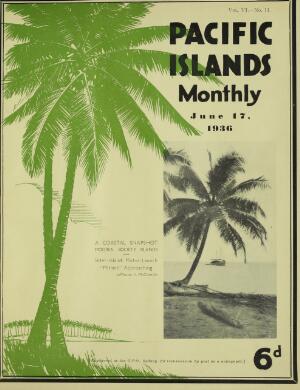
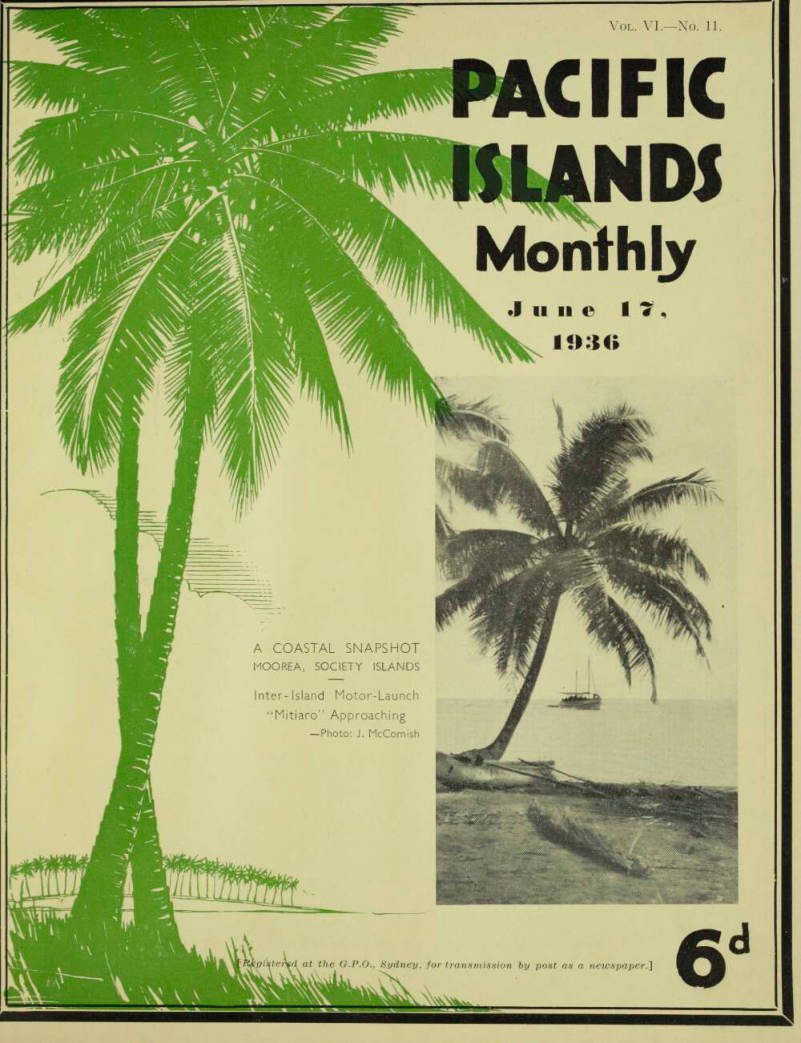
A Coastal Snapshot
Moorea, Society Islands
Inter-Island Motor-Launch
“Mitiaro” Approaching
—Photo: J. McComish
Advertisements & other items, p. 2 (1 item)
Pacific Territories and Europe
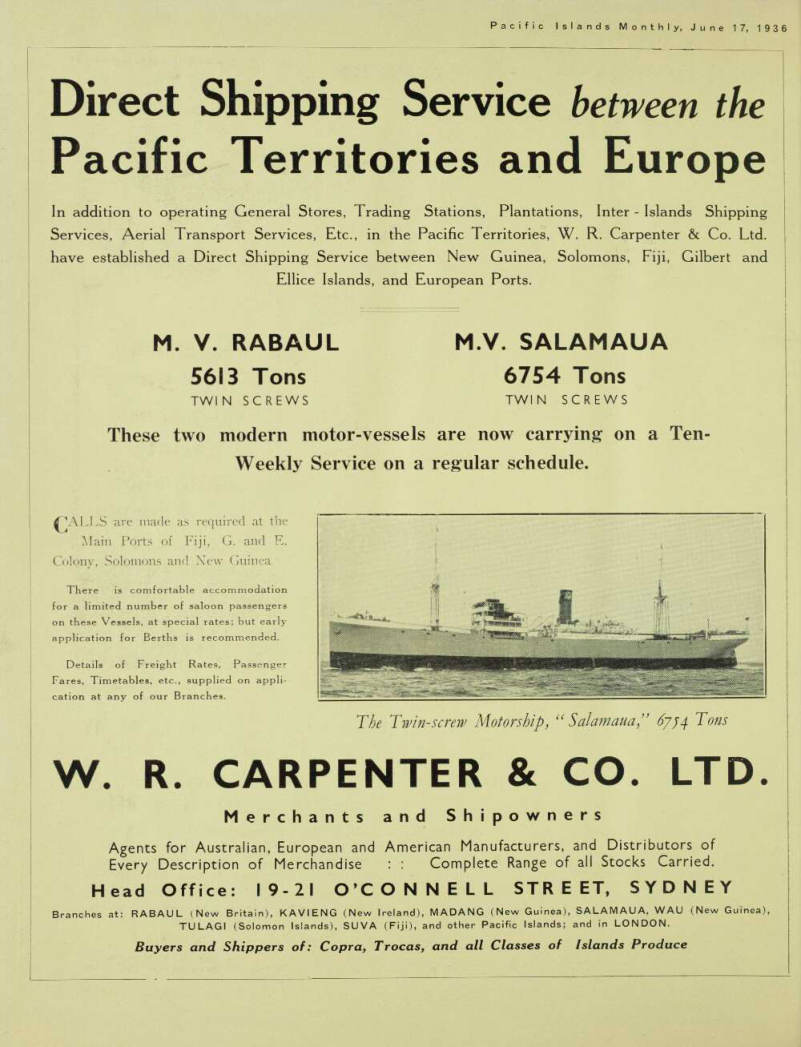
Direct Shipping Service between the
In addition to operating General Stores, Trading Stations, Plantations, Inter - Islands Shipping Services, Aerial Transport Services, Etc., in the Pacific Territories, W. R. Carpenter & Co. Ltd. have established a Direct Shipping Service between New Guinea, Solomons, Fiji, Gilbert and Ellice Islands, and European Ports.
M. V. RABAUL
5618 Tons
TWIN SCREWS
M.V. SALAMAUA
6754 Tons
TWIN SCREWS
These two modern motor-vessels are now carrying on a Ten
Weekly Service on a regular schedule.
are made as required at the Main Ports of Fiji, G. and E.
Colony, Solomons and New Guinea There is comfortable accommodation for a limited number of saloon passengers on these Vessels, at special rates; but early application for Berths is recommended.
Details of Freight Rates, Passenger Fares, Timetables, etc., supplied on application at any of our Branches.
The Twin-screw Motorship, “ Salamaua, n 6yj4 Tons
W. R. CARPENTER & CO. LTD.
Merchants and Shipowners Agents for Australian, European and American Manufacturers, and Distributors of Every Description of Merchandise : Complete Range of all Stocks Carried.
Head Office: 19-21 O’CONNELL STREET, SYDNEY
Branches at: RABAUL (New Britain), KAVIENG (New Ireland), MADANG (New Guinea), SALAMAUA, WAU (New Guinea), TULAGI (Solomon Islands), SUVA (Fiji), and other Pacific Islands; and in LONDON.
Buyers and Shippers of: Copra, Trocas, and all Classes of Islands Produce
Pacific Islands Travellers
Passengers Per Niagara Which,
SAILED FROM SYDNEY FOR SUVA, FIJI, ON MAY 21: G. A. Wright, W. G. Davies, Mrs. N.
A. R. Pollock, Miss A. M. Pollock, Mr. and Mrs.
B. Whitwell, Mr. and Mrs. A. Deane, C. E.
Thomson. J. M. Surtees. Miss A. M Rice, Mrs.
A. R. Rae, Master B. Jones, H. R. Huntley, Mr. and Mrs. F. W. Brooks, Mrs. E. J. Pratt, J. L.
Makinson, R. Clark. Mrs. F. M. Toy, Mrs. P. M.
Mcllroy, Mrs. E. M. Antill, Mrs. J. J. Griffiths, H. L. Nicholls, J. L. Stark, R. Gemmel Smith. Mr. and Mrs. J. A. Emslie. Masters R. G. and P. A.
Emslie, E. A. Walker, Mr. and Mrs. B. S. Jones, R. J. Stephenson, W. H. B. Snowsill, C. R. Corhe, A. S. Hermes, W. R. D. Leigh, M. W T . McCloy, V. L. Dearman, J. N. Goldfinch. H. W. Clark.
Miss M. Scott, Miss M. Ohlson, Mrs. E. M. Scott, Mrs. E. M. Somer, P. O. Cuthbert, Sister Atha nasius, Sister Andre, Mr. and Mrs. C. H. Koster, Master C. P. Koster. Mrs. V. H. Millard. Miss R.
G. Lennox, D. Howell, F. Leather, Mrs. M. Cum mings, Miss J. Cummings, Miss A. M. Uphill. Miss E. Vosailage, J. Head, G. J. Hansen, J. J. Da_vis.
Passengers Per Macdhui Which Ar
RIVED IN SYDNEY FROM PAPUA AND NEW GUINEA ON MAY‘22;—Messrs. Bloxham, Brisk ham, Burston. Carden, Chegwyn, Clark, Costa, Cox (2), Cridland, Davies, De Kantzow, Dunne, Dupain, Eschlimann, Felton, Fletcher, Hall, Hamer, Harris, Haynes (2). Herbert, James, Jen sen, Lapham, Littlechild, Marjason, Mark, Mc- Culloch, McLaughlin, Miller, Mitchell, Morgan, O’Ferrall, Oldham, Pearson, Phillips, Rodighiero, Reynolds (2), Risk, Robertson, Scott, Shackleton, Sherwin (2), Shephard, Slaviero, Slocombe, Spag nola, Steedman, Streeter, Swanson, Turner, Venn, Vine, Waugh, Whaling, White, Wild, Williams, Woodgate, Wormald, Yeomans; Mesdames Brisk ham, Bunting, Cridland, Dupain, English, Flet cher, Hogg, Irvine, Jensen, Miller, Risk, Roberts, Swanson, Woodgate, Thompson; Misses Beckett, Donoghue, Dupain (2), Risk, Smith.
Passengers Per Monterey, Which
SAILED FROM SYDNEY FOR SUVA, FIJI ON MAY 27: Mrs. C. Bond, Mr. and Mrs. T. N. Carew, A. Cohen, Miss B. Cradick, K. Cunningham, Miss A. Curry, Mr. and Mrs. S. Ellis, Master J. Ellis, Miss S. Ellis, Mr. and Mrs. W. A. Ewins, Mas ters B. and W. Ewins* Miss F. Grant, Dr. F.
Harding, H. Israel Mrs. N. Jocober, Misses M. and P. Lansells, J. A. Leask, Mrs. G. V. Maxwell, Miss J. M. Maxwell, Mr. and Mrs. N. McKillop, Miss S. Morr's, Mr. and Mrs. E. Oates, E. G.
Powell, J. L. Ruthven, Miss M. Scott, E. G. Theo dore, Mr. and Mrs. W. B. Cobham, Rev. L. C.
Donaldson, Mrs. J. Hetherington, J. Mason, Miss B. McCausland. S. Radford. A. G. Stewart, Mrs.
E. Wooley, Master L. Wooley.
Passengers Per Macdhui Which Sail
ED FROM SYDNEY FOR PAPUA AND NEW GUINEA ON MAY 28: —Messrs. Atkinson, An derson, Ashe. Boileau, Brown, Brearley, Buhl, Blau, Cornwell, Clay, Clarke, Carr, Carmichael, Davis (2), Davies (2), Dalkin, Eve, Forrester, Gray, Gibbons, Garry, Hoad, Hallam, Hooper, Hutchinson, Holland, Heyden, Hunter. Haligan, Johnston, Johnstone, Jackson, Johns, Kiefer, Mc- Laughlan, Mitchell (2), Mayfield, Madin, McGregor, Phillips, Pickard, Penglase, Parer, Rutledge, Rich, Robertson, Rouse, Sefton, Shay, Stephen, Symington, Symons, Spanswick, Thomas, Watson, Walton, Woodman; Mesdames Adams, Atkinson, Baxter, Bourke, Brown, Clarke, Dough erty, Davies, Goodwyn, Horne, Harris, Johnson, Johnstone, Lane, Munro, McGregor, Nelsson, Pen glase, Quinton, Rutledge, Rich, Rossi, Royle, Reid, Rouse, Sefton, Shaw, Slater, Spankie, Sym ington, Thomas (2), Woods, White, Watson; Misses Ballantyne, Blestowe, Byron, Dwyer, Dawes, Holliday, Healy, Jackson, Lord (2), McLaren, Munro, Nicholson, Protheroe, Robert son, Russel, Shields, Thomas.
Passengers Per Neptuna Which Ar
RIVED IN SYDNEY FROM NEW GUINEA ON JUNE I:—Messrs. Atherton, Barden, Costello, Fraser, Hughes, Lang, Macauley, Neal, Nutley, Pollock, Pedd:e, Shoobridge, Wilson; Mesdames Atherton, Costello, Fraser, Mannering, Peddie, Tilse, Wallace.
Passengers Per Morinda Which
Arrived In Sydney From New Heb
RIDES, NORFOLK IS., AND LORD HOWE IS.
ON JUNE 4: —Messrs. Adam, Creer, Freame, Gilbert, Haseler, Labatt, McMullen, Martin, Moore, Priddle, Rollason, Short (2), Soiling, Watt, Weihen, Wiltshire, Wright; Mesdames Bift. Clarke, Creer, Gedhe, Goldsworthy, Harford, McGrath, Shicks, Soiling, Wiltshire, Wright;
Misses Alt, Barclay, Barling, Clarke (2), Cox (2), Hammond, Labatt, Lusby, Mann, McNab, Miller, Molle (2), Mulroney, Munro, Priddle, Quigley, Reynolds, Steele, Sharp, Taylor, Wiltshire (2).
Passengers Per Van Rees Which
Arrived In Sydney From Papua, N.G.,
VILA, AND NOUMEA ON JUNE 10: A. F.
Tetzner, Mr. and Mrs. de Haviland, J. C. Hall, Mr. and Mrs. S. Paisley, Miss J. K. March, Graham Kerr, R. Mazoyer, Mr. and Mrs. L.
Vebert, Master H. Gubbay, Miss P. Rocheleux, Mrs. L. Russet Rocheleux, J. Dunlop, E. Wolsten holme, R. Cohendet, Mrs. Widow Suzor, Mrs. S.
Coulon, Miss R. Rival, J. W. Webster.
Passengers Per Neptuna Which
Sailed From Sydney For New Guinea
PORTS ON JUNE 10: —Messrs. Anderson, Chap man, Cook, Day, Grabowsky, Greenwood, Hart, Hammond, Hyde, Kent, >Koch, Lega, Mitchell, Picken, Robinson, Reynolds, Speakman, Sepley, Strathearn, Wallis, Yoshida. Mesdames: Bodger, Day, Duncan, Grabowsky, Grigg, Gallagher, Ham mond, Hyde, Hitchcock, Kent, Koch, Strachan- Smith, Wright, Wolfcarius.
Passengers Per Montoro Which
Reached Sydney From Papua And
NEW GUINEA ON JUNE 12:—Messrs. Ball, Harrington, Kennedy, Parker, Pianta, Quinlan, Watkins, Keane, Bissicko, Cecil, Brydon, Cook, Jamieson, Knobel, Macauley, Washington, Cross, Ferris, Holland, Forsyth, Hill, Hutchinson, Reilly, Smith, Budden, Burns, Bressington, Cassidy, Cook, Garrod, Gurr, Hicks, Jarrett, McNamara, O’Con nor, Orr, Pope, Rutherford, Auteridge, Thompson, Burke, Chester, McEnroe, Fitch, Plater, Williams, Mesdames; Schaffert, Ingold, Cecil, Mills, Jamie son, Holland, Farlow, Garrod, Gurr, Jarrett, Paton, Rutherford, Turner, Williams. Misses: Parer, Mathews.
Mr. Charles A. Hamilton died at Wait ovu, Levuka, on May 29, at the age of 83.
He went to Fiji on the immigrant ship Syria, which was wrecked on Nasalai Reef in 1884. For some years he was store keeping on Ovalau Island.
Captain Charles Fairholt, a well-known identity of Central Pacific, died at Apia on June 3, aged 51. An American, of Danish descent, he was an old-time South Seas sailor, and for many years was in the employ of Messrs. Tyndall and Ross, of Nukualofa, Tonga. Later he was asso ciated with Captain Allen of Funafuti in the Gilbert and Ellice Islands Colony, and was on the S.S. Dawn. Captain Fairhoit afterwards became master of the Samoan Administration’s steamer Lady Roberts.
Advertisements & other items, p. 3 (1 item)
Sleeplessness
first thing every morning”
For Depression Sleeplessness Indigestion Irritability Constipation Lack of Energy.
The words Eno and “Fruit Salt” are registered trade marks Au 62
SAICON-BATAVIA-SAMARANG-PORT MORESBY
SAMARAI-RABAUL- PORT VILA-NOUMEA
SYDNEY - PORT MORESBY - BATAVIA - SAIGON
bi-monthly by the "VAN REES"
You will enjoy travelling by this popular, fast and modern steamer of the K.P.M., noted for its comfort, excellent cuisine, and economical fares.
With a fleet of over 130 vessels the K.P.M. Line is in a position to accept cargo for all ports in Netherlands India, and with transhipment at Batavia for Africa.
ROYAL PACKET NAVIGATION CO.
Paketvaart House, 255 George Street, Sydney Diethelm & Co., Saigon; Steamships Trading Co. Ltd., Port Moresby and Samarai; W. R. Carpenter & Co. Ltd., Rabaul; Gubbay Freres, Port Vila; Carlo Leoni, Noumea.
Advertisers
Page.
Adams, Ltd., Wm.. 62 Alois Akun & Co.. . 48 Amalgamated Wire less of Aust. Ltd. 76 Angus & Coote Ltd. 41 Arnott’s Biscuits . . 57 “Aspro” 12 Ausoline 74 B. and S. Agency . 57 Bank of N.S.W. . . 77 Berger & Sons Ltd. 42 Blau (Aust.), R. . . 56 Broomfields Ltd. . . 44 Brotherton & Co.
Ltd 14 Brunton’s Flour . . 55 Budge & Co. Ltd., J. W 60 Burke, Walter ... 69 Bullivants Ltd. ... 68 Burns, Philp & Co. 2 Bums, Philp & Co. 17
B.P. (S.S.) Co. ... 37
Buzacott Ltd 61 Carpenter, W. R.
Ltd ii Cent. QTand Meat Co. Ltd 38 Chapman & Sherack 26 Chivers & Co. Ltd. 49 Coral Starch 59 Crockett & Co. Ltd. 65 Crossle, Duff and Macintosh Ltd. . 72 Crowle House ... 41 Cuprinol 64 Cystex 48 Del Cott Pty. Ltd. 73 Doans Pills 55 Donald. A. B. Ltd. 49 Doyle, T. G 32 Eaton Ltd., J. W. 62 Electrolytic R. & S.
Co. Ltd 72 Elliott’s Emulsion . 13 Elvy & Co. Ltd. . . 23 Eno’s Fruit Salt . . 1
E.S.C.A. Ltd 66
“Fairholme” College 12 Finau, Wm 15 Fletcher & Son ... 47M<
Page.
Ford, Walter 12 Ford, W. M 45 Foster Clark Ltd. . 28 Freeman’s Sports Store 31 Fryer, A. C 26 Garden Vale Pro ducts Ltd 36 Garrett & Davidson 70 Gillespie’s Flour . . 36 Goodwin, A. E. ... 70 Gourock Rope Co. . 75 Grand Pacific Hotel 51 Guinea Airways Ltd iii Gunn & Moore Ltd. 20 Hallstrom Ltd. . . 14 Halvorsen, L 79 Handi Works Ltd.. 59 Hardie & Co. Ltd. . 22 Hardy & Co., R. M. 20 Harper, M 33 Holbrook’s Ltd. ... 37 Holden’s Air Co. . . 80 Horne, W. & Co^ Ltd 52 Hotel Australia ... 25 Hudson Ltd., Geo. . 16
1.C.1.A.N.Z. Ltd. . . 30
Jang King Loong . 52 Johnson, Charles , . 24 Jones & Co., Henry 29 Jones & Rickard . . 34 Kelvin Engines ... 75 Kerr Bros. Ltd. . . 42 Kodak Pty. Ltd. . . 15 Kopsen & Co. Ltd. 27 Kork-N-Seal Ltd. . 39 Lane & Girvan Ltd. 58 Levinson’s Radio . . 63 Link Belt Co 32 Mcllrath’s Ltd. . . 18 Mclntyre & Co., T. 32 McKay, D 27 Maleham & Yeomans Ltd 14 Master Sewing Machine Co. ... 47 Maxwell & Co. Ltd. 80 Maxwell Porter Ltd. 62 Melbourne Hotel . . 52 olloy, Brian ... 22
Morrison & Co. Ltd. 33 Morris, Hedstrom Ltd 50 Mungo Scott Ltd. . 38
N.D.L 78
Nelson & Robertson Ltd 60, 70 Nestle’s Milk 40 New Brit. Express . 58 Newlands Bros. Ltd. 67 Nicholson & Foster 61 “Oceania” 19 Pacific Hotels ... 46 Pacific Taxis 53 Pacific Year Book . 75 Patterson & Stone . 23 Paul & Gray Ltd. . 16 Peel & Sons, H. . . 39
Phillips & House . . 67 Pier Hotel 53 Pike Bros. Ltd. ... 18 Prescott Ltd 54 Prouds Ltd 17 Ransomes, Sims & Jeffries Ltd 50 Reed, Wm. E 38 Reid, W. M 54 Rohu, Sil 27 Royal Packet Co. . 1 Russell, S. . 69 Ruston & Hornsby 45 Samson, A. J 12 Savage, W. & Co. 63 Scott & Bowne Ltd. 19 Scott Ltd., J 44
Scott & Sons 71 Smyth Co., J. H. . . 16 Shell Oil Co. Ltd. . 35 Springwood L. Coll. 56 Stanley, Chris. ... 29 Steamships T. Co. .. 78 Sterling Varnish Co. 11 Swallow & Ariell , . 54 Sydney Steel Co. . . 71 Talkeries 20 Taubman’s Paints . 58 Taylor & Co., A. . . 64 “Tenax” Soap ... 13 Tilley Lamp Co. . . 23 Tillock & Co. Ltd. . 29 Tooheys Ltd 21 Tooth, & Co. iv
Trufood 26 Tudor Hotel 13 Vacuum Oil Co. Ltd. 43 Vincent’s A.P.C. . . 21 Wallis, J. B. & Co. 71 Walker-Flynn, Mrs. 57 West, H 44 Weymark & Son . . 39 Wheeler, B. R. ... 64 Wills, W. D. & H. 0. 27 Williams Ltd., S. . . 34 Williams, W. H. . . 68 Woods Ltd., W. E. 30 Wright & Co 68 Wright & Co., E. . 74 Wunderlich Ltd. . . 64 Yorkshire Insurance Co 22
Contents
Page Pacific Islands Travellers 1 Fiji Franchise and Indian Community 3 Matua to Serve Cook Group . . . . 4 N.G. Mission Activity Restricted .. 5 N.Z. Minister Visits Samoa 5 Tongan Queen In Sydney 5 New Tiafau Inquiry 6 Cook Island Fruit Inquiry 6, 29 Sydney-New Guinea Air Service .. 7 Fiji Governor Leaves for Trinidad .. 8 The Wealth That Lies East of Papua 9 Tropicalities 12 About Islands People 12 Why Fiji Franchise was Withdrawn 14 Sectarianism and Missions 16 Yesterday and To-day in Rabaul . . 17 Australia’s Delegates to Honolulu Conference 21 Aerial Services in New Guinea . . .. 23
Page Men Who Knew Yesterday—6. Sher win, of New Britain 26 “Little Stonehenge” of a Forgotten Race 32 Seeking Cocos Island Treasure .. . . 33 Native Surgery in New Britain .. .. 37 Fiji’s Sugar Exports Fall 39 Pages from the Past —The Odyssey of the TaTcitumu 42 Cocoa Growing in New Guinea .. .. 45 Electricity for Fiji Goldfield .. .. 50 Lautoka’s Town Services 52 Housekeeping in the Tropics .. . . 55 Fashion Hints for Islands Women . . 57 Guinea Airways’ Annual Report .. 61 “Pitcairn’s Island” to be Filmed . . 66 Germany and Her Ex-Pacific Colonies 68 Pacific Islands Mining Reports .. .. 70 Market Quotations 77 South Seas Shipping Services .. . . 78
Advertisements & other items, p. 4 (1 item)
Burns, Philp & Co. Ltd.
GENERAL
MERCHANTS
1 mm 13 mi ■ I 5 .V ■ m
SHIPOWNERS
TOURIST AGENTS
Head Office: 7 Bridge Street, Sydney—Australia Code Address: "Burphil" \ BUYERS OF ALL CLASSES OF ISLAND PRODUCE Regular Steamer Services from Australia to New Guinea Papua Solomon Is. —Lord Howe Is. —Norfolk Is. —New Hebrides —lava and Singapore
Pacific Islands Monthly
Tlie News|»siper-]flag'a*liie of the South Seas [ Registered at the G.P.O. Sydney, for transmission ~by post as a newspaper .]
Published Once Each Month and Circulated in Australia and New Zealand and in the following Pacific Territories and Island Groups:
Crown Colony of Fiji, Australian Territory of Papua.
Mandated Territory (Australia) of New Guinea, Bismarck Archipelago and Northern Solomon Islands.
Mandated Territory (Japan) of Marshall, Caroline and Marianna Islands.
French Territory of New Caledonia.
British and French Condominium of New Hebrides.
American Territory of Eastern Samoa.
American Territory of Guam.
Mandated Territory of Nauru.
British Crown Colony of Gilbert and Ellice Islands.
Mandated Territory (New Zealand) of Samoa.
British Solomon Islands Protectorate.
British Protectorate of Tongan Islands.
New Zealand Territory of Cook Islands.
Australian Territory of Nqrfolklsland.
French Colony of Oceania (Tahiti, etc.).
American Territory of Hawaiian Islands.
Owned and Produced by Pacific Publications Ltd., Union House, 247 George Street, Sydney
Telephone * Bw 5037
P.O. Box 3408 R
Registered Address of Telegrams, Radiograms, and Cables: "PACPUB,” Sydney.
Contributions Articles, Stories, and Photographs dealing with Pacific Islands Subjects are invited, and will be paid for on publication at usual rates.
Subscription Rates Per Annum, within British Empire, Prepaid, Post Free 6/- Per Annum, elsewhere, prepaid. Post Free 8/ Single Copies 6d.
Editor and Publisher:
R. W. Robson, F.R.G.S.
Advertisements
Advertising rates furnished on application.
Colours, etc by Arrangement.
Process Blocks made at Advertiser’s expense when required. Screen, 100.
Changes of Advertising Copy should reach this Office by Bth of each month, otherwise previous advertisement may be repeated.
Agents
The following are authorised to receive subscrip tions for the Pacific Islands Monthly:— Islands Branches of Burns, Philp & Co., Ltd., and Burns Philp (South Seas) Co., Ltd.
Islands Branches of W. R. Carpenter & Co., Ltd.
All Branches of Morris, Hedstrom & Co., Ltd.
G. Thomas & Co., Rabaul, New Guinea.
Whitten Bros., Ltd., Samarai, Papua.
P. Costello, Suva, Fiji.
J. Muir, Suva, Fiji.
All Branches and Representatives of W. H. Grove and Sons, Ltd., Auckland, New Zealand.
S. Russell, Papeete, Tahiti.
Cook Islands Trading Co., Rarotonga, Cook Is.
Representative in London: W. C. HARVEY, Coronation Building, 4 Lloyds Avenue, London, E.C.2. from whom may be obtained copies of Pacific Islands Monthly, Pacific Islands Year Book, advertising schedules, etc.
Vol. VI., No. 11.
Sydney, June 1 7, 1 936
\ 6d> Per Copy ’ 1 ilCe j Prepaid; 6/- p.a.
Fiji Franchise and Indian Community
franchise situation in Fiji—the two sides of which are presented very ably in contributed articles in an other part of this journal—probably is unique in the history of the British Empire.
The Colonial Sugar Refining Co., bringing in indentured Asiatic la bourers to establish the sugar industry —and there seems to have been no other way, for the well-endowed Fijians will not work—gave Fiji this special problem. All the Indians were not repatriated; sufficient were allowed to settle in Fiji* as peasant farmers and contract growers of sugar-cane, to pro vide a community of a numerical strength practically equal to that of the Fijians. The latest available statistics (1934) show that the population is: Europeans 4,763 Fijians 98,479 Indians 83,289 Later developments gave no surprise
to those who know anything of Indian colonisation. A special franchise was introduced to meet the special condi tions : representatives elected by the Indian community sat on a Legislative Council with similarly elected men from the European and Fijian com munities, and the Governor retained control by appointment (by nomina tion) of official members. This did not suit the majority of Indians, and they began their usual agitation for the “common roll,” in which Indians, Fijians, and Europeans would have equal voting power.
Indians generally—and this cer tainly applies to Fiji Indians—are not competent to exercise administrative control; and that must have been the view taken by the Colonial Office, even if there had been no Fijians in the pic ture. But the presence of the Fijian community made the Indian demand intolerable. It is true that the Indian claims a “common foil” for the Fijian
as well; but anyone with a knowledge of the .two races knows what would happen. The Fijian is just as intelli gent as the Indian; but in the realm
of political intrigue, compared with the
Indian, he is as a child in arms. A Fiji administered under the “common roll” would very soon be an Indian Fiji. The Europeans could take care of themselves, perhaps, but what of the Fijian? Inevitably he would become a sort of slave of the Indian. Such a development would have had serious political reactions far beyond the bor ders of Fiji.
Britain, of course, will not permit anything like that. Fiji was ceded to Britain by the Fijian chiefs, in trust for the Fijians. Britain has given her energies to the commercial develop ment of Fiji, just as she has done in other lands; but the record of British colonial expansion throughout the world shows that the fundamental policy of Britain in all the overseas countries of which she has taken pos session is the protection of the rights of the indigenous natives, and especially
their rights to land. When the natives are of a superior type, like the Poly nesians (with whom we may include the Fijians), Britain has taken her trust very seriously. Maoris, Tongans, Samoans, Cook Islanders, Nauruans— all have been protected against the op pression of the land-grabber. That is Britain’s first responsibility in Fiji.
The rights of the Fijians must be con sidered first; then the interests of the British; while the interests of the late comers, the Indians, come last of all.
The Fijians do not like the Indians; there is practically no racial inter mingling—a surprising thing, consider ing the readiness with which other Asiatics, especially Chinese, mix with the Polynesians. The Fijians have made it very plain to the British that they do not desire a “common roll” with the Indians—they realise what it would mean.
Britain clearly was embarrassed in Fiji because she has an equal trust, and an equal regard, for her Indian subjects. The great majority of Fiji Indians are not of good class —although they are improving with every genera tion born in Fiji—but there are a minority of them who are men of superior intelligence, and who have been loyal to the British Crown and helpful to the Governor, Britain is anxious to retain the goodwill of the Fiji Indians, and especially of some of their leaders. What was she to do to provide for the present problem, and against future embarrassments ?
The course she has taken, which is the withdrawal of the elective system altogether, and the substitution there for of purely nominative Councils for the Legislature and for the municipali ties, was the only one possible in the circumstances. Actually, it will pre serve the status quo, for although the system which has been withdrawn was nominally elective, actually it was under nominative control by the Gov ernor, for the official (non-elective) members, plus those nominated by the Governor, always held the majority.
In the future, the various interests still will have a voice in the Council. If the Governor is wise he will see to it that the men he nominates are thor oughly representative men. If import ant sections of the communities are robbed of representation, there inevit ably will be trouble, and this purely nominative system will break down.
But if the Governor exercises his pre rogatives wisely, the great majority of people in all three communities will
be satisfied, and an extremely awkward problem of administration can be re garded as shelved indefinitely.
Of course, there are always agita tors ; and, in this case, there are also short-visioned gentlemen who bawl about the “rights of democracy.” The former can be ignored, while the latter must be endured. If they cannot see that, in the peculiar circumstances of Fiji, the only possible course has been taken, they are pretty hopeless people, and nothing can be gained by arguing with them. Democratic government is an idealistic condition—one man, one vote, seems to go to the very root of human liberty and justice. But, under the acid test of war, and of economic dislocation, democratic government has been proved unreliable, inefficient, and frightfully expensive; and, almost in variably, countries have saved them selves by placing themselves under the control of a wise and benevolent dic tator. Those Fiji Europeans who are so busy demanding their “rights” should remember those facts, and also should try to see the situation from a standpoint outside of Fiji. There are considerations involved which are far more important than the question of whether the individual European in Fiji should have a vote.
500 Deaths
Whooping Cough Epidemic Ravages Samoans
From Our Own Correspondent APIA, June 4.
THE whooping cough epidemic, which started to spread in Apia and out side districts about a month ago, con tinues to rage with undiminished force, taking a heavy toll of lives, especially among Samoan infants.
The number of infants who have fallen victim to the disease is estimated at about 150 in and around Apia and about 350 in outside districts and Savaii. As the disease is only in the first stages in South Upolu and Savaii, the mortality is ex pected to rise still higher.
The many deaths are chiefly among native Samoans, while European children are less affected. In certain Apia and West Coast villages funerals of children are a daily occurrence. There seems to be no effective remedy or cure against the whooping cough.
Communication between the islands of Upolu and Savaii, which as a preventive measure had been interrupted, has now been resumed. Quarantine regulations are still in existence between American Samoa and Western Samoa.
The Administration has been informed that there is an epidemic of typhoid fever at Pago Pago (American Samoa), so at present there are no prospects of lifting the existing ban.
Ship Services
Central Pacific
“Matua” to Give Cook Is.
Connection
THE timetables of the Union S.S. Co.’s A new motor vessel Matua —due in New Zealand in August—have been arranged to provide for the requirements of not only the Central Pacific (Tonga, Samoa, and Fiji), but also of the Cook Islands.
The discontinuance by the Union Co. of the Sydney—Wellington—Rarotonga— Papeete—’Frisco line will leave no regular connection between Tahiti and Rarotonga, on one side, and New Zealand and Aus tralia, on the other.
It is now intended that the Matua will provide a monthly connection between the Cook Islands and Auckland; while a cargo steamer will provide a regular freight service between New Zealand and Australia, and Rarotonga and Tahiti.
It is expected that, if the Union Com pany finally withdraws, the Matson Com pany will step in and provide a regular mail and passenger service between Tahiti and San Francisco.
“Matua’S” Timetable
On her first trip the Matua will depart from New Zealand for the Central Pacific on August 27, returning to Auckland on September 9. She is scheduled to sail for Nukualofa, Apia, and Suva again on the 24th., but in the interval will make a trip to Rarotonga and the outer islands of the Cook Group, leaving on September 10 and returning to N.Z. on September 23.
The Matua will also visit the Cook Islands between October 8 and 21, and again between November 5 and 18.
The following timetable shows her itinerary and sailing dates for the first four voyages in the Central Pacific; — Auckland Aug 27 Sept 24 Oct 22 Nov 19 Tonga, arr.
Aug 30 Sept 27 Oct 25 Nov 22 Tonga, dep, , Aug 31 Sept 28 Oct 26 Nov 23 Apia Sept 1 Sept 29 Oct 27 Nov 24 Suva, arr.
Sept 4 Oct 2 Oct 30 Nov 27 Suva, dep.
Sept 5 Oct 3 Oct 31 Nov 28 Auckland Sept 9 Oct 7 Nov 4 Dec 2
Japan To Develop Her Pacific
Islands
JAPAN is aiming at economic advance ment in her Pacific Islands (Caroline and Marshall Groups) by the establish ment of a South Seas Development Com pany, with a capital of 15,000,000 yen (£1,500,000 at par), according to the Japanese newspaper Hochi Shimhun.
The new company will co-operate with the existing South Seas Exploitation Co. in order to develop industry and colonisa tion. Diplomatic negotiations will be con ducted to extend Japan’s interests in Siam, Dutch Borneo, Sumatra and Dutch New Guinea.
The two Pacific Islands companies will combine with another new company, the Formosa Development Co., with a capital of 30,000,000 yen (£3,000,000 at par), in a huge semi-official Oriental Development Co. which, it is planned, will migrate 20,000 families from Japan during the next ten years. The Oriental Company will also seek to foster a closer relation ship between Japan and the Philippine Islands.
Restricted
Native Missionaries in N.G.'s “Uncontrolled Areas"
From Our Own Correspondent
Rabaul, June 2.
IN the New Guinea Government Gazette, dated May 30, there appear amend ments to the Native Administration Reg ulations (1924), which stipulate that no native, except born in the area specified, shall be allowed to reside there unless under the direct control of a European.
Nor shall he be allowed to enter a village in such area. A penalty of five pounds or imprisonment for six months may be inflicted.
The areas referred to are all those districts which have been gazetted as “uncontrolled areas” under section 4 of the Uncontrolled Areas Ordinance 1925- 1935.
The new regulations come into force on August 1, and from that date it will mean that all strange natives within an “un controlled area” must be withdrawn, un less they be directly under the control of a European living in the same village.
There is little doubt but that this mea sure is a result of the trouble that has occurred from time to time between the various mission factions in the more-dis tant “uncontrolled areas” on the main land of New Guinea. It has been found that much of the sectarian bitterness, fos tered amongst mission ranks, is caused by the misdirected energies of native missipn teachers.
In all probability, mission interests will make strenuous efforts for this amend ment to be rescinded. It will restrict their activities to a certain extent in the hinter land workings, where white missionaries prefer to place native teachers to prepare the way.
Missionary
Two Years' Gaol for American Missionary
From Our Own Correspondent
Rabaul, June 10.
\ T the Rabaul Court to-day Chief Judge D. S. Wanliss sentenced Henry Foege, a Lutheran missionary of Ameri can birth, to two years’ imprisonment with hard labour for having unlawfully deprived a native of his liberty.
Foege was stationed in an “uncontrolled area” in the Morobe district, and he kept a native as hostage while recovering ar ticles stolen by the native’s tribe from native Lutheran mission teachers.
Modern Hotel for Rabaul
From Our Own Correspondent
Rabaul, June 3.
IT is reported that Messrs. W. R. Car penter and Co. Lt(l. propose to form a subsidiary company in Sydney to spend £25,000 building and equipping a new up-to-date hotel here. It is planned to make the hostelry the finest in the Pacific, south of Honolulu.
Plans providing for 30 bedrooms, with hot and cold water and all modern con veniences are now under consideration.
The location favoured is said to be on the waterfront, south of Park Street.
New Vessel
For Dutch Service in Western Pacific
THE Dutch steamer, Van Rees, which arrived at Sydney on June 10, is to be replaced before the end of the year.
The commander, Captain P. Bakker, said that a steamer of more than 4000 tons gross was nearing completion in Hol land and would leave early in December to take up her running. Like the Van Rees, she will call at Saigon, Java, Papua, New Guinea, New Hebrides, New Cale donia and Sydney.
Maetsuycker is to be the name of the vessel, in honour of a former Governor- General of the Dutch East Indies.
Captain Bakker said that the vessel would be particularly suitable for the passenger and cargo requirements of the Pacific service and should have a service speed of 14 knots.
Queen Salote
Tonga’s Ruler Visits Sydney
FLYING the Tongan Royal Standard, the liner Aorangi reached Sydney on June 12 with Queen Salote, D.8.E., ruler of the Tongan Islands, Prince Consort William Tugi, and Princess Fetutuki Oneone (lady-in-waiting) on board.
Queen Salote was in Australia in August last year when she underwent a serious operation in Sydney. She has now returned for further medical attention, and probably will enter the War Memorial Hospital at Waverley.
To make connection with the Aorangi at Suva, the Queen left Nukualofa by the small sailing vessel Fetuuaho. The cutter ran into heavy seas, and the Royal travellers experienced a strenuous four days’ voyage before reaching Fiji.
Samoan Affairs
N.Z. Minister’s Goodwill Mission
THE Minister for Lands (Hon. Frank Langstone), accompanied by Mr. J.
O’Brien, Member of Parliament for West land, left Wellington on June 16 for Apia by the Maui Pomare to investigate affairs in Western Samoa and report to the New Zealand Government.
The visit of Mr. Langstone will be in a sense a goodwill mission to the Samoan people. Advantage will be taken to in quire into the affairs of the administra tion with a view to guiding the N.Z.
Government in its choice of an Adminis trator of the Mandated Territory in suc cession to Sir Herbert Hart, who resigned last year.
The duty of the two Parliamentarians will be to find out the true State of con ditions in Samoa, and to meet the Samoan people and explain that the new Govern ment intends to work with them for the good of the territory as a whole. They will investigate the natives’ grievances and take back recommendations regarding the best method of approach for their solution.
Messrs. Langstone and O’Brien will be absent about a month.
Hospital
Papuan Administrator In
A BRIEF message published in the Mel bourne newspapers on May 22 stated that Sir Hubert Murray, K.C.M.G. (Lieu tenant-Governor of Papua), who is at pre sent on a visit to England, had entered the Hospital for Tropical Diseases in London.
It was subsequently reported on June 5 that His Excellency had recovered suf ficiently to leave the hospital. He will depart for Australia, via Singapore, on July 3, on his return to Papua.
Messrs Levers’ Pacific Plantations Company's inter-island vessel “Miro,” after she was cast ashore by a storm recently in the Solomon Islands. She was later refloated, and taken to Levers’ headquarters at Gavutu for repairs. —Photo.: M. Harper.
Loss Of “Tiafau”
New Inquiry Ordered
From Our Own Correspondent APIA, June 4.
A COMMISSION which inquired into the loss of the motor-boat Tiafau. between Apia and Pago Pago, on January 17, has made public its findings. By a majority verdict it decided that the causes of the accident were: (a) Insufficient ballast in comparison with the load carried on the deck; (b) ballast badly secur ed; (c) want of expert seamanship on the part of the master, Captain Hicks.
The commission also found that those respon sible for the safety of the vessel had not taken all necessary and reasonable steps to prevent casualty, and that the owners and master of the “Tiafau” should be held responsible for the acci dent.
It was recommended that a Harbour Committee be appointed to draw up rules and regulations regarding local craft with a view to preventing accidents to vessels at sea, and that in future only certificated Board of Trade officers be allowed to handle vessels running on the Apia-Pago Pago service.
The owners and master of the “Tiafau” were ordered to contribute £3l/10/- toward the cost of the inquiry, A minority report presented by the Hon. I. H.
Carruthers attributed the wreck to an act of God, and made no recommendations.
When the above findings were commu nicated to Messrs. Burns Philp (S.S.) Ltd., owners of the Tiafau, they appealed for a re-opening of the investigation. It has now been announced by the Acting Administrator (Mr. A. C. Turnbull) that the N.Z. Government has ordered a new inquiry.
Chief Judge R. M. Watson (now on cir cuit duty in Samoa) will be chairman of the new commission, and Captain G. M.
Watson, of the Marine Department, Wel lington, will sit as nautical expert. A third member will be appointed locally.
Apart from dealing with the Tiafau disaster, the commission will investigate local shipping regulations, the Harbour Department, the conditions of coastal and inter-island traffic, and all charges, de tails, and personnel connected with it.
The commission will be prepared to give consideration to representations which might be submitted by local people.
Privy Council Criticises Fiji
Chief Justice
The English Privy Council, in allowing the appeal Mahadeo versus the King, on June 11, strongly criticised the ad ministration of justice in Fiji. It declared that the Chief Justice appeared to have treated the case as murder or nothing.
Their Lordships added that there were really no materials for a conviction for murder instead of manslaughter. The trial was so conducted as to exhibit neg lect of the fundamental rules of practice necessary for the safe administration of criminal justice.
Judge H. F. Ayson, Resident Commis sioner for the Cook Islands, returned to Rarotonga from Wellington by the Maun ganui on June 9.
Mr. A. Ayres, of Wellington, has been appointed dispensary chemist to the Gov ernment Hospital at Apia. He left New Zealand for Samoa by the Maui Pomare on June 16.
Cook Is. Fruit
Clashing Interests Argue, While M.P.'s Go Off on “Sunshine Cruise"
By R. W. Robson
Auckland, June 11.
nPHERE has been political fuss and fury -*■ here lately concerning the marketing of Cook Islands fruit—mainly oranges. It has culminated in a series of petitions from the Cook Islands interests to the New Zealand Government, charging trad ers and agents with so rigging the New Zealand market that the growers have got practically nothing, while the “fruit ring” has reaped huge profits.
Another series of petitions repudiated the charges.
The old conservative Government ig nored the agitation; but it was seized on eagerly by this new Socialist Administra tion, which is clearly anxious to get any evidence it can of the operations of rings and combines. So there has been an in quiry by a Parliamentary Committee in Wellington, whereat evidence has been given by a numerous party from Raro tonga (some for and some against a “Fruit Control Board”) and by New Zea land fruit agents, who appeared in their own defence.
The result of the inquiry seems to have been a stalemate. It is announced to-day that three members of Parliament— Messrs. J. Robertson, C. L. Hunter, and S. G. Holland—will sail for Rarotonga on July 7 to inquire personally into the whole situation. Perhaps the inquiry—which extended over several days—did not give the data needed. Personally, from all I can learn, I am of opinion that the Gov ernment already has decided that it will appoint some sort of “Fruit Control Board”; but that three deserving mem bers feel that the opportunity for a “sun shine cruise” is too good to miss.
The belief is widely held among th* fruit agents—and, I think, with good reason—that all this “Fruit Control Board” agitation has much of its inspira tion in the desire of certain officials to give the Cook Islands Department some thing to do. At present, the Department is an anachronism. Western Samoa is run by the External Affairs Department, and there is no reason why the Cook Islands should not be similarly controlled.
But if the C.I. Department can get con trol of the fruit export business of the Cook Islands, it may be able to justify its continued existence.
It must not be forgotten, however, that the Cook Islands Department with the co-operation of traders now successfully organises and markets the whole of the fruit output of Niue, another of New Zea land’s Pacific dependencies. It has been pointed out that perhaps the same thing would be possible in the Cook Islands.
All the information I have been able to gather—and I have been chatting with many people during the currency of this inquiry—suggests that the trouble is not caused by the rapacity of a fruit ring, but by a tragic lack of proper transport facilities, and by absence of organisation at the ports of shipment.
New Zealand is hungry for tropical fruit —there is pathetically little on sale anywhere. One of the most experienced fruit salesmen here said to me; “If we could only get regular and reliable sup plies, we could sell five times as many oranges in New Zealand.”
On the same ship that brought the Rarotongan fruit inspector, and several Rarotongans, to advocate a “Fruit Con trol Board,” there arrived some thousands of cases of Cook Islands oranges; and it is a literal fact that half of these were rotten and had to be thrown away. The loss was at least £2,500. Nothing could have been more timely to support the argument of the fruit traders and agents, that the cause of the miserable returns to C.I. growers is the bad condition in which the fruit so often arrives. They say that the fruit often is cut far too long before the arrival of the steamer, which is the fault of the officials and growers; and it is not carried in cold storage. The particular shipment referred to presum ably was organised under the supervision of the fruit inspector, and certainly was transported under his supervision; yet it was 50 per cent, bad on arrival.
The agents here are bitter at what they consider was a trick played them by the Government.' They gave their evidence freely, and were cross-examined by obvi ously hostile Parliamentarians; but the latter so arranged the inquiry that the agents did not have a chance to cross examine the officials, who gave evidence unfavourable to the agents. The latter declare that, if they had been allowed to ask questions of certain officials, they would have exposed a very interesting situation.
The agents do not want to see the trade “messed about by a Fruit Control Board” which, no doubt, it would be under the control of the Socialist Govern ment. They would prefer to see what ever control is deemed necessary exer cised by Judge Ayson, the Resident Com missioner, who is an eminently fair minded man, with a sound knowledge of the local position; and they urge that whatever energy the Government has should be devoted to the provision of better transport. Regular transport, with cold storage, would give New Zealand a large supply of good oranges, and return substantial profits to the growers. The present position is of no use to anyone —growers, agents, or consumers. (Further reference to the C.I. fruit industry will be found in an article by our Cook Islands corre spondent on Page 29.)
Advertisements & other items, p. 8 (1 item)
Wrapper !
Look on the Front of Your
There may be a sign stamped on the front of the wrapper which brings this copy of the “P.1.M.” to you.
The meaning of the marks: Your subscription (6/- per annum, or 8/- in the case of countries outside the British Empire—which includes postage) may be sent direct, or may be paid to any of our agents (listed on page 3).
PACIFIC PUBLICATIONS LTD.
Union House, 247 George St., Sydney Your subscription will expire with the next or following issue.
Your subscription will expire with this issue.
This means that your subscription has expired; and that we have sent you this further copy in case you wish to continue as a subscriber, and have forgotten to send in your subscription. Prompt attention is respectfully requested.
Sydney-New Guinea
Air Line
Carpenter Service to Start at End of June
ALTHOUGH negotiations are still pro ceeding with the Commonwealth Government, Sir Walter Carpenter, head of Messrs. W. R. Carpenter and Co. Ltd., made an emphatic public statement on June 9 that his firm would commence operating an air line between Sydney and New Guinea at the end of June.
“A new Gannet aeroplane, built at Mascot and powered with American Menasco twin-engines, will be tested about June 20, and plans have been pre pared for Captain Grahame to fly the machine to Salamaua on its inaugural flight within the following fortnight,” said Sir Walter.
“So far I have not been successful in obtaining the Federal authorities’ permis sion to start this service. They contend that this particular machine is unsuitable for a sea crossing of 350 to 375 miles,” he continued.
“I am going to insist that the civil aviation people put this machine through the most stringent tests, similar to tests which American ’planes have to pass.
Should any restrictions be placed on the Gannet operating the proposed service, I will carry the matter as far as demand ing a Royal Commission to inquire into the conduct of aviation in New Guinea,” added Sir Walter, At first the new service will be fort nightly, but if sufficient support is forth coming it will be speeded up to a weekly
schedule. The journey will take two days —Sydney to Townsville, via Brisbane, on the first day, and Townsville to Salamaua, via Cairns and Port Moresby on the second. The sea flight will probably be across from Cape Flattery (north of Cooktown) to Pt. Moresby.
The Gannet will have accommodation for four passengers, each with an allow ance of 200 lbs. of luggage. In addition the ’plane will carry 200 lbs. of mail and cargo. It is believed that the fare from Sydney to New Guinea will be £37/10/-.
Another Carpenter Machine
Sir Walter Carpenter also announced that a large 16-passenger twin-engined monoplane had just left England on the W.R.C. vessel Rabaul to be used in New Guinea. The machine, he said, was an Avro 642 —a high-wing cabin aircraft fitted with two Armstrong-Siddeley Jaguar engines of 460 h.p, each. The new Avro —a recent English creation —would cruise with a full loa,d at 145 miles an hour, and would cost £17,500 landed at Sydney.
Guinea Airways’ Lockheed
Electra
A big Lockheed Electra twin-engined monoplane was shipped from San Fran cisco on June 7 to the order of Guinea Airways Ltd. for use as a passenger and freight-carrier in New Guinea. It has accommodation for 10 passengers, and a top speed of 215 miles an hour.
The ’plane will be flown to New Guinea by one of the company’s pilots (Mr. Eric Chater), An American pilot is accom panying the machine to Sydney to under take initial test flights.
Mr. A. L. Robinson, of the New Guinea District Services Department, arrived in Australia recently to spend his furlough in Sydney.
Missing
Anxiety for Ship “Joseph Conrad”
COME anxiety has been felt in Australia for the safety of the little full rigged ship Joseph Conrad, commanded by her owner A. J. Villiers, author and journalist. She has been sailing from Papua to Tahiti, via Lord Howe Island, through the area recently swept by mer ciless gales, and has not been sighted for three weeks.
Passengers who arrived in Sydney by the June Morinda from Lord Howe Island, which was the last known port of call, stated it had been rumoured that the Joseph Conrad had foundered, and all hands had perished. The origin of the rumour, however, could not be deter mined.
The tiny vessel was last sighted on May 22, 10 miles east of Cape Palliser, New Zealand, and heading north for Tahiti. It is believed in some quarters that the cyclone which devastated Nor folk Island about that time struck the ship. It was reported on Lord Howe that the auxiliary engine had been giving trouble and periodically broke down.
Should this have occurred during the cyclone there was every reason for anxiety.
Early in June wreckage was found off the coast of New Zealand. Official in quiries were made, but it was stated that the Department of Navigation was satis fied the wreckage could not have been connected with the Conrad.
Hon. G. Murray, N.G. Director of Agri culture, returned to Rabaul at the end of May, after a hurried visit to Australia .
Where The Dead Are Not Forgotten
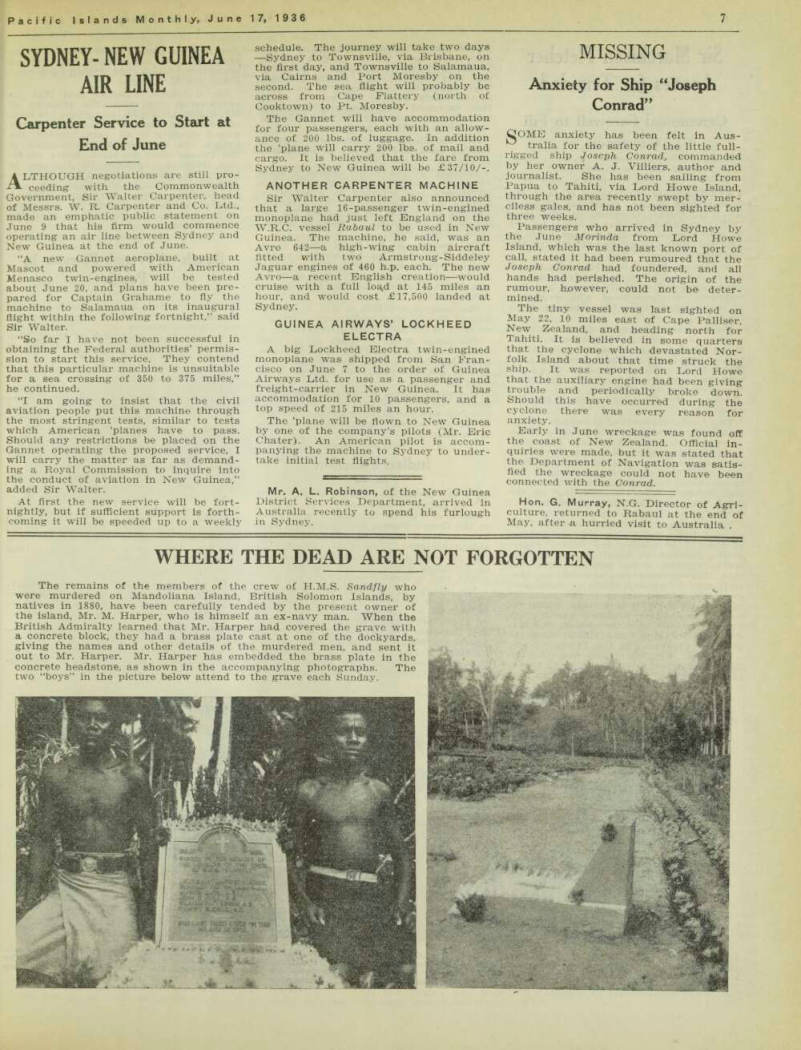
The remains of the members of the crew of H.M.S. Sandfly who were murdered on Mandoliana Island, British Solomon Islands, by natives in 1880, have been carefully tended by the present owner of the island, Mr. M. Harper, who is himself an ex-navy man. When the British Admiralty learned that Mr. Harper had covered the grave with a concrete block, they had a brass plate cast at one of the dockyards, giving the names and other details of the murdered men, and sent it out to Mr. Harper. Mr. Harper has embedded the brass plate in the concrete headstone, as shown in the accompanying photographs. The two “boys” in the picture below attend to the grave each Sunday.
Sir Murchison Fletcher
Leaves for Trinidad Ceremonial Farewell to Fiji Governor
From Our Own Correspondent
Suva, May 21.
INTERESTING ceremonies marked the departure of Sir Murchison Fletcher, K.C.M.G., C.8.E., Governor of Fiji since 1929, from Suva on May 1, when he left by the Aorangi for England, en route to Trinidad, where he will shortly take up the Governorship.
At Government House bure, His Excel lency was met by native chiefs represent ing every province in the Colony, and this ceremony was combined with reguregu, or mourning for His Late Majesty King George V.
Each chief brought a tubua (whale’s tooth), as a symbol of condolence to the Royal Family, and one of these was given to His Excellency for conveyance to King Edward VIII. The presentation was made with full ceremonial, and after it, came the sevusevu (presentation of a root of yaqona to the chiefs on behalf of His Ex cellency).
The formal farewell of the chiefs to His Excellency embodied the impressive meke ni-yaqona, in which kava was ceremoni ously prepared and presented to the guests of honour. This was particularly well done, and the chiefs seated around the tanoa (bowl) in full costume made a strik ing picture, while the chanting as the drink was mixed lent a touch of the bar baric.
Ratu George Tuisawau, recently ap pointed Roko Tui Rewa, read an address of farewell, expressing the Fijians’ regret at His Excellency’s departure. He stressed the satisfaction of the natives at the fact that the Governor had revived the pro motion of hereditary chiefs as recognised provincial administrators in the provinces of their birth. This leadership, which for some time had been dormant, was in every way compatible with the custom and tra dition of the land, and rightly won the genuine applause of the Fijians.
Replying, Sir Murchison said that he had come from England with confidence in the people of Fiji; it had not been mis
placed, and he looked back to many happy days spent here. He had tried to lead the Fijians forward in the path of progress, and they were making steady progress.
Their future lay very largely in the hands of the chiefs, who by the way in which they exercised their authority and their influence could do much to make or mar the future of their people.
His Excellency was presented with a walking stick of Fiji ebony as a memento of his stay in the Colony.
Arriving at the wharf where a large crowd of residents had congregated, His Excellency was received by a guard of honour of the Defence Force. After in specting the guard, he performed his last official act, presenting a number of decora tions. These were: The insignia of 0.8. E. to Major C. B.
Joske, M.C., E.D., for his to the Colony over a long period of years, par ticularly in connection with his work for the Defence Force and the Boy Scouts’
Association.
The insignia of 0.8. E. to Mrs. J. Russell, wife of the Director of Education, for her services to the Girl Guide movement.
The silver Medal of Merit of the Boy Scouts’ Association to District Scoutmaster Louis Mahibir, who has had 16 years’ ser vice in the movement, ten of them as a scoutmaster.
The silver medal of the Royal Humane Society to Joni Draunimasi, of Bua, for rescuing another Fijian who was attacked by an oqo (a large and ferocious species of barracouta).
Indian Function
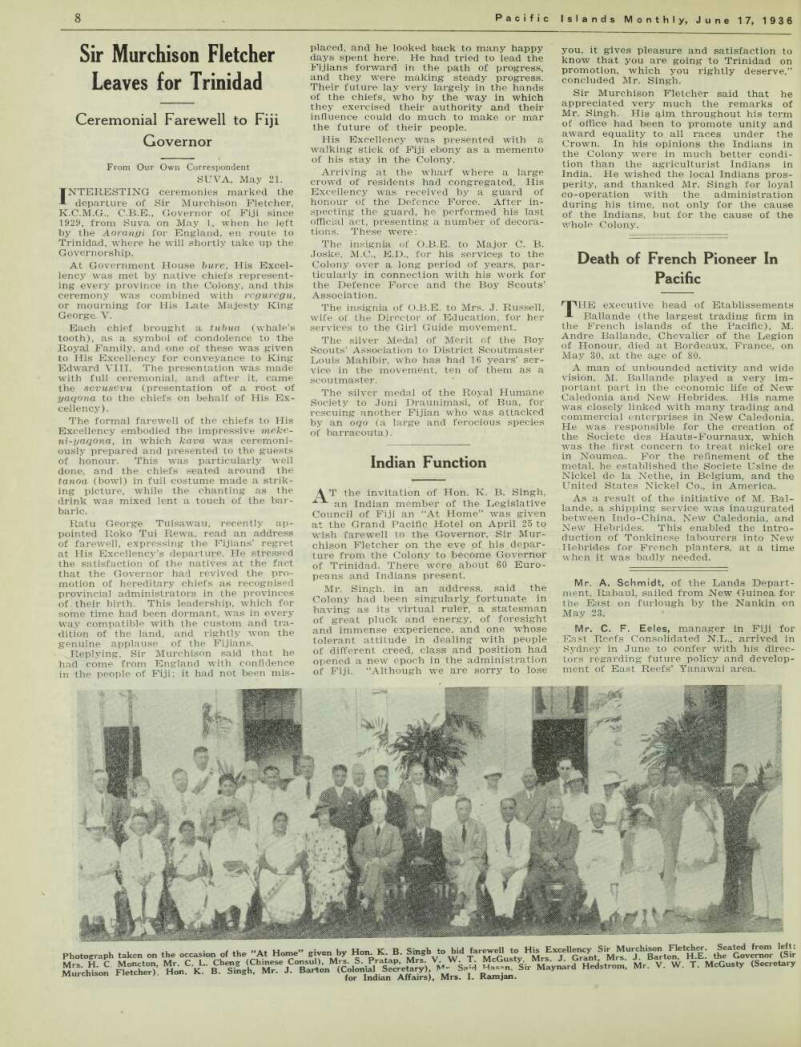
A T the invitation of Hon. K. B. Singh, an Indian member of the Legislative Council of Fiji an “At Home” was given at the Grand Pacific Hotel on April 25 to wish farewell to the Governor, Sir Mur chison Fletcher on the eve of his depar ture from the Colony to become Governor of Trinidad. There were about 60 Euro peans and Indians present, Mr. Singh, in an address, said the Colony had been singularly fortunate in having as its virtual ruler, a statesman of great pluck and energy, of foresight and immense experience, and one whose tolerant attitude ifi dealing with people of different creed, class and position had opened a new epoch in the administration of Fiji. “Although we are sorry to lose
you, it gives pleasure and satisfaction to know that you are going to Trinidad on promotion, which you rightly deserve,” concluded Mr. Singh.
Sir Murchison Fletcher said that he appreciated very much the remarks of Mr. Singh. His qim. throughout his term of office had been to promote unity and award equality to all races under the Crown. In his opinions the Indians in the Colony were in much better condi tion than the agriculturist Indians in India. He wished the local Indians pros perity, and thanked Mr. Singh for loyal co-operation with the administration during his time, not only for the cause of the Indians, but for the cause of the whole Colony.
Pacific
Death of French Pioneer In Pacific
THE executive head of Etablissements Ballande (the largest trading Arm in the French islands of the Pacific), M.
Andre Ballande, Chevalier of the Legion of Honour, died at Bordeaux, France, on May 30, at the age of 80.
A man of unbounded activity and wide vision, M. Ballande played a very im portant part in the economic life of New Caledonia and New Hebrides. His name was closely linked with many trading and commercial enterprises in New Caledonia.
He was responsible for the creation of the Societe des Hauts-Fournaux, which was the first concern to treat nickel ore in Noumea. For the refinement of the metal, he established the Societe Usine de Nickel de la Nethe, in Belgium, and the United States Nickel Co., in America.
As a result of the initiative of M. Bal lande, a shipping service was inaugurated between Indo-China, New Caledonia, and New Hebrides. This enabled the intro duction of Tonkinese labourers into New Hebrides for French planters, at a time when it was badly needed.
Mr. A. Schmidt, of the Lands Depart ment, Rabaul, sailed from New Guinea for the East on furlough by the Nankin on May 23.
Mr. C. F. Eeles, manager in Fiji for East Reefs Consolidated N.L., arrived in Sydney in June to confer with his direc tors regarding future policy and develop ment of East Reefs’ Yanawai area.
Photograph taken on the occasion of the “At Home” given by Hon K. B. Singh to bid farewell to His Excellency Sir Murchison Fletcher. Seated from left: Mrs. H. C. Moncton, Mr. C. L., Cheng (Chinese Consul), Mrs. S. Pratap, Mrs. V. W. T. McGusty, Mrs. J. Grant, Mrs. J. Barton, H.E. the Governor (Sir Murchison Fletcher), Hon. K. B. Singh, Mr. J. Burton (Colonial Secretary), Mr. Said Hasan, sir Maynard Hedstrom, Mr. V. W. T. McGusty (Secretary for Indian Affairs), Mrs. I. Ramjan.
The Wealth That Lies East Of Papua
Her Unexploited Islands Wonderland
By R. B. Moffat
PAPUAN residents generally, and the Government in particular, seem to be quite Unappreciative of the potential wealth which lies behind the charm and beauty of Papua’s South Seas scenery.
Six months’ residence in Papua has not in any way given me cause to alter that, my first impression.
Since June, 1935, when with a com panion, Roy Vicary, I arrived in Papua from Melbourne, from whence we had sailed in our double-ended yawl, Gitana 11., I have sailed over 6,000 miles among the islands of Eastern Papua.
From Samarai, the vicinity of which has been described by some visitors as the most beautiful spot in the whole South Seas, I have sailed northward through the China Straits and encircled every island in the D’Entrecasteaux Group. There I have seen for myself, not once but several times, the inspiring grandeur of the Dobu Passage and the Moresby Straits, narrow strips of water as blue as blue can be, and on either side of which mountains tower up to 7,000 feet and more. From the D’Entrecasteaux, I have gone further northward through the wonderfully clear, if somewhat reef-strewn waters, to the Trobriands, truly Papua’s “Isles of Desire.”
Again, with Samarai the starting point, I have frequently travelled eastward past the low sandy atoll islands of the Conflict
Group, and thence onward through the peerless Deboyn© Lagoon. Still further on, I haye sailed in and out among the islands of the Calvados Chain, and skimmed along through the smooth, rippling waters about Sud-Est Island, In these latter islands alone—the Louisiade Archipelago—there is scenery
the like of which it would be difficult to find anywhere else in the world.
Just imagine it. A huge oval-shaped lagoon, some 120 miles long and 30 miles wide, a truly dazzling sheet of blue water profusely studded with scores upon scores of emerald isles, of every shape and size and description, from mountainous Sud- Est, 50 miles long and 12 broad, right down to the tiniest of atolls, whose area should be reckoned in square yards!
The names of some of these islands are alone enough to set one’s imagination working—Pano Rora, Pana Numaara, Pana Tinani, Nimoa, Sahara, Panasia!
And then, too, there are those hosts of little bays, lagoons and passages, with intriguing names like Imadi Bay, Coral Haven and the Gold Rush Channel.
To those people who see these islands fairly frequently—traders, missionaries and Government officials, for instance — the sight may be commonplace; but let me state with all the emphasis at my command that, to the visitor who sees them for the first time, and particularly
to the visitor from crowded cities, these islands, their names, their inhabitants, everything about them, represent the very pinnacle of beauty—plus romance.
Quite recently, it fell to my lot to con vey two lady friends, visitors from Mel bourne, to the little islet of Managun, which lies off the eastern end of Misima Island. The trip, which was from Bwagaoia Harbour, was only a short one —a matter of a few miles across a shallow lagoon. The day was far from being fine; one of those dull, cloudy days which seem to sap all colour from land and sea. Yet when we arrived at Managun the ladies went simply into raptures about the “paradise-like little island,” and the beauty of the view they had of Misima’s rugged, gold-bearing hills. They were not newchum tourists. Both had travelled extensively.
Governments the world over realise very well the value of good scenery.
Yet Papua hasn’t got the slightest semblance of a Tourist Bureau, let alone any facilities to enable tourists to see the glory of the outlying islands. Surely something could be done.
In many respects, Papua is in an advan tageous position to attract tourists, who want to see the real thing in South Seas scenery. Not only is it close to centres of population like Melbourne, Sydney and Brisbane, but the whole of its island archipelagos lie snugly behind a great barrier reef, which ensures comparatively calm water among the islands, at most times.
“Impossible!” “Impractical!” “Too cost ly!” have been some of the answers to a few inquiries I have made as to the possi bility of the Government providing facili ties for tourists to see something of Papua’s island wonderland. Another objection I have heard is that Port Moresby, being the seat of government, would never acquiesce to the spending of public money on tourists, as Samarai, a vassal state, would grab all the trade!
It is not my place to say how the Government should go about creating facilities for tourists. I’m no tourist expert, but I do know attractive scenery when I see it, and I have seen enough of Papua to know that the country has a superabundance of the sort of goods the tourist will pay handsomely to buy.
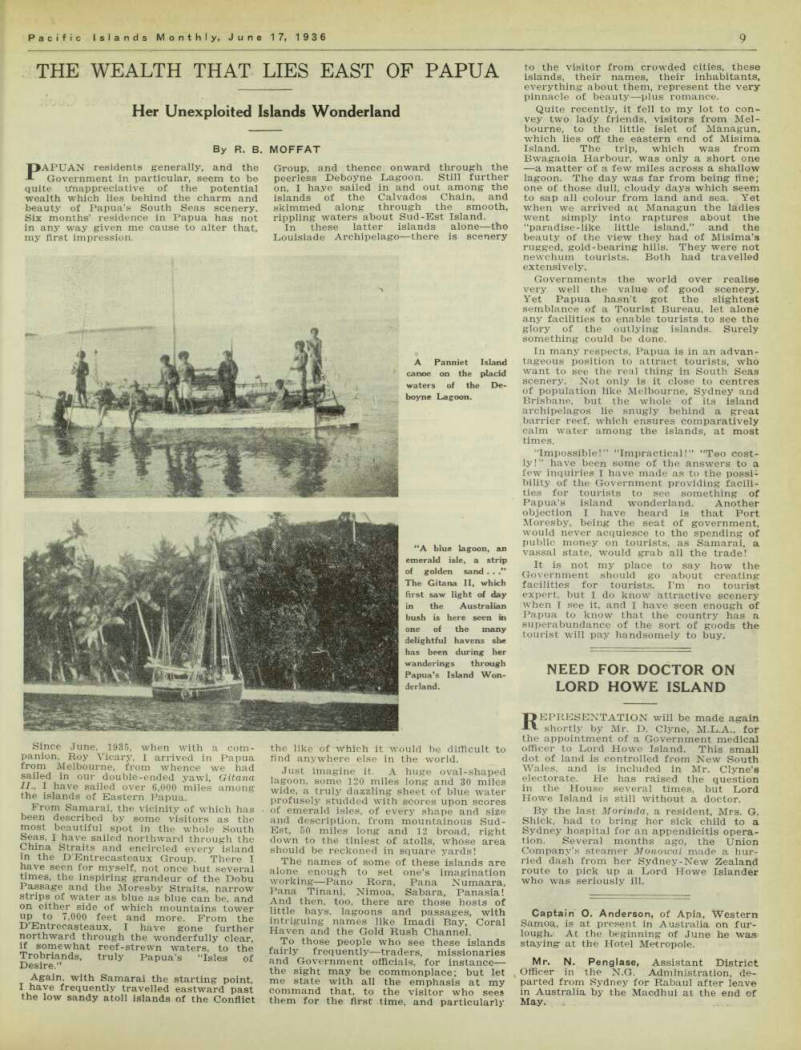
A Panniet Island canoe on the placid waters of the De boyne Lagoon.
“A blue lagoon, an emerald isle, a strip of golden sand ...”
The Ghana II, which first saw light of day in the Australian bush is here seen in one of the many delightful havens she has been during her wanderings through Papua’s Island Won derland.
Need For Doctor On
Lord Howe Island
Representation win be made again shortly by Mr. D. Clyne, M.L.A., for the appointment of a Government medical officer to Lord Howe Island. This small dot of land is controlled from New South Wales, and is included in Mr. dyne’s electorate. He has raised the question in the House several times, but Lord Howe Island is still without a doctor.
By the last Morinda, a resident, Mrs. G.
Shick, had to bring her sick child to a Sydney hospital for an appendicitis opera tion. Several months ago, the Union Company’s steamer Monowai made a hur ried dash from her Sydney-New Zealand route to pick up a Lord Howe Islander who was seriously ill.
Captain O. Anderson, of Apia, Western Samoa, is at present in Australia on fur lough, At the beginning of June he was staying at the Hotel Metropole.
Mr. N. Penglase, Assistant District Officer in the N.G. Administration, de parted from Sydney for Rabaul after leave in Australia by the Macdhui at the end of May.
Quetta
Wau Builder Off To
Comparison of N.G. and Papuan Workmen
TTAVING spent the last 4J years in erect ing buildings in the New Guinea gold fields towns, Mr. T. Flower sailed from Syd ney early in May for Bombay, en route for Quetta. He has been building in the world’s youngest town, Wau; now he will be engaged in rebuilding one of Asia's oldest towns, Quetta, which was destroyed by an earthquake a few months ago.
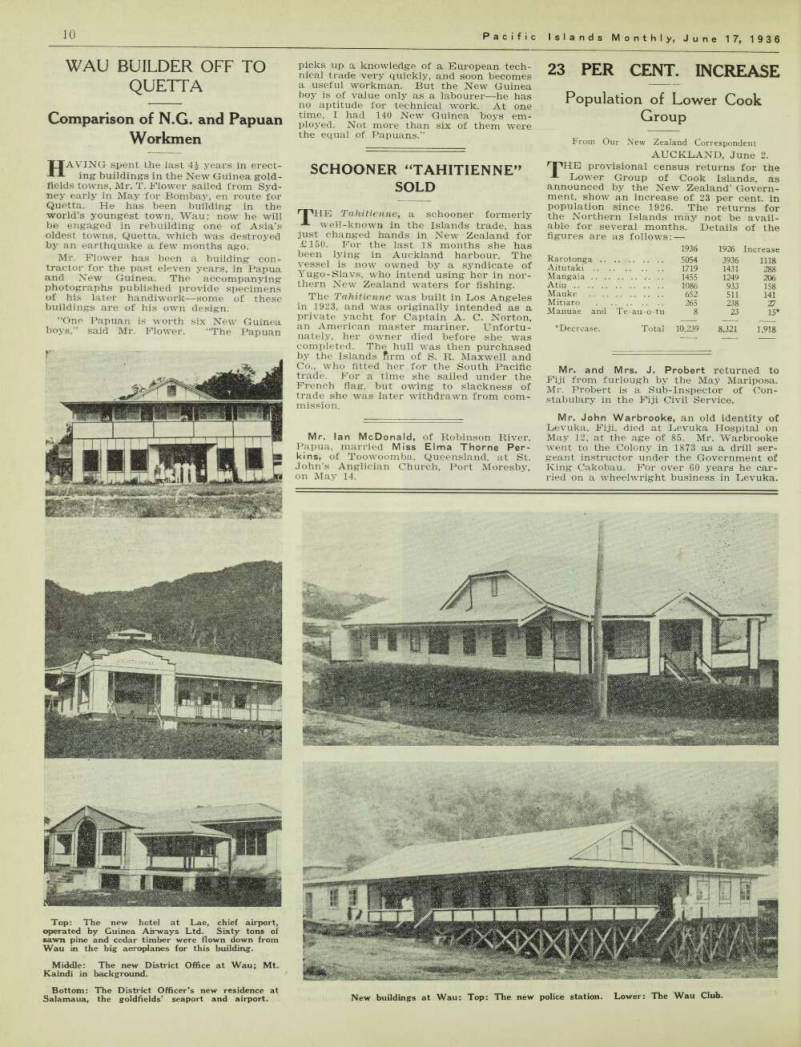
Mr. Flower has been a building con tractor for the past eleven years, in Papua and New Guinea. The accompanying photographs published provide specimens of his later handiwork—some of these buildings are of his own design.
“One Papuan is worth six New Guinea boys,” said Mr. Flower. “The Papuan
picks up a knowledge of a European tech nical trade very quickly, and soon becomes a useful workman. But the New Guinea boy is of value only as a labourer—he has no aptitude for technical work. At one time, I had 140 New Guinea boys em ployed. Not more than six of them were the equal of Papuans.”
Top: The new hotel at Lae, chief airport, operated by Guinea Airways Ltd. Sixty tons of sawn pine and cedar timber were flown down from Wau in the big aeroplanes for this building.
Middle: The new District Office at Wau; Mt.
Kaindi in background.
Bottom: The District Officer’s new residence at Salamaua, the goldfields’ seaport and airport.
New buildings at Wau: Top: The new police station. Lower: The Wau Club.
Schooner “Tahitienne”
Sold
T'HE TaJvitienne, a schooner formerly well-known in the Islands trade, has just changed hands in New Zealand for £l5O. For the last 18 months she has been lying in Auckland harbour. The vessel is now owned by a syndicate of Yugo-Slavs, who intend using her in nor thern New Zealand waters for fishing.
The Tahitienne was built in Los Angeles in 1923, and was originally intended as a private yacht for Captain A. C. Norton, an American master mariner. Unfortu nately, her owner died before she was completed. The hull was then purchased by the Islands firm of S. R. Maxwell and Co., who fitted her for the South Pacific trade. For a time she sailed under the French flag, but owing to slackness of trade she was later withdrawn from com mission.
Mr. lan McDonald, of Robinson River, Papua, married Miss Elma Thorne Per kins, of Toowoomba, Queensland, at St.
John’s Anglician Church, Port Moresby, on May 14.
Group
23 Per Cent. Increase
Population of Lower Cook Group
From Our New Zealand Correspondent
Auckland, June 2.
r TVHE provisional census returns for the Lower Group of Cook Islands, as announced by the New Zealand' Govern ment, show an increase of 23 per cent, in population since 1926. The returns for the Northern Islands may not be avail able for several months. Details of the figures are as follows:
Mr. and Mrs. J. Probert returned to Fiji from furlough by the May Mariposa.
Mr. Probert is a Sub-Inspector of Con stabulary in the Fiji Civil Service.
Mr. John Warbrooke, an old identity of Levuka, Fiji, died at Levuka Hospital on May 12, at the age of 85. Mr. Warbrooke went to the Colony in 1873 as a drill ser geant instructor under the Government of King Cakobau. For over 60 years he car ried on a wheelwright business in Levuka.
1936 1926 Increase Rarotonga 5054 3936 1118 Aitutaki 1719 1431 288 Mangaia .. 1455 1249 206 Atm 1086 933 158 Mauke 652 511 141 Mitiaro . 265 238 27 Manuae and Te-au-o-tu 8 23 15* *Decrease. Total 10,239 8,321 1,918
Tropicalities
WHEN Raitia te Puretu, a fruitgrower, of Rarotonga, Cook Islands, told a Parliamentary Committee in Wellington early in June that some of his Raroton gan compatriots were so poor that they were eating their dogs, he caused a stir.
Startled members wanted more informa tion. Judge Ayson, Resident Commis sioner for the Cook Islands, who hap pened to be in Wellington, was sent for.
Judge Ayson said that since the de structive hurricane of February, 1935, the natives had been poorer; but all natives had certain land rights, which at least ensured them a sufficient quantity of food, and there was no need for them to eat dog-flesh. He, personally, had not heard of any dog-eating. There was no necessity for it; but some might prefer that kind of meat, Mr. W. Mcßirney, veteran planter, of Rarotonga, said that he had known of five dogs which had been eaten by their sorrowful masters. The natives were not foodless; but he suggested that perhaps the fishing had been unsuccessful, and the natives were too poor at present to buy meat to add to their usual vegetable foods —and so Towser had gone to the pot.
When Te Puretu repeated his statement that “many of the natives lived on dog flesh,” Judge Ayson claimed that poverty did not exist to the extent that had been suggested by some of the evidence. No body could starve in the Islands, he said. * * * BEFORE the Europeans came into the South Seas, the natives of the Gazelle Peninsula (New Britain) and of Buka (Northern Solomons) had their own coin age systems, made up of different shells, re presenting different values. And, of course, as there could not be a currency without money-lending, these natives had also their own usurers, who demanded back 15 discs for every 10 loaned by them—a mere matter of 50 per cent. They also had a traffic in slaves, which they sold for flesh to tribes along the northern shores of New Britain. Some they kept for service and, long ago, when a chief died, several slaves and a few wives were put in the grave alive to keep him company. It was not exactly an admirable practice, but it was not peculiar to the gentlemen of New Britain —similar rites were performed in Babylon some thousands of years ago.
The above facts were found recently by Mrs. Mollie Lett, of Port Moresby, Papua, in a little-known German book, whose title (in English) is: “Thirty Years in the South Seas.” * * * A MAN who travels much in Melanesia called at this office, and expressed an opinion in words of one meaning.
“You have been condemning the low class whites who go to New Guinea, and especially to the goldfields, and treat the natives in a way which destroys white prestige,” he said. “An influence that Is just as bad, if not worse, is that of the damn-fool white women who go to Papua, New Guinea, and the Solomons, and do not observe reasonable modesty and dig nity in their conduct before natives.
“Some of us older men regard the irre sponsible white women as an absolute curse. They are not profligate women—in our own modern society, they are not even regarded as immodest—but in their deal ings with the natives they are silly, to the point of danger.
“Their commonest offence is their care lessness in going about only partially clothed in their own homes, in the pre sence of houseboys. They regard the native servants as mere automatons, and ignore them; or, conversely, they treat them in a free and easy way, as if they were sexless. No young white woman, settling down in these tropical islands for the first time, should arrange her house hold affairs, in relation to the native ser vants, until she has had a few chats with someone who has lived in the Islands for a few years. Then she will learn how necessary it is to be careful and circum spect; and the dangers, both personal and social, which carelessness creates.
“A special warning should be given to the mothers of young children who are inexperienced in Islands life. Children, necessarily, must be left to the care of native servants, to some extent; and there are dangers there which must be guarded against.
“It is the deliberate neglect of these things by fluffy-headed young fools from South which makes some of the old timers spit blood at times,” he concluded.
“Please tell them about it.” * * * AMONG the possessions inherited by King Edward VIII. from his late father is a small chest of drawers which, until the death of Queen Victoria, stood in Osborne House, the Queen’s favourite resi dence in the Isle of Wight. It is more than 80 years old, and the Queen treasured it because of its associations with Pitcairn Island, one of the most remote spots in the Pacific. The chest is made of miro wood, and the drawers from the bread-fruit tree.
The gift was made at the -suggestion of Admiral Sir Fairfax Moresby in 1853. “Our means are very limited, and our mechanical skill also,” declared Arthur Quintal jnr. (then the island’s Chief Magistrate), “and we will esteem it a great favour if Your 'Majesty will, condescend to accept of it as a token of our loyalty and respect.” Some
where on the island are portraits of the Queen, the Prince Consort, and the Royal children. The pictures were given by Queen Victoria to Rev. G. H. Nobbs in 1852 when he visited England to be ordained.
When Nobbs called at Osborne House to meet Prince Albert, he begged that he might also see the Queen, and the privi lege was granted. * * * SOME time ago, it was suggested here that there was no need for the desig nation “British” Solomon Islands; all the Solomon Islands are now under British control. The original British Solomons are administered by the Colonial Office; and the islands of Bougainville and Buka (comprising the Northern Solomons, con firmed to German possession by the Wes tern Samoa settlement of 1900) are part of the Mandated Territory of New Guinea.
But now it appears that, for postal reasons, it is desirable to retain the old name. “British Solomon Islands” mean one thing; while “Solomon Islands” mean another, and may lead mail matter far astray.
“The distinction is most necessary,” says a Gizo resident in a letter to the editor. “A vessel cannot cross the line between the British Solomons and the Mandated Territory without pratique of a kind; until recently, passports were necessary: and it is practically impossible for natives to cross from one Territory to the other, although they may own land in adjoining islands.”
Which suggests that, although some broadminded officials have tried to remove these irritating conditions, the law still is maintaining its reputation of being an ass.
Mr. Nigel Fraser, who is employed as a native labour overseer by Bulolo Gold Dredging Ltd. at Bulwa on the New Guinea goldfields, arrived in Sydney by the Nep tuna on June 1. He was accompanied by his wife, and they will spend three months’ leave in Australia.
Mr. Hakon Mielche, the Danish black and-white artist who was with the Danish scientific expedition in the Pacific in 1934, is at present on a tour of the western republics of South America.
Advertisements & other items, pp. 13-14 (1 item)
Homg
STERLING
HOME
Guaranteed
LOOKS
BETTER
LONGER
ttERUHS
HOMg
MADE BY
STERLING VARNISH CO.
PAINT
For
TROPICAL
SUN and
SALT-LADEN
AIR
SYDNEY, N.S.W.
NEGLECT OF DEFECTIVE SIGHT
MAY CAUSE SERIOUS RESULTS
Take Care of Your Eyes Consult
WALTER FORD
D.3.0.AM.0.0.A.
Optometrist and Optician 4th Floor, Challis House Martin Place, Sydney- Established over 30 years Tel.: Most moderate charges BW 6131
HOW TO STOP FEVER
BEFORE IT GETS YOU DOWN
'JTHERE are many forms of fever—Dengue—Malaria—Five Days Fever, etc. All are characterized by high body temperature —thirst—loss of strength, etc. Fever may develop from a chill. A quick, safe and effective method of combating fever is to take “ASPRO” according to the directions on the leaflet in each packet as soon as you develop a temperature. “ASPRO” reduces temperature and fever conditions because, after ingestion in the system, it is anti-pyretic or fever reducing, and is an antiseptic, anti-periodic and anti-fermentative. It is also a powerful germicide. You take no risk with “ASPRO” because it is pure medicine in tablet form. “ASPRO” conforms to the standard of purity laid down by the British Pharmacopoeia (the guiding authority of the Medical Profession). It does not harm the heart and is much preferable to quinine. There are no injurious after-
NIPS FEVER IN THE BUD
“FAIRHOLME” A Mountain Schoolfor Girls mmm m mmm Dormitory Wincf PRESBYTERIAN GIRLS’ COLLEGE, Toowoomba, Q’land, 2,000 feet above sea level :: :: ;; Unrivalled climate.
Academic , Home Science and Commercial Courses
TENNIS, SWIMMING, ORGANISED GAMES
PRINCIPAL: MISS D. E. CULPIN, B.A.
For prospectus, apply Sec., R. T. PHELPS, F.A.A., Toowoomba
About Islands People
Mr. and Mrs. W. R. Thomas, of Rabaul, returned to New Guinea by the Macdhui at the end of May, after leave in Aus tralia. Mr. Thomas is wireless operator at Bita Paka for Amalgamated Wireless (A/sia.) Ltd.
Captain C. O. Anderson, of Steamships Trading Company, Papua, returned to Samarai by the Macdhui from Australia at the end of May.
Mr. and Mrs. R. Walsche, of Kauru Plantation, Domara, Papua, who have been in Australia on holidays since Janu ary, departed for the territory by the Montoro in May.
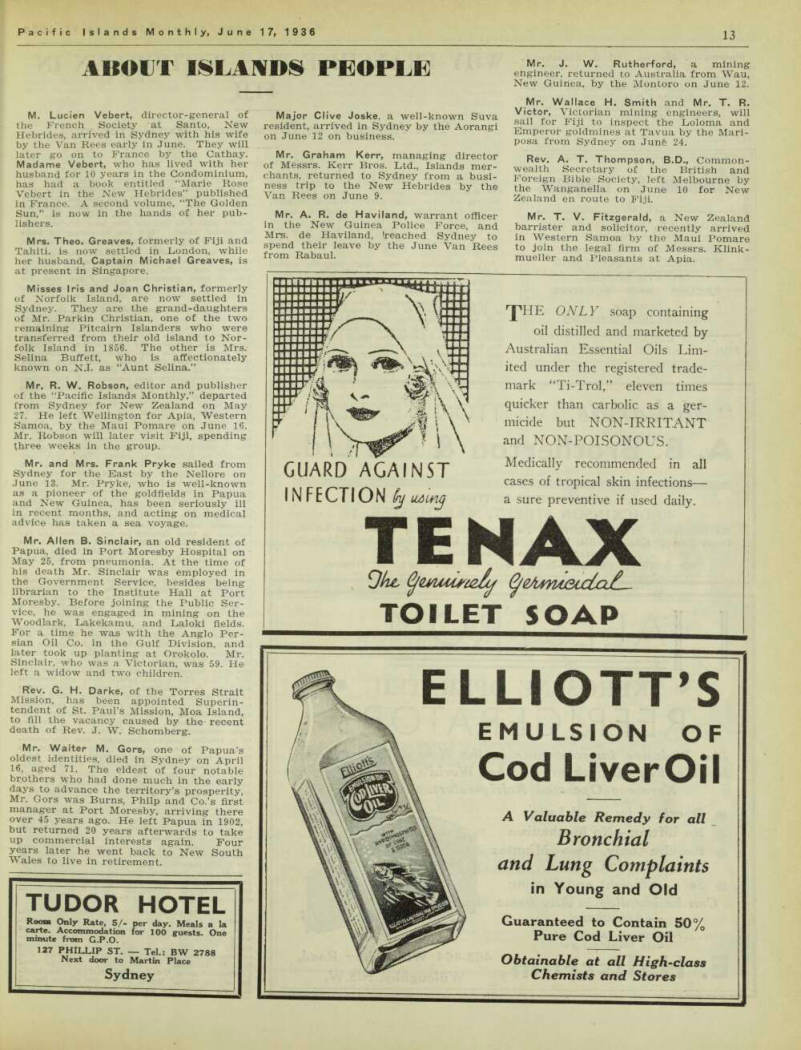
Mr. T. Flower, of Wau, New Guinea, who sailed from Australia in May for India to supervise con structional works at Quetta. He has been a build ing contractor in Papua and New Guinea for eleven years (see article on page 10).
Miss E. D. Wallace, 8.A., Dip. Ed., who will take charge of the Girls’ School con ducted by the Methodist Mission Society in Western Samoa, sailed from Melbourne by the Monterey on May 23, Mr. F. R. Armstrong, health officer in charge of the Talasea sub-district of New Britain, arrived in New Zealand late In May on a holiday visit. He was accom panied. by Mrs. Armstrong.
Monsignor Francis Xavier Gsell, the well-known missionary of Bathurst Island, off Northern Australia, was invested with the insignia of 0.8. E. on June 8. It was a coincidence that on that day exactly 25 years ago Monsignor Gsell celebrated his first Mass on Bathurst Island, when founding the mission station.
Mr. J. S. Symington, Islands Inspector for Messrs. W. R. Carpenter and Co., Ltd., sailed for Rabaul, New Guinea, by the Macdhui from Sydney on May 28.
Mr. Ellis Davies, chief engineer for Messrs. Chas. Ruwolt Pty. Ltd., steel founders of Richmond, Victoria, will leave for Fiji by the June Mariposa. Most of his time in the Colony will be occupied with an investigation connected with the equipping of Loloma and Emperor gold mines.
Mr. C. R. Gurney, pilot of Guinea Air ways Ltd., recently departed from Lae, where he and his wife have resided for five years, to settle at Wau, New Guinea.
Pilot Gurney has now taken over the ser vice previously operated by Mr. Orme Denny, who is now employed by Quantas Empire Airways Limited in Australia.
M. Lucien Vebert, director-general of the French Society at Santo, New Hebrides, arrived in Sydney with his wife by the Van Rees early in June. They will later go on to France by the Cathay.
Madame Vebert, who has lived with her husband for 10 years in the Condominium, has had a book entitled “Marie Rose Vebert in the New Hebrides” published in France. A second volume, “The Golden Sun,” is now in the hands of her pub lishers.
Mrs. Theo. Greaves, formerly of Fiji and Tahiti, is now settled in London, while her husband, Captain Michael Greaves, is at present in Singapore.
Misses Iris and Joan Christian, formerly of Norfolk Island, are now settled in Sydney. They are the grand-daughters of Mr. Parkin Christian, one of the two remaining Pitcairn Islanders who were transferred from their old island to Nor folk Island in 1856. The other is Mrs.
Selina Buffett, who is affectionately known on N.I. as “Aunt Selina.”
Mr. R. W. Robson, editor and publisher of the “Pacific Islands Monthly,” departed from Sydney for New Zealand on May 27. He left Wellington for Apia, Western Samoa, by the Maui Pomare on June 16.
Mr. Robson will later visit Fiji, spending three weeks in the group.
Mr. and Mrs. Frank Pryke sailed from Sydney for the East by the Nellore on June 13. Mr. Pryke, who is well-known as a pioneer of the goldfields in Papua and New Guinea, has been seriously ill in recent months, and acting on medical advice has taken a sea voyage.
Mr. Allen B. Sinclair, an old resident of Papua, died in Port Moresby Hospital on May 25, from pneumonia. At the time of his death Mr. Sinclair was employed in the Government Service, besides being librarian to the Institute Hall at Port Moresby. Before joining the Public Ser vice, he was engaged in mining on the Woodlark, Lakekamu, and Laloki fields.
For a time he was with the Anglo Per sian Oil Co. in the Gulf Division, and later took up planting at Orokolo. Mr.
Sinclair, who was a Victorian, was 59. He left a widow and two children.
Rev. G. H. Darke, of the Torres Strait Mission, has been appointed Superin tendent of St. Paul’s Mission, Moa Island, to fill the vacancy caused by the- recent death of Rev. J. W. Schomberg.
Mr. Waiter M. Gors, one of Papua’s oldest identities, died in Sydney on April 16, aged 71. The eldest of four notable brothers who had done much in the early days to advance the territory’s prosperity, Mr. Gors was Burns, Philp and Co.’s first manager at Port Moresby, arriving there over 45 years ago. He left Papua in 1902, but returned 20 years afterwards to take up commercial interests again. Four years later he went back to New South Wales to live in retirement.
Major Clive Joske, a well-known Suva resident, arrived in Sydney by the Aorangi on June 12 on business.
Mr. Graham Kerr, managing director of Messrs. Kerr Bros. Ltd., Islands mer chants, returned to Sydney from a busi ness trip to the New Hebrides by the Van Rees on June 9.
Mr. A. R. de Haviland, warrant officer in the New Guinea Police Force, and Mrs. de Haviland, (reached Sydney to spend their leave by the June Van Rees from Rabaul.
Mr. J. W. Rutherford, a mining engineer, returned to Australia from Wau, New Guinea, by the Montoro on June 12, Mr. Wallace H. Smith and Mr. T. R.
Victor, Victorian mining engineers, will sail for Fiji to inspect the Loloma and Emperor goldmines at Tavua by the Mari posa from Sydney on Junfe 24.
Rev. A. T. Thompson, 8.D., Common wealth Secretary of the British and Foreign Bible Society, left Melbourne by the Wanganella on June 10 for New Zealand en route to Fiji.
Mr. T. V. Fitzgerald, a New Zealand barrister and solicitor, recently arrived in Western Samoa by the Maui Pomare to join the legal firm of Messrs. Klink mueller and Pleasants at Apia.
Messrs. A. Mathes and G. Stoeckicht, members of the Apia Nazi Branch in Western Samoa, left for Berlin by the Tolken on May 16, following an invita tion of the German Nazi Party Recreation Movement. They will attend a congress of the Movement, which is defraying all expenses, and later witness the Olympic Games. •
Advertisements & other items, pp. 14-16 (1 item)
Kurrajong
Wheeny Creek Farm
Forty-five miles from Sydney Superior modern accommodation, abundance of cream, eggs, and poultry. 5 acres orchard. Tennis, etc.
Tariff: Double, £2/2/- each; Single, £2/10/- ’Phone: Kurrajong 42 Proprietor: A. J. SAMSON Formerly New Guinea Public Service
***Uiiir
/■ % I !\\ n i
GUARD AGAINST
INFECTION
ONLY soap containing oil distilled and marketed by Australian Essential Oils Limited under the registered trademark “Ti-Trol,” eleven times quicker than carbolic as a germicide but NON-IRRITANT
and NON-POISONOUS.
Medically recommended in all cases of tropical skin infections— a sure preventive if used daily.
TENAX
TOILET SOAP
m v'-l
LLIOTTS
EMULSION OF
Cod Liver Oil
A Valuable Remedy for all
Bronchial
and Lung Complaints
in Young and Old Guaranteed to Contain 50% Pure Cod Liver Oil Obtainable at all High-class Chemists and Stores
TUDOR HOTEL
Room Only Rate, 5/- per day. Meals a la carte. Accommodation for 100 guests. One minute from G.P.O.
127 PHILLIP ST. Tel.: BW 2788
Next door to Martin Place
Sydney
Maleham & Yeomans
Ltd
BOWDON ST., SHEFFIELD, ENG.
Manufacturers of all kinds of
BUTCHERS’, STICKING AND
SHEATH KNIVES
RAZORS AND SCISSORS
Specialty
HAIRDRESSER SCISSORS
PRICE LIST ON APPLICATION
“Moharnie” COTTON Textiles
A. B. Brotherton & Co. Ltd.
(Arnold B. Brotherton)
GOVERNMENT CONTRACTORS
40 DICKINSON STREET, MANCHESTER, 1
Manufacturers of “MOKARNIE” Fabrics, Joker-Brand, etc. Lava-Lavas, Pearl Divers’ Khaki Drills, Denims Shirtings, Longcloths, Italians, Linings, etc. suitable for the South Pacific Trade.
NO DIRECT TRADE. —Orders only through European Houses.
|[—IALLSTROM
• KEROSENE OPERATED •
REFRIGERATORS
The Exclusive Improvements in the New 1936 Models Establish them as the World’s Best Kerosene Operated Refrigerators.
Q Operated by small Lamp 0 No Lifting—No Mechanism Q Require only Two Minutes daily attention % Safe—Efficient and Lasting Can be installed in Any home —Anywhere Address all enquiries to Sole Manufacturer
E. Hallstrom,
462-464 Willoughby Road, Willoughby, N.S.W.
Fiji
Why Franchise Was Withdrawn In
Two Angles of an Extraordinary Racial Problem
Letter to the Editor.
ABOUT 1921, after the deportation of the Sadhu Basist Mani and the return of the Bau and Tailevu Special Fijian Constables to their homes, when the Indian Franchise question first loomed on the political horizon of Fiji, a letter was written to the Hoko Tui Tailevu as follows; “The beginning of next year, with the arrived of the Commission from India, will bring up many serious questions affecting the future of the Fijian and his country.
“The main thing you and the other high chiefs orf Fiji will have to be on your guard against, will be the flattering wiles, which undoubtedly these Orientals will pour into your ears, of equal status with the Europeans, equal franchise rights, the joint demand by Indians and Fijians for and the inevitable granting of them by the Colonial Office, if the Fijians are foolish enough to
be caught by these glittering baits. They will leave no stone unturned to get you to unite with them in these demands, so that later on they may rule you and your country by their increased numbers. You have only to refer to the last census papers to find out how long this would be in coming about. They are increasing by leaps and bounds while the Fijians are almost stationary.
“There can be no doubt, that the franchise, and equal status with the Europeans, would spell the absolute end of the power of the Chiefs in Fiji.
This is most undesirable. The Fijian race, for many years to come, must be ruled through the far Chiefs and by their Chiefs for their own good.
“From an educational point of view, they have a prior right to the franchise, as nearly all Fijians to-day, thanks to the Missions and Govemnjent, can read and write their own language, while of these aliens, who are only lip-loyal British subjects (the recent strikes and disturbances, caused by the Manila! and the Sadhu, must have plainly shown us all this) not more than 10 pier cent, can read and write their own language. If the Fijilans are not ready for the franchise, then the Indian in Fiji is still less so, and you must make it plain in no uncertain voice, that you, the owners of the country, will not tolerate any franchise to the alien Asiatic, British subject or not, which would give him an equal voice with your own in the Councils of the Government of this Colony.
The British Government cannot treat the ‘deed of cession’ as a ‘scrap of paper,’ They took over this Colony from your forefathers in order that you might all enjoy the benefits of British ride and practically to hand it over to India which the granting of the franchise and equal status would do in a very short time, would be a gross betrayed of tjheir trust. The great danger for you all, is that the Fijians might be caught with the idea of obtaining self-government by uniting with the Indians, in their demand for equal status and the franchise. This would be fatal folly, and you Chiefs in your wisdom must look further ahead than the immediate present. You must think first of the future of your fine race.
“For the sake of a temporary measure of self- Government, to hand them over to the final domi nation of an alien people, who only came to the Colony as labourers and have not advanced as a whole any further, would be racial suicide.
“There can be no doubt els to Mr. Sastri’s line of action. He has already assumed that you are ail with him and his people in the demand for the franchise and equal status. He will go on assum ing this, until people believe it is a fact, unless you very emphatically and unitedly show him that the Fijian Chiefs and people have no intention whatever of supporting, and will in fact oppose to their utmost, any form of franchise, which would now or later on, give the Indians the controlling voice in the affairs of this Colony through their numerical strength. A franchise which would give them representation in the Council, limited always to a smaller number than your own representa tives, is the utmost you can concede or agree to the Government conceding to these people. Any thing further would endanger the Fijians’ birth right and heritage and you must not allow yourselves or your people to be allured by pro mises, offers, or anything, over the boundary of safety.
“Your best plan of action would be to consult with the Chiefs whom you know that you can rely upon and trust. Place the matter clearly before them, as I hope I have placed fat before you, and then, through them and the native officials and missionaries, endeavour to permeate the whole of the Fijian race with the fixed idea that the grant ing of the franchise and equal status to the Indians in Fiji, would mean the ultimate loss of their lands and rights and later their final ex tinction from the face of the earth.
“I have no doubt whatever upon these points, otherwise I would not write so strongly to you.
You will, of course, remember how the Fijians were misled by Apolosi and his doctrines, prin cipally ‘Fiji for the Fijians.' This is a much more serious matter and would mean undoubtedly ‘Fiji for the Indians.’ The flowery language used (‘consolidation of the Empire,’ ‘mutual understand ing of the races,’ ‘equal status and rights for all subjects within the British Empire,’ &c., &c.) is
only a velvet covering for the steel claws under neath, waiting for the opportunity to grab as much as they can, cling to it tenaciously, and finally control the whole of any portion of the earth in which they have settled themselves.”
Eventually, in 1922, the Commission arrived and received a rather mixed re ception. Mr. Sastri did not come until much later on, but his views on the ques tion had already preceded him, and por tions of a letter reporting the Commis sion’s activities will show the develop ment of matters up to that date.
Commission Of 1922
The Commission found on their arrival that there was strong opposition through out the Colony to the granting of the franchise and equal status, and that the native owners were absolutely opposed to any scheme of Indian settlement, which would alienate native land under govern ment control.
When the members of the Commission saw the good terms offered by the Fijian Government there can be no doubt that they decided to make the franchise and equal status the base from which the other terms should be discussed. Mr.
Sastri’s utterances had made it quite clear that the political side of the question was paramount, even to the extent of assum ing that the Fijian natives were with the Indians in their demand for the franchise, and “that the British Government would not be turned aside from its purpose by the wishes of 5000 whites, against the wishes of 90,000 natives and 70,000 Indians.”
As for supplying labour to the Colony to carry on its industries, that was their last consideration. The two questions, economic and political, must be considered and settled quite separately, to give any satisfaction at all. The members of the Commission all insisted that each be con tingent on the other and, as soon as they found their political demands were un
likely to be fully acceded to, they imme diately lost all interest in the economic portion; so much so that they did not visit Ba, which was the centre of indus trial disturbance and economic trouble, and only made a most perfunctory examination of the conditions existing on the side of the Island on which the majority of Indian labourers were em ployed. It was evidently their intention to report Fiji as unsuitable for further immigration and give as a reason the inability of the main industry to pay what they consider a fair living wage—the real reason would be the non-attainment of their full political aims.
I do not think the Colonial Office is fully cognizant of what is at the back of all this political agitation and cry for equal rights for all British Subjects, together with the full franchise, in all Colonies where Indians have settled. How ever much the different parties may diverge on other matters, they all seem to be pretty solid and unanimous on these points, which make it obvious that they are all out to grab as much of the British Colonial Empire as possible for the ulti mate sole use and benefit of their own people.
The anxiety to impress upon everybody that, having received the franchise in India, it is only logical to expect it to be extended to all parts of the Empire, is to me camouflage, to cover their own know ledge of a serious flaw in the validity of their claims. They are endeavouring to “force the application of a general prin ciple,” without any consideration of local conditions, or the rights of other com munities. With the knowledge that the granting of the franchise would mean the ruling by the majority, they are leaving no stone unturned anywhere to attain their end. A portion of our Colonial Empire is threatened with a much greater danger than the German peaceful penetra tion ever was to us.
Elections By Default
Some time elapsed before the Constitu tion was altered to allow the Indians a limited franchise, to elect three of their own members to the Legislative Council —a number equal to the native nominated representatives, so, really, more than they were entitled to.
At the first meeting in 1929 they loudly voiced their discontent and demanded at once the Common Electoral Roll. When they were told plainly that their demands would not be acceded to, following the non-co-operation movement then in vogue in India, they walked out of the Council and refused to take part in any of the proceedings.
At the next election, in 1932, they were so much interested in their “electoral rights” that they did not nominate anyone in one constituency, and allowed two others to go in unopposed, expecting them to refuse co-operation, when the demand for the common electoral roll was again turned down by the Council.
All sorts of threats, even of personal violence, were made against the members who decided to retain their seats and work for their constituents in the Coun cil; and, when the§e members realised that another election would mean the
(Continued On Page 65)
return of the political agitators to the Council, leaving the minority sections of the community without any representa tion at all, they decided to support the move for a return to the nominative system.
Incidentally, the European community also were “so keenly interested in their electoral rights” that they allowed all the members of the Council to be returned unopposed, in spite of the fact “that a return to the nominated system would be preferable to a continuance of the elec toral, with the danger of a common roll always looming in the near future,” had been agreed to by practically all the elected members of the European com munity.
During the last two Or three years, feel ings have changed considerably in the minority sections of the Indian com munity. Mahommedans, Madrassis and others have realised that it would not be to their best advantage to be governed by a majority of Hindus and Ayra Samajists, and now would prefer to return to the nominative system and trust to the government to give them a fair repre sentation in the Council.
The agitators and Common Roll sup porters also realise that their non-co operation was an error and are now screaming for the retention of the elective rights which they ignored in the last election.
Unfortunately, a number of Europeans are doing exactly the same thing, regard less of what the ultimate result of their
protests may be. Reference to the “common roll bogey” is frequently made, and a lot of hot air blown off, about “retaining our elective rights given to us in 1902 by the Secretary of State and fighting for them to the last ditch,” etc.
The common roll is no “bogey”—it is a sinister and definite menace, especially to the European community, which is only too lucky to be given the chance of reverting to the nominated system again.
The case is clearly one in which we must he prepared to sacrifice our rights in order to do our duty—a duty we owe to our rising generation and those who follow, if we wish to keep up the status and prestige of the British race.
Under The Surface
At present the Fijians are quiescent, but quite determined that the elected or nominated Indian members of the Council shall have no say whatever in native matters, as their motion passed in the Council of Chiefs os Bose vaka taraga very forcibly indicates.
There is, however, a possibility always of another “Apolosi” appearing upon the scene and advocating a united appeal with the Indian community for a common roll and self-government, in order to undermine or destroy the power of the Chiefs.
There are many pernicious influences at work to cause unrest and disaffection amongst the natives, but it is only when a case comes before the Courts and a convic t ion is secured that we observe the undercurrents which are disturbing the even tenor of the native communitv life.
W e must remember that the first matter which brought up the franchise question in J? 21 . , was . Purely a local one, viz., the continuity of a labour supply to carry on the industries of the Colony. th- To-day it is associated with the prob- In'? 8 i a -™ b J ect of much greater magnitude, viz., the passing of a measure for a
form of self-government for India. Con sequently, the pressure from India through the Indian Office upon the Colonial Office is infinitely greater, and we are very lucky indeed to have the chance offered to us, of a return to the nominative system. It will not occur again if we turn it down this time, and we shall have to abide by the results of our choice if we are foolish enough to insist on regaining the elective system, which can only lead to “common roll,” followed by domination by the Indian sec tion of the residents in these islands.
There is no middle way. j am e^-c ’
Old Settler.
Suva, April 10, 1936.
Advertisements & other items, p. 17 (1 item)
Decide 6 DUO
WILLIAM FINAU
Photographer
FRIENDLY IS., OCEANIA
■■ Tongan views and Natives’
B life scenes, set, 5/3 prepaid ▼ anywhere. Tapacloth, large piece, 6/6 prepaid anywhere.
Decide 6 DUO
Newest and smartest of models! Combines the valuable and outstanding features of the popular 620 KODAKS with the many merits of the miniature camera.
The Duo loads with F 620 film for 16 pictures size 1| x Get behind one of these new Kodaks, and find out how really skilful you are with a camera. Prices: With Compur Shutter f/3.5 Anastigmat Lens, £10; f/4.5 Lens, £B.
Write for Booklet Of all Kodak Dealers throughout the Islands E and
KODAK
(Australasia)
Ply Ltd.
379 George St.,
SYDNEY
And all States
PAN ATOMIC
Kodak Panatomic
The finest all-purpose film.
Panchromatic, anti-halation, of microscopically fine grain, for marvellous enlargements of sensational size.
VERICHROME
Verichrome Film
Every Camera will give better results if it is loaded with Verichrome, the film that gets the picture. Double-coating captures every detail.
SS"
PAN
S.S. Panchromatic
The film of lightning speed. For all artificial light pictures and whenever maximum speed is required. Panchromatic, anti-halation backed. ev Si f|U* s
(Vtic
o’-' s &
pll-M
qM
ICH R
T |Vt
s fiS
A T ,C
rO^ nch pf*
Pacific Wanderers Reach
Australia
to see the world in their own way, Mr. and Mrs. R. Strout, of Portland, U.S.A., left America in April, 1934, for the South Seas. For two years they have been cruising among the islands of the South and Central Pacific in their 37ft. yacht Igdrasil. On June 7, they reached Brisbane from New Zealand, after calling at Norfolk Island and Lord Howe Island.
Their 13-ton craft carries a receiving
and transmitting wireless outfit, which has been of great benefit to the wan derers. Nearing Norfolk Island they learned of the approach of a cyclone, and so were able to escape its full fury.
The Igdrasil remained several days in port in Queensland, and then sailed for the Barrier Reef.
Mr. H. E. Hallam, mining engineer, departed from Sydney by the Macdhui on May 28 for Papua. He will complete a geological survey of the Moresby King and Sapphire mines for Mandated Alluvials N.L.
Sectarianism And
Missions
A Plea for the Primitive Natives
THE following is an extract from a letter received from a missionary in New Guinea. It is quite a friendly letter, and we do not like to use it in hostile fashion. But the argument, as expressed, betrays the mind of a type of man who. in no circumstances, should be allowed tc enter the Pacific Islands mission field; and. for that reason, we publish it: “There appeared in a fairly recent issue of the Pacific Islands Monthly,’ an article advocating the sectionalising of the Mandated Territory among the various denominations so that they might pursue their own peculiar activities in their own respective spheres. When the civil power begins to dabble in such matters it is getting well with out its own province. The conscience cannot rightfully be sectionalism!, no matter under what ‘feller skin’ it might be found.
“According to that writer’s arguments it would be just as logical to restrict all trading concerns to separate spheres. This idea might be applied to practically everything. What a narrow world it would become! What about restricting the ‘Pacific Islands Monthly’ to certain islands, and so forth. Your good paper causes a bit of a flare here and there at times; it is none the worse for that. Freedom of Religion and of the Press are grand heritages. We should prize them, and protest every effort to circumscribe this freedom.
If either should incite to rebellion against the civil powers, then it might be a different question.”
The writer of that extraordinary missive is actually a missionary in daily contact with very primitive natives, and in his district there are missionaries of other sects, with whom he is actively in com petition. This is the kind of missionary who hawks the Christian religion as if it were a brand of canned meat.
If these New Guinea savages are to be “Christianised,” it does not matter in the least what section of the Christian Church does the job. The important thing is that they shall be taught respect for the white man, and the white man’s code of morals.
How can the primitive men of New Guinea respect the Europeans’ religion, when the teachers of that religion are fighting among themselves, each trying to drag “converts” away from the other?
How can we ourselves have any respect for mission work when conditions in the mission field make possible a case like that of Father Cranssen, reported in last issue?
It is bad enough to have sectarianism in our own countries—it is the considered opinion of this writer that sectarianism long since crippled the church and robbed it of most of its value as a factor in our complex social structure—and it is simply nauseating to see this gibbering, half witted thing so busily and mischievously at work among aborigines.
Natives of the Islands may be persuaded to accept our belief that there is only one God; but how can they be expected to understand the differences between “isms” when the great majority of white folk, after nearly 2000 years of squabbling, have more or less rejected creed and dogma, and do not adhere to any particular sect?
R.W.R.
Mr. C. E. Sparrow, Technical Instructor of the Methodist Mission at Salamo, re turned with his wife to Papua from leave by the May Montoro.
Advertisements & other items, p. 18 (2 items)
C U P-R I N O L
Hudson’s “ Ready-Cu ” Homes
JpflH
Design No. 504 containing 5 large rooms, bathroom and wide verandahs. Materials ready-cut with weatherboard or asbestos cement walls, plaster lined, galvanised iron roof.
Price at wharf, Sydney, £382 ITUDSON’S Ready - Cut •U- System offers the most practical solution of the building of a home in districts where skilled labour is difficult to obtain. The framework is prepared ready for erection, the doors and windows are fitted and hung in frames with locks, hinges, etc., ready for placing in position and all verandah posts, plates, barge boards, etc., are cut ready for fixing.
Waste is almost entirely eliminated and erection costs are reduced by half.
A very efficient plan service is provided which makes the work of erection a very simple matter, and it is not necessary to employ skilled labour.
We quote for your own or any design Send for latest catalogue containing many new designs.
GEORGE HUDSON LTD,
Timber Merchants, GLEBE, SYDNEY, N.S.W.
Ready-Cut Homes Department, 7 Castlereagh Street.
C U p-R I N O L
FOR THE PROTECTION OF MARINE TIMBERS
Large sums are spent every year in repairs and overhauls to yachts and motor boats owing to decay in timber. Cuprinol is the ideal preservative for use on all timber-built craft. It is in fact the only really suitable preservative.
Composed of organo-metallic salts of zinc and copper, Cuprinol penetrates the wood and renders it absolutely immune from attacks by any form of rotproducing fungus, since these organisms cannot gain a footing on the impregnated timber. Cuprinol is insoluble in water and is non-volatile. It is applied by spraying, brushing or immersion. It is ready for use and must not be heated. Applied freely to the bottoms of boats under the paint Cuprinol will definitely prevent the attacks of the Ship Worm or Teredo.
Properly applied, the preservative effect of Cuprinol will last as long as the boat is in service—as it cannot be washed out of the wood. A vessel thus treated can be painted or varnished and the usual anti-fouling paints can be applied. The paint on the hull of a yacht is too often a mere shell covering the “ripe” wood beneath it, but if Cuprinol has been applied the timber is armoured by the metal salts. No decay can take place, even when the paint cracks and peels off.
Full Particulars from the Islands’ Distributors:
PAUL and ORAL ST nTw T
SHIPCHANDLERS AND HARDWARE MERCHANTS
Pacific Island Stamps
BOUGHT AND SOLD
Stamps sent on approved on receipt of reference. Send for free lists and specimen copy “Australian Stamp Journal.”
J. H. SMYTH CO. LTD.
121 a Castlereagh St., Sydney
Yesterday and To-day in Rabaul
From a Special Correspondent
Rabaul, May 20.
THE local Methodist Church has inaugu rated a series of monthly addresses which are given after the close of the church service each month. In February last His Honour the Administrator lec tured on the late Rudyard Kipling; at a later date Hon. H. H. Page (Government Secretary) gave an interesting talk on the activities of the League of Nations; and last Sunday Mr. Gordon Thomas, editor of the Itahaul Times and one of the oldest British residents in the Territory, spoke of conditions as he found them when he first arrived in the Bismarck Archipelago in 1911. He described his impressions on ar rival at the new port of Rabaul on the N.D.L. steamer Coblenz.
“Rabaul was but a small town in com parison,” said Mr. Thomas. “The trees along Mango and Casuarina Avenues were not long planted. A narrow gauge rail way line ran up the centre of Namanula Street, and along Mango Avenue as far as the big cool store of the old German New Guinea Company, where now stands Carpenter’s emporium. Another big busi ness house was that of E. E. Forsayth— better known as ‘Queen Emma.’ The store buildings occupied the present Times building site, and not long before my ar rival several of them had been removed from the Ralum depot and re-erected in Rabaul. Later the firm became the
H.S.A.G.
“The third big commercial company was Hernsheim. situated on Matupi Island, which was in those days a busy European centre where overseas boats coaled and many a substantial European bungalow housed the large staff of the Hernsheim Company. Where the W.R.C. club now stands was occupied in those days by a small trade store owned by one of the few Englishmen in Rabaul—Steve Whiteman, popularly known as the best-dressed man in the Pacific.
“On the present site of the B.P. store,” continued the speaker, “there stood the Post Office —the building with its little tower still stands opposite the police sta
tion. And speaking of police, there was no European constabulary; there were no traffic ‘cops,’ because there were no motor cars, no furious driving; and there was no European gaol. If by any mischance a European’s behaviour was so lawless and he was so pig-headed that he refused to listen to the advice of his friends to slip out of the country then on a conviction of imprisonment (which was rare in these days) the sentence would be served as a Government roadmaster or engaged in planting up a Government plantation. In this way a white man received his punish ment without losing caste among the non- European population? Such cases were few and far between.
“The German administration was scru pulously caretul of the Eurcpeafts whom it allowed to enter the country. Govern ment officials, prior to their arrival had spent years of training in Germany for the service. Employees of the commercial concerns were carefully tutored on arrival by experienced officers of the company, taught Pidgin-English and schooled in the laws of the land before being sent to out stations or on plantations. The main ob ject was to avoid inexperienced Europeans coming into contact with the native, either indentured or free.
“The Germans were great sticklers for the maintenance of the white man’s pres tige in a b’ack country. It was a quality which was guarded sacredly. One would never see a European leave his office and walk the streets of Rabaul unless he added coat and hat to his attire, and in those days the pathways along the road were well-worn by pedestrians. Sulkies, bul lock-carts. and an occasional horseman travelled the road; natives also used the roadway. A stroll in Rabaul meant a series of salutations. Every man lifted his hat to his own colour, whether acquaint ance or not (a relic of the continental custom). Asiatics and Malays always saluted the white man with due deference, and no native would dream of smoking whilst in the presence of a master.
“Discipline among the natives was strict.
Disrespect was seldom ever heard of from a native to a white man. The European did not demand it —he commanded it and there is little effort to render respect where it is commanded unconsciously. There existed in those days an awe and respect of the white man even as the small school boy maintains an awesome regard for the schoolmaster. It is only after years of daily contact or after graduating to the higher temples of learning does that awe vanish, and the respect turns to tolerant familiarity.
“The attitude of the native toward the white man, and vice versa, as it was in those days is a topic which, if one analysed it, with one’s knowledge of to-day, would take up far more time than I have at my disposal. Suffice it to say the native ex pected discipline (it was part of his ration like the rice or tobacco) and in return he gave service, even as servants throughout the whole world are expected to give.
“One thing that impressed me greatly in those earlier days was the alacrity with which nhtive servants answered a sum mons or call. With a respectful ‘Ja wohl’ (equivalent to our ‘Yes, sir’) the ‘boy’ would come running along, stand to attention, take his order and depart as rapidly as he came. There was no familiar ity between the master and the servant; no quibbling, no arguing. Like the cus
tomer in the shop, ‘the master was always ' right.’ But it behoved the master to be always right in practice as well as in theory, and it was the invariable custom among Europeans always to set an ex ample. They lived up to the highest standards —at least before their servants — in order that the status of the white race should not suffer through foolish or care less actions on their part.
“Such a policy, where contact with white and black was made, was not difficult to be carried out by the settlers then. The majority were members of the old Prussian school, who had been accustomed to dis cipline from their earliest days. These are factors to be remembered in case one is inclined to be critical of conditions as they were then and as they are now.”
In conclusion, Mr. Thomas referred to the present conditions: ‘‘To-day, as we glide up Mango Avenue, with its spreading trees, in our 1936-model automobile we must realise the changes which have taken place during the last quarter of a century.
This side of St. George’s Avenue was then waste land, deep in kunai grass. The flourishing hotel of the town was the Lloyd Hof where now stands Gascoigne’s double storey building. The native cemetery oc cupied that land near where our new wharf now stands.
“And now . , . electric light, wireless broadcasting coming from the capitals of the world to our very rooms, and across on the mainland the world’s most up-to date aerial freight service. Commercially we have leaped ahead, but it is useless to quote figures in support of such a state ment —our commercial prosperity is well known. Socially we have changed local conditions to be in line with the more civilised centres of the world and we should count this as progressive. The wonder ful work of the Health Department has turned Rabaul into an ostensibly healthy town, almost free of the mosquito pest which brought in its wake much fever in the old days.
“We have home-life, a flourishing Euro pean school, well-organised sporting bodies, and frequent steamer communication with Australia, the East or direct to Europe.
Every modern so-called convenience is ours. There is little which modern science can provide that we have not brought into our midst: whether such luxuries have made us happier or more contented with life than we used to be in the early days is problematical. Pioneers should never be permitted to compare the present with the past, for in their opinion there are never any better days than the old ones.
That is what old Peter Hansen told me back in 1912.
“Let us remember,” added Mr. Thomas, “that we, doing our work here to-day, are the pioneers of to-morrow, and may those who follow in our footsteps be able to think kindly of us.”
Mr. R. M. Watson, who recently arrived in Apia by the Maui Pomare to take up the position of Chief Judge of the High Court, is not unacquainted with Western Samoa. As a member of the advance party of the New Zealand Expeditionary Forces, he first landed in Samoa in August, 1914, and when the military authorities assumed control of affairs was appointed Acting Judge of the District Court. For three years he held this posi tion before re-enlisting for active service.
Joining the N.Z. Crown Law Office after the war, he was engaged for three months as a special draftsman on the Code which is now the Samoa Act, 1921. In Novem ber, 1919, he became first Chief Judge and Deputy Administrator in the civil govern ment of Western Samoa, and remained there until 1921.
Advertisements & other items, pp. 19-20 (1 item)
Prouds Ltd.
JN all our Rings you will find the strictest attention is given to the nice details of Workmanship and finish which should characterise the mounting of fine quality Diamonds.
Fine Single-stone Diamond Ring, White Gold and Platinum Settings £25/-/- Smaller Stones £l5/-/-.. £lupine 2-Stone Diamond Ring, White Gold and Platinum Settings £25/-/- Smaller Stones £l5/15/-.
Fine 2-stone Dia- I mond Ring, White I Gold and Platinum Settings £25/-/- Smaller Stones £2O/-/- Fine 3-stone Diamond Ring, White Gold and Platinum Settings, £25/-/- Smaller Stones £2O/-/-.
Our Large
Catalogue
Sent
Post Free
S On parle Francais
PROUDS Ltd.
KING AND PITT STREETS
SYDNEY
MS mm A 1111
READ THE
B.P. MAGAZINE
WINTER NUMBER
NOW ON SALE
Short Stories . . Pictures Travel Articles . . Pages for the Children Stage Latest Fashions ... Screen o
ONE SHILLING PER COPY
ON SALE AT ALL NEWSAGENTS AND BOOKSELLERS
Cool and Sensible Headwear The Genuine
“CALCUTTA”
Indian PITH HELMET Price, 22/6
Pike Brothers Ltd.
Queen Street Brisbane
Here’s a List
of Everyday Food Bargains Obtainable from
McILRATH’S
AUSTRALIA’S QUALITY GROCERS
Rosa F.C. Condensed Milk (4 doz.) ... 7/3 doz., 25/- case Australian I.A. Sugar, 701 b. bags 14/- bag Special Ration Tea, 511 b. chests lOd. lb.
Mixed Crown Soap, unwrapped, 60’s or 72’s ... 22/- case Eclipse Maize Starch, 281 b. boxes • • 14/- box Rosa Pure Plantation Coffee, 16oz. tins. . 2/5 tin, 27/6 doz.
Australian Dutch Cheese, 41b. balls 1/3 lb.
Pineapple Seeded Hams, from 10 to Islbs 1/6 lb.
York Castle Picnic Shoulder Hams, 4 to 51bs 1/- lb.
Pel-la-co Shrimps, soz. tins IOJd. tin, 10/3 doz.
Selmore Sockeye Salmon, 16oz. tins 1/6 tin, 16/9 doz.
New Season’s Dried Apricots, 3-Crown . . 1/1 lb., 12/6 doz.
I.X.L. Prunes in Syrup, 30oz. tins lOd. tin, 9/6 doz.
Rosa or I.X.L. Sliced Peaches, 30oz. tins . 9|d. tin, 9/3 doz.
Uncle Toby’s Rolled Oats, 21b. tins ... 1/34 tin, 15/- doz.
I.X.L. Peas and Potatoes, 30oz. tins ... 1/14 tin, 13/- doz.
I.X.L. Preserved Tomatoes, 30oz. tins ... 9|d. tin, 9/3 doz.
Special Vintage Invalid Port, 260 z. bots, 2/6 bot., 29/6 doz.
Yoga Tea, Special Ceylon Blend, 61b. tins 12/- tin Prices F. 0.8. Sydney Export Price Lists available on application Export Department,
McILRATH’S LTD. SI'S.
Australia.
Better Mail Service
For Fiji
Union Company To Alter Timetable
From Our Own Correspondent
Suva, May 21.
A CHANGE in the timetable of the Canadian Australasian vessels, which is of considerable importance to Fiji, is announced by the Union Company conse quent upon the forthcoming suspension of the Sydney-N.Z.-Tahiti-’Frisco service.
After the departure of the Aorangi from Sydney on December 3, the next sailing will be the Niagara on January 21, fol lowed by the Aorangi on February 18, and thereafter every 28 days. After the sail ing of the Aorangi from Vancouver on December 30, sailings from that port will be similarly retarded.
This means that the northbound C. and A. boats will call at Suva 17 days after the Matson liners and the southbound boats 11 days later than American boats.
This will have the effect of giving the Colony a much more efficient mail service, as at present, the Matson boats call four days after the Union vessels.
Probably the direction in which most benefit will be felt will be in connection with the tourist traffic, as it will relieve the accommodation problem. At present, with tourists arriving on Fridays by the Canadian liners for a week’s stay in Suva, and then more sightseers arriving the fol lowing Tuesday by the Matson boats, the problem of accommodating the visitors has become most serious. When the new timetable comes into operation it will mean that the Union Co. trippers will have left the town before the visitors by the Matson boats arrive.
Both the Suva Chamber of Commerce and the Government have approached the two shipping companies at various times with requests for a change, but the Mat son Company has been unable to make any alteration, being compelled to work in with the much more important Hono lulu traffic. Hitherto the Canadian company has been bound by its mail con tracts and the making of connections with the Wellington-San Francisco service.
Norfolk Is. Trade Figures
Mr. D. Donaldson, a prominent Auck land resident, and Mrs. Donaldson, left New Zealand by the Monterey on May 30 for Suva. They will later visit Samoa, and will spend in all about three months in the Islands.
Sir Herbert Hart, former Administrator of Western Samoa, who has been appoint ed representative of the Imperial War Graves Commission in the territory be tween Cairo and Constantinople, left Wellington on May 25 by the Tamaroa, en route to England. He was accompanied by Lady Hart and Miss Hart.
Imports
From From Month.
Australia.
Pacific Islands March, 1935 . £2179 — March, 1936 . £1721 £10 April, 1935 . £2559 £28 April, 1936 . £1526 £6
Exports
To To Month.
Australia.
Pacific Islands March, 1935 ... £268 March, 1936 . £1792 £10 April, 1935 . . ... £845 £3 April. 1936 . . £318 £12
Contraband Found On
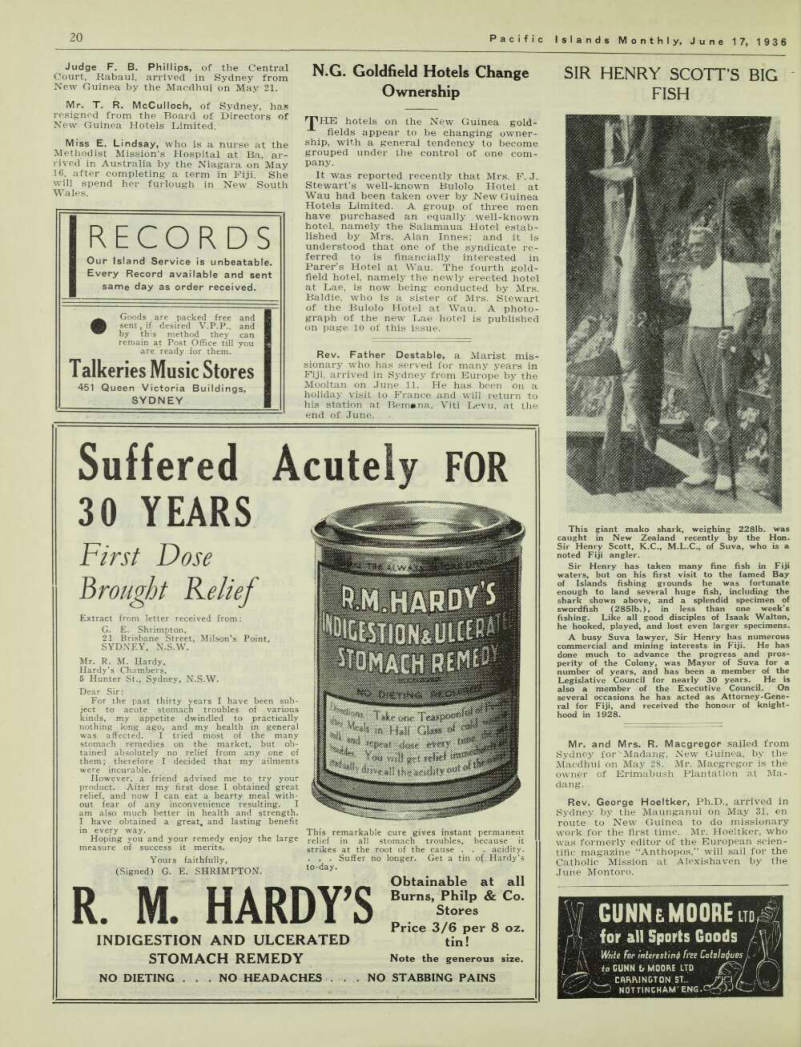
“Laperouse”
WHEN she reached Sydney on May 19. the French vsteamer Laperouse, from New Hebrides and New Caledonia, was held up for a time while Customs officers searched her for contraband.
After several hours’ examination, the searchers found more than 9,000 packets of Continental cigarette papers hidden in a cabin. Half of the haul was made in a recess in a wardrobe, and the remainder was found in a cupbcard with a false bottom beneath one of the bunks.
Heavy duty is charged in Australia on imported cigarette papers, and it was estimated that the amount of duty payable on the quantity seized would have been about £6O.
Mr. and Mrs. E. A. Clarke, Methodist Missionaries in Eastern Papua, returned to Salamo with their young daughter by the Macdhui from Sydney on May 28.
They had been in Australia on account of the ill-health of Mrs. Clarke.
Judge F. B. Phillips, of the Central Court, Rabaul, arrived in Sydney from New Guinea by the Macdhui on May 21.
Mr. T. R. McCulloch, of Sydney, has resigned from the Board of Directors of New Guinea Hotels Limited.
M iss E. Lindsay, who is a nurse at the Methodist Mission’s Hospital at Ba, ar rived in Australia by the Niagara on May 16, after completing a term in Fiji. She will spend her furlough in New South Wales.
Advertisements & other items, pp. 21-22 (1 item)
Scott’s Emulsion
OCEANIA
A Journal devoted to the study of the Native Peoples of Australia, New Guinea, and the Islands of the Pacific Ocean.
Editor: Dr. A. P. Elkin (Professor of Anthropology at the University of Sydney); Assistant Editor: H. lan Hogbin.
Published Quarterly.
Subscription, 5/- per copy (£1 per annum) Published by the Australian National Research Council, Science House, Gloucester Street, Sydney,
N.S.W.
The Strengthmaker
After Illness
PPPlfc 5*
SCOTTT
emulsio;
COD LIVER Jj
hypcphosphl'l
LIJUt AS It M MM]
'A
SCOTT* IBWME,
Fora quick return to health and strength after an illness-take SCOTT’S Emulsion. It contains natural tonic nourishment in a form that does not overtax the digestion—it is pleasant and palatable— it protects while it rebuilds.
SCOTT’S Emulsion is specially recommended by doctors in cases of lung trouble, anaemia, after bronchitis, pneumonia and influenza. But, you must insist on genuine
Scott’s Emulsion
Saves the Y oung Protects the
Old Restores the Invalid
RECORDS
Our Island Service is unbeatable.
Every Record available and sent same day as order received. • Goods are packed free and sent, if desired V.P.P., and by this method they can remain at Post Office till you are ready for them.
Talkeries Music Stores
451 Queen Victoria Buildings,
SYDNEY
Suffered Acutely FOR
30 YEARS
First Dose
brought Relief
Extract from letter received from: G. E. Shrimpton, 21 Brisbane Street, Milson’s Point,
SYDNEY. N.S.W.
Mr. R. M. Hardy, Hardy’s Chambers, 5 Hunter St., Sydney, N.S.W.
Dear Sir; For the past thirty years I have been subject to acute stomach troubles of various kinds, my appetite dwindled to practically nothing long ago, and my health in general was affected. I tried most of the many stomach remedies on the market, but obtained absolutely no relief from any one of them; therefore I decided that my ailments were incurable.
However, a friend advised me to try your product. After my first dose I obtained great relief, and now I can eat a hearty meal without fear of any inconvenience resulting. I am also much better in health and strength.
I have obtained a great, and lasting benefit in every way. , . , This remarkable cure gives instant permanent Hoping you and your remedy enjoy the large re li e f in all stom ach troubles, because it measure of success it merits. strikes at the root of the cause . . . acidity.
Yours faithfully, •• • Suffer no longer. Get a tin Hardy’s to-day.
Obtainable at all
Burns, Philp & Co.
Stores
Price 3/6 per 8 oz.
tin!
Note the generous size.
** » Half Glm» «»
4<m *
* Will ttM «**
(Signed) G. E. SHRIMPTON.
R. M. HARDY’S
INDIGESTION AND ULCERATED
STOMACH REMEDY
NO DIETING ... NO HEADACHES .
NO STABBING PAINS
Ownership
N.G. Goldfield Hotels Change Ownership
'J'HE hotels on the New Guinea gold fields appear to be changing owner ship, with a general tendency to become grouped under the control of one com pany.
It was reported recently that Mrs. F. J.
Stewart’s well-known Bulolo Hotel at Wau had been taken over by New Guinea Hotels Limited. A group of three men have purchased an equally well-known hotel, namely the Salamaua Hotel estab lished by Mrs. Alan Innes; and it is understood that one of the syndicate re ferred to is financially interested in Parer’s Hotel at Wau. The fourth gold field hotel, namely the newly erected hotel at Lae, is now being conducted by Mrs.
Baldie, who is a sister of Mrs. Stewart of the Bulolo Hotel at Wau. A photo graph of the new Lae hotel is published on page 10 of this issue.
Rev. Father Destable, a Marist mis sionary who has served for many years in Fiji, arrived in Sydney from Europe by the Mooltan on June 11. He has been on a holiday visit to France and will return to his station at Bemnna, Viti Levu, at the end of June.
Sir Henry Scott’S Big
Fish
This giant mako shark, weighing 2281 b. was caught in New Zealand recently by the Hon.
Sir Henry Scott, K.C., M.L.C., of Suva, who is a noted Fiji angler.
Sir Henry has taken many fine fish in Fiji waters, but on his first visit to the famed Bay of Islands fishing grounds he was fortunate enough to land several huge fish, including the shark shown above, and a splendid specimen of swordfish (2851 b.), in less than one week’s fishing. Like all good disciples of Isaak Walton, he hooked, played, and lost even larger specimens.
A busy Suva lawyer, Sir Henry has numerous commercial and mining interests in Fiji. He has done much to advance the progress and pros perity of the Colony, was Mayor of Suva for a number of years, and has been a member of the Legislative Council for nearly 30 years. He is also a member of the Executive Council. On several occasions he has acted as Attorney-Gene ral for Fiji, and received the honour of knight hood in 1928.
Mr. and Mrs. R. Macgregor sailed from Sydney for Madang, New Guinea, by the Macdhui on May 28. Mr. Macgregor is the owner of Erimabush Plantation at Ma dang.
Rev. George Hoeltker, Ph.D., arrived in Sydney by the Maunganui on May 31, en route to New Guinea to do missionary work for the first time. Mr. Hoeltker, who was formerly editor of the European scien tific magazine “Anthopos,” will sail for the Catholic Mission at Alexishaven by the June Montoro.
Advertisements & other items, p. 22 (1 item)
Gunnemoore
for all Sports Goods
Write For interesting Free Catalogues m
to CUNN Er MOORE LTD
CARRINGTON ST..
NOTTINGHAM ENG
Native Education
Four Australian Delegates to Attend Hawaii Conference
A CTING for the Carnegie Corporation of New York, the Australian Council for Educational Research has nominated the following delegates to represent Aus tralia at the conference on Anthropology and Native Education to be held at Honolulu, Hawaii, from June 30 to August 7: Professor A. P. Elkin, M.A., Ph.D., Professor of Anthropology in the University of Sydney, who is a recognised authority on the social life of the Australian aborigines.
Mr. F. E. Williams, M.A., B.Sc., Dip. Anthrop., Government Anthropologist of Papua, who has written extensively upon Papuan primitive cul tures, and the problems of native administration.
Mr. William C. Groves, 8.A., Dip. Ed., F.R.A.1., of Melbourne, a research fellow in social anthro pology under the Australian National Research Council, who has spent some years in educational work and in anthropological research in New Guinea, and who has just completed a book on edu cation and culture-contact in New Guinea.
Mr. Norman B. Tindale, B.Sc., ethnologist of the Adelaide Museum, who is well-known for his anthropological work amongst the aborigines of Central and Southern Australia.
Mr. Groves has arranged to leave Syd ney for Honolulu by the Aorangi on June 18, while Professor Elkin and Messrs.
Williams and Tindale will proceed by the Mariposa from Sydney on June 24. After the conference Mr. Tindale will sail for U.S.A. to do research work, under a grant from the Carnegie Foundation.
The Conference is being organised under the joint auspices of the Univer sities of Hawaii and Yale (U.S.A.), and is financed by the Carnegie Corporation.
It is generally regarded as the most im portant gathering of its kind yet held in
the Pacific region. The personnel of the various national delegations represent authorities on education, anthropology, and psychology from all parts of the Pacific Islands and littoral, where im portant developments in education have recently been carried out.
Comprehensive Syllabus
The syllabus is a very comprehensive one. Mr. Arthur Mayhew, Secretary to the Advisory Committee on Native Edu cation of the British Colonial Office, will deal with British colonial policy in its educational aspects. Representatives from Japan will outline the educational system among the natives of the Japanese mandated islands.
Some idea of the fundamental and im portant nature of the problems to be dealt with at the Conference is sug gested by the following titles selected from the syllabus*— National Native Educational Policies British, French, Netherlands, U.S.A., and Japan, with Australia and New Zealand in their Pacific Islands Territories dealt with separately; Assimilation versus Indigen ous Development in Education —probably the most important of all aspects of the Conference deliberations: Language Pro blems in Education, especially in New Guinea and the Melanesian Islands; Education and Native Social Systems; Health Education amongst Native Peoples; Educational Finance and Ad ministration.
As type-studies, detailed examination will be made of the systems of native education in the Gilbert and Ellice Is lands and Samoa. Special attention will be given to the complicated problem of education of immigrant groups, such as the Indians in Fiji; and to the work of the Medical School which has been estab lished at Suva to train native medical practitioners. The question of education
in relation to native morality will also be discussed.
Finally, it is hoped that, as a result of the Conference, a set of basic principles for native education generally will be formulated. With the weight of opinion of such a highly-select body of interna tional authorities behind it, representing
educationists, psychologists and anthro pologists, a body of principles so formu lated would provide valuable guidance for those territories, like New Guinea, where the perplexing problem of native education has yet to be successfully dealt with.
Protest From Queensland
The omission of Queensland represen tatives from the Australian delegation to the Conference drew a strong protest from the Director of Education (Mr. B.
McKenna).
He said that Queensland was always ruled out by the Carnegie Corporation, which w-as run in Australia from Mel bourne. Queensland would be represented if the Carnegie Corporation took into ac count that in Queensland more was known about native education than in any other Australian State. The Queensland De partment of Public Instruction advised the Commonwealth Government on native education in its territories, and supplied the teachers required.
Mr. W. E. J. Donovan* who is a clerk in the Fiji Treasury Department, returned to Suva by the Mariposa in May.
Advertisements & other items, pp. 23-24 (1 item)
Tooheys
p. ,e ri Od **>* ° ooc- *•<>.£, o' * <' b * so e ; fCt'* 0* ,V'° >b\« . jote.c ■\l
>n>.rw i'v.
*JoC«' ***
*V« c, Ai - c g f y^
CH^i
S»* r . o\^ £» b\*» tffO'
FOR SAFETY’S SAKE. SAT ••VINCENTS*’
The Colorful
Pacific
The emerald green of the hillside, the sapphire blue of the sea, the silver strand of beach ... complete the color scheme with the golden amber (and creamy white head) of a glass of Tooheys Pilsener. It gives a rosy hue to life. Here’s To’ee!
TOOHEYS
PILSENER
IN THE BOTTLE WITH THE YELLOW LABEL.
TpOHEYS^
LAGS*
W. Brian Molloy,
8.A., LL.B.
BARRISTER
AND
SOLICITOR
PORT MORESBY
PAPUA
The Yorkshire Insurance Coy.
LIMITED
Established in York —1824
FIRE ACCIDENT MARINE
Total Assets exceed £15,000,000
Agents and Attorneys throughout the Pacific Islands: SUVA; A. Q. McGowan & Co. PAPUA: SALAMAUA; A. Innes. Port Moresby: E. A. James.
KAVIENG: F. V. Saunders. Samarai: E. J. Morrow.
NEW GUINEA BRANCH: Park St., RABAUL. E. G. MacADAM, Manager.
'-2
MARBLE-FINISHED WALL PANELS
Added Charm and Luxury to your Home by using these beautiful marble-finished wall panels for covering your Bathroom and Kitchen Walls. “TILUX” has a smooth, highly-glazed surface, it is always Artistic and Immaculate . . . Fire Retardant ana Waterproof . . . Hygienic and Easy to Clean.
Only a fraction of the cost of tiles fixed. Easily and quickly trected—2s handy stock sizes—B beautiful, colourful patterns.
Sample and illustrated Pamphlet mailed on request. - FREE '.
JAMES HARDIE & COY. LTD.
“ASBESTOS HOUSE,” YORK & BARRACK STS., SYDNEV (Box 3935 V, G.P.0.)
"Please Explain”
By H. Dexter.
SAND his wife were running a trad • ing station near Hula, in the Central Division of Papua.
He had purchased an exceptionally fine double canoe from a native, who was an artist in the art of making them. It was coveted by every native in the district.
An arrangement was arrived at by which the natives were given the loan of the canoe, provided they handed over a small percentage of their catch of turtle shell to S. All went well, for a time, until the natives failed to pay the agreed tribute.
S. decided to visit a trading station a short distance along the coast. The canoe was brought along. One of the hulls had been split, and the natives had replaced it with another of their own. After the trade goods had been loaded, a crowd of natives were seen by S. to be unlashing the temporary hull, and about to replace it with the split one.
As he urgently needed the canoe that day he endeavoured to stop them. While doing this, he tapped the knuckles of those who would not desist. He then was seized by a number of them, and held under water.
His wife saw this, and realised that unless something drastic was done she would be a widow.
Anything in the way of firearms scared her almost out of her life. Nevertheless, she seized a revolver that was in the house. It was quite harmless, as it was unloaded.
Running down the beach, she pointed the weapon at the natives. Her husband was immediately released, and the natives ran away.
In due course, the natives concerned were sentenced to three months’ for then share in the affair. But the little lady was asked officially to “please explain’’ her action in pointing a firearm at the natives.
One can only hope that her explanation that she did it to save her husband’s life was satisfactory to the official mind.
Native Drowned When
N.G. Cutter Capsizes
From Our Own Correspondent
Rabaul, May 10.
work was carried out recently by the Customs launch, Wandera, when it steamed out into St. George’s Channel to save nine natives who were wrecked in the open sea between Kaba kaul and the Duke of York Islands (be tween New Britain and New Ireland).
Four of the natives were found clinging to the upturned cutter and Were brought safely back to Rabaul.
It was found that three natives had tried to swim back to Kabakon Island — a distance of six miles —where two of them arrived in a very exhausted condi tion, the third being drowned. Two others swam towards the Duke of York group, landing at Bei after swimming nearly eight miles.
Mr. and Mrs. Bucklay, of Scotland, will arrive in Australia shortly to proceed to the New Hebrides under the John G. Baton Missionary Fund. They will be stationed at South West Bay on the east coast of Malekula.
Aerial Services In New Guinea
Guinea Airways’ Chairman Hits at Uncontrolled Price Cutting Menace
ADDRESSING shareholders of Guinea Airways Limited at Adelaide on May 29, Mr. C. V. T. Wells (Chairman of Directors) made interesting reference to the proposed merger of aerial transport interests in New Guinea. He severely criticised the practice of uncontrolled price cutting.
“Whatever may be the future of air transport in New Guinea, the record of Guinea Airways for the year just con cluded must remain a bright page in its history,’’ said Mr. Wells. “Regrettable publicity has been given from time to time to criticism, irresponsible but harm ful, alleging that the Co.’s charges are too high. A perusal of our annual table of falling prices and rising turnover is an effective answer. An even weightier reply is that our service is the largest and best of its kind anywhere.
“It must be admitted, however, that any pilot with any sort of old aeroplane and without even a mechanic or any ground organisation worthy of the name can still carry on public cargo-freighting for a time in New Guinea at cut rates and probably make a living. He is free to use without charge any of the 50 or so N.G. aerodromes, the chief of which were made by our Co. at its own cost. These adven turous operators provide any loose-think ing critic with an easy starting point to accuse a specialised organisation like ours of refusing to match incessant daily rate
cutting. Nevertheless, the community at large knows and appreciates that this big unsubsidised service with its world re nowned equipment remains as the sheet anchor to safeguard New Guinea’s aerial life line from the tragedy of a breakdown.
“For this reason Guinea Airways has held to the same general policy through out its life, paying chief attention to the quality of the service in the belief that the population which depends upon it will support it and not begrudge the reason able returh hitherto paid on the capital funds at stake.
“I have referred deliberately to the un controlled price cutting menace in order to lead up to the subject of the proposed aviation merger or, as we prefer to call it, the stabilisation of civil aviation in New Guinea, In this connection Guinea Airways is very naturally a supporter of the Commonwealth Government’s pro posals, and we hope that some equitable method will shortly be agreed upon by all the interests concerned.
“Last year, when addressing share holders, I hinted that the general average freight rate reductions in New Guinea could not fall much lower without risk of injury to the efficiency of the services.
This was interpreted in some quarters as a kind of proclamation that the then existing air freight rates were our last word in reductions. This was never said, nor was it meant.
“Gradual reductions should still be pos sible as running costs tend to become lower with the improvement in mechani cal devices. But let me repeat that the proportionate reduction in freight rates must obviously for the future be much smaller than in the earlier period when expansion was to a great extent experi mental. This fact exposes the wrong headedness of any campaign designed to encourage the various aviation companies
to maintain a ceaseless war of attrition.
Eventually, as a logical sequence, the air services must thus destroy one another and leave the prosperous economic life of the goldfields without dependable trans- P° rt - “The matter can be summed up by saying that although the air services themselves are important the public welfare is more important. The maintenance of unrestricted competition in operating an essential public utility (for which in New Guinea no substitute is possible) is against public policy and thereby it becomes a proper subject for the Government s notice.
“Future demands upon air transport in the Territory are not as easy to foretell as might be imagined. Fortunately the Bulolo Gold Dredging Co. maintains its excellent organisation at full pressure and is increasing the scope of its operations by the importation of two larger dredges,
both to be carried by air. Other com panies also have been erecting extensive equipment during the past year which should be productive of further mining activity. It is nevertheless impossible to foresee when goldfield developments will receive a stimulus or a check. For this reason Guinea Airways, while assured of a steady flow of normal transportation business, must expect some degree of fluctuation in its supply of freighting so long as its main purpose is to serve a mining community’s needs,”
Advertisements & other items, pp. 25-26 (1 item)
Tilley
LEATHER BELTS
NATIVES
Z 6 777 a •nufachjrers & Specialists ■
PATTERSON & STONE, CRICHTON WORKS.!!
WALSALL. ENGLAND.
ORDER
RECORDS
by MAIL
Use Elvy’s Special Gramophone Record Mail Department for Island residents.
Orders over £2 insured, posted FREE.
Write for free catalogues and lists NOW.
ELVY & CO. LTD.
397 GEORGE STREET, SYDNEY
MODERNISE YOUR LIGHTING
T.L. 10 TABLE LAMP
The Tilley Table Lamp with its clear, white, steady light shows your room to the best advantage, as well as banishing eyestrain when reading or doing needlework. No smell or glare. Does not flicker when standing in a draught. Made throughout in lacquered brass and fitted with opal shade.
Constructed on scientific principles and free from danger.
by using
TILLEY
KEROSENE VAPOUR LAMPS AND LANTERNS
300 candle-power—Light of 6 hours for Id.
NO WICKS
NO CHIMNEYS
NO SMELL
DRAUGHT PROOF
INSECT PROOF
BRITISH MADE
THROUGHOUT
Tilley Lamps and Lanterns are indispensable to those living in the Pacific Islands and all tropical countries. They are British-made throughout of finest workmanship and materials and are designed to withstand rough usage. Absolutely safe and cannot explode. They burn ordinary kerosene under pressure and are preheated by the same oil, so that only one fuel is necessary. The Kerosene Lighter draws its oil supply from the container of the Lamp itself, and does away with the use of methylated spirit. Give a brilliant illumination of 300 c.p. When filled will burn for 6 hours at a cost of Id. without attention other than occasional pumping. Make no hissing noise and all indoor models are fitted with a special silencer.
Obtainable throughout the Pacific Islands from the Branches of;
BURNS PHILP & CO., LTD., and
BURNS PHILP (SOUTH SEAS) CO., LTD.
a S , P sr o rt a ai t n S a b a , n e d & W. KOPSEN & CO., LTD., If any difficulty, please write direct to: THE TILLEY LAMP CO. (Dept. P.M.), HENDON, LONDON,
CLARENCE ST.,
SYDNEY
N.W.4.
P.L.54 STORM LANTERN
Tilley Lantern is invaluable for all outdoor work; can be hung up, stood down or carried about just as required. Will burn steadily anywhere, unaffected by weather, however severe, being wind and rain-proof.
Strongly made of brats.
No parts to rust, corrode or get out of order. Get rid of all antiquated devices and use this up-todate Lantern.
To All the Good Fellows on
the Islands...
I would like you to make our address your address whilst in Sydney. Meet your friends and join the happy band from the Islands who make this place their rendezvous.
Of course, I want your business, but business and friendship makes the difference that matters, especially when selecting clothes that will help you
enjoy your well-earned holiday.
Introducing myself and my work: That’s my picture, but I’ll guarantee my tailoring. My suits are made entirely by hand and are really “Tailoring Perfection” with the added assurance that you will have individuality in Style, Correct Fit with Reliable Workmanship.
Best Quality Suitings
FROM £B/8/-
Also a wonderful stock of Shirtings, Neckwear, Sports Wear and other accessories to select from.
Let me hear from you and I’ll send samples by return.
CHARLES JOHNSON
Tailor and
143 KING STREET, SYDNEY
Wau Committee’s Protest to Members
Members of Parliament
WHEN it became known on the Morobe Goldfield in January last that plans were afoot to merge the aerial transport interests in New Guinea, a public meet
ing of protest was held at Wau. A committee of ten, known as the Wau Citizens’
Committee, was appointed “to safeguard the interests of the general public.”
The personnel of this committee was; H. Taylour (Chairman), manager, Enterprise of New Guinea N.L.
R. A. Laws, managing director, Greenwood and Laws Ltd., general merchants.
H. McGilvery, proprietor, Edie Store.
W. V. Quinn, manager, Pacific Aerial Transport Limited.
E. J. Stephens, proprietor, Stephens’ Aviation Company.
K. A. Macgregor, barrister and solicitor.
J. M. Ireland, chief accountant, New Guinea Goldfields Ltd.
E. M. Turner, private contractor and proprietor, Wau Carrying Co.
C. A. M. Adelskold, public accountant.
J. M. Spence, mining engineer.
After due deliberation, the Committee, on May 21, forwarded to each member of the Federal Parliament a lengthy letter, setting out their reasons for objecting to the proposed compulsory merger.
The circular stated that 90 per cent. of the residents of the Wau district were unreservedly opposed to the air merger.
That Sir George Pearce, on his recent visit of investigation, did not spend suffi cient time in the goldfields area to learn the trend of public feeling. That continued competition is vital for a reduction in passenger and freight rates. That the argument of the “safety factor” does not hold when a study is made of the records of the present operating concerns.
Why Copra Price Is Low
MESSRS. Brown and Joske Limited, managing agents for the Coconut Planters’ Union Ltd., of Fiji, made some pertinent comment on the copra market in a circular to members dated May 16: “We have received from Messrs. H. M.
F. Faure and Co., London, their review of the oils and fats market for 1935. They give a list of the difficulties with which international trade has had to contend during 1935, and say that in spite of almost insuperable obstacles, the recovery of the oil trade continued steadily through that year. The list is so striking and formidable that we quote it hereunder: “ ‘lmport restrictions by licence, by duties, and by increases in existing duties. Import re strictions by quotas. Restrictions in production.
Restrictions in payments. Extension of barter business. Disregard of the sanctity of commercial contracts by Governments. Currency devaluation.
Fears for the Gold bloc. Failures in London.
India, and the Far East. Fears of war. Partial failure of the crops. Sanctions. Etc., etc.' “Compare this state of affairs with the free exchange of international trade that existed in the days prior to the Great War, and the reason for the better price of copra 25 years ago is not far to seek!”
A Sydney Rendezvous
IT is extraordinary the number of lonesome people there are in a big city, and how often the stranger longs for that hearty well-meant handshake and cheery word that makes his stay more enjoyable. The stranger who walks int« the centrally located store of Charles Johnson, 143 King Street will soon be among friends and kindred spirits, and a stranger no longer. There he will find men from all the far ends of the earth. In an atmosphere both cosmopolitan and refreshing, one can enjoy the “bonhomie” of Charles, as he is known among his many friends.*** Mr. lan Grabowsky, general manager of Guinea Airways Ltd., accompanied by Mrs. Grabowsky, sailed for New Guinea by the Neptuna on June 10.
Advertisements & other items, pp. 27-28 (2 items)
25
Pacific Islands Mon thl y, June 17, 1936
I Wmm
Worldfamous
FOR
>i' >v m Mi
iii
i The Brilliant Atmosphere
H* imMm
m HP 1 i 11 w The Splendid Appointments m The Notable Social Life
fill Di-
ll H
m m The Convenient Location
wmm
Mm Sr— The Worldfamous Cuisine 11l
I WmM
m m mm
NOW OPEN
The Palatial
MARTIN PLACE EXTENSION!
Rooms and Suites are now available In this new and attractive section of the Hotel which is set back from the street frontage, and thus the maximum of sunshine and fresh air are secured.
Early reservations are essential Other Martin Place Features include the Modern, delightful:—
NEW WINTERGARDEN
NEW BANQUET HALL
NEW BEVERY
NEW BAR
These fine rooms are Air-Conditioned.
Telegraphic Address
AUSTRAOTEL, SYDNEY.’
SYDNEY N.S.W
Get your
EREE
COPY
of the
NEW TRUFOOD
RECIPE BOOK
69 specially tested recipes—all kinds of new ideas for attractive things to cook cakes, pastry, puddings, custards, desserts, savouries, sauces, etc.
POST THIS COUPON TODAY
Recipe Department” c/- Box 4267 Y, G.P.0., Sydney.
Please send me POST FREE, a copy of The Trufood Book of 69 Tempting Recipes Name
(BLOCK LETTERS)
Address
P CHAPMAN
f*%uej to / ttu (foUotv / SO & /iteUjs Ot£w / to do you* tcwuuf
Chapman Pup Engines
are World-famed as power plant for MOTOR LAUNCHES.
Thousands in use throughout Australasia. Owners from all parts continually writing praising their astounding simplicity, reliability, and Economy. Built in a number of different sizes from 2 J h.p. to 10 h.p. Write for leaflets and all information direct to the manufacturers—
CHAPMAN & SHERACK,
ENGINE MANUFACTURERS & LAUNCH
BUILDERS
ERSKINEVILLE, N.S.W., AUSTRALIA.
Men Who Knew Yesterday
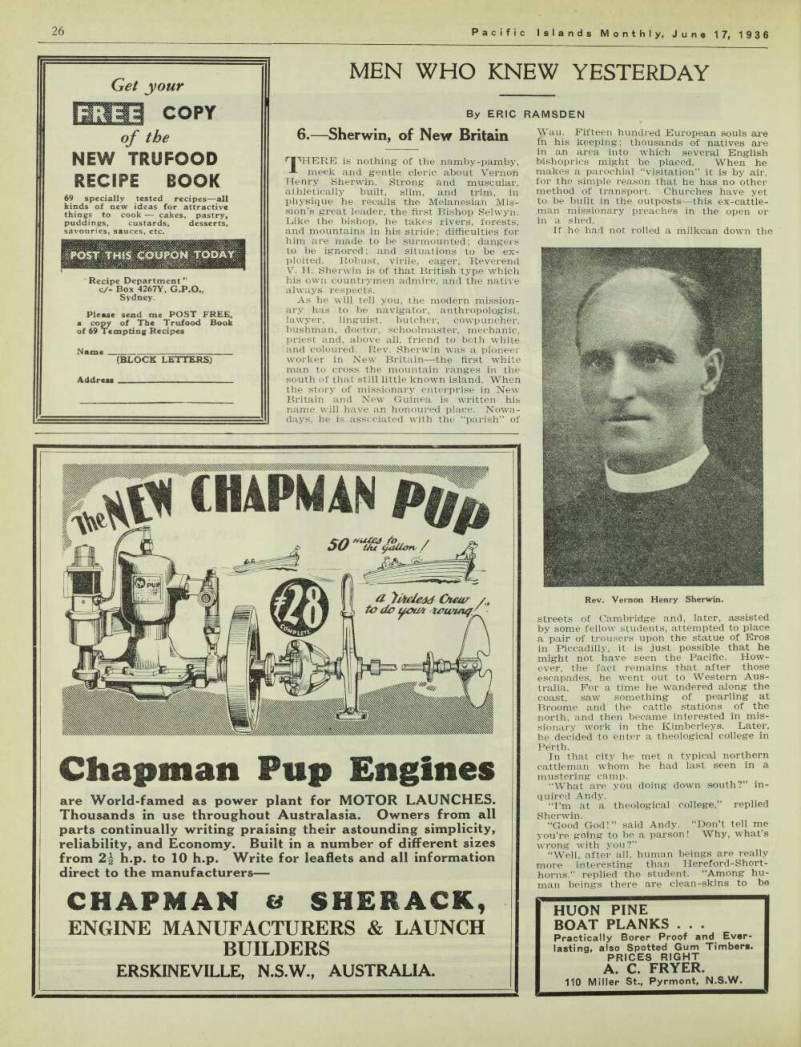
By Eric Ramsden
6.—Sherwin, of New Britain
THERE is nothing of the namby-pamby, meek and gentle cleric about Vernon Henry Sherwin. Strong and muscular, athletically built, slim, and trim, in physique he recalls the Melanesian Mis sion’s great leader, the first Bishop Selwyn.
Like the bishop, he takes rivers, forests, and mountains in his stride; difficulties for him are made to be surmounted; dangers to be ignored; and situations to be ex ploited. Robust, virile, eager, Reverend V. H. Sherwin is of that British type which his own countrymen admire, and the native always respects.
As he will tell you, the modern mission ary has to be navigator, anthropologist, lawyer, linguist, butcher, cowpuncher, bushman, doctor, schoolmaster, mechanic, priest and, above all, friend to both white and coloured. Rev. Sherwin was a pioneer worker in New Britain—the first white man to cross the mountain ranges in the south of that still little known island. When the story of missionary enterprise in New Britain and New Guinea is written his name will have an honoured place. Nowa days, he is associated with the “parish” of
Wau. Fifteen hundred European souls are in his keeping; thousands of natives are in an area into which several English bishoprics might be placed. When he makes a parochial “visitation” it is by air, for the simple reason that he has no other method of transport. Churches have yet to be built in the outposts—this ex-cattle man missionary preaches in the open or in a shed.
If he had not rolled a milkcan down the
streets of Cambridge and, later, assisted by some fellow students, attempted to place a pair of trousers upon the statue of Eros in Piccadilly, it is just possible that he might not have seen the Pacific. How ever, the fact remains that after those escapades, he went out to Western Aus tralia. For a time he wandered along the coast, saw something of pearling at Broome and the cattle stations of the north, and then became interested in mis sionary work in the Kimberleys. Later, he decided to enter a theological college in Perth.
In that city he met a typical northern cattleman whom he had last seen in a mustering camp.
“What are you doing down south?” in quired Andy.
“I’m at a theological college,” replied Sherwin.
“Good God!” said Andy. “Don’t tell me you’re going to be a parson! Why, what’s wrong with you?”
“Well, after all, human beings are really more interesting than Hereford-Short horns.” replied the student. “Among hu man beings there are clean-skins to be
Rev. Vernon Henry Sherwin.
branded, stores to be nursed, outlaws to be mustered, and good horses to be found.”
“Well, what about a drink?” suggested the cattleman, “or are you on the water waggon now?”
When they departed the old man de clared: “Well, good luck. I am glad you are still human —even if you are going to be a parson! ”
Missionary enterprise in the Pacific to day can be just as adventurous as when John Williams built his frail craft at Raiatea in the Society Islands and sailed the Southern Seas.
Vernon Henry Sherwin was in New Britain from 1928 until 1933 when he was selected by his bishop for work on the mainland of New Guinea. On his first attempt to reach New Britain he was blown almost back to the New Guinea coast. To quote his own words: “Excite ment becomes almost monotonous when one has been blown out to sea in a native canoe for three days with a hat as a bailer and four coconuts for food, or when one has to eat snake-flesh at a native banquet, or dive deep into the Pacific with dynamite charges to blow up fish to feed one’s hospital patients. The thrills have gone on happening ever since.” Although he is apt to dismiss the sea adventure somewhat flippantly, it might easily have terminated seriously. The danger was enhanced by the loss of the canoe’s out rigger.
On the second occasion Sherwin visited New Britain the schooner in which he was travelling ran on a reef. The native skip per had not even a chart. The missionary had to improvise his own navigating “instruments.” When the schooner was well and truly aground, he had to strip off and dive into the hold to salvage the cargo. Later the vessel was got off, and the voyage resumed —after this muscular Christian had patched up the hull!
Some people are still inclined to think that the missionary walks around the bush in a top hat and black coat, that he sits beneath a tree awaiting the approach of the Gospel-seeking natives. “I have known natives come up and ask for tobacco,” he says, “but never for the Gospel.”
In New Britain, Sherwin’s day com menced with divine service at 5.30 a.m.
Two hours later he was at work in the mission hospital making perhaps 30 or 40 injections, attending to abscesses, dressing wounds, even on occasion having to ampu tate a limb. At 10 a.m. he ceased to be a doctor and became a schoolmaster until noon. After lunch more school, then another round of the hospital, followed by court cases, gardening, with perhaps time spent in supervising the building of new houses, and then evensong.
Not a bad day’s work even if carried out in a temperate climate. But that is not all, for as the missionary remarked “Patrols had to be made on fdot through the hill villages, doing medical work, advis ing about houses, diet, sanitation, and a hundred other things. Sometimes I was
away in the bush for six weeks on end, crossing torrential rivers, climbing mountains, wending a fearful way over shaky bamboo bridges with an abyss stretching far below. Dealing with savages is educafive and humanising when one realises that revenge is sweet to them, and is usually accomplished by means of a spear or arrow, minus abstruse legal arguments.
In New Britain he had to accept malaria, wet blankets and stores, as part and parcel of his daily existence. The climate there plays havoc with a man even with the constitution Sherwin possesses. Only the fittest can survive. After a particularly
bad bout of blackwater fever on one occa sion he left a note for the administration authorities stating that if he died his natives were not to be blamed. Natives of New Britain still attribute not a few deaths (and probably with good cause) to poison.
What one likes particularly about this energetic young missionary is his sane out look. For instance, he does not believe in clothing natives. “By clothing them,” he says, “you are paving the way for skin diseases and respiratory troubles. In the humid heat of the tropics the more the body is exposed the better. The native.
in his normal state, very sparsely clothed —or wearing nothing at all—is perfectly moral.”
Neither does he desire to interfere with their primitive culture: “Within my area of work, both in New Britain and now on the New Guinea mainland, native customs have been carefully preserved. In fact, those in danger of being forgotten have been carefully revived. It is arrogant,
criminally wrong, and foolish to try to Westernise natives. To smash their in herited customs is an intolerant, puri tanical step.”
Again, he is emphatic that-all mission aries should possess anthropological train ing. He, himself, underwent a course at Cambridge.
“Missionary mistakes in the past,” he says, “were due to ignorance and in
tolerance.” Further, he is strongly in favour of sectional control in the mission field. The recent sectarian bitterness engendered between the Roman Catholic and Lutheran sects in the Mount Hagan area have not enhanced the reputation of missionaries in the eyes of white residents in New Guinea. “What must be the effect on the untutored native?” he asks.
Last but not least —he is entirely sym pathetic towards the native. Not merely sentimentally so. But he realises that the native must bear the impact of civilisation whether he wants to or not. While pre serving what is best in the primitive cul ture, it is only fair that some spiritual compensation be given when native belief is shattered in the gods of old.
Advertisements & other items, pp. 28-30 (1 item)
Huon Pine
BOAT PLANKS . . .
Practically Borer Proof and Everlasting, also Spotted Gum Timbers.
PRICES RIGHT
A. C. FRYER.
110 Miller St., Pyrmont, N.S.W.
TO CATCH BIG FISH,
YOUR TACKLE MUST BE OF THE BEST.
“Fishing Tackle to Tackle Fishing’
Why gear of doubtful quality for the sake of a slight saying?
Big fish are scarce. When you do get a strike, what a wonderful feeling there is to know that a Tackle will do the work.
Sil Rohu’s “UNDOVER” Multiplying Reel, which was used on top of rod (it can also be used for under fishing), played a very important part in the landing of the 10051 b. Tiger Shark that I caught recently. Drag worked perfectly. With the combination of fibre and non-heating metal, there is no possibility of the drag of the “Undover” Reel seizing.
“UNDOVER” Reel sells at £27/10/-.
Built of phosphor bronze monel metal and stainless steel. Capacity 700 yds., 39 cord; or 850 yds., 36 cord.
The Sil Rohu “Swordfish” Reel for top rod fishing only. Same specifications and capacity as the “Undover” Reel. Price, £24/10/-.
A new “Swordfish” Reel for 1000 yards capacity of 39 cord in course of manufacture. A special feature of the above reels is that they can be taken to pieces with a screwdriver.
OTf T Gunsmith, Importer of high-grade Firearms and 111 IllU Fishing Tackle Specialist 143 Elizabeth Street, SYDNEY (near Market Street)
“OUR HANDS MAKE GOOD ARMS.”
W. KOPSEN & CO., LTD.
SHIPCHANDLERS AND GENERAL MERCHANTS
Tilley Lamp* ”
Special Quotations for Island Trade GENUINE Tilley Parts 68-70 Clarence St., Sydney CABLES: a^r fslt hmkW 1
CAPSTAN
NAVY CUT TOBACa
imukfwm (finest
CAPSTAN
CIbARETTES
CORK-TIPPED
iMr.
K PLAi N
PST
1
Books, Magazines & Newspapers
TO ANY PART OF THE ISLANDS
BARGAIN OFFER.—We will send Half a dozen latest American Monthly Magazines for 4/post free,
AMERICAN GAY BOOK, 1936
(Snappy Stories and Pictures) 1/6 Post Paid.
We specialise in selecting reading matter for those unable to choose personally. We specialise in Mail Orders. Parcels posted by every boat. Send for tmr price list and full particulars of this unusual service for Islands residents.
McKAY’S BOOKSTALL
ROYAL ARCADE, SYDNEY
/ L m ■ K % y % 4 m
msit
«*»»»« tA vanilla 3* m
WRITE FOR IT TO-DAY
Send your name and address with Id. stamp to Foster Clark (Australia) Ltd., Dept. R. 8., 17 Thurlow Street, Redfern, N.S.W., for your FREE copy of Elizabeth Craig’s Recipe Book.
FOLLOW the recipes of England’s foremost cookery expert —Elizabeth Craig. She tells you how to make delicious, wholesome sweets for all weathers, and she recommends you to use Foster Clark’s creamy Custard. It is made from the purest ingredients and the flavours are fresh and natural.
Your family will love Foster Clark’s creamy Custard —and it’s ever so good for them.
Foster Clark's
creamii CUSTARD
«/ FC9.165
Cyclone Devastates Norfolk
Island
A CONCENTRATED section of the severe cyclone which raged over the Tasman Sea in the middle of May swept Norfolk Island on May 22, and was ac companied by incessant torrential rain.
Heavy damage was done to property, plantations, and roads, and farmers suf fered great financial loss. Roaring torrents carried away bridges, trees were uprooted and swept along for hundreds of yards, and many roads were com pletely blocked by landslides.
Cable communication was severed when the hut of the Pacific Cable Company at Anson Bay was completely wrecked and washed out to sea. Workmen sent to re pair the cable were lucky to escape with their lives when a cliff-fall occurred and hundreds of tons of undermined cliffs collapsed into the sea. Cable communi cation was restored the following day.
In reply to a message from the N.I.
Administrator (Captain G. R. Pinney) asking for assistance, the Prime Minister (Mr. J. A. Lyons) has given authority to spend what is necesary for the immediate relief of the sufferers. The population of the island is about 1000.
Fiji Cutter Driven On
Reef
From Our Own Correspondent
Suva, May 22.
AN her way to Suva loaded with a cargo of copra from Kadavu, the auxiliary cutter Mary Work was driven on to the main reef opposite Namuka early on May 14. The passengers and crew were uninjured, and left the vessel by dinghy.
The cutter was examined by the Act ing Harbourmaster (Captain Hay), who stated that she was well aground and bumping slightly at the stern. It was reported later that she was holing badly and was not worth salvaging, and it is thought that she will remain on the reef until she breaks up.
Powered with a 20 h.p. engine, the Mary Work is of about 28 tons register.
Her length is 53ft., with a beam of 16ft.
She was originally built at Suva by W.
H. Terry and Son some 20 years ago.
Mr. C. S. Clarke, who has been in prac tice as a dentist at Suva for a number of years, arrived in Australia by the May Niagara. He was accompanied by Mrs.
Clarke. Mr. Clarke has disposed of his practice to Mr. H. S. Mount, formerly of Adelaide.
Cook Islands Fruit Industry
Officials and Delegates Leave to Attend N.Z. Inquiry
From Our Own Correspondent.
Rarotonga, May 18.
A GENERAL exodus of those interested in the fruit industry and its ramifica tions took place by to-day’s Maunganui.
In the first-class, representing the Ad ministration, went Judge H. F. Ayson, C.M.G., Resident Commissioner, and Mr.
W. T. Goodwin, Director of Agriculture.
Representing the Exporters’ Association went Mr. R. McKegg, managing director of the Cook Islands Trading Co., accompanied by Mr. W. Wigmore, shipper and planter.
In the second-class were Mr. William Mcßirney, trenchant chairman of the Growers’ Association, together with his fel low delegates, Mr. W. P. Browne and Tevano Napa Tauei. On behalf of the minority counter-petition were Tinirau Makea Ariki Nui and Tuaine Nicholas.
Representing himself in an unofficial capa city was the one-time Director of Agricul ture, Mr. E. A. Reid. Last but by no means least important went Arumaki, delegate from the Cook Islands Native Association.
It is understood that the Parliamentary Committee detailed to investigate the fruit industry in the Cook Islands will go into action within a few days of the ship’s arrival. In addition to the above delegates and officials, much evidence is expected to be tendered by parties representing sales and marketing interests in New Zealand.
The work of sorting out and finally reach ing a correct estimate of the whole situa tion will prove no easy task. It is one where the words of the late Tim Healy in the House of Commons might again be employed—“l have given you the informa tion, gentlemen; God alone can give you the intelligence to understand it!”
During the past month advice from the outer islands of Mauke, Atiu, Mangaia and Aitutaki was received to the effect that a substantial majority of growers in Mauke alone over 90 per cent. —had signi fied approval of the proposed Fruit Board.
The actual position now is that prob ably well over 85 per cent, of the total number of growers, both in Rarotonga and the Lower Group, have signed the original petition asking for a Control Board whilst those who signed the counter-petition rep resent a bare 10 per cent. The latter’s claim to be growers of 60 per cent, of the island’s fruit output is open to serious question, since in several instances signa tories to this petition possess little land themselves, but are either large pur chasers of “standing crops” or straight out buyers and consigners. Both of these activities tend to place them more in the class of middlemen than in that of the producer which they now claim to repre sent.
“Cape Horn” Lifts 7,500 Cases Of
Oranges
The S.S. Cage Horn, en route from ’Frisco to Auckland, called here on May 6, later proceeding to Mauke and Aitutaki where she picked up 7,500 cases of oranges, bought at the flat rate of 2/- a case by guarantors of the vessel. Dissatisfied with the price offered, growers in Mangaia and Atiu refused to pick.
In Rarotonga, producers picked heavily despite the poor price of 2/6 a case “in the shed.” It is estimated that 10,000 cases will go forward by to-day’s mail boat.
In view of last week’s shipment by the Cape Horn there is now every prospect of the market being flooded. With cold storage facilities at their disposal it is a
simple matter for speculators to hold large quantities in reserve, releasing these when further shipments arrive, thus forcing down any competitive bidding and later replacing the fruit in storage until a more favourable market is created.
With regard to the local buying agents’ price of 2/6 a case here in Rarotonga, it is interesting to note that the recently formed Growers’ Association have been able to secure orders from N.Z. for 500 cases at 5/- a case, or just double that paid by the representatives of the speculators— figures altogether disproportionate to the reasonable profit recognised in economics as the reward for commercial “risk.”
Despite plenty of available shipping space many small growers have neverthe less been unable to dispose of their fruit locally. That “honesty is the best policy” has been felt to be a mistake in a number of cases where natives not in debt to the stores have systematically had their fruit refused whereas others whose accounts are well on the wrong side of the ledger have had no difficulty in getting rid of theirs.
Mr. L. R. Barton, of the Audit Depart ment, Fiji, left Suva by the Monterey on May 12, en route to England. He was accompanied by Mrs. Barton.
A United Women’s Club has been formed in Rabaul, of which Mrs. Percy Clark is president and Mrs. H. C. Gridley is secre tary. The club will collect clothing, etc., for city missions in Australia,. as well as books and periodicals for lonely settlers on N.G. out-stations.
Advertisements & other items, pp. 31-32 (1 item)
Auhi Marys
H.JONES &C 0
AUSTRALIA’S BEST
H. JONES & CO.. LTD.
Darlington, Sydney Hobart, Tas.
For— Fresh Fruit, Vegetables, and Produce Island Residents can rely on the old-established Shipping Providers.
C«» »*»**»’ s* 01^ Only Address: 421 Sussex St., SYDNEY All Orders Promptly Attended Island Representatives: Nelson & Robertson - W. M. Reid
AUHI MARYS
“Defiance”
Brand
Canned
Goods
PURE FOOD
PRODUCTS
—are prepared and packed by the proprietors of Aunt Mary’s Pure Food Products.
The finest quality goods are hermetically sealed to withstand tropical heat and give to consumers maximum satisfaction.
Supreme in quality and flavor, these pure food products have been supplied to the people of the Islands for more than thirty years. Specially manufactured and packed to meet Island conditions, they give complete satisfaction to both retailer and consumer.
Prepared and Packed only by—
TILLOCK & CO. LTD.
PURE FOOD MANUFACTURERS
KENT AND LIVERPOOL STREETS,
SYDNEY, N.S.W.
Heavy Loads
Higffv Velocity
Lorv^Ra
411 b their There’s additional pleasure for the keen shooter who uses “Duxbac” and “Icil Special” Cartridges, because of outstanding qualities.
Loaded With "NEOFLAH" Powder
the world’s most successful shot gun propellant and the powder that achieved amazing popularity on the Australian market in record time.
No Excessive Pressure or Recoil
KBS
OBTAINABLE EVERYWHERE w'
AT POPULAR PRICES
0 U rs m
V
cep on
“ TRYING
and trust your luck, Set an example of pride and pluck; Wear a smile and confident air.
Cheer up others and foil despair.
Keep on trying what-e’er the past, Sheer persistence will win at last; If for a cold you’d ease assure Try Woods’ Great Peppermint Cure.
Precautions against influenza infection.
Woods’ Great Peppermint Cure.
Papeete Schooner Pounded by
Nearly Foundered
Papeete Schooner Pounded by Gales En Route to Rapa
From Our Own Correspondent
Papeete, May 13.
4 FTER being absent over a month, the local schooner, Waitangi, a small craft of about 20 tons, returned to her Papeete headquarters recently after an unsuccess ful attempt to reach the island of Rapa, in the Austral Group.
After calling at Raivavae Island the Waitangi proceeded on the last leg of the voyage. Encountering fierce gales and tempestuous seas, it was impossible to make headway in spite of the auxiliary diesel engine carried by the ship. For many days the schooner battled with the elements without avail, heavy green seas swept the deck and pounded the hull un mercifully so that the danger of founder ing was a very real one. Mr. Paul, a New Zealander, who was returning to his home on Rapa, said that only for the courage and resource of the Rapa sailors —than whom there are none better in the world —the vessel would undoubtedly have been lost with all the 13 people aboard.
Suffering considerable damage, the schooner was hardly able to return to Raivavae and, after some overhauling, make the return trip to Papeete. She is now ready tio make another effort to get to Rapa, which is situated in one of the stormiest areas in the Pacific.
Mr. C. W. T. Johnson, Second Assistant Colonial Secretary of Fiji, left for Eng land by the May Aorangi on long leave.
Messrs. T. J. Shepherd, E. Herbert, E.
White and H. Slocombe, four Melbourne mining men who sailed at the beginning of the year on the ship Joseph Conrad to search for gold on an island near Samarai, Eastern Papua, returned to Sydney by the Macdhui on May 22. After an uncomfort able voyage in rough weather they arrived in Papua only to find that the supposed treasure island was one that had been well-known to gold-seekers since 1887.
Their investigations proved fruitless, and the expedition was abandoned.
New Anglican Bishop of New
Rev. C. W. Alderson
New Anglican Bishop of New Guinea
succeed Dr. Henry Newton, who has laboured for 36 years in Melanesia, Rev. Cecil William Alderson, M.A., of England, has been appointed Anglican Bishop of New Guinea. The date of his arrival in Australia and where he will be consecrated are points which have not yet been decided.
Rev. Alderson, who is 35 years of age, was a scholar at St. John’s College, Oxford, where he gained high degrees in classics and philosophy, and took first class honours in theology. He was vice principal of Ely Theological College from 1925 to 1930, and was then appointed by the University Mission to Nyasaland, Central Africa, in 1933.
The Bishop-Elect is said to be quiet and unassuming—even shy, at first — rather than openly forceful, but gives one the impression of spirituality and power.
He has a keen and penetrating mind and should be well fitted to deal with the problems of the task to which he has been called.
The new Bishop’s diocese comprises the whole of Papua—not the Mandated Ter ritory of New Guinea as might be ex pected from his title. The New Guinea Mission, of which Rev. Alderson will be the head, was established in Papua in the days when the territory was fre quently called British New Guinea.
When Australia took over the German portion of New Guinea, the N.G. Mission did not extend its influence to that sphere, but contented itself with con solidating the work in Papua. The Angli can Church’s activities in New Guinea are the responsibility of the Melanesian Mission, which also operates in the Solo mon Islands and New Hebrides.
Manslaughter Of
18 Months’ Gaol For
Papuan Native
From Our Own Correspondent
Pt. Moresby, May 15,
BEFORE His Honour Mr. Justice Gore at the Central Court at Samarai, George Roberts, a cattleman employed on Gili Gili Plantation, Milne Bay, in the Eastern Division, came up for trial early in May on a charge of killing a native labourer.
It was alleged that Roberts kicked the native, who later died from a burst spleen. Certain medical evidence was sub mitted by the defence, and as a result the charge was altered from murder to that of manslaughter. Roberts was con victed and sentenced to 18 months’ im prisonment to be served in Port Moresby gaol.
Mr. E. B. Bignold prosecuted for the Crown, and Mr. W. Brian Molloy, barris ter of Port Moresby, acted as counsel for the defence.
Mr. B. W. Costello, of Girigiri Planta tion, Kokopo, New Britain, arrived in Sydney from Rabaul with his wife and child by the June Neptuna.
Mr. H. Hughes, a pilot for Guinea Air ways Limited at Lae, New Guinea, arrived in Australia by the Neptuna on June 1.
Advertisements & other items, p. 33 (1 item)
Freemans
For QUALITY GOODS at LOW
(ESTABLISHED 1 905)
147 CASTLE REACH STREET,
SYDNEY - - New South Wales Right in the Centre of THE BLOCK Between Park and Market Streets.
Rifles! Shotguns!
Brand new 22 Cal. Bolt Action, Single Shot “Tru-Shot” Rifles, with grooved forearm. Very accurate 19/6 Springfield, 22 Cal. Single Shot Rifles, Bolt Action, 22in. Barrels 42/6 Brand new High-Grade, Harrington & Richardson’s, Single Barrel, Breech Loading, 12 Gauge Guns.
Top Action, Self Ejecting, £2/15/- Brand new “Stevens” 12 Gauge, Double Barrel, Breech Loading, Hammerless Shotguns, 32in. Barrels, Pistol Grip. Walnut Stock, £6/10/-.
Bargains in Men’s
High-grade Clothing
Brand New, Tailor-made Suits, extra special unclaimed orders, in Best Heavy Blue Serge, Art Silk lined. All Sizes 57/6 Brand New, Solid Cowhide Leather Lumber Jackets, made of the finest selected Dark Tan Leather, buttoned fronts, Storm Proof Collars and Cuffs. All Sizes ... 45/- Brand new Solid Cowhide Leather Overcoats, made of the finest selected Dark Tan Leather, Double Breasted Style, Storm Proof Collar and Cuffs, one-piece Back, with full Detachable Belt. All sizes £3/10/-
Musical Instruments
Brand New Ukuleles, complete with strings. Free Tutor ... 10/6 Steel Guitars, beautiful tone, complete with steel, picks and Free Tutor 35/- Banjo Mandolins, complete in case with Free Tutor, slightly used, 37/6 Standard Banjos, complete in case with Free Tutor, slightly used, 45/.
Full Size Violins and Bow, in case, splendid tone, Free Tutor ... 45/- High Grade Violins, % and \ sizes, with Bow and Cases 35/- His Master’s Voice Portable Gramophones, in perfect order, slightly used £3/19/6 Columbia Portable Gramophones, in perfect order. Slightly used, 45/-
Piano Accordeons
Antonio Silvagni, 21 notes, 8 sunken basses, sloping keyboard, rounded black keys, green pearloid finish body and keyboard, chro m i u m-plated key-cover, fourteen-fold bellows with nickelplated corner protectors, leather bass straps and shoulder straps.
Each £6/10/-
Sporting Goods
“J. Kirkwood” Hickory Shaft Matched Golf Sets, special rustless heads, made in Scotland, including Midiron, Mashie, Putter and Brassie-Driver in Leather mounted waterproof canvas Bag 42/6.
“J. Kirkwood” Steel Shaft Golf Sets, including Midiron, Mashie, Putter and Brassie-Driver in Leather mounted waterproof Canvas Bag 69/6.
Free with every Golf Set purchased : One Dozen Tees and Two Golf Balls.
“J. Kirkwood” Hickory Shaft Golf Clubs, hand forged rustless heads, 10/6.
“J. Kirkwood” Steel Shaft Golf Clubs, hand forged rustless Scotch heads, 17/6.
Golf Bags, best waterproof canvas with solid leather trimming . . 10/6.
Oval Shaped Waterproof Canvas Golf Bags, 4 cane supports, solid leather mounts 16/6.
Willow Leather Golf Bags, latest oval shape, 4 cane supports, with attached score card and tee holders—22/6, 27/6, 32/6.
Oval shaped Waterproof Canvas Golf Bags, with Zypp fastener Hood and Pocket, 4 cane supports . . 39/6.
Willow Leather Golf Bags, latest oval shape, 4 cane supports with Zypp fastener Hood and Cover .. £2/2/6.
Special large sizes .. .. £2/15/-.
Repaint Golf Balls (all makes) 7/6 doz. Cochrane Balls (made in Scotland), 18/- doz.
We stock all well-known makes of Clubs. Write for our Free Catalogue.
Saddles
Brand New High-grade Saddles, made of best quality materials throughout, strong guaranteed Trees and first-class Workmanship.
Strong High Grade Saddles, in Stock, Kemp, Park, or Poley styles (suitable for all-round use). Built on very strong guaranteed trees. Narrow Grip, Firm Pads, Best Quality Flaps and Skirts. Mounted with Leathers, Rolled Girth and 3-bar N.P Irons £3/10/- High-grade Stock Saddles, built on strong guaranteed trees, very deep comfortable Kip seat, Narrow Grip, Wide Leather Facings at back, 4 in. firm pads (set up very high, giving greater security to the rider), extra long Kip Flaps and Skirts, mounted with Leathers, Rolled Girth and 3-Bar N.P. Irons £4/10/-
Bargains in Our Trade-
in Department
Slightly Used Cameras
Vest Pocket Kodak Cameras . , 15/- Kodak 1-A Aut. Jr, Folding Cameras 20/- Kodak Post Card Size Cameras, 22/6 Kodak 2-A Hawkeye Folding Cameras Double Dense 27/6 Kodak 3-A Folding Brownie Cameras 30/- Kodak 6-3 Lense Folding Cameras 37/6 Zeiss Ikon Cameras, 1. 11 Lense, 50/-
Field and Race Glasses
SLIGHTLY USED
Powerful Field Glasses, in case, 25/- Extra powerful Field Glasses ... 39/6 Extra powerful German Military Field Glasses, excellent value, in case 69/6 “Colmont” Binocular Field Glasses, 6 x 30, very powerful, in case, £4/15/ “Ross” Binocular Field Glasses, in case, very powerful £5/10/- “Colmont” Binocular Race Glasses, Bx, extra powerful, in case.. £6/15/- “Carl Zeiss” Binocular Race Glasses, Telexim, 6 x 30, in case .. £6/10/- “Carl Zeiss” Binocular Race Glasses, Silvamar, extra powerful .. £B/10/- “Carl Zeiss” Deltrentis Race Binocular Field Glasses, 8 x 30, wide vision, extra powerful £lO/10/-
Slightly Used Typewriters
Monarch 4 bank Standard Typewriters, good order £6/10/- Remington 4 bank Portable Typewriters, perfect order £B/10/- Corona 4 bank portable Typewriters, in case, new condition ... £lO/10/-
Bicycles
Good strong slightly used Bicycles always in stock. Prices range from 55/-, 65/-, 75/-, 95/-.
Special Concessions to Traders and Storekeepers for Quantities. Write for Quotations.
All Mail Orders Promptly Attended to. We Guarantee you every satisfaction. We stock everything. Inquiries invited.
Kindly add carriage on all Mail Orders.
freemans
For Prompt Service and Honest Value
147 Castlereagh Street,
Sydney, New South Wales
Famous Tennis Champion
At Tahiti
From Our Own Correspondent
Papeete, May 13.
THE ex-professional tennis champion of the world, Monsieur Henri Cochet, re cently paid a visit to Tahiti and left again for America by the Manganui on April 23 in continuation of his voyage round the world. M. Cochet, who is now 40 years of age, held the amateur championship til! 1927, then became a professional.
For the last few years he has been some thing of an Ambassador Extraordinary, touring the world with the mission of mak ing propaganda for French sport and teaching the principles of tennis to the peoples of all nations.
Although there are not very many tennis enthusiasts here, Cochet was received in Tahiti with acclamation, and his visit of a month’s duration will undoubtedly result in a renewal of interest in this game which is so eminently suited to a languorous tropical climate. Assisted by his wife, he showed the theory of tennis bj r means of special cinema films, the exhibition of which drew crowded houses. Practical demonstrations were also given and the Governor placed his private courts at the disposition of the public for a special exhibition.
Mrs. A. C. English, of Rigo, Papua, is at present on a visit to Sydney with her daughter Marjorie. Mrs. English has lived in Papua for 30 years, and her husband is one of the oldest residents of the territory.
Forgotten Race
“Little Stonehenge” of a Forgotten Race Papuan Anthropologist Reports on Trobriands Formations
A REPORT made by Mr. F, E. Williams (Government Anthropologist) on the stone structures discovered in the Trobriand Group, Papua, has been re ceived at Canberra.
It will be recalled that the presence of these stones of mysterious origin and estimated to be 2,000 years old was first reported by Mr. Arthur J. Vogan, F.R.G.S., who carried out archaeological investiga tions in the Trobriands in 1932. A descrip tion by Mr. Vogan of the strange forma tions was published in this journal in February last.
In his interesting report Mr. Williams stated that some of the structures on Kiriwina Island appeared to him like “a little Stonehenge.” Their original pur pose seemed to have been lost or for gotten, but it was likely that they were ‘‘tomb temples,” or sacred places of burial.
At the site of one of the structures, human bones were found buried. ‘‘As to the origin of the major sites, informants were found to be completely dumb,” said Mr. Williams, ‘‘The more generally accepted opinion of authorities is that the stone building habit was im planted in Melanesia by immigrants who derived their culture from the west. It is assumed that the immigrants with their superior culture occupied the status of a ruling class. If this be so, then in the Trobriand Islands not only have they left some hulking monuments of their for gotten skill, but some of their more direct descendants probably survive as the pre sent class of chiefs.”
Speaking of the group of stones at Iluk waiwaia, on Kiriwina, he observed; “Here, a great number of stones, white or grey, stand boldly in view. They give clear indication of an early formation. In the background is the great stone of Otuiam. part of a smaller formation, but, one com posed of much more massive stone. The whole thing looked exceedingly impres sive. and it is not too much to say that, on first sight, Ilukwaiwaia and Otuiam look like a little Stonehenge.”
He added that the enclosure formed a rough oblong about 60 feet long and 15 feet broad.
Mr. Williams described other forma tions, including one at Kadalalai, on Kitava. The weight of the great stone of Otuiam was estimated to be about 12,000 lb. He considered that the enclosures had been made where the stones were found.
The Anthropologist recommended sys tematic excavation as a means of provid ing better evidence of burials and of throwing some light on the history of the enclosures, and added that the sites should be preserved. The Acting Lieutenant- Governor of Papua (Mr. H. W. Champion) reports that steps will be taken to carry out Mr. Williams’ recommendations.
Mrs. A. H. Bunting, of Samarai, Papua, reached Australia by the Macdhui in the middle of May on a visit to her daughter who lives in Sydney. Mrs. Bunting has resided in Papua for 35 years.
Mf. H. V. C. Randall, of the New Guinea Public Works Department, mar ried Miss Gwendolen Backhouse, sister of Dr.’ Clive T. Backhouse of Rabaul, on May 14.
Advertisements & other items, p. 34 (1 item)
Link -Belt Co. Ltd.
PAINT
HORSE SHOE BRAND
IN PASTE OR READY
MIXED FORM
Made in Scotland— Thomas Mcintyre & Co. Ltd.,
WHITE LEAD, WHITE ZINC.
AND ALL COLOURS
—therefore Reliable!
GLASGOW, SCOTLAND
DOYLE’S famous VETERINARY REMEDIES
REDUCINE—Cures Your Lame Horse. Cures him painlessly and you can work him all the time.
Cures Splints, Curbs, Capped Hocks, Sprung Tendons, Bog Spavins, and all Bony and Bursal Enlargments. Price, 12/6 per can. Postage 1/-.
LARYNGINE1 —A sure cure for Coughs, Colds, Strangles, etc. Price, 5/- per can. Postage, 1/-.
SKIN DRESSING.—A certain remedy for Mange and Allied Parasitic Skin Diseases in Horses, Dogs, etc. Price, 7/6 (large), 3/6 (small). Postage, 1/-.
DISTEMPER MIXTURE.—A safe and reliable remedy for Coughs, Colds, Asthma, etc. Price, 2/6. Postage, 9d.
T. G. DOYLE, V.S., 9 KING STREET, RANDWICK, Write for Free Veterinary Advice and Booklet OOYLfj
N.S.W.
LINK -BELT CO. LTD.
17 GOULBURN STREET, SYDNEY
<JD> o o: o
Centrifugal
Discharge
Bucket Elevator Modern Machinery Equipment for Elevating, Conveying and Mechanical Handling of Material.
Sole Agents in Australia for Ewart Chain Belting in Malleable or Steel.
Specialists in Power Transmission Machinery.
Large Stocks always kept of Steel Shafting, Cast Iron, Steel, or Wood Split Pulleys.
Plummer Blocks, Collars, Couplings, Leather Belting, Hangar Bearings.
Lubricators, Engineers’ Wrenches.
MANUFACTURING ENGINEERS
Still Seeking Cocos Treasure
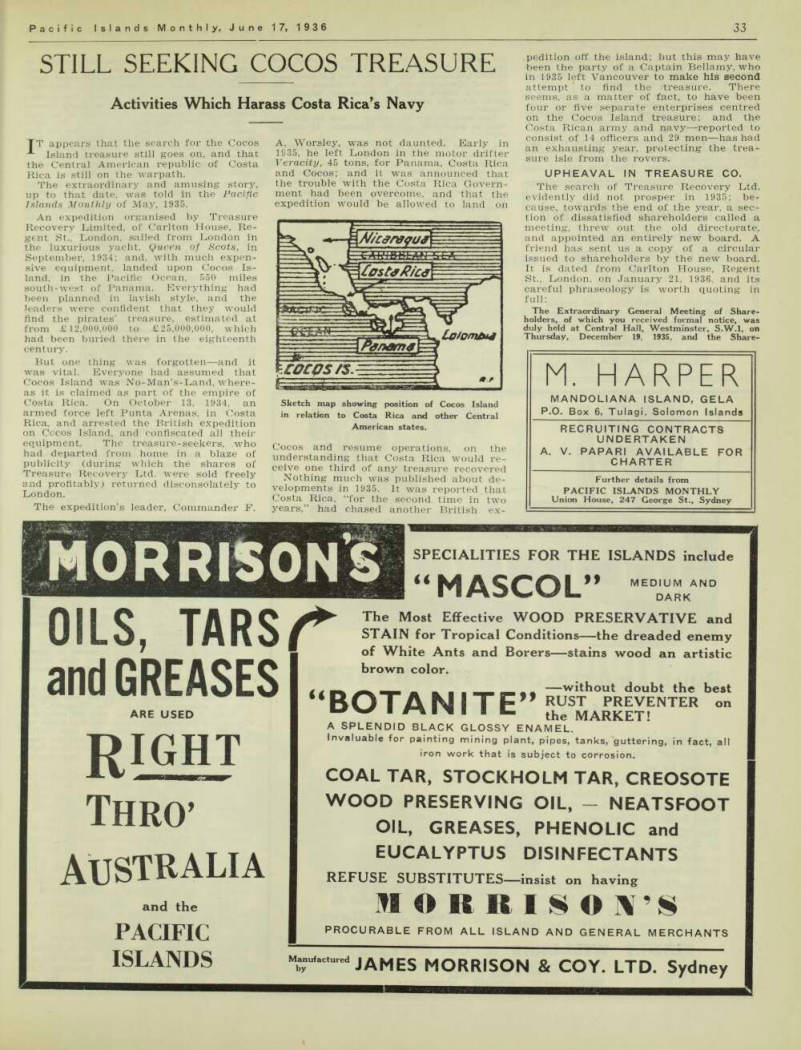
Activities Which Harass Costa Rica’s Navy
TT appears that the search for the Cocos Island treasure still goes on, and that the Central American republic of Costa Rica is still on the warpath.
The extraordinary and amusing story, up to that date, was told in the Pacific Islands Monthly of May, 1935.
An expedition organised by Treasure Recovery Limited, of Carlton House, Re gent St., London, sailed from London in the luxurious yacht, Queen of Scots, in September, 1934; and, with much expen sive equipment, landed upon Cocos Is land, in the Pacific Ocean, 550 miles south-west of Panama. Everything had been planned in lavish style, and the leaders were confident that they would find the pirates’ treasure, estimated at from £12,000,000 to £25,000,000, which had been buried there in the eighteenth century.
But one thing was forgotten—and it was vital. Everyone had assumed that Cocos Island was No-Man’s-Land, where as it is claimed as part of the empire of Costa Rica. On October 13, 1934, an armed force left Punta Arenas, in Costa Rica, and arrested the British expedition on Cocos Island, and confiscated all their equipment. The treasure-seekers, who had departed from home in a blaze of publicity (during which the shares of Treasure Recovery Ltd. were sold freely and profitably) returned disconsolately to London.
The expedition’s leader, Commander F.
A. Worsley, was not daunted. Early in 1535, he left London in the motor drifter Veracity, 45 tons, for Panama, Costa Rica and Cocos; and it was announced that the trouble with the Costa Rica Govern ment had been overcome, and that the expedition would be allowed to land on
Cocos and resume operations, on the understanding that Costa Rica would re ceive one third of any treasure recovered Nothing much was published about de velopments in 1935. It was reported that Costa Rica, “for the second time in two years,” had chased another British ex
pedition off the island; but this may have been the party of a Captain Bellamy, who in 1935 left Vancouver to make his second attempt to find the treasure. There seems, as a matter of fact, to have been four or five separate enterprises centred on the Cocos Island treasure; and the Costa Rican army and navy —reported to consist of 14 officers and 29 men—has had an exhausting year, protecting the trea sure isle from the rovers.
Upheaval In Treasure Co.
The search of Treasure Recovery Ltd. evidently did not prosper in 1935; be cause, towards the end of the year, a sec tion of dissatisfied shareholders called a meeting, threw out the old directorate, and appointed an entirely new board. A friend has sent us a copy of a circular issued to shareholders by the new board.
It is dated from Carlton House, Regent St., London, on January 21, 1936, and its careful phraseology is worth quoting in full: The Extraordinary General Meeting of Share holders, of which you received formal notice, was duly held at Central Hall, Westminster, S.W.I, on Thursday, December 19, 1935, and the Share
Sketch map showing position of Cocos Island in relation to Costa Rica and other Central American states.
holders present passed the Resolution appearing on the Notice of Meeting and elected Messrs. Baron, Bevan, Arthur, Mendelssohn, Thorp and Bergmans to form the new Board of Directors.
The full proceedings of this Meeting proved to be too protracted to warrant the expense of circulation to the Shareholders, as had been proposed, but a verbatim report may be inspected by Shareholders at the Offices of the Company. urgent attention, including the question of finance TWr « eP t in m nd
the primary object for which the Company was formed—the location of Cocos Island treasure. Re ference has already been made at the Extraordinary General Meeting to Mr. P. A. Bergmans and the Directors believe that Mr. Bergmans’ information holds the only sure road to early and complete success.
This documentary information is now for the first time in possession of your Directors. It consists of:— 1. A plan of Cocos Island, showing the general location of the treasure cave. 2. A large-scale plan, showing the site and approach to the cave, with instructions. 3. A description of the contents of the cave.
The information contained in 1 and 2 obviously cannot be disclosed herein, but the description in 3 above is as follows: “When arriving in cave you will first notice on your left the form of a person (sceleton) “Further on the left are sacks with gold nugets and more sacks further inside on the same left.
“You will have to walk on silver coins and other metals which is filled up in abundance.
“On the right from the entrance are seven little barrels containing gold coins and in the farther and middle are eight boxes or trunks and many different pieces of ornement from churches, together with statuettes.
“Two of the boxes have been opened by me and jewels have been removed.
“Notice an old shirt was used to make a sack from, but was later left in the cave and gold nugets of all sizes are spread on the ground in order to use two of the bags to. fill them with
jewels.”
NOTE.—The above is reproduced exactly as written by Mr. Bergmans who, it will be remem bered, is a Belgian. The above-mentioned docu ments were drawn and signed by Mr. Bergmans.
As will have been evident to those Shareholders who were able to attend the Extraordinary General Meeting, the Company’s finances are in no state to-day to defray the cost of turning the above information to account and your Directors feel that their proper course is to advise Shareholders fully of the highly important new facts and of the con sidered recommendations of the Board, so that the steps taken shall be those having the fullest approval and support of the Shareholders The information now in the Directors’ hands has been carefully studied, particularly by Mr. Arthur and Mr. Studdert, both of whom have a close acquaintance and knowledge of Cocos Island. These two gentlemen—both Directors of the Founder Company, Spanish Main Exploration Limited, as well as of this Company—have formed such a favourable opinion that they have intimated that their Company, as the largest shareholder in Treasure Recovery Limited, will be prepared to advance to your Company, on loan, immediately, such funds as are necessary to meet its present urgent commitments and to maintain your Com pany in good standing until Shareholders have decided upon the future policy of the Company.
This gesture of confidence has been made, not only as the result of Mr. Bergmans’ documentary information and an examination of samples of the treasure which he has brought to London, but also, and to a very large extent because, there has been accumulated over the past year much contributory information from entirely independent and separate sources, all tending to corroborate and confirm the genuineness of Mr. Bergmans’ documents.
The proposals which the Directors now put for ward for the approval and support of Shareholders are as follows: 1. That the information now in the hands of the Board be turned to immediate account, utilis ing “Veracity” to proceed to Cocos Island with a selected personnel from those already in the Company’s employ with any special additions to personnel that may be found necessary. 2. That the additional finance required, amount ing as it does to but a small part of that already invested in the Company, be subscribed by Shareholders. 3. That such subscriptions shall be by way of loan to the Company and that the loans shall constitute a first charge upon the proceeds of all treasure recovered, after the agreed Costa Rican Royalty has been deducted. 4 That a bonus of one fully-paid share of the Company shall be issued free to Lenders in respect of every £1 advanced. This has been made possible by the offer of Spanish Main Exploration Limited to place at the Company’s disposal, free of charge, a sufficient number of fully-paid shares from its holding, to provide the above Bonus. 5. That Shareholders be asked to indicate the extent to which they are prepared to support these proposals and to forward their cheques in respect of same, together with the enclosed form, duly completed and signed.
By this means, the proposals, receiving the sup port of the Shareholders can be put into operation with the minimum of delay. The “Veracity,” now at Punta Arenas, Costa Rica only 300 miles from Cocos, can be recommissioned and the whole pro gramme completed well within the time limit of the Company’s Concession. The Directors there fore recommend with confidence every Shareholder to support this programme in their own interests and to subscribe to the Loan.
Miss Eleanor Fellowes, of Philadelphia, who arrived in Sydney early in March, 1936, told of a day spent only a few weeks before at Cocos Island, where she said a band of Englishmen are looking for treasure. They had spent nine months searching the mountainous and forest clad island, but had met with no success.
They lived in the huts erected by prev ious explorers, and had an electric plant which enabled them to have a refriger ator for keeping their supplies fresh.
This, presumably, was Captain Wors ley’s party, which left London in the Veracity early in 1935.
Captain Bellamy, of Vancouver, who spent some months searching on Cocos in 1932, reported that he had found 133 gold and silver Spanish coins, bearing dates of the 16th and 17th century. He said the pirates’ cache seemed to be in quick
sand, and that it would require compre hensive engineering equipment to recover it. Obsessed by the idea that he might be the discoverer of treasure, variously estimated up to 20 millions sterling in value, Bellamy fitted out a small schooner at Vancouver last summer. After a dis pute with his partners, he set out alone, but his vessel was wrecked in British Columbia waters. A trading vessel, which arranged to drop him at the island, met a similar fate on the Costa Rica main land.
Some History
Mr. Frederick Wall, writing in Gibbon’s Stamp Monthly a few months ago, said; “It has been the Central American re public’s custom for quite a time to grant licenses to those who thought they could unearth the Spanish and Portuguese gold which is said to be hidden there. * I thought that the matter of ownership was settled in 1897 when British Admiral Palliser and a party of blue-jackets landed on the island and calmly started blowing it to pieces in the hope that the explosions would reveal something more valuable than upturned earth and rock!
As a result of this intrusion upon foreign territory Cocos was put out of bounds by the Admiralty!
“The island is first found marked on a French map of the sixteenth century and no doubt was a hiding place for pirates for a number of years. There are com monly supposed to be two vast treasures hidden there, that belonging to a Portu guese pirate, Benito Bonito (buried about 1820), and that raided from Lima about the same time, during the Peruvian war
of independence. Looking at the map, Bonito’s hoard is said to be on the shores of Wafer Bay (the westerly of the two bays at the north of the island) while the great treasure of Lima lies somewhere in the other and nearby bay, Chatham Bay.
“Whether they do exist still remains to be seen; it is quite likely that they are there somewhere in the island which is hilly and almost impenetrable with vege tation. Dozens of exploring parties have tried their luck (including one led by Sir Malcolm Campbell) and, in spite of so many failures, the attraction still re mains.”
The Lima Treasure
Admiral B. M. Chambers, in a letter published in the London Daily Telegraph in August, 1934, described lengthy searches which he had made, all over the wmrld, for any kind of contemporary his tory or documentary evidence which might support the story of the Lima treasure. The story is that when Cor dova was approaching Lima, the church authorities gathered together an im mense treasure, the property of the church, and shipped it away in an Eng lish ship, the Mary Dyer, or Dier; and that the crew of the ship murdered the priests who were in charge of the trea sure, and seized it and buried it on Cocos Island. The Admiral said he could find no evidence whatever that any such crime had been committed or that any such ship had ever sailed the seas. The indi cations were that the treasure from the Lima churches was taken away inland.
Advertisements & other items, pp. 35-38 (1 item)
Oils, Tarsr
M. HARPER
MANDOLIANA ISLAND, GELA
P.O. Box 6, Tulagi, Solomon Islands
RECRUITING CONTRACTS
UNDERTAKEN
A. V. PAPARI AVAILABLE FOR
CHARTER
Further details from
PACIFIC ISLANDS MONTHLY
Union House, 247 George St., Sydney
i
SPECIALITIES FOR THE ISLANDS include
“MASCOL”
MEDIUM AND
DARK
OILS, TARSr
and GREASES
ARE USED
RIGHT
THRO’
Australia
and the
PACIFIC
ISLANDS
The Most Effective WOOD PRESERVATIVE and STAIN for Tropical Conditions—the dreaded enemy of White Ants and Borers—stains wood an artistic brown color. £ £ ■>. , , —without doubt the best BOTA NITF” RUST preventer on
WV I I I—i the MARKET!
A SPLENDID BLACK GLOSSY ENAMEL.
Invaluable for painting mining plant, pipes, tanks, guttering, in fact, all iron work that is subject to corrosion.
COAL TAR, STOCKHOLM TAR, CREOSOTE
WOOD PRESERVING OIL, NEATSFOOT
OIL, GREASES, PHENOLIC and
EUCALYPTUS DISINFECTANTS
REFUSE SUBSTITUTES—insist on having Jl O It It I * o M’S PROCURABLE FROM ALL ISLAND AND GENERAL MERCHANTS Manufactured by
JAMES MORRISON & COY. LTD. Sydney
V. H. Jones & Rickard
Electrical Engineers
525 ELIZABETH STREET
SYDNEY
Specialists in rewinding and repairing all classes and sizes of electrical machines and equipment.
Special treatment given to work for the tropics.
TELEPHONE: MA 1397
Build an Attractive PERMANENT
Home of STEEL
TLLUSTRATED is an attractive “Comet” steel bungalow recently erected by us.
This building is in no sense a special order, but shows just what can be done with the patented “Comet” principle of Steel Building Construction.
The “Comet” Steel Building, by reason of its patented sectional construction, is easily enlarged and where required, conveniently portable.
The buildings are white-ant proof, fireresisting and economical to erect.
They have definitely proved themselves the best proposition for the islands.
EMINENTLY SUITABLE
FOR:-
BUNGALOWS
STORES
WORKSHOPS
COPRA SHEDS
BOYS' HOUSES
HANGARS, ETC.
‘‘COMET’
Steel Buildings
SIDNEY WILLIAMS & CO. (PTY.) LTD.
Steel Building Specialists. Builders and Contractor*
DULWICH HILL, SYDNEY
ROCKHAMPTON BRISBANE TOWNSVILLE
& 0 * 0 k
SHELL
gives you extra miles from every gallon. Besides maximum mileage, it gives outstanding performance: easier starting, quicker pick-up, and greater flexibility.
You can be sure of SHELL for definite savings, for better performance.
N $ $ w
MOTOR
SPIRIT
a A S 61
GILLESPIE’S
“ANCHOR”
FLOUR
TRADE
MARK
The Standard of Quality.
V-ARI-ETI-E5
Green Peas French Beans Cauliflower ii ■» M en 9*& m
MANUFACTURED
Australia's Choicest Products:
r-CARDCN VALE
K PRODUCTS LIHIT-ED
2-4 BROWN STR€-ET, N-CWTOWN
tYDN-EY. AUSTRALIA
A.iways
make sure you have at hand an ample Reserve of these Delicious , .
Garden
Vale
Ready-toserve Vegetables
Imperial Airways
Another Survey of Gulf Route
rpnE announcement made in April last stating that Imperial Airways Ltd., in association with the Commonwealth Government, were again making a survey of the waters between Darwin and the eastern coast of Australia with a view to finding a suitable route and bases for fly ing boats, apparently disposes for the present of the plan of deflecting the air mail route so that it would come down to Australia via Borneo and New Guinea instead of via the Netherland Indies.
There is no doubt that Imperial Airways Ltd. have given serious consideration to the Borneo-New Guinea idea; but, as we pointed out recently, if the new flying boats are to give definite service to British territories they must come down by the Mandated Territory of New Guinea and thus lose a good deal of time on the jour ney; whereas if they take the more direct route, via the south ccast of Dutch New Guinea and Torres Strait, they will not be giving service to any important British territory.
Apparently, it is in view of these con siderations that a further survey of the Darwin-Gulf of Carpentaria-east coast of Australia route is being made.
Mr. W. W. Petrie, of the Seventh Day Adventist missionary organisation, re cently was transferred to Western Samoa from the S.D.A. station in the Purari region in the interior of New Guinea.
Mr. J. C. Archer, delegate of the Cus todian of Expropriated Properties in New Guinea, recently married Mrs. Nina Gallagher, daughter of Mrs. C. H. Lux moore, of the Rabaul Hotel. The cere mony at Rabaul was a very quiet one, and was performed by the Registrar (Mr.
J. L. Street) at the home of Hon. H. O. and Mrs. Townsend.
Native Surgery
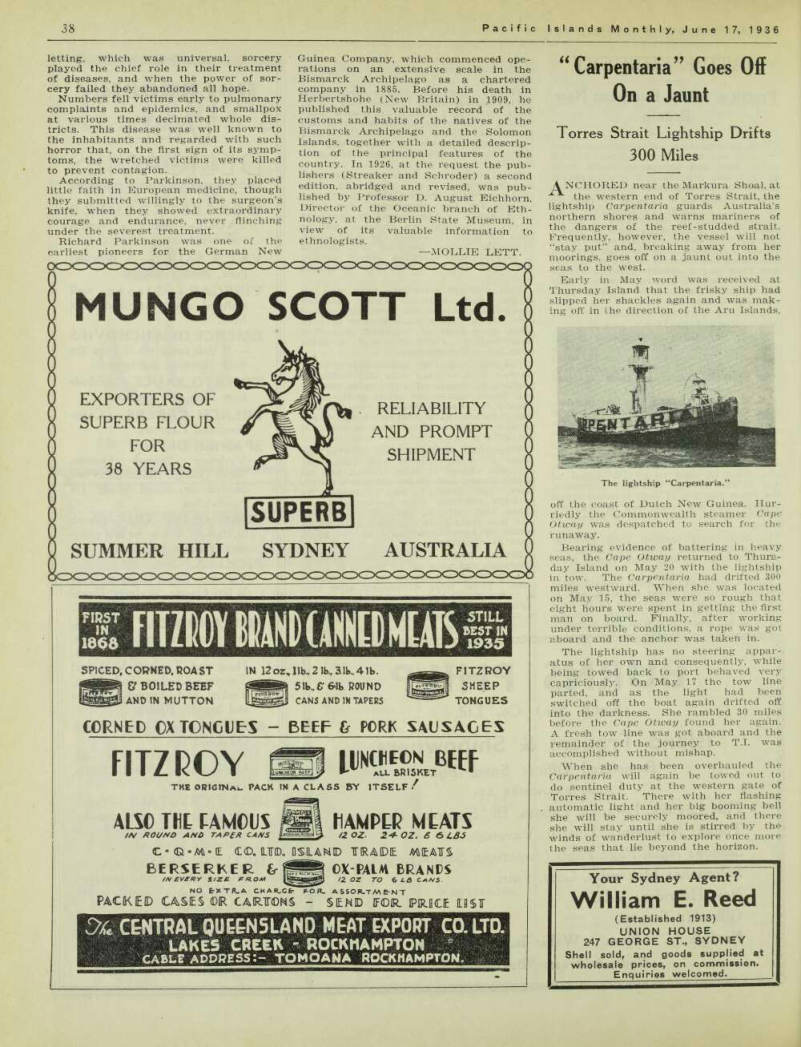
Practices in Pre-European New Britain
THE general idea of cannibal surgery "*■ does not as a rule extend beyond battle axes and sharpened shells, with which bodies are reduced to manageable proportions for rapacious appetites.
So it comes as a surprise to read in the late Richard Parkinson’s work “Dreissig Y T ahre in der Sudsee” (“Thirty Years in the South Seas —1875 to 1905”) that not only did the inhabitants of the Gazelle Peninsula, New Britain, practise trepanning for injuries to the head, but that they had a considerable knowledge of medicines and anatomy; which they put to good use, in spite of their can nibalistic tendencies.
In dealing with the customs of these people, Richard Parkinson writes: “Their knowledge of medicine is far from unimportant, and though of not a high order, those who practise it, com mand attention and respect on account of their profound belief in their inspired powers.
“It is difficult to draw the line between bona fide remedies and white magic.
Certain maladies are treated with speci fic medicines varying in potency, con cocted chiefly from plants and herbs.
“Their knowledge of anatomy, in line with their cannibalism, is astonishing, and could be said to be far ahead of that of the average educated European.
The exact position of each internal organ is known to them and they are capable of deciding in which organ a malady is seated.”
It seems they showed their greatest skill in operations on broken heads, re ceived during fighting, from stones from slings.
Stones were hurled from considerable distances and did great damage, and it was not unusual for warriors to be car ried unconscious to the village “Special ist” and his assistants, who had prepared *
and sharpened obsidian splinters, mussel shells and sharks’ teeth for emergency cases.
These crude and simple implements were evidently equal to their task for in most cases the operation proved suc cessful. Within the knowledge of an old man of a village, states Mr. Parkinson, 23 out of 31 cases survived treatment.
Many of them were known to him per sonally.
Great care was taken to wash the wound before setting to work with water contained in a coconut shell, used pre viously for the “surgeons’ ’’ far from clean hands. The operation consisted briefly in making an incision, pulling back the scalp (to expose the skull bone), extracting broken portions, and making a careful and extended search among the folds of the brain for embedded matter.
This delicate procedure over, and all rough edges removed (with obsidian “scalpel”), the hole was carefully covered over, either with a small portion of bark cloth, or a piece of the inner leaf of a banana—first sterilised over glowing coals for a few seconds.
The scalp was then drawn slowly back, washed with coconut milk and bound in position by means of a fine wide meshed net, fitting closely and firmly to the head'.
Finally to hasten healing, the patient was adorned with charms, hung either around his neck or on various parts of his body.
Trepanning was practised also in the Duke of York Islands and alpng the southern shores of New Ireland and on Gerrit Denys and Caens Islands as well.
Here, the practice was extended to patients suffering from continued head aches and epileptic fits. The operation was less complicated, though an opening seems to have been made in the skull bone by scraping.
Broken bones also recei/ved surgical attention, and were set by means of bam boo splints, fitted closely to the exposed bone. These were withdrawn after two or three weeks apparently with good re sults. This method was chiefly applied in the Gazelle Peninsula (New Britain).
Beyond these measures, and blood
letting, which was universal, sorcery played the chief role in their treatment of diseases, and when the power of sor cery failed they abandoned all hope.
Numbers fell victims early to pulmonary complaints and epidemics, and smallpox at various times decimated whole dis tricts. This disease was well known to the inhabitants and regarded with such horror that, on the first sign of its symp toms, the wretched victims were killed to prevent contagion.
According to Parkinson, they placed little faith in European medicine, though they submitted willingly to the surgeon’s knife, when they showed extraordinary courage and endurance, never flinching under the severest treatment.
Richard Parkinson was one of the earliest pioneers for the German New
Guinea Company, which commenced ope rations on an extensive scale in the Bismarck Archipelago as a chartered company in 1885. Before his death in Herbertshohe (New Britain) in 1909, he published this valuable record of the customs and habits of the natives of the Bismarck Archipelago and the Solomon Islands, together wuth a detailed descrip tion of the principal features of the country. In 1926, at the request the pub lishers (Streaker and Schroder) a second edition, abridged and revised, was pub lished by Professor D. August Eichhorn, Director of the Oceanic branch of Eth nology, at the Berlin State Museum, in view of its valuable information to ethnologists.
Mollie Lett.
Advertisements & other items, pp. 39-40 (1 item)
Burns Philp
HOLBROOKS’
TABLE
DELICACIES
WORCESTERSHIRE
SAUCE —Enjoys a worldwide reputation.
VAT 2 SAUCE— A delicious thick, fruity sauce.
VINEGAR Strong, well matured, and guaranteed Pure Malt.
ESSENCE OF ANCHOVIES
—A fish sauce made from the finest Gorgona Anchovies.
TOMATO SAUCE Made
from fresh, ripe tomatoes.
FRENCH CAPERS -Capu-
cines and Capottes.
SPANISH OLIVES
Varieties: Spanish Queens, Small Queens, Manzanillas and Stuffed or Sliced ready for Sandwiches, PURE OLIVE OlL— French or Italian. From the first pressings of selected Olives.
PICKLES
Varieties: Sweet Gherkins, Tiny White Onions, Walnuts, Piccalilli, Mixed and Green Tomato.
FISH AND MEAT PASTES,
in 1 £oz. and 3oz. glass jars.
Varieties: Anchovy, Salmon, Ham and Tongue, Veal and Tongue, Chicken and Ham, Turkey and Tongue, Salmon and Shrimp, Bloater SOUPS, in Boz., 160 z., £ gal. and 1 gal. tins.
Varieties: Vegetable, Ox Tail, Mulligatawny, Mock Turtle, Tomato.
JELLY CRYSTALS Speci-
ally prepared for warm climates.
They set well, and are deliciously flavoured.
HEALTH SALINE—A re-
freshing health-giving beverage, suitable for hot climates, in and lib. tins.
HOLBROOKS
(Australasia) Ltd.
WATERLOO, N.S.W.
BURNS PHILP
(South Sea) Co. Ltd.
Island Traders & Shipowners Registered Office: Suva, Fiji.
ALSO BRANCHES AT:
Fiji: Levuka, Lautoka, Labasa, Ba, Sigatoka, Rotuma.
Tonga: Nukualofa, Haapai, Vavau.
Samoa: Apia, Pago Pago (American Samoa).
Solomons: Makambo, Gizo, Faisi.
New Hebrides: Vila.
Gilberts: Tarawa.
Norfolk Is. Niue. Wallis Is. Futuna Is.
Code Address: “Burnsouth.”
MUNGO SCOTT Ltd.
EXPORTERS OF
SUPERB FLOUR
FOR
38 YEARS
RELIABILITY
AND PROMPT
SHIPMENT
SUPERB
AUSTRALIA
SYDNEY
SUMMER HILL
SPICED, CORNED. ROAST
tf BOILED BEEF
AND IN MUTTON
IN 12 oz, 11b, 2 lb., 3.1 b.. 4 lb.
51b,. S' 61b ROUND
BBSS! CANS AND IN TAPERS
FITZROY
SHEEP
TONGUES
CORNED OXTONGUES - BEEP & FORK SAUSAGES
FITZ ROY ® FUNKS. m
THE ORIGINAL PACK IN A CLASS BY ITSELF /
ALSO THE EAMOUS
HAMPER MEATS
/z OZ-
//V ROC/HO AND TAP£R CANS
C°<D »M ° E CD, dm, OS (LAND TRADE
24- OZ. 6 <5 LBS
MEATS
BERSERKER & OX-PAIM BRANDS
/H EVERY SIZE PROM |gßBgjjlg| /2 OZ TO 6L& CANS.
NO &XTR.A CHAR.CE- FOR, A SSOR.TM tNT PACKED CASES ©R CARTONS - SEND EOR PDUCE LAST ©& CENTRAL QUEENSLAND MEAT EXPORT CO. LTD.
LAKES CREEK - ROCKHAMPTON '
CABLE ADDRESS!- TOMOANA ROCKHAMPTON.
On a Jaunt
"Carpentaria” Goes Off On a Jaunt Torres Strait Lightship Drifts 300 Miles
ANCHORED near the Markura Shoal, at the western end of Torres Strait, the lightship Carpentaria guards Australia’s northern shores and warns mariners of the dangers of the reef-studded strait.
Frequently, however, the vessel will not “stay put” and, breaking away from her moorings, goes off on a jaunt out into the seas to the west.
Early in May word was received at Thursday Island that the frisky ship had slipped her shackles again and was mak ing off in the direction of the Aru Islands,
oft the coast of Dutch New Guinea. Hur riedly the Commonwealth steamer Gape Otway was despatched to search for the runaway.
Bearing evidence of battering in heavy seas, the Cape Otway returned to Thurs day Island on May 20 with the lightship in tow. The Carpentaria had drifted 300 miles westward. When she was located on May 15, the seas were so rough that eight hours were spent in getting the first man on board. Finally, after working under terrible conditions, a rope was got aboard and the anchor was taken in.
The lightship has no steering appar atus of her own and consequently, while being towed back to port behaved very capriciously. On May 17 the tow line parted, and as the light had been switched off the boat again drifted off into the darkness. She rambled 30 miles before the Cape Otway found her again.
A fresh tow line was got aboard and the remainder of the journey to T.I. was accomplished without mishap.
When she has been overhauled the Carpentaria will again be towed out to do sentinel duty at the western gate of Torres Strait. There with her flashing automatic light and her big booming bell she will be securely moored, and there she will stay until she is stirred by the winds of wanderlust to explore once more the seas that lie beyond the horizon.
The lightship “Carpentaria.”
Advertisements & other items, p. 40 (1 item)
William E. Reed
Your Sydney Agent?
(Established 1913)
UNION HOUSE
247 GEORGE ST., SYDNEY
Shell sold, and goods supplied at wholesale prices, on commission.
Enquiries welcomed.
Huge Decrease Upsets Colony’s
Fiji’S Sugar Exports
Fall
Huge Decrease Upsets Colony’s Trade Balance
THOUGH the general trade position of Fiji has considerably altered, figures supplied by the Customs Department for the first three months of 1936 show an increase of £20,932 in the total volume of trade compared with 1935.
Imports have jumped up £92,903 — from £255,464 to £348,367. An extra ordinary and unexplained falling off in shipments of sugar from the C.S.R. centre at Lautoka was responsible for a large decrease in exports from £332,211 to £26o,24o—sugar exports during the first quarter of 1935 totalled 24,776 tons valued at £208,782 against 8,759 tons worth £78,642 this year. Surplus of im ports is now £88,127.
The following - figures illustrate the position : — 1935 1936 £ £ Imports 255,464 348,367 Exports 332,211 260,240 Total trade 587,675 608,607
Exports In Detail
1935 £ Quantity- 1936 £ Quantity Sugar ... 208,782 24,776 tons 78,642 8,759 tons Copra ... 64,666 7,559 tons 97,196 8,107 tons Bananas . 16,392 138,142 cases 27,820 J 49,102 cases 1 1,682 bunch. 3,140 hunch.
Molasses . 2,490 2,490 tons 5,564 5,564 tons vjoia Bullion 5,957 758 ozs. 18,421 2,397 ozs.
Trochus Shell 7,684 119 tons 3,785 53 tons Other Articles 26,240 — 28,812 —
Malaita, B.B.I.
Search For Gold On
From Our Own Correspondent
Tulagi, May 5.
THE interest in gold other than the Pioneer Go’s proposition still con tinues to a small extent.
A local vessel is under charter to a small mining party to investigate certain parts of Malaita where rumours of gold exist. The disposition of the natives, the nature of the country and the thickness of population (waste land being almost non-existent), have hitherto deterred prospectors there. So many local adven tures have turned out “duds” that a look at less prospected islands is worth while.
Guadalcanal having apparently concen trated its riches in the comparatively small Pioneer area.
Work on Guadalcanal proceeds with out any fuss or excitement. The “shows” which were marked by excitement all seem to have petered out.
Mr. A. G. Steber, chief inspector of the Bank of New South Wales, retired at the end of May after 48 years’ service. For some years he served with his firm’s branches in Fiji.
Rev. Vernon Sherwin, of the Mela nesian Mission staff, who is stationed at Wau, New Guinea, arrived in Sydney by the Macdhui on May 22, on three months’ furlough. He went on to Adelaide where he is to be married. Mr. and Mrs. Sher win will return to Wau in August.
Whites
Natives Suffer Like
IT is a popular superstition that native races do not suffer from the diseases of white people, and that if we could only get back to a simple diet, like they have, all our ills would be cured. A recent issue of the Medical Journal of Australia has an interesting article contradicting this idea.
A doctor from the Tropical Medicine School at Sydney University has just com pleted a medical survey of Papua and has analysed the ailments of the various tribes and villages.
Among the things which he has discov ered (apart from the indigenous diseases like malaria, ringworm and hookworm) are goitre, infantile paralysis, epilepsy, arthritis, middle ear disease, paralysis, rheumatism, and in fact most of the ills to which the flesh heir.
Miss Lucille Dupain, daughter of Mr. and Mrs. W. M. Dupain, of Port Moresby, arrived in Sydney by the Macdhui from Papua on May 22. For several months prior to her departure. Miss Dupain had been taking an active voluntary part in broadcasting from station 4PM at Port Moresby, and she now has returned to Sydney to make a dramatic career for herself in Australia.
Advertisements & other items, pp. 41-42 (1 item)
Kork-N-Seal
FOR ALL HOME BOTTLING
THE LITTLE CAP THAT WILL
RE-SEAL 1,000 TIMES
KORK-N-SEAL (Aust.) Ltd.
106 COMMONWEALTH STREET
SYDNEY, AUSTRALIA
FOR HOME USE
Applied Airtight Pressure Proof Hand
WE ARE SPECIALISTS!
Let us have your confidence, sixty years is our record of supplying the Leading Houses throughout the World in—
FRESH FRUIT VEGETABLES PRODUCE
WEYMARK & SON LTD.
Fruit and Produce Merchants
14-18 STEAMMILL STREET, SYDNEY
Phones: MA 3612 Cable Address: Codes—Bentleys. (4 lines) "Weymarkson" Private.
H.PEEL&SONS
> Fl/H
PORTER/
b & EXPORTERS
QUOTES
SENT
ANYWHERE
• Phones; MW 1603 FX 5011 Purveyors of Scotch, Canadian, N.Z. and Australian
Fresh and Smoked Fish
SHIPPING
Him PROVEDORES
239 HARRIS ST., PYRMONT
SYDNEY, New South Wales ! ' Jl »
EVAPORATED
RC*" 1 TrU eP^i m 7. <kA -
IDEAL
for all your
COOKING
“Ideal” because it is the purest, freshest milk you can buy. “Ideal” because of the added flavour and nourishment it gives. “Ideal” because it is always safe and cannot become contaminated while unopened.
“Ideal” Milk is just pure, rich country milk concentrated to almost the consistency of cream. No preservatives are added—only water is taken from it.
For cooking, just dilute with water and use as ordinary milk. With fruit and other sweets, serve “Ideal”
Milk undiluted—it’s delicious and nourishing.
ID EAt
Evaporated Unsweetened
MILK.
A NESTLE’S PRODUCT
Copyright 1142.
Mitchell Library
Thomas Lewis’S
Journal
Pathetic Document Secured By Mitchell Library
IN the April issue of the Pacific Islands Monthly reference was made to the sad fate of Rev. Thomas Lewis, one of the original missionaries of the Duff, who arrived in Tahiti in 1798. Since then a portion of his journal, together wi/th other important papers relating to South Seas missions, has been purchased by the trustees of tne Mitchell Library in Sydney and added to the valuable series of docu ments already in their care.
Lewis was the first of the band to fall by the wayside. The sin in the eyes of his colleagues was that he lived openly with a native girl, and he was placed under a solemn ban of excommunication.
The pages that survive in his handwrit ing make sad reading. Even when one takes the intolerance of the period into consideration, one marvels at the bigotry and lack of heart of his comrades. Lewis was later found murdered in his native house some miles from Point Venus.
The journal is incomplete: it com mences on July 7, 1798, and the last entry is dated August 21 of that same year. All through Lewis complains of the “coldness of the brethren.” On Sunday.
July 15, he wrote: “This is the first Sab bath that I have ever spent entirely among the heathen of Tahiti. ... I enjoyed a great share of tranquility.” Again and again he returned to the “British House ’ at Point Venus, only to be shunned by his former colleagues.
Much space is devoted to his quarrel with Rev. J. Jefferson, the head of the missionary band. When Jefferson in chapel, (which Lewis persisted in attend ing), demanded to know if he had had carnal connection with any of the females of Tahiti, he replied: “Is that all you have got to ask?”
After selecting the young lady of his choice (to whom, he decided, he “would abide faithful until death”), Lewis sent for her parents. “I told them solemnly what my intentions were, and how 1 would act towards them all,” he wrote.
“I then delivered to her parents some articles according to the custom of the country.”
When he attempted to shake hands with Eyre, one of the missionary band, the latter refused to do so and was “quite sullen.” Henry Nott, however, readily did so. On returning to the “British House” in August, Nott told Lewis that the society had “determined not so much as* to eat with me.” “I then took my solitary meal.” says Lewis, “and took leave of him.” The last line in his jour nal, unfinished, reads pathetically: “God help me to bear ...”.
With the journal are several additional pages wherein Lewis, in a very con vincing manner, states the reasons that prompted him to take the step he did.
He also included copies of the letters that passed between him and the other missionaries. Throughout his journal he preserved a much more Christian outlook than his former colleagues, and it is, in deed, remarkably free from recrimination or even bitterness. —E.R.
Mr. and Mrs. W. L. Heron, of Tovakun dum Plantation, Rabaul, returned to New Britain from a visit to Australia by the Montoro from Sydney on May 6.
Advertisements & other items, p. 43 (1 item)
Pacific’S First Broadcasting Station
The first broadcasting station to operate in the South or Central Pacific was opened in Papua by Amalgamated Wireless (A/sia) Ltd. a few months ago. Photograph shows the station-4PM.
Traffic Laws In Tulagi
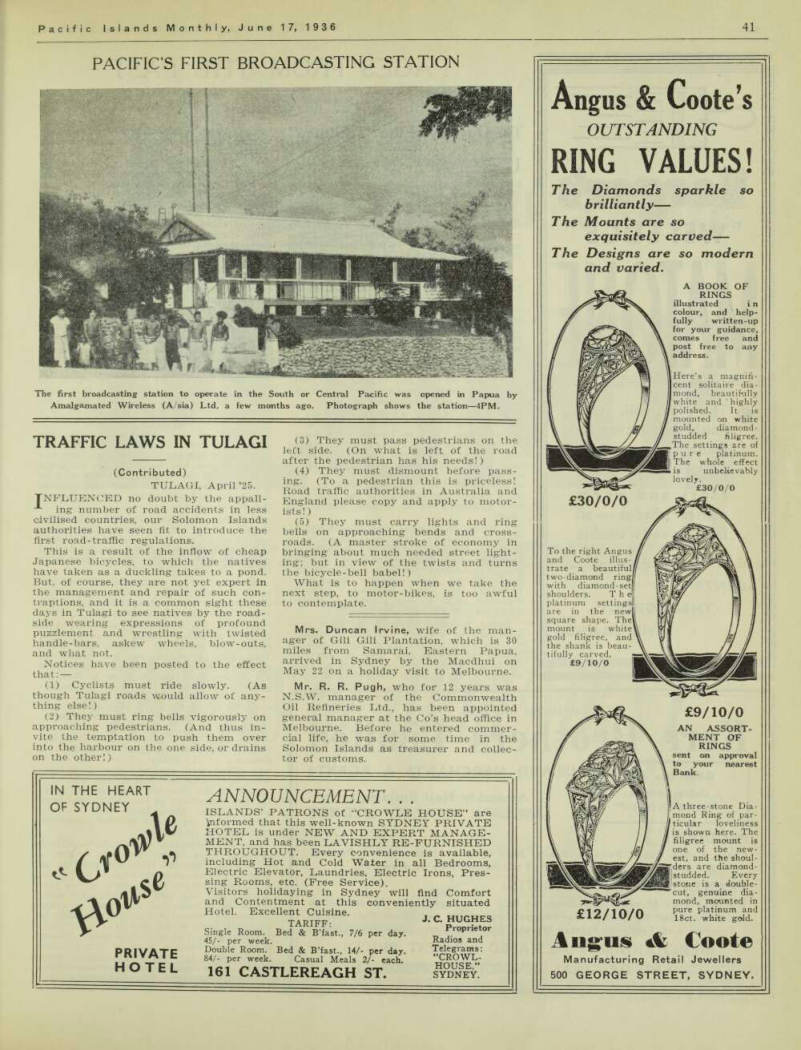
(Contributed) TULAGI, April *25.
TNFLUENCED no doubt by the appall ■*" ing number of road accidents in less civilised countries, our Solomon Islands authorities have seen fit to introduce the first road-traffic regulations.
This is a result of the inflow of cheap Japanese bicycles, to which the natives have taken as a duckling takes to a pond.
But, of course, they are not yet expert in the management and repair of such con traptions, and it is a common sight these days in Tulagi to see natives by the road side wearing expressions of profound puzzlement and wrestling with twisted handle-bars, askew wheels, blow-outs, and what not.
Notices have been posted to the effect that: — (1) Cyclists must ride slowly. (As though Tulagi roads would allow of any thing else!) (2) They must ring bells vigorously on approaching pedestrians. (And thus in vite the temptation to push them over into the harbour on the one side, or drains on the other!)
(3) They must pass pedestrians on the left side. (On what is left of the road after the pedestrian has his needs!) (4) They must dismount before pass ing. (To a pedestrian this is priceless!
Road traffic authorities in Australia and England please copy and apply to motor ists!) (5) They must carry lights and ring bells on approaching bends and cross roads. (A master stroke of economy in bringing about much needed street light ing; but in view of the twists and turns the bicycle-bell babel!) What is to happen when we take the next step, to motor-bikes, is too awful to contemplate.
Mrs. Duncan Irvine, wife of the man ager of Gili Gili Plantation, which is 30 miles from Samarai, Eastern Papua, arrived in Sydney by the Macdhui on May 22 on a holiday visit to Melbourne.
Mr. R. R. Pugh, who for 12 years was N.S.W. manager of the Commonwealth Oil Refineries Ltd., has been appointed general manager at the Co’s head office in Melbourne. Before he entered commer cial life, he was for some time in the Solomon Islands as treasurer and collec tor of customs.
Advertisements & other items, pp. 43-44 (1 item)
Angus & Coote’s
OUTSTANDING
RING VALUES!
The Diamonds sparkle so
brilliantly —
The Mounts are so
exquisitely carved —
The Designs are so modern
and varied.
A BOOK OF
RINGS
illustrated i n colour, and helpfully written-up for your guidance, comes free and post free to any address.
Here’s a magnificent solitaire diamond, beautifully white and highly polished. It is mounted on white gold, diamond studded filigree.
The settings are of pure platinum.
The whole effect is unbelievably lovely. £3O/0/0 £3O/0/0 To the right Angus and Coote illustrate a beautiful two-diamond ring, with diamond-set] shoulders. T h platinum setting are in the new square shape. The' mount is white gold filigree, and the shank is beautifully carved. £9/10/0 m m £l2/10/0 £9/10/0
AN ASSORT-
MENT OF
RINGS
sent on approval to your nearest Bank.
A three-stone Diamond Ring of particular loveliness is shown here. The filigree mount is one of the newest, and the shoulders are diamondstudded. Every stone is a doublecut, genuine diamond, mounted in pure platinum and 18ct. white gold.
Aliens A Coote
Manufacturing Retail Jewellers
500 GEORGE STREET, SYDNEY.
IN THE HEART
OF SYDNEY
/ ° ..se
PRIVATE
HOTEL
ANNOUNCEMENT. . .
ISLANDS’ PATRONS of “CROWLE HOUSE’' are
informed that this well-known SYDNEY PRIVATE HOTEL is under NEW AND EXPERT MANAGE- MENT, and has been LAVISHLY RE-FURNISHED THROUGHOUT. Every convenience is available, including Hot and Cold Water in all Bedrooms, Electric Elevator, Laundries, Electric Irons, Pressing Rooms, etc. (Free Service).
Visitors holidaying in Sydney will find Comfort and Contentment at this conveniently situated Hotel. Excellent Cuisine.
TARIFF:
Single Room. Bed & B’fast., 7/6 per day. 45/- per week.
Double Room. Bed & B’fast., 14/- per day. 84/- per week. Casual Meals 2/- each.
161 CASTLEREAGH ST.
J. C. HUGHES
Proprietor Radios and Telegrams;
“CROWL-
HOUSE,”
SYDNEY.
i E «
"WIT EDGE "
The flat, oil, wall finish that leaves no brushmarks.
Made in lovely pastel
tints and warm neutral shades all fadeless and washable
AGENTS
THROUGHOUT
THE ISLANDS
Established N.H. 1894
Kerr Brothers Limited
ISLAND MERCHANTS & AGENTS
Assembly Hall Building,
1 JAMIESON STREET, SYDNEY
PRODUCE:
Cacao, Coffee, Copra, Peanuts, Shell: Ship to us for best returns. Produce shipped overseas on behalf of clients and may be drawn on.
PLANTATION REQUIREMENTS:
We have over 40 years' experience to help you. Agents for Cacao, Coffee and Castor Seed Machinery; Agricultural Implements and Power Cultivators; Tractors and Trailers; Paints; Marine, Fire and Earthquake Insurance.
MERCHANDISE PURCHASED AT BEST PRICES
AND ORIGINAL INVOICES SUPPLIED
G.P.O. Box 3838 T
Cable Address:
“CARE SYDNEY"
Pages From The Past
The Odyssey of the “Takitumu”
By Julian Hillas
TJNRECORDED in Lloyd’s Register and commanded for the greater part of her three years afloat by a ticketless skipper, the 97-tons schooner Takitumu was from first to last enveloped in a Gilbertian atmosphere of light opera.
Even on her final and most spectacular voyage this same air of semi-comedy was inextricably mixed with hair-breadth escapes and quasi-tragedy.
Five and forty years ago communication between Rarotonga (Cook Islands) and New Zealand was irregular and uncertain, and although a ready market for Islands oranges lay waiting in that Colony, the fruit itself often lay rotting on the ground 1800 miles away. To rectify this the in habitants of Ngatangiia village deter mined to build a vessel of their own. A mass meeting was called and there it was decided to carry out their project with the aid of an old but experienced boat builder named Rapu, a native from the Austral Island of Rimatara.
This settled, the whole district set to work felling timber, tamanu for ribs, moto for the keel. But as horses were scarce in those days trees cut on the mountain side had to be dragged to the settlement over roads little better than rough tracks through the bush. Men, women and children worked together, and as the days passed the skeleton of the new ship rose gradually on a crudely improvised “bed.”
A cargo of oranges was despatched to New Zealand by Captain Goodwin with instructions to spend the proceeds on planking and other necessities. Return ing to Rarotonga, Goodwin’s schooner ran foul of the reef opposite Ngatangiia harbour and the villagers dismally watched their timber pound to match wood on the knife-edged coral.
Delay followed delay. Another con signment of oranges left and eventually the planking arrived back. Meanwhile an anchor and cable had been acquired by the simple expedient of salvaging both articles from Captain Goodwin’s ill-fated
vessel. From a second wreck in Mangaia rigging, shrouds and a wheel were also obtained.
As the time for launching drew near a large clumsy structure was erected out of ironwood trees on the shore of a small motu opposite the proposed slipway. For days men peeled, scraped and twisted purau bark, knotting it into lengths and joining these together until a great rope, thick almost as a man’s body, stretched from the ship to the capstan, a distance of some two or three hundred yards.
To bring the vessel from the perpen dicular on to her side Rapu hit upon a novel and ingenious method. Scores of inario plants—a tall, thick and succulent stemmed variety of banana —were cut and placed against the starboard side of the schooner. A man with a hammer was assigned to each plant and at the order “Patia!” (Strike) the whole row simul taneously struck the upper ends of the spongy textured marios. Imperceptibly the ship listed over. “Patia!” —and the hammers swung again, only this time they struck lower, and as the blows were repeated the vessel slowly sank on to a prepared carriage of logs.
Pulling on the rope and using the trunks of trees for rollers it took the villagers a further four days to drag her to the edge of the lagoon wheare with one last turn of the clumsy capstan still to go, work was stopped and preparations begun for a feast which was to include the entire island.
On the night before the launching, cooking fires blazed among the palms, native ovens dug in the sandy soil glowed red, and the squealing of hundreds of pigs gradually gave place to the pungent fatty odour of roasting pork.
Next day, with songs and dancing and amid scenes of the wildest enthusiasm the capstan bars were manned and the vessel launched into deep water.
At first the Takitumu carried oranges to New Zealand, trading her cargoes for copper to plate her bottom and sides.
But, this attended to, her numerous owners now felt it incumbent upon them to accompany the ship on a tere, or gigantic picnic party, around the neigh bouring islands, taking with them a large selection of native mats, coconut oil, soap and other articles as gifts for their respec tive hosts.
The first port of call was Mangaia, which they reached after seven days—a distance of 118 miles! There, what with one thing and another, the junketings were so protracted that at the end of a month all the presents originally intended for the remainder of the Group had been given to the Mangaians, and the tere, ashamed of its empty-handed condition, returned to Rarotonga.
But before setting out again, important changes were made. Captain Rennie, a European, resigned from his position as Master and his place was taken by Tuaua, a former member of the crew whose am bitions had led him to study the rudi ments of seamanship and such pickings of nautical knowledge as he was able to abstract from books and charts formerly belonging to Captain Goodwin. Tuaua must have been a man of considerable intelligence, for when objections were made to his taking out the schooner he promptly appeared before Captain Emil Piltz, who passed him as competent.
Steering for Mauke Island, the Takitumu sailed cheerfully across empty seas for five days! Shortage of food then causing anxiety to the picnic party, a general meeting was called of all passengers, amongst whom were two master mariners, old Rapu, the builder of the ship, and a half-caste, Ben Cummings.
It then transpired that three separate courses were regularly set, and by following each in turn the Takitumu had been zig-zagging energetically across the Pacific!
Somewhat dismayed by this state of affairs the meeting ordered Rapu and Cummings to “lay off,” with the result that two days later Tuaua brought the vessel safely and accurately to Aitutaki.
Thence, by easy stages, the tere circum navigated the lower Cook Islands, finally returning home. Thereafter, for the next couple of years, the Takitumu ran be tween the Cook, Austral and Society Groups, making periodical calls at Tahiti, Rurutu and Rimatara.
At this time the reefs of Penrhyn—7oo
odd miles north from Rarotonga—were well-known as an ocean cemetery for careless or unwary sailors, and on the atoll’s boulder strewn beaches lay a veritable lumberyard of valuable timber which the thrifty islanders, having no usk for it themselves, were always willing to trade for fresh foodstuffs such as could not be raised on their own sparse sandy soil.
In July, 1894, the Takitumu spread her now weather-worn canvas and with a cargo of mape nuts, taro, kumura, kape, yams and bananas sailed for Penrhyn on what eventually turned out to be her last and lengthiest voyage.
Fair breezes sped the schooner north to within 80 miles of her destination, where they left her becalmed until the morning, several days later, when a squall suddenly blew two of her three jibs into shreds, heeled her over at a dangerous angle, placing such a strain upon the remaining canvas that before sail could be reduced the forestay carried away and the mainsail was also in tatters.
Running before the wind in a south westerly direction, all hope of beating back to Penrhyn was quickly abandoned, and Tuaua wisely decided to set a course which he fervently hoped would bring them to Samoa.
For weeks they drifted helplessly with patched and inadequate sails. Sometimes the wind blew strongly, and sometimes it scarcely blew at all. Meanwhile they lived upon the provisions intended for the Penrhyn islanders.
Nukunono, in the Tokelau Group, was the first land to be sighted. A low atoll, it appeared towards evening as a faint green smear on the horizon. Working round to the lee side of the island the schooner fell in with a large fishing canoe whose nearly naked occupants were easily persuaded to come aboard where they speedily succumbed to the novel charms of a mouth organ. This so captured their fancy that hauling up their canoe they prepared to “make a night of it.”
In the morning Nukunono had dis appeared. Fortunately, however, a light wind sprang up and by noon the tops of the trees were again visible. Steering for these, Tuaua and one of the crew paddled off with their new friends, reach ing land at 4 a.m. Next day the schooner stood in close to the reef whilst most of those on board went ashore, where a lone Portugese trader presented them with a bale of gunny sacks and several balls of twine for substitute sails, and, the natives having also contributed a number of rau ara mats for the same purpose, the Takitumu continued on her way, arriving at Fakavao in the same Group twenty-four hours later. There she obtained a further supply of sacks and mats.
From Fakavao they made Puka Puka, after endless trouble with their sack and matting sails. The former split under the least strain while the later chafed constantly so that they were forever obliged to be at work sewing and patch ing up the damage.
At Rakahanga, which they visited next, the entire ship’s company spen,t four days ashore, leaving the vessel in charge of a 14-year-old boy and a volunteer crew of local natives!
At last, five months after setting out from Ngatangiia, the Takitumu limped into Penrhyn lagoon, cargoless and crippled. They were able to borrow an other mainsail and replenish their sup plies. With these, and a fair wind, they then started on the last 700-miles lap.
Five days later the mountains of Raro tonga rose above the horizon and soon the voyagers were able to distinguish the
buildings in Avarua settlement. Food stuffs were now divided out equally, but just as all hands were preparing to make harbour the wind suddenly veered and the Takitumu commenced a backward and forwards manoeuvre which continued for exactly a month, each evening the wind bringing her within view of land and each morning dropping her back out of sight of those onshore. Finally, with their provisions almost finished, a half gale blew them 140 miles out to sea, where they fell in with a three masted barque bound for Australia. Fortified by a gift of flour, potatoes and kerosene they struggled back under two sails, only to be in imminent danger of repeating their previous will-o’-the-wisp performance.
During the night, a number of whale boats put out from shore to investigate a phenomenon which had begun to worry the islanders, and in the morning the Takitumu found herself surrounded and boarded by friends who had long since given her up as lost at sea. One boat was despatched to shore and, having re turned with a new set of sails, the schooner entered Ngatangiia passage on a Sunday, seven months to a day from the time of her departure. Tuaua and his crew were met by wives and daughters whose hair had been cut short in mourn ing, but whose grief had fortunately prevented them acquiring fresh husbands.
Two weeks later, a hurricane smashed down on the island and the Takitumu, at anchor in Ngatangiia harbour, was driven ashore and there quickly battered to pieces by the great waves which thun dered across the lagoon. Thus ended, in a little over three years, the career of the first and only vessel of any size to be built in Rarotonga entirely by nativfe labour.
Advertisements & other items, pp. 45-46 (1 item)
An hour’s drive
o
on
CONVERTS VO QUICKER
THAN
mm
VACUUM OIL COMPANY PTY -
LTD.
SHIP CHANDLERY - HARDWARE
BROOMFIELDS LIMITED, 152 Sussex St., SYDNEY
Large and Complete Stocks of SHIP CHANDLERY.
Ironmongery of all kinds—Paints, White Lead and Oils.
Sole Agents for: P. H. MUNTZ & CO.’S 3-CROWN BRAND METAL SHEATHING.
PEACOCK & BUCHANS’ ENGLISH READY-MIXED PAINTS.
WRITE FOR SHIP CHANDLERY CATALOGUE
Special “In Bond” Prices for all Island enquiries quoted on application
CABLES: "BOOM,” SYDNEY
HA ICICI WEST - - Sydney’s Sailmaker * ?
RL m
SECTION OF OUR SAIL LOFT
Caters for every class of
SAIL, CANVAS,
ROPE & WIRE
EQUIPMENT
Send your enquiries to us
ADDRESS;
BALMAIN,
SYDNEY
Scott’s Renown Brand Rope,
Cordage and
Cable Address: Ropeyard, Sydney.
Binder
Twine
of Every
Description
MANUFACTURED AT
MASCOT, N.S.W.
By
J. Scott Ltd.
Head Office and Store:
163 CLARENCE ST..
SYDNEY, N.S.W.
New Guinea
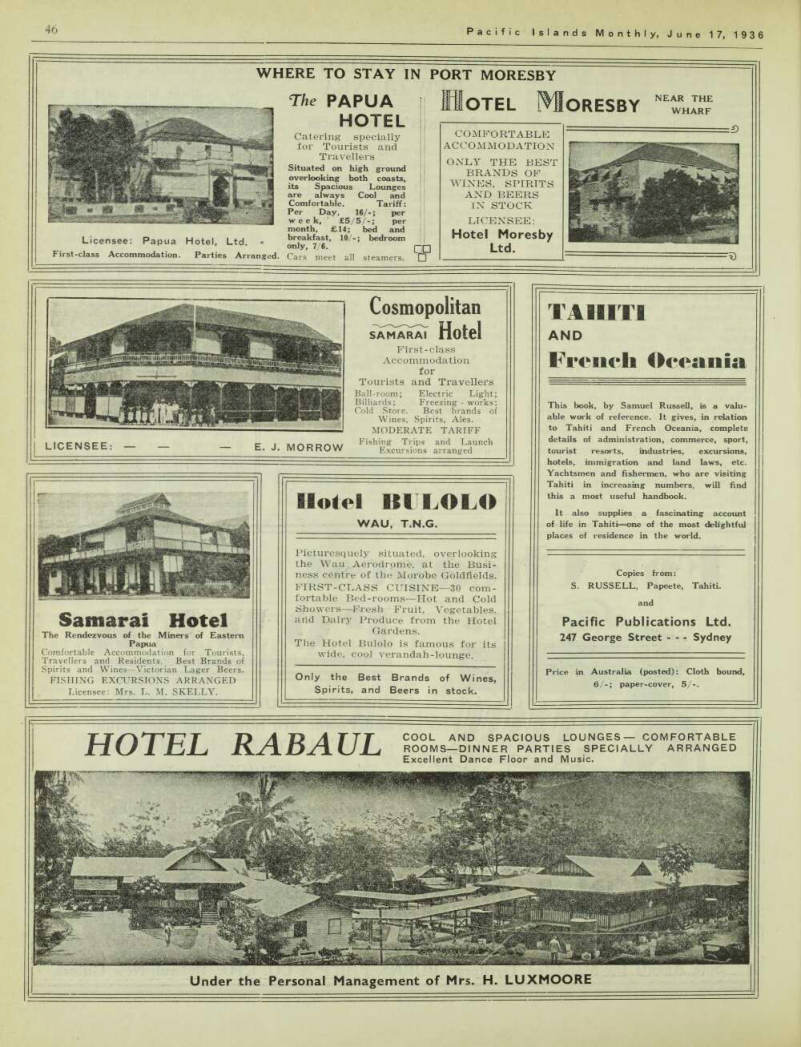
Cocoa-Growing In
A Planter’s Experiences
Letter to the Editor APROPOS your article on “Cocoa- Growing in New Guinea,’’ in the February issue, I would like to make the following observations.
Firstly, the cocoa-growers in this Ter ritory are most appreciative of the Com monwealth bounty. It has been, and is, a great help in establishing a badly needed new industry, and has stimulated an interest in a crop which could be grown here on a large scale, and which would be a valuable alternative to copra at its recent IoV prices. As to whether the grower gets the full benefit of the bounty, it is a debatable point.
The main thing, as the Department of Agriculture and some growers realise, is to turn out an improved bean, which will fetch a good price on any market, and to keep on improving, by means of careful selection and budding etc. Work is being done on these lines at this moment.
The present output, which is very small, comes from only a few sources, and some of it is not cured any better than Accra beans. This is apt to give all New Guinea beans a bad name. Some growers, however, have gone to a lot of trouble and expense to improve the quality of their product by looking around in other tropical countries, and by obtaining advice from officers of the Department of Agriculture and from Mr.
Tyler, the General Manager of Nestle’s factory at Abbotsford, N.S.W., and acting on that advice.
The resultant prices paid by Sydney buyers for these improved beans have not been encouraging; in fact, £A3I/10/ per ton was paid the writer for his last shipment of tons of carefully cured, sundried, and polished beans. This is no better than the ruling Accra price, and to rate them with native-cured Gold Coast cocoa is certainly disappointing. Recent quotes for good New Guinea beans from overseas have been round the £A4S mark, which is about the present price of Trinidad cocoa.
It would appear that if one realises £ 32 plus £ll bounty per ton in Australia for a bean which would sell at about £45 overseas, the person who benefits most by the bounty is the buyer, who is gett ing a good bean at Accra price.
But, having established connections in Australia, and having regard to the bounty, not to mention the help and ad vice from Mr. Tyler and Mr. Foreman, Nestle’s factory manager and chief chem
ist respectively, in Sydney, one would prefer to sell one’s beans in Australia if possible, and to hope that eventually they will be recognised as superior quality.
Grading, by the way, is done very thor oughly at the factory, and it is not necessary for the grower to do this, un less some of the overseas markets prefer it. Likewise, washing is generally con sidered undesirable, as it tends to weaken the shell, and the loss of weight is con siderable.
Since copra slumped, nearly 2,000 acres of cocoa have been planted in New Guinea, and most of it has yet to reach bearing stage. The demand in Australia is between 6,000 and 8,000 tons per an num; the yield from the above area is not likely to exceed 500 tons per annum, so there is ample scope for expansion in planting.
The industry is likely to expand, and if grafting and budding can do anything to improve the quality, which it must do, New Guinea cocoa-buyers may one day command a really good price on any market. The industry is yet in its in fancy and is bound to have its difficul ties.
I am. etc.,
U. S. Hore-Lacy.
Garua, Talasea, New Guinea, 10/5/36.
Advertisements & other items, pp. 47-48 (1 item)
For Cheapest
W. M. FORD
Ship, Yacht & Boat Builder
Berry’s Bay, North Sydney
(Established 1870) BUILDERS of all kinds of Island Craft from Dinghies to Auxiliary Schooners of any tonnage. New and Second-hand Island Craft of various types in stock. New and Secondhand Full Diesel, Crude Oil, Benzine and Kerosene Engines.
Please Send on Your Enquiries
For Cheapest
POWER
Thousands of Users of Electric Light and Power are now using cheap fuel
oil in RUSTON OIL ENGINES.
<s Phenomenal SAVINGS are Reported Horizontal and Vertical Types,
10 -1200 B.H.P.
WRITE FOR PARTICULARS
RUSTON & HORNSBY (AUST.) PTY. LTD.
Registered Office: 174-180 KING STREET, MELBOURNE Cables; M “^ n N e SBYS "
Branches at SYDNEY (642-4 Jones St.) and BRISBANE (Barry Parade) Cables: “RUSTHORN,” Sydney Cables: “RUSTON - HORNSBY,” Brisbane Sole Agents for Mandated Territory: BURNS, PHILP & CO. LTD., Rabaul, New Guinea R R
WHERE TO STAY IN PORT MORESBY
Licensee: Papua Hotel, Ltd. • First-class Accommodation. Parties Arranged.
The PAPUA
HOTEL
Catering specially for Tourists and Travellers Situated on high ground overlooking both coasts, its Spacious Lounges are always Cool and Comfortable. Tariff: Per Day, 16/-; per week, £5/5/-; per month, £l4; bed and breakfast, 10/-; bedroom only, 7/6.
Cars meet all steamers.
r cP
OTEL
Moresby
COMFORTABLE
ACCOMMODATION
ONLY THE BEST
BRANDS OF
WINES, SPIRITS
AND BEERS
IN STOCK
LICENSEE:
Hotel Moresby
Ltd.
NEAR THE
WHARF
LICENSEE:
E. J. MORROW
Cosmopolitan
SAMARAI Hotel
First-class Accommodation for Tourists and Travellers Ball-room; Electric Light; Billiards; Freezing - works; Cold Store. Best brands of Wines, Spirits, Ales.
MODERATE TARIFF
Fishing Trips and Launch Excursions arranged
TAHITI
AND
French Oceania
This book, by Samuel Russell, is a valuable work of reference. It gives, in relation to Tahiti and French Oceania, complete details of administration, commerce, sport, tourist resorts, industries, excursions, hotels, immigration and land laws, etc.
Yachtsmen and fishermen, who are visiting Tahiti in increasing numbers, will find this a most useful handbook.
It also supplies a fascinating account of life in Tahiti—one of the most delightful places of residence in the world.
Copies from: S. RUSSELL, Papeete, Tahiti. and
Pacific Publications Ltd.
247 George Street - - - Sydney Price in Australia (posted): Cloth bound, 6/-; paper-cover, 5/-.
Samaral Hotel
The Rendezvous of the Miners of Eastern Papua Comfortable Accommodation for Tourists, Travellers and Residents. Best Brands of Spirits and Wines —Victorian Lager Beers.
FISHING EXCURSIONS ARRANGED
Licensee: Mrs. L. M. SKELLY.
Ilotol KILOLO
WAU, T.N.G.
Picturesquely situated, overlooking the Wau Aerodrome, at the Business centre of the Morobe Goldfields.
FIRST-CLASS CUISINE—3O com-
fortable Bed-rooms—Hot and Cold Showers —Fresh Fruit, Vegetables, arid Dairy Produce from the Hotel Gardens.
The Hotel Bulolo is famous for its wide, cool verandah-lounge.
Only the Best Brands of Wines, Spirits, and Beers in stock.
HOTEL RABAUL
COOL AND SPACIOUS LOUNGES— COMFORTABLE
ROOMS—DINNER PARTIES SPECIALLY ARRANGED
Excellent Dance Floor and Music. □ Under the Personal Management of Mrs. H. LUXMOORE
Some Practical Hints for Cocoa-Growers
Cocoa-Growers
Letter to the Editor T NOTE in your February issue that you have, and rightly so, opened up the question of cocoa production in New Guinea. In the course of your admirable article you touch on that vexed question of grade. As cocoa-beans are produced by only small planters, it naturally fol lows that everyone producing must have a different grade, and also, as the beans are sold as New Guinea, the poorest quality is made the basis for price.
In 1916/17 I was a buyer on the Gold Coast for a large European firm, and although all the beans were entirely pro duced by natives, their slipshod methods seemed to produce a finished article, almost of one standard. This was be cause the native, in his elementary way, had learned one method only, and as this system was passed on to other districts, the fermentation and curing enabled one standard (which was very low, however) to be shipped. Later, I went to Java, and found the methods adopted entirely different; whilst Ceylon, with its hand picked ultra-washed product, seemed to be the most expensively produced article of all. And it paid them, because Ceylon was always a high-priced product.
The London buyer is a difficult person to satisfy, and some of their likes and dislikes are often difficult of under standing. For a long time, one of the buyers of a large corporation thought washed was always worth 10 per cent, more than unwashed. Then for some reason, known only to himself, he switched right over to unwashed and re fused to say why. Some other buyers said that what you gain in weight by purchasing washed, you lose in flavour; and a number plumped for Venezuelan varieties on account of the flavour.
Samoan was always looked on as being excellent, but the dozens of different brands caused the buyers to fight shy. It therefore behoves the Government of the Territory of New Guinea to see that all
cocoa is standardised, and this may be done by the installation of central fer menting depots, with a proper method of fermentation, so that the beans, once they leave the boxes for the dryer, be it sun or hot-air, are full and free of acid.
The temperature in the boxes must be closely watched, as well as the tempera ture of the day. Cold weather, be it only of a few hours’ duration, retards the fer mentation. Altitude is another important factor. Hot steamy days assist.
It is also most helpful to see that noth ing but wood touches the beans —I mean from the time they are put into the fermenting boxes, until bagged for ship ment. The drying shed, if curing is done by machinery, must have a non-corrosive paint on the ceiling, if made of cor rugated iron; whilst the surroundings of the curing house should be boarded. As
the cocoa falls from the drums, it must on no account be allowed to meet cement, on account of the sweating- Wood floors are best.
Also, it helps the bean considerably if allowed to “cool off” a couple of days be fore being finally shipped.
One other important thing is grading.
A grader costs very little and pays for itself in a few months.
From my experience, I am certain that if a central station is provided, or if necessary several depots, where a mini mum tonnage is available, and all fermenting and curing is done according to rules laid down (which should be suitable to the location) better prices and no complaints would be received.
I am, etc..
Old Planter.
London, April 10, 1936.
Advertisements & other items, p. 49 (1 item)
Over 30 Years Ag*o..
MASTER SEWING MACHINE CO.
ESTABLISHED FOR 23 YEARS
Reconditioned
SEWING MACHINES
For Industrial and Household use.
All Types for Sale.
From £3 Each
Every Machine Guaranteed Mechanically Perfect.
We have the most complete range of Sewing Machines in New South Wales.
Repairs promptly attended to by Competent Mechanics.
Let us know your requirements.
We will be pleased to quote by return mail.
No Delays All Goods Carefully Packed
Master Sewing Machine Co.
15 Enmore Road. Newtown, Sydney
Over 30 Years Ag*o..
The first Younger Stove was exported to the Pacific Islands.
Ruggedly strong in construction, highly efficient and economical in fuel has made them the most popular stove in the
South Seas.
The illustration shows a Younger Single Stove. Special stoves with cast iron ovens for Island requirements made to order.
Write us for quotations for special sizes and catalogue of double and single oven stoves. •
G. Fletcher & Son
50 OXFORD STREET, SYDNEY
Civilisation’S Progress On Show
PACIFIC Islanders going abroad in the near future would be wise to include in their itinerary visits to two huge fairs in America— the California Pacific International Exposition at San Diego now open until September 9, and the Canadian National Exhibition at Toronto between August 28 and September 12.
Life in the South Seas has its compensations, but residents find it difficult to keep abreast of the rapid progress of mankind in industry, art and science: a visit to these great shows will awe one with the wonders of the age.
The Californian exposition portrays the revolu tionary advancements in every phase of human endeavour. The gigantic Ford Building of 1935 houses the history of transportation, includng the gondola of the National Geographic Society’s stratosphere flight of last year.
Canada’s exhibition has been described as the “Show Window of the Nations.” From a small and comparatively obscure fair in 1897, it has transformed into a national yearly event, with sidelines of pageantry and sport on a stupendous scale. The exhibition illustrates four centuries of Western progress in science, industry, commerce, agriculture, art. and education.***
Another Strange Ship
French Adventurer Builds Another Strange Ship Capt. de Bisschop to Continue His Research Work in Pacific
ANOTHER unusual craft to sail the South Seas is being built in Hawaii by Captain Eric de Bisschop, the French adventurer, who with a companion, Mon sieur Joseph Tatibouet, has been study ing ocean currents in the Pacific for the last three years.
It will consist of two 30 ft. canoes joined by decking, on which will be two masts. Bach canoe will contain a small cabin. The ship will be propelled by bat wing sails not unlike those of a Chinese junk.
The ocean rovers previously used a queer junk-like craft called the Fou Po, in which they sailed from Papua to the Marshall Islands and thence to Haw'aii. where it was lost in December last. Their arrival in Hawaii was almost a tragedy.
After suffering for 15 days from lack of food, they came in sight of Molokai. Then a sudden storm wrecked the vessel, des troying their books, instruments, records, manuscripts, charts, and specimens. The two Frenchmen managed to get ashore, and eventually were taken to Honolulu.
The cost of the new ship is being met partly by a prize of 6,000 francs awarded to the travellers by the French Geographical Society for their research work. When the craft is completed the two Frenchmen will sail again for the South Pacific hoping to throw some light on one of the greatest mysteries of the
South Seas —the origin of the Polynesian race. Capt. de Bisschop will attempt to prove his contention that the Polynesians did not come from Asia.
Captain de Bisschop bases his ethno logical theories largely upon a study of ocean currents. His research in the Pacific has convinced him, he said, that the prevailing currents are from east to west. The currents move with such force, he stated, that it is impossible to sail directly against them. They can only be circumvented by the intricacies of modern navigation. It is chiefly upon this general observation that he believes the Polynesians migrated with the cur rents, east to west.
Nauru’S Trade Increases
NAURU, the small island territory in the Central Pacific which is admin istered by the British Empire (Australia, New Zealand, and Great Britain) under mandate from the League of Nations, experienced a marked increase in trade, both in exports and imports, during 1935, according to the annual report of the Administrator (Commander R. C. Garsia) which was tabled in the House of Re presentatives at Canberra on May 22.
At the end of the year the accumulated funds of the Administration amounted to £29,560. Only once in the past six years has expenditure, in Nauru exceeded re venue. That was in 1931 when there was a shortage of £463.
Mr. Don. W. McMillan, wireless operator at the A.W.A. station, Rabaul, New Bri tain. returned from leave in Australia by the May Montoro.
Advertisements & other items, p. 50 (1 item)
Help Kidneys
Don’t Take Drastic Drugs
Your kidneys have nine million tiny tubes or filters which are endangered by neglect or drastic, irritating drugs. Beware ! If Kidney trouble or Bladder weakness makes you suffer from Getting Up Nights, Leg Pains, Nervousness, Dizziness, Stiffness, Rheumatism, Lumbago, Circles Under Eyes, Swollen Ankles, Neuralgia, Burning, Itching, Smarting, Acidity or Loss of Vigour, don’t delay.
Try the Doctor’s new discovery called Cystex (Siss-tex). Soothes, tones, cleans, and heals sick kidneys. Starts work in 15 minutes. Brings new health, youth and vitality in 48 hour?. Cystex costs little and is guaranteed to end your troubles in 8 days or money back. Price 4/-, all Stores and Chemists. SCHAFFER & CO., 189 Clarence Street, Sydney.
Islands Merchants
want to know WHERE TO RET
• RATTAN SUIT CASES (coloured or plain)
• IMITATION LEATHER and PAPER SUIT-CASES
• WOODEN SUIT-CASES IN ART PAINTING
• PLAIN WOODEN SUIT-BOXES and
TRADE WOODEN BOXES
® CAMPHOR-WOOD BOXES (carved or plain)
• SHIRTS, TIES, and SHORT TROUSERS
WE ARE MANUFACTURING AND EXPORTING to meet the requirements of ISLANDS TRADE.
WE ARE also Exporting Agents for SHUN LOONG RATTAN FURNITURE; LION brand FLASH-
LIGHT TORCHES and BATTERIES.
WRITE FOR our LATEST PRICE LISTS, or send a TRIAL ORDER addressed to—
ALOIS AKUN & COMPANY
180 NATHAN ROAD, KOWLOON, HONGKONG
The House of Prompt & Efficient Service services of all descriptions Telegram: “ALOISAKU N” Codes: BENTLEY’S
MAKE US
YOUR
HONGKONG
& SOUTH
CHINA
OFFICE
Fibre Goods
Chance for Papua and New Guinea
AMOVE is being made to introduce into Australia cheap manufactured fibre goods from Ceylon. At present most of the fibre goods which Australia imports come from India. The fibre used by the Indian manufacturers, however, comes from Ceylon, and the Ceylon Coconut Board is now investigating the possibili ties of exporting Ceylon-manufactured goods direct to the Australian market.
Here is an opportunity for Papua and New Guinea. Australia’s imports of fibre goods amount to something like £lO,OOO worth a year, and instead of importing this volume of manufactured goods each year she could obtain the fibre direct from her own Islands territories, from the by products of the copra industry.
At present the copra industry in Papua and New Guinea uses only the kernel of the coconut; from a commercial point of view, the fibre is largely considered to be waste. It could be brought to Australia and turned here into cordage, twine, brushware, matting and other fibre goods.
Not only would this benefit the Pacific territories, but it would eliminate the necessity for importing in such large quantities and furthermore would provide employment for Australian workmen.
Fiji-Indian Conditions
Rev. C. F. Andrews Investigates Fiji-Indian Conditions
From Our Own Correspondent
Suva, May 21.
ON a visit of investigation, Rev. C. P.
Andrews, friend of Mahatma Gandhi, and worker for the improvement of con ditions for Indians overseas, arrived in Fiji on May 5. He was enthusiastically welcomed by members of the Fiji Indian Association, and an extensive programme has been planned for him, including visits to practically all Indian settlements on Viti Levu.
His objective on this visit is to inquire into present political questions, with par ticular regard to the constitution and the vexed question of land leases. He has been requested to do this by the Imperial Indian Citizenship Association, and in due course will make a report to that body in India.
Mr. Andrews previously visited the Colony in 1915 and 1917, when his efforts were largely responsible for the abolition of the Indian indenture system. The visitor states that in his opinion the condition of the Indians has vastly improved since his previous visits. He attributes this to a large extent to the suspension of the in denture system, which at various times he has described as “virtual slavery.”
Mr. and Mrs. G. A. Peck left Suva for Auckland on leave by the May Monterey.
Mr. Peck is a Sub-Inspector in the Fiji Constabulary.
Rev. and Mrs. D. E. Ure, of the London Missionary Society, departed for Port Moresby, Papua, by the Montoro on May 6.
Mr. J. Twycross, inspector of Amalga mated Wireless (Australasia) Ltd.’s radio service in New Guinea, arrived in Syd ney from Rabaul on leave by the Nellore on May 21.
Jeanne D'arc
Celebrations At Papeete
From Our Own Correspondent
Papeete, May 12.
THE fete of Jeanne D’Arc was cele brated in Papeete on May 10 with ceremony and a popular enthusiasm much more than customary.
The Roman Catholic Cathedral, decorated with multi-coloured flags, was filled to overflowing when the Governor entered followed by other Government officials. A special service was conducted to the memory of Jeanne D’Arc, daughter of the people, who, in saving her country, sacri ficed her own life and forever endeared
herself to the people of the French nation.
After the mass the crowd proceeded to the Post Office where local garrison troops passed in review before the Govertnor.
These were followed by a detachment of marines and a company of infantry sta tioned at Tahiti under the command of Commandant Jeanpierre, but undoubtedly the most interesting feature of the display was the large mustering of Great War veterans who, preceded by their flags, brought up the rear of the procession, At the head of the veterans was a dis tinguished visitor to Tahiti, M. Roger Barthie, Advocate of the Court of Paris, and founder of the Federation of Inter allied Volunteers, who also led the recent grand parade of the French and British Legions in San Francisco.
Advertisements & other items, p. 51 (1 item)
( Ii I V E H S
A. B. DONALD Ltd.
AUCKLAND
Island Traders :: General Merchants
P.O. Box 1509 :: Cables and Telegrams; “Kingdom,” Auckland Branches at Rarotonga and throughout the Cook Islands At Papeete and throughout the Society, Marquesas and Paumotu Islands
trading as “ETABLISSEMENTS DONALD. TAHITI”
At Fiji: Trading as ‘‘Dominion Fruit C 0.,” Suva
( II I V E H S ■V m y V*
PURE
FOODS
GOLD MEDAL JAMS
CANNED ENGLISH FRUITS
CANNED ENGLISH
VEGETABLES
CUSTARD POWDER
OLD ENGLISH MARMALADE
JELLY CRYSTALS. ETC.
Obtainable from all Leading Grocery Stores -- Write to Department A., Chivers and Sons Ltd., Histon, Cambridge, England, for attractive Recipe Book E. 76
B.P.’S Suva Manager
Retires
From Our Own Correspondent
Suva, May 21.
THERE was a representative gathering of members of the Suva Chamber of Commerce at the Grand Pacific Hotel recently when Mr. A. O. Mackenzie, man ager of Burns Philp (South Sea) Co., who left for Sydney by the Monterey on May 12, was the recipient of a farewell pre sentation of a handsome tortoise-shell desk set.
In the absence of the president of the Chamber (Sir Mlaynard Hedstrom) the vice-president (Mr. T. Horne) presided and made the presentation. Mr. Horne re
ferred to Mr. Mackenzie’s long residence in the colony, stating that he arrived in Levuka in 1914, and had been a vice-pre sident of the Chamber of Commerce there from 1921 till 1926, when he was trans ferred to Suva. He had been a member of the Suva Chamber of Commerce ever since, serving as a vice-president from 1930 to 1934.
Mr. Mackenzie has gone on long leave prior to retirement, and will henceforth reside in Sydney where he will still be connected with the company.
Mr. G. N. Harris, who has been manager of the Levuka branch of the Bank of New South Wales for a number of years, arrived in Australia on transfer by the Niagara on May 16.
Goldfield
Electricity For Fiji
Tavua Power Co.’s Plant Ready by End of Year
Hpayua Power Proprietary
LIMITED, which was formed in April to supply electricity to the Loloma and Emperor mines on the Tavua goldfield, Fiji, was registered in Melbourne in May.
The company announced that it will be ready to supply electrical energy and compressed air at the end of this year.
The company’s consulting engineer (Mr.
F. J. Mars) has designed a power plant capable of generating electricity to treat a very large tonnage, but units to be erected in the first place will be sufficient only to enable the main companies to treat 4000 tons weekly. The equipment is in the process of manufacture in England, where the company’s local consulting engineers (Messrs. Robert Bruce and Sons) are supervising the construction.
The plant will comprise three, each 525 KW. 750 horse power Beiliss and Morcom Diesel A.C. generating sets, and one Bei liss and Morcom Diesel air compressor set, with a capacity of 2000 cubic feet of free air compressed to 90 lb. a square inch, together with a switchboard and acces sories. The units will be added to by the transfer of the present Diesel-driven com pressor in use at the Emperor mine. The building to house the Diesel plant will be constructed of iron and steel fabrication, and clothed with asbestos sheeting.
The site for the proposed power plant has been approved, and the preparatory ground work completed ready for the arrival of the buildings and plant. The first delivery, which will be the building, left England on April 22, and arrange ments have been made for the delivery of the plant in accordance with the pro gramme of erection, Mr. R. P. Kay, who has gained consider able experience in Diesel and electrical engineering, has been appointed electrical engineer in charge of the power station, and will take up duties in Fiji early in August.
Shares in Tavua Power Pty. Ltd. are held by Emperor Mines Ltd. and Loloma (Fiji) Gold Mines, N.L. The board con sists of nominees of the two companies, comprising Messrs. W. H. Smith, E. G.
Banks, A. G. Campbell, T. R. Victor, P. F.
Cody and E. G. Theodore.
Rarotonga
Nurses’ Home Opened at Rarotonga
From Our Own Correspondent
Rarotonga, May 12.
THE new Nurses Home, a much needed addition to the hospital, was officially opened at Rarotonga on May 4 by the Resident Commissioner, Judge H. F. Ayson,
C.M.G.
Referring to the new building which con sists of eight rooms, large airy verandahs, and the usual offices, Judge Ayson paid fitting tribute to the excellent workman ship carried out by the Public Works De partment under Messrs. Reid and Henry Williams.
Mr. G. K. Roth, a District Commissioner in the Fiji Civil Service, was a passenger en route to England by the Niagara on May 8.
Advertisements & other items, p. 52 (1 item)
ansomes *
MORRIS, HEDSTROM, Ltd.
FIJI
Sole Agents in Fiji for . . .
Vacuum Oil Company (Pty.) Limited Imperial Chemical Industries Limited Nobel (Australasia) Pty Ltd.—Explosives
MADE IN 5 WIDTHS...
C U B” PLOUGHS
ii
7-in., 8-in., 9-in.,
10-in. and 11-in. cut.
ansomes *
These ploughs will do good work in new or old land. Ample clearance is provided for ploughing in thick surface growth.
Write for illustrated catalogues and all information.
AGENTS FOR FIJI. SAMOA AND TONGA
MORRIS, HEDSTROM Ltd. Suva, Lautoka & Ba Made by RANSOMES, SIMS & JEFFERIES, LTD., Ipswich, England £2 m
Engendered in Fiji
Wrestling Banned
Inter-Racial Bad Feeling Engendered in Fiji
From Our Own Correspondent
Suva, May 21.
ALL-IN wrestling, which has been in the boom in Suva since the beginning of the year, has been stopped, temporarily at least, by the police, and the five matmen, who have been performing here, left for Australia by the Monterey on May 12.
It is understood that this action was taken on account of a considerable amount of inter-racial bad feeling that had been aroused by the wrestling, owing to the fact that the five wrestlers comprised two Europeans, one Chinese and two Indians.
Throughout the series, the two Indians had the best of the contests, a fact which suited the promoters, for when the Indians were winning, it drew a large audience of their countrymen who, by their numerical strength, proved a better paying audience than the Europeans. If the Indians lost, it was noticeable that there was a smaller attendance.
There is no doubt that there has been a strong undercurrent of bad feeling existent during the series, and on. several occasions it would have taken very little provocation to start several fights in the vicinity of the stadium. Several times the police had to warn the participants with regard to the application of “rough stuff.”
Unfortunately, there is no legislation on the Fiji statute book to govern wrestling, but it is understood that regulations are being framed, in the event of there being any future contests arranged here. These regulations, it is believed, will embody a
clause prohibiting wrestling between European and Indian.
In a colony such as Fiji, this is a very necessary clause, for although in New Zealand or Australia, there might be no objection to Indian wrestlers meeting Europeans, it has to be remembered that those countries have not the large Indian population of Fiji. The effect of the large percentage of Indian wrestling victories on the general rank and file of the less educated class of Indian here has not been a good one.
Party To Visit Easter Is.
From Tahiti
From Our Own Correspondent
Papeete, May 13.
THE three masted schooner Oiseau dcs Isles, a vessel which recently arrived in Tahiti from France to the order of the Makatea Phosphate Co., has been chartered for a special trip to Easter Island, and will leave Papeete towards the end of June.
The itinerary of the voyage includes calls at Mangareva (Gambier Group), Rapa Island, some of the Tuamotu Islands, and possibly Pitcairn, if the weather permits.
It is understood that the party for whom the trip has been arranged will arrive in Tahiti from San Francisco on the June mail steamer.
The Oiseau des Isles is a fast and com fortable vessel of 398 tons, and is equipped with French Diesel engines of 375 horse power as auxiliaries.
Mrs. A. R. Tarte, of Vuna Estate, Taveuni, Fiji, has been holidaying in Sydney with her sister, Miss Beatrice Carr, also from Fiji.
Cliff
Car Hurtles 200Ft. Over
Young Man Killed In Fiji Accident
From Our Own Correspondent
Suva, May 21.
'TVERRIBLE injuries, resulting in his -*■ death later in the day, were received by a young man, Mr. Arthur Murray, aged 23, when the car he was driving hurtled nearly 200 feet down a cliff on the Suva- Rewa road in the early morning of April 28.
There were three other young people, Miss E. Low and Messrs. H. Stackhouse and T. Young, besides an Indian and a Fijian in the car, which was returning to Nausori from Suva, and they had a miraculous escape from death, Mr. Stack house received serious back injuries, but is making a good recovery.
The car left the road on a slight bend and somersaulted over and over down the cliff, coming to rest partly under water in a creek in the gully. It was a closed car, and on the descent the roof was torn open, all the occupants being thrown out, apparently about the last bounce of the vehicle, for they were all found near the car.
Miss Low, who was in the front seat with the driver, had an amazing escape, receiving only a few scratches. Both she and the driver were found unconscious in the creek.
Mr. Murray had been in the Colony only about 12 months, having come from Auck land, New Zealand. He was in the employ of Messrs. Leyland’s butchery at Nausori.
Advertisements & other items, p. 53 (1 item)
Grand
s» * The PREMIER Social Rendezvous of Fiji . . .
Grand Pacific Hotel - - Suva, Fiji EXCELLENT CUISINE. EFFICIENT TRAINED INDIAN WAITERS AND SERVANTS.
MODERNLY EQUIPPED.
Grand
Pad! Ic
Hotel
SU VA.TFIJ I
Delightfully situated in tropical gardens overlooking Suva harbour and the Pacific Ocean.
TARIFF: from 17/6 per Day Accommodation Reserved by wm Wireless Cable address: “Grandpacif,”
Suva.
Fiji Hockey Team May Tour
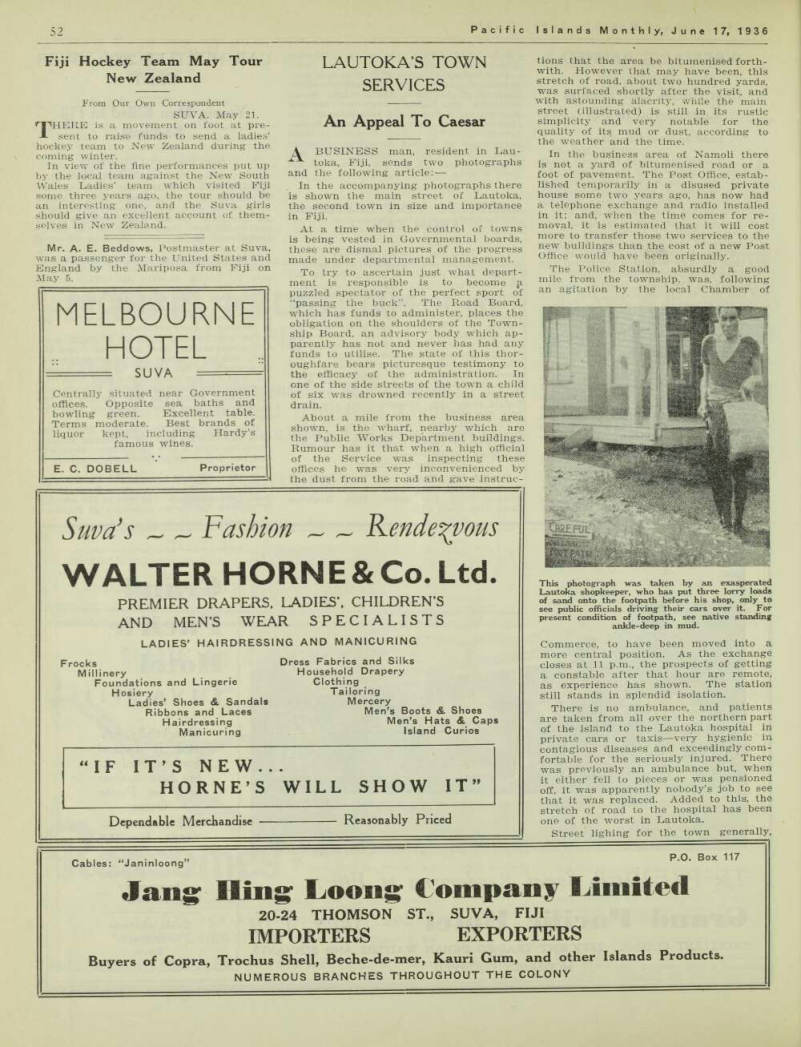
New Zealand
From Our Own Correspondent
Suva. May 21.
THERE is a movement on foot at pre sent to raise funds to send a ladies’ hockey team to New Zealand during the coming winter.
In view of the fine performances put up by the local team against the New South Wales Ladies’ team which visited Fiji some three years ago, the tour should be an interesting one, and the Suva girls should give an excellent account of them selves in New' Zealand.
Mr. A. E. Beddows, Postmaster at Suva, was a passenger for the United States and England by the Mariposa from Fiji on May 5.
Lautoka's Town
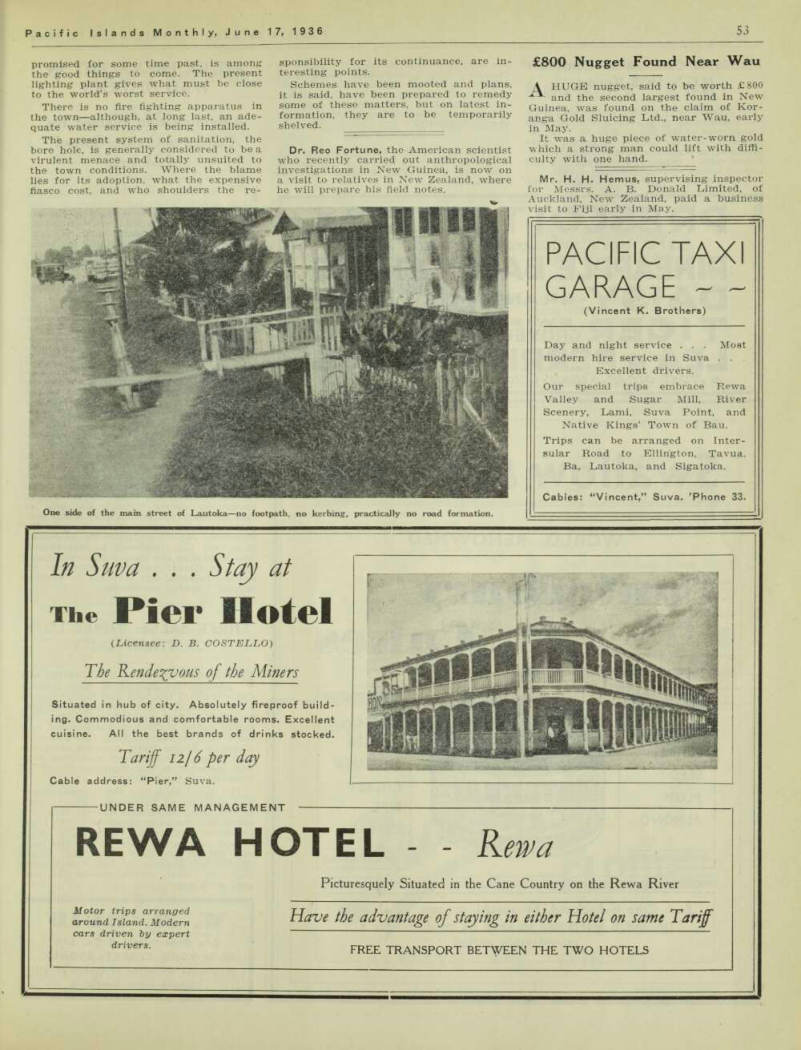
Services
An Appeal To Caesar
A BUSINESS man, resident in Lau toka, Fiji, sends two photographs and the following article: In the accompanying photographs there is shown the main street of Lautoka, the second town in size and importance in Fiji.
At a time when the control of towns is being vested in Governmental boards, these are dismal pictures of the progress made under departmental management.
To try to ascertain just what depart ment is responsible is to become gt puzzled spectator of the perfect sport o*f “passing the buck”. The Road Board, which has funds to administer, places the obligation on the shoulders of the Town ship Board, an advisory body which ap parently has not and never has had any funds to utilise. The state of this thor oughfare bears picturesque testimony to the efficacy of the administration. In one of the side streets of the town a child of six was drowned recently in a street drain.
About a mile from the business area shown, is the wharf, nearby which are the Public Works Department buildings.
Rumour has it that when a high official of the Service was inspecting these offices he was very inconvenienced by the dust from the road and gave instruc
tions that the area be bitumenised forth with. However that may have been, this stretch of road, about two hundred yards, was surfaced shortly after the visit, and with astounding alacrity, while the main street (illustrated) is still in its rustic simplicity and very notable for the quality of its mud or dust, according to the weather and the time.
In the business area of Namoli there is not a yard of bitumenised road or a foot of pavement. The Post Office, estab lished temporarily in a disused private house some two years ago, has now had a telephone exchange and radio installed in it; and, when the time comes for re moval, it is estimated that it will cost more to transfer those two services to the new buildings than the cost of a new Post Office would have been originally.
The Police Station, absurdly a good mile from the township, was, following an agitation by the local Chamber of
Commerce, to have been moved into a more central position. As the exchange closes at 11 p.m., the prospects of getting a constable after that hour are remote, as experience has shown. The station still stands in splendid isolation.
There is no ambulance, and patients are taken from all over the northern part of the island to the Lautoka hospital in private cars or taxis —very hygienic in contagious diseases and exceedingly com fortable for the seriously injured. There was previously an ambulance but, when it either fell to pieces or w'as pensioned off, it was apparently nobody’s job to see that it was replaced. Added to this, the stretch of road to the hospital has been one of the worst in Lautoka, Street lighing for the town generally,
This photograph was taken by an exasperated Lautoka shopkeeper, who has put three lorry loads of sand onto the footpath before his shop, only to see public officials driving their cars over it. For present condition of footpath, see native standing ankle-deep in mud.
promised for some time past, is among the good things to come. The present lighting plant gives what must be close to the world’s worst service.
There is no fire fighting apparatus in the town —although, at long last, an ade quate water service is being installed.
The present system of sanitation, the bore hole, is generally considered to be a virulent menace and totally unsuited to the town conditions. Where the blame lies for its adoption, what the expensive fiasco cost, and who shoulders the re
sponsibility for its continuance, are in teresting points.
Schemes have been mooted and plans, it is said, have been prepared to remedy some of these matters, but on latest in formation, they are to be temporarily shelved.
Dr. Reo Fortune, the American scientist who recently carried out anthropological investigations in New Guinea, is now on a visit to relatives in New Zealand, where he will prepare his field notes.
One side of the main street of Lautoka-no footpath, no kerbing, practically no road formation.
Advertisements & other items, p. 54 (1 item)
Suva’s Fashion Rendezvous
MELBOURNE
HOTEL
SUVA
Centrally situated near Government offices. Opposite sea baths and bowling green. Excellent table.
Terms moderate. Best brands of liquor kept, including Hardy’s famous wines.
E. C. DOBELL Proprietor
Suva’s Fashion Rendezvous
WALTER HORNE & Co. Ltd.
PREMIER DRAPERS. LADIES’, CHILDREN’S
AND MEN’S WEAR SPECIALISTS
LADIES’ HAIRDRESSING AND MANICURING
Frocks Millinery Foundations and Lingerie Hosiery Ladies’ Shoes & Sandals Ribbons and Laces Hairdressing Manicuring Dress Fabrics and Silks Household Drapery Clothing Tailoring Mercery Men’s Boots & Shoes Men’s Hats & Caps Island Curios
“IF IT’S NEW...
HORNE’S WILL SHOW IT”
Dependable Merchandise Reasonably Priced
Cables: “Janinloong” DOX
Jang; Iling Looug* Company I jmhoil
20-24 THOMSON ST., SUVA, FIJI
IMPORTERS EXPORTERS
Buyers of Copra, Trochus Shell, Beche-de-mer, Kauri Gum, and other Islands Products.
NUMEROUS BRANCHES THROUGHOUT THE COLONY
£800 Nugget Found Near Wau
A HUGE nugget, said to be worth £ 800 and the second largest found in New Guinea, was found on the claim of Kor anga Gold Sluicing Ltd., near Wau, early in May.
It was a huge piece of water-worn gold which a strong man could lift with diffi culty with one hand.
Mr. H. H. Hemus, supervising inspector for Messrs. A. B. Donald Limited, of Auckland, New Zealand, paid a business visit to Fiji early in May.
Advertisements & other items, p. 55 (1 item)
Rewa Hotel - Rewa
PACIFIC TAXI
GARAGE - -
(Vincent K. Brothers) Day and night service . . . Most modern hire service in Suva . .
Excellent drivers.
Our special trips embrace Rewa Valley and Sugar Mill, River Scenery, Lami, Suva Point, and Native Kings’ Town of Bau.
Trips can be arranged on Intersular Road to Ellington, Tavua.
Ba, Lautoka, and Sigatoka.
Cables: “Vincent,” Suva. ’Phone 33.
In Suva . . . Stay at
The Pier Hotel
( Licensee : D. B. COSTELLO)
The Rendezvous of the Miners
Situated in hub of city. Absolutely fireproof building. Commodious and comfortable rooms. Excellent cuisine. All the best brands of drinks stocked.
Tariff 12/6 per day
Cable address: “Pier," Suva. m *
UNDER SAME MANAGEMENT
REWA HOTEL - Rewa
Motor trips arranged around Island. Modern cars driven hy expert drivers.
Picturesquely Situated in the Cane Country on the Rewa River Have the advantage of staying in either Motel on same Tariff
FREE TRANSPORT BETWEEN THE TWO HOTELS
N.G.’s 1935 Report
Mandates Commission Considers N.G.’s 1935 Report
THE half-yearly session of the Mandates Commission of the League of Nations commenced at Geneva on May 27. In the presence of Sir John McLaren, who appeared as Australia’s representative, the Commission * considered privately the annual report on New Guinea for 1935.
The Commission has re-elected as its
president the Italian member, the Marchese Theodori, who is attending the session, despite Italy’s abstention from League work. All members of the Commission are appointed in their personal capacity, and not as representatives of their respec tive Governments.
Mr. E. G. Theodore left Sydney for Fiji by the Monterey on May 27 in connection with his goldmining interests on the Tavua field.
Wau District
Fever Prevalent In
Administration Blamed for Failure to Control Spread of Malaria
IT is reported from Wau that malaria A is definitely on the increase in that locality, and there have been a number of bad cases of blackwater fever, which is the sinister attendant of malarial con ditions. The Administration is being criticised for its apparent failure to con trol the spread of malaria in the Wau district.
Malaria always has been present there; but it was hoped with the spread of sanitary conditions and the use of medi cal science it would be controlled, and perhaps stamped out. The New Guinea goldfield lies on a high plateau and is not subject to the humid malarial condi tions of the N.G. coastal districts.
Some critics say that the Health De partment’s representatives in Wau do not give nearly enough attention to the destruction or treatment of possible breeding places for the Anopheles mos quito.
Cases of Japanese river fever continue to be reported and the proportion of fatalities shows no diminution. It is generally accepted in Wau that the in fection comes from the bite of the Mocca parasite, which is picked up in the scrub in the kunai grass. The fever infection apparently comes through the bite of this creature, but only a very small pro portion of the latter appear to give the infection. Japanese river fever, of course, is a very old disease —it is said that it was known in the East a thousand years ago. In its early stages it seems to re semble malaria, but it tends to develop rapidly towards pneumonia.
Three Sales: Three Lots
Of Stamp Duty
PROPERTY known as Kililli, in the ad ministrative district of New Ireland (New Guinea) has been sold three times in a few years, New Britain Plantations Ltd. being the last purchasers. Under the stamp duties ordinance which came into force on February 1, 1928, the Commis sioner of Stamp Duty assessed duty on each sale. The company paid the duty but appealed to the Supreme Court of New Guinea for a decision.
The court held that the Commissioner was empowered to assess duty on each of the three sales and against this de cision the company appealed to the High Court of Australia asking that duty should be charged only on the last sale, and not on the three. The High Court upheld the decision of the New Guinea Supreme Court, and dismissed the ap peal with costs.
Advertisements & other items, p. 56 (2 items)
Canterbury
PRESCOTT L T J? U y S E n X e S^ Q7 c e sole wholesale adenis fdi'--
PINEAPPLE BACON & HANS
DAISY BRAND BUTTER
TIGER
SWISS
CRUYERE
LEA r PERRINS
& Most other Super- Quality lines of the Trade
Swallow & Ariell’s
WORLD RENOWNED
Canterbury
Cake*
FRUIT
PLAIN
SEED
PLUM
ALMOND
net
m
Caice
PRESERVED
GINGER
SULTANA
CHERRY
RIPE
GENOA
Each Cake is Enclosed, by special process, in air-tight tin, and is warranted to keep its condition for a
considerable period
W. 91. Keid
C/o. Robert Reid & Co., Ltd.
32-34 YORK STREET, SYDNEY
Wholesale Exporter of Goods of all Classes from Australia
Housekeeping in the Tropics
Bread
A LOAF of bread. What is there in it? That depends on the baker. It may be full ot all sorts of ill-effects, of which indigestion is the least. Or it may be “the staff of life,” as when made and baked by the housewife who knows “that there is more religion in a loaf of bread, than many think.”
How, then, to make light, nutty, delicious bread, on which the children will thrive and beg for more? Follow these well tried directions and it will be your proud and justifiable boast that your bread is the best in the district.
Choose the right flour. Wheatmeal provides the body with, probably, twice as much mineral salts as does white flour. The latter is also deficient in the all-important vitamins. How, then, can children especially become sturdy and well nour ished, if given devitalised and anaemic-looking white bread? How can they derive robust health and vigour, strong bones, and beautiful teeth, from denatured white bread?
Phosphorus, iron and calcium, very necessary to adults, and vitally so to the children, are found in the bran and the germ, yet these are carefully sieved away in the preparation of white flour, and the life-giving bran, pollard and sharps are fed to poultry and animals. Rickety children are fed on whole-meal bread, preferably to white, because of the mineral-salts so necessary in the cure of their disease.
It is necessary to have the wheat fairly finely ground, in order to make it digestible for children, and also in order that the body may derive maxi mum benefit from the mineral salts. Again, if the flour be finely ground, it is possible to make a very light loaf with a larger proportion of brown flour. On the other hand, to grind it too finely kills something in the wheat.
How To Make Yeast
Now for the yeast. Here is an excellent and well tried recipe; Boil a pinch of hops (about / 2 teaspoon) very thoroughly in li pints of water. Allow to cool.
Sieve the liquid into a jug.
Add two heaped up tablespoonsful of white flour, 1 level tablespoon sugar, l / 2 teaspoon salt.
Mix well and bottle. A beer bottle should be almost full to the top. Stand the bottle in an empty tin to exclude sunlight, which kills the yeast. Leave for at least twelve hours before using. If a new bottle is being used, this process will have to be repeated two or three times, to make a really live yeast.
Next comes the dough. Mix with the yeast and water—never put milk into bread. Water bread keeps sweet longer after baking than milk bread; nor does it dry so quickly. Milk causes bread to ferment in the stomach, and last but not least in these days, water is cheaper than milk.
Recipe For Wholemeal Bread
Wholemeal flour, 4 breakfast cups; salt, 2 tea spoonsful; yeast, \y 2 pts. (one beer bottle, full to two inches of the top); white flour, 3 breakfast cups; water may not be necessary for this quan tity, it depends on the grade of flour used.
Method: Put wholemeal flour and salt into bowl an - ™ IX well - Add yeast, and, if necessary, just sufficient warm water to make a stiff batter. Mix very thoroughly, then cover and leave overnight in the safe.
Next morning, add white flour, and mix with a spoon. Knead thoroughly until the dough no longer sticks to the fingers or bowl, and until there are cracking sounds caused by the bubbles of gas bursting. Much of the success depends on
thorough kneading.
Divide into two equal portions and put into well greased tins (coconut or salad oil are excellent for the . purpose of greasing) and cover with plates and a thick cloth.
Allow to rise in a warm place, turning the tins round occasionally, to ensure that the dough is evenly warmed, and so rises evenly.
The tins must not be allowed to get hot, or the dough will be sour. Take care not to over-rise the dough, or the bread will be coarse and of poor flavour and will lose an undue amount of nourishment.
During the first seven to ten minutes in the oven, the bread should be rising and scarcely browning at all If the oven is too hot a hard dry crust will be formed, which will hinder proper cooking. L ndercooked bread is most dangerous.
A reliable test for the heat of the oven is to put a piece of white paper in for two minutes, when it will have taken on a nice brown tinge without burning.
After the first seven to ten minutes, the bread should brown gently, and the fire should be care fully regulated until the bread is well baked throughout. It takes li hours for this size of loaf.
It is a great mistake to make bigger loaves.
To test the loaf, tap with the knuckles, when there should be a hollow sound. The top of the loaf should be crisp, golden brown and dome shaped. The sides and underneath should be light brown, but not hard.
To cool, allow steam to escape by standing up or leaning the loaf against the tin. If the steam goes back into the bread it will make it sag.
Do not put on to the table until the next day, as new bread is extremely difficult, if not impos sible, to digest. There are three good reasons for this. First, it is s3ft and moist and, there fore, difficult to masticate. Second, being moist, it cannot mix with the saliva. Third, when it reaches the stomach, it forms stodgy, gummy masses, which hinder the working of that organ.
Because of the activity of the germ, brown flour does not keep well. It is an excellent plan, there fore, to have a small machine and grind the wheat as it is needed. The larger size of coffee machine will do the work quite well. —“EVO ” Bougainville, New Guinea.
Shortland Is. Plantations Ltd.
SHORTHAND Islands Plantations Ltd., operat ing in the Solomons Group, reports a net profit of £1542 for the year ended January 31, compared with a loss of £l2O the previous year. The company returns to the dividend list with a distribution of 3 per cent., requiring £1432.
The last dividend was 2 per cent, for 1932-33.
Against £B6O brought forward, £970 is carried forward. The directors state that the price cf copra improved during the year. Copra production for the year was 613 tons, compared with 680 tons the previous year. The decrease is attributed to seasonal conditions. Capital is £47,735, and estates are valued at £45,023.
Mr. T. L. Sefton, manager of Koitaki Para Rubber Estates Ltd., Papua, joined the Macdhui at Brisbane on May 30 on his return to Port Moresby.
Mr. Henry Holland, of the New Guinea Mission, returned to his station at Isivita, Papua, by the May Macdhui.
Advertisements & other items, p. 57 (1 item)
Flour
Suspect Your
A great danger of kidney weakness is that it often gains a firm hold before the sufferer knows what is wrong with him.
TDUT CERTAIN COMMON symp-
toms can be easily recognised.
The first alarm may be a dull, nagging pain across the small of the back or sudden twinges when bending.
Dizzy attacks, headaches, urinary irregularities, getting up at nights, are other good reasons to suspect weak kidneys.
All these complaints yield to Doan’s Backache Kidney Pills; when this special kidney tonic has put the kidneys right, you need no longer fear rheumatism, sciatica, lumbago, renal dropsy or bladder weakness. he Leaf Trade Mark
Kidneys!
"Every Picture tells a Story,"
V Backache Kidney
Doan's
Pills
PRODUCING UNIFORM GOOD RESULTS SINCE 1868
Flour
ALWAYS ASK FOR IT
"Tiare-Her Life And
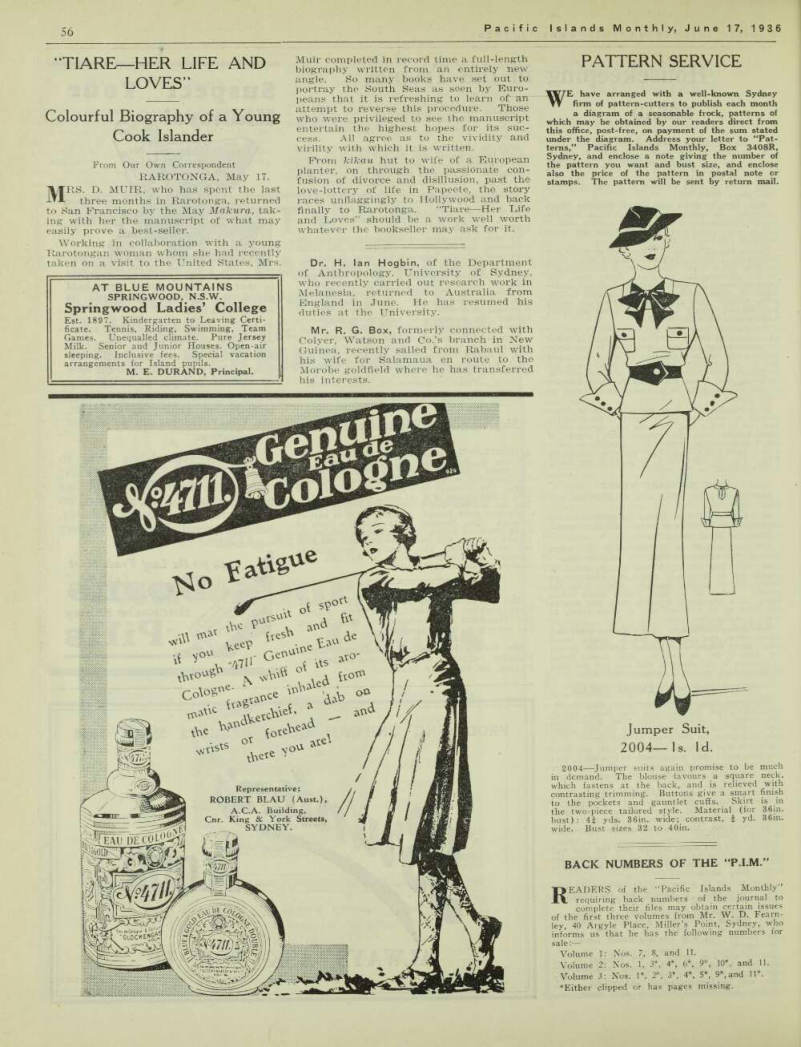
Loves”
Colourful Biography of a Young Cook Islander
From Our Own Correspondent
Rarotonga, May 17.
MRS. D. MUIR, who has spent the last three months in Rarotonga, returned to San Francisco by the May MaTcura, tak ing with her the manuscript of what may easily prove a best-seller.
Working in collaboration with a young Rarotongan woman whom she had recently taken on a visit to the United States, Mrs.
Muir completed in record time a full-length biography written from an entirely new angle. So many books have set out to portray the South Seas as seen by Euro peans that it is refreshing to learn of' an attempt to reverse this procedure. Those who were privileged to see the manuscript entertain the highest hopes for its suc cess. All agree as to the vividity and virility with which it is written.
From Jcikau hut to wife of a European planter, on through the passionate con fusion of divorce and disillusion, past the love-lottery of life in Papeete, the story races unflaggingly to Hollywood and back finally to Rarotonga. “Tiare —Her Life and Loves” should be a work well worth whatever the bookseller may ask for it.
Dr. H. lan Hogbin, of the Department of Anthropology, University of Sydney, who recently carried out research work in Melanesia, returned to Australia from England in June. He has resumed his duties at the University.
Mr. R. G. Box, formerly connected with Colyer, Watson and Co.’s branch in New Guinea, recently sailed from Rabaul with his wife for Salamaua en route to the Morobe goldfield where he has transferred his interests.
Jumper Suit,
Pattern Service
WE have arranged with a well-known Sydney firm of pattern-cutters to publish each month a diagram of a seasonable frock, patterns of which may be obtained by our readers direct from this office, post-free, on payment of the sum stated under the diagram. Address your letter to “Pat terns,” Pacific Islands Monthly, Box 3408 R, Sydney, and enclose a note giving the number of the pattern you want and bust size, and enclose also the price of the pattern in postal note or stamps. The pattern will be sent by return mail.
2004 —Jumper suits again promise to be much in demand. The blouse favours a square neck, which fastens at the back, and is relieved with contrasting trimming. Buttons give a smart finish to the pockets and gauntlet cuffs. Skirt is in the two-piece tailored style. Material (for 36m. bust): 4J yds. 36in. wide; contrast, i yd. 36m. wide. Bust sizes 32 to 40in.
Jumper Suit, 2004-1s. 1d.
Back Numbers Of The “P.I.M.”
READERS of the “Pacific Islands Monthly” requiring back numbers of the journal to complete their files may obtain certain issues of the first three volumes from Mr. W. D. Fearn ley, 40 Argyle Place, Miller’s Point, Sydney, who informs us that he has the following numbers tor sale: — Volume 1: Nos. 7,8, and 11.
Volume 2; Nos. 1, 3*, 4*, 6*, 9*, 10*, and 11.
Volume 3; Nos. I*. 2*, 3*, 4*, s*, 9*. and 11*. ♦Either clipped or has pages missing.
Advertisements & other items, p. 58 (1 item)
Co**"!' L.ce : o.
AT BLUE MOUNTAINS
SPRINGWOOD, N.S.W.
Springwood Ladies* College
Est. 1897. Kindergarten to Leaving Certificate. Tennis, Riding, Swimming, Team Games. Unequalled climate. Pure Jersey Milk. Senior and Junior Houses. Open-air sleeping. Inclusive fees. Special vacation arrangements for Island pupils.
M. E. DURAND, Principal.
0& SV O* T the VeeV (,CS L t»« dC tf *°\ "4711 ° C f c j\s > l0 ‘ s v\" ft . j itoW
Co**"!' L.ce : o.
to#*** * <* ib A l ' a " C A afld *e {ote i — is v- ate ‘ / Representative:
ROBERT BLAU (Aust.),
A.C.A. Building, Cnr. King 8C York Streets,
SYDNEY.
//, 47//. vA s«
Fashion Hints for Islands Women
By Therese
there is no prevailing silhouette, the modern woman may go clad as she will —Edwardian, sixteenth century, or ultra-modern, she haply may follow her own choice thus unfolding a tale of individuality and chic.
Evening gowns exude charm from every fold. The pleated gown of gold satin, its low cut bodice tapering to almost nothing at the shoulders, swathes itself with lame belt and is breathless with glamour from the top of its shoulder to the tip of its lovely hem.
A siren in silver, slim, svelte, and sophisticated, envelops her beauty in a wrap of startling loveliness evolved from lame taffeta —a dreamlike material, with a softly crumpled tinfoil air, but which, alas, is most unsuited for tropic climes.
Following the body’s every lovely line is the violet crepe gown, flaring into sudden fulness at the knees. Exquisite water lilies trail from the low cut corsage to the waist. A cape, slim fitting of shoulder, follows the same sudden flar ing lines as the gown.
A prelude to pleasure is the gown of black crepe, splashed with enormous exotic flowers. Further allure is added by the black net cape which floats floor wards, its hem appliqued with the same vivid blooms that adorn the frock.
The sun tan top of an evening frock, held aloft by a sequin collar, clusters flowers at the throat in a most delightful fashion. Very youthful is the check gown of taffeta, swathed at hip line with draperies falling into the swirling fulness of the back of the skirt. A frock of pastel taffeta, with quilted flare from the knee, is charm personified with its quilted puritan collar in startling contrast to its boldly flaunted nothingness at the back.
Grey for both day and evening is fashion’s decree, and nothing could look cooler for tropical wear. Contrasting wraps and sashes give it added charm.
Turquoise acts on it like magic. Leaf green adds a further note of coolness. A red and green peppermint striped sash of taffeta falling in folds to the floor lends it an undreamed air of sophistication; and always silver shoes play a fitting accompaniment.
Delightful is the little shirt waist frock for informal evenings. Fastened with diamantine buttons, it may be worn high to the throat, or open necked. The full wrist length sleeve and softly falling skirt supply the feminine touch.
“Dinner at Eight” announces the chic dinner suit with pencil slim black skirt, and white backless top, covered by a loose sleeve bolero jacket of black, over which extend the wide revers of the bodice. A chartreuse sash swathes the waist and reaches to the floor.
For cocktail hours comes the heavy
white coat of linen, short and tailored, with wide trousers and a man’s shirt. If a touch of colour is needed, then a vivid blouse will do the trick.
The new materials make glad our hearts —chiffons, gossamer light; glazed printed linens: pastel tinted lawns; Shantungs fantastically figured and flow ered; voiles; artificial silks; and dull crepes. They all have marvellous wash ing propensities.
Blue is well to the fore in day time colour schemes. A glazed linen, blue flower sprinkled on stone ground is charming in a two-piece. The collarless bodice has crisp fan pleating at neck, which is repeated in the basque. (How fortunate we are that such a slimming mode has been revived.) Full three quarter sleeves are gripped in below the elbow, and the square yoked jacket cape, waist length, has an upstanding pleated collar and cape sleeves.
Young and provocative is the spotted
frock of blue, with collar and waist swathing of pique, tied kitten-ear fashion.
Its skirt is full and short, and a blue up turned sailor hat dips a greeting with ribbons of blue and white.
All purpose ensembles are well to the fore with figured jumper tops, loose swing jackets, and skirts of plain materials.
White with colour still persists—the perfect antidote to heat. A cornflower blue linen, slim and straight, wears a short white linen coat jaunty and fresh, complete with Peter Pan collar. A red scarf peeps from above the collar and the same brilliant touch of colour is re peated in the bag. Red and white ribbons dangle pertly from the brim of the blue hat, and blue shoes complete an ensemble of undeniable attraction.
Over a white frock goes a coat of
gaily printed linen in red and white. With it the new square toed shoes in white canvas march boldly to success.
White top coats over dark or printed dresses are in universal favour. They are enormously smart in linen or piques. A simple sleeveless frock, backless too if one cares, becomes formal wear when topped by one of these gallant garments.
A string linen dress, slim and smartly cut, has a square neck-line and shoulder strap top. Over the bareness of its suntan back pops a sailor collar of brown or rus t—both equally attractive contrasts.
Detachable leather buttons trim its bodice.
A grey linen frock dons a patent leather belt, and with it go attractive sandals.
A lemon linen with brief gored skirt trims itself with enormous white buttons,
and pique belt, bag, and hat are the matching accessories. Practical, since it can be laundered over and over again, is the spotted blouse of voile, so youthful with its high neck. Little pleatings ou.line lts f ™nt P anel and short sleeves, Over a dark dress goes a spotted hip length coat with matching cravat. Navy is the frock and mushroom pink the colour contrast, Boleros have staged a come-back, worn over very slim, cleverly pleated skirts. A formal afternoon frock, almost Chinese in its straight simplicity, adds fine pleating to the sleeves and down the bodice, and tucks a white flower at its neck, Plaid or flowered tunics are delightful formal wear, worn over pencil slim skirts. They have a dignity all their own.
M,orning frocks are all cut with a rather longer waist line and full flared skirt, which is quite short. The V neck and crossover bodice find great favour in the tropics—the donning and doffing of this type of frock causing the minimum amount of trouble, particularly when it opens to the hem.
Gayer and brighter is the new note in accessories. Crimson, yellow, cornflower blue and terra-cotta are all marvellous against dark backgrounds. Knitted cot ton gloves are made with scarves to match in these brilliant colours, and stockings too, for the heroic among us.
Sports jewellery comes in coloured leather, studded with nail heads. Metal belts with matching bracelets are charm ing for evenings. Velvet belts and taffeta sashes offer wide scope for colour con trast and white pique belts and collars add zest to daytime frocks.
Advertisements & other items, pp. 59-60 (1 item)
Arnott’S
B. & S. Estate Agency
ROSEVILLE, SYDNEY
Specialising in Flat reservations, any suburb, for Island Residents visiting Sydney. «Correspondence invited. ’Phone J 5269.
Principals: Edwin M. Bastard & Campbell M. Smith
Delicious Biscuits
in sealed moisture-proof wrappers ♦ . . ideal for afternoon tea, lunch, or supper.
ARNOTT’S
famous
Shredded Wheatmeal Biscuits
a valuable appetising health food;
Popso Cracker Biscuits
the perfect base for savouries;
Spicy Fruit Roll Biscuits
put in the oven for one minute and served with cream or milk make a most delicious sweet.
Mrs. N. WALKER-FLYNN
Late 35 POWELL STREET, COOGEE
COSTUMIERE
MALAGUNA ROAD, RABAUL
HEMSTITCHING AND PICOT
EDGING
Copies of Mab’s Fashions; Roma’s Pictorial Fashions and Home Fashions available.
P.O. Box 116. Tel.: 141
ifi
The
“Caledonia Dover”
A COOKING STOVE guaranteed to give complete satisfaction and now recognised as THE BEST on the market. Suitable for coal, coke, or wood fuel.
Illustrated Catalogue on request.
LANE & GIRVAN, LTD.
BONNY BRIDGE, SCOTLAND
1 s wa
RECOMMENDED!
"SUN” Brand Paint on your Home means
definite PROTECTION against tropical
sun and sea-moist air.
Sun Proof and Rain Proof on every Surface
nnsiffi PAINT
W. R. CARPENTER & CO., LTD.
NEW GUINEA, SOLOMON ISLANDS
and all other South Sea Islands.
For Fiji
New Pictorial Stamps
From Our Own Correspondent
Suva, May 21.
AN ANNOUNCEMENT of interest to philatelists the world over was made by the Fiji Government a few days ago, when an advertisement appeared in the Gazette calling for designs for a new set of postage stamps for Fiji.
This has been advocated at various times in the Legislative Council by elected mem bers, but the Governor had opposed it, stating that he was against making post age stamps a large revenue-producing factor, such as a new set would be.
The Postmaster-General is calling for pictorial designs for the following denom inations; Jd, Id, l|d, 2d, 3d, sd, 6d, 1/-, 2/-, 2/6, 5/. It is stressed that the designs must include characteristic or notable Fijian scenery or genre, or industrial, pastoral or agricultural views. The King’s head must also be included in the design. Mrs. Tufue Morris, an old resident of Fiji, died at her home at Onivero, Levuka, on May 11. She went to Fiji from Samoa some 50 years ago.
Miss Beatrice Blackwood, of Cambridge University, England, is now in Sydney, en route to New Guinea, where she will con tinue her anthropological studies.
Mrs. J. G. Nelsson, wife of Hon. “Gus ’
Nelsson, M.L.C., of Papua, sailed from Sydney for Port Moresby by the May Macdhui.
Miss A. Uppill, who has been spending furlough in South Australia, left Sydney by the Niagara on May 21 on her return to the Methodist Mission station at Nad roga, Fiji.
Sister H. Donoghue, of the Methodist Mission’s Salamo Hospital, arrived in Sydney by the Macdhui on May 22. Owing to ill-health she will not be able to re turn to Papua.
Advertisements & other items, p. 60 (1 item)
Reliable Cars and Trucks
New Britain Express
Delivery
GENERAL OVERSEAS AGENTS
GENERAL CARRIERS, BAGGAGE
AND FORWARDING AGENTS.
ROYAL MAIL CONTRACTORS.
Reliable Cars and Trucks
We aim to give quick and reliable Service at reasonable costs. P.O. Box 116. 'Phone 141.
W. WALKER-FLYNN, Proprietor, Malaguna Road, Rabaul, T.N.G.
Native Quarter
T.B. In Hanuabada
Medical Report on Bad Con dition of Port Moresby’s
THE Government of Papua is giving serious attention to a report made recently by Dr. F. W. Clements, of the School of Public Health and Tropical Medicine, University of Sydney. Dr.
Clements reports on behalf of the first medical expedition from the School, which, at the request of Sir Hubert Murray, and with the co-operation of Dr. Strong (Chief Medical Officer) made a tuberculosis sur vey of Hanuabada village—the well known settlement, built on piles over the shallow water of Dogu Harbour, near Port Moresby, where about 2000 native Papuans live.
The survey gave the following result: The tuberculosis rate was found to be 21.5 per 1,000, and the tuberculosis death rate 700 per 100.000. There have been 38 deaths from tuberculosis in the last 2\ years, or an average death-rate of 15 per annum. The total death-rate from all causes in this village is 45 to 47 per annum.
From these figures it is obvious that the population of Hanuabada village is markedly affected with tuberculosis.
The cohdition of the Hanuabada vil lagers was known to the Papuan Govern ment and to the missions—which do much medical work —before Dr. Clements made his report: but it is probable that the latter report showed that the disease was more strongly established than was sus pected.
Sir Hubert Murray, before he left for Europe, placed £BOO on the next esti mates, wherewith to build a hospital for native sufferers from tuberculosis and leprosy, and this will be staffed and equipped in collaboration with the mission bodies.
Dr. Clements report probably will have the effect of hastening the construction of this very necessary hospital.
It is probable, also, that the local authorities will give some attention to the actual housing conditions in Hanuabada.
So far, the natives live almost wholly in native style—more than one family in one house; a cooking-fire always smouldering on an earthenware base in the middle of the house; and insufficient ventilation for the inhabitants. Dr. Clements points out that present conditions are very favour able for the spread of the tuberculosis.
Showing N.Z.’S Flag In The
Pacific
From Our Own Correspondent
Auckland, June 4.
THE itineraries of warships of the New Zealand Division of the Royal Navy on cruises to the Pacific Islands this winter are as follows: Sloop H.M.S. “Leith.” —Leave Auckland, June 17; Nukualofa, June 22-25; Vavau, June 26-29; Suva, July 1-3; Funafuti, July 6-9; Nukufetau, July 9-10; Vaitupu, July 10;.Nui, July 11; Ocean Island, July 14-18; Makin, July 20-24; Tarawa.
July 25-30; Bern, July 31-August 1; Phoenix Group, Aug. 3-6; Suva, Aug. 12-30 (including visits to other Fiji ports) ; Hog Harbour, Sept. 3-7; Tangoa, Sept. 7-9; Paama, Sept. 10; Epi, Sept. 10-11; Vila, Sept. 12-17; Dillons Bay, Sept. 17-18; Tanna, Sept. 18-20; Noumea, Sept. 21-26; Norfolk Island, Sept. 28-29; return to Auckland, October 2.
Sloop H.M.S. “Wellington.”—Leave Auckland,
June 17; Lautoka, June 22-29; Suva, June 29- July 4; Niuafoou, July 6-7; Samoan ports and Tokelau Group, July 7-27; Rarotonga, July 31- Aug. 3; Hervey Is., Aug. 4; Atiu, Aug. 5; Bora Bora, Aug. 7-13; Papeete, Aug. 14-18; Moorea, Aug. 18-19; Flint Is., Aug. 21; Caroline Island, Aug. 22; Vostock Is., Aug. 23; Penrhyn Is., Aug. 25; Starbuck Is., Aug. 26; Malden Is., Aug. 27; Christmas Is., Aug. 29-31; Fanning Is., Sept. 1-3; Jarvis Is., Sept. 4; Danger Is., Sept. 8; Pago Pago, Sept. 10-14; Suva, Sept. 18-22; Tongatabu, Sept. 24-27; return to Auckland, Oct. 2.
Advertisements & other items, p. 61 (1 item)
Starch
PURE RICE
Always ask for . . .
“CORAL” Brand
100% PURE
Noted for its
QUALITY
and
WHITENESS
Goes Farthest and gives Lasting Finish
WILL NOT
STICK TO
IRON
Obtainable from Leading Island Stores Manufactured by
AUSTRALIAN RICE LTD.
Sydney, N.S.W.
M
The “HANOI”
Swift-Lite
Petrol Lantern
300 CANDLE POWER
Lights instantly (no preheating required), automatic steel pricker, also flame regulator. Built in Pump.
Sydney and Brisbane price: 45/- 1 gallon Petrol does approx. 72 hours’ burning.
AGENTS required in all centres. Storekeepers write for special export price.
HANOI
f pT! ri
AND
Price: 29/6 A SCIENTIFICALLY constructed, NO- PUMPING, self-heating PETROL IRON with these EXCLUSIVE Features: Special generator which does away with carbon troubles.
Detachable nipple and coil for cleansing purposes.
A special tank eliminates risk of overflowing.
Perfect regulation of heat.
Double Pointed base; fully nickelled.
No expensive parts to renew.
Cheaper to use than electricity. Over 12,000 “Handi” Irons sold in Australia during the last two years.
If not obtainable from your storekeeper write Sydney or Brisbane Can be used as small stove, as illustrated.
PT¥. LTD.
Charlotte Street, Brisbane
L A. CLAPHM Sydney
World-Wandering
Marc. T. Greene Pulls the Tail of II Duce
* I HE world-wandering American press man, Marc T. Greene, well-known in Polynesia, has just completed what must be nearly a record journalistic tour —15 countries, 45 cities and 11,000 miles in seven months. And that does not include his visit, last year, to the South American countries.
Writing to the editor from Brussells, Mr. Greene gives his route thus: “Southampton-Bremen by the Europe, then Berlin, Nuremberg, Lindau and St.
Gallen, Switzerland, by train. Then Lucerne, Lausanne, Geneva, Berne, Zurich and back through Germany to Munich, where I was lucky enough to be at the famous Oktoberfest, or homage to King Beer. This was one of the most jovial, friendly, gay and happy feasts I have ever participated in, yet without the least
sign of rowdyism, intoxication or brawl ing.
“Then I went to Vienna, with a stop at Salzburg, then to Buda-Pest by Danube steamer. Both cities are pleasant and hospitable, but quiet compared to the days of old. From Buda-Pest I went to Szeged, on the Austrian-Yugo Slav bor der, thence for several days to Belgrade, then on to Skoplje, a queer old place still very Turkish. From there I pro ceeded to Salonica, where I took a steamer for Athens.
“I made a long stay in Greece, this being my first visit, going during that stay to Crete and Corfu, and also to Constanti nople, Constanza and Bucarest by Rou manian steamer. About Christmas time I went to Naples by Italian boat by way of Malta, stopped a few days in Naples and quite a while in Rome and Florence.
Thence I visited the Riviera which was cold, rainy, thieving in charges and gener ally repellent.
“From Marseilles, which shares with Shanghai the dubious distinction of the being the worst town on earth, I took a German steamer out to the Balearics, re garding with mingled emotions as I did
so the old Ville d’Amiens about to sail for Tahiti. The Balearics are lovely and, being Spanish, inexpensive now.
“From Palma I went by a good British ship—and what a joy to board one after sailing under a dozen other flags—to Gib., thence visiting Granada, Malaga and Seville. In Seville I boarded a little Ger man tramp, whose saloon contained no less than four pictures of the Fuhrer in various moods, for Lisbon, a bright cos mopolitan town.
“Then I went up to Oporto to see how port wine is made, and had a fine visit to Sandeman’s great plant there. Then to Madrid, a hectic and unrestrained town where nowadays fights start at the drop of the hat. I was nearly in one.
“From Madrid to San Sebastian, a beautiful seaside resort, then to Bordeaux for a look at the largest high-grade wind producing district in the world, to Orleans, Tours and Paris. After a fort night of the high-priced frivolity of that town, I escaped to Brussels —which is pretty nearly as frivolous at half the cost.
“In the course of contributing to many different periodicals, I have had quite a scrappy time. A couple of years ago our friend, O. F. Nelson, out of the keenness of his discernment, advised me to ‘lay off’
Samoa and go over and interfere in the affairs of Europe. I took the advice and have lately interfered, journalistically speaking, in Germany, Italy, Greece and Spain. My Italian articles, not favour able to the Duce, made the biggest row I have yet engaged in. The Samoa episodes were ping-pong compared to it.
In one American city a delegation of the leading Italians descended upon the news paper offices and, as I understand it now, were only placated by the promise that my name should not again appear in that paper. Which is the price you pay when you take any definite stand on anything.
However, that is no new experience for me and out of them all I am quite as intransigeant as ever.
“I see you compare me to ‘a distrubing wind in the Pacific.’ If ever I get to Tahiti, and I am hoping that the coming elections in France will be far enough to the Left to devalue the franc, I propose to subside into a tranquil zephyr across the Papeete lagoon.”
Miss J. K. March, of the Methodist Mission at Vunairima, New Britain, arrived in Sydney from Rabaul by the Van Rees on June 9, en route to South Australia to spend four months’ furlough with her parents. She has been in New Guinea for 11 years, and now is in charge of the District Girls’ School at Vunairima.
Advertisements & other items, p. 62 (1 item)
Nelson and Robertson Ltd.
(ESTABLISHED
1895)
Island Merchants
COCOA BEANS.—Special attention devoted to their sale in Australian and Oversea markets.
COPRA, TROCHUS SHELL, and other Island Produce sold on commission.
All classes of merchandise and Mining Machinery purchased at wholesale prices and original invoices supplied to Island clients. Small commission.
Prices submitted for comparison.
SOLE AGENTS FOR
PUMPMOBIL Portable Pumping Plants. Recommended for Sluicing and all Mining purposes. Weight 120 lbs., 12,000 gals, per hour, 10 to 100 feet head.
REDUCED PRICES.
ARCHIMEDES.—Latest in outboards; Swedish manufacture.
SKANDIA ENGINES, FULL DIESEL AND SEMI-DIESEL;
Marine and Stationary.
UPSON BRITISH BOARD.—Wallboard and insulating material in one, strong and light in weight. Oft. to 12ft. lengths always in stock.
NELSON AND ROBERTSON LIMITED
12 SPRING STREET, SYDNEY, AUSTRALIA
Telegraphic Address: “Ivan Sydney” powers,
V4_j
JAMES BUDGIE LTD
- -♦ * v ** ' '
REFRIGERATION
“BUDGE” Automatic or Manually-controlled Refrigeration and Ice-making Plants, with or without insulated Cabinets or Rooms, ranging from 4 cubic feet to 1000 cubic feet or larger, using ammonia in the large and sulphur dioxide (SO2) in the small units.
Where electricity is not available, crude oil engines may be utilised for driving the larger plants and petrol engines for driving the smaller machines. The accompanying illustration is of a petrol engine driven SO2 unit. Enquirers please state power available (if any), size of cabinet and amount of ice required per day.
JAMES BUDGE LIMITED.
REFRIGERATION AND GENERAL ENGINEERS,
McEvoy and Harley Streets,
ALEXANDRIA SYDNEY.
Established 1890.
ENGINEERING WORKSHOPS.
All Classes of Machines Made and Reconditioned.
Guinea Airways
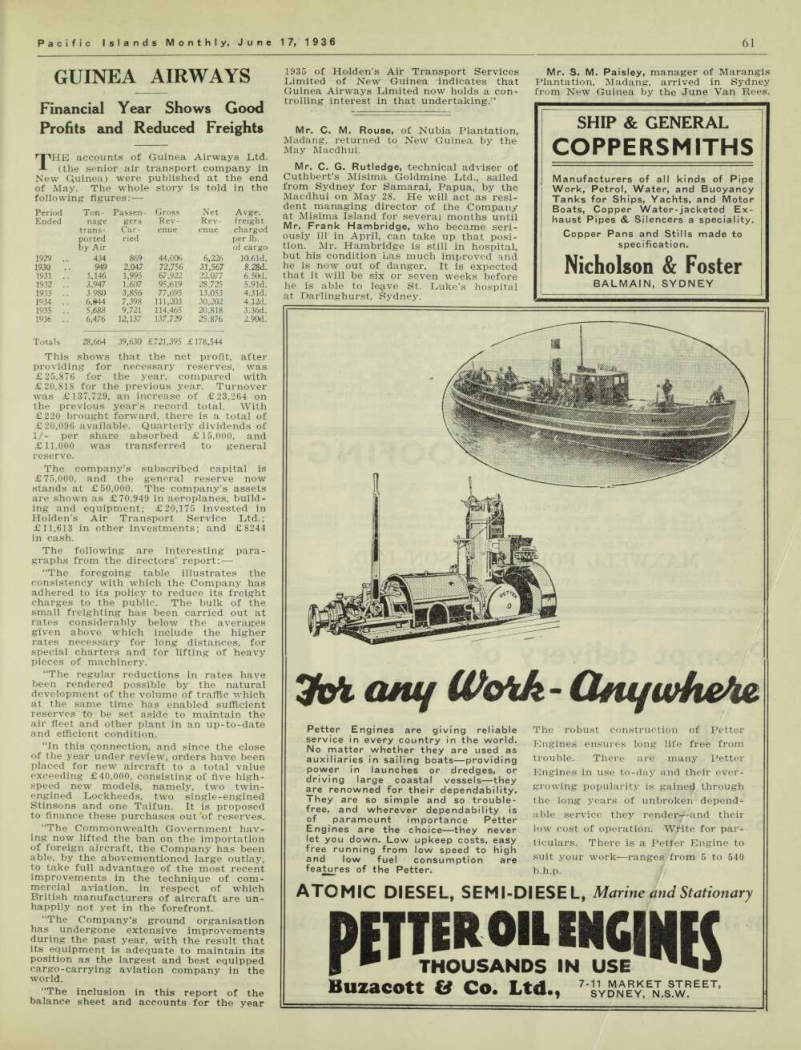
Financial Year Shows Good Profits and Reduced Freights
THE accounts of Guinea Airways Ltd. (the senior air transport company in New Guinea) were published at the end of May. The whole story is told in the following figures:
Totals 28,664 39,630 £721,395 £178,544 This shows that the net profit, after providing for necessary reserves, was £25,876 for the year, compared with £20,818 for the previous year. Turnover was £137,729, an increase of £23,264 on the previous year’s record total. With £220 brought forward, there is a total of £20,096 available. Quarterly dividends of 1/- per share absorbed £15,000, and £ll,OOO was transferred to general reserve.
The company’s subscribed capital is £75,000, and the general reserve now stands at £50,000. The company’s assets are shown as £70,949 in aeroplanes, build ing and equipment; £20,175 invested in Holden’s Air Transport Service Ltd.; £11,613 in other investments; and £8244 in cash.
The following are interesting para graphs from the directors’ report: “The foregoing table illustrates the consistency with which the Company has adhered to its policy to reduce its freight charges to the public. The bulk of the small freighting has been carried out at rates considerably below the averages given above which include the higher rates necessary for long distances, for special charters and for lifting of heavy pieces of machinery.
“The regular reductions in rates have been rendered possible by the natural development of the volume of traffic which at the same time has enabled sufficient reserves to be set aside to maintain the air fleet and other plant in an up-to-date and efficient condition.
“In this connection, and since the close of the year under review, orders have been placed for new aircraft to a total value exceeding £40,000, consisting of five high speed new models, namely, two twin engined Lockheeds, two single-engined Stinsons and one Taifun. It is proposed to finance these purchases out of reserves.
“The Commonwealth Government hav ing now lifted the ban on the importation of foreign aircraft, the Company has been able, by the abovementioned large outlay, to take full advantage of the most recent improvements in the technique of com mercial aviation, in respect of which British manufacturers of aircraft are un happily not yet in the forefront.
“The Company’s ground organisation has undergone extensive improvements during the past year, with the result that its equipment is adequate to maintain its position as the largest and best equipped cargo-carrying aviation company in the world, “The inclusion in this report of the balance sheet and accounts for the year
1935 of Holden’s Air Transport Services Limited of New Guinea indicates that Guinea Airways Limited now holds a con trolling interest in that undertaking.”
Mr. C. M, Rouse, of Nubia Plantation, Madang, returned to New Guinea by the May Macdhui.
Mr. C. G. Rutledge, technical adviser of Cuthbert’s Misima Goldmine Ltd., sailed from Sydney for Samarai, Papua, by the Macdhui on May 28. He will act as resi dent managing director of the Company at Misima Island for several months until Mr. Frank Hambridge, who became seri ously ill in April, can take up that posi tion. Mr. Hambridge is still in hospital, but his condition Las much improved and he is now out of danger. It is expected that it will be six or seven weeks before he is able to St. Luke’s hospital at Darlinghurst, Sydney.
Mr. S. M. Paisley, manager of Marangis Plantation, Madang, arrived in Sydney from New Guinea by the June Van Rees.
Period Ton- Passen- Gross Net Avge.
Ended nage gers Rev- Revfreight trans- Carenue enue charged ported ried per lb. by Air of cargo 1929 .. 434 869 44,006 6,226 10.61d. 1930 .. 949 2,047 72,756 31,567 8.28d. 1931 .. 1,146 1,995 67,922 22,077 6.50d. 1932 .. 3,947 1,607 95,619 28.725 5.91d. 1933 .. 3 980 3,856 77,695 13.053 4.31d. 1934 .. 6,044 7,398 111,203 30,202 4.12d. 1935 .. 5,688 9.721 114,465 20,818 3.36d. 1936 .. 6,476 12,137 137,729 25,876 2.90d.
Advertisements & other items, pp. 63-64 (1 item)
Petter Oil Engines
SHIP & GENERAL
COPPERSMITHS
Manufacturers of all kinds of Pipe Work, Petrol, Water, and Buoyancy Tanks for Ships, Yachts, and Motor Boats, Copper Water-jacketed Exhaust Pipes & Silencers a speciality.
Copper Pans and Stills made to specification.
Nicholson & Foster
BALMAIN, SYDNEY
7oi ounf W&ik-
Petter Engines are giving reliable service in every country in the world.
No matter whether they are used as auxiliaries in sailing boats—providing power in launches or dredges, or driving large coastal vessels —they are renowned for their dependability.
They are so simple and so troublefree, and wherever dependability is of paramount importance Petter Engines are the choice—they never let you down. Low upkeep costs, easy free running from low speed to high and low fuel consumption are features of the Petter.
The robust construction of Petter Engines ensures long life free from trouble. There are many Petter Engines in use to-day and their evergrowing popularity is gained through the long years of unbroken dependable service they render-r-and their low cost of operation. Write for particulars. There is a Petter Engine to suit your work—ranges from 5 to 540 b.h.p.
ATOMIC DIESEL, SEMI-DIESEL, Marine and Stationary
PETTER oil ENGINES
8 m THOUSANDS IN USE
Buzacott & Co. Ltd.,
7-11 MARKET STREET,
SYDNEY, N.S.W.
Timber Joinery
ETC.
PREPARED BUILDINGS
ready for erection a speciality.
SHIP and BOAT BUILDING
TIMBERS specially catered for
FIBROLITE, PLYWOODS.
GALVANISED IRON.
CANEC.
's CONSIGNMENTS shipped
by RETURN STEAMERS
to the Islands.
John W. Eaton Ltd.
WEST CRESCENT ST.,
NORTH SYDNEY
TELEPHONES: X 5051 (5 lines)
BITUMENOID ROOFING
MADE IN AUSTRALIA
Bitumenoid Roofings. Dampcourses and Insulating Felts are made from the world’s best raw materials. Warranted to stand the most rigid tests.
BITUMENOID THE BEST
Roofing, 1,2, 3-ply; Flooring, Waterproof Materials; Saturated Felt; Resilient Road Jointing; Natural Asphalt Dampcourse; 2 and 3-ply Dampcourse; l-21b. Lead-core Dampcourse; Koohng Cement; Asphalt Paints; Roofing Compound. .
SAMPLES AND PRICE LISTS ON APPLICATION
MAXWELL PORTER & SON LTD
ESTABLISHED 1888.
107 REDFERN ST., REDFERN, SYDNEY, N.S.W.
BUILDERS’ SUPPLIES
Phone, M 3157. Cables Bitumenoid
Prompt delivery of
STEEL REINFORCEMENT
for all
classes of
Concrete
Structures
The preparation of steel reinforcements in strict accordance with architects plans and its prompt delivery—cut, bent and labelled to save the builders* time—can only satisfactorily be carried out by experts.
Ever since the introduction into Australia of reinforced concrete for building purposes, we have been favourably known for our prompt and efficient service in this specialised field.
Save time and money! Get in touch with
William Adams Steel Reinforcement
CO. LTD.
175 CLARENCE STREET, SYDNEY
TELEPHONE: B 7961 (6 lines)
Tropical Fish
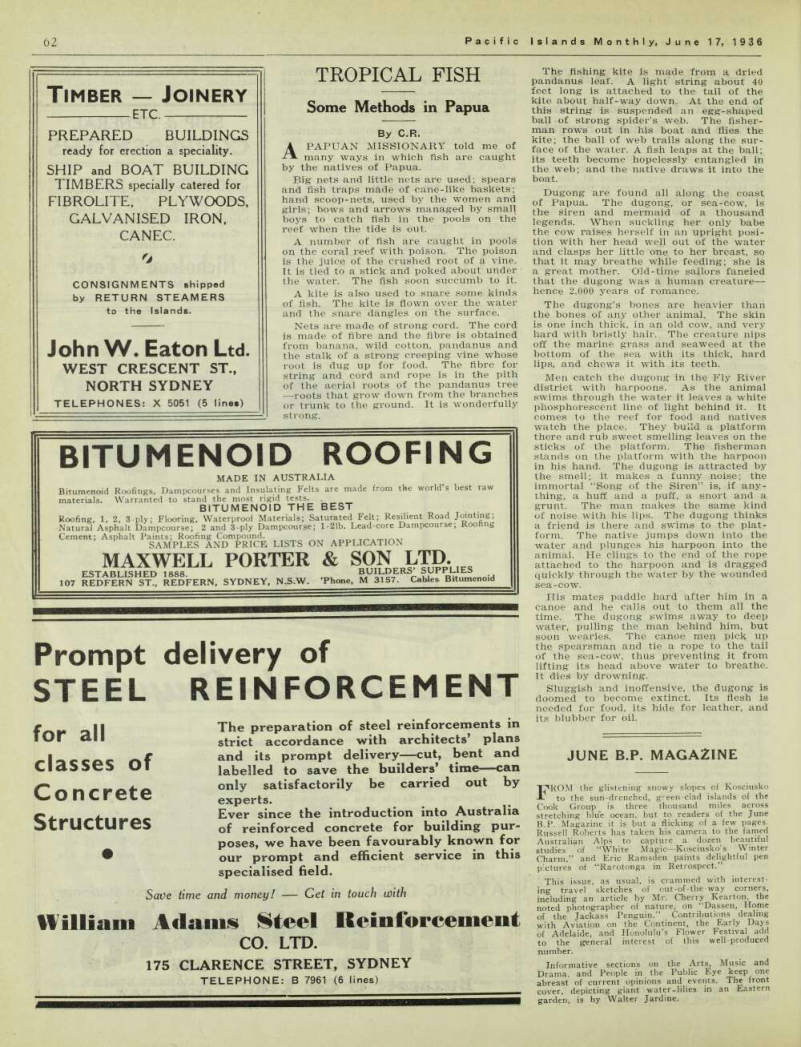
Some Methods in Papua
By C.R.
A PAPUAN MISSIONARY told me of many ways in which fish are caught by the natives of Papua.
Big nets and little nets are used; spears and fish traps made of cane-like baskets; hand scoop-nets, used by the women and girls; bows and arrows managed by small boys to catch fish in the pools on the reef when the tide is out.
A number of fish are caught in pools on the coral reef with poison. The poison is the juice of the crushed root of a vine.
It is tied to a stick and poked about under the water. The fish soon succumb to it.
A kite is also used to snare some kinds of fish. The kite is flown over the water and the snare dangles on the surface.
Nets are made of strong cord. The cord is made of fibre and the fibre is obtained from banana, wild cotton, pandanus and the stalk of a strong creeping vine whose root is dug up for food. The fibre for string and cord and rope is in the pith of the aerial roots of the pandanus tree —roots that grow down from the branches or trunk to the ground. It is wonderfully strong.
The fishing kite is made from a dried pandanus leaf. A light string about 40 feet long is attached to the tail of the kite about half-way down. At the end of this string is suspended an egg-shaped ball of strong spider’s web. The fisher man rows out in his boat and flies the kite; the ball of web trails along the sur face of the water. A fish leaps at the ball; its teeth become hopelessly entangled in the web; and the native draws it into the boat.
Dugong are found all along the coast of Papua. The dugong, or sea-cow, is the siren and mermaid of a thousand legends. When suckling her only babe the cow raises herself in an upright posi tion with her head well out of the water and clasps her little one to her breast, so that it may breathe while feeding; she is a great mother. Old-time sailors faneied that the dugong was a human creature — hence 2,000 years of romance.
The dugong’s bones are heavier than the bones of any other animal. The skin is one inch thick, in an old cow, and very hard with bristly hair. The creature nips off the marine grass and seaweed at the bottom of the sea with its thick, hard lips, and chews it with its teeth.
Men catch the dugong in the Fly River district with harpoons. As the animal swims through the water it leaves a white phosphorescent line of light behind it. It comes to the reef for food and natives watch the place. They build a platform there and rub sweet smelling leaves on the sticks of the platform. The fisherman stands on the platform with the harpoon in his hand. The dugong is attracted by the smell; it makes a funny noise; the immortal “Song of the Siren” is, if any thing, a huff and a puff, a snort and a grunt. The man makes the same kind of noise with his lips. The dugong thinks a friend is there and swims to the plat form. The native jumps down into the water and plunges his harpoon into the animal. He clings to the end of the rope attached to the harpoon and is dragged quickly through the water by the wounded sea-cow.
His mates paddle hard after him in a canoe and he calls out to them all the time. The dugong swims away to deep water, pulling the man behind him, but soon wearies. The canoe men pick up the spearsman and tie a rope to the tail of the sea-cow, thus preventing it from lifting its head above water to breathe.
It dies by drowning.
Sluggish and inoffensive, the dugong is doomed to become extinct. Its flesh is needed for food, its hide for leather, and its blubber for oil.
June B.P. Magazine
FROM the glistening snowy slopes of Kosciusko to the sun-drenched, green-clad islands of the Cook Group is three thousand miles across stretching blue ocean, but to readers of the June B.P. Magazine it is but a flicking of a few pages.
Russell Roberts has taken his camera to the famed Australian Alps to capture a dozen beautiful studies of “White Magic—Kosciusko’s Winter Charm,’’ and Eric Ramsden paints debghtful pen pictures of “Rarotonga in Retrospect.”
This issue, as usual, is crammed with interest ing travel sketches of out-of-the-way corners, including an article by Mr. Cherry Kearton the noted photographer of nature, on “Dassen, Home of the Jackass Penguin.” Contributions dealing with Aviation on the Continent, the Early Days of Adelaide, and Honolulu’s Flower Festival add to the general interest of this well-produced number.
Informative sections on the Arts, Music and Drama, and People in the Public Eye keep one abreast of current opinions and events. The front cover, depicting giant water-lilies in an Eastern garden, is by Walter Jardine.
Advertisements & other items, p. 65 (1 item)
dxhy
Now LEVENSON’S RADIO “
Comes right to your door, per medium of their Speedy and Reliable MAIL ORDER SERVICE. All orders shipped next out-going steamer. Valves and Replacement Parts for We already enjoy the confidence of a vast army of satisfied all types of sets available. Islands Customers.
Batteryless Microphones. Just plug into pick-up terminals of set for reproduction, music or speech. 45/-, now 25/-.
THE LIKE-A-FLASH
DUAL-WAVE “AIR-
RAIDER”
6-valve Battery Operated Radio, employing latest type low consumption valves, equipped with heavy duty batteries, matched lOin. permagnetic speaker and housed in handsome polished Floor Model Cabinet. Employs auto, volume control and every worthwhile modern improvement, selectivity and sensitivity perfect, covers 200 to 550 and 19 to 50 metres.
Battery brain, only “A”
Battery, .715 amp.; “B”
Battery, 15.20 M./A.
Oversea Stations, plus all Australian Stations, without fuss or bother. Clarity perfect, £27/10/- cash. 12 months’ guarantee Speaker and Set; Valves 90 days.
Competitors sell sets of this type up to £45 and cannot equal this model.
Positively and definitely the greatest battery operated radio ever introduced. This is no idle talk.
Results count. Expressly designed and built for the South Sea Island trade, and many already giving more them satisfaction throughout the Pacific Islands.
ULTRA
&L
AIR COLUMN
LOUD SPEAKER
Expotential horn type £6/6/, a few shop-soiled, but perfect. To clear, 30/-. A wonderful reproduction.
a, Portable Gramophones, leading makers. Samples always in stock. Brand new. We select for you and guarantee 45 -, 48/6, 55/-. 100 per cent, satisfaction.
B.T W.jStMuL
Amplion (English) 27/6.
Gramophone Pickups. B.T.H.
Bakelite Model 32/6.
“Cosmocord” 25/-.
“Cosmocord” De Luxe 32/6.
“Phonvox” Head only 10/6 with Gramo. tone arm 12/6 Trade-in reconditioned as perfect, Console Model Gramophones, leading makes. We select for you and guarantee satisfaction. 35/-, 37/6, 40/- 41/-, plus 5/6 packing and add freight.
“Lakes” 1 valve all wave Battery Set, for all world reception. £6/3/9 complete with headphones and all accessories. Ideal for South Sea Island use.
“The Wireless Constructor’s Encyclopaedia,” by Camm. Giant Size. Hundreds of illustrations, . . 7/6; Cloth bound.
Other radio publications available: “The How and Why of Radio,” 5/-.
“Wireless Step by Step,” 5/-.
“The Outline of Wireless,” 15/-.
“Practical Radio,” 10/-.
“Finding Foreign Stations,” 8/6.
“Radio the Magic Carpet,” 8/6.
“Listen - in Battery Book,” 6d.
“Amplification of Wireless Signals,” 2/ “Wireless Receiving Stations,” 2/-.
“Seeing by Wireless,” 2/-.
“Wireless Communication and Broadcasting,” 2/-.
“How to Understand Wireless Diagrams,” 2/-.
“The Book of the Neutrodyne,” 1/-.
“Making and Repairing Wireless Sets,” 1/9.
“Television Really Explained,” 1/9. - Phonox Gramophone pick-up with Gramotone arm, 12/6. Suits all sets.
English made Electric Hair Combs, 15/6 complete. Pocket model 12/6.
znxi iM* \m Levenson’s Radio Bargain Bulletin for 1936. 120 pages.
Bd, post free. Also Levenson’s Radio Buyer’s Guide and Assembly Chart Handbook. 2 post free.
New, tested, charged 12 months’ guarantee.
Add 1 /6 packing plus freight 2 Volt 100 Amp. . . 12/6 4 Volt 40
N| Amp . 14/6
4 Volt 60 Amp . . 16/6 4 Volt 85 Amp ... 24/6 6 Volt 40 Amp ... 19/6 6 Volt 60 Amp . . . . 21 /u The “Air Patrol” 2 valve all wave battery set, covers from 15.5 to 835 metres. £ll/17/1 complete with speakers, phones, and all accessories. A midget marvel.
CIAIMT SCELL(
rOCUfSING
torche: 21-
/ VALUE
ki niv 6fe
NOW
1,500 ft. Beam— -2 cell types, large head, 4/6. 3 cell types, small head, 5/6. 2 cell types, small head, 4/6.
“Pin-Tables,” Rapid Moneymakers. Large stocks available. Write for leaflet.
Models £lO, £l2/10/-, £l5 and £2O. We select for you and guarantee satisfaction. 6 For Sale A Wide Range to select from Person Weighting Machines, Talkies, Silent and Ticket Issuers. Write for leaflets please.
Coin - operated Match & Cigarette Vendors and hundreds of others for sale.
Levenson’s supply clubs, biliard rooms, hairdressers, hotels and social and charity organisations with moneymaking novelties of all types, coin operated machines, etc., etc. Illustrated leaflets for those interested for the writing.
Punch-Boards, great moneygetters. Write for leaflet. 100 Holes V- -300 Holes 10/- 500 Holes 15/- 1000 Holes 21/- 33*4 off dozen lots
'mcssorf
HEAL
1
Sjutca/c
PROFESSIONAL 28*
Copper Aerials 3 wires, 3/20: 50ft. 1/-, 80ft. 1/4, 100 ft. 1/8. 7 wires, 7/20: 50ft. 1/9, 80ft. 2/9, 100 ft. 3/6.
Double Clad Insulated Rubber Aerial, 30 strands: 50ft. 2/6, 100 ft. 5/-. 40 strands: 50ft. 5/6, 100 ft. 10/-.
“Pyrex” Type Glass Aerial Insulators, as the professionals use for Better Results. 3in. 1/, 4Jin. 3/6, sJin. 6/6
dxhy
mu 11 ii 1111 inn Write for Punch Board Leaflets iiiiiimiuiiiii
LEVENSON’S RADIO
(Dept. P.S.)
226 PITT ST, SYDNEY
N.S.W., AUSTRALIA
Branch: Radio Cheapside, 240 a Pitt St.
Write for Pin-Game Leaflets iiiiimimiiiiii ’Phones, M 2525 and M 2526. Cable address, “Leveradioh.” Goods forwarded V.P.P. or Sight Draft. Satisfaction and Service Guaranteed. We can supply by mail all General Merchandise at a Better Price. Quotations with pleasure. Please add freight and packing.
Electricity For The Islands
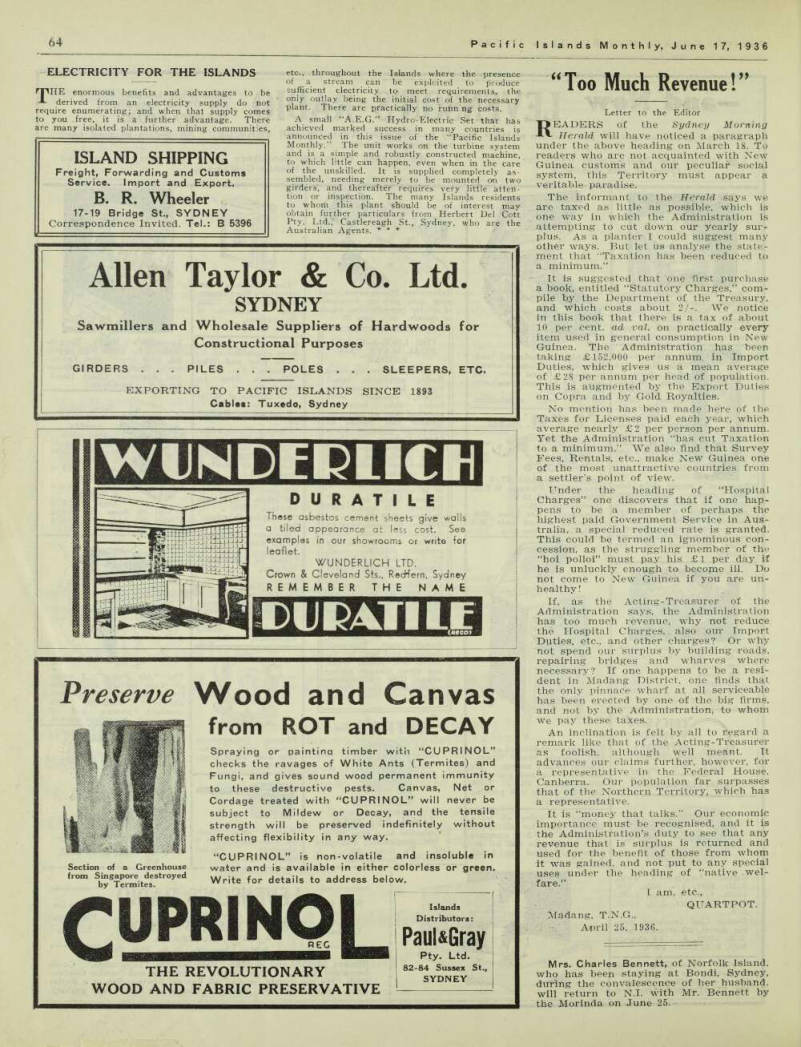
THE enormous benefits and advantages to be derived from an electricity supply do not require enumerating; and when that supply comes to you free, it is a further advantage. There are many isolated plantations, mining communities,
etc., throughout the Islands where the presence of a stream can be exploited to produce sufficient electricity to meet requirements, the only outlay being the initial cost of the necessary plant. There are practically no runn’ng costs.
A small “A.E.G.” Hydro-Electric Set that has achieved marked success in many countries is announced in this issue of the “Pacific Islands Monthly.” The unit works on the turbine system and is a simple and robustly constructed machine, to which little can happen, even when in the care of the unskilled. It is supplied completely as sembled, needing merely to be mounted on two girders’, and thereafte’r requires very little atten tion or inspection. The many Islands residents to whom this plant should be of interest may obtain further particulars from Herbert Del Cott Pty. Ltd., Castlereagh St., Sydney, who are the Australian Agents. * * *
“Too Much Revenue!”
Letter to the Editor READERS of the Sydney Morning Herald will have noticed a paragraph under the above heading on March 18. To readers who are not acquainted with New Guinea customs and our peculiar social system, this Territory must appear a veritable paradise.
The informant to the Herald says we are taxed as little as possible, which is one way in which the Administration is attempting to cut down our yearly sur plus. As a planter I could suggest many other ways. But let us analyse the state ment that “Taxation has been reduced to a minimum.”
It is suggested that one first purchase a book, entitled “Statutory Charges,” com pile by the Department of the Treasury, and which costs about 2/-. We notice in this book that there is a tax of about 10 per cent, ad val. on practically every item used in general consumption in New Guinea. The Administration has been taking £152,000 per annum in Import Duties, which gives us a mean average of £2B per annum per head of population.
This is augmented by the Export Duties on Copra and by Gold Royalties.
No mention has been made here of the Taxes for Licenses paid each year, which average nearly £2 per person per annum.
Yet the Administration “has cut Taxation to a minimum.” We also find that Survey Fees, Rentals, etc., make New Guinea one of the most unattractive countries from a settler’s point of view.
Under the heading of “Hospital Charges” one discovers that if one hap pens to be a member of perhaps the highest paid Government Service in Aus tralia, a special reduced rate is granted.
This could be termed an ignominous con cession, as the struggling member of the “hoi polloi” must pay his £1 per day if he is unluckly enough to become ill. Do not come to New Guinea if you are un healthy!
If. as the Acting-Treasurer of the Administration says, the Administration has too much revenue, why not reduce the Hospital Charges, also our Import Duties, etc., and other charges? Or why not spend our surplus by building roads, repairing bridges and wharves where necessary? If one happens to be a resi dent in Madang District, one finds that the only pinnace wharf at all serviceable has been erected by one of the big firms, and not by the Administration, to whom we pay these taxes.
An inclination is felt by all to regard a remark like that of the Acting-Treasurer as foolish, although well meant. It advances our claims further, however, for a representative in the Federal House, Canberra. Our population far surpasses that of the Northern Territory, which has a representative.
It is “money that talks.” Our economic importance must be recognised, and it is the Administration’s duty to see that any revenue that is surplus is returned and used for the benefit of those from whom it was gained, and not put to any special uses under the heading of “native wel fare.”
I am, etc..
Quartpot.
Madang, T.N.G..
April 25, 1936.
Mrs. Charles Bennett, of Norfolk Island, who has been staying at Bondi, Sydney, during the convalescence of her husband, will return to N.L with Mr. Bennett by the Morinda on June 25.
Advertisements & other items, p. 66 (1 item)
Ruprinqi
ISLAND SHIPPING
Freight, Forwarding and Customs Service. Import and Export.
B. R. Wheeler
17-19 Bridge St., SYDNEY Correspondence Invited. Tel.: B 5396
Allen Taylor & Co. Ltd.
SYDNEY
Sawmillers and Wholesale Suppliers of Hardwoods for Constructional Purposes GIRDERS . . . PILES . . . POLES . . . SLEEPERS, ETC.
EXPORTING TO PACIFIC ISLANDS SINCE 1893
Cablet: Tuxedo, Sydney
DURA T I L E
These asbestos cement sheets give walls a tiled appearance at less cost. See examples in our showrooms or write for leaflet.
WUNDERLICH LTD.
Crown & Cleveland Sts., Red Tern, Sydney
REMEMBER THE NAME
Preserve Wood and Canvas
Section of a Greenhouse from Singapore destroyed by Termites.
from ROT and DECAY
Spraying or painting timber with “CUPRINOL” checks the ravages of White Ants (Termites) and Fungi, and gives sound wood permanent immunity to these destructive pests. Canvas, Net or Cordage treated with “CUPRINOL” will never be subject to Mildew or Decay, and the tensile strength will be preserved indefinitely without affecting flexibility in any way.
“CUPRINOL" is non-volatile and insoluble In water and is available in either colorless or green.
Write for details to address below.
rUPRINQI
THE REVOLUTIONARY
WOOD AND FABRIC PRESERVATIVE
Islands Distributors:
Paul&Gray
Pty. Ltd. 82-84 Sussex St.,
SYDNEY j
The Case for Elective System
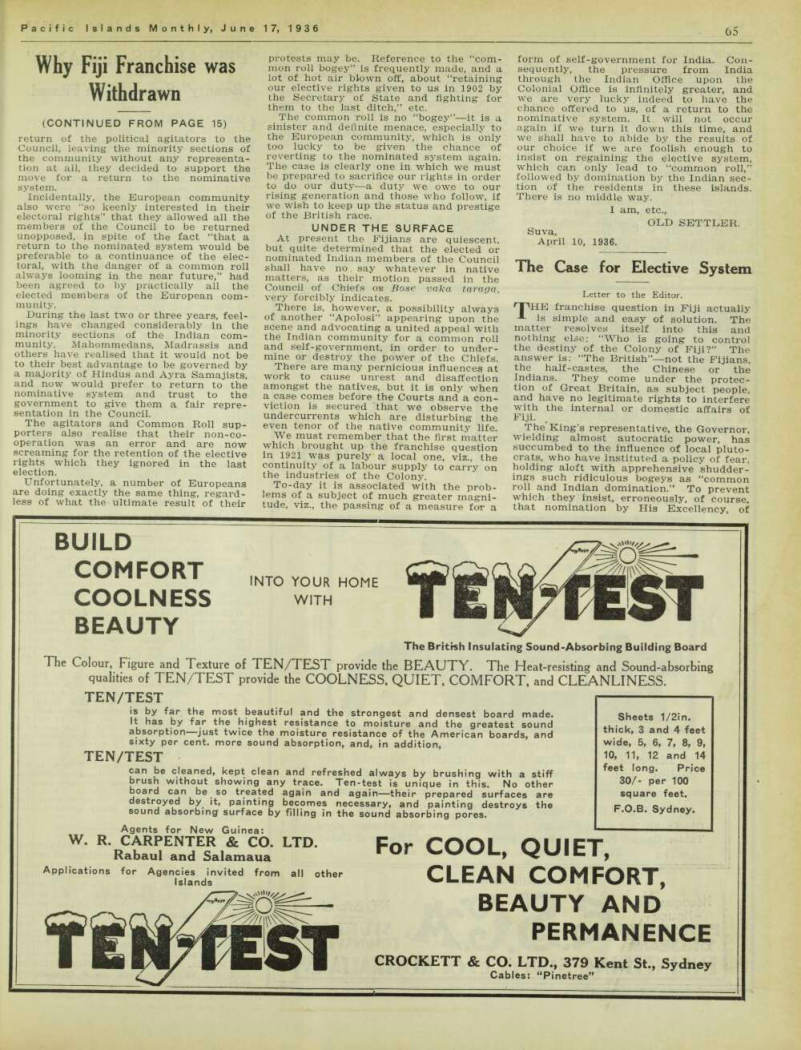
Letter to the Editor. franchise question in Fiji actually A is simple and easy of solution. The matter resolves itself into this and nothing else: “Who is going to control the destiny of the Colony of Fiji?” The answer is: “The British”—not the Fijians, the half-castes, the Chinese or the Indians. They come under the protec tion of Great Britain, as subject people, and have no legitimate rights to interfere with the internal or domestic affairs of Fiji.
The'King’s representative, the Governor, wielding almost autocratic power, has succumbed to the influence of local pluto crats, who have instituted a policy of fear, holding aloft with apprehensive shudder ings such ridiculous bogeys as “common roll and Indian domination.’’ To prevent which they insist, erroneously, of course, that nomination by His Excellency, of
specially chosen representatives, for elevation to the Legislative Council, is the one and only safeguard.
The propounders of the nominative scheme have failed to adduce one sound argument in support of their theory “that the electors of the Colony are in capable of even assisting to solve the admittedly momentous questions, relating to general economic conditions, special political perplexities, complex financial intricacies, and the question exciting the present agitation—racial adjustments.”
The people of the Colony think dif ferently, and very rightly demand the re tention of the all-too-limited voice they have been privileged to use per medium of the ballot box for over 30 years in the political counsels of the Colony. To rob the electors of this privilege is an act of flagrant political dishonesty.
Nomination has very truthfully been defined as Domination. The trial of
strength, as it stands at present, is a struggle between Autocracy plus Pluto cracy versus Democracy, The democratic power, invincible in its potency, must in the end triumph over all obstacles. The whole subject is under careful, honest review by the Secretary of State for the Colonies. Citizens of Fiji need have no fear. British justice, supporting truth, honesty and fair treatment, will prevail.
I am, etc.,
A. S. Mcleod,
Hon. Sec.,
V.L.P. Association, Fiji.
March 9, 1936.
Rev. and Mrs. H. L. Schlencker returned to the London Missionary Society’s station at Daru, Western Papua, in May. Their marriage took place recently in Brisbane, the bride being Miss Nancy Binns, of Adelaide.
Advertisements & other items, pp. 67-68 (2 items)
Why Fiji Franchise was
65
Pacific Islands Monthly, June 17, 1936
Why Fiji Franchise was Withdrawn
(CONTINUED FROM PAGE 15)
Clean Comfort,
BUILD
COMFORT
COOLNESS
BEAUTY
INTO YOUR HOME
WITH
o The Britrsh Insulating Sound-Absorbing Building Board The Colour, Figure and Texture of TEN/TEST provide the BEAUTY. The Heat-resisting and Sound-absorbing qualities of TEN/TEST provide the COOLNESS, QUIET, COMFORT, and CLEANLINESS.
TEN/TEST
is by far the most beautiful and the strongest and densest board made.
It has by far the highest resistance to moisture and the greatest sound absorption—just twice the moisture resistance of the American boards, and sixty per cent, more sound absorption, and, in addition,
TEN/TEST
can be cleaned, kept clean and refreshed always by brushing with a stiff brush without showing any trace. Ten-test is unique in this. No other board can be so treated again and again—their prepared surfaces are destroyed by it, painting becomes necessary, and painting destroys the sound absorbing surface by filling in the sound absorbing pores.
For COOL, QUIET,
CLEAN COMFORT,
BEAUTY AND
PERMANENCE
CROCKETT & CO. LTD., 379 Kent St., Sydney Cables: “Pinetree”
W. R. CARPENTER & CO. LTD.
Rabaul and Salamaua Applications for Agencies invited from all other Islands Sheets 1/2in. thick, 3 and 4 feet wide, 5,6, 7,8, 9, 10, 11, 12 and 14 feet long. Price 30/- per 100 square feet.
F. 0.8. Sydney.
jfti
w TO* m rr m —-
Thompson
Gravel
Pumps
The Headquarters House Noted for their Reliability, Good Efficiency, Accessibility of Inspection and Repair. Particularly designed for dealing with Alluvial Deposits of Gravel, Sand, etc.
2 & 3 HEAD PROSPECTING BATTERIES
Obtainable in 4 sizes, from 200 to 300 lb. Stamps, with Amalgamating Tables, Copper Plates and Water Pump. Also a Full Range of Heavy Stamper Batteries, Rock Crushers, etc.
Headquarters - House - ST
BRISBANE
Full Details on Request
6.S.CK&-
NQBranch
STURTS!
TOWNSVIIU
ENGINEERING Siipfiv off AUSTPAIIA PI
“Pitcairn’S Island”
“Bounty” Sequel to be Filmed
CAPITALISING on the publicity given to the film, “Mutiny on the Bounty” when it won the Motion Picture Academy’s award for the best production in 1935, the Metro-Goldwyn-Mayer Com pany has announced that work is to start immediately at their studios on “Pitcairn’s Island,” the sequel to the famous sea story written by Charles Nordhoff and James Norman Hall.
Clark Gable will still have the role of Fletcher Christian, and Mamo Clarke, a young Honolulu girl, will again play the female lead of Christian’s native wife, Maimiti. Frank Lloyd, who directed “Mutiny on the Bounty ” is now a pro ducer with M.G.M.’s rival company, the Paramount Corporation, but he may be “borrowed” to direct “Pitcairn’s Island.”
Nordhoff and Hall’s story of what hap pened to the mutineers on Pitcairn after they burnt their ship in Bounty Bay is a vivid, stark tale of horror and tragedy, containing all the elements for another first-class film.
The nine mutineers with six Tahitians and 12 native women found sanctuary on the little island in 1790. Ten years later only one man and 10 women were left, with a family of small children, and of the 16 dead 15 had come to violent ends.
Drink, jealousy over the women, and race conflict between black and white played their part in the tragic drama enacted on Pitcairn between 1790 and 1808 when their refuge was discovered and made known to the world by Captain Mayhew Folger, of the American sealing vessel Topaz.
Cattle For The Tropics
THE world’s most widely distributed variety of dairy cattle is the Jersey, due to the fact that they stand up to all conditions either of heat, humidity or extreme cold. Their milk is the richest of all breeds, the average butter fat being S l /2 per cent., nearly double that generally con sidered as standard in big cities.
Within the Jersey breed certain blood lines have been developed to produce milk with butter fat high above this average, and those of Bellefaire Farm (N.S.W.) average round about 6 per cent.
Bellefaire Jerseys are wholly based on imported blood, and are notable both for type and produc tion.
Except in Fiji the dairy industry in the Pacific has not yet been developed up to a high standard.
Residents in other islands, however, are also en titled to have fresh milk and this should be available wherever groups of Europeans are as sociated. Even if common cows are kept for the purpose it should be realised that the use of a Jersey bull, backed by high average butter fat production, will increase the butter fat average of the whole oj his female progeny.
Everyone, especially women and children, should have fresh milk for its health-giving qualities, and if only for this reason alone the question should be investigated. Mr. Walter Burke, the proprietor of Bellefaire Farm, whose advertisement appears in this issue, will gladly advise readers on this subject.*** Rev. F. H. L. Raton, Presbyterian minister of Deepdene, Victoria, will resign at the end of the year to accept the invita tion of the trustees of the John G. Paton Memorial Fund to work in the interests of the trust in Great Britain. He is the son of the late Dr. John G. Paton, whose name is outstanding as a Presbyterian pioneer of mission work in the New Hebrides, and in whose memory the Mis sionary Fund was created. Mr. Paton, who is one of the best known ministers in Victoria, was born in the New Hebrides and did valuable work as a missionary there.
In Phoenix Group
N.Z. Party Will Observe Total Eclipse in 1937
From Our N.Z. Correspondent
Auckland, May 30.
A PARTY of New Zealand astronomers will visit the Phoenix Islands, an un inhabited group of coral islands not far south of the equator, next year, to ob serve the total solar eclipse, which will occur on June 8.
The expedition, which is being organised by Mr. C. B. Michie, of Auckland, will comprise six members, several of whom took part in the N.Z. Solar Eclipse Expe dition in 1930 to Niuafoou, Tongan Islands.
It will be sponsored by the N.Z. Depart ment of Scientific and Industrial Re search. As it will be the only party ob serving the eclipse, the expedition will be equipped with the 19ft. coelostat and coro nagraph, which has been made available by the Astronomer Royal.
The party will be landed at Canton Island by one of the warships of the New Zealand Division of the Royal Navy, which will bring them back to Auckland again. No drinking water is available on the island, so H.M.S. Leith is taking two 100 gallon tanks and rain catchment units there on its Pacific cruise this win ter.
The Phoenix Group comprises about a dozen small islands, with a total land area of 19 square miles. They lie due north of Samoa, and are of little economic import ance. Canton Island (also known as Mary Island), where the expedition will set up its camp, is eight miles long and four
wide. It is covered with stunted vegeta tion, except at the southern end, where there are coconut groves. Formerly it had large deposits of guano, but these are mostly worked out.
Some of the islands of this group— notably Howland and Baker—achieved much prominence last year when Ameri can interests began to plan a trans-Paciflc air service from Honolulu to Samoa, These islands are on the direct route.
For a decade or more it had been taken for granted that these islands were British, but early in 1936 America estab lished a small colony of Hawaiians on Baker and Howland and claimed them as her own. After considering the whole position Britain resolved that she would not dispute the claim.
Guinea Gold N.L.
'C'OR the year ended February 29, Guinea Gold, N.L., shows a net profit of £38,113, compared with £21,488 the pre vious year. The profit was almost wholly represented by dividends from the com pany’s share holdings in Bulolo Gold Dredging Ltd., which remains unchanged.
The directors state that the market value of the company’s investment assets at February 29 was £527,785. Owing to the general depression in gold scrip values, that sum was £44,021 lower than the market value a year ago. The issued share capital of the Company is £50,000.
The total cost of the exploration and testing campaign of the Papuan pro perties, which has been written off against the general reserve, was £33,739.
At an extraordinary meeting at the end of May, shareholders agreed to a pro
posal for an alteration of the articles of association for reserving the block holding of shares in Bulolo Gold Dredging Ltd. as an invested fund of the company.
Rev. Father Michael McEncroe, mis sionary of the Sacred Heart Order in Papua, arrived in Australia on furlough by the June Montoro.
Mr. Laurence Ashleigh Hudson has been appointed a' Medical Assistant in the New Guinea Department of Public Health.
Advertisements & other items, pp. 69-70 (1 item)
Newlands Brothers Ltd.
UMBRELLAS
Specially made for Tropical Conditions
ONLY BRITISH FRAMES USED
Guaranteed FAST DYED Coverings Strong Canvas-Covered Beach and Garden Umbrellas in Medium and Large Sizes —Brass Fittings Throughout
“Shelta” Brand Umbrellas
Manufactured by
Phillips and
House
453 Kent Street
SYDNEY
428 Adelaide St.
BRISBANE
Inquiries invited from Pacific Islands Distributors We supply the trade only.
I II) mi .1 M\\i »A\ x
W\iti
111 is t *l § H Produced in Australia by
STEEL BEDSTEADS
WIRE MATTRESSES
“MORNING GLORY” BEDDING
TUBULAR STEEL FURNITURE
“LISTER” HOSPITAL EQUIPMENT
SHIPS’ ALL METAL BERTHS
WE WILL GLADLY FORWARD OUR
COMPLETE SETS OF CATALOGUES
Newlands Brothers Ltd.
RILEY STREET :: SYDNEY, N.S.W.
Australia f s Largest Manufacturers of Modern Sleeping Equipment.
Cable address: “Newlandbed,”
Sydney
Find out What’s Inside
before you buy a low-priced Saddle.
THE KING OF ’EM ALL
HARROW
Is a “Safer”
Saddle and Offers Sensational Advantages.
Being built on a Galvanised Tree, heavily bar plated, and strained with English web, riders are assured of its genuine foundation. Its soft, pliant kip flaps are hard-wearing, while the sweepy seat gives superb riding comfort.
Fkted with Best Leather, Folded Girth, Stirrups Freight Free With Capped Pads, 15/- extra.
Write for Catalogue P 1935.
Sydney’s High-Class Saddler. £5/5/-
Newmarket Saddlery
W. H. Williams for “Safer” Saddles 18-20 Wilson St., Newtown, N.S.W.
“STAR” BRANDS
SHOVELS SCOOPS SPADES
All Sizes All Styles for All Purposes
Quality Tools Fully Warranted
Made by experts Blades manufactured from special English carbon-manganese steel under correct oil heat treatment. Fitted with high grade Australian mountain ash handles. Well over 200,000 supplied to satified customers, including Commonwealth Government and all Australian State Governments, Mines, and Industrial undertakings.
Enquiries solicited from bona fide Wholesale Traders.
Literature and Price Lists on request.
Sole Makers:
W. SAVAGE & CO. LTD.
155 George St., Erskineville, Sydney, N.S.W.
Telegraphic Address: "Starshovel,” Sydney
Also Stone Forks, Digging Forks, etc.
• c*
RESISTS CORROSION, STRONGER THAN STEEL
EASILY WORKED, CANNOT RUST
f SALT WATER TANKS, PROPELLER SHAFTS
J MOSQUITO GAUZE, MARINE HARDWARE
Full Information gladly from the Australian Distributors WRIGHT & COMPANY, 81 Clarence St., Sydney ★ MONEL METAL is a Registered Trade Mark Cables; “CORNRIGHT,” SYDNEY L 1'
Germany and Her Ex-Pacific
Colonies She Wants Africa—Not New Guinea
|Y| UCH continues to be said about the ITJ. “future of the former German colonies” —which, of course, is a matter of direct concern to the Territories of New Guinea, Western Samoa and the Caroline and Marshall Islands. Also, because any change in the control of those Territories will affect all other Pacific Territories, the subject is of interest to all Europeans in the Pacific.
Certain statements, more or less official, have been issued by the Governments of the various Powers.
The German attitude is that, in order to uphold “German prestige and dignity,” as well as provide Germany with an out let for her colonising energy and supply her with a source of raw materials, Ger many will not forego in any degree her demand for the return of her former colonies.
There have been several statements made on behalf of the British Govern ment. Summed up, they are to the effect that Britain has not considered, nor is she considering, the transfer of British mandates to any other Power. The sub ject has not been brought officially before the Government. It is clear, however, that there is in Britain a large and apparently
growing section of British public opinion which is in favour of a return to Germany of some portion of her lost colonies —preferably, in Africa.
The official attitude of France is that “France would no more think of giving up her mandated territories than would Britain,’’ and would be unwilling to expose the native populations now under French rule to “German racial theories.” That statement, however, was made before the new Socialist Government took charge in France.
Japan has stated, in unequivocal terms, that she w T ill not voluntarily return the Caroline and Marshall Islands to Ger many. There is no doubt that some secret understanding between Germany and Japan was reached early in 1936; and there is a report current that, in that agreement, Germany surrendered all claims to those island groups. There also is good ground for the belief that, if Japan is not actually fortifying the Marshall and Caroline Islands, she is accumulating sup plies of certain essential commodities in certain secret bases in the groups—especi ally oil.
Australia, naturally, is deeply concerned.
Under Australian administration, New Guinea and the Bismarck Archipelago have undergone rapid development, and newly-created values represented in the gold industry must amount to millions of pounds. Those important interests cannot be sacrificed.
Germany’s demand for the return of her colonies is bound to receive increasing attention in the Chancelleries; but the fol lowing extract from a private letter, written to a friend in Sydney recently by a very well-informed Dutchman, who knows New Guinea well, and who recently has been travelling in Holland and Ger many, supplies some reassurance for Aus tralians: “I heard from very well-informed circles in Germany that they will only try to get back some of their African colonies, and not New Guinea.”
The problem remains for Britain, how ever. Britain, in Africa, holds Tangan yika, Togoland, the Cameroons and South west Africa under mandate; and every time it is suggested that one or other of those territories should be returned, there is a sharp howl from some important interest concerned, and an attempt made to influence public opinion against the suggestion.
On present indications, we may take it as unlikely that there will be any serious move to disturb present conditions in New Guinea and Samoa. Apart from economic considerations, the islands are too far away from Europe to be properly defended.
What body—if any—has the right to take a mandate away from a Power? Can mandates be withdrawn?
Discussing these questions in the columns of the London Daily Mail, Mr. P.
Donner, Conservative, M.P. for Basing stoke, England, says that there has been much loose talk about the Mandated Ter ritories by the man in the street. Many people have believed our authority ov«?r these territories is derived from the League of Nations. This is due to ignor ance of the genesis of this complicated system. The actual position is as fol lows: The former German colonies were dis tributed among the Mandatory Powers by the Supreme Council of the Principal Allied and Associated Powers at the San Remo Conference on May 7, 1919. The territories were finally ceded by Ger many, under Article 219 of the Treaty of Versailles, to the Principal Allied and Associated Powers collectively, i.e., Great Britain, France, Italy, U.S.A. and Japan.
These powers have never ceded them to the League, but, under Article 22 of the Covenant, agreed to submit annual reports of their administration to the Council of the League, and to require the assent of the Council to any amendments or alterations to the terms of each man date. These mandates were documents drawn up by the Principal Allied and Associated Powers themselves, and later “approved” by the Council of the League.
The League only came into being on January 10, 1920, i.e., nine months after the allocation of the title to mandates was conferred by the only body capable of conferring it, viz., the Principal Allied and Associated Powers to whom the territories had been ceded. The League’s job is only to see that the terms of the mandates are observed and to approve or disapprove any changes in these terms. Thus Japan, though no longer a member of the League, continues quite properly to administer the ex-German islands allotted to her by the Allied Powers.
Residents
New Homes for South Seas Residents
TN most Islands districts skilled labour for A building homes is difficult to obtain. Much consideration has been given to methods of over coming this disadvantage and the advent of the ready-cut home seems to solve the problem.
Homes can now be fabricated in the mill and sent out ready to assemble. The framework is cut and prepared ready for assembling, even doors and windows have the locks and hinges, etc. put on so that the whole unit is ready to place in position.
George Hudson Ltd., of Sydney, have per fected the “Ready-Cut” system and are able to quote for bungalows at prices which represent a considerable saving in cost of the completed building. They also supply an efficient Plan Ser vice which makes the work of erection a simple matter, and this can be carried out by anyone with only a slight knowledge of carpentering.
Hudson’s Ready-Cut cottages are constructed on well established principles, and are exceptionally strongly built. They are permanent buildings which will compare favourably with any similar structure. These homes can be supplied with weatherboard or asbestos cement exteriors, and can be lined with fibrous plaster, asbestos cement or 3-ply internally.
George Hudson Ltd. have recently introduced a new type of interior finish known as “Canec” which is used extensively in their Ready-Cut homes. This material is valuable for its insulat ing and sound proofing qualities, and is effective against heat. In addition, it can be finished in many attractive designs at little expense. This material is white-ant proof and is very light. *** Mr. G. J. A. Moore is at present manag ing the Port Moresby branch of Messrs.
Burns, Philp and Co. Ltd. during the absence on furlough in Australia of Mr.
W. M. Dupain.
Noted Missionary
Rev. F. J. Kirschbaum Returns to New Guinea
A DISTINGUISHED anthropologist, Rev.
Franz J. Kirschbaum, of the Society of the Divine Word Mission, arrived in Aus tralia by the Maunganui on May 31, on his way back to New Guinea after four years’ furlough in Germany and Austria.
One of the best known missionaries on the New Guinea mainland, Father Kirsch baum has figured for 25 years in mission and exporatory work. In 1926, he Was the first white man to discover a strange race of dwarfs who live in the mountains near the upper headwaters of the Ramu River.
Father Kirschbaum has made scores of journeys into unexplored parts of the wild, mountainous country of Central New Guinea. He has travelled hundreds of miles up the Sepik River by launch and canoe, collecting scientific information on the habits of the various tribes and races.
Both in his missionary work and through his first-hand and scientific know ledge of New Guinea, Father Kirschbaum
has been of great assistance to the New Guinea Administration. He has been able to guide parties into unknown country, and has been a force in the suppression of head hunting in the hinterland. He al ways travels unarmed.
Rev. Kirschbaum will leave for New Guinea by the Montoro from Sydney on June 17 to finish a book on which he has been working for many years. Although it will be written in German, he expects to publish the volume in English.
Mr. C. Budden, manager of Morobe Gold Alluvials in New Guinea, arrived in Aus tralia by the Montoro early in June, Captain A. Fitch, managing director* of Steamships Trading Co. of Papua, arrived in Sydney on business by the Montoro on June 12.
Advertisements & other items, pp. 71-72 (1 item)
If You Keep Cows
SAMUEL RUSSELL
ESTATE AND GENERAL AGENT
P.O. Box 64, Papeete, Tahiti
Real Estate. Investments. Estate Management and Administration. Valuations and Reports. Houses & Lands for Lease or Sale.
Sole Proprietor: TAHITI PERFUMES.
Cables: Russell, Tahiti (Bentley’s Code)
If You Keep Cows
of Any Kind
You Certainly Need a Jersey Bull
... backed by fine production and good type, with a high butter fat test, averaging about 6%!
The use of such a bull would result in a big improvement in the quality of your milk and butter.
Jerseys are particularly hardy, stand heat and humidity just as well as extreme cold—proved by their official records the world over.
Bellefaire stock has the widest distribution in Australia and we can supply highly pedigreed Jersey Bulls of service age at reasonable prices.
I ne Diooa mat tells
Bellefaire
l Jerseys
f TYPE \
PRODUCTION
Our stock is wholly based on Imported blood.
Tell us of your problem and we will gladly advise you, with details and quotations.
BELLEFAIRE
FARM
Box 864 G, G.P.0., Sydney Cable address: “Walburke, Sydney”
Pump ill obit
LIGHT and
Motor Pump
"T""' m k -'i |Tf' Complete Plant’s weight, 140 lbs. Capacity up to 12,000 gallons per hour.
All heads from 10 to 115 feet.
Fuel consumption, Y 2 gallon per hour.
Pressure 551 b. square inch.
Especially suitable prospecting and all Sluicing Requirements.
Nelson & Robertson
12 SPRING STREET, SYDNEY
c Australia’s Clearing House for the Precious iMetals
BUYERS OF
GOLD
OSMIRIDIUM, PLATINUM, SILVER, &c.
GARRETT & DAVIDSON, LTD.
ASSAYERS, BULLION MERCHANTS, METALLURGISTS
Bank of N.S.W. Buildings, Regent Street, Sydney
C O I L S of all
SHAPES AND SIZES
BENT BY. . .
A. E. Goodwin Ltd.
Pipe, Welding and General Engineers Railway Parade, Lidcombe, N.S.W.
UX 7941 All Classes of Plate and Girder Work
WELDED CONSTRUCTIONS
is our Speciality
Pacific Islands Mining Reports
From Fiji
Mt. Morgan Development Ltd.
INTEREST in the property recently held by Aloha Central in Fiji may be revived soon if negotiations between Mt. Morgan Development Ltd. and the vendor —Mr. P. Costello—are satis factorily concluded. It is believed that satisfactory option terms have almost been completed.
Mt. Morgan Development Ltd. already has one property in Fiji, but as the company was formed to acquire and deal in mining properties, the latest move will be watched with interest.
. Emperor Mines Ltd
Output was increased by Emperor Mines Limit ed, Tavua, Fiji, during the four weeks ended May 16. The company treated 1900 dry long tons of ore, of a head value of llsi dwt. a ton, for a recovery of 1027 oz. dwt. of fine gold. The tonnage treated during recent periods has increased, but the average grade has receded slightly, as a com parison of the following production figures dis close: —
Salient features of the developmental work car ried out by Emperor Mines Ltd., during April and May were embodied in a report issued by the management on May 22. These consisted of (1) the cutting of a new make of ore in the 190 feet, or No. 2 adit, which averaged 17 dwt. for a dis
tance of 24ft., and dwt. for a distance of 76ft., showing payable values for 100 ft. It is not yet known at what angle the adit crossed this make of ore. (2) At 545 ft. what is considered as the main Emperor shear was cut on the footwall side.
Here the adit was turned easterly across the lode, 17ft. averaging 6 dwt. and 14ft. averag ng 11 dwt., proving 31ft. of payable ore. The main adit is now being continued south at the point of intersection along the footwall, and has been driven 29ft., the first 19ft. averaging dwt. and the last 10ft. 23 dwt per ton, with tellurides showing in face not yet assayed. (3) At the No. 1 adit, or mill tunnel, further work has been continued at crosscuts Nos. 5 and 6, which were stopped on andesite presumed to be footwall. In No. 5 crosscut 13ft. of payable ore was cut at 62ft., assaying 8 dwt., and at 83ft. out the crosscut went through 26ft. of ore averaging nearly 1 oz. a ton. A rise off this crosscut discloses 41ft. of 15 dwt. ore. The No. 6 crosscut, 100 ft. south of No. 5, has been extended to 24ft. and has passed through a supposed footwall into ore at 16ft., exposing Bft. of 7 dwt. ore to date. The ore now being developed by these crosscuts is in virgin country outside anything shown in the prospectus. (4) Another important development is the opening up of the Regent lode. This lode was opened up by the prospector of Loloma, who washed rich values in an open cut 100 ft. northwest of the Emperor boundary. The Emperor company has a length of 200 ft. on this lode between the Loloma and Koroere boundaries, and on its easterly under lie will get a much greater length as it dips out of the Loloma property.
Fiji Mining Corporation N.L.
Of the 2250 shares recently offered for subscrip tion by Fiji Mining Corporation N.L., Tavua, Fiji, 1862 have been allotted. The application and allotment money of £2 a share has been paid.
The issued shares now consist of 1800 shares, paid up to £5, and 1862 shares, paid up to £2. The Company has exercised its option over prospecting licence No. 288, at Tavua, and developmental operations are being continued under the super vision of Mr. D. M. Deane.
Pacific Gold Syndicate N.L.
Reporting on operations for period, February 11 to mid-May, directors of Pacific Gold Synd.cate N.L., advise that diamond drilling operations were continued at the options at Tavua, Fiji. Results did not warrant further expenditure, and the com pany abandoned the rights over blocks 266, 267 and 268. The field superintendent (Mr. H. L.
Bes Sell), and the prospecting group have been actively developing the option at Wainevisi, Fiji.
A tunnel has been put into the hill —a high conical mound —and has intersected three distinct lodes.
No. 1 is 25ft wide, and separate sft. samples assayed 1 dwt. 5 gr., 1 dwt 5 gr., 5 dwt. 5 gr., 14 gr. and 5 dwt. 4 gr. of gold a ton respectively.
No. 2 is 9ft. wide, sft. and 4ft. samples of which assayed 1 dwt. and 1 dwt. 14 gr. a ton respec tively. No. 3 is 9ft. wide, assays of which are not yet available. This tunnel has about 90tt. to go to reach No. 2 adit referred to below. A drive is now being made along the portion of No. 1 lode, where the best values were shown. On another side of the hill, adit No. 2 has been driven on a parallel lode, to the lodes intersected in No. 1 tunnel, for 71ft., assays from which are as follows: —17 to 23ft., 1 dwt. 5 gr.; 23 to 30ft., 19 gr.; 30 to 36ft., 1 dwt. 5 gr.; 36 to 41ft., 10 dwt., 20 gr.; face sample at 41ft., 6 dwt.; 41 to 46ft., 10 dwt.; 46 to 51ft., 5 dwt.; 51 to 56ft., 5 dwt.; 56 to 71ft., present face, assays not yet available. This adit has 23 feet to go to reach point of intersection with No. 1 tunnel. Crosscuts will be made at intervals to determine the width of this lode. A further tunnel, No. 3, has been started, following encouraging surface prospects.
It is estimated that about three months will elapse before a decided opinion can be expressed. Mr.
R. A. Clinton’s report, after investigation of the New Caledonian properties, was that they were of insufficient promise. The company was, therefore, liquidated, and £44/6/- per cent, was returned to the shareholders.
Mar. 21 Apl. 18 May 16 Ore (dry weight), tons 1,610 1,650 1,900 Fine gold. oz. 1,008 943 1.027J4 Recovery, dwt. 12.5 11.43 10.81
From Papua
Misima Gold Reefs (N.G.) N.L.
The Melbourne attorney for Oroville Dredging Ltd., the big English mining concern, has in formed the legal manager of Misima Gold Reefs (New Guinea) N.L. that the option granted by the latter company over its undertaking has been exercised. According to the terms of the agree ment, a company with a capital of not less than
£lOO,OOO must be formed and registered within three months. The consideration to be received by the syndicate is 20,000 fully-paid shares of £1 each, for every £lOO,OOO of capital.
Misima Gold Reefs (New Guinea) N.L. has a nominal capital of £4500, in 900 shares of £5 each, fully paid. The property comprises ten leases, aggregating 198 acres. Extensive prospecting and developmental work has been carried out by Oro ville Dredging Ltd. on the property at Misima Island, Eastern Papua. Apart from the main lode, 20ft. in width, attention has also been directed to two small parallel lodes. Plant costing £30,000 will probably be installed to treat the 46,000 tons of ore, of an average grade of 5.8 dwts., which are estimated to be available,
Oceanic Gold Exploration N.L.
Formed to equip and despatch an expedition to certain islands in Eastern Papua believed to be gold-bearing, Oceanic Gold Explorations N.L. failed to meet with the results hoped for. The expedition, consisting of four mining engineers, under the leadership of Mr. T. J. Shepherd, sailed on the Joseph Conrad in January last. The areas were thoroughly prospected, but the results were unsatisfactory, and the expedition was abandoned.
The directors recommend that the company be wound up voluntarily and an extraordinary meet ing for this purpose has been convened for June 17.
Quotation has been granted by the Stock Ex change of Melbourne to 260,000 contributing shares of 10/ each, fully paid, in the Company.
In addition to the consideration of £75,000 in cash and £20,000 in 10/ fully paid shares paid to the vendor company, Cuthbert’s Misima Goldmine Ltd. was required to pay £17,000 to Mr. Ham bridge as promoter, who agreed to pay all flota tion expenses, including stamp duty and under writing commission at the rate of 1/ a share on the public issue of 260,000 contributing shares. By agreement Mr. Hambridge is entitled to £lO,OOO after the company shall have earned total net profits ©f £150,000. Mr. Hambridge has an op tion over 20,000 ordinary shares at par, but such cannot be exercised except with the consent of shareholders in general meeting, and until the abovementioned sum of £lO,OOO becomes due.
Mandated Alluvials N.L.
The directors of Mandated Alluvials N.L. an nounces that Mr. H. E. Hallam has been en gaged to complete a geological survey of the Moresby King and Sapphire leases situated near Port Moresby, in Papua. The work of correlating the outcropping gossans with the lode bodies now being developed will proceed simultaneously with further developments. It is expected that this work will be completed within a period of two months of Mr. Hallam’s arrival on the field in June.
Cuthberts Misima
Goldmine Ltd.
Cuthbert’s Misima Goldmine Limited, Misima Island, Papua, reported early in Tune that the monthly clean-up on May 23 compared with the previous two months was: March.
April. May*
Treated, tons 1810 1790 1436 Bullion, oz .. 2016 2139 1877 Gold, fine oz 484 561 499 Silver, fine oz 1472 1520 1336 Value ,. £3975 £4590 £4095 (Gold at £A2 per oz.) Per ton of ore ,. 43/11 51/3 57/ * Five days’ work lost by the mill during May for engine repairs. High return per ton of ore for May was result of release of gold locked up in zinc boxes from previous clean-ups.
From New Guinea
New Guinea Goldfields Ltd.
The monthly returns of production and esti mated profits of New Guinea Goldfields Ltd., are as follows:
Sandy Creek Gold Sluicing Ltd.
The mine manager of Sandy Creek Gold Sluicing Ltd., New Guinea, reported on June 3 that during May 162 ounces of gold were recovered from 7350 cubic yards of material treated. The average value was approximately 3/3J4d. per cubic yard.
Edie Creek Gold Mining, N.L.
, , , , r , . „T«e legal manager of Edie Creek Gold Mining Co., N.L. (Mr. J. Hearnes) stated at the end of May that the liquidation of the company s affairs had shown that there would be no return of capital to shareholders. u, i Plans for the reconstruction of the company had not met the required support Tenders for purchase of the company s assets had been accepted, but after meeting liabilities there would be no balance for distribution. .n m i rAT n ATi¥t\ri*To »r t
Irowat Gold Alluvials, N.L.
Irowat Gold Alluvials, N.L., has received advice that sluicing operations began on the company’s New Guinea property on May 23. The company, which has leases at the junction of the Iroa Creek and Upper Watut River—is the latest of the more recently-formed New Guinea companies to reach the production stage. First returns will be awaited with interest.
A radio message received from the constructional engineer on the field stated that the hydraulic
scheme was completed early on May 23, and that sluicing operations commenced on that clate - The water 18 being diverted from the Iroa Creek by means of a composite diversion weir, and controlled by regulating gates placed at the en trance of an offtake race.
P e rac ? is an « nlin ed earthen one, having a sate carrying capacity of 50 cubic feet of water a second, and is approximately 13,000 feet long on a grade of one in 500. There are two drops in the r?ce each of about 50 feet, to negotiate terrace country on the ridge on which the race is located, , , At the bottom of each drop there is a concrete dissipator to absorb water shock. The water is conveye d over gullies by Armco fluming carried on timber trestles havi ' g a total ]en glh in six sec tions of about 500 ft. .
Concrete escape weirs have been constructed at various points along the race to provide safety for overflow in the event of an obstruction in the race during operations. The water will be drawn from the race through concrete regulators at three points and conveyed to the giant nozzles through steel pipes varying in diameter from 15 inches to nine inches. Provision is made for the operation of six nozzles at a pressure of 90 lb. a square inch, The aurifero us mat erial will be sluiced into steel launders containing ripples of various kinds for in tercepting the gold. Plans and designs for the
Alluvial— Feb.
Mar.
Apl, Fine gold, oz. .. 1,331 1,227 1,111 Fine silver, oz. .. 942 953 838 Golden Ridges Mill, Fine gold, oz. .. 1,363 1,426 1,489 Fine silver, oz. .. 829 971 828 Estimated profit— Jan.
Feb.
Mar.
Alluvial £6,045 £6,127 Golden Ridges Mill ... 3,937 4,995 6,605 Edie Creek Mill- Tons t3,42S t3,000 Fine gold, oz. ,. 1,095 1,153 1,172 Fine silver, oz. ., 2,715 3.818 3.249 * From February 14 to March 14. t From March 14 to April 14. t From April 14 to May 14.
Diamond drilling, Karuka vein, borehole No. 5 was drilled 199ft to 338ft in schist.
scheme were prepared by the managing director, Mr. D. J. McClelland.
The time occupied in construction was only about seven months, and approximately 500 native labourers under white supervision were employed.
Sunshine Gold Development Ltd.
Directors of Sunshine Gold Development Ltd., New Guinea, advise that a satisfactory method of remedying the trouble regarding the testing of the siphon line on the consolidated claims has been evolved. Arrangements have been made to put the work in hand immediately. The com mencement of sluicing operations has consequently been postponed temporarily. During testing opera tions the water traversed the entire length of the water race, inverted siphon, and hydrau lic pressure line, to the sluicing area at Goldfoil, thus demonstrating the efficacy of the water sup ply scheme.
The general manager has pegged out an addi tional area of 35 acres of alluvial flats and terraces
adjoining four leases of Bulolo Gold Dredging Lim ited. This additional area is practically a con tinuation of the consolidated claims on the eastern side of the Watut River. It has been decided to relinquish the option over the Sunshine claims.
The balance of the reserve shares of the Com pany have been issued. The issued capital is now £lOO,OOO, in 200,00(7 shares of 10/ each.
Bulolo Gold Dredging Ltd.
Bulolo Gold Dredging Limited, New Guinea, has declared an interim dividend for the year ended May 31, 1936, of 1 dollar 40 cents (Canadian) a share, payable on July 2. Transfer books closed on June 10. Payment from the Sydney office will be made in Australian currency, calculated at the rate of exchange ruling on June 12. The dividend payable to non-residents of Canada will be subject to Dominion of Canada absentee tax of 5 per cent.
Production for the company’s four dredges, for May, compares with that of the previous two periods as follows: —
Placer Development Ltd.
Placer Development Limited has declared an in terim dividend for the year ended April 20, of 50 cents (Canadian) per fully paid share, payable June 2. Transfer books closed on June 10. Pay ment will be made in Australia in a similar fashion to Bulolo Gold Dredging Limited, and will be subject to the Canadian tax of 5 per cent.
Guinea Gold N.L.
A dividend of a share has been declared by Guinea Gold N.L.. payable July 10. Transfer books will close from July 3 to July 10, inclusive.
The company holds 63,500 shares in Bulolo Gold Dredging Limited, and the dividend is subject to any variation in the present rate of exchange be tween Vancouver and Sydney.
Upper Watut Gold Alluvials, N.L
The management of Upper Watut Gold Alluv ials, N.L., New Guinea, advises that the latest report from the company’s constructional engi neer stated that, with the exception of the lay ing of siphon and pressure line pipes, all bulk work was completed by the end of May.
The engineer’s report also contains the follow • ing: ‘‘The lining of all tunnels has been completed.
All inlets and outlets to tunnels, except outlet to No. 1 tunnel, completed. Flume super structure, six trestles and approximately 200 ft. of bearers to
complete. Fluming, approximately 300 ft. to be erected. Diversion weir complete. Pressure pipe line and power station —excavation in hand; 2000 ft. concrete lining of race to complete. Surge tank completed.”
Enterprise Of New Guinea N.L.
Reporting on the progress of operations for the period April 19 to May 13, Mr. Harold Taylour, general manager of Enterprise of New Guinea N.L., advises that in the Surprise Creek area, saw milling and preparation of timber for flume construction has been in progress, also the erec tion of flume trestles. The diversion weir at the main water race intake has been completed. A steep section of the water race has been stone paved to prevent scour. Small scale box sluicing has also been under way.
At Oriabanda, work consisted principally of repairing flood damage and getting ready for a resumption of sluicing. A succession of floods has delayed the work in this area. Several encour aging native gold prospects were obtained in small creeks and traced to slip country.
Prospecting and geological surveying has been hampered by wet weather. The search for pay able deposits will continue when the rainy season eases off. For the month ended April 30 10 oz. 19 dwt. of retorted gold was produced from 641 cubic yards treated.
Upper Sepik Gold Syndicate
Directors of Upper Sepik Gold Syndicate N.L. met in Melbourne on May 26. Messrs. W. W.
Robertson, J. L. Ellis and R. E. Tracey were ap pointed to the board. They will act with Messrs.
E. F. S. England (chairman) and R. M. Boyd.
Mr. K. W. Steedman, legal manager, who has returned from New Guinea, presented his report to the board in regard to option secured. He stated that acting on the advice of the syndicate’s engineers, Messrs. Spence and Smith, an option was secured over Theobald and Hyde’s D.S.C. No. 287, known as the Rising Sun, and comprising 325 acres. This property is situated on the Upper Watut River, adjacent to the property of Irowat Gold Alluvials N.L., and takes in five miles of the Watut River. In addition to Messrs. Spence and Smith’s recommendation that this property should be tested by pitting and boring, other fav ourable reports on the merits of the property were placed before the directorate. Before leaving New Guinea, Mr. Steedman, under instructions from his board, made arrangements for Messrs. Spence and Smith to proceed immediately with the test ing of this property. They notified that they com menced testing operations on May 15.
The other option secured by the syndicate is Messrs. J. and M. Leahy’s amalgamated dredg ing lease No. 69, comprising 250 acres, and situ ated on, and taking in three miles of the Upper Watut River, between the leases of Bulolo Gold Dredging Limited and Upper Watut Gold Alluvials N.L. The testing of the lease will not be pro ceeded with until work on D.S.CL 287 is com pleted. This particular lease, the management re ports, has been profitably worked by tributers, and is believed to contain a considerable yardage of wash.
March. April. May.
Cubic yards 955,800 974,800 1,051,500 Bullion, oz 16,005 17,398 15,815 Gold, fine, oz 11,203 12,265 11,196
Value-
Aust. currency* £98,026 £107,318 £97,965 Per cubic yard .. /24.61 /26.42 Z22.36 Working profit £ 70.253 £73,931 £66,797}^ * At £A8/15/ per fine ounce.
Advertisements & other items, pp. 73-74 (1 item)
Mining Plant
COPRA MATS AND MATTING
Send your enquiries to us for Woven Wire Mesh in Rolls or framed for Copra Drying and all Screening purposes, Bird Cages, Sieves and Riddles, Builder’s Gravel Screens, Rat Traps, Door Mats, Garden Arches, Chain Wire Mesh, Crimped Wire Mesh for Window Guards, etc.
SCOTT AND SONS
WIREWORKS: RAILWAY PARADE AND MURRAY STREET MARRICKVILLE
STRUCTURAL STEELWORK
DESIGNS BY COMPETENT ENGINEERS
All Classes of Steel Framework and Reinforcement Agents for— EXPANDED METAL FOR CONCRETE AND PLASTER WORK
“PUDLO” FOR WATERPROOFING CEMENT
Send your enquiries to
THE SYDNEY STEEL CO. LTD.
MARRICKVILLE, N.S.W. Cable Address: SYDSTEEL, SYDNEY
MINING PLANT
Portable Batteries, Fixed Batteries, Tube and Ball Mills, Shoes and Dies, Screens, Copper Plates, Trucks, “Challenge” Ore Feeders, Rock Crushers, Cyanide Tanks, Pipe Lines, Pumps
PROSPECTING PLANT
Casing, Drilling Tools, Engine Rigs, Sampling Gear, Pumps, Wire Ropes, etc.
DREDGING PLANT
Large or Small Designed and Built Agents for HADFIELD S Manganese Steel Buckets, Tumblers, Gears, Carbon and Alloy Steels
J. B. WALLIS & CO.
CHALLIS HOUSE SYDNEY
Mining Ore Treatment
Machinery
Complete Cyanide Plants Supplied.
Dorr Classifiers.
Dorr Thickeners.
Dorr Agitators.
Oliver Filters.
Merril Crowe Zinc Dust Gold Precipitation Richardson Mine Fans.
FANS AND AIR HEATERS
For Ventilation, Copra Drying Rooms, etc.
Enquire from
CROSSLE, DUFF AND
MACINTOSH LTD.
52 Bridge Street, SYDNEY
GOLD
HIGHEST PRICES
PROMPT SETTLEMENTS
ACCURATE WEIGHTS AND
ASSAYS
are assured to producers and sellers of gold bullion who forward their consignments to The Electrolytic Refining and Smelting Co. of Aust. Ltd. for treatment and realisation.
RECORD PRICE.— On 6th March, 1935, this company paid to its clients at the rate of £9/4/6 net per fine ounce, which is the highest price ever paid for gold in Australia.
SPECIALLY ORGANISED SER-
VICE is available to clients in New Guinea, Fiji and other Pacific Island centres.
Address consignments from outside Australia to the Company’s Sydney office.
Weighing a Pacific Islands consignment of gold bullion at an E.R. & S. receiving office.
The Electrolytic Refining & Smelting Co.
OF AUSTRALIA LIMITED.
Melbourne: Works: Sydney: Collins House. Port Kembla, N.S.W. 25 O’Connell Street.
Purchasers and Refiners of Gold, Silver, Copper in any form BANKERS. —The English, Scottish and Australian Bank Ltd.
in Papua
Death of British Botanist in Papua
From Our Own Correspondent
Port Moresby, June 6.
THE death of Mr. B. C. Carr, the well known botanist of the British Museum, occurred in the European Hospital, Port Moresby, early on June 3, from black water fever.
Mr. Carr, who was completing his flora collection near Kokoda, Northern Divi sion, was taken seriously ill and carried in an unconscious condition into the Gov ernment station on May 29. Communica tion was immediately established by air with Port Moresby and Wau, and the fol lowing day the patient was brought in to Port Moresby from the Yodda ’drome by Guinea Airways’ plane.
The late Mr. Carr arrived in Papua in January last year to make a complete collection of all forms of plant life for the British Museum. Before proceeding to Kokoda, Mr. Carr had completed his collection of the flora of both the Kanosia and Sogeri districts.
Shares
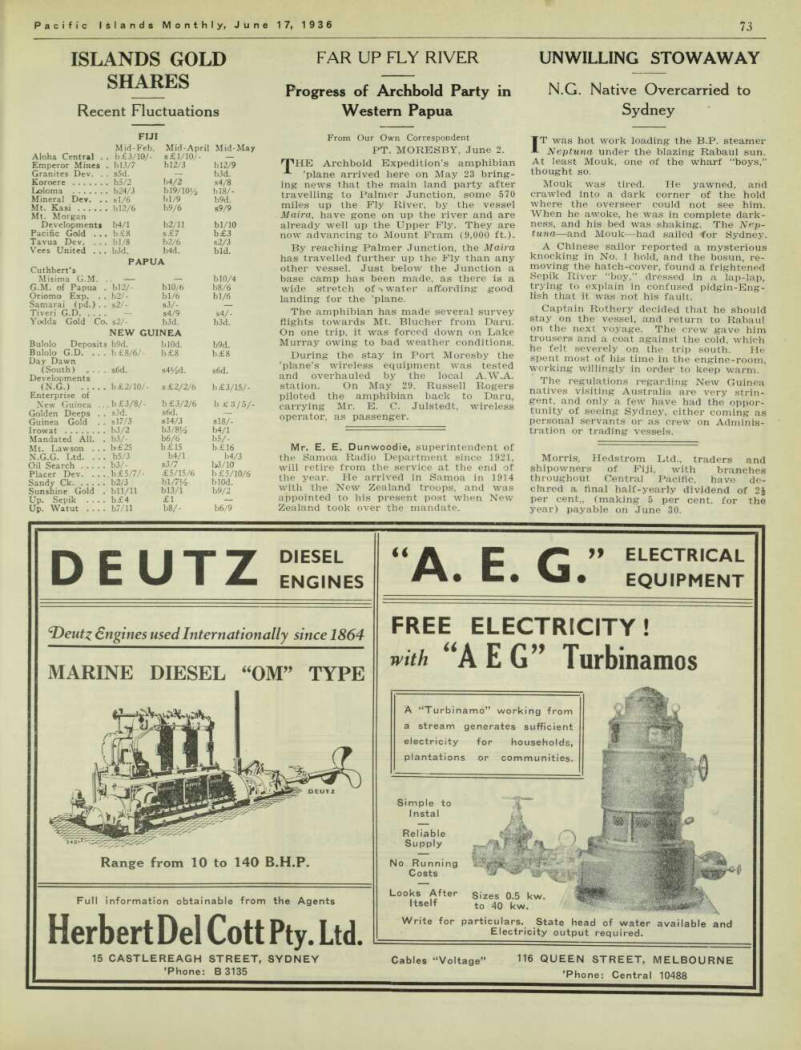
Islands Gold
Recent Fluctuations
Aloha Central .
Fiji
Mid-Feb. b£3/10/- Mid-April s£l/10/- Mid-May Emperor Mines bl3/7 b!2/3 bl2/9 Granites Dev. . s5d. — b3d.
Koroere b5/2 h4/2 s4/8 Loloma b24/3 bl9/10y a hl8/- Mineral Dev. . . sl/6 bl/9 b9d.
Mt. Kasi bl2/6 b9/6 s9/9 Mt. Morgan Developments b4/l b2/ll bl/10 Pacific Gold . . . b €8 s£7 b£3 Tavua Dev. . . . bl/8 b2/6 s2/3 Vecs United . . . b3d. b4d. bid.
Cuthbert’s Misima G.M. .
Papua
blO/4 G.M. of Papua . bl2/blO/6 b8/6 Oriomo Exp. . . b2/bl/6 bl/6 Samarai (pd.) . . s2/s3/- Tiveri G.D — s4/9 s4/- Yodda Gold Co. s2/b3d. b3d.
Bulolo Deposits
New Guinea
b9d. blOd. b9d.
Bulolo G.D. . . . b£8/6/b£8 b£8 Day Dawn (South) . . . . s6d. s4^d. s6d.
Developments (N.G.) b£2/10/s £2/2/6 b £3/15/ - Enterprise of New Guinea ... b£3/8/b £3/2/6 b £3/5/- Golden Deeps . . s3d. s6d. — Guinea Gold . . si 7/3 S14/3 sl8/- Irowat b3/2 h3/sy 2 b4/l Mandated All, . b3/b>6/6 b5/- Mt. Lawson . .. b£25 b£15 b£16 N.G.G. Ltd. . . . bS/3 b4/l b4/3 Oil Search b3/s3/7 L3/10 Placer Dev. . . . b£5/7/- £5/15/6 b £5/10/6 Sandy Ck Sunshine Gold . b2/3 bl/7^2 blOd. bll/11 bl3/l b9/2 Up. Sepik ... b£4 £1 — Up. Watut b7/ll b8/b6/9
Western Papua
Far Up Fly River
Progress of Archbold Party in Western Papua
From Our Own Correspondent
Pt. Moresby, June 2.
THE Archbold Expedition’s amphibian A ’plane arrived here on May 23 bring ing news that the main land party after travelling to Palmer Junction, some 570 miles up the Fly River, by the vessel Maira, have gone on up the river and are already well up the Upper Fly. They are now advancing to Mount Fram (9,000 ft.).
By reaching Palmer Junction, the Maira has travelled further up the Fly than any other vessel. Just below the Junction a base camp has been made, as there is a wide stretch of -> water affording good landing for the ’plane.
The amphibian has made several survey flights towards Mt. Blucher from Daru.
On one trip, it was forced down on Lake Murray owing to bad weather conditions.
During the stay in Port Moresby the ’plane’s wireless equipment was tested and overhauled by the local A.W.A. station. On May 29, Russell Rogers piloted the amphibian back to Daru, carrying Mr. E. C. Julstedt, wireless operator, as passenger.
Mr. E. E. Dunwoodie, superintendent of the Samoa Radio Department since 1921, will retire from the service at the end of the year. He arrived in Samoa in 1914 with the New Zealand troops, and was appointed to his present post when New Zealand took over the mandate.
Sydney
Unwilling Stowaway
N.G. Native Overcarried to Sydney
IT was hot work loading the B.P. steamer Neptuna under the blazing Rabaul sun.
At least Mouk, one of the wharf “boys,” thought so.
Mouk was tired. He yawned, and crawled into a dark corner of the hold where the overseer could not see him.
When he awoke, he was in complete dark ness, and his bed was shaking. The Nep tuna —and Mouk —had sailed for Sydney.
A Chinese sailor reported a mysterious knocking in No. 1 hold, and the bosun, re moving the hatch-cover, found a frightened Sepik River “boy,” dressed in a lap-lap, trying to explain in confused pidgin-Eng lish that it was not his fault.
Captain Rothery decided that he should stay on the vessel, and return to Rabaul on the next voyage. The crew gave him trousers and a coat against the cold, which he felt severely on the trip south. He spent most of his time in the engine-room, working willingly in order to keep warm.
The regulations regarding New Guinea natives visiting Australia are very strin gent, and only a few have had the oppor tunity of seeing Sydney, either coming as personal servants or as crew on Adminis tration or trading vessels.
Morris, Hedstrom Ltd., traders and shipowners of Fiji, with branches throughout Central Pacific, have de clared a final half-yearly dividend of 2£ per cent,, (making 5 per cent, for the year) payable on June 30.
Advertisements & other items, p. 75 (1 item)
De Ut Z Diesel
t \J ■ t— engini
c Deutz Engines used Internationally since 1864
MARINE DIESEL “OM” TYPE
V- V h?
Range from 10 to 140 B.H.P.
Full information obtainable from the Agents
Herbert Del Cott Pty. Ltd.
15 CASTLEREAGH STREET, SYDNEY
’Phone: 83135
“A C f* » ELECTRICAL
C. VJ • EQUIPMENT
FREE ELECTRICITY!
with “A E G” Turbinamos
Reliable Supply No Running Costs Looks After Itself O A “Turbinamo” working from a stream generates sufficient electricity for household plantations or communities Simple to Instal Sizes 0.5 kw. to 40 kw.
Write for particulars. State head of water available and Electricity output required.
Cables “Voltage”
116 QUEEN STREET, MELBOURNE
’Phone: Central 10488
Poaching Sampans
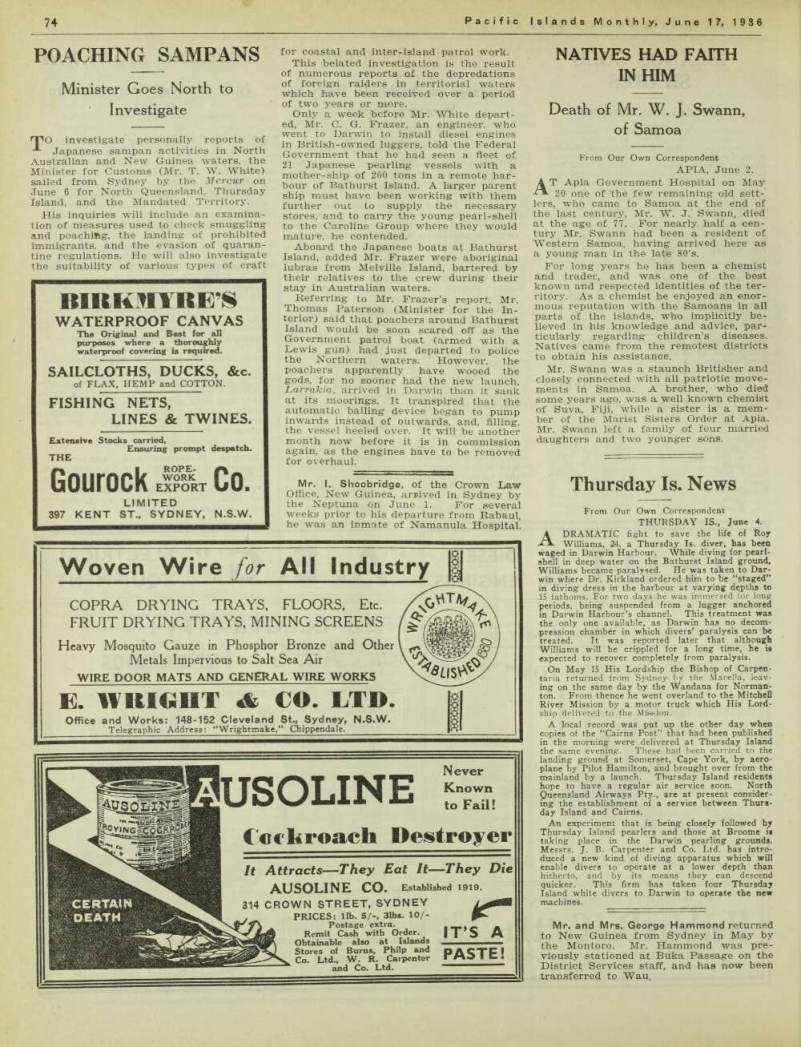
Minister Goes North to Investigate
T° investigate personally reports of Japanese sampan activities in North Australian and New Guinea waters the Minister for Customs (Mr . T. W. White) med from Sydney by the J/erc«r on June 6 for North Queensland, Thursday Island, and the Mandated Temtory.
His inquiries will include an examina tion of measures used to check smuggling and poaching, the landing of prohibited immigrants, and the evasion of quaran tine regulations. He will also investigate the suitability of various types of craft
for coastal and inter-island patrol work.
This belated investigation is the result of numerous reports of the depredations of foreign raiders in territorial waters which have been received over a period of two years or more.
Only a week before Mr. White depart ed, Mr. C. G. Frazer, an engineer, who went to Darwin to install diesel engines in British-owned luggers, told the Federal Government that he had seen a fleet of 21 Japanese pearling vessels with a mother-ship of 200 tons in a remote har bour of Bathurst Island. A larger parent ship must have been working with them further out to supply the necessary stores, and to carry the young pearl-shell to the Caroline Group where they would mature, he contended.
Aboard the Japanese boats at Bathurst Island, added Mr. Frazer were aboriginal lubras from Melville Island, bartered by their relatives to the crew during their stay in Australian waters.
Referring to Mr. Frazer’s report, Mr.
Thomas Paterson (Minister for the In terior) said that poachers around Bathurst Island would be soon scared off as the Government patrol boat (armed with a Lewis gun) had just departed to police the Northern waters. However, the poachers apparently have wooed the gods, for no sooner had the new launch, Larrakia, arrived in Darwin than it sank at its moorings. It transpired that the automatic bailing device began to pump inwards instead of outwards, and, filling, the vessel heeled over. It will be another month now before it is in commission again, as the engines have to be removed for overhaul.
Mr. I. Shoobridge, of the Crown Law Office, New Guinea, arrived in Sydney by the Neptuna on June 1. For several weeks prior to his departure from Rabaul, he was an inmate of Namanula Hospital.
Natives Had Faith
In Him
Death of Mr. W. J. Swann, of Samoa
From Our Own Correspondent APIA, June 2.
AT Apia Government Hospital on May 20 one of the few remaining old sett lers, who came to Samoa at the end of the last century, Mr. W. J. Swann, died at the age of 77. For nearly half a cen tury Mr. Swann had been a resident of Western Samoa, having arrived here as a young man in the late 80’s.
For long years he has been a chemist and trader, and was one of the best known and respected identities of the ter ritory. As a chemist he enjoyed an enor mous reputation with the Samoans in all parts of the islands, who implicitly be lieved in his knowledge and advice, par ticularly regarding children’s diseases.
Natives came from the remotest districts to obtain his assistance.
Mr. Swann was a staunch Britisher and closely connected with all patriotic move ments in Samoa. A brother, who died some years ago, was a well known chemist of Suva, Fiji, while a sister is a mem ber of the Marist Sisters Order at Apia.
Mr. Swann left a family of four married daughters and two younger sons.
Thursday Is. News
From Our Own Correspondent
Thursday Is., June 4.
A DRAMATIC fight to save the life of Roy Williams, 24, a Thursday Is. diver, has been waged in Darwin Harbour. While diving for pearl shell in deep water on the Bathurst Island ground, Williams became paralysed. He was taken to Dar win where Dr. Kirkland ordered him to be “staged” in diving dress in the harbour at varying depths to 15 fathoms. For two days he was immersed for long periods, being suspended from a lugger anchored in Darwin Harbour’s channel. This treatment was the only one available, as Darwin has no decom pression chamber in which divers’ paralysis can be treated. It was reported later that although Williams will be crippled for a long time, he i* expected to recover completely from paralysis.
On May 15 His Lordship the Bishop of Carpen taria returned from Sydney by the Marella, leav ing on the same day by the Wandana for Norman ton. From thence he went overland to the MitcheD River Mission by a motor truck which His Lord ship delivered to the Mission.
A local record was put up the other day when copies of the “Cairns Post” that had been published in the morning were delivered at Thursday Island the same evening. These had been carried to the landing ground at Somerset, Cape York, by aero plane by Pilot Hamilton, and brought over from the mainland by a launch. Thursday Island residents hope to have a regular air service soon. North Queensland Airways Pty., are at present consider ing the establishment of a service between Thurs day Island and Cairns.
An experiment that is being closely followed by Thursday Island pearlers and those at Broome is taking place in the Darwin pearling grounds.
Messrs. J. B. Carpenter and Co. Ltd. has intro duced a new kind of diving apparatus which will enable divers to operate at a lower depth than hitherto, and by its means they can descend quicker. This firm has taken four Thursday Island white divers to Darwin to operate the new machines.
Mr. and Mrs. George Hammond returned to New Guinea from Sydney in May by the Montoro. Mr. Hammond was pre viously stationed at Buka Passage on the District Services staff, and has now been transferred to Wau.
Advertisements & other items, p. 76 (1 item)
Usoline
KHKKMVItF/S
WATERPROOF CANVAS
The Original and Bast for all purposes where a thoroughly waterproof covering is required.
SAILCLOTHS, DUCKS, &c.
of FLAX, HEMP and COTTON.
FISHING NETS,
LINES & TWINES.
Extensive Stocks carried.
Ensuring prompt despatch.
THE
Gourock EXPORT Co.
LIMITED
397 KENT ST., SYDNEY, N.S.W.
Woven Wire for All Industry
COPRA DRYING TRAYS, FLOORS. Etc.
FRUIT DRYING TRAYS, MINING SCREENS
Heavy Mosquito Gauze in Phosphor Bronze and Other Metals Impervious to Salt Sea Air WIRE DOOR MATS AND GENERAL WIRE WORKS
Visv^
E. WIUCiIIT <& CO. LTD.
Office and Works: 148-152 Cleveland St., Sydney, N.S.W.
Telegraphic Address: “Wrightmake,” Chippendale.
USOLINE
Never Known to Fail!
Cockroach Destroyer
It Attracts —They Eat It—They Die AUSOLINE CO. Established 1919.
314 CROWN STREET, SYDNEY
PRICES: lib. 5/-, 3lbs. 10/- Postage extra.
Remit Cash with Order.
Obtainable also at Islands Stores of Burns, Philp and
IT’S A
Jiurea ut uo, * —— Co. Ltd., W. R. Carpenter J f iJ
PASTE!
Guinea Airways’ New Cargo Boat
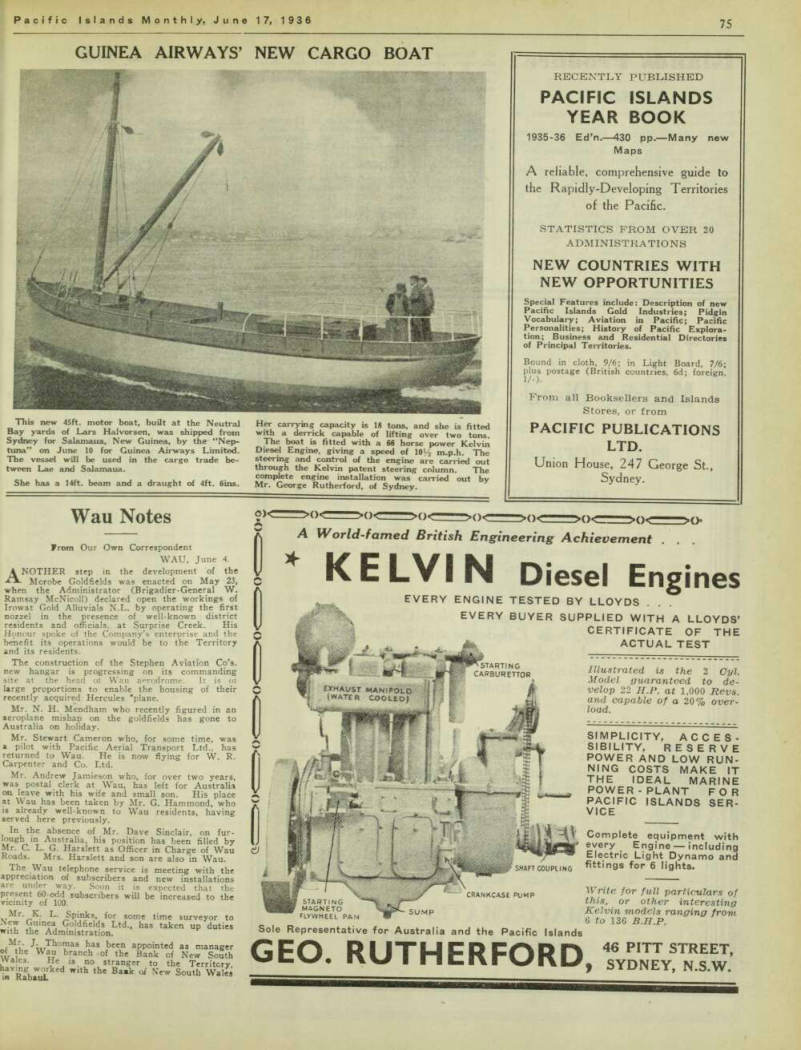
This new 45ft. motor boat, built at the Neutral Bay yards of Lars Halvorsen, was shipped from Sydney for Salamaua, New Guinea, by the “Nep tuna” on June 10 for Guinea Airways Limited.
The vessel will be used in the cargo trade be tween Lae and Salamaua.
She has a 14ft. beam and a draught of 4ft. 6ins.
Her carrying capacity is 18 tons, and she is fitted with a derrick capable of lifting over two tons.
The boat is fitted with a 66 horse power Kelvin Diesel Engine, giving a speed of 10 ½ m.p.h. The steering and control of the engine are carried out through the Kelvin patent steering column. The complete engine installation was carried out by Mr. George Rutherford, of Sydney.
Wau Notes
From Our Own Correspondent WAU, June 4.
ANOTHER step in the development of the Morobe Goldfields was enacted on May 23, when the Administrator (Brigadier-General W.
Ramsay McNicoll) declared open the workings of Irowat Gold Alluvials N.L. by operating the first nozzel in the presence of well-known district residents and officials, at Surprise Creek. His Honour spoke of the Company’s enterprise and the benefit its operations would be to the Territory and its residents.
The construction of the Stephen Aviation Co’s, new hangar is progressing on its commanding site at the head of Wau aerodrome. It is of large proportions to enable the housing of their recently acquired Hercules 'plane.
Mr. N. H. Mendham who recently figured in an aeroplane mishap on the goldfields has gone to Australia on holiday.
Mr. Stewart Cameron who, for some time, was a pilot with Pacific Aerial Transport Ltd., has returned to Wau. He is now flying for W. R.
Carpenter and Co. Ltd.
Mr. Andrew Jamieson who, for over two years, was postal clerk at Wau, has left for Australia on leave with his wife and small son. His place at Wau has been taken by Mr. G. Hammond, who is already well-known to Wau residents, having served here previously.
In the absence of Mr. Dave Sinclair, on fur lough in Australia, his position has been filled by Mr. C. L. G. Harslett as Officer in Charge of Wau Roads. Mrs. Harslett and son are also in Wau.
The Wau telephone service is meeting with the appreciation of subscribers and new installations are under way. Soon it is expected that the present 60-odd subscribers will be increased to the vicinity of 100.
Mr- K; L. Spinks, for some time surveyor to •Tu Uiri Goldfields Ltd., has taken up duties •ritn the Administration.
J ;i7 Th ° ! i nas *? as been appointed as manager & he branch of the Bank of New South Wa es. He is no stranger to the Territory, tiavmg worked with the Bank of New South Wales m Kabaul.
Advertisements & other items, p. 77 (1 item)
Geo. Rutherford,
RECENTLY PUBLISHED
PACIFIC ISLANDS
YEAR BOOK
1935-36 Ed’n.—43o pp.—Many new Maps
A reliable, comprehensive guide to
the Rapidly-Developing Territories
of the Pacific.
STATISTICS FROM OVER 20
ADMINISTRATIONS
NEW COUNTRIES WITH
NEW OPPORTUNITIES
Special Features include: Description of new Pacific Islands Gold Industries; Pidgin Vocabulary; Aviation in Pacific; Pacific Personalities; History of Pacific Exploration; Business and Residential Directories of Principal Territories.
Bound in cloth, 9/6; in Light Board, 7/6; plus postage (British countries, 6d; foreign, From all Booksellers and Islands Stores, or from
PACIFIC PUBLICATIONS
LTD.
Union House, 247 George St.,
Sydney.
w I
A World-famed British Engineering Achievement
KELVIN Diesel Engines
EVERY ENGINE TESTED BY LLOYDS
EVERY BUYER SUPPLIED WITH A LLOYDS'
CERTIFICATE OF THE
ACTUAL TEST
s “starting
CARBURETTOR
f*HAUST MANIFOLD I
(WATER COOLED) f
I c
START
ETC
MAfiN
SUM
FLYWHEEL
Illustrated is the 2 Cyl.
Model guaranteed to develop 22 H.P. at 1,000 Revs, and capable of a 20% overload.
SIMPLICITY, ACCES-
SIBILITY, RESERVE
POWER AND LOW RUN-
NING COSTS MAKE IT
THE IDEAL MARINE
POWER-PLANT FOR
PACIFIC ISLANDS SER-
VICE
SHAFT COUPLING
Complete equipment with every Engine including Electric Light Dynamo and fittings for 6 lights.
CRANKCASE PUMP
Sole Representative for Australia and the Pacific Islands
GEO. RUTHERFORD,
Write for full particulars of this or other interesting Kelvin models ranging from 6 to 136 B.H.P.
46 PITT STREET,
SYDNEY, N.S.W.
Islands Produce
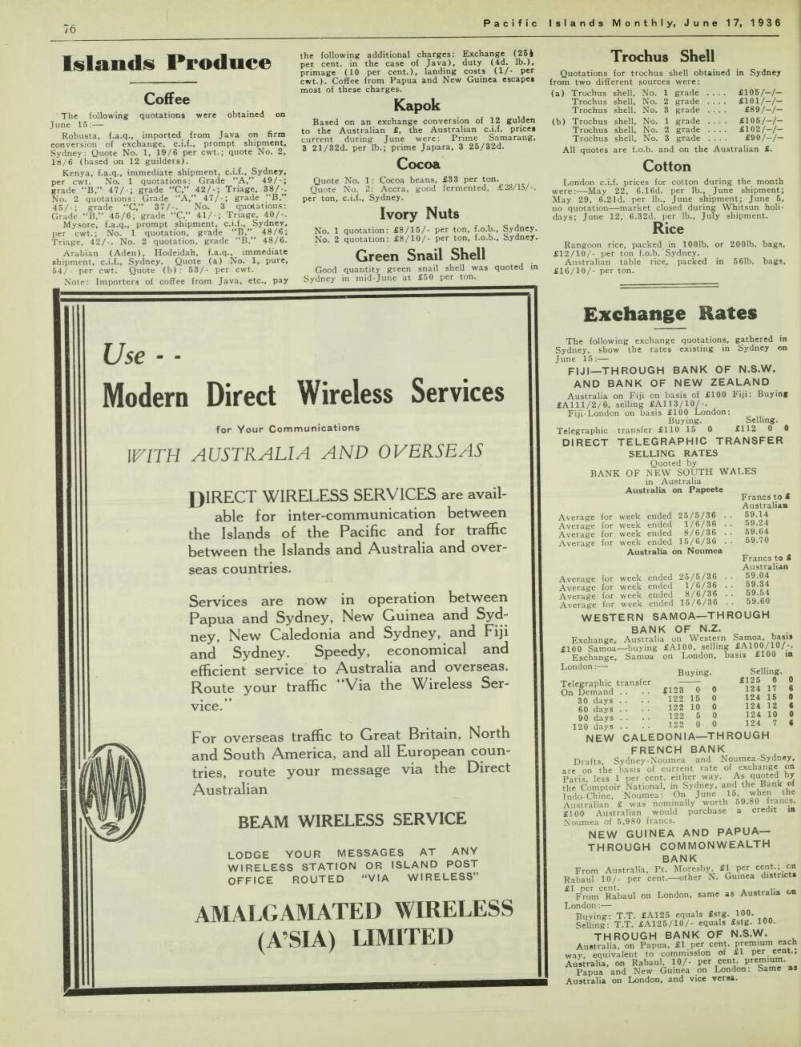
Coffee
The following quotations were obtained on June 15;— Robusta, f.a.q., imported from Java on firm conversion of exchange, c.i.f., prompt shipment, Sydney: Quote No. 1, 19/6 per cwt.; quote No. 2, 18/6 (based on 12 guilders).
Kenya, f.a.q., immediate shipment, c.i.f., Sydney, per cwt. No. 1 quotations: Grade “A,” 49/-; grade “B,” 47/-; grade “C,” 42/-; Triage, 38/-.
No. 2 quotations: Grade “A,” 47/-; grade “B,” 45/-; grade “C,” 37/-. No. 3 quotations: Grade “B,” 45/6; grade “C.” 41/-; Triage. 40/-.
Mysore, f.a.q., prompt shipment, c.i.f., Sydney, per cwt.; No. 1 quotation, grade “B,” 48/6; Triage, 42/-. No. 2 quotation, grade “B,” 48/6.
Arabian (Aden), Hodeidah, f.a.q., immediate shipment, c.i.f., Sydney. Quote (a) No. 1, pure, 54/- per cwt. Quote (b) : 53/- per cwt.
Note; Importers of coffee from Java, etc., pay
the following additional charges; Exchange (25J per cent, in the case of Java), duty (4d. lb.), primage (10 per cent.), landing costs (1/- per cwt.). Coffee from Papua and New Guinea escapes most of these charges.
Kapok
Based on an exchange conversion of 12 gulden to the Australian £, the Australian c.i.f. prices current during June were; Prime Samarang, 3 21/32d. per lb.; prime Japara, 3 25/32d.
Cocoa
Quote No. 1: Cocoa beans, £33 per ton.
Quote No. 2: Accra, good fermented, £2B/15/-. per ton, c.i.f., Sydney.
Ivory Nuts
No. 1 quotation: £B/15/- per ton, f.0.b., Sydney, No. 2 quotation: £B/10/- per ton, f.0.b., Sydney.
Green Snail Shell
Good quantity green snail shell was quoted in Svdnev in mid-June at £5O per ton.
Trochus Shell
Quotations for trochus shell obtained in Sydney from two different sources were: (a) Trochus shell. No. 1 grade ... £lO5/—/ Trochus shell. No. 2 grade ... £lOl/—/ Trochus shell, No. 3 grade ... £B9/—/ (b) Trochus shell. No. 1 grade ... £lO5/—/ Trochus shell. No. 2 grade ... £lO2/—/ Trochus shell. No. 3 grade ... £9O/—/ All quotes are f.o.b. and on the Australian £.
Cotton
London c.i.f. prices for cotton during the month were:—May 22, 6.16 d. per lb., June shipment; May 29, 6.21 d. per lb., June shipment; June 5, no quotation—market closed during Whitsun holi days; June 12, 6.32 d. per lb., July shipment.
Rice
Rangoon rice, packed in 1001 b. or 2001 b. bags, £l2/10/- per ton f.o.b. Sydney.
Australian table rice, packed in 561 b. bags, £l6/10/- per ton.
Exchange Rates
The following exchange quotations, gathered in Sydney, show the rates existing in Sydney on June 15: —
F Ij|_Through Bank Of N.S.W.
And Bank Of New Zealand
Australia on Fiji on basis of £lOO Fiji: Buying fAlll/2/6, selling £AII3/10/-.
Fiji-London on basis £lOO London: Buying. Selling.
Telegraphic transfer £llO 15 0 £ll2 0 0
Direct Telegraphic Transfer
Selling Rates
Quoted by
Bank Of New South Wales
in Australia
Western Samoa—Through
Bank Of N.Z. .
Exchange, Australia on Western Samoa, basis £lOO Samoa —buying £AIOO, selling £AIOO/10/-.
Exchange, Samoa on London, basis £lOO in London: —
New Caledonia —Through
French Bank
Drafts, Sydney-Noumea and Noumea-Sydney. are on the basis of current rate of exchange on Paris, less 1 per cent, either way. As quoted by the Comptoir National, in Sydney, and the Bank of Indo-Chine. Noumea: On J une Australian £ was nominally worth 59.80 trancs, £lOO Australian would purchase a credit m Noumea of 5,980 francs.
New Guinea And Papua
Through Commonwealth
Bank
From Australia. Pt. Moresby £1 per cent .; on Rabaul 10/- per cent. —other N. Guinea districts £l From C ßabaul on London, same as Australia on London: — Buying: T.T. £AI2S equals £stg. 100.
Selling: T.T. £AI2S/10/- equals £stg. 100. through bank of n.s.w.
Australia, on Papua, £1 per cent, premium each way, equivalent to commission of £1 per cent., Australia, on Rabaul. 10/- per cent. Premium Papua and New Guinea on London: Same as Australia on London, and vice versa.
Average for Australia on Papeete week ended 25/5/36 . .
Francs to 4 Australian 59.14 Average for week ended 1/6/36 . . 59.24 Average for week ended 8/6/36 . . 59.64 Average for week ended 15/6/36 . . 59.70 Average for Australia on Noumea week ended 25/5/36 . .
Francs to 4 Australian 59.04 Average for week ended 1/6/36 . , 59.34 Average for week ended 8/6/36 . 69.54 Average for week ended 15/6/36 . 59.60
Lond ° n: Buying. Selling.
Telegraphic transfer ,2 2
On Demand . . .. £123 0 0 124 17 6 30 days . . • • 122 15 0 124 15 0 60 days . . 122 10 0 124 12 6 90 dKI . •• 122 5 0 124 10 0 120 days ... 122 0 0 124 7 «
Advertisements & other items, p. 78 (1 item)
Modern Direct Wireless Services
Use - -
for Your Communications
WITH AUSTRALIA AND OVERSEAS
DIRECT WIRELESS SERVICES are avail-
able for inter-communication between the Islands of the Pacific and for traffic between the Islands and Australia and overseas countries.
Services are now in operation between Papua and Sydney, New Guinea and Sydney, New Caledonia and Sydney, and Fiji and Sydney. Speedy, economical and efficient service to Australia and overseas.
Route your traffic “Via the Wireless Service.
For overseas traffic to Great Britain, North and South America, and all European countries, route your message via the Direct Australian
BEAM WIRELESS SERVICE
LODGE YOUR MESSAGES AT ANY
WIRELESS STATION OR ISLAND POST
OFFICE ROUTED “VIA WIRELESS”
AMALGAMATED WIRELESS
(ASIA) LIMITED
Market Quotations
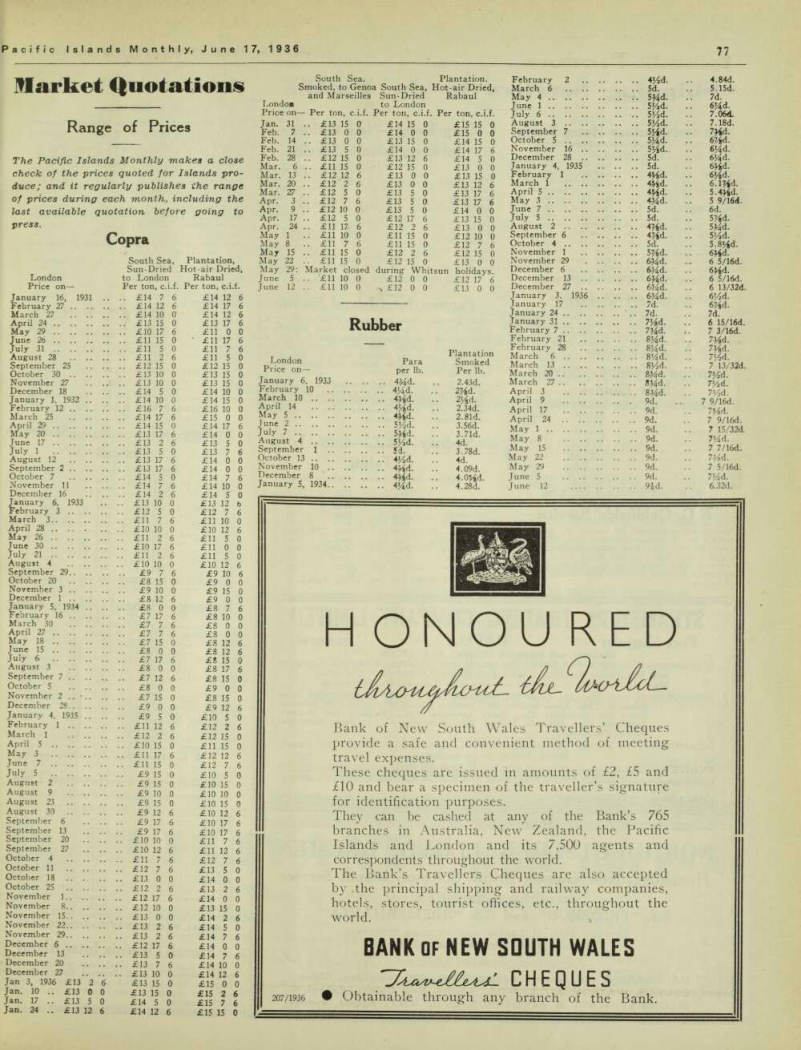
Range of Prices
The Pacific Islands Monthly makes a close check of the prices quoted for Islands pro duce; and it regularly publishes the range of prices during each month, including the last available quotation before going to press.
Copra
Rubber
South Sea.
Plantation.
Smoked, to Genoa South Sea, Hot-air Dried. and Marseilles Sun-Dried Rabaul Londo« to London Price on — Per ton, ( c.i.f.
Per ton, c.i.f, . Per ton, c.i .f.
Jan. 31 .. £13 15 0 £14 IS 0 £15 IS 0 Feb. 7 .. £13 0 0 £14 0 0 £15 0 0 Feb. 14 .. £13 0 0 £13 15 0 £14 IS 0 Feb. 21 .. £13 5 0 £14 0 0 £14 17 6 Feb. 28 .. £12 15 0 £13 12 6 £14 5 0 Mar. 6 .. £11 15 0 £12 15 0 £13 0 0 Mar. 13 .. £12 12 6 £13 0 0 £13 15 0 Mar. 20 .. £12 2 6 £13 0 0 £13 12 6 Mar. 27 .. £12 5 0 £13 5 0 £13 17 6 Apr. 3 .. £12 7 6 £13 5 0 £13 17 6 Apr. 9 .. £12 10 0 £13 5 0 £14 0 0 Apr. 17 .. £12 5 0 £12 17 6 £13 15 0 Apr. 24 .. £11 17- 6 £12 2 6 £13 0 0 May 1 .. £11 10 0 £11 15 0 £12 10 0 May 8 .. £11 7 6 £11 15 0 £12 7 6 May 15 .. £11 IS 0 £12 2 6 £12 15 0 May 22 .. £11 15 0 £12 15 0 £13 0 0 May 29: Market closed during Whitsun holiday s.
June 5 .. £11 10 0 £12 0 0 £12 17 6 June 12 .. £11 10 0 £12 0 0 £13 0 0
February 2 .. .. . .. 4j4d. 4.84d.
March 6 . .. 5d.
S.lSd.
May 4 . .. 5Hd. 7d.
June 1 . .. S'Ad. 6'Ad.
July 6 . .. S'Ad. . . 7.064.
August 3 . .. S'Ad. 7.18d.
September 7 .. .. . .. 5Hd. 7Hd.
October 5 . .. S'Ad. 6Hd.
November 16 .. .. . .. 5^id. , . 6%d.
December 28 .. .. . .. Sd. 6'Ad.
January 4, 1935 . .. 5d. 6Hd.
February 1 .. .. • .. 4^d. tm- March 1 . .. 4^d. e.vAd- April 5 . .. 4^d. 5.4Hd.
May 3 . .. 4V*d. . . 5 9/16d.
June 7 6d.
July 5 , 5^d.
August 2 . .. 4^d. sy 4 d.
September 6 .. .. . .. 4^d. . .
S'Ad.
October 4 . .. 5d. 5.8'Ad.
November 1 . .. 5^d. 6Hd.
November 29 . .. . . .. ey 4 d. 6 5/16d.
December 6 . .. ey 4 d. 6Hd.
December 13 .. .. . .. ey 4 d. 6 5/16d.
December 27 . .. 6H d. 6 13/32d.
January 3. 1936 .. . . .. ey 4 d. 6'Ad.
January 17 . .. 7d. 67Ad.
January 24 . .. 7d. 7d.
January 31 . .. 7'Ad. 6 15/16d.
February 7 . .. 7Hd. 7 3/16d.
February 21 . .. 8'Ad. md.
February 28 . .. 8%d. 7%d.
March 6 . .. 8'Ad. 7'Ad.
March 13 . .. 8^d. 7 13/32d.
March 20 . .. sy 4 d. 7'Ad.
March 27 . .. sy 4 d. 7'Ad.
April 3 . .. sy 4 d. 7'Ad.
April 9 . . 9d. 7 9/16d.
April 17 . .. 9d. 7m.
April 24 . .. 9d. 7 9/16d.
Mav 1 . .. 9d. 7 15/32d.
May 8 . .. 9d. 7'Ad.
May 15 . .. 9d. 7 7/16d.
May 22 . .. 9d. 7m.
May 29 . .. 9d. 7 5/16d.
June 5 . .. 9d. 7'Ad.
June 12 . .. 9|d. 6.32d.
London Price on— January 16, 1931 .
South Sea, Sun-Dried to London Per ton, c.i.f. . .. £14 7 6 Plantation, Hot-air Dried, Rabaul Per ton, c.i.f. £14 12 6 February 27 .. . .. £14 12 6 £14 17 6 March 27 . .. £14 10 0 £14 12 6 April 24 .. ..
May 29 .. .. . .. £13 15 0 £13 17 6 . .. £10 17 6 £11 0 0
June 26 .. ..
. .. £11 IS 0 ' £11 17 6 July 31 .. .. . .. £11 5 0 £11 7 6 August 28 . .. £11 2 6 £11 5 0 September 25 , .. £12 15 0 £12 15 0 October 30 .. . .. £13 10 0 £13 15 0 November 27 , .. £13 10 0 £13 15 0 December 18 , .. £14 5 0 £14 10 0 January 1, 1932 .. £14 10 0 £14 15 0 February 12 .. , .. £16 7 6 £16 10 0 March 25 .. £14 17 6 £15 0 0 April 29 .. .. .. £14 IS 0 £14 17 6 May 20 .. .. .. £13 17 6 £14 0 0 June 17 .. .. . .. £13 2 6 £13 5 0 July 1 ... .. £13 5 0 £13 7 6 August 12 .. £13 17 6 £14 0 0 September 2 .. , .. £13 17 6 £14 0 0 October 7 , .. £14 5 0 £14 7 6 November 11 .. £14 7 6 £14 10 0 December 16 .. £14 2 6 £14 5 0 January 6, 1933 . . .. £13 10 0 £13 12 b
February 3
.. £12 5 0 £12 7 6 March 3.. .. 6 £11 10 0 April 28 .. .. • .. .. £10 10 0 £10 12 6 May 26 .. .. 6 £11 5 0 June 30 .. .. 6 £11 0 0 July 21 .. .. 6 £11 5 0 August 4 .. £10 10 0 £10 12 6 September 29.. . .. £9 7 6 £9 10 6 October 20 0 £9 0 0 November 3 .. 0 £9 IS 0 December 1 .. .. £8 12 6 £9 0 0 January 5, 1934 .. £8 0 0 £8 7 6
February 16 ..
6 £8 10 0 March 30 6 £8 0 0 April 27 .. .. 6 £8 0 0 May 18 .. .. 0 £8 12 6 June IS .. .. 0 £8 12 6 July 6 ... 6 £8 15 0 August 3 0 £8 17 6
September 7 ..
6 £8 15 0 October 5 £8 0 0 £9 0 0 November 2 .. • 0 £8 IS 0 December 28.. 0 £9 12 6 January 4, 1935 £9 5 0 £10 5 0 February 1 .. .. £11 12 6 £12 2 6 March 1 6 £12 IS 0 April 5 .. .. £10 15 0 £11 15 0 May 3 .. .. 6 £12 12 6 June 7 .. .. 0 £12 7 6 July 5 ... .. £9 IS 0 £10 5 0 August 2 .. £9 15 0 £10 IS 0 August 9 £9 10 0 £10 10 0 August 23 .. .. £9 15 0 £10 15 0 August 30 .. .. £9 12 6 £10 12 6
September 6
.. £9 17 6 £10 17 6 September 13 .. £9 17 6 £10 17 6
September 20
. . .. £10 10 0 £11 7 6
September 27
. . .. £10 12 6 £11 12 6 October 4 6 £12 7 6 October 11 .. , .. £12 7 6 £13 5 0 October 18 .. , 0 £14 0 0 October 25 .. , .. £12 2 6 £13 2 6 November 1.. . 6 £14 0 0 November 8.. , 0 £13 IS 0 November 15.. , 0 £14 2 6 November 22.. 6 £14 5 0 November 29.. , 6 £14 7 6 December 6 .. . 6 £14 0 0 December 13 . .. £13 5 0 £14 7 6 December 20 .. £13 7 6 £14 10 0 December 27 .. £13 10 0 £14 12 6 Jan 3, 1936 £13 2 6 £13 15 0 £15 0 0 Jan. 10 .. £13 0 0 £13 15 0 £15 2 6 Jan. 17 .. £13 S 0 £14 5 0 £15 7 6 Jan. 24 .. £13 12 6 £14 12 6 £15 IS 0
London Para Plantation Smoked Price on— per lb.
Per lb.
January 6, 1933 .. .. 4^d. 2.43d.
February 10 . .. 4%d. .. 2Hd.
March 10 2'Ad.
April 14 .. .. 4%d. .. 2.34d.
May 5 2.81d.
June 2 3.56d.
July 7 .. .. Sfid. 3.71d.
August 4 4d.
September 1 .. .. 3.78d.
October 13 4d.
November 10 .. .. .. .. 4id. 4.09d.
December 8 .. •• 4**d. 4.0^d.
January 5, 1934.. .. .. .. 4tfd. .. 4.28d.
Advertisements & other items, p. 79 (1 item)
Honoured
Bank of New South Wales Travellers’ Cheques provide a safe and convenient method of meeting travel expenses.
These cheques are issued in amounts of £2, £S and ilO and bear a specimen of the traveller’s signature for identification purposes.
They can be cashed at any of the Bank’s 765 branches in Australia, New Zealand, the Pacific Islands and London and its 7,500 agents and correspondents throughout the world.
The Bank’s Travellers Cheques are also accepted by .the principal shipping and railway companies, hotels, stores, tourist offices, etc., throughout the world. x
BANK OF NEW SOUTH WALES
CHEQUES
207/1936 • Obtainable through any branch of the Bank.
Sydney—N.Z.—Cook Is.—
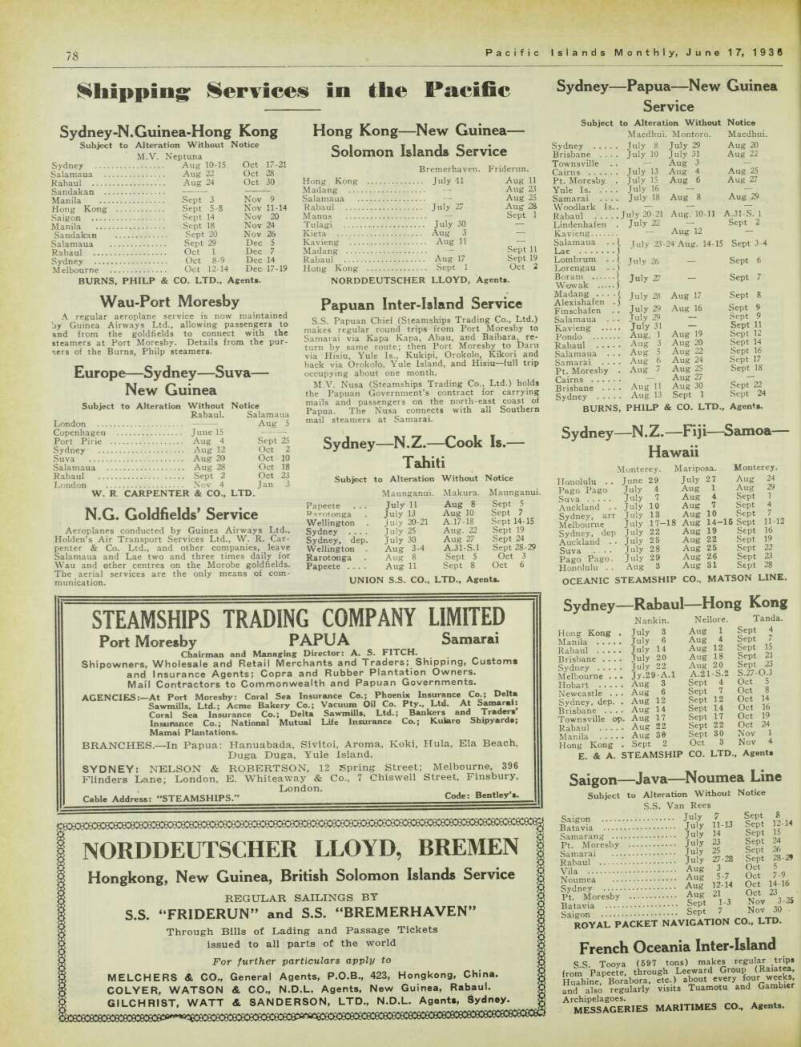
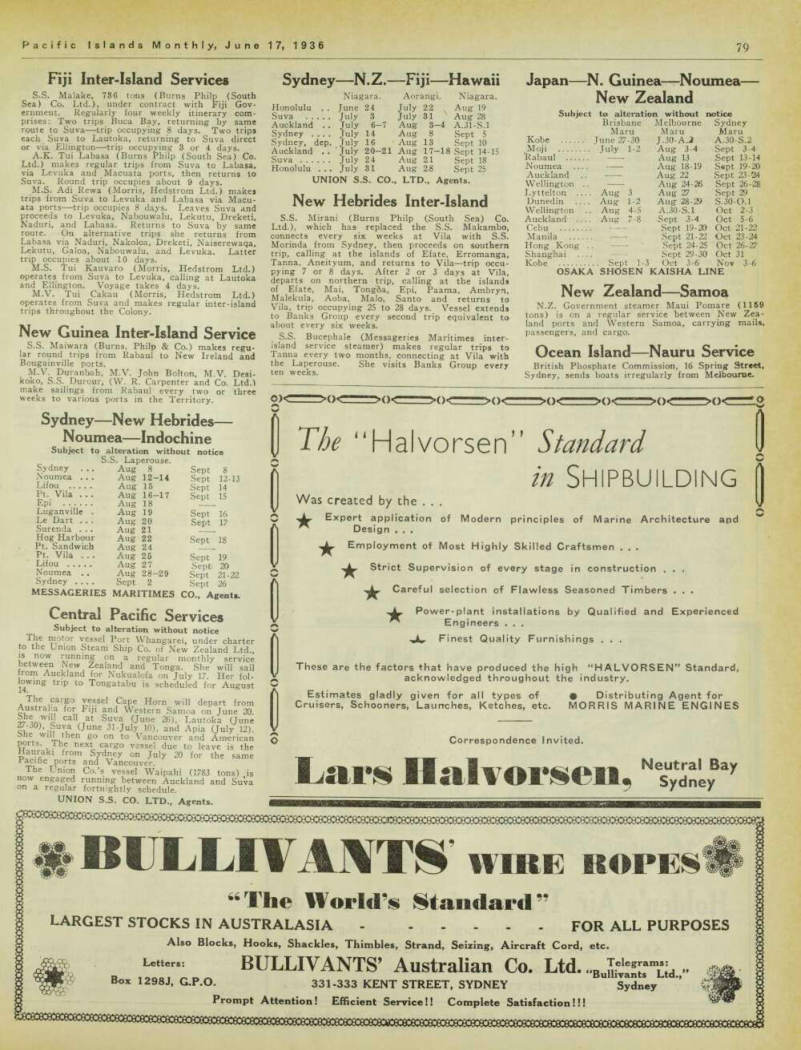
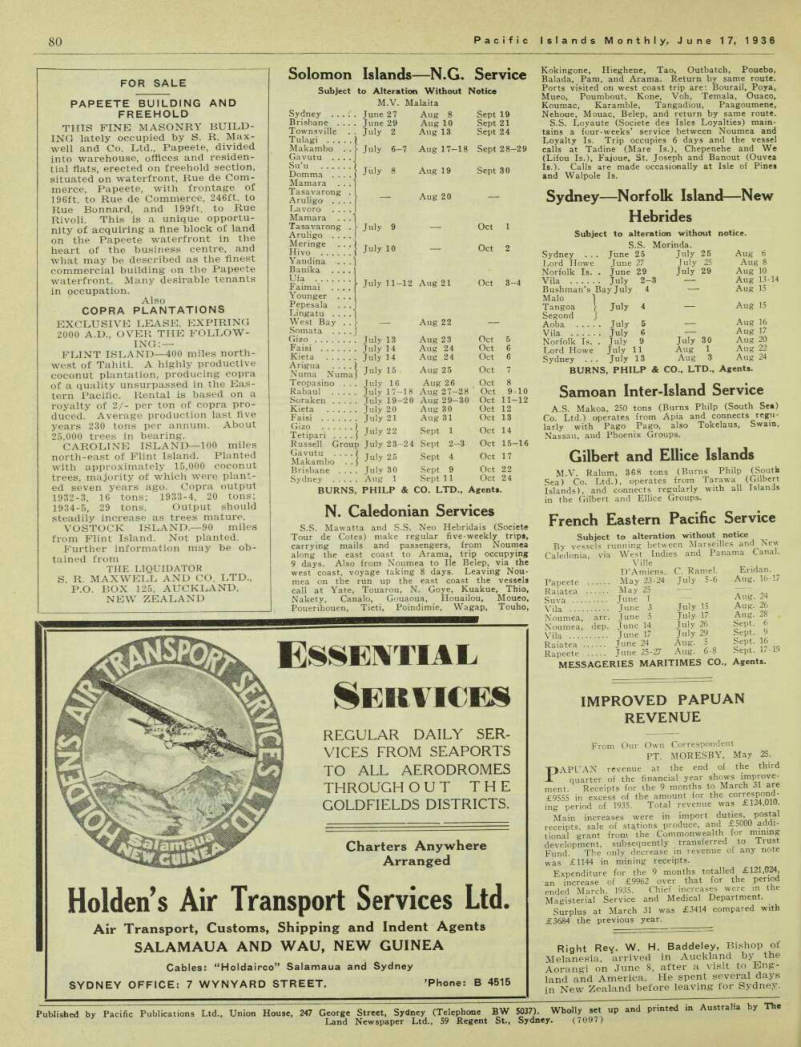
Shipping Services in the Pacific
Sydney-N.Guinea-Hong Kong Subject to Alteration Without Notice
Wau-Port Moresby
A regular aeroplane service is now maintained by Guinea Airways Ltd., allowing passengers to and from the goldfields to connect with the steamers at Port Moresby. Details from the pur sers of the Burns, Philp steamers.
Europe—Sydney—Suva—
New Guinea
Subject to Alteration Without Notice
N.G. Goldfields , Service
Aeroplanes conducted by Guinea Airways Ltd., Holden’s Air Transport Services Ltd., W. R. Car penter & Co. Ltd., and other companies, leave Salamaua and Lae two and three times daily for Wau and other centres on the Morobe goldfields.
The aerial services are the only means of com munication.
Hong Kong—New Guinea — Solomon Islands Service
Papuan Inter-Island Service
S.S. Papuan Chief (Steamships Trading Co., Ltd.) makes regular round trips from Port Moresby to Samarai via Kapa Kapa, Abau, and Baibara, re turn by same route; then Port Moresby to Dam via Hisiu, Yule Is., Kukipi, Orokolo, Kikori and back via Orokolo, Yule Island, and Hisiu —full trip occupying about one month.
M.V. Nusa (Steamships Trading Co., Ltd.) holds the Papuan Government’s contract for carrying mails and passengers on the north-east coast of Papua. The Nusa connects with all Southern mail steamers at Samarai.
Sydney—N.Z.—Cook Is.—
Tahiti
Subject to Alteration Without Notice
Sydney—Papua—New Guinea
Service Subject to Alteration Without Notice
Sydney—N.Z.—Fiji —Samoa — Hawaii
Sydney —Rabaul —Hong Kong
Saigon—Java —Noumea Line Subject to Alteration Without Notice
French Oceania Inter-Island
SS. Tooya (597 tons) makes regular trips from Papeete, through Leeward Group (Raiatea, Huahine, Borabora. etc.) about every four weeks, and also regularly visits Tuamotu and Gambier Archipelagoes.
Messageries Maritimes Co. Agents.
M.V. Neptuna Sydney Aug 10-15 Oct 17-21 Salamaua Aug 22 Oct 28 Rabaul Aug 24 Oct 30 Sandakan Manila Sept 3 Nov 9 Hong Kong Sept 5-8 Nov 11-14 Saigon Sept 14 Nov 20 Manila Sept 18 Nov 24 Sandakan Sept 20 Nov 26 Salamaua Sept 29 Dec 5 Rabaul Oct 1 Dec 7 Sydney Oct 8-9 Dec 14 Melbourne Oct 12-14 Dec 17-19
Burns, Philp & Co. Ltd.. Agents.
Rabaul. Salamaua London Aug 5 Copenhagen June IS Port Pirie Aug 4 Sept 25 Sydney Aug 12 Oct 2 Suva Aug 20 Oct 10 Salamaua Aug 28 Oct 18 Rabaul Sept 2 Oct 23 London Nov 4 Jan 3
W. R Carpenter & Co., Ltd.
Bremerhaven. Friderun.
Hong Kong July 11 Aug 11 Madang ...
Aug 23 Salamaua Aug 25 Rabaul July 27 Aug- 28 Manus Sept 1 Tulagi July 30 — Kieta Aug 3 — Kavieng — Madang Sept 11 Rabaul Sept 19 Hong Kong Oct 2
Norddeutscher Lloyd,
Agents.
Maunganui.
Makura.
Maunganui.
Papeete July 11 Aug 8 Sept 5 Pimtonga July 13 Aug 10 Sept 7 Wellington July 20-21 A.17-18 Sept 14-15 Sydney ...
Julv 25 Aug. 22 Sept 19 Sydney, dep.
July 30 Aug 27 Sept 24 Wellington Aug 3-4 A.31-S.1 Sept 28-29 Rarotonga Aug 8 Sept 5 Oct 3 Papeete ...
Aug 11 Sept 8 Oct 6
Union S.S. Co.,
LTD., Agents.
Macdhui. Montoro.
Macdhui.
Sydney July 8 July 29 Aug 20 Brisbane . . . .
July 10 July 31 Aug 22 Townsville — Aug 3 — Cairns July 13 Aug 4 Aug 25 Pt. Moresby. .
July 15 Aug 6 Aug 27 Yule Is July 16 — — Samarai . . . .
July 18 Aug 8 Aug .29 Woodlark Is.. — — — Rabaul July 20-21 Aug. 10-11 A.31-S. 1 Lindenhafen .
July 22 — Sept 2 Kavieng — Aug 12 — Salamaua Lae Lombrum . .
Lorengau . .
July 23- 24 Aug. 14-15 Sept 3-4 July 26 - Sept 6 Boram 1 Weiwak j . July 27 1 — Sept 7 Madang Alexishafen .' [ July 28 Aug 17 Sept 8 Finschafen July 29 Aug 16 Sept 9 Salamaua . . . . Tuly 29 — Sept 9 Kavieng July 31 Aug. 1 Aug 19 Sept 11 Sept 12 Rabaul . , . . . Aug 3 Aug 20 Sept 14 Salamaua . . . Aug 5 Aug 22 Sept 16 Samarai . . . . Aug 6 Aug 24 Sept 17 Pt. Moresby . Aug 7 Aug 25 Sept 18 Cairns — Aug 27 — Brisbane . . • . Aug 11 Aug 30 Sept 22 Sydney ... . Aug 13 Sept 1 Sept 24 burns
, Philp
& Co. Ltd.,
, Agent*.
Monterey. Mariposa.
Monterey.
Honolulu . .
June 29 July 27 Aug 24 Pago Pago July 4 Aug 1 Aug 29 Suva July 7 Aug 4 Sept 1 Auckland . ■ July 10 Aug 7 Sept 4 Sydney, arr July 13 Aug 10 Sept 7 Melbourne July 17-18 Aug 14- ■15 Sept 11-12 Sydney, dep July 22 Aug 19 Sept 16 Auckland . ■ . July 25 Aug 22 Sept 19 Suva . • . • July 28 Aug 25 Sept 22 Pago Pago.
July 29 Aug 26 Sept 23 Honolulu . .
Aug 3 Aug 31 Sept 28
Oceanic
Steamship
Co., Matson
Line.
Nankin.
Nellore.
Tanda.
Hong Kong . July 3 Aug 1 Sept 4 Manila . . . . . July 6 Aug 4 Sept 7 Rabaul . . . . . July 14 Aug 12 Sept 15 Brisbane . . . . July 20 Aug 18 Sept 21 Sydney ... . July 22 Aug 20 Sept 23 Melbourne . . . Jy.29-A.l A.21 -S.2 S.27-0.3 Hobart . . . . . Aug 3 Sept 4 Oct 5 Newcastle . . , . Aug 6 Sept 7 Oct 8 Sydney, dep. . Aug 12 Sept 12 Oct 14 Brisbane . . - , , Aug 14 Sept 14 Oct 16 Townsville op. Aug 17 Sept 17 Oct 19 Rabaul . . . . . . Aug 22 Sept 22 Oct 24 Manila . . • ■ Sept 30 Nov 1 Hong Kong . Sept 2 Oct 3 Nov 4 E. & A.
Steamship
CO.
Ltd.
, Agent*
s.s.
Saigon Batavia Van Rees ... July 7 11-13 14 Sept Sept Sept 8 12-14 IS Pt. Moresby Saxnarai Rabaul yij a ... July 23 25 27-28 3 Sept Sept Sept Oct 24 26 28-29 5 5-7 Oct 7-9 12-14 Oct 14-16 Sydney Pt. Moresby 21 1-3 Oct Nov 23 3-2S 7 Nov 30
Royal Packet Navigation Co., Ltd.
Fiji Inter-Island Services
S.S. Malake, 786 tons (Burns Philp (South Sea) Co. Ltd.), under contract with Fiji Gov ernment. Regularly four weekly itinerary com prises; Two trips Buca Bay, returning by same route to Suva —trip occupying 8 days. Two trips each Suva to Lautoka, returning to Suva direct or via Ellington—trip occupying 3 or 4 days.
A.K. Tui Labasa (Burns Philp (South Sea) Co.
Ltd.) makes regular trips from Suva to Labasa, via Levuka and Macuata ports, then returns to Suva. Round trip occupies about 9 days.
M.S. Adi Rewa (Morris, Hedstrom Ltd.) makes trips from Suva to Levuka and Labasa via Macu ata ports —trip occupies 8 days. Leaves Suva and proceeds to Levuka, Nabouwalu, Lekutu, Dreketi, Naduri, and Labasa. Returns to Suva by same route. On alternative trips she returns from Labasa via Naduri, Nakoloa, Dreketi, Naiserewaqa, Lekutu, Galoa, Nabouwalu, and Levuka. Latter trip occupies about 10 days.
M.S. Tui Kauvaro (Morris, Hedstrom Ltd.) operates from Suva to Levuka, calling at Lautoka and Ellington. Voyage takes 4 days.
M.V. Tui Cakau (Morris, Hedstrom Ltd.) operates from Suva and makes regular inter-island trips throughout the Colony.
New Guinea Inter-Island Service
S.S. Maiwara (Burns, Philp & Co.) makes regu lar round trips from Rabaul to New Ireland and Bougainville ports.
M.V. Duranbah, M.V. John Bolton, M.V. Desi koko, S.S. Durour, (W. R. Carpenter and Co. Ltd.) make sailings from Rabaul every two or three weeks to various ports in the Territory.
Sydney—New Hebrides— Noumea—lndochine Subject to alteration without notice
Central Pacific Services
Subject to alteration without notice * I J 1 T otor Y, P° rt Whangarei, under charter to the Union Steam Ship Co. of New Zealand Ltd., is now running on a regular monthly service between New Zealand and Tonga. She will sail from Auckland for Nukualofa on July 17. Her fol lowing trip to Tongatabu is scheduled for August a r ar F° Cape Horn will depart from Australia for Fiji and Western Samoa on June 20. ~L wl g call at Suva (June 26), Lautoka (June 27-3°), Suva (June 31-July 10), and Apia (July 12). bhe will (hen go on to Vancouver and American ports, The next cargo vessel due to leave is the Hauraki from Sydney on July 20 for the same ports and Vancouver.
The Union Co.’s vessel Waipahi (1783 tons) is now engaged running between Auckland and Suva on a regular fortnightly schedule.
Union S.S. Co. Ltd., Agents.
Sydney—N.Z.—Fiji—Hawaii
New Hebrides Inter-Island
5.5. Mirani (Burns Philp (South Sea) Co.
Ltd.), which has replaced the S.S. Makambo, connects every six weeks at Vila with S.S.
Morinda from Sydney, then proceeds on southern trip, calling at the islands of Efate, Erromanga, Tanna, Aneityum, and returns to Vila—trip occu pying 7 or 8 days. After 2 or 3 days at Vila, departs on northern trip, calling at the islands of Efate, Mai, Tongia, Epi, Paama, Ambryn, Malekula, Aoba, Malo, Santo and returns to Vila, trip occupying 25 to 28 days. Vessel extends to Banks Group every second trip equivalent to about every six weeks. 5.5. Bucephale (Messageries Maritimcs inter island service steamer) makes regular trips to Tanna every two months, connecting at Vila with the Laperouse. She visits Banks Group every ten weeks.
Japan—N. Guinea —Noumea— New Zealand Subject to alteration without notice
New Zealand —Samoa
N.Z. Government steamer Maui Pomare (1159 tons) is on a regular service between New Zea land ports and Western Samoa, carrying mails, passengers, and cargo.
Ocean Island—Nauru Service
British Phosphate Commission, 16 Spring Street, Sydney, sends boats irregularly from Melbourne,
S.S. Laperouse.
Sydney Aug 8 Sept 8 Noumea .. .
Aug 12-14 Sept 12-13 Lifou Aug 15 Sept 14 Pt. Vila . . .
Aug 16-17 Sept 15 Epi Aug 18 Luganville .
Aug 19 Sept 16 Le Dart . . .
Aug 20 Sept 17 Surenda . . .
Aug 21 Hog Harbour Aug 22 Sept 18 Pt. Sandwich Aug 24 Pt. Vila . . .
Aug 25 Sept 19 Lifou Aug 27 Septt 20 Noumea . .
Aug 28-29 Sept 21-22 Sydney ...
Sept 2 Sept 26
Messageries
Maritimes
CO., Agents.
Brisbane Melbourne Sydney Maru Maru Maru Kobe .Tune 27-30 J.30-A.2 A.30-S.2 Moji July 1-2 Aug 3-4 Sept 3-4 Kabaul — Aug 13 Sept 13-14 Noumea — Aug 18-19 Sept 19-20 Auckland — Aug 22 Sept 23-34 Wellington .. ■.
Aug 24-26 Sept 26-28 Lyttelton Aug 3 Aug 27 Sept 29 Dunedin Aug 1-2 Aug 28-29 S.30-0.1 Wellington Aug 4-5 A.30-S.1 Oct 2-3 Auckland Aug 7-8 Sept 3-4 Oct 5-6 Cebu — Sept 19-20 Oct 21-22 Manila — Sept 21-22 Oct 23-24 Hong Kong .. — Sept 24-25 Oct 26-27 Shanghai ... — Sept 29-30 Oct 31 Kobe . Sept 1-3 Oct 3-6 Nov 3-6
Osaka
Shosen
Kaisha Line
Niagara.
Aorangi. Niagara.
Honolulu , .
June 24 July 22 Aug 19 Suva July 3 July 31 Aug 28 Auckland . .
Fuly 6-7 Aug 3-4 A.31-S.1 Sydney ...
July 14 Aug 8 Sept 5 Sydney, dep.
July 16 Aug 13 Sept 10 Auckland . .
July 20-21 Aug 17-18 Sept 14-15 Suva July 24 Aug 21 Sept 18 Honolulu . ..
July 31 Aug 28 Sept 25
Union S.S. Co.
, LTD., Agents.
Solomon Islands—N.G. Service Subject to Alteration Without Notice
N. Caledonian Services
S.S. Mawatta and S.S. Neo Hebridais (Societe Tour de Cotes) make regular five-weekly trips, carrying mails and passengers, from Noumea along the east coast to Arama, trip occupying 9 days. Also from Noumea to lie Belep, via the west coast, voyage taking 8 days. Leaving Nou mea on the run up the east coast the vessels call at Yate, Touarou, N. Goye, Kuakue, Thio, Nakety, Canalo, Gouaoua, Houailou, Moueo, Pouerihouen, Tieti, Poindimie, Wagap, Touho,
Kokingone, Hieghene, Tao, Outbatch, Pouebo, Balada, Pam, and Arama. Return by same route.
Ports visited on west coast trip are; Bourail, Poya, Mueo, Poumbout, Kone, Voh, Temala, Ouaco, Koumac, Karamble, Tangadiou, Paagoumene, Nehoue, Mouac, Belep, and return by same route.
S.S. Loyaute (Societe des Isles Loyalties) main tains a four-weeks’ service between Noumea and Loyalty Is. Trip occupies 6 days and the vessel calls at Tadine (Mare Is.), Chepenehe and We (Lifou Is.), Fajoue, St. Joseph and Banout (Ouvea Is.). Calls are made occasionally at Isle of Pines and Walpole Is.
Sydney—Norfolk Island —New
Hebrides
Subject to alteration without notice.
Samoan Inter-Island Service
A.S. Makoa, 250 tons (Burns Philp (South Sc») Co. Ltd.) operates from Apia and connects regu larly with Pago Pago, also Tokelaus, Swain, Nassau, and Phoenix Groups.
Gilbert and Ellice Islands
M.V. Ralum, 368 tons (Burns Philp (South Sea) Co. Ltd.), operates from Tarawa (Gilbert Islands), and connects regularly with all Islands in the Gilbert and Ellice Groups,
French Eastern Pacific Service
Subject to alteration without notice
M.V. Malaita Sydney . .
Brisbane .
Townsville Tnlae-i . . .
June 27 June 29 July 2 Aug 8 Aug 10 Aug 13 Sept 19 Sept 21 Sept 24 Makambo . .
Gavutu ...
Su’u ■ July 6—7 July 8 ■ July 9 July 10 Aug 17- 18 Sept 28- -29 Domma , . . .
Mamara Tasavarong .
Aruligo ...
Lavoro ...
Mamara Tasavarong .
Aruligo ...
Meringe . . .
Hivo Aug 19 Aug 20 Sept 30 Oct 1 Oct 2 Yandina . . .
Banika ...
Ufa ■ July 11-12 Aug 21 Oct Faimai . . 3- -4 Younger .
Pepesala .
Lingatu . .
West Bay Somata . .
Gizo , July 13 . July 14 . July 14
July 15 .
. July 16 . July 17—18 . Tulv 19-20 . July 20 . July 21 Aug 22 Aug 23 Aug 24 Aug 24 Aug 25 Aug 26 Aug 27- Aug 29- Aug 30 Aug 31 Sept 1 Sept 2- Sept 4 Sept 9 Sent 11 Oct 5 Faisi ...
Oct 6 Kieta . . .
Oct 6 Arigua Numa Num Teopasino Rabaul . . ■28 Oct Oct Oct 7 8 9 -10 Soraken .. ■30 Oct 11- -12 Kieta . . .
Oct 12 Faisi ...
Oct Oct Oct Oct Oct Oct 13 Gizo ... 14 15- 17 22 24 Tetipari . , Russell Gr Gavutu . .
Makambo Brisbane .
Svdnpv . .
July
iup July 23-24
• j July 25
.’. July 30 . . Auer 1 -3 -16
Burns, Philp & <
CO, LTD., Agents.
S.S. Morinda.
Sydney . . .
June 25 July 25 Aug 6 Lord Howe June 27 July 25 Aug 8 Norfolk Is. .
June 29 July 29 Aug 10 Vila July 2-3 — Aug 13-14 Bushman’s Bay July 4 Aug 15
Malo ]
Tangoa f July 4 — Aug 15 Segond J Aoba July 5 — Aug 16 Vila July 6 — Aug 17 Norfolk Is. .
July 9 July 30 Aug 20 Lord Howe July 11 Aug 1 Aug 22 Sydney . . .
July 13 Aug 3 Aug 24
Burns
, Philp &
Co., Ltd.,
Agents.
Rv vessels running between Marseilles and i\ew Caledonia, via West Indies and Panama Canal.
Ville D’Amiens.
C. Ramel.
Eridan.
Papeete .
Raiatea .
May 23-24 June 1 July 5-6 Aug. 16-17 Aug. 24 Vila July 15 Aug. 26 Noumea, arr. June 5 July 17 Aug. 28 Noumea, dep. June 14 July 26 Sept. 6 Vila July 29 Sept. 9 Raiatea ..
Aug. 5 Sept. 16 Rapeete .
June 25-27 Aug. 6-8 Sept. 17-19 messageries MARITIMES CO., Agents.
Advertisements & other items, pp. 80-82 (1 item)
Steamships Trading Company Limited
Port Moresby PAPUA Samarai
Chairman and Managing Director: A. S. FITCH.
Shipowners, Wholesale and Retail Merchants and Traders; Shipping, Customs and Insurance Agents; Copra and Rubber Plantation Owners.
Mail Contractors to Commonwealth and Papuan Governments.
AGENCIES:—At Port Moresby: Coral Sea Insurance Co.; Phoenix Insurance Co.; Delta Sawmills, Ltd.; Acme Bakery Co.; Vacuum Oil Co. Pty., Ltd. At Samarai: Coral Sea Insurance Co.; Delta Sawmills, Ltd.; Bankers and Traders Insurance Co.; National Mutual Life Insurance Co.; Kularo Shipyards; Mamai Plantations.
BRANCHES.—In Papua: Hanuabada, Sivitoi, Aroma, Koki, Hula, Ela Beach, Duga Duga, Yule Island.
SYDNEY: NELSON & ROBERTSON, 12 Spring Street; Melbourne, 396 Flinders Lane; London, E. Whiteaway & Co., 7 Chiswell Street, Finsbury, London.
Cable Address: “STEAMSHIPS." Code: Bentleys.
NORDDEUTSCHER LLOYD, BREMEN
Hongkong, New Guinea, British Solomon Islands Service
REGULAR SAILINGS BY
S.S. “FRIDERUN” and S.S. “BREMERHAVEN”
Through Bills of Lading and Passage Tickets issued to all parts of the world For further particulars apply to MELCHERS & CO., General Agents, P. 0.8., 423, Hongkong, China.
COLYER, WATSON & CO., N.D.L. Agents, New Guinea, Rabaul.
GILCHRIST, WATT & SANDERSON, LTD., N.D.L. Agents, Sydney.
The “Halvorsen” Standard
in Shipbuilding
Was created by the . . .
'JL' Expert application of Modern principles of Marine Architecture and Design . . .
Employment of Most Highly Skilled Craftsmen . . .
Strict Supervision of every stage in construction . . .
Careful selection of Flawless Seasoned Timbers . . . -JL Power-plant installations by Qualified and Experienced Engineers . . .
Xr Finest Quality Furnishings . . .
These are the factors that have produced the high “HALVORSEN” Standard, acknowledged throughout the industry.
Estimates gladly given for all types of • Distributing Agent for Cruisers, Schooners, Launches, Ketches, etc. MORRIS MARINE ENGINES Correspondence Invited.
Lars lla I vorsru. N
IS
Up BULUI W AMTS’ wire bope§^
“The World’s standard”
LARGEST STOCKS IN AUSTRALASIA FOR ALL PURPOSES Also Blocks, Hooks, Shackles, Thimbles, Strand, Seizing, Aircraft Cord, etc.
JSg? Letters:
Box 1298 J, G.P.O
Complete Satisfaction!!!
BULLIVANTS’ Australian Co. Ltd. .. Bu^^s a 7id.,’
331-333 KENT STREET, SYDNEY Sydney
Prompt Attention! Efficient Service!!
FOR SALE
PAPEETE BUILDING AND
FREEHOLD
THIS FINE MASONRY BUILD-
ING lately occupied by S. R. Maxwell and Co. Ltd., Papeete, divided into warehouse, offices and residential flats, erected on freehold section, situated on waterfront, Rue de Commerce, Papeete, with frontage of 196ft. to Rue de Commerce, 246ft. to Rue Bonnard, and 199ft, to Rue Rivoli. This is a unique opportunity of acquiring a fine block of land on the Papeete waterfront in the heart of the business centre, and what may be described as the finest commercial building on the Papeete waterfront. Many desirable tenants in occupation.
Also
COPRA PLANTATIONS
EXCLUSIVE LEASE, EXPIRING
2000 A.D., OVER THE FOLLOW-
ING:—
FLINT ISLAND —400 miles northwest of Tahiti. A highly productive coconut plantation, producing copra of a quality unsurpassed in the Eastern Pacific. Rental is based on a royalty of 2/- per ton of copra produced. Average production last five years 230 tons per annum. About 25,000 trees in bearing.
CAROLINE ISLAND —100 miles
north-east of Flint Island. Planted with approximately 15,000 coconut trees, majority of which were planted seven years ago. Copra output 1932-3, 16 tons; 1933-4, 20 tons; 1934-5, 29 tons. Output should steadily increase as trees mature.
VOSTOCK ISLAND. —90 miles
from Flint Island. Not planted.
Further information may be obtained from
THE LIQUIDATOR
S. R. MAXWELL AND CO. LTD.,
P.O. BOX 125, AUCKLAND,
NEW ZEALAND
M mkZf:'' mm & L^i r *
Essential
Services
REGULAR DAILY SER-
VICES FROM SEAPORTS
TO ALL AERODROMES
THROUGH OUT THE
GOLDFIELDS DISTRICTS.
Charters Anywhere Arranged
Holden’s Air Transport Services Ltd.
Air Transport, Customs, Shipping and Indent Agents
SALAMAUA AND WAU, NEW GUINEA
Cables: “Holdairco” Salamaua and Sydney SYDNEY OFFICE: 7 WYNYARD STREET. ’Phone: B 4515
Revenue
Improved Papuan
From Our Own Correspondent
Pt. Moresby, May 25.
PAPUAN revenue at the end of the third quarter of the financial year shows improve ment. Receipts for the 9 months to March 31 are £9555 in excess of the amount for the ing period of 1935. Total revenue was £124,010.
Main increases were in import postal receipts, sale of stations produce, and £5OOO addi tional grant from the Commonwealth for mining development, subsequently transferred to trust Fund. The only decrease in revenue of any note was £1144 in mining receipts.
Expenditure for the 9 months totalled £121,024, an increase of £9962 over that for the period ended March. 1935. Chief increases were in the Magisterial Service and Medical Department.
Surplus at March 31 was £3414 compared with £3684 the previous year.
Right Rev. W. H. Baddeley, Bishop of Melanesia, arrived in Auckland by the Aorangi on June 8, after a visit to Eng land and America. He spent several days in New Zealand before leaving for Sydney.
Advertisements & other items, pp. 82-84 (2 items)
80
Pacific Islands Monthly, June 17, 1936
Published by Pacific Publications Ltd., Union House. 247 George Street. Sydney (Telephone BW 5037). Wholly set up and printed in Australia by The Land Newspaper Ltd., 59 Regent St., Sydney. (7097)
Guinea Airways L T S
THE WORLD’S LARGEST
AERIAL FREIGHTING SERVICE
GUINEA AIRWAYS LTD. was established in 1927; and it has grown in the following way, until it is to-day the largest freight-carrying air-service in the world: Guinea Airways Ltd. operates regular air services in New Guinea and Papua, and uses over 30 Aerodromes and Landing-grounds in the two Territories.
Unloading a Racehorse and Miscellaneous Cargo from a 3-engined Junker Monoplane, brought to Wau, New Guinea, by Guinea Airways Ltd.
AERIAL-TRANSPORT Speedy, Safe and Dependable made possible the Rapid Development of the great Morobe Goldfield, and the Consequent Enrichment of the Mandated Territory. Aeroplanes, running on Regular Schedules, without Difficulty or Delay, carried in Dredges, Crushing Mills , Cyaniding Plants, Motor Vehicles, Hydro-Electric Machinery, and Every Kind of Goods Needed by a Large and Growing European Community .
GUINEA AIRWAYS L T S
> um
LAE - SALAMAUA
HEAD OFFICE: NEW GUINEA OFFICE;
BROOKMAN BUILDINGS LAE
GRENFELL STREET MANDATED TERRITORY OF
ADELAIDE, S.A. NEW GUINEA
BRANCH OFFICES AND AGENTS AT WAU, SALAMAUA, PORT MORESBY, AND SYDNEY
S&V and \0
TOOTH A CO LIMITED
WAVERIEY BREWERY
k A \ E 21/V (i) s' . v'
'CV' V s ' '
'' ~J/
ensures a
PERFECT DRINK
anc/t//£ Ap down 4ea/
PRESERVES THE FLAVOUR
When ordering lager, first look for the Diamondshaped Label —that is your guarantee of quality.
Then notice the “Spot” Crown Seal, it is designed to retain that quality, and ensure perfect freshness and flavour in any climate.
R.L. 13.27