Islands
Pacific
Monthly
Vol. VL—No 10.
fl jb y 22, I u:tii
at the G.P.0., Sydney, for transmission by post as a newspaper .]
6 d
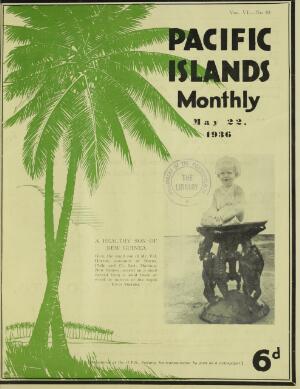
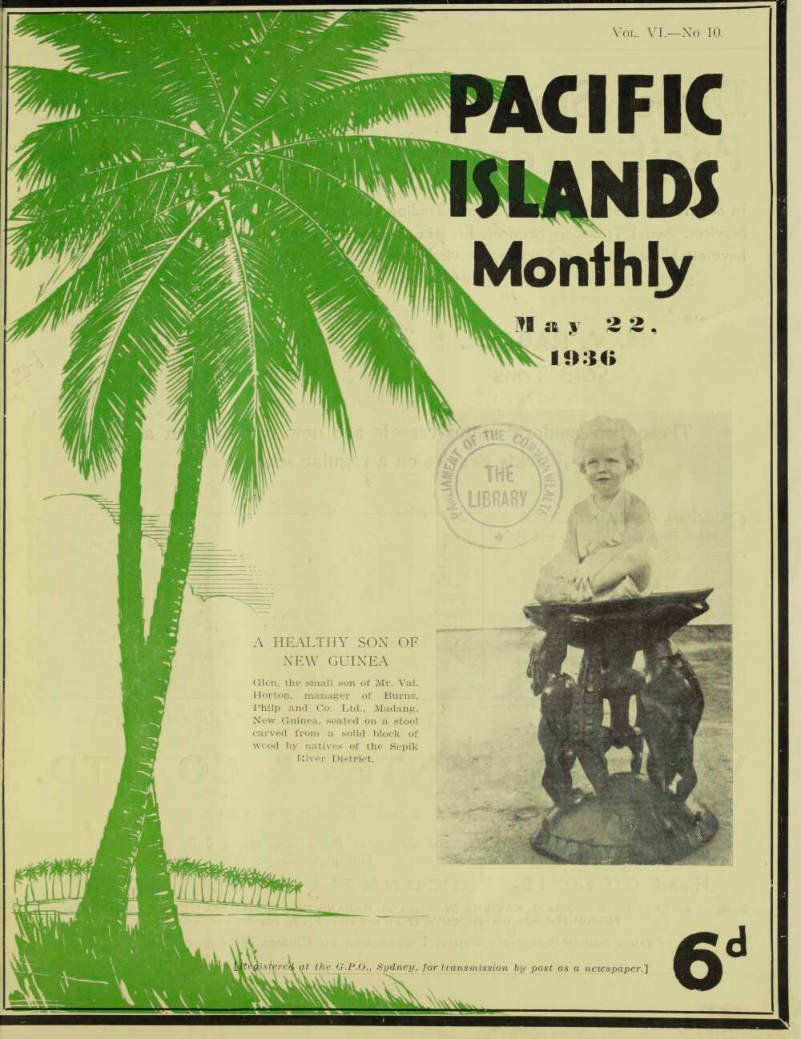
A Healthy Son Of
New Guinea
Glen, the small son of Mr. Val.
Horton, manager of Burns, Philp and Co. Ltd., Madang, New Guinea, seated on a stool carved from a solid block of wood by natives of the Sepik River District.
Advertisements & other items, p. 2 (1 item)
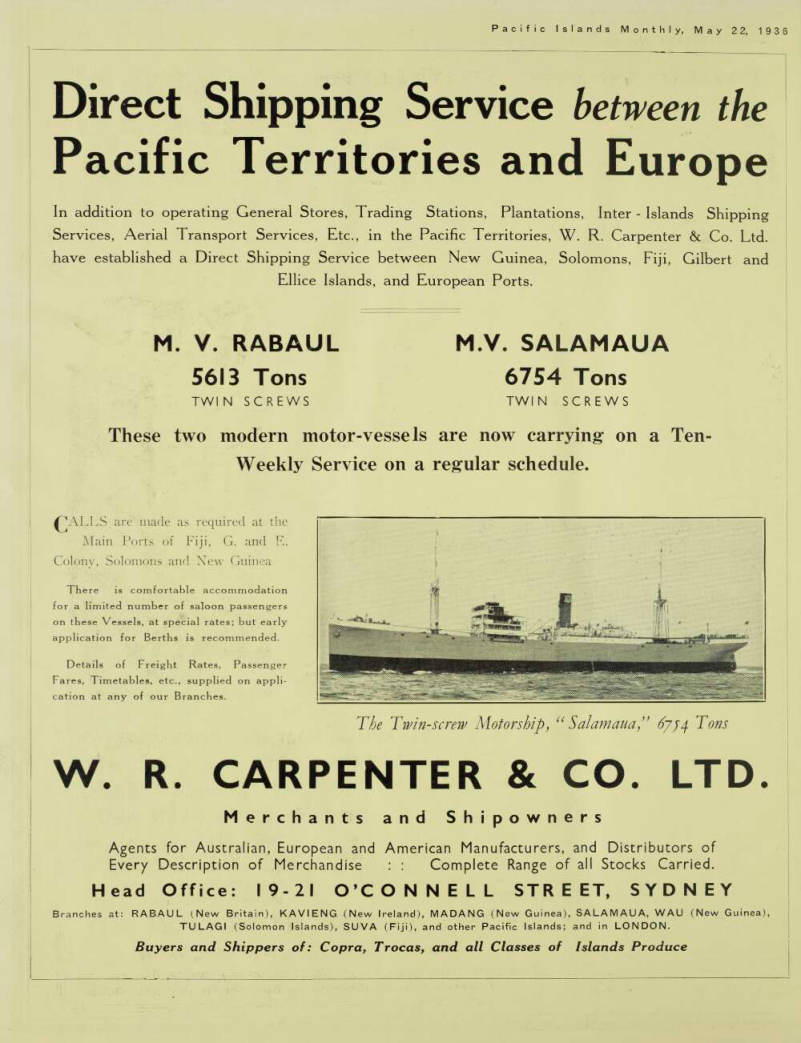
Pacific Territories and Europe
Direct Shipping Service between the
In addition to operating General Stores, Trading Stations, Plantations, Inter - Islands Shipping Services, Aerial Transport Services, Etc., in the Pacific Territories, W. R. Carpenter & Co. Ltd. have established a Direct Shipping Service between New Guinea, Solomons, Fiji, Gilbert and Ellice Islands, and European Ports.
M. V. RABAUL M.V. SALAMAUA
5618 Tons 6754 Tons
TWIN SCREWS TWIN SCREWS
These two modern motor-vessels are now carrying on a Ten- Weekly Service on a regular schedule.
C ALLS are made as required at the Main Ports of Fiji, G. and E.
Colony, Solomons and New Guinea There is comfortable accommodation for a limited number of saloon passengers on these Vessels, at special rates; but early application for Berths is recommended.
Details of Freight Rates, Passenger Fares, Timetables, etc., supplied on application at any of our Branches. m Tie Twin-screw Motorship, “ SalamauaT Tons
W. R. CARPENTER & CO. LTD.
Merchants and Shipowners Agents for Australian, European and American Manufacturers, and Distributors of Every Description of Merchandise : : Complete Range of all Stocks Carried.
Head Office: 19-21 O’CONNELL STREET, SYDNEY
Branches at: RABAUL (New Britain), KAVIENG (New Ireland), MADANG (New Guinea), SALAMAUA, WAU (New Guinea), TULAGI (Solomon Islands), SUVA (Fiji), and other Pacific Islands; and in LONDON.
Buyers and Shippers of: Copra, Trocas, and all Classes of Islands Produce
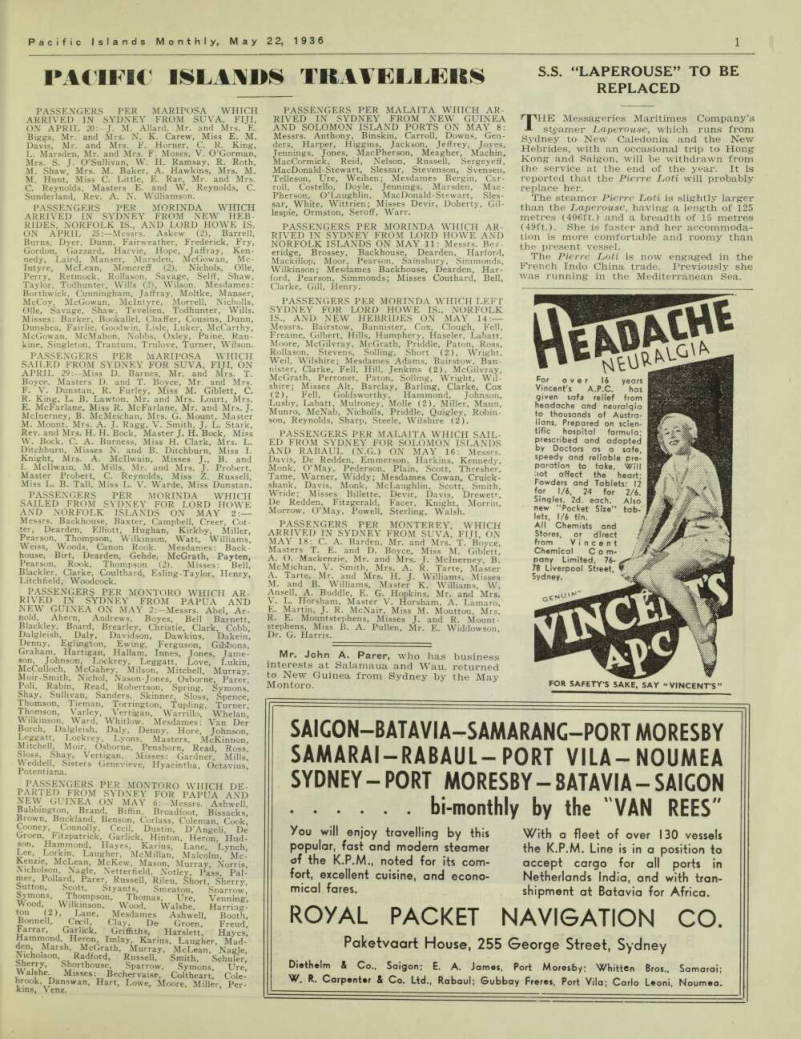
Pacific Islands Travellers
Passengers Per Mariposa Which
Arrived In Sydney From Suva, Fiji,
ON APRIL 20:—J. M. Allard, Mr. and Mrs. E.
Biggs, Mr. and Mrs. N. K. Carew, Miss E. M.
Davis, Mr. and Mrs. F. Horner, C. R. King, L. Marsden, Mr. and Mrs. F. Moses, V. O’Gorman, Mrs. S. J. O’Sullivan, W. H. Ramsay, R. Roth, M. Shaw, Mrs. M. Baker, A. Hawkins, Mrs. M.
M. Hunt, Miss C. Little, E. Rae, Mr. and Mrs.
C. Reynolds, Masters E. and W. Reynolds, C.
Sunderland, Rev. A. N. Williamson.
Passengers Per Morinda Which
Arrived In Sydney From New Heb
RIDES, NORFOLK IS., AND LORD HOWE IS.
ON APRIL 25:—Messrs. Askew (2), Barrell, Burns, Dyer, Dunn, Fairweather, Frederick, Fry, Gordon, Gazzard, Harvie, Hope, Jaffray, Ken nedy, Laird, Manser, Marsden. McGowan, Mc- Intyre, McLean, Moncreff (2), Nichols, Olle, Perry, Retmock, Rollason, Savage, Selff, Shaw, Taylor, Todhunter, Wills (2), Wilson. Mesdames: Borthwick, Cunningham, Jaffray, Moltke, Manser, McCoy, McGowan, Mclntyre, Morrell, Nicholls, Olle, Savage, Shaw, Tevelien, Todhunter, Wills.
Misses: Barker, Bookallel, Chaffer, Cousins, Dunn, Dunshea, Fairlie, Goodwin, Lisle, Luker, McCarthy, McGowan, McMahon, Nobbs, Oxley, Paine, Ran kine, Singleton, Trantum, Trulove, Turner, Wilson.
Passengers Per Mariposa Which
SAILED FROM SYDNEY FOR SUVA, FIJI, ON APRIL 29: —Miss D. Barnes. Mr. and Mrs. T.
Boyce, Masters D. and T. Boyce, Mr. and Mrs.
F. V. Dunstan, R. Furley, Miss M. Giblett, C.
R. King, L. B. Lawton, Mr. and Mrs. Lourt, Mrs.
E. McFarlane, Miss R. McFarlane, Mr. and Mrs, J.
Mclnerney, B. McMeichan, Mrs. G. Mount, Master M. Mount, Mrs. A. J. Ragg, V. Smith, J. L. Stark, Rev. and Mrs. H. H. Bock, Master J. H. Bock, Miss W. Bock, C. A. Burness, Miss H. Clark, Mrs. L.
Ditchburn, Misses N. and B. Ditchburn, Miss I.
Knight, Mrs. A. Mcllwain, Misses J., B. and I. Mcllwain, M. Mills, Mr. and Mrs. J. Probert, Master Probert, C. Reynolds, Miss Z. Russell, Miss L. B. Tall, Miss L. V. Warde, Miss Dunstan.
Passengers Per Morinda Which
Sailed From Sydney For Lord Howe
And Norfolk Islands On May 2:—
Messrs. Backhouse, Baxter, Campbell, Creer, Cot ter, Dearden, Elliott, Hughan, Kirkby, Miller, Pearson, Thompson, Wilkinson, Watt, Williams, Weiss, Woods, Canon Rook. Mesdames: Back house, Birt, Dearden, Gehde, McGrath, Payten, Pearson, Rook, Thompson (2). Misses: Bell, Blackler, Clarke, Coulthard, Esling-Taylor, Henry, Litchfield, Woodcock.
Passengers Per Montoro Which Ar
Rived In Sydney From Papua And
NEW GUINEA ON MAY 2: —Messrs. Abel, Ar nold, Ahern, Andrews, Boyes, Bell Barnett, Blackley, Board, Brearley, Christie, Clark, Cobb, Dalgleish, Daly, Davidson, Dawkins, Dakein, Denny, Egling'ton, Ewing, Ferguson, Gibbons, Graham, Hartigan, Hallam, Innes, Jones, Jame son, Johnson, Lockrey, Leggatt, Love, Lukin, McCulloch, McGahey, Milson, Mitchell, Murray, Moir-Smith, Nichol, Nason-Jones, Osborne, Parer| Poli, Rabin, Read, Robertson, Spring, Symons, Shay, Sullivan, Sanders, Skinner, Sloss, Spence, Thomson, Tieman, Torrington, Tupling, Turner, Thomson, Varley, Vertigan, Warrillo, Whelan, Wilkinson, Ward, Whitlow. Mesdames: Van Der Borch, Dalgleish, Daly, Denny, Hore, Johnson, Leggatt, Lockrey, Lyons, Masters, McKinnon, Mitchell, Moir, Osborne, Penshorn, Read, Ross, «r OS i S J * hs s’ V ert igan. Misses: Gardner, Mills, Weddell, Sisters Genevieve, Hyacintha, Octavius, Potentiana.
PER montoro WHICH DE ?4?J E P r ER 9, M SYDNEY FOR PAPUA AND GUINEA ON MAY 6: —Messrs. Ashwell, Babbington Brand, Biffin, Broadfoot, Bissacks, Brown, Buckland, Benson, Corlass, Coleman, Cook, Cooney, Connolly, Cecil, Dustin, D’Angeli, De Groen, Fitzpatrick, Garlick, Hinton, Heron, Hud son, Hammond, Hayes, Karius, Lane, Lynch, Lee, Lorkm, Laugher, McMillan, Malcolm, Mc- Kenzie, McLean, McKew, Mason, Murray, Norris, Nicholson, Nagle, Netterfield, Notley, Pass, Pal mer, Pollard, Parer, Russell, Rileu, Short, Sherry, Sutton, Scptt, Styants, Smeaton, Sparrow, Symons, Thompson, Thomas, Ure, Venning Wood, Wilkinson, Wood, Walshe, Harring b L 2 L^ne > Mesdames Ashwell. Booth, Bonnell, Cecil. Clay. De Groen. Freud.
Farrar, Garlick, Griffiths. Harslett. Hayes, nammond, Heron Imlay, Karius, Laugher, Mad den Marsh, McGrath, Murray, McLean, Nagle, Nicholson Radford, Russell, Smith, Schuler wiV’ Shorthouse, Sparrow, Symons, Ure, Walshe Misses: Bechervaise, Coltheart, Cole brook, Danswan, Hart, Lowe, Moore, Miller, Per kins, \ enz. *
Passengers Per Malaita Which Ar
Rived In Sydney From New Guinea
AND SOLOMON ISLAND PORTS ON MAY 8: Messrs. Anthony, Binskin, Carroll, Downs, Gen ders, Harper, Higgins, Jackson, Jeffrey, Joyes, Jennings, Jones, MacPherson, Meagher, Machin, MacCormick, Reid, Nelson, Russell, Sergeyeff, MacDonald-Stewart, Slessar, Stevenson, Svensen, Telleson, Ure, Weihen; Mesdames Bergin, Car roll, Costello, Doyle, Jennings, Marsden, Mac- Pherson, O’Laughlin, MacDonald-Stewart, Sles sar, White, Wittrien; Misses Devir, Doherty, Gil lespie, Ormston, Seroff, Warn
Passengers Per Morinda Which Ar
RIVED IN SYDNEY FROM LORD HOWE AND NORFOLK ISLANDS ON MAY 11: Messrs. Bev eridge, Brossey, Backhouse, Dearden, Harford, Mackillop, Moor, Pearson, Sainsbury, Simmonds, Wilkinson; Mesdames Backhouse, Dearden, Har ford, Pearson, Simmonds; Misses Couthard, Bell, Clarke, Gill, Henry.
Passengers Per Morinda Which Left
Sydney For Lord Howe Is.. Norfolk
IS., AND NEW HEBRIDES ON MAY 14:— Messrs. Bairstow, Bannister, Cox, Clough, Fell, Freame, Gilbert, Hills, Humphery, Haseler, Labatt, Moore, McGilvray, McGrath, Priddle, Paton, Ross, Rollason, Stevens, Soiling, Short (2), Wright, Weil, Wilshire; Mesdames Adams, Bairstow, Ban nister, Clarke, Fell, Hill, Jenkins (2), McGilvray, McGrath, Perronet, Paton, Soiling, Wright, Wil shire; Misses Alt, Barclay, Barling, Clarke, Cox (2), Fell, Goldsworthy, Hammond, Johnson, Lusby, Labatt, Mulroney, Molle (2), Miller, Mann, Munro, McNab, Nicholls, Priddle, Quigley, Robin son, Reynolds, Sharp, Steele, Wilshire (2).
Passengers Per Malaita Which Sail
Ed From Sydney For Solomon Islands
AND RABAUL (N.G.) ON MAY 16: Messrs.
Davis, De Redden, Emmerson, Harkins, Kennedy, Monk, O’May, Pederson, Plain, Scott, Thresher, Tame, Warner, Widdy; Mesdames Cowan, Cruick shank, Davis, Monk, McLaughlin, Scott, Smith, Wride; Misses Billette, Devir, Davis, Drewett, De Redden, Fitzgerald, Facer, Knight, Morrin, Morrow, O’May, Powell, Sterling, Walsh.
Passengers Per Monterey, Which
ARRIVED IN SYDNEY FROM SUVA, FIJI. ON MAY 18; C. A. Barden, Mr. and Mrs. T. Boyce, Masters T. E. and D. Boyce, Miss M. Giblett, A. O. Mackenzie, Mr. and Mrs. J. Mclnerney, B.
McMichan, V. Smith, Mrs. A. R. Tarte, Master A. Tarte, Mr. and Mrs. H. J. Williams, Misses M. and B. Williams, Master K. Williams, W.
Ansell, A. Buddie, E. G. Hopkins, Mr. and Mrs. \. L. Horsham, Master V. Horsham, A. Lamaro, E. Martin, J. R. McNair, Miss M. Mouttou, Mrs.
R. E. Mountstephens, Misses J. and R. Mount- Stephens, Miss B. A. Pullen, Mr. E. Widdowson, Dr. G. Harris.
Mr. John A. Parer, who has business interests at Salamaua and Wau, returned to New Guinea from Sydney by the May Montoro.
S.S. “Laperouse” To Be
Replaced
THE Messageries Maritimes Company’s steamer Laperouse, which runs from Sydney to New Caledonia and the New Hebrides, with an occasional trip to Hong Kong and Saigon, will be withdrawn from the service at the end of the year. It is reported that the Pierre Loti will probably replace her.
The steamer Piei're Loti is slightly larger than the Laperouse, having a length of 125 metres (406 ft.) and a breadth of 15 metres (49ft.). She is faster and her accommoda tion is more comfortable and roomy than the present vessel.
The Pierre Loti is now engaged in the French Indo China trade. Previously she was running in the Mediterranean Sea.
Advertisements & other items, p. 3 (1 item)
Saicon-Batavia-Samaranc-Port Moresby
Por over 16 years Vincent's A.P.C. has given safe relief from headache and neuralgia to thousands of Australians. Prepared on scientific hospital formula; prescribed and adopted by Doctors as a safe, speedy and reliable preparation to take. Will :iot affect the heart; Powders and Tablets: 12 for 1/6, 24 for 2/6.
Singles. 2d. each, new "Pocket Size" lets, 1/6 tin.
All Chemists and Stores, or direct from Vincent Chemical C o mpany Limited, 76- 78 Liverpool Street, Sydney.
Also tabr (1
FOR SAFETY’S SAKE, SAY “VINCENTS”
SAICON-BATAVIA-SAMARANC-PORT MORESBY
SAMARAI-RABAUL- PORT VILA-NOUMEA
SYDNEY - PORT MORESBY - BATAVIA - SAIGON
bi-monthly by the "VAN REES"
You will enjoy travelling by this popular, fast and modern steamer of the K.P.M., noted tor its comfort, excellent cuisine, and economical fares.
With a fleet of over 130 vessels the K.P.M. Line is in a position to accept cargo for all ports in Netherlands India, and with transhipment at Batavia for Africa.
ROYAL packet NAVIGATION CO.
Paketvaart House, 255 George Street, Sydney
Diethelm & Co., Saigon; E. A. James, Port Moresby; Whitten Bros., Samarai; W. R. Carpenter & Co. Ltd., Rabaul; Gubbay Freres, Port Vila; Carlo Leoni, Noumea.
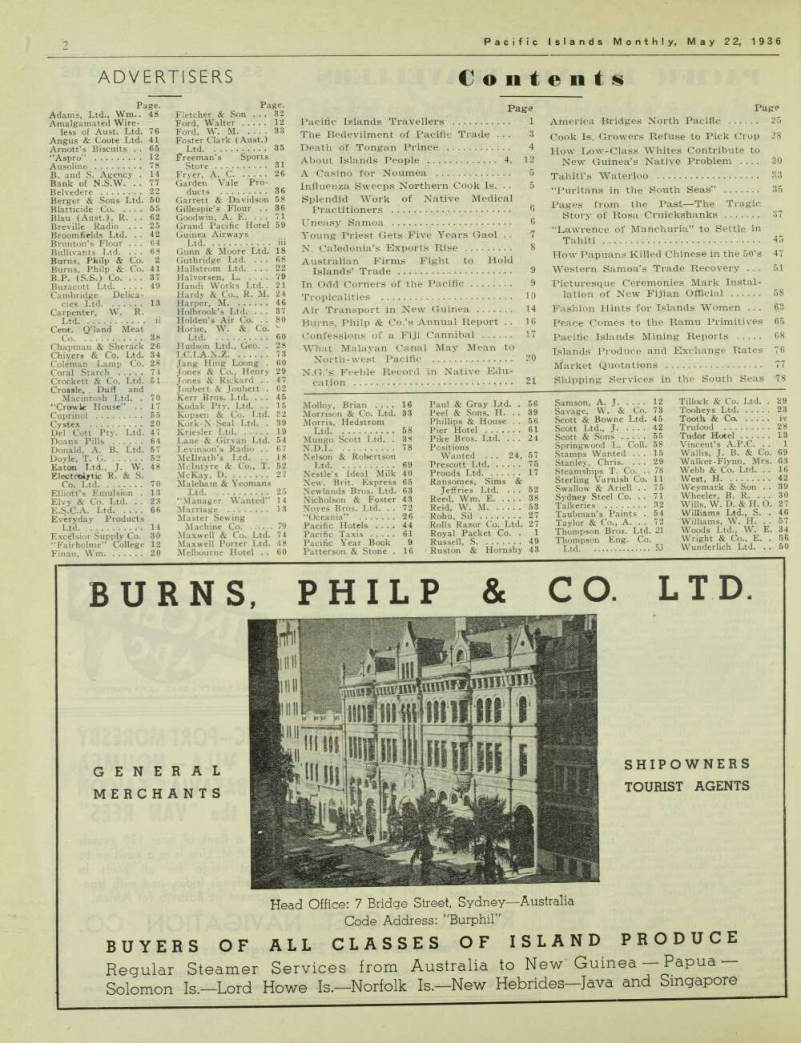
Advertisers
Page.
Adams, Ltd., Wm.. 48 Amalgamated Wire less of Aust. Ltd. 76 Angus & Coote Ltd. 41 Arnott’s Biscuits . . 65 “Aspro” 12 Ausoline 78 B. and S. Agency . 14 Bank of N.S.W. . . 77 Belvedere 22 Berger & Sons Ltd. 50 Blatticide Co 55 Blau (Aust.), R. . . 62 Breville Radio ... 25 Broomfields Ltd. . . 42 Brunton’s Flour ... 64 Bullivants Ltd. ... 68 Burns, Philp & Co. 2 Burns, Philp & Co. 41
B.P. (S.S.) Co. ... 37
Buzacott Ltd. . .. . 49 Cambridge Delica cies Ltd 13 Carpenter, W. R.
Ltd ii Cent. Q’land Meat Co 38 Chapman & Sherack 26 drivers & Co. Ltd. 34 Coleman Lamp Co. 28 Coral Starch 74 Crockett & Co. Ltd. 51 Crossle, Duff and Macintosh Ltd. . 70 “Crowle House” . . 17 Cuprinol 55 Cystex 20 Del Cott Pty. Ltd. 4 7 Doans Pills 64 Donald, A. B. Ltd. 57 Doyle. T. G 52 Eaton Ltd., J. W. 48 Electrolytic R. & S.
Co. Ltd 70 Elliott’s Emulsion . 13 Elvy & Co. Ltd. . . 23
E.S.C.A. Ltd 66
Everyday Products Ltd. 14 Excelsior Supply Co. 30 “Fairholnre” College 12 Finau, Wm 20
Page.
Fletcher & Son ... 32 Ford, Walter 12 Ford, W. M 33 Foster Clark (Aust.) Ltd 35 Freeman’s Sports Store 31 Fryer, A. C 26 Garden Vale Pro ducts 36 Garrett & Davidson 58 Gillespie’s Flour . . 36 Goodwin, A. E. ... 71 Grand Pacific Hotel 59 Guinea Airways Ltd iii Gunn & Moore Ltd. 18 Guthridge Ltd. ... 68 Hallstrom Ltd. ... 22 Halvorsen, L 79 Handi Works Ltd.. 21 Hardy & Co., R. M. 24 Harper, M 46 Holbrook’s Ltd. ... 37 Holden’s Air Co. . . 80 Horne, W. & Co.
Ltd 60 Hudson Ltd., Geo. . 28
1.C.1.A.N.Z 73
Jang King Loong . 60 Jones & Co., Henry 29 Jones & Rickard . . 47 Joubert & Joubert . 62 Kerr Bros. Ltd. ... 45 Kodak Pty. Ltd. . . 15 Kopsen & Co. Ltd. S 2 Kork-X-Seal Ltd. . 39 Kriesler Ltd 19 Lane & Girvan Ltd. 54 Levinson’s Radio . . 67 Mcllrath’s Ltd. . . 18 Mclntyre & Co., T. 52 McKay, D. 27 Maleham & Yeomans Ltd 25 “Manager Wanted” 14 Marriage 13 Master Sewing Machine Co 79 Maxwell & Co. Ltd. 74 Maxwell Porter Ltd. 48 Melbourne Hotel . . 60
Molloy, Brian ... 16 Morrison & Co. Ltd. 33 Morris, Hedstrom Ltd 58 Mungo Scott Ltd. . 38
N.D.L 78
Nelson & Robertson Ltd 69 Nestle’s Ideal Milk 40 New. Brit. Express 65 Newlands Bros. Ltd. 63 Nicholson & Foster 43 Noyes Bros. Ltd. . . 72 “Oceania” 26 Pacific Hotels ... 44 Pacific Taxis 61 Pacific Year Book 9 Patterson & Stone . 16
Paul & Gray Ltd. . 56 Peel & Sons, H. . . 39 Phillips & House . . 56 Pier Hotel 61 Pike Bros. Ltd. ... 24 Positions Wanted .. . 24, 57 Prescott Ltd 75 Prouds Ltd. . 17 Ransomes, Sims & Jeffries Ltd. ... 52 Reed, Wm. E 38 Reid, W. M 53 Rohu, Sil 27 Rolls Razor Co. Ltd. 27 Royal Packet Co. . 1 Russell, S 49 Ruston & Hornsby 43
Samson, A. J 12 Savage, W. & Co. 73 Scott & Bowne Ltd. 45 Scott Ltd., J 42 Scott & Sons 55 Springwood L. Coll. 58 Stamps Wanted ... 15 Stanley, Chris. ... 29 Steamships T. Co. .. 78 Sterling Varnish Co. 11 Swallow & Ariell . . 75 Sydney Steel Co. . . 71 Talkeries ... 82 Taubman’s Paints . 54 Taylor & Co., A. . . 72 Thompson Bros. Ltd. 21 Thompson Eng. Co.
Ltd 53
Tillock & Co. Ltd. . 29 Tooheys Ltd 23 Tooth & Co. iv Trufood 28 Tudor Hotel 13 Vincent’s A.P.C. . . 1 Wallis, J. B. & Co. 69 Walker-Flynn, Mrs. 63 Webb & Co. Ltd. . . 16 West. H 42 Weymark & Son . . 39 Wheeler, B. R. ... 30 Wills. W. D. & H. O. 27 Williams Ltd., S. . 46 Williams, W. H. . . 57 Woods Ltd., W. E. 34 Wright & Co., E. . 56 Wunderlich Ltd. . . 50
Contents
Page Pacific Islands Travellers 1 The Bedevilment of Pacific Trade ... 3 Death of Tongan Prince 4 About Islands People 4, 12 A Casino for Noumea 5 Influenza Sweeps Northern Cook Is. . . 5 Splendid Work of Native Medical Practitioners 6 Uneasy Samoa 6 Y r oung Priest Gets Five Gaol . . 7 N. Caledonia’s Exports Rise 8 Australian Firms Fight to Hold Islands’ Trade 9 In Odd Corners of the Pacific 9 Tropicalities 10 Air Transport in New Guinea 14 Burns, Philp & Co.’s Annual Report . . 16 Confessions of a Fiji Cannibal 17 What Malayan Canal May Mean to North-west Pacific 20 N.G.’s Feeble Record in Native Edu cation 21
Pape America Bridges North Pacific 25 Cook Is. Growers Refuse to Pick Crop 28 How Low-Class Whites Contribute to New Guinea’s Native Problem ... 30 Tahiti’s Waterloo 33 “Puritans in the South Seas” 35 Pages from the Past —The Tragic Story of Rosa Cruickshanks 37 “Lawrence of Manchuria” to Settle in Tahiti 45 How Papuans Killed Chinese in the 50’s 47 Western Samoa’s Trade Recovery ... 51 Picturesque Ceremonies Mark Instal lation of New Fijian Official 58 Fashion Hints for Islands Women ... 63 Peace Comes to the Ramu Primitives 65 Pacific Islands Mining Reports C 8 Islands Produce and Exchange Rates 76 Market Quotations 77 Shipping Services in the South Seas 78
Advertisements & other items, p. 4 (1 item)
Burns, Philp & Co. Ltd.
GENERAL
MERCHANTS
11 ifimg® ima I li!
III!
till
Head Office: 7 Bridge Street, Sydney—Australia Code Address: "Burphil"
SHIPOWNERS
TOURIST AGENTS
BUYERS OF ALL CLASSES OF ISLAND PRODUCE Regular Steamer Services from Australia to New Guinea — Papua Solomon Is.—Lord Howe Is.—Norfolk Is.—New Hebrides—Java and Singapore
Pacific Islands Monthly
The Newspaper • Rlagazine of the South Seas [ Registered at the G.P.0., Sydney, for transmission 6 y post as a newspaper.~\
Published Once Each Month and Circulated in Australia and New Zealand and in the following Pacific Territories and Islands Groups:
Crown Colony of Fiji.
Australian Territory of Papua.
Mandated Territory (Australia) of New Guinea, Bismarck Archipelago and Northern Solomon Islands.
Mandated Territory (Japan) of Marshall, Caroline and Marianna Islands.
French Territory of New Caledonia.
British and French Condominium of New Hebrides.
American Territory of Eastern Samoa.
American Territory of Guam.
Mandated Territory of Nauru.
British Crown Colony of Gilbert and Ellice Islands.
Mandated Territory (New Zealand) of Samoa.
British Solomon Islands Protectorate.
British Protectorate of Tongan Islands.
New Zealand Territory of Cook Islands.
Australian Territory of Norfolk Island.
French Colony of Oceania (Tahiti, eta).
American Territory of Hawaiian Islands.
Owned and Produced by Pacific Publications Ltd., Union House, 247 George Street, Sydney.
Telephone Bw 5037
P.O. Box 3408 R
Registered Address for Telegrams, Radiograms, and Cables: “PACPUB,” Sydney.
Contributions Articles, Stories, and Photographs dealing with Pacific Islands Subjects are invited, and will be paid for on publication at usual rates.
Subscription Rates Per Annum, within British Empire, Prepaid Post Free 6/- Pcr Annum, elsewhere, prepaid, Post Free .. 87- Single Copies 6d.
Editor and Publisher:
R. W. Robson, F.R.G.S.
Advertisements
Advertising rates furnished on application.
Colours, etc. by Arrangement.
Process Blocks made at Advertiser’s expense when required. Screen, 100.
Changes of Advertising Copy should reach this Office by Bth of each month, otherwise previous advertisement may be repeated.
Agents
The following are authorised to receive subscrip tions for the Pacific Islands Monthly:— Islands Branches of Burns, Philp & Co., Ltd., and Burns Philp (South Seas) Co., Ltd.
Islands Branches of W. R. Carpenter & Co., Ltd.
All Branches of Morris, Hedstrom & Co., Ltd.
G. Thomas & Co., Rabaul, New Guinea.
Whitten Bros., Ltd., Samarai, Papua.
P. Costello, Suva, Fiji.
J. Muir, Suva, Fiji.
All Branches and Representatives of W. H. Grove and Sons, Ltd., Auckland, New Zealand.
S. Russell, Papeete, Tahiti.
Cook Islands Trading Co., Rarotonga, Cook la.
Representative in London: W. C. HARVEY, Coronation Building, 4 Lloyds Avenue, London, E.C.2 from whom may be obtained copies of Pacific Islands Monthly, Pacific Islands Year Book, adver tising schedules, etc.
Vol. VI., No. 10.
Sydney, May 22, 1936.
Prire I Per * * Prepaid: 6/- p.a.
The Bedevilment of Pacific Trade
pUBLIC servants —in Australia, at any rate —actively resent the fact that the commercial com munity, hard-working and “hard boiled,” regard the public services with feelings ranging from kindly tolerance to outspoken contempt.
The bureaucrats have only them selves to blame.
In this issue, we recount the ex perience of an Islands trader. He obtained an order for Australian meat for New Guinea—and the man who can beat the ruthless, price cutting American interests in this held has to “go some”—only to find the business held up in Australia by some pettifogging export regula tion, and a Department incapable of rising above the printed letter of the regulations.
It was the same public service which virtually killed the Fiji-Aus tralian banana trade. Fiji buys goods worth £1,250,000 annually; and, owing to the exchange position (the Australian £ is 25 per cent, under sterling, while the Fiji £ is only per cent, under) was will ing to take more Australian goods.
But Fiji said: “This must not be too one-sided. You, in return, must buy some of our products.” After much argument, Australia agreed to lower its tariff somewhat to admit, annually, £40,000 worth of Fiji bananas. The trade commenced — bananas in exchange for Australian foodstuffs. But it lasted no time at all. Australian Departments threw everything at Fiji bananas except the Prime Minister’s dog-kennel—
primage, sales tax, income tax, and various other imposts apparently devised for the bedevilment of trade. Some of these taxes were reluctantly removed when Fiji threatened tariff retaliation: but the new trade has not flourished. Fiji still buys largely in Australia; but that is due to the exchange position, and not love; and we know what to expect when the currencies are re valued.
Australia’s nearest neighbour, New Caledonia, has an overseas trade turnover of nearly £2,000,000
annually. Last year (1935), the big
French colony bought Australian goods worth £296,000, and sold Aus tralian goods worth £14,000! This is the same Australia which is howl ing its head off because the United States are selling Australia about ten times as much as they are buy ing! We know what to expect if and when France goes off the gold
standard. That N.C. trade will dis appear in a night. And serve us right!
Not long ago, the Australian Governmental authorities invited tenders for the supply of rice to New Guinea. The contract —an im portant one —went to Chinese in terests, whose price was very slightly less than that quoted by the Australian trading firms. Yet the whole political barnyard in Aus tralia is in an uproar because Messrs. Burns, Philp and Co. Ltd. have suggested that, for the very same reason (a saving in costs) they may build a couple of little ships in China.
We could continue to multiply instances, but those will suffice.
Australia, officially, wants overseas trade, and is spending huge sums annually in chasing it. Yet here, right at her doors, in the rapidly developing Pacific territories, is a rich market, of which it may be said that it belongs to Australia by geographical right. Because the Australian pound is at a discount, Australia now virtually commands much of that trade; and one would suppose that advantage would be taken of this favourable circum stance to build up harmonious reci procal relations with the Pacific territories, and bind this valuable traffic to the Commonwealth for all time, so that it will not fade away when currency values are altered.
But, no! There is no coordination of overseas trade effort—there is not even a comprehensible policy governing overseas trade. Each Department is “on its owneach little bureaucrat is fiercely and jealously observing the letter of his little set of regulations; and each Minister, who ought to be con trolling his Department and coor dinating Government policy, is either worrying about the next election, or dreamily picturing him self in Court breeches at King Ed ward’s coronation.
Mr. Leslie V. Waterhouse, technical director of Placer Development Co. Ltd., arrived in England early in May, after visiting America. Mr. Waterhouse has been having a busy time; he spent three weeks in San Francisco with his asso ciates, then left for New York, making visits to South and Central America by air to inspect the workings of Placer De velopment Go’s subsidiary concerns. Mr.
Waterhouse’s plans in Europe are in definite; but h© intends to look over the Junker aeroplane works at Dessau, in Germany.
Death Of Tongan Prince
WHEN we learned of the unfortunate death of Prince William Tuku’aho, of Tonga, we com municated with Prince George Taufa’ahau (Crown Prince of Tonga), who is a student at Newington College, Sydney; and the future ruler of Tonga very courteously replied as follows:
“ W Illiam Tuku’Aho Was My
tt brother’s name. He was 16 years old when he died, and he was just completing his education at Tubou College, at Na fualu, Tonga, when he was attacked by a heart illness to which he has been sub ject in the last few years. He died at the Palace on the night of April 28. He was the second eldest of the three of us. My younger brother is still at the College.
“My brother’s death was felt deeply by every Tongan, and was the severest blow my family has yet suffered. Although he was only young, for some time past he had been making a thorough and com plete study of the intricacies of native custom, tradition, etiquette, and social problems. Consequently, his knowledge of the Tongan native, and the phases of the gradual adaptation of Western civili zation to his needs, was one which would have filled any Tpngan with pride. The greater part of my mother’s work in con nection with important native social un dertakings (in the last five years, at least) passed through his very young but very capable, hands.
“When Fusibala, my aunt, died in Syd ney in 1933, his skill in carrying out the necessary ceremonies and traditional con sultations with the Chiefs of Tonga was brought to the test. Needless to say, he accomplished his task with all credit.
Thus, he won not only the admiration of those versed in the intricate structure of Tongan society, but also the love of every Tongan heart.
“So one can see the great loss that his death means. Undoubtedly it was a great family loss. But, it was a much greater loss to the country as a whole.
“Recently, there has occurred the death of the Samoan High Chief, Mata’afa. It would not be a departure from fact to say that my brother’s death was as great a loss to Tonga as was the death of the respected Mata’afa to the Samoans, who are our cousins.”
Prince Tuku’aho, the second son of Queen Salote, D.B.E., and H.R.H. Prince Tugi, died at Nukua lofa, Tongan Islands, on April 28, after several weeks’ illness. The prince, who was only 16 years of age, is shown on the right of the above photograph. Crown Prince George Taufa’ahau is on the left of the picture, and in the centre is the youngest member of Tonga’s Royal Family, Prince John Gu.
About Islands
People
Mr. J. C. M. Scott, manager of Messrs.
Burns Philp (S.S.) Co. Ltd., at Makambo, returned to the Solomon Islands with his wife by the Malaita from Sydney on May 16.
Sister Svensen, who is on the staff of Tulagi Hospital, 8.5.1., will resign shortly to marry Mr. E. Farmer, a well-known resident of the Solomons. Mr. O. Svensen, at an early date, is to marry Miss Clarke, daughter of Mr. Douglas Clarke, of Levers Pacific Plantations, Ltd. They are the daughter and son respectively of Captain Svensen, well known in the Central Pacific.
Mr. K. W. Steedman, legal manager of Upper Sepik Gold Syndicate, N.L., has completed the company’s business in New Guinea. He returned by the Macdhui which reached Sydney on May 21.
Mr. J. J. McHugh, who has been Gov ernment Printer in Fiji for 32 years, left Suva early in May on furlough prior to retiring from the service. Mr. H. R.
Craigie has been appointed Acting Gov ernment Printer.
Mr. C. H. Karius, Assistant Resident Magistrate in the Papuan Public Service, sailed from Sydney with his wife for Samarai by the May Montoro.
Mr. William Buddie McEwan, of Suva, died on May 4, at the age of 56. A Scots man, he went to Fiji via Australia about 25 years ago, joining Henry Marks and Co. and continuing with the firm when it merged with Morris, Hedstrom Ltd. Mr.
McEwan was well-known in the Ba Dis trict, where he spent most of his time, though during the last four years he had lived in Suva.
Mr. William C. Groves, of Melbourne, a research fellow in social anthropology under the Australian National Research Council, has been visiting Sydney to con fer with Dr. A. P. Elkin, Professor of Anthropology at the Sydney University.
He has delivered a series of lectures on Melanesian culture to groups of mission aries and cadets from the New Guinea administration. On May 19 he lectured before the New South Wales Anthro pological Society on “The Secret Beliefs and Practices of a Melanesian People.” Mr.
Groves, who spent several years in anth ropological research work in New Guinea, is writing a book dealing with his obser vations in the territory.
and Fiji
P.I.M. Editor's Visit to Samoa and Fiji
THE Editor and publisher of the Pacific Islands Monthly, Mr. R. W. Hobson, P.R.G.S., will visit Samoa and Fiji in June and July, and will be glad to meet sub scribers who have matters of public inter est to discuss. Mr. Robson’s itinerary will be approximately as follows: — June 23. —Arrive in Apia, Western Samoa, by Maui Pomare from Wellington, N.Z.
July 2. —Leave Apia for Pago Pago, American Samoa, to connect with steamer for Suva. j u l y 7. —Arrive Suva, Fiji. To visit chief towns in Viti Levu during ensuing week.
July 31.—Leave Suva for Sydney.
Mr. Robson’s address, in Apia, will be the Casino Hotel; and, in Suva, the Grand Pacific Hotel. It will be possible to com municate with him through the local man agers in both Fiji and Samoa, of Messrs.
Burns Philp (S.S.) Co. Ltd., and Messrs.
Morris Hedstrom, Ltd.
Noumea
A Casino For
With Aerial Service to Brisbane
From Our Own Correspondent
Noumea, May 12.
IT has been announced in the local news papers that a company has been suc cessfully formed to establish a Casino in Noumea.
It is also announced that a new air ser vice connecting Noumea and Brisbane is to start operations at an early date.
It is believed that these two enterprises, working in conjunction, will bring many visitors to New Caledonia from Australia.
There is no doubt that the establishment of a Casino, conducted on good lines such as are well-known in Monte Carlo and Nice, will be an attraction to the game loving Australians, and it is confidently expected that the launching of these enter prises will mark an important step in the development of the tourist industry of New Caledonia.
M. Mercier In Sydney
In anticipation of the proposed estab lishment of a Pacific Monte Carlo at Noumea, New Caledonia, by a £500,000 Sydney syndicate, M. Edouard Mercier, a member of the Legislative Council of the French colony, has been in Sydney investi gating the possibilities of tourist traffic.
The tourist resources of Sydney, the Barrier Reef, New Zealand and New Cale donia could be grouped in the common cause of attracting a stream of tourist traffic from the Continent and from America, if the Casino were established, he told the Daily Telegraph on May 1.
First applicants for permission to con duct a gambling institution in Noumea, he added, were the original promoters of Tattersall's Sweep, but when the French Minister for Colonies refused the applica tion the late Mr. George Adams went to Tasmania. Now the application of the Sydney syndicate had been granted, and it was hoped that Noumea would become one of the greatest tourist centres of the world.
EDITORIAL NOTE: Australians are gamblers; but it is to be presumed that even those who love to take a chance will not be in a hurry to under take that 700 miles flight over empty ocean be tween Queensland and New Caledonia. Most people will want to be assured about the efficiency of the proposed air service before they make any plans to visit the attractive Casino.
Another difficulty to which we hope our French friends have given consideration is that of ex change. France and her colonies still adhere in determined fashion to the gold standard, so that the Australian £ is worth less than 10/- in French territories. Gamblers are very reckless people, but even they are human enough to prefer to lose their money on roulette, or chemin de fer, or boule, rather than sacrifice 50 per cent, of it in exchange.
It has been announced quite recently that Monte Carlo has lost colossal sums in recent years.
That, of course, is due to the exchange position foreign tourists nowadays will not go to gold standard France and lose so much of their money in exchange.
Mr. Harry Buckland, a worker for the Australian Board of Missions in Papua, departed from Sydney for his station at Eroro by the May Montoro.
Brigadier-General Sir Herbert Hart, of New Zealand, who was for some years Administrator of the Mandated Territory of Samoa, has been appointed by the New Zealand Government to be a member of the Imperial War Graves Commission.
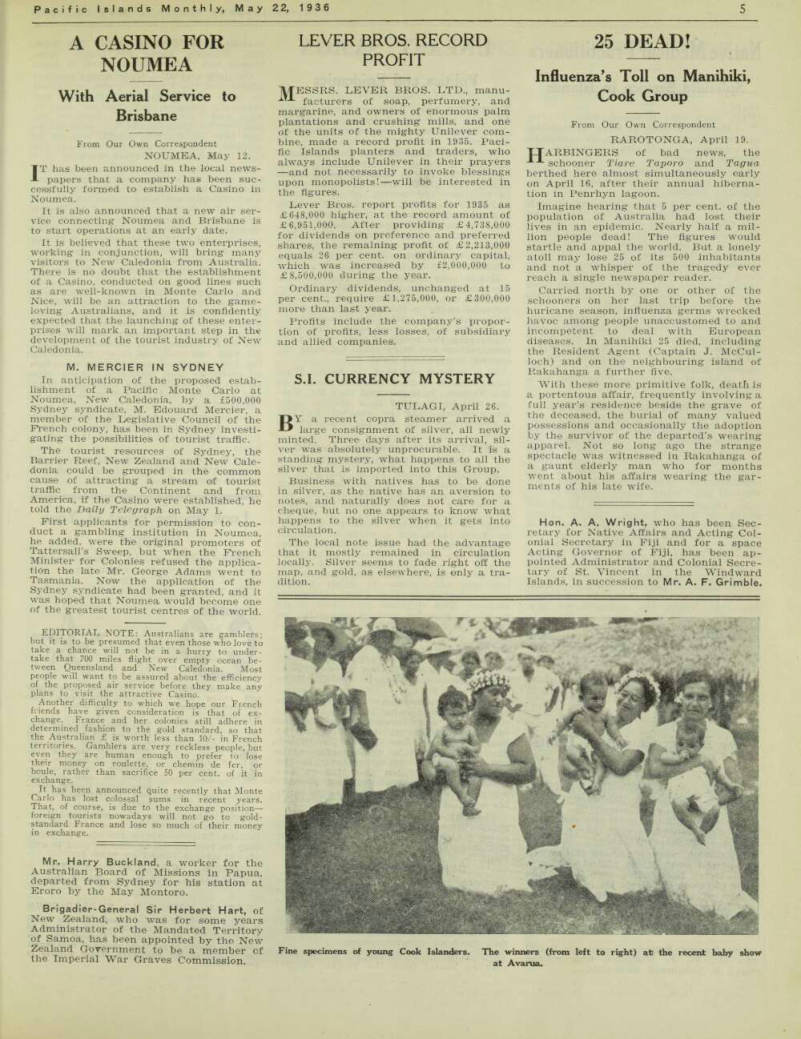
Fine specimens of young Cook Islanders. The winners (from left to right) at the recent baby show at Avarua.
Lever Bros. Record
Profit
Iitessrs. Lever Bros, Ltd., Manu
facturers of soap, perfumery, and margarine, and owners of enormous palm plantations and crushing mills, and one of the units of the mighty Unilever com bine, made a record profit in 1935. Paci fic Islands planters and traders, who always include Unilever in their prayers —and not necessarily to invoke blessings upon monopolists!—will be interested in the figures.
Lever Bros, report profits for 1935 as £648,000 higher, at the record amount of £6,951,000. After providing £4,738,000 for dividends on preference and preferred shares, the remaining profit of £2,213,000 equals 26 per cent, on ordinary capital, which. was increased by £2,000,000 to £8,500,000 during the year.
Ordinary dividends, unchanged at 15 per cent., require £1,275,000, or £300,000 more than last year.
Profits include the company’s propor tion of profits, less losses, of subsidiary and allied companies.
S.I. Currency Mystery
TULAGI, April 26.
BY a recent copra steamer arrived a large consignment of silver, all newly minted. Three days after its arrival, sil ver was absolutely unprocurable. It is a standing mystery, what happens to all the silver that is imported into this Group.
Business with natives has to be done in silver, as the native has an aversion to notes, and naturally does not care for a cheque, but no one appears to know what happens to the silver when it gets into circulation.
The local note issue had the advantage that it mostly remained in circulation locally. Silver seems to fade right off the map, and gold, as elsewhere, is only a tra dition.
Cook Group
25 Dead!
Influenza’s Toll on Manihiki, Cook Group
From Our Own Correspondent
Rarotonga, April 19.
XJARBINGERS of bad news, the A schooner Tiare Taporo and Tagua berthed here almost simultaneously early on April 16, after their annual hiberna tion in Penrhyn lagoon.
Imagine hearing that 5 per cent, of the population of Australia had lost their lives in an epidemic. Nearly half a mil lion people dead! The figures would startle and appal the world. But a lonely atoll may lose 25 of its 500 Inhabitants and not a whisper of the tragedy ever reach a single newspaper reader.
Carried north by one or other of the schooners on her last trip before the huricane season, influenza germs wrecked havoc among people unaccustomed to and incompetent to deal with European diseases. In Manihiki 25 died, including the Resident Agent (Captain J. McCul loch) and on the neighbouring island of Rakahanga a further five.
With these more primitive folk, death is a portentous affair, frequently involving a full year’s residence beside the grave of the deceased, the burial of many valued possessions and occasionally the adoption by the survivor of the departed’s wearing apparel. Not so long ago the strange spectacle was witnessed in Rakahanga of a gaunt elderly man who for months went about his affairs wearing the gar ments of his late wife.
Hon. A. A. Wright, who has been Sec retary for Native Affairs and Acting Col onial Secretary in Fiji and for a space Acting Governor of Fiji, has been ap pointed Administrator and Colonial Secre tary of St. Vincent in the Windward Islands, in succession to Mr. A. F. Grimble.
Native Medical Practitioners
Splendid Service in Islands
THE work that is being done at the Medical School in Suva in training native medical practitioners for service in the various territories continues to prove its value.
Mrs. Kathleen Bignell, wife of a well known planter at Fulakora, Ysabel, Solomon Islands, writes: “Last month I became seriously ill with an attack of blood-poisoning. My sister and I were entirely alone on the planta tion at the time, with no vessel available.
She did all in her power, but she could not arrest the poison. She sent for help to our District Officer, who came to us at once, accompanied by Eroni Leauli, a native medical practitioner who had been trained in Fiji and sent to do work among the Solomon Islanders.
“Although he had only a limited supply of medicines, Eroni fought the poison, and undoubtedly saved my life. I was much impressed w r ith his unfailing courtesy, his kindness, and his undoubted skill. I consider that every credit is due to him and to the Medical School that can turn out such men.”
Case From New Hebrides
Rev. J. S. Jaffray, a Presbyterian mis sionary, who has spent 28 years on the island of Malekula, in the New Hebrides, reached Sydney by the Morinda on April 25, and told the Sydney Morning Herald of a wonderful service rendered to the population of the island by a Fijian native medical practitioner a few months ago.
In December a disastrous hurricane swept the island, laying crops in ruins and wiping out what promised to be a bountiful harvest. This was followed on January 9 by a second visitation, which destroyed what was left of the crops.
These disasters were followed by an acute shortage of native food, in the wake of which came a peculiar epidemic, from which natives were dying in alarming numbers. When tlje missionaries saw that they could not cope with the out break, they asked for aid from the auth orities, who arranged for a native medi cal practitioner from Fiji to visit Make kula.
The practitioner, Mr. Jaffray said, dis played uncanny skill in dealing with the situation, and he had the epidemic well in hand in little more than a week.
New British Consul at Tahiti
From Our Own Correspondent PAPEETE, April 16. ■\fß. F. G. Gorton, for many years H.B.M. Consul General in Saigon (French Indo China), arrived recently by the Ville d’Amiens to take charge of the British Consulate in Tahiti.
Mr. Gorton, who is now on the retired list, passed most of his official career in Siam, Dutch East Indies, Indo China, and other places in the East. He is, therefore, a man of cosmopolitan experience who may be expected to fit into Tahiti’s pe culiar conditions, and it is sincerely hoped that his stay will be a long and happy one.
The former British Consul at Tahiti was Dr. W. J. Williams, who retired owing to continued ill-health.
Uneasy Samoa
Politics and Epidemics
T ETTERS from Western Samoa, dated May 1 and May 7, indicate consider able uneasiness and discontent there at the present time.
The Prime Minister of New Zealand has radio’d, asking for the good-will and co-operation of the Samoan people, and adding that his Government “is prepared to facilitate the return of Mr. O. F.
Nelson,” the exiled Mau leader. This gesture, unfortunately, was robbed of much of its effectiveness by the receipt of a radiogram a week earlier from Mr.
Nelson, in w r hich he said that he had been assured by the Prime Minister of his un conditional return to Samoa.
It has been learned since that the N.Z.
Government is sending a Cabinet Minis ter and one other member of the Gov ernment party to Samoa to study condi tions there and advise the Government; and, while there is much speculation there concerning the result of their visit, wide preparations are being made for their re ception there about June.
It is pointed out that the Prime Min ister himself cannot issue a pardon to Mr. Nelson. It is assumed that Mr. Nel son will be included in a general am nesty which may be granted by His Majesty the King on his birthday in June.
Mysterious Sickness Among
Samoan Missionaries
Meanwhile, Samoa is in the grip of severe epidemics of sickness. Much whooping cough and dysentery is re ported: but the really serious thing is a mysterious epidemic brought to the is lands by the steamer Cape York, which on April 14 landed a party of Samoan missionaries who had returned from Papua via Sydney. Soon afterwards, several cases of sickness appeared among the new arrivals, and the whole party, together with some 40 other people, were removed to the Apia quarantine station. The sickness was first diag nosed as measles, and subsequently as “a kind of yellow fever.”
Then a disease described as measles ap peared in two coastal villages; mean while, the jaundice or yellow fever was reported in other places. The medical authorities are trying to isolate these outbreaks.
Bitter blame has been placed upon the Samoan officials who permitted tuber cular cattle and horses, shot on the Re paration Estates at Mulifanua, to be dragged out to sea, instead of buried.
The carcases, in a decomposing state were carried by strong currents to the beaches at Mulifanua and Monono dis tricts, creating a great nuisance, attract ing many sharks, and it is believed caus ing some of these epidemics.
The American authorities have im posed quarantine regulations at Pago Pago, which have stopped all passenger and cargo traffic between Apia and Pago Pago.
Defiant Mau Party
Among the Mau followers, the most fanatical section are the people of the Palauli and Salailua districts, on the south coast of Savaii, under the leader ship of the High Chief Autagavaia, an old firebrand and strong opponent of the New Zealand Administration.
On May 1, a flotilla of 10 fautasis (rowing boats) from the Savaii district
arrived on Apia beach, flying Man flags and bringing about 600 people, men, women and children from Savaii to Apia.
On their arrival, a Government medical officer and the Chief of Police explained to them that infectious disease, and especially measles, had broken out in Apia and Upolu and that, therefore, by order of the Government, all communica tion between the two islands was to be stopped. They should therefore not re turn to Savaii before three weeks.
High Chief Autagavaia replied that they should have been told of that before their departure. He also stated that they were already suffering from the same disease in Savaii. “Besides,” he added, “why have your doctors allowed the measles to be brought into Samoa from the steamer in the first instance? If you want us to remain in Apia for three weeks, the Government will have to sup ply our 600 people with food during the period.”
On Saturday, May 2, the Palauli and Salailua districts gave a great ta’alolo, or ceremonial dance and feast, to the Mau Committee at Vaimoso village, in celebration of the impending return of Mr. O. F. Nelson. Full Samoan ceremon ial was observed and, after the dances, the kava ceremony and various speeches, an elaborate and abundant dinner was spread out for the large gathering. Over one hundred large pigs formed part of the feasting.
In the evening the Savaii visitors gave some additional singing and dancing per formances for the benefit of their Apia hosts.
On Tuesday, May 5, the Savaii fautasis departed from Apia on their homeward voyage to Savaii.
Advertisements & other items, p. 8 (1 item)
Wrapper !
Look on the Front of Your
There may be a sign stamped on the front of the wrapper which brings this copy of the “P.1.M.” to you.
The meaning of the marks: Your subscription (6/- per annum, or 8/- in the case of countries outside the British Empire—which includes postage) may be sent direct, or may be paid to any of our agents (listed on page 3).
PACIFIC PUBLICATIONS LTD.
Union House, 247 George St., Sydney
SPECIAL NOTICE TO SUBSCRIBERS
The price of the Pacific Islands Monthly in all British countries—and especially in the Islands of the Pacific—is 6d. per copy. Persons who are asked by traders to pay more should at once report the matter to the publishers, whose address is given above.
Wrapper !
Your subscription will expire with the next or following issue.
Your subscription will expire with this issue.
This means that your subscription has expired; and that we have sent you this further copy in case you wish to continue as a subscriber, and have forgotten to send in your subscription. Prompt attention is respectfully requested.
B.S.I. Seaplane Goes
Down
(Contributed)
TULAGI, April 20.
OUR local airman (Mr. S. Masterman), after months of hard work and ted ious preparations, got his seaplane afloat early on Sunday morning, April 19.
He warmed the engine up a bit by steaming around the harbour in circles and successfully waking up all hands — the majority of people thinking that at least Mussolini had arrived with some of his bombers for practice here. They were quite relieved to see “Monty” enjoying himself by getting used to the joy-stick.
At last, with a roar and a long run across the harbour, the plane rose grace fully enough. But it did not seem to be just right, and had a decided wobble; and when Monty was about two miles out she came down suddenly with a great splash, stood on her head, and then rolled “starboard side over.”
Speculation was rife. Where was Monty? However, after a while a bulky figure was seen climbing on the floats.
A Chinese craft dashed to the rescue, doing two knots per hour and, after weathering the submerged wings, took Monty aboard. By this time the Govern ment launch, with some of the “leading hands,” put out and, after sighting our nautical aviator, brought him safely ashore —wet, sadder, but much safer.
Where is the plane? Ask Monty. His tory relates that Monty that day played the best game of golf and billiards since his arrival in the Solomons many years ago.
B.P. Steamers
No Building Order Yet Placed
A S yet Burns, Philp and Co. Ltd. have not ordered two new steamers for inter island service in New Guinea to be built in Hong Kong or elsewhere. A statement to this effect was ma,de by the vice chairman (Mr. R. J. Nosworthy) at the annual meeting of shareholders, held in Sydney on May 14, in reply to a question by a shareholder. He said that inquiries were being made in various parts, and the company would see that all interests would be protected.
Mr. Thomas Horne, of Messrs. Walter Horne and Co. Ltd., arrived in Suva by the May Aorangi from Australia, where he had been on a business visit since December.
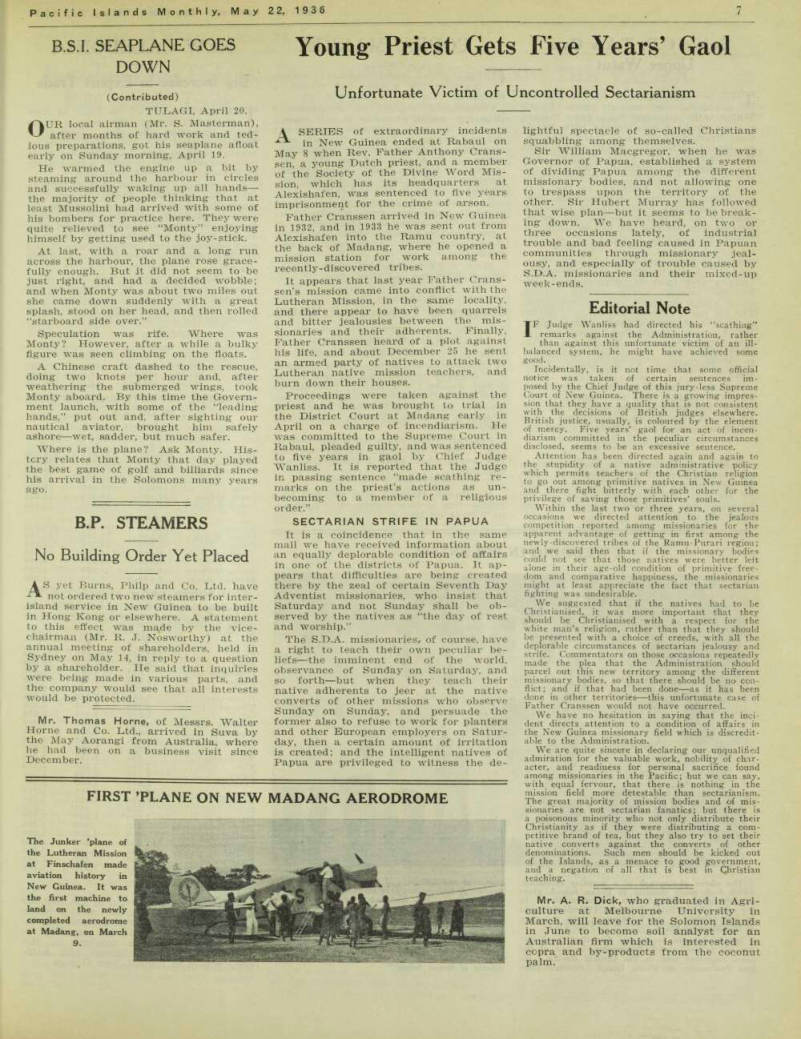
First’Plane On New Madang Aerodrome
The Junker ’plane of the Lutheran Mission at Finschafen made aviation history in New Guinea. It was the first machine to land on the newly completed aerodrome at Madang, on March 9.
Young Priest Gets Five Years’ Gaol
Unfortunate Victim of Uncontrolled Sectarianism
A SERIES of extraordinary incidents in New Guinea ended at Rabaul on May 8 when Rev. Father Anthony Crans sen, a young Dutch priest, and a member of the Society of the Divine Word Mis sion, which has its headquarters at Alexishafen, was sentenced to five years imprisonment for the crime of arson.
Father Cranssen arrived in New Guinea in 1932, and in 1933 he was sent out from Alexishafen into the Ramu country, at the back of Madang, where he opened a mission station for work among the recently-discovered tribes.
It appears that last year Father Crans sen’s mission came into conflict with the Lutheran Mission, in the same locality, and there appear to have been quarrels and bitter jealousies between the mis sionaries and their adherents. Finally, Father Cranssen heard of a plot against his life, and about December 25 he sent an armed party of natives to attack two Lutheran native mission teachers, and burn down their houses.
Proceedings were taken against the priest and he was brought to trial in the District Court at Madang early in April on a charge of incendiarism. He was committed to the Supreme Court in Rabaul, pleaded guilty, and was sentenced to five years in gaol by Chief Judge Wanliss. It is reported that the Judge in passing sentence “made scathing re marks on the priest’s actions as un becoming to a member of a religious order.”
Sectarian Strife In Papua
It is a coincidence that in the same mail we have received information about an equally deplorable condition of affairs in one of the districts of Papua. It ap pears that difficulties are being created there by the zeal of certain Seventh Day Adventist missionaries, who insist that Saturday and not Sunday shall be ob served by the natives as “the day of rest and worship.”
The S.D.A. missionaries, of course, have a right to teach their own peculiar be liefs—the imminent end of the world, observance of Sunday on Saturday, and so forth —but when they teach their native adherents to jeer at the native converts of other missions who observe Sunday on Sunday, and persuade the former also to refuse to work for planters and other European employers on Satur day, then a certain amount of irritation is created: and the intelligent natives of Papua are privileged to witness the de
lightful spectacle of so-called Christians squabbling among themselves.
Sir William Macgregor, when he was Governor of Papua, established a system of dividing Papua among the different missionary bodies, and not allowing one to trespass upon the territory of the other. Sir Hubert Murray has followed that wise plan—but it seems to be break ing down. We have heard, on two or three occasions lately, of industrial trouble and bad feeling caused in Papuan communities through missionary jeal ousy, and especially of trouble caused by S.D.A. missionaries and their mixed-up week-ends.
Editorial Note
IF Judge Wanliss had directed his “scathing” remarks against the Administration, rather than against this unfortunate victim of an ill balanced system, he might have achieved some good.
Incidentally, is it not time that some official notice was taken of certain sentences im posed by the Chief Judge of this jury-less Supreme Court of New Guinea. There is a growing impres sion that they have a quality that is not consistent with the decisions of British judges elsewhere.
British justice, usually, is coloured by the element of mercy. Five years’ gaol for an act of incen diarism committed in the peculiar circumstances disclosed, seems to be an excessive sentence.
Attention has been directed again and again to the stupidity of a native administrative policy which permits teachers of the Christian religion to go out among primitive natives in New Guinea and there fight bitterly with each other for the privilege of saving those primitives’ souls.
Within the last two or three years, on several occasions we directed attention to the jealous competition reported among missionaries for the apparent advantage of getting in first among the newly-discovered tribes of the Ramu-Purari region; and we said then that if the missionary bodies could not see that those natives were better left alone in their age-old condition of primitive free dom and comparative happiness, the missionaries might at least appreciate the fact that sectarian fighting was undesirable.
We suggested that if the natives had to be Christianised, it was more important that they should be Christianised with a respect for the white man’s religion, rather than that they should be presented with a choice of creeds, with all the deplorable circumstances of sectarian jealousy and strife. Commentators on those occasions repeatedly made the plea that the Administration should parcel out this new territory among the different missionary bodies, so that there should be no con flict; and if that had been done—as it has been done in other territories—this unfortunate case of Father Cranssen would not have occurred.
We have no hesitation in saying that the inci dent directs attention to a condition of affairs in the New Guinea missionary field which is discredit able to the Administration.
We are quite sincere in declaring our unqualified admiration for the valuable work, nobility of char acter, and readiness for personal sacrifice found among missionaries in the Pacific; but we can say, with equal fervour, that there is nothing in the mission field more detestable than sectarianism.
The great majority of mission bodies and of mis sionaries are not sectarian fanatics; but there is a poisonous minority who not only distribute their Christianity as if they were distributing a com petitive brand of tea, but they also try to set their native converts against the converts of other denominations. Such men should be kicked out of the Islands, as a menace to good government, and a negation of all that is best in Christian teaching.
Mr. A. R. Dick, who graduated in Agri culture at Melbourne University in March, will leave for the Solomon Islands in June to become soil analyst for an Australian firm which is interested in copra and by-products from the coconut palm.
Upper Watut
Bulolo G.D. Takes Over Upper Watut
THE new arrangement just completed in Melbourne, under which Upper Watut Gold Alluvials N.L., have formed a close working relationship with Bulolo Gold Dredging Ltd., is an interesting de velopment, reflecting much credit upon the Chairman, Mr. Colin Mackay, and the consulting engineer, Mr. D. J.
McClelland. Bulolo G.D. is the most suc cessful operating company on the N.G. goldfield; and the re-arrangement cer tainly means that, if there is profitable gold in the U.W.G.A. leases, the share holders will get the full benefit of it.
This is a sluicing proposition, operated by hydro-electric power. The Co. was formed in February, 1935, to acquire from the Mt. Lawson Prospecting Syndicate options over Leahy’s, Wales’s and the Mainko leases, comprising 16 million cubic yards on the Upper Watut River.
The Co. has a nominal capital of £200,000 in 5/- shares, 600,000 shares being issued.
Mt. Lawson Prospecting Syndicate re ceived 200,000 fully paid up, and rights to 187,500 more. The directors were: D. J. McClelland, F. T. Leahy, Colin Mackay.
Details are given in our mining notes.
Bulolo G.D. Ltd. will put £lOO,OOO into Upper Watut G.A., and receive, at par, 400,000 newly-created 5/- shares. The latter are quoted at between 7/- and 8/-.
Captain G. B. Nasmyth, harbourmaster at Levuka, arrived in Sydney from Fiji by the Niagara on May 16. Accompanied by his wife and daughter, he sailed for London on extended leave by the Ormonde on May 20.
Copra Market
pOPRA prices have fluctuated during the past few weeks, but within a margin of only 10/- or 12/- per ton.
Uncertainty about the international situation —which certainly is ugly enough to scare the most optimistic buyers—has checked buying in Europe. German con sumption has fallen, because German fin ances are in a very bad way, and they cannot get foreign credit. Constitutional troubles in U.S.A. have very seriously dis located business in oils and fats.
The statistical position is very good, however, and copra should not worry. The Americans, especially, must come into the market before long—their stocks are nearly 25 per cent, under normal.
Most market students expect higher prices before the end of the year.
Surveys In Torres Strait Waters
From Our Own Correspondent
Thursday Is,, May 4.
THE Australian survey vessel H.M.A.S. -*• Moresby is operating in the Torres Strait waters for a while. Two officers and four sailors are working in the im mediate vicinity of Thursday Island with a launch, and the Moresby is working further afield.
Several “spots” have been reported by the Torres Strait pilots during the past few years that need investigation and charting.
Mr. Donald Henry Tudor, who had been prospecting in New Guinea, died suddenly at Wewak on May 6.
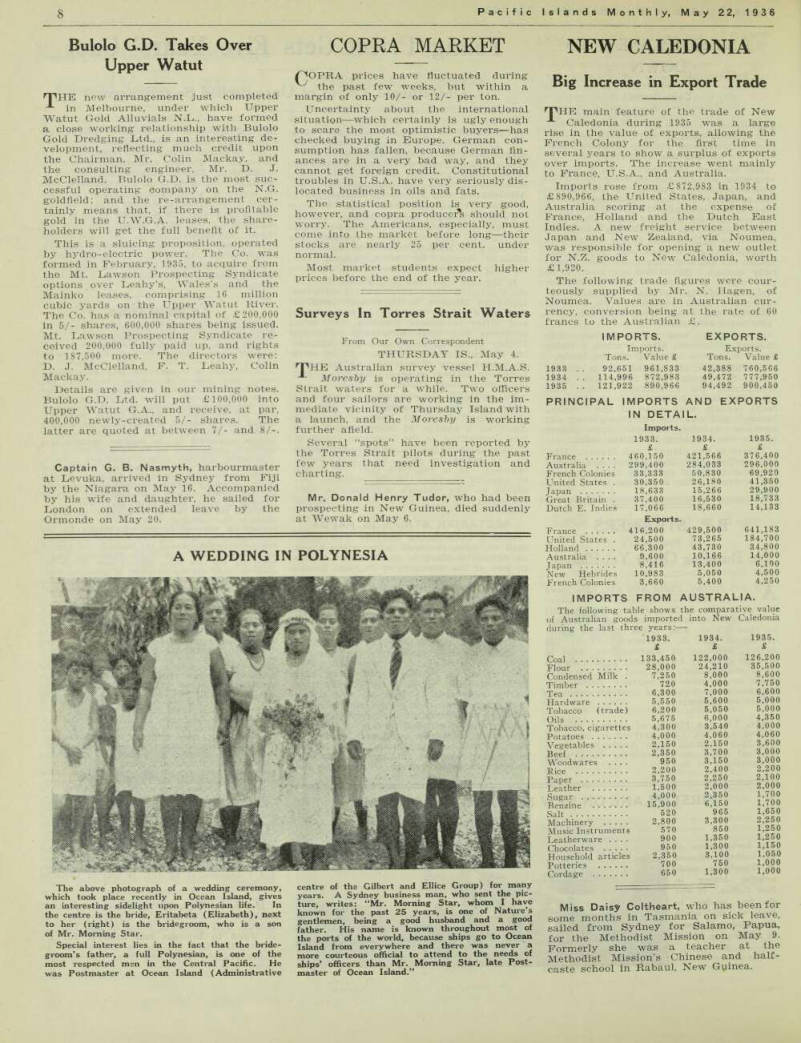
A Wedding In Polynesia
The above photograph of a wedding ceremony, which took place recently in Ocean Island, gives an interesting sidelight upon Polynesian life. In the centre is the bride, Eritabeta (Elizabeth), next to her (right) is the bridegroom, who is a son of Mr. Morning Star.
Special interest lies in the fact that the bride groom’s father, a full Polynesian, is one of the most respected men in the Central Pacific. He was Postmaster at Ocean Island (Administrative
centre of the Gilbert and Ellice Group) for many years. A Sydney business man, who sent the pic ture, writes: “Mr. Morning Star, whom I have known for the past 25 years, is one of Nature’s gentlemen, being a good husband and a good father. His name is known throughout most of the ports of the world, because ships go to Ocean Island from everywhere and there was never a more courteous official to attend to the needs of ships’ officers than Mr. Morning Star, late Post master of Ocean Island.”
New Caledonia
Big Increase in Export Trade
r pHE main feature of the trade of New Caledonia during 1935 was a large rise in the value of exports, allowing the French Colony for the first time in several years to show a surplus of exports over imports. The increase went mainly to France, U.S.A., and Australia.
Imports rose from £872,983 in 1934 to £890,966, the United States, Japan, and Australia scoring at the expense of France, Holland and the Dutch East Indies. A new freight service between Japan and New Zealand, via Noumea, was responsible for opening a new outlet for N.Z, goods to New Caledonia, worth £1,920.
The following trade figures were cour teously supplied by Mr. N. Hagen, of Noumea. Values are in Australian cur rency, conversion being at the rate of 60 francs to the Australian £.
Miss Daisy Coltheart, who has been for some months in Tasmania on sick leave, sailed from Sydney for Salamo, Papua, for the Methodist Mission on May 9.
Formerly she was a teacher at the Methodist Mission’s Chinese and half caste school in itabaul, New Guinea.
Imports.
Exports.
Imports.
Exports.
Tons.
Value f Tons.
Value £ 1933 . . 92,651 961,833 42,388 760,566 1934 .. 114,996 872,983 49,472 777,950 1935 . . 121,922 890,966 94,492 900,450
Principal Imports
And Exports
1
N Detail.
Imports. 1933. 1934. 1935. £ £ £ France 460,150 421,566 376,400 Australia ... 299,400 284,033 296,000 French Colonies 33,333 50,830 69,920 United States . 30,350 26,180 41,350 Japan 18,633 15,266 29.900 Great Britain . 37,400 16,530 18,733 Dutch E. Indies 17,066 18,660 14,133 Exports.
France 416,200 429,500 641,183 United States . 24,500 73,265 184,700 Holland 66,300 43,730 34,800 Australia ... 9,600 10,166 14,000 J apan 8,416 13,400 6,100 New Hebrides 10,983 5,050 4,500 French Colonies 3,660 5,400 4,250
Imports
From Australia.
The following table shows the comparative value of Australian goods imported into New Caledonia during the last three years:— 1933. 1934. 1935. £ £ £ Coal 133,450 122,000 126,200 Flour 28,000 24,210 35,500 Condensed Milk . 7,250 8,000 8,600 Timber 720 4,000 7,750 Tea 6,300 7,000 6,600 Hardware 5,550 5,600 5,000 Tobacco (trade) 6,200 5,050 5,000 Oils 5,675 6,000 4,350 Tobacco, cigarettes 4,300 3,540 4,000 Potatoes 4,000 4,060 4,060 Vegetables 2,150 2,150 3,600 Beef 2,350 3,700 3,000 Woodwares ... 950 3,150 3,000 Rice 2,200 2,400 2,200 Paper 3,750 2,250 2,100 Leather 1,500 2,000 2,000 Sugar 4,000 2,350 1,700 Benzine 15,900 6,150 1,700 Salt 520 965 1,650 Machinery 2,800 3,300 2,250 Music Instruments 570 850 1,250 Leatherware ... 900 1,350 1,250 Chocolates ... 950 1,300 1,150 Household articles 2,350 3,100 1,050 Potteries 700 750 1,000 Cordage 650 1,300 1,000
Hold Islands’ Trade
Australian Firms Fight to Hold Islands’ Trade Hampered by Restrictions and Traded Apathy
“ A USTRALIA is fighting grimly to hold her Pacific Islands trade,” said Mr.
W. M. Reid, well-known Sydney exporter, on his return from a visit to New Guinea and the Solomons by the Malaita on May 8, “and I cannot condemn too strongly the red-tape restrictions placed upon firms trying to build and strengthen Islands trade for the Commonwealth.
“I obtained a contract from the N.G.
Administration for the supply of Aus tralian tinned meat. Though a lower price was offered by interests selling meat from other countries, the Administration gave the contract to Australia because of loyalty to the Government at Canberra.
“The price quoted was for unlabelled tins, but the suppliers were later notified by a Government official in Melbourne that export would not be allowed unless the tins were labelled. This meant an additional Bd. a case, and, without that, Australian meat was already l/6d. higher than that of other countries.
“It is hard to understand this red-tape attitude of some Australian officials—the meat will not be offered for sale, but will be issued by the Administration to the natives, who know that the tins contain meat. Anyhow, they can neither read nor write, so the label means little to them.
“With the exception of New Guinea, the Pacific Islands are very extensively sup plied with meat from foreign countries,” continued Mr. Reid. “Those interests ob tained this trade by undercutting prices —and Islands trader's display a marked in difference towards Australian goods when the question of price is a consideration.
They are not interested in the country of origin, but mainly in the margin of profit.”
Chance For Australian Flour
Mr. Reid urged that the Federal Govern ment, in conjunction with the New Guinea Administration, should attempt to foster the export of Australian flour, which could form part of the rations issued to native labourers. At present they are given rice grown in Java and Saigon.
The ordinances governing rations make provision for the issue of flour (or dinary and wholemeal) in lieu of rice,” he stated, “and where flour as a ration is now optional, it could be made compul sory. The natives are not averse to flour; rn fact, most white housekeepers have their supply under lock and key to pre vent the ‘boys’ from stealing it to make dampers. in French Oceania, imports some 260 tons of Australian flour a month.
Rabaul takes only 20 tons. The native population in the New Guinea centre is much larger than Tahiti’s (and the white population is almost the same) so it can e readily seen that there is a big open mg for Australian flour, if once it is in troduced with the native ration issue. The cost would be about the same as rice, but the nutriment would be greater, and the diffprJnt 10nS C ° U - ld be cooke( f in a dozen different ways—it is only a question of shouMbe used. a " d explainin S h ° w « PoL^i° a l d - hat at . present Carpenters’
Pondo Estate is practically the only plan flou? n with N t e i^- GUlr l- a Siving its iabourers made Tnto brad.™ 1 ' 0 " 8 ’ and U is usual *
Odd Corners Of The Pacific
Written for the Pacific Islands Monthly by Dwight Long, an American University man who is circumnavigating the globe in his ketch “Idle Hour."
HAVING completed 8000 miles of my world-encircling cruise, I landed in Tahiti with a broken hand.
I was unable to get assistance from the hospital, because I couldn’t speak French, and I accepted an invitation to be the guest of the French Commander of the Z elee. I could not speak any Tahitian and no one on board could speak English—anyway, not the King’s English. From a couple of the lads I found out that we were going to Toua Atoll, to pick up the remainder of the ship’s crew who were making a chart of a small cove in the coral reef.
Mr. Dwight Long, the young American who is navigating the tiny ketch “Idle Hour’’ around the world, left Sydney on May 8 for the North Queensland coast and Port Moresby ( Papua ). Thence he trill make his way, via the East Indies and the Suez Canal, to Europe.
The commander spoke very little English and understood less. At each meal I tried to be friendly. The six-course meal — everything from soup to nuts—took a long time to serve, and a word now and then tended to break the dead silence.
Solomon, a gigantic Tahitian, could speak a little English, so I conversed con siderably with him. Noticing my swollen hand, he declared it needed a massage.
With his powerful hands he grasped it and applied French ointment. His 190 pounds of glistening muscles meant well, but I doubted his knowledge concerning the proper treatment of my case. After a fortnight, I found I had two broken bones.
Toua Atoll
From the masthead at dawn we could see a row of coconut trees on the skyline.
As we came closer, I could see the sub marine reef fringing the lee side of the lagoon, with only a few inches of water covering the treacherous but beautiful formation. Fifteen fathoms were paid out as the anchor was let go.
The reminder of the crew were a wild looking bunch, with stubble-covered faces, after their month’s stay on uninhabited Toua Atoll. No natives lived on this island, owing to its poisonous fish. In habitants of neighbouring islands, however, occasionally go there to make copra.
As the Zelce was scheduled to sail imme ately after the equipment was all aboard, I decided to see what was to be seen. No place on the land was over eight feet above water. Hermit crabs were crawling all over the land, many living in fallen coco nut husks, which covered the ground. The tropical foliage was so dense that I pro ceeded very slowly. There was no soil and the palms grew right out of the coral, which is all the atoll is made of.
Having gone as far as I dared without danger of being left. I returned toward the cove where the Z elee lay anchored.
I came upon a large open space that was overgrown with tropical grasses. On either side I found stone foundations, which I later learned from the crew were the re mains of native dwellings along a street deserted for over a century. It is com monlv believed the natives died from eat ing the poisonous fish in the lagoon.
The boats were hoisted and anchors
lifted. Back to Tahiti, and on through the remainder of the Society Group in the Idle Hour.
Maupiti
No island in this group was as interest ing as Maupiti, at the extreme northern extremity of the archipelago. It is seldom visited, due to the treacherous pass, the only entrance into a shallow lagoon dot ted with coral heads.
During the regular trade-wind weather, it is impossible to get in or out of Mau piti Pass, as it is on the windward side of the island. Waves break completely across the narrow channel. As we ap proached the pass I could have sworn there was none there for, apparently, I could see no bite in the waves. It is very deceiving. One of the reefs extends out in front of the other. As I was sitting in the cockpit I could have thrown a peanut on the reef on either side! Surging violently to starboard, and then to port, we emerged into the coral-studded lagoon.
No sooner were we anchored than the natives wanted to trade. As we were the first visitors they had had for over a year, and their two local cutters were out of commission, no flour or sugar could be had on the island.
Many of the deals became very com plicated, as you might imagine. I traded Woolworth jewellery and perfumes for curios and coconut oil. For example, I gave a native a necklace, and in return we got two bunches of bananas and two dozen pawpaws. Another time, I traded a tiny bottle of nerfume for a quart of coconut oil and three dozen oranges. Then a chicken for three lbs. of flour; and many
a time we would trade a cent box of matches for an egg.
It was fun at first; but, after hours of dickering, with the natives continually changing their minds, we would have to just say that that was all for the day, and ask them to go.
As Maupiti is well off the beaten path, trading schooners do not even call. Here the natives live more true to primitive life.
There is not one white resident on the island. The women go bare-breasted — and why not—they know no shame. There is no such thing as vice on a remote island like Maupiti. They all live a natural life, close to nature.
We climbed the summit of the rocky bute that covers all the central island.
Prom our point of vantage we could see the coral formations which have grown up so rapidly in recent years that Maupiti is now the most treacherous lagoon to navi gate in the Society Group. We could also see the narrow bite, through which we had entered.
The trades were setting in and we readily observed it would be necessary to get out of the lagoon and through the pass as soon as possible, before the seas piled up so high that it would be impos sible.
Lonely Penrhyn
So on in the Idle Hour to Penrhyn, 700 miles to the north-west, the remotest atoll of New Zealand’s colonial possessions. It was the most difficult landfall I had made to date, as it is 300 miles from its nearest neighbour, and is in the midst of the doldrums where currents, varying con tinuously, tend to throw one off the course.
But worst of all was the fact that Pen rhyn is only 10 feet above sea level, and was only visible from our deck at four miles distance.
After eight days, we sighted the coconut trees which appeared to grow out of the sea. As we came closer, we could dis tinguish the motus near the mouth of the west passage.
We shot in through the pass, like a bul let, as the tide was with us. Anchored safe inside, Mr. Philip Woonton came aboard, making his official call; he was the Resident Agent at Penrhyn. He made us his house-guests and put everything on the island at our disposal.
All the houses are well kept. The streets are white coral, bordered with white stones. All the dwellings are either white washed or recently painted. There are na tive dwellings on the outskirts; but in the village all the houses are European style, for the fire hazard is too great in the dry season, with grass-houses built so close together.
We went to dinner that evening at the Resident Agent’s house. He informed us that Penrhyn is the largest atoll in the entire Cook Group. No leprosy, or ele phantiasis—in fact, no diseases of any kind. There is one church in the middle Of the village, which is the centre of com munity life.
Here, for the first time I had seen in the South Seas, the church is an asset to the natives. The New Zealand representative has wisely seen to it that only one creed, with one church, may be taught. He can regulate this, in an indirect manner, by not letting other missionaries settle on the isle. (He told me that when some other creed wishes to establish some church he can boost the price of land or building materials or tax it so it would be very unfavourable for it to try even to get started.) Thus, in the small villages, tliere is no friction and the nearest thing to Utopia has been achieved.
Until recently, copra was at such a low price that it was not worth making. Thus, hardly any money is handled. All have plenty to eat, as they own the land. The
Government wisely protects its subjects for they cannot sell their property. There are plenty of fish in the lagoon and on the reefs. ,They have a surprisingly great variety of dishes which they make from the various fish and coconuts. Occasion ally, a man will get a valuable pearl from
the lagoon. The women busy themselves making hats, some of the finest in the world. They are so finely woven that when the hat is completed, it weighs hardly an ounce.
We were informed that the pastor was returning to Rarotonga on the morrow.
A huge native feast was prepared for him and his family. A table of six pieces of corrugated iron, placed on five oil drums, was piled high with plates made of woven coconut leaves, laden heavily with food.
After feasting for two hours, the himenes started. Natives from the village of Omoka arrived from across the lagoon.
One group would sing a himene and im mediately the other group started another one, before the final chords of the former himene were completed. This continued on and on until 6.30 next morning. A native interpreted the Biblical theme of each himene. One group would sing about The Creation; the other about Daniel in the Lion’s Den: the first group about Cain Killing Abel; and the other about the Lord’s Supper; and so on. Literally, hundreds upon hundreds of verses are memorised.
My native friend told me that over 300 incidents have been thus memorised. All the dances became faster and more excit ing, accompanying the singing. I could see the pagan of 70 years ago. The thin veneer of Christianity and civilization was apparent.
We were in Penrhyn for over a fort night, and we had to draw our visit to a close. As you may imagine, it was very difficult to tear ourselves away from this remote isle, far off the beaten paths of our 20th century civilization.
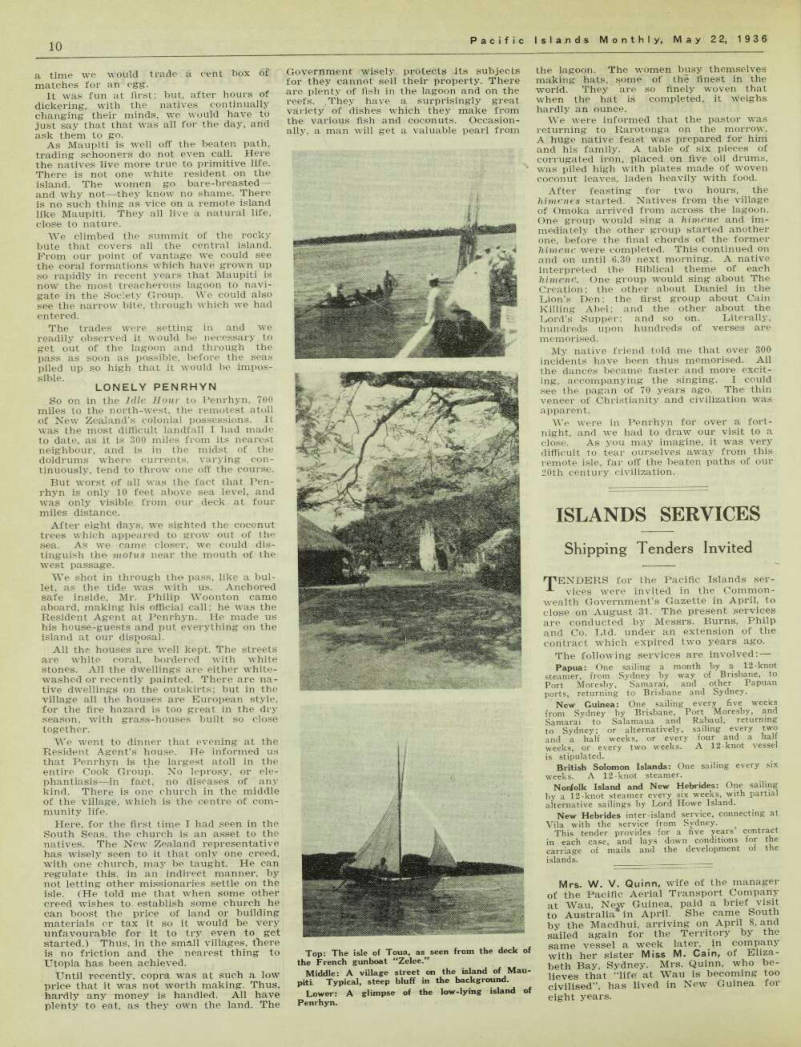
Top: The isle of Toua, as seen from the deck of the French gunboat “Zelee.”
Middle: A village street on the island of Mau piti. Typical, steep bluff in the background.
Lower: A glimpse of the low-lying island of Penrhyn.
Advertisements & other items, p. 11 (1 item)
Pacific Islands
RECENTLY PUBLISHED
YEAR BOOK
1935-36 Ed’n.—43o pp.—Many new Maps
A reliable, comprehensive guide to
the Rapidly-Developing Territories
of the Pacific.
STATISTICS FROM OVER 20
ADMINISTRATIONS
NEW COUNTRIES WITH
NEW OPPORTUNITIES
Special Features include: Description of new Pacific Islands Gold Industries; Pidgin Vocabulary; Aviation in Pacific; Pacific Personalities; History of Pacific Exploration; Business and Residential Directories of Principal Territories.
Bound in cloth, 9/6; in Light Board, 7/6; plus postage (British countries, 6d; foreign, 1/-).
From all Booksellers and Islands Stores, or from
PACIFIC PUBLICATIONS
LTD.
Union House, 247 George St.,
Sydney.
Islands Services
Shipping Tenders Invited
TENDERS for the Pacific Islands ser vices were invited in the Common wealth Government’s Gazette in April, to close on August 31. The present services are conducted by Messrs. Burns, Philp and Co. Ltd. under an extension of the contract which expired two years ago.
The following services are involved: Papua: One sailing a month by a 12-knot steamer, from Sydney by way of Brisbane, to Port Moresby, Samarai, and other Papuan ports, returning to Brisbane and Sydney.
New Guinea: One sailing every five weeks from Sydney by Brisbane, Port Moresby, and Samarai to Salamaua and Rabaul, returning to Sydney; or alternatively, sailing every two and a half weeks, or every four and a half weeks, or every two weeks. A 12-knot vessel is stipulated.
British Solomon Islands: One sailing every six weeks. A 12-knot steamer.
Nonfolk Island and New Hebrides: One sailing by a 12-knot steamer every six weeks, with partial alternative sailings by Lord Howe Island.
New Hebrides inter-island service, connecting at Vila with the service from Sydney.
This tender provides for a five years contract in each case, and lays down conditions for the carriage of mails and the development of the islands. . - Mrs. W. V. Quinn, wife of the manager of the Pacific Aerial Transport Company at Wau, New Guinea, paid a brief visit to Australia in April. She came South by the Macdhui, arriving on April 8, and sailed again for the Territory by the same vessel a week later, in company with her sister Miss M. Cain, of Eliza beth Bay, Sydney. Mrs. Quinn, who be lieves that “life at Wau is becoming too civilised”, has lived in New Guinea for eight years.
Tropicalities
MR. JOHN PARER, who is well-known as the owner of a hotel and other interests on the Morobe goldfield, New Guinea, was “front page news” in Sydney on May 3 when the Sunday Sun gave prominence to the fact that he had been five times to Monte Carlo and that he had lost altogether £lO,OOO in testing out a special “system” there. He said that the system itself was not at fault —the fault was his own in not taking the table at the proper time. Mr. Parer said that the system was worked on the law of averages, based on the results showing on the table, and if the man with the system played it correctly, it was a winner. The difficulty was to know when and how to attack the table. * * * OIDGIN as She is Spoke” could be the title of many funny incidents which occur when the newcomer to New Guinea tries to give instructions to his boy.
An epicure sat down to lunch in the Bulolo Co.’s mess one day, when along came the boy with a plate of rabbit.
“What’s this?” asked the epicure.
“Pussy,” said the boy.
“What!” shouted the diner.
“ Tm ’ere, Pussy,” said the boy.
Exit the epicure with a rush.
Hearken to a tale of a misunderstanding between a newly arrived overseer and his boy, shovelling gravel onto the road.
“Alright, plenty,” said the overseer.
Whereat the native continued to shovel.
“Plenty,” said the white man raising his voice slightly.
Slightly faster went the shovel.
“Plenty,” shouted the overseer, becoming rather annoyed.
The speed of the shoveller increased noticeably.
“PLENTY,” he shrieked, his temper rising fast.
Gravel and sweat began to fly in all directions.
“P LENTY, you .”
The native, by now thoroughly terrified, shovelled faster than he’d ever done before, when suddenly a boot landed with a thud on his posterior.
At last the boss-boy came to the rescue.
“Enough,” he whispered to the frightened worker.
“Ah, me savvy now,” grinned the native, and departed for a safer place. * * * r IVHE Samoa Herald (incorporating the Samoa Times, which was established in 1901) was taken over at the end of March by Mr. J. W. Liston and a new company. Its name has been changed to Western Sainoa Mail ; and it has been give a new typographical dress, and a new journalistic standard. Mr. Liston, the editor, has been for 12 years a resident of Samoa —most of the time as a mission ary. The assistant editor, Mr. W. Tarr, is a well-known South Seas journalist.
Western Samoa seems to have entered upon a new era of prosperity, and we hope that the Samoa Mail will prosper with it.
The Herald, for some years, had been controlled by Mr. Alport Barker, the Suva newspaper-owner, but it was not a satis factory arrangement. He necessarily had to leave publication authority in the hands of others, and some of the latter allowed themselves to become too deeply immersed in parish-pump politics, and local likes and dislikes, to be good journalists.
There should be plenty of scope in Western Samoa for a well-conducted pub lishing house.
T ADS who were born and spent their earlier days in the Pacific Territories have been distinguishing themselves lately.
J. B. Hagen, the 18-years-old son of Mr.
Nicholas Hagen, well-known resident of New Caledonia, was a member of the row ing eight of St. Ignatius (Riverview) Col lege which put up the school’s finest performance for years in the G.P.S. Re gatta on Nepean River, N.S.W., on April 18.
Hagen arrived in Sydney from Noumea two and a half months ago to attend Riverview so that he could be taught Eng lish. Impressed by his splendid physique and ideal proportions, the rowing master tried to explain to him the rudiments of rowing. Being French, Hagen could not understand the English terms, so the coach demonstrated the action and technique to him by signs.
In the big race, Hagen, rowing bow, was a polished oarsman and, though finishing sixth, the crew made a remarkably good effort.
Frank H. Boileau, who obtained his B.Sc. degree at the Sydney University last November, has received an appoint ment at the Cranbrook College, Rose Bay, Sydney, as Science Master under General Mac Kay. He is a son of Mr. J. Boileau. well known as Engineer for Telephones and Electric Light in Papua.
There does not seem to be anything wrong with those “tropical boys,” ren dered immortal in the song which Boileau, senr., has made famous. * * * THE last mail from the Solomons brought another parcel of 11 different books produced at what apparently is the busiest printing press in the Pacific — namely, the Melanesian Mission Press at Guadalcanal, Solomon Islands, under the active management of Mr. Fred. R. Isom.
Three of the books are in English, seven in native dialects, and one is partly in
English and partly in native. They are all well printed and attractively bound, and reflect the greatest credit upon their indefatigable authors, and upon the print ing office. It may be assumed that the increasing productiveness of this mission press indicates the spread of education among the natives of Melanesia. ♦ ♦ * AN experienced recruiter in the Solorpon' Islands writes: “The game is slow and fees are only £7 a head landed in Ma kambo; I cannot understand why this lower price should rule, now that wages are only 10/- per month and boys so much harder to get.”
London
Jack Hides’s Book Welcomed in London
''THE London Press prominently reviews A the book by the Papuan Assistant Resident Magistrate, Mr. Jack Hides, en titled “Papuan Hinterland,” published by Blackie and Co. Ltd., said the London cor respondent of the Sydney Telegraph on May 12.
The Evening Standard says:—“This modest account of a journey which has been acclaimed as the most notable of modern times adds pages f to Australian his tory. It tells the story of eight months of struggle against obstacles, including battles against cannibals, starvation, sick ness, and the terrible limestone barrier.”
Mr. Hides carried out an arduous survey of an unknown country between the Strick land River and the Purari River.
Rev. A. Stanley Jones, L.Th., left Syd ney for Kabakada. New Britain, for tl\e Methodist Missionary Society by the April Macdhui.
Mr. F. E. Williams, anthropologist to the Papuan Government, will leave Port Moresby in June to represent Papua and New Guinea at the Conference and Seminar of Education in Pacific Countries to be held in Hawaii from June 27 to August 7.
Advertisements & other items, pp. 13-14 (1 item)
home
STERLING
HOME <£=B=
sterling
home
Guaranteed CD
LOOKS
BETTER
LONGER
MADE BY
STERLING VARNISH CO.
PAINT
For
TROPICAL
SUN and
SALT-LADEN
AIR
SYDNEY, N.S.W.
NEGLECT OF DEFECTIVE SIGHT
MAY CAUSE SERIOUS RESULTS
Take Care of Your Eyes Consult
WALTER FORD
D.8.0.A., M.0.0.A.
Optometrist and Optician 4th Floor, Challis House Martin Place, Sydney Established over 30 years Tel.: Most moderate charges BW 6131
“FAIRHOLME” A Mountain Schoolfor Girls
* m ?
Dormitory Wing PRESBYTERIAN GIRLS’ COLLEGE, Toowoomba, Q’land. 2,000 feet above sea level :: :: :: Unrivalled climate.
Academic, Home Science and Commercial Courses
TENNIS, SWIMMING, ORGANISED GAMES
PRINCIPAL; MISS D. E. CULPIN, B.A.
For prospectus, apply Sec., R. T. PHELPS, F.A.A., Toowoomba
WHEN YOU WOKE UP
THIS MORNING
How did you feel? Headachy, irritable, dopey and nervy—or fresh, bright and alert. A good start off in the morning is essential to the strenuous hours ahead. If out of sorts when you wake up, take two or three “ASPRO” tablets after breakfast. The relief is almost instantaneous. “ASPRO” will quickly banish your Headache, quieten your Nerves, and will soothe away Pains and Aches, because after ingestion in the system, it is anti - pyretic and an internal antiseptic. Furthermore, in attacks of a feverish nature, “ASPRO” promotes a healthy action of the skin, thus allowing the poisons in the system to be eliminated through the pores in a perfectly natural manner. Start the day right for health. If out of sorts
ASPRCT
IS YOUR STANDBY
BUY A PACKET TO-DAY FOR PROOF
About Islands People
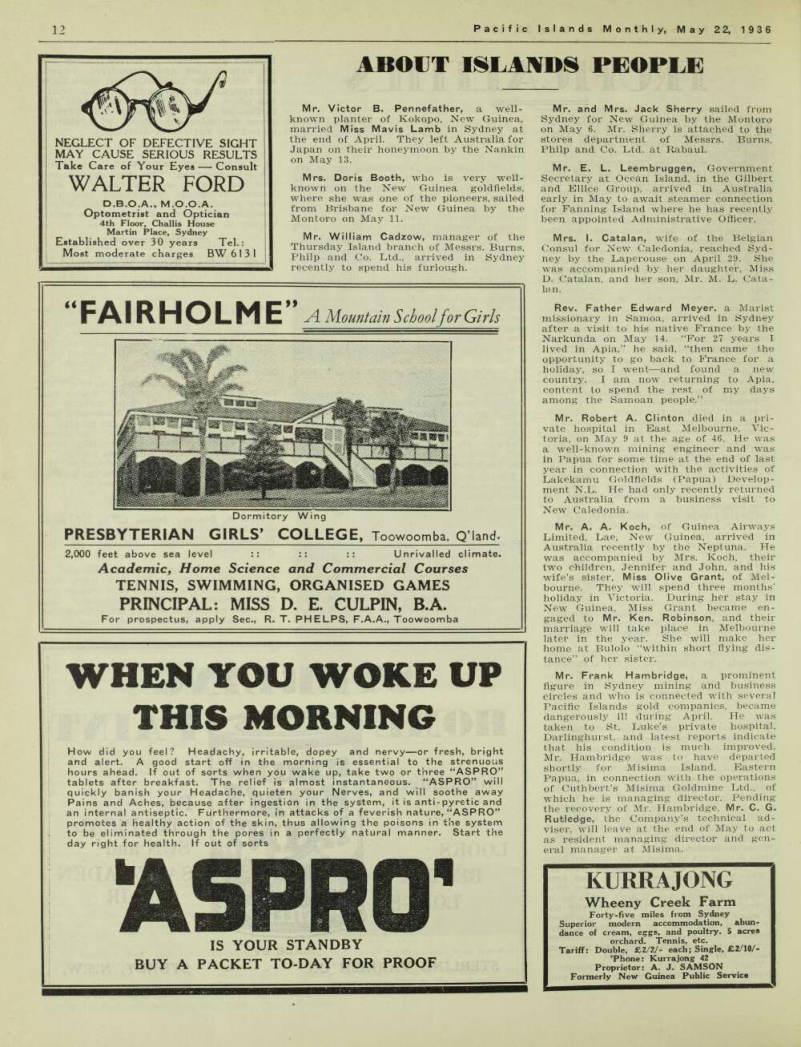
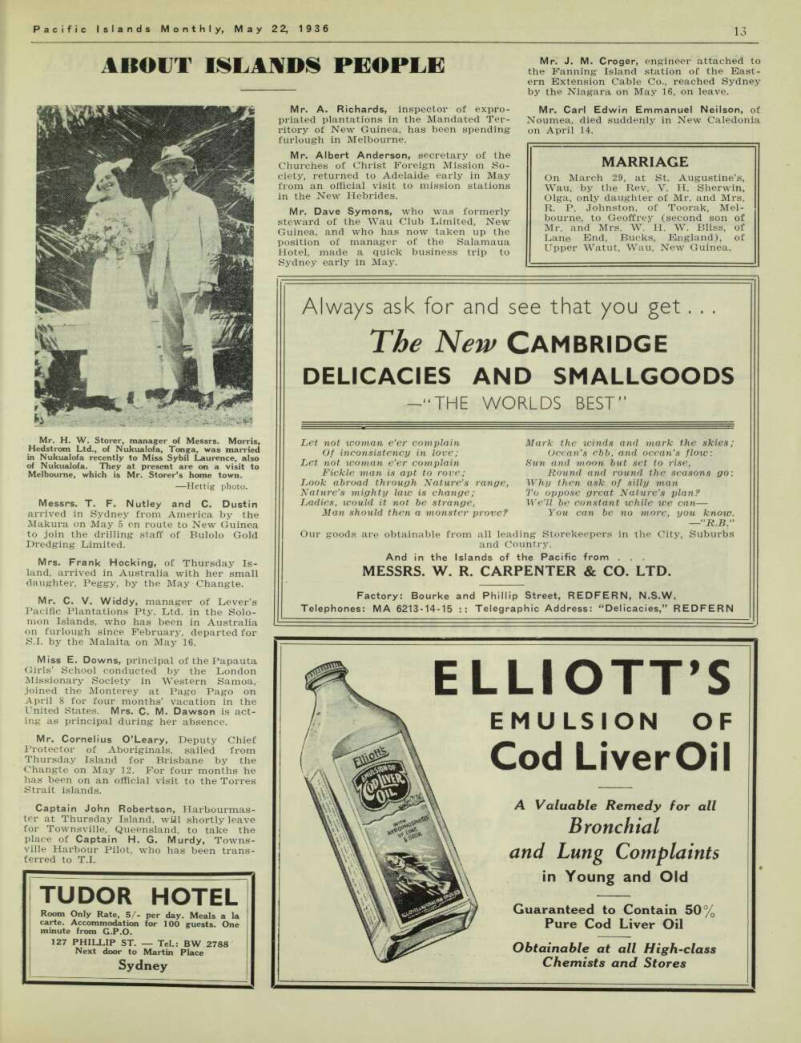
Mr. Victor B. Pennefather, a well known planter of Kokopo, New Guinea, married Miss Mavis Lamb in Sydney at the end of April. They left Australia for Japan on their honeymoon by the Nankin on May 13.
Mrs. Doris Booth, who is very well known on the New Guinea goldfields, where she was one of the pioneers, sailed from Brisbane for New Guinea by the Montoro on May 11.
Mr. William Cadzow, manager of the Thursday Island branch of Messrs, Burns, Philp and Co. Ltd., arrived in Sydney recently to spend his furlough.
Mr. and Mrs. Jack Sherry sailed from Sydney for New Guinea by the Montoro on May 6. Mr. Sherry is attached to the stores department of Messrs. Burns, Philp and Co. Ltd. at Rabaul.
Mr. E. L. Leembruggen, Government Secretary at Ocean Island, in the Gilbert and Ellice Group, arrived in Australia early in May to await steamer connection for Fanning Island where he has recently been appointed Administrative Officer.
M rs. I. Catalan, wife of the Belgian Consul for New Caledonia, reached Syd ney by the Laperouse on April 29. She was accompanied by her daughter, Miss D. Catalan, and her son, Mr. M. L. Cata lan.
Rev. Father Edward Meyer, a Marist missionary in Samoa, arrived in Sydney after a visit to his native France by the Narkunda on May 14. “For 27 years I lived in Apia,” he said, “then came the opportunity to go back to France for a holiday, so I went —and found a new country. I am now returning to Apia, content to spend the rest of my days among the Samoan people.”
Mr. Robert A. Clinton died in a pri vate hospital in East Melbourne, Vic toria, on May 9 at the age of 46. He was a well-known mining engineer and was in Papua for some time at the end of last year in connection with the activities of Lakekamu Goldfields (Papua) Develop ment N.L. He had only recently returned to Australia from a business visit to New Caledonia.
Mr. A. A. Koch, of Guinea Airways Limited, Lae, New Guinea, arrived in Australia recently by the Neptuna. He was accompanied by Mrs. Koch, their two children, Jennifer and John, and his wife’s sister, Miss Olive Grant, of Mel bourne. They will spend three months’ holiday in Victoria, During her stay in New Guinea, Miss Grant became en gaged to Mr. Ken. Robinson, and their marriage will take place in Melbourne later in the year. She will make her home at Bulolo “within short flying dis tance” of her sister.
Mr. Frank Hambridge, a prominent figure in Sydney mining and business circles and who is connected with several Pacific Islands gold companies, became dangerously ill during April. He was taken to St. Luke’s private hospital.
Darlinghurst, and latest reports indicate that his condition is much improved.
Mr. Hambridge was to have departed shortly for Misima Island, Eastern Papua, in connection with the operations of Cuthbert’s Misima Goldmine Ltd., of which he is managing director. Pending the recovery of Mr. Hambridge, Mr. C. G.
Rutledge, the Company’s technical ad viser, will leave at the end of May to act as resident managing director and gen eral manager at Misima.
Messrs. T. F. Nutley and C. Dustin arrived in Sydney from America by the Makura on May 5 en route to New Guinea to join the drilling staff of Bulolo Gold Dredging Limited.
Mrs. Frank Hocking, of Thursday Is land, arrived in Australia with her small daughter, Peggy, by the May Changte.
Mr. C. V. Widdy, manager of Lever’s Pacific Plantations Pty. Ltd. in the Solo mon Islands, who has been in Australia on furlough since February, departed for S.L by the Malaita on May 16.
Miss E. Downs, principal of the Papauta Girls’ School conducted by the London Missionary Society in Western Samoa, joined the Monterey at Pago Pago on April 8 for four months’ vacation in the United States. Mrs. C. M. Dawson is act ing as principal during her absence.
Mr. Cornelius O’Leary, Deputy Chief Protector of Aboriginals, sailed from Thursday Island for Brisbane by the Changte on May 12. For four months he has been on an official visit to the Torres Strait islands.
Captain John Robertson, Harbourmas ter at Thursday Island, will shortly leave for Townsville, Queensland, to take the place of Captain H. G. Murdy, Towns ville Harbour Pilot, who has been trans ferred to T.I.
Mr. A. Richards, inspector of expro priated plantations in the Mandated Ter ritory of New Guinea, has been spending furlough in Melbourne, Mr. Albert Anderson, secretary of the Churches of Christ Foreign Mission So ciety, returned to Adelaide early in May from an official visit to mission stations in the New Hebrides.
Mr. Dave Symons, who was formerly steward of the Wau Club Limited, New Guinea, and who has now taken up the position of manager of the Salamaua Hotel, made a quick business trip to Sydney early in May.
Mr. J. M. Croger, engineer attached to the Fanning Island station of the East ern Extension Cable Co., reached Sydney by the Niagara on May 16, on leave.
Mr. Carl Edwin Emmanuel Neilson, of Noumea, died suddenly in New Caledonia on April 14.
Mr. H. W. Storer, manager of Messrs. Morris, Hedstrom Ltd., of Nukualofa, Tonga, was married in Nukualofa recently to Miss Sybil Laurence, also of Nukualofa. They at present are on a visit to Melbourne, which is Mr. Storer’s home town. —Hettig photo.
Mr. R. M. Boyd, consulting geologist, has joined the board of directors of directors of Upper Sepik Gold Syndicate N.L., which is operating in New Guinea.
Advertisements & other items, pp. 14-16 (2 items)
Kurrajong
Wheeny Creek Farm
Forty-five miles from Sydney Superior modern accommodation, abundance of cream, eggs, and poultry. 5 acres orchard. Tennis, etc.
Tariff: Double, £2/2/- each; Single, £2/10/- ’Phone: Kurrajong 42 Proprietor; A. J. SAMSON Formerly New Guinea Public Service
MARRIAGE
On March 29, at St. Augustine’s, Wau, by the Rev. V, H, Sherwin, Olga, only daughter of Mr. and Mrs.
R. P. Johnston, of Toorak, Melbourne, to Geoffrey (second son of Mr. and Mrs. W. H. W. Bliss, of Lane End, Bucks, England), of Upper Watut, Wau, New Guinea.
Always ask for and see that you get. . .
The New CAMBRIDGE
DELICACIES AND SMALLGOODS
-“THE WORLDS BEST”
Let not woman e’er complain Of inconsistency in love; Let not woman e’er complain Fickle man is apt to rove; Look abroad through Nature’s range.
Nature’s mighty law is change; Ladies, would it not be strange, Man should then a monster prove?
Mark the winds and mark the skies; Ocean’s ebb, and ocean’s flow: Sun and moon but set to rise.
Round and round the seasons go: Why then ask of silly man To oppose great Nature's plan?
We’ll be constant while we can — You can be no more, you know. — “R.B.”
Our goods are obtainable from all leading Storekeepers in the City, Suburbs and Country.
And in the Islands of the Pacific from . . .
MESSRS. W. R. CARPENTER & CO. LTD.
Factory: Bourke and Phillip Street, REDFERN, N.S.W.
Telephones: MA 6213-14-15 :: Telegraphic Address: “Delicacies,” REDFERN
LLIOTTS
EMULSION OF
Cod Liver Oil
A Valuable Remedy for all Bronchial
and Lung Complaints
in Young and Old Guaranteed to Contain 50% Pure Cod Liver Oil Obtainable at all High-class Chemists and Stores
TUDOR HOTEL
Room Only Rate, 5/- per day. Meals a la carte. Accommodation for 100 guests. One minute from G.P.O.
127 PHILLIP ST. Tel.: BW 2788
Next door to Martin Place
Sydney
B. & S. Estate Agency
ROSEVILLE, SYDNEY
Specialising in Flat reservations, any suburb, for Island Residents visiting Sydney. Correspondence invited. ’Phone J 5269.
Principals; Edwin M. Bastard & Campbell M. Smith
Manager Wanted:
MALAYTA COMPANY invites applications in writing for the position of MANAGER,
YANDINA PLANTATIONS
CAPE MARSH
SOLOMON ISLANDS
Full particulars experience, qualifications, with copies testimonials, to G.P.O. Box 3700 SS, Sydney.
No interviews unless by appointment.
A Beal Ciiaiiie of Billiards
in your home with a J.T.K. Billiard Net In a few minutes the J.T.K. Billiard Set can change your ordinary household table, regardless of its size, into a real billiard table.
Every shot can be played with the same ease as on the most expensive billiard table, even the most difficult ones being made with perfect accuracy.
Just consider the joy the J.T.K. will bring to your family and friends. Notice how evenings, usually hard to fill, are turned into ones of joy and entertainment, and you'll never regret the day you bought a J.T.K. Billiard Set.
EVERYDAY PRODUCTS LTD.
P.O. Box 136, Haymarket, Sydney; 608 Harris Street, Sydney, N.S.W.
Please send me full particulars and free illustrated pamphlets of the J.T.K. Billiard Set.
Name . , Address The J.T.K. Billiard Set comprises table attachments, cues, set of billiard balls, score board, rules and instructions, complete in sturdy box. cues, set of board, rules and
including
postage
CLIP AND MAIL THIS COUPON TO
P.I.M.
About Islands People
Air Transport In New Guinea
ALTHOUGH a cloud of uncertainty concerning future control and regula tion hangs over the aerial transport ser vices of New Guinea, there have been activity and new developments on the part of the principal parties concerned.
Messrs. Guinea Airways Limited have just sent two new Stinson planes to New Guinea, and have ordered three more —a Taifun, which has a pay-load capacity similar to the Stinsons (850 lb.), and two Lockheeds. One is a Lockheed Electra, with a pay-load of 3,400 lb., and the other is a Lockheed 12A, with a pay-load of 2,400 lb. Each is engined with two P. and W. Wasps, and each is capable of an air speed of 200 miles per hour.
Sydney-New Guinea Link
Meanwhile Sir Walter Carpenter has publicly announced his determination to start a weekly aeroplane service between Sydney and New Guinea in June. It is reported that the Commonwealth Depart ment of Defence has refused to give Messrs. Carpenter and Co. Ltd. permission to inaugurate this service on a variety
of grounds; and that Sir Walter Carpen ter is prepared if necessary to challenge the authority of the Defence Department in this matter. There are indications of lively developments.
Discussion and argument concerning the proposed merger of aerial transport in terests in New Guinea are still proceed ing. The matter is in the hands of the Federal Government, and many reasons for and against the merger plan have been advanced.
Up to date it appears that the honours rest with those who contend that some substantial measure of regulation of this important industry is necessary. Air transport is carried on now in nearly every country by powerful chartered com panies under Government control.
Over 40 Aircraft In New Guinea
Information has been sought by the Federal authorities concerning the num ber and value of the aeroplanes available in New Guinea for transport purposes: and the following summary, made from the details available, discloses the inter esting fact that there are over 40 aircraft in New Guinea, either operating or on order.
Rev. C. E. James, who at one time was a Methodist missionary in the Tongan Islands, died at Wahroonga, N.S.W., on May 15, aged 76.
Type. Age. Engines. Payoad (years) lbs.
Guinea Airways
Junker G31 . . . 5 3 5800 Ford 5AT . . . 5 3 3700 ". . . . . . . . . . 5 3 3700 Junker W34 . . . . 6 1 1800 " . . . . . . . . . . . . . 6 1 2000 Junker F13 . . . 6 1 1800 DH61 . . . 10 1 1800 Stinson 1 850 1 850 DH Fox Moth . . . . . 3 1 600 Moth . . . 7 1 350 Taifun 1 850 Lockheed Electra . . . New 2 3400 12A . . . New 2 2400
Holden’S Air
Transport
Ford 4AT . . . 5 3 2500 . . . 5 3 2500 DH50 . . . 10 1 1100 . . . 10 1 1100 Waco . . . 9 1 800 DH Moth . . . 7 1 350
Carpenter
Airways
DH Fox Moth . . . . . 3 1 600 . . . 3 1 600 . . . 3 1 600 DH Dragon Moth ... 2i 2 1400 . . . 2| 2 1400 ;; M . . . 2| 2 1400 Fokker Type . . . ... 8 3 1600 Reported Purchase Ford 5AT ... 5 3 3700
Stephens’ Service
Service
DH61... 10 1 1750 DH61... 10 1 1750 DH50 ... 10 1 1100 DH Hercules . . .10 3 3700 DH Hercules . . .10 3 3700
P.A.T. Service
Junker ... 6 1 1200 Fokker* ... 10 1 1400 DH50 ... 10 1 1100 DH50 ... 10 1 900 DH Moth 1 350 DH Moth ... 7 1 350
Mendham
Service
Avro-Avian . . . . ... 6 1 350 Spartan ... 10 1 300
Ray Parer
Fairey Fox 6 1 800
Centenary
Syndicate
Fairey Fox* . . . . ... 6 1 800 * Out of commission.
Air Merger—Pro and Con
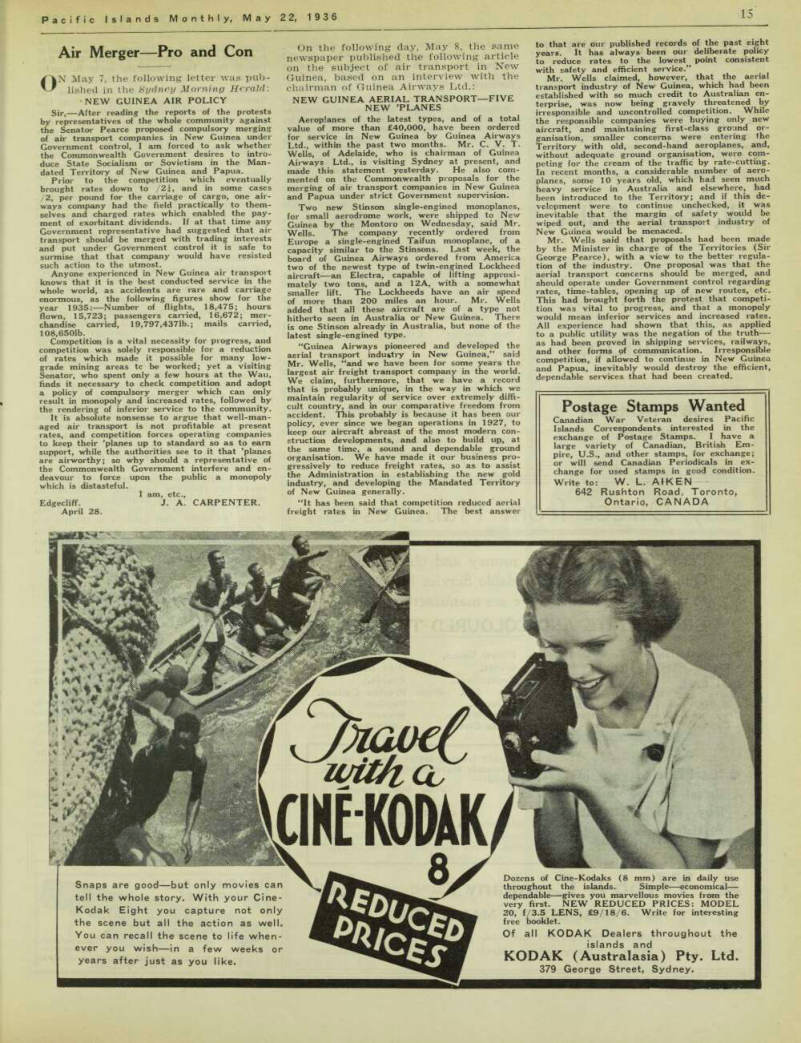
ON May 7, the following letter was pub lished in the Sydney Morning Herald:
New Guinea Air Policy
Sir, —After reading the reports of the protests by representatives of the whole community against the Senator Pearce proposed compulsory merging of air transport companies in New Guinea under Government control, I am forced to ask whether the Commonwealth Government desires to intro duce State Socialism or Sovietism in the Man dated Territory of New Guinea and Papua.
Prior to the competition which eventually brought rates down to /2j, and in some cases /2, per pound for the carriage of cargo, one air ways company had the field practically to them selves and charged rates which enabled the pay ment of exorbitant dividends. If at that time any Government representative had suggested that air transport should be merged with trading interests and put under Government control it is safe to surmise that that company would have resisted such action to the utmost.
Anyone experienced in New Guinea air transport knows that it is the best conducted service in the whole world, as accidents are rare and carriage enormous, as the following figures show for the year 1935: —Number of flights, 18,475; hours flown, 15,723; passengers carried, 16,672; mer chandise carried, 19,797,4371 b.; mails carried, 108,6501 b.
Competition is a vital necessity for progress, and competition was solely responsible for a reduction of rates which made it possible for many low grade mining areas tc be worked; yet a visiting Senator, who spent only a few hours at the Wau, finds it necessary to check competition and adopt a policy of compulsory merger which can only result in monopoly and increased rates, followed by the rendering of inferior service to the community.
It is absolute nonsense to argue that well-man aged air transport is not profitable at present rates, and competition forces operating companies to keep their 'planes up to standard so as to earn support, while the authorities see to it that 'planes are airworthy; so why should a representative of the Commonwealth Government interfere and en deavour to force upon the public a monopoly which is distasteful.
I am, etc.,
Edgecliff.
April 28.
J. A. Carpenter.
On the following day, May 8, the same newspaper published the following article on the subject of air transport in New Guinea, based on an interview with the chairman of Guinea Airways Ltd.:
New Guinea Aerial Transport —Five
New ’Planes
Aeroplanes of the latest types, and of a total value of more than £40,000, have been ordered for service in New Guinea by Guinea Airways Ltd., within the past two months. Mr. C. V. T.
Wells, of Adelaide, who is chairman of Guinea Airways Ltd., is visiting Sydney at present, and made this statement yesterday. He also com mented on the Commonwealth proposals for the merging of air transport companies in New Guinea and Papua under strict Government supervision.
Two new Stinson single-engined monoplanes, for small aerodrome work, were shipped to New Guinea by the Montoro on Wednesday, said Mr.
Wells. The company recently ordered from Europe a single-engined Taifun monoplane, of a capacity similar to the Stinsons. Last week, the board of Guinea Airways ordered from America two of the newest type of twin-engined Lockheed aircraft —an Electra, capable of lifting approxi mately two tons, and a 12A, with a somewhat smaller lift. The Lockheeds have an air speed of more than 200 miles an hour. Mr. Wells added that all these aircraft are of a type not hitherto seen in Australia or New Guinea. There is one Stinson already in Australia, but none of the latest single-engined type.
“Guinea Airways pioneered and developed the aerial transport industry in New Guinea,” said Mr. Wells, “and we have been for some years the largest air freight transport company in the world.
We claim, furthermore, that we have a record that is probably unique, in the way in which we maintain regularity of service over extremely diffi cult country, and in our comparative freedom from accident. This probably is because it has been our policy, ever since we began operations in 1927, to keep our aircraft abreast of the most modern con struction developments, and also to build up, at the same time, a sound and dependable ground organisation. We have made it our business pro gressively to reduce freight rates, so as to assist the Administration in establishing the new gold industry, and developing the Mandated Territory of New Guinea generally.
“It has been said that competition reduced aerial freight rates in New Guinea. The best answer
to that are our published records of the past eight years. It has always been our deliberate policy to reduce rates to the lowest point consistent with safety and efficient service.”
Mr. Wells claimed, however, that the aerial transport industry of New Guinea, which had been established with so much credit to Australian en terprise, was now being gravely threatened by irresponsible and uncontrolled competition. While the responsible companies were buying only new aircraft, and maintaining first-class ground or ganisation, smaller concerns were entering the Territory with old, second-hand aeroplanes, and, without adequate ground organisation, were com peting for the cream of the traffic by rate-cutting.
In recent months, a considerable number of aero planes, some 10 years old, which had seen much heavy service in Australia and elsewhere, had been introduced to the Territory; and if this de velopment were to continue unchecked, it was inevitable that the margin of safety would be wiped out, and the aerial transport industry of New Guinea would be menaced.
Mr. Wells said that proposals had been made by the Minister in charge of the Territories (Sir George Pearce), with a view to the better regula tion of the industry. One proposal was that the aerial transport concerns should be merged, and should operate under Government control regarding rates, time-tables, opening up of new routes, etc.
This had brought forth the protest that competi tion was vital to progress, and that a monopoly would mean inferior services and increased rates- All experience had shown that this, as applied to a public utility was the negation of the truth— as had been proved in shipping services, railways, and other forms of communication. Irresponsible competition, if allowed to continue in New Guinea and Papua, inevitably would destroy the efficient, dependable services that had been created.
Advertisements & other items, p. 17 (1 item)
Cikekodak
Postage Stamps Wanted
Canadian War Veteran desires Pacific Islands Correspondents interested in the exchange of Postage Stamps. I have a large variety of Canadian, British Empire, U.S., and other stamps, for exchange; or will send Canadian Periodicals in exchange for used stamps in good condition.
Write to: W. L. AIKEN 642 Rushton Road, Toronto,
Ontario, CANADA
'J' $
CIKEKODAK
ft afe: ■ • H Snaps are good—but only movies can tell the whole story. With your Cine- Kodak Eight you capture not only the scene but all the action as well.
You can recall the scene to life whenever you wish—in a few weeks or years after just as you like.
Dozens of Cine-Kodaks (8 mm) are in daily use throughout the islands. Simple—economical— dependable—gives you marvellous movies from the
very first. NEW REDUCED PRICES: MODEL
20, f/3.5 LENS, £9/18/6, Write for interesting free booklet.
Of all KODAK Dealers throughout the islands and
KODAK (Australasia) Pty. Ltd.
379 George Street, Sydney.
Burns, Philp And Co.
Net Profit Again Higher
TI/fESSRS. Burns, Philp and Company, Ltd., report a net profit of £216,979 for the year ended March 31. Dividend is un changed at 10 per cent, and requires £150,000. A transfer of £50,000 to re
serve wall increase that item to £1,050,000, and £25,000 is again transferred to special depreciation from the company’s copra plantations. Against £39,089 brought forward, £31,068 is carried forward.
Gross profit was £860,118. showing an increase of £67,277. Expenses of adminis tration (including taxation) increased by |C48,679, and the amount allowed for de preciation, bad debts, and losses was higher by £12,626.
The stock market now values this com pany’s £1 shares at 68/-. The following are extracts from Melbourne Herald’s review of the balance-sheet: “Sixty-three years of trading, marked by sound management, has enabled the
shareholders to participate in a greater measure of prosperity in the last five years, than those holding scrip in many other industrial companies in Australia.
“An example of the soundness of finances was provided in 1933, when the directors decided to write down the com pany’s copra plantations to offset the de cline in the prices of copra. To date £lOO,OOO has been clipped off their value, without showing any signs of discomfort.
“The feature of the past year’s trading was an increase in gross profits by £67,277. Of this amount, however, only £5973 found its way into net earnings.
Expenses were £48,678 higher at £508,518, and depreciation and bad debts took an additional £12,626. In other words, for every £1 increase in gross profits, ex penses and depreciation moved up by 18/3.
“This policy of restricting dividends to 10 per cent, and storing up large sur pluses for the future has been carried to such a point that reserve funds now total 21/6 for every 20/ of capital.
“In addition to its merchandise depart ment, where a substantial increase was recorded in sales, the company benefited from the improved market for copra, and the better trading conditions existing in Papua and the Mandated Territory.
“Associated interests form an import ant contributor to earnings. The com . pany holds two-thirds of the capital of Burns Philp (South Sea) Co. Ltd., from which £25,000 was received in dividends and one-half of the Queensland Insurance Company’s capital, which brought in £30,000; so that these two investments alone provided one-third of shareholders’ dividends.
“In addition to paid capital of £1,500,000, there are reserves totalling £1,616,338 at work, while outside liabilities account for £1,627,311. Apart from cash, £113,508, stock £850,360, and debtors’ accounts for £813,992, the remaining assets, including investments, property, and shipping in terests are grouped together in one item valued at £3,065,818.”
Year ended March 31, 1934. 1935. 1936. £ £ £ Net profits 203,257 211,006 216,979 Div., 10 p.c 150,000 150,000 150,000 To reserve 25,000 25,000 50,000 Special depreciation.
Copra plantations 25,000 25,000 25,000 Carried forward . 28,083 39,089 31,068 Expenses, etc. . . 427,786 459,839 508,518 Depreciation, etc. 104,542 121,995 134,621 Gross profits . . . 735,586 792,841 860,118
Liabilities—
Capital paid up. . 1,500,000 1,500,000 1,500,000 Reserve fund . . . 950,000 975,000 1,000,000 Insurance, reserve etc 516,418 517,775 535,268 Cash credits ... 36,167 144,626 58,256 Bills and foreign drafts 400 180 821 Open liabilities . . 1,474,924 1,528,105 1,568,263
Assets—
Merchandise, copra, advances 707,867 715,427 850,360 Cash in hand . . . 123,046 164,852 113,508 Property, shipping, and shares ... 3,060,818 3,215,210 3,065,818 Sundry debtors . . 739,261 783,285 813,991
No “Beach-Combing” In
The Solomons
From Our Own Correspondent TULAGI, April 28.
THE regulation prohibiting non-natives from residing on native-owned land is being enforced stringently.
A very desirable regulation in itself, it could be used with a little more discre tion, as it causes some hardship to mis sionaries who are not desirous of owning land, but merely wish to'be convenient to the natives they serve (and who probably have no wish to alienate their ground): and to a few other old and valued residents who have been hard hit in recent years.
It can be safely said that no one in the Group is “beach-combing” or lowering the European prestige, or battening on the natives. This last possibility, to anyone who knows the Solomon Islander, is posi tively humorous.
Advertisements & other items, p. 18 (2 items)
W. Brian Molloy,
8.A., LL.B.
BARRISTER
AND
SOLICITOR
PORT MORESBY
PAPUA
Buy Direct from Manchester!
Pacific Traders can save money and obtain High Quality Goods and Dependable Service by writing to us for Quotations. We are manufacturers of—
GREY, WHITE AND COLOURED TEXTILES
Pillow Cases.
Quilts.
Bedspreads.
Art Silk Piece Goods.
Bath Wraps.
Glass Cloths.
Sweat Rags.
Bias Binding.
Braids.
Printed Calicos.
Poplins.
Woven Coloured Ginghams, etc.
It will be to your interest, in the end, to Buy and Distribute
British-made goods.
Extract from a letter sent to us by an Islands storekeeper who recently retired: Milne Bay, Papua. 1/10/34. tf . . .a success due —in a great measure—to the excellent service rendered for so many years by your firm. Yours faithfully, H. DEXTER.”
A, Webb & Company (Manchester) Ltd.
86 GEORGE STREET, MANCHESTER
Contractors to H.M. and Foreign Governments. Bentley's Code, and ABC Code Ath and sth Editions. Telegraphic Address: f ‘WASTOCK,” Manchester.
Leather Belts
NATIVES
f 4 Tflan ufacturers & Specialists
PATTERSON & STONE, CRICHTON WORKS.
WALSALL .ENGLAND.
Confessions Of A Cannibal
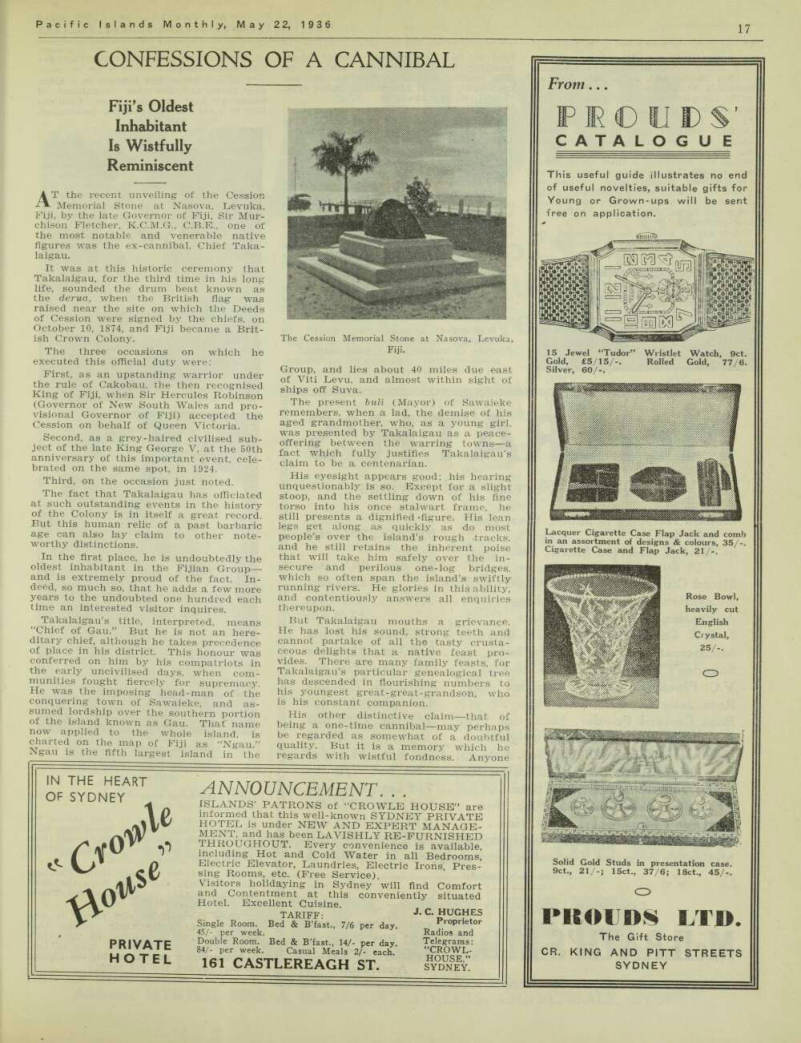
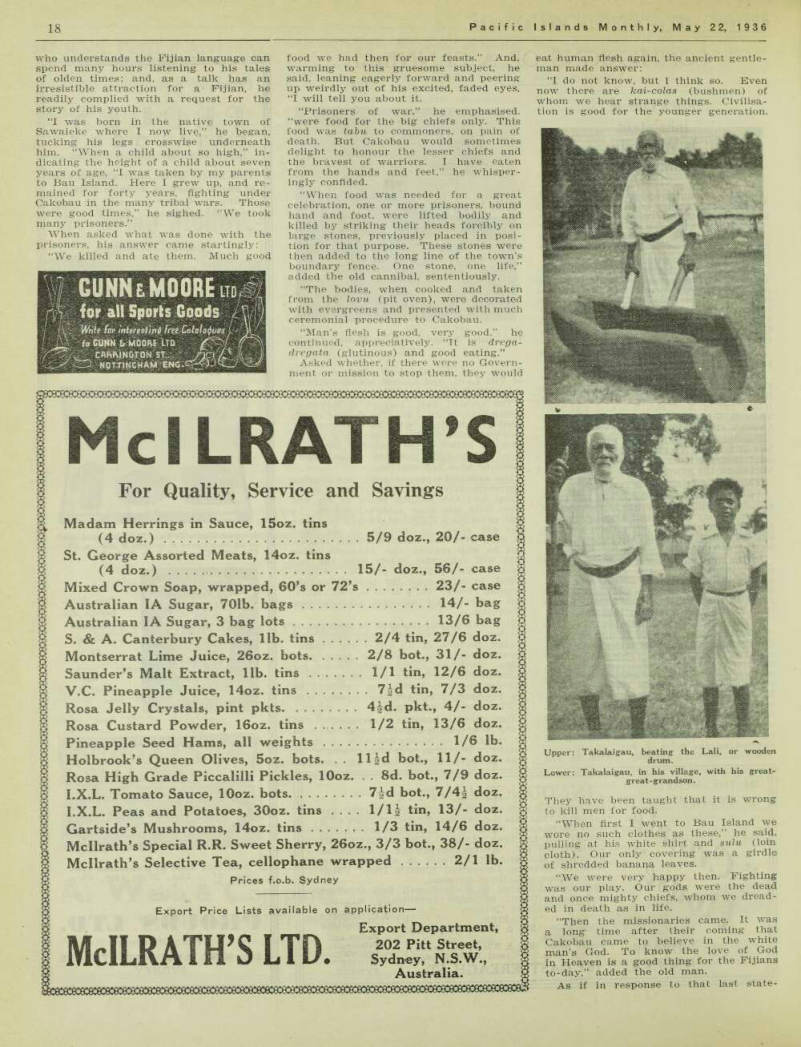

Fiji's Oldest Inhabitant Is Wistfully Reminiscent
AT the recent unveiling of the Cession Memorial Stone at Nasova, Levuka, Fiji, by the late Governor of Fiji, Sir Mur chison Fletcher, K.C.M.G., C.8.E., one of the most notable and venerable native figures was the ex-cannibal, Chief Taka laigau.
It was at this historic ceremony that Takalaigau, for the third time in his long life, sounded the drum beat known as the derua, when the British flag was raised near the site on which the Deeds of Cession were signed by the chiefs, on October 10, 1874, and Fiji became a Brit ish Crown Colony.
The three occasions on which he executed this official duty were: First, as an upstanding warrior under the rule of Cakobau, the then recognised King of Fiji, when Sir Hercules Robinson (Governor of New South Wales and pro visional Governor of Fiji) accepted the Cession on behalf of Queen Victoria.
Second, as a grey-haired civilised sub ject of the late King George V, at the 50th anniversary of this important event, cele brated on the same spot, in 1924.
Third, on the occasion just noted.
The fact that Takalaigau has officiated at such outstanding events in the history of the Colony is in itself a great record.
But this human relic of a past barbaric age can also lay claim to other note worthy distinctions.
In the first place, he is undoubtedly the oldest inhabitant in the Fijian Group— and is extremely proud of the fact. In deed, so much so, that he adds a few more years to the undoubted one hundred each time an interested visitor inquires.
Takalaigau’s title, interpreted, means “Chief of Gau.” But he is not an here ditary chief, although he takes precedence of place in his district. This honour was conferred on him by his compatriots in the early uncivilised days, when com munities fought fiercely for supremacy.
He was the imposing head-man of the conquering town of Sawaieke, and as sumed lordship over the southern portion of the island known as Gau. That' name now applied to the whole island, is charted on the map of Fiji as “Ngau.”
Ngau is the fifth largest island in the
Group, and lies about 40 miles due east of Viti Leva, and almost within sight of ships off Suva.
The present buli (Mayor) of Sawaieke remembers, when a lad, the demise of his aged grandmother, who, as a young girl, was presented by Takalaigau as a peace offering between the warring towns —a fact which fully justifies Takalaigau’s claim to be a centenarian.
His eyesight appears good; his hearing unquestionably is so. Except for a slight stoop, and the settling down of his fine torso into his once stalwart frame, he still presents a dignified -figure. His lean legs get along as quickly as do most people’s over the island’s rough .tracks, and he still retains the inherent poise that will take him safely over the in secure and perilous one-log bridges, which so often span the island’s swiftly running rivers. He glories in this ability, and contentiously answers all enquiries thereupon.
But Takalaigau mouths a grievance.
He has lost his sound, strong teeth and cannot partake of all the tasty crusta ceous delights that a native feast pro vides. There are many family feasts, for Takalaigau’s particular genealogical tree has descended in flourishing numbers to his youngest great-great-grandson, who is his constant companion.
His other distinctive claim—that of being a one-time cannibal—may perhaps be regarded as somewhat of a doubtful quality. But it is a memory which he regards with wistful fondness. Anyone
The Cession Memorial Stone at Nasova, Levuka, Fiji.
who understands the Fijian language can spend many hours listening to his tales of olden times; and, as a talk has an irresistible attraction for a Fijian, he readily complied with a request for the story of his youth.
“I was born in the native town of Sawaieke where I now live,” he began, tucking his legs crosswise underneath him. “When a child about so high,” in dicating the height of a child about seven years of age, “I was taken by my parents to Bau Island. Here I grew up, and re mained for forty years, fighting under Cakobau in the many tribal wars. Those were good times,” he sighed. “We took many prisoners.”
When asked what was done with the prisoners, his answer came startingly: “We killed and ate them. Much good
food we had then for our feasts.” And. warming to this gruesome subject, he said, leaning eagerly forward and peering up weirdly out of his excited, faded eyes.
“I will tell you about it.
“Prisoners of war,” he emphasised, “were food for the big chiefs only. This food was tahu to commoners, on pain of death. But Cakobau would sometimes delight to honour the lesser chiefs and the bravest of warriors. I have eaten from the hands and feet.” he whisper ingly confided.
“When food was needed for a great celebration, one or more prisoners, bound hand and foot, were lifted bodily and killed by striking their heads forcibly on large stones, previously placed in posi tion for that purpose. These stones were then added to the long line of the town’s boundary fence. One stone, one life.” added the old cannibal, sententiously.
“The bodies, when cooked and taken from the lovu (pit oven), were decorated with evergreens and presented with much ceremonial procedure to Cakobau.
“Man’s flesh is good, very good.” he continued, appreciatively. “It is drega dregata (glutinous) and good eating.”
Asked whether, if there were no Govern ment or mission to stop them, they would
eat human flesh again, the ancient gentle man made answer: “I do not know, but I think so. Even now there are Teal-colas (bushmen) of whom we hear strange things. Civilisa tion is good for the younger generation.
They have been taught that it is wrong to kill men for food.
“When first I went to Bau Island we wore no such clothes as these,” he said, pulling at his white shirt a,nd sulu (loin cloth). Our only covering was a girdle of shredded banana leaves.
“We were very happy then. Fighting was our play. Our gods were the dead and once mighty chiefs, whom we dread ed in death as in life.
“Then the missionaries came. It was a long time after their coming that Cakobau came to believe in the white man’s God. To know the love of God in Heaven is a good thing for the Fijians to-day,” added the old man.
As if in response to that last state
Upper: Takalaigau, beating the Lali, or wooden drum.
Lower: Takalaigau, in his village, with his great great-grandson.
ment, there came pulsating through the warm evening air, the sound of a booming lali, summoning the dusky worshippers to the roughly coral-lined church building —an erection which stood incongruously.
but with seeming proud possessiveness, in the centre of the picturesque village, with leafy thatched huts clustering around.
The old man, courteously asking per mission to leave, unfolded himself and walked silently away towards the out ward sign of his accepted faith, and the symbol of his people’s progressive civi lization.
Now that the old bad regime has given way to more civilized conditions, under the co-operation of Government and missionary effort, the Fijian race have not only been saved from extinction but will continue their peaceful progress, and Fiji’s Cession Day will mark the yearly milestones in the annals of an un
conquered people.
E. M. Fry.
Advertisements & other items, pp. 19-22 (1 item)
Prouds'
From ...
CATALOGUE
This useful guide illustrates no end of useful novelties, suitable gifts for Young or Grown-ups will be sent free on application. 15 Jewel “Tudor” Wristlet Watch, 9ct.
Gold, £5/15/-. Rolled Gold, 77/6.
Silver, 60/-.
Lacquer Cigarette Case Flap Jack and comb in an assortment of designs & colours, 35/-.
Cigarette Case and Flap Jack, 21 /-.
Rose Bowl, heavily cut English Crystal, 25/-. vc CD z Solid Gold Studs in presentation case. 9ct., 21/-; 15ct., 37/6; 18ct., 45/-.
CD
PROUDS LTD.
The Gift Store
CR. KING AND PITT STREETS
SYDNEY
IN THE HEART
OF SYDNEY
ANNO UNCEMENT
PRIVATE
HOTEL
ISLANDS’ PATRONS of “CROWLE HOUSE” are
informed that this well-known SYDNEY PRIVATE HOTEL is under NEW AND EXPERT MANAGE- MENT, and has been LAVISHLY RE-FURNISHED THROUGHOUT. Every convenience is available, including Hot and Cold Water in all Bedrooms, Electric Elevator, Laundries, Electric Irons, Pressing Rooms, etc. (Free Service).
Visitors holidaying in Sydney will find Comfort and Contentment at this conveniently situated Hotel. Excellent Cuisine.
TARIFF:
Single Room. Bed & B’fast., 7/6 per day. 45/- per week.
Double Room. Bed & B’fast., 14/- per day. 84/- per week. Casual Meals 2/- each.
161 CASTLEREAGH ST.
J. C. HUGHES
Proprietor Radios and Telegrams:
“CROWL-
HOUSE,”
SYDNEY.
t
McILRATH’S
For Quality, Service and Savings
Madam Herrings in Sauce, 15oz. tins (4 doz.) 5/9 doz., 20/- case St. George Assorted Meats, 14oz. tins (4 doz.) 15/- doz., 56/- case Mixed Crown Soap, wrapped, 60’s or 72’s 23/- case Australian IA Sugar, 701 b. bags 14/- bag Australian 1A Sugar, 3 bag lots 13/6 bag S. & A. Canterbury Cakes, 11b. tins 2/4 tin, 27/6 doz.
Montserrat Lime Juice, 260 z. bots 2/8 bot., 31/- doz.
Saunders Malt Extract, 11b. tins 1/1 tin, 12/6 doz.
V.C. Pineapple Juice, 14oz. tins 7-J-d tin, 7/3 doz.
Rosa Jelly Crystals, pint pkts 4-J-d. pkt., 4/- doz.
Rosa Custard Powder, 16oz. tins 1/2 tin, 13/6 doz.
Pineapple Seed Hams, all weights 1/6 lb.
Holbrook’s Queen Olives, soz. bots. . . ll|d bot., 11/- doz, Rosa High Grade Piccalilli Pickles, lOoz. . . Bd. bot., 7/9 doz.
LX.L. Tomato Sauce, lOoz. bots 74d bot., 7/44 doz.
LX.L. Peas and Potatoes, 30oz. tins ... 1/14 li n » 13/- doz.
Gartside’s Mushrooms, 14oz. tins 1/3 tin, 14/6 doz.
Mcllrath’s Special R.R. Sweet Sherry, 260 z., 3/3 bot., 38/- doz.
Mcllrath’s Selective Tea, cellophane wrapped 2/1 lb.
Prices f.o.b. Sydney Export Price Lists available on application— Export Department,
McILRATH’S LTD.
Australia.
ft* R
Store s ’ Bo a<i-
St fi°Sta" dS '
de
CISC t» c
/kriesler.
7
Supp'J
UgWs
*• ? So!V
\: e d ltl^ l Vi aS too^ s » very
s<^y^ enUtnbet
etco e \ a v i 0 p arU cuUr , £,Vo^ 20 . j eeoetf t ° t » o fed* e vev
The “KrieslerWindcharger
9 9 c f Efi* c * (\o P io
Proof of '-J in->
lo • «£,' r ““ SuP er 6 P a't'P 5 ' „-t etT^■'V TVr® T° positW 6^ V: •
1936 CATALOGUE NOW
READY. SEND FOR FREE COPY
AND PRICE LIST OF THE NEW
RANGE OF SPECIAL TROPICAL
BATTERY SETS.
pfftc.ent *- er pvool Electric Light as Free as the Wind
KRIESLER
The Best Set At Any Price !
Address: MYRTLE, PINE & BEAUMONT STREETS, CHIPPENDALE, SYDNEY.
WILLIAM FINAL
Photographer
FRIENDLY IS., OCEANIA
Silent Filming, 35 mm., or 16 mm., to order. Interesting views and natives’ life scenes, 5/3 prepaid anywhere.
Kill Kidney
Acid New Way
Win Back Your Vigour
Famous Doctors
Tell About Successful Prescription That is Ending Kidney and Bladder Troubles and Making Men and Women Feel 10 Years Younger Through New Health and Vigour
Brought by Cleaning Out the
Kidneys.
You need not suffer another day from Kidney troubles and Bladder weakness, thanks to a remarkably successful pre-
scription prepared especially to end
these troubles, and which now may be obtained at any chemist’s.
Doctors and scientists say that there are nine- million tiny, delicate tubes or biters in your Kidneys which must work every minute of the night and day, cleaning out Acids, Disease, Poisons, Germs, and Waste from your blood, or
slowly but surely your body becomes
poisoned and you can’t possibly feel well. Your blood circulates through your kidneys 200 times an hour and if your Kidneys and Bladder do not do their work you are certain to feel old before your time, Tired, Run-Down, Nervous, and suffer from Getting Up Nights, Rheumatism, and many other troubles.
If Kidney troubles or Bladder weakness cause you to suffer from serious symptoms such as Loss of Vigour, Getting Up Nights, Backache, Leg Pains, Nervousness, Lumbago, Stiffness, Neuralgia, Sciatica, Rheumatism, Dizziness, Dark Circles Under Eyes, Headaches, Frequent Colds, Burning, Smarting or Itching, Acidity, you can’t afford to waste a minute and take chances with dangerous delay. You should start taking the Doctor’s prescription called Cystex (pronounced Siss-tex) and see for yourself how quickly it helps nature correct these troubles.
Cystex is not an experiment—it is a Doctor’s discovery—quick and sure in action —it has been tested and proved in millions of cases throughout the world and thousands of Doctors recommend it daily. For instance. Dr. T. J. Rastelli, M.D.,8.5c.,0f Kensington. 9 - Dr. T. J. Rastelli London, England, writes: “Cystex is one of the finest remedies I have ever met with in my long years of medical practice. Any fair-minded physician will at once recommend it for its definite benefits in the treatment of many common kidney and bladder disorders. Cystex counteracts the excess acidity, relieving the uncomfortable sensations within a very short time. It flushes out the kidneys and bladder and is safe and harmless.” Cystex is the prescription of a doctor with nearly 40 years of experience, and is prepared especially for Kidney and Bladder troubles. It starts work in 15 minutes to tone, soothe, and heal raw, sore Kidneys and Bladder, and brings a new feeling of health, youth, and vigour in 48 hours.
Doctors throughout the world praise the merits of Cystex. For instance. Dr.
C. Van Straubenzee, noted specialist, of London, recently made the following taken from the blood are deposited in the Kidneys.
They must he removed promptly or irritations are set up which annoy the HH system. I consider Cystex one of the most meritorious Dr. Van Straubenzee formulas of its kind and recommend it most highly X A when such a prescription is required.
Because of its amazing and world-wide success, the Doctor’s discovery known as Cystex is offered to sufferers from Kidney troubles and Bladder weakness under the fair-play guarantee to end your troubles to your complete satisfaction or money back on return of empty package. It costs only a few pence a day. Ask your Chemist for Cystex to-day and see for yourself how much younger, stronger, and healthier you will feel by using this special prescription for Kidneys and Bladder. Cystex must do the work to your entire satisfaction in 8 days
That Malayan
Canal
What It May Mean To North-West Pacific
TT has been reported that Japanese in ■*- terests are to build a canal through that portion of Siam that lies athwart of the stem of the Malaya Peninsula.
Look at a map of Asia, and try to visualise the effect that such a waterway would have upon Far Eastern sea traffic, and upon the strategical position in the north-western Pacific generally.
Mr. A. ( J, Vogan, F.R.G.S., writes in terestingly upon the subject: The pendulum of change seems to be entering a similar atmosphere for English people to that of about the year 1580, when that prince of spies and plotters, Campion, was arranging—as Richard Simpson has just disclosed for us—the destruction of the “Tight Little Island” by means of the Great Invasion scheme — when all the European nations were to attack at once.
Queen Elizabeth’s Secret Service and her great Foreign Minister, Walsingham, saved the occasion; and the failure of the first step (the vast Armada) broke the scheme into pieces.
The similarity of the two periods is en hanced by the fact that the said Armada was eight years in preparation, and that the great Canal de Kra, in Siam, is to be completed in eight years, when the Japanese will be able to avoid passing our vast gun-emplacements at Singapore, thus rendered obsolete, when moving fleets for the appropriation of the Sunda, Borneo, Philippine and other Islands con necting Australia with the Indian Empire —such as is the well-authenticated plan of the Militarist Party of Japan.
This “Back-door to Burma,” as the new Japanese canal has been conven iently called, however, was not missed as a possibility by our wonderful Naval In telligence when reporting upon Singa pore, and Siam’s boundary-line lies east of the Point d’appui, which is an easily fortified range of Burmese country, form ing the northern entrance to the bay which the Japanese propose to connect with a similar one on the eastern side of the Kra Isthmus.
The Japanese obtained permission to make this canal through the influence of Luang Pradit Manndharm, the democratic leader (communistic?) of the anti-Euro pean element in Siam and' neighbouring States.
A recent French newspaper, comment ing upon what our Australian sheets keep so silent about, says:—“The great English settlement of Singapore will be hard hit, both in its role as military, and as com mercial autocrat of the Malacca Straits.
The new canal will change the whole de fensive system established in Orient by the English, and is viewed by them with extreme inquietude. The same view is taken by the Dutch. France has her interests in Indo-Chine which will be effected perhaps beneficially, who knows?
“Thus the little insignificant Kingdom of Siam, that one heard nothing of yes terday, under the passing premiership of an ultra-democrat, or communist, can, at one blow, undo the work and schemes of great Empire-builders in disastrous man ner.”
New Guinea’S Wasteful, Feeble Record
In Native Education
Scandalous Treatment of Asiatics and Half-castes
Contributed
ANCE again that tropical question, bristling with difficulties Native Education —is to come up for discussion and if possible for solution.
The announcement was made at the close of the last stormy meeting of the Legislative Council, by the Administrator, that he had appointed a number of gentle men to tackle the question with zest. He evidently means business, this time.
As early as May, 1921, when the des tinies of the Territory dropped into the hands of General Wisdom, a policy of native education was among the urgent matters to claim the attention of the Ad ministration. Geneva wanted the natives educated, so Canberra and Rabaul must get busy.
General Wisdom had tried his hand at many enterprises, but he had no experi ence as an educationalist. The late Harry Cardew, the then Commissioner of Native Affairs, was to be the first lieutenant in the new project. Harry who was, prior to the war, an engineer, had no aptitude and little taste for such a matter as native education. However, after some hard thinking, it was deemed opportune to begin.
A start was made at Kokopo, the seat of the old German Administration, 18 miles south of Rabaul. After many diffi culties and much delay, natives drawn from different and distant villages were assembled in temporary quarters near the
town. These would, it was fondly hoped, constitute the nucleus of a future native educational system.
The first difficulty came from the native parents, who could not fail to see the lunacy of their children leaving the vil lage schools, where they were being taught by the missionaries, in the only way they ever will be taught—through the medium of the native language. By teaching the native children in their own villages, village life could be preserved and improved, while children would re main with their parents.
There were scores of large villages where missionary influence, through lack of means, had not yet penetrated, and one would naturally have expected that a Government scheme would have begun in them and worked in co-operation with the missionaries. But, no! This would have been wise, but not spectacular and the important thing at the moment was not whether the natives were being educated, but how to convince Geneva that they were being educated, which is something quite different.
When the first barrier had been crossed and a number of native children had been gathered together, the next move was to engage the services of William Groves, a Victorian State school teacher and, of course, an ex-soldier (no one else had a chance in those days). The choice was an excellent one. “Billy,” as he was affec
tionately called, was a skilled teacher, and a man of high moral qualities. He was interested in his work and was happily free from that aversion to the black men which is an unfortunate characteristic of so many otherwise good Australians. If any educationalist could succeed in the peculiar circumstances that person would be the popular Will Groves; but hopes were far 'from bright.
None of the poor homesick natives knew English; and, of course, “Billy” Groves, moving in Melbourne’s classical circles, had no opportunity of acquiring a know ledge of the native language. So ideas must pass from one mind to another through that nebulous medium, Pidgin.
Geneva, however, was pleased that a start had been made and greater progress promised in the near future.
Next, an area of land within the town
engaged and, like all young ambitious men, anxious to rise in the teaching pro fession, he retired from the Territory and area of Rabaul, and ajoining the wharf, was marked off for a permanent native boarding school. Numerous buildings were planned and constructed, much to the annoyance of the ordinary taxpayer, who rightly looked upon the sorry busi ness as a useless waste of public money.
Old missionaries, who knew the limited capacity of present day natives, laughed silently at a system of education above the present capabilities of the natives.
More teachers were brought from Aus tralia and, more promises were made each July at Geneva, and so the system ex panded—certainly in expenditure, but not in proportionate usefulness.
After a time, however, the sane and sensible happened. “Billy” Groves became
returned to his old Department in Vic toria.
Succeeding teachers —I knew them all — came, had a look around, and departed.
Birds of passage, they had no wish to become tied up in a system offering no prospects of promotion.
Criticism
Meanwhile, as was anticipated, criti cism, both within and outside the Terri tory, had grown to alarming proportions.
A wild cat system of trying to educate a handful of natives (approximately 100) through Pidgin at such enormous cost (£lO,OOO a year), was obvious to all; and yet Geneva was asking why more schools had not been established.
One day, the Administrator sent for the Head Teacher and asked if a few of the ripe fruits of the system were not ready even for light service. But he was
assured that he was rather premature in his demand.
Progress, however, could be reported when it was announced that Mr. Groves, the retiring head teacher, had taken away with him to Melbourne two intelligent native lads to continue their education at one of the Melbourne State schools. Their former teacher was now to be their guardian and was to be remunerated by the New Guinea taxpayer at £5O per boy per year, which sum, of course, was to be used partially for their maintenance.
Glowing progress reports were from time to time appearing in the Rabaul Times. Geneva was happy, but not en tirely so. What had been done was good, but too small.
A number of other native pupils were actually being measured for outfits to go to different schools in Australia when — providentially, I presume—the lamentable “strike” upset the whole plan. It was, of course, no more than a harmless -little formality taught to the local natives by West Indian natives from a visiting steamer, but it had the happy effect of reducing the extravagant and useless ex penditure. No more natives would go to Australia and the two already there must return.
Mr. Mckenna’S Visit
What next to please Geneva? A happy inspiration! Mr. McKenna, Queensland’s Director of Education, was invited to come up and report on this vexed ques tion of native education. He did actually come, after some delay, but on account of pressing duties in Queensland he had little time to spare in the Territory. Yet the two short weeks, that he spent in Rabaul and its environs soon convinced him that there was a large margin left for im provement. Mr. McKenna visited the training colleges of the missions and, ac cording to his report, was very pleased with what the missions were gratuitously doing for native education. He prepared an excellent report, clear, concise and constructive, but none too flattering, as to what he saw.
General Wisdom, with Mr. Cardew in attendance, listened with attention to the reading of the report and at its close he asked Mr. McKenna where he thought the money was going to come from to put such a scheme into motion.
Mr. McKenna retorted: “Get it from Australia! ”
General Wisdom answered: “You try to get it!”
And so the expensive proposition of bringing Mr. McKenna all the way from Queensland was profitless.
When Mr. McKenna left the room, General Wisdom remarked that he would close up what already existed as a waste of public money, if he could.
Strange to narrate, a few months after this meeting, Geneva was informed that the erection of other schools was con templated and, as a matter of fact, a start was actually made at Nodup and Kavieng.
General Griffiths’ Effort
When General Wisdom departed, a new phase of native education was antici pated.
General Tom Griffiths, keen, enthusiastic energetic, was a fine type of Adminis trator. The question of native education and the Administration’s neglect of the education of the native-born Asiatics en gaged much of his time and attention.
But, unfortunately, great arrears of work had accumulated, and Tom Griffiths was far from young. He realized at a glance the futility of trying to find anything
like an adequate supply of funds to carry on even a very limited native education system, so he sought to combine some Administrative effort with the gratuitous services given by the missions, in order to secure the maximum amount of mental development for the natives, with the resources available.
The missions are to-day freely educat ing over 40,000 native children. They purchase the land for schools, erect the schools, train and afterwards pay teachers, in order to provide for education of native children.
Tom Griffiths realized and appreciated their contribution but, unfortunately, he did not remain long enough for his schemes to mature.
And Now—What?
We arrive at the beginning of 1936 and, estimating matters by the usual stan dards, we must admit that an enormous amount of public money has been wasted on a wild-cat scheme that can never, according to present methods, yield any thing like an adequate return. The gain •to the natives has been negligible. How long will the waste continue?
Native education has been the grave yard of reputations. Will the new Ad ministrator build one up on the ruins of the past? He has had years of teaching experience and will have the assistance of H. H. Page who has likewise been a teacher.
Mr. Editor, the deliberations of the next few months will be interesting. If the general public are admitted, I shall keep you in touch with events. What we all are hoping is that the real issue—that is, finding money to finance a scheme —will not be evaded or avoided.
In my opinion a crying shame on the Administration of this Territory for years has been the criminal neglect of provid ing education facilities for the local-born children of Asiatics and half-castes, who are becoming more numerous every year.
The parents of these poor children are full contributors to the taxes' paid into the Treasury, out of which an extravagant system is provided for the children of the Europeans, who can benefit by it, and a useless and expensive system is offered to a few natives, who cannot respond to it. But the poor Asiatic or half-caste, after being forced to pay his share to wards the free education of white and black, must provide for himself as best as he may, with the assistance of the missions.
Only ignorance can permit the con tinuance of this injustice in a Mandated country.
Advertisements & other items, pp. 23-24 (1 item)
■ L A. n. li’ll AM
SINGER DROPHEADS
YEARS. We stake our reputation on every machine sold. Our guarantee completely protects you. Save money . . . buy one of these slightly used Singers. The same machines, new, would cost £l5 more. Other models available also. We deliver free to ship, Sydney. Write for full particulars.
THOMSON BROS., LTD.
FROM
|j £8.10.0 It" in these slightly used pi Singers. They’re in per- M feet running order, each Wm There’s unbeaten value icct running urucr, cacn
one GUARANTEED IN
WRITING FOR 10
Established over 40 years.
646 George Street, Sydney
: a m
The “HANDI”
Swift-Lite
Petrol Lantern
300 CANDLE POWER
Lights instantly (no preheating required), automatic steel pricker, also flame regulator. Built in Pump.
Sydney and Brisbane price: 39/6 1 gallon Petrol does approx. 72 hours’ burning.
AGENTS required in all centres. Storekeepers write for special export price. 3
IRONS
and
Price: 29/6 Sydney or Brisbane A SCIENTIFICALLY constructed, NO- PUMPING, self-heating PETROL IRON with these EXCLUSIVE Features: Special generator which does away with carbon troubles.
Detachable nipple and coil for cleansing purposes.
A special tank eliminates risk of overflowing.
Perfect regulation of heat.
Double Pointed base; fully nickelled.
No expensive parts to renew.
Cheaper to use than electricity. Over 12,000 “Hand!” Irons sold in Australia during the last two years.
If not obtainable from your storekeeper, write Can be used as small stove, as illustrated.
HAND! tVOUKK
Charlotte Street, Brisbane
■ L A. n. li’ll AM
LTB.
533 George Street,
Sydney
The Islanders’ Sydney Home ...
Location BELVEDERE
81 BAYSWATER ROAD, DARLINGHURST
Exclusive.
A fine house with its wealth of pleasant old associations.
The Garden Suites, designed on most modern lines.
Excellent grounds with beautifully hept gardens—and dotted with comfortable garden seats.
Private telephones if desired.
An atmosphere of rest and grateful quietness.
Ideal location.
Near White City Tennis Courts.
Seven minutes to G.P.O.
Close to Shopping Centre.
Trams stop at gates.
BELVEDERE is Controlled & Supervised by Islands People for Islands People TERMS: From £2/12/6 Weekly.
MR. & MRS. C. WAGER (late of Fiji), Proprietors.
NOW AVAILABLE!
New 1936 . .
HALLNTROm
SIIPEU-F IiEEZER
Kerosene Operated It FFIS I U FIS ATO ICS Exclusive Improvements include... 6 Continuous Refrigeration. 0 Frost and Ice during Heating of Unit. Lower and more uniform Cabinet temperatures.
Address all enquiries to Sole Manufacturer E. llallst I*olll, 462-464 Willoughby Road, Willoughby. N.S.W.
Novelist Hall To Tour
Scandinavia
From Our Own Correspondent PAPEETE, April 12. 1%/TR. JAMES NORMAN HALL, author in collaboration with C. B. Nordhoff, of many popular books, including the Bounty trilogy, left Tahiti for the United States by the Makura in March.
It is understood that Mr. Hall, who was accompanied by his family, will leave the latter in California, and then proceed to Europe on a tour of the Scandinavian countries, Iceland, and other places he has been planning to visit for some time past.
He will probably return to Tahiti by way of Africa and the East Indies in about a year’s time.
Mr. A. Hyde, Mining Registrar of the Morobe goldfield, New Guinea, arrived in Sydney by the last Neptuna on long leave.
Dr. Nuttall, of the Shell Company, arrived in Port Moresby, Papua, by the Pinna from Borneo on April 12. He left a week later for Sourabaya by the Shell Co’s vessel Havre.
Move To Check Small
Traders In Samoa
From Our Own Correspondent APIA, April 12.
THE Apia Chamber of Commerce has submitted a proposal to the Adminis tration to enforce regulations framed some years ago that every trader, before being licensed, should show proof of possessing sufficient capital. The Ordinances also fixed a minimum amount of stock to be carried in every trading station.
These regulations tend to prevent the opening of trading stations, especially in country districts, by small independent traders with limited means, and favour the large commercial concerns with their many branch stations.
A deputation of the independent traders has waited upon the Acting Administrator to voice their objections to the proposal of the Chamber of Commerce.
Dr. S. M. Lambert, head of the Rocke feller Foundation in the Western Pacific, arrived in Auckland, New Zealand, from Fiji, by the Mariposa on April 17.
Advertisements & other items, pp. 25-26 (1 item)
Tooheys
OItDEII
by MAIL
Use Elvy’s Special Gramophone Record Mail Department for Island residents.
Orders over £2 insured, posted FREE.
Write for free catalogues and lists NOW.
ELVY & CO. LTD.
397 GEORGE STREET, SYDNEY
The Colorful
Pacific
The emerald green of the hillside, the sapphire blue of the sea, the silver strand of beach ... complete the color scheme with the golden amber (and creamy white head) of a glass of Tooheys Pilsener. It gives a rosy hue to life. Here’s To’ee!
TOOHEYS
PILSBNEK
IN THE BOTTLE WITH THE YELLOW LABEL. in ■ Tooheys^
COOL is the man who wears a
Karachi
Lightweight
TROPICAL SUIT
Tailored to Measure, Coat and T rousers,
Three Piece . £6/6/-
Ready to Wear Prices from /7/0 In Light and Medium Fawn Shades.
Suffered Acutely FOR
30 YEARS
First Dose
brought Kelief
Extract from letter received from: G. E. Shrimpton, 21 Brisbane Street, Milson’s Point,
SYDNEY, N.S.W.
Mr. R. M. Hardy.
Hardy’s Chambers, 5 Hunter St., Sydney, N.S.W.
Dear Sir: For the past thirty years I have been subject to acute stomach troubles of various kinds, my appetite dwindled to practically nothing long ago, and my health in general was affected. I tried most of the many stomach remedies on the market, but obtained absolutely no relief from any one of them; therefore I decided that my ailments were incurable.
However, a friend advised me to try your product. After my first dose I obtained great relief, and now I can eat a hearty meal without fear of any inconvenience resulting. I am also much better in health and strength.
I have obtained a great and lasting benefit in every way.
Hoping you and your remedy enjoy the large measure of success it merits.
Yours faithfully,
(Signed) G. E. SHRIMPTON.
This remarkable cure gives instant permanent relief in all stomach troubles, because it strikes at the root of the cause . . . acidity. . . . Suffer no longer. Get a tin of Hardy’s to-day.
R. M. HARDY’S
INDIGESTION AND ULCERATED
STOMACH REMEDY
Obtainable at all
Burns, Philp & Co.
Stores
Price 3/6 per 8 oz.
tin!
Note the generous size.
NO DIETING ... NO HEADACHES ... NO STABBING PAINS
Cook Is. Is Without A.M.O.
Until Next Year
From Our Own Correspondent
Rarotonga, April 19.
THE satisfaction which attended the recent appointment of Dr. Tovey as Assistant Medical Officer for the Cook Group has been slightly married by an announcement that he is unable to leave New Zealand this year, and although several medicos have been approached none was willing to accept short-service in the Islands.
This is all the more surprising since it is generally known that Dr. Brass, one of the most popular and brilliant men for merly appointed to the Group, is only too anxious to visit us again in his official capacity. Dr. Brass is remembered as a new broom which swept particularly clean in shady corners and his return, even for a few months, would be greatly welcomed by many residents.
Right Rev. W. H. Baddeley, Bishop of Melanesia, who has been visiting Eng land, will arrive in Auckland by the Aorangi on June 8 from Vancouver, and will spend a brief period in New Zealand before going on to Sydney.
Through Unexplored
Western Papua Route of Mr. Ivan Champion’s New Expedition
From Our Own Correspondent
Pt. Moresby, April 22.
Iitr. Ivan Champion, A.R.M., Left
Port Moresby on April 1 by the Gov ernment vessel Vailala for Darn on the first stage of his forthcoming expedition.
At Darn he will complete the final arrangements for his long journey into the interior of Western Papua with Patrol Officer C. J. Adamson.
Mr. Adamson recently journeyed to Rigo to recruit carriers for the expedi tion. He was unsuccessful, however, and 30 native volunteers have been selected from Koki gaol. They sailed for Daru by the Papuan Chief on April 17, Mr. Adam son having left for that post in Mr.
Archbold’s amphibian ’plane earlier in the day.
The proposed route will take the party up the left branch of the Bamu River to its source, from where they will proceed N.N. West making for what appeared, from the recent aerial reconnaissance, to be a thickly populated valley system.
Thence they propose to strike in an easterly direction for Lake Marguerite— the large sheet of water reported and named by the Government aerial party in their flights from Mt. Hagen.
The party will then proceed N.E., crossing Mr, Jack Hides’s route near the Waga. After passing through the thickly populated grass country to Mt. Gilua, they will strike eastwards to the Kangel River (an affuent of the Purari) and even tually make for the coast down the main stream to the sea.
Mt, Gilua, which the expedition will visit, is a well known landmark to air men. It is situated on the border of Papua and New Guinea and lies approxi mately 15 miles due south of Mt. Hagen.
Lake Marguerite was visited recently by the Archbold Expedition. They tried to land the amphibian there but found it was impracticable.
A close view revealed that Lake Mar guerite is a wide sheet of water approxi mately 10 miles in length, studded with many small islands. On one of these stood a large village and beyond the fir clad slopes of the lake different stages of cultivation were observed which sug gested that the district supported a fairly large population.
His Excellency the Governor of French Oceania (Monsieur H. Sautot) left Papeete by the Ville D’Amiens on April 5 for a tour of inspection of the Marquesas Is lands, and returned by local schooner at the end of the month. During his ab sence affairs were taken care of by Monsieur Aumont, Chef du Service d’Administration Generale et des Fin ances.
Advertisements & other items, p. 26 (1 item)
Position Wanted
Ladies’ Hairdresser, aged 29, well educated, thoroughly experienced Permanent Waving, Marcel, Water Waving, etc., who is also an expert Shorthandwriter and Typiste, seeks suitable Islands position.
Reply, J. 8., c/o. “P.1.M.”, Box 3408 R, G.P.0., Sydney.
America Bridges North Pacific
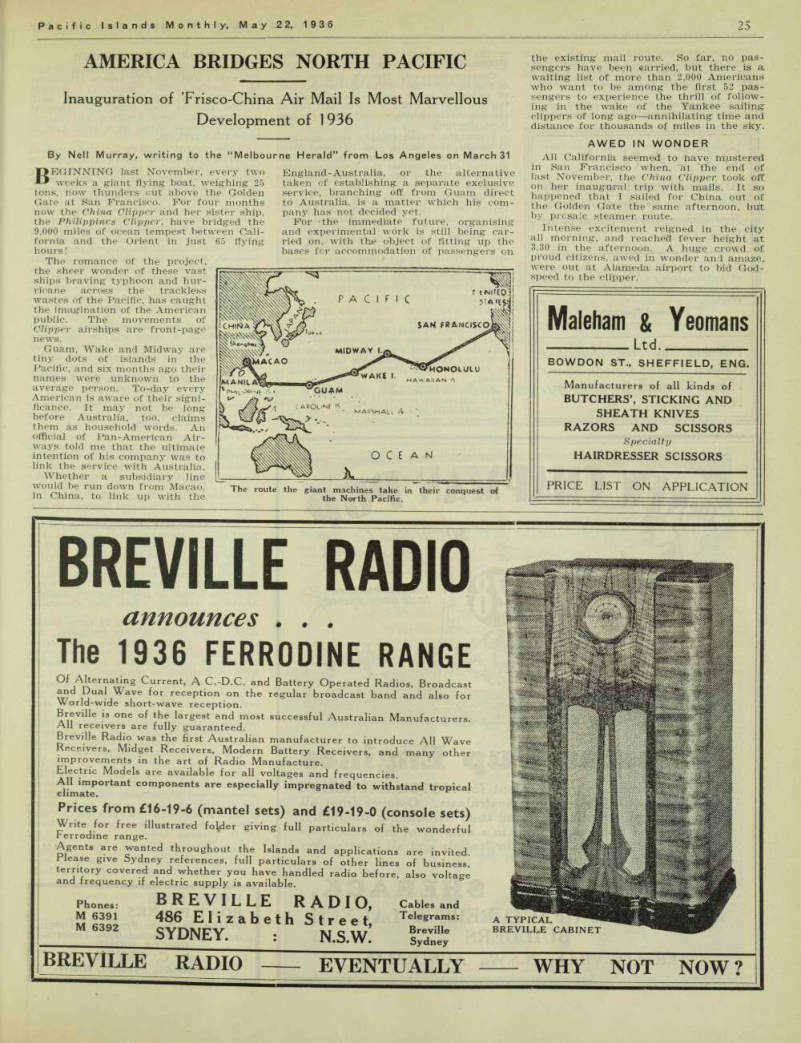
Inauguration of 'Frisco-China Air Mail Is Most Marvellous Development of 1936
By Nell Murray, writing to the “Melbourne Herald” from Los Angeles on March 31
BEGINNING last November, every two weeks a giant flying boat, weighing 25 tons, now thunders cut above the Golden Gate at San Francisco. For four months now the China Clipper and her sister ship, the Philippines Clipper, have bridged the 9,000 miles of ocean tempest between Cali fornia and the Orient in just 65 flying hours!
The romance of the project, the sheer wonder of these vast ships braving typhoon and hur ricane across the trackless wastes of the Pacific, has caught the imagination of the American public. The movements of Clipper airships are front-page news.
Guam, Wake and Midway are tiny dots of islands in the Pacific, and six months ago their names were unknown to the average person. To-day every American is aware of their signi ficance. It may not be long before Australia, too, claims them as household words. An official of Pan-American Air ways told me that the ultimate intention of his company was to link the service with Australia.
Whether a subsidiary line would be run down from Macao, in China, to link up with the
England-Australia, or the alternative taken of establishing a separate exclusive service, branching off from Guam direct to Australia, is a matter which his com pany has not decided yet.
For the immediate future, organising and experimental work is still being car ried on. with the object of fitting up the bases for accommodation of passengers on
the existing mail route. So far, no pas sengers have been earried, but there is a waiting list of more than 2,000 Americans who want to be among the first 52 pas sengers to experience the thrill of follow ing in the wake of the Yankee sailing clippers of long ago—annihilating time and distance for thousands of miles in the sky.
Awed In Wonder
All California seemed to have mustered in San Francisco when, at the end of last November, the China Clipper took off on her inaugural trip with mails. It so happened that I sailed for China out of the Golden Gate the same afternoon, but by prcsaic steamer route.
Intense excitement reigned in the city all morning, and reached fever height at 3.30 in the afternoon. A huge crowd of proud citizens, awed in wonder and amaze, were out at Alameda airport to bid God speed to the clipper.
The route the giant machines take in their conquest of the North Pacific.
Thousands more lined the shores of San Francisco Bay to see the great silver monster heavily laden with 150,000 items of mail, soar into the sky and make for Honolulu, Hawaii.
A gasping roar from the crowd as the Clipper narrowly missed the cables on top
of the uncompleted structure of the San Francisco-Oaklands Bay bridge. . . .
Captain Edwin C. Musick, famous pilot of the ship, performed the spectacular feat of swooping below them —actually break ing the law by doing so—although few of the fascinated onlookers could have realised it at the time.
I saw the China Clipper once again in Honolulu, thundering past Diamond Head with all her great engines in full blast, glinting silver against the tropic greenery of the hills, and the turquoise blue and dazzling whiteness of the sea.
I heard of her again 3,000 miles further across the Pacific, riding at ease high in the sky 200 miles south of the spot where our 20,000-ton ocean liner lay helpless in the grip of a five-day typhoon. Our radio operator talked with hers —told the Clipper and its crew of the appalling storm through which we were passing, so intense that our liner could not face it, but turned and steamed back for hours on the route she had traversed already.
“All’s well here. We make Guam to morrow morning,” was the nonchalant reply. As I gazed across that desolate waste of tumbling water, whipped-white with the spume of a 100-mile-an-hour gale, it seemed incredible that the Clipper could be zooming along peacefully above such a storm.
Only five years have elapsed since this great adventure was first mooted. Charles A. Lindbergh had a hand in it, as Pan- American’s technical adviser.
Four Years’ Labour
Two other men, Andre Priester (Chief Engineer) and Juan T. Trippe (President of Pan-American Airways) worked patiently with him for four years, until at the end of that time, the requisite machines had been designed and manu factured—six of them, at a total cost of more than £185,000.
In the meantime, pilots had to be trained in navigation never before attempted in the air. They had to be grounded in inter national law, taught at least one foreign language in addition to English, and quali fied in innumerable different ways.
Then, just a year ago, the supply ship North Haven stole out of San Francisco Harbour unobtrusively, laden with 6,000 tons of cargo. She was off to put Midway, Wake and Guam on the map of commerce.
Midway, up till then, had been a cable station inhabited by only a few men. This tiny island, on the northern tip of the Hawaiian group, automatically became American territory when Hawaii became voluntarily annexed at the end of last century.
Only lonely sea birds cried and swooped above Wake, a mere dot in the huge Pacific, until the coming of the supply ship. No one has ever been known to live there.
Robinson Crusoes Of The
Pacific
Guam came into America’s possession at the end of the war with Spain, and has but a primitive population.
So small is Wake that its whole area does not cover one square mile. Electrical lighting and water systems have had to be installed in all three bases. The men work ing on the islands at present are like modern Robinson Crusoes —for so far “civilisation” has not advanced far enough to permit their wives and families to join them.
There is adequate accommodation for the giant mail clippers and their crews as they come winging in from the ocean hops to rest and refuel —and, before long a “chain” of three hotels will have been built. Pre fabricated wooden ones have been shipped out to Guam, Wake and Midway, and will be erected soon to provide every modern American comfort which the discerning traveller desires.
Each on© will consist of 24 large double rooms, each with private bathroom, hot and cold running water, and other luxurious fittings. Tennis courts are even being built, and swimming pools complete with cocktail bar at the edge!
Midway will have a small fleet of beach automobiles to convey passengers from the aerodrome to the hotel. These are shod with outsize balloon tyres in order that they may travel easily over the soft coral sand. One of the few sewing machines in those parts is located at Guam, complete with a spare belt and 100 needles.
The company will have to face soon the problem of obtaining a domestic staff for their hotels, for even the most adventurous of cooks and housemaids might flinch at the prospect of taking a post in the midst of the Pacific Ocean! At present, the men engaged in construction work are catered for by Filipino cooks.
Naturalist’S Task On Guam
The development of this romantic new civilisation has opened up fascinating fields
of enterprise. The American Government, for instance, has just despatched a noted naturalist to Guam, instructing him to make a thorough study of the flora, fauna and native customs, so that they be placed on record at the Bishop Museum, Hono lulu, which is recognised as the world’s most complete collection relating to Poly nesian life.
Philatelists, too, have found that the establishment of the new airways system was swift to affect the stamp market.
Ordinary dollar stamps which were sold for the inaugural flight and affixed to letters addressed to Honolulu were valued within three days of arrival at 25 dollars.
For the first four months of the mail service, the terminal point in the Orient has been Manila. Throughout its incep tion, Japan had strenuously objected to every move, and it is because of the ten sion between China and Japan that China has been slow to grant permission to land at Macao. Officials are confident, however, that permission will come at any time now, and that soon the Clippers will be landing on Chinese soil.
Next . . business men boarding the ’planes in San Francisco and waking up in Honolulu next morning. On to Midway, Wake, Guam and Manila—with the huge trade possibilities of closer contact with China opening up before them.
Nine hundred dollars from San Francisco to Macao is the tentative passenger fare fixed upon for a beginning. This works out at 10 cents a mile —about 7Jd in Aus tralian currency.
Advertisements & other items, pp. 27-28 (1 item)
Breville Radio
Maleham & Yeomans
Ltd
BOWDON ST., SHEFFIELD, ENG.
Manufacturers of all kinds of
BUTCHERS’, STICKING AND
SHEATH KNIVES
RAZORS AND SCISSORS
Specialty
HAIRDRESSER SCISSORS
PRICE LIST ON APPLICATION
BREVILLE RADIO
announces * . .
The 1936 FERRODINE RANGE
Of Ahernating Current, A C.-D.C. and Battery Operated Radios, Broadcast jj Ua - i aVG *° r rece P tion on the regular broadcast band and also for World-wide short-wave reception.
Breville is one of the largest and most successful Australian Manufacturers.
All receivers are fully guaranteed.
Breville Radio was the first Australian manufacturer to introduce All Wave Receivers, Midget Receivers, Modern Battery Receivers, and many other improvements in the art of Radio Manufacture.
Electric Models are available for all voltages and frequencies.
All important components are especially impregnated to withstand tropical climate.
Prices from £l6-19-6 (mantel sets) and £l9-19-0 (console sets) Wr'le for free illustrated giving full particulars of the wonderful rerrodine range.
Agents are wanted throughout the Islands and applications are invited.
Please give Sydney references, full particulars of other lines of business, territory covered and whether you have handled radio before, also voltage and frequency if electric supply is available.
Phones: M 6391 M 6392
BREVILLE RADIO,
486 Elizabeth Street,
SYDNEY. : N.S.W.
Cables and Telegrams: Breville Sydney m
A TYPICAL
BREVILLE CABINET
BREVILLE RADIO EVENTUALLY
WHY NOT NOW ?
OCEANIA
A Journal devoted to the study of the Native Peoples of Australia, New Guinea, and the Islands of the Pacific Ocean.
Editor : Dr. A. P. Elkin (Professor of Anthropology at the University of Sydney); Assistant Editor ; H. lan Hogbln.
Published Quarterly.
Subscription, 5/- per copy (£1 per annum) Published by the Australian National Research Council, Science House, Gloucester Street, Sydney,
N.S.W.
jjp CHAPMAN
ff fo / cv
SO'-'TfffSuo*,/
"Utel&kf Oi£ur /., ? t&WUUf' fade
Chapman Pup Engines
are World-famed as power plant for MOTOR LAUNCHES.
Thousands in use throughout Australasia. Owners from all parts continually writing praising their astounding simplicity, reliability, and Economy. Built in a number of different sizes from 2 2 h.p. to 10 h.p. Write for leaflets and all information direct to the manufacturers—
CHAPMAN & SHERACK,
ENGINE MANUFACTURERS & LAUNCH
BUILDERS
ERSKINEVILLE, N.S.W., AUSTRALIA.
HUON PINE
BOAT PLANKS . . .
Practically Borer Proof and Everlasting, also Spotted Gum Timbers.
PRICES RIGHT
A. C. FRYER.
110 Miller St., Pyrmont, N.S.W.
“China Clipper” Speaks With
Australia
A record in aerial communications on the 600 metres band is believed to have been established recently when the Sydney and Townsville coastal stations of Amal gamated Wireless exchanged communica tion with the aeroplane China Clipper in flight at a distance of 3,000 miles from Sydney. At 5.1 a.m. the ’plane, which was flying from Manila to Guam, was heard calling all stations and announcing her name. The China Clipper then called Hong Kong and a minute later the A.W.A. station at Sydney sent a call to the air craft enquiring, ‘Are you receiving me, and if so can you hear me distinctly?” A minute later a similar enquiry was made by the Townsville station, and the aircraft replied: “Good morning, we are receiving you 0.K.; the China Clipper here.” For a few minutes the stations worked each other and the China Clijiper concluded with “We are due at Guam in four hours. Good morning.”
Miss Jean Elizabeth Fairlie, youngest daughter of Mr. and Mrs. J. M. Fairlie of Norfolk Island, arrived in Sydney by the Morinda on April 25 to enter the Prince Alfred Hospital to continue her training as a nurse. She commenced training in the Norfolk Is. Hospital.
French Planter’S Death
At Epi, N. Hebrides
M, AUGUSTE LANCON, a pioneer ItX F renc h planter of Epi, New Hebrides, died suddenly at his plantation Allobroges on March 15. He had been resident in the Condominium for almost 40 years.
As one of a party of French settlers he arrived in the Group in 1897 and, acquir ing property, developed two fine coconut plantations. Unfortunately, between 1931
and 1936, six hurricanes swept Epi, destroying practically all his work.
M. Lancon was made an Officer of the Legion of Honour for his work in intro ducing Tonkinese labourers into the New Hebrides to work plantations.
He is survived by a widow and a daughter (Madame Brossier), who are at present in France, and a son, M. Eugene Lancon, who is a planter at Mallicolo.
Mr. E. J. Ifould, a plantation owner of Wewak, New Guinea, has been spending holidays in Australia.
Advertisements & other items, pp. 29-30 (2 items)
Rolls Razor
THE IDEAL GIFT
THE WORLDS BEST SAFETY
WHEN you give him a Rolls Razor you give him Shaving Comfort for life, and you have the satisfaction of knowing that your Qift is the best the World has to offer.
Illustrated Catalogue and Price List sent free on application.
■tolls ItiiKor ('«. of Australia Ltd.
8a CASTLEREAGH STREET SYDNEY, N.S.W.
Firearm Repairs. “OUR HANDS MAKE GOOD ARMS.” Firearms sent C.O.D
Rifles-
I have been appointed sole agent in New South Wales for the famous 8.8. A. Guns and Rifles My new stock of these weapons has just arrived.
No. 1, 22 cal., £3/17/6; No. 15, Pune Hammerless, 12 gauge Standard, 'Target, 22 cal., £ll/10/-; 22 £l6/10/-; “Wild Fowl,” for 3in. cal.. Repeater, £7/17/6; Break Action Air cartridges, £l9/10/-; Standard Ejector, Rifle, £3/17/6; No. 1, Air Rifle, £5/10/-; £22/10/-; De Luxe Ejector, £27/10/-; 410, No. 2, Air Rifle, £6/5/-. Bolt Action, £5/15/-.
All Firearms over 50/-, carriage free.
Oil T> PkTT¥ T Gunsmith, Importer of high-grade Firearms and AVrAiIU Fishing Tackle Specialist 143 Elizabeth Street, SYDNEY (near Market Street)
“FISHING TACKLE TO TACKLE FISHING.”'
pStfe mi
CAPSTAN
CIGARETTES
CORK-TIPPED
OK PLA I N
H,- / i■ ' 4 *> ,A /tW 1 '
fSH
CAPSTAN
NAVY CUT TOBACCO
m/ukftcm
(finest
Get your
FREE
COPY
of the
NEW TRUFOOD
RECIPE BOOK
69 specially tested recipes—all kinds of new ideas for attractive things to cook cakes, pastry, puddings, custards, desserts, savouries, sauces, etc.
; POST THIS COUPON TODAY
Recipe Department c/- Eox 4267 Y G.P.O.
Sydney.
Please send me POST FREE, a copy of The Trufood Book of 69 Tempting Recipes Name
(BLOCK LETTERSJ
Address
MPJ
mk ©
The" Coleman Scout
77*c World's Most Popular Lantern
SEE IT ALIGHT—IT BURNS
KEROSENE
Self Cleaning—Made of Brass Pump built in—Pyrex Globe Night driven away when the “Scout’' shines out Sold all over the Islands Coleman Lamp & Stove Co. Ltd.
Toronto, Canada 500 Kent Street, Sydney
HUDSON'S
Ready■ Cut
HOOKS
offer the most practical solution of the problem of erecting a home in districts where skilled labour is difficult to obtain. The framework is cut and prepared ready for erection, all doors and windows are fitted ready for placing in position, and verandah posts, plates, architraves, etc., are prepared ready for fixing in position.
A very efficient plan service is rendered, which makes the work of erection very simple.
We quote to your own or any design.
Send for latest catalogue containing many new designs.
GEORGE HUDSON LTD.
TIMBER MERCHANTS
Bridge Road, Glebe, Sydney
READY CUT HOME DEPT.: 7 CASTLEREAGH STREET, SYDNEY ¥¥l
Books, Magazines & Newspapers
TO ANY PART OF THE ISLANDS
BARGAIN OFFER.—We will send half a dozen latest American Monthly Magazines for 4/-, post free.
AMERICAN GAY BOOK, 1936
(Snappy Stories and Pictures) 1/6 Post Paid.
We specialise in selecting reading matter for those unable to choose personally. We specialise in Mail Orders. Parcels posted by every boat. Send for our price list and full particulars of this unusual service for Islands residents.
McKAY’S BOOKSTALL
ROYAL ARCADE, SYDNEY
Fruit Buyers
Rebuffed
C.I. Growers’ Association Refuses to Pick Orange Crop
From Our Own Correspondent
Rarotonga, April 19.
THE orange season commenced this -*■ month with an unprecedented unan imity among growers, and local buyers who as usual were inclined to pooh-pooh the likelihood of any unanimous action have learnt that it is not always safe to count upon native laissez-faire.
At meetings convened by the recently formed Growers’ Association (comprising some 80 per cent, of the island’s pro ducers) it was decided not to pick the crop unless a fair and reasonable price w r as offered —opinion setting this between 5/- and 6/- a case. Since similar resolu tions have been passed by different dis tricts every year and nothing has ever eventuated beyond the last minute col lapse of such resolutions, buyers w r ere again cynical and unresponsive.
But as the day for picking arrived and passed and the various packing sheds re mained comparatively empty it was real
ised that the sympathetic attitude of the N.Z. Labour Government towards prim ary producers had already bred a new self-confidence among Rarotongan growers.
The prices offered —and rejected—were from 1/9 to 3/9 according to size, and re present 1/- a case lower all round than the prices offered at this time last year.
Yet, on the “unofficial wireless”, it was learned that during the current month the consumer value of a case of oranges in New Zealand was as high at 26/-.
As a result of this determination not to sell locally only 711 cases left the island instead of an anticipated 3,000, those shipped being either fruit on consignment or the property of non-members of the Association.
Roads Repaired At Arorangi
Other good work performed by the As sociation during the month has been the renovation of four interior roads in the district of Arorangi. Five hundred men w r ere engaged on the work, each putting in a single day without pay while the Ad ministration provided free rations.
That a new spirit is abroad in the is land today was evinced by the fact that although the Government has the auth ority to call upon inhabitants to repair the interior roads of their district, it can not force them to bring transport or other tools. Nevertheless, six motor truck owners voluntarily brought their vehicles to assist in the work.
Delegates To Attend N.Z.
Inquiry
The date for the hearing of evidence before the Parliamentary Committee de tailed to investigate the Cook Islands fruit industry is believed to be early in June. Although this has not yet been officially confirmed, delegates from Raro tonga are preparing themselves to leave by next month’s mail steamer.
Owing to the opposition raised by the Administration some months ago w r hen it w r as proposed to send a deputation and pay their expenses out of money standing to the credit of the various packing-sheds, the Growers’ Association has now col lected sufficient money among its own members for this purpose. It firmly op poses any suggestion that their opponents —to whose policies, rightly or wrongly, the Administration is popularly believed to lean —should be financed from any public funds.
Exporters’ Association Want
New Director Of Agriculture
At a meeting of the Exporters’ Asso ciation held during the month a resolu tion was passed to ask that a Director of Agriculture be appointed who was thor oughly conversant with the citrus indus try.
The obvious inference is that the pres ent Director, Mr. W. T. Goodwin, lacks that qualification. The insinuation might command some attention in quarters where it was not known that Mr. Good win, since his arrival in Rarotonga last September, has been the driving force behind the suggested Fruit Control Board and that members of the Exporters’ As sociation form the bitterest bloc of op ponents to the Board in question!
Mr. and Mrs. D. Coulter Harman, of Thursday Island, are at present spending holidays in Cairns, North Queensland.
Mr. Robert Brett, who was for several years in charge of the Thursday Island police station some time ago, died in a private hospital at Summer Hill, N.S.W., on April 5, aged 79.
Entomological Research
In the Marquesas
THE Marquesan project of the Pacific Entomological Survey, of which Mr.
E. P. Mumford (one of this year’s Lever hulme Research Fellows) was appointed Director in 1928, is now nearing its most interesting stage. Over a hundred taxo nomic papers have been issued in connec tion with the work as a whole, and Mr.
Mumford is now in the Hope Department at Oxford, working on an extensive sum mary and review of the work as a whole.
Patterned to some extent on the classic researches of Dr. R. C. L. Perkins in Hawaii, the Marquesan investigations consist essentially of a primary ecological survey, or study of the insects in relation to their environment —physical and biotic.
The Marquesas Islands are among the most isolated in the world, and were described by Perkins as “the choicest part of the oceanic islands of the Pacific after Ha waii.”
The final work may be of interest, not only to entomologists, but to geographers, botanists, meteorologists, and ethnolo gists. The interior of many of the islands was mapped for the first time, series of host plants collected, meteorological ob servations initiated (Univ. Calif. Public, in Geography, Vol. 6, No. 4, pp. 147-172, Ber keley, Calif., 1933) and native names of animals and plants, as well as place names, collected.
A preliminary report was received in Nature (Vol. 130, pp. 797-798). A brief account of the terrestrial and fresh-water fauna appeared in Ecology in January, but Mr. Mumford’s final report is still to come.— Discovery, February, 1936.
“Morinda’s” Dash to Save
Islander’s Life
THREE days late, the Morinda arrived in Sydney on April 25, after being de layed partly by heavy south-west weather and partly by a vain attempt to save the life of Mr. Wade Robinson, of Erromanga, New Hebrides.
Steaming in the vicinity of Erromanga, the Morinda received a wireless call for aid and altered her course accordingly, arriving at the island at midnight. Mr.
Robinson had been injured in a fall from a horse and fever had followed the injuries.
He was taken aboard in a critical con dition.
The ship’s doctor attended to the patient until Norfolk Island was reached and it was possible to place him under other medical care. The steamer was subse quently advised that Mr. Robinson had died the following day, Mrs. J. S. Jaffray, wife of the Presby terian missionary at Alulua, Malekula, though seriously ill, had to be carried 110 miles by launch through heavy seas to Vila in order to catch the Morinda for Australia where she had been ordered for expert medical attention. She was taken by ambulance from the ship at Sydney to the Melbourne express for Victoria where skilled physicians awaited her.
Mr. C. H. Penrose, late manager of the Bank of New South Wales at Wau, New Guinea, died there on April 17.
Mr. Eli Paul Curry died in Apia Hos pital, Western Samoa, ®n March 22, after suffering for several weeks from in fluenza. He was only 23 years of age.
N.G. Agricultural
Gazette
THE January issue (No, 1, Vol. 2) of the New Guinea Agricultural Gazette has just come to hand. This is the second number produced by the Department of Agriculture, the first being published at the end of last year.
In the present issue there are altogether nine informative articles by officers of the Administration which should prove helpful and instructive to planters.
“Recent Experiments in the Curing of N.G. Cocoa” by Mr. E. C. D. Green gives results of drying and fermentation experi ments carried out at Kabaira and Vuna kambi Plantations. Mr. John L. Froggatt, B.Sc., contributes “Entomological Notes,” recording observations on some of the im portant pests of economic crops in New Guinea. Mr. Froggatt has also compiled a detailed list of pests recorded in the Territory.
Though copra prices have been trending upward recently, the general quality of the N.G. product has taken a downward turn in many cases. The article on “Copra Drying” by Mr. F. O. Moody, who has had over 20 years’ experience in copra curing, should assist materially in improving the standard of the Territory’s copra.
Other contributions include: “Notes on Flowering Trees in the Botanic Gardens, Rabaul” by Mr. L. E. Hanson, “Warts on Cattle” by Mr. C. C. Marr, “Control of Rodents” by Mr. J. L. Froggatt, and “Meteorology” by Mr. B. G. Challis.
Advertisements & other items, p. 31 (1 item)
Aunt Marys
H.JONES &C 0
Q.
AUSTRALIA'S BEST
H. JONES & CO., LTD.
Darlington, Sydney Hobart, Tas.
Foi— Fresh Fruit, Vegetables, and Produce Island Residents can rely on the old-established Shipping Providers.
Cft
Only Address: 421 Sussex St., SYDNEY All Orders Promptly Attended Island Representatives: Nelson & Robertson - W. M. Reid
AUNT MARYS
PURE FOOD
PRODUCTS
Supreme in quality and flavor, these pure food products have been supplied to the people of the Islands for more than thirty years. Specially manufactured and packed to meet Island conditions, they give complete satisfaction to both retailer and consumer.
Prepared and Packed only by—
TILLOCK & CO. LTD.
PURE FOOD MANUFACTURERS
KENT AND LIVERPOOL STREETS,
SYDNEY, N.S.W.
“Defiance”
Brand
Canned
Goods
—are prepared and packed by the proprietors of Aunt Mary’s Pure Food Products.
The finest quality goods are hermetically sealed to withstand tropical heat and give to consumers maximum satisfaction.
Caledonia
Livestock For New
From Our Own Correspondent
Noumea, May 2.
"DECENT interesting importations in -D elude five young Devon bulls from the well-known stud at Havilah, New South Wales, which have been brought in to improve our cattle strain.
Another interesting consignment com prised pheasants and owls for liberation in New Caledonia.
A party from Oxford University, in cluding the son of Sir Ernest Shackleton and Mr. A. J. Marshall, of Sydney, will visit New Guinea on anthropological re search work this year.
How Low-Class Whites Contribute to New Guinea’s
Native Problem
Written for the P.I.M. by M.G., who has had lengthy experience in handling New Guinea Native Labour
SO much has been written lately for and against corporal punishment for the disciplining of natives in T.N.G., that one wonders whether many of the writers have stopped to consider the subject before ex pressing their opinions so definitely.
One says it is necessary for discipline and prestige; another that it is inhuman and “un-British.” I conclude from years of residence in this Territory, and from fairly extensive reading on the subject, that both parties are wrong—neither qualify their statements.
Some say, and rightly, too, that the natives here, particularly the indentured labourers in Rabaul and on the Goldfields, are out of hand, dangerously so. They point out the continual molestation— actually attempts to rape—of white women and children, most of which are kept “dark.” They point to the insolence, dis obedience and wilful destruction of minor property by natives, and the killing and
maiming of horses and cattle around Wau.
No one can dispute these accusations.
They are true. In fact, one could fill this journal with the list of misdemeanours and crimes committed in one week in any main centre in T.N.G.
But is this any argument in favour of the application of the “cane”? Will the use of the cane alone put matters right?
I doubt it.
The cause of the trouble with the natives indubitably, is lack of prestige. And will the cane re-establish prestige?
The Administration are always blamed for the lack of respect shown by the natives to the “whites,” as though respect was a Government monopoly. Occasion ally, someone may bracket the missions with the Government as the sole cause of lost prestige.
But rarely—very rarely—does one hear any blame attached to these who are primarily responsible;— 1. The drunks—i.e., those who become helplessly intoxicated in view of natives. 2. The profligates—i.e., Europeans who live with mistresses, or misconduct them selves with other men’s wives. Natives know what is going on, and it reflects no credit on our morals. 3. The slum type—i.e., those who habitu allj* are low and dirty in their persons, and live in filthy homes. Products of the slums, their greatest amusement here is in telling filthy jokes to, or in the presence of, natives, and saying obscene things (as apart from cursing and swearing) about themselves or their own womenfolk. They never let a native woman pass without some odious remarks being made to her. 4. The curs—i.e., white men who at heart are “scared stiff” of the natives —a much more numerous type than might be sup posed. They are afraid to give a native an order, except in an appealing and apolo getic manner, and are afraid to demand of their native servants that cleanliness and respect which servants should give their employers the world over. Above all, they always evade the issue when they are defied by a native. 5. The psychologically unfit—men who are unsuited by their psychological make up to be in contact with natives. It shows up in many forms. Some are just per verts. Others are over-developed in their parental instinct, and treat all natives as their own children. There is one official I have in mind who is a glaring example of this type. He could not possibly be just, for every native—however hardened or habitual a criminal he may be—raises that “mothering” instinct in him so that he protects that native against the punish ment he merits, even as a mother will pro tect her child from the law. This type is often found among the missionaries. 6. The missions with their conflicting denominations, and the “all men are equal” theory. Their “Brothering” mode of address does not protect the “white pres tige.” 7. The Government, for allowing undesir able white types to remain in the Terri tory—for ineffective police work where petty theft is concerned —and for their failure to set a standard of conduct for all Europeans to follow.
There is yet a worse offender, but I do not know where to catalogue him. That is the decent, well-behaved citizen who places the whole blame on the Government and missions, and who treats the undesir ables as the equal of himself, thereby
giving the native a completely wrong im pression.
Ostracism of undesirables is the first step towards restoring prestige—elimination of them by the concerted action of employers and Government. The cane should come last. The Government is not justified in introducing the cane until the residents conduct themselves in a manner that should make for a satisfactory relation ship with the natives.
As to those who argue that the cane is inhuman and un-British, one can only say that they are both illogical and ill
informed. The cane is and always must be used as an indispensable aid to disci pline. Every race, of every creed and colour, must undergo a period of discipline —that is part of the evolutionary system.
The New Guinea natives have no hope of building up a national character without knowing something of discipline, and it is our duty—“our sacred trust”—to teach them. But we should not undertake such an important task unless we ourselves are worthy.
Advertisements & other items, pp. 32-34 (2 items)
Excelsior Supply Co. Ltd.
ISLAND SHIPPING
Freight, Forwarding and Customs Service. Import and Export.
B. R. Wheeler
17-19 Bridge St., SYDNEY Correspondence Invited. Tel.: B 5396
EXCELSIOR SUPPLY CO. LTD.
The most extensive Manufacturers in the British Empire of
RUBBER STAMPS.
INKS. STENCILS.
Marking Devices.
ACME STAMP PADS
We have a big range of Special
FRUIT CASE MARKING SETS
We also Manufacture or Supply a complete line of
Spraying Machines
for all purposes.
Let us know your requirements and we will quote you by return. Ask for our Big Catalogue.
Sole Australasian Distributors of the World Famous SHEAFFER FOUNTAIN
PENS and PENCILS.
EXCELSIOR SUPPLY CO. LTD.
Head Office : —l6O BROADWAY,
SYDNEY. N.S.W.
Freemans R
for QUALITY “I
GOODS at
Low Prices J Right in the Centre of
THE BLOCK
Between Park and Market Streets.
Established 1905.
147 CASTLEREAGH ST., SYDNEY, N.S.W.
Bargains in Men’s
High-grade Clothing
Brand New, Tailor-made Suits, extra special unclaimed orders, in Best Heavy Blue Serge, Art Silk lined. All Sizes 57/6 Brand New, Solid Cowhide Leather Lumber Jackets, made of the finest selected Dark Tan Leather, buttoned fronts, Storm Proof Collars and Cuffs. All Sizes ... 457- Brand new Solid Cowhide Leather Overcoats, made of the finest selected Dark Tan Leather, Double Breasted Style, Storm Proof Collar and Cuffs, one-piece Back, with full Detachable Belt. All sizes £3/10/-
Rifles! Shotguns!
Brand new 22 Cal. Bolt Action, Single Shot “Tru-Shot” Rifles, with grooved forearm. Very accurate 19/6 Springfield, 22 Cal. Single Shot Rifles, Bolt Action, 22in. Barrels 42/6 Brand new High-Grade, Harrington & Richardson’s, Single Barrel, Breech Loading, 12 Gauge Guns.
Top Action, Self Ejecting, £2/15/- Brand new “Stevens” 12 Gauge, Double Barrel, Breech Loading, Hammerless Shotguns, 32in. Barrels, Pistol Grip. Walnut Stock, £6/10/-.
Musical Instruments
Brand New Ukuleles, complete with strings. Free Tutor ... 10/6 Steel Guitars, beautiful tone, complete with steel, picks and Free Tutor 357- Banjo Mandolins, complete in case with Free Tutor, slightly used, 37/6 Standard Banjos, complete in case with Free Tutor, slightly used, 45/.
Full Size Violins and Bow, in case, splendid tone, Free Tutor ... 457- High Grade Violins, and \ sizes, with Bow and Cases 35/- His Master’s Voice Portable Gramophones, in perfect order, slightly used £3/19/6 Columbia Portable Gramophones, in perfect order. Slightly used, 45/-
Accordeons
Brand New High Grade Accordeons, splendid tone, ebonised frame, nickel covered, 3 and 4 fold bellows, steel bronze reeds, 2-stop, 29/6; 3-stop, 39/6; 4-stop, 49/6.
We stock all kinds of Musical Instruments.
Write for our Free Catalogue.
Bargains in Our Trade-
in Department
Field and Race Glasses
SLIGHTLY USED
Powerful Field Glasses, in case, 257- Extra powerful Field Glasses . . . 39/6 Extra powerful German Military Field Glasses, excellent value, in case 69/6 “Colmont” Binocular Field Glasses, 6 x 30, very powerful, in case, £4/15/ “Oigee” High Power Marine Field Glasses, 12 x 40, extra large size, in new condition, with case .. £l2/10/- “Colmont” Binocular Race Glasses, Bx, extra powerful, in case.. £6/15/- “Carl Zeiss” Binocular Race Glasses, Telexim, 6 x 30, in case .. £6/10/- “Carl Zeiss” Binocular Race Glasses, Silvamar, extra powerful £B/10/- “Carl Zeiss” Deltrentis Race Binocular Field Glasses, 8 x 30, wide vision, extra powerful £lO/10/-
Slightly Used Typewriters
Monarch 4 bank Typewriters, good order £6/10/- Remington 4 bank Typewriters, perfect order £B/10/- Corona 4 bank portable Typewriters, in case, new condition ... £lO/10/-
Slightly Used Cameras
Vest Pocket Kodak Cameras . . 157- Kodak 1-A Aut. Jr. Folding Cameras 207- Kodak Post Card Size Cameras, 22/6 Kodah 2- A Hawkeye Folding Cameras Double Dense 27/6 Kodak 3-A Folding Brownie Cameras 307- Kodak 6-3 Lense Folding Cameras 37/6 Zeiss Ikon Cameras, 1. 11 Lense, 50/-
Bicycles
Good strong slightly used Bicycles always in stock. Prices range from 55/-, 65/-, 75/-, 95/-.
Special Concessions to Traders and Storekeepers for Quantities. Write for Quotations.
Sporting Goods
“J. Kirkwood” Hickory Shaft Matched Golf Sets, special rustless heads, made in Scotland, including Midiron, Mashie, Putter and Brassie-Driver in Leather mounted waterproof canvas Bag 42/6.
“J. Kirkwood” Steel Shaft Golf Sets, including Midiron, Mashie, Putter and Brassie-Driver in Leather mounted waterproof Canvas Bag 69/6.
Free with every Golf Set purchased : One Dozen Tees and Two Golf Balls.
“J. Kirkwood” Hickory Shaft Golf Clubs, hand forged rustless heads, 10/6.
“J. Kirkwood” Steel Shaft Golf Clubs, hand forged rustless Scotch heads, 17/6.
Golf Bags, best waterproof canvas with solid leather trimming .. 10/6.
Oval Shaped Waterproof Canvas Golf Bags, 4 cane supports, solid leather mounts 16/6.
Willow Leather Golf Bags, latest oval shape, 4 cane supports, with attached score card and tee holders —22/6, 27/6, 32/6.
Oval shaped Waterproof Canvas Golf Bags, with Zypp fastener Hood and Pocket, 4 cane supports .. 39/6.
Willow Leather Golf Bags, latest oval shape, 4 cane supports with Zypp fastener Hood and Cover .. £2/2/6.
Special large sizes .. .. £2/15/-.
Repaint Golf Balls (all makes) 7/6 doz. Cochrane Balls (made in Scotland), 18/- doz.
We stock all well-known makes of Clubs. Write for our Free Catalogue.
Saddles
Brand New High-grade Saddles, made of best quality materials throughout, strong guaranteed Trees and first-class W brkmanship.
Strong High Grade Saddles, in Stock, Kemp, Park, or Poley styles (suitable for all-round use). Built on very strong guaranteed trees, Narrow Grip, Firm Pads, Best Quality Flaps and Skirts. Mounted with Leathers, Rolled Girth and 3-bar N.P. Irons £3/10/- High-grade Stock Saddles, built on strong guaranteed trees, very deep comfortable Kip seat, Narrow Grip, Wide Leather Facings at back, 4 in. firm pads (set up very high, giving greater security to the rider), extra long Kip Flaps and Skirts, mounted with Leathers, Rolled Girth and 3-Bar N.P. Irons £4/10/-
All Mail Orders Promptly Attended to. We Guarantee you every satisfaction. We stock everything.
Kindly add carriage on all Mail Orders. inquiries invited.
FREEMANS
For Prompt Service and Honest Value
147 Castlereagh Street,
Sydney, New South ( Wales
RECORDS
-POSTED FREE
SEND FOR LISTS
Australia's finest Record Shop, specialising in Mail Orders.
Any Records procured and sent same day.
Dozens of clients in the Pacific Islands. We pay freight.
THE TALKERIES
QUEEN VICTORIA BUILDINGS
SYDNEY, AUSTRALIA
W. KOPSEN & CO., LTD.
SHIPCHANDLERS AND GENERAL MERCHANTS
Tilley Lamps ”
Special Quotations for Island Trade GENUINE Tilley Parts 68-70 Clarence St., Sydney CABLES: K T^Bw SY im E 5 Y 6
I
HE LARGEST STOVE . . .
IN THE PACIFIC ISLANDS IS INSTALLED AT THE BULOLO HOTEL, WAU --- AND IT IS A
YOUNGER
• YOUNGER Stoves and Ranges are widely used throughout the Pacific Islands, for they embody in their construction everything calling for Efficiency in Working, Economy in fuel consumption and Durability.
Special Stoves with Cast-Iron Ovens for Islands Requirements Write for quotations and catalogue of single and double oven stoves.
G. Fletcher & Son 50 EY ST “"
Wau Miners Off To Berlin
From Our Own Correspondent WAU, April 20.
V NUMBER of Wau’s more fortunate x miners will be taking their long promised holidays in a few months’ time.
A party of them are already discussing their prospective trip to the Olympic games, to be held in Berlin in August.
What they are going to do when they get there would fill volumes—according to them —and their proposed South Sea dinner with Herr Hitler as the guest of honour is only one of the events they are looking forward to.
Mr. K. G. Fuller has joined the staff of Messrs. Morris, Hedstrom Ltd. at Apia, Western Samoa.
Concern Among Solomon Is.
Planters Administration May Increase Minimum Native Wages Rate
From Our Own Correspondent TULAGI, April 2. concern is felt among Solomon Islands planters at the approaching discussion of the amended wages rate.
Apparently the Administration is still only scantily supplied with information as to the cost of copra production. The recent price of a little over £lO per ton appears to be regarded officially as eminently pro fitable, and warranting an increase in the amended wages rate.
Cannot it be impressed on these people that £lO per ton yields a very bare profit, which would take a decade to recoup the losses of the last few years? That £lO per ton is not the minimum price of copra— there is no minimum price, the planter being at the mercy of the market —but the present wage rate is a minimum only.
There is no limit to the increased wages that may be given. If, however, the present minimum is increased, a fall in the copra price will reproduce the situation of the last few years.
Officialdom has at its disposal the list of plantations abandoned in recent years: surely that should suffice to warn it against interference with the present ar rangement. If planters would supply the Administration with facts about their dif ficulties, perhaps they might dispel that deep-seated impression of the wonderful time the planters, and plantation com panies, have.
Astrolabe Field, Papua
Renewed Interest In
From Our Own Correspondent
Pt. Moresby, April 17.
jDENEWED interest centres round the Astrolabe Mineral Field in Papua.
On April 1 four applications for mining leases were lodged with the Warden in Port Moresby, amounting in all to 610 acres. Applicants were Messrs. A. M.
Westhoven, and Alexander Christie, the leases being known as Ventura No. 1,2, 3 and 4.
Three syndicates, for exploiting the field’s resources, have recently been formed in the Territory. The field com prises a wide area, approximately 1,000 square miles, with the Astrolabe range at its southern limit. To the east it ex tends as far as Mt. Obree, on the main range.
Mandated Alluvials, No Liability, which recently exercised an option over the Moresby King Mine, near Sapphire Creek, was registered early in April as a foreign company under the local Com panies Ordinance, with Mr. R. D. Bertie, solicitor, as Public Officer in Port Moresby.
Mr. and Mrs. W. Johnston, of the Brit ish Consulate, Noumea, New Caledonia, recently received many congratulations on the birth of a daughter, Mr. P. F. Parkes, of Messrs. W. S. Tait and Co. Ltd., Islands merchants of Syd ney, made a business visit to New Cale donia and New Hebrides in April.
Tahiti’S Waterloo
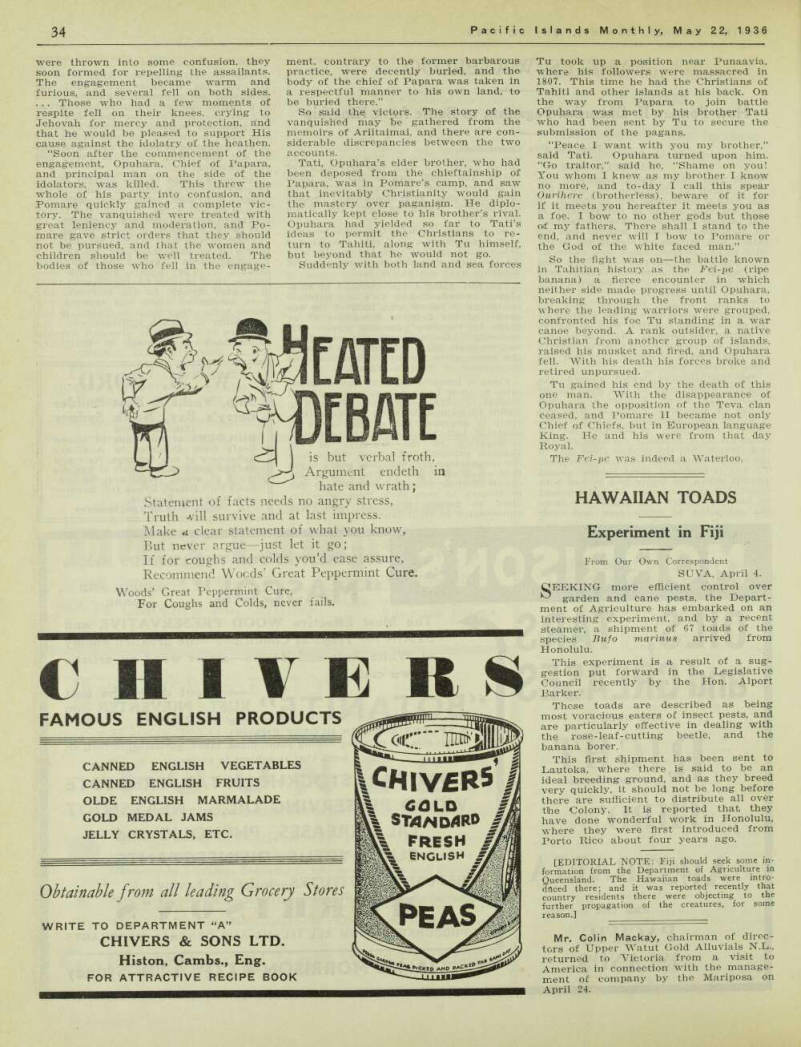
How Pomare II. Discarded Paganism to Battle for a Kingship
From Our Own Correspondent.
PAPEETE, April 7.
THE year 1815, which witnessed the A downfall of Napoleon at Waterloo, was also a memorable one in Tahiti. In that year the second of the Pomares at last became paramount over the island — an ambition for which both he and his father had striven ruthlessly for years, only to be thwarted again and again by the warriors of the powerful Teva clan of Papara. This second Pomare was Tahiti’s first real king, his father merely the first of his name.
Tu (the second Pomare) won his Waterloo as much by cunning strategy as by direct action on the field of battle.
In pitting one force of Tahitians against another his father had failed to achieve the long sought objective; the son de vised a better plan.
The disturbances which caused the English missionaries to flee from Tahiti in 1808 also forced Pomare II to seek refuge in Moorea. There, he who had from the commencement resisted Chris tianity and held stubbornly to his ancestral faith suddenly declared for the new Gospel—but the records show that to the end his conversion was only skin deep.
To him it promised great things; pagan against pagan his father and he had both failed, but pagan against Christian would be another matter. He would now have the sympathy of white men and their
active assistance with the necessities of battle, and could call to his aid those of his own people on outlying islands who had discarded paganism and become enthusiastic worshippers of the white man’s God.
So it was: Tahiti’s Waterloo became, to the majority on Tu’s side, a battle for Jehovah as against Oro, but to the man Tu the issue was still the same —that of kingship over his native land.
The fore-going facts —attested by mis sionary records and by Tu’s own letters— enable us to follow with interest the ac counts of the fight of November 12 as given by the two opposing sides. Of necessity these accounts are prejudiced and we must judge for ourselves between the story given by the victors and the vanquished of Tahiti’s Waterloo.
From a letter written by the mission aries to their London headquarters dated August 13, 1816 (before they returned to Tahiti to resume the work of evangelisa tion) it appears that a long series of quarrels had resulted in the complete subjugation of the warriors of the Taarapu peninsula who were driven into the mountains. A prospect of peace being thus established, the people, who on ac count of their religious beliefs had fled to Moorea to save their lives, were in vited to return to Tahiti and take repossession of their lands.
The letter continues: “On the arrival of the King (Pomare II) and his followers at Tahiti the idolatrous party appeared on the beach in a hostile manner to oppose his landing, bu.t by the King’s order their fire was not returned. Instead a message of peace was sent to them which was productive of the exchange of several messages, and at last apparently issued in peace and reconciliation, “In consequence of this several of the people returned peaceably to their different lands, but still fears and jealousies existed on both sides. This state of things continued till Sabbath day, November 12, 1815, when the heathen party, taking ad vantage of the time when the King and people were assembled for worship at Punaavia, made a furious and unexpected assault. . . . They approached with con fidence, their prophet having assured them of an easy victory. In this, however, they were mistaken. We had warned our people before they went to Tahiti, of the probability of such a strategem—in con sequence of which they attended worship under arms—and though at first they
were thrown into some confusion, they soon formed for repelling the assailants.
The engagement became warm and furious, and several fell on both sides. ... Those who had a few moments of respite fell on their knees, crying to Jehovah for mercy and protection, and that he would be pleased to support His cause against the idolatry of the heathen.
“Soon after the commencement of the engagement, Opuhara, Chief of Papara, and principal man on the side of the idolaters, was killed. This threw the whole of his party into confusion, and Pomare quickly gained a complete vic tory. The vanquished were treated with great leniency and moderation, and Po mare gave strict orders that they should not be pursued, and that the women and children should be well treated. The bodies of those who fell in the engage
ment, contrary to the former barbarous practice, were decently buried, and the body of the chief of Papara was taken in a respectful manner to his own land, to be buried there.”
So said the victors. The story of the vanquished may be gathered from the memoirs of Ariitaimai, and there are con siderable discrepancies between the two accounts.
Tati, Opuhara’s elder brother, who had been deposed from the chieftainship of Papara, was in Pomare’s camp, and saw that inevitably Christianity would gain the mastery over paganism. He diplo matically kept close to his brother’s rival.
Opuhara had yielded so far to Tati’s ideas to permit the Christians to re turn to Tahiti, along with Tu himself, but beyond that he would not go.
Suddenly with both land and sea forces
Tu took up a position near Punaavia, where his followers were massacred in 1807. This time he had the Christians of Tahiti and other islands at his back. On the way from Papara to join battle Opuhara was met by his brother Tati who had been sent by Tu to secure the submission of the pagans.
“Peace I want with you my brother,” said Tati. Opuhara turned upon him.
“Go traitor,” said he, “Shame on you!
You whom I knew as my brother I know no more, and to-day I call this spear Ourihere (brotherless), beware of it for if it meets you hereafter it meets you as a foe. I bow to no other gods but those of my fathers. There shall I stand to the end, and never will I bow to Pomare or the God of the white faced man.”
So the fight was on—the battle known in Tahitian history as the Fei-pe (ripe banana) a fierce encounter in which neither side made progress until Opuhara, breaking through the front ranks to where the leading warriors were grouped, confronted his foe Tu standing in a war canoe beyond. A rank outsider, a native Christian from another group of islands, raised his musket and fired, and Opuhara fell. With his death his forces broke and retired unpursued.
Tu gained his end by the death of this one man. With the disappearance of Opuhara the opposition of the Teva clan ceased, and Pomare II became not only Chief of Chiefs, but in European language King. He and his were from that day Royal.
The Fei-pe was indeed a Waterloo.
Advertisements & other items, pp. 35-36 (1 item)
Oils, Tars/*
W. M. FORD
Ship, Yacht & Boat Builder
Berry’s Bay, North Sydney
(Established 1870) BUILDERS of all kinds of Island Craft from Dinghies to Auxiliary Schooners of any tonnage. New and Second-hand Island Craft of various types in stock. New and Secondhand Full Diesel, Crude Oil, Benzine and Kerosene Engines.
Please Send on Your Enquiries
t
SPECIALITIES FOR THE ISLANDS include
“MASCOL”
OILS, TARS/*
and GREASES
MEDIUM AND
DARK
ARE USED
RIGHT
THRO’
Australia
and the
PACIFIC
ISLANDS
The Most Effective WOOD PRESERVATIVE and STAIN for Tropical Conditions—the dreaded enemy of White Ants and Borers—stains wood an artistic brown color. . . —without doubt the best BOTAN TF” RUST preventer on
W I I■— the MARKET!
A SPLENDID BLACK GLOSSY ENAMEL.
Invaluable for painting mining plant, pipes, tanks, guttering, in fact, all iron work that is subject to corrosion.
COAL TAR, STOCKHOLM TAR, CREOSOTE
WOOD PRESERVING OIL, - NEATSFOOT
OIL, GREASES, PHENOLIC and
EUCALYPTUS DISINFECTANTS
REFUSE SUBSTITUTES—insist on having
91 O IK It ISO M’S
PROCURABLE FROM ALL ISLAND AND GENERAL MERCHANTS Manufactured by
JAMES MORRISON & COY. LTD. Sydney
x
mmi
q in verbal froth,
Argument endeth
hate and wrath; Statement of facts needs no angry stress, Truth will survive and at last impress.
Make a clear statement of what you know.
But never argue —just let it go; If for coughs and colds you’d ease assure, Recommend Woods’ Great Peppermint Cure.
Woods’ Great Peppermint Cure, For Coughs and Colds, never fails.
€ H IVE R »
FAMOUS ENGLISH PRODUCTS
CANNED ENGLISH VEGETABLES
CANNED ENGLISH FRUITS
OLDE ENGLISH MARMALADE
GOLD MEDAL JAMS
JELLY CRYSTALS, ETC.
Obtainable from all leading Grocery Stores
WRITE TO DEPARTMENT “A”
CHIVERS & SONS LTD.
Histon, Cambs., Eng.
FOR ATTRACTIVE RECIPE BOOK
r
nrt*
OK U 1
Cf4IV£RS
CO LD
FRESH
I -
ENGLISH
PEAS
m
AND
Experiment in Fiji
Hawaiian Toads
From Our Own Correspondent SUVA, April 4.
REEKING more efficient control over garden and cane pests, the Depart ment of Agriculture has embarked on an interesting experiment, and by a recent steamer, a shipment of 67 toads of the species Bufo marinus arrived from Honolulu.
This experiment is a result of a sug gestion put forward in the Legislative Council recently by the Hon. Alport Barker.
These toads are described as being most voracious eaters of insect pests, and are particularly effective in dealing with the rose-leaf-cutting beetle, and the banana borer.
This first shipment has been sent to Lautoka, where there is said to be an ideal breeding ground, and as they breed very quickly, it should not be long before there are sufficient to distribute all over t)he Colony, It is reported that they have done wonderful work in Honolulu, where they were first introduced from Porto Hico about four years ago. [EDITORIAL NOTE: Fiji should seek some in formation from the Department of Agriculture m Queensland. The Hawaiian toads were intro duced there; and it was reported recently that country residents there were objecting to the further propagation of the creatures, for some reason.] Mr. Colin Mackay, chairman of direc tors of Upper Watut Gold Alluvials N.L., returned to Victoria from a visit to America in connection with the manage ment of company by the Mariposa on April 24.
"Puritans in the South Seas"
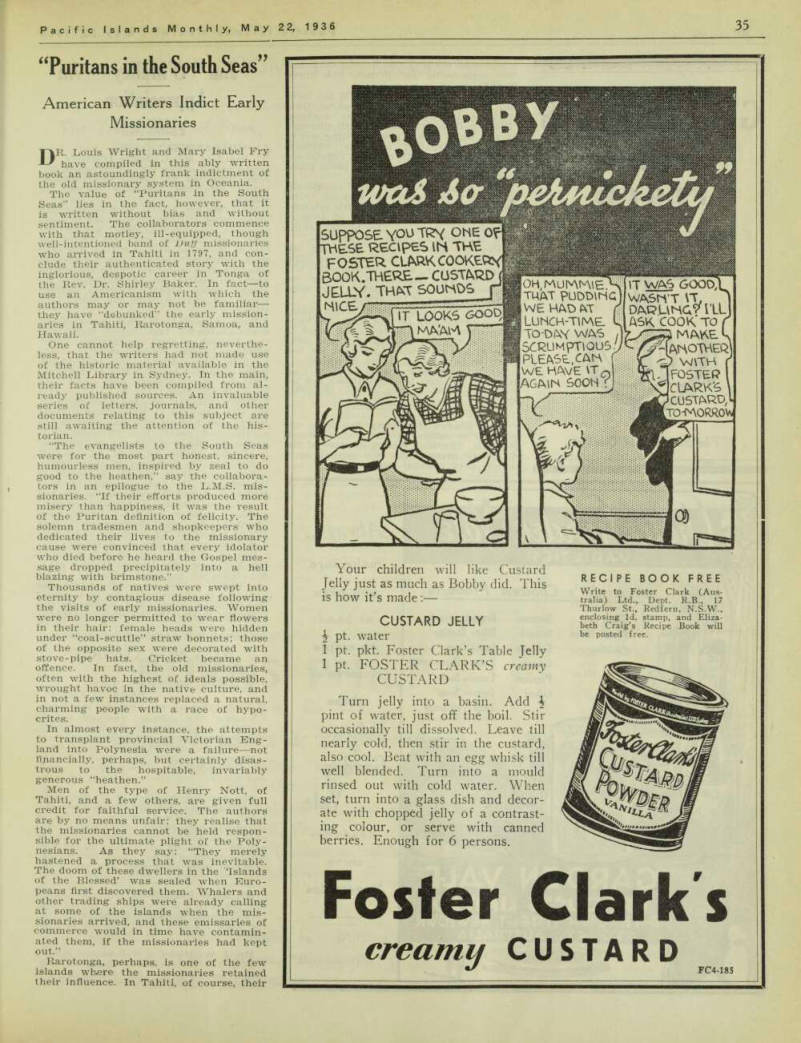
American Writers Indict Early Missionaries
DR. Louis Wright and Mary Isabel Fry have compiled in this ably written book an astoundingly frank indictment of the old missionary system in Oceania.
The value of “Puritans in the South Seas” lies in the fact, however, that it is written without bias and without sentiment. The collaborators commence with that motley, ill-equipped, though well-intentioned band of Vutf missionaries who arrived in Tahiti in 1797, and con clude their authenticated story with the inglorious, despotic career in Tonga of the Rev. Dr. Shirley Baker. In fact —to use an Americanism with which the authors may or may not be familiar — they have “debunked” the early mission aries in Tahiti, Rarotonga, Samoa, and Hawaii.
One cannot help regretting, neverthe less, that the writers had not made use of the historic material available in the Mitchell Library in. Sydney. In the main, their facts have been compiled from al ready published sources. An invaluable series of letters, journals, and other documents relating to this subject are still awaiting the attention of the his torian.
“The evangelists to the South Seas were for the most part honest, sincere, humourless men, inspired by zeal to do good to the heathen,” say the collabora tors in an epilogue to the L.M.S. mis sionaries. “If their efforts produced more misery than happiness, it was the result of the Puritan definition of felicity. The solemn tradesmen and shopkeepers who dedicated their lives to the missionary cause were convinced that every idolater who died before he heard the Gospel mes sage dropped precipitately into a hell blazing with brimstone.”
Thousands of natives were swept into eternity by contagious disease following the visits of early missionaries. Women were no longer permitted to wear flowers in their hair; female heads were hidden under “coal-scuttle” straw bonnets; those of the opposite sex were decorated with stove-pipe hats. Cricket became an offence. In fact, the old missionaries, often with the highest of ideals possible, wrought havoc in the native culture, and in not a few instances replaced a natural, charming people with a race of hypo crites.
In almost every instance, the attempts to transplant provincial Victorian Eng land into Polynesia were a failure —not financially, perhaps, but certainly disas trous to the hospitable, invariably generous “heathen.”
Men of the type of Henry Nott, of Tahiti, and a few others, are given full credit for faithful service. The authors are by no means unfair; they realise that the missionaries cannot be held respon sible for the ultimate plight of the Poly nesians. As they say: “They merely hastened a process that was inevitable.
The doom of these dwellers in the ‘‘lslands of the Blessed’ was sealed when Euro peans first discovered them. Whalers and other trading ships were already calling at some of the islands when the mis sionaries arrived, and these emissaries of commerce would in time have contamin ated them, if the missionaries had kept out.”
Rarotonga, perhaps, is one of the few islands where the missionaries retained their influence. In Tahiti, of course, their
intolerance towards the Roman Catholics was responsible for French rule there to-day.
“If Christian Rarotongans did not have full bellies it was not the fault of their spiritual leader,” declare the authors.
“Brother Buzacott beamed with pleasure at the sight of his people sitting deftly on chairs, feasting on pork, chicken, turkey, or duck, with civilised vegetables, over all of which a long and pious grace had been said.”
But, most perversely, the population continued to diminish because “the people were often afflicted with gripings in their stomachs and died of strange diseases, in spite of the physic which their missionaries dealt out to them.”
“Puritans in the Pacific” is a mad, sad story of men who, in the main, were often temperamentally and educationally un fitted for their task. On occasion, the missionaries were themselves the most pathetic victims of the system.
To-day, the missionary is better equip ped in every way for his work (particu larly those who have the good sense to take courses in anthropology and eth nology) and mistakes of the past are less likely to be repeated.—Eric Ramsden.
PURITANS IN THE SOUTH SEAS, by Louis B. Wright and Mary Isabel Fry (Henry Holt and Coy., New York). Price, $3 (17/- Australian approx.).
Miss Gladys Hennessey has been ap pointed secretary of the Torres Strait Hospital, Thursday Island, in place of Mr.
E. J. Hennessey, who has retired after many years’ faithful service.
Advertisements & other items, pp. 37-38 (1 item)
Foster Clark's
suppose you TRy one o
THESE RECIPES IN THE
FOSTER CLARK COOKE .
BOOK.THERE-CUSTARD
JELLY. THAT SOUNDS '
NICE
IT LOOKS GOOD]
MA'AIH
OH.MUAANME?
that pudding
WE HAD AT
LUNCH-Tl(v\e
TO-DAVWAS
scrumptious! 1
PLEASE, CAN '
WE HAVE IT
lACAIN SOOH r
IT WAS GOODJ
WASN’T \T, . i
DAP.UHa? HU
ASK COOK TO
MAKE
W\TH
POSTED
CLARK'S
CUSTARD, I
iTOTAORROVvI
U Your children will like Custard Jelly just as much as Bobby did. This is how it’s made:—
CUSTARD JELLY
i pt. water 1 pt. pkt. Foster Clark’s Table Jelly 1 pt. FOSTER CLARK’S creamy
CUSTARD
Turn jelly into a basin. Add \ pint of water, just off the boil. Stir occasionally till dissolved. Leave till nearly cold, then stir in the custard, also cool. Beat with an egg whisk till well blended. Turn into a mould rinsed out with cold water. When set, turn into a glass dish and decorate with chopped jelly of a contrasting colour, or serve with canned berries. Enough for 6 persons.
RECIPE BOOK FREE
Write to Foster Clark (Australia) Ltd., Dept. R. 8., 17 Thurlow St., Redfern, N.S.W., enclosing Id. stamp, and Elizabeth Craig’s Recipe Book will be posted free. h m •Hlf mBBtWMM*
Foster Clark's
creamy CUSTARD
FC4-18S
GILLESPIE’S
“ANCHOR”
FLOUR
TRADE
MARK
The Standard of Quality.
A 4 /
yakdm \oiz
V-ARI-CTI-E5
Australia*s Choicest Products: Brussels Sprouts White Turnips Sweet Corn Tomato Puree Tomato Sauce Tomato Soup Tutti Fruit Sauce (Worcestershire flavor) Beetroot Spinach Cabbage Carrots Parsnips Celery Green Peas French Beans Cauliflower cn a s □
Always..
make sure you have at hand an ample Reserve of these Delicious . .
Garden
Vale
Ready-toserve Vegetables
“Jim” O’Malley-An
Appreciation
Contributed COMPARATIVELY little has been heard of Mr. L. James O’Malley, the young patrol-officer who accompanied Mr.
Jack Hides on his recent world-famous patrol into the unknown interior of Papua.
Mr. O’Malley, who is of a retiring and unassuming disposition, has been to some extent a “sleeping partner,” almost un seen and unheard, since the party re turned from the wdlds; but he did very little “sleeping” whilst the partnership was in active operation among the active, unknown natives of the interior. He shared every danger, hardship, forlorn hope, and anxiety, with his leader, Mr.
Hides.
Each supported the other in the lonely, nerve-shattering task before thenr and they formed an ideal combination. “Jim”
O’Malley waxes enthusiastic over the qualities of leadership and bush-know ledge possessed by Jack Hides, and says; “He was the best pal a man could have on a job like that.”
“Jim” O’Malley is quite a young man.
He was educated at Holy Cross College, Ryde, near Sydney, and has been in the service four years. But, although he is young, he had seen “life as she is lived” in Papua, before he went off on that patrol and the discovery of those fertile valleys and their untold thousands of inhabitants. He had accompanied Jack Hides, as second in command, on a patrol into the dangerous Kunimaipa country, seeking various murderers who were “wanted” by the Government. Jack Hides’ report of his courage, endurance, and sagacity was placed on record.
Out of all the young officers available.
His Excellency Sir Hubert Murray chose Mr. O’Malley to share with Mr. Hides the perils of this later trip, which has appealed to the imagination of much of the civilised world, and brilliantly did O’Malley justify His Excellency’s choice.
w.
N.G.’S New Coinage
From Our Own Correspondent RABAUL, April 4. ■jVTEW sixpences for issue as the Terri- J- ’ tory’s own coinage, recently arrived at the Treasury, Rabaul, by the Neptuna.
Three-penny pieces will be sent up from Australia and distributed at a later date.
These new coins have proved to be very disappointing. They appear cheap and shoddy, and are reminiscent of fruit machine chips.
The first consignment of £75,000 worth of shillings reached New Guinea last Oc tober. At the end of the year £39,400 worth had been issued. Though the coins present an entirely new appearance to the natives, by reason of the hole in the cen tre, there seems to have been no difficulty at all in their acceptance of them.
Mr. Peter Pianta, who formerly owned and operated a gold claim on Merri Creek, New Guinea, returned to Salamaua by the April Macdhui after furlough in Aus tralia.
Mr. J. W. Hinks, a well-known mining engineer of Tiveri Gold Dredging Co. Ltd., sailed from Sydney for Papua by the Macdhui on April 16.
Pages From The Past
By Julian Hillas
The Tragic Story of Rosa
Cruickshanks
“jVTINETY years ago the island of Mani- J-l hiki was unknown save for a few uncorroborated rumours. Even to-day, after nearly a century of resident traders and visiting missionaries, much that belongs to the past still clings to its surf ringed shores.
Civilisation may have taken the venom out of paganism but it has never quite succeeded in removing the sting, and life, stripped of its cruder aspects, is lived much as it was prior to the arrival of the lirst white man. Beneath a polished veneer of Christianity superstition is rife and there yet lingers on a belief, if not in the actual existence, then certainly in the power of the old heathen gods.
To Manihiki, in the early 70’s, came Kosa Cruickshanks and her tubercular husband. Why they chose this lonely atoll so far removed from the beaten track will never be known, nor the manner by which they induced some schooner captain to carry them thither. But come they did and Kosa, young, full-blooded and of good family, was unquestionably the first white woman to land there. That they were people of some station and refinement — with no intention of deliberately dropping their former standards—seems fairly cer tain from the cutlery, the silver fish forks and pearl-handled fruit knives that they brought with them to a community which used its fingers exclusively.
To the islanders they were a constant source of wonder and interest. It is diffi cult to imagine their first impressions.
Food must have caused Rosa many wor ries during those early days, for the island could only provide fish, coconuts and fowls, with an occasional piece of fresh pork.
How many years passed before her invalid husband passed away are un recorded, as is the precise way in which
husband and wife lived, beyond that they kept a native male servant. But from suosequent events one is led to think that at the time of his death their money was either expended or ceased automatically.
Be that as it may, Rosa did not leave Manihiki immediately; and for what hap pened next there were probably reasons and excuses of which we are ignorant.
Picture her, still young, alone on that flat coral riband with no other companionship than the company of six or seven hundred natives whose contact with Europeans dated back a matter of five and twenty years.
Day after day, the trade-wind played its melancholy music among the palm fronds and streamer-like leaves of the pandanus.
Every morning the sun climbed slowly above the vivid blue water of the lagoon and every night'it sank down below the horizon in a crimson welter of colour.
Rosa Cruickshanks must have lain awake in her empty house with its lattice-work walls and high thatched roof, staring at the moving mosaic of moonbeams on the floor and listening to the ceaseless diapason of the surf running its magic fingers over the mighty keyboard of the reef.
In the village of Tukao there was often dancing and then the rhythmic stamp of feet and the rumble of shark-skin drums would rise above the hoarse guttural chorus of the himene singers in an adjoin ing house. Strange scents would fill the air, the aromatic odour of coconut-shell fires and the cloying honey-sweet perfume of the flowering ara.
Day and night the island breathed its silent invitation to Rosa Cruickshanks.
In the end, her erstwhile house-boy became her lover. Perhaps there slumbered in the refined and cultured Rosa a sub conscious urge to the primitive; perhaps it was simply loneliness and a sense of social values, deadened by long separation from her own world, that caused this strange liaison.
Such an ill-balanced association could not and did not last. But Rosa, once
launched on the dangerous decline, was unable to stop.
A white woman was a novelty, a rarity, and the young men competed for the dis tinction of possession. Again and again she postponed the letter to her relations
which would bring release from Manihiki.
One visualises her, confronted by the in creasing difficulty of keeping up her old standards, gradually letting slip first one and then another of these. Dependent now upon her neighbours for the daily supplies of fish and coconuts which com prised her principal diet, Rosa Cruick shanks must have been unable to preserve that invisible line which formerly divided her from the islanders.
At length, forced either by circumstances or the weight of local missionary opinion, she married a native from the Austral island of Rurutu. Her husband, Faareva, had come north on one of the trading vessels which were then numerous, and after a time he not unnaturally wished to return home.
At this juncture, Rosa might yet have
extricated herself from the net which Destiny was slowly drawing about her.
The captain of the schooner on which they were to take passage was a man of wide and generous understanding. None knew better than he that the white woman who has married a native is socially dead —a pariah among her own people and an object of contemptuous pity among those she has adopted. With every argument at his command, he urged her to leave the Islands, even offering to provide the means from his own pocket.
But Rosa had a queer pride which for bade acceptance and also prevented her communicating with her own folk. Per haps she thought that, in Rurutu, things would be different, and perhaps she be lieved the specious promises of her new husband, the sailor Faareva.
In Rurutu, she was again the focus of an interested curiosity, and for a time Faareva basked in the publicity which surrounded his strange marriage.
But as the novelty of the situation wore off, its disadvantages became evident. The fine dinner service and the pearl-handled knives were no more—gone long since in exchange for everyday necessities. Noth ing remained to boast about except a past, which threw no shadows on the present.
Rosa also began to worry him and their inability to converse freely only widened the rift between them.
Friends, and particularly girls who had grown up in the expectation that he would choose one of their number, now twitted him on his wife’s lack of accomplishments, her ignorance of hat or mat-making, and of preparing native food. He began to neglect Rosa: and soon there were nights when he did not come back to the ram shackle hut which was their home.
As time passed, Rosa’s good looks faded, exposure to the sun darkened her face and arms, and the rough salty winds coarsened her skin. A stranger in an alien land, she must often have thought of that world she had renounced and to which her pride always closed the door of return.
Occasionally, there visited her the same schooner captain who had brought them to Rurutu, Always he urged her to leave and always Rosa refused. Then came the day when Faareva told her. with brutal candour, she was a useless encumbrance and that he would live with her no longer.
In future, she could fend for herself.
Cold, indeed, are those who sit alone beside the ashes of romance: and when the friendly captain next visited Rurutu he found a changed and submissive Rosa, who listened willingly enough to his ad vice.
But where to go, and what to do? Back to her own people was now out of the question.
Diffidently, the kind-hearted captain suggested marriage—divorce from Faareva would be easy—but again Rosa refused.
Go with him she gladly and gratefully would, but not as his wife. That, she argued, would be taxing friendship too heavily.
So to Penrhyn, his next port of call, the captain carried her; and, after seeing her comfortably settled there, continued on his way.
Penrhyn, in the late 70’s, was the gather ing-place of as hard-drinking and hard living a set of pearl-buyers as could have been found anywhere. Two stores served their needs, and trading schooners from Rarotonga and Tahiti made frequent visits. The arrival of such vessels pro vided a ready excuse for a wild carouse, and the little settlement of Omoka would then echo with the rum-crazed shouts of the revellers, and bottles and glasses were broken underfoot as the evening which had begun in conviviality ended in a drunken brawl.
In this company Rosa was almost as great a curiosity as she had been on Ru
rutu or Manihiki. Never before had a white woman lived among them; and, at first, there were some who openly re sented her presence.
But Rosa troubled nobody. She sought only peace and forgetfulness. The grey burden of the past rested on her like a pall. The future, blank and interminable, hung before her as a trembling opaque curtain. Spiritually weary and prema turely aged, she soon sank into a listless decline, from which death came as a wel come release barely eighteen months later.
Nearly sixty years have elapsed since then, and time has almost obliterated the memory of her rake-helly contemporaries.
Rosa Cruickshanks sleeps under the sparse sandy soil of Penrhyn. Over her grave is a rough-hewn headstone of coral rock, on which the faded initials R.F. are faintly legible. A few more years, and the wind and rain and the sea-spume will wipe away even this last record of a lonely woman — “Whose perplexed heart did evil, foolishly, A long while since and by some other sea.”
Advertisements & other items, pp. 39-40 (1 item)
Anchovy
■IWLKHOOKS
PASTE
The House of. .
HOLBROOK
Packs in dainty jars a delicious paste made from finest Gorgona Anchovies.
It will keep in any climate and is a wonderful stand-by for the concoction of many delightful luncheon and supper savories.
Try it spread lightly on hot buttered toast, or for a more substantial meal serve it on toast with a poached or scrambled egg.
Other varieties of Fish and Meat Pastes: Holbrooks Bloater, Salmon, Salmon & Shrimp, Chicken & Ham, Ham & Tongue, Veal & Tongue, and Turkey & Tongue.
Holbrooks
(Australasia) Ltd.
WATERLOO - NEW SOUTH WALES
BURNS PHILP
(South Sea) Co. Ltd.
Island Traders & Shipowners Registered Office: Suva, Fiji.
ALSO BRANCHES AT:
Fiji; Levuka, Lautoka, Labasa, Ba, Sigatoka, Rotuma.
Tonga: Nukualofa, Haapai, Vavau.
Samoa: Apia, Pago Pago (American Samoa).
Solomons: Makambo, Gizo, Faisi.
New Hebrides; Vila.
Gilberts: Tarawa.
Norfolk Is. Niue. Wallis Is. Futuna Is.
Code Address; “Burnsouth.”
Your Sydney Agent?
William E. Reed
(Established 1913)
UNION HOUSE
247 GEORGE ST., SYDNEY
Shell sold, and goods supplied at wholesale prices, on commission.
Enquiries welcomed.
MUNGO SCOTT Ltd
EXPORTERS OF
SUPERB FLOUR
FOR
38 YEARS
SUPERB
SUMMER HILL SYDNEY AUSTRALIA
RELIABILITY
AND PROMPT
SHIPMENT
FIRST
IN 1866
SPICED, CORNED, ROAST
BOILED BEEF
AND IN MUTTON
IN 12 or., 11b., 2 lb,, 3.1 b„ 41b. slk. 6'64k ROUND
CANS AND IN TAPERS
FITZROY
SHEEP
TONGUES
CORNED CX TONGUES - BEEF & FORK SAUSAGES
FITZROY
SiuNoitoii THE ORIGJNAw PACK IN A CLASS BY ITSELF
A ESC THE EAMCUS
HAMPER MEATS
W ROUND AND TAP£R CANS /2 OZ- 24- OZ. 6 <5 LBS
C«*(D»M«E CO.LB. DSUND TIRADE MEATS
BERSERKER &
av evepy size pft.oM
OX-PALM BRANDS
/2 OZ TO 6L& CANS.
NO E-XTR.A CHAR,C£- FOR. ASSOR.TM&NT
PACKED CASES ©R CARTONS - SEND EOR PRJCE LAST S& CENTRAL QUEENSLAND MEAT EXPORT CO. LTD.
LAKES CREEK - ROCKHAMPTON
CABLE ADDRESS:- TOMOANA ROCKHAMPTON.
Sampan Wrecked
31 Japanese Reach Thursday Is.
From Out Own Correspondent
Thursday Is., April 24.
IN four unpainted boats fitted with sails and a short steering oar, 31 Japanese reached Thursday Island on April 7 after their sampan Fukujyu Maru had been wrecked four days earlier west of Mc- Arthur Island, near Shelburne Bay Cape York Peninsula.
Captain Shinchi Miyara said that the boat struck a reef and a hole was torn in the bow. The vessel filled up and sank, the crew taking to the 14ft. boats which are like square-nosed canoes.
On their trip to Thursday Is., the crew were very poorly clothed and suffered great privations, camping on beaches at night and subsisting mainly on fish. One man had had his arm bitten off by a shark ten days before the wreck and had not received medical attention.
The survivors decline to give any in formation about their movements or what class of produce they were seeking.
Technically the seamen are prohibited immigrants, but they are being allowed to remain here until they return to their own land in May. They missed the last Japanese steamer by only two days. In the meantime they are staying at one of the several local Japanese boarding houses, and the Japanese Society is mak ing itself responsible for their mainten ance.
Rear-Admiral R. Byrd, the famous American explorer, who returned to the United States in April from the Ant arctic, has announced that he is seeking to launch an expedition to explore South America and some unknown parts of the Mandated Territory of New Guinea.
Miss Valesca Schultze, who for 26 years was principal of the London Missionary Society’s Girls’ School at Papauta, West ern Samoa, recently died in Germany at the age of 76. She was born in Germany and educated there. In 1890 she went to Samoa for the L.M.S. to found the Girls’
School and remained at Papauta until 1916. Miss Schultze was the authoress of several educational works.
Kingman Reef
Base for Trans-Pacific Air Service
‘ <r pHERE have been many misleading statements concerning Baker, How land and Jarvis Islands,” said Mr. Harold Gatty, the aviator, who arrived in Sydney by the Mariposa on April 20. “Most of these statements were current at the time I visited the islands to survey them.
It was thought that they wei'e to be used as bases for the trans-Pacific air line.
“Actually the islands are useless for airports, and the only spot which will be used is Kingman Reef, midway between Honolulu and Pago Pago. As to the other islands Great Britain now acknowledges them as United States territory.”
Mr. Gatty stated that he was going to live in Australia, and would act as Aus tralian agent for Douglas air liners.
Mr. Edouard Mercian, a member of the Council-General of New Caledonia, and also an alderman of Noumea, arrived in Australia on a visit to Sydney by the April Laperouse.
Advertisements & other items, pp. 41-42 (1 item)
Kork-N-Seal
FOR ALL HOME BOTTLING
THE LITTLE CAP THAT WILL
RE-SEAL 1,000 TIMES
KORK-N-SEAL (Aust.) Ltd.
106 COMMONWEALTH STREET
SYDNEY, AUSTRALIA
FOR HOME USE
Applied Airtight Pressure Proof Hand
WE ARE SPECIALISTS!
Let us have your confidence, sixty years is our record of supplying the Leading Houses throughout the World in—
FRESH FRUIT VEGETABLES PRODUCE
WEYMARK & SON LTD.
Fruit and Produce Merchants
14-18 STEAMMILL STREET, SYDNEY
Phones: MA 3612 Cable Address: Codes Bentleys. (4 lines) “Weymar kson” Private.
A
H.PEEL&-SONS
FI/H
MFORTER/
& EXPORTERS
QUOTES
SENT
ANYWHERE
Phones: MW 1603 FX 5011 Purveyors of Scotch, Canadian, N.Z. and Australian
Fresh and Smoked Fish
SHIPPING
PROVEDORES
239 HARRIS ST., PYRMONT
SYDNEY, New South Wales
i Sw eetened cond._
VULM
Anglo-Swiss Condensed Mi
SYDNEY
MUST BE
YOUR FIRST
CONSIDERATION
NESTLE S MILK
remains PURE and
FRESH under all climatic conditions
You cannot afford to take risks with milk . . . only the best is good enough . . . that's why you should always use Nestle's Milk. It is made from the finest full cream country milk. From start to finish every process of manufacture is carried out under the strictest supervision. It will never become contaminated while unopened, and It Is fully guaranteed to stand up to ANY climatic conditions. To protect your own health and the health of your family always insist on Nestle's— the safest, most nourishing and most economical milk you can buy.
NESTLES
FULL CREAM
MILK
BEST, THEREFORE CHEAPEST
Copyright A257c
Wreck?
From Spanish
Very Old Coins at Wau, New Guinea
SPANISH coins and a remarkable bowl with human figures as a border deco ration impressed around the rim were re ported recently to have been found on a mining claim at Wan, New Guinea, it was stated in the March issue of the Pacific Islands Monthly. The finds suggested that at some period people, possibly Europeans, had discovered and worked the goldfield.
Another theory has been advanced that the coins were originally taken from a wrecked Spanish vessel, and passed from tribe to tribe from the coast into the in terior. Colour is lent to this by the fact that Spanish coins and other articles from sunken ships are reported to have been discovered among the natives on islands in the Torres Strait, south of New Guinea.
In the Melbourne Herald on April 4, Mr.
E. K. Patterson, dealing with the subject of Spanish wrecks in Torres Strait, wrote as follows: Most people in Australia usually asso ciate sunken treasure with other parts of the world, little realising that there is said to be much wealth of this type under our own seas, particularly our tropical seas.
The coral seas of Torres Strait are prob ably richer in sunken treasure than any other part of Australian waters. The Strait is a veritable graveyard of ships.
Since the very earliest days of Australia, long before the continent was known by that name, countless vessels of all nation alities met their doom in these reef-studded waters.
Northern Australia is full of fascinating stories of ancient mysterious wrecks, said to have been located by pearlers, the ves sels, in most cases, being now almost en tirely covered with thick coral. It is thought that many of these mysterious wrecks are the remains of Spanish ships, which, centuries ago, used the Strait when voyaging to and from the then Spanish colony of Manila, in the Philippine Islands and the East Indies.
Forty years ago, beneath the anchor of one of these wrecks, the late Frank Jar dine, a well-known northern fisherman, found a small fortune in ancient Spanish gold dollars.
Similar coins are said to have been found on many of the islands in Torres Strait. A number are reported to have been picked up on Murray Island, near the far north ern end of the Great Barrier Reef. These discoveries. coincide with a story which has been handed down among the Murray Island natives for generations, that many, many years ago, a ship was wrecked on the reef surrounding the island.
The natives say that the survivors man aged to bring some boxes of coins and gold ashore before the wreck slipped down into deep water. That night, however, the natives killed them all, and distributed the gold and coin amongst themselves.
Some years ago a diver, who went down to see if he could locate the old wreck, found that it had been almost entirely cov ered by coral.
Another allegedly rich wreck in the Strait is believed to lie on the sea-floor somewhere off Prince Edward Island. About 40 years ago Captain Kane, a pearler, while exploring the island, came across a cave almost hidden by dense undergrowth.
He entered the cave, and some distance from the mouth found the skeleton of a
tall man, alongside which lay a huge rusted sword of ancient Spanish design.
This is now in the possession of a Thurs day Island resident. The skeleton was obviously that of a Spaniard—the survivor of a shipwreck near the island who sought shelter in the cave to escape from the natives, ultimately dying there from starvation.
A few years after the discovery of the skeleton a native sold a gold goblet of pe culiar design to Captain Brown, another pearler, who was later murdered in the Gulf of Carpentaria. The native said he had found the goblet on the beach of Prince Edward Island.
Lonely Booby Island, a little-known rocky speck, 30 miles west of Cape York, is alleged to be another treasure island, but the treasure in this case is believed to be buried on the island. In the days be fore Captain Cook named the island, Booby was the headquarters of the only pirates Australia has ever known. These were a band of Asiatic cut-throats, who plundered the Spanish vessels.
Only a few years ago a number of an cient Spanish gold coins were reported to have been picked up on the island, and this discovery has given rise to the belief that some of the pirates’ treasure may still be hidden there.
Did Spanish Adventurers Pene
trate “Isla del Oro”?
From Our Own Correspondent
Pt. Moresby, April 10.
THE reported discovery of Spanish coins in the wash on the Morobe goldfields, New Guinea, is interesting to residents of Papua, as some time ago similar coins were found at Misima Island among the money presented by natives when paying their tax.
How they came to be on Misima is a complete mystery, though it has been sug gested that they were remnants of money given in exchange for commodities by Cap tain Dumont D’Urville, who visited the Louisiades in the French corvettes L’Astro labe and La Zelee during his last voyage around the world, before making his pas sage through Torres Strait.
This idea had its basis in the fact that Lieutenant Kops, in the war schooner Circe, when visiting the N.W. coast of New Guinea to open up the country for Dutch settlers, discovered the natives of Port Dorey manufacturing rings, bracelets' and ear ornaments from Spanish coins. The natives explained that these were obtained from the survey ships L’'Astrolabe and La Zelee, in return for foodstuffs.
There have been, and will be, many theories (possible and impossible) to ac count for the Spanish coins recovered at Wau, but it is quite probable that they were relics of a Spanish party which ven tured into the unknown inland of the island which was called by the fantastic name of “Isla del Oro”—lsland of Gold.
The Spaniard Alvaro de Saavedra, a relation of the great Cortez (discoverer of Mexico), after searching for the missn.g expedition of Loyasa (1525) made two at tempts to return to Mexico and failed. In both attempts he landed on the northern shores of New Guinea (1528-29) and found traces of gold all along the coast. On his return to the Moluccas he bestowed the name of “Isla del Oro” upon the strange land.
This name must have attracted atten tion. One can suppose that enterprising young Spaniards set forth to try their luck and wandered far into the interior in search of its hidden wealth, much the same as Australians have done in recent years.
There is nothing to suggest that the Span iards would have been behind in that respect. Having recently despoiled the Incas of Peru, they were greedy for gold, and wanted more.
In 1536, Gryalva from Peru put in along the coast of New Guinea, after landing reinforcements from Mexico to help the Spaniards against the Incas. Then came De Retez, in 1545, and Louis de Torres in 1606.
New Guinea was known to a dozen fear less navigators of the Pacific, and it seems likely that some of their men would have been driven by the spirit of adventure to push further afield than the coast lands. r ”
Mr. S. Reilly, chief surveyor to the Ad- Ministration of Papua, left Sydney with his wife by the Esperance Bay on April 4 for a tour abroad.
Advertisements & other items, p. 43 (1 item)
Angus&Coote
Rings of Romance
of course from
■ll 111 111 11 11 111 I I I
Their Diamonds Sparkle
so brilliantly!
Their Mounts are so
exquisitely carved!
Their Values are so very
Outstanding!
A BOOK OF
RINGS
illustrated i n colour, and helpfully written-up for your guidance, conies free and post free to any address.
Here’s a magnificent . solitaire diamond, beautifully white and highly polished. It is mounted on white gold, diamondstudded filigree.
The settings are of pure platinum.
The whole effect is unbelievably lovely. t m m £3O/0/0 To the right Angus and Coote illustrate a beautiful two-diamond ring.’ with diamond-set! shoulders, T h e
platinum settings!!
are in the new square shape. The' mount is white gold filigree, and the shank is beau tifully carved.
B? m £l2/10/0 £9/10/0
AN ASSORT-
MENT OF
RINGS
sent on approval to your nearest Bank A three-stone Diamond Ring of particular loveliness is shown here. The filigree mount is is one of the new est, and the shoulders are diamondstudded. Every stone is a doublecut, genuine diamond, mounted in pure platinum and 18ct. white gold.
Angus «i Coote
Manufacturing Retail Jewellers
500 GEORGE STREET, SYDNEY.
ONE SHILLING PER COPY
ON SALE AT ALL NEWSAGENTS AND BOOKSELLERS
Sudden Death Of Samoan
Medical Practitioner
From Our Own Correspondent APIA, April 9.
WHILE on a medical tour with the Chief Medical Officer, Dr. Monaghan, the Samoan senior medical practitioner, lelu, of the Government Hospital, died suddenly at Amaile, Aleipata, on March 27.
For long years lelu had served the Ad
ministration in the Medical Department, having entered the service as a cadet in 1921. He had been trained at the Central Medical School, Suva, Fiji, where he dis tinguished himself by passing his ex aminations with honours in 1931, when he returned to Samoa, to be senior medical practitioner.
He was a very capable and efficient worker, extremely popular with the Samoans of all factions and with his superiors and the staff of the Apia Hos pital.
For A Change!
Praise for a Department
TT is usual to hear criticism of Govern merits, Government Servants and Gov ernment Departments. For once, let us give praise.
The Territory of New Guinea was for long cursed with a number of over zealous D.O.’s, A.D.O.’s, and similar gen tlemen. Swaddled in red tape, puffed up with their own importance, they pro pounded a half-baked knowledge of the Law where only commonsense was needed. Thinking themselves each solely responsible to the League of Nations for the protection of the natives, they thought every other resident possessed no sense of responsibility or knowledge of natives.
Gradually these zealots have disap peared or have mended their ways. Only a few, mostly minor officials, make them selves unpleasantly felt nowadays. Com mon sense partly has conquered red-tape.
The Goldfields especially have been for tunate with Government officials for some years and most people would rather do business in those busy offices than in any other in T.N.G. Occasionally, some new official makes himself unpopular, but he soon falls into tune with the efficient and pleasant manner of the older members of the staff.
The staff of the Warden’s Office are particularly helpful to the public. One must appreciate they are not to blame for the faults in the Ordinances they administer. Hundreds of questions of all kinds are fired over the counter to the Mining Registrar daily, and are answered with clarity and helpfulness seldom asso ciated with Civil Servants. A pegging boom or even a small “rush,” like that to Wampit, means enormous additional work for the Warden’s Office; yet they never lose their sang-froid, and one rarely has to wait for attention.
Recognising the anomalies of the Min ing Ordinance they do their best to mitigate them.
Some earlier Wardens by no means es caped scathing criticism; but the present Acting Warden and his predecessor have a remarkably good name amongst the miners. Yet they were the least experi enced officers to take that position since it came into being in 1923.
The present Acting Warden —Mr. E. A.
Feldt —was well known as a very capable District Officer before he accepted his present position, and the good name then established has been maintained as a Warden. His success at settling minor disputes between miners outside the Court has not only saved that body many hours of sitting, but has saved the miners many pounds in costs. His handling of the Wampit “rush” was particularly note worthy.—M.G.
Mr. Frank Norgate, pf Thursday Island, has been relieving Mr. Carter as light keeper at Goode Island lighthouse, Torres Strait, while the latter has been receiving treatment for a leg injury in the Torres Strait Hospital.
Mr. H. T. Atchison, who has been ap pointed refrigerating engineer on the Union S.S. Co.’s new Islands fruit steamer Matua, passed through Western Samoa in April on the Maui Pomare. Mr.
Atchison was studying the machinery and carriage of fruit on the latter vessel as similar equipment is to be installed on the Matua.
Advertisements & other items, p. 44 (1 item)
Cordage and
SHIP CHANDLERY - HARDWARE
BROOMFIELDS LIMITED, 152 Sussex St., SYDNEY
Large and Complete Stocks of SHIP CHANDLERY.
Ironmongery of all kinds—Paints, White Lead and Oils.
Sole Agents for ; P. H. MUNTZ & CO.’S 3-CROWN BRAND METAL SHEATHING.
PEACOCK & BUCHANS’ ENGLISH READY-MIXED PAINTS.
WRITE FOR SHIP CHANDLERY CATALOGUE
Special “In Bond” Prices for all Island enquiries quoted on application
CABLES: “BOOM,” SYDNEY
t
Scott’s Renown Brand Rope,
Cordage and
Binder
Cable Address: Ropeyard, Sydney. rw
Twine
of Every
Description
MANUFACTURED AT
MASCOT. N.S.W.
By
J. Scott Ltd.
Head Office and Store:
163 CLARENCE ST.,
SYDNEY, N.S.W.
Vari-Vari Islands
The Mysterious Fish of the Vari-Vari Islands
By H. Dexter
IN 1901, I was bound from Port Moresby to the Aroa River. The vessel of which I was in charge was a small steam launch. Butler, second engineer of the Bentinck, was with me.
Astern, we had a large ship’s boat, in which we were towing a party of about 25 Goaribari recruits. Five of them had served a sentence of five years for being concerned in the killing, and eating, of the well-known missionaries, Chalmers and Tomkins.
There had been delay in getting away from Port Moresby, and, as it would be dark ere we reached the bar of the Aroa River, I decided to land the Goaribaris on the Vari-Vari Islands for the night, and go on in daylight.
Early next morning, my crew went ashore and brought off the recruits. We made the boat fast, and got under way again.
After we had run a mile or two, Ken, a Vabakori boy, who was at the wheel, called my attention to a big fish that was right ahead. As we approached it, I rang off the engines. We slowly passed it, at a distance of a few feet —in fact, so close that the Goaribaris threw pieces of dun nage on to its back.
About thirty feet of it could be seen above the water. In colour it was yellow and brown mottled. Its head and tail were not visible. It had no dorsal fin. Its back stood about three feet out of the W'ater.
On my return to Port Moresby I was told that this fish had been seen at dif
ferent times by the Lieutenant-Governor, Rev. Mr. Dauncey, Mr. J. Fowler, Capt.
Kunson, Messrs. Archie McAlpine, Mac kenzie, and others. None of them had been able to identify it.
During 1911-1914, I was continually tra velling these waters, but in spite of a good look-out, the fish was not seen again.
While on my recent visit to Papua (1935) I heard of its being seen last year by Louis Clunn; and a year before he saw it it was spotted from a ’plane, the occupants of which were interested enough to fly close to it.
Now, in 1896, three pearlers were fish ing the water immediately east of Red scar. All was going well, and shell was plentiful. Suddenly the life-line and air tube of one of the Japanese divers was cut as if with a knife; another diver was sent down, but the man had disappeared.
The next day exactly the same thing happened.
The thought that springs to the mind is that the men had been caught by the foot in the shell of a giant clam. But this is overruled by the fact that there was no struggle, and by the absence of bodies.
Was this mysterious fish the cause of the double tragedy?
I passed the spot in 1925, The late Mr.
Dauncey was a fellow-passenger and I told him of my experience. “And you, too, saw that fish!” said the reverend gentle man.
He then told me that on one occasion he and the two missionaries, Chalmers and Tomkins, were beating up from Yule Island to Port Moresby in a small cutter when the fish came up astern of them, head on. “It really looked as if it would take us, cutter and all, into its mouth,” he said.
Strange Cargo From Papua
From Our Own Correspondent
Pt. Moresby, April 6.
PYTHONS, snakes, lizards and tree climbing kangaroos left Port Moresby by the Macdhui in March for Sydney. They had been collected by Rev. O. G. Parry, of Lawes College, Fife Bay, in the East of Papua, for the Toronga Park Zoo.
The pythons were huge and appeared to have no qualification beyond that of mere size, but the snakes of a vivid green colour were remarkably beautiful. The lizards were unusual, as were also the tree climbing kangaroos, which are small and of a rich brown colour.
Mr. S. G. Knibbs, Commissioner of Lands and Crown Surveyor in the British Solomon Islands, accompanied by Mrs.
Knibbs. left Sydney for England on fur lough by the Moreton Bay on April 24.
Advertisements & other items, pp. 45-46 (1 item)
Co* ts
SHIP & GENERAL
COPPERSMITHS
Manufacturers of all kinds of Pipe Work, Petrol, Water, and Buoyancy Tanks for Ships, Yachts, and Motor Boats, Copper Water-jacketed Exhaust Pipes & Silencers a speciality.
Copper Pans and Stills made to specification.
Nicholson & Foster
BALMAIN, SYDNEY
AC i
Co* ts
it
to Run a RUSTON
Every boat owner expects many years of service from his engine, and Reliability. The installation of a RUSTON Marine Fuel Oil Engine ensures this.
Why Hesitate?
Full particulars, without obligation from
RUSTON & HORNSBY (Australia) Pty. Ltd.
Registered Office: 174-180 KING STREET, MELBOURNE Cables: HORNSBYS, Melbourne Branches at SYDNEY (642-644 Jones Street); and BRISBANE (Barry Parade) Cables: RUSHTON, Sydney. Cables: RUSHTON - HORNSBY, Brisbane.
Sole Agents for the Mandated Territory: Burns, Philp & Co. Ltd., Rabaul, New Guinea
WHERE TO STAY IN PORT MORESBY
FIRST-CLASS ACCOMMODATION.
PARTIES ARRANGED.
Licensee: Papua Hotel, Ltd
THE
PAPUA HOTEL
Catering specially for Tourists and Travellers Situated on high ground overlooking both coasts, its Spacious Lounges are always Cool and Comfortable. Tariff: Per Day, 16/-; per week, £5/5/-; per month, £l4; bed and breakfast, 10/-; bedroom only, 7/6.
Cars meet all steamers.
HOTEL MORESBY
COMFORTABLE
ACCOMMODATION
ONLY THE BEST
BRANDS OF
WINES, SPIRITS
AND BEERS
IN STOCK
LICENSEE:
Hotel Moresby
Ltd.
COSMOPOLITAN
HOTEL
Samarai
First-class Accommodation for Tourists and Travellers Ball-room; Electric Light; Billiards; Freezing-work*; Cold Store. Best brand* of Wines, Spirits, Ales.
MODERATE TARIFF
Fishing Trips and Launch Excursions arranged Licensee: E. J. Morrow
TAHITI
AND
French Oceania
This book, by Samuel Russell, is a valuable work of reference. It gives, in relation to Tahiti and French Oceania, complete details of administration, commerce, sport, tourist resorts, industries, excursions, hotels, immigration and land laws, etc.
Yachtsmen and fishermen, who are visiting Tahiti in increasing numbers, will find this a most useful handbook.
It also supplies a fascinating account of life in Tahiti—one of the most delightful places of residence in the world.
Copies from: S. RUSSELL, Papeete, Tahiti, and
Pacific Publications Ltd.,
247 George Street, Sydney
Price in Australia (posted); Cloth bound, 6/-; paper-cover, 5/-.
HOTEL BULOLO
WAU, T.N.G.
Picturesquely situated, overlooking the Wau Aerodrome, at the Business centre of the Morobe Goldfields.
FIRST-CLASS CUISINE—3O com-
fortable Bed-rooms —Hot and Cold Showers—Fresh Fruit, Vegetables, and Dairy Produce from the Hotel Gardens.
The Hotel Bulolo is famous for Its wide, cool verandah-lounge.
Only the Best Brands of Wines, Spirits, and Beers in stock.
SAMARAI HOTEL
The Rendezvous of the Miners of Eastern Papua Comfortable Accommodation for Tourists, Travellers and Residents. Best Brands of Spirits and Wines —Victorian Lager Beers.
FISHING EXCURSIONS ARRANGED
Licensee; Mrs. L. M. SKELLY.
COOL AND SPACIOUS LO U NGES COM FO RTABLE T I{ I R I |T ¥, ROOMS —DINNER PARTIES SPECIALLY ARRANGED Excellent Dance Floor and Music. .
ife
4 n A* Under the Personal Management of Mrs. H. Luxmoore
“Lawrence of Manchuria”
H. W. Kinney to Settle in Tahiti
ANTED to Buy in the South Seas: W Two to five acres in picturesque locality on sand beach, with smooth water available for keeping launch; with or with out house. Might consider 40-50 acre coco nut plantation. Send fullest particulars to H. W. Kinney, 4-3 Nogi-rnachi, Dairen, Manchuria.”
THIS advertisement tucked away in a corner of the Pacific Islands Monthly a year or so ago represented the end of adventure and the beginning of content ment for a long, lean American and his Japanese wife. It meant that Henry Wil liam Kinney, whose exploits in Eastern and Central Asia had won him legendary fame as the “Lawrence of Manchuria,” had decided to escape the stress of civilisation and seek rest and peace in the South Seas, after weary wanderings over a map he had had a hand in making.
Early this year Mr. and Mrs. Kinney, with their son, sailed out of San Francisco on board the Makura for Tahiti, to take up permanent residence on their recently purchased private island, at Mataiea.
The following extracts from a Californian newspaper give some indication of Kinney’s colourful and breezy life in Hawaii and Asia: Born in Hawaii, grandson of the first missionary to South Hawaii, and of Eng lish stock, he was educated in the United States and Denmark, but chiefly in Eng land, concluding with postgraduate work at the University of California.
His education complete, Kinney returned to Hawaii and commenced a career in which he was school-teacher, timekeeper, chemist, detective, plantation manager, purser, editor, correspondent, novelist and semi-diplomat.
In Hawaii, he contracted the first of two strange marriages, marrying a part Hawaiian girl, a direct descendant of King Kamehameha, the great monarch who first united the Sandwich Islands.
His Hawaiian wife died in 1920, and when he went to Peking as a correspondent five years later, he took with him, as evidence of a sincere affection for the Japanese people, his present wife, Teru Hirose, mem ber of an old Samurai family, and a painter well-known in Japan for her artistry.
In 1925 Kinney became foreign contact man for the South Manchurian railway, which is actually the active manifestation cf the Japanese Government in Manchuria.
At the time of the Mukden incident in 1931, which led to the severance of Man churia from China and the creation of the new State of Manchukuo, Kinney served as liaison man between the Japanese mili tary and the world.
Many Asiatic observers consider that Kinney was for a decade the principal link between Japanese statesmen and the pub lic of other countries, the true “Lawrence of Manchuria.” Among his numerous decorations this quizzical American, who is more at home in many foreign lands than his own, numbers the only medal ever pinned on a foreigner by the new State of Manchukuo. It was awarded for “valu able assistance in establishing the empire.”
Then followed service in Geneva as adviser to the Japanese delegation during the stormy session which led to Japan’s withdrawal from the League. A tour of the European capitals, with his finger on the pulse of public opinion in London, Paris and Berlin comprised his next diver sion.
Returning to his headquarteis in Dairen, Kinney for a couple of years moved almost continuously about his Far Eastern theatre of operations, welcomed by diplo mats, statesmen and business men, who accorded him their trust and confidence.
Kinney understands the Japanese better, perhaps, than any living foreigner. None is more familiar with their problems, economic, political and military. But he would not discuss those details when he passed through San Francisco on his way to his mid-Pacific Eden. His mind was occupied with fences to build, a house to paint, an electric generating plant to in stall under his own 90-foot Tahitian waterfall, and coconuts to open.
P.M. Congratulates Brave
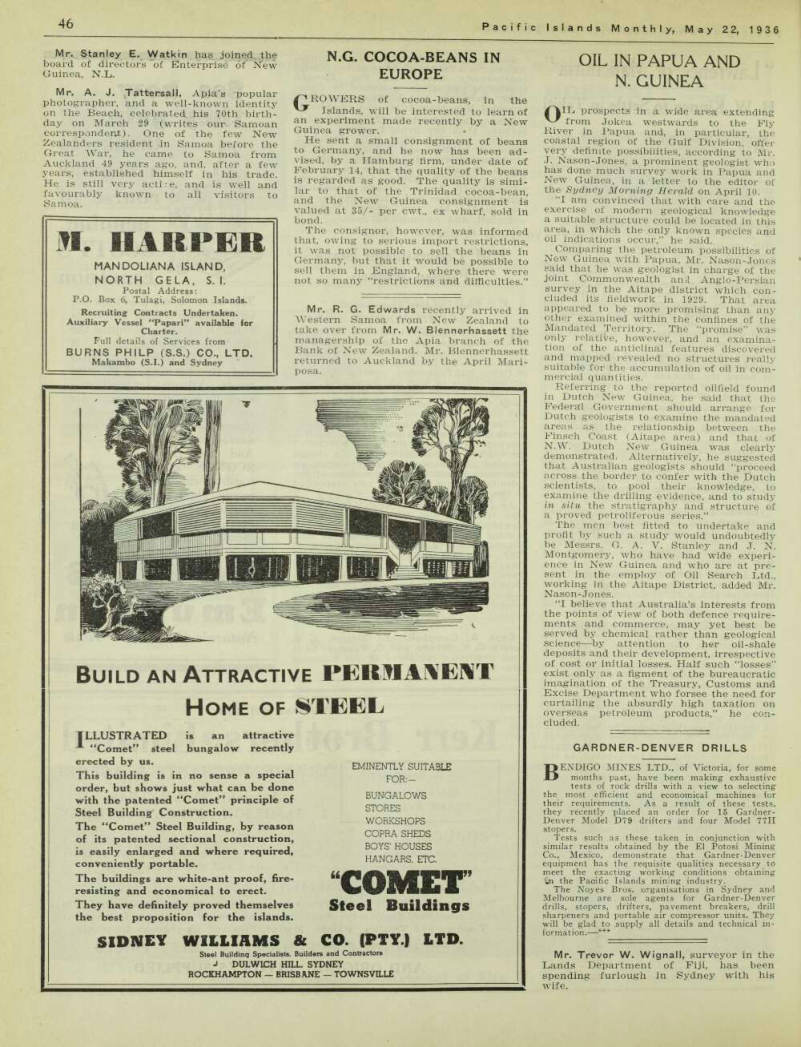
Papuan Women
From Our Own Correspondent
Pt. Moresby, April 6.
Mrs. H. Granville And Miss D.
Irwin, the two women who nobly went to the assistance of their sick neigh bour, Mrs. W. Blundell, in the east end of Papua last September, under exceptional circumstances of bravery, have been con gratulated by the Prime Minister of Aus tralia (Mr. J. A. Lyons) for their courage and enterprise.
“The courageous qualities displayed,” wrote Mr. Lyons, “in undertaking such a journey through the night are worthy of the highest commendation. ... I should be glad if you would kindly accept an expression of my keen appreciation of the splendid manner in which you responded to the call for assistance.”
As reported in this journal last year, Mrs. Granville and Miss Irwin, living at Mogubu Plantation, off Amazon Bay, on hearing news of the serious illness of Mrs.
Blundell, wife of the manager of Mamai Plantation, Port Glasgow (35 miles distant) travelled throughout the night over ex tremely difficult country to assist her.
Happily they arrived in time to save the patient from the dreaded disease of Papua —blackwater fever.
Capt. A. Campbell, and Messrs. J. S.
Spiers, C. V. Widdy, and C. Younger have been appointed members of the Solomon Islands Agricultural Committee.
Mr. Stanley E. Watkin has joined the board of directors of Enterprise of New Guinea, N.L.
Mr. A. J. Tattersall, Apia’s popular photographer, and a well-known identity on the Beach, celebrated his 70th birth day on March 29 (w'rites our Samoan correspondent). One of the few New Zealanders resident in Samoa before the Great War, he came to Samoa from Auckland 49 years ago, and, after a few years, established himself in his trade.
He is still very actire, and is well and favourably known to all visitors to Samoa.
Advertisements & other items, pp. 47-48 (1 item)
Kerr Brothers Limited
See how
they gain
thanks to
a regular
course of
genuine
SCOTT’S
Emulsion
This world-famous food tonic not only puts on weight but keeps children fit and well during the dangerous growing years. It supplies just those tonic extras that the growing child most needs. Vitamins for health and strength. Fats and food elements for body-building. Hypophosphites for nerve and bone development.
And all the lime SCOTT’S Emulsion wards off children’s ailments, chest troubles, coughs and colds. But, because their health means so much to you, insist on genuine
SCOTT'S
Emulsion
Nature’s Own Food Tonic
Established N.H. 1894
Kerr Brothers Limited
ISLAND MERCHANTS & AGENTS
Assembly Hall Building,
1 JAMIESON STREET, SYDNEY
PRODUCE:
Cacao, Coffee, Copra, Peanuts, Shell: Ship to us for best returns. Produce shipped overseas on behalf of clients and may be drawn on.
PLANTATION REQUIREMENTS:
We have over 40 years’ experience to help you. Agents for Cacao, Coffee and Castor Seed Machinery; Agricultural Implements and Power Cultivators; Tractors and Trailers; Paints; Marine, Fire and Earthquake Insurance.
MERCHANDISE PURCHASED AT BEST PRICES
AND ORIGINAL INVOICES SUPPLIED
G.P.O. Box 3838 T
Cable Address:
“CARE SYDNEY”
1. HARPER
MANDOLIANA ISLAND,
NORTH GELA, S. I.
Postal Address: P.O. Box 6, Tulagi, Solomon Islands.
Recruiting Contracts Undertaken.
Auxiliary Vessel “Papari” available for Charter.
Full details of Services from
BURNS PHILP (S.S.) CO., LTD.
Makambo (5.1.) and Sydney
Si
Build an Attractive PERMANENT
Home of STEEL
TLLUSTRATED is an attractive “Comet” steel bungalow recently erected by us.
This building is in no sense a special order, but shows just what can be done with the patented “Comet” principle of Steel Building Construction.
The “Comet” Steel Building, by reason of its patented sectional construction, is easily enlarged and where required, conveniently portable.
The buildings are white-ant proof, fireresisting and economical to erect.
They have definitely proved themselves the best proposition for the islands.
EMINENTLY SUITABLE
FOR:-
BUNGALOWS
STORES
WORKSHOPS
COPRA SHEDS
BOYS' HOUSES
HANGARS, ETC.
“COMET’
Steel Buildings
SIDNEY WILLIAMS & CO. (PTY.) LTD.
Steel Building Specialists, Builders and Contractors
J DULWICH HILL. SYDNEY
ROCKHAMPTON BRISBANE TOWNSVILLE
N.G. Cocoa-Beans In
Europe
ROWERS of cocoa-beans, in the Islands, will be Interested to learn of an experiment made recently by a New Guinea grower.
He sent a small consignment of beans to Germany, and he now has been ad vised, by a Hamburg firm, under date of February 14, that the quality of the beans is regarded as good. The quality is simi lar to that of the Trinidad cocoa-bean, and the New Guinea consignment is valued at 35/- per cwt., ex wharf, sold in bond.
The consignor, however, was informed that, owing to serious import restrictions, it was not possible to sell the beans in Germany, but that it would be possible to sell them in England, where there were not so many “restrictions and difficulties.”
Mr. R. G. Edwards recently arrived in Western Samoa from New Zealand to take over from Mr. W. Blennerhassett the managership of the Apia branch of the Bank of New Zealand. Mr. Blennerhassett returned to Auckland by the April Mari posa.
N. Guinea
Oil In Papua And
prospects in a wide area extending ” from Jokea westwards to the Fly River in Papua and, in particular, the coastal region of the Gulf Division, offer very definite possibilities, according to Mr.
J. Nason-Jones, a prominent geologist who has done much survey work in Papua and New Guinea, in a letter to the editor of the Sydney Morning Herald on April 10.
“I am convinced that with care and the exercise of modern geological knowledge a suitable structure could be located in this area, in which the only known species and oil indications occur,” he said.
Comparing the petroleum possibilities of New Guinea with Papua, Mr. Nason-Jones said that he was geologist in charge of the joint Commonwealth anil Anglo-Persian survey in the Aitape district which con cluded its fieldwork in 1929. That area appeared to be more promising than any other examined within the confines of the Mandated Territory. The “promise” was only relative, however, and an examina tion of the anticlinal features discovered and mapped revealed no structures really suitable for the accumulation of oil in com mercial quantities.
Referring to the reported oilfield found in Dutch New Guinea, he said that the Federal Government should arrange for Dutch geologists to examine the mandated areas as the relationship between the Finsch Coast (Aitape area) and that of N.W. Dutch New Guinea was clearly demonstrated. Alternatively, he suggested that Australian geologists should “proceed across the border to confer with the Dutch scientists, to pool their knowledge, to examine the drilling evidence, and to study in situ the stratigraphy and structure of a proved petroliferous series.”
The men best fitted to undertake and profit by such a study would undoubtedly be Messrs. G. A. V. Stanley and J. N.
Montgomery, who have had wide experi ence in New Guinea and who are at pre sent in the employ of Oil Search Ltd., working in the Aitape District, added Mr.
Nason-Jones.
“I believe that Australia’s interests from the points of view of both defence require ments and commerce, may yet best be served by chemical rather than geological science—by attention to her oil-shale deposits and their development, irrespective of cost or initial losses. Half such “losses” exist only as a figment of the bureaucratic imagination of the Treasury, Customs and Excise Department who forsee the need for curtailing the absurdly high taxation on overseas petroleum products,” he con cluded.
Gardner-Denver Drills
BENDIGO MINES LTD., of Victoria, for some months past, have been making exhaustive tests of rock drills with a view to selecting the most efficient and economical machines for their requirements. As a result of these tests, they recently placed an order for 15 Gardner - Denver Model D 79 drifters and four Model 77H stopers.
Tests such as these taken in conjunction with similar results obtained by the El Potosi Mining Co., Mexico, demonstrate that Gardner-Denver equipment has the requisite qualities necessary to meet the exacting working conditions obtaining \in the Pacific Islands mining industry.
The Noyes Bros, organisations in Sydney and Melbourne are sole agents for Gardner-Denver drills, stopers, drifters, pavement breakers, drill sharpeners and portable air compressor units. They will be glad to supply all details and technical in formation.—*** Mr. Trevor W. Wignall, surveyor in the Lands Department of Fiji, has been spending furlough in Sydney with his wife.
How Chinese Were Killed And Eaten
Horrible Story of Papuan Cannibalism in the ’Fifties
THE story of the ship-wrecked Chinese, whom the Papuans fattened and ate as required, has become almost a legend, and has been somewhat discredited.
Therefore, we are under an obligation to Dr. C. M. Deland, of New Guinea, who very kindly has sent to tis a newspaper cutting which he received from his father —and the latter, in turn, found it in an old book of newspaper cuttings. It is from the Adelaide Register of February, 1859, which newspaper had copied it from the “Sydney Morning Herald,” and it is as follows: Chinese passenger of the St. Paul, who was rescued by the steamer Styx, and arrived on Tuesday, has furnished us with the following account of the massacre of the Chinese passengers by the St. Paul, wrecked on Rossel Island, through the medium of Mr. H. Leau Appa, who acted as interpreter.
“The ship went on shore during the night, and when she struck the passengers all rushed on deck, making a great out cry, upon which the captain drove them all below again. When daylight broke, we landed by means of the boats on an island, where we remained two days with out any water, when some of us went on board the ship again to get some, as also provisions.
“The captain left in his boat with some of the crew, and we were not disturbed by the natives for a month after he was gone. Then they came over from the
mainland, distant about three-quarters of a mile, and made an attack on us.
“Some of us had double-barrelled car bines, but we got frightened, and threw them away. The only white man with us, after the departure of Captain Pennard, was a Greek, who, having armed himself with a cutlass, fought desperately, and killed a great many of the natives before he was overpowered.
“They then took all our clothing, etc., which they partly destroyed. Any valu ables that they found, such as sovereigns, rings, etc., they placed in a net bag which each man carried round his neck. A watch particularly excited their attention, as they were continually opening it to observe the reflection of their faces in the glass.
“At night, we were placed in the centre of a clear piece of ground, and fires lighted in several places, the natives keeping a regular watch over us.
“During the day, they would select four or five Chinese and, after killing them, roast the flesh, and eat it; what was not consumed being deposited in their nets.
“Their mode of proceeding was as fol lows: The victims being decided on, they were taken out, and beaten all over (ex cepting the head), with a kind of club, and then dispatched by ripping the stomach open. The body was then cut up in small pieces, and divided —the fingers, toes, and brains being eagerly sought after. The bones were then collected, and either burnt or thrown away.
“I saw 10 of my fellow-passengers killed in this way.
“On one occasion, some of the Chinese took a boat which belonged to the ship, and went over to the mainland at night to get some water, but never returned, so we thought they had been killed.
“Every day they brought us coconuts, or some wild roots to eat, and appeared to be quite friendly with us. This state of things continued until I was taken off the island.
“When I left there were only four Chinese and the Greek alive, all the rest having been killed. I saw these five the day the steamer came in sight, but when the natives saw the boats coming on shore, they took them up the mountains.
“I was sick and lame, and they would not carry me, so that I watched my oppor tunity and contrived to conceal myself among the rocks until the boat came on shore.
“They are very numerous, but do not appear to have any chiefs among them.
They live on coconuts, of which there are large quantities, and a kind of yam, which they roast before eating. But be yond a few dogs I saw neither animals nor fowls of any kind.”
The narrator of the above horrible de tails is quite a young man, particularly intelligent in appearance. Several of his relations were on board, but all have perished.
Captain Pennard, of the St. Paul, came up in the Styx. He states that he was 62 or 63 days on board the Prince of Den mark before being landed at New Cale donia: that he begged of Captain McKeller to take him to some place at once so as to obtain assistance, but he refused to do so, giving as a reason that he had a party at an island gathering beche-de-mer, who would be out of provisions did he not attend to them first.
Mr. and Mrs. Frank May, of the Abo riginal Industries’ store on Badu Island, Torres Strait, recently returned from lengthy furlough in Australia.
Captain Musick, who commanded the Pan-American Airways’ flying boat China Clipper on its first flight across the North Pacific Ocean from San Francisco tp Manila in November last, has been awarded the Hatmon Trophy for the “world’s outstanding feat of aviation.”
Advertisements & other items, pp. 49-50 (1 item)
Deutz Diesel Engines
V. H. Jones & Rickard
Electrical Engineers
525 ELIZABETH STREET
SYDNEY
Specialists in rewinding and repairing all classes and sizes of electrical machines and equipment.
Special treatment given to work for the tropics.
TELEPHONE: MA 1397
DEUTZ DIESEL ENGINES
DEUTZ ENGINES USED INTERNATIONALLY SINCE 1864
MARINE “OM ” TYPE INDUSTRIAL TYPE “VM” a
DEUT I
■i
iitiliftilPi
Range from 10 to 140 B.H.P.
Range from 10 to 2000 B.H.P.
Full information obtainable from the Agents
HERBERT DEL COTT PTY. LTD.
116 Queen Street, Melbourne 'Phone: Central 10488.
Cables “Voltage" 15 Castlereagh Street, Sydney 'Phone: B 3135.
Timber Joinery
ETC.
PREPARED BUILDINGS
ready for erection a speciality.
SHIP and BOAT BUILDING
TIMBERS specially catered for
FI B ROLITE, PLYWOODS,
GALVANISED IRON,
CANEC.
O CONSIGNMENTS shipped
by RETURN STEAMERS
to the Islands.
John W. Eaton Ltd.
WEST CRESCENT ST.,
NORTH SYDNEY
TELEPHONES: X 6051 <5 line,)
BITUMENOID ROOFING
MADE IN AUSTRALIA
Bitumenoid Roofings, Dampcourses and Insulating Felts are made from the world’s best raw materials. Warranted to stand the most rigid tests.
BITUMENOID THE BEST
Roofing. 1, 2. 3-ply; Flooring, Waterproof Materials; Saturated Felt; Resilient Road Jointing; Natural Asphalt Dampcourse; 2 and 3-ply Dampcourse; l-21b. Lead-core Dampcourse; Roofing Cement; Asphalt Paints; Roofing Compound,
SAMPLES AND PRICE LISTS ON APPLICATION
MAXWELL PORTER & SON LTD.
, ESTABLISHED 1888. BUILDERS’ SUPPLIES
107 REDFERN ST., REDFERN, SYDNEY, N.S.W. ’Phone, M 3157. Cables Bitumenoid
4#
Ram and .
as destructive to
Wood it ork as Fire!
Rain and dew cause unprotected woodwork to swell. The sun makes it shrink again.
Unprotected woodwork is in a state of constant movement which affects the joints and also causes cracks which become centres for decay. Prevent the decay of YOUR property!—coat it with a paint that WILL protect it against rain and sun.
Use only—
FERRODOR
First give woodwork (and ironwork) a priming coat of FERRODOR NO. 29 NATURAL STEEL GREY, then follow it up with any of the 25 modern FERRODOR
PAINT
(. ANTI-
CORROSIVE)
colours which are supplied in paste form or ready to use.
Obtain FERRODOR PAINT (colour card on request) at all leading merchants or the Sole Agents—
WILLIAM ADAMS &. COMPANY
175 CLARENCE STREET, SYDNEY
Bus Crashes Into
River
Samoan Youth Killed
From Our Own Correspondent APIA, April 13.
CRASHING through a wooden railing on the Letogo Bridge, the passenger motor bus No. 3, owned by the Gold Star Transport Co., fell into the river on April 6. A native youth Patioli, 19, of Solo Solo village, was killed instantaneously. The driver Su’a Tuitaufusi, sustained a broken rib, and a passenger a broken arm.
The bus had left Apia for Falefa, on the coast east of Apia, with 18 passen gers, including Captain C. Doughty, of the B.P. vessel Makoa, and Father J. B.
Doumeizel of the R.C. Mission. After passing through the Reparation Estates plantation at Vailele, it reached the steep incline of a hill, at the foot of which the road turns on to a small wooden bridge over the Letogo River, flowing into the sea. Apparently the vehicle gained im petus down the hill and the driver turned on to the bridge a bit too late. The heavy bus raced through the railing and shot into the river, which though almost at full tide was not very deep at this particular place.
Captain Doughty and those who had escaped injury pulled the survivors from the debris and out of the river. The whole of the superstructure of the bus was torn off and smashed to matchwork.
The unfortunate passengers, who were drenched to the skin and mostly suffer ing from cold, had lost all their belong ings and provisions. They were taken back to Apia, where the injured received hospital treatment.
The driver has had 20 years’ experience as a driver, but had lately, on receiving a chief’s title, retired from work and gone to his plantation at Fasitto. This was his first trip since he resumed \Vork after a lengthy rest. His wife, who was also a passenger on the unlucky trip, is Fa’agase, a Safune (Savaii) girl, who was the heroine of the famous Flaherty film “Moana of the South Seas.”
British Shipping in the Pacific
IVTARC T. GREENE, American news paper correspondent, writing re cently from Marseilles says: I should be glad to be quoted in your magazine as agreeing most heartily with your comments (October issue) on the actions of the Australian Seamen’s Union, and as expressing my admiration of your courageous criticism of an ini quitous situation.
When I first visited Australia 11 years ago it was at the time of a strike which had tied up some thirty overseas ships in Sydney harbour and was causing untold losses to all sorts of interests. I ob served there something of the work of the stupid, bullying, ignorant Australian labour leaders, especially the leaders of the maritime workers.
I have observed more of it many times since then, and apparently it is still going on. That being the case, your suggestion as to the measures suitable to be taken with the type of human being who most resembles that despised of all animals, the hyena, is sound and pertinent.
To Manufacture Paper Pulp
in Papua £3,000,000 Project for Kurukuru Grass
DOCUMENTS were lodged with the Registrar of Companies at Canberra on April 28 for the registration of British Australian Pulp and Paper Co. Ltd., with a nominal capital of £3,000,000 to erect pulp mills and manufacture paper pulp from the Kurukuru grasses of Papua and New Guinea, both for export overseas and for use in Australia, and to manufacture fine writings and printings in Australia.
This flotation is the outcome of the activities of a series of companies which have been interesting themselves in the two territories —especially Papua—for years past, but without achieving anything notable in the way of developmental enter prise or production. As far as we are aware the interests which have combined to register this £3,000,000 company are: Commonwealth Hemp Corporation Ltd., registered in Sydney, which at one time had a plan to grow sisal hemp in Papua; Fibres Limited, which was registered in Papua; and British Australian Fibre Co.
Ltd., which was registered in New Guinea.
The new company is registered in Can berra.
Particulars of these companies were pub lished in the March issue of the Pacific Islands Monthly.
Mr. P. R. Higgins (chairman of Standard Portland Cement Ltd.), who will be chair man of the new company, told the news papers that the first issue of £1,000,000 for
the erection and working of the pulping plant in Papua and for paper mills at Port Stephens, N.S.W., is entirely reserved for overseas interests which are behind the enterprise. There will be no issue of shares in Australia.
During the last two years developmental work has taken place by the parties con cerned with the use of Kurukuru grass produced in the Territories for the manu facture of paper pulp. It is claimed that it has now been proved that pulp suitable for the manufacture of fine writings and printings of the highest quality and simi lar to esparto papers can be manufactured from this grass.
Lands required have been secured from the Administration of Papua, and include 45,000 acres at Collingwood Bay, in the north-eastern division. These lands are sufficient, it is claimed, for the establish ment of at least three units of plant, pro ducing an output of 60,000 tons of pulp a year. Extensive areas in the Mandated Territory have been surveyed, and are in course of being secured for extension.
The company’s engineers are said to be at present engaged in preparing the final plans and specifications of plant, in con junction, it is added, with one of the oldest and most distinguished firms of paper engineers in Great Britain. The company’s output will be used largely for export to paper manufacturers in other countries.
The company says that it has, in addi tion, however, secured 690 acres of land at Port Stephens for the establishment of paper mills for the manufacture of fine writings and printings, and proposes as a section of its undertaking to manufacture this class of paper for the Australian market.
In view of the cheap cost of production of the pulp in Papua, those concerned with the incorporation of the company state that the Commonwealth Government has been
informed that no tariff protection, bounty or Governmental assistance will be sought for the establishment of the industry.
The company itself will be a holding company. Operations will be carried out by subsidiary companies.
Subscribers are: A. G. White, of Scone, grazier; A. H. Stevenson, Forbes, grazier; H. H, White, Mudgee, grazier; E. R.
White, Sydney, grazier; A. J. McLachlan, Sydney, solicitor; G. S. Holburn, Gordon, company director; G. L. Sly, Rose Bay. company director; W. J. Fullerton, Neutral Bay, company director; H. H. White, Den man, grazier; F. Bragg, Aberdeen, grazier: M. Scott, Narromine, grazier; J. M. Camp bell, Mendooran, grazier; A. Banks, Syd ney, law agent (Scotland); P. R. Higgins, Rose Bay, barrister; M. Spiegel, Sydney, company director; and Johnston Tait.
Croydon, paper engineer.
Mr. Erich Retzlaff, a pioneer German planter of Samoa, left Apia recently by the Nordic to spend his first holiday in the Fatherland for 23 years.
Mr. William Heinike, of Wau, New Guinea, married Miss Juanita Wilde, youngest daughter of C. B. L. Wilde, an old identity of the Territory, during April, Rev. V. H. Sherwin performed the ceremony.
Advertisements & other items, p. 51 (1 item)
Fetter c Zt Engines
SAMUEL RUSSELL
ESTATE AND GENERAL AGENT
P.O. Box 64, Papeete, Tahiti
Real Estate. Investments. Estate Management and Administration. Valuations and Reports. Houses & Lands for Lease or Sale.
Sole Proprietor: TAHITI PERFUMES.
Cables: Russell. Tahiti (Bentley’s Code)
IP sfi ■ I 1 i i y
Simple and Trustworthy
fjpß LIST WORTH I NESS is the characteristic which has always been a feature of PETTER
DIESEL ENGINES.
Of extremely simple design—yet robust in construction, they operate at low speeds and have long life free from trouble.
Accessibility is a feature of these engines.
Fetter c Zt Engines
ATOMIC-DIESEL SEMI-DIESEL
Marine or Stationary
BUZACOTT
7-11 MARKET STREET
A One-Man Saw
r J'H IS Saw will cut all types of timber. It cuts clean to the ground and is of the simplest possible construction.
No gears or intricate friction clutches, and one person can handle it.
For timber work anywhere it is unrivalled. Write for particulars.
THE “BUZACOTT”
A i
DRAG SAW
& CO. LTD.
SYDNEY AUSTRALIA
Capt. Stephens’ Big ’Plane
Delayed In Papua
From Our Own Correspondent WAU, April 20.
CAPTAIN E. J. Stephens received a warm welcome on April 16, when he arrived at Wau with his Co.’s three engined Handley-Page “City of Adelaide,” previously the property of West Austra lian Airways. Mr. Stephens flew the machine from Perth, calling at Adelaide, Melbourne, Sydney, Cootamundra, Towns ville, Cairns, Somerset (Cape York), and Port Moresby.
Mr. Stephens had taken off for a direct flight from Somerset to Wau, but owing to bad weather was forced to turn back within a short distance of the landing ground, and make for Port Moresby.
Heavy weather delayed his departure for New Guinea for two days.
This new machine is capable of carry ing 18 passengers. It has a wing span of over 79 feet and the top wings are 18 feet from the ground.
The Stephens Co.’s “Apollo” will soon be ready to take the air again after re ceiving attention in the workshop for many weeks, as the result of striking a trestle when taxi-ing into the hangar.
Crusoe Of The North
Billy Turnbull of Hicks Island
DURING April Mr. W. (Billy) Turnbull, lessee of Hicks Island, off Cape York Peninsula, announced that if Japanese poachers did not cease their activities in his part of northern Australia, residents would have to use firearms.
“Billy Turnbull is a tall, thin Australian, with a drawl and a slow smile, known throughout the Coral Sea as the Crusoe of Hicks Island,’’ wrote Mr. lon L. Idriess in the Melbourne Herald on April 22. “He is a quiet chap, well educated, and a kindly man. Together in other years, he and I have often watched strange craft sail by his lonely island.
“When I visited Hicks Island Billy had just found a sapphire mine, but they were very few and very small, and so he went back to his coconut growing and his ex perimental sheep and garden. His idea was to form an Australian coconut plan tation, and while the trees were maturing to grow produce for the pearling fleets of Thursday Island. He also had a cutter, and before it was wrecked used to collect trochus from the reefs, with an occasional lucky find of pearl shell.
“Billy’s little castle on the sea is a tiny house built on stilts. It is painted white, and peeps out from among the dark green mangroves on the tiniest of beaches. The high tides creep up under the house, and with them sometimes a big crocodile.
“It is a lonely group, the Home Group.
A cluster of little islets about 12 miles from the mainland of Cape York Peninsula.
No whites on the mainland, Billy’s only company a few nomad aboriginals who would occasionally canoe across, and a South Sea Islander on Haggerston Island a few miles away. The nearest settlement is Thursday Is., about 100 miles north.”
Isolation For Puka Puka
From Our Own Correspondent APIA, April 13.
A NEW ZEALAND Order-in-Council has been passed abolishing Apia as port of entry for the island of Puka Puka, which belongs to the Cook Group.
Puka Puka has been served by vessels belonging to Messrs. Burns Philp (S.S.) Co’s Apia branch, which vessels called at Puka Puka two or three times a year, selling goods and loading copra. The store on the island has been closed for a few years.
The Makoa will make her last trip to Puka Puka at the end of April.
Tidal Waves Hit Nauru
A T the end of February the Elmbank en route to Nauru from Australia was delayed several days by a terrific cyclone. When she arrived there the mail could not be landed, as although the sea had calmed down and was like a mill pond, a most extraordinary series of tidal ■waves suddenly developed.
One particularly high wave- completely filled the boat harbour, sinking a launch and cargo lighter. It ran inshore for 150 yards further than any other wave had been for many years. The tidal waves washed a number of cook houses from Chinatown into the ocean.
Advertisements & other items, p. 52 (1 item)
CKeeps on Keep on .
f ( P R E P A R E D) CKeeps on Keep on .
AGENTS THROUGHOUT THE ISLANDS
/ if
BUILD A MODERN HOME WITH
TTi
8 9 9 c I ft ft
ASBESTOS CEMENT BUILDING SHEETS
Low cost with good appearance and endurance is assured when you specify Durabestos for walls and ceilings in new buildings or for additions or repairs to existing structures.
Write for literature illustrating the new horizontal application of Durabestos, in modern buildings.
WUNDERLICH LTD.,
Crown and Cleveland Sts., Redfern SYDNEY Durabestos does not require skilled labour to erect, and is most suitable for tropical dwellings. ouy
B6.DS
Western Samoa’S Trade Recovery
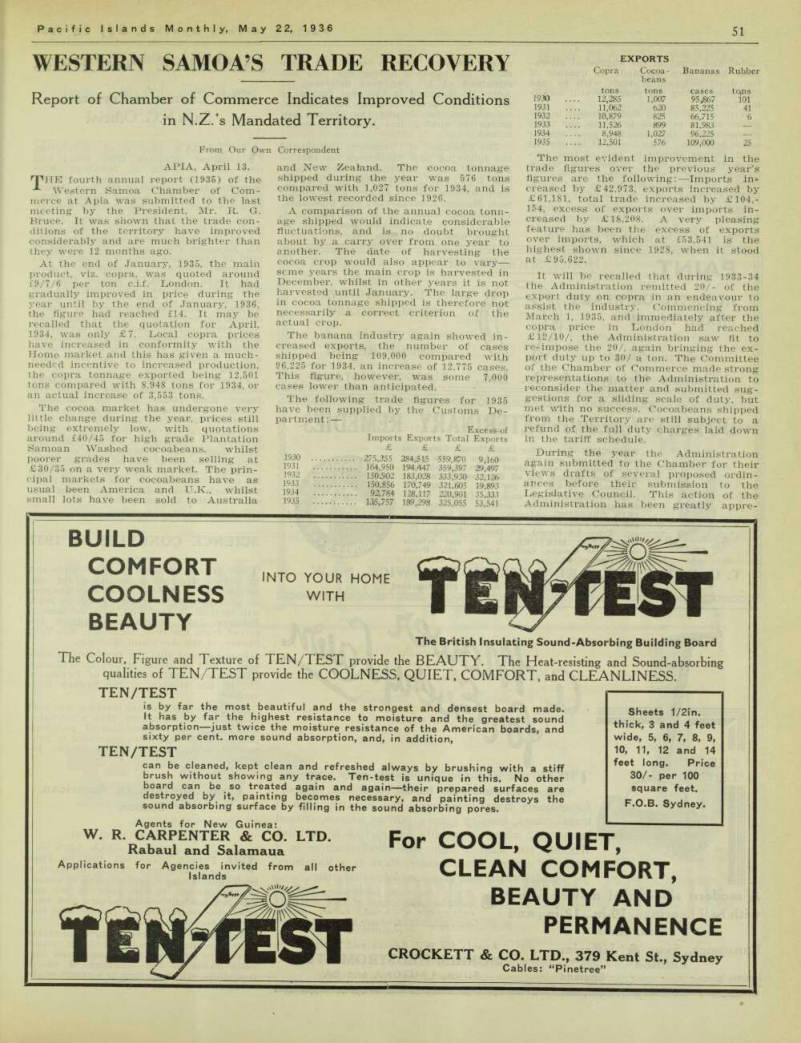
Report of Chamber of Commerce Indicates Improved Conditions in N.Z.’s Mandated Territory.
From Our Own Correspondent
APIA, April 13. fourth annual report (1935) of the Western Samoa Chamber of Com merce at Apia was submitted to the last meeting by the President, Mr. R. G.
Bruce. It was shown that the trade con ditions of the territory have improved considerably and are much brighter than they were 12 months ago.
At the end of January, 1935, the main product, viz. copra, was quoted around £9/7/6 per ton c.i.f. London. It had gradually improved in price during the year until by the end of January, 1936, the figure had reached £l4. It may be recalled that the quotation for April, 1934, was only £7. Local copra prices have increased in conformity with the Home market and this has given a much needed incentive to increased production, the copra tonnage exported being 12,501 tons compared with 8,948 tons for 1934, or an actual increase of 3,553 tons.
The cocoa market has undergone very little change during the year, prices still being extremely low, with quotations around £4O/45 for high grade Plantation Samoan Washed cocoabeans, whilst poorer grades have been selling at £3O/35 on a very weak market. The prin cipal markets for cocoabeans have as usual been America and U.K., whilst small lots have been sold to Australia
and New Zealand. The cocoa tonnage shipped during the year was 576 tons compared with 1,027 tons for 1934, and is the lowest recorded since 1926.
A comparison of the annual cocoa tonn age shipped would indicate considerable fluctuations, and is no doubt brought about by a carry over from one year to another. The date of harvesting the cocoa crop would also appear to vary— seme years the main crop is harvested in December, whilst in other years it is not harvested until January. The large drop in cocoa tonnage shipped is therefore not necessarily a correct criterion of the actual crop.
The banana industry again showed in creased exports, the number of cases shipped being 109,000 compared with 96,225 for 1934, an increase of 12,775 cases.
This figure, however, was some 7,000 cases lower than anticipated.
The following trade figures for 1935 have been supplied by the Customs De partment :
The most evident improvement in the trade figures over the previous year’s figures are the following:—lmports in creased by £42,973, exports increased by £61,181, total trade increased by £104,- 154, excess of exports over imports in creased by £18,208. A very pleasing feature has been the excess of exports over imports, which at £53,541 is the highest shown since 1928, when it stood at £95,622.
It will be recalled that during 1933-34 the Administration remitted 20/- of the export duty on copra in an endeavour to assist the industry. Commencing from March 1, 1935, and immediately after the copra price in London had reached £l2/10/, the Administration saw fit to re-impose the 20/, again bringing the ex port duty up to 30/ a ton. The Committee of the Chamber of Commerce made strong representations to the Administration to reconsider the matter and submitted sug gestions for a sliding scale of duty, but met with no success. Cocoabeans shipped from the Territory are still subject to a refund of the full duty charges laid down in the tariff schedule.
During the year the Administration again submitted to the Chamber for their views drafts of several proposed ordin ances before their submission to the Legislative Council. This action of the Administration has been greatly appre
Excess of Imports Exports Total Exports £ £ £ £ 1930 275,355 284.515 559,870 9,160 1931 164.950 194.447 359,397 29,497 1932 150.902 183,028 333,930 32.126 1933 150.856 170,749 321,605 19,893 1934 93,784 128,117 220,901 35,333 1935 135,757 189,298 325,055 53,541
Exports
Copra Cocoabeans Bananas Rubber tons tons cases to>ns 1930 12,285 1,007 95j867 101 1931 11,062 620 85,225 41 1932 10,879 825 66,715 6 1933 11,526 899 81,983 1934 8,948 1,027 96,225 1935 12,501 576 109,000 25
ciated and many of the suggested altera tions have been adopted. A number of the draft ordinances dealt with by the Chamber during the year are still await ing finality.
With an all-round improvement in the prices of our primary products, the trade prospects for the ensuing year appear much brighter. With copra at its present level, Samoa should be able to look for ward to much more prosperous times. exports will continue to be con trolled by the Administration and addi tional shipping space has been assured.
Owing to a rather severe storm during January this year, the banana crop has suffered considerably in some districts, and it is thought this will reduce ship
ments for some time to come. The price ruling for bananas during the year has remained at 4/6 per case delivered at Apia. It is hoped in the near future to see better prices ruling for Samoan cocoabeans, for despite the present low prices the quality has been well main tained.
The Chamber of Commerce has elected the following new executives for 1936;■ President, G. S. Chisholm;’ Vice-Presid ent, E. F. Paul; Secretary, N. Caldwell; Hon. Auditor, R. G. Bruce; Hon. Solici tors, Messrs. Klinkmueller and Pleasants; Committee, Messrs. I. H. Carruthers, A.
G. Smyth, P. Glover, D. Butler, R. H.
Brown, and R. G. Bruce.
Advertisements & other items, pp. 53-54 (1 item)
Clean Comfort,
BUILD
COMFORT
COOLNESS
BEAUTY
INTO YOUR HOME
WITH
o The British Insulating Sound-Absorbing Building Board The Colour, Figure and Texture of TFN/TEST provide the BEAUTY. The Heat-resisting and Sound-absorbing qualities of TEN/TEST provide the COOLNESS, QUIET. COMFORT, and CLEANLINESS.
TEN/TEST
is by far the most beautiful and the strongest and densest board made.
It has by far the highest resistance to moisture and the greatest sound absorption—just twice the moisture resistance of the American boards, and sixty per cent, more sound absorption, and, in addition,
TEN/TEST
can be cleaned, kept clean and refreshed always by brushing with a stiff brush without showing any trace. Ten-test is unique in this. No other board can be so treated again and again—their prepared surfaces are destroyed by it, painting becomes necessary, and painting destroys the sound absorbing surface by filling in the sound absorbing pores.
Agents for New Guinea: Sheets 1/2in. thick, 3 and 4 feet wide, 5,6, 7,8, 9, 10, 11, 12 and 14 feet long. Price 30/- per 100 square feet.
F. 0.8. Sydney.
W. R. CARPENTER & CO. LTD.
Rabaul and Salamaua Applications for Agencies invited from all other Islands O
For COOL, QUIET,
CLEAN COMFORT,
BEAUTY AND
PERMANENCE
CROCKETT & CO. LTD., 379 Kent St., Sydney Cables: “Pinetree”
PAINT
HORSE SHOE BRAND
IN PASTE OR READY
MIXED FORM
WHITE LEAD, WHITE ZINC.
AND ALL COLOURS
Made in Scotland — Thomas Mcintyre & Co. Ltd., —therefore Reliable!
GLASGOW, SCOTLAND
DOYLE’S famous VETERINARY REMEDIES
REDUCINE— Cures Your Lame Horse. Cures him painlessly and you can work him all the time.
Cures Splints, Curbs, Capped Hocks, Sprung Tendons, Bog Spavins, and all Bony and Bursal Enlargments. Price, 12/6 per can. Postage 1/-.
V LARYNGINEI—A sure cure for Coughs, Colds, . Strangles, etc. Price, 5/- per can. Postage, 1/-. • SKIN DRESSING.—A certain remedy for Mange • ' and Allied Parasitic Skin Diseases in Horses, Dogs, etc. Price, 7/6 (large), 3/6 (small). Postage, 1/-.
DISTEMPER MIXTURE.—A safe and reliable remedy for Coughs, Colds, Asthma, etc. Price, 2/6. Postage, 9d.
T. G. DOYLE, V.S., 9 KING STREET, RANDWICK, N.S.W.
Write for Free Veterinary Advice and Booklet oOYLe* K
ORES?
THE
LEO”
'X'HERE is a Ransomes’ Mower for every lawn —our range covers machines for all conditions, not only for ordinary lawns of all sizes, but for areas such as tennis courts, bowling greens, putting courses, croquet lawns, etc., where a specially fine surface is essential.
Whether you want a light side-wheel machine or a petrol or electric motor mower, there is a Ransomes’ model which will give complete satisfaction.
A mnrlprn side-wheel mower fitted a Write for full particulars of this A modern siae-wneet mower mtea £ mac hine and copy of our complete with ball bearings, 10-in., 12-in., and catalogue of hand, horse , vetrol, J electric and tractor mowers for all 14-in. sizes. conditions.
Ransomes, Sims & Jefferies Agents for Fiji, Samoa and Tonga:
Limited MORRIS, HEDSTROM LTD.
Ipswich - - - England SUVA, LAUTOKA and BA
Japanese Poachers
Little Chance of Prevention, Says N.G. Official
AUSTRALIA’S chance of preventing Japanese sampans from pearl and pearl-shell poaching in Northern Aus tralian waters are extremely remote, according to an official of the New Guinea Public Service, who passed through Bris bane on April 20 by the steamer Nankin.
The official, who recently visited Japan, said that as a result of the action taken by the Dutch in seizing sampans recently, the Japanese Government was bound to take an aggressive stand if a sampan was put under restraint in Australian waters.
At Osaka, he said, he learned that the pearl fishing company whose sampans had been operating off New Guinea and North Australia, was delighted with the results of their enterprise, and it openly announced that revenue from pearl and pearl-shell harvests from these regions had enabled the company to convert a debit balance into a substantial profit for last year’s workings.
Japanese poachers had been causing continual trouble for years around the Dutch East Indies and the Philippine Islands. Protesting merely seemed to bring about an increase in poaching.
Commenting on the destruction of the property of residents of Purdy Island, off New Guinea, last February, by crews of sampans, the official said he had been given to understand that this was in revenge for the action taken in New Guinea, some years ago, when a Japanese sampan was seized by the Administration.
Science Congress In 1937
THE next meeting of the Australian and New Zealand Association for the Advancement of Science, at which papers on anthropology (Section F) will be read, will be held at Auckland, New Zealand in January, 1937, according to advice re ceived from the Hon. Secretary, Mr. V. F.
Fisher, of the Auckland Museum.
It is believed that the President of Sec tion F will be either Mr. F. E. Williams, Government anthropologist of Papua or Dr. H. lan Hogbin, of the Sydney Uni versity.
The Association’s last meeting was held in Melbourne in January, 1935, when valu able papers on anthropological problems and research work were presented by pro minent field workers in the Pacific Is lands.
Food Shortage In American
Samoa
From Our Own Correspondent APIA, April 13.
THE Tutuila, which left Apia for Pago Pago (American Samoa) on April 6, besides a shipment of four tons of cocoa beans, carried a full load of oil and Samoan foodstuffs—yams, taro and ban anas etc. —to relieve the famine now rul ing in American Samoa.
According to reports, Pago Pago stores have completely sold out their staple foodstuffs like flour, rice, sugar and bis cuits owing to the shortage of native foodstuffs, which in turn is a result of the ravages of the January storm.
From Papua
Lakekamu Field
Guinea Gold, N.L. Withdraws From Papua
THE attempt made by Guinea Gold N.L. to find payable gold in the Lakekamu district, Central Papua, has been aban doned.
The chairman of the company reported to a meeting of shareholders in Adelaide in March that the final verdict of Mr. G.
S. Dyer (an American engineer who had been engaged to report on the Papuan leases) was that the leases were too low in value to be worth development, and the leases accordingly had been surrendered.
Mr. Dyer disposed of the company’s test ing plant, and he left Papua in April to take up an engagement with a gold-mining company in Australia.
One sometimes hears it said that the rich gold companies are not sufficiently taxed by Governments —that they escape too easily with their easily-won profits.
The case of Guinea Gold N.L. in Papua is a good answer to such criticism.
The Adelaide company (which success fully pioneered the Bulolo goldfield) was assured by experts that the Lakekamu area was worthy of investigation; and,' after very careful consideration of all available data, it ear-marked a portion of its reserve funds for the work. The survey and testing were carried out in the most efficient manner, and the company satisfied itself thoroughly before it abandoned its enterprise that there was no country in this district carrying payable gold.
Having reached that decision, Guinea Gold N.L. withdrew its staff, sold or stored its valuable plant, and left Papua—and without a complaint. It had taken the
usual risk of a mining company, and in this case it lost.
It has received no vote of thanks —yet thanks are due to it because it has definitely proved that the Lakekamu area is valueless for big-scale operations. If it had not shown enterprise and courage in spending its money in this way the Papuan Government and scores of prospectors in the future might have been involved in further losses in seeking gold there.
Yet if Guinea Gold N.L. had found pay able gold in the Lakekamu, and reaped its due reward, various half-baked econo mists and politicians in Australia and else where would have sat around and cried aloud for heavy taxation “for those monopolistic capitalists.”
Mail Contract
No Tenders For Apia-Pago Pago Mail Contract
From Our Own Correspondent APIA, April 13.
Ij'Oß the mail contract between Apia, Western Samoa, and Pago Pago, American Samoa, to connect with the Matson liners, tenders had been called for the year starting April 1, 1936. No tenders have been received for the new period and mails, therefore, will have to be despatched by Government launches, if no other boats are available.
For the previous year, Messrs. Burns Philp (S.S.) Co. Ltd. held the contract, using the motor launch Tiafau, and later the Taumafni.
Mr. G. D. Casbolt, of Messrs. W. R.
Carpenter and Co. Ltd., Rabaul, New Guinea, arrived in Sydney on furlough by the Nankin on April 22.
New Plan Of Payment
New Guinea Planters Express Satisfaction
From Our Own Correspondent RABAUL, April 17.
GENERAL satisfaction is expressed by New Guinea planters at the success which has attended suggestions placed before the Commonwealth Government about the proposed method of payment on expropriated properties as from July 1, 1936.
The president of the Planters’ Associa tion (Mr. J. C. Mullaly) was mainly respon sible for placing lucid facts before the Treasurer of the Commonwealth, who has announced that payments will be based on a rate of £5 for every £l,OOO of principal, when copra is over £lO f.0.b., Rabaul, and an increase of £1 for every £1 rise in the copra price. Interest will commence at one per cent.
It is a sliding scale which should be able to be met by all planters without undue hardship.
Dr. and Mrs. C. Nicolas arrived in Sydney by the Laperouse on April 29 en route to France after residence in New Caledonia.
Advertisements & other items, p. 55 (1 item)
Mining Machinery
W. M. 1C Hi I)
C/o. Robert Reid & Co., Ltd.
32-34 YORK STREET, SYDNEY
Wholesale Exporter of Goods of all Classes frorp Australia
MINING MACHINERY
v:.
Improved Type Gravel Pump.
SEND YOUR ENQUIRIES TO—
of all classes, including—
Dredging and Sluicing Plants
Gravel and Water Pumps Elevators Nozzles Piping and Valves Mining Plants have been supplied to a number of Companies in New Guinea, and we are, therefore, fully conversant with local conditions. ► Hydraulic Elevator, with Swivelling Suction Pipe.
THOMPSON’S ENGINEERING & PIPE CO. LTD
CASTLEMAINE, VICTORIA
Cable Address: “THOMPSONS, CASTLEMAINE.”
SYDNEY OFFICE KEMBLA BUILDING 58 MARGARET STREET
Native Killed In Wau
Motor Accident
From Our Own Correspondent WAU, April 21.
MOTOR accident of a serious nature occurred on April 8 when a motor truck owned by Mr. Wally Corden and driven by a native, was conveying Major James and a party of natives to Wau with a cargo of gold from Edie Creek.
About 100 yards from Wau power house, the steering wheel of the truck failed to act, owing to a loose shackle.
After a preliminary wobble the truck careered down the steep slope at the edge of the road, turning a somersault in its descent before coming to rest on a heap of loose earth 150 feet from the road level.
Mr. James was taken to the European hospital suffering from shock and minor injuries. Three natives received treat ment in the native hospital, and one of them died later that night.
The gold was recovered from the undergrowth where it had fallen, by executives of New Guinea Goldfields Ltd., who were following in a car.
Mr. and Mrs. C. G. R. McKay returned to Apia from furlough in New Zealand by the April Maui Pomare. Mr. McKay is Secretary for Native Affairs in . the Samoan Administration.
Mr. M. H. Miller, who for the past six years has been engaged in survey work in Fiji, returned to Auckland by the Aorangi on April 13.
Tropical Medicine
New English Research Body
TN consultation with the British Colonial Office, the Medical Research Council has established a Tropical Medical Re search Committee. The new body will advise and assist in the direction of in vestigations into problems of health and disease in tropical climates, and make suggestions generally as to research in this field.
The committee will be a purely scientific body. It will include representatives of the Colonial Office and of the Liverpool and London Schools of Tropical Medicine, with other members appointed as indi vidual experts in tropical diseases.
The following will serve in the first in stance:— Professor J. C. G. Ledingham, C.M.G..
P.R.S. (chairman), Professor A. J. Clark, M.C., F.R.S., Dr. N. Hamilton Fairley, 0.8. E., Professor W. W. Jameson. Dr.
Edward Mellanby, F.R.S., Dr. Muriel Rob ertson, Major-General Sir Leonard Rogers, K.C.5.1., F.R.S., Dr. H. Harold Scott. Sir Thomas Stanton. K.C.M.G.. Dr.
C. M. Wenyon, C.M.G., F.R.S., Professor Warrington Yorke, F.R.S., and Dr. A.
Landsborough Thomson, C.B. (secretary).
Research in tropical medicine has al ways been of concern to the Medical Re search Council, whose constitutional position under a Committee of the Privy Council leaves its work unrestricted by territorial limitations. The council has. however, not hitherto been able to assist investigations in the tropics except on isolated occasions, although it has regu larly made grants for work in England in relation to tropical problems.
The step which is now announced indi cates an intention to talce a more active part in work in this field.
Result Of "Tiafau"
Inquiry In Samoa
From Our Own Correspondent APIA, April 9.
THE Commission of Inquiry into the -*• wreck of the motor launch Tiafau has submitted its finding to the Acting Administrator (Mr. A. C. Turnbull). The finding was not unanimous, one of the assessors dissenting.
It is reported that the finding charges the owners of the launch, Messrs. Burns Philp (S.S.) Co. Ltd. and also the master and the engineer with negligence. This verdict of the Commission is not in accordance with public opinion, which tends to put the responsibility for the disaster elsewhere.
It is understood that the matter has been submitted to the New Zealand Gov ernment for their decision, but no reply has been received so far. Messrs. Burns Philp are stated to be desirous of appeal ing against the finding, and may ask for a new inquiry, Mr. Basil W. Hill, barrister, of Wau, New Guinea, arrived in Sydney on holi days by the Macdhui on April 9.
Brigadier General W. Ramsay McNicoll, Administrator of New Guinea, accom panied by Mr. H. H. Page, Government Secretary, made a comprehensive tour of the Morobe goldfields area in April.
Advertisements & other items, p. 56 (1 item)
Paint
The
“Caledonia Dover”
A COOKING STOVE guaranteed to give complete satisfaction and now recognised as THE BEST on the market. Suitable for coal, coke, or wood fuel.
Illustrated Catalogue on request.
LANE & GIRVAN, LTD.
BONNY BRIDGE, SCOTLAND
*6 ■'UrLaaiLlL
IBNR
m
RECOMMENDED!
"SUN” Brand Paint on your Home means
definite PROTECTION against tropical
sun and sea-moist air.
Sun Proof and Rain Proof on every Surface
PAINT
W. R. CARPENTER & CO., LTD.
NEW GUINEA, SOLOMON ISLANDS
and all other South Sea Islands.
Tahiti’s Trade in 1935
Heavy Deficit Turned Into Good Surplus
From Our Own Correspondent PAPEETE, April 19.
THE commercial statistics of French Oceania for 1935, published in the Journal Official of March 16, disclose a total business of 50,177,000 francs, an in crease of 13,165,000 francs compared with 1934. The total merchandise handled also shows a substantial increase with 169,658 tons, being 46,698 tons more than 1934. Total importations in 1935 amounted to 24,503,000 francs, and exportations to 25,674,000 francs, thus leaving a commer cial balance in favour of the Colony of 1.171,000 francs as compared with a de ficit of 3,254,000 francs the previous year.
The principal sources of supply for in coming merchandise are shown in the following table:
Exportations, which showed an increase in value of 8,795,000 francs, and in tonn age of 51,243, over the 1934 figures, were sent principally to the following coun tries: —
In the report which accompanies the annual statistics the Chief of Customs remarks a progressive increase in the ex ports to Franc© during the past few years —in 1930 she took only 29.10 per cent, of the total, while in 1935 the percentage amounted to 57.26. This is accounted for to a large extent by the bonus on copra, the whole of which—2l.77B tons in 1935 went to France in vessels of the Mes sageries Maritimes Co.
Exports of vanilla—once an exceedingly remunerative crop—amounted to a mere 87 tons, valued at 2,458,000 francs in 1935, a diminution of 16 tons compared with 1934. In this connection it is encourag ing to note a substantial increase in the market value of this commodity, and it may be anticipated that this important factor will result in a renewed interest in vanilla plantations throughout the Is lands.
Another satisfactory feature of the export figures is a considerable increase in the amount of pearl shell exported from the Colony during 1935—396 tons valued at 723,000 francs against only 103 tons in 1934. The major portion of the 1935 output went to France.
Export of phosphate from Makatea Is land reached a total of 130,353 metric tons, the value of which is given as 7,876,000 francs. Here again a substan tial increase of 52,883 tons is recorded.
Japan took most of the 1935 production.
Other exports were negligible, those above mentioned totalling in value 23,807,- 000 francs, and accounting for 92.71 per cent, of the total.
Sixty-nine foreign vessels entered the ports of the Colony during the year with a total tonnage of 270,414. British tonn
age is given as 149,693; French, 70,756: Japanese, 34,537; Norwegian, Greek, and Panama combined, 15,428. Communica tion between the various archipelagoes comprising French Oceania was main tained by a fleet of 104 vessels of various categories—mostly auxiliary schooners and sailing cutters.
Mr. Owen Chapman, formerly of the Napier Public Works Department, New Zealand, arrived in Suva early in May to take up a position with the Fiji Public Works Department.
Mr. G. S. Dyer, who was in charge of investigations for Guinea Gold N.L. on the Xakekamu goldfield, Papua, arrived in Sydney from Port Moresby by the April Macdhui.
1935 1934 difference francs francs francs
U.S.A
.. 9,209.000 6,061.000 3,148,000 F ranee .. 5,340,000
5,143 Jooo
197,000 New Zealand .. .. 2,905.000 1,946,000 959,000 Australia .. 2 858,000 2,077,000 781,000..
China .. 1,619,000 2,426,000 807,000 England 845,000 1,210,000 365,000
1935 1934 difference francs francs francs France 14,702,000 11,622,000 3,080,000 Japan 6,974,000 3,127,000 3,847,000
I’-S.A 1,052,000 828,000 224,000
Australia 527,000 427,000 100,000 New Zealand 298,000 237,000 61,000
Anglo-papuan PLANTATIONS
Ltd.
From Our Own Correspondent
Pt. Moresby, April 3.
Anglo-papuan PLANTATIONS
LIMITED, registered in London last year, was registered as a foreign company under the Papuan Companies Ordinance in March, The company has a nominal capital of £20,000, with registered office at Lolorua Plantation, situated off Galley Reach, west of Port Moresby. Public officer is Hon. A.
Jewell, and the first directors are Sir George Manners, J. R. Houldsworth, Capt.
J. F. H. Houldsworth and Hon. A. Jewell.
Rev. A. H. Williamson, of the Anglican mission at Lautoka, arrived in Sydney from Fiji by the Mariposa on April 20.
Advertisements & other items, pp. 57-58 (1 item)
Ruprinqi
COPRA MATS AND MATTING
Send your enquiries to us for Woven Wire Mesh in Rolls or framed for Copra Drying and all Screening purposes, Bird Cages, Sieves and Riddles, Builder’s Gravel Screens, Rat Traps, Door Mats, Garden Arches, Chain Wire Mesh, Crimped Wire Mesh for Window Guards, etc.
SCOTT AND SONS
WIREWORKS; RAILWAY PARADE AND MURRAY STREET MARRICKVILLE
Preserve Wood and Canvas
from ROT and DECAY
Spraying or painting timber with “CUPRINOL” checks the ravages of White Ants (Termites) and Fungi, and gives sound wood permanent immunity to these destructive pests. Canvas, Net or Cordage treated with “CUPRINOL” will never be subject to Mildew or Decay, and the tensile strength will be preserved indefinitely without affecting flexibility in any way.
“CUPRINOL” is non-volatile and insoluble in water and is available in either colorless or green.
Write for details to address below.
rUPRINQI
THE REVOLUTIONARY
WOOD AND FABRIC PRESERVATIVE
Islands Distributors:
Paui&Gray
Pty. Ltd. 82-84 Sussex St.,
SYDNEY
so^ Section of a Greenhouse from Singapore destroyed by Termites,
Don’t keep a Cockroach Farm . . .
DEATH TO COCKROACHES!
let BLATTACIDE rid you of the pest. Nonpoisonous. Never known to fail, no matter how badly infested. Guaranteed to be absolutely harmless to children and domestic animals.
BUY A TIN NOW- - DON’T DELAY Obtainable at —
Messrs. Burns, Philp & Co.
All Stores For over 25 years, Burns, Philp & Co. have been our Sole Distributors in the Islands.
SOLD IN 9oz. & 16oz. TINS
Any difficulty in obtaining, write direct to BLATTACIDE CO. 49 Clarence Street, Sydney, N.S.W
HAmCIDT
TN» SIOVIB
of
COCKPOACHU
Bugs
AIL
FRfllN
UMBRELLAS
Specially made for Tropical Conditions
ONLY BRITISH FRAMES USED
Guaranteed FAST DYED Coverings Strong Canvas-Covered Beach and Garden Umbrellas in Medium and Large Sizes —Brass Fittings Throughout
“Shelta” Brand Umbrellas
Manufactured by
Phillips and
House
453 Kent Street
SYDNEY
428 Adelaide St.
BRISBANE
Inquiries invited from Pacific Islands Distributors We supply the trade only.
Woven Wi re for All Industry
COPRA DRYING TRAYS, FLOORS, Etc.
FRUIT DRYING TRAYS, MINING SCREENS
Heavy Mosquito Gauze in Phosphor Bronze and Other Metals Impervious to Salt Sea Air WIRE DOOR MATS AND GENERAL WIRE WORKS
E. WUIOHT A CO. LTD.
Office and Works: 148-152 Cleveland St., Sydney, N.S.W.
Telegraphic Address; “Wrightmake,” Chippendale.
CUPRINOL for Protection against
WHITE ANTS
Official tests conducted by Union of South Africa, Forest Department, at Pienaars River with Eucalyptus saligna.
Test started 11/9/30 Treatment by immersion in Green Cuprinol.
Island Distributors:
PAUL im lIAY LTD.
82-84 SUSSEX STREET, SYDNEY
Population Underestimated
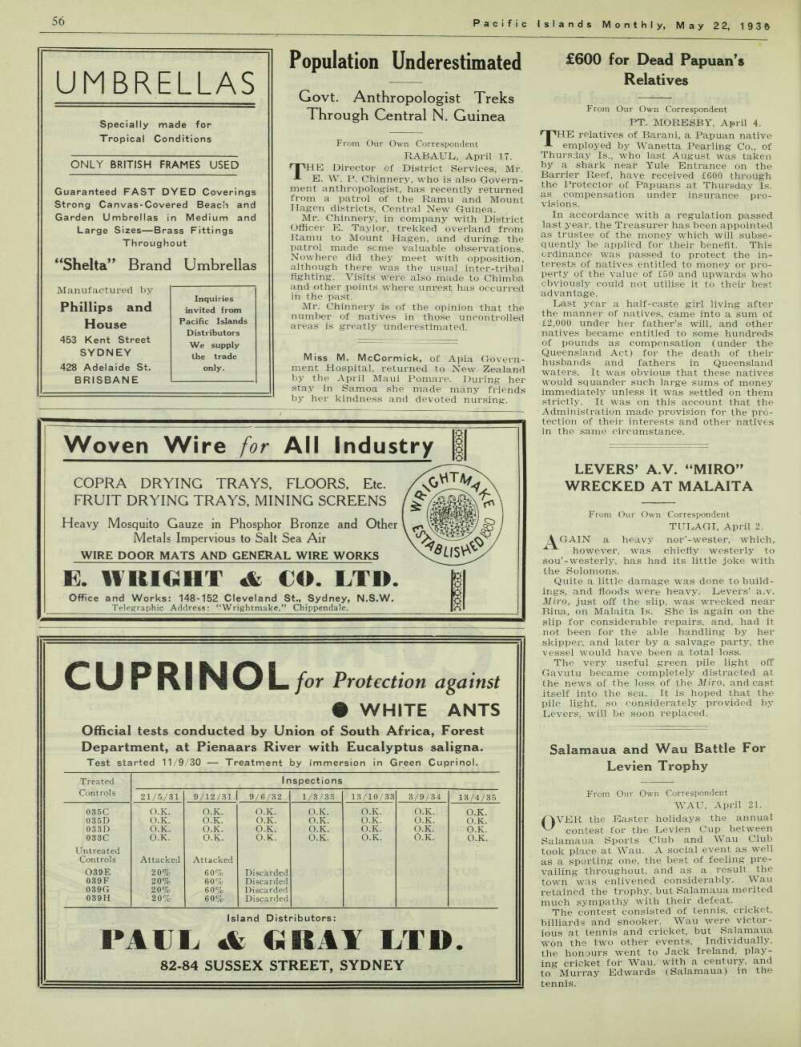
Govt. Anthropologist Treks Through Central N. Guinea
From Our Own Correspondent RABAUL, April 17. nrVHE Director of District Services, Mr. -*■ E. W. P. Chinnery, who is also Govern ment anthropologist, has recently returned from a patrol of the Ramu and Mount Hagen districts, Central New Guinea.
Mr. Chinnery, in company with District Officer E. Taylor, trekked overland from Ramu to Mount Hagen, and during- the patrol made seme valuable observations.
Nowhere did they meet with opposition, although there was the usual inter-tribal fighting. Visits were also made to Chimba and other points where unrest has occurred in the past.
Mr. Chinnery is of the opinion that the number of natives in those uncontrolled areas is greatly underestimated.
Miss M. McCormick, of Apia Govern ment Hospital, returned to New Zealand by the April Maui Pomare. During her stay in Samoa she made many friends by her kindness and devoted nursing.
£600 for Dead Papuan’s
Relatives
From Our Own Correspondent
Pt. Moresby, April 4.
THE relatives of Barani, a Papuan native employed by Wanetta Pearling Co., of Thursday Is., who last August was taken by a shark near Yule Entrance on the Barrier Reef, have received £6OO through the Protector of Papuans at Thursday Is. as compensation under insurance pro visions.
In accordance with a regulation passed last year, the Treasurer has been appointed as trustee of the money which will subse quently be applied for their benefit. This ordinance was passed to protect the in terests of natives entitled to money or pro perty of the value of £5O and upwards who obviously could not utilise it to their best advantage.
Last year a half-caste girl living after the manner of natives, came into a sum of £2,000 under her father’s will, and other natives became entitled to some hundreds of pounds as compensation (under the Queensland Act) for the death of their husbands and fathers in Queensland waters. It was obvious that these natives would squander such large sums of money immediately unless it was settled on them strictly. It was on this account that the Administration made provision for the pro tection of their interests and other natives in the same circumstance.
Levers’ A.V. “Miro”
Wrecked At Malaita
From Our Own Correspondent TULAGI, April 2.
A GAIN a heavy nor’-wester, which, however, was chiefly westerly to sou’-westerly, has had its little joke with the Solomons.
Quite a little damage was done to build ings, and floods were heavy. Levers’ a.v.
Miro, just off the slip, was wrecked near Bina, on Malaita Is. She is again on the slip for considerable repairs, and, had it not been for the able handling by her skipper, and later by a salvage party, the vessel would have been a total loss.
The very useful green pile light off Gavutu became completely distracted at the news of the loss of the Miro, and cast itself into the sea. It is hoped that the pile light, so considerately provided by Levers, will be soon replaced.
Levien Trophy
Salamaua and Wau Battle For Levien Trophy
From Our Own Correspondent WAIT, April 21.
OVER the Easter holidays the annual contest for the Levien Cup between Salamaua Sports Club and Wau Club took place at Wau. A social event as well as a sporting one, the best of feeling pre vailing throughout, and as a result the town was enlivened considerably. Wau retained the trophy, but Salamaua merited much sympathy with their defeat.
The contest consisted of tennis, cricket, billiards and snooker. Wau were victor ious at tennis and cricket, but Salamaua won the two other events. Individually, the honours went to Jack Ireland, play ing cricket for Wau, with a century, and to Murray Edwards (Salamaua) in the tennis.
Tavua Field
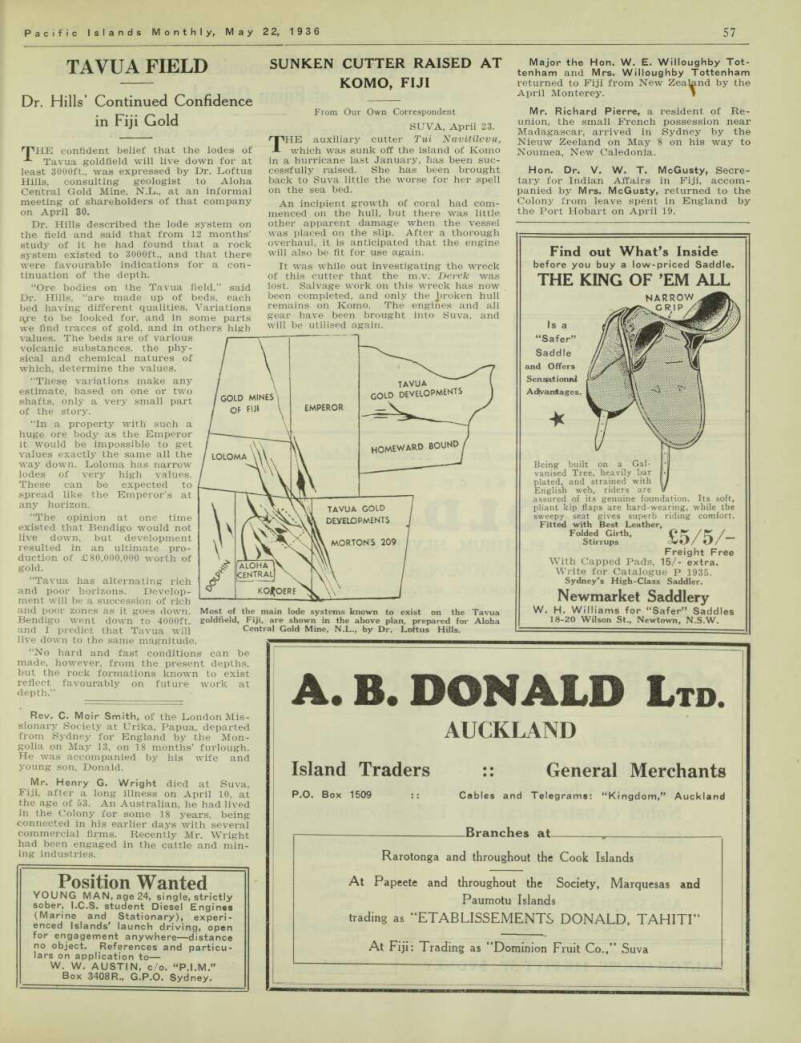
Dr. Hills’ Continued Confidence in Fiji Gold
THE confident belief that the lodes of -*■ Tavua goldfield will live down for at least 3000 ft., was expressed by Dr. Loftus Hills, consulting geologist to Aloha Central Gold Mine, N.L., at an informal meeting of shareholders of that company on April 30.
Dr. Hills described the lode system on the field and said that from 12 months’ study of it he had found that a rock system existed to 3000 ft., and that there were favourable indications for a con tinuation of the depth.
“Ore bodies on the Tavua field,” said Dr. Hills, “are made up of beds, each bed having different qualities. Variations to be looked for, and in some parts we find traces of gold, and in others high
values. The beds are of various volcanic substances, the phy sical and chemical natures of which, determine the values.
“These variations make any estimate, based on one or two shafts, only a very small part of the story.
“In a property with such a huge ore body as the Emperor it would be impossible to get values exactly the same all the way down. Loloma has narrow lodes of very high values.
These can be expected to spread like the Emperor’s at any horizon.
“The opinion at one time existed that Bendigo would not live down, but development resulted in an ultimate pro duction of £80,000,000 worth of gold.
“Tavua has alternating rich and poor horizons. Develop ment will be a succession of rich and poor zones as it goes down.
Bendigo went down to 4000 ft. and I predict that Tavua will live down to the same magnitude.
“No hard and fast conditions can be made, however, from the present depths, but the rock formations known to exist reflect favourably on future work at depth.”
Rev. C. Moir Smith, of the London Mis sionary Society at Urika, Papua, departed from Sydney for England by the Mon golia on May 13, on 18 months’ furlough.
He was accompanied by his wife and young son, Donald.
Mr. Henry G. Wright died at Suva, Fiji, after a long illness on April 10, at the age of 53. An Australian, he had lived in the Colony for some 18 years, being connected in his earlier days with several commercial firms. Recently Mr. Wright had been engaged in the cattle and min ing industries.
Komo, Fiji
Sunken Cutter Raised At
From Our Own Correspondent SUVA, April 23.
THE auxiliary cutter Tui Navitilevu, which was sunk off the island of Komo in a hurricane last January, has been suc cessfully raised. She has been brought back to Suva little the worse for her spell on the sea bed.
An incipient growth of coral had com menced on the hull, but there was little other apparent damage when the vessel was placed on the slip. After a thorough overhaul, it is anticipated that the engine will also be fit for use again.
It was while out investigating the wreck of this cutter that the m.v. Derek, was lost. Salvage work on this wreck has now been completed, and only the Jproken hull remains on Komo. The engines and all gear have been brought into Suva, and will be utilised again.
Major the Hon. W. E. Willoughby Tot tenham and Mrs. Willoughby Tottenham returned to Fiji from New Zealand by the April Monterey. » Mr. Richard Pierre, a resident of Re union, the small French possession near Madagascar, arrived in Sydney by the Nieuw Zeeland on May 8 on his way to Noumea, New Caledonia.
Hon. Dr. V. W. T. McGusty, Secre tary for Indian Affairs in Fiji, accom panied by Mrs. McGusty, returned to the Colony from leave spent in England by the Port Hobart on April 19.
Most of the main lode systems known to exist on the Tavua goldfield, Fiji, are shown in the above plan, prepared for Aloha Central Gold Mine, N.L., by Dr. Loftus Hills.
Advertisements & other items, p. 59 (2 items)
A. B. Donald Ltd.
Find out What’s Inside
before you buy a low-priced Saddle.
THE KING OF ’EM ALL
harrow Safe Saddle and Offers Sensational Advantages * Being built on a Galvanised Tree, heavily bar plated, and strained with English web, riders are assured of its genuine foundation. Its soft, pliant kip flaps are hard-wearing, while the sweepy seat gives superb riding comfort.
Fitted with Best Leather, Folded Girth, opr /er / Stirrups *3/ Freight Free With Capped Pads, 15/- extra.
Write for Catalogue P 1935.
Sydney’s High-Class Saddler.
Newmarket Saddlery
W. H. Williams for “Safer” Saddles 18-20 Wilson St., Newtown, N.S.W.
A. B. DONALD Ltd.
AUCKLAND
Island Traders :: General Merchants P.O. Box 1509 :: Cables and Telegrams: “Kingdom," Auckland Branches at Rarotonga and throughout the Cook Islands At Papeete and throughout the Society, Marquesas and Paumotu Islands
trading as “ETABLISSEMENTS DONALD, TAHITI”
At Fiji: Trading as “Dominion Fruit C 0.,” Suva
Position Wanted
YOUNG MAN, age 24, single, strictly sober, I.C.S. student Diesel Engines (Marine and Stationary), experienced Islands’ launch driving, open for engagement anywhere—distance no object. References and particulars on application to—
W. W. AUSTIN, c/o. “P.1.M.”
Box 3408 R., G.P.O. Sydney.
Free Birthday Charms for Islanders
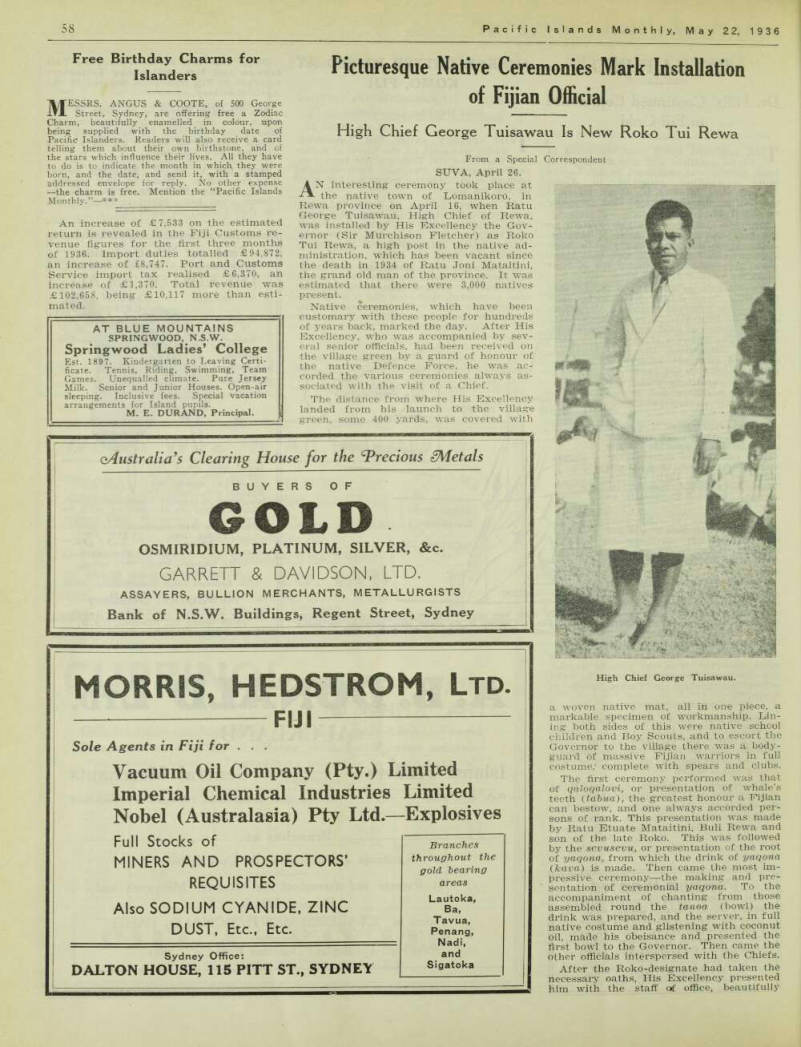
Islanders
MESSRS. ANGUS & COOTE, of 500 George Street, Sydney, are offering free a Zodiac Charm, beautifully enamelled in colour, upon being supplied with the birthday date of Pacific Islanders. Readers will also receive a card telling them about their own birthstone, and of the stars which influence their lives. All they have to do is to indicate the month in which, they were born, and the date, and send it, with a stamped addressed envelope for reply. No other expense —the charm is free. Mention the “Pacific Islands Monthly.”—*** An increase of £7,533 on the estimated return is revealed in the Fiji Customs re venue figures for the first three months of 1936. Import duties totalled £94,872, an increase of £8,747. Port and Customs Service import tax realised £6,370, an increase of £1,370. Total revenue was £102,658, being £10,117 more than esti mated.
of Fijian Official
Picturesque Native Ceremonies Mark Installation of Fijian Official High Chief George Tuisawau Is New Roko Tui Rewa
From a Special Correspondent
SUVA, April 26.
AN interesting ceremony took place at the native towm of Lomanikoro, in Rewa province on April 16, when Ratu George Tuisawau, High Chief of Rewa, w T as installed by His Excellency the Gov ernor (Sir Murchison Fletcher) as Roko Tui Rewa, a high post in the native ad ministration, which has been vacant since the death in 1934 of Ratu Joni Mataitini, the grand old man of the province. It was estimated that there were 3,000 natives present.
Native ceremonies, which have been customary with these people for hundreds of years back, marked the day. After His Excellency, who w T as accompanied by sev eral senior officials, had been received on the village green by a guard of honour of the native Defence Force, he was ac corded the various ceremonies always as sociated with the visit of a Chief.
The distance from where His Excellency landed from his launch to the village green, some 400 yards, was covered with
a woven native mat, all in one piece, a markable specimen of workmanship. Lin ing both sides of this were native school children and Boy Scouts, and to escort the Governor to the village there was a body guard of massive Fijian warriors in full costume,' complete with spears and clubs.
The first ceremony performed was that of qaloqalovi, or presentation of whale’s teeth ( talma ), the greatest honour a Fijian can bestow, and one always accorded per sons of rank. This presentation was made by Ratu Etuate Mataitini, Buli Rewa and son of the late Roko. This was followed by the sevusevu, or presentation of the root of yaqona, from which the drink of yaqona ( kava ) is made. Then came the most im pressive ceremony—the making and pre sentation of ceremonial yaqona. To the accompaniment of chanting from those assembled round the tanoa (bowl) the drink was prepared, and the server, in full native costume and glistening with coconut oil, made his obeisance and presented the first bowl to the Governor. Then came the other officials interspersed with the Chiefs.
After the Roko-designate had taken the necessary oaths, His Excellency presented him with the staff of office, beautifully
High Chief George Tuisawau.
made of inlaid native woods. Sir Murchi son addressed the assembled people through the interpretation of one of nis A.D.C.s, Lieutenant Ratu J. L. V. Sukuna.
His Excellency stressed the importance of the appointment so far as the native people were concerned, saying that the Roko had direct and separate responsibility for the well-being of all Fijians in his pro vince, and that the duties and authority of the Roko and the Provincial Commis sioner and District Commissioner were complementary. The Government required the District Administrator and the Roko to advise and assist each the other, thus ensuring good rule.
Continuing, His Excellency referred to the fact that throughout his term of office, Mr. A. J. Armstrong had been Provincial Commissioner of Rewa, and he was glad to have a public opportunity of expressing his appreciation of the good work he had done on behalf of the Rewa people.
The formalities over, several fine melees (dances) were performed in honour of the occasion, and a magiti (feast), which had been prepared for the visiting natives, w r as divided. This magiti was in the form of a stockade of native food—bananas, taro, yam, and several pigs, roasted whole, being spaced along it.
The new Roko is a man slightly over 30 years of age, and has for some years been employed in the Department of Native Affairs in Suva, and as an interpreter.
Mr. O. B. Hart, constructional engineer, arrived in Sydney from America early in May. He will sail for New Guinea to supervise the erection of No. 5 Dredge for Bulolo Gold Dredging Limited by the June Neptuna.
Advertisements & other items, p. 60 (1 item)
Morris, Hedstrom, Ltd.
AT BLUE MOUNTAINS
N.S.W.
Springwood Ladies’ College
Est. 1897. Kindergarten to Leaving Certificate. Tennis, Riding, Swimming, Team Games. Unequalled climate. Pure Jersey Milk. Senior and Junior Houses. Open-air sleeping. Inclusive fees. Special vacation arrangements for Island pupils.
M. E. DURAND, Principal.
c Australia's Clearing House for the Precious
BUYERS OF
© O ]L D •
OSMIRIDIUM, PLATINUM, SILVER, &c.
GARRETT & DAVIDSON, LTD.
ASSAYERS, BULLION MERCHANTS, METALLURGISTS
Bank of N.S.W. Buildings, Regent Street, Sydney
MORRIS, HEDSTROM, Ltd.
FIJI
Sole Agents in Fiji for . . .
Vacuum Oil Company (Pty.) Limited
Imperial Chemical Industries Limited
Nobel (Australasia) Pty Ltd. —Explosives
Full Stocks of
MINERS AND PROSPECTORS’
REQUISITES
Also SODIUM CYANIDE. ZINC
DUST. Etc., Etc.
Sydney Office:
DALTON HOUSE, 115 PITT ST., SYDNEY
Branches throughout the gold tearing areas Lautoka, Ba, Tavua, Penang, Nadi, and Sigatoka
Investigate
Fiji—Indian Problems
Dr. C. F. Andrews to Investigate
From Our N.Z. Correspondent AUCKLAND, April 29.
A VISIT to Fiji at the request of the Imperial Indian Citizenship Associa tion is to be made shortly by Dr. Charles Freer Andrews, noted Christian leader in India, author and religious mystic, who is at present in New Zealand. He has twice previously visited Fiji in the in terests of Indians there.
Dr. Andrews will leave Auckland on May 2, by the Mariposa , and will probably remain a month in the Colony. His prev ious plan was to travel by the Niagara. arriving at Suva on May 29.
On his arrival in New Zealand, Dr.
Andrews said that he had been asked to visit Fiji to inquire into difficulties in ob taining suitable leasehold tenures of native lands on the part of Indian culti vators, and also investigate the question of franchise. He hoped also to take up the subject of higher education for the very few young people from the Indian community in Fiji who wished to under take University courses.
Mr. William H. Potts, a young English man who recently arrived in Australia by the barque Parma, joined the crew of Mr. Dwight Long’s ketch Idle Hour in Sydney early in May. He sailed with her for Port Moresby, Papua, on May 8,
Carpenter Vessels to Call at Suva
From Our Own Correspondent SUVA, April 23.
A N INTERESTING announcement in connection with the entry of Messrs.
W. R, Carpenter and Co. into Fiji through Messrs. Brown and Joske Ltd., made the other day, when the firm announced that the W.R.C. vessel Salamaua would arrive in Suva in a few days’ time.
She will load copra, and, it is under stood, then proceed to England via New Guinea. The announcement declared that this would probably mean the institution of a regular service between Fiji and England.
This is of considerable interest to the Colony, as at present most copra is shipped overseas in foreign vessels, Nor wegians and Swedes. These foreign ships also pick up a number of passengers, mostly civil servants going on long leave to Eng land. It is pleasing to know that in the near future they may travel in British vessels, which have a good name* for passenger carrying.
Rev. A. Stanley Jones, L.Th., who re cently was accepted by the Methodist Mission Society for work at Kabakada, New Britain, sailed from Sydney for Rabaul by the April Macdhui.
Rev. and Mrs. H. H. Bock, with their two children, sailed from Melbourne for Fiji by the Mariposa on April 25. Mr.
Bock has been appointed by the Method ist Missionary Society to the Lau cir cuit.
Advertisements & other items, p. 61 (1 item)
Grand Pacific Hotel - - Suva, Fiji
■ I ** ■ mi The PREMIER Social Rendezvous of Fiji . . .
Grand Pacific Hotel - - Suva, Fiji EXCELLENT CUISINE. EFFICIENT TRAINED INDIAN WAITERS AND SERVANTS,
MODERNLY EQUIPPED.
Reserved by Wireless Cable address: “Grandpacif,”
Suva.
In Queensland
Farmer Fiji Resident Murdered In Queensland
From Our Own Correspondent •SUVA, April 23.
IT was with great shock that residents of Suva learned recently that Mr. Frank Costello, formerly of Suva, had been one of the victims of a brutal mail train murder in Queensland.
Mr. Costello, who was well-known in Suva and throughout Fiji, was for some years in the employ of Morris, Hedstrom Ltd. He was a prominent footballer dur ing his residence here.
Four of his brothers, Messrs. P., D. 8..
J., and V. Costello are resident in Suva. Mr.
D. B. Costello was in Sydney at the time of the tragedy.
Risky Voyage
From Borabora to New Zealand In Motorless Ketch
From Our Own Correspondent
Rarotonga, April 19.
FOURTEEN days out from Borabora, in the Leeward group of French Oceania, the pocket-edition ketch Farys reached here early this month. Twenty-one feet in length and with a displacement of two tons, the Farys is quite the smallest of the several small craft which have lately called in.
Motorless, she is a Tahiti built boat and was acquired there by her present owner, Mr. E. J. Weber, a native of Poland.
Prior to his arrival in the South Seas, Mr. Weber had neither knowledge nor ex perience of small-boat sailing. Practising seamanship in the lagoon at Papeete and studying navigation in the evenings, he gradually acquired sufficient confidence to embark on the first stage of his single handed voyage to New Zealand, which he proposes to reach via Samoa and Fiji.
And yet there are those who claim that the spirit of adventure is dying out!
His Excellency, Sir Murchison Fletcher, Governor of Fiji, paid a farewell visit to the northern and western districts of the Colony during April, before leaving Suva by the Aorangi on May 1, en route to Trinidad, where he has been appointed Governor.
Islands
New Vessel for Lau Islands
From Our Own Correspondent SUVA, April 23.
AT the workshops of the Public Works Department there has been built a fine new vessel for service in the Lau Group. It will be chiefly used by the Dis trict Commissioner (Ratu J. L. V. Suk una) for travelling about his scattered island territory.
The new boat might well be called an Empire ship—the hull is of New Zealand kauri, the decks, masts, and spars of Canadian oregon, the keelson of Austra lian spotted gum, and the knees and stem pieces of Fijian dilo. The engine and all fittings have been manufactured in the United Kingdom.
The vessel, which was designed by the Director of Public Works (Mr, W. Wise), assisted by Mr. Alex. Bentley, of the Pub lic Works Department, is 57 ft. in overall length. She has a beam of 13 i ft., and a moulded depth of 9J ft. The vessel is powered with a 54 h.p. cold starting Diesel engine. However, she cannot be described as an auxiliary, for she will have full power either under sail or under the engine. She will be ketch rigged, and will have a maximum sail area.
The boat is very up-to-date in her fittings, and consists of three compart ments below deck. Forward is the fore castle, which also has room for a certain amount of cargo. Amidships is the en gine room, and aft the main cabin. The after deck has a permanent house over it, and in this will be bunk accommodation.
Aft of the deck house is a modern bath room.
Although the new vessel is a hand some one, and a credit to the boat building staff of the department con cerned. She will probably be in service next month.
“No Hint of Handing Samoa
Back,” Says N.Z. Prime Minister
From Our N.Z. Correspondent..
AUCKLAND, April 30.
THE attitude of the New Zealand Gov ernment toward the returning of Samoa to Germany was referred to the Prime Minister (Mr. M. J. Savage) re cently, following discussions as to the future of mandates in the English House of Commons. He made the following state ment on the matter: “So far no hint in the direction of handing Samoa back to Ger many has come to us from Britain, and I think it would be wrong for me to discuss a possible situation that may never arise.”
Dr. F. E. Montague, who has been ap pointed senior medical officer of the Gil bert and Ellice Islands, recently arrived at Funafuti, Ellice Is., from Fiji with his wife by the London Missionary Society’s vessel John Williams V.
Advertisements & other items, p. 62 (1 item)
Jang: fling: Loong: Company Lmiitefl
MELBOURNE
HOTEL .
= SUVA
Centrally situated near Government offices. Opposite sea baths and bowling green. Excellent table.
Terms moderate. Best brands of liquor kept, including Hardy’s famous wines.
E. C. DOBELL Proprietor
Suva's Fashion Rendezvous
WALTER HORNE& Co. Ltd.
PREMIER DRAPERS. LADIES’. CHILDREN’S
AND MEN’S WEAR SPECIALISTS
LADIES’ HAIRDRESSING AND MANICURING
Frocks M illinery Foundations and Lingerie H osiery Ladies’ Shoes & Sandals Ribbons and Laces Hairdressing Manicuring Dress Fabrics and Silks Household Drapery Clothing Tailoring Mercery Men’s Boots & Shoes Men’s Hats & Caps island Curios
“IF IT’S NEW...
HORNE’S WILL SHOW IT”
Dependable Merchandise Reasonably Priced
Cables: “Janinloong P.O. Box 117
Jang: fling: Loong: Company Lmiitefl
20-24 THOMSON ST., SUVA, FIJI
IMPORTERS EXPORTERS
Buyers of Copra, Trochus Shell, Beche-de-mer, Kauri Gum, and other Islands Products.
NUMEROUS BRANCHES THROUGHOUT THE COLONY
Elderly Fijian Woman’s
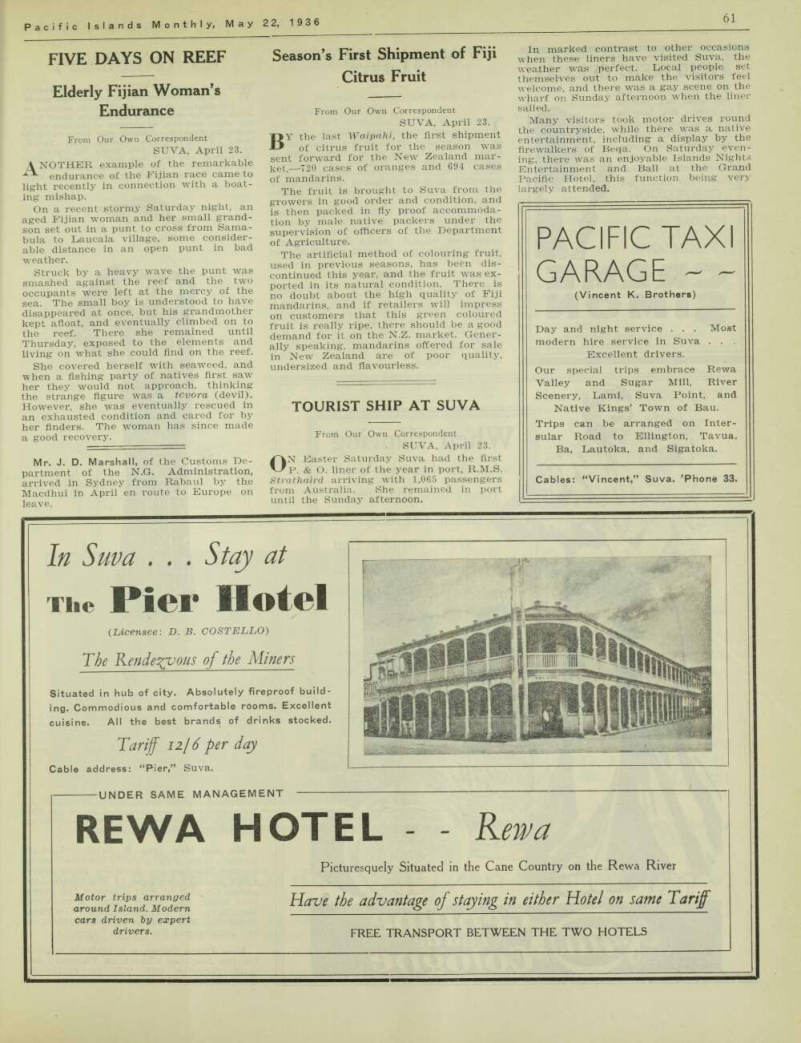
Five Days On Reef
Elderly Fijian Woman’s Endurance
From Our Own Correspondent SUVA, April 23.
A NOTHER example of the remarkable endurance of the Fijian race came to light recently in connection with a boat ing mishap.
On a recent stormy Saturday night, an aged Fijian woman and her small grand son set out in a punt to cross from Sama bula to Daucala village, some consider able distance in an open punt in bad weather.
Struck by a heavy wave the punt was smashed against the reef and the two occupants were left at the mercy of the sea. The small boy is understood to have disappeared at once, but his grandmother kept afloat, and eventually climbed on to the reef. There she remained until Thursday, exposed to the elements and living on what she could find on the reef.
She covered herself with seaweed, and when a fishing party of natives first saw her they would not approach, thinking the strange figure was a tevora (devil).
However, she was eventually rescued in an exhausted condition and cared for by her finders. The woman has since made a good recovery.
Mr. J. D. Marshall, of the Customs De partment of the N.G. Administration, arrived in Sydney from Rabaul by the Macdhui in April en route to Europe on leave.
Season’s First Shipment of Fiji
Citrus Fruit
From Our Own Correspondent SUVA, April 23.
BY the last Waipahi, the first shipment of citrus fruit for the season was sent forward for the New Zealand mar ket, —720 cases of oranges and 694 cases of mandarins.
The fruit is brought to Suva from the growers in good order and condition, and is then packed in fly proof accommoda tion by male native packers under the supervision of officers of the Department of Agriculture.
The artificial method of colouring fruit, used in previous seasons, has been dis continued this year, and the fruit was ex ported in its natural condition. There is no doubt about the high quality of Fiji mandarins, and if retailers will impress on customers that this green coloured fruit is really ripe, there should be a good demand for it on the N.Z, market. Gener ally speaking, mandarins offered for sale in New Zealand are of poor quality, undersized and flavourless.
Tourist Ship At Suva
From Our Own Correspondent SUVA, April 23.
ON Easter Saturday Suva had the first P. & O. liner of the year in port, R.M.S.
Strathaird arriving with 1,065 passengers from Australia. She remained in port until the Sunday afternoon.
In marked contrast to other occasions when these liners have visited Suva, the weather was perfect. Local people set themselves out to make the visitors feel welcome, and there was a gay scene on the wharf on Sunday afternoon when the liner sailed.
Many visitors took motor drives round the countryside, while there was a native entertainment, including a display by the flrewalkers of Beqa. On Saturday even ing, there was an enjoyable Islands Nights Entertainment and Ball at the Grand Pacific Hotel, this function being very largely attended.
Advertisements & other items, pp. 63-64 (1 item)
Rewa Hotel - Rewa
PACIFIC TAXI
GARAGE - -
(Vincent K. Brothers) Day and night service . . . Most modern hire service in Suva . .
Excellent drivers.
Our special trips embrace Rewa Valley and Sugar Mill, River Scenery, Lami, Suva Point, and Native Kings’ Town of Bau.
Trips can be arranged on Intersular Road to Ellington, Tavua.
Ba, Lautoka, and Sigatoka.
Cables: “Vincent,” Suva. ’Phone 33.
In Suva . . . Stay at
The Pier Hotel
( Licensee : D. B. COSTELLO)
The Rendezvous of the Miners
Situated in hub of city. Absolutely fireproof building. Commodious and comfortable rooms. Excellent cuisine. All the best brands of drinks stocked.
Tariff 12/6 per day
Cable address: “Pier," Suva. 1 m
UNDER SAME MANAGEMENT
REWA HOTEL - Rewa
Picturesquely Situated in the Cane Country on the Rewa River Motor trips arranged Have the advantage of staying in either Hotel on same Tariff around Island. Modern o J 0 M cars driven ty expert drivers. FREE TRANSPORT BETWEEN THE TWO HOTELS
AVOID INERT CREAMS
What woman does not sigh after this radiant freshness, this juvenile tint that excites admiration? CREME SIMON makes the skin lovely, —it is always active and is delicately perfumed.
For Perfect Beauty use
CREME SIMON
poudrV°simon
(7 Shades), and
SIMON SOAP
SiHON
PARIS
Obtainable Chemists and Stores Sole Agents: Joubert €*■ Joubert Pty.Ltd.,Melbourne
When dancing
or at the theatre don’t k forget now and then to Sb dab a few drops of W “47ir Genuine Eau de Cologne on temples and forehead; it will refresh,
invigorate, revive.
-I , Representative:
ROBERT BLAU (Aust.),
A.C.A. Building, Cnr. King 8C York Streets,
w SYDNEY.
tAU DE V 5 0E 4711.
“Tiare Taporo” Visits
Papeete
From Our Own Correspondent PAPEETE, April 10.
THE Cook Islands schooner Tiare Taporo (Captain Viggo Rasmussen), owned by the firm of A. B. Donald Ltd., of Auck land, N.Z., paid one of her rare visits to Tahiti last month, bringing a cargo of copra from Penrhyn and Manihiki, and also the usual consignment of Pipi pearls from the renowned lagoons of those islands.
After shipping a new mast, which was awaiting her here from San Francisco, the Tiare Taporo left again for the Cook Islands on April 7, taking as a passenger Mr. R. Wilkinson, who is the firm’s mana ger at Mangaia.
Mr. James J. Hartley, of the Papuan Public Service, will be married on June 6 to Miss Lome Duncan, of Strathfield, Sydney. Mr. Hartley is a son of Mrs. J.
A. Cattell, of the Solomon Islands. Mr.
Cattell, who is now stationed at Mak ambo, was formerly a resident of Port Moresby, Papua.
Pattern Service
WE have arranged with a well-known Sydney firm of pattern-cutters to publish each month a diagram of a seasonable frock, patterns of which may be obtained by our readers direct from this office, post-free, on payment of the sum stated under the diagram. Address your letter to “Pat terns,” Pacific Islands Monthly, Box 3408 R, Sydney, and enclose a note giving the number of the pattern you want and bust size, and enclose also the price of the pattern in postal note cr stamps. The pattern will be sent by return mail.
2116 —Careful thought and planning has been exercised in producing this new and attractive design. Sleeves, set in large armholes and fitting tightly at the wrists are still very much in favour.
Extra fullness is given to the skirt by the flared insets at centre back and front. Material (for 3Gin. bust) ; 31 yds. 36 in. wide; contrast, h yd. 36 ins. wide. Bust sizes 32 to 40 ins.
Miss Alice H. Mills, B.Sc., returned to New Britain from extended leave by the Macdhui on April 16. She is stationed at the Methodist Mission, Rabaul.
Mr. and Mrs. John R. Foldi arrived in Sydney from Papua on 12 months’ leave by the Macdhui on April 9. Their mar riage had taken place at St. John’s An glican Church in Port Moresby the prev ious week, the bride being Miss Vera Kershaw, of the European Hospital, Samarai. Mr. Foldi is a Patrol Officer in the Magisterial Service of Papua.
Mi ss Peace Cohen, a prominent worker for the Anglican Church on Thursday Is land, recently left T.I. to reside in Queensland.
Frock, 2116-1s. 1d.
Fashion Hints for Islands Women
By Therese
medieval influence has spread to ■ day clothes —broad shoulders, waspish waists. and deep ruffs are excitingly adapted for modern needs.
Tunics are important. They burst upon us with all their old charm plus variety of design—Cossack, with high buttoned neckline and tunic flaring to the knee; straight and Chinese; smocked and peasant-looking—all topping slim skirts.
Pleats of every variety, from the fine pin pleating to the bolder accordeon, are the dernier cri for day and evening.
Sunlit days lend added appeal to linens and cottons, gaily and quaintly patterned in flower and animal designs.
Even the humble vegetable has not been forgotten and finds an exalted place in the printed materials’ scheme of things.
Delicious little smocked confections of dimity, voile, and flowered piques, are gay and unpretentious, and delightful possessions for tropic dwellers, as are the sleeveless frocks with contrasting cape or coat. A spotted sleeveless frock with yoke of contrast, is topped by a spotted coat with contrasting revers. A white panama hat and two tone shoes tell a tale of chic and coolness.
A free-swinging hip length cape throws itself over a spotted blouse. The slim brief skirt is kick pleated in front.
A light weight woollen ensemble to wear when nearing cooler climes, is of navy wool georgette, undeniably chic with its straight skirt flaring slightly at
the hem. Sunray tucks trim its hips and blouse, and white pique flowers nestle at its throat line. Over it goes a deep yoked, swing-back, almost knee length coat of the same material, with tufts of coloured wool scattered over it in most intriguing fashion. Navy hat, gloves, shoes and bag accompany it to perfection.
Another light weight woollen frock boasts a wrap- over skirt, its hips slimly braid ed. The shoulders are braid epauletted, extending in two panels down the bodice.
Sleeves full at shoulder, taper to slimness at the wrist.
Blouses are .numerous and intriguing, presenting themselves the clock round.
They justify their existence threefold — morning, noon, and night. Tailored blouses along Peter Pan, shirt, or waist coat lines are ideal for morning or with tailored suits. Bright colours softly draped, tucked, or pleated, grace after noon hours. For evening they go all feminine —lovely bits of things—laces, chiffons, georgettes, flower-besprinkled or plain. Shirred, pleated, or embroidered, with or without sleeves, they are a de light.
A blue linen blouse made gay with red stitchings and a scarf attached is attractive when worn with a white suit.
Two tone shoes march it on the way to success. This type of shoe absolutely rejuvenates a last season’s frock or skirt and jumper, and looks particularly chic with silk and cotton frocks alike.
“White with any colour you like for
coolness and chic,” is a slogan well worthy of adoption. It gives one a cool, calm air that is enviable.
Sports clothes take a very important place in the scheme of things. Since a touch of colour is permissible for tennis wear, a two coloured belt, red and blue, encircles the waist of a slim frock.
Coloured buttons trim its bodice, and a gay little scarf and coat accompany it for off the court moments.
There are many ways—careless and studied —to wear a scarf. Knotted loosely round the throat; flying gaily in the breeze; cowl effect; sling fashion; and so on, each with a charm all its own.
The ideal tropical golfing attire is the well-cut trouser skirt and short sleeved jacket, with a back pleat to ensure free dom of movement for the perfect swing.
Swimming and idling take on added charm and new meaning 'with the coming of the new beach wear. A swim ensemble has a lace stitch swim suit with sun tan back. A knee length cape swings jauntily over its wicked briefness. High heeled surf shoes and a pert peaked cap are the beginning and ending of the nautical tale.
A beach outfit with shorts and sun top, has a wrapped skirt, and wide belt
finished with a large nautical button.
Sandals and coolie hat accompany it, and a loose coat is donned for more formal occasions.
A play suit in green and white striped gingham with detachable skirt buttoning its brief way to the knees, is the last syllable in provocation.
Night with its thousand eyes winking approval gives us endless choice for fes tive clothes—gowns, slim, svelte, and sophisticated; bouffant and romantic as the night itself; draped and classical as some goddess of ancient Greece or Rome —and each requires the perfect founda tion for the perfect interpretation. This comes in the garment that reduces curves, and moulds the figure with rhythmic con trol, having an all elastic weave, smooth and supple, with never a bone to mar the sleek perfection.
Empire period gowns flatter the figure.
Wing sleeves and jewelled hip line, give glamour to a gown of ice blue satin.
Cape sleeves and a bustle bow are the proud possessions of a gold threaded fuchsia taffeta frock with deep V-decol letage. A flower in the hair and romance steps abroad.
A Chinese red evening gown spotted with gold, has a hip length tunic, with sleeves, tunic, and skirt hem outlined wuth Grecian scroll in gold.
Simple but distinctive is that yeoman of the wardrobe, the black frock, plain and well cut. It offers great scope for lightning changes. A draped cummer bund of brilliant colour makes it gay and exciting. Add a lame dinner jacket, and chic and sophistication are yours.
A taffeta dance frock with a low cut strapless bodice veiled provocatively with tulle has slim hips and flaunting skirt.
Rhythmic loveliness marks its gracious movements.
Evening wraps are things of beauty and joys for ever. A coat gay as a floral festival, flares out ballerina-fashion to the knees emphasising the pencil slim skirt beneath. A heavy crepe jacket of lovely tea-rose swings out over a black crepe frock. A burst of pleats metamor phoses into a three-quarter coat — feminine and alluring over a softly fall ing chiffon gown.
Tiers of white organdie edged with rick-rack braid, reminiscent of childhood days, go to the making of a cape that is utterly cool and completely charming,
with its immaculate freshness. It is the direct answer to the tropical call for a light weight wrap.
Flowers retain their charm and popu larity. Bouquets tuck into the waist; single blooms adorn the lapel of the tailored suit; coronets, a whole galaxy of blossoms, or single flowers adorn the hair. Newer, however, and much more intriguing and sophisticated is the Geisha lacquered comb with matching fan. It is perfection itself for the brunette of poise and assurance.
Shoes for evenings are delightful, the sandal type being quite unrivalled. They appear successfully for day, along with the court, which justly deserves its popu larity. Two tone shoes are full of chic and look unbelievably cool—a virtue for tropical wear that must not be over looked.
Advertisements & other items, pp. 65-66 (1 item)
SeJi i
Mrs. N. WALKER-FLYNN
Late 35 POWELL STREET, COOGEE
COSTUMIERE
MALAGUNA ROAD, RABAUL
HEMSTITCHING AND PICOT
EDGING
Copies of Mab’s Fashions; Roma’s Pictorial Fashions and Home Fashions available.
P.O. Box 116. Tel.: 141
pat ti
SeJi i
the
Rand wick.
9 9
ALL-STEEL
bedstead
finished in Coloured Lacquers with Hand-painted Decorations, or Shaded Gold, Copper or Silver Effects.
THIS IS ONE OF THE MANY DE-
SIGNS OF ALL STEEL BEDS AND
TUBULAR STEEL FURNITURE IL-
LUSTRATED IN OUR LATEST
CATALOGUES.
Copies will be gladly forwarded by return mail.
Manufactured by NEWLANDS BROTHERS LTD., riley street, Sydney, n.s.w.
Australia’s Largest Manufacturers of Steel Beds: Wire Mattresses: Bedding: Tubular Steel Furniture: Lawn Hammocks: “Lister”
Hospital Beds and Furniture: Ships’ Berths: Garden Seats: Stretchers: Davenports, etc.
Cable Address: “Newlandbed,” Sydney.
The Weak
Spot!
tx "Every Picture tells u Story."
A MAN’S or woman’s weak spot ** is frequently the kidneys, the organs which are so quickly affected by strain or worry and by colds or chills.
That is why sharp, stabbing pains in the back, urinary disorders, dropsical swellings, headaches, dizzy attacks and rheumatic twinges are so common just now.
Local treatment may temporarily relieve some of these discomforts, but the only safe way to get well and keep well is to strengthen the weakened kidneys with Doan’s Backache Kidney Pills. This special kidney tonic has a unique record of success in overcoming rheumatism, lumbago, sciatica, renal dropsy, urinary irregularities and bladder disorders Be sure to insist upon
Doan's
Backache Kidney
Pills
PRODUCING UNIFORM GOOD RESULTS SINCE 1868
Flour
ALWAYS ASK FOR IT
At Rabaul
Romantic Wedding
From Our Own Correspondent RAUBAUL, April 24.
ANE of the most romantic weddings in New Guinea for many a day was cele brated at the Church of England, Rabaul, by Archdeacon de Voil on April 18, when Miss Thelma Monk, sister of Mrs. C. L.
Anthony, of Rabaul, was married to Mr.
Paul (“Karkar”) Schmidt, of Palmalmal plantation.
The bride arrived in Rabaul from her home in New Zealand about a year ago on a visit to her sister. While here she be came engaged to one of the Territories’ confirmed bachelors, “Karkar” Smith, as he is popularly known by his host of friends.
Mr. Schmidt arrived in the Territory some 28 years ago. He it was who planted Karkar Island off the Madang coast be fore expropriation and, later, spent con siderable time on the goldfields. It is over 20 years since “Karkar” left New Guinea for a holiday, but now he hopes to make a visit with his wife to Europe next year.
The ceremony was attended by only a few of the more intimate friends of the bride and groom and later the wedding breakfast was served at Ravuvu. The pretty sister of the bride, Mrs. Anthony, acted as hostess at the breakfast, while Mr. Anthony filled the role of best man.
Miss June Ewen was bridesmaid, and Hon. E. P. Holmes, M.L.C., gave the bride away.
Miss H. Clark left Sydney for Suva, Fiji, by the Mariposa on April 29. She is a worker among the Indian women and children at Nausori for the Methodist Mission.
Mrs. Charles Bennett, of Norfolk Island, is visiting Sydney while her husband is a patient at the Royal Prince Alfred Hos pital. Mr. and Mrs. Bennett were at one time well-known residents of Hawkes Bay, New Zealand.
Miss I. Knight, Methodist missionary at Kadavu, Fiji, sailed for Melbourne by the Mariposa on April 25 to continue her work among the Fijian girls. She was accompanied by Miss L. B. Tall.
Mrs. W. Pocock, who had been a resid ent of Fiji since 1907, died in Suva on April 9. She went to the Colony from New Zealand with her husband, who was employed by Mr. L. E. Brown, of Messrs.
Brown and Joske Ltd.
The Ramu
Peace Comes To The Primitives Of
Impressive Ceremony by Administration Welds Tribes of New Guinea’s Hinterland
From Our Own Correspondent.
RABAUL, April 24, DURING his recent official tour to the Morobe district, the Administrator (Brig.-General W. Ramsay McNicoll) paid a visit to the Government Patrol Post at Ramu, which is in charge of Patrol Officer T. G. Aitchison, whose duty it is in this large “uncontrolled” area to make peace ful contact —and to maintain it when ef fected —with 150,000 natives.
The Administrator arrived at Ramu on Easter Sunday, and it was during this visit that Mr. Aitchison had arranged to bring together as many of the Ramu chieftains as possible. He had two objects in view; one, to bring about a more peaceful atmo sphere among the Ramu tribes, who were constantly carrying on inter-tribal wars, and the other, to allow the headmen to meet the Administrator. If the peaceful negotiations were successful, a paramount chief, who would have jurisdiction throughout the whole of the Ramu coun try on the southern watershed, would be appointed.
The arrangements required careful and tactful preparation—the slightest error of judgment or the least mistake in an im pression upon the minds of the primitive natives would undoubtedly undo much of the good work already performed in this area by both Mr, Aitchison and his pre decessor.
Fortunately, all went well. Hitherto it had been the custom for visiting tribesmen to approach the Government Post un armed, but on this occasion the visitors were permitted to remain armed and to range themselves in tribes along the tabu rope which encircled the Post, past which no local native was permitted to walk.
On Easter Saturday natives from miles around commenced arriving for the as sembly. Six of the most important chiefs each brought with them a pig. These were handed over to the Patrol Officer who was to conduct the ceremony to bring about a lasting peace amongst these people—the ceremony which would put a stop to tribal wars and do away with constant carnage.
The following day, the Administrator, with due formality, greeted over a dozen chiefs. He spoke to them of the ways of the white man, of the need for peaceful habits, and of the protection they would receive from the Government.
Then followed the peace ceremony.
The pigs were ceremoniously placed in front of the assembled concourse of people and the Patrol Officer, with a rifle, shot each pig, to the accompaniment of wild, unearthly yells as each shot was fired.
Carrying a large bough of the Ramu peace symbol (which is a green and white croton), Mr. Aitchison dipped the leaves in the blood of each pig, and then slowly and solemnly the chiefs gathered around him, grasped the bough and walked towards the hole, in which the croton was carefully planted.
There, close to the Ramu Government Post, now stands this symbol of peace, and from the day of its planting it will be carefully guarded from damage. Its growth will be watched by every native who passes. It will be spoken of in years to come as the outward symbol of the peace which had its birth at the time of the Big White Chief’s visit.
And so, on Easter Sunday, another for ward step was taken in this “uncontrolled” area of the Ramu —peace had been brought to a dozen tribes in the hinterland of New Guinea and a paramount chief had been invested with his cap of office to maintain law and order, according to the white man’s fashion, over tribes with whom he once lived at enmity.
Mr. Cecil G. Abel, managing director of the Incorporated Kwato Extension Asso ciation, a missionary organisation at Kwato Island, near Samarai, Papua, has been spending furlough in Australia.
Early in May he was staying at the Carlton Hotel, Sydney.
W. R. Carpenter & Co.
New Shares Issued at 41/6.
THE directors of W. R. Carpenter and Co., Ltd., reported on April 26 having issued and allotted as fully-paid an addi tional 26,000 new shares of £1 share at a premium of 21/6 per share.
Recent acquisition by the firm of the business of Brown and Joske, Ltd., Fiji, has been made on the basis of these new 26,000 £1 shares.
Advertisements & other items, p. 67 (1 item)
Arnott’S
New Britain Express
Delivery
GENERAL OVERSEAS AGENTS
GENERAL CARRIERS, BAGGAGE
AND FORWARDING AGENTS.
ROYAL MAIL CONTRACTORS.
Reliable Cars and Trucks
We aim to give quick and reliable Service at reasonable costs. P.O. Box 116. ’Phone 141.
W. WALKER-FLYNN, Proprietor, Malaguna Road, Rabaul, T.N.G.
Delicious Biscuits
in sealed moisture-proof wrappers . . . ideal for afternoon tea, lunch, or supper.
ARNOTT’S
famous
Shredded Wheatmeal Biscuits
a valuable appetising health food;
Popso Cracker Biscuits
the perfect base for savouries;
Spicy Fruit Roll Biscuits
put in the oven for one minute and served with cream or milk make a most delicious sweet.
Purdy Islands
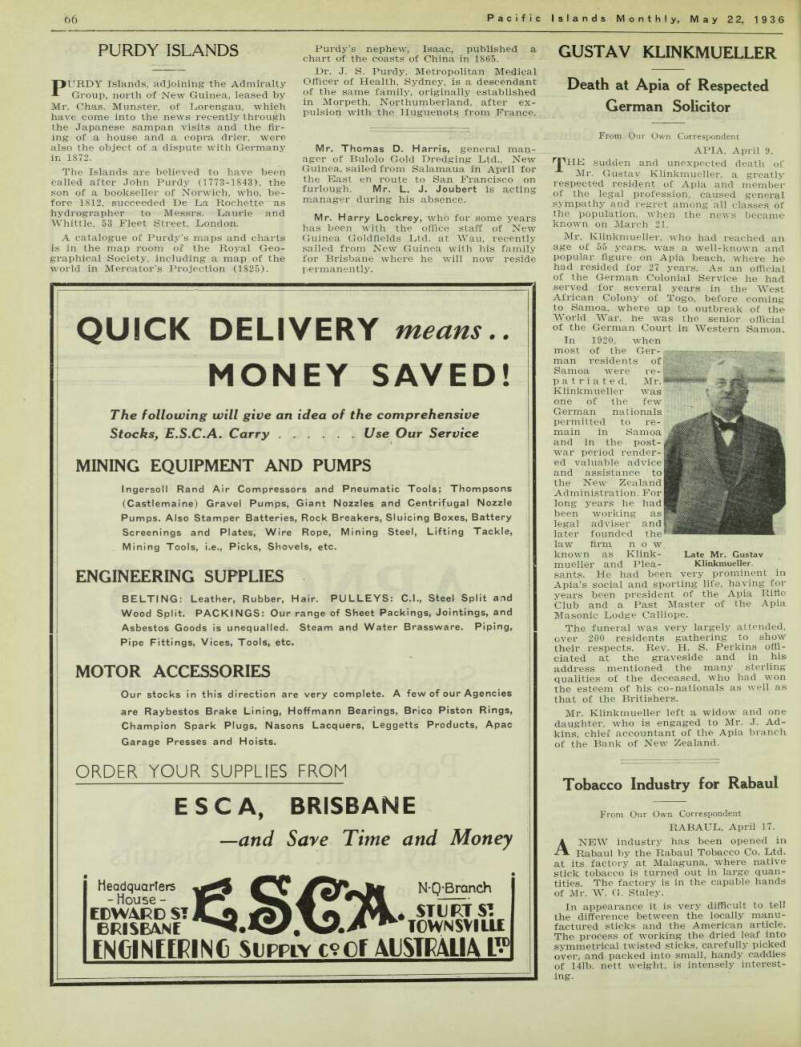
, adjoining the Admiralty Group, north of New Guinea, leased by Mr. Chas. Munster, of Lorengau, which have come into the news recently through the Japanese sampan visits and the fir ing of a house and a copra drier, were also the object of a dispute with Germany in 1872.
The Islands are believed to have been called after John Purdy (1773-1843), the son of a bookseller of Norwich, who, be fore 1812, succeeded De La Rochette as hydrographer to Messrs. Laurie and Whittle, 53 Fleet Street, London.
A catalogue of Purdy’s maps and charts is in the map room of the Royal Geo graphical Society, including a map of the world in Mercator’s Projection (1825).
Purdy’s nephew, Isaac, published a chart of the coasts of China in 1865.
Dr. J. S. Purdy, Metropolitan Medical Officer of Health, Sydney, is a descendant of the same family, originally established in Morpeth, Northumberland, after ex pulsion with the Huguenots from France.
Mr. Thomas D. Harris, general man ager of Bulolo Gold Dredging Ltd., New Guinea, sailed from Salamaua in April for the East en route to San Francisco on furlough. Mr, L. J. Joubert is acting manager during his absence.
Mr. Harry Lockrey, who for some years has been with the office staff of New Guinea Goldfields Ltd. at Wau, recently sailed from New Guinea with his family for Brisbane where he will now reside permanently.
Death at Apia of Respected
Gustav Klinkmueller
Death at Apia of Respected German Solicitor
From Our Own Correspondent APIA, April 9. r pHE sudden and unexpected death of Mr. Gustav Klinkmueller, a greatly respected resident of Apia and member of the legal profession, caused general sympathy and regret among all classes of the population, when the news became known on March 21.
Mr. Klinkmueller, who had reached an age of 55 years, was a well-known and popular figure on Apia beach, where he had resided for 27 years. As an official of the German Colonial Service he had served for several years in the West African Colony of Togo, before coming to Samoa, where up to outbreak of the World War, he was the senior official of the German Court in Western Samoa.
In 1920, when most of the Ger man residents of I Samoa were re patriated, MrJ Klinkmueller was one of the few German nationals permitted to re main in Samoa and in the post war period render ed valuable advice and assistance to the New Zealand Administration. For long years he had been working as legal adviser and later founded the law firm now known as Klink mueller and Plea-
sants. He had been very prominent in Apia’s social and sporting life, having for years been president of the Apia Rifle Club and a Past Master of the Apia Masonic Lodge Calliope.
The funeral was very largely attended, over 200 residents gathering to show their respects. Rev. H. S. Perkins offi ciated at the graveside and in his address mentioned the many sterling qualities of the deceased, who had won the esteem of his co-nationals as well as that of the Britishers.
Mr. Klinkmueller left a widow and one daughter, who is engaged to Mr. J. Ad kins, chief accountant of the Apia branch of the Bank of New Zealand.
Late Mr. Gustav Klinkmueller.
Tobacco Industry for Rabaul
From Our Own Correspondent RABAUL, April 17.
ANEW industry has been opened in Rabaul by the Rabaul Tobacco Co. Ltd. at its factory at Malaguna, where native stick tobacco is turned out in large quan tities. The factory is in the capable hands of Mr. W. G. Staley.
In appearance it is very difficult to tell the difference between the locally manu factured sticks and the American article.
The process of working the dried leaf into symmetrical twisted sticks, carefully picked over, and packed into small, handy caddies of 141 b. nett weight, is intensely interest ing.
Advertisements & other items, pp. 68-69 (2 items)
Quick Delivery Means ,.
MONEY SAVED!
The following will give an idea of the comprehensive Stocks , E.S.C.A. Carry Use Our Service
MINING EQUIPMENT AND PUMPS
Ingersoll Rand Air Compressors and Pneumatic Tools; Thompsons (Castlemaine) Gravel Pumps, Giant Nozzles and Centrifugal Nozzle Pumps. Also Stamper Batteries, Rock Breakers, Sluicing Boxes, Battery Screenings and Plates, Wire Rope, Mining Steel, Lifting Tackle, Mining Tools, i.e., Picks, Shovels, etc.
ENGINEERING SUPPLIES
BELTING: Leather, Rubber, Hair. PULLEYS: C. 1., Steel Split and Wood Split. PACKINGS: Our range of Sheet Packings, Jointings, and Asbestos Goods is unequalled. Steam and Water Brassware. Piping, Pipe Fittings, Vices, Tools, etc.
MOTOR ACCESSORIES
Our stocks in this direction are very complete. A few of our Agencies are Raybestos Brake Lining, Hoffmann Bearings, Brico Piston Rings, Champion Spark Plugs, Nasons Lacquers, Leggetts Products, Apac Garage Presses and Hoists.
ORDER YOUR SUPPLIES FROM
ESC A, BRISBANE
—and Save Time and Money
Headquarters N*Q-Branch
EDWARD ST JG> STURT S’
BRISBANE
INOINHKINC Supply c9Cf AUSTRALIA ITDl TD
-And Now Levenson’S Radio
Comes right to your door, per medium of their Speedy and Reliable MAIL ORDER SERVICE. All orders shipped next u out-going steamer.
Australia’s Largest and Oldest Established
RADIO STORE . .
Valves and Replacement Parts for all types of sets available.
We already enjoy the confidence of a vast army of satisfied Islands Customers.
“Pin-Tables,” Rapid Moneymakers. Large stocks available. Write for leaflet.
Models £lO, £l2/10/-, £l5 and £2O. We select for you and guarantee satisfaction.
For Sale A Wide Range to select from Person Weighing Machines, Talkies, Silent and Ticket Issuers. Write for leaflets please.
Coin - operated Match & Cigarette Vendors and hundreds of others for sale.
Levenson’s supply clubs, biliard rooms, hairdressers, hotels and social and charity organisations with moneymaking novelties of all types, coin operated machines, etc., etc. Illustrated leaflets for those interested for the writing.
Punch-Boards, great moneygetters. Write for leaflet. 100 Holes 4/- 300 Holes 10/- 500 Holes 15/- 1000 Holes 21/- 33V2 off dozen lots Cramm’s Encyclopaedia of Wireless, large edition. ■ Hundreds of illustrations. The name speaks for itself. 7/6.
>!%'/! IWFV
SUPER AUDIO
transformers Lissen English Super Audio Moisture-proof Bakelite-cased Audio Transformer, IS/.
Gent. English - type Cycles, sturdy build, complete with all fittings, £5/18/6.
Portable Gramophones, leading makers. Samples always in stock. Brand new. We select for you and guarantee 45/-, 48/6, 55/-. 100 per cent, satisfaction.
'B.T.H.'a**
32 Gramophone Pickups. B.T.H.
Bakelite Model 32/6.
“Cosmocord” 25/-.
“Cosmocord” De Luxe 32/6.
“Phcnvox” Head only 10/6 with Gramo. tone arm 12/6 IS Trade-in reconditioned as perfect, Console Model Gramophones, leading makes. We select for you and guarantee satisfaction. 35/-, 37/6, 40/- 41/-, plus 5/6 packing and add freight.
ERICSSON
HEAD
OMS
It di&/o
3
PROFESSIONAL
Batteryless Microphones. Just plug into pick-up terminals of set for reproduction, music or speech. 45/-, now 25/-.
THE LIKE-A-FLASH
DUAL-WAVE “AIR-
RAIDER”
6-valve Battery Operated Radio, employing latest type low consumption valves, equipped with heavy duty batteries, matched lOin. permagnetic speaker and housed in handsome polished Floor Model Cabinet. Employs auto, volume control and every worthwhile modern improvement, selectivity and sensitivity perfect, covers 200 to 550 and 19 to 50 metres.
Battery brain, only “A”
Battery, .715 amp.; “B”
Battery, 15.20 M./A.
Oversea Stations, plus all Australian Stations, without fuss or bother. Clarity perfect, £27/10/- cash. 12 months’ guarantee Speaker and Set; Valves 90 days.
Competitors sell sets of this type up to £45 and cannot equal this model.
Positively and definitely the greatest battery operated radio ever introduced. This is no idle talk.
Results count. Expressly designed and built for the South Sea Island trade, and many already giving more them satisfaction throughout the Pacific Islands.
‘MKEAftASH*
100 \
TRANSPOSED
AERIAL KIT
“Like-a-Flash” Transposed Aerial System for Short or Dual-Wave Sets, comprising aerials, insulators, transposition Blocks and Special Coil with hook-up chart, 18/11.
Philips Floor Model Permagnetic Type-Speakers for Battery Sets.
Brand new and tested. Were originally £l4/10/, now 30/. Add 1/6 packing and freight.
“O rmo n d” English Cone Speaker Chassis and Adjustable Unit, ready mounted, 25/-.
A splendid reproducer.
RCA
R.C.A. Cone Speakers Were £6/10/0.
Now 42/6; in Oak or Metal Cabinet Units only 32/6. Add 1/6 postage. There’s no better speaker.
“PIFCO” AC - DC.
All in 1 Radio Meter, Tests everything in Radio. Reads 0 to 30 M/A, 0 to 6, 0 to 240 Volts. 32/6. British and Best.
RAD
lif-
MARTA
EOMPO
PAP
I* □3
*jmide
PYREX
TRANSMITTING 1
RELIEVING GLOSS
OCBIOL INSULATOR
“Pyrex” Type Glass Aerial Insulators add distance. Used by leading professionals and amateurs— 3in 1/- 4 in 3/6 Sin 6/6 7 x /2m. Genuine “Pyrex” for Transmitting and Receiving Aerials 30/- ea.
GIANT
FOCUSSING
TORCHED
21 be
/ VALUE
NOW
,500 ft. Beam— -2 cell types, large head, 4/6. 3 cell types, small head, 5/6. 2 cell types, small head, 4/6, Rush 2/- for Levenson’s gigantic assembly chart handbook and buyers’ guide.
Now ready, the radio buyers’ bargain bulletin for 1936, Bd.
Post free.
New, tested, charged 12 months’ guarantee.
Add 1/6 packing plus freight 2 Volt 100 Amp. . . 12/6 4 Volt 40 Nl Amp 14/6 4 Volt 60 Amp 16/6 4 Volt 85 Amp . 24/6 6 Volt 40 Amp ... 19/6 6 Volt 60 Amp . . . 21/iiiiiiiiiiiiinm Electric Generating Sets for Cycles. Complete * head and tail-lights, extra globes, all fittings ? and generator, 11/6.
Others 11/6, 13/6, 15/-. Add 6d packing and : postage.
Write for Punch Board Leaflets
LEVENSON’S RADIO
Write for Pin-Game Leaflets iiiiiiiiiumiii iiiiimiiiiiiiiii iiiiiiiiiiitiiiin (Dept. P.S.)
226 PITT ST, SYDNEY
N.S.W., AUSTRALIA
Branch: Radio Cheapside, 240 a Pitt St. ’Phones, M 2525 and M 2526. Cable address, “Leveradioh.” Goods forwarded V.P.P. or Sight Draft. Satisfaction and Service Guaranteed. We can supply by mail all General Merchandise at a Better Price. Quotations with pleasure. Please add freight and packing.
Pacific Islands Mining Reports
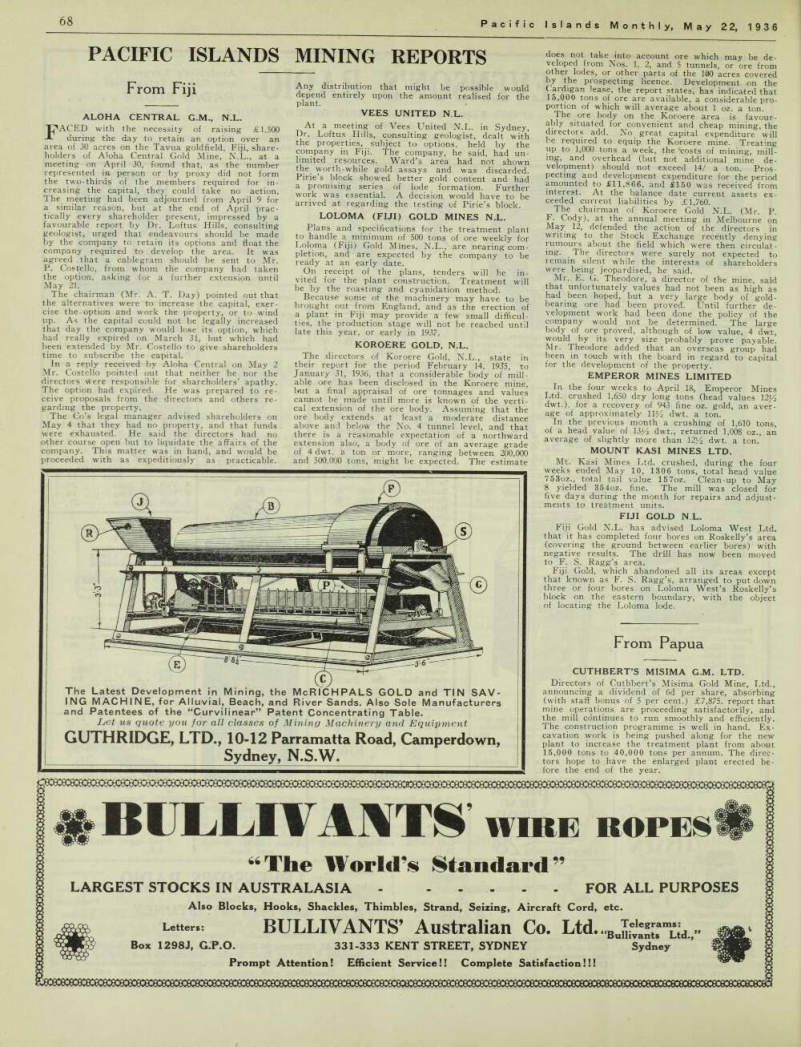
From Fiji
Aloha Central G.M., N.L.
FACED with the necessity of raising £1,500 during the day to retain an option over an area of 30 acres on the Tavua goldfield, Fiji, share holders of Aloha Central Gold Mine, N.L., at a meeting on April 30, found that, as the number represented in person or by proxy did not form the two-thirds of the members required for in creasing the capital, they could take no action.
The meeting had been adjourned from April 9 for a similar reason, but at the end of April prac tically every shareholder present, impressed by a favourable report by Dr. Loftus Hills, consulting geologist, urged that endeavours should be made by the company to retain its options and float the company required to develop the area. It was agreed that a cablegram should be sent to Mr.
P. Costello, from whom the company had taken the option, asking for a further extension until May 21.
The chairman (Mr. A. T. Day) pointed out that the alternatives were to increase the capital, exer cise the option and work the property, or to wind up. As the capital could not be legally increased that day the company would lose its option, which had really expired on March 31, but which had been extended by Mr. Costello to give shareholders time to subscribe the capital.
In a reply received by Aloha Central on May 2 Mr. Costello pointed out that neither he nor the directors were responsible for shareholders’ apathy.
The option had expired. He was prepared to re ceive proposals from the directors and others re garding the property.
The Co’s legal manager advised shareholders on May 4 that they had no property, and that funds were exhausted. He said the directors had no other course open but to liquidate the affairs of the company. This matter was in hand, and would be proceeded with as expeditiously as practicable.
Any distribution that might be possible would depend entirely upon the amount realised for the plant.
Vees United N.L.
At a meeting of Vees United N.L. in Sydney, Dr. Loftus Hills, consulting geologist, dealt with the properties, subject to options, held by the company in Fiji. The company, he said, had un limited resources. Ward’s area had not shown the worth-while gold assays and was discarded.
Pirie’s block showed better gold content and had a promising series of lode formation. Further work was essential. A decision would have to be arrived at regarding the testing of Pirie’s block.
Loloma (Fiji) Gold Mines N.L.
Plans and specifications for the treatment plant to handle a minimum of 500 tons of ore weekly for Loloma (Fiji) Gold Mines, N.L., are nearing com pletion, and are expected by the company to be ready at an early date.
On receipt of the plans, tenders will be in vited for the plant construction. Treatment will be by the roasting and cyanidation method.
Because some of the machinery may have to be brought out from England, and as the erection of a plant in Fiji may provide a few small difficul ties, the production stage will not be reached until late this year, or early in 1937.
Koroere Gold, N.L.
The directors of Koroere Gold, N.L., state in their report for the period February 14, 1935, to January 31, 1936, that a considerable body of mill able ore has been disclosed in the Koroere mine, but a final appraisal of ore tonnages and values cannot be made until more is known of the verti cal extension of the ore body. Assuming that the ore body extends at least a moderate distance above and below the No. 4 tunnel level, and that there is a reasonable expectation of a northward extension also, a body of ore of an average grade of 4 dwt. a ton or more, ranging between 200,(XX) and 500,000 tons, might be expected. The estimate
does not take into account ore which may be de veloped from Nos. 1,2, and 5 tunnels, or ore from other lodes, or other parts of the 180 acres covered by the prospecting licence. Development on the Cardigan lease, the report states, has indicated that 15,000 tons of ore are available, a considerable pro portion of which will average about 1 oz. a ton.
The ore body on the Koroere area is favour ably situated for convenient and cheap mining, the directors add. No great capital expenditure will be required to equip the Koroere mine. Treating up to 1,000 tons a week, the *costs of mining, mill ing, and overhead (but not additional mine de velopment) should not exceed 14/ a ton. Pros pecting and development expenditure for the period amounted to £11,866, and £l5O was received from interest. At the balance date current assets ex ceeded current liabilities by £1,760.
The chairman of Koroere Gold N.L. (Mr. P.
F. Cody), at the annual meeting in Melbourne on May 12, defended the action of the directors in writing to the Stock Exchange recently denying rumours about the field which were then circulat ing. The directors were surely not expected to remain silent while the interests of shareholders were being jeopardised, he said.
Mr. E. G. Theodore, a director of the mine, said that unfortunately values had not been as high as had been hoped, but a very large body of gold bearing ore had been proved. Until further de velopment work had been done the policy of the company would not be determined. The large body of ore proved, although of low value, 4 dwt, would by its very size probably prove payable.
Mr. Theodore added that an overseas group had been in touch with the board in regard to capital for the development of the property.
Emperor Mines Limited
In the four weeks to April 18, Emperor Mines Ltd. crushed 1,650 dry long tons (head values dwt.), for a recovery of 943 fine oz. gold, an aver age of approximately dwt. a ton.
In the previous month a crushing of 1,610 tons, of a head value of dwt., returned 1,008 oz., an average of slightly more than dwt. a ton.
Mount Kasi Mines Ltd.
Mt. Kasi Mines Ltd. crushed, during the four weeks ended May 10, 1306 tons, total head value 7530 z., total tail value 1570 z. Clean-up to May 8 yielded 3540 z. fine. The mill was closed for five days during the month for repairs and adjust ments to treatment units.
Fiji Gold N.L.
Fiji Gold N.L. has advised Loloma West Ltd. that it has completed four bores on Roskelly’s area (covering the ground between earlier bores) with negative results. The drill has now been moved to F. S. Ragg’s area.
Fiji Gold, which abandoned all its areas except that known as F. S. Ragg’s, arranged to put down three or four bores on Loloma West’s Roskelly’s block on the eastern boundary, with the object of locating the Loloma lode.
From Papua
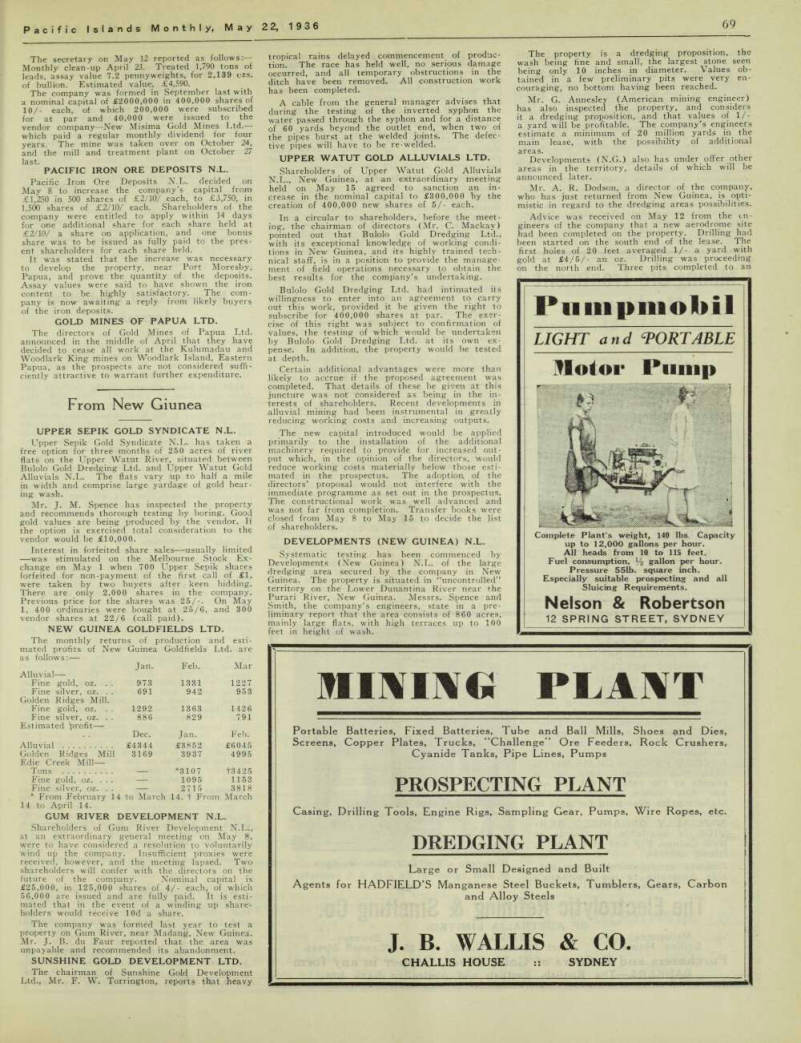
Cuthberts Misima G.M. Ltd.
Directors of Cuthbert’s Misima Gold Mine, Ltd., announcing a dividend of 6d per share, absorbing (with staff bonus of 5 per cent.) £7,875. report that mine operations are proceeding satisfactorily, and the mill continues to run smoothly and efficiently.
The construction programme is well in hand. Ex cavation work is being pushed along for the new plant to increase the treatment plant from about 15,000 tons to 40,000 tons per annum. The direc tors hope to have the enlarged plant erected be fore the end of the year.
The secretary on May 12 reported as follows: Monthly clean-up April 23. Treated 1,790 tons of leads, assay value 7.2 pennyweights, for 2,139 czs. of bullion. Estimated value, £4,590.
The company was formed in September last with a nominal capital of £2000,000 in 400,000 shares of 10/- each, of which 200,000 were subscribed for at par and 40,000 were issued to the vendor company—New Misima Gold Mines Ltd.— which paid a regular monthly dividend for four years. The mine was taken over on October 24, and the mill and treatment plant on October 27 last.
Pacific Iron Ore Deposits N.L.
Pacific Iron Ore Deposits N.L. decided on May 8 to increase the company’s capital from £1,250 in 500 shares of £2/10/ each, to £3,750, in 1,500 shares of £2/10/ each. Shareholders of the company were entitled to apply within 14 days for one additional share for each share held at £2/10/ a share on application, and one bonus share was to be issued as fully paid to the pres ent shareholders for each share held.
It was stated that the increase was necessary to develop the property, near Port Moresby, Papua, and prove the quantity of the deposits.
Assay values were said to have shown the iron content to be highly satisfactory. The com pany is now awaiting a reply from likely buyers of the iron deposits.
Gold Mines Of Papua Ltd.
The directors of Gold Mines of Papua Ltd. announced in the middle of April that they have decided to cease all work at the Kulumadau and Woodlark King mines on Woodlark Island, Eastern Papua, as the prospects are not considered suffi ciently attractive to warrant further expenditure.
Advertisements & other items, p. 70 (1 item)
<H> BIJIJLIV.AMTS’ wire ropes ♦
The Latest Development in Mining, the McRICHPALS GOLD and TIN SAV- ING MACHINE, for Alluvial, Beach, and River Sands. Also Sole Manufacturers and Patentees of the “Curvilinear” Patent Concentrating Table.
Let us quote you for all classes of Mining Machinery and Equipment
GUTHRIDGE, LTD., 10-12 Parramatta Road, Camperdown,
Sydney, N.S.W.
<H> BIJIJLIV.AMTS’ wire ropes ♦
“The World’s Standard”
LARGEST STOCKS IN AUSTRALASIA FOR ALL PURPOSES « Also Blocks, Hooks, Shackles, Thimbles, Strand, Seizing, Aircraft Cord, etc.
Letter.: BULLIVANTS’ Australian Co. Ltd. „ Bu , Box 1298 J, G.P.O. 331-333 KENT STREET, SYDNEY Prompt Attention! Efficient Service!! Complete Satisfaction!!! #'
From New Giunea
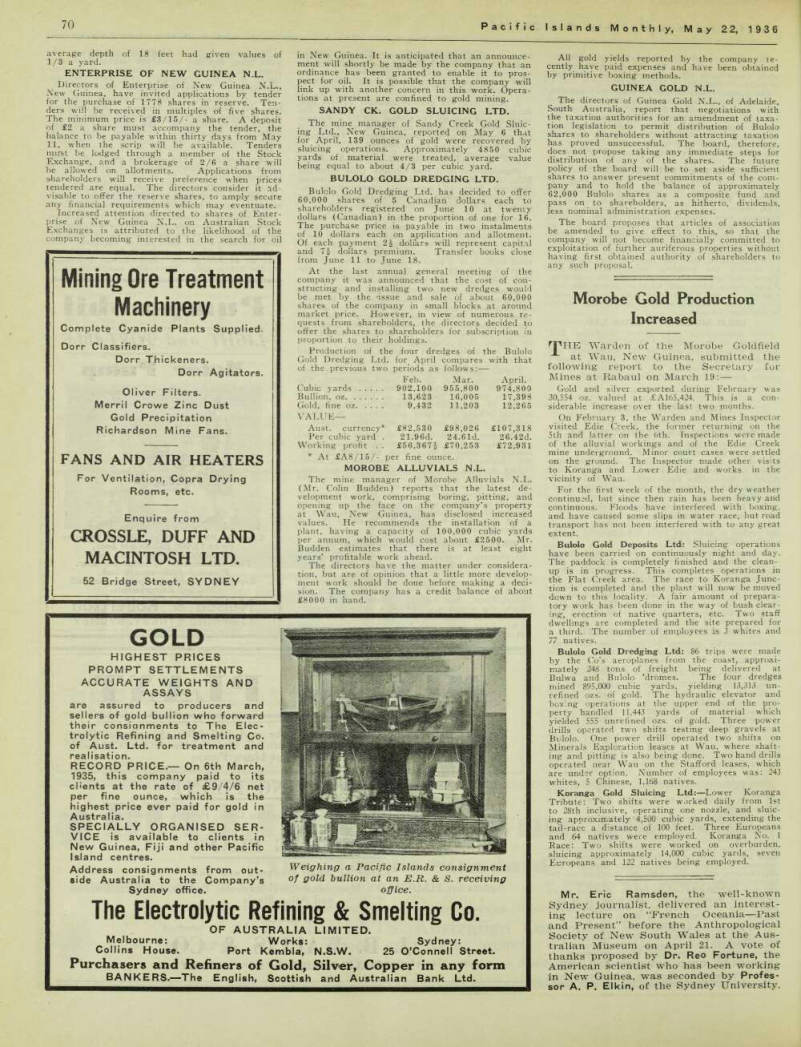
Upper Sepik Gold Syndicate N.L.
Upper Sepik Gold Syndicate N.L. has taken a free option for three months of 250 acres of river flats on the Upper Watut River, situated between Bulolo Gold Dredging Ltd. and Upper Watut Gold Alluvials N.L. The flats vary up to half a mile in width and comprise large yardage of gold bear ing wash.
Mr. J. M. Spence has inspected the property and recommends thorough testing by boring. Good gold values are being produced by the vendor. If the option is exercised total consideration to the vendor would be £lO,OOO.
Interest in forfeited share sales—usually limited —was stimulated on the Melbourne Stock Ex change on May 1 when 700 Upper Sepik shares forfeited for non-payment of the first call of £l, were taken by two buyers after keen bidding.
There are only 2,000 shares in the company.
Previous price for the shares was 25/-. On May 1, 400 ordinaries were bought at 25/6, and 300 vendor shares at 22/6 (call paid).
New Guinea Goldfields Ltd.
The monthly returns of production and esti mated profits of New Guinea Goldfields Ltd. are as follows:
Gum River Development N.L.
Shareholders of Gum River Development N.L;, at an extraordinary general meeting on May 8, were to have considered a resolution to voluntarily wind up the company. Insufficient proxies were received, however, and the meeting lapsed. Two shareholders will confer with the directors on the future of the company. Nominal capital is £25,000, in 125,000 shares of 4/- each, of which 56,000 are issued and are fully paid. It is esti mated that in the event of a winding up share holders would receive lOd a share.
The company was formed last year to test a property on Gum River, near Madang, New Guinea.
Mr. J. B. du Faur reported that the area was unpayable and recommended its abandonment.
Sunshine Gold Development Ltd.
The chairman of Sunshine Gold Development Ltd., Mr. F. W. Torrington, reports that heavy
tropical rains delayed commencement of produc tion. The race has held well, no serious damage occurred, and all temporary obstructions in the ditch have been removed. All construction work has been completed.
A cable from the general manager advises that during the testing of the inverted syphon the water passed through the syphon and for a distance of 60 yards beyond the outlet end, when two of the pipes burst at the welded joints. The defec tive pipes will have to be re-welded.
Upper Watut Gold Alluvials Ltd.
Shareholders of Upper Watut Gold Alluvials N.L., New Guinea, at an extraordinary meeting held on May 15 agreed to sanction an in crease in the nominal capital to £300,000 by the creation of 400,000 new shares of 5/- each.
In a circular to shareholders, before the meet ing, the chairman of directors (Mr. C. Mackay) pointed out that Bulolo Gold Dredging Ltd., with its exceptional knowledge of working condi tions in New Guinea, and its highly trained tech nical staff, is in a position to provide the manage ment of field operations necessary to obtain the best results for the company’s undertaking.
Bulolo Gold Dredging Ltd. had intimated its willingness to enter into an agreement to carry out this work, provided it be given the right to subscribe for 400,000 shares at par. The exer cise of this right was subject to confirmation of values, the testing of which would be undertaken by Bulolo Gold Dredging Ltd. at its own ex pense. In addition, the property would be tested at depth.
Certain additional advantages were more than likely to accrue if the proposed agreement was completed. That details of these be given at this juncture was not considered as being in the in terests of shareholders. Recent developments in alluvial mining had been instrumental in greatly reducing working costs and increasing outputs.
The new capital introduced would be applied primarily to the installation of the additional machinery required to provide for increased out put which, in the opinion of the directors, would reduce working costs materially below those esti mated in the prospectus. The adoption, of the directors’ proposal would not interfere with the immediate programme as set out in the prospectus.
The constructional work was well advanced and was not far from completion. Transfer books were closed from May 8 to May 15 to decide the list of shareholders.
Developments (New Guinea) N.L.
Systematic testing has been commenced by Developments (New Guinea) N.L. of the large dredging area secured by the company in New Guinea. The property is situated in “uncontrolled’’ territory on the Lower Dunantina River near the Purari River, New Guinea. Messrs. Spence and Smith, the company’s engineers, state in a pre liminary report that the area consists of 860 acres, mainly large flats, with high terraces up to 100 feet in height of wash.
The property is a dredging proposition, the wash being fine and small, the largest stone seen being only 10 inches in diameter. Values ob tained in a few preliminary pits were very en couraging, no bottom having been reached.
Mr. G. Annesley (American mining engineer) has also inspected the property, and considers it a dredging proposition, and that values of 1/a yard will be profitable. The company’s engineers estimate a minimum of 20 million yards in the main lease, with the possibility of additional areas.
Developments (N.G.) also has under offer other areas in the territory, details of which will be announced later.
Mr. A. R. Dodson, a director of the company, who has just returned from New Guinea, is opti mistic in regard to the dredging areas possibilities.
Advice was received on May 12 from the en gineers of the company that a new aerodrome site had been completed on the property. Drilling had been started on the south end of the lease. The first holes of 20 feet averaged 1/- a yard with gold at £4/5/- an oz. Drilling was proceeding on the north end. Three pits completed to an
Jan.
Feb.
Mar Alluvial— Fine gold, oz. . . 973 1331 1227 Fine silver, oz. . . 691 942 953 Golden Ridges Mill.
Fine gold, oz. . .
1292 1363 1426 Fine silver, oz. . . 886 829 791 Estimated 'profit— Dec.
Jan.
Feb.
Alluvial £4344 £3852 £6045 Golden Ridges Mill 3169 3937 4995 Edie Creek Mill— Tons — *3107 t3425 Fine gold, oz. . . . — 1095 1153 Fine silver, oz. . . 2715 3818 * From February 14 to March 14. t From March 14 to April 14.
average depth of 18 feet had given values of 1/3 a yard.
Enterprise Of New Guinea N.L.
Directors of Fnternrise of \W M 1
N have'invited ST/ t 2fe
for the purchase of 1778 shares in reserve. Tenders will be received in multiples of five shares.
The minimum price is £3/15/- a share. A deposit be allowed on Applications from shareholders will receive preference when prices directors consider it advisable to offer the reserve shares, to amply secure requirements winch may eventuate. nrise of NVw r W t 0 ha [ es ° f E <? ter a ? t " : £f a T Austrahan Stock g L attrib . u ed to the likelihood of the company becoming interested m the search for oil
in New Guinea. It is anticipated that an announce ment will shortly be made by the company that an ordinance has been granted to enable it to pros pect for oil. It is possible that the company will link up with another concern in this work. Opera tions at present are confined to gold mining.
Sandy Ck. Gold Sluicing Ltd.
The mine manager of Sandy Creek Gold Sluic ing Ltd., New Guinea, reported on May 6 that for April, 139 ounces of gold were recovered by sluicing operations. Approximately 4850 cubic yards of material were treated, average value being equal to about 4/3 per cubic yard.
Bulolo Gold Dredging Ltd.
Bulolo Gold Dredging Ltd. has decided to offer 60,000 shares of 5 Canadian dollars each to shareholders registered on June 10 at twenty dollars (Canadian) in the proportion of one for 16.
The purchase price is payable in two instalments of 10 dollars each on application and allotment.
Of each payment 2J dollars will represent capital and 7J dollars premium. Transfer books close from June 11 to June 18.
At the last annual general meeting of the company it was announced that the cost of con structing and installing two new dredges would be met by the -issue and sale of about 60,000 shares of the company in small blocks at around market price. However, in view of numerous re quests from shareholders, the directors decided to offer the shares to shareholders for subscription in proportion to their holdings.
Production of the four dredges of the Bulolo Gold Dredging Ltd. for April compares with that of the previous two periods as follows:
Morobe Alluvials N.L.
The mine manager of Morobe Alluvials N.L. (Mr. Colin Budden) reports that the latest de velopment work, comprising boring, pitting, and opening up the face on the company’s property at Wau, New Guinea, has disclosed increased values. He recommends the installation of a plant, having a capacity of 100,000 cubic yards per annum, which would cost about £2500. Mr.
Budden estimates that there is at least eight years’ profitable work ahead.
The directors have the matter under considera tion, but are of opinion that a little more develop ment work should be done before making a deci sion. The company has a credit balance of about £BOOO in hand.
All gold yields reported by the company re cently have paid expenses and have been obtained by primitive boxing methods.
Guinea Gold N.L.
The directors of Guinea Gold N.L., of Adelaide, South Australia, report that negotiations with the taxation authorities for an amendment of taxa tion legislation to permit distribution of Bulolo shares to shareholders without attracting taxation has proved unsuccessful. The board, therefore, does not propose taking any immediate steps for distribution of any 'of the shares. The future policy of the board will be to set aside sufficient shares to answer present commitments of the com pany and to hold the balance of approximately 62,000 Bulolo shares as a composite fund and pass on to shareholders, as hitherto, dividends, less nominal administration expenses.
The board proposes that articles of association be amended to give effect to this, so that the company will not become financially committed to exploitation of further auriferous properties without having first obtained authority of shareholders to any such proposal.
Feb. Mar. April.
Cubic yards 902,100 955,800 974,800 Bullion, oz 13,623 16,005 17,398 Gold, fine oz 9,432 11,203 12,265
Value—
Aust. currency* £82,530 £98,026 £107,318 Per cubic yard . 21.96d. 24.61d. 26.42d.
Working profit . . £70,253 £72,931 * At £A8/15/- per fine ounce.
Advertisements & other items, pp. 71-72 (1 item)
Mining Plant
PimipmoMl
LIGHT and PORTABLE
Motor Pump
r*. «, :i i »> v , Complete Plant’s weight, 140 lbs. Capacityup to 12,000 gallons per hour.
All heads from 10 to 115 feet.
Fuel consumption, V 2 gallon per hour.
Pressure 551 b. square inch.
Especially suitable prospecting and all Sluicing Requirements.
Nelson & Robertson
12 SPRING STREET, SYDNEY
MINING PLANT
Portable Batteries, Fixed Batteries, Tube and Ball Mills, Shoes and Dies, Screens, Copper Plates, Trucks, "Challenge” Ore Feeders, Rock Crushers, Cyanide Tanks, Pipe Lines, Pumps
PROSPECTING PLANT
Casing, Drilling Tools, Engine Rigs, Sampling Gear, Pumps, Wire Ropes, etc.
DREDGING PLANT
Large or Small Designed and Built Agents for HADFIELD’S Manganese Steel Buckets, Tumblers, Gears, Carbon and Alloy Steels
J. B. WALLIS & CO.
CHALLIS HOUSE :: SYDNEY
Mining Ore Treatment
Machinery
Complete Cyanide Plants Supplied.
Dorr Classifiers.
Dorr Thickeners.
Dorr Agitators.
Oliver Filters.
Merril Crowe Zinc Dust Gold Precipitation Richardson Mine Fans.
FANS AND AIR HEATERS
For Ventilation, Copra Drying Rooms, etc.
Enquire from
CROSSLE, DUFF AND
MACINTOSH LTD.
52 Bridge Street, SYDNEY
GOLD
HIGHEST PRICES
PROMPT SETTLEMENTS
ACCURATE WEIGHTS AND
ASSAYS
are assured to producers and sellers of gold bullion who forward their consianments to The Electrolytic Refining and Smelting Co. of Aust. Ltd. for treatment and realisation.
RECORD PRICE.— On 6th March, 1935, this company paid to its clients at the rate of £9/4/6 net per fine ounce, which is the highest price ever paid for gold in Australia.
SPECIALLY ORGANISED SER-
VICE is available to clients in New Guinea, Fiji and other Pacific Island centres.
Address consignments from outside Australia to the Company's Sydney office.
Weighing a Pacific Islands consignment of gold bullion at an E.R. & S. receiving office.
The Electrolytic Refining & Smelting Co.
OF AUSTRALIA LIMITED.
Melbourne: Works; Sydney: Collins House. Port Kembla, N.S.W. 25 O’Connell Street.
Purchasers and Refiners of Gold, Silver, Copper in any form BANKERS.—The English, Scottish and Australian Bank Ltd.
Morobe Gold Production
Increased
THE Warden of the Morobe Goldfield A at Wau, New Guinea, submitted the following report to the Secretary for Mines at Rabaul on March 19: Gold and silver exported during February was 30,554 oz. valued at £A165,424. This is a con siderable increase over the last two months.
On February 3, the Warden and Mines Inspector visited Edie Creek, the former returning on the sth and latter on the 6th. Inspections were made of the alluvial workings and of the Edie Creek mine underground. Minor court cases were settled on the ground. The Inspector made other visits to Koranga and Lower Edie and works in the vicinity of Wau.
For the first week of the month, the dry weather continued, but since then rain has been heavy and continuous. Floods have interfered with boxing, and have caused some slips in water race, but road transport has not been interfered with to any great extent.
Bulolo Gold Deposits Ltd: Sluicing operations have been carried on continuously night and day.
The paddock is completely finished and the clean up is in progress. This completes operations in the Flat Creek area. The race to Koranga Junc tion is completed and the plant will now be moved down to this locality. A fair amount of prepara tory work has been done in the way of bush clear ing, erection of native quarters, etc. Two staff dwellings are completed and the site prepared for a third. The number of employees is 3 whites and 77 natives.
Bulolo Gold Dredging Ltd: 86 trips were made by the Co’s aeroplanes from the coast, approxi mately 248 tons of freight being delivered at Bulwa and Bulolo ’dromes. The four dredges mined 895,000 cubic yards, yielding 13,313 un refined ozs. of gold. The hydraulic elevator and boxing operations at the upper end of the pro perty handled 11,443 yards of material which yielded 555 unrefined ozs. of gold. Three power drills operated two shifts testing deep gravels at Bulolo. One power drill operated two shifts on Minerals Exploration leases at Wau, where shaft ing and pitting is also being done. Two hand drills operated near Wau on the Stafford leases, which are under option. Number of employees was: 243 whites, 5 Chinese, 1,168 natives.
Koranga Gold Sluicing Ltd: —Lower Koranga Tribute: Two shifts were worked daily from Ist to 28th inclusive, operating one nozzle, and sluic ing approximately 4,500 cubic yards, extending the tail-race a distance of 100 feet. Three Europeans and 64 natives were employed. Koranga No. 1 Race: Two shifts were worked on overburden, sluicing approximately 14,000 cubic yards, seven Europeans and 122 natives being employed.
Mr. Eric Ramsden, the well-known Sydney journalist, delivered an interest ing lecture on “French Oceania—Past and Present” before the Anthropological Society of New South Wales at the Aus tralian Museum on April 21. A vote of thanks proposed by Dr. Reo Fortune, the American scientist who has been working in New Guinea, was seconded by Profes sor A. P, Elkin, of the Sydney University.
Islands Gold
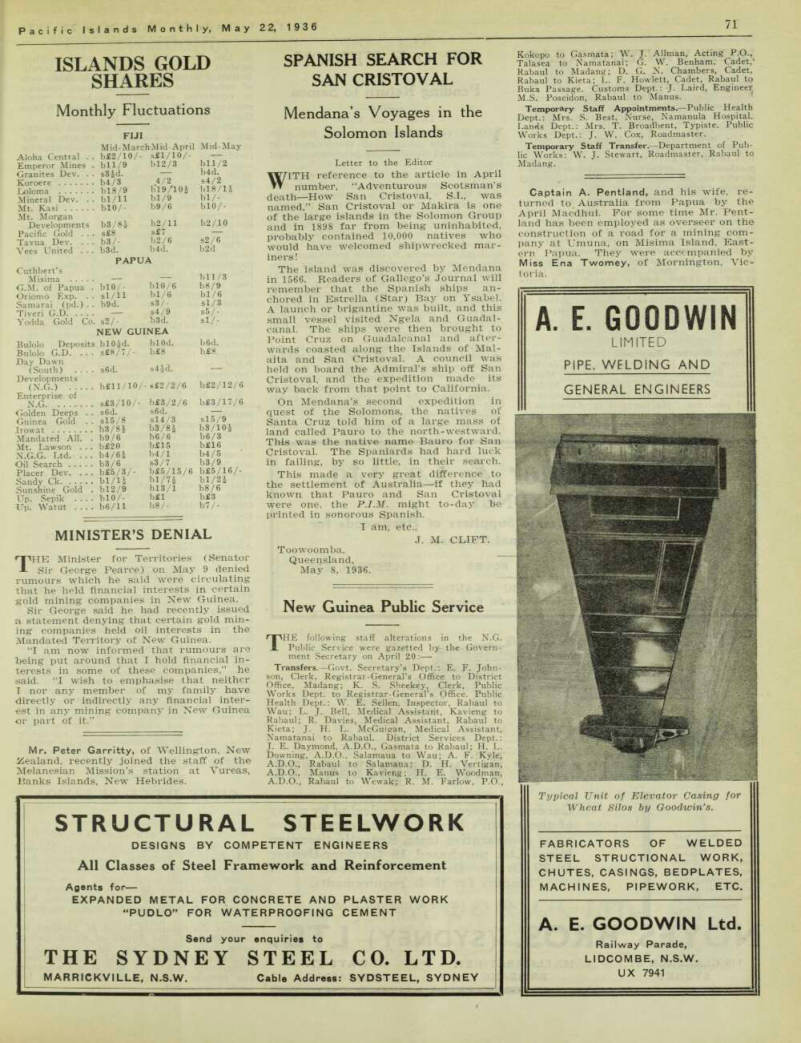
Shares
Monthly Fluctuations
Fiji
Mid-March Mid-April Mid-May Aloha Central . . b£2/10/s£ 1 /10 / - — Emperor Mines . bll/9 b 12 / 3 bll/2 Granites Dev. . . s3Jd. — b4d.
Koroere b4/3 4/2 s4/2 Loloma b!8/9 b'l9/10* h 18 /1J Mineral Dev. . . bl/11 bl/9 bl/- Mt. Kasi blO/b9/6 blO/- Mt. Morgan b2/l 1 b2/10 Developments b3/8| Pacific Gold . . . s£8 s£7 s2/6 Tavua Dev. . . . b3/b2/6 Vees United . . . b3d. b4d. b2d
Papua
Cuthbert’s bll/3 - — G.M. of Papua . blO/blO/6 b8/9 Oriomo Exp. . . sl/11 bl /6 bl/6 Samarai (pd.).. b9d. s3/ sl/3 Tiveri G.D — s4/9 s5/- Yodda Gold Co. s2/b3d. sl/-
New Guinea
Bulolo Deposits blOid. blOd. b6d.
Bulolo G.D. . . . s£8/7/b£8 b£8 Day Dawn (South) s6d. s4jd. — Developments b£2/12/6 (N.G.) b£ll/10/ ■s£2/2/6 Enterprise of N.G s£3/10/b£3/2/6 b£3/17/6 Golden Deeps . . s6d. s6d. — Guinea Gold . . s!5/8 s!4/3 s!5/9 Irowat b3/8| b3/8J b3/10| Mandated All. . b9/6 b6/6 b6/3 Mt. Lawson . . . b£20 b£15 b£16 N.G.G. Ltd. . . . b4/6£ b4/l b4/5 Oil Search b3/6 b£5/3/s3/7 b3/9 Placer Dev. . . . b£5/15/6 b£5/16/- Sandy Ck bl/U b!2/9 bl/7£ bl/2| Sunshine Gold . b!3/l b8/6 Up. Sepik ... blO/b£l b£3 Up. Watut . . . . b6/ll b8/b7/-
Minister’S Denial
THE Minister for Territories (Senator Sir George Pearce) on May 9 denied rumours which he said were circulating that he held financial interests in certain gold mining companies in New Guinea.
Sir George said he had recently issued a statement denying that certain gold min ing companies held oil interests in the Mandated Territory of New Guinea.
“I am now informed that rumours are being put around that I hold financial in terests in some of these companies,” he said. “I wish to emphasise that neither I nor any member of my family have directly or indirectly any financial inter est in any mining company in New Guinea or part of it.”
Mr. Peter Garritty, of Wellington, New Zealand, recently joined the staff of the Melanesian Mission’s station at Vureas, Banks Islands, New Hebrides.
Mendana’s Voyages in the
Spanish Search For
San Cris Toval
Mendana’s Voyages in the Solomon Islands
Letter to the Editor WITH reference to the article in April number, “Adventurous Scotsman’s death —How San Cristoval, 5.1., was named,” San Cristoval or Makira is one of the large islands in the Solomon Group and in 1898 far from being uninhabited, probably contained 10,000 natives who would have welcomed shipwrecked mar iners!
The island was discovered by Mendana in 1566. Readers of Gallego’s Journal will remember that the Spanish ships an chored in Estrella (Star) Bay on Ysabel.
A launch or brigantine was built, and this small vessel visited Ngela and Guadal canal. The ships were then brought to Point Cruz on Guadalcanal and after wards coasted along the Islands of Mal aita and San Cristoval. A council was held on board the Admiral’s ship off San Cristoval, and the expedition made its way back from that point to California.
On Mendana’s second expedition in quest of the Solomons, the natives of Santa Cruz told him of a large mass of land called Pauro to the north-westward.
This was the native name Bauro for San Cristoval. The Spaniards had hard luck in failing, by so little, in their search.
This made a very great difference to the settlement of Australia —if they had known that Pauro and San Cristoval were one, the P.I.M. might to-day be printed in sonorous Spanish.
I am, etc..
J. M. Clift.
Toowoomba.
Queensland, May 8, 1936.
New Guinea Public Service
THE following staff alterations in the N.G.
Public Service were gazetted by the Govern ment Secretary on April 20; — Transfers. —Govt. Secretary’s Dept.; E. F. John son, Clerk, Registrar-General’s Office to District Office, Madang; K. S. Sheekey, Clerk, Public Works Dept, to Registrar-General’s Office. Public Health Dept.: W. E. Sellen, Inspector, Rabaul to Wau; L. J. Bell, Medical Assistant, Kavieng to Rabaul; R. Davies, Medical Assistant, Rabaul to Kieta; J. H. L. McGuigan, Medical Assistant, Namatanai to Rabaul. District Services Dept.: J. E. Daymond. A.D.0., Gasmata to Rabaul; H. L.
Downing, A.D.0.. Salamaua to Wau; A. F. Kyle, A.D.0., Rabaul to Salamaua: D. H. Vertigan, A.D.0., Manus to Kavieng; H. E. Woodman, A.D.0., Rabaul to Wewak; R. M. Farlow, P. 0.,
Kokopo to Gasmata; W. J. Allman, Acting P. 0., Talasea to Namatanai; G. W. Benham, Cadet, 1 Rabaul to Madang; D. G. N. Chambers, Cadet, Rabaul to Kieta; L. F. Hewlett, Cadet, Rabaul to Buka Passage. Customs Dept.: J. Laird, Engineer M.S. Poseidon, Rabaul to Manus.
Temporary Staff Appointments. —Public Health Dept.; Mrs. S. Best. Nurse, Namanula Hospital.
Lands Dept.: Mrs. T. Broadbent, Typiste. Public Works Dept.: J. W. Cox, Roadmaster.
Temporary Staff Transfer. Department of Pub lic Works: W. J. Stewart, Roadmaster, Rabaul to Madang.
Captain A. Pentland, and his wife, re turned to Australia from Papua by the April Macdhui. For some time Mr. Pent land has been employed as overseer on the construction of a road for a mining com pany at Umuna, on Misima Island, East ern Papua. They were accompanied by Miss Ena Twomey, of Mornington, Vic toria.
Advertisements & other items, p. 73 (2 items)
A. E. Goodwin
LIMITED
PIPE. WELDING AND
GENERAL ENGINEERS
Typical Unit of Elevator Casing for Wheat Silos by Goodwin’s.
FABRICATORS OF WELDED
STEEL STRUCTION AL WORK,
CHUTES, CASINGS, BEDPLATES,
MACHINES, PIPEWORK, ETC.
A. E. GOODWIN Ltd.
Railway Parade,
LIDCOMBE, N.S.W.
UX 7941
Structural Steelwork
DESIGNS BY COMPETENT ENGINEERS
All Classes of Steel Framework and Reinforcement Agents for— EXPANDED METAL FOR CONCRETE AND PLASTER WORK
"PUDLO" FOR WATERPROOFING CEMENT
Send your enquiries to
THE SYDNEY STEEL CO. LTD.
MARRICKVILLE, N.S.W. Cable Address: SYDSTEEL, SYDNEY
Hotel Wanted In Tulagi
TT is a surprising thing that no one has seen the possibilities of establishing a well-conducted hotel at Tulagi, the administrative centre of the Solomon Islands.
The hotel there was destroyed by fire a couple of years ago and, since then, visi tors to Tulagi have had to resort to various methods of securing accommodation — mostly casual meals and still more casual beds in Chinatown.
A Solomon Islands resident, writing to us, says: “A good class commercial and residential club is what is needed here in Tulagi, with tennis, billiards, card room, and lounge, with a general bar built out over the water, and wharf alongside. The bar should be separate from the residential section. It would cost anything from £2,000 to £4,000, and it would be a god send to this territory. There is no reason why it should not return a fair interest on capital invested—it is all a question of good management.”
Rev. Brother Raphael, formerly head master of the Boys’ School at Ra, Navini bitu, Fiji, has resigned from the Marist Mission, and is now staying in Sydney where he will shortly take up a commer cial position. He arrived in Australia in December last to undergo an operation, and has now completely recovered.
Mr. O. F. Nelson
Pending Return to Samoa
Letter to the Editor 'VT'OUR editorial comments on my case since the change of Government in New Zealand clearly show prejudice against me.
You stress the fact that my present exile was by a decision of the High Court, and state that “wiping out a sentence imposed after lengthy proceedings by a properly constituted Court, and confirmed on appeal to a higher court, sets an extremely dangerous precedent.” The P.I.M. cannot have studied political situations in other civilised countries if it has not, among its files, records of similar proceedings else where, showing that the release of political prisoners is one of the very first acts of a new Government coming into power. The suggestion sometimes made that British Courts are more just than other Courts cannot weigh much with one who has had my bitter experience.
Only last week I saw a picture in one of the Auckland dailies of political prisoners coming out of gaol by a general amnesty issued by a new Government in troubled Spain. The re-enthroned King of Greece risked the alienation of the good will of his own monarchist supporters responsible for the restoration of the monarchy when he demanded an amnesty
to the Venizelist faction who rebelled against the same restoration. Surely British Justice should permit of these acts of conciliation as much as other systems in countries considered backward when compared with British standards. Where then is the “dangerous precedent?”
The decision of the New Zealand Govern ment that I be allowed to return to my home and my people without degrading conditions is an act of statesmanship which will do more to restore peace, tran quility, and contentment among the Samoans than all the vacillating comments of the P.I.M. on the Samoan situation, where I was once condemned for “pig headedness,” a term applied to the New Zealand Government by the same paper in an issue of a month or two later.
The present New Zealand Government has never agreed with the policies of its predecessors, which brought about and perpetuated unrest in Samoa. In remit ting my exile, Mr. Savage stated that it was in keeping with the policies of his Government and its election pledges. In referring to this as a “dangerous prece dent” and advising me not to resume what I was alleged to have done which the previous Government had arbitrarily pro hibited in Samoa and not in New Zealand, P.I.M. is passing judgment on the new Government of this Dominion as much as on myself.
Now, Mr. Editor, if you are genuinely anxious to be helpful towards an amicable settlement of the longstanding controversv being brought about by this Government,, where all its predecessors failed, how can your uncompromising references tend to* accomplish this? By the changes which are being made in Samoa, I am on the side of the present Government and those who enforced the arbitrary policies of pre vious Governments will show by their actions whether a leopard can remove its spots overnight.
I am, etc,.
O. F. Nelson.
Auckland, N.Z.,
April 30, 1936.
Editorial Note
Mr. Nelson was driven into unlawful acts by the weakness and inefficiency of New Zealand’s Ad ministration in Samoa. He, quite properly, was convicted by a British Court of those unlawful acts. A stronger and more resourceful man than Mr. Nelson, would not have been placed in that position. Still, what he did was done for love of country; and this journal has made no protest against the cancellation of the edict of banish ment. What we did protest against was the absence, in that cancellation, of any attempt at explanation or justification, thus setting up a very dangerous precedent. Mr. Nelson’s arguments about the freeing of political prisoners by new Governments betrays the state of mind that twice led to his banishment. British administrations may be weak and stupid; but British Courts are not corrupt, and their decisions may not lightly be set aside. If Mr. Nelson prefers the political systems of Spain and Greece, he surely is welcome to them.
Chief Judge Of Samoa
From Our N.Z. Correspondent .
AUCKLAND, April 26.
MR. R. M. WATSON, Stipendiary Magis trate, of Peilding, New Zealand, has been appointed to the position of Chief Judge of the Samoan Court. It is under stood that the position is a temporary one, probably for a period of three months. Mr.
Watson left Wellington for Samoa on April 21.
Since the return of Mr. J. H. Luxford to New Zealand, the duties of Chief Judge have been carried out by various N.Z. magistrates who have held temporary ap pointments. It has not been stated whether the present appointment is likely to bo made permanent.
Advertisements & other items, p. 74 (1 item)
Mining: Equipment
Allen Taylor & Co. Ltd.
SYDNEY
Sawmillers and Wholesale Suppliers of Hardwoods for Constructional Purposes GIRDERS . . . PILES . . . POLES . . . SLEEPERS, ETC.
EXPORTING TO PACIFIC ISLANDS SINCE 1893
Cables: Tuxedo, Sydney
GARDNER-DENVER
Gardner- Denver Model D 79.
Mining: Equipment
Save time and money by using Gardner - Denver equipment. Fifty years of active manufacturing experience are behind each tested machine.
Gardner-Denver units are selected by many
of the worlds largest mining corporations
after comparative tests. Recently, Bendigo
Mines Ltd. purchased 15 Gardner-Denver
D 79 Drifter Drills and 4 Model 77 H
Stopers for their requirements.
Ask for details of the full range
NOYES BROS. (Sydney) LTD.
115 CLARENCE ST. 197 ELIZABETH ST. 11 WATT ST.
SYDNEY BRISBANE NEWCASTLE
New Caledonia
Mineral Industries Busy
From Our Own Correspondent
Noumea, May 2.
THERE are indications that New Cale donia has made a steady and satis factory recovery from the economic depres sion.
Representatives of different countries have been here bidding for our minerals.
The most active appear to be the Japanese, who now are buying chrome as well as nickel.
The new line of Japanese freighters which is running to New Zealand via New Caledonia is helping our industries. Large quantities of sulphur are being brought in from Japan for use in the treatment of nickel ore; and the ships on their way back from New Zealand with wool take up our minerals and other products.
Japanese goods also are rapidly finding their way in.
There has been much prospecting activity by gold-seekers, but no encourag ing discoveries have been reported.
Death of C. H. Hughes
ONE of the most prominent shipping men in Australia, Mr. Charles Henry Hughes, director and former general manager of the Union Steam Ship Com pany of New Zealand Limited, died in Sydney on May 10, at the age of 73.
His career was romantic. Beginning as a reporter on the “Evening News” in Syd ney, he transferred to the Union Company where he worked his way up from the bottom to the highest position the com pany had to offer in Australia. He was associated with the U.S.S. Co. for 57 years.
Joining the company in 1879, Mr.
Hughes made rapid progress through the various departments, becoming assistant manager in Sydney. In the nineties he was appointed agent for the Union line in Fiji. For some years he resided at Suva until promoted to the position of secre tary of the company at the head office in Dunedin, New Zealand.
Transferred to Australia, Mr. Hughes was manager in Melbourne for a time be fore succeeding the late Mr. David Mills as general manager in Sydney. Two years ago, he retired owing to ill-health and was appointed a director. Mr. A. J.
Soutar, of Melbourne, came to Sydney to assume the managership.
Fiji Bananas In Canada
From Our Own Correspondent SUVA, April 23.
WRITING from Vancouver, the Hon.
Alport Barker (member of the Fiji Legislative Council), who is en route to England, states that he made inquiries concerning the sale of Fiji bananas on the Canadian market.
Everywhere he went, he heard that the flavour of the fruit was excellent, but that the appearance of it in the retail shops was not good.
A fru’t agent had expressed the opinion that the fruit was carried at too low a temperature. In Canada, our bananas com pete with those from Ecuador, and it was apparent that the appearance of the Ecua dor fruit is enough to sell it, thus giving it a big advantage over the Fiji product.
Expedition
No Gold!
Oceanic Co. Abandons Expedition
THE Melbourne expedition which char tered the ship Joseph Conrad some three months ago and went to one of the Papuan islands near Samarai to search for gold, appears to have been a complete “washout”. The following was published in Melbourne in mid-May: Directors of Oceanic Gold Exploration N.L. re port that Mr. T. J. Shephard, mining engineer, has cabled that the area in South-Eastern Papua inspected by him has been very disappointing. He advised the abandonment of the expedition.
The expedition, consisting of four mining engi neers under the leadership of Mr. Shephard, left on the sailing ship Joseph Conrad last January.
Capital is £lO,OOO, in 2000 shares of £5 each, of which 1,500 paid up to £2 a share, were sub scribed. Australian Prospecting N.L., Mandated Gold N.L. and Pacific Gold N.L. hold 150 shares, and Cracow Gold N.L. 100 shares, in the com pany.
Progress Of Aviation In
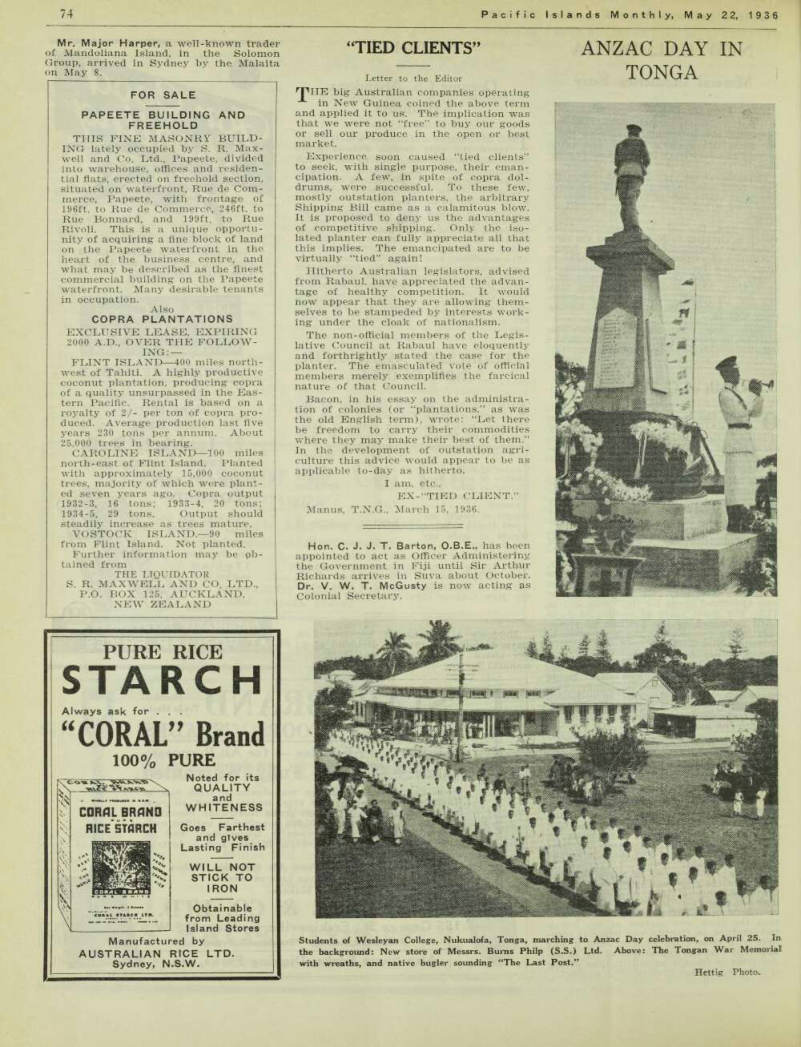
New Guinea
rPHE following figures, compiled by the Commonwealth Statistician, show the progress which has been made in avia tion in the Mandated Territory of New Guinea during the last two years: 1932-33. 1934-35.
Number of flights ... 7,228 14,710 Number of hours flown 8,499 13,022 Number of miles flown 680,871 1,094.308 Number of passengers carried 7,041 14.403 Weight of freight car ried (tons) 4,903.1 7,789.17 Weight of mails car ried (tons) 21.02 43.7 The amount of freight carried in Aus tralia last year was 110 tons, as compared with 7,789 tons in New Guinea. Mails carried in Australia weighed 30 tons, while the New Guinea services carried 43 tons.
Holden’s Air Transport Services Ltd. have declared an interim dividend of 6d per share (equal to 10 per cent, per annum) for the quarter ended March 31.
Mr. Major Harper, a well-known trader of Mandoliana Island, in the Solomon Group, arrived in Sydney by the Malaita on May 8.
Advertisements & other items, pp. 75-76 (1 item)
“Star” Brand I
“Limit” Bags and no “lost” birds—that’s the record keen duck shooters desire, and that is what YOU will get with
ALWAYS RELIABLE
High Velocity—
Hard Hitting—
Long Range
2| Loads in 2Y Shells
No Excessive Pressure or Recoil
“NEOFLAK”
LOADED
“Neoflak” has become the most popular powder on the Austral i a n market in record time. 409 a 0 Sr. m sx If, &
“STAR” BRAND i
SHOVELS SCOOPS SPADES
All Sizes All Styles for All Purposes
Quality Tools Fully Warranted
Made by experts Blades manufactured from special English carbon - manganese steel under correct oil heat treatment. Fitted with high grade Australian mountain ash handles. Well over 200,000 supplied to satified customers, including Commonwealth Government and all Australian State Governments, Mines, and Industrial undertakings.
Enquiries solicited from bona fide Wholesale Traders.
Literature and Price Lists on request.
W. SAVAGE & CO. LTD.
155 George St., Erskineville, Sydney, N.S.W.
Sole Makers:
Also Stone Forks, Digging Forks, etc.
Telegraphic Address: “Starshovel,” Sydney
FOR SALE
PAPEETE BUILDING AND
FREEHOLD
THIS FINE MASONRY BUILD-
ING lately occupied by S. R. Maxwell and Co. Ltd., Papeete, divided into warehouse, offices and residential flats, erected on freehold section, situated on waterfront, Rue de Commerce, Papeete, with frontage of 196 ft. to Rue de Commerce, 246 ft. to Rue Bonnard, and 199 ft. to Rue Rivoli. This is a unique opportunity of acquiring a fine block of land on the Papeete waterfront in the heart of the business centre, and what may be described as the finest commercial building on the Papeete waterfront. Many desirable tenants in occupation.
Also
COPRA PLANTATIONS
EXCLUSIVE LEASE, EXPIRING
2000 A.D., OVER THE FOLLOW-
ING;—
FLINT ISLAND—4OO miles northwest of Tahiti. A highly productive coconut plantation, producing copra of a quality unsurpassed in the Eastern Pacific. Rental is based on a royalty of 2/- per ton of copra produced. Average production last five years 230 tons per annum. About 25,000 trees in bearing.
CAROLINE ISLAND—IOO miles
north-east of Flint Island. Planted with approximately 15,000 coconut trees, majority of which were planted seven years ago. Copra output 1932-3, 16 tons; 1933-4, 20 tons; 1934-5, 29 tons. Output should steadily increase as trees mature.
VOSTOCK ISLAND.—9O miles
from Flint Island. Not planted.
Further information may be pbtained from
THE LIQUIDATOR
S. R, MAXWELL AND CO. LTD.,
P.O. BOX 125, AUCKLAND,
NEW ZEALAND
PURE RICE
STARCH
Always ask for . . .
“CORAL” Brand
Manufactured by
AUSTRALIAN RICE LTD.
Sydney, N.S.W.
“Tied Clients”
Letter to the Editor THE big Australian companies operating in New Guinea coined the above term and applied it to us. The implication was that we were not “free” to buy our goods or sell our produce in the open or best market.
Experience soon caused “tied clients” to seek, with single purpose, their eman cipation. A few, in spite of copra dol drums, were successful. To these few, mostly outstation planters, the arbitrary Shipping Bill came as a calamitous blow.
It is proposed to deny us the advantages of competitive shipping. Only the iso lated planter can fully appreciate all that this implies. The emancipated are to be virtually “tied” again!
Hitherto Australian legislators, advised from Rabaul, have appreciated the advan tage of healthy competition. It would now appear that they are allowing them selves to be stampeded by interests work ing under the cloak of nationalism.
The non-official members of the Legis lative Council at Rabaul have eloquently and forthrightly stated the case for the planter. The emasculated vote of official members merely exemplifies the farcical nature of that Council.
Bacon, in his essay on the administra tion of colonies (or “plantations,” as was the old English term), wrote: “Let there be freedom to carry their commodities where they may make their best of them.”
In the development of outstation agri culture this advice would appear to be as applicable to-day as hitherto.
I am, etc.,
Ex-"Tied Client."
Manus, T.N.G., March 15, 1936.
Hon. C. J. J. T. Barton, 0.8. E., has been appointed to act as Officer Administering the Government in Fiji until Sir Arthur Richards arrives in Suva about October.
Dr. V. W. T. McGusty is now acting as Colonial Secretary.
Tonga
Anzac Day In
Students of Wesleyan College, Nukualofa, Tonga, marching to Anzac Day celebration, on April 25. In the background: New store of Messrs. Bums Philp (S.S.) Ltd. Above: The Tongan War Memorial with wreaths, and native bugler sounding “The Last Post.”
Hettig Photo.
Blown To Sea
Papuans Drift Across to Solomons
. From a Special Correspondent GIZO, April 8.
AN March 18 a strange outrigger canoe was noticed drifting about off Bagga (Vella Lavella, Northern Solomons), and some of Mr. Binskin’s plantation boys went out to her assistance. They found three very frightened men, whom they had some difficulty in convincing of their perfect safety. They were paddled ashore to Mr. Binskin.
It turned out they were natives of the Lachlan Islands (Eastern Papua), who, whilst out fishing, had been caught by a nor’-west blow, which carried them far out to sea. Not knowing their direction, they had drifted about for seven days and nights at the mercy of winds and cur rents, with only sago, saturated with salt water, and a few raw sweet potatoes to eat. They had to quench their thirst with sips of sea water.
At Bagga the strangers were kindly treated, and at the first opportunity Mr.
Binskin brought them into Gizo, so that they should catch the expected s.s. Weir bank to Rabaul, thence to be returned to Samarai.
A canoe with three men and two women of the Trobriand Group drifted, under similar circumstances, to the same place about seven years ago. They also were terrified at the prospect of coming ashore, and it was only the visible evidence of white settlement which induced them to do so. They were kindly treated in the Solomons and duly returned from Gizo to their home, via Sydney.
About 1906 a large Papuan canoe drifted over in the same way. The local natives brought the men ashore, and, one way and another, they either died or were killed before the year was out.
In Sydney
Tropical Health Lectures In Sydney
on June 8 and termin ating on August 7, a course of lec tures in tropical medicine, hygiene, and sanitation will be held at the School of Public Health and Tropical Medicine, University of Sydney, on Mondays, Wed nesdays, and Fridays.
The lectures have been framed espec ially to meet the needs of missionaries, nurses, and other workers, outside the medical profession, who anticipate living in tropical territories. No charge will be made for the course and enrolment should be made by June 8.
A comprehensive syllabus has been arranged. Instruction will include lec tures on the physiological effects of tropical climate; clothing, habits, food, and drink in the tropics; entomology; in sect prophylaxis; Pacific Islands diseases —their symptoms, treatment, and preven tion; and medical and surgical emer gencies, etc.
At the recent Thursday Island Town Council Triennial Election, the following candidates were elected as Aldermen for the ensuing three years:—Messrs. G.
Asange, T. A. Cohen, G. G. Mills, E. H.
Vowels, Donald Farquhar, Thomas Bur gess, G. F. Runcie and F. G. Joyce. Ald erman Alex Corrie was again returned unopposed as Mayor.
Guinea Gold’S Future
HAVING “found impossible for practical purposes” a distribution of the shares held by the company in the Bulolo Gold Dredging, Ltd., the directors of Guinea Gold, N.L., will seek shareholders’ ap proval of an alteration in the articles of association.
The alteration would have the effect of limiting future mining activities, with a view to conserving the Bulolo share holding as an invested fund until share holders decide otherwise.
The directors state that the taxation authorities have decided not to permit the distribution of the Bulolo shares with immunity from taxation.
Advertisements & other items, p. 77 (1 item)
Swallow & Ariell
PRESCOTT L T J? IyhPJb S y are sole wholesale agents fd^
PINEAPPLE BACON & HANS
DAISY BRAND BUTTER
FRESCO BRAND BUTTER
LEA & PERRINS’ SAUCE
Swallow & Ariell
LIMITED
Port Melbourne :: Australia Manufacturers Since 1854 of
HIGH QUALITY
\ Slilp and Cabin Biscuits CABIN (Including Small Cabin) I
PACIFIC CABIN
CABIN CRACKERS
BREAKFAST BISCUITS
NAVY & PILOT BREAD
Packed expressly for export in tins up to 50lbs.
Islands Produce
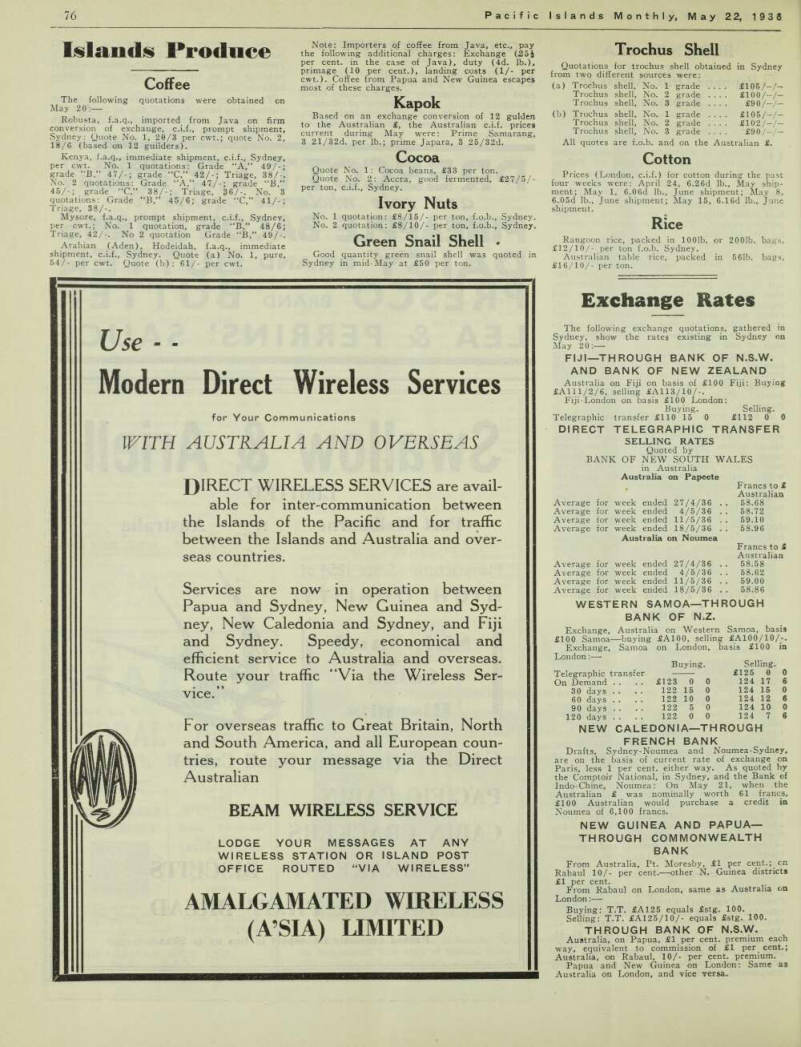
Coffee
The following quotations were obtained on May 20: — Robusta, f.a.q., imported from Java on firm conversion of exchange, c.i.f,, prompt shipment, Sydney: Quote No. 1, 20/3 per cwt.; quote No. 2, 18/6 (based on 12 guilders).
Kenya, f.a.q., immediate shipment, c.i.f., Sydney, per cwt. No. 1 quotations: Grade “A” 49/-; grade “B,” 47/-; grade “C,” 42/-; Triage, 38/-.
No. 2 quotations: Grade “A,” 47/-; grade “B,” 45/-; grade “C,” 38/-; Triage, 36/-. No. 3 quotations: Grade “B,” 45/6; grade “C,” 41/-; Triage, 38/-.
Mysore, f.a.q., prompt shipment, c.i.f., Sydney, per cwt.; No. 1 quotation, grade “B,” 48/6; Triage, 42/-. No 2 quotation Grade “B,” 49/-.
Arabian (Aden), Hodeidah, f.a.q., immediate shipment, c.i.f., Sydney. Quote (a) No. 1, pure, 54/- per cwt. Quote (b): 61/- per cwt.
Note: Importers of coffee from Java, etc., pay the following additional charges: Exchange (25J per cent, in the case of Java), duty (4d. lb.), primage (10 per cent.), landing costs (1/- per cwt.). Coffee from Papua and New Guinea escapes most of these charges.
Kapok
Based on an exchange conversion of 12 gulden to the Australian £, the Australian c.i.f. prices current during May were: Prime Samarang, 3 21/32d. per lb.; prime Japara, 3 25/32d.
Cocoa
Quote No. 1: Cocoa beans, £33 per ton.
Quote No. 2: Accra, good fermented, £27/5/per ton, c.i.f., Sydney.
Ivory Nuts
No. 1 quotation; £B/15/- per ton, f.0.b., Sydney, No. 2 quotation: £B/10/- per ton, f.0.b., Sydney.
Green Snail Shell •
Good quantity green snail shell was quoted in Sydney in mid-May at £5O per ton.
Trochus Shell
Quotations for trochus shell obtained in Sydney from two different sources were: (a) Trochus shell, No. 1 grade ... £lO5/-/ Trochus shell. No. 2 grade ... £lOO/-/ Trochus shell. No. 3 grade ... £9O/—/ (b) Trochus shell. No. 1 grade ... £lO5/—/ Trochus shell. No. 2 grade ... £lO2/—/ Trochus shell. No. 3 grade ... £9O/—/ All quotes are f.o.b. and on the Australian £.
Cotton
Prices (London, c.i.f.) for cotton during the past four weeks were: April 24, 6.26 d lb,. May ship ment; May 1,6.06 d lb., June shipment; May 8, 6.05 d lb., June shipment; May 15, 6.16 d lb., June shipment.
Rice
Rangoon rice, packed in 1001 b. or 2001 b. bags, £l2/10/- per ton f.o.b, Sydney, Australian table rice, packed in 561 b. bags, £l6/10/- per ton.
Exchange Rates
The following exchange quotations, gathered in Sydney, show the rates existing in Sydney on May 20 : FIJI— through bank of n.s.w.
And Bank Of New Zealand
Australia on Fiji on basis of £lOO Fiji: Buying £AIII/2/6, selling £AII3/10/-.
Fiji-London on basis £lOO London: Buying. Selling, Telegraphic transfer £llO 15 0 £ll2 0 0
Direct Telegraphic Transfer
Selling Rates
Quoted by
Bank Of New South Wales
in Australia
Western Samoa—Through
Bank Of N.Z.
Exchange, Australia on Western Samoa, basis £lOO Samoa —buying £AIOO, selling £AIOO/10/-.
Exchange, Samoa on London, basis £lOO in London;—
New Caledonia—Through
French Bank
Drafts, Sydney-Noumea and Noumea-Sydney, are on the basis of current rate of exchange on Paris, less 1 per cent, either way. As quoted by the Comptoir National, in Sydney, and the Bank of Indo-Chine, Noumea: On May 21, when the Australian £ was nominally worth 61 francs, £lOO Australian would purchase a credit in Noumea of 6,100 francs.
New Guinea And Papua
Through Commonwealth
Bank
From Australia, Pt. Moresby, £1 per cent.; on Rabaul 10/- per cent. —other N. Guinea districts £1 per cent.
From Rabaul on London, same as Australia on London:— Buying: T.T. £AI2S equals £stg. 100.
Selling: T.T. £AI2S/10/- equals £stg. 100.
Through Bank Of N.S.W.
Australia, on Papua, £1 per cent, premium each way, equivalent to commission of £1 per cent.; Australia, on Rabaul. 10/- per cent, premium, Papua and New Guinea on London: Same as Australia on London, and vice versa.
Australia on Papeete Francs to £ Australian Average for week ended 27/4/36 .. 58.68 Average for week ended 4/5/36 . . 58.72 Average for week ended 11/5/36 .. 59.10 Average for week ended 18/5/36 . . 58.96 Australia on Noumea Francs to £ Australian Average for week ended 27/4/36 . . 58.58 Average for week ended 4/5/36 . . 58.62 Average for week ended 11/5/36 . . 59.00 Average for week ended 18/5/36 . . 58.86
Buying. Selling.
Telegraphic transfer £125 0 0 On Demand . . . . £123 0 0 124 17 6 30 days . . . . 122 15 0 124 15 0 60 days . . . . 122 10 0 124 12 6 90 days . . . . 122 5 0 124 10 0 120 days ... 122 0 0 124 7 6
Advertisements & other items, p. 78 (1 item)
Modern Direct Wireless Services
Use--
for Your Communications
WITH AUSTRALIA AND OVERSEAS
DIRECT WIRELESS SERVICES are avail-
able for inter-communication between the Islands of the Pacific and for traffic between the Islands and Australia and overseas countries.
Services are now in operation between Papua and Sydney, New Guinea and Sydney, New Caledonia and Sydney, and Fiji and Sydney. Speedy, economical and efficient service to Australia and overseas.
Route your traffic “Via the Wireless Service.”
For overseas traffic to Great Britain, North and South America, and all European countries, route your message via the Direct Australian
BEAM WIRELESS SERVICE
LODGE YOUR MESSAGES AT ANY
WIRELESS STATION OR ISLAND POST
OFFICE ROUTED “VIA WIRELESS”
AMALGAMATED WIRELESS
(ASIA) LIMITED
Market Quotations
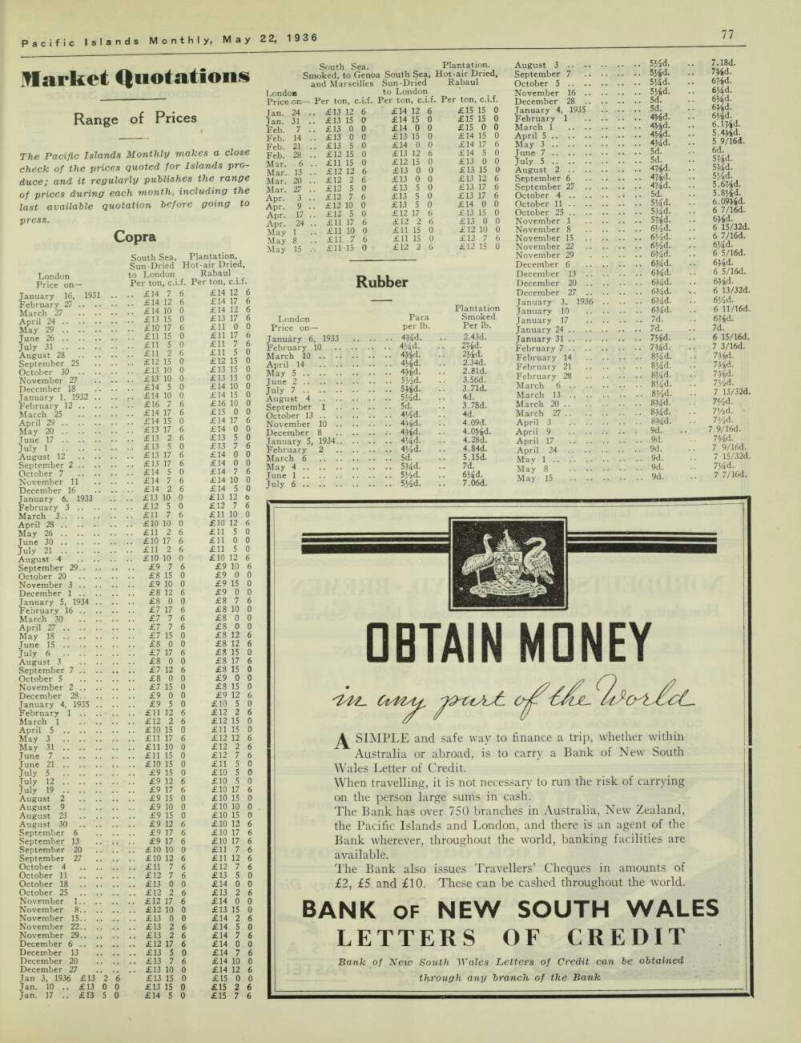
Range of Prices
The Pacific Islands Monthly makes a close check of the prices quoted for Islands pro duce; and it regularly publishes the range of prices during each month, including the last available quotation before going to press.
Copra
Rubber
South Sea.
Plantation.
Smoked, to Genoa South Sea, Hot-air Dried, and Marseilles Sun-Dried Rabaul London to London Price on— - Per ton, c.i.f.
Per ton, c. i.f.
Per ton, c.i.f.
Tan. 24 .. £13 12 6 £14 12 6 £15 15 0 Jan. 31 .. £13 15 0 £14 15 0 £15 IS 0 Feb. 7 .. £13 0 0 £14 0 0 £15 0 0 Feb. 14 .. £13 0 0 £13 15 0 £14 15 0 Feb. 21 .. £13 5 0 £14 0 0 £14 17 6 Feb. 28 .. £12 15 0 £13 12 6 £14 5 0 Mar. 6 .. £11 15 0 £12 15 0 £13 0 0 Mar. 13 .. £12 12 6 £13 0 0 £13 15 0 Mar. 20 .. £12 2 6 £13 0 0 £13 12 6 Mar. 27 .. £12 5 0 £13 5 0 £13 17 6 Apr. 3 .. £12 7 6 £13 5 0 £13 17 6 Apr. 9 .. £12 10 0 £13 5 0 £14 0 0 Apr. 17 .. £12 S 0 £12 17 6 £13 15 0 Apr. 24 .. £11 17 6 £12 2 6 £13 0 0 May 1 .. £11 10 0 £11 15 0 £12 10 0 May 8 .. £11 7 6 £11 15 0 £12 7 6 May 15 .. £11 15 0 £12 2 6 £12 15 0
London Para Plantation Smoked Price on — per lb.
Per lb.
January 6, 1933 .. .. 4Hd. .. 2.43d.
February 10 .. .. . .. 4'/ 4 d. 2V*d.
March 10 2y s d.
April 14 2.34d.
May 5 2.81d.
June 2 .. .. sy 2 d. 3.56d.
July 7 3.71d.
August 4 4d.
September 1 .. .. .. .. 5d. 3.78d.
October 13 .. .. 4/ 2 d. 4d.
November 10 .. .. .. .. 4y»d. 4.09d.
December 8 .. .. .. .. 4Hd. 4.0^d.
January 5, 1934.. .. .. .. 4-4d. 4.28d.
February 2 .. .. .. .. 4j4d. 4.84d.
March 6 .. .. 5d. 5.15d.
May 4 .. .. 5^d. 7d.
June 1 .. .. sy 2 d. 6'Ad.
July 6 .. .. sy 2 d. 7.06d.
August 3 7.18d.
September 7 . .. sy $ d. 7Hd- October 5 6?£d.
November 16 f> l / 4 d.
December 28 . .. Sd. 6'Ad.
January 4, 1935 .. • . .. 5d. 6Jid.
February 1 . .. 45*d. 6y»d.
March 1 6.1J*d.
April 5 May 3 June 7 July 5 . .. VAd. . .. 5d. 5.4Hd. 5 9/16d. 6d.
SHd.
August 2 . .. 47^d. sy 4 d.
September 6 sy,d.
September 27 5.6?^d.
October 4 . ,. 5d.
S.i'/td.
October 11 . .. S%d. 6.09f$d.
October 25 . .. sy 4 d. 6 7/16d.
November 1 . .. S?^d. && November 8 . .. 6/ 2 d. 6 15/32d.
November IS 6 7/16d.
November 22 . .. 6*/ 2 d. 6j4d.
November 29 . . .. 6^d. 6 S/16d.
December 6 . .. 6Ad. 6jid.
December 13 . .. 6J<d. 6 5/16d.
December 20 . .. 6Hd. 6J*d.
December 27 . .. ey 4 d. 6 13/32d.
January 3, 1936 .. . .. ey 4 d. ey 2 d.
January 10 . .. ey 4 d. 6 ll/16d.
January 17 . .. 7d. 6*$d.
January 24 . .. 7d. 7d.
January 31 6 15/16d.
February 7 . .. 7*4d. 7 3/16d.
February 14 . .. 854d. 7Ad.
February 21 . .. SAd. 7^d, February 28 . .. sy 4 d. 7Ad.
March 6 . .. sy 4 d. 7 l /id.
March 13 7 13/32d.
March 20 7»/ 2 d.
March 27 . .. &y 4 d. 7/2 d. ■ April 3 . .. &Hd. 7/ 2 d.
April 9 . . 9d. 7 9/16d.
April 17 . .. 9d. 7^d.
April 24 May 1 . .. 9d. . .. 9d. 7 9/16d. 7 15/32d. iVlciy 8 • • * • • • . .. 9d. 7%d.
May 15 .. 9d. 7 7/16d.
South Sea, Plantation, Sun-Dried Hot-air Dried, London to London i.f.
Rabaul Price on— Per ton, c.i Per ton, c.i.t.
January 16, 1931 February 27 .. .. £14 7 .. £14 12 6 6 £14 12 £14 17 6 6 March 27 .. .. .. £14 10 0 £14 12 6
April 24
May 29 .. £13 15 0 £13 17 6 .. £10 17 6 £11 0 0 June 26 July 31 August 28 .. ..
September 25 October 30 .. .. £11 15 0 £11 17 6 .. £11 5 0 £11 7 6 .. £11 2 .. £12 IS .. £13 10 6 0 0 £11 5 £12 IS £13 15 0 0 0 November 27 .. £13 10 0 £13 15 0 December 18 .. £14 5 0 £14 10 0 January 1, 1932 .. .. £14 10 0 £14 15 0 February 12 .. .. £16 7 6 £16 10 0 March 25 .. £14 17 6 £15 0 0 April 29 .. £14 15 0 £14 17 6 May 20 .. £13 17 6 £14 0 0 June 17 .. £13 2 6 £13 5 0 July 1 .. £13 5 0 £13 7 6 August 12 . . .. .. £13 17 6 £14 0 0
September 2 .. ..
,. £13 17 6 £14 0 0 October 7 .. .. .. £14 5 0 £14 7 6 November 11 .. £14 7 6 £14 10 0 December 16 .. £14 2 6 £14 5 0 January 6, 1933 .. £13 10 0 £13 12 b February 3 .. .. .. £12 5 0 £12 7 6 March 3 .. £11 7 6 £11 10 0 April 28 , , .. £10 10 0 £10 12 6 May 26 .. £11 2 6 £11 5 0 June 30 .. £10 17 6 £11 0 0 July 21 .. £11 2 6 £11 5 0 August 4 .. £10 10 0 £10 12 6 September 29.. .. £9 7 6 £9 10 6 October 20 .. .. .. £8 15 0 £9 0 0 November 3 .. .. . . £9 10 0 £9 15 0 December 1 .. ., .. £8 12 6 £9 0 0 January 5, 1934 ., .. £8 0 0 £8 7 6 February 16 .. . .. £7 17 6 £8 10 0 March 30 .. . .. £7 7 6 £8 0 0 April 27 .. £7 7 6 £8 0 0 May 18 £7 15 0 £8 12 6 June 15 .. £8 0 0 £8 12 6 July 6 .. £7 17 6 £8 IS 0 August 3 .. . .. £8 0 0 £8 17 6 September 7 .. . .. £7 12 6 £8 15 0 October 5 .. . .. £8 0 0 £9 0 0 November 2 .. . .. £7 15 0 £8 15 0 December 28.. . .. £9 0 0 £9 12 6 January 4, 1935 .
February 1 .. . 0 £10 5 0 .. £11 12 6 £12 2 6 March 1 .. £12 2 6 £12 IS 0 April 5 .. £10 15 0 £11 15 0 May 3 .. £11 17 6 £12 12 6 May 31 .. £11 10 0 £12 2 6 June 7 .. £11 15 0 £12 7 6 June 21 0 £11 5 0 July 5 .. £9 15 0 £10 5 0 July 12 .. £9 12 6 £10 5 0 July 19 .. £9 17 6 £10 17 6 August 2 .. ., .. £9 15 0 £10 15 0 August 9 .. . £9 10 0 £10 10 0 August 23 ... .. £9 15 0 £10 IS 0 August 30 .. . .. £9 12 6 £10 12 6 September 6 .. £9 17 6 £10 17 6 September 13 £9 17 6 £10 17 6 September 20 .. £10 10 0 £11 7 6
September 27
.. £10 12 6 £11 12 6 October 4 ... .. £11 7 6 £12 7 6 October 11 .. . .. £12 7 6 £13 5 0 October 18 ... .. £13 0 0 £14 0 0 October 25 .. . .. £12 2 6 £13 2 6 November 1., .. £12 17 6 £14 0 0 November 8.. . .. £12 10 0 £13 IS 0 November 15.. . 0 £14 2 6 November 22.. .. £13 2 6 £14 5 0 November 29.. . .. £13 2 6 £14 7 6 December 6 .. . 6 £14 0 0 December 13 .. £13 5 0 £14 7 6 December 20 .. £13 7 6 £14 10 0 December 27 .. £13 10 0 £14 12 6 Jan 3, 1936 £13 2 6 £13 15 0 £15 0 0 Jan. 10 .. £13 0 0 £13 15 0 £15 2 6 Jan. 17 .. £13 5 0 £14 5 0 £15 7 6
Advertisements & other items, p. 79 (1 item)
Obtain Money
444- '6AjL-
SIMPLE and safe way to finance a trip, whether within Australia or abroad, is to carry a Bank of New South Wales Letter of Credit.
When travelling, it is not necessary to run the risk of carrying on the person large sums in cash.
The Bank has over 750 branches in Australia, New Zealand, the Pacific Islands and London, and there is an agent of the Bank wherever, throughout the world, banking facilities are available.
The Bank also issues Travellers’ Cheques in amounts of £2, £5 and £lO. These can be cashed throughout the world.
BANK of NEW SOUTH WALES
LETTERS OF CREDIT
Bank, of New South Wales Letters of Credit can he obtained through any branch of the Bank
Shipping Services in the Pacific
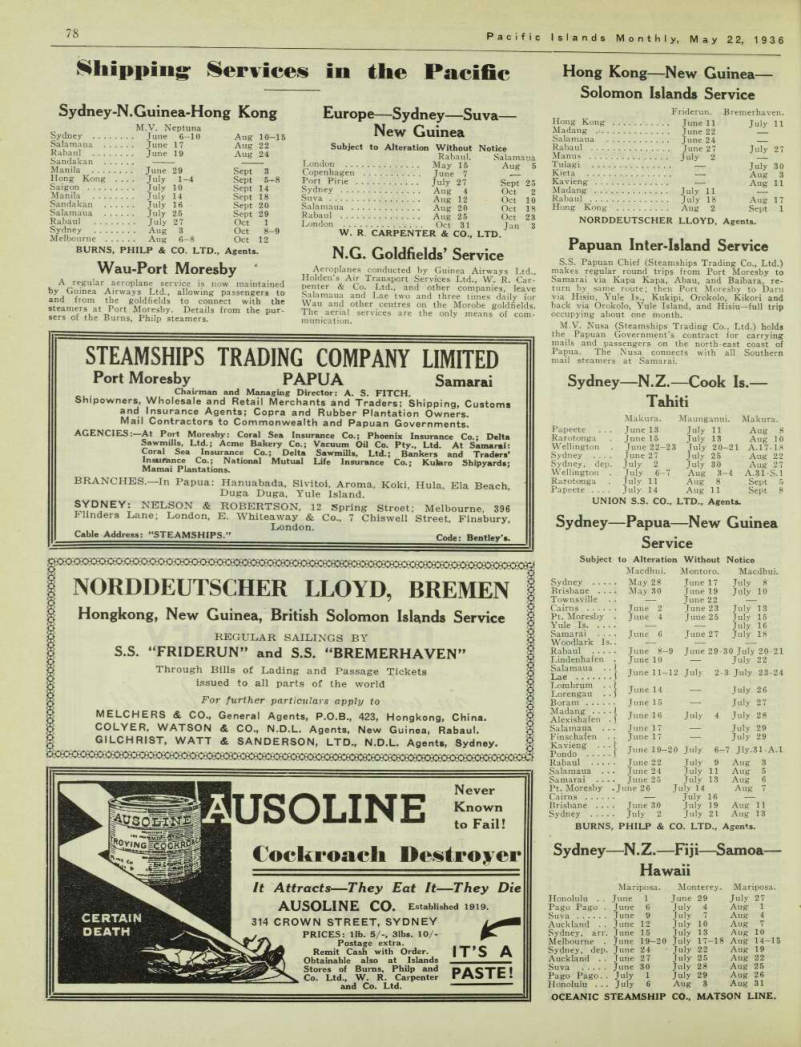
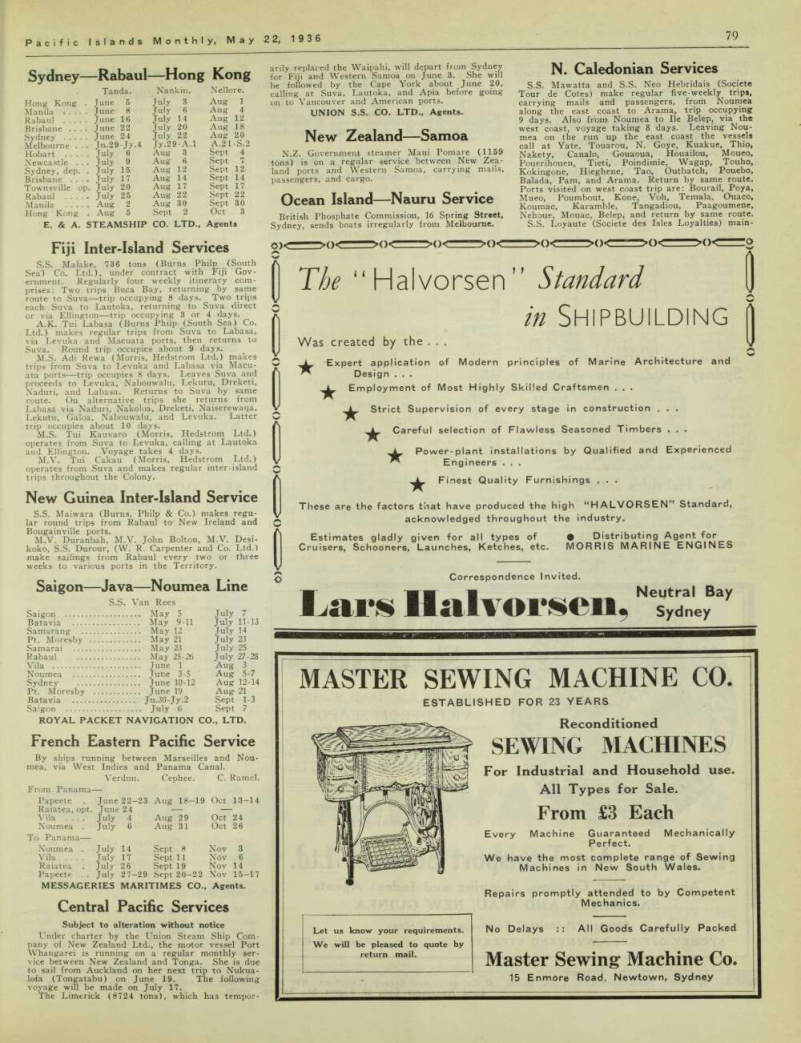
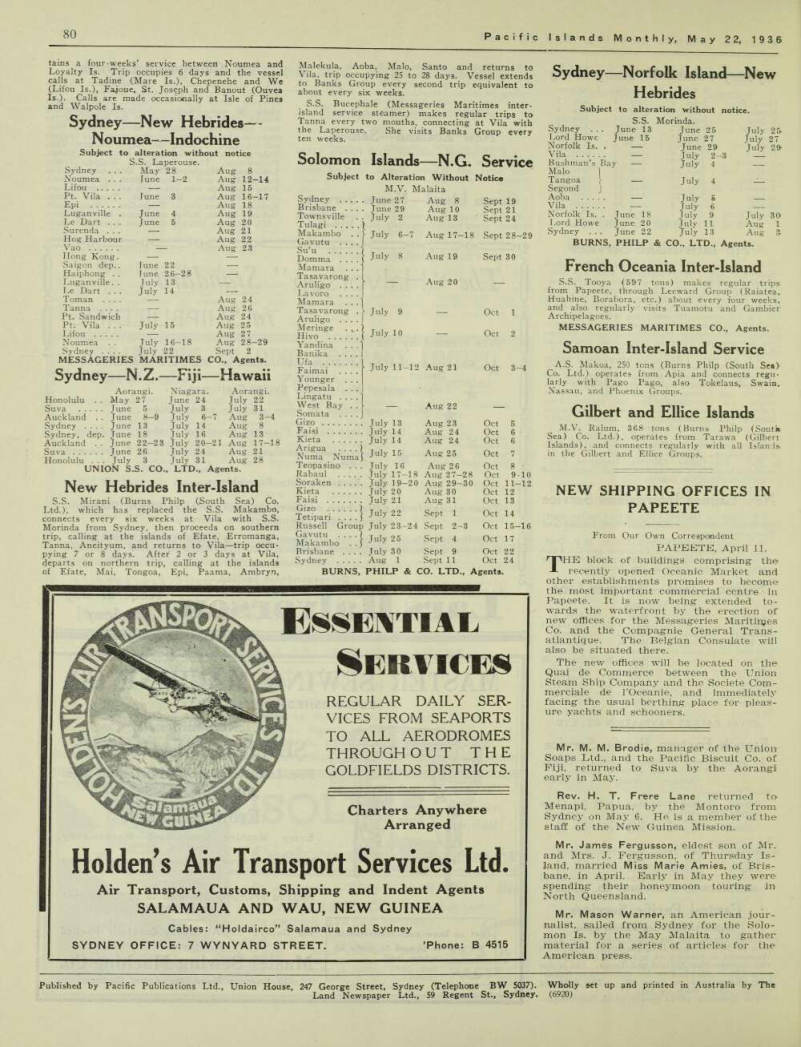
Sydney-N.Guinea-Hong Kong
Wau-Port Moresby *
A regular aeroplane service is now maintained by Guinea Airways Ltd., allowing passengers to and from the goldfields to connect with the steamers at Port Moresby. Details from the pur sers of the Burns, Philp steamers.
Europe—Sydney—Suva—
New Guinea Subject to Alteration Without Notice
N.G. Goldfields’ Service
Aeroplanes conducted by Guinea Airways Ltd., Holden’s Air Transport Services Ltd., W. R. Car penter & Co. Ltd., and other companies, leave Salamaua and Lae two and three times daily for Wau and other centres on the Morobe goldfields.
The aerial services are the only means of com munication.
Hong Kong—New Guinea— Solomon Islands Service
Papuan Inter-Island Service
S.S. Papuan Chief (Steamships Trading Co., Ltd.) makes regular round trips from Port Moresby to Samarai via Kapa Kapa, Abau, and Baibara, re turn by_ same route; then Port Moresby to Darn via Hisiu, Yule Is., Kukipi, Orokolo, Kikori and back via Orokolo, Yule Island, and Hisiu—full trip occupying about one month, M.V. Nusa (Steamships Trading Co., Ltd.) holds the Papuan Government’s contract for carrying mails and passengers on the north-east coast of Papua. The Nusa connects with all Southern mail steamers at Samarai.
Sydney—N.Z.—Cook Is.—
Tahiti
Sydney—Papua—New Guinea
Service Subject to Alteration Without Notice
Sydney—N.Z.—Fiji—Samoa— Hawaii
Sydney . . . .
M.V. Neptuna Aug 10-15 Salamaua ... June 17 Aug 22 Rabaul . . . .
Aug 24 Manila Sept 3 Hong Kong . . . . July 1—4 Sept 5-8 Saigon July 10 Sept 14 Manila ...
Sept 18 Sandakan July 16 Sept 20 Salamaua . .
July 25 Sept 29 Rabaul ...
July 27 Oct 1 Sydney ...
Aug 3 Oct 8-9 Melbourne . .
Oct 12
Burns,
Philp & Co. Ltd.,
Agents.
, Rabaul. Salamaua London May 15 Aug 5 Copenhagen June 7 Port Pirie July 27 Sept 25 Sydney Aug 4 Oct 2 Suva Aug 12 Oct 10 Salamaua Aug 20 Oct 18 Rabaul Aug 25 Oct 23 London Oct 31 Jan 3
W. R Carpenter & Co., Ltd.
Friderun.
Bremerhaven.
Hong Kong June 11 July 11 Madang June 22 Salamaua June 24 Rabaul June 27 July 27 Manus July 2 Tulagi — July 30 Kieta — Aug 3 Kavieng — Aug 11 Madang July 11 Rabaul July 18 Aug 17 Hong Kong Aug 2 Sept 1
Norddeutscher
Lloyd,
Agents.
Makura.
Maunganui.
Makura.
Papeete . . .
June 13 July 11 Aug 8 Rarotonga June 15 July 13 Aug 1 0 Wellington June 22-23 July 20-21 A.17-18 Sydney ...
June 27 July 25 Aug 22 Sydney, dep.
July 2
July 30
Aug 27 Wellington .
July 6—7 Aug 3-4 A.31-S.1 Rarotonga July 11 Aug 8 Sept 5 Papeete ...
July 14 Aug 11 Sept 8
Union S.S. Co.,
LTD., Agents.
Macdhui.
Montoro.
Macdhui.
May 28 June 17 July 8 Brisbane . . .
May 30 June 19 July 10 Townsville — June 22 J rnS ; June 2 June 4 June 23 June 25 July 13 July 15 Pt. Moresby Yule Is. ... — — July 16 Samarai June 6 June 27 July 18 Woodlark Is. — — — June 8- June 10 -9 June 29 30 July 20-21 July 22 Lindenhafen Salamaua Lae June 11- -12 July 2 -3 July 23-24 Lombrum . .
Lorengau . .
June 14 — July 26 Boram June 15 j- June 16 July 27 July 28 Madang ... I Alexishafen . J July 4 Salamaua . . .
June 17 — July 29 Finschafen June 17 — July 29
Kavieng . . . ]
Pondo ) June 19- -20 July 6- -7 Jly.31-A.l Ra.ba.ul ...» June 22 June 24 July 9 July 11 Aug 3 Aug 5 Salamaua . .
Samarai June 25 July 13 Aug 6 Pt. Moresby June 26 July 14 Aug 7 Cairns ...
July 16 July 19 Brisbane . . .
June 30 Aug 11 Sydney ...
July 2 July 21 Aug 13
Burns,
Philp &
Co. Ltd.,
Agents.
Mariposa.
Monterey.
Mariposa.
Honolulu . .
June 1 June 29 July 27 Pago Pago .
June 6 July 4 Aug 1 Suva June 9 July 7 Aug 4 Auckland . .
June 12 July 10 Aug 7 Sydney, arr.
June 15 July 13 Aug 10 Melbourne .
June 19-20 July 17-18 Aug 14-15 Sydney, dep.
June 24 July 22 Aug 19 Auckland . .
June 27 July 25 Aug 22 Suva June 30 July 28 Aug 25 Pago Pago. .
July 1 July 29 Aug 26 Honolulu . . .
July 6 Aug 3 Aug 31
Oceanic Steamship
CO.,
Matson Line.
Sydney—Rabaul—Hong Kong
Fiji Inter-Island Services
5.5. Malake, 736 tons (Burns Philp (South Sea) Co. Ltd.), under contract with Fiji Gov ernment. Regularly four weekly itinerary com prises: Two trips Buca Bay, returning by same route to Suva —trip occupying 8 days. Two trips each Suva to Lautoka, returning to Suva direct or via Ellington—trip occupying 3 or 4 days.
A.K. Tui Labasa (Burns Philp (South Sea) Co.
Ltd.) makes regular trips from Suva to Labasa. via Levuka and Macuata ports, then returns to Suva. Round trip occupies about 9 days.
M.S. Adi Rewa (Morris, Hedstrom Ltd.) makes trips from Suva to Levuka and Labasa via Macu ata ports—trip occupies 8 days. Leaves Suva and proceeds to Levuka, Nabouwalu, Lekutu, Dreketi, Naduri, and Labasa. Returns to Suva by same route. On alternative trips she returns from Labasa via Naduri, Nakoloa, Dreketi, Naiserewaqa, Lekutu, Galoa, Nabouwalu, and Levuka. Latter trip occupies about 10 days.
M.S. Tui Kauvaro (Morris, Hedstrom Ltd.) operates from Suva to Levuka, calling at Lautoka and Ellington. Voyage takes 4 days.
M.V. Tui Cakau (Morris, Hedstrom Ltd.) operates from Suva and makes regular inter-island trips throughout the Colony.
New Guinea Inter-Island Service
5.5. Maiwara (Burns, Philp & Co.) makes regu lar round trips from Rabaul to New Ireland and Bougainville ports.
M.V. Duranbah, M.V. John Bolton, M.V. Desi koko, S.S. Durour, (W. R. Carpenter and Co. Ltd.) make sailings from Rabaul every two or three weeks to various ports in the Territory.
Saigon—Java—Noumea Line
French Eastern Pacific Service
Central Pacific Services
Subject to alteration without notice Under charter by the Union Steam Ship Com pany of New Zealand Ltd., the motor vessel Port Whangarei is running on a regular monthly ser vice between New Zealand and Tonga. She is due to sail from Auckland on her next trip to Nukua lofa (Tongatabu) on June 19. The following voyage will be made on July 17.
The Limerick (8724 tons), which has tempor
arily replaced the Waipahi, will depart from Sydney for Fiji and Western Samoa on June 3. She will be followed by the Cape York about June 20, calling at Suva, Lautoka, and Apia before going on to Vancouver and American ports.
Union S.S. Co. Ltd., Agents.
xT •7110
INeW Zealand oamoa
N.Z. Government steamer Maui Pomare (1159 tons) is on a regular service between New Zealand ports and Western Samoa, carrying mails, passengers, and cargo.
Orpan IclonH Naum Sprvice
ucean IStana service British Phosphate Commission, 16 Spring Street, Sydney, sends boats irregularly from Melbourne.
M Caledonian Services
* S.S. Mawatta and S.S. Neo Hebridais (Societo Tour de Cotes) make regular five-weekly trips, carrying mails and passengers, from Noumea along the east coast to Arama, trip occupying 9 days. Also from Noumea to He Belep, via the west coast, voyage taking 8 days. Leaving Nou mea on the run up the east coast the vessels call at Yate, Touarou, N. Goye, Kuakue, Thio, Nakety, Canalo, Gouaoua, Houailou, Moueo, Pouerihouen, Tieti, Poindimie, Wagap, Touho, Kokingone, Hieghene, Tao, Outbatch, Pouebo, Balada, Pam, and Arama. Return by same route.
Ports visited on west coast trip are: Bourail, Poya, Mueo, Poumbout, Kone, Voh, Temala, Ouaco, Koum ’ aC( Karamble, Tangadiou, Paagoumene, Nehoue, Mouac, Belep, and return by same route.
S.S. Loyaute (Societe des Isles Loyalties) main
Tanda.
Nankin.
Nellore.
Hong Kong . June 5 July 3 Aug 1 Manila . . . . . June 8 July 6 Aug 4 Rabaul . . . . . June 16 July 14 Aug 12 Brisbane . . . . June 22 July 20 Aug 18 Sydney ... . June 24 July 22 Aug 20 Melbourne . . . Jn.29-Jy.4 Jy.29-A.l A.21 -S.2 Hobart . . . . . July 6 Aug 3 Sept 4 Newcastle . . . July 9 Aug 6 Sept 7 Sydney, dep. . July 15 Aug 12 Sept 12 Brisbane . . . . July 17 Aug 14 Sept 14 Townsville op. July 20 Aug 17 Sept 17 Rabaul . . . . . July 25 Aug 22 Sept 22 Manila . ■ . . . Aug 2 Aug 30 Sept 30 Hong Kong . Aug 5 Sept 2 Oct 3 E. & A.
Steamship
Co. Ltd.,
Agents
s.s. . Van Rees Saigon ... May 5 July 7 Batavia ... May 9-11 July 11-13 Samarang July 14 Pt. Moresby ... May 21 July 23 Samarai July 25 Rabaul ... May 25-26 July 27-28 Vila Aug 3 Noumea Aug 5-7 Sydney ... June 10-12 Aug 12-14 Pt. Moresby ... June 19 Aug 21 Batavia ... Ju.30-Jy.2 Sept 1-3 Saigon Sept 7
Royal Packet Navigation
Co., Ltd.
By ships running between Marseilles and mea, via West Indies and Panama Canal.
Nou- Verdun.
Cephee.
C.
Ramel.
From Panama— Papeete June 22—23 Raiatea, opt. June 24 Vila ... July 4 Noumea . July 6 Aug 18-19 Aug 29 Aug 31 Oct Oct Oct 13-14 24 26 To Panama— Noumea . July 14 Vila July 17 Raiatea . July 26 Papeete . . July 27—29 Sept 8 Sept 11 Sept 19 Sept 20-22 Nov Nov Nov Nov 3 6 14 15-17
Messageries Maritimes Co.,
Agents.
tains a four-weeks’ service between Noumea and Loyalty Is. Trip occupies 6 days and the vessel calls at Tadine (Mare Is.), Chepenehe and We (Lifou Is.), Fajoue, St. Joseph and Banout (Ouvea Is.). Calls are made occasionally at Isle of Pines and Walpole Is.
Sydney—New Hebrides—-
Noumea—lndochine
Subject to alteration without notice
Sydney—N.Z.—Fiji—Hawaii
New Hebrides Inter-Island
S.S. Mirani (Burns Philp (South Sea) Co.
Ltd.), which has replaced the S.S. Makambo, connects every six weeks at Vila with S.S.
Morinda from Sydney, then proceeds on southern trip, calling at the islands of Efate, Erromanga, Tanna, Aneityum, and returns to Vila —trip occu pying 7 or 8 days. After 2 or 3 days at Vila, departs on northern trip, calling at the islands of Efate, Mai, Tongoa, Epi, Paama, Ambryn,
Malekula, Aoba, Malo, Santo and returns to Vila, trip occupying 25 to 28 days. Vessel extends to Banks Group every second trip equivalent to about every six weeks.
S.S. Bucephale (Messageries Maritimes inter island service steamer) makes regular trips to Tanna every two months, connecting at Vila with the Laperouse. She visits Banks Group every ten weeks.
Solomon Islands—N.G. Service Subject to Alteration Without Notice
Sydney—Norfolk Island—New Hebrides Subject to alteration without notice.
French Oceania Inter-Island
S.S. Tooya (597 tons) makes regular trips from Papeete, through Leeward Group (Raiatea, Huahine, Borabora, etc.) about every four weeks, and also regularly visits Tuamotu and Gambier Archipelagoes.
Messageries Maritimes Co., Agents.
Samoan Inter-Island Service
A.S. Makoa, 250 tons (Burns Philp (South Sea> Co. Ltd.) operates from Apia and connects regu larly with Pago Pago, also Tokelaus, Swain, Nassau, and Phoenix Groups.
Gilbert and Ellice Islands
M.V. Ralum, 368 tons (Burns Philp (South Sea) Co. Ltd.), operates from Tarawa (Gilbert Islands), and connects regularly with all Islands in the Gilbert and Ellice Groups.
S.S. Laperouse.
Sydney May 28 Aug 8 Noumea . . .
Tune 1-2 Aug 12-14 Lifou — Aug 15 Pt. Vila . . .
June 3 Aug 16-17 Epi — Aug 18 Luganville .
June 4 Aug 19 Le Dart . . .
June 5 Aug 20 Surenda . . . — Aug 21 Hog Harbour — Aug 22 Vao — Aug 23 Hong Kong. — — Saigon dep..
June 22 — Haiphong . .
June 26—28 — Luganville. .
July 13 — Le Dart . . .
July 14 — Toman ...
Aug 24 Tanna ...
Aug 26 Pt. Sandwich - Aug 24 Pt. Vila . . .
July 15 Aug 25 Lifou — Aug 27 Noumea . .
July 16-18 Aug 28-29 Sydney ...
July 22 Sept 2
Messageries
Maritimes
CO., Agents.
Aorangi. Niagara. Aorangi.
Honolulu . . May 27 June 24 July 22 Suva June 5 July 3 July 31 Auckland . . June 8—9 July 6-7 Aug 3-4 Sydney ... June 13 July 14 Aug 8 Sydney, dep. June 18 July 16 Aug 13 Auckland . . June 22-23 July 20-21 Aug 17-18 Suva June 26 July 24 Aug 21 Honolulu . . . July 3 July 31 Aug 28
Union S.S. Co., Ltd., Agents.
M.V. Malaita Sydney ...
June 27 June 29 Aug 8 Aug 10 1 Q Brisbane . . .
Sept 21 Townsville Tulagi July 2 Aug 13 Sept 24 Makambo . .
Gavutu ...
Su’u - July 6-7 Aug 17-18 Sept 28- -29 Domma . . . .
July 8 Aug 19 Sept 30 Mamara . . .
Tasavarong .
Aruligo ... — Aug 20 Lavoro ...
Mamara . . .
Tasavarong . ■ July 9 Oct 1 Aruligo ...
Meringe .
Hivo July 10 Oct 2 Yandina . . ."
Banika ...
Ufa July 11-12 Aug 21 Oct Faimai ... 3- -4 Younger . . , Pepesala . . , Lingatu West Bay . . ► Aug 22 Somata . . , . I Gizo July 13 July 14 July 14 July 15 Aug 23 Aug 24 Aug 24 Aug 25 Oct Oct Oct Oct 5 Faisi g Kieta g Arigua . . . . 1
Numa Nuraaj
7 Teopasino . . .
July 16 Aug 26 Oct 8 Rabaul July 17-18 July 19-20 July 20 July 21 July 22 Aug 27-28 Aug 29-30 Aug 30 Aug 31 Sept 1 Oct Oct Oct Oct Oct 9. 10 Soraken 11- -12 Kieta 12 13 14 Faisi Gizo 7
Tetipari . . . .}
Russell Group July 23—24 Sept 2—3 Oct 15- -16 Uavutu . . . . / Makambo . . j July 25 Sept 4 Oct 17 Brisbane . . . .
July 30 Sept 9 Oct 22 Sydney Aug 1 Sept 11 Oct 24
Burns,
PHILP & CO. LTD., Agents.
s.s.
Morinda.
Sydney . . .
June 13 June 25 July 25 Lord Howe June 15 June 27 July 27 Norfolk Is. . — June 29 July 2» Vila — July 2-3 Bushman’s Bay — July 4 Malo Tangoa }■ — July 4 ■ Segond J Aoba — July 5 Vila — July 6 Norfolk Is. .
June 18 July 9 July 30 Lord Howe June 20 July 11 Aug 1 Sydney . . .
June 22 July 13 Aug a
Burns,
Philp
& CO., LTD., Agents.
Advertisements & other items, pp. 80-82 (1 item)
Usoline
STEAMSHIPS TRADING COMPANY LIMITED
Port Moresby PAPUA Samurai
Chairman and Managing Director: A. S. FITCH.
Shipowners, Wholesale and Retail Merchants and Traders; Shipping, Customs and Insurance Agents; Copra and Rubber Plantation Owners.
Mail Contractors to Commonwealth and Papuan Governments.
AGENCIES:—At Port Moresby: Coral Sea Insurance Co.; Phoenix Insurance Co.; Delta Sawmills, Ltd.; Acme Bakery Co.; Vacuum Oil Co. Pty., Ltd. At Samarai: Coral Sea Insurance Co.; Delta Sawmills, Ltd.; Bankers and Traders’
Insurance Co.; National Mutual Life Insurance Co.; Kularo Shipyards: Mamai Plantations.
BRANCHES.—In Papua; Hanuabada, Sivitoi, Aroma, Koki, Hula, Ela Beach, Duga Duga, Yule Island.
SYDNEY: NELSON & ROBERTSON, 12 Spring Street; Melbourne, 396 blinders Lane; London, E. Whiteaway & Co., 7 Chiswell Street, Finsbury, „ .. London.
Cable Address: “STEAMSHIPS.” Code: Bentley’s.
NORDDEUTSCHER LLOYD, BREMEN
Hongkong, New Guinea, British Solomon Islands Service
REGULAR SAILINGS BY
S.S. “FRIDERUN” and S.S. “BREMERHAVEN”
Through Bills of Lading and Passage Tickets issued to all parts of the world For further particulars apply to MELCHERS & CO., General Agents, P. 0.8., 423, Hongkong, China.
COEYER, WATSON & CO., N.D.L. Agents, New Guinea, Rabaul.
GILCHRIST, WATT & SANDERSON, LTD., N.D.L. Agents, Sydney.
E. ~*essE L^ov
NGSQQ
T&t
CERTAIN
DEATH
USOLINE
Never Known to Fail!
Cockroach Destroyer
It Attracts—They Eat It—They Die AUSOLINE CO. Established 1919.
314 CROWN STREET, SYDNEY
PRICES: lib. 5/-, 31bs. 107- Postage extra.
Remit Cash with Order.
Obtainable also at Islands Stores of Burns, Philp and Co. Ltd., W. R. Carpenter and Co. Ltd.
IT’S A
PASTE!
The “Halvorsen" Standard
in Shipbuilding
Was created by the . . . ★ Expert application of Modern principles of Marine Architecture and Design . . .
Employment of Most Highly Skilled Craftsmen . . .
Strict Supervision of every stage in construction . . .
Careful selection of Flawless Seasoned Timbers . . .
Power-plant installations by Qualified and Experienced Engineers . . .
Finest Quality Furnishings . . .
These are the factors that have produced the high “HALVORSEN” Standard, acknowledged throughout the industry.
Estimates gladly given for all types of • Distributing Agent for Cruisers, Schooners, Launches, Ketches, etc. MORRIS MARINE ENGINES Correspondence Invited.
Lars Halvorsen, Ne sXL B * Y
MASTER SEWING MACHINE CO.
ESTABLISHED FOR 23 YEARS
Reconditioned
SEWING MACHINES
For Industrial and Household use.
All Types for Sale.
From £3 Each
Every Machine Guaranteed Mechanically Perfect.
We have the most complete range of Sewing Machines in New South Wales.
Repairs promptly attended to by Competent Mechanics.
Let us know your requirements.
We will be pleased to quote by return mail.
No Delays All Goods Carefully Packed
Master Sewing Machine Co.
15 Enmore Road. Newtown, Sydney
f m i
Essential
Services
REGULAR DAILY SER-
VICES FROM SEAPORTS
TO ALL AERODROMES
THROUGH OUT THE
GOLDFIELDS DISTRICTS.
Charters Anywhere Arranged
Holden’s Air Transport Services Ltd.
Air Transport, Customs, Shipping and Indent Agents
SALAMAUA AND WAU, NEW GUINEA
Cables: “Holdairco” Salamaua and Sydney SYDNEY OFFICE: 7 WYNYARD STREET. ’Phone: B 4515
New Shipping Offices In
Papeete
From Our Own Correspondent PAPEETE, April 11.
THE block of buildings comprising the recently opened Oceanic Market and other establishments promises to become the most important commercial centre in Papeete. It is now being extended to wards the waterfront by the erection of new offices for the Messageries Maritinjes Co. and the Compagnie General Trans atlantique. The Belgian Consulate will also be situated there.
The new offices will be located on the Quai de Commerce between the Union Steam Ship Company and the Societe Com merciale de I’Oceanie, and immediately facing the usual berthing place for pleas ure yachts and schooners.
Mr. M. M. Brodie, manager of the Union Soaps Ltd., and the Pacific Biscuit Co. of Fiji, returned to Suva by the Aorangi early in May.
Rev. H. T. Frere Lane returned to Menapi, Papua, by the Montoro from Sydney on May 6. He is a member of the staff of the New Guinea Mission.
Mr. James Fergusson, eldest son of Mr. and Mrs. J. Fergusson, of Thursday Is land, married Miss Marie Amies, of Bris bane, in April. Early in May they were spending their honeymoon touring in North Queensland.
Mr. M ason Warner, an American jour nalist, sailed from Sydney for the Solo mon Is. by the May Malaita to gather material for a series of articles for the American press.
Advertisements & other items, pp. 82-84 (2 items)
80
Pacific Islands Monthly, May 22, 1936
Published by Pacific Publications Ltd., Union House, 247 George Street, Sydney (Telephone BW 5037). Wholly set up and printed in Australia by The Land Newspaper Ltd., 59 Regent St., Sydney. (6920)
Guinea Airways Ltd
THE WORLD’S LARGEST
AERIAL FREIGHTING SERVICE
GUINEA AIRWAYS LTD. was established in 1927; and it has grown in the following way, until it is to-day the largest freight-carrying air-service in the world: Guinea Airways Ltd. operates regular air services in New Guinea and Papua, and uses over 30 Aerodromes and Landing-grounds in the two Territories.
Unloading a Racehorse and Miscellaneous Cargo from a 3-engined Junker Monoplane, brought to Wau, New Guinea, by Guinea Airways Ltd. \ Wy AERIAL-TRANSPORT Speedy, Safe and Dependable — made possible the Rapid Development of the great Morobe Goldfield, and the Consequent Enrichment of the Mandated Territory. Aeroplanes, running on Regular Schedules, without Difficulty or Delay, carried in Dredges, Crushing Mills, Cyaniding Plants, Motor Vehicles, Hydro-Electric Machinery, and Every Kind of Goods Needed by a Large and Growing European Community.
GUINEA AIRWAYS Ltd
LAE • SALAMAUA
HEAD OFFICE: NEW GUINEA OFFICE:
BROOKMAN BUILDINGS LAE
GRENFELL STREET MANDATED TERRITORY OF
ADELAIDE, S.A. NEW GUINEA
BRANCH OFFICES AND AGENTS AT WAU, SALAMAUA, PORT MORESBY, AND SYDNEY
sa ■/ pe B f* plL> ' ER S' V me:
WELCOME CARGO
"Lower away” —and what a welcome cargo it is!
Resch’s Pilsener—in the famous long bottle—the drink which eases the white man’s burden!
Call for a bottle to-night and relish its malt and
hop flavour.
RESCH’S
LONG BOTTLE
PILSENER
0 o 0 *) ofi. & p\V^ Hi* W-4 % <R f 4» *J6 7 —» o*;* p«v 27 <l5 H «57 35% I* vT fc. W