Pacific
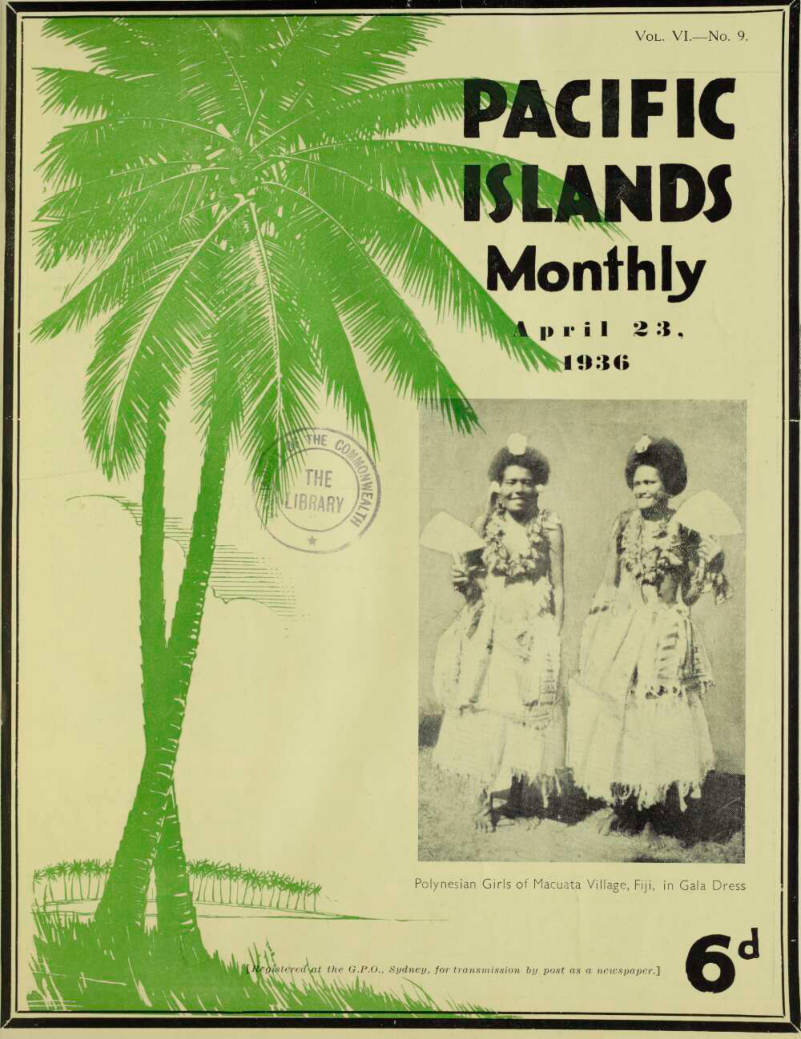
Islands
Monthly
Vol. VI.—No. 9.
Apv ■ I S 3, 193(>
liA m \ e G-P.0., Sydney, for transmission hy post as a newspaper .]
6 d
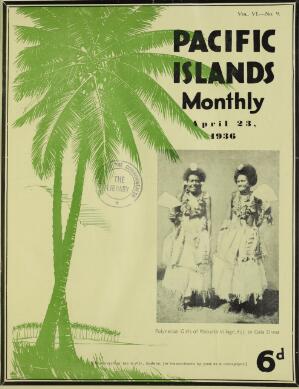
Polynesian Girls of Macuata Village, Fiji, in Gala Dress
Advertisements & other items, p. 2 (1 item)
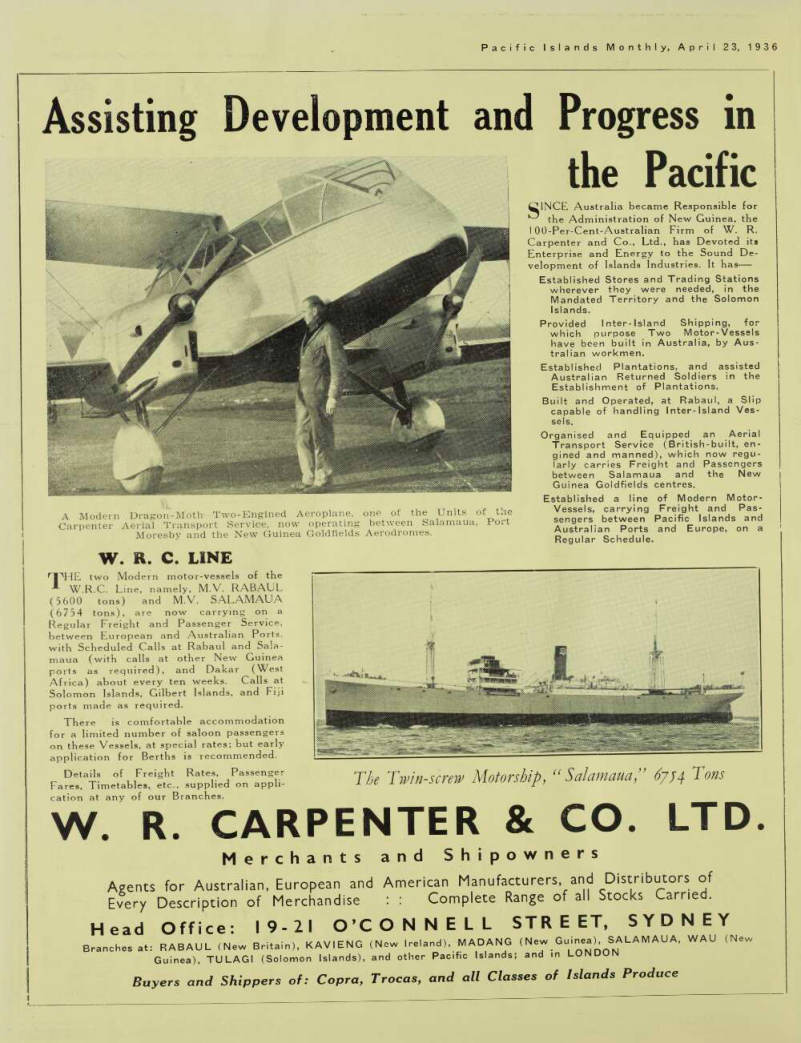
Assisting Development and Progress in
the Pacific
« ▼ A Modern Carpenter Dragon-Moth Two-Engined Aeroplane, one of the Units of the Aerial Transport Service, now operating between Salamaua, Port Moresby and the New Guinea Goldfields Aerodromes.
CINCE Australia became Responsible for the Administration of New Guinea, the 1 00-Per-Cent-Australian Firm of W. R.
Carpenter and Co., Ltd., has Devoted its Enterprise and Energy to the Sound Development of Islands Industries. It has Established Stores and Trading Stations wherever they were needed, in the Mandated Territory and the Solomon Islands.
Provided Inter-Island Shipping, for which purpose Two M otor-Vessels have been built in Australia, by Australian workmen.
Established Plantations, and assisted Australian Returned Soldiers in the Establishment of Plantations.
Built and Operated, at Rabaul, a Slip capable of handling Inter-Island Vessels.
Organised and Equipped an Aerial Transport Service (British-built, engined and manned), which now regularly carries Freight and Passengers between Salamaua and the New Guinea Goldfields centres.
Established a line of Modern Motor- Vessels, carrying Freight and Passengers between Australian Ports Regular Schedule Pacific Islands and and Europe, on a
W. R. C. LINE
r I ''HE two Modern motor-vessels of the W.R.C. Line, namely, M.V. RABAUL (5600 tons) and M.V. SALAMAUA (6734 tons), are now carrying on a Regular Freight and Passenger Service, between European and Australian Ports, with Scheduled Calls at Rabaul and Salamaua (with calls at other New Guinea ports as required), and Dakar Africa) about every ten weeks. Calls at Solomon Islands, Gilbert Islands, and Fiji ports made as requi red.
There is comfortable accommodation for a limited number of saloon passengers on these Vessels, at special rates; but early application for Berths is recommended.
Details of Freight Rates, Passenger Fares, Timetables, etc., supplied on application at any of our Branches. ißii
The Twin-screw Motorship, “ SalamauaTons
W. R. CARPENTER & CO. LTD
Merchants and Shipowners
Agents for Australian, European and American Manufacturers, and Distributors of Every Description of Merchandise : : Complete Range of all Stocks Carried.
Head Office: 19-21 O’CONNELL STREET, SYDNEY
iranchesat: RABAUL (New Britain), KAVIENG (New Ireland). MADANG (New Gul ne3) SSALAMAUA, WAU (I Guinea), TULAGI (Solomon Islands), and other Pacific Islands; and m LON Buyers and Shippers of: Copra, Trocas, and all Classes of Islands Produce
Pacific Islands Traielleiis
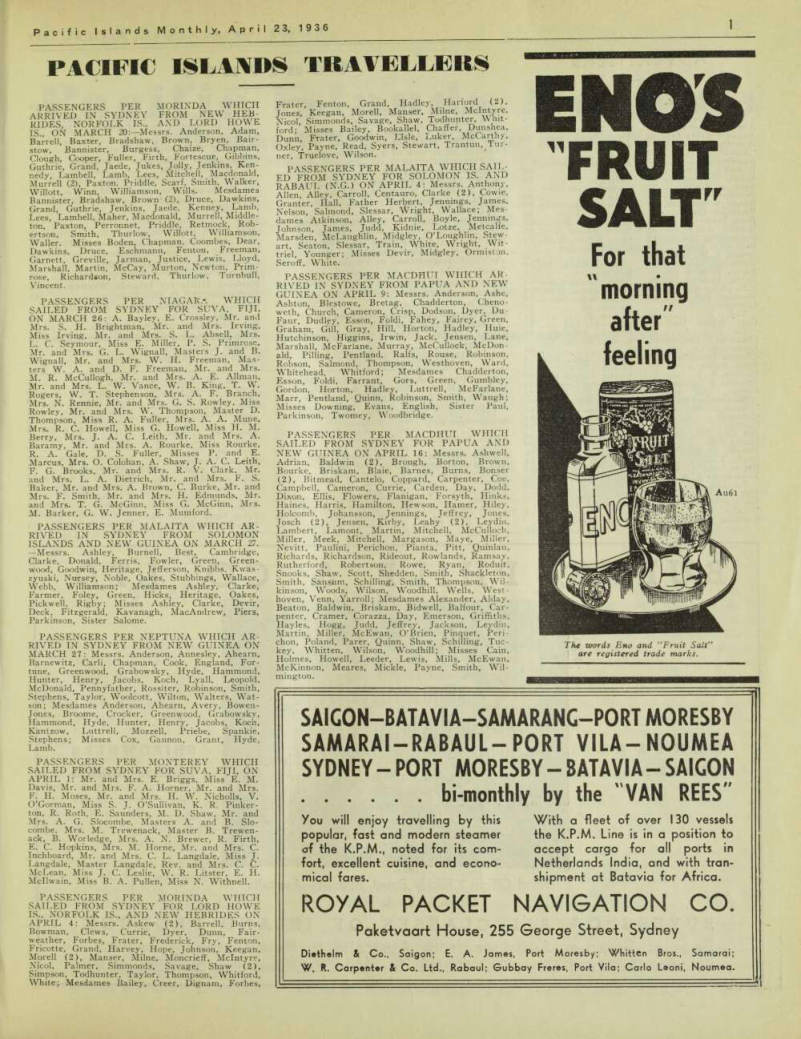
Passengers Per Morinda Which
Arrived In Sydney From New Heb
Rides, Norfolk Is.. And Lord Howe
15., ON MARCH 20:—Messrs. Anderson, Adam, Barrell, Baxter, Bradshaw, Brown, Bryen, Bair stow, Bannister, Burgess, Chaize, Chapman, Clough, Cooper, Fuller, Firth, Fortescue, Gibbms, Guthrie, Grand, Jaede, Jukes, Jolly, Jenkins, Ken nedy, Lambell, Lamb, Lees, Mitchell, Macdonald, Murrell (2), Paxton. Priddle, Scarf, Smith, Walker, Willott, Winn, Williamson, Wills. Mesdames Bannister, Bradshaw, Brown (2), Druce, Dawkins, Grand, Guthrie, Jenkins, Jaede, Kenney, Lamb, Lees, Lambell, Maher, Macdonald, Murrell, Middle ton, Paxton, Perronnet, Priddle, Retmock, Rob ertson, Smith, Thurlow, Willott, Williamson, Waller. Misses Boden, Chapman, Coombes, Dear, Dawkins, Druce. Eschmann, Fenton, Freeman, Garnett, Greville, Jarman, Justice, Lewis, Lloyd, Marshall, Martin, McCay, Murton, Newton, Prim rose, Richardson, Steward, Thurlow, Turnbull, Vincent.
Passengers Per Niagar*. Which
Sailed From Sydney For Suva. Fiji,
ON MARCH 26: A. Bayley, E. Crossley. Mr. and Mrs. S. H. Brightman, Mr. and Mrs. Irving, Miss Irving, Mr. and Mrs. S. L. Abseil, Mrs.
L. C. Seymour, Miss E. Miller. P. S. Primrose.
Mr. and Mrs. G. L. Wignall, Masters J. and B.
W’ignall, Mr. and Mrs. W. H. Freeman, Mas ters W. A. and D. F. Freeman, Mr. and Mrs.
M. R. McCullogh, Mr. and Mrs. A. E. Allman, Mr. and Mrs. L. W. Vance, W. B. King, T. W.
Rogers, W. T. Stephenson, Mrs. A. F. Branch, Mrs. N. Rennie, Mr. and Mrs. G. S. Rowley, Miss Rowley, Mr. and Mrs. W. Thompson, Master D.
Thompson, Miss R. A. Fuller, Mrs. A. A. Mune, Mrs. R. C. Howell, Miss G. Howell, Miss H. M.
Berry, Mrs. J. A. C. Leith, Mr. and Mrs. A.
Baramy, Mr. and Mrs. A. Rourke, Miss Rourke, R. A. Gale, D. S. Fuller, Misses P. and E.
Marcus, Mrs. O. Colohan, A. Shaw, J. A. C. Leith, F. G. Brooks, Mr. and Mrs. R. V. Clark, Mr. and Mrs. L. A. Dietrich, Mr. and Mrs. F. S.
Baker, Mr. and Mrs. A. Brown, C. Burke, Mr. and Mrs. F. Smith, Mr. and Mrs. H. Edmunds, Mr. and Mrs. T. G. McGinn, Miss G. McGinn, Mrs.
M. Barker, G. W. Jenner, E. Mumford.
Passengers Per Malaita Which Ar
Rived In Sydney From Solomon
ISLANDS AND NEW GUINEA ON MARCH 27. —Messrs. Ashley, Burnell, Best, Cambridge, Clarke, Donald, Ferris, Fowler, Green, Green wood, Goodwin, Heritage, Jefferson, Knibbs, Kwas zyuski, Nursey, Noble, Oakes, Stubbings, Wallace, Webb, Williamson; Mesdames Ashley, Clarke, Farmer, Foley, Green, Hicks, Heritage, Oakes, Pickwell, Rigby; Misses Ashley, Clarke, Devir, Deck, Fitzgerald, Kavanagh, Mac Andrew, Piers, Parkinson, Sister Salome.
Passengers Per Neptuna Which Ar
RIVED IN SYDNEY FROM NEW GUINEA ON MARCH 27: Messrs. Anderson, Annesley, Ahearn, Barnewitz, Carli, Chapman, Cook, England, For tune, Greenwood, Grabowsky, Hyde, Hammond, Hunter, Henry, Jacobs, Koch, Lyall, Leopold, McDonald, Pennyfather, Rossiter, Robinson, Smith, Stephens, Taylor, Woolcott, Wilton, Walters, Wat son; Mesdames Anderson, Ahearn, Avery, Bowen - Jones, Broome, Crocker, Greenwood, Grabowsky, Hammond, Hyde, Hunter, Henry, Jacobs, Koch, Kantzow, Luttrell, Mozzell, Priebe, Spankie, Stephens; Misses Cox, Gannon, Grant, Hyde, Lamb.
Passengers Per Monterey Which
SAILED FROM SYDNEY FOR SUVA, FIJI, ON APRIL 1: Mr. and Mrs. E. Briggs, Miss E. M.
Davis, Mr. and Mrs. F. A. Horner, Mr. and Mrs.
F. H. Moses, Mr. and Mrs. H. W. Nicholls, V.
O’Gorman, Miss S. J. O’Sullivan, K. R. Pinker ton, R. Roth, E. Saunders, M. D. Shaw, Mr. and Mrs. A. G. Slocombe, Masters A. and B. Slo combe. Mrs. M. Trewenack, Master B. Trewen ack, B. Worledge, Mrs. A. N. Brewer, R. Firth, E. C. Hopkins, Mrs. M. Horne, Mr. and Mrs. C.
Inchboard, Mr. and Mrs. C. L. Langdale, Miss J.
Langdale, Master Langdale, Rev. and Mrs. C. C.
McLean. Miss J. C. Leslie, W. R. Litster, E. H.
Mcllwain, Miss B. A. Pullen, Miss N. Withnell.
Passengers Per Morinda Which
Sailed From Sydney For Lord Howe
15.. NORFOLK IS., AND NEW HEBRIDES ON APRIL 4: Messrs. Askew (2), Barrell, Burns, Bowman, Clews, Currie, Dyer, Dunn, Fair weather, Forbes, Frater, Frederick, Fry, Fenton, Fricotte, Grand, Harvey, Hope, Johnson, Keegan, Morell (2), Manser, Milne, Moncrieff, Mclntyre, Nicol, Palmer, Simmonds, Savage, Shaw (2), Simpson, Todhunter, Taylor, Thompson, Whitford, White; Mesdames Bailey, Creer, Dignam, Forbes,
Frater, Fenton, Grand, Hadley, Harford (2), Tones, Keegan, Morell, Manser. Milne, Mclntyre, Nicol, Simmonds, Savage, Shaw, Todhunter, Whit ford; Misses Bailey, Bookallel, Chaffer, Dunshea, Dunn, Frater, Goodwin, Lisle, Luker, McCarthy, Oxley, Payne, Read, Syers, Stewart, Trantun, Tur ner, Truelove, Wilson.
Passengers Per Malaita Which Sail
ED FROM SYDNEY FOR SOLOMON IS. AND RABAUL (N.G.) ON APRIL 4: Messrs. Anthony, Allen, Alley, Carroll, Centauro, Clarke (2), Cowie, Granter, Hall, Father Herbert, Jennings, James, Nelson, Salmond, Slessar, Wright, Wallace; Mes dames Atkinson, Alley, Carroll, Boyle, Jennings, Johnson, James, Judd, Kidnie, Lotze, Metcalfe, Marsden, McLaughlin, Midgley, O’Loughlin. Stew art, Seaton, Slessar, Train, White, Wright, Wit triel, Younger; Misses Devir, Midgley. Ormiston, Seroff, White.
Passengers Per Macdhui Which Ar
RIVED IN SYDNEY FROM PAPUA AND NEW GUINEA ON APRIL 9: Messrs. Anderson, Ashe, Ashton, Blestowe, Bretag, Chadderton, Cheno weth, Church, Cameron, Crisp, Dodson, Dyer, Du- Faur, Dudley, Esson, Foldi, Fahey, Fairey, Green, Graham, Gill, Gray, Hill, Horton, Hadley, Huie, Hutchinson, Higgins, Irwin, Jack, Jensen, Lane, Marshall, McFarlane, Murray, McCullock, McDon ald, Pilling, Pentland, Ralfs, Rouse, Robinson, Robson, Salmond, Thompson, Westhoven, Ward, Whitehead, Whitford; Mesdames Chadderton, Esson, Foldi, Farrant, Gors, Green, Gumbley, Gordon, Horton, Hadley, Luttrell, McFarlane, Marr, Pentland, Quinn, Robinson, Smith, Waugh; Misses Downing, Evans, English, Sister Paul, Parkinson, Twomey, Woodbridge.
Passengers Per Macdhui Which
Sailed From Sydney For Papua And
NEW GUINEA ON APRIL 16: Messrs. Ashwell.
Adrian, Baldwin (2), Brough, Borton, Brown, Bourke, Briskam, Blaie, Barnes, Burns, Bonser (2), Bitmead, Cantelo, Coppard, Carpenter, Coe, Campbell, Cameron, Currie, Carden, Day, Dodd, Dixon, Ellis, Flowers, Flanigan, Forsyth, Hinks, Haines, Harris, Hamilton, Hewson, Hamer, Hiley.
Holcomb, Johansson, Jennings, Jeffrey, Jones, Josch (2), Jensen, Kirby, Leahy (2), Leydin, Lambert, Lamont, Martin, Mitchell, McCulloch, Miller, Meek, Mitchell, Margason, Maye, Miller, Nevitt, Paulini, Perichon, Pianta, Pitt, Quinlan, Richards, Richardson, Rideout, Rowlands, Ramsay, Rutherford, Robertson, Rowe, Ryan, Roduit, Snooks, Shaw, Scott, Shedden, Smith, Shackleton, Smith, Sansum, Schilling-, Smith, Thompson, Wil kinson, Woods, Wilson, Woodhill, Wells, West hoven, Venn, Yarroll; Mesdames Alexander, Alday, Beaton, Baldwin, Briskam, Bidwell, Balfour, Car penter, Cramer, Corazza, Day, Emerson, Griffiths, Hayles, Hogg, Judd, Jeffrey, Jackson, Leydin, Martin, Miller, McEwan, O’Brien, Pinquet, Peri chon, Poland, Parer, Quinn, Shaw, Schilling, Tuc key, Whitten, Wilson, Woodhill; Misses Cain, Holmes, Howell, Leeder, Lewis, Mills, McEwan, McKinnon, Meares, Mickle, Payne, Smith, Wil mington.
Advertisements & other items, p. 3 (1 item)
Enos
"FRUIT
SALT"
For that morning after” feeling Au6l 3!
The words Eno and “Fruit Salt’ are registered trade marks.
SAIGON-BATAVIA-SAMARANG-PORT MORESBY
SAMARAI-RABAUL-PORT VILA-NOUMEA
SYDNEY - PORT MORESBY - BATAVIA - SAIGON
bi-monthly by the "VAN REES"
You will enjoy travelling by this popular, fast and modern steamer of the K.P.M., noted for its comfort, excellent cuisine, and economical fares.
With a fleet of over 130 vessels the K.P.M. Line is in a position to accept cargo for all ports in Netherlands India, and with transhipment at Batavia for Africa.
ROYAL PACKET NAVIGATION CO.
Paketvaart House, 255 George Street, Sydney Diethelm & Co., Saigon; E. A. James, Port Moresby; Whitten Bros., Samarai; W. R. Carpenter & Co. Ltd., Rabaul; Gubbay Freres, Port Vila; Carlo Leoni, Noumea.
Advertisers
Page.
Adams, Ltd., Wm.. 48 Amalgamated Wire less of Aust. Ltd. 76 Andrews’ Liver Salts 34 Angus & Coote Ltd. 41 Arnott’s Biscuits . . 63 “Aspro” 12 Ausoline 75 B. and S. Agency . 62 Baker, W. Jno. ... 13 Bank of N.S.W. . . 77 Belvedere 14 Berger & Sons Ltd. 58 Blatticide Co 56 Blau, Julius 62 Breville Radio ... 19 Broomfields Ltd. . . 42 Brunton’s Flour . . 70 Budge, J. W. & Co. 58 Bullivants Ltd. l ... 71 Burns, Philp & Co. 2 Burns, Philp & Co. 68 B.P. (S.S.) Co. . . . 37 Buzacott Ltd 59 Carpenter, W. R.
Ltd ii Cent. Q’land Meat Co 52 Chapman & Sherack 22 Chi vers & Co. Ltd. 34 Coleman Quicklite . 26 Coral Starch 53 Cousins, R. Y 30 Crockett & Co. Ltd. 39 Crossle, Duff and Macintosh Ltd. . 72 “Crowle House” . . 17 Cuprinol 57.
Cystex 20 Del Cott Pty. Ltd. 43 Doans Pills 70 Donald, A. B. Ltd. 68 Doyle. T. G 55 Eaton Ltd., J. W. 48 Electrolytic R. & S.
Co. Ltd. 72 Elvy & Co. Ltd. . . 16 Eno’s Fruit Salts . 1
E.S.C.A. Ltd 20
Everyday Products Ltd 69
Page.
“Fairholme” College 64 Finau, Wm 23 Fletcher & Son ... 28 Ford, Walter 12 Ford, W. M 57 Foster Clark (Aust.) Ltd 35 Freeman’s Sports Store 33 Fryer, A. C 22 Garden Vale Pro ducts 36 Garrett & Davidson 74 Gillespie’s Flour . . 36 Goodwin, A. E. ... 73 Grand Pacific Hotel 65 Grove & Sons, W. H. 12 Guinea Airways Ltd iii Gunn & Moore Ltd. 18 Halvorsen, L 79 Handi Works Ltd.. 24 Hardy & Co., R. M. 14 Hardie & Co. Ltd. . 50 Harper, M 65 Harvey, R 14 Holbrook’s Ltd. ... 37 Holden’s Air Co. . . 80 Horne, W. & Co.
Ltd 66 Hudson, Ltd., Geo. 13
1.C.1.A.N.Z 75
Insular Lamps Ltd. 30 Jang Hing Loong . 66 Jones & Co., Henry 27 Jones & Rickard .*. 47 Kerr Bros. Ltd. ... 45 Kodak Pty. Ltd. . . 23 Kopsen & Co. Ltd. 28 Kork-N-Seal Ltd. . 54 Lane & Girvan Ltd. 50 Leica Photo Co. . . 32 Link Belt Co. ... 54 Love Ltd., J. R. . 26 Mcllrath’s Ltd. . . 18 Mclntyre & Co., T. 56 McKay, D. ... 25 Maleham & Yeomans Ltd 18 Master Sewing Machine Co. ... 16
Maxwell Porter Ltd. 50 Melbourne Hotel . . 66 Morrison & Co. Ltd. 31 Morris, Hedstrom Ltd 68 Mungo Scott Ltd. . 52
N.D.L 78
Nelson & Robertson Ltd 49 Nestle’s Ideal Milk 40 New Brit. Express 63 Nevdands Bros. Ltd. 61 Nicholson & Foster 43 Noyes Bros. Ltd... 71 “Oceania” ... 22 Pacific Hotels ... 44 Pacific Taxis 67 Pacific Year Book 9 Patterson & Stone . 28
Paul & Gray Ltd. . 80 Peel & Sons, H. . . 53 Phillips & House . 55 Pier Hotel 67 Pike Bros. Ltd. ... 19 Positions Wanted . 48, 64, 70 Prescott Ltd 60 Prouds Ltd 17 Ransomes, Sims & Jeffries Ltd. ... 55 Reed, Wm. E 46 Reid, W. M 55 Rohu, Sil 25 Rolls Razor Co. Ltd. 25 Royal Packet Co. . 1 Russell, S 52 Ruston & Hornsby 47 Samson, A. J 12
Savage, W. & Co. 74 Scott & Bowne Ltd. 45 Scott Ltd., J 42 Scott & Sons 48 Shell Oil Co. Ltd. . 29 Smyth Co., J. H. . . 32 Springwood L. Coll. 63 Stanley, Chris. ... 27 Steamships T. Co. 78 Sterling Varnish Co. 11 Swallow & Ariell . . 60 Sydney Steel Co. . . 71 Talkeries 24 Taubman’s Paints . 38 Taylor & Co., A. . . 30 Tilley Lamp Co. . . 51 Tillock & Co. Ltd. . 27 Tooheys Ltd 15
Tooth & Co. iv Trufood 26 Tudor Hotel 13 Vacuum Oil Co. . . 21 Vincent’s A.P.C. . . 15 Wallis, J. B. & Co. 73 Walker-Flynn, Mrs. 61 West, H 42 Weymark & Son . . 53 Wheeler, B. R. ... 51 Wills, W. D. & H. 0. 25 Williams Ltd., S. . 46 Williams. W. H. . . 59 Woods Ltd., W. E. 64 Wright & Co 56 Wright & Co., E. . 54 Wunderlich Ltd. . . 38
Contents
Page Pacific Islands Travellers 1 An Awakening in the Pacific 3 Cook Is.-Tahiti-’Frisco Line to Cease 4 Late News in Brief 4 Piquant Memories of a Voyage on the Tiafau 5 Beachcombers of 8.5.1 5 “Mick” Leahy Back from World Tour 6 O. F. Nelson to Return to Samoa ... 6 N.G. Aerial Services 7 Fiji Goldfield Mystery s Sampans Swarm in Western Pacific 8 How Ludwig Schmidt Went to Gallows 9 B.P. & Co. Ltd.—Attack and Defence in Federal Parliament 10 Archbold Expedition in Papua 10 Tropicalities 11 About Islands People 12 Japanese Outrage at Manus, T.N.G. .. 16 Cook Is. Fruit War 17 How* Brown and Joske is Linked with Early History of Fiji 18 Burns Philp (S.S.) Co.’s Annual Report 22 Sale of Hotel Bulolo, at Wau 24
Page No Official Marriages for N.G. Natives 27 Death of High Chief Mataafa, 0.8. E. 30 Jebwar of To-day 36 Thriving Township of Wau 39 “Disgraceful”—Shipping Facilities in Central Pacific 40 Pages from the Past—The Fall of Thomas Lewis in Tahiti 41 Pigges—An Amusing Sketch of Native Life 45 How “Handsome Harry” Died 48 Capture of Von Luckner in the Pacific 49 N.G.’s Embarrassing Revenue Surplus 50 Work of Dr. Solf in Samoa 52 New Guinea in the Limelight 55 Debates on New Guinea Affairs 57, 68 Fashion Hints for Islands Women .. 61 Housekeeping in the Tropics 63 Scanty Accommodation at Suva Hos pital 65 Pacific Islands Mining Reports 71 Islands Produce and Exchange Rates 76 Market Quotations 77 South Seas Shipping Services 78
Advertisements & other items, p. 4 (1 item)
Burns, Philp & Co. Ltd.
GENERAL
MERCHANTS
iiiimffl it ii
iji
:y
lilt
111 H
SHIPOWNERS
TOURIST AGENTS
Head Office: 7 Bridge Street, Sydney—Australia Code Address: "Burphil"
BUYERS OF ALL CLASSES OF ISLAND PRODUCE Regular Steamer Services from Australia to New Guinea Papua Solomon Is. —Lord Howe Is.—Norfolk Is.—New Hebrides —Java and Singapore
Pacific Islands Monthly
The Newspaper -Magazine of the South Seas [Registered at G.P.0., Sydney, for transmission by post as a newspaper ] Published Once Each Month and Circulated in Australia and New Zealand and in the following Pacific Territories and Islands Groups:
Crown Colony of Fiji.
Australian Territory of Papua.
Mandated Territory (Australia) of New Guinea, Bismarck Archipelago and Northern Solomon Islands.
Mandated Territory (Japan) of Marshall, Caroline and Marianna Islands.
French Territory of New Caledonia.
British and French Condominium of New Hebrides.
American Territory of Eastern Samoa.
American Territory of Guam.
Mandated Territory of Nauru.
British Crown Colony of Gilbert and Ellice Islands.
Mandated Territory (New Zealand) of Samoa.
British Solomon Islands Protectorate.
British Protectorate of Tongan Islands.
New Zealand Territory of Cook Islands.
Australian Territory of Norfolk Island.
French Colony of Oceania (Tahiti, etc.).
American Territory of Hawaiian Islands.
Owned and Produced by Pacific Publications Ltd., Union House, 247 George Street, Sydney.
Telephone Bw 5037
P.O. Box 3408 R
Contributions Articles, Stories, and Photographs dealing with Pacific Islands Subjects are invited, and will be paid for on publication at usual rates.
Subscription Rates Per Annum, within British Empire, Prepaid Post Free 6/- Pcr Annum, elsewhere, prepaid. Post Free .. 8/- Single Copies 6d.
Editor and Publisher:
R. W. Robson. F.R.G.S.
Advertisements
Advertising rates furnished on application.
Colours, etc. by Arrangement.
Process Blocks made at Advertiser’s expense when required. Screen, 100.
Changes of Advertising Copy should reach this Office by Bth of each month, otherwise previous advertisement may be repeated.
Registered Address for Radiograms and Cables: “PACPUB” Sydney Agents The following are authorised to receive subscrip tions for the Pacific Islands Monthly:— Islands Branches of Burns, Philp & Co., Ltd., and Burns Philp (South Seas) Co., Ltd.
Islands Branches of W. R. Carpenter & Co., Ltd.
All Branches of Morris, Hedstrom & Co., Ltd.
G. Thomas & Co., Rabaul, New Guinea.
Whitten Bros., Ltd., Samarai, Papua.
P. Costello, Suva, Fiji.
J. Muir, Suva, Fiji.
All Branches and Representatives of W. H. Grove and Sons, Ltd., Auckland, New Zealand.
S. Russell, Papeete, Tahiti.
Cook Islands Trading Co., Rarotonga, Cook Is.
Vol. VI., No. 9.
Sydney, April 23, 1936.
I Per Copy. 1 riCc Prepaid: 6/- p.a.
An Awakening In The Pacific
JN 1930, when the Pacific Islands Monthly was established “to give pub licity service to the Territories of the Pacific,” the majority of people—even those in eastern Australia and northern New Zealand—had a very hazy know ledge of the various groups. “The Islands” were regarded as a pleasant, shadowy region, where persons of roman tic temperament dallied under the droning palms, while Polynesian maids of ardent habits decorated them with frangipanni flowers. Even well-informed newspapers published appalling tosh, which served merely to colour the imaginative picture.
Since then, extraordinary changes have occurred. The development of the gold mining industry in New Guinea, Papua, Fiji and the Solomons has made those ter ritories well known in Australia and New Zealand. The establishment of great aeroplane services in New Guinea, and the planning of trans-Pacific air-lines, have caused commercial and financial in terests suddenly to awaken to the economic
importance of the Islands territories. They have discovered that these are not mere elysian groups of coral islets; but huge land masses, immensely fertile, and en dowed with almost incalculable mineral wealth.
Simultaneously, there has come to the Powers a realisation of the political and strategical importance of the Pacific ter ritories. Sooner or later, there may be a struggle for dominance of the Pacific; and, in that event, the possession of cer tain island groups will confer advantages.
Within five years, the Pacific will be criss-crossed with air-lines; and, in this connection, ownership of lands, even of very limited area, is being eagerly sought.
Australia, especially, is awakening to the strategical value of New Guinea, Solo mons, New Hebrides, and New Cale donia, which serve as a protective screen between the Commonwealth and certain possibilities of the Northern and Central Pacific.
But the real importance of these Pacific
islands lies in their economic value, for purposes of agricultural development. For far too long it has been said of them that they are “too isolated, too small, too hot for white settlement.” All that, in a phrase, is utter nonsense. Certain islands, like the Gilbert and Ellice Colony, or the Cook Group, are too small and scat tered to be capable of organised develop ment; but New Guinea, Papua, Solo mons, New Hebrides, New Caledonia, Fiji, Tonga, Samoa, and Tahiti, from the point of view of tropical agriculture, are in the same category as the East and West Indies. These are not mere “islands”— for the most part, they are large terri tories, with mountain systems, good rivers and innumerable sheltered harbours.
New Guinea and Solomons, with their lofty peaks, enormous rivers and malarial jungles, are rather terrifying places; yet they are, climatically and in many other ways, comparable with Java and Suma tra, which the Dutch have colonised so successfully. Fiji, Samoa and Tonga, being further south, are free from fever, and Europeans may live permanently there and develop their unlimited agricul tural possibilities. In that way, they are
comparable with the best territories of the rich West Indies. The C.S.R. Co. already has demonstrated that Fiji may become another Cuba.
In recent weeks. Pacific Islands affairs have received more attention from the newspapers of all nations than ever before.
It is recognised that, if these tropical ter ritories are going to be held in the face of the international situation, they must be developed, and receive “a fair deal.”
There is some indication that a long period of indifference and stagnation is coming to an end.
Papua and Publicity
“In Grip Of Canberra”
EARLY in March the Papuan Govern** ment gazetted a new regulation under the Public Service Ordinance, by which officials of the service are forbidden in most explicit terms to supply to newspapers any information or photographs gathered in the course of their official duties, except with official permission.
It has been decided that in future Government reports and statements will be issued from Canberra to all newspapers simultaneously.
The Papuan Courier, which is published in Port Moresby, has protested in the strongest terms against this new rule. It asks why it should have to pay radio charges between Canberra and Port Moresby on information about Papua, and urges that such information should instead be released in Port Moresby, which is Papua’s administrative centre, and Aus tralian newspapers could then pay transit charges on whatever part of this informa tion they required.
The Papuan Courier heads its article “In the Grip of Canberra.” Most residents will agree with the point of view ex pressed. Papua managed its own affairs between 1889 and 1934 without hindrance from the Commonwealth Government. But in 1934 the first ready-made ordinance came along from Canberra, with an inti mation that it was to be adopted, and since then the practice has grown of sending from Canberra ordinances which have been fully drafted and concerning which the Legislative Council is given no voice.
The latest examples of this Canberra procedure are the Petroleum Bill and the Shipping Bill, both of which were forced through in the face of strong opposition from the non-official members.
Frank Pryke Ill
fyj R. FRANK PRYKE, well known in Papua and New Guinea as a pioneer of the goldfields, was stricken suddenly with a serious illness on April 14; and at the present time his condition is causing his many friends some anxiety.
Dr. W. J. Williams, who was until re cently British Consul in Tahiti, has again left for San Francisco, owing to continued ill-health. Dr. Williams is the owner of the atoll of Tetiaroa, near Tahiti, once the property of the Tahitian Royal Family of Pomare.
To Cease
Sydney-Tahiti-’Frisco Line
THE Union S.S. Co. Ltd., on April 15, formally announced that the trans pacific service, which links Sydney, Wel lington, Rarotonga, Tahiti, and San Fran cisco, will cease at the end of the year.
The Maunganui will tie up when she re turns to Wellington or Sydney in Novem ber, and the Makura in December.
The service has been making a heavy loss for years. The Company cannot com pete against the American shipping com panies, which enjoy State subsidies.
The other Union Co. service (Sydney, Auckland, Fiji, Hawaii, Vancouver) is similarly threatened.
Three of the four ships carrying on these services are old, and even the Aorangi is not startingly modern. The Co., in the circumstances, could not afford to write off the ageing vessels, and so they have remained on the runs.
For the comfort of Pacific communities threatened by this development—es pecially Cook Islands and Tahiti—it may be said that the outlook is not as black as it appears. The British Imperial Gov ernments are not going to allow British lines to be driven off the Pacific, in this fashion. If subsidies are necessary to ensure their continuance, then subsidies will be paid. Conferences are now pro ceeding in London, at which Britain, Aus tralia, New Zealand and Fiji are repre sented, and it is certain that a prac ticable scheme will be devised for the maintenance of the services.
There are two main difficulties, one old and one new. The old one is the unwil lingness of the British Government to fight American interests over Pacific shipping—it is felt that Britain and the United States have a joint responsibility for maintaining good order and peaceful development in the Pacific, and trade rivalry must not be allowed to disturb their friendly relations.
The new factor is the rather pathetic little Labour Government which has sprung up in New Zealand. This admin istration is trying, through the same mouthpiece, to bark like a Socialistic wolf, and bleat like a well-intentioned lamb.
It announced a few weeks ago, with hearty gestures, that it certainly would not allow British shipping to be driven off the Pacific. Now it says: “We are not going to be pushed into granting sub sidies or taking any other action, just be cause the Union Co. suddenly decides to withdraw its service.” (Mr. Savage, Pre mier, on April 16.) What actually has happened is that the N.Z. Government demanded, as the price of its help, some measure of control over the Union Co.’s services; and was politely told by the other Governments and in terests concerned to go and chase itself.
These N.Z. Ministers, in a political sense, seem to be simple, unsophisticated folk.
If they had any knowledge whatever of the history of State-controlled steamship lines, they never would advocate anything so impracticable. They should study the story of Australia’s notorious experiment.
However, these troubles will be solved, and we shall see stronger and better Bri tish lines in the South Pacific. The old ships will disappear, as soon as modern vessels can be made available.
Present indications are that financial assistance will be given to the Co. to carry on the services, pending the build ing of modern 20,000-tonners, in connec tion with which Government aid also will be needed.
News In Brief
M.V. Matua.—The M.V. Matua which has been built at Newcastle, England, by the Union S.S. Coy. Ltd., for service in the Central Pacific was launched on March 25, and is expected to enter the Central Pacific service early in September.
Native Labour.—Regulations under the new Native Labour Ordinance of New Guinea were gazetted in Rabaul on March 18 (Gazette No. 441). This Gazette will be in demand by every employer of na tive labour in New Guinea. The regula tions fill 34 pages.
Flown to New Guinea.—A Hercules aeroplane, a secondhand machine from West Australia, for use in the Stephens service in New Guinea, left Sydney on April 7, in charge of Major Brierley, and flew by easy stages to Wau. It carried one passenger and a crew of four.
Search for Oil. —The Commonwealth Government has announced that, as the result of new ordinances passed in New Guinea and Papua (hammered through the Councils by the official members under instructions from Canberra!) very favourable conditions now are available for persons wishing to prospect for oil in those territories. Australia’s greatest weakness is lack of petroleum; and ap parently the search is to be intensified in the Pacific territories where the best indications are.
Samoan Administrator.—A private let ter from Apia, dated April 9, contains the extraordinary news that the appointment to the Administratorship of Samoa Is momentarily expected of a practically un known former member of the Legislative Council, whose knowledge of tropical Ad ministration apparently was gained when he visited the Islands on a tourist ship.
Sudden Death.—Mr. J. Klinkmuller, well-known and highly respected resident of Samoa, died suddenly on March 21, aged 55.
Natives’ Long Voyages.—On March 11, a Tokelau islander landed in American Samoa, having travelled 300 miles in a canoe in 22 days, with little food. On March 18, a canoe with three natives came ashore near Gizo, in the Solomons. They were Lachlan Islanders (Eastern Papua) and had been blown away to sea by a westerly gale when fishing, a week earlier.
They had to be sent home, via Rabaul.
Samoan Bus Accident. —A motor-bus struck a bridge east of Apia on April 6 and fell into the Letogo River, with 18 passengers. A native lad was killed, and several injured.
Lord Howe to Come Onto Map.—lt is indicated that the new air-mail service, London to New Zealand, will start across the Tasman Sea from Brisbane. From Sydney to New Plymouth, there would be one long hop of 1160 miles. From Bris bane, there would be a hop of 400 miles to Lord Howe Island, and 850 miles thence to New Plmouth. So it seems that the charming little Kentia Palm-seed Ely sium will lose its delightful isolation.
Lord Howe has a suitable landing-ground for aeroplanes, and a big protected lagoon for flying boats; while its peaks provide a land-mark easily picked up by pilots.
Rev. Vernon H. Sherwin, who has been a member of the Melanesian Mission since 1928, will arrive in Australia shortly from Wau, New Guinea, to be married in Ade laide. During his absence Rev. John H.
Dickinson, Assistant Bishop of Melanesia, will be stationed at Wau.
Electricity For Fiji
Power Co. Formed
A COMPANY to supply electrical power for the Emperor and Loloma gold mines at Tavua, Fiji, has been registered.
The company, Tavua Power Pty. Ltd., has a nominal capital of £lOO,OOO, divided into 100,000 shares of £1 each. A Diesel plant has been ordered in England, and it is expected that operations will be com menced towards the end of the year. It is probable that light and power will be sup plied to other places on Viti Devu.
Directors are Messrs. W. H. Smith, G. Banks, A. G. Campbell. T. R. Victor, P.
F. Cody and E. G. Theodore.
Charge
Day Dawn Mine Is
Bought
Messrs. Digby and Burke Take Charge
IT is reported that the Day Dawn mine, at Edie Creek, New Guinea, has been purchased by Messrs. Wally Digby and Joe Burke, and that they are making plans to reopen and operate it.
The mine was closed down last year, when the lode disappeared. It was pro posed to operate a new treatment plant, for which a large amount of tailings was available; but, although it appeared that the treatment plant could be run at a profit, the Company had exhausted its finances, and no new capital was avail able.
Messrs. Digby and Burke are well known, practical miners: and they are likely to make a success of any opera tions they undertake.
The reopening of Day Dawn mine will be an important event for Edie Creek and Wau.
Another interesting event is the leasing of Mr. Hector Wales’s famous Cleopatra mine to Mr. Robert Syme.
Solomon Is. Gold
From Our Own Correspondent TULAGI, March 10.
CONFIDENT of success, Mr. A. J. Ault, and Mr. Thebon, of the Pioneer Gold Company, are continuing their gold seek ing activities on Guadalcanal.
Their main effort is on the Chuva area, about 50ft. above sea level, and some 10 miles inland from the coast. A motor car and trailer carry in their gear and sup plies over the recently constructed road.
While drilling operations were proceed ing at Chuva, Mr. Ault went to the top area, at Jarivunga, seeking to discover where the gold came from, but he could not locate its source. Mr. Ault has now returned to the camp at the coast, where he has been laid up with illness.
The Pioneer Company has another area, the Suta, which is more difficult of access.
Not much work has been done there, and it is believed that the Co. will not operate there until its two other properties have been definitely proved payable.
It is reported that Pacific Islands Gold Development Co, have abandoned inves tigations in the group; at any rate, they are disposing of their gear. They have put a £lOO reserve on the drill.
Solomon Islands residents are sceptical about gold prospects on Guadalcanal out side of the “Big Six” claims.
Voyage
On The “Tiafau”
Piquant Memories of a Samoan Voyage
Mr. Herbert G. Shape, Of 924
Avenue M. South, Saskatoon, Canada, writes: , What Mr. Marc T. Greene has said about shipping conditions on the coast of Samoa is perfectly true.
Just exactly one year ago, to the day that the Tiafau foundered, I crossed over from Pago Pago to Apia on the same little 42ft. boat. She was a staunch, heavily built little craft, and a good seaboat — whoever built her had nothing to be ashamed of. But so small a vessel cer tainly was not fit to traverse that 80 miles in anything but fine weather.
I shall never forget that trip. The wind was terrific and it rained incessantly; and how the skipper and his crew navi gated is still a mystery to me. Visibility was almost nil and all they had to steer by was a compass about Gin. or Sin. in diameter, with an oil lantern hung above and swinging around with the motion of the boat.
The only shelter was on the roof of the engine room, which constituted the floor of a sort of deck-house. This, of course, also had a roof and was enclosed about half-way up on the front and each side, the back being entirely open.
The engine was an old Diesel which a number of times slowed down almost to stopping point, when the engineer would go down and pep her up a bit. The ex haust gases were leaking out, and we were breathing this vile sickly stench the whole way across.
I do not think that in any period of my life I ever suffered such unutterable dis comfort and misery. It was impossible to sleep or even rest. My body ached for days afterwards with lying on that deck house floor.
The charge for that trip was 7.50 dollars which was approximately 5d per mile; and one provided one’s own food. One can travel first class on a passenger ship, with every comfort, for 5d per mile.
We were 25 i hours making that trip, and never before in my wanderings was I so glad to see land.
I would like to pay tribute, however, to the skipper and his crew for their courage and skill in piloting the little Tiafau across that storm-swept sea. Stout as that little craft was, it was no stouter than the hearts of her Samoan navigators.
Beachcombers Of
B.S.I.
Mr. Ashley’s Record There
THE following is taken, exactly as printed, from the Sun, Melbourne, of March 31: The man who banished beachcombers from the Solomon Islands reached Mel bourne in the Merkur yesterday. He was Mr. F. N. Ashley, Resident Commissioner of the Group, who passed through Mel bourne on his way to England.
Mr. Ashley has been Commissioner for the past seven years and has had a varied career in British administration, having occupied a similar post in Nigeria for 19 years.
On his arrival, Mr. Ashley said he came from the land where there was no unem ployment and where the Administration had balanced its budget during the de pressed years.
He spoke optimistically of the future of the Solomons. Improved copra prices had enhanced the Islands’ financial position.
“I am sure now that we are out of the wood,” he said. Mr. Ashley added that some of the surrounding islands were a lotus-land. The natives had all they re quired except the desire to work. It was his ambition to create ambition in them.
“The day of the beachcomber is dead,” he added.
Before his arrival, the islands were fre quented by these men, who lounged about doing nothing but trade on the natives.
Since the imposition of a £5O bond on land ing the nuisance had been stamped out.
EDITORIAL NOTE: Solomon Islands residents will be grateful to have Mr. Ashley’s estimate of social and other values within the Territory. His remark about beachcombers especially is interest ing. We can imagine old residents sitting around in earnest consultation, trying to identify the beachcombers. Probably, the R.C. mistook for beachcombers that procession of unfortunate men who, under the calamitous copra collapse of 1931- 34, were driven off their plantations and either earned a living as best they could around the Islands or shook the coral dust from their feet and returned to colder but more hospitable climes.
Mr. E. Nissole, who has been pastor of the French Reformed Church in New Caledonia for 10 years, arrived in Sydney from Noumea by the Laperouse on April 4.
The motor boat Tiafau, which recently foundered 15 miles off Aleipata, Western Samoa, when carrying 16 passengers and mails from Apia to Pago Pago, American Samoa. The passengers were eventually rescued by the Hauraki, after miraculous escapes from drowning.
This photograph was taken on Apia beach by Mr. F. L. McFall, shipping superintendent of Messrs.
Bums Philp (South Sea) Co. Ltd., who refloated the wreck and took it from Savaii to Upolu.
“Mick” Leahy Returns to
New Guinea Met Errol Flynn, New Film Star, in World Tour
ANXIOUS to get back to New Guinea after a tour of England, Ireland and America, Mr. M. J. (“Mick”) Leahy, well known New Guinea prospector and ex plorer, arrived in Sydney by the Monterey on March 23. He left for Queensland within a few days to visit his father who has been seriously ill, and to join his brother Jim, who accompanied him on his world tour.
In England, Mr. Leahy lectured before the Royal Geographical Society and other prominent institutions, and a summary, with maps, of his explorations between 1931 and 1935 in hitherto unknown terri tory appeared in the last issue of the journal of the R.G. Society.
When in America, he left the material for a book with a New York publisher, covering his experiences in New Guinea since 1926 when the Leahy Brothers arrived from Queensland to take part in the Edie Creek “rush.” The volume, illustrated by Mr. Leahy’s photographs, will be issued by Abbott, Mclntosh and Otis before the end of the year. Incidentally, “Mick” Leahy is a photographer of no mean ability, and his unique photographs have been repro duced all over the world.
Mr. Leahy arrived in New York in time to attend the premiere of the film “Captain Blood,” starring Errol Flynn, a young Irishman who spent most of his life in Australia, New Guinea and the South Seas.
Flynn and Leahy had been friends on the Morobe goldfields and they renewed acquaintance when the hubbub of milling fans, pressmen and photographers had died down after Flynn’s outstanding success.
“Errol Flynn arrived in New Guinea about 1930 as a police officer,” said Mr.
Leahy. “He soon became interested in aviation, then turned recruiter, and finally managed a gold claim owned by Mrs. W.
E. Giblin, of Papua. Later he bought a schooner and became a trader, freighting goods and copra. After his boat went on a reef he turned his hand to prospecting.
In two years he had won a fair amount of gold, then unexpectedly he sold his claim for £2OOO and some shares, and went on a hectic holiday in Australia.
“When his money had dwindled,” con tinued Mr. Leahy, “he and a friend made an adventurous trip to New Guinea in a small sailing boat. Flynn was commis sioned to obtain native labour for prospect ing syndicates, and after he had made some money he! bought another schooner, which was later chartered by Charles Chauvel for a travel film. Chauvel gave Flynn his first chance in films as Fletcher Christian in the Australian production, ‘ln the Wake of the Bounty.’
“Errol and I laughed and chatted over old times,” said Mr. Leahy, “and he wished to be remembered to all his friends in the Territory. He has now jumped into the first rank among men screen stars, and he and his wife are feted everywhere they go, but I cannot imagine Flynn settling down for any length of time —he is too much of a happy-go-lucky wanderer.”
Mr. “Mick” Leahy and his brother Pat joined the Macdhui at Cairns in mid-April, Jim Leahy having sailed by the previous Montoro. The Leahy Brothers have not yet made any definite plans for the future, but their first step will be to return to their alluvial mining “show” near Mount Hagen, which has been in charge of Dan Leahy during their absence.
O. F. Nelson
Banishment Cancelled—To Return to Samoa
A RADIO message was received in Apia (Western Samoa) on April 2 by O. F.
Nelson and Company, Limited, from Mr, O. F. Nelson, that he had met the Prime Minister, Mr. Savage, at Wellington, and Mr. Savage had assured him of his un conditional return to Samoa very shortly— at the very latest, four months hence. Mr.
Nelson asked the firm to inform his fam ily’s friends and the Mau.
It is reported that there is great jubila tion among the Mau adherents, while Samoan supporters of the Government ex press disagreeable surprise.
It will be remembered that a court in Samoa, in 1934, after lengthy proceedings, found Mr. O. F. Nelson guilty of seditious activities, and sentenced him to 18 months’ imprisonment and 10 years’ banishment from Samoa. The sentence of imprison ment was quashed by an appeal court in New Zealand.
Prime Minister’S Confirmation
From Our N.Z. Correspondent AUCKLAND, April 5.
A statement that the Labour Party’s policy towards Samoa had not changed since it came into office in New Zealand was made by the Prime Minister, Mr.
Savage, in confirming a report that Mr.
Nelson was to be allowed to return. “It is the intention of the Government to allow Mr. Nelson to return to his home on the island,” he said.
“This is in keeping with the policy of the Government party, because for years we have been fighting against the policy of previous Governments, in respect of the methods practised in the administra tion of Western Samoa. Our aim, as it is our job, is to obtain and maintain the co operation and goodwill of the Samoans.
Without such co-operation it i» impossible to go very far in securing a contented development of the territory.”
Mr. Savage said that the date of Mr.
Nelson’s return to Apia had not been fixed.
Asked in the House whether he did not think it his duty to insist that Mr. Nelson should refrain from any agitation to stir up the Mau to obstruct the Administra tion and the natives supporting it, Mr.
Savage said Mr. Nelson would return to Samoa on the same terms as would govern the return of a New Zealand citizen to the Dominion. The Government would give effect to its election pledge to do justice to the Samoan people.
EDITORIAL NOTE: The N.Z. Government is as vague concerning its Western Samoa policy as it appears to be in most other matters. All governments have tried “to do justice to the Samoan people”; but their methods have ranged over the whole field of futile and inexperienced administration.
Mr. Nelson now has the chance of a lifetime.
He can put his Mau legions into line with a sympathetic government, bring peace and calm to Samoa, and write his name largely on the list of Samoan patriots; or he can again intrigue against authority, introduce Fascist salutes, and so on —in which event he certainly will be again prosecuted by a new government and banished.
The Labour Government in New Zealand clearly is a temporary arrangement of three short years; but it does give to Mr. Nelson, the victim of long years of muddling administration, a chance to rehabilitate himself politically. But if he
carries his personal hates and political feuds back to Samoa with him it will be the end of him.
The action of the N.Z. Labour Government, in thus wiping out a sentence imposed after lengthy proceedings by a properly constituted Court, and confirmed on appeal to a higher court, sets an extremely dangerous precedent. It is extraordinary that the Prime Minister, when making his announcement, did not deal with this aspect of the matter.
Police Capture Papuan Gaol
£108 Recovered
Police Capture Papuan Gaol Breakers
From Our Own Correspondent
Pt. Moresby, March 14.
♦’TTHE two natives, Kalo and Apa, who stole £129 from the safe at Rigo Government Station, Papua, and who sub sequently received a sentence of 10 years, after which they broke gaol, were caught on February 25 at Tupuseleia by a detach ment of native constables. They were brought back to Koki gaol the following day.
One policeman of the party while cap turing the prisoners noticed a package being hurled into the bush by Kalo as he fled with the police on his heels. Later on informing the authorities, the police man was immediately sent back to the scene where, after a search, a parcel con taining £lOB/10/ in notes was found wrapped up in two prison ramis.
It appears that the object of the escapees was to get to Rigo where the money had been hidden and then cut across country for the west where their village lies.
Only £l3 of the original sum stolen is now missing.
Advertisements & other items, p. 8 (1 item)
Wrapper !
Look on the Front of Your
There may be a sign stamped on the front of the wrapper which brings this copy of the “P.1.M.” to you.
The meaning of the marks: Your subscription (6/- per annum, or 8/- in the case of countries outside the British Empire—which includes postage) may be sent direct, or may be paid to any of our agents (listed on page 3).
PACIFIC PUBLICATIONS LTD.
Union House, 247 George St., Sydney
SPECIAL NOTICE TO SUBSCRIBERS
The price of the Pacific Islands Monthly in all British countries—and especially in the Islands *f the Pacific—is 6d. per copy. Persons who are asked by traders to pay more should at once report the matter to the publishers, whose address is given above.
Wrapper !
Your subscription will expire with the next or following issue.
Your subscription will expire with this issue.
This means that your subscription has expired; and that we have sent you this further copy in case you wish to continue as a subscriber, and have forgotten to send in your subscription. Prompt attention is respectfully requested.
New Guinea Aerial Services
Licenses Instead of Merger—Plan for New Sydney-Rabaul Service—Will N.G. be on Imperial Airways Map?
OWING to a variety of events, the aerial transport industry of New Guinea is in an uncertain and somewhat disturbed condition.
The plan to merge all the aerial trans port companies into one corporation, which would operate under Government charter, is still under consideration. The plan has been opposed in public discus sions in both New Guinea and Papua. (See reports on pages 56, 60, and 68.) There is strong opposition to the plan on the part of certain of the aviation con cerns; and one gentleman, whose influ ence is great, has stated positively that he will not enter a merger.
An alternative plan is receiving con sideration. It is that two or three of the leading aviation companies, whose basic organisation gives a guarantee of sta bility and of safe operation, should be licensed to operate on freight and pas senger rates fixed by the Government.
Rate cutting—which is held to menace the safety of air transport in New Guinea ■ —would thus be eliminated; but the vital element of competition would remain, competition being provided in the matter of supplying good service and safe trans port.
We believe that the Civil Aviation authorities in Australia are inclined to support the latter plan.
Weekly Airmail Service
Sir Walter Carpenter, head of the Car penter Airways, has .announced that he will inaugurate a weekly aerial service between Sydney and Rabaul, via North Queensland, Port Moresby and Wau, just as soon as he receives the approval of the Federal authorities and as soon as the aerodromes along this route —especially at Cooktown and Rabaul—are put in order. Sir Walter Carpenter is not seek ing a subsidy, but he does expect to re ceive a proportion of postage fees on postal articles carried.
We understand that in discussions with the Federal authorities the latter have opposed the use of second-hand machines in this service and that Sir Walter has stated that he will use new Australian made aeroplanes capable of 180 miles per hour.
It was announced on April 15 that the Carpenter Airways had purchased the famous big monoplane “Faith in Aus tralia,” in which the late C. T. P. Ulm made many of his great flights, notably the flight from Australia to New Guinea.
Sir Walter Carpenter stated that the “Faith in Australia” would be used mainly for freight transport between Salamaua and Wau.
New Guinea On Main Airways
Route?
Plans for a Sydney-Rabaul service are complicated by a report (refer to page 56) that a reorganisation of the air-mail route between Australia and London is under way, and that this may result in Imperial Airways’ new flying-boats tra velling to Brisbane from Singapore via North Borneo and New Guinea, instead of along the present route (Dutch East Indies and North Australia).
The Commonwealth Government, at the
moment, knows nothing of this suggested plan, apart from the newspaper reports, but it is thought that there is something afoot. Imperial Airways some time ago, when planning the new service by flying boats, made surveys in the Gulf of Car pentaria, and especially at Normanton, with a view to finding a secure base for flying boats. It was found, however, that this region is entirely impracticable.
Therefore, it is likely that the possi bilities of the North Borneo-New Guinea route are being explored. An examination of the map, however, shows that if the flying boats, in order to serve British territory all along the route, were to go northwards of New Guinea and then southwards, via Port Moresby, they would add considerably to their flying time; whereas if they kept southwards of New Guinea on the journey from Borneo to Australia, they would travel on almost a straight line, but they would not serve any important territories—they would go along the southern shore of undeveloped Dutch New Guinea, and through Torres Strait.
If the new Imperial Airways route should be via Northern New Guinea, it is presumed that it would in some way link up with the important services already operating in the mandated territory. In this case, of course, the interests of Quantas Limited would have to be con sidered. Quantas now operate the route from Australia to Singapore and, natur ally, they would want to operate the new route, if that were decided upon.
It is all very complicated: but the nett result of it all is that New Guinea’s avia tion industry is receiving a great deal of attention—and that, of course, is a good thing for New Guinea.
Hand Handley-Pages
Stephens Co. Purchases Second- Hand Handley-Pages
IN the meantime it is noted that a new organisation has entered the field in New Guinea in the shape of the Stephens Company which recently commenced operations in the Territory with three machines—two DH61’s (each having a payload of 1,800 lbs.) and a DH50 (with a payload of 1,200 lbs.).
It was announced in March that Mr. E.
J. Stephens had purchased through Major Norman Brierley, formerly of West Australian Airways Ltd., two second-hand Handley-Page Hercules aeroplanes (12passenger, 3-engined machines) and that these were to be sent forthwith to New Guinea. It was also reported that Major Brierley would himself accompany the machines to New Guinea, but would re turn at an early date as he is not inter ested personally in the N.G. transport business.
Division of Big Contract
WfE understand that the transport con ™ tract let on behalf of New Guinea Goldfields Limited for the current year has
been divided among the aerial transport companies as follows: 50 per cent—Carpenter Airways per lb., less 5 per cent.) 30 per cent —P.A.T. Company (2d per lb.) 10 per cent —Stephens Airways (1.87 d per lb.) 10 per cent —Floating.
The interesting feature of this is that two major companies—Guinea Airways Ltd. and Holden’s Air Transport Services Ltd.—have not received any portion of the contract. It is not known whether their prices were too high, or whether this method of parcelling out the business is in some way connected with the recent public agitation against the proposed aerial transport merger.
“Jack” Carpenter To
Retire
|Y|R. J. A. CARPENTER, one of the senior partners of Messrs. W. R. Car penter and Co. Ltd., has announced his intention of retiring from the firm and from active business life at the end of June next.
Thus will end what many people have regarded as a remarkably successful part nership. It was the tireless energy and keen vision of Mr. W. R. Carpenter (now Sir Walter) which brought about the for mation of the phenomenally successful firm during the war years; but it was the remarkable industry and exceptional managerial capacity of Mr. J. A. Carpen ter, which contributed much to the solid structure of the new firm, supplementing and complementing the pioneer work of the founder.
Mr. J. A. Carpenter is very popular in New Guinea and the Solomon Islands, where his unassuming, kindly nature has made him hundreds of friends; and they will unite in wishing him much happiness and contentment in the less strenuous life which he has chosen.
New Ships For New Guinea
INCREASING trade in New Guinea, and developments which are expected to follow the operation of the new shipping law, have caused a demand for inter island vessels there.
At present, inter-island communication is carried on mainly with the three ves sels of Messrs, Carpenter and Company Limited ( Durour , John Bolton, and Desi koko), and one small steamer operated by Messrs. Burns Philp and Co. Ltd. (Mai xoara). The other B.P. vessel, Mirani, was recently transferred to the New Hebrides.
It is reported now that Messrs. Burns, Philp and Co. Ltd, have made plans to put into this service an oil-burning motor-vessel of medium size. A represen tative is en route to the East (where ex change is now favourable) to get quota tions for building two such vessels in Hong Kong.
Messrs. W. R. Carpenter and Co. are now completing, at the Jervis Bay yards, N.S.W., another wooden vessel of the same type as the John Bolton and Desi koko, only bigger, for service in New Guinea and the Solomons.
Mr. Tom Nevitt, M.L.C., of Papua, re turned to Port Moresby from Brisbane by the Macdhui on April 18.
Fiji Goldfield
Mystery
Market Sags While Messrs. E. G.
Theodore and Loftus Hills Are Optimistic
THE Tavua goldfield of Fiji remains the mystery of the mining section of the Australian stock exchanges.
Mr. E. G. Theodore, chairman of the Emperor, Loloma, and Koroere mines, on arriving in Sydney on March 23, told the newspapers that Emperor and Loloma shares were much too low in price—as developments proceeded, evidence accu mulated of the ultimate greatness of his mines. Work in the Emperor and Lo loma mines had extended down to around 200 feet, and there was evidence of the downward continuation of profitable ore, which would be explored after electrical power was available about the end of the year. Emperor was milling 1800 tons monthly, and the necessary larger plant would not be designed until more was known of the deeper levels; Loloma plant would be operating about the end of the year; Koroere had a large body of low grade ore in a favourable position for cheap mining.
Dr. Loftus Hills, in a statement in Mel bourne on April 10, maintained his origi nal estimate that this Tavua field will yet be proved rich and profitable. “The statement made generally in Australia in the last few months that the lodes do not live down has been disproved by results obtained on the field, but as yet these results are only a very small part of the original story. . . . The continuance of gold at depth on Tavua will be charac terised by alternating rich and poor zones. . . . The position is that the Tavua field is better now than it was six months ago, and better at the present moment than it was a month ago.”
But the market remains uninterested and sluggish. Emperor shares, which were around 30/- six months ago, are to-day around 12/-.
Spectacular Aloha Central
Aloha Central Gold Mine, N.L., has paid off native labour, and has suspended operations generally at Tavua, Fiji. A meeting of shareholders will be held to consider the future policy of the company.
The Canadian group, whose engineer, Mr. Cunningham Dunlop, examined the property with a view to the group acquir ing an interest in the company, has de cided not to proceed farther with the pro position.
This position also is mysterious. Aloha Central was formed in April, 1935, to de velop the famous 30-acres block, situated in the centre of the Koroere property, and held under option from Mr, Pat Cos tello. Dr. Loftus Hills said then that the 30-acres block contained an exceptional concentration of gold-bearing lode for mations. “The lodes are large and per sist over the whole length of the area and are the type that should live at depth.”
Mr. R. M. Boyd, mining engineer, also reported favourably. The capital of the company was £25,000 in £5 shares, of which 3750 were issued and paid up. The £5 shares were selling at £22 in October last; early in April they could be bought for £ 1/10/-.
Lady Murray, wife of the Lieutenant Governor of Papua, arrived in Sydney from Europe by the Comorin on April 16.
Planters’ Debts
New Plan In New Guinea
THE new method, under which pur chasers of expropriated plantations in New Guinea are to resume payments to the Commonwealth Government, was an nounced on April 7.
From July 1, 1936, payments will be recommenced on a sliding scale based on the Rabaul f.o.b. price of copra, and this price will be determined in the manner now used by the Administration for fixing the price of copra for export duty.
No payment will be required of planters until copra reaches £lO a ton. When copra is between £lO and £ll a ton, re turned soldier planters will be required to pay each quarter £ 5 in respect of each £lOOO of principal invested, plus interest calculated at the rate of 1 per cent, per annum. The quarterly payments of prin cipal will be increased by approximately £1 for every £1 increase in the price of copra up to £25 a ton. There will be a graduated increase in the rate of interest until the maximum rate of 4 per cent, per annum will be payable when the price of copra is £lB a ton.
A similar basis for payments by other than returned soldiers has also been adopted, but in that case the commencing rate of interest is 1| per cent, per annum, and the maximum rate of interest is 5 per cent, per annum.
Periods of contract will be extended to 20 years in the case of returned soldier purchasers, and up to 10 years for other purchasers, from July 1, 1936, in each case.
Burns, Philp and Co., Ltd., and W. R.
Carpenter and Co., Ltd., which have con siderable interests in plantations in New Guinea, have advised the Commonwealth Government that they are agreeable to reduce to 2 per cent, the interest payable to them on the deposit (equal to 10 per cent, of the purchase price), which was advanced by those companies to planters, to enable them to purchase their proper ties. The interest is to be payable when the price of hot-air-dried copra in Rabaul is £lO per ton, and the rate of interest is to be increased by i per cent for each £1 above £lO per ton, until the maximum rate is reached. The reduced scale of payments is to apply only where the in terest is actually paid, and not where it is added to the companies’ debts.
The companies are unable to give a definite undertaking to apply similar re ductions in regard to trade debts due to them, but they have promised that unless other circumstances arise, the planters will receive the same sympathetic treat ment in regard to interest as they did in the past, should copra prices go below a payable figure.
Mr. J. Fletcher, Joint Court Surveyor of the New Hebrides, recently arrived in Sydney from Vila on furlough. He was later joined by his wife, who arrived from New Zealand, and early in April they were spending several weeks in Mel bourne.
Mrs. Bowen Jones, wife of the manager of Guinea Airways Ltd., at Wau, New Guinea, arrived in Sydney on six months’ holiday by the Neptuna on March 27.
Captain A. H. Prosser, formerly master of the Waimarino, will command the new motor ship Matua which has been built by the Union S.S. Co. Ltd., for the Central Pacific fruit trade.
Swarming Sampans
The Danger of an “Incident”
SWARMS of Japanese sampans, along the coasts of the Dutch East Indies, Australian and Dutch New Guinea, and the north Australian coast —many of them engaged in poaching trocas shell—have had much attention in the newspapers during the month. For example; Japanese pearling boats in the Arafura Sea (northwards of North Australia), which last year won shell worth five million yen, are to be in creased from 36 to 70.
Dutch officials seized two Japanese pearlers suspected of poaching in Selee Strait, Dutch New Guinea. Tokio protested, and the boats subse quently were released.
Japanese poachers deliberately burned a British planter’s buildings on an island in the Manus district. New Guinea.
Many Japanese sampans have been reported In Torres Strait and along the North Australian coast.
It was reported on April 18 that Mr.
W. Turnbull, lessee of Hicks Island (near Thursday Island) had announced that if the Japanese poachers did not cease an noying the people residing in his part of Torres Straits, the residents would have recourse to firearms. He said Japanese sampans were using those islands for storing oil, and that the crews habitually were stealing foodstuffs.
Exasperated Islands residents should remember that, in an international sense, this is a matter of extreme delicacy. The relations between the former allies, Bri tain and Japan, are not very good at the present time. It was reported on April 17 that there had been recently in Japan a marked growth in anti-British feeling, and that Japanese Government institu tions, especially the army, are being dom inated to an increasing degree by those younger Japanese who insist that Japan’s future expansion lies southward and that their natural enemy is Britain.
A far-reaching revision of the Govern mental system in the Japanese mandated islands (Caroline and Marshall Islands) is now under way, and a Governor-Gen eral situated at Formosa is to have juris diction there. Those mandated islands (which are much closer to New Guinea and the Solomon Islands than is Bris bane, for instance) will in future form the southern boundary of an aggressive Japan.
The arrest of a shell-poaching sampan, or a charge of buckshot in the behind of a thieving Japanese, may seem perfectly logical things to the exasperated resi dents of the British Pacific Islands; but let it not be forgotten that such an “inci dent” could precipitate a terrible war.
If the present temper of powerful Japanese interests continues, war with Japan in the Pacific is inevitable. But nothing is to be gained by hastening that tragedy.
Sir Maynard Hedstrom, accompanied by Lady Hedstrom, left Auckland for Suva by the Monterey on April 5. Sir Maynard had been in New Zealand since January on a health visit, and recently made a trip to Tongariro National Park.
Mr. Henry Milliard, general manager of Ballande’s, Noumea, arrived in Sydney from New Caledonia by the Laperouse on April 4.
Rev. C. E. Fox, M.A., Litt.D., who has served for many years with the Melane sian Mission Society left for the Solomon Islands by the M.Y. Southern Cross on March 31. Dr. Fox is a noted authority on anthropology.
Pilot Denny Leaves
New Guinea
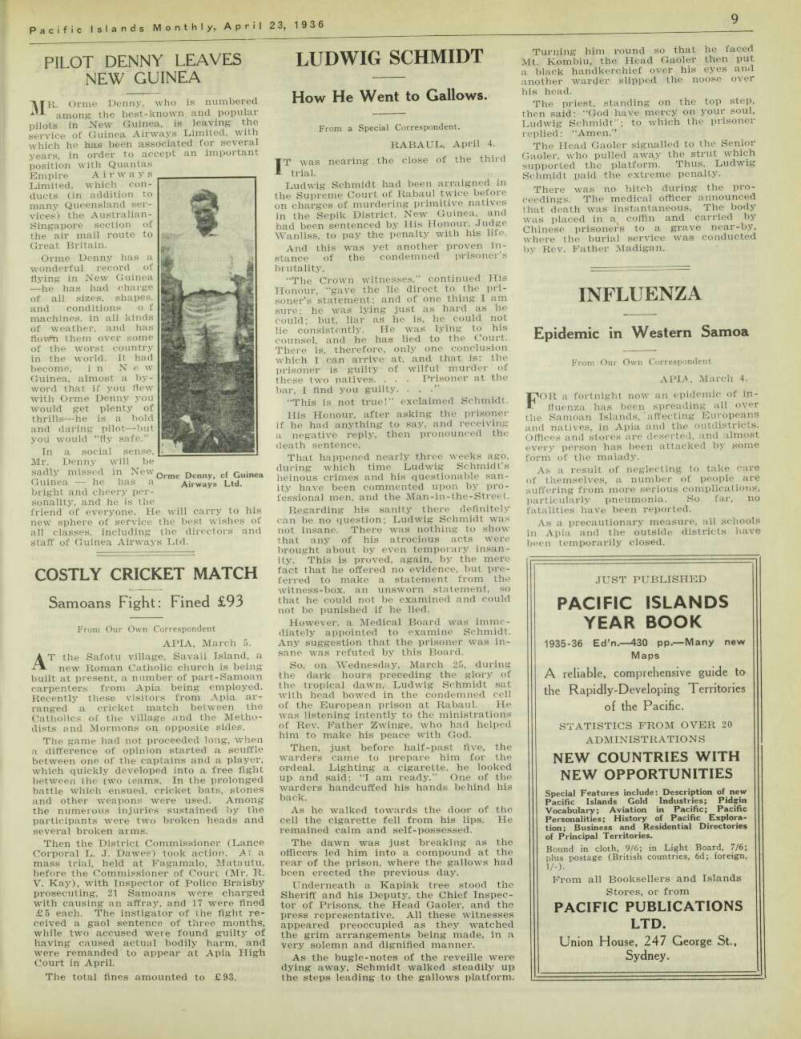
MR. Orme Denny, who is numbered among the best-known and popular pilots in New Guinea, is leaving the service of Guinea Airways Limited, with which he has been associated for several years, in order to accept an important position with Quantas
Empire Airways Limited, which con ducts (in addition to many Queensland ser vices) the Australian- Singapore section of the air mail route to Great Britain.
Orme Denny has a wonderful record of flying in New Guinea —he has had charge of all sizes, shapes, and conditions o f machines, in all kinds of weather, and has them over some of the worst country in the world. It had become, in New Guinea, almost a by word that if you flew with Orme Denny you would get plenty of thrills —he is a bold and daring pilot—but you would “fly safe.”
In a social sense, Mr. Denny will be sadly missed in New Guinea — he has a bright and cheery per sonality, and he is the
friend of everyone. He will carry to his new sphere of service the best wishes of all classes, including the directors and staff of Guinea Airways Ltd.
Orme Denny, of Guinea Airways Ltd.
Costly Cricket Match
Samoans Fight: Fined £93
From Our Own Correspondent APIA, March 5. 4T the Safotu village, Savaii Island, a new Roman Catholic church is being built at present, a number of part-Samoan carpenters from Apia being employed.
Recently these visitors from Apia ar ranged a cricket match between the Catholics of the village and the Metho dists and Mormons on opposite sides.
The game had not proceeded long, when a difference of opinion started a scuffle between one of the captains and a player, which quickly developed into a free fight between the two learns. In the prolonged battle which ensued, cricket bats, stones and other weapons were used. Among the numerous injuries sustained by the participants were two broken heads and several broken aims.
Then the District Commissioner (Lance Corporal L. J. Dawes) took action. At a mass trial, held at Fagamalo, Matautu, before the Commissioner of Court (Mr. R.
V. Kay), with Inspector of Police Braisby prosecuting, 21 Samoans were charged with causing an affray, and 17 were fined £5 each. The instigator of the fight re ceived a gaol sentence of three months, while two accused were found guilty of having caused actual bodily harm, and were remanded to appear at Apia High Court in April.
The total fines amounted to £93.
Ludwig Schmidt
How He Went to Gallows.
From a Special Correspondent.
RABAUL, April 4.
IT was nearing the close of the third trial.
Ludwig Schmidt had been arraigned in the Supreme Court of Rabaul twice before on charges of murdering primitive natives in the Sepik District, New Guinea, and had been sentenced by His Honour, Judge Wanliss, to pay the penalty with his life.
And this was yet another proven in stance of the condemned prisoner’s brutality, “The Crown witnesses,” continued His Honour, “gave the lie direct to the pri soner’s statement: and of one thing I am sure: he was lying just as hard as he could; but, liar as he is, he could not lie consistently. He was lying to his counsel, and he has lied to the Court.
There is, therefore, only one conclusion which I can arrive at, and that is: the prisoner is guilty of wilful murder of these two natives. . . . Prisoner at the bar, I find you guilty. ...”
“This is not true!” exclaimed Schmidt.
His Honour, after asking the prisoner if he had anything to say, and receiving a negative reply, then pronounced the death sentence.
That happened nearly three w'eeks ago, during which time Ludwig Schmidt’s heinous crimes and his questionable san ity have been commented upon by pro fessional men, and the Man-in-the-Street.
Regarding his sanity there definitely can be no question; Ludwig Schmidt was not insane. There was nothing to show that any of his atrocious acts were brought about by even temporary insan ity. This is proved, again, by the mere fact that he offered no evidence, but pre ferred to make a statement from the witness-box, an unsworn statement, so that he could not be examined and could not be punished if he lied.
However, a Medical Board was imme diately appointed to examine Schmidt.
Any suggestion that the prisoner was in sane was refuted by this Board.
So, on Wednesday, March 25, during the dark hours preceding the glory of the tropical dawn, Ludwig Schmidt sat with head bowed in the condemned cell of the European prison at Rabaul. He was listening intently to the ministrations of Rev. Father Zwinge, who had helped him to make his peace with God.
Then, just before half-past five, the w r arders came to prepare him for the ordeal. Lighting a cigarette, he looked up and said; “I am ready.” One of the warders handcuffed his hands behind his back.
As he walked towards the door of the cell the cigarette fell from his lips. He remained calm and self-possessed.
The dawn was just breaking as the officers led him into a compound at the rear of the prison, where the gallows had been erected the previous day.
Underneath a Kapiak tree stood the Sheriff and his Deputy, the Chief Inspec tor of Prisons, the Head Gaoler, and the press representative. All these witnesses appeared preoccupied as they watched the grim arrangements being made, in a very solemn and dignified manner.
As the bugle-notes of the reveille were dying away, Schmidt walked steadily up the steps leading to the gallows platform.
Turning him round so that he faced Mt. Kombiu, the Head Gaoler then put a black handkerchief over his eyes and another warder slipped the noose over his head.
The priest, standing on the top step, then said: “God have mercy on your soul, Ludwig Schmidt”; to which the prisoner replied: “Amen.”
The Head Gaoler signalled to the Senior Gaoler, who pulled away the strut which supported the platform. Thus, Ludwig Schmidt paid the extreme penalty.
There was no hitch during the pro ceedings. The medical officer announced that death was instantaneous. The body was placed in a coffin and carried by Chinese prisoners to a grave near-by, where the burial service was conducted by Rev. Father Madigan.
Influenza
Epidemic in Western Samoa
From Our Own Correspondent APIA, March 4.
FOR a fortnight now an epidemic of in fluenza has been spreading all over the Samoan Islands, affecting Europeans and natives, in Apia and the outdistricts.
Offices and stores are deserted, and almost every person has been attacked by some form of the malady.
As a result of neglecting to take care of themselves, a number of people are suffering from more serious complications, particularly pneumonia. So far, no fatalities have been reported.
As a precautionary measure, all schools in Apia and the outside districts have been temporarily closed.
Advertisements & other items, p. 11 (1 item)
Year Book
JUST PUBLISHED
PACIFIC ISLANDS
1935-36 Ed’n. —430 pp.—Many new Maps
A reliable, comprehensive guide to
the Rapidly-Developing Territories
of the Pacific.
STATISTICS FROM OVER 20
ADMINISTRATIONS
NEW COUNTRIES WITH
NEW OPPORTUNITIES
Special Features include: Description of new Pacific Islands Gold Industries; Pidgin Vocabulary; Aviation in Pacific; Pacific Personalities; History of Pacific Exploration; Business and Residential Directories of Principal Territories.
Bound in cloth, 9/6; in Light Board, 7/6; plus postage (British countries, 6d; foreign, V-).
From all Booksellers and Islands Stores, or from
PACIFIC PUBLICATIONS
LTD.
Union House, 247 George St.,
Sydney.
Burns, Philp And
Co. Ltd.
Attack and Defence In Federal Parliament
INURING the discussion of the New Guinea Shipping Bill in the Federal House, Canberra, on March 18, some speakers attacked Messrs. Burns, Philp and Co. Ltd. A summary of the debate will be found elsewhere in this issue.
A notable speech in defence of the big trading firm was made by Sir Charles Marr, formerly Minister for Islands Terri tories. The following is from Hansard report; “During two previous administrations in which I held the portfolio of Territories,” said Sir Charles, “frequent complaints were lodged that the operations of Burns, Philp and Co. were not calculated to serve the best interests of the two countries con cerned in the Pacific mail contract.
“On the last occasion when tenders were about to be called for this service, in terested parties asked for sufficient time to enable any shipping company, whether registered in Australia or overseas, to sub mit tenders, and the Government allowed a period of twelve months, yet Burns, Philp and Co. was the only firm to tender for the service. The reason is obvious.
“As a keen student of territorial and Pacific Islands questions, I am well aware that the Australia to New Guinea mail boat service and other similar services con ducted in the Pacific are a losing business.
The Government of the United Kingdom itself has to pay £3,000 a year in subsidy for mails carried to the British Solomons.
The Fijian Government, the Commissioner for the Western Pacific and other island administrations have to pay subsidies for mail services.
“My only complaint in this regard is based on a statement which appeared in this morning’s press by a New Guinea official that the affairs of the Mandated Territory are so flourishing that this year it has had to budget for a surplus of £65,000. In those circumstances, New Guinea, and not Australia, could well afford to pay the mail subsidy for its own ser vice. Why should it not do so?
“Planters in New Guinea are experienc ing difficulties, but I have yet to learn of any visitors to the territory who have any serious condemnation for the vessels that convey them.”
Mr. Mulcahy: “They are a scandal.”
Sir Charles Marr: “The company which runs these boats would employ palatial liners if it paid them to do so/ In 1927, when I was sent by the Commonwealth Government to perform a certain task in New Guinea, Burns, Philp and Co. com missioned the Montoro to take me to Papua. It cost that company £4OO a day to go to Port Moresby, and that additional cost was not borne by the people of Aus tralia or of the Islands. I do not hold one share in, or any brief for. Burns, Philp and Co., but I take my hat off to any firm which has exploited and pioneered ”
Mr. Beasley: “Hear, hear! ‘Exploited’ is the right word.”
Sir Charles Marr: “I use the term in its widest and most honourable sense. Burns, Philp and Co. is a firm which has recog nised the Australian seamen’s rates of pay and the Commonwealth’s navigation law.”
Mr, Garden: “It has to do so.”
Sir Charles Marr: “It does not have to do so. The Commonwealth Navigation Act do£s not apply to New Guinea. The Bruce-
Page Government, of which I was a mem ber, was the only government to apply it to the Mandated Territory, but after two years it was seen that its provisions could not be operated in New Guinea.
“This country, as the result of war, had to get £40,000,000 in reparations from Ger many. Portion of that amount was to be obtained from the sale of expropriated pro perties in New Guinea. The then Govern ment agreed that the sales should be made on long terms to returned soldier appli cants. These soldiers had to find 5 per cent, of the purchase money in submitting tenders, and 10 per cent, if their tenders were accepted, and they were given 20 years in which to pay the balance of interest and principal. Very few of the soldiers could even find the 5 per cent, which was to accompany tenders, and of the companies which conduct businesses in the islands of the Pacific, only two—Burns, Philp and Co. and Carpenter and Co.—came to their aid. Those companies did what no bank in Australia—not even the Common wealth Bank—was prepared to do: they financed the returned soldiers and enabled them to take over the plantations.”
Wedding At Tonga
f X\HE Anglican Church at Nukualofa, Tonga, was the scene of a pretty wedding recently, when Mrs. Winnie Clements was married to Mr. Greg Niel sen, chief engineer to the Tongan Gov ernment.
The bride was given away by Mr. W. R.
Grahame, manager at Nukualofa for Messrs. Burns Philp (South Sea) Com pany Limited. Mr. R. S. Skeen acted as best man.
Following the ceremony, a reception was held at the bride’s residence, when Prince Tugi (Premier of the Kingdom), Mr. J.
S. Neil (British Consul), Rev. H. A.
Favell, and Government officials with a host of friends, were entertained.
Rev. Father Gerard Chester, son of Mr.
H. M. Chester, first Government Resident of Thursday Island, died in Sydney at the age of 72, on April 2. His father was the officer responsible for the premature annexation of Papua by the Queensland Government on April 4, 1883. Father Chester was well-known in Torres Strait, where he made a health trip each year.
Left: Mr. Greg Nielsen, the bridegroom. Right: The bride, with Mr. W. R. Grahame.
Photos, by A. Hettig.
Headwaters
Oyer Fly River
Archbold Expedition’s First Flight in Papua
From Our Own Correspondent
Pt. Moresby, March 31.
VE7ITH the arrival in Port Moresby of Dr. Richard Archbold and party on March 15 in a Fairchild Amphibian from Queensland via Daru, the Archbold expedi tion has commenced its scientific investi gations in earnest Accompanied by Mr. Ivan Champion, A.R.M., and Mr. L. A. Willis (a Papuan resident who is acting as transport officer to the expedition), Dr. Archbold proceeded to Daru on March 18, arriving at noon.
Later the ’plane took off with a party for an exploratory flight over the mountain ranges at the headwaters of the Fly. Owing to his wide knowledge of the Upper Fly district, Mr. Ivan Champion was able to direct the ’plane’s movements. The flight carried them as far into the interior as the 80l (a tributary of the Fly) and over the flanks of the Dop range and beyond, where a clear view was obtained of the character of the( country for future opera tions. Throughout the flight constant com munication was kept with Daru by radio, so that their movements over this vast tract of little known Papua were followed closely.
After his return from the exploratory flight, Dr. Archbold left Port Moresby for the expedition’s base camp at Daru. Fur ther flights are contemplated early in April, when land parties will select sites for their camps along the Ply River.
The expedition, without doubt, is more comprehensively equipped than any other that has visited Papua within the last 50 years. Besides the Amphibian ’plane sup plied with parachutes, three wireless trans mitters are to be in constant use, one each for the ’plane, the land party, and the base at Daru. With these means at hand, and an excellent personal equipment, all the risks, delays and inconveniences generally associated with an expedition into the little known districts of Papua will be avoided.
That this is a matter of money can well be understood. The total cost of the expedition is reported to be estimated at £30,000, met partly by the American Natural History Museum and partly from private sources.
The outstanding feature of the expedi tion as far as transport is concerned is the parachutes, from which stores up to 100 lbs. in weight will be dropped from the ’plane to land parties in inaccessible sur roundings. The Fairchild Amphibian (named “Kono” by Dr. Archbold) is capable of carrying 10 passengers, including a crew of two, besides 1,000 lbs. of cargo. The cabins are soundproof, with shatterproof glass windows, electric lights, and ven tilating and heating ducts.
Vice-Admiral Boyle Somerville, C.M.G., who was killed by assassins at his home in Cork, Ireland, on March 25, was engaged on a life of William Charles Mariner, an Englishman who was cap tured in Tonga in 1806, and remained prisoner there for some years. Admiral Somerville was a well-known officer in the Pacific years ago, and married a daughter of the late Sir Arthur Wigram Allen, of Sydney. Not long before his death he was in communication with Mr.
Harris McCulloch, of Mosman, Mariner’s grandson.
Tropicalities
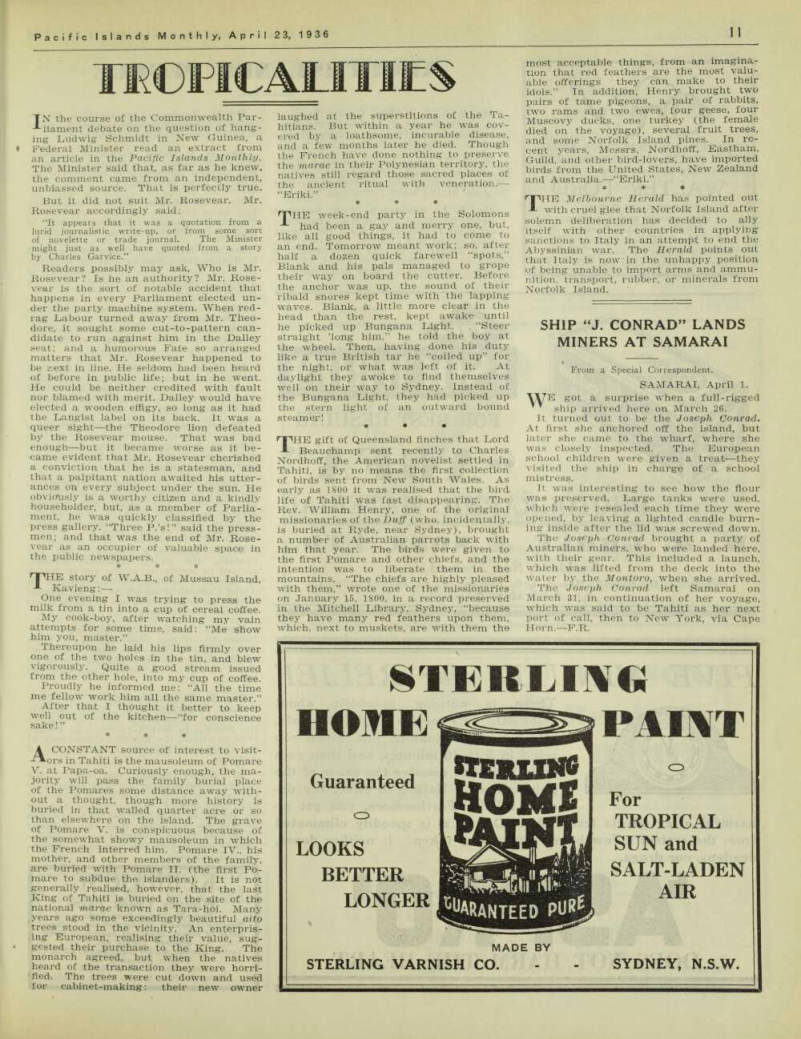
TN the course of the Commonwealth Par -Miament debate on the question of hang ing Ludwig Schmidt in New Guinea, a Federal Minister read an extract from an article in the Pacific Islands Monthly.
The Minister said that, as far as he knew, the comment came from an independent, unbiassed source. That is perfectly true.
But it did not suit Mr. Rosevear. Mr.
Rosevear accordingly said: “It appears that it was a quotation from a lurid journalistic write-up, or from some sort of novelette or trade journal. The Minister might just as well have quoted from a story by Charles Garvice.”
Readers possibly may ask, Who is Mr.
Rosevear? Is he an authority? Mr. Rose vear is the sort of notable accident that happens in every Parliament elected un der the party machine system. When red rag Labour turned away from Mr. Theo dore, it sought some cut-to-pattern can didate to run against him in the Dailey seat; and a humorous Pate so arranged matters that Mr. Rosevear happened to be ?:ext in line. He seldom had been heard of before in public life; but in he went.
He could be neither credited with fault nor blamed with merit. Dailey would have elected a wooden effigy, so long as it had the Langist label on its back. It was a queer sight—the Theodore lion defeated by the Rosevear mouse. That was bad enough—but it became worse as it be came evident that Mr. Rosevear cherished a conviction that he is a statesman, and that a palpitant nation awaited his utter ances on every subject under the sun. He obvic/usly is a worthy citizen and a kindly householder, but, as a member of Parlia ment, he was quickly classified by the press gallery. “Three P.’s!” said the press men; and that was the end of Mr. Rose vear as an occupier of valuable space in the public newspapers. * * ♦ THE story of W.A.8., of Mussau Island, Kavieng:— One evening I was trying to press the milk from a tin into a cup of cereal coffee.
My cook-boy, after watching my vain attempts for some time, said: “Me show him you, master.”
Thereupon he laid his lips firmly over one of the two holes in the tin, and blew vigorously. Quite a good stream issued from the other hole, into my cup of coffee.
Proudly he informed me: “All the time me fellow work him all the same master.”
After that I thought it better to keep well out of the kitchen—“for conscience sake!” * * * A CONSTANT source of interest to visitin Tahiti is the mausoleum of Pomare V. at Papa-oa. Curiously enough, the ma jority will pass the family burial place of the Pomares some distance away with out a thought, though more history is buried in that walled quarter acre or so than elsewhere on the island. The grave of Pomare V. is conspicuous because of the somewhat showy mausoleum in which the French interred him. Pomare IV., his mother, and other members of the family, are buried with Pomare 11. (the first Po mare to subdue the islanders). It is not generally realised, however, that the last King of Tahiti is buried on the site of the national marae known as Tara-hoi. Many years ago some exceedingly beautiful aito trees stood in the vicinity. An enterpris ing European, realising their value, sug gested their purchase to the King. The monarch agreed, but when the natives heard of the transaction they were horri fied. The trees were cut down and used for cabinet-making: their new owner
laughed at the superstitions of the Ta hitians. But within a year he was cov ered by a loathsome, incurable disease, and a few months later he died. Though the French have done nothing to preserve the marae in their Polynesian territory, the natives still regard those sacred places of the ancient ritual with veneration.— “Eriki.” * * * THE week-end party in the Solomons ■*- had been a gay and merry one, but, like all good things, it had to come to an end. Tomorrow meant work; so, after half a dozen quick farewell “spots,”
Blank and his pals managed to grope their way on board the cutter. Before the anchor was up, the sound of their ribald snores kept time with the lapping waves. Blank, a little more clear in the head than the rest, kept awake until he picked up Bungana Light. “Steer straight ’long him,” he told the boy at the wheel. Then, having done his duty like a true British tar he “coiled up” for the night, or what was left of it. At daylight they awoke to find themselves well on their way to Sydney. Instead of the Bungana Light, they had picked up the stern light of an outward bound steamer! • • • THE gift of Queensland finches that Lord Beauchamp sent recently to Charles Nordhoff, the American novelist settled in Tahiti, is by no means the first collection of birds sent from New South Wales. As early as 1800 it was realised that the bird life of Tahiti was fast disappearing. The Rev. William Henry, one of the original missionaries of the Duff (who, incidentally, is buried at Ryde, near Sydney), brought a number of Australian parrots back with him that year. The birds were given to the first Pomare and other chiefs, and the intention was to liberate them in the mountains. “The chiefs are highly pleased with them,” wrote one of the missionaries on January 15, 1800, in a record preserved in the Mitchell Library, Sydney, “because they have many red feathers upon them, which, next to muskets, are with them the
most acceptable things, from an imagina tion that red feathers are the most valu able offerings they can make to their idols.” In addition, Henry brought two pairs of tame pigeons, a pair of rabbits, two rams and two ewes, four geese, four Muscovy ducks, one turkey (the female died on the voyage), several fruit trees, and some Norfolk Island pines. In re cent years, Messrs. Nordhoff, Eastham, Guild, and other bird-lovers, have imported birds from the United States, New Zealand and Australia. —“Eriki.” * * * THE Melbourne Herald has pointed out with cruel glee that Norfolk Island after solemn deliberation has decided to ally itself with other countries in applying sanctions to Italy in an attempt to end the Abyssinian war. The Herald points out that Italy is now in the unhappy position of being unable to import arms and ammu nition. transport, rubber, or minerals from Norfolk Island.
Ship “J. Conrad” Lands
Miners At Samarai
From a Special Correspondent.
SAMARAI, April 1.
YVTE got a surprise when a full-rigged ’ * ship arrived here on March 26.
It turned out to be the Joseph Conrad.
At first she anchored off the island, but later she came to the wharf, where she was closely inspected. The European school children were given a treat —they visited the ship in charge of a school mistress.
It was interesting to see how the flour was preserved. Large tanks were used, which were resealed each time they were opened, by leaving a lighted candle burn ing inside after the lid was screwed down.
The Joseph Conrad brought a party of Australian miners, who were landed here, with their gear. This included a launch, which was lifted from the deck into the water by the Montoro, when she arrived.
The Joseph Conrad left Samarai on March 31, in continuation of her voyage, which was said to be Tahiti as her next port of call, then to New York, via Cape Horn. —F.R.
Advertisements & other items, pp. 13-14 (1 item)
Homi
STERLING
HOME
Guaranteed
LOOKS
BETTER
LONGER
tmiDK
HOMI
PAINT
C 3 For
TROPICAL
SUN and
SALT-LADEN
AIR
MADE BY
STERLING VARNISH CO. - - SYDNEY, N.S.W.
NEGLECT OF DEFECTIVE SIGHT
MAY CAUSE SERIOUS RESULTS
Take Care of Your Eyes Consult
WALTER FORD
D.8.0.A., M.0.0.A.
Optometrist and Optician 4th Floor, Challis House Martin Place, Sydney Established over 30 years Tel.: Most moderate charges BW 6131
FOR BEST RESULTS
use
44 AGFA”
PHOTOGRAPHIC MATERIAL
W. 11. GROVE A SOIVS, LTD.,
Auckland, New Zealand or direct to the factory, Messrs. I. G. Farbenindustrie Aktiengesellschaft Agfa, Berlin SO 36, Germany
FIVE MINUTES for RELIEF
There is nothing indefinite about “ASPRO.” Its service is QUlCK—safe, effective, and definite. It gives you relief in 5 to 10 minutes, and then goes on to dispel or dissolve the cause of the pain, allowing Nature to effect the desired relief. Furthermore, you get no harmful after effects from “ASPRO,” as it is speedily eliminated from the system a few hours after being taken. It neither dopes, deadens, nor drugs.
ASPRO 1
DOES NOT HARM THE HEART
About Islands People
Mr. S. G. C. Knibbs, Crown Surveyor and Commissioner of Lands in the Solo mon Islands, arrived in Sydney by the Malaita on March 27.
Mr. M. G. James, senior operator of the Postal and Radio Department of the Western Samoan Administration, arrived in Apia by the Maui Pomare on March 3.
Mr. A. L. Armstrong, First Assistant Colonial Secretary of Fiji, who was acting as Colonial Secretary until the recent arrival of the new Colonial Secretary, Mr.
C. J. J. T. Barton, left for England on long leave by the Niagara on March 13. He was accompanied by Mrs. Armstrong.
Mr. W. Fowler, District Officer in the Solomons Islands, reached Sydney by the Malaita from Tulagi on March 27.
Rev. W. D. Oakes, Methodist Mission ary, of Piniquidu, New Guinea, arrived by the Malaita on March 27 to spend six months’ leave in Sydney.
Mr. Jack Abeam, who for some time has been manager of the Vacuum Oil Company’s branch at Rabaul, arrived in Sydney by the Neptuna on March 27.
Mr. and Mrs. I. H. Grabowsky arrived in Sydney from New Guinea by the Nep tuna on March 27. Mr. Grabowsky is general manager of Guinea Airways Limited at Lae.
Miss Una Mac Andrew, who had been on a 12 months’ visit to her brother, Mr.
J. A. Mac Andrew, of Boris plantation, Bougainville, New Guinea, returned to Australia by the March Malaita.
Mr. E. J. Clymo, the newly appointed Technical Instructor for the Methodist Mission in New Britain, sailed for Rabaul with his wife and daughter by the Mon toro from Sydney on March 19.
Dr. Sylvester M. Lambert, representative of the Rockefeller Foundation in the Western Pacific, returned to Suva, Fiji, from leave in the United States by the Monterey on March 17, Captain H. T. (“Bunny”) Hammond, assistant manager of Holden’s Air Trans port Services Ltd., Wau, New Guinea, arrived in Sydney with his wife by the Neptuna on March 27. They are on a three months’ holiday visit.
Mr. D. Costello, a brother of Mr. Pat Costello, the Fijian goldfields pioneer, arrived in Melbourne at the end of March to attend a meeting of shareholders in Aloha Central of which he is the biggest holder. Mr. Costello is one of the original Koroere shareholders.
Hon. J. Judd, Acting Secretary for Indian affairs and Chairman of the Suva Town Board, Fiji, has been appointed Chairman of the Fiji Publicity Board, in place of Mr. A. L. Armstrong, who has gone on leave.
Dr. T. C. Backhouse, of the New Guinea Department of Public Health, arrived in Hong Kong from Rabaul by the Nankin in March en route to Singa pore to attend the biennial Conference of the Singapore Bureau of the League of Nations.
Mr. Alport Barker, member for the Southern Division in the Fiji Legislative Council, left for England with his daughter, Mrs. F. Ryan, by the Aorangi on March 6. It is Mr. Barker’s intention to take up the question of the proposed change in the constitution of the Legis lative Council with the Secretary of State for the Colonies.
Dr. and Mrs. A. G. Irwin arrived in Samoa by the Maui Pomare on March 3.
Dr. Irwin is the new medical officer at Apia Government Hospital.
Miss Vera Syers, a trained nurse from New Zealand, left Sydney for the New' Hebrides by the Morinda early in April to take up duties with the Melanesian Mission at Raga Island.
Miss M. Devitt has returned tem porarily to the New Guinea Anglican Mission, in Eastern Papua, to Write the memoirs of Canon S. Tomlinson, who has been with the Anglican Mission for 45 years.
Mr. and Mrs. G. F. K. Hufnagel- Betham returned to Apia, Western Samoa, by the Maui Pomare on March 3, after a holiday in New Zealand. Mr. Hufnagel-Betham is chief surveyor in the Land and Survey Department of the Administration.
Miss C. M. A. Deck, of the South Sea Evangelical Mission at One Pusu, Malaita Island, in the Solomons Group, arrived on a periodical visit to her relatives in Sydney by the Malaita on March 27. Miss Deck has been attached to the S.S.E.
Mission in the Solomons Islands since 1907.
Mr. and Mrs. W. Firth, of Auckland, N.
Zealand, who passed through Sydney on their way to England to attend the mar riage of their son, Dr. Raymond Firth (formerly Professor of Anthropology at Sydney University, and now of the Uni versity of London), brought the news that his work on Tikopia will shortly appear in two volumes. Dr. Firth’s fiancee is Miss Rosemary Upcott, daughter of Sir Thomas Upcott, the British Auditor-General.
Mr. Russell Robinson, a member of the executive of the Polynesian Club of Sydney, left for the United States by the Niagara in March, where his mar riage will take place in New York to M iss Gertrude Tompkins, of New Jersey.
Mr. Robinson has many friends in Tahiti, which he visited when aero nautical engineer with the Byrd Antarctic Expedition.
Mr. William C. Groves, of Melbourne, w r ell known for his anthropological work in New Guinea and elsewhere, has com pleted his book on native education in the Territory for the Australian Council for Educational Research. It should be published shortly by the Melbourne Uni versity Press. Mr. Groves, who is working again this year under a Fellowship grant from the Australian National Research Council of Sydney, will visit Sydney in May, to deliver a series of lectures on New Guinea anthropology to New Guinea cadets and missionaries at the Sydney University. He will address the Sydney Anthropological Society on the evening of May 19.
Mr. Robert (“Paddy”) Bentley died in Levuka Hospital, Fiji, on February 22, at the age of 48. He was the second son of the late Mr. and Mrs. R. C. Bentley, and was well-known in Levuka.
Mr. Henry Morley Fenton, a pioneer of Salt Lake district, Vanua Levu, Fiji, died in February at his plantation home, Navava. Born in May, 1872, at Navava. he was educated in New Zealand. Re turning to the Colony he spent prac tically the whole of his life at Navava.
Pastor A. G. Stewart will leave Sydney during the first week in May on a two months’ visit to Fiji and Western Samoa on an inspection tour of the Seventh Day Adventist missions in those territories.
Mr. Stewart is Vice-President of the S.D.A.. organisation.
Mr. Frank C. F. Nelson-Meredith, of Messrs. O. F. Nelson and Co. Ltd., Apia, Western Samoa, married Miss Katherine Cecilia Thomsen at the Cathedral of the Immaculate Conception on February 20.
Rev. Father J. Deihl performed the ceremony.
Mr. Eric Ramsden, a well-known writer on Polynesian subjects, and who con tributes to the Pacific Islands Monthly has had a book on the early missions in New Zealand accepted for immediate publication by Angus and Robertson Ltd., of Sydney, in conjunction with A. H.
Reed, publisher to the University of Otago. The book will cover the last phase of the life of Rev. Samuel Marsden, “father” of the old mission in Tahiti, and a well-known cleric of his day who did much to further missionary enterprise in the Pacific. The book is the result of several years’ research in the Mitchell Library in Sydney. Professor Peter H.
Buck, of the Bishop Museum, Hawaii, has been invited to contribute a preface.
, Mrs,W ' J - Livingstone, of New Guinea arrived in Australia recently to spend long leave. Mr.
Livingstone is a Warrant Officer in the IS.G. Police Force.
Sister Edith Thompson, of the Melaho . has been on furlough m New Zealand, arrived in Sydney by the Makura on March 7 to jom the Southern Cross.. Miss Thompson has been appointed to New Britain, wnere she will be the only European woman member of the mission staff.
Mr. E. H. Griffiths, formerly manager of the Colonial Sugar Refining Company at Penang, Fiji, returned to Suva by the Niagara recently. He later proceeded to Labasa to relieve Mr. G. L. Fenner, who haS departed on 12 months ’ plough.
Mr ' S ' E - Sutcliffe, pilot for Messrs, Holden’s Air Transport Services, Ltd., at Salamaua, New Guinea, arrived in Syd ney by the Macdhui on March 5 to spend three months’ furlough. He was ac companied by his wife and baby son, and Mrs. Sutcliffe senior. They had intended
to leave by the previous steamer, but on the eve of their departure Mrs. S.
E. Sutcliffe was compelled to spend a few weeks in Salamaua hospital.
Captain Lorre has been appointed Con dominium Medical Officer at Efate, New Hebrides, in succession to Dr. Broband.
Mr. R. F. Bunting, of Samarai, who is the son of Mr. Arthur Bunting, member of the Legislative Council of Papua, has been spending holidays in Victoria.
Mr. John Douglas Colclough, son of Mr. J. Colclough, secretary of Bulolo Gold Dredging Co. Ltd., Sydney, sailed for New Guinea at the end of February to join B-.G.D.’s Co.’s staff at Bulolo.
Right Rev. Dr. Stephan Davies, Bishop of Carpentaria, arrived in Sydney with Mrs. Davies by the Marella from Thurs day Island recently to spend three months in Australia.
Pastor A. H. Piper, secretary of the Australasian Union Conference of Seventh Day Adventists, left Sydney on April 9 for San Francisco via Rarotonga and Tahiti to attend an S.D.A. Conference in America.
Mr. H. Hemus, well-known traveller for the Auckland mercantile house of A. B.
Donald Ltd., arrived in Tahiti by the Maunganui recently on one of his periodi cal trips of inspection. He will remain in French Oceania for several months be fore proceeding to the Cook Islands.
Mrs. Emily Undine Joske, widow of the late Mr. Alexander Brewster Joske, a pioneer of Fiji, died at her home at Van cluse, Sydney, on March 14, after having been seriously ill for several months. She left a daughter, Mrs. S. H. Ellis, and a son, Major Clive B. Joske, 0.8. E., M.C., E.D., both well-known residents of Suva.
Mrs. W. Benjamin Norgate died sud denly at Thursday Island on April 7. She had been in indifferent health for years, but her end was unexpected. Mrs. Nor gate and her husband, whom she survived by about four years, were at Booby Island Lighthouse for many years, having pre viously served a short time at Goode Island.
Mrs. M. Grand, wife of the manager of the Societe Commerciale Francaise, of Vila, New Hebrides, arrived by the Mor inda on March 20 on her first holiday to Sydney since she left her former home three years ago. Four months of each year, when Vila experiences terrific heat, Mrs. Grand spends at her Norfolk Island home, where she has now left her daughter, Madeline, under the care of a French governess.
Mr. W. W. Bolton, M.A., of Papeete, who in recent years has carried out historical research in Tahiti and has been respon sible for discovering the graves of several of the early missionaries, recently re ceived a gift from the London Missionary Society. It was one of the original en gravings of the cession of Matavai by Tu, King of Tahiti, to the missionaries of the Duff, and is dated January 1, 1803.
These engravings are now exceedingly difficult to obtain. The Mitchell Library in Sydney has one.
Advertisements & other items, pp. 14-16 (1 item)
Kurrajong
Wheeny Creek Farm
Forty-five miles from Sydney Superior modern accommodation, abundance of cream, eggs, and poultry. S acres orchard. Tennis, etc.
Tariff: Double, £2/2/- each; Single, £2/10/- ’Phone: Kurrajong 42 Proprietor; A. J. SAMSON Formerly New Guinea Public Service
For Quality CUTLERY
Baker’s Best Quality
SHEATH KNIFE
(including Sheath) 7/6 Write for Free Illustrated Catalogue o m Sf
PINKING
SHEAR
For Cutting Serrated 42/- Edge on Materials
W. Jno. BAKER LTD.,
Founded 1888.
3 HUNTER STREET
SYDNEY, N.S.W.
HUDSON'S
ltoa«l,v - Cut
IK Ml US
offer the most practical solution of the problem of erecting a home in districts where skilled labour is difficult to obtain. The framework is cut and prepared ready for erection, all doors and windows are fitted ready for placing in position, and verandah posts, plates, architraves, etc., are prepared ready for fixing in position, A very efficient plan service is rendered, which makes the work of erection very simple.
We quote to your own or any design.
Send for latest catalogue containing many new designs.
V,
GEORGE HUDSON LTD.
TIMBER MERCHANTS
Bridge Road, Glebe, Sydney
READY CUT HOME DEPT.: 7 CASTLEREAGH STREET, SYDNEY
TUDOR HOTEL
Room Only Rate, 5/- per day. Meals a la carte. Accommodation for 100 guests. One minute from G.P.O.
117 PHILLIP ST. Tel.: BW 17M
Next door to Martin Place
Sydney
The Islanders’ Sydney Home ...
Location BEEVEDERE
81 BAYSWATER ROAD, DARLINGHURST
Exclusive.
A fine house with its wealth of pleasant old associations.
The Garden Suites, designed on most modern lines.
Excellent grounds with beautifully Joept gardens—and dotted with comfortable garden seats.
BELVEDERE is Controlled Private telephones if desired.
An atmosphere of rest and grateful quietness.
Ideal location.
Near White City Tennis Courts.
Seven minutes to G.P.O.
Close to Shopping Centre.
Trams stop at gates. & Supervised by Islands People for Islands People TERMS: From £2/12/6 Weekly.
MR. & MRS. C. WAGER (late of Fiji), Proprietors.
Suffered Acutely FOR
30 YEARS
First Dose
brought Relief
Extract from letter received from: G. E. Shrimpton, 21 Brisbane Street, Milson’s Point,
SYDNEY, N.S.W.
Mr. R. M. Hardy, Hardy’s Chambers, 5 Hunter St., Sydney, N.S.W.
Dear Sir: For the past thirty years I have been subject to acute stomach troubles of various kinds, my appetite dwindled to practically nothing long ago, and my health in general was affected. I tried most of the many stomach remedies on the market, but obtained absolutely no relief from any one of them; therefore I decided that my ailments were incurable.
However, a friend advised me to try your product. After my first dose I obtained great relief, and now I can eat a hearty meal without fear of any inconvenience resulting. I am also much better in health and strength.
I have obtained a great and lasting benefit in every way.
Hoping you and your remedy enjoy the large measure of success it merits.
Yours faithfully,
(Signed) G. E. SHRIMPTON.
This remarkable cure gives instant permanent relief in all stomach troubles, because it strikes at the root of the cause . . . acidity. . . . Suffer no longer. Get a tin of Hardy’s to-day.
R. M. HARDY’S
INDIGESTION AND ULCERATED
STOMACH REMEDY
NO DIETING ... NO HEADACHES . .
Obtainable at all
Burns, Philp & Co.
Stores
Price 3/6 per 8 oz.
tin!
Note the generous size.
NO STABBING PAINS
Wanted to buy used New Guinea and
Pacific Islands Stamps
in quantity on paper.
Send particulars and prices required
R. HARVEY, P.O. Box 791,
Auckland N.Z.
Unlawful Killing Charge
Kicked Native
N.G. Overseer Not Guilty On Unlawful Killing Charge
From Our Own Correspondent RABAUL, March 30.
T>OBERT Eustace Emery appeared before the Supreme Court recently charged with the unlawful killing of a native in February last. Mr. Maunsell Turner appeared for the prosecution, and Mr. Andrew Kelly for the defence.
The case for the Crown was that the accused had unlawfully killed a native, Wisan, whilst employed by the Markham Valley Produce Co. carrying stones dur ing building operations near Lae. Evi dence showed that the deceased native had disobeyed orders, and the accused had assaulted him. Shortly afterwards Wisan collapsed, and subsequently died.
The cause of death was a ruptured spleen. The medical evidence showed that the deceased’s spleen was five times its normal size and was very friable.
Further evidence showed that the accused was wearing light sand shoes when the alleged kick took place.
In summing up the Chief Judge re marked that there was no sign of brutality or that the kick had been res ponsible for the native’s death. The deceased had been employed on heavy work and, according to the medical evidence, the spleen could have been ruptured by a fall or a sudden twist of the body. The accused could have been convicted of a minor offence, but on the charge of unlawful killing His Honour brought in a verdict of not guilty.
Tongan Footballers To
Visit Fiji
From Our Own Correspondent SUVA, March 25.
A DVICE has been received from Tonga by the Fiji Rugby Union that its in vitation to a Tongan football team to visit Fiji this year has been accepted. It is expected that the visitors will arrive in Suva in August or September, depend ing on the shipping services available.
These interchanges of visits between Tonga and Fiji, which have been going on for some years, do much to foster football among the natives, and the matches are most popular both among Europeans and natives.
Last year Fiji sent a team to Tonga and won the rubber. Keen matches are looked forward to this year, and it is anticipated that the Fijians, who have taken to Rugby in a wonderful manner, will give a good account of themselves.
Repairing Storm Damage at Rarotonga
Rarotonga
RAROTONGA has done much to set her house in order after the severe hurri cane early last year.
The Storm Reparation Fund, with Gov ernment assistance, enabled the building of a new nurses’ home and kitchen, both buildings having now been completed. The contractors are now busy with the hospital extension, which will provide additional accommodation.
“When completed the latter should be a fine building,” says the Medical Superin tendent, Dr. E. P. Ellison, “and sufficient
to meet the needs for generations come of a steadily growing population.”
Other improvements at Avarua include ferro-concrete walls, which will afford bet ter protection in the event of another h.ur
ricane.-
E.R.
Advertisements & other items, p. 17 (1 item)
Tooheys
euji
*.« • s?-
lS>ii H*<'°
pb at ® eve«V v)» tet 'tbe® ‘ el ° o t to . P al (V’tO
i *tf utffiST
**x lot n 1 o\^ a* tfft a 78 L
FOR SAFETY’S SAKE. SAY "VINCENT’S’
The Colorful
Pacific
The emerald green of the hillside, the sapphire blue of the sea, the silver strand of beach ... complete the color scheme with the golden amber (and creamy white head) of a glass of Tooheys Pilsener. It gives a rosy hue to life. Here’s To’ee!
TOOHEYS
PILSENER
IN THE BOTTLE WITH THE YELLOW LABEL. ■Poheys
SLASH**
Japanese Again

Another Outrage at Manus
T ETTERS from New Guinea received early in Apr# reported that Japanese poachers have again been active in the Admiralty Islands and that they de liberately burned buildings on one of the islands a few weeks ago.
The Purdy Islands are a group of little islets included in the Admiralty Islands, northwards of the mainland of New Guinea, and they are leased from the Expropriation Board by Mr. Charles Munster, of Lorengau, Admiralty Islands.
Mr. Munster has a force of native labourers in the Purdy Islands, where he obtains copra and trocas shell.
Early in January a Japanese sampan arrived in the Purdy Islands and sent her
boats on to the reef at Mole Islet, where they began fishing for trocas shell. Mr.
Munster’s labourers on the islet shouted at the poachers and they departed.
The sampan then proceeded towards Mouse Islet and boats went ashore on the reef. The native labourers on this islet also shouted at the Japanese, but the Japanese retorted by making threatening signs. Another boat came from the sampan and the crew of this boat carried fire-arms.
The natives on Mouse Islet then be came alarmed, hiding their women be neath fallen dry coconut fronds, and they themselves hid in the tops of the coconut palms. The Japanese came ashore and searched the island and then deliberately set fire to the buildings on the island, consisting of a house for the labourers, a copra drier and a copra shed. The buildings together with a quantity of copra and all the labourers’ food, and gear, were destroyed. The Japanese then departed.
Japanese poachers have been reported recently in other parts of the group. One crew went ashore at a plantation owned by Messrs. Edgell and Whiteley and, after gathering up all the trocas shell avail able, they stole a quantity of food.
The District Officer at Lorengau re ported the Mouse Islet outrage to Rabaul by radio and it is understood that the Administrator of New Guinea placed the matter before the Commonwealth au thorities.
It was reported recently that Japanese poaching among the northern islands of New Guinea had ceased; but the latest reports suggest that the nuisance recently has become more marked than ever be fore.
Madang Now Has An
Aerodrome
From a Special Correspondent.
WAIT, March 4. nPHE aerodrome at Madang, which is likely to be in much demand in the future, as the air services of the Territory extend their influence, is progressing. Two aeroplanes will be stationed there for flights over the surrounding country.
Madang is the former capital of German New Guinea. It is a busy planting and commercial township, apart from being the administrative centre for the north east coast of the mainland.
Says Planter
S.I. Labour Not “Dangerous”, Says Planter
IN an article in the Pacific Islands Monthly of November, 1935, referring to the unrest among plantation labourers in the Solomon Islands, our correspondent at Gizo stated that “It is reported here that Mr. Sutton, manager of Fauno plan tation, regards the situation among his labourers there as dangerous.”
Writing from Fauno Estate, Shortland Island, on March 9, Mr. H. F. Sutton says, “I have just had my attention drawn to an article in the P.I.M. in which I am reported to have said that the situation among the labour on Fauno plantation was ‘dangerous.’ I do not think that I made use of that expression, which would certainly have been an exaggeration.’’
Advertisements & other items, p. 18 (1 item)
Master Sewing Machine Co.
ORDER
RECORDS
by MAIL
Use Elvy’s Special Gramophone Record Mail Department for Island residents.
Orders over £2 insured, posted FREE.
Write for free catalogues and lists NOW.
ELVY & CO. LTD.
397 GEORGE STREET, SYDNEY
Master Sewing Machine Co.
Let Us Know Your Requirements . . . and we will be Pleased to Quote by Return Mail
Reconditioned ..,
SEWIMC MACHINES
FOR INDUSTRIAL AND HOUSEHOLD USE
ALL TYPES FOR SALE
PRICES FROM £3 EACH
EVERY MACHINE GUARANTEED MECHANICALLY PERFECT
• Repairs to all makes of • We have been established for 23 years, machines receive the an{ j carry the most comp lete range of petant* mechanics. ° C ° m ’ Sewing Machines in New South Wales.
NO DELAYS—ALL GOODS CAREFULLY PACKED FOR TRANSPORT.
Master Sewing: Machine Co.
15 Enmore Road, Newtown, Sydney
Cook Is. Fruit War
N.Z. Parliamentary Inquiry
From Our Own Correspondent
Rarotonga, March 22.
THE slightly conspiratorial air with which advocates of the proposed Fruit Control Board went about their early pro ceedings has now given place to the satis fied mien of men who have definitely accomplished something.
On March 19, word was received from the Prime Minister that the petition re cently forwarded from here would form part of a parliamentary inquiry and thorough investigation into every aspect of the importation and sale of fruit into New Zealand.
The petition referred to contained 808 signatures of producers out of a possible 1000, and opponents of the Board were quick to point out that of these only 564 were names of registered growers or pos sessors of a distinct shipping “mark.”
Equally quick was the indisputable reply that had the local Land Court sat regu larly during the past ten years, the ma jority of these people would have estab lished separate titles to their land and automatically applied for shipping marks of their own instead of continuing to use those of other members of the family.
Further to strengthen their position, growers during the past month elected district committees, and, from these again, a “Rarotonga Growers’ Association,” created, in the words of its chairman, Mr.
William Mcßirney, to generally guard producers’ interests and take up the slack between soil and sale. Containing over three-fourths of the Island’s growers, such an organisation, if skilfully led and care fully regimented, could —and possibly will —form the nucleus of a new and progres sive movement for the betterment of con ditions, not only in the fruit industry, but in other quarters.
One of the chief difficulties confront ing the new Association is the raising of sufficient funds to send one or more dele gates to speak on their behalf before the Parliamentary Committee shortly to be held in New Zealand. Their original in tention was to obtain the money from the levy of Id per case on all fruit export ed from the island through the district packing sheds. The funds thus accumu lated are specifically for the purpose of maintaining the sheds in good condition and for the cost and upkeep of any machinery therein.
There has, however, been considerable elasticity in the interpretation of the term “for public purposes,” and members of the association are irritated by the Ad
ministration’s refusal to sanction a grant when comparatively recently payments have been allowed for (1) An honorarium to a retired Civil Servant; (2) a subscrip tion for the victims of the Napier earth quake; (3) expenses in connection with visits paid to Tahiti and New Zealand by certain local chiefs; and (4) a month or two ago, a substantial gift to the London Missionary Society’s new church at Ngatangiia.
Arguing that none of these expenditures could possibly be considered as in any way connected with, or beneficial to, the fruit trade, the association not unreason ably feels that the attitude adopted by the Administration cloaks a covert opposi tion to the Board, as advocated by the association.
N.Z. Premier’s Comment
From Our New Zealand Correspondent AUCKLAND, March 25.
A DETERMINATION to conduct a full investigation into the importation of fruit into New Zealand from Rarotonga has been expressed by the Prime Minister, Mr. Savage, who is also Minister for the Cook Islands.
The Rarotongans proposed to petition Parliament with regard to the setting up of a Fruit Board, he said. It was the duty of Parliament to find out the true posi tion, and he would be glad of any evidence placed before it. He wanted to be sure that a Board was the solution of the trouble.
The fruit trade had been unsatisfactory for years, said Mr. Savage. New Zealand was not far away from the Cook Islands.
The Islands had fruit, but the Dominion could not get it, and that was most un satisfactory. It would be worth while for those who knew something about the fruit trade to come forward when a Parliamen tary Committee was set up to consider the matter. They wanted to examine the whole position, and to give interested par ties a chance for cross-examination. They were determined to see justice done.
Two Petitions Presented
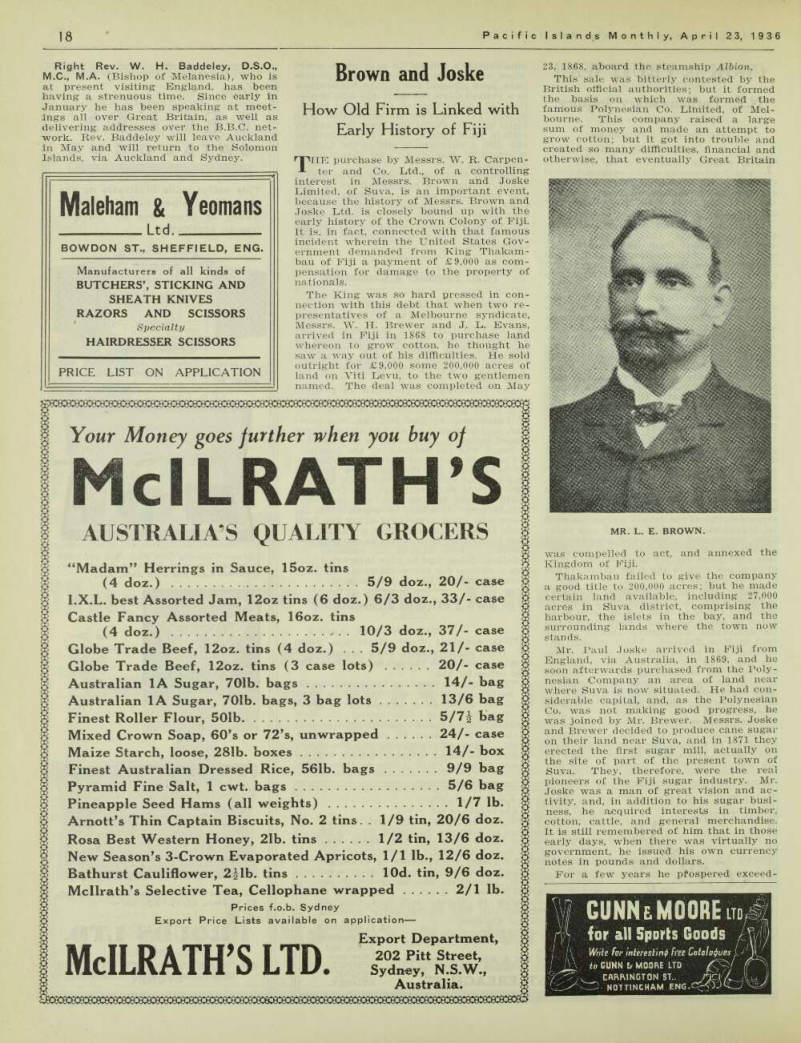
Wellington, April 8.
TWO petitions from Rarotonga from -*■ fruit growers have been presented to Parliament. One is signed by over 700, the other by 253.
The petitions agree on the necessity for a better marketing system. The first, however, wants a Producers’ Board similar to those functioning in New Zealand: the second (signed by men who claim they produce 60 per cent, of the fruit exported) opposes a Producers’
Board and urges greater use of the al ready existing Fruit Advisory Committee.
Right Rev. W. H. Baddeley, D. 5.0., M.C., M.A. (Bishop of Melanesia), who is at present visiting England, has been having a strenuous time. Since early in January he has been speaking at meet ings all over Great Britain, as well as delivering addresses over the 8.8. C. net work. Rev. Baddeley will leave Auckland in May and will return to the Solomon Islands, via Auckland and Sydney.
Advertisements & other items, pp. 19-20 (2 items)
Pkciids’
From
CATALOGUE
This useful guide illustrates no end of useful novelties, suitable gifts for Young or Grown-ups will be sent free on application. m 15 Jewel “Tudor” Wristlet Watch, 9ct.
Gold, £5/15/-. Rolled Gold, 77/6.
Silver, 60/-.
Lacquer Cigarette Case Flap Jack and comb in an assortment of designs & colours, 35/.
Cigarette Case and Flap Jack, 21/.
Rose Bowl, heavily cut English Crystal, 25/-. : V % m « Solid Gold Studs in presentation case, 9ct., 21/-; 15ct., 37/6; 18ct., 45/-.
PROUDS LTD.
The Gift Store
CR. KING AND PITT STREETS,
SYDNEY
Maleham & Yeomans
Ltd
BOWDON ST., SHEFFIELD, ENG.
Manufacturers of all kinds of
BUTCHERS’, STICKING AND
SHEATH KNIVES
RAZORS AND SCISSORS
Specialty
HAIRDRESSER SCISSORS
PRICE LIST ON APPLICATION
Your Money goes further when you buy of
McILRATH’S
AUSTRALIA’S QUALITY GROCERS
“Madam” Herrings in Sauce, 15oz. tins (4 doz.) 5/9 doz., 20/- case I.X.L. best Assorted Jam, 12oz tins (6 doz.) 6/3 doz., 33/- case Castle Fancy Assorted Meats, 16oz. tins (4 doz.) 10/3 doz., 37/- case Globe Trade Beef, 12oz. tins (4 doz.) . . . 5/9 doz., 21/- case Globe Trade Beef, 12oz. tins (3 case lots) 20/- case Australian 1A Sugar, 701 b. bags 14/- bag Australian 1A Sugar, 701 b. bags, 3 bag lots 13/6 bag Finest Roller Flour, 501 b 5/71 bag Mixed Crown Soap, 60’s or 72’s, unwrapped 24/- case Maize Starch, loose, 281 b. boxes 14/- box Finest Australian Dressed Rice, 561 b. bags 9/9 bag Pyramid Fine Salt, 1 cwt. bags 5/6 bag Pineapple Seed Hams (all weights) 1/7 lb.
Arnott’s Thin Captain Biscuits, No. 2 tins. . 1/9 tin, 20/6 doz.
Rosa Best Western Honey, 21b. tins 1/2 tin, 13/6 doz.
New Season’s 3-Crown Evaporated Apricots, 1/1 lb., 12/6 doz.
Bathurst Cauliflower, 2 -2 lb. tins lOd. tin, 9/6 doz.
Mcllrath’s Selective Tea, Cellophane wrapped 2/1 lb.
Prices f.o.b. Sydney Export Price Lists available on application—
McILRATH’S LTD.
Export Department, 202 Pitt Street, Sydney, N.S.W., Australia.
161 Castlereagh St.
IN THE HEART
OF SYDNEY
A® a 0"
\V se
PRIVATE
HOTEL
ANNOUNCEMENT. . .
ISLANDS’ PATRONS of “CROWLE HOUSE” are
informed that this well-known SYDNEY PRIVATE HOTEL is under NEW AND EXPERT MANAGE- MENT, and has been LAVISHLY RE-FURNISHED THROUGHOUT. Every convenience is available, including Hot and Cold Water in all Bedrooms, Electric Elevator, Laundries, Electric Irons, Pressing Rooms, etc. (Free Service).
Visitors holidaying in Sydney will find Comfort and Contentment at this conveniently situated Hotel. Excellent Cuisine.
TARIFF:
Single Room. Bed & B’fast., 7/6 per day. 45/- per week.
Double Room. Bed & B’fast., 14/- per day. 84/- per week. Casual Meals 2/- each.
161 CASTLEREAGH ST.
J. C. HUGHES
Proprietor Radios and Telegrams:
“CROWL-
HOUSE,”
SYDNEY.
Brown and Joske
How Old Firm is Linked with Early History of Fiji
THE purchase by Messrs. W. R. Carpen ter and Co. Ltd., of a controlling interest in Messrs. Brown and Joske Limited, of Suva, is an important event, because the history of Messrs. Brown and Joske Ltd. is closely bound up with the early history of the Crown Colony of Fiji.
It is, in fact, connected with that famous incident wherein the United States Gov ernment demanded from King Thakam bau of Fiji a payment of £9,000 as com pensation for damage to the property of nationals.
The King was so hard pressed in con nection with this debt that when two re presentatives of a Melbourne syndicate, Messrs. W. H. Brewer and J. L. Evans, arrived in Fiji in 1868 to purchase land whereon to grow cotton, he thought he saw a way out of his difficulties. He sold outright for £9,000 some 200,000 acres of land on Viti Levu, to the two gentlemen named. The deal was completed on May
23, 1868, aboard the steamship Albion.
This sale was bitterly contested by the British official authorities; but it formed the basis on which was formed the famous Polynesian Co. Limited, of Mel bourne. This company raised a large sum of money and made an attempt to grow cotton; but it got into trouble and created so many difficulties, financial and otherwise, that eventually Great Britain
was compelled to act, and annexed the Kingdom of Fiji.
Thakambau failed to give the company a good title to 200,000 acres; but he made certain land available, including 27,000 acres in Suva district, comprising the harbour, the islets in the bay, and the surrounding lands where the town now stands.
Mr. Paul Joske arrived in Fiji from England, via Australia, in 1869, and he soon afterwards purchased from the Poly nesian Company an area of land near where Suva is now situated. He had con siderable capital, and, as the Polynesian Co. was not making good progress, he was joined by Mr. Brewer. Messrs. Joske and Brewer decided to produce cane sugar on their land near Suva, and in 1871 they erected the first sugar mill, actually on the site of part of the present town of Suva. They, therefore, were the real pioneers of the Fiji sugar industry. Mr.
Joske was a man of great vision and ac tivity, and, in addition to his sugar busi ness, he acquired interests in timber, cotton, cattle, and general merchandise.
It is still remembered of him that in those early days, when there was virtually no government, he issued his own currency notes in pounds and dollars.
For a few years he prospered exceed
Mr. L. E. Brown.
ingly, but in the early ’Bo’s the price of primary products fell in calamitous fashion, and Mr. Joske’s losses in cotton and sugar were so great that he was vir tually ruined. He saved what he could from the wreck and returned to England.
His son, Mr. Alexander Brewster Joske, remained in Suva, however, where he was appointed in 1884 the agent of the Colonial Sugar Refining Company Limited. He had many of his father’s qualities, and he had faith in the future of Fiji.. In 1888 Mr. A. B. Joske entered into part nership with Mr. Leslie Edward Brown, and thus was established the firm of Brown and Joske. It continued as an active and prosperous partnership until Mr. Brown died in 1919; shortly after wards, in 1922, Mr. A. B. Joske died.
Mr. L. E. Brown for many years was a prominent figure in Fiji commercial life. He was educated in Germany and France, was trained in commercial work in London, and he arrived in Fiji, via Sydney, in 1883, entering the services of the C.S.R. Co. Ltd. He remained there but a few months and then joined the firm of Messrs. James McEwan and Co.
Ltd. In 1884, he established the firm of Hartenstein and Brown which operated until 1888. Then Mr. Brown joined forces with Mr. A. B. Joske; and from that day the business of Messrs. Brown and Joske grew and prospered, until it had spread itself all over the young colony.
It held valuable agencies, carried on a large merchandise business, entered freely into the shipping business, and exported in large quantities every kind of Islands produce. Mr. Brown, in 1902, assisted in establishing the Fiji Shipping Co., Ltd., of which he became a director. At one time Messrs. Brown and Joske had a con trolling interest in the Club Hotel and the
Pier Hotel in Suva, and in hotels else where.
When Mr. A. B. Joske died in 1922, the firm was formed into a private limited company, with a nominal capital of £50,000; and young Major Clive B. Joske, who had won much distinction during the war period as an airman and a flight commander, took charge of the firm when he settled down in Suva in 1921. He be came managing director in 1924, and since then has taken a prominent part in Fijian public affairs. The company was converted in 1929 into a public company, with a nominal capital of £250,000 (of which £49,440 has been issued as ordin ary shares, and £20,000 in preference shares).
The sale of the controlling interest to Messrs. W. R. Carpenter and Co. Ltd. became effective in March, 1936. The firm retains its name and associations — especially the Suva agency of the C.S.R.
Co. Ltd., and the managing agency of the Coconut Planters’ Union Limited— but it is expected that it will consider ably increase its activities and expand its operations.
Mr. Peter Cowan, who for over half a century had been a familiar figure in the Cook Group, died at Mauke on January 22. Despite the times in which he lived, Mr. Cowan passed a very placid and un eventful life, alternately trading and planting, first on one island and then on another, finally settling down on his own property in Mauke (writes our Cook Is lands correspondent). Active and enter taining in his old age, he would probably have lived considerably longer had not an accident in Tahiti last year hastened his death.
Mr. A. J. Vogan, F.R.G.S., etc., was recently elected a Life Member of St.
John’s Ambulance Association, on the proposal of Dr. Purdy, D.S.O.
Rev. Alexander Handle, formerly of Martinborough, New Zealand, who has been appointed to St. Andrew’s Presby terian Church, Suva, Fiji, arrived in the Colony by the Aorangi on March 6, and was inducted into his charge by Rev.
George Budd, of New Zealand, on March 9. The large congregation present in cluded His Excellency the Governor, Sir Murchison Fletcher.
Advertisements & other items, pp. 20-21 (1 item)
GUNN e MOORE ltd
for all Sports Goods
Write Far Interesting Free Catalogues
to CUNN t, MOORE LTD
CARRINGTON ST.. TV ‘
NOTTINGHAM ENG.^c5
SsndNDMk
w
HANDSOME
NEW
CRTRLOGUE
v MEN'S iL#
WEAR,
BREVILLE RADIO
announces . . .
The 1936 FERRODINE RANGE
Of Alternating Current, A C.-D.C. and Battery Operated Radios, Broadcast and Dual Wave for reception on the regular broadcast band and also for World-wide short-wave reception.
Breville is one of the largest and most successful Australian Manufacturers.
All receivers are fully guaranteed.
Breville Radio was the first Australian manufacturer to introduce All Wave Receivers, Midget Receivers, Modern Battery Receivers, and many other improvements in the art of Radio Manufacture.
Electric Models are available for all voltages and frequencies.
All important components are especially impregnated to withstand tropical climate.
Prices from £l6-19-6 (mantel sets) and £l9-19-0 (console sets) Write for free illustrated folder giving full particulars of the wonderful Ferrodine range.
Agents are wanted throughout the Islands and applications are invited.
Please give Sydney references, full particulars of other lines of business, territory covered and whether you have handled radio before, also voltage and frequency if electric supply is available.
Phones: M 6391 M 6392
BREVILLE RADI O, Cables and
486 Elizabeth Street,
SYDNEY. ; N.S.W. Sydney
fli
A TYPICAL
BREVILLE CABINET
BREVILLE RADIO EVENTUALLY WHY NOT NOW?
Is Prospering
Islands Correspondence Club Is Prospering
Collectors— and they are legion who gather up stamps, postcards, newspapers, coins, and curios—sat up and took notice in 1933 when Mr. Albert P. Ward, of Natuvu, Fiji, launched the South Sea Islands Correspondence Club to assist the interests of pen-friends and collectors.
The idea was an excellent one. Almost every man (and many women) in out-of the-way places in the Pacific Islands cherishes a hobby to while away monot onous hours. Now collectors have a fetish —they love nothing more dearly than to chat at length about their knick knacks. But meeting another collector in the isolated islands of the South Seas with whom to swap gossip was not an
easy matter. Then why not write, thought Mr. Ward; and with that idea was born the S.S.I.C. Club.
In three,years the Club has grown im mensely, and now has more than 500 members in over 80 different countries, including every group in the South Seas.
From headquarters in Fiji, 1,000 copies of the Club’s magazine “Island Life” are despatched each quarter all over the globe.
Membership of the South Sea Islands Correspondence Club is 4/- per annum (including “Island Life”), and a copy of the prospectus will be sent on applica tion to the secretary, Miss Dorothy O.
Ward, Natuvu, Suva, Fiji.
Mr. I. Hoggard, who for six years was a government official in Western Samoa, is now attached to the New Guinea Police Force at Rabaul.
Air Service

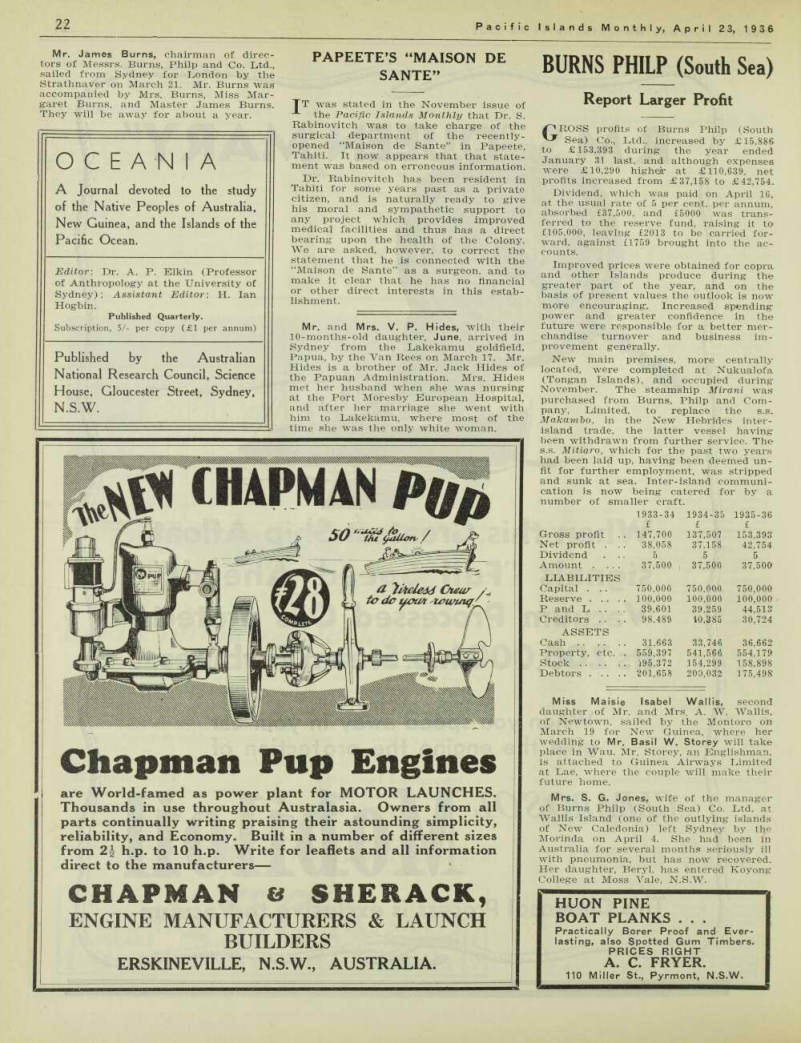
For New Trans-Pacific
Harold Gatty Gathers Data in New Zealand
From Our New Zealand Correspondent AUCKLAND, April 2.
A STATEMENT that no definite indica tion could be given as to when Pan- American Airways’ trans-Pacific service between U.S.A. and New Zealand would be commenced, was made by Mr. Harold Gatty. famous aviator, when he reached Wellington by the Maunganui, on March 30, accompanied by other representatives of the company.
Mr. Gatty is still engaged in preliminary investigations, his main concern on the present visit being the provision of wire less and direction finding facilities and questions of weather forecasting. He said that since his last visit to New Zealand in 1935, he had made a tour of the Pacific Islands between Hawaii and Pago Pago which might be used as emergency bases.
The only one of immediate value was Kingman Reef, which should make an ideal stopping place.
The giant Clipper flying boats of Pan- American Airways will make survey flights over the whole route as soon as the preliminary investigations have been com pleted, Mr. Gatty said, but he could not give an indication of when the first flight would commence.
The agreement between the N.Z. Govern ment and P.A. Airways, which gives v the company certain rights to send flying boats to New Zealand for a stated period with out any adverse charges as against other concerns, provides that the service is to start on a commercial basis before the end of this year. If unforeseen difficulties arise, a year’s grace in the inauguration of commercial traffic will be allowed.
Mr. Gatty plans to spend a considerable time in New Zealand gathering data simi lar to that he has prepared among the Pacific Islands. He will also confer with the N.Z. Government about the new ser vice.
Rev. Brother Vincent, a pioneer Marist missionary in Fiji, died at Nailili on March 6, after 47 years’ service in the Colony.
Mr. W. Marston, of Melbourne, sailed for Ocean Island in March to take up a position with the British Phosphate Com mission. He will spend five years there.
Mr. Marston was prominent in Aus tralian athletic circles, being the Vic torian and Australian walking champion.
Mr. James Burns, chairman of direc tors of Messrs. Burns, Philp and Co. Ltd., sailed from Sydney for London by the Strathnaver on March 21. Mr. Burns was accompanied by Mrs. Burns, Miss Mar garet Burns, and Master James Burns.
They will be away for about a year.
Advertisements & other items, pp. 22-24 (2 items)
L*?/ Introduce Ourselves , .
£5 w* sun, If S f% r a r
tp! m wm
m r 3
L*?/ Introduce Ourselves , .
Recognising that there is the necessity for industrial concerns of every kind in New Guinea, Papua and adjacent Islands of the Pacific to obtain their requirements in an expeditious way, coupled with prices that are accorded by Southern Merchants . . . we have set ourselves out to cater for your particular requirements.
Our Business has been established for 34 years and compares more than favourably with other Australian businesses of a similar nature. • We Specially Deal In: Machine Tools Electrical Equipment Engineering & Sawmilling Motor Accessories Supplies Small Tools Pumping Plants Iron, Steel, etc. and will be pleased to receive your orders and enquiries at all times . . . meanwhile if you are interested we will be pleased to send you on request copy of our GUIDE BOOK, which gives a good idea of the large number of lines stocked by us.
Headquarters
- House -
EDWARD SI
BRISBANE
N-Q*Branch
STURT SI
TOWN SVI 111
INCINHRINC Supply C9pf AUSTRALIA IV
Kill Kidney
Trouble Quick
Thousands of sufferers from Kidney trouble and Bladder weakness have stopped Getting Up Nights, Leg Pains, Circles Under Eyes, Swollen Ankles, Nervousness, Stiffness, Rheumatism, Dizziness, Lumbago,, Burning, Itching, Smarting, Acidity and Loss of Vigour by a Doctor’s new discovery called Gystex (Siss-tex). Gently soothes, tones, cleans and heals, raw sore kidneys. In 15 minutes Cystex starts refreshing your blood.
Brings new health, youth and vitality in 48 hours.
Guaranteed to end your troubles in 8 days or money back. Price 4/-, from all Stores and Chemists. SCHAFFER & CO., 189 Clarence Street, Sydney.
I-
QUEEN MARY
II m Il / kl When this Greatest Ship Afloat signals "Full Speed Ahead!"
Vacuum Processed Oils protect its 200,000 h.p. Steam Turbines.
When you speed away in your give the engine the protection of car
CLEAROSOL
This Clearosol Process is exclusive to Vacuum
OCEANIA
A Journal devoted to the study of the Native Peoples of Australia, New Guinea, and the Islands of the Pacific Ocean.
Editor : Dr. A. P. Elkin (Professor of Anthropology at the University of Sydney); Assistant Editor: H. lan Hogbin.
Published Quarterly.
Subscription, 5/- per copy (£1 per annum) Published by the Australian National Research Council, Science House, Gloucester Street, Sydney,
N.S.W.
p (HARMAN Pag
SO ro Uu a d iMedd Oims / to do you* trwuiq '
Chapman Pup Engines
are World-famed as power plant for MOTOR LAUNCHES.
Thousands in use throughout Australasia. Owners from all parts continually writing praising their astounding simplicity, reliability, and Economy. Built in a number of different sizes from 2 2 h.p. to 10 h.p. Write for leaflets and all information direct to the manufacturers—
CHAPMAN & SHERACK,
ENGINE MANUFACTURERS & LAUNCH
BUILDERS
ERSKINEVILLE, N.S.W., AUSTRALIA.
Papeete’S “Maison De
Sante”
TT was stated in the November issue of A the Pacific Islands Monthly that Dr. S.
Rabinovitch was to take charge of the surgical department of the recently opened “Maison de Sante” in Papeete, Tahiti. It now appears that that state ment was based on erroneous information.
Dr. Rabinovitch has been resident in Tahiti for some years past as a private citizen, and is naturally ready to give his moral and sympathetic support to any project which provides improved medical facilities and thus has a direct bearing upon the health of the Colony.
We are asked, however, to correct the statement that he is connected with the “Maison de Sante” as a surgeon, and to make it clear that he has no financial or other direct interests in this estab lishment.
Mr. and Mrs. V. P. Hides, with their 10-months-old daughter, June, arrived in Sydney from the Lakekamu goldfield, Papua, by the Van Rees on March 17. Mr.
Hides is a brother of Mr. Jack Hides of the Papuan Administration. Mrs. Hides met her husband when she was nursing at the Port Moresby European Hospital, and after her marriage she went with him to Lakekamu, where most of the time she was the only white woman.
BURNS (South Sea)
Report Larger Profit
GROSS profits of Burns Philp (South Sea) Co., Ltd., increased by £15,886 to £153,393 during the year ended January 31 last, and although expenses were £10,290 highelr at £110,639, net profits increased from £37,158 to £42,754.
Dividend, which was paid on April IC, at the usual rate of 5 per cent, per annum, absorbed £37,500, and £5OOO was trans ferred to the reserve fund, raising it to £105,000, leaving £2013 to be carried for ward, against £1759 brought into the ac counts.
Improved prices were obtained for copra and other Islands produce during the greater part of the year, and on the basis of present values the outlook is now more encouraging. Increased spending power and greater confidence in the future were responsible for a better mer chandise turnover and business im provement generally.
New main premises, more centrally located, were completed at Nukualofa (Tongan Islands), and occupied during November. The steamship Mirani was purchased from Burns, Philp and Com pany, Limited, to replace the s.s.
Makamho, in the New Hebrides inter island trade, the latter vessel having been withdrawn from further service. The s.s. Mitiaro, which for the past two years had been laid up, having been deemed un fit for further employment, was stripped and sunk at sea. Inter-island communi cation is now being catered for by a number of smaller craft.
Miss Maisie Isabel Wallis, second daughter of Mr. and Mrs. A. W. Wallis, of Newtown, sailed by the Montoro on March 19 for New Guinea, where her wedding to Mr. Basil W. Storey will take place in Wau. Mr. Storey, an Englishman, is attached to Guinea Airways Limited at Lae, where the couple will make their future home.
M rs. S. G. Jones, wife of the manager of Burns Philp (South Sea) Co. Ltd. at Wallis Island (one of the outlying islands of New Caledonia) left Sydney by the Morinda on April 4. She had been in Australia for several months seriously ill with pneumonia, but has now recovered.
Her daughter, Beryl, has entered Koyong College at Moss Vale, N.S.W.
1933-34 1934-35 1935-36 £ £ £ Gross profit 147,700 137,507 153,393 Net profit . .. 38,058 37.158 42,754 Dividend . .. 5 5 5 Amount . ... 37,500 37,500 37,500
Liabilities
Capital . .. 750,000 750,000 750,000 Reserve 100,000 100,000 100,000 P and L . . 39,601 39,259 44,513 Creditors .. 98,489 40,385 30,724
Assets
Cash 31,663 33,746 36,662 Property, etc. . 559,397 541,566 554,179 Stock , 195,372 154,299 158,898 Debtors 201,658 200,032 175,498
Advertisements & other items, p. 24 (2 items)
22
Monthly, April 23, 1936
Pacific Island
Huon Pine
BOAT PLANKS . . .
Practically Borer Proof and Everlasting, also Spotted Gum Timbers.
PRICES RIGHT
A. C. FRYER.
110 Miller St., Pyrmont, N.S.W.
Belgian Consul For
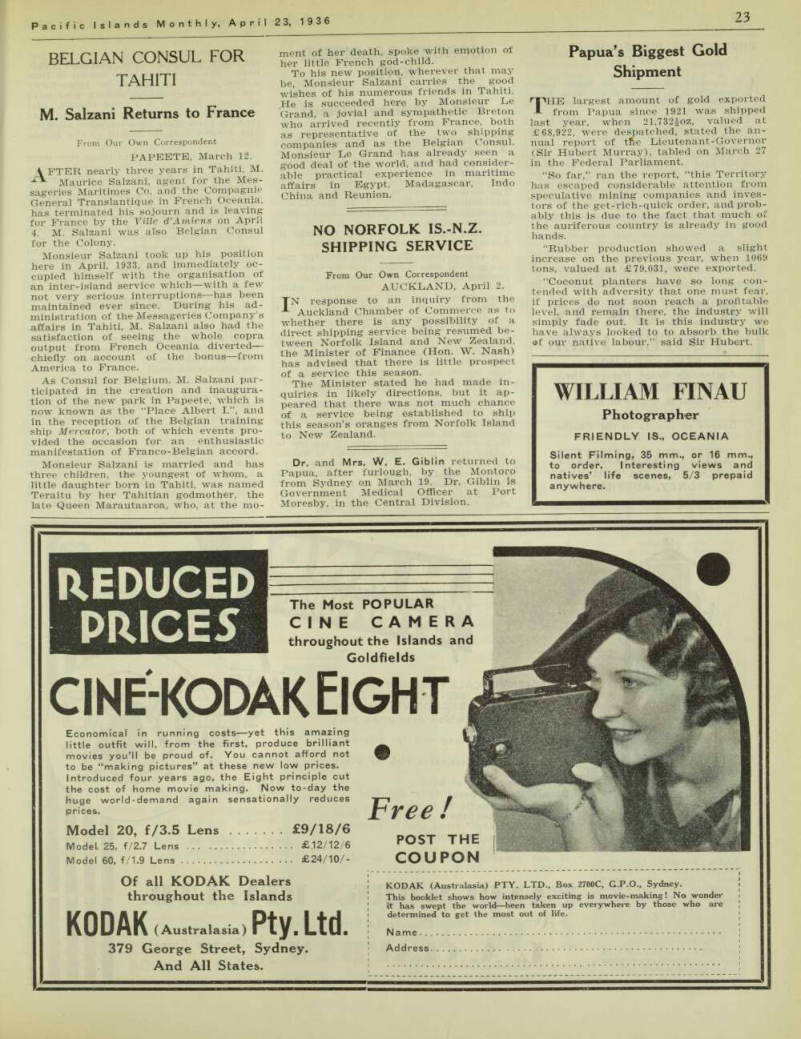
Tahiti
M. Salzani Returns to France
From Our Own Correspondent PAPEETE, March 12. 4 FTER nearly three years in Tahiti. M.
Maurice Salzani, agent for the Mes sageries Maritimes Co. and the Compagnie General Translantique in French Oceania, has terminated his sojourn and is leaving for France by the Ville d’Amiens on April 4. M. Salzani was also Belgian Consul for the Colony.
Monsieur Salzani took up his position here in April, 1933, and immediately oc cupied himself with the organisation of an inter-island service which —with a few not very serious interruptions—has been maintained ever since. During his ad ministration of the Messageries Company’s affairs in Tahiti, M. Salzani also had the satisfaction of seeing the whole copra output from French Oceania diverted — chiefly on account of the bonus —from America to France.
As Consul for Belgium, M. Salzani par ticipated in the creation and inaugura tion of the new park in Papeete, which is now known as the “Place Albert I.”, and in the reception of the Belgian training ship Mercator, both of which events pro vided the occasion for an enthusiastic manifestation of Franco-Belgian accord.
Monsieur Salzani is married and has three children, the youngest of whom, a little daughter born in Tahiti, was named Teraitu by her Tahitian godmother, the late Queen Marautaaroa, who, at the mo
ment of her death, spoke with emotion of her little French god-child.
To his new position, wherever that may be, Monsieur Salzani carries the good wishes of his numerous friends in Tahiti.
He is succeeded here by Monsieur Le Grand, a jovial and sympathetic Breton who arrived recently from France, both as representative of the two shipping companies and as the Belgian Consul.
Monsieur Le Grand has already seen a good deal of the world, and had consider able practical experience in maritime affairs in Egypt, Madagascar, Indo China and Reunion.
Shipping Service
No Norfolk Is.-N.Z.
From Our Own Correspondent AUCKLAND, April 2.
IN response to an inquiry from the Auckland Chamber of Commerce as to whether there is any possibility of a direct shipping service being resumed be tween Norfolk Island and New Zealand, the Minister of Finance (Hon. W. Nash) has advised that there is little prospect of a service this season.
The Minister stated he had made in quiries in likely directions, but it ap peared that there was not much chance of a service being established to ship this season’s oranges from Norfolk Island to New Zealand.
Dr. and Mrs. W. E. Giblin returned to Papua, after furlough, by the Montoro from Sydney on March 19. Dr. Giblin is Government Medical Officer at Port Moresby, in the Central Division.
Shipment
Papua’s Biggest Gold Shipment
THE largest amount of gold exported from Papua since 1921 was shipped last year, when 21,732J0z, valued at £68,922, were despatched, stated the an nual report of tfte Lieutenant-Governor (Sir Hubert Murray), tabled on March 27 in the Federal Parliament.
“So far,” ran the report, “this Territory has escaped considerable attention from speculative mining companies and inves tors of the get-rich-quick order, and prob ably this is due to the fact that much of the auriferous country is already in good hands.
“Rubber production showed a slight increase on the previous year, when 1069 tons, valued at £79,031, were exported.
“Coconut planters have so long con tended with adversity that one must fear, if prices do not soon reach a profitable level, and remain there, the industry will simply fade out. It is this industry we have always looked to to absorb the bulk of our native labour,” said Sir Hubert.
Advertisements & other items, p. 25 (1 item)
Cine-Kodakeight
WILLIAM FINAL
Photographer
FRIENDLY IS., OCEANIA
Silent Filming, 35 mm., or 16 mm., to order. Interesting views and natives’ life scenes, 5/3 prepaid anywhere.
REDUCED
PRICES
The Most POPULAR
CINE CAMERA
throughout the Islands and Goldfields
CINE-KODAKEIGHT
Economical in running costs —yet this amazing I little outfit will, from the first, produce brilliant * movies you’ll be proud of. You cannot afford not to be “making pictures” at these new low prices.
Introduced four years ago, the Eight principle cut the cost of home movie making. Now to-day the huge world-demand again sensationally reduces —»
prices. !
Model 20, f/3.5 Lens £9/18/6 Model. 25, f/2.7 Lens £,12/12/6 POST THE Model 60, f/1.9 Lens £24/10/- COUPON tom Of all KODAK Dealers throughout the Islands
KODAK (Australasia) Pty. Ltd.
379 George Street, Sydney.
And All States.
KODAK (Australasia) PTY. LTD., Box 2700 C, G.P.0., Sydney.
This booklet shows how intensely exciting is movie-making! No wonder it has swept the world—been taken up everywhere by those who are determined to get the most out of life.
Name Address
Protecting Buildings In The
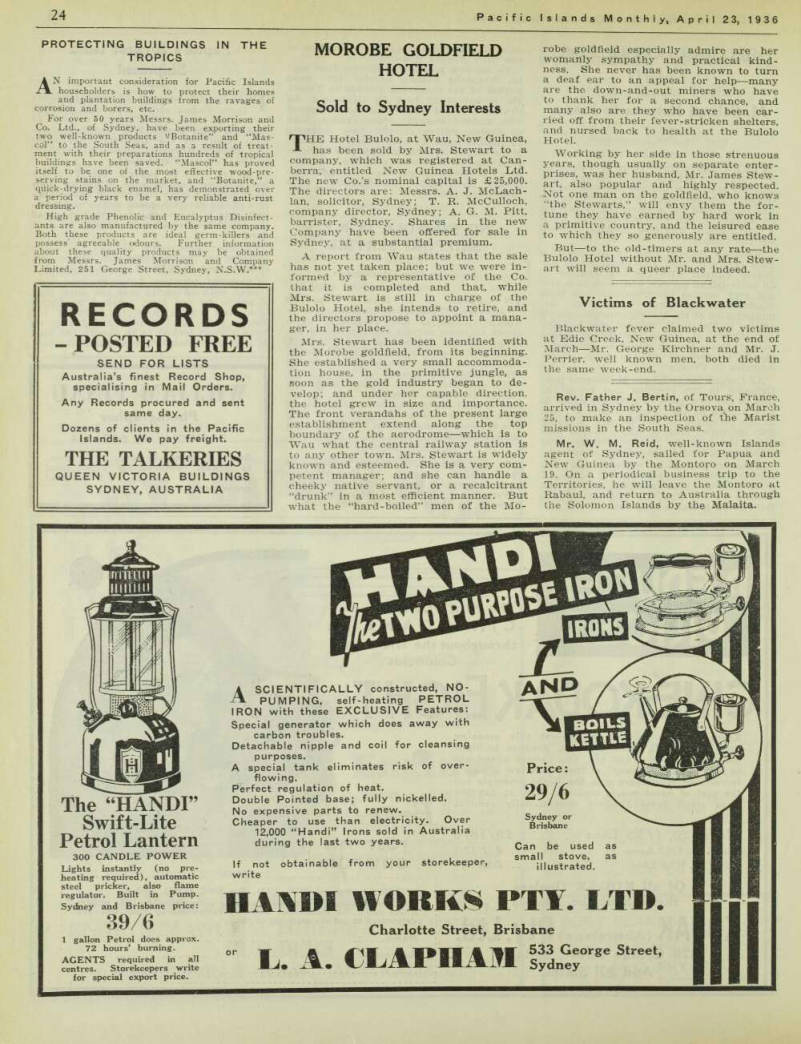
Tropics
AN important consideration for Pacific Islands householders is how to protect their homes and plantation buildings from the ravages of corrosion and borers, etc.
For over 50 years Messrs. James Morrison and Co. Ltd., of Sydney, have been exporting their two well-known products “Botanite” and “Mas col” to the South Seas, and as a result of treat ment with their preparations hundreds of tropical buildings have been saved. “Mascol” has proved itself to be one of the most effective wood-pre serving stains on the market, and “Botanite,” a qxiick-drying black enamel, has demonstrated over a period of years to be a very reliable anti-rust dressing.
High grade Phenolic and Eucalyptus Disinfect ants are also manufactured by the same company.
Both these products are ideal germ-killers and possess' agreeable odours. Further information about these quality products may be obtained from Messrs. James Morrison and Company Limited, 251 George Street, Sydney, N.S.W,***
Morobe Goldfield
Hotel
Sold to Sydney Interests
THE Hotel Bulolo, at Wau, New Guinea, has been sold by Mrs. Stewart to a company, which was registered at Can berra, entitled New Guinea Hotels Ltd, The new Co.’s nominal capital is £25,000.
The directors are: Messrs. A. J. McLach lan, solicitor, Sydney; T. R. McCulloch, company director, Sydney; A. G. M. Pitt, barrister, Sydney. Shares in the new Company have been offered for sale in Sydney, at a substantial premium.
A report from Wau states that the sale has not yet taken place; but we were in formed by a representative of the Co. that it is completed and that, while Mrs. Stewart is still in charge of the Bulolo Hotel, she intends to retire, and the directors propose to appoint a mana ger, in her place.
Mrs. Stewart has been identified with the Morobe goldfield, from its beginning.
She established a very small accommoda tion house, in the primitive jungle, as soon as the gold industry began to de velop; and under her capable direction, the hotel grew in size and importance.
The front verandahs of the present large establishment extend along the top boundary of the aerodrome—which is to Wau what the central railway station is to any other town. Mrs. Stewart is widely known and esteemed. She is a very com petent manager; and she can handle a cheeky native servant, or a recalcitrant “drunk” in a most efficient manner. But what the “hard-boiled” men of the Mo
robe goldfield especially admire are her womanly sympathy and practical kind ness. She never has been known to turn a deaf ear to an appeal for help—many are the down-and-out miners who have to thank her for a second chance, and many also are they who have been car ried off from their fever-stricken shelters, and nursed back to health at the Bulolo Hotel.
Working by her side in those strenuous years, though usually on separate enter prises, was her husband, Mr. James Stew art, also popular and highly respected.
Not one man on the goldfield, who knows “the Stewarts,” will envy them the for tune they have earned by hard work in a primitive country, and the leisured ease to which they so generously are entitled.
But —to the old-timers at any rate—the Bulolo Hotel without Mr. and Mrs. Stew art will seem a queer place indeed.
Victims of Blackwater
Blackwater fever claimed two victims at Edie Creek, New Guinea, at the end of March —Mr. George Kirchner and Mr. J.
Perrier, well known men, both died in the same week-end.
Rev. Father J. Berlin, of Tours, France, arrived in Sydney by the Orsova on March 25, to make an inspection of t'he Marist missions in the South Seas.
Mr. W. M. Reid, well-known Islands agent of Sydney, sailed for Papua and New Guinea by the Montoro on March 19. On a periodical business trip to the Territories, he will leave the Montoro at Rabaul, and return to Australia through the Solomon Islands by the Malaita.
Advertisements & other items, p. 26 (1 item)
Records
-POSTED FREE
SEND FOR LISTS
Australia’s finest Record Shop, specialising in Mail Orders.
Any Records procured and sent same day.
Dozens of clients in the Pacific islands. We pay freight.
THE TALKERIES
QUEEN VICTORIA BUILDINGS
SYDNEY, AUSTRALIA
M
The “HANDI”
Swift-Lite
Petrol Lantern
300 CANDLE POWER
Lights instantly (no preheating required), automatic steel pricker, also flame regulator. Built in Pump.
Sydney and Brisbane price: 39/6 1 gallon Petrol does approx. 72 hours’ burning.
AGENTS required in all centres. Storekeepers write for special export price.
If not write
AND
Price 29/6 Sydney or Brisbane A SCIENTIFICALLY constructed, NO- PUMPING, self-heating PETROL IRON with these EXCLUSIVE Features: Special generator which does away with carbon troubles.
Detachable nipple and coil for cleans!ng purposes.
A special tank eliminates risk of overflowing.
Perfect regulation of heat.
Double Pointed base; fully nickelled.
No expensive parts to renew.
Cheaper to use than electricity. Over 12,000 “Hand!” Irons sold in Australia during the last two years. obtainable from your storekeeper, Can be used as small stove, as illustrated.
HAND! WORKS r rv. LTD.
Charlotte Street, Brisbane
L A. CLAPIIAjJI Sydney
Adventurous Scotsman’s
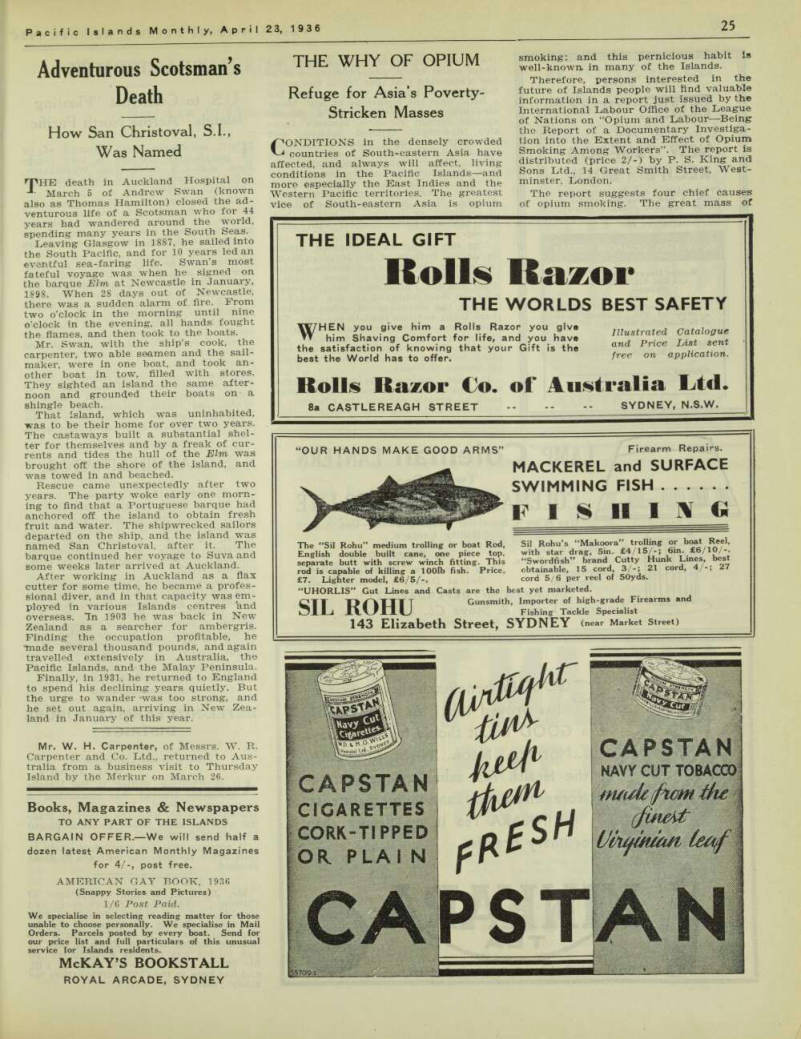
Death How San Christoval, S.I., Was Named
THE death in Auckland Hospital on March 5 of Andrew Swan (known also as Thomas Hamilton) closed the ad venturous life of a Scotsman who for 44 years had wandered around the world, spending many years in the South Seas.
Leaving Glasgow in 1887, he sailed into the South Pacific, and for 10 years led an eventful sea-faring life. Swan’s most fateful voyage was when he signed on the barque Elm at Newcastle in January, 1898. When 28 days out of Newcastle, there was a sudden alarm of fire. From two o’clock in the morning until nine o’clock in the evening, all hands fought the flames, and then took to the boats.
Mr. Swan, with the ship’s cook, the carpenter, two able seamen and the sail maker, were in one boat, and took an other boat in tow, filled with stores.
They sighted an island the same after noon and grounded their boats on a shingle beach.
That Island, which was uninhabited, was to be their home for over two years.
The castaways built a substantial shel ter for themselves and by a freak of cur rents and tides the hull of the Elm was brought off the shore of the island, and was towed in and beached.
Rescue came unexpectedly after two years. The party woke early one morn ing to find that a Portuguese barque had anchored off the island to obtain fresh fruit and water. The shipwrecked sailors departed on the ship, and the island was named San Christoval, after it. The barque continued her voyage to Suva and some weeks later arrived at Auckland.
After working in Auckland as a flax cutter for some time, he became a profes sional diver, and in that capacity was em ployed in various Islands centres and overseas. *ln 1903 he was back in New Zealand as a searcher for ambergris.
Finding the occupation profitable, he •made several thousand pounds, and again travelled extensively in Australia, the Pacific Islands, and the Malay Peninsula.
Finally, in 1931, he returned to England to spend his declining years quietly. But the urge to wander -was too strong, and he set out again, arriving in New Zea land in January of this year.
Mr. W. H. Carpenter, of Messrs. W. R.
Carpenter and Co. Ltd., returned to Aus tralia from a business visit to Thursday Island by the Merkur on March 26.
Refuge for Asia’s Poverty-
The Why Of Opium
Refuge for Asia’s Poverty- Stricken Masses
CONDITIONS in the densely crowded countries of South-eastern Asia have affected, and always will affect, living conditions in the Pacific Islands —and more especially the East Indies and the Western Pacific territories. The greatest vice of South-eastern Asia is opium
smoking; and this pernicious habit Is well-known, in many of the Islands.
Therefore, persons interested in the future of Islands people will And valuable information in a report just issued by the International Labour Office of the League of Nations on “Opium and Labour —Being the Report of a Documentary Investiga tion into the Extent and Effect of Opium Smoking Among Workers”. The report is distributed (price 2/-) by P. S. King and!
Sons Ltd., 14 Great Smith Street, West minster, London.
The report suggests four chief causes of opium smoking. The great mass of
the working class in the Far East live under social and hygienic conditions of so low a standard that they try to find some thing that will permit them to forget for a little time the hardships of life. Many also believe that opium is a remedy against certain common diseases (not ably, dysentery, typhoid, malaria, and pulmonary diseases), but actually while opium does dull pain it has no curative value. Many workmen, especially lab ourers in jungles and mines, smoke opium because they believe it stimulates their working capacity in an unhealthy and hot climate. Many people smoke opium out of curiosity or because it brings them into pleasant social contact with other people.
The use of opium is common among immigrant Indians in the Malayan States and among the natives of Burma, Malay, Indo-China, Java, and to some extent in Siam and the Philippines, but the people who are most addicted are the Southern Chinese, the percentage of opium smokers there being not less than 10 per cent. The percentage of opium smokers among the prosperous Chinese in Sarawak and Malaya is comparatively small—very much less than among the poverty strick en masses of China.
It goes without saying that over whelming evidence showed that opium smoking greatly reduces the efficiency of workers, and definitely shortens their lives.
Advertisements & other items, pp. 27-28 (2 items)
iteil 1
THE IDEAL GIFT
Rolls Razor
THE WORLDS BEST SAFETY
WHEN you give him a Rolls Razor you give him Shaving Comfort for life, and you have the satisfaction of knowing that your Gift is the best the World has to offer.
Illustrated Catalogue and Price List sent /ree on application.
Rolls Razor Co. of Australia Lid.
8a CASTLEREAGH STREET SYDNEY, N.S.W.
“OUR HANDS MAKE GOOD ARMS’
The “Sil Rohu” medium trolling or boat Rod, English double built cane, one piece top. separate butt with screw winch fitting. This rod is capable of killing a 1001 b fish. Price, £7. Lighter model, £6/5/-.
Firearm Repairs.
MACKEREL and SURFACE
SWIMMING FISH
F I 8 II I N « Sil Rohu’s “Makoora” trolling or boat Reel, with star drag, Sin. £4/15/-; 6in. £6/10/-.
“Swordfish” brand Cutty Hunk Lines, best obtainable, 15 cord, 3/-; 21 cord, 4/-; 27 cord 5/6 per reel of 50yds.
“UHORLIS” Gut Lines and Casts are the best yet marketed.
OIJL XVvJXXt_J Fishing Tackle Specialist 143 Elizabeth Street, SYDNEY (near Market Street)
ijwt
iteil 1
CAPSTAN
CIGARETTES
CORK-TIPPED
OK PLA I N
tMf.
c$H
CAPSTAN
NAVY CUT TOBACCO
madefum the (finest Ulvfmaei leaf
PST
Get your
FREE
COPY
of the
NEW TRUFOOD
RECIPE BOOK
69 specially tested recipes—all kinds of new ideas for attractive things to cook cakes, pastry, puddings, custards, desserts, savouries, sauces, etc. post this Coupon today ' Recipe Department” c/- Box 4267 Y. G.P.O.
Sydney.
Please send me POST FREE, a copy of The Trufood Book of 69 Tempting Recipes Name
(BLOCK LETTERS;
Address
C
LAMP Coleman LANTERN
Two in One
COLEMAN “ Cent DUO-LITE
Use it as a Beautiful Reading Lamp—Use it as a Utility Lantern TWO IN ONE e TWO IN ONE Uses Two Fuels.
Kerosene or Use ir| aoors. It is Insect Proof.
Benzine. Out of Doors, it is Gale-proof.
COLEMAN for “DEPENDABILITY”
Coleman Lamp & Stove Co. Ltd. Toronto, Canada. 500 Kent Street, Sydney
OOD TEA benefits the health. Science has proved this. As KINKARA Is a GOOD Tea, It should be used always
...Morning... Noon... Night. KINKARA,
the Health Tea, calms the nerves; restores energy and banishes mental stress.
KINKARA Tea is no dearer than
ordinary brands.
J. R. Love & Co., Ltd., Sydney.
Books, Magazines & Newspapers
TO ANY PART OF THE ISLANDS
BARGAIN OFFER.—We will send half a dozen latest American Monthly Magazines for 4/-, post free.
AMERICAN GAY BOOK, 1936
(Snappy Stories and Pictures) 1/6 Post Paid.
We specialise in selecting reading matter for those unable to choose personally. We specialise in Mail Orders. Parcels posted by every boat. Send for our price list and full particulars of this unusual service for Islands residents.
McKAY’S BOOKSTALL
ROYAL ARCADE, SYDNEY
Sea-Dromes
U.S. to Construct “Floating Islands” Across North Pacific
THE sea-drome, long dreamed of by imaginative aviators, is very nearly here, states a cable from Washington, U.S.A., published in the Daily Telegraph (Sydney) on March 26.
The U.S. Department of Commerce will construct a series of “floating islands” across the Pacific Ocean, to guide the giant air-liners from the United States to Manila and China, as soon as funds are available.
There will be gigantic rafts to house four men, a radio station, a rescue-boat, and weather-recording instruments. The Bureau of Air Commerce has already ap proved of the plan, and will appropriate £250,000 to carry out the scheme.
The Pan-American mail and passenger service from San Francisco to China is operated weekly by three flying boats and five crews, adds the Telegraph’s Aviation Correspondent.
It is a five-day voyage from San Fran cisco with an actual flying time of 60 hours, calling at Honolulu, Midway, Wake, and Guam Islands, and Manila.
Long sea hops are involved, such as the first (overnight to Honolulu), 2,084 miles.
N.G. Administrator
From Our Own Correspondent RABAUL, March 16.
XJIS Honour the Administrator (Brig adier-General W. R. McNicoll) de parted recently for Kieta and other outlying islands in the Government schooner Nereus, accompanied by Com mander Webb.
After arriving at Kieta, where he vis ited the Kupei goldfield and made other inspections, His Honour found it neces sary to return to Rabaul by the M.V.
Malaita in order to be near medical atten tion —especially for his eye which, pre vious, to his departure had suffered a slight injury.
Latest reports state that General Mc- Nicoll is making satisfactory progress.
Betel-Nut Farm In Morobe
District
From a Special Correspondent.
WAU, March 4.
AN enterprising: settler in the Morobe goldfields District has established a plantation of Betel Nut palms on the Markham River, with the object of trad ing with the large labour forces employed by various concerns in the district.
It appears that his venture is likely to turn out a success—the nuts are in great demand.
Mr. John M. Wilson, Comptroller of Customs, Government Storekeeper, and President of the Marine Board in Fiji, arrived in Sydney on March 23 by the Esperance Bay. He has been on a six months’ health trip to England, and is now on his way back to Suva to resume his official duties. He was born in Fiji, and has been in the Civil Service there for many years.
No Official Marriages For Natives
New Law to Operate in New Guinea
THE marriage laws of New Guinea were amended in a curious and unexpected manner on February 25, when the Legis lative Council adopted an ordinance mak ing it impossible for natives to contract a marriage other than in native fashion.
Natives, now, may not enter into the European or Christian marriage. Under the native marriage, polygamy and divorce by a gesture are possible.
When the Australian Civil Administra tion took charge of New Guinea in 1921, the Papuan Marriage Ordinance of 1912-14 was adopted; and it has remained in force until now. Under this law, which still operates in Papua, natives may contract either a native of an official (Christian) marriage. If it is an official marriage, the natives concerned must observe the usual marriage laws.
There has been much confusion and difficulty in New Guinea because natives —especially those in contact with mis sionaries—have been contracting official marriages, and subsequently living in native fashion, under which a plurality of wives is recognised. It has been felt, especially by officials, that such conditions tended to bring a most important Euro pean institution —namely, the monoga mous marriage and the good status of women —into disrepute among partly civilised natives.
As a result, a Bill was brought in, and carried, My which the following section was inserted in the Marriage Ordinance; “SA: Nothing in this ordinance shall apply to any marriage both of the parties to which are natives.”
The Government Secretary, Mr. H. H.
Page, in introducing the proposed new law, said that a large majority of the natives had not reached the stage when marriage under the Marriage Ordinance with its obligations should be made avail able for them. They were not able yet to understand those obligations.
The proposal was opposed by the Crown Law Officer, Mr. G. G. Hogan. He argued in favour, of a continuance of the sys tem under which natives might choose a native or an official marriage; but con ceded that amendments were necessary to compel natives to recognise, beforehand, the nature of the obligations imposed by an official marriage.
As this matter is likely to receive a good deal of attention from the missionary bodies, we quote hereunder some of Mr.
Hogan’s arguments; “In the tribe or unit, marriage was con sidered as something of importance to the tribe or unit, and, in some cases, as sacred.
The obligations and rights arising from marriage were clearly laid down, and strictly enforced, if not by law, then by the force of public opinion. We all realise how contact with Europeans and the changes made by European administration have affected native communities which are in close touch with European influ ence. Many of the males, and a number of the females, leave their homes for long periods and the forces which govern na tive life have lost much of their authority.
Changed conditions make it essential that the contract of marriage gradually be made more binding and certain than now results from marriage according to native custom.
“The Territory for some time has been
controlled by Europeans, and missionar ies have laboured here since 1875. There are many natives who have not been brought into touch with Europeans and there are many others whom European influence has not affected; but, surely, the work over many years, of Govern ments and missionaries, has had some results in the areas in which that work has been carried on!
“Are we prepared to say that none of the Christian natives of this Territory are capable of understanding that a marriage under the Ordinance means the volun tary union of one man and one woman, to the exclusion of all others? Because of the fear that marriage under the Or dinance may restrict the freedom of a native to take another wife, or prevent him from casting aside his wife without showing cause, are we prepared to make it a law of the Territory that a Christian native woman cannot obtain the protection of a marriage under the Ordinance, but must be a party to a native marriage which is no obstacle to the husband having several wives? Are the advantages to natives of polygamy and easy divorce so great that we must forbid the voluntary adoption by natives
of monogamy and divorce controlled by law?
"The application of the Ordinance to marriages of natives cannot be harmful to native social life. Such marriages will raise the status of marriage amongst the natives and so will help to promote the moral well-being and the social progress of the natives of the Territory. They will result in the gradual appreciation by natives of a status that ensures the union of one man and one woman to the exclusion of all others.
“We know the position of native women in the Territory, and I think we all realise that without a change in that position there can be little true progress. Raise the status of native women and you have taken an important step to ensure the progress of the natives. The celebration of marriages between natives under the Marriage Ordinance, since, amongst other advantages, it increases the security of
the wife, will gradually raise the status of native women, and must tend to create a healthy home and social life.”
Advertisements & other items, pp. 29-30 (1 item)
Products
H.JONES &C 0
AUSTRALIA’S BEST
H. JONES & CO., LTD.
Darlington, Sydney—Hobart, Ta».
For—
Fresh Fruit, Vegetables, and Produce
Island Residents can rely on the old-established Shipping Providers.
Only Address:
421 Sussex St., SYDNEY
All Orders Promptly Attended Island Representatives: Nelson & Robertson W. M. Reid
“Defiance”
Brand
Canned
Goods
—are prepared and packed by the proprietors of Aunt Mary’s Pur© Food Products.
The finest quality goods are hermetically sealed to withstand tropical heat and give to consumers maximum satisfaction.
PURE FOOD
PRODUCTS
Supreme in quality and flavor, these pure food products have been supplied to the people of the Islands for more than thirty years. Specially manufactured and packed to meet Island conditions, they give complete satisfaction to both retailer and consumer.
Prepared and Packed only by—
TILLOCK & CO. LTD.
PURE FOOD MANUFACTURERS
KENT AND LIVERPOOL STREETS,
SYDNEY, N.S.W.
LEATHER BELTS
fr NATIVES
TDon ufacturers & Specialists
PATTERSON & STONE, CRICHTON WORKS.
WALSALL. ENGLAND.
W. KOPSEN & CO., LTD.
SHIPCHANDLERS AND GENERAL MERCHANTS
Tilley Lamps ”
Special Quotations for Island Trade - GENUINE Tilley Parts 68-70 Clarence St., Sydney CABLES: K T ° E p L s ; E Sw SY im E S Y 6
HE LARGEST STOyE . . .
IN THE PACIFIC ISLANDS IS INSTALLED AT THE BULOLO HOTEL, WAU --- AND IT IS A
YOUNGER
YOUNGER Stoves and Ranges are widely used throughout the Pacific Islands, for they embody in their construction everything calling for Efficiency in Working, Economy in fuel consumption and Durability.
Special Stoves with Cast-Iron Ovens for Islands Requirements Write for quotations and catalogue of single and double oven stoves.
G. Fletcher & Son
50 OXFORD STREET,
SYDNEY
Catholic Missionary’s Opinion
¥>ROTESTING against the new Marriage Ordinance, Rev. Father J. G. Madigan, an experienced Roman Catholic mission ary of Matupit Island, Rabaul, wrote to the Rabaul Times on March 3. The fol lowing are extracts from his letter.
No one can deny that since the advent of the European, native culture in refer ence to marriage has weakened. An Ordinance designed to regulate the cele bration of marriages in this cosmopolitan land has already become law and the only people excluded from its benefits are those most in need of its protection.
According to the native custom obtain ing here when the European appeared, a native had only one wife and marriage was strictly regarded as something sacred, solemn and life-long. The sole exception was the village chief, who usually had a plurality of wives. Sexual irregularities among village natives were punished with death by spearing both the guilty par ties. As tribal wars had isolated the vil lages, would-be law-breakers had little hope of escape from the punishment which was promptly executed; consequently
sexual crimes were rare and married life on a high plane.
With the advent of the white man and the breaking down of the barriers, which isolated villages, one unfortunate result has been the weakening of real native marriage laws and the growth and exten sion of baneful practices which had and continue to have disastrous effects on native life.
Benevolent officials, uninformed and misinformed, have in the name of free dom done much harm by informing vil lage natives that a benign Government will only smile on them if they take two or even more wives. Those who have lived among natives in the last century as well as this have looked on and deplored the weakening of the native’s former high ideal of marriage—innocent native women and children neglected by unscrupulous men who could claim the white man’s protection; moreover, depraved employers in order to retain the services of useful natives have promised them a “Mary” and to honour the promise have gone into neighbouring villages and by half-threats and half-persuasion have succeeded in bringing home unwilling native girls to be used as the unfortunate victims of indentured natives during periods of ser vice. No account was ever taken of the unfortunate victims’ future.
The lamentable result has been that during the past 30 years changed condi tions have fostered the growth of certain depraved habits entirely unknown before and these habits pass, among a certain class of European, who has never been trained to distinguish the cockle from the wheat, as native customs and often enjoy the protection of law . . .
On Matupit Island I have a congrega tion of nearly 500 Catholic natives, and among them four generations bf Catholic people. We are living under a Mandate that urges us to do the utmost for the moral and material welfare of the people and their social progress. I have instruct ed them in Christian principles, and nat urally being Christians they desire to be married as Christians, as is done all over the world. Yet the effect of the new legis lation, according to the Crown Law Officer of the Territory, whose opinion must carry weight, is: “In my opinion, now that natives are excluded from the Marriage Ordinance 1935-1936, a marriage may be celebrated between natives according to the rites of any religious de nomination, but the law of the Territory would not recognise the marriage as valid, and such marriage would have no legal effect.”
In every part of the British Empire to-day Christians who enter matrimony according to the rites of their respective denominations are assured that their mar riages will be duly recognised and re spected by the civil government. The sole exception must be the Territory of New Guinea since March 2, 1936. To secure recognition here, natives must trample on Christian principles and marry according to native customs. On Matupit Island, as in other places, the real native marriage customs have long since dis appeared. No student of native culture would call the fashion which has sprung up like a toad during the past 30 years a native custom.
In my opinion the matter cannot be allowed to rest where it is to-day. Thous ands of Christian natives in this Terri tory know and understand the nature and obligations of marriage. Naturally they feel they have been sold and are filled with contempt for a system of government which admits such injustices. Apart from the speech of the Crown Law Officer whose duty it was to present the Ordin ance, not a word of explanation or pro test came from quarters where it might be expected.
Advertisements & other items, pp. 31-32 (1 item)
Soft, Bright, Unflickering
msm A
For a soft, easy, restful light, clear and steady, use “PENNANT” Kerosene.
Super-refined and free from sulphur and impurities, “PENNANT” burns without odour, without flicker, or splutter.
It’s better for wicks, too does not crust or char them.
Order “PENNANT”-it is the best Kerosene you can buy.
A “SHELL”
PRODUCT
PENNANT
KEROSENE
This Perfect Window System for
Tropic Homes is made possible by
COUSINS’ Improved
66 WESTBEUB ”
CASEMENT STAYS
(Patented) 11 m • These Windows can be OPENED
TO ANY ANGLE—to CATCH or
TURN the BREEZE—thus giving complete ventilation control. • They are SECURE IN ANY POSITION —no banging. • They are DEFINITELY
WEATHERPROOF.
• They can be SIMPLY and
QUICKLY CLOSED.
“WESTEELE” STAYS are EASILY
FITTED at LOW COST
Messrs. Dickson & Yorston Pty. Ltd., Melbourne, write: “ . . . have adopted the ‘Westeele’
Casement Stays system and delighted with result.”
I Write for particulars
Manufactured R y COUSINS
BUILDERS' SUPPLIES
CHIPPENDALE, SYDNEY
The ‘Austral* Auto-Flush Cabinet
The latest in Sanitary Installations for non-sewered areas Approved by the N.S.W. Board of Health.
A Patent Closet that gives you convenience, health, and refinement similar to a w.c. A great advance on anything yet offered.
No water supply required.
Price, £l5 (Aust.), F. 0.8., Sydney Can be installed by any handy man.
Leaflet on application.
INSULAR LAMPS (Syd.), ltd.
42 Market St., SYDNEY
Death Of High Chief Mataafa, O.B.E.
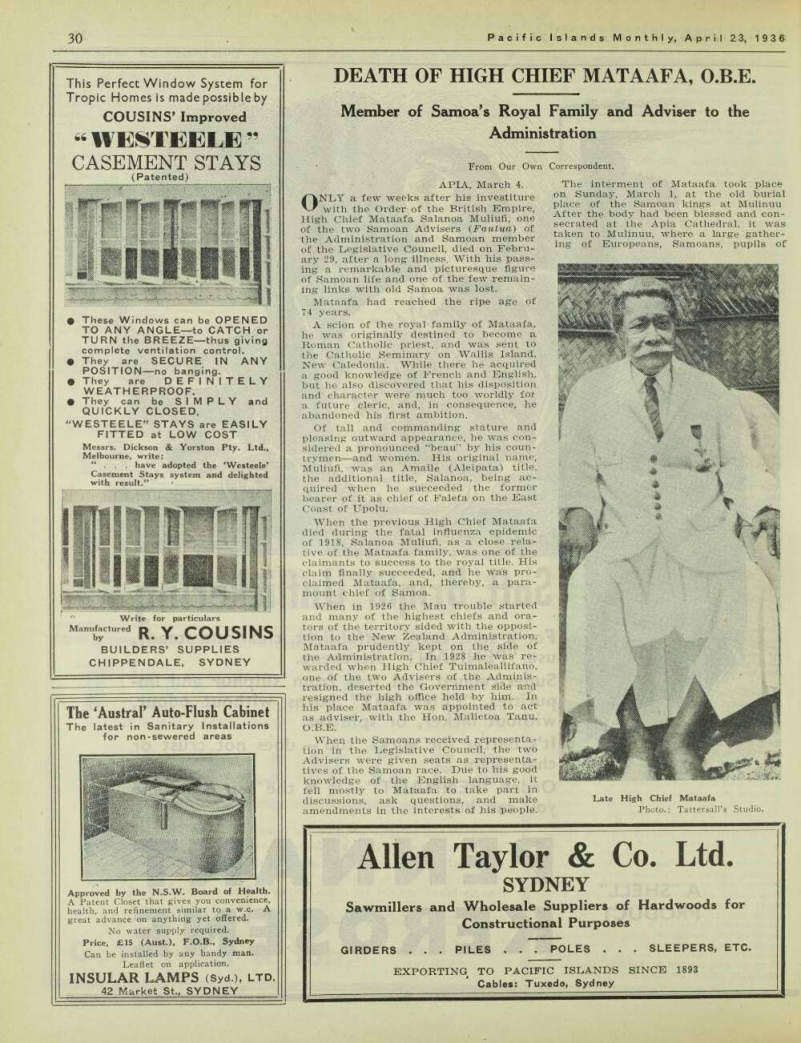
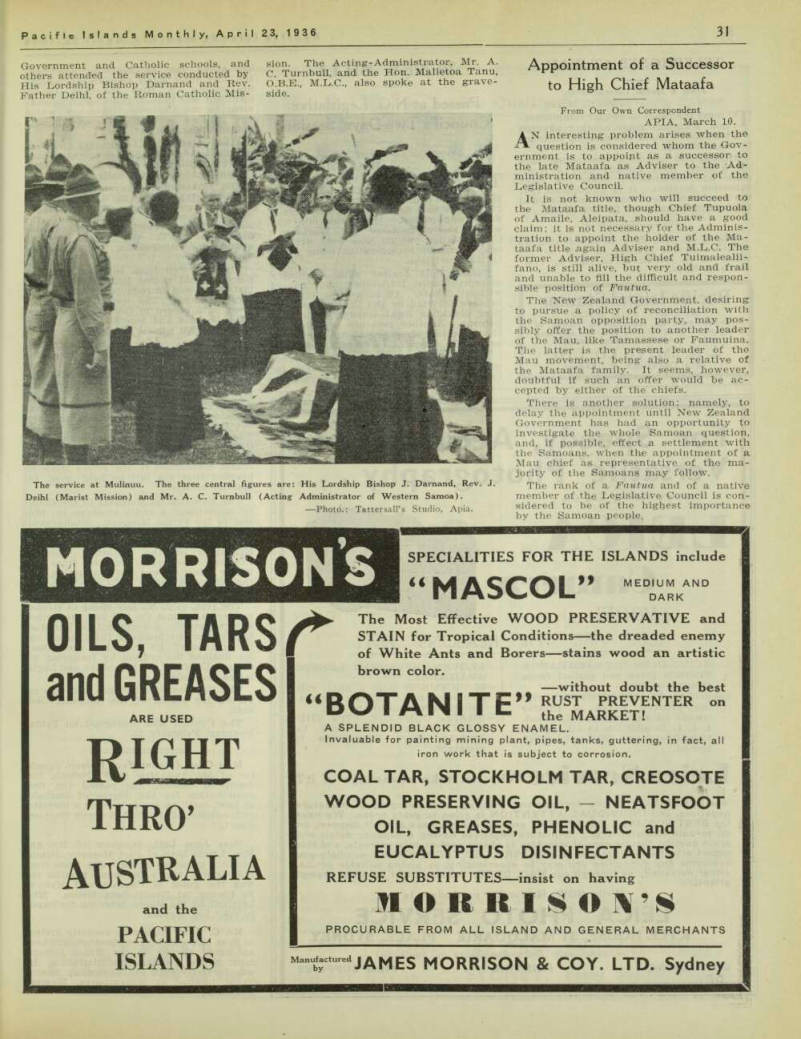
Member of Samoa’s Royal Family and Adviser to the Administration
From Our Own Correspondent.
APIA, March 4.
ONLY a few weeks after his investiture with the Order of the British Empire, High Chief Mataafa Salanoa Muliufi, one of the two Samoan Advisers ( Fautua ) of the Administration and Samoan member of the Legislative Council, died on Febru ary 29, after a long illness. With his pass ing a remarkable and picturesque figure of Samoan life and one of the few remain ing links with old Samoa was lost.
Mataafa had reached the ripe age of 74 years.
A scion of the royal family of Mataafa, he was originally destined to become a Roman Catholic priest, and was sent to the Catholic Seminary on Wallis Island, New Caledonia. While there he acquired a good knowledge of French and English, but he also discovered that his disposition and character were much too worldly foi a future cleric, and, in consequence, he abandoned his first ambition.
Of tall and commanding stature and pleasing outward appearance, he was con sidered a pronounced “beau” by his coun trymen—and women. His original name, Muliufi, was an Amaile (Aleipata) title, the additional title, Salanoa, being ac quired when he succeeded the former bearer of it as chief of Falefa on the East Coast of Upolu.
When the previous High Chief Mataafa died during the fatal influenza epidemic of 1918, Salanoa Muliufi, as a close rela tive of the Mataafa family, was one of the claimants to success to the royal title. His claim finally succeeded, and he was pro claimed Mataafa, and, thereby, a para mount chief of Samoa.
When in 1926 the Mau trouble started and many of the highest chiefs and ora tors of the territory sided with the opposi tion to the New Zealand Administration, Mataafa prudently kept on the side of the Administration. In 1928 he was re warded when High Chief Tuimalealiifano, one of the two Advisers of the Adminis tration, deserted the Government side and resigned the high office held by him. In his place Mataafa was appointed to act as adviser, with the Hon. Malietoa Tanu, 0.8. E.
When the Samoans received representa tion in the Legislative Council, the two Advisers were given seats as representa tives of the Samoan race. Due to his good knowledge of the English language, it fell mostly to Mataafa to take part in discussions, ask questions, and make amendments in the interests of his people.
The interment of Mataafa took place on Sunday, March 1, at the old burial place of the Samoan kings at Mulinuu After the body had been blessed and con secrated at the Apia Cathedral, it was taken to Mulinuu, where a large gather ing of Europeans, Samoans, pupils of
Late High Chief Mataafa Photo.: Tatter sail’s Studio.
Government and Catholic schools, and others attended the service conducted by His Lordship Bishop Darnand and Rev.
Father Deihl, of the Roman Catholic Mis-
sion. The Acting-Administrator, Mr. A.
C. Turnbull, and the Hon. Mahetoa Tanu, 0.8. E., M.L.C., also spoke at the grave side.
The service at Mulinuu. The three central figures are: His Lordship Bishop J. Darnand, Rev. J.
Deihl (Marist Mission) and Mr. A. C. Turnbull (Acting Administrator of Western Samoa). —Photo.: Tattersall’s Studio, Apia.
Advertisements & other items, pp. 32-33 (1 item)
Allen Taylor & Co. Ltd.
SYDNEY
Sawmillers and Wholesale Suppliers of Hardwoods for Constructional Purposes GIRDERS • • • PILES • • • POLES ... SLEEPERS* ETC.
EXPORTING TO PACIFIC ISLANDS SINCE 1893
Cables: Tuxedo, Sydney
MORRISONS
OILS, TARS/*
and GREASES
SPECIALITIES FOR THE ISLANDS include
MASCOL
yy
MEDIUM AND
DARK
ARE USED
RIGHT
Thro’
Australia
and the
PACIFIC
ISLANDS
The Most Effective WOOD PRESERVATIVE and STAIN for Tropical Conditions—the dreaded enemy of White Ants and Borers —stains wood an artistic brown color. —without doubt the best U RHTA Kl I TP” RUST PREVENTER on 1 the MARKET!
A SPLENDID BLACK GLOSSY ENAMEL.
Invaluable for painting mining plant, pipes, tanks, guttering, in fact, all iron work that is subject to corrosion.
COALTAR, STOCKHOLM TAR, CREOSOTE
WOOD PRESERVING OIL, - NEATSFOOT
OIL, GREASES, PHENOLIC and
EUCALYPTUS DISINFECTANTS
REFUSE SUBSTITUTES—insist on having
MORRINO \’S
PROCURABLE FROM ALL ISLAND AND GENERAL MERCHANTS Manufactured by
JAMES MORRISON & COY. LTD. Sydney
to High Chief Mataafa
Appointment of a Successor to High Chief Mataafa
From Our Own Correspondent APIA, March 10.
AN interesting problem arises when the question is considered whom the Gov ernment is to appoint as a successor to the late Mataafa as Adviser to the Ad ministration and native member of the Legislative Council.
It is not known who will succeed to the Mataafa title, though Chief Tupuola of Amaile, Aleipata, should have a good claim; it is not necessary for the Adminis tration to appoint the holder of the Ma taafa title again Adviser and M.L.C. The former Adviser, High Chief Tuimalealii fano, is still alive, but very old and frail and unable to fill the difficult and respon sible position of Fautua.
The New Zealand Government, desiring to pursue a policy of reconciliation with the Samoan opposition party, may pos sibly offer the position to another leader of the Mau, like Tamassese or Faumuina.
The latter is the present leader of the Mau movement, being also a relative of the Mataafa family. It seems, however, doubtful if such an offer would be ac cepted by either of the chiefs.
There is another solution; namely, to delay the appointment until New Zealand Government has had an opportunity to investigate the whole Samoan question, and, if possible, effect a settlement with the Samoans, when the appointment of a Mau chief as representative of the ma jority of the Samoans may follow.
The rank of a Fautua and of a native member of the Legislative Council is con sidered to be of the highest importance by the Samoan people.
Telephones At Wau
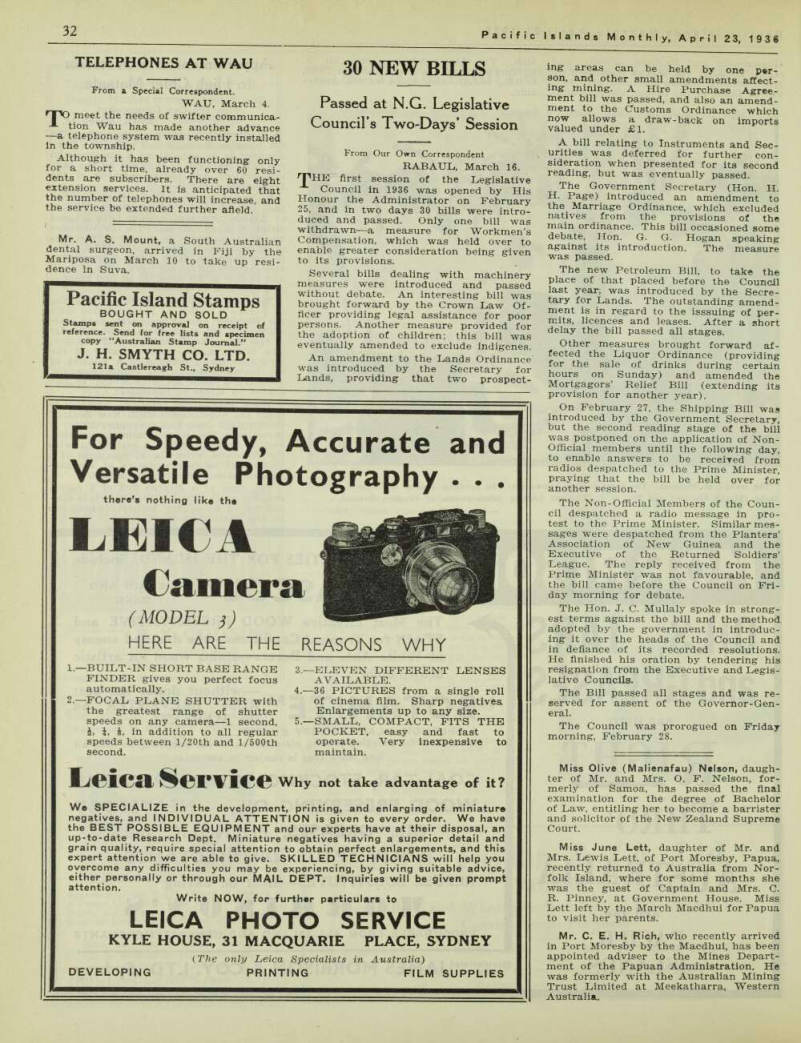
From a Special Correspondent.
WAU, March 4.
TO meet the needs of swifter communica tion Wau has made another advance —a telephone system was recently installed in the township.
Although it has been functioning only for a short time, already over 60 resi dents are subscribers. There are eight extension services. It is anticipated that the number of telephones will increase, and the service be extended further afield.
Mr. A. S. Mount, a South Australian dental surgeon, arrived in Fiji by the Mariposa on March 10 to take up resi dence in Suva.
30 New Bills
Passed at N.G. Legislative Council’s Two-Days’ Session
From Our Own Correspondent RABAUL, March 16.
THE first session of the Legislative Council in 1936 was opened by His Honour the Administrator on February 25, and in two days 30 bills were intro duced and passed. Only one bill was withdrawn—a measure for Workmen’s Compensation, which was held over to enable greater consideration being given to its provisions.
Several bills dealing with machinery measures were introduced and passed without debate. An interesting bill was brought forward by the Crown Law Of ficer providing legal assistance for poor persons. Another measure provided for the adoption of children; this bill was eventually amended to exclude indigenes.
An amendment to the Lands Ordinance was introduced by the Secretary for Lands, providing that two prospect
ing areas can be held by one per son, and other small amendments affect ing mining. A Hire Purchase Agree ment bill was passed, and also an amend ment to the Customs Ordinance which now allows a draw-back on imports valued under £l.
A bill relating to Instruments and Sec urities was deferred for further con sideration when presented for its second reading, but was eventually passed.
The Government Secretary (Hon. H.
H. Page) introduced an amendment to the Marriage Ordinance, which excluded natives from the provisions of the main ordinance. This bill occasioned some debate, Hon. G. G. Hogan speaking against its introduction. The measure was passed.
The new Petroleum Bill, to take the place of that placed before the Council last year, was introduced by the Secre tary for Lands. The outstanding amend ment is in regard to the isssuing of per mits, licences and leases. After a short delay the bill passed all stages.
Other measures brought forward af fected the Liquor Ordinance (providing for the sale of drinks during certain hours on Sunday) and amended the Mortgagors’ Relief Bill (extending its provision for another year).
On February 27, the Shipping Bill was introduced by the Government Secretary, but the second reading stage of the bill was postponed on the application of Non- Official members until the following day, to enable answers to be received from radios despatched to the Prime Minister, praying that the bill be held over for another session.
The Non-Official Members of the Coun cil despatched a radio message in pro test to the Prime Minister. Similar mes sages were despatched from the Planters’
Association of New Guinea and the Executive of the Returned Soldiers’
League. The reply received from the Prime Minister was not favourable, and the bill came before the Council on Fri day morning for debate.
The Hon. J. C. Mullaly spoke in strong est terms against the bill and the method adopted by the government in introduc ing it over the heads of the Council and in defiance of its recorded resolutions.
He finished his oration by tendering his resignation from the Executive and Legis lative Councils.
The Bill passed all stages and was re served for assent of the Governor-Gen eral.
The Council was prorogued on Friday morning, February 28.
Miss Olive (Malienafau) Nelson, daugh ter of Mr. and Mrs. O. F. Nelson, for merly of Samoa, has passed the final examination for the degree of Bachelor of Law, entitling her to become a barrister and solicitor of the New Zealand Supreme Court.
Miss June Lett, daughter of Mr. and Mrs. Lewis Lett, of Port Moresby, Papua, recently returned to Australia from Nor folk Island, where for some months she was the guest of Captain and Mrs. C.
R. Pinney, at Government House. Miss Lett left by the March Macdhui for Papua to visit her parents.
Mr. C. E. H. Rich, who recently arrived in Port Moresby by the Macdhui, has been appointed adviser to the Mines Depart ment of the Papuan Administration. He was formerly with the Australian Mining Trust Limited at Meekatharra, Western Australia.
Advertisements & other items, pp. 34-35 (2 items)
Leica
Pacific Island Stamps
BOUGHT AND SOLD
Stamps sent on approval on receipt of reference. Send for free lists and specimen copy “Australian Stamp Journal.”
J. H. SMYTH CO. LTD.
121 a Castlereagh St., Sydney
For Speedy, Accurate and
Versatile Photography . . . there's nothing like the
LEICA
Camera
(MODEL ))
HERE ARE THE REASONS WHY
I—BUILT-IN SHORT BASE RANGE
FINDER gives you perfect focus automatically.
2.—FOCAL PLANE SHUTTER with
the greatest range of shutter speeds on any camera—l second, h, i, in addition to all regular speeds between l/20th and l/500th second.
3. ELEVEN DIFFERENT LENSES
AVAILABLE.
4. —36 PICTURES from a single roll of cinema film. Sharp negatives.
Enlargements up to any size.
5. —SMALL, COMPACT, FITS THE
POCKET, easy and fast to operate. Very inexpensive to maintain.
Leica Service Why not take advantage of it?
We SPECIALIZE in the development, printing, and enlarging of miniature negatives, and INDIVIDUAL ATTENTION is given to every order. We have the BEST POSSIBLE EQUIPMENT and our experts have at their disposal, an up-to-date Research Dept. Miniature negatives having a superior detail and grain quality, require special attention to obtain perfect enlargements, and this expert attention we are able to give. SKILLED TECHNICIANS will help you overcome any difficulties you may be experiencing, by giving suitable advice, either personally or through our MAIL DEPT. Inquiries will be given prompt attention.
Write NOW, for further particulars to
LEICA PHOTO SERVICE
KYLE HOUSE, 31 MACQUARIE PLACE, SYDNEY
(The only Leica Specialists in Australia )
DEVELOPING PRINTING FILM SUPPLIES
Freemans
For Quality Goods at Low Prices
ESTABLISHED SINCE 1905
14? Castlereagh St., Sydney. W.S. W.
Sporting Goods
“J. Kirkwood" Hickory Shaft Matched Golf Sets, special rustless heads, made in Scotland, including Midiron, Mashie, Putter and Brassie-Driver in Leather mounted waterproof canvas bag, 42/6.
“J. Kirkwood" Steel Shaft Golf Sets, Including Midiron, Mashie, Putter, and Brassie-Driver in Leather mounted waterproof Canvas Bag 69/6 Free vcnth every Golf Set purchased: One Dozen Tees and Two Golf Balls.
“J. Kirkwood" Hickory Shaft Golf Clubs, hand forged rustless heads, 10/6 “J. Kirkwood" Steel Shaft Golf Clubs, hand forged rustless Scotch heads, 17/6 Golf Bags, best waterproof canvas with solid leather trimmings 10/6 Oval shaped Waterproof Canvas Golf Bags, 4 cane supports, solid Leather mounts 16/6 Willow Leather Golf Bags, latest oval shape, 4 cane supports, with attached score card and tee holders — 22/6, 27/6, 32/6 Oval shaped Waterproof Canvas Golf Bags, with Zypp fastener Hood and Pocket, 4 cane supports 39/6 Willow Leather Golf Bags, latest oval shape, 4 cane supports with Zypp fastener Hood and Cover £2/2/6 Special large sizes £2/15/0 Repaint Golf Balls (all makes) 7/6 doz.
Cochrane Balls (made in Scotland) 18/- doz.
We stock all well-known makes of Clubs. Write for our Free Catalogue.
TENNIS RACQUETS
Genuine Chesterfield “Swift" Racquets, 4-piece Laminated English Frame, full ash overlay, fitted leather grips, reinforced shoulders, strung with first grade Gut. Were 45/-. Now .. 25/- Free Cover and Press with every Racquet.
TENTS! FLYS! CAR COVERS!
Heavy English Calico Tents, 3ft. walls, 6xB, 15/6; Bxlo, 20/-; 10x12, 24/6.
Heavy English Calico Flys, Bxlo, 11/6; 11x9, 13/6; 10x12, 15/6; 12x12, 17/6; 12x14, 19/6; 14x14, 22/6.
Extra Heavy English 10oz. Twisted Duck Tents, 3ft. walls, 6xB, 24/6; Bxlo, 30/-; 10x12, 39/6.
Extra Heavy English 10oz. Twisted Duck Flys, Bxlo, 12/6; 11x9, 15/6; 10x12, 27/6 J 12Xl2 ’ 21/ ' ; 12Xl4 ’ 24/6; 14x14 ’
Extra Heavy English 10oz. Twisted Duck Car Covers, 12x15, 27/6; 12x18, 32/6; 14x16, 36/6; 15x18, 39/6; 16x20, 44/6; 18x20, 55/-.
AUTO TENTS
12x12 Marquee Auto Tents, extra Heavy English 15oz. Twisted Duck Roof, lOoz.
Twisted Duck Walls, together with Calico Partition, Telescopic Poles, Ropes, Pegs, and Waterproof Duck Bag £6/6/0 12x12 Marquee Auto Tent, Extra heavy Khaki Twisted Duck Roof, lOoz.
Twisted Duck Walls, with Calico partition, Telescopic Poles, Ropes, Pegs, and Waterproof Duck Bag . . £7/10/0
Saddles
Brand New High Grade Saddles, made of best quality materials throughout, strong guaranteed Trees and first-class Workmanship.
Strong High Grade Saddles, In Stock, Kemp, Park, or Poley styles (suitable for all-round use). Built on very strong guaranteed trees, Narrow Grip, Firm Pads, Best quality Flaps and skirts.
Mounted with Leathers, Rolled Girth and 3-bar N.P. Irons £3/10/- High-grade Stock Saddles, built on strong guaranteed trees, very deep comfortable Kip seat, Narrow Grip, Wide Leather Facings at Back, 4-inch firm pads (set up very high, giving greater security to rider), extra long Kip Flaps and Skirts, mounted with Leathers, Rolled Girth and 3-Bar N.P.
Irons £4/10/0 High Grade Station Saddles in Kemp, Park, or Poley styles, built on strong guaranteed Trees, deep comfortable Kip seat, Narrow Grip, extra wide Leather Facings at back, strong firm Pads, extra long Kip Flaps and Skirts, mounted with Leathers, Rolled Girth and 3-bar N.P. Irons £4/10/0 High Grade Station Stock Saddles, built on strong guaranteed Trees, deep comfortable pigskin seat, narrow grip, wide Leather Facings at back, 5-inch firm Pads (set up high, giving greater security to rider), raised thigh pads, extra long Kip Flaps and Skirts, mounted with Bevelled Leathers, Rolled Girth and 4-bar N.P. Irons, £5/10/0 Very Fine High Grade Super Station Stock Saddles, built on strongly plated guaranteed trees, forged steel stirrup bars, deep comfortable pigskin seat with 4 i -inch sweep, narrow grip, wide leather facings at back, very firm shinch strong capped pads (set up very high, giving greater security to rider), raised thigh pads, extended leather points, extra long flaps and skirts made of long-wearing flexible Kip, mounted with Bevelled Leathers, Rolled Girth. and 4-bar N.P. Irons £6/10/0
FOR HIGH-GRADE SADDLES
THESE VALUES CANNOT BE
EQUALLED
Bargains in Our
Trade-in Department
FIELD AND RACE GLASSES
Slightly Used
Pair powerful Field Glasses 25/- Extra powerful Field Glasses ... 39/6 Extra powerful German Military Field Glasses, excellent value 69/6 “Colmont” Binocular Field Glasses, 6x30, very powerful £4/15/ - “Oigee” High Power Binocular Field Glasses, 12x40, extra large size, in new conditon £lO/10/- “Colmont” Binocular Race Glasses, Bx, extra powerful £6/15/- “Carl Zeiss” Binocular Race Glasses, Telexim, 6x30 £6/10/- “Carl Zeiss” Binocular Race Glasses, Silvamar, extra powerful ... £B/10/- “Carl Zeiss” Daltrentis Race Binocu lar Field Glasses, Bx3o, wide vision, extra powerful £lO/10/- All the above Glasses are complete in Solid Leather Brown Cases.
BICYCLES
Good Strong SI ightly-used Bicycles always in stock. Prices from 55/- to £7/15/-. Write for Special Quotes.
MUSICAL INSTRUMENTS
Brand New Ukuleles, complete with strings. Free Tutor /... 10/6 Steel Guitars, beautiful tone, complete with steel, picks and Free Tutor, 35/-.
Banjo Mandolins, complete in case with Free Tutor, slightly used 37/6 Standard Banjos, complete in case with Free Tutor, slightly used 45/- Full Size Violins and Bow, in case, splendid tone. Free Tutor 45/- High Grade Violins, i and \ sizes, with Bow and Cases 35/- His Master's Voice Portable Gramophone, in perfect order, slightly used £3/19/6
ACCORDEONS
Brand New High Grade Accordeons, splendid tone, ebonised frame, nickel covered 3 and 4 fold bellows, steel bronze reeds, 2-stop, 29/6; 3-stop, 39/6; 4-stop, 49/6.
SLIGHTLY USED
TYPEWRITERS
Corona 3-bank Portable Typewriter, in case, perfect order £5/10/- Remington 4-bank Portable Typewriter in case, good order £B/15/- Remington 4-bank Portable Typewriter in case, late model £lO/10/-
Special Concessions to Traders and Storekeepers for Quantities. Write for Quotations.
We All Mail Orders Promptly Attended to. stock everything. Inquiries In vited.
FREEMANS
We Guarantee you every satisfaction.
Kindly add carriage on all Mail Orders.
FOR PROMPT SERVICE |47
and
honest value SYDNEY, New South
CASTLEREAGH STREET
Wales
Up-grade
Samoa’s Trade Is On the Up-grade
From Our Own Correspondent APIA, March 4.
TRADE in Western Samoa is definitely on the up-grade with better copra and cocoa prices.
At the end of 1935, Apia produce sheds were filled to overflowing with copra and cocoa, owing to a lack of transport facil
ities towards the end of the year. But up to the end of February, 1936, altogether 2,200 tons of copra, 500 tons of cocoabeans and 20 tons of rubber were shipped, while about 19,000 cases of bananas went to New Zealand by four steamers.
At present the Flood liner Noumea is loading another 1,000 tons of copra and 10 tons of cocoa, while the Nordic is expected to lift a large consignment of produce about the middle of March.
Bright prospects are also evinced by the import figure. Up to the end of February over 1,400 tons of merchandise had been imported.
Tiny Ketch
Around the World in a Tiny Ketch Dwight Long Arrives at Sydney in “Idle Hour”
COMPLETING the first stage of a world cruise, the ketch Idle Hour, in which a 23-year-old American university student, Dwight Long, of Seattle, has travelled 13,000 miles, arrived in Sydney on March 19.
In this sturdy 32-ft. craft, Long and a companion set out from Seattle 18 months ago. After calling at the Hawaiian Islands, Long’s shipmate had to return to U.S.A., from Samoa, and at Bora Bora Island, Timi, a young Tahitian native, joined the vessel. Via a number of the smaller islands in French Oceania they reached Pago Pago (American Samoa), and then sailed out across the Pacific for New Zea land.
Running into a hurricane two days after leaving Pago Pago, the vessel snapped the mainmast 20ft. from the deck. Auckland was made after 25 days’ sailing under jury rig.
The ketch was refitted at Auckland for the journey to Sydney, and a new mast was erected. Two New Zealanders, Ivan Palmer, a journalist, aged 25, and Len Campbell, aged 21, joined the crew; the latter left the Idle Hour at Sydney, but Palmer will continue the cruise indefinitely.
On the second section of the voyage the tiny craft will leave Sydney in mid-April for the Barrier Reef, Thursday Island, Papua, and the Dutch East Indies, before setting out for England, via Suez. The final stage of the world cruise will be across the Atlantic to New York, and back to Seattle by way of Panama.
Big Amphibian Flies from Bris
bane to Daru
Mr. Richard Archbold’S Fair
child Amphibian, the latest type of single-engined aanphibian ’plane, and the largest machine of this type in the world, left Brisbane in March, carrying mem bers of the American Museum of Natural History, en route to Daru, Papua, whence expeditions will be made to explore the upper reaches of the Fly River.
The ’plane’s take-off with a gross weight of nearly 12,0001 b. from the Bris bane River, was easily accomplished.
Seven and a half hours later it had com pleted a non-stop flight to Cairns, a dis tance of 1,100 miles, at an average speed of 146 miles per hour.
The following morning the ’plane took off from the harbour at Cairns and flew direct across the ocean to Daru Island, Papua, which will be the expedition’s base.
The ’plane has a carrying capacity of ten persons and luggage, and for the pur pose of the expedition is equipped with sleeping accommodation for two persons.
Four adjustable chairs provide the utmost comfort for the personnel. Two-way radio is installed, by means of which the ’plane can keep in touch with land parties.
Mr. E. W. Oakley, District Officer at Wewak, in the Sepik Area, New Guinea, arrived in Sydney on leave by the Van Rees on March 17. He was accompanied by his wife.
Advertisements & other items, p. 36 (1 item)
Andrews
s WHEN you feel listless, tired and generally off colour/ 0 it is a sure sign that impurities are upsetting the smooth working of your system.
ANDREWS LIVER SALT pleasant-tasting sparkling effervescent —will gently remove these minor ills.
As a wise precaution against these " off colour " days, lake one or two teaspoonfuls of ANDREWS in a tumbler of water on rising. Remember, too, that one teaspoonful of ANDREWS in a glass of water makes a blood-cooling and refreshing drink at any time.
ANDREWS
im Sold Everytchere in large and small botiles.
LIVER SALT
SCOTT & TURNER, LIMITED, NEWCASTLE UPON TYNE, ENGLAND
4ii i v i: it s
PURE
POORS
GOLD MEDAL JAMS
CANNED ENGLISH FRUITS
CANNED ENGLISH
VEGETABLES
CUSTARD POWDER
OLD ENGLISH MARMALADE
JELLY CRYSTALS. ETC.
Obtainable from all Leading Grocery Stores -- Write to Department A., Chivers and Sons Ltd., Histon, Cambridge, England, for attractive Recipe Book & ss*
Sweden

From South Seas To
Mr. and Mrs. Stan Brusevich, who were married some months ago in Nukualofa, Tonga, left recently by the Swedish steamer Boren to take up residence in Stockholm, Sweden.
Mrs. Brusevich was formerly Miss Lena Boyer, and for seven years was on the clerical staff of Messrs. Burns Philp (S.S.) Co. Ltd. She was a very popular girl among the younger set, and her departure was a great loss to Nukualofa’s social life.
The photograph shows the couple on the wharf just before embarking on the Boren.
Photo.: A. Hettig.
Wrestling In Fiji
From Our Own Correspondent SUVA, March 6.
THE wrestling boom has hit Fiji in recent months, and many American matmen are finding it convenient and profitable to stop over here when en route between Australia and New Zealand and the United States. Several first-class bouts have been staged both in Suva and Lautoka.
Open air stadiums capable of seating several thousand people have been erected in both places, and every match draws a huge crowd. Such well-known wrestlers as Tony Catalino, Harban Singh, Tony Lamaro, Jagat Singh and Wong Buck Cheung are seen in action.
Mr. K. W. Steedman, legal manager of Upper Sepik Gold Syndicate N.L., left Sydney by the March Montoro for New Guinea. He will confer with Messrs.
Spence and Smith, of Wau, consulting en gineers to the syndicate, and meet ven dors to determine which of the several options under offer to the Upper Sepik company shall be taken up.
New Governor Installed
In American Samoa
From Our Own Correspondent APIA, March 3.
THE newly-appointed Governor of American Samoa, Captain M. Milne, U.S. Navy, arrived at Pago Pago re cently, and, after being welcomed by offl
cial and native representatives, was duly installed in office.
Replying to the speeches of welcome.
Captain Milne emphasised that it would be his aim to protect the interests of the natives, to whom the islands belong, so that Samoa may remain a land of peace and beauty, wherein justice will reign supreme, honest government ever be the watchword, and prosperity and content ment the reward of a deserving people.
Advertisements & other items, pp. 37-38 (1 item)
yhody
9 Er - % \ E
s
ven
pleased
/ umuH* l> va Every member of the family enjoys Foster Clark’s creamy Custard. It’s so smooth, so rich, so delightfully flavoured. Being a clever housewife, Mother knows that Foster Clark’s creamy Custard is nourishing and economical, as well as delicious. And it can be served in so many different ways, too.
FREE RECIPE BOOK. Send your name, address and Id. stamp to Foster Clark (Australia) Ltd., Dept. R. 8., 17 Thurlow Street, Redfern, N.S.W., and you will receive a book of Elizabeth Craig’s famous custard recipes.
Foster Clerk s
creamy CUSTARD
GILLESPIE’S
44 ANCHOR”
FLOUR
TRADE
MARK
The Standard of Quality.
Always
make sure Australia's Choicest Products: you have Brussels Sprouts White Turnips Sweet Corn Tomato Puree Tomato Sauce Tomato Soup Tutti Fruit Sauce (Worcestershire flavor) Beetroot Spinach Cabbage Carrots Parsnips Celery Green Peas French Beans Cauliflower at hand an ample I?
Reserve of m these
Delicious
garden
Garden
i b
Vale
Ready-to serve Vegetables % 3
Jebwar Of To-Day
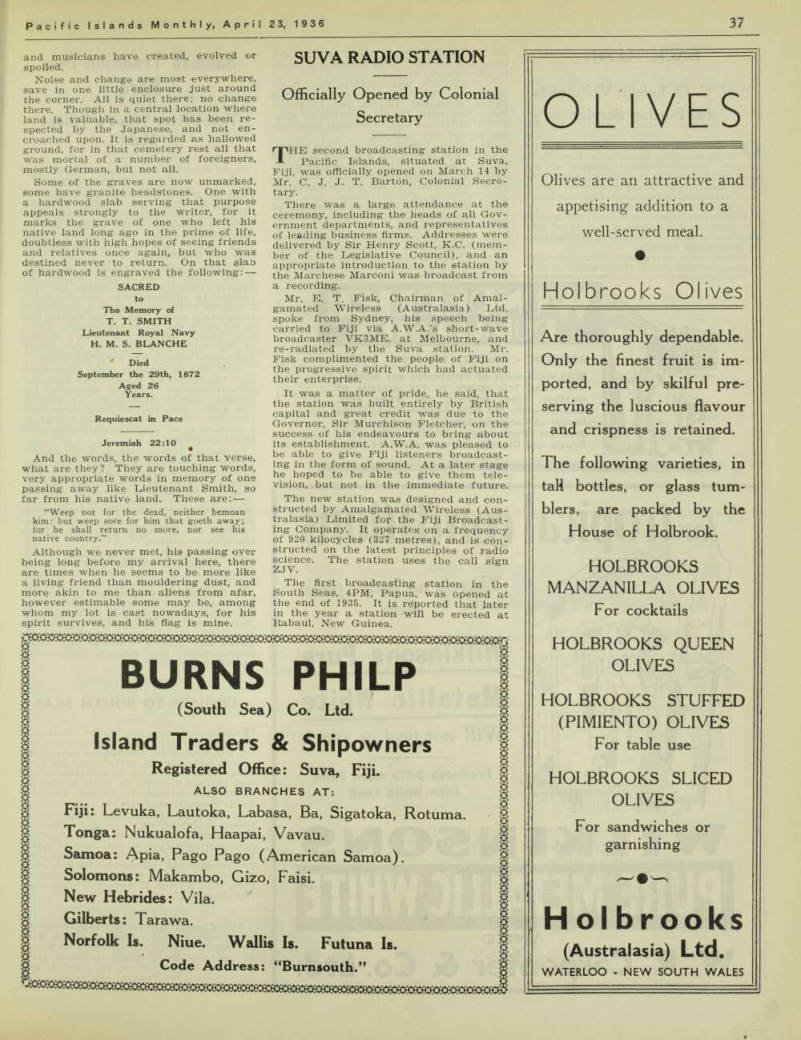
The March of Time In the Marshall Islands
From a Special Correspondent.
Jaluit, Marshall Is., Feb. 10.
TOURING the last 20 years such rapid U and sweeping changes have taken place in most of the Islands centres that pre-war residents returning now would hardly recognise the spick and span townships as their haunts of the “old days.” Jebwar, on the shores of Jaluit Lagoon, in the Marshall Islands, which is the seat of government in the Japanese islands, is no exception.
Change and usually improvement—but not always so—are apparent all around.
Loading barques are seen no more. In stead of waiting months for foreign news and supplies, oversea news can be had daily over the wireless, and general mail and supplies every few weeks by the three to six thousand ton steamers calling here, and which quite outclass the six or seven hundred ton vessels we thought great before the world war.
Throughout the group kerosene is used as formerly, but here at Jebwar it has been largely superseded by electricity. I rub my eyes in astonishment like Rip Van Winkle, Years ago I never thought I should see the place lighted with elec tricity, but there it is. How about ice?
It is obtainable. Geisha? There they are
just down the islet a little. There are billiards saloons here, some coffee shops there, and around the corner is a barn where moving pictures from time to time may give one an opportunity to see samurai fighting fierce battles over again.
Scores of new houses have been erected by the Japanese since the occupation; those erected by the Government being of reinforced cement, and those by mer chants and others of wood —some substan tial, and some rather flimsy. In the Ger man time there were just three stores on the islet, the head store of the Jaluit Gesellschaft and two subsidiaries of the same firm. Nowadays there are thirty odd stores, the Nanyo Boyeki Kaisha— N.8.K., for short—having the two largest.
The latest of these, which was recently completed, has fine plate glass show cases with chromium plated fittings and other appropriate accessories, such as one might expect in a fine city store.
The other stores are mostly small affairs, but all carry a large assortment of goods of all descriptions, such as was never seen here in the “old days.” Prices, too, are low, and are fairly comparable with prices in Yokohama. This may, perhaps, be ac counted for by the high rentals in Japan and the low rentals here, which may dis count the freight charges from Japan.
One may acquire a small piece of vacant land on the outskirts of the township at an extremely low rental. A light two room shack may be thrown together for several hundred yen. This, stocked with a few hundred yens’ worth of goods may set the little investor on the highway to fortune, or anyway appears to supply a living to frugal Japanese in this warm climate where expenses can be reduced to a minimum.
These stores, whether large or small, are an improvement on some of the old-time trading stations, formerly common in the group. Such are gone forever together with the old-time hard-case, or more often than not, generous hail-fellow well met trader of yore; and a pert, cock-sure busi ness man succeeds him.
There never have been broad roads here for such are not needed —the only vehicular traffic being that of hand-carts and bicycles. Former roads have been added to, and from a width of 10 or 12 feet, increased to an average width of 15 feet. In many parts they are bor dered with clipped hedges of hardy plants.
Paling fences are few, hedges serving that purpose better.
Instead of indiscriminate rubbish heaps here and there as in former times, all rub bish is now deposited in a specified de pression, and the whole township is as clean as a new pin. Instead of the ragged shoreline eaten away by the sea, or built up here and there, a symmetrical break water of coral stones and cement along the outer and inner shores of the islet pre vents damage during stormy weather.
Take an evening stroll through the main thoroughfare, and as you pass along you may detect subtle Oriental odours and Western perfumes mingling with the balmy breeze. While round about are heard raucous phonographs, groaning, sobbing, throbbing, and churning out low and high-pitched Occidental and Oriental melodies, jazzodies, and discords —a little of everything that phonographic inventors
and musicians have created, evolved or spoiled.
Noise and change are most everywhere, save in one little enclosure just around the corner. All is quiet there; no change there. Though in a central location where land is valuable, that spot has been re spected by the Japanese, and not en croached upon. It is regarded as hallowed ground, for in that cemetery rest all that was mortal of a number of foreigners, mostly German, but not all.
Some of the graves are now unmarked, some have granite headstones. One with a hardwood slab serving that purpose appeals strongly to the writer, for it marks the grave of one who left his native land long ago in the prime of life, doubtless with high hopes of seeing friends and relatives once again, but who was destined never to return. On that slab of hardwood is engraved the following:
Sacred
to The Memory of
T. T. Smith
Lieutenant Royal Navy
H. M. S. Blanche
* Died September the 29th, 1872 Aged 26 Years.
Requiescat in Pace Jeremiah 22:10 And the words, the words of that verse, what are they? They are touching words, very appropriate words in memory of one passing away like Lieutenant Smith, so far from his native land. These are: “Weep not for the dead, neither bemoan him: but weep sore for him that goeth away; for he shall return no more, nor see his native country.”
Although we never met, his passing over being long before my arrival here, there are times when he seems to be more like a living friend than mouldering dust, and more akin to me than aliens from afar, however estimable some may be, among whom my lot is cast nowadays, for his spirit survives, and his flag is mine.
Officially Opened by Colonial
Suva Radio Station
Officially Opened by Colonial Secretary
THE second broadcasting’ station in the Pacific Islands, situated at Suva, Fiji, was officially opened on March 14 by Mr. C. J. J. T, Barton, Colonial Secre tary.
There was a large attendance at the ceremony, including the heads of all Gov ernment departments, and representatives of leading business firms. Addresses were delivered by Sir Henry Scott, K.C. (mem ber of the Legislative Council), and an appropriate introduction to the station by the Marchese Marconi was broadcast from a recording.
Mr. E, T. Fisk, Chairman of Amal gamated Wireless (Australasia) Ltd. spoke from Sydney, his speech being carried to Fiji via A.W.A.’s short-wave broadcaster VK3ME, at Melbourne, and re-radiated by the Suva station. Mr.
Fisk complimented the people of Fiji on the progressive spirit which had actuated their enterprise.
It was a matter of pride, he said, that the station was built entirely by British capital and great credit was due to the Governor, Sir Murchison Fletcher, on the success of his endeavours to bring about its establishment. A.W.A. was pleased to be able to give Fiji listeners broadcast ing in the form of sound. At a later stage he hoped to be able to give them tele vision, but not in the immediate future.
The new station was designed and con structed by Amalgamated Wireless (Aus tralasia) Limited for the Fiji Broadcast ing Company. It operates on a frequency of 920 kilocycles (327 metres), and is con structed on the latest principles of radio science. The station uses the call sign
Zjv.
The first broadcasting station in the South Seas, 4PM, Papua, was opened at the end of 1935. It is reported that later in the year a station will be erected at Rabaul, New Guinea.
Advertisements & other items, p. 39 (1 item)
Olives
are an attractive and appetising addition to a well-served meal. •
Holbrooks Olives
Are thoroughly dependable.
Only the finest fruit is imported, and by skilful preserving the luscious flavour and crispness is retained.
The following varieties, in taH bottles, or glass tumblers, are packed by the House of Holbrook.
HOLBROOKS
MANZANILLA OLIVES
For cocktails
HOLBROOKS QUEEN
OLIVES
HOLBROOKS STUFFED
(PIMIENTO) OLIVES
For table use
HOLBROOKS SLICED
OLIVES
For sandwiches or garnishing
Holbrooks
(Australasia) Ltd.
WATERLOO - NEW SOUTH WALES
BURNS PHILP
(South Sea) Co. Ltd.
Island Traders & Shipowners Registered Office: Suva, Fiji.
ALSO BRANCHES AT:
Fiji: Levuka, Lautoka, Labasa, Ba, Sigatoka, Rotuma.
Tonga: Nukualofa, Haapai, Vavau.
Samoa: Apia, Pago Pago (American Samoa).
Solomons: Makambo, Gizo, Faisi.
New Hebrides: Vila.
Gilberts: Tarawa.
Norfolk Is. Niue. Wallis Is. Futuna Is.
Code Address: “Burnsouth.”
Back To Fiji
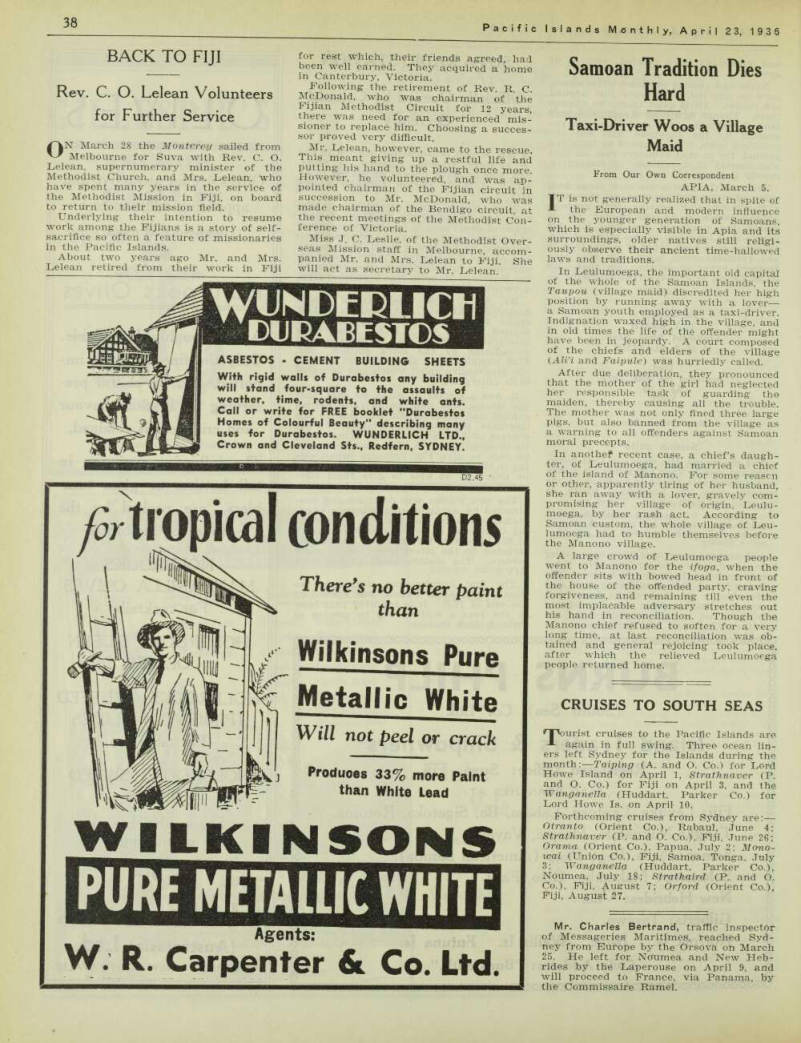
Rev. C. O. Lelean Volunteers for Further Service
/”\N March 28 the Monterey sailed from Melbourne for Suva with Rev. C. O.
Lelean, supernumerary minister of the Methodist Church, and Mrs. Lelean, who have spent many years in the service of the Methodist Mission in Fiji, on board to return to their mission field.
Underlying their intention to resume work among the Fijians is a story of self sacrifice so often a feature of missionaries in the Pacific Islands.
About two years ago Mr. and Mrs.
Lelean retired from their work in Fiji
for rest which, their friends agreed, had been well earned. They acquired a home in Canterbury, Victoria.
Following the retirement of Rev. R. C.
McDonald, who was chairman of the Fijian Methodist Circuit for 12 years, there was need for an experienced mis sioner to replace him. Choosing a succes sor proved very difficult.
Mr, Lelean, however, came to the rescue.
This meant giving up a restful life and putting his hand to the plough once more.
However, he volunteered, and was ap pointed chairman of the Fijian circuit in succession to Mr. McDonald, who was made chairman of the Bendigo circuit, at the recent meetings of the Methodist Con ference of Victoria, Miss J. C. Leslie, of the Methodist Over seas Mission staff in Melbourne, accom panied Mr. and Mrs. Lelean to Fiji. She will act as secretary to Mr. Lelean.
Samoan Tradition Dies
Hard Taxi-Driver Woos a Village Maid
From Our Own Correspondent APIA, March 5.
TT is not generally realized that in spite of the European and modern influence on the younger generation of Samoans, which is especially visible in Apia and its surroundings, older natives still religi ously observe their ancient time-hallowed laws and traditions.
In Leulumoega, the important old capital of the whole of the Samoan Islands, the Taupou (village maid) discredited her high position by running away with a lover— a Samoan youth employed as a taxi-driver.
Indignation waxed high in the village, and in old times the life of the offender might have been in jeopardy. A court composed of the chiefs and elders of the village ( Ali’i and Faipule) was hurriedly called.
After due deliberation, they pronounced that the mother of the girl had neglected her responsible task of guarding the maiden, thereby causing all the trouble.
The mother was not only fined three large pigs, but also banned from the village as a warning to all offenders against Samoan moral precepts.
In anothef recent case, a chief’s daugh ter, of Leulumoega, had married a chief of the island of Manono. For some reason or other, apparently tiring of her husband, she ran away with a lover, gravely com promising her village of origin. Leulu moega, by her rash act. According to Samoan custom, the whole village of Leu lumoega had to humble themselves before the Manono village.
A large crowed of Leulumoega people went to Manono for the ifoga, when the offender sits with bowed head in front of the house of the offended party, craving forgiveness, and remaining till even the most implacable adversary stretches out his hand in reconciliation. Though the Manono chief refused to soften for a very long time, at last reconciliation was ob tained and general rejoicing took place, after which the relieved Leulumoega people returned home.
Cruises To South Seas
HPourist cruises to the Pacific Islands are again in full swing. Three ocean lin ers left Sydney for the Islands during the month: — Taiping (A. and O. Co.) for Lord Howe Island on April 1, Strathnaver (P. and O. Co.) for Fiji on April 3, and the Wanganella (Huddart, Parker Co.) for Lord Howe Is. on April 10.
Forthcoming cruises from Sydney are:— Otranto (Orient Co.), Rabaul, June 4; Strathnaver (P. and O. Co.), Fiji, June 26; Orama (Orient Co.), Papua, July 2: Movo wai (Union Co.), Fiji, Samoa. Tonga, July 3: Wanganella (Huddart, Parker Co.), Noumea, July 18; Strathaird (P. and O.
Co.), Fiji, August 7; Orford (Orieiit Co.), Fiji, August 27.
Mr. Charles Bertrand, traffic inspector of Messageries Maritimes, reached Syd ney from Europe by the Orsova on March 25. He left for Noumea and New Heb rides by the Laperouse on April 9, and will proceed to France, via Panama, by the Commissaire Ramel.
Advertisements & other items, p. 40 (1 item)
Pure Metallic White
ASBESTOS - CEMENT BUILDING SHEETS
With rigid walls of Durabestos any building will stand four-square to the assaults of weather, time, rodents, and white ants.
Call or write for FREE booklet "Durabestos Homes of Colourful Beauty" describing many uses for Durabestos. WUNDERLICH LTD., Crown and Cleveland Sts., Redfern, SYDNEY.
There's no better paint than
Wilkinsons Pure
Metallic White
Will not peel or crack Produces 33% more Paint than White Lead -4 V
WILKINSONS
PURE METALLIC WHITE
Agents:
W. R. Carpenter & Co. Ltd.
Thriving Wau
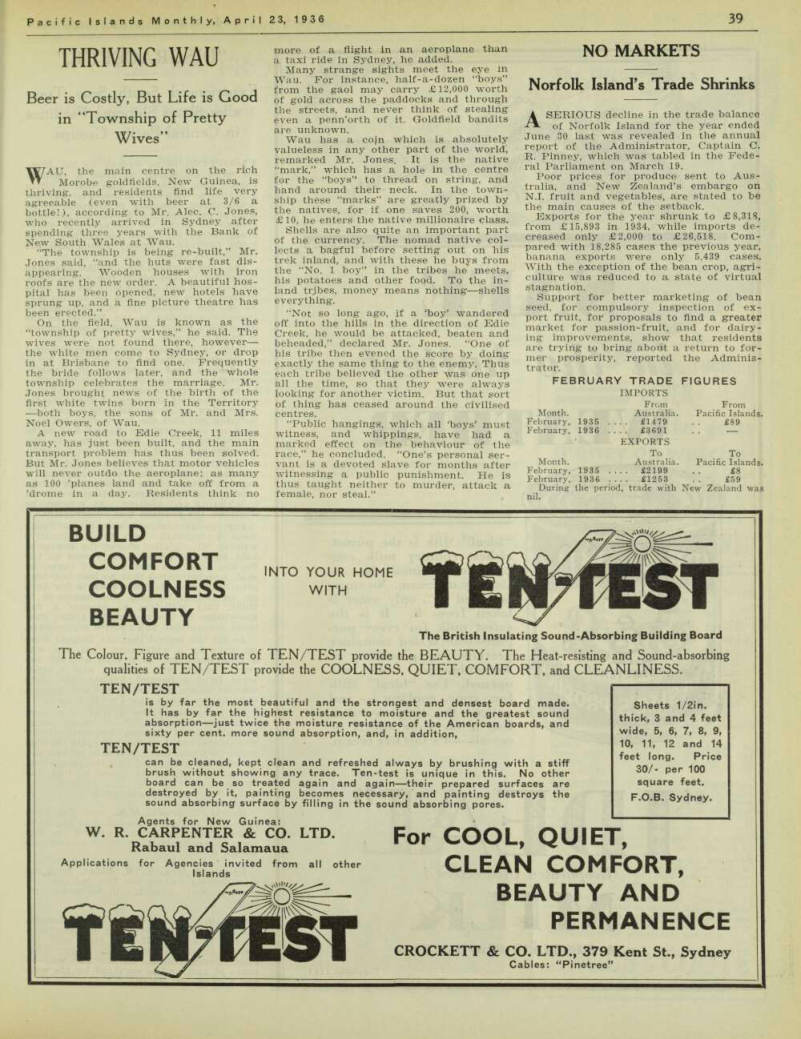
Beer is Costly, But Life is Good in “Township of Pretty Wives”
WAU, the main centre oh the rich Morobe goldfields, New Guinea, is thriving, and residents find life very agreeable (even with beer at 3/6 a bottle!), according to Mr. Alec. C. Jones, who recently arrived in Sydney after spending three years with the Bank of New South Wales at Wau.
“The township is being re-built,” Mr, Jones said, “and the huts were fast dis appearing. Wooden houses with iron roofs are the new order. A beautiful hos pital has been opened, new hotels have sprung up, and a fine picture theatre has been erected.”
On the field, Wau is known as the "township of pretty wives,” he said. The wives were not found there, however — the white men come to Sydney, or drop in at Brisbane to find one. Frequently the bride follows later, and the whole township celebrates the marriage. Mr.
Jones brought news of the birth of the first white twins born in the Territory —both boys, the sons of Mr. and Mrs.
Noel Owers, of Wau.
A new road to Edie Creek, 11 miles away, has just been built, and the main transport problem has thus been solved.
But Mr. Jones believes that motor vehicles will never outdo the aeroplane; as many as 100 ’planes land and take off from a ’drome in a day. Residents think no
more of a flight in an aeroplane than a taxi ride in Sydney, he added.
Many strange sights meet the eye in Wau. For instance, half-a-dozen “boys” from the gaol may carry £12,000 worth of gold across the paddocks and through the streets, and never think of stealing even a penn’orth of it. Goldfield bandits are unknown.
Wau has a cojn which is absolutely valueless in any other part of the world, remarked Mr. Jones. It is the native “mark,” which has a hole in the centre for the “boys” to thread on string, and hand around their neck. In the town ship these “marks” are greatly prized by the natives, for if one saves 200, worth £lO, he enters the native millionaire class.
Shells are also quite an important part of the currency. The nomad native col lects a bagful before setting out on his trek inland, and with these he buys from the “No. 1 boy” in the tribes he meets, his potatoes and other foqd. To the in land tribes, money means nothing—shells everything, “Not so long ago, if a ‘boy’ wandered off into the hills in the direction of Edie Creek, he would be attacked, beaten and beheaded,” declared Mr. Jones. “One of his tribe then evened the score by doing exactly the same thing to the enemy. Thus each tribe believed the other was one up all the time, so that they were always looking for another victim. But that sort of thing has ceased around the civilised centres.
“Public hangings, which all ‘boys’ must witness, and whippings, have had a marked effect on the behaviour of the race,” he concluded. “One’s personal ser vant is a devoted slave for months after witnessing a public punishment. He is thus taught neither to murder, attack a female, nor steal.”
No Markets
Norfolk Island’s Trade Shrinks
A SERIOUS decline in the trade balance of Norfolk Island for the year ended June 30 last was revealed in the annual report of the Administrator, Captain C.
R. Pinney, which was tabled in the Fede ral Parliament on March 19.
Poor prices for produce sent to Aus tralia, and New Zealand’s embargo on NJ. fruit and vegetables, are stated to be the main causes of the setback.
Exports for the year shrunk to £8,318, from £15,893 in 1934, while imports de creased only £2,000 to £26,518. Com pared with 18,285 cases the previous year, banana exports were only 5,439 cases.
With the exception of the bean crop, agri culture was reduced to a state of virtual stagnation.
Support for better marketing of bean seed, for compulsory inspection of ex port fruit, for proposals to find a greater market for passion-fruit, and for dairy ing improvements, show that residents are trying to bring about a return to for mer prosperity, reported the Adminis trator.
February Trade Figures
Imports
From From Month.
Australia.
Pacific Islands.
February, 1935 . . . . £1479 £89 February, 1936 . . . £3691 . . —
Exports
To To Month.
Australia.
Pacific Islands.
February, 1935 . . . . £2199 £8 February, 1936 . . . . £1253 £59 During the period nil. , trade with New Zealand was
Advertisements & other items, pp. 41-42 (1 item)
Clean Comfort,
BUILD
COMFORT
COOLNESS
BEAUTY
INTO YOUR HOME
WITH
The British Insulating Sound-Absorbing Building Board The Colour, Figure and Texture of TEN/TEST provide the BEAUTY. The Heat-resisting and Sound-absorbing qualities of TEN/TEST provide the COOLNESS, QUIET, COMFORT, and CLEANLINESS.
TEN/TEST
is by far the most beautiful and the strongest and densest board made.
It has by far the highest resistance to moisture and the greatest sound absorption—just twice the moisture resistance of the American boards, and sixty per cent, more sound absorption, and, in addition,
TEN/TEST
can be cleaned, kept clean and refreshed always by brushing with a stiff brush without showing any trace. Ten-test is unique in this. No other board can be so treated again and again—their prepared surfaces are destroyed by it, painting becomes necessary, and painting destroys the sound absorbing surface by filling in the sound absorbing pores.
Agents for New Guinea: Sheets 1/2in. thick, 3 and 4 feet wide, 5,6, 7,8, 9, 10, 11, 12 and 14 feet long. Price 30/- per 100 square feet.
F. 0.8. Sydney.
W. R. CARPENTER & CO. LTD.
Rabaul and Salamaua Applications for Agencies invited from all other Islands O
For COOL, QUIET,
CLEAN COMFORT,
BEAUTY AND
PERMANENCE
CROCKETT & CO. LTD., 379 Kent St., Sydney Cables: “Pinetree”
SAFE
in the hottest
WEATHER
ideal MIIK
EVAPORATED
“-.d
s weetenes
“Ideal” Milk is the purest, richest country milk concentrated to almost the consistency of cream. No sugar is added . . . only water is taken from it. It is the safest milk for every purpose—the sealed container prevents any possibility of contamination while unopened. Use “Ideal” Milk for your cooking and notice the improvement.
Use it on your sweets or cereals—it’s just like cream. a V &
DEAL
Evaporated Unsweetened
MILK
A NESTLE’S PRODUCT
Copyright 1143
“Disgraceful.”
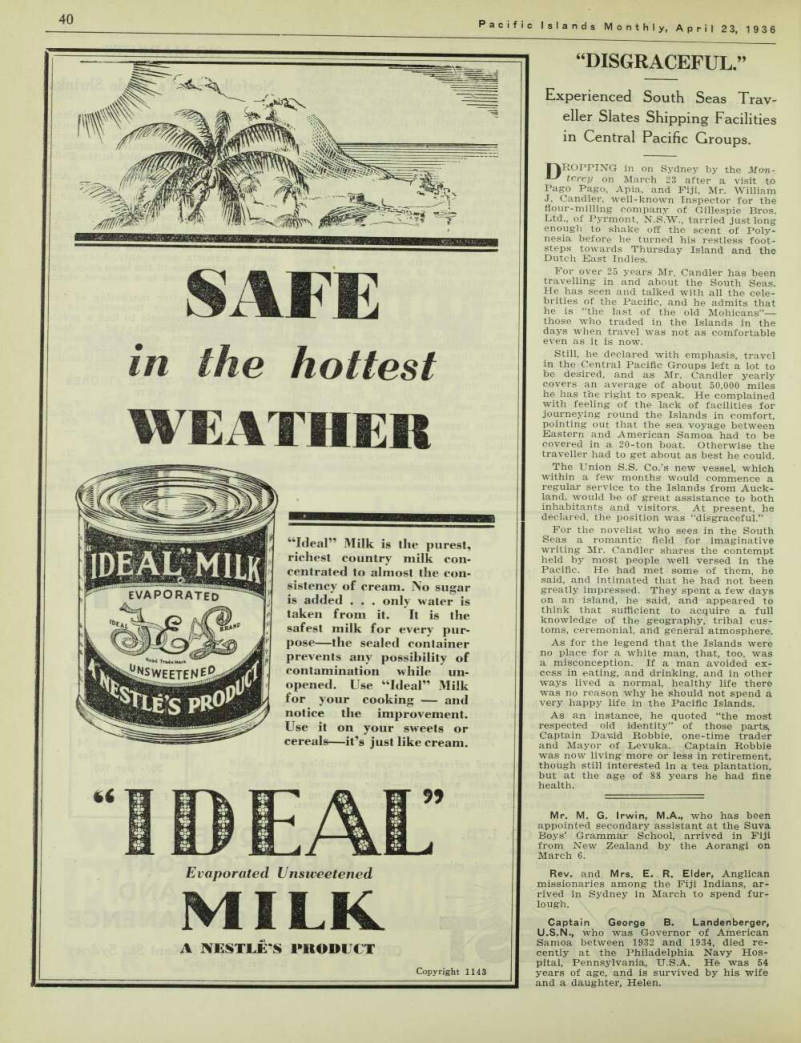
Experienced South Seas Trav eller Slates Shipping Facilities in Central Pacific Groups.
in on Sydney by the Mon terey on March 23 after a visit to Pago Pago, Apia, and Fiji, Mr. William J. Candler, well-known Inspector for the flour-milling company of Gillespie Bros.
Ltd., of Pyrmont, N.S.W., tarried just long enough to shake off the scent of Poly nesia before he turned his restless foot steps towards Thursday Island and the Dutch East Indies.
For over 25 years Mr. Candler has been travelling in and about the South Seas.
He has seen and talked with all the cele brities of the Pacific, and he admits that he is “the last of the old Mohicans”— those who traded in the Islands in the days when travel was not as comfortable even as it is now.
Still, he declared with emphasis, travel in the Central Pacific Groups left a lot to be desired, and as Mr. Candler yearly covers an average of about 50,000 miles he has the right to speak. He complained with feeling of the lack of facilities for journeying round the Islands in comfort, pointing out that the sea voyage between Eastern and American Samoa had to be covered in a 20-ton boat. Otherwise the traveller had to get about as best he could.
The Union S.S. Co.’s new vessel, which within a few months would commence a regular service to the Islands from Auck land, would be of great assistance to both inhabitants and visitors. At present, he declared, the position was “disgraceful.”
For the novelist who sees in the South Seas a romantic field for imaginative writing Mr. Candler shares the contempt held by most people well versed in the Pacific. He had met some of them, he said, and intimated that he had not been greatly impressed. They spent a few days on an island, he said, and appeared to think that sufficient to acquire a full knowledge of the geography, tribal cus toms, ceremonial, and general atmosphere.
As for the legend that the Islands were no place for a white man, that, too, was a misconception. If a man avoided ex cess in eating, and drinking, and in other ways lived a normal, healthy life there was no reason why he should not spend a very happy life in the Pacific Islands.
As an instance, he quoted "the most respected old identity” of those parts, Captain David Robbie, one-time trader and Mayor of Levuka. Captain Robbie was now living more or less in retirement, though still interested in a tea plantation, but at the age of 88 years he had fine health.
Mr. M. G. Irwin, M.A., who has been appointed secondary assistant at the Suva Boys’ Grammar School, arrived in Fiji from New Zealand by the Aorangi on March 6.
Rev. and Mrs. E. R. Elder, Anglican missionaries among the Fiji Indians, ar rived in Sydney in March to spend fur lough.
Captain George B. Landenberger, U.S.N., who was Governor of American Samoa between 1932 and 1934, died re cently at the Philadelphia Navy Hos pital, Pennsylvania, U.S.A. He was 54 years of age, and is survived by his wife and a daughter, Helen.
Pages From The Past
The Fall of Thomas Lewis in Tahiti
By Eric Ramsden
all the stories associated with the fascinating Hstory of Tahiti none is more poignant than that of the fall of Tb o mas LeWlS ’ ° ne ° f . th , e °i’ 1 f m f 1 ,P a L nd of Duff missionaries, who landed at Mata vai Bay in 1797.
Only recently the grave of Lewis was r r?i SC w er wT th ,f ks J ° A the persistence of Mr. W W Bolton, M.A., a British rest dent of Tahiti Lewis rests besides his supenor Rev. J. Jefferson; neither grave is marked. The natives nearby on Point Venus knew that some old missionaries were buried m the vicinity; but who they were, or what was their story had long since been forgotten. In one of his last letters Lewis spoke of Jefferson s “in stilled venom ; it is indeed curious that for a century and more these two men. so antagonistic in life, should lie side by side, forgotten and neglected, on foreign soil— far from the Britain they had left with such high hopes and which they were fated never to see again It is only as a result' of delving into the records of the London Missionary Society in the Mitchell Library, Sydney, that one has been able to ascertain the true facts. Apart from Mr. Bolton, there is, perhaps, not a single person in Tahiti to-day acquainted with the story.
The career of Lewis in Tahiti is an interesting psychological study. The prob lem that he faced (and which resulted in his death), has been the problem of many men in different parts of the Pacific since his day. Lewis, sex-hungry, a victim of repression, took the normal course—to the horror of the co-religionists—and lived with a native girl. He died under a solemn ban of excommunication. v , , . . ‘ , t e early chronicles of the missionary
band Lewis does not play a very import ant part . He preached occasionally, and participated in the usual duties of the artisan-clerics. The Duff departed on August 4, 1797, and the missionaries were left to their own resources on that turbu lent island, where the Pomares were struggling for supremacy, On November 17, Brother Oakes (whose descendants are in New South Wales to day), brought forward two subjects for discussion: one was what would they do in tbe even t of a hostile attack?
Secondly, he desired to know: “If any brother shou ld find himself disposed to marry one of the native women would it be thought by the soc ietv to be an im act?” After much discussion, it was decided) “beginning alphabetically,” that .< to marry a heath en woman was directly contrary to the word of God.”
K was resolved, with the Lord’s strength, to -. abide as they were .” The meeting concluded with p y rayer Brother Lewis signified his agreement with the decision.
In March the Nautilus arrived, and as some of the band had been roughly treated b Y the natives, several of them decided to leave for New South Wales. Those who remained were: B. Bickae l l - B -. Br ° Ol ? T hi ”’
J ‘ J Jefferson. T. Lewis, H. Nott, and John Eyre and his wife. The majority of those who left were married men, Lewis’s name is mentioned in an entry in their journal on June 18 of the follow ing year; “ . . . Otoo (Pomare II.) has ? een u ? f t la * e asking Brother Lewis to * each hlmtke Hebr( r w language, and has been , in Q ulsltlv e to know if the King of England 18 with Hebrew . . or l the Ba ™ date 18 a more significant ®ntry. Brother Lewis went to his friends ho ™ e laland< . . T . . , The followin & month Lewis informed hl s colleagues that he was determined to quit their company, and reside perman ently at Ahonoo, whence he later removed some of his property. “He was left to
The dislrict of Matavai, Tahiti, as it is to-day. Cook, Wallis, and all the early navigators anchored in the bay, also the missionaries of the Duff. This is one of the most historic spots in French Oceania.
follow his determination,” says Jefferson.
On August 1, he wrote stating his “fixed determination to take to wife one of the natives and abide faithfully towards her until death, thinking it the most eligible step in the present circumstances.” . . , , That intimation brought matters to a head. His colleagues refused to marry Lewis. Further, they excommunicated him. Bicknell did not agree with the decision; he thought suspension would have met the case. Both Bicknell and Lewis had been members of Lady Huntingdon’s
evangelistic society and had made an attempt to go to Tahiti with Bligh. Lewis replied on August 4 expressing surprise at “the boldness and confidential air of the communication, and advised tne brethren “not to be too hasty in such matters as these.
The missionaries met again and re solved to make a formal record in their journal, wherein they said: “The unbe coming behaviour seen in Mr. Lewis by many of the brethren and ourselves was frequent and indecent.” They would not,
however, make any specific charges as the details “would be extremely offensive to the feelings of the delicate reader.”
Harris declared that “on account of his voluntary nocturnal visits there were many rumours among the natives, and many thoughts of heart among ourselves.”
Lewis warmly contested the allegations, and from then on bombarded his old col leagues with letters. The missionaries found it a great sacrifice to their feelings not to invite Lewis into their homes when he called to see them, but felt that they “must act according to church discipline.”
Poor Lewis!—he persisted in attending the usual services, and brought his lady friend with him.
The Tahitians were amazed at the atti tude of the missionaries. Jefferson says; “Our conduct herein appears strange to the natives, and we find that they are scrutinisers of every part of our civil and religious behaviour, and they among themselves make observations upon each, either in a way of contempt or ridicule, for the novelty and singularity thereof.”
Towards the end of October the mis sionaries learnt that Lewis’s new home was “a place of discord, that the man called Mr. Lewis’s friend, with his woman’s parents, often abuse him ...”
Lewis’s letters are pathetic. On several occasions one finds notes begging a little tea or a book. In May he was plundered of some hogs.
Two months later he wrote to the society asking to see the journal for July, 1798. “May I, .or may I not,” he asked, “entertain some hope for the accommoda tion of the difference which hath, hitherto, so unhappily disturbed our peace.” Both requests were refused.
On July 26, he asked for a little more tea, and, at the same time, requested Jef ferson to afford him “a little private con versation.” The tea was sent, but the second request was not complied with.
Lewis addressed a long letter to the mis sionaries on July 30 in which he spoke of Jefferson’s “instilled venom.” It was not answered.
Early in November he asked for some more tea —it was the last letter he ever wrote. Towards the end of the month he called to use the precious grindstone, and begged a little Peruvian bark to dose himself with.
On November 28, 1799, the missionaries were informed that Lewis had died after sunset on the previous day. Bicknell, Nott, and Harris, on being sent to investi gate, were informed that Lewis had dash ed his head against some stones. The demeanour of his Tahitian wife was sul len and “hardened.” The reports of the natives were so contradictory that foul play was suspected. The missionaries were in such a precarious situation, how ever, that they did not wish the death of Lewis to cause complications among the chiefs; neither did they want Pomare to vent his anger on innocent people in the district.
After exhaustive inquiries, Broomhill was satisfied that Lewis was murdered.
An entry on November 29 said: “. . . .
After morning prayer the manner of Mr.
Lewis’s interment was considered, when it was concluded that a spot of land a few yards to the south of the four brethrens’ dwelling should be enclosed for a burying place, and that the corpse of Mr. Lewis should be there deposited; also, that three brethren should go to Ahonoo, and, with the assistance of the natives, bring hither the body” (to Point Venus). This was also the site of the future church, of which now not a vestige remains. On February 6, 1800, Jefferson wrote: “Fixed on the spot for the intended place of worship
near where Mr. Lewis is interred: a small court that is to surround the house ,will enclose his grave.”
The missionaries also had trouble with Broomhill. The latter fell a victim to the charms of a young woman of degree from Raiatea. His colleagues recorded the fact in June that he had “fallen into a very dreadful snare of Satan.” He, too, was excommunicated. The following year they had the satisfaction of recording: “The young woman whom Mr. Broomhill co habitated with has quitted him for another man.”
Neither had Lewis’s girl proved faith ful. On the night previous to his death, it was stated, she had been intimate with a native. The ex-missionary’s jealousy was responsible for the tragedy that fol lowed.
On March 3, 1801, Jefferson penned the final entity in the pathetic story of Lewis: “It has latterly been reported to us that Mr. Lewis was actually murdered by some persons of the place where he resided, and, on account of the woman that he had so unhappily united himself with . . .
It appears that some of the party, having quarrelled, one said to the other: ‘lf it had not been for you, the man (meaning Mr. Lewis) would not have been killed.’ ”
Some years later Jefferson was himself placed beside Lewis in the grove of coco nuts [EDITORIAL NOTE.—Since the above article was written information has been received in Sydney that the trustees of the Mitchell Library have purchased Lewis’s original journal. Together with other important South Sea mission material it should arrive in Sydney from London in the course of a few weeks.] Mr. Robert Crompton, C.8.E., K.C., of Tamavua, Fiji, sailed from Suva for New Zealand by the Zealandic on March 10.
Advertisements & other items, pp. 43-44 (1 item)
Angus&Coote
The ONLY Watch
for the . . -
TROPICS
TH
Indestructible
LEVER
Don’t waste your
money on watches
That means—don’t buy a watch unsuited to your place of residence.
If your home is where dusty and damp conditions prevail, there’s only one watch for you, and that's the
INDESTRUCTIBLE LEVER
• YOU COULD SWIM—WEARING
THIS WATCH—
and yet not harm it.
• YOU COULD KNOCK IT OR
DROP IT- and yet not break it.
• IT IS ABSOLUTELY DAMP-
PROOF, AND ENTIRELY
ACCIDENT-PROOF.
The case is of chrome—with a stainless steel back which defies the marks of perspiration.
Gentleman’s Watch—as illustrated above— -95/-. With luminous dial, £5/5/-.
Lady’s “Indestructible” Watch—same as above, with clear white and black dial, and smaller of course—appropriate for lady’s wear, £5/5/-.
For Gentlemen we also have an “Indestructible” Lever with a case entirely of stainless steel. The Purchaser of one of these is equipped with a watch that will withstand any discoloration and any inroad to the fine mechanism it contains.
With the usual black figures it is £5/15/and with a luminous dial it is £6/5/-.
All “Indestructible” Watches are warranted to give 25 years’ wear, and are kept in perfect order for the first twelve months, free of cost. All are complete with straps.
Angus & Coote’s illustrated Catalogue is wonderfully useful to anyone obliged to shop by post. It is a veritable shop window, and Angus and Coote’s Mail Order Service is distinguished for promptness and care.
ANGUS&COOTE
500 George Street, SYDNEY
SHIP CHANDLERY - HARDWARE
BROOMFIELDS LIMITED, 152 Sussex St., SYDNEY
Large and Complete Stocks of SHIP CHANDLERY.
Ironmongery of all kinds—Paints, White Lead and Oils.
Sole Agents for: P. H. MUNTZ & CO.’S 3-CROWN BRAND METAL SHEATHING.
PEACOCK & BUCHANS’ ENGLISH READY-MIXED PAINTS.
WRITE FOR SHIP CHANDLERY CATALOGUE
Special “In Bond” Prices for all Island enquiries quoted on application
CABLES: “BOOM,” SYDNEY
lIAICItY WEST - - Sydney’s Sailmaker
L.s*% » Wm^ ■: m:
SECTION OF OUR SAIL LOFT
Caters for every class of
SAIL, CANVAS,
ROPE & WIRE
EQUIPMENT
Send your enquiries to us
ADDRESS;
BALMAIN,
SYDNEY
Scott’s Renown Brand Rope,
Cordage and
Cable Address Ropeyard, Sydney, m
Binder
Twine
of Every
Description
MANUFACTURED AT
MASCOT. N.S.W.
By
J. Scott Ltd.
Head Office and Store:
163 CLARENCE ST..
SYDNEY, N.S.W.
Family Feud
Murder in Eastern Samoa
From Our Own Correspondent APIA, March 10.
THE body of the native Sinaumea Hun ter, who was murdered recently at Pago Pago (Eastern Samca) was brought to Apia, where his family resides, by the motor boat Pepe Fou, and was interred The murder was committed by Muli aga, of Falealili, Western Samoa, on the beach opposite the wharf where the tourist vessel Stella Polaris was tied up. The crime, which was clearly premeditated, was the outcome of a family feud as Hun ter during a drunken spree some time ago seriously injured an elderly relative of Muliaga.
A passing officer of the American naval station overpowered the murderer, who attempted to commit suicide, and had him arrested. Muliaga showed no repentance, and is alleged to have expressed satisfac tion that he had “got his man.”
Quite a number of passengers and mem bers of the crew of the Stella Polaris were near the scene when the attacked fired at his victim from a close distance. The wounded man was taken to the Naval Hos pital, but the wound he had received in his side left no hope of recovery. However, he was able to make a statement before his death, which occurred at midnight the same day.
Mr. J. P. Bayly, of Nadi, Fiji, left Suva for England by the Aorangi on March 6.
Mr. Bayly is member for the Western Division in the Fiji Legislative Council.
For Oil
£578,000 Spent In Search
INCLUDING £25,000 contributed by Britain,' the Commonwealth Govern ment has spent £578,000 in prospecting for flow oil in the Territories and Aus tralian States, the Prime Minister (Mr.
J. A. Lyons) told the Leader of the Oppo sition (Mr. J. Curtin), in the House of Representatives in March, The expenditure consisted mainly of: Boring in Papua prior to 1926, £364,505; geologicg.l survey of New Guinea, £4,285; and expenditure in both Territories and Australian States from appropriation pro vided by the Petroleum Prospecting Act, £207,000.
Sir Henry and Lady Scott returned to Suva, Fiji, by the Aorangi on March 6, after a short holiday in New Zealand.
Advertisements & other items, pp. 45-46 (1 item)
Deutz Diesel Engines
SHIP & GENERAL
COPPERSMITHS
Manufacturers of all kinds of Pips Work, Petrol, Water, and Buoyancy Tanks for Ships, Yachts, and Motor Boats, Copper Water-jacketed Exhaust Pipes & Silencers a speciality.
Copper Pans and Stills made to specification
Nicholson & Foster
BALMAIN, SYDNEY
DEUTZ DIESEL ENGINES
DEUTZ ENGINES USED INTERNATIONALLY SINCE 1864
MARINE “OM ” TYPE INDUSTRIAL TYPE “VM”
EUT
6481 Range from 10 to 140 B.H.P.
Range from 10 to 2000 B.H.P.
Full information obtainable from the Agents
HERBERT DEL COTT PTY. LTD.
116 Queen Street, Melbourne ’Phone: Central 10488.
Cables “Voltage” 15 Castlereagh Street, Sydney ’Phone: B 3135.
WHERE TO STAY IN PORT MORESBY
FIRST-CLASS ACCOMMODATION.
PARTIES ARRANGED.
Licensee: Papua Hotel, Ltd.
THE
PAPUA HOTEL
Catering specially for Tourists and Travellers Situated on high ground overlooking both coasts, its Spacious Lounges are always Cool and Comfortable. Tariff: Per Day, 16/-; per week, £5/5/-; per month, £l4; bed and breakfast, 10/-; bedroom only, 7/6.
Cars meet all steamers.
HOTEL MORESBY T„ R ™ E
COMFORTABLE
ACCOMMODATION
ONLY THE BEST
BRANDS OP
WINES, SPIRITS
AND BEERS
IN STOCK
LICENSEE;
Hotel Moresby
Ltd.
COSMOPOLITAN
HOTEL
Samarai
First-class Accommodation for Tourists and Travellers Ball-room; Electric Light; Billiards; Freezing-works; Cold Store. Best brands of Wines, Spirits, Ales.
MODERATE TARIFF
Fishing Trips and Launch Excursions arranged Licensee: E. J. Morrow
TAHITI
AND
French Oceania
This book, by Samuel Russell, is a valuable work of reference. It gives, in relation to Tahiti and French Oceania, complete details of administration, commerce, sport, tourist resorts, industries, excursions, hotels, immigration and land laws, etc.
Yachtsmen and fishermen, who are visiting Tahiti in increasing numbers, will find this a most useful handbook.
It also supplies a fascinating account of life in Tahiti—one of the most delightful places of residence in the world.
Copies from: S. RUSSELL, Papeete, TahRL and
Pacific Publications Ltd.,
247 George Street, Sydney
Price in Australia (posted): Cloth bound, 6/-; paper-cover, 5/-.
HOTEL BULOLO
WAU, T.N.G.
Picturesquely situated, overlooking the Wau Aerodrome, at the Business centre of the Morobe Goldfields.
FIRST-CLASS CUISINE—3O com-
fortable Bed-rooms—Hot and Cold Showers —Fresh Fruit, Vegetables, and Dairy Produce from the Hotel Gardens.
The Hotel Bulolo is famous for its wide, cool verandah-lounge.
Only the Best Brands of Wines, Spirits, and Beers in stock.
SAMARAI HOTEL
The Rendezvous of the Miners of Eastern Papua Comfortable Accommodation for Tourists, Travellers and Residents. Best Brands of Spirits and Wines —Victorian Lager Beers.
FISHING EXCURSIONS ARRANGED
Licensee: Mrs. L. M. SKELLY.
COOL AND SPACIOUS LOUNGES COMFORTABLE A T K] I. It A It I II li ROOMS—DINNER PARTIES SPECIALLY ARRANGED V M “ tJ li A Oil U U Excellent Dance Floor and Music.
I Under the Personal Management of Mrs. H. Luxmoorc
Pigges
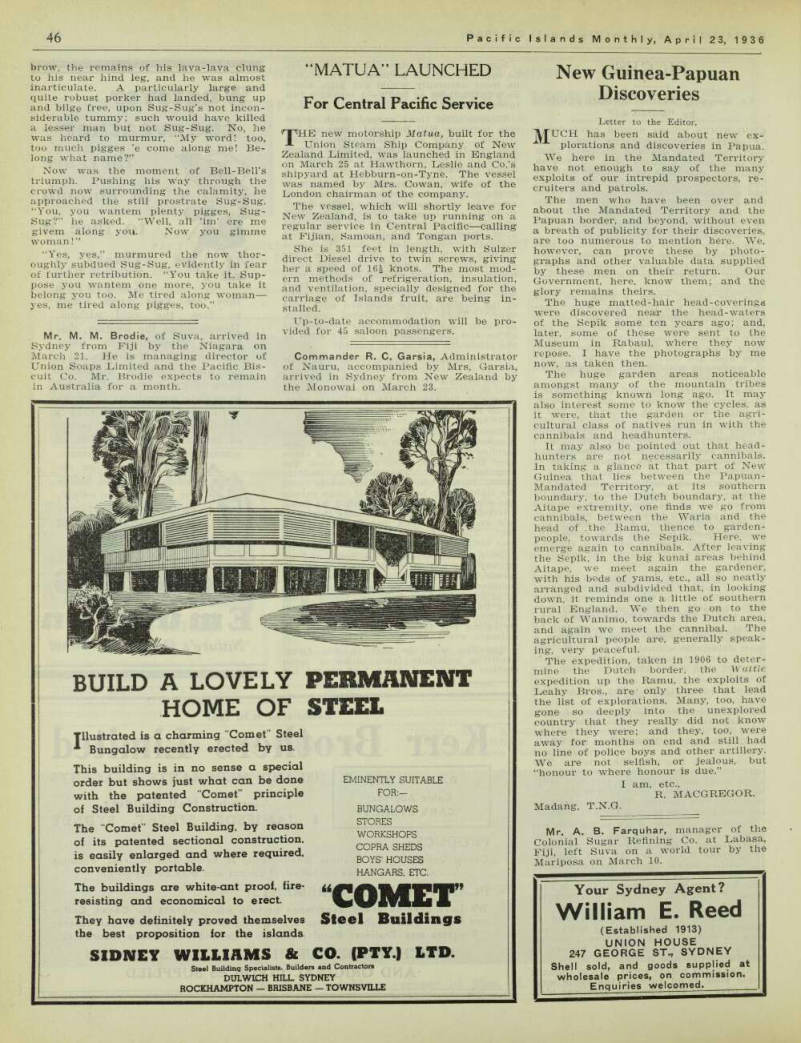
An Amusing Sketch of Native Life by “Marooned.”
SUG-SUG’S village nestled comfortably at the base of a thirty foot basalt bluff, facing the sea and sheltered from the heat of the westering sun. It was an Ideal site now that inter-tribal warfare had perforce ceased, since “Government” had so unaccountably but most positively frowned upon ambushings, night-raidings, the shooting of tetanus-poisoned arrows into the backs of unsuspecting victims, and other such manly sports.
In all the cluster of native houses that of Sug-Sug was the finest, he being a man of substance, rich in pigs, and, moreover, without conscience in his greed to ac quire more.
In our island, “Pigs is Pigs,” as Ellis Parker Butler has remarked. Their pos session lends power and a loud noise in the village councils; while the man who may be near pigless remains but a poor thing, even should he be hereditary chief.
Pigs also are currency, and wives may be purchased wuth them. Altogether, an indispensable animal.
Sug-Sug also possessed two daughters of marriageable age—for one of whom, in particular, he wr?„s anxious to find a mate. Naturally, he must be able and willing to pay the required price—in this case, thirty pigs, including five tuskers —whose tusks must have completed the circle, thereby adding tremendously to their value.
It may be remarked in passing that the circular tusk is induced to form so by —when the pig is young—knocking out the two opposing tusks in the upper jaw, in order that the lower tusk, being un opposed, grows upwards, then curves in wards, slowly forcing its way through the flesh and finally through the jaw bone itself.
This flesh and bone-piercing process goes on slowly for a couple of years, dur ing which time the wretched animal must suffer horribly, so much so that only cer tain breeds are able to stand up to the ordeal and survive. One cannot but be sorry for the brutes. Although it is a most detestable animal —on the hoof, that is; on the plate is quite a different mat ter; but then it has ceased to be pig, has it not?
But to return to Miss Sug-Sug and her suitors. There was one such and h© most eligible, Bell-Bell by name, a par ticularly dirty and repulsive looking ras cal. The wdiich, of course, mattered not at all, since young Miss had no say what ever in the matter, while papa would not be obliged to live with the fellow. The only trouble was that he seemed to be a bit short on pigs at the moment. Still, he made a counter offer of twenty pigs, including two tuskers, evidently consider ing that that was enough for any woman.
Sug-Sug, however, stuck to his original figure, in spite of days and nights spent in argument. Thirty pigs was the upset price—take it or leave it; and, anyhow, the woman was a topping hand at cutting out coconut. As for gardening, why Sug- Sug had not been obliged to turn a yam spade full of soil since she was weaned, scarcely.
Thereupon, Bell-Bell departed, full of misery. Such a worker would have done him no end of good. He was, however, not quite defeated yet. He set himself to consider ways and means.
After many nights spent deep in thought —his slow mind turning the thing over and over—he fell upon an excellent idea.
Sug-Sug wanted pigs, did he not? Well, he was a greedy old perisher, anyhow; but he most assuredly would get pigs, since he wanted them so badly—a measure full to overflowing.
Whereinafter there ensued much secret talk between Bell-Bell and three of his cronies. After due deliberation, action was set for the following night. There would be a moon and sufficient light by which to work.
On the night in question, when the rest of the villagers had settled down to sleep, after the customary heavy evening meal, Bell-Bell and company betook themselves silently and unobserved to the top of the bluff overlooking Sug-Sug’s house; and there they constructed a short V-shaped runway, with its open apex at the edge of the bluff and directly over Sug-Sug’s house. They used strong saplings, pre viously cut, lashed to convenient trees with strips of bark, and the open apex of the V they lightly screened with wild cane. Then they scattered coconut, pumpkin and such like fare beloved of swine and hid themselves in the bush at the landward end of the runway.
Soon a couple of pigs arrived: and their grunts of satisfaction brought others buc keting along pell-mell through the bush to join in this unprecedented free feed, until presently between thirty and forty pigs, of all sizes and condition, were within the runway.
Now Bell-Bell and company deemed the moment for action had arrived. Palm leaf torches were hastily lit and, waving these over their heads, they rushed upon the startled diners. The pigs, in sudden, alarm, turned and blindly ran away from the lights, slap into the wild cane screen and—over the edge of the bluff, to land, a living avalanche and squealing in terror, fair and square upon Sug-Sug’s thatched roof. The roof, with the house under it, was instantly reduced into a heaving ruin.
Then pandemonium. The noise and its variety was indescribable; its volume im mense, the squeals of the now completely maddened and more or less damaged pigs mingled with the yells of terror from Sug-Sug’s numerous household, who now commenced to appear, scrambling and wriggling out from under the much too animate wreckage.
Sug-Sug was the last to win clear, crawling painfully from under a large section of roof. A palm leaf graced his
brow, the remains of his lava-lava clung to his near hind leg, and he was almost inarticulate. A particularly large and quite robust porker had landed, bung up and bilge free, upon Sug-Sug’s not incon siderable tummy; such would have killed a lesser man but not Sug-Sug. No, he was heard to murmur, “My word! too, too much pigges ’e come along me! Be long what name?”
Now was the moment of Bell-Bell’s triumph. Pushing his way through the crowd now surrounding the calamity, he approached the still prostrate Sug-Sug.
“You, you wantem plenty pigges, Sug- Sug?” he asked. “Well, all ’im’ ere me givem along you. Now you gimme woman!”
“Yes, yes,” murmured the now thor oughly subdued Sug-Sug, evidently in fear of further retribution. “You take it. Sup pose you wantem one more, you take it belong you too. Me tired along woman— yes, me tired along pigges, too.”
Mr, M. M. Brodie, of Suva, arrived in Sydney from Fiji by the Niagara on March 21. He is managing director of Union Soaps Limited and the Pacific Bis cuit Co. Mr. Brodie expects to remain in Australia for a month.
Advertisements & other items, pp. 47-48 (1 item)
Kerr Brothers Limited
Whatever
the weather—
\ <7
they are
fit enough
to face it
t O s Thanks
f SCOTT
Emulsion they are kept warm within to face the cold without.
However bad the weather, this
proved strength maker helps
them to ward off coughs, colds and winter illnesses. It enables them to get more nourishment from their normal diet. Scientists have proved that SCOTT’S Emulsion has this special power of increasing the digestion of warmth-giving food elements.
SCOTT’S Emulsion enriches the blood, builds the body, puts on weight, and ensures proper growth. But, it must
be genuine
SCOTT’S
Emulsion
Nature’s Own Food Tonic
Established N.H. 1894
Kerr Brothers Limited
ISLAND MERCHANTS & AGENTS
Assembly Hall Building,
1 JAMIESON STREET, SYDNEY
Cacao, Coffee, Copra, Peanuts, Shell: Ship to us for best returns. Produce shipped overseas on behalf of clients and may be drawn on.
PLANTATION REQUIREMENTS:
We have over 40 years’ experience to help you. Agents for Cacao, Coffee and Castor Seed Machinery; Agricultural Implements and Power Cultivators; Tractors and Trailers; Paints; Marine, Fire and Earthquake Insurance.
MERCHANDISE PURCHASED AT BEST PRICES
AND ORIGINAL INVOICES SUPPLIED
G.P.O. Box 3838 T
Cable Address:
"CARE SYDNEY"
PRODUCE:
BUILD A LOVELY PERMANENT
HOME OF STEEL
Illustrated is a charming "Comet" Steel Bungalow recently erected by us.
This building is in no sense a special order but shows just what can be done with the patented “Comet" principle of Steel Building Construction.
The "Comet" Steel Building, by reason of its patented sectional construction, is easily enlarged and where required, conveniently portable.
The buildings are white-ant proof, fireresisting and economical to erect.
They have definitely proved themselves the best proposition for the islands.
EMINENTLY SUITABLE
FOR:-
BUNGALOWS
STORES
WORKSHOPS
COPRA SHEDS
BOYS' HOUSES
HANGARS, ETC.
“COMET”
Steel Buildings
SIDNEY WILLIAMS & CO. (PTY.| LTD.
Steel Building Specialists, Builders and Contractors
DULWICH HILL SYDNEY
ROCKHAMPTON BRISBANE TOWNSVILLE
“Matua”Launched
For Central Pacific Service
THE new motorship Matna, built for the Union Steam Ship Company of New Zealand Limited, was launched in England on March 25 at Hawthorn, Leslie and Co.’s shipyard at Hebburn-on-Tyne. The vessel was named by Mrs. Cowan, wife of the London chairman of the company.
The vessel, which will shortly leave for New Zealand, is to take up running on a regular service in Central Pacific—calling at Fijian, Samoan, and Tongan ports.
She is 351 feet in length, with Sulzer direct Diesel drive to twin screws, giving her a speed of 16| knots. The most mod ern methods of refrigeration, insulation, and ventilation, specially designed for the carriage of Islands fruit, are being in stalled.
Up-to-date accommodation will be pro vided for 45 saloon passengers.
Commander R. C. Garsia, Administrator of Nauru, accompanied by Mrs. Garsia, arrived in Sydney from New Zealand by the Monowai on March 23.
New Guinea-Papuan
Discoveries
Letter to the Editor.
IVfUCH has been said about new ex 'LT'L plorations and discoveries in Papua.
We here in the Mandated Territory have not enough to say of the many exploits of our intrepid prospectors, re cruiters and patrols.
The men who have been over and about the Mandated Territory and the Papuan border, and beyond, without even a breath of publicity for their discoveries, are too numerous to mention here. We, however, can prove these by photo graphs and other valuable data supplied by these men on their return. Our Government, here, know them; and the glory remains theirs.
The huge matted-hair head-coverings were discovered neair the head-waters of the Sepik some ten years ago; and, later, some of these were sent to the Museum in Rabaul, where they now repose. I have the photographs by me now, as taken then.
The huge garden areas noticeable amongst many of the mountain tribes is something known long ago. It may also interest some to know the cycles, as it were, that the garden or the agri cultural class of natives run in with the cannibals and headhunters.
It may also be pointed out that head hunters are not necessarily cannibals.
In taking a glance at that part of New Guinea that lies between the Papuan- Mandated Territory, at its southern boundary, to the Dutch boundary, at the Aitape extremity, one finds we go from cannibals, between the Waria and the head of .the Ramu, thence to garden people, towards the Sepik. Here, we emerge again to cannibals. After leaving the Sepik, in the big kunai areas behind Aitape, we meet again the gardener, with his beds of yams, etc., all so neatly arranged and subdivided that, in looking down, it reminds one a little of southern rural England. We then go on to the back of Wanimo, towards the Dutch area, and again we meet the cannibal. The agricultural people are, generally speak ing, very peaceful.
The expedition, taken in 1906 to deter mine the Dutch border, the Wattle expedition up the Ramu, the exploits of Leahy Bros., are only three that lead the list of explorations. Many, too, have gone so deeply into the unexplored country that they really did not know where they were; and they, too, were away for months on end and still had no line of police boys and other artillery.
We are not selfish, or jealous, but “honour to where honour is due.”
I am, etc.,
R. Macgregor.
Madaiig, T.N.G.
Mr. A. B. Farquhar, manager of the Colonial Sugar Refining Co. at Labasa, Fiji, left Suva on a world tour by the Mariposa on March 10.
Advertisements & other items, p. 48 (1 item)
William E. Reed
Your Sydney Agent?
(Established 1913)
UNION HOUSE
247 GEORGE ST., SYDNEY
Shell sold, and goods supplied at wholesale prices, on commission.
Enquiries welcomed.
Walpole Island
Guano Industry Ceases
THE contract with Austral Guano Co., Ltd., of Walpole Island (New Cale donia) entered into in 1934 by a New Zea land firm for supplies of guano has not been renewed, and work there has ceased.
Recently the Loyaute (Societe des Isles Loyalties) left Noumea to pick up the Aus tral Company’s employees (several Euro peans and about 80 natives) and some of the plant, to be returned to New Cale donia.
Negotiations have been in progress with other Auckland interests in order to con tinue the exploitation of the Walpole Island deposits, but it is understood that the dealings were abortive. The agent of the Osaka Shosen Kaisha Co., of Japan, informed the Auckland group that should the Walpole guano industry be revived his firm, which is contemplating a shipping service between Japan and New Zealand via Noumea, could make satisfactory transport arrangements for the carriage of guano between Walpole and Auckland.
Lying about 150 miles south-east of Noumea, Walpole Island is 2\ miles long by \ mile broad, and contains 310 acres. It is a flat limestone rock, covered by rich deposits of guano. There are no indigen ous natives; the employees of the Austral Co. are mostly kanakas, Javanese, and Tonkinese.
Ships tie up to strong moorings in Wal pole Bay, where there is ample depth of water, and are loaded from 5-ton punts.
Mr. G. A. Carswell arrived in Suva, Fiji, by the Aorangi on March 6 to take up duties as assistant master at the Levuka Public School.
Polynesian Club’s First Meeting
THE fact was related by Sister Milne Hovey, the speaker at the inaugural meeting of the Polynesian Club of Sydney in March, that she was informed when in U.S.A. recently by an eminent professor of Berkeley University, it had been definitely proved that one or more Polynesia mi gratory canoes had, in ages remote, landed on the Californian coast.
Miss Hovey, who had listened to many camp-fire lectures on the American In dians, was interested to find many points of similarity with the Polynesian peoples.
The subject of her address was “A Day in Rarotonga.”
Mr. Leonard Moran presided over a large attendance, which included representatives from different N.Z. tribes, the Cook Islands.
Rotuma, Fiji, New Caledonia, and Samoa.
An attractive programme of native danc ing and singing was provided.
The Rangatira, Mrs. Waikainga Tipene (who wore over her evening gown a hand some Maori feather mat), proposed a vote
of thanks to the speaker.-
E.R.
Lepers
Timber Industry for New Guinea Lepers
From a Special Correspondent.
WAU, March 4.
AT Taskul (New Hanover Island), the colony for convalescent lepers, the Administration is providing occupation for the inmates. With this end in view, it is hoped to establish a timber industry.
Timber sawn at the colony will, it is understood, be purchased by the Govern ment. The monies obtained by the trans actions will be expended on the upkeep of the colony and its members.
“Hand Samoa Over To U.S.A.”
THE New Zealand National Review of February advances a number of rea sons—notably the success of the American administration of Eastern Samoa, com pared with New Zealand’s woeful and ex pensive effort in Western Samoa —why Western Samoa should be handed over to the United States. Says the Review: ‘‘lt is conceivable that Britain would raise no objection to the transfer, as it would strengthen Britain’s position in the Pacific. New Zealand has forfeited her right to object. France could produce no strong grounds for objection. Japan would have no right to object. German aspira tions could be better met elsewhere. The League of Nations could with justice cancel the Mandate in favour of a Protectorate by America.”
The writer, apparently, has never heard of the British Colonial Service, and its success in governing countries like Samoa.
The suggestion that the League of Nations should cancel the Mandate, in order to give a Protectorate to U.S.A. (whose refusal to go to Geneva eventually hamstrung the League) is—well, piquant.
Advertisements & other items, pp. 49-50 (1 item)
The Value of RELIABILITY
V. H. Jones & Rickard
Electrical Engineers
525 ELIZABETH STREET
SYDNEY
Specialists in rewinding and repair* ing all classes and sizes of electrical machines and equipment.
Special treatment given to work for the tropics.
TELEPHONE: MA 1397
The Value of RELIABILITY
9 a Made in a Range of Sizes up to 650 B.H.P.
That the lives as well as the livelihoods of many often may depend on the reliability of their engines is fully realised by the manufacturers of RUSTON Marine Diesel Engines.
Design—materials—workmanship—
nothing is left to chance.
* SPECIAL FEATURES:
° Cold Starting ° Compression Ignition ° Airless Fuel Injection ° Four-Cycle Principle ° Low Fuel Consumption Guaranteed
RUSTON & HORNSBY (Australia) Pty. Limited
Registered Office; 174-180 KING STREET, MELBOURNE Cables: “HORNSBYS,” Melbourne Branches at SYDNEY, 642 Jones Street (off Broadway), and BRISBANE (Barry Parade) Sole Agents for Mandated Territory: Burns Philp & Co. Ltd., Rabaul, New Guinea
Timber Joinery
ETC.
PREPARED BUILDINGS
ready for erection a speciality.
SHIP and BOAT BUILDING
TIMBERS specially catered for
FIBROLITE, PLYWOODS.
GALVANISED IRON.
CANEC.
O CONSIGNMENTS shipped
by RETURN STEAMERS
to the Islands.
John W. Eaton Ltd.
WEST CRESCENT ST.,
NORTH SYDNEY
TELEPHONES: X 5051 (5 lines)
COPRA MATS AND MATTING
Send your enquiries to us for Woven Wire Mesh in Rolls or framed for Copra Drying and all Screening purposes, Bird Cages, Sieves and Riddles, Builder’s Gravel Screens, Rat Traps, Door Mats, Garden Arches, Chain Wire Mesh, Crimped Wire Mesh for Window Guards, etc.
SCOTT AND SONS
WIREWORKS: RAILWAY PARADE AND MURRAY STREET MARRICKVILLE
This Sink and Drainer is made of
“STAYBRITE” STEEL
The brightness and beauty of “Staybrite” Steel Sinks and Drainers is everlasting. They will never stain, tarnish, nor rust. No work is attached to keeping them looking like new all through their everlasting and ever-useful life.
“Staybrite” Stainless Steel Sinks and Drainers will never wear out. They are the kitchen equipment of to-day—and to-morrow.
“Staybrite” Sinks and Drainers are now being made in Australia and the agents for “Staybrite” will gladly supply full particulars about them.
Agents:
It will Never f
Tarnish nor Rust.
It will Is ever Wear
Out—!
WILLIAM ADAMS & COMPANY LTD.
THE “STAYBRITE” HOUSE,
175 CLARENCE STREET, SYDNEY
How Handsome Harry
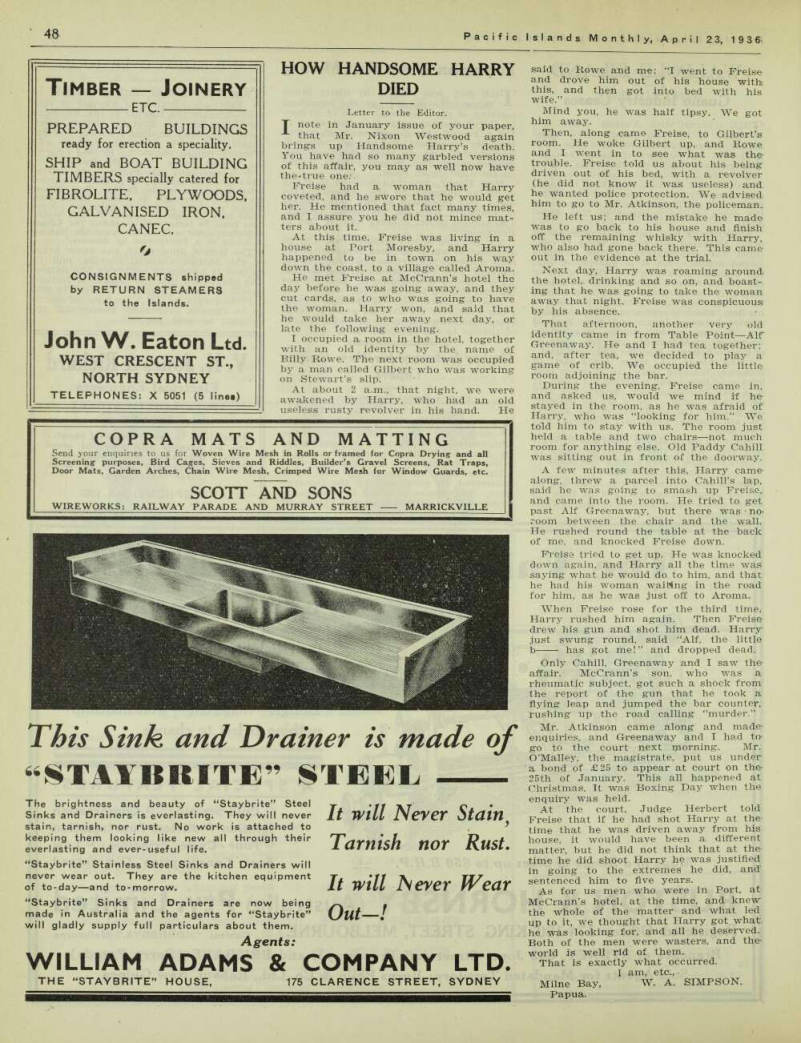
Died
Letter to the Editor.
F note in January issue of your paper, that Mr. Nixon Westwood again brings up Handsome Harry’s death.
You have had so many garbled versions of this affair, you may as well now have the»true one: Freise had a woman that Harry coveted, and he swore that he would get her. He mentioned that fact many times, and I assure you he did not mince mat ters about it.
At this time, Freise was living in a house at Port Moresby, and Harry happened to be in town on his way down the coast, to a village called Aroma.
He met Freise at McCrann’s hotel the day before he was going away, and they cut cards, as to who was going to have the woman. Harry won, and said that he would take her away next day, or late the following evening.
I occupied a room in the hotel, together with an old identity by the name of Billy Rowe. The next room was occupied by a man called Gilbert who was working on Stewart’s slip.
At about 2 a.m., that night, we were awakened by Harry, who had an old useless rusty revolver in his hand. He
said to Rowe and me: “I went to Freise and drove him out of his house with> this, and then got into bed with his wife.”
Mind you, he was half tipsy. We got him away.
Then, along came Freise, to Gilbert’s room. He woke Gilbert up, and Rowe and I went in to see what was the trouble. Freise told us about his being driven out of his bed, with a revolver (he did not know it was useless) and he wanted police protection. We advised him to go to Mr. Atkinson, the policeman.
He left us; and the mistake he made was to go back to his house and finish off the remaining whisky with Harry, who also had gone back there. This came out in the evidence at the trial.
Next day, Harry was roaming around the hotel, drinking and so on, and boast ing that he was going to take the woman away that night. Freise was conspicuous by his absence.
That afternoon, another very old identity came in from Table Point —Alf Greenaway. He and I had tea together; and, after tea, we decided to play a game of crib. We occupied the little room adjoining the bar.
During the evening, Freise came in, and asked us, would we mind if he stayed in the room, as he was afraid of Harry, who was “looking for him.” We told him to stay with us. The room just held a table and two chairs —not much room for anything else. Old Paddy Cahill was sitting out in front of the doorway.
A few minutes after this, Harry came along, threw a parcel into Cahill’s lap, said he was going to smash up Freise, and came into the room. He tried to get past Alf Greenaway, but there was no room between the chair and the wall.
He rushed round the table at the back of me, and knocked Freise down.
Freise tried to get up. He was knocked down again, and Harry all the time was saying what he would do to him, and that he had his woman waiting in the road for him, as he was just off to Aroma.
When Freise rose for the third time, Harry rushed him again. Then Freise drew his gun and shot him dead. Harry just swung round, said “Alf, the little b has got me!” and dropped dead.
Only Cahill, Greenaway and I saw the affair. McCrann’s son, who was a rheumatic subject, got such a shock from the report of the gun that he took a flying leap and jumped the bar counter, rushing up the road calling “murder.”
Mr. Atkinson came along and made enquiries, and Greenaway and I had to go to the court next morning. Mr.
O’Malley, the magistrate, put us under a bond of £25 to appear at court on the 25th of January. This all happened at Christmas. It was Boxing Day when the enquiry was held.
At the court, Judge Herbert told Freise that if he had shot Harry at the time that he was driven away from his house, it would have been a different matter, but he did not think that at the time he did shoot Harry he was justified in going to the extremes he did, and' sentenced him to five years.
As for us men who were in Port, at McCrann’s hotel, at the time, and knew the whole of the matter and what led up to it, we thought that Harry got what he was looking for, and all he deserved.
Both of the men were wasters, and the world is well rid of them.
That is exactly what occurred.
I am, etc,,
W. A. Simpson.
Milne Bay, Papua.
Perth, W.A.
N.G. Airman’s Dash to Perth, W.A.
FOR two days at the end of March, the B.P. liner Neptuna en route to Sydney from New Guinea, was hove to in the open sea off North Queensland while cyclones lashed her in the worst battering northern shipping has ever experienced.
Those two days’ delay meant a race against the clock for Mr. E. J. Stephens, who operates an air line on the N.G. gold fields. Radio messages to the ship from Major N. Brierley, of Western Australia, had emphasised the urgency of Mr.
Stephens being in Perth before March 30.
When the Neptuna entered Sydney Har bour on March 27, the Vacuum Oil Co.’s speed boat raced alongside to take off Mr.
Stephens to catch a Melbourne-bound ’plane. As the launch steadied to the Neptuna’s 10 knots, the helmsman shouted to the airman to jump, but he clung with one hand to the ship and with the other to the launch. Tugged in opposite direc tions, he had a narrow escape from being thrown into the rough water, as a wave drenched him.
The launch sped across to Watson’s Bay where a fast car was waiting. It was 7.50 a.m. —10 minutes before the ’plane left. At Mascot, Holyman’s air liner had its engines running and the pilots were aboard. It was exactly 8, and the 'plane was about to take off, when Mr.
Stephens, still wet from his harbour bath, scrambled aboard.
In Victoria he caught the express from Melbourne to Adelaide, and then took a ’plane across South and Western Austra lia to Perth, arriving late on Sunday, March 29. In little more than a week Mr.
Stephens had covered 7,000 miles.
How Von Luckner Was
Captured
A Daring War Incident in the Pacific
ONE of the most daring adventures of the Great War was recalled vividly the other day by the presence in Sydney of one of the actors in the final scenes of a sea drama, wrote “Look Out” in the Sunday Sun of April 5.
He was Mr. W. Foster, chief engineer of the cable steamer Recorder, which dropped into Walsh Bay from Fremantle, W.A., to wind cable before searching 200 miles out in the Tasman for a faulty cable. Mr.
Foster was present on the same steamer when von Luckner was captured behind Macauley Island in the Kermadec Group at the end of 1917.
Von Luckner in the Seeadler set out on a raiding expedition and had destroyed over £5,000,000 of Allied shipping in the Pacific Islands before his vessel was wrecked on an atoll in the Society Group when trapped by a tidal wave. Von Luck ner with his lieutenant, Kircheiss, and a number of men escaped in a launch and they were captured by the small steamer Amra at Wakaya Island, near Levuka, in the Fiji Group.
Von Luckner and his party were in terned in New Zealand, but they escaped in the prison commandant’s launch and captured the scow Moa. A frantic chase in Hauraki Gulf followed.
“The Recorder was called the Iris in those days,” said Mr. Foster. “I was the fourth engineer. The Iris was in dock at Auckland, undergoing overhaul, at the
time of the escape. She had been fitted out as an auxiliary cruiser with two three-inch guns. As soon as the news came through, the Iris was hastily manned and des patched to search for the Moa.
“After von Luckner had been at large for a week, we arrived in the Fiji Group and could find no sign of our quarry. We began cruising around and after 24 hours we sighted the Moa behind Macauley Island, in the Kermadecs. The scow began to make away and we signalled her to stop. She paid no attention to the signals, however, and a shot was fired across her bows. That brought the Moa around.
“Von Luckner and Kircheiss came across to us in a boat. I was the only member of the crew to have a camera, and I secured some fine pictures. One of my photographs showing von Luckner being searched on the deck of the Iris for arms was published in Lowell Thomas’s book, ‘The Sea Devil.’ ’’
Mr. J. P. Blaikie Webster, chairman of directors of New Guinea Goldfields Ltd., left Brisbane by the Montoro for New Guinea at the end of March. He was ac companied by Mr. T. P. McCulloch, who is also a director of N.G.G. Ltd. After visiting the Morobe goldfields, Mr. Blaikie Webster joined the Neptuna at Salamaua and proceeded to England, via the East.
Advertisements & other items, p. 51 (1 item)
Nelson and Robertson Ltd.
Position Wanted
YOUNG MAN, age 24, single, strictly sober, I.C.S. student Diesel Engines (Marine and Stationary), experienced Islands’ launch driving, open for engagement anywhere—distance no object. References and particulars on application to—
W. W. AUSTIN, c/o. “P.1.M.”
Box 3408 R., G.P.O. Sydney.
Nelson and Robertson Ltd.
ISLAND MERCHANTS - {Established IJ9J)
COCOA BEANS. —Special attention devoted to their sale in Australian and Oversea markets.
COPRA, TROCHUS SHELL, and other Island Produce sold on commission.
All classes of merchandise and Mining Machinery purchased at wholesale prices and original invoices supplied to Island clients. Small commission. Prices submitted for comparison.
SOLE AGENTS FOR
PUMPMOBIL Portable Pumping Plants. Recommended for Sluicing and all Mining purposes. Weight 120 lbs., 12,000 gals, per hour, 10 to 100 feet head. REDUCED
PRICES.
PENTA ENGINES, Utility Outboard and Inboard. Swedish manufacture. Powers 4-60 h.p.
SKANDIA ENGINES, FULL DIESEL AND SEMI -PI ESEL ; all powers, Marine and Stationary.
UPSON BRITISH BOARD. —Wallboard and insulating material in one, strong and light in weight. 6ft. to 12 ft. lengths always in stock.
NELSON AND ROBERTSON LIMITED
12 SPRING STREET, SYDNEY, AUSTRALIA
Telegraphic Address: “Ivan Sydney.”
Solomons Native to Attend S.D.A.
Conference in America
SON of a former head-hunter in the Solomon Islands, Kata Rangoso, an ordained native minister, arrived in Aus tralia by the Malaita on March 27, accompanied by Pastor N. A. Ferris, dis trict director in the Solomons for the S.D.A. Mission Society.
Sailing for the United States by the Mariposa on April 29, they will attend th e world conference of Seventh Day Adventists in San Francisco in May.
Rangoso will report on the advancement of mission work in the group.
Barefooted, bareheaded, and attired in his native costume, the Solomon Islander attracted some attention in Sydney, which he had previously visited last year, Mr. Ferris and Rangoso will return to the South Seas about August.
Embarrassing Surplus in
New Guinea Pertinent Questions and a Grim Answer
WHEN Mr. F. H. G. Simcocks, who had been Acting Treasurer in New Guinea for the past year, arrived in Sydney on March 17 he made statements to re porters about the finances of the Terri tory which apparently caused the Com monwealth Government some embarrass ment.
Mr. Simcocks (according to the news papers) said that the Territory faced the problem of having too much revenue — largely the result of the rapid develop ment of the goldmining industry. The Administration was spending this grow ing surplus on developmental works — last year it carried out an £BO,OOO works programme—but still the surplus grew.
At the end of the last financial period there was an actual surplus of £65,000.
Taxation had been reduced to a mini mum, and the agriculturists had been freed from taxes altogether.
The following day questions were asked in the Federal Senate. Senator E. B.
Johnston wanted to know whether there was not a 10 per cent, duty on mining machinery and a 5 per cent, royalty on gold production in New Guinea.
The question, of course, was inspired by the fact that certain large goldmining interests in New Guinea have been pro testing strongly about the taxes referred to by the Senator. The statement of Mr.
Simcocks provided those interests with useful ammunition.
Senator Sir George Pearce (Minister in Charge of Territories) said that Mr. Sim cocks’s statements were merely his per sonal opinions. Still, the taxes referred to by Senator Johnston would be ex amined.
The Opposition Leader (Senator J. S.
Ceilings) asked Sir George if he would consult with Mr. Simcocks with the ob ject of bringing about a similar excess of revenue in Australia.
Sir George Pearce (grimly); I do not propose to confer with Mr. Simcocks, but I can assure you that somebody else will.
Fiji’S New Governor Will
Arrive In October
From Our Own Correspondent SUVA, March 25.
T ATEST advice received by the Gov ernment states that the Governor designate of Fiji, Sir Arthur Richards, formerly Governor of Gambia, who is to succeed Sir Murchison Fletcher, will arrive in the Colony towards the end of October.
Mr. O. C. K. Corrie, Senior Puisne Judge of Palestine, who has been ap pointed Chief Justice of Fiji in succession to Sir Maxwell Maxwell-Anderson, is due to arrive here in July.
Mr. R. H. Brown, manager of Burns Philp (South Sea) Co. Ltd., at Apia, Western Samoa, left the territory during March on four months’ furlough. After spending some weeks in New Zealand with his family, he paid a visit to Australia, arriving in Sydney by the Monowai on April 6. During Mr. Brown’s absence, Mr. W. E. Links will be acting-manager.
Advertisements & other items, p. 52 (1 item)
Bitumenoid Roofing
MADE IN AUSTRALIA
Bitumenoid Roofings, Dampcourses and Insulating Felts are made from the world’s best raw materials. Warranted to stand the most rigid tests.
BITUMENOID THE BEST
Roofing, 1,2, 3-ply; Flooring, Waterproof Materials; Saturated Felt; Resilient Road Jointing; Natural Asphalt Dampcourse; 2 and 3-ply Dampcourse; l-21b. Lead-core Dampcourse; Roofing Cement; Asphalt Paints; Roofing Compound.
SAMPLES AND PRICE LISTS ON APPLICATION.
MAXWELL PORTER & SON LTD.
ESTABLISHED 1888. BUILDERS’ SUPPLIES
107 REDFERN ST., REDFERN, SYDNEY, N.S.W. ’Phone, M 3157. Cables: Bitumenoid
The
“Caledonia Dover”
A COOKING STOVE guaranteed to give complete satisfaction and now recognised as THE BEST on the market. Suitable for coal, coke or wood fuel.
Illustrated Catalogue on request.
LANE & GIRVAN, LTD.,
BONNY BRIDGE, SCOTLAND.
By using this Economical, Fire Retardant and White Ant Proof building material for External and Internal Walls and Ceilings, you can build a comfortable and durable Bungalow Home AT LOW COST! "FIBROLITE" is easily and quickly erected. No waste. Less labour. No painting. For full information, write tor illustrated "Fibrolite" Booklet F. 6 FREE AND POST FREE!
JAMES HARDIE & COY. LTD.
ASBESTOS HOUSE, YORK STREET. SYDNEY, N.S.W.
(Box 3935 V., G.P.0., Sydney)
Safety At Sea
Automatic Distress Transmitter For Small Ships
A NOTEWORTHY advance in the safety of life at sea was made when regula tions came into force on April 1 requiring all sea-going shipping in N.S.W., with a few minor exceptions, to carry wireless equipment. Similar regulations respecting Victoria and Queensland are already opera tive.
International regulations require all ships over 1600 tons or any vessel carrying more than 12 passengers to be fitted with wireless. Theoretically it was as easy to fit radio on a small schooner as on a large liner. A practical difficulty arose, however.
It was not easy to find accommodation on a small ship for wireless equipment and for an operator who would have no ordin ary messages to handle and might never have to transmit the S.O.S. signal.
Three years ago an invention was made within the Amalgamated Wireless organi sation which surmounted this difficulty— the automatic distress signal transmitter.
The device is quite simple, sending out, by means of a gramophone-like disc record, the S.O.S. together with the name of the ship, the position being given by an addi tional attachment which can be set within less than a minute. Prolonged experiments perfected the apparatus, and it was recog nised that this was the solution of the difficulty of equipping small vessels with wireless.
This new apparatus should be particu larly useful in the Pacific Islands where navigation at the best of times is a hazard ous undertaking.
Isolation
Plea For Continued
What Air Service Would Mean to Manihiki
From Our Own Correspondent
Rarotonga, March'22.
SPECULATIVELY mooted last month in a New Zealand newspaper was a sug gestion that the near future might see the establishment of a commercial air-base on the island of Manihiki, Cook Is. The sug gestion was made in connection with ten tative proposals for a British-controlled service between N.Z. and Vancouver to compete with the American-owned Pan- Pacific air Clippers.
Just what such a base would ultimately mean to the 700 inhabitants of this coral excrescence is hard to estimate. Primarily it would stand for the coming of Civilisa tion with a capital C —the erection of a wireless station, hangars, workshops and quarters for a handful of Europeans.
Trans-Pacific passengers would come and go. Materially the islanders would prob ably derive some small benefit from all this. Mentally they would gain nothing.
The even tenor of their lives would be lost almost overnight—and forever, swept away by an avalanche of new ideas, con ceptions and values.
First probably to go would be the now powerful influence exerted by the various Missions. Contact with a modern sophis ticated world would kill it immediately.
Simultaneously the old native life of the island would undergo a rapid transforma
tion; simple pleasures would lose .flavour, old customs their meaning. A new money sense would develop but not be able to keep pace with earnings, so that happiness which is based not on what one has but on what one desires, would soon become a pale elusive ghost.
The world forges ahead. Competition swings us ever to fresh heights of endeav our, of invention. Profits rather than, ethics dictate men’s actions. To protest against the onward march is reactionary— unpatriotic. It is therefore too much to expect that the lonely atolls of the South Seas will be left as they now are, the last hiding-places of human happiness, peopled by kindly simple folk who have only re mained thus through their blessed state of isolation.
No man has the right to take away from another that which he cannot restore and for the sake of a day or two saved on an ocean crossing the imposition of our own fretful worries and selves upon these scat tered minorities, the price is too high.
But just the same it will doubtless come about in the not too-far distant future.
Mr, W. A. Freeman and Mr. C. A. Banks have been re-appointed President and Managing Director respectively of Placer Development Limited, for a term of five years.
Mr. F. O. Greenwood, of Messrs. Green wood and Laws Limited, of Rabaul, New Guinea, arrived in Australia on business by the Neptuna on March 27. He was accompanied by Mrs. Greenwood, and will remain in Sydney for two months. During his absence, Mr. E. W. Lins is in charge of the firm at Rabaul.
Advertisements & other items, pp. 53-54 (1 item)
Tilley
ISLAND SHIPPING
Freight, Forwarding and Customs Service. Import and Export.
B. R. Wheeler 17-19 Bridge St., SYDNEY Correspondence Invited. Tel.: B 5396
FOR BRILLIANT LIGHTING
USE
TILLEY
KEROSENE VAPOUR LAMPS AND LANTERNS
300 candle-power Light of 6 hours for Id.
To those living in the Pacific Islands, modern science now offers a new form of lighting in place of the old-fashioned methods. Tilley Lamps and Lanterns give you the best possible light at a minimum cost. British made throughout of the finest workmanship and designed to withstand rough usage. Absolutely safe and cannot explode. They burn ordinary kerosene under pressure, and are preheated by the same oil so that only one fuel is necessary. The Kerosene Lighter draws its oil supply from the container of the Lamp itself, and does away with the use of methylated spirit.
Give a brilliant illumination of 300 c.p. at a cost of Id. for 6 hours, without attention other than occasional pumping.
Obtainable throughout the Pacific Islands from the Branches of’
BURNS PHILP & CO., LTD., and
BURNS PHILP (SOUTH SEAS) CO., LTD.
Also obtainable from W. KOPSEN & CO. LTD., Clarence Street, Sydney If any difficulty, please write direct to: THE TILLEY LAMP CO. (Dept. P.M.) HENDON, LONDON, N.W.4
No Wicks
No Chimneys
No Smell
Draught Proof
Insect Proof
British Made
Throughout
T.L. 10 TABLE LAMP.
The Tilley Table Lamp with its clear. white, steady light shows your room to the best advantage, as well as banishing eyestrain when reading or doing needlework. No smell or glare. Does not flicker when standing in a draught. Made throughout in lacquered brass and fitted with opal shade.
Free from danger and cannot explode even if overturned.
P.L.54 STORM LANTER
Tilley Lantern is invah able for all outdoor worican be hung up, stoc down or carried aboi just as required. Wi burn steadily anywher unaffected by weathe however severe, bein wind and rain-proo Strongly made of bras No parts to rust, corroc or get out of order. G< rid of all antiquated d< vices and use this up-tc date lantern.
SAMUEL RUSSELL
ESTATE AND GENERAL AGENT
P.O. Box 64, Papeete, Tahiti
Real Estate. Investments. Estate Management and Administration. Valuations and Reports. Houses & Lands for Lease or Sale.
Sole Proprietor: TAHITI PERFUMES.
Cables: Russell, Tahiti (Bentley’s Code)
GP kGP
FIRST
IN 1868
FITZROY B WANNED HUTS
STILL
BEST IN
1935
SPICED, CORNED. ROAST
& BOILED BEEF
AND IN MUTTON
IN 12 or, 11b., 2 lb., 3.1 b.. 41b.
SlL.S'frlb ROUND
CANS AND IK TAPERS
FITZROY
SHEEP
TONGUES
CORNED CX TONGUES - BEEF & PORK S4USAOEX
FITZROY
I PLuwcMow&tT?
P«L B Kf
THE ORIGINAL. PACK IN A CLASS BY ITSELF
ALSO THE EAMOUS
AV ROUND AND TAPER CANS
C•<D• M • E, CO. HUD.
BERSERKER & jjHIS| OXPALH BRANDS
tNevepv axe. p pom Itgnrmaijrcra /z oz ro 6ta cans NO &XTR.A CHANCE FOR, AS S O R.T MtNT PACKED CASES ©R CARTONS - SEND IFOR PRJCE LBSTF
HAMPER MEATS
fZOZ. 2+0Z.6GL83
DSLANID TRADE MEATS
Dt* CENTRAL QUEENSLAND MEAT EXPORT CO. LTD.
LAKES CREEK ' ROCKHAMPTON
CABLE ADDRESS;- TOMOAMA ROCKHAMPTON. ■
Spinsters’ Ball at Wau
From a. Special Correspondent.
WAU, March 2.
ON Saturday, February 29, a number of ladies, under the secretaryship of Miss E. F. Kerr, held what they termed a Spin sters’ Ball, It was a great social success.
The function, which was the first of its kind in Wau, took place in the Wau Club Hall. About 200 guests were present, from all parts of the goldfield.
Mrs. M. E. Thompson, of the Methodist Mission in Tonga, sailed for Fiji en route to Nukualofa by the Swedish steamer Tolken on April 2.
Brought Peace To
Samoa
Work of Dr. Solf, First German Governor
Contributed By R. P. Berking
T\R WILHELM SOLE, who was the first German Governor of Samoa, died in Berlin in February, aged 73. During his 11 years in the South Seas, he teas a wise and able Administrator, ruling Europeans and Saynoans in a just and impartial manner.
The follounng account of Dr. Solfs work has been written by Mr. R. P. Berking, a well-known planter of Apia, who was a member of the German administration and for some years Collector of Customs at Apia.
CONNECTED with the name of Dr. Solf is a decade and more of the history of Samoa. He was the first German Governor —in fact, the first Governor Samoa ever had, as under the Tripartite Government right up to 1900 the native population was torn and divided by civil wars.
When the German flag was hoisted in Mulinuu on March 1, 1900, local war clouds darkened the sky. Right then and there Dr. Solf had to show that he was competent to rule the unruly. He suc ceeded by his personality and ability to beat the Samoan Chiefs and orators at their own game—talking. One attempt after another by some party to gain superiority was broken up, not by military force, but by the power of his eloquence.
Laws to bring about a greater revenue for the natives—such as the compulsory planting of coconuts every year—were not only made, but also enforced. Natives and whites derived the fullest benefit of the newly established and lasting peace and they settled down to work and develop ment. Lands were opened and settled with numerous families from the Old Country and the Colonies. Once established, even the dissatisfaction of one clique of planters, who wanted the natives to work for next to nothing, could not hold up the steady progress; and trade and traffic improved and increased.
These new conditions were considerably helped along by substantial subsidies granted by the German Government upon the request of Dr. Solf up to 1907, when Samoa became self-supporting. These sub sidies were gifts to Samoa and were not to be repaid later. After 1907 every yearly surplus was utilised by the Government for extra public works and improvements.
Although Samoa was a German Colony, residence and business were in no way restricted to German nationals. Every thing was done to draw British and foreign capital and settlers into the country. The Governor’s Council consisted of appointed members, and always two were of British nationality. All worked together in real harmony. Dr. Solf set about to make all classes of settlers and all nationalities feel at home in Samoa and to this purpose left no stone unturned. That he was success ful was proven later.
One of Dr. Self’s prominent abilities was to size up character and efficiency in men.
It was he who appointed and upheld the late Richard Williams as a Magistrate for Native Affairs for Savaii against violent opposition from Berlin; because in Mr.
Williams he had discovered that rare ability to govern natives solely by per sonal influence and without a display of force.
About the most important step in the history of Samoa, besides abolishing the Kingship, was the creating of the Lands and Titles Commission. This was estab lished under the leadership of the Chief Judge, Dr, Schultz (who was an eminent authority on Samoan customs and folk lore) with Mr. Williams, Mr. N. H. Mac- Donald (surveyor) and the late Mr. A.
Haidlen (Government Surveyor) as co judges and assessors.
Anyone conversant with the character and ways of the Samoans will know that very often over a slight and paltry pro vocation the fiercest of fights is started.
By putting all claims for titles and lands before this commission, Dr. Solf took the sting out of many a move, which surely would have resulted in serious trouble.
The work performed by those gentlemen (three of whom have passed beyond) cannot be lauded highly enough.
With an Irishman, Mr. Williams, as his adviser in Native Affairs, a New Zealand- Scotchman, Mr, N. H. MacDonald, as co judge in the Native Land Court, and lastly with another Irishman, Abner Duffy, as nightwatchman of Apia, Dr, Solf did well.
By selecting efficient men from the ranks of settlers for important Government posi tions, Dr. Solf established a liaison between population and Government, which helped greatly to make this far-away German Colony an example worthy to be followed by even the old highly reputed Colonisers.
He continuously impressed his officials with the necessity to help the inhabitants to overcome the difficulties of the law, and refrain from building up obstacles, which they are so fond of setting Up around their austere bodies. Foresight, insight and a sincere desire to understand a situa tion, these were his leading ideas, and had these been followed during later years much unpleasantness would have been saved Samoa.
One thing which marred the successful ending of Dr. Self’s office in Samoa was the Lauati rebellion. Lauati, the highest orator of Samoa, apparently not satisfied with the quiet and steady life, which Dr.
Self’s administration handed out to every body, stirred up strife and created opposi tion openly against Mataafa, but in effect against the Government.
For a little while things looked dangerous, until the warships arrived from China, which Dr. Solf ordered. Then one of the results became apparent of the friendly working together of Governor and governed. From all sides offers came in to give ready assistance and the different missions established in Samoa vied with each other to help in putting down a state of affairs which might easily have led to bloodshed.
I cannot omit to mention the valuable work the late Captain E. F. Allen per formed with his s.s. Dawn. One fine Sun day with Dr. Self’s A.D.C. he went to Manono, secured Lauati and took him back to Vailima, so that Dr. Solf could have it out with him face to face. Finally Lauati was deported to Saipan, Mariana Islands, with his followers, where after a few years he died. It is very remarkable that Lauati’s followers on their return to Sa moa, after the outbreak of the Great War, expressed publicly their full appreciation of the justice that had been dealt out to them by Dr. Solf.
In September, 1910, Dr. Solf left Apia for home service, and it did not take the resi dents of Samoa long to find out that they had lost their best friend. He was pro moted to the position of Secretary for the When I saw him again early in 1914 in his office, Samoa was foremost m his heart. He immediately cancelled two important meetings with representa tives of South-west African diamond in terests so as to be able to have a long talk about his “Pearl of the Pacific.”
Advertisements & other items, p. 54 (1 item)
52
Monthly, April 23, 1 93 «
Pacific Island
Death of C. I. Resident Agent.
From Our Own Correspondent
Rarotonga, March 22.
Captain John Mcculloch, Resi
dent Agent for the two northern Cook Islands of Manihiki and Rakahanga, died on January 17, following a three days’ illness.
Born at Edinburgh in 1877, Captain Mc- Culloch came to the Islands shortly after the turn of the century. Off and on, since 1910, he was connected with the Adminis tration, his first post being in that year as R.A. for Aitutaki. During the War he returned to the sea and for a time commanded the well-known schooner Doris Crane, trading out of ’Frisco.
Back again in Cook Is., he held the post of local manager of the C.I.T.C.’s Mauke branch, which he later relinquished to run his own plantation on Aitutaki. Rejoin ing the Administration in 1934, he was appointed to Manihiki, where his death occurred.
Mr. R. A. Colyer, of Messrs. Colyer, Watson and Co. Ltd., of Sydney, who recently arrived in Rabaul by the Malaita, joined the Friderun there for the East.
He will later journey to the United States of America and Europe.
Advertisements & other items, pp. 55-56 (1 item)
Peel £R Sons
PURE RICE
STARCH
Always ask for . . .
“CORAL” Brand
100% PURE
Noted for its
QUALITY
and
WHITENESS
Goes Farthest and gives Lasting Finish
WILL NOT
STICK TO
IRON
Obtainable from Leading Island Stores Manufactured by
AUSTRALIAN RICE LTD.
Sydney, N.S.W. %
CORAL BRAND
rice'starch
WE ARE SPECIALISTS!
Let us have your confidence, sixty years is our record of supplying the Leading Houses throughout the World in—
FRESH FRUIT VEGETABLES PRODUCE
WEYMARK & SON LTD.
Fruit and Produce Merchants
14-18 STEAMMILL STREET, SYDNEY
Phones: MA 3612 Cable Address: Codes—Bentleys. (4 lines) “Weymarkson” Private.
H 93
PEEL £r SONS
FI fH
IMPORTER/
& EXPORTERS
QUOTES
SENT
ANYWHERE
Phones; MW 1603 FX 5011 Purveyors of Scotch, Canadian, N.Z. and Australian
Fresh and Smoked Fish
SHIPPING 239 HARRIS ST., PYRMONT
mill PROVEDORES SYDNEY, New South Wales
Kork-NSeal
FOR ALL HOME BOTTLING - THE
LITTLE CAP THAT WILL RE-SEAL
1,000 TIMES
KORK-N-SEAL (Aust.) Ltd.
106 COMMONWEALTH STREET
SYDNEY, AUSTRALIA
FOR HOME USE
Applied Airtight Pressure Hand Proof
Woven Wire fo All Industry
COPRA DRYING TRAYS, FLOORS. Etc.
FRUIT DRYING TRAYS, MINING SCREENS
Heavy Mosquito Gauze in Phosphor Bronze and Other Metals Impervious to Salt Sea Air WIRE DOOR MATS AND GENERAL WIRE WORKS
E. WRIGHT «fc CO. LTD.
Office and Works: 148-152 Cleveland St., Sydney, N.S.W.
Telegraphic Address: “Wrightmake,” Chippendale. f- Or o' £ rO f*u &
LINK-BELT CO. LTD.
17 GOULBURN STREET, SYDNEY
O 1 £.
Centrifugal
Discharge
Bucket Elevator io Modern Machinery Equipment for Elevating, Conveying and Mechanical Handling of Material.
Sole Agents in Australia for Ewart Chain Belting in Malleable or Steel.
Specialists in Power Transmission Machinery.
Large Stocks always kept of Steel Shafting, Cast Iron, Steel, or Wood Split Pulleys.
Plummer Blocks, Collars, Couplings, Leather Belting, Hangar Bearings.
Lubricators, Engineers’ Wrenches.
MANUFACTURING ENGINEERS
Patrol Boat For North
A NEW patrol boat for the north arrived from England in March, and has undergone successful trials in Sydney Harbour. It will be stationed at Darwin to patrol the Timor Sea in co-operation with the Darwin-Singapore air mail ser vice.
The launch is 45ft. long, with three 100horse power petrol engines. It is equipped with w'ireless, and has a cruising speed of 19 knots an hour, with a maximum of 26 knots. Complete with spares, the boat cost £6,000 f.o.b. London.
Sydney firms have examined the patrol launch to see if they could build similar vessels. The type of boats which are to operate from Thursday Island and New Guinea will be considered on the exper ience of the English launch.
Mr. F. N. Ashley, Resident Commis sioner in the Solomons Islands, arrived in Sydney by the Malaita on March 27, with his wife and daughter, Marjorie. They left the following day for Melbourne by the Merkur to join the liner Oronsay for England. Mr. and Mrs. Ashley will return to Tulagi from England at the end of the year, leaving Miss Ashley with her grand mother at Surrey,
Charles Ward Is
Dead
Hero of Cook Is. Flag Incident
From Our Own Correspondent
Rarotonga, March 23.
CHARLES JAMES WARD, the man who was associated in romantic fashion with the raising of the British flag in the Cook Islands, died on Friday, March 6, aged 80 years, after a long and painful illness.
An account of Mr. Ward’s adventurous life, and of the flag incident, was pub lished recently in these columns.
To Rarotongans—so long familiar with his homely figure—a familiar human landmark has been removed. He was typical of a now forgotten generation of Island traders, and his passing stands for the severance of a definite link with the past. Representative of all that was best in these old-timers, Charlie Ward has gone to join the forgotten hundreds of men whose bones are bleaching in the coral sand of a hundred islands, and whose only memorial is the systematised trade-routes which now span the Pacific.
To this company, in some far-off Fidd lers’ Green, one likes to think of “Old Charlie’’ paddling his lone canoe, an old, old man, setting out alone on his last rahui, steering quietly and certainly across the great lagoon of life towards the sunset shadows of all his yesterdays.
Buried with full military honours in the L.M.S. churchyard at Avarua, under the flag which he was largely responsible for having had hoisted over these Islands, Charlie Ward lies within sound of the surf that he loved so well, and above his grave the palms rock royally to the long clean sweep of the trade-wind.
Good sleep to him!
N.G. Native Receives
R.H.S. Bronze Medal
From Our Own Correspondent
Thursday Is., March 2.
ON behalf of the Governor of Queens land, Alderman A. Corran, Mayor of Thursday Island, has presented the Royal Humane Society’s bronze medal to a New Guinea native, Tabu Hero, who is em ployed by Messrs. Farquhar Pty. Ltd. of Thursday Is.
The conspicuous bravery was car ried out in the cyclone of March two years ago off Cape York Peninsula, when Tabu Hero saved several other seamen whose luggers had foundered. The party swam for no less than 31 hours, and after vainly endeavouring to land on Low Island, eventually reached the shore at Cape Tribulation. From there Tabu walked 15 miles to obtain help for his com rades, none of whom had eaten for three days.
Mr. C. H. Karius, Assistant Resident Magistrate in the Papuan Administration, arrived in Sydney with his wife by the Tanda on March 27. On short leave, they made the round trip from Rabaul to Japan: and have now taken a flat at Elizabeth Bay, Sydney, where they will spend the remaining five weeks. Iji April, 1929, Mr. Karius received the Royal Geo graphical Society’s medal in recognition of his journey with Mr. Ivan Champion up the Fly River, Papua, and across New Guinea to the coast, via the Sepik River.
New Guinea In The Limelight
New Shipping Law Must-Stand—Schmidt Is Hanged Amid Political Clamour-Possible Imperial Background to Air Merger Plan
¥EW Guinea, during the past month, has received an extraordinary amount of limelight. Its affairs on a number of occasions have received the conspicuous attention of the Commonwealth Parlia ment and of the newspapers. There were three matters which stirred public in terest in Australia, namely:
1. The New Shipping Bill
The amendment to the shipping law, in its application to shipping within the Territory of New Guinea, was referred to in the last issue of this journal. We then described the changes that were contem plated and stated the arguments for and against the new law. We said at the time that, although an agitation against the new ordinance was proceeding in Australia —and also in New Guinea—this agitation appeared to be a waste of time as, in our opinion, the thing was fait accompli. This had been indicated by the manner in which it was introduced and presented.
This proved to be the case. The Aus tralian Prime Minister (Mr. J. A. Lyons), in reply to numerous protests, said sim ply that the whole matter already had received the most careful consideration qf the Government, and that a policy had been formulated with a full sense of re sponsibility; and the Government was quite prepared to stand by that policy.
That was the end of the matter. There is much dissatisfaction in the Territory and elsewhere; but apparently nothing is to be gained by further agitation.
The new shipping law will not operate in New Guinea until about the end of this year; an&, presumably, until then, the N.D.L. ships and the Burns, Philp ships will continue to call at non-Customs ports, as heretofore. The Federal Gov ernment has now invited tenders for carrying mails and performing other essential services, to close on August 31.
This, of course, will represent the con tinuation of the contract which has been held for so many years by Messrs. Burns, Philp & Co. Ltd., which expired nearly two years ago; and which has been carried on since by Messrs. Burns, Philp and Co. Ltd. under a series of short pro forma extensions. It is presumed that Messrs. Burns, Philp & Co. Ltd. will be the only serious tenderer: but it is quite possible that some other organi sation will enter the field. The whole position, of course, is complicated now by the important aviation developments, to which reference is made elsewhere.
There have been long discussions on the matter in the Federal Parliament, and elsewhere, and a summary of same is published hereunder
2. The Hanging of Ludwig
Schmidt
It was reported in our last issue that Ludwig Schmidt, after trial in Rabaul, had been convicted on three separate charges of murder of natives in the Sepik area in New Guinea, and that the sen tence of death had been imposed in each case.
The sentence was confirmed by the Ad ministrator and, presumably, by the Fed eral Government—although the latter confirmation is not necessary. When it w’as realised in Australia that a white man was to be executed in New Guinea there was a considerable stir in Labour’s political circles. The Labour party, as is well-known, is opposed to the death sen tence as punishment for murder. There have been so many brutal murders com mitted in Australia lately that it looks as if the Labour party’s non-execution
policy is going west —but that is another matter. Labour, however, made a most determined effort in the House of Re presentatives at Canberra to prevent the execution of Schmidt, and the House dis cussed the matter for some hours.
The Government, however presum ably after consultation with Rabaul —was quite firm in its determination not to in terfere with the carrying out of the death sentence, and Schmidt was hanged on March 23.
If ever the execution of a European murderer was justified it was in this case. The evidence that he had been guilty of most brutal and callous killings was overwhelming. There has been too much of that kind of thing in recent years, in the more remote parts of New Guinea, and it was time that the white man’s law asserted itself. It was a dread ful decision which had to be made by the judge and confirmed by the Adminis trator; but every man who recognises the nature of Australia’s responsibility in New Guinea will agree that the course which they followed was necessary, proper, and completely justified both on legal and moral grounds.
A summary of the discussions in Aus tralia will be found hereunder.
3. Proposed Aerial Merger
After the strong protest which had been made by a public meeting in Wau against the plan to bring about what was a merger of aviation transport interests in New Guinea, under Government super vision, there was a complete official silence; and it was assumed in some quarters that the plan was dead.
Some colour was given to this by a statement made in Parliament at Can berra by the Minister for Defence (Mr.
Archdale Parkhill) on March 24 in reply to a question by Mr. Roland Green.
Mr. Green asked: “Is it the policy of the Civil Aviation Department to force the air services in New Guinea to merge into one company?”
Mr. Parkhill replied: “It is not the policy of the department to force the companies operating into New Guinea into a merger.
Suggestions were made from New Guinea itself that, in view of the importance of aviation there, certain steps were ne cessary to organise the existing services.
The proposal was made that some kind of merger should take place, but the Government is not committed to any policy on the matter. As the local people
are being consulted, and as suggestions are being made with regard to licensing, which may be adopted instead of a merger, the whole matter is under con sideration, and the views of local opera tors and others in the territory will receive the fullest consideration before definite action is taken.”
The general position was wrapped in doubt and uncertainty until the first week in April. It had been said that the Federal Government’s wish to secure a merger was induced by certain important Imperial considerations; but the critics in New Guinea apparently did not take this suggestion very seriously.
Early in April, however, a most in teresting report was published. It then appeared that New Guinea may be vitally concerned in the proposed re-organisation of the air mail service between Australia and London. The Sydney-Singapore section of this service has been carried out by Australian land planes; and for months a somewhat acrid argument has been proceeding between Australia and Britain concerning Imperial Airways’ desire to replace those land planes with the large flying boats which Imperial Airways are now building. Australia argued that for the Sydney-Darwin sec tion at least land planes were essential.
But it is now suggested that it is pro posed to abandon the present route between Sydney and Singapore (a large section of which is over the Dutch East Indies), and to inaugurate instead a route serviced by sea-planes which will run from Singapore to North Borneo, thence south-eastwards through the Moluccas to New Guinea (presumably the Madang- Morobe Goldfields region), and thence southwards across the thin end of Papua to the Australian coast, and southwards along the latter coast to Brisbane and Sydney.
This new route would have manifest advantages. It would be nearly all over British territory; it would permit the complete use of flying-boats, which have very great advantages over land planes; and it would eliminate much waste fly ing over the barren centre of Australia and over foreign territories. The develop ment of such a route, of course, would add greatly to the economic value of Papua and New Guinea. The linking of the Imperial Airways route with New Guinea would affect the aviation trans port position in New Guinea; and possibly that is a main reason at the back of the aerial transport merger plan.
This important new development is dealt with elsewhere; while hereunder will be found a summary of various dis cussions which have taken place on the aerial merger. —
(Continued on next page)
Advertisements & other items, pp. 57-58 (1 item)
These light steel ploughs..
UMBRELLAS
ONLY BRITISH FRAMES USED
Guaranteed FAST DYED Coverings Strong Canvas-Covered Beach and Garden Umbrellas in Medium and Large Sizes —Brass Fittings Throughout.
“Shelta” Brand Umbrellas
Specially made for Tropical Conditions Manufactured by Inquiries invited from
Phillips and
House
453 Kent Street
SYDNEY
428 Adelaide St.
BRISBANE
Pacific Islands Distributor* We supply the trade only.
DOYLE’S famous VETERINARY REMEDIES
tfOYLfc
ORES
REDUCINE —Cures Your Lame Horse. Cures him painlessly and you can work him all the time.
Cures Splints, Curbs, Capped Hocks, Sprung Tendons, Bog Spavins, and all Bony and Bursal Enlargments. Price, 12/6 per can. Postage 1/-.
LARYNGINE'—A sure cure for Coughs, Colds, Strangles, etc. Price, 5/- per can. Postage, 1/-.
SKIN DRESSING.—A certain remedy for Mange and Allied Parasitic Skin Diseases in Horses, Dogs, etc. Price, 7/6 (large), 3/6 (small). Postage, 1/-.
DISTEMPER MIXTURE.—A safe and reliable remedy for Coughs, Colds, Asthma, etc. Price, 2/6. Postage, 9d.
T. G. DOYLE, V.S., 9 KING STREET, RANDWICK, N.S.W.
Write for Free Veterinary Advice and Booklet
These light steel ploughs..
are made in 3 widths: 7in., Bin., 9in., 10in., and 1 1 in. cut.
These ploughs will do good work in new or old land. Ample clearance is provided for ploughing in thick surface growth.
Made by: Ransomes, Sims & Jefferies Ltd.
Ipswich, England Write for illustrated Catalogues and all information.
Morris, Hedstrom Ltd.
Suva, Lautoka and Ba.
ansomes
“CUB” PLOUGHS
U. 91. REID
C/o. Robert Reid & Co., Ltd.
32-34 YORK STREET, SYDNEY
Wholesale Exporter of Goods of all Classes from Australia
PAINT
HORSE SHOE BRAND
IN PASTE OR READY
MIXED FORM
WHITE LEAD, WHITE ZINC,
AND ALL COLOURS
Made in Scotland— Thomas Mcintyre & Co. Ltd., —therefore Reliable!
GLASGOW. SCOTLAND
Don’t keep a Cockroach Farm . . .
DEATH TO COCKROACHES!
Let
BLATTACIDE rid you of the pest. Nonpoisonous. Never known to fail, no matter how badly infested. Guaranteed to be absolutely harmless to children and domestic animals.
BUY A TIN NOW- - DON’T DELAY Obtainable at — Messrs. Burns, Philp & Co.
All Stores For over 25 years, Burns, Philp & Co. have been our Sole Distributors in the Islands.
SOLD IN 9oz. & 16oz. TINS
Any difficulty in obtaining, write direct to BLATTACIDE CO. 49 Clarence Street, Sydney, N.S.W.
IATTACIot
TMI
COCM»OACHCS
Rues Ml
f RMI"
C=r
1
Hif/I
RESISTS CORROSION. STRONGER THAN STEEL
EASILY WORKED, CANNOT RUSJ~
f or
SALT WATER TANKS,
PROPELLER SHAFTS
MOSQUITO GAUZE, MARINE HARDWARE
Full information gladly from the Australian Distributors WRIGHT & COMPANY, 81 Clarence St., Sydney ★ MONEL METAL is a Registered Trade Mark Cables: “CORNRIGHT,* SYDNEY
Debates On New Guinea Affairs
THE New Guinea shipping bill was de -*• bated at some length in the Federal House on March 18 as a result of an ad journment moved by Mr. A. Blain, who is the non-voting member for the Northern Territory.
Mr. Blain was extremely critical of the bill. He said that the development of New Guinea, as of the Northern Terri tory, depended on the maintenance of a service of tramp steamers that would go anywhere; that the planters, outside those bound to the trading companies, unanimously desired the continuance of the German service; and that the New Guinea Legislative Council itself in 1934 resolved in favour of freedom of ship ping. He said that the new bill had been introduced in New Guinea by hole-and corner methods, and that it necessarily gave offence to Germany. The bill had been passed by official members on the direct orders of the Federal Government —yet no reason was given for this most undemocratic action. The planters who resisted the bill were returned soldiers who would be the last to ignore Imperial interests. The removal of the German service would reduce copra prices and in crease transport costs against the small isolated soldier-planters and would strike what possibly would be a death-blow at this section of an important New Guinea industry.
The Federal Treasurer (Mr. R. G.
Casey) said that New Guinea was simply being brought into line with practically every other country in the world, which confined the trade of its own out-lying territories to its own ships. The Germans were not being debarred from the terri tory; they were simply being confined to a considerable number of proclaimed ports—probably six or seven. Tenders for the service between Australia and the main ports of New Guinea had been invited and “the Government proposes that there shall be a specified inter-island and inter-port service, and tenders for that will be called soon. In the mean time and before the inter-island and inter-port service becomes fully estab lished the new ordinance will be in sus pense and existing arrangements will continue.” There had been a considerable fall in freights and fares during the past five years, and the Government was de termined that the present low level would be maintained—by proclamation if neces sary. Any dispute arising in this mat ter would be settled by a committee of re ference consisting of a chairman ap pointed by the Administrator, one repre sentative of each shipping company con cerned, and the planters.
Mr. Curtin (Leader of the Opposition) said it was of first importance that they should have the complete assurance that a penalty was not being imposed upon the New Guinea community. Privileges were to be conferred upon the shipping com pany controlling this service which allowed them to dominate the trade and commerce of New Guinea. The House should be given evidence that the course which the Government was following in forcing these new conditions upon the territory was necessary, and furthermore that the interests of the New Guinea planters and traders were really being safeguarded. Mr. Curtin proceeded t o argue that the company which was to re ceive special privileges “has for years systematically and unjustly used its privileges to the detriment of traders on islands other than those which are served
by ships which it controls.” He urged the appointment of a Select Committee to investigate the whole position.
Sir Charles Marr said that certain as pects of this matter were of so delicate a character that they should not be de bated. His defence of Messrs. Burns, Philp and Co. Ltd. is reported elsewhere.
The Prime Minister (Mr. J. A. Lyons) said the Government could not agree to a Select Committee. Messrs. Burns, Philp and Co. Ltd. had been asked to carry on the Pacific Islands mail services—that is, extend the expired contract —from March 31 to December 31. Tenders for the new contract would close on August 31. These arrangements would give other companies ample opportunity to submit a tender.
“The Government has given the fullest consideration to every phase of this sub ject and ... must accept every respon sibility for what has been done.”
The debate was continued by Mr.
Riordan (a Labour member from Queens land) who insisted that the competition of the N.D.L. line in buying copra from
planters in New Guinea had considerably raised the average price which planters received. In the first year of its opera tions the N.D.L. Co. removed only 500 tons from the territory, but last year it removed 14,000 tons. He alleged that Messrs. Burns, Philp and Co. Ltd. acted as agents for the Unilever monopoly, which thus had complete control of the New Guinea business before the advent of the N.D.L. service. Since the advent qf the N.D.L. line, freight rates in New Guinea had been reduced 40 or 50 per cent. If Australia was to retain the New Guinea mandate, she was under an ob
ligation to build up a European popula tion there, but development along those lines was unlikely so long as the New
Guinea people were left at the mercy of exploiters. Members of the Federal Par liament should make themselves better acquainted with what was going on in New Guinea.
Mr, E. J. Harrison (U.A.P. member from Sydney) said that even the keenest competitors of Messrs. Burns, Philp and Co. Ltd. agreed that that company gave a fair deal to those with whom it had trans actions. It was not at the instigation of Messrs. Burns, Philp that the new shipp ing law had been brought into operation in New Guinea. He acknowledged, how ever, that his main concern was the wel fare of soldier-planters in New Guinea and “there must be something seriously amiss when returned soldiers prefer to, patronise a German shipping line instead of an Australian line.” He questioned the usefulness of the New Guinea Legislative Council, and he charged the Federal Gov ernment with having originated this legislation in Canberra and forced it upon the N.G. Legislative ..Council by using the official members who have a majority.
The Treasurer (Mr. Casey) interjected that there was nothing to prevent the N.D.L. line continuing to run an inter island service from plantation to planta tion, linking up with its Hong Kong ser vice at the main ports.
Mr. Roland Green (U.A.P. member for N.S.W.) defended the constitution of the N.G. Legislative Council which, he pointed out, was in accord with the prin ciple generally observed by the British Colonial Office, which was that in every colonial dependency the official members usually outnumbered the elected or nom inated members, so that on questions of high policy nothing might be done against the interests of the nation of which it is a part. That was a very necessary safe guard. He was satisfied for the present with the assurance of the Prime Minister that the Government was fully acquainted with all the factors of the situation and took full responsibility for its action. Mr.
Green pointed out that the trading in the territory was done by a company originally formed in New Zealand, and transferred to Australia, and that the N.D.L. ships acted for that company merely as freight vessels.
Mr. J. Garden (a Sydney Labour mem ber) pointed out that the Legislative Council of New Guinea had passed a re solution asking the Commonwealth Gov ernment to inquire into the ramifications and activities of the Unilever combine, and that the Council had also by formal
resolution expressed the opinion that it was unnecessary and contrary to the interests of the territory that shipping companies should be subsidised for carry ing cargo and freight between New Guinea and Australia. Mr. Garden pro ceeded to argue that there was an asso ciation between the Unilever combine and Burns, Philp and Co., and that the Com monwealth Government was now propos ing to give this combine “an absolute monopoly of the copra trade of New Guinea.” He also declared that “the W.
R. Carpenter service was linked with Burns, Philp and Co. and the Unilever combine”. He protested strongly against the Commonwealth Government by sub sidy “backing up the combine which is exploiting the planters of the Mandated Territory”. He admitted that there were certain matters which could not be dis cussed in open debate, but he urged that the Government take the Opposition into its confidence in regard to these matters.
Mr. Prowse (Western Australia), who was chairman of the Royal Commission which inquired into the effect of the Navigation Act in the Pacific Islands, said, as a result of the special informa tion he held: “I take off my hat to Burns, Philp and Co. Ltd. —a firm which for over half a century has pioneered the Islands trade. It built up that trade and is more entitled than any other shipping com pany to that trade in its palmier days.
But monopolies, however, have a ten dency to take more than they are entitled to, and a little competition is a good thing.” He advocated that, in view of financial conditions in the territory, the subsidy be withdrawn and that New Guinea be allowed much more discretion in connection with the provision of a suit able shipping service.
Mr. Beasley (a Sydney Labour mem ber) discussed at length the point that under the present system planters may ship their copra direct to foreign markets in the German ships which call at their plantations, thus avoiding the additional freight charges that will become un avoidable under the operation of the new law, by which all copra must be shipped in small inter-island vessels to a main shipping port for transhipment there.
In the course of exchanges between Mr.
Beasley and the Treasurer, the latter said “there is nothing to stop foreign traders or other inter-island services from being continued exactly as at present. There is nothing to stop an oversea liner run
ning from the home ports to the territory and establishing a feeder service running around the islands ports.”
Mr. Beasley, however, argued that that must necessarily increase the cost of handling copra. He contended that the effect of the new law was to increase and strengthen “the monopoly of Messrs.
Burns, Philp and Co. Ltd. and Messrs. W.
R. Carpenter and Co. Ltd.”
Protest In Papua
A copy of the debates of the Legislative Council of Papua shows that when the same shipping bill was introduced there on March 5 it met with similar opposition from non-official members and for sub stantially the same reasons as in New Guinea. Mr. J. G. Nelsson voiced the opposition and urged that the bill be postponed as only two out of five non official members were present. When he was informed that the bill was urgent and must go through, Mr. Nelsson wanted to know why it was so urgent and why it was to be forced upon the Territory of Papua without Papuan residents being given a chance to consider it. He argued that it would hamper and restrict free dom of trade and travel in Papua.
The Acting-Governor (Hon. H. W.
Champion) agreed to postpone the bill Tfor 24 hours.
Mr. A. Jewell (non-official member) asked why it could not be postponed for a further period. There might be ur gency as far as New Guinea was con cerned, but there was no urgency in regard to Papua, where shipping condi tions were quite satisfactory.
The Acting-Governor: “I wish to inform honourable members that there is a real urgency for passing this bill.”
The following day (March 6), the bill
was forced through by the official vote.
When Mr. Nelsson was informed that no amendments would be permitted, he asked permission to withdraw from the Council while the bill was under con sideration.
Mr. Jewell pointed out that at present Papua had a satisfactory and comfortable shipping service between the territory’s ports: but under the bill that would be withdrawn. Papua was being made to suffer for no apparent reason. Mr.
Jewell said that in the past they had had the right to travel between Port Moresby and Samarai by the Australian steamers.
Under the new bill they would be com pelled to travel by coastal steamers.
The Acting-Governor said that he thought Mr. Jewell was exaggerating— conditions would continue much as they were at present.
Mr. Jewell read Clause 5b of the bill which says “an oversea ship shall not take on board any passengers or cargo at any proclaimed port to be landed or discharged at any other proclaimed port.’’
After further discussions between the official and non-official members, in which the official members argued on the assumption that permits would be given to allow the present shipping services to continue, the two non-official members retired from the Council room and the bill was passed.
Advertisements & other items, pp. 59-61 (1 item)
Preserve Wood and Canvas
W. M. FORD
Ship, Yacht & Boat Builder
Berry’s Bay, North Sydney
(Established 1870) BUILDERS of all kinds of Island Craft from Dinghies to Auxiliary Schooners of any tonnage. New and Second-hand Island Craft of various types in stock. New and Secondhand Full Diesel, Crude Oil, Benzine and Kerosene Engines.
Please Send on Your Enquiries
Preserve Wood and Canvas
from ROT and DECAY
Spraying or paintina timber with “CUPRINOL” checks the ravages of White Ants (Termites) and Fungi, and gives sound wood permanent immunity to these destructive pests. Canvas, Net or Cordage treated with “CUPRINOL” will never be subject to Mildew or Decay, and the tensile strength will be preserved indefinitely without affecting flexibility in any way.
“CUPRINOL” is non-volatile and insoluble in Section of a Greenhouse water and is available in either colorless or green. fr °”by iWrite for details *° stress below.
NO NEED TO WORRY ABOUT MILDEW— NOW Read how CUPRINOL saved a user’s sails Messrs. Cuprinol Ltd., 9, Basinghali Street, London, E.C.2.
“Alfreton,” 20, Meadway, Westcliff-on-Sea, 3rd November, 1935.’
Dear Sirs, — Referring to my call at your Stand at the Public Works and Roads Exhibition, I give below my experience of using Cuprinol.
I do quite a lot of Yacht Racing in the summer, and quite often have to take my sails home wet. Last year I took a great deal of trouble in drying them, and so I “doped” the whole suit, consisting of a Ratsey mainsail, two jibs and a spinnaker, with Cuprinol. The sails have been packed away absolutely saturated with salt water at times. There is not a speck of mildew on the whole lot. Although Cuprinol has made two of the sails a bit stiff, I have found that they set better for it.
Cuprinol was also applied to the pine decks last winter, and although the varnish had flaked off at the end of this season, there has been no re-appearance of weather in the wood as was experienced last year.
Trusting that these remarks may be of use to you.
I remain, yours faithfully, (Signed)
THE REVOLUTIONARY
WOOD AND FABRIC PRESERVATIVE
REG
A. M. SADLER.
Islands Distributors:
Paul&Gray
Ltd. 82-84 Sussex St.,
SYDNEY
V \1 1
A ISO
'X^\CYC
STA I N
SILVE R
*QVACYs“
CLEAR
for renewing woodwork and furniture easily and quickly.
Agents throughout
DRY IN
4 Islands
HOURS
IT
REFRIGERATION
“BUDGE” Automatic or Manually-controlled Refrigeration and Ice-making Plants, with or without insulated Cabinets or Rooms, ranging from 4 cubic feet to 1000 cubic feet or larger, using ammonia in the large and sulphur dioxide (SO2) in the small units.
Where electricity is not available, crude oil engines may be utilised for driving the larger plants and petrol engines for driving the smaller machines. The accompanying illustration is of a petrol engine driven SO2 unit. Enquirers please state power available (if any), size of cabinet and amount of ice required per day.
JAMES BUDGE LIMITED.
REFRIGERATION AND GENERAL ENGINEERS,
McEvoy and Harley Streets,
ALEXANDRIA SYDNEY.
Established 1890.
ENGINEERING WORKSHOPS.
All Classes of Machines Made and Reconditioned.
Yon will have cause to be pleased B i U Petter Engines are valued for their reliable service under all conditions, low upkeep and low consumption costs. “Fetters” have a minimum of working parts, no valves or operating gear, no complicated devices.
There is no reversal of stresses and consequently no knocking in the bearings even when badly worn.
with your judgment
the years of solid service, rough wear, and the buffeting and stresses to which your Petter Engine has been subjected, have made no appreciable impression on it and it is still as, economical to run and as free from trouble as the day you installed it, you have reason to be pleased in reflecting that any slight additional cost has earned itself many times over and there are still no repair bills to face.
IB Atomic Diesel and Semi-Diesel
PETTER
CRUDE
OIL
ENGINES
From 6 to 540
B.H.P.
MARINE &
STATIONARY
BUZACOTT ii CO., LTD.
7-11 MARKET STREET - - SYDNEY - - AUSTRALIA
Execution of Ludwig Schmidt
No less than 80 pages of the Hansard of the Federal Parliament are occupied by the report of the debates which took place on March 20, 24, and 25, as a result of an attempt made by the Labour party
to set aside the sentence of death imposed upon Ludwig Schmidt by the Supreme Court in New Guinea as punishment for a series of murders of natives.
Although it was carried on all one night
and part of two days the debate brought out nothing new. The speakers again and again traversed the known facts of the case, condemned the judicial system in New Guinea (which does not permit of the use of juries) and sought to show that it would damage white prestige in New Guinea if a white man were hung there; but the Government stuck firmly to the recommendation of the Admini-
strator, and would not interfere with the sentence that had been passed,
Details Of Schmidt’S Crimes,
Evidence brought forward by the Crown against Schmidt in every case was given by labourers indentured to the accused and showed that the prisoner maintained an iron rule over his servants, who were
afraid of him and carried out his instruc tions with trepidation.
The murders took place in the Kara wari River area, which is a tributary of the Sepik, and occurred sometime during the latter half of the year 1934, when Schmidt, together with King, was engaged on a prospecting trip through that coun try. Some of the time, Schultze and Groos were with Schmidt.
The first murder occurred when Schmidt shot a kanaka in the back, after having led him to the top of a slope and ordered him to run away down a pathway. He suspected the kanaka of having followed his party from a village previously visited by them, for the purpose of warning the local kanakas against the party—whose custom it was to shoot the natives’ pigs, rob the gardens and kidnap the women.
The second crime happened when the accused shot, in the back, a kanaka who was warning Schmidt and his “boys” not to advance upon the village. Evidence showed that after shooting the native, Schmidt ordered the body to be robbed of a shell ornament, which was considered of high value amongst these inland natives.
The third offence occurred when Schmidt ordered two of his own “boys” to shoot down kanakas in a village where native drums had been beating prior to the arrival of the party.
The evidence proved that the prisoner had wilfully murdered four kanakas of a primitive type, who had scarcely made contact with the white race.
The wantonness of the crimes seems to indicate homicidal mania, and it was sug gested in some quarters that Schmidt was insane. It is difficult to realise that any sane white man would commit the acts proved again Schmidt.
57 Natives Executed In New
Guinea.
Since 1925, 57 natives had been executed in the Mandated Territory of New Guinea for murder, the Prime Minister stated in the House of Representatives on March 27.
In 1925 three natives were executed, in 1926 three, 1927 six, 1928 seven, 1929 three, 1930 three, 1933 fifteen, 1934 seven, 1935 eight, and 1936 two.
Advertisements & other items, pp. 61-62 (1 item)
Newmarket Saddlery
Find out What’s Inside
before you buy a low-priced Saddle.
THE KING OF ’EM ALL
Being buill vanised Tre plated, and English we„, assured of its genuine foundation. Its soft, pliant kip flaps are hard-wearing, while the sweepy seat gives superb riding comfort.
Fitted with Best Leather, With Capped Pads, 15/- extra.
Write for Catalogue P 1935.
Sydney’s High-Class Saddler.
Newmarket Saddlery
W. H. Williams for “Safer” Saddles 18-20 Wilson St., Newtown, N.S.W. and Offers Advantages.
Sensational “Safer”
Saddle Is a
NARROW
s. CRIP /
Folded Girth, Stirrups Freight Free
PRESCOTT L T i> Iy S dUby are sole wholesale agents
PINEAPPLE BACON & HANS
DAISY BRAND BUTTER
FRESCO BRAND BUTTER
LEA & PERRINS’ SAUCE
Swallow & ArielPs
WORLD RENOWNED
Canterbury
Cakes
FRUIT
PLAIN
SEED
PLUM
ALMOND
ml mm
Caic^
PRESERVED
GINGER
SULTANA
CHERRY
RIPE
GENOA
Each Cake is Enclosed, by special process, in air-tight tin, and is warranted to keep its condition for a considerable period
Aviation Merger Plan
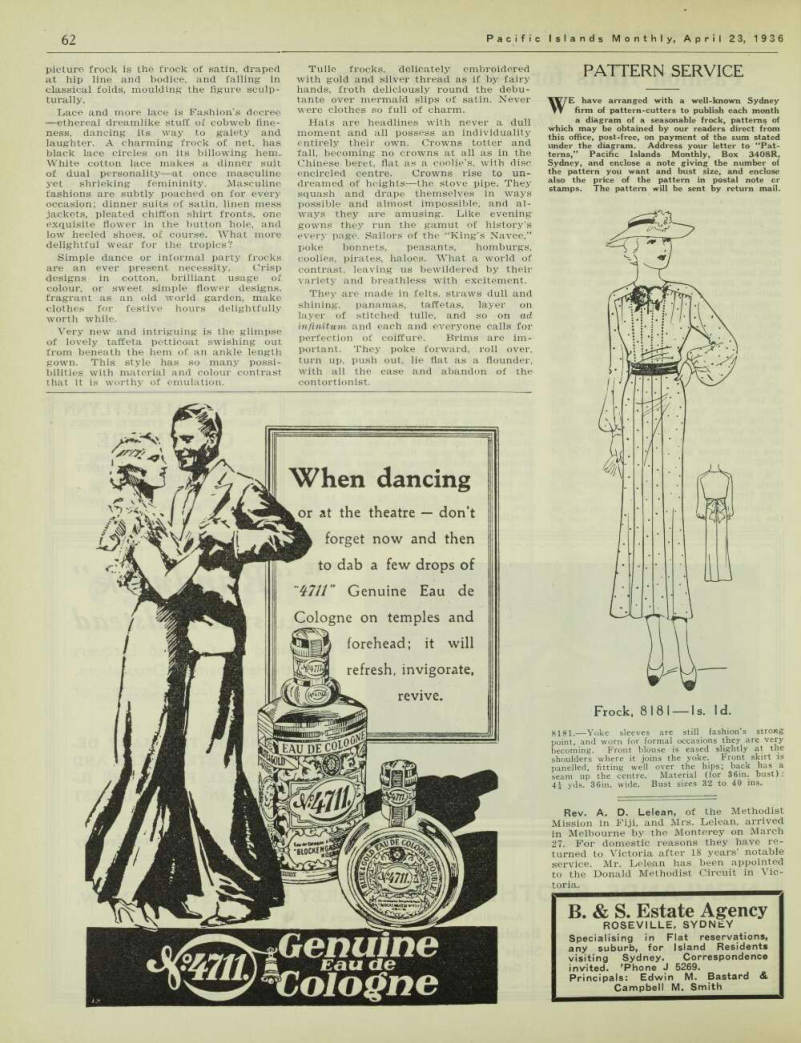
Aviation policy was considered at a special informal meeting of the Legisla tive Council of New Guinea on February 28.
The suggestion that there should be a merger of aviation companies in New Guinea, and that the resulting corporation should operate under a charter was dis cussed at considerable length. Mr. I. H.
Grabowsky, general manager of Guinea Airways Limited, was invited to address the meeting and explain the proposals.
The atmosphere, however, was unfavour able to the plan. The Legislative Council was still in a condition of agitation over the Shipping Bill, in connection with which the non-official members felt that they had been flouted; and it followed that they were quite willing to sink teeth and claw into the aviation merger plan, which was regarded as a proposal eman ating from the Federal Government in Canberra.
Mr. Page (Government Secretary) said there was considerable misapprehension.
The Commonwealth Government had not committed itself to any declaration of policy. It had suggested that the general principle of a merger of existing air
(Continued On Page 68)
transport companies might prove desir able, and it had invited opinions concern ing this plan.
Mr. Page expressed the personal opinion that this matter must be considered with long vision—regard must be had to two main features. There was the matter of the strategical and tactical value of New Guinea to Australia, and also the protec tion and encouragement of civil and com mercial aviation. It was desirable that Australia should have in her outlying ter ritories a highly efficient service which could be converted to military needs in time of emergency, and become the ad vance eyes and ears of Australia’s defence organisation.
Mr. Page outlined various difficulties in wa y Qf a merger, especially the danger of over-valuation of assets for purposes of capitalisation. He thought that in any merger the Government should have a financial interest equal to 51 per cent, of the capital.
Mr. Grabowsky discussed the merger proposals under three heads—namely, transport policy; history of aviation in the territory; and developmental possi bilities. He said that the original cost of freight in the Morobe District per native carrier was 22d. per lb.; the first aero plane arrived in 1927 and immediately reduced the rate to 18d. per lb. The development of aerial transport caused the rates to drop steadily year by year to their present level. He emphasised that investors generally in those early days had no confidence in aerial trans- Port in New Guinea, and finance was a
very serious problem. Eventually, how ever, money was found, an efficient service was organised, and as a result of the enterprise of Guinea Airways Ltd. and other early companies there was estab lished the gold industry which had proved of incalculable value to New Guinea.
“One hears very much now of the cost of air transport,” said Mr. Grabowsky, “but it should be realised that in order to create, by means of communication other than air, the development that has taken place in the Morobe District, it would be necessary for the Adminstration to build no less than 2000 miles of roads. That is a financial undertaking that the territory could not stand.”
Mr. Grabowsky asked for adequate pro tection of the interests which had boldly taken the early risks and established and developed air transport. By their enter prise and efficiency they had created a great industry, out of which they were able to obtain the revenue by which they lived. In that enterprise a sum of about £400,000 had been expended. Competi tion was desirable in every business; but was it fair that small operators, which had taken and were taking none of the earlier risks, should be allowed to come in, without the large, safe organisation that had been created and, using the available easy cargo, to cut and slash rates and generally disturb the fair econ omic balance that had been maintained?
The senior aviation companies accepted every class of cargo that was offered to them; the newcomers sought only the cream of the business. He gave an in stance of well-known men who sent their luggage by the cheap price-cutting aero planes, but had themselves travelled by Guinea Airways’ machines which had a reputation for stability and safety. If price-cutting were to continue unchecked, under present conditions, it would mean sooner or later the breakdown of the pioneer senior companies and with their collapse there must go the present guar antee of stability, safety, regularity of service, and capacity to handle every class of cargo. It was of tremendous import ance to the whole community that aerial transport should be maintained at the present high degree of efficiency.
Had it not been for aerial transport the Morobe goldfield would still be dormant.
Or alternatively the Administration would have been forced to undertake huge ex penditure for roads, which would have placed a heavy tax on the gold industry.
The policy of the aviation companies was to reduce freight rates steadily—but within reason. Contracts had been let to other companies for transporting goods into the interior at I.Bd. per lb. Guinea Airways Limited kept a most careful record of operating costs, and they amounted to 1.75 d. per lb. Such condi tions as this made it impossible to guar antee reliable and safe aerial services.
Aerial transport was the only available practicable form of transport for the Mor obe goldfield and it must be protected.
He argued that this could only be achieved by the merger plan or some other plan which would at one and the same time protect the interests of the responsible aviation companies and of the communities which use aerial transport.
The principle of a chartered company was not new—in fact, it was favoured by every responsible Government throughout the world in regard to the carrying on of essential public services. There was a chartered aviation company in existence in practically every big nation—Britain, Germany, France, and the United States.
It was not proposed to create a monopo listic concern —what was wanted was a plan to protect an essential public utility.
It was recognised all over the world that
ungoverned competition in a public utility simply led to inefficiency and frequently to a danger of life itself.
Mr. Grabowsky then visualised the effect on the development in New Guinea of a healthy aerial transport corporation carrying on under a Government charter.
Many of the present transport difficulties would disappear—officials would move quickly and freely from one point to an other, and residents would not be bound to their plantations. Air transport ser vices, established primarily to serve the gold industry, might under such a sys tem become a potent feature in the rapid development of various other industries in New Guinea.
Questions And Answers
Mr. Grose, asked whether Guinea Air ways, or the suggested merger, would un dertake an extension of aerial services throughout the .territory.
Mr. Grabowsky said that a corporation protected in the manner suggested un doubtedly would extend its operations and carry on regular services around the islands. For two or three years these might not be profitable, but eventually they would become revenue producing.
Mr. Hogan asked whether they had con sidered the possibility of the Morobe gold field petering out and no longer provid ing a backbone for services covering the whole territory.
Mr. Grabowsky said that that aspect had been considered and it was believed to be possible to create other services which would be self supporting and pro fitable by the time the Morobe goldfield was worked out. It was impossible to give a guarantee in that direction, how ever.
In reply to Mr. Neal, who asked for de tails of the capital of Guinea Airways Ltd., Mr. Grabowsky read from a news paper cutting, that the original capital was about £30,000; that in the first years the dividends were 40 per cent.; that the capital was then increased by issuing one bonus share for every original share; that 40 per cent, was then paid back on the whole of this issued capital (being equal to 80 per cent, on the original capi tal) ; and that this rate of dividend has since been reduced to 20 per cent, per annum.
In reply to Mr. Knox Mr. Grabowsky said that there must be reasonable co operation in the future between air trans port and road transport, but they would operate in different spheres. Guinea Air ways had never failed in handling every item of freight offered to it.
Mr. Knox raised the point that the maintenance of the two ports of Sala maua and Lae for the loading of aero planes, would place an unnecessary bur den upon the goldfields population. One port should be enough.
Mr. Grabowsky argued that both ports now were necessary—neither could be ignored. It had been necessary to install the big loading plant'at Lae because it had been found impracticable to operate heavily loaded aeroplanes from Salamaua.
To concentrate all loading operations at Salamaua would be more costly than to maintain the two ports.
Opinions Of Members
Mr. Grose submitted a series of careful arguments in support of his contention that “an aviation policy for this country, if it is going to be of any benefit at all, can operate only through control, and it must have a charter,” He opposed the merger plan, however, because it would confer too great privileges upon one par ticular set of people. He believed that one chartered Company should operate,
but with the control in the hands of the Government. He moved an amendment in that direction.
Mr. Hogan opposed the creation of a Government-controlled monopoly of air
transport. He said also that there was no evidence that the proposed merger would be in the best interests of the Ter ritory. He declared that owing to the absence of sound, well-based data it was
impossible at that stage to decide what aviation policy was necessary for the Ter ritory and what would be the best course to follow.
Mr. Mullaly agreed generally with Mr.
Hogan.
Mr. Neal declared that some definite aviation policy was necessary for New Guinea and Papua, and for the Solomons, but he opposed the proposed merger; and he reported the decisions of a public meeting held in Wau to protest against the merger plan. Mr. Neal emphasised dangers of a monopoly which the merger would create.
Mr. Pratt argued in favour of legisla tion which would control fares, freights, new routes and new services. In this way they would get the advantages urged by those who were in favour of a merger, without the dangers of a monopoly.
Mr. McLennan and Mr. Perriman both said that the discussion had been inter esting and helpful; but actually there was not sufficient information before them to enable them to make up their minds re garding an aviation policy for the Ter ritory.
The Administrator (who presided) pointed out that the merger plan had not been accepted by the Commonwealth, but had been placed before them for an ex pression of opinion. He suggested that matters could be advanced a stage further if they could agree generally upon some kind of aviation policy, and then, per haps, appoint a Sub-Committee to pro duce more definite proposals than they had before them at present.
A motion and a series of amendments were submitted, and it was finally agreed that the granting of an exclusive charter should depend upon the terms of the grant; that the meeting could not express an opinion until it knew the essential terms of the grant; that an adequate aviation policy, linking New Guinea and Papua with Australia, was desirable; and that the Commonwealth Government should submit for their consideration the fullest information in its possession.
Dr. and Mrs. Clifford James sailed by the Malaita for the Solomon Islands on April 4 to take up duties at the Melane sian Mission’s Hospital on Malaita Island.
During his furlough Mr. James made a quick trip to Fiji to study at first hand the latest methods in the treatment of leprosy.
Fashion Hints for Islands Women
By Therese
T'iAY clothes! Two simple little words, but of what tremendous importance to a tropical world tempted to cry so often “O would that they were not.”
White is of the greatest value in the keeping-cool process—crisp little cotton and linen dresses, little starched flowers of pique or organdie, bags, hats, shoes, gloves, all do their bit towards success in this direction. Morning, sports, and spectator frocks are of such simplicity too —slim, straight, and sleeveless, and backless, too, if you care —to be topped by cape or loose flying coat as you will for more formal occasions.
Other pale shades come into their own when allied with white for tropical wear.
Blue and white is a duet in coolness. A Chinese cape and a coolie hat of shiny blue straw, top cool white pique frock, sleeveless and buttoned from low back to hem.
A pale green handkerchief linen pops a large sailor collar of white, buttoning at the waist, over its bare back. One huge button does the job of keeping it in its place. Linen tailored suits with shorts and shirt as one, button on skirts to match the well fitting coats. White and pale linens are ideal for this type of thing.
A severely tailored suit of speckled linen sports a masculinely tailored shirt wuth tremendous success.
Seersucker, crisp and lovely cotton, in the gayest of checks and stripes (and so
easy to launder) makes the most delight ful informal day time frocks. Pocketed and buttoned with enormous buttons, their brief skirts are in keeping with the gay abandon of the material itself.
Afternoon gowns have simplicity and charm. De-lustred materials are popular.
A flat crepe gown of ice blue, features tunic effect and voluminous sleeves and adds a further compliment to youth by its white organdie jabot fastened at neck with exquisite clusters of the palest blue flowers.
Three-quarter coats with a definite swagger air flare out from pencil slim skirts. Taffeta petticoats swish as al luringly by day as by night and form a delightfully rich foundation for georgettes or chiffon frocks.
Dress clips are still among the most favoured of dress ornaments; but dress clips with a difference —stolen from the animal and flower kingdoms—range them selves attractively for our august choice.
Quaint little perky dogs bark from the lapel of your coat; the king of the beasts roams where he will, roaring his way to success, while the domestic feline purrs contentedly on pocket flap or scarf knot.
Exquisite leaf and flower posies soften afternoon and evening gowns and in dividual flowers of tinted glass clip in the hair.
Ensembles for evening are well to the fore. Colour combinations are vivid and startling, but blended with superb artfs
try. Evening wraps are lovely things.
Arresting capes are chosen from all the pageantry of the ages and cleverly adapted to modern needs. A purple cape goes over a red gown; a scarlet over a blue, bluer than any sea; a jade over a blush rose. A black cape, true Venetian style, throws itself dramatically over a classical gown of ruby red. Shot taffetas and moires in lovely colour combinations are perfection for the parachute cape shooting out widely from the sheath-like gown. Saris with all the exotic charm that only the East can bring are still bright stars in the firmament.
Pale shades take a definite place in the scheme of things for evening wear.
A gown of lilac blue —that misty shade of distant hills, ’twixt blue and lavender —pleats itself from neck to hemline, clings lovingly to the figure and falls in softest folds to silver slippered feet. A tulle cape, fitting accompaniment to so much loveliness froths its way to the knees.
Lemon leaf green, a new shade clamouring for recognition, makes a period gown of great charm and flaunt ingly adds a bow of scarlet at its waist line and ruffled neck.
A complete antithesis of the romantic
picture frock is the frock of satin, draped at hip line and bodice, and falling in classical folds, moulding the figure sculp turally.
Lace and more lace is Fashion's decree —ethereal dreamlike stuff of cobweb fine ness, dancing its way to gaiety and laughter. A charming frock of net, has black lace circles on its billowing hem.
White cotton lace makes a dinner suit of dual personality—at once masculine yet shrieking femininity. Masculine fashions are subtly poached on for every occasion; dinner suits of satin, linen mess jackets, pleated chiffon shirt fronts, one exquisite flower in the button hole, and low heeled shoes, of course. What more delightful wear for the tropics?
Simple dance or informal party frocks are an ever present necessity. Crisp designs in cotton, brilliant usage of colour, or sweet simple flower designs, fragrant as an old world garden, make clothes for festive hours delightfully worth while.
Very new and intriguing is the glimpse of lovely taffeta petticoat swishing out from beneath the hem of an ankle length gown. This style has so many possi bilities with material and colour contrast that it is worthy of emulation.
Tulle frocks, delicately embroidered with gold and silver thread as if by fairy hands, froth deliciously round the debu tante over mermaid slips of satin. Never were clothes so full of charm.
Hats are headlines with never a dull moment and all possess an individuality entirely their own. Crowns totter and fall, becoming no crowns at all as in the Chinese beret, flat as a coolie’s, with disc encircled centre. Crowns rise to un dreamed of heights—the stove pipe. They squash and drape themselves in ways possible and almost impossible, and al ways they are amusing. Like evening gowns they run the gamut of history’s every page. Sailors of the “King’s Navee,” poke bonnets, peasants, homburgs, coolies, pirates, haloes. What a world of contrast, leaving us bewildered by their variety and breathless with excitement.
They are made in felts, straws dull and shining, panamas, taffetas, layer on layer of stitched tulle, and so on ad infinitum and each and everyone calls for perfection of coiffure. Brims are im portant. They poke forward, roll over, turn up, push out, lie flat as a flounder, with all the ease and abandon of the contortionist.
Advertisements & other items, pp. 63-64 (1 item)
NEWLANDS BROTHERS LTD., riley street, Sydney, n.s.w.
Mrs. N. WALKER-FLYNN
Late 35 POWELL STREET, COOGEE
COSTUMIERE
MALAGUNA ROAD, RABAUL
HEMSTITCHING AND PICOT
EDGING
Copies of Mab’s Fashions; Roma’s Pictorial Fashions and Home Fashions available.
P.O. Box 116. Tel.: 141
i I m THE “ Randwic all-steel finished in Coloured Lacquers with Hand-painted Decorations, or Shaded Gold, Copper or Silver Effects.
THIS IS ONE OF THE MANY DE-
SIGNS OF ALL STEEL BEDS AND
TUBULAR STEEL FURNITURE IL-
LUSTRATED IN OUR LATEST
CATALOGUES.
Manufactured by Copies will be gladly forwarded by return mail.
NEWLANDS BROTHERS LTD., riley street, Sydney, n.s.w.
Australia’s Largest Manufacturers of Steel Beds: Wire Mattresses: Bedding: Tubular Steel Furniture: Lawn Hammocks: “Lister”
Hospital Beds femd Furniture: Ships’ Berths; Garden Seats: Stretchers: Davenports, etc.
Cable Address: “Newlandbed,” Sydney.
When dancing
or at the theatre don’t forget now and then to dab a few drops of "4711" Genuine Eau de Cologne on temples and forehead; it will refresh, invigorate, revive.
'sr/T' v? 'r / Z
rh AW /
it ■ **. o HE
SIEAU DECS?
Mi r
610CKEH
roWCMHUM
iZSfrzGenuine
547// I S_ Eau de
O' Cologne
Pattern Service
WE have arranged with a well-known Sydney firm of pattern-cutters to publish each month a diagram of a seasonable frock, patterns of which may be obtained by our readers direct from this office, post-free, on payment of the sum stated under the diagram. Address your letter to “Pat terns,” Pacific Islands Monthly, Box 3408 R, Sydney, and enclose a note giving the number of the pattern you want and bust size, and enclose also the price of the pattern in postal note cr stamps. The pattern will be sent by return mail.
8181. —Yoke sleeves are still fashion’s strong point, and worn for formal occasions they are very becoming. Front blouse is eased slightly at the shoulders where it joins the yoke. Front skirt is panelled, fitting well over the hips; back has a seam up the centre. Material (for 36in. bust) : 4\ yds. 36in. wide. Bust sizes 32 to 40 ins.
Rev. A. D. Lelean, of the Methodist Mission in Fiji, and Mrs. Lelean, arrived in Melbourne by the Monterey on March 27. For domestic reasons they have re turned to Victoria after 18 years’ notable service. Mr. Lelean has been appointed to the Donald Methodist Circuit in Vic toria.
Frock, 8181-1s. 1d.
Advertisements & other items, p. 64 (1 item)
B. & S. Estate Agency
ROSEVILLE, SYDNEY
Specialising in Flat reservations, any suburb, for Island Residents visiting Sydney. Correspondence invited. 'Phone J 5269.
Principals: Edwin M. Bastard & Campbell M. Smith
Housekeeping in the Tropics
\ tropical diet should never lack vegetables, -kJk writes “Evo,” of Bougainville, New Guinea.
They are grown on most plantations and out stations, or can be bought from natives or native markets.
It is possible to order the best kind of beans (such as Soya and Lima), dried peas and lentils, rice (unpolished), barley, wheat, dextrinised cereals from Australia. These, together with ground nuts (almonds are better than ground nuts, and the native galip is delicious), herbs (such as parsley and thyme) and onion (for fla vouring) can be combined to make most appetising and healthful entrees, roasts, savoury pies, ste\vs, and fricassees.
To make up for the loss of nervous and physical energy entailed by present day mode of living, a sufficient supply of nourishing, palatable food, carefully prepared, is absolutely necessary.
By using forethought, the foods that give the healthiest condition to the body can be procured in any country. Again, by using forethought, there can be plenty of variety on the menu.
Monotony causes lack of enjoyment and the body does not then derive the benefit it otherwise would.
Fruit is also of outstanding importance in the tropics. Who does not understand the value of citrous fruits in fever; of the body-cleansing properties of pineapples; of the laxative effects of paw-paw, dates, figs, and prunes; of the keen delight experienced as one takes the first spoonful of a delicious fruit salad or sips her cocktail of fresh granadillo, pineapple, paw-paw, five corner, and citrous juice? Fruits in abundance make one feel alive, vigorous, and full of pep. This is because they produce a good alkaline reserve in the blood. Foods such as meats cause an acid reaction of the blood, which is an unhealthy, and oftentimes, a dangerous, condition.
The housewife’s burning question as she plans the family menus should be “How’s your al kalinity?” Dried fruit can be bought from South to add delightful variety and also improve the health and strength of those wise enough to eat them. Dates and raisins are cheap if bought by the case. They will keep for fully six months if stored in clean tins, the temperature of the inside of a tin being lower than that of the surrounding atmosphere.
The following simple recipes will give an idea how to use vegetables attractively and the house wife who is intelligently interested in the prepa ration of food from the health viewpoint will quickly make other combinations that will add pleasing variety to the meals.
Taro Roast
One taro minced, 1 onion minced, y 2 teaspoon thyme, \ cup peanut or galip butter, 1 egg, J cup water.
Mix all together, put in a greased bowl, and bake 11/2l l / 2 to 2 hours. Serve very hot with vege tables and gravy.
Nut Loaf
One cup cooked unpolished rice, 1 cup peeled tomatoes, 1 teaspoon chopped parsley, y 2 cup pea 31u* ® r J? a l'P butter, a few chopped ripe olives, a little finely chopped onion and thyme, if desired salt, 2 eggs.
Mix well together, bake in bread tin, until uicely browned. Serve hot with vegetables and gravy or cold with tomato, egg, cucumber, and onion salad.
Fricassee Of Beans
One lb, of haricot, Soya or Lima beans, some onion, little milk, 1 egg beaten, 2 hard boiled •eggs, pinch of salt, half a lime, 1 teaspoon cloves.
Look beans, cloves and onions together, take out cloves when beans are cooked. Add the rest of the ingredients to the beans, and heat up but do not boil. * v
Macaroni And Tomato Stew
One onion (shallots are excellent), 2 cups sliced tomatoes, 1 cup bean broth, 1 cup cooked macaroni, pinch of salt, a few chopped ripe olives, or a tablespoon of peanut or galip butter.
Put all except macaroni into casserole, stew gently until onion is tender. Lastly add cooked macaroni, and then heat.
“EVO,” Bougainville,
Pudding—South Seas Delight
Peel six ripe bananas and cut in halves, length ways, arrange in a dish, shallow and buttered.
Mix together in a basin the juice of cne large orange and two tablespoons of brown sugar, and pour over the bananas. Combine two tablespoons of cake or biscuit crumbs with an equal quantity of coconut, and sprinkle on top. Bake in a good oven until bananas are tender and the coconut brown. Cover the dish at first, and remove the lid while bananas are done, then brown.
"Tiny Tim.” Kavieng.
Mr. C. Coppard, storekeeper on Misima Island, Eastern Papua, spent some weeks in Melbourne at the end of March. He returned to the Territory by the Macdhui from Sydney on April 16.
Rev. D. C. Alley, who arrived in Sydney at the end of March by the Wangella, sailed for the Solomon Islands by the Malaita on April 4 to join the staff of the Methodist Mission of New Zealand.
Mr. W. R. Litster, secretary and trea surer of the S.D.A. Mission in Fiji, re turned to Suva by the Monterey on April 1. He had been in Australia on sick leave.
Mr. G. Kingsley Roth, Government Dis trict Commissioner in Fiji, who is on a visit to New Zealand, gave an interesting lecture on the history of the Colony and the arts and customs of the Fijians, in the Auckland University College hall on March 30 under the auspices of the Auck land Institute.
Advertisements & other items, p. 65 (1 item)
Arnotts
AT BLUE MOUNTAINS
SPRINGWOOD, N.S.W.
Springwood Ladies* College
Est. 1897. Kindergarten to Leaving Certificate. Tennis, Riding, Swimming, Team Games. Unequalled climate. Pure Jersey Milk. Senior and Junior Houses. Open-air sleeping. Inclusive fees. Special vacation arrangements for Island pupils.
M. E. DURAND, Principal.
THERE’S NO SUBSTITUTE
FOR QUALITY
ARNOTT’S SAO BISCUITS are the result of half a century of specialization, they have that light flaky texture —that perfection of quality which makes them delicious with butter, cheese, ham paste or fruit, and exceedingly popular with everyone.
On cold nights try them this way: Butter the SAO Biscuits, grate a little cheese over each, and sprinkle with cayenne pepper—one minute in a hot, dry oven and serve whilst hot.
ARNOTTS
FAMOUS
SAO
BISCUITS
Always ask your Grocer for Arnotf’s
“THEY ARE BETTER THAN EVER”
New Britain Express
Delivery
GENERAL OVERSEAS AGENTS
GENERAL CARRIERS, BAGGAGE
AND FORWARDING AGENTS.
ROYAL MAIL CONTRACTORS.
Reliable Cars and Trucks
We aim to give quick and reliable Service at reasonable costs. P.O. Box 116. 'Phone 141.
W. WALKER-FLYNN, Proprietor, Malaguna Road, Rabaul, T.N.G.
Maori Nurse Accepts
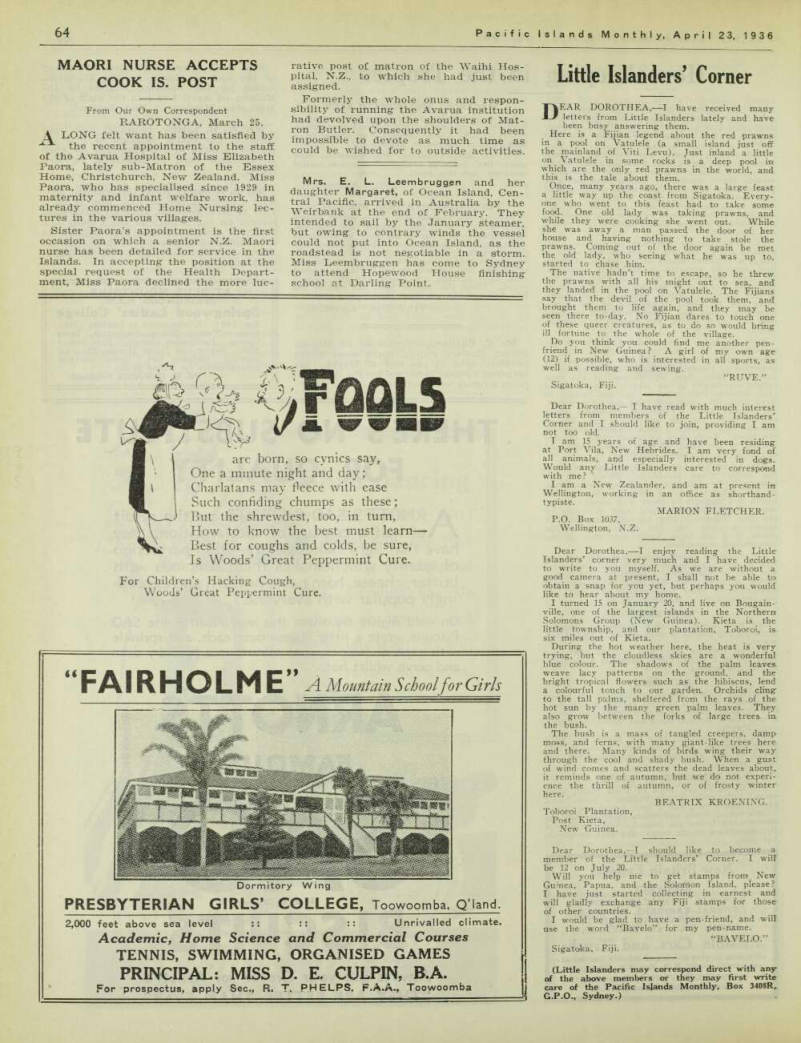
Cook Is. Post
From Our Own Correspondent
Rarotonga, March 25.
A LONG felt want has been satisfied by the recent appointment to the staff of the Avarua Hospital of Miss Elizabeth Paora, lately sub-Matron of the Essex Home, Christchurch, New Zealand. Miss Paora, who has specialised since 1929 in maternity and infant welfare work, has already commenced Home Nursing lec tures in the various villages.
Sister Paora’s appointment is the first occasion on which a senior N.Z. Maori nurse has been detailed for service in the Islands. In accepting the position at the special request of the Health Depart ment, Miss Paora declined the more luc
rative post of matron of the Waihi Hos pital, N.Z., to which she had just been assigned.
Formerly the whole onus and respon sibility of running the Avarua institution had devolved upon the shoulders of Mat ron Butler. Consequently it had been impossible to devote as much time as could be wished for to outside activities.
Mrs. E. L. Leembrugg.en and her daughter Margaret, of Ocean Island, Cen tral Pacific, arrived in Australia by the Weirbank at the end of February. They intended to sail by the January steamer, but owing to contrary winds the vessel could not put into Ocean Island, as the roadstead is not negotiable in a storm.
Miss Leembruggen has come to Sydney to attend Hopewood House finishing school at Darling Point.
Little Islanders’ Corner
DEAR DOROTHEA, —I have received many letters from Little Islanders lately and have been busy answering them.
Here is a Fijian legend about the red prawns in a pool on Vatulele (a small island just off the mainland of Viti Levu). Just inland a little on Vatulele in some rocks is a deep pool in which are the only red prawns in the world, and this is the tale about them.
Once, many years ago, there was a large feast a little way up the coast from Sigatoka. Every one who went to this feast had to take some food. One old lady was taking prawns, and while they were cooking she went out. While she was away a man passed the door of her house and having nothing to take stole the prawns. Coming out of the door again he met the old lady, who seeing what he was up to, started to chase him.
The native hadn’t time to escape, so he threw the prawns with all his might out to sea, and they landed in the pool on Vatulele. The Fijians say that the devil of the pool took them, and brought them to life again, and they may be seen there to-day. No Fijian dares to touch one of these queer creatures, as to do so would bring ill fortune to the whole of the village.
Do you think you could find me another pen friend in New Guinea? A girl of my own age (12) if possible, who is interested in all sports, as well as reading and sewing.
“Ruve.”
Sigatoka, Fiji.
Dear Dorothea, — I have read with much interest letters from members of the Little Islanders’
Corner and I should like to join, providing I am not too old.
I am 15 years of age and have been residing at Port Vila, New Hebrides. I am very fond of all animals, and especially interested in dogs.
Would any Little Islanders care to correspond with me?
I am a New Zealander, and am at present in Wellington, working in an office as shorthand typiste.
Marion Fletcher.
P.O. Box 1037, Wellington, N.Z.
Dear Dorothea, —I enjoy reading the Little Islanders’ corner very much and I have decided to write to you myself. As we are without a good camera at present, I shall not be able to obtain a snap for you yet, but perhaps you would like to hear about my home.
I turned 15 on January 20, and live on Bougain ville, one of the largest islands in the Northern Solomons Group (New Guinea). Kieta is the little township, and our plantation, Toboroi, is six miles out of Kieta.
During the hot weather here, the heat is very trying, but the cloudless skies are a wonderful blue colour. The shadows of the palm leaves weave lacy patterns on the ground, and the bright tropical flowers such as the hibiscus, lend a colourful touch to our garden. Orchids cling to the tall palms, sheltered from the rays of the hot sun by the many green palm leaves. They also grow between the forks of large trees in. the bush.
The bush is a mass of tangled creepers, damp moss, and ferns, with many giant-like trees here and there. Many kinds of birds wing their way through the cool and shady bush. When a gust of wind comes and scatters the dead leaves about, it reminds one of autumn, but we do not experi ence the thrill of autumn, or of frosty winter here.
Beatrix Kroening.
Toboroi Plantation, Post Kieta, New Guinea.
Dear Dorothea, —I should like to become a member of the Little Islanders’ Corner. I will be 12 on July 20.
Will you help me to get stamps from New Guinea, Papua, and the Solomon Island, please?
I have just started collecting in earnest and will gladly exchange any Fiji stamps for those of other countries.
I would be glad to have a pen-friend, and will use the word “Bavelo” for my pen-name.
“Bavelo.”
Sigatoka, Fiji.
(Little Islanders may correspond direct with any of the above members or they may first write care of the Pacific Islands Monthly, Box 3408R r G.P.0., Sydney.)
Advertisements & other items, p. 66 (1 item)
Ools
are born, so cynics say, One a minute night and day; Charlatans may fieece with ease Such confiding chumps as these; But the shrewdest, too, in turn, How to know the best must learn— Best for coughs and colds, be sure, Is Woods’ Great Peppermint Cure.
For Children’s Hacking Cough, Woods’ Great Peppermint Cure.
44 FAIRHOLME” A Mountain Schoolfor Girls Q
PRESBYTERIAN
Dormitory Wing GIRLS’ COLLEGE, Toowoomba, Q’land, 2,000 feet above sea level Unrivalled climate.
Academic, Home Science and Commercial Courses
TENNIS, SWIMMING, ORGANISED GAMES
PRINCIPAL: MISS D. E. CULP1N, B.A.
For prospectus, apply Sec., R. T. PHELPS. F.A.A., Toowoomba
Suva Hospital
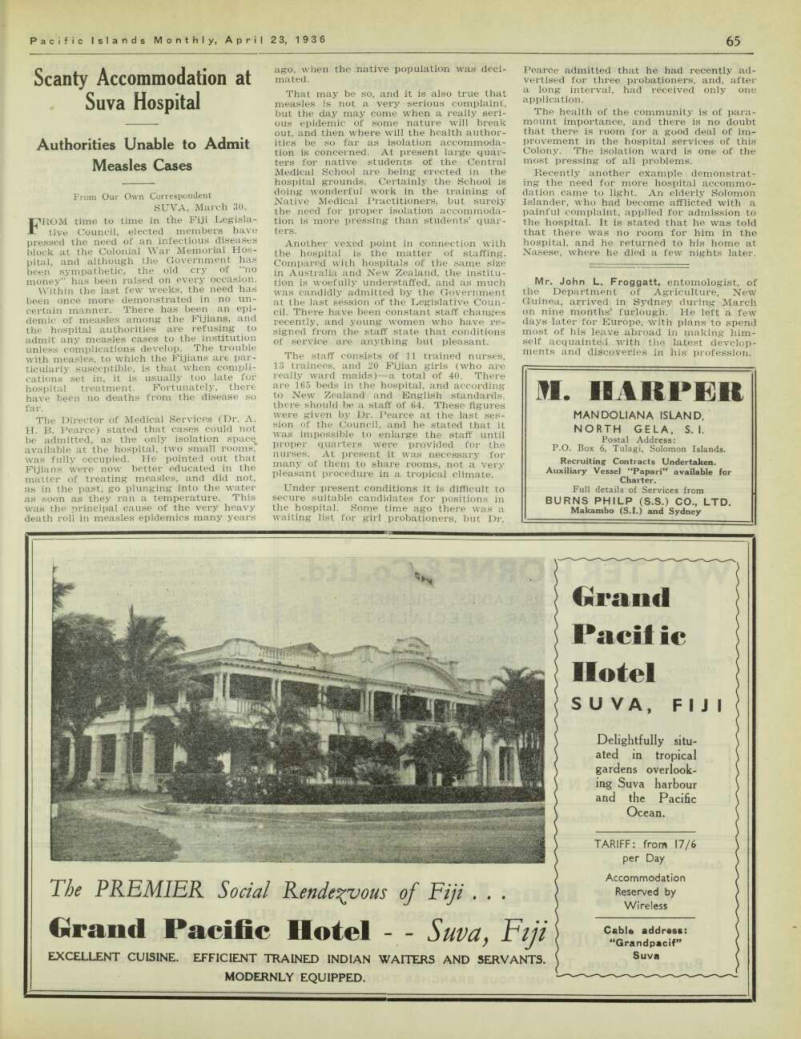
Scanty Accommodation at Suva Hospital Authorities Unable to Admit Measles Cases
From Our Own Correspondent SUVA, March 30.
FROM time to time in the Fiji Legisla tive Council, elected members have pressed the need of an infectious diseases block at the Colonial War Memorial Hos pital, and although the Government has been sympathetic, the old cry of “no money” has been raised on every occasion.
Within the last few weeks, the need has been once more demonstrated in no un certain manner. There has been an epi demic of measles among the Fijians, and the hospital authorities are refusing to admit any measles cases to the institution unless complications develop. The trouble with measles, to which the Fijians are par ticularly susceptible, is that when compli cations set in, it is usually too late for hospital treatment. Fortunately, there have been no deaths from the disease so far.
The Director of Medical Services (Dr. A.
H. B. Pearce) stated that cases could not be admitted, as the only isolation space % available at the hospital, two small rooms, was fully occupied. He pointed out that Fijians were now better educated in the matter of treating measles, and did not, as in the past, go plunging into the water as soon as they ran a temperature. This was the principal cause of the very heavy death roll in measles epidemics many years
ago, when the native population was deci mated.
That may be so, and it is also true that measles is not a very serious complaint, but the day may come when a really seri ous epidemic of some nature will break out, and then where will the health author ities be so far as isolation accommoda tion is concerned. At present large quar ters for native students of the Central Medical School are being erected in the hospital grounds. Certainly the School is doing wonderful work in the training of Native Medical Practitioners, but surely the need for proper isolation accommoda tion is more pressing than students’ quar ters.
Another vexed point in connection with the hospital is the matter of staffing.
Compared with hospitals of the same size in Australia and New Zealand, the institu tion is woefully understaffed, and as much was candidly admitted by the Government at the last session of the Legislative Coun cil. There have been constant staff changes recently, and young women who have re signed from the staff state that conditions of service are anything but pleasant.
The staff consists of 11 trained nurses, 13 trainees, and 20 Fijian girls (who are really ward maids) —a total of 40. There are 165 beds in the hospital, and according to New Zealand and English standards, there should be a staff of 64. These figures were given by Dr. Pearce at the last ses sion of the Council, and he stated that it was impossible to enlarge the staff until proper quarters were provided for the nurses. At present it was necessary for many of them to share rooms, not a very pleasant procedure in a tropical climate.
Under present conditions it is difficult to secure suitable candidates for positions in the hospital. Some time ago there was a waiting list for girl probationers, but Dr.
Pearce admitted that he had recently ad vertised for three probationers, and, after a long interval, had received only one application.
The health of the community is of para mount importance, and there is no doubt that there is room for a good deal of im provement in the hospital services of this Colony. The isolation ward is one of the most pressing of all problems.
Recently another example demonstrat ing the need for more hospital accommo dation came to light. An elderly Solomon Islander, who had become afflicted with a painful complaint, applied for admission to the hospital. It is stated that he was told that there was no room for him in the hospital, and he returned to his home at Nasese, where he died a few nights later.
Mr. John L. Froggatt, entomologist, of the Department of Agriculture, New Guinea, arrived in Sydney during March on nine months’ furlough. He left a few days later for Europe, with plans to spend most of his leave abroad in making him self acquainted with the latest develop ments and discoveries in his profession.
Advertisements & other items, p. 67 (1 item)
Grand Pacific Hotel - - Suva, Fiji
M. lIARPEK
MANDOLIANA ISLAND,
NORTH GELA, S. I.
Postal Address: P.O. Box 6, Tulagi, Solomon Islands.
Recruiting Contracts Undertaken.
Auxiliary Vessel “Papari’' available for Charter.
Full details of Services from
BURNS PHILP (S.S.) CO., LTD.
Makambo (5.1.) and Sydney
1 *'* - The PREMIER Social Rendezvous of Fiji . , .
Grand Pacific Hotel - - Suva, Fiji EXCELLENT CUISINE. EFFICIENT TRAINED INDIAN WAITERS AND SERVANTS.
MODERNLY EQUIPPED.
Grand
Pacll ic
Hotel
SUVA, FIJI
Delightfully situated in tropical gardens overlooking Suva harbour and the Pacific Ocean.
TARIFF: from 17/6 per Day Accommodation Reserved by Wireless Cable address: * “Grandpacif"
Suva
Papua
Copra Samples on Show in Papua
From Our Own Correspondent
Pt. Moresby, March 12.
SAMPLES of copra from various parts of the world have been forwarded by the London Copra Association to the Hon.
Arthur Jewell (unofficial member of both the Executive and Legislative Councils of Papua) for the inspection of planters in the Territory.
These samples are on view at the pre mises of Burns, Philp and Co. at Port Moresby and Samarai, where they will be kept for some little time to enable all those interested to inspect them.
Mr. Jewell’s action in obtaining these samples has been much appreciated by those interested in copra production.
Promoted From Fiji To
Zanzibar
From Our Own Correspondent SUVA, March 30.
'lyi'R. A. Hallam Roberts, Chief Police Magistrate of Fiji, who is at present acting Attorney General, has received notice of his transfer on promotion to the protectorate of Zanzibar as Magistrate and Crown Counsel.
Mr. Roberts, who is a Bachelor of Arts of Jesus College, Cambridge, and a Barrister-at-Law of the Inner Temple, came to Fiji as a cadet in the Colonial Service. He served in various capacities in the Colonial Secretary’s Office and in the District Administration, but resigned in 1920 from the service and took up cotton planting in Vanua Levu.
In 1927 he rejoined as Registrar of the Supreme Court and was appointed Chief Police Magistrate in August, 1931. Mr.
Roberts has acted as Attorney-General on several occasions.
Mr. Josiah Henry Waller, formerly proprietor of the Pacific Printery, Suva, Fiji, who for four months had been editor of the Samoa Herald at Apia, sailed for New Zealand by the Monterey from Pago Pago (American Samoa) on March 14. Mr. J. Liston, printer, of Apia, has now taken over the editorship of the Samoan weekly newspaper.
Fiji’S New Broadcasting
Station
From Our Own Correspondent SUVA, March 25.
THE new broadcasting station ZJV, Suva, is being subjected to some criti cism. Some complain that they are un able to log overseas stations while ZJV is working; but others point out that this is the fault of the set in use and that, with a modern selective set, there is no difficulty in cutting out the local station.
At present, what are described as “canned” programmes are being broad cast from ZJV, and the hope is expressed that later more attention will be given to the broadcasting of local talent, and typically Fijian items.
Indian residents are demanding that Indian gramophone records be broadcast at times. No doubt, if the station ac ceded to this last request, there would be a shoal of complaints from local Euro pean listeners. It is bad enough to have to listen to Indian music when passing a place where such is being played, with out having it broadcast!
Probably the chief cause of complaint is the fact that with the opening of the new station the licence fee for radio sets has been increased from 5/- per annum to 30/-. Listeners point out that it was load enough having to pay five shillings to the Government for absolutely noth ing, for they had to rely on overseas sta tions for their programmes; but, to the minds of many to have to pay 30/- for a service that many contend they do not want, is worse still. It is stressed that the canned music heard from ZJV could always be heard from overseas stations when required.
The chief beneficiaries from the new station are country listeners who, when provided with a radio set, are able to get local and overseas news the same day as it is received in Suva, instead of having to wait for irregular mails.
EDITORIAL NOTE; There are in Fiji some 100,000 Fijians, 80,000 Indians and 6000 Europeans.
The task of a broadcast-station manager in such circumstances can be better imagined than de scribed. Presumably, the main object of this station, as of all Pacific Islands stations, will be the broadcasting of news; and residents will not complain of a 30/- per annum license fee if they have a dependable news service, that will break down the isolation that is the great drawback of Islands life.
Ropate Varo, a Fijian native teacher, reached Sydney by the Niagara on March 21. He later went to Melbourne where he will spend some time telling about the improved conditions in Fiji under the influence of Christianity. On his tour in Victoria he will be accompanied by Mr.
N. J. Jenkin, Lay Secretary and Trea surer of the Methodist Overseas Mission.
Advertisements & other items, p. 68 (1 item)
Suva’s Fashion Rendezvous
MELBOURNE
HOTEL ::
■— SUVA ■ ■—
Centrally situated near Government offices. Opposite sea baths and bowling green. Excellent table.
Terms moderate. Best brands of liquor kept, including Hardy’s famous wines.
E. C, DOBELL Proprietor
Suva’s Fashion Rendezvous
WALTER HORNE&Co.Ltd.
PREMIER DRAPERS. LADIES’. CHILDREN’S
AND MEN’S WEAR SPECIALISTS
LADIES’ HAIRDRESSING AND MANICURING
Frocks Millinery Foundations and Lingerie Hosiery Ladies’ Shoes & Sandals Ribbons and Laces Hairdressing Manicuring Dress Fabrics and Silks Household Drapery Clothing Tailoring Mercery Men’s Boots & Shoes Men’s Hats & Caps Island Curios
“IF IT’S NEW...
HORNE’S WILL SHOW IT”
Dependable Merchandise
Reasonably Priced
Cables: “Janinloong”
P.O. Box 117
Jangf II ing* Loong fompaoy Limited
20-24 THOMSON ST., SUVA, FIJI
IMPORTERS —' EXPORTERS
Buyers of Copra, Trochus Shell, Beche-de-mer, Kauri G um, and other Islands Products
NUMEROUS BRANCHES THROUGHOUT THE COLONY
Down to Work
Suva Town Board Settles Down to Work
From Our Own Correspondent SUVA, March 25.
FROM all appearances, the new Suva Town Board seems to be settling dow r n to work, and taking up where the Muni cipal Council left off.
It is too early yet to compare its work with that of the Council, but from meet ings, it would seem that the Board is op posed to any increase of expenditure which might lead to an increase in rates and an attitude of “I told you so” from those who opposed the change over.
Interest in the matter seems to have dropped to quite an extent so far as the general public is concerned, and there seems to have been adopted a lackadaisical disinterested attitude toward the Town Board.
Those who opposed the Suva Town Board, however, still hope for some resulf from the visit to England of the late Mayor (Hon. Alport Barker). During Mr. Bar ker’s absence, his place on the Town Board is being filled by Mr. Pat Costello.
Britain Keeps Her
Mandates
A SHARP debate in the House of Com rnons over colonies and mandates was averted on April 10 (says Sydney Tele graph) when the Colonial Secretary (Mr.
Thomas) informed the Commons that his recent declaration that Britain would not contemplate giving up any colonies anplied likewise to her mandates.
Lau Group
Salvaging The “Derek” In
From Our Own Correspondent SUVA, March 25.
ALTHOUGH it is definitely accepted that it will be impossible to salvage the hull of the Government motor vessel Derek, w r hich was wrecked on the island of Komo, in the Lau Group recently, it is thought that the engines and much of the other fittings and gear of the boat will be saved.
H.M.C.S. Pioneer took a party of men out some time ago, and it is expected that she w r ill pick them up, together with the salvaged equipment, on her way in from her present lighthousing trip.
The Director of Public Works (Hon. W.
Wise) who has visited the scene, states that to look at her there is little wrong with the Derek, but a close examination reveals that the hull is beyond repair.
There is, however, no danger of her break ing up.
Fiji Boxer’S Success In
England
From Our Own Correspondent SUVA, March 25.
A CCORDING to English papers, Fiji is being put on the English fistic map by Ben Valentine, former heavyweight champion of the Colony, who went to England some time ago.
It appears that Valentine is making a great name for himself as a clever hard hitting boxer in London, and one writer states definitely that “the man from Fiji is worth watching.” Recently at the Albert Hall, he outpointed Pat Desmond
(Ireland) over six rounds. Then at Stockholm-on-Tees, he outpointed Joe Leese.
Prior to leaving Suva, the Fijian had not been defeated by any local men, though he suffered defeat at the hands of Pat George, an Australian professional who boxed here several years ago.
Mr. C. E. Quin, Assistant Secretary in the Samoan Administration, returned to Apia by the Maui Pomare in March, after furlough in New Zealand.
Advertisements & other items, pp. 69-72 (2 items)
Rewa Hotel Heir A
PACIFIC TAXI
GARAGE - -
(Vincent K. Brothers) Day and night service . . . Most modern hire service in Suva . . .
Excellent drivers.
Our special trips embrace Rewa Valley and Sugar Mill, River Scenery, Lami, Suva Point, and Native Kings’ Town of Bau.
Trips can be arranged on Intersular Road to Ellington, Tavua.
Ba, Lautoka, and Sigatoka.
Cables: “Vincent," Suva. 'Phone 33.
In Suva . . . Stay at
The Pier Hotel
« ( Licensee : D. B. COSTELLO)
The Rendezvous of the Miners
Situated in hub of city. Absolutely fireproof building. Commodious and comfortable rooms. Excellent cuisine. All the best brands of drinks stocked.
Tariff 12/6 per day
Cable address: “Pier,” Suva. 111 w I
UNDER SAME MANAGEMENT
REWA HOTEL Heir a
Picturesquely Situated in the Cane Country on the Rewa River around Island. Modern Have the advantage of staying in either Hotel on same Tariff cars driven 6 y expert drivers
FREE TRANSPORT BETWEEN THE TWO HOTELS
m
READ THE
B.P. MAGAZINE
AUTUMN NUMBER
Now on Sale Short Stories . . . Pictures Travel Articles . . Pages for the Children Stage Latest Fashions ... Screen o
ONE SHILLING PER COPY
NEWSAGENTS AND BOOKSELLERS
A. B. DONALD Ltd.
AUCKLAND
Island Traders
P.O. Box 1509 ::
:: General Merchants
Cables and Telegrams: “Kingdom,” Auckland Branches at Rarotonga and throughout the Cook Islands At Papeete and throughout the Society, Marquesas and Paumotu Islands
trading as “ETABLISSEMENTS DONALD. TAHITI”
At Fiji: Trading as ”Dominion Fruit Co., Suva
MORRIS, HEDSTROM, Ltd.
FIJI
Sole Agents in Fiji for . . .
Vacuum Oil Company (Pty.) Limited
Imperial Chemical Industries Limited
Nobel (Australasia) Pty Ltd.—Explosives
Full Stocks of
MINERS AND PROSPECTORS’
REQUISITES
Also SODIUM CYANIDE. ZINC
DUST, Etc.. Etc.
Sydney Office:
DALTON HOUSE, 115 PITT ST., SYDNEY
Branches throughout the gold hearing areas Lautoka.
Ba, Tavua, Penang, Nadi, and Sigatoka
HALLSTROM Built. ..
KEROSENE OPERATED
REFRIG ERATORS
• Specially S u Stable for Tropical Use
NEW 1936 CHEST AND CABINET MODELS
INCORPORATING EXCLUSIVE IMPROVEMENTS
Frost and Ice During Heating Operations More Uniform and Low Temperatures
CONTINUOUS REFRIGE RATI O N
Prices, Literature etc., on application
BATH-H EATERS
KEROSENE OPERATED
No Fumes, No Smell, No Pressure, No Pump—Just Turn on the KEROSENE and light with a Match.
SEND FOR FULL PARTICULARS
EVERYDAY PRODUCTS I/I'D.
608-614 HARRIS STREET, SYDNEY, N.S.W.
P.O. BOX 136, - HAYMARKET, - SYDNEY
Back
A Stal
in the
‘ * Every Pictur e tells a Story,”
SHARP OR CONTINUOUS pains
in the small of the back point to kidney disorder. So do disorders of the urine, getting up at nights, dizzy attacks and rheumatic pains.
ALL of these troubles are symptoms of internal poisoning, due to the failure of the kidneys to filter the blood properly. Nothing could be more serious. Months of illness with rheumatism, sciatica, lumbago, bladder inflammation or renal dropsy may result from neglect. Start to get well to-
day, by strengthening the kidneys
with Doan’s Backache Kidney Pills.
This special kidney tonic has been
relieving kidney troubles for fifty
years; it will not fail you.
Backache Kidney
PRODUCING UNIFORM GOOD RESULTS SINCE 1868
Flour
ALWAYS ASK FOR IT
68
Pacific Islands Monthly, April 23, 1936
Debates on New Guinea Affairs
(CONTINUED FROM PAGE 60)
’Plane Crash in New Guinea
George Mendham Injured
From Our Own Correspondent WAU. March 26.
HIT by cross winds, E. J. Stephens’
Gipsy 111. aeroplane, loaded with cargo, crashed between the Slate Creek and Watut aerodromes on Sunday morn ing, March 22. The machine, which had been in use only about a month, was wrecked, and the pilot, George Mendham, 31, was injured.
Dr. Von de Borch, who hurried by ’plane to the scene of the accident, ordered the pilot to Wau Hospital for an X-ray examination. The small Watut ’drome could not take a machine large enough to carry a stretcher, so the in jured man was transported over a rough track to Slate Creek.
In spite of bad weather, Mr. Neville Bruchhauser landed at Slate Creek in Holden’s D.H.50, picked up the injured airman, and took him safely back to Wau, where he was treated at the European Hospital.
Landing
Kevin Parer Makes a Skilful Landing
MR. KEVIN PARER has enhanced his already worthy reputation as a pilot.
On Friday, March 17, as he was taking off from the Wau ’drome in P.A.T.s Junker, it was noticed by persons at Car penter’s bulk store that a portion of a wheel support on the undercarriage was swinging free, like a bird with a broken leg. Attempts were made to attract his attention by shouting and waving, and to make sure the pilot was aware that some thing was amiss, one of Carpenters’ Moths gave chase and headed the Junker back over the ’drome, where by this time the mechanics at Pacific Aerial Transport’s hangar were waving a duplicate of the faulty part, signifying to Mr. Parer the cause of the excitement.
There was a holding of breaths as Mr.
Parer took perfectly a landing of the utmost difficulty.
Pilot W. Grey Forced Down
ON March 2, considerable anxiety was felt at Wau for the safety of Pilot W. Grey and his Spartan two-seater machine owned by the Salamaua Air Transport Co.
Mr, Grey left Salamaua aerodrome for Wau at 11 a.m. on the preceding day and nothing was heard of him till noon on the 3rd when news came through that on ac count of bad flying weather he had made a forced landing at Nazab, on the Mark ham.
Pilot and the machine were uninjured.
Advertisements & other items, p. 72 (1 item)
Position Wanted
Young Man, aged 23, single, reliable, seeks temporary employment, any suitable work, for period up to six months. Will pay own expenses and accept small remuneration. Please write — “R.W.,” c/o. Pacific Islands Monthly Box 3408 R, Sydney
From Fiji
Pacific Islands Mining Reports
Aloha Central G.M., N.L.
THE legal manager of Aloha Central Gold Mine, N.L., received a cable in March to the effect that the Canadian group, whose mining engineer, Mr. Cunningham Dunlop, examined the property, with a view to the group taking an interest in the company, has decided not to proceed further with the proposition. A meeting of shareholders was then called to consider the future policy of the company. In the meantime, the native labour on the mine was paid off, and operations generally suspended.
The meeting was held in Melbourne on April 9, but lack of sufficient interest by shareholders made it necessary for the special meeting to be adjourned until April 30, as the required number was not present. Before adjourning the meeting the chairman (Mr. A. T. Day) mentioned that the company’s affairs had reached a critical stage.
“The issue is quite clearcut,’’ he said. “It is sim ply a matter of the shareholders, after considera tion of the reports of our experts, Dr. Loftus Hills and Mr. A. G. Campbell, deciding whether they consider the prospects warrant them subscribing the capital necessary for developing our property, or whether they will abandon the venture forth with. You will have noted that Dr. Loftus Hills states that it is comparatively rare, under present day conditions, that a prospecting company is able to show at the end of nine months’ work a proved ore reserve of ten times the value of the capital expended. These ore reserves, he says, are a valuable nucleus from which to allow developments to evolve, and that it would be a very serious mis take to neglect the opportunity.
“Mr. Campbell sums up his report by saying that, in view of the ore that is available and the prospects of the mine, he considers the investment of further capital to install a treatment plant and gain revenue while development proceeds is jus tified, but the probable profit is small and there fore it is not for him to decide whether the pro position will be sufficiently attractive to share holders to enable the company to be reconstructed.
“The company’s option from Mr. Pat Costello over the 30-acre block which we have been pros pecting expired on March 31 last, but Mr. Cos tello has granted an extension. If the option is exercised, a cash payment has to be made to Mr.
Costello of £1,500, of which £l,OOO is to be de voted to subscribing at par for that value of shares in a new limited liability company to be formed.
The financial position of the company is that we have in hand about £l,OOO in cash, but our liabilities are estimated at approximately the same amount, so that, if the shareholders decide that the company is to be wound up, we have just about enough to enable us to pay our debts.
“Actual cash received by the company from shareholders was £12,650, of which £6OO was paid to Mr. Costello as a deposit on the option. Plant landed at Suva cost £2,607, and actual expenditure on the property for wages, stores, rations, etc., amounted, with exchange and Fiji agency fees to approximately £6,582. Those two items amounted to £9,189, out of the £12,050 available. The bal ance was absorbed in travelling expenses and cables, both of which items were necessarily heavy, and fees paid to the company’s technical experts, etc. The management charges for the 12 months amounted to only £385/5/, of which directors re ceived £7B/15/.
“Results are not sufficiently conclusive for the directors to feel that they can take the responsi bility of making a definite recommendation.”
Aloha Central Gold Mine, N.L., was formed in April of last year. Nominal capital is £25,000, in 5,000 shares of £5 each. Subscribed capital is £18,750, and of the 3,750 shares 500 were issued other than for cash.
Guadalcanal, Limited
During 1935 Guadalcanal, Ltd., which is incor porated in Fiji, investigated at no expense to the company several Fijian properties which did not warrant further development. The directors have decided that as the present expenses are neg ligible it is advisable to maintain the company in the expectation that some satisfactory business will eventually be submitted. No further calls will be made unless the prospects definitely warrant further field expenditure. Expenditure for the year was £4l, which, with £lOO written-off plant, raises the debit balance to £5,752. This amount in the balance-sheet is deducted from paid-up capital of £6,000, leaving the capital at £247. Cash at £243 is shown.
Kasi Development, Ltd.
Kasi Development, Ltd., a subsidiary of Mt.
Kasi Mines, Ltd., which was formed to undertake prospecting and developmental work as distinct from actual mining operations, adopted a policy of examining all surface indications during 1935.
Four lode formations were opened by costeens, two of which are extensions of the Mt. Kasi lode, which continue north and south through the leases.
The most interesting formation is to the south east and discloses a lode 60ft. wide assaying from 2 to 20 dwt. The latter lode is situated 400 ft. be low Mt. Kasi, and is in the sulphide zone.
The directors are satisfied with the size of the lodes showing and are now concentrating on aver aging (with the assistance of a diamond drill) the values in the south-east whilst continuing with the adit in the north-west and the further open ing up of the Mitchell lode.
The work done on the field has disclosed lode formations with possibilities to the company.
Expenditure on prospecting and development during the year totalled £2,032. At December 31 last the company had cash of £8,204 in hand, against which creditors were owed £1,125.
Wai-Savura Development Syndicate
Mount Morgan Developments Ltd. has exer cised its option over the property in Fiji of Wai- Savura Development Syndicate Ltd., according to a message received from Mr. C. S. Wilson, chair man of directors of the latter company, by the Stock Exchange of Melbourne on April 7. Wai- Savura Development Syndicate Ltd. was regis tered in Sydney in November last, with a nom inal capital of £1,500, in 150 shares of £lO each.
Under an agreement the consideration for the purchase of the rights was 67 fully paid shares, whilst further rights of 30 shares, at par, were conferred on members. The balance of 53 shares were underwritten at par. At the annual meet ing in Sydney on April 6, Mr. Wilson, who re cently visited Fiji, said a tunnel had been driven 40 feet towards where high values were found on the surface. Mount Morgan Developments Ltd., which had spent £3,000 on development work, had applied for a slight variation of the agreement and this had been approved by the board. The com pany had 70 to 100 natives employed on extensive development work and the arrangement was that this work should be completed prior to the forma tion of a company.
Mount Kasi Mines, Ltd.
Mount Kasi Mines, Ltd., a Fiji company, con trolled in Sydney, began production last July, and for the five months from August 1 to December 31, shows a loss of £3,311. The accounts are ex pressed in Fijian currency. The amount received from gold sales was £9,876, and operating* costs (5,337 tons treated) were £11,138. Net expendi ture on development and administration account for the seven months to July 31, after including July gold sales of £3,490, increased the debit bal ance to £16,986 from £12,552. During the six months to December 31, the plant treated 6,373 tons,, having a head value of and a tail value of 2130 z, showing an extraction of about 90.3 per cent.
The directors write that capital expenditure was higher than estimated, owing largely to increased cost of transport to the field and erection costs higher than anticipated. While operating costs are high at present, steps have been taken to re duce them substantially. With additions to plant and better organisation of transport and supplies,
they state, the mill should have more continuous working, increased tonnages, and lower working costs. Potential tonnages of ore reserves have in creased greatly, though indications are that the additional tonnage will be of slightly lower aver age value. From surface prospecting and develop ment by Kasi Development, Ltd., a subsidiary company, the lode formation apparently lives through both territories a distance of a mile and a quarter.
Emperor Mines, Ltd.
For the period ended March 21, Emperor Mines Ltd., Tavua, Fiji, crushed 1,610 tons of ore, of a head value of \V/ 2 dwt. a ton, for a yield of 1,008 oz. of gold. Output is increasing, and the grade of the stone is maintained. Production figures for the past three periods are compared in the follow ing table:— Jan. 25 Feb. 22 Mar. 21 Ore (dry weight), tons ... 1230 1470 • 1610 Fine gold, oz 764 916 1008 Recovery, dwt 12.4 12.4 1i2.5
East Reefs Consolidated N.L.
Advice from the legal manager of East Reefs Consolidated N.L. states that the opinion of the directors that they considered the development re ported last month to be of major importance has been justified by the receipt of a cable from the mine manager, Mr. C. F. Eeles, that the full face of stone met with in the underlay shaft assays 7dwt. gold a ton. No 3 tunnel is now in very hard ground at 41tt. and No. 4 tunnel in 155 ft.
Loloma West N.L.
Application has been made for the registration of Loloma West N.L., with a nominal capital of £30,000, in 3,000 shares of £lO each. The place of intended operations is Tavua, Fiji. The directors are Messrs. E. Ward, H. E. Thonneman, D. Reid and C. F. Mitchell. Loloma West Ltd., which is already operating in Fiji, is interested.
Mineral Developments (Fiji) Ltd.
A new area is being tested by Mineral Develop ments (Fiji) Ltd. south of Mt. Kasi, Fiji, on the main Mt. Kasi shear. The manager reports that two gold-bearing lodes showing good prospects have been exposed by costeens. Two tunnels have been commenced with a view to cutting the lede in settled country, which will give the true width of the lode. The areas pegged are reported to be the most promising lease acquired by the com pany since starting operations in Fiji.
Loloma (Fiji) Gold Mines N.L.
Directors of Loloma (Fiji) Gold Mines N.L. re port that resulting from investigations into the treatment of the company’s ore they have decided to accept the method of treatment by roasting and cyanidation as recommended by Mr. A. E. Paton, of Kalgoorlie, W.A., whereby it is expected that an extraction of up to 95 per cent, of gold content can be obtained. Plans and specifications for the necessary plant to treat a minimum tonnage of 500 tons weekly will now be prepared.
Vees United N.L.
Having abandoned the property at Morgans, W.A., and rejected an option over an area in the Lautoka district, Fiji, Vees United N.L. later ac cepted options over two areas in the Sigatoka district, Fiji. The ’ first, known as Ward’s pro perty, consists of approximately 480 acres, and the second, known as Pirie’s property, is of 500 acres.
Prospecting on these properties is in progress.. At December 31 last the company had a surplus of liquid assets of £9,794.
Fiji Mining Corporation N.L.
Shareholders of Fiji Mining Corporation N.L., at an extraordinary meeting in March increased the capital of the company from £11,250 to £60,000 by raising the amount of each of 2,250 shares existing from £5 to £lO, and by issuing 3,750 new shares of £lO each.
The chairman (Mr. C. H. Tucker) told share holders that the directors considered the prospect ing results justified continuing work on the pro perty, which at present was hampered by lack of funds. The company had to May 1 to exercise the option, and it was necessary to do further develop ment work before a company could be floated.
From the No. 1 shaft a lode 22ft. wide, of an average value of a ton, had been proved at the 50ft. level. From the No. 2 shaft a lode 24ft. wide of an average value of over 13dwt. had been proved at the 50ft. level, and from the No. 3 shaft a lode 36ft. wide, of an average value of over 14dwt., at the 45ft. level had also been proved. These values did not take into account the high values in the shaft. This mine was the only one in Fiji showing free gold in sulphide ore, added the chairman.
Gold Search (Fiji) Ltd.
The first general meeting of shareholders of Gold Search (Fiji) Ltd. was held in Suva on March 9.
The Chairman (Capt. C. G. Fenton) said that the Company was the first of its kind formed in Fiji, and there had been a ready response for shares. Out of a total issue of 50,000 shares offered more than 30,000 had been applied for.
The balance will be held in reserve. Since the beginning of the year the Company has inspected four properties, two of which appeared to be worthy of vigorous prospecting. Option agree ments have been entered into with vendors of two areas —one was adversely reported on and the other was being tested. This is P.L. 294, adjoin ing the north-east corner of the Emperor at Tavua. The option is free for 12 months; £3,000 if it is of use to the Company, plus a 10 per cent, interest in any Company formed. Consider able prospecting has been done on this area and samplings disclosed a formation giving assays up to loz. a ton.
Directors appointed for the ensuing year were Messrs. C. G. Fenton. Alport Barker D. B.
Costello, R. L. Munro and A. W. Lewis. Mr. A.
E. Pearce was elected auditor.
Advertisements & other items, pp. 73-74 (1 item)
# Bull/Iw A \Ts' Wire Bopeso
Paxinaii -Ricardo
HEAVY DUTY
MARINE
Diesel
ENGINES
Range of Sizes: 1 >1 B.H.P. at speeds of
300/1000 R.P.M.
30 H.P. High Speed Diesel Engine, fitted with reverse and 2:1 Reduction Gears. 7r 5c
Sole Agents:
Noyes Bros. (Sydney) Ltd.
Special Features
“Comet” Combustion Chamber, providing Great Flexibility.
Easy Starting. Invisible Exhaust at all Loads and Speeds.
Low Fuel and Lubricating Oil Consumption. Big Overload capacity. Quiet Running. Fully automatic Lubrication.
Built to Lloyd’s Requirements. ■iE i C
Sydney
Newcastle
Brisbane
BULL/IW A \TS' WIRE BOPESO
“The World's Standard*'
LARGEST STOCKS IN AUSTRALASIA - FOR ALL PURPOSES Also Blocks, Hooks, Shackles, Thimbles, Strand, Seizing, Aircraft Cord, etc.
Letters: BULLIYANTS’ Australian Co. Ltd. „ Telegrams: n <« naq * p n oullivants Ltd** Box 1298 J, G.P.O. 331-333 KENT STREET, SYDNEY Sydney Prompt Attention! Efficient Service!! Complete Satisfaction!!! «
Mining Ore Treatment
Machinery
Complete Cyanide Plants Supplied- Dorr Classifiers.
Dorr Thickeners.
Dorr Agitators.
Oliver Filters.
Merril Crowe Zinc Dust Gold Precipitation Richardson Mine Fans.
FANS AND AIR HEATERS
For Ventilation, Copra Drying Rooms, etc.
Enquire from
CROSSLE, DUFF AND
MACINTOSH LTD.
52 Bridge Street, SYDNEY
GOLD
HIGHEST PRICES
PROMPT SETTLEMENTS
ACCURATE WEIGHTS AND
ASSAYS
are assured to producers and sellers of gold bullion who forward their consianments to The Electrolytic Refining and Smelting Co. of Aust. Ltd. for treatment and realisation.
RECORD PRICE.— On 6th March, 1935, this company paid to its clients at the rate of £9/4/6 net per fine ounce, which is the highest price ever paid for gold in Australia.
SPECIALLY ORGANISED SER-
VICE is available to clients in New Guinea, Fiji and other Pacific Island centres.
Address consignments from outside Australia to the Company’s Sydney office.
Weighing a Pacific Islands consignment of gold bullion at an E.R. & S. receiving office.
The Electrolytic Refining & Smelting Co.
OF AUSTRALIA LIMITED.
Melbourne: Works: Sydney: Collins House. Port Kembla, N.S.W. 25 O’Connell Street.
Purchasers and Refiners of Gold, Silver, Copper in any form BANKERS.—The English, Scottish and Australian Bank Ltd.
From Papua
Misima Gold Reefs (N.G.) N.L.
Advice has been received by the management of Misima Gold Reefs (New Guinea) N.L. from Oro viile Dredging Co. Ltd., that the understanding of the chairman of directors as set out by him in his address to shareholders on March 4, Oroville Dredging Co. Ltd. has not yet exercised, nor ex pressed its intention, of exercising the option, but the option has been extended to May 31. Neither the Oroville company nor Misima company has undertaken to underwrite any shares. The forma tion of a company is entirely contingent on the exercise of the option, and, unless and until the option is exercised any statement of Oroville Company's intentions with regard thereto is un authorised by them. If the option is exercised the period for the formation of a company is three months. There is no provision in the option for erection of plant, nor are the intentions of the Oroville company known in respect thereof.
Golden Stream N.L.
Golden Stream N.L., an Adelaide concern, is without a property. The company held an area of 700 acres at Karama Creek, and had a half share with Guinea Gold N.L. in a larger area of /,200 acres on the Tauri River, Papua. Both areas have been proved to be too low in value to war rant further expenditure, and have been aban doned. In September an area of 300 acres on Quartz Creek was pegged. Preliminary testing proved the property to be too small for the com pany, and the claim was abandoned. For the twelve months ended June 30 last, expenditure was £4,853 and £214 was received m interest. The surplus of liquid assets at the close of the year was £4,933.
Cuthbert’S Misima Goldmine Ltd.
The clean up on March 23 on the property of Cuthbert’s Misima Goldmine Ltd., Misima Is land, Papua, resulted in the recovery of 2,0160 z. gold bullion from the treatment of 1,810 tons of ore, with head assays of 7.2 dwts. The estimated value is £3,975. The monthly clean-up seldom corresponds with assay value ore heads, because of varying retention of gold in the zinc boxes.
Mandated Alluvials N.L.
Directors of Mandated Alluvials N.L. have ac cepted the application of Mr. R. D. Smith, of Messrs. Spence and Smith, Wau, New Guinea, to take direct management of the Moresby King mine, near Laloki River, in Papua.
The Moresby King is situated in the Astrolabe goldfield, which many years ago commanded great attention on account of its rich copper lodes. These lodes contained a percentage of gold and silver, and within the last two years have been investi gated on this account by many concerns in New Guinea and Australia.
Cassowary Dredging N.L.
An extraordinary meeting of shareholders of Cassowary Dredging N.L. was held on April 15 to increase the capital to £16,000 in 160 shares of £lOO each, by creating 80 new shares. Authority was sought by the directors to dispose of these shares. The Company was registered in Mel bourne last year, and is interested in an area on the Lakekamu goldfield, Papua. The directors are Messrs. O. T. Lempriere, A. Pratt. F. G. Hughes, T. Owen, and C. G. Lyon. Mr. C. Cameron, 395 Collins Street, Melbourne, is the legal manager.
Astrolabe Explorations Ltd.
It is reported that Astrolabe Explorations Ltd. have taken an option over Mr. P. R. Hinds’s mine on the Astrolabe goldfield. Mr. H. Hallum, re presentative of Astrolabe Explorations Ltd., started work on the mine (Mount Judith) on April 1. The preliminary assays of the “show” have been very encouraging, and it is expected that the average already secured will be main tained.
From New Guinea
Gum River Development
Directors of Gum River Development N.L. re port that Mr. J. B. Du Faur, mining engineer, has recommended the abandonment of the com pany’s lease application at Gum River, in New Guinea, scout boring having disclosed poor values.
They have adopted his recommendation. Mr. Du Faur has also examined large alluvial areas 100 miles inland from Madang and has found them to be worthless. The company has been offered several gold-mining properties in Australia, but the directors wish shareholders to decide the future of the company at the forthcoming meet ing. They suggested three alternatives—winding up, with distribution of assets remaining; keep ing the company active by developing any ap proved properties under offer; becoming a holding company. In the half-year ended February 28 the company spent £1,614, which was transferred to mine prospecting account. At the date of bal ance the company had £2,820 in cash and £837 due from a refund of survey fees. Outside liabilities amounted to £lOO, owing to one creditor. Paid capital was £11,200.
N.G. Goldfields Ltd.
Monthly returns and estimated profits of New Guinea Goldfields Ltd. are compared in the sub joined table
Sandy Creek Gold Sluicing Ltd.
The mine manager of Sandy Creek Gold Sluic ing Ltd reports that for the period from March 9 to March 28 the plant treated 4,150 cubic yards for *37oz. of gold, equal to the value of 4/11J4 a cubic yard. He also reports that opera tions were completely held up for about two days
owing to the occurrence of a severe flood, and that the sluicing plant had, in addition, to remove 1,090 cubic yards flood deposit.
As a result of a number of assays, it has been proved that the mineral in the sands on the company’s property is carrying gold values. No estimate can yet be formed as to their extent, but steps are now being taken with a view to recovery and treatment.
Upper Sepik Gold Syndicate
vr ir \\r c. tt c M .r- W Steedman legal manager of Upper Sepik Gold Syndicate N.L., advises that a free option has been acquired over what is considered to be a valuable property in New Guinea, in one of the most favoured positions, and on advantageous terms. The property has been separately and favourably reported on by three well-known engineers and is situated upon the Upper Watut River, about two miles from the Irowat concessions.
Morobe Gold Developments Ltd.
Morobe Gold Developments Limited was registered in Sydney on March 31 with a nominal capital of £5,000 shares of £1 each. Objects are
to acquire mines and mineral properties in New Guinea and to work and explore same, etc. First directors: Andrew J. Smeaton, Charles Graham, and Rudolph A. Kudnig. te-ddacc-c /m c \ cviumcATr
Golden Terraces (N.G.) Syndicate
At the fi rs t annual meeting of Golden Terraces ( New Guinea) Syndicate N.L., held recently the chairman of directors (Mr. R. T. Trembath) in formed shareholders that the company was formed to acquire options over dredging and sluicing leases H at Lower Edie C reek, New Guinea. A favourable report was subsequently obtained from Mr j. M . Spence. With a view to the flotation f J compan / to exercise the options the directors a ed £ lr ' T . R . Victor to make a report when he B w s as visiti the fie ld. Mr. Victor stated the conditions * the leases were exceedingly rough, there bein / many hu bou i der s. and it was impossible * to im ' rove on present methods of working, except with heavy expenditure. The terraces were limited and scattered and in his opinion the areas definitely were not suitable for a company. The funds had become exhausted, and the company was unable to continue the payments to hold the options. It was possible that with
Alluvial— Dec.
Jan.
Feb.
Fine gold, oz. 917 923 1,331 Fine silver, oz. 666 691 942 Golden Ridges Mill— Fine gold, oz. 1,175 1,292 1,363 Fine silver, oz. 723 886 829 Edie Creek Mill— Ore, Feb. 14 Mar. 14 tons 3,715 3,107 Fine gold, i oz. 938 1,095 Fine silver, oz. 2,715 Estimated profit— Nov.
Dec.
Jan.
Alluvial £5,073 £4,344 £3,852 Mill £7,607 £3,169 £3,937
heavy payments an extension could- have been obtained. Before the expiration of the options an effort was made to dispose of them in Mel bourne and Sydney, but without success. A small credit balance is in hand, and it was decided to keep the company in existence in an effort to obtain a similar property. Should a property be obtained the directors were authorised to make a call of £1 a share. Meanwhile no directors’ fees or manager’s salary will be paid.
Enterprise Of New Guinea N.L.
Mr. H. Taylour, general manager of Enterprise of New Guinea, in a report for the period ended March 13, advises that in the Surprise Creek area timbering of the unstable portions of the main water race has been in progress. Saw milling to provide timber for the hydraulicing scheme was commenced during the period. Pre liminary work in connection with sluicing on dredging or sluicing claim No. 276 was also com menced. In the Oriabanda area heavy rains, floods and breaking-in of new native labour have delayed sluicing operations on dredging or sluicing claim No. 542. On dredging or sluicing claim No. 310 substantial native labour housing has been provided and native food gardens planted. A diversion wall has been constructed across the main creek, and sluicing will shortly commence.
Prospecting on the exclusive prospecting area is also under way.
On its Oriabanda claims (western slope of Kaindi), the Enterprise Company recovered during March, 21oz. lldwt. from 468 cubic yards. For the same period 3oz. 13dwt. were recovered from 150 cubic yards at Lulu Creek, Watut area.
Further delay occurred in timber milling for Iroa Creek. Watut water race. It is hoped to resume shortly.
The following radiogram was received in Mel bourne from Mr. H. Taylour on April 16: “Enor mous floods terrific violence suddenly swept Oria banda claims (western slope Kaindi), much dam age done. Gold production stopped. One native drowned, other employees narrowly escaped. Sur prise Creek area —Iroa Creek—Watut scheme
approaching completion.”
Upper Watut Gold Alluvials N.L.
Confirmation that important American interests may acquire a share holding in Upper Watut Gold Alluvials N.L. Morobe goldfield, New Guinea, was received by the Stock Exchange of Melbourne on April 7, The management stated that the directors, recognising the importance of obtaining the most progressive and best possible management for the company, had commenced conversation some time ago with the directors of Placer Develop ment Ltd., in order that co-operation in manage ment of this company or Bulolo Gold Dredging Ltd. should be obtained. Negotiations had recently proceeded further to discover whether a financial interest in Upper Watut Gold Alluvials N.L. could be obtained by either Placer Development Ltd. or Bulolo Gold Dredging Ltd. As full particulars were not yet to hand, the directors had hoped it would not be necessary to refer to the matter until the return of Mr. C. Mackay, chairman of directors, from America, but considered it advisable that a statement should be made.
Following several inspections of the property, including the power scheme, by the management of Bulolo Gold Dredging Ltd., the directors of Bulolo had agreed that subject to arrangements being made with shareholders whereby an option be given entitling the company to subscribe to a large share interest, it would, at its own ex pense, commence testing the property of Upper Watut Alluvials for values and that, providing results were satisfactory, the option would be exercised and a management contract signed. De tails would be made known about April 24, and a meeting of shareholders to ratify the proposals would be held at the end of the month. The directors considered the proposals would be of great benefit to shareholders.
Irowat Gold Alluvials N.L.
Latest advices from New Guinea suggest that Irowat Gold Alluvial’s sluicing operations may begin in May. Construction work is proceeding according to schedule. Reports from the field state that diversions of the weir on Iroa Creek and all concrete work in connection with the
intake and regulatory gates have been completed.
Approximately one-third of the race line proper has been excavated. Trestle work for fluming has been completed, and other subsidiary works such as drops and safety weirs, well advanced. Pipes, monitors, and accessories have been shipped to New Guinea, and Ripples’ gold-saving appliances were despatched by the last ship.
Bulolo Gold Dredging Ltd.
Production of the four dredges of the Bulolo Gold Dredging Ltd, for March compares with that of the previous two periods as follows:
Jan. Feb. Mar.
Cubic yards 899,250 902,100 955,800 Bullion, oz 13,225 13,623 16.005 Gold, fine oz 9,094 9,432 11,203
Value—
Aust. currency*. £79,572 £82,530 £98,026 Per cubic yard . 21.23d. 21.96d. 24.61d.
Working profit . . . £56,035 £56.367| £70,253 * At £A8/15/- per fine ounce.
Advertisements & other items, pp. 75-76 (1 item)
Mining Plant
Portable Batteries, Fixed Batteries, Tube and Ball Mills, Shoes and Dies, Screens, Copper Plates, Trucks, “Challenge” Ore Feeders, Rock Crushers, Cyanide Tanks, Pipe Lines, Pumps
PROSPECTING PLANT
Casing, Drilling Tools, Engine Rigs, Sampling Gear, Pumps, Wire Ropes, etc.
DREDGING PLANT
Large or Small Designed and Built Agents for HADFIELD’S Manganese Steel Buckets, Tumblers, Gears, Carbon and Alloy Steels
J. B. WALLIS & CO.
CHALLIS HOUSE SYDNEY
A. E. GOODWIN LTD.
PIPE, WELDING, & GENERAL ENGINEERS
RAILWAY PARADE, LIDCOMBE, N.S.W. TEL. UX 7941
4 in. & 6in. HEATING UNIT
CONSULT US NOW
FOR YOUR NEXT
INSTALLATION.
WE ARE
SUPPLIERS OF
ALL KINDS OF
FABRICATED
PIPE LINES,
FOR STEAM.
AIR, OIL. OR
WATER. LIQUIDS,
SEMI-SOLIDS,
VAPOURS. ETC.
MINING
EQUIPMENT
is One of Our Specialties
AUSTRALIA’S CLEARING HOUSE FOR THE PRECIOUS METALS.
BUYERS OF
GOLD
OSMIRIDIUM, PLATINUM, SILVER, &c.
GARRETT & DAVIDSON, LTD.
ASSAYERS, BULLION MERCHANTS, METALLURGISTS,
Bank of N.S.W. Buildings, Regent Street, Sydney
i»^aaKaaaaa&.,-.
“STAR” BRAND-x-
SHOVELS SCOOPS SPADES
All Sizes All Styles for All Purposes
Quality Tools Fully Warranted
Made by experts Blades manufactured from special English carbon - manganese steel under correct oil heat treatment. Fitted with high grade Australian mountain ash handles. Well over 200,000 supplied to satified customers, including Commonwealth Government and all Australian State Governments, Mines, and Industrial undertakings.
Enquiries solicited from bona fide Wholesale Traders.
Literature and Price Lists on request.
Sole Makers:
W. SAVAGE & CO. LTD.
155 George St., Erskineville, Sydney, N.S.W.
Telegraphic Address: “Starshovel,” Sydney
Also Stone Forks, Digging Forks, etc.
Morobe Warden’s Report
fT'HE following extracts are taken from A the report of the Warden of the Morobe goldfields. New Guinea, issued on
February 3:
Gold and silver exported during January was -22,659 ozs. valued at £A94,847.
Four survey parties operated as follows:—Mr.
Ecclestone and party in the Sandy Creek Area;.
Mr. Ballam and party in the Lower Watut Area; Mr. Bergin and party on Edie Creek; and Mr.
Livingstone and party in the vicinity of Wau.
The weather has been fairly dry, but no short age of water has been reported.
One fatality was reported from Bulolo. A native jumped off a trailer and his legs were lacerated. Though he was taken to hospital im mediately, gangrene developed, and he died.
There are still about half a dozen miners on the W ongumbungor Creek and they appear to be making more than expenses.
Koranga Gold Sluicing Ltd. Lower Koranga Tribute: Two shifts were working daily from January 9 to 30, operating one nozzle, and sluic ing approximately 3,000 cubic yards; the tail-race was extended a distance of 250 ft. Three Euro peans and 67 natives were employed. Korang'a No. 1 Face: One shift was worked for the month on the slip overlying wash dirt. The trolley line was extended 20 ft. A considerable amount of loose stone was trucked away from the -face.
Approximately 8,000 cubic yards of overburden was sluiced away from the slip. Seven Europeans and 124 natives were employed.
Bulolo Gold Deposits Ltd.: Sluicing operations have been carried on continuously,' and three shifts have been organised. A satisfactory clean-up was made on January 31. Work on the Company’s main race at Koranga junction will be completed in about 14 days, preparatory to extensive sluic ing operations in that area. New buildings for staff are being erected. There were 4 whites and 66 natives employed. Mr. F. Whelan is now in charge of the Company’s operations in place of Mr. C. Moen.
Bulolo Gold Dredging Ltd.: About 75 trips were made by the Co.’s aeroplanes from the coast, approximately 207 tons of freight being delivered at Bulwa and Bulolo aerodromes. All dredges operated satisfactorily, 890,000 cubic yards were mined which yielded 12,859 unrefined ozs. of gold.
No. 2 dredge, which has been shut down for the installation of modern gold-saving equipment, etc., was again put in operation. The Hydraulip Elevator and boxing operations at the upper end of the property handled 11,560 cubic yards, which yielded 595 unrefined ozs. of gold. Three power drills are operating at the southern end of the property, all on double shifts. Another power drill is testing the Mineral Exploitation Syndicate leases at Wau, where shafting is also being done. A hand drilling set is testing on the Stafford lease at Wau, which are under option.
The general health of the camp is good. Seven whites and 43 natives were treated in hospital.
At the end of the month the Company employed: 251 whites, 5 Chinese, 1,105 natives.
Morobe Alluvials, N.L.: Sluicing operations pro duced 91 ounces from 3951 cubic yards treated,, an average value of 2/3.699 per cubic yard. Test pits are being sunk along the lower boundary of the lease, to bottom, which is usually found about 20 ft. down. Health of labour has been excellent and no accidents occurred.
Islands Gold
Shares
Monthly Fluctuations
Mid-Feb. Mid-March. Mid-April.
Fiji
Aloha Central . . b£3/10/- ■ b£2/10/ s£l/10/- Emperor Mines . bl3/7 bll/9 bl2/3 Fiji Corp . b£5 — — Granites Dev- . . s5d. s3£d. — Koroere . b5/2 b4/3 b4/2 Loloma . b24/3 bl8/9 bl9/10 h Mineral Dev. . • sl/6 bl/11 bl/9 Mt. Kasi . bl2/6 blO/b9/6 Mt. Morgan Developments b4/l b3/8i b2/l I Pacific Gold . . , . b£8 s£8 s£7 Tavua Dev. . . , , bl/8 b3/b2/6 Vees United . . , . b3d. b3d. b4d.
Papua
G.M. of Papua . , bl2/blO/blO/6 Oriomo Exp. . . , . b2/ sl/11 bl/6 Samarai (pd.) . . . s2/b9d. s3/- Tiveri G.D. . . . — s4/9 Yodda Gold. Co. — s2/b3d.
New Guinea
Bulolo Deposits. b9d. blO|d. blOd.
Bulolo G.D. . . . b£8/6/s£8/7/b£8 Day Dawn (South) s6d. s6d. s4|d.
Developments (N.G.) b£2/10/b£ll/10/ - s£2/2/6 Enterprise of N.G. b£3/8/s£3/10/b£3/2/6 Golden Deeps . . s3d. s6d. s6d.
Guinea Gold . . sl7/3 sl6/8 sl4/3 Irowat b3/2 b3/8^ b3/8 J Mandated All. . b3/b9/6 d6/6 Mt. Kaindi (pd.) bid. — Mt. Lawson . . . b£25 b£20 b£l 5 N.G.G. Ltd. . . . b5/3 b4/6 1 b4/l Nth. East N.G. (pd.) s9d. — Oil Search ... b3/ b3/6 s3/7 Placer Dev. . . . b£5/7/b£5/3/b£5/15/6 Sandy Ck b2/3 bl/lj bl/7 J Sunshine Gold . bll/11 bl2/9 bl3/l Up. Sepik ... b£4 blO/b£l Up Watut ... b7/ll/ b6/ll/b8/-
N.G. Public Service
ON March 6, the Government Secretary of the N.G. Administration announced the following staff movements in the Public Service: Transfers. —Public Health Dept.: F. J, Giles, Medical Assistant, Rabaul to Salamaua. District Services Dept.: I. F. G. Downs. Cadet. Kokopo to Manus; R. M. Farlow, Patrol Officer, Rabaul to Kokopo; J. R. Hyde, Cadet, Namatanai to Rabaul; J. H. Jones, A.D.0., Rabaul to Manus; G, M.
Keogh, Patrol Officer, Salamaua to Wau; J. S.
Milligan, Cadet, Manus to Rabaul; R. B. McVilly, Cadet, Kokopo to Rabaul; E. W. Oakley, D. 0., Wewak to Rabaul; G. W. L. Townsend, D. 0., Rabaul to Wewak. Lands Dept.: N. H. Fisher Geologist, Wau to Rabaul; L. C. Noakes, Geolo gist s Assistant, Wau to Rabaul. Public Works r- e ?V : J- Bell « Carpenter, Kieta to Rabaul; A. L.
Noble, Plumber, Rabaul to Wewak.
Temporary Staff Appointments. —Mrs. M Bouckley, Assistant Teacher, Rabaul School; W.
Lang, Carpenter (Salamaua), Public Works Dept.
Temporary Staff Transfers.—R. G. Cox, Schoo ner Engineer M.S. Nereus, to Public Works Dept., Rabaul; J. Laird, Public Works Dept., Rabaul, to Schooner Engineer M.S. Poseidon; L. G. Saun ders, Clerk, Dept, of Lands, to Agriculture Dept.
Major and Mrs. W. E. Tottenham left Auckland by the Monterey on April 5, on their return to Suva from New Zealand.
Rev. John Frederick Barge, of Too woomba Queensland, sailed from Sydney oy the Southern Cross on March 31 for Arawe, New Britatin, where he will en gage in mission work for the Melanesian Mission He was born in Buckingham, . ln 189 ?> and served in France and Belgium during the Great War.
Rabaul Notes
From Our Own Correspondent RABAUL, March 16. fTIHE Administration has ceased to publish each JL month the official “Bulletin” which contains the movements of staff. The reason advanced is on account of economy.
An engagement recently announced was that of Mr. Victor Pennefather to Miss Lamb, the newly arrived niece of Mrs. Jimmy Duncan. Miss Lamb is on a visit to her aunt at Rapopo estate.
The Automobile Club of New Guinea has come to life again, and on March 15 held a reliability contest for the Dunlop Trophy. The run was to the Kokopo Club and was won by Mr. Baden Jones in his Nash.
Planters in need of labour are happy to learn that several old recruiting grounds have been re opened by the Administration. They include Buka and adjacent islands. Central Nakanai (which is no longer an “uncontrolled” area), and a number of Sepik River villages.
A warrant officer of police stationed at Manus appeared recently before Judge Phillips in the Rabaul Supreme Court, on a charge of rape. The accused pleaded not guilty and put forward as his defence an alibi and alleged conspiracy. His Honour brought in a verdict of not guilty and the accused was discharged. In his summing-up the judge stated that the offence had not been proved to the satisfaction of the Court, and, there fore, the prisoner would receive the benefit of the doubt. Furthermore, added His Honour, the ac cused’s alibi was not proved, nor was there any suggestion of conspiracy on the part of the Crown witness.
The finding by natives of a raft capable of holding 17 persons, has been reported to the
Harbour Master. The raft was found a mile from Induna Island, near Putput, on the south coast of New Britain, and is similar to that carried by the ill-fated schooner Hermes.
Weddings of late have been very popular. Mr.
Robert Box married Mrs. Lindholm, of Strathfield, on February 21. Mr. Bailey, of the Public Health Department, married Miss Allsop on February 15. The latter ceremony took place in the Metho dist Church, and was performed by Rev. F. J.
Lewis.
Useful Appliances For The Home
PETROL irons have long been recognised as the cheapest and most effective appliances, and so many improvements have been made in the “Handi” Iron that it is widely used by housewives all over Australia. Over 12,000 “Handi”
Irons have been sold in Australia during the last two years, proving their popularity, and depend ability.
This Iron, which can be used for ironing and for boiling a kettle and other household jobs, is a scientifically constructed, non-heating petrol iron, with many exclusive features. One attraction is that there are no expensive parts to renew.
Another useful appliance made by the same manufacturers, Handi Works Pty., Ltd., is the “Handi” Swift-Lite Petrol Lantern, giving 300 candle power. No pre-heating is required—it lights instantly and the control is automatic. It is very economical-one gallon of petrol gives 72 hours’ burning.
Particulars of these products are advertised in this issue and enquiries are invited by the manu facturers from traders who would be prepared to act as agents in their territory.***
Advertisements & other items, p. 77 (1 item)
Usoline
This is a combination that has won the greatest popularity for both
‘Duxbae’ & ‘lal Special’
Waterproof Cartridges
Reliability in performance is assured by “ Neoflak ” loading—the powder that has secured foremost place on the Australian market, in record time. >
Obtainable Everywhere
Popular Prices 4 os
L*Oy
ING
USOLINE
Never Known to Fail!
Cockroach Destroyer
It Attracts—They Eat It—They Die AUSOLINE CO. Established 1919.
314 CROWN STREET, SYDNEY
PRICES: lib. 5/-, 3lbs. 10/- Postage extra.
Remit Cash with Order.
Obtainable also at Islands Stores of Bums, Philp and Co. Ltd., W. R. Carpenter and Co. Ltd.
IT’S A
PASTE!
Islands Produce
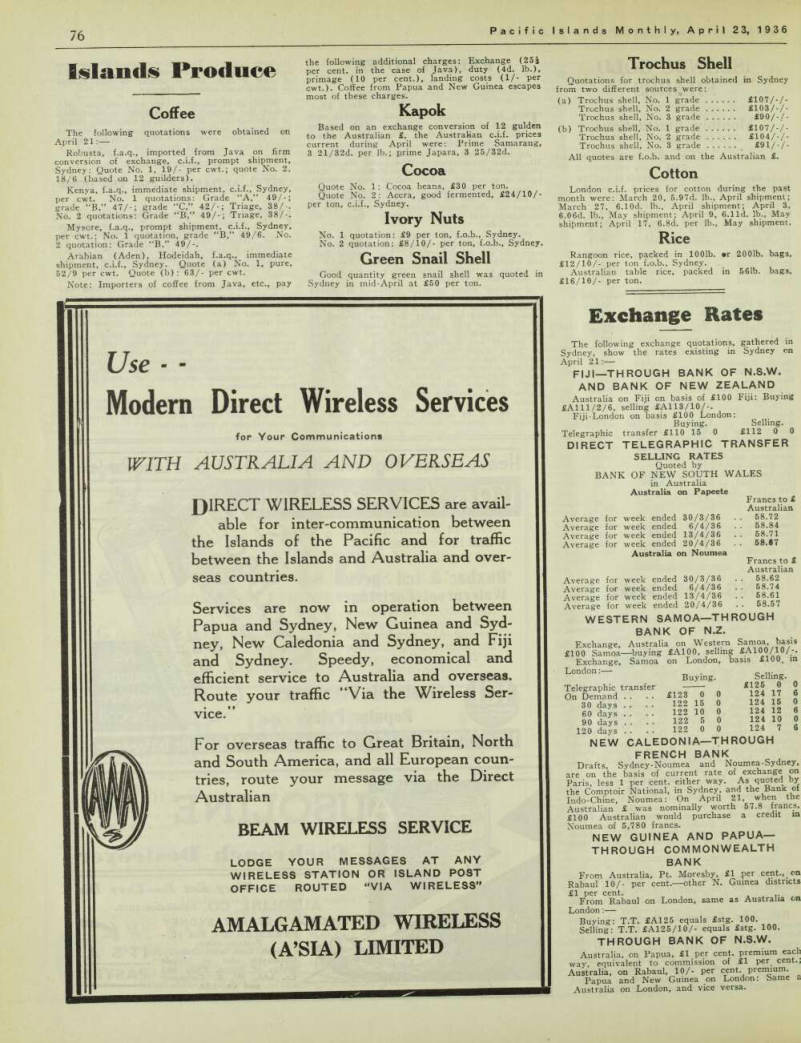
Coffee
The following quotations were obtained on April 21;— Robusta, f.a.q., imported from Java on firm conversion of exchange, c.i.f., prompt shipment, Sydney; Quote No. 1, 19/- per cwt.; quote No. 2, 18/6 (based on 12 guilders).
Kenya, f.a.q., immediate shipment, c.i.f., Sydney, per cwt. No. 1 quotations: Grade “A,” 49/-; grade “B,” 47/-; grade “C,” 42/-; Triage, 38/-.
No. 2 quotations: Grade “B,” 49/-; Triage, 38/-.
Mysore, f.a.q., prompt shipment, c.i.f., Sydney, per cwt.; No. 1 quotation, grade “B,” 49/6. No. 2 quotation: Grade “B,” 49/-.
Arabian (Aden), Hodeidah, f.a.q., immediate shipment, c.i.f., Sydney. Quote (a) No. 1, pure, 52/9 per cwt. Quote (b); 63/- per cwt.
Note: Importers of coffee from Java, etc., pay
the following additional charges: Exchange (25i per cent, in the case of Java), duty (4d. lb,), primage (10 per cent.), landing costs (1/- per cwt.). Coffee from Papua and New Guinea escapes most of these charges.
Kapok
Based on an exchange conversion of 12 gulden to the Australian £, the Australian c.i.f. prices current during April were; Prime Samarang, 3 21/32d. per lb.; prime Japara, 3 25/32d.
Cocoa
Quote No. 1: Cocoa beans, £3O per ton.
Quote No. 2: Accra, good fermented, £24/10/per ton, c.i.f., Sydney.
Ivory Nuts
No, 1 quotation; £9 per ton, f.0.b., Sydney.
No. 2 quotation: £B/10/- per ton, f.0.b., Sydney.
Green Snail Shell
Good quantity green snail shell was quoted in Sydney in mid-April at £5O per ton.
Trochus Shell
Quotations for trochus shell obtained in Sydney from two different sources were: (a) Trochus shell. No. 1 grade £lO7/-/- Trochus shell. No. 2 grade £lO3/-/- Trochus shell. No. 3 grade £9O/-/- (b) Trochus shell, No. 1 grade £lO7/-/- Trochus shell. No. 2 grade £lO4/-/- Trochus shell. No. 3 grade £9l/-/- All quotes are f.o.b. and on the Australian £.
Cotton
London c.i.f. prices for cotton during the past month were: March 20, 5.97 d. lb., April shipment; March 27, 6.10 d. lb., April shipment; April 3, 6.06 d. lb.. May shipment; April 9,6. lid. lb., May shipment; April 17, 6.8 d. per lb.. May shipment.
Rice
Rangoon rice, packed in 1001 b. «r 2001 b. bags, £l2/10/- per ton f.0.b., Sydney.
Australian table rice, packed in 561 b. bags, £l6/10/- per ton.
Exchange Rates
The following exchange quotations, gathered in Sydney, show the rates existing in Sydney on April 21; —
F Ij|_Through Bank Of N.S.W.
And Bank Of New Zealand
Australia on Fiji on basis of £lOO Fiji: Buying £Alll/2/6, selling £AII3/10/-.
Fiji-London on basis £lOO London: Buying. Selling.
Telegraphic transfer £llO 15 0 £ll2 0 0
Direct Telegraphic Transfer
Selling Rates
Quoted by
Bank Of New South Wales
in Australia
Western Samoa—Through
Bank Of N.Z.
Exchange, Australia on Western Samoa, basis £lOO Samoa —buying £AIOO, selling £AIOO/10/-.
Exchange, Samoa on London, basis in London:—
New Caledonia —Through
French Bank
Drafts, Sydney-Noumea and Noumea-Sydney, are on the basis of current rate of exchange on Paris, less 1 per cent, either way. As quoted by the Comptoir National, in Sydney, and the Bank ot Indo-Chine, Noumea; On April 21, when the Australian £ was nominally worth 57.8 irancs, £lOO Australian would purchase a credit m Noumea of 5,780 francs.
New Guinea And Papua
Through Commonwealth
Bank
From Australia, Pt. Moresby, £1 per cent., on Rabaul 10/- per cent. —other N. Guinea districts £1 per cent.
From Rabaul on London, same as Australia on London: — Buying: T.T. £AI2S equals £stg. 100.
Selling: T.T. £AI2S/10/- equals £stg. 100.
Through Bank Of N.S.W.
Australia, on Papua. £1 per cent, premium each way, equivalent to commission of £1 per cent.] Australia, on Rabaul, 10/- per cent, premium.
Papua and New Guinea on London: same a Australia on London, and vice versa.
Average for Australia on Papeete week ended 30/3/36 Francs to £ Australian . 68.72 Average for week ended 6/4/36 . . 58.84 Average for week ended 13/4/36 . . 58.71 Average for week ended 20/4/36 58.57 Average for Australia on Noumea week ended 30/3/36 Francs to £ Australian . 58.62 Average for week ended 6/4/36 . . 68.74 Average for week ended 13/4/36 . . 58.61 Average for week ended 20/4/36 . . 58.57
Buying. Selling.
Telegraphic transfer 0 0 On Demand . . . . £123 0 0 124 17 6 30 days . . . • 122 15 0 124 15 0 6(1 days ... 122 10 0 124 12 6 90 days . . . . 122 5 0 124 10 0 120 days ... 122 0 0 124 7 6
Advertisements & other items, p. 78 (1 item)
Modern Direct Wireless Services
Use ■ -
for Your Communications
WITH AUSTRALIA AND OVERSEAS
DIRECT WIRELESS SERVICES are avail-
able for inter-communication between the Islands of the Pacific and for traffic between the Islands and Australia and overseas countries.
Services are now in operation between Papua and Sydney, New Guinea and Sydney, New Caledonia and Sydney, and Fiji and Sydney. Speedy, economical and efficient service to Australia and overseas.
Route your traffic “Via the Wireless Service.”
For overseas traffic to Great Britain, North and South America, and all European countries, route your message via the Direct Australian
BEAM WIRELESS SERVICE
LODGE YOUR MESSAGES AT ANY
WIRELESS STATION OR ISLAND POST
OFFICE ROUTED “VIA WIRELESS"
AMALGAMATED WIRELESS
(A’SIA) LIMITED
Market Quotations
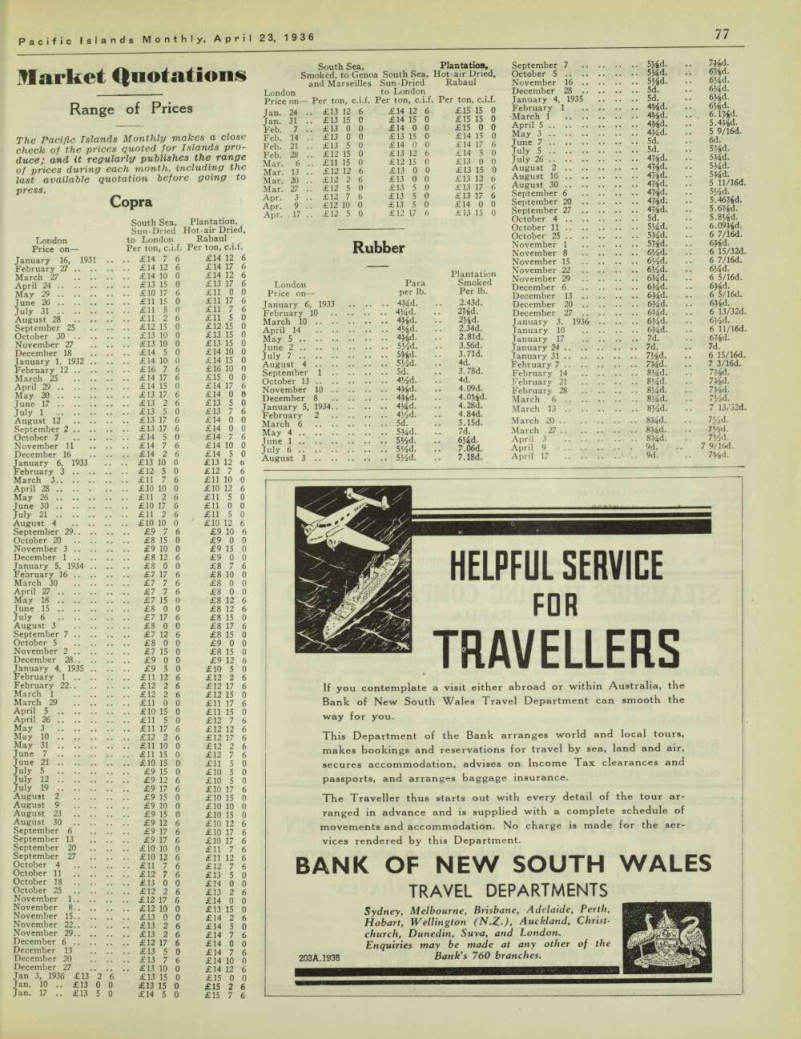
Range of Prices
The Pacific Islands Monthly makes a close check of the prices quoted for Islands pro duce; and it regularly publishes the range of prices during each month, including the last available quotation before going to press.
Copra
Rubber
September 7 . .. 5^d. 7jid.
October 5 6%d.
November 16 . .. Slid. 6%d.
December 28 6Ad.
January 4, 1935 .. 6y»d.
February 1 . .. 4*$d. 6%d.
March 1 6. lj$d.
April 5 S.4j&d.
May 3 5 9/l6d.
June 7 . .. 5d. 6d.
July 5 . .. 5d.
SVnd.
July 26 5Ad.
August 2 SHd.
August 16 sy 4 d.
August 30 5 ll/16d.
September 6 . .. 4^d. syd.
September 20 . .. 47^d. 5.46^d.
September 27 . .. 4fcd.
S.6yd.
October 4 . .. 5d. 5.8Jid.
October 11 . .. 5'Ad. 6.09j$d.
October 25 6 7/16d.
November 1 . .. 5ftd. 6j6d.
November 8 . .. eyd. 6 15/32d.
November IS 6 7/16d.
November 22 6%d.
November 29 . .. ey 4 d. 6 S/16d.
December 6 . .. 6Hd. 6Ad.
December 13 6 5/16d.
December 20 . .. 6Md. 6Hd December 27 . .. 6Md. 6 13/32d.
January 3. 1936 .. . . . 6Hd. eyd.
January 10 . .. 6Hd. 6 ll/16d.
January 17 . .. 7d. 6Jid.
January 24 7d.
January 31 . .. 7'Ad. 6 15/16d.
February 7 . .. 7 Ad. 7 3/16d.
February 14 . .. 8%d. 7Hd.
February 21 . .. 8!4d. 7V% d.
February 28 .. .. . . .. 854d. 7H d.
March 6 7y d.
March 13 . .. sy 3 d. 7 13/32d.
March 20 . .. 8Ad. 7Ad.
March 27 . .. 8Ad. yyjd.
April 3 . .. 8Ad. 7yd.
April 9 . . 9d. .. 7 9/16d.
April 17 . .. 9d. 7Ad.
London Price on- South Sea, Plantation, Smoked, to Genoa South Sea, Hot-air Dried, and Marseilles Sun-Dried Rabaul to London - Per ton, c.i.f. Per ton, c.i.f. Per ton, c.i.f.
Jan. 24 .. £13 12 6 £14 12 6 £15 15 0 Jan. 31 .. £13 15 0 £14 IS 0 £15 IS 0 Feb. 7 .. £13 0 0 £14 0 0 £15 0 0 Feb. 14 .. £13 0 0 £13 15 0 £14 15 0 Feb. 21 .. £13 5 0 £14 0 0 £14 17 6 Feb. 28 .. £12 15 0 £13 12 6 £14 5 0 Mar. 6 .. £11 15 0 £12 15 0 £13 0 0 Mar. 13 .. £12 12 6 £13 0 0 £13 15 0 Mar. 20 .. £12 2 6 £13 0 0 £13 12 6 Mar. 27 .. £12 5 0 £13 5 0 £13 17 6 Apr. 3 .. £12 7 6 £13 5 0 £13 17 6 Apr. 9 .. £12 10 0 £13 5 0 £14 0 0 Apr. . 17 .. £12 5 0 £12 17 6 £13 IS 0
London Price on— January 16, 1931 South Sea, Sun-Dried to London Per ton, c.i.f. .. £14 7 6 Plantation, Hot-air Dried, Rabaul Per ton, c.i.f. £14 12 6 February 27 .. .. .. £14 12 6 £14 17 6 March 27 ... .. £14 10 0 £14 12 6 April 24 .. £13 15 0 £13 17 6 May 29 .. £10 17 6 £11 0 0 June 26 .. £11 15 0 £11 17 6 July 31 .. £11 5 0 £11 7 6 August 28 .. .. .. £11 2 6 £11 5 0 September 25 .. £12 15 0 £12 15 0 October 30 .. .. .. £13 10 0 £13 15 0 November 27 .. £13 10 0 £13 15 0 December 18 .. £14 5 0 £14 10 0 January 1, 1932 .. .. £14 10 0 £14 15 0 February 12 .. .. 6 £16 10 0 March 25 ... .. £14 17 6 £15 0 0 April 29 .. £14 15 0 £14 17 6 May 20 .. £13 17 6 £14 0 0 June 17 .. £13 2 6 £13 5 0 July 1 .. £13 5 0 £13 7 6 August 12 .. .. .. £13 17 6 £14 0 0 September 2 .. .. .. £13 17 6 £14 0 0 October 7 .. .. .. £14 5 0 £14 7 6 November 11 .. £14 7 6 £14 10 0 December 16 .. £14 2 6 £14 5 0 January 6, 1933 .. £13 10 0 £13 12 b February 3 .. .. .. £12 5 0 £12 7 6 March 3 .. £11 7 6 £11 10 0 April 28 0 £10 12 6 May 26 6 £11 S 0 June 30 .. £10 17 6 £11 0 0 July 21 .. £11 2 6 £11 5 0 August 4 .. £10 10 0 £10 12 6 September 29.. .. £9 7 6 £9 10 6 October 20 .. .. .. £8 15 0 £9 0 0 November 3 .. .. £9 10 0 £9 15 0 December 1 .. .. .. £8 12 6 £9 0 0 January 5, 1934 .. .. £8 0 0 £8 7 6 February 16 .. .. .. £7 17 6 £8 10 0 March 30 .. .. .. £7 7 6 £8 0 0 April 27 .. £7 7 6 £8 0 0 May 18 £7 15 0 £8 12 6 June IS .. £8 0 0 £8 12 6 July 6 .. £7 17 6 £8 IS 0 August 3 ... .. £8 0 0 £8 17 6 September 7 .. .. .. £7 12 6 £8 15 0 October 5 .. .. .. £8 0 0 £9 0 0 November 2 .. .. £7 IS 0 £8 15 0 December 28.. .. .. £9 0 0 £9 12 6 January 4, 1935 ,. £9 5 0 £10 5 0 February 1 .. .. .. £11 12 6 £12 2 6
February 22..
.. £12 2 6 £12 17 6 March 1 ... .. £12 2 6 £12 15 0 March 29 .. .. .. £11 0 0 £11 17 6 April 5 .. £10 15 0 £11 15 0 April 26 .. £11 5 0 £12 7 6
May 3
6 £12 12 6 May 10 .. £12 2 6 £12 17 6 May 31 0 £12 2 6 June 7 0 £12 7 6 June 21 0 £11 5 0 July 5 0 £10 5 0 July 12 6 £10 5 0 July 19 6 £10 17 6 August 2 ... .. £9 15 0 £10 15 0 August 9 .. .. 0 £10 10 0 August 23 .. .. .. £9 15 0 £10 15 0 August 30 .. .. 6 £10 12 6 September 6 .. £9 17 6 £10 17 6 September 13 £9 17 6 £10 17 6 September 20 .. £10 10 0 £11 7 6
September 27
.. £10 12 6 £11 12 6 October 4 .. .. .. £11 7 6 £12 7 6 October 11 .. .. 6 £13 5 0 October 18 .. .. 0 £14 0 0 October 25 .. .. 6 £13 2 6 November 1.. 6 £14 0 0 November 8.. .. .. £12 10 0 £13 15 0 November 15.. .. 0 £14 2 6 November 22.. .. .. £13 2 6 £14 5 0 November 29.. .. 6 £14 7 6 December 6 .. .. 6 £14 0 0 December 13 .. £13 5 0 £14 7 6 December 20 .. £13 7 6 £14 10 0 December 27 .. £13 10 0 £14 12 6 Jan 3, 1936 £13 2 6 £13 15 0 £15 0 0 Jan. 10 .. £13 0 0 £13 15 0 £15 2 6 Jan. 17 .. £13 5 0 £14 5 0 £15 7 6
London Para Plantation Smoked Price on— per lb.
Per lb.
January 6, 1933 .. .. 4tfd. 2.43d.
February 10 .. .. . .. 4Kd. 2Hd.
March 10 2'Ad.
April 14 May 5 S* 2.34d. 2.81d.
June 2 .. .. 5||d. 3.56d.
July 7 •• •• 3.71d.
August 4 4d.
September 1 .. .. .. .. 5d. 3.78d.
October 13 4d.
November 10 .. .. .. .. 4tfd. 4.09d.
December 8 .. .. .. .. 4^d. 4.0^d.
January 5, 1934.. .. .. .. 4J4d. 4.28d.
February 2 .. .. .. .. 4/,d. 4.84d.
March 6 .. .. 5d.
S.lSd.
May 4 7d.
June 1 . ,. .. SVid. 6J4d.
July 6 .. .. 5j4d. 7.06d.
August 3 .. .. sy 2 d. 7.18d.
Advertisements & other items, p. 79 (1 item)
Travellers
HELPFUL SERVICE
FDR
If you contemplate a visit either abroad or within Australia, the Bank of New South Wales Travel Department can smooth the way for you.
This Department of the Bank arranges world and local tours, makes bookings and reservations for travel by sea, land and air, secures accommodation, advises on Income Tax clearances and passports, and arranges baggage insurance.
The Traveller thus starts out with every detail of the tour arranged in advance and is supplied with a complete schedule of movements and accommodation. No charge is made for the services rendered by this Department.
BANK OF NEW SOUTH WALES
203A.1936
TRAVEL DEPARTMENTS
Sydney, Melbourne, Brisbane, Adelaide, Perth, Hobart, Wellington (N.Z-), Auckland, Christchurch, Dunedin, Sura, and London.
Enquiries may be made at any other of the Bank’s 760 branches.
Shipping Services in the Pacific
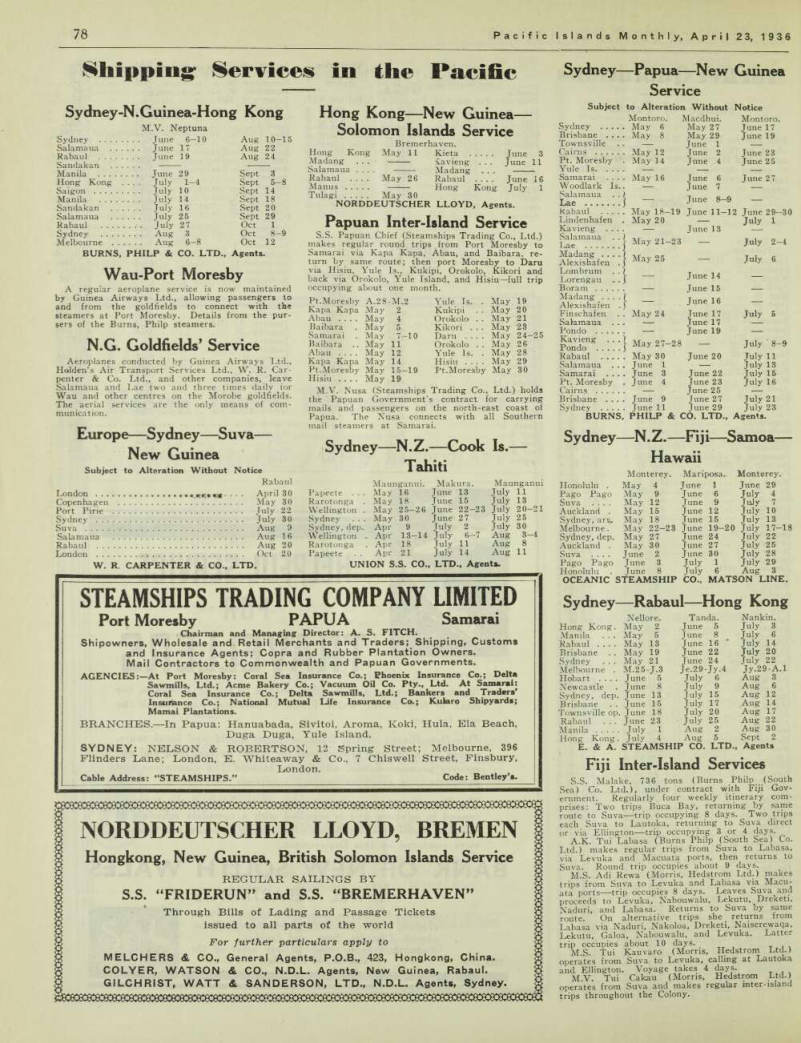
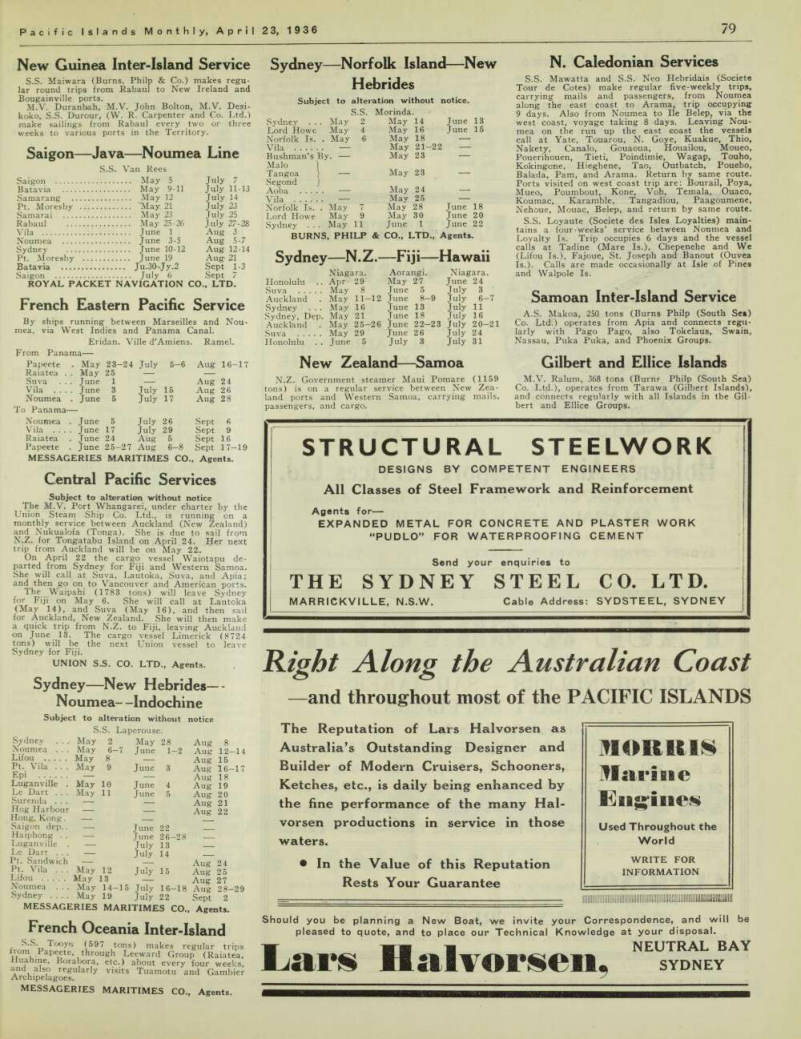
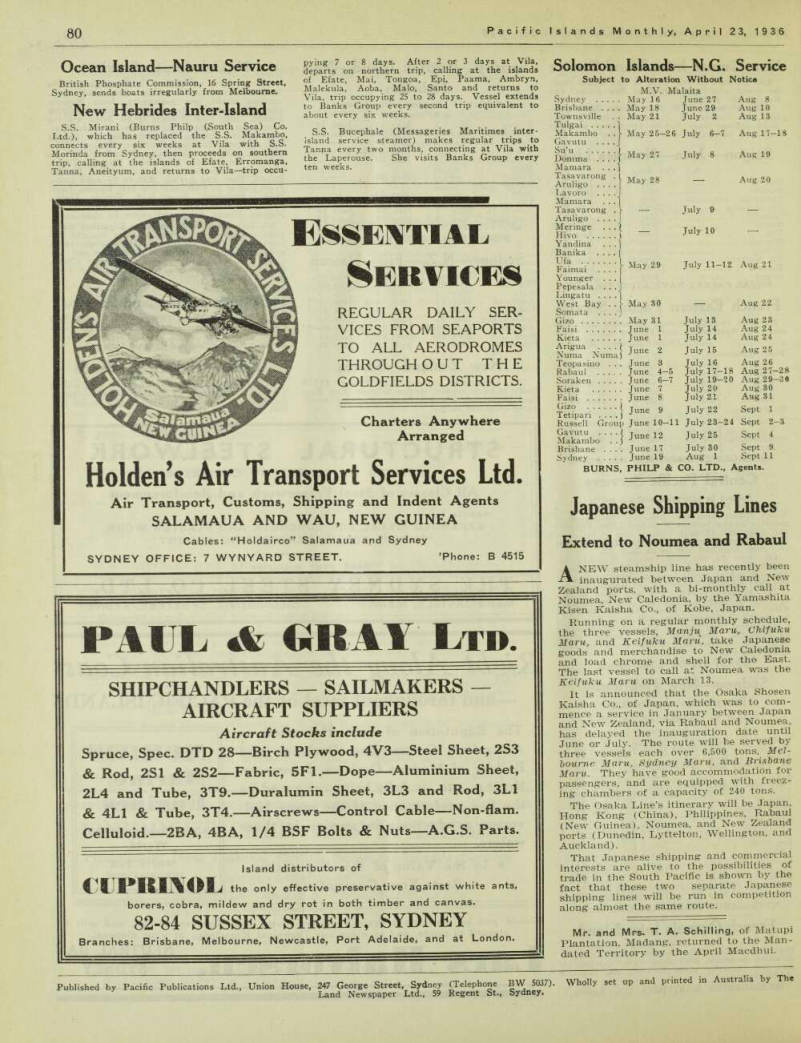
Sydney-N.Guinea-Hong Kong
Wau-Port Moresby
A regular aeroplane service is now maintained by Guinea Airways Ltd., allowing passengers to and from the goldfields to connect with the steamers at Port Moresby. Details from the pur sers of the Burns, Philp steamers.
N.G. Goldfields’ Service
Aeroplanes conducted by Guinea Airways Ltd., Holden’s Air Transport Services Ltd., W. R. Car penter & Co. Ltd., and other companies, leave Salamaua and Lae two and three times daily for Wau and other centres on the Morobe goldfields.
The aerial services are the only means of com munication.
Europe—Sydney—Suva—
New Guinea
Subject to Alteration Without Notice
Hong Kong—New Guinea— Solomon Islands Service
Papuan Inter-Island Service
S.S. Papuan Chief (Steamships Trading Co., Ltd.) makes regular round trips from Port Moresby to Samarai via Kapa Kapa, Abau, and Baibara, re turn by same route; then port Moresby to Daru via Hisiu, Yule Is., Kukipi, Orokolo, Kikori and back via Orokolo, Yule Island, and Hisiu —full trip occupying about one month.
M.V. Nusa (Steamships Trading Co., Ltd.) holds the Papuan Government’s contract for carrying mails and passengers on the north-east coast of Papua. The Nusa connects with all Southern mail steamers at Samarai.
Sydney—N.Z.—Cook Is.—
Tahiti
Sydney—Papua—New Guinea
Service Subject to Alteration Without Notice
Sydney—N.Z.—Fiji—Samoa— Hawaii
Sydney—Rabaul—Hong Kong
Fiji Inter-Island Services
S.S. Malake, 736 tons (Burns Philp (South Sea) Co. Ltd.), under contract with Fiji Gov ernment. Regularly four weekly itinerary com prises: Two trips Buca Bay, returning by same route to Suva —trip occupying 8 days. Two trips each Suva to Lautoka, returning to Suva direct or via Ellington—trip occupying 3 or 4 days.
A.K. Tui Labasa (Burns Philp (South Sea) Co.
Ltd.) makes regular trips from Suva to Labasa, via Levuka and Macuata ports, then returns to Suva. Round trip occupies about 9 days.
M.S. Adi Rewa (Morris, Hedstrom Ltd.) makes trips from Suva to Levuka and Labasa via Macu ata ports —trip occupies 8 days. Leaves Suva and proceeds to Levuka, Nabouwalu, Lekutu, Dreketi, Naduri, and Labasa. Returns to Suva by same route. On alternative trips she returns from Labasa via Naduri, Nakoloa, Dreketi, Naiserewaqa.
Lekutu, Galoa, Nabouwalu, and Levuka. Latter trip occupies about 10 days.
M.S. Tui Kauvaro (Morris, Hedstrom Ltd.) operates from Suva to Levuka, calling at Lautoka and Ellington. Voyage takes 4 days.
M.V. Tui Cakau (Morris, Hedstrom Ltd.) operates from Suva and makes regular mter-island trips throughout the Colony.
Sydney
M.V. Neptuna
Aug 10-15 Salamaua . . . 17 Aug 22 Rabaul ... June 19 Aug 24 Manila 29 Sept 3 Hong- Kong . . . . July 1-4 Sept 5-8 Saigon . . . . July 10 Sept 14 Manila . . . . . . . . July 14 Sept 18 Sandakan .. . . . . July 16 Sept 20 Salamaua . . . . . . July 25 Sept 29 Rabaul ... . . . . July 27 Oct 1
Sydney ...
... Aug 3 Oct 8-9 Melbourne . . . . .. Aug 6-8 Oct 12
Burns,
Philp &
Co. Ltd.,
Agents.
Rabaul London mv•■€ • . . . April 30 Copenhagen . . . May 30 Port Pine . . . July 22 Sydney . . . July 30 Suva Salamaua ... Ang 16 Rabaul ... Aug 20 London * Oct 20
W. R Carpenter & Co.,
Ltd.
Bremerhaven.
Hong Kong May 11 Kieta June 3 Madang — iCavieng . . . June 11 Salamaua . . . . — Madang . . .
Rabaul ...
May 26 Rabaul ... June 16 Manus — Hong Kong July 1 Tulagi May 30
Norddeutscher
LLOYD, Agents.
Pt.Moresby A.28-M.2 Yule Is. . May 19 Kapa Kapa May 2 Kukipi . . May 20 Abau ... May 4 Orokolo , . May 21 Baibara . May 5 Kikori . . . May 23 Samarai . May 7—10 Daru ... May 24-25 Baibara .. May 11 Orokolo .. May 26 Abau ... May 12 Yule Is. . May 28 Kapa Kapa May 14 Hisiu ... May 29 Pt.Moresby May 15-19 Pt.Moresby May 30 Hisiu ... May 19
Maunganui.
Makura.
Maunganui Papeete . . .
May 16 June 13 July 11 Rarotonga .
May 18 June 15 July 13 Wellington .
May 25-26 June 22-23 July 20-21 Sydney ...
May 30 June 27 July 25 Sydney, dep.
Apr 9 July 2 July 30 Wellington . Apr 13-14 July 6-7 Aug 3-4 Rarotonga . Apr 18 July 11 Aug 8 Papeete . .
Apr 21 July 14 Aug 11
Union S.S. Co.,
, Ltd
., Agents.
Montoro.
May 6 May 8 May 12 May 14 May 16 Macdhui.
May 27 May 29 June 1 June 2 June 4 June 6 June 7 June 8- Montoro.
June 17 June 19 June 23 June 25 June 27 -9 — Brisbane . . . .
Townsville Pt. Moresby .
Yule Is Samarai . . . .
Woodlark Is..
Salamaua . . I Lae May 18- May 20 May 21- -19 June 11- June 13 -23 — -12 June 29-30 July 1 July 2-4 Lindenhafen .
Kavieng Salamaua . .
Lae Madang . . . .' Alexishafen . ' Lombrum . . I May 25 June 14 June 15 June 16 June 17 June 17 June 19 -28 — July 6 Lorengau . . j Boram Madang . . . . Alexishafen . J Finschafen Salamaua . . .
Pnndo f May 24 July 5 Kavieng . . . ] Pondo J ► May 27- July 8-9 Rabaiil May 30 June 20 June 22 June 23 June 25 July 11 July 13 July 15 July 16 Salamaua . . .
Samarai Pt. Moresby .
Cairns June 1 June 3 June 4 Brisbane Sydney June 9 June 11
Philp
June 27 June 29
& Co. Ltd.
July 21 July 23 , Agents.
Burns,
Monterey.
Mariposa.
Monterey.
Honolulu .
May 4 June 1 June 29 Pago Pago May 9 June 6 July 4 Suva ...
May 12 June 9 July 7 Auckland .
May 15 June 12 July 10 Sydney, ari^ May 18 June 15 July 13 Melbourne.
May 22-23 June 19-20 July 17-18 Sydney, dep.
May 27 June 24 July 22 Auckland .
May 30 June 27 July 25 Suva ...
June 2 June 30 July 28 Pago Pago June 3 July 1 July 29 Honolulu June 8 July 6 Aug 3
Oceanic
Steamship
CO..
Matson Line.
Nellore.
Tanda.
Nank :in.
Hong Kong.
May 2 June 5 July 3 Manila . . .
May 5 June 8 July 6 Rabaul ...
May 13 June 16 * July 14 Brisbane . .
May 19 June 22 July 20 Sydney May 21 June 24 July 22 Melbourne .
M.25-J.3 Je.29-Jy.4 Jy.29-A.l Hobart ...
June 5 July 6 Aug 3 Newcastle June 8 July 9 Aug 6 Sydney, dep. Tune 13 July 15 Aug 12 Brisbane , .
June 15 July 17 Aug 14 Townsville op. , June 18 July 20 Aug 17 Rabaul . . .
June 23 July 25 Aug 22 Manila July 1 Aug 2 Aug 30 Hong Kong.
July 4 Aug 5 Sept 2 E. & A.
Steamship Co.
Ltd.,
, Agents
New Guinea Inter-Island Service
S.S. Maiwara (Burns, Philp & Co.) makes regu lar round trips from Rabaul to New Ireland and Bougainville ports.
M.V. Duranbah, M.V. John Bolton, M.V. Desi koko, S.S. Durour, (W. R. Carpenter and Co. Ltd.) make sailings from Rabaul every two or three weeks to various ports in the Territory.
Saigon—Java—Noumea Line
French Eastern Pacific Service
By ships running between Marseilles and Nou mea, via West Indies and Panama Canal.
Central Pacific Services
Subject to alteration without notice The M.V. Port Whangarei, under charter by the Union Steam Ship Co. Ltd., is running on a monthly service between Auckland (New Zealand) and Nukualofa (Tonga). She is due to sail from N.Z. for Tongatabu Island on April 24. Her next trip from Auckland will be on May 22.
On April 22 the cargo vessel Waiotapu de parted from Sydney for Fiji and Western Samoa.
She will call at Suva, Lautoka, Suva, and Apia; and then go on to Vancouver and American ports.
The Waipahi (1783 tons) will leave Sydney for Fiji on May 6. She will call at Lautoka (May 14), and Suva (May 16), and then sail for Auckland, New Zealand. She will then make a quick trip from N.Z. to Fiji, leaving Auckland on June 13. The cargo vessel Limerick (8724 tons) will be the next Union vessel to leave Sydney for Fiji.
Union S.S. Co. Ltd., Agents.
Sydney—New Hebrides—-
Noumea- -Indochine
Subject to alteration without notice
French Oceania Inter-Island
S.S. Tooyu (597 tons) makes regular trips Vr° m u Pape i? te ’ L through Le eward Group (Raiatea, Muanme, Borabora, etc.) about every four weeks, and also regularly visits Tuamotu and Gambier Archipelagoes.
Messageries Maritimes Co., Agents.
Sydney—Norfolk Island —New Hebrides Subject to alteration without notice.
Sydney—N. Z.—Fiji—Hawaii
New Zealand—Samoa
N.Z. Government steamer Maui Pomare (1159 tons) is on a regular service between New Zea land ports and Western Samoa, carrying mails, passengers, and cargo.
N. Caledonian Services
5.5. Mawatta and S.S. Neo Hebridais (Societo Tour de Cotes) make regular five-weekly trips, carrying mails and passengers, from Noumea along the east coast to Arama, trip occupying 9 days. Also from Noumea to lie Belep, via the west coast, voyage taking 8 days. Leaving Nou mea on the run up the east coast the vessels call at Yate, Touarou, N. Goye, Kuakue, Thio, Nakety, Canalo, Gouaoua, Houailou, Moueo, Pouerihouen, Tieti, Poindimie, Wagap, Touho, Kokingone, Hieghene, Tao, Outbatch, Pouebo, Balada, Pam, and Arama. Return by same route.
Ports visited on west coast trip are; Bourail, Poya, Mueo, Poumbout, Kone, Voh, Temala, Ouaco, Koumac, Karamble, Tangadiou, Paagoumene, Nehoue, Mouac, Belep, and return by same route. 5.5. Loyaute (Societe des Isles Loyalties) main tains a four-weeks’ service between Noumea and Loyalty Is. Trip occupies 6 days and the vessel calls at Tadine (Mare Is.), Chepenehe and We (Lifou Is.), Fajoue, St. Joseph and Banout (Ouvea Is.). Calls are made occasionally at Isle of Pines and Walpole Is.
Samoan Inter-Island Service
A.S. Makoa, 250 tons (Burns Philp (South Set) Co. Ltd.) operates from Apia and connects regu larly with Pago Pago, also Tokelaus, Swain, Nassau, Puka Puka, and Phoenix Groups.
Gilbert and Ellice Islands
M.V. Ralum, 368 tons (Burns Philp (South Sea) Co. Ltd.), operates from Tarawa (Gilbert Islands), and connects regularly with all Islands in the Gil bert and Ellice Groups.
s.s . Van Rees Saigon July 7 Batavia ... May 9-11 July 11-13 Samarang May 12 July 14 Pt. Moresby ... 'May 21 July 23 Samarai ... May 23 July 25 Rabaul ... May 25-26 July 27-28 Vila Aug 3 Noumea Aug 5-7 Sydney Aug 12-14 Pt. Moresby ... June 19 Aug 1 21 Batavia ... Ju.30'Jy.2 Sept 1-3 Saigon ... July 6 Sept 7
Royal Packet
Navigation
Co., Ltd.
Eridan. V: ille d’Amiens.
Ramel.
From Panama— Papeete . May 23-24 July 5-6 Aug 16- -17 Raiatea . . . May 25 — Suva . . .
June 1 — Aug 24 Vila . June 3 July 15 Aug 26 Noumea , June 5 July 17 Aug 28 To Panama— Noumea .
June 5 July 26 Sept 6 Vila . . . .
June 17 July 29 Sept 9 Raiatea June 24 Aug 5 Sept 16 Papeete .
June 25—27 Aug 6-8 Sept 17- 19
Messageries
Maritimes Co.,
, Agents.
S.S.
Laperouse.
Sydney .. .
May 2 May 28 Aug 8 Noumea . . .
May 6- -7 June 1-2 Aug 12- -14 Lifou ...
May 8 Aug 15 Pt. Vila . . .
May 9 June 3 Aug 16- -17 Epi — — Aug 18 Luganville .
May 10 June 4 Aug 19 Le Dart . . .
May 11 June 5 Auer 20 Surenda . . . — — Aue 21 Hog Harbour — Aug 22 Hong, Kong. — Saigon dep.. —, June 22 Haiphong . . —- June 26-28 Luganville . — July 13 Le Dart . . . — July 14 Pt. Sandwich — Aug 24 Pt. Vila . . .
May 12
jui;
15 Aug 25 Lifou May 13 Aug 27 Noumea . . .
May 14- -15 July 16-18 Aug 28- -29 Sydney ...
May 19 July 22 Sept 2
Messageries
Maritimes Co.,
Agents.
S.S. Morinda.
Sydney ...
May 2 May 14 June 13 Lord Howe May 4 May 16 June 15 Norfolk Is. .
May 6 May 18 — Vila — May 21- 22 — Bushman’s By. — May 23 — Malo Tangoa V — May 23 — Segond J Aoba — May 24 — Vila — May 25 — Norfolk Is. .
May 7 May 28 June 18 Lord Howe May 9 May 30 June 20 Sydney . . .
May 11 June 1 June 22
Burns
, Philp & Co., Ltd
Agents.
Niagara.
Aorangi.
Niagara, Honolulu Apr 29 May 27 June 24 Suva May 8 June 5 July 3 Auckland May 11-12 June 8-9 July 6-7 Sydney . . .
May 16 June 13 July 11 Sydney, Dep.
May 21 June 18 July 16 Auckland May 25-26 June 22-23 July 20-21 Suva May 29 June 26 July 24 Honolulu . .
June 5 July 3 July 31
Ocean Island —Nauru Service
British Phosphate Commission, 16 Spring Street, Sydney, sends boats irregularly from Melbourne.
New Hebrides Inter-Island
S.S. Mirani (Bums Philp (South Sea) Co.
Ltd.), which has replaced the S.S. Makambo, connects every six weeks at Vila with S.S.
Morinda from Sydney, then proceeds on southern trip, calling at the islands of Efate, Erromanga, Tanna, Aneityum, and returns to Vila —trip occu
pying 7 or 8 days. After 2 or 3 days at Vila, departs on northern trip, calling at the islands of Efate, Mai, Tongoa, Epi, Paama, Ambryn, Malekula, Aoba, Malo, Santo and returns to Vila, trip occupying 25 to 28 days. Vessel extends to Banks Group every second trip equivalent to about every six weeks.
S.S. Bucephale (Messageries Maritimes inter island service steamer) makes regular trips to Tanna every two months, connecting at Vila with the Laperouse. She visits Banks Group every ten weeks.
Solomon Islands—N.G. Service Subject to Alteration Without Notice
Sydney . . .
M.V.
May 16 Malaita Time 27 Aug 8 Aug 10 Aug 13 Aug 17- May 18 June 29 July 2 July 6—7 Townsville Tulgai Makambo . .
Gavutu ...
Su’u May 21 May 25- 26 18 May 27 May 28 July 8 July 9 July 10 Aug 19 Aug 20 Comma ...
Mamara Tasavarong .
Aruligo ...
Lavoro ...
Mamara Tasavarong .
Aruligo ...
Meringe Hivo Yandina Banika ...
Ufa ■ May 29 May 30 . May 31 July 11-12 July 13 July 14 July 14 July 15 July 16 July 17-18 July 19-20 July 20 July 21 Aug 21 Aug 22 Aug 23 Aug 24 Aug 24 Faimai Younger . .
Pepesala . .
Lingatu . . .
West Bay .
Somata . . .
Gizn Faisi . June 1 . J une 1 June 2 . June 3 . June 4- June 6- Kieta ...
Arigua Numa Num Teopasino .
Rabaul . . . -5 Aug 25 Aug 26 Aug 27- -28 Soraken -7 Aug 29- -30 Kieta ...
June 7 Aug 30 Faisi June 8 Aug 31 Sept 1 Sept 2- Sept 4 Sept 9 Sept 11 Gizo June 9 [) June 10- June 12 . June 17 . June 19 Tetipari . . .
Russell Gro Gavutu . . .
Makambo .
Brisbane . .
Sydney - - • juiy zz -11 July 23-24 July 25 July 30 Auer 1 -3
Burns
, Philp
& CO. LTD., Agents.
Advertisements & other items, pp. 80-82 (1 item)
Steamships Trading Company Limited
Port Moresby PAPUA Samarai
Chairman and Managing Director: A. S. FITCH.
Shipowners, Wholesale and Retail Merchants and Traders; Shipping, Customs and Insurance Agents; Copra and Rubber Plantation Owners.
Mail Contractors to Commonwealth and Papuan Governments.
AGENCIES:—At Port Moresby: Coral Sea Insurance Co.; Phoenix Insurance Co.; Delta Sawmills, Ltd.; Acme Bakery Co.; Vacuum Oil Co. Pty., Ltd. At Samarai: Coral Sea Insurance Co.; Delta Sawmills, Ltd.; Bankers and Traders’
Insurance Co.; National Mutual Life Insurance Co.; Kularo Shipyards; Mamai Plantations.
BRANCHES.—In Papua; Hanuabada, Sivitoi, Aroma, Koki, Hula, Ela Beach, Duga Duga, Yule Island.
SYDNEY: NELSON & ROBERTSON, 12 Spring Street; Melbourne, 396 Flinders Lane; London, E. Whiteaway & Co., 7 Chiswell Street, Finsbury, London.
Cable Address: “STEAMSHIPS.” Code: Bentley’s.
NORDDEUTSCHER LLOYD, BREMEN
Hongkong, New Guinea, British Solomon Islands Service
REGULAR SAILINGS BY
S.S. “FRIDERUN” and S.S. “BREMERHAVEN”
Through Bills of Lading and Passage Tickets issued to all parts of the world For further particulars apply to MELCHERS & CO., General Agents, P. 0.8., 423, Hongkong, China.
COLYER, WATSON & CO., N.D.L. Agents, New Guinea, Rabaul.
GILCHRIST, WATT & SANDERSON, LTD., N.D.L. Agents, Sydney.
STRUCTURAL STEELWORK
DESIGNS BY COMPETENT ENGINEERS
All Classes of Steel Framework and Reinforcement Agents for— EXPANDED METAL FOR CONCRETE AND PLASTER WORK
"PUDLO" FOR WATERPROOFING CEMENT
Send your enquiries to
THE SYDNEY STEEL CO. LTD.
MARRICKVILLE, N.S.W. Cable Address: SYDSTEEL, SYDNEY
Right Along the Australian Coast
—and throughout most of the PACIFIC ISLANDS The Reputation of Lars Halvorsen as Australia’s Outstanding Designer and Builder of Modern Cruisers, Schooners, Ketches, etc., is daily being enhanced by the fine performance of the many Halvorsen productions in service in those waters. • In the Value of this Reputation Rests Your Guarantee
- -- . - IIIIIIIIIIIIIIIIIIIIIIIIIIIIIIIIIIIIIW
MOKES I*
Marine
Engines
Used Throughout the World
WRITE FOR
INFORMATION
Should you be planning a New Boat, we invite your Correspondence, and will be pleased to quote, and to place our Technical Knowledge at your disposal.
v «■ b NEUTRAL BAY
Lars Halvorsen* Sydney
Essential
Services
REGULAR DAILY SER-
VICES FROM SEAPORTS
TO ALL AERODROMES
THROUGH OUT THE
GOLDFIELDS DISTRICTS.
Charters Anywhere Arranged
Holdens Air Transport Services Ltd.
Air Transport, Customs, Shipping and Indent Agents
SALAMAUA AND WAU, NEW GUINEA
Cables: “Holdairco” Salamaua and Sydney SYDNEY OFFICE: 7 WYNYARD STREET. ’Phone: B 4515 *
PAUL ti 4-iISA V Lid.
SHIPCHANDLERS SAILMAKERS
AIRCRAFT SUPPLIERS
Aircraft Stocks include Spruce, Spec. DTD 28—Birch Plywood, 4V3—Steel Sheet, 253 & Rod, 2SI & 2S2—Fabric, sFl.—Dope—Aluminium Sheet, 2L4 and Tube, 3T9.—Duralumin Sheet, 3L3 and Rod, 3LI & 4LI & Tube, 3T4.—Airscrews —Control Cable—Non-flam.
Celluloid. —2BA, 4BA, 1/4 BSF Bolts & Nuts—A.G.S. Parts.
Island distributors of CIIPRKVOL the only effective preservative against white ants, borers, cobra, mildew and dry rot in both timber and canvas.
82-84 SUSSEX STREET, SYDNEY
Branches: Brisbane, Melbourne, Newcastle, Port Adelaide, and at London.
Japanese Shipping Lines
Extend to Noumea and Rabaul
ANEW steamship line has recently been inaugurated between Japan and New Zealand ports, with a bi-monthly call at Noumea, New Caledonia, by the Yamashita Kisen Kaisha Co., of Kobe, Japan.
Running on a regular monthly schedule, the three vessels, Manju Maru, Ohifuku Maru, and Keifuku Maru, take Japanese goods and merchandise to New Caledonia and load chrome and shell for the East.
The last vessel to call at Noumea was the Keifuku Maru on March 13.
It is announced that the Osaka Shosen Kaisha Co., of Japan, which was to com mence a service in January between Japan and New Zealand, via Rabaul and Noumea, has delayed the inauguration date until June or July. The route will be served by three vessels each over 6,500 tons, Mel ]bourne Maru, Sydney Maru, and Brisbane Maru. They have good accommodation for passengers, and are equipped with freez ing chambers of a capacity of 240 tons.
The Osaka Line’s itinerary will be Japan, Hong Kong (China), Philippines, Rabaul (New Guinea), Noumea, and New Zealand ports (Dunedin, Lyttelton, Wellington, and Auckland).
That Japanese shipping and commercial interests are alive to the possibilities of trade in the South Pacific is shown by the fact that these two separate Japanese shipping lines will be run in competition along almost the same route.
Mr. and Mrs. T. A. Schilling, of Matupi Plantation, Madang, returned to the Man dated Territory by the April Macdhui.
Advertisements & other items, pp. 82-84 (2 items)
80
Pacific Islands Monthly, April 23, 1936
Published by Pacific Publications Ltd., Union House, 247 George Street, Sydney (Telephone BW 5037). Wholly set up and punted w Australia by The Land Newspaper Ltd., 59 Regent St., Sydney.
Guinea Airways Its
THE WORLD’S LARGEST
AERIAL FREIGHTING SERVICE
G UINEA AIRWAYS LTD. was established in 1927; and it has grown in the following way, until it is to-day the largest freight-carrying air-service in the world: Year Ended February 28 1929 1930 1931 1932 1933 1934 1935 Tonnage Transported 434 949 1,146 3,947 3,980 6,044 5,688 Passengers Carried 869 2,047 1,995 1,607 3,856 7,398 9,721 Guinea Airways Ltd. operates regular air services in New Guinea and Papua, and uses over 33 Aerodromes and Landing-grounds in the two Territories.
I um ' - .. .
One of Guinea Airways’ new 14-passenger Ford Aeroplanes, on an aerodrome in New Guinea.
AERIAL-TRANSPORT Speedy, Safe and Dependable made possible the Rapid Development of the great Morobe Goldfield, and the Consequent Enrichment of the Mandated Territory. Aeroplanes, running on Regular Schedules, without Difficulty or Delay, carried in Dredges, Crushing Mills, Cyaniding Plants, Pdotor Vehicles, Hydro-Electric Machinery, and Every Kind of Goods Needed by a Large and Growing European Community.
GUINEA AIRWAYS ITS
LAE - SALAMAUA
HEAD OFFICE:
BROOKMAN BUILDINGS
GRENFELL STREET
ADELAIDE, S.A.
NEW GUINEA OFFICE:
LAE
MANDATED TERRITORY OF
NEW GUINEA
BRANCH OFFICES AND AGENTS AT WAU, SALAMAUA, PORT MORESBY, AND SYDNEY
V* 0 Ot % i\ Resch’s lager is protected liy the ‘sofcrown seal It refreshes and invigorates you as no other drink can. In Resch’s Lager, you get all the original freshness and flavour, because it is fully protected against climatic conditions by the specially designed “Spot” Crown Seal.
ESCH'S^LACER
R.L.12.27