Pacific
Islands
Monthly
Vol. VI.—No 8.
March 19th 1986
ViAetori sterwl at the G.P.0., Sydney, for transmission by post as a newspaper .]
6 d
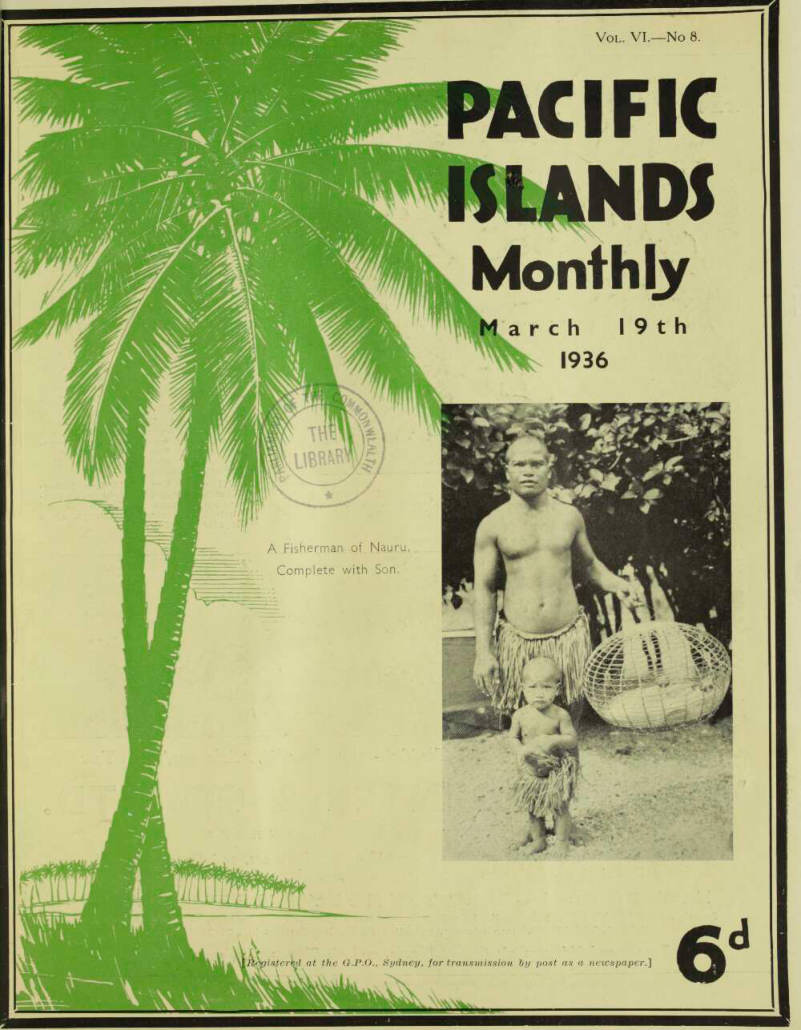
A Fisherman of Nauru, Complete with Son.
Advertisements & other items, p. 2 (1 item)
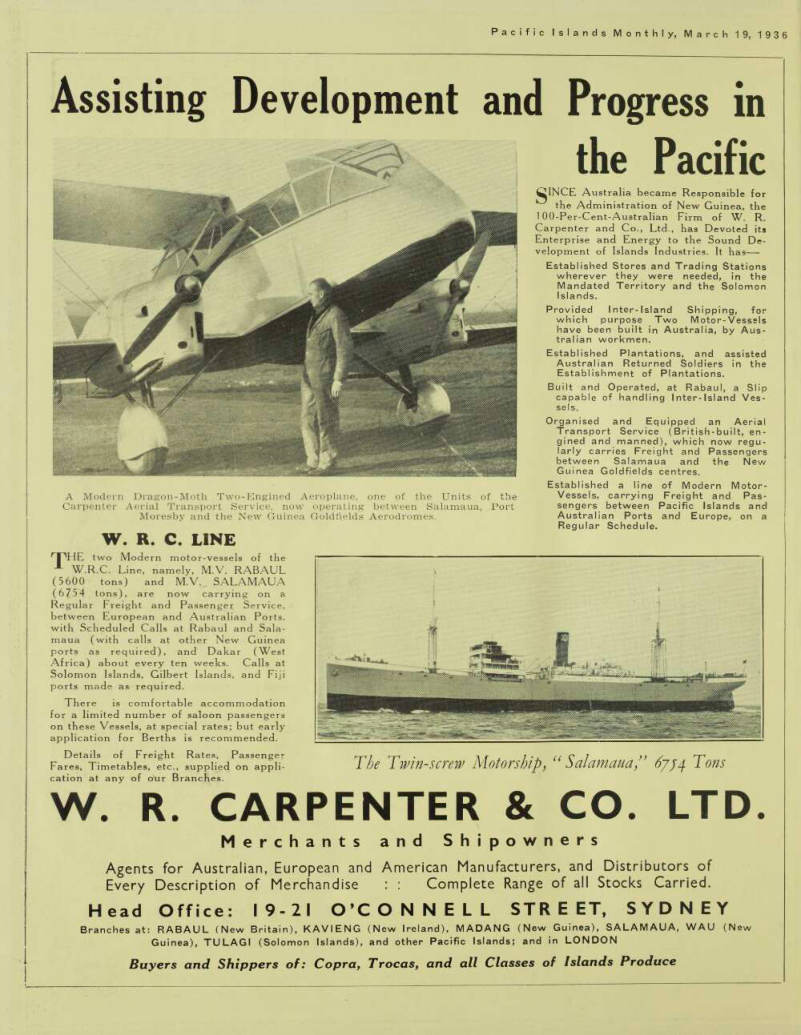
Assisting Development and Progress in
the Pacific
A % ... ■ - CINCE Australia became Responsible for the Administration of New Guinea, the I 00-Per-Cent-Australian Firm of W. R.
Carpenter and Co., Ltd., has Devoted its Enterprise and Energy to the Sound Development of Islands Industries. It has Established Stores and Trading Stations wherever they were needed, in the Mandated Territory and the Solomon Islands.
Provided Inter-Island Shipping, for which purpose Two Motor-Vessels have been built in Australia, by Australian workmen.
Established Plantations, and assisted Australian Returned Soldiers in the Establishment of Plantations.
Built and Operated, at Rabaul, a Slip capable of handling Inter-Island Vessels.
Organised and Equipped an Aerial Transport Service (British-built, engined and manned), which now regularly carries Freight and Passengers between Salamaua and the New Guinea Goldfields centres.
Established a line of Modern Motor- A Modern Dragon-Moth Two-Engined Aeroplane, one of the Units of the Vessels, carrying Freight and Pas- Carpenter Aerial Transport Service, now operating between Salamaua, Port sengers between Pacific Islands and Moresby and the New Guinea Goldfields Aerodromes. Australian Ports and Europe, on a Regular Schedule.
W. R. C. LINE
r I 'HE two Modern motor-vessels of the W.R.C. Line, namely, M.V. RABAUL (3600 tons) and M.V. SALAMAUA (6754 tons), are now carrying on a Regular Freight and Passenger Service, between European and Australian Ports, with Scheduled Calls at Rabaul and Salamaua (with calls at other New Guinea ports as required), and Dakar (West Africa) about every ten weeks. Calls at Solomon Islands, Gilbert Islands, and Fiji ports made as required.
There is comfortable accommodation for a limited number of saloon passengers on these Vessels, at special rates; but early application for Berths is recommended.
Details of Freight Rates, Passenger Fares, Timetables, etc., supplied on application at any of our Branches.
W. R. CARPENTER & CO. LTD.
Merchants and Shipowners
Agents for Australian, European and American Manufacturers, and Distributors of Every Description of Merchandise Complete Range of all Stocks Carried.
Head Office: 19-21 O’CONNELL STREET, SYDNEY
Branches at: RABAUL (New Britain), KAVIENG (New Ireland), MADANG (New Guinea), SALAMAUA, WAU (New Guinea), TULAGI (Solomon Islands), and other Pacific Islands; and in LONDON Buyers and Shippers of: Copra, Trocas , and all Classes of Islands Produce Jb The Twin-screw Motors hip, “ Salamaua6yj/j. Tons
Pacific Islands Travellers
Passengers Per Montoro Which Ar
Rived In From New Guinea
And Papua. On February 19.—Messrs.
Baldwin. Baird, Batich, Blacklow. Brough. Buck land, Burn, Cay. Crowe. Deards Downham Fox.
Fitzpatrick, Gilliland. Graham, Hartley Holland.
Hyde, Henschke, Hawker, Jones, Kirby, Lane (2), Lewis. Lucas. McKenzie, McLean, McNeill, Mel vin, Paulini, Richardson, Ross, Rutherford Shar rett, Shorthouse. Sutcliffe, Symington, Wiltshire, Woods. Mesdames Baldwin, Coomey, Fox, Hal ford-Thompson, Hyde, Lane. Lewis, Lumley. Me- Clafferty, McLean. McNeill, Roja, Ross, Ruther ford, Sefton, Sutcliffe (2). Symington, Tuckey, Woods. Misses, Elliott. Evans (2), Hart, Loudon.
Oakes, Starr, Wauchope, Sisters Gabnella and Immaculate.
Passengers Per Morinda. Which
Sailed From Sydney For Lord Howe
IS., NORFOLK IS., AND NEW HEBRIDES, ON FEBRUARY 20. —Messrs. Adams, Bell, Baker.
Barrell, Cooper, Cunningham, Fortescue, Garntty, Guthrey, Hogg. Jolly. Jukes. Job (2), Dr. Jaede, Messrs. Lambell, Lamb, McDonald, Mitchell, Nicholls, Paxton, Pijacum, Purdy, Simpsom Sains bury, Scarf, Winn, Williamson, Rev. Williams, Messrs. Willott, Wigmore, Father Ghaize. Mes dames Balcon, Bell, Baker, Druce, Guthrey, Hickson, Jaede, Lambell, Lamb, Middleton, McDonald, O’Donnell, Paxton, Robertson, Thur low, Tevelien, Willott, Williamson. Misses Adams, Bowden, Boden, Coombes, Ciissons, Dear, Cameron, Druce, Eichman, Freeman, Garnett. Jarman, Jus tice, Kerr, Lloyd, McCay, Prior, Lewis, Richard son, Turnbull, Thurlow, Vincent.
Passengers Per Malaita, Which
Sailed From Sydney For Solomon
Islands And Rabaul (N.G.), On Febru
ARY 22. —Messrs. Ashwin, Bourne, B inskin, Col yer. Rev. Codd, Messrs. Colley, Chew, Elkington, Green, Humphries, Jefferson, Rev. Longden, Messrs. Lobban, Lazarus, McCormack, McKew, Monckton, Manning, Noble, Rhodes, Sim, McKew, Wright. Mesdames Bourne, Bulbeck, Codd, Foley, Farmer, Green, Humphries, Stokie, Wilson.
Misses Devir, Fitzgerald, Kavanagh, Matthews, Markham, Stead.
Passengers Per Mariposa Which
ARRIVED IN SYDNEY FROM SUVA, FIJI. ON FEBRUARY 24.—J. Horigan. Mr. and Mrs. N.
Godhard, Miss B. Catchpole, Mr. and Mrs. C. Car ter, J. Henholm, Mrs. A. C. Paton, A. T. Day. A.
G. Campbell, Mrs. E. Kearney, Miss K. Kearney, Dr. J. L. Hills, Mr. and Mrs. C. Moss, Mr. Good sir, Mr. and Mrs. A. Johnston, Miss K. Tierney, Mrs. O. Colahan, Mr. and Mrs. C. R. Mackav, Miss M. P. Costello, Miss R. M. Ohlson, Mrs. A.
Brewer, Miss M. Cameron, Dr. H. S. Evans, J.
R. Desai, J. L. Stark, Mr. arid Mrs. E. H.
Mcllwain, Miss V. L. Warde, Mr. and Mrs. F. S.
Stephens, Miss B. Carr, Mrs. J. R. Swales-Eyre, P. J. Gilsenan, Mrs. L. Reid, Mr. and Mrs. H. J.
T. Applebee, Mrs. J. V. Tarte, Miss J. Tarte, Master D. Tarte, Master B. Speres, Mrs. A. B.
Thomas, Miss B. Carr.
Passengers Per Montoro Which
Sailed From Sydney For Papua And
New Guinea On February 25:—Messrs.
Autridge, Appleton, Anderson, Benham, Berry, Bryne (2), Barrett, Brewer, Bensley, Bripon, Clarke, Cawley, Carson, Colclough, Cruickshank, Colebrook, Carpenter, Church, Cooke, Chambers, Champion, Clappison, Digby, Davies, Dixon, Dixon - Swift, Elliott, Evensen, Ely, Eldred, Farrar, Gardiner, George, Howlett, Harvey, Hiscox, Jack, Kendall, King, Kirkham, Lamden, Lonergan, Mac- Donald, Murray, McArthur, Nichols, Porter, Price- Jones, Rich, Reigler, Ralphs, Reynolds, Stevenson, Stoyles, Stein, Straun, Schuler, Stewart, Smith, Torrington. Tarlinton, Woodman, Westhoven, Watson, Williams (2), Walshe, Woodgate. Mes dames: Aumuller, Anderson, Bannigan, Baldie, Barrett, Clarke, Cawley, Carson, Clappison, Even sen, Farrar, Gunther, Grose, Gledhill, Hoare, Hiscox, Jennings, Kenward, Lambden, Marshall, McEwan, Murray, Street, Thomson, Woodgate, Waters. Misses: Divett, Fisher, Holmes, Leader, Lett, Slade, Whiting.
NOTE: —Owing to the Montoro’s mishap at Brisbane on February 28, the above passengers were transferred, on March 10, to the Marella and the Macdhui. The latter vessel also carried the following additional passengers from Sydney:— Messrs. Crooke, Chandler, Durcher, Fay, Fell, Pilling, Shove, Torrington. Mesdames Fell, Hadley, Spencer, Miss Wilde, Sisters James and Marcella.
Passengers Per Aorangi Which
SAILED FROM SYDNEY FOR SUVA, FIJI. ON FEBRUARY 27.—Mr. Frenchville, C. S. Wilson,
Miss L. A. Wilson, Mrs. C. Reynold and infant Master E. Reynold, Mr. and Mrs. Barton and children, A. Mackay, A. S. Burton, Miss B.
Wilson Smith, C. C. Barry, R. P. Harrtcks. Mrs.
W. Finlayson, Miss Fmlayson, M U„ a * d Mr®. J- Trivett, Mrs. H. B. Harricks. Mrs. W. F. Stephen son, Master Stephenson, Miss Stephenson, Mr. and Mrs. E. Deardon, Mrs. M. E. Hobbs Master P J.
Hobbs. Mr. D. Sherwood, Miss J. Sherwood, Miss Potts, Mrs. Potts, Miss Potts, E. O. Mullen, F.
Winter A. R. Templeton, Mrs. R. N. Lane and infant, ’Masters D. and C. Lane, Master Steven son, M. Motiram, A. Vithal, Mrs. J. Mukherji.
Master A. Mukherji, Mr. and Mrs. W. E. Morn son, Master W. A. Morrison, Miss M. Houghton.
Passengers Per Mariposa Wmch
Sailed From Sydney For Suva, Fiji.
ON MARCH 4.—Mrs. A. R. Aspmall, S. A. D.
Baker, Mrs. C. Corbett, Misses P. and B. Corbett.
Mr. and Mrs. L. Davis, Mrs. L. M. Dean Miss L.
Edwards, T. Horne, W. R. Lewis Mr and Mrs. J.
R. Moore, H. E. Proctor, J. H. Smith, Mrs. C. J.
Stewart, Miss B. Stewart, Miss D. Thomas, L. W.
Beach, Rev. and Mrs. C. Bull, Mr. and Mrs. F. .1.
C. Corbett, J. A. Davidson, Mrs. V. Horsham. .Master V. Horsham, Mr. Litster. Messrs. H. S., D. J., and G. Mount, Mr. Mumford, B. OBnen, Mr. and Mrs. F. W. J. Plucknett, J. B. Turner, Mrs. I. Wylie, Master B. Wylie.
Passengers Per Macdhut, Which Ar
RIVED IN SYDNEY FROM NEW GUINEA AND PAPUA ON MARCH s.—Messrs. Altria, Anstee, Ashwell, Austin, Father Bachelier, Messrs. Beattie, Beck, Father Backer, Messrs. Bendeick, Biccard, Biffin, Buhl, Burns, Carr. Challis, Coleman, Collins, Cook. Father Coltree, Messrs. Coppard. Davies, Dawkins, Dixson, Dodd, Doone, Duffy. Fell, Frog gatt. Brother Gasbarra, Messrs. Hall, Halley, Hamilton, Hartigan, Hides, Hyde, Ifould, Kent, Keyes, Kohnke, Laidlaw, Lega, Lock, MacGregor, Milligan, Moates, Norris, O’Donnell, O’Sullivan.
Penglase, Pitman. Phillips, Pollard, Roja, Rondahl, Russell, Shaw. Sherry, Shirley, Smith. Studler, Sutton, Tomlinson, Tompsett, Vorwerg, Vagg, Waldon, Wight, Wishart, Weston. Woodman. Mes dames Altria, Anderson, Ashwell, Challis, Frog gatt, Kent, Lowe, Nettleship, Penglase, Phillips, Radcliffe, Russell, Sherry. Misses Ballantyne, Frewin, Protheroe, Radcliffe, Wood.
Passengers Per Van Rees, Which
Arrived In Sydney From N. Guinea.
VILA, AND NOUMEA ON MARCH 17. — Messrs. Oakley, Rabin, Jerome, Hides, Young, Raymond, Marshall, Millar, Simcocks, Comien, Freminet, Leleu, Brunelet, Kisaku, Iwamoto.
Mesdames Oakley, Rabin, Jerome, Hides and child, Boyzon, Verger, Veyret, Guillemot and child.
Misses Lomont, Veyret, Vergers.
Mr. N. S. Falla, C.M.G., D. 5.0., V.D., managing director of the Union Steam Ship Company of New Zealand Limited, has been elected chairman of directors in succession to the late Sir James Mills.
Advertisements & other items, p. 3 (1 item)
Saigon-Batavia-Samarang-Port Moresby
'Phone: FX 3378 'Phone: FX 3378
BARRINGTONS
DRIVE YOURSELF
SERVICE
Cars Hired without Drivers from 10/- per day; Tourers, 3d. per mile: Sedans, 4d. and sd. per mile. Our Fleet includes 1934 Dodge Sedan*.
Write for Reservations, or 'phone when in city and we will deliver Car to your address.
243 ANZAC PARADE, SOUTH
KENSINGTON, N.S.W.
sc '°‘
t>r V
d©p l L v
.••Ss?J5
jV'O 0 .
Q n<* '?t.p?;;r^
2> r ' c .'%::d.-:v
l \o t U ne*
*i< ...-vs#.
SC£
FOR SAFETY’S SAKE. SAY - VINCENTS’
SAIGON-BATAVIA-SAMARANG-PORT MORESBY
SAMARAI-RABAUL-PORT VILA-NOUMEA
SYDNEY - PORT MORESBY - BATAVIA - SAIGON
bi-monthly by the VAN REES"
You will enjoy travelling by this popular, fast and modern steamer of the K.P.M., noted for its comfort, excellent cuisine, and economical fares.
With a fleet of over 130 vessels the K.P.M. Line is in a position to accept cargo for all ports in Netherlands India, and with transhipment at Batavia for Africa.
ROYAL PACKET NAVIGATION CO.
Paketvaart House, 255 George Street, Sydney Diethelm & Co.. Saigon; E. A. James, Port Moresby; Whitten Bros., Samarai; W. R. Carpenter & Co. Ltd.. Rabaul; Subbay Freres. Port Vila; Carlo Leoni. Noumea.
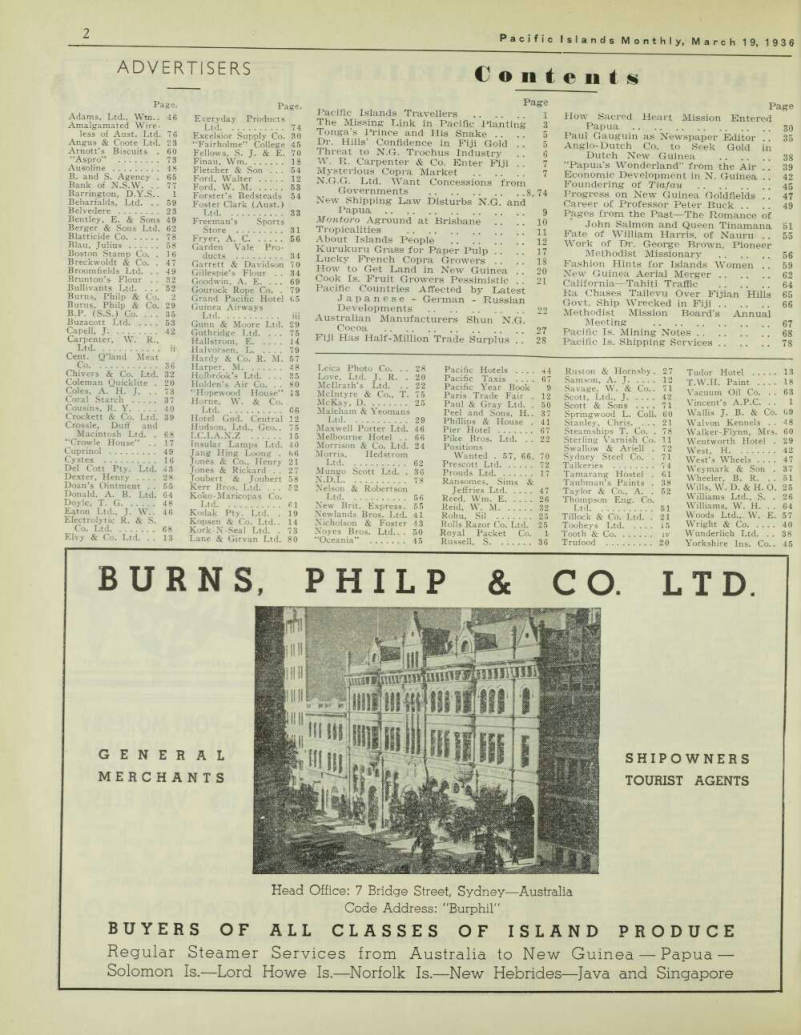
Advertisers
Page.
Adams, Ltd., Wm.. 46 Amalgamated Wire less of Aust. Ltd. 76 Angus & Coote Ltd. 23 Arnott’s Biscuits . 60 “Aspro” 73 Ausoline 48 B. and S. Agency . 65 Bank of N.S.W. . . 77 Barrington, D.Y.S.. 1 Bebarfalds, Ltd. . . 59 Belvedere 23 Bentley, E. & Sons 49 Berger & Sons Ltd. 62 Blatticide Co. 78 Blau, Julius 58 Boston Stamp Co, . .16 Breckwoldt & Co. . 47 Broomfields Ltd. . . 4 9 Brunton’s Flour . . 32 Bullivants Ltd. ... 52 Burns, Philp & Co. 2 Burns, Philp & Co. 29
B.P. (S.S.) Co. ... 35
Buzacott Ltd 53 Capell, J 42 Carpenter, W. R., Ltd ii Cent. Q’land Meat Co 36 Chi vers & Co. Ltd. 32 Coleman Quicklite . 20 Coles, A. H. J. . . 73 Coral Starch 37 Cousins, R. Y 40 Crockett & Co. Ltd. 39 Crossle, Duff and Macintosh Ltd. . 68 “Crowle House” . . 17 Cuprinol 49 Cystex 16 Del Cott Pty. Ltd. 43 Dexter, Henry ... 28 Doan’s Ointment . . 55 Donald, A. B. Ltd. 64 Doyle, T. G 48 Eaton Ltd., J. W.. 46 Electrolytic R. & S.
Co. Ltd 68 Elvy & Co. Ltd. . . 13
Page.
Everyday Products Ltd 74 Excelsior Supply Co. 30 “Fairholme” College 45 Fellows, S. J. & E. 70 Finau, Wm 18 Fletcher & Son ... 54 Ford, Walter 12 Ford, W. M 53 Forster’s Bedsteads 54 Foster Clark (Aust.) Ltd 33 Freeman’s Sports Store 31 Fryer, A. C 56 Garden Vale Pro ducts 34 Garrett & Davidson 7 0 Gillespie’s Flour . . 34 Goodwin, A. E. ... 69 Gourock Rope Co. .79 Grand Pacific Hotel 65 Guinea Airways Ltd iii Gunn & Moore Ltd. 29 Guthridge Ltd. ... 75 Hallstrom, E 14 Halvorsen, L 79 Hardy & Co. R. M. 57 Harper, M 48 Holbrook’s Ltd. ... 85 Holden’s Air Co. . . 80 “Hopewood House” 13 Horne, W. & Co.
Ltd 66 Hotel Gnd. Central 12 Hudson, Ltd., Geo.. 7 5
1.C.1.A.N.Z 15
Insular Lamps Ltd. 40 Jang King Loong . 66 Jones & Co., Henry 21 Jones & Rickard . . 27 Joubert & Joubert 58 Kerr Bros. Ltd. ... 52
Koko-Maricopas Co.
Ltd 61 Kodak Pty. Ltd. . 19 Kopsen & Co. Ltd.. 14 Kork-N-Seal Ltd. . 73 Lane & Girvan Ltd. 80
Leica Photo Co. . . 28 Love, Ltd. J. R. . 20 Mcllrath’s Ltd. . . 22 Mclntyre & Co., T. 75 McKay, D 25 Maleham & Yeomans Ltd. 29 Maxwell Porter Ltd. 46 Melbourne Hotel . . 66 Morrison & Co. Ltd. 24 Morris, Hedstrom Ltd 62 Mungo Scott Ltd. . 36
N-D.L 78
Kelson & Robertson Ltd 56 New Brit. Express. 55 Newlands Bros. Ltd. 41 Nicholson & Foster 43 Noyes Bros. Ltd... 50 “Oceania” 45
Pacific Hotels ... 44 Pacific Taxis ... 67 Pacific Year Book 9 Paris Trade Fair . 12 Paul & Gray Ltd. . 50 Peel and Sons, H.. 37 Phillips & House . 41 Pier Hotel 67 Pike Bros. Ltd. . . 22 Positions Wanted . 57, 66, 70 Prescott Ltd 72 Prouds Ltd 17 Ransomes, Sims & Jeffries Ltd 47 Reed, Wm. E 26 Reid, W. M 32 Rohu, Sil 25 Rolls Razor Co. Ltd. 25 Royal Packet Co. 1 Russell, S 36
Ruston & Hornsby. 27 Samson. A. J. ... 12 Savage W. & Co.. 71 Scott, Ltd., J 42 Scott & Sons ... 71 Springwood L. Coll. 60 Stanley, Chris. ... 21 Steamships T. Co. . 78 Sterling Varnish Co. 11 Swallow & Ariell . 72 Sydney Steel Co. . 71 Talkenes . . . <4 Tamarang Hostel . 61 laubmans Paints . 38 Taylor & Co.. A. . 52 Thompson Eng. Co. 5l Tillock & Co. Ltd. .’ 21 Tooheys Ltd 15 Tooth & Co iv Trufood 20
Tudor Hotel 13 t.W.H. Paint 18 Vacuum Qil Co . .. 63 .t, r , Vincent s A.P.C. .. 1 Wallis J. B. & Co. G 9 Walvon Kennels . . 48 Walker-Flynn, Mrs. 60 Wentworth Hotel . 29 West H . . 42
West’s Wheels’47
Weymark & Son . 37 Whee i e r, B. R. .. 51 e tt nr s . W. D &H. O. 25 hams Ltd. S. . 26 Williams, W. H. . . 64 Woods Ltd... W. E. 57 Wright & Co 40 Wunderlich Ltd. . . 38 Yorkshire Ins. Co.. 45
Contents
Page Pacific Islands Travellers 1 The Missing Link in Pacific Planting 3 Tonga’s Prince and His Snake . . . . 5 Dr. Hills’ Confidence in Fiji Gold .. 5 Threat to N.G. Trochus Industry . . 6 W. R. Carpenter & Co. Enter Fiji . . 7 Mysterious Copra Market 7 N.G.G. Ltd. Want Concessions from Governments g, 74 New Shipping Law Disturbs N.G. and Papua 9 Montoro Aground at Brisbane .. !! 10 Tropicalities n About Islands People 12 Kurukuru Grass for Paper Pulp . . ” 17 Lucky French Copra Growers . . . , 18 How to Get Land in New Guinea .. 20 Cook Is. Fruit Growers Pessimistic . . 21 Pacific Countries Affected by Latest Japanese - German - Russian Developments 22 Australian Manufacturers Shun N.G.
Cocoa 27 Fiji Has Half-Million Trade Surplus ..’ 28
Page How Sacred Heart Mission Entered Papua 30 Paul Gauguin as Newspaper Editor . , 35 Anglo-Dutch Co. to Seek Gold in Dutch New Guinea 38 “Papua’s Wonderland” from the Air .. 39 Economic Development in N. Guinea , . 42 Foundering of Tiafau 45 Progress on New Guinea Goldfields .! 47 Career of Professor Peter Buck . . .. 49 Pages from the Past—The Romance of John Salmon and Queen Tinamana 51 Fate of William Harris, of Nauru .. 55 Work of Dr. George Brown, Pioneer Methodist Missionary 56 Fashion Hints for Islands Women .. 59 New Guinea Aerial Merger 62 California—Tahiti Traffic 64 Ra Chases Tailevu Over Fijian Hills 65 Govt. Ship Wrecked in Fiji 66 Methodist Mission Board’s Annual Meeting 67 Pacific Is. Mining Notes 68 Pacific Is. Shipping Services 78
Advertisements & other items, p. 4 (1 item)
Burns, Philp & Co. Ltd.
GENERAL
MERCHANTS
HOT
sm t« fun 111 -4- HI 111
SHIPOWNERS
TOURIST AGENTS
Head Office: 7 Bridge Street, Sydney—Australia Code Address: "Burphil"
BUYERS OF ALL CLASSES OF ISLAND PRODUCE Regular Steamer Services from Australia to New Guinea Papua Solomon Is.—Lord Howe Is. —Norfolk Is.—New Hebrides —lava and Singapore
Pacific Islands Monthly
The Newspaper jJlagfa*ine of the South Seas I Registered at G.P.0., Sydney, for transmission ty post as a newspaper ]
Published Once Each Month and Circulated in Australia and New Zealand and in the following Pacific Territories and Islands Groups:
Crown Colony of Fiji.
Australian Territory of Papua.
Mandated Territory (Australia) of New Guinea, Bismarck Archipelago and Northern Solomon Islands.
Mandated Territory (Japan) of Marshall, Caroline and Marianna Islands.
French Territory of New Caledonia.
British and French Condominium of New Hebrides.
American Territory of Eastern Samoa.
American Territory of Guam.
Mandated Territory of Nauru.
British Crown Colony of Gilbert and Ellice Islands.
Mandated Territory (New Zealand) of Samoa.
British Solomon Islands Protectorate.
British Protectorate of Tongan Islands.
New Zealand Territory of Cook Islands.
Australian Territory of Norfolk Island.
French Colony of Oceania (Tahiti, etc.).
American Territory of Hawaiian Islands.
Owned and Produced by Pacific Publications Ltd., Union House, 247 George Street, Sydney.
Telephone Bw 5037
P.O. Box 3408 R
Contributions Articles, Stories, and Photographs dealing with Pacific Islands Subjects are invited, and will be paid for on publication at usual rates.
Subscription Rates
Per Annum, within British Empire, Prepaid Post Free 6/- Pcr Annum, elsewhere, prepaid, Post Free .. 8/- Single Copies 6d.
Editor and Publisher:
R. W. Robson.
Advertisements
Advertising rates furnished on application.
Colours, etc. by Arrangement.
Process Blocks made at Advertiser’s expense when required. Screen, 100.
Changes of Advertising Copy should reach this Office by Bth of each month, otherwise previous advertisement may be repeated.
Registered Address for Radiograms and Cables; “PACPUB” Sydney Agents The following are authorised to receive subscrip tions for the “Pacific Islands Monthly”— Islands Branches of Burns, Philp & Co., Ltd., and Burns Philp (South Seas) Co., Ltd.
Islands Branches of W. R. Carpenter & Co., Ltd.
All Branches of Morris, Hedstrom & Co., Ltd.
G. Thomas & Co., Rabaul, New Guinea.
Whitten Bros., Ltd., Samarai, Papua.
P. Costello, Suva, Fiji.
J. Muir, Suva, Fiji.
All Branches and Representatives of W. H. Grove and Sons, Ltd., Auckland, New Zealand.
S. Russell, Papeete, Tahiti.
Cook Islands Trading Co., Rarotonga, Cook Is.
Vol. VI. No. 8.
Vol. VI. No. 8.
Sydney, March 19, 1936
p * S 6d. Per Copy. * ‘ice Prepaid: 6/- p.a.
The Missing Link In Pacific Planting
JT is a remarkable thing that no effort, either concerted or isolated, has been made by the Pacific Islands Administra tions to create an economic branch which might function in association with their departments of agriculture.
The Administrations spend annually substantial sums in various kinds of agricultural experiments —ascertaining what plants and trees will grow in par ticular areas; discovering the best methods of cultivation; examining pests and the most effective ways of dealing with them; and generally collecting and collating information which will sim plify the task of the planter in his busi ness of planting —but, as one old planter has put it in a letter to us, “what is the use of showing us all them pretty little plants set out in them pretty little plots, unless we know what it is going to cost us to grow them and where the market is?”
The various agricultural experts — directors, inspectors, botanists, entomolo gists, and so on —are maintained for the
benefit of the planters; and they, for the most part, carry out their duties efficiently and conscientiously. But, with that, the job is only half done. Not one planter will make a move to cultivate a new crop unless he has some reasonable assurance that the crop can be cultivated profitably under the particular condi tions of his territory, and unless he is assured that there is available to him a regular and fairly certain market.
The need for this information has been apparent for years, and it is surprising that nothing has been done to deal with the problem. There is in Papua, New Guinea, Solomon Islands, New Hebrides, Fiji, Samoa, and various other territories a great deal of land which might easily be cultivated —although, as a corre spondent in this issue points out, there are difficulties in the way of acquiring it.
There is, in most islands groups, an abundance of cheap labour and an as sured rainfall. Isolation, which once gave certain terrors to life in those
islands, is being steadily destroyed by
the advances of radio and aviation; tropical hygiene is removing the threat to health. Thousands of Europeans would go willingly to the Pacific Islands, and establish their homes there, if once they were assured they could earn a sufficient income to provide themselves with the necessary amenities of life in the tropics.
There is profit in growing coconuts — the staple industry of the South Seas — but the establishment of a coconut plan tation requires considerable capital, and the industry, at the moment, is attended with some uncertainty. But let it once be shown that there is a reasonably cer tain profit in the cultivation of various other tropical products which may supplement coconuts coffee, cocoa, kapok, tea, rattan, and various others — and there will be a steady influx of new settlers and new capital to the Islands; while the planters already there will take a new lease of life.
It is all a question of making the necessary data available. Half the in formation required is obtainable now — namely, how and when and where to grow the tropical plants. But the other,
and equally necessary information — namely, the value of the products, the cost of producing them, and the charac ter and location of markets —is missing.
So long as the economic data are missing the cost of producing the technical data (that is, how to grow a thing and where to grow it) represents largely a waste of time and effort.
This is a problem that is common to practically all Pacific Administrations.
Therefore, might it not be solved by a common effort? Is there anything fan tastic about the idea of forming an eco nomic committee, on which each of the various Pacific Administrations might be represented, and the duty of which would be to assemble and correlate in formation relating to the production costs and marketing of the various tropical commodities which can be produced in the South Seas, and for which there is a market ?
“Unthinkable!”
Australia Will Not Surrender New Guinea
T T was unthinkable that Australia should even consider the handing over of any territory, said the leader of the Commonwealth Government in the Senate (Sir George Pearce) on March 13, in a statement on mandated lands.
“The Japanese mandate in the North Pacific reaches to the equator and adjoins the Australian mandate,” he added, “and we have an automatic demilitarised zone which introduces a considerable stabilis ing factor in Pacific waters.
“The result has been up to the present at least, equilibrium in the Pacific, re sulting in a feeling of security and tranquillity.”
New Guinea, by virtue of its geo graphical position, its natural harbours, its facilities for naval and military air craft, continued Sir George, was of con siderable strategic value to Australia from a defence aspect so long as the existing form of control and administra tion obtained.
The handing over of national rights and interests to the demand of a powerful nation could only result in international anarchy, he said. In effect, it would amount to a submission to blackmail— the temporary buying off of any militant aggressive nation. The claim that colonial territory provided an outlet for surplus population was not borne out by settle ment figures.
Mr. Charles Nordhoff, the celebrated American novelist, who has been visit ing his parents in California, returned to Papeete by the last Makura. A fellow passenger on the liner was Mr. Arthur Grander, another well-known resident of Tahiti. Mr. Nordhoff brought with him a motor-boat for use around the coast.
His many friends will be pleased to learn that Mr. Nordhoff is much improved in health.
Slightly Injured
Sir Hubert Murray
WHEN the Dutch steamer Meliskirk (on which Sir Hubert Murray, Lt.
Governor of Papua, and his daughter, Mrs. C. R. Pinney, are travelling to the East) arrived in Melbourne on March 5, Mrs. Pinney w r as met by a friend, and they returned along the wharf to meet Sir Hubert Murray, who was walking towards them. The Melbourne wharf had long been in a terribly bad state of repair, with bolts sticking up here and there. Sir Hubert caught his foot in one of these, and fell heavily, and was in jured. He was taken at once to a specialist in Collins Street, who “patched him up,” so that he was able to attend a luncheon party. He remained with friends in Melbourne.
The Meliskirk will not leave Fremantle until April 3, and it is anticipated that Sir Hubert will be recovered by then, and able to join the ship and continue his voyage.
Commander R. C. Garsia, Administra tor of Nauru Island, arrived at Auck land in March by the Triona, with Mrs.
Garsia, and is now touring New Zea land. The Administrator is a New Zea lander by birth, and this is his first visit to his homeland since 1913. Com mander Garsia was a Junior officer on H.M.A.S. Sydney during ihe Great War. .
Payment.”
“New Basis Of
For N.G. Soldier-Planters.
7 1 Minister in Charge of Territories (Sir George Pearce) announced in Canberra on March 10 that it had been decided to alter the basis of payment by purchasers of expropriated properties in New Guinea. Whatever the market price of copra might be from time to time, the purchasers under the new arrangement would be able to reduce their indebtedness to the Federal Government, and also profit ably conduct the plantations.
It was felt, added the Minister, that action by the Federal Government alone would not be fully effective in placing the planters on a satisfactory footing, and it was hoped that the firms that had assisted to finance the planters would be able sub stantially to reduce the payments required to be made to them. Negotiations were in train with that object in view.
EDITORIAL NOTE: The latter paragraph is interesting. It is recalled that Sir Walter Car penter, many months ago, said that if the Com monwealth Government would relieve the soldier planters of some portion of their capital indebted ness, his firm would make a proportionate adjust ment regarding debts owed by the planters. The Minister, unfortunately, has omitted to state how the basis of payment is to be altered. Does he mean reappraisement?
Advertisements & other items, p. 6 (1 item)
r
4 1L J I r riOK.
The Court Doctor: Old King Kopra is getting better. He’s been amusing himself lately, blowing soap-bubbles. But he wants building up —a tonic, I think.
The Consulting Doctor: How about a course of emulsion—fish oil, you know?
The C.D.: For the love of Mike, don’t mention fish oil to him! That would be a whale of a mistake!
Snake
The Prince And His
Nukualofa’s Hectic Hour
NUKUALOFA never will forget the homecoming of Crown Prince Tau fa’ahau, who arrived there is December, fresh from Newington College, Sydney, to spend the Christmas holidays in his own country.
The Prince, like all lads, is an ardent student of natural history. When passing through Fiji, he somehow found and be came attached to a snake.
There are no snakes in Tonga—little excitement of any kind, in fact. “This,” said Taufa’ahau, “will stir up the boys at home!” He put it in a box,'and added the box to his luggage.
The Prince is popular in Tonga. Half Nukualofa assembled at the wharf to greet him. There were cheers and singing. A band of high-spirited musicians played lively airs.
The snake had recovered from sea sickness. The music stirred him.
The Prince was ashore in the midst of joyous meetings, when a steward accosted him anxiously.
“Your snake, sir,” he said. “’E ain't in his box!”
True enough. The box was open. The reptile was free in a hitherto snakeless Tonga.
There was a wild alarm. The Chief of Police assembled the whole of his force.
A quick search disclosed no snake.
A grim-faced Minister of the Crown took the Prince aside and showed him a solemn law of the Prince’s own realm: “No person may introduce any new animal to the Kingdom of Tonga without first obtain ing written permission from the Premier, with the consent of Cabinet.”
The news spread. Anxious parents rushed around, gathering their children into safety. The elders held grave debate.
Someone hopefully suggested that the oc casion demanded ceremonial kava.
The police chief was a resourceful man.
He quickly enlisted a large volunteer force which, led by the police, spread out fan wise from the wharf, through Nukua lofa’s grassy streets and lawns, searching every nook and cranny for the missing reptile.
Queen Salote and Prince Tugi took their erring son silently away to the pal ace. No one knows what happened there.
One presumes that Crown Princes are not spanked.
The search went on for hours.
Then, suddenly, a mile away from the
beach, the palm trees quivered to a wild hulloa. In a paddock, coiled in the grass, a native constable had found the snake.
It was a new problem for him —so he danced around it, and howled. The ser pent raised its head, and hissed.
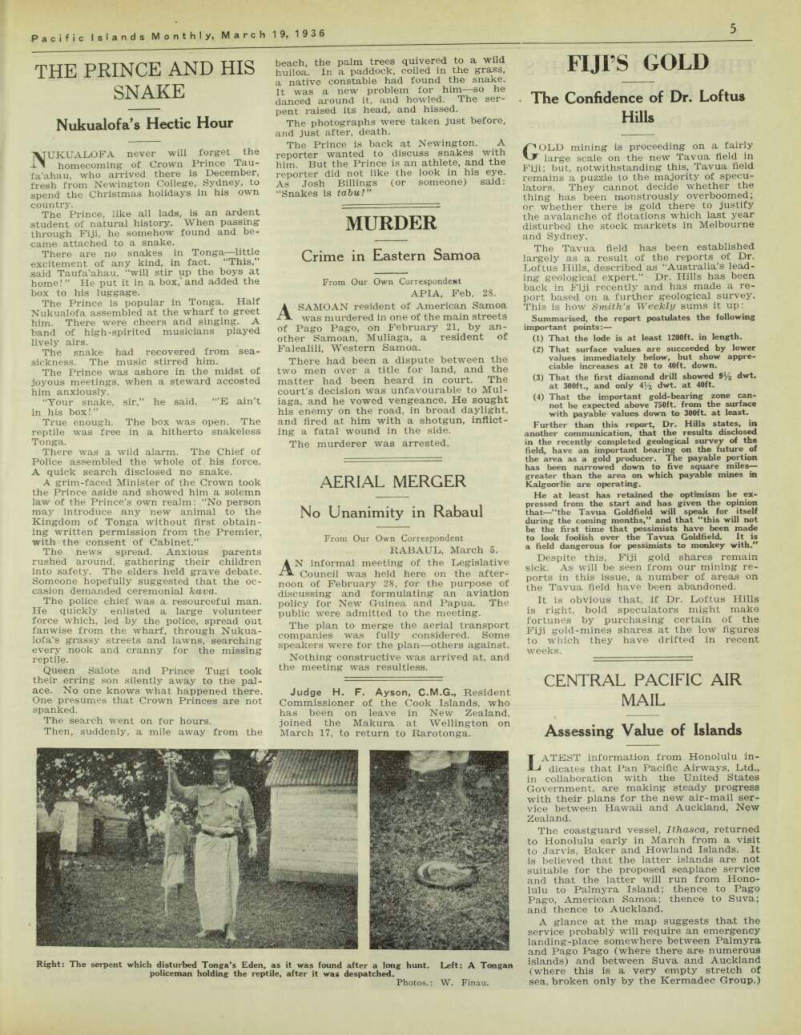
The photographs were taken just before, and just after, death.
The Prince is back at Newington. A reporter wanted to discuss snakes with him. But the Prince is an athlete, and the reporter did not like the look in his eye.
As Josh Billings (or someone) said: “Snakes is tabu!”
Right: The serpent which disturbed Tonga’s Eden, as it was found after a long hunt. Left: A Tongan policeman holding the reptile, after it was despatched.
Photos.: W. Finau.
Murder
Crime in Eastern Samoa
From Our Own Correspondent
Apia. Feb. 28.
A SAMOAN resident of American Samoa was murdered in one of the main streets of Pago Pago, on February 21, by an other Samoan, Muliaga, a resident of Falealili, Western Samoa.
There had been a dispute between the two men over a title for land, and the matter had been heard in court. The court’s decision was unfavourable to Mul iaga, and he vowed vengeance. He sought his enemy on the road, in broad daylight, and fired at him with a shotgun, inflict ing a fatal wound in the side.
The murderer was arrested.
Aerial Merger
No Unanimity in Rabaul
From Our Own Correspondent RABAUL. March 5.
AN informal meeting of the Legislative Council was held here on the after noon of February 28, for the purpose of discussing and formulating an aviation policy for New Guinea and Papua. The public were admitted to the meeting.
The plan to merge the aerial transport companies was fully considered. Some speakers were for the plan—others against.
Nothing constructive was arrived at, and the meeting was resultless.
Judge H. F. Ayson, C.M.G., Resident Commissioner of the Cook Islands, who has been on leave in New Zealand, joined the Makura at Wellington on March 17, to return to Rarotonga.
Fiji’S Gold
The Confidence of Dr. Loftus Hills
GOLD mining is proceeding on a fairly large scale on the new Tavua field in Fiji; but, notwithstanding this, Tavua field remains a puzzle to the majority of specu lators. They cannot decide whether the thing has been monstrously overboomed; or whether there is gold there to justify the avalanche of flotations which last year disturbed the stock markets in Melbourne and Sydney.
The Tavua field has been established largely as a result of the reports of Dr.
Loftus Hills, described as “Australia’s lead ing geological expert.’’ Dr. Hills has been back in Fiji recently and has made a re port based on a further geological survey.
This is how Smith’s Weekly sums it up: Summarised, the report postulates the following important points:— (1) That the lode is at least 1200 ft. in length. (2) That surface values are succeeded by lower values immediately below, but show appre ciable increases at 20 to 40ft. down. (3) That the first diamond drill showed 9V2 dwt. at 300 ft., and only 4y 2 dwt. at 40ft. (4) That the important gold-bearing zone can not be expected above 750 ft. from the surface with payable values down to 300 f- at least.
Further than this report. Dr. Hills states, in another communication, that the results disclosed in the recently completed geological survey of the field, have an important bearing on the future of the area as a gold producer. The payable portion has been narrowed down to five square miles— greater than the area on which payable mines in Kalgoorlie are operating.
He at least has retained the optimism he ex pressed from the start and has given the opinion that —“the Tavua Goldfield will speak for itself during the coming months,” and that “this will not be the first time that pessimists have been made to look foolish over the Tavua Goldfield. It is a field dangerous for pessimists to monkey with.”
Despite this, Fiji gold shares remain sick. As will be seen from our mining re ports in this issue, a number of areas on the Tavua field have been abandoned.
It is obvious that, if Dr. Loftus Hills is right, bold speculators might make fortunes by purchasing certain of the Fiji gold-mines shares at the low figures to which they have drifted in recent weeks.
Assessing Value of Islands
Central Pacific Air
LATEST information from Honolulu in dicates that Pan Pacific Airways, Ltd., in collaboration with the United States Government, are making steady progress with their plans for the new air-mail ser vice between Hawaii and Auckland, New Zealand.
The coastguard vessel, Ithasca, returned to Honolulu early in March from a visit to Jarvis, Baker and Howland Islands. It is believed that the latter islands are not suitable for the proposed seaplane service and that the latter will run from Hono lulu to Palmyra Island; thence to Pago Pago, American Samoa; thence to Suva; and thence to Auckland.
A glance at the map suggests that the service probably will require an emergency landing-place somewhere between Palmyra and Pago Pago (where there are numerous islands) and between Suva and Auckland (where this is a very empty stretch of sea, broken only by the Kermadec Group.)
Japanese Destroying Immature
Threat To Trochus
Industry
Japanese Destroying Immature Shell
THERE is a disposition in certain official quarters to regard the reports of poaching by Japanese sampans as exaggerated. Perhaps they are, to some extent; but there is no doubt that the depredations of wandering Japanese vessels are a very serious matter so far as the trochus industry in New Guinea is concerned.
Trochus fishing saved many planters in New Guinea during the depression.
For a long time, the price of copra was so low that it did not pay the producer to cart it to the beach for shipment, and many of the more enterprising and self reliant men thereupon fitted out their boats and set to work gathering the trochus shell from the sea-bottom around the reefs.
For the benefit of the uninitiated— politicians in particular—it may be said that the trochus is a marine animal which inhabits a conical spiral shell, and that it travels like a snail along the sea bottom. The shell grows to a consider able size—four to six inches across in New Guinea waters —and it is worth about £lOO per ton in Australian cur rency. Fishers are not allowed to take the shell if it is not two and a half inches in diameter. The shell is obtained by native boys who dive and pick it up.
The trochus does not inhabit deep water.
It is a profitable industry so far as the New Guinea Administration is concerned, for the Administration collects £1 per ton royalty and £1 per ton export duty.
During the last four or five years, in ever increasing numbers, Japanese sam pans—boats of a peculiar type with powerful engines—have penetrated all the islands about New Guinea, from the Moluccas in the Dutch East Indies right across to the Solomon and Santa Cruz Islands; and they have been seen very frequently as far south as the North Australian coast. They are gathering up the products of the sea, and especially shell.
No country can claim jurisdiction over the waters which lie three miles or more from its shores. There are hundreds and
probably thousands of reefs in this part of the Pacific where the Japanese are as much entitled to the products of the sea as anyone else.
But, to a degree that is causing anger to planters and traders, and embarrass ment to the governments and Admini strators, the Japanese sampans are invading territorial waters and carrying off the trochus shell. This poaching is bad enough in itself, but actually the prac tice has a far more serious aspect than mere theft. The Japanese habitually take the small trochus shell—the little shell under 2\ inches in diameter. Some say that the Japanese take the shell for the usual commercial purposes; others declare that the small shell is kept alive and that the Japanese are planting it in the islands from which they come— probably the Carolines.
The effect of this continuous process is that various reefs in New Guinea, which have been a source of regular income to residents there, especially during the bad years, are being entirely denuded of their shell. The system fol lowed by law-abiding Britishers, of taking only the shell of a certain size, has en sured the continuance of the industry.
The method followed by the Japanese makes it certain that the industry will be destroyed.
A recent visitor from Manus informs us that the Japanese sampans are as busy as ever they have been —the only difference -being that they appear to be taking away an increasing quantity of immature shell.
It is surprising that the New Guinea Administration has made no attempt to build up the trochus industry by protec tive and artificial methods. Those who have studied the ways of the trochus say that it would be quite easy to collect the immature shell on the more distant and inaccessible reefs and transfer it to more suitable localities where it could be pro tected and encouraged to grow to mar ketable size. Trochus grows quickly—a shell will develop from immature to marketable size in six months.
Presumably, it will be the same old story. When the Japanese have denuded the accessible beds and have carried off a large portion of the immature shell, and the industry is in danger of collaps ing altogether, the Administration will awaken to the sad development and will then become very busy and spend much money in an attempt to re-establish it.
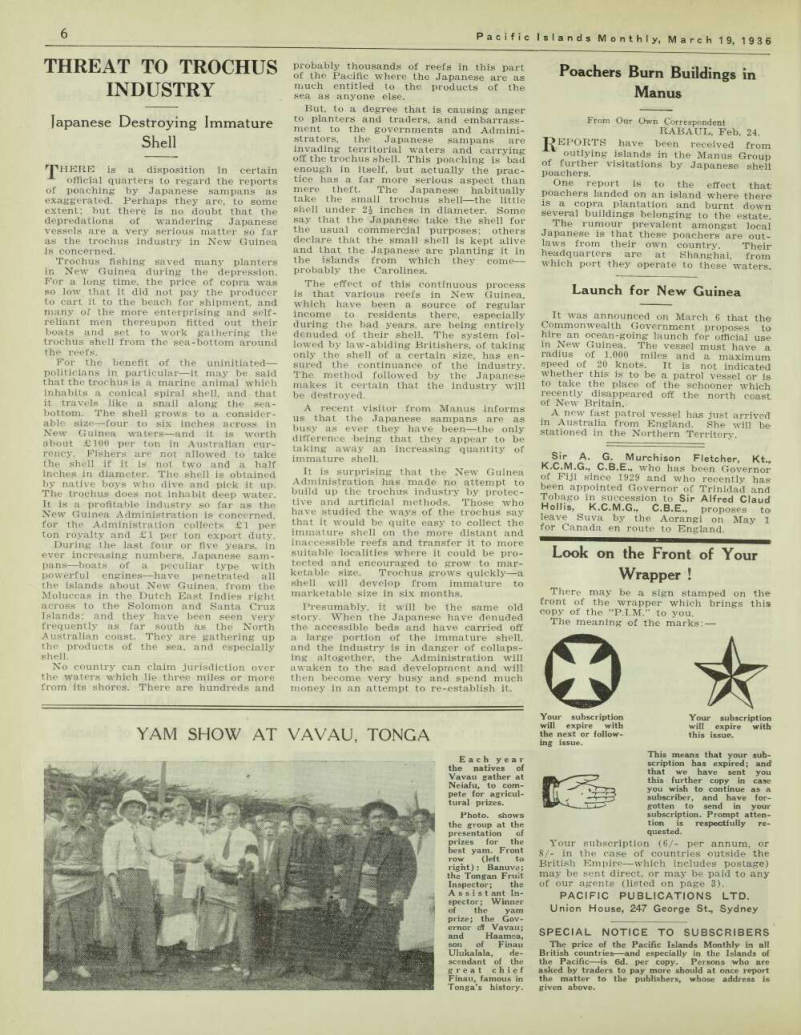
Yam Show At Vavau, Tonga
Each year the natives of Vavau gather at Neiafu, to com pete for agricul tural prizes.
Photo, shows the group at the presentation of prizes for the best yam. Front row (left to right): Banuve; the Tongan Fruit Inspector; the Assist ant In spector; Winner of the yam prize; the Gov ernor of Vavau; and Haamea, son of Finau Ulukalala, de scendant of the great chief Finau, famous in Tonga’s history.
Poachers Burn Buildings in Manus
Manus
From Our Own Correspondent
Rabaul, Feb. 24.
J>EPORTS have been received from outlying islands in the Manus Group of further visitations by Japanese shell poachers.
One report is to the effect that poachers landed on an island where there Is a copra plantation and burnt down several buildings belonging to the estate.
The rumour prevalent amongst local Japanese is that these poachers are out laws from their own country. Their headquarters are at Shanghai, from which port they operate to these waters.
Launch for New Guinea
It was announced on March 6 that the Commonwealth Government proposes to hire an ocean-going- launch for official use m New Guinea. The vessel must have a radius of 1,000 miles and a maximum speed of 20 knots. It is not indicated whether this is to be a patrol vessel or is to take the place of the schooner which recently disappeared off the north coast of New Britain.
A new fast patrol vessel has just arrived in Australia from England. She will be stationed in the Northern Territory.
Sir A. G. Murchison Fletcher, Kt. P K.C.M.G., C.8.E., who has been Governor of Fiji since 1929 and who recently has been appointed Governor of Trinidad and Tobago in succession to Sir Alfred Claud
Hollis, K.C.M.G., C.8.E., proposes to
leave Suva by the Aorangi on May 1 for Canada en route to England.
Advertisements & other items, p. 8 (1 item)
Wrapper !
Look on the Front of Your
There may be a sign stamped on the front of the wrapper which brings this copy of the “P.1.M.” to you.
The meaning of the marks: Your subscription (6/- per annum, or 8/- in the case of countries outside the British Empire—which includes postage) may be sent direct, or may be paid to any of our agents (listed on page 3).
PACIFIC PUBLICATIONS LTD.
Union House, 247 George St., Sydney
SPECIAL NOTICE TO SUBSCRIBERS
The price of the Pacific Islands Monthly in all British countries —and especially in the Islands of the Pacific—is 6d. per copy. Persons who are asked by traders to pay more should at once report the matter to the publishers, whose address is given above.
Wrapper !
Your subscription will expire with the next or following issue.
Your subscription will expire with this issue.
This means that your subscription has expired; and that we have sent you this further copy in case you wish to continue as a subscriber, and have forgotten to send in your subscription. Prompt attention is respectfully requested.
Tongan Princes
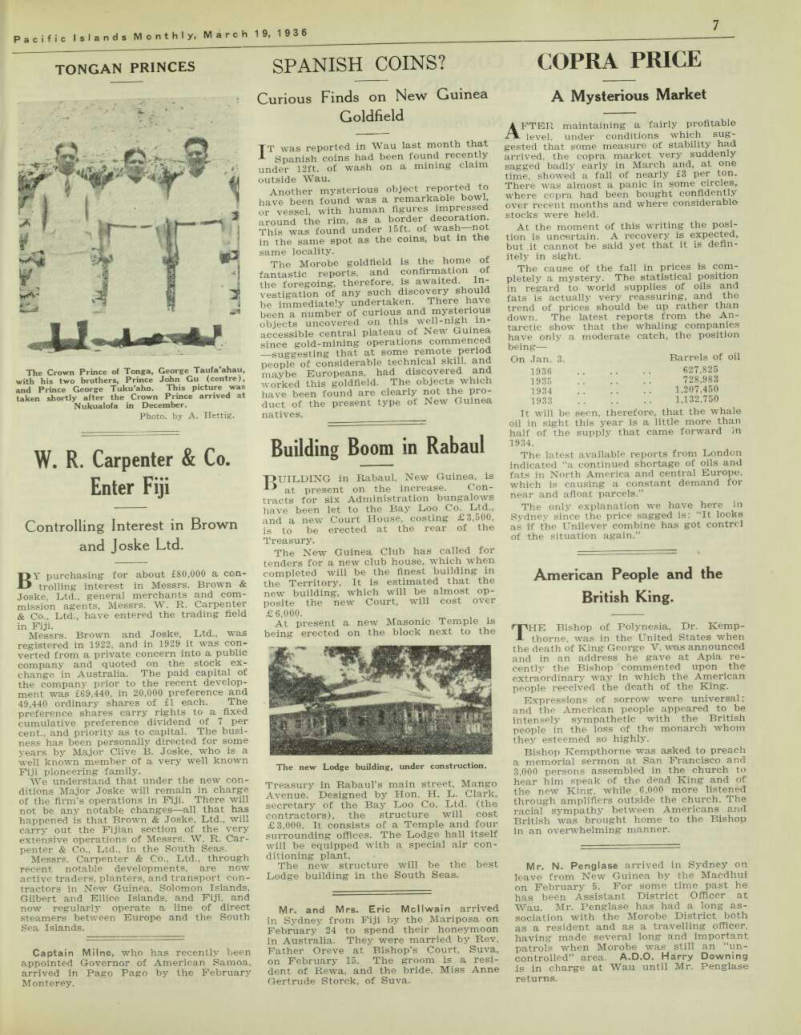
The Crown Prince of Tonga, George Taufa’ahau, with his two brothers, Prince John Gu (centre), and Prince George Tuku’aho. This picture was taken shortly after the Crown Prince arrived at Nukualofa in December.
Photo. by A. Hettig.
Enter Fiji
W. R. Carpenter & Co.
Enter Fiji Controlling Interest in Brown and Joske Ltd.
BY purchasing for about £BO,OOO a con trolling interest in Messrs. Brown & Joske, Ltd., general merchants and com mission agents, Messrs. W. R. Carpenter & Co., Ltd., have entered the trading field in Fiji.
Messrs. Brown and Joske, Ltd., was registered in 1922, and in 1929 it was con verted from a private concern into a public company and quoted on the stock ex change in Australia. The paid capital of the company prior to the recent develop ment was £69,440, in 20,000 preference and 49,440 ordinary shares of £1 each. The preference shares carry rights to a fixed cumulative preference dividend of 7 per cent., and priority as to capital. The busi ness has been personally directed for some years by Major Clive B. Joske, who is a well known member of a very well known Fiji pioneering family.
We understand that under the new con ditions Major Joske will remain in charge of the firm’s operations in Fiji. There will not be any notable changes—all that has happened is that Brown & Joske, Ltd., will carry out the Fijian section of the very extensive operations of Messrs. W. R. Car penter & Co., Ltd., in the South Seas.
Messrs. Carpenter & Co., Ltd., through recent notable developments, are now active traders, planters, and transport con tractors in New Guinea, Solomon Islands, Gilbert and Ellice Islands, and Fiji, and now regularly operate a line of direct steamers between Europe and the South Sea Islands.
Captain Milne, who has recently been appointed Governor of American Samoa, arrived in Pago Pago by the February Monterey.
Spanish Coins?
Curious Finds on New Guinea Goldfield
TT was reported in Wau last month that Spanish coins had been found recently under 12ft. of wash on a mining claim outside Wau.
Another mysterious object reported to have been found was a remarkaole bowl, or vessel, with human figures impressed around the rim, as a border decoration.
This was found under 15ft. of wash—not in the same spot as the coins, but in the same locality.
The Morobe goldfield is the home of fantastic reports, and confirmation of the foregoing, therefore, is awaited. In vestigation of any such discovery should be immediately undertaken. There have been a number of curious and mysterious objects uncovered on this well-nigh in accessible central plateau of New Guinea since gold-mining operations commenced —suggesting that at some remote period people of considerable technical skill, and maybe Europeans, had discovered and worked this goldfield. The objects which have been found are clearly not the pro duct of the present type of New Guinea natives.
Building Boom in Rabaul
BUILDING in Rabaul, New Guinea, is at present on the increase. Con tracts for six Administration bungalows have been let to the Bay Loo Co. Ltd., and a new Court House, costing £3,500, is to be erected at the rear of the Treasury.
The New Guinea Club has called for tenders for a new club house, which when completed will be the finest building in the Territory. It is estimated that the new building, which will be almost op posite the new Court, will cost over £6,000.
At present a new Masonic Temple is being erected on the block next to the
Treasury in Rabaul’s main street, Mango Avenue. Designed by Hon. H. L. Clark, secretary of the Bay Loo Co. Ltd. (the contractors), the structure will cost £3,000. It consists of a Temple and four surrounding offices. The Lodge hall itself will be equipped with a special air con ditioning plant.
The new structure will be the best Lodge building in the South Seas.
Mr. and Mrs. Eric Mcllwain arrived in Sydney from Fiji by the Mariposa on February' 24 to spend their honeymoon in Australia. They were married by Rev.
Father Oreve at Bishop’s Court, Suva, on February 15. The groom is a resi dent of Rewa, and the bride, Miss Anne Gertrude Storck, of Suva.
The new Lodge building, under construction.
Copra Price
A Mysterious Market
AFTER maintaining a fairly profitable level, under conditions which sug gested that some measure of stability had arrived, the copra market very suddenly sagged badly early in March and, at one time, showed a fall of nearly £3 per ton.
There was almost a panic in some circles, where copra had been bought confidently over recent months and where considerable stocks were held.
At the moment of this writing the posi tion is uncertain. A recovery is expected, but it cannot be said yet that it is defin itely in sight.
The cause of the fall in prices is com pletely a mystery. The statistical position in regard to world supplies of oils and fats is actually very reassuring, and the trend of prices should be up rather than down. The latest reports from the An tarctic show that the whaling companies have only a moderate catch, the position being—
It will be seen, therefore, that the whale oil in sight this year is a little more than half of the supply that came forward in 1934.
The latest available reports from London indicated “a continued shortage of oils and fats in North America and central Europe, which is causing a constant demand for near and afloat parcels.”
The only explanation we have here in Sydney since the price sagged is: “It looks as if the Unilever combine has got control of the situation again.”
On Jan. 3.
Barrels of oil 1936 627,825 1935 728,983 1934 1,207,450 1933 1,132,750
British King.
American People and the British King.
THE Bishop of Polynesia, Dr. Kemp thorne, was in the United States when the death of King George V. was announced and in an address he gave at Apia re cently the Bishop commented upon the extraordinary way in which the American people received the death of the King.
Expressions of sorrow were universal; and the American people appeared to be intensely sympathetic with the British people in the loss of the monarch whom they esteemed so highly.
Bishop Kempthorne was asked to preach a memorial sermon at San Francisco and 3,000 persons assembled in the church to hear him speak of the dead King and of the new King, while 6,000 more listened through amplifiers outside the church. The racial sympathy between Americans and British was brought home to the Bishop in an overwhelming manner.
Mr. N. Penglase arrived in Sydney on leave from New Guinea by the Macdhui on February 5. For some time past he has been Assistant District Officer at Wau. Mr. Penglase has had a long as sociation with the Morobe District both as a resident and as a travelling officer, having made several long and important patrols when Morobe was still an “un controlled” area. A.D.O. Harry Downing is in charge at Wau until Mr. Penglase returns.
Governments
N.G.G. Ltd. Want Concessions From
Co.’s History Does Not Inspire Goodwill
report supplied to the newspapers of the sixth annual general meeting of New Guinea Goldfields Limited on February 28 gives no indication of the temper of the meeting. We do not know how the shareholders accepted the an nouncement that there would be no dividend, and the explanation of policy by the chairman, Mr. J. P. Blaikie Webster.
The following is a summary of the report of the chairman’s speech: During the year the output of fine gold amounted to 37,694 ozs., for a profit of £152,020, compared with the previous year’s output of 40,592 ozs., for a profit of £180,091. This reduced output was due to the anticipated lower grade of ore treated in the Golden Ridges mill.
The year was characterised by heavy capital expenditure, for into this period fell the com pletion of the power transmission line and the installation of transformers, etc., the erection of the tailings re-treatment plant at Golden Ridges, and the purchase of plant and machinery, and partial cost of erection of the new mill at Edie.
In consequence, capital expenditure amounted to £174,904, or about £23,000 more than profits.
All members of the Board were anxious that some dividend should be paid, but we had to face these facts, together with the knowledge of additional capital expenditure incurred after the close of the financial year in completing the Edie mill and the desirability that provision should be made for continuing the drilling and de velopment programme from which satisfactory results are being obtained. Under these cir cumstances the Board decided to conserve cash resources, which amounted to £llB,OOO at the end of the financial year, and to carry forward the credit balance on Profit and Loss Account now amounting to £211,293.
With the new mill now in operation, the Edie or Upper Area is now a completely equipped entity. We had anticipated that this mill would have been completed in August last, but not only was the construction work affected by exceptional rains, but delays were experienced in shipping and other transport, so that it was only last month that we were able to commence milling, treating low-grade ore in order to tune up the plant preparatory to normal operations. The mill con sists of rock breaker, 20 stamp battery, amalga mation plates and cyanide plant, and it is to the credit of our staff that from the commencement of the trial run everything worked smoothly and no difficulties arose.
In a new plant, the initial absorption of gold is considerable, and in view of this, and of the low grade of ore treated during the trial run, we regard as satisfactory the first clean-up on 14th February, which produced 3,710 ozs. of bullion containing 938 ozs. of fine gold. Latest reports indicate that the mill is running up to its de signed capacity of 100 tons daily; sand and slime residues are assaying about 0.4 dwts. gold per ton, which leads to the expectation of a satisfactorily high gold recovery.
The question of recovery of the silver contents of the ore is receiving constant attention. Even at to-day’s low price of silver, the developed ore reserves at Edie carry a gross silver value of more than £250,000. Recent tests have shown no metallurgical difficulties in obtaining a recovery of 95 per cent, of the silver, at a working cost of about 10/- per ton of ore, but costs of air trans port of re-agents makes this process impracticable.
A year ago the total developed and partly developed ore reserves at Edie amounted to 156,000 tons, averaging slightly more than j4oz. gold, en suring more than 4 years’ supply to the mill.
Since then two diamond drill holes have cut the Karuka vein at greater depth, the first one at 210 ft. from the surface, showing a width of 9ft. 7 inches of ore, assaying 5.2 dwts. gold and Sy 2 oz. silver, and the second at 310 ft. from the surface intersected 6ft. 5 inches of ore assaying 7.3 dwts. gold and By> ozs. silver. A third hole at greater depth was abandoned without cutting the vein; survey showed some deflection in this hole and it is possible that the vein may have steepened.
The results from the first two holes must be considered as satisfactory; and whilst it would be unsafe to calculate additional ore based on only two drill holes, yet the results hold promise that
the further drilling work now being undertaken may materially increase the ore reserves.
Diamond drilling from the No. 5 level of Edie lode No. 2 in order to locate the vein beyond the fault, was seriously delayed by transport diffi culties and the strike of European labour, and has only now been commenced.
Experience has shown that the cost of main taining underground workings is considerable, re timbering alone being a heavy item; and as the ore developed and ready for extraction will supply the Edie mill for several years, we have reduced underground development work to a minimum pending progress of diamond drilling, the results from which will enable us to prepare the most economical programme of future development.
A year ago it seemed probable that the supplies of ore to the Golden Ridges Mill would by this time be practically exhausted, but developments during the year have assured further supplies.
At the Upper Ridges, drilling disclosed an area of mineralisation, the extent of which is being determined. Simultaneously underground work is being carried out and to date the manager esti mates more than 20,000 tons of ore averaging 9 dwts. gold and 2 ozs. silver, with a much larger tonnage of low-grade ore. At a lower horizon, to the west of this area, ore was disclosed in cutting a path. An adit on this has now reached 155 ft., the average of the ore throughout being 8 dwts. gold and 8 ozs. silver over a width of 39 inches. The adit is being continued and a winze is being sunk, and if results are satis factory drilling will be undertaken.
At the Golden Ridges area, lying some 650 ft. directly below the Upper Ridges, the ore which could be won by open- cut methods has been ex hausted, but underground work from the shaft indicates more than 30,000 tons of ore, averaging 10 dwts. gold and 5 ozs. silver, practically the whole of which is developed and ready for ex traction. Diamond drilling is being undertaken and is indicating the possible existence of a deeper ore horizon.
Further study of the Golden Peaks area, lying below the Golden Ridges, suggests that this may be turned to account, if the royality on gold is removed in favour of a tax on profits and air transport costs are lowered.
Milling at Golden Ridges continued throughout the year and in April last the new tailings re treatment plant commenced operations and is working satisfactorily, both as to capacity and gold recovery. In addition to the tailings currently produced by the mill, we have a stock of 30,000 tons of old tailings, assaying Sdwts. gold and 3 ozs. silver, for treatment in this plant . . .
Our rich virgin alluvials are now approaching exhaustion, but we still have areas of lower grade river alluvials which can be profitably worked, and to which attention is now being paid.
We also commenced Keystone drilling on a selected alluvial area in the Wau flats, but the results showed this area to be unpayable. Drilling is now proceeding on our claims in the Koranga section; occasional high values have been met, but so far these are exceptional. The depth of the alluvial, 300 ft. and more, makes drilling slow and difficult. • . .
During the past year we experienced a series of strikes by European workers. These men were engaged under individual contracts at agreed rates of pay, and in many cases were earning more than £5O monthly, the company providing furnished quarters. These strikes led us to re view the employment of white labour on work performed elsewhere by natives and the result has been most satisfactory. Our mining operations over a period of years have had a marked edu cational effect on the natives, who exhibit a high degree of intelligence and in our experience are capable of being more extensively employed in all phases of mining and milling operations.
Restrictions on the use of natives in our mining operations are now being removed and we hope that if we are satisfied of their competency, our natives will be allowed, under adequate super vision, to carry out work which is permitted to natives in other mining fields.
No relief from taxation has yet been afforded us, but our representations made a year ago to the Administrator are now before the Minister, by whom I am assured they will receive consideration.
The matter now becomes more urgent in view of the recent official announcement indicating that the building by the Administration of the
road from the coast to the goldfield will be abandoned.
When our predecessors commenced work on our properties there was no royalty on gold or other taxation. Subsequently a royalty of 1 per cent, was imposed on the gold won with the object, we were informed, of building a road to the goldfield; by stages this royalty was increased to 5 per cent, and an import duty on machinery was imposed in addition to high lease rents. A survey of the road was put in hand and some other work undertaken, but evidently the scheme will now be abandoned. Meantime our contributions to the Administration have amounted to more than £160,000, compared with £336,000 distributed to shareholders as dividends. There may be justi fication to claim a return of those contributions; there is certainly justification for our request that we should now be relieved from this burden.
Gold mining in Australia is free from taxation and New Guinea, under the terms of the Man date, must be regarded as part of Australia. We do not seek, however, to avoid contribution to the revenue of the Mandated Territory, but we ask that this be borne equally from the profits of all industries there, affording all gold producers a necessary reduction. At the same time we ask that our overseas investors, who subscribed £1,000,000 for the development of our properties and who, in addition to sharing this burden of local taxation, have had to pay up to 25 per cent, in English income tax, may receive consideration and that our contributions towards the cost of administration should be by way of an inclusive profits or dividend tax, thus permitting our over seas shareholders to obtain in England, a measure of relief from dual taxation under the provisions of the Colonial Tax Relief Act.
A year ago I referred to certain negotiations then in progress for air transport at lower rates, and I am pleased to inform you that we have placed contracts for our air transport during the ensuing year at an average rate of a fraction over two pence per lb., or about £2O per ton over the distance of 33 miles from the coast. This represents a welcome reduction in our most important item of expense, which amounted last year to nearly £50,000. That these rates of air freight are remunerative is shown by the advent of other air services in the field, and our new contracts provide for the introduction of further heavy type aeroplanes to meet our transport re quirements.
Only by fostering free competition over a period of years have air rates been reduced to the present level, with benefit not only to us but to the whole goldfields community, and we have reason to believe that the introduction of modern high efficiency aeroplanes with low operating cost, of the special type largely used in other mining fields of the world, will further reduce rates.
My colleagues join me in thanking our General Manager, Mr. de Lautour, and his staff for their loyal and energetic services.
Mr. Blaikie Webster made four statements of public interest: (a) Ninety-five per cent, of the silver in certain ore bodies could be recovered, but the high cost of carrying by air the re-agents necessary for the process made this recovery impracticable. (b) The working of the ore of Golden Peaks, near Golden Ridg<es, might be profitable if the Administration aban doned its system of taxing the industry by imposing a royalty on gold, and placed a tax on profits instead; and also if air transport costs were lowered. (c) The Company had made urgent representations to the Cjtnmonwealth Government because it had been officially indicated that the Administration pro posed to abandon the plan of building a road from the coast to the goldfield. (d) It is demanded that the system of imposing a royalty on gold be aban doned and that a system of taxing profits be substituted.
It will be surprising if the Admini stration of New Guinea, or the Federal Government, give really serious con sideration to these representations. New Guinea Goldfields Limited, and the Min ing Trust (which controls N.G.G. Ltd.) have not been fortunate in securing the goodwill of governments. At this moment, Mr. Blaikie Webster, as the representative of the Mining Trust, appears to be en gaged in arguments with the Govern ments of Commonwealth, of Queensland,
(Continued On Page 74)
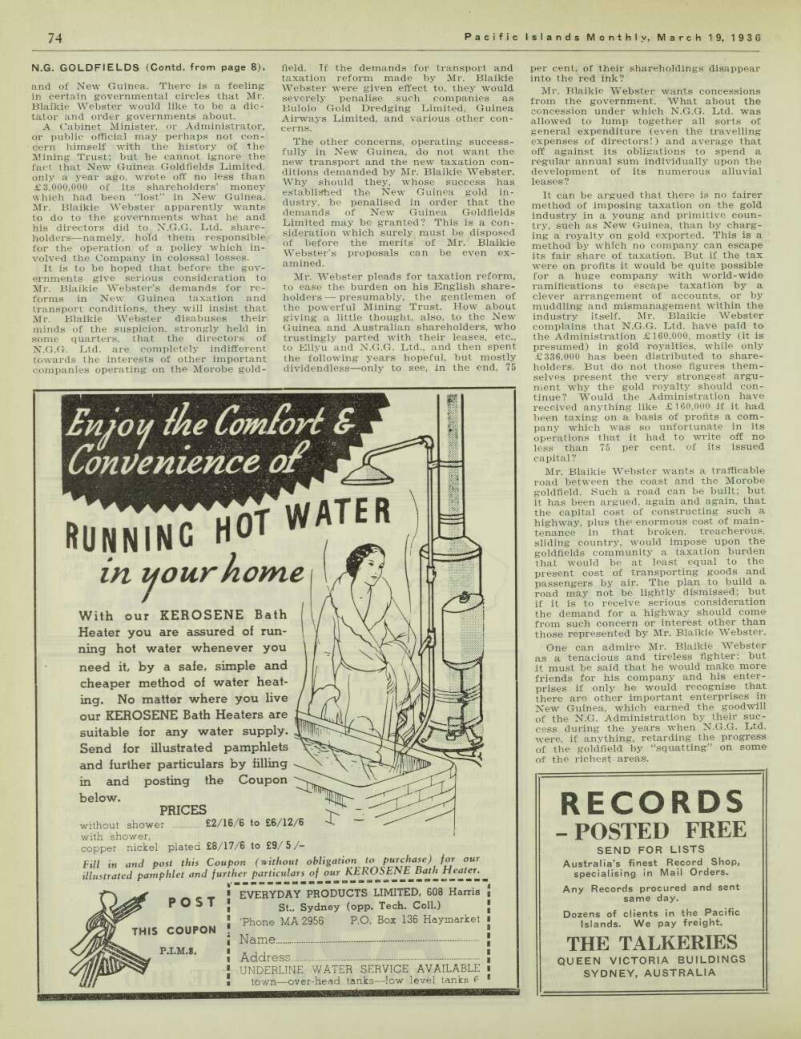
and of New Guinea. There is a feeling in certain governmental circles that Mr.
Blaikie Webster would like to be a dic tator and order governments about.
A Cabinet Minister, or Administrator, or public official may perhaps not con cern himself with the history of the Mining Trust; but he cannot ignore the fact that New Guinea Goldfields Limited, only a year ago, wrote off no less than £3,000,000 of its shareholders’ money which had been “lost” in New Guinea.
Mr. Blaikie Webster apparently wants to do to the governments what he and his directors did to N.G.G. Ltd. share holders —namely, hold them responsible for the operation of a policy which in volved the Company in colossal losses.
It is to be hoped that before the gov ernments give serious consideration to Mr. Blaikie Webster’s demands for re forms in New Guinea taxation and transport conditions, they will insist that Mr. Blaikie Webster disabuses their minds of the suspicion, strongly held in some quarters, that the directors of N.G.G. Ltd. are completely indifferent towards the interests of other important companies operating on the Morobe gold
field. If the demands for transport and taxation reform made by Mr. Blaikie Webster were given effect to, they would severely penalise such companies as Bulolo Gold Dredging Limited, Guinea Airways Limited, and various other con cerns concerns, operating success
sfa
~.. , 1 , , , r , . dl . t ‘ ons demanci ® d by Blaikl6 Webs ‘ er ’
Wby Kr^°i' ld t . the ?; wh ° se . succes ® bas established the New Guinea gold in dustry’ be Penalised in order that the demands of New Guinea Goldfields Limited may be granted? This is a con sideration which surely must be disposed hpfor „ thp merits of Mr Blaikie D r o ™ls can be even ex- Webster s proposals can be even ex ammea.
Mr. W T ebster pleads for taxation reform, to ease the burden on his English share holders presumably, the gentlemen of the powerful Mining Trust. How about giving a little thought, also, to the New Guinea and Australian shareholders, who trustingly parted with their leases, etc., to Ellyu and N.G.G. Ltd., and then spent the following years hopeful, but mostly dividendless—only to see, In the end, 75
per cent, of their shareholdings disappear into the red ink?
Mr. Blaikie Webster wants concessions from the government. What about the concession under which N.G.G. Ltd. was allowed to lump together all sorts of general expenditure (even the travelling expenses of directors!) and average that off against its obligations to spend a regular annual sum individually upon the development of its numerous alluvial leases ?
It can be argued that there is no fairer method of imposing taxation on the gold industry in a young and primitive coun try, such as New Guinea, than by charg ing a royalty on gold exported. This is a method by which no company can escape its fair share of taxation. But if the tax were on profits it would be quite possible for a huge company with world-wide ramifications to escape taxation by a clever arrangement of accounts, or by muddling and mismanagement within the industry itself. Mr. Blaikie Webster complains that N.G.G. Ltd. have paid to the Administration £160,000, mostly (it is presumed) in gold royalties, while only £336,000 has been distributed to share holders. But do not those figures them selves present the very strongest argu ment why the gold royalty should con tinue? Would the Administration have received anything like £160,000 if it had been taxing on a basis of profits a com pany which was so unfortunate in its operations that it had to write off no less than 75 per cent, of its issued capital?
Mr. Blaikie Webster wants a trafficable road between the coast and the Morobe goldfield. Such a road can be built; but it has been argued, again and again, that the capital cost of constructing such a highway, plus the* enormous cost of main tenance in that broken, treacherous, sliding country, would impose upon the goldfields community a taxation burden that would be at least equal to the present cost of transporting goods and passengers by air. The plan to build a road may not be lightly dismissed; but if it is to receive serious consideration the demand for a highway should come from such concern or interest other than those represented by Mr. Blaikie Webster.
One can admire Mr. Blaikie Webster as a tenacious and tireless fighter: but it must be said that he would make more friends for his company and his enter prises if only he would recognise that there are other important enterprises in New Guinea, which earned the goodwill of the N.G. Administration by their suc cess during the years when N.G.G. Ltd. were, if anything, retarding the progress of the goldfield by “squatting” on some of the richest areas.
New Shipping Law Disturbs New Guinea and Papua
Unexplained Haste by Federal Authority Causes Resentment
C CONSIDERABLE disturbance of public ■* opinion in New Guinea and Papua has been caused by the introduction in the Legislative Councils of both Territories of ordinances containing new provisions for the regulation of shipping in those Territories. The ordinances appear to have been drafted in Canberra and intro duced into the two Councils with instruc tions from Canberra that they must be passed in toto and with no delay.
As there is in each Council a majority of official members, these instructions have been carried out. The ordinances have been passed and await merely the ratifica tion of the Commonwealth Government.
The ordinances have been the subject of violent protests in both Councils by the non-official members. In both cases, the latter objected strongly to being “merely a rubber stamp for the Commonwealth Government.” In the case of New Guinea, Mr. J. C. Mullaly, who is president of the Planters’ Association, resigned from the Council.
Very strong protests against the nature of the ordinances and the manner in which they were introduced and forced through the Councils have been sent from both Territories to the Commonwealth Govern ment and to the Australian newspapers.
Indications, however, are that the ordin ances will become law and operate forth with.
The new law provides that overseas shipping may not trade along the coasts of the Territories, but may call at the main customs ports; and trading along the coasts generally may be carried on only by local shipping—that is, shipping operat ing within the Territory. The Adminis trators are given the power to regulate fares and freights charged by the local sh pping, and they may in special circum stances license oversea vessels to engage in coastwise trading.
The new law affects particularly the vessels of Messrs. Burns, Philp and Co., Ltd., which run from Australian ports, and the vessels of the Norddeutscher Lloyd Company, which run from Hong Kong to New Guinea and Solomon Islands ports and back to Hong Kong. These vessels are now to be prevented from calling at any except the main customs ports.
Papua is not directly affected by the new law; but in the case of New Guinea a con siderable re-arrangement of transport ser vices becomes necessary. There has been keen competition between the N.D.L. steamers and the vessels of the big Aus tralian trading firms—Messrs. Burns, Philp and Co. Ltd. and Messrs. W. R. Carpenter and Co. Ltd. The Germans literally went anywhere, and bought and sold anything: and many New Guinea planters contend that as a result of this they got higher prices for their copra and bought necessary goods at lower rates.
Feeling in New Guinea is high and bitter. There is some indication that this sudden and drastic action by the Common wealth Government is the outcome of con siderations which affect Empire unity and defence, and which cannot be publicly dis cussed. The New Guinea people, however, have been stirred by the argument that the new law. by delimiting the German competition, gives a special advantage to the two b’g Australian firms, whose in terests in New Guinea now are so powerful that, it is contended, they may impose whatever conditions they please. The fierce opposition of the New Guinea people apparently is evidence of their belief that the Commonwealth Government “is play
ing the game of the big financial and com mercial interests.”
The first rumour of the new ordinance reached Rabaui on February 26. On Feb ruary 27 the ordinance was introduced without warning, and opposed by all except one of the non-official members. On Feb ruary 28, it was passed through all stages. Messrs. Mullaly, Grose, Pratt and Neal left the session of the Council as a protest against the way in which the measure was being forced through. Mr.
Mullaly subsequently resigned.
The new ordinance was introduced in the Legislative Council of Papua, at Port Moresby, on March 12. It was strongly opposed by the non-official members; and when it was seen that it would be forced through by the official members, the non official members left the chamber as a protest.
Many protests from both Territories against the ordinance and the circum stances of its passing have reached us.
We also have received from interests, representing the big firms who have been attacked, certain material in support and defence of the ordinance. The arguments tor and against are set out hereunder.
It is useless to comment —the thing is fait accompli. We are bound to say, how ever, that the method of introducing and passing this measure is extraordinary. Mr.
Mullaly in New Guinea was justified in saying that “it would be warranted only by a state of grave national emergency.”
Does a grave national emergency exist?
For The Bill
The Australian Minister for Territories says that the bill is the first necessary step in a general reorganisation of Terri tories’ affairs.
The bill will establish in New Guinea the same conditions as now obtain in other parts of the British Empire. Oversea ships in other Islands Territories cannot trade between other than the main customs ports.
The N.D.L. ships are not shut out of New Guinea. There is nothing to prevent the N.D.L. interests putting on another vessel to trade within New Guinea as at present—only it must not run to Hong Kong, but must connect with the Hong Kong steamer, in the manner that is fol lowed now by the inter-island vessels of the big Australian trading firms, which connect with the Australian steamers.
The maintenance of efficient inter-island services is essential for the development of the Territory—and those services, which connote the establishment of suitable wharves and stores, cannot be profitably continued under the kind of competition introduced by the N.D.L. line.
The Administrator will protect planters and traders by fixing inter-island fares and freights—and, if necessary, give a license to oversea ships to trade between the small ports.
Against The Bill
As a result of competiticn provided by the N.D.L. interests New Guinea planters have secured advantages equal to £2 or £3 per ton on their copra.
The German ships provided New Guinea planters with direct shipment to one of the profitable European copra markets.
They gave a better price in itself and, by
picking up copra at the plantations, they saved the planter the freight represented by inter-island shipment.
The removal of this competition will compel the planter to take whatever prices the big Australian firms may fix in con sultation, and also will not give the planter the same chance to buy his household goods in a cheap market. Peculiar condi tions which exist in New Guinea make it absolutely imperative that there shall be freedom of trade and competition.
The Administrator may have the right to fix fares and freights; but the Adminis trator can do nothing, if competition is removed, to save the planter from possible exploitation by the big firms.
The Legislative Council, in 1934, by a unanimous vote of both official and non official members asked the Commonwealth Government to refrain from interference with New Guinea shipping. Yet the official members on this occasion, without adequate explanation, voted to interfere grievously with shipping.
The introduction of the bill without warning is directly contrary to assurances previously given by the Government.
The bill is opposed in New Guinea by both the Planters’ Association and the Returned Soldiers’ Association.
There is a strong feeling in Papua against “bills drafted by a unknown per son in a Government office in Canberra and sent up here to be passed by an obedient majority.”
The commentators in Papua also say that “if this power is to be exercised by the Minister, then the Legislative Council might as well be abolished.”
Rev. M. Prater, a Presbyterian mis sionary in the New Hebrides, and Mrs.
Prater were spending furlough at Cowes, Victoria, early in March. They will re turn to the mission field by the Morinda from Sydney on April 2. Their son. Dr.
A. S. Prater, is also a missionary in the Condominium, being stationed at Vila.
Advertisements & other items, p. 11 (1 item)
Pacific Islands
JUST PUBLISHED
YEAR BOOK
1935-36 Ed’n. —430 pp.—Many new Maps
A reliable, comprehensive guide to
the Rapidly-Developing Territories
of the Pacific.
STATISTICS FROM OVER 20
ADMINISTRATIONS
NEW COUNTRIES WITH
NEW OPPORTUNITIES
Special Features include: Description of new Pacific Islands Gold Industries; Pidgin Vocabulary; Aviation in Pacific; Pacific Personalities; History of Pacific Exploration; Business and Residential Directories of Principal Territories.
Bound in cloth, 9/6; in Light Board, 7/6; plus postage (British countries, 6d; foreign, 1/-).
From all Booksellers and Islands Stores, or from
PACIFIC PUBLICATIONS
LTD.
Union House, 247 George St.,
Sydney.
“Montoro” Aground
At Brisbane
“Macdhui” Takes over Cargo and Passengers
WHILE swinging off Dalgety’s wharf, Brisbane, on February 28, the Burns, Philp Islands steamer Montoro, en route to Papua and New Guinea, grounded in the Brisbane River.
She was placed in dry dock and exam ined by Mr. A. Corrigham, Assistant Su perintendent Engineer of Messrs, Burns, Philp and Co., Ltd. It was revealed that the rudder blade was damaged, being bent about Ip degrees at top and 40 degrees at bottom.
On her arrival in Sydney from the north ern islands on March 5, the Macdhui was hastily reprovisioned, and two days later, on March 7, departed for Queensland to pick up the Montoro’s passengers, mails, and cargo. She reached Brisbane on March 9, and cleared for Papua and New Guinea the following day with most of the Montoro’s passengers. She was to adhere to the latter’s timetable—but will run sev eral days late at each port.
Passengers for Port Moresby direct were taken aboard the B.P. vessel Marella on March 10, and were landed in Papua a few days later. The Marella then continued her voyage to the East.
The damaged Montoro was repaired at South Brisbane dry dock, and came to Sydney on March 15. It is planned to get her away again on March 19 —the date the Macdhui should have sailed.
Messrs. Burns, Philp and Co., Ltd., were congratulated by various interests con cerned on the rapidity with which they made rearrangements for the continuation of this essential Islands service following the accident.
The Montoro has been unlucky lately.
She was ashore at Fortification Point, 18 miles north of Finschafen, on the New Guinea mainland, in August, 1934, and was laid aside for a time while the Mata ram carried on the service.
Dentist, Ex-Miner
The subject of this sketch, Eric Weine, needs no intro duction to the people of New Guinea and Papua—he has practised dentistry for several years, and has worked hard in the mouths of many of them.
He has, on occasion, become weary of the forceps and the drill, and has gone off over the ranges after the elusive yellow metal; and he has had his share of luck, good and bad.
At present, he is dentist, ex miner. To-morrow, if the gods decree, he may be miner, ex dentist. His chief hobby is fishing—and it is an art in which he excels.
Progress of Rewa Bridge
New Road Around
Viti Levu
From Our Own Correspondent SUVA, February 27.
VyORK on the Sigatoka Road and the Rewa Bridge is making steady progress, says the Director of Public Works (Mr. W. Wise). A labour short age and exceptionally wet weather have caused delays.
There is only one more ridge to cut through before the Sigatoka road will be on to the Navua flats, where the going will be comparatively easy. There are three road-building units and a big bridging gang at work. Of the 62 bridges on the road when completed, 21 (some of them large) have been finished, and six are under construction.
When this is completed, the road will extend right round Viti Levu, and will constitute a great tourist attraction. The visitor will be able to go right round, from Suva to Suva, without duplicating any of the route.
Good progress is also being made with the bridge over the Rewa River. Five of the 12 spans have been completed.
The work is more than half finished, as two additional piers are practically complete and another is under way. All materials have now arrived from Eng land.
Difficulty has been experienced in the sinking of some of the caissons, due to encountering a layer of soft clay half way across the river. To meet this, the cylinders have had to be carried deeper than anticipated, in some cases about 80 feet below the water level.
Mr. A. E. Barker, Secretary to the Methodist Mission in Fiji, was a passen ger for Suva by the Monterey from Sydney early in February.
Pacific Missions
Conference in Sydney Next Year
T'HE National Missionary Council of Australia has decided to convene a Pacific Conference in Sydney in April, 1937.
It is expected that representatives of the various mission bodies in the South Seas will attend.
Problems connected with Pacific Islands natives and the Australian aborigines will be discussed.
The Mission Board of the Methodist So ciety resolved at the Annual Meeting held in February to co-operate in every pos sible way with the Council.
Mr. Jack Hides
t>Y the March Macdhui, Mr. Jack Hides, A.R.M. in the Papuan service, arrived in Sydney on three months’ sick leave. Mr.
Hides returned to Port Moresby in Decem ber; and in January he was one of a Pa puan official party which, in a Guinea Airways Junker machine, made a recon naissance flight from Mt. Hagen, in the Mandated Territory, southwards over un known Papua. The flight is described on page 39 of this issue.
From the Mandated Territory, Mr. Hides proceeded to Samarai and thence returned to his own station, on Misima Island. By this time, he had suffered a severe return of the malady which he contracted last year on the north-west patrol. Mr. Ren toul, R.M., ordered him back to Samarai, and the medical officer there said he must have three months’ sick leave, with quiet ness and rest.
Mr. A. T. Day, chairman of directors of Aloha Central Gold Mine N.L., arrived in Sydney from Fiji by the Mariposa on February 21, after making an inspection of the Aloha Central property at Tavua.
The Minister And The
Natives
AN incident at Manus, New Guinea, dur ing the tour of the Australian Minister, Sir George Pearce, shows how officialdom can blunder.
The ship came in, and the population, European and native, assembled at the wharf to meet the Minister.
Sir George landed; ignored a group of half a dozen planters who were standing, respectfully waiting: and walked immedi ately across to the natives, where he pro ceeded to shake hands with the luluais and tultuls.
It was done in ignorance, no doubt; but the planters were very angry. They have difficulty enough, as it is, in maintaining the proper relationship between Euro peans and natives; yet the important offi cial personage ignored them, and went at once to greet the natives. The distinction made was not lost upon the chiefs.
Some time later, when it was announced that “the Minister would be glad to meet the planters,” the indignant planters de clined to call upon him.
Mr. H. E. Woodman, Assistant District Officer in the New Guinea Service, re turned to Rabaul by the Macdhui from Brisbane on March 10. after spending leave in New South Wales.
Tropicalities
THE film, “Mutiny on the Bounty,” based on the book by Messrs. Nordhoff and Hall, of Tahiti, has been drawing “capa city houses” in Sydney all the month. From the box-office viewpoint, it is 100 per cent, a winner. As entertainment, it is mag nificent. Laughton (as Bligh) gives a superb ■ performance: and Clark Gable (Fletcher Christian) and Franchot Tone have done a job that places them in the front rank of screendom.
As a contribution to history, the film is worthless, because the producers, in cer tain important directions, have departed from the historical accuracy which Nord hoff and Hall so carefully preserved.
Christian is shown escaping from Tahiti in the Bounty just one leap ahead of the pursuing Pandora. Actually, the Bounty had sailed away into the unknown long before the Pandora reached Tahiti. Bligh is shown, in command of the Pandora, screaming across the eastern seas in search of Christian. Bligh was never on the Pandora. Bligh is made a prominent figure at the court-martial of the mu tineers who were found by the Pandora in Tahiti. Actually. Bligh never appeared at the court-martial.
It is a pity: but film-producers can do these things nowadays without check.
They have no regard whatever for popu lar education or instruction —history, art, patriotism, everything that matters, is prostituted to box-office considerations. A recent, amusing satire put it this way: Cecil B. de Mille, Sorely against his will.
Was persuaded to leave Moses Out of the Wars of the Roses. * * * MR. Hakon Mielche, who will be re membered as the talented artist and writer who accompanied the Danish scientific expedition in the South Seas in 1934 (when they were wrecked in the Santa Cruz Islands), had intended to visit New Guinea this year. He now writes from Denmark to the Pacific Islands Monthly, that he has been ordered by his publishers to go to South America in stead, and may visit Australia and New Guinea in a year or two hence.
“But by that time,” adds Mr. Mielche, “Mr. Jack Hides possibly will have ex plored every bit of the interior, and there will be nothing worth while writing about!” It would appear that the fame of Mr. Hides has spread very far indeed.
Mr. Mielche will circumnavigate South America—passing down the eastern coast, spending several months in and about the Magellan Strait and Tierra del Fuego, and then visiting Chile, Peru, Ecuador, Colombia, and Panama. • • • /~)NE has often read of the telepathic powers of New Guinea natives. Here is a recent authentic case from Fiji, which will take some explaining.
On February 15, the Government motor vessel Derek was wrecked on the island of Komo, in Southern Lau. The Derek carried no wireless, and there is no radio station in the vicinity. Therefore, the only communication is by cutter. The first to reach Suva from Komo after the mishap was the cutter Tui Yunilagi, which brought the castaways from the ship on February 25.
On Monday, the 17th, two days after the stranding, there was a strong and per sistent rumour “on the beach” that the Derek had been wrecked. Inquiries of
the Harbourmaster’s office elicited the Information that there was no means by which the news could have come in from Lau, and a similar inquiry at the office of the Public Works Department, which controls the Derek, drew a similar answer, an official going so far as to say that the department had heard the rumour and had tried to trace it. They could not confirm it because, so far as they could ascertain, there had been absolutely no communication with Lau.
Residents said, “beach rumour,” in a disgusted tone, and let the matter drop.
For once, however, rumour was right, and, ten days after the wreck, the crew arrived in Suva by cutter, which vessel also carries no radio.
How did the news get to Suva on the 17th? * * « A SERIES of 100 lectures is now being given throughout Germany, to arouse a public demand for the return of the former German colonies. The newspapers say that the lecturer is Major Schnoeckel, of the Nazi Colonial Department of Berlin University. Evidently, he is identical with Major Paul Schnoeckel, who, in June, 1933, wrote to the Pacific Islands Monthly and made a remarkable appeal to British people in the South Seas to try and bring about a better relationship between Ger many and Britain. * • * IN the film, “Mutiny on the Bounty,”
Bligh is presented as a peculiarly un attractive character —a harsh, cruel, mean spirited tyrant, without a single redeem ing feature. We get only a glimpse of Bligh in the famous open-boat voyage, wherein he displayed amazing courage and seamanship; and it is not surprising that, at the end of the film, the women of the audience are literally sitting up and spit ting at the monster that is created by Laughton’s genius. Many people have rushed into print to say that Bligh was not so bad as he is painted here—one
writer, Dr. Mackaness, of Sydney Univer sity, even insists that Bligh was quite a charming person.
This is a revival of an ancient argument.
There is much to be said on both sides.
The man who drove the Bounty crew into mutiny and, later, when Governor of New South Wales, caused the garrison to rise in revolt and ship him away, must have had some particularly hateful qualities. But Laughton’s' presentation is historically useless because he persistently shows Bligh as a commander ruled wholly by a mad passion for revenge, indulging an insane lust for inflicting pain in retalia tion for suspected resentment of his authority. That is inaccurate. Bligh was so bad that his memory deserves appro brium —but he was not as bad as that. * ♦ * .
MANY people still remember the clever and diplomatic way in which the Lanati rebellion in Western Samoa in 1908 was handled by Dr. Solf (German Governor of the Territory), whose death has just been announced. He spoke the Samoan language well, and understood Samoan psychology. The friendships he made during his Governorship, 1900-1910, en dured during his lifetime —he kept up a correspondence with residents of Samoa until recently. His daughter, born in Samoa, was given a Samoan name. • • • announcement of his appointment ■*- to the Governorship of Fiji reached Sir Arthur Richards on his birthday, Febru ary 21. Sir Arthur, whose appointment is referred to on page 54 of this issue, be came Governor of British North Borneo in 1930, and Governor of Gambia in 1933.
He received the C.M.G. in 1933, and was raised to K.C.M.G. in 1935. He is a mar ried man with one son and one daughter. * * * IN January we published an inquiry, from America, for the address of the “Tin-Can Mailman”—Mr. Ramsay, who used to swim the mail between ship and shore, in the Tongan Islands. Mr. W.
Candler, South Seas traveller for Messrs.
Gillespie Bros. Ltd., reports that Mr. Ram say is now a resident of Pago Pago, American Samoa.
Advertisements & other items, pp. 13-14 (1 item)
Bomi
viiicij\
home
sterling
BOMI
Guaranteed CD
LOOKS
BETTER
LONGER
MADE BY
STERLING VARNISH CO.
PAINT
For
TROPICAL
SUN and
SALT-LADEN
AIR
SYDNEY, N.S.W.
NEGLECT OF DEFECTIVE SIGHT
MAY CAUSE SERIOUS RESULTS
Take Care of Your Eyes Consult
WALTER FORD
D.8.0.A.. M.0.0,A.
Optometrist and Optician 4th Floor, CKallis House Martin Place, Sydney Established over 30 years Tel.: Most moderate charges BW 61 3 1
Make Pari* l our llra<l<|iiartrrs in May and Visit
THE PARIS INTERNATIONAL TRADE FAIR
Whatever your business you will find exhibits of intimate appeal.
Whatever you manufacture you will find visitors and buyers directly interested in your display.
This year a record number of exhibitors are to participate and more than 2,000,000 visitors from all parts of the world are expected.
Take advantage of this marvellous opportunity to keep in touch with the latest developments abroad.
For full particulars apply to the TRADE COMMISSIONER FOR FRANCE, 7 Wynyard Street, Sydney.
HOTEL GRAND CENTRAL
151 CLARENCE STREET, SYDNEY (opp. G.P.0.)
jsi a
mn
son
THE POPULAR “ROOM-ONLY"
TARIFF
is specially designed to meet modern requirements of business and pleasure. It enables patrons to enjoy every advantage of hotel life, at the same time keeping hotel expenses down to a minimum.
SERVICES INCLUDE:
Theatre Booking and Information Bureau.
Travel and Sightseeing Tours arranged.
Up-to-date Barber’s Shop.
Cleaning and Pressing Service.
Garage accommodation nearby at usual rates.
Spacious Dining Room. All meals a la carte.
THE HOTEL GRAND CENTRAL LTD.
151 CLARENCE STREET, SYDNEY (opp. G.P.0.)
Telephone: BW 1531 (3 lines) Box 716 FF, Sydney Radio Cables and Telegrams: “Grancentral,” Sydney
FRASER WEBSTER, Manager.
About Islands People
Mr. Newman Pusey has been appointed by Amalgamated Wireless (A’siaj Ltd., as acting offlcer-in-charge of Thursday Island radio station, in place of Mr. A.
C. Baker, who recently died in Towns ville, Queensland.
Mr. V. Edgar, of the District Services Department of the N.G. Administration, recently married Miss Jessica Kirkland, of the Salamaua Hotel. They will make their home at Sandy Creek.
Rev. and Mrs. J. R. Andrews, of the Methodist Missionary Society in Papua, are at present spending furlough in South Australia. Since 1933 they have been liv
ing on the small island of Dobu (about 70 miles from Samarai) where Mrs.
Andrews is the only white woman.
Mrs. Alice Geake, aged 79, and late of Bay of Islands, N.Z., died in Rarotonga on February 15. She was for many years connected with the Sydney Technical In stitute as a teacher and lecturer, and she went to live in Rarotonga in October. It is understood that several local bequests are included in her will, one beneficiary being the Rarotonga Child Welfare Asso ciation.
Mr. Basil G. Challis, of the Department of Agriculture, Rabaul, New Guinea, ar rived in Sydney with his wife by the Macdhui on March 5. Mrs. Challis told how housekeeping in New Guinea can be both interesting and amusing. When she was entertaining at dinner one night, her native brought in tea served in coffee cups because the coffee had “run out.”
Her friends had even worse treatment, for their boy served soup in champagne glasses. It was no good saying the boys might have a garment when it was torn, said Mrs. Challis, because they would promptly put tears in other garments.
Mr. E. J. Riches, a New Zealand officer in the International Labour Office of the League of Nations at Geneva, will shortly arrive in Western Samoa. He has been sent to gather data and statistics regarding the conditions of the plantation (coolie) labour.
Mr. W. T. Hull arrived at Thursday Island recently on transfer from Perth, Western Australia, to be manager of the T.I. branch of the National Bank of Aus tralasia. Mr. A. W. Loutit, who has been bank manager for three years, left Thurs day Island on a tour of the Orient before returning South for further duty.
David Mone, a Tongan teacher, arrived in Sydney by the Aorangi on February 21 to deliver addresses and preach in various Australian centres on behalf of the Methodist Missionary Society. He is at present in South Australia.
Mr. and Mrs. S. West Newman returned to Thursday Island in February after visiting England. Mr. Newman is mana ger of the Port Kennedy Engineering Works.
Dr. C. N. Dawson, who was formerly Chief Medical Officer of Tonga and who now is in private practice in Western Samoa, sailed from Auckland, N.Z., where he spent two months’ vacation, by the February Monterey. At Suva, Fiji, he transferred to a cargo steamer for Apia.
Mr. and Mrs. Charles C. Curtis, the owners of Mahina plantation and ardent supporters of every form of sport, left Tahiti for Europe by the Stella Polaris on February 16. They expect to be ab sent for nearly a year.
Mr. William Dee, of the Department of Public Health in New Guinea, married Miss Annie Gladys Tyler, of Melbourne, at St George’s Church, Rabaul, on February 12. Rev. R. de Voii; of the Melanesian Mission, performed the ceremony.
Mr. Grainger Smith has been appointed as head teacher on Murray Island in Torres Strait. He has already taken up duties on the island, which is about 120 miles from Thursday Island and very close to the Great Barrier Reef.
Mr. Vincent Young, of Pitcairn Island, a direct descendant of Midshipman Ed ward Young of H.M.S. Bounty (who, with Fletcher Christian, led the mutineers), arrived in Wellington, New Zealand, in February. He will undergo theological training at Longburn Missionary College, and will then return to Pitcairn Island.
Mr. and Mrs. J. Widdup, of Bougain ville, New Guinea, arrived in Sydney by the Malaita on February 13. For many years Mr. Widdup has had charge of A.W.A.’s wireless station at Kieta.
Rev. J. W. Burton, General Secretary of the Methodist Missionary Society of Australasia, left Sydney for America, en route to England, by the Mariposa on March 4. He was accompanied by Mrs.
Burton and their daughter Ruth. During Mr. Burton’s absence, Mr. J. W. Kitto, former Deputy Postmaster General for New South Wales, will be Acting General Secretary.
Mr. Neil Campbell Elliott, son of the late Brigadier-General Harold (“Pom pey”) Elliott, sailed from Sydney for Rabaul, New Guinea, by the Montoro on February 26. Mr. Elliott, who was edu cated at Scotch College, Melbourne, has been accepted by the N.G. Administration as a cadet in the District Services De partment. His father was a distinguished soldier, who fought in the Boer and Great Wars, being with the Australian forces at Gallipoli.
Mr. Oscar G. Nordman, who for many years sailed across the Pacific between Sydney and ’Frisco as a member of the stewards’ staff of the Matson liners Sierra, Sonoma and Ventura, is now settled down in Papeete as the proprietor of the Oceanic Market. His specialty is the sale of groceries, dairy products, fresh meat, fruits, etc., to the population of Tahiti. He makes a specialty of pro visioning yachts. Mr. Nordman, who sends through us kindest regards to old Pacific friends, seems to be the right man in the right place.
Rev. Jonathan Meleke Fonua, a young Tongan Methodist missionary, has accept ed the offer of the Board of Missions to an appointment in Papua. He will spend several months in Australia on deputation work before taking up his new position in Melanesia.
Mr. Lester N. Lock, son of Pastor W.
N. Lock, superintendent of the Seventh Day Adventist Mission at Port Moresby, Papua, arrived in Sydney by the Macdhui on March 5. Shortly before he left Papua, he made an adventurous trip in the ketch Diari to Woodlark Island with a cargo of medical and religious books.
Twice the boat touched reefs oft Fergus son Island, and was lucky to escape dis aster. On the return voyage to Pt.
Moresby, he reached the mainland after passing through a severe gale lasting 10
days. Then the engine failed and the Diari had to make for the shelter of Suau Island, South-eastern Papua.
Right Rev. Leonard S. Kempthorne, M.A. (Anglican Bishop in Polynesia) returned to Suva, Fiji, by the Stella Polaris from Western Samoa on February 24, after a visit to England and America.
Mr. C. B. Tarlinton, of Cobargo, N.S.W., left Sydney for New Guinea by the Mon toro on February 26. He has been trans ferred to the branch of the Bank of New South Wales at Salamaua.
Mr. G. Sharood, manager of the Tahiti branch of Messrs. A. B. Donald Ltd., re turned to Papeete by the Makura recently
after three months’ holiday in New Zea land.
Rev. Guy H. Darke, L.Th., Acting Su perintendent of the Anglican Mission on Moa Island, Torres Strait, has announced his engagement to Miss Joan Hennessey, daughter of Mr. and Mrs. E. J. Hennes sey, of Thursday Island.
Dr. A. P. Elkin, Professor of Anthro pology at the Sydney University and Di rector of Anthropological Research of the Australian National Research Council, will leave Sydney for Hawaii by the Mariposa on June 24 to attend a con ference on the Education of Pacific Races, to be held in Honolulu between June and August.
Rev. and Mrs. C. W. Light, of the New Guinea Mission, arrived in Sydney after furlough in England by the Orion on February 27. They left for Boianai, Papua, by the March Macdhui.
Mr. and Mrs. W. R. Martin departed from Fiji by the Aorangi on February 13.
Mr. Martin has been in business as a saddler in Suva for many years, but re cently disposed of his firm in order to leave the Colony for reasons of health.
Mr. David Philip Parry, of Suva, Fiji, married Miss Elizabeth Rosa Martin, of Wellington, N.Z., at the Holy Trinity Pro- Cathedral, Suva, on February 13. The Venerable Archdeacon Harris performed the ceremony.
Senator Sir George Pearce, Minister in Charge of Islands Territories, made a special visit to Geelong, Victoria, on March 6 to inspect the instructional work carried out by a party of Nauruan Scouts who have been undergoing voca tional training courses conducted by Mr.
H. E. Hirst, County Scout Commissioner of Victoria. The . Nauruans, who at tracted much attention by their pleasant appearance and good behaviour, will re turn to Nauru on March 20.
Mr. John William Mackay, of the Mar ine Service of Amalgamated Wireless (Australasia) Limited, died suddenly at Leura, N.S.W., on February 29, at the age of 47. He was one of the wireless pioneers of Australia. Arriving in Syd ney in 1913 as radio officer on the steamer Anchises, he joined A.W.A., which was then laying the foundations of a wireless service for the Australian mercantile marine. He served in various Pacific Islands, and had returned only a month previously from a four years’ sojourn in the Gilbert Islands, where he was radio operator at Butaritari, and later on board On Chong and Co.’s inter-island steamer Macquarie.
Mrs. Jane Gray, a very old resident of Fiji, died at Suva on February 24, at the age of 85. Born in London, she went to Levuka in 1885. Her husband, Mr.
Alex. Gray, an accountant, predeceased her in 1912.
Rev. John Jackson, V.D., of Suva, Fiji, died in the Colonial War Memorial Hos pital on February 21, aged 80. A Scots man, Mr. Jackson went to Fiji from Aus tralia in 1914 as Presbyterian minister of St. Andrew’s Church, serving for three years before returning to Australia. In 1925 he again went to Suva to take up duties with the Presbyterian Church.
Retiring in 1928, he settled at Navua and resided there until a few years ago, when he went to live in Suva, Mr. A. J. Marshall, of Sydney, is at present in the north-east corner of Dutch New Guinea, making arrange ments in advance on behalf of the Ox ford Expedition, which is to carry out exploration work in Dutch New Guinea in 1937. Mr. Marshall left Aitape, in the Mandated Territory some time ago, and, he says, “bartered his way from village to village, obtaining food and carriers where he could.”
Dr. jur Friedrich Wilhelm Mohr, re presentative of the East Asiatic Com pany, of Hamburg and Bremen, died suddenly on board the steamer Stutt gart, en route from Singapore to Europe, on January 31. He was 55 years of age.
For 14 years, he had been with the East Asiatic Co., and represented other Ger man interests in Asia.
Mr. E. Gumbley, a mining engineer who had been in New Guinea since March last year, died in the European Hospital at Wau on February 19. The cause of his death was “Japanese river fever” and pneumonia, contracted while he was prospecting on the Bulolo flats.
For a time Mr. Gumbley was connected with Sandy Creek Gold Sluicing Ltd.
Mr. S. H. Ellis, well-known barrister of Suva, is at present on an extended holiday in Australia with his wife and children. Early in March they spent several weeks at Lapstone, in the Blue Mountains, where they met Mr. Brooke Francis, of Northern Rhodesia, who was formerly a resident of Fiji. Mr. Ellis and his family will return to Suva in April.
Advertisements & other items, pp. 14-16 (1 item)
Kurrajong
Wheeny Creek Farm
Forty-five miles from Sydney Superior modern accommodation, abundance of cream, eggs, and poultry. S acres orchard. Tennis, etc.
Tariff: Double, £2/2/- each; Single, £2/10/- ’Phone: Kurrajong 42 Proprietor: A. J. SAMSON Formerly New Guinea Public Service
bougie, Darling Point, Sydney
FINISHING SCHOOL FOR GIRLS
Hopewood House is the only school of its kind in Australia, being unique in educational purpose, equipment and beauty of surroundings.
It provides a splendid educational course on sound cultural lines. All subjects, which include Literature, Languages, Music, Art, Dramatic Art, Dancing, Tennis, Golf, etc.. Domestic Science, Dressmaking, Home Crafts, Complete Secretarial Course, etc., are under the direction of skilled specialists of recognised standing.
The special Finishing Course is an excellent preparation for travel or further study abroad.
All possible facilities are provided for the development of the individual talents, tastes and ability of every student, and special courses may be arranged at an inclusive fee.
Further information and an illustrated prospectus may he obtained from Principal —
MISS NANCY JOBSON, M.A. (Melb.)
“Hopewood House," Darling Point, Sydney
ELVFS
Special Mail Department
-for RECORDS
ELVY’S, Sydney’s famous old-established Music House, can send you every Record that you may want. Special Mail Department for
Island Residents.
Jesse Rodgers sings “The Empty Cot,” The Empty Cot, An Old Rugged Road. Jesse Rodgers, singing with Guitars. G. 22588 (2/6).
Dance and Vocal Records from the New Films, “Top Hat.” Top Hat, White Tie and Tails, Fox-trot, Cheek to Cheek, Fox-trot. Phil Ohman and His Orchestra.- G. 22589 (2/6).
The Mills Brothers (four boys and a guitar).
Some of these days. Tiger Rag. Y. 5010 (4/-).
Fletcher Henderson and His Orchestra. Wrappin’ it up (The Lindy Glide) (Fox Trot); Happy as Y. 5011 (4/-).
Here are some new releases: “Anything Goes.” Jack Hylton and His Orchestra with vocal refrains. “Anything Goes” —Selection —Parts 1 and 2. Introducing: Anything Goes, All Through the Night; Blow, Gabriel, Blow; You’re the Top; I Get a Kick out of You; Gypsy in Me. C. 2757 (6/-).
Samson and Delilah—Softly Awakes My Heart (Mon coeur s’ouvre a ta voix) (Saint-Saens and Lemaire). Two parts in French. Duet; Mile. G.
Cernay and Georges Thill (with orchestra). 12 inch. LOX 238 (8/-). the day is long (Fox Trot).
Write for complete free lists. Elvy’s are noted for prompt service. Order Noxo.
ELVI >V CO. ETD.
397 George Street, Sydney. 'Phone; M 2319.
TUDOR HOTEL
Room Only Rate, 5/- per day. Meals a la carte. Accommodation for 100 guests. One minute from G.P.O.
127 PHILLIP ST. Tel.: BW 27M
Next door to Martin Place
Sydney
W. KOPSEN & CO., LTD.
SHIPCHANDLERS AND GENERAL MERCHANTS
Tilley Lamps ”
Special Quotations for Island Trade GENUINE Tilley Parts 68-70 Clarence St, Sydney CABLES: l^ P L SE Bw SY im E 5 Y 6
For EVERY Climate ...
HALLSTROM
NON-ELECTRIC
KEFRUiiimAroirs
Now available in De Luxe and Standard Models incorporating many improvements in styling and construction f Entrance to Factory and Offices: 462/464 Willoughby Rd., Willoughby, N.S.W.
Industry Shows Life Again
Fiji Pineapples
THE pineapple industry of Fiji is taking a new lease of life, and yet may flourish.
It was reported by the Fiji Times early in February that, by the Niagara and the following steamer, Mr. McCown, of the Wai-ni-Loka cannery, Ovalau, would ship 1,000 cases of pineapple crush to Canada, where it will be used in the manufacture of various commodities. Mr. McCown has a very up-to-date plant and is even manu facturing his own tins.
An effort to establish pineapple produc tion and canning on a big scale was made in Fiji in 1930-32, but the depression killed the enterprise. There now should be a good chance to revive it.
Stay Too Short In Tahiti
From Our Own Correspondent
Papeete, Feb. 17.
THE Stella Polaris, luxurious Norwegian passenger yacht, arrived early on February 15, and left again before dawn on the 16th for Samoa, Fiji, and other places in the Western Pacific. She brought eight passengers for Tahiti and carried over a hundred others for a round-the-world trip.
Although many complaints were heard among the passengers regarding the short ness of the stay in such an interesting place as Tahiti, they were fortunate — considering the time of year—in finding such beautiful weather. Thanks to this the whole party were able to make a com plete circuit of the main island, and also found time for shopping and sight-seeing
around Papeete. Most of them returned on board just in time for sailing at 3 a.m. after a hectic night at Quinn’s cabaret and the La Fayette Hotel, a popular night resort about four miles from town in the Arue district.
After calling at many ports in the East Indies the Stella Polaris will cross the In dian Ocean to Madagascar and Durban and will then proceed to Cadiz in Spain, where she is due on May 6. This will end the scheduled part of the cruise, after which the passengers will find their way home by any route of their choice. The cruises of the Stella Polaris —of which this is the fourth to visit Tahiti —are sponsored by the Raymond Whitcombe Co. of New York.
American Party to Study
South Seas
SCIENTISTS, writers, travellers, and students are represented in a party of 18 Americans who left San Francisco re cently in the three-masted auxiliary yacht Exalted to study natives in seven South Sea Island Groups, including Hawaii, Samoa, Tonga, Fiji, Pitcairn Island, and Easter Island.
Included on board are Dr. Bernard Jen sen, of Oakland, organiser of the cruise; Captain Oscar W. Schwarz, of the U.S.
Navy Department, who will cover the meteorological and hydrographic work; Mrs. Edith Shelton and Miss B. M. Har court, well-known American magazine writers; and Messrs. Robert McCarthy, William Hamilton, and Emil Jensen, graduates of California University.
The 132 ft. Exalted has a beam of 26ft., and was fitted at Seattle with Diesel en gines giving her a cruising range of
10,000 miles without refuelling. She car ries a crew of 10, under Captain Charles A. Watts, of Oakland.
Advertisements & other items, pp. 17-18 (1 item)
Tooheys
IM FIRE*
No smoke, no rust, and longer life for the rifle barrel, because of absence of residues these are factors that, combined with sureness and swiftness, have gained for 1.C.1. .22 s foremost place in popular favour.
BHEE3B
LONG
LONC RIFLE
SOLID
A Product of
1.C.1.A.N.Z. Ltd.
(Ammunition Section ) 380 Collins Street, Melbourne 277 Clarence Street, Sydney
AND
HOLLOW
POINT
Obtainable
Everywhere
Si® 55
The Color! nl
Pacific
The emerald green of the hillside, the sapphire blue of the sea, the silver strand of beach ... complete the color scheme with the golden amber (and creamy white head) of a glass of Tooheys Pilsener. It gives a rosy hue to life. Here’s To’ee!
TOOHEYS
PILSENER
IN THE BOTTLE WITH THE YELLOW LABEL.
THANK 101 !
7 those who sent Stamps, we trust and believe you are satisfied with what we paid you for them, and we shall endeavor to please you in our future dealings.
We are always ready to pay promptly one to fifty shillings per hundred and postage for any used or unused Stamps sent to us. Try us.
Trading companies and traders, gather Stamps and trade with us,
BOSTON STAMP CO.
BOSTON, MASS., U.S.A.
Acid in Your Blood Kills Health and Energy Kidneys Usually to Blame
Nothing can so quickly midermine your health, strength, and energy as an excess of Acid in your blood. Every time you move your hand, take a step, or use even the slightest amount of energy, cells are broken down in the body and create Acids. This process goes on even when you are asleep.
Fortunately, nature has provided an automatic method of getting rid of these excess Acids by circulating new blood 200 times an hour through 9 million tiny, delicate tubes, or filters, in your Kidneys. It is the function of the Kidneys to filter out these healthdestroying Acids, and to purify the blood so that it can take energy and vitality to every part of your body. But if your Kidneys slow down and do not function properly, and remove approximately 3 pints of Acids, Poisons, and liquids from your blood every 24 hours, then there i& a gradual accumulation of these Acids and Wastes, and slowly but surely your system becomes poisoned, making you feel old before your time, rundown, and worn-out.
Causes many ills
If Kidney and Bladder troubles cause you to suffer from Acidity, Getting Up Nights, Nervousness, Leg Pains, Dizziness, Frequent Headaches, Rheumatic Pains, Swollen Ankles, Circles Under Eyes, Backache, Loss of Vitality, or Burning, Itching and Smarting, don’t waste time worrying and waiting.
Help your Kidneys with the doctor’s special, guaranteed kidney diuretic prescription, called Cystex (pronounced Siss-Tex). Cystex works directly on the Kidneys and Bladder, and helps the Kidneys in their function of washing impurities and Acids from the system and in maintaining the purity of the blood. Don’t try to overcome Acidity in your blood by taking medicines to offset the Acidity. The Acid is bound to stay there unless the Kidneys function properly.
Thousands of chemists and doctors in 31 different countries throughout the world recommend Cystex Dr. T. J. RastelH for its purity and prompt
action as a Kidney diuretic. For instance.
Dr. T. J. Rastelll, famous Doctor, Surgeon, and Scientist, of London, says : “Cystex is one of the finest remedies I have ever known in my medical practice. Any doctor will recommend it for its definite benefit in the treatment of many functional Kidney and Bladder disorders. It is safe and harmless.”
Dr. C. Z. Rendfelle, another widely-known Physician and Medical Examiner, of San Francisco, recently said ; “Since the Kidneys purify the blood, the Poisons collect in these organs and must be promptly flushed from the system, otherwise they re-enter the blood stream and create a toxic condition. I can truthfully recommend the use of Cystex.”
Guaranteed to Cure
Because of its world-wide and unusual success, Cystex is offered under a written guarantee to do the work to your complete satisfaction in 8 days or money hack on return of empty package. Under this written guarantee you can put Cystex to the test and see exactly what it can do in your particular case. You must feel younger, stronger, and better than you have in a long time —you must feel that Cystex has done the work thoroughly and completely, or you merely return the empty package and it costs you nothing. You are the sole judge of your own satisfaction.
With Cystex there is no long waiting for results, because it is scientifically prepared to act directly on the Kidneys. For that reason most people report a remarkable improvement within the first 48 hours, and complete satisfaction within 8 days.
Cystex costs very little, and as the guarantee protects you completely, you should not take chances with cheap, inferior, or irritating drugs or delay.
Ask your chemist for guaranteed Cystex (pronounced Siss-tex) to-day.
Price 4/-, from all Stores and Chemists.
Schafier & Co., 189 Clarence Street, Sydney.
Insolent Servants
Problem in New Guinea
1T was urged in the issue of this journal -I of February 21 that the Administration of New Guinea should take notice of the discontent that is growing there in relation to the maintenance of discipline among native servants. It was emphasised that the tolerance insisted upon by the Adminis trative officials (as a result of their read ing of the Mandate) was accepted by the natives as weakness; with the result that the insolence and arrogance of the Euro peanised natives are becoming intolerable, and most certainly will lead to serious trouble.
It is therefore interesting to note that in the Rabaul Times of February 14, Mr.
Gordon Thomas has published an out spoken article on exactly the same subject, and adopted almost exactly the same line of argument. But where we dealt only in generalities, Mr. Thomas gives details and actual instances; and the Administration will be a very strange Administration indeed if it can ignore his article, which is moderate in tone, but irresistible in its conclusions.
“Southern Cross Vii.”
Additions to Melanesian Mission’s Vessel.
THE fine little motor vessel of the Melanesian Mission, Southern Cross VII., has been in Sydney since December last. She was brought down from the the Solomon Islands by Captain R. A.
Williams for a partial survey, and her engines have been examined and com pletely overhauled.
Several structural alterations and addi tions have been made. The boat deck has been extended right aft, and two additional cabins have been built on the upper deck— one of four berths will be for the use of native priests being transported to and from the Mission’s schools. The other, a smaller one, containing two bunks, is for white women workers, chiefly nurses.
Extra fresh water tanks have also been installed.
It is interesting to note that special accommodation has been added for nurses.
Splendid medical work is being carried out in Melanesia by the Mission’s qualified workers. At almost every place visited by the Bishop while travelling on board the Southern Cross VII., a trained nurse goes ashore to carry out necessary work among the natives and their children. At hun dreds of isolated villages in the Solomons and New Hebrides the seeds of Chris tianity have blossomed through the ten der and magnificent work done by Mission Sisters.
The Southern Cross VII. will leave Aus tralia at the end of March on her return to the Solomon Islands, taking with her nearly a year’s supply of fuel oil.
Fiji Copra Prospects
From Our Own Correspondent SUVA, February 27.
JpROSPECTS of a good copra crop in A Taveuni and Northern Lau this year are bright according to Major C. B.
Joske, who recently visited those areas.
The trees in both Taveuni and Northern Lau appeared particularly healthy, and carried large clusters of nuts. Planters on the whole were optimistic.
Major Joske said that the recent rise in copra prices in London had * inspired a degree of confidence which he thought was justified. He felt that a slow rise was to be preferred to a sudden increase in price, and difficult as it was to prophesy as to the future in the present disturbed state of Europe, he thought coconut planters might base their esti mates for 1936 on copra rising to £l6 or £l7 a ton on the London market.
The principal difficulty ahead of planters at the present time is a threaten ed shortage of labour, due largely to the large number of Fijians employed on the goldfields and on new road construction.
The former factor was difficult to esti mate at present, but the latter was a disappearing one.
Rabaul’S Museum
From a Special Correspondent.
Rabaul, Feb. 20.
THE Museum in Rabaul is gradually be coming an institution worthy of recog nition.
Many new exhibits have recently been added to the already interesting and in formative collection. Each exhibit is tabu lated into set districts, by which method it is easy to ascertain which tribe of na tives use the article.
Kurukuru Grass
Progress of Plan to Make Paper Pulp
AN investigation of the value of Kuru kuru (Kunai) Grass, for use in the manufacture of paper pulp, is proceeding in Papua and New Guinea.
The present enterprise is the result of conclusions reached by the Commonwealth Hemp Corporation Ltd., an Australian concern, formed to produce sisal hemp in Papua. The corporation became interested in kurukuru grass, of which there are large quantities on the mainland of New Guinea. Research on samples was carried out by the British Imperial Institute, and by paper-making experts in England and Scotland: and it was proved that, from kurukuru, paper-pulp of very high quality can be made.
The only comparable raw material is the famous esparto grass, of Spain and Algeria.
Experts who customarily handle esparto grass have said that they can make high grade writing and printing paper from kurukuru pulp. It is said that, owing to the abundance of cheap labour and suit able water in New Guinea, pulp mills can be operated profitably there, and the kuru kuru pulp shipped to the world’s market.
In the case of esparto, owing to the com parative dryness of Spain and Algeria, the esparto grass itself has to be shipped, for pulping (mostly in Britain). It is argued that this should give kurukuru grass a transport advantage over esparto. It is said that from 2| to 3 tons of the raw material are used in making one ton of pulp.
Since the amendment of the Sago Ordin ance in Papua and the granting of exclu sive rights to apply for grass cutting licenses, gazetted in September, 1934, an exhaustive survey has been carried out both in Papua and New Guinea, to enable selection of areas most suitable for the production of the raw material on a com mercial basis and the establishment of mills. Title has recently been issued to Fibres Limited, in regard to one area of 40 square miles at Buna, in Papua, and applications of Commonwealth Hemp Cor poration Limited for finally selected areas are now under consideration in the North- Eastern Division.
In New Guinea preliminary investiga tions have been made regarding certain areas on the Markham River and at the present time an intensive investigation is being made in the Sepik Division. The New Guinea Land Ordinance has recently been amended to enable pending applica tions for suitable sites to be dealt with.
The parties involved in the operations are more or less interwoven and operating
in the form of developmental companies, comprising Britigh Australian Fibre Com pany, Limited, which is incorporated in the Federal Capital Territory (nominal capital, £750,000). Directors, P. R. Higgins (Chairman of Standard Portland Cement Company), B. R. White (Grazier), W. J.
Fullerton (solicitor), Lyell Sly, and E. J.
Frame (local Director, Papua). (2) Fibres Limited (nominal capital, £3O 000) incorporated in Papua and in which the above Company, British Austra lian Fibre Co., Ltd., is a large shareholder.
The Directors are Walter Dudden Mason, of Port Moresby (engineer), Dudley West garth, of Sydney (solicitor), and Gerald Mussen, of Melbourne (company director). (3) Commonwealth Hemp Corporation, Ltd. (nominal capital, £50,000, registered in New South Wales). Directors; E. R.
White (grazier), Harold H. White Mar tindale, N.S.W. (grazier). George S. Hol burn (company director), and Michaei Spiegel (company director). (4) There are also associated with the above Messrs. Raey Goodyear (Port Mores by), A. Banks (Sydney), and Johnston Tait (paper engineer), who was formerly associated with Bertrams, Ltd., of Edin burgh. , Australian investors, so far, have not been appealed to. The parties concerned are engaged in completing developmental work necessary, both in relation to the acquisition of areas and the completion of research, to satisfy the requirements of overseas capital, which will wholly be used for the establishment of this enterprise.
The latter, incidentally, involves very con siderable capital outlay, as one unit of plant, with a 20,000 tons output, involves a capital of £500,000. Subject to the satis factory completion of the developmental work it is proposed to extend the industry far beyond a single unit.
N.G. Kunai Grass Yields Six Tons
to Acre
From a Special Correspondent.
WAU, Feb. 21.
EXPERIMENTS are still being carried out with Kunai grass (known as Kuru kuru in Papua),) which has commanded so much attention recently in the Territory owing to the high value placed on it for the manufacture of better class paper.
Recent cuttings over the grass areas have shown that about three tons of grass can be obtained from each acre twice a year—i.e.. six tons to the acre per annum.
It will be remembered that experimental areas of Kunai grass were laid out near Rabaul a short time ago to determine the growth and yield. A study was made of the length of period between harvestings, which would be most suitable for retain ing the virility of the plant.
Advertisements & other items, p. 19 (1 item)
Most Exacting
is the service required of a Watch or Clock, and unless dependable they are nothing hut a nuisance. Our stock embraces most reliable makes in the various grades, and you may depend on it that Watches and Clocks bought of us have been examined, tested and regulated. 15 Jewel “Tudor” Wristlet Watch, 9ct.
Gold, £5/15/-. Rolled Gold, £3/17/6.
Silver, £3/-/-.
Race Timers in Nickel Cases, 1/5 secs. 30/-, 55/-. 1/10 secs. 32/6, 60/-.
Write for our large
ILLUSTRATED CATALOGUE
/ \ Very serviceable 15 Jewel Lever Watch, Silver £2/-/-. 10 Years, Gold-filled £2/10/-.
PItOLDS LTD.
The Gift Store
CR. KING AND PITT STREETS,
SYDNEY
IN THE HEART
OF SYDNEY ,
Jfi
v>
PRIVATE
HOTEL
ANNOUNCEMENT
ISLANDS’ PATRONS of “CROWLE HOUSE” are
informed that this well-known SYDNEY PRIVATE HOTEL is under NEW AND EXPERT MANAGE- MENT, and has been LAVISHLY RE-FURNISHED THROUGHOUT. Every convenience is available, including Hot and Cold Water in all Bedrooms, Electric Elevator, Laundries, Electric Irons, Pressing Rooms, etc. (Free Service).
Visitors holidaying in Sydney will find Comfort and Contentment at this conveniently situated Hotel. Excellent Cuisine.
TARIFF;
Single Room. Bed & B’fast., 7/6 per day. 45/- per week.
Double Room. Bed & B’fast., 14/- per day. 84/- per week. Casual Meals 2/- each.
161 CASTLEREAGH ST.
J. C. HUGHES
Proprietor Radios and Telegrams:
“GROWL-
HOUSE,”
SYDNEY.
Valuable Artifacts
Being Drained From Cook Islands
From Our Own Correspondent
Rarotonr A
« A «Oio.Ng.A, Feb 26.
REQIENTLY suggested, but always rejected on grounds of expense, that hardy old perennial, a local Museum, has again been brought into focus by the activities of tourist curio hunters.
For years past—in fact, ever since a retiring Resident Commissioner departed literally with a boatload of ancient stone axes and other similar impedimenta—there has been a steady exodus of irreplacable native workmanship.
Many territories have regulations speci ally framed to prevent the. export of such objects; others, again, insist on the shipper producing evidence of consignment to a recognised Museum. While no doubt in tended to check the indiscriminate peddling of antiques, this law leaves a
serious loophole insomuch as there is nothing to stop an owner “lending” his collection, only to withdraw it later for the purpose of a private sale.
Unfortunately in Rarotonga, the seem ingly inexhaustible supply of small stone toki or chipping adzes does not meet the needs of souvenir-hunters, and within the past few months several really exceptional objects have been acquired by visitors at ridiculous prices. Amongst these are two hollow-ground stone axe heads, each measuring over 12 inches, and both larger than any at present in the Wellington Museum. Included, also, are a rare cere monial axehead, much resembling a broadly made pick, and a triangular shaped greenstone battle-axe in perfect condition.
All of these are very definitely “mu seum pieces” and should never be allowed to leave the Island.
Just now the natives are more prone than ever to part with articles long cherished as family possessions, and the fact that they only too often ask—or accept—absurdly low prices is as much to be regretted as are the “rag and bone” propensities of those who take advantage of their ignorance or poverty.
Growers
Lucky Copra
French Get Special Bonus and Low Freight
From Our Own Correspondent
Papeete, Feb. 20.
THE owners of coconut plantations, and business people generally, are begin ning to feel the effect of steadily increas ing copra prices.
The price to the producer to-day—de livered in Papeete—is 95 centimes per kilo for bone-dry Tuamotu copra, and 5 cen times less for purely local copra, which usually is subject to a greater percentage of shrinkage than the article produced on the Low Islands. Ninety-five centimes per kilo represents nearly £lO per ton in Australian currency and at this figure a plantation of fair size can be operated at a profit.
In addition to this, it is anticipated that a considerable bonus will be paid by the Government, as was the case last year.
Local freight rates on copra are remark ably low as compared with many other islands. The charge, for instance, from Tautira to Papeete, a distance of more than 50 miles, is only 50 francs per ton (5 centimes per kilo), while schooner freight from nearby islands is even less than this. Only very remote islands pay •a rate which is at all comparable to other Groups. Growers in the Leeward Islands and the Marquesas do not now require to bring their copra to Papeete, as cargoes are now taken direct from those points by the steamers of the Messagerie Maritimes Company, on their return journey from New Caledonia to France.
Unfortunately for the local buyers of copra, the B.S. Eridan, which left here on February 14 was obliged to leave behind about 1000 tons out of the 3000 tons wait ing for her on the Papeete wharf —owing, it is stated, to unexpectedly large ship ments of nickel from New Caledonia. This will now have to wait for the next steamer, due to quit Papeete for Prance about April I—merchants1 —merchants meanwhile carrying the losses incidental to insurance, shrink age, interest, and storage charges.
Mr. Donald John Warren, LL.B. (N.Z.), a member of the legal firm of Messrs, S.
H. Ellis, of Suva, was admitted as a barrister and solicitor to the Supreme Court of Fiji on February 6.
Miss Laura Much, daughter of Mrs. N.
Davidson of Apia, Samoa, died after a lingering illness at Tavistock Hospital, Lyall Bay, New Zealand, on January 26, at the age of 32. She was a well-known and popular member of Apia’s younger set. Miss Huch was a relation of the famous “Queen Emma,” of New Guinea, and of the Coe family, famous in Samoan tradition. She was related also to the Malietoa family, former kings and rulers of Samoa.
Advertisements & other items, pp. 20-22 (2 items)
Safe From All Weather
WIND, rain, and sun will quickly rot boat and car coverings made from ordinary fabrics unless, of course, they are proofed with T.W.H.
Waterproofing solution. Canvas, Duck, Japara and Calico can be obtained already proofed with T-W.H. in any colour for boat and car covers, tents, sail covers, awnings, drop blinds, bow and gunnell decking, etc.
Get a quote from your boat builder or'sail maker for new covers made from T.W.H. proofed fabrics, or your own covers made waterproof by T.W.H. solution.
Insist on T.W.H, that is your guarantee of quality and economy.
If difficult to obtain, get in touch with the makers, .
Taylor, Williams & Halliday, 195 Canterbury Road, Belmore. Phone UL1664. «mm m Jfe* mm Agents for Port Moresby and Samarai—J. R. Clay & Co., Ltd.
William Final
Photographer
FRIENDLY IS., OCEANIA
Silent Filming, 35 mm., or 16 mm., to order. Interesting views and natives’ life scenes, 5/3 prepaid anywhere.
Just J
f
Mew line- Kodak Eight Booklet
• Post Coupon for Your FREE Copy I KODAK (Australasia) PTY. LTD., Box 2700 C, G.P.0., Sydney.
This booklet shows how intensely exciting is movie-making! No wonder it has swept the world —been taken up everywhere by those who are determined to get the most out of life.
Name Address
KODAK
Developing
ana Printing
SERVICE
JJEHIND every Kodak Print, every Kodak Enlargement stands the world-wide Kodak organisation, its vast resources and extensive research facilities. Kodak pioneered photography for the amateur —has always led with every important improvement. Yet Kodak Service remains specialised individualised —at the command of every customer. Enquiries are welcome — service is prompt.
Kodak
(Australasia)
PTY. LTD.
379 George St., Sydney
AND ALL STATES.
: ■ Economical in running costs — yet this amazing little outfit will, from the first, produce brilliant movies you’ll be proud of. You cannot afford not to be “making pictures” at these new low prices.
y CINE-KODAK EIGHT
JNTRODUCED four years ago, the Eight principle cut the cost of home movie making. Now to-day the huge world-demand again sensationally reduces prices.
Model 20, f/3.5 Lens £9/18/6
Model 25, f/2.7 Lens, £l2/12/6; Model 60, f/1.9 Lens, £24/10/-.
Cine-Kodak Eight has proved a very popular instrument throughout the Islands and the Goldfields. m
Kodak Retina
Gives you all the fascinating advantages of work on 36 exp. 35mm. film without expense or complication, f/3.5 lens with Speed Compur Shutter. Price £lO/10/-. Write for special Retina Folder.
OF ALL KODAK DEALERS
THROUGHOUT
THE ISLANDS
Get your
FREE
COPY
of the
NEW TRUFOOD
RECIPE BOOK
69 specially tested recipes—all kinds of new ideas for attractive things to cook cakes, pastry, puddings, custards, desserts, savouries, sauces, etc.
POST THIS fOWOti TODAY
Recipe Department” c/- Box 4267 Y. G.P.O.
Sydney.
Please send me POST FREE, a copy of The Trufood Book of 69 Tempting Recipes Name
(BLOCK LETTERS)
Address
X
COLEMAN KEROSENE LAMPS
When you desire to have your nice Island Home equipped with Big Soft Brilliance —BUY COLEMAN WHY? It gives you 300 CANDLEPOWER.
BECAUSE THIS LAMP is fitted with our NEW
PYREX GLOBE & PARCHMENT SHADE.
There is NO EYESTRAIN with the “NEXT TO SUN-
LIGHT” quality of COLEMAN BRILLIANCE
Ask your Island Storekeeper for Catalogues and Information
COLEMAN - means - RELIABILITY
Coleman Lamp & Stove Co. Ltd.
500 Kent St., Sydney Toronto, Canada.
OOD TEA benefits the health. Science has proved this. As KINKARA is a GOOD Tea, it should be used always
...Morning... Noon... Night. KINKARA.
the Health Tea, calms the nerves; restores energy and banishes mental stress.
KINKARA Tea is no dearer than
ordinary brands.
K{N£A£A
J. R. Love <t Co., Ltd., Sydney.
Guinea
How to Get Land in New Guinea System That is “Merely a Gamble”
(Contributed.) TN the remarks attributed to Hon. George H. Murray, M.L.C., New Guinea’s Di rector of Agriculture, in the P.I.M. of January, two theories are advanced by this gentleman, as to why investors from Australia fight shy of planting enter prises in T.N.G.
Whilst these reasons are of unquestion able influence in the manner indicated, they are trivial when compared with the diffi culties attending the acquisition of land from the native owners.
Here is a resume covering the purchase of land for planting purposes in the Ter ritory, as is in operation to-day.
Mr. “A” arrives at Rabaul, intending to secure an area of, say, 2000 acres for agri cultural purposes. No person can direct Mr. “A” to any part of the country where he can be assured of getting this area.
Hence, Mr. “A” goes logically to the two offices where a stranger might find such
information —the Department of Agricul ture or the Department of Lands. No officers at either of these Departments can definitely state that land is available at any point in the country; but Mr. “A : ' can be advised to try the natives, say, at Bongi—on the north coast of New Britain, Accordingly, Mr. “A” proceeds to charter a schooner and gather a few stores, and ultimately arrives at his destination. His requirements are made known to the native luluai, or chief, through possibly the captain or owner of the schooner.
We assume that after ten days he has been successful in acquiring the promise of the local native landowners to sell a portion of ground required. Mr. “A” then proceeds to identify this area by marking trees at the four corners of the property, and lodges his application with the near est District Officer.
This official, in due course, inspects the area, and reports to the Land Board his opinions as to whether the area selected can be sold by the natives, without depriv ing them of garden space and hunting grounds. On this officer’s report hinges the whole transaction, for the Land Board, to a great degree, will be influenced by his decision.
We assume that the application is re fused. on the grounds that the sale would deprive the natives of valuable garden and hunting areas. Mr. “A’s” losses to date would then total as under: Fares (return to Australia) .. . £5O 0 0 Schooner charter, 8 days at £5 per diem 42 0 0 Month’s residence in Rabaul .. 30 0 0 Trade goods 20 0 0 Total £142 0 0 The existing system of land purchase— i.e., dealing with the native, more or less with one’s hat in hand—is decidedly wrong, and is considered the greatest deterrent to enterprise.
Were it possible for a representative to arrive at Rabaul and" inspect and select an area known officially to be available, then obviously the representative could return to Australia and place something definite and tangible before his backers. As it is, the existing system is merely a gamble, and offers few attractions to prospective agriculturists.
“Maski Mike.”
Higher Wages
Pearl Divers Demand Higher Wages
A DEMAND by pearl shell divers for higher wages held up the Northern pearling fleet at Darwin at the beginning of March, just as the luggers were making ready to run for the Aru Islands, off the coast of Dutch New Guinea.
Pearlers offered £23 per ton for shell, but the divers demanded £25, refusing to sign on unless the increase was granted.
They declared that so many men have paid the toll of lives last season that they wanted extra wages to compensate for the risks taken.
Every year during the “wet” season the waters around Northern Australia and Torres Strait are unsuitable for pearling, and the fleet moves northwards and west wards to the Dutch islands.
Mr. K. Church, mining engineer, and Dr. R. L. Jack, geologist, of the Broken Hill Proprietary Co. Ltd., left Sydney by the Montoro on February 26 for Rabaul.
They will investigate iron ore deposits on the north coast of New Britain for the B.H.P. Co., which holds an option over the area from Eastern Prospecting Co., No Liability.
Pessimistic
Cook Is. Growers
New N.Z. Government Wants "Full Control” of Industry
From Our Own Correspondent
Rarotonga, Feb. 26.
17'EEN disappointment followed receipt JV of a radiogram from the new Prime Minister of New Zealand concerning the proposed Fruit Control Board, and in con nection with which Judge Ayson recently handed the Minister a petition from some 600 local growers.
The radiogram, after declining—on grounds of economy—the producers’ sug gestion to send delegates to N.Z., went on to advise those interested to petition Par liament, in order that a full enquiry into the Island’s fruit industry might be held.
The Government, Mr. Savage continued, would be unlikely to approve of any board of which the Government had not “full control.” At the same time he hastened to add that “every consideration would be given to any proposals to give growers the power to elect their own representatives” —a statement which was somewhat diffi cult to follow.
In conclusion, the Minister made it quite clear that no finality would be reached until proposals are, first, acceptable to the Government, and, secondly, discussed by all parties connected with the fruit trade.
Growers, who have always been unani mous in their demands for an elected Board, are now fearful lest “full Govern ment control” will resolve itself into “full local control” by a board of nominated — and salaried —members whose interests would not necessarily be those of the pro ducers. The whole attitude of the growers is consequently one of suspicion and dis trust towards those in whom by rights the greatest confidence should be placed, and there is a marked reluctance to pin any fresh faith on promises that past experi ence has so often proved chimerical.
Had this delay been deliberately en gineered, it could scarcely have been more welcome to opponents of the Board since growers, 99 per cent, native, are notori ously incapable of sustaining interest or preserving their unanimity of opinion over a lengthy period.
Nevertheless, further public meetings have been held during the past fortnight, at which the newly drafted petition to Parliament has been minutely discussed and signed by an overwhelming majority.
The wishes of the producers are now doubly clear. It remains to be seen if their interests will be studied when set in the scales against such financially weighty organisations as the New Zealand fruit buying concerns.
Miss Margaret Devitt, of the New Guinea Mission, returned to Samarai, Papua, by the February Montoro, after leave in Australia.
Misses M, O. Lenz, M.A., M. McKittrick, E. J. Boden, and P. Steadman have been appointed assistant teachers at the Suva Girls’ Grammar School for two years.
They arrived in Fiji from New Zealand by the Niagara on February 7.
Mrs. M. Hughes, of Cremorne, N.S.W., returned to Sydney by the Nellore on February 20 after a visit to New Britain to attend the marriage of her daughter Nancy to Mr. James P. L. Burke, at St.
Francis Xavier’s Church, Rabaul.
Disputed
Howland, Jarvis And
Baker Islands
America’s Claim Not to be Disputed
AFTER investigating the question of ownership of Howland, Jarvis, and Baker Islands, in the Central Pacific, the British Foreign Office on February 28 offi cially announced that Great Britain would not dispute America’s claim to the tiny islands.
“The title deeds to the islands were never very clear,” it was stated. “We thought we had a claim to them, but if America has formally annexed them and established a claim under international law, we shall not dispute their ownership.”
The little atolls came into prominence at the end of last year when small groups of Hawaiians were placed on them to make observations and keep records of meteorological data. This development is connected with the air mail service, to be inaugurated by Pan-American Airways between Honolulu and New Zealand, via American Samoa. Jarvis, Baker, and How land are near the direct line between Hawaii and American Samoa.
Miss M. Franklin has been appointed matron of the Port Moresby European Hospital in place of Miss G. Gellweiler, who recently resigned.
Advertisements & other items, pp. 23-24 (1 item)
Products
H.JONES &C 0
c
AUSTRALIA'S BEST
H. JONES & CO., LTD.
Darlington, Sydney—Hobart, Ta».
For Fresh Fruit, Vegetables, and Produce Island Residents can rely on the old-established Shipping Providers.
Cfl
Only Address: 421 Sussex St., SYDNEY All Orders Promptly Attended Island Representatives: Nelson & Robertson - W. M. Reid
“Defiance”
Brand
Canned
Goods
—are prepared and packed by the proprietors of Aunt Mary’s Pure Food Products.
The finest quality goods are hermetically sealed to withstand tropical heat and give to consumers maximum satisfaction.
PURE FOOD
PRODUCTS
Supreme in quality and flavor, these pur# food products have been supplied to the people of the Islands for more than thirty years. Specially manufactured and packed to meet Island conditions, they give complete satisfaction to both retailer and consumer.
Prepared and Packed only by—
TILLOCK & CO. LTD.
PURE FOOD MANUFACTURERS
KENT AND LIVERPOOL STREETS,
SYDNEY, N.S.W.
Hew Catalogue
of
Men’s Wear
ETC.
Now Being Printed
WRITE NOW
and have your name placed on the Free Mailing List
PIKE BROTHERS
LIMITED
Queen Street, Brisbane
McILRATH’S
AUSTRALIA’S QUALITY GROCERS
“Rosa” Condensed Milk (4 doz.) 6/3 doz., 19/- case Finest Roller Flour, 501 b. bags bag “Madam” Herrings in Sauce, 15oz. tins (4 doz.) 5/9 doz., 20/- case New Season’s Khadrewi Dates, loose 4d. lb., 3/9 doz.
Finest Dressed Rice, 561 b. bags 9/9 bag Searchlight Phenyle, 5 gal. drums 10/6 drum Pyramid Fine Salt, 1 cwt. bags 5/6 bag “Rosa” Baking Powder, 16oz. tins 1/6 tin, 17/- doz.
Schweppe’s Lemon Squash Cordial 260 z. bots 1/4J bot., 16/- doz.
“Rosa” Cornflour, 16oz. tins 9d. tin, 8/6 doz.
“Rosa” or “1.X.L.” Sliced Peaches, 30oz. tins, 9Jd tin, 9/3 doz.
Nestle’s Pure Cream, 4oz. tins 4d. tin, 3/9 doz.
“Rosa” Pure Flavoring Essences, loz. bots. . Bd. bot., 7/6 doz.
“Rosa” Pure Garden Honey, 21b. tins ... 1/2 tin, 13/6 doz.
“Eta” Peanut Butter, 12oz. tins 1/4 tin, 15/6 doz.
“Rex” Pork Sausages, 16oz. tins 1/1 tin, 12/6 doz.
Special Vintage Sweet Sherry, 260 z. bots. . 2/- bot., 23/6 doz.
Yoga Tea, Finest Ceylon blend, per lb ... 1/11 pkt., 2/3 tin Prices F. 0.8. Sydney.
Export Price Lists available on application.
McILRATH’S LTD.
Export Department, 202 Pitt Street, Sydney, N.S.W., Australia.
German-Russian Developments
Pacific Countries Gravely Affected by Latest Japanese- German-Russian Developments U.S. Navy, at Moment, is Actually Sole Protector of British-Pacific Communities
JJURING the month the Pacific Terri tories have come into the limelight of world politics. The limelight comes from two angles—the clear and rapidly growing menace of Japan, and Ger many’s increasing demand for colonial territory.
The developments in connection With Japan have been sensational.
Last month, in an article, we sought to analyse the position. We pointed out that
Japan had denounced the Anglo-Japanese Treaty, withdrawn from the League of Nations, seized Manchukuo and, at the conference in London in January, she had refused to renew the Washington Agree ment (otherwise, the London Naval Agreement of 1930, under which Britain, America and Japan agreed to a limitation in naval building) and insisted on freedom to build more and bigger warships. We showed that Japan’s population of 100,000,- 000 is increasing at the rate of 1,000,000 annually, and that there is a large and increasing section of Japanese public opinion which says that Japan must take and occupy whatever countries in and around the Pacific she considers essential to her national requirements; and we said that we could not expect the pro- British, pro-peace party to remain always in control of Japan’s Government.
Since then, much has happened. A sec tion of the army, led by those “Young Officers” who want Japan to strike and fight for her territorial needs, revolted in Tokio on February 25, and tried to murder the entire Cabinet. Three Ministers were assassinated, others wounded, and the na tion thrown into confusion. The rebel troops were eventually persuaded to re turn to barracks; a kind of scratch Cabi net was assembled after several days to take change of the Government; and the country, at the moment, is quiet. But enough has been seen to show what great and dangerous forces are penned up there; and many things indicate that Japan now is being urged towards a war of aggran dizement. The nation, at the moment, seems bereft of strong leadership, and the control of affairs is drifting steadily into the hands of the aggressive military and naval cliques.
Our newspapers, suddenly, have recog nised the danger; and there has been a hurried conning-over of naval forces in the Pacific. It is disclosed that they are as follow:
It is not a pretty picture. Britain usually keeps two important cruiser squadrons in the Pacific, one based on Singapore and the other on Australia; but both have been denuded of larger vessels, which have joined the British naval con centration in the Mediterranean.
The plain, simple fact of the matter is that Japan has broken away from all treaty and International obligations (except the Kellogg Pact, which is “merely paper”) and is in danger of coming under the control of mili taristic extremists; and, literally, the only protection upon which British-Pacific communities can immediately depend is that powerful American fleet, most of which is concentrated on the Pacific sea hoard of the United States. And there is nothing certain about the American fleet.
We can only hope that America will not permit Japan to disturb the status quo in the Pacific, during this period in which Britain is reviewing her defences, and spending £350,000,000 on armaments.
Capital ships.
Modern heavy cruisers.
Cruiser Squadrons, etc.
Japan . . . 9 12 Full proportion
U.S.A. . . .
. . 15 15 Full proportion Britain . . . — 3 Poor Holland . . — 3 fast modern cruisers
On March 5, it was reported that Britain and U.S.A. had made an agreement at the London Naval Conference, and that Britain soon would transfer considerable naval forces to the Western Pacific. This is unofficial, but probably correct.
Britain does not neglect her obligations.
The fact is that developments in Japan have been rapid and probably unforeseen.
The chances are that moderate forces will resume control in Japan, to maintain amicable relations with Britain and America. But for how long? A clash be tween Russia and Japan seems inevitable: and Heaven alone knows what kind of a Japan will emerge from that!
In this connection, there were two events of significance during the month. The northern provinces of China, it was re ported, were likely to secede and form a protectorate under Japan. The Soviet leader, Stalin, on March 4, announced, however, that if Japan made any move to coerce Mongolia (which seems to have formed some sort of a Soviet government) Russia would take action against Japan.
The chairman of the Foreign Relations Committee of U.S.A., speaking deliberately from his place in the Senate, warned Japan that America.could not remain in different towards Japan’s efforts to close the door against American trade in China.
A condition of the Washington-London Naval Agreement, from which Japan has withdrawn, was that neither Britain nor U.S.A. should build new naval bases in the north-western Pacific. That gave se curity to Japan. She cannot be attacked from either Singapore or Pearl Harbour (Hawaii) —they are too far away. But. under the new conditions, Britain and America may develop new plans. Britain may do something at Hong Kong; and America is under an obligation to protect the new Philippines republic for ten years.
The Late German Colonies
IN the meantime, the Nazi Government of Germany is carrying on, with growing intensity, a propaganda campaign for what the newspapers call “the return of the German colonies,” but which really is a demand for recognition of Germany’s claim that she must have more territory.
The subject has been under close con sideration in London, where British foreign policy seems to be dominated by a desire to bring the Western European nations together in a coalition for peace. If that can be achieved by making substantial concessions of colonial territory to Ger many British Liberal opinion is in favour of its being done. Sir Samuel Hoare, be fore he was thrown out of the Colonial Secretaryship by the Geneva clique, said that Germany must have access to new sources of raw material; but a few days later (on February 12) the Colonial Sec retary said that “the British Government had not considered giving up any British colony or territory held under mandate.”
The discussion is going on, and becoming
daily more loud and clamorous; and there is little doubt, as I forecast here at least two years ago, that this question will be come a dominating factor in British for eign policy. Up to date, however, we have seen nothing to alter the opinion ex pressed two years ago—namely, that Germany’s demand will be satisfied by a grant of territory in Africa, and that the condition of New Guinea, Western Samoa and the Marshall and Caroline Islands is not likely to be affected. British opinion seems to be definitely moving in the direc tion of Africa; and that, also, is the direc tion of the propaganda being carried on by the Nazis.
A Negro Nation In New Guinea
AMONG this propaganda, I was inter ested to find the plan of Dr. Ulrich Noack, of the University of Frankfurt.
Dr. Noack would give large slices of Africa to Germany and Italy, at the expense of Britain and France, and “in return, Ger many would renounce her claims to all her former colonies.” Part of his plan is the removal from Africa of a large section of the negro race, so that the way may be clear for German colonisation.
But what would be done with the negroes? This will interest New Guinea.
He would take the whole of New Guinea and transform it into “a great negro terri tory” under British rule. Australia would lose her mandate, and be compensated with adjacent South Sea Islands at present belonging to Britain and France —presumably, New Hebrides, New Caledonia and Solomon Islands.
To use an Australian colloquialism; That is an idea!
One or two interesting points have emerged from the maze of argument.
Germany pleads that she has not suffi cient raw materials. One reply is that Germany’s stupendous rearmament expen diture has upset her economic balance, creating a shortage of foreign exchange for the purchase of raw materials.
Another reply is that the Germans can not get materials because of the protective tariffs, not only of the colonies, but of the Dominions, England, France, U.S.A., etc., which make it impossible for Italy or Germany to sell the required volume of exports to get the money to pay for re quired imports.
Colonel D. E. Evans, of the Brisbane firm of Evans, Deakin and Co., Ltd., ex pressed the opinion after a visit to Ger many that it would be the best thing that could happen for world peace if Great Britain gave Germany back her colonies.
He thought Germany should have New Guinea, provided that Germany fortified New Guinea and stationed warships there to assist in the defence of Australia.
Comments on the gallant Colonel’s sug gestion, that Australia should depend upon Germany for protection against the East, have been couched in choicest Digger language.
(Continued Overleaf)
Three Overcrowded Nations
THE world most definitely is under the shadow of war threats; and, as has been pointed out here on many occasions, the danger lies in the fact that three na tions (Germany, Japan and Italy) are landless, and are arming with a view to acquiring territory; that two nations (United States and Russia) hold all the land they require within one border, and are indifferent to international develop ments; and that the other nations, especi ally Britain and Prance, hold large and only partly developed territories, scattered all over the world, and therefore are driven to a defensive arming.
And it is as certain as anything can be that, if the nations do not come together lender some arrangement by which the landless countries shall receive new terri tories, we shall have to fight one or other of the landless nations —and, maybe, two or three of them in alliance.
R. W. Robson.
Advertisements & other items, p. 25 (1 item)
Angus & Coote
The ONLY Watch
for the .. jt
TROPICS
m m TH
Indestructible
LEVER
Don’t waste your
money on watches
That means—don’t buy a watch unsuited to your place of residence.
If your home is where dusty and damp conditions prevail, there’s only one watch for you, and that’s the
INDESTRUCTIBLE LEVER
• YOU COULD SWIM—WEARING
THIS WATCH—
and yet not harm it.
• YOU COULD KNOCK IT OR
DROP IT-and yet not break it.
• IT IS ABSOLUTELY DAMP-
PROOF, AND ENTIRELY
ACCIDENT-PROOF.
The case is of chrome —with a stainless steel back which defies the marks of perspiration.
Gentleman’s Watch—as illustrated above— -95/-. With luminous dial, £5/5/-.
Lady’s “Indestructible” Watch—same as above, with clear white and black dial, and smaller of course —appropriate for lady’s wear, £5/5/-.
For Gentlemen we also have an “Indestructible” Lever with a case entirely of stainless steel. The Purchaser of one of these is equipped with a watch that will withstand any discoloration and any inroad to the fine mechanism it contains.
With the usual black figures it is £5/15/and with a luminous dial it is £6/5/-.
All “Indestructible” Watches are warranted to give 25 years’ wear, and are kept in perfect order for the first twelve months, free of cost. All are complete with straps.
Angus & Coote’s illustrated Catalogue is wonderfully useful to anyone obliged to shop by post. It is a veritable shop window, and Angus and Coote’s Mail Order Service is distinguished for promptness and care.
ANGUS & COOTE
500 George Street, SYDNEY
The Islanders’ Sydney Home ...
Lo cation DEEVEOERE
81 BAYSWATER ROAD, DARLINGHURST
Exclusive.
A fine house with its wealth of pleasant old associations.
The Garden Suites, designed on most modern lines.
Excellent grounds with "beautifully hept gardens—and dotted with comfortable garden seats.
Private telephones if desired.
An atmosphere of rest and grateful quietness.
Ideal location.
Near White City Tennis Courts.
Seven minutes to G.P.O.
Close to Shopping Centre.
Trams stop at gates.
BELVEDERE is Controlled & Supervised by Islands People for Islands People TERMS: From £2/12/6 Weekly.
MR. & MRS. C. WAGER (late of Fiji), Proprietors.
Operation Of Radiophone
In Papua
From Our Own Correspondent
Pt. Moresby, Feb. 22.
A WIRELESS telephone set has been installed at Port Romilly by Sawmill ers and Traders Ltd. Mr. C. E. Searle, of the local A.W.A. radio station, recently returned after completing the installation, and already communication has been established with Port Moresby.
The manager of Sawmillers and Traders Ltd. has installed the set for reasons of direct communication with his customers and agents. Orders can now be put in hand quickly at the mill, saving time in delivery.
for Safebreakers
Ten Years’ Hard Labour for Safebreakers Convicted Papuans Then Break Gaol
From Our Own Correspondent
Pt. Moresby, Feb. 22.
IN the Central Court on February 17, before His Honour Mr. Justice Gore, the trial took place of two Motu Motu natives (Gulf Division), Kalo and Apa, who were charged with entering the Papuan Govern ment’s station at Rigo and stealing the sum of £129.
Both the accused were found guilty and were sentenced each to a term of ten years’ imprisonment with hard labour. In pronouncing sentence, Mr. Justice Gore stated that the crime was the most serious case of its kind that had occurred in the Territory.
As was previously reported, during the night of November 12 the Rigo office was broken into. The safe was carried away and hacked open with an axe. Later the empty safe was found in a creek nearby.
The detention of the two natives was due in a large measure to the investigations of Sergeant Bagita, who was specially de tailed to work on the case, and who pro ceeded immediately to Rigo, upon the report of the theft.
A small amount of money, including an identified £1 note, was subsequently found planted in a tin at Koki. There still re mained the large sum of £124 to be re covered.
On Friday, February 21, the two prison ers, Kalo and Apa, who were detailed for
prison road work in Port Moresby, escaped from the prison gang. An extended search for the prisoners is at present being made.
The warden in charge of the gang has been dismissed.
The native Kalo is a well-known char acter in Papua, and was formerly a mem ber of the Armed Native Constabulary. He recently served a sentence for shooting dead his police companion, when acting as escort for the overland mail to Kokoda.
Condition
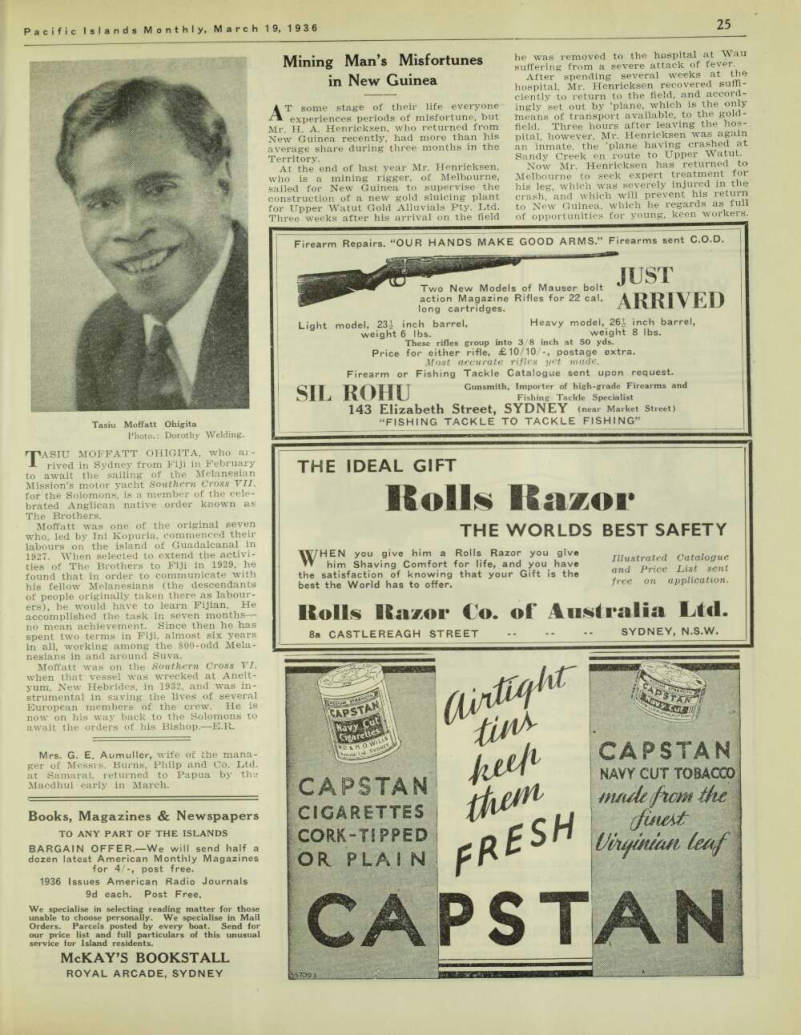
Nauru In Prosperous
From Our New Zealand Correspondent AUCKLAND, March 2.
THE native inhabitants of Nauru Island have been less severely hit by the de pression than those of most Pacific Islands, according- to Commander R. C. Garcia.
Administrator of the island, who reached Auckland, New Zealand, recently on a holiday visit.
The landowners received grants from the British Phosphate Commission, he said, and as the export of phosphates had been well maintained during the depression, its effects had not been seriously felt. The natives were not dependent on copra pro duction for a livelihood, and hence were not affected by the fall in prices.
A record year in the shipment of phos phates from Nauru and Ocean Islands was forecast by Mr. A. F. Ellis. New Zealand representative of the Commission, who also returned to Auckland recently. Estimates were for a shipment of 750.000 tons of phosphates from the two islands this year.
Sir Henry Scott, K.C., of Suva, Fiji, departed from the Colony on a brief visit to New Zealand by the Aorangi on Feb ruary 13.
Tasiu Moffatt Ohigita, Who Ar
rived in Sydney from Fiji in February to await the sailing of the Melanesian Mission’s motor yacht Southern Cross VII. for the Solomons, is a member of the cele brated Anglican native order known as The Brothers.
Moffatt was one of the original seven who, led by Ini Kopuria, commenced their labours on the island of Guadalcanal in 1927. When selected to extend the activi ties of The Brothers to Fiji in 1929, he found that in order to communicate with his fellow Melanesians (the descendants of people originally taken there as labour ers), he would have to learn Fijian. He accomplished the task in seven months — no mean achievement. Since then he has spent two terms in Fiji, almost six years in all, working among the 800-odd Mela nesians in and around Suva.
Moffatt was on the Southern Cross VI. when that vessel was wrecked at Aneit yum, New Hebrides, in 1932, and was in strumental in saving the lives of several European members of the crew. He is now on his way back to the Solomons to await the orders of his Bishop.—E.R.
Mrs. G. E. Aumuller, wife of the mana ger of Messrs. Burns, Philp and Co. Ltd. at Samarai, returned to Papua by the Macdhui early in March.
Tasiu Moffatt Ohigita Photo.: Dorothy Welding.
Advertisements & other items, p. 26 (1 item)
Right
MORRISON’S
OILS, TARS and GREASES
ARE USED ... |\.
Right
Thro'
MS Specialities for the ISLANDS include
* MASCOL
MEDIUM AND
DARK
The Most Effective WOOD PRESERVATIVE and STAIN on the Market the dreaded enemy of White Ants and Borers— stains wood an artistic brown color.
* BOTANITE
tral |A
and the
PACIFIC
ISLANDS
—without doubt the Best RUST
PREVENTER on the MARKET !
A SPLENDID BLACK GLOSSY ENAMEL.
Invaluable for painting mining plant, pipes, tanks, guttering, in fact, all iron work that is subject to corrosion.
* COAL TAR, STOCKHOLM TAR, CREOSOTE
WOOD PRESERVING OIL, NEATSFOOT
OIL, GREASES, PHENOLIC and
EUCALYPTUS DISINFECTANTS
REFUSE SUBSTITUTES
Insist on having MORRISON’S PROCURABLE PROM ALL ISLAND AND GENERAL MERCHANTS Manufactured by JAMES MORRISON & COY. LTD.
SYDNEY
Mining Man’s Misfortunes
in New Guinea
AT some stage of their life everyone experiences periods of misfortune, but Mr. H. A. Henricksen, who returned from New Guinea recently, had more than his average share during three months in the Territory.
At the end of last year Mr. Henricksen, who is a mining rigger, of Melbourne, sailed for New Guinea to supervise the construction of a new gold sluicing plant for Upper Watut Gold Alluvials Pty. Ltd.
Three weeks after his arrival on the field
he was removed to the hospital at Wau suffering from a severe attack of fever.
After spending several weeks at the hospital, Mr. Henricksen recovered suffi ciently to return to the field, and accord ingly set out by ’plane, which is the only tneans of transport available, to the gold field. Three hours after leaving the hos pital, however, Mr. Henricksen was again an inmate, the ’plane having crashed at Sandy Creek en route to Upper Watut.
Now Mr. Henricksen has returned to Melbourne to seek expert treatment for his leg, which was severely injured in the crash, and which will prevent his return to New Guinea, which he regards as full of opportunities for young, keen workers.
Advertisements & other items, p. 27 (2 items)
Rolls Razor
Firearm Repairs. “OUR HANDS MAKE GOOD ARMS.” Firearms sent C.O.D.
JUST
Two New Models of Mauser bolt action Magazine Rifles for 22 cal. A AJI? |V T fT "I long cartridges. A 111 I T Light model, 231. inch barrel, Heavy model, 261. inch barrel, weight 6 lbs. weight 8 lbs.
These rifles group into 3/8 inch at 50 yds.
Price for either rifle, £lO/10/-, postage extra.
Most accurate rifles yet made.
Firearm or Fishing Tackle Catalogue sent upon request.
Gunsmith, Importer of high-grade Firearms and ft I.a 11 ' rll Fishing Tackle Specialist 143 Elizabeth Street, SYDNEY (near Market Street)
“FISHING TACKLE TO TACKLE FISHING”
THE IDEAL GIFT
Rolls Razor
THE WORLDS BEST SAFETY
WHEN you give him a Rolls Razor you give him Shaving Comfort for life, and you have the satisfaction of knowing that your Gift is the best the World has to offer.
Illustrated Catalogue and Price List sent free on application.
It oils Itaxor Co. ol* Australia Ltd.
8a CASTLEREAGH STREET SYDNEY, N.S.W.
kv&t Hr iM
CAPSTAN
CIGARETTES
CORK-TS FRED
OK P LA I N
CSH
PST
CAPSTAN
NAVY CUT TOBACCO
madtfum (finest
(Jvuftemst (mf
", Biiliißili
Books, Magazines & Newspapers
TO ANY PART OF THE ISLANDS
BARGAIN OFFER.—We will send half a dozen latest American Monthly Magazines for 4/-, post free. 1936 Issues American Radio Journals 9d each. Post Free.
We specialise in selecting reading matter for those unable to choose personally. We specialise in Maul Orders. Parcels posted by every boat. Send for our price list and full particulars of this unusual service for Island residents.
McKAY’S BOOKSTALL
ROYAL ARCADE, SYDNEY
A Haggis At Bulwa
(Contributed) THE world’s sweetest singer has been J- honoured in the world’s youngest colony. The Scots of Bulwa (on the New Guinea goldfield) held a social function, complete with haggis and bagpipes, on the birthday of Robert Burns.
It commenced when Hugh Black, in January, got a haggis direct from his Scottish home—that famous canned pro duct put up by Messrs. Waugh, of Nichol son Street, Edinburgh. There is only one way to eat a haggis: and that is in the company of brother Scots, on a convivial occasion. Hugh Black arranged accord ingly.
The rumour of the haggis got about. An astonishing number of young fellows re membered that they had maternal grand fathers, and mother’s sister’s aunts, and so on, who had worn the tartan, or been called “Mac.” For a week, men who were asked to have a drink, answered, “Aye, mon! ”
The party which eventually sat down to supper at' 10 p.m. numbered 12. Some obviously were Scots: the others defended their ancestry vociferously. It was a merry party.
The haggis was piped in with full cere monial and proper solemnity. There were neither bagpipes nor pipers: but Swanson found a first-class bagpipes record, and joyfully presided at the gramophone; while Hugh Black marched in with the haggis.
Toasts were drunk, thoughts of the “Scot ties” went back to yon “land of green heath and shaggy wood”—and wide-eyed native houseboys, clustering outside, won dered at this latest form of madness of “white fella masta.” There was a big piece of haggis for everyone.
The party ended at 2 a.m., with a drive over a newly-formed road in a car recently brought in by aeroplane. The Kunai-clad ridges, where a little time ago were only native villages, inhabited by savages who had never seen a white man, echoed to the songs of Robbie Burns.
Holden’S Air Services
Increased Profit for 1935
THE third annual report of Holden’s Air Transport Services Limited shows a net profit of £6,101 for 1935 against £5,693 the previous year. At £39,353, gross profits were £5,710 higher. An amount of £3,500 has been transferred to general reserve and dividend (10 percent.) absorbed £2,500. With £ 936 brought for ward £1,038 is carried forward.
With this year’s contribution general reserve now stands at £6,000. This has been mainly set aside against aeroplane replacements. As the result of the pur chase of a second all-metal Ford aero plane the item in the balance sheet headed “aeroplanes and plant” has been increased by £3,445.
A building programme was put into operation during the year. Necessary liv ing accommodation has been completed, and an all-steel hangar is now in process of erection.
The chairman of directors (Mr. L. A.
Lister) reports that the past year was free of accidents, so far as the company’s services were concerned.
During the year Mr. H. J. Preston re tired from the Board, owing to his depar ture for overseas, and Mr. R. G. Preston also tendered his resignation. Mr. F. Z.
Eager, of Queensland, also resigned.
Messrs. J. W. Austin and L. V. Water house were appointed directors.
The Company’s financial position, over a period of three years, is as follows;
Year ended Dec. 31, 1933. 1934. 1935. £ £ £ Gross revenue 26,205 33,643 39,353 Net profit 5,388 5,693 6,101 Div., p.c 10 10 10 Div., amount 2.500 2,500 2,500 To preliminary expenses 770 To general reserve ... 1,000 1,500 3,500 To goodwill 500 2,000 Forward 618 311 413
Liabilities—
Capital 25,000 25,000 25,000 General reserve — 1,000 6,000 Creditors 4,887 1,342 1,773
Assets—
Cash 7,195 5,808 4,841 Debtors 5,784 8,819 11,073 Aeroplanes and plant . . 18,294 14,451 17,896 Deposits 731 700 Goodwill 2,500 2,000 —
M.V. Carriso Sold
motor vessel Carriso, which has been trading for many years among the smaller ports in the Central and South Pacific Islands, was recently withdrawn from Messrs. Flood Brothers’ service. She has now been sold to the Griffith Steam ship Co. of Seattle, U.S.A., and has taken up running between Puget Sound and San Pedro on the Western seaboard of the United States.
As the Magunkok, she commenced her career in 1918 as the vessel of the Long Beach Shipping Board. Shortly adder wards she was bought by the Flood Line, of San Francisco, and ever since has been serving in the South Seas. The Carriso is 345 feet long and 2429 net tons.
New Misima Gold Mines Limited, of Papua, declared a first liquidation divi dend of £ 5 per share in February. The New Misima Company last year sold its mine and property on Misima Island, Eastern Papua, to Cuthbert’s Misima Mine Limited for £95,000.
Advertisements & other items, p. 28 (1 item)
“Comet”
Your Sydney Agent?
William E. Reed
(Established 1913)
UNION HOUSE
247 GEORGE ST., SYDNEY
Shell sold, and goods supplied at wholesale prices, on commission.
Enquiries welcomed.
T
BUILD A LOVELY PERMANENT
HOME OF STEEL
Tllustrated is a charming “Comet” Steel Bungalow recently erected by us.
This building is in no sense a special order but shows just what can be done with the patented “Comet’’ principle of Steel Building Construction.
The “Comet” Steel Building, by reason of its patented sectional construction, is easily enlarged and where required, conveniently portable.
The buildings are white-ant proof, fireresisting and economical to erect.
They have definitely proved themselves the best proposition for the islands
EMINENTLY SUITABLE
FOR:-
BUNGALOWS
STORES
WORKSHOPS
COPRA SHEDS
BOYS' HOUSES
HANGARS, ETC.
“COMET”
Steel Buildings
SIDNEY WILLIAMS & CO. (PTY.J LTD.
Steel Building Specialists. Builders and Contractors
DULWICH HILL, SYDNEY
ROCKHAMPTON BRISBANE TOWNSVILLE
Australian Manufacturers Shun N.G.
Cocoa Beans
Letter to the Editor.
FROM time to time you have devoted space in your valuable journal to the subject of New Guinea cocoa beans. It might, therefore, be of interest to your readers, and especially the Islands pro ducers, if I describe a recent experience in marketing Cocoa Beans in Australia.
My samples duly arrived and were shown to an expert, who examined same and expressed his opinion—namely, that the samples were fair average quality of the New Guinea Cocoa Beans. On the strength of this valuation I proceeded to interview various buyers.
After examining the beans, the first prospective buyer I interviewed informed me that the sample was of good quality, but owing to large stocks, he was not prepared to make a bid. I then went to another manufacturer, who, apparently, was very busy at the time, and when I tendered my card, I was informed that “he had no interest in New Guinea beans and was too busy to see me.” Conse quently I crossed buyer No. 2 off my list.
Returning to my office, I divided up the samples and posted some to manufac turers in a neighbouring State, at the same time writing them a polite letter asking for their best quotation for the class of beans, as per sample. These manufacturers did not even have the courtesy to reply to my letter. Next time I communicate with them, I shall send
them a stamped envelope by way of an inducement to reply.
In despair, I went back to No. 1 buyer and showed him the same samples as I had done three weeks previously, and which he had admitted were good samples of New Guinea beans. He informed me that the beans were very poor quality and were absolutely useless to him!
Naturally, I was very disappointed with the results of my efforts, and even more disappointed at the thought of cabling my New Guinea friends not to send any further quantities of Cocoa Beans to this market, as the buyers here apparently were prejudiced against New Guinea beans. However, before doing so, I approached another firm, from whom I had previously received very courteous treatment, and showed them the same samples as I had shown Buyer No. 1.
They offered me £33 per ton, which I promptly accepted.
This is my experience in marketing New Guinea Cocoa Beans in this part of the world, and there certainly seems to be something “rotten in the state of Denmark” when producers in the Islands are treated in this manner. This sort of thing gives them no encouragement to produce, in spite of the benefit of the Government bounty, and the New Guinea planter has a very hard row to hoe. Local buyers of Cocoa Beans, apart from tak ing into consideration the quality of the
beans submitted to them, also seem to have the bounty in view, as it appears to me that the bounty eventually drifts to the manufacturers. , On consideration, I think it might be of benefit to Cocoa Bean producers in New Guinea if the Federal Government placed a duty on all foreign Cocoa Beans imported into the Australian market.
This might have the desired result, and possibly manufacturers will find that they can use New Guinea beans, which will, in turn, be an incentive for the present growers to increase their output.
I am, etc.,
Disgusted Salesman.
Sydney, February 18.
Mrs. A. C. Dickson, 8.A., recently ar rived in Fiji to take up the position of headmistress of the Suva Girls’ Grammar School. Formerly she was in charge of the Girls’ High School at Greymouth, New Zealand. Mrs. Dickson is a graduate of the University of Tasmania and holds a Diploma of Education from Oxford University, England.
Advertisements & other items, pp. 29-30 (1 item)
Ruston
V. H. Jones & Rickard
Electrical Engineers
525 ELIZABETH STREET
SYDNEY
Specialists in rewinding and repair* ing all classes and sizes of electrical machines and equipment.
Special treatment given to work for the tropics.
TELEPHONE: MA 1397
• Absolute
• how fuel costs.
• No fire risk.
• how upkeep costs.
jhese are a few of the reasons for the popularity of the RUSTON Marine Oil Engine.
Why not investigate these economies ?
Only one type of Ruston Marine Engine is shown above—our complete catalogue shows them all—may we send you a copy?
RUSTON
MARINE OIL ENGINES
RUSTON & HORNSBY (aust.) PTY. LIMITED, MELBOURNE Branches at Sydney and Brisbane Sole Agents for Mandated Territory : Burns, Philp & Co. Ltd., Rabaul
PACIFIC TRADERS!
The Blade of Best Quality, and the Most Profitable to Handle, is: These blades are of the three-holed (Gillette) type. I have made a careful test of all blades, over a long period, while I was trading at Milne Bay, Papua, and the British-made Jewel was far ahead of any other. I now have the Pacific agency for Jewel blades, and strongly recommend them to all traders.
Send P. 0.0. for trial gross post free, 10/- (Australian) or 8/- (sterling). Reduction for quantities. Sample package, 2/6.
HENRY DEXTER
Iping, Midhurst, Sussex, England
JEWEL
SAFETY-
RAZOR
BLADE 4
For Speedy, Accurate and
Versatile Photography . . . there’s nothing like the
LEICA
Camera
(MODEL })
HERE ARE THE REASONS WHY
1 BUILT-IN SHORT BASE RANGE
FINDER gives you perfect focus automatically.
2—FOCAL PLANE SHUTTER with
the greatest range of shutter speeds on any camera—l second, h, I, I, in addition to all regular speeds between l/20th and l/500th second.
L/eicai Service
3. ELEVEN DIFFERENT LENSES
AVAILABLE/
4. —36 PICTURES from a single roll of cinema film. Sharp negatives Enlargements up to any size.
5. SMALL, COMPACT, FITS THE
POCKET, easy and fast to operate. Very inexpensive to maintain.
Why not take advantage of it?
We SPECIALIZE in the development, printing, and enlarging of miniature negatives, and INDIVIDUAL ATTENTION is given to every order. We have the BEST POSSIBLE EQUIPMENT and our experts have at their disposal, an up-to-date Research Dept. Miniature negatives having a superior detail and grain quality, require special attention to obtain perfect enlargements, and this expert attention we are able to give. SKILLED TECHNICIANS will help you overcome any difficulties you may be experiencing, by giving suitable advice, either personally or through our MAIL DEPT. Inquiries will be given prompt attention.
Write NOW, for further particulars to
LEICA PHOTO SERVICE
KYLE HOUSE, 31 MACQUARIE PLACE, SYDNEY
(The only Leica Specialists in Australia)
DEVELOPING PRINTING FILM SUPPLIES
Liquor Licenses In New
Guinea
A PPLICATIONS for hotel liquor licenses have been dealt with as follows re cently in New Guinea: Mrs. F. S. Stewart, Wau —renewed.
Mrs. P. K. Lewis, Madang—renewed.
Mr. M. J. Willmott, Rabaul—transfer from Mr. E. C. Monck granted.
Mrs. L. E. Banks, Rabaul—renewed.
Mr. Sow Sing, Kavieng—renewed.
Mr. Ivan Nelson, Rabaul—renewed.
Mr. Allen Innes, Salamaua—renewed.
Mr. J. A. Parer, Wau —renewed.
Mr. R. I. Franklin, Edie Creek —renewed.
Mrs. K. C. Baldie, Lae—application for new license adjourned.
The following clubs in New Guinea now hold liquor licenses: Kavieng Club, New Guinea Club (Rabaul), Rabaul Club, Wau Club, and Kokopo District Sports Club, M iss Ethel Slade returned to Papua by the Macdhui from Brisbane early in March to continue her work for the New Guinea Mission at Dogura.
Surplus
Fiji Has Half-Million Trade
Currency of Empire’s Richest Colony is Mysteriously Peg ged at 12½ % Discount.
4 REMARKABLE recovery in the value of the export trade of Fiji is disclosed in the figures for 1935, just available:
The following figures will show that Fiji’s trade now is getting back to what it was at the peak of the boom (1928);
As may be seen, sugar production is the backbone of Fijian trade. It fluctuates somewhat. Sugar exports were worth £2,092,990 in 1920; sank to £808,195 in 1926; rose to £1,827,095 in 1928; fell down to £624,310 in 1931; and have been in creasing ever since. Between 1920 and 1929, the average yearly export of copra was about £500,000; but in 1934 it was worth only - £127,941. This trade is im proving now, however. If gold production fulfils its promise, it will add further to the wealth-producing capacity of these “Fortunate Isles.”
It must be recognised, of course, that Fiji does not enjoy all the wealth that the above figures indicate. A sum equivalent to the amount of profit made in Fiji by •the Colonial Sugar Refining Company, which has a virtual monopoly of sugar production in Fiji, does not circulate in Fiji, but goes, instead, into the Australian coffers of the Co., and, eventually, into the pockets of the Co.’s shareholders.
What that profit is, no man can say: but it must be substantial. However, it is not nearly enough to represent the differ ence between exports and imports, a mere matter of £500,000. Lucky Fiji!
And yet—here is the sweetest morsel in the whole field of economic controversy— the Fiji £ is quoted at 12| per cent, under sterling. The Colony’s annual bud get is always balanced; it has an accu mulated surplus of nearly £300,000 and other reserves of over £200,000; its total public debt is less than £1,500,000; and, as shown, it has a trading surplus every year of anything up to £700,000.
Yet the Fiji £ is pegged at a discount of 12| per cent against sterling, which means at least 35 per cent, under gold.
Why?
Mr. F. V. Dunstan, of Nausori, Fiji, arrived in Sydney from Suva by the Aorangi on holidays on February 21.
1934. 1935.
Sugar— tons 103,683 .. 135,633 value . . £1,069,049 .. £1,314,128 Copra— tons 23,528 .. 26,081 value £127,941 . . £220,478 Bananas— bunches 1,056 . . 16,137 cases 161,269 . . 143,495 value . . £67,845 . . £66,863 Molasses £16,828 .. £16,545 Gold Bullion— oz 1,032 .. 6,933 value £7,590 . . £54,009 Trochas Shell— tons 319 . . 298 value £20,733 . . £20,226 Other articles . . . £146,469 . . £118,362 Total . . £1,456,455 £1,810,611
Year. Imports. Exports. 1928 £1,483,169 . . £2.701,251 1930 £1,219,184 . . £1,484,526 1932 £857,346 . . £1,698,964 1933 £1,069,266 . . £1,725,529 1934 £995,204 . . £1,456,455 1935 £1,257,287 .. £1,810,611
The Palolo
(By A.M.A.)
TWO nights, or approximately so, after every November full moon, the Pa lolo comes up from the seabottom in most waters of the Pacific. I say approxi mately, for Europeans longest resident in the Pacific Islands are unable to foretell the exact night of its annual visit. Pa lolo is a Polynesian name and the one generally used in the scientific world, but almost every island inhabited by Mela nesians, has its relative word.
This queer marine organism comes up to the surface on two nights only, in every year, about four weeks before and just after November full moon. On Ulawa Island, in the Solomons, the first event, a very minor affair, is looked on as a sort of warning, to get the nets ready for the great night of nights—for no other in the whole year holds any thing of so much importance. The na tives esteem Palolo a great delicacy, and Old Neptune has provided it when the larder is at its lowest ebb, between yam seasons.
With the first glimpse of the moon over the horizon, the natives launch every con ceivable thing that can float —canoes, rafts, and kaikai bowls —and make for the spot where the Palolo usually appear. In my 20 years’ residence on this island I have not known the Palolo to alter their position in the three spots where they make their appearance. They rise with the moon, and soon the sea is a living mass of wriggling worms, more or less held together by su greenish coloured slime. Small nets on bamboo poles are simply dipped into the conglomeration, and shovelled into larger bag nets in the canoes. This goes on till the moon has reached its zenith, then, without any fuss, the Palolo make their exit from the world for another year.
Death Of Dr. Solf
Former German Governor of Samoa
THE death occurred in Berlin, Germany, early in February of Dr. Wilhelm Self at the age of 73. He was Governor of Samoa from 1898 until 1911, and offi cially resided in the house in which Robert Louis Stevenson had lived.
After studying law and Oriental lan guages at Kiel and Berlin, Dr. Solf joined the German Foreign Office in 1888. Ten years later he was appointed District Judge in German East Africa, and in 1899 went to Samoa as chairman of the Apia Municipal Council. Shortly afterwards he became Governor of the Colony and remained in Samoa until, 1911 when he returned to Germany to become Colonial Secretary.
Dr. Solf originated many important schemes for the improvement of the Samoan colony, and encouraged planters to grow rubber and cocoa, thus opening up a good deal of valuable land. For his services in this direction he was per sonally decorated by the Kaiser.
Sir Maynard Hedstrom, managing direc tor of the large trading firm of Messrs.
Morris, Hedstrom Ltd., which operates in Fiji, Tonga, and Samoa, recently under went an operation in Auckland, New Zealand. Early in March he was convales cent, and appeared to be in excellent health.
Mr. Owen Cecil Kirkpatrick Corrie, who will shortly arrive in Suva to take office as Chief Justice of Fiji and Chief Judicial Commissioner for the Western Pacific, served in France, Belgium, and Palestine during the Great War and was awarded the Military Cross. He was born in 1882 and was educated at Cam bridge. After holding various legal posi tions in Palestine, he was appointed Senior British Judge of the Supreme Court there in 1924, and has acted on var ious occasions as Chief Justice.
Advertisements & other items, p. 31 (1 item)
Wentworth
Maleham & Yeomans
Ltd.
BOWDON ST., SHEFFIELD, ENG.
Manufacturers of all kinds of
BUTCHERS’, STICKING AND
SHEATH KNIVES
RAZORS AND SCISSORS
Specialty
HAIRDRESSER SCISSORS
PRICE LIST ON APPLICATION
READ THE
B.P. MAGAZINE
AUTUMN NUMBER
Now on Sale Short Stories . . . Pictures Travel Articles . . Pages for the Children Stage Latest Fashions ... Screen o
ONE SHILLING PER COPY
NEWSAGENTS AND BOOKSELLERS
'“The
Wentworth
CHURCH HILL. SYDNEY
Phone: 1361
(10 Lines) Telegraphic Address: "Mum.” Sydney
Sydney’s Exclusive
Hofei
; • Situated only two minutes from the General Post Office, Railway Station, and leading theatres. All rooms Steam-heated in Winter and Air-cooled in Summer, and equipped with Telephone, and Hot and Cold Water.
Excellent Cuisine.
Tariff: Room and Breakfast, from 10/6 per day; Inclusive from 18/- per day.
For full particulars apply to The Manager
GUNN l MOORE
for all Sports Goods
Write Far interesting free Catalogues to GUNN b MOORE LTD ifev
CARRINGTON ST.. J r )C{ ‘
NOTTINGHAM ENG.C^v)-
Entered Papua
How Sacred Heart Mission Entered Papua Father Dupeyrat’s Fascinating Fhstory of 1883-1935
AN extraordinary amount of work, time and research has been put into a large book of 540 pages, which has just reached us from Paris. It is entitled “Papouasie,” and it is a complete, well documented history of the mission work of the order of the Sacred Heart, which has been done in Papua and New Guinea during 50 years (1885-1935).
The gifted author is Father Andre Du peyrat, M.S.C. It is obvious that he has performed a labour of love —he has taken a delight in telling the wonderful story of the hopes and sufferings and achieve ments of the Sacred Heart Mission in those one-time savage territories; and in doing his work with such thoroughness Father Dupeyrat has made a contribution of incalculable value to the historical and scientific records of Papua and New Guinea.
The book is by no means a dry record of historical facts. The author displays considerable literary skill and handles his fascinating narrative with a fine sense of dramatic values. He also exhibits that delightful sense of humour that one so often finds among the missionaries of the Sacred Heart in the South Seas. His story, moreover, is leavened with a char acteristic tolerance of outlook and a cheery philosophy.
Father Dupeyrat, of course, writes in French; and that, in a way, is a pity, because the mass of British people do not read French very readily, and this is a story that should be read by all of them— not only because of its real merit as a dramatic narrative but because it would give the British in these lands a better idea of the self-sacrificing work of the missionaries and the objects for which they strive.
Father Dupeyrat commences his story with the very earliest records of European contact with the Pacific Islands; traces the formation of the Vicariate of Mela nesia and Micronesia between 1826 and 1844; tells the story of the first tentative efforts at evangelisation by the Marists about 1845 and the martyrdom of Mon signor Epalle in 1845 and Monsignor Col lomb in 1848; describes the second effort made by the missionaries of Milan in 1852
and the martyrdom of Father Mazzuconi in 1855, leading to the abandonment of missionary effort by his Church between 1855 and 1885. He then shows how the attempt by the Marquis de Rays to es tablish a free colony at Port Breton, in New Ireland, about 1877 again stirred up the interest of the Church in the matter of evangelising these islands, and how, out of that interest, there was created an organisation of missionaries of the Sacred Heart, who, between 1880 and 1884, established a mission in New Britain.
The missionaries in New Britain and New Guinea met with many practical dif ficulties and official discouragements, among which was grave uncertainty as to what country actually possessed the islands in which they worked, but they continued with their chosen task. Fin ally, in October, 1884, they selected Thursday Island, in Torres Strait, as their base of operations, and from that point, in 1885, they launched the present organ isation of the mission of the Sacred Heart which has spread all over Papua and a large section of New Guinea.
The story is full of interesting refer ences to the political events and develop ments of 50 years ago—one reads again of Magistrate Chester, of Sir Peter Scratchley, of Fathers Vergius and Na varre, and of the strange conditions under which Queensland took possession of Papua. The way in which certain not able people tried to keep the Sacred Heart missionaries out of Papua, and the deter mination with which they pressed their claim for entering, is a story in itself.
Not the least interesting part of the story is that describing how the Roman Catholic fathers were assisted to transfer their establishment from Thursday Island to Yule Island, on the coast of Papua, by “Yankee Ned” (otherwise Edward Mosby), a man who settled in Torres Strait in the middle of last century and reared a large family in romantic cir cumstances. A Catholic missionary had befriended “Yankee Ned” when he was desperately ill in Cooktown, Queensland; and the remarkable old man tried to repay his debt by helping the Sacred Heart missionaries, when they were being kept out of Papua under an official ban.
“Yankee Ned” had quite a large share in guiding this great and successful mission to Yule Island.
The book carries a preface by Monsig nor A. M. Guyot de Boismenu, Vicar Apostolic of Papuasia, and an epilogue by Monsieur M. Georges Goyau, of the Academy of France. The publisher is Editions Dillen, 23 Rue Oudinot, 23, Paris.
The book is copiously illustrated by scores of excellent photographs, and some maps of unique value.
Mr. G. W. Cockburn, of the Fiji Gov ernment Printing Office, arrived in Suva by the Monterey on February 11, after a visit to Europe with his wife.
Rev. and Mrs. E. Codd, with their baby daughter, sailed for the Siota station of the Melanesian Mission in the Solomon Islands by the Malaita on February 22.
Mr. Codd previously was in the Banks Group, New Hebrides.
Mr. John Wadsworth, director of the Apia Observatory, returned to Samoa with his young wife in February from an ex tended holiday in England and Europe.
Mr. H. F. Baird, who was relieving at Apia Observatory during the absence of Mr. Wadsworth, returned to New Zealand to continue his work at the Christchurch Observatory by the Maui Pomare on Feb ruary 8.
Advertisements & other items, pp. 32-33 (1 item)
Excelsior Supply Co. Ltd.
The most extensive Manufacturers in the British Empire of
RUBBER STAMPS,
INKS, STENCILS.
Marking Devices.
ACME STAMP PADS
We have a big range of Special
FRUIT CASE MARKING SETS
W We also Manufacture or Supply a complete line of
Spraying Machines
for all purposes.
Let us know your requirements and we will quote you by return. Ask for our Big Catalogue.
Sole Australasian Distributors of the World Famous SHEAFFER FOUNTAIN
PENS and PENCILS.
EXCELSIOR SUPPLY CO. LTD
Head Office : —l6O BROADWAY,
SYDNEY. N.S.W.
dty
Sporting Goods
“J. Kirkwood" Hickory Shaft Matched Golf Sets, special rustless heads, made in Scotland, including Midiron, Mashie, Putter and Brassie-Driver in Leather mounted waterproof canvas bag, 42/6.
“J. Kirkwood" Steel Shaft Golf Sets, including Midiron, Mashie, Putter, and Brassie-Driver in Leather mounted waterproof Canvas Bag 69/6 Free with every Golf Set purchased: One Dozen Tees and Two Golf Balls.
“J. Kirkwood" H ickory Shaft Golf Clubs, hand forged rustless heads, 10/6 "J. Kirkwood” Steel Shaft Golf Clubs, hand forged rustless Scotch heads, 17/6 Golf Bags, best waterproof canvas with solid leather trimmings 10/6 Oval shaped Waterproof Canvas Gojf Bags, 4 cane supports, solid Leather mounts 16/6 Willow Leather Golf Bags, latest oval shape, 4 cane supports, with attached score card and tee holders — 22/6, 27/6, 32/6 Oval shaped Waterproof Canvas Golf Bags, with Zypp fastener Hood and Pocket, 4 cane supports 39/6 Willow Leather Golf Bags, latest oval shape, 4 cane supports with Zypp fastener Hood and Cover £2/2/6 Special large sizes £2/15/0 Repaint Golf Balls (all makes) 7/6 doz.
Cochrane Balls (made in Scotland) — 18/- doz.
We stock all well-known makes of Clubs. Write for our Free Catalogue.
TENNIS RACQUETS
Genuine Chesterfield “Swift” Racquets, 4-piece Laminated English Frame, full ash overlay, fitted leather grips, reinforced shoulders, strung with first grade Gut. Were 45/-. Now .. 25/- Free Cover and Press tenth every Racquet.
TENTS! FLYS! CAR COVERS!
Heavy English Calico Tents, 3ft. walls, 6xB, 15/6; Bxlo, 20/-; 10x12, 24/6.
Heavy English Calico Flys, Bxlo, 11/6; 11x9, 13/6; 10x12, 15/6; 12x12, 17/6; 12x14, 19/6; 14x14, 22/6.
Extra Heavy English 10oz. Twisted Duck Tents, 3ft. walls, 6xB, 24/6; Bxlo, 30/-; 10x12, 39/6.
Extra Heavy English 10oz. Twisted Duck Flys, Bxlo, 12/6; 11x9, 15/6; 10x12, 18/6; 12x12, 21/-; 12x14, 24/6; 14x14, 27/6.
Extra Heavy English 10oz. Twisted Duck Car Covers, 12x15, 27/6; 12x18, 32/6; 14x16, 36/6; 15x18, 39/6; 16x20, 44/6; 18x20, 55/-.
AUTO TENTS
12x12 Marquee Auto Tents, extra heavy English 15oz. Twisted Duck Roof, lOoz.
Twisted Duck Walls, together with Calico Partition, Telescopic Poles, Ropes, Pegs, and Waterproof Duck Bag £6/6/0 12x12 Marquee Auto Tent, Extra heavy Khaki Twisted Duck Roof, lOoz.
Twisted Duck Walls, with Calico partition, Telescopic Poles, Ropes, Pegs, and Waterproof Duck Bag . . £7/10/0
Saddles
Brand New High Grade Saddles, made of best quality materials throughout, strong guaranteed Trees and first-class Workmanship.
Strong High Grade Saddles, in Stock, Kemp, Park, or Poley styles (suitable for all-round use). Built on very strong guaranteed trees, Narrow Grip, Firm Pads, Best quality Flaps and skirts.
Mounted with Leathers, Rolled Girth and 3-bar N.P. Irons £3/10/- High-grade Stock Saddles, built on strong guaranteed trees, very deep comfortable Kip seat, Narrow Grip, Wide Leather Facings at Back, 4-inch firm pads (set up very high, giving greater security to rider), extra long Kip Flaps and Skirts, mounted with Leathers, Rolled Girth and 3-Bar N.P.
Irons £4/10/0 High Grade Station Saddles in Kemp, Park, or Poley styles, built on strong guaranteed Ttrees, deep comfortable Kip seat, Narrow Grip, extra wide Leather Facings at back, strong firm Pads, extra long Kip Flaps and Skirts, mounted with Leathers, Rolled Girth and 3-bar N.P. Irons £4/10/0 High Grade Station Stock Saddles, built on strong guaranteed Trees, deep comfortable pigskin seat, narrow grip, wide Leather Facings at back, 5-inch firm Pads (set up high, giving greater security to rider), raised thigh pads, extra long Kip Flaps and Skirts, mounted with Bevelled Leathers, Rolled Girth and 4-bar N.P. Irons. £5/10/0 Very Fine High Grade Super Station Stock Saddles, built on strongly plated guaranteed trees, forged steel stirrup bars, deep comfortable pigskin seat with 4|-inch sweep, narrow grip, wide leather facings at back, very firm s£inch strong capped pads (set up very high, giving greater security to rider), raised thigh pads, extended leather points, extra long flaps and skirts made of long-wearing flexible Kip, mounted with Bevelled Leathers, Rolled Girth, and 4-bar N.P. Irons £6/10/0
FOR HIGH-GRADE SADDLES
THESE VALUES CANNOT BE
EQUALLED
Bargains in Our
Trade-in Department
FIELD AND RACE GLASSES
Slightly Used
Pair powerful Field Glasses 257- Extra powerful Field Glasses ... 39/6 Extra powerful German Military Field Glasses, excellent value 69/6 “Colmont” Binocular Field Glasses, 6x30, very powerful £4/15/- “Oigee” High Power Binocular Field Glasses, 12x40, extra large size, in new conditon £lO/10/- “Colmont” Binocular Race Glasses, Bx, extra powerful £6/15/- “Carl Zeiss” Binocular Race Glasses, Telexim, 6x30 £6/10/- “Carl Zeiss” Binocular Race Glasses, Sllvamar, extra powerful ... £B/10/- “Carl Zeiss” Daltrentis Race Binocu lar Field Glasses, Bx3o, wide vision, extra powerful £lO/10/- All the above Glasses are complete in Solid Leather Brown Cases.
BICYCLES
Good Strong SI ig htly-used Bicycles always in stock. Prices from 55/- to £7/15/-. Write for Special Quotes.
MUSICAL INSTRUMENTS
Brand New Ukuleles, complete with strings. Free Tutor 10/6 Steel Guitars, beautiful tone, complete with steel, picks and Free Tutor, 35/-.
Banjo Mandolins, complete in case with Free Tutor, slightly used 37/6 Standard Banjos, complete in case with Free Tutor, slightly used 45/- Full Size Violins and Bow, in case, splendid tone, Free Tutor 457- High Grade Violins, i and sizes, with Bow and Cases 35/- His Master’s Voice Portable Gramophone, in perfect order, slightlv used £3/19/6
ACCORDEONS
Brand New High Grade Accordeons, splendid tone, ebonised frame, nickel covered 3 and 4 fold bellows, steel bronze reeds, 2-stop, 29/6; 3-stop, 39/6; 4-stop, 49/6.
SLIGHTLY USED
TYPEWRITERS
Corona 3-bank Portable Typewriter, in case, perfect order £5/10/- Remington 4-bank Portable Typewriter in case, good order £B/15/- Remington 4-bank Portable Typewriter in case, late model £lO/10/-
All Mail Orders Promptly Attended to. W e Guarantee you every satisfaction.
We stock everything. Inquiries Invited. Kindly add carriage on all Mail Orders.
FREEMANS
FOR PROMPT SERVICE
and
HONEST VALUE
147 CASTLEREAGH STREET
SYDNEY, New South Wales
Amphibian Arrives for Fly
River Expedition
THE Somerset from New York arrived in Brisbane on February 28 with Mr.
Richard Archbold, a wealthy American scientist, Mr. Russell Rogers, an American commercial pilot, and Mr. Ewing Tuli stedt, radio operator, on board.
The party supervised the unloading of a modern Fairchild amphibian monoplane which will be used in connection with the expedition to Western Papua, sponsored by the American Museum of Natural His
tory. The machine is powered with a 675 h.p. supercharged engine, carries 10 pas sengers, and has a normal speed of 158 m.p.h.
The advance party of the expedition, consisting of Dr. A. Rand (ornithologist), G. H. Tate (mammalogist) and L. J. Brass (botanist), sailed for Papua by the Macdhui at the end of January.
With the aid of the monoplane, Mr.
Archbold hopes to penetrate unexplored parts of Western Papua, and the Upper Fly River district. The scientific mem bers of the party will gather botanical and ornithological data.
Mr. Archbold said that he and his two companions, accompanied by three mecha nics, will fly the amphibian to Daru Island, Western Papua, the expedition’s base. They hope to leave Brisbane by the middle of March.
Mr. Arthur R. Wardrop, of Misima Island, Eastern Papua, has been appointed engineer in the Public Works Depart ment of Papua.
Jimmy Jones
TJIS weight was only nine stone eight, His years three score and ten, But I’ve seen him humiliate And clean up bigger men.
He’d swing a right and left with vim.
And use them as his bowers.
In early days he ran a gym., Way up on Charters Towers.
He managed many a mining show, And paid good divvies, too; But used to let the money gO' — The same as me and you.
When, later on, he’d work and slave Dame Fortune struck him low.
No matter how he’d try to save You’d see his savings go.
Like some old battler in a ring, When belted stiff and sore, Would from his corner bravely spring, And stagger in for more, He’d always hold his head on high No matter how he felt.
Misfortune now has struck him sly.
And well below the belt.
He knows of many a quiet spot Where useful gold may lie; He should not have toi get a lot — The price of gold’s so high.
And he has only got to catch Dame Fortune feeling gay— Then what about that little patch Up Charters Towers way!
And ’way up on Tiveri streams Where native sago grows— I’m very sure he often dreams Of other spots he knows.
Although he’s now not very strong And getting worn and old, I know that he, again ere long, Will be off, chasing gold.
To Jimmy: Wherever you may travel, I sincerely hope you will Be always on pay gravel And your “shammy” quickly fill!
May all your quests be lucky, You tough old bag of bones!
Always straight and plucky— Here’s to you, Jimmy Jones!
Papua.
Frank Pryke.
A Royal Life-Saver
From a Special Correspondent.
Nukualofa, Feb. 2.
LYING alongside the wharf at Nukua lofa, Tonga, one dark windy night, recently, the motor ship Beulah, one of the vessels that ply between San Francisco and Tongan ports, donned her best in honour of a special party of shore friends.
Everything went on fine up to the small hours, when an old Tongan chief, in try ing to leave the ship, slipped on top of the gangway and fell down the small space between the vessel and wharf.
“Man Overboard!” cried the watchman, as officers and guests rushed to the side.
Torches and spotlights illuminated the scene, but nothing was to be heard or seen. Suddenly, an unknown figure, in full evening dress plunged quickly into the spot where the unfortunate chief was last seen. After much struggling the old man was brought to the surface, and, during the excitement, the hero of the occasion vanished.
Nobody, except his chauffeur, knew that the gallant rescuer was Prince Tugi, con sort of Queen Salote and Premier of the Tongan Kingdom. Only by accident did it become known that the hero was our modest Premier.
Advertisements & other items, p. 34 (1 item)
Flour
w. n. itEii)
C/o. Robert Reid & Co., Ltd.
32-34 YORK STREET, SYDNEY
Wholesale Exporter of Goods of all Classes from Australia
PRODUCING UNIFORM GOOD RESULTS SINCE 1868
9
Flour
ALWAYS ASK FOR IT
< ii i v i: it s
FAMOUS ENGLISH PRODUCTS
CANNED ENGLISH VEGETABLES
CANNED ENGLISH FRUITS
OLDE ENGLISH MARMALADE
GOLD MEDAL JAMS
JELLY CRYSTALS, ETC.
Obtainable from all leading Grocery Stores
WRITE TO DEPARTMENT “A”
CHIVERS & SONS LTD.
Histon, Cambs., Eng.
FOR ATTRACTIVE RECIPE BOOK
our iiiw'ii im
LU
CHIVERS
GOLD
t ST/fIMD/IR® .
FRESH
ENGLISH
PEAS
5s
PA C*JE
PiCKtO AND
Gale Strikes Samoa
Severe Damage in Aleipata District
From Our Own Correspondent
Apia, Feb. 8.
A STRONG gale struck the Samoan Islands with considerable force on January 16, doing considerable damage to native houses, coconut plantations, breadfruit trees, and especially banana plantations of Europeans and natives.
The Observatory, which had warned coastal shipping to run for shelter, gave the highest velocity of the gale as 54 miles per hour at 4 p.m., while the lowest barometer reading was 29.31.
Bush trees came crashing down and in Apia telephone lines and electric lighting wires were wrecked in many places.
European houses were damaged by fall ing trees, but only one fatality was reported.
On cocoa plantations damage was com paratively small, though quite a number of trees were blown down. Damage on banana plantations, especially those in the hills, was more severe and crops dur ing the next few months will be less than normal.
At Aleipata, the District Commissioner (Mr. J. M. Bower) reported the destruc tion of the native hospital, the wireless station and part of the police post. After the storm the district presented a sorry spectacle, comparable to the desolation caused by a large fire. Trees were blown down on the beach and in the bush, coco nut palms stood nude —bare of fronds and nuts—food plantations were damaged and hundreds of Samoan houses blown down. It is expected that there will be a serious shortage of food in this district.
Small damage is reported from the island of Savaii, which apparently was outside the storm circle.
American Samoa Suffers
According to reports from American Samoa, serious damage was done on Tutuila Island. At the naval station at Pago Pago the gale blew right into the harbour, damaging a number of buildings, caving in roads, blowing down coconut and breadfruit trees, and destroying native houses. Terrified, the natives sought shelter at the naval barracks at Pago Pago. Leone, the most fertile dis trict of Tutuila, suffered considerably, all the food crops being destroyed.
Though no fatalities occurred, the natives of American Samoa will have to depend on relief to tide them over the next few months. The American Naval Administration has started a “Hurricane Relief Fund” in aid of those who have suffered through the disaster.
Exploiting the Islands
UNDER the above heading, a writer in a recent issue of the Australian Stamp Journal brings to light another scheme to “cash in” on the South Seas.
A paragraph in the American magazine Stamps discloses that an American firm is sponsoring a special cruise to the South Pacific Ocean with the avowed object of exploiting the philatelic interest of the Pacific Islands, he writes.
A special vessel (which has been called the Philatelist ) has been built for the cruise, and at each port of call the crew will send out letters adorned with those cachets and other private marks so
treasured by a certain class of collectors.
A philatelic writer will accompany the cruise to compile manuscripts on the spot, which will, of course, be full of local colour.
The whole project reminds us of the Seth Parker stunt, and we are afraid that these activities, if continued, will soon spoil all the charm there is left in the stamps and postal history of the Islands.
The “Tin Can Mail” of Niuafoou Island (Tongan Group) is a case in point. Once
it possessed a romantic interest, but alas, it has now fallen a victim (like so many other things of this age) to a blatant commercialism.
Mr. William Cash, well-known New Guinea miner, has rejoined the staff of Enterprise of New Guinea N.L. He had retired owing to ill-health, but after a visit to Australia returned to the Man dated Territory to take up his old position.
Advertisements & other items, pp. 35-36 (1 item)
Foster Clark's
A
DARUNG.DOOIVIHER
ANOTHER HELPING
BEFORE SHE BREAKS
THAT PL ATE. ISNT HER
APPETITE WONDERFUL
WELL,YOU SAW HOW3HE
ENJOYED THE FRUIT WITH
MY CUSTARD-THATiS T-Kf
SECRET- FOSTER CLARK'S
ALL CHILDREN LOVE IT
BECAUSE IT SOFTENS THE
SOURNESS Of THE FRUIT
St OF COURSE MAKES IT
JOAN NEVER SEEMS
TO FANCY STEWED
FRUIT AT HOME &
rr!> SO GOOD FOR HER
I WISH I KNEW WHY
fW . n
MUCH MOR£ NOURISHING
k ——-
ITS THE fOSTEH
CLARK'S CUSTARD
SHE REALLY LIKES,
AND JOLLY GOOD IT
IS. I'M GOING TO
HAVE SOME MYSELF.
o |a> Wise Granny! She knows that all children like Foster Clark’s creamy Custard —and so do the grown-ups, too. Foster Clark’s Custard is delicious with fruit, puddings and pies ... or when made into one of Elizabeth Craig’s delightful sweets. Mother is glad Foster Clark’s Custard is popular, because it is so easy to prepare. Besides, she knows it’s made from pure, wholesome ingredients, and is very nourishing.
Foster Clark’s creamy Custard is made in Lemon, Almond and the popular Vanilla flavouring, as well as Standard. No artificial flavour is used, but only finest Vanilla Beans, choicest Lemons and selected Valencia Almonds. Choose one, and serve it for dinner to-morrow. Foster Clark’s creamy Custard will become a family favourite in your home, too.
RECIPE BOOK FREE
Elizabeth Craig, England’s foremost cookery expert, chose these delightful custard recipes. Write for your copy to Foster Clark (Australia) Ltd., Dept. R. 8., 17 Thurlow Street, Redfcrn, N.S.W., enclosing Id. stamp for postage. m FC2-165
Foster Clark's
creamy CUSTARD
GILLESPIE’S
•A\CIIOI{ ”
fivO i as
TRADE
MARK
The Standard of Quality.
Always..
$ make sure Products: Choicest Australia ’s you have Brussels Sprouts White Turnips Sweet Corn Tomato Puree Tomato Sauce Tomato Soup Tutti Fruit Sauce Beetroo* Spinach Cabbage Carrots Parsnips Celery at hand Greco Peas French Beans Cauliflower an ample la Reserve of these h
Garden
Va
Vale
Ready-toserve Vegetables □
Australian Enterprise in New Caledonia
New Caledonia
Contributed.
T'HE policy of the Government of New Caledonia, to drive out of French ter ritory all enterprises that are not French, failed in the case of the Austral Guano Company.
The Company, at great cost and after many years of work, proceeded to work the guano deposits at Walpole Island. The Government, following its usual methods, imposed a crippling duty on the product, which it classified as “phosphate.” The Co. contended that guano was not phos phate; and, after long and plucky litiga tion, it wen. But. probably, it will not benefit much. The Government will get it in the end.
The Forestiere case is an example of that. The Co. won, after endless litiga tion: and, nominally, it should get sub stantial refunds from the Government.
But what hope has it got?
The memory of Kamehameha the Great, Hawaii’s first monarch, who brought all the islands of that group together under one rule, will be honoured with an exten sive programme of pageants, parades and sporting events in a celebration of the two hundredth anniversary of his birth, on June 11. Kamehameha Day—June 11 —has always been observed as one of the most important Hawaiian holidays.
Murder Of Natives
Trial of Ludwig Schmidt
T UDWIG SCHMIDT, who has been sentenced to death in New Guinea for wantonly murdering natives, is a thin sallow-faced man with a scraggy beard, and is aged about forty-five years. He was born in Vienna of a Bavarian father and an Austrian mother. He spent five years in U.S.A., five years in Australia, and five years prospecting in New Guinea.
He has a wife and family in Australia.
The murders were committed in 1934, while Schmidt, Hellmuth Schultze, John J.
A. King and Groos were on a prospecting trip on one of the tributaries of the Sepik River. They seem to have behaved lik;wild beasts —especially in their treatment of the natives. They fired at the natives without provocation; and they seized and raped the native women. Stories of these outrages trickled through to Sydney. The N.G. Administration must be commended for the thoroughness with which it dealt with the matter.
At one of the camps of this party, Schmidt suspected that two natives had followed the party from another village, for the purpose of warning the local na tives against the methods adopted by Schmidt and his friends in regard to shoot ing pigs and securing women. Schmidt fired at one of these natives with a revol ver and at the other with a rifle, and he killed the latter!
Evidence for the Crown was given both by King and Schultze (prisoners serving sentence in Rabaul gaol), as well as by a number of native witnesses who were car riers and servants. King and Schultze had been convicted of offences arising out of the same set of circumstances —King got 10 years' imprisonment for shooting at the natives with a rifle, and Schultze got seven years’ for abducting a native woman.
Groos returned to Germany before the charges were brought.
There was difficulty at Schmidt’s trial because he had made no provision for de fending himself, and he did not speak Eng lish well. Eventually, the Judge postponed the trial until the accused man could be provided with an interpreter and with counsel —both supplied at Government cost.
“Home-Brewers” Fined In
Samoa
From Our Own Correspondent
Apia, Feb. 4.
THOUGH not quite as extensive as in -*■ former years, the “home-brewing” industry is still flourishing in Samoa.
In two cases recently before Apia High Court, a Samoan and a part Samoan were prosecuted by the police for having faa-mafu (the local “homebrew”) on their premises, which contained more than 3 per cent, over-proof spirit. The contents were 8.79 and 4.2 per cent, res pectively, as analysed by the Government analyst. Commissioner R. V. Kay imposed fines of £lO and £7/10/-.
Prince Taufa’ahau, Crown Prince of Tonga, arrived in Sydney by the Aorangi on February 21, after spending his first holiday in his native land for three years.
The Prince has now commenced his last year’s attendance at Newington College.
Afterwards he intends to study law at Sydney University and later to go on to Oxford.
Gauguin as Newspaper
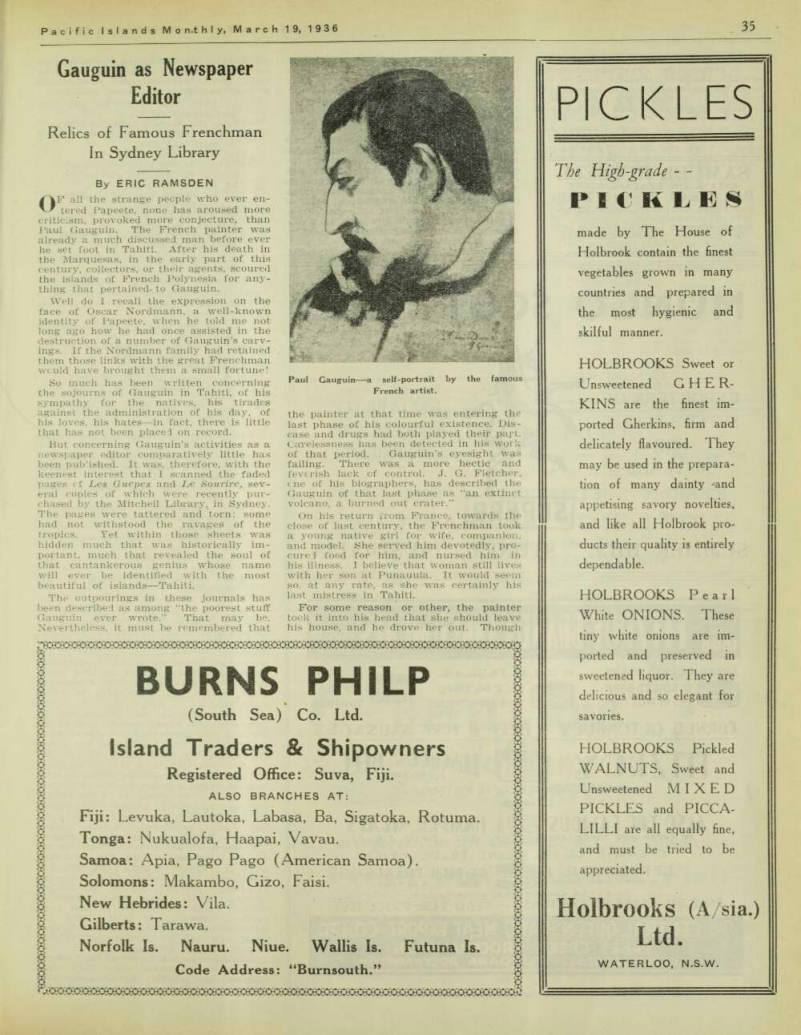
Editor Relics of Famous Frenchman In Sydney Library
By Eric Ramsden
OF all the strange people who ever en tered Papeete, none has aroused more criticism, provoked more conjecture, than Paul Gauguin. The French painter was already a much discussed man before ever he set foot in Tahiti. After his death in the Marquesas, in the early part of this century, collectors, or their agents, scoured the islands of French Polynesia for any thing that pertained, to Gauguin.
Well do I recall the expression on the face of Oscar Nordmann, a well-known identity of Papeete, when he told me not long ago how he had once assisted in the destruction of a number of Gauguin’s carv ings. If the Nordmann family had retained them those links with the great Frenchman would have brought them a small fortune!
So much has been written concerning the sojourns of Gauguin in Tahiti, of his sympathy for the natives, his tirades against the administration of his day, of his loves, his hates —in fact, there is little that has not been placed on record.
But concerning Gauguin’s activities as a newspaper editor comparatively little has been pub'ished. It was, therefore, with the keenest interest that I scanned the faded pages cf Les Guepes and Le Sourire, sev eral copies of which were recently pur chased by the Mitchell Library, in Sydney.
The pages were tattered and torn: some had not withstood the ravages of the tropics. Yet within those sheets was hidden much that was historically im portant, much that revealed the soul of that cantankerous genius whose name will ever be identified with the most beautiful of islands —Tahiti.
The outpourings in these journals has been described as among “the poorest stuff Gauguin ever wrote.” That may be.
Nevertheless, it must be remembered that
the painter at that time was entering the last phase of his colourful existence. Dis ease and drugs had both played their pajt.
Carelessness has been detected in his work of that period. Gauguin’s eyesight was failing. There was a more hectic and feverish lack of control. J. G. Fletcher, cne of his biographers, has described the Gauguin of that last phase as “an extinct volcano, a burned out crater.”
On his return rrom Prance, towards the close of last century, the Frenchman took a young native girl for wife, companion, and model. She served him devotedly, pro cure 1 food for him, and nursed him in his illness. I believe that woman still lives with her son at Punauuia. It would seem so, at any rate, as she was certainly his last mistress in Tahiti.
For some reason or other, the painter took it into his head that she should leave his house, and he drove her out. Though
Paul Gauguin—a self-portrait by the famous French artist.
a helpless invalid, he even appealed to the law to prevent the girl from returning.
Naturally, the Administration took no no tice of his ravings. This further enraged Gauguin. Since his return from Europe his fellow-countrymen had treated him as either a madman or a fool. He deter mined to attack the entire Colonial Ad ministration. Now he would obtain his revenge. With the aid of a copying ap
paratus he set up and printed several issues of a paper called first, Les Guepes (The Wasps), and, later, Le Sourire (The Smile). The copies in the Mitchell Library extend from April 12, 1899, to December 12, 1900. Robert Rey, an authority on Gau guin, says the first copy of Le Sourire was issued in August, 1899.
The crude gibes at the Governor and prominent officials, attacks on native policy (especially in the Tuamotus), to gether with the equally crude caricatures that Gaugin drew of prominent people in Tahiti, seem to have creating something of a stir. Much that was purely political has, however, quite lost all significance.
“People began to fear him at last,” wrote Fletcher, “and it was, for a moment, a triumph.”
Still, here and there are little gems,
glimpses of his life among the people he loved. For instance these lines, which he titled Terre Delicieuse (and from which a free translation has been made): • • Daily life in all its gay and picturesque attitudes Varies this scene of unquiet charm.
Life awakens at dawn in the beauty of earth and sun.
Life herself awakening ...
Pleasure is the principle thought, Showing its strength and agility And helping friends.
Virtues should also be a game— A game for the old.
Close to the hut of purau wood com mences the forest.
Freshness of man and woman, of tane and vahine, is there.
They are in separate groups—some reposing— Drinking, chattering, laughing .. .”
Only those who have known the ‘charm of Tahiti can appreciate the truth of these lines: “As twilight falls, all around, sounds as if from Some immense pigeon-house fill the moon-carved darkness.
They dance and sing.
Men squat at the foot of trees, And the women dance in the open places While the last light of day plays around them.
They sing—the men—and the women dance: They mime as the words are sung.
They move arms and legs, inviting, showing How they will come under cover of night.
With night—heavy night—comes a flight of demons ...
The tupapau Who later will stretch themselves out by the beds Where nightmares trouble the sleepers, And invade the couches of the maidens Soon to be women.”
Then, again, the painter plays on the vivo, the Tahitian flute, intermingling his dreams with its plaintive notes. Referring to himself, Gauguin says: “What is he dreaming of —this savage musician on the river bank towards which modulations of his vivo float? What is this heart, savage, too, dreaming of? This wounded heart so alone in the solitude —for whom is it beating? ... And I went far to the sea with memories and hopes, to the wonderful sea whose sounds, around the isle, are like impenetrable walls shutting in my exile. And I hold out my hands into space—my hands filled with youth.”
I like, too, Gauguin’s rabelaisian story of his handsome young cockerel with “purple wings, a golden neck, and a black tail.” “God!” he cried, “he is beautiful!”
But because the bird provided amusement for the native children he refused to eat him, and concluded. sadly; “What penury! Nothing to eat! I am hungry.”
There is an amusing reference to one of the Governors of the day marching down a Papeete street “with his fine corpulence and foolish face,” to the Protestant temple, and of an alleged dream wherein that same dignitary entered Paris “on one of the four local Service horses,” and later heard the Minister for the Colonies cry: “Hence forth, you will be Emperor of Tahiti,” only to awaken, terrified!
Gauguin was well aware of the Chinese menace. “We know that they (the Chinese) are prolific,” he declared, “and they will go on mingling their blood with
that of the Maori race to its extinction, and those of a later generation will be Frenchmen! We blush for it!”
Reverting to the subject under the heading of Encore les Chinois, he said: “We observe that Canada, a country ten times bigger than France, foresees the necessity of taking precautions against the Chinese —this terrestrial pest which overruns big countries such as the United States, Australia, New Zealand, etc. And what does France, our natural protector, do for us? She peacefully per mits the Chinese to invade our little Colony! Tw r enty years ago we made note of the coming danger, and demanded by hook or by crook that measures be taken to stem this sinister invasion. A deaf ear w r as turned to our pleas. The danger which faces us, and which threatens the future of our children, has no terrors for those who govern us ... France has beautiful colonies, but what does she do wdth them? It is certain that our Pearl of the Pacific will be throwm to the Chinese, to be exploited by them, and pilaged! ”
Those words were penned in 1900.
Had Gauguin lived he would have seen the inroads made by the Chinese in Tahit, and surrounding islands, since then.
The painter’s thoughts must often have returned to his native France. In one little anecdote he writes about a typical cafe scene in Paris: “.. . I draw. Everything is beautiful, everything is ugly. Now, there is a head that I know. The mirrors make the crowd look bigger. Where in the devil have I seen that head? The profile is angular, and I am trying to recall where I have seen it. Ah! now I know. It is myself. ...”
The Madame, “bedecked, perfumed, coarse,” asks Gauguin: “What are you having—champagne ?”
“No,” he modestly replies, “Give me some pipperment! ”
As the mirror reflects the blowsy figure, Gauguin reflects to himself: “So they say love makes you beautiful! I try to con vince myself. My pitiless pencil will not believe it. It refuses.” The little story was headed La Yerite!
Advertisements & other items, pp. 37-38 (2 items)
Pickles
The High-grade - -
I* I C It Ij E S made by The House of Holbrook contain the finest vegetables grown in many countries and prepared in the most hygienic and skilful manner.
HOLBROOKS Sweet or Unsweetened G H E R- KINS are the finest imported Gherkins, firm and delicately flavoured. They may be used in the preparation of many dainty 'and appetising savory novelties, and like all Holbrook products their quality is entirely
dependable.
HOLBROOKS Pearl
White ONIONS. These tiny white onions are imported and preserved in sweetened liquor. They are delicious and so elegant for savories.
HOLBROOKS Pickled WALNUTS, Sweet and Unsweetened MIXED
PICKLES and PICCA-
LILLI are all equally fine, and must be tried to be appreciated.
Holbrooks (A/sia.)
Ltd.
WATERLOO, N.S.W.
BURNS PHILP
(South Sea) Co. Ltd.
Island Traders & Shipowners Registered Office: Suva, Fiji.
ALSO BRANCHES AT:
Fiji: Levuka, Lautoka, Labasa, Ba, Sigatoka, Rotuma.
Tonga: Nukualofa, Haapai, Vavau.
Samoa: Apia, Pago Pago (American Samoa).
Solomons: Makambo, Gizo, Faisi.
New Hebrides: Vila.
Gilberts: Tarawa.
Norfolk Is. Nauru. Niue. Wallis Is. Futuna Is.
Code Address: “Burnsouth.”
SAMUEL RUSSELL
ESTATE AND GENERAL AGENT
P.O. Box 64, Papeete, Tahiti
Real Estate. Investments. Estate Management and Administration. Valuations and Reports. Houses & Lands for Lease or Sale.
Sole Proprietor: TAHITI PERFUMES.
Cables: Russell, Tahiti (Bentley’s Code)
MUNGO SCOTT Ltd
EXPORTERS OF
SUPERB FLOUR
FOR
38 YEARS
SUPERB
SUMMER HILL SYDNEY
RELIABILITY
AND PROMPT
SHIPMENT
AUSTRALIA
SPICED, COPNED, ROAST
G? BOILED BEEF
AND IN MUTTON
IN 12 oz* 11b., 2 lb, 3.1 b„ 41b. s lb, 6' 64b BOUND
CANS AND IN TAPERS
FITZROY
SHEEP
TONGUES
CORNED CX TONGUES - BEEF & FORK SAUSAGES
FITZROY
PK N J»tf
THE ORIGINAL PACK IN A CLASS BY ITSELF /
ALSO THE EAMOUS IS
//V ROUND AND TAPER CANS
HAMPER MEATS
/2 OZ. 2+OZ.6GLBS
C*(D«M-E CO, LTD., [ISLAND TRADE MEATS
BERSERKER & OX-RUM BRANDS
/A/evepy size. PR.OM (gsacgtf*) /2 oz TO 6ia c *hs.
NO &XTR.A CHAR.G tr FOR, ASSOR-TMtNT
PACKED CASES (DR CARTONS - SEND EOR PDUCE LAST 0& CENTRAL QUEENSLAND MEAT EXPORT CO. LTD.
LAKES CREEK - ROCKHAMPTON
CABLE APDBESS;- TOMOAMA ROCKHAMPTON.
36
Pacific Islands Mcnthly, March 19, 1936
Paris International Trade Fair
THE annual Paris International Trade Fair will be held from May 16 to June 2. Buyers from all countries visit this exhibition, as it offers such a complete display of the products md the latest inventions from all over the world.
Since its inception in 1904, the Paris Inter national Trade Fair has grown to huge dimensions, and this year is expected to be greater than ever owing to the improved conditions in industry generally. A representative display from more than 30 countries is expected, and the number of visitors should exceed the previous record of over 2,000,000.
Coinciding with the “High Season” in Paris, the International Trade Fair has become an event of social importance, for at this time of the year the “City of Light” is at its gayest.
The Trade Commissioner for France advises that he is able to supply all particulars regarding transport concessions and ticket discounts, and intending visitors should communicate with him.
His address is 7 Wynyard Street, Sydney.— *** Rev. E. G. Bucknill, who has been Church of England minister at Levuka, Fiji, for the last three months, left Suva for New Zealand and England in Feb ruary.
Mr. and Mrs. J, S. Macnair left Suva, Fiji, recently by the Ruahine for Eng land. Mr. Macnair, who has been for 12 years Lay Superintendent at the Makogai Leper Settlement, has gone to Europe on long leave prior to retiring from the Fiji Civil Service.
Rejected
25% of Samoan Bananas Rejected
From Our Own Correspondent
Apia, Feb. 8.
AFTER being delayed for a few hours by strong headwinds off the Samoan Coast, the Maui Pomare arrived at Apia on February 7. Owing to unfavourable weather and high seas she was unable to lift a cargo of 50 tons of copra at Niue Island, but had to leave hurriedly with 20 tons on board, when the weather be came -worse.
Banana inspectors had a difficult task with this month’s shipment of bananas.
On numerous European and native plan tations the trees had been blown down in the gale of January 16, and though warned against the practice, growers, especially the natives, attempted to pack windfall bananas, which are unsuitable for ex port, together with sound fruit. As a result, out of over 7,000 cases offered, 1,800 cases were rejected by the inspec tors, which easily constitutes a record in rejections. Instead of the quota of 7600 cases only about 5500 cases were shipped.
Captain O. Anderson, a master mariner of Apia, recently departed from Samoa for Europe by the Swedish vessel Boren.
Advertisements & other items, p. 39 (1 item)
Hpeel&Sons
PURE RICE
STARCH
Always ask for . . .
“CORAL” Brand
100% PURE
Noted for its
QUALITY
and
WHITENESS
Goes Farthest and gives Lasting Finish
WILL NOT
STICK TO
IRON
Obtainable from Leading Island Stores Manufactured by
AUSTRALIAN RICE LTD.
Sydney, N.S.W.
CORAL BRAND
RICE STARCH
CORAL STARCH LTD.
WE ARE SPECIALISTS!
Let us have your confidence, sixty years is our record of supplying the Leading Houses throughout the World in—
FRESH FRUIT VEGETABLES PRODUCE
WEYMARK & SON LTD.
Fruit and Produce Merchant*
14-18 STEAMMILL STREET, SYDNEY
Phones: MA 3612 Cable Address: Codes Bentleys. (4 lines) “Weymarkson” Private.
HPEEL&SONS
FI fH
IMPORTER/
& EXPORTERS
QUOTES
SENT
ANYWHERE
Phones: MW 1603 FX 5011 Purveyors of Scotch, Canadian, N.Z. and Australian
Fresh and Smoked Fish
SHIPPING
H 1,,, PROVEDORES
239 HARRIS ST., PYRMONT
SYDNEY, New South Wales
Of Samoa
Death Of Mr. M. E. Graf,
From Our Own Correspondent
Apia, Feb. 6.
T'HE sudden passing of Mr. M. E. Graf, who died on January 21 at his home at Sogi, Apia, has ended a full and adven turous life.
Mr. Graf, who had just reached the age of 50, was born in Austria and w r as educated at the University in his home town, Graz, in Styria. With his wife he arrived in Western Samoa at the begin ning of 1914 in company with Baron von
Rauch, a son of the “Banus,” or Gover nor, of Croatia (now Jugoslavia) who, after his arrival in Samoa, married and acquired property here.
The outbreak of the war made a return to Europe impossible, and Mr. Graf and his wife settled down in Samoa. He worked first as overseer on Government plantations and later as a trader in an outside district. At various times he placed his linguistic ability at the service of the Administration. Since 1934 he had been employed as clerk at the office of Messrs. Klinkmueller and Pleasants, bar risters and solicitors of Apia.
Mr. Graf was a well-known philatelist and left a valuable collection of stamps.
N. Guinea
To Seek Gold in Dutch N. Guinea Powerful Anglo-Dutch Co. is Registered
A COMPANY representing an amalga mation of very important Dutch and British interests has been registered in the Dutch East Indies as the New Guinea Mining Company, with the object of carrying out on a large scale a search for gold in Dutch New Guinea.
The companies concerned and their respective interests are as follows;
In the foregoing table the exchange value of the guilder has been taken as 5.75 guilders to the Australian pound.
Two areas have been granted to the New Guinea Mining Company for pros pecting—namely, one area 505,000 million hectares, which area lies along the north coast of Dutch New Guinea, right up to the border of the Australian Mandated Territory, and thence extending south wards; while the smaller area covers a wide region in the Vogelkop Peninsula.
The concession which has been granted to the company covers all minerals except oil. As was announced in this journal some months ago, the right to prospect for oil in Dutch New Guinea has been granted to the Netherlands New Guinea Oil Company, representing the Bataafsche Petroleum Co., the Colonial Oil Co., and the Pacific Oil Co.
The New Guinea Mining Company will have seven directors—four Dutch and three British, namely, Dutch; Baron van Tuyll van Serooskerken van Coelhorst, Jonheer E. T. M. J. Michiels van Verduy nen, Mr. A. C. Meyer and Mr. P. J. Jan sen; British; Messrs. T. W. Baker, R.
Annan and H. Nicholls.
Guilders.
Billiton Company 337,500 Erdman and Sielcken 377,500 Australian Selection Trust . 391,000 N.W. Consolidated Goldfields 177,000 Anglo-Oriental General Investment Trust 106,000 Mt. Allied 71,000 Total 1,460,000
Norfolk Island Trade
Mr. Victor J. Clark, a well-known Torres Straits pearler, whose fleet oper ates from Darwin, arrived in Sydney by the Marella on February 23.
Mrs. Keith Hawkins, of Lautoka, Fiji, arrived in Australia by the Aorangi on February 21 to spend her annual vacation with her mother, Mrs. C. M. Backhouse, of Woolwich, Sydney.
Mr. and Mrs. Leslie Horsfield, of the Ba River district, Fiji, arrived to spend a few weeks’ holiday in Sydney by the Aorangi on February 21.
From From Month. Australia. Pacific Is.
Imports
January, 1935 ... £2266 .. £15 January, 1936 ... £1966 £40
Exports
January, 1935 ... £1584 .. £75 January. 1936 £783 . . £17 Trade with New Zealand was nil.
Advertisements & other items, p. 40 (1 item)
Wilkinsons
ASBESTOS - CEMENT BUILDING SHEETS
With rigid walls of Durabestos any building will stand four-square to the assaults of weather, time, rodents, and white ants.
Call or write for FREE booklet "Durabestos Homes of Colourful Beauty" describing many uses for Durabestos. WUNDERLICH LTD., Crown and Cleveland Sts., Redfern, SYDNEY.
kill / v There's no better paint than
Wilkinsons Pure
Metallic White
Will not peel or crack Produces 33% more Paint than White Lead
WILKINSONS
Agents:
W. R. Carpenter & Co. Ltd.
“Papua’S Wonderland” From The Air
What Government Officials Saw in Flight From Mount Hagen
From Our Own Correspondent.
Port Moresby, Feb. 20.
ON February 1 and 2 Pilot C. R. Gur ney, in a Guinea Airways single engined Junker, from Mt. Hagen, New Guinea, made two of what might be called the most sensational flights that have ever been undertaken by Guinea Airways, when he flew with the Papuan Government party over the recently ex plored country of the Tari Furoro, and south over the great limestone barrier to the Leonard Murray Mountains and the waterways of the Kikori.
These flights, made by the Papuan Government party (consisting of Messrs.
Jack Hides, Ivan Champion, and F. E.
Williams, accompanied by A.D.O. J. L.
Taylor, of the New Guinea Service, and Mr. Lewis Lett), were for the purpose of checking Jack Hides’s geographical data, made on his recent successful expedition from the headwaters of the Strickland to the Purari; and to find the best possible route for Ivan Champion’s coming patrol from the Turama to the Strickland, fur ther south.
The first flight took them south-west, almost in a direct line over the border — over a series of valley systems, enclosed by high mountain ranges rising to 13,000 feet, until they reached, through a gap between two peaks, the Tari Furoro val ley—loo miles distant by time from their base, Mt. Hagen.
This huge area, approximately 1,000 square miles in extent, stood out clearly as the ’plane swung above, and Jack Hides, without difficulty, recognised the salient points of his journey last year— Mt. Jubilee, Ryan’s Gorge and Mt. Cham pion, which he encountered in April and May.
Then, surprisingly, they came upon a beautiful lake he had not observed, set among mountains that rose to 7,000 and 8,000 feet, pine covered to the water’s edge.
Very clear were the detached farm houses, cultivated gardens, and groves surrounding the dancing enclosures, which extended from one end to the other of the huge valley, which was w r atered by numerous streams that flowed eastward towards the Purari and without doubt carrying a very large agricultural popu lation.
Further unexplored valleys could be picked out, running south and south-east, stretching far away into the distance, unknown to the world and apparently holding as large and as unusual a popu lation as that encountered in the Tari Furoro.
A description of this flight, given in the words of one of the party, illustrates the flight clearly: “For half an hour we flew over this series of valleys, then saw ahead, and
right on our course, a gap between two sharp peaks that towered to 11,000 feet.
Hides passed back a note from his seat beside the pilot and we learned that this was the barrier that shut off the Tari Furoro tribe from the other communities.
“We passed through the gap, and descended a little, to obtain a closer view.
We were towards the southern limit of a great flat valley, oval in shape, and measuring, as nearly as we could judge, 40 miles east and west and 30 miles in breadth. Round the edge of the valley rugged hills rose abruptly to a height of from 0,000 to 10,000 feet, except where, to north-west and south-west, wide open ings in the mountain wall showed big extensions of the valley in those direc tions.
“The floor of this great valley was flat, and broken only by deep creek-beds and smooth undulations. And the whole of the 1.000 square miles gave the effect of a vast park. Great stretches of open grass were interrupted by innumerable cultivated areas, copses of casuarina, and the close-set ornamental trees that marked the ceremonial dancing grounds.
At first sight no houses were visible, but later one could see that they were half hidden by the plantains and sugar cane that surrounded them. As in the Mt.
Hagen district, there were no villages, the houses being scattered in loose groups, each conveniently placed near the cul tivated areas which belonged to it.
“Away to the north-west stood the dominating mountain that Hides had named Mt. Jubilee, a majestic mass whose appearance justified the name as com pletely as did the date on which it was discovered. Although its peaks and shoul ders were shrouded in the thick cloud that already was gathering fast, its mag nificent lower slopes, the proud upward
sweep of its flanks, and the high-banked pillar of billowy cloud that hid its sum mit gave an effect of vastness and finality not easy to forget.
“The population of these valleys, from Mt. Hagen to the Tari Furoro, was astounding. Not only were the valley floors densely inhabited, but far up on the mountain slopes columns of smoke showed that habitations were in exist ence or that more ground was being prepared for cultivation. It was amazing to gaze down upon so great a number of people, unknown to the world for so long, who seemed to be even in excess of the estimate given by their discoverers.
“After flying for ten minutes across the southern extremity of the valley, clouds were observed to be gathering heavily to the east. Gurney banked steeply and rose to 11,000 feet and made for Mt. Hagen, which he reached before noon after run ning through rain, dense clouds and swirling mists. Half an hour later the hills round Mt. Hagen were obscured completely.”
Though the morning of February 2 was not very promising, the party took off from Mt. Hagen at 10.30 for the second flight and flew west-south-west on a compass course calculated to strike the Leonard Murray Mountains, which had been named by Jack Hides last year.
After fifteen minutes’ flight, they were over Papua and, passing the Waga Furari country, they were soon over the limestone barrier, with its gruesome chasms, serrated peaks and ridges which threatened them with destruction. Reach ing its wall, which rose almost perpen dicular for 4,000 ft., they skirted the edge and flew south and east over the Beaver Falls, and Mobi, of the Upper Kikori, with the Susamiro creek well in view, and the course of the Turama from its source to the estuary. The Leonard Murray mountains were easily recognised —a symmetrical mass that rose in sharp peaks from the lower country, and the great central plateau which took Hides 45 days to cross from the Rentoul River.
A vast panorama stretched before them, from the heights of the Carrington Gorge, leading to the Strickland in the north west; to the Papuan Gulf in the south.
The flight was triangular in formation and was estimated to be approximately 230 miles—loo miles to the Leonard Murray Mountains, 30 S.E. along the base, and 100 miles home, and was of intense interest to those who knew the country and had traversed it on foot.
Mr. Ivan Champion’s route lay clearly exposed, the limestone ridges, valleys, and ranges, he must cross on his way from .'the Turema to the Strickland, but whether these districts contained a large
population it was impossible to say.
In order to get above the clouds, which were banking heavily, and to avoid the high mountain peaks, Gurney was forced to rise above 14,000 ft. on his return flight. Mt. Hagen was reached about noon, after descending gradually from the clouded heights of Mt. Gilua which, rising to 11,000 ft. stands on the border of Papua and New Guinea.
On their return flight to Wau the following day, February 3rd, Messrs. Jack Hides, Ivan Champion and A.D.O. J. L.
Taylor proceeded to Salamaua, to com bine their different geographical data.
Those of the party not concerned with mapping (Messrs. F. E. Williams and Lewis Lett) returned to Port Moresby, the same day.
While at Mt. Hagen, the party were entertained by Fathers Ross and Meiser of the Roman Catholic Mission and Mr.
Dan Leahy, brother of the well-known explorers, whose mining claim lay not far distant.
Advertisements & other items, pp. 41-42 (1 item)
Clean Comfort,
BUILD
COMFORT
COOLNESS
BEAUTY
INTO YOUR HOME
WITH
o "* %,!P The British Insulating Sound-Absorbing Building Board The Colour, Figure and Texture of TEN/TEST provide the BEAUTY. The Heat-resisting and Sound-absorbing qualities of TEN/TEST provide the COOLNESS, QUIET, COMFORT, and CLEANLINESS.
TEN/TEST
is by far the most beautiful and the strongest and densest board made.
It has by far the highest resistance to moisture and the greatest sound absorption—just twice the moisture resistance of the American boards, and sixty per cent, more sound absorption, and, in addition,
TEN/TEST
-can be cleaned, kept clean and refreshed always by brushing with a stiff brush without showing any trace. Ten-test is unique in this. No other board can be so treated again and again—their prepared surfaces are destroyed by it, painting becomes necessary, and painting destroys the sound absorbing surface by filling in the sound absorbing pores.
Agents for New Guinea:
W. R. CARPENTER & CO. LTD.
Rabaul and Salamaua Applications for Agencies invited from all other Islands TT
For COOL, QUIET,
CLEAN COMFORT,
BEAUTY AND
PERMANENCE
CROCKETT & CO. LTD., 379 Kent St., Sydney Cables: “Pinetree”
This Perfect Window System for
Tropic Homes is made possible by
COUSINS’ Improved
64 WESTEELE ”
CASEMENT STAYS
(Patented) ** ■ • These Windows can be OPENED
TO ANY ANGLE—to CATCH or
TURN the BREEZE—thus giving complete ventilation control. 9 They are SECURE IN ANY POSITION—no banging. ® They are DEFINITELY
WEATHERPROOF.
9 They can be SIMPLY and
QUICKLY CLOSED.
“WESTEELE” STAYS are EASILY
FITTED at LOW COST
Messrs. Dickson & Yorston Pty. Ltd., Melbourne, write; • ■ • have adopted the ‘Westeele’
Casement Stays system and delighted with result.” tiro y*t~ * Writ* for particulars
Man ty c,ured R. Y. COUSINS
BUILDERS’ SUPPLIES
CHIPPENDALE, SYDNEY
The ‘Austral’ Aulo-Flush Cabinet
The latest in Sanitary Installations for non-sewered areas Approved by the N.S.W. Board of Health.
A Patent Closet that gives you convenience, health, and refinement similar to a w.c. A great advance on anything yet offered.
No water supply required.
Price, £l5 (Aust.), F. 0.8., Sydney Can be installed by any handy man.
Leaflet on application.
INSULAR LAMPS (Syd ), ltd.
42 Market St.. SYDNEY
Cook Is. Population is Increasing
XJAROTONGA’S struggle to recover from the joint effects of the depres sion and last year’s hurricane was de scribed by Judge H. F. Ayson, Resident Commissioner, when he reached New Zea land recently to attend a conference on Cook Island affairs.
The depression and hurricane had caused considerable hardship, he said, but conditions now were generally satisfac tory. Low copra prices had forced many of the people, especially in the northern group, to go back to a diet of fish and coconuts, with practically no means of providing the other necessities of life; but copra now showed a rising tendency again.
On account of the embargo on the im portation of Australian oranges into New Zealand, it was hoped that better prices would be secured for fruit from the group than in the past, he added.
Referring to the medical side of the Ad ministration’s activities, Judge Ayson said the health of the natives had greatly im proved since New Zealand took over responsibility for the islands. Tropical diseases were being stamped out, and good work was being done by three students who had taken a course at the Fiji medical school. In the past 16 years, there had been a marked natural increase m the population of the islands, the total now being 12,000, exclusive of Niue.
Judge Ayson stressed the beauty of Raiotonga, and urged New Zealanders to visit the island as a health and holiday
resort.-
J.C.G.
Advertisements & other items, p. 42 (1 item)
F*L\ Sv^
Woven Wire for All Industry
COPRA DRYING TRAYS, FLOORS, Etc.
FRUIT DRYING TRAYS, MINING SCREENS
Heavy Mosquito Gauze in Phosphor Bronze and Other Metals Impervious to Salt Sea Air WIRE DOOR MATS AND GENERAL WIRE WORKS
E. WRIGHT CO. LTD.
Office and Works: 148-152 Cleveland St., Sydney, N.S.W.
Telegraphic Address: “Wrightmake,” Chippendale. £ o' A
f*L\ SV^
On A New Caledonian Plantation
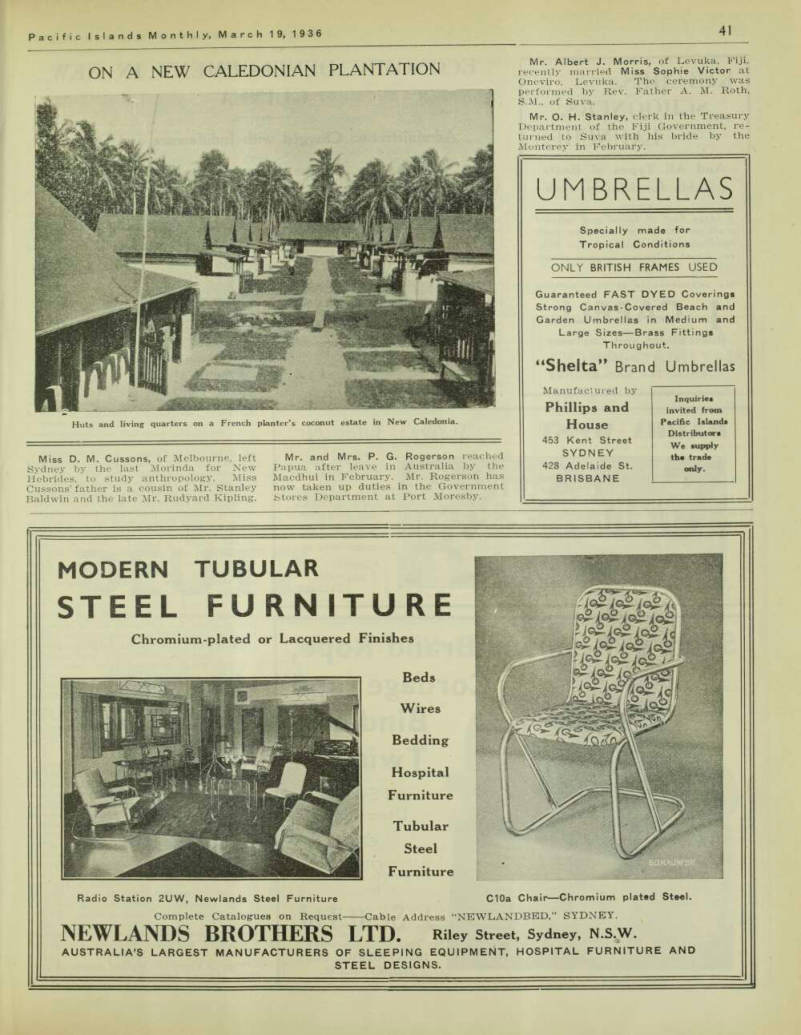
Miss D. M. Cussons, of Melbourne, left Sydney by the last Morinda for New Hebrides, to study anthropology. Miss Cussons’ father is a cousin of Mr. Stanley Baldwin and the late Mr. Rudyard Kipling.
Mr. and Mrs. P. G. Rogerson reached Papua after leave in Australia by the Macdhui in February. Mr. Rogerson has now taken up duties in the Government Stores Department at Port Moresby.
Mr. Albert J. Morris, of Levuka. Fiji, recently married Miss Sophie Victor at Oneviro, Levuka. The ceremony was performed by Rev. Father A. M. Roth, S.M., of Suva.
Mr. O. H. Stanley, clerk in the Treasury Department of the Fiji Government, re turned to Suva with his bride by the Monterey in February.
Huts and living quarters on a French planter’s coconut estate in New Caledonia.
Advertisements & other items, pp. 43-44 (1 item)
Umbrellas
ONLY BRITISH FRAMES USED
Guaranteed FAST DYED Coverings Strong Canvas-Covered Beach and Garden Umbrellas in Medium and Large Sizes—Brass Fittings Throughout.
“Shelta” Brand Umbrellas
Specially made for Tropical Conditions Manufactured by
Phillips and
House
453 Kent Street
SYDNEY
428 Adelaide St.
BRISBANE
Inquiries invited from Pacific Islands Distributors We supply the trade only.
MODERN TUBULAR
STEEL FURNITURE
Chromium-plated or Lacquered Finishes - Beds Wires Bedding Hospital Furniture Tubular Steel Furniture &
ffs
fti&L
£ STr c<- Radio Station 2UW, Newlands Steel Furniture ClOa Chair —Chromium plated Steel.
Complete Catalogues on Request Cable Address “NEWLANDBED," SYDNEY.
NEWLANDS BROTHERS LTD. Riley Street, Sydney, N.S.W.
AUSTRALIA'S LARGEST MANUFACTURERS OF SLEEPING EQUIPMENT, HOSPITAL FURNITURE AND
STEEL DESIGNS.
KETCHES,
SCHOONERS,
LAUNCHES
And All Types of Boats suitable for Islands work A large fleet of sound and reliable craft on hand. Let me know your requirements or instruct your Sydney Agent to inspect on your behalf.
My experience is at your service.
J. CAPELL
Boatbuilder and Engineer
ELITE SHEDS,
RUSHCUTTER BAY, SYDNEY
lIA ICICI WEST
Sydney’s Sailmaker
b t * i?- ** -fflesj#- r v e ? - IP I
SECTION OF OUR SAIL LOFT
Caters for every class of
SAIL, CANVAS,
ROPE & WIRE
EQUIPMENT
Send your enquiries to us
ADDRESS;
BALMAIN.
SYDNEY
Cable Address: Ropeyard, Sydney. - ■ --->••
Scott’s Renown Brand Rope,
Cordage and
-SM Binder
Twine
of Every
Description
MANUFACTURED AT
MASCOT, N.S.W.
By
J. Scott Ltd.
Head Office and Store:
163 CLARENCE ST.,
SYDNEY, N.S.W.
J' - 1
Economic Development In New
Guinea
Administration Charged with Indifference and Delay
Letter To The Editor
YV/tTH great astonishment we read in your last issue a paragraph which stated that the Administration at Rabaul was now investigationg the pulping possi bilities of kunai grass; that test areas had been planted, and that comparisons were now being made between kunai and esparto.
We have for the past seven years been carrying out investigations into the poten tial possibilities of the raw materials of this Territory. We were led to an investi gation of kunai grass owing to what we already knew of the value of the in digenous esparto, in Spain and North Africa. Early in 1929 we succeeded in producing a very high grade cellulose pulp from kunai, and on completion of our own tests we had check analyses made in Australia, and by the world’s greatest cellulose users, the Du Pont Co., of Dela
ware, U.S.A. Du Font’s analysis may be of interest. It is as follows: “We received after some delay the sample of pulp submitted to this Company and re ferred to in your letters of October 27th, 1930, and March 6th, 1931. Our analysis, given below, confirms your statement of cellulose content.
Following this, we investigated, at our own considerable cost, the facilities this country could offer for the erection of pulping factories and the possibility of markets. We found that the Mandated Territory could easily become as great a pulp producing country as Norway, and that cellulose pulp could be produced here at a very low figure. As is customary, we had our figures checked and confirmed by overseas experts. In 1930, we put the whole of our figures and information before the Wisdom-Page Administration in Rabaul, and asked whether, as there was a strong likelihood that oversea paper-making firms would be prepared to erect plants here, the Administration would make available areas - of waste kunai land on reasonable tenure and at a reasonable rental per annum. After fighting for nine months for a reply to our report, we were curtly informed that nothing could be done.
In February, 1935, we wrote to our new Administrator, Mr. McNicoll, and repeated our request for areas of waste land. On the 31st July, 1935, an Ordinance to amend the Land Ordinance, 1922-1935, was passed by the Legislative Council, nominally in order to make areas of kunai land avail able for cutting. However, the whole value of the Ordinance was destroyed by the inclusion of Section 3, which states: “The Administrator may, by giving twelve months’ notice in writing to the holder of a licence granted under this section, cancel the licence either absolutely or to the extent to which it relates to any area specified in the notice.”
This speaks for itself. No reputable company will erect a £200,000 factory if, at a year’s notice, the Administration may, at its discretion, without the neces sity of giving any reasons and without hope of appeal, deprive the company of the areas from which it draws its raw material. Before the Governor-General’s assent to this Ordinance was given, we wrote in protesting against this clause and urging that it be recast or omitted.
Its inclusion is quite unnecessary, as a clause could easily be inserted in the Or dinance which would obviate the danger of any Company locking up big areas of land without making use of them. We re ceived the old and characteristic reply from the McNicoll-Page Administration that “the strongest possible exception” was taken to our objection.
That is where the matter stands at pre sent. In our opinion no reputable com pany would dream of touching kunai
Test. % Dry Basis.
Ash 3.98% Ether Extract .70% 95% H„S04 Insoluble 7.29% 72% H..S04 Insoluble 10.52% Approximate Cellulose 88.03% Soda Soluble (7.14% NaOH) 25.25% Alpha Cellulose 83.01% Beta Cellulose 1.36% Gamma Cellulose 3.66% VISCOSITY (2.5gm.) very heavy.
grass on the above terms, although the Ordinance may be useful to “wildcatters.
This treatment is what we have been taught to expect from our bureaucratic Administration during the past eight rears that we have spent in research work here We discovered the presence m this Territory of an indigenous hemp, which has successfully competed in the London market with Manila hemp. Again, areas cannot be secured for its commer cial exploitation.
Since 1928, we have been urging, on the Administration* and the Federal Govern ment, the installation here of coir fibre spinning and weaving factories, pointing out that their operation would more than double the value of the ex-German plan tations. Furthermore, we have proved the correctness of our figures; but again nothing has been done here.
The whole of our work has been carried out entirely at our own cost. All our information has been placed regularly be fore the Administration; but, during al most the whole of the period, not only have we been denied any reasonable assis tance in our research, but an official clique, by no means representing the bulk of the Public Service, has done its utmost to discredit all the work we have carried out. The reason for this is perfectly well known in Rabaul.
In conclusion, we would like to point out re kunai pulp that it is quite un necessary for the Administration at this period to carry out any tests of this raw material. Many years ago the most care ful and comprehensive field and labora ■ tory tests were made by us. Our results were checked by men of international authority, as the Administrator knows very well. And the full results are, or should be, on file both at Central Adminis
tration and at the Agricultural Depart ment, Rabaul.
We are, etc.,
Thomas V. And J. T. Wallace.
Valaur, Rabaul, T.N.G., 27/1/36.
This is a copy of the letter which Mr. T. V.
Wallace addressed to General McNicoll, Adminis trator, on February 22, 1935: In going through my papers I came across .some correspondence in reference to kunai pulp which, J think, may be of interest to you. I am attaching it hereto. This is by no means the complete scheme that we placed before General Wisdom and the Federal Government some years ago; but this may be sufficient to show you the value of some of the work we have carried out on behalf of the Territory. .
We were first led to investigate the possibilities of kunai grass by what we had seen of the esparto industry abroad. Without being too technical, I might say that for the production of a good class paper, wood pulp is unsuitable. The high class journals published in England, use, in stead, a pulp made from esparto grass, which grows prolifically in Spain and North Africa. The grass is harvested by hand, transported many miles by camels to the sea, and shipped in bales to British factories.
When we first began our investigations, some of the alleged “experts” informed us that kunai was unsuitable for pulping purposes because it contained too much “pith.” A very brief test convinced us that kunai contained no pith, and that it was capable of producing a cellulose pulp even superior to esparto. We had our figures checked by Dadswell, of Canberra, and by the world’s greatest users of cellulose pulp, the Du Pont Com pany of U.S.A. We then seriously investigated the possibility of erecting pulping mills in New Guinea, and after carrying out exhaustive field and other tests, we definitely proved that the Mandated Territory could become as great a pulp producing country as Norway. Nowhere else in the world could similar facilities be found. There is a great and never failing supply of raw material contiguous to fresh water, with hydro-electric facilities and cheap labour. We devised processes for the cheap production in this Territory of the necessary lime, carbonate of soda, sizing, chlorine.
and other bleaching agents, and we found that an enormous market exists in both Australasia and in the Far East for the pulp produced.
As to costs. After making ample provision for working expenses, interest on capital, insurance, depreciation and amortization of loans, we proved that a very high nett profit per ton could be shown on all pulp produced. Our figures were checked and confirmed by paper-making and arti ficial silk manufacturing countries overseas.
Had the scheme gone forward, at least a quarter of a million pounds’ worth of pulp would now be exported annually from this Territory, and there is no reason why eventually exports of cellulose pulp and paper should not far exceed in value the ex ports of copra. Australia would be securing paper pulp at a cheaper rate, and the money now being paid for pulp and paper imports would not have gone outside Australian Territory.
Unfortunately, as in all big undertakings, out side capital had to study the reaction of the Ad ministration to the proposed new industry, and as was at that time to be expected the whole thing was howled down.
It is perhaps just a happy coincidence that, since getting out of this Territory, General Wisdom is now actively engaged in furthering a precisely similar scheme in Papua.
If you are at all interested and would like fur ther particulars I shall do my best to supply them.
Advertisements & other items, pp. 45-46 (1 item)
Deutz Diesel Engines
SHIP & GENERAL
COPPERSMITHS
Manufacturers of all kinds of Pips Work, Petrol, Water, and Buoyancy Tanks for Ships, Yachts, and Motor Boats, Copper Water-jacketed Ex haust Pipes & Silencers a speciality.
Copper Pans and Stills made to specification
Nicholson & Foster
BALMAIN, SYDNEY
DEUTZ DIESEL ENGINES
DEUTZ ENGINES USED INTERNATIONALLY SINCE 1864
MARINE “OM.” TYPE INDUSTRIAL TYPE “VM”
m * - • H «** ■ jj i» Range from 10 to 140 B.H.P.
Range from 10 to 2000 B.H.P.
Full information obtainable from the Agents
HERBERT DEL COTT PTY. LTD.
116 Queen Street, Melbourne ’Phone: Central 10488.
Cables ‘Voltage” 15 Castlereagh Street, Sydney ’Phone: B 3135.
WHERE TO STAY
THE
PAPUA HOTEL
Catering specially for Tourists and Travellers Situated on high ground overlooking both coasts, its Spacious Lounges are always Cool and Comfortable. Tariff; Per Day, 16/-; per week, £.5/5/-; per month, £l4; bed and breakfast, 10/-; bedroom FIRST-CLASS ACCOMMODATION. Cars meet all steamers.
PARTIES ARRANGED.
Licensee: Papua Hotel, Ltd.
IN PORT MORESBY
HOTEL MORESBY
COMFORTABLE
ACCOMMODATION
ONLY THE BEST
BRANDS OF
WINES, SPIRITS
AND BEERS
IN STOCK
LICENSEE:
Hotel Moresby
Ltd.
COSMOPOLITAN
HOTEL
Samarai
First-class Accommodation for Tourists and Travellers Ball-room; Electric Light; Billiards; Freezing-works; Cold Store. Best brands of Wines, Spirits, Ales.
MODERATE TARIFF
Fishing Trips and Launch Excursions arranged Licensee: E. J. Morrow
TAHITI
AND
French Oceania
This book, by Samuel Russell, is a valuable work of reference. It gives, in relation to Tahiti and French Oceania, complete details of administration, commerce, sport, tourist resorts, industries, excursions, hotels, immigration and land laws, etc.
Yachtsmen and fishermen, who are visiting Tahiti in increasing numbers, will find this a most useful handbook.
It also supplies a fascinating account of life in Tahiti—one of the most delightful places of residence in the world.
Copies from: S. RUSSELL, Papeete, Tahiti, and
Pacific Publications Ltd.,
247 George Street, Sydney
Price in Australia (posted): Cloth bound, •/-; paper-cover, 5/-.
SAMARAI HOTEL
The Rendezvous of the Miners of Eastern Papua.
Comfortable Accommodation for Tourists, Travellers and Residents. Best Brands of Spirits and Wines—Victorian Lager Beers.
FISHING EXCURSIONS ARRANGED
Licensee: Mrs. L. M. SKELLY.
HOTEL BULOLO
WAU, T.N.G.
Picturesquely situated, overlooking the Wau Aerodrome, at the Business centre of the Morobe Goldfields.
FIRST-CLASS CUISINE—3O com-
fortable Bed-rooms—Hot and Cold Showers—Fresh Fruit, Vegetables, and Dairy Produce from the Hotel Gardens.
The Hotel Bulolo is famous for its wide, cool verandah-lounge.
Only the Best Brands of Wines, Spirits, and Beers in stock.
HOTEL
It A BALL
COOL AND SPACIOUS LOUNGES COM PORTABLE
ROOMS—DINNER PARTIES SPECIALLY ARRANGED
Excellent Dance Floor and Music. r I t-. .
Wm Under the Personal Management of Mrs. H. Luxmoore
Foundering Of
“Tiafau”
Amazing Rescue of Survivors
From Our Own Correspondent
Apia, Feb. 4.
THE motor-launch Tiafau, which foun dered in the strait between Upolu and Tutuila on January 17, when carrying passengers and mails from Apia to Pago Pago, was 41 feet long, of 16 tons gross register, and was owned by Messrs.
Burns Philp and Co. Ltd.
The vessel met a heavy sea in the strait and suddenly rolled right over and became waterlogged. Then she rolled back again, and Captain Hicks, his crew of three, and 17 passengers (all except Mrs.
Croudace being Samoans) scrambled onto the hull, which remained about three feet under water.
The captain sought volunteers to go with him in the 10-feet dinghy to the land, 14 miles away. There were none; so he took with him two of his crew— his son and a Fijian sailor —and Mrs.
Croudace, and he left about 5 p.m. The rowlocks of the dinghy had been lost, so the oars were made fast with ropes, which, as no knife was available, had to be chewed apart.
Baling all the time, faint and exhausted from the exertion, the cold and the con tinuous wetting, the four people in the dinghy reached Aleipata after 13 hours, in a high sea, at 5 a.m. on January 18.
Here they found the motor boat Magia, also belonging to Messrs. Burns, Philp, and Captain Hicks, with others, left at once in the Magia to look for the Tiafau.
They cruised in the strait for eight hours, looking for survivors. Then they returned to Aleipata, picked up Mrs.
Croudace and two sailors, and went on to Apia, arriving there at 11 p.m. on January 18. The steamer Hauraki had also been searching; but on receiving the Magia report by radio from Apia, all hope of survivors was given up, and the Hauraki turned away northwards on her voyage to Vancouver. Captain Hicks’ feat of en durance was not the least of the many remarkable features of this accident.
Meanwhile, the 17 persons who had been left clinging to the wreck on Friday afternoon, and who included women, chil dren and old people, had a terrible ex perience. After some hours, fighting the wild sea in the darkness, they began to get exhausted, and one by one they lost their hold and slipped away.
The stronger men were heroes—especi ally Faae’e, the engineer of the Tiafau, and lolu, a native medical practitioner.
All through that night, and during the pitiless heat of the following day, they watched over the little party; and as in dividuals became exhausted and sank, they would dive after them, and bring them back to the wreck, and revive them.
One* can scarcely imagine the horror of those endless hours. All Friday night, all Saturday, and far into Saturday night, those 17 people clung to the derelict ves sel. They drifted rapidly northwards through the strait, and so the searching ships missed them. Their rescue was a miracle.
The Hauraki had abandoned the search, and was two hours on her way to Van couver, when at 1 a.m. the lookout man heard shouting close to the Hauraki, and sighted the wreck of the Tiafau about 20 yards away. It was a difficult task to
take the exhausted people, battered and stiff after clinging for 34 hours to the half-submerged wreck, on board the steamer. One woman was thrown by the waves against the Hauraki’ s side and injured. At 3 a.m., all the shipwrecked people wer<? on board and under care, and the Hauraki turned back to Apia, which she reached at 6.30 on Sunday morning, January 19. All the rescued people—not one was lost —recovered quickly.
Inquiry—And An “Incident”
A court of inquiry was set up to in vestigate the accident. It consisted of Mr. R. V. Kay, as commissioner, with Captain J. W. Jones, an experienced mas ter mariner: Hon. I. H. Carruthers, M.L.C., a shipowner of long experience, and Mr. C. Winterstein, a former captain of island vessels, sitting with him as as sessors. Mr. G. T. Jackson conducted the enquiry for the Administration, and Mr.
G. Klinkmueller represented the owners, Messrs. Burns Philp (S.S. Co.) Ltd., and Captain Hicks.
Much evidence was brought to show the weather conditions when the vessel sailed, and the condition of the vessel herself. There was discussion concern ing ballast carried, and the amount of sail hoisted.
There was a lively “incident” when evi dence was being given by Mr. R. H.
Brown, manager of Burns Philp (S.S.)
Co. Ltd. He was questioned by Captain Jones, one of the assessors, who expressed the opinion that there had been a certain amount of negligence and lack of sea manlike husbandry on the Tiafau.
Mr. Klinkmueller accused the assessor
of being biassed and hostile, and of hav ing prejudged the case. He formally ob jected to Captain Jones continuing as assessor.
The Commissioner adjourned the sit ting, and the matter finally was sub mitted to the Acting Administrator, Mr.
A. C. Turnbull. The latter found there was no reason why Captain Jones should not continue as assessor, but that the in terests of Messrs. Burns, Philp should be fully protected. Assessors’ questions in future should be transmitted through the Chairman. Captain Jones had assured the Chairman that he had not prejudged the case.
The inquiry is still proceeding.
Advertisements & other items, pp. 47-48 (1 item)
The Yorkshire Insurance Coy.
OCEANIA
A Journal devoted to the study of the Native Peoples of Australia, New Guinea, and the Islands of the Pacific Ocean.
Editor : Dr. A. P. Elkin (Professor of Anthropology at the University of Sydney): Assistant Editor ; H. lan Hogbin.
Published Quarterly.
Subscription, 5/- per copy (£1 per annum) Published by the Australian National Research Council, Science House, Gloucester Street, Sydney,
N.S.W.
The Yorkshire Insurance Coy.
LIMITED
Established in York —1824
FIRE ACCIDENT MARINE
Total Assets exceed £15,000,000
Agents and Attorneys throughout the Pacific Islands: SUVA: A. Q. McGowan & Co. PAPUA: SALAMAUA: A. Innes. Port Moresby: E. A. James.
KAVIENG: F. V. Saunders. Samarai: E. J. Morrow. • NEW GUINEA BRANCH: Park St., RABAUL. E. G. MacADAM. Manager.
"FAIRHOLME" A Mountain School for Girls.
mmmm s Dormitory Wing and Stuff Itesidence
PRESBYTERIAN GIRLS’ COLLEGE, Toowoomba, Q’ld.
Principal: MISS D. E. CULPIN, B.A.
ASSISTED BY A STAFF OF UNIVERSITY GRADUATES.
ACADEMIC. HOME SCIENCE AND COMMERCIAL
COURSES.
Prospectus on application to the Secretary: Mr. R. T. Phelps, F.A.A. 491 Ruthven St., Toowoomba.
Timber Joinery
ETC.
PREPARED BUILDINGS
ready for erection a speciality.
SHIP and BOAT BUILDING
TIMBERS specially catered for
FIBROLITE, PLYWOODS.
GALVANISED IRON.
CANEC.
O CONSIGNMENTS shipped
by RETURN STEAMERS
to the Islands.
John W. Eaton Ltd.
WEST CRESCENT ST.,
NORTH SYDNEY
TELEPHONES: X 5051 (5 linea)
BITUMENOID ROOFING
MADE IN AUSTRALIA
Bitumenoid Roofings, Dampcourses and Insulating Felts are made from the world’s best raw materials. Warranted to stand the most rigid tests.
BITUMENOID THE BEST
Roofing, 1,2, 3-ply; Flooring, Waterproof Materials; Saturated Felt; Resilient Road Jointing; Natural Asphalt Dampcourse; 2 and 3-ply Dampcourse; l-21b. Lead-core Dampcourse; Roofing Cement; Asphalt Paints; Roofing Compound.
SAMPLES AND PRICE LISTS ON APPLICATION.
MAXWELL PORTER & SON LTD.
ESTABLISHED 1888. BUILDERS’ SUPPLIES
107 REDFERN ST., REDFERN, SYDNEY, N.S.W. ’Phone, M 3157. Cables: Bitumenoid
Prompt delivery of
REINFORCEMENT
The preparation of steel reinforcements in strict accordance with architects’ plans and its prompt delivery—cut, bent and labelled to save the builders’ time—can only satisfactorily be carried out by experts.
Ever since the introduction into Australia of reinforced concrete for building purposes, we have been favourably known for cur prompt and efficient service in this specialised field.
Save time and money! Get in touch with William Adams Steel II el a forcemeat
CO. LTD.
175 CLARENCE STREET, SYDNEY
TELEPHONE: B 7961 (6 lines)
STEEL
for all
classes of
Concrete
Structures
No Sugar Industry For
Papua
T 4 HE jilan to establish the sugar industry in Papua—which country probably is better suited for sugar-growing than any other part of the world—is definitely over board. The Australian Minister for Cus toms has explained that there is a general world-wide over-production of sugar —a world conference, attended by Australian delegates, is even now assembling in Europe to decide what is to be done—and Australia therefore could not encourage the cultivation of new areas.
Mining Township’s Tribute To
a Well-loved King
THE friend who kindly sent us a report of the service held in the social hall at Bulolo, T.N.G., on January 28, in memory of King George V., omitted to give the name of the man who delivered the principal address. This was unfor tunate; because, among all the hundreds of addresses delivered on that sad occa sion, we read none that was more moving or eloquent than that of the unknown man at the Bulolo mining camp.
Here are the concluding sentences: “It is a matter of record that during most of these crises, in one way or another, when the Government of the day reached a deadlock, and the situation seemed hopeless, the King, by his advice and example, always wise, always consti tutional, always directed towards the best interests of his people, showed the way out of trouble.
“Through all these troublous times King George kept his people’s love and loyalty —the crash of toppling thrones through out Europe only served to seat the Throne of England more firmly. The most strik ing example of his people’s affection occurred during his dangerous illness of some eight years ago—in his own words: “ T have been brought back from the danger and weariness of the past months by the wonderful skill and devotion of my doctors, surgeons and nurses. And help has come from another source of strength; as month after month went by, I heard of the widespread and loving solicitude with which the Queen and I were surrounded. I was able to picture to myself the crowds of friends waiting and watching at my gates, and to think of the still greater number of those who, in every part of the Empire, were remembering me with prayers and good wishes. The realisation of this has been among the most vivid experiences of my life.’
“This is the man we mourn—simple, yet wise, fulfilling his high office with dignity, yet never losing the ‘common touch,’ loving his people as they loved him.”
Preparing for Mid-Pacific Air
Service U.S.S. Officers in Samoa
From Our Own Correspondent
Apia, Feb. 6.
7 1 ’HE Stationship, U.S.S. Ontario, of the -*• American Naval Station at Pago Pago, Eastern Samoa, arrived at Apia on January 29 for a short visit.
She brought 40 wardroom and 78 native deck passengers from Pago Pago to Apia.
Fares of these passengers will be credited to the “Tutuila Hurricane Fund” in aid of sufferers from the results of the disastrous gale on January 16.
Among the passengers were a party of officers from the U.S.S. Ithasca now on a second visit to Pago Pago to investigate and study conditions on the proposed air route from Honolulu to Pago Pago, which is to be continued to Auckland. In accordance with the contract between Pan American Airways and the New Zealand Government, a branch line to connect Apia with Pago Pago is pro vided for. Captain Meyer of the Ithasca and the well-known airman Mr. C. W, Stephens were also on board.
The Ontario left Apia on the return trip to Pago on January 31. The American “gobs” are welcome visitors to Western Samoa, where they spend quite a bit of money and make a host of friends, especially among the fair sex.
Progress on the New Guinea Goldfields
From a Special Correspondent.
WAU, Feb. 6.
Yl/A.U is now a well ordered township, * * neat and compact, with well laid out streets. The houses lie in gardens gay with flowers —rcses, dahlias, balsams and marigolds—and in the centre, and around which the township is built, lies the aerodrome. This is the heart of the com munity, and upon which Wau relies for communication by ’plane. Without the aeroplane, the township and the mining community that surrounds it would hardly be in existence to-day.
Wau is a remarkable little township, where apparently everyone is doing well.
It has an air of bright cheerfulness, which is not usually encountered in a tropical centre, and the reason, of course, is gold, and plenty of it.
The township seems to have all the facilities of a modern metropolis. It even boasts of a beauty parlor where “perms” and, perhaps, even face lifting can be obtained!
Road To Bulolo
The road to Bulolo is progressing.
Each week that passes one sees a further extension of this indispensable roadway, linking up two important centres, with all the conveniences that motor service can bring. Already cars can drive more than three-quarters of the way down. It is understood that the road will be com pleted very shortly.
Club House At Wau
Very remarkable to newcomers is the Club House at Wau, which has only re cently been opened. It is a mixed club, and is used freely by visitors from distant settlements on their visits here, as well as by residents who find it of inestimable value.
The principal room is large and square shaped, with a very well furnished veran dah. Screens of coloured glass shut off the glare, and a billiard room lies along side.
New Hotel At Lae
Mr. Tom Flower, well-known to resi dents in Papua and New Guinea, recently completed a very fine hotel at Lae, a contract to the order of Mrs. Stewart, of Wau. Particular interest is attached to this hotel because the whole of the wood work was cut at' Wau and taken down by ’plane.
It is a well constructed, modern building, with a comfortable sitting room on the ground floor, and has plenty of bathrooms with running water. The commodious bar and billiards room are up-to-date, and the kitchen is remark able for its size and conveniences. The bedrooms are large and airy. A verandah runs around the top floor, well shaded and made comfortable by lounge chairs and small tables.
The hotel, it is understood, is under lease to Mrs. Baldie, formerly a resident of Papua.
Guinea Airways’ Efficiency
The activities of Guinea Airways Ltd. astound the new arrival, who is amazed at the efficiency, enterprise, and manage ment of the colossal undertakings ex tending throughout the Morobe goldfield and far into the interior of Papua and New Guinea, which include carrying passengers and freights, and maintaining regular communication.
At times 20 or more ’planes can be seen landing at Wau, within short intervals of one another, on their way to and from the mining camps that lie scattered far
away in the distant ranges. Like a flock of birds they alight and fly off to all points of the compass, making for the 30 or more aerodromes that form the nucleus of each settlement.
At Lae, the chief aviation centre, over 100 skilled Europeans are employed in the workshops and hangars, which house besides other ’planes three huge Junkers (3 engined and capable of lifting 3 tons), seven small Junkers, two 12-seater Fords and a small Moth, all ready for any emergency.
Recently the Administration opened a new District Office at Lae in charge of Mr. A. Roberts, A.D.O. This innovation is of great assistance to the authorities, as well as settlers in the district.
Sunshine Gold Development Co.
Sunshine Gold Development Co. are con structing large and extensive water races for their new hydro-electric plant. The undertaking, made of cement, entails an enormous amount of work. These races lead over steep mountain slopes, whose sides have to be excavated to suit the needs of the undertaking. The work is being vigorously carried out and a large
number of native labourers are employed with a view to commencing production at an early date.
Mr. Dan Leahy’S Camp
Mr. Dan Leahy’s mining claim on the slopes of Mt. Hagen, five miles from the landing ground is said to be working well, though reports suggest that within nine months it is likely to be worked out. The mining camp in this remote area is re markable for its comfort and efficiency.
The well equipped house is fitted out with electric light and other comforts which are rather surprising for a dwelling in an “uncontrolled” area of New Guinea.
Advertisements & other items, pp. 49-50 (1 item)
Miansomes
West’s Wheel
Works
(F. H. Bishop, Proprietor)
60-64 Bay St., Sydney
MANUFACTURERS
OF ALL TYPES OF WHEELS
FOR WAGGONS, CARTS,
TRAILERS, CARS
SUPPLIERS
OF WHEEL PARTS, RIMS,
SPOKES, AXLES, BOXES, etc.
We have the plant and have been established forty years Write for Information and Quotations
Wilhelm Kreekwoldt Co.
9, Lange Muehren, South Sea Bldgs.
HAMBURG, GERMANY
(Exporters and Importers) We Export: Trade Goods of any description, Cutlery, Hardware, Miners’
Requisites, etc., etc.
We Import: Any kind of Island Produce.
CORRESPONDENCE INVITED
Specially designed for
SUGAR CANE GROWERS
Miansomes
Ploughs and Implements
A Complete Range to meet all Requirements Made hy.
Ransomes, Sims & Jefferies Ltd.
IPSWICH ENGLAND
Illustrated literature and all information from — Morris Hedstrom Ltd.
Suva, Lautoka and Ba. m mm *
MANDOLIANA ISLAND,
NORTH GELA, S. I.
Postal Address: P.O. Box 6, Tulagi, Solomon Islands.
Recruiting Contracts Undertaken.
Auxiliary Vessel “Papari” available for Charter.
Full details of Services from
BURNS PHILP (S.S.) CO., LTD.
Makambo (5.1.) and Sydney
Head Study of Champion Walvon Admiration, Challenge Winner, Sydney Royal, 1934 The Noted Walvon Kennels Premier Breeders of Scottish Terriers, Sealyhams, and Wire-haired Fox Terriers.
Puppies available all the year round. Orders direct to Walvon Kennels, 1 Merlin St., Nth.
Sydney, or through Burns Philp & Coy. Ltd., or Mcllraths, Ltd.
DOYLE’S famous VETERINARY REMEDIES
REDUCINE—Cures Your Lame Horse. Cures him painlessly and you can work him all the time.
Cures Splints, Curbs, Capped Hocks, Sprung Tendons, Bog Spavins, and all Bony and Bursal Enlargments. Price, 12/6 per can. Postage 1/-.
LARYNGINE| —A sure cure for Coughs, Colds, Strangles, etc. Price, 5/- per can. Postage, 1/-.
SKIN DRESSING.—A certain remedy for Mange and Allied Parasitic Skin Diseases in Horses, Dogs, etc. Price, 7/6 (large), 3/6 (small). Postage, 1/-.
DISTEMPER MIXTURE.-A safe and reliable remedy for Coughs, Colds, Asthma, etc. Price, 2/6. Postage, 9d.
T. G. DOYLE, V.S., 9 KING STREET, RANDWICK, N.S.W.
Write for Free Veterinary Advice and Booklet OOYLfj
ORES
Roving
USOLINE
Never Known to Fail!
Cockroach Destroyer
It Attracts—They Eat It—They Die AUSOUNE CO. Established 1919.
314 CROWN STREET, SYDNEY
PRICES: lib. 5/-, 3lbs. 10/- Postage extra.
Remit Cash with Order.
Obtainable also at Islands Stores of Burns, Philp and Co. Ltd., W. R. Carpenter and Co. Ltd.
IT’S A
PASTE!
When Girls Will Be
Boys
TTAVING an Eton crop, a slim figure * and a fondness for donning masculine attire, I am sometimes landed quite in voluntarily into some merry—and perhaps not-so-merry—situations, especially when travelling among unsophisticated natives in Fiji.
Their amazement and disapproval cause me some silent chuckles. Those who know me greet me with effusiveness and smiles if my garb is feminine. But if it is not —woe betide me! I am subjected to a battery of glances that would make the Sphinx wince.
On one occasion, clothed coolly in shorts and shirt and a beloved straw hat, which had once been an aristocrat, and still retained a fragment of its former glory.
I went gaily along to a planters’ meeting with Dad, the chairman.
Maidenly decorum forbade my attend ing thus arrayed, so I besought me a place in which to change. The village was full of huts, but I was unknown. However, I soon espied a kindly looking woman, and, in my halting Fijian, I explained my dilemma to her. She eyed me up and
down and the kindly expression vanished.
She pointed coldly to a hut in which there were several men.
I could not understand her peculiar attitude.
“You don’t understand,” I said. “I want to change in your hut.”
With very bad grace she led the way inside her house. We were followed by a crowd of little boys, who were in terested spectators.
I crowded myself into a corner and proceeded, under the embarrassingly direct gaze of the youthful audience, to replace my shorts, etc., with a frock.
The eyes of the audience nearly dropped out.
“Ha! Ha! Ha! Ho! Ho! Ho!” chortled the woman, her face all nice and beaming again.
“Why the mirth?” quoth I.
“You’re a girl,” they chorused.
“I could have told you that,” I retorted —then suddenly remembered that I hadn’t and thereby caused a heap of unnecessary confusion.
However, I noticed that when I re turned to re-don my travelling gear there were no spectators.
EM.
How to Use the Taro
ONE of the most useful of tropical vegetables is taro. While it can be used plain, boiled, mash ed, fried in slices, or chips, it also makes very tasty patties and fritters. The following recipes are quite easy, and should not present any diffi culty to a cook boy, if once shown how to make them up.
Taro Fritters
Peel and shred the taro on a grater. Have ready a well-beaten egg, add the grated taro, seasoning to taste, and sufficient self-raising flour to make fritters that will keep their shape. Drop spoonfuls into boiling fat, and brown. Serve hot.
Taro Pie
Peel and cook the taro in salted water and, when cooked, strain and mash well. If the taro is a moist one, return the saucepan to the stove for a few minutes with the lid off to take out some of the moisture. Take equal quantities of onions and tomatoes (tinned tomatoes will do) and arrange in layers in a pie dish, slicing the onions in rounds. Add seasoning, a little sugar, and flour between each layer, and bake in the oven until nearly cooked. Spread a deep layer of the mashed taro on top, dot with a few pieces of butter, and return to the oven until lightly browned.
Taro Patties
Prepare the taro as in the foregoing recipe and, when cooked, add a well-beaten egg, and finely chopped onion, and mix well. Form into patties and fry in a little fat until golden brown. Serve with gravy made by lightly browning flour in fat, and adding a little marmite. Next add cold water and gradually bring to the boil, stirring all the time to prevent lumps forming. When it has thickened, allow to boil for a few minutes to cock the flour.
Parsley Squares
Boil, strain, and mash the taro, and add suf ficient finely-chopped parsley and seasoning to taste. Add well-beaten egg and stir until thoroughly mixed. Place in greased pie dish, hav ing the moisture about an inch deep. When cold cut into squares, roll in egg and breadcrumbs, or, if preferred, in a batter made with flour, egg yolk, and milk, and lightly brown in a little fat.
As A Salad
To use taro as a salad, dice cold boiled taro, pour over mayonnaise and mix thoroughly. Serve on lettuce or watercress.
Many ways of varying these dishes will suggest themselves, some of which are adding chopped mint, herbs, tomato sauce, or marmite to the cooked taro.
“Araore,” Papua.
Savoury—Fried Taro
Boil taro first—any kind will do, but I find water taro best. When cold, cut into thin rounds, cover each side with a thin coating of marmite.
Put all into fry-pan, and fry in hot butter or dripping. Taro, cooked this way, is delicious and is a good stand-by when there is no meat.
“Tiny Tim,” Kavieng.
A Polynesian
Romance
Career of Peter H. Buck
THE career of Professor Peter Buck, who has just been appointed to the directorship of the Bernice Pauahi Bishop Museum, of Honolulu, is a romance of modern Polynesia, writes Mr. Eric Rams ’den in the Sydney Morning Herald of February 22.
It is superfluous to say that the post is the most important scientific one in the Pacific. The wealthy Bishop Museum has, in recent years, carried out important anthropological and ethnological research in the different islands of the Pacific, British, French, American, irrespective of nationality. The international character of the Bishop Museum is again exempli fied by the appointment of Professor Buck, a British subject of aristocratic Maori lineage. To the Maori people he will always be known as Te Rangi Hiroa.
The late Rider Haggard once referred to the Bishop Museum as “the finest and most unique museum in the world cover ing a special field.” It was founded in 1889 by Charles R. Bishop, the American husband of Bernice Pauahi, a Hawaiian princess. Mrs. Bishop traced her descent from Kalaniopuu, the moi or king of Hawaii at the time of Captain Cook’s visit, when the group consisted of several dis tinct autonomous sovereignties; she was also descended from King Kamehameha the Great. Charles Bishop, her husband, became one of the wealthiest and most influential commercial men in the group.
On the death of Mrs. Bishop in 1884 her will provided for the establishment of the Kamehameha School, and among her effects were numerous curios of great value.
Foundation Of Bishop Museum
Mr. Bishop realised that in years to come, the collection would increase in value and importance, and it was placed in a “cabinet” for the use of teachers and students of the schools. Five years later he decided to establish the Bishop Mu seum as a memorial to his wife, and a perpetual trust was founded for that pur pose. Other collections were purchased and added to the original “cabinet,” until to-day the Bishop Museum’s feathered cloaks and ancient Hawaiian weapons are unrivalled in the world.
Apart from the actual collections on view, the Bishop Museum has placed the whole Pacific in its debt by publishing scientific and historical bulletins. In all probability Teuira Henry’s “Ancient Tahiti,” founded on the observations of her grandfather, Rev. J. M. Orsrhond (a missionary well known in New South Wales in the early part of last century), would never otherwise have seen the light of day.
Professor Buck was himself engaged in scientific investigation in Samoa, the Cook Islands, the Gamblers, and else where, on behalf of the Museum of which he is now the head. James F. Stimson, a brilliant American, is now working In the Tuamotu group compiling a dictionary of the greatest importance to Polynesian scholars. Kenneth Emory has worked in Tahiti. Indeed, the compass of the inves tigations carried out throughout the Pacific by the Museum’s staff reflects the highest credit. The pity is that we did not possess a similar foundation years ago.
Peter Buck is the world’s authority on Polynesian textiles. Indeed, one could quite easily say that he was the leading authority in the world on Polynesia. But
his interest in weaving and plaiting com menced many years ago in New Zealand, and eventually led him to the path of scientific investigation, the road that was to win him world-wide fame.
He started life with few advantages.
Ngarongo-ki-tua, his mother, a chief tainess of Taranaki, died when he was an infant. In the village school he found himself treated as a Maori, though his father was a Pakeha (European), and in the Maori village he was regarded as a Pakeha. “The only way in which I could hold my own,” he once told me, “was to keep a lap or so ahead of the other child ren in the school, and I had little difficulty in doing that!” There came a time when the ambitious half-caste lad thought he would have to abandon all hope of a scholastic career. But, eventually, he en tered Te Aute College, and also later, the Medical School in Dunedin, carrying all before him.
Won D.S.O. In Great War
After serving his people as a medical officer of health, he entered Parliament as successor to the late Hone Heke, and became a Cabinet Minister. The Cook Islands, where, years later, he performed important scientific research, for a time were administered by him. Then came the Great War, for which he left as second in command of the Maori Pioneer Bat talion and returned with a D.S.O, After
the war he became Director of Maori Hygiene; it was while occupying that position that the Bishop Museum, attract ed by his writings, offered him the post of ethnologist.
No man realises more what an import ant part a wife plays in his life than Peter Buck. Throughout his long and fascinating career, on his many journey ings retracing the canoe tracks of his ancestors across the Pacific wastes, on his quests for scientific knowledge in Europe and America, Mrs. Buck has been his con stant companion and help. She also served with distinction in the war, and received an M.B.E.
The tragedy is that Peter Buck’s ser vices have been lost to New Zealand.
What a different story might have been told if he had been appointed Administra tor of Western Samoa!
Advertisements & other items, pp. 51-52 (1 item)
Ruprinqi
Specialists in
TWINES and
CORDAGE
Cotton-Hemp Plough Reins Halter’s Sewing Twines Fishing Lines And Sash Cords Jute / k/ $0 $ All Enquiries larited And where Not Represented Agents are Desired Prices on Application Uj Fitrroy Marrickville, St.,
N.S.W.
CABLE ADDRESS:
•BENTLEYSON,” SYDNEY
SHIP CHANDLERY - HARDWARE
BROOMFIELDS LIMITED, 152 Sussex St., SYDNEY
Large and Complete Stocks of SHIP CHANDLERY, Ironmongery of all kinds—Paints, White Lead and Oils.
Sole Agents for : P. H. MUNTZ & CO.’S 3-CROWN BRAND METAL SHEATHING.
PEACOCK & BUCHANS’ ENGLISH READY-MIXED PAINTS.
WRITE FOR SHIP CHANDLERY CATALOGUE
Special “In Bond” Prices for all Island enquiries quoted on application
CABLES; “BOOM,” SYDNEY
Preserve Wood and Canvas
from ROT and DECAY
Spraying or painting timber with “CUPRINOL” checks the ravages of White Ants (Termites) and Fungi, and gives sound wood permanent immunity to these destructive pests. Canvas, Net or Cordage treated with “CUPRINOL” will never be subject to Mildew or Decay, and the tensile strength will be preserved indefinitely without affecting flexibility in any way.
“CUPRINOL” is non-volatile and insoluble in water and is available in either colorless or green.
Write for details to; 4 Section of a Greenhouse from Singapore destroyed by Termites.
rUPRINQI
THE REVOLUTIONARY
WOOD AND FABRIC PRESERVATIVE
Islands Distributors;
Paul&Gray
Pty. Ltd. 82-84 Sussex St.,
SYDNEY
PAUL A GRAY Ltd.
SHIPCHANDLERS SAILMAKERS
AIRCRAFT SUPPLIERS
Agents Remington Arms & Ammunition Muntz Metal and Copper Sheathing and Nails Oakum Manila and Wire Ropes Anchors and Chains American Ash Oars Hickory and Colonial Handles Antifouling and Copper Paints Canvas and Cotton Duck Sails, Boat Covers and Tarpaulins.
Island distributors of C. £ the only effective preservative against white ants, borers, cobra, mildew and dry rot in both timber and canvas.
82-84 SUSSEX STREET, SYDNEY
Branches: Brisbane, Melbourne, Newcastle, Port Adelaide, and at London.
IVieitiiiiin Grabs
—Since 1815
Capacities from 1 cubic foot to 16 cubic yards. All types for all materials. Single and Multi-chain and rope operated.
Made by:
PRIESTMAN BROS. LTD.
HULL, ENGLAND
Sole Agents: Ask for details of Pries.tnan .BRO^* Cud and Panther Excavators, m 8 cubic feet and 12 cubic feet 1 "v W capacities. Suitable for shovel, ■ LIU* skimmer, scoop, trencher, dragline or grabbing crane operation. 115 Clarence St., Sydney. ’Phone B 7581 (10 lines). 11 Watt St., Newcastle. 197 Elizabeth St., Brisbane.
Ketch Lost
“Plover” Sinks in Storm Off Papuan Coast
From a Special Correspondent.
Samarai, Feb. 13.
THE ketch Plover, owned by Mr. D.
Henderson, pearl-sheller of Samarai, was lost off the north-eastern coast of Papua, on January 30. The owner’s son, Mr. R. Henderson, who was on board, and 10 natives, managed to reach the shore safely.
On a recruiting trip, the vessel lay be calmed in Goodenough Bay, some 12 miles to the N.E. of the Anglican Mission station at Dogura. About 3 p.m. a big
N.W. storm appeared in the bay and bore down on the ketch with such force that before she had time to get steerage way and head into the storm, she was thrown on her beam ends. The water poured into the hold, from which some of the natives were escaping. It was now teeming with rain, and the ketch quickly sank.
Luckily a dinghy which was on deck floated off, and into this scrambled the unfortunate white man and natives.
Realising that 11 persons and a dog were far too many for a 9ft. dinghy, Mr. Hen derson ordered three natives to clamber onto a hatch cover which, had also floated off. This was secured astern of the dinghy.
By this time the storm had blown itself out, and the rain had ceased. The coast line was now visible, so the party com menced their long pull to the shore.
After about six hours they scrambled ashore at Wedau village, just below the Anglican Mission station.
The missionaries were at once informed and they immediately took care of the eleven weary men. The mission schooner Maclaren King later took Mr. Henderson and the natives to Samarai.
At an inquiry on February 3 into the foundering of the Plover, it was stated that the loss of the vessel was covered by insurance.
Pacific Migrations and Racial
Theories
A T the Sydney University on February 27, Dr. A. P. Elkin, of the Australian National Research Council, commenced a series of lectures on Pacific peoples with the subject of “The Distribution of Native Races in the Pacific”.
Illustrating- with a number of striking anthropological photographic studies, Pro fessor Elkin showed that mixtures of types from the four main divisions of mankind —Caucasian, Negroid, Australoid, and Mongoloid—were to be found in the Pacific Islanders. With the aid of maps he traced the paths which, according to theory, were takep by the types on their journeys by land and sea into the Pacific Ocean.
It is generally accepted amongst an thropologists that the present peoples in the Pacific are descendants of races who had worked northwards from Africa and the Mediterranean, and southwards from Northern India, and converged, and spread eastwards through the chain of islands between south-eastern Asia and New Guinea, and continued on through the Pacific.
According to Dr. Elkin the main divi sions of native races in the Pacific are: Mongols, in Micronesia; Aborigines, in Australia (and, with a Negroid admixture, in Tasmania); Melanesians (roughly, the inhabitants of islands west of Fiji); and Polynesians (comprising the peoples east of the 180th. parallel).
The lecturer also touched on the inter esting anthropological problems of Poly nesian communities to be found in Mela nesia—such as Tikopia, etc. —and the mysterious remnants of former races in the Pacific —such as the strange carved figures on Easter Island.
Mr. George K. Whittaker, M. 1.0. (Syd.), who is well-known in New Guinea where he has been connected with the Depart ment of Public Health since 1925, recently resigned from the N.G. Administration.
He has now set up business at Wau as an optician, and has installed a com plete spectacle-making and lens-grinding plant.
Pages From The Past
The Romance of John Salmon and Queen Tinamana
By Julian Hillas
ABOUT the heads of commoners who have attained royal rank there has always been an adra of mystery and ad venture. Brook of Sarawak, Ross of the Cocos Islands, even the negro Emperor Jones of Haiti. Kings, sometimes only for a day, they sweep like picturesque meteors across the more prosaic pages of history, rising—and often falling—by the force of arms.
Not so John Mortimer Salmon. The only arms he used were those he wound around the young and beautiful Princess Mereana, of Arorangi, Cook Islands, and, clinging to her, lifted himself to the rank of Prince Consort, Court Treasurer, Chairman of the Federal Parliament, and possessor of the grandiloquent title of Te Ariki tapu Rangi —Sacred Chief of the Heavens.
And yet, contrary to popular concep tion, he lived to regret what he had done.
Grandson of one Thomas Dunnett, of Ramsgate, John Mortimer Salmon spent his youth in Tahiti, appearing in Raro tonga some years later as agent and re presentative of John Brander, a Papeete merchant.
In the 70’s, Rarotonga was ruled by its last independent sovereign, Queen Makea Nui Ariki, an old lady as Aercely jealous of her royal prerogatives as she was quick to punish those who attempted to usurp or question them.
Arriving in Rarotonga in 1874, Salmon immediately fell in love with the young
Princess Mereana, heir presumptive to the throne of Arorangi—a district on the wes tern side of the island —and a niece of the powerful Queen Makea. Mereana, unspoiled and lovely as a tropic dawn, returned his affection, and all that re mained was for them to get married, which they would have proceeded to do had not Makea “hit the roof” of her coral lime palace.
“Never while I live!” said the old Queen, and things being as they then were it looked as though she spoke truly.
For, standing four-square behind the throne, was the London Missionary So ciety, at that time represented by James Chalmers (“Tamate” —afterwards mur dered in Papua). Rev. Mr. Chalmers also had matrimonial plans for the future Queen Tinamana, and these did not in clude the Aamboyant John Salmon, whom the former in no way considered a suit able person. So he threw the whole weight of his organisation against the proposed marriage and carried the day.
But John and Mereana were made of sterner stuff. Their love was forged in the heat of a grand passion which even deAed the L.M.S.
John now turned to more practical sources. The Humholt, a trading schooner belonging to Brander, was lying in Avarua, loading cotton, and the captain was a friend of Salmon’s. For a con sideration he agreed to take the lovers over to Mangaia, a distance of some 110 miles.
On the night arranged for their departure, Mereana almost wrecked the venture, for womanlike, she had left her packing to the last moment and was unable to decide what should or should not be taken. But
eventually, accompanied by three friends as young and foolish as herself, she stole down to where Salmon had beached a borrowed canoe.
Stealing across the lagoon, their paddles cut a phosphorescent path through the warm water, brilliant as the star-hazed Milky Way above their heads. Several times they paused, and to divert sus picion Salmon lit the palm-leaf Ashing torches which he had brought for the purpose. Thus they passed the schooner Coronet, whose master, Captain Rose, was known to be hostile towards the lovers, and reaching the Humholt, were taken aboard.
Half an hour later the Humholt slipped gently through the reef passage. Morning found the hue and cry hot on the fugi tives’ trail.
The Coronet was despatched in pursuit, and, Ailed with Makea’s picked warriors, whooped its way across the sapphire sea, a short lap behind the Humholt.
The vessels reached Mangaia almost simultaneously, where the spokesman for Queen Makea demanded the immediate surrender of Mereana. Feeling ran high, and the Rarotongans persisting in their demands, Brander’s captain announced that he would shoot the Arst man who attempted to board him. Whereupon the Coronet, being the faster of the two ships, threatened to return to Rarotonga and there burn the Humholt’s cargo of cotton, which was still on the wharf. At this
stage, Salmon himself Mereana to accompany her kinsmen.
The two vessels made the return voyage together, the Rarotongan contingent whooping even more vociferously than before, and poor little Mereana, loverless, and dispirited by the prospect of having to face her formidable Aunt, indiscriminately shed tears on both accounts.
For the next year or so, Salmon wandered disconsolately from island to island, and the flame of desire which Mereana had kindled burnt steadily, fed by letters and messages sent secretly on friendly schooners. Back eventually in Tahiti, he there learned for the first time that Makea’s opposition had weakened, and throwing all on a bold move sailed again for Rarotonga in the Atalanta.
At Rarotonga he found that the Queen was away in Atiu, an island of which her husband was hereditary ruler, and al-
though Rev. Chalmers remained adamant to argument or entreaty, Makea, after a little further persuasion, consented to send for the lovers. Once more John and Mereana prepared to embark, but the Rarotongans, influenced by the L.M.S., refused to allow Salmon to take passage, The latter, feigning resignation, waited until evening and under cover of darkness was carried aboard the Venus, concealed among a pile of mats, and although the vessel was searched before sailing, he re mamed undiscovered.
But the natives, still suspicious, and urged thereto by the missionaries, pur sued the Venus in their own schooner, the Ngamaru Ariki. Makea, however, hunted them away on arrival at Atiu, and there, after various other delays, John Salmon and the Princess Mareana were married.
For several years John - continued as
agent for Brander, living in compara tively humble circumstances at Tup-apa, in Rarotonga. It was during this period that the notorious “blackbirder”, Bully Hayes, paid the island one of those visits which invariably left somebody the worse off, and the flamboyant John Mortimer was exactly the kind of person in whom Mr. Hayes specialised.
Breezing ashore, the Captain placed an order for supplies that ran well into three figures. All day whaleboats ferried cases out to the sinister, swift-sailing craft lying in mid-channel. Salmon, it appears, either had no knowledge of the man with whom he was dealing, or else over estimated his own ability to outwit the other. With the last load he went on board himself.
Hayes was pacing the poop, shouting orders and waving his arms. Salmon ap proached him with a sheaf of invoices, but for all the notice he received he might as well not have been present.
Sails were being shaken out, and the cable rumbling in before Hayes appeared to see his visitor.
“Good God! Mr. Salmon,” he exclaimed, “What are you doing here? You’d better step lively or you’ll be coming along with us.”
Again John attempted to thrust the papers into his hand.
“Invoices?” Hayes asked him in a puzzled tone. “Keep ’em. Everything’s aboard, isn’t it? . . . Well, that’s alright then —you’ve got the invoices and I’ve got the goods. We each know where we stand, don’t we? What more do you want?”
“But the money, Captain,” John expos tulated, casting an anxious eye over the side.
Hayes ran him to the rail. “Now then, Mr. Salmon,” he said sharply. “Another thirty seconds and you’ll be bound for Samoa. We’re under way already, .so make up your mind!”
John scarcely hesitated. Tumbling into the waiting boat he watched “blackbirder” move gracefully away on the tide.
Captain Hayes had made another coup.
For a quarter of a century Salmon pro vided his neighbours with amusement. In 1888 Mereana’s uncle having died, she mounted the throne of Arorangi under the hereditary title of Tinamana, John mod estly contenting himself with the lesser rank of Prince Consort, Prime Minister and Court Treasurer. From the house in Tupapa they moved to the double-decker Palace at Arorangi.
Life now blossomed with a new fulness.
Queen Tinamana hung on her husband’s lightest word, and her subjects, following her example, paid him a deference which was vastly to his liking, while any Euro pean who was foolish enough to address him as “Your Highness” might safely count upon a royal welcome.
But finance, always the bugaboo of in
digent royalty, became a pressing pro blem. John’s ideas were too lofty to keep pace with Tinamana’s income. Frequently he was hard put to find the means of carrying out his grandiose schemes, and local traders soon began to regard him with a suspicious and despairing eye. It was a long time before they either forgot or forgave him for the project which ulti mately cost Donald & Edenborough (pre decessors to the present A. B. Donald and Co.) close on £7OO.
Consigning through this firm, Salmon despatched a sample cask of island lime juice to San Francisco. The report which came back was highly satisfactory and the repeat order considerable. But at this stage it struck the Prince Consort that by adding salt-water to each barrel, he would not only save himself a great deal of trouble, but also “fortify” the pure juice!
Living at the edge of the lagoon rendered this an easy process, and on the next ship away went several dozen casks of “forti fied” limejuice.
On the strength of these he wrote to one of the largest carriage works in Cali fornia that “he was instructed by Her Majesty, Queen Tinamana, to request that eleven buggies be forwarded to her through Donald & Edenborough’s local branch”, the invoice to be sent on by the same ship to the firm’s head-office in Auckland, where it would arrive «a fort night after the goods had been delivered in Rarotonga! John had learned a wrinkle or two about invoices!
The buggies duly appearing, they w-ere assembled and magnanimously presented to the leading chiefs of each district!
Meanwhile, the “fortified” limejuice had also reached its destination; and there was poured into the harbour at San Fran cisco. Donald & Edenborough were left to recover the sum of £7OO from the Prince Consort. Needless to say, they never succeeded in doing so.
And then, in 1908, Mereana died.
Had Fate reversed the order of their deaths, John Salmon might have passed ‘“to that bourne from which no traveller returns” a happy, contented man, to the last a central figure on the little stage of his choice.
But with Mereana’s decease his day was over, and to poor John the night of eclipse must at times have seemed painfully long.
Relations of the new Tinamana, wearied by past pretensions, hustled him uncere moniously from the Palace, stripped him of his honours and fine-sounding titles, permitting him finally, out of respect for the late Queen, to occupy a little house which he had once built opposite the royal dwelling.
Almost penniless, and attended by two servitors as decrepit as himself, John Salmon sank slowly into an obscurity feebly lit by the pale light of memory.
Even those whom he had formerly wined and dined at his table now forsook him.
With Irish lace at his cuffs, and the toes of his canvas shoes ever wearing thinner, he eked out a miserable existence as a casual interpreter.
In a tarnished gold-laced cap (the pres ent of a visiting warship) and wearing the medal which he had bestowed upon himself when Chairman of the Federal Parliament, he was more an object for pity than ridicule at such functions as he appeared at —a shadowy ghost from the days when romance and adventure marched across the page of Islands life; an anachronism in the swiftly-moving pre-war era of 1909, which was soon to obliterate even the site of his last resting place, by erecting over his grave the first of the chain of packing-sheds that now rings Rarotonga.
Advertisements & other items, pp. 53-54 (1 item)
Mining Machinery
ISLAND SHIPPING
Freight, Forwarding and Customs Service. Import and Export.
B. R. Wheeler
17-19 Bridge St., SYDNEY Correspondence Invited. Tel.: B 5396
MINING MACHINERY
Improved Type Gravel Pump.
SEND YOUR ENQUIRIES TO—
of all classes, including—
Dredging and Sluicing Plants
Gravel and Water Pumps Elevators Nozzles Piping and Valves Mining Plants have been supplied to a number of Companies in New Guinea, and we are, therefore, fully conversant with local conditions.
Hydraulic Elevator, with Swivelling Suction Pipe.
THOMPSON’S ENGINEERING & PIPE CO. LTD.
CASTLEMAINE, VICTORIA
Cable Address: “THOMPSONS, CASTLEMAINE.”
SYDNEY OFFICE KEMBLA BUILDING 58 MARGARET STREET
Allen Taylor & Co. Ltd.
SYDNEY
Sawmillers and Wholesale Suppliers of Hardwoods for Constructional Purposes GIRDERS . . . PILES . . . POLES . . . SLEEPERS, ETC.
EXPORTING TO PACIFIC ISLANDS SINCE 1893
Cables: Tuxedo, Sydney
Established N.H. 1894
Kerr Brothers Limited
ISLAND MERCHANTS & AGENTS
Assembly Hall Building,
1 JAMIESON STREET, SYDNEY
PRODUCE:
Cacao, Coffee, Copra, Peanuts: Ship to us for best returns. Copra shipped overseas on behalf of clients and may be drawn on.
PLANTATION REQUIREMENTS:
We have over 40 years’ experience to help you. Agents for Cacao, Coffee and Castor Seed Machinery; Agricultural Implements and Power Cultivators; Tractors and Trailers; Paints; Marine, Fire and Earthquake Insurance.
MERCHANDISE PURCHASED AT BEST PRICES
AND ORIGINAL INVOICES SUPPLIED
G.P.O. Box 3838 T
Cable Address:
“CARE SYDNEY”
BULLIVARTIS’ wire ropes#
“The World’s Standard*’
LARGEST STOCKS IN AUSTRALASIA FOR ALL PURPOSES Also Blocks, Hooks, Shackles, Thimbles, Strand, Seizing, Aircraft Cord, etc.
Letters: BULLIYANTS’ Australian Co. Ltd.
Box 1298 J, G.P.O. 331-333 KENT STREET, SYDNEY Sydney Prompt Attention! Efficient Service!! Complete Satisfaction!!!
Rev. Junius Schomberg
T.I. Mourns Loss Of
From Our Own Correspondent
Thursday Is., Feb. 22.
MANY people on Thursday Island and in the Torres Strait district are mourning’ the loss of Rev. Junius Wilfred Schomberg, Superintendent of the Angli can Mission on Moa Island, who died on Thursday Island on February 5.
He was brought to the local hospital in a serious condition, and after suffering from acute septicaemia for a week passed away despite the self-sacrificing attentions of the doctors and nursing staff.
Mr. Shomberg had been a missionary in these parts for 14 years, and will be remembered in many ways, particularly in connection with Mission buildings for
which he was responsible. He was buried in the new church he was erecting at St.
Paul’s Mission (Moa Island) by the Bishop of Carpentaria, in the presence of the local clergy and many hundreds of natives.
Advertisements & other items, p. 55 (1 item)
Their flexibility
W. M. FORD
Ship, Yacht & Boat Builder
Berry’s Bay, North Sydney
(Established 1870) BUILDERS of all kinds of Island Craft from Dinghies to Auxiliary Schooners of any tonnage. New and Second-hand Island Craft of various types in stock. New and Secondhand Full Diesel, Crude Oil, Benzine and Kerosene Engines.
Please Send on Your Enquiries
i i u
Their flexibility
is a constant source of wonder
There are many Petter Engines in use to-day and their rapidly increasing popularity is due to the satisfactory service they give. All over the world their flexibility too, is a constant source of admiration, for the engine runs with absolute regularity from full speed, down to low.
An Engine which will stand the wear and tear year in year out with such low cost of maintenance without losing any of its efficiency, must commend itself to you as the ideal for your purpose. Compare these engines, on actual results under any or all conditions, with any other type of engine you wish—their strength and their simplicity are your safeguard and their installation never leads to disappointment.
WRITE FOR
The Petter Oil Engine has the minimum of working parts. It has no valves or operating gear, no complicated device. There are no reversal of stresses, and consequently no knocking in the bearings even when badly worn. Petter Engines give reliable service under all conditions. Low upkeep costs and low consumption are their features.
PARTICULARS
Atomic Diesel or Semi-Diesel and Stationary Types
“PETTER”
ENGINES
BUZACOTT & CO. LTD., 711 Market St > Sydney
Mr.C. A. W. Monckton
Dead
r T'HE death occurred in London on March 1 of Mr. C. A. W. Monckton, r .K.L.b., F.C.Z., who was for many years a Resident Magistrate in Papua.
Mr. Monckton retired from the Papuan Service some years ago and subsequently lived in New Zealand and in London. He distinguished himself in Papua as an ex plorer; and after he retired from the Ad ministration he wrote a number of books which covered his recollections of life in Papua and which have enjoyed a con stantly increasing sale. They are “Some Experiences of a New Guinea Resident Magistrate"; “Last Days in New Guinea” and “New Guinea Recollections” the latter being published in 1934.
Every one of those books has been praised by literary folk, the world over.
They give intimate glimpses of life in New Guinea; describe the experiences of administrative officers with rare dramatic skill; and withal they are written with a delightful sense of humour. The writer of this paragraph, who personally has read Mr. Monckton’s books again and again, confidently prophesies that they will be popular in the long years to come.
Mr. Monckton, who had many friends in the Pacific Islands, was only 63 when he died. \ Rev. Father X. Riegler, of the Sacred Heart Mission at Yule Island, Papua, re turned to the Territory by the Montoro from Sydney on February 26, after fur lough in France. He has been a mission ary in Papua for over 30 years.
Service
Australia-New Guinea Air Service Link with Hong Kong Also Suggested
IT is understood that, in February, per mission was sought to inaugurate a re gular airmail service between Australia and New Guinea; but that the Federal Government refused permission, on the ground that all Empire air services at present are more or less in the melting pot.
It is reported that the proposal came from Carpenters Airways, which now carry on an important service on the Morobe goldfield.
It is believed that one of the chief reasons for delay in approving an Aus tralian-New Guinea air service is that an air service between Australia and Hong Kong through New Guinea has been sug gested.
Fiji
New Governor Of
THE King has approved the appoint ment of Sir Arthur Richards, Gover nor and Commander-in-Chief of Gambia, as Governor and Commander-in-Chief of Fiji and High Commissioner for the Wes tern Pacific, in succession to Sir Murchi son Fletcher, who has been appointed Governor and Commander-in-Chief of Trinidad and Tobago.
Sir Arthur Frederick Richards is 50 years old, and was educated at Oxford, where he graduated B.A. He joined the Colonial Service in 1908; and he spent the next 25 years in Malaya, rising stead ily from post to post in the various British Administrations there, and rendering dis tinguished service. He was appointed Governor of Gambia, and knighted, com paratively recently. Sir Arthur Richards has a special knowledge of the Asiastic races, and in that respect is well qualified for the Fiji post, where he will have to deal with the Indian problem.
With Gold-Seeking Party
Samarai Next Port Of
Call
‘“Joseph Conrad" Leaves N.Z.
With Gold-Seeking Party
CONTINUING her voyage to Papua with a gold-seeking expedition, the sailing ship Joseph Conrad left Auckland, New Zea land, on February 27 with Samarai as the next port of call.
The Australian mining engineers pur chased in Auckland a 23ft. launch, which was placed on board the Conrad The launch will be used to transport native boys and stores up the rivers of the is lands to be visited in their search for gold.
Neither the mining men nor Captain Alan Villiers would divulge the exact position or names of the islands, but it is understood that the party will be put ashore in the Louisiade Archipelago.
Situated at the eastern end of Papua, the Louisiade Archipelago comprises several hundred small islands.
Advertisements & other items, p. 56 (1 item)
Over 30 Years Ago..
HOUSE-HOLD WORDS Throughout the SOUTHERN HEMISPHERE . .
Forster’s “OLYMPIC” Bedsteads
Illustrated is one of many strong and suitable bedsteads we manufacture for the Islands.
Obtainable also in four post designs and in any colour.
Gold shaded colourings produce a very pleasing effect.
Established in 1859 and still the leading manufacturers of high grade metallic and wooden bedsteads—hospital furniture steel office furniture and shelving refrigerator cabinets—ice chests—general furniture in metal or wood— porcelain enamelling, etc., is the record of
FORSTER’S BEDSTEADS LTD
MARY ANN STREET, ULTIMO, SYDNEY, AUSTRALIA.
Cables: Bedsteads, Sydney. Codes: Bentley’s and Private.
Over 30 Years Ago..
The first Younger Stove was exported to the Pacific Islands.
Ruggedly strong in construction, highly efficient and economical in fuel has made them the most popular stove in the South Seas.
The illustration shows a Younger Single Stove. Special stoves with cast iron ovens for Island requirements made to order.
Write us for quotations for special sizes and catalogue of double and single oven stoves.
G. Fletcher & Son
50 OXFORD STREET, SYDNEY
E J
Salome Harris, Leper, Hangs Herself
Tragedy Revives Memory of the Fate of William Harris
From a Special Correspondent.
Jaluit, Marshall Is., Jan. 15.
WHEN Salome Harris, a young and in telligent half-caste woman, who had been adopted and protected by the well known Capelle family, committed suicide yesterday (January 14), she supplied an other link in a chain of tragedies which have attended her family.
Salome Harris, who had lived a happy, normal life, became ill; and, to her horror, it was discovered that she was infected with leprosy—a risk taken by many dwellers in Islands towns. She was noti fied by the officials that on a certain date she would be taken to the leper station, a little islet some distance up the lagoon.
Salome Harris immediately began to write farewell letters to friends and rela tives, here and elsewhere, stating her de sires concerning her children and pro perty. She also wrote a letter to the local officials concerning the disposal of her body upon her death. These letters were all put away securely, where they would not be found until later.
On the day prior to the act determined upon, she chatted with friends as usual, and although sad, did not appear to be unduly downcast, and gave no one an ink ling of what she had in mind.
She retired to rest as usual, but arose early next morning, bathed, put on clean clothes; then went into another room, closed the door, and, by a rope fastened to a beam, hanged herself. When discov ered some time later, by one of her chil dren, she was dead, but still warm. ' Suicide is very uncommon in the Mar shalls. I can recall but four during a period of forty-five years. During the first forty years there was but one case: the other three occurring during the last five years. Is this to be regarded as a sign or result of advancing civilization?
Salome Harris, although born in the Marshalls and residing here all her life, was not of Marshall Island extraction.
Her grandfather was William Harris, an Englishman, a former trader at Nauru.
Her grandmother was a native of that is land.
Mention of William Harris recalls a tragic event of the past. I give it to you as it was recently told me by one who acted as supercargo of the vessel referred to.
The fore and aft schooner Ebon, in command of a German, Captain Becker, left here some time in 1889, for Nauru, on a,trading cruise, with some twenty re turned labourers on board. While laying off and on to the leeward of Nauru, with two whale boats from the shore along side, Captain Becker allowed the schooner to get too far out, instead of keeping near the land, as advised, so as not to get caught in the strong westerly current.
Captain Becker was a “know-all’’, and thought that he could easily run back to the land, as he had a leading wind at the time. When several miles distant from the land, a white man in one of the boats, Sam Halstead, having got all he required, started for the shore with his crew of strong paddlers. On account of the strong current it took them about thirty-six hours of hard paddling before they arrived.
The other boat, in which was William Harris, two other white men and the re turned labourers, remained by the
schooner, expecting to be towed up near the land before casting off.
Captain Becker was advised by those who were familiar with the place to go on the other tack for some miles, so as to have a better slant when heading for the land again. He is alleged to have said: “Mein Gott! With an E.S.E. wind, I vos not going to tack for Gott himself!"
Well, the Ebon apppeared to be going ahead, but all the time was getting fur •ther from the land on account of the strong current. By sundown the land was out of sight.
Then Harris and those with him de cided to pull for the shore, rather than drift away for days with the schooner.
Moreover, the captain was not altogether willing to attempt to beat back.
They started out, hoping to see before long the torchlights of the fishermen, which would give them their direction.
And that was the last that was seen or heard of them for many a day.
Several years passed, and all hope had been given up of ever seeing any of them again. Then, one day, two young Nauru women, who had been in the boat, arrived back at Nauru in a trading schooner.
Then it was learned just what happened in that fateful attempt to paddle ashore.
It appears that there was plenty of gin in the boat, and the natives were given a nip, every now and again, to encourage them at the paddles. All nipped too often, and all got drunk, and the boat kept on drifting to leeward.
When they recovered, vain attempts
were made to reach the land, but they had only a hazy idea of its direction. They had plenty of provisions in the boat, but very little water, and so suffered severely from thirst.
Some three weeks later they reached Santa Cruz Group, Southern Solomons, where they were put in some sort of a stockade by the natives of that place, fattened up, and killed and eaten from time to time —all except the two young women, who were taken by a chief as his wives.
One day, about five years later, a Ger man cruiser—either the Cormoran or the Condor —was slowly cruising along, close inshore, off Santa Cruz, when the men on watch sighted two swimmers making frantic efforts to reach the vessel, and being pursued by others.
The cruiser headed up towards the pursued, and took them aboard. They proved to be the two women referred to above—the only survivors of the boat load which reached the island. They were taken by the cruiser to Ponape.
From there they were sent on here in a trading schooner, and thence on to Nauru.
That is the story as I get it from .Mr. de Brum, who was acting supercargo on the Ebon when she went to Nauru, and who often travelled in the German cruisers, acting as interpreter.
Advertisements & other items, pp. 57-58 (1 item)
Doan's Ointment
New Britain Express
Delivery
GENERAL OVERSEAS AGENTS
GENERAL CARRIERS, BAGGAGE
AND FORWARDING AGENTS.
ROYAL MAIL CONTRACTORS.
Reliable Cars and Trucks
We aim to give quick and reliable Service at reasonable costs. P.O. Box 116. ’Phone 141.
W. WALKER-FLYNN, Proprietor, Malaguna Road, Rabaul, T.N.G.
Any person takes serious chances in neglecting an attack of piles.
This ailment has a tendency Ao be come chronic, and there is also danger of ulceration and forming of fistula, both very difficult to cure. The safest remedy for any form of piles, whether itching or protruding, is Doan’s Ointment. In using it there is no detention from daily occupation, and the many cures made by it have made it famous in every corner of the world. It enjoys a greater demand and more enthusiastic popularity that any other pile remedy ever placed on the market. Here is a case; — ES Pu.ls
CCZZPTA
AMC>
rrcmn SWfCkseMO & % ro
A REMARKABLE CURE!
Mr. A. H. Francis, 192 Union Street. Erskineville, Sydney, says:— •'I used Doan’s Ointment for itching and protruding piles, and 1 am pleased to tell you it completely cured me. Previously I had tried all kinds of ointment, but they gave me little or no relief. I was suffering terribly when I first applied Doan’s Ointment, and had little hope of it doing me any good, but its soothing and healing effect was noticeable almost at once, and by the time I had used one pot I was completely cured, the piles having disappeared entirely. I am a great believer in Doan's Ointment, and consider it the best Pile remedy known." Twelve years later, Mr. Francis says; —“i have not been troublec with piles since Doan’s Ointment cured me.”
DOAN'S OINTMENT
Sold by all Chemists and Stores, or from the Proprietors, Foster-McClellan Co., Sydney.
HUON PINE
BOAT PLANKS . . .
Practically Borer Proof and Everlasting, also Spotted Gum Timbers.
PRICES RIGHT
A. C. FRYER.
110 Miller St., Pyrmont, N.S.W.
Nelson and Robertson Ltd.
ISLAND MERCHANTS - (E TsJJ)
COCOA BEANS. —Special attention devoted to their sale in Australian and Oversea markets.
COPRA, TROCHUS SHELL, and other Island Produce sold on commission.
All classes of merchandise and Mining Machinery purchased at wholesale prices and original invoices supplied to Island clients. Small commission. Prices submitted for comparison.
SOLE AGENTS FOR
PUMPMOBIL Portable Pumping Plants. Recommended for Sluicing and all Mining purposes. Weight 120 lbs., 12,000 gals, per hour, 10 to 100 feet head. REDUCED
PRICES.
PENTA ENGINES, Utility Outboard and Inboard. Swedish manufacture. Powers 4-60 h.p.
SKANDIA ENGINES, full diesel AND SEMI-DIESEL: all powers, Marine and Stationary.
UPSON BRITISH BOARD. —Wallboard and insulating material in one, strong and light in weight. 6ft. to 1 2ft. lengths always in stock.
NELSON AND ROBERTSON LIMITED
12 SPRING STREET, SYDNEY, AUSTRALIA
Telegraphic Address: “Ivan Sydney.”
Missionary
Dr. George Brown
Work of Great Methodist Missionary
REMEMBRANCE of the centenary of the birth (December 7, 1835) of Dr.
George Brown, a pioneer missionary in the South Seas, was placed on record at the annual meeting of the Methodist Mis sion Board in Sydney on February 4.
Members of the Board passed a minute stating: “As a missionary in Samoa for many years.
Dr, Brown succeeded in a remarkable degree in reviving Methodism at a difficult and critical time in its history, and his name is still held in reverence in that group. As a.pioneer mis sionary to New Britain, Papua, and the Solo mon Islands, he roused the Church in Australia to renewed missionary activity, and was in strumental in founding missions that have brought rich blessings to many thousands of once-heathen people. As General Secretary of the Missionary Society for 20 years, he directed wisely and energetically , its affairs, and living to a ripe old age, left behind him gracious memories. The receding years are enabling the Church to see in clearer perspective his great ness .and to estimate more accurately the abid ing worth of the work he accomplished.”
The following brief survey of the work accomplished by this great Methodist missionary and explorer was written by Mr. Ronald Hicken, and was published in Sydney in February.
After many unsuccessful attempts to settle down in various pursuits, George Brown determined to go to New Zealand, chiefly because, as he afterwards whim sically put it, New Zealand was farthest away from England. He accordingly left for London in March, 1855 and whilst on the boat met Bishop Selwyn and the Rev,
J. C. Patteson, of the Melanesian Mission, who were also bound for the southern dominion.
Soon after his landing in Auckland he began to attend a class under Rev. J. H.
Fletcher, then headmaster of Wesley Col lege, Auckland, and later principal of Newington College, Sydney. In 1859, the superintendent of the Auckland circuit spoke to him about the opportunities of service in the Christian ministry. The conversation made a deep impression upon the restless spirit of the younger man, and at length, in 1860, he was ac cepted as a candidate for the ministry, and appointed to Samoa. He immediately arranged for the voyage, and, in company with his young wife, set out from Sydney in the John Wesley , on September 26, 1860.
On arrival in Samoa, he found that his circuit consisted of the whole of the large island of Savii. He entered upon his work immediately, and soon realised that the greatest need of the mission there was for a number of native teachers, who could be relied upon and whose Christian lives were beyond reproach. He therefore be gan to give special training to a group of likely young men, and within a short time they were ready for the work. He found, however, that in spite of a profession of Christianity many of the people living in the outlying districts had very little know ledge of the most elementary obligations of the Christian profession.
After 14 years’ residence in Samoa, Brown left in 1874 for Sydney. He had for some years felt the need of extending the operations of his Society to other is land groups, and immediately on his re turn to Australia commenced to agitate for the establishment of a mission among the natives of New Britain and New Ire land. He was successful, and in April,
1875, left Sydney for his new field.
Brown’s first sight of New Britain was on August 14, 1875, and in the afternoon of the next day, the first service was held there. Brown found the flora and fauna particularly interesting, and several col lections which he afterwards sent to Lon don were mentioned in the proceedings of the Zoological Society, 1877-81.
He found the natives living isolated lives, each tribe jealous and afraid of its neighbours, and he felt that before any permanent work could be accomplished, this isolation must be broken down. He, therefore, set to work to bring the various tribes into touch with each other. He found this to be a most difficult task, but gradually his repeated efforts and friendly influences made themselves felt, and he had the joy of seeing a more friendly re lationship take the place of the old dis trust.
Brown’s residence in the New Britain and New Ireland groups continued until his return to Australia in 1881. His re tirement from strenuous work in tropical lands was forced upon him by his failing health, but he continued until the end to take an active share in the missionary work of his church.
Rubber
Recovery Of Papuan
Koitaki Estates Pays Two Dividends
From Our Own Correspondent
Pt. Moresby. Feb. 20.
BESIDES declaring a dividend of per cent, for the year ended June 30 last.
Koitaki Para Rubber Estates Limited, operating a rubber plantation lying 30 miles outside Port Moresby has announced an interim dividend of 6d per share. The Company must be congratulated on its speedy recovery from the effects of the depression in rubber which lasted from 1929 until 1933.
Rubber planters in Papua to-day are in a fortunate position. The market price has been rising steadily, added to which the grant-in-aid of 2d per lb., the exemp tion of primage and the advantage of the exchange make the margin of profit even more acceptable. The position was serious at the end of 1930 and had not the con tinued representations for assistance from the Federal Government resulted, in No vember, 1930, in a duty of 4d lb. on all foreign rubber entering the Common wealth except from New Guinea and Pa pua, the industry no doubt would have ceased to exist.
This measure offered the Papuan grow ers the sale of their produce on the Aus tralian market at a price between 3d and 4d better than world parity. Later, in February, 1933, to suit the needs of the Australian manufacturers, the duty of 4d was extended to Papuan and New Guinea grown rubber, but the duty was returned to Papuan planters as a grant-in-aid.
In October, 1933, the duty of 4d was re duced to 2d. This caused some concern, but as the market price rose to 7 3-8 d in September and has continued to remain steady, the fears of the planters have sub sided.
Captain Maurice Godley, Aide-de-
Camp and Private Secretary to the Governor of Fiji, sailed from Suva for England on furlough by the Niagara on February 8.
Rabaul’S Roads Improved
From a Special Correspondent.
Rabaul, Feb. 21.
THE roads of Rabaul continue to show marked improvement. Recently 70 chains were treated with bituminous sur facing with excellent results.
Direct communication between Rabaul and Toma will shortly be established and this will be a great convenience for visit ors to the little hill settlement away from the sultry heat of Rabaul.
Altogether the roads in the Territory are receiving great attention. New roads are being made, besides the improvement of those already in use.
Apart from the commercial advantage gained by speedy communication, roads in New Britain and New Ireland are a great attraction to residents and tourists.
They wind in and out along the broken coastline, branching inland past villages, and along avenues of palms, until they reach higher altitudes which reward travellers with beautiful views of the sur rounding islands and reefs.
Advertisements & other items, pp. 59-60 (1 item)
O Sail
Positions Wanted
WIDOW AGE 35, AND SON 17,
would like positions of Housekeeper and clerical or store work, respectively. Both healthy, of good appearance and experienced. Excellent personal references. Have lived in tropics.
Please write— “E.M.,”
C/o Pacific Islands Monthly, Box 3408 R, Sydney.
u
O Sail
with mo
o’er sapphire seas!
And leave the cares of life behind, *Mid reef and palm and spicy breeze A freer, calmer fate you’ll find.
O, quit the stress for fame and wealth, And all its toil and hate abjure, For coughs and colds which mar good health Bring Woods’ Great Peppermint Cure.
Woods’ Great Peppermint Cure, For Coughs and Colds, never fails.
3 Doctors said -“Duod”
Hardy’s Saved Operation
unUjUi
R.M.HAROY’S
O,^nONt(JlcER^ TtP
flEMfiOf.
Extract of letter from J. E. Brazendale, New Norfolk, Tasmania.
Mr. R. M. Hardy. Dated July * 1933> Dear Sir, I have suffered indescribably for three years from Ulcerated Stomach. Three doctors told me I had a duodenal ulcer and must undergo an operation, and 1 was X-rayed for the purpose. Just at the time I was recommended to try Hardy’s Remedy, and I did so. I used two tins of the remedy and part of another in the course of about three months, and now I can both eat and drink anything that I choose, without the slightest discomfort. I am a new man entirely.
Yours faithfully,
(Signed) J. E. BRAZENDALE.
This is but one of dozens and dozens of letters, telling how sufferers from stomach complaints have found complete relief in R. M. Hardy’s wonderful discovery.
Obtainable at all Burns, Philp & Co. Ltd. stores. 3/6 per tin. Note the generous size.
Scientific research has proved that all stomach troubles, indigestion, gastritis, flatulence, ulcerated stomach . . . can be successfully and quickly relieved by using this marvellous mineral cure. Suffer no longer, try Hardy’s. It won’t fail you.
R. M. HARDY’S
INDIGESTION AND
ULCERATED STOMACH
REMEDY
NO DIETING ... NO HEADACHES ... NO STABBING PAINS
AVOID INERT CREAMS
What woman does not sigh after this radiant freshness, this juvenile tint that excites admiration? CREME SIMON makes the skin lovely, —it is always active and is delicately perfumed.
For Perfect Beauty use
CREME SIMON
poudrV°simon
(7 Shades), and
SIMON SOAP
CREME
Si Mi ONI
PARIS
Obtainable Chemists and Stores Sole Agents: Joubert 6- Jouberl Pty.Ltd.,Melbourne
ott Sp 0* de T iVvc P uv , a rvd ueeP iteS , c vou G^ uX ° 47 n *\Rtt °* A fcot* ' fcb o“ C °'° S °L e «nce
Survey Of Morobe Area

From a Special Correspondent.
WAU, Feb. 10. /CONSIDERING the nature of the country, it is not astonishing that the Government Geologist, who has been sent out to make a topographical and geolo gical survey of portions of the Morobe area, finds progress slow, and that his work has been retarded.
The Morobe goldfields district is broken and rugged. High mountain ranges and precipitous gorges enveloped in dense jungle growth obstruct passage way right from the coast far into the interior.
However, in spite of the difficulties, it is reported that great progress has been made, and that the Geologist’s survey is nearing completion.
Miss H. Clark, of Nausori, Fiji, arrived in Sydney on furlough by the Monowai on February 13, after spending two weeks in New Zealand, For several years Miss Clark has been a nurse in the medi cal section of the Methodist Mission among the Nausori Indians.
Pattern Service
WE have arranged with a well-known Sydney firm of pattern-cutters to publish each month, a diagram of a seasonable frock, patterns of which may be obtained by our readers direct from this office, post-free, on payment of the sum stated under the diagram. Address your letter to “Pat terns,” Pacific Islands Monthly, Box 3408 R, Sydney, and enclose a note giving the number of the pattern you want and bust size, and enclose also the price of the pattern in posted note or stamps. The pattern will be sent by return mail.
8168. —All eyes will be centred on this frock in seer-sucker fabric. Revers are cut in one with the front yoke which provides the fastening. Skirt has a low section attached each side, forming an inverted pleat at the seams. Flap pockets give a sporty finish. Material (for 36in. bust): 3J4 yds. 36ins. wide. Bust sizes 32 to 40 ins.
Mr. and Mrs. Ivo Lucchinelli returned to Fiji from Sydney by the February Monterey, Mr. Lucchinelli is a District Inspector in the Fiji Government Service.
Miss Vera Pearson sailed from Sydney for Papua by the Montoro on February 26. She has been a nurse at the Metho dist Mission’s hospital at Salamo, Papua, for several years, but has resigned to be married to Rev. H. Robinson, of Salamo, early in April.
Miss M. C. Roberts, Matron at Apia Government Hospital, returned to West ern Samoa from leave in New Zealand by the Maui Pomare on February 7. Miss North, who relieved Matron Roberts, re turned to Wellington by the same vessel the following day.
Frock, 8168—1s. 1d.
Fashion Hints for Islands Women
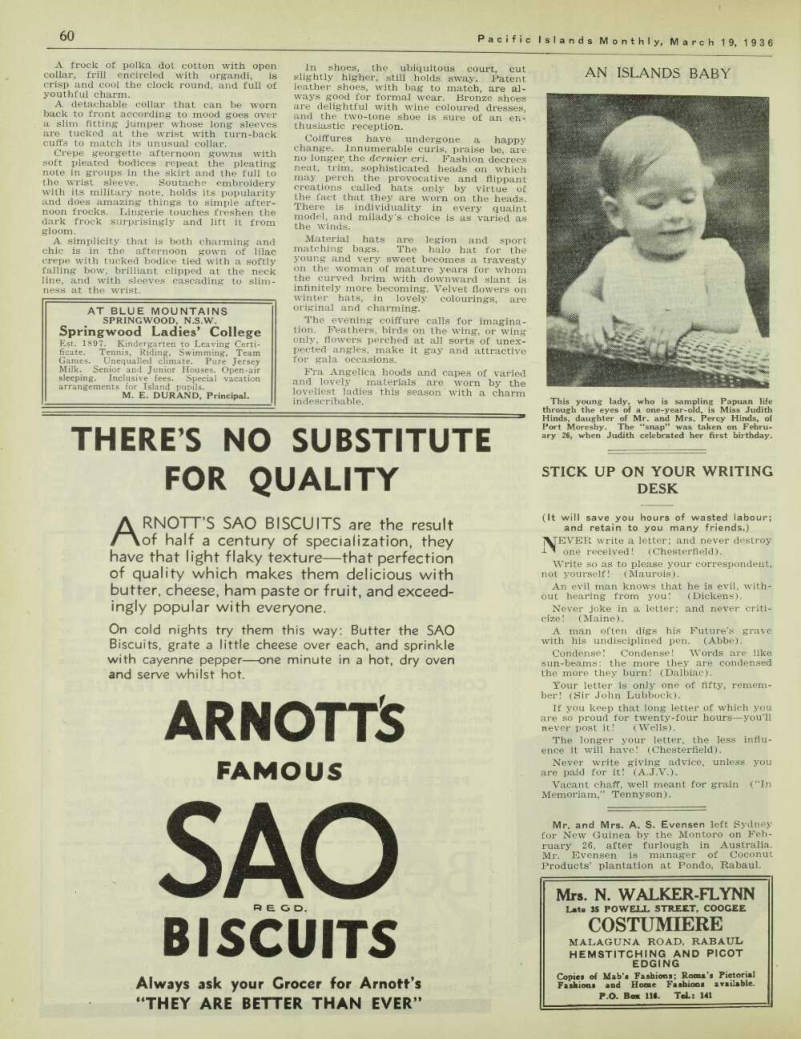
By Therese
EVENING brings gaiety and brilliance in its train. Chinese blues, mandarin reds, and royal purples lend themselves to the glorious gowns for glamorous nights, when all goes merry as a marriage bell.
Mermaid, Victorian and classical lines vie for supremacy and slinky silhouettes grace the cocktail hour. Like an Arabian night is the lovely figured gown of orien tal design. A deep V-decolletage graces the slim tunic which tops the sweeping skirt, and shrieks sophistication.
A swinging hooded cape of black makes a dramatic entry when thrown over a clinging gown of purple shot satin, with ruffles of silver at the throat. Sea green satin sheathes in slim perfection the lovely form, slender as a birch tree. A coat in deeper shade, with huge bolster sleeves, makes it of even more striking beauty.
Cascade draperies give classic lines to simple evening gowns. With modified epaulettes and draperies that slim the hips, the gown of peach satin, its draper ies and epaulettes lined with rust, is lovely to look at, delightful to wear. Alluringly feminine is the frock of crepe romaine, moulding the hips flatteringly with clev erly arranged diagonal tucks which sweep to fulness at the hem.
The bouffant frock still holds sway for the debutante. In spotted net with groups of guaging on shoulders and hips it is the spirit of romance.
A tiered dress of black tulle floats buoy antly to success. Rhinestones wink in its murky folds, and slim shoulder straps a.nd a flower trimmed corsage endow it with the charm of youth.
Shirring is used extensively. A Chinese red morocain ripples its bodice diagonally in soft drapes, shirring to fulness in the same attractive way its softly falling skirt.
Navy, black, grey and brown are having a tremendous vogue for evening clothes and are meeting with surprising success.
Long coats cut with high waists and with sharp revers claim attention for day and evening wear, as do the popular jac kets which grace the evening blouses and skirts.
Skirts need no heralding. They are short and tight for the day time, with cleverly covered divisions to give width for sports occasions. An extra skirt is always essential, so the check or plaid wrap-over is ideal.
Gay little short sleeved blouses of ging hams and crisp cotton breathe smartness and efficiency. Waistcoat blouses are smart and sporting with the new square set-in sleeves. Fresh and crisp little blouses of guaged taffeta are delightful for afternoon; while lames, satins, and georgettes are correct for evening hours.
Linen suits and open mesh sports frocks are light-hearted wear for the tropics— run-about suits with narrow skirts and basqued blouses and frocks that button from neck to hem.
A little jacket frock of flat tucks in alternating colours —light and dark blue, biege and brown, pink and raspberry—is buttoned up to its demure collar with wooden buttons and encircles its waist with a suede belt clipped attractively with buckle of wood.
A chic little frock of navy silk trims
itself with white buttons and covers its slim perfection with a swaggering swash buckling coat of white, with large navy cuffs. A white hat, navy banded, com pletes the ensemble. A two-piece ensemble with basqued blouse gathered to fulness at the bodice front is swathed with a wide belt and tops a pencil-slim skirt sporting the übiquitous split.
Interest for day wear centres around the shoulders, neck and sleeves, and there is a wide variety for choice. The new throttle neck is charming for the tall woman with a slim neck. It can be achieved with frills of stiffened chiffon, taffeta, or a pique lined collar crisp and fresh.
A good style for the short woman with a plump neck is the revered bodice extend ing to the waist. Wide sleeves with fitting undercuffs make the hands slim and graceful.
Lacings and patch pockets offer lively interest plus charm for the sports frock.
There is no obvious fulness in out-door clothes. It is subtly achieved in its clever cut or by pleats; or shaped inset panels give necessary width.
For active or spectator sports wear in terest comes in the panel skirt, fitting collar, and pockets on skirt and bodice.
An open V neck line on the sports frock is a happy change and, with the addition of buttons down the front and back, and fulness at the top of long sleeves, leaves nothing to be desired.
Buttons and belts are still headlines in the fashion world and present themselves with infinite charm and variety for the most exacting taste. A black and whit© zephyr frock with white Quaker collar, and large softly falling black artist’s bow, has a black patent belt and black and white shoes to march it on its way to chic.
A pert upturned sailor hat of white straw, patent leather banded, fills the wearer with intense joy.
A frock of polka dot cotton with open collar, frill encircled with organdi, is crisp and cool the clock round, and full of youthful charm.
A detachable collar that can be worn back to front according to mood goes over a slim fitting jumper whose long sleeves are tucked at the wrist with turn-back cuffs to match its unusual collar.
Crepe georgette afternoon gowns with soft pleated bodices repeat the pleating note in groups in the skirt and the full to the wrist sleeve. Soutache embroidery with its military note, holds its popularity and does amazing things to simple after noon frocks. Lingerie touches freshen the dark frock surprisingly and lift it from gloom.
A simplicity that is both charming and chic is in the afternoon gown of lilac crepe with tucked bodice tied with a softly falling bow, brilliant clipped at the neck line, and with sleeves cascading to slim ness at the wrist.
In shoes, the übiquitous court, cut slightly higher, still holds sway. Patent leather shoes, with bag to match, are al ways good for formal wear. Bronze shoes are delightful with wine coloured dresses, and the two-tone shoe is sure of an en thusiastic reception.
Coiffures have undergone a happy change. Innumerable curls, praise be, are no longer the demier cri. Fashion decrees neat, trim, sophisticated heads on which may perch the provocative and flippant creations called hats only by virtue of the fact that they are worn on the heads.
There is individuality in every quaint model, and milady’s choice is as varied as the winds.
Material hats are legion and sport matching bags. The halo hat for the young and very sweet becomes a travesty on the woman of mature years for whom the curved brim with downward slant is infinitely more becoming. Velvet flowers on winter hats, in lovely colourings, are original and charming.
The evening coiffure calls for imagina tion. Feathers, birds on the wing, or wing only, flowers perched at all sorts of unex pected angles, make it gay and attractive for gala occasions.
Fra Angelica hoods and capes of varied and lovely materials are worn by the loveliest ladies this season with a charm indescribable.
Advertisements & other items, pp. 61-62 (1 item)
! Beba/Talds
The Only SEWING MACHINE Guaranteed for your Lifetime
The New BBobarfaid - llliiebirfl
Bebarfalds have such confidence in the New Improved 1936 Model Bebarfald Bluebird Sewing Machine that they are now supplying with each machine sold during April and May a Lifetime Guarantee. This means that the Bebarfald Bluebird is so reliable that any part wearing out or breaking during the purchaser’s lifetime is replaced free by Bebarfalds Ltd. Their years of experience as pioneer manufacturers of cabinet sewing machines, enables them to sell these reliable machines with such wonderful guarantees.
Bebarfalds were established in Sydney in 1852. Over 50 years of Integrity, Low Prices, Fair Dealing, and the good will of nearly 500,000 satisfied customers.
COMPLETE WITH THESE EXCLUSIVE FEATURES
trol (sews both ways), special set of Automatic Dressmaking Attachments, and large Instruction Book free. Post coupon now for copy of the free book, “How to Judge a Sewing Machine.”
The New Improved Bebarfald Bluebird is guaranteed in writing for the Purchaser’s lifetime. A written guarantee ensures the return of your purchase money if the machine is not as represented. Automatic backwards and forwards stitch condd ■ /'c c cd au /j >« (Hand Machine • f a aa / (Cabinet as PRICES FROM £l2 Complete) and £l9/19/. illustrated) Bebarfalds have over 40 different cabinet designs to select from, all fitted with wonderful Lifetime Guaranteed Bebarfald Bluebird Sewing Machine Heads. Post coupon now for full particulars, and copy of the free book, “How to Judge a Sewing Machine.”
■COUPON.'
AUSTRALIA’S
LARGEST
FURNITURE
STORE
! Beba/Talds
Opp Town Hall, George St., Sydney
Please send me full particulars of your Lifetime Guaranteed Bebarfald Bluebird Sewing Machine, and also copy of the free book, “How to Judge a Sewing Machine.”
Name Address I Dainty Handbag Mirror free to the first 30 inquirers. 1.M.4.
AT BLUE MOUNTAINS
SPRINGWOOD, N.S.W.
Springwood Ladies’ College
Est. 1897. Kindergarten to Leaving Certificate. Tennis, Riding, Swimming, Team Games. Unequalled climate. Pure Jersey Milk. Senior and Junior Houses. Open-air sleeping. Inclusive fees. Special vacation arrangements for Island pupils.
M. E. DURAND, Principal.
THERE’S NO SUBSTITUTE
FOR QUALITY
ARNOTT’S SAO BISCUITS are the result of half a century of specialization, they have that light flaky texture —that perfection of quality which makes them delicious with butter, cheese, ham paste or fruit, and exceedingly popular with everyone.
On cold nights try them this way: Butter the SAO Biscuits, grate a little cheese over each, and sprinkle with cayenne pepper—one minute in a hot, dry oven and serve whilst hot.
ARNOTTS
FAMOUS
SAO
R E. O D,
BISCUITS
Always ask your Grocer for Arnotf’s
“THEY ARE BETTER THAN EVER”
An Islands Baby
This young lady, who is sampling Papuan life through the eyes of a one-year-old, is Miss Judith Hinds, daughter of Mr. and Mrs. Percy Hinds, of Port Moresby. The “snap” was taken on Febru ary 26, when Judith celebrated her first birthday.
Stick Up On Your Writing
Desk
(It will save you hours of wasted labour; and retain to you many friends.) NEVER write a letter; and never destroy one received! (Chesterfield).
Write so as to please your correspondent, not yourself! (Maurois).
An evil man knows that he is evil, with out hearing from you! (Dickens).
Never joke in a letter; and never criti cize! (Maine).
A man often digs his Future’s grave with his undisciplined pen. (Abbe).
Condense! Condense! Words are like sun-beams: the more they are condensed the more they burn! (Dalbiac).
Your letter is only one of fifty, remem ber! (Sir John Lubbock).
If you keep that long letter of which you are so proud for twenty-four hours —you’ll never post it! (Wells).
The longer your letter, the less influ ence it will have! (Chesterfield).
Never write giving advice, unless you are paid for it! (A.J.V.).
Vacant chaff, well meant for grain (“In Memoriam,” Tennyson).
Mr, and Mrs. A. S. Evensen left Sydney for New Guinea by the Montoro on Feb ruary 26, after furlough in Australia.
Mr. Evensen is manager of Coconut Products’ plantation at Pondo, Rabaul.
Advertisements & other items, p. 62 (1 item)
Costumiere
Mrs. N. WALKER-FLYNN
Late 35 POWELL STREET, COOGEE
MALAGUNA ROAD, RABAUL
HEMSTITCHING AND PICOT
EDGING
Copies of Mab’s Fashions; Roma’s Pictorial Fashions and Home Fashions available.
P.O. Box 11C. TeL: 141
“Uncontrolled”
Natives
Primitive N.G. People are Slowly Absorbing Civilisation
From a Special Correspondent.
WAU, Feb. 22.
THE Wahgi valley is reported to be quiet and peaceful.
The large Mogei tribe living to the east of Mt. Hagen is friendly and is quickly absorbing new methods of agri culture, under the guidance of the missionaries and the Government. Steel axes and knives, which they previously refused to buy, have now been acquired, and they have learnt to trench deeply, whereas before it was superficial.
At intervals Fathers Ross and Meiser, of the Society of the Divine Word (a German order) hold services in the dis trict at which already a few natives attend. The Wahgi natives trade freely with the missionaries selling them vege tables and pigs, and working for them when they feel so inclined. Far from being lazy, however, they do not care much for working for the white men as their own immediate tasks fully occupy their days.
These primitive people are in danger of becoming air-minded, though the arrival of a ’plane is still attended with interest. Shortly they will not take much notice of the machines which will be looked upon as a commonplace.
Bena Bena District
Very little inter-tribal fighting has oc curred recently in the Bena Bena district.
It seems that the natives have become wise to the protection offered them by the presence of the Administration. Harassed tribes from outlying districts are settling near the Police past, and there have actu ally been proposals to make settlements near the vicinity. Established villages have become larger, showing clearly the feeling of security.
The construction of the road linking up Bena Bena with the Chimbu and Ramu Police posts is being rapidly extended, and to the west is reported to have reached Mahometo.
Chimbu Valley.
Though the work of extending the Gov ernment’s influence is steady and persist ent in the Chimbu Valley, there is yet much to be done before the natives recog nise law and order and peaceful conditions.
Intermittent fighting occurs between tribes often from trivial causes, or at least what might appear trivial to those not acquaint ed with the complexities of so primitive a culture. It will be some time before the Administration can declare the district open to settlement or prospectors.
Good progress has been made around the Police post in maintaining gardens and erecting labour and police quarters. The gardens, it is hoped, will provide sufficient food for the post, making it self support ing. All measures are convincing the na tives that the Government has come to stay, and already signs are evident of confidence and respect—which is most encouraging.
A portable wireless set has been in stalled at the post, by which the officer in charge is in communication with Sala maua. This is of great assistance to the isolated and far-flung post.
Stamps Again!
Cook Is. Jubilee Issue Was Little Goldmine
From Our Own Correspondent
Rarotonga, Feb. 26.
THE limited issue of Cook Island Jubilee postage stamps has already operated profitably for those who were shrewd enough to foresee the rise in value.
An almost phenomenal leap in values took place when London dealers, not ex pecting such a general demand for Jubilee issues, failed to secure adequate supplies of the set of three which were issued in the following numbers:
Jubilant last week was Trader “Viri”
Watson, possessor of some £5O worth (in cluding- many first-day covers) bought at par and now listed in London catalogues at 5/9 stg. (7/3 N.Z.) per set. Gloating, Trader Watson refused San Marino’s peri patetic Consul-General Jamieson’s offer of 150 per cent, profit. He confidently an ticipates an eventual gain several times greater and regrets only that he did not buy the £4OO worth which Postmaster Horn returned when the issue was withdrawn last August.
Certainly, those with money available missed a “sweet thing” when they passed up the Jubilee issue, since at no time was there any possibility of an actual loss, and £4OO worth of stamps bought last August would to-day fetch approximately £lOOO.
Visitors to the Islands, however, have been more astute, one such having recently acquired some £3O worth of stamps at prices varying from par to twice face value.
Which, of course, is one way of making one’s holiday pay for itself!
Rev. L. A. McArthur, 8.A., principal of the Methodist Mission’s George Brown Training Institution at Vunairima, New Britain, left Sydney by the Montoro for Rabaul on February 26. He has been on furlough in Adelaide for some months, where his wife and child are now residing until they are able to join him in New Guinea later in the year.
Id. 2£d. 6d.
Number issued ... 144,000 88,000 88,000 Number sold 136,239 83,966 82,928 Total value sold £3505.
Advertisements & other items, p. 63 (1 item)
—Just Received
TESTIMONIAL
“Please send to the following lady friends of mine, addresses enclosed, a free sampl of Koko, your won derful hair dressing have tried it and will never be without 'Koko.' It is the best dressing 1 have ever used.”
The readers of this Magazine can also have a free sample, or, in the alternative we would advise sending us 1/- and we will post our Test Packet, which contains a sample of Koko for the Hair and a 6d packet of Koko Shampoo Powder.
Address Box 92, Haymarket Post Office, Sydney,
N.S.W.
X From Chemist or Store at 1/3, 2/9, 4/6.
Koko-Maricopas Co. Ltd.
“Civic House,”
Kent St M Sydney, N.S.W
TIT The Ideal Sydney Home fc
♦ ♦ ♦ Islands Children SITUATED ON THE HEIGHTS OF THE BEAUTIFUL NORTH SHORE
IN DELIGHTFUL. HEALTHY, OPEN SURROUNDINGS.
* SUNNY ROOMS, SPACIOUS PLAYGROUNDS. TENNIS COURT.
GOOD FOOD AND ALL THE CARE AND COMFORT OF HOME.
Owing to the need for more accommodation “Tamarang” is now located at the new address, given below.
lister Ecnnp Clinic . . .
House Mother: Mrs. G. Allnutt Assistant: Miss E. Allnutt Write to . . .
“TAMARANG”
8 Fidden’s Wharf Road,
KILLARA, SYDNEY Tel.: JX 3089 wSTiS'happu.,7.:
Children suffering from paralysis, whose parents desire them to have the Sister Kenny Treatment, may be placed in the care of Mrs. Allnutt, at “Tamarang,” the Hostel being easy distance to the Royal North Shore Hospital, where the clinic is located.
The children will be well looked after in every way and receive every con- RiHprAtinn nprpccarv for thpir wpII.
Melbourne Party To Seek
Gold And Timber
SEEKING gold and timber on some of the small and seldom visited islands around Papua and New Guinea, an expedi tion will shortly leave Melbourne in a 75ft. steam launch for those territories.
It is reported that the party will be headed by Mr. C. Chapman, who recently disposed of his mining interests in Central Australia in order to join the syndicate.
A small company with £lO,OOO capital (2,000 shares of £5 each) has been floated.
The expedition will be away for three months and will take a cinematograph record of the places visited. The vessel will be fitted with wireless.
Mr. O. E. Probys, of Thursday Island, has resigned from Messrs. Burns, Philp and Co. Ltd. to join his wife and child in Sydney.
New Guinea Aerial
Merger
Letter to the Editor I REFER to an article published in your January issue, entitled “Protest in N.G.,” and dealing with the proposed aerial merger.
Pacts have been revealed that some months ago all smaller aerial organisations were approached with a view to transfer ring, for a consideration, of course, their interests to one company (Guinea Airways Limited). The majority of companies at that particular time were in agreement with the proposals put forward, but during the months which followed they wisely revoked their acquiescence.
Nothing further was heard until Janu ary, when it was made publicly known that proposals for a merger were to come before Cabinet on Wednesday, January 22.
Immediately this was circulated, a public protest meeting was convened, and at
tended by representatives of all sections of the community. A representative com mittee was elected to protest against a monopoly being granted to Guinea Air ways Ltd.
The prologue to this politically-con trolled merger was rehearsed when the Minister for Home and Territories (Sir Geo. P. Pearce) visited the Territory some months back, when he was the guest of Guinea Airways Ltd., which company are the sponsors of the merger.
The investigations said to be made by the Minister were not in any degree rep resentative and, up to within two days of the protest meeting, even the Government officials of the Morobe District did not have any knowledge of what was going on.
It therefore appears that the discussions referred to were confined to the one direc tion only. Such an action leads to the belief that all was not above-board.
As is usually the case with anything savouring of politics, many flowery epistles and orations have manifested them selves, but all the whitewash concerning defence in a Mandated Territory, and safety and efficiency, will not dry on us.
Competitive freight rates bring increased business, and increased business necessi tates a greater measure of efficiency to cope with the demands; and when you come to consider the consistently large dividends paid by aerial companies charging the existing favourable freight rates, all the “hot sand and ginger” expounded concern ing efficiency is in effect ridiculous.
In conclusion I would state that the publication commented upon by you was based on facts and authentic evidence and this is backed by communications subse quently received.
I am, etc.,
A. Neil Proud.
S.M.H. Correspondent.
Wau, T.N.G., 25/2/1936.
Prospector’s Viewpoint
Letter to the Editor YOUR explanation of the intentions of the Commonwealth Government with regard to air transport is very enlighten ing. But it does not matter what company or combine is in control —the result will be the same.
The fact that this move has been “on foot for eighteen months,” without the people of New Guinea knowing anything about it, is enough to show just what consideration the public will get from the Federal Parliament.
There is at least one company in New Guinea with a most efficient aeroplane workshop, which could undertake any type of repair. Would it not be sufficient to subsidise this concern, and all other companies if necessary, on their under taking to use and maintain an approved type of plane and an efficient ground or ganisation?
At present we enjoy really fine service from the aviation companies, and this is attributable solely to competition. Yet each concern is, I am sure, a paying pro position; though some may look with long ing eyes on the large dividends of the past.
The statement that the formation of powerful companies will protect the public against risk in air transport seems to im ply that the machines of the smaller com panies are less airworthy than those of their larger competitors. There are very stringent regulations to protect the public against risk in this regard, and it should not be necessary to form a combine to get safe flying. At any rate, a comparison of the records of the various concerns should be interesting.
If a charter is given to any single con cern freight rates will rise (unless a sub sidy is provided) and services will suffer,
particularly to the smaller, outer ’dromes, which do not show such a good return with small planes.
As for the Administration protecting us against exploitation, do you really think that that far-away Rabaul organisation we
read about would care if w© got one plane per week or per month, or whether Bill Smith’s cargo got lost altogether?
Form a combine, by all means, and sub sidise any large or suitable concern, but let a small show or two stay outside to help the small man who is like that voice crying in the wilderness, too far away for the Commonwealth to hear or heed.
In conclusion, I would like to protest against contemptuous disregard for public opinion in New Guinea, displayed by the Commonwealth Government, on this and other occasions and I am sure I am voicing the opinions of many New Guinea resi dents in doing so. We have no vote, no jury system, and no money—but why rub it in?
I am, etc..
J. D. O’Neill,
Wau, T.N.G., 23/2/1936.
Prospector.
Advertisements & other items, pp. 64-65 (2 items)
Berg*
Full Gloss Super Finish for everything that travels/
AGENTS THROUGHOUT THE ISLANDS
MORRIS, HEDSTROM, Ltd.
FIJI
Sole Agents in Fiji for . . .
Vacuum Oil Company (Pty.) Limited
Imperial Chemical Industries Limited
Nobel (Australasia) Pty Ltd.—Explosives
Full Stocks of
MINERS AND PROSPECTORS’
REQUISITES
Also SODIUM CYANIDE, ZINC
DUST. Etc., Etc.
Sydney Office:
DALTON HOUSE, 115 PITT ST., SYDNEY
Branches throughout the gold hearing areas Lautoka, Ba, Tavua, Penang, Nadi, and Sigatoka
there’s Pleasure in PLUME, too!
% m vi' , / ", * •*
you’ll find that there IS a new pleasure in driving with Plume in the tank. There’s the satisfaction of an immediate start every time you start. There’s the knowledge of Power in reserve for a burst of speed or flashing acceleration when wanted. There’s Power for the hills and speed on the highways together with that all important point—M.P.G. that spells ECONOMY. Prove these points next time you fill up by buying 5 gallons of Plume.
Highest Quality Unsurpassed Performance
VACUUM OIL COMPANY l p t t £
Kong Ah Scandal
T'HERE have been sensational develop * ments in Tahiti in connection with what is known as the Kong Ah scandal; and it is reported that action of the most serious character has been taken against two or more residents of Papeete.
The subject is such a delicate one and so many people appear to be implicated that it is not considered desirable to make further reference to the matter here at this stage.
The French Administration is making a very thorough investigation of the whole matter.
Mr. W. Wise, an employee of the Vani koro Kauri Timber Co. in the Santa Cruz Group, Solomon Islands, arrived in Mel bourne in February by the steamer Brightvega. Mr. Wise contracted a se vere bout of malaria at Vanikoro and had to leave the island for medical atten tion.
Mr. and Mrs. W, H. Jefferson, of Oga mobu. Papua, left the Territory recently by the Van Rees for Singapore. Mr.
Jefferson has been appointed manager of Sagga Estate at Siliau, Negri Sembilan in the Federated Malay States.
Making Special Inquiry
California-Tahiti
Traffic
G.S.C. of Los Angeles Now Making Special Inquiry
From Our Own Correspondent
Papeete, Feb. 20.
M. RAYMOND DENIZE, representing the passenger department of the Gen eral Steamship Corporation of Los Angeles, who is at present in Tahiti studying ways and means for an increase in the tourist traffic to this part of the world, brought with him the outlines of a general plan of development for which he is seeking the support of the local Administration, the Papeete Chamber of Commerce, and other public organisations, and influential resi dents of the Colony.
The fundamental idea is not a new one.
The local Syndicat dTnitiative (Tourist Association) was brought into existence some years ago with the primary object of developing a larger tourist traffic, and its efforts have not been without some success, in spite of the unfavourable situa tion of the foreign exchanges and other adverse factors.
The most interesting feature of M.
Denize’s proposition is that it emanates from America, and this may be taken as a sure indication of a growing appreciation of the South Seas —and especially Tahiti and the other islands of the Society Group —as a promising field of enterprise for shipping companies who cater specially for good-class passengers. The natural at tractions of these islands from a tourist standpoint are perhaps without equal in any part of the But there are seri ous obstacles to any large development of the industry at the present time —progress probably will be slow unless an unexpected shift occurs in foreign exchange—one that will give the U.S. dollar and the English pound about the same purchasing power in a French country as they enjoyed before they deserted the gold standard.
The scheme outlined by M. Denize in cludes official representation in U.S.A., Canada, and Mexico, for the Tahiti Tourist Bureau (Syndicat dTnitiative de Tahiti), the creation of a trust fund for publicity purposes designed to give widespread knowledge of the attractions of Tahiti and the other islands of the Group, and the development of hotel facilities.
For the development of inter-island travel, amusements and games exclusively for tourists, and extension of the existing available accommodation, a local company in which at least 51 per cent, would be held by French citizens is proposed. Assistance would also be given, by means of prizes and contests, to every movement for the revival and development of native arts. (This is being done at present but on a scale which is far from being sufficiently wide-spread and comprehensive.) All of this is good, and the plan, with the exception of a few ideas which are new. fits into the general scheme of develop ment which has been the subject of study and discussion by the Tourist Bureau for a long time past. M. Denize is therefore assured of a sympathetic reception. The important thing is that Tahiti and its tour ist possibilities have awakened sufficient interest in America for a large steamship amalgamation to send a specialist here to study conditions.
Rev. H. M. Bell departed from Sydney for the New Hebrides by the Morinda on February 20. He has been appointed as successor to Rev. T. McMillan of the Presbyterian Mission’s station on Tanna Island.
Advertisements & other items, p. 66 (1 item)
A. B. Donald Ltd.
The“Statlon Stock”
Is a saddle favoured by stockmen for its practical qualities. / 'A Being built on a Galvanised Tree, heavily plated, strained with English web, riders are assured of its genuine foundation. The Sin. hand-sewn capped pads are built with extra strength, while the flaps are long and pliable. Fitted with best leathers, web girth and 4-bar stirrups. £7/7/- F reight F ree Solid Nickel Stirrups, 7/6 extra.
Write for Booklet of “ SAFER” Saddles
Newmarket Saddlery
W. H. Williams for “Safer” Saddles.
18-20 WILSON STREET,
NEWTOWN, N.S.W.
A. B. DONALD Ltd.
AUCKLAND
Island Traders :: General Merchants
P.O. Box 1509 Cables and Telegrams: “Kingdom,” Auckland Branches at- Rarotonga and throughout the Cook Islands At Papeete and throughout the Society, Marquesas and Paumotu Islands
trading as “ETABLISSEMENTS DONALD, TAHITI”
At Fiji: Trading as ‘‘Dominion Fruit C 0.,” Suva
Ra Chases Tailevu Over Fijian Hills
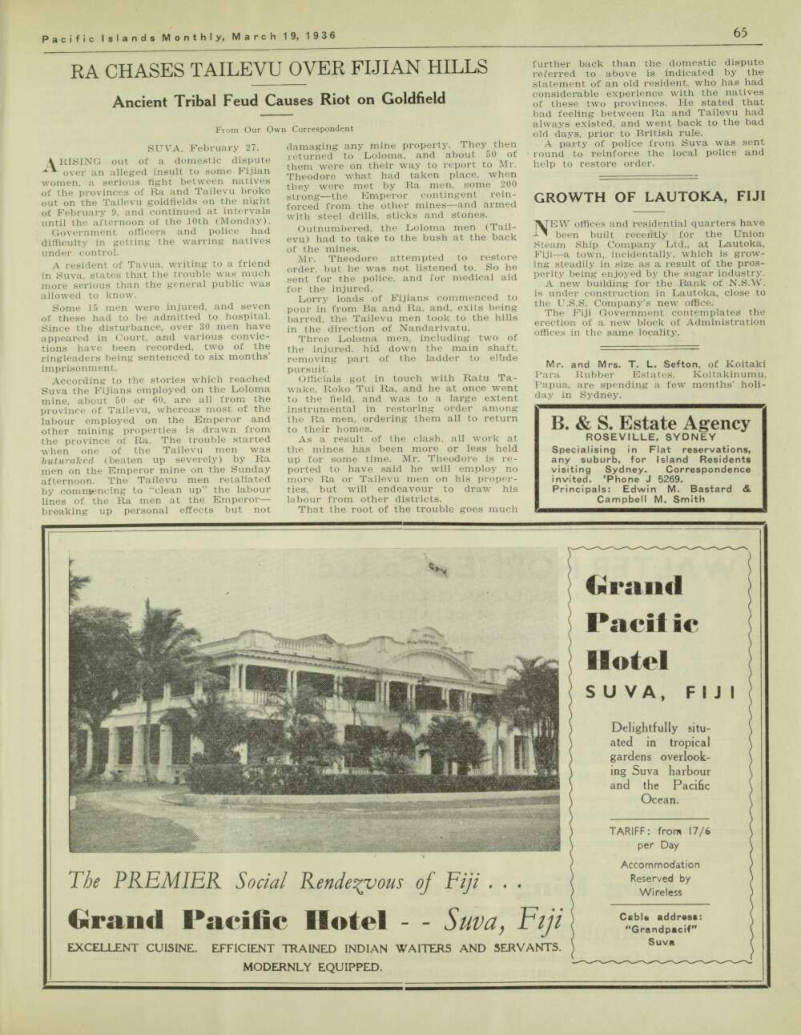
Ancient Tribal Feud Causes Riot on Goldfield
From Our Own Correspondent
SUVA, February 27.
A RISING out of a domestic dispute over an alleged insult to some Fijian women, a serious fight between natives of the provinces of Ra and Tailevu broke out on the Tailevu goldfields on the night of February 9, and continued at intervals until the afternoon of the 10th (Monday).
Government officers and police had difficulty in getting the warring natives under control.
A resident of Tavua, writing to a friend in Suva, states that the trouble was much more serious than the general public was allowed to know.
Some 15 men were injured, and seven of these had to be admitted to hospital.
Since the disturbance, over 30 men have appeared in Court, and various convic tions have been recorded, two of the ringleaders being sentenced to six months’ imprisonment.
According to the stories which reached Suva the Fijians employed on the Loloma mine, about 50 or 60, are all from the province of Tailevu, whereas most of the labour employed on the Emperor and other mining properties is drawn from the province of Ra. The trouble started when one of the Tailevu men was huturaked (beaten up severely) by Ra men on the Emperor mine on the Sunday afternoon. The Tailevu men retaliated by commencing to “clean up’’ the labour lines of the Ra men at the Emperor— breaking up personal effects but not
damaging any mine property. They then returned to Loloma, and about 50 of them were on their way to report to Mr.
Theodore what had taken place, when they were met by Ra men, some 200 strong —the Emperor contingent rein forced from the other mines—and armed with steel drills, sticks and stones.
Outnumbered, the Loloma men (Tail evu) had to take to the bush at the back of the mines.
Mr. Theodore attempted to restore order, but he was not listened to. So he sent for the police, and for medical aid for the injured.
Lorry loads of Fijians commenced to pour in from Ba and Ra, and, exits being barred, the Tailevu men took to the hills in the direction of Nandarivatu.
Three Loloma men, including two of the injured, hid down the main shaft, removing part of the ladder to elhde pursuit.
Officials got in touch with Ratu Ta wake, Roko Tui Ra, and he at once went to the field, and was to a large extent instrumental in restoring order among the Ra men, ordering them all to return to their homes.
As a result of the clash, all work at the mines has been more or less held up for some time. Mr. Theodore is re ported to have said he will employ no more Ra or Tailevu men on his proper ties, but will endeavour to draw his labour from other districts.
That the root of the trouble goes much
further back than the domestic dispute referred to above is indicated by the statement of an old resident, who has had considerable experience with the natives of these two provinces. He stated that bad feeling between Ra and Tailevu had always existed, and went back to the bad old days, prior to British rule, A party of police from Suva was sent round to reinforce the local police and help to restore order.
Growth Of Lautoka, Fiji
NEW offices and residential quarters have been built recently for the Union Steam Ship Company Ltd., at Lautoka, Fiji—a town, incidentally, which is grow ing steadily in size as a result of the pros perity being enjoyed by the sugar industry.
A new building for the Bank of N.S.W. is under construction in Lautoka, close to the U.S.S. Company’s new office.
The Fiji Government contemplates the erection of a new block of Administration offices in the same locality.
Mr. and Mrs. T. L. Sefton, of Koitaki Para Rubber Estates, Koitakinumu, Papua, are spending a few months’ holi day in Sydney.
Mr. Alex. C. Jones, of the Bank of New South Wales at Wau, returned to Austra lia by the Monotoro on February 19 after spending three years on the New Guinea goldfields.
Mr. Laurence, plantation manager of the New Zealand Reparation Estates in Western Samoa, left Apia recently by the Boren to spend leave in Europe.
Advertisements & other items, pp. 67-68 (1 item)
Grand
B. & S. Estate Agency
ROSEVILLE, SYDNEY
Specialising in Flat reservations, any suburb, for Island Residents visiting Sydney. Correspondence invited. ’Phone J 5269.
Principals: Edwin M. Bastard & Campbell M. Smith
m The PREMIER Social Rendezvous of Fiji . . .
Grand Pacific Hotel - - Fiji
EXCELLENT CUISINE. EFFICIENT TRAINED INDIAN WAITERS AND SERVANTS.
MODERNLY EQUIPPED.
Grand
Pad I ic
Hotel
SUVA, FIJ
Delightfully situated in tropical gardens overlooking Suva harbour and the Pacific Ocean.
TARIFF: from 17/6 per Day Accommodation Reserved by Wireless Cable address: “Grandpacif"
Suva
POSITION WANTED
Ladies’ Hairdresser, aged 29, well educated, thoroughly experienced Permanent Waving, Marcel, Water Waving, etc., who is also an expert Shorthandwriter and Typiste, seeks suitable Islands position.
Reply. J. 8., c/o. “P.1.M.,”
Box 3408 R, G.P.0., Sydney.
MELBOURNE
HOTEL .
—-- SUVA ==
Centrally situated near Government offices. Opposite sea baths and bowling green. Excellent table.
Terms moderate. Best brands of liquor kept, including Hardy’s famous wines.
E. C. DOBELL Proprietor
Suva’s Fashion Rendezvous
WALTER HORNE & Co. Ltd.
PREMIER DRAPERS. LADIES’, CHILDREN’S
AND MEN’S WEAR SPECIALISTS
LADIES’ HAIRDRESSING AND MANICURING
Frocks Millinery Foundations and Lingerie Hosiery Ladies’ Shoes & Sandals Ribbons and Laces Hairdressing Manicuring Dress Fabrics and Silks Household Drapery Clothing Tailoring Mercery Men’s Boots & Shoes Men’s Hats & Caps Island Curios
“IF IT’S NEW...
HORNE’S WILL SHOW IT”
Dependable Merchandise
Reasonably Priced
Cables: “Janinloong”
P.O. Box 117
Jang- I ling Loong Company Limited
20-24 THOMSON ST., SUVA, FIJI
IMPORTERS —' EXPORTERS
Buyers of Copra, Trochus Shell, Beche-de-mer, Kauri G um, and other Islands Products.
NUMEROUS BRANCHES THROUGHOUT THE COLONY
Wreck In Fiji
Government Ship Lost in Hurricane
From Our Own Correspondent SUVA, February 27. r'AUGHT herself in a small hurricane, while investigating the possibility of salvaging a cutter lost in a recent hurricane in the Lau group, the motor vessel Derek (100 tons) belonging to the Fiji Public Works Department, was driven ashore and became a total loss on the island of Komo, on February 15.
The Derek was off Komo on the 14th, sur veying the site of the sinking of the cutter Tui Navitilevu, when the glass com menced to drop. The ship was anchored in shelter, in the big lagoon of Komo.
During the night the wind increased to hurricane force, and changed round until the vessel was virtually on a lee shore.
Early on Saturday, a tremendous wave came in and broke ahead of her, and as she sank into the trough, she struck her stern heavily. There were four anchors out, but it was decided to attempt a shift to a safer anchorage.
The vessel dragged her anchors, how ever, and bumped heavily aft, holding herself and flattening the blades of her propellers. Rendered helpless, she was driven on to the rocky shore.
Dry land was only 30 yards away, but those on board had a hazardous trip to the shore. Captain E. W. G. Twenty
man, former harbourmaster at Suva, had a very narrow escape. He was half down the man ropes at the gang port, when a sea struck the vessel and she lurched over. He was thrown into the water, and, as the ship swung back, was drawn under. Mr. Henry Cross, the chief en gineer, immediately jumped over the side and, grabbing a rock with one hand, caught Captain Twentyman with the other, and dragged him to safety. The captain says that Mr. Cross saved his life.
Captain Hay, the master of the Derek, received injuries to his legs and side, but these are not serious.
As soon as the weather moderated, the castaways were able to save considerable gear, stores, and personal effects from the Derek. Nine days were spent on the island before help came, but there was no shortage of food, as at the time of the mishap the Derek was conveying stores to islands which had suffered in the previous hurricane, Mr. John Hill, former engineer of the Tui Navitilevu, was among the party, and he set out in a native canoe for the island of Namuka. There he intercepted the cutter Tui Yunilagi, which put in to Komo and took off the stranded men.
The Derek was a twin screw diesel engined wooden vessel of 100 tons gross, and was built in Suva by Terry and Sons Ltd. in 1928.
Station Zjv
Broadcasting in Suva
From Our Own Correspondent SUVA, February 27.
STATION ZJV, the Fiji Broadcasting Company’s new station in Suva, is now completed and “on the air.” The plant, which has been manufactured in Australia by Amalgamated Wireless (Australasia) Ltd., is most up to date; in fact, it is the first of its kind manu factured by the company, and bears the serial number “1.” Numbers “2” and “3,” when they are manufactured, are to be installed at Cairns and Rabaul.
Alternating current from the Suva power house has been supplied, and the transmitter has an output of 400 watts on the aerial. The wavelength is 341 metres.
Afternoon and evening programmes are being put on the air, consisting of re corded material.
Local listeners complain that the an nual license fee has been increased from 5/- to 30/- since the new station com menced operations—that they have to pay for what they don’t want, as they have no desire for “canned” music from the local station when there are good pro grammes available overseas. [EDITORIAL NOTE: We understand that A.W.A. are making plans to broadcast a daily news service through this and other Islands sta tions. That should be worth 30/- per annum.]
Annual Meeting
Methodist Mission Board’s Annual Meeting Eleven New Appointments
ELEVEN new appointments to Pacific Islands mission staffs were announced at the Annual Meeting of the Methodist Board of Missions in Sydney on February 4. The new missionaries are Rev. Walter Shepherd, M.A.. 8.D., of Victoria, accepted for service in Tonga, in place of Rev. A.
H. Wood, M.A.
Rev. H. H. Bock, of Ouyen, Victoria, appointed to the Lau Circuit in Fiji.
Rev. T. N. Simpson, of South Australia, who will go to New Britain after attending a course of training at the George Brown College, Sydney.
Mr. Jack Trevitt, 8.A., Dip. Ed., of New South Wales, who is the new headmaster at Vunainma Training College, New Guinea.
Rev. A. Stanley Jones, L.Th. (New South Wales), who will serve at Kabakada, New Britain.
Rev. Howard J. Pearson, 8.A., of South Aus tralia, who has taken a course in teacher train ing at Adelaide University, has been appointed to Rabaul, New Guinea.
Rev. Donald F. Boorman, L.Th., of Queensland, who has been accepted for the Bau Circuit, Fiji.
Miss M. E. Brabin, 8.A., of the Tasmanian De partment of Education, who has been appointed as a missionary sister in New Britain.
Miss E. Twyford, of Victoria, who has been ap pointed to Papua. She was associated with the Methodist Mission some years ago.
Miss E. D. Wallace, 8.A., Dip. Ed., of Victoria, who will go to Western Samoa as headmistress of the Avoka Girls’ Schools. .Miss Wallace has already spent four years in Fiji.
Miss M. E. Woolnough, of New South Wales, who has been appointed as a sister at Malabonga, New Guinea.
£59,000 Spent In 1935.
Presenting to the meeting the balance sheet of the Society, the Lay Treasurer (Mr. J. W. Kitto) said that income failed to meet expenditure by £314. Included in income, however, was a transfer from the Insurance Fund of- £1,000; the deficit for 1935 was therefore really £1,314. By trans ferring amounts from various funds, the accumulated deficit of £22,337 was reduced by £5,284, leaving £17,053.
Expenditure on work among Pacific Islands natives was £59,066, of which £22,193 was raised in the various groups, the balance being contributed by mission supporters in Australia. Itemised expen diture was:—Fiji, £29,351 (Fijian £18,992, and Indian £10,359); New Britain, £15,881; Papua, £12,106; Tonga, £1,060; and Samoa, £668.
District Reports.
Papua: Rev. J. R. Andrews (District Chairman) reported a splendid increase of membership and adherents. An experiment is being made in the Bwaidoga Circuit, by which the natives them selves will be responsible for the salaries of their own pastors. This is the first step towards ulti mate self-support in Papua. Dr. W. G. Heaslip, of the Salamo Hospital, retired owing to ill-health; other retirements were; Miss Vera Pearson, of Salamo, who is to be married shortly, and Rev.
Joji Nasavuilagi, who returned to Fiji.
Samoa: As in the case of Tonga it has been decided to continue the support of European mis sionaries in Western Samoa. A missionary sister has been appointed to take charge of the Metho dist Girls’ School. Shortage of mission funds will not allow the appointment of a missionary to Savaii Island.
Fiji: There has been a marked increase in native membership, the figures now being; Full members 30,270, on trial 4,653, adherents 91,124, and junior members 15,102. After 28 years’ valu able service, Rev. R. L. McDonald retired from the Chairmanship of the District, and has been appointed to the Victoria and Tasmania Confer ence. Rev. C. O. Lelean returned to Fiji in suc cession to Mr. McDonald. Rev. A. G. Adamson,
M.A., Dip. Ed., of Davuilevu, Rev. A. D. Lelean, of Ba, and Rev. T. N. Deller, of Bau, have re tired after working in the Colony for over IS years.
New Britain; In face of many difficulties, ad vised Mr. R. N. Wayne (Ulu), membership was increasing. Rev. A. E. Brawn returned to Austra lia from Nakanai owing to family illness. A move forward w-as made in sanctioning the opening of a child welfare centre on New Ireland, and in the appointment of a technical instructor.
Miss Margaret Syers, of Auckland, New Zealand, arrived in Sydney by the Makura on March 7 to join the nursing staff of the Melanesian Mission.
Advertisements & other items, p. 69 (1 item)
Rewa Hotel - - Rewa
PACIFIC TAXI
GARAGE - -
(Vincent K. Brothers) Day and night service . . . Most modern hire service in Suva . . .
Excellent drivers.
Our special trips embrace Rewa Valley and Sugar Mill, River Scenery, Lami, Suva Point, and Native Kings’ Town of Bau.
Trips can be arranged on Intersular Road to Ellington, Tavua, Ba, Lautoka, and Sigatoka.
Cables: “Vincent,” Suva. ’Phone 33.
In Suva . . . Stay at
The Pier Hotel
( Licensee : D. B. COSTELLO)
The Rendezvous of the Miners
Situated in hub of city. Absolutely fireproof building. Commodious and comfortable rooms. Excellent cuisine. All the best brands of drinks stocked.
Tariff iz/6 per day
Cable address: “Pier,” Suva, ffW I Hi! r
UNDER SAME MANAGEMENT
REWA HOTEL - - Rewa
Picturesquely Situated in the Cane Country on the Rewa River Motor trips arranged around Island. Modern cars driven ty expert drivers.
Have the advantage of staying in either Hotel on same Tariff
FREE TRANSPORT BETWEEN THE TWO HOTELS
Pacific Mining Notes
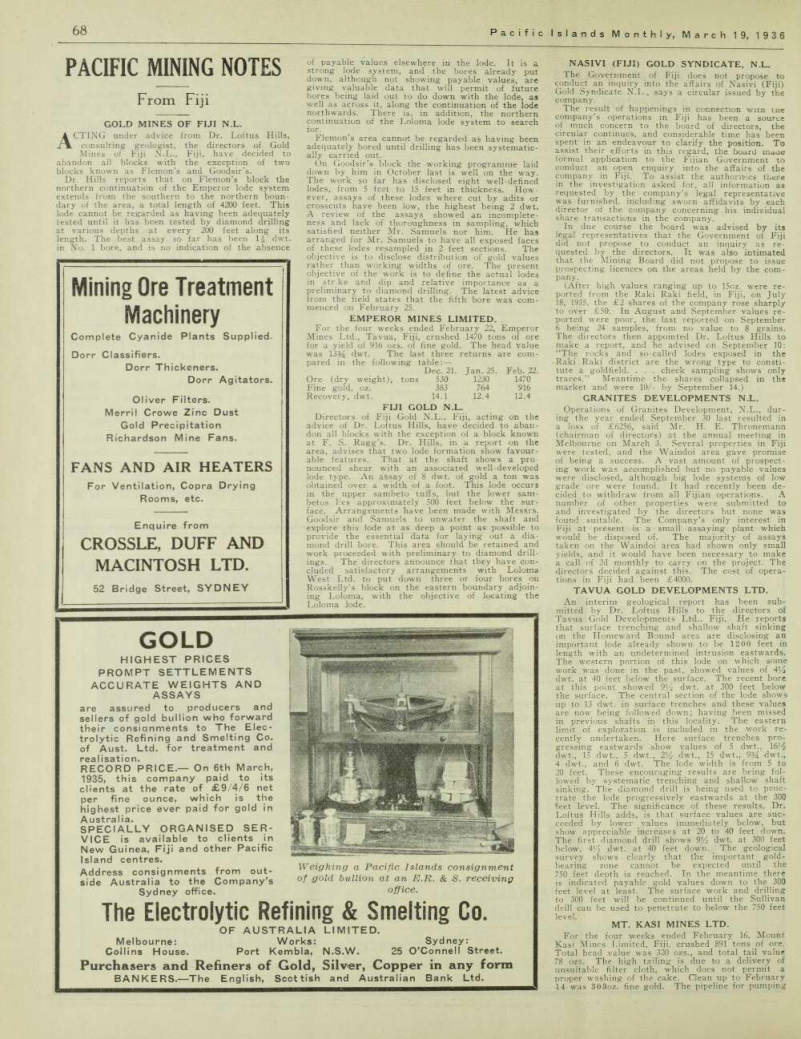
From Fiji
Gold Mines Of Fiji N.L.
ACTING under advice from Dr. Loftus Hills, consulting geologist, the directors of Gold Mines of Fiji N.L., Fiji, have decided to abandon ail blocks with the exception of two blocks known as Flemon’s and Goodsir’s.
Dr. Hills reports that on Flemon’s block the northern continuation of the Emperor lode system extends from the southern to the northern boun dary of the area, a total length of 4200 feet. This lode cannot be regarded as having been adequately tested until it has been tested by diamond drilling at various depths at every 200 feet along its length. The best assay so far has been li dwt. in No. 1 bore, and is no indication of the absence
of payable values elsewhere in the lode. It is a strong lode system, and the bores already put down, although not showing payable values, are giving valuable data that will permit of future bores being laid out to do down with the lode, as well as across it, along the continuation of the lode northwards. There is, in addition, the northern continuation of the Loloma lode system to search for.
Flemon’s area cannot be regarded as having been adequately bored until drilling has been systematic ally carried out.
On Goodsir’s block the working programme laid down by him in October last is well on the way.
The work so far has disclosed eight well-defined lodes, from 5 feet to 15 feet in thickness. How ever, assays of these lodes where cut by adits or crosscuts have been low, the highest being 2 dwt.
A review of the assays showed an incomplete ness and lack of thoroughness in sampling, which satisfied neither Mr. Samuels nor him. He has arranged for Mr. Samuels to have all exposed faces of these lodes resampled in 2 feet sections. The objective is to disclose distribution of gold values rather than working widths of ore. The present objective of the work is to define the actual lodes in strike and dip and relative importance as a preliminary to diamond drilling. The latest advice from the field states that the fifth bore was com menced on February 25.
Emperor Mines Limited.
For the four weeks ended February 22, Emperor Mines Ltd., Tavua, Fiji, crushed 1470 tons of ore for a yield of 916 ozs. of fine gold. The head value was 13H dwt. The last three returns are com pared in the following table:—
Fiji Gold N.L.
Directors of Fiji Gold N.L., Fiji, acting on the advice of Dr. Loftus Hills, have decided to aban don all blocks with the exception of a block known at F. S. Ragg’s. Dr. Hills, in a report on the area, advises that two lode formation show favour able features. That at the shaft shows a pro nounced shear with an associated well-developed lode type. An assay of 8 dwt. of gold a ton was obtained over a width of a foot. This lode occurs in the upper sambeto tuffs, but the lower sam betos lies approximately 500 feet below the sur face. Arrangements have been made with Messrs.
Goodsir and Samuels to unwater the shaft and explore this lode at as deep a point as possible to provide the essential data for laying out a dia mond drill bore. This area should be retained and work proceeded with preliminary to diamond drill ings. The directors announce that they have con cluded satisfactory arrangements with Loloma West Ltd. to put down three or four bores on Rosskelly’s block on the eastern boundary adjoin ing Loloma, with the objective of locating the Loloma lode.
Nasivi (Fiji) Gold Syndicate, N.L.
The Government of Fiji does not propose to conduct an inquiry into the affairs of Nasivi (Fiji) Gold Syndicate N.L., says a circular issued by the company.
The result of happenings in connection witn me company’s operations in Fiji has been a source of much concern to the board of directors, the circular continues, and considerable time has been spent in an endeavour to clarify the position. To assist their efforts in this regard, the board made formal application to the Fijian Government to conduct an open enquiry into the affairs of the company in Fiji. To assist the authorities there in the investigation asked for, all information as requested by the company’s legal representative was furnished, including sworn affidavits by each director of the company concerning his individual share transactions in the company.
In due course the board was advised by its legal representatives that the Government of Fiji did not propose to conduct an inquiry as re quested by the directors. It was also intimated that the Mining Board did not propose to issue prospecting licences on the areas held by the com pany. (After high values ranging up to 15oz. were re ported from the Raki Raki field, in Fiji, on July 18, 1935, the £2 shares of the company rose sharply to over £5O. In August and September values re ported were poor, the last reported on September 6 being 24 samples, from no value to 8 grains.
The directors then appointed Dr. Loftus Hills to make a report, and he advised on September 10: “The rocks and so-called lodes exposed in the ■ Raki Raki district are the wrong type to consti tute a goldfield. . . . check sampling shows only traces.” Meantime the shares collapsed in the market and were 10/- by September 14.)
Granites Developments N.L.
Operations of Granites Development, N.L., dur ing the year ended September 30 last resulted in a loss of £6256, said Mr. H. E. Thronemann (chairman of directors) at the annual meeting in Melbourne on March 3. Several properties in Fiji were tested, and the Waindoi area gave promise of being a success. A vast amount of prospect ing work was accomplished but no payable values were disclosed, although big lode systems of low grade ore were found. It had recently been de cided to withdraw from all Fijian operations. A number of other properties were submitted to and investigated by the directors but none was found suitable. The Company’s only interest in Fiji at present is a small assaying plant which w’ould be disposed of. The majority of assays taken on the Waindoi area had shown only small yields, and it would have been necessary to make a call of 2d monthly to carry on the project. The directors decided against this. The cost of opera tions in Fiji had been £4OOO.
Tavua Gold Developments Ltd.
An interim geological report has been sub mitted by Dr. Loftus Hills to the directors of Tavua Gold Developments Ltd., Fiji. He reports that surface trenching and shallow shaft sinking oti the Homeward Bound area are disclosing an important lode already shown to be 1200 feet in length with an undetermined intrusion eastwards.
The western portion of this lode on which some work was done in the- past, showed values of 4Jj dwt. at 40 feet below the surface. The recent bore at this point showed dwt. at 300 feet below the surface. The central section of the lode shows up to 13 dwt. in surface trenches and these values are now being followed down; having been missed in previous shafts in this locality. The eastern limit of exploration is included in the work re cently undertaken. Here surface trenches pro gressing eastwards show values of 5 dwt., dwt., 15 dwt., 5 dwt., 2 Yi dwt., 15 dwt., 9si dwt., 4 dwt., and 6 dwt. The lode width is from 5 to 20 feet. These encouraging results are being fol lowed by systematic trenching and shallow shaft sinking. The diamond drill is being used to pene trate the lode progressively eastwards at the 300 feet level. The significance of these results, Dr.
Loftus Hills adds, is that surface values are suc ceeded by lower values immediately below, but show appreciable increases at 20 to 40 feet down.
The first diamond drill shows dwt. at 300 feet below, dwt. at 40 feet down. The geological survey shows clearly that the important gold bearing zone cannot be expected until the 750 feet depth is reached. In the meantime there is indicated payable gold values down to the 300 feet level at least. The surface work and drilling to 300 feet will be continued until the Sullivan drill can be used to penetrate to below the 750 feet level.
Mt. Kasi Mines Ltd.
For the four weeks ended February 16, Mount Kasi Mines Limited, Fiji, crushed 891 tons of ore.
Total head value was 320 ozs., and total tail value 78 ozs. The high tailing is due to a delivery of unsuitable filter cloth, which does not permit a proper washing of the cake. Clean up to February 14 was 3030 z. fine gold. The pipeline for pumping
Dec. 21.
Jan. 25.
Feb. 22.
Ore (dry weight), tons 530 1230 1470 Fine gold, oz. 383 764 916 Recovery, dwt. 14.1 12.4 12.4
crude oil to the mine from the landing has cut down transport costs of crude oil in this sector by at least 80 per cent.
East Reefs Consolidated, N.L.
The legal manager of East Reefs Consolidated N.L. advises that directors of the company who have visited the Yanawai field, Fiji, consider that the following cable received in Melbourne on March 9 contains a very important development: “No. 3 tunnel to 39ft. No. 4 tunnel to 143 ft.
Underlay shaft full face of lode entered into; samples taken. Located source of float, samples taken.”
Granites Gold N.L.
Addressing shareholders of Granites Gold N.L., at the annual meeting in Melbourne on March 3, the chairman of directors (Mr. H. E. Thronemann) said the year had not been a successful one. A number of properties had been examined, but only three were worthy of further consideration—Bet Bet, Rathscar and Nandi (Fiji). Unsatisfactory crushings from the first two had caused their abandonment. The lastnamed had been taken from a closely associated company on a profit-sharing basis, but the deposits proved secondary and did not live down to any depth. At balancing date, cash in hand was £460. Since the close of the accounts refunds, call money and the sale of cer tain original plant from the Granites (Central Australia) had brought the total to £773.
Aloha Central Gold Mine N.L.
Mr. A. G. Campbell, mining engineer, who re cently visited Fiji in company with Mr. A. T.
Day, chairman of directors of Aloha Central Gold Mine, N.L., and inspected the company’s property, has submitted a preliminary report, with esti mates of the gold contents of ore reserves, and df the cost of plant for working the mine. The property is being examined by Mr. C. Dunlop, on behalf of an American group, which is desirous of tak’ng an interest in the field, and is in negotia tion with the directors for subscribing capital for development and further prospecting.
Fiji Mining Corporation, N.L.
An extraordinary meeting of Fiji Mining Cor poration N.L., held on March 13, sanctioned a resolution that the nominal capital be increased from £11,250 to £60,000 by raising the amount of the existing 2,250 shares from £5 to £lO each and by creating 3,750 new shares of £lO each. Of the new shares it is proposed to issue 1,200 as fully paid to the vendor in terms of an agreement, and to offer 2,250 shares for subscription by share holders on the basis of one new share for each share held, payable £1 on application, £1 on allotment, and the balance in calls as required.
The remaining 300 shares are to be held in re serve. Directors state that with the limited funds at its disposal the company has been somewhat hampered in the work of developing the pros pecting licence near Tavua, Fiji, held under option, but the exercise of the option over the balance of the shares comprised in the original capital of the company and the issue of portion of the new shares proposed to be created will provide the necessary funds to complete the purchase of the area and equip the mine for intensive development. The general manager (Mr. D. M. Deane) states that the company’s area covers 305 acres and it situ ated about a mile and a half in the north-easterly direction from the Emperor and Loloma mines.
Prospecting on the lease has revealed two main lode channels, striking approximately north-west and south-east, with a slight southerly dip.
Advertisements & other items, p. 70 (1 item)
Machinery
Mining Ore Treatment
Complete Cyanide Plants Supplied- Dorr Classifiers.
Dorr Thickeners.
Dorr Agitators.
Oliver Filters.
Merril Crowe Zinc Dust Gold Precipitation Richardson Mine Fans.
FANS AND AIR HEATERS
For Ventilation, Copra Drying Rooms, etc.
Enquire from
CROSSLE, DUFF AND
MACINTOSH LTD.
52 Bridge Street, SYDNEY
GOLD
HIGHEST PRICES
PROMPT SETTLEMENTS
ACCURATE WEIGHTS AND
ASSAYS
are assured to producers and sellers of gold bullion who forward their consignments to The Electrolytic Refining and Smelting Co. of Aust. Ltd. for treatment and realisation.
RECORD PRICE.— On 6th March, 1935, this company paid to its clients at the rate of £9/4/6 net per fine ounce, which is the highest price ever paid for gold in Australia.
SPECIALLY ORGANISED SER-
VICE is available to clients in New Guinea, Fiji and other Pacific Island centres.
Address consignments from outside Australia to the Company’s Sydney office.
Weighing a Pacific Islands consignment of gold bullion at an E.R. & 8. receiving office.
The Electrolytic Refining & Smelting Co.
OF AUSTRALIA LIMITED.
Melbourne: Works: Sydney: Collins House. Port Kembla, N.S.W. 25 O’Connell Street.
Purchasers and Refiners of Gold, Silver, Copper in any form BANKERS.—The English, Scottish and Australian Bank Ltd.
From Papua
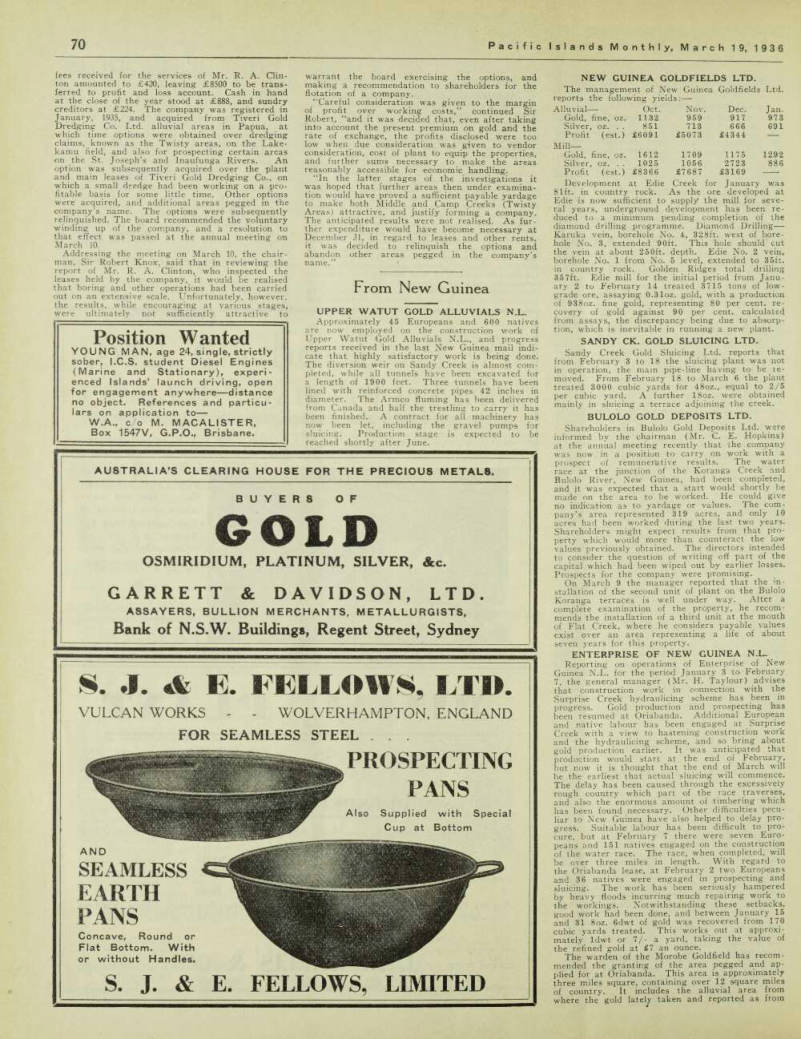
Mandated Alluvials, N.L.
Speaking at a special meeting of Mandated Alluvials, Xo Liability, held in Svdney on March 9 u * chairnian ( Dr -. William Wood) said that the directors had decided to concentrate on the Port Moresby mine, as prospects there were re garded as particularly bright. This mine, which was situated 16 r /£ miles from Port Moresby, con sisted of two leases—the Sapphire Lease of 30 acres, and the Moresby King Lease of 20 acres— wv j an additional area of 50 acres had been ap phed for. Developments to date had not been sufficient to permit of any very definite estimate of ore reserves, but the directors had been strengthened in the conviction that they had an exceedingly valuable mine. Twenty-nine bulk samples taken gave an average of 16dwt. 20gr. of gold and 15 per cent, of copper. The directors had decided to exercise their option and purchase the mine, and to embark on a policy of immediate and extensive development.
Cuthbert’S Misima Goldmine Ltd.
The secretary of Cuthbert’s Misima Goldmine Lunited reported on March 6 that the last clean up (February 23) showed that 1630 tons of ore had been treated for 2,336 ounces bullion. The esti mated value was £4,274. During the period the
mill worked three shifts on 25 days, and two shifts on one day.
Misima Gold Reefs (N.G.), N.L.
Oroville Dredging Ltd., the big English concern, intends to exercise the option of purchase over the property of Misima Gold Reefs (New Guinea) N.L., Misima Island, Papua. Although the agree ments have yet to be signed, the attorney of the company in Sydney has notified Misima Gold Reefs to this effect. It is intended to form a company, probably in Australia, with a nominal capital of £lOO,OOO, in £1 shares, of which 40,000 contributing shares will be offered for subscrip tion and underwritten by the Oroville Company; 20,000 fully paid will be allotted to Misima Gold Reefs, and 40,000 fully paid to the Oroville com pany. The latter company will also pay to Mr.
J. A. Miller, vendor of two of the leases, £l5OO.
Nominal capital of Misima Gold Reefs (New Guinea) N.L. is £4500, in 900 shares of £5 each, fully paid, and the consideration is equal to 22 fully paid shares for each share held. The pro perty comprises ten leases, aggregating 198 acres.
Oroville Dredging Ltd. has carried out extensive prospecting and developmental work on the pro perty, at a cost of £20,000. A large main lode 20 feet in width has been proved for a considerable
length, also two small parallel lodes. Approxi mately 46,000 tons of ore of an average grade of 5.8 dwt. a ton, has been proved to date. Attention is now being directed to another lode 6 to 7 feet wide, and values disclosed indicate additional ton nage. The Oroville company intends to instal an efficient plant, at a cost of not less than £30.000. on the property. The new company, it is expected, will be formed within the next three months.
Shareholders of Misima Gold Reefs, a.t an ad journed special meeting on March 2, endorsed the action of the directors in entering into the ar rangement with the Oroville Company.
Pacific Iron Ore Deposits N.L.
Application has been made to register Pacific Iron Ore Deposits N.L., which is being formed with a nominal capital of £1,250, divided into shares of £2/10/- each, to carry out mining operations at Port Moresby, Papua. Mr. H. P.
Lockwood, of 360 Collins Street. Melbourne, is legal manager of the company.
Lakekamu Goldfields Development,
No Liability
Expenditure of Lakekamu Goldfields (Papua) Development N.L. on development account for the twelve months ended January 23 was £8920, and
fees received for the services of Mr. R. A. Clin ton amounted to £420, leaving £B5OO to be trans ferred to profit and loss account. Cash in hand at the close of the year stood at £BBB, and sundry creditors at £224. The company was registered in January, 1935, and acquired from Tiveri Gold Dredging Co. Ltd. alluvial areas in Papua, at which time options were obtained over dredging claims, known as the Twisty areas, on the Lake kamu field, and also for prospecting certain areas on the St. Joseph’s and Inaufunga Rivers. An option was subsequently acquired over the plant and main leases of Tiveri Gold Dredging Co., on which a small dredge had been working on a pro fitable basis for some little time. Other options were acquired, and additional areas pegged in the company’s name. The options were subsequently relinquished. The board recommended the voluntary winding up of the company, and a resolution to that effect was passed at the annual meeting on March 10.
Addressing the meeting on March 10, the chair man, Sir Robert Knox, said that in reviewing the report of Mr. R. A. Clinton, who inspected the leases held by the company, it would be realised that boring and other operations had been carried out on an extensive scale. Unfortunately, however, the results, while encouraging at various stages, were ultimately not sufficiently attractive to
warrant the board exercising the options, and making a recommendation to shareholders for the flotation of a company.
“Careful consideration was given to the margin of profit over working costs,” continued Sir Robert, “and it was decided that, even after taking into account the present premium on gold and the rate of exchange, the profits disclosed were too low when due consideration was given to vendor consideration, cost of plant to equip the properties, and further sums necessary to make the areas reasonably accessible for economic handling.
“In the latter stages of the investigations it was hoped that further areas then under examina tion would have proved a sufficient payable yardage to make both Middle and Camp Creeks (Twisty Areas) attractive, and justify forming a company.
The anticipated results were not realised. As fur ther expenditure would have become necessary at December 31, in regard to leases and other rents, it was decided to relinquish the options and abandon other areas pegged in the company’s name.”
Advertisements & other items, pp. 71-72 (1 item)
A. E. Goodwin Ltd.
PIPE and WELDING SPECIALISTS
RAILWAY PARADE, LIDCOMBE, N.S.W. Tei. ux 7941. m A 33 Consult us now for your next Installation. We are suppliers of all kinds of Fabricated Lines, for Steam, Air, Oil, or Water, Liquids, semi- Solids, Vapours, etc. * 14 in. Expansion Bend, fabricated for Aust.
Iron and Steel Ltd., Port Kembla, N.S.W.
m\l\G PLAIT
Portable Batteries, Fixed Batteries, Tube and Ball Mills, Shoes and Dies, Screens, Copper Plates, Trucks, Challenge Ore Feeders, Rock Crushers, Cyanide Tanks, Pipe Lines, Pumps
PROSPECTING PLANT
Casing, Drilling Tools, Engine Rigs, Sampling Gear, Pumps, Wire Ropes, etc.
DREDGING PLANT
Large or Small Designed and Built Agents for HADFIELD’S Manganese Steel Buckets, Tumblers, Gears, Carbon and Alloy Steels
J. B. WALLIS & CO.
CHALLIS HOUSE SYDNEY
Position Wanted
YOUNG MAN, age 24, single, strictly sober, I.C.S. student Diesel Engines (Marine and Stationary), experienced Islands* launch driving, open for engagement anywhere—distance no object. References and particulars on application to —
W.A., c o M. MACALISTER,
Box 1547 V, G.P.0., Brisbane.
AUSTRALIA’S CLEARING HOUSE FOR THE PRECIOUS METALS.
BUYERS OF
GOLD
OSMIRIDIUM, PLATINUM, SILVER, &c.
GARRETT & DAVIDSON, LTD.
ASSAYERS, BULLION MERCHANTS, METALLURGISTS,
Bank of N.S.W. Buildings, Regent Street, Sydney
S. J. A E. FELLOWS, LTD.
VULCAN WORKS - - WOLVERHAMPTON, ENGLAND
FOR SEAMLESS STEEL , . .
AND
SEAMLESS
EARTH
PANS
Concave, Round or Flat Bottom. With or without Handles.
PROSPECTING
PANS
Also Supplied with Special Cup at Bottom
S. J. & E. FELLOWS, LIMITED
From New Guinea
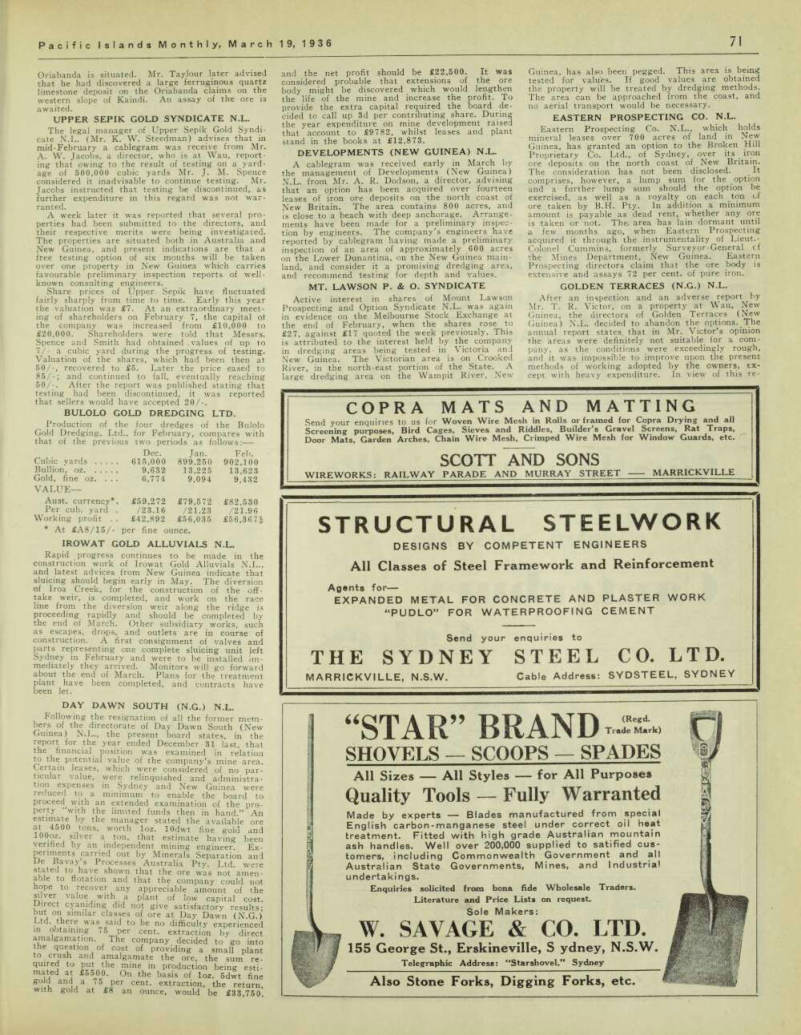
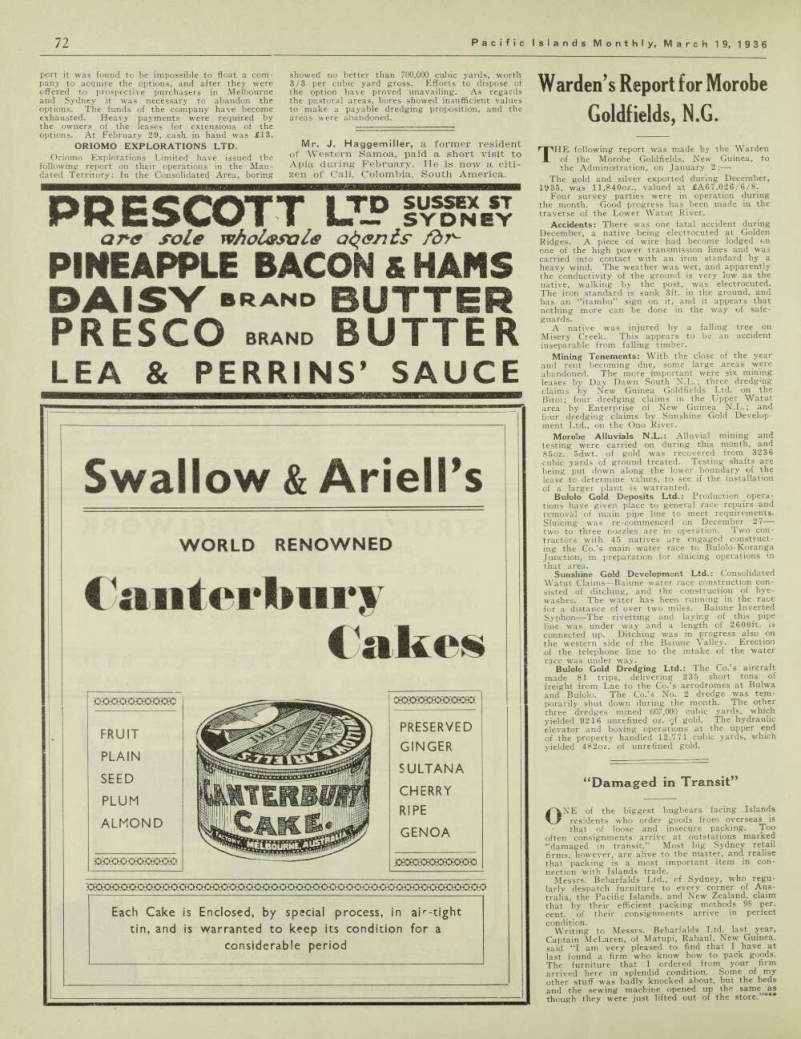
Upper Watut Gold Alluvials N.L.
Approximately 45 Europeans and 600 natives are now employed on the construction work of Upper Watut Gold Alluvials N.L., and progress reports received in the last New Guinea mail indi cate that highly satisfactory work is being done.
The diversion weir on Sandy Creek is almost com pleted, while all tunnels have been excavated for a length of 1900 feet. Three tunnels have been lined with reinforced concrete pipes 42 inches in diameter. The Armco fluming has been delivered from Canada and half the trestling to carry it has been finished. A contract for all machinery has now been let, including the gravel pumps for sluicing. Production stage is expected to be reached shortly after June.
New Guinea Goldfields Ltd.
The management of New Guinea Goldfields Ltd. reports the following yields:—
Development at Edie Creek for January was 81ft. in country rock. As the ore developed at Edie is now sufficient to supply the mill for seve ral years, underground development has been re duced to a minimum pending completion of the diamond drilling programme. Diamond Drilling— Karuka vein, borehole No. 4,328 ft. west of bore hole No. 3, extended 90ft. This hole should cut the vein at about 250 ft. depth. Edie No. 2 vein, borehole No. 1 from No. 5 level, extended to 35ft. in country rock. Golden Ridges total drilling 357 ft. Edie mill for the initial period from Janu ary 2 to February 14 treated 3715 tons of low grade ore, assaying 0.3 loz. gold, with a production of 9380 z. fine gold, representing 80 per cent, re covery of gold against 90 per cent, calculated from assays, the discrepancy being due to absorp tion, which is inevitable in running a new plant.
Sandy Ck. Gold Sluicing Ltd.
Sandy Creek Gold Sluicing Ltd. reports that from February 3 to 18 the sluicing plant was not in operation, the mam pipe-line having to be le moved. From February 18 to March 6 the plant treated 3000 cubic yards for 480 z., equal to 2/5 per cubic yard. A further 18oz. were obtained mainly in sluicing a terrace adjoining the creek.
Bulolo Gold Deposits Ltd.
Shareholders in Bulolo Gold Deposits Ltd. were informed by the chairman (Mr. C. E. Hopkins) at the annual meeting recently that the company was now in a position to carry on work with a prospect of remunerative results. The water race at the junction of the Koranga Creek and Bulolo River, New Guinea, had been completed, and it was expected that a start would shortly be made on the area to be worked. He could give no indication as to yardage or values. The com pany’s area represented 319 acres, and only 10 acres had been worked during the last two years.
Shareholders might expect results from that pro perty which would more than counteract the low values previously obtained. The directors intended to consider the question of writing off part of the capital which had been wiped out by earlier losses.
Prospects for the company were promising.
On March 9 the manager reported that the in stallation of the second unit of plant on the Bulolo Koranga terraces is well under way. After a complete examination of the property, he recom mends the installation of a third unit at the mouth of Flat Creek, where he considers payable values exist over an area representing a life of about seven years for this property.
Enterprise Of New Guinea N.L.
Reporting on operations of Enterprise of New Guinea N.L. for the period January 3 to February 7, the general manager (Mr. H. Taylour) advises that construction work in connection with the Surprise Creek hydraulicing scheme has been in progress. Gold production and prospecting has been resumed at Oriabanda. Additional European and native labour has been engaged at Surprise Creek with a view to hastening construction work and the hydraulicing scheme, and so bring about gold production earlier. It was anticipated that production would start at the end of February, but now it is thought that the end of March will be the earliest that actual sluicing will commence.
The delay has been caused through the excessively rough country which part of the race traverses, and also the enormous amount of timbering which has been found necessary. Other difficulties pecu liar to New Guinea have also helped to delay pro gress. Suitable labour has been difficult to pro cure, but at February 7 there were seven Euro peans and 151 natives engaged on the construction of the water race. The race, when completed, will be over three miles in length. With regard to the Oriabanda lease, at February 2 two Europeans and 36 natives were engaged in prospecting and sluicing. The work has been seriously hampered by heavy floods incurring much repairing work to the workings. Notwithstanding these setbacks, good work had been done, and between January 15 and 31 Boz. 6dwt of gold was recovered from 170 cubic yards treated. This works out at approxi mately Idwt or 7/- a yard, taking the value of the refined gold at £7 an ounce.
The warden of the Morobe Goldfield has recom mended the granting of the area pegged and ap plied for at Oriabanda. This area is approximately three miles square, containing over 12 square miles of country. It includes the alluvial area from where the gold lately taken and reported as from
Alluvial— Oct.
Nov.
Dec.
Jan.
Gold, fine, oz. 1132 959 917 973 Silver, oz. . . 851 713 666 691 Profit (est.) £6091 £5073 £4344 — Mill- Gold, fine, oz. 1612 1709 1175 1292 Silver, oz. . . 1025 1056 2723 886 Profit (est.) £8366 £7687 £3169 —
Oriabanda is situated. Mr. Taylour later advised that he had discovered a large ferruginous quartz limestone deposit on the Oriabanda claims on the western slope of Kaindi. An assay of the ore is awaited.
Upper Sepik Gold Syndicate N.L.
The legal manager of Upper Sepik Gold Syndi cate N.L. (Mr. K. W. Steedman) advises that in mid-February a cablegram was receive from Mr.
A. W. Jacobs, a director, who is at Wau, report ing that owing to the result of testing on a yard age of 500,000 cubic yards Mr. J. M. Spence considered it inadvisable to continue testing. Mr.
Jacobs instructed that testing be discontinued, as further expenditure in this regard was not war ranted.
A week later it was reported that several pro perties had been submitted to the directors, and their respective merits were being investigated.
The properties are situated both in Australia and New Guinea, and present indications are that a free testing option of six months will be taken over one property in New Guinea which carries favourable preliminary inspection reports of well known consulting engineers.
Share prices of Upper Sepik have fluctuated fairly sharply from time to time. Early this year the valuation was £7. At an extraordinary meet ing of shareholders on February 7, the capital of the company was increased from £lO,OOO to £20,000. Shareholders were told that Messrs.
Spence and Smith had obtained . values of up to 7/- a cubic yard during the progress of testing.
Valuation of the shares, which had been then at 50/-, recovered to £5. Later the price eased to 85/-; and continued to fall, eventually reaching 50/-. After the report was published stating that testing had been discontinued, it was reported that sellers would have accepted 20/-,
Bulolo Gold Dredging Ltd.
Production of the four dredges of the Bulolo Gold Dredging, Ltd., for February, compares with that of the previous two periods as follows:
Irowat Gold Alluvials N.L.
Rapid progress continues to be made in the construction work of Irowat Gold Alluvials N.L., and latest advices from New Guinea indicate that sluicing should begin early in May. The diversion of Iroa Creek, for the construction of the off take weir, is completed, and work on the race line from the diversion weir along the ridge is proceeding rapidly and should be completed by the end of March. Other subsidiary works, such as escapes, drops, and outlets are in course of construction. A first consignment of valves and parts representing one complete sluicing unit left Sydney in February and were to be installed im mediately they arrived. Monitors will go forward about the end of March. Plans for the treatment plant have been completed, and contracts have been let.
Day Dawn South (N.G.) N.L.
Following the resignation of all the former mem bers of the directorate of Day Dawn South (New Guinea) N.L., the present board states, in the report for the year ended December 31 last, that the financial position was examined in relation to the potential value of the company’s mine area.
Certain leases, which were considered of no par ticular value, were relinquished and administra tion expenses in Sydney and New Guinea were reduced to a minimum to enable the board to with an extended examination of the pro perty “with the limited funds then in hand.” An estimate by the manager stated the available ore at 4 5° 0 tons, worth loz. lOdwt fine gold and !°ooz silver a ton. that estimate having been verified by an independent mining engineer. Ex periments carried out by Minerals Separation and De Bavay s Processes Australia Pty. Ltd. were stated to have shown that the ore was not amen able to flotation and that the company could not hope to recover any appreciable amount of the silver value with a plant of low capital cost.
Direct cyanidmg did not give satisfactory results but on similar classes of ore at Day Dawn (N.G.) Ltd. there was said to be no difficulty experienced in obtaining 75 per cent, extraction by direct amalgamation. The company decided to go into the question of cost of providing a small plant to crush and amalgamate the ore, the sum re quired to put the mine in production being esti mated at £5500. On the basis of loz. 6dwt fine gold and a 75 P er ce nt. extraction, the return, with gold at £8 an ounce, would be £33,750,
and the net profit should be £22,500. It was considered probable that extensions of the ore body might be discovered which would lengthen the life of the mine and increase the profit. To provide the extra capital required the board de cided to call up 3d per contributing share. During the year expenditure on mine development raised that account to £9782, whilst leases and plant stand in the books at £12,873.
Developments (New Guinea) N.L.
A cablegram was received early in March by the management of Developments (New Guinea) N.L. from, Mr. A. R. Dodson, a director, advising that an option has been acquired over fourteen leases of iron ore deposits on the north coast of New Britain. The area contains 800 acres, and is close to a beach with deep anchorage. Arrange ments have been made for a preliminary inspec tion by engineers. The company’s engineers have reported by cablegram having made a preliminary inspection of an area of approximately 600 acres on the Lower Dunantina, on the New Guinea main land, and consider it a promising dredging area, and recommend testing for depth and values.
Mt. Lawson P. & O. Syndicate
Active interest in shares of Mount Lawson Prospecting and Option Syndicate N.L. was again in evidence on the Melbourne Stock Exchange at the end of February, when the shares rose to £27, against £l7 quoted the week previously. This is attributed to the interest held by the company in dredging areas being tested in Victoria and New Guinea. The Victorian area is on Crooked River, in the north-east portion of the State. A large dredging area on the Wampit River, New
Guinea, has also been pegged. This area is being tested for values. If good values are obtained the property will be treated by dredging methods.
The area can be approached from the coast, and no aerial transport would be necessary.
Eastern Prospecting Co. N.L.
Eastern Prospecting Co. N.L., which holds mineral leases over 700 acres of land in New Guinea, has granted an option to the Broken Hill Proprietary Co. Ltd., of Sydney, over its iron ore deposits on the north coast of New Britain.
The consideration has not been disclosed. It comprises, however, a lump sum for the option and a further lump sum should the option be exercised, as well as a royalty on each ton of ore taken by B.H. Pty. In addition a minimum amount is payable as dead rent, whether any ore is taken or not. The, area has lain dormant until a few months ago, when Eastern Prospecting acquired it through the instrumentality of Lieut.- Colonel Cummins, formerly Surveyor-General cf the Mines Department, New Guinea. Eastern Prospecting directors claim that the ore body is extensive and assays 72 per cent, of pure iron.
Golden Terraces (N.G.) N.L.
After an inspection and an adverse report by Mr. T. R. Victor, on a property at Wau, New Guinea, the directors of Golden Terraces (New Guinea) N.L. decided to abandon the options. The annual report states that in Mr. Victor’s opinion the areas were definitely not suitable for a com pany, as the conditions were exceedingly rough, and it was impossible to improve upon the present methods of working adopted by the owners, ex cept with heavy expenditure. In view of this re
Dec. Jan. Feb.
Cubic yards 615,000 899,250 902,100 Bullion, oz 9,632 13,225 13,623 Gold, fine oz. ... 6,774 9,094 9,432
Value—
Aust. currency*. £59,272 £79,572 £82,530 Per cub. yard . /23.16 /21.23 /21.96 Working profit . . £42,892 £56,035 £56,367J * At £A8/15/- per fine ounce.
port it was found to be impossible to float a com pany to acquire the options, and after, they were offered to prospective purchasers in Melbourne and Sydney it was necessary to abandon the options. The funds of the company have become exhausted. Heavy payments were required by the owners of the leases for extensions of the options. At February 29, cash in hand was £l3.
Oriomo Explorations Ltd.
Oriomo Explorations Limited have issued the following report on their operations in the Man dated Territory: In the Consolidated Area, boring
showed no better than 700,000 cubic yards, worth 3/3 per cubic yard gross. Efforts to dispose of the option have proved unavailing. As regards the pastoral areas, bores showed insufficient values to make a payable dredging proposition, and the areas were abandoned.
Mr. J. Haggemiller, a former resident of Western Samoa, paid a short visit to Apia during February. He is now a citi zen of Cali, Colombia, South America.
Advertisements & other items, pp. 73-74 (1 item)
“Star” Brand -Ss-
COPRA MATS AND MATTING
Send your enquiries to us for Woven Wire Mesh in Rolls or framed for Copra Drying and all Screening purposes. Bird Cages, Sieves and Riddles, Builder’s Gravel Screens, Rat Traps, Door Mats, Garden Arches, Chain Wire Mesh, Crimped Wire Mesh for Window Guards, etc.
SCOTT AND SONS
WIREWORKS: RAILWAY PARADE AND MURRAY STREET MARRICKVILLE
STRUCTURAL STEELWORK
DESIGNS BY COMPETENT ENGINEERS
All Classes of Steel Framework and Reinforcement Agents for— EXPANDED METAL FOR CONCRETE AND PLASTER WORK
“PUDLO” FOR WATERPROOFING CEMENT
Send your enquiries to
THE SYDNEY STEEL CO. LTD.
MARRICKVILLE, N.S.W. Cable Address: SYDSTEEL, SYDNEY
“STAR” BRAND -ss-
SHOVELS SCOOPS SPADES
All Sizes All Styles for All Purposes
Quality Tools Fully Warranted
Made by experts Blades manufactured from special English carbon - manganese steel under correct oil heat treatment. Fitted with high grade Australian mountain ash handles. Well over 200,000 supplied to satified customers, including Commonwealth Government and all Australian State Governments, Mines, and Industrial undertakings.
Enquiries solicited from bona fide Wholesale Traders.
Literature and Price Lists on request.
Sole Makers:
W. SAVAGE & CO. LTD.
155 George St., Erskineville, S ydney, N.S.W.
Telegraphic Address: “Starshovel," Sydney
Also Stone Forks, Digging Forks, etc.
PRESCOTT L T J? .saw?
are sole wholesale agents
PINEAPPLE BACON HAMS
DAISY BRAND BUTTER
FRESCO BRAND BUTTER
LEA & PERRINS’ SAUCE
Swallow & Ariell’s
WORLD RENOWNED
Canterbury
Cakes
Each Cake is Enclosed, by special process, in ai r -tight tin, and is warranted to keep its condition for a considerable period
Goldfields, N.G.
Warden’s Report for Morobe Goldfields, N.G.
THE following report was made by the Warden of the Morobe Goldfields, New Guinea, to the Administration, on January 2; — The gold and silver exported during December, 1935, was 11,8400 z., valued at £A67,026/6/8.
Four survey parties were in operation during the month. Good progress has been made in the traverse of the Lower Watut River.
Accidents: There was one fatal accident during December, a native being electrocuted at Golden Ridges. A piece of wire had become lodged on one of the high power transmission lines and was carried into contact with an iron standard by a heavy wind. The weather was wet, and apparently the conductivity of the ground is very low as the native, walking by the post, was electrocuted.
The iron standard is sunk 3ft. in the ground, and has an “itambu” sign on it, and it appears that nothing more can be done in the way of safe guards.
A native was injured by a falling tree on Misery Creek. This appears to be an accident inseparable from falling timber.
Mining Tenements: With the close of the year and rent becoming due, some large areas were abandoned. The more important were six mining leases by Day Dawn South N.L.; three dredgmg claims by New Guinea Goldfields Ltd. on the Bitoi; four dredging claims in the Upper Watut area by Enterprise of New Guinea N.L.; and four dredging claims by Sunshine Gold Develop ment Ltd., on the Ono River.
Morobe Alluvials N.L.: Alluvial mining and testing were carried on during this month, and 85oz. sdwt. of gold was recovered from 3236 cubic yards of ground treated. Testing shafts are being put down along the lower boundary of the lease to determine values, to see if the installation of a larger plant is warranted.
Bulolo Gold Deposits Ltd.: Production opera tions have given place to general race repairs and removal of main pipe line to meet requirements.
Sluicing was re-commenced on December 27 — two to three nozzles are in operation. Two con tractors with 45 natives are engaged construct ing the Co.’s main water race to Bulolo-Koranga Junction, in preparation for sluicing operations in that area.
Sunshine Gold Development Ltd.: Consolidated Watut Claims —Baiune water race construction con sisted of ditching, and the construction of bye washes. The water has been running in the race for a distance of over two miles. Baiune Inverted Syphon—The rivetting and laying of this pipe line was under way and a length of 2600 ft. is connected up. Ditching was in progress also on the western side of the Baiune Valley. Erection of the telephone line to the intake of the water race was under way.
Bulolo Gold Dredging Ltd.: The Co.’s aircraft made 81 trips, delivering 235 short tons of freight from Lae to the Co.’s aerodromes at Bulwa and Bulolo. The Co.’s No. 2 dredge was tem porarily shut down during the month. The other three dredges mined 607,000 cubic yards, which yielded 9216 unrefined oz. gf gold. The hydraulic elevator and boxing operations at the upper end of the property handled 12,771 cubic yards, which yielded 4 82oz. of unrefined gold.
“Damaged in Transit”
ONE of the biggest bugbears facing Islands res : dents who order goods from overseas is that of loose and insecure packing. Too often consignments arrive at outstations marked “damaged in transit.” Most big Sydney retail firms, however, are alive to the matter, and realise that packing is a most important item in con nection with Islands trade.
Messrs. Bebarfalds Ltd., of Sydney, who regu larly despatch furniture to every corner of Aus tralia, the Pacific Islands, and New Zealand, claim that by their efficient packing methods 95 per. cent, of their consignments arrive in perfect condition.
Writing to Messrs. Bebarfalds Ltd. last year.
Captain McLaren, of Matupi, Rabaul, New Guinea, said “I am very pleased to find that I have at last found a firm who know how to pack goods.
The furniture that I ordered from your firm arrived here in splendid condition. Some of my other stuff was badly knocked about, but the beds and the sewing machine opened up the same as though they were just lifted out of the store.
Shares
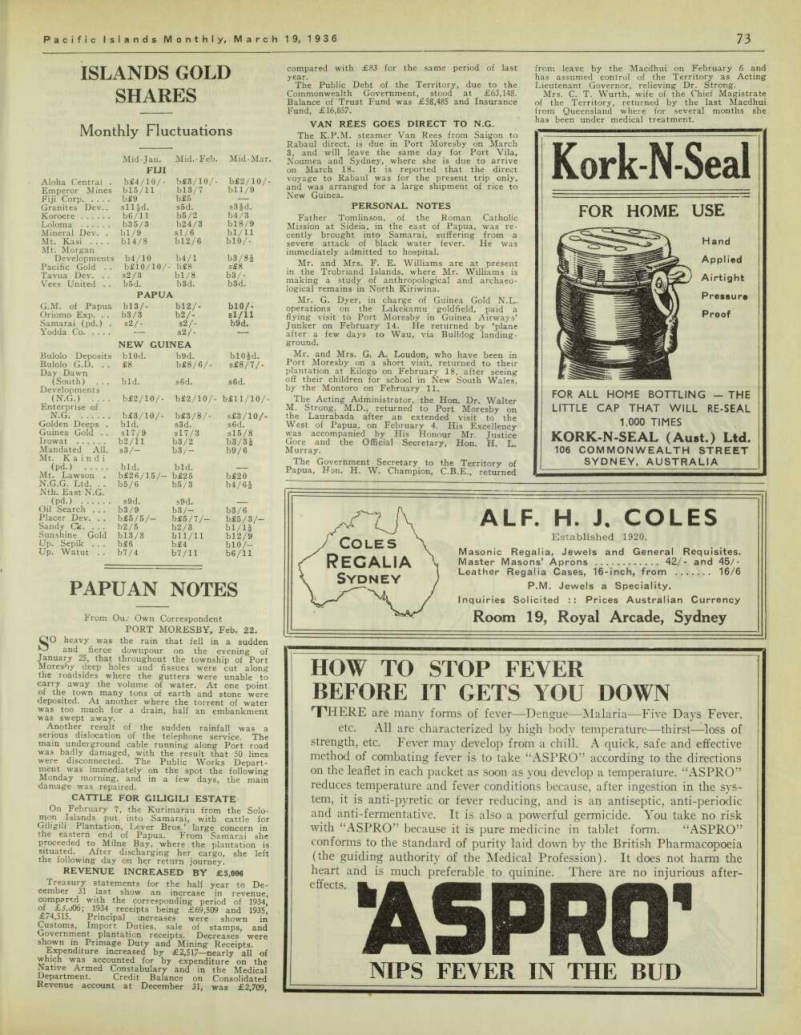
Islands Gold
Monthly Fluctuations
Mid-Jan.
Mid.-Feb.
Mid-Mar.
Aloha Central .
Fiji
b£4/10/b£3/10/b£2/10/- Emperor Mines bl5/ll bl3/7 bll/9 Fiji Corp b£9 b£5 — Granites Dev.. si 1 id. s5d. s3Jd.
Koroere b6/l 1 b5/2 b4/3 Loloma b35/3 b24/3 bl8/9 Mineral Dev. . bl/9 sl/6 bl/11 Mt. Kasi bl4/8 bl2/6 blO/- Mt. Morgan Developments b4/10 b4/l b3/8| Pacific Gold . . b£10/I0/ ■ b£8 s£8 Tavua Dev. . . s2/3 bl/8 b3/- Vees United . . b5d. b3d. b3d.
G.M. of Papua
Papua
bl3/- bl2/blO/- Oriomo Exp. . . b3/3 b2/sl/11 Samarai (pd.) . s2/s2/b9d.
Yodda Co s2/- — Bulolo Deposits
New Guinea
blOd. b9d. blOid.
Bulolo G.D. . . £8 b£8/6/s£8/7/- Day Dawn (South) bid. s6d. s6d.
Developments (N.G.) ... b£2/10/b£2/10/b£ll/10/- Enterprise of N.G b£3/10/b£3/8/s£3/10/- Golden Deeps . bid. s3d. s6d.
Guinea Gold . . sl7/9 sl7/3 sl5/8 Irowat b2/ll b3/2 b3/3i Mandated All. s3/— b3/b9/6 Mt. K a i n d i (pd.) bid. bld.
Mt. Lawson . b£26/15/— b£25 b£20 N.G.G. Ltd. . . b5/6 b5/3 b4/6J Nth. East N.G. (pd.) s9d. s9d.
Oil Search . . . b3/9 b3/— b3/6 Placer Dev. . . b£5/5/— b£5/7/— b£5/3/— Sandy Ck. . . . b2/5 b2/3 bl/li Sunshine Gold bl3/3 bll/11 bl2/9 Up. Sepik . . . b£6 b£4 blO/— Up. Watut . . b7/4 b7/ll b6/ll
Papuan Notes
From Our Own Correspondent
Port Moresby, Feb. 22.
CO heavy was the rain that fell in a sudden kJ and fierce downpour on the evening of January 25, that throughout the township of Port Moresby deep holes and tissues were cut along the roadsides where the gutters were unable to carry away the volume of water. At one point of the town many tons of earth and stone were deposited. At another where the torrent of water was too much for a drain, half an embankment was swept away.
Another result of the sudden rainfall was a serious dislocation of the telephone service. The main underground cable running along Port road was badly damaged, with the result that 50 lines were disconnected. The Public Works Depart ment was immediately on the spot the following Monday morning, and in a few days, the main damage was repaired.
Cattle For Giligili Estate
On February 7, the Kurimarau from the Solo mon Islands put into Samarai, with cattle for Giligili Plantation, Lever Bros.* large concern in the eastern end of Papua. From Samarai she proceeded to Milne Bay, where the plantation is situated. After discharging her cargo, she left the following day on her return journey,
Revenue Increased By £5,006
Treasury statements for the half year to De cember 31 last show an increase in revenue, compar-td with the corresponding period of 1934, of £3,j°6; 1934 receipt s being £69,509 and 1935, £74,515. Principal increases were shown in Customs, Import Duties, sale of stamps, and Government plantation receipts. Decreases were shown in Primage Duty and Mining Receipts.
Expenditure increased by £2,sl7—nearly all of which was accounted for by expenditure on the Native Armed Constabulary and in the Medical Department. Credit Balance on Consolidated Revenue account at December 31, was £2,709
compared with £B3 for the same period of last year.
The Public Debt of the Territory, due to the Commonwealth Government, stood at £63,148.
Balance of Trust Fund was £58,485 and Insurance Fund, £16,857.
Van Rees Goes Direct To N.G.
The K.P.M. steamer Van Rees from Saigon to Rabaul direct, is due in Port Moresby on March 3, and will leave the same day for Port Vila, Noumea and Sydney, where she is due to arrive on March 18. It is reported that the direct voyage to Rabaul was for the present trip only, and was arranged for a large shipment of rice to New Guinea.
Personal Notes
Father Tomlinson, of the Roman Catholic Mission at Sideia, in the east of Papua, was re cently brought into Samarai, suffering from a severe attack of black water fever. He was immediately admitted to hospital.
Mr. and Mrs. F. E. Williams are at present in the Trobriand Islands, where Mr. Williams is making a study of anthropological and archaeo logical remains in North Kiriwina.
Mr. G. Dyer, in charge of Guinea Gold N.L. operations on the Lakekamu goldfield, paid a flying visit to Port Moresby in Guinea Airways’
Junker on February 14. He returned by 'plane after a few days to Wau, via Bulldog landing ground.
Mr. and Mrs. G. A. Loudon, who have been in Port Moresby on a short visit, returned to their plantation at Eilogo on February 18, after seeing off their children for school in New South Wales, by the Montoro on February 11.
The Acting Administrator, the Hon. Dr. Walter M. Strong, M.D., returned to Port Moresby on the Laurabada after an extended visit to the West of Papua, on February 4. His Excellency was accompanied by His Honour Mr. Justice Gore and the Official Secretary, Hon. H. L.
Murray.
The Government Secretary to the Territory of Papua, Hon. H. W. Champion, C.8.E., returned
from leave by the Macdhui on February 6 and has assumed control of the Territory as Acting Lieutenant Governor, relieving Dr. Strong.
Mrs. C. T. Wurth, wife of the Chief Magistrate of the Territory, returned by the last Macdhui from Queensland where for several months she has been under medical treatment.
Advertisements & other items, pp. 75-76 (2 items)
Kork-N-Seal
FOR ALL HOME BOTTLING - THE
LITTLE CAP THAT WILL RE-SEAL
1,000 TIMES
KORK-N-SEAL (Aust.) Ltd.
106 COMMONWEALTH STREET
SYDNEY, AUSTRALIA
FOR HOME USE
Applied Airtight Pressure Proof Hand
Coles
Regalia
Sydney
ALF. H. J, COLES
Established 1920.
Masonic Regalia, Jewels and General Requisites.
Master Masons’ Aprons 42/- and 45/- Leather Regalia Cases, 16-inch, from 16/6 P.M. Jewels a Speciality.
Inquiries Solicited :: Prices Australian Currency
Room 19, Royal Arcade, Sydney
HOW TO STOP FEVER
BEFORE IT GETS YOU DOWN
’THERE are many forms of fever —Dengue—Malaria—Five Days Fever, etc. All are characterized by high body temperature —thirst —loss of strength, etc. Fever may develop from a chill. A quick, safe and effective method of combating fever is to take “ASPRO” according to the directions on the leaflet in each packet as soon as you develop a temperature. “ASPRO” reduces temperature and fever conditions because, after ingestion in the system, it is anti-pyretic or fever reducing, and is an antiseptic, anti-periodic and anti-fermentative. It is also a powerful germicide. You take no risk with “ASPRO” because it is pure medicine in tablet form. “ASPRO” conforms to the standard of purity laid down by the British Pharmacopoeia (the guiding authority of the Medical Profession). It does not harm the heart and is much preferable to quinine. There are no injurious aftereffects. JHft WBBSBKfr. mm ■a
NIPS FEVER IN THE BUD
RUNNING HOT WATER
in ijourhome
With our KEROSENE Bath Heater you are assured of running hot water whenever you need it, by a safe, simple and cheaper method of water heating. No matter where you live our KEROSENE Bath Heaters are suitable for any water supply.
Send for illustrated pamphlets and further particulars by filling in and posting the Coupon below.
PRICES
without shower £2/16/6 to £6/12/6 with shower, copper nickel plated £B/17/6 to £9/5/- Fill in and post this Coupon (without obligation to purchase) for our illustrated pamphlet and further particulars of our
■ EVERYDAY PRODUCTS LIMITED, 608 Harris
POST [ stSydney (opp. Tech. Coll.) ! 'Phone MA 2956 P.O. Box 136 Haymarket
THIS COUPON ■
; Name - P,LM ’ B ' 1 Address
[ UNDERLINE WATER SERVICE AVAILABLE
I town —over-head tanks—low level tanks f n -
RECORDS
-POSTED FREE
SEND FOR LISTS
Australia’s finest Record Shop, specialising in Mail Orders.
Any Records procured and sent same day.
Dozens of clients in the Pacific Islands. We pay freight.
THE TALKERIES
QUEEN VICTORIA BUILDINGS
SYDNEY, AUSTRALIA
N.G. GOLDFIELDS (Contd. from page 8).
Income Tax
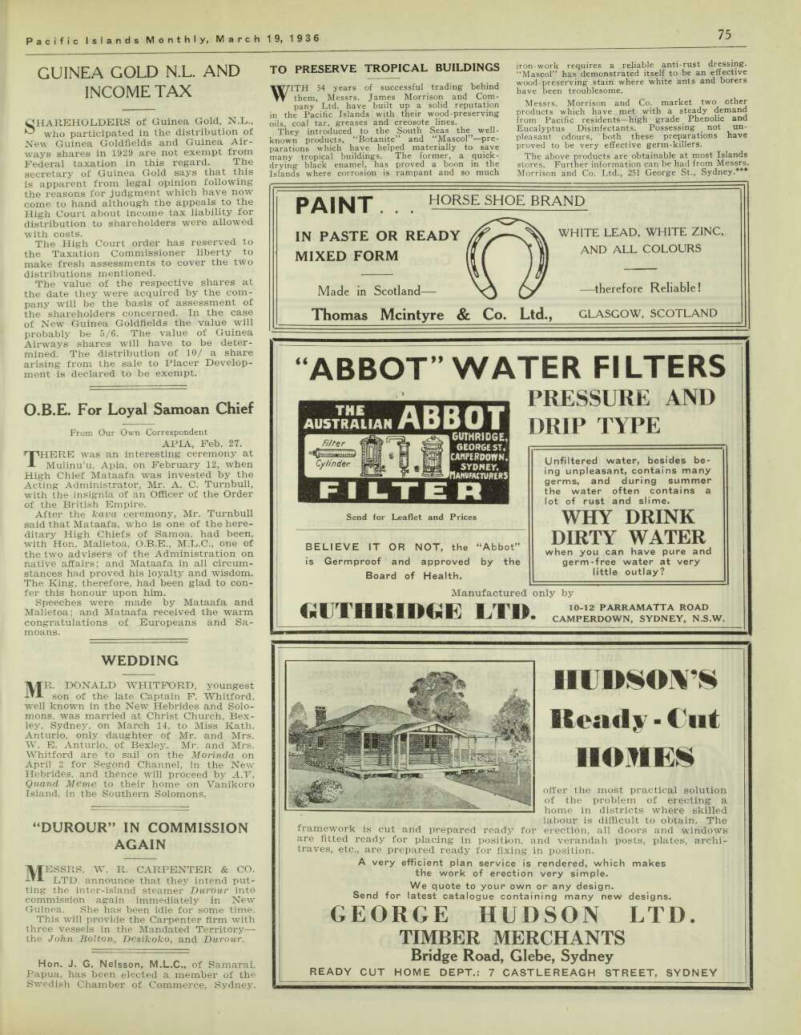
Guinea Gold N.L. And
Shareholders of Guinea Gold, n. 1., who participated in the distribution of New Guinea Goldfields and Guinea Air ways shares in 1929 are not exempt from Federal taxation in this regard. The secretary of Guinea Gold says that this is apparent from legal opinion following the reasons for judgment which have now come to hand although the appeals to the High Court about income tax liability for distribution to shareholders were allowed with costs.
The High Court order has reserved to the Taxation Commissioner liberty to make fresh assessments to cover the two distributions mentioned.
The value of the respective shares at the date they were acquired by the com pany will be the basis of assessment of the shareholders concerned. In the case of New Guinea Goldfields the value will probably be 5/6. The value of Guinea Airways shares will have to be deter mined. The distribution of 10/ a share arising from the sale to Placer Develop ment is declared to be exempt.
O.B. E. For Loyal Samoan Chief
From Our Own Correspondent
Apia, Feb. 27.
THERE was an interesting ceremony at Mulinu’u. Apia, on February 12, when High Chief Mataafa was invested by the Acting Administrator, Mr. A. C. Turnbull, with the insignia of an Officer of the Order of the British Empire.
After the kava ceremony, Mr. Turnbull said that Mataafa, who is one of the here ditary High Chiefs of Samoa, had been, with Hon. Malietoa, 0.8. E., M.L.C., one of the two advisers of the Administration on native affairs; and Mataafa in all circum stances had proved his loyalty and wisdom.
The King, therefore, had been glad to con fer this honour upon him.
Speeches were made by Mataafa and Malietoa; and Mataafa received the warm congratulations of Europeans and Sa moans.
Wedding
MR. DONALD WHITFORD, youngest son of the late Captain P. Whitford, well known in the New Hebrides and Solo mons, was married at Christ Church, Bex ley, Sydney, on March 14, to Miss Kath.
Anturio, only daughter of Mr. and Mrs.
W. E. Anturio, of Bexley. Mr. and Mrs.
Whitford are to sail on the Morinda on April 2 for Segond Channel, in the New Hebrides, and thence will proceed by A.V.
Quand Meme to their home on Vanikoro Island, in the Southern Solomons.
“Durour” In Commission
Again
Messrs, w. r. carpenter & co.
LTD. announce that they intend put ting - the inter-island steamer Durour into commission again immediately in New Guinea. She has been idle for some time.
This will provide the Carpenter firm with three vessels in the Mandated Territory— the John Bolton, Desikoko, and Durour, Hon. J. G. Nelsson, M.L.C., of Samarai, Papua, has been elected a member of the Swedish Chamber of Commerce, Sydney.
To Preserve Tropical Buildings
WITH 54 years of successful trading behind them, Messrs. James Morrison and Com pany Ltd. have built up a solid reputation in the Pacific Islands with their wood-preserving oils, coal tar, greases and creosote lines.
They introduced to the South Seas the well known products, “Botanite” and “Mascol”—pre parations which have helped materially to save many tropical buildings. The former, a quick drying black enamel, has proved a boon in the Islands where corrosion is rampant and so much
iron-work requires a reliable anti-rust dressing.
“Mascol” has demonstrated itself to be an effective wood-preserving stain where white ants and borers have been troublesome.
Messrs. Morrison and Co. market two other products which have met with a steady demand from Pacific residents —high grade Phenolic and Eucalyptus Disinfectants. Possessing not un pleasant odours, both these preparations have proved to be very effective germ-killers.
The above products are obtainable at most Islands stores. Further information can be had from Messrs.
Morrison and Co. Ltd., 251 George St., Sydney.***
Advertisements & other items, p. 77 (1 item)
“Abbot ” Water Filters
PAINT
HORSE SHOE BRAND
IN PASTE OR READY
MIXED FORM
WHITE LEAD, WHITE ZINC,
AND ALL COLOURS
Made in Scotland— Thomas Mcintyre & Co. Ltd., —therefore Reliable!
GLASGOW, SCOTLAND
“ABBOT ” WATER FILTERS
AUSTRALIAN ABBOT
6UTHRIDGE
GEORGES!
CAUPEROOWN,
F I Send for Leaflet and Prices BELIEVE IT OR NOT, the “Abbot” is Germproof and approved by the Board of Health.
PRESSURE AND
DRIP TYPE
Unfiltered water, besides being unpleasant, contains many germs, and during summer the water often contains a lot of rust and slime.
WHY DRINK
DIRTY WATER
when you can have pure and germ-free water at very little outlay?
Manufactured only by
OUTIIItIUCiE LTD.
10-12 PARRAMATTA ROAD
CAMPERDOWN, SYDNEY, N.S.W.
lIUDSOIVS
ICe;i<ly - Cut
lIOMEB
offer the most practical solution of the problem of erecting a home in districts where skilled labour is difficult to obtain. The framework is cut and prepared ready for erection, all doors and windows are fitted ready for placing in position, and verandah posts, plates, architraves, etc., are prepared ready for fixing in position.
A very efficient plan service is rendered, which makes the work of erection very simple.
We quote to your own or any design.
Send for latest catalogue containing many new designs.
GEORGE HUDSON LTD.
TIMBER MERCHANTS
Bridge Road, Glebe, Sydney
READY CUT HOME DEPT.: 7 CASTLEREAGH STREET, SYDNEY
Islands Produce
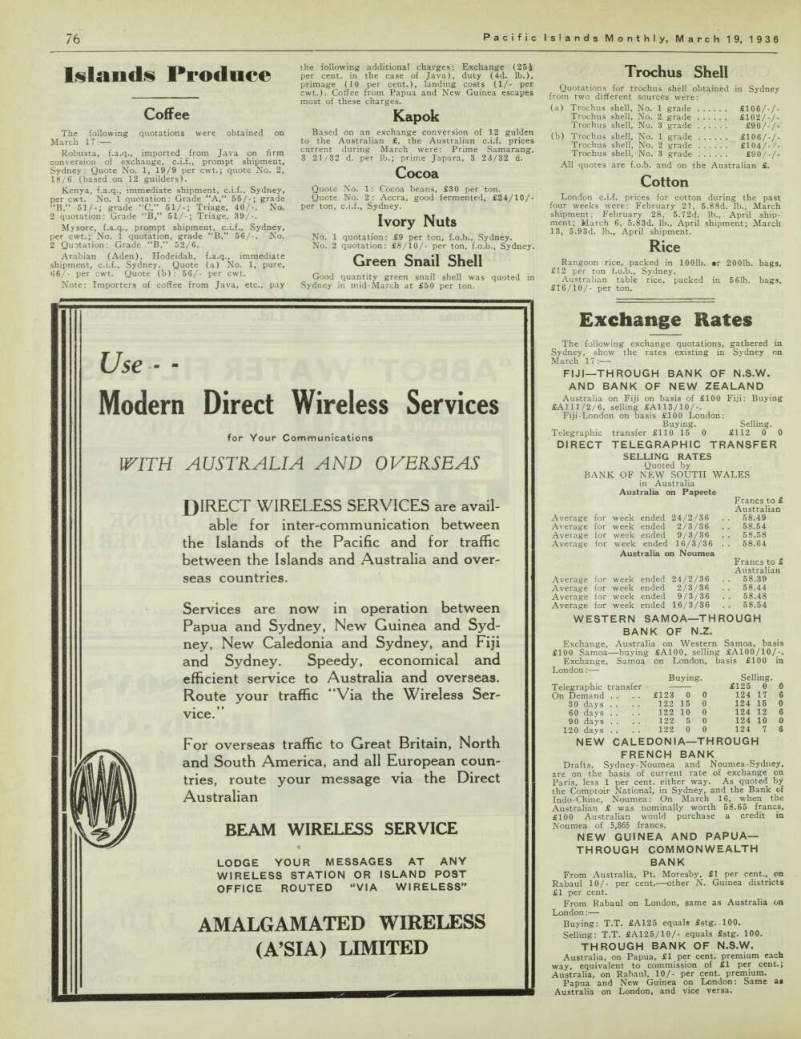
Coffee
The following quotations were obtained on March 17 : Robusta, f.a.q., imported from Java on firm conversion of exchange, c.i.f., prompt shipment, Sydney: Quote No. 1, 19/9 per cwt.; quote No. 2, 18/6 (based on 12 guilders).
Kenya, f.a.q., immediate shipment, c.i.f., Sydney, per cwt. No. 1 quotation: Grade “A,” 55/-; grade “B,” 51/-; grade “C.” 51/-; Triage, 40/-. No. 2 quotation: Grade “B,” 51/-; Triage, 39/-.
Mysore, f.a.q., prompt shipment, c.i.f., Sydney, per cwt.; No. 1 quotation, grade “B,” 56/-. No. 2 Quotation; Grade “B,” 52/6.
Arabian (Aden), Hodeidah, f.a.q., immediate shipment, c.i.f., Sydney. Quote (a) No. 1, pure, 66/- per cwt. Quote (b) : 56/- per cwt.
Note: Importers of coffee from Java, etc., pay
the following additional charges: Exchange (25 h per cent, in the case of Java), duty (4d. lb.), primage (10 per cent.), landing costs (1/- per cwt.). Coffee from Papua and New Guinea escapes most of these charges.
Kapok
Based on an exchange conversion of 12 gulden to the Australian £, the Australian c.i.f. prices current during March were: Prime Samarang, 3 21/32 d. per lb.; prime Japara, 3 23/32 d.
Cocoa
Quote No. 1: Cocoa beans, £3O per ton.
Quote No. 2: Accra, good fermented, £24/10/per ton, c.i.f., Sydney.
Ivory Nuts
No. 1 quotation: £9 per ton, f.0.b., Sydney.
No. 2 quotation: £B/10/- per ton, f.0.b., Sydney.
Green Snail Shell
Good quantity green snail shell was quoted in Sydney in mid-March at £5O per ton.
Trochus Shell
Quotations for trochus shell obtained in Sydney from two different sources were; (a) Trochus shell. No. 1 grade £lO6/-/- Trochus shell. No. 2 grade £lO2/-/- Trochus shell. No. 3 grade £9O/-/- (b) Trochus shell. No. 1 grade £lO6/-/- Trochus shell, No. 2 grade £lO4/-/- Trochus shell. No. 3 grade £9O/-/- All quotes are f.o.b. and on the Australian £.
Cotton
London c.i.f. prices for cotton during the past four weeks were: February 21, 5.88 d. lb., March shipment; February 28, 5.72 d. lb., April ship ment; March 6,5.83 d. lb., April shipment; March 13, 5.93 d. lb., April shipment.
Rice
Rangoon rice, packed in 1001 b. «r 2001 b. bags, £l2 per ton f.0.b., Sydney.
Australian table rice, packed in 561 b. bags. £l6/10/- per ton.
Exchange Rates
The following exchange quotations, gathered in Sydney, show the rates existing in Sydney on March 17 :
Fiji—Through Bank Of N.S.W.
And Bank Of New Zealand
Australia on Fiji on basis of £lOO Fiji: Buying £Alll/2/6, selling £AII3/10/-.
Fiji-London on basis £lOO London: Buying. Selling.
Telegraphic transfer £llOl5 0 £ll2 0 0
Direct Telegraphic Transfer
Selling Rates
Quoted by
Bank Of New South Wales
in Australia
Western Samoa—Through
Bank Of N.Z.
Exchange, Australia on Western Samoa, basis £lOO Samoa—buying £AIOO, selling £AIOO/10/-.
Exchange, Samoa on London, basis £lOO in London: —
New Caledonia—Through
French Bank
Drafts, Sydney-Noumea and Noumea-Sydney, are on the basis of current rate of exchange on Paris, less 1 per cent, either way. As quoted by the Comptoir National, in Sydney, and the Bank of Indo-Chine, Noumea: On March 16, when the Australian £ was nominally worth 58.65 francs, £lOO Australian would purchase a credit in Noumea of 5,865 francs.
New Guinea And Papua
Through Commonwealth
Bank
From Australia, Pt. Moresby, £1 per cent., on Rabaul 10/- per cent.—other N. Guinea districts £1 per cent.
From Rabaul on London, same as Australia on London: — Buying: T.T. £AI2S equals £stg. 100.
Selling: T.T. £AI2S/10/- equals £stg. 100.
Through Bank Of N.S.W.
Australia, on Papua, £1 per cent, premium each way, equivalent to commission of £1 per cent.; Australia, on Rabaul, 10/- per cent, premium.
Papua and New Guinea on London: Same a« Australia on London, and vice versa.
Average for Australia on Papeete week ended 24/2/36 Francs to £ Australian . 58.49 Average for week ended 2/3/36 . . 58.54 Average for week ended 9/3/36 . . 58.58 Average for week ended 16/3/36 . . 58.64 Average for Australia on Noumea week ended 24/2/36 Francs to £ Australian . 58.39 Average for week ended 2/3/36 . . 58.44 Average for week ended 9/3/36 . . 58.48 Average for week ended 16/3/36 . . 58.54
Buying. Selling.
Telegraphic transfer £125 0 0 On Demand . . . . £123 0 0 124 17 6 30 days . . . . 122 15 0 124 15 0 60 days . . . . 122 10 0 124 12 6 90 days ... 122 5 0 124 10 0 120 days . . . . 122 0 0 124 7 6
Advertisements & other items, p. 78 (1 item)
Modern Direct Wireless Services
Use - -
for Your Communications
WITH AUSTRALIA AND OVERSEAS
DIRECT WIRELESS SERVICES are avail-
able for inter-communication between the Islands of the Pacific and for traffic between the Islands and Australia and overseas countries.
Services are now in operation between Papua and Sydney, New Guinea and Sydney, New Caledonia and Sydney, and Fiji and Sydney. Speedy, economical and efficient service to Australia and overseas.
Route your traffic “Via the Wireless Service.”
For overseas traffic to Great Britain, North and South America, and all European countries, route your message via the Direct Australian
BEAM WIRELESS SERVICE
LODGE YOUR MESSAGES AT ANY
WIRELESS STATION OR ISLAND POST
OFFICE ROUTED “VIA WIRELESS”
AMALGAMATED WIRELESS
(A’SIA) LIMITED
Market Quotations
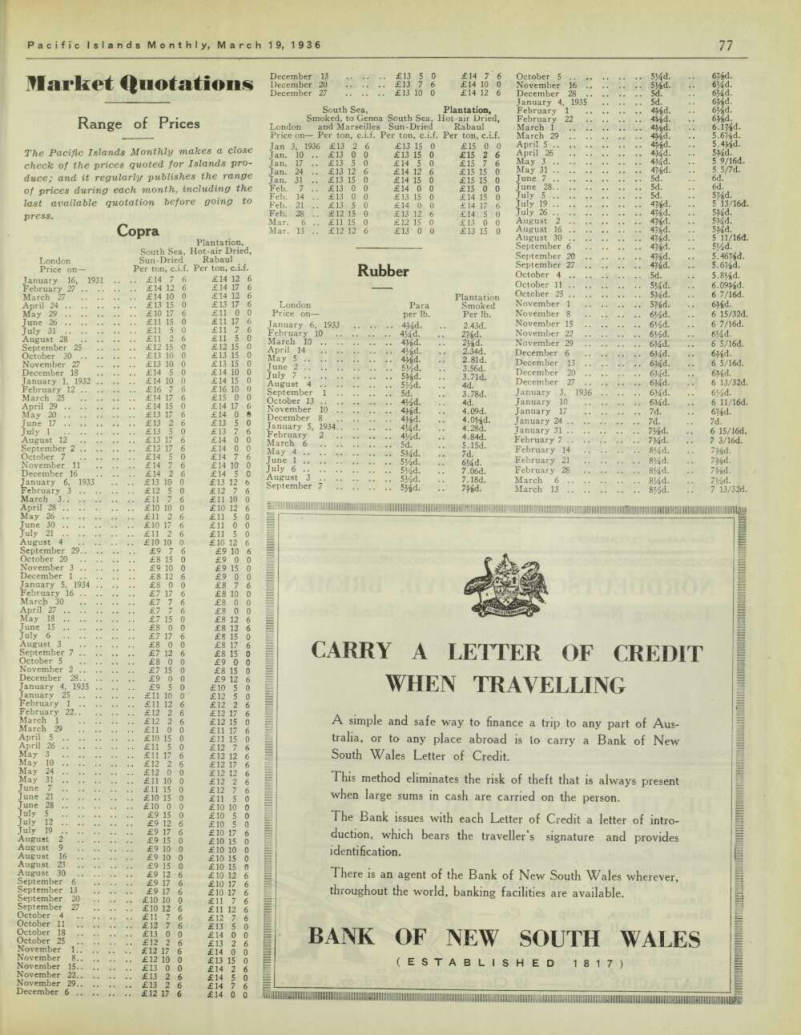
Range of Prices
The Pacific Islands Monthly makes a close check of the prices quoted for Islands pro duce; and it regularly publishes the range of prices during each month, including the last available quotation before going to press.
Copra
Rubber
December 13 £13 5 0 £14 7 6 December 20 £13 7 6 £14 10 0 December 27 .. .. £13 10 0 £14 12 6 South Sea.
Plantation.
Smoked, to Genoa South Sea, Hot-air Dried.
London and Marseilles Sun-Dried Rabaul Price on — Per ton, c.i.f. Per ton, c.i.f.
Per ton, c.i.f.
Jan 3, 1936 £13 2 6 £13 IS 0 £15 0 0 Jan. 10 . . £13 0 0 £13 15 0 £15 2 6 Jan. 17 . . £13 5 0 £14 5 0 £15 7 6 Jan. 24 . . £13 12 6 £14 12 6 £15 15 0 Jan. 31 . . £13 IS 0 £14 IS 0 £15 15 0 Feb. 7 . . £13 0 0 £14 0 0 £15 0 0 Feb. 14 . . £13 0 0 £13 15 0 £14 15 0 Feb. 21 . . £13 5 0 £14 0 0 £14 17 6 Feb. 28 . . £12 15 0 £13 12 6 £14 5 0 Mar. 6 . . £11 15 0 £12 IS 0 £13 0 0 Mar. 13 . . £12 12 6 £13 0 0 £13 15 0
London Para Plantation Smoked Price on — per lb.
Per lb.
January 6, 1933 .. .. 4Hd. 2.43d.
February 10 . .. 4%d. 2%d.
March 10 .. .. 4^d. 2'Ad.
April 14 .. .. 4’/ 8 d. 2.34 d.
May 5 .. .. 4Jid. 2.81d.
June 2 .. .. sy 2 d. 3.56d.
July 7 .. .. 5Hd. 3.71d.
August 4 .. .. sy 3 d. 4d.
September 1 .. .. Sd. 3.78d.
October 13 4d.
November 10 .. .. .. .. 4tfd. 4.09d.
December 8 .. ., .. .. 4^d. 4.0$id.
January 5, 1934.. .. .. .. 4%d. 4.28d.
February 2 .. .. .. .. 4^d. 4.84d.
March 6 5.15d.
May 4 7d.
June 1 6'Ad.
July 6 7.06d.
August 3 , 7.18d.
September 7 .. .. .. .. Slid. 7Hd.
October 5 .. .. 5'Ad. 6m.
November 16 .. .. .. syfrd. 6'Ad December 28 .. .. .. .. 5d. 6'Ad.
January 4, 1935 .. .. Sd. 6m.
February 1 .. .. .. .. 4^d. 6'Ad.
February 22 .. .. .. .. 4^d. em.
March 1 .. .. 4Hd. 6.1^d.
March 29 .. .. 4^d. 5.6m.
April 5 .. .. 4^d. 5.4^d.
April 26 .. .. 4?4d. 5Ad.
May 3 .. .. 4^d. 5 9/16d, May 31 5 5/7d.
June 7 6d.
June 28 6d.
July 5 .. .. 5d. $m.
July 19 .. .. 4^d. 5 13/16d.
July 26 .. .. 47/ 8 d. 5y 4 d.
August 2 .. .. 4^d. 5Hd.
August 16 .. .. 4?Ad. 5y 4 d.
August 30 .. .. 4^d. 5 ll/16d.
September 6 .. .. .. .. 4^d. 5^d. .September 20 .. .. .. .. AJid. 5.46^d.
September 27 .. .. .. .. 4fcd. 5.67^d.
October 4 .. .. 5d. 5.8^d.
October 11 .. .. 5'Ad. 6.09^d.
October 25 .. .. 5H d. 6 7/16d.
November 1 .. .. .. .. S^d. 6Hd- November 8 .. .. .. .. 6'Ad. 6 15/32d.
November 15 .. .. .. .. ey 2 d. 6 7/16d.
November 22 .. .. .. .. 6'Ad. 6'Ad.
November 29 .. .. .. .. 6V 4 d. 6 S/16d.
December 6 .. .. 6V 4 d. 6^d.
December 13 .. .. .. .. 6V 4 d. 6 5/16d.
December 20 .. .. .. .. 6V 4 d. 6^d.
December 27 .. .. .. .. ey 4 d. 6 13/32d.
January 3. 1936 .. .. .. 6Y 4 d. 6'Ad.
January 10 .. .. .. 6y 4 d. 6 ll/16d.
January 17 .. .. .. .. 7d. 6m.
January 24 .. .. 7d. 7d.
January 31 .. .. 7'/ 8 d. 6 15/16d.
February 7 .. .. 7Hd. 7 3/16d.
February 14 .. .. .. .. 8%d. 7m.
February 21 .. .. .. .. 8'Ad. 7m- February 28 .. .. .. .. 8'Ad. 7m.
March 6 .. .. 8V 4 d. 7'Ad.
March 13 7 13/32d.
London Price on— Plantation, South Sea, Hot-air Dried, Sun-Dried Rabaul Per ton, c.i.f. Per ton, c.i.f.
January 16, 1931 February 27 March 27 April 24 May 29 June 26
July 31
August 28 . .. £14 7 . .. £14 12 . .. £14 10 . .. £13 15 . .. £10 17 . .. £11 IS . .. £11 5 . .. £11 2 . .. £12 15 6 6 0 0 6 0 0 6 0 £14 12 £14 17 £14 12 £13 17 £11 0 £11 17 £11 7 £11 5 £12 15 6 6 6 6 0 6 6 0 0 October 30 . .. £13 10 , .. £13 10 0 0 £13 15 £13 15 0 0 December 18 .. .
January 1, 1932 .. ..
February 12 March 25 April 29 May 20 June 17 July 1 August 12 September 2 October 7 November 11 . .. £14 5 , .. £14 10 . .. £16 7 . .. £14 17 . .. £14 15 , .. £13 17 . .. £13 2 , .. £13 5 , .. £13 17 , .. £13 17 , .. £14 5 .. £14 7 0 0 6 6 0 6 6 0 6 6 0 6 £14 10 £14 15 £16 10 £15 0 £14 17 £14 0 £13 5 £13 7 £14 0 £14 0 £14 7 £14 10 0 0 0 0 6 e 0 6 0 0 6 0 December 16 , .. £14 2 6 £14 5 0 January 6, 1933 February 3 March 3 April 28 ..
May 26 June 30 July 21 August 4 September 29 October 20 November 3 December 1 January 5, 1934 .. ..
February 16 March 30 April 27 May 18
June 15
July 6 August 3 September 7 October 5 November 2 December 28
January 4. 1935 .. ..
January 25
February 1
February 22 March 1 March 29
April 5
April 26 May 3 May 10 May 24 May 31
June 7
June 21
June 28
July 5
July 12 July 19 August 2 August 9 August 16 August 23 .. £13 10 .. £12 5 .. £11 7 .. £10 10 .. £11 2 .. £10 17 .. £11 2 .. £10 10 , £9 7 , .. £8 IS , £9 10 , £8 12 .. £8 0 .. £7 17 .. £7 7 , .. £7 7 .. £7 IS .. £8 0 .. £8 0 .. £9 5 .. £11 10 .. £11 12 .. £12 2 .. £11 0 .. £10 15 .. £11 5 .. £12 2 .. £11 15 .. £9 IS .. £9 17 .. £9 15 .. £9 10 £9 15 0 0 6 0 6 6 6 0 6 0 0 6 0 6 6 6 0 0 6 0 6 0 0 0 0 0 6 6 6 0 0 0 6 6 0 0 0 0 0 0 6 6 0 0 0 o £13 12 £12 7 £11 10 £10 12 £11 5 £11 0 £11 5 £10 12 £9 10 £9 0 £9 15 £9 0 £8 7 £8 10 £8 0 £8 0 £8 12 £8 12 £8 15 £8 17 £8 15 £9 0 £8 15 £9 12 £10 5 £12 5 £12 2 £12 17 £12 IS £11 17 £11 IS £12 7 £12 12 £12 17 £12 12 £12 2 £12 7 £11 5 £10 10 £10 5 £10 5 £10 17 £10 15 £10 10 £10 15 £10 15 £10 12 £10 17 £10 17 £11 7 £11 12 £12 7 £13 5 £14 0 £13 2 £14 0 £13 15 £14 2 £14 5 £14 7 £14 0 6 6 0 6 0 0 0 6 6 0 0 0 6 0 0 0 6 6 0 6 0 0 0 6 0 0 6 6 0 6 0 6 6 6 6 6 6 0 0 0 0 6 0 0 0 n August 30 .. £9 12 £9 17 g u fi September 6 . . .. 5 o f.
September 13 .. £9 17 g O f
September 20 .. ,.
September 27 . . ..
.. £10 10 .. £10 12 0 6 0 6 October 4 £11 7 g o fi October 11 October 18 .. £13 0 £13 2 6 o 0 0 n October 25 November 1 November 8 November 15 November 22 6 6 0 0 5 u 6 0 0 6 n November 29 December 6 6 6 u 6 0
Advertisements & other items, p. 79 (1 item)
When Travelling
CARRY A LETTER OF CREDIT
A simple and safe way to finance a trip to any part of Australia, or to any place abroad is to carry a Bank of New South Wales Letter of Credit.
This method eliminates the risk of theft that is always present when large sums in cash are carried on the person.
The Bank issues with each Letter of Credit a letter of introduction, which bears the traveller’s signature and provides identification.
There is an agent of the Bank of New South AVales wherever, throughout the world, banking facilities are available.
BANK OF NEW SOUTH WALES
(ESTABLISHED 1817)
Shipping Services in the Pacific
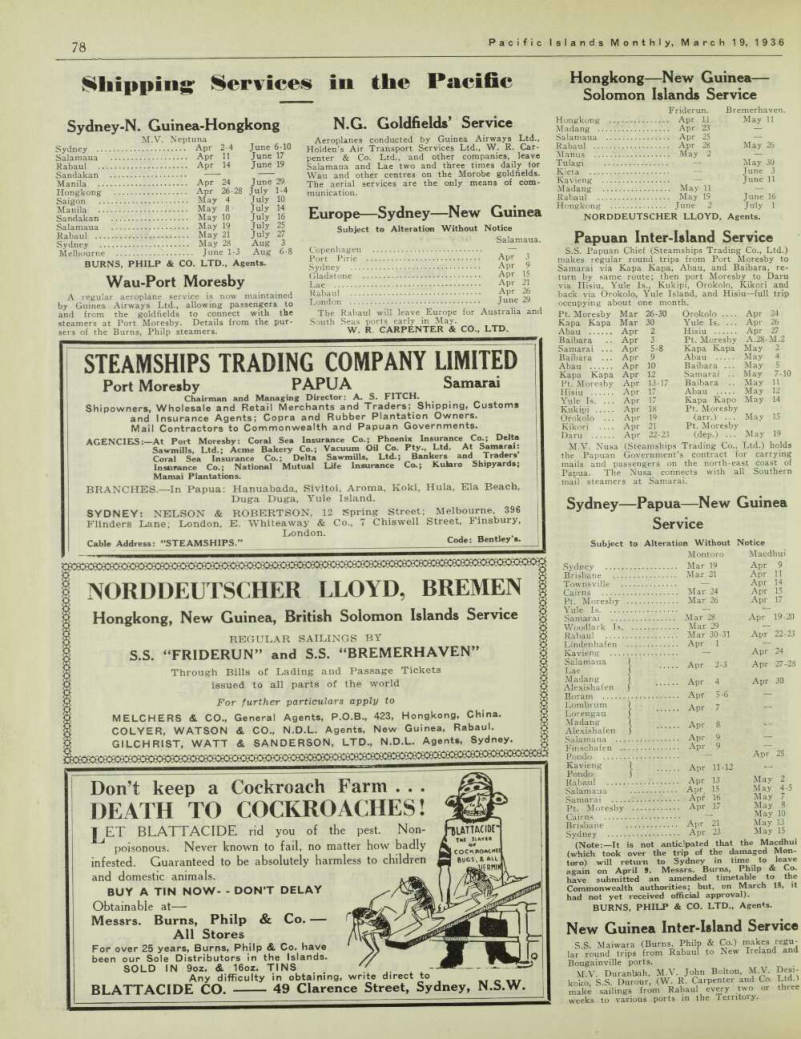
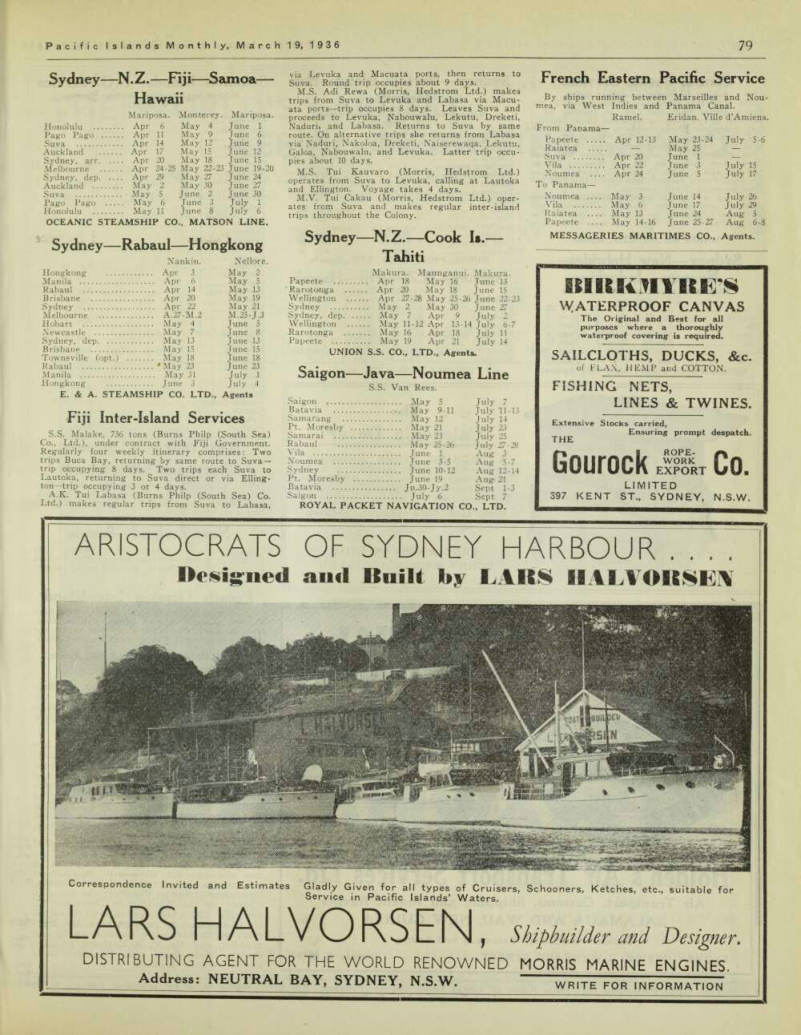
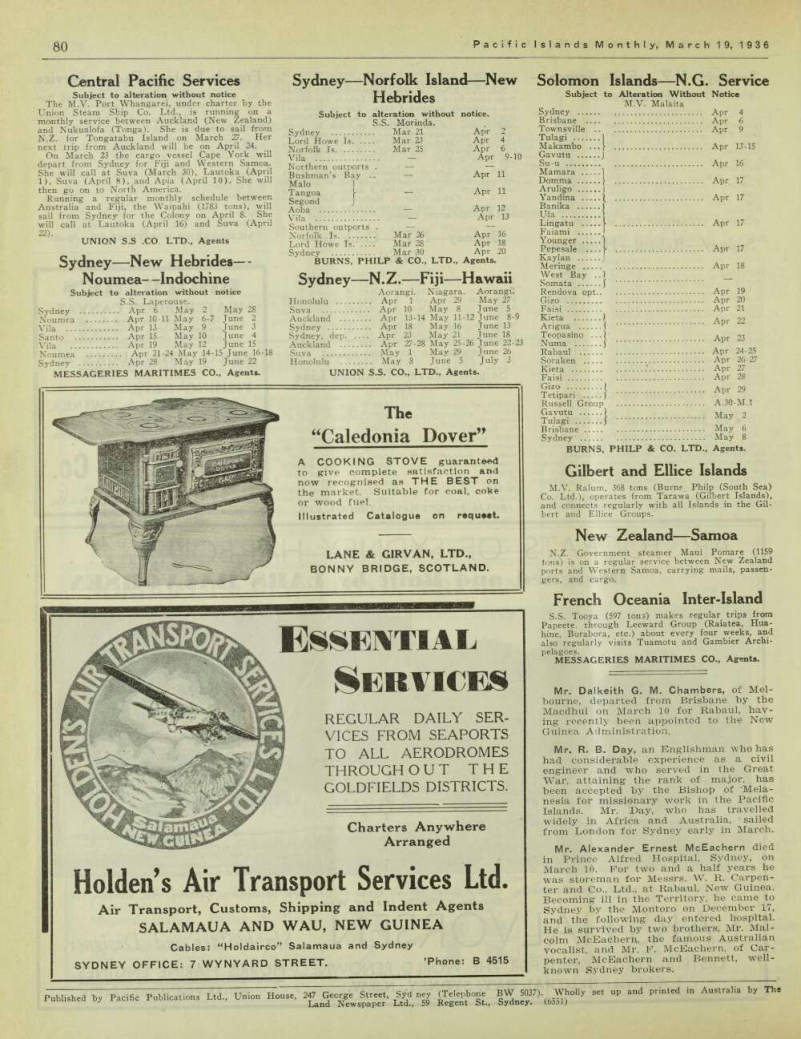
Sydney-N. Guinea-Hongkong
Wau-Port Moresby
A regular aeroplane service is now maintained by Guinea Airways Ltd., allowing passengers to and from the goldfields to connect with the steamers at Port Moresby. Details from the pur sers of the Burns, Philp steamers.
N.G. Goldfields' Service
Aeroplanes conducted by Guinea Airways Ltd., Holden’s Air Transport Services Ltd., W. R. Car penter & Co. Ltd., and other companies, leave Salamaua and Lae two and three times daily lor Wau and other centres on the Morobe goldfields.
The aerial services are the only means of com munication.
Europe—Sydney—New Guinea
Subject to Alteration Without Notice
Hongkong—New Guinea — Solomon Islands Service
Papuan Inter-Island Service
S.S. Papuan Chief (Steamships Trading Co., Ltd.) makes regular round trips from Port Moresby to Samarai via Kapa Kapa, Abau, and Baibara, re turn by same route; then port Moresby to Daru via Hisiu, Yule Is., Kukipi, Orokolo, Kikori and back via Orokolo, Yule Island, and Hisiu—full trip occupying about one month.
M.V. Nusa (Steamships Trading Co., Ltd.) holds the Papuan Government’s contract for carrying mails and passengers on the north-east coast of Papua. The Nusa connects with all Southern mail steamers at Samarai.
Sydney—Papua—New Guinea
Service
Subject to Alteration Without Notice
New Guinea Inter-Island Service
S.S. Maiwara (Burns, Philp & Co.) makes regu lar round trips from Rabaul to New Ireland and Bougainville ports.
M.V. Duranbah, M.V. John Bolton, M.V. Desi koko, S.S. Durour, (W. R. Carpenter and Co. Ltd 1 make sailings from Rabaul every two or three weeks to various ports in the Territory.
M.V.
Neptuna Sydney June 6-10 Salamaua June 17 Rabaul June 19 Sandakan Manila Apr 24 June 29 Hongkong July 1-4 Saigon May 4 July 10 Manila May 8 July 14 Sandakan July 16 Salamaua May 19 July 25 Rabaul May 21 July 27 Sydney May 28 Aug 3 Melbourne Aug 6-8
Burns, Philp
& CO. LTD., Agents.
Copenhagen Port Pirie Sydney Salamaua.
Apr 9 Apr 15 Lae Apr 21 D o iil Apr 26 The Rabaul will leave Europe for Australia and South Seas ports early in May.
W.R Carpenter &
Co., Ltd.
Friderun.
Bremerhaven.
Hongkong May 11 Madang Apr 23 — Salamaua Apr 25 — Rabaul May 26 Manus May 2 — Tulagi May 30 Kieta June 3 Kavieng — June 11 Madang May 11 — Rabaul May 15 June 16 Hongkong June 2 July 1
Norddeutscher Lloyd,
Agents.
Ft. Moresby Mar 26-30 Orokolo Apr 24 Kapa Kapa Mar 30 Yule Is. ...
Apr 26 Abau Apr 2 Hisiu Apr 27 Baibara Apr 3 Ft. Moresby A.28-M.2 Samarai ...
Apr 5-8 Kapa Kapa May 2 Baibara ...
Apr 9 Abau Mav 4 Abau Apr 10 Baibara ...
May 5 Kapa Kapa Apr 12 Samarai ..
May 7-10 Ft. Moresby Apr 13-17 Baibara ..
May 11 Hisiu Apr 17 Abau May 12 Yule Is. ...
Apr 17 Kapa Kapo May 14 Kukipi Apr 18 Ft. Moresby Orokolo ...
Apr 19 (arr.) ...
May IS Kikori ...
Apr 21 Ft. Moresby Daru Apr 22-23 (dep.) ...
May 19
Montoro Macdhui Sydney Mar 19 Mar 21 Apr 9 Apr 11 Apr 14 Mar 24 Apr 15 Pt. Moresby .
Mar 26 Apr 17 Mar 28 Apr 19-20 Woodlark Is.
Mar 29 Mar 30-31 Apr 22-23 Lindenhafen .
Kavieng Salamaua Lae j
Madang ]
Alexishafen f Boram Lombrum Lorengau 1 Madang 1 Alexishafen J Salamaua Finschafen ...
Apr 1 • Apr 2-3 Apr 4 . Apr 7 > Apr 8 Apr 9 Apr 9 Apr 24 Apr 27-28 Apr 30 Apr 25 Kavieng Pondo Rabaul Salamaua Samarai Pt. Moresby t Apr 11-12 Apr 13 Apr 17 May 2 May 4-5 May 7 May 8 May 10 Brisbane Apr 21 ay H Sydney Apr 23 May 15 (Note: —It is not anticipated that the Macdhui (which took over the trip of the damaged Montoro) will return to Sydney in time to leave again on April 9. Messrs. Burns, P & have submitted an amended timetable to the Commonwealth authorities; but, on March 18, it had not yet received official approval).
Burns,
Philp & Co. Ltd.,
Agents.
Sydney—N. Z. —Fi j i—Samoa— Hawaii
Sydney—Rabaul—Hongkong
Fiji Inter-Island Services
S.S. Malake, 736 tons (Burns Philp (South Sea) Co., Ltd.), under contract with Fiji Government.
Regularly four weekly itinerary comprises: Two trips Buca Bay, returning by same route to Suva— trip occupying 8 days. Two trips each Suva to Lautoka, returning to Suva direct or via Elling ton —trip occupying 3 or 4 days.
A.K. Tui Labasa (Burns Philp (South Sea) Co.
Ltd.) makes regular trips from Suva to Labasa,
via Levuka and Macuata ports, then returns to Suva. Round trip occupies about 9 days.
M.S. Adi Rewa (Morris, Hedstrom Ltd.) makes trips from Suva to Levuka and Labasa via Macu ata ports—trip occupies 8 days. Leaves Suva and proceeds to Levuka, Nabouwalu, Lekutu, Dreketi, Naduri. and Labasa. Returns to Suva by same route. On alternative trips she returns from Labasa via Naduri, Nakoloa, Dreketi, Naiserewaqa, Lekutu, Galoa, Nabouwalu, and Levuka. Latter trip occu pies about 10 days.
M.S. Tui Kauvaro (Morris, Hedstrom Ltd.) operates from Suva to Levuka, calling at Lautoka and Ellington. Voyage takes 4 days.
M.V. Tui Cakau (Morris, Hedstrom Ltd.) oper ates from Suva and makes regular inter-island trips throughout the Colony.
Sydney—N.Z.—Cook It.— Tahiti
Saigon—Java—Noumea Line
French Eastern Pacific Service
By ships running between Marseilles and Nou mea, via West Indies and Panama Canal.
Mariposa.
Monterey.
Mariposa.
Honolulu May 4 June 1 Pago Pago ...
May 9 June 6 Suva May 12 June 9 Auckland .. Apr 17 May 15 June 12 Sydney, arr. . ... Apr 20 May 18 June IS Melbourne .. Apr 24-25 May 22-23 June 19-20 Sydney, dep. ..
Auckland ,.. Apr 29 May 27 June 24 ... May 2 May 30 June 27 Suva .. May 5 June 2 June 30 Pago Pago ..
June 3 July 1 Honolulu ... May 11 June 8 July 6
Oceanic Steamship Co., Matson Line.
Nankin.
Nellore.
Hongkong May 2 Manila May 5 Rabaul May 13 Brisbane May 19 Sydney ... Apr 22 May 21 Melbourne ... A.27-M.2 M.25-J.3 Hobart June 5 Newcastle ... May 7 June 8 Sydney, dep ... May 13 June 13 Brisbane June 15 Townsville (opt.) ...
June 18 Rabaul ... * May 23 June 23 Manila July 1 Hongkong July 4
E. & A. Steamship Co. Ltd.,
Agents
Makura. Maunganui. Makura.
Papeete Apr 18 May 16 June 13 Rarotonga Apr 20 May 18 June 15 Wellington Apr 27-28 May 25-26 June 22-23 Sydney May 2 May 30 June 27 Sydney, dep May 7 Apr 9 July 2 Wellington May 11-12 Apr 13-14 July 6-7 Rarotonga May 16 Apr 18 Julv 11 Papeete May 19 Apr 21 July 14
Union S.S. Co., Ltd., Agents.
s.s.
Van Rees.
Saigon July 7 Batavia ... Mav 9-11 July 11-13 Samarang July 14 Pt. Moresby ... May 21 July 23 Samarai July 25 Rabaul July 27-28 Vila Aug 3 Noumea Aug 5-7 Sydney Aug 12-14 Pt. Moresby Aug> 21 Batavia ... Ju.30-Jy.2 Sept 1-3 Saigon Sept 7
Royal Packet Navigation
Co., Ltd.
Ramel.
Eridan. Ville d’Amiens.
From Panama— Papeete Apr 12-13 May 23-24 July 5-6 Raiatea — May 25 — Suva Apr 20 June 1 — Vila Apr 22 June 3 July 15 Noumea Apr 24 June 5 July 17 To Panama— Noumea ...
May 3 June 14 July 26 Vila May 6 June 17 July 29 Raiatea May 13 June 24 Aug 5 Papeete May 14-16 June 25-27 Aug 6-8
Messageries Maritimes Co.,
Agents.
Central Pacific Services
Subject to alteration without notice The M.V. Port Whangarei, under charter by the Union Steam Ship Co. Ltd., is running on a monthly service between Auckland (New Zealand) and Nukualofa (Tonga). She is due to sail from N.Z. for Tongatabu Island on March 27. Her next trip from Auckland will be on April 24.
On March 23 the cargo vessel Cape York will depart from Sydney for Fiji and Western Samoa.
She will call at Suva (March 30), Lautoka (April 1), Suva (April B),,and Apia (April 10). She will then go on to North America.
Running a regular monthly schedule between Australia and Fiji, the Waipahi (1783 t<pns), will sail from Sydney for the Colony on April 8. She will call at Lautoka (April 16) and Suva (April 22)
Union S.S .Co Ltd., Agents
Sydney—New Hebrides —
Noumea- -Indochine
Subject to alteration without notice
Sydney—Norfolk Island—New Hebrides Subject to alteration without notice.
Sydney—N.Z.—Fiji—Hawaii
Solomon Islands —N.G. Service Subject to Alteration Without Notice
Gilbert and Ellice Islands
M. Ralum, 368 tons (Burns Philp (South Sea) Co. Ltd.), operates from Tarawa (Gilbert Islands), and connects regularly with all Islands in the Gil bert and Ellice Groups.
New Zealand —Samoa
N. Government steamer Maui Pomare (1159 tons) is on a regular service between New Zealand ports and Western Samoa, carrying mails, passen gers, and cargo.
French Oceania Inter-Island
S.S. Tooya (597 tons) makes regular trips from Papeete, through Leeward Group (Raiatea, Hua hine, Borabora, etc.) about every four weeks, and also regularly visits Tuamotu and Gambier Archi pelagoes.
Messageries Maritimes Co., Agents.
Mr. Dalkeith G. M. Chambers, of Mel bourne, departed from Brisbane by the Macdhui on March 10 for Rabaul, hav ing recently been appointed to the New Guinea Administration.
Mr. R. B. Day, an Englishman who has had considerable experience as a civil engineer and who served in the Great War, attaining the rank of major, has been accepted by the Bishop of Mela nesia for missionary work in the Pacific Islands. Mr. Day, who has travelled widely in Africa and Australia, sailed from London for Sydney early in March.
Mr. Alexander Ernest McEachern died in Prince Alfred Hospital, Sydney, on March 10. For two and a half years he was storeman for Messrs. W. R. Carpen ter and Co., Ltd., at Rabaul, New Guinea.
Becoming ill in the Territory, he came to Sydney by the Montoro on December 17, and the following day entered hospital.
He is survived by two brothers, Mr. Mal colm McEachern, the famous Australian vocalist, and Mr. F. McEachern, of Car penter, McEachern and Bennett, well known Sydney brokers.
S.S. Laperouse.
Sydney Apr 6 May 2 May 28 Noumea Apr 10-11 May 6-7 June 2 Vila Apr 13 May 9 June 3 Santo Apr 15 May 10 June 4 Vila Apr 19 May 12 June 15 Noumea Apr 21-24 May 14-15 June 16-18 Sydney Apr 28 May 19 June 22
Messageries Maritimes Co., Agents.
s.s.
Morinda.
Apr Sydney Mar 21 2 Lord Howe Is Mar 23 Apr 4 Norfolk Is Mar 25 Apr 6 Vila — Apr 9-10 Northern outports .
Bushman’s Bay ..
Malo , — —
Apr
11
Tangoa J-
Segond J
— Apr 11 Aoba — Apr 12 Vila — Apr 13 Southern outports . — — 16 Norfolk Is Mar 26 Apr Lord Howe Is Mar 28 Apr 18 Sydney Mar 30 Apr 20
Burns, Philp
& Co., Ltd.,
Agents.
Aorangi. Niagara. Aorangil Honolulu Apr 1 Apr 29 May 27 Suva Apr 10 May 8 June 5 Auckland Apr 13-14 May 11-12 June 8-9 Sydney Apr 18 May 16 June 13 Sydney, dep Apr 23 May 21 June 18 Auckland Apr 27-28 May 25-26 June 22-23 Suva May 1 May 29 June 26 Honolulu May 8 June S July 3
Union S.S. Co., Ltd., Agents.
M.V. Malaita Sydney Apr 4 Brisbane Apr 6 Townsville ..
Apr 9 Tulagi 1 Makambo ...) Apr 13-15 Gavutu J Su-u Apr 16 Mamara 1 Domma Apr 17
Aruligo 1
Yandina 1 Apr 17 Banika j
Ufa ]
Lingatu 1 i Apr 17 Faiami 1 Younger 1 1 Pepesale Apr 17 Kaylan j Meringe Apr 18 West Bay . .1 1 Somata Rendova opt..
Apr 19 Gizo Apr 20 Faisi Apr 21 Kieta 1 Apr 22 Arigua Teopasino ...
Numa Apr 23 Rabaul Apr 24-25 Soraken Apr 26-27 Kieta Apr 27 Faisi Apr 28 Gizo Tetipari 1 Apr 29 Russell Group
A.30-M.I
Gavutu Tulagi i May 2 Brisbane May 6 Sydney May 8
Burns,
Philp & Co. Ltd.,
Agents.
Advertisements & other items, pp. 80-84 (2 items)
Steamships Trading Company Limited
Port Moresby PAPUA Samarai
Chairman and Managing Director; A. S. FITCH.
Shipowners, Wholesale and Retail Merchants and Traders: Shipping, Customs and Insurance Agents; Copra and Rubber Plantation Owners.
Mail Contractors to Commonwealth and Papuan Governments.
AGENCIES:—At Port Moresby: Coral Sea Insurance Co.; Phoennc Insurance Co.; Delta Sawmills, Ltd.; Acme Bakery Co.; Vacuum Oil Co. Pty. Ltd. At Samarai: Coral Sea Insurance Co.; Delta Sawmills, Ltd.; Bankers and Traders Insurance Co.; National Mutual Life Insurance Co.; Kuiaro Shipyards; Mamai Plantations.
BRANCHES.—In Papua; Hanuabada, Sivitoi, Aroma, Koki, Hula, Ela Beach, Duga Duga, Yule Island.
SYDNEY: NELSON & ROBERTSON, 12 Spring Street; Melbourne, 396 Flinders Lane; London, E. Whiteaway & Co., 7 Chiswell Street, Finsbury, London. , “STEAMSHIPS.” Code: Bentley S.
NORDDEUTSCHER LLOYD, BREMEN
Hongkong, New Guinea, British Solomon Islands Service
REGULAR SAILINGS BY
S.S. “FRIDERUN” and S.S. “BREMERHAVEN”
Through Bills of Lading and Passage Tickets issued to all parts of the world For further particxilars apply to MELCHERS & CO., General Agents, P. 0.8., 423, Hongkong, China.
COLYER, WATSON & CO., N.D.L. Agents, New Guinea, Rabaul.
GILCHRIST, WATT & SANDERSON, LTD., N.D.L. Agents, Sydney.
Don’t keep a Cockroach Farm . . .
DEATH TO COCKROACHES!
LET BLATTACIDE rid you of the pest. Nonpoisonous. Never known to fail, no matter how badly infested. Guaranteed to be absolutely harmless to children and domestic animals.
BUY A TIN NOW- - DON’T DELAY Obtainable at — Messrs. Burns, Philp & Co.
AH Stores For over 25 years, Burns, Philp & Co. have been our Sole Distributors in the Islands.
SOLD IN 9oz. & 16oz. TINS
Any difficulty in obtaining, write direct to BLATTACIDE CO. 49 Clarence Street, Sydney, N.S.W.
IIATTMIDf
TMi SlM*# c»
COCK.POACHCS
illltliraiUE'S
WATERPROOF CANVAS
The Original and Best for all purposes where a thoroughly waterproof covering is required.
SAILCLOTHS, DUCKS, &c.
of FLAX, HEMP and COTTON.
FISHING NETS,
LINES & TWINES.
Extensive Stocks carried.
Ensuring prompt despatch.
Gourock £: Co.
LIMITED
397 KENT ST.. SYDNEY, N.S.W.
ARISTOCRATS OF SYDNEY HARBOUR
Designed and Itnili by I.tils UAI VOISSIvX ■ ■ • ■ m an a Correspondence Invited and Estimates Gladly Given for all types of Cruisers, Schooners, Ketches, etc., suitable for Service in Pacific Islands’ Waters.
LARS HALVORSEN, Shipbuilder and Designer.
DISTRIBUTING AGENT FOR THE WORLD RENOWNED MORRIS MARINE ENGINES.
Address: NEUTRAL BAY, SYDNEY, N.S.W.
WRITE FOR INFORMATION
m
The
“Caledonia Dover”
A COOKING STOVE guaranteed to give complete satisfaction and now recognised as THE BEST on the market. Suitable for coal, coke or wood fuel.
Illustrated Catalogue on request.
LANE & GIRVAN, LTD.,
BONNY BRIDGE, SCOTLAND.
\ ii I % am
Essential
Services
REGULAR DAILY SER-
VICES FROM SEAPORTS
TO ALL AERODROMES
THROUGH OUT THE
GOLDFIELDS DISTRICTS.
Charters Anywhere Arranged
Holdens Air Transport Services Ltd.
Air Transport, Customs, Shipping and Indent Agents
SALAMAUA AND WAU, NEW GUINEA
Cables: “Holdairco” Salamaua and Sydney SYDNEY OFFICE: 7 WYNYARD STREET. ’Phone: B 4515
THE WORLD’S LARGEST
AERIAL FREIGHTING SERVICE
GUINEA AIRWAYS LTD. was established in 1927; and it has grown in the following way, until it is to-day the largest freight-carrying air-service in the world: Year Ended Tonnage Passengers February 28 Transported Carried 1929 434 869 1930 ... 949 ... 2,047 1931 ... 1,146 ... 1,995 1932 ... 3,947 ... 1,607 1933 3,980 3,856 1934 ... 6,044 ... 7,398 1935 ... 5,688 ... 9,721 Guinea Airways Ltd. operates regular air services in New Guinea and Papua, and uses over 33 Aerodromes and Landing-grounds in the two Territories.
One of Guinea Airways’ new 14-passenger Ford Aeroplanes, on an aerodrome in New Guinea. ■ m. 1 . m AERIAL-TRANSPORT Speedy, Safe and Dependable made possible the Rapid Development of the great Morobe Goldfield, and the Consequent Enrichment of the Mandated Territory. Aeroplanes, running on Regular Schedules, without Difficulty or Delay, carried in Dredges, Crushing Mills, Cyaniding Plants, Motor Vehicles, Hydro-Electric Machinery, and Every Kind of Goods Needed by a Large and Growing European Community.
GUINEA AIRWAYS L™
LAE
HEAD OFFICE;
BROOKMAN BUILDINGS
GRENFELL STREET
ADELAIDE, S.A.
BRANCH OFFICES AND AGENTS
- SALAMAUA
NEW GUINEA OFFICE:
LAE
MANDATED TERRITORY OF
NEW GUINEA
AT WAU, SALAMAUA, PORT MORESBY, AND SYDNEY
When two long thirsts equal one long bottle!
"IVhat’s yours?” i "Resch’s PUsenet ” z "So’s mine.”
E When you ask for Pilsener insist E on the long bottle.
RESCH'S
PILSENER
80
Pacific Islands Monthly, March 19, 1936
Unto ”as?*; l»^r y set up and printed in Austra,ia by Th '