Pacific
Islands
Monthly
Vol. VI.—No. 7.
February 21st 1986
at the G.P.0., Sydney, for transmission by post as a newspaper.']
6 d
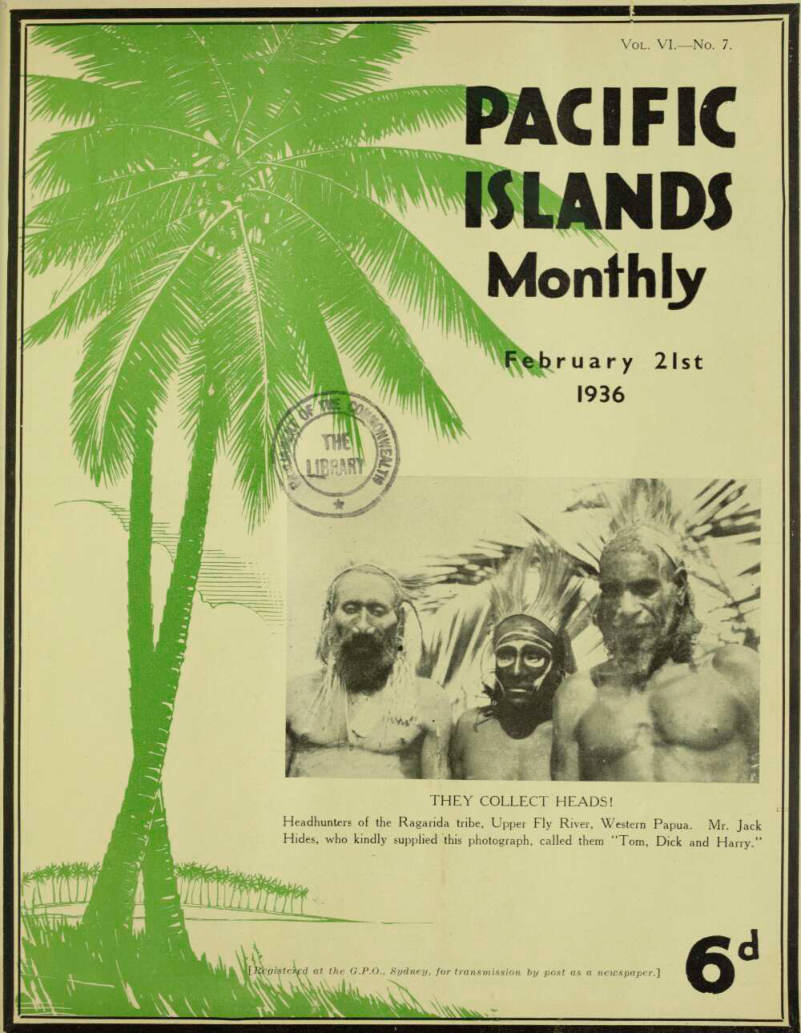
They Collect Heads!
Headhunters of the Ragarida tribe, Upper Fly River, Western Papua. Mr. Jack Hides, who kindly supplied this photograph, called them “Tom, Dick and Harry.”
Advertisements & other items, p. 2 (1 item)
Assisting Development am
I Progress in
the Pacific
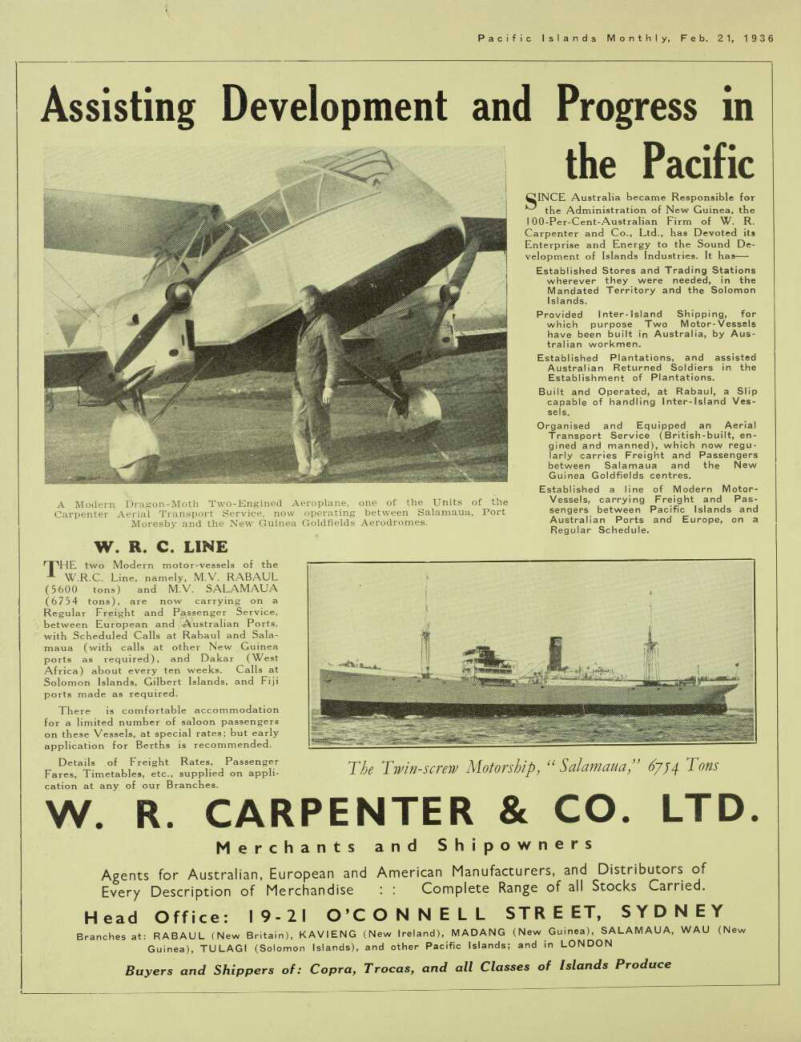
CINCE Australia became Responsible for the Administration of New Guinea, the I 00-Per-Cent-Australian Firm of W. R.
Carpenter and Co., Ltd., has Devoted its Enterprise and Energy to the Sound Development of Islands Industries. It has— Established Stores and Trading Stations wherever they were needed, in the Mandated Territory and the Solomon Islands.
Provided Inter-Island Shipping, for which purpose Two Motor-Vessels have been built in Australia, by Australian workmen.
Established Plantations, and assisted Australian Returned Soldiers in the Establishment of Plantations.
Built and Operated, at Rabaul, a Slip capable of handling Inter-Island Vessels.
Organised and Equipped an Aerial Transport Service (British-built, engined and manned), which now regularly carries Freight and Passengers between Salamaua and the New Guinea Goldfields centres.
Established a line of Modern Motor- Vessels, carrying Freight and Passengers between Pacific Islands and Australian Ports and Europe, on a Regular Schedule.
W. R. C. LINE
HTHE two Modern motor-vessels of the W.R.C. Line, namely, M.V. RABAUL (5600 tons) and M.V, SALAMAUA (6734 tons), are now carrying on a Regular Freight and Passenger Service, between European and Australian Ports, with Scheduled Calls at Rabaul and Salamaua (with calls at other New Guinea ports as required), and Dakar (West Africa) about every ten weeks. Calls at Solomon Islands, Gilbert Islands, and Fiji ports made as required.
There is comfortable accommodation for a limited number of saloon passengers on these Vessels, at special rates; but early application for Berths is recommended.
Details of Freight Rates, Passenger Fares, Timetables, etc., supplied on application at any of our Branches.
W. R. CARPENTER & CO. LTD.
Merchants and Shipowners
Agents for Australian, European and American Manufacturers, and Distributors of Every Description of Merchandise : Complete Range of all Stocks Carried.
Head Office: 19-21 O’CONNELL STREET, SYDNEY
Branches at; RABAUL (New Britain), KAVIENG (New Ireland), MADANG (New Guinea), SALAMAUA, WAU (New Guinea), TULAGI (Solomon Islands), and other Pacific Islands; and In LONDON Buyers and Shippers of; Copra, Trocas, and all Classes of Islands Produce r Sh
The Twin-screw Motorship, “Salamaua,” 6yj4 Tons
Assisting Development am
-J j|| i m A Modern Dragon-Moth Two-Engined Aeroplane, one of the Units of the Carpenter Aerial Transport Service, now operating between Salamaua, Port Moresby and the New Guinea Goldfields Aerodromes.
Pacific Islands Travellers
Passengers Per Macdhui Which Ar
RIVED IN SYDNEY FROM PAPUA AND NEW GUINEA ON JANUARY 24: Messrs. Andrews, Collett. Colgin, Clancey, Crowe, Curtain, Dur cher. Day, Fay, Fitzgerald, Grahamslaw, Harvey, Hippesley, Joiner, Kelyvack, Smith, Livingstone, Logan, Mason, Morgan, Newton, Perichon, Pear son, Powell, Pickard, Roberg, Rundnagel, Savage, Shadbolt, Sparrow, Shedden, Schroder. O’Sullivan.
Tatham, Walshe, Whiteley, Wells, Yarroll, Mas ter Matley; Mesdames Andrews. Bartlett, Colqu houn (2), Day. Everall, Fell, Fitzgerald, Garland, Kellskog, Livingstone, Mace. Mason, Maxwell, Newton, Parsonson, Page (2), Perichon, Robert son, Rundnagel, Sparrow, Walshe; Misses An drews, Colebrooke, Denning, Guy, Holcombe, Hum phries, Hughes, Jenkins, McMullen, Mason, Mat thews, Parker, Page, Peterson, Rechner, Rund nagel, Rowlands.
Passengers Per Monterey Which
ARRIVED IN SYDNEY FROM SUVA. FIJI. ON JANUARY 27: S. L. Abseil. J. Allard, Master K. Allard, L. C. Bentley, Miss H. Dodd, T.
Featherstone, M. D. Garretty, Mrs. F. B. Heaslop, R. C. Leith, I. C. Leith, Mr. and Mrs. H. Mc- Spedden, L. J. Pratt, G. S, Rowley, Miss D.
Sullivan, Mrs. J. E. Toy, Mr. and Mrs. L. W, Vance, Mr. and Mrs. V. C. Wilson, Miss M.
Cmhbert, Rev. and Mrs. T. N. Deller, Misses Viti, Val, and Mary Deller, F. Dent, J. A. Fraser, J.
E. Fraser, Mrs. A. Fyfe, Miss J. Fyfe, C. W.
Mann, Rev. and Mrs. R. L. McDonald, Misses V. and C. McDonald, M. Rushton, Mrs. V. Singh.
Passengers Per Morinda Which Ar
Rived In Sydney From New Hebrides.
Norfolk Island, And Lord Howe
ISLAND ON JANUARY 29: Messrs. Aiken, Allen, Bestic (2), Ballard, Barf, Broder, Bulbeck, Cooke, Cruyl, Collins, Cook, Cunningham, Fletcher.
Flack, Fenton, Forsyth, Hay (2), Harris, Hinton, McLeod (3), Mason (2), Mallett, Pinney, Ran dall (2). Roberts. Ross, Smith, Stowe, Tmdley, Wallis, Wickenden, Wills, Wilson, Young, Sir Hubert Murray; Mesdames Allen, Broder, Dig nam, Fenton (2), Ferris, Flack, Fortiscue, Hay, Lingan, Mason, Olssen, Williams, Wilson, Young; Misses Adams, Christian, Cavers, Carroll, Duper tuis, Everett, Frogley, Hayden, Larney (2), Lett, McCowage, Macdonnell, McLenaghan, Mackey, Marshall, O’Brien, Robinson, Robertson (2), Smith, Stephenson, Tanner, Wilson, Wilkinson.
Passengers Per Macdhui Which
Sailed From Sydney For Papua And
NEW GUINEA ON JANUARY 30: Messrs. Bar den, Bawden, Beattie, Bunting, Biffin, Brass, Budgoll, Bott, Camps, Crook, Cook, Chester, Cash, Cannon, Champion, Cole, Evans, Fulton, Fulbohra, Greenwood, Gordon, Gluyas, Grabowsky, Gibson, Green, Gunuzio, Hanley, Halcombe, Heiner, Har ket, Hillyard, Heese, Irvine, Ingold, Jackson (2), Kelly, Klaarwater, Laidlaw, Lowney, Mann, Mur ray, Moore, Marshall, Murray, Marshall, Mullaly, Monaghan, Nelsson, O’Brien, Osborne, Powys, Peekel, Ritcher, Richards, Rand, Rich, Rogerson, Rabin, Reynolds, Storey, Steele, Sedan, Schlueter, Ternes, Topal (2), Tait, Taylor (2), Tate, Tur ner, Thomson, Townsend, Vorwerg, Wells, Young; Mesdames Colei Colebrook, Grabowsky, Guest, Greenwood, Gluyas, Haydne, Hanley, Josenson, Lowe, Laidlaw, Rabin, Rogerson, Rich, Smith (2), Street, Scanned, Simmons, Storey, Tudor, Tarrant, Taylor, Thomson, Wilson, Wurth, Woof; Misses Allsop, Callil, Craig, Evanatt, Frewin, Heiner, Laidlaw (2), McGregor, McArthur, Sharrock, Thompson, Vorwerg, Rev. Sisters Agritia, Emme line, and Jeremia.
Passengers Per Niagara Which Left
SYDNEY FOR SUVA, FIJI. ON JANUARY 31: K. A. Crawford, Mr. Gibson, M. H. Robb, Mr. and Mrs. H. L. Jones, Mr. and Mrs. E. H. Grif fiths, F. N. R. Godden, Mr. and Mrs. Wm. B.
Wynne, L. Pearson, P. N. Makin, Miss S. Trivett, S. G. Ellis. A. C. E. Hill, E. A. Potts, C. B.
Jenkins, D. A. Leach, C. G. Alison, C. H. Broad hurst, Mrs. H. D. Upton, J. Pattison, G. Morgan, R. C. MacPherson, B. R, Payne, Miss D. A.
Gallagher, F. A. Hathaway, Miss Hathaway, R.
Wright, E. Drummond, Rev. Father J. Eckert, A.
Thomas, Sister M. Baptiste, Mrs. E. Drummond, Miss M. Drummond, Mr. and Mrs. D. V. Patel and infant, R. C. Borrowdale, L. F. B. Frost, J.
S. Bennett, I. M. Khan. K. Kalyan.
Passengers Per Monterey Which
LEFT SYDNEY FOR SUVA, FIJI, ON FEBRU ARY 5: Mr. and Mrs. H. J. T. Applebee, Mrs. T.
Askey, A. Campbell, Mr. and Mrs. G. K. Carter, A. T. Day, Mr. and Mrs. Garretty, Mr. and Mrs.
N. Godhard, Mr. and Mrs. Ivo Lucchinelli, Miss N. MacKenzie, Mrs. L. Reid, Mrs. O. Angermunde, G. T. Bryde, F. Campbell, A. R. Cormes, Miss Fay Frier. Miss E. Gilbert, R. R. G. Lane, A. B.
McAlpine, G. F. Mead. C. Rines, W. Rudd, B. A.
Southwick, R. Withnell.
Passengers Per Malaita Which
Arrived In Sydney From Solomon Is.
And Rabaul (N.G.) On February 13;—
Messrs. Bennett, Bartlett, Boardman, Cullen, Evans, Ferguson, Godward, Johnson, Myers, Mc- Menamin, Salmond, Scott, Tame, Weihen, Widdy, Widdup. Mesdames Atkinson, Cox, Cruickshank, Uattell, Deane, Downs, Downward, Hicks, Jones, Minto, Silvester, Train, Widdup. Misses Bdlette, Callachor, Downward, Deck, Hart, Randall, Weller.
Solomons’ Disturbed
December
Vessel “Hygeia” Wrecked
From Our Own Correspondent TULAGI, January 27.
DECEMBER was rather a disturbed month in the Solomons.
A sou’-west blow did very little damage in the main part of the group, but almost wiped out the timber settlement at Vani koro, only one house being left intact.
The Medical Department’s vessel Hygeia, which has done yeoman service, particu larly during the Sinarango trouble in 1927, w r as completely wrecked. No lives were lost, but not a vestige of the vessel remains.
The Veronica, the D.O.’s vessel at Vani koro, has had to come in for repairs, but was sufficiently seaworthy after her ex perience to bring in the survivors from the wreck of the Hygeia.
An earthquake, or rather a week of earthquakes, did great damage on the Island of Guadalcanal, being felt also on other islands. Tidal waves and the usual damage was done. At the moment, there appears to have been little or no loss of life, but quite a little damage to property.
M. Cauet, of the French Colonial Ser vice, left New Caledonia for France by the Eridan on February 1.
Mrs. Aumuller, wife of the B.P. manager at Samarai, Papua, is at present spending furlough in Sydney. Mrs. Aumuller won fame as a nurse in the Great War—she has about a dozen medals from various nations.
Advertisements & other items, p. 3 (1 item)
Royal Packet Navigation Co.
AT BLUE MOUNTAINS
SPRINGWOOD, N.S.W.
Springwood Ladi-es* College
Est. 1897. Kindergarten to Leaving Certificate. Tennis, Riding, Swimming, Team Games. Unequalled climate. Pure Jersey Milk. Senior and Junior Houses. Open-air sleeping. Inclusive fees. Special vacation arrangements for Island pupils.
M. E. DURAND, Principal.
Pacific Island Stamps
BOUGHT AND SOLD
Stamps sent on approval on receipt of reference. Send for free lists and specimen copy “Australian Stamp Journal."
J. H. SMYTH CO. LTD.
121 a Castlereagh St., Sydney
*S9.
For over 16 years Vincent's A.P.C. has given safe relief from headache and neuralgia to thousands of Australians. Prepared on scientific hospital formula; prescribed and adopted by Doctors as a safe, speedy and reliable preparation to take. Will not affect the heart; Powders and Tablets: 12 for 1/6. 24 for 2/6.
Singles, 2d. each. Also new "Pocket Siie" tablets, 1/6 tin.
All Chemists and Stores, or direct from Vincent Chemical Company Limited, 76- 78 Liverpool Street, “ Sydney.
FOR SAFETY'S SAKE, SAY •• VINCENTS"
SAIGON—BATAVIA—SAMARANC—PORT MORESBY
SAMARAI-RABAUL- PORT VILA-NOUMEA
SYDNEY - PORT MORESBY - BATAVIA - SAIGON
bi-monthly by the "VAN REES"
You will enjoy travelling by this popular, fast and modern steamer of the K.P.M., noted for its comfort, excellent cuisine, and economical fares.
With a fleet of over 130 vessels the K.P.M. Line is in a position to accept cargo for all ports in Netherlands India, and with transhipment at Batavia for Africa.
ROYAL PACKET NAVIGATION CO.
Paketvaart House, 255 George Street, Sydney
Diethelm & Co., Saigon; E. A. James, Port Moresby; Whitten Bros., Samarai; W, R. Carpenter & Co. Ltd., Rabaul; Gubbay Freres, Port Vila; Carlo Leoni, Noumea.
Advertisers
Page Adams, Ltd., Wm. 46 Amalgamated Wireless of Aust. Ltd. 76 Andrews Liver Salts 28 Arnott’s Biscuits .61 “Aspro” 16 Ausoline 78 B. and S. Agency . 67 Baker, W. Jno., Ltd. 23 Bank of N.S.W. . . 77 Barrington, D.Y.S.. 74 Belvedere IS Bentley, E. & Sons 57 Berger & Sons Ltd. 71 Blatticide Co 56 Blau, Julius 58 Boston Stamp Co. . 23 Breckwoldt & Co . 50 Broomfields Ltd. . . 57 Brunton’s Flour . . 60 ■ Budge & Co., J. . 55 Bullivants Ltd. ... 26 Burns, Philp & Co. 2 Burns. Philp & Co.
Ltd. 29
B.P (S.S.) Co. ... 37
Buzacott Ltd 49 Capell, J 42 Carpenter, W. R.
Ltd . ii Cent. Q’land. Meat Co 38 Chi vers & Co. Ltd. 28 Coleman Quicklite . 20 Coles, A. H. J. . . 69 Coral Starch 39 Corrie Tea Co. ... 12 Cousins, R. Y 44 Crockett & Co. Ltd. 24 Crossle, Duff and Macintosh Ltd. 68 “Crowle” House . . 17 Cuprinol 57 Del Cott Pty. Ltd. 53 Dexter, Henry ... 30 Doan’s Ointment .. 72 Donald, A. B. Ltd. 65 Doyle, T. G 56 Eaton Ltd., J. W.. 46 Electrolytic R. & S.
Co. Ltd C 8
Page Elvy & Co. Ltd. . . 13 “Fairholme” College 80 Finau, Wm 22 Fletcher & Son ... 55 Ford. Walter 12 Ford, W. M 54 Forster’s Bedsteads 72 Foster Clark (Aust.) Ltd 33 Freemans Sports Store 31 Garden Vale Pro ducts 36 Garrett & Davidson 70 Gillespie’s Flour . . 36 Goodwin, A. E. ... 69 Grand Pacific Hotel 64 Guinea Airways Ltd iii Gunn & Moore Ltd. 28 Hallstrom, E 44 Halvorsen, L 79 Hardie & Co. Ltd. 52 Hardy & Co. R. M. 12 Harper, M 47 Holbrook’s Ltd. ... 37 Holden’s Air Co. . . 80 Holmes & Co., W.
L 16 Hopewood House . . 13 Horne, W. & Co.
Ltd 62 Hotel Gnd. Central 29
I.C.T.A.N.Z 75
Insular Lamps Ltd. 44 Jang King Loong . 62 Jantzen (Aust.) Ltd. 14 Jones & Co., Henry 21 Jones & Rickard . . 49 Kerr Bros. Ltd. ... 34 Koko-Maricopas Co.
Ltd 59 Kodak Pty. Ltd. . 22 Kopsen & Co. Ltd. 48 Kork-N-Seal Ltd. . 48 Kriesler (Aust.) Ltd. 14 Leica Photo. Co. . . 30 Link Belt Co. Ltd. 48 Love, Ltd. J. R. . 20 Mcllraith’s Ltd. . . 18 McKay, D 25
Maleham & Yeomans Ltd .. 29 Maxwell Porter Ltd. 46 Melbourne Hotel . . 62 Morns, Hedstrom Ltd 74 Mungo Scott Ltd. . 38 National Research Council 80
N.D.L 78
Nelson & Robertson Ltd 66 New Brit. Express. 52 Newlands Bros. Ltd. 45 Nicholson & Foster 43 Noyes Bros. Ltd. .26 Pacific Hotels ... 40 Pacific Taxis ... 63 Paul & Gray Ltd. .74 Peel and Sons, H.. 39 Phillips & House . 45
Pier Hotel 63 Pike Bros. Ltd. .. 15 Positions Wanted 67, 75 Prescott Ltd 60 Prouds Ltd 17 Ransomes, Sims & Jeffries Ltd 50 Reed, Wm. E 26 Reid, W. M 32 Rohu, Sil 25 Rolls Razor Co. Ltd. 25 Roseville Girls Col lege 65 Royal Packet Co.
Ltd 1 Russell, S 38 Ruston & Hornsby. 43 Samson. A. J 12 Savage. W. & Co.. 71 Scott, Ltd., J 4 2 Scott & Sons 34
Shell Oil Co. Ltd. . 35 Simplex Baltic Machinery Co 32 Smyth Co. Ltd., J. 1 Springwood L. Col. 1 Stanley, Chris. ... 21 Steamships T. Co. . 78 Sterling Varnish Co. 11 Swallow & Ariell . 67 Sydney Steel Co. . 66 Talkeries 56 Tamarang Hostel . 59 Vanderfield & Reid Ltd 23 Taubman’s Paints . 54 Taylor & Co., A. . 70 Tilley Lamp Co. . . 47 Tillock & Co. Ltd. . 21 Tooheys Ltd 15 Tooth &Co iv Trufood 20
Tudor Hotel 13 T.W.H. Paint ... 73 Vacuum Oil Co. . . 27 Vincent’s A.P.C. . . 1 Wallis, J. B. & Co. 70 Walvon Kennels . . 56 Walker-Flynn, Mrs. 58 Webb & Co. Ltd. 52 West, H 42 West’s Wheels ... 50 Weymark & Son . 39 Wheeler, B. R. . . 53 Whitfeld, E. F. ... 60 Wills, W. D. &H. 0 25 Williams Pty. Ltd.
S 51 Williams, W. H. . 69 Wright & Co. ... 51 Wright & Co., E. . 73 Wunderlich Ltd. . . 54
Contents
Page Pacific Islands Travellers 1 How Near is the Japanese “Menace”? 3 Japan’s Poachers in the Pacific .. .. 5 Fiji’s Governor Promoted 5 Debts of N.G. Soldier-Planters .. .. 6 Why Fiji-Indians Reject Christianity 6 Atebrin—Some Further Experiences.. 7 N.G.G. Ltd. to Pass Dividend . . . . 7 Fijian Bubble Bursts 8 War in Rarotonga 9 American Expedition for Fly River . . 10 Tropicalities 11 About Islands People 12 Aerial Transport Merger in N. Guinea 15 Control of N.G. Native Employees .. 17 A Corner in Poetry is British in the New Hebrides .. .. 20 The Mystery of the Missing Page .. 22 Sydney—Tahiti—’Frisco Service . . 24 Mentality and Future of Native Races 25 Pages from the Past—The Affair of Henry Worth Pearse 26 Death of Noted Samoan Chief . . .. 33 The Soma Plant 34
Page Rewards for Cocoa-growing in N.G. 36 “Queen Petterson” of Tatau Is. .. 39 In N.G.’s Unknown Centre 41 Men Who Knew Yesterday—s. Percy H. Edmunds 45 Casual Notes from Bulolo 46 Papuan Sugar Industry 47 Old Missionary Laws in Tahiti . . . . 48 Mendham Luck! 51 Ancient Stones in the Trobriands .. 52 Aerial Transport in N. Guinea . . .. 56 Samoan News 57 Fashion Hints for Islands Women . . 58 Housekeeping in the Tropics . . .. 60 Hurricane Sweeps Lau Group .. 63 Subsidised Ships in the Pacific . . .. 60 Spying Out Central N.G.’s Secrets .. 66 Pacific Islands Mining Notes . . .. 68 White Man Sentenced to Death .. .. 73 Justice in the Solomons 74 Fijians Riot at Tavua 75 Islands Produce and Exchange Rates 76 Copra and Rubber Quotations .. 77 Shipping Services in the Pacific .. 78
Advertisements & other items, p. 4 (1 item)
Burns, Philp & Co. Ltd.
GENERAL
MERCHANTS
i rii 111 *->f *«;
" in in
T—^ 9 il n m
SHIPOWNERS
TOURIST AGENTS
Head Office: 7 Bridge Street, Sydney—Australia Code Address: "Burphil"
BUYERS OF ALL CLASSES OF ISLAND PRODUCE Regular Steamer Services from Australia to New Guinea Papua Solomon Is—Lord Howe Is.—Norfolk Is. —New Hebrides —Java and Singapore
Pacific Islands Monthly
The Newspaper Magazine of the South Seas [ Registered at G.P.0., Sydney, for transmission ty post as a newspaper ]
Published Once Each Month and Circulated in Australia and New Zealand and in the following Pacific Territories and Islands Groups:
Crown Colony of Fiji.
Australian Territory of Papua.
Mandated Territory (Australia) of New Guinea, Bismarck Archipelago and Northern Solomon Islands.
Mandated Territory (Japan) of Marshall, Caroline and Marianna Islands.
French Territory of New Caledonia.
British and French Condominium of New Hebrides.
American Territory of Eastern Samoa.
American Territory of Guam.
Mandated Territory of Nauru.
British Crown Colony of Gilbert and Ellice Islands.
Mandated Territory (New Zealand) of Samoa.
British Solomon Islands Protectorate.
British Protectorate of Tongan Islands.
New Zealand Territory of Cook Islands.
Australian Territory of Norfolk Island.
French Colony of Oceania (Tahiti, etc.).
American Territory of Hawaiian Islands.
Owned and Produced by Pacific Publications Ltd., Union House , 247 George Street, Sydney.
Telephone Bw 5037
P.O. Box 3408 R
Contributions Articles, Stories, and Photographs dealing with Pacific Islands Subjects are invited, and will be paid for on publication at usual rates.
Subscription Rates
Per Annum, within British Empire, Prepaid Post Free 6/- Per Annum, elsewhere, prepaid, Post Free .. 8/- Single Copies 6d.
Editor and Publisher:
R. W. Robson.
Advertisements
Advertising rates furnished on application.
Colours, etc. by Arrangement.
Process Blocks made at Advertiser’s- expense when required. Screen, 100.
Changes of Advertising Copy should reach this Office by Bth of each month, otherwise previous advertisement may be repeated.
Registered Address for Radiograms and Cables: “PACPUB” Sydney Agents The following are authorised to receive subscrip tions for the “Pacific Islands Monthly”— Islands Branches of Burns, Philp & Co., Ltd., and Burns Philp (South Seas) Co., Ltd.
Islands Branches of W. R. Carpenter & Co., Ltd.
All Branches of Morris, Hedstrom & Co., Ltd.
G. Thomas & Co., Rabaul, New Guinea.
Whitten Bros., Ltd., Samarai, Papua.
P. Costello, Suva, Fiji.
J. Muir, Suva, Fiji.
All Branches and Representatives of W. H. Grove and Sons, Ltd., Auckland, New Zealand.
S. Russell, Papeete, Tahiti.
Cook Islands Trading Co., Rarotonga, Cook Is.
Vol. VI., No. 7
Sydney, February 21, 1936
p r :~~ f 6d ■ Per Copy * Tice I Prepaid: 6/- p.a.
How Near Is The Japanese “Menace"?
“An Anglo-Japanese war is not the dream of a fool, nor even an unreasonable hypothesis,” writes Lieutenant-Commander Tota Ishimaru, of the Japanese Navy, in a book, “Japan Must Fight Britain,” which was published to-day.
Lieut.-Commander Ishimaru considers a con flict in the Pacific inevitable “unless either Japan stops the policy of expansion she is driven to adopt under severest pressure, or unless Eng land, with excessive colonies, abandons the policy of preservation of status quo.” He exam ines in detail the probable course of the war, and concludes that Japan has nothing to fear since she could count on decisive superiority over any British air or naval forces that could be concentrated in the Pacific. He believes that a Japanese victory would be followed by the col lapse of the British Empire. India, he says, would break away, Hong Kong would be lost, and Australia and New Zealand would pass to Japanese hands. He regards the Singapore Base as the most serious threat. “If England is in a position to despatch a powerful fleet to the Far East in a few days, the hands of her diplomatists in China will be greatly strengthen ed. China herself will become ‘uppish’ and begin to treat us with scant respect,” he says.
He offers no constructive suggestions for the maintenance of peace, but merely repeats “Bri tain and America must give way.” —From the London correspondent of Sydney Morning Herald, cabling on February 6.
JS there need for alarm? Or is the pub lic being bombarded, as is so often the case, with rubbish produced by ignor
ant, sensation-mongering journalists? Let
us examine the facts, as we actually
know them.
Japan’s population is now 100,000,000, and is increasing with astonishing rapidity. She needs more territory.
For many years, Japanese foreign policy was moulded in accordance with two pacts —the Anglo-Japanese Treaty, and the Washington Agreement, under which warship construction was limited by a formula. The Anglo-Japanese Treaty has been denounced; the Wash ington Agreement is expiring; and Japan, in January, withdrew from the London Naval Conference, where an at tempt was being made to find a new building formula. Japan, in 1934, with drew from the League of Nations.
Japan, in January, made a pact with Germany under which they agreed that each should assist the other against an aggressor. This, of course, is directed primarily against Russia. If Russia at tacks Japan while Japan is busy else where, Germany will attack Russia.
The pro-Britain, pro-peace party has been in the ascendant in the government of Japan for a long time. There is no
guarantee that it will remain in power.
There are strong political groups which are neither pro-British nor pro-peace.
It was announced, in February, that Japan intends to build the world’s largest warship. Every report, without exception, indicates the intention of Japan to create a bigger and bigger navy.
Japan bitterly resents the fact that the United States and the British Dominions, as part of their policy of keeping out Asiatic migrants, will not permit the entry of Japanese settlers. The Japanese are a proud, clever people and they con sider that they have a natural right to enter any of the Pacific territories.
Now, look at a map of the Pacific.
Southwards of Japan lie rich lands, ter ritories capable of development by and providing a home for the overflowing Japanese—Philippines, New Guinea, New Britain, New Ireland, Solomons, New Caledonia, Australia, and New Zealand. Those great territories mostly are under-populated, and unprotected.
Six million Australians could not defend the whole of their enormous coastline against modern armaments for a day.
The Japanese do not invade those rich,
empty, enticing countries because the two great Anglo-Saxon powers, Britain and the United States, with France and Hol land in support, have constituted them selves the defenders of the status quo in the Pacific. That was recognised in the Washington Agreement. It allowed Japan a fleet that was quite big enough to defend Japan and her contiguous ter ritories, but which was not big enough to protect lines of communication, in the event of Japan making a drive into the south or east for the purpose of acquiring territory. For fifty years, the status quo was accepted. We were all safe in the Pacific.
But, now, the navy limitation agree ment is gone. Japan is building more and bigger warships. She says, quite openly, that she must have more territory for her enormous and growing popula tion. Can there be the slightest doubt that Japan will seize Pacific territory, as she seized Asiatic territory, as soon as she feels that she is strong enough?
One assumes that U.S.A. would not remain indifferent to any move towards Japanese expansion in the Pacific: but America remains a very uncertain quan tity in international affairs. As a mat ter of fact, the only certain obstacle to Japanese ambitions in the Pacific is Bri tain, and the British navy. The safety of Europeans here in the Pacific terri tories depends entirely upon the effi ciency of that world-wide organisation of men and machines who work under the White Ensign. We may as well re cognise the cold logic of clear facts.
For two decades, this writer has said, comfortingly: “Yes, the Japanese will turn southwards—that is inevitable —but not in our day. They have enough to do in China to keep them busy for fifty years.” Very recent events have changed all that. The Japanese have made it clear that they will not necessarily delay, until they have tapped the Chinese reser voir of raw material and man power, their attempt to conquer the Western Pacific. They will make the attempt just as soon as they think they are strong enough to hold their sea-lines against British and American naval power. (Be cause of the uncertainty of American policy in the Pacific, Japan must regard America as a potential opponent of her expansionist designs.) They will build ships, and more ships, and they will strengthen their economic structure; and, as certainly as the sunrise, they will strike—when they think Britain is weak or unready.
Meanwhile, Germany waits. She does not want to fight Britain; but she is at
one with Japan in her determination to acquire, somewhere, new territory for her growing population.
The danger, beyond doubt, is very real; but we should not say that it is yet imminent. If the well-meaning dreamers of the Ramsay MacDonald era were still in charge in London, we might sleep insecurely; but Britain at last re cognises her danger, and she is arming with great rapidity, and on a scale such as the world never before has seen. With in the next three years, Britain will spend over £300,000,000 on armaments —not with any plan of conquest, but simply to protect the Empire, and, if possible, to maintain world peace. And that means the maintenance of the status quo in the Pacific. Japan, attacking to day, doubtless could sweep the British naval forces away and seize great Pacific territories. But, to-morrow, she would have to face powerful attacks upon her sea - communications, probably from America and certainly from Britain.
Japan is restrained, not by the hazards of to-day, but by the possibilities of to-morrow. No people in the world have greater length of vision than the Japanese. Their reply to Britain’s £300,000,000 armaments programme probably will be made at a conference table, at no distant date, when the three
landless powers—Germany, Japan, and Italy—will make a reasonable appeal to the great colonial powers—and especially to Britain. That appeal probably will not fall on deaf ears. Britain—the nation which has given or is giving self rule to the Boers, to India, to Egypt, to Iraq—cannot be indifferent to the cry of the landless peoples. But, having been driven to a £300,000,000 armament pro gramme by an implacable Japan and an aggressive Germany, Britain will not forget that those restless Powers are ap pealing only because they have got to — that, in fact, they would much prefer to march in unannounced, seize British ter ritories, and divide the spoil according to the law of the tooth and the claw.
In a word the cons i der ation which dominates intern ational relationships to d ig “territory”; and, as the territories of the South and Western Pacific are the
least developed;
we people who live in them are dosel and individua i ly affect . ed b what is ; on We no more can defend ourse]ves than wg can , r tection from the chattering old gentlemen at Geneva - We must P ut our falth m Britain, and our hope in the American navy. So long as those forces are com petent to defend the status quo in the Pacific, we are safe—but no longer.
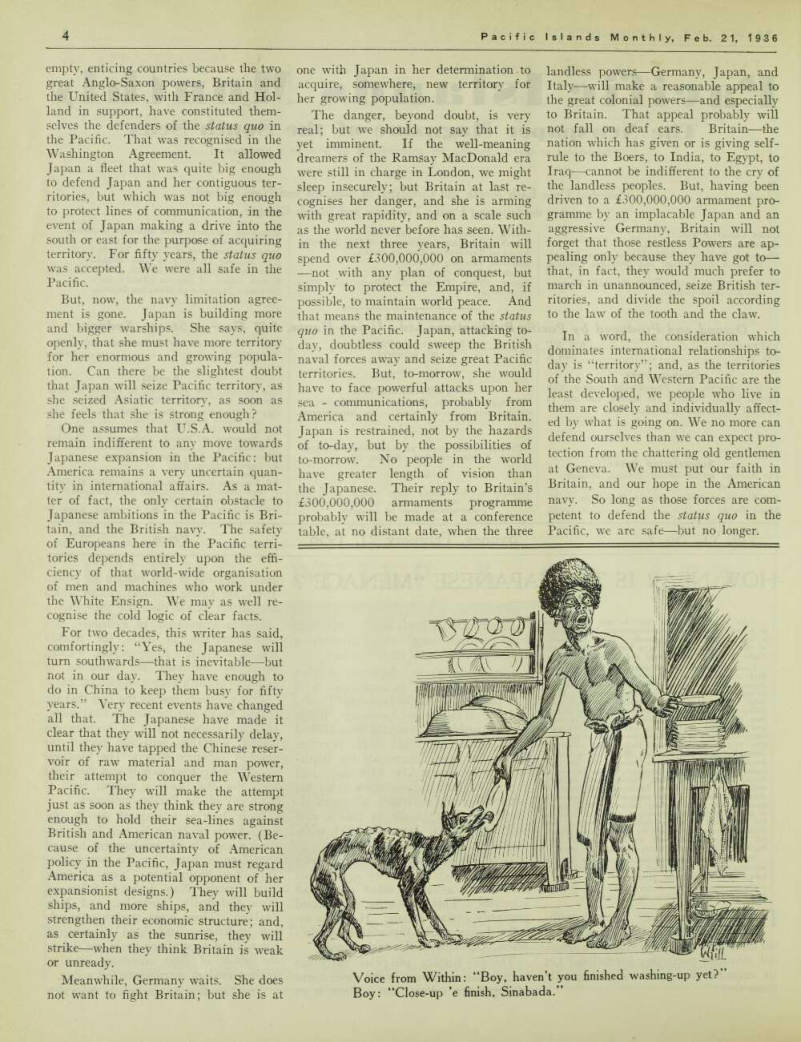
Voice from Within: “Boy, haven’t you finished washing-up yet?’’
Boy: “Close-up ’e finish, Sinabada."
Japan’S Poachers
Destruction of the Trochus Beds
IT is reported in a Sydney newspaper, February 12, that two fast Japanese warships “have been released to patrol between the Dutch East Indies and Aus tralia, for the protection of Japanese pearling fleets.”
It is added that these Japanese war ships “are intended as a gesture of defiance to Australian patrol vessels.
This is the kind of congenital idiocy which degrades Australian journalism and vitiates international relationships.
All well-informed people know that the persistent, increasing poaching by itinerant Japanese craft has reached such alarming proportions that Australia has protested officially to Japan; that Japan has expressed regret and promised to do everything possible to reduce the nuis ance; and that, if Japan is sending war ships in the manner stated, the warships will prove to be small armed patrol ves sels, whose purpose will be to police'their own nationals, and try to prevent their depredations on shell-beds within terri torial waters. Outside of the three miles limit the Japanese have the same right as any other men to the products of the sea.
A Thursday Island business man, writ ing to the Editor on February 3, said: “I wonder when we will see that fast patrol launch promised by the Govern ment years ago? In the meantime, our beds of trochus shell are fast being de pleted by the marauding Japanese sam pans.
“They are taking away all the im mature shell, to grow in their own waters.”
“Incident” in the Solomons
From Our Own Correspondent
Tulagi, Jan. 27.
CONFLICTING reports come from the Island of Malaita, of a visit by a Japanese shell poacher to the Gower Island, about 30 miles from the NorJi Mala Coast.
Apparently, the Japanese were warned off, and reports after that are too con flicting to record.
One version has it that the Japanese killed with paddles a native who protested to the poachers. Others say that they killed several natives with dynamite; others that the natives captured a Jap anese and held him for ransom.
The District Officer has gone to the island, and definite information will soon be available.
The Gower Islanders are less aggressive than Malaitamen, and if there was any trouble it is not likely that the natives started it. In any case, the poachers should not have been there.
It was announced on February 14 that Robinson River Plantations Ltd., with a nominal capital of £200,000, had been registered with the object of acquiring from Robinson River Co. Ltd., all its assets in Papua. The first directors of the new Company are Messrs. J. Burns, R. J. Nosworthy, L. Armstrong, and Joseph Mitchell—who are, of course, directors of Messrs. Burns, Philp & Co.
Limited.
Twenty Years A
Consul
Dr. Williams Retires from Tahiti
From Our Own Correspondent
Papeete, Jan. 22.
DR. W. J. WILLIAMS, for more than 20 years H.B.M. Consul in Tahiti, has re signed that position as the result of fail ing health, and is to be succeeded by an appointee from London, who is expected to take charge of the post in March.
Dr. Williams, who went down under a very severe attack of influenza in Janu ary, 1935, spent a few months’ leave of absence in America, where he partially recovered. Very soon after his return, however, he experienced a serious relapse, from which happily he now seems to be slowly recuperating.
According to his medical adviser our late Consul, whose resignation will be sin cerely regretted by the British community in Tahiti, will be obliged to undergo a long period of rest in a temperate climate in order to fully regain his strength.
Mr. A. de Jersey Carey, British Judge of the Anglo-French court of the New Heb rides, arrived in Sydney en route to England on furlough by the Laperouse on February 1.
Messrs. E. Murphy and H. D. McLach lan have been appointed to the Board of Directors of Golden Deeps, N.L., which is carrying out goldmining investigations in New Guinea.
Brilliant Maori Scholar
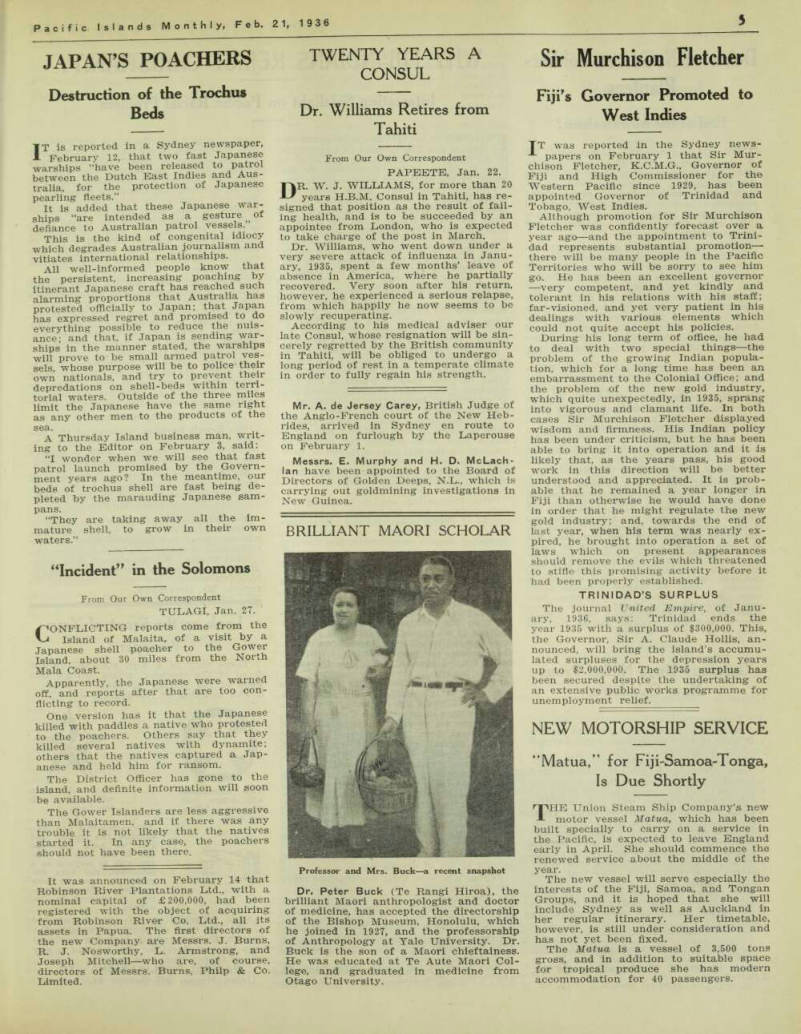
Dr. Peter Buck (Te Rangi Hiroa), the brilliant Maori anthropologist and doctor of medicine, has accepted the directorship of the Bishop Museum, Honolulu, which he joined in 1927, and the professorship of Anthropology at Yale University. Dr.
Buck is the son of a Maori chieftainess.
He was educated at Te Aute Maori Col lege, and graduated in medicine from Otago University.
Professor and Mrs. Buck—a recent snapshot
Sir Murchison Fletcher
Fiji’s Governor Promoted to West Indies
TT was reported in the Sydney news papers on February 1 that Sir Mur chison Fletcher, K.C.M.G., Governor of Fiji and High Commissioner for the Western Pacific since 1929, has been appointed Governor of Trinidad and Tobago, West Indies.
Although promotion for Sir Murchison Fletcher was confidently forecast over a year ago—and the appointment to Trini dad represents substantial promotion— there will be many people in the Pacific Territories who will be sorry to see him go. He has been an excellent governor —very competent, and yet kindly and tolerant in his relations with his staff; far-visioned, and yet very patient in his dealings with various elements which could not quite accept his policies.
During his long term of office, he had to deal with two special things—the problem of the growing Indian popula tion, which for a long time has been an embarrassment to the Colonial Office; and the problem of the new gold industry, which quite unexpectedly, in 1935, sprang into vigorous and clamant life. In both cases Sir Murchison Fletcher displayed wisdom and firmness. His Indian policy has been under criticism, but he has been able to bring it into operation and it is likely that, as the years pass, his good work in this direction will b© better understood and appreciated. It is prob able that he remained a year longer in Fiji than otherwise he would have done in order that he might regulate the new gold industry; and, towards the end of last year, when his term was nearly ex pired, he brought into operation a set of laws which on present appearances should remove the evils which threatened to stifle this promising activity before it had been properly established.
Trinidad’S Surplus
The journal United Empire, of Janu ary, 1936, says: Trinidad ends the year 1935 with a surplus of $300,000. This, the Governor, Sir A. Claude Hollis, an nounced, will bring the island’s accumu lated surpluses for the depression years up to $2,000,000. The 1935 surplus has been secured despite the undertaking of an extensive public works programme for unemployment relief.
“Matua,” for Fiji-Samoa-Tonga,
New Motorship Service
“Matua,” for Fiji-Samoa-Tonga, Is Due Shortly
THE Union Steam Ship Company’s new motor vessel Matua, which has been built specially to carry on a service in the Pacific, is expected to leave England early in April. She should commence the renewed service about the middle of the year.
The new vessel will serve especially the interests of the Fiji, Samoa, and Tongan Groups, and it is hoped that she will include Sydney as well as Auckland in her regular itinerary. Her timetable, however, is still under consideration and has not yet been fixed.
The Matua is a vessel of 3,500 tons gross, and in addition to suitable space for tropical produce she has modern accommodation for 40 passengers.
Debts of N. Guinea Soldier-
Planters End of the Moratorium?
THE Commonwealth Government (it was reported from Canberra on Feb ruary 12) is considering plans for lifting the moratorium on the payment of in terest and principal due on expropriated properties in the Mandated Territory of New Guinea, which has operated since 1930, when there was a collapse in the copra market.
About 175 plantations, which were taken over from former German colonists in 1920, are involved, and the outstanding principal amounts to nearly £2,000,000.
The annual interest payments due on the properties amount to about £BO,OOO. The plantations are held mostly by Austra lians, many of whom are returned sol diers. The maximum interest rate charged to returned soldier holders of the proper ties is 4 per cent, and to others 5| per cent.
Recently a representative of the Plan ters’ Association of New Guinea waited on the Treasurer (Mr. Casey) and the Minister for External Affairs (Sir George Pearce), and placed before them a plan under which the planters would resume their payments after June 30. This plan provides for payments on a sliding scale, which will be governed by the market price of copra from time to time. It is now being considered by the Ministry.
EDITORIAL NOTE.—It is not likely that there will be any satisfactory resumption of financial relationship between the soldier-planters and the Expropriation Board unless some sincere and in telligent attempt is made to adjust the valuations of the plantations. The values, and therefore the debt of the planters, were fixed when copra was at “fancy” prices—prices which this generation is not likely to see again. It is not very diffi cult to provide a sliding scale of annual payments, governed by the market price of copra; but the plan will not give any real relief unless some provision is made for reducing excessive valua tions. It is a difficult, thorny problem, with many ramifications—due to the fact that a large proportion of the soldier-planters were originally financed, and later assisted through the bad years, by the big trading firms.
Germany Buys Nickel From New Caledonia
New Caledonia
TT is reported that German interests are seeking to make arrangements for the purchase of very large quantities of nickel in New Caledonia.
Mr. Burkard, of Sydney, who is a well known German buyer of metals and minerals, paid a visit to New Caledonia last year; and he returned early this year to the French Colony with Herr Scheipe, who is an engineer attached to the great German armaments firm of Messrs. Krupp.
The two gentlemen at present are en deavouring to make arrangements for the purchase of a very large amount of nickel, and Mr. Burkard has entered into nego tiations with the owners of several mines in New Caledonia.
One report is to the effect that Ger many, between now and 1938, hopes to buy 200.000 tons of New Caledonian nickel.
A half-yearly dividend of 8 per cent, per annum has been declared payable on March 16 by W. R. Carpenter and Co.
Limited,
Why Fiji-Indians Reject Christianity
Interesting Sidelight on Pacific Racial Problem
to convert any substantial sec -T tion of the Fiji-Indians to Christianity is the subject of interesting comment by Rev. R. Piper, in the Missionary Review, issued by the Methodist Missionary Society.
Fourteen years ago, when there were 60,000 Indians in Fiji, the Society’s Indian Mission there claimed 200 members. To-day there are 84,000 Indians, and the member ship claimed by the Methodist Mission does not exceed 270. The Society has been at work there for 40 years, and “the aggre gate amount spent must be about £250,000.”
Mr. Piper admits that it is a discourag ing outlook. “At the next census the Indians will undoubtedly outnumber the Fijians. . . . . The racial problem will embarrass* the Fiji Government for genera tions yet to come. And what shall we dare to predict regarding the Cross, the Hindu Trident and the Moslem Crescent?”
But Mr. Piper refuses to be discouraged; and, in setting forth his reasons for urging a continuance of this mission w r ork, he gives us some history which is not only interesting, but which everyone should bear in mind when considering the problem of the Fiji-Indians. Says Mr. Piper: “The conditions under which Indians were brought to Fiji, and the manner in which they were treated (or rather ill treated) on the plantations should be care fully considered. Missionary work among Indians prior to the cessation in 1920 of the iniquitous indenture system was a for lorn hope.
“The dominating motive in filling Fiji with Indians was to provide a plentiful supply of cheap labour for the plantations.
Owing to the difficulty and expense of obtaining female immigrants, the Govern ment permitted the recruiters to fill the emigrant ships with three men to every woman.
“Great abuses crept into the system of recruiting labourers. There was a large proportion of undesirables in each shipload that arrived in Fiji. The housing condi tions on the plantations were disgraceful, Indians of all castes and religious scruples were herded together in coolie lines, where they became the prey of forms of evil that could not be checked while the indenture system lasted.
“Fiji became notorious for the callous treatment of the servile Indian population.
The unfavourable sex proportion was more ominous than in any British Crown Colony.
There was an excessive amount of crime.
In the last dozen years of the indenture system capital punishment reached an alarming figure. The suicide rate exceeded that of any country in the world.
“Theoretically, an Indian in a strange land, freed from the shackles of caste and priestly domination, should more readily accept Christianity than in his own land.
But his ancestral customs, beliefs and pro tective armour of caste had been blasted away. The process was so cruel, so un intelligible, that large numbers, particu larly from the South of India, committed suicide in fits of despondency.
“Those who bore their humiliations more stoically treasured a bitter resentment for the European and all his ways, including the religion that was offered him in sub stitution for his own. For forty years the Government of Fiji declined to spend even a penny upon educating the thousands of Indian children that were being reared in such debasing conditions.
“Our Indian missionaries opened schools and orphanages and did much in other
ways to ameliorate the lot of the unfortu nate indentured labourers. But it was not till the stream of indentured labour was stopped during the World War, and the indenture system was abolished once and for all in 1920, that Christian missionaries had any hope of overcoming the dread incubus of suspicion, distrust and moral apathy that characterised the Indian com munity. Here again I must confess that facts are baldly stated. The full import of these * facts will not be realised by our Church until the history of Fiji-Indian has been written.
“Since 1920 the Indians have gained rapidly in self-respect and self-assertive ness. Economically they have greatly im proved their relative position in the Colony.
The climate is agreeable and conditions generally favour an inordinate numerical growth. Natural laws are correcting the disproportion of the sexes.”
Mr. Piper urges the continuance of mis sion work. He was attracted by the rising generation of Indians in Fiji. “What is most needed is a steadfast attitude of understanding sympathy for the Indians.”
Mr. Enoch Perkins, director of the So ciete Chimique du Chrome, will arrive in Noumea from America in June to inspect the company’s mines in New Caledonia.
Mr. A. T. Day, chairman of directors of Aloha Central Gold Mine, N.L., left Syd ney by the Monterey early in February to visit the Tavua goldfield, Fiji.
Mr. Bergmann, an American engineer of the Societe Chimique du Chrome, who had charge of the Fantoche mine in New Caledonia, recently left Noumea for the United States. Mr. Sinclair, formerly en gineer in charge of mines at Tiebaghi, New Caledonia, has been appointed to replace Mr. Bergmann.
Advertisements & other items, p. 8 (1 item)
Wrapper !
Look on the Front of Your
There may be a sign stamped on the front of the wrapper which brings this copy of the "P.1.M,” to you.
The meaning of the marks: 0 'k Your subscription (6/- per annum, or 8/- in the case of countries outside the British Empire—which includes postage) may be sent direct, or may be paid to any of our agents (listed on page 3).
L VUi agcuto V Wll page O) *
PACIFIC PUBLICATIONS LTD.
Union House, 247 George St., Sydney Your subscription will expire with the next or following issue.
Your subscription will expire with this issue.
This means that your subscription has expired; and that we have sent you this further copy in case you wish to continue as a subscriber, and have forgotten to send in your suscription. Prompt attention is respectfully requested.
Atebrin
Further Experiences of Malaria Sufferers
By a Tropical Practitioner THE drug atebrin was brought to trial in the P.I.M. of December 20, and con demned as a delusion and a snare.
Awdi alteram partem. Let us try and arrive at the truth regarding the merits and demerits of the drug in malaria.
Will you, Mr. Editor, allow me space to act as counsel for the defence; and give equal prominence to the fact that atebrin is a very useful drug in malaria when it is rightly used?
Of the two drugs in common use, quinine is the greater and atebrin the lesser, but
the patient who makes use of both will be the one to receive the greatest benefit.
I, too, have been disappointed with atebrin in the past, because I tried to make it take the place of quinine, which it will not do. But atebrin carries on beneficial treatment at a stage when quinine has ceased to be of much use. Quinine cuts short the fever by destroying most of the active parasites; but it fails to clean up the blood completely, and in this necessary cleansing process atebrip becomes invalu able.
As a practising medical man, I could refer to many sound opinions on the value of atebrin, and many reported trials of its successful use on a far larger scale and under more critical observance than the cases quoted in the but it will suffice to say, in general terms, that medi cal men who know their job do use it and save their patients much ill-health by doing so.
The advice that should be given to your readers is not to reserve atebrin for Southern leave, but to use it in their own homes, right amongst the mosquitoes, and to use quinine as well.
The rule I follow is this; When you have an acute attack of malaria, take quinine EARLY, and in full doses. The quinine gets to work at once and usually, in 2 or 3 days’ time, the tem
perature drops to normal. Discontinue the quinine at once, when the fever has gone, and take a bottle of atebrin, 15 tabs, in 5 days, after which no direct anti-malarial drugs are necessary, though a course of iron and arsenic for blood replacement gives further benefit.
The main point that emerges from this method is that, during an acute attack, quinine is the best remedy, and that the continuing action of the atebrin lessens the risk of relapse.
Referring to the statement that atebrin brought on a more severe type of fever, and one similar to an infection sustained years before, I hope I may say without offence that no chemical agent can generate malaria, nor is atebrin at all likely to bring on any kind of fever for which a living organism or germ has been proved to be the causal agent. The onset of a severer type mentioned by your corres pondent is either co-incidental or, more likely, an aggravation of his actual malarial attack, brought on by abandoning quinine in favour of atebrin, an unwise form of treatment in many instances.
I am sure your correspondent wrote in good faith and that he will pardon another view being placed before your readers. I agree that to use atebrin exclusively is to court failure: but to use it in conjunction with quinine is to enjoy comparative im munity, even in highly malarious districts.
Only those who are so situated know what a blessing freedom from attacks means, and they are likely to attain it by the conscientious use of a bottle of atebrin after every bout.
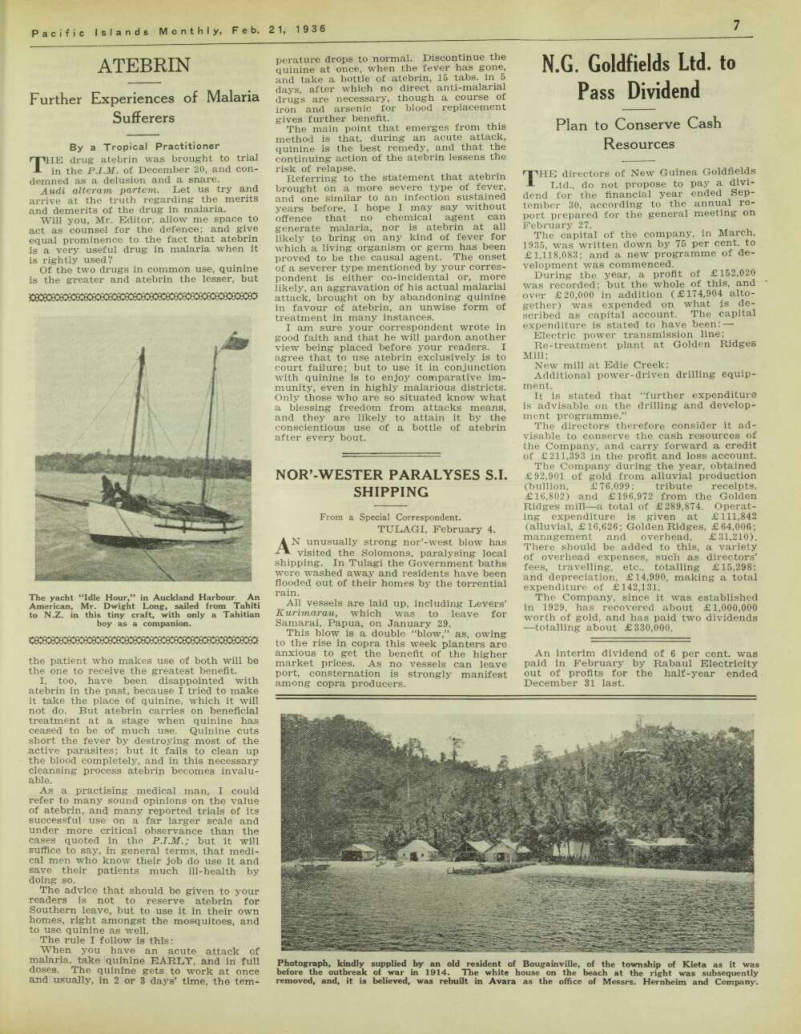
The yacht “Idle Hour,” in Auckland Harbour. An American, Mr. Dwight Long, sailed from Tahiti to N.Z. in this tiny craft, with only a Tahitian boy as a companion.
Nor’-Wester Paralyses S.I.
Shipping
From a Special Correspondent.
TULAGI, February 4.
AN unusually strong nor’-west blow has visited the Solomons, paralysing local shipping. In Tulagi the Government baths were washed away and residents have been flooded out of their homes by the torrential rain.
All vessels are laid up, including Levers’
Kurimarau, which was to leave for Samarai, Papua, on January 29.
This blow is a double “blow,” as, owing to the rise in copra this week planters are anxious to get the benefit of the higher market prices. As no vessels can leave port, consternation is strongly manifest among copra producers.
Photograph, kindly supplied by an old resident of Bougainville, of the township of Kieta as it Was before the outbreak of war in 1914. The white house on the beach at the right was subsequently removed, and,it is believed, was rebuilt in Avara as the office of Messrs. Hernheim and Company.
Pass Dividend
N.G. Goldfields Ltd. to Pass Dividend Plan to Conserve Cash Resources
THE directors of New Guinea Goldfields Ltd., do not propose to pay a divi dend for the financial year ended Sep tember 30, according to the annual re port prepared for the general meeting on February 27.
The capital of the company, in March, 1935, was written down by 75 per cent, to £1,118,083; and a new programme of de velopment was commenced.
During the year, a profit of £152,020 was recorded; but the whole of this, and over £20,000 in addition (£174,904 alto gether) was expended on what is de scribed as capital account. The capital expenditure is stated to have been; Electric power transmission line; Re-treatment plant at Golden Ridges Mill; New mill at Edie Creek; Additional power-driven drilling equip ment.
It is stated that “further expenditure is advisable on the drilling and develop ment programme.”
The directors therefore consider it ad visable to conserve the cash resources of the Company, and carry forward a credit of £211,393 in the profit and loss account.
The Company during the year, obtained £92,901 of gold from alluvial production (bullion, £76,099; tribute receipts, £16,802) and £196,972 from the Golden Ridges mill —a total of £289,874. Operat ing expenditure is given at £111,842 (alluvial, £16,626; Golden Ridges, £64,006; management and overhead, £31,210).
There should be added to this, a variety of overhead expenses, such as directors’ fees, travelling, etc., totalling £15,298; and depreciation, £14,990, making a total expenditure of £142,131, The Company, since it was established in 1929, has recovered about £1,000,000 worth of gold, and has paid two dividends —totalling about £330,000.
An interim dividend of 6 per cent, was paid in February by Rabaul Electricity out of profits for the half-year ended December 31 last.
Appeal to New Zealand
Trade For N.I.
A STRONG move is being made to induce the New Zealand Government to re move the embargo on citrus fruit from Norfolk Island, with a view to the resump tion of trade and tourist traffic between Norfolk Island and Auckland. The move has the active support of the Norfolk Island and Auckland Chambers of Com merce and there is some likelihood that it will succeed.
It is hoped that trading relations will be resumed when the Union S.S. Co.’s new Islands steamer Matua commences her running (connecting Fiji, Samoa and Tonga with New Zealand and Australia) about next June.
During the five years ended June 30, 1933, New Zealand sold goods to Norfolk Island worth £63,747 and bought from Nor folk Island produce worth £27,561. In addition, there was a considerable tourist traffic. This trade all disappeared when New Zealand placed an embargo on oranges from Australia (of which Norfolk Island politically is a part) and when, as a result of the depression, the shipping service between Norfolk Island and New Zealand was withdrawn. Norfolk Island producers, since then, have been through the “thinnest time” in their history.
M. Barthe, Chief of the Inspection De partment of the French Colonial Service, left Noumea, New Caledonia, for France by the Cap Tarifa on February 7.
They Took A Chance-And Lost
From a Special Correspondent.
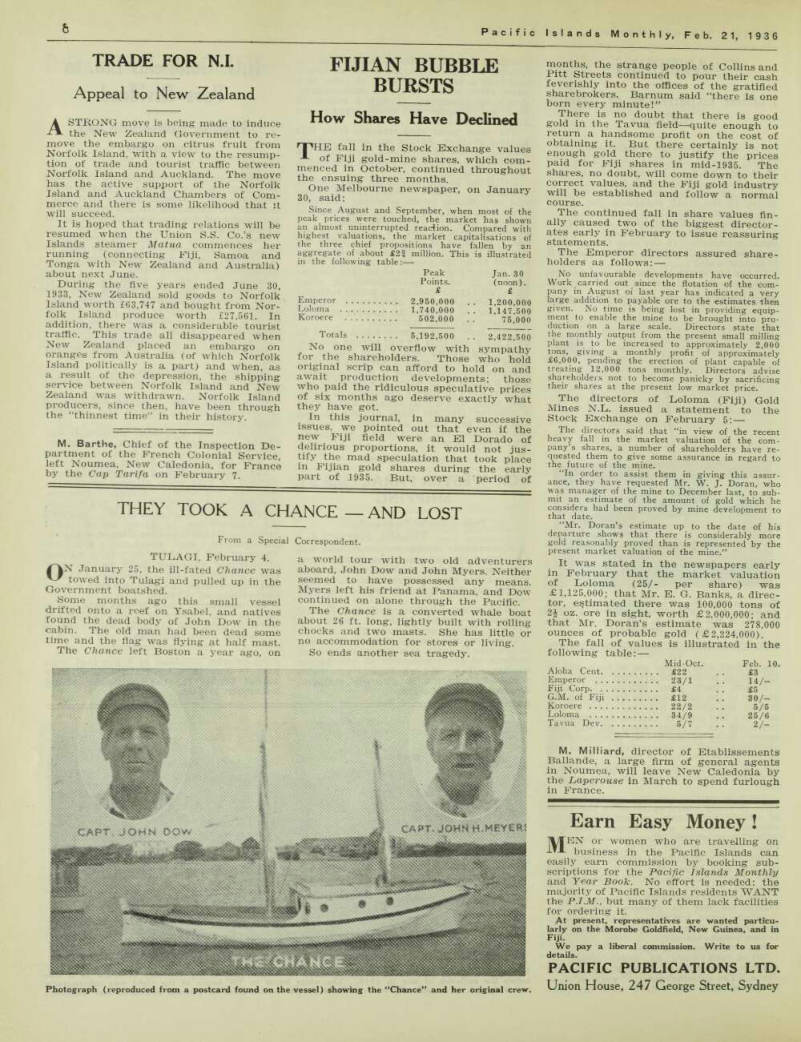
t TULAGI, February 4. ||N January 25, the ill-fated Chance was towed into Tulagi and pulled up in the Government boatshed.
Some months ago this small vessel ■drifted onto a reef on Ysabel, and natives found the dead body of John Dow in the cabin. The old man had been dead some time and the flag was flying at half mast.
The Chance left Boston a year ago, on
a world tour with two old adventurers aboard, John Dow and John Myers. Neither seemed to have possessed any means.
Myers left his friend at Panama, and Dow continued on alone through the Pacific, The Chance is a converted whale boat about 26 ft. long, lightly built with rolling chocks and two masts. She has little or no accommodation for stores or living.
So ends another sea tragedy.
Photograph (reproduced from a postcard found on the vessel) showing the “Chance” and her original crew.
Fijian Bubble
Bursts
How Shares Have Declined
r "’HE fall in the Stock Exchange values of Fiji gold-mine shares, which com menced in October, continued throughout the ensuing three months.
One Melbourne newspaper, on January 30, said: Since August and September, when most of the peak prices were touched, the market has shown an almost uninterrupted reaction. Compared with highest valuations, the market capitalisations of the three chief propositions have fallen by an aggregate of about £2i million. This is illustrated in the following table:—
No one will overflow with sympathy for the shareholders. Those who hold original scrip can afford to hold on and await production developments: those who paid the ridiculous speculative prices of six months ago deserve exactly what they have got.
In this journal, in many successive issues, we pointed out that even if the new Fiji field were an El Dorado of delirious proportions, it would not jus tify the mad speculation that took place in Fijian gold shares during the early part of 1935. But, over a period of
months, the strange people of Collins and Pitt Streets continued to pour their cash feverishly into the offices of the gratified sharebrokers. Barnum said “there is one born every minute!”
There is no doubt that there is good gold in the Tavua field—quite enough to return a handsome profit on the cost of obtaining it. But there certainly is not enough gold there to justify the prices paid for Fiji shares in mid-1935. The shares, no doubt, will come down to their correct values, and the Fiji gold industry will be established and follow a normal course.
The continued fall in share values fin ally caused two of the biggest director ates early in February to issue reassuring statements.
The Emperor directors assured share holders as follows: No unfavourable developments have occurred.
Work carried out since the flotation of the com pany in August of last year has indicated a very large addition to payable ore to the estimates then given. No time is being lost in providing equip ment to enable the mine to be brought into pro duction on a large scale. Directors state that the monthly output from the present small milling plant is to be increased to approximately 2,000 tons, giving a monthly profit of approximately £6,000, pending the erection of plant capable of treating 12,000 tons monthly. Directors advise shareholders not to become panicky by sacrificing their shares at the present low market price.
The directors of Loloma (Fiji) Gold Mines N.L. issued a statement to the Stock Exchange on February 5: The directors said that “in view of the recent heavy fall in the market valuation of the com pany’s shares, a number of shareholders have re quested them to give some assurance in regard to the future of the mine.
“In order to assist them in giving this assur ance, they have requested Mr, W. J. Doran, who was manager of the mine to December last, to sub mit an estimate of the amount of gold which he considers had been proved by mine development to that date.
“Mr. Doran’s estimate up to the date of his departure shows that there is considerably more gold reasonably proved than is represented by the present market valuation of the mine.”
It was stated in the newspapers early in February that the market valuation of Loloma (25/- per share) was £1,125,000; that Mr. E. G. Banks, a direc tor, estimated there was 100,000 tons of 2j oz. ore in sight, worth £2,000,000; and that Mr. Doran’s estimate was 278,000 ounces of probable gold (£2,224,000).
The fall of values is illustrated in the following table:
M. Milliard, director of Etablissements Ballande, a large firm of general agents in Noumea, will leave New Caledonia by the Laperouse in March to spend furlough in France.
Peak Jan.30 Points. (noon). £ £ Emperor 2.950,000 , . 1.200,000 Loloma . 1,147,500 Koroere . . . . 502,000 . 75,000 Totals ... • . . . 5,192.500 . . 2,422,500
Mid-Oct.
Feb. 10.
Aloha Cent £22 £3 Emperor 14/- Fiji Corp £4 £5 G.M. of Fiji ... 30/- Koroere 5/5 Loloma 25/6 Tavua Dev 5/7 2/-
Advertisements & other items, p. 10 (1 item)
Earn Easy Money!
11/fBN or women who are travelling on business in the Pacific Islands can easily earn commission by booking subscriptions for the Pacific Islands Monthly and Year Book. No effort is needed: the majority of Pacific Islands residents WANT the but many of them lack facilities for ordering it.
At present, representatives are wanted particularly on the Morobe Goldfield, New Guinea, and in Fiji.
We pay a liberal commission. Write to us for details.
PACIFIC PUBLICATIONS LTD.
Union House, 247 George Street, Sydney
“Eridan" At Tahiti
From Our Own Correspondent
Papeete, Jan. 22.
SINCE the operation of the French bonus has diverted the total exports of copra to France, the Messageries Mari times Company is finding it necessary to send larger vessels to Tahiti.
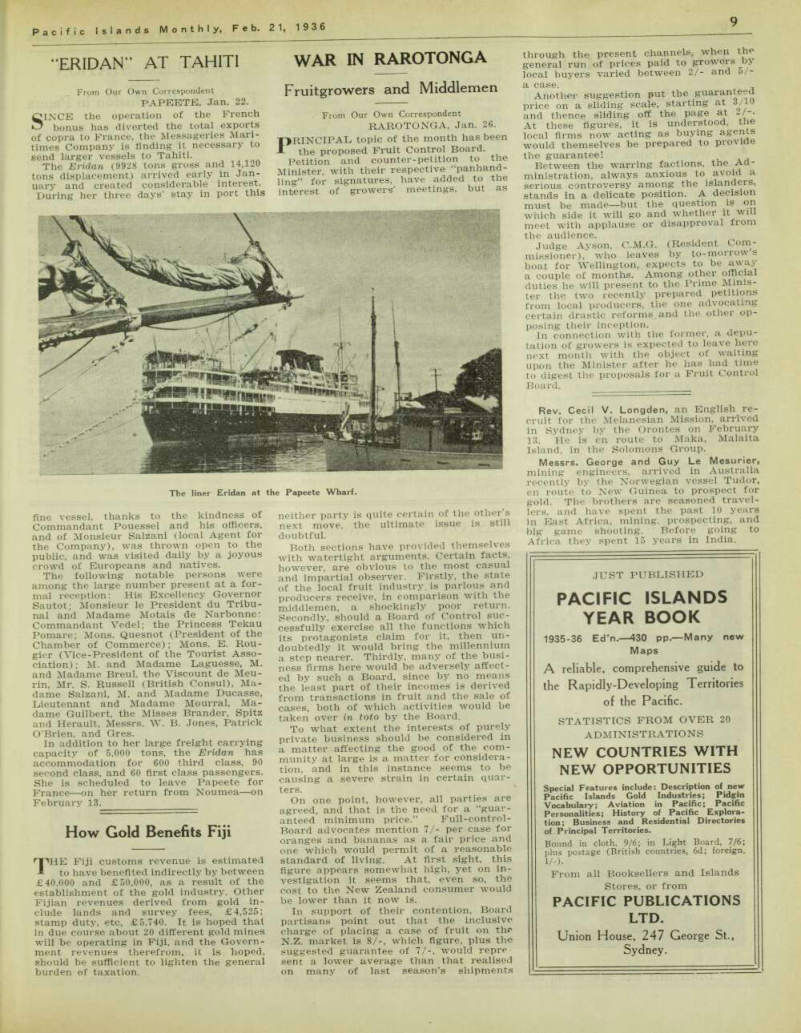
The Eridan (9928 tons gross and 14,120 tons displacement) arrived early in Jan uary and created considerable interest.
During her three days’ stay in port this
fine vessel, thanks to the kindness of Commandant Pouessel and his officers, and of Monsieur Salzani (local Agent for the Company), was thrown open to the public, and was visited daily by a joyous crowd of Europeans and natives.
The following notable persons were among the large number present at a for mal reception: His Excellency Governor Sautot; Monsieur le President du Tribu nal and Madame Motais de Narbonne: Commandant Vedel; the Princess Tekau Pomare; Mons. Quesnot (President of the Chamber of Commerce); Mons. E. Rou gier (Vice-President of the Tourist Asso ciation) ; M. and Madame Laguesse, M. and Madame Breul, the Viscount de Meu rin, Mr. S. Russell (British Consul), Ma dame Salzani, M. and Madame Ducasse, Lieutenant and Madame Mourral, Ma dame Guilbert, the Misses Brander, Spitz and Herault, Messrs. W. B. Jones, Patrick O’Brien, and Gres.
In addition to her large freight carrying capacity of 5,000 tons, the Eridan has accommodation for 600 third class, 90 second class, and 60 first class passengers.
She is scheduled to leave Papeete for France —on her return from Noumea —on February 13.
The liner Eridan at the Papeete Wharf.
How Gold Benefits Fiji
THE Fiji customs revenue is estimated to have benefited indirectly by between £40.000 and £50,000, as a result of the establishment of the gold industry. Other Fijian revenues derived from gold in clude lands and survey fees, £4,525; stamp duty, etc, £5,740. It is hoped that in due course about 20 different gold mines will be operating in Fiji, and the Govern ment revenues therefrom, it is hoped, should be sufficient to lighten the general burden of taxation.
War In Rarotonga
Fruitgrowers and Middlemen
From Our Own Correspondent
Rarotonga, Jan. 26.
topic of the month has been propose(J Fruit Contro l Board, Petition and counter-petition to the their respective “panhand “o'r Signatures, have added to the interest of growers meetings, but
neither party is quite certain of the other s next move, the ultimate issue is still doubtful.
Both sections have provided themselves w ith watertight arguments. Certain facts, however, are obvious to the most casual and impartial observer. Firstly, the state tbe j oca i f ru it industry, is parlous and producers receive, in comparison with the middlemen, a shockingly poor return, secondly, should a Board of Control suc cessfully exercise all the functions which its pro tagonists claim for it, then un doubtedly it would bring the millennium a gtep nearer . Thirdly, many of the busi ness firms here would be adversely affect ed by guch a Board s i nce by no means tbe j' east par t of their incomes is derived from transact ions in fruit and the sale of both of wh ich activities would be n > oyer {n to%Q by the Board .
To what extent the interests of purely Private business i should be a matter affecting the good of the com mumty at large is a matter for tmnsidera tion,_ and in this instance seems causing a severe strain in certain quar ters, On one Point, however, all parties are agreed, and that is the need for a “guar anteed minimum price.” Full-control- Board advocates mention 7/- per case for oranges and bananas as a fair price and one which would permit of a reasonable standard of living. At first sight, this figure appears somewhat high, yet on in vestigation it seems that, even so, the cost to the New Zealand consumer would be lower than it now is.
In support of their contention, Board partisans point out that the inclusive charge of placing a case of fruit on the N.Z. market is 8/-, which figure, plus the suggested guarantee of 7/-, would repre sent a lower average than that realised on many of last season’s shipments
through the present channels, when the general run of prices paid to growers by local buyers varied between 2/- and 5/a case.
Another suggestion put the guaranteed price on a sliding scale, starting at 6/ and thence sliding off the page at &/-• At these figures, it is understood, txie local firms now acting as buying agents would themselves be prepared to provide the guarantee!
Between the warring factions, the Ad ministration, always anxious to avoid a serious controversy among the islanders, stands in a delicate position. A decision must be made —but the question is on which side it will go and whether it will meet with applause or disapproval from the audience.
Judge Ayson, C.M.G. (Resident Com missioner), who leaves by to-morrow s boat for Wellington, expects to be away a couple of months. Among other official duties he will present to the Prime Minis ter the two recently prepared petitions from local producers, the one advocating certain drastic reforms and the other op posing their inception.
In connection with the former, a depu tation of growers is expected to leave here next month with the object of waiting upon the Minister after he has had time to digest the proposals for a Fruit Control Board.
Rev. Cecil V. Longden, an English re cruit for the Melanesian Mission, arrived in Sydney by the Orontes on February 13. He is en route to Maka, Malaita Island, in the Solomons Group.
Messrs. George and Guy Le Mesurier, mining engineers, arrived in Australia recently by the Norwegian vessel Tudor, en route to New Guinea to prospect for gold. The brothers are seasoned travel lers, and have spent the past 10 years in East Africa, mining, prospecting, and big game shooting. Before going to Africa they spent 15 years in India.
Advertisements & other items, p. 11 (1 item)
Pacific Islands
JUST PUBLISHED
YEAR BOOK
1935-36 Ed’n. —430 pp.—Many new Maps
A reliable, comprehensive guide to
the Rapidly-Developing Territories
of the Pacific.
STATISTICS FROM OVER 20
ADMINISTRATIONS
NEW COUNTRIES WITH
NEW OPPORTUNITIES
Special Features include: Description of new Pacific Islands Gold Industries; Pidgin Vocabulary; Aviation in Pacific; Pacific Personalities; History of Pacific Exploration; Business and Residential Directories of Principal Territories.
Bound in cloth, 9/6; in Light Board, 7/6; plus postage (British countries, 6d; foreign, 1/-).
From all Booksellers and Islands Stores, or from
PACIFIC PUBLICATIONS
LTD.
Union House, 247 George St.,
Sydney.
For Fly River
American Scientific Party Will Use Amphibian
THE advance party of the expedition sent to Western Papua by the American Museum of Natural History sailed from Sydney at the end of January for Port Moresby. They were Dr. Alvin L. Rand, ornithologist and assistant leader of the party, Mr. G, H. H. Tate, mammalogist, and Mr. L. J. Brass, a botanist on the staff of the Arnold Arboretum, Queensland.
The leader of the expedition, Dr. Richard Archbold, mammalogist of the famous New York Museum, will arrive in Australia shortly. He is bringing with him a large Fairchild Amphibian ’plane.
Dr. Rand and Messrs. Tate and Brass will go on from Port Moresby to- Daru Island (at the mouth of the Fly River), where the expedition’s main base will be located. From there the party will con centrate on the Fly River and the moun tains beyond, collecting mammals and birds for the Natural History Museum, and plants for the New York Botanical Society.
Collections of cold-blooded invertebrates and insects will also be made, and the party will try to secure living palm seeds so that an attempt may be undertaken to grow indigenous species of Papuan palms in Florida, U.SA. In addition to the land fauna, Torres Strait porpoises and sea turtles will be collected by Mr. Archbold.
The ’plane, which carries about eight passengers, will be unloaded at Brisbane, according to the Vacuum Oil Co., which has arranged for fuel and oil to be sent
to the base in Papua. The machine will then be flown to Daru by Mr. Russel Rogers, and on arrival there, reconnais sance flights will be made over the head waters of the Fly River to discover the most promising and accessible areas for field work.
The inland party, led by Mr. Rand, will then be flown 550 miles up-river with 30 native carriers to a place where the Fly is wide enough to allow for an emergency base for the big ’plane. From this point the expedition will go on on foot, attempt ing to reach hitherto unattained altitudes, keeping in touch with the aeroplane and the Daru camp by means of a portable wireless.
While on the march, the exploring party will be supplied with food from the aero plane by parachute.
The four scientists worked for a time in Papua for the American Museum of Natural History early in 1934. Their finest achievement on that occasion was the climbing of Mount Albert Edward (13,100 ft.), the second highest peak in Papua.
Mr. A. Young, Islands Traveller for Messrs. Sargood Gardiner Limited, left Sydney for Papua and New Guinea by the January Macdhui, on one of his periodical business trips to Rabaul and the outports.
Recent movements in the British Colonial Service: Mr. C. J. J. T. Barton, lately senior assistant colonial secretary, Kenya, to be colonial secretary, Fiji; Mr.
A. W. L. Savage, recently assistant trea surer, Northern Rhodesia, to be deputy treasurer, Fiji; Mr. C. S. St. Julian, pro moted to comparing officer, Customs De partment. Fiji.
Wireless Station
For Methodist Mission in Papua
A WIRELESS station to communicate with missionaries on the more isolated mission stations in Papua will shortly be erected by Amalgamated Wireless (A/sia) Ltd. for the Methodist Missionary Society. This announcement was made in Sydney on February 5 at the society’s annual meeting, and Rev.
A. J. Barclay (President-General) added that it would probably be located at Salamo, the Mission’s headquarters in the Territory.
Rev. J. R. Andrew, of Dobu, Papua, told the meeting that gold prospecting had begun on the island of Misima, and that portion of the lode ran into church property. It was not known at the present time what the lode was worth.
The enhanced price of copra would have a beneficial effect on church funds in the Islands, as Islanders would be able to give more liberally.
Members expressed appreciation with the splendid work done by the medical missionary (Dr. W. G. Heaslip), who is returning from Papua. He had been able to stay longer than any other missionary in the malaria-ridden country.
Rev. R. Piper, who organised the recent cruise of 430 Australian Methodists to the Centenary celebrations in Fiji, suggested that as the tour had been so successful there should be another to the islands of New Britain and New Ireland.
Methodists would be able to see the beginning of missionary work on semi uncivilised natives.
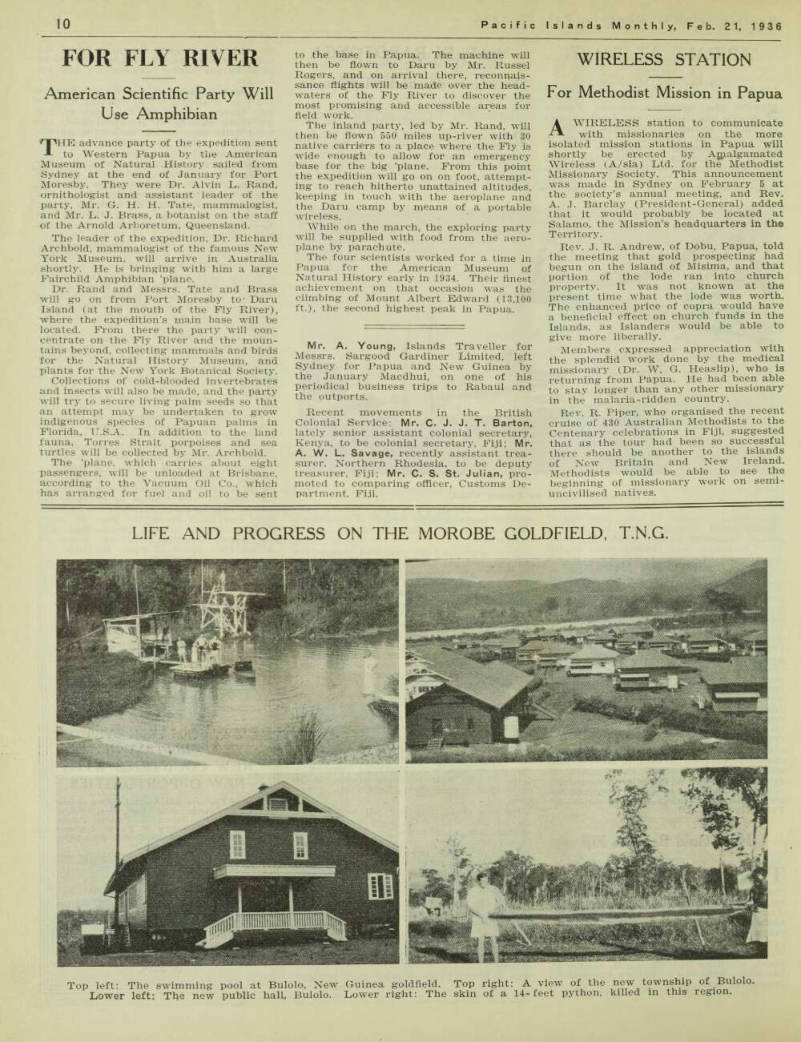
Life And Progress On The Morobe Goldfield, T.N.G.
Top left: The swimming’ pool at Bulolo, New Guinea goldfield. Top right: A view of the new township of Bulolo.
Lower left: The new public hall, Bulolo, Lower right: The skin of a 14-feet python, killed in this region.
Tropiclities
A MAN who was in the service of the New Guinea Expropriation Board, just after the war, informs us that there diamonds awaiting discovery in northern New Guinea. He was on terms of close friendship with a German mis sionary, and the latter showed him a tobacco-box full of uncut diamonds, which he had personally picked out of a blue clay deposit among the mountains in a then unexplored part of New Guinea. Some of the stones were sent to Sydney and tested, and they were true diamonds. Two German missionaries, it is believed, knew the secret of the loca tion of the diamond deposit, and there was an agreement that the Mission of the Sacred Heart should benefit from any •commercial exploitation of the discovery, but nothing further has been heard of the matter for fifteen years. ♦ * * WE have received from an esteemed friend in Queensland a letter enclos ing 6/-, “for which please post me the Pacific Highland Monthly for 12 months.”
The editor of this journal is still wondering whether this was merely a typist’s phonetic error, or whether it represents a cunning .and unpleasant reflection upon his Scottish ancestors. ♦ * * SIXTY years ago Commodore James Goodenough, visiting the then untamed islands of the New Hebrides, wrote: “It is remarkable that, just in proportion to the amount of people who have been taken away as labourers, so are the natives inclined to assault Europeans. Where white men are least known, tl\e people are most friendly.”
This sentence was read to the Royal Geographical Society in London on Decem ber 10, Admiral Sir William Good enough, son of the late Commodore. ♦ * ♦
Captain Charles P. Mckenzie, De
scribed as a British sportsman and explorer, recently arrived in San Francisco from Tahiti with a collection of anthro pological relics which, it is understood, he Is to present to museums in the United States and Great Britain. In the collection were two fragmentary skulls with filed teeth. In the rear of a cave, he says, he found “rows of skulls, stacked on shelves of earth like jars of fruit in a country cellar.” Captain McKenzie was the first white man ever to enter that particular cave.
However, one of the most interesting discoveries he made was a skull that had been trepanned by ancient Tahitian sur geons. The bone had been replaced by a piece of polished coconut shell with a skill, he said, that rivalled the surgery of old Egypt.
The celebrated missionary, Rev. W. Ellis, author of “Polynesian Researches,” who was at Bora Bora in 1820, heard of similar operations. “They have cleared away the skin and coverings,” he said, with refer ence to people injured in battle, “and, having removed the fractured piece of bone, have carefully fitted in a piece of cocoa-nut shell, and replaced the covering and skin: on the healing of which, the man has recovered.” Ellis also heard of another operation which, he confessed, he could hardly believe. He was told that on some occasions when the brain was injured as well as the bone, the damaged portion ha£ been removed and replaced with brains from a newly-killed pig. “They persist in
stating this was done,” he said, “and add that the persons always became furious with madness and died.” Polynesian sur gery certainly had its limitations.
Interference with ancient burial places is most strongly resented by Polynesians who, naturally enough, regard it as dese cration. Whether Captain McKenzie’s in vestigations were carried out with the permission of the French Government is not known. The natives firmly believe that he will meet with misfortune or bad luck as a result of interfering with the skulls of the dead. For a similar reason, many years ago, the numerous skulls at Tapu tapuatea, on the island of Raiatea, the most sacred of all marae in Polynesia, were collected by the natives and carried off to secret hiding places. The Maoris in New Zealand are continually protesting against the desecration of urupa, or burial grounds.
As an incentive, the vandal in New Zea land has always before him the possibility of finding some cherished piece of green
stone.
E.R.
THIS statement, made in the House of Commons by the Colonial Secretary on February 12, clears away some misgiv ings and misapprehensions: “The British Government has not considered, and is not considering, the handing over of any of the British colo nies or territories held under mandate.”
After Sir Samuel Hoare’s Geneva speech, in which he said that Britain must recognise that other nations were entitled to colonies and sources of raw materials, representations were made to Britain by Dominions which hold man dates —and especially South Africa, Aus tralia, and New Zealand. The foregoing statement evidently is the outcome. * ♦ * THE breaking of nearly four years of depression in the Islands has been marked by the receipt of some valuable orders in Sydney shipbuilding yards. One
of the first things bought by the Islands planter, when money begins to flow again, is a new boat. Most of the leading ship builders are getting Islands business. A 45ft. vessel, with a Diesel engine, for use in connection with Guinea Airways busi ness at Lae and Salamaua, is on the stocks at Lars Halvorsen’s yard. ♦ * ♦ MANY Australians do not realise th© importance of Australia’s mandat© in New Guinea. You have only to look at the map to realise how important its geographical situation is in relation to Australia. See how New Guinea and its adjacent islands are spread out northward of the Australian continent —how they stand between Australia and the Far East. In my position I cannot say as much as I should like about the subject, but, take my word for it, New Guinea is a vital spot in Pacific affairs, and will be even more so. Watch for developments within the next 20 years.”
Thus Mr. E. W. P. Chinnery, head of District Services in New Guinea, in a newspaper “interview.” It is a great pity that other public officials, in promin ent positions, have not the courage to put into words the things that we all are thinking. Yet it is likely that Mr. Chin nery, instead of being thanked, will be sat upon by some heavy-breathing poli tician.
T.I.’S Deluge Overdue
From Our Own Correspondent
Thursday Is., Feb. 3.
THE shortage of water still prevails on Thursday Island.
To date only about 12 inches of rain have fallen instead of jthe deluge usually expected at this season of the year, The Ghangte could not be supplied with water when she called last week. There is every indication, however, that the town reservoir will be filled shortly.
Local plumbers have been reaping a small harvest by making and installing rain water tanks for private house holders who have been relying too much upon the town supply.
Advertisements & other items, pp. 13-14 (1 item)
Homi
STERLING
HO.HE
STEUZM6
HOMI
Guaranteed CD
LOOKS
BETTER
LONGER
MADE BY
STERLING VARNISH CO.
PAINT
For
TROPICAL
SUN and
SALT-LADEN
AIR
SYDNEY, N.S.W.
NEGLECT OF DEFECTIVE SIGHT
MAY CAUSE SERIOUS RESULTS
Take Care of Your Eyes Consult
WALTER FORD
D.8.0.A., M.0.0.A.
Optometrist and Optician 4th Floor, Challis House Martin Place, Sydney Established over 30 years Tel.: Most moderate charges BW 6131
Ccccie Tea Co’s
JfaAQtade TEAS CCrfCES.
We invite you to try these “ Quality ” Teas . . . free. Simply forward the name of your storekeeper and a Generous Sample will be sent you Write to-day.
You will be surprised how your palate will respond to the delicate flavour of a really HIGH-GRADE tea ... . perfectly blended.
Ask for “CORRIE’S”
—Tie Tea that is “Deliciously
Different
Correspondence invited from Traders.
THE CORRIE TEA CO.
39 Bathurst St., Sydney.
A
3 Doctors said -“ Duodenal ”
Hardy’s Saved Operation
B.M.HABDY’S
Extract of letter from J. E. Brazendale, New Norfolk, Tasmania.
Dated July, 1933.
Mr. R. M. Hardy, Dear Sir, I have suffered indescribably for three years from Ulcerated Stomach. Three doctors told me I had a duodenal ulcer and must undergo an operation, and I was X-rayed for the purpose. Just at the time I was recommended to try Hardy’s Remedy, and I did so. I used two tins of the remedy and part of another in the course of about three months, and now I can both eat and drink anything that I choose, without the slightest discomfort. lam a new man entirely.
Yours faithfully,
(Signed) J. E. BRAZENDALE.
This is but one of dozens and dozens of letters, telling how sufferers from stomach complaints have found complete relief in R. M. Hardy’s wonderful discovery.
Obtainable at all Burns, Philp & Co. Ltd. stores. 3/6 per tin. Note the generous size.
Scientific research has proved that all stomach troubles, indigestion, gastritis, flatulence, ulcerated stomach ... can be successfully and quickly relieved by using this marvellous mineral cure. Suffer no longer, try Hardy’s. It won’t fail you. IMrfcinFQTIOM AND
R. M. HARDY’S
INDIGESTION
ULCERATED STOMACH
REMEDY
NO DIETING
NO HEADACHES
NO STABBING PAINS
About Islands People
Sir Hubert Murray, Lieutenant-Gov ernor of Papua, returned from Norfolk Island to Sydney at the end of January.
Accompanied by his daughter, Mrs. C. R.
Pinney (wife of the Administrator of Nor folk Island) he will leave for England on March 3 to join Lady Murray and his two sons, who are already in London.
Mr. J. C. M. Scott, manager at Makam bo, Solomon Islands, of Messrs. Burns, Philp & Co. Ltd., arrived in Sydney to spend furlough, by the Malaita on Feb ruary 13.
Monsieur Dumoulin arrived in Noumea from Europe by the Ediran at the end of January. He has now taken up duties as
Procureur-General and head of the Judicial Administration in New Caledonia.
Mr. A. E. T. Corrie, principal of the Cor rie Tea Co., will leave Sydney for Suva by the Mariposa on March 4 on one of his periodical business trips to Fiji.
Mr. R. C. MacPherson, of the literary staff of the “Fiji Times and Herald,”
Suva, returned to the Colony after leave in Australia, by the Niagara on January 30.
Rev. J. W. Schomberg, who had been associated for many years with the Ang lican Torres Straits Mission, died at Thursday Island on February 5. After a long and useful career, he was laid to rest on Moa Island—the scene of his labours—on February 11.
Sir Henry and Lady Marks, prominent residents of Suva, Fiji, returned to the Colony from London by the Ruahine on January 28.
Mr. C. V. Widdy, manager in the Solo mon Islands for Lever’s Pacific Planta tions Pty, Ltd., reached Sydney by the Malaita on February 13, on furlough.
Mr. David W. Amos, general manager in Fiji for the Pacific Insurance Co. Ltd., returned to Suva with his wife, after a tour of Great Britain, by the Ruahine on January 28.
Mr. H. G. Carter and Mr. C. J. Rutledge,. directors of Cuthbert’s Misima Goldmine Ltd., were passengers to Samarai, Papua,, by the last Montoro.
Mr. Andrew Kelly, well-known Rabaul solicitor, departed from Sydney on Janu ary 30 on his return to the Territory by the Macdhui.
Mr. A. H. Bunting, a well-known resi dent of Eastern Papua, sailed from Australia for Samarai by the January Macdhui.
Mrs. W. Ramsay McNicoll, wife of the Administrator of New Guinea, returned to Rabaul, after spending a holiday in Australia, by the Nankin from Sydney on February 12.
Captain A. C. Middenway, formerly dis trict officer at Gizo, Solomon Islands, who now is retired and living in Portland, Vic toria, has been appointed a Justice of the Peace.
Rev. E. A. Codd, of the Melanesian Mission, who has worked for two years at the Vureas School in the Banks Group, New Hebrides, will sail from Sydney by the Malaita on February 22, with his wife and infant daughter, to take up duties at Siota in the Solomon Islands.
Rev. and Mrs. R. L. McDonald arrived in Sydney from Fiji with their daughters on January 27. With a great record of service, Mr. McDonald has just retired from the Fiji District of the Methodist Mission, where he laboured for 27 years, during 12 years of which he was District Chairman.
Advertisements & other items, p. 14 (1 item)
Kurrajong
Wheeny Creek Farm
Forty-five miles from Sydney Superior modern accommodation, abundance of cream, eggs, and poultry. 5 acres orchard. Tennis, etc.
Tariff: Double, £2/2/- each; Single, £2/10/- ’Phone: Kurrajong 42 Proprietor: A. J. SAMSON Formerly New Guinea Public Service
About Islands People
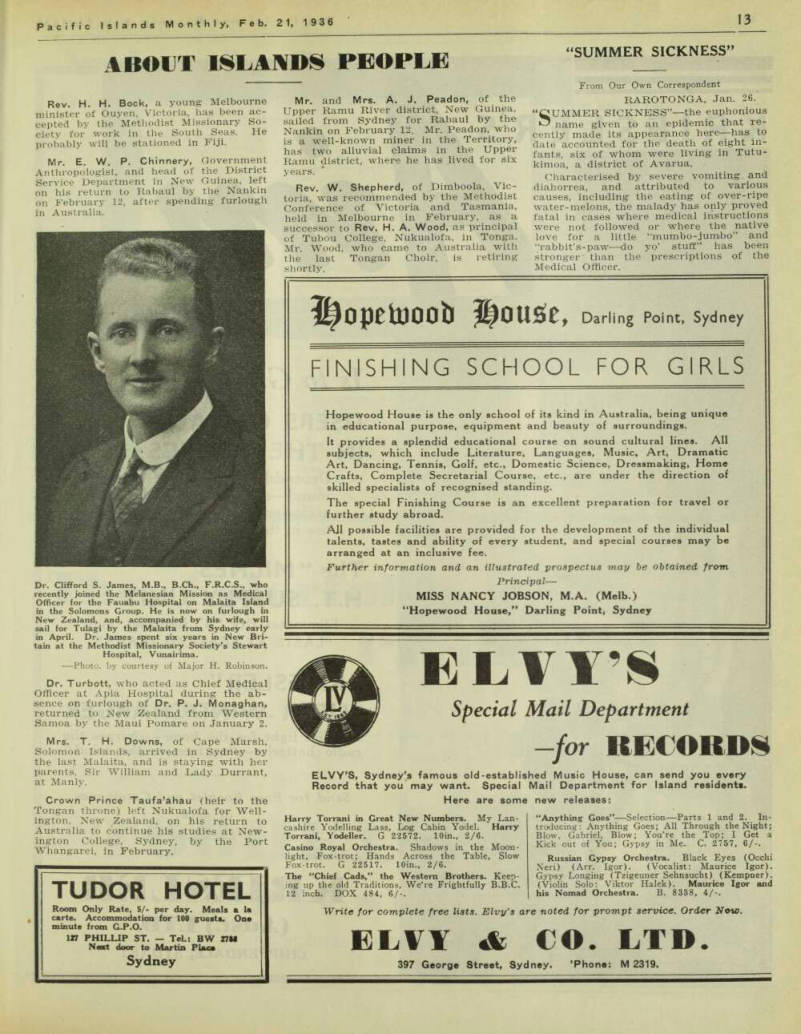
Rev. H. H. Bock, a young Melbourne minister of Ouyen, Victoria, has been ac cepted by the Methodist Missionary So ciety for work in the South Seas. He probably will be stationed in Fiji.
Mr. E. W. P. Chinnery, Government Anthropologist, and head of the District Service Department in New Guinea, left on his return to Rabaul by the Nankin on February 12, after spending furlough in Australia.
Dr. Turbott, who acted as Chief Medical Officer at Apia Hospital during the ab sence on furlough of Dr. P. J. Monaghan, returned to New Zealand from Western Samoa by the Maui Pomare on January 2.
Mrs. T. H. Downs, of Cape Marsh, Solomon Islands, arrived in Sydney by the last Malaita, and is staying with her parents, Sir William and Lady Durrant, at Manly.
Crown Prince Taufa’ahau (heir to the Tongan throne) left Nukualofa for Well ington, New Zealand, on his return to Australia to continue his studies at New ington College, Sydney, by the Port Whangarei, in February.
Mr. and Mrs. A. J. Peadon, of the Upper Ramu River district, New Guinea, sailed from Sydney for Rabaul by the Nankin on February 12. Mr ;vf is a well-known miner in the Territory, has two alluvial claims m the Upper Ramu district, where he has lived for six years ’
Rev. W. Shepherd, of Dimboola, Victoria, was recommended by the Methodist Conference of Victoria and Tasmania, held in Melbourne in February, as a successor to Rev. H. A. Wood, as principal of Tubou College, Nukualofa, in Tonga.
Mr. Wood, who came to Australia with the last Tongan Choir, is retiring shortly.
Dr. Clifford S. James, M.B., B.Ch., F.R.C.S., who recently joined the Melanesian Mission as Medical Officer for the Fauabu Hospital on Malaita Island in the Solomons Group. He is now on furlough in New Zealand, and, accompanied by his wife, will sail for Tulagi by the Malaita from Sydney early in April. Dr. James spent six years in New Bri tain at the Methodist Missionary Society’s Stewart Hospital, Vunairima. —Photo. by courtesy of Major H. Robinson.
“Summer Sickness”
From Our Own Correspondent
Rarotonga, Jan. 26.
“CUMMER SICKNESS”— the euphonious name given to an epidemic that re cently made its appearance here—has to date accounted for the death of eight in fants, six of whom were living in Tutu kimoa, a district of Avarua.
Characterised by severe vomiting and diahorrea, and attributed to various causes, including the eating of over-ripe water-melons, the malady has only proved fatal in cases where medical instructions were not followed or where the native love for a little ‘mumbo-jumbo” and “rabbit’s-paw—do yo’ stuff” has been stronger than the prescriptions of the Medical Officer,
Advertisements & other items, pp. 15-16 (2 items)
Elvfs
ilopetooob J|ous \t f Darling Point, Sydney
FINISHING SCHOOL FOR GIRLS
Hopewood House is the only school of its kind in Australia, being unique in educational purpose, equipment and beauty of surroundings.
It provides a splendid educational course on sound cultural lines. All subjects, which include Literature, Languages, Music, Art, Dramatic Art, Dancing, Tennis, Golf, etc.. Domestic Science, Dressmaking, Home Crafts, Complete Secretarial Course, etc., are under the direction of skilled specialists of recognised standing.
The special Finishing Course is an excellent preparation for travel or further study abroad.
All possible facilities are provided for the development of the individual talents, tastes and ability of every student, and special courses may be arranged at an inclusive fee.
Further information and an illustrated prospectus may be obtained from Principal —
MISS NANCY JOBSON, M.A. (Melb.)
“Hopewood House,” Darling Point, Sydney
ELVFS
Special Mail Department
-for RECORDS
ELVY'S, Sydney's famous old-established Music House, can send you every Record that you may want. Special Mail Department for Island residents.
Here are some new releases: Harry Torrani in Great New Numbers. My Lancashire Yodelling Lass, Log Cabin Yodel. Harry Torrani, Yodeller. G 22572, 10in., 2/6.
Casino Royal Orchestra. Shadows in the Moonlight, Fox-trot; Hands Across the Table, Slow Fox-trot. G 22517. 10in., 2/6.
The “Chief Cads,” the Western Brothers, Keeping up the old Traditions, We’re Frightfully 8.8. C. 12 inch. DOX 484, 6/-.
“Anything Goes” —Selection —Parts 1 and 2. Introducing: Anything Goes; All Through the Night; Blow, Gabriel, Blow; You’re the Top; I Get a Kick out of You; Gypsy in Me. C. 2757, 6/-.
Russian Gypsy Orchestra. Black Eyes (Occhi Neri) (Arr, Igor). (Vocalist: Maurice Igor).
Gypsy Longing (Tzigeuner Sehnsucht) (Kempner). (Violin Solo: Viktor Halek). Maurice Igor a his Nomad Orchestra. B. 8338, 4/-.
Write for complete free lists. Elvy’s are noted for prompt service. Order Novj.
BEVY & CO. LTD.
397 George Street, Sydney. 'Phone: M 2319.
KRIESLE
R iiiiiiiiiiiiiiiiiiiiiiiiiiiiiy
Is to Give
USERS OF RADIO
IN THE TROPICS
Dependable performance, all the year round—a Dual Wave Radio designed exclusively to overcome the difficulties in the most humid areas.
The “ MILNES”
H.T. SUPPLY UNIT
Eliminates Dry “B” Batteries, and
“LASTS AT LEAST 20 YEARS.”
** KRIESLER”
SUPER-WINDCHARGER
Supplies light for the home—charges the radio batteries—“as free as the wind.”
Send for Free Booklet and Catalogues at once.
Address:
KRIESLER
(AusL) I;TI). §
CHIPPENDALE, SYDNEY
IlllilllllllllllllilllllllllllllllilillillllillllllllUlllilli
Tudor Hotel
Room Only Rate, 5/- per day. Meals a la carte. Accommodation for 100 guests. One minute from G.P.O.
127 PHILLIP ST. Tel.s BW 27M
Next door to Martin Place
Sydney
Aerial Transport Merger Plan in New Guinea
Explanatory Statements by Minister and Guinea Airways
INTEREST continues in the move by the Federal Government—to which reference was made in the last issue—to bring about the creation of one aerial transport com pany in New Guinea, which would operate under a Government charter.
On page 56 of this issue there will be found a list of the aviation companies and interests operating in New Guinea. These companies and persons carry out the whole of the necessary transport between the coast of New Guinea and the Morobe gold field on the tableland in the interior. These companies—and especially the early ones— have a remarkable record for safety and efficiency in aerial transportation. Their operations furthermore are on a huge scale. In 1934, for instance, the pioneer company (Guinea Airways Limited) car ried three times more air freight than all the air companies in America.
But this field of enterprise is wide open to competition. The basis of efficiency and safety is first-class ground organisation.
Under present conditions, however, any man with a knowledge of aviation can go into New Guinea with one or two old machines and, sacrificing ground organisa tion, can cut freights to a non-profitable level. This has happened in recent years— actually more second-hand aircraft have been introduced to New Guinea than prob ably to any other country in the world with the same air traffic —and it is a source of growing anxiety to the Administration and the big companies with a sense of responsibility.
Another feature, which we explained in last issue, is that the whole of the British Empire to-day is being intensively organised for purposes of defence; and it is the policy of the Home and Dominion Governments to build up for civil transport purposes strong aviation companies whose services and equipment can be readily turned over to defence purposes in an emergency. This applies to New Guinea just as it applies to Australia.
These matters have been under con sideration for many months; and finally out of the discussions have arisen the plans for the merger of all aviation interests in New Guinea, under some system of Government supervision which would pro tect the interests of the goldfields com munity. The fear has been expressed in New Guinea that such a merger would mean the creation of a monopoly; and that such a monopoly, by means of excessive rates and other burdensome conditions, would bleed the goldfields community at its own sweet will. There are now em ployed on the Morobe goldfields at least 2,000 Europeans and 6,000 or 7,000 native labourers, and the Europeans in recent public meetings, and by other similar agita tion, have protested in no uncertain terms against the suggestion that they are to be left entirely at the mercy of a monopolistic aviation transport organisation.
Preparations for this aerial transport re organisation have been going on for some time; and in recent weeks the Minister in Charge of Territories, Sir George Pearce,
has been bombarded with protests from the alarmed New Guinea interests. Probably it was as a result of these that Sir George Pearce on February 3 made the following public statement:' Sir George explained that Cabinet had agreed in principle only to a proposal that all existing companies and interests operating in the Territories should be merged into a company holding a charter from the Government, subject to control and regu lation by the Government as to rates of fares, freight, and frequency of service; and that control should be exercised by a Board on which various interests in the chartered company, the mining and commercial interests, and the planters would be represented, with an experienced officer appointed by the Government as chairman.
The Government believed that such a scheme would be in the interests of the Territories gener ally, would maintain efficient aviation services, and would permit the company to earn reasonable profits whilst keeping ground organisation equip ment and aircraft in safe and efficient condition.
With the increase in the number of companies and individuals operating, there had developed price-cutting and a tendency to go after the pay able freights and neglect the less profitable. This tendency, if continued, would, it was feared, result in loss of efficiency and neglect of developmental lines.
This ministerial statement caused as much surprise and dismay among aviation interests as the merger proposal had caused among the people of the New Guinea goldfields. “How- in the name of wonder,” they exclaimed, “can an aerial
transport service, which calls for the highest degree of technical knowledge and efficiency in its operations, be carried on by a Government Board such as that described? The thing is ridiculous! A Government official as chairman, forsooth!
Members of the Board scattered all over the place! Why the very things we are aiming at, safety and efficiency, would be impossible! ”
But another statement, published in the Adelaide Advertiser on February 5, by Mr.
C. V. T. Wells, chairman of directors of Guinea Airways Limited, gave the Minis ter’s announcement a very different com plexion.
Mr. Wells said that the announcement was timely
and very much needed, because it would check irresponsible criticism that there would be an un controlled monopoly of air transport in the northern islands. While small concerns took the cream of the loading 1 there would not be stability in New Guinea air transport.
To persons not conversant with the business, the Minister’s announcement might give the impres sion that the Government’s latest move amounted to interference with private enterprise, added Mr.
Wells. Such was not the case. The Board which the Minister mentioned was really an advisory committee to which reference must be made before rates were altered or important changes in policy made.
It was understood that the Government would not seek to control the aircraft operations of the merger, although a Government officer would be chairman of the committee of control, on which the aviation companies and commercial interests would be represented. The Government Board would provide a protection for the men on the mining and other fields as well as for the com panies.
Rates would be fixed, and the public would be guaranteed that it would not be fleeced, added Mr.
Wells.
The timely statement by Mr. Wells should remove much misapprehension, not only from the minds of the aviation interests, but also from the goldfields com munities.
The aerial transport operations presum ably will be carried on by the board of directors and the executive management of the merger company, and thus efficiency and safety will be guaranteed. The charter under which the merger company will operate, it is presumed, will lay down cer tain conditions for the protection of all interests concerned. The committee ap pointed by the Federal Government— whereon the Federal Government, the New Guinea Administration, and the various commercial interests will be represented—will in a sense police the charter. Its pur pose will be to hold the balance fairly between the Governments, which are anxious to see a strong and efficient aerial transport organisation in being; the avia tion concerns, which desire to protect their valuable interests and to return a reason able profit to their shareholders; and the goldfields community, which requires safe and efficient transport at the least possible cost.
It looks as if the Minister has handled in a creditable manner, a situation that has bristled with many different kinds of difficulties.
The magnitude of air transport in New Guinea can be gauged from recent statistics, which show that one company has carried more than 25,000 tons of goods during the past eight years, and it has been stated often. that the goldfields of central New Guinea could not have been developed without the assistance of aircraft in carrying heavy parts for their machinery, stores, and so on. The country is so rough and precipitous in parts that road or rail transport is impossible. Four of the big planes which are used each weigh nine and a half tons fully loaded and among the loads transported have been a racehorse, four cattle in crates, in one load, a motor car, a motor truck, or 40 passengers on one trip.
At present eight air transport concerns are operating in New Guinea and Rabaul.
They possess 37 planes, 26 of which are in good condition, and 11 obsolete or in poor condition. Four of the planes are capable of carrying 7,000 lb., and four others can lift 1,800 lb. each.
The Polish yacht Zawa 11., which has been lying in Suva harbour for several months, was the subject of an action heard in an Admiralty court in Suva recently.
Josef'Pawlica sued Mr. Wagner, the owner of the yacht, for monies alleged to be due to him and he was given a verdict for $350, The judge said that apparently Wag ner had treated Pawlica very badly.
Advertisements & other items, pp. 17-18 (1 item)
Toohets
Wear a . . .
“KARACHI”
Light Weight
Tropical Suit
Cool - Light - and extra Serviceable Obtainable in two attractive shades of Fawn and Biscuit.
Ready-to-wear 79/6 fror
PIKE BROTHERS
LIMITED
in Queen St* f Brisbane i
The Colorful
Pacific
The emerald green of the hillside, the sapphire blue of the sea, the silver strand of beach ... complete the color scheme with the golden amber (and creamy white head) of a glass of Tooheys Pilsener. It gives a rosy hue to life. Here’s To’ee!
TOOHETS
IN
PILSENER
THE BOTTLE WITH THE
YELLOW
LABEL
15 Proved Uses for
k 1— It relieves Headaches in 5 to 10 minutes. 2 It brings Sweet Sleep to the Sleepless. 3 It relieves Rheumatism in one night. 4 It will ease the Nagging Pains of Neuritis and Neuralgia. 5 Take “ASPRO” to relieve Toothache. 6 “ASPRO” taken according to directions will smash up a Cold or ’Flu attack in 24 hours. 7 It brings relief without harming the heart. 8 — It soothes away Irritability. 9—lt speedily reduces Temperature. 10 — The stabbing pains of Sciatica and Lumbago can be hunted out with “ASPRO.” 11— It can be taken at any time, in Tram, Train, at Home, at Business, anywhere—everywhere. 12 — It gives great relief to women when depressed. 13— It relieves ill after effects of Alcohol. 14 — It relieves Dengue and Malaria by reducing the fever. 15 — As a Gargle “ASPRO” is wonderful for Sore Throats and Tonsilitis.
Britain’s Leading: Marine Diesel
Engine
4t R J.” Diesel
We have pleasure in announcing that the sole agency of this world famous make of engine has been granted us for Australia and the South Seas.
For mechanical perfection and sheer efficiency, the “R.N.” is indisputably the engine of to-day.
In open competition against all makes of diesels, the R.N. has been selected by such users as N.S.W\ Government, Cockatoo Docks and Engineering Co., etc., etc.
Prices are most attractive and we would be happy to forward catalogues upon request
W. L. HOLMES & CO.
McMAHON’S PT. SYDNEY
Vexed Question of Corporal
Control of Native Employees in New Guinea Vexed Question of Corporal Punishment
REPORTS have reached Australia that there is some discontent in New Guinea concerning the policy inaugur ated by the new Administrator in connec tion with the punishment of natives for minor offences. It is said that the pre sent Administration has re-established the “Wisdom” policy; and that, as a result, native labour generally is becom ing increasingly difficult to control, especially on the Morobe goldfields, where there are from 5000 to 7000 indentured labourers.
The crux of the problem is the right of the individual employer, or alternatively the minor official, to inflict corporal pun ishment. The New Guinea law, as it is now, forbids personal chastisement. If a native commits an offence he must be brought before officials of the Administra tion; and, if punishment is to be inflicted, it may be inflicted only at the order of a properly constituted court.
The present Administration says that that is the law and it must be obeyed.
The Griffiths Administration (1932-34) which was generally regarded as a com mon-sense Administration, did allow re sponsible employers and officials a certain amount of latitude in administering cor poral punishment; and the system worked admirably. Up to 1932, there was a growing and serious agitation in New Guinea regarding the system of dealing with native offenders and the amount of native crime of a petty character. Be tween 1932 and 1935 that discontent died out.
Conditions which were not envisaged by the law-makers, and not provided for in the laws relating to the control of na tive labour, have to do with the character of the native labourers themselves.
Generally speaking, the natives are not moved by criminal inclinations. But, definitely, as they get over their first awe of the white man and his equipment, they are inclined to be cheeky, and to rebel against simple discipline; and if their cheekiness is not checked it becomes in solence of a dangerous kind, and may lead to criminal offences.
These primitive natives have no under standing of the intricacies of law and of law courts. They can quite easily be taught that there are certain things they may not do; and, if they once understand that when they are cheeky, or lazy, or deceitful, or commit petty theft, or fail to show necessary respect to white men and
women, they will promptly receive a smart cut across the buttocks with a cane, they will behave themselves.
But when a system is imposed under which the New Guinea employer is forced to take a lazy, or impudent, or disobedient servant to a law court for punishment; and when that circumlocutory method ends, at the worst, in the native receiving a term in the calaboose, the system of maintaining discipline among native labourers tends to break down. Its break down becomes inevitable when the term in the calaboose means merely confinement, with perhaps a little hard labour thrown Under the Griffiths system, pack drill was introduced in the native prisons.
Calaboose, which meant to the native no thing much under the Wisdom regime, became a serious matter when it included pack drill, carried out under the ferocious eye of a native policeman. Under the Griffiths regime, a white employer was not threatened with divers pains and penalties if he boxed the ear of an impu dent house-boy; and if the white em ployer found that he could not control his native employee and took him to a court for punishment, he knew that that na tive would really be punished, and not left to play about more or less happily in a prison yard.
It is reported that pack drill has been practically abolished in New Guinea prisons and that police wallahs are out on the war-path after every minor official and white employer who so much as smacks a native servant. This has not made for satisfactory labour conditions — at the goldfields end of New Guinea, at any rate.
But we predict something worse than the discontent of white employers. Up until the end of 1932, with growing fre quency, there were reports of approaches being made to white women by natives, and, in a distressing number of cases, assaults actually took place. For the last two or three years there have been no reports of such unpleasant incidents. But if discipline is being weakened in the manner indicated it is as certain as the sunrise that there will be a renewal of the unpleasant incidents to which we have referred.
Mr. E. V. O'Brien, owner of Miliat Plantation at Madang, returned to New Guinea from Sydney at the end of January.
Major Clive B. Joske, of Suva, Fiji, has been appointed by the King of Norway to be a Chevalier, First Class, of the Royal Order of St. Olaf, in recognition of his services as Norwegian Consul. Two other decorations recently conferred on Mr.
Joske were Officer of the Order of the British Empire (Military) and Officer of the Legion of Honour, France.
Advertisements & other items, p. 19 (1 item)
Most Exacting
is the service required of a Watch or Clock, and unless dependable they are nothing but a nuisance. Our stock embraces most reliable makes in the various grades, and you may depend on it that Watches and Clocks bought of us have been examined, tested and regulated. m 15 Jewel “Tudor’' Wristlet Watch, 9ct.
Gold, £5/15/-. Rolled Gold, £3/17/6.
Silver, £3/-/-.
High-grade 15 Jewel Watch, 9ct. Gold with cord or ribbon, £4/10/-. In Chromium case, £3/-/-. 8-Day 4 4 Westminster Chiming Clock in figured Walnut case, £4/15/-. With plain round dial, £4/7/6.
The “Cyma” jewelled lever 10-years Goldfilled Case, £4 10 -. Chromium Case, £3.
X C *b Very attractive Wristlet Watch ,15 Jewel movement with silk cord, 9ct. Gold Case, £7 10/-.
Write for Our Large
ILLUSTRATED CATALOGUE
I’KOIIDS LTD.
The Gift Store
CR. KING AND PITT STREETS,
SYDNEY
IN THE HEART
OF SYDNEY
r v>
lS e
PRIVATE
HOTEL
ANNOUNCEMENT. . .
ISLANDS’ PATRONS of “CROWLE HOUSE” are
informed that this well-known SYDNEY PRIVATE HOTEL is under NEW AND EXPERT MANAGE- MENT, and has been LAVISHLY RE-FURNISHED THROUGHOUT. Every convenience is available, including Hot and Cold Water in all Bedrooms, Electric Elevator, Laundries, Electric Irons, Pressing Rooms, etc. (Free Service).
Visitors holidaying in Sydney will find Comfort and Contentment at this conveniently situated Hotel. Excellent Cuisine.
TARIFF:
Single Room. Bed & B’fast., 7/6 per day. 45/- per week.
Double Room. Bed & B’fast., 14/- per day. 84/- per week. Casual Meals 2/- each.
161 CASTLEREAGH ST.
J. C. HUGHES
Proprietor Radios and Telegrams:
“GROWL-
HOUSE,”
SYDNEY.
A Corner in Poetry
Poets are flourishing this season. The following is a selection from contributions to hand in the last mail. According to some standards, it is not very wonderful verse; but it gives a cross-section of life in the Pacific.
Wild Lilac on Norfolk Island
HERE is a way to fairy land, Secret and dimly lit By the pale trees of lilac wild That stand at the mouth of it.
A shimmering-glass for the yellow sun, A pool of mauve in the shade, Enchanted trees that the fairies grow To guard the enchanted glade.
You may lie and dream by the magic trees, In the kindly light of noon, But, ah! beware, lest you tarry near Wild lilac beneath the moon!
For then the trees are hushed, and weave Their spells with pale sweet hands; And you are lost should you heed that call Of mortals to fairy' lands.
With a fairy man or a fairy maid Through the dim-lit way you go; The lilac trees with an ancient spell Hide your footsteps, bending low.
And the man or the maid will kiss you there, Hold you thrall in hot desire, Flinging your soul to the fairy mob, Sear your heart in witch’s fire.
No man has returned from that dim-lit way To tell how he woke to find The mauve trees gone, and a strange cruel land, The sea-mist creeping behind.
Sweet in the dawn is the wild lilac, Splendid to see at noon; But, oh! beware of the starry trees Enchanted beneath the moon.
M. D. Pinney,
Norfolk Is.
A Ballad of Wau
LIST to me now, while I tell you of Wau, And the types that are there to be seen; For I’ve been a-laughing and merrily quaffing In the year or so here that I’ve been.
The primal requisite should you pay us a visit, Is slickness at calling out “boy!”; For the slightest exertion calls forth the objection: “White prestige you’ll surely destroy.”
So you must have a boy in your constant employ, Your monogram sewn on his lap-lap; He’ll carry your fags, umbrella, or bags, While you have your afternoon nap-nap.
For to be in the swim, and do the right thing, One really must speak local jargon.
Things are “def’nitely so”; “cheers and beers” when you go— Or else you’ll be quietly sat on.
But the crowning technique of Wau’s quality street, For people who really aspire, Is that slow easy stroll and expression so droll— Never hurry for fear you’ll perspire.
Beware of the shrewd heads, who prey on the wood heads— All their mining is done in the bar-room; With their “mug” at their heels, they talk of big deals, And “rake-off” without a beg pardon.
To be sure they use guile, lots of tropical style, Big boots, gallon hats, mining parlance; They know where there’s ground, worth a few thousand pound, And some “sucker” hands over the finance.
He’s the recognised leader, this parasite bleeder.
And his species in plenty abounds; And in much smaller fry they spider their fly, A “soft mark” they’ve caught out of bounds.
But three cheers for the miner, the real “forty niner,”
Who still braves the jungle and savage— Yes, I’ll take off my hat to that sort of chap, And willingly dance at his marriage.
Wau, New Guinea.
T.N.G.
Discourse on Bugs
TO prove to you my vagrant muse .
Will sometimes trip a lightsome toe, (Though that may be but ill, as news!) Whil’st you are kneading damper dough, I will discourse to you on —bugs!
“No need,” you cry. Their loathly smell Is ever present in my nose: One touch—a veritable hell Of stench arises to disclose The presence of a filthy bug!
They ramble round the bamboo floor And scramble o’er the table top: There are no walls, there is no door.
To stay their wanderings, or stop Th’ intrusion of those filthy bugs!
A crawling thing upon your back You brush away with cautious hand; And then, compelled to give a smack At something on your collar band, You guess, too late, a filthy bug!
The odours wrung from bone manure Are sweet beside the scent of these, Which make the atmosphere impure When, all unknowingly, you squeeze, Oh! pooh! another filthy bug!
This tropic life is far from full Of what fair maidens term “Romance.”
New Guinea’s lure would fail to pull You here, if you but once, perchance, Could smell these filthy, stinking bugs!
E. W. Leggatt.
Lower Watut River, New Guinea.
Miss Christine Woods, sister at the Melanesian Mission hospital on Malaita, Solomon Islands, since 1934, is spending short furlough at Stanthorpe, Queens land. On her return to Sydney, Miss Woods will join the mission vessel Southern Cross VII. in order to deal with cases at the various outports in the Solomons.
Mr. lan H. Grabowsky, manager of Guinea Airways Limited, Lae, New Guinea, left Sydney with his wife for Papua by the last Macdhui. At Port Moresby he joined Guinea Airways Ford ’plane and flew across to the N.G. gold fields.
Hon. J. G. (“Gus”) Nelsson, Member of the Legislative Council of Papua, who has been holidaying in Australia, returned to Eastern Papua at the end of January by the Macdhui. Besides controlling exten sive planting and trading interests in the Territory, he is a director of Gold Mines of Papua Limited.
Advertisements & other items, p. 20 (1 item)
Mcilrath’S
AUSTRALIA’S QUALITY GROCERS
Good Living without Extravagance: Economy without
Hardship
Rosa Full Cream Condensed Milk (4 doz.) 6/3 doz., 19/- case I.X.L. Best Assorted Jam, 240 z. (4 doz.), 10/3 doz., 34/- case Californian Asparagus Tips, tins (4 doz.) 13/- doz., 41/- case Arnott’s Popso Crackers, No. 2 tins ... 1/10 tin, 21/- doz.
Kraft Cheddar Cheese, Boz. pkts B|d pkt., 8/3 doz.
S. & A. Canterbury Cakes, lib. tins 2/4 tin, 27/6 doz.
Rosa Jelly Crystals, pint pkts 4Jd pkt., 4/- doz.
Selmore Fruit Saline, 16oz. tins 1/1 2 tin, 13/- doz.
Huoncry Golden Drop Plums, 61b. tins ... 1/7 tin, 18/- doz.
Rosa Custard Powder, 16oz. tins 1/2 tin, 13/6 doz.
Milkmaid Coffee & Milk 11 2 d tin, 11/3 doz.
Gartsides Sweet Corn, lOoz. tins 6-J-d tin, 6/- doz.
Uncle Toby’s Rolled Oats, 21b. tins 1/3-J tin, 15/- doz.
Rex-Pye, 16oz. tins 9£d tin, 9/3 doz.
Madam Herrings in Sauce, 15oz. tins 6-Jd tin, 5/9 doz.
Selmore Sockeye Salmon, 16oz. tins 1/6 tin, 16/9 doz.
Japanese Crab, 6£oz. tins 1/3* tin, 15/- doz.
Yoga Tea, Finest Ceylon Blend, per lb 1/11 pkt., 2/3 tin Prices F. 0.8. Sydney.
Export Price Lists available on application.
McILRATH’S LTD.
Export Department, 202 Pitt Street, Sydney, N.S.W., Australia.
Staff Of New Guinea Mission In Papua
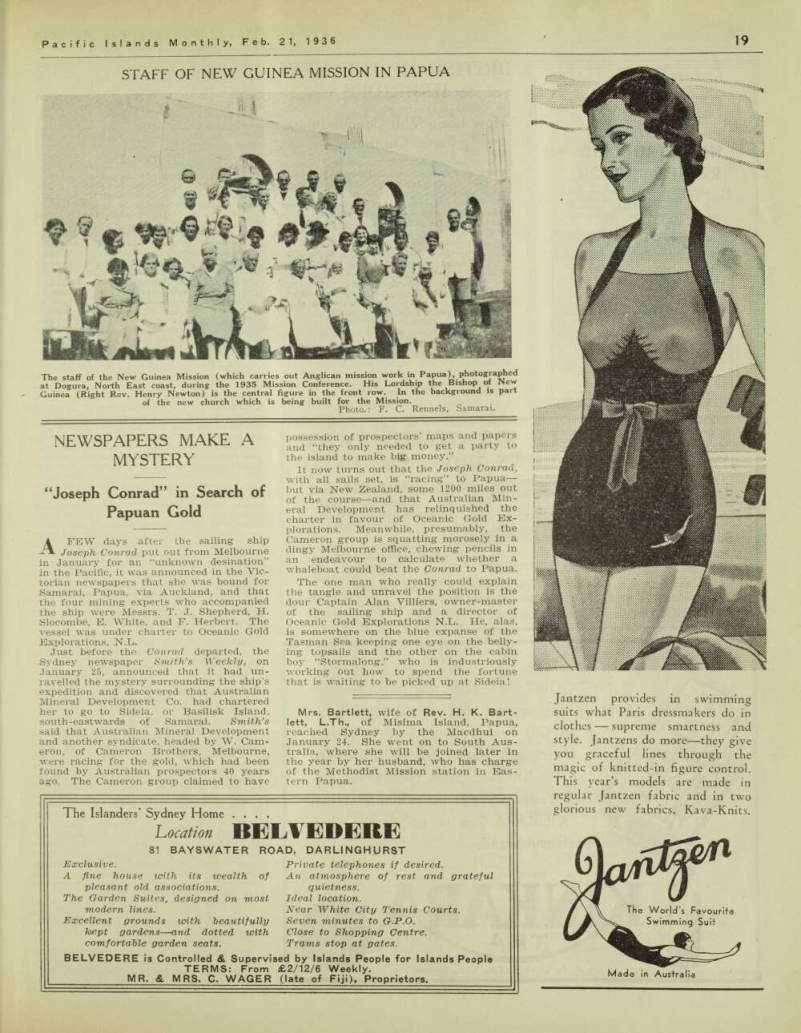
The staff of the New Guinea Mission (which carries out Anglican mission work in Papua), photographed at Dogura, North East coast, during the 1935 Mission Conference. His Lordship the Bishop of New Guinea (Right Rev. Henry Newton) is the central figure in the front row. In the background is part of the new church which is being built for the Mission.
Photo.: F. C. Rennels, Samarai.
Papuan Gold
Newspapers Make A
Mystery
“Joseph Conrad” in Search of Papuan Gold
4 FEW days after the sailing ship Joseph Conrad put out from Melbourne in January for an “unknown desination” in the Pacific, it was announced in the Vic torian newspapers that she was bound for Samarai, Papua, via Auckland, and that the four mining experts who accompanied the ship were Messrs. T. J, Shepherd, H.
Slocombe, E. White, and F. Herbert. The vessel was under charter to Oceanic Gold Explorations, NX.
Just before the Conrad departed, the Sydney newspaper Smith's Weekly, on January 25, announced that it had un ravelled the mystery surrounding the ship’s expedition and discovered that Australian Mineral Development Co. had chartered her to go to Sideia, or Basilisk Island, south-eastwards of Samarai. Smith's said that Australian Mineral Development and another syndicate, headed by W. Cam eron, of Cameron Brothers, Melbourne, were racing for the gold, which had been found by Australian prospectors 40 years ago. The Cameron group claimed to have
possession of prospectors’ maps and papers and “they only needed to get a party to the island to make big money.”
It now turns out that the Joseph Conrad, with all sails set, is “racing” to Papua— but via New Zealand, some 1200 miles out of the course —and that Australian Min eral Development has relinquished the charter in favour of Oceanic Gold Ex plorations. Meanwhile, presumably, the Cameron group is squatting morosely in a dingy Melbourne office, chewing pencils in an endeavour to calculate whether a whaleboat could beat the Conrad to Papua.
The one man who really could explain the tangle and unravel the position is the dour Captain Alan Villiers, owner-master of the sailing ship and a director of Oceanic Gold Explorations NX. He, alas, is somewhere on the blue expanse of the Tasman Sea keeping one eye on the belly ing topsails and the other on the cabin boy “Stormalong,” who is industriously working out how to spend the fortune that is waiting to be picked up at Sideia!
Mrs. Bartlett, wife of Rev. H. K. Bart lett, L.Th., of Misima Island, Papua, reached Sydney by the Macdhui on January 24. She went on to South Aus tralia, where she will be joined later in the year by her husband, who has charge of the Methodist Mission station in Eas tern Papua.
Advertisements & other items, pp. 21-22 (1 item)
"Location BEE\ ; EDEBJE
Jantzen provides in swimming suits what Paris dressmakers do in clothes supreme smartness and style. Jantzens do more—they give you graceful lines through the magic of knitted-in figure control.
This year’s models are made in regular Jantzen fabric and in two glorious new fabrics, Kava-Knits.
The World's Favourite Swimming Suit Made in Austral!
The Islanders’ Sydney Home ...
"Location BEE\ ; EDEBJE
81 BAYSWATER ROAD, DARLINGHURST
Exclusive.
A fine house with its wealth of pleasant old associations.
The Garden Suites, designed on most modern lines.
Excellent grounds with beautifully hept gardens—and dotted with comfortable garden seats.
Private telephones if desired.
An atmosphere of rest and grateful quietness.
Ideal location.
Near White City Tennis Courts.
Seven minutes to G.P.O.
Close to Shopping Centre.
Trams stop at gates.
BELVEDERE is Controlled & Supervised by Islands People for Islands People TERMS: From £2/12/6 Weekly.
MR. & MRS. C. WAGER (late of Fiji), Proprietors.
Get your
copy
of the
NEW TRUFOOD
RECIPE BOOK
69 specially tested recipes—all kinds of new ideas for attractive things to cook cakes, pastry, puddings, custards, desserts, savouries, sauces, etc. post this coupon todat Recipe Department” c/- Box 4267 Y. G.P.O.
Sydney.
Please send me POST FREE, a copy of The Trufood Book of 69 Tempting Recipes Name
(BLOCK LETTERSj
Address
EVERY WRINKLE SMOOTHED AWAY
because A COLEMAN IRON WAS USED
So Beautiful in appearance.
It’s a Dainty Blue.
So Efficient to Use Its polished Bevelled Base Just Glides Along.
ColsmaD m Coleman Irons Burn Benzine and are Safe, Sure, Satisfying Coleman Irons Will save Work, Worry, Wastage.
Coleman No. 4A Irons Cost Id for 2 hours , Laundry.
Blue Porcelain Enamel Body Coleman Lamp and Stove Co. Ltd.
TORONTO
CANADA
500 Kent Street, Sydney
OOD TEA benefits the health. Science has proved this. As KINKARA is a GOOD Tea, it should be used always
...Morning... Noon... Night. KINKARA,
the Health Tea, calms the nerves; restores energy and banishes mental stress.
KINKARA Tea is no dearer than
ordinary brands.
J. R. Love & Co., Ltd., Sydney.
British In The New
Hebrides
How Long Will Condominium Farce Continue?
THE position of the British residents in the Condominium of the New Heb rides goes steadily from bad to worse, and now remains as a reproach upon British colonial administration. It is a matter for regret that no attempt is made to deal with the situation.
Before the war, British people were in duced to take up plantations under the Condominium system in the New Heb rides. They were mostly Australians, and the Commonwealth Government then dis played a keen interest in their welfare.
The French authorities were equally keen in encouraging the settlement of their nationals.
But in the last 30 years the whole out look has changed. The French, appar ently, are as eager as ever to assist their nationals in developing the resources of the rich little group; but the British authorities seem to have lost all interest in. the New Hebrides.
In 1905 there were within the group 225
British and 417 French subjects. In 1933 (the last figures available) there were 180 British nationals and 789 French na tionals. Those 180 British had associated with them about 60 foreigners and Asia tics; whereas associated with the French, mostly assisting them as indentured labourers, there were 1289 Asiatics and other foreigners. To-day, if a census were taken, it would be found that there are barely 100 British left in the group.
The French planters have been allowed to make use of indentured labour; the British have been forbidden to do any thing of the kind and have had to depend for labour upon the unsatisfactory New Hebrides natives. The French planters have been generously assisted from time to time —after hurricanes, in depression periods, etc. —by subsidies from the Gov ernment of France; the British planters have had no assistance. Finally, in re cent years, the French have devised a system by which their coconut planters are able to enjoy a substantial bounty on production (equal to an increase of £4 per ton in the price they receive for copra); but the British have had no such help, and still receive the open market price.
Copra Subsidy Confusion.
The system under which French copra is subsidised has had a really ex traordinary effect in the group. Copra produced by French interests is sold readily in Vila for £ll per ton; but copra produced by the British realizes only £7 per ton —£6/10/- until recently. In many cases, the plantations are side by side, and the copra is produced under identical conditions —yet one lot brings £ll per ton, and the other £7 per ton. The posi tion regarding copra produced by the na tives is even more extraordinary. If the copra is purchased from the natives by a British trader he can get only £7 per ton for it; if it comes through the hands of a French trader, it is worth £ll per ton. The amount of confusion can well be imagined. The British planters and traders are using every device known to human ingenuity to get their copra away as French copra; and various Frenchmen, working on a commission basis, are re ceiving the copra from the British and passing it out to the market through their agency, so that it automatically becomes French.
Incidentally the current price of British copra in the New Hebrides (classified as South Seas smoked) —namely £7 per ton, Australian, on the beach —compares un favourably with the current London quo tation (for Marseilles and Genoa), which is now equal to about £l7 per ton Aus tralian, c.i.f.e.
No Land Titles
Another extraordinary feature of the Condominium Administi'ation is the man ner in which Land Titles have been granted. Settlers who went there before the war and immediately lodged claims for Land Titles have not yet received the documents required. We have the case of Mr. C. G. Ross, who settled in Undine Bay before the Condominium was created.
About 1906, he made formal application for a Land Title; and he eventually got his Title in November, 1935. He is re garded as one of the lucky ones. “And then,” says Mr. Ross, “I was charged 2,000 francs for survey fees, and I am prepared to take an oath that a surveyor was never on my property!”
In these circumstances it is not sur prising that the British have become thoroughly disheartened and have either sought French nationality or have sold out to French interests.
The Condominium Administration long ago became a farce. It is, of course, divided into two sections, French and Bri tish, and the cost of each is borne res
pectively by the French and British. A full-blooded British Administration, com plete with Commissioners, District Officers, Legal Officers, Postal Officials, Customs Officers, etc., is maintained in the New Hebrides, at the cost of the Bri tish Colonial Office, in order to govern about 100 dispirited Britishers, and assist the French in looking after some 50,000 natives. The work of administration could be carried out much more cheaply by the French, and perhaps more efficiently—because it stands to reason that one cannot have efficiency where there are two cumbersome organisations working side by side, with the same object.
Naval Considerations
Of course, the true position is quite well known. Britain long ago abandoned the attempt to compete with the French in the settlement of the New Hebrides.
The French, apparently, were eager to spend money in that direction- —Britain was not; and the British said, in effect, “You can have the New Hebrides.” Why, then, has Britain hung on to her dwind ling interests in the New Hebrides and spent at least £lO,OOO per annum in maintaining her share of the administra tion?
The answer apparently lies in the har bours of the New Hebrides. So long as Britain holds her connection in the Con dominium, British warships have the right to use the magnificent harbours in the group. If the New Hebrides were entirely French, there would be a serious gap in the defence fringe of tropical islands which now guard the valuable north and north-eastern coast of Aus tralia. Britain then would have no har bour between the Solomons and Fiji.
Britain, presumably, is prepared to pay £lO,OOO per annum for the right to make use of the deep land-locked harbours of the New Hebrides.
But from the point of view of British prestige it is not a good arrangement.
The remaining British planters in the New Hebrides are embittered critics of the British Colonial Office; and everyone who examines the position there comes away feeling a little ashamed of the po sition that British indifference and inac tivity have created. If it were not that the group is so isolated, and world tra vellers rarely find their way there, the Condominium would have been laughed out of existence long ago.
It might be far better for everyone con cerned if the British Government handed over the New Hebrides entirely to the French, provided that some rights could be retained regarding the use of one or two harbours in the group. The French would gladly accept such a position, be cause the New Hebrides Administration might then become part of the New Cale donian Administration, and substantial economies might thereby be effected.
It is an interesting coincidence that, just as the above article was completed, we received a letter from Mr. Edward Jacomb, who now is a resident of Jersey, in the Channel Islands. Mr. Jacomb was a resident of the New Hebrides before the war; and his book, “France and Eng land in the New Hebrides,"’ remains as the only really authoritative summary of the Condominium position. He said; “It can never work. It never has worked, and it never will work. . . . The experi ment of the Condominium was based on a negation of all previous political ex perience. ... It has failed —the longer it goes on, the worse it gets.”
Mr. Jacomb wrote that in March, 1914!
Mr. G. W. L. Townsend, District Officer in the Sepik area, left Sydney for Boram, North East New Guinea, on January 30.
A.W.A.’s Lonely Outpost in
Willis Island
A.W.A.’s Lonely Outpost in the Cyclone Belt
ON the last trip to the Solomon Islands and New Guinea Captain J. McLean, master of Burns, Philp’s motor vessel Malaita played the role of Father Christ mas to Messrs. W. L. Boyd and A. W.
Hooper, Amalgamated Wireless Ltd.’s operators at lonely Willis Island on the edge of the Coral Sea.
Passing close to this tiny outpost visited by steamer only once each year, Capt. McLean decided to float a package of Christmas mail ashore. Despite diffi culties of wind and tide the effort proved successful, the barrel being received by the operators who, apprised by radio of the plan, were on the edge of the reef to intercept it.
The Willis Island radio station is main tained for the sole purpose of providing the Commonwealth meteorologists with weather reports of cyclones and signs of cyclones. Each year two A.W.A. radiomen volunteer for duty on this unvisited speck of sand 300 miles east of Cooktown, North Queensland.
M. M. de Chanterac, general manager in Australia for Messageries Maritimes Co., returned to Sydney from a business trip to Noumea, New Caledonia, by the Laperouse on February 1.
Advertisements & other items, p. 23 (1 item)
Aunt Marys
H.JONES e-co
AUSTRALIA'S BEST
H. JONES & CO.. LTD.
Darlington, Sydney—Hobart, Ta».
Fo Fresh Fruit, Vegetables, and Produce Island Residents can rely on the old-established Shipping Providers.
sits'* 0
Only Address; 421 Sussex St., SYDNEY All Orders Promptly Attended Island Representatives: Nelson & Robertson - W. M. Reid
AUNT MARYS
“Defiance”
Brand
Canned
Goods
PURE FOOD
PRODUCTS
—ar© prepared and packed by the proprietors of Aunt Mary’s Pur© Food Products.
The finest quality goods are hermetically sealed to withstand tropical heat and give to consumers maximum satisfaction.
Supreme in quality and flavor, these pur* food products have been supplied to the people of the Islands for more than thirty years. Specially manufactured and packed to meet Island conditions, they give complete satisfaction to both retailer and consumer.
Prepared and Packed only by—
TILLOCK & CO. LTD.
PURE FOOD MANUFACTURERS
KENT AND LIVERPOOL STREETS,
SYDNEY, N.S.W.
Tea Planting In New
Guinea
Letter to the Editor QN this subject of the establishment of V ' / the tea planting industry in New Guinea I think that it should be made very clear that nothing whatever can be done in that direction unless the Ad ministration is prepared to admit, as indentured labourers, a sufficient number of trained tea pickers from Ceylon or Java.
Tea picking is a skilled job—unskilled tea pickers could ruin the product. Un trained New Guinea natives would be quite useless. No doubt they could be trained in time—but if the industry is to be established in New Guinea, Asiatic tea pickers will have to be introduced, for a time at least.
I am, etc.,
Planter.
Sydney, February 5, 1936.
Mr. W. H. Gordon, superintendent and director of Quartz Mountain (Papua) Limited, departed from Sydney in Janu ary for Samarai en route to Misima Island to inspect the company’s plant and workings on the south side of Misima.
The Mystery Of The Missing Page
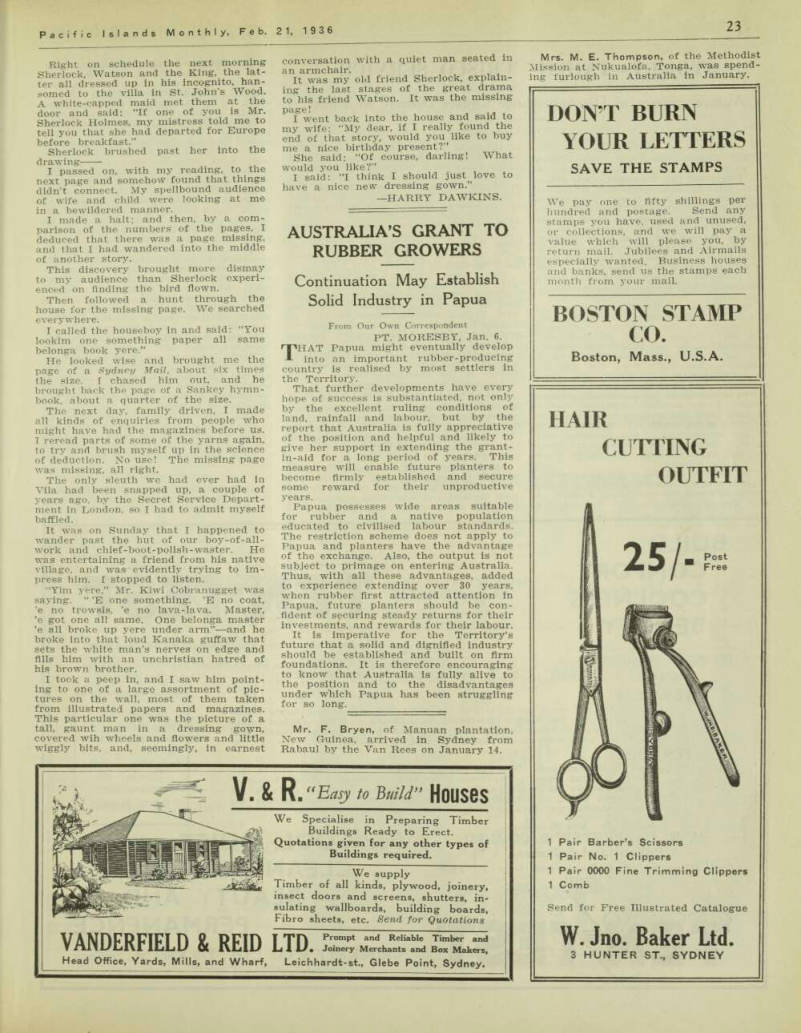
THE weather was rotten, and had been so for weeks. It rained and rained to such an extent that one began to be lieve that Vila was really the one place of the ninety-nine others mentioned by travellers and Islands wiseacres as the scene of Somerset Maugham’s famous drama “Rain.”
We —that is wife and self and one daughter of ten —were hard put to it to know what to do with ourselves. We had played all the card games we knew, and had read all the books there were, and had at last taken a pack of cards apiece and played patience. My wife and daughter cheated shamelessly—they cer tainly got “out” more times than I did.
At last, I got fed up, and began to walk about the house; and, finally, for want of something better to do, I began to rummage in an old cupboard in a back room that seemed to have been left as a sanctuary for cockroaches. There 1 found, under a pile of bills, receipts, cata logues, and circulars, some old English magazines. I turned them over eagerly to see if I had read them before, and found that I had not.
Also, joy of joys, many of them con tained Sherlock Holmes stories. That would please my wife —I know that she, like most women, found joy in detective thrillers. I announced my find, and was duly elected to start right away and read them aloud.
So, while the rain pattered merrily down, I read Sherlock Holmes stories night after night, and each one was pro claimed better than the last. It went on until my wife began to deduce, from the mud on my boots, whether I had come straight home from the office or had strayed into the Hotel Vila Boulangerie
Magasin Bar on the way. I began to pine for some kind of family hobby that was less educative to the feminine mind.
However, there were a couple of stories left, and I went to them manfully. The last one was a real thriller. Never had the wiliest mystery-solver of all ages been more ingenious in his deductions and disguises. Never had his “Dear Watson” been more emphatic in his praises. And, to make things better from the women’s point of view, Sherlock had for the first, last, and only time in his life evinced an admiration for one of the opposite sex that promised to ripen into love.
I read on.
Sherlock Holmes had, by a series of adroit disguises, cunning deductions and smart ruses, discovered the hiding place of the missing photograph that was to save the honour of a more or less well known European monarch. He had ex plained it all to Watson. Nothing re mained but to call a hansom at 9 next morning, drive to a certain address, cold bloodedly announce himself to a certain lady as Mr. Sherlock Holmes, and say: “My dear young thing, the photograph which you so cleverly managed to have taken, showing yourself in the loving embrace of the King of Jugavia, and with the possession of which you threaten his honour and happiness and the union of two of the more or less solvent monar chies of Europe, is in the secret cabinet behind that mirror. I’ve got the goods on you, lassie. You make up, and you’ve got false hair and, even now, your nose is shining. You have had your face lifted and you were born in the year and that’s a long time ago. So come across and hand over.”
Right on schedule the next morning Sherlock, Watson and the King, the lat ter all dressed up in his incognito, han somed to the villa in St. John’s Wood.
A white-capped maid met them at the door and said: “If one of you is Mr.
Sherlock Holmes, my mistress told me to tell you that she had departed for Europe before breakfast.”
Sherlock brushed past her into the drawing I passed on, with my reading, to the next page and somehow found that things didn’t connect. My spellbound audience of wife and child were looking at me in a bewildered manner.
I made a halt; and then, by a com parison of the numbers of the pages, I deduced that there was a page missing, and that I had wandered into the middle of another story.
This discovery brought more dismay to my audience than Sherlock experi enced on finding the bird flown.
Then followed a hunt through the house for the missing page. We searched everywhere.
I called the houseboy in and said: “You lookim one something paper all same belonga book yere.”
He looked wise and brought me the page of a Sydney Mail, about six times the size. I chased him out, and he brought back the page of a Sankey hymn book, about a quarter of the size.
The next day, family driven, I made all kinds of enquiries from people who might have had the magazines before us.
I reread parts of some of the yarns again, to try and brush myself up in the science of deduction. No use! The missing page was missing, all right.
The only sleuth we had ever had in Vila had been snapped up, a couple of years ago, by the Secret Service Depart ment in London, so I had to admit myself baffled.
It was on Sunday that I happened to wander past the hut of our boy-of-all work and chief-boot-polish-waster. He was entertaining a friend from his native village, and was evidently trying to im press him. I stopped to listen.
“Yim yere,” Mr. Kiwi Cobranugget was saying. “’E one something. ’E no coat, ’e no trowsis, ’e no lava-lava. Master, ’e got one all same. One belonga master ’e all broke up yere under arm” —and he broke into that loud Kanaka guffaw that sets the white man’s nerves on edge and fills him with an unchristian hatred of his brown brother.
I took a peep in, and I saw him point ing to one of a large assortment of pic tures on the wall, most of them taken from illustrated papers and magazines.
This particular one was the picture of a tall, gaunt man in a dressing go\vn, covered wih wheels and flowers and little wiggly bits, and, seemingly, in earnest
conversation with a quiet man seated in an armchair.
It was my old friend Sherlock, explain ing the last stages of the great drama to his friend Watson. It was the missing PC ;f went back into the house and said to my wife: “My dear, if I really found the end of that story, would you like to buy me a nice birthday present?”
She said: “Of course, darling! What would you like?”
I said: “I think I should just ( love to have a nice new dressing gown.”
Harry Dawkins.
Advertisements & other items, p. 24 (1 item)
Decide on a ‘OHO
WILLIAM FINAL
Photographer
FRIENDLY IS., OCEANIA
Silent Filming, 35 mm., or 16 mm., to order. Interesting views and natives’ life scenes, 5/3 prepaid anywhere.
Decide on a ‘OHO
Newest and smartest of models! Combines the valuable and outstanding features of the popular 620 KODAKS with the many merits of the miniature camera.
The Duo loads with F 620 film for 16 pictures size 1| x Get behind one of these new Kodaks, and find out how really skilful you are with a camera. Prices: With Compur Shutter f/3.5 Anastigmat Lens, £10; f/4.5 Lens, £B.
Of all Kodak Dealers throughout the Islands r and
KODAK
[Australasia]
Pty. Ltd
379 George St.
SYDNEY
And all States
PANATOMIC
Kodak Panatomic
The finest all-purpose film.
Panchromatic, anti-halation, of microscopically fine grain, for marvellous enlargements of sensational size.
VERICHROME
Verichrome Film
Every Camera will give better results if it is loaded with Verichrome, the film that gets th< picture. Double-coating captures every detail.
"SS" PAN
S.S. Panchromatic
The film of lightning speed. For all artificial light pictures and whenever maximum speed is required. Panchromatic; antihalation backed. vY^ V
piuM
MIC
Dan r to*
Fit-'-'
h CH* ve* 1 ,ve 5*2 T« c pt,R
CH R
pA*
Solid Industry in Papua
Australia’S Grant To
Rubber Growers
Continuation May Establish Solid Industry in Papua
From Our Own Correspondent
Pt. Moresby, Jan. 6.
THAT Papua might eventually develop into an important rubber-producing country is realised by most settlers in the Territory.
That further developments have every hope of success is substantiated, not only by the excellent ruling conditions of land, rainfall and labour, but by the report that Australia is fully appreciative of the position and helpful and likely to give her support in extending the grant in-aid for a long period of years. This measure will enable future planters to become firmly established and secure some reward for their unproductive years.
Papua possesses wide areas suitable for rubber and a native population educated to civilised labour standards.
The restriction scheme does not apply to Papua and planters have the advantage of the exchange. Also, the output is not subject to primage on entering Australia.
Thus, with all these advantages, added to experience extending over 30 years, when rubber first attracted attention in Papua, future planters should be con fident of securing steady returns for their investments, and rewards for their labour.
It is imperative for the Territory’s future that a solid and dignified industry should be established and built on firm foundations. It is therefore encouraging to know that Australia is fully alive to the position and to the disadvantages under which Papua has been struggling for so long.
Mr. F. Bryen, of Manuan plantation, New Guinea, arrived in Sydney from Rabaul by the Van Rees on January 14.
Mrs. M. E. Thompson, of the Methodist Mission at Nukualofa, Tonga, was spend ing furlough in Australia in January.
Advertisements & other items, p. 25 (1 item)
W. Jno. Baker Ltd.
DON’T BURN
YOUR LETTERS
SAVE THE STAMPS
We pay one to fifty shillings per hundred and postage. Send any stamps you have, used and unused, or collections, and we will pay a value which will please you, by return mail. Jubilees and Airmails especially wanted. Business houses and banks, send us the stamps each month from your mail.
BOSTON STAMP
CO.
Boston, Mass., U.S.A.
HAIR
CUTTING
OUTFIT
Post Free 1 Pair Barber’s Scissors 1 Pair No. 1 Clippers 1 Pair 0000 Fine Trimming Clippers 1 Comb Send for Free Illustrated Catalogue
W. Jno. Baker Ltd.
3 HUNTER ST., SYDNEY
zSßmSSirz,
V.&R , “Easy to Build” HOUS6S
We Specialise in Preparing Timber Buildings Ready to Erect.
“ Quotations given for any other types of Buildings required.
We supply Timber of all kinds, plywood, joinery, insect doors and screens, shutters, insulating wallboards, building boards, Fibro sheets, etc. Send for Quotations
VANDERFIELD & REID LTD.
Prompt and Reliable Timber and Joinery Merchants and Box Makers, Head Office, Yards, Mills, and Wharf, Leichhardt-st., Glebe Point, Sydney.
Sydney—Tahiti—’Frisco Service
Announcement of Discontinuance Causes Dismay in Tahiti
From Our Own Correspondent
Papeete, Jan. 22.
THE announcement of the Union Steam Ship Company that probably it will relinquish the Wellington-San Fran cisco mail service, while not altogether unexpected, has nevertheless produced a feeling of pessimism in Tahiti business circles, particularly among those whose livelihood is gained by catering for the passing tourist and short term visitors.
To these the stoppage of this service will mean a very real loss, and the same may be said in regard to the hundreds of na tive labourers to whom these ships mean occasional wages on a comparatively high scale.
Naturally, the generality of the native population, whose useful occupations con sist chiefly in the preparation of copra and the planting of food for their own consumption, do not realise the import ance of a regular steamer service as a factor in their daily lives, and will re gard this matter with their usual com placency. But the Administration and the active members of the community, whose affairs have become regulated to a 28-days mail and passenger service with all parts of the world, are very much alive to the seriousness of the situation, and some of them, we may surmise, are ener getically exploring every possibility of an alternative scheme.
For long it has been quite apparent, even to a casual observe!', that the Union Company could not be making a profit on this line of steamers. The depreciation
in the value of the U.S. dollar by 40 per cent. —which meant an increase in Tahiti living costs when expressed in American currency—not only forced a good many residents of limited means to quit the islands, but at the same time diminished the number of visitors from America and prevented the development of a tourist traffic for which Tahiti possesses unique attractions. The same remarks apply to New Zealand and Australia, where the value of the £ dropped from 125 francs to 60 francs.
Then copra cargoes, which formerly went almost entirely to America, and the carrying of which was the most important part of the Union Company’s business with French Oceania, were diverted to France by the bonus which was placed on copra by the French Government. During 1934 and 1935 not a single kilo of this commodity went to America from these islands. The entire output was sent to France in the subsidised vessels of the Messageries Maritimes Company.
Inward freight from the U.S.A. does not amount to an important item if gasoline, oil, kerosene and lumber are left out of account —and these are never carried by the mail steamers. Thus the stoppage of this service seemed inevitable to any business man.
On the other hand, the trade statistics of Tahiti reveal the fact that the ex change factor has worked favourably for New Zealand and Australian exports, and that the importations into Tahiti from
those countries have increased greatly since the £ deserted the gold standard.
New Zealand and Australia together supplied Tahiti with 4,201,000 francs’ worth of goods during the first nine months of 1935, in addition to which 1,160,000 francs’ worth came from China and Japan; all of this was, of course, carried in the Union Company’s steamers.
On account of this factor in the situa tion, local business men are of the opinion that the Union Company will very likely put on a small steamer to carry this freight and, at the same time, serve the islands of the Cook group, from which it would take a return cargo of fruit to New Zealand. Tahitian fruit cannot now be shipped to New Zealand owing to the heavy duty imposed upon it there.
Apart from the Union Company’s steamers, the only regular facilities avail able for the despatch of mail are the ves sels of the Messageries Maritimes Com pany, which leave Tahiti for Europe about every two months by way of the Panama Canal. These, however, are nearly all slow vessels which take from 20 to 23 days to reach Panama.
Another possibility lies in the Swedish steamers, which used to call occasionally at Tahiti, but were scared off by a threat ened retaliation in Australia. These ves sels are still passing across the Pacific at no great distance from Papeete, and may be induced to come again, now that the situation is changed.
Tahiti, however, would be best served by a line running from American ports and taking in Honolulu en route. In this way, a mail service would be assured and a large passenger traffic might be ex pected to develop.
Miss I. Knight, of the Methodist Mis sion at Kadavu, Fiji, reached Sydney recently to spend furlough in N.S.W.
Advertisements & other items, p. 26 (1 item)
Clean Comfort,
BUILD
COMFORT INTO YOUR HOME
COOLNESS WITH
BEAUTY
The British Insulating Sound-Absorbing Building Board The Colour, Figure and Texture of TEN/TEST provide the BEAUTY. The Heat-resisting and Sound-absorbing qualities of TEN/TEST provide the COOLNESS, QUIET, COMFORT, and CLEANLINESS. o
TEN/TEST
is by far the most beautiful and the strongest and densest board made.
It has by far the highest resistance to moisture and the greatest sound absorption—Just twice the moisture resistance of the American boards, and sixty per cent, more sound absorption, and, in addition,
TEN/TEST
can be cleaned, kept clean and refreshed always by brushing with a stiff brush without showing any trace. Ten-test is unique in this. No other board can be so treated again and again—their prepared surfaces are destroyed by it, painting becomes necessary, and painting destroys the sound absorbing surface by filling in the sound absorbing pores.
Agents for New Guinea:
W. R. CARPENTER & CO. LTD.
Rabaul and Salamaua Applications for Agencies invited from all other Islands Sheets 1/2in. thick, 3 and 4 feet wide, 5,6, 7,8, 9, 10, 11, 12 and 14 feet long. Price 30/- per 100 square feet.
F. 0.8. Sydney.
For COOL, QUIET,
CLEAN COMFORT,
BEAUTY AND
PERMANENCE
CROCKETT & CO. LTD., 379 Kent St., Sydney Cables: “Pinetree”
Mentality and Future of
Native Races “Highest Papuan is Superior to Lowest European”
THE Lieutenant-Governor of Papua (Sir Hubert Murray), in Sydney at the end of January, prior to his departure for Europe, contributed to The Sun of Janu ary 31 a valuable article on the questions he himself set; “Can we set a limit to the progress of a race? Can we say to the Papuans and other ‘primitives’ that they may be taken to a certain stage on the road to civilisation, and no further?’’
The article is too long to reproduce: but the arguments and conclusions of Sir Hubert —especially as they come from one of the wisest, most experienced, and most successful Pacific Administrators are very interesting and significant. Here are some of them.
It is no more ridiculous to assume that Papuan head-hunters and cannibals can not attain our degree of culture than it was for the Romans to regard the in habitants of Britain and Gaul as hopeless, benighted savages. The weight of scien tific opinion seems to maintain that there is practically no difference, as regards natural intelligence, between the so-called “primitive races” and those of the higher culture. On the other hand, few Euro peans who have lived and worked in Papua subscribe to the theory of natural intellectual equality.
“Personally, after more than 30 years in Papua,” says Sir Hubert, “I must ad mit that this theory appears to me to be rather fantastic and very difficult to reconcile with fact. But there is, I think, no doubt that the two, that is, the Euro pean and the Papuan, overlap, and that the highest Papuan is superior to the lowest European.
“And I think, further, that the mental processes of the Papuan are the same as ours, for I have never found any evidence which, so far as Papuans are concerned, would support the theory that the .‘men tality’ of the savage is generically differ ent from that of the civilised man.
“Papuans seem to me to reason in exactly the same way as ourselves, and apparent differences can generally be ex plained as being due to a difference in the premises from which we argue.”
From these premises, Sir Hubert pro ceeds to discuss the problem of the future treatment of the native races. Can they be relegated always to the position of being servants of the white man? Must not provision be made for future develop ment? He points out that, as a rule, the British govern the natives as a separate community, quite distinct from the Euro pean community, which method accentu
ates colour and racial distinctions; where as the French method is to treat the community as a whole, with the s /* me laws and living conditions. Sir Hubert, is in favour of the latter system; in fact, he says that they have it alreadv in Papua, where, except in purely domestic matters, the laws are the same for all classes and races.
Sir Hubert believes that increasing de velopment of Papuan resources will sup ply more opportunities for Papuans; and he sees no reason why Papua should not supply all the skilled artisan labour needed, and fill many many minor execu tive posts, such as plantation managers,
overseers, foremen, assistant engineel s, and mates of vessels. A “For my own part I find it difficult 10 believe that the Papuan will ever be in dustrially the equal of the European. So cially, I think that the white man will always keep apart from the native, and, personally. I think it desirable; but, otherwise, there is no reason why both races should not (as in Booker Washing ton’s famous simile of the hand and the fingers) work together for the common good.
“But the crucial test will come when a white man is asked to take orders from a native,”
Advertisements & other items, p. 27 (1 item)
■Soils ISaxor
YOU MUST HAVE QUALITY TACKLE FOR
SWORDFISH and SHARKS
Firearm Repairs. “OUR HANDS MAKE GOOD ARMS." Firearms sent C.O.D.
Big Game Reels: Sil Rohu’s “UNDO- VER” Multiplying for underneath or top rod fishing, £27/10/-. “Sil Rohu's'’
Star Drag, £lO/10/-.
Hardy Bros.’ Big Game Rod, Special, £l7.
Sil Rohu's Double Built, special, £lO.
“Swordfish 5 ’ brand Cutty Hunk Lines. No Write for Fishing (300 illustration) Catalogue, or Catalogue.
Gunsmith, Importer better Line made.
Firearm (600 illustration)
SIL ROHLH
Late
A.I.F.
of High-Grade Firearms, and Fishing Tackle Specialist. 143 Elizabeth St., Sydney (near Market St.)
FISHING TACKLE TO TACKLE FISHING.”
THE IDEAL GIFT
■Soils ISaxor
THE WORLDS BEST SAFETY
WHEN you give him a Rolls Razor you give him Shaving Comfort for life, and you have the satisfaction of knowing that your Gift is the best the World has to offer.
Illustrated Catalogue and Price List sent free on application.
Bolls Ba*or Co. ol* Australia LA«I.
8a CASTLEREAGH STREET SYDNEY, N.S.W.
(pft
m PS HP
kJt*r
iPr.
CAPSTAN
CIGARETTES
CORK-TIPPED
OK PLA I N
CAPSTAN
NAVY CUT TOBACCO
m/(Aefwmthe (finest leaf &7Q9-1
Books, Magazines & Newspapers
TO ANY PART OF THE ISLANDS
BARGAIN OFFER.—We will send half a dozen latest American Monthly Magazines for 4/-, post free. 1936 Issues American Radio Journals 9d each. Post Free.
We specialise in selecting reading matter for those unable to choose personally. We specialise in Mail Orders. Parcels posted by every boat. Send for our price list and full particulars of this unusual service for Island residents.
McKAY’S BOOKSTALL
ROYAL ARCADE, SYDNEY
Samoan Mau Honours Late High
Chief Tamasese
From Our Own Correspondent
Apia, Jan. 8.
THE annual procession and memorial A service in memory of the late High Chief Tamasese, who lost his life in the unfortunate riot six years ago, took place on December 28.
Over 500 Mau women in their uniform dress of blue with white stripes marched through Apia, preceded by a band and led by the wives of High Chiefs Faumuina and Tuimalealiifano. At the grave of Tamasese at Lepea, which had been suit ably decorated, a memorial service was held, at which a large gathering of Samoans attended.
The procession and ceremony passed without any undue incidents.
Pages From The Past
The Affair of Henry Worth Pearse
By Julian Hillas
Ttbnry Worth Pearse Went To
** Mangaia at the beginning of 1889 as factor for Messrs. Donald & Edenborough, then the leading business house in Raro tonga.
Forty-six years ago, almost on the heels of the declaration of a Protectorate, the Cook Islands were still ruled by their own Arikis. For the few British subjects who resided there, other than in Rarotonga itself, law and order were represented by the casual calls of a warship from Fiji, headquarters of the Pacific Naval Station.
The Native Courts were a travesty of justice—as, indeed, could only be expected from a system by which not only the police force, but the Judges themselves, depended for their pay upon a percentage of the fines which the latter levied! The laws, based with little alteration on the original code framed by John Williams in 1826, were calculated moreover to squeeze the last drops of spontaneous hilarity from a naturally joyous and light-hearted people.
From one of the few extant copies I have selected the following at random: No. 13. If a man play cards he is to pay $2 in cash and $8 in trade.
No. 14. For the Village. If a man puts his arm round a woman in the road at night, and he has a torch in his hand, he shall go free. If no torch, he is to be fined $1 cash and $9 trade.
No. 20. Tattooing Love-marks. The man who does this on a woman, or the woman who does it on a man, is to be fined $2 cash and $l3 trade.
No. 21. Sabbath Observance. No one to go to another village on Sunday with out good reason. Fine $1 cash and $4 trade.
No. 23. Taking Women Inland. If a man take a woman to the mountains for bad purposes, he is to be fined $l5 cash and in addition his other fines for forni cation or adultery.
No. 24. Crying after a Dead Woman.
If a man do this, and he and the woman were not relations, or if he wear mourn ing for her, he is to be fined $l5. (This is taken to be proof of guilt during life.) And in Mangaia the omnipotent London Missionary Society stood firmly rooted to see that the backslider slid forward, the loose fish taughtened up and the black sheep dyed its wool as rapidly as possible.
For twenty years the Rev. George Augus tus Harris had been the absolute and un checked ruler of the island, and under his uncrowned sovereignty (to quote the words of Mr. F. J. Moss, first British Resident appointed by the N.Z. Government to Rarotonga) “a most narrow and tyrannical system of church discipline had been established. No one, unless a member of the church, could hold office, and expulsion involved civil disabilities of the most severe kind. There was no regard for personal liberty, nor any pretence to such a re gard.”
The Mangaians, cowed by, and obedient to this hierocracy, had been taught that the presence of any additional Europeans, and particularly those of the trader class, would result in the demoralisation of their little community and the overthrow of their church. And, believing these things, they had passed a law forbidding business outside of a market-house, which was only opened on the rare occasions of a visiting vessel.
It was, therefore, surprising that no overt opposition was offered to Pearse’s arrival, and that he was able immediately to start trading.
Early in July, 1890, he commenced build ing a house and store on a piece of ground which he had rented for this purpose with
the full knowledge and consent of the authorities, including the Rev. Mr. Harris, whose signature was appended to the On the 16th. he was ordered to stop work, at the same time being informed that any person found buying or selling produce in his store would be fined $lOO. Continuing work, he was again ordered, by nine Judges, to cease construction. Pearse then applied to the ruling Ariki, King John, and was told by him not to take any notice of the interdict, since he had not authorised it. Work then continued smoothly until
the 28th, when the native carpenters em ployed on the building were heavily fined and suspended from church membership.
King John himself was also fined and de posed, likewise Ata, Pearse’s landlord, and several others.
On August 25th, the steamer Little Agnes called, and Pearse began landing goods consigned to him by Donald & Eden borough. In the middle of these operations the native boatmen refused to handle the remainder of his cases, and such as had already been brought ashore were taken back to the ship. Pearse, worried by this unexpected and unexplained move, re turned to the store where towards evening he was burst in upon by Ringiringi, one of the Judges and, being seized by the arms, was forcibly marched down to the landing place and thrust into a waiting canoe, which took him out to the Little Agnes.
No time was given him to collect his papers or take even a rough inventory of his stock, which he valued at $lO,OOO.
One of the first official duties of the
newly appointed British Resident at Raro tonga was to investigate the charges made by Pearse against the Mangaians.
Travelling in the trading-schooner Torea, Mr. Moss, accompanied by Mr. Exham, manager for Donald & Edenborough, and by the Rev. James Chalmers (afterwards murdered in Papua), reached Mangaia on December 5, 1890.
A meeting of the chiefs was immediately convened.
Pearse, who had come over specially from Rarotonga, was also present and complained that the Rev. Harris had countenanced the hostile acts of the na tives by suspending from church member ship those who had assisted him, whereas none concerned in the outrage upon him self had been punished.
Pearse’s general allegations were ad mitted by the natives, although they em phatically declared that they had not used force, but had expelled him in the gentlest manner possible, two of them leading him away with their arms about his shoulders, one of whom, after putting him aboard the Little Agnes, had cried over and sym pathised with him. Pearse conceded this, but added that he had had to go,’ all the same! ' r In justification of their action, the Man gaians pleaded that Pearse had frequently broken the law and irritated them to the use of extreme measures. At the same time, however, they readily stated that they never had, and had not now, any personal ill-feeling towards him.
But Mr. Moss was not impressed by these counter charges, and attributed the real reason for Pearse’s expulsion to a de termination on the part of the Mangaians not to have any traders on the island, a determination in which it was evident that they had the support of Mr. Harris.
At this stage it was proposed to adjourn for the day, whereupon Meringi Tangi, a local orator of some note, sprang to his feet and said that what had been spoken was sufficient, they would not add to it or come again on the morrow. They did not want, nor would they have, any store on the island.
Mr. Moss then closed the meeting with a final warning on no account to expel an other foreign resident, since he had heard rumours that some of those present con templated sending away the two traders still on the island, a Mr. G. Brown, who had formerly been in Pearse’s employ but now acted as caretaker of the abandoned store, and Mr. Charles Ward, an agent for the “Societe Commerciale” in Tahiti. The latter had only been in Mangaia a couple of months, during which he had been un able to obtain either land or a building in which to conduct his business.
Leaving Mangaia the following after noon, Mr. Moss was unable to take any further steps in the matter until the middle cf 1891, when he despatched a let ter by the returning Mangaian members of the Federal Parliament, informing those who had been prominent in Pearse’s expul sion that he was now about to adjudicate and inviting them to send a representative to speak on their behalf. On June 10, word having been received that those concerned would not listen to the letter or come to Rarotonga, Mr. Moss proceeded to judg ment, taking care to award only arrwnnts of which the justice could not be ques tioned.
To Donald & Edenborough for Pearse’s salary •••.* For salary of G. Brown & J. Craig $870 For expenses of reshipping goods $0o0 For Special Messenger to Mangaia $030 Fine for expelling a British subject $1,000 Total *2. 390
The fine, currency then being the Chile dollar, amounted to a little over £350, a substantial enough sum to an isolated com munity with restricted trading facilities, although Mr. Moss intimated that if they showed repentance and paid for the loss which they had caused others, he would take upon himself the responsibility of freeing them from the fine of $l,OOO.
But on the return of the Court Messen ger Raea, it was learned that the Man gaians had received the judgment in an ugly spirit, the chief Ngariu of Tamarua shouting “Moss is not the ruler of my land. ... Take back your papers to him!”
Raea also reported that the chiefs had retired to the missionary’s house to hold a meeting.
It was therefore in anticipation of trouble that Mr. Moss convened a further meeting on the occasion of his next visit in August, 1891, almost exactly a year after the date of Pearse’s expulsion. The chiefs were still in a sullen and resentful mood, those belonging to the dominant or mission party at first refusing to attend. This fac tion, having with them the all-powerful Judges and Police, had created, by a sys tem of ruthless fines, a state of terror which was manifest in every action of the people.
However, at the last moment, they put in an appearance, and, with the rapid change of front so characteristic of the Polynesian, discovered that they had been misled. A general reconciliation followed, the entire company eventually filing out after shaking hands and vowing that there would be no more trouble in Mangaia.
Only Ngariu, the most influential chief in the island, absolutely declined to pay his share of the fine. The schooner was due to leave on the 25th for Rarotonga and, on the morning of that day, Ngariu being still obdurate, Mr. Harris took matters in hand and by noon the Chief’s submission was ob tained unconditionally. A final meeting was held, at which $2BB were at once sub scribed as a first instalment.
A year later the balance of the fine was paid, Mr. Moss having remitted the major item of $l,OOO.
In reporting the whole affair to the Gov ernor of New Zealand, Mr. Moss stated that on one point the Mangaians were unanimous—namely, that had the Rev. Mr.
Harris seen fit to use his power, he could have at any time prevented the trouble.
In the same report the following pas sage occurs: “The suspension from church membership has been freely exercised and has tended to embitter the quarrel. I venture to suggest that the sooner this custom is allowed to drop into disuse, where temporal matters are concerned, the better it will be for the peace of the church and the people. The expelled are known as tutai auri —dirt from the prisons. Ob viously, all this must be changed, and per manently changed, if civil government is to be successfully established.”
Advertisements & other items, pp. 28-30 (2 items)
#Hi Iimv Amts’ Wire Ropes
Your Sydney Agent?
William E. Reed
(Established 1913)
UNION HOUSE
247 GEORGE ST., SYDNEY
Shell sold, and goods supplied at wholesale prices, on commission.
Enquiries welcomed.
(265 c 30 H.P. High Speed Diesel Engine, fitted with Reverse and 2:1 Reduction gears.
Special Features:
‘Comet” Combustion Chamber, providing Great Flexibility. Easy Starting. Invisible Exhaust at all Loads and Speeds. Low Fuel and Lubricating Oil Consumption. Big Overload Capacity.
Quiet Running. Fully Automatic Lubrication.
Built to Lloyd's Requirements.
Paxman-Ricardo
HEAVY DUTY
MARINE
DIESEL
ENGINES
® Range of sizes: 1-12 Cylinders B.H.P. at speeds of 750 1750
R.P.M.
Sole Agents:
NOYES BROS.
(SYDNEY) LTD.
Sydney Newcastle Brisbane
#HI IiMV AMTS’ WIRE ROPES
64 The World’s Staiidanl ”
LARGEST STOCKS IN AUSTRALASIA FOR ALL PURPOSES Also Blocks, Hooks, Shackles, Thimbles, Strand, Seizing, Aircraft Cord, etc.
jftoa Letters: BULLIVANTS’ Australian Co. Ltd.
Box 1298 J, G.P.O.
331-333 KENT STREET, SYDNEY
Telegrams: ‘Bullivants Ltd./ Sydney Prompt Attention! Efficient Service!! Complete Satisfaction!!! ♦
Mobiloil
A L- * / ✓ /: / s * IS
60 X of all automotive
oils sold throughout
the 'Pacific Islands
MOBIL OIL
Mobiloil s popularity and high quality is YOUR guarantee of complete engine protection. It is the most highly refined oil on the market, and, equally important, there is a grade that fits every make and model of car.
YOUR CAR WILL RUN AT ITS VERY BEST ON MOBILOIL.
Mobiloil
REG 9
Use PLUME Motor Spirit with Mobiloil and enjoy the unbeatable combination for Powerful Performance
CUNNtMOORETi
lor all Sports Goods
, Write foe interesimi free Catolniju
A to CUNN I, MOORE LTD
CARRINGTON ST..
NOTTINGHAM ENG.C^
LTD
6/34 m A
Cooling!
When the heat seems oppressive and you long for something cooling and refreshing, try a glass of effervescing, thirst - quenching Andrews. Andrews cools and invigorates almost immediately £ and helps you to keep cool by cooling the blood.
Available in 4 oz* & S oz* Bottles
LIVER
SALT
< ii i v i: it s om o' Obtainable from all Leading Grocery Stores Chivers and Sons Ltd., Histon, Cambridge, E. 76 ■
PURE
FOODS
GOLD MEDAL JAMS
CANNED ENGLISH FRUITS
CANNED ENGLISH
VEGETABLES
CUSTARD POWDER
OLD ENGLISH MARMALADE
JELLY CRYSTALS, ETC.
Write to Department A., England, for attractive Recipe Book
Who Buys Cocoa-Bean
Shells?
WHO wants cocoa-bean shells?
The New Guinea Administration pays to planters a bounty of IJd per pound on cocoa-bean shells produced in New Guinea and sold in Australia: but, according to a correspondent in New Britain, there is no market for the commodity.
“I have tried every means I possibly can to get a market for the discarded shells, but devil a one can I find,” he writes. “I understand they have value as a fertiliser —but where and when? The big firms here cannot help me.”
Can anyone answer the question?
Choiseul, S.I.
“Unknown Civilisation” at Choiseul, S.I.
TX 1932-33 Dr. Hugo Bernatzik, entorao legist and ethnologist, undertook an ex pedition to the Solomons, New Guinea and Bali; and “Sudsee,” just published by Constable, London, is an informal descrip tion of his experiences. The author spent some time in the Northern Solomons, on “the untouched island of Choiseul,” where he found what he regards as traces of an unknown civilisation, which he suggests might be a bridge to the unexplained cul ture of Easter Island.
Mr. and Mrs. R. Walshe, of Kauru plan tation, Domara, Eastern Papua, arrived in Australia by the Macdhui in January.
Advertisements & other items, pp. 31-32 (1 item)
Maleham & Yeomans
... Ltd.
BOWDON ST., SHEFFIELD, ENG.
Manufacturers of all kinds of
BUTCHERS’, STICKING AND
SHEATH KNIVES
RAZORS AND SCISSORS
Specialty
HAIRDRESSER SCISSORS
PRICE LIST ON APPLICATION
m K ''
Picturesque Isles
of the Nontli Neats'
The New Souvenir Book
A handsome volume of 64 pages containing wonderful photographs of Papua-New Guinea and the Solomon Islands. Cover design in full colour.
A N
DEAL GIFT
Now on Sale : : Price 3/6 Copies obtainable from
BURNS, PHILP & CO. LTD
7 BRIDGE STREET, SYDNEY, AND BRANCHES
HOTEL GRAND CENTRAL
151 CLARENCE STREET, SYDNEY (opp. G.P.0.)
THE POPULAR “ROOM-ONLY"
TARIFF
is specially designed *to meet modern requirements of business and pleasure. It enables patrons to enjoy every advantage of hotel life, at the same time keeping hotel expenses down to a minimum.
SERVICES INCLUDE:
Theatre Booking and Information Bureau, Travel and Sightseeing Tour* arranged.
Up-to-date Barber’s Shop.
Cleaning and Pressing Service.
Garage accommodation nearby at usual rates.
Spacious Dining Room. All meal* a la carte.
THE HOTEL GRAND CENTRAL LTD.
151 CLARENCE STREET, SYDNEY (opp. G.P.0.)
Telephone: BW 1531 (3 lines) Box 716 FF, Sydney Radio Cables and Telegrams: “Grancentral,” Sydney
FRASER WEBSTER, Manager.
J n * 1 3
PACIFIC TRADERS!
The Blade of Best Quality, and the Most Profitable to Handle, is: These blades are of the three-holed (Gillette) type. I have made a careful test of all blades, over a long period, while I was trading at Milne Bay, Papua, and the British-made Jewel was far ahead of any other. I now have the Pacific agency for Jewel blades, and strongly recommend them to all traders.
Send P. 0.0. for trial gross post free, 10/- (Australian) or 8/- (sterling). Reduction for quantities. Sample package, 2/6.
HENRY DEXTER
I ping, Midhurst, Sussex, England
For Speedy, Accurate and
Versatile Photography . . . there’s nothing like the
LEICA
Camera
(MODEL i)
HERE ARE THE REASONS WHY
1— BUILT-IN SHORT BASE RANGE
FINDER gives you perfect focus automatically.
2 PLANE SHUTTER with
the greatest range of shutter speeds on any camera—l second, i, J, I, in addition to all regular speeds between l/20th and l/500th second.
3. ELEVEN DIFFERENT LENSES
AVAILABLE.
4. —36 PICTURES from a single roll of cinema film. Sharp negatives.
Enlargements up to any size.
5. SMALL, COMPACT, FITS THE
POCKET, easy and fast to operate. Very inexpensive to maintain.
Leiea Service Why not take advantage of it?
We SPECIALIZE in the development, printing, and enlarging of miniature negatives, and INDIVIDUAL ATTENTION is given to every order. We have the BEST POSSIBLE EQUIPMENT and our experts have at their disposal, an up-to-date Research Dept. Miniature negatives having a superior detail and grain quality, require special attention to obtain perfect enlargements, and this expert attention we are able to give. SKILLED TECHNICIANS will help you overcome any difficulties you may be experiencing, by giving suitable advice, either personally or through our MAIL DEPT. Inquiries will be given prompt attention.
Write NOW, for further particulars to
LEICA PHOTO SERVICE
KYLE HOUSE, 31 MACQUARIE PLACE, SYDNEY
{The only Leica Specialists in Australia )
DEVELOPING PRINTING FILM SUPPLIES
Representatives
May Investigate
Samoan Conditions
League and N.Z. Government Representatives
From Our Own Correspondent
Apia, Jan. 11.
IT is reported that representatives of -A the new Labour Government of New Zealand are shortly to arrive here to investigate matters and make a report for the guidance of the new Government.
According to information published in the Dutch paper Telegraaf at Amsterdam, received from the Geneva representative of the paper, severe criticism has been levelled by several members of the Man dates Commission of the League of Nations against the New Zealand ad ministration of the Mandated Territory of Western Samoa. It is now reported that, probably as a result of these discussions, a representative of the League of Nations will visit Samoa and make personal investigations.
“Mother Clunn”
Remembered for her kindly deeds Back in years gone by— She served the hard old-timer’s needs, New-come to Samarai.
She had a cheery greeting For each and every one— ’Twas a pleasure to be meeting Our Dear Old “Mother Clunn!”
It happened many years ago, That she had a nasty fall She cannot ramble round and so Her friends on her must call.
On her verandah shady There’s a smile for every one- This charming dear old lady We know as “Mother Clunn.”
Her life held many sorrows— Yet life was well worth while; She thought of bright to-morrows, Met trouble with a smile.
The passing years are fleeting, Her days are nearly done— Soon Angels will be greeting Our Dear Old “Mother Clunn.”
Should old friends visit Samarai They must not miss that call— To know that they had passed her by Would hurt her most of all.
And she has been so very kind A host of friends she’s won— Where’er you go you’ll rarely find As good as “Mother Clunn.”
Papua.
Frank Pryke.
Geographical Data
Northern New Hebrides Geographical Data
A VERY full, interesting, and scientiflc ally valuable description of the island of Espiritu Santo in the New Hebrides by Dr. John R. Baker, M.A., was read before the Royal Geographical Society in London on December 10, 1934, and was subsequently published in the Geographical Journal of March, 1935.
It is disclosed that Dr. Baker climbed Santo Peak, the height of which is 5,566 ft. He reports also that Mount Tab wemasana is 6,195 ft. high and lies about seven miles in a direct line from the nearest point on the coast. Members of the expedition also climbed the following mountains, none of which had been pre viously ascended by Europeans: Linisupe (5,369 ft.), Paramua-wawke (4,197 ft.), Ratsawoni (4,328 ft.), Wunarosaisari (4,125 ft.), and Wuna-tupoi (3,918 ft.).
This appears to be the most valuable description to date of the geographical features of Espiritu Santo.
In an earlier paper (read before the Royal Geographical Society on January 21, 1929) Dr. Baker gave a full account of investigations in the Northern New Hebrides. This paper was published in the Geographical Journal of April, 1929.
This paper contained, among other things, an account of the Island of Gaua, and of the lake which it contains at a height of 1,100 ft. Dr. Baker says that the lake with its surrounding hills is the crater of an immense extinct volcano.
There is considerable thermal activity in this region. Dr. Baker says that the lake has a flat bottom at approximately 325 feet.
Rev. J. R. and Mrs. Andrew, of Dobu, Papua, reached Sydney on a holiday visit by the Macdhui on January 24. Mr. An drew is chairman of the Methodist Mis sionary Society in Papua.
Advertisements & other items, p. 33 (1 item)
Freemans
For Quality Goods at Low Prices
ESTABLISHED SINCE 1905
147 (Mkrrxk St, Sydney, W.S.W. jattKraSJWS
Saddles
FREE BRIDLE
Given to Every Purchaser of a Saddle. We Specialise in Brand New High - grade Saddles, Made- of Best Quality Materials Throughout. Strong Guaranteed Trees, and First- Class Workmanship.
Strong High-grade Saddles, in Stock, Kemp, Park or Poley styles (suitable for all-round use). Built on very strong guaranteed trees, narrow grip, firm pads, best quality flaps and skirts, mounted with leathers, rolled girth and 3-bar N.P. irons, £3/10/- High-grade Stock Saddles, built on strong guaranteed trees, deep comfortable kip seat, narrow grip, wide leather facings at back, 4-inch firm pads (set up very high, giving greater security to rider). Extra long kip flaps and skirts, mounted with leathers, rolled girth, and 3-bar N.P. irons £4/10/- High-grade Station Saddles in Kemp, Park or Poley styles, built on strong guaranteed trees, deep comfortable kip seat, narrow grip, wide leather facings at back, strong firm pads, extra long kip flaps and skirts, mounted with leathers, rolled girth 3-bar N.P. irons £4/10/- High-grade Station Stock Saddles, built on strong guaranteed trees, deep comfortable pigskin seat, narrow grip, wide leather facings at back, 5-inch firm pads (set up high, giving greater security to rider), raised thigh pads, extra long kip flaps and skirts, mounted with bevelled leathers, rolled girth and 4-bar N.P. irons . . £5/10/- Very Fin© High-grade Super Station Stock Saddles, built on strongly plated guaranteed trees, forged steel stirrup bars, deep comfortable pigskin seat with 4|-inch sweep, narrow grip, wide leather facings at back, very firm Sg-inch strong capped pads (set up very high, giving greater security to rider), raised thigh pads, extended leather points, extra long flaps and skirts made of long-wearing flexible kip.
Mounted with bevelled leathers, rolled girth and 4-bar N.P. irons .. £6/10/- Super Pig Ear Kemp Saddles, made on solid gullet trees, deep comfortable pigskin seat with heavy cain roll cantle, firm pigskin pads, narrow grip, raised thigh pads, wide leather brass studded facings at back, extended leather points, solid brass mounts, extra long 23-inch Queensland kip flaps and skirts, all hand sewn. Mounted with bevelled leathers, rolled girth and 4-bar N.P. irons £9/10/-
Bargains in Our
Trade-in Department
MUSICAL INSTRUMENTS
Banjo Mandolins complete in case with Free Tutor. Slightly used 37/6 Oval Back Mandolins in case. Free Tutor. Slightly used. Good tone, 37/6 Full Size Violins and Bow in case.
Splendid tone. Free Tutor ... 45/- His Master’s Voice Portable Gramophone, in perfect order, beautiful tone.
Slightly used. Complete with six used records £3/19/6
FIELD AND RACE GLASSES
Slightly Used
Very powerful Field Glasses .. 25/- Prs. extra powerful Field Glasses, 32/6 Extra powerful German Military Field Glasses. Good value 59/6 Binocular Race Glasses, very powerful, French make m ■ . . 75/.
Kershaw” 6X Race Glasses, English make, extra powerful £4/4/.
“Aitchinson” Field Glasses, 8 x 30, English make, very powerful, £6/10/- “Carl Zeiss” Binocular Race Glasses, Silvamar, excellent value . . £7/10/- “Carl Zeiss” Binocular Race Glasses, 6 x Telexim £6/10/- “Carl Zeiss” Deltrentis Race Binocular Field Glasses, 8 x 30, wide vision, extra powerful £lO/10/-
SLIGHTLY USED CAMERAS
English Ensign Camera, double lens, synchro shutter 25/- Kodak Folding Cameras, double lens, 27/6 Vest Pocket Folding Cameras .. 17/6 Kodak 6-20 Double Lens Camera F.ll, Kodon shutter 50/-
Typewriters
Slightly Used
Corona 3-bank Portable Typewriter in case. Perfect order £5/10/- Remington 4-bank Portable Typewriter in case. Good order . . £B/15/- Underwood 4-bank Portable Typewriter in case £6/15/- Remington 4-bank Portable Typewriter in case. Late model, £lO/10/- Monarch No. 3 Typewriter, 4-bank, 14in. carriage. Perfect order, £5/10/- Reminaton Standard Typewriter. 4bank, 18in. carriage £4/10/-
Bicycles
GOOD STRONG SLIGHTLY USED
BICYCLES ALWAYS IN STOCK.
PRICES FROM 55/- TO £7/15/-.
WRITE FOR SPECIAL QUOTES.
Sporting Goods
TENNIS RACQUETS
The "Rex” Racquet, improved model, English laminated ash frame, full overlay, fitted leather grips, strung with first-grade gut. Special reduction 21/- Genuine Chesterfield "Swift” Racquets, 4-piece laminated English frame, full ash overlay, fitted leather grips, reinforced shoulders, strung with very best quality gut. Were 45/-. Now 25/- Free Cover and Press with every Racquet
GOLF SETS
"J. Kirkwood” Hickory Shaft Matched Golf Sets, special rustless heads, made in Scotland, including Midiron, Mashie, Putter and Brassie-Driver in leather mounted waterproof canvas bag, 42/6 "J. Kirkwood” Steel Shaft Golf Sets, including Midiron, Mashie, Putter and Brassie-Driver in leather mounted canvas waterproof bag 69/6 Free with every Golf Set purchased: One dozen Tees and two Golf Balls.
We stock all well-known makes of Clubs. Write for our Free Catalogue.
CRICKET
Cricket Kit, comprising 2 English ‘‘Oval Driver” bats, 2 pairs batting pads, 1 pair W.K. gloves, pair W.K. pads, set of stumps and bails, ball.
Complete in first-class cricket canvas bag £6/10/-
TENTS AND FLYS
Heavy English Calico Tents, 3ft. walls, 6xB, 15/6; 8 x 10, 20/-; 10 x 12, 24/6.
Heavy English Calico Flys, 8 x 10, 11/6; 11 x 9, 13/6; 10 x 12, 15/6; 12 x 12, 17/6; 12 x 14, 19/6; 14 x 14, 22/6.
Heavy English Twisted Duck Tents, 3ft. walls. 6xB, 24/6; 8 x 10, 30/-; 10 x 12 39/6 Heavy English Twisted Duck Flys. 8 x 10, 12/6; 11 x 9, 15/6; 10 x 12, 18/6; 12 x 12, 21/-; 12 x 14, 24/6; 14x14,27/6
Musical Instruments
Ukeleles, complete with set of strings and Free Tutor 10/6 Steel Guitars, beautiful tone, complete with steel, picks and Free Tutor, 35/-
HIGH-GRADE “MARTELLO”
ACCORDEONS
Ebonised frame, nickel covered double four-fold bellows, two sets of steel bronze reeds. Size sSin. x lOiin., 29/6 Ebonised frame, nickel covered treble three-fold bellows, three sets of steel bronze reeds. Size siin. x lOJin., 39/6 Ebonised frame, nickel covered treble four-fold bellows, four sets of steel bronze reeds. Size 6Jin. x lOJin., 49/6
We Stock Everything.
FREEMANS
Inquiries Invited. Mai, or*« p« m pt. y We Guarantee You Every Satisfaction.
FOR PROMPT SERVICE
and
HONEST VALUE
147 CASTLEREAGH STREET
SYDNEY, New South Wales
Patriotism!
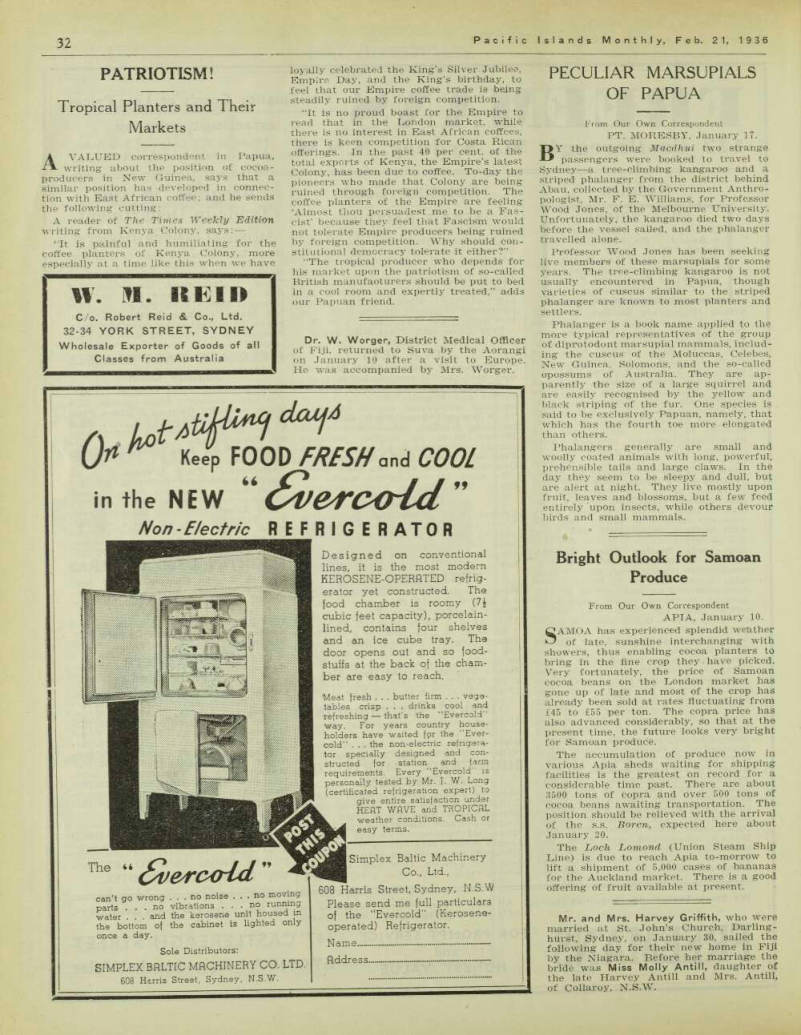
Tropical Planters and Their Markets
A VALUED correspondent in Papua, writing about the position of cocoa producers in New Guinea, says that a similar position has developed in connec tion with East African coffee; and he sends the following cutting: A reader of The Times Weekly Edition writing from Kenya Colony, says:— “It is painful and humiliating for the coffee planters of Kenya Colony, more especially at a time like this when we have
loyally celebrated the King’s Silver Jubilee, Empire Day, and the King’s birthday, to feel that our Empire coffee trade is being steadily ruined by foreign competition.
“It is no proud boast for the Empire to read that in the London market, while there is no interest in East African coffees, there is keen competition for Costa Rican offerings. In the past 40 per cent, of the total exports of Kenya, the Empire’s latest Colony, has been due to coffee. To-day the pioneers who made that Colony are being ruined through foreign competition. The coffee planters of the Empire are feeling ‘Almost thou persuadest me to be a Fas cist’ because they feel that Fascism would not tolerate Empire producers being ruined by foreign competition. Why should con stitutional democracy tolerate it either?”
“The tropical producer who depends for his market upon the patriotism of so-called British manufacturers should be put to bed in a cool room and expertly treated,” adds our Papuan friend.
Dr. W. Worger, District Medical Officer of Fiji, returned to Suva by the Aorangi on January 10 after a visit to Europe.
He was accompanied by Mrs. Worger.
Peculiar Marsupials
Of Papua
From Our Own Correspondent PT. MORESBY, January 17.
BY the outgoing Macdhui two strange passengers were booked to travel to Sydney—a tree-climbing kangaroo and a striped phalanger from the district behind Abau, collected by the Government Anthro pologist, Mr. F. E. Williams, for Professor Wood Jones, of the Melbourne University.
Unfortunately, the kangaroo died two days before the vessel sailed, and the phalanger travelled alone.
Professor Wood Jones has been seeking live members of these marsupials for some years. The tree-climbing kangaroo is not usually encountered in Papua, though varieties of cuscus similar to the striped phalanger are known to most planters and settlers.
Phalanger is a book name applied to the more typical representatives of the group of diprotodont marsupial mammals, includ ing the cuscus of the Moluccas, Celebes, New Guinea, Solomons, and the so-called opossums of Australia. They are ap parently the size of a large squirrel and are easily recognised by the yellow and black striping of the fur. One species is said to be exclusively Papuan, namely, that which has the fourth toe more elongated than others.
Phalangers generally are small and woolly coated animals with long, powerful, prehensible tails and large claws. In the day they seem to be sleepy and dull, but are alert at night. They live mostly upon fruit, leaves and blossoms, but a few feed entirely upon insects, while others devour birds and small mammals.
Bright Outlook for Samoan
Produce
From Our Own Correspondent APIA, January 10.
CAMOA has experienced splendid weather O of late, sunshine interchanging with showers, thus enabling cocoa planters to bring in the fine crop they • have picked.
Very fortunately, the price of Samoan cocoa beans on the London market has gone up of late and most of the crop has already been sold at rates fluctuating from £45 to £55 per ton. The copra price has also advanced considerably, so that at the present time, the future looks very bright for Samoan produce.
The accumulation of produce now in various Apia sheds waiting for shipping facilities is the greatest on record for a considerable time past. There are about 3500 tons of copra and over 500 tons of cocoa beans awaiting transportation. The position should be relieved with the arrival of the s.s. Boren, expected here about January 20.
The Loch Lomond (Union Steam Ship Line) is due to reach Apia to-morrow to lift a shipment of 5,000 cases of bananas for the Auckland market. There is a good offering of fruit available at present.
Mr, and Mrs. Harvey Griffith, who were married at St. John’s Church, Darling hurst, Sydney, on January 30, sailed the following day for their new home in Fiji by the Niagara. Before her marriage the bride was Miss Molly Antill, daughter of the late Harvey Antill and Mrs. Antill, of Collaroy, N.S.W.
Advertisements & other items, p. 34 (1 item)
Sverarld
\\, M. IBEID
C/o. Robert Reid & Co., Ltd.
32-34 YORK STREET, SYDNEY
Wholesale Exporter of Goods of all Classes from Australia
U * Keep FOOD FRESHCOOL
‘ £ s"
in the NEW
Non-Electric REFRIGERATOR
Designed on conventional lines, it is the most modern
KEROSENE-OPERATED refrig-
erator yet constructed. The food chamber is roomy (7£ cubic feet capacity), porcelainlined, contains four shelves and an ice cube tray. The door opens out and so foodstuffs at the back of the chamber are easy to reach.
'Meat fresh . . . butter firm . . . vegetables crisp . . . drinks cool and refreshing —that's the '‘Evercold way. For years country householders have waited for the "Evercold'' . . . the non-electric refrigerator specially designed and constructed for station and farm requirements. Every "Evercold is personally tested by Mr. J. W. Long (certificated refrigeration expert) to give entire satisfaction under
HEAT WAVE and TROPICAL
weather conditions. Cash or easy terms. :;-fc The
Sverarld
can't go wrong ... no noise ... no moving parts ... no vibrations ... no running water ... and the kerosene unit housed in the bottom of the cabinet is lighted only once a day.
Sole Distributors:
SIMPLEX BALTIC MACHINERY CO. LTD.
608 Harris Street, Sydney, N.S.W.
Simplex Baltic Machinery Co., Ltd., 608 Harris Street, Sydney, N.S.W Please send me full particulars of the "Evercold” (Keroseneoperated) Refrigerator.
Name...
Address
Distinguished Samoan
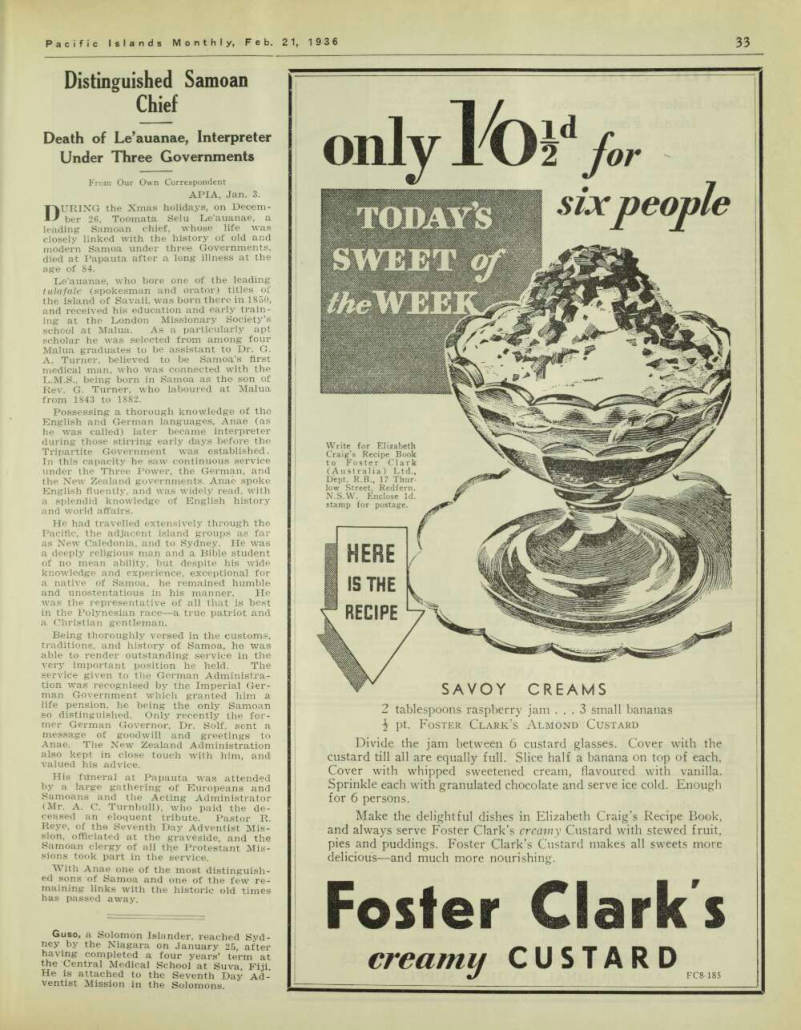
Chief Death of Le'auanae, Interpreter Under Three Governments
From Our Own Correspondent
Apia, Jan. 3.
DURING the Xmas holidays, on Decem ber 26, Toomata Selu Le’auanae, a leading Samoan chief, whose life was closely linked with the history of old and modern Samoa under three Governments, died at Papauta after a long illness at the age of 84.
Le’auanae, who bore one of the leading tulafale (spokesman and orator) titles of the island of Savaii, was born there in 1850, and received his education and early train ing at the London Missionary Society’s school at Malua. As a particularly apt scholar he was selected from among four Malua graduates to be assistant to Dr. G.
A. Turner, believed to be Samoa’s first medical man, who was connected with the L.M.S., being born in Samoa as the son of Rev. G. Turner, who laboured at Malua from 1843 to 1882.
Possessing a thorough knowledge of the English and German languages, Anae (as he was called) later became interpreter during those stirring early days before the Tripartite Government was established.
In this capacity he saw continuous service under the Three Power, the German, and the New Zealand governments. Anae spoke English fluently, and was widely read, with a splendid knowledge of English history and world affairs.
He had travelled extensively through the Pacific, the adjacent island groups as far as New Caledonia, and to Sydney. He was a deeply religious man and a Bible student of no mean ability, but despite his wide knowledge and experience, exceptional for a native of Samoa, he remained humble and unostentatious in his manner. He was the representative of all that is best in the Polynesian race—a true patriot and a Christian gentleman.
Being thoroughly versed in the customs, traditions, and history of Samoa, he was able to render outstanding service in the very important position he held. The service given to the German Administra tion was recognised by the Imperial Ger man Government which granted him a life pension, he being the only Samoan so distinguished. Only recently the for mer German Governor, Dr. Solf, sent a message of goodwill and greetings to Anae. The New Zealand Administration also kept in close touch with him, and valued his advice.
His funeral at Papauta was attended by a large gathering of Europeans and Samoans and the Acting Administrator (Mr. A. C. Turnbull), who paid the de ceased an eloquent tribute. Pastor R.
Reye, of the Seventh Day Adventist Mis sion, officiated at the graveside, and the Samoan clergy of all the Protestant Mis sions took part in the service.
With Anae one of the most distinguish ed sons of Samoa and one of the few re maining links with the historic old times has passed away.
Guso, a Solomon Islander, reached Syd ney by the Niagara on January 25, after having completed a four years’ term at the Central Medical School at Suva, Fiji He is attached to the Seventh Day Ad ventist Mission in the Solomons
Advertisements & other items, p. 35 (1 item)
sixpeople
Id 2 or
& / & f
HERE
IS THE
RECIPE
SAVOY CREAMS
2 tablespoons raspberry jam ... 3 small bananas i pt. Foster Clark's Almond Custard Divide the jam between 6 custard glasses. Cover with the custard till all are equally full. Slice half a banana on top of each.
Cover with whipped sweetened cream, flavoured with vanilla.
Sprinkle each with granulated chocolate and serve ice cold. Enough for 6 persons.
Make the delightful dishes in Elizabeth Craig’s Recipe Book, and always serve Foster Clark’s creamy Custard with stewed fruit, pies and puddings. Foster Clark’s Custard makes all sweets more delicious—and much more nourishing.
Foster Clark's
creamy CUSTARD
The Soma
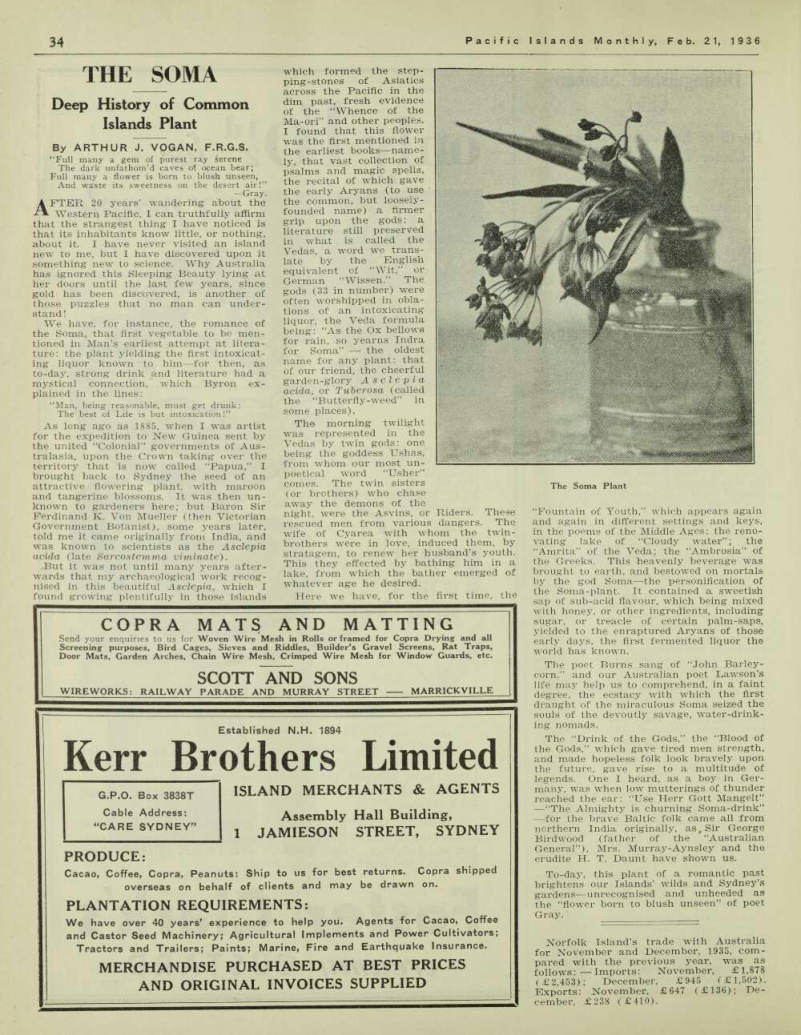
Deep History of Common Islands Plant
By Arthur J. Vogan, F.R.G.S.
“Full many a gem of purest ray Serene The dark unfathom’d caves of ocean bear; Full many a flower is born to blush unseen, And waste its sweetness on the desert air!” —Gray.
AFTER 20 years’ wandering about the Western Pacific, I can truthfully affirm that the strangest thing I have noticed is that its inhabitants know little, or nothing, about it. I have never visited an island new to me, but I have discovered upon it something new to science. Why Australia has ignored this Sleeping Beauty lying at her doors until the last few years, since gold has been discovered, is another of those puzzles that no man can under stand !
We have, for instance, the romance of the Soma, that first vegetable to be men tioned in Man’s earliest attempt at litera ture: the plant yielding the first intoxicat ing liquor known to him —for then, as to-day, strong drink and literature had a mystical connection, which Byron ex plained in the lines: “Man, being reasonable, must get drunk: The best of Life is but intoxication!”
As long ago as 1885, when I was artist for the expedition to New Guinea sent by the united “Colonial” governments of Aus tralasia, upon the Crown taking over the territory that is now called “Papua,” I brought back to Sydney the seed of an attractive flowering plant, with maroon and tangerine blossoms. It was then un known to gardeners here; but Baron Sir Ferdinand K. Von Mueller (then Victorian Government Botanist), some years later, told me it came originally from India, and was known to scientists as the Asclepia acida (late Sarcostemma viminate). .But it was not until many years after wards that my archaeological work recog nised in this beautiful Asclepia, which I found growing plentifully in those islands
which formed the step ping-stones of Asiatics across the Pacific in the dim past, fresh evidence of the “Whence of the Ma-ori” and other peoples.
I found that this flower was the first mentioned in the earliest books —namely, that vast collection of psalms and magic spells, the recital of which gave the early Aryans (to use the common, but loosely founded name) a firmer grip upon the gods; a literature still preserved in what is called the Vedas, a word we trans late by the English equivalent of “Wit,” or German “Wissen.” The gods (33 in number) were often worshipped in obla tions of an intoxicating liquor, the Veda formula being: “As the Ox bellows for rain, so yearns Indra for Soma” the oldest name for any plant: that of our friend, the cheerful garden-glory Asclepia acida, or Tuherosa (called the “Butterfly-weed” in some places).
The morning twilight was represented in the Vedas by twin gods: one being the goddess Ushas, from whom our most un poetical word “Usher” comes. The twin sisters (or brothers) who chase away the demons of the
night, were the Asvins, or Riders. These rescued men from various dangers. The wife of Cyarea with whom the twin brothers were in love, induced them, by stratagem, to renew her husband’s youth.
This they effected by bathing him in a lake, from which the bather emerged of whatever age he desired.
Here we have, for the first time, the
“Fountain of Youth,” which appears again and again in different settings and keys, in the poems of the Middle Ages: the reno vating lake of “Cloudy water”; the “Amrita” of the Veda; the “Ambrosia” of the Greeks. This heavenly beverage was brought to earth, and bestowed on mortals by the god Soma —the personification of the Soma-plant. It contained a sweetish sap of sub-acid flavour, which being mixed with honey, or other ingredients, including sugar, or treacle of certain palm-saps, yielded to the enraptured Aryans of those early days, the first fermented liquor the world has known.
The poet Burns sang of “John Barley corn,” and our Australian poet Lawson’s life may help us to comprehend, in a faint degree, the ecstacy with which the first draught of the miraculous Soma seized the souls of the devoutly savage, water-drink ing nomads.
The “Drink of the Gods,” the “Blood of the Gods,” which gave tired men strength, and made hopeless folk look bravely upon the future, gave rise to a multitude of legends. One I heard, as a boy in Ger many, was when low mutterings of thunder reached the ear; “Use Herr Gott Mangelt” —“The Almighty is churning Soma-drink” —for the brave Baltic folk came all from northern India originally, as. Sir George Birdwood (father of the “Australian General”), Mrs. Murray-Aynsley and the erudite H. T. Daunt have shown us.
To-day, this plant of a romantic past brightens our Islands’ wilds and Sydney's gardens—unrecognised and unheeded as the “flower born to blush unseen” of poet Gray.
Norfolk Island’s trade with Australia for November and December, 1935, com pared with the previous year, was as follows: —Imports: November, £1,878 (£2,453); December, £945 (£1,502).
Exports; November, £647 (£136); De cember, £238 (£410).
The Soma Plant
Advertisements & other items, pp. 36-38 (1 item)
Kerr Brothers Limited
COPRA MATS AND MATTING
Send your enquiries to us for Woven Wire Mesh in Rolls or framed for Copra Drying and all Screening purposes, Bird Cages, Sieves and Riddles, Builder’s Gravel Screens, Rat Traps, Door Mats, Garden Arches, Chain Wire Mesh, Crimped Wire Mesh for Window Guards, etc.
SCOTT AND SONS
WIREWORKS: RAILWAY PARADE AND MURRAY STREET MARRICKVILLE
Established N.H. 1894
Kerr Brothers Limited
ISLAND MERCHANTS & AGENTS
Assembly Hall Building,
1 JAMIESON STREET, SYDNEY
PRODUCE:
Cacao, Coffee, Copra, Peanuts: Ship to us for best returns. Copra shipped overseas on behalf of clients and may be drawn on.
PLANTATION REQUIREMENTS:
We have over 40 years’ experience to help you. Agents for Cacao, Coffee and Castor Seed Machinery; Agricultural Implements and Power Cultivators; Tractors and Trailers; Paints; Marine, Fire and Earthquake Insurance.
MERCHANDISE PURCHASED AT BEST PRICES
AND ORIGINAL INVOICES SUPPLIED
G.P.O. Box 3838 T
Cable Address:
“CARE SYDNEY”
m 'Me m % .
U W. mm m mm
frl
Refined from the world's best crudes to give you utmost freedom from sludge and carbon, and more efficient lubrication at all temperatures, even the hottest
MOTOR
GILLESPIE’S
“ANCHOR ”
FLOUR
TRADE
MARK
The Standard of Quality.
Australia*s Choicest Products: 4- JbSsA
Always ..
make sure you have at hand an ample Reserve of these Delicious . .
Garden
Vale
Ready-toserve Vegetables
Rewards For Cocoa-Growing In
New Guinea
How Can Planters Be Properly Protected?
WE return, without apology, to the sub ject of the cocoa industry in New Guinea.
When copra fell on evil days, many N.G. planters, seeking desperately for an alter native crop, decided to try cocoa. Their efforts were disappointing in the extreme.
Australian confectionery firms use large quantities of cocoa, and the N.G. Adminis tration, as the agent of the Commonwealth Government, pays a bonus of £ll/4/- per ton (being IJd per lb., less 20 per cent.) on cocoa grown in New Guinea and sold in Australia.
It was found that the Australian firms were most reluctant to buy the New Guinea cocca beans. When challenged about it, they said: (1) The beans were of very poor quality, and poorly graded; (2) their nrocesses of manufacture, and their formulae, were all fixed to accord with the quality of imported cocoa beans cus tomarily used, and they could not face the expense of changing their routine unless they were given guarantees of consistent quality and fixed, regular supplies.
That, on the face of it, seemed reasonable enough: and the alert Department of Agri culture in New Guinea took up the theme, begging growers for better and more regu
lar quality and hinting at a system of com pulsory grading.
The latter suggestion has stirred some of the planters to a protest. They say that their product is really of good quality, and that the attitude of the Australian manu facturers is suspect, because it is obvious that if they can decry the quality of the New Guinea beans, they can keep the price low, and benefit accordingly. They say that they ought not to be charged with the cost of inspection and grading until it is clear that the Australian manufacturing firms are not “working a ramp.”
The planters’ attitude is quite reasonable —there are very few big manufacturers whose policy in such matters is dictated by altruism. Most of them will take a point from the producer if they can.
The real secret of it all is that bounty of £ll/4/- per ton. It is intended for the benefit of the grower; but the manufac turer tries to benefit by it, too. We have before us, supplied by cocoa planters in New Guinea, authentic, documented cases of this.
A planter who has consistently produced a high-grade cocoa sent, through Messrs.
Burns, Philp, a consignment to Sydney; and 8.P., after hard selling, eventually got £29/10/- per ton from a reluctant Sydney manufacturer. About the same time, the grower sent another lot, of the same quality, to a foreign market: and it realised £35 per ton sterling, or £43/15/- Australian.
In the former case the grower got the bounty of £ll/4/- per ton, so that he was nearly as well off in the one case as the other.
The important point here is that the manufacturer grabbed the bounty. If he had paid world parity for those N.G. cocoa beans, he would have paid over £4O per ton, Australian; and then the £ll/4/- re ceived by the grower, on top of that, would have been a real bounty, or bonus. He would have been encouraged to grow more cocoa, and establish a strong industry— which, unquestionably, was the object of the Commonwealth Government in giving the bounty. It never was intended as a subsidy to the already well protected Aus tralian manufacturer.
The New Guinea growers are reason able in their contention that an inspection and grading fee should not be imposed upon them until the marketing position in Australia has been cleared up. Incident ally, whose is the responsibility for investi gating the Australian marketing position?
The Australian manufacturers cannot be ' condemned unheard —they have a case to present.
Manufacturers' Letters
Since we announced our intention of bringing this matter under the attention of the Commonwealth Government, with a suggestion that a customs duty on non- Territory cocoa beans might be considered, we have received the following letters on the subject:— The Managing Director of Messrs. Nestle and Anglo Swiss Condensed Milk Co. (Aus tralasia) Limited, wrote under date Decem ber 23: “When you write: ‘But the total lack of encouragement being given to the New Guinea cocoa growers in any shape or form by the Australian manufacturers threatens to strangle this industry at its birth,’ you are evidently not au fait with
the full facts, and the following informa tion will no doubt be of interest to you: “We have been buying cocoa beans from New Guinea regularly and our Abbotsford Factory Manager—Mr. E. C. Tyler—visited New Guinea last year, spending some time with the Agricultural Department and a number of the growers discussing the future for the New Guinea cocoa beans, Mr. Tyler gave the Agricultural Depart ment and the growers a deal of valuable information which will help them materi ally for the future.
“Only last week Mr. Tyler received a number of samples of what was looked upon as an improved bean, and he was asked for his opinion and criticism.
“With these facts before you, I think you will appreciate that the statement made in your letter dated December 6, addressed to our friends at Sweetacres, is hardly fair.
“We are particularly anxious to help the New Guinea cocoa bean industry, and might I suggest that you get in touch with Mr. Tyler at our Abbotsford chocolate factory, and he may be able to give you some information which will be helpful.”
The General Manager of Messrs. James Stedman Henderson’s Sweets Ltd. wrote on December 13:— “You will find, upon investigation, that your strictures upon the trade as a whole have no application to this firm.
“We have purchased about 50 tons per annum of these beans for the past two years (from the firms of W. S. Tait and Co., Gollin and Co., Kerr Bros, and Nelson and Robertson) and we think this is a fair proportion of an estimated total output of 200/300 tons per annum. If you have any accurate information that the output varies considerably from that figure, we would like to be informed of same.
“It would be absurd to suggest that the beans offered in commercial quantites are of a high grade. As a matter of fact, we think they are the worst variety we know of and, at the moment, we do not desire to purchase any more of the usual quality offered.
“As distinct from this, however, we have recently received a 281 b. sample of a far better grade of New Guinea beans than we have ever previously seen, but we have not been informed whether or not this grade is available commercially. We have
made an offer of £5 per ton above the usual market price of New Guinea beans for one ton of this grade of beans for trial, if it is available, and are now awaiting a reply from the dealers in the matter. If this better grade of beans could be supplied commercially, we feel sure that our opinion of New Guinea beans would improve con siderably, “In view of the above remarks, we think your statements regarding ‘stubborn oppo sition of confectionery firms’ and ‘lack of encouragement to New Guinea growers’ have no application whatever to this firm.” prori fm OF MARKETING
Problem Oh Makktiiino
TT seems to us that when a Government *■ provides a bounty on production, with possibly some system of inspection and grading, the job is only half done. Market ing is just as important as production: but bounty-paying Governments often leave marketing on the knees of the high gods, and the producers at the mercy of trading firms and speculating middlemen, Cocoa is a very good case in point. There should be some authority to investigate this market very thoroughly; and it should be an authority competent to act without fear or favour, and see to it that the pur pose of the bounty is not defeated by greedy commercialism, There should be someone to decide whether the Australian manufacturers are genuine in their case against New Guinea cocoa beans.
One of the main difficulties is that in dividual planters produce comparatively small amounts, whereas buyers nowadays always want to buy in bulk.
A planter, Jones, with great care, pro duces 10 tons of A grade copra; his neigh hour, Brown’s 10 tons of copra goes B grade, but is fairly good; Smith is a lazy rogue, and his 10 tons go definitely C grade. The B.P. steamer comes along and picks up 100 tons thereabouts, all produced under the mixed conditions outlined. It goes to London, and is sold by B.P. as one line, and the price is for average quality, The industrious, careful Jones gets a smaller price than he should—and, more over, is “socked” 5 per cent, for shrinkage, although he has dried out to within 2 per cent.; the lazy, careless Smith gets a higher price than he should—he is riding on the backs of his neighbours.
This happens even in New Guinea, within the limits imposed by a rigid sys tem of inspection and grading. There are good planters there who show us their account sales from B.P. or Carpenters and say: “Why should I try to get the highest grade, and dry out to the limit? I’m not getting any better price than old Mac- Whiskers, over in the Bay, who spends half his nights chasing blue dingoes off the verandah! ”
The same sort of thing has happened in connection with cocoa; and must happen in all production where the producer’s out put is small, and the market buys in bulk.
Primary producers in big countries con trol so many votes that the politician leaps to their commands, and so they have been reasonably well protected in the marketing
of their products. Primary producers in the Islands territories are voteless, and more or less disunited, and so they are largely at the mercy of a well-organised commercialism, which controls their mar kets.
That is the proposition. Who has the answer?
Mr. and Mrs. A. E. Allman, of Siga toka, Fiji, arrived in Sydney from Suva by the Niagara on January 25. Their children, Betty, Joan and Edward, who accompanied them, will remain at school in Sydney when their parents return after three months’ holiday. Mr. Allman is head overseer for the Colonial Sugar Refining Co. at Sigatoka.
Advertisements & other items, pp. 39-40 (1 item)
Sauces!!
The House of
HOLBROOK
is FAMOUS for its Sauces
HOLBROOKS
WORCESTERSHIRE
SAUCE
has been “The World’s Appetiser” for many generations. To meats of all varieties it adds a delightful piquancy, which stimulates the appetite and aids digestion. Soups, fish and vegetables, too, are improved by the addition of a few drops of Holbrooks Worcestershire Sauce.
HOLBROOKS
TOMATO
SAUCE,
made from fresh ripe tomatoes on the day they are gathered from the fields, is a quality product and is delicious with cold meats.
Many culinary triumphs may be achieved by its use in the kitchen whenever a true tomato flavor is desired.
HOLBROOKS
ANCHOVY
SAUCE
is a fish sauce made from the finest imported Gorgona anchovies, and provides a welcome savory to fish cooked in any manner.
Holbrooks (A/sia.)
Ltd.
WATERLOO, N.S.W.
BURNS PHILP
(South Sea) Co. Ltd.
Island Traders & Shipowners
Registered Office: Suva, Fiji.
ALSO BRANCHES AT:
Fiji: Levuka, Lautoka, Labasa, Ba, Sigatoka, Rotuma.
Tonga : Nukualofa, Haapai, Vavau.
Samoa: Apia, Pago Pago (American Samoa).
Solomons: Makambo, Gizo, Faisi.
New Hebrides: Vila.
Gilberts: Tarawa.
Norfolk Is. Nauru. Niue. Wallis Is. Futuna Is.
Code Address: “Burnsouth.”
f
FIRST
IN 1868
SPICED, CORNED. ROAST
& BOILED BEEF
AND IN MUTTON
IN 12 oz* 11b., 2 lb., 3.1 b., 41b. £j||pj 51b., £’ 6'lb ROUND
EfaSjgi CANS AND IN TAPERS
FITZROY
SHEEP
TONGUES
CORNED CX TONGUE’S - BEEP & FORK SAUSAGES
FITZROY ffl P«L B KF
THE ORIGINAL. PACK IN A CLASS BY ITSELF
ALSO THE EAMOUS
HAMPER MEATS
AV ROUND AND TAPER CANS fL—r— /2 02- 2*02. 6 & LBS
C«(D“M»E <L<D„ L¥D„ DSLAND TRADE. MEATS
BERSERKER & jpl|| OX PALM BRANDS
tN EVERY SIZ£ AR.OM /Z OZ r O 6L& CANS.
NO &XTR.A CHAR.CE- FOR, A SSOR-TM E-NT PACKED CASES ©R CARTONS - SEND EOR PRDCE EJST[
QUEENSLAND MEAT EXPORT CO. LTD.
LAKES CREEK - ROCKHAMPTON
CABLE ADDRESS:- TOMOANA ROCKHAMPTON.
Somerset
“Chum” Jardine, Of
T'HE death of “Chum” Jardine, is an event of some importance. If he was not himself exactly a pioneer in the Pacific, he and his family have been not able figures in the civilization of Northern Australia and the Torres Islands. He had friends scattered throughout the South Seas, and many will feel that they have lost a real pal now that he has gone.
Friends he had in plenty—in fact, all “Chum’s” merest acquaintances quickly became his friends, for to meet him was to fall at once under the charm of a man who was sincere, genial, and likeable. There are not many “Chum” Jardines about nowadays, when his most endearing qual ities might appear a little old-fashioned, and his place will be hard to fill. Especi ally so, in his own particular sphere as pearler and planter in the Aroe Islands, where for many years he had been the acknowledged leader of a small band of Australians domiciled among the Dutch.
Unlike his more famous father, Prank Jardine (the pioneer of Torres Strait and the Thursday Island pearling industry) and his mother (who came from Samoa), “Chum” did not reach old age; in fact, he was the sort of man of whom it might be said that he would never grow old. A short life and a merry one would have been his motto.
All “Chum’s” friends offer sympathy to his sisters, Mrs. H. G. Vidgen and Mrs.
Sheldon, and his brother Mr. Bert Jardine, all of whom sprang from that historic homestead at Somerset, in Albany Passage.
“Chum” Jardine would be about 58 years old (writes Mr. A. Corran, of Thursday Island). My acquaintanceship with him began about forty years ago, when he was 18 years of age, and 18 stone in weight.
Wampit “Rush” is Finished
From Our Own Correspondent
Edie Creek, Jan. 10.
* I ’HE Wampit “rush” is long since over and most of the “rushers” have re turned whence they came.
Only about 20 men are still on the field, and of these perhaps a dozen are on payable gold. Most are working below or alongside of Messrs. Babbington’s Reward claims. Two miners still remain well up the left fork above the waterfall, whilst the right fork is entirely deserted.
A few miners are still scattered in the surrounding country prospecting. Mrs.
Rex is somewhere at the head of the Wampit River; Mr. George Pearce, who was testing Graham and Smeaton’s Wam pit areas for Spence and Smith, has left; and Mr. Jack Banagan is on the job pitting. Mr. J. P. MacNamara has set himself up as agent at the ’drome, much to the satisfaction of the miners.
Rev. H. S. Perkins, of the London Mis sionary Society, returned to Apia, Wes tern Samoa, by the Wairuna on January 2, after a lengthy holiday in England.
Advertisements & other items, p. 40 (1 item)
Samuel Russell
ESTATE AND GENERAL AGENT
P.O. Box 64, Papeete, Tahiti
Real Estate. Investments. Estate Management and Administration. Valuations and Reports. Houses and Lands for Lease or Sale.
Sole Proprietor: TAHITI PERFUMES Cables: Russell, Tahiti (Bentley’s Code)
“Queen Petterson"
Romantic Story of New Guinea Life
ATTENTION in recent months has been directed to the Island of Tatau, in the Tabar Group, off the eastern coast of New Ireland, by reports of a discovery of gold there. Investigations are proceeding at the present moment.
It was reported in this journal six months ago that the captain of an Islands schooner noticed gold in the mud on the anchor which he raised preparatory to leaving the lee of Tatau Island. He men tioned the fact to Mr. Charles Petterson, a veteran planter on Tatau Island, and Mr. Petterson subsequently obtained a con siderable quantity of gold there.
The newspapers now have been telling the romantic story of Mr. Petterson’s life.
The following (according to the Rahaul Times) appeared recently in a German newspaper, which stated that the Swedish newspapers had reported that “Queen Pet terson’ had just passed away in her native town of Gefle, in Sweden.”
“In 1915 (according to the German newspaper) a ship was wrecked in the Pacific Ocean. Only one of the crew was saved, a Swedish sailor, whose name was Charles Petterson. He succeeded in get ting to an island named Tabar, which was one of the old German islands of the Bis marck Archipelago. The island was in habited by cannibals, but notwithstanding their ugly habit, they received the ship wrecked man in a more than friendly manner. They saw in the white man a god, and they worshipped him as such. The old chief gave him his daughter as a wife and when he died shortly afterw r ards, the natives chose the w T hite man to be his successor. The living on this far-off island in the Pacific Ocean was at that time more peaceful than anywhere else upon earth and, as the dignity of a chief is besides united with big revenues, so the Swede agreed with them on this position.
Together with his dusky consort he reigned prudently and wisely on the island, and he introduced perhaps also a bit of civilisa tion. Anyhow he deterred them from their cannibalism and he made them highly styled vegetarians.
“Years of peace and prosperity passed: the brown daughter of the chieftain gave birth each year to a child, but after having given birth to the ninth child she died. He did not like to remain a widower, but he would not take another native wife. He went to Europe to look for a new consort.
Then it happened that the newspapers became aware of his adventure and they dealt with it very profusely. They were also responsible for calling the Swede sailor the ‘King of Tabar, King Charles the First.’ It sounded so noble and, as a matter of fact, it was not a lie. He was a supreme ruler on his far-off island. The king him self grinned over his title, but it did not at all mount to his head, at least as far as his future wife was concerned. He did not like a princess or some high-class per son. ‘She need not be rich, nor even hand some; the main thing is that she be good for my children,’ he said.
“On his trip fo Europe he quite natur ally called upon his native country and in his native city, Gefle, he met his looked-for bride. Her name was Jessie Simpson. The name sounded English, and her father was of English origin. But he was a Swedish citizen, the principal of the gasworks at Gefle, and Jessie was born there.
“She trusted him and she accompanied him to his insular state in the South Sea.
“Now began for Jessie her big adven
ture. But alas, it did not end so nicely, as she had thought of. She could not stand the hot South Sea climate. After some years she got malaria, and neither the natives nor the white ‘medical men’ could restore her to health. Then her husband sent her back to her country, and he made up his mind to follow as soon as he would have cared for his successor, and for his business in the insular state. The suc cession question was easily settled, because his eldest son ascended his ‘throne,’ but it was not so easy to order his affairs, for these comprised amongst others a gold mine, which was to be sold. But before the ‘King Charles’ could return to his native land as a private man, Petterson, his ‘Queen’ died.
“The golden adventure ends here.”
Miss Jean Forster, daughter of Mr. and Mrs. R. C. Forster, of Suva, who recently announced her engagement to Mr. Wil liam Gidley King, of Fiji, arrived in Syd ney to spend three months’ holiday by the Niagara on January 25.
Mr. H. Miedicke, father of a well-known Samoan cocoa planter, Mr. J. G. Miedicke, of Magia Plantation, died after a short illness in Apia Hospital on January 3.
Mr. Miedicke, who had reached the ad vanced age of 79, had been living with his son for the last few years. He was one of the old Queensland pioneers.
Advertisements & other items, pp. 41-42 (1 item)
H.Peel&Sons
PURE RICE
STARCH
Always ask for , . .
“CORAL” Brand
100% PURE
Noted for its
QUALITY
and
WHITENESS
Goes Farthest and gives Lasting Finish
WILL NOT
STICK TO
IRON
Obtainable from Leading Island Stores Manufactured by
AUSTRALIAN RICE LTD.
Sydney, N.S.W.
CORAL BRAND
RICE STARCH
WE ARE SPECIALISTS!
Let us have your confidence, sixty years is our record of supplying the Leading Houses throughout the World in—
FRESH FRUIT VEGETABLES PRODUCE
WEYMARK & SON LTD.
Fruit and Produce Merchants
14-18 STEAMMILL STREET, SYDNEY
Phones: MA 3612 Cable Address: Codes Bentleys. (4 lines) "Weymarkson" Private.
H.PEEL&SONS
Fl/frl
IMPORTER/
& EXPORTERS
QUOTES
SENT
ANYWHERE
Phones: MW 1603 FX 5011 Purveyors of Scotch, Canadian, N.Z. and Australian
Fresh and. Smoked Fish
SHIPPING 239 HARRIS ST., PYRMONT
PROVEDORES SYDNEY, New South Wales
WHERE TO STAY IN PORT MORESBY
FIRST-CLASS ACCOMMODATION.
PARTIES ARRANGED.
Licensee: Papua Hotel, Ltd
THE
PAPUA HOTEL
Catering specially for Tourists and Travellers Situated on high ground overlooking both coasts, its Spacious Lounges are always Cool and Comfortable. Tariff: Per Day, 16/-; per week, £,5/5/-; per month, £l4; bed and breakfast, 10/-; bedroom only, 7/6.
Cars meet all steamers.
HOTEL MORESBY N “ R J" E
COMFORTABLE ~,,,
ACCOMMODATION
ONLY THE BEST
BRANDS OF
WINES, SPIRITS
AND BEERS
IN STOCK
LICENSEE:
Hotel Moresby
Ltd.
COSMOPOLITAN
HOTEL
Samarai
First-class Accommodation for Tourists and Travellers Ball-room; Electric Light; Billiards; Freezing-works; Cold Store. Best brands of Wines, Spirits, Ales.
MODERATE TARIFF
Fishing Trips and Launch Excursions arranged Licensee: E. J. Morrow
TAHITI
AND
French Oceania
This book, by Samuel Russell, is a valuable work of reference. It gives, in relation to Tahiti and French Oceania, complete details of administration, commerce, sport, tourist resorts, industries, excursions, hotels, immigration and land laws, etc.
Yachtsmen and fishermen, who are visiting Tahiti in increasing numbers, will find this a most useful handbook.
It also supplies a fascinating account of life in Tahiti—one of the most delightful places of residence in the world.
Copies from: S. RUSSELL, Papeete, Tahiti, and
Pacific Publications Ltd.,
247 George Street, Sydney
Price in Australia (posted): Cloth bound, •/-; paper-cover, 5/-.
HOTEL BULOLO
WAU, T.N.G.
Picturesquely situated, overlooking the Wau Aerodrome, at the Business centre of the Morobe Goldfields.
FIRST-CLASS CUISINE—3O com-
fortable Bed-rooms—Hot and Cold Showers—Fresh Fruit, Vegetables, and Dairy Produce from the Hotel Gardens.
The Hotel Bulolo is famous for its wide, cool verandah-lounge.
Only the Best Brands of Wines, Spirits, and Beers in stock.
■■Bfe
SAMARAI HOTEL
Ths Rendezvous of ths Miners of Eastern Papua.
Comfortable Accommodation for Tourists, Travellers and Residents. Best Brands of Spirits and Wines—Victorian Lager Beers.
FISHING EXCURSIONS ARRANGED
Licensee; Mrs. L. M. SKELLY.
lIOTE SL It AItA U L
COOL AND SPACIOUS LOUNGES COMFORTABLE
ROOMS—DINNER PARTIES SPECIALLY ARRANGED
Excellent Dance Floor and Music. 3* m □ *** Under the Personal Management of Mrs. H. Luxmoore
In New Guinea’S Unknown Centre
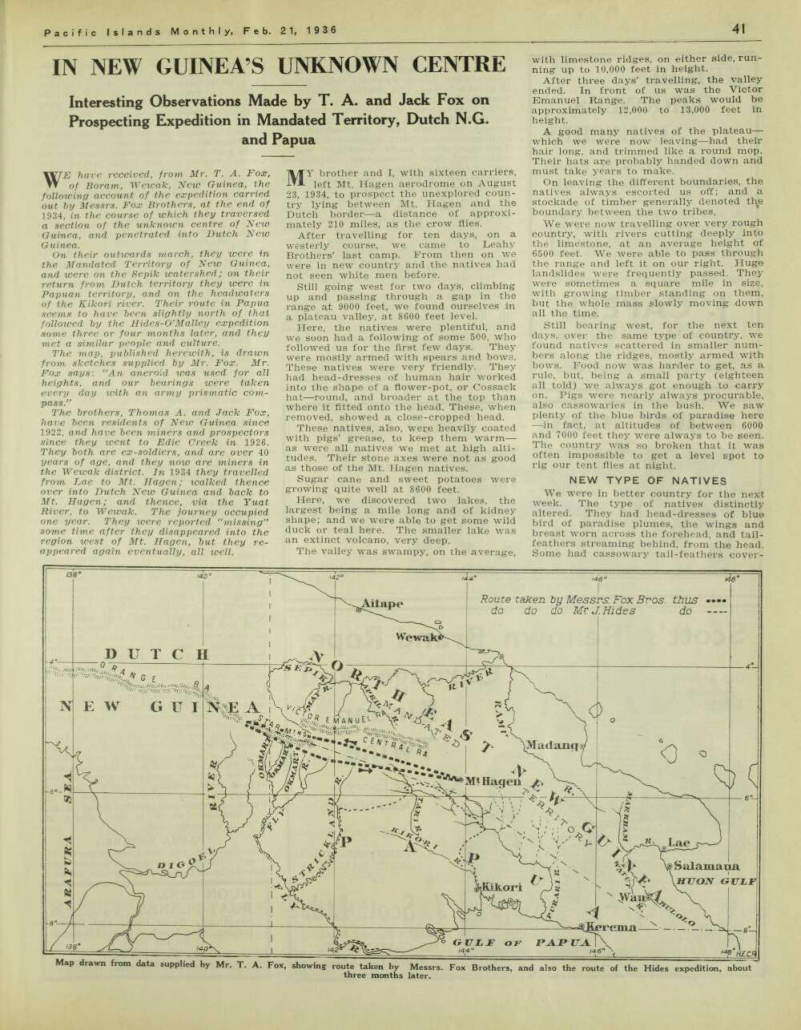
Interesting Observations Made by T. A. and Jack Fox on Prospecting Expedition in Mandated Territory, Dutch N.G. and Papua
WE have received, from Mr. T. A. Fox, of Boram, Wewak, New Guinea, the following account of the expedition carried out by Messrs. Fox Brothers, at the end of 1934, in the course of which they traversed a section of the unknown centre of New Guinea, and penetrated into Dutch New Guinea.
On their outwards march, they were in the Mandated Territory of New Guinea, and were on the Sepik watershed; on their return from Dutch territory they were in Papuan territory, and on the headwaters of the Kikori river. Their route in Papua seems to have been slightly north of that followed by the Hides-O’Malley expedition some three or four months later, and they met a similar people and culture.
The map, published herewith, is drawn from sketches supplied by Mr. Fox. Mr.
Fox says: “An aneroid was used for all heights, and our bearings were taken every day icith an army prismatic com pass."
The brothers, Thomas A. and Jack Fox, have been residents of New Guinea since 1922, and have been miners and prospectors since they went to Edie Creek in 1926.
They both are ex-soldiers, and are over 40 years of age, and they now are miners in the Wewak district. In 1934 they travelled from Lae to Mt. Hagen; walked thence over into Dutch New Guinea and back to Mt. Hagen; and thence, via the Tuat River, to Wewak. The journey occupied one year. They were reported “missing” some time after they disappeared into the region west of Mt. Hagen, but they re appeared again eventually, all well.
MY brother and I, with sixteen carriers, left Mt. Hagen aerodrome on August 23, 1934, to prospect the unexplored coun try lying between Mt. Hagen and the Dutch border —a distance of approxi mately 210 miles, as the crow flies.
After travelling for ten days, on a westerly course, we came to Leahy Brothers’ last camp. From then on we were in new country and the natives had not seen white men before.
Still going west for two days, climbing up and passing through a gap in the range at 9000 feet, we found ourselves in a plateau valley, at 8600 feet level.
Here, the natives were plentiful, and we soon had a following of some 500, who followed us for the first few days. They were mostly armed with spears and bows.
These natives were very friendly. They had head-dresses of human hair worked into the shape of a flower-pot, or Cossack hat —round, and broader at the top than where it fitted onto the head. These, when removed, showed a close-cropped head.
These natives, also, were heavily coated with pigs’ grease, to keep them warm — as were all natives we met at high alti tudes. Their stone axes were not as good as those of the Mt. Hagen natives.
Sugar cane and sweet potatoes were growing quite well at 8600 feet.
Here, we discovered two lakes, the largest being a mile long and of kidney shape; and we were able to get some wild duck or teal here. The smaller lake was an extinct volcano, very deep.
The valley was swampy, on the average,
with limestone ridges, on either side, run ning up to 10,000 feet in height.
After three days’ travelling, the valley ended. In front of us was the Victor Emanuel Range. The peaks would be approximately 12,000 to 13,000 feet in height, A good many natives of the plateau— which we were now leaving—had their hair long, and trimmed like a round mop.
Their hats are probably handed down and must take years to make.
On leaving the different boundaries, the natives always escorted us off; and a stockade of timber generally denoted boundary between the two tribes.
We were now travelling over very rough country, with rivers cutting deeply into the limestone, at an average height of 6500 feet. We were able to pass through the range and left it on our right. Hugo landslides were frequently passed. They were sometimes a square mile in size, with growing timber standing on them, but the whole mass slowly moving down all the time.
Still bearing west, for the next ten days, over the same type of country, we found natives scattered in smaller num bers along the ridges, mostly armed with bows. Food now was harder to get, as a rule, but, being a small party (eighteen all told) we always got enough to carry on. Pigs were nearly always procurable, also cassowaries in the bush. We saw plenty of the blue birds of paradise here —in fact, at altitudes of between 6000 and 7000 feet they were always to be seen.
The country was so broken that it was often impossible to get a level spot to rig our tent flies at night.
New Type Of Natives
We were in better country for the next week. The type of natives distinctly altered. They had head-dresses of blue bird of paradise plumes, the wings and breast worn across the forehead, and tail feathers streaming behind, from the head.
Some had cassowary tail-feathers cover-
Map drawn from data supplied by Mr. T. A. Fox, showing route taken by Messrs. Fox Brothers, and also the route of the Hides expedition, about three months later.
ing the whole of their heads, like the bus bies of the Guards’ head-dress. Their spears were tipped with the thigh bones of human beings, and thigh-bone daggers were the rule.
Their prisoners of war were fastened on three poles, 12 feet high from the ground, and then made pin-cushions of, by filling them up with arrows and spears.
This was done on a moonlight night, with torch-light procession complete—a sort of tattoo display.
These natives buried their dead in open fibre-plaited and bark coffins. The latter were put on six posts, 6 feet from the ground, with a roof on top. The body was placed in position, with the knees bent, and no wrappings, and left to the blowflies to clean up. In due course, the bones were used for manifold pur poses, but the skulls were collected and arranged in fibre baskets, on either side of the main entrance of the houses, like skull-racks.
For facial decorations, boars’ tusks in verted and upright, fastened to the upper lip like moustaches, were used; also, quills from the cassowary, 8 to 10 inches long, pierced their noses—some upright, but mostly acrosswise.
These natives, especially, seemed to en joy fighting as a pastime, and were of a good figure. I should not be surprised if they were cannibals. But we were
never able to witness any of their feasts.
After travelling for nine days, we came to a swift-running large river, running N.W. To cross this river, we had to drop down to 4000 ft., which was the level of the river bed, from a 7000 ft. ridge, and climb up the other side at 6800 ft. in the same day—showing how deep the rivers and streams cut into the country here.
Slate and quartz were seen here, but no traces of gold in the wash in the river tested.
Up till now, all the rivers crossed flowed into the Sepik River, which drains all the northern watersheds of the ranges we had passed.
The next few days were occupied in going through a gap in the mountains in front, at 8000 ft. We now were in the Star Mountains, a range situated on the place where the three boundaries meet— Dutch, Papuan, and Mandated Territory.
These Star Mountains were also lime stone, with volcanic cone tops; the high est peaks approximately 13,500 ft. Travel ling through this range, we discovered a small lake at 7800 ft.
The country now opened up to a series of small valleys between the ridges of the range, some being 10 to 20 miles long, running in a S.W. course, which we were now travelling. We travelled for two weeks at between 5500 and 7000-feet levels, with the natives still of the same type and customs. Here, all the waters were running on a south-westerly course.
On The Digoel Watershed
We now found the country sloping to lower levels; and, at a 2000-feet level (the level of the valleys in the ranges around us), we found all the streams we passed converged into a large river, flow ing at least eight miles per hour, and 100 yards wide. This river, which we saw at 2000 ft. altitude, was one of the head waters of the Dutch river, the Digoel.
Here, the natives were different again, and wore their own hair, in a bun-shaped knob. They wore possum-teeth necklaces around their necks, and were armed with bows and arrows. These natives spoke to us in the Malay language—that is, some of the words were recognised as Malay—and offered us birds of paradise plumes for our trade. They had stone axes, and evidently had had association with the Dutch-Malay bird-hunters when plumes were of a market value. They did not appear to have seen white men before.
Some wore bird of paradise plumes in their hair, and had bone daggers fastened at the waist. They built their houses on posts 10 feet high, square of shape, with plaited bamboo walls. Here, the sago palm was in all the swamps seen, and pigs were plentiful; but the country was still very ridgy and broken.
We now decided to go back, as Dutch territory was out of bounds to us, and we had no hope of claiming any gold we might find. We had now been travelling for two months, averaging seven miles a day at least, making about 400 miles of country we had traversed to get to the Dutch Border —practically doing double the distance, which is only about 210 miles in a straight line.
Papua Entered
In front of us, and slightly north, the Orange Range of Mountains loomed up in the skyline. Some of the peaks we esti
mated were at least 15.000 feet high.
These mountains were the highest we saw on the whole trip.
On October 23 we started to return, via the Papuan border, so as to prospect the head waters on the southern fall of the ranges passed on the way out.
We now proceeded up one of the arms of the Digoel River on a south-easterly course, and climbed up to 6000 and 7000 feet. Here, the natives were similar to the natives of the higher levels. We were able to go for about 100 miles, along a series of small valleys, in a south-easterly direction.
A huge limestone wall flanked us on the right. In some places, 2000 feet of sheer wall was seen. This wall ran for over 100 miles, with gaps cut through by the rivers, which now were running in a more south erly direction. Here, we found some fossils (shells) in a dry creek bed, but no traces of gold.
The natives here wore a crescent shape head-dress of human hair, with the peaks turning up; and they decorated the head-piece with small flowers, yellow and mauve. Others worked silver leaves, also red leaves, in a W shape across the front of the head-piece. The custom of disposing of their dead in the open, on six posts in an open box, was still the rule.
Natives’ Underground Roads
Their gardens were surrounded with a system of deep trenches; 10 feet deep and 12 ft. in width, with wild cane growing and overlapping the trench, making them almost tunnels, and almost dark inside.
The tunnels were used as roads, and also to keep the pigs out of the gardens on top. Some were over 400 yards long, with cross-saps coming in at right angles, and
the whole village was connected up this way. These trenches were dug out with wooden spades; mostly in clay, with a volcanic top soil.
We did not see any natives use boiling water on the whole trip, or any signs of pots. All cooking was done on hot stones, or in bamboos; and the steam from our tea billy always had them amazed. Water was used for drinking purposes only. Dry cleaning was the fashion everywhere: but the pigs’ grease, rubbed into their skins, did not give this system a fair trial! Also, they daubed their faces with red or white clay.
We now came to a waterfall of some 300 or 400 feet fall. Here, the natives called the swift-flowing river the Okmart.
That seemed to be the name for the many rivers we had passed since leaving the Digoel waters, suggesting that the head waters of the Fly and Strickland Rivers arise in the Mandated Territory.
We were now passing through the high country that Messrs. Hides and O’Malley skirted some four months later.
In most cases, the natives had rope bridges over the rivers. We crossed some which were 100 feet long, and a drop of anything from 50 to 100 feet was common.
To slip into these fast-running torrents meant “Good night, nurse!” and one at a time was the strict rule.
We now took a more easterly course, climbing up over a gap or saddle in the mountains at 9400 ft. Here we had a hail storm. The stones were the size of marbles, and they made the ground white for over four hours. In sheltered places, it lay about for over 24 hours.
For two days, we were travelling in a small valley at 9000 feet —swampy going— no natives lived there —only tracks were
seen. Here we had to exist on what food reserves Ave carried from our last camp, where we left the natives at 7200 ft.
We passed between and quite close to three mountains. The one on our right was all of 14,000 ft. in height, and white with hail-stones at the time of our pass ing, as also were the two peaks on our right, about 13,0i0ft. high.
On the third day, we came on to natives at 8400 ft., and were able to get potatoes, cane, and a pig. The natives were still of the same type.
For the next 60 miles, we travelled mostly at 8000 ft., passing one river which ran underground for half a mile before reappearing from the limestone. The country was now more volcanic, and the waters were the headwaters of the Kikori, which reach back into the Mandated Territory, as does the Purari. All these waters were fast-running torrents.
The natives here were using more spears as arms, similar to the Mt. Hagen type of natives. Their stone axes were better made.
The Crags: 13,500 Feet
After two weeks’ travelling, through similar country, mostly at 6500 feet levels, we sighted, in front and slightly north, the Crags, a mountain that can be seen from Mt. Hagen. This we recognised by its shape; it is 13,500 ft. high. We now knew we had about 100 miles to go to get back home.
After a few days more at 6500 ft., we climbed over a ridge at 9200 ft., and were able to work along a course slightly N.E.. thus approaching the Crags in a more or less direct line. We came upon natives with steel axes, worn down to the hubs.
These axes were of an old-fashioned type, and were traded-in by stages from tribe to tribe, from the coast back, as they were worn out and the original owners got better ones.
These natives had not seen white men before, and in no way were civilised.
Some had hair or fibre nets over their heads; also, bark belts were beginning to appear as we approached the Crags. But, as yet, they did not understand Mt. Hagen talk when used to them.
Here we found a small lake, at 8200 ft., also the longest house on the whole trip— some 130 yards long.
After a few days, we passed round the Crags: and, after a week’s going, over country that the Leahy Brothers had been in before, we arrived at Mt. Hagen aero drome, on December 15, 1934, all in good health and with the party (boys and our selves) complete.
We had now completed a trip to the Dutch border and back, in which we had to traverse over 800 miles of new country (the mountainous character of the country making much extra walking necessary); and we also always had to keep in touch with the natives for food supplies. We had travelled along the “roof” of New Guinea —on the northern watershed on the way out, thus crossing and prospecting the headwaters of the numerous rivers emptying into the Sepik River; and returning on the southern watershed, from the Digoel headwaters, in Dutch New Guinea, and crossing the headwaters of the Fly, Strickland, and Kikori Rivers on our return trip.
We did not find any traces of gold in the country explored, and very little mineralisation. Volcanic eruptions through the limestone belts were the rule.
The population of natives in the area traversed was estimated at 100,000. • For 3i months we lived entirely on the country, carrying only tea and salt, and a universal “trade.” Being a small party it was possible to do this on this trip.
The natives always had sweet potatoes, sugar-cane, and pigs.
Heavy timber was the rule at all heights; and the natives ring-barked ex tensively. There was grass in the larger valleys, in the lower altitudes.
The natives, as a rule, were quite easy to get on with, and simple to understand.
Advertisements & other items, pp. 44-46 (1 item)
Cordage and
KETCHES,
SCHOONERS,
LAUNCHES
And All Types of Boats suitable for Islands work A large fleet of sound and reliable craft on hand. Let me know your requirements or instruct your Sydney Agent to inspect on your behalf.
My experience is at your service.
J. CAPELL
Boatbuilder and Engineer
ELITE SHEDS,
RUSHCUTTER BAY, SYDNEY
II Alt It ¥ WEST
Sydney’s Sailmaker
m
SECTION OF OUR SAIL LOFT
Caters for every class of
SAIL, CANVAS,
ROPE & WIRE
EQUIPMENT
Send your enquiries to us
ADDRESS:
BALMAIN,
SYDNEY
Scott’s Renown Brand Rope,
Cordage and
Cable Address: Ropeyard, Sydney. m • - WKf ' 1
Binder
Twine
of Every
Description
MANUFACTURED AT
MASCOT, N.S.W.
By
J. Scott Ltd.
Head Office and Store:
163 CLARENCE ST.,
SYDNEY, N.S.W.
HUON PINE
BOAT PLANKS . . .
Practically Borer Proof and Everlasting, also Spotted Gum Timbers.
PRICES RIGHT
A. C. FRYER.
110 Miller St., Pyrmont, N.S.W.
SHIP & GENERAL
COPPERSMITHS
===^^= Manufacturers of all kinds of Pipe Work, Petrol, Water, and Buoyancy Tanks for Ships, Yachts, and Motor Boats, Copper Water-jacketed Ex* haust Pipes & Silencers a speciality.
Copper Pans and Stills made to specification
Nicholson & Foster
BALMAIN, SYDNEY
Absolute reliability.
Low fuel costs.
No fire risk.
Low upkeep costs.
THESE are a few of the reasons for the popularity of the RUSTON Marine Oil Engine.
Why not investigate these economies?
Only one type of Ruston Marine Engine is shown above—our complete catalogue shows them all—may we send you a copy?
RUSTON
MARINE OIL ENGINES
RUSTON & HORNSBY (aust.) PTY. LIMITED. MELBOURNE Branches at Sydney and Brisbane Sole Agents for Mandated Territory: Burns Philp & Co. Ltd., Rabaul
This Perfect Window System for
Tropic Homes is made possible by
COUSINS’ Improved
•• WESTEELE ”
CASEMENT STAYS
(Patented) : > WT\ mm 1 i' • These Windows can be OPENED
TO ANY ANGLE—to CATCH or
TURN the BREEZE—thus giving complete ventilation control. • They are SECURE IN ANY POSITION —no banging. • They are DEFINITELY
WEATHERPROOF.
• They can be SIMPLY and
QUICKLY CLOSED.
“WESTEELE” STAYS are EASILY
FITTED at LOW COST
Messrs. Dickson & Yorston Pty. Ltd., Melbourne, write: “ . . . have adopted the ‘Westeele’
Casement Stays system and delighted with result.”
UII
m Write for particulars Manufactured by
R. Y. COUSINS
BUILDERS’ SUPPLIES
CHIPPENDALE, SYDNEY
The ‘Austral’ Auto-Flush Cabinet
The latest in Sanitary Installations for non-sewered areas A Patent Closet that gives you convenience, health, and refinement similar to a w.c. A great advance on anything yet offered.
No water supply required.
Price, £l5 (Aust.), F. 0.8., Sydney Can be installed by any handy man.
Leaflet on application.
INSULAR LAMPS (Syd.), ltd.
42 Market St., SYDNEY Approved by the N.S.W. Board of Health.
Pays for Itself!
The
HALLSTROM
Masterpiece Price £4*/10/-, f.0.b., Sydney.
Others from £2O.
FOR EVERY HOME
HALLSTROM
Semi-Automatic
REFRIGERATORS
KEROSENE OPERATED
Have proof of Lasting Service and economical refrigeration efficiency.
No Moving Parts—No Mechanism.
Keep your food fresh and wholesome Write for particulars to the manufacturer:
E. HALLSTROM
462/464 Willoughby Rd., Willoughby
SYDNEY
Not Excessive
N.Z. Profits From Samoan Bananas
From Our Own Correspondent APIA, January 4.
IN recent letters in the Auckland Star, -* complaints have been voiced regarding the high price of Samoan bananas to New Zealand consumers, and it is asserted that the buyers, who have contracted for the yearly output of Samoan bananas, are making huge profits.
In fairness it should be stated that the figures as cited by the complainants are not correct. For instance, the freight from Apia to New Zealand ports is not 1/6, but 4/- per case. The total cost per case landed in New Zealand is over 13/- and the wholesale buyers’ contract price to the Samoan Administration (which has not been made known) is probably in the neighbourhood of 14/6 per case.
Even this price would leave a very good profit to the wholesalers, assuming an average selling price of 24/- per case. This average price, however, cannot be obtained during the fruit season in New Zealand, and it has sometimes dropped to 9/6 per case, which meant a heavy loss on some shipments. The buyers have also to stand the risk of overripe and immature or diseased fruit, of which a certain propor tion may be found in nearly every ship ment.
It is, therefore, only fair to concede that under the circumstances the profits of the New Zealand wholesale buyers cannot be described as excessive.
Mr. Arthur Aris King, an old identity of Western Samoa, left Apia with his family in January to take up residence in New Zealand. Mr. King lived with Robert Louis Stevenson at Vailima for some time and valued his reminiscences of his connection with the famous writer.
He has a number of valuable souvenirs of that time in his possession. For years past Mr. King has been ailing and un able to work at his advanced age. He hopes that the change of climate will be of benefit to his health.
Men Who Knew Yesterday
By Eric Ramsden
5. —Percy H. Edmunds, Lately
of Easter Island
PERCY H. EDMUNDS was a lad of six teen when his parents, on their re turn to England, left him in the Argen tine. After gaining experience on cattle stations in South America for some years he was offered the management of a sheep and cattle station on Easter Island.
For nearly thirty years, with occasional visits to South America and to Europe, he remained there —one of the loneliest and most isolated spots in all the Pacific.
At first, he received his mail at least annually. During the years of the Great War, however, he was lucky if he received it every two years.
Nowadays, the tall, quietly-spoken Englishman, sparse of hair, but still in excellent physical trim, makes his home in Tahiti. After Easter Island, Papeete must seem like a metropolis to him! He has been for so long in the Pacific that Europe no longer appeals to him —at least, he would not like to face a European winter . . . So he has built himself a natty little bungalow at the edge of the lagoon in the Pare district, and there he is content to sit and smoke and dream of the age-old mystery, the gigantic statues that for the last century and more have puzzled foreign visitors, since the Island was visited by Cook, de la Perouse, and others.
Percy Edmunds likes to talk in figures —just as any Australian farmer might
do. In such and such a year there were so many sheep on Easter Island, and, in cidentally—so many head of cattle. By sending to Australia he was able to im prove the flocks. When he first went to the Island most of the sheep had been killed off, and the old rams were worse than useless. Gradually, he improved the strain, until he was able to speak of his sheep with justifiable pride. After all, 40,000 acres is a considerable property to manage: such a station in any part of the world, let alone on a remote Pacific isle, takes expert handling.
There were no white neighbours.
For five years, until the outbreak of the Great War, he spoke only with natives — that is, apart from the annual visit of a vessel with provisions. The islanders, de scendants of fathers and mothers who had been for years at the mercy of slavers for the Peruvian nitrate mines, were not a particularly romantic lot. The Anglo- Chilean company which controlled the island kept the Englishman well supplied with literature. There was ample time for reading—and thinking. Occasionally, a warship would call for fresh meat.
There were times when he was actually short of supplies; but, generally stores sufficient for two years were landed in bulk.
“More than anything else,” he confessed after a moment’s reflection, “I think I missed soap!”
In June, 1913, the disabled El Dorado, en route from Oregon to Atifogasto, was caught in a gale; the deck-load had
moved to such an extent that her com mander was forced to take to the ship s boat. The nearest land was Easter Island —7OO miles distant. To add to his diffi culties the captain, in the transfer, lost his chronometer. However, in due course, he made the island. There Percy Ed munds provided him with a watch. With its assistance (in place of a chronometer), in sixteen days he reached Mangareva, in
the Gambier Group. From there he sailed the remaining 900 miles to Tahiti—a feat of navigation that can be compared only with the exploits of the Polynesians of old! Some of the crew remained at Easter Island until they were taken off by a vessel.
There were other visitors mostly scientists interested in the statues. A caller of importance, in 1914, however, was Admiral von Spee, commander of the German Pacific Squadron. Instruc tions were given to every sailor that the islanders were not to be told of the war then raging in Europe. “But, of course, the news leaked out,” commented Mr. Ed munds.
The cruisers were supplied with meat; half a bullock alone was sent each day to the flagship. The Germans paid in cash. Still maintaining the pretence that they were on a normal cruise, the Ger mans passed on, to defeat Admiral Cradock off Coronel, and to be wiped out by Ad miral Sturdee at the Falkland Islands.
Percy Edmunds was probably the last English-speaking person to have speech with the German admiral, who went down with the Scharnhorst.
Judge Paul Cruyl, President of the Condominium Joint Court, arrived in Sydney from Vila, New Hebrides, by the Morinda on January 29.
Advertisements & other items, pp. 47-48 (1 item)
ssss
UMBRELLAS
Specially made for Tropical Conditions
ONLY BRITISH FRAMES USED
Guaranteed FAST DYED Coverings Strong Canvas-Covered Beach and Garden Umbrellas in Medium and Large Sizes—Brass Fittings Throughout.
“Shelta” Brand Umbrellas
Manufactured by
Phillips and
House
453 Kent Street
SYDNEY
428 Adelaide St.
BRISBANE
Inquiries invited from Pacific Islands Distributors We supply the trade only.
MODERN TUBULAR
STEEL FURNITURE
Chromium-plated or Lacquered Finishes Beds Wires Bedding Hospital Furniture Tubular Steel Furniture
;pPTc£>;
ssss
Oil £ L?
ST* cs' Radio Station 2UW, Newlands Steel Furniture Cloa Chair —Chromium plated Steel.
Complete Catalogues on Request Cable Address “NEWLANDBED,” SYDNEY.
NEWLANDS BROTHERS LTD. Riley Street, Sydney, N.S.W.
AUSTRALIA’S LARGEST MANUFACTURERS OF SLEEPING EQUIPMENT, HOSPITAL FURNITURE AND
STEEL DESIGNS.
Timber Joinery
ETC.
PREPARED BUILDINGS
ready for erection a speciality.
SHIP and BOAT BUILDING
TIMBERS specially catered for
FIBROLITE, PLYWOODS.
GALVANISED IRON.
CANEC.
O CONSIGNMENTS shipped
by RETURN STEAMERS
to the Islands.
John W. Eaton Ltd.
WEST CRESCENT ST.,
NORTH SYDNEY
TELEPHONES: X 5051 (5 line.)
BITUMENOID ROOFING
MADE IN AUSTRALIA
Bitumenoid Roofings, Dampcourses and Insulating Felts are made from the world’s best raw materials. Warranted to stand the most rigid tests.
BITUMENOID THE BEST
Roofing, I, 2, 3-ply; Flooring, Waterproof Materials; Saturated Felt; Resilient Road Jointing; Natural Asphalt Dampcourse; 2 and 3-ply Dampcourse; l-21b. Lead-core Dampcourse; Roofing Cement; Asphalt Paints; Roofing Compound.
SAMPLES AND PRICE LISTS ON APPLICATION.
MAXWELL PORTER
ESTABLISHED 1888.
107 REDFERN ST., REDFERN, SYDNEY, N.S.W.
& SON LTD.
BUILDERS’ SUPPLIES
’Phone, M 3157. Cables: Bitumenoid
Rain
and Su ...
its destructive to
U oodwork a§ Fire!
Rain and dew cause unprotected woodwork to swell. The sun makes it shrink again.
Unprotected woodwork is in a state of constant movement which affects the joints and also causes cracks which become centres for decay. Prevent the decay of YOUR property!—coat it with a paint that WILL protect it against rain and sun.
Use only—
FERRODOR
(. ANTI-
CORROSIVE ■)
PAINT
First give woodwork (and ironwork) a colours which are supplied in paste form priming coat of FERRODOR NO. 29 or ready to use ‘ matiidai cTcn «dcv .■ ~, .. Obtain FERRODOR PAINT (colour card NATURAL STEEL GREY, then follow it on reques t) a t all leading merchants or up with any of the 25 modern FERRODOR the Sole Agents—
WILLIAM ADAMS L COMPANY
175 CLARENCE STREET, SYDNEY
Casual Notes From
Bulolo
SPECULATIONS just now are running hot as to the success, or otherwise, of the “Pou,” or “Flying Flea,” now under construction by three super-optimistically air-minded, would-be aviators. Of course, we’re all quite confident that it will leave the ground in an orthodox manner, but we shudder to think how the landing will turn out! However, we have dredges here which dig to a depth of fifty feet or so. . . .
THE following conversation was over heard between one whose hair is now somewhat conspicuous by its absence, and his personal boy. Which just shows that the British are not the only people who indulge in subtle humor.
Master : “Where stop brush b’long me?”
Boy : “Brush b’long wha’ name?”
Master ; “Brush b’long straight ’im grass.” .Boy: “Grass b’long whose that?” (For the benefit of non-Pidgin people: “Where is my brush?” “What brush?”
“Brush for hair!” “Whose hair?”) WHEN showing your lady friend round Bulolo, be certain to make a loud hoot ing sound as you approach the precincts of the swimming pool. Recently, a lady visi tor from Surprise Creek, rounding a corner in the track, suddenly beheld six stalwart male torsos, gleaming in the afternoon sun light! It is yet to be decided who made the fastest time —the lady visitor, return ing to Surprise Creek, or the six male torsos swimming to the bottom of the pool.
COCKTAILS and wheelbarrows sound worlds apart, but when invited to a party at a popular official’s house, be sure to take a wheelbarrow —and your boy to push it. He won’t have to wait very long!
RECORDS are made to be broken. A short while ago, someone announced that they had just walked from Bulolo to the hotel in Wau in three hours. Very soon, some energetic person reduced the time to two hours and 45 minutes; and, later still, somebody recorded two and a half hours. Now a bright spark claims to have done the trip in two and a quarter.
One wonders if the heer is quite alright in Wau.
THE orchestral activities have ceased pro tem, and will resume when the pianist, who had a brain wave and shaved all his hair off, overcomes his stage fright, or (bright thought) the pianist’s hair re covers its former glory, IT has been noticed that the newest arrival in the Transport Department has quite unconsciously introduced a new form of speech. “What-oh, old biscuit!”
“I say, old crumpet!” “Sam, old bean!” and “Look here, you fruits!” are phrases which the visitor to Bulolo will hear re sounding among New Guinea’s kunai ridges as he steps out of the plane. Who knows, we may yet evolve a language of our own—Bulolian.
Isikeli Daveta, a Fijian mission teacher, arrived in Sydney by the Niagara on January 25 to do deputation work in Australia for the Methodist Mission.
Mr. C. G. Ross, who has been a planter at Undine Bay, Efate, New Hebrides, for 35 years, arrived in Sydney by the last Morinda, Mrs. Ross died in the New Hebrides recently and Mr. Ross has decided to retire from the planting in dustry. He probably will settle down in Sydney or Melbourne.
Papuan Sugar
Why is New Industry Being Retarded?
ABOUT five years ago, a small group of Papuan residents and Queensland sugar cane-growers formed a company known as Sangara Sugar Estates, Ltd., and secured from the Government of Papua a lease of 20,000 acres of land situated 15 miles inland from Buna Bay, on the north eastern coast of Papua, for the purpose of growing sugarcane, and, if it proved satis factory for this purpose, to erect a factory for the production of raw sugar (says Sydney Morning Herald).
The company felled and cleared 50 acres of dense scrub land, planting out both indigenous and Badilla canes —the latter being imported from Queensland.
Records of the plant and ratoon crops of each variety of cane have been care fully kept, and the results fully justified the confidence of the members of the company that raw sugar can be produced in Papua in competition with any sugar producing country in the world.
To date £12,000 has been expended by the company in experimental work, and the stage has now been reached where the erection of a modern factory is justi fied. Negotiations have been entered into with oversea capital which is interested in the manufacture of sugar in other dominions, who lately sent out an expert to inspect the property, and his report is most favourable. There seems little doubt that with the assistance of the Federal Government at the forthcoming conference of representatives of sugar
producing countries, to be held in Lon don, in obtaining a quota for Empire sugar for Papua, a sugar factory would be erected. The capital required for this undertaking, which would include, in addition to a modern factory, a wharf at Buna Bay, railway, etc., would amount to approximately £400,000. Visualising what the establishment of the sugar in dustry would mean in employment of natives, increased revenue, etc., those in control of Papua have given the members of Sangara Sugar Estates all the help possible during the period the experi ments have been carried out.
The above statement was obtained in an interview with Mr. C. G. Rutledge, who is an original shareholder in Sangara Sugar Estates. Mr. Rutledge stated that the members of the company are very disap pointed with the lack of interest so far displayed by the Commonwealth Gov ernment in the work done by the com pany. In spite of the fact that the Papuan Government was kept fully advised of all that has been done, and the oversea expert referred to has confirmed the company’s statement of production costs, which com pare more than favourably with any other sugar-producing country, the present Minister for External Affairs (Sir George Pearce) states that sugar cannot be grown commercially in Papua, and there fore should be discouraged. It would be interesting to know on whose authority Sir George based his opinion. Mr. Rut ledge stated that it appeared difficult to reconcile the attitude on the part of the Minister for External Affairs with the ex pressions of other members of the Fede ral Cabinet, who have more than once stated publicly that if Australia and its dependencies are not soon utilised to their best advantage, then our right to them will end.
Another New Bridge At
Apia
From Our Own Correspondent
Apia, Jan. 11.
THE second of a number of modern bridge constructions planned by the Public Works Department under the supervision of the engineer in charge, Mr.
A. Schaaffhausen, was recently completed and opened for traffic. This is the Lauli’i Bridge, which spans the River near the village of the same name about five miles from Apia on the east coast.
Of ferro-concrete construction, the bridge, which is 70 feet long, shows beautiful symmetrical lines and fits per fectly into the surrounding tropical land scape. Owing to a delay in the delivery of necessary materials, it took three months to complete the structure. The approximate cost amounted to £1,360 and it is creditable that only local labour was used in the work.
It is intended to build two more bridges of the same type on the east coast of Upolu.
Advertisements & other items, pp. 49-50 (1 item)
Tilley
M. HA 1C I’i :II
MANDOLIANA ISLAND,
NORTH GELA, S. I.
Postal Address: P.O. Box 6, Tulagi, Solomon Islands.
Recruiting Contracts Undertaken.
Auxiliary Vessel “Papari” available for Charter.
Full details of Services from
BURNS PHILP (S.S.) CO., LTD.
Makambo (5.1.) and Sydney
MODERNISE YOUR LIGHTING
T.L. 10 TABLE LAMP
The Tilley Table Lamp with its clear, white, steady light shows your room to the best advantage, as well as banishing eyestrain when reading or doing needlework. No smell or glare. Does not flicker when standing in a draught. Made throughout in lacquered brass and fitted with opal shade.
Constructed on scientific principles and free from danger.
by using
TILLEY
KEROSENE VAPOUR LAMPS AND LANTERNS
300 candle-power—Light of 6 hours for Id.
Tilley Lamps and Lanterns are indispensable to those living in the Pacific Islands and all tropical countries. They are British-made throughout of finest workmanship and materials and are designed to withstand rough usage. Absolutely safe and cannot explode. They burn ordinary kerosene under pressure and are preheated by the same oil, so that only one fuel is necessary. The Kerosene Lighter draws its oil supply from the container of the Lamp itself, and does away with the use of methylated spirit. Give a brilliant illumination of 300 c.p. When filled will burn for 6 hours at a cost of Id. without attention other than occasional pumping. Make no unpleasant hissing noise and all indoor models are fitted with a special silencer.
Obtainable throughout the Pacific Islands from the Branches of:
BURNS PHILP & CO., LTD., and
BURNS PHILP (SOUTH SEAS) CO., LTD.
If any difficulty, please write direct to: THE TILLEY LAMP CO. (Dept. P.M.), HENDON, LONDON, N.W.4.
NO WICKS
NO CHIMNEYS
NO SMELL
DRAUGHT PROOF
INSECT PROOF
BRITISH MADE
THROUGHOUT
I
P.L.54 STORM LANTERN
Tilley Lantern is invaluable for all outdoor work; can be hung up, stood down or carried about just as required. Will burn steadily anywhere, unaffected by weather, however severe, being wind and rain-proof.
Strongly made of brass.
No parts to rust, corrode or get out of order. Get rid of all antiquated devices and use this up-todate Lantern.
Kork-N-Sea!
FOR ALL HOME BOTTLING - THE
LITTLE CAP THAT WILL RE-SEAL
1.000 TIMES
KORK-N-SEAL (Aust.) Ltd.
106 COMMONWEALTH STREET
SYDNEY, AUSTRALIA
FOR HOME USE
Applied Airtight Pressure Proof Hand
SHIP CHANDLERY
W. Kopsen Co. Limited
Manufacturers of PIONEER BRAND ASH OARS AND IMPLEMENT HANDLES.
Sole Agents for : KOPSEN’S SPECIAL YELLOW METAL SHEATHING AND NAILS.
Large stocks of Chains, Anchors, Manilla and Wire Ropes. Wood and Iron Blocks, Oakum, Tar, Pitch, Oils, Paints, Leads, Zincs, Varnishes, Shackles, Rigging, Screws, Sheathing, Felt, Lampware, etc.
Special Under Bond Prices for Islandl Trade.
68-70 CLARENCE STREET, SYDNEY
Cables: “Kopsen.” ’Phone: BW 1114-5.
LINK-BELT CO. LTD.
17 GOULBURN STREET, SYDNEY
ao o
1° CentriFugal
Discharge
3 Bucket
Elevator lO Modern Machinery Equipment for Elevating, Conveying and Mechanical Handling of Material.
Sole Agents in Australia for Ewart Chain Belting in Malleable or Steel.
Specialists in Power Transmission Machinery.
Large Stocks always kept of Steel Shafting, Cast Iron, Steel, or Wood Split Pulleys.
Plummer Blocks, Collars, Couplings, Leather Belting, Hangar Bearings.
Lubricators, Engineers’ Wrenches.
MANUFACTURING ENGINEERS
Missionary Laws
Old Shipping Restrictions in Tahiti
EXAMPLES of printing from the press of the London Missionary Society from Huahine, and other islands adja cent to Tahiti, are now extremely rare and keenly sought after by collectors.
More than a century ago the missionaries drafted the laws and regulations which the natives, then enthusiastic Christians, were only too eager to promulgate.
Not the least interesting is an old law relating to the island of Bora Bora, which I came across recently in the Mitchell Library in Sydney. Its title was “A bye law for the foreigners on board ships touching here who desire bird shooting.”
It was made in consequence of the shoot ing of a woman by a bird-shooter in 1837.
“Should a vessel touch at the island let not the foreigners or other persons go to shoot birds,” it was stated. “It is for bidden. Let them go first to the King, and if the King gives consent, go: if he does not consent, and any foreigners are obstinate in attempting to shoot birds, they shall be brought and fined to work.”
The penalty for infringing the observance was the making of five fathoms of the
public road, or two dollars by way of payment to the King.
Before a vessel could obtain provisions at Bora Bora four dollars had to be paid to the King. The monarch of Huahine, however, demanded just twice that num ber of coins for precisely the same pur pose.
Regulations against desertion, particu larly in Tahiti and Moorea, were neces sarily stringent. Any person who enticed another to desert, or secreted him, or who in any way assisted, was ordered to cut four whale-boats of firewood “and carry them to the place appointed.” No members of a ship’s company were allowed on shore on those last-mentioned islands at night. Any person found on shore after 9 p.m. without a permit from Queen Pomare IV. was confined in the Papeete gaol until morning, and returned to his ship; the commander was ordered to pay a fine of two dollars per person to the Queen. Her Majesty, as a matter of fact, permitted the arresting constable to keep one dollar for himself.
Efforts were made to prevent commu nication between ship and shore during the night. Any native girl found on a visiting vessel was heavily fined. There were severe penalties for any Tahitian found working a vessel on the Sabbath.
The culprit was commanded to make fifty fathoms of public road.
Life in Tahiti at that period was so hemmed in by regulations that life was hardly worth living. Gone were the free and easy days known by the earlier whalers. As soon as the French were securely in the saddle, however, the majority of the laws (to which Queen Pomare had put her signature on the advice of missionary councillors) were abandoned. Reaction had set in, and there was a corresponding swing of the pendulum.
One of the greatest farces ever enacted in Tahiti was the attempt to prevent marriage between Europeans and natives.
The consequence was that immorality became rife and unchecked, and the foreign Consuls signed a requisition ask ing the Queen to veto the law. Actually the law was an incitement to licence.
“Eriki.”
Public Service of New Guinea
IN Bulletin No. 46, issued by the New Guinea Administration at the end of December, the following alterations in the staff of the Pub lic Service were announced: Appointments: C. J. Burch, Assistant Instructor at Technical School; K. S. Sheekey, Clerk, Govt.
Secretary’s Dept.; J. W. Bartlett, Clerk, Govt.
Secretary’s Dept.; Miss J. M. Cox, Nurse, Public Health Dept.
Acting Appointments: J. I. Merry lees, Acting District Officer, District Services Dept.; A. A.
Roberts, Acting A.D.0., District Services Dept.; A. Nurton, Acting A.D.0., District Services Dept.
Transfers: H. E. Hamilton from Cadet to Clerk, District Services Dept.; H. Alday, Clerk, Govt.
Secretary’s Dept., from Central Administration to District Office, Rabaul; A. J. Strathearn, from Clerk, District Office, Rabaul, to Registrar-Gene ral’s Office; District Services Dept.: C. G. Bow man, Clerk, Rabaul to Kavieng; S. H. Filan, Clerk, Rabaul to Wewak; R. B. McVilly, Acting P. 0., Rabaul to Kokopo; D. H. Vertigan, A.D.0., Kavieng to Manus.
Temporary Appointments: District Services Dept.: E. C. Arthur, Storeman, Wau; G. M.
Broad, Clerk, Wau; R. I. Kerr, Clerk, Salamaua.
Public Health Dept.; Miss E. Protheroe, Nurse.
Wau. Lands and Surveys Dept.: F. Robartsou, Chainman. Public Works Dept.: G. F. Keys, Carpenter.
Temporary Staff Transfers: Treasury Dept.: Miss N. Woodbridge, Typiste, from Stores Branch.
Public Works Dept.: G. F. Keys, Rabaul to Sala maua; C. C. Wood, Storeman to Clerk.
Police Force Transfers: A. M. Sinclair, Warrant Officer, 2nd Class, Kokopo to Rabaul; T. W.
Upson, Warrant Officer, 2nd Class, Rabaul to Salamaua.
Bishop Of New Guinea To Retire
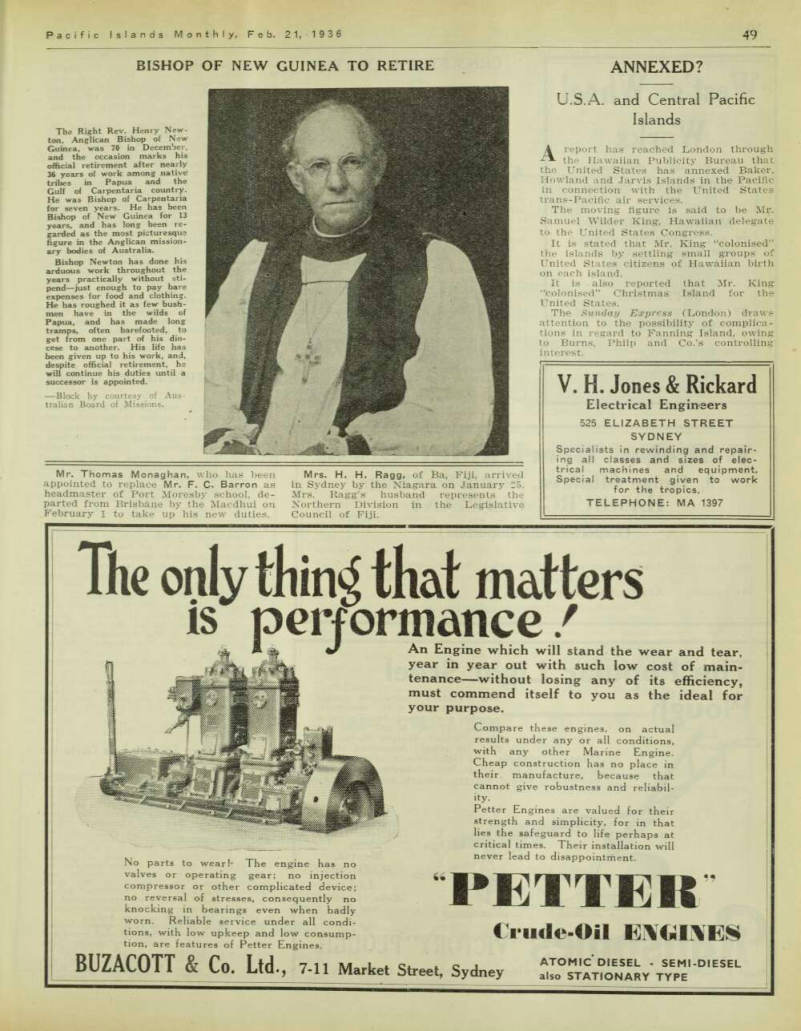
Mr. Thomas Monaghan, who has been appointed to replace Mr. F. C. Barron as headmaster of Port Moresby school, de parted from Brisbane by the Macdhui on February 1 to take up his new duties.
M rs. H. H. Ragg, of Ba, Fiji, arrived in Sydney by the Niagara on January 25.
Mrs. Ragg’s husband represents the Northern Division in the Legislative Council of Fiji.
The Right Rev. Henry New ton, Anglican Bishop of New Guinea, was 70 in December, and the occasion marks his official retirement after nearly 36 years of work among native tribes in Papua and the Gulf of Carpentaria country.
He was Bishop of Carpentaria for seven years. He has been Bishop of New Guinea for 13 years, and has long been re garded as the most picturesque figure in the Anglican mission ary bodies of Australia.
Bishop Newton has done his arduous work throughout the years practically without sti pend—just enough to pay bare expenses for food and clothing.
He has roughed it as few bush men have in the wilds of Papua, and has made long tramps, often barefooted, to get from one part of his dio cese to another. His life has been given up to his work, and, despite official retirement, he will continue his duties until a successor is appointed. —Block by courtesy of Aus tralian Board of Missions.
U.S.A. and Central Pacific
Annexed?
U.S.A. and Central Pacific Islands
4 report has reached London through the Hawaiian Publicity Bureau that the United States has annexed Baker, Howland and Jarvis Islands in the Pacific in connection with the United States trans-Paciflc air services.
The moving figure is said to be Mr.
Samuel Wilder King, Hawaiian delegate to the United States Congress.
It is stated that Mr. King “colonised” the islands by settling small groups of United States citizens of Hawaiian birth on each island.
It is also reported that Mr. King “colonised” Christmas Island for the United States.
The Sunday Express (London) draws attention to the possibility of complica tions in regard to Fanning Island, owing to Burns, Philp and Co.’s controlling interest.
Advertisements & other items, pp. 51-52 (1 item)
The only tiling that matters
V. H. Jones & Rickard
Electrical Engineers
525 ELIZABETH STREET
SYDNEY
Specialists in rewinding and repairing all classes and sizes of electrical machines and equipment.
Special treatment given to work for the tropics.
TELEPHONE: MA 1397
The only tiling that matters
is performance/
A An Engine which will st No parts to wear!* The engine has no valves or operating gear; no injection compressor or other complicated device; no reversal of stresses, consequently no knocking in bearings even when badly worn. Reliable service under all conditions, with low upkeep and low consumption, are features of Fetter Engines.
BUZACOTT k Co. Ltd 7-11 Market
stand the wear and tear, year in year out with such low cost of maintenance—without losing any of its efficiency, must commend itself to you as the ideal for your purpose.
Compare these engines, on actual results under any or all conditions, with any other Marine Engine.
Cheap construction has no place in their manufacture, because that cannot give robustness and reliability.
Fetter Engines are valued for their strength and simplicity, for in that lies the safeguard to life perhaps at critical times. Their installation will never lead to disappointment.
FETTER
Crude-Oil E\CJI\EN
c . . 0 1 ATOMIC* DIESEL - SEMI-DIESEL street, bydney a!so stationary type
West’s Wheel
Works
(F. H. Bishop, Proprietor)
60-64 Bay St., Sydney
MANUFACTURERS
OF ALL TYPES OF WHEELS
FOR WAGGONS, CARTS,
TRAILERS, CARS
SUPPLIERS
OF WHEEL PARTS, RIMS,
SPOKES, AXLES, BOXES, etc.
We have the plant and have been established forty years Write for Information and Quotations
Wilhelm Kreckwohlt & Co.
9, Lange Muehren, South Sea Bldgs.
HAMBURG, GERMANY
(Exporters and Importers) We Export: Trade Goods of any description, Cutlery, Hardware, Miners’
Requisites, etc., etc.
We Import: Any kind of Island Produce.
CORRESPONDENCE INVITED
The Popular Light Steel
Plough
The “Victory” combines maximum strength with minimum weight and draught. Turns a furrow up to 6-ins. deep by 10-ins. wide. Weight 85 lbs.
We also supply numerous other types of ploughs and implements meeting all requirements, as well as lawn mowers, aerodrome equipment, steam engines, boilers, etc.
I llustrated literature and ail information from:
Morris,
Hedstrom
Ltd.
Suva, Lautoka and Ba
ansomes “VICTORY” PLOUGH
Made by:-RANSOMES, SIMS & JEFFERIES, LTD., IPSWICH, ENGLAND
Sports
Cricketer's Death
Mars Pt. Moresby v. Wau Sports
From Our Own Correspondent
Pt. Moresby, Jan. 1.
A TRAGEDY ended the sporting pro gramme for the visitors from Wan, New Guinea, on Friday, December 27, when, just before midnight, as the Cric ket Ball \yas in full swing, news was received from the European Hospital of the death of one of the Wau cricketers, Mr. F. Turner.
Mr. Turner’s death was due to heat and exhaustion—December 27 being one of the hottest days known in Port Moresby for many years. He batted for his team in the morning and later in the day went into the field as wicketkeeper.
In the afternoon he was seized by severe cramps and was forced to retire. His condition became serious in the evening and he was taken to the European Hos pital, where he died shortly after admit tance.
“Webbie” Turner, as he was known in New Guinea, had been in the Territory for over five years. After spending some months at Bali plantation on Unea
Island, near the Witu Group, he joined the service of Burns, Philp and Co., Rabaul. Recently he left New Britain for the Morobe goldfield to take up duties as secretary to the Wau Club Limited.
He was 32 years of age.
On Saturdaj' afternoon, December 28, representatives of the Wau and local sporting bodies held a meeting and decided that, owing to the unfortunate occurrence, the match should be aban doned until a later date. On Sunday and the following Monday the visitors re turned to Wau by ’planes.
The contests to date had been fairly even. The Wau men won at tennis and snooker, while Port Moresby were vic torious at billiards and in the first innings at cricket. The local cricketers would certainly not have disposed of Wau as easily again, and a reversal of the scores in the second innings would have brought a very close match. Wau’s sporting offer to hand over the Dewar’s Cup on the strength of a first innings result was fully appreciated by the Port Moresby men. but was not an offer that they felt inclined or justified to accept.
Bounty Crops in New Guinea
THE following may be of general in terest. It is a list of the bounties which are paid by the Administration of New Guinea, to encourage the production of various tropical crops. It will be noted that the ten years’ period fixed for the payment of these generous bounties has now only eleven months to go.
COCOA. —Raw, whole or broken, per lb. for period of 10 years, dating from January 1, 1927.
COCOA.—Shells, raw. l*4d per lb., same period as above.
FIBRES. —(a) Manilla, £6 per ton from January 1, 1927, to January 1, 1937; (b) Sisal, £6 per ton, same period; (c) Coir, £3 per ton, same period.
SAGO.—Not packed for household uses, Id per lb., from January 1, 1927, to January 1, 1937.
VANILLA.—2/- per lb., from January 1, 1927, to January 1, 1937.
BAMBOOS. RATTANS.—Unmanufactured, £4 per ton, from January 1, 1927, to January 1, 1937.
UNGROUND SPECIES.—(a) Nutmeg, mace, pepper, cloves, ginger, lj4d per lb., from January 1, 1927, to January 1, 1937; (b) species not else where listed, y 2 d per lb., from January 1, 1927, to January 1, 1937.
KAPOK. —2d per lb., from January 1, 1927, to January 1, 1937.
COFFEE. —No bounty, but is admitted free of duty into Australia from the Territory. Coffee from other countries has an import duty of 4d per lb. into Australia, and an additional 10 per cent. Primage duty.
A College for Islands Girls
FOR a thorough education from Kindergarten to University, combined with the development of a true Christian character, so fitting their girls to face with courage and conviction the prob lems of the future, parents in the Pacific Islands cannot do better than send their daughters to “Fairholme” Presbyterian Girls’ College, at Too
woomba, Queensland.
The administration of the College is under the control of the Presbyterian Church of Queens land, whilst its curriculum is comprehensive and comprises courses in commercial training and domestic science, in addition to the usual academic subjects. Tuition at “Fairholme” College is given by a staff of University graduates and the college is approved by the Queensland Government as available to State Scholarship holders.
Recreation includes tennis (three courts), basket ball (two courts), swimming, organised games and rambling clubs. The grounds and playing fields are 12 acres in extent.
Further particulars regarding “Fairholme” will be supplied on application to the secretary, R. T.
Phelps, F.A.A., 491 Ruthven St., Toowoomba, Queensland. —***
Mendham Luck !
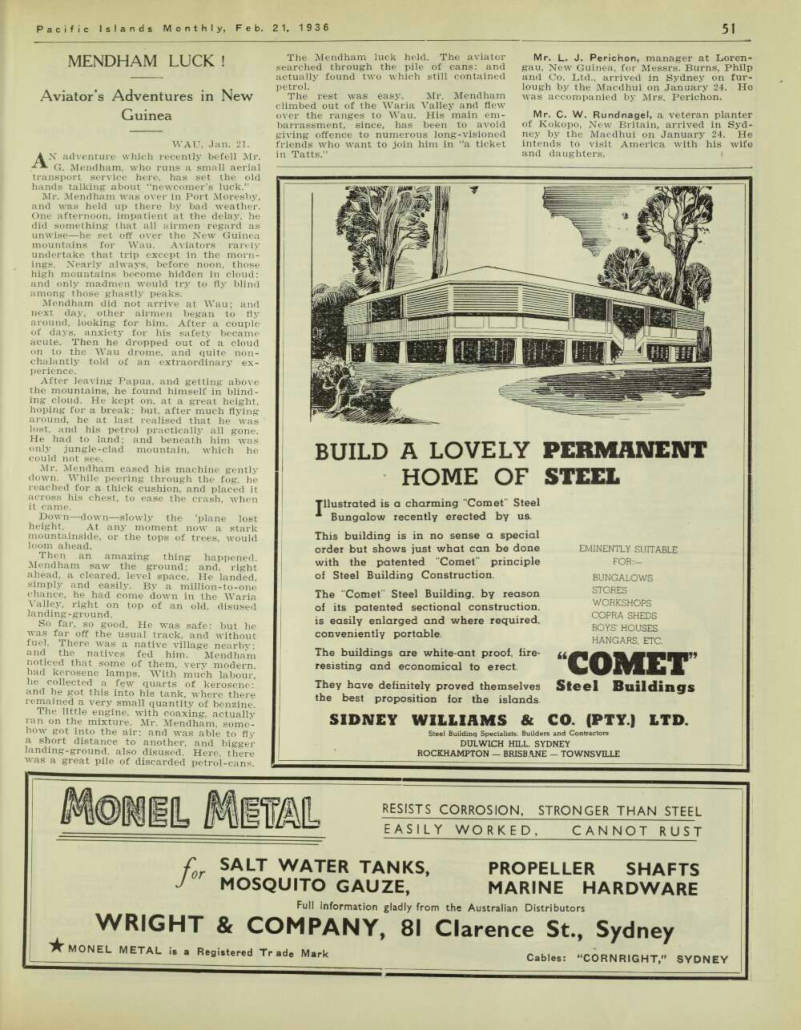
Aviator’s Adventures in New Guinea
Wait, Jan. 21.
A N adventure which recently befell Mr.
G. Mendham, who runs a small aerial transport service here, has set the old hands talking about “newcomer’s luck."
Mr. Mendham was over in Port Moresby, and was held up there by bad weather.
One afternoon, impatient at the delay, he did something that all airmen regard as unwise—he set off over the New Guinea mountains for Wau. Aviators rarely undertake that trip except in the morn ings. Nearly always, before noon, those high mountains become hidden in cloud: and only madmen would try to fly blind among those ghastly peaks.
Mendham did not arrive at Wau; and next day, other airmen began to fly around, looking for him. After a couple of days, anxiety for his safety became acute. Then he dropped out of a cloud on to the Wau drome, and quite non chalantly told of an extraordinary ex perience.
After leaving Papua, and getting above the mountains, he found himself in blind ing cloud. He kept on, at a great height, hoping for a break: but, after much flying around, he at last realised that he was lost, and his petrol practically all gone.
He had to land; and beneath him was only jungle-clad mountain, which he could not see.
Mr. Mendham eased his machine gently down. While peering through the fog, he reached for a thick cushion, and placed it across his chest, to ease the crash, when it came.
Down—down —slowly the ’plane lost height. At any moment now a stark mountainside, or the tops of trees, would loom ahead.
Then an amazing thing happened.
Mendham saw the ground; and, right ahead, a cleared, level space. He landed, simply and easily. By a million-to-one chance, he had come down in the Waria Valley, right on top of an old. disused
landing-ground.
So far, so good. He was safe: but he was far off the usual track, and without fuel. There was a native village nearby; and the natives fed him. Mendham noticed that some of them, very modern, had kerosene lamps. With much labour] he collected a few quarts of kerosene: and he got this into his tank, where there remained a very small quantity of benzine.
The little engine, with coaxing, actually ran on the mixture. Mr. Mendham, some how got into the air: and was able to fly a short distance to another, and bigger landing-ground, also disused. Here there was a great pile of discarded petrol-cans.
The Mendham luck held. The aviator searched through the pile of cans: and actually found two which still contained petrol.
The rest was easy. Mr. Mendham climbed out of the Waria Valley and flew over the ranges to Wau. His main em barrassment, since, has been to avoid giving offence to numerous long-visioned friends who want to join him in “a ticket in Tatts.”
Mr. L. J. Perichon, manager at Loren gau, New Guinea, for Messrs. Burns, Philp and Co. Ltd., arrived in Sydney on fur lough by the Macdhui on January 24. Ho was accompanied by Mrs. Perichon.
Mr. C. W. Rundnagel, a veteran planter of Kokopo, New Britain, arrived in Syd ney by the Macdhui on January 24. He intends to visit America with his wife and daughters. (
Advertisements & other items, pp. 53-54 (1 item)
“Comet
ill T 1 m
BUILD A LOVELY PERMANENT
HOME OF STEEL
Tllustrated is a charming “Comet” Steel Bungalow recently erected by us.
This building is in no sense a special order but shows just what can be done with the patented "Comet" principle of Steel Building Construction.
The “Comet Steel Building, by reason of its patented sectional construction, is easily enlarged and where required, conveniently portable.
The buildings are white-ant proof, fireresisting and economical to erect.
They have definitely proved themselves the best proposition for the islands
SIDNEY WILLIAMS & CO. (PTY.J LTD.
Steel Building Specialists. Builders and Contractors
DULWICH HILL, SYDNEY
ROCKHAMPTON BRISBANE - TOWNSVILLE
EMINENTLY SUITABLE
FOR:-
BUNGALOWS
STORES
WORKSHOPS
COPRA SHEDS
BOYS' HOUSES
HANGARS, ETC.
“COMET
Steel Buildings
RESISTS CORROSION, STRONGER THAN STEEL
EASILY WORKED, CANNOT RUST
f or SALT WATER TANKS, PROPELLER SHAFTS
J MOSQUITO GAUZE, MARINE HARDWARE
Full information gladly from the Australian Distributors WRIGHT & COMPANY, 81 Clarence St., Sydney ★ monel METAL I. . Registered Trad. Mark Cab|es! “CORN RIGHT,” SYDNEY B
To Pacific Islands
Traders
SAVE MONEY AND BUY YOUR
GOODS DIRECT FROM
MANCHESTER—
Write to us for Quotations, Details, etc.
WE ARE MANUFACTURERS OF
GREY, WHITE AND COLOURED
TEXTILES
Rami materials of every description.
Para Reds.
White and Blue Drills.
Grey and White Calicos.
Super Drill.
Ecru Tussore.
Dyed Poplin*.
Woven-striped Poplins.
Table Cloths.
Serviettes.
Sheets.
Pillow Cases.
Quilts.
Bedspreads.
Art Silk Piece Goods.
Bath Wraps.
Glass Cloths.
Sweat Rags.
Bias Binding.
Braids, Printed Calicos, Poplins, Woven Coloured Ginghams, etc.
Extract from a letter sent to us by an Islands storekeeper who recently retired: Milne Bay, Papua. 1.10.34. . .a success due—in a great measure —to the excellent service rendered for so many years by your firm. Yours faithfully,
“H. DEXTER.'
A. WEBB & COMPANY
(Manchester) LTD.
86 GEORGE ST., MANCHESTER
Contractors to H.M. and Foreign Governments.
Bentley’s Code, and ABC Code 4th and Sth Editions.
Telegraphic Address: “WASTOCK,” Manchester.
BUILD WITH
Fibrolite
ASBESTOS CEMENT SHEETS
By using this Economical, Fire Retardant and White Ant Proof building material for External and Internal Walls and Ceilings, you can build a comfortable and durable Bungalow Home —AT LOW COST ! Supplied in big. sturdy building sheets in 44 handy stock sizes, "FIBROLITE" is easily and quickly erected. No waste. Less labour. No painting.
For full in tor mat ion, write for illustrated “Fibrolite” Booklet F.6—FREE AND POST FREE!
JAMES HARDIE & COV. LTD.
ASBESTOS HOUSE, YORK ST., SYDNEY, N.S.W.
(Box 3935 V. f G.P.0., Sydney)
Salamaua 'Drome
Plea for Concrete Strip
rPHE aerodrome at Salamaua, New Guinea, although it has been subject in recent months to much “improvement,” is still in a deplorable condition. It is on low-lying, swampy land and whenever there is heavy rain—which is frequently —the surface becomes loose and sticky.
Public works men have been busy with a tractor, levelling and rolling the aero drome; but experts consider that this labour is practically wasted. They say that the only thing which will make this ’drome satisfactory is a concrete strip.
The cost of laying down a concrete pave ment, over the length of the field and up to 75 yards wide, would be £2,000 or £3,000; but critics contend that actually this money would be well spent because it would ensure the safety of aeroplanes and passengers and would remove a serious and constant anxiety.
The Salamaua ’drome ranks with Wau and Lae as the busiest in New Guinea, and it is strongly suggested that if —as seems certain —the future transport of the New Guinea gold industry is to de pend upon aeroplanes, it is the duty of the Administration to make the Salamaua aerodrome safe and trafficable.
Mr. and Mrs. R. S. Fell, of Wau, New Guinea, arrived in Sydney with their baby son, Allan, by the Macdhui on January 24 on six months’ holiday. Mr.
Fell is a member of the staff of New Guinea Goldfields Ltd.
Mr. John Sinclair Dods, one of the oldest settlers in Savu Savu Bay, Fiji, died at Suva on January 10 at the age of 91. A Scotsman, he lived for a time in Australia and New Zealand before reaching Savu Savu in 1867 to take up planting at Valaya and Nayavu estates.
Ancient Stones in
the Trobriands Signs of a Culture That is Gone
From Our Own Correspondent
Port Moresby, Jan. 3.
STONES of unusual formation and de sign were discovered last year at Kwaibwaga, North Kiriwina, Trobriand Islands, by Rev. H. Williams, Methodist missionary; and on the report of their discovery, Mr. Leo. Austen, the Resident Magistrate of the Division, proceeded to the spot to make investigations.
It is understood that, as a result, Mr.
Austen considers these stones to be of nummulitic limestone and that their for mation and design, together with their orderly arrangement, suggest that at some period, unknown to the present natives, they were used as houses, or stone enclo sures.
Mr. F. E. Williams, the Government Anthropologist, will leave shortly for the Trobriands and on getting into touch with Rev. Williams and Mr. Leo Austen, will proceed to make further inquiry.
It is understood that the Administration intends to make a thorough investigation of the discovery before reporting officially on the matter.
Nummulitic limestone comes from the Mediterranean basin, and the Pyramids of Egypt are said to have been built al most entirely of it.
Some Further Details
WE remembered that Mr. A. J. Vegan, whose hobby is archaeological re search, was in the Trobriands about three years ago, and that he had reported the presence there of some mysterious stones.
Accordingly, we asked Mr. Vogan if he knew anything of nummulitic limestone in the Trobriands, and, without having seen the above report, this is what he wrote: After my archaeological examinations of the Trobriands in 1932, when H. E., Sir J. H. P. Murray, ran me up in his boat, I told Mr. Williams, the Papuan Government Anthropologist, about my finds, certain pictures of which have been published. That enterprising scientist, whose wonderful discoveries on the Fly and elsewhere have given him world re cognition, visited Kiriwina Island, the biggest of the group, in August, 1933.
Between Kwaibwaga and M’tawa there are two groups of more or less upright slabs of stones, which I consider to be of silicious-coral from the sea-bottom — which was laid down under fierce hydro thermal conditions. The former group is called Davalaosi; and was the supposed village of the weird “Petrified People,” of whom more, perhaps, some day. The latter group is called Ilukawaiwaia, after
the big stone that it contains. There is, according to the natives, another group of similar character close by.
Our coloured co-subjects of the King are of opinion that these great slabs, which are from four to fourteen feet in length, once formed the sides of build ings. But, as w r e know the stones were placed there about two thousand years ago, even the “oldest inhabitant” is no real authority! No ciselures have been observed upon the stones; and the holes that appear are characteristic of the local sea-bottom, especially as some contain shells, and the decay of less durable ob jects w r ould account for them.
Now. just as Disraeli’s remark that “every involuntary action is characteristic of the individual,” is very true, so, such evidence as these stones tells us something of their long-dead au thors. They show, at once, to experts, their Asian origin. From Tabriz (or Taurus) on the Caspian shores of Persia (where, presumably, the earliest Civilization started) down southwards, we get stone-erections of the same nature as that much publicised Stonehenge of Salisbury Plain (10,000 feet in circum ference) but varying greatly in size. They were erected, apparently, as a means of ascertaining, from month to month, the sun’s advance among the stars; and the approach of the equinoxes—those two points when the then “Sacred Orb of Fire” crosses the plane of the earth’s equator—when the days and nights are equal. This was the first great problem of the early astronomers who, like many professional folk of our day, add a bit of mumbo-jumbo to what science they per mit the commonalty to become aware of, for selfish and commercial reasons.
The upright stones cast shadows, like the gnomon of the common sun-dial, and these, of course, vary, indicating the sea
sons of planting and harvest, etc. They would warn the Islanders, also, regarding the probable approach of the N.W. and dangerous S.E. trade winds. I have found similar affairs on the northern coast of Papua, and elsewhere in the Pacific.
That these miniature Stonehenges were erected by the same folk as the “Petrified People’’ who made the wonderful burial pots (of which Mr. A. C. Lumley, of Kiri wina, has the finest specimen I have seen) seems to provide further evidence that my Yasawa and Duk-ni-ba (Fiji) inscriptions were made by Indus-basin immigrants many hundreds of years ago; for the said pottery seems to resemble closely that found in the buried cities of Harappa and Mohenjo-daro of the Indus mouth, which Dr. Ernest Mackay has written his book about—“ The Indus Civilisation.” Persia, the home of “Druidical” stones, early Civi lisation, and the first astronomy, is close at hand; and we know that a sea-borne traffic between the Indus-folk and those of Mesopotamia, and the Bay of Bengal, took place at least three thousand years ago.
Mr. A. Gibson, of the Papuan Govern ment Printing Office, returned to Port Moresby after furlough in Australia by the Macdhui in January. Mr. Gibson is an expert photographer and his studies of Papuan life and scenes, have won much praise.
Mr. Eric Feldt, who probably was the most popular District Officer ever on the Morobe goldfield, has been appointed Warden of the goldfield and already has entered upon his duties. The appointment gave pleasure to all classes. The position had been vacant since Mr. Harold Taylour resigned from the service to take charge of Enterprise of New Guinea, N.L.
Advertisements & other items, p. 54 (1 item)
Reliable Cars and Trucks
New Britain Express
Delivery
GENERAL OVERSEAS AGENTS
GENERAL CARRIERS, BAGGAGE
AND FORWARDING AGENTS.
ROYAL MAIL CONTRACTORS.
Reliable Cars and Trucks
We aim to give quick and reliable Service at reasonable costs. P.O. Box 116. ’Phone 141.
W. WALKER-FLYNN, Proprietor, Malaguna Road, Rabaul, T.N.G.
Bathing Fatality at Rarotonga
From Our Own Correspondent
Rarotonga, Jan. 26.
ON January 6, Charles Owen Hodgins, dentist, sank suddenly whilst swim ming off the wharf at Avarua.
Being in the lunch hour, few people were about at the time, and the alarm was Jirst given by some children who ob served that the man did not reappear.
Attracting the attention of a couple of native fishermen, the children pointed out Mr. Hodgins’ body, close to the wooden piles of the wharf, where the water is ten or twelve feet deep. Later, a rope was passed under the unfortunate man and the body drawn to the surface, where all attempts at artificial respiration proved useless.
Mr. Hodgins, who was 47 years of age, had been in Rarotonga a little over two years, and his death robs the island of one of its most needed men. An ex-sol dier, he served during the War as Staff Sergeant in the Dental Corps, A.E.F.
M. Paul Vois, who returned with his wife and daughter in January from a visit to France, sailed for Noumea early in February. Madame Vois and her daughter have gone on to Victoria for a few weeks before continuing their jour ney to New Caledonia.
Mr. W. R. B. Thomas, popular wireless operator for Amalgamated Wireless (A/sia) Ltd, at Rabaul, returned to New Britain after furlough by the Macdhui on January 30.
Advertisements & other items, pp. 55-56 (1 item)
Deutz Diesel Engines
ISLAND SHIPPING
Freight, Forwarding and Customs Service. Import and Export.
B. R. Wheeler 17-19 Bridge St., SYDNEY Correspondence Invited. Tel.: B 5396
DEUTZ DIESEL ENGINES
DEUTZ ENGINES USED INTERNATIONALLY SINCE 1864
MARINE “OM.” TYPE INDUSTRIAL TYPE “VM”
Ci v * v> US 111 wwm Range from 10 to 140 B.H.P.
Range from 10 to 2000 B.H.P.
Full information obtainable from the Agents
HERBERT DEL COTT PTY. LTD.
116 Queen Street, Melbourne 'Phone: Central IC4SB.
Cables “Voltage” 15 Castlereagh Street, Sydney ’Phone: B 3135.
W. M. FORD
Ship, Yacht & Boat Builder
Berry’s Bay, North Sydney
(Established 1870) BUILDERS of all kinds of Island Craft from Dinghies to Auxiliary Schooners of any tonnage. New and Second-hand Island Craft of various types in stock. New and Secondhand Full Diesel, Crude Oil, Benzine and Kerosene Engines.
Please Send on Your Enquiries
WUNDERLICH
DLR ABE STDS
ASBESTOS - CEMENT BUILDING SHEETS
With rigid walls of Durabestos any building will stand four-square to the assaults of weather, time, rodents, and wh#e ants.
Call or write for FREE booklet "Durabestos Homes of Colourful Beauty" describing many uses for Durabestos. WUNDERLICH LTD., Crown and Cleveland Sts., Redfern. SYDNEY.
conditions
/ There's no better paint than Wilkinsons Pure Metallic White W ill not peel or crack \i Produces 33% more Paint than White Lead
WILKINSONS
PURE METALLIC WHITE
Agents: W. R. Carpenter & Co. Ltd.
Henry Nott, Of Tahiti
Letter to the Editor.
THE article on the Tahitian Bible by your Papeete correspondent in the January issue of the Pacific Islands Monthly was extremely valuable and most Interesting. In the years to come I can see students of Pacific affairs searching the files of your journal for information concerning our own and earlier periods. But there are one or two little inaccuracies which, I am sure the writer will pardon me, in the interests of historic research, for pointing out.
First, Nott’s Christian name was Henry— not John. Secondly, he was not buried in the Royal enclosure at Arue.
True, he lies very close to it—hardly a stone’s throw away—but members of the
Pomare family are enclosed within a wall.
Nott’s grave is in the immediate vicinity on the seashore, and McKean, another missionary, is buried beside him. There is also a tradition to the effect that Nott’s Chinese servant is buried near the mis sionaries, but I have not been able to verify that fact. Thirdly, the writer makes reference to Nott’s “one and only visit to his native England” in 1826. It is apparent that Nott also visited Eng land much later. In The Colonist, an early Sydney newspaper, there is a reference to his departure for the South Sea Islands on August 14, 1840, on the mission vessel Camden, accompanied by Mrs.
Nott, and several other missionaries and their families. Henry Nott had arrived in Sydney some months before with a large quantity of recently published mis sionary literature, including, of course, his famous Bible. I came across other references in the Mitchell Library (though he was certainly referred to as “Knott”), which clearly establish the fact that he was in England, superintending the pub lication of his work, in 1839.
Henry Nott was a great figure in Pacific history. Though his antecedents were humble, and his educational ad vantages few, he was a man of genuine ability. It is indeed gratifying to know that his name is honoured to-day in Tahiti —the land that he loved so dearly and for whose people he gave most useful and able service.
I am etc.,
Eric Ramsden.
Darling Point, Sydney.
January 31, 1936.
Forty Dredging Claims
Lakekamu Goldfield In
Papua
Forty Dredging Claims Abandoned
From Our Own Correspondent
Pt. Moresby, Jan. 6.
INTEREST in the Lakekamu goldfield, in the Gulf Division of Papua, which has attracted so much attention since 1930, has somewhat abated.
Guinea Gold N.L., upon which Papua set so much hope, have abandoned all their claims on the field excepting three, and Lakekamu (Papua) Development N.L. have relinquished their option over the Tiveri Gold Dredging Co. Ltd. claims. In all, 40 dredging claims amounting to well over 20,000 acres have been abandoned, including those held by P. D. Ratcliffe, A. E. Bethune, C. F. Duchatel and V. P.
Hides. , . However, the Tiveri Gold Dredging Co.
Ltd. is apparently still holding its own, and retains its 10 original claims. Several miners are also profitably employed upon a few gold mining leases, so that the field is by no means dead.
It is stated that, although .good values were originally proved in some of the abandoned claims, the option holders and promoters decided, after careful con sideration of their engineers’ reports, that the yardage, though sufficient for a small dredge, was too small to carry the type of dredge contemplated and to justify the capital expenditure thus entailed.
In September, 1930, gold was reported on a tributary of the Tauri River, near Mt. Lawson, and the reports of the find that followed, though conflicting in character, offered enough inducement for others to follow. In October, 1930, the Papuan Government declared the field open. The new field was in the district of the old Lakekamu goldfield of 1909-10.
“No Fortifications”
American’s Investigations In Japanese Islands
■** 4 FTER four months’ investigation I left the Japanese mandated islands with the clear conclusion that there is no ground for suspicion regarding fortifica tions, but every reason for grave concern regarding the significance of the islands in the future of Asia,” writes an American journalist, Mr. Willard Price, in an article in the London Spectator, which was re published on February 1 in the Sydney Sun.
The islands, he says, are an amazing labyrinth, comprising the Marianne, Caroline,- and Marshall groups, numbering 1400, irrespective of the smaller islets and reefs. The entire system is 2700 miles wide and 1300 deep, and so situated that Japanese aeroplanes could reach Australia in six hours, Hongkong and Singapore in 10 hours, the Dutch East Indies in three hours, and the Philippines in two hours.
Some islands, he says, are useless, but others would be perfect hiding places for warships, submarines, and aircraft. Mr.
Price describes Palau Harbour as valu able as a potential naval base, with a deep basin which could accommodate at least 50 large warships. Occasional Japanese warships anchor there, but merchantmen are not allowed in.
“Its existence is not generally known,” he writes, “but I presume it is not secret, as officials took me there through the five-mile channel connecting the harbour with the sea.
“I saw no refuelling bases or fortifica tions, though, if necessary, these would probably come into existence with sur prising alacrity.”
Palau is the westernmost and southern most of the important islands, but lesser islands continue almost to New Guinea, while at the equator the Australian and Japanese mandates meet, Australia itself is only a few days’ sail.
This key position makes the islands an invaluable protection to Japan as she works out her destiny upon the Asiatic mainland.
Mr. Price refers to the fears of the League Mandates Commission that a naval base is being constructed in Saipan Harbour, and says that Saipan is so ex posed that it is important only as a harbour and completely useless as a naval base.
From Papuan Native Taxation
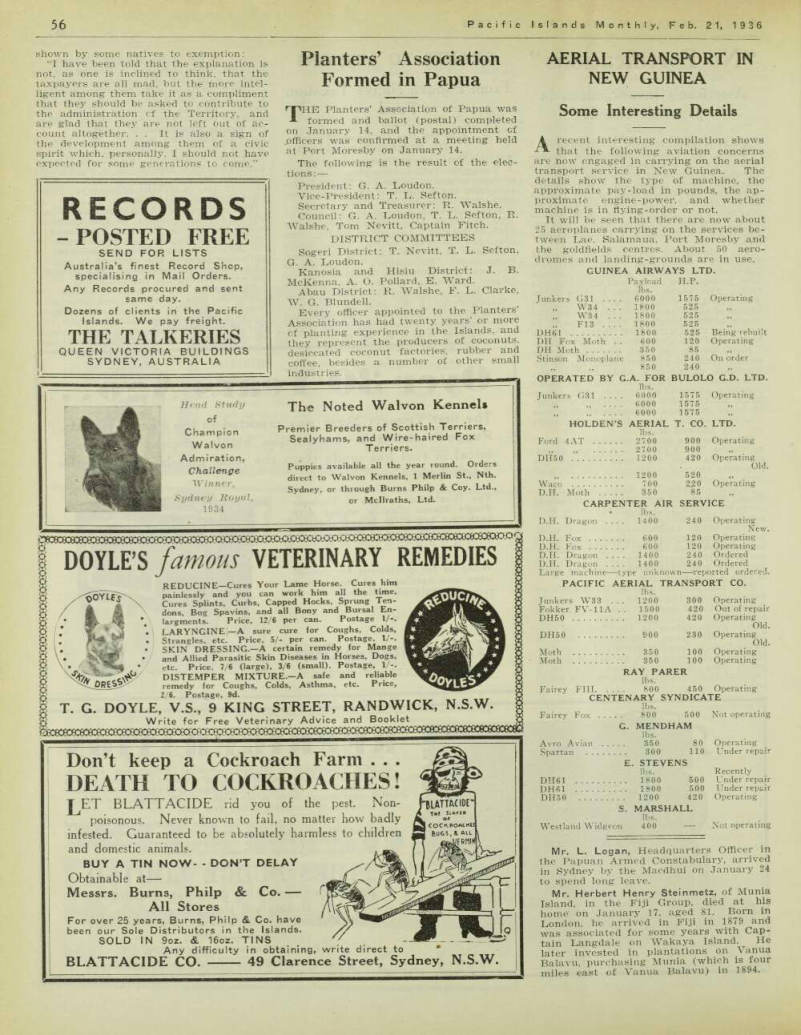
Grants To Missions
From Papuan Native Taxation Fund
From Our Own Correspondent PT. MORESBY, January 15. 1N the Government Gazette published in A December. 1935, are complete statements of revenue and collections of Native Taxa tion from the inception of the tax in June, 1919, until June 30, last year.
Total net revenue of the tax amounts to £222,781, while total expenditure reveals £205,566, leaving a balance of £17,215. The cost of collection during these years amounted to £36,430 —the cost for 1934-5 being £2,337. Expenditure is divided into two headings—Education and Benefits—the former absorbing £86,354 and Benefits £119,212.
Expenditure on school grants and ex penses of native plantations, including in structional staff, come under the heading of Education, as also do the expenses in
curred by the paper Papuan Villager, a monthly paper published in English for the general education of Papuans.
The main items under Benefits are grants to Missions and Anthropology. The total amount paid to missions is £86,922. The mission bodies have received the follow ing grants since June 30, 1919; London Missionary Society £30,719 Kwato Industrial Mission 15,758 Methodist Mission 14,956 Roman Catholic Mission 14,451 Anglican Mission 9,303 Seventh Day Adventist Mission . . 1,643 Unevangelised Field Mission 92 The proceeds of the Native Tax is paid into a special account of the Treasury, called the Native Taxation Fund, and is held in trust for the natives of Papua by the Administration. This tax is levied on all males between the years of 16 and 36, with certain exceptions and the proceeds are expended on the Papuan alone.
The native tax is popular among the natives of the Territory, and exemption from it is resented. In the Annual Report for 1919-20 the Lieutenant-Governor (Sir Hubert Murray) wrote as follows in refer ence to native taxation and the resentment
shown by some natives to exemption: “I have been told that the explanation is not, as one is inclined to think, that the taxpayers are all mad, but the more intel ligent among them take it as a compliment that they should be asked to contribute to the administration cf the Territory, and are glad that they are not left out of ac count altogether. . . It is also a sign of the development among them of a civic spirit which, personally. I should not have expected for some generations to come.”
Advertisements & other items, pp. 57-58 (1 item)
Over 30 Year* Ago..
The first Younger Stove was exported to the Pacific Islands.
Ruggedly strong in construction, highly efficient and economical in fuel has made them the most popular stove in the
South Seas.
The illustration shows a Younger Single Stove. Special stoves with cast iron ovens for Island requirements made to order.
Write us for quotations for special sizes and catalogue of double and single oven stoves.
G. Fletcher & Son
50 OXFORD STREET, SYDNEY
UEFIK ITERATION
“BUDGE” Automatic or Manually-controlled Refrigeration and Icemaking Plants, with or without insulated Cabinets or Rooms, ranging from 4 cubic feet to 1000 cubic feet or larger, using ammonia in the large and sulphur dioxide (SO2) in the small units illustrated—such illustration being on an electrically driven SO2 Unit.
Where electric power is not available, crude oil engines may be utilised for driving the large plants and petrol or kerosene engines for driving the smaller machines. Enquirers please state power available (if any), size of cabinet, and amount of ice required per day.
JAMES BUDGE LIMITED
REFRIGERATION AND GENERAL ENGINEERS
McEvoy and Harley Streets
ALEXANDRIA -- -- -- SYDNEY
Established 1890
ENGINEERING WORKSHOPS
All Classes of Machines Made and Reconditioned
RECORDS
-POSTED FREE
SEND FOR LISTS
Australia’s finest Record Shop, specialising in Mail Orders.
Any Records procured and sent same day.
Dozens of clients in the Pacific Islands. We pay freight.
THE TALKERIES
QUEEN VICTORIA BUILDINGS
SYDNEY, AUSTRALIA
Head Study of Champion Walvon Admiration, Challenge Winner, Sydney Royal, 1934
The Noted Walvon KenneU
Premier Breeders of Scottish Terriers, Sealyhams, and Wire-haired Fox Terriers.
Puppies available all the year round. Orders direct to Walvon Kennels, 1 Merlin St., Nth.
Sydney, or through Burns Philp & Coy. Ltd., or Mcllraths, Ltd.
DOYLE’S famous VETERINARY REMEDIES
REDUCINE—Cures Your Lame Horse. Cures him painlessly and you can work him all the time.
Cures Splints, Curbs, Capped Hocks, Sprung Tendons, Bog Spavins, and all Bony and Bursal Enlargments. Price, 12/6 per can. Postage 1/-.
LARYNGINEi—A sure cure for Coughs, Colds, Strangles, etc. Price, 5/- per can. Postage. 1/-.
SKIN DRESSING.—A certain remedy for Mange and Allied Parasitic Skin Diseases in Horses, Dogs, etc. Price. 7/6 (large), 3/6 (small). Postage, 1/-.
DISTEMPER MIXTURE.—A safe and reliable remedy for Coughs, Colds, Asthma, etc. Price, 2/6. Postage, 9d.
T. G. DOYLE, V.S., 9 KING STREET, RANDWICK, Write for Free Veterinary Advice and Booklet
OOYLf*
ores*'
N.S.W.
Don’t keep a Cockroach Farm . . .
DEATH TO COCKROACHES!
BLATTACIDE rid you of the pest. Nonpoisonous. Never known to fail, no matter how badly infested. Guaranteed to be absolutely harmless to children and domestic animals.
BUY A TIN NOW- - DON’T DELAY Obtainable at — Messrs. Burns, Philp & Co. r All Stores For over 25 years, Burns, Philp & Co. have been our Sole Distributors in the Islands.
SOLD IN 9oz. & 16oz. TINS
Any difficulty in obtaining, write direct to * BLATTACIDE CO. 49 Clarence Street, Sydney, N.S.W.
LATIMIor
TMt Siattß
COCK.POACHIS
Bucs
FRMIH
Planters’ Association
Formed in Papua
THE Planters’ Association of Papua was formed and ballot (postal) completed on January 14, and the appointment of jofflcers was confirmed at a meeting held at Port Moresby on January 14.
The following is the result of the elec tions: — President; G. A. Loudon.
Vice-President: T. L. Sefton.
Secretary and Treasurer: R. Walshe.
Council: G. A. Loudon. T. L. Sefton, R.
Walshe, Tom Nevitt, Captain Fitch.
District Committees
Sogeri District: T. Nevitt, T. L. Sefton, G. A. Loudon.
Kanosia and Hisiu District: J. B.
McKenna, A. O. Pollard, E. Ward.
Abau District: R. Walshe, F. L. Clarke, W. G. Blundell.
Every officer appointed to the Planters’
Association has had twenty years’ or more of planting experience in the Islands, and they represent the producers of coconuts, desiccated coconut factories; rubber and coffee, besides a number of other small industries.
Aerial Transport In
New Guinea
Some Interesting Details
4 recent interesting compilation shows that the following aviation concerns are now engaged in carrying on the aerial transport service in New Guinea. The details show the type of machine, the approximate pay-load in pounds, the ap proximate engine-power, and whether machine is in flying-order or not.
It will be seen that there are now about 25 aeroplanes carrying on the services be tween Lae. Salamaua, Port Moresby and the goldfields centres. About 50 aero dromes and landing-grounds are in use.
Mr. L. Logan, Headquarters Officer in the Papuan Armed Constabulary, arrived in Sydney by the Macdhui on January 24 to spend long leave.
Mr. Herbert Henry Steinmetz, of Munia Island, in the Fiji Group, died at his home on January 17, aged 81. Born in London, he arrived in Fiji in 1879 and was associated for some years with Cap tain Langdale on Wakaya Island. He later invested in plantations on Vanua Balavu, purchasing Munia (which is four miles east of Vanua Balavu) in 1894.
Guinea
Airways Ltd.
Payload H.P. lbs.
Junkers G31 . . 6000 1575 Operating W34 . 1800 525 ,, W34 . 1800 525 ,, FI 3 .. 1800 525 ,, DH61 1800 525 Being rebuilt DH Fox Moth 600 120 Operating DH Moth 350 85 On order Stinson Monoplane 850 240 • > ,, 850 240 „
Operated By
G.A. For
Bulolo G.D. Ltd.
lbs.
Junkers G31 . . . 6000 1575 Operating 6000 1575 ,, >9 . 6000 1575 ,,
Holden’S
Aerial
T. Co.
Ltd.
lbs.
Ford 4AT ... 2700 900 Operating 2700 900 „ DH50 1200 420 Operating .
Old. 1200 520 Waco 700 Z20 Operating D.H. Moth . . . 350 85 ,,
Carpenter Air Service
• lbs.
D.H. Dragon . . 1400 240 Operating New.
D.H. Fox 600 120 Operating D.H. Fox 600 120 Operating D.H. Dragon . . 1400 240 Ordered D.H. Dragon . . 1400 240 Ordered Large machine— -type unknown —reported ordered.
Pacific Aerial Transport Co.
lbs.
Junkers W33 .
1200 300 Operating Fokker FV-11A 1500 420 Out of repair DH50 1200 420 Operating Old.
DH50 900 230
Operating
Old.
Moth 350 100 Operating Moth 350 100 Operating
Ray Parer
lbs.
Fairey Fill. . . 800 450
Operating
Centenary Syndicate
lbs.
Fairey Fox . . . . 800 500 Not operating G
. Mendham
lbs.
Avro Avian . . . 350 80 Operating Spartan 300 110 Under repair
E. Stevens
lbs.
Recently DH61 1800 500 LTnder repair DH61 1800 500 Under repair DH50 1200 420 Operating S.
Marshall
. lbs.
Westland Widgeon 400 —
Not operating
Samoan News
From Our Own Correspondent
Apia, Jan. 12.
CHRISTMAS holidays are over, and, though the weather was not too bright, residents made the most of them. Taken all round, it was a much better and more enjoyable Christmas for everybody in Samoa, than was spent the previous year. , .
Thanks to the better price for copra, cocoa, and bananas and larger crops, people had considerably more money to spend and the business community consequently had very satisfactory sales to report.
A “Christmas box” for 80-odd unemployed. Euro peans of Apia, which consisted of some essential provisions for the festive season, was issued by the Administration on the authority of the new Gov ernment of New Zealand, and also served to create “goodwill amongst men” in our little community.
Giant Fish Stranded In Tokelaus
According to a wireless message received from the Tokelau Islands (a group under the Samoan Administration, situated about 300 miles north of the Samoan Group), a very large fish, probably a whale, was found stranded near Fakaofo, the capital of the Tokelaus. The animal measured 66 feet in length and is 10 feet high. It is stated that this is the largest fish ever seen in the group.
Trans-Pacific Air Service
It was interesting to note that the agreement regarding the future air services between America and New Zealand, which has been signed by the contracting parties, contains a provision for calls to be made at Apia, if necessary, on receipt of three days’ notice from the Crown, for the purpose of embarking or disembarking passengers, or de livering mails. The air-service, which uses the neighbouring port of Pago Pago (American Samoa) as an intermediate airport, will prove of consider able importance to Western Samoa. It is hoped, that with improved transport facilities and Apia joined on to the trans-Pacific air service, the much neglected tourist traffic in Western Samoa, which offers splendid possibilities, will be boosted and advertised,
Copra Shipment Damaged
Reports have been received that the cargo of copra on the Union Co.’s Cape York was recently damaged by fire. A number of Samoan planters and merchants had shipped copra on the vessel.
The cargo, however, was covered fully by insur ance.
Young Clerks Sentenced For Frauds
At Apia High Court recently, two young clerks, Steve Brown, Junr., and a Samoan, Ofati, em ployees of Morris, Hedstrom, Ltd., were each sentenced to nine months’ imprisonment for fraudulent thefts. Over a period of 10 months they had manipulated sales entries and stolen £B5 between them. In his statement to the police, Ofati declared that he was shown how to falsify the books by a former white employee of the firm.
Samoan Imprisoned For Theft
Two young Samoans, Niko Asiata and Serna, appeared before the Court on January 8, on a charge of theft. The two accused, who pleaded not guilty, were accused of having stolen £2O in N.Z. bank notes from a suit case, belonging to a New Zealand tourist, Mr. Hudson, lodging at Mrs. Hoppe’s boarding-house. Serna was em ployed at the boarding-house as a house-boy.
A large number of witnesses testified to having seen the notes in the possession of Asiata. Most of the stolen money was changed and spent in the Chinese stalls at the native market, on taxi rides, and on a drinking bout with several other Samoan boys, who apparently had consumed large quantities of Fa’amafu (Samoan “home brew”) in a native “speak-easy”.
From the evidence it appeared that Sema had none of the stolen money in his possession, nor took an important part in the spending of it. but that Asiata had changed and spent the total amount, though he insisted, that he had received the £2O from his friend, Sema, for safe keeping in the first instance. The father of Niko Asiata, High Chief and former Government interpreter for 23 years, addressed the Court on behalf of his son, and eloquently pleaded that there was in sufficient evidence.
Commissioner Kay discharged Sema and found Asiata, who had a criminal record, guilty of theft.
He was sentenced to 12 months’ imprisonment.
Mr. H. W. Champion, Government Sec retary of Papua, left Sydney for Port Moresby, after long leave, by the Macdhui on January 30.
Rock Drill Tests
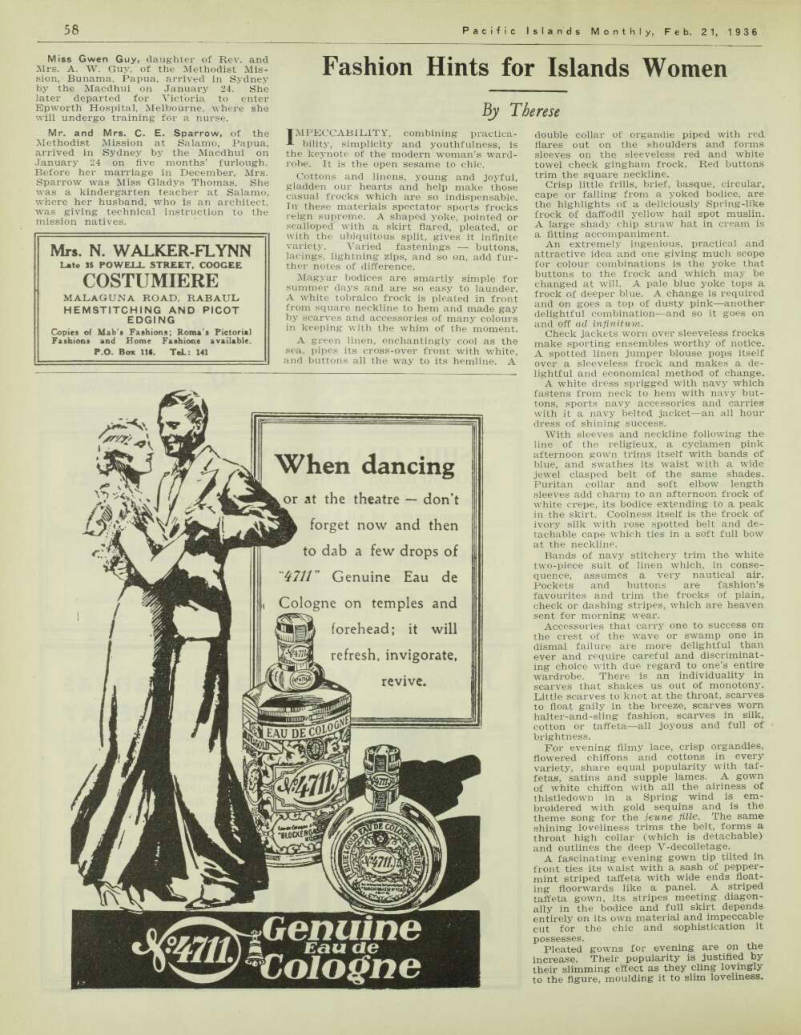
AN interesting demonstration of drill operation was undertaken last year over a period of five months by the El Potosi Mining Co. at Chihuahua, Mexico. The co. invited leading drill manufacturers to enter suitable drills for demonstration under actual working conditions, as a result of which Messrs. Gardner-Denver Co. were advised that their machines had proven best suited to the needs and requirements of the co. in all classes of mining work.
Careful records were maintained throughout the period by the El Potosi engineers on drilling speeds, air consumption, and wear of parts, and the figures obtained by the Gardner-Denver machines were such, that the co. placed orders for 100 model S-55, 20 model H-81, and 15 model D-79 drills complete with suitable spares.
For many years Gardner-Denver drills, stopers, pavement breakers, drill sharpeners, and portable air compressors have been in constant demand throughout Australia and the Islands, and :n all ways have proven their reliability, suitability, and ability to stand hard wear.
Messrs. Noyes Bros., of Sydney and Melbourne, are sole agents for these lines manufactured by Gardner-Denver Co., and will be glad to supply all details and technical information.*** Mr. and Mrs. C. Day, of Otomata plan tation in the Abau District, Eastern Papua, arrived in Sydney from Port Moresby by the Macdhui on January 24.
While Mr. Day is on leave, Mr. W. E.
Bellingham will act as manager at Oto mata.
Miss Gwen Guy, daughter of Rev. and Mrs. A. W. Guy, of the Methodist Mis sion, Bunama, Papua, arrived in Sydney by the Macdhui on January 24. She later departed for Victoria to enter Epworth Hospital, Melbourne, where she will undergo training for a nurse.
Mr. and Mrs. C. E. Sparrow, of the Methodist Mission at Salamo, Papua, arrived in Sydney by the Macdhui on January 24 on five months’ furlough.
Before her marriage in December, Mrs.
Sparrow was Miss Gladys Thomas. She was a kindergarten teacher at Salamo, where her husband, who is an architect, was giving technical instruction to the mission natives.
Advertisements & other items, pp. 59-60 (1 item)
ruPRiNQI
Specialists in
TWINES and
CORDAGE
Cotton-Hemp Jute Plough Reins Halter’s Sewing Twines Fishing Lines And Sash Cordi / X £ AU Enquiries invited And where Not Represented Agents are Desired Prices on Application u/ Fitzroy St., Marrickville, N.S.W.
CABLE ADDRESS:
‘BENTLEYSON ” SYDNEY
SHIP CHANDLERY - HARDWARE
BROOMFIELDS LIMITED, 152 Sussex St., SYDNEY
Large and Complete Stocks of SHIP CHANDLERY.
Ironmongery of all kinds—Paints, White Lead and Oils.
Sole Agents for : P. H. MUNTZ & CO.’S 3-CROWN BRAND METAL SHEATHING.
PEACOCK & BUCHANS’ ENGLISH READY-MIXED PAINTS.
WRITE FOR SHIP CHANDLERY CATALOGUE
Special “In Bond” Prices for all Island enquiries quoted on application
CABLES: “BOOM,” SYDNEY
Preserve Wood and Canvas
j Section of a Greenhouse from Singapore destroyed by Termites.
from ROT and DECAY
Spraying or painting timber with “CUPRINOL” checks the ravages of White Ants (Termites) and Fungi, and gives sound wood permanent immunity to these destructive pests. Canvas, Net or Cordage treated with “CUPRINOL” will never be subject to Mildew or Decay, and the tensile strength will be preserved indefinitely without affecting flexibility in any way.
“CUPRINOL” is non-volatile and insoluble in water and is available in either colorless or green.
Write for details to:
ruPRiNQI
THE REVOLUTIONARY
WOOD AND FABRIC PRESERVATIVE
Islands Distributors:
Paul&Gray
Pty. Ltd. 82-84 Sussex St.,
SYDNEY
Mrs. N. WALKER-FLYNN
Late 35 POWELL STREET, COOGEE
COSTUMIERE
MALAGUNA ROAD, RABAUL
HEMSTITCHING AND PICOT
EDGING
Copies of Mab’s Fashions; Roma’s Pictorial Fashions and Home Fashions available.
P.O. Box 11«. TeL: 141
'yr'/r> ' / r.:.
When dancing
or at the theatre don’t forget now and then to dab a few drops of "4711" Genuine Eau de Cologne on temples and forehead; it will refresh, invigorate, revive. deco;
gZ^Genulne
47//)Eau de
Fashion Hints for Islands Women
By Therese
"IMPECCABILITY, combining practica -*■ bility, simplicity and youthfulness, is the keynote of the modern woman’s ward robe. It is the open sesame to chic.
Cottons and linens, young and joyful, gladden our hearts and help make those casual frocks which are so indispensable.
In these materials spectator sports frocks reign supreme. A shaped yoke, pointed or scalloped with a skirt flared, pleated, or with the übiquitous split, gives it infinite variety. Varied fastenings buttons, lacings, lightning zips, and so on, add fur ther notes of difference.
Magyar bodices are smartly simple for summer days and are so easy to launder.
A white tobralco frock is pleated in front from square neckline to hem and made gay by scarves and accessories of many colours in keeping with the whim of the moment.
A green linen, enchantingly cool as the sea, pipes its cross-over front with white, and buttons all the way to its hemline. A
double collar of oi’gandie piped with red flares out on the shoulders and forms sleeves on the sleeveless red and white towel check gingham frock. Red buttons trim the square neckline.
Crisp little frills, brief, basque, circular, cape or falling from a yoked bodice, are the highlights of a deliciously Spring-like frock Of daffodil yellow hail spot muslin, A large shady chip straw hat in cream is a fitting accompaniment.
An extremely ingenious, practical and attractive idea and one giving much scope for colour combinations is the yoke that buttons to the frock and which may be changed at will. A pale blue yoke tops a frock of deeper blue. A change is required and on goes a top of dusty pink—anothex delightful combination —and so it goes on and off ad infinitum.
Check jackets worn over sleeveless frocks make sporting ensembles worthy of notice.
A spotted linen jumper blouse pops itself over a sleeveless frock and makes a de lightful and economical method of change, A white dress sprigged with navy which fastens from neck to hem with navy but tons, sports navy accessories and carries with it a navy belted jacket—an all hour dress of shining success.
With sleeves and neckline following the line of the religieux, a cyclamen pink afternoon gown trims itself with bands of blue, and swathes its waist with a wide jewel clasped belt of the same shades, Puritan collar and soft elbow length sleeves add charm to an afternoon frock of white crepe, its bodice extending to a peak in the skirt. Coolness itself is the frock of ivory silk with rose spotted belt and de tachable cape which ties in a soft full bow at the neckline.
Bands of navy stitchery trim the white two-piece suit of linen which, in conse quence, assumes a very nautical air.
Pockets and buttons are fashion’s favourites and trim the frocks of plain, check or dashing stripes, which are heaven sent for morning wear.
Accessories that carry one to success on the crest of the wave or swamp one in dismal failure are more delightful than ever and require careful and discriminat ing choice with due regard to one’s entire wardrobe. There is an individuality in scarves that shakes us out of monotony.
Little scarves to knot at the throat, scarves to float gaily in the breeze, scarves worn halter-and-sling fashion, scarves in silk, cotton or taffeta —all joyous and full of brightness.
For evening filmy lace, crisp organdies, flowered chiffons and cottons in every variety, share equal popularity with taf fetas, satins and supple lames. A gown of white chiffon with all the airiness of thistledown in a Spring wind is em broidered with gold sequins and is the theme song for the jeune fllle. The same shining loveliness trims the belt, forms a throat high collar (which is detachable) and outlines the deep Y-decolletage.
A fascinating evening gown tip tilted in front ties its waist with a sash of pepper mint striped taffeta with wide ends float ing floorwards like a panel. A striped taffeta gown, its stripes meeting diagon ally in the bodice and full skirt depends entirely on its own material and impeccable cut for the chic and sophistication it possesses.
Pleated gowns for evening are on the increase. Their popularity is justified by their slimming effect as they cling lovingly to the figure, moulding it to slim loveliness.
The bodices are Grecian or softly falling, the fulness being caught with a gleaming jewel at the low decolletage.
A cotton evening frock with wide revers has graduated straps rising from waist to shoulder on an otherwise backless frock.
It is the essence of coolness in pique with all the freshness of an Autumn breeze.
The revers are detachable, allowing a trail of flowers to be worn by way of change.
Black, whether it be for day or evening, is a most desirable shade. Not unadul terated black, but black with a dash of brilliarit colours, bringing it to sudden life —emerald, sulphur, strawberry, fuchsia.
The latter colour by the way is the dernier cri in colour combinations when allied with navy.
Lame coats slimly cover the figure to the waist, flaring out to fulness at the back and adding further charm with a huge bustle. Masculine mess jackets are attrac tive and different and excellent for dinner wear.
Beach clothes hold an important place in the scheme of things. Colourful in the extreme, they add a touch of pageantry to the gaiety on the sands. An orange linen shirt adds an exciting note to the blue linen shorts. Mexican sandals and sombreros keep the interest keen. With all the tang of the sea in its jaunty freshness is the attractive sailor jumper which is worn inside or outside the accompanying navy shorts.
Paper soldier hats are worn with gay little play suits. Chinese coolie hats are intriguing with knee length jackets and clippety-clop sandals. A beach dress that opens down the front metamorphoses it self into a coat to be worn over a backless play suit.
If the more masculine trousers do not appeal to your feminine soul, choose a beach skirt with two contrasting bands, having its front fastened with large but tons to match. A backless' blouse, with demure little Peter Pan collar, tops its briefness. Add a jacket and you may face the world for more formal occasions with the courage born of confidence.
The quest for the perfect beach dress ends in the dress of daffodil yellow linen.
Its halter top is attached to its skirt with crossed yellow straps over the shoulders.
An attractive cape charmingly transforms it for more formal wear. Yellow sandals of linen and cartwheel hat and joy is the possessor’s.
Since the middle course in sun-baking is being chosen by the woman of dis crimination, the protective and more modi fied burnouse is increasing in popularity.
It reaches the knee and is worn with bril liantly coloured Arabian seronals —full pantaloons of three-quarter length.
A most attractive beach bag is made of crocheted macrami in white with American leather bottom in scarlet. French sandals of scarlet and white macrami make the wearer of the all white linen shorts and shirt the envy of every beholder, A plaited necklet of lacquered twine is the ideal accompaniment.
Mr. J. C. Mullaly, M.L.C., of Rabaul, New Guinea, who has been in Australia since November, returned to the Territory by the Macdhui on January 30.
Mr. A. D. Gluyas, accompanied by his wife, sailed from Sydney for Rabaul by the last Macdhui, after furlough in Vic toria. He is a Warrant Officer in the New Guinea Administration.
Miss L. Tonkin, who has served for many years in New Guinea with the Methodist Mission, arrived in Australia by the Van Rees on January 14. She is in charge of the welfare centre at Mala boga, Bainings, New Britain.
Special Issue of "Discovery”
Pacific Data
HPHE issue of Discovery of January, 1936, is described as an “Australian and Pacific number”; and among the articles which it contains are “Pitcairn Island” —in which is told once again the amazing story of the mutiny on the Bounty and its sequel; “The Tragedy of the Morioris” —that strange remnant of a race that apparently was displaced by the New Zealand Maoris and whiah found a refuge in the bleak and lonely Chathams; “The Natives of Tasmania”— in which an account is given of an equally mysterious racial remnant (a sur vival perhaps of one of the very first human migrations) which came to an end in 1876; “The Papuan Element in the Pacific”; and “Mummies in New Guinea”.
In the latter article some rather ridicu lous statements are made —especially the suggestion that there is some resem blance between these human remains and the mummies found in ancient Egypt.
As has previously been pointed out in this journal, there is not the slightest evi dence that these remains are “mummies” in the Egyptian sense of the term —they merely are the bodies of the New Guinea natives which have been preserved in one of the various ways that are well known to the Melanesians, and evidently the process of preservation was aided by the conditions in the cave in which the remains were found. The writer of the article is Rev. G. F. Cox, who is described as “the archaeological correspondent of the Sydney Morning Herald, and ranks among the foremost observers of the progress of archaeology in Australasia.”
Discovery is a monthly journal pub lished in London by Messrs. Benn Brothers Limited. It has been in exist ence since 1919, and it is devoted to the dissemination of scientific knowledge, and especially geographical knowledge.
Rev. and Mrs. T. N. Deller arrived in Sydney from Fiji by the Monterey on January 27. For 14 years Mr. Deller has been a devoted worker for the Methodist Mission at Bau, and he has now retired from service in Fiji. He and his wife will shortly take up residence in Queens land.
Advertisements & other items, p. 61 (1 item)
Camarang...
IVliv I jet Dandruff
IS ■■ iii lour Hair?
“After a few applications of KOKO, the dandruff I was troubled with disappeared. Now my hair is beautifully soft and glossy .”
KO K O
GOOD FOR
THINNING HAIR
“/ am delighted with KOKO.
It stopped my hair falling almost immediately; one can almost feel the hair growing .”
KOKO is guaranteed not to contain oil, grease or dye and is largely used today to counteract the damage done to hair by the use of oily sticky preparations and “treatments . ■■■ \ At All Chemists and Stores.
Obtainable in 3 sizes.
Koko-Maricopas Co. Ltd.
“Civic House,” 479 Kent St„ Sydney, N.S.W
Camarang...
The Ideal Sydney Home for
Islands Children
SITUATED ON THE HEIGHTS OF THE BEAUTIFUL NORTH SHORE
IN DELIGHTFUL, HEALTHY. OPEN SURROUNDINGS.
SUNNY ROOMS, SPACIOUS PLAYGROUNDS. TENNIS COURT.
GOOD FOOD AND ALL THE CARE AND COMFORT OF HOME.
Owing to the need for more accommodation “Tamarang” is now located at the new address, given below.
lister lUnnp Clinic. . .
House Mother: Mrs. G. Allnutt Assistant: Miss E. Allnutt Write to . . .
“TAMARANG”
8 Fidden’s Wharf Road,
KILLARA, SYDNEY Tel.: JX 3089
Children suffering from paralysis, whose parents desire them to have the Sister Kenny Treatment, may be placed in the care of Mrs. Allnutt, at “Tamarang,” the Hostel being easy distance to the Royal North Shore Hospital, where the clinic is located.
The children will be well looked after in every way and receive every consideration necessary for their wellbeing and happiness.
Makea Kerika Takau,
O.B.E.
From Our Own Correspondent
Rarotonga, Jan. 26.
ON January 15, Judge Ayson made the official presentation of the 0.8. E. to Makea Kerika Takau, oldest living signa tory of the Deed of Annexation and head of one of Rarotonga’s leading families.
The presentation took place at the Residency, before some 70 or 80 persons, including the Arikis, the Island Council, principal officials and a number of per sonal friends. In poor health for some time past, Kerika Vaine was not able to stand the strain of lengthy proceedings, and accordingly Judge Ayson curtailed the events of the afternoon as much as possible. In his speech the Judge paid ample tribute to the recipient’s well known loyalty and past public services.
Housekeeping in the Tropics
How To Use The
Pawpaw
THE tropical fruit, the pawpaw, has many uses. When green it can be cooked and eaten as a vegetable, and made into delicious pickles. When ripe, sliced and served with cream, it is an all-appeal ing dessert, and is greatly relished by in valids. Shredded with a fork or cut into cubes it is excellent for salads. It can be made into chutneys, jams and marmalades.
Pawpaws also make crystallised candies.
Its milk-like juice, when green, has cured many cases of eczema and other skin diseases. It is widely used in the treat ment of ulcers and all kinds of sores and for diphtheria and intestinal and numerous other ailments. The seeds are used in the treatment of constipation.
A slice of ripe fruit rubbed occasionally on the face will remove freckles and other skin blemishes.
The green fruit will remove stains from clothing.
The milk of the green pawpaw, rubbed into the toughest steak, will make it as tender as a young chicken.
The young pawpaw, still green in colour, may be used as a vegetable, cooked in its skin. It should be put into salted boiling water, cooked until tender (after the man ner of a squash) and served with melted
butter, pepper and salt, or a rich white sauce. Recipes:—
Stuffed Pawpaw
Peel an unripe pawpaw, remove the stem and a small slice, scoop out the seeds and place the paw paw into cold salted water, bring to boil, cook a short time —do not allow it to become too tender.
Take a tin of luncheon beef, one tablespoonful Worcestershire sauce and one tablespoonful of tomato sauce, finely chopped onion, dash of pepper and spice, mix well togetheb, and fill up the paw paw. Seal with small slice and place in a baking dish with a little butter, brown well in a moderate oven.
Stewed Pawpaw
Cut pawpaw into largish slices. Put these into an enamel pot and add water in the ratio of one pint to three lbs. of fruit. Also add small teacup of sugar, the juice of two lemons. When it boils simmer for 10 minutes and set aside to cool. Can be served with milk puddings.
Pawpaw Surprise
Take a firm ripe pawpaw, remove stem, cut small slice off end and scoop out seeds. Fill with made and half set red jelly, seal with small slice •and place in refrigerator until ready to serve.
Pawpaw—With Additions
Cut pawpaw in half and scoop out the seeds.
Take some of the pulp and chop it up finely. Fill the cavity with chopped pineapple and pawpaw, garnish with lemon and add crystallised cherries.
A few green leaves complete this attractive arrangement.
Pawpaw Chutney
Take 3 lb. pawpaw. 3 lb. apples, 1 lb. green tomatoes, 2 lb. seedless raisins, 1 lb. onions, Yi oz. garlic, 3 lb. brown sugar, y 2 lb. preserved ginger, Y oz. chillies, 4 oz. salt, 3 tablespoonsful mixed spice, V/ 2 pints vinegar. Peel the pawpaw and tomatoes and cut into strips. Put them into saucepan with vinegar and cook slowly for 20 minutes. Put the apples, onions, garlic, raisins, ginger and chillies through the mincing machine and add them to the mixture in saucepan. Add the sugar, salt and spice and cook very slowly, stirring constantly to prevent burning. Simmer slowly for 1 hour. It may be necessary to add a little more vinegar. Bottle and seal when cold.
From X.Y.Z., Wewak, New Guinea.
How The Chivers Business
Started And Grew
THREE miles from the northern end of historic Cambridge, in England, lies the picturesque village of Histon, surrounded by flourishing orchards, and famous for the ideal hygienic factory of Messrs. Chivers and Sons, the well-known jam and canned vegetable manufacturers.
Histon is a happy combination of the old and the new —in one corner are rural stucco cottages with thatched roofs and in another is the busy Chivers orchard factory from whence the pure food products are despatched to all parts of the world. The growth of Messrs. Chivers is one of the romances of modern English business.
At the beginning of the nineteenth century a small estate at Histon was farmed by a Mr. John Chivers, who sent his surplus fruit to London.
Mr. Stephen Chivers, his son, by careful thrift and business management, extended the estate by several hundred acres, and, in their turn, his sons inaugurated and developed the business of jara making.
For over 50 years the business has progressed until Messrs. Chivers now farm 6,000 acres. Build ing after building has been added, and to-day the factory covers 14 acres of floor space occupied by a staff of 3,000. Modern and hygienic conditions prevail throughout the factory and the workers’ leisure and recreation are amply provided for.*** Hon. George H. Murray, M.L.C., Direc tor of Agriculture in New Guinea, returned to Rabaul after a world tour by the Macdhui from Sydney on January 30.
Mr. C. W. Mann. M.A., educational ad viser to the Methodist Mission, who recently inquired into educational prob lems in Fiji in connection with the Car negie Trust of New York, returned to Australia from a visit to America and Fiji by the Monterey on January 27.
Advertisements & other items, p. 62 (1 item)
Flour
A HOME FOR SCHOOLBOYS
“LEDDICOTT”
School House offers a solution of the problem of education by providing a home for boys attending school in Sydney.
Prospectus on application to
E. F. WHITFELD, B.A.
McMAHON’S POINT, SYDNEY
PRESCOTT LTJ? I>hPJh S y
are sole wholesale adonis' fbr^
PINEAPPLE BACON & HAMS
DAISY BRAND BUTTER
FRESCO BRAND BUTTER
LEA & PERRINS’ SAUCE
PRODUCING UNIFORM GOOD RESULTS SINCE 18««
Flour
ALWAYS ASK FOR IT
Little Islanders’ Corner
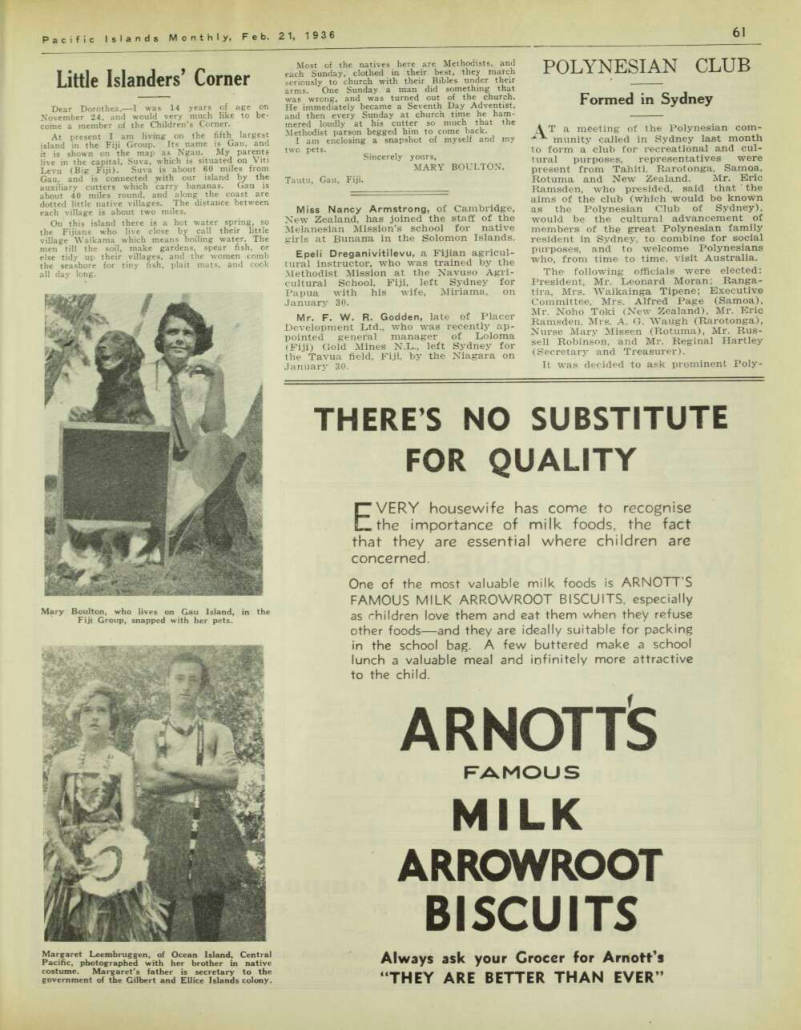
Dear Dorothea, —I was 14 years of age on November 24, and would very much like to be come a member of the Children’s Corner.
At present I am living on the fifth largest island in the Fiji Group. Its name is Gau, and it is shown on the map as Ngau. My parents live in the capital, Suva, which is situated on Viti Levu (Big Fiji). Suva is about 60 miles from Gau, and is connected jvith our island by the auxiliary cutters which carry bananas. Gau is about 40 miles round, and along the coast are dotted little native villages. The distance between each village is about two miles.
On this island there is a hot water spring, so the Fijians who live close by call their little village Waikama which means boiling water. The men till the soil, make gardens, spear fish, or else tidy up their villages, and the women comb the seashore for tiny fish, plait mats, and cook all day long.
Most of the natives here are Methodists, and each Sunday, clothed in their best, they march seriously to church with their Bibles under their arms. One Sunday a man did something that was wrong, and was turned out of the church.
He immediately became a Seventh Day Adventist, and then every Sunday at church time he ham mered loudly at his cutter so much that the Methodist parson begged him to come back.
I am enclosing a snapshot of myself and my two pets.
Sincerely yours.
Mary Boulton.
Tautu, Gau, Fiji.
Miss Nancy Armstrong, of Cambridge, New Zealand, has joined the staff of the Melanesian Mission’s school for native girls at Bunana in the Solomon Islands.
Epeli Dreganivitilevu, a Fijian agricul tural instructor, who was trained by the Methodist Mission at the Navuso Agri cultural School, Fiji, left Sydney for Papua with his wife, Miriama, on January 30.
Mr. F. W. R. Godden, late of Placer Development Ltd., who was recently ap pointed general manager of Loloma (Fiji) Gold Mines N.L., left Sydney for the Tavua field, Fiji, by the Niagara on January 30.
Mary Boulton, who lives on Gau Island, in the Fiji Group, snapped with her pets.
Margaret Leembruggen, of Ocean Island, Central Pacific, photographed with her brother in native costume. Margaret’s father is secretary to the government of the Gilbert and Ellice Islands colony.
Polynesian Club
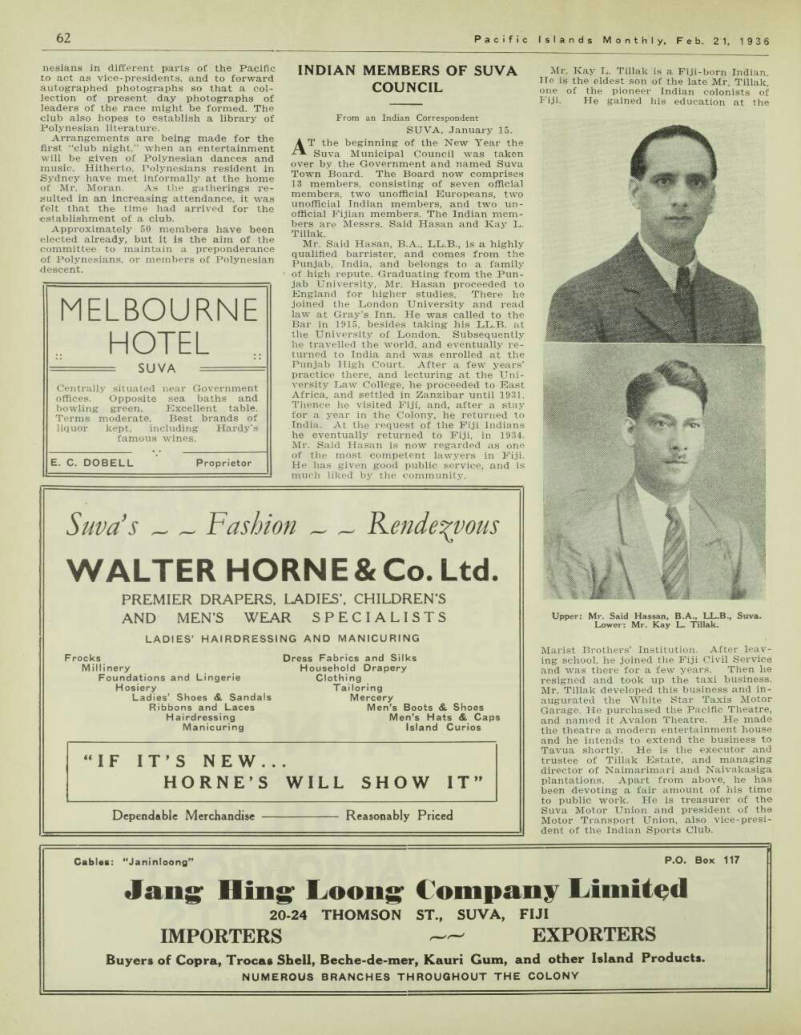
Formed in Sydney
AT a meeting of the Polynesian com munity called in Sydney last month to form a club for recreational and cul tural purposes, representatives were present from Tahiti. Rarotonga, Samoa, Rotuma and New Zealand. Mr. Eric Ramsden, who presided, said that ' the aims of the club (which would be known as the Polynesian Club of Sydney), would be the cultural advancement of members of the great Polynesian family resident in Sydney, to combine for social purposes, and to welcome Polynesians who, from time to time, visit Australia.
The l following officials were elected: President, Mr. Leonard Moran; Ranga tira, Mrs. Waikainga Tipene; Executive Committee, Mrs. Alfred Page (Samoa), Mr. Noho Toki (New Zealand), Mr. Eric Ramsden. Mrs. A. G. Waugh (Rarotonga), Nurse Mary Missen (Rotuma), Mr. Rus sell Robinson, and Mr. Reginal Hartley (Secretary and Treasurer).
It was decided to ask prominent Poly
nesians in different parts of the Pacific to act as vice-presidents, and to forward autographed photographs so that a col lection of present day photographs of leaders of the race might be formed. The club also hopes to establish a library of Polynesian literature.
Arrangements are being made for the first “club night,” when an entertainment will be given of Polynesian dances and music. Hitherto, Polynesians resident in Sydney have met informally at the home of Mr. Moran. As the gatherings re sulted in an increasing attendance, it was felt that the time had arrived for the establishment of a club.
Approximately 50 members have been elected already, but it is the aim of the committee to maintain a preponderance of Polynesians, or members of Polynesian descent.
Advertisements & other items, p. 63 (1 item)
Arnottis
THERE’S NO SUBSTITUTE
FOR QUALITY
EVERY housewife has come to recognise the importance of milk foods, the fact that they are essential where children are concerned.
One of the most valuable milk foods is ARNOTT’S
FAMOUS MILK ARROWROOT BISCUITS, especially
as children love them and eat them when they refuse other foods—and they are ideally suitable for packing in the school bag. A few buttered make a school lunch a valuable meal and infinitely more attractive to the child.
ARNOTTiS
FAMOUS
MILK
ARROWROOT
BISCUITS
Always ask your Grocer for Arnott’s
“THEY ARE BETTER THAN EVER’’
Indian Members Of Suva
Council
From an Indian Correspondent SUVA, January 15.
AT the beginning of the New Year the Suva Municipal Council was taken over by the Government and named Suva Town Board. The Board now comprises 13 members, consisting of seven official members, two unofficial Europeans, two unofficial Indian members, and two un official Fijian members. The Indian mem bers are Messrs. Said Hasan and Kay L.
Tillak.
Mr. Said Hasan, 8.A., LU.B., is a highly qualified barrister, and comes from the Punjab, India, and belongs to a family of high repute. Graduating from the Pun jab University, Mr. Hasan proceeded to England for higher studies. There he joined the London University and read law at Gray’s Inn. He was called to the Bar in 1915, besides taking his LL.B. at the University of London. Subsequently he travelled the world, and eventually re turned to India and was enrolled at the Punjab High Court. After a few years’ practice there, and lecturing at the Uni versity Law College, he proceeded to East Africa, and settled in Zanzibar until 1931.
Thence he visited Fiji, and, after a stay for a year in the Colony, he returned to India. At the request of the Fiji Indians he eventually returned to Fiji, in 1934.
Mr. Said Hasan is now regarded as one of the most competent lawyers in Fiji.
He has given good public service, and is much liked by the community.
Mr. Kay L. Tillak is a Fiji-born Indian.
He is the eldest son of the late Mr. Tillak. one of the pioneer Indian colonists of Fiji. He gained his education at the
Marist Brothers’ Institution. After leav ing school, he joined the Fiji Civil Service and was there for a few years. Then he resigned and took up the taxi business.
Mr. Tillak developed this business and in augurated the White Star Taxis Motor Garage. He purchased the Pacific Theatre, and named it Avalon Theatre. He made the theatre a modern entertainment house and he intends to extend the business to Tavua shortly. He is the executor and trustee of Tillak Estate, and managing director of Naimarimari and Naivakasiga plantations. Apart from above, he has been devoting a fair amount of his time to public work. He is treasurer of the Suva Motor Union and president of the Motor Transport Union, also vice-presi dent of the Indian Sports Club.
Upper: Mr. Said Hassan, B.A., LL.B., Suva.
Lower: Mr. Kay L. Tillak.
Advertisements & other items, p. 64 (1 item)
Jang: King: Loong Company Limited
MELBOURNE
HOTEL „
- SUVA
Centrally situated near Government offices. Opposite sea baths and bowling green. Excellent table.
Terms moderate. Best brands of liquor kept, including Hardy’s famous wines.
E. C. DOBELL Proprietor
Suva’s Fashion Rendezvous
WALTER HORN E & Co. Ltd.
PREMIER DRAPERS. LADIES’, CHILDREN’S
AND MEN’S WEAR SPECIALISTS
LADIES’ HAIRDRESSING AND MANICURING
Frocks M illinery Foundations and Lingerie Hosiery Ladies’ Shoes & Sandals Ribbons and Laces Hairdressing Manicuring Dress Fabrics and Silks Household Drapery Clothing Tailoring Mercery Men’s Boots & Shoes Men’s Hats & Caps Island Curios
“IF IT’S NEW...
HORNE’S WILL SHOW IT”
Dependable Merchandise Reasonably Priced
Cables: “Janinloong 1 P.O. Box 117
Jang: King: Loong Company Limited
20-24 THOMSON ST., SUVA, FIJI
IMPORTERS - EXPORTERS
Buyers of Copra, Trocas Shell, Beche-de-mer, Kauri Gum, and other Island Products.
NUMEROUS BRANCHES THROUGHOUT THE COLONY
Group
Hurricane Sweeps Lau Group Sunken Cutter’s Crew Adrift on Raft
From Our Own Correspondent SUVA, February 4.
A SEVERE hurricane was experienced in the southern section of the Lau Group on January 19. At Komo Island, the 25tons auxiliary cutter Tui Naviti Levu, owned by Jang King Loong Co., capsized and the same company’s store and stock on the island were blown away. Every native house was destroyed, and coconut trees were so badly damaged that nothing but the stumps were left.
So strong was the wind that a 600-gallon tank, full of water, was swept away from its stand and blown on top of a hill some distance away.
The cutter put into Komo the day before the “blow,” anchoring 50 yards off-shore.
She was filled with 420 bags of copra, and, when the hurricane struck her. she heeled over and sank, damaging the small boat.
The crew, with a Chinese passenger, took to a raft, but were blown out towards the reef and the open sea. After they had been drifting for three hours, the wind changed and blew them back to the beach.
The islands of Moce, Kabara and Oneata were also devastated. Coconut plantations were razed, and only three native houses remained undamaged at Oneata and two at Moce. Dilo trees that had been growing
for a hundred or more years were up rooted by the wind.
On the fringe of the hurricane, Moala Island, 100 miles westward from Komo, escaped the havoc, only a few houses being blown down.
The presence of the hurricane was first reported by the wireless station at Fakaofa in the Tokelau Group, near Western Samoa. Apparently it travelled southwards, passing to the west of Samoa, and con tinued on to Keppel’s Island (Niuato butabu) in Tonga, The “blow” was most severe at Keppel’s Island, which has been the storm-centre of almost every hurricane in the Pacific for the last six years.
From Tonga the hurricane veered south west and, slightly decreasing in intensity, hit the Lau Islands.
This disturbance, probably, was respon sible for the phenomenal storm which swept over Northern New Zealand about the same period, and caused eleven deaths and much destruction.
Missionary
Death of New Hebrides Missionary
THE death occurred unexpectedly in Sydney on February 5 of Mr. Andrew Stewart, a well-known Presbyterian mis sionary in the New Hebrides. For six years he had served with his wife at Malo Island in Northern New Hebrides. He was formerly a resident of Granville, N.S.W.
Mr. Stewart arrived in Sydney from the Condominium on January 9 to do deputa tion work in New South Wales for the Presbyterian Foreign Missions. He ful filled a preaching engagement on Sunday, February 2, but was stricken ill the follow ing day and was removed to the Royal
Prince Alfred Hospital, Sydney, where he died two days later.
Andrew and Samuel, two native teachers from Malo, who accompanied Mr. Stewart to Sydney, were grief-stricken at his death.
For the past five years they were his first lieutenants in missionary work in the New Hebrides.
Mr. W. F. (“Bill”) Cash, who has been gold mining in New Guinea for several years, returned to Salamaua in January after a holiday visit to Sydney.
Advertisements & other items, p. 65 (3 items)
63
Islands Monthly, Feb. 21, 1936
Pac i f i
Pacific Taxi
GARAGE - -
(Vincent K. Brothers) Day and night service . . . Most modern hire service in Suva . . .
Excellent drivers.
Our special trips embrace Rewa Valley and Sugar Mill, River Scenery, Lami, Suva Point, and Native Kings’ Town of Bau.
Trips can be arranged on Intersular Road to Ellington, Tavua, Ba, Lautoka, and Sigatoka.
Cables: “Vincent,” Suva. 'Phone 33.
Rewa Hotel Kara
In Suva . . . Stay at
The Pier Hotel
( Licensee: D. B. COSTELLO )
The Rendezvous of the Miners
Situated in hub of city. Absolutely fireproof building. Commodious and comfortable rooms. Excellent cuisine. All the best brands of drinks stocked.
Tariff u[6 per day
Cable address: “Pier,” Suva.
UNDER SAME MANAGEMENT
REWA HOTEL Kara
Picturesquely Situated in the Cane Country on the Rewa River Have the advantage of staying in either Motel on same Tariff
FREE TRANSPORT BETWEEN THE TWO HOTELS
Motor trips arranged around Island. Modern cars driven hy expert drivers. * ■in r m
Fijian Canoe Sinks
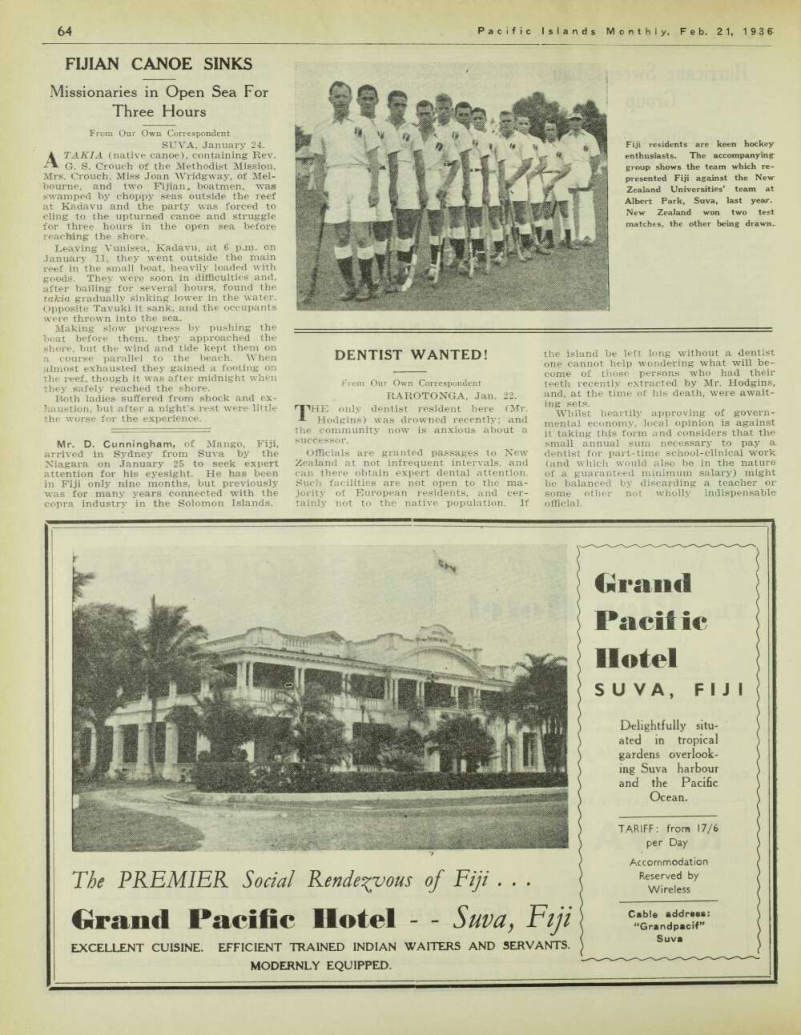
Missionaries in Open Sea For Three Hours
From Our Own Correspondent SUVA, January 24. 4TAKIA (native canoe), containing Rev.
G. S. Crouch of the Methodist Mission, Mrs. Crouch, Miss Joan Wridgway, of Mel bourne, and two F'ijian. boatmen, was swamped by choppy seas outside the reef at Kadavu and the party was forced to cling to the upturned canoe and struggle for three hours in the open sea before reaching the shore.
Leaving Vunisea, Kadavu, at 6 p.m. on January 11, they went outside the main reef in the small boat, heavily loaded with goods. They were soon in difficulties and. after bailing for several hours, found the takia gradually sinking lower in the water.
Opposite Tavuki it sank, and the occupants were thrown into the sea.
Making slow progress by pushing the boat before them, they approached the shore, but the wind and tide kept them on a course parallel to the beach. When almost exhausted they gained a footing on the reef, though it was after midnight when they safely reached the shore.
Both ladies suffered from shock and ex haustion, but after a night’s rest were little the worse for the experience.
Mr. D. Cunningham, of Mango, Fiji, arrived in Sydney from Suva by the Niagara on January 25 to seek expert attention for his eyesight. He has been in Fiji only nine months, but previously was for many years connected with the copra industry in the Solomon Islands,
Fiji residents are keen hockey enthusiasts. The accompanying group shows the team which re presented Fiji against the New Zealand Universities’ team at Albert Park, Suva, last year.
New Zealand won two test matches, the other being drawn.
Dentist Wanted!
From Our Own Correspondent
Rarotonga, Jan. 22.
THE only dentist resident here (Mr.
Hodgins) was drowned recently; and the community now is anxious about a successor.
Officials are granted passages to New Zealand at not infrequent intervals, and can there obtain expert dental attention.
Such facilities are not open to the ma jority of European residents, and cer tainly not to the native population. If
the island be left long without a dentist one cannot help wondering what will be come of those persons who had their teeth recently extracted by Mr. Hodgins, and, at the time of his death, were await ing sets.
Whilst heartily approving of govern mental economy, local opinion is against it taking this form and considers that the small annual sum necessary to pay a dentist for part-time school-clinical work (and which would also be in the nature of a guaranteed minimum salary) might be balanced by discarding a teacher or some other not wholly indispensable official.
Advertisements & other items, p. 66 (1 item)
Grand
w The PREMIER Social Rendezvous of Fiji . . .
Grand Pacific Hotel - - Suva, Fiji EXCELLENT CUISINE. EFFICIENT TRAINED INDIAN WAITERS AND SERVANTS.
MODERNLY EQUIPPED.
Grand
Paclt ic
Hotel
SUVA, FIJI
Delightfully situated in tropical gardens overlooking Suva harbour and the Pacific Ocean.
TARIFF: from 17/6 per Day Accommodation Reserved by Wireless Cable address: “Grandpacif”
Suva
Subsidised Ships in Pacific
Conferences Proceeding Aus tralia Moves at Last—Need for Preserving Friendship With U.S.A.
IT appears that the Commonwealth Government at last, after years of prodding, is taking action to deal with the demand for the protection of British shipping in the Pacific.
Credit for a definite move must be given to the new Labour Government in New Zealand. Simultaneously with its appearance in office, announcements were made from London that, owing to sub sidised American competition, the Union Steam Ship Company had decided to discontinue the service between Sydney and San Francisco, via Wellington, Raro tonga, and Tahiti; and that there was doubt whether the Canadian-Australasian Line (Sydney to Vancouver, via Auckland, Suva, and Honolulu) could continue much longer.
Australia, apparently, continued to be supremely indifferent; but New Zealand viewed with dismay the loss of the valu able Rarotonga and Tahiti connection, and strong representations were made to Australia and to Britain.
During the last few weeks there have been significant conferences. Mr. N. S.
Falla and Mr. A. J. Soutar, managing director and Sydney manager respec tively of the Union Steam Ship Co., visited Canberra early in February and had a lengthy interview with the Prime Minister (Mr. J. A. Lyons). One news paper, usually well-informed, stated that they submitted proposals which already had been submitted to the new Labour Government in New Zealand —namely, that their ships be subsidised and that American ships be prohibited from carrying passengers and freight between British ports.
Subsequently the Prime Minister stated that discussions are proceeding between the British, Australian and New Zealand Governments and that the mat ter will be dealt with in London shortly by the two Australian Ministers who are now leaving for Britain—Dr. Earle Page (Minister for Commerce) and Mr. R. G.
Menzies (Attorney-General).
This forthcoming conference in Lon don will be a difficult one, because it involves an important relationship with the United States. Britain and U.S.A. are the joint guardians of the status quo in the Pacific. They do not work under any pact or treaty, and obviously noth ing of the kind is contemplated or probable. But there is a sympathetic understanding between those two great Anglo-Saxon powers, and statesmen in Britain or the British dominions would be foolhardy in the extreme if they did anything to vitiate that good under standing.
The settlement of this thorny problem of Pacific shipping must be through an appeal to reason and fair-play, rather than by wielding a big stick. The Ameri cans are reasonable people, and they recognise that if British ships may not carry passengers and freight between American ports, and if American ships running out to the British dominions in the Pacific are to be heavily subsidised, British ships engaged in the Pacific trade must be given some corresponding ad vantages. Britain and the British domi nions want the goodwill and co-operation of America in the Pacific; but they can
not be expected to lie down and let their enterprising Uncle Sam walk on their necks.
These considerations mean delay. Many months will lapse while the argument goes on. Meanwhile, presumably, the Union Co. services will continue —although there is no guarantee of that. The Sydney-Tahiti-’Frisco line may cease at any time —for the reasons set out in an interesting article from our Tahiti cor respondent on page 24. It is to be hoped that the U.S.S. Co. will carry on a little longer—Australia and New Zealand frankly cannot afford to let this valuable shipping service disappear.
Australian newspaper comment has not been unfriendly to the Union Co., but it has been brutally frank. One journal has said that the Union Co. is entitled to protection against American competi
tion; but in securing that protection it is expected to give very much better service and better accommodation than it has done in the past. It makes a dis mal comparison between the luxurious accommodation of the Monterey and Mariposa and the cramped cabins of the Aorangi and the somewhat ancient Niagara.
However, it may be pointed out that the Union Co. is putting on a new inter island motorship, the Matua, in a few months; that a fine new vessel for the Australia-New Zealand run, the Awatea, has been launched and will be here in October; and that it may be taken as certain that if the Company’s Australa sian-North American lines are given protection, the Company will introduce to those services vessels which will bear comparison with anything afloat.
Advertisements & other items, p. 67 (1 item)
A. B. Donald Ltd.
Labor Omnia Vincit
GCI
Ensemll? Girls’
29 BANCROFT AVENUE.
ROSEVILLE. N. SYDNEY
A Day and Boarding School on the beautiful and healthy North Shore, enjoying all the advantages of proximity to the capital combined with
bracing climate.
A new residence for boarders has just been completed, equipped with all modern conveniences, and allowing a larger number of resident pupils to be enrolled.
Pupils are taken from the earliest ages to leaving stage, and are under the personal supervision of the Principal. Arrangements may be made for the holidays, if wished.
Prospectus m&y be obtained upon application.
Principal, MISS I. DAVIES, 8.A., Dip. Ed.
A. B. DONALD Ltd.
AUCKLAND
Island Traders :: General Merchants
P.O. Box 1509 :: Cables and Telegrams: “Kingdom," Auckland Branches at Rarotonga and throughout the Cook Islands At Papeete and throughout the Society, Marquesas and Paumotu Islands
trading as “ETABLISSEMENTS DONALD, TAHITI*’
At Fiji: Trading as “Dominion Fruit Co.,’’ Suva
Spying Out Secrets of Unknown N
Unknown N. Guinea Young Explorers Use Aeroplane
IN pursuance of the plan of carrying out an aerial reconnaissance, before the new expedition led by Mr. Ivan F. Cham pion left for the unexplored region in North-Western Papua, a party consisting of Mr, Ivan Champion, Mr. Jack Hides, Mr. F. E. Williams (Papuan Government Anthropologist), and Mr. Lewis Lett, left Port Moresby by aeroplane on January 28 and proceeded to Wau, and thence over the Upper Ramu and Upper Purari country to the Mount Hagen aerodrome, in Northern New Guinea. The ’plane was provided by Guinea Airways Limited, and Mr. C. R. Gurney, one of that company’s most experienced pilots, was in charge.
The party, in New Guinea, was joined
by Mr. J. L. Taylor, Assistant District Officer. This was a fitting arrangement because it was Mr, Taylor, with Messrs.
Mick and Dan Leahy, who carried out that famous patrol from the Upper Ramu across the headwaters of the Purari to Mount Hagen, about three years ago, and thus for the first time made this valuable and fascinating country known to Euro peans and to science.
As was explained in our issue of August 1935, this Purari-Hagen country discovered by the Leahy-Taylor expedi tion is of the same general character, and contains the same racial types, as the region to the south-westwards, in North- Western Papua, which was penetrated in 1935 by the Hides expedition, and (see elsewhere in this issue) by the Fox Brothers expedition at the end of 1934.
It is now proposed that Mr. Ivan Cham pion shall lead a party into the southern part of this unknown Papuan country, in the vicinity of the route followed by Mr.
Hides; and the purpose of the aerial reconnaissance was to give Mr. Hides and Mr. Taylor an opportunity of flying over
unknown Central New Guinea with Mr.
Champion, and pointing out to him its general features and disposition.
It was not practicable for the aeroplane to fly over the unexplored central region from Papua, because the nearest Papuan aerodrome is at the Lakekamu, over 200 miles from the scene of Mr. Hides’ recent expedition. But, by going around into the Mandated Territory, and flying north westwards to Mount Hagen, the aero plane was right on the edge of the unex plored territory, and less than 100 miles in a direct line from the northerly limit of the region visited by Mr. Hides.
The party, on February 1, flew south wards and south-westewards from Mount Hagen in what appears to have been a completely successful reconnaissance.
They located the Tari Furoro Valley (which last year was found, and de scribed by Mr. Hides as a “Papuan Won derland,’’ and the party agreed that the description was entirely fitting). It is said to be a place of great beauty and general attractiveness, capable of supporting a huge population. They got far enough south to see the great limestone barrier; and to identify the estuary of the Tu rama, which flows into the Gulf of Papua.
It is reported, also, that they traced the course of the Purari, from its headwaters in New Guinea, to the main stream in Papua.
Many photographs were taken during the flight, and while the aeroplane was flying over the native villages in the Tari Furoro country, cowrie shells were drop ped on the cultivated patches. Mr, Hides learned when he was there last year that these shells are very highly valued. The official report of this flight should be very interesting and valuable.
The party returned to Wau on Febru ary 4.
It is anticipated that Mr. Champion will set out upon his expedition at any early date.
Advertisements & other items, p. 68 (1 item)
Nelson and Robertson Ltd.
STRUCTURAL STEELWORK
DESIGNS BY COMPETENT ENGINEERS
All Classes of Steel Framework and Reinforcement Agents for— EXPANDED METAL FOR CONCRETE AND PLASTER WORK
“PUDLO” FOR WATERPROOFING CEMENT
Send your enquiries to
THE SYDNEY STEEL CO. LTD.
MARRICKVILLE, N.S.W. Cable Address; SYDSTEEL, SYDNEY
Nelson and Robertson Ltd.
ISLAND MERCHANTS - (Established lijj)
COCOA BEANS. —Special attention devoted to their sale in Australian and Oversea markets.
COPRA, TROCHUS SHELL, and other Island Produce sold on commission.
All classes of merchandise and Mining Machinery purchased at wholesale prices and original invoices supplied to Island clients. Small commission. Prices submitted for comparison.
SOLE AGENTS FOR
PUMPMOBIL Portable Pumping Plants. Recommended for Sluicing and all Mining purposes. Weight 120 lbs., 1 2,000 gals, per hour, 10 to 100 feet head. Reduced prices.
PENTA ENGINES, Utility Outboard and Inboard. Swedish manufacture. Powers 4-60 h.p.
SKANDIA ENGINES, full diesel and semi-diesel; all powers. Marine and Stationary.
UPSON BRITISH BOARD. —Wallboard and insulating material in one, strong and light in weight. 6ft. to I 2ft. lengths always in stock.
NELSON AND ROBERTSON LIMITED
12 SPRING STREET, SYDNEY, AUSTRALIA
Telegraphic Address: “Ivan Sydney.”
Papeete
“Aina Pare” Goes
Romantic Memories of Old Papeete
From Our Own Correspondent
Papeete, Jan. 22.
ANOTHER old landmark of the Papeete waterfront, the “Aina Pare,” is now being demolished by the Municipality, a work which has been found necessary in pursuance of the scheme to widen the Avenue Bruat. When finished, the latter will be a fine, broad thoroughfare run ning from the sea-front to the foot of the mountains. Most of the Government buildings are situated along this avenue which, it is stated, is to be planted on both sides with rain trees (Pithecolobium Saman ) to replace the ancient acacias, many of which now are in a dangerously rotten condition.
The “Aina Pare” was also known as the “Annex” in days gone by, and was formerly owned by the celebrated Lo vaina, and used by her as an accommoda tion house for guests, whenever the Hotel Tiare was found insufficient for the pur pose. The “Annex” was inherited by Lovaina’s son, Johnny, who for many years past has maintained a boarding establishment there on his own account.
While the necessity for its removal in the interests of town improvement cannot be questioned, the disappearance of this old place, with its attendant associations of a renowned proprietress, of Bacchana lian revels and transitory amours, will stir the memory of many an old-timer in Polynesia, and bring a twinge of regret to numerous alien visitors whose first Islands adventure was encountered behind the latticed verandahs of “Aina Pare.”
Edie Creek News
From Our Own Correspondent
Edie Ck.. Jan. 10.
THE holiday season has been particularly quiet in this centre —many of the residents being away in Wau—but the New Year promises to be prosperous for Edie Creek. The starting of a 20-stamp head at N.G.G. mine, coupled with the reorganising and floating of Developments (E.C.G.M.N.L.) and the rumour that Day Dawn Ltd. may reopen are good cause for optimism. Now that alluvial mining (except for N.G.G. Ltd.) is practically finished, residents look to these three mines to maintain the life of the community.
The crushing at N.G.G. during December was mostly experimental, to allow re-adjustments to the machinery, but the opening for 1936 sees the plant in proper working order. It appears that more intensive prospecting and development work is to be undertaken on Mount Kaindi, between the Merri Creek and Wau, and the Co. is interested in purchasing further small private holdings on Merri Creek. Prospecting on the left bank of the Edie Creek disclosed large bodies of wash, but values are reputed to be low in much of it.
Mr. Blakie Webster, of London, and Mr. MacCul loch, of Sydney, directors of N.G.G. Ltd., have been inspecting the Co.’s plant and mines.
Mr. “Doe” Davis, tributing on Cameron and Bowden’s holdings near Blue Point, has opened
out a nice looking body of wash high above the creek on rim rock—a shoot over 90ft. long carries the wash down for boxing.
Mr. “Don” McDonald has finished up on the headwaters of Stower’s Creek, and is now spending a few days in Wau and Salamaua.
Mr. Neville Mac Lean has left Edie store, and is now on the staff of Turner’s Transport Co.
Mr. Frank McKee has left Edie Creek, and is now mining at Wampit.
Mr. W. C. Abbie has returned from a success ful recruiting trip.
Mrs. H. Rex has departed from Whitbourne’s Creek, making for the Wampit area.
On December 21 a heavy hailstorm destroyed many gardens. The hail adhered in hollows in the ground, and the natives were collecting these large masses as late as noon the following day.
This is the severest hailstorm so far experienced by Europeans at Kaindi —it was restricted to com paratively small areas on high ground where hail as large as marbles fell heavily for 40 minutes, the surrounding country being blanketed with white—a real Xmas card effect. In these areas of intense hail the trees and undergrowth were reduced of foliage. The natives showed some fear of this unusual occurrence.
Mr. W. Davis has resigned from N.G.G. Ltd., and has purchased Mr. Wilkin’s claims on Sandy Creek.
Mr. Geo. Cooper is now working Alex Dickson’s leases oif Edie Creek.
Mr. Geo. Bellamy, who has left N.G.G. Ltd., is at present in charge of Albert Schrater’s lease, whilst Mr. Schrater is taking Xmas vacation.
Mr. and Mrs. K. S. Spinks proceeded South by the last Neptuna on three months’ leave.
Samoan Planter’S Loss
F our own Porresnondent P
Apia, Jan. 4.
a SAMOAN cocoa planter, Mr. A.
Stehlin qiifforod a hoavv loss whpn fctenim, suffered a. neavy loss wnen + hl J. hot ™ drier, situated on his plan tation at Lotopa, near Apia was com pletely destroyed by fire, which broke out about midnight on Christmas eve.
A large quantity of dry cocoa beans amounting to 4\ tons, which was Stored ! n th e drier, was lost and, unfortunately, IS not covered by insurance.
The police fire brigade succeeded in. their efforts to save the main dwelling,. rj?' ch is a short distance from the drier.
Advertisements & other items, p. 69 (2 items)
Swallow & Ariell
B. & S. Estate Agency
ROSEVILLE, SYDNEY
Specialising in Flat reservations, any suburb, for Island Residents visiting Sydney. Correspondence invited. 'Phone J 5269.
Principals: Edwin M. Bastard & Campbell M. Smith
Swallow & Ariell
LIMITED
Port Melbourne :: Australia Manufacturers Since 1854 of
HIGH QUALITY
\ Ship and Cabin Biscuits / CABIN (Including Small Cabin)
PACIFIC CABIN
CABIN CRACKERS
BREAKFAST BISCUITS
NAVY & PILOT BREAD
Packed expressly for export in tins up to 50lbs.
Position Wanted
Young man, age 21, desires position in Islands—s years’ storekeeping with Mcllrath’s, Sydney. Full knowledge of double entry bookkeeping. Can drive car. Will repay fare if position can be found. Firstclass business and personal references forwarded if required.
Reply to— L.G.E., C/o. Pacific Publications Ltd.
P.O. Box 3408 R, Sydney.
Pacific Mining
Notes
From Fiji
Pacific Gold, N.L.
IN a circular to shareholders, the management of Pacific Gold N.L. advises that since the formation of the company in September last arrangements have been concluded with the Pacific Gold Syndicate for the transfer of the options, prospecting licences and other property held m Fiji. The prospecting licences on the Tavua field, issued by the Mining Board, are: No. 266, 240 acres; No. 267, 170 acres; and No. 268, 127 acres.
In addition, an option was acquired over approxi mately 100 acres in the district of Naitasiri, in
Fiji, approximately 30 miles north of Suva. After sinking a prospecting shaft to approximately 50 feet, crosscutting and driving into the lode, it was found that values were unpayable, and the option has since been surrendered. A new dia mond drilling plant has been purchased, shipped to Fiji, and erected on prospecting licence No. 266, south of and adjoining the Cardigan lease.
The drilling plant, under the control of competent drilling engineers, commenced about January 20, on a site selected by the company’s engineer. It is too early to express any opinion on the pros pects of the bore now going down. Preliminary prospecting work has been carried out on pros pecting licence No. 268, known as Laka Laka, but until further work has been completed the directors cannot express any opinion on the value of this area. As soon as drilling operations have been completed on prospecting licence No. 266 it is intended to transfer the drilling plant to pros pecting licence No. 267, which adjoins the northern boundary of the Emperor prospecting licence No. 236. The directors have recently taken an option over an area at Wainevisi, on the island of Vitu Levu, and arrangements have been concluded whereby the company’s engineers will thoroughly test the area. The area is gold bearing, but values have not yet been determined. A prospect ing party is at present on the island of Mutuka, one of the smaller islands among the Fijian group, but owing to lack of communication it is not yet possible to give any details of this venture. The directors have acquired, for cash, a one-eighth interest in New Caledonia Prospecting Pty. Ltd. which has sent Mr. R. A. Clinton to examine cer tain gold-bearing areas in New Caledonia. Mr.
Clinton’s report and opinion on the areas are ex pected in the near future. A one-tenth interest has also been acquired for cash in Oceanic Gold Explorations NX. formed to examine a reported discovery of alluvial gold on one of the Pacific Islands.
Fiji Prospecting Co.
Prospectors of Fiji Prospecting Co. NX. have examined numerous areas in Fiji, but no properties considered to be worthy of acquisition have been discovered. It is proposed to conserve the funds in hand, so that examinations can be made of mining propositions which may be offered to the company.
Wai Savora Gold Syndicate
Wai Savora Gold Syndicate was registered in Sydney in December with a capital of £l5OO m 150 shares of £lO each, all of which have been fully paid. The syndicate’s lease is about seven miles from Suva. Fiji, and an option over 300 acres more is held. Development work during the last three months is stated to have disclosed values of 12 dwt a ton. Mount Morgan Develop ments Ltd. is believed to have taken an option over the lease until April, and is at present prospecting and developing the lease. A sale of one share in Wai Savora Gold Syndicate is re nnrted to have been made in Sydney early in
January at £lOO, and a buyer in Melbourne offered £BO without attracting business.
Emperor Mines Ltd.
To ascertain the extent of the lode in certain sections, the Company has made arrangements for the use of a drilling plant on its property in Fiji. The drilling plant will be used to test the ore body at certain points, instead of putting in rises or winzes, and the work will be done in conjunction with the present programme of de velopment to the 194 ft. level. It is problematical whether a deep bore will be put down. Mr. A. G.
Campbell, a director of the company, is now in Fiji.
From December 31 to January 25 the company’s mill crushed 1230 tons of ore for a return of 764 fine oz of gold. The head value was 15.3 dwt a ton, and the Toss in tailings was 2.88 dwt a ton. The tailings loss was high consequent on treating telluride ore from No. 5 winze, and this will not recur, as no further tellurides will be treated by this mill. The last three yields are compared in the following table:
Aloha Central Gold Mine, Nx.
Mr. A. T. Day, chairman, and Mr. A. G.
Campbell, consulting engineer, of the Aloha Cen tral Gold Mine NX., sailed on the Monterey from Sydney on February 5 for Fiji to inspect the company’s mine on the Tavua field. The com pany’s option over its areas expires on March 31. It is expected that, following the visit of these two gentlemen to the mine, an announce ment will shortly be made about the future policy of the company.
Granites Development, Nx.
Advice has been received in Melbourne, by cable, from the representative in Fiji of Granites Development, NX., that work has been discon tinued on Blair’s blocks at Tavua. This was done on the recommendation of Dr. Loftus Hills, the Victorian geologist, who has been supervising the company’s operations at Tavua.
Loloma (Fiji) Gold Mines
Directors of Loloma (Fiji) Gold Mines NX., Tavua, Fiji, report that during the past few months exhaustive investigation into the treat ment of the company’s ore has been made, and highly satisfactory extraction has been achieved.
It is expected that when further tests have been completed an early decision to proceed with the erection of a suitable treatment plant will be made. The directors have approved of a joint power scheme with Emperor Gold Mining Co.
Ltd. for the supply of electric power and com pressed air to the companies’ mines. For this purpose steps are being taken to form a com pany under their control to erect and operate the P Prices of shares in Loloma (Fiji) Gold Mines NX. dropped 8/3 to 27/- late in January, fol lowing the report that in the main shaft the crosscut has been extended to 43ft., with the last 20ift. averaging only 12 grains a ton.
Commenting on this development, Mr. P. F. Cody, a director of the company, said that until further information was available the public should not become* “panicky,” as already much gold had been proved in the mine.
Nov. 30.
Dec. 21.
Jan. 25.
Ore (dry weight), tons 644 530 1230 Fine gold. , oz . . . 490 383 764 Recovery, dwt . . . ... 15.2 14.4 12.4
From Papua
Guinea Gold Nx.
A circular to shareholders of Guinea Gold. JN.L. advises that areas abandoned in Papua showed promising results in isolated places, but the gene ral average was considered too low by Mr. G. o.
Dyer, the company’s examining engineer, for a company proposition. Examination of the re maining Tiveri-Nepa area is being carried out, and a final verdict is expected at the end of February. If the balance of the pegged-out areas has to be abandoned, it should be possible to cover the final cost of the testing with not more than 2325 shares held in Bulolo Gold Dredging Ltd., leaving 62,000 shares in hand. On the other hand, should the Tiveri-Nepa area be recommended by Mr. Dyer as a payable proposition, such disposals may be unnecessary.
Misimagold Reefs (N.G.) Nx.
Shareholders of Misima Gold Reefs (New Guinea) NX., at a special meeting on January 29, gave consideration to the future policy. M • W Bluett, a director, who presided, said the op tion with Oroville Dredging Ltd. (London) would expire on February 1, and at the Owent seittatives of the London company Mr. T. Owens, a director of Misima, had visited Sydney, and a further extension of the option had been soug t.
The Oroville company, it was stated, had proved
46,000 tons .of ore, containing values of 5.8 dwt a ton. This tonnage was not considered sufficient at the present time to warrant the expenditure of £26,000 to £30,000 on the erection of plant.
The Oroville company had discovered another lode 6 feet wide, which it was considered was well worth developing. In the opinion of Mr. S. Love, who was supervising operations, the new lode may assist in providing sufficient ore to warrant the exercis ing of the option and the erection of plant. The vendors of two of the ten leases had agreed to an extension of the option, and the directors had granted an extension free for one month, with the right of a further three months on payment of £2OO. Criticism was passed by several share holders on the lack of information supplied by the Oroville company. After a lengthy discussion it was decided to adjourn the meeting for five weeks. In the meantime the directors will seek to obtain further information regarding develop ments at the mine and make a request to the vendors for a further extension of the option.
Tiveri Gold Dredging Co.
The management of Tiveri Geld Dredging Co. reported from Papua in January that during De cember the dredge operated 517 hours, treating 12,750 yards for a recovery of 65 ozs of gold.
In November, operating for 530 hours, the machine dredged 13,000 yards for 49 ozs. of gold.
Oceanic Gold Explorations, N.L.
Oceanic Gold Explorations N.L. was formed in Victoria in the middle of January for the pur pose of despatching an expedition to certain islands in the Pacific Ocean —believed to be in South-eastern Papua—known to be gold-bearing.
The expedition, consisting of four mining engineers under the leadership of Mr. Thomas J. Shepherd, sailed on the Joseph Conrad. The directors con sider it inadvisable at the present time to divulge the exact location of the islands. In the event of the engineers making a favourable report, a company or companies will be formed for the pur pose of equipping and operating the areas. Capi tal of the company is £lO,OOO in 2000 shares of £5 each, of which 1,500 shares paid up to £2 a share covering application and allotment have been underwritten by Messrs. Wallace H. Smith and Co. The balance of 500 shares are to be held in reserve. No cash or share consideration is being paid to vendors or promoters. Australian Prospecting Co. N.L., Mandated Gold N.L., and Pacific Gold N.L. have each acquired 150 shares, and Cracow Gold N.L. 100 shares. Directors are Messrs. Wallace H. Smith, Thomas R. Victor, James C. Dawson, A. G. R. Williams, and Captain Alan J. Villiers, and the legal manager is Haddon A. Smith, of Cook, Tomlins, and Mirams, 360 Col lins Street, Melbourne.
Cuthbert’S Misima Goldmine Ltd.
On January 9, the superintendent of Cuthbert’s Misima Goldmine Limited, operating on Misima Island, Eastern Papua, reported: Mine: No. 7 level south extended 6ft. No. 9 level south extended 20ft. Total development, including crosscuts, 70ft. Diversion tunnel driven 94ft. Total dis tance from portal now 148 ft. Mill: From De cember 23 until January 6, the battery worked two shifts. It is now running three shifts. New assay office and men’s quarters in course of erec tion. Two new houses for accommodating addi tional natives have been completed. Road to pew timber area (1300 acres) is under Construe tion.
On February 1, the superintendent reported that the clean up on January 23 showed that 1160 tons of ore had been treated for 1563 oz of bullion of an estimated value of £3,026. Four days were lost owing to Christmas holidays.
Advertisements & other items, p. 70 (1 item)
Machinery
Mining Ore Treatment
Complete Cyanide Plants Supplied- Dorr Classifiers.
Dorr Thickeners.
Dorr Agitators.
Oliver Filters.
Merril Crowe Zinc Dust Gold Precipitation Richardson Mine Fans.
FANS AND AIR HEATERS
For Ventilation, Copra Drying Rooms, etc.
Enquire from
CROSSLE, DUFF AND
MACINTOSH LTD.
52 Bridge Street, SYDNEY
GOLD
HIGHEST PRICES
PROMPT SETTLEMENTS
ACCURATE WEIGHTS AND
ASSAYS
are assured to producers and sellers of gold bullion who forward their consignments to The Electrolytic Refining and Smelting Co. of Aust. Ltd. for treatment and realisation. , , RECORD PRICE. — On 6th March, 1935, this company paid to its clients at the rate of £9/4/6 net per fine ounce, which is the highest price ever paid for gold in
SPECIALLY ORGANISED SER-
VICE is available to clients in New Guinea, Fiji and other Pacific Island centres.
Address consignments from outside Australia to the Company’s Sydney office.
Weighing a Pacific Islands consignment of gold bullion at an E.R. & 8. receiving office.
OjrUMCJ WIMVV.
The Electrolytic Refining & Smelting Co.
* ■ iA-rn a I ■ A I IMITCn
OF AUSTRALIA LIMITED.
Melbourne: Works: Collins House. Port Kembla, N.S.W. - Purchasers and Refiners of Gold, Silver, Copper in any form BANKERS.—The English, Scottish and Australian Bank Ltd.
Sydney: 25 O’Connell Street.
From New Guinea
Upper Sepik Gold Syndicate
Shareholders of Upper Sepik Gold Syndicate N.L., New Guinea, at an extraordinary meeting held in Melbourne on February 7, sanctioned an increase in the capital from £lO,OOO to £20,000 by raising the nominal value of each of the 2000 shares from £5 to £lO. Authority was given the directors to make calls not exceeding £1 a month.
The chairman of directors (Mr. E. F. S. England) informed shareholders that Messrs. Spence and Smith, of Wau, were occupied testing the pro perty of 400 acres (Lease No. 361). The direc tors had not yet received any detailed report, but a radiogram to hand on February 6 was of an encouraging nature. Some of the tests completed had given values up to 7/- a yard. The present intention of the directors was to make only one call. Replying to a shareholder, Mr. England said there were 1925 issued shares, of which 1425 were issued for cash and 75 were in reserve. An amount was due to the vendor on November 15 last,- and funds being insufficient the directors issued 125 shares at £5 a share, the market price being £4/10/- a share. The fee of Messrs. Spence and Smith was £325 a month, with a final pay ment on receipt of the certificate. The vendor was receiving £l5O a month, and these payments would be deducted from the cash consideration of £20,000 payable on the exercise of the option.
This amount would be payable should a new company be formed, which would also allot 5000 shares. The option expired on February 15, but was subject to a renewal for six months. The firm offer of £2OOO made by Bulolo Dredging Ltd. for 17 of the 400 acres could be finalised imme diately the title was received. Mr. England added that other properties were under offer to the company.
Edie Ck. Gold Mining Co.
In view of the recent shipping dispute and, the extended Christmas vacation, the directors of Edie Creek Gold Mining Co. N.L., New Guinea, extend ed the date on which applications for shares m Edie Developments N.L. would close until February 10. The directors pointed out that unless enough support was forthcoming to enable the registration of the new company to proceed, there would be no alternative but to close down and dispose of the assets of the Edie Creek mine. The general mana ger (Mr. H. Taylour) has reported that with suffi cient capital the property should develop into a consistent gold producer.
On February 13, the directors reported that as applications received for shares had been insuffi cient to enable the new company to proceed to
registration, they had decided that the existence of Edie Creek Gold Mining Company, No Liability, shall be determined and wound up.
Bulolo Gold Deposits Ltd.
A profit of £lOB4 was earned by Bulolo Gold Deposits Ltd. for the year ended June 30, 1935.
This includes £6OO received from Placer Develop ment on account of the sale of an option. Sluicing was carried on continuously on a small scale dur ing the year, working one shift daily. Gold re covered amounted to 1037 oz 17 dwt, realising £5415 gross, which is equal to £5/4/5.6 per ounce.
Since the date of the balance sheet a further 411 oz of gold has been won, and Placer Develop ment has exercised an option over 210 acres for a purchase price of £ll,OOO cash. Bulolo Deposits retains the whole of the terrace ground, and, after abandoning an option held over 100 acres, holds an area of approximately 319 acres, together with very valuable water rights. It is intended to work the terraces on a much larger scale, working three shifts on two faces. It is estimated this will necessitate a capital outlay of approximately
£2OOO, excluding the cost of any additional native labour that may be required. A contract was recently let for the construction of the unfinished portion of the water-race to the junction of the Koranga Creek and Bulolo River. This work should be completed not later than the end of February, and enable the company to open up a new area where much better values are known to exist than the site of present operations. The company is now out of debt, and has its property unencumbered. It has received £l5OO of :he £lO,OOO from Placer Development Ltd., and the balance will be paid as soon as the transfer of the lease is approved by the Administrator.
Sunshine Gold Development Ltd.
Installation of the hydraulic sluicing and elevat ing plant of Sunshine Gold Development Ltd., New Guinea, on the consolidated claims, is nearing com pletion. Cabled advices from the general manager indicate that sluicing will commence early next month. The managing director will be present at the commencement of productive operations.
Bulolo Gold Dredging Ltd.
The only serious opposition to the recent “bear” raid on the Melbourne Stock Exchange came from Bulolo Gold Dredging Limited, whose shares rose to nearly £9. Private advices from the field sug gest that the dredges are now working on better ground, and that the yields during the next few months may show improvement over recent ones.
It is interesting to note that the London market has not so far fully reflected the rise at this end.
The Company’s report of production of the four dredges for January compares with that of the previous two periods as follows;
Sandy Creek Gold Sluicing Ltd.
Mr. R. J. Winters, consulting geologist, re cently returned to Sydney after paying a visit to the property of Sandy Creek Gold Sluicing Ltd., New Guinea. His tests of the property confirm his original advice as to the presence in this section of a large and valuable area suitable for the com pany’s hydraulic sluicing operations. Of the pits put down, nine showed an average value of 3/9 a cubic yard and five others had to be abandoned owing to heavy water. Further testing operations are to be carried out. Mr. Winters, in his report dealing with Sandy Creek, deals with the final stages of getting No. 1 sluicing plant into opera tion and with probable gold values in Sandy Creek and the terraces adjoining below where No. 1 plant has commenced operations. He states that quite apart from a substantial yardage in the creek at this position worth about 5/5 a cubic yard, there are also several terraces. He estimates one to contain 8400 cubic yards and to be worth £1 a cubic yard, and the other to contain 4000 cubic yards, worth £2/4/4 a cubic yard. Testing, prin cipally by shaft sinking, on an area between the junction of the Misery and Poverty Creeks, for a distance of 2,200 feet, is stated to have been satis factory.
The mine manager reported that in cleaning up on January 31, 14oz. 3dwt. of gold were recovered, in addition to the lOloz. already reported, thus making a total of 115 oz. 3dwt. He further ad vised that the material treated for this recovery was a total of 4290 cubic yards. During the whole of January 6465 cubic yards were treated for 188 oz. 16dwt. 12gr., the average value being 4/4i a cubic yard.
Enterprise Of New Guinea N.L.
Considerable progress was made by Enterprise of New Guinea N.L., New Guinea, with the hydraulic sluicing scheme for the equipment of its Surprise Creek mining tenements during the period December 7 to January 2. The management te ports that gold production has been temporarily suspended, and the field staff has concentrated on water-race construction at Surprise Creek, also on testing several areas held by the company.
Early in February the following radiogram was received from the general manager (Mr. Harold Taylour), Wau, New Guinea:—“Have pegged out and applied for new area under the amended mining ordinance (extended prospecting licence) between Watut River and Kaindi lease.”
The company reported on February 7 that 170 yards had been treated in the Oriabanda area for Bioz. of gold.
Golden Deeps N.L.
In announcing a call of 3d. a share early in February, the directors of Golden Deeps N.L., New Guinea, advise that highly encouraging results have been obtained from samples of ore brought to Sydney by the mine manager. A parcel of 1 cwt. assayed loz. 6dwt fine gold, and silver loz. 7dwt. a ton. A second parcel of 251 b. assayed 2oz. 9dwt. fine gold, and silver 2oz. 6dwt. a ton.
The samples were taken over a width of from 6 to 8 feet from the new development in the open cut. The manager reports that on the surface in what is known as the open-cut, which is fol lowing the gold-carrying cleavage up the moun tain, work is being carried on. Indications pointed to a width of 6ft., carrying good gold contents.
To carry out the extension of the open-cut and the main tunnel to the point at which he esti mates the lode should be intersected, it would be necessary to make available a further £2,000.
The directors advised on February 9 that Mr.
Carroll (manager), with the necessary staff, etc., will leave for New Guinea during February, and vigorous development of the reef showing in the open cut will be continued without delay.
The directors consider that the prospects of the mine fully justify the opening up of the area.
Nov.
Dec.
Jan.
Cubic yards , 811,000 615,000 899,250 Bullion, oz 14,087 9,632 13,225 Gold, fine, oz. . . . 9,723 6,774 9,094
Value—
Aust. currency* . £85,076 £59,272 £79,572 Per cub. yard . /25.17 /23.16 / 21.2 3 Working profit . . . £63,166 £42,892 £56,035 * At £A8/15/per fine ounce.
Advertisements & other items, pp. 71-72 (1 item)
Mining Pipework
The“ Station Stock
99 Is a saddle favoured by stockmen for its practical qualities. / I Being built on a Galvanised Tree, heavily plated, strained with English web, riders are assured of its genuine foundation. The Sin. hand-sewn capped pads are built with extra strength, while the flaps are long and pliable. Fitted with best leathers, web girth and 4-bar stirrups. £7 /7 /_ Freight Free ' ' Solid Nickel Stirrups, 7/6 extra.
Write for Booklet of “SAFER” Saddles
Newmarket Saddlery
W. H. Williams for “Safer” Saddles.
18-20 WILSON STREET,
NEWTOWN, N.S.W.
Coles
Regalia
Sydney
ALF. H. J. COLES
Established 1920.
Masonic Regalia, Jewels and General Requisites.
Master Masons’ Aprons 42/- and 45/- Leather Regalia Cases, 16-inch, from 16/6 P.M. Jewels a Speciality.
Inquiries Solicited :: Prices Australian Currency
Room 19, Royal Arcade, Sydney
A SERIES OF HEAT RESISTING AIR DUCTS
MINING PIPEWORK
We specialise in Pipe Lines for the conveyance of semi-solids, liquids, or vapours. Also Welded Steel Tanks, Pressure Vessels, Agitator Coils, Tanks, etc.
CONSULT US FOR YOUR NEXT INSTALLATION
A. E. GOODWIN Ltd.
RAILWAY PDE., LIDCOMBE, N.S.W.
UX 7941
Allen Taylor & Co. Ltd.
SYDNEY
Sawmillers and Wholesale Suppliers of Hardwoods for Constructional Purposes GIRDERS . . . PILES . . . POLES . . . SLEEPERS, ETC.
EXPORTING TO PACIFIC ISLANDS SINCE 1893
Cables: Tuxedo, Sydney
AUSTRALIA’S CLEARING HOUSE FOR THE PRECIOUS METALS.
BUYERS OF
GOLD
OSMIRIDIUM, PLATINUM, SILVER, &c.
GARRETT & DAVIDSON, LTD.
ABSAYERS, BULLION MERCHANTS, METALLURGISTS,
Bank of N.S.W. Buildings, Regent Street, Sydney
MINING PLANT
Portable Batteries, Fixed Batteries, Tube and Ball Mills, Shoes and Dies, Screens, Copper Plates, Trucks, “Challenge” Ore Feeders, Cyanide Tanks, Pipe Lines, Pumps
PROSPECTING PLANT
Casing, Drilling Tools, Engine Rigs, Sampling Gear, Pumps, Wire Ropes, etc.
DREDGING PLANT
Large or Small Designed and Built Agents for HADFIELD’S Manganese Steel Buckets, Tumblers, Gears, Carbon and Alloy Steels
J. B. WALLIS & CO.
CHALLIS HOUSE :: SYDNEY
Goldfields, N.G.
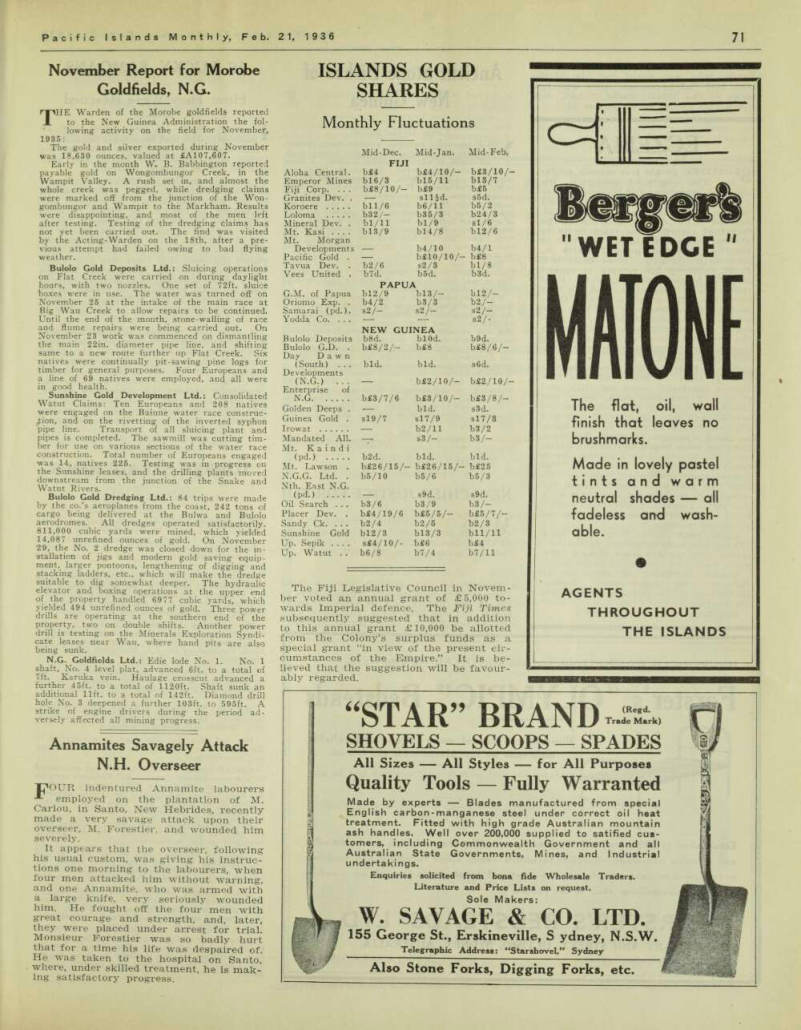
November Report for Morobe Goldfields, N.G.
THE Warden of the Morobe goldfields reported to the New Guinea Administration the fol lowing activity on the field for November, 1935: The gold and silver exported during November was 18,630 ounces, valued at £A107,607.
Early in the month W. B. Babbington reported payable gold on Wongombungor Creek, in the Wampit Valley. A rush set in, and almost the whole creek was pegged, while dredging claims were marked off from the junction of the Won gombungor and Wampit to the Markham. Results were disappointing, and most of the men left after testing. Testing of the dredging claims has not yet been carried out. The find was visited by the Acting-Warden on the 18th, after a pre vious attempt had failed owing to bad flying weather.
Bulolo Gold Deposits Ltd.: Sluicing operations on Flat Creek were carried on during daylight hours, with two nozzles. One set of 72ft. sluice boxes were in use. The water was turned off on November 25 at the intake of the main race at Big Wau Creek to allow repairs to be continued.
Until the end of the month, stone-walling of race and flume repairs were being carried out. On November 23 work was commenced on dismantling the main 22in. diameter pipe line, and shifting same to a new route further up Flat Creek. Six natives were continually pit-sawing pine logs for timber for general purposes. Four Europeans and a line of 69 natives were employed, and all were in good health.
Sunshine Gold Development Ltd.: Consolidated Watut Claims: Ten Europeans and 208 natives were engaged on the Baiune water race construc tion, and on the rivetting of the inverted syphon pipe line. Transport of all sluicing plant and pipes is completed. The sawmill was cutting tim ber for use on various sections of the water race construction. Total number of Europeans engaged was 14, natives 225. Testing was in progress on the Sunshine leases, and the drilling plants moved downstream from the junction of the Snake and Watut Rivers.
Bulolo Gold Dredging Ltd.: 84 trips were made by the co.’s aeroplanes from the coast, 242 tons of cargo being delivered at the Bulwa and Bulolo aerodromes. All dredges operated satisfactorily. 811,000 cubic yards were mined, which yielded 14,087 unrefined ounces of gold. On November 29, the No. 2 dredge was closed down for the in stallation of jigs and modern gold saving equip ment, larger pontoons, lengthening of digging and stacking ladders, etc., which will make the dredge suitable to dig somewhat deeper. The hydraulic elevator and boxing operations at the upper end of the property handled 6977 cubic yards, which yielded 494 unrefined ounces of gold. Three power drills are operating at the southern end of the property, two on double shifts. Another power drill is testing on the Minerals Exploration Syndi cate leases near Wau. where hand pits are also being sunk.
N.G. Goldfields Ltd.: Edie lode No. 1. No. 1 shaft. No. 4 level plat, advanced 6ft. to a total of 7ft. Karuka vein. Haulage crosscut advanced a further 45ft. to a total of 1120 ft. Shaft sunk an additional lift, to a total of 142 ft. Diamond drill hole No. 3 deepened a further 103 ft. to 595 ft. A strike of engine drivers during the period ad versely affected all mining progress.
Annamites Savagely Attack
N.H. Overseer
indentured Annamite labourers employed on the plantation of M.
Cariou, in Santo, New Hebrides, recently made a very savage attack upon their overseer, M. Forestier, and wounded him severely.
It appears that the overseer, following his usual custom, was giving his instruc tions one morning to the labourers, when four men attacked him without warning, and one Annamite, who was armed with a large knife, very seriously wounded him. He fought off the four men with great courage and strength, and, later, they were placed under arrest for trial.
Monsieur Forestier was so badly hurt that for a time his life was despaired of.
He was taken to the hospital on Santo, where, under skilled treatment, he is mak ing satisfactory progress.
Islands Gold
Shares
Monthly Fluctuations
The Fiji Legislative Council in Novem ber voted an annual grant of £5,000 to wards Imperial defence. The Fiji Times subsequently suggested that in addition to this annual grant £lO,OOO be allotted from the Colony’s surplus funds as a special grant “in view of the present cir cumstances of the Empire.” It is be lieved that the suggestion will be favour ably regarded.
Mid-Dec.
Mid-Jan.
Mid-Feb.
Fiji
Aloha Central. b£4 b£4/10/— b£3/10/— Emperor Mines b!6/3 bl5/ll bl3/7 Fiji Corp. . . . b£8/10/— b£9 b£5 Granites Dev. . — slljd. s5d.
Koroere bll/6 b6/ll b5/2 Loloma b32/— b35/3 b24/3 Mineral Dev. . bl/11 bl/9 sl/6 Mt. Kasi b!3/9 bl4/8 bl2/6 Mt. Morgan Developments — b4/10 b4/l Pacific Gold . — b£10/10/— b£8 Tavua Dev. . b2/6 s2/3 bl/8 Vees United . b7d. b5d. b3d.
Papua
G.M. of Papua b!2/9 bl3/— bl2/— Oriomo Exp. . b4/2 b3/3 b2/— Samarai (pd.). s2/— s2/s2 /- Yodda Co. . .. s2/-
New Guinea
Bulolo Deposits b8d. blOd. b9d.
Bulolo G.D. . b£8/2/— b£8 b£8/6/— Day Dawn (South) . .. bid. bid. s6d.
Developments (N.G.) ... — b£2/10/— b£2/10/— Enterprise of N.G b£3/7/6 b£3/10/— b£3/8/— Golden Deeps . — bid. s3d.
Guinea Gold . sl9/7 sl7/9 sl7/3 Irowat — b2/ll b3/2 Mandated All. — s3/— b3/— Mt. K a i n d i (pd.) b2d. bid. bid.
Mt. Lawson . b£26/15/— b£26/15/— b£25 N.G.G. Ltd. . b5/10 b5/6 b5/3 Nth. East N.G. (pd.) — s9d. s9d.
Oil Search . .. b3/6 b3/9 b3/— Placer Dev. . b£4/19/6 b£5/5/— b£5/7/— Sandy Ck. . . . b2/4 b2/5 b2/3 Sunshine Gold bl2/3 bl3/3 bll/11 Up. Sepik ... s£4/10/b£6 b£4 Up. Watut . . b6/8 b7/4 b7/ll
John Asa, a native of the Solomon Islands, who was noted for his intelligence and “advancement,” and who had charge of the official yacht Tulagi, died suddenly in Tulagi on December 26.
Advertisements & other items, p. 73 (1 item)
“Star” Brands
1
WET EDGE "
The flat, oil, wall finish that leaves no brushmarks.
Made in lovely pastel
tints and warm neutral shades all fadeless arrd washable.
AGENTS
THROUGHOUT
THE ISLANDS
“STAR” BRANDS
SHOVELS SCOOPS SPADES
All Sizes All Styles for All Purposes
Quality Tools Fully Warranted
Made by experts Blades manufactured from special English carbon-manganese steel under correct oil heat treatment. Fitted with high grade Australian mountain ash handles. Well over 200,000 supplied to satified customers, including Commonwealth Government and all Australian State Governments, Mines, and Industrial undertakings.
Enquiries solicited from bona fide Wholesale Traders.
Literature and Price Lists on request.
Sole Makers:
W. SAVAGE & CO. LTD.
155 George St., £rskineville, S ydney, N.S.W.
Telegraphic Address: “Starshovel," Sydney
Also Stone Forks, Digging Forks, etc.
Eczema
SENSITIVE people feel eczema acute ly. The continued irritation, the unsightly eruptions and the uncertainty where tbe trouble will next spread makes them feel almost ashamed.
Eczema is not due to dirt, but to the fact that certain skins react badly to various forms of irritation (internal or external) and poor general health in creases the liability. Since there is a great tendency for eczema to spread and to become chronic, early local treatment is imperative, and the best salve for this purpose Is Doan’s Oint ment. It penetrates to the true skin where the inflammation lies, is anti septic and healing, and quickly allays the irritation. Doan’s Ointment is also good for other itching skin complaints and for the relief of piles.
Mrs. G. Kidd, 2 Clubb Street, Rozelle, Sydney, says: "I must tell you how Doan’s Ointment cured my little girl of a very irritating rash, which had defied all treatment. The rash resembled eczema, and was obstinate to cure, the different preparations I applied doing no good whatever. Doan’s Ointment, however, soon began to ease the irrita tion, the healing and soothing effects being noticeable in a few days. The improvement continued, and by the time two pots were used the rash had completely disappeared, and not a mark was left. I cannot praise Doan’s Oint ment sufficiently and advise its use
whenever possible.”
Eight years later, Mrs. Kidd says: “There has been no return of the irri tating skin trouble since Doan’s Oint ment was used over eight years ago.”
Doan’s Ointment is sold by all chemists and storekeepers. Foster- McClellan Co., Proprietors, 15 Hamilton Street, Sydney.
But, be sure you get DOAN’S
New Guinea
Ancient Stone Dishes of New Guinea
Letter to the Editor.
YOUR magazine evidently reaches many distant corners of Oceania; for I get letters from all kinds of out-of-the-way Islands. I have a very interesting letter, illustrated, from our friend, Mr. J. D. O’Neill, of Holden’s Air Trans port, New Guinea. He gives sketches of very ancient stone dishes, or pans, of a novel kind, found in the Morobe district. They are of fine grained, grey stone; and are in shape like the foot of a woman buried in the sand with her feet pro truding. from the ankles —the heel lower than the toes. The “sole” is hollowed out, clearly for the same purpose that we tilt the prospecting dish, and is deepest at the heel end.
Many other stone artifacts have been found, among them a great fighting-club, partly made.
The present inhabitants of the district have, to-day, no stone-tools or weapons!
My correspondent, in his long, and most valuable letter, asks if such objects are “worth preserving.”
As well ask Sherlock Holmes if the blood-stained handkerchief may prove useful! We are passing just now through a greedy, commercial, materialis tic age, when anything of a purely artistic, musical or scientific nature is apt to be sneered at; but the Cromwell is sure to turn up, sooner or later!
Nations and communities reach certain stages of development; and then start again advancing or fall back into partial savagedom. Why? The historian, or archaeologist, is trying to elucidate the reasons, for the benefit of future generations.
Yes, friend O’Neill, please keep your finds until you can place them with the best authority upon
the subject.
I am, etc.,
Arthur J. Vogan.
Sydney, February 1, 1936.
New Chief Justice For Fiji
MR. O. C. K. CORRIE, Senior Puisne Judge in Palestine, has been appoint ed Chief Justice of Fiji and Chief Judicial Commissioner for the Western Pacific.
Output of dry rubber from Koitaki Para Rubber Estates Ltd.’s plantations in Papua for the six months ended Decem ber 31 last was 208,668 lbs., compared with 167,382 lbs. for the same period in 1934.
16 Lucky Samoans
How They Were Rescued
IT was stated in last issue that 16 Samoans, who had been reported missing when the motorboat Tiafau was lost be tween Apia and Pago Pago, had been rescued by the steamer Hauraki.
Later information shows that the rescued men were extremely lucky. The Hauraki , on her way from Apia to Vancouver, was requested to search the Strait between Upolu and Tutuila for the missing motor boat. Several hours later, the master of the launch and three passengers arrived in Apia, after rowing all night, and their report indicated that there was practically no chance of further survivors. Captain Reid, of the Hauraki, was advised accord ingly by radio, and asked to proceed on his voyage; while Captain McClymont, harbour master at Apia, prepared two launches to go out and continue the search.
A little latei ? , Captain Reid advised that he had found the 16 missing passengers and was bringing them to Apia. It appeal's that after he had received the Apia mes sage, he altered his Course to proceed northwards for Vancouver, when he un expectedly sighted the submerged Tiafau, and the 16 Samoans still clinging to her, and they were duly rescued. The Tiafau herself, and the mails she carried, were, lost.
Torres Strait News
From Our Own Correspondent
Thursday Is., Feb. 3.
MR. HARRY ROWAN, Superintendent of the Lockhart River Mission, Cape York Penin sula, for 11 years, has been granted a year’s leave of absence, and has left for the United Kingdom on the Ormonde. He was accompanied by his wife.
Some of the natives of the Torres Strait Islands have refused to man their own fishing vessels. Mr.
C. O’Leary, the Deputy Chief Protector of Aboriginals, is now on a tour of the Torres Strait Islands, making an enquiry into their grievances.
Mr. and Mrs. A. Pimm, of the T.I. Quarantine Station, have returned from furlough in Brisbane and Toowoomba with their family. Mr. and Mrs.
H. G. Simpson, of the T.I. Aboriginal School, have also come back from South.
Mr. W. Carpenter, a local pearlsheller who has interests in the Port Kennedy Engineering and Shipbuilding Yard, has come from .South on busi ness.
Mrs. W. T. Woods, with her sister. Miss D.
Sareanalis, have arrived back from Australia, after medical attention and holidays.
Mr. and Mrs. Joe Hockings have returned to Thursday Island from South, after their wedding and honeymoon.
Edward Finney (“Ted”) Cadzow has succumbed to a severe internal illness. Mr. Cadzow’s remains were laid to rest in the T.I. Cemetery by Rev W Burvill, 8.A., Sub-dean of the Quetta Memorial Cathedral, on January 22. Thus passes another of Thursday Island’s oldest citizens.
Mr. James Fergusson has almost recovered from the accident to one of his legs that he recently sustained on the Government Jetty.
Constables Gallagher and Martin have arrived to strengthen the local police force, taking the places of transfers. Constable Hawkes has re tired from the Queensland Constabulary on pension.
Mr. J. Goforth, Assistant State School Teacher, has returned from South after a surgical opera tion, which was completely successful. Mr. Koss, the relieving teacher, has returned to Herberton, after a holiday in the Torres Strait.
Sub-collector of Customs Broad has been granted three months’ sick leave. The Changte brought from Brisbane Mr. E. Hegarty to assist m the T.I. Customs service during the absence ot Mr.
Broad.
Advertisements & other items, p. 74 (1 item)
Forster’s “OLYMPIC" Bedsteads
HOUSE-HOLD WORDS Throughout the SOUTHERN HEMISPHERE . .
Illustrated is one of many strong and suitable bedsteads we manufacture for the Islands.
Obtainable also in four post designs and in any colour.
Gold shaded colourings produce a very pleasing effect.
Established in 1859 and still the leading manufacturers of high grade metallic and wooden bedsteads —hospital furniture steel office furniture and shelving refrigerator cabinets —ice chests —general furniture in metal or wood— porcelain enamelling, etc., is the record of
FORSTER’S BEDSTEADS LTD.
MARY ANN STREET, ULTIMO, SYDNEY, AUSTRALIA.
Cables: Bedsteads, Sydney. Codes: Bentley’s and Private.^
Sentenced to Death in
New Guinea White Man Who Murdered Natives
FOR the first time since Australia took over the civil administration of New Guinea, a white man has been sentenced to death for murder. Judge Wanliss, pre siding in the Supreme Court at Rabaul on February 17, found that Ludwig Schmidt was guilty of the wilful murder of natives in the Sepik district, and sen tenced him to death, Schmidt shot down the natives without any reasonable ex cuse, in August or September, 1934. Ad ministration officials spent much time in gathering details of the crime. Schmidt, when charged in November, 1935, pleaded not guilty.
Judge Wanliss took great care with the case, and examined the evidence in much detail. In his judgment, the deliverance of which occupied three-quarters of an hour, he described the crime as “brutal and wanton murder.”
It is presumed that the sentence of death will be referred to the Administra tor, or to the Administrator with his Executive Council, or to the Common wealth Government, for confirmation; but the procedure is not at all clear.
Fiji’S Copra
Outlook
Gold Industry and Labour Shortage
COPRA production in 1936, in Fiji, is expected to exceed that of 1935 (says the Fiji Coconut Planters’ Union, in an interesting review).
A well-known authority is of the opinion that the heavy rains of 1935, coupled with hot, sunny weather now being experienced, provide most favour able conditions for the 1937 crop. The trees are now flowering and the bulk of the nuts produced will probably fall twelve months hence. In fact, he is of opinion that the 1937 crop will go close to equalling that of the record year, i.e., 1929. Comparative figures covering the exports over the last ten years are quoted below:
There is, of course, more than one nigger in the wood-pile. The big black nigger is always the possibility of a hurricane, or, at any rate, strong gales, dislodging the immature nuts. There is always a possibility of a temporary short age of labour. This is being experienced at present, and is probably due to the number of Fijians employed on the gold fields, and on the construction of new roads; whilst, of course, with the higher price ruling for copra, there is less in centive for the Fijian to leave his village.
However, one can sum up the situation by saying that prospects for the coconut planters of Fiji, given normal conditions both here and in the world generally, are brighter than they have been at any time since 1929.
tons tons 1926 . ,. . . . 27,868 1931 ... 1927 . . . . . . 26,560 1932 ... ... 15,076 1928 . . . . . . 27,947 1933 ... . . . 22,597 1929 ... . . . 33,226 1934 ... . . . 23,520 1930 . . . . . . 23,882 1935 ... . . . 26,081
Reply to Correspondents
WE have received a number of inquiries about a company, or companies, which nominally have been formed to produce hemp in Papua, and which now appear to be devoting their attention to the treatment of kurukuru grass, as a
material for paper pulp. We can only say that, so far as we know, hemp has not been produced in Papua; and that, so f ar as kurukuru grass is concerned, investors would be wise to inquire very closely, not only into the merits of the plan, but also into the antecedents and history of the syndicate or company which is promoting it.
Advertisements & other items, pp. 75-76 (1 item)
Owing
Woven Wire /or All Industry
COPRA DRYING TRAYS. FLOORS. Etc.
FRUIT DRYING TRAYS, MINING SCREENS
Heavy Mosquito Gauze in Phosphor Bronze and Other Metals Impervious to Salt Sea Air WIRE DOOR MATS AND GENERAL WIRE WORKS 7"
Or £ A
E. WRIGHT A CO. LTD.
Office and Works: 148-152 Cleveland St., Sydney, N.S.W.
Telegraphic Address: “Wrightmake,” Chippendale.
SAFE FROM ALL WEATHER
1 WIND, rain, and sun will quickly rot boat and car coverings made from ordinary fabrics unless, of course, they are proofed with T.W.H.
Waterproofing solution. Canvas, Duck, Japara and Calico can be obtained already proofed with J.W.H. in any colour for boat and car covers, tents, sail covers, awnings, drop blinds, bow and gunnell decking, etc.
Get a quote from your boat builder or sail maker for new covers made from T.W.H. proofed fabrics, or your own covers made waterproof by T.W.H. solution.
Insist on T.W*H, that is your guarantee of quality and economy.
If difficult to obtain, get in touch with the makers, Taylor, Williams & Halliday, 195 Canterbury Road, Belmore. Phone UL1664.
OWING
Agents for Port Moresby and Samarai—J. R. Clay & Co., Ltd.
’Phone: FX 3378 ’Phone: FX 3378
BARRINGTON’S
DRIVE YOURSELF
SERVICE
Cars Hired without Drivers from 10/- per day; Tourers, 3d. per mile; Sedans, 4d. and sd. per mile. Our Fleet includes 1934 Dodge Sedans.
Write for Reservations, or 'phone when in city and we will deliver Car to your address.
243 ANZAC PARADE, SOUTH
KENSINGTON, N.S.W.
PAUL A GRAY Ltd.
SHIPCHANDLERS SAILMAKERS
AIRCRAFT SUPPLIERS
Muntz Metal and Copper Sheathing and Nails Oakum Manila and Ropes Anchors and Chains American Ash Oars Hickory and Colonial Handles Antifouling and Copper Paints Canvas and Cotton Duck Sails, Boat Covers and Tarpaulins.
Island distributors of CUPRIMOL the only effective preservative against white ants, borers, cobra, mildew and dry rot in both timber and canvas.
82-84 SUSSEX STREET, SYDNEY
Branches: Brisbane, Melbourne, Newcastle, Port Adelaide, and at London.
MORRIS, HEDSTROM, Ltd.
FIJI
Sole Agents in Fiji for . . .
Vacuum Oil Company (Pty.) Limited
Imperial Chemical Industries Limited
Nobel (Australasia) Pty Ltd.—Explosives
Full Stocks of
MINERS AND PROSPECTORS’
REQUISITES
Also SODIUM CYANIDE. ZINC
DUST. Etc., Etc Sydney Office:
DALTON HOUSE, 115 PITT ST., SYDNEY
Branches throughout the gold tearing areas Lautoka, Ba, Tavua, Penang, Nadi, and Sigatoka
Solomons
Justice In The
Interesting Native Case
From a Special Correspondent.
GIZO, February 1.
A NATIVE case of outstanding interest occurred recently at Devely, Vella La Vella, in the Solomons Group, between Alberte Odumu —an ex-police boy, with five years’ experience, two years in Gizo and three years in Tulagi—and Sasabule, an equally important native, in his own esti mation.
The latter was going home one evening,
carrying his gun in one hand, an axe in the other, when he came upon his small son and another youngster fighting together on the path leading to the village.
Instead of leaving them to fight it out, he separated the pair, ordering his son to follow him. They both walked on in single file, while the other boy ran ahead, and so gained the first hearing of the loiterers hanging around the village. His tale was that they were playing when Sasabule came along and struck him with his guu.
A little later, however, Sasabule arrived on the scene and flatly contradicted this story, at the same time asserting his own version of the incident.
In order to pay back this supposed insult to the nephew of a mighty man, Odumu (the boy’s uncle) watched his chance and got hold of the offending gun. By skilful use of heavy stones he twisted the barrel into a circle and smashed the rest of it to smithereens. Naturally there was a tre mendous hubbub over this, and while the matter was under heated discussion, the Government launch with Mr. C. Wilson, D. 0., aboard, dropped anchor off the vil lage, so it was agreed to “make court” before “Govman” on the chance of ending the trouble. This in a communal village was a question of the utmost importance.
A charge of assault by Sasabule was first inquired into, and was dismissed. Followed the case of wilful and malicious destruction of a gun, the property of Sasabule, The gun, damaged beyond repair, was pro duced as evidence against Odumu, who proudly owned up to this thoroughly destructive piece of work, and neither by native nor any other law could such an action be justified. The magistrate con sidered Sasabule’s claim of £4 compensa tion fair, giving judgment accordingly.
Failing payment Vf that sum, there was the alternative of six weeks’ imprisonment, which Odumu promptly closed on, leaving there and then in the Government launch to commence the sentence.
He “did time” by lolling about what was the Gizo Golf Course. There “business belong him stop, him bullamacow, he kai kai flour belong Govman.” This term of six weeks finished the Administration are now obliged to provide for him until his journey back is arranged, thus ending the case, so far as they are concerned.
From first to last Odumu triumphed.
“He win ’im case” from a native point of view. That the aggressor should work (or idle) in Gizo is no satisfaction to a neighbour smarting under a sense of loss and injustice, also making a fool of him in the eyes of his fellows. How humiliating for our costly methods when it is recog nised that the position created by this case is still “all the same before.”
Solomons Gold
Pioneer Co.’s Operations
THAT very active mining engineer, Mr.
A. J. Ault, is proceeding with his investigation, on behalf of the Pioneer Gold Co., of. a possible goldfield in Guadalcanal, Solomon Islands, and it is reported that he has constructed a con siderable length of road there and intro duced a good deal of mining machinery, evidently with a view to sluicing.
The Pioneer Company, for the present, is publishing nothing about its opera tions. Its directors are four well-known men —Messrs. V. Brownhill and C. H.
Smith, of Sydney Stock Exchange; Mr.
Arthur Vickery; and Mr. T. Owen, who is connected with the Mount Morgan Company.
Samoa Waits!
New Administrator and New Policy Expected
PRIVATE letters from Samoa indicate that Europeans and natives in the territory are in a twitter of excitement concerning developments likely to follow the appearance in office of the new Labour Government in New Zealand.
It is anticipated that a new Adminis trator will be appointed; that there will be a. far-reaching revision of Samoan laws and conditions; and that the banish ment. of the leader of the Samoan nation alists. Mr. O. F. Nelson, will be revoked and that gentleman allowed to return to Samoa- Several weeks hawe passed, however, and no appointment of a new Adminis trator has been announced; so it is appar ent that the N.Z. Government is not going to act precipitately. This is to the good —it would be a thousand nities if the cry ing needs of this territory were again overlooked and some political favourite appointed.
It was reported that a well-known Labour leader, who visited Samoa re cently as a tourist, was to be Adminis trator. This would have been a calamit ous thing—the job calls for expert know ledge of tropical conditions and wide ex perience in administration. The best thing that could happen would be the re tention in office of the present Acting- Administrator, Mr. A. C. Turnbull; or, al ternatively, the appointment of Judge H.
F. Ayson—who now, perhaps significantly, is on an official visit to New Zealand from the Cook Islands.
It was also reported in Apia in Janu ary that Mr, Nelson was on his way back, and Mau enthusiasts were collecting money to give “Taisi” a fitting welcome.
In this direction, also, the new Govern ment would be wise to hasten slowly. Mr.
Nelson has not had altogether a fair deal from N.Z. officialdom; but, on the other hand, it would be a calamity hurriedly to turn over Samoa to his keeping. The N.Z, Government, before according him special privileges, would be wise to ascer tain first the extent to which his friend ship and goodwill can be depended upon.
Samoa is emerging satisfactorily from the economic depression, and the thing that is vital now is an administrative policy that will assist the planters, make more virgin land available to settlers on reasonable terms and conditions, provide suitable employment for the large num ber of unemployed in Samoa, and secure, once and for all, a satisfactory settlement of the Mau difficulties. The New Zealand Government now has an opportunity of achieving these things, with one or two wise acts.
Prominent Indian Sympathiser
to Visit Fiji
A PROMINENT English lecturer on * Ir ?dian affairs, Rev. Charles Andrews h ° 18 J d ,? scribe d as “Mahatma Gandhi’s confidant, will sail from London by the Tamaroa on March 20, en route to Fiji to leading Indians in the Colony.
Me will discuss questions affecting the Pacific ° f the Indian race in the South After a stay in New Zealand in May uni y er sities, he will spend the £ h< ?f ° f dun ® m Pl Ji- He will then go on to Australia to complete his lecture tour
Fijians Fight
Riot Among Goldfield Workers
SERIOUS fighting broke out between the natives of two provinces em ployed on the Tavua goldfield, Northern Fiji, on Sunday evening, February 9, and continued on Monday.
The dispute was caused by domestic trouble, and no Europeans were involved.
Fifteen were injured, seven being admitted to hospital. An unofficial report, which was denied by the Government, stated that two men were dead and that one had a hand cut off.
A Fijian of Tailevu province was assaulted by men of the Ra province fol lowing a dispute. About 60 Tailevu men from Loloma retaliated on Ra men em ployed at the Emperor and other mines and smashed personal effects, but did not damage the mine property.
Two hundred Ra men from the Emperor and other mines, armed with drills, sticks, and stones, attacked, forcing the Tailevu men to take to the bush. The contestants would not listen to Mr. Theodore, and he sent for police and medical aid. Some
Tailevu men hid in the Loloma shaft, re moving- part of the ladder to elude pursuit.
The situation by Monday afternoon c C°suva. more police were
Ownership Of Islands
r ’HE British Colonial Secretary (Mr. Thomas), in the House of Commons, said that the question of ownership of the Jarvis, Baker and Howland Islands, in the Pacific, was being investigated. These islands, about 1200 miles north of Fiji, have become important as possible land ing-points on the proposed trans-Pacific air route planned by Pan-American Air ways. It was reported recently that they had been “annexed” by the United States.
Advertisements & other items, p. 77 (1 item)
Heavy Loads
POSITION WANTED
Ladies’ Hairdresser, aged 29, well educated, thoroughly experienced Permanent Waving, Marcel, Water Waving, etc., who is also an expert Shorthandwriter and Typiste, seeks suitable Islands position.
Reply c/o. “P.1.M.”
Box 3408 R, G.P.0., Sydney.
Heavy Loads
Ikm
SHOTW
Ik"
SHELL!
t 411 a
Hard Hiffirv#
a 'fZ A zH m & * ■e V WM= V \ V m 3s 0 V There’s additional pleasure for the keen shooter who uses “Duxbac” and “Icil Special” Cartridges, because of their outstanding qualities. not 7
ICI
m
LOA-ED WITH “NEOFLAK” POWDER
the world s most successful shot gun propellant and the powder that achieved amazing popularity on the Australian market in record time.
No Excessive Pressure or Recoil
OBTAINABLE. EVERYWHERE - POPULAR PRICES
Islands Produce
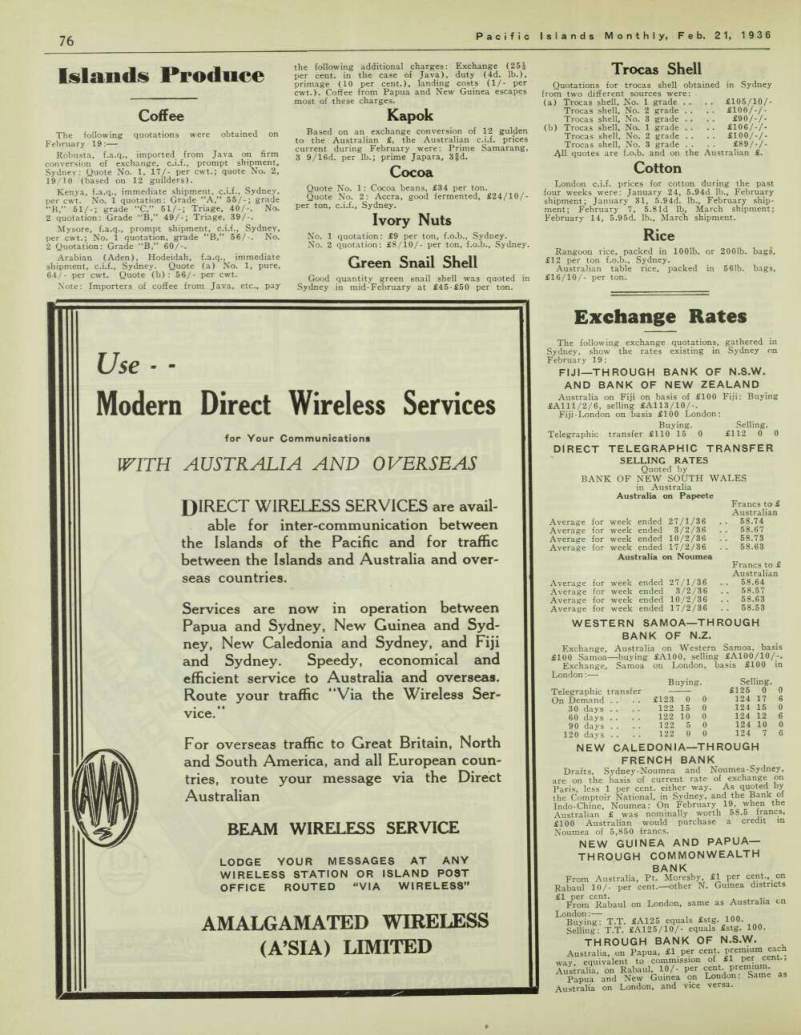
Coffee
The following quotations were obtained on February 19: — Robusta, f.a.q., imported from Java on firm conversion of exchange, c.i.f., prompt shipment, Sydney: Quote No. 1, 17/- per cwt.; quote No. 2, 19/10 (based on 12 guilders).
Kenya, f.a.q., immediate shipment, c.i.f., Sydney, per cwt. No. 1 quotation: Grade “A,” 55/-; grade “B,” 51/-; grade “C,” 51/-; Triage, 40/-. No. 2 quotation: Grade “B,” 49/-; Triage, 39/-.
Mysore, f.a.q., prompt shipment, c.i.f., Sydney, per cwt.; No. 1 quotation, grade “B,” 56/-. No. 2 Quotation; Grade "B,” 60/-.
Arabian (Aden), Hodeidah, f.a.q., immediate shipment, c.i.f., Sydney. Quote (a) No. 1, pure, 64/- per cwt. Quote (b) : 56/- per cwt.
Note: Importers of coffee from Java, etc., pay
the following additional charges: Exchange (25i per cent, in the case of Java), duty (4d. lb.), primage (10 per cent.), landing costs (1/- per cwt.). Coffee from Papua and New Guinea escapes most of these charges.
Kapok
Based on an exchange conversion of 12 gulden to the Australian £, the Australian c.i.f. prices current during February were: Prime Samarang, 3 9/16d. per lb.; prime Japara, 3|d.
Cocoa
Quote No. 1: Cocoa beans, £34 per ton.
Quote No. 2: Accra, good fermented, £24/10/per ton, c.i.f., Sydney.
Ivory Nuts
No. 1 quotation; £9 per ton, f.0.b., Sydney.
No. 2 quotation; £B/10/- per ton, f.0.b., Sydney.
Green Snail Shell
Good quantity green snail shell was quoted in Sydney in mid-February at £4 5-£5O per ton.
Trocas Shell
Quotations for trocas shell obtained in Sydney from two different sources were:
Cotton
London c.i.f. prices for cotton during the past four weeks were: January 24, 5.94 d lb., February shipment; January 31, 5.94 d. lb., February ship ment; February 7,5.81 d lb, March shipment; February 14, 5.95 d. lb., March shipment.
Rice
Rangoon rice, packed in 1001 b. or 2001 b. bags, £l2 per ton f.0.b., Sydney.
Australian table rice, packed in 561 b. bags, £l6/10/- per ton.
(a) Trocas shell. No. 1 grade . . . . £105/10/- Trocas shell. No. 2 grade . . . . £100/-/- Trocas shell. No. 3 grade . . . . £90/-/- (b) Trocas shell. No. 1 grade .. .. £106/-/- Trocas shell, No. 2 grade . . . . £100/-/- Trocas shell. No. 3 grade . . . . £89/-/- .411 quotes are f.o.b. and on the Australian £.
Exchange Rates
The following exchange quotations, gathered in Sydney, show the rates existing in Sydney on February 19:
Fiji-Through Bank Of N.S.W.
And Bank Of New Zealand
Australia on Fiji on basis of £lOO Fiji; Buying £Alll/2/6, selling £AII3/10/-.
Fiji-London on basis £lOO London; Buying. Selling.
Telegraphic transfer £llOl5 0 £ll2 0 0
Direct Telegraphic Transfer
Selling Rates
Quoted by
Bank Of New South Wales
in Australia
Western Samoa—Through
Bank Of N.Z.
Exchange, Australia on Western Samoa, basis £lOO Samoa —buying £AIOO, selling £AIOO/10/-.
Exchange, Samoa on London, basis £lOO in London:—
New Caledonia—Through
French Bank
Drafts, Sydney-Noumea and Noumea -Sydney, are on the basis of current rate of exchange on Paris, less 1 per cent, either way. As quoted by the Comptoir National, in Sydney, and the Bank ot Indo-Chine, Noumea: On February 19, when the Australian £ was nominally worth 58.5 francs, £lOO Australian would purchase a credit m Noumea of 5,850 francs.
New Guinea And Papua
Through Commonwealth
Bank
From Australia. Pt. Moresby, £1 per cent., on Rabaul 10/- per cent. —other N. Guinea districts £1 per cent. . . -.
From Rabaul on London, same as Australia on London: — , , „ .
Buying: T.T. £AI2S equals *stg. 100.
Selling: T.T. £AI2S/10/- equals £stg. 100.
Through Bank Of N.S.W.
Australia, on Papua. £l.per cent, premium each way, equivalent to commission of £1 per cent., Australia, on Rabaul 10/- per cent Premium.
Papua and New Guinea on London. Same as Australia on London, and vice versa.
Average for Australia on Papeete week ended 27/1/36 Francs to £ Australian . . 58.74 Average for week ended 3/2/36 . . 58.67 Average for week ended 10/2/36 . . 58.73 Average for week ended 17/2/36 . . 58.63 Average for Australia on Noumea week ended 27/1/36 Francs to £ Australian . . 58.64 Average for week ended 3/2/36 . . 58.57 Average for week ended 10/2/36 . . 58.63 Average for week ended 17/2/36 . . 58.53
Buying. Selling.
Telegraphic transfer £125 0 0 On Demand . . . . £123 0 0 124 17 6 30 days . . . . 122 15 0 124 15 0 60 days . . . . 122 10 0 124 12 6 90 days ... 122 5 0 124 10 0 120 days ... 122 0 0 124 7 6
Advertisements & other items, p. 78 (1 item)
Modern Direct Wireless Services
Use ■ -
for Your Communications
WITH AUSTRALIA AND OVERSEAS
DIRECT WIRELESS SERVICES are avail-
able for inter-communication between the Islands of the Pacific and for traffic between the Islands and Australia and overseas countries.
Services are now in operation between Papua and Sydney, New Guinea and Sydney, New Caledonia and Sydney, and Fiji and Sydney. Speedy, economical and efficient service to Australia and overseas.
Route your traffic “Via the Wireless Service.”
For overseas traffic to Great Britain, North and South America, and all European countries, route your message via the Direct Australian
BEAM WIRELESS SERVICE
LODGE YOUR MESSAGES AT ANY
WIRELESS STATION OR ISLAND POST
OFFICE ROUTED “VIA WIRELESS"
AMALGAMATED WIRELESS
(A’SIA) LIMITED
market Quotations
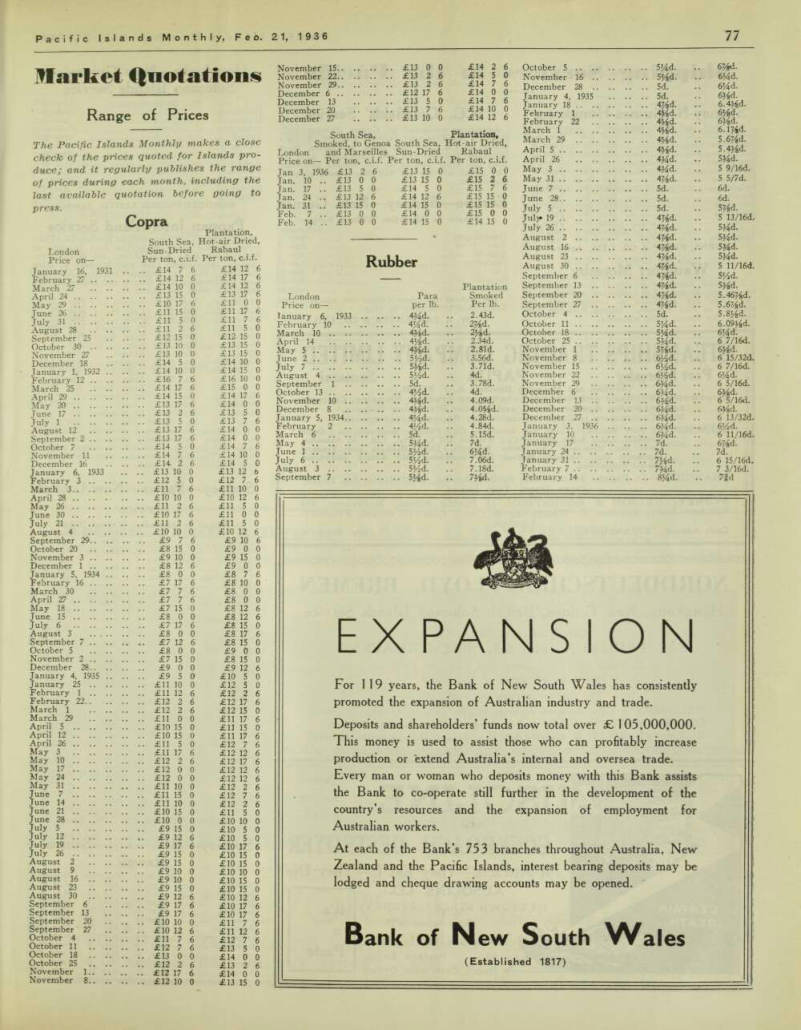
Range of Prices
The Pacific Islands Monthly makes a close check of the prices quoted for Islands pro duce; and it regularly publishes the range of prices during each month, including the last available quotation before going to press.
Copra
Rubber
November IS £13 0 0 £14 2 6 November 22 £13 2 6 £14 5 0 November 29 £13 2 6 £14 7 6 December 6 £12 17 6 £14 0 0 December 13 £13 5 0 £14 7 6 December 20 £13 7 6 £14 10 0 December 27 £13 10 0 £14 12 6 South Sea,
Plantation,
Smoked, to Genoa South Sea, Hot-air Dried, London and Marseilles Sun-Dried Rabaul Price on — Per ton, c.i.f. Per ton , c.i.f.
Per ton, c.i, Tan 3. 1936 £13 2 6 £13 15 0 £15 0 0 Jan. 10 . . £13 0 0 £13 IS 0 £15 2 6 Jan. 17 . . £13 5 0 £14 S 0 £15 7 6 Jan. 24 . , £13 12 6 £14 12 6 £15 15 0
jan. 31 .
. £13 IS 0 £14 15 0 £15 15 0 Feb. 7 . . £13 0 0 £14 0 0 £15 0 0 Feb. 14 . . £13 0 0 £14 15 0 £14 15 0
London Para Plantation Smoked Price on — per lb.
Per lb.
January 6, 1933 .. . .. 444d. 2.43d.
February 10 . .. 4^4d. 27Ad.
March 10 . .. 4Ysd. 2% d.
April 14 . •• 4/ 8 d. 2.34d.
May 5 . .. 4^d. 2.81d.
June 2 . .. sy 2 d. 3.56d.
July 7 . .. SHd. 3.71d.
August 4 . .. S^d. 4d.
September 1 . .. 5d. 3.78d.
October 13 . .. 4^d. 4d.
November 10 . .. 4^ 8 d. 4.09d.
December 8 . •• 4^d. 4.0*$d.
January 5, 1934 . .. 4'Ad. 4.28d.
February 2 . .. 4^d. 4.84d.
March 6 . .. 5d.
S.lSd.
May 4 . .. sy 4 d. 7d.
June 1 . .. sy 2 d. 6%d.
July 6 . .. 5'Ad. 7.06d.
August 3 . .. sy 2 d. 7.18d.
September 7 • .. 5^d. 7Hd-
October 5 . .. 5^d. em.
November 16 .. .. . .. 5*d. ey 4 d.
December 28 .. .. . .. Sd. ey 4 d.
January 4, 1935 . .. 5d. 6Hd.
January 18 . .. 4^d. 6.43/id.
February 1 .. .. . .. 4*id. 6^d.
February 22 .. .. . .. 4id. 6Jid.
March 1 . .. 4&d. 6.1^id.
March 29 . .. 45-id. 5.6^id.
April 5 . .. 45-id. 5.45id.
April 26 . .. 4Hd. sy 4 d.
May 3 . .. 4Hd. 5 9/16d.
May 31 . .. 47/sd. 5 S/7d.
June 7 . .. 5d. 6d.
June 28 . .. 5d. 6d.
July 5 . .. 5d. 57/sd.
Jul>» 19 . .. Wd. 5 13/16d.
July 26 . .. 4Hd. 5H d.
August 2 . .. 4*id. 5Hd.
August 16 . .. 47/id. sy 4 d.
August 23 . .. 4Hd. sy 4 d.
August 30 . .. 4Kd. 5 ll/16d.
September 6 . .. 4Jid. sy 3 d.
September 13 . .. 47/id. sy 6 d.
September 20 . .. 47Ad. 5.46^id.
September 27 . .. 47/ 8 d. 5.67/id.
October 4 . .. Sd. 5.8j/ 8 d.
October 11 . .. syd. 6.09>id.
October 18 . .. SHd. ey 4 d.
October 25 . .. 5Hd. 6 7/16d.
November 1 . .. sm 6Jid.
November 8 . .. 6^d. 6 15/32d.
November 15 . .. 6/ 2 d. 6 7/16d.
November 22 . .. 6/ 2 d. ey 4 d.
November 29 . .. 6J4d. 6 5/16d.
December 6 . .. 6Hd. 6Jid.
December 13 . .. 65id. 6 5/16d.
December 20 . .. 6J*d. 6fid.
December 27 . .. 63/d. 6 13/32d.
January 3. 1936 .. . . .. 6-Kd. ey 3 d.
January 10 . .. 6Hd. 6 ll/16d.
January 17 . .. 7d. 6Jid.
January 24 . .. 7d. 7d.
January 31 . .. 7/s d. 6 15/16d.
February 7 . .. ?y 4 d. 7 3/16d.
February 14 .. .. &/ 4 d. .. 7gd
London Price on— Plantation, South Sea, Hot-air Dried, Sun-Dried Rabaul Per ton, c.i.f. Per ton, c.i.f.
January 16, 1931 . . .. £14 7 6 £14 12 6 February 27 March 27 . .. £14 12 6 £14 17 6 . .. £14 10 0 £14 12 6 April 24 . .. £13 15 0 £13 17 6 May 29 . .. £10 17 6 £11 0 0 June 26 . .. £11 IS 0 £11 17 6 July 31 . .. £11 5 0 £11 7 6 August 28 . .. £11 2 6 £11 5 0
September 25 .. .
. .. £12 IS 0 £12 15 0 October 30 . .. £13 10 0 £13 15 0 November 27 .. . . .. £13 10 0 £13 15 0 December 18 .. . . .. £14 5 0 £14 10 0 January 1. 1932 .. . . .. £14 10 0 £14 15 0 February 12 . .. £16 7 6 £16 10 0 March 25 . .. £14 17 6 £15 0 0 April 29 . .. £14 15 0 £14 17 6 May 20 . .. £13 17 6 £14 0 0 June 17 . .. £13 2 6 £13 5 0 July 1 . .. £13 5 0 £13 7 6 August 12 . .. £13 17 6 £14 0 0 September 2 . .. £13 17 6 £14 0 0 October 7 . .. £14 5 0 £14 7 6 November 11 .. . . .. £14 7 6 £14 10 0 December 16 .. . . .. £14- 2 6 £14 5 0 January 6, 1933 . .. £13 10 0 £13 12 6 February 3 . .. £12 5 0 £12 7 6 March 3 . .. £11 7 6 £11 10 0 April 28 . 0 £10 12 6 May 26 . .. £11 2 6 £11 5 0 June 30 6 £11 0 0 July 21 . .. £11 2 6 £11 5 0 August 4 . .. £10 10 0 £10 12 6 September 29 . .. £9 7 6 £9 10 6 October 20 . .. £8 15 0 £9 0 0 November 3 . .. £9 10 0 £9 15 0 December 1 . .. £8 12 6 £9 0 0
January 5, 1934 .. .
. .. £8 0 0 £8 7 6 February 16 . .. £7 17 6 £8 10 0 March 30 . .. £7 7 6 £8 0 0 April 27 . .. £7 7 6 £8 0 0 May 18 . .. £7 15 0 £8 12 6
June IS
. .. £8 0 0 £8 12 6 July 6 . .. £7 17 6 £8 15 0 August 3 ... . 0 £8 17 6 September 7 6 £8 15 0 October S . .. £8 0 0 £9 0 0 November 2 . .. £7 15 0 £8 15 0 December 28 . .. £9 0 0 £9 12 6
January 4, 1935 .. .
. .. £9 5 0 £10 5 0 January 25 . .. £11 10 0 £12 5 0
February 1
. .. £11 12 6 £12 2 6 February 22 . .. £12 2 6 £12 17 6 March 1 6 £12 15 0 March 29 0 £11 17 6
April 5
. .. £10 15 0 £11 15 0 April 12 . .. £10 15 0 £11 17 6 April 26 . .. £11 5 0 £12 7 6 May 3 6 £12 12 6 May 10 . .. £12 2 6 £12 17 6 May 17 . .. £12 0 0 £12 12 6 May 24 . .. £12 0 0 £12 12 6 May 31 0 £12 2 6 June 7 0 £12 7 6
June 14
0 £12 2 6 June 21 0 £11 5 0
June 28
0 £10 10 0 July 5 0 £10 5 0 July 12 . £9 12 6 £10 5 0 July 19 6 £10 17 6 July 26 0 £10 IS 0 August 2 0 £10 IS 0 August 9 0 £10 10 0 August 16 . .. £9 10 0 £10 IS 0 August 23 0 £10 15 0 August 30 6 £10 12 6 September 6 ... . .. £9 17 6 £10 17 6 September 13 ... 6 £10 17 6 September 20 ... 0 £11 7 6 September 27 ... 6 £11 12 6 October 4 6 £12 7 6 October 11 6 £13 5 0 October 18 0 £14 0 0 October 25 . .. £12 2 6 £13 2 6 November 1 6 £14 0 0 November 8 0 £13 15 0
Advertisements & other items, p. 79 (1 item)
Expansion
For 1 19 years, the Bank of New South Wales has consistently promoted the expansion of Australian industry and trade.
Deposits and shareholders’ funds now total over £ 103,000,000.
This money is used to assist those who can profitably increase production or extend Australia’s internal and oversea trade.
Every man or woman who deposits money with this Bank assists the Bank to co-operate still further in the development of the country’s resources and the expansion of employment for Australian workers.
At each of the Bank’s 753 branches throughout Australia, New Zealand and the Pacific Islands, interest bearing deposits may be lodged and cheque drawing accounts may be opened.
Bank of New South Wales
(Established 1817)
Sydney—Papua—New Guinea
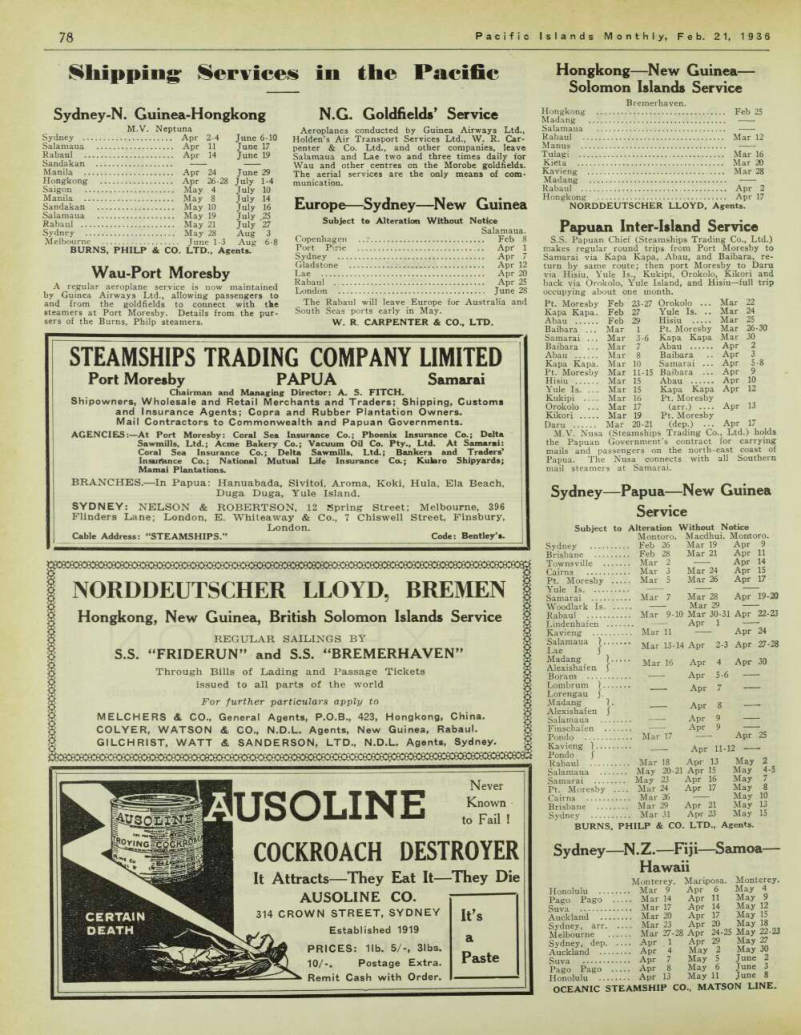
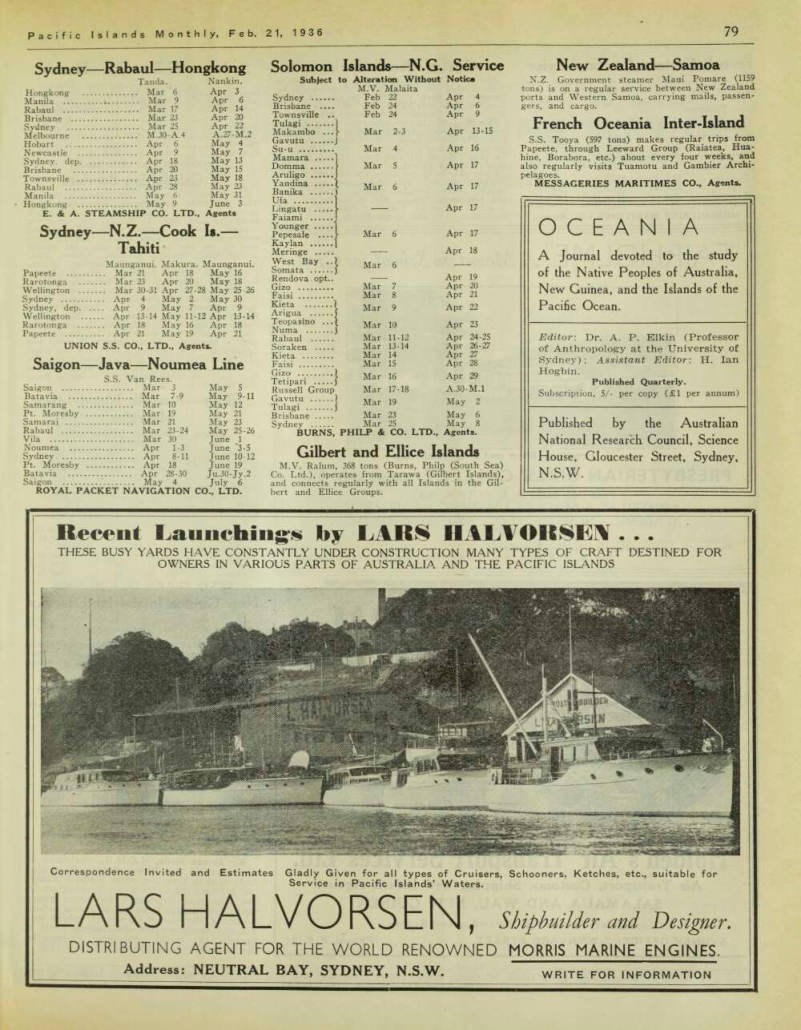
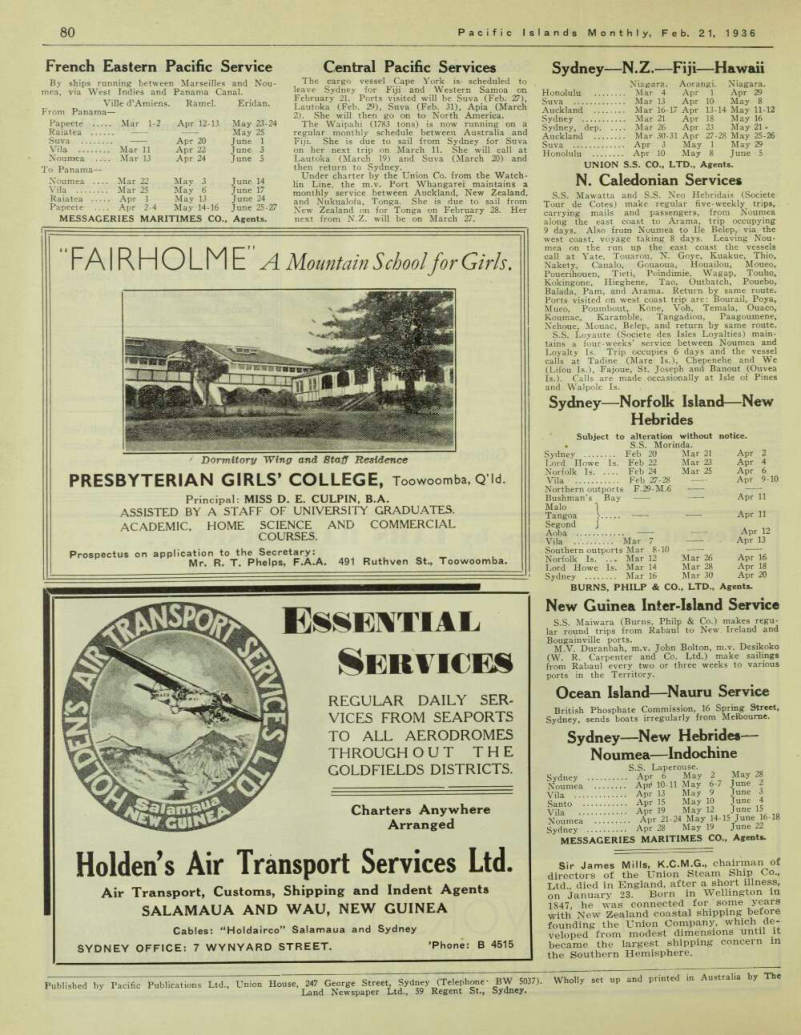
Shipping Services in the Pacific
Sydney-N. Guinea-Hongkong
Wau-Port Moresby
A regular aeroplane service is now maintained by Guinea Airways Ltd., allowing passengers to and from the goldfields to connect with the steamers at Port Moresby. Details from the pur sers of the Burns, Philp steamers.
N.G. Goldfields , Service
Aeroplanes conducted by Guinea Airways Ltd., Holden’s Air Transport Services Ltd., W. R. Car penter & Co. Ltd., and other companies, leave Salamaua and Lae two and three times daily for Wau and other centres on the Morobe goldfields.
The aerial services are the only means of com munication.
Europe—Sydney—New Guinea
Subject to Alteration Without Notice
Hongkong—New Guinea— Solomon Islands Service
Papuan Inter-Island Service
S.S. Papuan Chief (Steamships Trading Co., Ltd.) makes regular round trips from Port Moresby to Samarai via Kapa Kapa, Abau, and Baibara, re turn by same route; then port Moresby to Daru via Hisiu, Yule Is., Kukipi, Orokolo, Kikori and back via Orokolo, Yule Island, and Hisiu —full trip occupying about one month.
M.V. Nusa (Steamships Trading Co., Ltd.) holds the Papuan Government’s contract for carrying mails and passengers on the north-east coast of Papua. The Nusa connects with all Southern mail steamers at Samarai.
Sydney—Papua—New Guinea
Service
Subject to Alteration Without Notice
Sydney—N.Z.—Fiji —Samoa — Hawaii
M.V. Neptuna Sydney Apr 2-4 June 6-10 Salamaua Apr 11 June 17 Rabaul Apr 14 June 19 Manila Apr 24 June 29 Hongkong Apr 26-28 July 1-4 Saigon May 4 July 10 Manila May 8 July 14 Sandakan May 10 July 16 Salamaua May 19 July 25 Rabaul May 21 July 27 Sydney May 28 Aug 3 Melbourne Tune 1-3 Auer 6-8
Burns, Philp & Co. Ltd., Agents.
Salamaua.
Copenhagen Feb 8 Port Pirie Apr 1 1 Sydney Apr 7 Gladstone Apr 12 Lae Apr 20 Rabaul Apr 25 London June 28 The Rabaul will leave Europe for Australia and South Seas ports early in May.
W. R Carpenter & Co., Ltd.
Bremerhaven.
Hongkong Feb 25 Madang Salamaua Rabaul Mar 12 Manus Tulagi Mar 16 Kieta Mar 20 Kavieng Mar 28 Madang Rabaul Apr 2 Hongkong Apr 17
Norddeutscher Lloyd, Agents.
Pt. Moresby Feb 23-27 Orokolo ...
Mar 22 Kapa Kapa.
Feb 27 Yule Is. ..
Mar 24 Abau Feb 29 Hisiu Mar 25 Baibara ...
Mar 1 Pt. Moresby Mar 26-30 Saraarai ...
Mar 3-6 Kapa Kapa Mar 30 Baibara ...
Mar 7 Abau Apr 2 Abau Mar 8 Baibara Apr 3 Kapa Kapa.
Mar 10 Samarai ...
Apr 5-8 Pt. Moresby Mar 11-15 Baibara ...
Apr 9 Hisiu Mar 15 Abau Apr 10 Yule Is. ...
Mar 15 Kapa Kapa Apr 12 Kukipi ...
Mar 16 Pt. Moresby Orokolo ...
Mar 17 (arr.) Apr 13 Kikori Mar 19 Pt. Moresby Daru Mar 20-21 (dep.) ...
Apr 17
Montoro. ... Feb 26 Macdhui. Montoro.
Mar 19 Apr 9 ... Feb 28 Mar 21 Apr 11 ... Mar 2 Apr 14 ... Mar 3 Mar 24 Apr 15 Pt. Moresby .
Yule Is ... Mar 5 Mar 26 Apr 17 Samara!
Woodlark Is. .
Rabaul Lindenhafen ..
Kavieng ... Mar 7 Mar 28 Apr 19-20 ... Mar 9-10 Mar 30-31 Apr 22-23 Apr 1 Lae j Mar 13-14 Apr 2-3 Apr 27-28 Madang ).
Alexishafen ) Mar 16 Apr 4 Apr 30 Anr 5 -6 Lombrum )...
Apr 7 Apr 8 Apr 9 Lorengau j.
Madang |.
Alexishafen f Salamaua . ... — — F inschafen Apr 9 Apr 11 Apr 13 Apr 15 Apr 16 Apr 17 Apr 21 Pondo Kavieng 1 Pondo Rabaul Salamaua Samara!
Pt. Moresby Cairns Brisbane Mar 17 ... Mar 18 ... May 20-21 ... May 23 ... Mar 24 ... Mar 36 ... Mar 29 Apr 25 -12 May 2 May 4-5 May 7 May 8 May 10 May 13 Sydney
Burns,
... Mar 31
Philp & Co.
Apr 23 May IS , LTD., Agents.
Monterey, , Mariposa.
Monterey.
Honolulu Mar 9 Apr 6 May 4 Pago Pago Mar 14 Apr 11 May 9 Suva Mar 17 Apr 14 May 12 Auckland Mar 20 Apr 17 May IS Svdnev. art Mar 23 Apr 20 May 18 Melbourne Mar 27-28 Apr 24-25 May 22-23 Sydney, dep Apr 1 Apr 29 May 27 Auckland ..
May 2 May 30 Suva May S June 2 Pago Pago May 6 June 3 Honolulu ..
Apr 13 May 11 June 8
Oceanic
Steamship '
Co., Matson Line.
Sydney—Rabaul—Hongkong
Sydney—N.Z.—Cook Is.— Tahiti
Saigon—Java—Noumea Line
Solomon Islands —N.G. Service Subject to Alteration Without Notice
Gilbert and Ellice Islands
M.V. Ralum, 368 tons (Burns, Philp (South Sea) Co. Ltd.), operates from Tarawa (Gilbert Islands), and connects regularly with all Islands in the Gil bert and Ellice Groups.
New Zealand —Samoa
N.Z. Government steamer Maui Pomare (1159 tons) is on a regular service between New Zealand ports and Western Samoa, carrying mails, passen gers, and cargo.
French Oceania Inter-Island
S.S. Tooya (597 tons) makes regular trips from Papeete, through Leeward Group (Raiatea, Hua hine, Borabora, etc.) about every four weeks, and also regularly visits Tuamotu and Gambier Archi pelagoes.
Messageries Maritimes Co., Agents.
Tanda.
Nankin.
Hongkong Apr 3 Manila i-... ... Mar 9 Apr 6 Rabaul ... Mar 17 Apr 14 Brisbane ... Mar 23 Apr 20 Sydney ... Mar 25 Apr 22 Melbourne ... M.30-A.4 A.27-M.2 Hobart May 4 Newcastle ,... Apr 9 May 7 Sydney, dep ... Apr 18 May 13 Brisbane May 15 Townsville ... Apr 23 May 18 Rabaul ... Apr 28 May 23 Manila May 31 Hongkong June 3
E. & A. Steamship Co. Ltd.,
Agents
Maunganui. Makura. Maunganui.
Papeete Mar 21 Apr 18 May 16 Rarotonga Mar 23 Apr 20 May 18 Wellington Mar 30-31 Apr 27-28 May 25 -26 Sydney Apr 4 May 2 May 30 Sydney, dep Apr 9 May 7 Apr 9 Wellington Apr 13-14 May 11-12 Apr 13-14 Rarotonga Apr 18 May 16 Apr 18 Papeete Apr 21 May 19 Apr 21
Union S.S. Co., Ltd., Agent*.
s.s.
Van Rees.
Saigon 3 May 5 Batavia ... Mar 7-9 May 9-11 Samarang 10 May 12 Pt. Moresby ... Mar 19 May 21 Samarai ... Mar 21 May 23 Rabaul 23-24 May 25-26 Vila 30 June 1 Noumea 1-3 June '3-5 Sydney 8-11 June 10-12 Pt. Moresby Apr 18 June 19 Batavia 28-30 Ju.30-Jy.2 Saigon 4 July 6
Royal Packet
Navigation
Co., Ltd.
Sydney Brisbane ...
Townsville ..
Tulagi Makambo ...
Gavutu M.V. Malaita Feb 22 Feb 24 Feb 24 r Mar 2-3 Mar 4 Apr Apr Apr Apr Apr Apr 4 6 9 13-15 16 Mamara Mar 5 17 Yandina Mar 6 Apr 17 Ufa Lingatu — Apr 17 Younger Pepesale ...
Kaylan ...
Mar 6 Apr 17 Meringe West Bay ..
Somata J Rendova opt..
Gizo Faisi [ Mar 6 Mar 7 Mar 8 Mar 9 Apr Apr Apr Apr Apr 18 19 20 21 Kieta i 22 Arigna Teopasino ...
Numa Mar 10 Apr 23 Rabaul Soraken Kieta Faisi Gizo I Tetipari J Russell Group Gavutu i Tulagi J Brisbane Sydney
Burns,
Mar 11-12 Mar 13-14 Mar 14 Mar 15 [ Mar 16 Mar 17-18 [ Mar 19 Mar 23 Mar 25
Philp & Co. Ltd.,
Apr 24-25 Apr 26-27 Apr 27 Apr 28 Apr 29 A.30-M.1 May 2 May 6 May 8 Agents.
French Eastern Pacific Service
By ships running between Marseilles and Nou mea, via West Indies and Panama Canal.
Ville d’Amiens. Ramel. Eridan.
From Panama—
Central Pacific Services
The cargo vessel Cape York is scheduled to leave Sydney for Fiji and Western Samoa on February 21. Ports visited will be Suva (Feb. 27), Lautoka (Feb. 29), Suva (Feb. 31), Apia (March 2). She will then go on to North America.
The Waipahi (1783 tons) is now running on a regular monthly schedule between Australia and Fiji. She is due to sail from Sydney for Suva on her next trip on March 11. She will call at Lautoka (March 19) and Suva (March 20) and then return to Sydney.
Under charter by the Union Co. from the Watch lin Line, the m.v. Port Whangarei maintains a monthly service between Auckland, New Zealand, and Nukualofa, Tonga. She is due to sail from New Zealand on for Tonga on February 28. Her next from N.Z. will be on March 27.
Sydney—N.Z.—Fiji—Hawaii
N. Caledonian Services
5.5. Mawatta and S.S. Neo Hebridais (Societe Tour de Cotes) make regular five-weekly trips, carrying mails and passengers, from Noumea along the east coast to Arama, trip occupying 9 days. Also from Noumea to lie Belep, via the west coast, voyage taking 8 days. Leaving Nou mea on the run up the east coast the vessels call at Yate, Touarou, N. Goye, Kuakue, Thio, Nakety, Canalo, Gouaoua, Houailou, Moueo, Pouerihouen, Tieti, Poindimie, Wagap, Touho, Kokingone, Hieghene, Tao, Outbatch, Pouebo, Balada, Pam, and Arama. Return by same route.
Ports visited on west coast trip are: Bourail, Poya, Mueo, Poumbout, Kone, Voh, Temala, Ouaco, Koumac, Karamble, Tangadiou, Paagoumene, Nehoue, Mouac, Belep, and return by same route. 5.5. Loyaute (Societe des Isles Loyalties) main tains a four-weeks’ service between Noumea and Loyalty Is. Trip occupies 6 days and the vessel calls at Tadine (Mare Is.), Chepenehe and We (Lifou Is.), Fajoue, St. Joseph and Banout (Ouvea Is.). Calls are made occasionally at Isle of Pines and Walpole Is.
Sydney—Norfolk Island —New
Hebrides
Subject to alteration without notice. • S.S. Morinda.
New Guinea Inter-Island Service
S.S. Maiwara (Burns, Philp & Co.) makes regu lar round trips from Rabaul to New Ireland and Bougainville ports.
M.V. Duranbah, m.v. John Bolton, m.v. Desikoko (W. R. Carpenter and Co. Ltd.) make sailings from Rabaul every two or three weeks to various ports in the Territory.
Ocean Island —Nauru Service
British Phosphate Commission, 16 Spring Street, Sydney, sends boats irregularly from Melbourne.
Sydney—New Hebrides —
N oumea —Indochine
Sir James Mills, K.C.M.G., chairman of directors of the Union Steam Ship Co., Ltd., died in England, after a short illness, on January 23. Born in Wellington in 1847 he was connected for some years with New Zealand coastal shipping before founding the Union Company, which de veloped from modest dimensions until it became the largest shipping concern in the Southern Hemisphere.
Papeete Mar 1-2 Apr 12-13 May 23-24 Raiatea May 25 Suva Apr 20 June 1 Vila Mar 11 Apr 22 June 3 Noumea Mar 13 Apr 24 June 5 To Panama — Noumea Mar 22 May 3 June 14 Vila Mar 25 May 6 June 17 Raiatea Apr 1 May 13 June 24 Papeete Apr 2-4 May 14-16 June 25-27
Messageries Maritimes Co.. Agents.
Niagara. Aorangi. Niagara.
Honolulu Mar 4 Apr 1 Apr 29 Suva Mar 13 Apr 10 May 8 Auckland Mar 16-17 Apr 13-14 May 11-12 Sydney Mar 21 Apr 18 May 16 Sydney, dep Mar 26 Apr 23 May 21 • Auckland Mar 30-31 Apr 27-28 May 25-26 Suva Apr 3 May 1 May 29 Honolulu Apr 10 May 8 June 5
Union S.S. Co., Ltd., Agents.
Sydney Feb 20 Mar 21 Apr 2 Lord Howe Is. Feb 22 Mar 23 Apr 4 Norfolk Is Feb 24 Mar 25 Apr 6 Vila Feb 27-28 — Apr 9-10 Northern outports F.29-M.6 Bushman’s Bay
Male 1
— — — Apr 11 Tangoa \ —
Segond J
— Apr 11 Aoba — Apr 12 Vila Mar 7 — Apr 13 Southern outports Mar 8-10 — — Norfolk Is. ... Mar 12 Mar 26 Apr 16 Lord Howe Is. Mar 14 Mar 28 Apr 18 Sydney Mar 16 Mar 30 Apr 20
Burns, Philp & Co
Ltd.,
Agents.
S.S. Laperouse.
Sydney Apr 6 May 2 May 28 Noumea 10-11 May 6-7 June 2 Vila Apr 13 May 9 June 3 Santo Apr 15 May 10 June 4 Vila Apr 19 May 12 June 15 Noumea Apr 21-24 May 14-15 June 16-18 Sydney Apr 28 May 19 June 22
Messageries Maritimes Co., Agents-
Advertisements & other items, pp. 80-84 (2 items)
Usoline
STEAMSHIPS TRADING COMPANY LIMITED
Port Moresby PAPUA Samara!
Chairman and Managing Director: A. S. FITCH.
Shipowners, Wholesale and Retail Merchants and Traders; Shipping, Customs and Insurance Agents; Copra and Rubber Plantation Owners.
Mail Contractors to Commonwealth and Papuan Governments.
AGENCIES:—At Port Moresby; Coral Sea Insurance Co.; Phoenix Insurance Co.; Delta Sawmills, Ltd.; Acme Bakery Co.; Vacuum Oil Co. Pty., Ltd. At Samarai: Coral Sea Insurance Co.; Delta Sawmills, Ltd.; Bankers and Traders’
Insurance Co.; National Mutual Life Insurance Co.; Kularo Shipyards; Mamai Plantations.
BRANCHES. —In Papua: Hanuabada, Sivitoi, Aroma, Koki, Hula, Ela Beach, Duga Duga, Yule Island.
SYDNEY: NELSON & ROBERTSON, 12 Spring Street; Melbourne, 396 Flinders Lane; London, E. Whiteaway & Co., 7 Chiswell Street, Finsbury, London.
Cable Address: “STEAMSHIPS.” Code: Bentley’s.
NORDDEUTSCHER LLOYD, BREMEN
Hongkong, New Guinea, British Solomon Islands Service
REGULAR SAILINGS BY
S.S. “FRIDERUN” and S.S. “BREMERHAVEN”
Through Bills of Lading and Passage Tickets issued to all parts of the world For further particulars apply to MELCHERS & CO., General Agents, P. 0.8., 423, Hongkong, China.
COLYER, WATSON & CO., N.D.L. Agents, New Guinea, Rabaul.
GILCHRIST, WATT & SANDERSON, LTD., N.D.L. Agents, Sydney.
assd
OVING
Never
USOLINE
COCKROACH DESTROYER
It Attracts —They Elat It—They Die
AUSOLINE CO.
314 CROWN STREET, SYDNEY
Established 1919 PRICES: 11b. 5/-, 3lbs. 10/-, Postage Extra.
Remit Cash with Order.
It’s Paste
OCEANIA
A Journal devoted to the study of the Native Peoples of Australia, New Guinea, and the Islands of the Pacific Ocean.
Editor : Dr. A. P. Elkin (Professor of Anthropology at the University of Sydney); Assistant Editor : H. lan Hogbin.
Published Quarterly.
Subscription, 5/- per copy (£1 per annum) Published by the Australian National Research Council, Science House, Gloucester Street, Sydney,
N.S.W.
Recent Launching by LARS lIALAOUSEM . . .
THESE BUSY YARDS HAVE CONSTANTLY UNDER CONSTRUCTION MANY TYPES OF CRAFT DESTINED FOR OWNERS IN VARIOUS PARTS OF AUSTRALIA AND THE PACIFIC ISLANDS m m :ii n £ ftp Correspondence Invited and Estimates Gladly Given for all types of Cruisers, Schooners, Ketches, etc., suitable for Service in Pacific Islands’ Waters.
LARS HALVORSEN,
Shipbuilder and Designer.
DISTRIBUTING AGENT FOR THE WORLD RENOWNED MORRIS MARINE ENGINES.
Address: NEUTRAL BAY, SYDNEY, N.S.W.
WRITE FOR INFORMATION
FAIRHOLME A. Mountain School for Girls,
’ssvww I Dormitory Wing and Staff Residence
PRESBYTERIAN GIRLS’ COLLEGE, Toowoomba, Q’ld.
Principal: MISS D. E. CULPIN, B.A.
ASSISTED BY A STAFF OF UNIVERSITY GRADUATES.
ACADEMIC. HOME SCIENCE AND COMMERCIAL
COURSES.
Prospectus on application to the Secretary: Mr. R. T. Phelps, F.A.A. 491 Ruthven St., Toowoomba.
Essential
Services
REGULAR DAILY SER-
VICES FROM SEAPORTS
TO ALL AERODROMES
THROUGH OUT THE
GOLDFIELDS DISTRICTS.
Charters Anywhere Arranged
Holden s Air Transport Services Ltd.
Air Transport, Customs, Shipping and Indent Agents
SALAMAUA AND WAU, NEW GUINEA
Cables: “Holdairco” Salamaua and Sydney SYDNEY OFFICE: 7 WYNYARD STREET. 'Phone: B 4515 n *
THE WORLD’S LARGEST
AERIAL FREIGHTING SERVICE
G UINEA AIRWAYS LTD. was established in 1927; and it has grown in the following way, until it is to-day the largest freight-carrying air-service in the world: Guinea Airways Ltd. operates regular air services in New Guinea and Papua, and uses over 33 Aerodromes and Landing-grounds in the two Territories. *■ fr \» i Mm . ... ■ ■ "' *** * \ >.
One of Guinea Airways’ new 14-passenger Ford Aeroplanes, on an aerodrome in New Guinea.
AERIAL-TRANSPORT Speedy, Safe and Dependable made possible the Rapid Development of the great Morobe Goldfield, and the Consequent Enrichment of the Mandated Territory. Aeroplanes, running on Regular Schedules, without Difficulty or Delay, carried in Dredges, Crushing Mills, Cyaniding Plants, Motor Vehicles, Hydro-Electric Machinery, and Every Kind of Goods Needed by a Large and Growing European Community.
GUINEA AIRWAYS L™
LAE - SALAMAUA
HEAD OFFICE:
BROOKMAN BUILDINGS
GRENFELL STREET
ADELAIDE, S.A.
NEW GUINEA OFFICE:
LAE
MANDATED TERRITORY OF
NEW GUINEA
BRANCH OFFICES AND AGENTS AT WAU, SALAMAUA, PORT MORESBY, AND SYDNEY
V 0 a v % 6 ' i i Reschs Lager is protected hy the crown seal it refreshes and invigorates you as no other drink can. In Resch’s Lager, you get all the original freshness and
RESCHS
flavour, because it is fully protected against climatic conditions by the specially designed “Spot” Crown Seal.
oft
LAGER
H.L.12.27
80
Pacific Islands Monthly, Feb. 21, 1936
Published by Pacific Publications Ltd., Union House, 247 George Street Sydney (Telephone• BW 5037). Wholly set up and printed in Australia by The Land Newspaper Ltd., 59 Regent ot., byoney.