Advertisements & other items, pp. 1-2 (2 items)
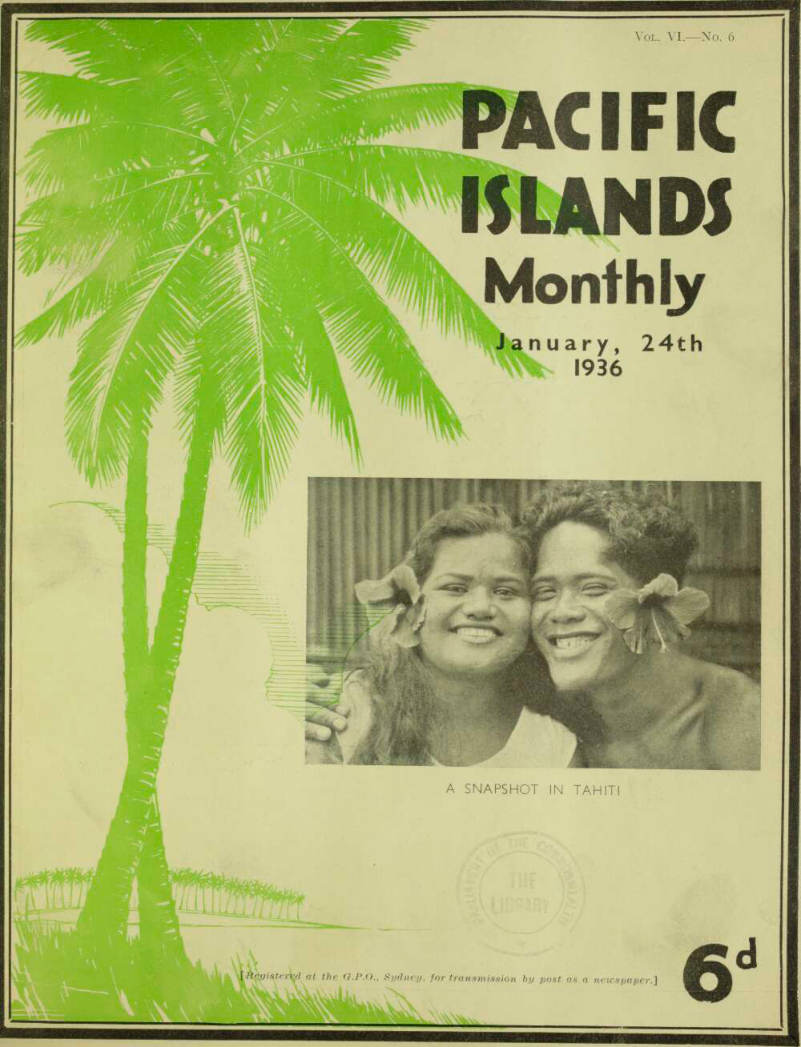
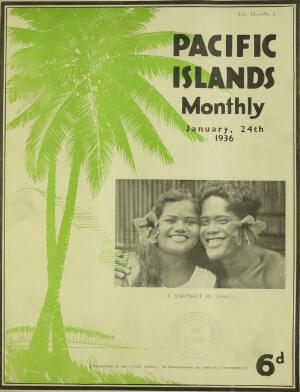
Pacific
ISLANDS
Monthly
Vol. Vl. No. 6
January, 24th 1936
[Registered at the G.P.0., Sydney, for transmission hy post as a newspaper .]
6 d
A SNAPSHOT IN TAHITI
Assisting Development and
1 Progress in
the Pacific
CINCE Australia became Responsible for the Administration of New Guinea, the 1 00-Per-Cent-Australian Firm of W. R.
Carpenter and Co., Ltd., has Devoted its Enterprise and Energy to the Sound Development of Islands Industries. It has Established Stores and Trading Stations wherever they were needed, in the Mandated Territory and the Solomon Islands.
Provided Inter-Island Shipping, for which purpose Two Motor-Vessels have been built in Australia, by Australian workmen.
Established Plantations, and assisted Australian Returned Soldiers in the Establishment of Plantations.
Built and Operated, at Rabaul, a Slip capable of handling Inter-Island Vessels.
Organised and Equipped an Aerial Transport Service (British-built, engined and manned), which now regularly carries Freight and Passengers between Salamaua and the New Guinea Goldfields centres.
Established a line of Modern Motor- Vessels, carrying Freight and Passengers between Pacific Islands and Australian Ports and Europe, on a Regular Schedule.
W. R. C. LINE
THE two Modern motor-vessels of the W.R.C. Line, namely, M.V. RABAUL (5600 tons) and M.V. SALAMAUA (6734 tons), are now carrying on a Regular Freight and Passenger Service, between European and Australian Ports, with Scheduled Calls at Rabaul and Salamaua (with calls at other New Guinea ports as required), and Dakar (West Africa) about every ten weeks. Calls at Solomon Islands, Gilbert Islands, and Fiji ports made as required.
There is comfortable accommodation for a limited number of saloon passengers on these Vessels, at special rates; but early application for Berths is recommended.
Details of Freight Rates, Passenger Fares, Timetables, etc., supplied on application at any of our Branches.
W. R. CARPENTER & CO. LTD.
Merchants and Shipowners
Agents for Australian, European and American Manufacturers, and Distributors of Every Description of Merchandise : Complete Range of all Stocks Carried.
H ead Office: 19-21 O’CONNELL STREET, SYDNEY Branches at: RABAUL (New Britain), KAVIENG (New Ireland), MADANG (New Guinea), SALAMAUA, WAU (New Guinea), TULAGI (Solomon Islands), and other Pacific Islands; and in LONDON Bayers and Shippers of: Copra, Trocas, and all Classes of Islands Produce
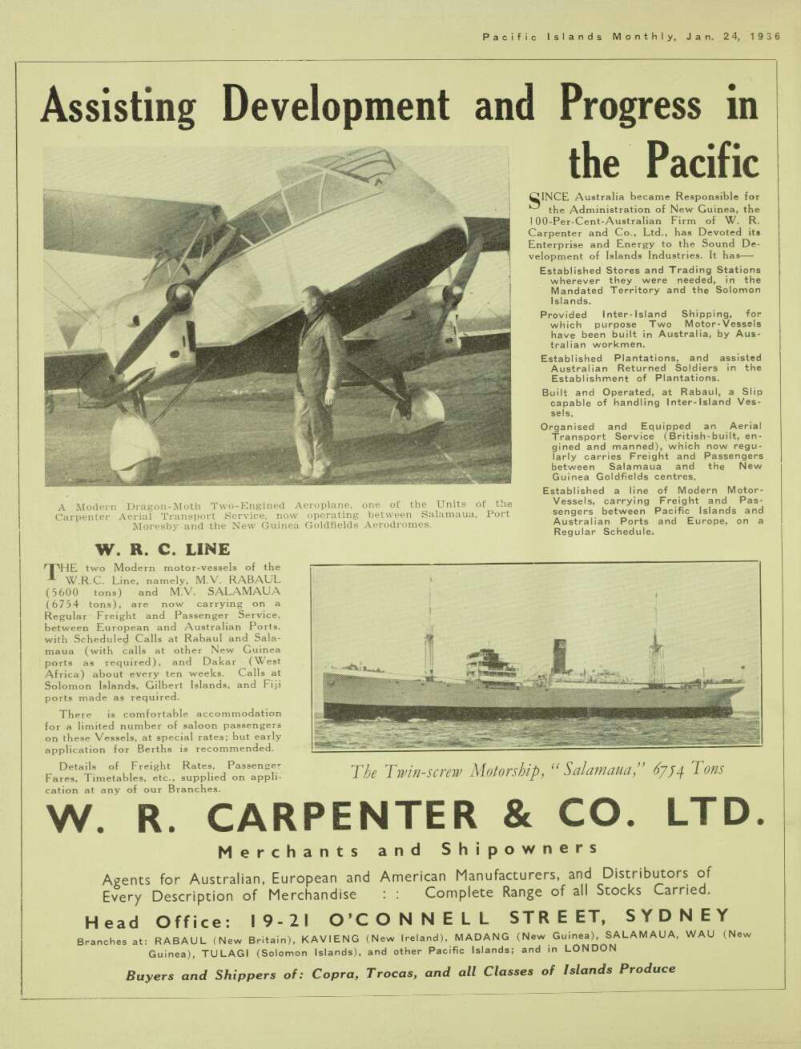
The Twin-screw Motorship, “Salamaua,” 6yjj. Tons
Assisting Development and
m. i . *1 ■ A Modern Dragon-Moth Two-Engined Aeroplane, one of the Units of the Carpenter Aerial Transport Service, now operating between Salamaua, Port Moresby and the New Guinea Goldfields Aerodromes.
Pacific Islands Travellers
Passengers Per Montoro Which Ar
RIVED IN SYDNEY FROM PAPUA AND NEW GUINEA ON DECEMBER 17: Messrs. Austin, Atkinson, Batze, Brewer, Brown, Collins, Cowie, Cook, Carpenter, Carroll, Colebrook, Comb, Dye, Eaton, Eldred, Ellis, Ely, Forrester, Freeman, Guthrie, Gardiner, Graham, Henderson, Hewlett, Hamilton, Holliday (2), Humphries, James, Jack, Joubert, King, Loose, McKoahnic, McNamee, Mc- Eacharn, Morrow, Marshall, Michell, Mitchell, Sir Hubert Murray, Napier, O’Dea, Pitmann, Pincott, Pollard, Renfrew, Rideout, Rowe, Rich, Rich, Robertson, Rudd, Schilling, Sewell, Shelley, Shop pee, Silburn, Smith, Stewart, Strathearn, Thorpe, Sheppard, Streamer, Rev. Ure, Wilkins, Wells, Blaikie Webster, Waterhouse, Winters; Mesdames Austin, Atkinson, Blundell, Brewer, Chester, Duchatel, Guinan, Holliday, Humphries, Joubert, James, Morrow, Parer, Shaw, Sheppard, Shoppee, Smith, Terry, Thompson, Ure, Blaikie Webster; Misses Bechervaise, Carter, Craig, Claremant, Cooper, Kirkland, Leeder, McAlpine, Smith.
Passengers Per Morinda From New
Hebrides, Norfolk Is., And Lord Howe
IS.. WHICH ARRIVED IN SYDNEY ON DE CEMBER 18: Messrs. Ashton, Ainsworth, Bailey, Bradley, Chaffer, Crowe, Eagor, Ellis, Fenton, Fletcher, Folks, Gill, Heath, Ironside, McKay, Miller, McKinney, MacKenzie, Nichols, Powell, Paton, Quested, Roberts, Reynolds, Seaborn, Shaw, Sparke, Spooner, Tanner; Mesdames Anderson, Chaffer, Bailey, Collins, Cox, Dignam, De Groen, Glover, Hillman, Heath, Lucas, McGrath, McKay, MacKenzie, Meyes, Pettigrew, Paton, Purdic, Evans; Misses Adam, Bear, Bright, Browne, Dar gan, Fisher, Hargreaves, Junor, MacArthur, Me- Loughlin, Murphy, MacKenzie, Miller, Newman, Yates.
Passengers Per Macdhui Which De
Parted From Sydney For Papua And
New Guinea On December 18: Messrs.
Angelo, Baldwin, Bergstrand, Dickinson, Dillon, Emery, Edwards, Fitch, Greig, Marshall (2), Munro, Noble, O’Donnell, Page, Pierce, Peper, Sutton, Skelly, Smith, Swinson, Sheekey, Smith (2), Sanderson, Simpson, Tomlinson, Tudor (2), Williams, Woodhouse, Winters; Mesdames Bay liss, Baldwin, Brennan, D’Arcy, Drayson, Greig, Gordon, Herford-Smith, Hughes, Marshall, Mc- Lennan, Parsonson, Patterson, Russell, Shennan, Smith, Sloss, Tomlinson, Upson; Misses Andrews, Blake, Cooper, Denning, Elliott, Holmes, Herford- Smith, Hughes (2), Holcombe, Henley, Humphries, Mills, MacGregor, Oakes, Pech, Peterson, Skelly.
Passengers Per Mariposa Which
Arrived In Sydney On December 30:—
Mrs. A. K. Aspinall, Master R. Aspinall, D. Bar low, C. C. Barry, W. Brown, Mr. and Mrs.
A. Brooks, Miss M. Brooks, Mrs. F. Brooks.
C. Chewings, Mrs. E. C. Clinton, Mr. and Mrs.
W. Doran, Miss I. Featherstonehaugh, Dr. W. E.
Giblin, R. P. Harricks, Mr. and Mrs. D. Johnston, F. Mars, R. May, Mr. and Mrs. E. Morgan, Master L. Morgan, H. Phillips, G. Rolph, D.
W. Robertson, Mrs. L. G. Rose, J. B. Theodore, G. Truman, Dr. L. Werz, J. Adams, A. Andrews, Miss E. Atkins, Miss B. Johnson, C. Jorgen son, Miss I. P. Knight, J. W. Mason, R. H.
Niblett, D. Paris, A. Radley, C. Ricetti, J.
Sharpies, R. J. Slattery, Miss B. Tall, Mrs. E.
M. Thompson.
Passengers Per Aorangi Which Left
SYDNEY FOR SUVA ON JANUARY 2: R. Boyd, Miss D. Gilden, Miss E. Colquhon, Mr. Ramsay, Mr. and Mrs. O. Cobb, Master B. Cobb, Mr. and Mrs. M. French, Miss E. H. Despaud, Mrs. N.
Price, N. Hunter, Miss N. E. Cobb, Miss V. Ginns, Miss E. Buxton, Mrs. S. N. Ramsay, Miss F.
Blacklock, Miss Andrews, J. I. Ball, Col. and Mrs.
P- J- Wilkinson, A. D. Upton, L. Brown, Miss I. M. Brown, Miss E. Edwards, S. T. Buckle, W.
A. H. Lodder, Miss M. A. Baum, Mr. and Mrs.
C. Kendrick, Master J. Kendrick, Mrs. R. S.
N. Milliken, D. MacDonald, G. W. Meiers, Mrs.
R. Slater, M. Bousquet, Rev. Father J. C. Ver baeys, Mr. and Mrs. N. Bellchambers, Masters S. D., and L. Bellchambers, Misses 8., V., and E. Bellchambers, V. G. Clarke, A. M. Sail, M.
W. Burrows, Mrs. A. G. Weight, Mrs. M. Yeats, Master W. Yeats, Mr. Land, R. S. M. Milliken, M. Vithal, J. A. Sinclair Burke.
R Per Mariposa Which
LEFT SYDNEY FOR SUVA ON JANUARY 8; Mrs. A. Allen Master K. Allen, Miss Baxter, S „ K - • lgr^l! ’ Adam Boyd, Mr. and Mrs. P. T.
Cahill, Muss E. Challand, Mrs. I. M. Cooper, Miss V, f- C 2?.P er > T Dr - Loftus Hills, Miss A. Hunter, Major Clive Joske, Mrs. E. Kearney, Miss K.
Kearney, Miss A. Kennewell, D. A. Leach, Mrs.
B. Lennon, Mr. and Mrs. H. McSpedden, Mr. and Mrs. C. Moss, Miss P. O’Donnell, Miss E. Prahl, Mrs. T. Saker, Mrs. N. Sonenberg, Miss S.
Sonenberg, Mr. Stannon, Mr. and Mrs. B. Wil son, Rev. Father H. Bousquet, Mrs. E. M. Faddy, R. Jolly, L. Jones, P. Jones, W. Jones, A. T.
Lowe, Miss D. Moore, Mr. and Mrs. E. Newman, Miss B. L. Newman, Miss F. Nunn, A. E. Potter, Mr. and Mrs. C. Storck, J. H. Tovey, Rev. Father A. J. Verbaeys, W. Wassilli, Mr. and Mrs. L. R.
Ward, Master K. R. Ward.
Passengers Per Morinda Which
Sailed From Sydney For Lord Howe
IS.. NORFOLK IS., AND NEW HEBRIDES ON JANUARY 8: Messrs. Allen, Anderson, Ainsworth, Austic, Aiken, Brown, Bestic (2), Barf, Blundell, Cook (2), Chapman. Flack, Forsyth, Greenwood, Hay (2), Heath, Sir Hubert Murray, McLeod, Mason (2), Nicholls, Olle, Perry, Pearcey, Ranken, Roberts, Stowe, Start. Stanger-Leathes, Tucker, Troughton, Twiss, Wilson, Wallis, Young; Mes dames Allen, Brown, Browne, Blundell, Flack, Hay, Heath, Hankinson, King, Mason, Olle, Ranken, Retmock, Start, Williams, Young; Misses Ander son (2), Blackburn, Baxter, Carroll, Fenton. Hey den, McGlenahan, McDonnell, McArthur, Mackay, McCowage, Nobbs, O’Brien, Tanner, Wilson.
Passengers Per Malaita Which Sail
ED FROM SYDNEY FOR SOLOMON IS. AND RABAUL (N.G.) ON JANUARY 9: Messrs. Ault, Boardman, Burnell, Buchanan, Bennett, Bowman, Cullen, Davis, Dickes, Dethridge, Goodwin, Grey, Helm, Howes, Johnston, Kwaszynski, Luttrell, Murray, Middleton, McMenamin, O’Brien, Rawson, Simpson, Summerland, Shearwin, Urquhart, Wager, Webeck Father Weber, Walker, Younger; Mes dames Bignell, Cox, Cameron, Dickes, Downward, Grey, Howes, Mason, Maw, Mcßride, Minto; Misses Allen, Downward, Jones, Weller, Wilson, Sisters Hortense, Sylvester, and Stephanie.
Passengers Per Montoro, Which
Sailed From Sydney For Papua And
NEW GUINEA ON JANUARY 11: Messrs. At kinson, Bowman, Barwick, Broadhurst, Blackman, Breghin, Blanden, Boyd, Bortagnon, Cattell, Cameron, Chenoweth, Carter, Collins, Creswick.
Chapman, Castle, Condren Chester, Clarence, Father Chabot. Deards, Downs. Egan, Eilertz, Eaton, Finn, Flower, Gibbons, Hawker, Hender son, Hall, Hadley. Hill, Halliday, Hides, Imlay, Irwin, Johnson, Kiley, Ledoux, Captain Loose, Melvin, Mader, Mollison, McEwan, McClennan, Meldrum, Mcßae, Montgomery, McLaughlin, Mc- Kenna, Middleton, McConnon, Captain Nursey, O’Dea, Oldham, Pender, Rutherford, Rutledge, Donners, Shotton, Smith, Shanahan, Stevenson, Scott, Smythe, Spychigor, Turner, Vinall, Ward, Wiltshire, Wilson, Whelan, Woof, Warner-Shand, Wood, Yates, Zoffman; Mesdames Broad, Blanden, Drane, Griffiths, Gills, Hall, Hill, Keith, Lowe, Lewis, Thomson, Oldham, Pentland, Robinson, Shotton, Turner, Ward; Misses Cooper, Gale, Kirk land, Luttrell, Loxton, McDougall, Snelson, O’Dea, Turner, Twomey.
Passengers Per Van Rees Which
Arrived In Sydney From Papua, N.G.,
Vila. And Noumea On January 14.—Wil
son White, L. Kingdon, Mr. and Mrs. C. Cham pion, W. T. Korn, J. M. Bourke, T. M. Ford, Mr. and Mrs. M. A. Nag, J. Comb, Miss Tonkin, Mr. and Mrs. R. N. Wayne and infant, Dr. L.
Fuhrmann, Mrs. J. A. Stevens, F. Bryen, B.
George, F. Kane, C. F. Cowley, Mrs. C. I. Hill, J. Suzor, Mrs. O. Sullivan, P. O. Sullivan, Mrs.
V. M. Bouchet, A. Le Leizour, Mrs. L. Leizour, V.
Soury Lavergne, Mrs. J. Barbancon, Mrs. P. Leb reton and child, L. Fry, Mrs. L. Lancaster, Miss A. Vincent, Mrs. M. Begand, L. Burkard.
Mr. A. R. Barrett, S.D.A. missionary of Marovo Lagoon, Solomon Islands, who is spending his furlough in Tasmania, went across to Melbourne early in January to attend the Seventh Day Adventist Mis sion’s camp at Preston, Victoria. He is a former resident of South Australia.
Advertisements & other items, p. 3 (1 item)
Saicon-Batavia-Samarang-Port Moresby
„« ; » "«««** - » Ol , v o o'^
I<f l> ”*■*£
b» te c vetV ' V»»* „ate c 1 p, C '"V» " ot et tv, ft d»V* *«»*? tW» e * J t eb c \ tb< cC c in» ta ,\ a t » n( \ GW cS . m a n A to a V vs - * v °£ ta b\^ 9 6 .
P oV,d */6, 2 * £d st t °ChA'. % C c ! , 7^n^ i ‘st^ cr
FOR SAFETY’S SAKE. SAY "VINCENTS’
SAICON-BATAVIA-SAMARANG-PORT MORESBY
SAMARAI-RABAUL-PORT VILA-NOUMEA
SYDNEY - PORT MORESBY - BATAVIA - SAIGON
bi-monthly by the "VAN REES"
You will enjoy travelling by this popular, fast and modern steamer of the K.P.M., noted for its comfort, excellent cuisine, and economical fares.
With a fleet of over 130 vessels the K.P.M. Line is in a position to accept cargo tor all ports in Netherlands India, and with transhipment at Batavia for Africa.
ROYAL PACKET NAVIGATION CO.
Paketvaart House, 255 George Street, Sydney
Diethelm & Co., Saigon; E. A. James, Port Moresby; Whitten Bros., Samarai; W. R. Carpenter & Co. Ltd., Rabaul; Gubbay Freres, Port Vila; Carlo Leoni, Noumea.
Advertisers
Page Adams. Ltd., Wm. 36 Alois Akun & Co. .. 44 Amalgamated Wire less of Aust. Ltd. 76 Arnott’s Biscuits .. 61 Ausoline 66 Bank of N.S.W. ... 19 Barrington, D.Y.5... 42 B. & S. Agency ... 16 Belvedere 58 Bentley, E., & Sons 46 Berger & Sons Ltd. 16 Bernhard, H 66 Blatticide Co 53 Breckwoldt & Co. .. 50 Broomfields Ltd. .. 27 Brunton’s Flour ... 56 Bullivants Ltd 47 Burns, Philp & Co. 2 B.P. Magazine 29
B.P. (S.S.) Co 35
Buzacott Ltd 37 Capell, J 52 Carfax Agency ... 19 Carpenter, W. R.
Ltd ii Cent. Q’land Meat Co 39 Chivers & Co. Ltd. 28 Coleman Quicklite.. 22 •Coles. A. H. J 50 Coral Starch 57 Corrie Tea Co 12 Cousins, R. Y 49 Crookhaven Hotel... 15 Crossle, Duff and Macintosh Ltd. .. 68 ■“Crowle House” ... 59 Cuprinol 53 Curios Wanted 43 Dadson, A. J 17 Dexter, Henry 38 Doan’s Pills 26 Donald, A. B. Ltd. 65 Doyle, T. G 66 Eaton Ltd.. L W. 36 Electrolytic R. & S.
Co. Ltd 70 Elvy & Co. Ltd. .. 13 Erg Batteries 75 Excelsior Supply Co. 44
Page “Fairholme” College 20 Fellows, S. J. & E. 69 Field, Cedric 17 Finau, Wm 25 Fletcher & Son ... 48 Flynn, Mrs. W. ... 75 Ford Sherington Ltd. 12 Ford. Walter 12 Ford; W. M 47 Forster’s Bedsteads 26 Foster & Sons, Geo. 68 Foster Clark (Aust.) Ltd. ... 33 Freeman’s Sports Stores 51 Fryer, A. C 77 Garden Vale Products 34 Garrett & Davidson 46 Gillespie’s Flour ... 34 Goodwin, A. E 71 Grand Pacific Hotel 64 Guinea Airways Ltd. hi Gunn & Moore Ltd. 29 Hallstrom, E 54 Halvorsen, L 79 Harper. M 50 Holbrook’s Ltd. ... 35 Holden’s Air T. ... 80 Hopewood House .. 13 Horne, W. & Co. 62 Hotel Gnd. Central 20
1.C.1.A.N.Z 74
Insular Lamps Ltd. 49 Jackson, Stanley .. 14 Jang Hing Loong .. 62 Jantzen (Aust.) Ltd. 14 Jones & Co., Henry 23 Jones & Rickard .. 77 Joubert & Joubert.. 58 Kerr Bros. Ltd 28 Koko-Maricopas Co. 59 Kodak Pty. Ltd. .. 25 Kopsen & Co. Ltd. 77 Kork-N-Seal Ltd. .. 54 Kriesler (Aust.) Ltd. 17 Lane & Girvan Ltd. 50 Leica Photo Co. ... 30 Love. Ltd., J. R. •• 22 Mcllraith’s Ltd. ... 24 McKay, D. 26 Maleham & Yeomans 29
Marr, E. A 70 Maxwell Porter Ltd. 36 Melbourne Hotel ... 62 Morris, Hedstrom Ltd 18 Mowbray House ... 60 Mungo Scott Ltd. .. 39 Napier, Gardiner & Co 16 National Research Council 71
N.D.L 78
Nelson & Robertson 55 New Brit. Express.. 56 Newlands Bros. Ltd. 45 Nicholson & Foster 37 Noyes Bros. Ltd. .. 47 Pacific Hotels 40 Pacific Taxis 63 Paul & Gray Ltd. .. 55 Peel & Sons, H. .. 57
Phillips & House .. 45 Pier Hotel 63 Pike Bros. Ltd 30 “Positions Wanted’’ 19, 67 Prescott Ltd 56 Prouds Ltd. 41 Ransomes, Sims & Jeffries Ltd 54 Reed, Wm. E 32 Reid, W. M 48 Rohu, Sil 31 Rolls Razor Co. Ltd. 31 Roseville Girls Col lege 58 Royal Packet Co. Ltd. 1 Russell, S 77 Ruston & Hornsby 67 Rutty & Co., M. .. 46 Samson, A. J 12 Savage, W. & Co. .. 72
Scott, Ltd., J 52 Scott & Sons 53 Shopping Service .. 16 Simplex Baltic Co.. 32 Springwood L. Col 75 Stanley Chris 23 Steamships T. Co. .. 78 Sterling Varnish Co. 11 Stromberg Carlson (A/sia.) Ltd 21 Summerbell, A... 34, 78 Swallow & Ariell .. 38 Sydney Steel Co. .. 77 Talkeries 28 Tamarang Hostel .. 60 Taubman’s Paints .. 42 Taylor & Co., A. .. 49 Thompson Engineer ing Co. Ltd 43 Thornthwaite, H. G. 27 Tillock & Co. Ltd... 23
Tooheys Ltd 15 Tooth & Co iv Trinity Grammar School 75 Trufood 22 Tudor Hotel 13 T.W.H. Paint 48 Vincent’s A.P.C. ... 1 Wallis, J. B. & Co. 72 Walvon Kennels ... 66 Wentworth Hotel .. 29 West, H 27 West’s Wheels ... 69 Weymark & Son .. 56 Wheeler, B. R 31 White Pty. Ltd., Co. 18 Wills, W. D. &.H. O. 31 Williams Pty. Ltd. 73 Williams. W. H. .. 65 Wright & Co., E. .. 52 Wunderlich Ltd. ... 42
Contents
Page Pacific Islands Travellers 1 Reactions to Newspaper Criticism .. 3 B.P. Ships and Strike 4 Copra Market Buoyant 5 Hurricane in Western Pacific . . 5 Trans-Pacific Air Services 6 Fanning and Washington Is. Sold . . 6 Lord Moyne’s Yacht in Papua and the Mandated Territory .. .. 7 Aerial Transport in New Guinea .. 7 Boat Lost in Samoa 8 The “Wampit Rush” 8 Polynesian Powhiri for Lord Beau champ 9 The “Japanese Menace” 9 Preference for Islands Tea 10 Petroliferous Geyser in Dutch N.G. 10 Tropicalities 11 About Islands People 12 Profit-Makers on N.G. Goldfields . . 14 A Papuan Axe-Head 16 Condition of Little Settlement on Sunday Island 17 Salamaua in the “Rush” Days .. .. 19 Samoan Mau and N.Z. Elections .. 22
Page Making Artisans Out of Papuan Natives 23 The Wealth of Bulolo G.D. Company 27 Pages From the Past —Case of the Schooner Norval 28 Death of Mr. J. A. Philips (Tahiti) 33 “Mutiny on the Bounty” Film .. .. 35 Future of Solomon Islands 36 S.I. Council Meeting 38 Men Who Knew Yesterday—4. “Fox of Melanesia” 41 “Joseph Conrad” at Tulagi 43 A Movie-Cameraman on Rennell Is. 44 Mosquitoes in the Tropics 46 An Epic of Papua 49 Solomons Gold Search 50 Kwato Mission and Trading .. . . 57 Fashion Hints for Islands Women .. 58 Housekeeping in the Tropics .. .. 60 Future Government of Fiji 62 Education of Pacific Races 65 What are N.G.’s Chief Needs? .. .. 67 Pacific Mining Reports 68 Sir Walter Randolph Carpenter .. 73 Shipping Services in the Pacific . . 78
Advertisements & other items, p. 4 (1 item)
Burns, Philp & Co. Ltd.
GENERAL
MERCHANTS
• ■' ' -f.
IB ua'ii 111 • V.. i HD Hi 111 IP in ■K
SHIPOWNERS
TOURIST AGENTS
Head Office; 7 Bridge Street, Sydney—Australia Code Address: "Burphil"
BUYERS OF ALL CLASSES OF ISLAND PRODUCE Regular Steamer Services from Australia to New Guinea — Papua Solomon Is.—Lord Howe Is.—Norfolk Is.—New Hebrides—Java and Singapore
Pacific Islands monthly
The Newspaper Magazine of the South Seas [ Registered at G.P.O., Sydney, for transmission by post as a newspaper ] Published Once Each Month and Circulated in Australia and New Zealand and in the following Pacific Territories and Islands Groups:
Crown Colony of Fiji.
Australian Territory of Papua.
Mandated Territory (Australia) of New Guinea, Bismarck Archipelago and Northern Solomon Islands.
Mandated Territory (Japan) of Marshall, Caroline and Marianna Islands.
French Territory of New Caledonia.
British and French Condominium of New Hebrides.
American Territory of Eastern Samoa.
American Territory of Guam.
Mandated Territory of Nauru.
British Crown Colony of Gilbert and Ellice Islands.
Mandated Territory (New Zealand) of Samoa.
British Solomon Islands Protectorate.
British Protectorate of Tongan Islands.
New Zealand Territory of Cook Islands.
Australian Territory of Norfolk Island.
French Colony of Oceania (Tahiti, etc.).
American Territory of Hawaiian Islands.
Owned and Produced by Pacific Publications Ltd., Union House, 247 George Street, Sydney.
Telephone Bw 5037
P.O. Box 3408 R
Contributions Articles, Stories, and Photographs dealing with Pacific Islands Subjects are invited, and will be paid for on publication at usual rates.
Subscription Rates
Per Annum, within British Empire, Prepaid Post Free 6/- Pcr Annum, elsewhere, prepaid, Post Free .. 8/- Single Copies 6d.
Editor and Publisher:
R. W. Robson.
Advertisements
Advertising rates furnished on application.
Colours, etc. by Arrangement.
Process Blocks made at Advertiser’s expense when required. Screen, 100.
Changes of Advertising Copy should reach this Office by Bth of each month, otherwise previous advertisement may be repeated.
Registered Address for Radiograms and Cables: “PACPUB” Sydney Agents The following are authorised to receive subscrip tions for “The Pacific Islands Monthly”— Islands Branches of Burns, Philp & Co., Ltd., and Burns Philp (South Seas) Co., Ltd.
Islands Branches of W. R. Carpenter & Co., Ltd.
All Branches of Morris, Hedstrom & Co., Ltd.
G. Thomas & Co., Rabaul, New Guinea.
Whitten Bros., Ltd., Samarai, Papua.
P. Costello, Suva, Fiji.
J. Muir, Suva, Fiji.
All Branches and Representatives of W. H. Grove and Sons, Ltd., Auckland, New Zealand.
S. Russell, Papeete, Tahiti.
Cook Islands Trading Co., Rarotonga, Cook Is.
Vol. VI., No. 6
Sydney, January 24, 1936
I 6d. Per Copy. * Tice Prepaid: 6/- p.a.
Reactions To Newspaper Criticism
N OT long ago an important person — very important, insofar that he is to an extent associated with companies controlling millions of pounds of sub scribed capital —became angry because we had criticised adversely certain of his activities. So he threatened the Pacific Islands Monthly with extinction; and he went to the length of interviewing certain advertisers, and informing them that they would incur his costly dis pleasure if they continued to support “that rag.” The advertisers —to their credit be it said —were rude to him, and continued to advertise.
This is by no means an isolated case.
In the 5J years that have elapsed since I established this journal, and began to tell the truth, as I see it, I have been threatened with divers punishments and penalties. There are two classes of men who cannot bear newspaper criticism — the thick-necked plutocrat, accustomed to the grovelling obedience which is commanded by wealth; and the pin headed bureaucrat, who is convinced that he and his regulations cannot pos
sibly be wrong. Their reactions to cri ticism are quite different.
The plutocrat probably shouts and waves his arms, and seeks means by which he can stamp upon the neck of his critic. “Who owns this rag?”
“Where does its revenues come from?” — and off he goes, to use his money-power either to get at the owner, or scare off the newspaper’s customers. So far, this class of gentleman has done me little harm. I am myself the owner of this paper, and I am not easily scared. I know of only two advertisers, among the hundreds who support us, who have been driven out of the P.I.M. by malignant influences of the kind described.
The offended office-holder is a more difficult proposition. Monsieur Money bags, who uses his wealth in monopo listic fashion for anti-social purposes, is a public enemy, and can be dealt with like any other menace. But the acts by which Monsieur Bureaucrat arouses cri ticism are committed, almost always, with the best of intentions. It is simply that he is a fool, or a man whose judg
ment is coloured by his prejudices, so that he uses his authority, unconsciously, in unjust or oppressive fashion. A posi tion of administrative authority de mands, not only knowledge and experi ence, but also clear vision—especially in relation to the future —and a judicial mind; and many men reach those posi tions by length of service, industry, and loyalty, and are without the judicial and visual equipment. They protect their positions by hanging on to the letter of their well-thumbed books of regulations; and they reply to criticism by spitting venom. This factor —the “personal equation” —is well recognised by critics of public administration, and due allow ance is made therefor by fair-minded men.
Certain Islands bureaucrats who have been under criticism have shown their teeth, in no uncertain fashion, to the Pacific Islands Monthly. They have used their official authority sparingly; but their personal influence has been active and savage. They even have attempted, on occasion, to enlist the aid of commercial and financial interests in a campaign against this journal. We have been aware of these things, but we
have attempted no retaliatory action.
Human nature is the same, the world over. Allowances must be made.
But, in view of one or two recent in cidents, it is perhaps desirable that I re state the position and policy of the Pacific Islands Monthly. The journal is owned by Pacific Publications Ltd., and I own all the shares in that company.
So long as I and the company pay our debts, I shall remain the owner. Ag grieved gentlemen, therefore, are only wasting their time in seeking elsewhere for owners of the journal, who might be induced to put a muzzle on me.
So far as our aims and objects are concerned, we never have deviated from the policy we announced in 1930 —publicity service for the Pacific Islands ter ritories. That embraces a multitude of things, summed up as co-operation with all interests concerned to obtain better administration, better trade, and better living conditions. Looking back over the years, we can claim fairly that we have been of assistance in many ways to residents, to trading interests, and to the Administrations.
Certain things that we did brought us no pleasure in the doing. We gave very much offence to various worthy officials of New Guinea because of our agitation in the Larkin case; but we believed—and still believe—that James Larkin was cruelly over-punished for the crime he committed. We made bitter enemies by our criticism of New Guinea Goldfields Ltd.; but we believed—and still believe —that that monster concern has done dis service to the Territory of New Guinea by squatting unprofitably for so long on so rich a section of the New Guinea goldfield. We have given offence to some Fiji interests because we wholeheartedly support the Governor’s policy in relation to the constitution and franchise; but we believe that the Governor’s view is the long-sighted view, and will best serve British Imperial interests in the Pacific. We have been criticised because we do not attack “the big firms”; but the primary purpose of the big firms is to make profits for their shareholders, and, so long as they make them without oppression, cruelty or tyranny, and pro vide efficient services, it is not our busi ness to attack an accepted and legitimate
system.
R. W. Robson.
Mr. “Jock” Mclntosh, overseer of the Colonial Sugar Refining Co. Ltd. at Ba, Fiji, was swept from his horse and drowned while crossing the Ba River on the night of January 2. Mr. Mclntosh, who was married, was well known in Suva and the northern district of Fiji.
B.P. Fleet
All Running Despite Strike
T'HE whole of the Burns, Philp and Company’s Pacific Islands fleet was affected by the Australian seamen’s strike, and for a time it appeared that Pacific Islands residents would be caused serious inconvenience.
The Macdhui, Morinda, Malaita and Mon toro, however, were got away with volun teer crews with remarkably little delay, and the Pacific Islands services on the whole have not suffered very grave de rangement. Both the ship-owners and the Pacific Islands residents have suffered a good deal of loss and inconvenience—but it was small compared with the loss borne by the owners of Australian coastal liners
whose vessels have been tied up for nearly two months.
The B.P. timetables, of course, have been thrown completely out of gear, and those which have been tentatively arranged this month are still subject to “strike condi tions permitting.”
At the moment of this writing, January 22, it appears that the strike is collapsing, and it may be taken as reasonably certain that the Papua, New Guinea, Solomon Islands and New Hebrides services will be regularly maintained.
Islands residents have every reason to compliment Messrs. Burns, Philp and Co.
Ltd. upon their success in getting their ships moving with such little delay. The seamen on this occasion were in a particu larly ugly mood, and completely under the dominance of the militants; but the old B.P. firm apparently has among its ships’ crews a nucleus of solid, loyal men who stand by it in an emergency in very help ful fashion.
Advertisements & other items, p. 6 (1 item)
A Modern St. George Deals With A Very Modern
DRAGON
SAINT FLETCHER AND THE FIJI WILD CAT —Cartoon by “Rox”
Copra Price
Market Still Buoyant
THE copra quotation continues to rise, and there is joy accordingly through out the Pacific territories. The cheery figures may be seen on page 77 of this issue.
Copra interests generally take a con fident view of the immediate future. It is said that one factor in raising the price is a demand for munitions-making pur poses, copra containing certain ingredients which are in demand for explosives.
Another factor, however, is the certainty that there will be only a limited amount of Antarctic whale oil.
Still another factor is the extraordinary action taken by the Supreme Court of the United States of America in declaring as unconstitutional all that far-reaching legis lation brought into operation by the Federal Government to assist economic re covery. The processing taxes, which re present a source of enormous revenue, were swept out of existence by this de cision. There is no doubt that the intro
duction of the processing taxes last year had a bad effect on the world copra market, insofar that they shut out a considerable quantity of Philippines copra and turned it on to the European market. It is now assumed that this copra will go back to the United States.
There also is a shortage of tallow and cotton seed oil in U.S.A.
In spite of war alarums and excursions there is no doubt that a substantial sec tion of the world is enjoying a return to economic prosperity, and that, of course, must assist the prices of all primary com modities, including copra.
Papuan Reconnaissance by Air
Unknown Central
N. Guinea
AN aerial reconnaissance over the newly discovered territory in Central Papua will be carried out almost immediately by Mr. Ivan Champion and Mr. Jack Hides.
It is reported that a Guinea Airways machine will be used, and that the object of the flight is to enable Mr. Hides to point out to Mr. Champion the leading features of the country which Mr. Hides penetrated last year and which Mr. Cham pion will pass through during his forth coming exploratory patrol (referred to in the December issue of the Pacific Islands Monthly) .
Mr. Hides, after extended sick leave, left for Papua by the Montoro on January 11. He has not yet recovered his health but he was glad to comply with the wish of the Lieutenant-Governor (Sir Hubert Murray) that he should make available to Mr. Champion all possible data which might assist Mr. Champion in the contem plated patrol.
This aeroplane reconnaissance, as far as we -know, is the first of the kind that has been attempted over this difficult and prac tically unknown terrain, and the result of the flight will be awaited with much in terest. If it should prove to be a prac ticable method, it probably will be used extensively in the future in securing accu rate knowledge of the remaining tracts of unknown Central New Guinea. In this connection it is worthy of note that just across the border, in Dutch New Guinea, large modern aeroplanes are being used in a preliminary examination of that hitherto unknown territory.
Hurricane
Solomons and Hebrides Affected
J3EPORTS from various sources indi -*■*' cate that a hurricane developed in the Western Pacific between December 8 and 14, and affected the Southern Solo mons and the New Hebrides. It was not a very serious “blow” —although it occa sioned some anxiety in Fiji for a time; but it moved off to the north-eastwards and missed Fiji.
The first reports came from Vanikoro (Southern Solomons) and were to the effect that on December 8 and 9 all the buildings belonging to the saw-milling settlement there, except the manager’s house and the store, had been wrecked and some of them blown out to sea. It was a terrifying experience, apparently, but no-one was injured.
Two days later, on December 11, the hurricane was reported near Vila, moving slowly in a south south-easterly direc tion. It remained generally westwards of Vila for some time, moving northwards and southwards. Reports from French sources are to the effect that no great damage was done, although numerous plantations on the outlying islands were severely shaken, and owners of small buildings and of small vessels reported some losses.
Miss Ida Bowden, of the Melanesian Mission at Raga, New Hebrides, has been spending furlough in New Zealand.
Captain J. L. W. Rawson, master of Levers’ motor vessel Kurimarau, returned to the Solomon Islands by the Malaita from Australia on January 9.
Japanese Acquire Nickel
Mine
4 JAPANESE organisation has taken over a nickel mine near Kua, on the eastern coast of New Caledonia. It is estimated that about 30,000 tons of nickel ore can be obtained there. Arrangements have been made to improve and extend the wharfage accommodation, so that the ore may be loaded directly on to Japanese vessels, Mr. Joseph Harper, a prominent resi dent of Levuka, Fiji, died at his home at Vagadace on December 25.
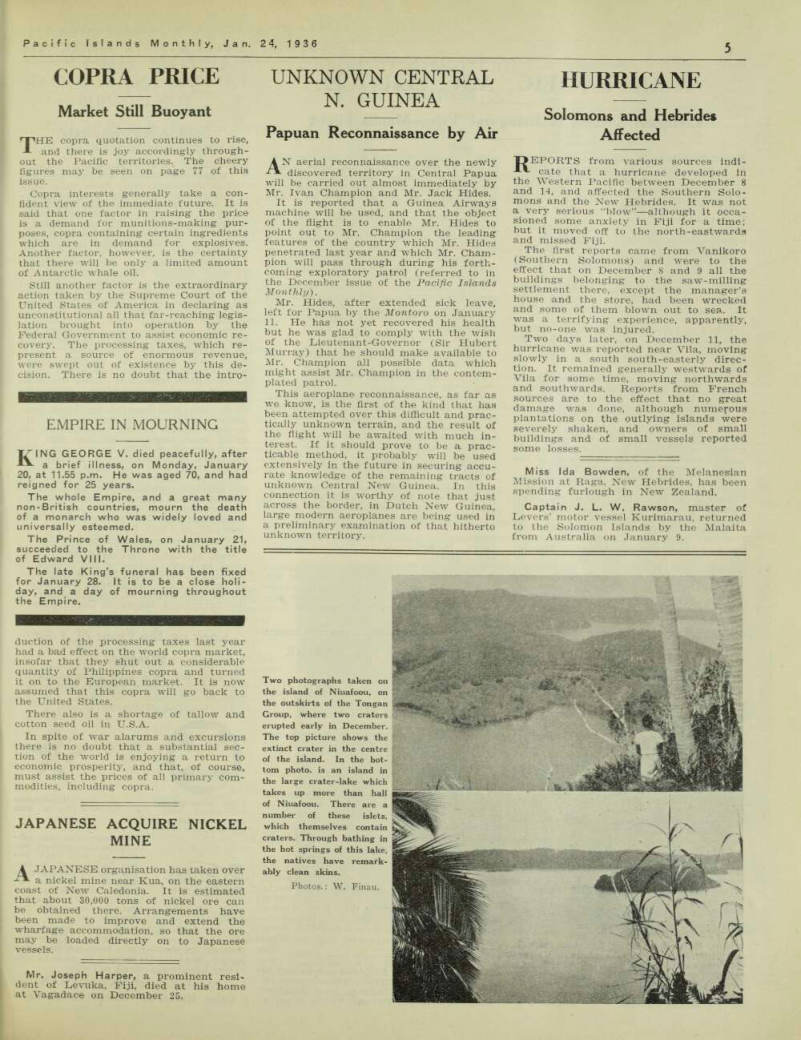
Two photographs taken on the island of Niuafoou, on the outskirts of the Tongan Group, where two craters erupted early in December.
The top picture shows the extinct crater in the centre of the island. In the bot tom photo, is an island in the large crater-lake which takes up more than half of Niuafoou. There are a number of these islets, which themselves contain craters. Through bathing in the hot springs of this lake, the natives have remark ably clean skins.
Photos.: W. Finau.
Advertisements & other items, p. 7 (1 item)
Empire In Mourning
KING GEORGE V. died peacefully, after a brief illness, on Monday, January 20, at 11.55 p.m. He was aged 70, and had reigned for 25 years.
The whole Empire, and a great many non-British countries, mourn the death of a monarch who was widely loved and universally esteemed.
The Prince of Wales, on January 21, succeeded to the Throne with the title of Edward VIII.
The late King’s funeral has been fixed for January 28. It is to be a close holiday, and a day of mourning throughout the Empire.
Transpacific Air Services
Complete Success of Inaugural 'Frisco-Manila Flight
PIONEERING the trans-Pacific airmail service, the 25-ton flying boat, China Clipper, soared through the Golden Gate on the return from her ocean cruise to the Philippines via Hawaii, a distance of 16,000 miles, in December (says a writer in the Melbourne Herald).
This great feat was carried out without a hitch and according to schedule, which provides for a plane each way every fort night, but passengers will not be carried until the service has reached the stage of routine regularity.
Thus, within eight years of the pioneer flight across the Pacific by Kingsford Smith and Ulm, their dream of a commercial ser vice has been realised.
This great flying boat carries a crew of nine and takes 60 hours on the passage across the ocean from San Francisco to Manila. She carries two tons of mail each way.
The inauguration of this service repre sents the fruits of five years of preparatory work. Island bases, depots and landing grounds were prepared; the route was surveyed in great detail, and an elaborate system of weather stations from one side of the ocean to the other has been set up. where every slightest change in the weather map is analysed and communicated to the meteorologist in the plane by wireless.
These weather stations and radio stations keep a 24-hour watch and call up the China Clipper every 30 minutes. Thus she main tains continual contact with civilisation in her passage across the ocean.
The route outward lies via Honolulu (the first and most risky section over open ocean, with no friendly islands), Midway Island, Wake Island, Guam and thence to Manila.
Each of these are stopping places where the giant craft is re-fuelled and re-stored, and any minor repairs or overhauls made.
Directional wireless, radio compasses, four engines and a thoroughly surveyed route
with complete weather data are the safe guards of the service, which, when it was inaugurated, marked one of the greatest developments in the exploitation not only of air but of all transport and communi cation.
The fastest sea-surface time from San Francisco to Manila is at present 21 days.
The China Clipper performs the passage in 60 hours or 2J days.
Air mail from the Philippines is now delivered in Washington and New York six days after posting.
Future developments comprise an exten sion of the service to China, where Canton is the goal, and, thus, regular air mail services will operate between the Orient and America.
Auckland Route
Preparing the Honolulu- Auckland Route
The coastguard cutter Ithasca left Hono lulu on January 9, taking relief personnel to the aerological observation stations at Baker, Jarvis and Howland Islands. These stations have been established by Pan- American Airways as the first step in the organisation of their new airmail service between Honolulu and Auckland.
The cutter is under the direction of Mr.
W. T. Miller, who is chief of air navigation in the United States Department of Com merce. There are aboard nine Hawaiian youths, who will replace the present per sonnel on the islands. Lieutenant E. W.
Stephens, a naval aerologist, is also on board. He will study the islands and make observations.
The Ithasca will probably visit Kingman Reef (American Samoa) to enable Mr.
Miller.to determine the value of the islands thereabouts for beacon stations on the pro posed air route between Hawaii and New Zealand.
Ton Islands
Fanning And Washing
Sold to B.P. Interests
FANNING and Washington Islands, which were offered for sale in Lon don in July last year, have been pur chased by an Australian company, Fan ning Island Plantations Ltd., which has taken over all the property and assets of Fanning Island Ltd., the syndicate which has owned and operated the two islands in Central Pacific for over 20 years.
The new concern is a subsidiary com pany of Messrs. Burns, Philp and Co.
Ltd., and has a nominal capital of £40,000 in £1 shares. First directors are: J. Burns, R. J. Nosworthy, L. Arm strong, and J. Mitchell, who are also directors of Burns, Philp.
The tiny islands have a romantic his tory. They were colonised in the middle of last century by a Scotsman, William Greig, who settled on Fanning Island with a companion, and their native wives.
Later Gilbert Islanders joined the com munity, and the little settlement flourished. When the two original settlers died, their sons carried on for a time.
After a while the Greigs obtained the largest interest in the islands, and the other man’s children left for Fiji.
A resident of Suva bought out their share and later sold it to a French priest, Father Rougier. The latter was asso ciated for many years with the Greig family, but eventually the two islands were disposed of to Fanning Island Ltd.
Father Rougier, who became a well known figure in the Pacific, died in Tahiti about three years ago.
Hon. H. Orton Townsend, M.L.C., ar rived in New Guinea by the Nellore on December 24. He had been on long leave in Europe for some months, and repre sented New Guinea at the last session of the Permanent Mandates Commission.
“Chum” Jardine
Death Reported Of
IT is reported from Darwin that the death occurred recently in the Aroe Islands, off the coast of Dutch New Guinea, of Mr, H. C. Jardine, who was known throughout Northern Australia as a pearler and trader.
He was generally known, and esteemed, as “Chum” Jardine. He was the eldest son of the late Frank Jardine, a pioneer of the Cape York district, of Queensland.
“Chum” Jardine was a very strong man, and an amazing swimmer. He could beat any native in remaining under water. He was famous for his feats in capturing turtles. He would dive down on to the grassy bottoms where a turtle was seen, seize the creature in a peculiar manner, and force it —one hand on its head and one on its tail, or its “steering apparatus” —to come to the surface. He would do this, for sport, in waters that were literally teeming with sharks.
Hon. Ratu Popi Epeli Cakobau, M.L.C., and Hon. Ratu Joseva Lalabalavu Vanaa- Mali Sukuna, Med. Mil., B.A. (Oxon.), M.L.C., prominent native chiefs of Fiji, have been awarded Certificates of Honour “in recognition of loyal and distinguished service to the Colony.”
Death Of J. E. Sabine
ON January 17, Jack E. Sabine, 40, a poultry-farmer in a big way, was blown to pieces in a gelignite explosion in a motor car on his farm at Ryde, near Sydney.
Sabine was well-known in New Guinea a few years ago. He went to New Guinea after having served in the war, and became a successful coconut-planter. He also engaged successfully in horse racing at Rabaul.
It appears that Sabine had established a very modern poultry-farm at Ryde at a cost of about £10,000; and that he had in curred in connection therewith very press ing obligations, as a result of which he was financially embarrassed.
Early in the morning of January 17 he appeared in his usual spirits. He went out to a shed where he kept his car, stepped into the car, and immediately there was a terrific explosion. Detectives made a close .nquiry, and apparently they formulated a suicide theory. Mrs. Sabine told the police that her husband had been suffering from the effects of malaria and was far from well.
Mr. and Mrs. E. R. Oldham returned to Samarai by the Montoro from Sydney on January 11. Mr. Oldham is a Resident Magistrate in the Papuan Public Service.
Advertisements & other items, p. 8 (1 item)
Wrapper !
Look on the Front of Your
There may be a sign stamped on the front of the wrapper which brings this copy of the “P.1.M.” to you.
The meaning of the marks: Your subscription will expire with the next or following issue.
Your subscription will expire with this issue.
Hiis means that your subscription has expired; and that we have sent you this further copy in rase you wish to continue as a subscriber, and have forgotten to send in your suscription. Prompt attention is respectfully requested.
Your subscription (6/- per annum, or 8/- in the case of countries outside the British Empire—which includes postage) may be sent direct, or may be paid to any of our agents (listed on page 3).
PACIFIC PUBLICATIONS LTD.
Union House, 247 George St. f Sydney
Lord Moyne’S
Yacht
Calls at Papuan Ports En Route to Rabaul and the Ramu
From Our Own Correspondent
Pt. Moresby, Dec. 21.
ON December 15, Lord Moyne’s yacht, Rosaura, with a party on board, ar rived at Port Moresby from Singapore bound for the Mandated Territory of New Guinea to collect specimens for the British Museum, and to study anthropology. After obtaining 2,000 gallons of water, the vessel sailed the following morning for Rabaul.
Before arriving in Papua the party had spent some time travelling up the Batavia River, in Dutch New Guinea. Leaving that territory they intended to put in at Thursday Island for water, but before reaching T.I. the vessel went ashore on a sandbank. They remained stranded for 24 hours, and finally were forced to jettison a quantity of fuel oil.
Learning that, owing to a drought on Thursday Island, water was unprocurable there, Lord Moyne continued on to Daru, Papua’s western port of call. The Rosaura then proceeded past Bramble Cay to the entrance of the Purari Delta, from which visits were made up the Alele River, en trance to the large villages of the Kiriki, which lie in the labyrinth of waterways forming the greater part of the district.
Specimens of rare birds and strange curios were secured.
At Port Moresby Lord Moyne and his party, consisting of Lady Broughton and her daughter, Viscount Elveden, Mr. An thony Chaplin (a representative of the British Museum), and Mrs. Chaplin, were entertained by the Acting Governor (Dr.
Walter M. Strong).
Originally, it had been intended to spend a few weeks along the Eastern Papuan coast, calling at Samarai and the Trobriand Islands, but it was decided that in order to get more water quickly the vessel should go direct to Rabaul, as soon as possible.
The party will later visit the N.G. gold fields, and then go on up the Ramu River in the two large cabin-cruisers, which they carry on the yacht.
It was reported from London a few weeks ago that Messrs. Leahy Brothers had assisted to organise the expedition and would accompany the yacht; but they do not appear to be aboard. Possibly, they intend to join the expedition in Northern New Guinea.
Rosaura at Rabaul
From Our Own Correspondent RABAUL, January 1. f TIE yacht Rosaura, carrying Lord Moyne and his party, arrived in port on December 22 to obtain fresh water and provisions before proceeding on a cruise through the adjacent New Guinea islands and an exploration of the Ramu River, on the N.G. mainland.
After leaving Rabaul on December 23 and making a short cruise the vessel re turned and picked up Mr, and Mrs. E. J.
Wauchope, taking them to their home at Awar on the mainland. Mr. Wauchope will act as pilot to the party on the voyage up the Ramu River.
Lord Moyne was desirous of exploring the Mount Hagen area, but found he was unable to obtain the necessary permission to enter the uncontrolled area in that dis trict.
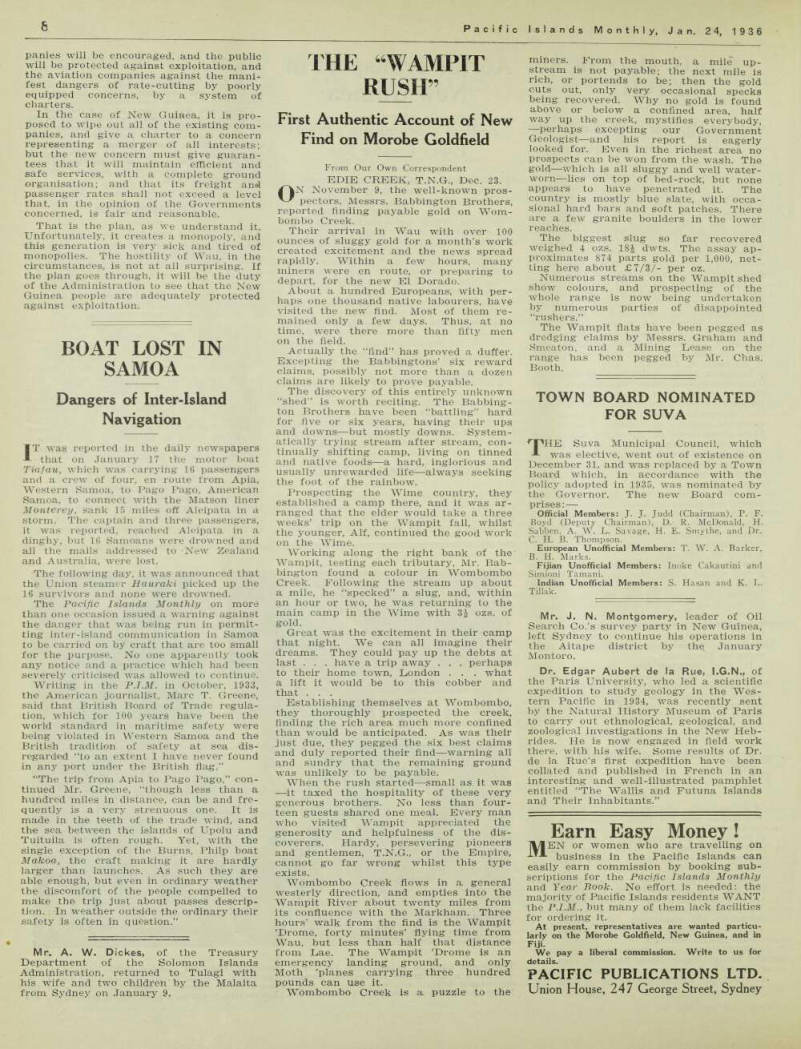
Photograph taken in Rabaul, New Guinea, in December, when the Commonwealth Bank staff had prepared a unique method of conveying Christmas greetings. Messrs. W. A. Freeman (left) and L. V.
Waterhouse (right), who were on their way to inspect their respective companies’ interests on the Morobe goldfield, were included in the photograph. The natives, of course, are the Bank’s messenger staff.
Aerial Transport in
New Guinea Federal Government’s New Policy Creates Stir
THE following appeared in a number of Australian newspapers in January: Recently the Commonwealth Govern ment decided to take steps with a view to formulating an aviation policy for the territories of Papua and New Guinea. A scheme which the Govern ment has under consideration favours a merger of existing companies under proper control and regulation, and ac tion has been taken to advise all inter ested parties to that effect.
The Minister in Charge of Territories (Sir George Pearce) stated that it will be some time before details of the pro posed scheme can be made available, but in the meantime any new contracts made will not be considered when the terms of the proposed merger are under discussion.
The latter paragraph probably had re ference to a current report that New Guinea Goldfields Ltd. had made new con tracts for aerial transport—so per cent, to the Carpenter Airways, and the bal ance to be divided between Guinea Air ways Ltd. and Holdens A.T. Co., Ltd.
Public Protest in N.G.
AS we were going to press, the follow ing report from Wau, T.N.G., ap peared in the Sydney Morning Herald: — Although a move has been on foot for 18 months
for a merger of all aerial transport companies into one company under political control, formal pub lic notice was only received last week.
At a public meeting on January 18, at which all sections of the community were represented, a motion of protest was unanimously carried.
This merger was to come before Parliament cn Wednesday next. Messages have been sent to the Prime Minister (Mr. Lyons) and the Administrator (Brigadier-General W. R. McNicoll) to the effect that the public is strongly opposed to a monopoly being granted to Guinea Airways, on the grounds that it is against public policy, and would leave the public at the mercy of the company to make what charges it liked.
Editorial Note
THITHER the public meeting or the newspaper correspondent has been seriously misinformed. The matter will not come before the Federal Parliament.
The plan has not been under considera tion for 18 months. There is no sugges tion of a monopoly being given to Guinea Airways Ltd., and of the public being left at the mercy of that company.
Presumably, some public statement will be made by the Minister; but, as we are now going to press, we may briefly state the position as we understand it.
In view of national defence require ments, the policy of aviation control has been under review throughout the Em pire, and the Home and Dominion Gov ernments have decided that air transport generally must be carried on by com panies of sufficient strength and efficiency to enable them to be incorporated imme diately in a national defence organisa tion in time of emergency. In view of this, and of the need for protecting the public against risk in air transport, a policy has been formulated of discourag ing enterprises by small and weak air transport concerns, which cannot provide an efficient ground service. Instead, the formation of powerful air transport com
panies will be encouraged, and the public will be protected against exploitation, and the aviation companies against the mani fest dangers of rate-cutting by poorly equipped concerns, by a system of charters.
In the case of New Guinea, it is pro posed to wipe out all of the existing com panies, and give a charter to a concern representing a merger of all interests; but the new concern must give guaran tees that it will maintain efficient and safe services, with a complete ground organisation; and that its freight and passenger rates shall not exceed a level that, in the opinion of the Governments concerned, is fair and reasonable.
That is the plan, as we understand it.
Unfortunately, it creates a monopoly, and this generation is very sick and tired of monopolies. The hostility of Wau, in the circumstances, is not at all surprising. If the plan goes through, it will be the duty of the Administration to see that the New Guinea people are adequately protected against exploitation.
Navigation
Boat Lost In
Samoa
Dangers of Inter-Island Navigation
IT was reported in the daily newspapers that on January 17 the motor boat Tiafau, which was carrying 16 passengers and a crew of four, en route from Apia, Western Samoa, to Pago Pago, American Samoa, to connect with the Matson liner Monterey, sank 15 miles off Aleipata in a storm. The captain and three passengers, it was reported, reached Aleipata in a dinghy, but 16 Samoans were drowned and all the mails addressed to New Zealand and Australia, were lost.
The following day, it was announced that the Union steamer Hauraki picked up the 16 survivors and none were drowned.
The Pacific Islands Monthly on more than one occasion issued a warning against the danger that was being run in permit ting inter-island communication in Samoa to be carried on by craft that are too small for the purpose. No one apparently took any notice and a practice which had been severely criticised was allowed to continue.
Writing in the P.I.M. in October, 1933, the American journalist, Marc T. Greene, said that British Board of Trade regula tion, which for 100 years have been the world standard in maritime safety were being violated in Western Samoa and the British tradition of safety at sea dis regarded “to an extent I have never found in any port under the British flag.”
“The trip from Apia to Pago Pago,” con tinued Mr. Greene, “though less than a hundred miles in distance, can be and fre quently is a very strenuous one. It is made in the teeth of the trade wind, and the sea between the islands of Upolu and Tuituila is often rough. Yet, with the single exception of the Burns, Philp boat Makoa, the craft making it are hardly larger than launches. As such they are able enough, but even in ordinary weather the discomfort of the people compelled to make the trip just about passes descrip tion. In weather outside the ordinary their safety is often in question.”
Mr. A. W. Dickes, of the Treasury Department of the Solomon Islands Administration, returned to Tulagi with his wife and two children by the Malaita from Sydney on January 9.
The “Wampit
Rush”
First Authentic Account of New Find on Morobe Goldfield
From Our Own Correspondent
Edie Creek, T.N.G., Dec. 23.
ON November 9, the well-known pros pectors, Messrs. Babbington Brothers, reported finding payable gold on Wom bombo Creek.
Their arrival in Wau with over 100 ounces of sluggy gold for a month’s work created excitement and the news spread rapidly. Within a few hours, many miners were en route, or preparing to depart, for the new El Dorado.
About a hundred Europeans, with per haps one thousand native labourers, have visited the new find. Most of them re mained only a few days. Thus, at no time, were there more than fifty men on the field.
Actually the “find” has proved a duffer.
Excepting the Babbingtons’ six reward claims, possibly not more than a dozen claims are likely to prove payable.
The discovery of this entirely unknown “shed” is worth reciting. The Babbing ton Brothers have been “battling” hard for five or six years, having their ups and downs —but mostly downs. System atically trying stream after stream, con tinually shifting camp, living on tinned and native foods —a hard, inglorious and usually unrewarded life —always seeking the foot of the rainbow.
Prospecting the Wime country, they established a camp there, and it was ar ranged that the elder would take a three weeks’ trip on the Wampit fall, whilst the younger, Alf, continued the good work on the Wime.
Working along the right bank of the Wampit, testing each tributary, Mr. Bab bington found a colour in Wombombo Creek. Following the stream up about a mile, he “specked” a slug, and, within an hour or two, he was returning to the main camp in the Wime with 3J ozs. of gold.
Great was the excitement in their camp that night. We can all imagine their dreams. They could pay up the debts at last . . . have a trip away . . . perhaps to their home town, London . . . what a lift it would be to this cobber and that . . .
Establishing themselves at Wombombo, they thoroughly prospected the creek, finding the rich area much more confined than would be anticipated. As was their just due, they pegged the six best claims and duly reported their find —warning all and sundry that the remaining ground was unlikely to be payable.
When the rush started—small as it was —it taxed the hospitality of these very generous brothers. No less than four teen guests shared one meal. Every man who visited Wampit appreciated the generosity and helpfulness of the dis coverers. Hardy, persevering pioneers and gentlemen, T.N.G., or the Empire, cannot go far wrong whilst this type exists.
Wombombo Creek flows in a general westerly direction, and empties into the Wampit River about twenty miles from its confluence with the Markham. Three hours’ walk from the find is the Wampit ’Drome, forty minutes’ flying time from Wau, but less than half that distance from Lae. The Wampit ’Drome is an emergency landing ground, and only Moth ’planes carrying three hundred pounds can use it.
Wombombo Creek is a puzzle to the
miners. From the mouth, a mile up stream is not payable; the next mile is rich, or portends to be; then the gold cuts out, only very occasional specks being recovered. Why no gold is found above or below a confined area, half way up the creek, mystifies everybody, —perhaps excepting our Government Geologist—and his report is eagerly looked for. Even in the richest area no prospects can be won from the wash. The gold—which is all sluggy and well water worn—lies on top of bed-rock, but none appears to have penetrated it. The country is mostly blue slate, with occa sional hard bars and soft patches. There are a few granite boulders in the lower reaches.
The biggest slug so far recovered weighed 4 ozs. 18| dwts. The assay ap proximates 874 parts gold per 1,000, net ting here about £7/3/- per oz.
Numerous streams on the Wampit shed show colours, and prospecting of the whole range is now being undertaken by numerous parties of disappointed “rushers.”
The Wampit flats have been pegged as dredging claims by Messrs. Graham and Smeaton, and a Mining Lease on the range has been pegged by Mr, Chas.
Booth.
Town Board Nominated
For Suva
THE Suva Municipal Council, which was elective, went out of existence on December 31, and was replaced by a Town Board which, in accordance with the policy adopted in 1935, was nominated by the Governor. The new Board com prises:— Official Members: J. J. Judd (Chairman), P. F.
Boyd (Deputy Chairman), D. R. McDonald, H.
Sabben, A. W. L. Savage, H. E. Smythe, and Dr.
C. H. B. Thompson.
European Unofficial Members: T. W. A. Barker, B. H. Marks.
Fijian Unofficial Members: Inoke Cakautini and Simioni Tamani.
Indian Unofficial Members: S. Hasan and K. L.
Tillak.
Mr. J. N. Montgomery, leader of Oil Search Co.’s survey party in New Guinea, left Sydney to continue his operations in the Aitape district by the, January Montoro.
Dr. Edgar Aubert de la Rue, 1.G.N., of the Paris University, who led a scientific expedition to study geology in the Wes tern Pacific in 1934, was recently sent by the Natural History Museum of Paris to carry out ethnological, geological, and zoological investigations in the New Heb rides. He is now engaged in field work there, with his wife. Some results of Dr. de la Rue’s first expedition have been collated and published in French in an interesting and well-illustrated pamphlet entitled “The Wallis and Futuna Islands and Their Inhabitants.”
Advertisements & other items, p. 10 (1 item)
Earn Easy Money!
MEN or women who are travelling on business in the Pacific Islands can easily earn commission by booking subscriptions for the Pacific Islands Monthly and Year Book. No effort is needed: the majority of Pacific Islands residents WANT the but many of them lack facilities for ordering it.
At present, representatives are wanted particularly on the Morobe Goldfield, New Guinea, and in Fiji.
We pay a liberal commission. Write to us for details.
PACIFIC PUBLICATIONS LTD.
Union House, 247 George Street, Sydney
Polynesians In
Sydney
Powhiri for Lord Beauchamp
THE Polynesian community of Sydney, -*■ assisted by Mr. Eric Ramsden as organiser and director, presented a Powhiri (welcome) in honour of the Earl of Beauchamp, one evening in December.
The function took place at the Potts Point studio of Mrs. Carrie Tennant Kelly, of the Department of Anthropology, University of Sydney; and other scientists present included Dr. Elkin (Professor of Anthropology), Professor Vonwiller, and Mr. Pierre Ledoux, of Harvard University, who since has left for the Sepik area, New Guinea.
Lord Beauchamp was delighted with the entertainment provided, which in cluded many of the songs and dances of Old Polynesia. The players, who wore native costumes, included Mrs. Waikianga Tipene, chieftainess of the Ngapuhi tribe, New Zealand, and a niece of the late Mr. Hone Heke, M.P. (who presented the address of welcome); Mrs. Alfred Page, formerly Miss Olga Saffings, of Samoa and Tonga (who presented the ceremonial lei ); Mrs. Jack Gaffney, formerly Miss Viti Peterson, of Samoa and Fiji; Mr.
William Bishop, Wiremu Pihopa, a mem ber of the Waikato tribe, which enter tained Lord Beauchamp many years ago when, as Governor of New South Wales, he visited New Zealand; Nurse Mary Missen, daughter of a well-known resi dent of Rotuma. The musical programme was arranged by Mr. Leonard Moran.
Lord Beauchamp very warmly thanked the Polynesians for their Powhiri, and especially complimented Mr. Ramsden on his happy thought in arranging the function.
A Polynesian Club is. to be formed in Sydney, of which Mr. Moran will be the first president.
Death Of Well-Known
Pearler
MR. MARK AITKIN, a well-known pearler of Thursday Island, Darwin, and the Dutch East Indies, died suddenly recently in Dobo, in the Aroe Islands (off the coast of Dutch New Guinea). Mr, Aitkin was manager of the pearling station of J. B. Carpenter and Company, operating from Darwin. He left Darwin early in January to commence seasonal pearling off the Aru Islands with Carpenter’s fleet. His wife resides in Sydney.
Mr. Aitkin held strong views on the sub ject of Japanese competition. He urged the pearlers, instead of crying for Govern ment help, to beat the Japanese at their own game, by commissioning larger lug gers, carrying four instead of two divers.
He pointed out that the whole Japanese crew took their reward according to the value of the catch. They worked hard and, instead of hanging on and trying to get £lBO per ton for their shell, they took it off at once to Macassar and dumped it on the Chinese market at £6O or £BO per ton.
Mr. Aitkin urged the Australian pearlers to put in bigger ships, and sell their shell more quickly, even if they had to undercut the Japanese. The Australians had all the advantage of location and could “freeze out” the Japanese.
The death of Mr. Aitkin is very untimely.
His vigorous personality will be missed.
“Japanese Menace”
Newspaper Hysteria in Australia
THE more sensational newspapers of Australia continue to exhibit periodical “scares,” concerning the presence of Japanese sampans in Northern Australian waters. The thing is a type of hysteria— the sort of journalistic ignorance and reck lessness which create irritation between nations'and lead to war.
It is more than two years now since the occasional appearance of Japanese sam pans was first reported among some of the islands of New Guinea and the Solomons.
A good deal of attention was given to these incidents by the Pacific Islands Monthly —not so much because the vessels were Japanese, but because they were so obviously engaged in poaching upon the beds of shell which are part of the natural resources of those islands and which —so long as they are properly protected and net killed by removal of young shell —are a source of livelihood to many of the resi dents.
There has been little poaching reported since an alert District Officer in New Guinea succeeded in arresting and severely punishing the crew of a Japanese sampan that had been caught red-handed in the Admiralty Islands.
The Japanese, however, appear to have turned their attention to other deep-sea products and large numbers of their boats —apparently from their Mandated Terri tory, from the Bonins, and maybe from Japan itself —have appeared in the waters southwards of New Guinea and Papua, seeking trepang, pearl-shell, etc.
Japanese vessels have a perfect right to cruise in these seas. It is international law that the various territories have rights over the waters only within three miles of their shores; but beyond that is “no man’s land,” open to the people of every nation.
There is little, if any, evidence that the Japanese have trespassed within the three-miles limit. They have gone ashore in places to get fresh water and, probably, to clean their vessels and equipment, but they appear to have behaved themselves quite properly.
Japanese commerce and enterprise are pushing out all over the Pacific —a natural thing, considering the vigour and virility of the Japanese race. Various silly news papers indulge in periodical bouts of hys terics concerning the “Japanese menace.”
Of course, there is a Japanese menace.
Also there is a German menace and an Italian menace. There always will be a menace while there are Great Powers which lack territory for their rapidly in creasing populations and their rapidly ex panding industries. Inevitably, the Japan ese will come knocking at the doors of empty and undeveloped countries.
But the Japanese, so far, have shown no unfriendliness and no aggressiveness to wards British countries in the Pacific. On the contrary they have displayed what probably is a sincere feeling to live on terms of peace and harmony with their Pacific neighbours. The Japanese are a clever, long-visioned people and they want no international complications which would interfere with the enormous task they have undertaken in Northern and Central China, and which would bring them into conflict with the powerful Anglo-Saxon countries which are their Pacific neigh bours in North America and Australasia.
The Laperouse, which arrived in Vila, New Hebrides, from Indochine on De cember 5, brought 258 indentured Ton kinese labourers. The majority will be drafted for plantation work on Santo Island.
Four Months Through Central
Ngatakps Cruise
Four Months Through Central Pacific Islands
AFTER a 5,000 miles leisurely voyage among Central Pacific Islands, the New Zealand yacht Ngataki, with Mr. J.
Wray (owner and skipper), J. Baxter, A.
Mathias, and A. Colebrook on board, re turned to Auckland in the middle of December.
Leaving New Zealand in August last, they passed through the Kermadec Group and went on to Rurutu Island in the Tu buai Group, French Oceania. After a fort night in Tahiti they called at Borabora, where the crew met Alain Gerbault, the famous French yachtsman and former tennis player. He was staying there edu cating the natives in religion and sporting activities.
At Niue 50 canoes escorted them into the anchorage. The natives had heard Mr.
Wray speaking from IYA broadcasting station in New Zealand, and knew some thing about the Ngataki and her crew.
They were hospitably entertained with a motor car at their disposal and a surf-boat, manned by natives, was alongside the Ngataki all day to take them ashore when they wished. They stayed there for six days, the longest any boat had remained.
There is an open roadstead, and it was necessary to station a native watchman on the boat, keeping an eye on the weather.
Three weeks were spent in Tonga, cruis ing among the islands near Vavau, and then, meeting head winds, the yacht put in at Nukualofa for 12 days. Loaded with spears, woven baskets and mats, and a miscellany of native souvenirs, she sailed on December 8 for New Zealand. After a call at Sunday Island to pick up Mr. Reg.
Randall, the party reached Auckland with out mishap.
Advertisements & other items, p. 11 (1 item)
Pacific Islands
JUST PUBLISHED
YEAR BOOK
1935-36 Ed’n.—43o pp.—Many new Maps
A reliable, comprehensive guide to
the Rapidly-Developing Territories
of the Pacific.
STATISTICS FROM OVER 20
ADMINISTRATIONS
NEW COUNTRIES WITH
NEW OPPORTUNITIES
Special Features include: Description of new Pacific Islands Gold Industries; Pidgin Vocabulary; Aviation in Pacific; Pacific Personalities; History of Pacific Exploration; Business and Residential Directories of Principal Territories.
Bound in cloth, 9/6; in Light Board, 7/6; plus postage (British countries, 6d; foreign, 1/-).
From all Booksellers and Island Stores, or from
PACIFIC PUBLICATIONS
LTD.
Union House, 247 George St.,
Sydney.
Papua and N.G.
Preference for Tea From Papua and N.G.
OWING to continued representations from the Lieutenant-Governor of Pa pua (Sir Hubert Murray), who for some time has been impressed with the possibil ities of successful tea growing in the Ter ritory, the Minister for Customs, in the House of Representatives, announced re cently that a preference had been granted on tea produced in Papua and New Guinea.
The preference consists of a duty of Id per lb. upon tea when imported into the Commonwealth in packages exceeding 201bs. nett weight, as compared with the existing duty of 3d per lb., i.e., a preference of 2d per lb. over all other countries. The preference will come into force on a date to be fixed by proclamation.
Difficulty Of Obtaining Plants
Mr. G. Murray, Director of Agriculture in New Guinea, believes that New Guinea conditions are suitable for the cultivation of tea; and, when he was aboard recently, he made numerous inquiries on the subject in Ceylon, East Indies, etc.
Mr. Murray found nothing to alter his belief that the tea industry could be estab lished in New Guinea; but he dil learn that owing to an international agreement it is practically impossible to get seed or plants for cultivation in any country but the present tea growing countries. “I tried in Ceylon, Malaya, and Java to get tea plants or seed for New Guinea,” said Mr.
Murray, “but they would not supply them.”
Mr. Murray said that the production of low-land tea is paying now in Malaya— but that may be due to the general restric tions which have been p’aced upon pro duction. He learned in Ceylon, to his sur prise, that most of the t°a that goes to Australia is of second-class quality—he always had understood that Australian tea-drinkers demanded first class grade.
Mr. F. T. O’Dea, manager for Holden’s Air Transport Co. Ltd. at Salamaua, re turned to New Guinea by the Montoro on January 11, after three weeks’ leave in Sydney.
Ship Joseph Conrad Off Again
For The Solomons ?
T'HE full rigged ship Joseph Conrad, which arrived in Sydney in December via the Solomon Islands, under the com mand of her owner—Journalist Alan Vil liers —departed from Melbourne in mid- January in an atmosphere of mystery.
Seme said that she was sailing under sealed orders; others that she was on a gold-seeking expedition; others that she was under charter to a select company of scientists. All that was certain was that she was to visit Pacific Islands ports.
It was announced definitely on January 15 that she was under charter to a gold mining company, and that she would take a party of mining engineers and geologists to the Solomon Islands.
Unknown New Guinea
Messrs. Fox Brothers’ March
Yf/E shall publish in the February issue of the P.I.M. a detailed account of the remarkable journey made at the end of 1934 by Messrs. Fox Brothers, mining prospectors, of New Guinea. They left Mount Hagen in August, and marched westward, slightly to the north of the New Guinea-Papua border, until they en tered Dutch territory; and they returned to Mt. Hag’en, in New Guinea, along a course through Papua, which paralleled their outward track, but to the south wards.
The report has been supplied to us by Mr. L. A. Fox, and it gives a most inter esting description of topography and tribes noted in this hitherto unknown region.
Sir Hubert Murray, K.C.M.G., Lieu tenant-Governor of Papua, departed from Sydney for Norfolk Island by the Morinda on January 8 to spend several weeks’ holiday with his daughter, Mrs. C. R.
Finney, wife of the N.I. Administrator.
Petroliferous Geyser
On Coast of Dutch New Guinea
the Australian author, Mr. lon ’ ' Idriess, was in Broome, Western Australia, a few months ago, he picked up some information which is of general in terest and which may be of value to the oil companies which are now carrying on an investigation in Dutch New Guinea.
Mr. Idriess met in Broome a Mr. Mac- Kenzie, a well-known pearler, and Mr.
MacKenzie told him that over 20 years ago, when he was helping to establish the pearl-shell industry in the Aroe Islands (off the coast of Dutch New Guinea) he met at Merauke (D.N.G.), an old trader whom he treated for fever. The trader told Mr. MacKenzie that at Lakakier Bay, on the coast of Dutch New Guinea, there was an active geyser with a strange kero sene smell.
A long time after this, Mr. MacKenzie and his friends had occasion at different times to water their schooner on the coast of Dutch New Guinea, and Lakakier Bay, about 80 miles northwards of the Aroes, was found to be a convenient place. It is a picturesque bay, land-locked by cliffs, with mountains towering inland and native villages close in shore. It would give safe anchorage to a battle-fleet.
While watering. Mr. MacKenzie took ashore a bottle of kerosene and let the natives smell it. There was no reaction— they shook their heads uncomprehend ingly. But, one day, a native was there from another village and he excitedly recognised the smell of kerosene. He guided the party some distance along the beach and then they turned inland, until they heard what they took to be the sound of a distant waterfall. This, how ever, proved to be the throaty roar of a small geyser. It was about a quarter of a mile from the sea.
Mr. MacKenzie said that the geyser issued from a lime-stone fissure and that it spat mud, gas, and water at intervals, with an overpowering smell of kerosene.
The geyser had formed a slimy dome about six feet high. The diameter of the geyser was about 12 feet.
More Explorers
A SCIENTIFIC expedition, sponsored by the American Museum of Natural History, and led by Dr. Richard Arch bold, noted airman and scientist, left New York on January 20 by the steamer Somerset to undertake a three months’ research tour of Western Papua—whence, presumably, it will seek to penetrate to Central New Guinea.
The aviation department of the Vacuum Oil Company states that the expedition will make its headquarters at Daru (near the mouth of the Fly River). The ma chine to be used is a Fairchild Amphibian, a particularly fast type, powered with a 675 h.p. Pratt and Whitney Hornet su percharged engine. It carries 10 passen gers, and has a cruising speed of 158 m.p.h. and a top speed of 179 m.p.h, Mr. John O. Olle, accompanied by his wife, sailed from Sydney by the Morinda early in January to take charge of the radio station on Lord Howe Island. He was formerly radio officer for Amalga mated Wireless (A/sia) Ltd. at Labasa station, Fiji.
Dr. Arthur Cole, only son of Mrs. M. and the late Mr. A. F. Cole, of Auckland, was married in Nukualofa, Tonga, on December 7 to Miss Mary Nisbet, only daughter of Mrs. M. T. and the late Mr. Nisbet McRobie, of Auckland. Dr. Cole is the new medical officer at Haapai.
Group shows, left to right, the wedding party in the gardens of the resi dence of the chief medical officer (Dr. Forman Bull) —Dr. Forman Bull, Miss Cicely Bull, Dr. Cole, Mrs. Cole, Mr. J. S. Neil, Miss Jill Goodacre. —Photo.: A. Hettig.
Tropicalities
OUR friend, “Logui,” of Salamaua, T.N.G., sent this “for the house keeping page”; but it will do here: From time to time, we have read with interest the various ways of cooking yams, taros, etc. The following is the recipe for cooking kau-kau, proven by far the best method in the Morobe district, and invented entirely by that celebrated Edie Creek chef, Mr. Ernest St. Laurence Bowden —“Peel the kau-kau, and cut into thin chips, and place in pan of very hot tat. Fry till a golden brown. Take the chips from pan and dry, then place on hot plate, and then throw them as far as pos sible out through the back door —over a precipice, if there is one handy.” ♦ ♦ ♦ 4S an example of the “tripe” which some newspapers publish as news about the Pacific Islands, the following is taken from a Melbourne newspaper; For the whole year that Mr. S. H. Gander, Seventh Day Adventist missionary, his wife and 11-year-old daughter have been at Upper Ramu Island, New Guinea, the natives of the different villages have been fighting constantly.
Mr. Gander, who arrived in Sydney by the Tanda to-day, said his only white companions be sides his family were 120 miles from Samarai.
The cannibal tribes further north of his district ate men who were killed in fighting, but never anyone dying from sickness, he said. The natives among whom he worked were more peaceable, but rats, snakes, lizards, and grubs were their common diet.
The fighting was mostly dancing and shouting, said Mr. Gander. In a battle of 250 aside, for example, the total casualties would probably number about nine.
Eleven-year-old Gwen said black babies were her only playmates, but all native children were terribly dirty until brought to the mission. She shared their games, but not their snacks of grubs, and had seen native wounds caused by arrows.
The bit about “Upper Ramu Island” and “120 miles from Samarai” will be read with interest by residents of Morobe. Mr. Gander did good work in the Ramu region, and was not responsible for the article—he, obviously, was the unfortunate victim of a cub reporter and a busy telegraphist. * * * lON IDRIESS came in the other day with two books under his arm— totally dissimilar in appearance but, at heart, the same. They were the Dutch and the Scandinavian editions, respec tively, of Idriess’s successful New Guinea book, “Gold Dust and Ashes.” The Dutch have made a particularly attractive job of their edition —good paper, fine print, a most artistic and striking cover, and the best picture we have yet seen of Cecil John Levien.
“About half the old hands of New Guinea have been in to see this edition,” said Idriess, with his characteristic grin.
“They all wanted to see what their names looked like, in Dutch!”
The Australian editions of “Gold Dust and Ashes” have sold 40,000 copies. There was some talk of filming the book: but Idriess says that no agreement has been reached yet. There is a great film story in the book, with the long-visioned Levien as the central figure. * * * ONE result of the advent of the Labour Party to political office in New Zealand has been to upset speculations as to the new Administrator of Western Samoa. The office has been vacant since the retirement of Sir Herbert Hart. One of the first statements of the new Prime Minister (Mr. Savage) referred to this post.
No decision had yet been arrived at, he de clared, but a man would be appointed who
would be conversant with the customs and traditions of the Samoan people. If such an appointment had been made years ago it is certain that recent chapters in Samoan history would have been presented in a very different light. One thing is certain—no military official will get the job. Incidentally, Mr. Savage has followed the precedent of the ex-Prime Minister (Mr. Forbes) by taking over both the Cook Islands and Native (Maori) Affairs portfolios. Also of interest to Pacific readers is the fact that since his assump tion of office two of the four Maori mem bers, both Independents, have applied for admission to the Labour Party. * * * THE world does not change much. This was written by Alexander Brome about 300 years a.go: I have been in love, and in debt, and in drink, This many and many a year!
And those are three plagues enough, any should think, For one poor mortal to bear! ’Twas love made me fall into drink; And drink made me run into debt!
And though I have struggled, and struggled, and strove; I cannot get out of them yet!
There’s nothing but money can cure me; And rid me of all my pain! ’Twill pay all my debts; And remove all my lets; And my Mistress that cannot endure me, Will love me and love me again!
Then I’ll fall to my loving and drinking again.
Alexander Brome (1620-1666)
\ KEEN student of Polynesian affairs, Dr. Ivan G. Sutherland, of Victoria College, Wellington, New Zealand, is now visiting Western Samoa, His main object is to recuperate after a serious illness, but it is more than likely that he will obtain first-hand information there concerning the political situation. A brilliant scholar, for years he has been closely associated with Sir Apirana Ngata, M.P., and has made present day conditions among the Maoris
his particular study. “The Maori Situa tion,” which he published a few months ago, an exceedingly able survey of the Ngata administration of communal land settlement, has run into edition after edition. Dr. Sutherland has travelled ex tensively in Eastern Polynesia. To the Maori people he is known as “Paikea,” a name that is familiar in many parts of the Pacific. In Polynesian mythology Paikea was famous for his rapid transit across vast distances on the back of a whale. At the gathering of the tribes at Waitangi last year, Dr. Sutherland experi enced some difficulty with his motor-car.
“Poor old Paikea,” murmured a sym pathetic Maori. “His whale is no good!”
On that occasion, incidentally, he was at tached to the Rarotongan delegation at the special request of Sir Apirana Ngata, then Minister for Native Affairs and the Cook Islands. * * * UNDER the heading, “Inaccuracies in the P.1.M.,” the “Public Service Bulletin” of New Guinea re-publishes a letter which appeared in the Rabaul Times of Novem ber 15, and to which we referred in our December issue. We showed then that the letter, which obviously was written by a public servant with a grievance, was itself a tissue of inaccuracies, distortions and exaggerations: and the circumstances of its re-publication bear out the truth of our statement. The editor of the “Bulletin” is no sport. He re-published, with manifest glee, a letter which attacked the “P.1.M.”; but he did not re-publish a much less wordy letter published in the Rabaul Times only a week later, which defended and praised the “P.1.M.”
ISEE that Lord Moyne (formerly Sir Walter Guinness) has gone in a luxurious yacht, with titled companions, to explore New Guinea,” writes a cor respondent, A.J.V. “On behalf of a grate ful Territory, I move that the name of New Guinea be changed forthwith to New Guinness!”
Mr. Dave Lyall, of Wau, New Guinea, expects to obtain his air pilot’s license shortly. He has now almost completed his course at Mascot, N.S.W.
Advertisements & other items, pp. 13-14 (1 item)
Home
STEICLINCi
Guaranteed
LOOKS
BETTER
LONGER
ItEXIUg
HOME
PJ
PAINT
CD For
TROPICAL
SUN and
SALT-LADEN
AIR
MADE BY
STERLING VARNISH CO.
SYDNEY, N.S.W.
NEGLECT OF DEFECTIVE SIGHT
MAY CAUSE SERIOUS RESULTS
Take Care of Your Eyes Consult
WALTER FORD
D.8.0.A., M .0.0. A.
Optometrist and Optician 4th Floor, Challis House Martin Place, Sydney Established over 30 years Tel.: Most moderate charges BW 6131
Ccddie Tea Cc’s
JfaAQtade TEAS § CCfFEES.
ies
co*Z
ss to Pi? t#S The Latest Vogue in Sydney is
ICED TEA
Delightfully Refreshing—and Stimulating, too. And, if made with CORRIB’S TEA—which possesses the necessary “Quality” flavour—it should become a very popular drink with Islands folk.
You will find Carrie’s Teas are “deliciously different” and are making new friends every day.
Should you, as yet, be unable to procure, please forward name of your Storekeeper, and A
GENEROUS SAMPLE WILL BE SENT YOU.
Ask for “CORRIE’S”
—The Tea that is “Deliciously
Different.”
Trade Correspondence Invited.
THE CORRIE TEA CO.
39 Bathurst St., Sydney.
B
SMART, LIGHT and
STRONG
Its body strongly made all _in one piece, reinforced with nickelled corner guards, Globite Travel Case No. 1858 is smoothfinished like glossy leather, but lighter in weight and lowerpriced.
FORDITE are economy cases . . made with broad grain finish.
F.S. LEATHER BELTS, smart and easily adjusted, are extra durable . . . made in varied designs.
TRADERS are invited to write for full particulars of these lines.
FORD, SHERINOTON,
£ Hi cheaper than Globite, and Manufacturers (Wholesale only)
KIPPAX STREET
SYDNEY, N.S.W.
About Islands People
Dr. and Mrs. Giblin, of Port Moresby, with their two sons Dexter and Eric are at present residing at Manly, Sydney, during the boys’ vacation from River view College. The doctor has spent some of his leave in Fiji and N.Z.
Mrs. Emma Petersen, whose late hus band was for many years chief engineer on the Niagara, has returned to New Zealand after spending several months in Sydney with her daughter, Mrs. Jack Gaffney. Mrs. Petersen is a Samoan chieftainess, and is related to the family of King Mataafa. She is also a cousin of Mr. and Mrs. O. F. Nelson. Of late years her home has been in Auckland, but she has resided in Samoa and Fiji.
Miss A. Uppiil, of the Methodist Mis sion at Nadroga, Fiji, arrived in Sydney by the Aorangi on December 28. Accom panied by a Fijian girl from the Manikau Girls’ School, she later went on to Adel aide, South Australia.
M rs. Keith and her small son were fare welled by many Sydney friends as the Montoro pulled out for New Guinea on January 11. Mr. Keith is a member of the Burns, Philp staff at Rabaul.
Mrs. W. W. Clarke and her children, from Wau, New Guinea, are residing at Manly, Sydney, during the summer months.
Mr. Clinton, a mining engineer, who represents a group of Melbourne finan ciers, recently arrived in Noumea, New Caledonia, by the Ville de Strasbourg.
He later went on to Houailou in the in terior of the Colony to inspect a promis ing area.
Monsieur Dujardin, who has been ap pointed by the British and French Gov ernments as Native Advocate in the Condominium of the New Hebrides, ar rived in Vila from Europe on December 5. He’ is a native of Belgium.
Rev. C. W. Light, of the New Guinea Mission in Papua, who has been spend ing furlough in England with his wife, is expected to arrive in Sydney shortly.
He will then return to his station at Boianai.
Mr. J. S. Bennett, a former student of Cambridge University, arrived in Mel bourne on January 9 by the Norwegian motor ship Temeraire from South Africa.
He is en route to Fiji, where he will en gage in goldmining, Mr. C. Cowley, who has been Officer In Charge of police at the Oroville Com pany’s camp on the Fly River, Western Papua, arrived in Sydney on furlough by the Van Rees on January 14. He s£,id that while waiting at Daru for transport to Port Moresby, Lord Moyne in his yacht Rosaura called there and offered him passage to Moresby as his guest. He later accompanied the British peer to Rabaul, New Guinea, where he joined the Van Rees for Australia.
Mr. and Mrs. R. Wayne, with their baby daughter Janet, arrived in Sydney on furlough by the January Van Rees. Mr.
Wayne is a Methodist missionary at Ulu, Duke of York Islands, near Rabaul, New Guinea. Mr. Wayne’s mother, Mrs. Syd ney Stevens, also arrived from the Duke of York Islands by the same vessel.
Monsieur E. de Hensch, a Belgian trader, arrived in Sydney by the La perouse from Noumea on January 9. He spent some time in the French Colony prospecting for gold, but was disappointed with results. Before going to New Caledonia he was for several years in Africa, where he traded in ivory in the Belgian Congo.
Advertisements & other items, p. 14 (1 item)
Kurrajong
Wheeny Creek Farm
Forty-five miles from Sydney Superior modern accommodation, abundance of cream, eggs, and poultry. 5 acres orchard. Tennis, etc.
Tariff: Double, £2/2/- each; Single, £2/10/- ’Phone: Kurrajong 42 Proprietor: A. J. SAMSON Formerly New Guinea Public Service
Akooy Islands People
Mr. Andrew Stewart, accompanied by Mrs. Stewart, arrived in Sydney by the Laperouse from New Hebrides on January 9. For six years they have been Pres byterian missionaries on the island of Malo, and will now undertake deputation work in New South Wales for several months. In this work they will be assisted by two young New Hebrides natives who are visiting Australia for the first time, having qualified as teachers at the Pres byterian Training College at Tangoa, N.H.
Mr. Pierre Ledoux, of Harvard Univer sity, United States of America, sailed for Madang, New Guinea, by the January Montoro. He will be engaged in anthro pological study in the Territory for six months.
Major Clive B. Joske, managing direc tor of Messrs. Brown and Joske Ltd., Suva, Fiji, returned to the Colony by the Mariposa on January 9 after a business visit to Sydney.
Mr. Charles B. Nordhoff, the American author who has been resident in Tahiti for many years, is now visiting Califor nia for the golden jubilee anniversary of the wedding of his parents, and also to visit his eldest daughter, who is at school in that state. Mr. Nordhoff anticipates returning to Tahiti by the next Makura.
Dr. Raymond Firth, formerly occupant of the Chair of Anthropology at Sydney University (but now of London Univer sity), who carried out research work some time ago on the island of Tikopia, Solo mons Group, has announced his engage
ment to Miss Rosemary Upcott, daughter of Sir Thomas Upcott, British Auditor- General. Dr. Firth has just completed his book on Tikopia.
Nursing Sister Thompson, of the Mela nesian Mission, who is now on leave in New Zealand, will shortly join the Southern Cross in Sydney, and proceed to her new station on New Britain. Sis ter Thompson is an Englishwoman, a native of Hull, but she has taught in South Africa, and obtained her medical and nursing training in New Zealand.
Earl Beauchamp, who recently spent a holiday in Tahiti, has purchased a home
at Bellevue Hill, Sydney, and proposes to make an annual sojourn there. He will leave for Europe, via the Dutch East Indies, in March. Lord Beauchamp hopes to make another stay in Tahiti before long.
Mr. A. J. Ault, Sydney mining engineer, sailed for the Solomon Islands, in con nection with his gold seeking activities in Guadalcanal, by the Malaita on January 9.
Mr. P. J. O’Brien, of Stanmore Estate, Kulumbangara, Solomon Islands, re turned to the group after furlough in Australia by the Malaita from Sydney on January 9.
Mr. D. Luttrell, manager of B.P.’s branch at Gizo, left Sydney for the Solo mons Group by the January Malaita, after furlough in Tasmania.
Mrs. E. Bunting, of Samarai, Papua, who has been spending a few months’ holiday in Sydney. She will shortly leave for Europe, via the East.
Advertisements & other items, pp. 15-16 (1 item)
Elvfs
2)OUSC, Darling Point, Sydney
FINISHING SCHOOL FOR GIRLS
Hopewood House is the only school of its kind in Australia, being unique in educational purpose, equipment and beauty of surroundings.
It provides a splendid educational course on sound cultural lines. All subjects, which include Literature, Languages, Music, Art, Dramatic Art, Dancing, Tennis, Golf, etc., Domestic Science, Dressmaking, Home Crafts, Complete Secretarial Course, etc., are under the direction of skilled specialists of recognised standing.
The special Finishing Course is an excellent preparation for travel or further study abroad.
All possible facilities are provided for the development of the individual talents, tastes and ability of every student, and special courses may be arranged at an inclusive fee.
Further information and an illustrated prospectus may he obtained from Principal —
MISS NANCY JOBSON, M.A. (Melb.)
“Hopewood House,” Darling Point, Sydney
ELVFS
Special Mail Department
-for RECORDS
Sydney s famous old-established Music House, can send you every Record that you may want. Special Mail Department for Island residents.
Here are some new releases: “ESCAPADE”—Film.—You’re All I Need- F.T. Eddy Duchin and His Orchestra.
China Seas— F.T. (Not from film). Paul Gambling Darkle, Yodel, Yodelling Rag Man.— *G 21852, 2/6.
THE FOREMOST SINGERS OF COWBOY
SONGS THE HILL BILLIES. —My
Swiss Miss Yodel, Mexican Yodel,—*G 21644, 2/6. Australian Yodel, Highland Yodel.— *G 21763, 2/6.
THE ERL KING (Schubert and Belanger).
Georges Thill (The Erl King); H. B.
Etcheverry (The Father); and Claude Pascal (The Son). SONG OF INDIA (from “Sadko”) (Rimsky-Korsakov, Delines and Lalov). —12 inch. *LOX 219, 8/-.
Write for complete free lists. Elvy’s are noted for prompt service. Order Now.
Whiteman’s 0rch.—E. A.1554, 4/-.
MILIZA KORJUS Sings Ravishing Waltzes. . —Parla— Waltz (Arditi); Kiss— Waltz (Arditi). — Miliza Korjus (soprano), m Italian, with Orchestral Accompaniment. —E.8.76, 6/-.
MARVELLOUS YODELLING by HARRY
TORRANI.—The Lonesome Yodeller, Yodelling To You.— *G 22458, 2/6.
ELVI «V CO. LTD.
397 George Street, Sydney. 'Phone: M 2319.
TUDOR HOTEL
Room Only Rate, 5/- per day. Meals a la carte. Accommodation for 100 guests. One minute from G.P.O. 127 PHILLIP ST. - Tel.: BW 27M Next door to Martin Place
Sydney
You’ll swim better you’ll fee? better you’ll look better in a Jantzen, for Jantzens are made to provide muscle freedom, complete comfort, and that trim athletic smartness that keeps you looking your best. And Jantzen fabric, made by the exclusive Jantzen-Stitch process, ensures a perfect permanent individual fit.
The World’s Favourite Swimming Suit Made in Australia
Profit-Makers On New
Guinea Goldfields
A Newspaper Argument, and Some Comparisons
was an interesting exchange of views about New Guinea taxation, in the Brisbane Courier-Mail, in December.
The opinion that in the interests of investors there should be a reduction in the duty on mining machinery, tractors and road plant, without which gold can not be produced, and that the duty on aeroplane engines and parts and petrol for aviation purposes should be abolished, was expressed by Mr. W. A. Freeman, who is the chairman of directors of Placer Development, Ltd., and Bulolo Gold Dredging, Ltd.
The tariff averaged 10 per cent., said Mr. Freeman, and during last year the finances of the Administration showed a surplus, which was solely due to the existence of the goldfields of the Morobe district. While the present royalty on gold produced appeared to be a very fair % taxation, it was necessary that the cost of operation and transport_ should be re duced. The four dredges now operating at Bulolo and Bulwa had to date produced 520,0000 z. of bullion, worth more than £3,000,000 in Australian currency. The life of the property had been much in creased by the development of deep dredging grounds, and there were large areas still to be tested. Two new dredges were about to be constructed, one to dig to 80 feet below water level, with a 40 feet bank, and the other 115 feet below water level with a 50ft. bank. It had been found practicable to design these dredges so that they could be transported by aeroplane. The company had exercised certain options on the Bulolo River in the Wau district, and plans were in hand for dredging those areas.
This brought a retort, that “taxation in the Mandated Territory is anything but fair,” from Mr. J. P. Blaikie Webster, chairman of New Guinea Goldfields Ltd., who had just arrived in Queensland from New Guinea.
Mr. Blaikie Webster said that, origin ally, a royalty of 2 per cent, on gold produced was imposed with a view to building a road from Salamaua to the goldfield, but no road had been built; subsequently, this rate of royalty was in creased to 5 per cent. Such a rate might be a fair one when applied to alluvial gold, but was extremely unfair when applied to gold produced from veins and ore deposits, for, as any experienced engineer knew, the cost of treatment of alluvials was not comparable with the
heavy expenditure necessary for under ground mining and development, ore ex traction, hoisting, crushing, milling, &c.
On his (Mr. Webster’s) recent visit he examined a project for the treatment of a large low-grade deposit of ore which, in most other parts of the world, would have held merit but which, under the 5 per cent, royalty unfairly levied in the Mandated Territory, would have meant payment to the Administration of something like 50 per cent, of the profits. This unfair royalty did more than anything else to prevent development and exploitation of the veins and ore deposits of the Man dated Territory. The suggestion that aeroplane engines, &c., should be relieved from the import duty payable on mining machinery was even more unfair, unless it was proposed to replace it by the commonsense expedient of a tax on profits of all undertakings.
In the adjoining Territory of Papua, which had a long and successful record of native administration, such punitive taxation as was imposed on gold mining in the Mandated Territory was unknown, and although, in area, Papua and the Mandated Territory were much the same size, the total cost of administration in Papua was about one-third of that of the Mandated Territory. If enquiry was to be made it should be commenced from that aspect.
Editorial Note
There are two main groups of mining enterprises on the New Guinea goldfield —namely, the Bulolo group, which is operating dredges and making very large profits; and the N.G.G. group (New Guinea Goldfields Ltd.) which is operating various methods of recovering gold (sluicing, gold ridges mill, deep mining at Edie Creek), and which is making small profits.
In the beginning, the Morobe field was wide open to all comers and all enter prises. The Bulolo people selected their country and made their plans for operat ing and for transport, and then went ahead like a machine. They adhered to their programme and their timetable and, in reaching large and profitable produc tion according to plan, they established the New Guinea gold industry and per formed a national service.
The N.G.G. group, on the other hand, seemed to have no clear-cut plan, and, although they had the same opportunity as Bulolo, they wasted years in “messing about.” Their company formation methods were spectacular. They obtained rights over large areas by issuing scrip lavishly, until they held most of the country at the Wau-Edie Creek end of the’ goldfield, with an issued capital of nearly £4,500,000. The original rich Edie Creek leases on the Royal-Glasson group became Edie Creek Pty. Ltd.; this later was acquired by Ellyu Ltd.; and about 1929 Ellyu and
various other concerns were absorbed by N.G.G. Ltd., which was formed under the aegis of the Mining Trust —a multi millionaire concern, interested in Mount Isa (Queensland) and other minefields.
There was much speculation in N.G.G. and associated shares, and various worthy gentlemen no doubt benefited correspond ingly from these successive mergers and absorptions; but the facts remain that N.G.G., despite the magnitude of their plans, operations and capitalisation, have not produced anything like the profits anticipated, and their methods and policy have been under an increasing volume of criticism by practical men. By 1933, it was evident that the company would have to confess to over-optimism and bad planning, by writing down its capital; and. in 1935, the capital duly was written down by 75 per cent.
Since then, scrip-holders have been watching N.G.G. operations hopefully, but there has been nothing there to cause a stir. There has been more exploratory deep mining at Edie Creek, crushing and cyanide operations at Golden Ridges, and alluvial activities, partly on a tributing basis, along Koranga Creek and there abouts. But there is nothing, anywhere, to suggest that ordinary shareholders can count on more than 10 to 15 per cent, per annum on the written down value of their shares.
That is not a creditable record: and it has to be set against the outccy of Mr.
Blaikie Webster on the subject of New Guinea taxation. When it wrote down its capital in March, 1935, N.G.G. itself con fessed that it had miscalculated (or muddled, or been unfortunate—the term is not material to the argument) to the extent of some £3,000,000. In view of that, Mr. Blaikie Webster scarcely is competent to say that the inability of his company to show substantial profits is due to the 5 per cent, gold royalty, or the
high cost of administration in New Guinea as compared with Papua, or transport charges. History is against him.
The Bulolo group, which has made a success of things, and established a rich gold industry in New Guinea, apparently is satisfied with the gold royalty system, but suggests reductions in the import duties on necessary equipment. The N.G.G. group, which has been “a pain in the neck” to most people concerned, and more especially to its own shareholders, demands the abolition of the gold royalty system, and other changes which, in cidentally, would penalise the Bulolo companies.
Which group of interests is more de serving of the ear of the New Guinea administration ?
Advertisements & other items, p. 16 (1 item)
Stanley W. Jackson, F.I.O.(S Y D.)
OPTOMETRIST and OPTICIAN
OF CROYDON, N.S.W. - - - 20 YEARS’ EXPERIENCE Consultations at “Papua Hotel,” P. Moresby, from Feb. 5 to Feb 29. Dates for other centres will be published in local papers.
Will arrive at Port Moresby, en route
to New Guinea, by the Macdhui,
February 5, 1938.
Make this Your Opportunity of consulting me regarding your Eye Troubles.
Itinerary will include Port Moresby - Samarai - Wau - Salamaua - Rabaul - Kavleng
Laurabada Takes Children
Home for Xmas
From Our Own Correspondent
Pt. Moresby, Dec. 20.
THE Merkur, from Sydney via Brisbane and Townsville, arrived in Port Mores by on December 14 with over 60 school children on board to spend their Xmas holi days in the Territory. A large crowd of excited parents awaited them on the wharf, and shortly afterwards the township appeared to be overrun by a new and vigorous population.
The following day the accommodation of the Government vessel Laurahada was taxed to the limit when, with the Official Secretary (Hon. H. L. Murray) in charge she left Port Moresby for Samarai with 25 school children transhipped from the Merkur. On board also were Rev. and Mrs. P. J. Searle, Rev. and Mrs. O. G.
Parry and family, and Mr. and Mrs. M. J.
Healy.
The courtesy of the Government in carrying- such a large number of children and passengers to their homes for th© Xmas holidays was greatly appreciated by the residents of the Territory.
Owing to the shipping strike in Australia the circumstance was exceptional; no ves sels were available along the Papuan coast, and but for the assistance of the Government many parents would have been separated from their children during the Xmas festivities.
Mrs. A. B. Thomas, Methodist mis sionary in Fiji, reached Sydney by the Aorangi at the end of December. She is at present spending holidays at Hamil ton, Victoria.
Mr. J. L. Street, Registrar of Titles and Official Trustee in the Crown Law Office at Rabaul, New Guinea, returned after leave by the Tanda from Sydney on January 15.
Advertisements & other items, p. 17 (1 item)
room: vs
JSLANDS residents, spending furlough in Australia, who desire a quiet, comfortable holiday in charming surroundings, are recommended to inquire about the Crookhaven Hotel, Greenwell Point, 'about 10 miles from Nowra, on South Coast of New South Wales. The hotel is oldestablished and well conducted; there is excellent fishing in the surrounding waters; and, even in the hottest weather, this point gets a sea-breeze and is always cool and free from mosquitoes.
There is a golf course in front of the hotel; bathing; boating; plenty of fish and oysters, etc.
Write to Proprietor, Crookhaven Hotel, Greenwell Point, via Nowra, N.S.W.— ***
Highlights in the
Islands . . .
The prolific Pacific Islands produce wonderful crops, flowers, trees, people, and
THIRSTS!
Then you are grateful for this drink that is a pal to your palate, and an ally of health
“Here’s To’ee”—
room: vs
PIBSENBB
IN THE BOTTLE WITH THE YELLOW LABEL
XOOHEYS
lage
Vanikoro Timber
IT is reported that the Kauri Timber Company which has been operating on Vanikoro Island, South Solomon Islands, for several years is now being re-organ ized with a view to further developments.
There is a considerable white settle ment there now, including five white women.
Something About Papuan
An Axe-Head
Something About Papuan Minerals
A VALUABLE gift made to me by Mr.
Jack Hides, before his return to Papua, was one of the two stone axes, of native workmanship, which he brought out of the valley of the Waga Furari, Central Papua, on his last famous expedition. The head is of beautifully shaped stone, bound to a balanced wooden handle with a kind of cane, wonderfully plaited. The axe is very similar to those I saw not long ago in Wau, which had been brought from the Purari-Mount Hagen district of New Guinea.
I showed the axe to our old friend, Mr.
A. J. Yogan, who has spent a lifetime studying rocks, and he at once became keenly interested in the peculiar olive green stone from which the axe-head has been laboriously shaped. This is what he wrote about it: A lump of phosphate rock was used for years as a door-stop in a Sydney office, before it was recognised, and showed the way to the enormously rich phosphate de posits of Nauru and Ocean Island. An itinerant hawker noticed that the pretty stone that a Boer farmer’s brat had played with for years was a brilliant, worth a king’s ransom, and the diamond industry was born. An intelligent boy began to think about the weight of a stone he had picked up to throw at a crow; and started the Westralian goldfields.
These things perhaps explain why Aus tralians take so little interest in the lovely Pacific Islands, lying right at their door.
They cannot see the enormous riches of the Islands.
To the geologist, or trained mining-man, this axe-head of grey-green stone is chiefly interesting because it exhibits that pecu liar form of Epidosite rock (as far as one can tell without a microscopic-section) which one associates in the mind with the four principal commercially-valuable forms of iron: Nickel, Cobalt, Haemitite, and Chrome, which to-day are pulling our neighbour New Caledonia out of the mire.
The Epidotes are of that “devil’s cauldron" that furnishes the world with all kinds of useful minerals —many of them, such as bronzite, not being known to the majority of mining men.
The place of origin of a native-axe is as difficult to locate as where my spectacles are, at times! Bought, exchanged, stolen, or part of the booty from a bloody raid?
But I happen to know that this particular stone is characteristic of that vast upheaval in Central New Guinea, known as the Bis marck Range; and I have seen similar rock in New Caledonia and in Fiji, where mining was a feature of the scenery. The colour is derived from Olivine crystals; and in the Dun Mountains in New Zealand it obtains as one of the recently-eruptive rocks, where it passes into Serpentine.
This has confused certain Museum geolo gists of New South Wales, who label it as “Green-stone.” so much associated in the popular mind with the heroic Ma-oris.
But the Maori axes were of quite another rock: Jade, or Nephrite (“To,” with a short “o,” in China, where the finest examples obtain), which is a silicate of lime and magnesia. Serpentine, so named because it is often spotted and marked, after the pre sumed manner of Eve’s “boy-friend,” is a hydrous-silicate of magnesium; and does not take so fine an edge. Jade, or green stone, is one of the Hornblendic rocks ( Amphibolites ) and is an altered form of ancient lavas. It should be the symbolism used by Australian mining-folk as in N.Z. it is the “ahua” of Honesty!
Serpentine is a product of pre-existing Olivine crystals; and often these may be noted under a lense, still in situ. It is a fairly sure sign of mining country; and was deposited from sea-water originally, in association with crystaline-schists, as Sterry Hunt and Geiki have shown. That weird, wild sea of heated water that fell as hot rain-deluges from the fiercely electric storm-clouds of the early days of our earth, seems to have mothered all our minerals, as it did the beginning of all life!
R.W.R.
Schooner Hermes
Wreckage Near Witu Islands
IT now is generally accepted that the New Guinea Government schooner Hermes, which sailed from Madang on November 10 for Rabaul with three Euro peans and 17 natives, and which since has not been heard of, has been lost with all hands.
It was reported at the end of December that a table-top, definitely identified as a permanent fixture on the Hermes, had been found on the eastern coast of Unea Island, in the south-west of the Witu Group (off the northern coast of New Britain).
A few days later, a broken piece of painted sawn timber was identified by the manager of Volupai Plantation (on the western coast of Talasea Peninsula, north ern coast of New Britain —south-eastwards of the Witu Islands) as belonging to the schooner Hermes.
These things suggest that the Hermes was lost somewhere near the Witu Islands, which lie on the direct route between Ma dang and Rabaul.
Advertisements & other items, p. 18 (2 items)
16
Pacific 'lslands Monthly, Jan. 24, 1936
CKeeps' on JCeephig 1 on .
B. & S. Estate Agency
ROSEVILLE, SYDNEY
Specialising in Flat reservations, any suburb, for Island Residents visiting Sydney. Correspondence invited. 'Phone J 5269.
Principals; Edward M. Bastard & Campbell M. Smith
Long experience in the Islands has taught us that many articles not readily procurable through the local merchants could be secured if an agent in Sydney were available to explore the city’s resources. We are now willing to do this for Islands people, at a small fee. If you wish to purchase anything new or secondhand large or small if you wish to match material or buy a dog you are invited to write to
Personal Shopping Service
Room 49, The Capitol, King’s Cross
SYDNEY
MARKETING FOR WRITERS . . .
Napier, Gardiner & Co. read and advise on all classes of literary work—books, plays, scenarios, serials, short stories, articles, and verse—and, if suitable, arrange for publication in Australian and overseas markets through their agents in London, New York, and elsewhere. They relieve the writer of the business side of his work, and make available expert Particulars on marketing knowledge. All rights arranged, and advice application to: given to aspiring writers.
NAPIER, GARDINER CO.
LITERARY AGENTS, 79 PITT ST., SYDNEY.
f a ( P R E P A R E D)
CKeeps' on JCeephig 1 on .
AGENTS THROUGHOUT THE ISLANDS
/ if
Sunday Island
Condition of Little Settlement in Lonely Kermadec Group
IN the middle of last year three young New Zealanders, Alfred Bacon, Bruce Robertson and Reginald Randall, settled on Sunday Island, the largest of the un inhabited Kermadec Group, in the South Pacific. Solemnly they had renounced civilisation and declared that they would spend the remainder of their lives cul tivating oranges in an isolated settlement far removed from worldly cares.
Six months passed and the N.Z. yacht Ngataki, which left the party on Sunday Island, called again with provisions. Mr.
J. W. Wray, owner of the Ngataki found that the settlement scheme had not pro gressed quite according to plan, and that Randall, disillusioned and sick, was anxious to take passage to New Zealand.
On his return to Auckland, Randall told the story of the three settlers’ hardships.
“Setting out from Auckland on May 18, the Ngataki experienced a rough passage to the island, and was hove-to for several days in heavy seas,” said Mr. Randall.
“The yacht passed the island during the night and had to beat back for about 50 miles, eventually arriving on May 28.
“The island looked bleak and desolate, just one peak after another, and we had a hard job landing, as the only landing ground was covered most of the time with foam and huge breakers. Our first attempt at landing was hardly a success, the boat being washed ashore bottom up some time after its occupants. The first night was spent in buffalo grass near the beach.”
Soon the party set to to build a house with an iron roof and nikau sides. The first meal of goat flesh was described by Mr. Randall as being better than he had hoped for. There were about 3,000 goats on the island, and a great number of cats. Although some Alsatian dogs were taken to exterminate a large species of rats, it was found that most of the rats had died.
“The temperature was much lower than
we had expected, the thermometer often reaching 50 degrees from June to Novem ber,” continued Mr. Randall. “The island was over-run with pohutukawa trees, buffalo grass and a type of arum lily.
Fish were fairly plentiful, while a num ber of wild grey duck were seen on the lakes.
“There was a little thermal activity in a large crater, which is surrounded by an almost perpendicular wall of rock about 500 ft. high. There were many birds, some of which are well-known in New Zealand, occasionally seen. Though the island has an area of about 7,000 acres, only about 1,000 acres of this is suitable for cultivation.”
The principal difficulty encountered was the supply of food. Maize, beans, peas, pumpkins, potatoes and kumaras were planted from the seeds brought from Auckland. The diet for the first few weeks consisted principally of goat flesh, taro, bread, oatmeal and orange juice.
After a time, however, the party was forced to fall back on goat flesh, taro and fish. Once the monotony was relieved
by the capture of a large turtle, on which the company dined for a week.
In August a vessel visited the settle ment and left some provisions, which were particularly welcome. However, these did not last long and for a con siderable time the men lived on boiled, roasted and fried goat and lentils.
The goats had played havoc with both trees and plants, destroying all the bananas, on which they had counted.
The orange trees also had fared badly, all being ringbarked. Altogether there
were only about 30 orange trees, 12 lemon trees and eight peach trees on the island, and the party considered that their ven ture had been a failure.
While on the island Mr. Randall had an accident which deprived him of the use of two fingers of his right hand. He was cutting up a fish when the knife slipped and almost severed his fingers.
He was treated from a medicine chest which the party had brought. The best his companions could do was to bind up the fingers, and fortunately they healed rapidly.
“My two companions intend to remain on Sunday Island for all time,” concluded Mr. Randall, “but I doubt whether Sun day Island will ever be a successful com mercial proposition. The reading, clear ing and bridge building would involve enormous expense and a few settlers could not hope for success.”
Mrs. James Russell, wife of the Direc tor of Education in Fiji, was appointed in the New Year Honours a Member of the Civil Division of the British Empire.
Advertisements & other items, pp. 19-20 (1 item)
«gsUiis
COLLAROY BEACH
FOR YOUR HOLIDAYS
Surfing, Golfing, Fishing, Boating Ten miles from Sydney
FULLY FURNISHED COTTAGES
Properties for sale. For particulars: Cedric Field P.O. Box 2, Collaroy Beach, N.S..W.
Here’s the PERMANENT
H.T. BATTERY
FIT THE FAMOUS
«gsUiis
No more running down—no more replacements, the Milnes H.T. Supply Unit automatically recharges itself from the L.T. and keeps at FULL VOLTAGE constantly. Greatly improves tone, range, and volume of all Battery Sets. Gets those extra stations. Fitted in a few minutes in place of that rum-down dry battery—lasts for twenty years at least.
Costs practically nothing to run. Send for free booklet. Ask your Radio Dealer for a demonstration on your own set.
SOLE AGENTS:
KRIESLER AUST. LTD.
MYRTLE, PINE STS., CHIPPENDALE, SYDNEY. M 4391.
FOR those desirous of retiring and living in a delightful climate, 20 minutes by motor to Manly and 22 miles from Sydney.
Standing in acres (approx.) ground. Absolute beach frontage, 156 ft. Select and private. House contains four rooms, large return verandah.
Garage.
Also gardener’s cottage with two rooms. Well laid out garden, lawns. Council Light and Power installed. Frigidaire. Motor Lawn Mower.
Septic Tank. Good water supply. Buildings concrete and fibro.
Golf Links within a mile.
High water mark about 150 yards. Good beach fishing. A buyer could keep his launch at Pittwater, 2 miles distant, thus obtaining access to the beautiful Hawkesbury River.
Terms arranged, if needed.
Full particulars from owner;
A. J. DADSON, P.O. Box 92,
Haymarket, Sydney, N.S.W.
MORRIS, HEDSTROM, Ltd
FIJI
Sole Agents in Fiji for . . .
Vacuum Oil Company (Pty.) Limited
Imperial Chemical Industries Limited
Nobel (Australasia) Pty Ltd.—Explosives
Full Stocks of
MINERS AND PROSPECTORS’
REQUISITES
Also SODIUM CYANIDE, ZINC
DUST. Etc., Etc.
Sydney Office:
DALTON HOUSE, 115 PITT ST., SYDNEY
Branches throughout the gold hearing areas Lautoka, Ba, Tavua, Penang, Nadi, and Sigatoka
C. O. White, Pty.
386 POST OFFICE PLACE, MELBOURNE, C.l
AGENTS FOR OCEANIA:
Australasian Jam Co. Pty. Ltd., Melbourne —Jams, Soups, Canned Fruits, Sauces, etc.
Gartside Bros. Products Pty. Ltd., Melbourne —G.B. Brand Canned Vegetables.
Lipton Ltd. (England), Melbourne—Ceylon Teas. .
Rosko Products Pty. Ltd., Melbourne —Canned Meats, Specialty Trade Meats.
Yodel Milk Co., Melbourne—Full Cream Dried Milk.
Kremilk Co., Melbourne —Perfect Infants’ Food.
Passila Passion Fruit Products Ltd., Melbourne— Passila Pure Passion Fruit Juice.
Also Tinned Butter, Condensed Milk, Skim Milk, Starch, Soaps, Toilet Powders, Peroxide, Axe & Pick Handles, etc.
ENGLISH AGENCIES:
Galvanised Iron, All Types Spades, Shovels, Picks, Electric Light Plants, Mining and Builders’ Requisites, Butchers’ Knives, Cutlery, Softgoods, etc.
London Offices: 17 Philpol Lane, London, E.C.3 Cable Address; “Lawlenma,” London.
“Lawlenma,” Melbourne
SHIPPERS, INDENTORS,
BRITISH AND AUSTRALIAN
MANUFACTURERS’ REPRESENTATIVES
Indents executed for all classes of Hardware, Grocery, Trade and Toilet Goods at bond
prices.
WE SOLICIT YOUR ENQUIRIES FOR ALL
0 CLASSES OF ISLANDS MERCHANDISE
Seafaring Philosopher Reaches
In Te Rapunga
Seafaring Philosopher Reaches Tahiti
From Our Own Correspondent PAPEETE, December 26.
JUDGING by the frequent visits of small sailing craft to Tahiti there must be a surprising number of these miniature yachts sailing the ocean in various parts of the world. Nowadays at least a half dozen or so may usually be found tied up along the Papeete water-front.
Some are owned and manned by parties of wild young college lads out on a glorious adventure, some by tired business men in search of tranquillity, and some by more serious persons bent upon scientific dis covery. Other owners, no doubt, will later burst into literature and produce a volume of travel experiences which will at least bring a sardonic grin to the faces of old timers who have survived so many of the same appalling kind.
The latest arrival in Papeete harbour is the 10 ton ketch Te Rapunga, which is only 32 ft. long and relies entirely upon sails. She carries the German flag and is owiied and sailed by George Dibbern who has a crew of two, Roy Murdock and Morris Black. In New Zealand a young lady named Eileen Morris joined the party, thus bringing the total ship’s company to four people.
Mr. Dibbern is travelling for the purpose of studying the various systems of philo sophy existing in different parts of the world, and, since his departure from Kiel at the beginning of 1930, has visited some 20 or more countries and islands. From Kiel the Te Rapunga proceeded to Holland, England. Spain, Portugal, Gibraltar, the French Riviera and Italy, thence by way of the Belearic Islands, Canary Islands and Jamaica to Panama and San Francisco.
Places visited in the Pacific included Hono lulu, Samoa, New Zealand, Australia, and the Cook Islands, While in the antipodes the Te Rapunga carried off the honours in the Tasman yacht race from Auckland to Melbourne, and in the ocean race from Melbourne to Hobart, Tasmania.
Oil Search In New
Guinea
THE annual meeting of Oil Search Ltd. was held in Sydney in January. The chairman, Mr. W. A. Freeman, supplied shareholders with an interesting review of the company’s activities —mostly in Australia. Commonwealth co-operation is being sought.
Referring to New Guinea, Mr. Freeman said that the company’s geologists were unanimous in the view that that country merited major attention as offering op portunity for development of oil fields, comparable with some of the rich areas in the East Indies.
Mr. and Mrs. John Wadsworth arrived recently in Sydney from London, where they lately were married. Mr. Wads worth is director of the Apia Observa tory, in Samoa, and he has been away on six months’ furlough. Mr. Wads worth’s specialty is meteorology, and he was for 10 years with the Meteorological Office, London He has been director at Apia since 1930, and during the trip from which he is just returning he attended the International Meteorological Congress at Warsaw, Poland.
Salamaua
Memories of the “Rush” Days of New Guinea
By M.G.
BEFORE Burns, Philp’s ships made Salamaua a port of call it was a diffi cult place to reach. It was necessary to charter a schooner in Rabaul, at great ex pense, and the 440 miles ocean journey was anything but a joy in those small vessels, which were often leaky and poorly engined. As charters were usually by the day rate—£2 to £lo—the delay caused by engine trouble did not worry the owners.
Five knots was the average speed when the engines were working.
When I went across we struck a very bad sou’-east blow and our journey lasted six weeks. A week was spent recruiting, and during the balance of the turns we were being blown about or had to beach the boat to prevent her sinking. A burnt out bearing, a sprung mizzen, and the stern post carried away were a few of our troubles. We were blown down the coast almost to Madang, and the swift current passing through Dampier Strait held us back for weeks on end until the weather abated.
By the time we reached Salamaua the charter had taken all our spare cash, half of our three months’ supply of rations had been consumed, the balance was damaged by salt water, and most of the boys’ issues had been swept overboard. To make mat ters worse there were no Government officials there to indenture our labourers which necessitated going to Morobe, another 90 miles, for this purpose.
Salamaua, an isthmus joining Parsee Cape to the mainland, is merely a narrow sand bar. It had been planted with coco nuts by the old German New Guinea Com pany, and used by them as a trading station, bird of paradise and recruiting depot. At the time of which I write, Sala maua consisted of the “Blood House,” Bill Money’s packing shed and a very small rest house (for passing Patrol Officers), all built of native material, and perhaps half a dozen tents along the foreshore.
The “Blood House”
The “Blood House” —why thus named, and by whom I could never discover —was a ramshackle two-storied structure owned by the late Burleigh Gorman, and used as a boarding-house. The upper story was the common bedroom for all guests. One simply spread his own blankets somewhere on the pit-sawn plank floor and rested there. As most of us were Returned Men the hard beds were a mere detail. Some earlier arrivals had managed to rig up can vas bunks against the walls on “Heath Robinson” constructions of saplings and bush rope.
The dining room had two long rough sawn boards as a table with a form each side. One supplied his own plate, pannikin and cutlery. A number of tins of warmed canned-meat, soda bread, or cabin biscuits, and a dixie of stewed tea were piled on the table with a tin opener, and one helped himself —tariff: 18/- per day. The table talk was all of the road in, the field, the gold and the natives. We new hands mostly sat and listened for tips from the initiated.
Money’s packing shed, also owned by Gorman, was a long, low shed divided into small compartments each lined with shelves. The miners paid him £5 per month for the use of a compartment for storing their goods and for loading the boys when sent to the Beach for fresh supplies.
Everyone was very excited and in a great
hurry to move off. All day long the pack ing shed was a hive of industry. Every one had at least one partner and there was continual discussions as to what could, and could not, be taken in on the first trip. It was a matter of cutting one’s requirements to the boys’ carrying capacity. The longer the line the better one fared.
Trials Of Packing
Hearty cursing would be heard from some part of the shed. Someone had finished packing loads for all his boys only to discover that he had forgotten to include meat, or picks, or medicines, or some other necessity, and it meant pulling every load to pieces to discard something to include the missed essential. Packing and repack ing, weighing and reweighing—it is sur prising how difficult it is to take, say, 800 lbs. of miner’s gear and divide it into 1G equal packs. It was always necessary to distribute things, especially food-stuff, so that should one or more boys desert the party could still carry on.
Each day more schooners arrived, and even in the few days we were there the canvas town had noticeably grown. Many new arrivals had no boys and had come to Salamaua with the hope of buying boys there, or recruiting them locally. The few professional recruiters about found great
difficulty in persuading boys to indenture for work on the field and therefore their charges rose—£2s being the average re cruiting fee. The local kanakas weie reaping a rich harvest. Carrying suPP II^ 8 into Wee Baining they earned from 15/- to £1 per day. To conserve supplies miners willingly paid exorbitant prices for native foods, thus no local boy would indenture.
Eventually many men left Salamaua to return to their previous occupations, whilst
others spent up to 12 months trying to recruit or buy boys.
Six months later Salamaua was a dif ferent place. Two lines of huts built of bamboo and sac-sac (sago leaf) stretched almost to the ’Frisco River. A galvanised iron hotel served warm drinks at high prices, and B.P.’s were building a store.
A District Office and Hospital, rough but useful, had been erected, and buildings were springing up over night.
Major Skeets, as District Officer, dis pensed justice—perhaps a little hard, but suited for the period—without fear or favour, whilst Dr. lan T. Dickson—a name that will never be forgotten on the gold fields —grappled with vast problems of hygiene and isolation in connection with the dreadful dysentry epidemic then rag ing. Parsee Cape was divided into isolation areas for natives, and Dr. Dickson with
Mr. A. C. Windham, his assistant, worked unceasingly travelling from one improvised hospital to another, besides making occa sional patrols of both the Gadagadu and Buang roads.
The “Blood House” was relegated to a store room, and Clem Hendry had a kia kia house with proper frames for rigging canvas beds and a better cook than Gor man, although there was not much im provement in the menu. More miners were arriving by each Montoro, but the peak of the “rush” was passed.
Christmas In 1926
Xmas on the Beach in ’26 was fairly hectic. The “pub” rang with laughter and song. Some new songs were invented —one could hardly say composed. Jim Pontyn lead his own specialty:— Tram car! Tram car! Why do your wheels go round ?
Tram car! Tram car! Gliding along the ground Your Daddy lives over the ocean, ever so far away.
Why do your bright lights twinkle? Tram car! Tram car!
How grown men could chant such twaddle for hours on end seems incom prehensible, but we did. Wally Darby parodied the Hallelujah Chorus from Handel’s Messiah. It was very clever and screamingly funny. Darby sang the verse and the whole crowd took up the “Hallelujah! Hallelujah!” substituting “Koomeatum! Koomeatum!” “House Sac sac! House Sac-sac!” and so on for each stage of the road in. By midnight things would become rather mixed, some singers would be on the first stage of the track, others nearly to Wau, the result ing din was terrific and arguments as to where the song actually had arrived at on the road often led to brawls.
Strings of champagne corks hung from the roof each labelled with the owner’s name. Some men on good gold competed in lengthening their line of corks. Clad in grey flannel singlets, khaki shorts, woollen socks and heavy hob-nailed boots (as we all wore in those days) and seated at a beer case for a table in a galvanised shed called an hotel, it was hardly the atmo sphere for champagne, but they enjoyed themselves.
Xmas morning natives visited each hut carrying a large enamel bucket of cham pagne and armed with a pannikin. “Masta Darby talk one fella cup along one fella Masta, thas all,” repeated the natives as they dished us out a mug of “bubbly.”
That was Darby’s Xmas “shout” to the mob.
A trade store attached to the “pub” did a roaring trade. Miners on good gold were generous to their boys. Some instructed “Mclsaac,” who was in charge of the store, to allow the boys to remain there for ten minutes, and book up all they chose in that time. Being long thinkers, like all natives, they did not debit their Masters with nearly as much as one would expect.
A “Two-Gun” Man
Outside the hotel a “two-up school” saw many ounces change hands, whilst under the Calafuleums, groups of men lay shoot ing at bottles thrown into the sea, the pool being doubled each round of shots. Calvin, a “two-gun” American, put it well over one pool I was in. A bottle which had evaded many shots still bobbed about whilst the pool mounted. Calvin passing by was chipped about bringing his two guns along. Daring us to double the pool he weighed in and, pitting his revolvers against our .32 rifle, took the pool first shot. Regarding it as a fluke we doubled the stakes; this time, his second shot, a left-hander, took our money.
In those days the field knew not gold thieves and everyone was pretty casual with their gold—as much as 1,000 ozs. com ing down from Edie Creek in charge of a boss boy. One day a crowd were sitting yarning on the roadway outside Clem Hendry’s place. One chap shifted a pack he was sitting on and found it very heavy.
On examining it he discovered it was his own gold—Boo ozs.! Arriving dead-beat two days previously he had gone straight to Hendry’s, assuming the boy following him would take the gold to B.P.’s. Also dead-beat, the boy, however, had dumped the pack in front of the shack where he knew his Master was staying, and there it had lain in the road-way for two days.
Nowadays Salamaua has motor cars, and freezers, a real hotel, and “talkies,” but, of course, it’s the township of Salamaua now, not just the “Beach.”
Mr. and Mrs. H. G. Simpson, of Thurs day Island, arrived in Sydney by the Marella in December.
Advertisements & other items, pp. 21-24 (1 item)
for Travellers
ISLANDS WRITERS
Send M.S.S. to
CARFAX AGENCY
Room 49, The Capitol, King’s Cross,
SYDNEY
We will market your M.S.S. in the world’s markets. We have contacts all over the globe. Our fees are 2/6 and 1 \°/o. Revision and typing are available at nominal rates.
LADY HAIRDRESSER - Experl Setter, Permanent
SEEKS POSITION some good Pacific Islands centre. Would consider any other worth-while Business Proposition—open three months.
Write to “Hairdresser/' c/o P.1.M., Box 3408 R, Sydney, Australia.
Letters of Credit
for Travellers
SIMPLE, safe and convenient way to arrange for funds at the various places a traveller is visiting, within Australia or abroad, is by means of a Bank of New South Wales Letter of Credit.
This method renders it unnecessary to take the risk of carrying large sums on the person.
With each Letter of Credit, the Bank issues a Letter of Introduction, which bears a specimen of the traveller’s signature and provides identification.
There is an agent of the Bank of New South Wales wherever, throughout the world, banking facilities are available.
Bank of New South Wales
(ESTABLISHED 1817)
751 tranches in Australia, New Zealand, The Pacific Islands and London.
Agents and Correspondents throughout the world. 194.1935
TAIRHOLME” A Mountain School for Girls,
I ' Dormitory Wing and Staff Residence
PRESBYTERIAN GIRLS’ COLLEGE, Toowoomba, Q’ld.
Principal: MISS D. E. CULPIN, B.A.
ASSISTED BY A STAFF OF UNIVERSITY GRADUATES.
ACADEMIC. HOME SCIENCE AND COMMERCIAL
COURSES.
Prospectus on application to the Secretary: Mr. R. T. Phelps, F.A.A. 491 Ruthven St., Toowoomba.
HOTEL GRAND CENTRAL
151 CLARENCE STREET, SYDNEY (opp. G.P.0.)
k, 17' n
THE POPULAR “ROOM-ONLY"
TARIFF
is specially designed to meet modern requirements of business and pleasure. It enables patrons to enjoy every advantage of hotel life, at the same time keeping hotel expenses down to a minimum.
SERVICES INCLUDE:
Theatre Booking and Information Bureau.
Travel and Sightseeing Tours arranged.
Up-to-date Barber’s Shop.
Cleaning and Pressing Service.
Garage accommodation nearby at usual rates.
Spacious Dining Room. All meals a la carte.
THE HOTEL GRAND CENTRAL LTD.
151 CLARENCE STREET, SYDNEY (opp. G.P.0.)
Telephone: BW 1531 (3 lines) Box 716 FF, Sydney Radio Cables and Telegrams; “Grancentral,” Sydney
FRASER WEBSTER, Manager.
CHHLLEfIGIIIG
n IQU E.. CR H FTS mfl n S HIP 7//
In technique, in tone, in repro-
duction and in cabinet-styling,
Stromberg-Carlson has always
been so far ahead that its leader-
ship in radio remains unques-
tioned ... its very name a recognised symbol of excellence. To hear its brilliant performance for just a few minutes is to
experience a new enjoyment of reproduced
music ... to compare its impressive
cabinet design is to gain a new conception
of furniture craftsmanship.
These three magnificent Dual-wave receivers are all available in the imposing Console Grand cabinet which stands 35 inches high, 35 inches wide and is 88% HEAVIER than ordinary cabinets—truly a magnificent “outsize” receiver. -•*
Model 730
Here is a 7-valve Dual-wave Superheterodyne which has proved itself the foremost Dual-wave model on the radio market to-day. It incorporates every worthwhile modern device for the perfection of tone and reception. Designed to operate on 110 or 240 volts alternating current, it is the finest all-electric Dual-wave receiver ever offered for as low as 39 guineas.
Model 830
is an 8-valve Dual-wave Superheterodyne.
Operating with equal efficiency on either Alternating or Direct Current (200-260 v.), this Receiver is easily the best of its kind available REGARDLESS of price. Here are some of the
STROMBERG CARLSON <*■*.) Ltd.
72 WILLIAM STREET - - SYDNEY
marvellous features that put this receiver in a value-class of its own. Wide range reproduction from a whisper to concert hall volume. Tone compensation. • Specially designed speaker. • Tone control. • Selectorlite dial revolutionises tuning. • New non-microphonic condenser. • Full automatic Volume Control. • In the new and strikingly designed cabinet ... 43 guineas.
Model 888
—a battery operated Dual-wave receiver that brings in the foreign programmes on the same dial as local broadcasts. It features 8-valves (2 volt valves throughout)—Automatic Volume Control—New Selectorlite Dial—special shelf to house all batteries —fuse lamp to protect filaments against faulty battery connection—extremely low battery consumption—and many other features which make it the equal of the finest allelectric sets. Price 45 guineas.
Write to-day for the fullest details of these “miracle” receivers, specifying voltage of currents available.
Prices F. 0.8. Sydney.
Stromberg-Carlson
Chromo-phonic u RADIO
Get your
Bun copY
of the
NEW TRUFOOD
RECIPE BOOK
69 specially tested recipes—all kinds of new ideas for attractive things to cook cakes, pastry, puddings, custards, desserts, savouries, sauces, etc.
' Recipe Department” c/- Box 4267 Y. G.P.O.
Sydney.
Please send me POST FREE, a copy of The Trufood Book of 69 Tempting Recipes Mama
(BLOCK LETTERS)
Address 3U.74.34
Coleman “Scout” Lantern
BURNS KEROSENE OR BENZINE.
What a Magnificent little Unit for Every Island Job
SO FULL OF RADIANT BRILLIANCE
SO POSITIVELY SAFE
SO SIMPLE A CHILD CAN LIGHT IT Take it Indoors —it is Draught Proof and Insect Proof.
Take it out on the Plantation —Launch —or Verandah. It is Gale Proof.
Fitted with every Modern Coleman Device to make it
SPLENDID.
COLEMAN LAMP & STOVE CO., LTD., Toronto, Canada 500 Kent Street, Sydney \a
OOD TEA benefits the health. Science has proved this. As KINKARA is a GOOD Tea, it should be used always ...Morning... Noon... Night. KINKARA, the Health Tea, calms the nerves; restores energy and banishes mental stress.
KINKARA Tea is no dearer than ordinary brands.
KINRMA
J. R. Love & Co., Ltd., Sydney.
Mali's Joy
How New Zealand Elections Were Greeted
From Our Own Correspondent
Apia, Dec. 19.
THE Labour Government’s victory in New Zealand stirred the adherents of the Mau movement considerably, as is shown by an incident at Mulinu’u, an Apia suburb and seat of the Native Office.
A crowd of Samoans gave voice to their satisfaction with the outcome of the elections by parading before the Native Office, shouting that a “Mau Government” had now been elected in New Zealand and that the Samoan Mau was now superfluous and would be abolished.
A few enthusiasts improved on the situation by firing their shotguns.
The outcome of the N.Z. elections and the defeat of the Forbes-Coates Govern ment has caused surprise and consider able interest among Europeans and natives alike.
Generally, the change of government is applauded, as former N.Z. governments have done little to endear themselves to the people here, and nine years of poli tical trouble, which has not ended yet, has been the result of the many blunders
and mistakes committed by unsuitable representatives of New Zealand. There has been no progressive policy in agri culture and general economic develop ment in the past and the Administrators, apparently chosen solely for their pos session of a military title, have not gained the confidence of European and native residents.
It is only natural, therefore, that the inhabitants of the Mandated Territory await with great interest an announce ment concerning the Samoan policy of the new Labour Government.
Some of the planks of the Labour Party could be applied to Samoa with great benefit. Local settlers should be given preference in Government appointments and work, education should be free, and the natives should have the right to administer their own affairs. The new government has a clean sheet in regard to Samoan affairs and, therefore, should be able to effect a settlement of the out standing differences with the Samoans, which have caused the formation of the Mau or native opposition party.
It is true that the planting community looks askance at the prospect of the in troduction to Samoa of some of the prin ciples of the Labour Party. The wage now paid to Chinese coolies is the highest the Samoan planting industry can stand, and the application of New Zealand wage rates to Samoa with Asiatic and native labour would effectively kill and ruin the industry, which has not regained the
pre-depression level.
Appointment Of Administrator
The new government has also been left the task of appointing a new Adminis trator of Samoa —a task which the National Government for some reason or other seemed to have shunned. It is hoped here that the Labour Cabinet, as was promised by the former Govern ment’s leader, Mr. Forbes, will take into consideration the petition of the European residents in support of the appointment of Mr. A. C. Turnbull, an official whose ability and experience should enable him to deal efficiently with the difficult prob lems of Samoa.
There are quite a number of important problems awaiting solution problems affecting the Europeans as well as the native inhabitants. There are, to enumerate only a few, the land question, the opening up of new areas by the building of roads, education for European children, the medical services, the grant ing of electoral rights to a larger num ber of Europeans, the settlement of the political controversy with the natives, the cutting down of unnecessary govern ment expenditure, and the election of
Samoan representatives.
Committee To Draw Up
Proposals
It is intended that, with the co-opera tion of the two elected members of the Legislative Council, a committee be appointed composed of representatives of the planters, merchants, artisans and others, as well as native representatives, to deliberate and draw up a programme of constructive proposals. These will be submitted to the New Zealand Govern ment and may serve as a basis and guide for the future Samoan policy.
Canon Alfred Penny, of Litchfield, Eng land, died at the age of 90 on November 10. As a worker for the Melanesian Mission he spent some years on Santa Isabel and Florida Islands in the Solo mons Group, and was the author or “Headhunters of San Christobal” and “Ten Years in Melanesia.”
Natives
Making Good Artisans Out Of Papuan
Interesting Policy of Government and Missions
From Our Own Correspondent.
Pt. Moresby, Dec. 2.
“Tyro residents in Papua are more alive than the missionaries to the urgency of using the most effectual means of giving the natives suitable occupations,” wrote Rev. Joseph King in 1908 in his work “W. G. Lawes of Savage Island and New Guinea,” when discussing the indus trial problems of the L.M.S.’s under takings.
“Our methods must be determined,” he wrote, “by the kinds of labour they are likely to pursue, as the resources of the country are developed under Anglo- Saxon enterprise.
“As things are certain to go ahead in this hustling age, the only way to con serve the natives is to prepare them for an industrial career.
“They must be workers, wage-earning and tax-paying workers or, like other drones, they will perish; and this fact must be clearly recognised in consider ing questions of education and political policy.”
That policy, laid down in 1908, has been developed for over 25 years, under the combined efforts of the Government and missions, into a properly regulated sys tem of industrial training, of which it appears that the natives are taking satis factory advantage.
One of the foremost technical institu tions in the Territory is the school of the Incorporated Kwato Extension Asso ciation, under the management of Mr.
Cecil C. G. Abel, in the Eastern Division, where Papuans are taught the art of house-building, boat-building and furni ture-making, after an extensive course of preliminary trailing.
The demand for skilled workers has increased throughout the Territory, and it is from such industrial training centres as Kwato that settlers look for their experienced native carpenters and assistants.
Kwato Mission has been under a good deal of criticism lately, and those most concerned are watching activities there keenly, and not in unfriendly fashion.
To date, six trained natives from Kwato are working at Misima as carpenters for the Oroville Co. and the Quartz Moun tain Mining Co. A further two are at Buna and two others are at Tufi, where a new store has been under construction.
The work of these natives has been reported as being extremely efficient.
During the year the Steamships Trad ing Co.’s vessel Nusa was reconditioned by boys from Kwato under the direction of their instructor, Mr, A. Swinfield.
Other natives have been employed as carpenters by Burns, Philp and Co. Ltd. and various planters in the Eastern Division, Three cutters are at present under construction at the school for Steamships Trading Co. and a large dwelling of asbestos and wood was recently built at Kwato itself. Apart from carpentry and boat-building, a number of pupils have been employed in dressing stones for a new church.
Colonel Hooper, who recently inspected the Kwato technical school and made a report to the Lieutenant-Governor (Sir Hubert Murray), stated that the natives engaged in boat-building at Kwato do work “equal in appearance to the same
class of work done in white boat-building yards, and in fact more care seems to be taken at Kwato for general efficiency than is otherwise met with in Australia.”
There are 29 pupils at present attend ing the technical school, continued the report, 16 of whom are doing the first year course and 13 the second year. The third year pupils are engaged solely in house-building, boat-building and furni ture-making. These natives have also completed most of the Government’s wood-work course.
Along with other missions in the Ter ritory, Kwato Extension Association re ceives a subsidy from the Government for the technical and general education of Papuans. This is paid out of the Native Taxation Fund, held in trust for the natives of Papua by the Adminis tration and made up by a special tax, levied on all males between the ages of 16 and 36, with certain exceptions. The proceeds are expended solely on the Papuans: (1) On the general and tech nical education of natives; (2) on pur poses having for their object “the direct
benefit of the natives of Papua, as may be prescribed.”
Another technical training school, which is doing good work, is maintained by the Methodist Missionary Society at Fergusson Island, in Eastern Papua.
Advertisements & other items, p. 25 (1 item)
Aunt Marts
H.JONES &C 0
C.
AUSTRALIA’S BEST
H. JONES & CO,. LTD.
Darlington, Sydney—Hobart, Tas.
For— Fresh Fruit, Vegetables, and Produce Island Residents can rely on the old-established Shipping Providers.
C»»» is*" 1 ’
Only Address: 421 Sussex St., SYDNEY All Orders Promptly Attended Island Representatives: Nelson & Robertson W. M. Reid
AUNT MARTS
“Defiance”
Brand
Canned
Goods
PURE FOOD
PRODUCTS
—ar© prepared and packed by the proprietors of Aunt Mary’s Pur© Food Products.
The finest quality goods are hermetically sealed to withstand tropical heat and give to consumers maximum satisfaction.
Supreme in quality and flavor, these pure food products have been supplied to the people of the Islands for more than thirty years. Specially manufactured and packed to meet Island conditions, they give complete satisfaction to both retailer and consumer.
Prepared and Packed only by—
TILLOCK & CO. LTD.
PURE FOOD MANUFACTURERS
KENT AND LIVERPOOL STREETS,
SYDNEY, N.S.W.
How “Handsome Harry” Died
versions you are receiving of the death of ‘Handsome Harry’ in Port Moresby many years ago threaten to fill a book (writes Mr. J. E. Nixon-Westwood, from London). But I stick to my ver sion because, had Judge Herbert known that Louis had gone a-gunning for Harry, his verdict would not have been man slaughter. If only Tom McCrann could tell the story I am sure he would con firm what I have said—because on that occasion I saw McCrann’s stepson racing up and down the street. However, old ‘Mac’ is gone. His wife was a splendid woman, and they both lived lives which are in every way a shining example to the later generation.”
Mr. R. J. Lotze, manager of W. R.
Carpenter and Co. Ltd. at Tulagi, Solo mon Islands, was spending furlough in Australia in January.
Huge Feast In
Cook Is.
Opening of New L.M.S. Church at Ngatangiia
From Our Own Correspondent RAROTONGA, December 29.
THE Administration declared an official holiday for the opening of the London Missionary Society’s new church at Ngatangiia on December 18.
The new building, which has been in course of construction since 1911, is an imposing block of dressed coral-lime with a double row of tall windows and a pleas ing interior colour scheme. Erected en tirely by voluntary labour, the cost of the materials used has been subscribed among the natives of Ngatangiia and district, in whose possession the building remained until formally handed over to the Society.
Monetary collections had been made throughout the island towards the cost of defraying the expenses connected with the feast held immediately after the opening ceremony, and which was attended by
fully 1000 people, including the majority of European residents. Half an acre of ground was covered by the heaped car casses of pigs, surmounting piles of baked taro and kumura, all of which were later distributed among the donors of gifts to the new building.
Under a kikau pavilion erected for the day, long tables had been set up, loaded with native-cooked foodstuffs which rapid ly disappeared under the onslaughts of relays of feasters, European and leading native visitors taking first innings.
The expenditure involved by all this, coming on the heels of this year’s hurri cane, put the people of Ngatangiia to severe straits to meet the levy imposed by those who decided to conduct operations on such a lavish scale. In several in stances, men sold ploughs and other useful articles in order to provide the required pig, while one Avarua supercargo took advantage of the situation to secure a number of next season’s orange crops at relatively small cost.
The occasion is reminiscent of a similar event in Mangaia 44 years ago, when two large bullocks and over 800 pigs were killed, the total value well exceeding £lOOO, and of which not a single trace remained twenty-four hours later. Mr. F. J. Moss, the newly appointed British Resident Agent there, commenting, in his official re port, on the scarcity and deprivation which would inevitably follow, concluded with the remark that “meanwhile nothing in the way of business could be done” —a state ment that found its echo in the order which declared Wednesday the 18th a whole holiday.
Soya Beans
New Uses in America
IMPRESSED by the extensive production of soya beans in America, Mr. George H. Murray, M.L.C., New Guinea Director of Agriculture, on his return from a world tour said that at the famous Henry Ford farm typically American enterprise had greatly increased the value of the crop.
Mr. Murray arrived in Sydney by the Op Ten Noort on January 4.
After the oil, for which there was a great demand, had been extracted from the beans, the pulped residue was hardened into a substance greatly resembling bake lite, and used for the manufacture of steer ing wheel casings and various other mountings on motor cars. He had been told that really successful culture of the soya bean required the inoculation of the soil with a special bacteria.
While in England Mr. Murray attended the Imperial Congresses of Entomology and Botany and had later been present at the International Botanical Congress at Amsterdam and the International Entomo logical Congress at Madrid. He said that the value of the papers read and discussed at these conferences was enhanced by the opportunity given to agriculturists from many countries to discuss their problems.
Mr. Murray said that the agricultural possibilities of New Guinea were tremen dous, but at least one main trunk road from a suitable seaport to the fertile up lands was necessary before any real pro gress could be made with the cultivation of the interior. He had been told by an experienced Ceylon tea-planter that the New Guinea climate was suitable for the production of high grade tea, but that no tea-growing enterprise could be considered unless there were reasonably good trans port facilities.
Advertisements & other items, p. 26 (1 item)
Mcllrath’s Limited
Australia sQuality Grocers
FEBRUARY FOOD FANCIES
Mixed Crown Soap, wrapped, 60’s 6/- doz., 26/- case Rosa Full Cream Condensed Milk (4 doz.) 5/9 doz., 20/- case St. George Assorted Meats, 14oz. tins (4 doz.) 15/- doz., 56/- case Tasmanian Riced Potatoes, 61b. tins • • 1/4 lb.
Rex Luncheon Cheese, 4oz. tins 82d. 8/3 doz.
Selmore Sockeye Salmon, 16oz. tins 1/6 tin, 16/9 doz.
Pel-la-co Shrimps, soz. tins 10|d. tin, 10/- doz.
I.X.L. Tomato Sauce, lOoz. bots 7id. bot., 7/4J doz.
Rosa Worcester Sauce, 19oz. bots 9d. bot., 8/6 doz.
Lackersteen’s Indian Chutney, lsoz. bots. 1/1 bot., 12/6 doz.
New Season’s Khadrewi Dates, loose 4d. lb., 3/9 doz.
Best Australian Sultanas, loose s|d. lb., 5/- doz.
Rex Ox Tongues, 12oz. tins 1/11 tin, 22/- doz.
I.X.L. Spaghetti in Sauce, Boz. tins 6id. tin., 6/- doz.
Tooth’s Lemon Squash Cordial, 260 z. bots., 1/3 bot., 14/6 doz.
Special Vintage Dry Sherry, 260 z. bots., 2/6 bot., 29/6 doz.
Quart size Sparklet Bulbs, pkts. 12’s . . . 3/9 pkt., 42/- doz.
Yoga Tea, Finest Ceylon Blend, per lb. . . 1/11 pkt., 2/3 tin Prices F. 0.8. Sydney.
Export Price Lists available on application.
Export Department,
McILRATH’S LTD.
Australia.
“L’Etat-II Est Moi!”
Question and Answer In Federal Parliament
FOR examples of thoroughly acidulated Parliamentary questions, with com pletely bland and non-committal official answers, the following are commended.
The questions were asked by Mr. Black burn, a Labour member, and the answers, of course, were given by the Prime Minister of Australia: Is it a fact that a Governor of a Crown colony is, by royal instructions, required to consult his Executive Council on all matters of importance except in cases of urgency or in cases of such a nature that, in his judgment, the King’s service would sustain material prejudice by such con sultation?
Inquiry is being made as to whether such an instruction is given to Governors of Crown colonies.
Have similar instructions been issued to the Administrator of New Guinea; if not, why not?
The Executive Council for New Guinea is constituted by the New Guinea Act 1920-1932. It has been established to advise and assist the Administrator. The need for further instructions to the Adminis trator regarding the use of the Executive Council has not been disclosed.
Is it a fact that, except on proposed legislation by the territory’s Legislative Council or on proposed regulations, the Executive Council is rarely consulted?
The attention of the honorable member is invited to section 12 of the above
mentioned act. Since the date of its incep tion, on the 9th May, 1933, meetings of the Executive Council have been held as fol loWs: —1933, 7; 1934, 11; 1935, 6 (to 18th September, 1935).
Will he ask the Administrator why he does not usually consult his Executive Council on matters of importance other than those mentioned in the preceding paragraph ?
It is not proposed that action should be taken in the direction indicated.
Speaking in the House on December 16, Mr. Blackburn said: “A good deal of fric tion is occasioned in New Guinea by the fact that the Administrator does not con sult the Council except in regard to pro posed legislation and ordinances, and com plaints have arisen because of this lack of consultation on general policy.”
Moresby
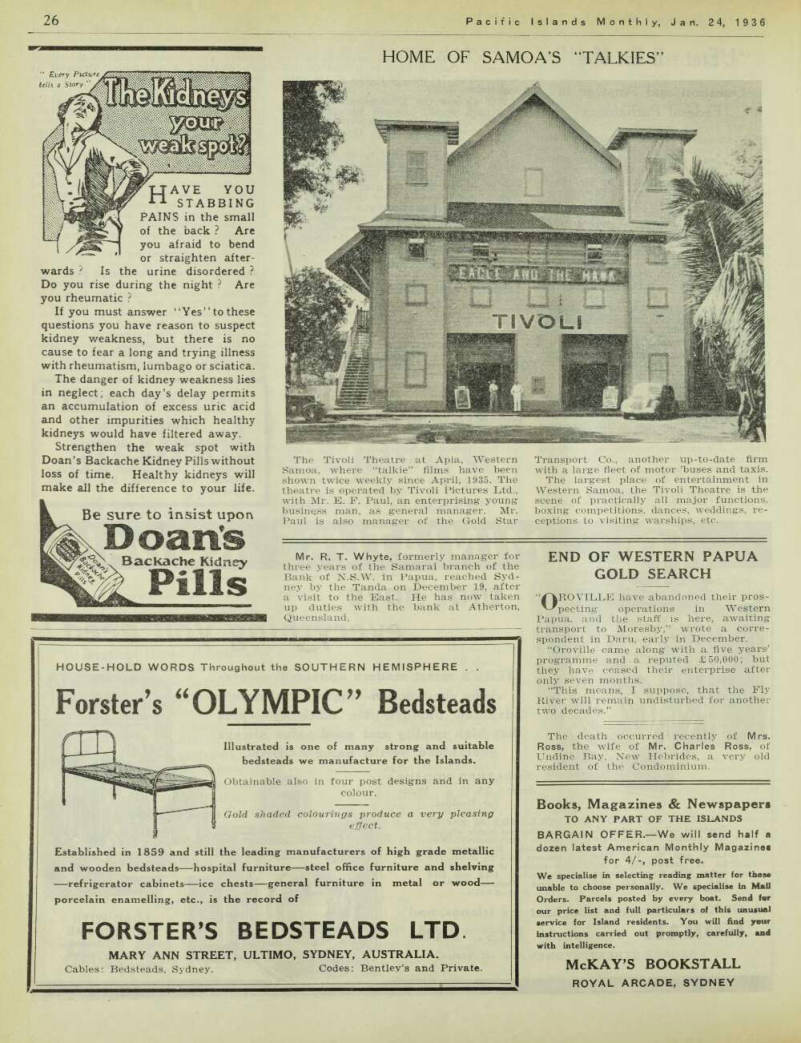
L.M.S. 1935 Assembly At Pt.
THE 1935 Assembly of the London Mis sionary Society in Papua was held in Port Moresby in November and December.
The officers elected were: Rev. F. J. Searle, 8.A., chairman; Rev. H. J. E. Short, F.R.G.S., secretary: Mr. Percy Chatterton, F.C.P., treasurer.
Outstanding among the many matters recorded was the re-publication of the New Testament in Motuan. This is perhaps the greatest literary event in the history of the Territory. Books also are being pub lished in the Mailu and Kerewa languages.
A printing house is expected to be in operation at Hula in 1936, under the super vision of Rev. H. J. B. Short.
A feature of the mission work during
the past two years is the number of im pressive new church buildings that have been erected. A fine gothic structure at Saroa was opened in December by Rev. R.
Lister Turner, M.A., F.R.G.S.
A book on religious problems, prepared by a committee under Rev. S. J. Rankin. 8.A., 8.D., for the help of native teachers is ready for translation into the various vernaculars.
The one sad note in the meetings was struck by the Port Moresby medical officer in his advice that the former chairman.
Rev. Geo. Moir Smith, desisted from that office owing to the state of his health.
There was a tense feeling as he led, with difficulty, the closing devotions of the sessions. Mr. Moir Smith and his wife and son, will probably leave Papua at an early date.
Mr. Harrie Percy Bentley, of Suva, Fiji, died at home at Nasese on December 7, aged 76. Arriving in Levuka from Vic toria in 1867, he lived for several years in the Rewa River district, cultivating cotton. After the cotton slump Mr. Bent ley engaged in copra planting, and later was in charge of Messrs. Morris, Hed strom Ltd.’s timber department. Three years ago he retired on pension.
Mr. R. T. Whyte, formerly manager for three years of the Samarai branch of the Bank of N.S.W. in Papua, reached Sydney by the Tanda on December 19, after a visit to the East. He has now taken up duties with the bank at Atherton, Queensland.
Advertisements & other items, pp. 27-28 (1 item)
that have
WILLIAM FINAL
Photographer
FRIENDLY IS., OCEANIA
Silent Filming, 35 mm., or 16 mm., to order. Interesting views and natives’ life scenes, 5/3 prepaid anywhere.
r 7P o A*a
that have
everything you need
KODAK 6.20 DUO
Combines all the outstanding advantages of both regular and miniature models.
Loads with No. VI2O Film for 16 pictures 1% x 2% inches. With Compur Shutter f/ 4.5 Anastigmat, £8; f/3.5 Anastigmat, £lO.
f/fERE’S smart modern appearance—pre-
cision construction —ingenuity of design
advanced photographic efficiency plus
that high quality and good value always
guaranteed by the name KODAK.
MINIATURE KODAKS
from £5/15/-. Write for Booklet.
VOLLENDA 48 and 52
Two tiny yet highly efficient models. Both load with V 127 Film—No. 52 making 8 pictures 1% x 2 1 /2 inches, No. 48 making 16 pictures 1% * 1% inches. f/3.5 and f/4.5 Lenses, Compur Shutters.
Prices from £5/15/-.
Of Kodak Dealers throughout the Islands, and
KODAK (Australasia) Pty.
379 GEORGE STREET, SYDNEY And all States.
LOAD WITH
VERICHROME
Made in Australia.
Hermetically sealed— always fresh.
” Every Picture lells a Story " A
Have you
STABBING
PAINS in the small of the back ? Are you afraid to bend
11 STABBING
PAINS in the small of the back ? Are you afraid to bend or straighten afterwards ? Is the urine disordered ?
Do you rise during the night ? Are you rheumatic ?
If you must answer “Yes’ ’to these questions you have reason to suspect kidney weakness, but there is no cause to fear a long and trying illness with rheumatism, lumbago or sciatica.
The danger of kidney weakness lies in neglect; each day’s delay permits an accumulation of excess uric acid and other impurities which healthy kidneys would have filtered away.
Strengthen the weak spot with Doan’s Backache Kidney Pills without loss of time. Healthy kidneys will make ail the difference to your life. e to insist upon
Doan’s
t Pills
Backache Kidney
HOUSE-HOLD WORDS Throughout the SOUTHERN HEMISPHERE . .
Forster’s “OLYMPIC” Bedsteads
Illustrated is one of many strong and suitable bedsteads we manufacture for the Islands.
Obtainable also in four post designs and in any colour.
Gold shaded colourings produce a very pleasing effect.
Established in 1859 and still the leading manufacturers of high grade metallic and wooden bedsteads—hospital furniture —steel office furniture and shelving —refrigerator cabinets —ice chests—general furniture in metal or wood— porcelain enamelling, etc., is the record of
FORSTER’S BEDSTEADS LTD
MARY ANN STREET, ULTIMO, SYDNEY, AUSTRALIA.
Cables: Bedsteads, Sydney. Codes: Bentley’s and Private.
Home Of Samoa’S “Talkies”
Transport Co., another up-to-date firm with a large fleet of motor ’buses and taxis.
The largest place of entertainment in Western Samoa, the Tivoli Theatre is the scene of practically all major functions, boxing competitions, dances, weddings, re ceptions to visiting warships, etc.
The Tivoli Theatre at Apia, Western Samoa, where “talkie” films have been shown twice weekly since April, 1935. The theatre is operated by Tivoli Pictures Ltd., with Mr. E. F. Paul, an enterprising young business man, as general manager. Mr.
Paul is also manager of the Gold Star
Gold Search
End Of Western Papua
OROVILLE have abandoned their pros pecting - operations in Western Papua, and the staff is here, awaiting transport to Moresby,” wrote a corre spondent in Daru, early in December.
“Oroville came along with a five years’ programme and a reputed £50,000; but they have ceased their enterprise after only seven months. ‘‘This means, I suppose, that the Fly River will remain undisturbed for another two decades.”
The death occurred recently of Mrs.
Ross, the wife of Mr. Charles Ross, of Undine Bay, New Hebrides, a very old resident of the Condominium.
Advertisements & other items, p. 28 (1 item)
Books, Magazines & Newspapers
TO ANY PART OF THE ISLANDS
BARGAIN OFFER.—We will send half a dozen latest American Monthly Magazines for 4/-, post free.
We specialise in selecting reading matter for those unable to choose personally. We specialise in Mali Orders. Parcels posted by every boat. Send for our price list and full particulars of this unusual service for Island residents. You will find your instructions carried out promptly, carefully, and with intelligence.
McKAY’S BOOKSTALL
ROYAL ARCADE, SYDNEY
Bulolo
The Wealth Of
Three Years’ Dividends Exceed One Million Pounds
4MONG gold-winning undertakings which have reached the production stage since the rise in the price of gold, four years ago, gave new and vigorous life to an apparently dead industry, Bulolo Gold Dredging Limited has already achieved remarkable results (said “Mel bourne Herald” of December 30).
In three years it has paid dividends aggregating £1,050,000, exceeding payments for the same period by either of the two outstanding Western Australian companies —Lake View and Star and Wiluna. Bulolo this year headed the list of dividend-payers listed on the Stock Exchange.
New Guinea is now producing more gold than any Australian State except Western Australia. Bulolo has paid two-thirds of the total dividends disbursed by companies operating in the Mandated Territory.
Formed in February. 1930, with a nomi nal capital of a million dollars (£800,000), Bulolo now is nominally capitalised at six million dollars, and has a subscribed capital of 4,675,000 dollars divided into 935,000 shares of five dollars each.
The story of Bulolo’s conquest of the natural difficulties of inhospitable New Guinea will be long remembered as a romance of modern business enterprise.
Dredge units were transported by aero planes.
Production was commenced in 1932 with one dredge. Now four dredges are in operation, and plans for the commission of two more are being executed.
Six Dredges Soon
At the annual meeting recently it was stated that the installation of two deep digging dredges would be proceeded with immediately. One would have a total digging depth of 120 ft., the other of 165 ft.
The cost would be met by the sale of up to 60,000 Treasury shares as funds were required. With six dredges in operation earnings were expected to be materially, though not necessarily proportionately, in creased.
On the Bulolo River and about six miles from the upper end of the company’s hold ings an additional area had been acquired.
From it and from several small contiguous areas being negotiated for, about 10 million yards of 25-cent gravel might reasonably be expected.
Bulolo was already assured of ranking with the world’s greatest gold-dredging companies when deep-boring on portion of
its original areas proved that what had been thought to be bedrock (mostly about 22ft.) was really a false bottom.
Below it were depths of payable ground varying between 60ft. and 180 ft. This dis covery, coupled with the rise in the price of gold and the acquisition of new areas by the company, added an unknown num ber of years to the prospectus-estimated life of I*2 years for the undertaking.
In the five months (to November 1) since the close of the company’s last financial year, the company’s estimated profit is more than £350,000, calculated at £B/15/- (Australian currency) a fine ounce of gold.
The dredging of 4,748,000 cubic yards in that period gave a yield of 54,2230 z.
The latest London quotation for the shares is £7/1/3 (about £B/16/3 Australian currency). On Melbourne ’Change before the holidays they were quoted at £B/7/3 (ex dividend 6/9).
Mr. W. M. Middleton, who has con siderable planting interests in New Guinea, paid a visit to Australia in January.
Control of Aviation
Plan for New Guinea and Papua
STEPS have been taken by the Com monwealth Government to formulate a policy which will regulate air transport in Papua and New Guinea.
The Federal Cabinet, in December, ap proved in principle of a scheme which is being submitted through the Lieutenant- Governor of Papua and the Administrator of New Guinea to aviation, mining, com mercial and planting interests for their comments, Mr. C. G. R. McKay, Secretary for Native Affairs, left Apia, Western Samoa, for Wellington, N.Z., with his family by the Maui Pomare on December 5. Dur ing his absence Mr. T. Robson, Resident Commissioner of Savaii, is acting as Native Affairs’ Secretary.
Mr. S. V. Albrecht, assistant teacher in the Samoan Education Department, sailed from Apia for New Zealand on leave by the Limerick on December 14.
Advertisements & other items, pp. 29-30 (1 item)
Sydney’s Sailmaker
SHIP CHANDLERY - HARDWARE
BROOMFIELDS LIMITED, 152 Sussex St, SYDNEY
Large and Complete Stocks of SHIP CHANDLERY.
Ironmongery of all kinds—Paints, White Lead and Oils.
Sole Agents for : P. H. MUNTZ & CO.’S 3-CROWN BRAND METAL SHEATHING.
PEACOCK & BUCHANS’ ENGLISH READY-MIXED PAINTS.
WRITE FOR SHIP CHANDLERY CATALOGUE
Special “In Bond” Prices for all Island enquiries quoted on application
CABLES: “BOOM,” SYDNEY
II Alt IK V WEST
Sydney’s Sailmaker
»!■ M > v 3#A t I
SECTION OF OUR SAIL LOFT
Caters for every class of
SAIL, CANVAS,
ROPE & WIRE
EQUIPMENT
Send your enquiries to us
ADDRESS;
BALMAIN.
SYDNEY
FI m
DIESEL ENGINES
INSTAL THE DIESEL THAT HAS BEEN GOING STRONG SINCE 1929, AND HAS PROVED ITSELF IMMUNE FROM ALL DIESEL WEAKNESS.
D.C. Series, 45 to 180 b.h.p., in 3,4, I, and 8 cylinder sizes at 700 to 90* r.p.m.
D.B. Series, 24 to 96 b.h.p., in 2,3, 4,6, and t cylinder sizes, at 1000 r.p.m.
Australian Agents:
H. G. THORNTHWAITE & CO.
KEMBLA BUILDING.
MARGARET STREET, SYDNEY, N.S.W.
TELEGRAMS: “ORTHORN,” SYDNEY TELEPHONE: B 5240
\tjrm
a >rv i « < \
RECORDS
-POSTED FREE
SEND FOR LISTS
Australia’s finest Record Shop, specialising in Mail Orders.
Any Records procured and sent same day.
Dozens of clients in the Pacific Islands. We pay freight.
THE TALKERIES
QUEEN VICTORIA BUILDINGS
SYDNEY, AUSTRALIA
Established N.H. 1894
Kerr Brothers Limited
ISLAND MERCHANTS & AGENTS
Assembly Hall Building,
1 JAMIESON STREET, SYDNEY
PRODUCE:
Cacao, Coffee, Copra, Peanuts: Ship to us for best returns. Copra shipped overseas on behalf of clients and may be drawn on.
PLANTATION REQUIREMENTS:
We have over 40 years’ experience to help you. Agents for Cacao, Coffee and Castor Seed Machinery; Agricultural Implements and Power Cultivators; Tractors and Trailers; Paints; Marine, Fire and Earthquake Insurance.
MERCHANDISE PURCHASED AT BEST PRICES
AND ORIGINAL INVOICES SUPPLIED
G.P.O. Box 3838 T
Cable Address:
“CARE SYDNEY”
C II I VERS
FAMOUS ENGLISH PRODUCTS
CANNED ENGLISH VEGETABLES
CANNED ENGLISH FRUITS
OLDE ENGLISH MARMALADE
GOLD MEDAL JAMS
JELLY CRYSTALS, ETC.
Obtainable from all leading Grocery Stores
WRITE TO DEPARTMENT “A”
CHIVERS & SONS LTD.
Histon, Cambs., Eng.
FOR ATTRACTIVE RECIPE BOOK
Tm C<((
CHIVfRS
COLD
simmd/ird ;
|\ FRESH
V* ENGLISH sf
PEAS
m Ss*. aCke£ “15kto anp p
Pages From The Past
Case of the Schooner Norval
By Julian Hillas
OUTSIDE of Chinese waters, piracy on the high seas has become so rare that it is all the more strange to find one of the few cases which have occurred within the last half century having for its setting the lonely South Sea atoll of Penrhyn.
This palm-crested coral ring, Enclosing 108 square miles of lagoon and supporting a population of some four or five hundred natives was, in 1892, a British possession included in the Pacific Naval station and, as such, came under the jurisdiction of the High Commissioner of Fiji. Seven hundred miles to the south-east lay Rarotonga, seat of the Federated Cook Islands Government
and home of the nearest responsible British official.
An irregular but growing trade had been established between the two islands, the principal medium of exchange being the pipi pearls, for which Penrhyn was rapidly becoming well-known. The lion’s share of this business was in the hands of Donald and Edenborough, an Auckland firm with a branch at Rarotonga and a fleet of schooners operating throughout the Cook Group.
On February 18, 1893, the ketch Agnes Martin reached Rarotonga from Penrhyn.
She reported that the schooner NorvaT had been seized whilst off that island and conveyed inside the lagoon, her master, Thomas Harries, being detained by the natives, virtually as a hostage for the re covery of certain monies to which the latter considered themselves entitled.
The seizure, which caused considerable local excitement, was soon found to be an echo of a case heard during the previous year before Judge Tepou o te Rangi in the Federal Court at Rarotonga, when the Penrhyn Hau, or Government, sought to recover 3,600 dollars, Chile coin, said to have been obtained by Captain Harries under false pretences. Judgment had been given in their favour, but the power of the Native Court was insufficient to enforce its order for the return of the money, which was then in the hands of Donald and Edenborough. Thus matters had rested, the Penrhyn representatives going back, and Mr. Edenborough maintaining that the money had been paid over on account of a purchase authorised by the natives, and which would be delivered to them in due course.
Prom the evidence disclosed, it appeared that Harries, being in the employ of this firm as master of the trading-schooner Torea, had been commissioned by the Hau to obtain for them a vessel, the price of which was not to exceed 4,000 dollars (£600), and with this object in view had taken from them an initial deposit of 800 dollars. This occurred in June, 1892, Subsequently the schooner Norval was acquired by Mr. Donald in New Zealand, and after a complete overhaul there was to be despatched to Rarotonga. Harries in the meanwhile again visited Penrhyn. where he informed the Hau of what had transpired and collected from them the further sum of 2327 dollars, the balance still owing to be paid later, on delivery of the schooner. A crew of seven accom panied Harries down to Rarotonga for the purpose of bringing back the Norval which, the Hau claimed, they understood to be waiting for them.
Up to now, neither the good faith of the Hau, nor the excellent intentions of Cap tain Harries, were in any doubt. But at this stage a new note was introduced by the appearance in Penrhyn of the Te Uira, a small, aged, but speedy vessel belonging to Captain Emil Piltz, of Rarotonga. There is no record of what passed between the islanders and Captain Piltz, but the out come was that two natives were despatched to Rarotonga on the Te Uira and reaching there before Captain Harries, found that the Norval. had not yet arrived from Auckland. Hurrying back to Penrhyn with this information —and one cannot help thinking that in thus placing the Te Uira at their disposal, Captain Piltz had an eye on the main chance —the Hau immediately decided that Harries had deceived them, and at once commenced negotiations for the purchase of the Te Uira at 3,500 dol lars, at the same time instituting proceed ings for the recovery of the money paid to Harries.
During the hearing before Judge Tepou, Harries made a bad break by presenting a paper authorising the purchase of a suit able vessel and purporting to be signed by the Penrhyn Hau on June 4, but which transpired in evidence to have been con cocted on board the schooner and signed on September 23 by a native named Banaba, one of the seven men sent to take over the Norval. It is easy to understand Captain Harries’ desire to substantiate what had, up till that time, been a purely verbal contract, entered into on both sides without anticipation of legal complications; but this method of so doing was unfortu nate, since it not only confirmed the Penrhyn people’s suspicions, but also roused those of the native Judge, who thereupon adjudicated in favour of the Hau.
On October 16, the Penrhyn representa tives left Rarotonga in the Te Uira, and on the 20th the Norval arrived from Auck land.
Captain Harries immediately manned her and, accompanied by his wife, Tapaeru Ito, a native of Rarotonga, left for Penrhyn, reaching there on the evening of Saturday, December 3.
Two boats came off from the shore, whereupon Harries informed their occu pants that this was the vessel which he had bought for the Hau, and that he would take her inside the lagoon as soon as the balance owing to Donald and Edenborough was paid. After some demur the boats pulled back; leaving six or seven of their number onboard. That nigfit the Norval stood on and off the island, and in the morning she was about two miles out to sea.
Dawn had just flushed the white line of the reef and broken into colour the fringing palisade of green palms when a boat filled with natives rowed alongside. Boarding the Norval with scant ceremony, they answered Harries’ indignant enquiries by pointing out one of their number who had, they said, “all orders.”
This individual informed the master that they had come for their money, and on • Harries replying that the money was in Donald and Edenborough’s hands and that this was their vessel, the other repudiated the purchase and told him to take the schooner inside, as they would hold her until such time as the money was paid.
Upon Harries’ refusal to do so, the natives took charge of the ship themselves and worked her through the passage into the lagoon, anchoring her close to the beach opposite the settlement of Omoka.
After leaving four watchmen onboard, the others went ashore, saying that as it was Sunday they had done enough!
The following morning Harries and his crew of four were brought before the Court and again asked for the money. On being told that the money was “in the ship” the natives took this to mean literally and devoted several hours to a fruitless search of the NorvaVs hold and bilges!
On December 7 Captain Harries wrote to the Hau:— “I, Thomas Harries, master of the schooner Norval of Auckland, hereby give you notice that as you have seized the said schooner when laying at sea, outside
of Penrhyn, on Sunday, December 4, 1892, and that she is now in your hands, from that date you will have to pay all expenses until she is released, at the rate of 400 dollars per month.
Thomas Harries, Master.”
By the ketch Agnes Martin he despatched a further letter to Mr. Gamier, Shipping Master at Rarotonga:— “Will you please send these reports to some place where I can get help, because it is better to be in goal in any civilised country than to be here without anything to eat, as all I have received from them in two months is two sucking pigs, 250 coconuts and about twenty fish, and I am supposed to feed all my crew on this.”
The difficulty, however, lay in finding an authority which was both empowered to act and which also possessed the means
of enforcing its decisions. The Cook Islands —of which Penrhyn was not a part —were only a Protectorate, jealous of any interference or infringement of their in dependence by the High Commissioner of Fiji, with whom, as well as with the Governor of New Zealand, the British Resi dent at Rarotonga now opened a corres pondence regarding the Norval.
While this exchange of letters was tak ing place, Captain Harries remained a prisoner in Penrhyn, where the Norval, secured fore and aft by two anchors, had been covered with a roof of coconut leaves to protect her from the sun. Although free to move about as much as he liked, Harries was given no opportunity of leav ing the island on any of the various schooners which periodically called there.
On June 27, H.M.S. Hyacinth visited Penrhyn and Captain H. J. May—ignorant of the correspondence which had passed between Rarotonga and Fiji—promptly convened a Naval Court to investigate complaints laid by both Captain Harries and the Hau. Under Commodore’s Law, Captain May found the islanders guilty of repudiating their agreement and of for cibly seizing the Norval, for which offences he fined them 3,500 dollars. Four days later the Norval put to sea, almost seven months
to a day after her capture in the previous December.
To complicate matters, H.M.B. Ringdove, with Judicial Commissioner Ross aboard, reached Rarotonga on July 25 from Fiji and, learning what had transpired, and that the Hau were very dissatisfied with Captain May’s verdict, it was proposed to hold a second and fuller enquiry.
On August 4, Mr. Ross opened his Court in the old Federal Parliament House at Avarua. Three actions were laid. (1) The Hau claimed from Donald and Edenborough 3,600 dollars, which the de fendants pleaded was money paid to them as part-payment of the Norval. (2) D. and E. Claimed 1,567 dollars from the Hau for goods sold and delivered. (3) D. and E. claimed from the Hau 3,500 dollars for the detention of the Norval at Penrhyn from December 4, 1892, to July 1, 1893.
The cases were fully argued, Mr. Exham (Lloyds Agent) and Mr. F. G. Moss repre senting D. and E., and the Hau, respec tively. On August 11, Mr. Exham asked for an adjournment to enable Captain Harries to be present in person, the Norval being still at sea. This was granted, and the Ringdove was on the point of sailing when the Norval made harbour, and Mr.
Ross reopened his Court on the 15th. On the 18th he delivered judgment. (1) That no valid contract had been made, and that the sum of 3,600 dollars be repaid to the Hau. (2) The Hau admitted their debt of 1,567 dollars and were ordered to pay this amount. (3) 400 dollars were awarded to D. and E. for the illegal detention of the Norval.
One of the Hau members was allowed passage in the Ringdove, which conveyed to Penrhyn the sum of 1,632 dollars, paid by D. and E., and the Norval returned to New Zealand.
Thus ended one of the most involved and troublesome cases which had risen to tax the legal resources of the young Pro tectorate.
Captain Harries remained in the employ of Donald and Edenborough for many years, finally acquiring from them the schooner Vaite and setting up for him self as an independent trader with stores on Penrhyn, Manihiki and Rakahanga Islands. On his death in 1918, at the early age of 56, his interests were taken over by A. B. Donald and Co., successors to Donald and Edenborough, who also acted as Trustees for the substantial sum realised and held for Mereana, the only child of Captain Harries and Tapaeru Ito.
Advertisements & other items, pp. 31-32 (1 item)
Wentworth
Maleham & Yeomans
Ltd.
BOWDON ST., SHEFFIELD, ENG.
Manufacturers of all kinds of
BUTCHERS’, STICKING AND
SHEATH KNIVES
RAZORS AND SCISSORS
Specialty
HAIRDRESSER SCISSORS
PRICE LIST ON APPLICATION
Plctiire§(|iic Isles
of the South Seas
The New Souvenir Book
A handsome volume of 64 pages containing wonderful photographs of Papua-New Guinea and the Solomon Islands. Cover design in full colour.
AN IDEAL GIFT
11 Now on Sale Price 3/6 Copies obtainable from
BURNS, PHILP & CO. LTD
7 BRIDGE STREET, SYDNEY, AND BRANCHES
“The
Wentworth
CHURCH HILL,SYDNEY
Phone: 81V1361
(10 Lines) Telegraphic Address: "Mum,” Sydney
Sydney’s Exclusive
Hotel
1 t t * , J . .
Situated only two minutes from the General Post Office, Railway Station, and leading theatres. All rooms Steam-heated in Winter and Air-cooled in Summer, and equipped with Telephone, and Hot and Cold Water.
Excellent Cuisine.
Tariff: Room and Breakfast, from 10/6 per day; Inclusive from 18/- per day.
For full particulars apply to The Manager
GUNN e MOORE
for all Sports Goods
Write For interesting Free Catalogues
to CUNN b MOORE LTD
CfIRMNGTON Sf;; *
.NOTTINGHAM ENG
COOL-
MEN'S KNITTED
SUMMER UNDERWEAR
Very light.
SINGLET “Swiss Rib” (Athletic Style) The New Vogue Price . . 5/6 SHORTS, (Elastic Waist) Price, 4/6 The Ideal Combination for Summer Comfort.
Piko Brothers
LIMITED
Queen Street, Brisbane.
Clothes for Men and Their Sons since 1885.
For Speedy, Accurate and
Versatile Photography . . . there’s nothing like the
LEICA
Camera
m
(MODEL ))
HERE ARE THE REASONS WHY
I—BUILT-IN short base range FINDER gives you perfect focus automatically.
2.—FOCAL PLANE SHUTTER with
the greatest range of shutter speeds on any camera —1 second, j, h, in addition to all regular speeds between l/20th and l/500th second.
3. —ELEVEN DIFFERENT LENSES
AVAILABLE.
4. —36 PICTURES from a single roll of cinema film. Sharp negatives Enlargements up to any size.
S—SMALL, COMPACT, FITS THE
POCKET, easy and fast to operate. Very inexpensive to maintain.
Leica Service Why not take advantage of it?
We SPECIALIZE in the development, printing, and enlarging of miniature We ?■ iMnivmilAL ATTENTION is given to every order. We have "he BEST POSSIBLE EQUIPMENT and our experts have at their d 'sposal, an uo to-date Research Dept. Miniature negatives having a superior detail and gr P ain quality,"require special attention to obtain and th.s
overcome* *by vi|ng^suStable
tTther personally or through our MAIL DEPT. Inquiries will be given prompt attention. Write NOW, for further particulars to
LEICA PHOTO SERVICE
KYLE HOUSE, 31 MACQUARIE PLACE, SYDNEY
(The only Leica Specialists in Australia ) developing printing film supplies
Sanctions in Western Samoa
From Our Own Correspondent APIA, December 5.
THE application of the sanctions against Italy, which have been put into effect in New Zealand, is officially announced here also.
It is doubtful whether there are any im ports from Italy into Samoa at the pre sent time, though formerly “Borsalino” hats were imported here. Italian special ties like macaroni and spaghetti come here from Australia or America.
There are no Italian nationals resident in Samoa.
Mr. Thomas Horne, managing director of Messrs. Walter Horne and Company, Suva, Fiji, arrived in Sydney on busi ness by the Aorangi at the end of December. He will return to the Colony in February.
Samoan Factions
Move to Conciliate Native Parties
From Our Own Correspondent APIA, December 19.
ACCORDING to reports from outside districts there has been Fonos (native meetings) in many villages, especially along the west coast of Upolu, with the purpose of effecting a reconciliation of the two opposing parties among the Samoans, the Mau (opposition party) and the Malo (government party).
In many villages there are adherents of both parties living together, and with rela tions strained and feelings bitter, there has been dissension in village affairs, com munal work and church matters. The co operation, which is traditional in village life, has been sadly lacking.
Mainly owing to the efforts of European and native missionaries, the Samoans in many districts have declared their readi ness to “bury the hatchet” and work together peacefully in future for the good of their respective communities, though still preserving their political views as heretofore.
The new movement was started before the result of the New Zealand elections was known and had nothing to do with the political change. It is, however, signi ficant, as it indicates that the Mau leaders now are inclined to abolish their militant and aggressive attitude towards the Administration and to adopt a more con ciliatory policy.
Unspoiled Mangaia
From Our Own Correspondent RAROTONGA, December 1.
AMONG those proceeding on leave by the next Maunganui are Mr. and Mrs.
McGruther, Resident Agent and Resident Nurse respectively at Mangaia. Mr. Mc- Gruther has just completed his fourth term of office and can look back at 12 years’ residence in the most southerly of the Cook Group. During his absence the affairs of the island will be managed by the Island Council.
Anyone wishing to escape the winter cold of overseas countries, might well con sider Mangaia as a suitable refuge. The people are kind and hospitable; they are unspoiled by over-contact with civilisation and retain many of their old customs. The climate is peculiarly mild and temperate and there is an abundance of native food stuffs, so that living may be made exceed ingly moderate. The island is in com munication with Rarotonga by wireless, and schooners call approximately every two or three months.
For many years Mangaia has been re garded as the most contented and best-run of all the outer islands of the Lower Group, and there is no doubt that this har monious state of affairs is due to the tact, sympathy and interest displayed by both Mr. and Mrs. McGruther, who are them selves of Polynesian extraction.
Mr. A. L. Savage, who has been ap pointed to replace Mr. K. S. J. Chamber lain, recently transferred to Gibraltar, as Deputy Treasurer of Fiji, arrived in Suva by the Niagara on December 15. Mr.
Savage, who was formerly Assistant Treasurer in Northern Rhodesia, was accompanied by his wife and two chil dren.
Japan And Mandates
BRITAIN has officially announced that Japan, having ceased to be a member of the League of Nations, has no legal right to claim equality of treatment in commercial matters in mandated terri tories. On the other hand, the Anglo- Japanese Commercial Treaty of 1921 ex tends to certain of the mandated territories administered by the British Government, and, by virtue of that, Japan possesses most favoured nation rights, on a recipro city basis, as long as these extensions re main in force.
Mr. W. Tail by, Treasurer and Collector of Customs in the Cook Islands Adminis tration, left Rarotonga in December on furlough, which will include a holiday trip to Java.
Mr. S. H. Gander, Seventh Day Adven tist missionary of Upper Ramu, Central New Guinea, reached Sydney with his wife and 11-year-old daughter, Gwen, by the Tanda on December 19. The natives among whom he worked for several years were primitive, but remarkably ingenious in many things. He saw cleverly con trived traps to catch the field rats, which provided a favourite dish. The natives lived in tribal settlements, the men of a tribe occupying one large hut, while the women lived separately, sharing their huts with the pigs, with which every tribe was provided. In his work Mr.
Gander was assisted by 20 native teachers, who had been trained at the mission’s educational establishment, on the Island of Mussau, St. Matthias group.
Advertisements & other items, pp. 33-34 (1 item)
Rolls Razor
ISLAND SHIPPING
Freight, Forwarding and Customs Service. Import and Export.
B. R. Wheeler 17-19 Bridge St., SYDNEY Correspondence Invited. Tel.: B 5396
THE IDEAL GIFT
Rolls Razor
0
THE WORLDS BEST SAFETY
WHEN you give him a Rolls Razor you give him Shaving Comfort for life, and you have the satisfaction of knowing that your Gift is the best the World has to offer.
Illustrated Catalogue and Price List sent free on application.
■tolls Itazor Co. of Australia Ltd.
8a CASTLEREAGH STREET SYDNEY, N.S.W.
Firearm Repairs. “OUR HANDS MAKE GOOD ARMS.'’ Firearms sent C.O.D.
HIGH-GRADE SECOND-HAND GUARANTEED
English Hammerless
Shotguns
I am continually receiving consignment from England. Amongst those in stock at present are: Purdey, Jeffery, Lang, Greener, Boswell, Rigby, Evans, Cashmore, Hollis. Also S.H. English Hammer Guns, from £.5. Write for special S.H. list. Firearms exchanged.
My illustrated catalogue of New Firearms or Fishing Tackle sent upon request.
Gunsmith, Importer of High-Grade Firearms, and Fishing Tackle Specialist. 143 Elizabeth St., Sydney (near Market St.)
“FISHING TACKLE TO TACKLE FISHING.”
SIL JROHUi
*7 T H kw 1
CAPSTAN
CIGARETTES
CORK-TIPPED
OR, PLA I N
CAPSTAN
NAVY CUT TOBACCO
wide fum the finest
Vtufman
ff-
PST
Your Sydney Agent?
William E. Reed
(Established 1913)
UNION HOUSE
247 GEORGE ST., SYDNEY
Shell sold, and goods supplied at wholesale prices, on commission.
Enquiries welcomed.
A
O Keep FOOD FRESHanA COOL
in the NEW “ CV&TOO-ld ”
Non-Electric REFRIGERATOR
lr* <sT» The **
SvercxrLd
no moving no running can't go wrong ... no noise parts ... no vibrations . . water ... and the kerosene unit housed in the bottom of the cabinet is lighted only once a day.
Sole Distributors:
SIMPLEX BALTIC MACHINERY CO. LTD.
608 Harris Street, Sydney, N.S.W.
Designed on conventional lines, it is the most modern
KEROSENE-OPERATED refrig-
erator yet constructed. The food chamber is roomy (7£
cubic feet capacity), porcelain-
lined, contains four shelves and an ice cube tray. The door opens out and so foodstuffs at the back of the chamber are easy to reach.
Meat fresh . . . butter firm . . . vegetables crisp . . . drinks cool and refreshing —that's the “Evercold" way. For years country householders have waited fgr the "Evercold" . . . the non-electric refrigerator specially designed and constructed for station and farm requirements. Every 1 Evercold is personally tested by Mr. J. W. Long (certificated refrigeration expert) to give entire satisfaction under
HEAT WAVE and TROPICAL
weather conditions. Cash or easy terms.
Simplex Baltic Machinery Co., Ltd., 608 Harris Street, Sydney, N.S.W Please send me full particulars of the “Evercold" (Kerosene-
operated) Refrigerator.
Name Address
Leper Station For Cook
Islands
From Our Own Correspondent RAROTONGA, December 1.
A GLOOMY note was struck the other day by a notice posted outside the Administration offices to the effect that a youth of about 21 had been isolated in a house on Tupapa beach, and that anybody entering the enclosed section without per mission from the Medical Officer would be liable to a fine of £5O.
Owing- to the infrequency of visits from a leper ship, and the impossibility of treat ing persons individually on each island, a project is now under discussion for utilis ing one of the many small motus in Penrhyn lagoon as an isolation settlement where cases may be treated pending despatch to the Government Leper Station in Fiji. It has also been suggested that one of the local' youths at present qualify ing for the diploma of Native Medical Practitioner, issued by the Fiji School of Medicine, should undergo a special term studying leprosy treatment in order that he may ultimately be placed in charge of the proposed settlement at Penrhyn.
Adventures in the South
Seas
ODS WHO DIE —the story of Samoa’s Greatest Adventurer” as told to Julian Dana, has been just published by Mac millans. The Honolulu “Star-Bulletin” says of it; — George Egerton Leigh Westbrook, now 78, has spent 60 years of his life in the South Seas, 43 of the 60 in Samoa. Julian Dana, who writes the book, met him by chance in Auckland, where he was attempting to secure from the adminis trators of the mandate some concessions to Samoan protests.
The casual meeting in a hotel lobby led to the writing of a vividly interesting and, the author assures us, a accurate account of the adventures of an English lad of good family who went to sea, fell under the spell of palms and atolls and forgot the world out of which he had come.
Westbrook did not ‘‘go native,” but he found the islands of the South Seas the place where his intense energies could well spend themselves. He has had a varied and active life, made a fortune, lost a good deal of it in efforts to advance native in terests, and lives in vigour and comfort still in his Samoan home at Apia har bour, fifth building from the left. His greatest wealth, though, is his memories.
The book has. numerous illustrations, in cluding photographs of the wrecked Ger man war ships Eber and Adler, driven ashore in the great hurricane. Steven sonians will also find some pictures of R.L.S. they perhaps have not heretofore seen.
The attitude of the old adventurer toward missions is not wholly enthusiastic.
The new religion brought not only the deadly Mother Hubbard but drastic Sab bath regulations that in a tropical country without refrigeration ruled that week-end cooking had to be done on Saturday. Not even a fish washed ashore could be picked up on Sunday.
High Seas Damage Apia Front
From Our Own Correspondent APIA, December 7.
THE political landslide in New Zealand seems to have had repercussions in Samoa, as exceptionally high seas on November 27 and 28 caused a great deal of damage on the Apia sea front. The foreshore near the Vaisigano River was continually flooded by high breakers carry ing with them rocks, sand, and debris, and causing large excavations behind the sea wall.
Damage is also reported from Lutuanu’u on the east coast and Saleimoa on the west coast. The loading of the s.s. Noumea had to be abandoned for 24 hours. The Makoa at Swain’s Island was also unable to load copra there and had to take shelter on the lee side of the island.
Mr. J. E. Nixon-Westwood, who is well known in the Pacific Islands, is at present engaged in Britain as publicity and ex hibition officer for the Government of Southern Rhodesia, and in that connec tion is travelling extensively in the United Kingdom. Mr. Nixon-Westwood’s predecessor in this office was a Mr.
Bouchier, whose brother, a Director of Agriculture, was killed in the recent hurricane in the Cook Islands.
End Of Romantic
Life
Mr. J. A. Philips, of Moorea
From Our Own Correspondent PAPEETE, December 1.
AVERY well known and much respected old-timer in Eastern Polynesia passed away on November 25, in the P er John Augustus Philips, who succumbed to a stroke of paralysis following a long period of indifferent health. He was 75 years of age.
There is a hint of mystery in the circum stances under which Mr. Philips left his home in Staffordshire, England, during his earlv manhood, and his final settlement in Moorea about 45 years ago after some pre liminary wanderings in New Zealand and Australia. Though insignificant in stature, Philips carried with him the unmistakeable air of an English aristocrat, and his cul tured accents betrayed an intimate asso ciation with all that goes along with great estates. His previous history, however— which we cannot help thinking must have been a very interesting one —was screened behind an impenetrable reticence, which was never lifted, even for his most inti mate friends.
In the village of Faatoai, Moorea, where the deceased gentleman allied himself by marriage to one of the influential families of the island, and built his principal place of residence, his home became a place of refuge for a numerous retinue of native dependents, whose presence he thoroughly enjoyed and without whom he was never really happy. His visits to Papeete were few and far between during this period—in fact, so enamoured was he by the associa tions of his adopted land, he paid only two short visits to England during the whole of his sojourn here.
Philips was a Polynesian scholar and linguist of unusual attainments, and in tensely interested in everything appertain ing to the ancient history and folk-lore of the native inhabitants. He was also a great admirer of Henry Nott, one of the early English Missionaries, who came to Tahiti in the Duff in 1797, and after 39 years of laborious work produced a com plete translation of the Bible in the Tahitian dialect. Some years ago Nott’s grave at Arue was re-discovered and re stored to a proper condition by Philips and a few other sympathisers.
As might have been expected from one who was so thoroughly Tahitian at heart, the deceased had requested that the obsequies should be carried out in the native language, and this duty was very admirably performed in the Protestant Church in Papeete by the Pastor, Paul Vernier, in the presence of a gathering which filled the building to overflowing.
The cortege then proceeded to the ceme tery at Paurani, where the interment took place.
Philips, who was twice married, leaves three children by his first wife, all of whom have reached maturity, and settled down to their own affairs. The youngest, a boy, married a few years ago a daughter of Mr.
Livingston Gump, of San Francisco, and has since built a lovely heme in Moorea.
We extend our sincere sympathy to the bereaved widow and the other members of the family.
Mr. W. F. Gill, plantation inspector for Messrs. Burns, Philp and Co. Ltd. at Rabaul, arrived in Sydney from New Guinea by the Macdhui at the end of November.
Advertisements & other items, pp. 35-36 (1 item)
lark's
This delicious sweet
-for six people
costs only
Id 2 I t ■’f
FREE RECIPE BOOK
Write to Foster Clark (Australia) Ltd., Dept.
R. 8., 17 Thurlow St., Redfern. N.S.W., enclosing Id. stamp, and Elizabeth Craig’s Recipe Book will be posted free.
VA
MARBLE GELEE
f oz. gelatine
1 pkt. FOSTER CLARK’S RASPBERRY
JELLY
1 pt. FOSTER CLARK’S LEMON CUS-
TARD
Soak gelatine in a little cold water for 10 minutes. Then drain and pour in the hot custard made according to instructions. Stir well till gelatine is dissolved.
Make this jelly and allow both custard and jelly to cool. Rinse jelly mould out with ice-cold water. Place mould in another basin full of cracked ice. Fill alternately with spoonfuls of jelly and custard, but let each layer set slightly before adding the next. Serve turned out and surrounded with mandarins or with strawberries. You’ll like it!
lark's
creamy CUSTARD
FC6-185
GILLESPIE’S
44 ANCHOR ”
FL O 1 SI
TRADE
MARK
The Standard of Quality.
; Brussels Sprouts White Turnips Sweet Corn Tomato Puree Tomato Sauce Tomato Soup Tutti Fruit Sauce Green Peas French Bea Cauliflower
rdenWzfcr
-Jim
1 2 B
Sul
Always
make sure you have at hand an ample Reserve of these
Delicious . .
Garden
Vale
Ready-toserve Vegetables
Island
Plea For Rennell
Danger of New Sicknesses
From a Special Correspondent.
Tulagi, Dec. 3.
WITHIN the last nine months, strong efforts have been made by the Mela nesian Mission, the South Sea Evangelical Mission, and the Seventh Day Adventists to evangelise Rennell Island.
No native teachers can be landed there.
Rennell Island natives have been taken away, usually for about two or three months at a time, and then landed back there. These natives are shown around the different mission stations and some are given a trip to Tulagi, and also given a small amount of schooling. There is nothing to complain of in these proceed ings. The Rennell Islander is anxious to see some new sights and takes advan tage of the mission offers.
Since these happenings, Rennell Island has become a place of sick people. New sickness has been introduced by the mis sions—all with the best of intentions, no doubt, but the results remain.
About five months ago the French schooner La Korrigane called at Rennell and stayed there for about a week; one of the people on board reported that in a village of about sixty people, ten new graves were counted.
None of the missions will deny that at the present time Rennell is full of coughs
and colds, and sore legs; and any islander knows that coughs and colds mean deaths, especially to Polynesian people. The Rennell Islanders are not meat-eaters, and live on a vegetable diet, with fish.
The Government should try to protect the Rennell Islanders as it does the Bel lona natives, and control the missions.
The missions are doing the things the recruiters and traders did in the old days —introducing disease.
At Tulagi recently one of the commer cial people spoke to one of the mission aries whose mission ship often goes to Rennell, and remonstrated with him con cerning his mission and others causing sickness to Rennell Islanders. His reply was typical of the old-time missionaries.
He said, “Better for many to die that a few may be saved.”
Without exaggeration, it can be said that if things go on as at present at Ren nell Island, in 20 years there will only be a quarter of the population left.
Chinese In The
Solomons
Letter to the Editor Chinese traders are still active.
As one takes a walk in Chinatown, one notices many children and Chinese women, and thinks that in about 20 years’ time, no white planter or trader will be in the group. It is time now that all Chinese immigration was stopped.
After all, this is a British place, not an Asiatic colony, and British should have a prior right of earning their livings here.
What have the Chinese ever done in the Pacific? All their earnings go to China, for Chinese goods and labour. The pro portion of British goods sold in a Chinese store is about half of one per cent.
These Chinese have no goodwill to wards the British flag or people and. to a person who is not a Britisher, they will not hesitate to declare their dislike of Britain, and British people in general.
Of course, when a war is on, matters are different. The white man is asked to come forward and fight for his country and protect the flag that neglects him when there is no war.
This is the view of the majority of th>?
British planters and traders in the Solo mons at the present time. And who can blame them?
I am, etc.,
Marsina.
Tulagi, 5.1., 4/12/’35.
Mr. Leslie V. Waterhouse, technical director of Bulolo Gold Dredging Ltd., will sail from Sydney on February 5, on a business trip to America and Europe. He will be away for about seven months, dur ing which he will inspect a mining pro perty in Colombia (South America).
Mr. W. R. Humphries, one of the senior resident magistrates of the Papuan ser vice, arrived in Sydney on furlough in December, and will return in March. He has been 24 years in Papua, and looks well—he says the climate suits him.
Advertisements & other items, p. 36 (1 item)
A. E. Summerbell’S
COLONIC irrigation is one of the best methods of cleansing the lower bowel, and is recommended by the medical profession.
Treatment is obtainable at
ROOMS
Wyoming, Macquarie Street, Sydney
a “He-Man’s” Picture!
“Mutiny on the Bounty” is a “He-Man’s” Picture!
“1VT UTINY on the Bount y ” adapted by ItJ. Metro-Goldwyn-Mayer from the famous trilogy by Messrs. Charles B.
Nordhoff and James Norman Hall, of Tahiti (“Mutiny,” “Men Against the Sea,” and “Pitcairn’s Island”) has not yet ar rived on Sydney cinema screens, but it is on its way.
Meanwhile, it has been seen in Hono lulu, and this is what the “Star Bulletin” says of it: “Mutiny on the Bounty,” taken from the pages of history and translated to the screen, cannot be compared with any other film achievement. It stands alone and far above anything of its kind that has been filmed or which may be filmed for years to come.
It is sea drama as it actually took place 150 years ago, a true chapter from mari time history that resulted in great reform amongst all ships of the sea and which eliminated for all time the brutal treat ment men who go to sea expected and suffered. A large and talented cast was required to play the important roles, and heading this remarkable concentration of major film players are Clark Gable, Charles Laughton and Franchot Tone.
The little square-rigged H.M.S. Bounty sails for the South Seas on a scientific mission to transplant breadfruit trees to the West Indies. Her crew is a motley one of convicts and bewildered wretches “pressed” into service. Her skipper is tyrannical Capt. Bligh, who knows only one law —the merciless law of the sea and an almost fanatical loyalty to the navy and the crown.
Capt. Bligh is relived in this amazing photoplay by Laughton, who makes the character a ruthless and harsh disciplin arian. Fletcher Christian, the master’s mate, is portrayed by Clark Gable in his finest role. Those throughout the world who have read the book will agree that Gable, as Christian, leader of the muti neers, could not have been a better choice.
Quickly the true story of the Bounty progresses —a grumbling crew lashed by interminable storms that lengthened the voyage; living on scant and rotten rations because the captain appropriated the bet ter food for his own use; a snarling Capt.
Bligh raging incessantly at his embit tered crew; floggings, death and scurvy.
Then the halcyon days that followed when the Bounty reached Tahiti; the soothing influence of native women, fresh food, and happiness.
As quickly unfolds the start of the re turn voyage, with Bligh’s tyranny driving his men to mutiny to put him over the side in an open boat.
Adventure after adventure follows the mutiny which has no parallel in naval history—the dogged pursuit of the muti neers years later, the capture of some and their finish on the gallows, the escape of others to Pitcairn Island where 200 of their descendants live to this day.
“Mutiny on the Bounty” is a “he-man’s” picture, but a “he-man’s” picture that women, as well, will thrill over.
Among the featured players is a beauti ful girl the cast lists only as Mamo. Her full name is Margaret Mamo Clark, Hono lulu girl now studying law at the Univer sity of Southern California, who was selected to play the featured feminine role, that of the native girl Fletcher Christian took to wife.
and Papua
Oil Search in New Guinea and Papua
PLANS designed to liberalise the exist ing leases for prospecting and min ing for mineral oil in Papua and New Guinea have been before the Federal Cabinet and have been sent on for con sideration by the Legislative Councils of those territories.
The Australian Prime Minister has stated that existing ordinances will be relaxed so that there might be encour agement for oil prospecting and mining.
Representatives of oil companies had been consulted by a Cabinet sub-committee.
Advertisements & other items, pp. 37-38 (1 item)
Burns Philp
lIOIJIICOOKV
TABLE
DELICACIES
WORCESTERSHIRE
SAUCE —Enjoys a worldwide reputation.
VAT 2 SAUCE —A delicious thick, fruity sauce.
VINEGAR Strong, well matured, and guaranteed Pure Malt.
ESSENCE OF ANCHOVIES
—A fish sauce made from the finest Gorgona Anchovies.
TOMATO SAUCE Made
from fresh, ripe tomatoes.
FRENCH CAPERS —Capu-
cines and Capottes.
SPANISH OLIVES
Varieties: Spanish Queens, Small Queens, Manzanillas and Stuffed or Sliced ready for Sandwiches.
PURE OLIVE OlL— French or Italian, From the first pressings of selected Olives.
PICKLES
Varieties: Sweet Gherkins, Tiny White Onions, Walnuts, Piccalilli, Mixed and Green Tomato.
FISH AND MEAT PASTES,
in 1 |oz. and 3oz. glass jars.
Varieties: Anchovy, Salmon, Ham and Tongue, Veal and Tongue, Chicken and Ham, Turkey and Tongue, Salmon and Shrimp, Bloater SOUPS, in Boz., 160 z., J gal. and 1 gal. tins.
Varieties: Vegetable, Ox Tail, Mulligatawny, Mock Turtle, Tomato.
JELLY CRYSTALS Speci-
ally prepared for warm climates.
They set well, and are deliciously flavoured.
HEALTH SALINE— A re-
freshing health-giving beverage, suitable for hot climates, in ilb. and 1 lb. tins.
HOLBROOKS
(Australasia) Ltd.
WATERLOO, N.S.W.
BURNS PHILP
(South Sea) Co. Ltd.
Island Traders & Shipowners Registered Office: Suva, Fiji.
ALSO BRANCHES AT:
Fiji : Levuka, Lautoka, Labasa, Ba, Sigatoka, Rotuma.
Tonga : Nukualofa, Haapai, Vavau.
Samoa: Apia, Pago Pago (American Samoa).
Solomons: Makambo, Gizo, Faisi.
New Hebrides: Vila.
Gilberts: Tarawa.
Norfolk Is. Nauru. Niue. Wallis Is. Futuna Is.
Code Address: “Burnsouth.”
Timber Joinery
ETC.
PREPARED BUILDINGS
ready for erection a speciality.
SHIP and BOAT BUILDING
TIMBERS specially catered for
FIBROLITE, PLYWOODS,
GALVANISED IRON.
CANEC.
O CONSIGNMENTS shipped
by RETURN STEAMERS
to the Islands.
John W. Eaton Ltd.
WEST CRESCENT ST.,
NORTH SYDNEY
TELEPHONES: X 5051 (5 line*)
BITUMENOID ROOFING
MADE IN AUSTRALIA
Bitumenoid Roofings, Dampcourses and Insulating Felts are made from the world’s best raw materials. Warranted to stand the most rigid tests.
BITUMENOID THE BEST
Roofing, 1,2, 3-ply; Flooring, Waterproof Materials; Saturated Felt; Resilient Road Jointing; Natural Asphalt Dampcourse; 2 and 3-ply Dampcourse; l-21b. Lead-core Dampcourse; Roofing Cement; Asphalt Paints; Roofing Compound.
SAMPLES AND PRICE LISTS ON APPLICATION.
MAXWELL PORTER & SON LTD.
ESTABLISHED 1888.
107 REDFERN ST.. REDFERN,
SYDNEY. N.S.W. ’Phone,
BUILDERS’ SUPPLIES
M 3157. Cables: Bitumenoid
For prompt ilrlitri'y of DEPENDABLE
ENGINEERS REQUISITES
All types of tools, pipes and
pipe fittings, Engine packing
Belts and Belt fasteners.
Lubricating Oils.
"Staybrite” Steels.
Valves & Brassware etc., etc., Since 1 884, William Adams & Company Limited have supplied the best brands of Engineers requisites to customers in every corner of the Commonwealth and beyond.
The fact that many of these customers are still trading with us after more than 30 years, is definite proof of their receiving perfect satisfaction with goods, service, AND prices.
Write for Our Latest Catalogue!
Every requirement an engineer is likely to need is listed and illustrated in our latest catalogue.
Write for YOUR copy it will be sent by return mail.
WILLIAM ADAMS COMPANY
175 CLARENCE STREET, SYDNEY
Future of Solomon Islands
And the Privileges of Public Servants
Letter to the Editor.
SOME months ago, in the “Sydney Morning Herald,” there appeared an article by Doctor C. M. Deland, of Bougain ville (Mandated Territory) who was for some time in the Solomons. He compared the Mandated Territory with the Solomons Islands, as to their respective administra tions, and in his opinion the Bougainville administration is superior. There is a lot to be said for his view and, as Dr. Deland is well known in Australia and the Islands, many will take notice of his opinions. The Tulagi Government people, however, are rather peeved by Dr. Deland’s letter.
It is time, now, that in certain of these growing colonies more representation be given to the residents. Latterly, in the West Indies, the commercial community have asked the Colonial Office for more say in the governing of their own islands.
What sympathy has the ordinary official with the residents of their district? All the civil servants seem to think of is, “When
is my next leave due, and will I be entitled to travelling allowance?”
After all, the commercial people are the ones who keep the wheels turning, or who pay the taxes and wages of the colony.
If it were not for the business firms, where would the wages of the civil servants come from? In Tulagi, at the present time, there are about four Government employees for every white commercial resident.
I am, etc.,
Tulagi, 1/12/35.
Trader.
Editorial Note
Our correspondent’s view, though a com mon one, is myopic. The British Colonial Service must be carried on. The best of the available young men are encouraged to enter this service, and make it their life work. They sacrifice any chance of a quick fortune in trade and commerce, and give their talents unreservedly to the ser vice. If they did not do so, there would be no Colonial Empire to provide a liveli hood for “Trader” and other peevish critics.
They go where they are sent: and no one envies those who are sent to the Solomons, where life is dull and health conditions very unattractive. Who can blame them if they fight for the full retention of their privileges, and look forward eagerly to long leave?
Considering all the circumstances, the public servant is entitled to the very best conditions he can get. The independent planter and trader naturally dislikes the man in the sheltered job. But the planter or trader is a free agent, who goes where he likes and when he likes, and always has a chance of big profits, and retirement.
The public servant is chained to his desk and to routine; he often has to endure, as a boss, people whom the planter or trader “would not stand for five minutes”; he has no chance of making more than his fixed salary; and he cannot retire until all the best years of his life have been given ta the service.
The “Mid-Pacific”
THE Mid-Pacific Magazine, which is pub lished quarterly in Honolulu as an organ of Pan-Pacific interests, is becoming more and more attractive to the general reader. The latest issue is packed from cover to cover with well-selected articles of high literary standard and with beautiful illustrations. At one time it was mostly a propaganda organ, but now it makes a wide reader appeal. The Magazine is concerned’ mostly with events and conditions affecting the territories north of the equator, and especially North America, Hawaii, the Philippines, China and Japan; but it usually includes an article or two dealing with the Central and South Pacific. One article of particular interest to South Pacific readers is “Solomon Islands Mislaid for Two Centuries.” This is an interesting story, strikingly illustrated.
Government Safe Rifled
From Our Own Correspondent
Pt. Moresby, Dec. 1.
EARLY on Wednesday morning, Novem ber 15, burglars broke into the Govern ment Station at Rigo, Central Division, and, without leaving a trace, carried off the Government safe containing £l5O in notes and silver.
The safe was later found in a creek bel nearby. It had been forced open with an axe.
Leave
!
McCormack rolled the wonderful word around his tongue. Leave, after three years in this God-forsaken hole.
A steamer every three months, and then remaining only long enough to load one’s copra and away. Barely long enough to allow a man to see a few white faces and drink a cold beer or two.
Mail? Yes, one got one’s mail. Al ways one or two from home; and maybe Phyllis and Jean had scribbled a line or two. Anyway, showed one was not for gotten.
But now, after these last three years (or was it three hundred!) —leave!
It seemed that these last few weeks would never pass; but now the steamer should be showing up at any time. How one’s eyes tried to pierce the hill, and to look round the corner.
When she shows up it will mean an hour before she drops her pick—plenty of time to get one’s gear to the wharf.
No; better get it taken down now —one never knows!
Fortnight from now—Sydney! Yes, one always made out a list, but what chance had one of keeping to it? Now, where the deuce —yes, here it is—St. James, Prince Edward —seem to be dozens of places to go to. Gosh, have to get in two a day; must go home and see the folks.
What’s the name of that dance place?
No matter —Jean or Phyl will know.
Mutiny? Yes, one mutinied against all the rules of civilisation when one got back. Didn’t one have to make up for those three years?
Won’t they ever lower that launch!
Must be an hour since she dropped an chor. At last! Two hours now, and then freedom. Funny, the new bloke hasn’t come ashore —yes, there’s only one aboard that launch. Of course! He must have “one last one” before he leaves the mob.
Yes, old son, you’ll need it if you stay here as long as I did!
What’s this? Head Office —“Regret— relief uncertain —maybe next steamer — must realise —shortage men—more re grets .”
Laugh, you fool! Can’t you see the
joke? Three years!
Desne.
Tragic Death Of Roy
Hagen
THERE was unusual tragedy in the death of Roy Hagen, a member of the well-known New Caledonia family, who died recently at Noumea, at the early age of 40. He was an attractive youth and was educated at Barker Col lege, Sydney. At that time, he was in the front rank of football players. He had just gone on to the land, in Queensland, when war broke out; and Roy Hagen was among the first to hurry home to the ser vice of Mother France. He was for seven months a member of one of the “sacrifice batteries” before Verdun —that epic of French gallantry—and a week after he left, unhurt, the battery was blown up.
Roy Hagen served the full period of the war; but, unhappily, he came home with gas in his lungs, and that is what killefi him, ultimately. He was for seve ral years a manager of chrome mines in New Caledonia: but he had planned to return to his first love—pastoral life in Queensland —when he contracted fatal pneumonia.
Roy’s brother, Louis Hagen, also died,
ten years after the war, as the result of gas injuries while on active service in France.
Both were brothers of Mr. Nicholas Hagen, of Noumea.
Iron Ore In New Guinea
A LL knowledge of a report that the Eastern Prospecting Syndicate was negotiating with a Japanese firm for the sale of a fabulous quantity of iron ore in New Britain (Mandated Territory of New Guinea) was disclaimed by the Minister for External Affairs (Sir George Pearce) in the Senate on November 28.
Further inquiries into the reported pro posal were being made from the authorities in New Guinea.
Advertisements & other items, pp. 39-40 (1 item)
Buzacott & Co. Ltd.
SHIP & GENERAL
COPPERSMITHS
Manufacturers of all kinds of Pip* Work, Petrol, Water, and Buoyancy Tanks for Ships, Yachts, and Motor Boats, Copper Water-jacketed Exhaust Pipes & Silencers a speciality.
Copper Pans and Stills made to specification
Nicholson & Foster
BALMAIN, SYDNEY
US M f M When buying an engine for marine work there are several main features which you know you want—and which Fetters alone have been able to
PO WE R RE-
QUIRED is sufficient for regular hard work—and a little extra for emergency. FUEL CON- SUMPTION at the lowest point possible is assured. LASTING SERVICE is a feature , not merely a year or two of work.
ABSOLUTE FREEDOM FROM TROUBLE through its long lifetime of service. LOW UPKEEP COST'S, due mostly to extreme simplicity of design together with low stressing of parts.
EASY STARTING under all conditions and above all A COMPLETE FEELING OF SECURITY at all times.
There are many Fetters in use to-day which were installed many years ago.
Their rapidly increasing popularity is due to the complete satisfaction they give over all these points. High efficiency and conservative rating are Fetter features, too.
Made in a range from 6to 450 B.H.P. Marine—also stationary types.
Tell us your plans and allow us to advise you. WRITE TO-DAY !
FETTER
DIESEL AND
SEMI -DIESEL
BUZACOTT & Co. Ltd.
En glues
7-11 MARKET ST.,
SYDNEY
PACIFIC TRADERS!
The Blade of Best Quality, and the Mott Profitable to Handle, it:
JEWEL
SAFETY
O o k A LA These Wades are o i the three-holed (Gillette) type. 1 have made a careful test of all blades, over a lon* period, while I was trading at Milne Bay, Papua, and the British-made Jewel was far ahead of any other. I now have the Pacific agency for Jewel blades, and strongly recommend them to all traders.
Send P. 0.0, for trial gross, post free, 10/- (Australian) or 8/- (sterling). Reduction for quantities. Sample package, 2/6.
HENRY DEXTER
Iping, Midhurst, Sussex, England
wallow & Ariell
LIMITED
Port Melbourne :: Australia Manufacturers Since 1854 of
HIGH QUALITY
/ \ IS Saiga aaaal (alalia Uiscaihi CABIN (Including Small Cabin)
PACIFIC CABIN
CABIN CRACKERS
BREAKFAST BISCUITS
NAVY & PILOT BREAD
Packed expressly for export in tins up to 50lbs.
Solomon Is. Council
Future of Copra—Gold Prospecting—Currency System Altered
From a Special Correspondent.
Tulagi, Nov. 22.
THE Advisory Council of the Solomon Islands Protectorate commenced its second biannual session on November 4.
Members present were—Official: His Honour the Resident Commissioner (Mr.
F. N. Ashley); Government Secretary (Capt. N. S. B. Kidson), Treasurer (Mr.
F. E. Johnson. 1.5.0.), Commissioner of Lands (Mr. S. G. C. Knibbs). Non official; Mr. D. Mackinnon, Mr. G. E. Clift, and Mr. J. C. M. Scott.
A telegram was received from the High Commissioner for the Western Pacific conveying his cordial greetings, and adding: ‘‘The copra situation remains difficult, but there has been a definite advance in
price, and it is hoped there may be some further improvement. The Council, I am confident, will appreciate the friendly ac tion of the Australian Government in can celling the primage charge on the Pro tectorate product. I shall welcome any proposals by the Council for the advance ment of trade and prosperity. They will be aware of the continued necessity for the strictest economy, but I view with ap prehension the serious depletion of the Administrative staff. I feel sure that I can rely on the Council’s full co-operation in these difficult times.”
The President, in a detailed resume, said it was impossible, for various rea sons, to predict what the future of the staple product (copra) would be. He had it upon good authority that it was re cently recommended to an international commission that vegetable oils from tro pical products should be excluded from margarine.
Mining: A discovery of gold, five years ago, on the island of Guadalcanal, had led to further prospecting. The country is heavily timbered and precipitous, rising to 8000 feet, and does not lend itself readily to exploration by small companies owing to the considerable outlay of capi tal required for equipment, transport and plant. The prospect of a rich gold find is considered to be distinctly good.
Finance: The actual loss for the finan cial year 1934/35 was £l2BO, though or dinary revenue and expenditure showed a surplus of £B7B. A temporary remission of rents of crown leases, a reduction in rates of interest on fixed deposits, and £7OO short in the amount of native tax collected, accounted for the ultimate de ficit. It was pointed out that there is no public debt, and that at the end of the financial year (March 1935) the excess of assets over liabilities amounted to £62,574/10/9, as against £58,315/4/4 in 1929.
Coming to the present year, 1935/36, the outlook appears satisfactory, so long as it is possible to carry on with a reduced staff, and nothing untoward happens. In the estimates for 1936/37, provision is made for expenditure extraordinary amounting to £2950, of which £l6OO is for new beacon lights for Tulagi harbour.
Labour: From the date of the com mencement of the new minimum wage, Ist December, 1934, until 30th September, 1935, the total number of labourers who contracted under the new rate of pay is 751. There has been no resentment at the reduction, and when it is considered that the labourer under contract is pro vided with every necessity of life, and his wages are actually only pocket money, there is no reason why there should be.
Agriculture and Entomology: The prob lem of immature nutfall continues to re ceive attention. Certain experiments which were carried out proved negative, and have been abandoned. The green coconut bug Amtlypelta Cocophaga China is now under suspicion as being the cause, but investigation on a large scale will be necessary before a definite opinion can be formed.
Soil analyses performed at the Botham stead Institute indicate that although the sandier soils are better for coconuts, yet the heavier soils from some poor areas are not unsuitable, even though a de ficiency of phosphate in the sub-soil may be a contributory factor to low yields.
Other soils, by virtue of the amount of calcium carbonate present, supported good crops, notwithstanding that the percent age of clay reached 87 per cent, in some samples.
Inter-Island Wireless: This matter, which was brought up at the previous session, has been investigated by the
Wireless Department, and experiments are being conducted. These give rise to the belief that it will be possible to adopt the main installation for the transmission of telephonic speech, and, if necessary, for broadcasting to any point of the Protec torate, at comparatively small cost.
New Official Currency
The business agenda before the Coun cil comprised eight items, two of which were drafts of proposed Regulations.
The first debate related to currency.
It was resolved to recommend that the Protectorate note issue be withdrawn, and replaced by Australian notes and coin; the approval of the Commonwealth Government having first been obtained.
This will allow of the gold reserve (nominal value £2369) being disposed of at an advantageous premium. In effect, the withdrawal of notes and disposal of the relative gold reserve are the only changes. The Protectorate is already linked to Australia in the matter of com mercial exchange, and Commonwealth notes and coin circulate freely, the latter exclusively.
Formal
The second proposed Regulation amended and consolidated previous regu lations governing the Advisory Council.
Non-official members submitted an amend ment to provide for the appointment of one member each year, instead of four non-official members triennially.
The question of the continuance or otherwise of the appointment of the Government Entomologist was resolved in the affirmative by the unanimous vote of the non-official members.
Trading Store Licences
A motion to differentiate in the matter of fees charged for store licences was proposed.
It was pointed out that a small store conducted by a planter-trader, whose scope and opportunities for trading were extremely limited, was charged the same fee as the largest mercantile business. The practice adopted in New Guinea of dif ferentiating between trade stores con ducted within and without the business area was suggested as more equitable.
Non-official members unanimously sup ported the motion.
The Treasurer, while agreeing with the principle involved, and who had himself proposed an amendment of the Regula tion some years ago, was at the present stage solely concerned for the loss of revenue which might result.
The Labour Supply
The President, in moving the adjourn ment of the Council, referred to a passage in the non-official members’ reply to his opening address, and said: "With regard to your remark about labour for planta tions, I consider that a regular and con stant supply of labour to be the first essential for the copra industry, and, as you said, copra will remain the staple product, and the labour supply must, therefore, be assured.
"I hope if gold is discovered that we shall be able to give relief still further to the copra producers, as the Govern ments of our neighbouring territories have done.”
Mr. Harry W. Sullen, secretary to the Bishop of Melanesia, arrived in Sydney in December by the mission vessel Southern Cross.
Mr. A. S. Evensen, manager of Pondo plantation, owned by Coconut Products Ltd., at Rabaul, arrived in Sydney from New Guinea by the November Macdhui,
Caledonia
Hornets In New
From Our Own Correspondent
Noumea, Dec. 3.
ONE read with interest the experience of a Chelsea (London) householder whose maid, with great presence of mind, destroyed a hornet’s nest by throwing a cloth over it soaked with petrol. We fre quently use the more simple method of boiling water.
It would be interesting to know if these insects migrate, after the manner of birds, eels, etc. In certain months of the year, in this island of New Caledonia, they swarm in vast numbers and descend upon one’s home and take complete possession
of it. We have slain many hundreds, in a short time, with an old paper as a weapon, and the sport is more exciting than ping-pong.
One is mostly powerless to cope with this pest, which is most noticeable in the months of May and June. I have known of several cases of people being stung whilst motoring, the insect being caught into the car, and having his flight arrested, he proceeds to take his revenge.
One finds that when the hornets come in these vast numbers it seems to be the mating season, and they are not as gressive as when they cluster on their paper houses. Although we have been stung several times, we have suffered no serious ill-effects; but I have heard of a farmer collapsing after the sting of a hornet, which proved fatal.
Advertisements & other items, pp. 41-42 (1 item)
Mungo Scott Ltd.
EXPORTERS OF
SUPERB FLOUR
FOR
38 YEARS
SUPERB
RELIABILITY
AND PROMPT
SHIPMENT
SUMMER HILL SYDNEY AUSTRALIA
■' .w ■ --v v' ' •’: • . ; WO
SPICED, COPNED. ROAST
a BOILED BEEF
AND IN MUTTON
IN 12 oz, lib. 2 lb.. 3.1 b., 4 lb.
S 5 Ik. 6'64b ROUND
CANS AND IN TAPERS
FITZROY
SHEEP
TONGUES
CORNED QX TONGUES - BEEF & PORK SAUSAGES
FITZROY
THE ORIGIN**- PACK IN A CLASS BY ITSELF /
ALSO THE EAMOUS
W ROUND AND TAPER CARS
C• Q E
HAMPER MEATS
/zoz 2* OZ. 6 <5 LBS
C©, LTfIX DSEAND TRADE MEATS
BERSERKER & OXPAIM BRANDS
/R£V£RY StZ£ P R.OM 12. OZ TO 6A <3 CANS.
—. NO CHAR.CE- POR, ASSOR.TME-NT
PACKED CASES <DR CARTONS - SEND (FOE. PDUCE IBSf Dx*. CENTRAL QUEENSLAND MEAT EXPORT CO. LTD.
LAKES CREEK - ROCKHAMPTON
CABLE ADDRESS;- TOMOANA ROCKHAMPTON.
WHERE TO STAY IN PORT MORESBY
FIRST-CLASS ACCOMMODATION.
PARTIES ARRANGED.
Licensee: Papua Hotel, Ltd.
THE
PAPUA HOTEL
Catering specially for Tourists and Travellers Situated on high ground overlooking both coasts, its Spacious Lounges are always Cool and Comfortable. Tariff: Per Day, 16/-; per week, £.5/5/-; per month, £l4; bed and breakfast, 10/-; bedroom only, 7/6.
Cars meet all steamers.
HOTEL MORESBY NEA „ R A ™ E
COMFORTABLE
ACCOMMODATION
ONLY THE BEST
BRANDS OF
WINES, SPIRITS
AND BEERS
IN STOCK
LICENSEE;
Hotel Moresby
Ltd.
■♦h.WlHiWlf
COSMOPOLITAN
HOTEL
Samarai
First-class Accommodation for Tourists and Travellers Ball-room; Electric Light; Billiards; Freezing-works; Cold Store. Best brands of Wines, Spirits, Ales.
MODERATE TARIFF
Fishing Trips and Launch Excursions arranged Licensee: E. J. Morrow
TAHITI
AND
French Oceania
This book, by Samuel Russell, is a valuable work of reference. It gives, in relation to Tahiti and French Oceania, complete details of administration, commerce, sport, tourist resorts, industries, excursion*, hotels, immigration and land laws, etc.
Yachtsmen and fishermen, who are visiting Tahiti in increasing numbers, will find this a most useful handbook.
It also supplies a fascinating account of life in Tahiti—one of the most delightful places of residence in the world.
Copies from: S. RUSSELL, Papeete, Tahiti, and
Pacific Publications Ltd.,
247 George Street, Sydney
Pries in Australia (posted): Cloth bound, S/-; paper-cover, 5/-.
SAMARAI HOTEL
The Rendezvous of the Miners of Eastern Papua.
Comfortable Accommodation for Tourists, Travellers and Residents. Best Brandi of Spirits and Wines—Victorian Lager Beers.
FISHING EXCURSIONS ARRANGED
Licensee: Mrs. L. M. SKELLY.
HOTEL BULOLO
WAU, T.N.G.
Picturesquely situated, overlooking the Wau Aerodrome, at the Business centre of the Morobe Goldfields.
FIRST-CLASS CUISINE—3O com-
fortable Bed-rooms —Hot and Cold Showers —Fresh Fruit, Vegetables, and Dairy Produce from the Hotel Gardens.
The Hotel Bulolo is famous for its wide, cool verandah-lounge.
Only the Best Brands of Wines, Spirits, and Beers in stock.
II O T EI.
II A IS A U L
COOL AND SPACIOUS LOU NGES COM FO RTABLE
ROOMS—DINNER PARTIES SPECIALLY ARRANGED
Excellent Dance Floor and Music. - s •• Under the Personal Management of Mrs. H. Luxmoore
Men Who Knew Yesterday
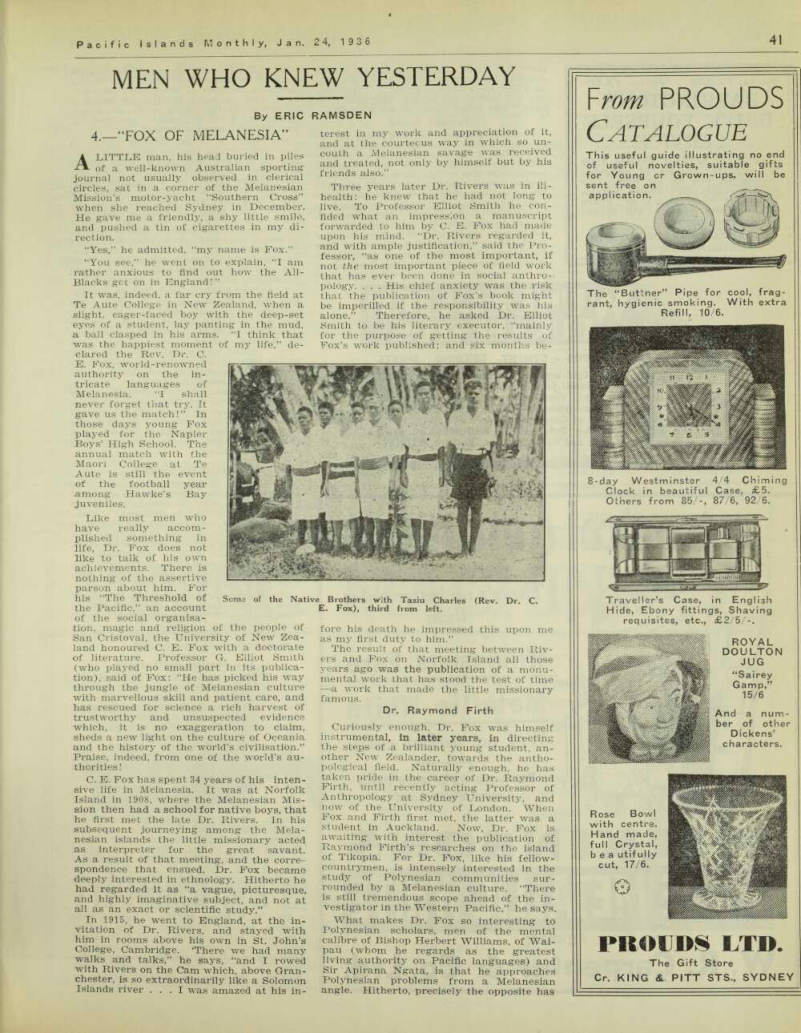
By Eric Ramsden
4 “Fox Of Melanesia”
A LITTLE man. his head buried in piles A of a well-known Australian sporting journal not usually observed in clerical circles, sat in a corner of the Melanesian Mission’s motor-yacht “Southern Cross” when she reached Sydney in December.
He gave me a friendly, a shy little smile, and pushed a tin of cigarettes in my direction.
“Yes,” he admitted, “my name is Fox.” , , „ T “You see, he went on to explain lam rather anxious to find out how the All- Blacks get on in England.
It was, indeed, a far cry from the field at Te Aute College in New Zealand, when a slight, eager-faced boy with the deep-set eyes of a student, lay panting in the mud, a ball clasped in his arms. “I think that was the happiest moment of my life,” declared the Rev. Dr. C.
E. Fox, world-renowned authority on the in tricate languages of Melanesia. “I shall never forget that try. It gave us the match!” In those days young Fox played for the Napier Boys’ High School. The annual match with the Maori College at Te Aute is still the event of the football year among Hawke’s Bay juveniles.
Like most men who have really accom plished something in life, Dr. Fox does not like to talk of his own achievements. There is nothing of the assertive parson about him. For his “The Threshold of the Pacific,” an account
of the social organisa tion, magic and religion of the people of San Cristoval, the University of New Zea land honoured C. E. Fox with a doctorate of literature. Professor G. Elliot Smith (who played no small part in its publica tion), said of Fox: ‘‘He has picked his way through the jungle of Melanesian culture with marvellous skill and patient care, and has rescued for science a rich harvest of trustworthy and unsuspected evidence which, it is no exaggeration to claim, sheds a new light on the culture of Oceania and the history of the world’s civilisation.”
Praise, indeed, from one of the world’s au thorities !
C. E. Fox has spent 34 years of his inten sive life in Melanesia. It was at Norfolk Island in 1908, where the Melanesian Mis sion then had a school for native boys, that he first met the late Dr. Rivers. In his subsequent journeying among the Mela nesian islands the little missionary acted as interpreter for the great savant.
As a result of that meeting, and the corre spondence that ensued, Dr. Fox became deeply interested in ethnology. Hitherto he had regarded it as “a vague, picturesque, and highly imaginative subject, and not at all as an exact or scientific study.”
In 1915, he went to England, at the in vitation of Dr. Rivers, and stayed with him in rooms above his own in St. John’s College, Cambridge. ‘There we had many walks and talks,” he says, “and I rowed with Rivers on the Cam which, above Gran chester, is so extraordinarily like a Solomon Islands river ... I was amazed at his in
terest in my work and appreciation of it, and at the courteous way in which so un couli"l a Melanesian savage was received tteaWd, no* only by himself but by his irienas a o.
Three years later Dr. Rivers was in ill health: he knew that he had not long to live. To Professor Elliot Smith he con tided what an impression a manuscript forwarded to him by C. E. Fox had made upon his mind. “Dr. Rivers regarded it, and with ample justification,” said the Pro fessor, “as one of the most important, if not the most imp ortant piece of field work that has ever been done in social anthro pology. . . . His chief anxiety was the risk that the publication of Fox’s book might be imperilled if the responsibility was his alone.” Therefore, he asked Dr. Elliot Smith to be his literary executor, “mainly for the purpose of getting the results of Fox’s work published; and six months be-
fore his death he impressed this upon me as my first duty to him.”
The result of that meeting between Riv ers and Fox on Norfolk Island all those years ago was the publication of a monu mental work that has stood the test of time —a work that made the little missionary famous.
Dr. Raymond Firth Curiously enough. Dr. Pox was himself instrumental, in later years, in directing the steps of a brilliant young student, an other New Zealander, towards the antho pological field. Naturally enough, he has taken pride in the career of Dr. Raymond Firth, until recently acting Professor of Anthropology at Sydney University, and now of the University of London. When Fox and Firth first met, the latter was a student in Auckland. Now, Dr. Fox is awaiting with interest the publication of Raymond Firth’s researches on the island of Tikopia. For Dr. Pox, like his fellow countrymen, is intensely interested in the study of Polynesian communities sur rounded by a Melanesian culture. ‘‘There is still tremendous scope ahead of the in vestigator in the Western Pacific,” he says.
What makes Dr. Pox so interesting to Polynesian scholars, men of the mental calibre of Bishop Herbert Williams, of Wai pau (whom he regards as the greatest living authority on Pacific languages) and Sir Apirana Ngata, is that he approaches Polynesian problems from a Melanesian angle. Hitherto, precisely the opposite has
Soma of the Native Brothers with Tasiu Charles (Rev. Dr. C.
E. Fox), third from left.
prevailed. But, unfortunately, in recent years he has been unable to devote the time he would have liked to study. “When one has a school of 200 boys to look after,” he says, “that takes about all one’s energy.”
Rennell Island Nevertheless, it is amazing what he has accomplished in acquiring information. Dr.
Fox still has the manuscript of an unpub lished vocabulary of the San Cristoval people. Of late he has been engaged on a similar work dealing with the Rennell Island natives. “There we have one of the most interesting Polynesian communities in the whole of the Pacific,” he commented.
So far missionaries have not been permit ted to work on Rennell (which is 120 miles to the south-east of San Cristoval). The language, he contends, more closely re sembles Maori than even the Tuamotuan
(east of Tahiti). On his recent visit to New Zealand he took with him Tasiu Henry Maabe, a member of the Native Brother hood, who can speak the Rennell tongue— as well as nearly twenty other languages.
“And when I say languages,” observed Dr.
Fox, “I don’t mean dialects!”
His object in taking Brother Henry to New Zealand was that he might talk Ren nell (and other languages) with Bishop Williams. Incidentally, Dr. Fox has a sin cere admiration for the intellectual quali fications of the Melanesian. “There are few Europeans who could do that,” he added. As a matter of fact, he contended, there was no reason why the Western Pacific should not produce men of the in tellectual standard of Ngata, Buck, and Pomare, Anglo-Maoris who have won dis tinction both in politics and science. “In fact, we have already men of splendid intellectual attainments,” he remarked.
In his thirty-odd years in the Pacific Dr.
Fox has witnessed many changes. He has served under five Bishops of Melanesia, and has seen the Christian flock increase from 2,000 to 22,000. When he first went to Norfolk Island, early in this cen tury, feeling was so intense between the native boys at school there, from the dif ferent islands, that he saw fights where spears were actually thrown! To-day, that feeling has almost disappeared: “The Solomon Islander now feels that he is a dis tinct entity. He no longer regards himself as a native of any particular island in the group. In effect, he regards himself as a Solomon Islander, and he takes a natural pride in that fact.”
Praise for Traders As for the European trader, Dr. Fox believes him to have been a much maligned person. “The early traders in the Group set a high standard,” he declared, “a stan dard that has been maintained by their successors. They taught the natives that the word of an Englishman was his bond.
That belief exists to-day.” The plantations were, generally speaking, exceedingly well run, and the natives were satisfied with their conditions and treatment.
The missionaries of to-day, he submitted, were carefully selected and well-trained men. A course in anthropology was in most cases exceedingly valuable. To men of a scientific turn of mind, Melanesia offered a fascinating field for research.
The Famous Brotherhood In the remarkable Native Brotherhood, entirely self-supporting and in no way dependent upon the Mission’s funds, Dr.
Fox is known as Tasiu (Brother Charles).
He is the only European member. The prin cipal object of The Brothers is to penetrate within the districts still regarded as savage and heathen. After three years of evan gelical work, its members labour on the plantations for a year so that their wages can be devoted to The Brotherhood’s gen eral activities.
After a holiday visit to relatives in New Zealand (which includes a call at Te Aute College where young Maoris anxious to emulate the football prowess of men like Taiaroa and Nepia are still turned out), Tasiu Charles, D.Litt., will be well content to return to Guadalcanal. The only draw back is that he finds it a little difficult there to keep track of the football scores of his triumphant fellow-countrymen!
Hon. V. A. Pratt, M.L.C., of Rabaul, New Guinea, arrived in Sydney at the end of December, after a holiday visit to Western and Central America. He spent some in teresting months in out-of-the-way coun tries, such as Cuba, Guatemala and Mexico. He returned to New Guinea in January.
Advertisements & other items, pp. 43-44 (1 item)
Catalogue
F rom PROUDS
This useful guide illustrating no end of useful novelties, suitable gifts for Young or Grown-ups, will be sent free on application. ■ WJ) The “Buttner” Pipe for cool, fragrant, hygienic smoking. With extra Refill, 10/6. £ 8-day Westminster 4/4 Chiming Clock in beautiful Case, £5.
Others from 85/-, 87/6, 92/6.
Traveller’s Case, in English Hide, Ebony fittings, Shaving requisites, etc., £2/5/-.
iPM|H|
n
ROYAL
DOULTON
JUG
“Sairey Gamp,” 15/6 And a number of other Dickens’ characters.
Rose Bowl with centre.
Hand made, full Crystal, b e a utifully cut, 17/6.
w&mm
mmm
PROCDS LTD.
The Gift Store
Cr. KING & PITT STS., SYDNEY
’Phone: FX 3378 ’Phone: FX 3378
BARRINGTON’S
DRIVE YOURSELF
SERVICE
Cars Hired without Drivers from 10/- per day; Tourers, 3d. per mile; Sedans, 4d. and sd. per mile. Our Fleet includes 1934 Dodge Sedan*.
Write for Reservations, or ’phone when in city and we will deliver Car to your address.
243 ANZAC PARADE, SOUTH
KENSINGTON, N.S.W.
SHEETS
i am
ASBESTOS
CEMENT
BUILDING
With rigid walls of Durabestos any building will stand four-square to the assaults of weather, time, rodents, and white ants.
Call or write for FREE booklet "Durabestos Homes of Colourful Beauty" describing many uses for Durabestos. WUNDERLICH LTD., Crown and Cleveland Sts., Redfern, SYDNEY.
D 2.45
conditions
£Si <il V There's no better paint than
Wilkinsons Pure
Metallic White
Will not peel or crack Produces 33% more Paint than White Lead
WILKINSONS
Agents:
W. R. Carpenter & Co. Ltd.
"Joseph Conrad" at Tulagi
From a Special Correspondent.
Tulagi, Nov. 28.
THE staid and sober citizens of Tulagi, Solomon Islands —all citizens were strictly sober early in November, some malevolent person in Sydney having with held an entire consignment of beer— glanced sleepily out over the harbour one morning, pondering dejectedly on the hardships and privations suffered by those whose lot it was to keep the flag flying at the outposts of Empire.
They awoke with a start, rubbed their eyes incredulously, and stared at the placid ocean as though it were a pheno menon that had sprung up in the night.
A three-masted, full-rigged ship in the bay, and flying the red ensign! Why, the species became extinct ages ago!
A prosaic report in curt, nautical lan guage put an end to hopes of beer, and allayed curiosity. The “Joseph Conrad,”
Alan Villiers master, ninety days out from Singapore, and on a world cruise with cadets in training.
Tulagi opened its doors and hearts to the young sea-dogs; feted them, tested them out at cricket, and showered hos pitality upon them. Particularly did it throw its arms around (or try to) the two youngest members of the ship’s com pany, 14 and 16 years of age respectively, who rejoiced in, and will answer to no other names than Stormalong and Hard case.
Captain Villiers is the well-known Australian voyager, author and journalist, whose voyages round the Horn in wind jammers are so graphically described in his books “Falmouth for Orders” and “The Grain Race.”
The present voyage, which will be the
subject of a book when England is reached, began inauspiciously. Arriving safely off New York after a tempestuous North Atlantic crossing, the “Joseph Con rad” was blown ashore from her moor ings, and sustained considerable damage.
Repaired and refitted, the vessel pro ceeded on her interrupted voyage, carry ing in her complement cadets of half a dozen nations. Alternately beset by calms and tempest in the course of many months at sea, the Solomons presented a welcome landfall, and a week’s stay in port was appreciated by all hands.
Link With “Lawrence Of Arabia”
Captain Villiers, a Tasmanian by birth, tells sorrowfully that his friend, T. E.
Shaw, was to accompany him on this voyage, to engage in literary work in the peace of life afloat. Almost at the last moment something caused him to change his* mind; and, on arriving at Singapore, Captain Villiers learned the sad tidings that Mr. Shaw, that mystic, intriguing figure so much better known as “Law rence of Arabia,” had departed alone on the last long voyage of all.
Inquiry For “Tin Can
Mailman”
A LETTER from Mr. L. L. Carringer, of 2130 Fern St., San Diego, California, U.S.A., asks for the present address of Mr.
Stuart Ramsay, the athletic young man who, for eleven years, swam the famous “tin can mail” between the steamers and the landing on Niuafoou Island, in North ern Tonga. Mr. Carringer says he wishes to thank Mr. Ramsay for some favour re ceived, but he has lost contact with him since he visited California. Can anyone oblige?
Culture Values
Letter to the Editor.
JUST a word about your editorial note to “New Tribes in N.G.” in the August
P.I.M.
It is the Administration’s viewpoint that is interesting. Just imagine what might have happened had Caesar pon dered over the idea of “Established In ternational Principle” and “Peaceful Pene trations.” Where would we superior be ings—the whites of N.G. —be to-day? We have to thank the invasion of a more civilised race (the Romans) for our edu cation and culture —and not forgetting the famous roads of England. When the time comes for expansion of the human or the plant life of a country, to retard development is very wrong and short sighted indeed!
I am, etc.,
Blue Peter.
Madang, 26/10/1935.
Mrs. W. Ramsay McNicoll, wife Administrator of New Guinea (Briga dier-General McNicoll), arrived in Syd ney on December 19 by the Tanda on a short holiday. Mrs. McNicoll left later for Victoria to stay with friends in Mel bourne, Geelong, and Inverloch.
Dr. P. Monaghan, C.M.0., of Samoa, re turned to Apia after lengthy furlough by the December Maui Pomare.
Advertisements & other items, pp. 45-46 (1 item)
Mining Machinery
WANTED. . .
SOUTH SEA
CURIOS Suitable for caBBBBBB ™ Tourist Trade, also Turtleshell Write . .
CAIRNS, BOX 311, SUVA, FIJI
MINING MACHINERY
Improved Type Gravel Pump.
SEND YOUR ENQUIRIES TO—
of all classes, including—
Dredging and Sluicing Plants
Gravel and Water Pumps Elevators Nozzles Piping and Valves Mining Plants have been supplied to a number of Companies in New Guinea, and we are, therefore, fully conversant with local conditions.
I Hydraulic Elevator, with Swivelling Suction Pipe.
THOMPSON’S ENGINEERING & PIPE CO. LTD.
CASTLEMAINE, VICTORIA
Cable Address; “THOMPSONS, CASTLEMAINE.”
SYDNEY OFFICE KEMBLA BUILDING 58 MARGARET STREET
A Message
to Merchants ...
NOW IS THE RIGHT TIME to
buy from CHINA to grasp the benefit of the present favourable exchange. Trade between China, Australia and the South Sea Islands is again in full swing. You are assured of prompt service and strictly factory prices by
ALOIS AKUN
& COMPANY
IMPORTERS, EXPORTERS AND
MANUFACTURERS’ AGENTS.
180 NATHAN ROAD, KOWLOON,
HONGKONG.
The Buying Headquarters in China for Australian and Islands Merchants.
Office and Store also at Rabaul, New Guinea.
Specialising in Chinese & Japanese Goods suitable for ISLANDS
TRADE.
EXCELSIOR SUPPLY CO. LTD.
The most extensive Manufacturers in the British Empire of
RUBBER STAMPS,
INKS, STENCILS,
Marking Devices.
ACME STAMP PADS
f We have a big range of Special
FRUIT CASE MARKING SETS
We also Manufacture or Supply a complete line of
Spraying Machines
for all purposes.
Let us know your requirements and we will quote you by return. Ask for our Big Catalogue.
Sole Australasian Distributors of the World Famous SHEAFFER FOUNTAIN
PENS and PENCILS.
EXCELSIOR SUPPLY CO. LTD.
Head Office: —160 BROADWAY,
SYDNEY. N.S.W.
A Movie-Cameraman On
Rennell
By G. J. Mackay
(Editor’s Note: Mr. Mac Kay’s motion-pictures of the Rennell Islanders secured him invitations to display same before the principal geographic societies of the United States.) THE “Ranadi’s” anchor was dropped in the one bay of the huge raised-atoll of Rennell, whose Polynesian natives live on fish, fruit and nuts, naming their atoll island “Munggava.” Richard Rutledge Kane, the Solomons’ Resident Commis sioner, introduced me as “his friend” to Tahua, hereditary “king” of Rennell, upon whom had been bestowed the English title, “Master of the White Sand,” since the “king” controlled the only ocean frontage of Munggava.
Tahua, an elderly man of good physique, was naked, save for a loin-covering of yellow bark-cloth. Long Polynesian tattoo lines marked his body. A straight, black mass of hair fell over forehead and shoulders. In order to curry instant favour with the Munggavan king, I presented his highness with five sticks of tobacco, like a travelling salesman who thrusts some cigars under a prospect’s nose. King Tahua
smelt the offering - and hid it in the folds of his scanty robes. He murmured some thing to the R.C., who, after moment’s mental guessing, said; “The Master of the White Sand wishes to know your name.”
Accordingly, I uttered my Scottish patronymic, repeatedly ejaculating the name of the clan of green, black and blue tartan into the hair-sheltered ear of the King of Munggava. Finally he raised his head, affirming: “MacKay—goodfeller; Mac Kay good feller!”
The royal mind was made up. His majesty clinched the compliment with another handshake and the gift to me of a wooden frigate-bird totem.
There was reason in all this. I found my name to be half of the name of a much respected Polynesian god, “Makei-Makei”!
All the tribe then followed their king’s example. Men, women and children just had to welcome the messenger of the gods with the box of magic. This was not so great an ordeal as their own tribal method of greeting—nose-rubbing! Had the Mung gavans followed* tribal custom I would be minus a schnozzle to-day!
One woman had the crown of her head scraped clear of hair—a sign of widowhood.
Her man had recently been buried in a good, old-fashioned style—that of Egypt of 6000 years ago.
The first thing we understood they wanted was a knife. They had no metal whatever, Munggavans being in the “wood” age. A knife was given, so as to know' why they were all in such a hurry for it.
Immediately, the tribe clustered round the knife-possessor and got their foreheads slashed —merely a little sign of mourning for the tonsured lady’s husband!
My Malaitan assistant, Maike, had erected the motion-picture camera (a “Wil liamson”) in a place commanding the vil lage of leaf-huts and its adjacent ceme tery of graves decorated with spears, paddles, bows and arrows. For a while I deserted the camera so that the Mung gavans could grow accustomed to such an unusual object. A shock-headed youth, however, touched me on the arm, pointing to the camera resting haughtily on its tripod. I pretended to “no savvy.” A piccaninny then grasped my hand and led me forth, indicating by gesture that I should manipulate the works. I examined the controls at the back of the machine, took a purple trick handkerchief from my pocket and set about polishing the glass dials—rather to my (pretended) dissatis faction. I wagged my head in disgust be fore the primitive audience, casting a dis approving eye on the purple handkerchief which I shook vigorously. Marvel of mar vels, it turned green! The glass-polishing was resumed by means of the green objec. with a (supposed) gratifying result.
The audience began to retreat. I waved them to return. A score peeped into the view-finder. This was the climax leading to my election on Rennell as the Big Shot of the Devil-devils!
The ladies of Rennell are among the best-looking and the most beautifully formed of the female natives of the South Seas. In line with everywhere else in the Solomons, brassieres are not adopted by the native daughters. When skirts are worn on Rennell, their material is bark paper, once round. Invariably, epidermic ornamentation forms the sole garment.
The inspection of a feminine guard of honour would be a most embarrassing duty to a 8.5.1. P. officer!
Native females contrive to fight shy of anv camera. The native men—ever hold ing their womenfolk at a discount-use every means to prevent their women from being portrayed. My telescopic lens secured
a close-up of some sleek, light-brown girls, the picture showing very obvious feminine pouts on the discovery that they were objects of my photographic attention.
Chow Chu, the yacht’s Chinese cook, observing my predicament with the local “fair” sex, overcame the shyness of the tattooed ladies by Oriental methods un known to me, when he paraded them all before the motion-picture camera in a Chinese version of “Here We Go Hound The Mulberry Bush”! In granting a bonus to my movie actresses I secured permanent goodwill among them by means of my col lection of used safety razor 'blades! I pre sented the dames with one treasured blade apiece. A string- of fibre connected a hole of the blade to a hole in a shell-like Poly nesienne ear.
Maike asked me why I did not choose a Rennell girl for a wife, for he knew I was not a married man. His argument was that he had often heard that a white wife from “Sedney” cost a lot of money to main tain, whereas a beautiful Rennell girl need only cost me a few beads, a yard or two of calico and my razor blades when dis carded! I ended this discussion abruptly by detailing Maike to give the Munggavans an exhibition of the reflex “still” camera as a scene in the travelogue.
Near the white men’s tents a crowd of piccaninnies always congregated, whenever we washed our hands and faces. At the conclusion of the mysterious rite, the basin of soapy water was emptied over their heads. The game was to run and avoid the baptism. “Green” kids were always enticed to be front-rank spectators. The soaping process made the Munggavans gape in astonishment at the queer customs of white men.
The time came when we had to leave the (to us) almost-unreal world of the atoll-inhabiting Munggavans. We were escorted to the “Ranadi” by Rennell’s fleet
of catamarans—twenty foot dugouts with light outriggers. Munggavan men, women and children scrambled aboard the yacht after the white men.
The Commissioner relaxed in a canvas deck-chair. King Tahua knelt down at his right hand, Tiketa, a male relative, squat ting near. Long-haired Tahua bewailed “Sorry too much sorry too much! Fre quently he would seize the Commissioner s hand and stroke it. Nowhere have I ever witnessed such a manifestation of grief over the departure of constituted authority!
“This is becoming irksome,” said the R.C.
“Yet, I don’t want to offend the Master of the White Sand or infringe Protectorate law. Something will have to be done, and done quickly!”
On the bridge-lounge of the yacht a cere mony was to be enacted—the genial repre sentative of white majesty farewelling an aboriginal king! There was no precedent to follow. An awkward “stage-wait” was about to mar the proceedings when Corn mander Cruikshank, the captain of the “Ranadi,” suddenly exclaimed: ‘Tve hit it!”
Immediately the captain gave an order to Ula, his steward. Ula re-appeared quickly with a silver tray containing four glasses, a teaspoon, a glass jug of water and—a bottle of Eno’s! Cruikshank, in his white uniform and gold lace, was chief actor in this strange scene. Holding aloft the bottle of fruit salts, he solemnly enchanted: “Fifteen men on the dead man’s chest, Yo, ho, ho, and a bottle of rum.
Drink and the devil had done for the rest, Yo ’ ho ’ ho ’ anc * a bottle of—er—fruit-salts!”
Seizing a teaspoon from the attending Ula, the bottle was uncorked and white grains of salt deftly spilt into the spoon, Giving each glass a portion of salts, the naval officer presented a glass apiece with
a deep, ceremonial bow to Tahua, the Com missioner and myself. Taking the last glass and replacing the Eno bottle with the water-jug, he rapidly made four fizzy mix tures which he sign-languaged to be quaffed while each “boiled.”
And thus it came to pass that Tahua, King of Munggava, became appeased by the strange ritual and frothy tonic of powerful white lords!
“Aloha, Munggava!”
Advertisements & other items, pp. 47-48 (1 item)
Steel Furniture
UMBRELLAS
ONLY BRITISH FRAMES USED
Guaranteed FAST DYED Coverings Strong Canvas-Covered Beach and Garden Umbrellas in Medium and Large Sizes—Brass Fittings Throughout.
“Shelta” Brand U mbrellas
Specially made for Tropical Conditions Manufactured by
Phillips and
Inquiries invited from
House
453 Kent Street
SYDNEY
428 Adelaide St.
BRISBANE
Pacific Islands Distributors We supply the trade only.
MODERN TUBULAR
STEEL FURNITURE
Chromium-plated or Lacquered Finishes PB
|iG£ ip® ipsTj wmm
-io£ie°iqOj f M|
i ? ■ Beds Wires Bedding Hospital Furniture Tubular Steel Furniture Radio Station 2UW, Newlands Steel Furniture Cloa Chair—Chromium plated Steel.
Complete Catalogues on Request Cab le Address “NEWLANDBED,” SYDNEY.
NEWLANDS BROTHERS LTD. Riley Street, Sydney, N.S.W.
AUSTRALIA’S LARGEST MANUFACTURERS OF SLEEPING EQUIPMENT, HOSPITAL FURNITURE AND
STEEL DESIGNS.
mmm
* 1
Specialists in
TWINES and
CORDAGE
Cotton-Hemp Jute Plough Reins Halter’s Sewing Twines Fishing Lines And Sash Cords / Co £ All Enquiries Invited And where Not Represented Agents are Desired Prices on Application k/ Fitzroy St., Marrickville, N.S.W.
CABLE ADDRESS:
‘BENTLEYSON,” SYDNEY
AUSTRALIA’S CLEARING HOUSE FOR THE PRECIOUS METALS.
BUYERS OF
G* © 1L ©
OSMIRIDIUM, PLATINUM, SILVER, &c.
GARRETT & DAVIDSON, LTD.
ASSAYERS, BULLION MERCHANTS, METALLURGISTS,
Bank of N.S.W. Buildings, Regent Street, Sydney
NEULAKA
The World’s Best
INSULATED COPPER
WIRE
(Rubber Covered and Lacquered)
FOR . . .
Motor Cars
Marine Engines
AND . . .
Stationary Engines
& mm
MiO
0 %
100-FOOT SPOOLS
Sizes from 3 m.m. to 9 m.m. Also 6 or 12volt Battery Cables. ® Send for Samples and Prices.
M.
Sole Australian Agents . . .
RUTTY & CO.,
Australia House Carrington St., Sydney
Mosquitoes
The Deadly Enemy of Mankind In the Tropics
The following is from an interesting article which appeared in a recent issue of the “Public Service Bulletin " of New Guinea.
MAN has been a long time on this Earth, a long time during which he has been leaving scraps of waste water around his dwellings so that, as evolution has pro gressed and specialised, some mosquitoes, like ordinary flies, have come to depend upon human carelessness for their susten ance. In other words, they have come to regard these domestic waste waters as the most acceptable nursery, always depend able, for their eggs and larvae, while, at the same time, the female of the species has come to depend upon human blood as a food supply.
Experience of health work in a tropical town has taught one that possibly the rela tion is the other way round and that the mosquito has discovered that in the en vironment of humans she may generally depend upon finding water suitable for the hatching of her eggs. At any rate, all the
mosquitoes concerned with the distribution of disease And that a blood meal is an essential preliminary to the laying of eggs On nearby water; of course, one is only dealing with the females: the males do not require blood, and, in fact, are rarely seen in houses.
Now, let us take the case of the common brown house mosquito, the one that comes buzzing around at night. Though she is mainly concerned with blood for dietetic purposes, anything that accompanies the blood will be ingested with it. Somewhere down along the track of evolution, a small bxood worm has found that this mosquito offers an excellent means of transferring from man to man. The microscopical worm enters the stomach of the mosquito and undergoes a process of development without, apparently, doing much harm to the mosquito, so that, in a little whil&, when the mosquito comes to your house one night for a drop of blood, the wormlet now wriggles out and enters your body through the mosquito bite. There is no call to dis cuss here the group of associated causes which result in Elephantiasis but it may be taken as certain that if that matured wormlet does not enter a person’s body, he will not get the disease.
The ordinary brown house mosquito that is commonly associated with the trans mission of this disease is somewhat par ticular about the water used for egg laying; she prefers it on the clean side and usually does not fly far afield. One would suggest that the tins under the ice box or the safe; the gutterings; the tanks or the odd tin that has been thrown out by the house-boy would repay inspection.
Then, again, there is a handsome black and white mosquito that turns up especi ally about four o’clock in the afternoon and makes life miserable until sundown.
This one is concerned with the passage of Dengue Fever, and when you feel as if every bone in your body had its own ex quisite ache and you are wretched and depressed beyond belief, it will be some comfort, though a poor one, to reflect that your troubles are due to lack of mosquito cleanliness in yourself or your neighbours.
This mosquito appears to find any water acceptable, however dirty it may be, and her ,presence usually implies a tin of foul water or water held in rotting vegetation, or, ideally, a broken fallen coconut. She is nearly always to be found in numbers near places where copra is being prepared.
Neither of these two mosquitoes are pleasant visitors, but Elephantiasis is cer tainly infrequent in the New Guinea Terri tory and Dengue appears to have left us for some years now. But there is another mosquito-borne disease, Malaria, that is always with us.
The Anopheline mosquito is altogether a different proposition from the two men tioned previously. They usually occupy artificial collections of water and, by con stant watchfulness on such water, their breeding can be prevented. The Anopheline, however, though it has come to depend upon a blood meal, still requires natural ground-w r ater for its larvae. Suitable water may be anything from a huge swamp to a heel impression in water-logged ground.
Obviously, these latter microscopical puddles are difficult to find, so that the only really effective measure is to have the whole ground so drained that no water can remain in any air-exposed surface for more than about 48 hours. Swamps and streams are channelled, so that the water is kept in cleared ways free of grass and back eddie.
To deal effectively with the Anopheline mosquito is the job of a specialist; but there is no doubt that given a trained staff and sufficient funds, the work can be done effectively and Malaria banished.
No more Malaria; no more Blackwater
Fever; no more Quinine; this tropical world would seem a different place. Per haps it will come some day, but, in the meantime, one would point the moral of this little story—the mosquito is an unclean beast and a deadly enemy. A resident of tropical places should feel the same repul sion to mosquitoes that everyone feels to flies and corruption. Destroy the adult; destroy the larvae; make your residence uninhabitable to mosquitoes.
Mr. Emil Oldehaver, an old resident of Tonga and Samoa, died recently in Samoa, at the age of 75.
He is shown on the left-hand side of the above photograph.
Repudiationists in Malaita, S.I.
From Our Own Correspondent
Tulagi, Dec. 1.
"OECHUITERS have complained that several natives in Malaita have signed on at the new rate, taking their advance of £3, including their tobacco, calico, etc., had their food on board for a few days, and then refused to complete the contract.
In some cases the recruits have de camped with their advance of money. The advance money has been refunded, on a few occasions, by the recruits’ friends, but the beach advance of calico and to bacco has been kept.
Very little notice appears to be taken by the Government of the recruiters’ plight, and more than one recruiter is out of pocket, being in some cases minus his advance payment, and his issue of tobacco and calico.
Dr. W. J. Williams, British Consul in Tahiti, returned to Papeete recently by the Maunganui after an absence of several months in San Francisco, U.S.A.
His sojourn in America enabled him to completely recover from his recent ill ness.
Queer Fish
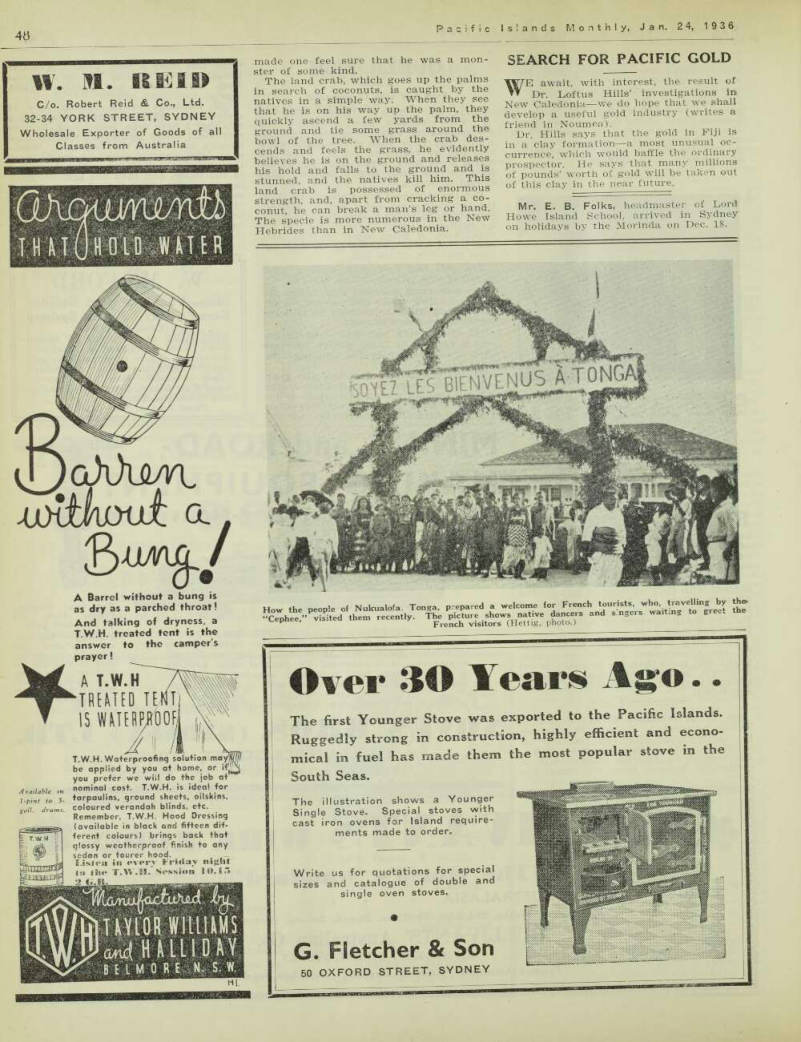
From Our Own Correspondent
Noumea, Dec. 3.
A FEW months ago, a native boy speared a strange species of fish, which may have been of the edible vari ety, but we feared to eat it. The fish had a short horn, which came out paral lel from his head, and a leathery skin devoid of scales.
But the strangest thing about him were the two cutters on either side of his tail, resembling in shape a semi-circular knife, for cutting leather. These blades had the appearance of being stuck on, and were only about three-quarters of an inch out from the butt of his tail.
The tail had two long trailing films at either side, which curled inwards.
We were told the fish was called the Lecorn. A few weeks later, seeing an ad vertisement with the unicorn on it, I re cognised the resemblance.
The short black and white-banded sea snakes abound in these waters, and are often seen basking in the sun near the shore.
The Trocas divers most fear the great losh, which grows to an enormous size, and can swallow a man by suction. When small he is good eating, having very white flesh, and even the larger variety are en
tirely free from a fishy odour. A native brought in one scaling 120 lbs., and the flesh, when salted and lightly smoked, was of very high quality.
Old residents speak of sea eels 15 metres long. The only thing resembling this that I have seen, was a long, sinuous movement under the water, which curled about a bay within the coral reef. What ever this monster was, he would pass through a school of fish, which leapt out of the water, and then one saw the curl ing of his turn, and back he wound once more. One of the party, gifted with a vivid imagination, wrote an article to a leading London newspaper, declaring he had actually seen the serpent; but I can state very definitely that he did not. The long sinuous movement of this creature
made one feel sure that he was a monster of some kind.
The land crab, which goes up the palms in search of coconuts, is caught by the natives in a simple way. When they see that he is on his way up the palm, they quickly ascend a few yards from the ground and tie some grass around the bowl of the tree. When the crab descends and feels the grass, he evidently believes he is on the ground and releases his hold and falls to the ground and is “okr d l S th po n S a se S V sed “of enormous NeW
Advertisements & other items, pp. 49-50 (1 item)
Making Equipment
W. M. FORD
Ship, Yacht & Boat Builder
Berry’s Bay, North Sydney
(Established 1870) BUILDERS of all kinds of Island Craft from Dinghies to Auxiliary Schooners of any tonnage. New and Second-hand Island Craft of various types in stock. New and Secondhand Full Diesel, Crude Oil, Benzine and Kerosene Engines.
Please Send on Your Enquiries
MINING and ROAD-
MAKING EQUIPMENT
Manufactured by the (nill‘(llier-l)(‘llvei* Co.
DRIFTING DRILL MODEL DB9
The DB9 is an “all-purpose” Drifter following the streamline design first conceived by Gardner-Denver engineers. It is intended for general mine drifting and tunnelling, but it is also adapted to use in quarries, and can be equipped with a spring handle for sinking.
Write for full information of Gardner-Denver Products The new Gardner- Denver Model 555 Hand-held Drill Perfectly balanced, and embodies the greatest drilling capacity at which the qualities of easy riding and conservative air consumpt ion are maintained.
IV O YES
(SYDNEY) ETD,
115 CLARENCE STREET, SYDNEY
BRANCHES AT NEWCASTLE AND BRISBANE
BIJTLJTAJ\TS hiki: ropes
“The World's Standaid”
LARGEST STOCKS IN AUSTRALASIA - FOR ALL PURPOSES Also Blocks, Hooks, Shackles, Thimbles, Strand, Seizing, Aircraft Cord, etc.
Letters: BULLIVANTS’ Australian Co. Ltd.
Box 1298 J, G.P.O. 331.333 KENT STREET, SYDNEY Sydney Prompt Attention! Efficient Service!! Complete Satisfaction!!!
H. M. RE IP
C/o. Robert Reid & Co., Ltd.
32-34 YORK STREET, SYDNEY
Wholesale Exporter of Goods of all Classes from Australia
aXXfiyn,
juornmxt a.
A Barrel without a bung is as dry as a parched throat!
And talking of dryness, a T.W.H. treated tent is the answer to the camper s prayer!
A T.
IS Wl
moy
A T.W.H
TREATED IE
IS WATERPROOF
w uTU u.^liCP T.W.H. Waterproofing solution be applied by you at home, or you prefer we wiil do the job at nominal cost. T.W.H. is idea! for tarpaulins, ground sheets, oilskins, coloured verandah blinds, etc.
Remember, T.W.H. Hood Dressing (available in black and fifteen different colours) brings back that glossy weatherproof finish to any sedan or tourer hood.
Listen in every Friday nijjlif la the T.W.BS- Session 10.1.% 2
’''toUwiujjacfuJucl vy.
jjiunoi imiins
BWHmuoAV
I E lM 0 B t N. S. *.
H|.
Search For Pacific Gold
w/E await, with interest, the result of yy j) r Loftus Hills’ investigations m New Caledo nia—we do hope that we shall deve i op a useful gold industry (writes a ? r ®en d i n Noumea).
Dr HiUs says t ' hat the go ld in Fiji is a cl formation—a most unusual oc currence y whic h would baffle the ordinary prospector He says that many millions 7 b / taken of this clay in the near future. «r. E B Folks headfnaster of Lord
How the people of Nukualofa. Tonga, prepares a welcome for french tourists, Who, travelling by the "Cephee," visited them recenly. The picture shows native dancers and singers waiting to greet the French visitors (Hettig, photo.)
Advertisements & other items, p. 50 (1 item)
Over 30 Tears A?o..
The first Younger Stove was exported to the Pacific Islands.
Ruggedly strong in construction, highly efficient and economical in fuel has made them the most popular stove in the South Seas.
The illustration shows a Younger Single Stove. Special stoves with cast iron ovens for Island requirements made to order.
Write us for quotations for special sizes and catalogue of double and single oven stoves. •
G. Fletcher & Son
50 OXFORD STREET, SYDNEY
r
An Epic Of Papua
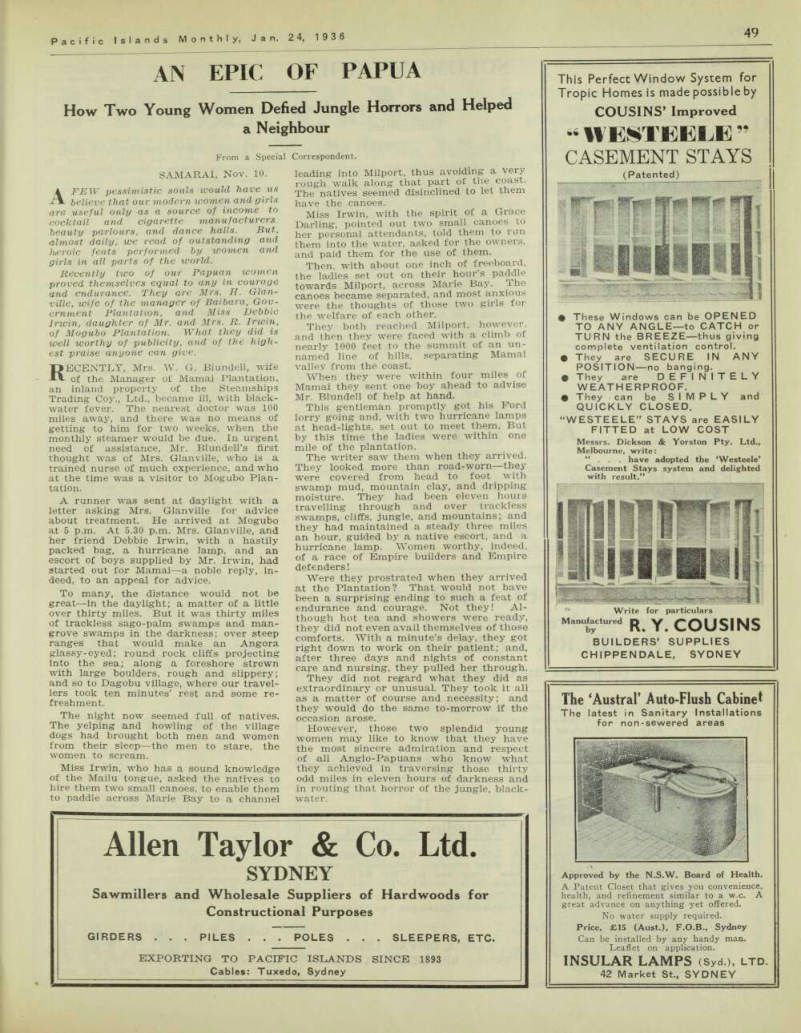
How Two Young Women Defied Jungle Horrors and Helped a Neighbour
From a Special Correspondent.
Samarai, Nov. 10.
A FEW pessimistic souls would have us believe that our modern women and girls are useful only as a source of income to cocktail and cigarette manufacturers, beauty parlours, and dance halls. But, almost daily, we read of outstanding andl heroic feats performed by women and girls in all parts of the world.
Recently two of our Papuan women proved themselves equal to any in courage and endurance. They are Mrs. H. Glan ville, wife of the 7nanager of Baibara, Gov ernment Plantation, and Miss Debbie Irwin, daughter of Mr. and Mrs. R. Irwin, of Mogubo Plantation. What they did is well worthy of publicity, and of the high est praise anyone can give.
RECENTLY, Mrs. W. G. Blundell, wife of the Manager of Mamai Plantation, an inland property of the Steamships Trading Coy., Ltd., became ill, with black water fever. The nearest doctor was 100 miles away, and there was no means of getting to him for two weeks, when the monthly steamer would be due. In urgent need of assistance, Mr. Blundell’s first thought was of Mrs. Glanville, who is a trained nurse of much experience, and who at the time was a visitor to Mogubo Plan tation.
A runner was sent at daylight with a letter asking Mrs. Glanville for advice about treatment. He arrived at Mogubo at 5 p.m. At 5.30 p.m. Mrs. Glanville, and her friend Debbie Irwin, with a hastily packed bag, a hurricane lamp, and an escort of boys supplied by Mr. Irwin, had started out for Mamai —a noble reply, in deed, to an appeal for advice.
To many, the distance would not be great—in the daylight; a matter of a little over thirty miles. But it was thirty miles of trackless sago-palm swamps and man grove swamps in the darkness; over steep ranges that would make an Angora glassy-eyed; round rock cliffs projecting Into the sea; along a foreshore strewn with large boulders, rough and slippery; and so to Dagobu village, where our travel lers took ten minutes’ rest and some re freshment.
The night now seemed full of natives.
The yelping and howling of the village dogs had brought both men and women from their sleep—the men to stare, the women to scream.
Miss Irwin, who has a sound knowledge of the Mailu tongue, asked the natives to hire them two small canoes, to enable them to paddle across Marie Bay to a channel
leading into Milport, thus avoiding a very rough walk along that part of the coast.
The natives seemed disinclined to let them have the canoes.
Miss Irwin, with the spirit of a Grace Darling, pointed out two small canoes to her personal attendants, told them to run them into the water, asked for the owners, and paid them for the use of them.
Then, with about one inch of freeboard, the ladies set out on their hour’s paddle towards Milport, across Marie Bay. The canoes became separated, and most anxious were the thoughts of those two girls for the welfare of each other.
They both reached Milport, however, and then they were faced with a climb of nearly 1000 feet to the summit of an un named line of hills, separating Mama! valley from the coast.
When they were within four miles of Mamai they sent one boy ahead to advise Mr. Blundell of help at hand.
This gentleman promptly got his Ford lorry going and, with two hurricane lamps at head-lights, set out to meet them. But by this time the ladies were within one mile of the plantation.
The writer saw them when they arrived.
They looked more than road-worn —they were covered from head to foot with swamp mud, mountain clay, and dripping moisture. They had been eleven hours travelling through and over trackless swamps, cliffs, jungle, and mountains; and they had maintained a steady three miles an hour, guided by a native escort, and a hurricane lamp. Women worthy, indeed, of a race of Empire builders and Empire defenders!
Were they prostrated when they arrived at the Plantation? That would not have been a surprising ending to such a feat of endurance and courage. Not they! Al though hot tea and showers were ready, they did not even avail themselves of those comforts. With a minute’s delay, they got right down to work on their patient; and, after three days and nights of constant care and nursing, they pulled her through.
They did not regard what they did as extraordinary or unusual. They took it all as a matter of course and necessity; and they would do the same to-morrow if the occasion arose.
However, those two splendid young women may like to know that they have the most sincere admiration and respect of all Anglo-Papuans who know what they achieved in traversing those thirty odd miles in eleven hours of darkness and in routing that horror of the jungle, black water.
Advertisements & other items, p. 51 (1 item)
Allen Taylor & Co. Ltd.
This Perfect Window System for
Tropic Homes is made possible by
COUSINS’ Improved
“WESTEELE”
CASEMENT STAYS
(Patented)
w~w Wf* "fn?
■- ’k : 4* & te
• These Windows can be OPENED
TO ANY ANGLE—to CATCH or
TURN the BREEZE—thus giving complete ventilation control. • They are SECURE IN ANY POSITION —no banging. ® They are DEFINITELY
WEATHERPROOF.
9 They can be SIMPLY and
QUICKLY CLOSED.
“WESTEELE” STAYS are EASILY
FITTED at LOW COST
Messrs. Dickson & Yorston Pty. Ltd., Melbourne, write: “ . . . have adopted the ‘Westeele’
Casement Stays system and delighted with result.” m m ft Z i j fr Write for particulars
Manufactured R y COUSINS
BUILDERS’ SUPPLIES
CHIPPENDALE, SYDNEY
The ‘Austral’ Auto-Flush Cabinet
The latest in Sanitary Installations for non-sewered areas Approved by the N.S.W. Board of Health.
A Patent Closet that gives you convenience, health, and refinement similar to a w.c. A great advance on anything yet offered.
No water supply required.
Price, £l5 (Aust.), F. 0.8., Sydney Can be installed by any handy man.
Leaflet on application.
INSULAR LAMPS (Syd.), ltd
42 Market St., SYDNEY
Allen Taylor & Co. Ltd.
SYDNEY
Sawmillers and Wholesale Suppliers of Hardwoods for Constructional Purposes GIRDERS . . . PILES . . . POLES . . . SLEEPERS, ETC.
EXPORTING TO PACIFIC ISLANDS SINCE 1893
Cables: Tuxedo, Sydney
Record Sugar Season
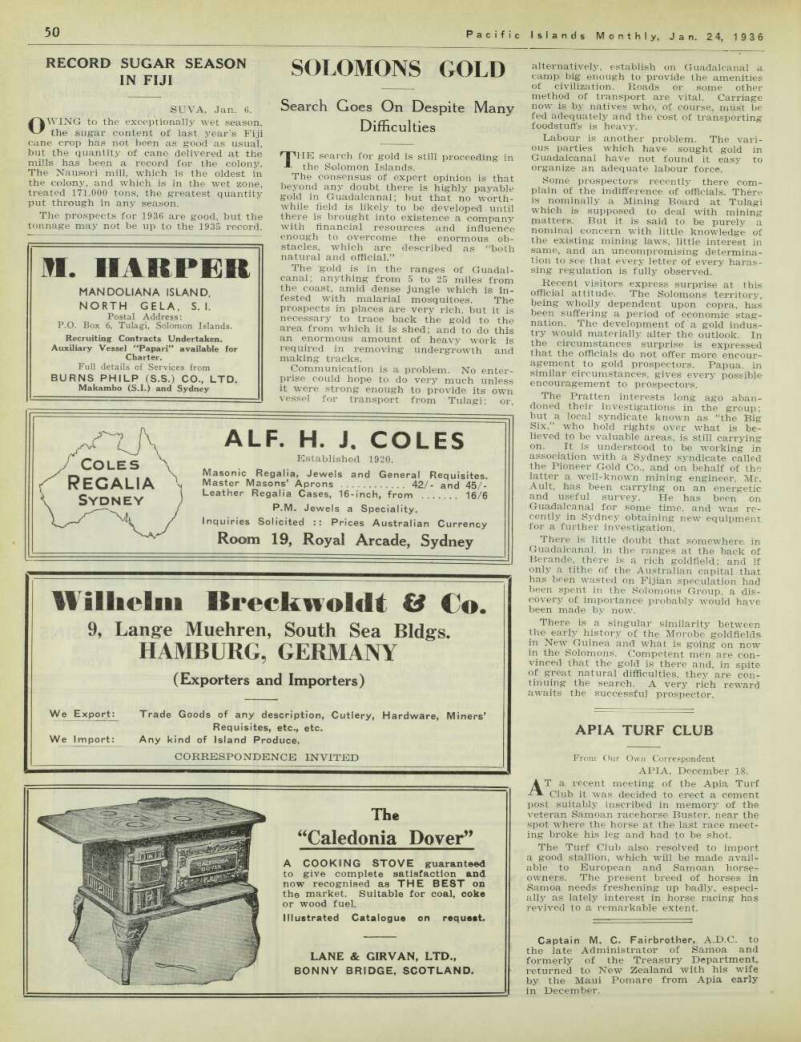
In Fiji
Suva, Jan. 6.
OWING to the exceptionally wet season, the sugar content of last year’s Fiji cane crop has not been as good as usual, but the quantity of cane delivered at the mills has been a record for the colony.
The Nausori mill, which is the oldest in the colony, and which is in the wet zone, treated 171,000 tons, the greatest quantity put through in any season.
The prospects for 1936 are good, but the tonnage may not be up to the 1935 record.
Solomons Gold
Search Goes On Despite Many Difficulties
f I ''HE search for gold is still proceeding in the Solomon Islands.
The consensus of expert opinion is that beyond any doubt there is highly payable gold in Guadalcanal; but that no worth while field is likely to be developed until there is brought into existence a company with financial resources and influence enough to overcome the enormous ob stacles, which are described as “both natural and official.”
The gold is in the ranges of Guadal canal; anything from 5 to 25 miles from the coast, amid dense jungle which is in fested with malarial mosquitoes. The prospects in places are very rich, but it is necessary to trace back the gold to the area from which it is shed; and to do this an enormous amount of heavy work is required in removing undergrowth and making tracks.
Communication is a problem. No enter prise could hope to do very much unless it were strong enough to provide its own vessel for transport from Tulagi; or.
alternatively, establish on Guadalcanal a camp big enough to provide the amenities of civilization. Roads or some other method of transport are vital. Carriage now is by natives who, of course, must be fed adequately and the cost of transporting foodstuffs is heavy.
Labour is another problem. The vari ous parties which have sought gold in Guadalcanal have not found it easy to organize an adequate labour force.
Some prospectors recently there com plain of the indifference of officials. There is nominally a Mining Board at Tulagi which is supposed to deal with mining matters. But it is said to be purely a nominal concern with little knowledge of the existing mining laws, little interest in same, and an uncompromising determina tion to see that every letter of every haras sing regulation is fully observed.
Recent visitors express surprise at this official attitude. The Solomons territory, being wholly dependent upon copra, has been suffering a period of economic stag nation. The development of a gold indus try would materially alter the outlook. In the circumstances surprise is expressed that the officials do not offer more encour agement to gold prospectors. Papua, in similar circumstances, gives every possible encouragement to prospectors.
The Pratten interests long ago aban doned their investigations in the group; but a local syndicate known as “the Big Six,” who hold rights over what is be lieved to be valuable areas, is still carrying on. It is understood to be working in association with a Sydney syndicate called the Pioneer Gold Co., and on behalf of the latter a well-known mining engineer, Mr.
Ault, has been carrying on an energetic and useful survey. He has been on Guadalcanal for some time, and was re cently in Sydney obtaining new equipment for a further investigation.
There is little doubt that somewhere in Guadalcanal, in the ranges at the back of Berande, there is a rich goldfield; and if only a tithe of the Australian capital that has been wasted on Fijian speculation had been spent in the Solomons Group, a dis covery of importance probably would have been made by now.
There is a singular similarity between the early history of the Morobe goldfields in New Guinea and what is going on now in the Solomons. Competent men are con vinced that the gold is there and, in spite of great natural difficulties, they are con tinuing the search. A very rich reward awaits the successful prospector.
Apia Turf Club
From Our Own Correspondent APIA, December 18.
A T a recent meeting of the Apia Turf Club it was decided to erect a cement post suitably inscribed in memory of the veteran Samoan racehorse Buster, near the spot where the horse at the last race meet ing broke his leg and had to be shot.
The Turf Club also resolved to import a good stallion, which will be made avail able to European and Samoan horse owners. The present breed of horses in Samoa needs freshening up badly, especi ally as lately interest in horse racing has revived to a remarkable extent.
Captain M. C. Fairbrother, A.D.C. to the late Administrator of Samoa and formerly of the Treasury Department, returned to New Zealand with his wife by the Maui Pomare from Apia early in December.
Advertisements & other items, pp. 52-54 (2 items)
Ml Harper
MANDOLIANA ISLAND,
NORTH GELA, S. I.
Postal Address: P.O. Box 6, Tulagi, Solomon Islands.
Recruiting Contracts Undertaken.
Auxiliary Vessel “Papari” available for Charter.
Full details of Services from
BURNS PHILP (S.S.) CO., LTD.
Makambo (5.1.) and Sydney
Coles
Regalia
Sydney
ALF. H. J. COLES
Established 1920.
Masonic Regalia, Jewels and General Requisites.
Master Masons’ Aprons 42/- and 457- Leather Regalia Cases, 16-inch, from 16/6 P.M. Jewels a Speciality.
Inquiries Solicited :: Prices Australian Currency
Room 19, Royal Arcade, Sydney
Wilhelm Kreckwoldt & Co.
9, Lange Muehren, South Sea Bldgs.
HAMBURG, GERMANY
(Exporters and Importers) We Export: Trade Goods of any description, Cutlery, Hardware, Miners’
Requisites, etc., etc.
We Gnport: Any kind of Island Produce.
CORRESPONDENCE INVITED
The
“Caledonia Dover”
A COOKING STOVE guaranteed to give complete satisfaction and now recognised as THE BEST on the market. Suitable for coal, coke or wood fuel.
Illustrated Catalogue on request.
LANE & GIRVAN, LTD.,
BONNY BRIDGE, SCOTLAND.
Freemans
For Quality Goods at Low Prices
ESTABLISHED SINCE 1905
147 Castlereagli
St., Sydney, ULS.W.
(Right in The Centre of The Block.
Between Park and Market Streets.)
Sporting Goods
TENNIS RACQUETS
The “Rex” Racquet, improved model, English laminated ash frame, full overlay, fitted leather grips, strung with first-grade gut. Special reduction 21/- Genuine Chesterfield “Swift” Racquets, 4-piece laminated English frame, full ash overlay, fitted leather grips, reinforced shoulders, strung with very best quality gut. Were 45/-. Now 25/- Free Cover and Press with every Racquet
GOLF SETS
“J. Kirkwood” Hickory Shaft Matched Golf Sets, special rustless heads, made in Scotland, including Midiron, Mashie, Putter and Brassie-Driver in leather mounted waterproof canvas bag, 42/6 “J. Kirkwood” Steel Shaft Golf Sets, including Midiron, Mashie, Putter and Brassie-Driver in leather mounted canvas waterproof bag 69/6 Free with every Golf Set purchased; One dozen Tees and two Golf Balls.
We stock all well-known makes of Clubs. Write for our Free Catalogue.
CRICKET
Cricket Kit, comprising 2 English “Oval Driver” bats, 2 pairs batting pads, 1 pair W.K. gloves, pair W.K. pads, set of stumps and bails, ball.
Complete in first-class cricket canvas bag £6/10/-
TENTS AND FLYS
Heavy English Calico Tents, 3ft. walls, 6xB, 15/6; 8 x 10, 20/-; 10 x 12, 24/6.
Heavy English Calico Flys, 8 x 10, 11/6; 11 x 9, 13/6; 10 x 12, 15/6; 12 x 12. 17/6; 12 x 14, 19/6; 14 x 14. 22 6.
Heavy English Twisted Duck Tents, 3ft. walls, 6xB, 24/6; 8 x 10, 30/-; 10 x 12 39/6 Heavy English Twisted Duck Flys. 8 x 10. 12/6; 11 x 9, 15/6; 10 x 12, 18/6; 12 x 12, 21/-; 12 x 14, 24/6; 14x14,27/6
Musical Instruments
Ukeleles, complete with set of strings and Free Tutor 10/6 Steel Guitars, beautiful tone, complete with steel, picks and Free Tutor, 35/-
HIGH-GRADE “MARTELLO”
ACCORDEONS
Ebonised frame, nickel covered double four-fold bellows, two sets of steel bronze reeds. Size sXin. x 10iin., 29/6 Ebonised frame, nickel covered treble three-fold bellows, three sets of steel bronze reeds. Size siin. x 39/6 Ebonised frame, nickel covered treble four-fold bellows, four sets of steel bronze reeds. Size 6Jin. x 10|in., 49/6
Bargains in Our
Trade-in Department
MUSICAL INSTRUMENTS
Banjo Mandolins complete in case with Free Tutor. Slightly used 37/6 Oval Back Mandolins in case. Free Tutor. Slightly used. Good tone, 37/6 Full Size Violins and Bow in case.
Splendid tone. Free Tutor ... 45/- His Master’s Voice Portable Gramophone, in perfect order, beautiful tone.
Slightly used. Complete with six used records £3/19/6
FIELD AND RACE GLASSES
Slightly Used
Very powerful Field Glasses .. 25- Prs. extra powerful Field Glasses, 32/6 Extra powerful German Military Field Glasses. Good value 59/6 Binocular Race Glasses, very powerful, French make 75/- “Kershaw” 6X Race Glasses, English make, extra powerful £4/4/- “Aitchinson” Field Glasses, 8 x 30, English make, very powerful, £6/10/- “Carl Zeiss” Binocular Race Glasses, Silvamar, excellent value . . £7/10/- “Carl Zeiss” Binocular Race Glasses, 6 x Telexim £6/10/- “Carl Zeiss” Deltrentis Race Binocular Field Glasses, 8 x 30, wide vision, extra powerful £lO/10/-
SLIGHTLY USED CAMERAS
English Ensign Camera, double lens. synchro shutter . . 25/- Kodak Folding Cameras, double lens, 27/6 Vest Pocket Folding Cameras .. 17/6 Kodak 6-20 Double Lens Camera F.ll, Kodon shutter 50/-
Typewriters
Slightly Used
Corona 3-bank Portable Typewriter in case. Perfect order £5/10/- 4-bank Portable Typewriter in case. Good order . . £B/15/- Underwood 4-bank Portable Typewriter in case £6/15/- Remington 4-bank Portable Typewriter in case. Late model, £lO/10/- Monarch No. 3 Typewriter, 4-bank, 14in. carriage. Perfect order. £5/10/- Reminpton Standard Typewriter, 4bank, 18in. carriage £4/10/- “Schutz” Race Glasses, 8 x 30, German make, very powerful .. £6/10/-
Bicycles
Good strong slightly used Bicycles always in stock. Prices from 55/- to £7/15/-. Write for special quotes.
Saddles
FREE BRIDLE
Given to Every Purchaser of a Saddle. We Specialise in Brand New High - grade Saddles, Made of Best Quality Materials Throughout. Strong Guaranteed Trees, and First- Class Workmanship.
Strong High-grade Saddles, in Stock, Kemp, Park or Poley styles (suitable for all-round use). Built on very strong guaranteed trees, narrow grip, firm pads, best quality flaps and skirts, mounted with leathers, rolled girth and 3-bar N.P. irons, £3/10/- High-grade Stock Saddles, built on strong guaranteed trees, deep comfortable kip seat, narrow grip, wide leather facings at back, 4-inch firm pads (set up very high, giving greater security to rider). Extra long kip flaps and skirts, mounted with leathers, rolled girth, and 3-bar N.P. irons £4/10/- High-grade Station Saddles in Kemp, Park or Poley styles, built on strong guaranteed trees, deep comfortable kip seat, narrow grip, wide leather facings at back, strong firm pads, extra long kip flaps and skirts, mounted with leathers, rolled girth and 3-bar N.P. irons £4 10/- High-grade Station Stock Saddles, built on strong guaranteed trees, deep comfortable pigskin seat, narrow grip, wide leather facings at back, 5-inch firm pads (set up high, giving greater security to rider), raised thigh pads, extra long kip flaps and skirts, mounted with bevelled leathers, rolled girth and 4-bar N.P. irons .. £5/10/- Very Fine High-grade Super Station Stock Saddles, built on strongly plated guaranteed trees, forged steel stirrup bars, deep comfortable pigskin seat with 4|-inch sweep, narrow grip, wide leather facings at back, very firm s|-inch strong capped pads (set up very high, giving greater security to rider), raised thigh pads, extended leather points, extra long flaps and skirts made of long-wearing flexible kip.
Mounted with bevelled leathers, rolled girth and 4-bar N.P. irons . . £6/10/- Super Pig Ear Kemp Saddles, made on solid gullet trees, deep comfortable pigskin seat with heavy cain roll cantle, firm pigskin pads, narrow grip, raised thigh pads, wide leather brass studded facings at back, extended leather points, solid brass mounts, extra long 23-inch Queensland kip flaps and skirts, all hand sewn. Mounted with bevelled leathers, rolled girth and 4-bar N.P. irons £9/10/-
We Stock Everything. Inquiries Invited. All Mail Orders promptly attended to. We Guarantee You Every Satisfaction.
Kindly add Carriage on all Mail Orders.
FREEMANS
FOR PROMPT SERVICE
and
HONEST VALUE
147 CASTLEREAGH STREET
SYDNEY, New South Wales
KETCHES,
SCHOONERS,
LAUNCHES
And All Types of Boats suitable for Islands work A large fleet of sound and reliable craft on hand. Let me know your requirements or instruct your Sydney Agent to inspect on your behalf.
My experience is at your service.
J. CAPELL
Boatbuilder and Engineer
ELITE SHEDS,
RUSHCUTTER BAY, SYDNEY
Woven Wire for All Industry
COPRA DRYING TRAYS, FLOORS, Etc.
FRUIT DRYING TRAYS, MINING SCREENS
Heavy Mosquito Gauze in Phosphor Bronze and Other Metals Impervious to Salt Sea Air WIRE DOOR MATS AND GENERAL WIRE WORKS
E. WRIGHT CO. LTD.
Office and Works: 148-152 Cleveland St., Sydney, N.S.W.
Telegraphic Address: “Wrightmake,” Chippendale.
Or /afMx T~ £ lT A
■fyis
Scott’s Renown Brand Rope,
Cordage and
Binder
Cable Address Ropeyard, Sydney. 4: S I
Twine
of Every Description &
MANUFACTURED AT
MASCOT. N.S.W.
By
J. Scott Ltd.
Head Office and Store:
163 CLARENCE ST.,
SYDNEY, N.S.W.
Pan-American Airways Experts
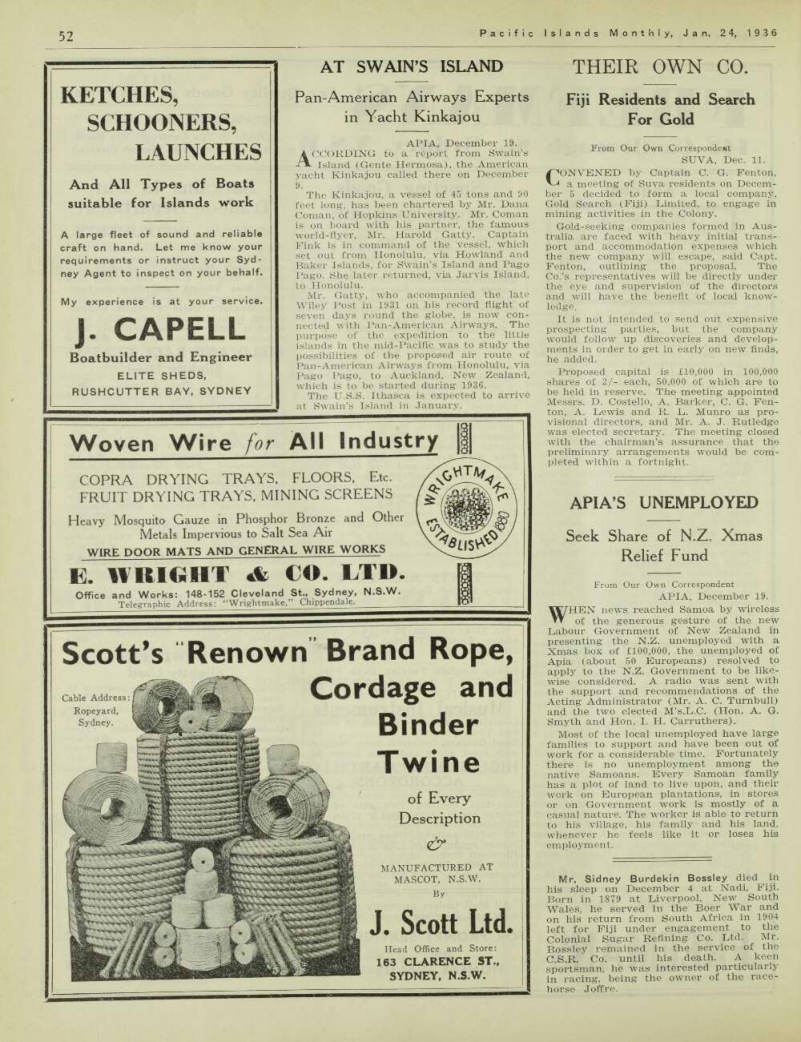
At Swain’S Island
Pan-American Airways Experts in Yacht Kinkajou
APIA, December 19. 4CCORDING to a report from Swain’s Island (Gente Hermosa), the American yacht Kinkajou called there on December 9.
The Kinkajou, a vessel of 45 tons and 90 feet long, has been chartered by Mr. Dana Coman, of Hopkins University. Mr. Coman is on board with his partner, the famous world-flyer, Mr. Harold Gatty. Captain Fink is in command of the vessel, which set out from Honolulu, via Howland and Baker Islands, for Swain’s Island and Pago Pago. She later returned, via Jarvis Island, to Honolulu.
Mr. Gatty, who accompanied the late Wiley Post in 1931 on his record flight of seven days round the globe, is now con nected with Pan-American Airways. The purpose of the expedition to the little islands in the mid-Pacific was to study the possibilities of the proposed air route of Pan-American Airways from Honolulu, via Pago Pago, to Auckland, New Zealand, which is to be started during 1936.
The U.S.S. Ithasca is expected to arrive at Swain’s Island in January.
Their Own Co.
Fiji Residents and Search For Gold
From Our Own Correspondent
Suva, Dec. 11.
CONVENED by Captain C. G. Fenton. * a meeting of Suva residents on Decem ber 5 decided to form a local company.
Gold Search (Fiji) Limited, to engage in mining activities in the Colony.
Gold-seeking companies formed in Aus tralia are faced with heavy initial trans port and accommodation expenses which the new company will escape, said Capt.
Fenton, outlining the proposal. The Co.’s representatives will be directly under the eye and supervision of the directors and will have the benefit of local know ledge.
It is not intended to send out expensive prospecting parties, but the company would follow up discoveries and develop ments in order to get in early on new finds, he added.
Proposed capital is £lO,OOO in 100,000 shares of 2/- each, 50,000 of which are to be held in reserve. The meeting appointed Messrs. D. Costello, A. Barker, C. G. Fen ton, A. Lewis and R. L. Munro as pro visional directors, and Mr. A. J. Rutledge was elected secretary. The meeting closed with the chairman’s assurance that the preliminary arrangements would be com pleted within a fortnight.
Apia’S Unemployed
Seek Share of N.Z. Xmas Relief Fund
From Our Own Correspondent APIA, December 19.
WHEN news reached Samoa by wireless of the generous gesture of the new Labour Government of New Zealand in presenting the N.Z. unemployed with a Xmas box of £lOO,OOO, the unemployed of Apia (about 50 Europeans) resolved to apply to the N.Z, Government to be like wise considered. A radio was sent with the support and recommendations of the Acting Administrator (Mr. A. C. Turnbull) and the two elected M’s.L.C. (Hon. A. G.
Smyth and Hon. I. H. Carruthers).
Most of the local unemployed have large families to support and have been out of work for a considerable time. Fortunately there is no unemployment among the native Samoans. Every Samoan family has a plot of land to live upon, and their work on European plantations, in stores or on Government work is mostly of a casual nature. The worker is able to return to his village, his family and his land, whenever he feels like it or loses his employment.
Mr. Sidney Burdekin Bossley died in his sleep on December 4 at Nadi, Fiji.
Born in 1879 at Liverpool, New South Wales, he served in the Boer War and on his return from South Africa in 1904 left for Fiji under engagement to the Colonial Sugar Refining Co. Ltd. Mr.
Bossley remained in the service of the C.S.R. Co. until his death. A keen sportsman, he was interested particularly in racing, being the owner of the race horse Joffre.
More Tourists
Visit Tahiti in Spite of Adverse Exchange Position
From Our Own Correspondent PAPEETE, December 2.
THE annual general meeting of the Syndicat dTnitiative (Tourist Bureau) was held at the Papeete Town Hall on November 15, the chair being occupied by His Excellency the Governor, who is honorary president of the association.
Monsieur Lherbier, the elected president, recounted briefly the history of the Tourist Bureau from its inception in 1914, under the presidency of M. Deflesselle, to the pre sent date. He told of the progress of the improvements sponsored and actively assisted by the Syndicat during the past year. M. Lherbier also paid a warm tribute to the valuable work done by the late Pere Rougier during the term when he occupied the chair.
Statistics quoted by M. Lherbier showed a steady increase in the number of tourists visiting French Oceania, but as he truly pointed out we cannot expect a vigorous development, which is justified by the natural attractions of Tahiti, so long as the foreign exchange situation remains as at present. The tourist, whether he be from America or from British countries, finds the purchasing power of iiis money seriously diminished when he is obliged to pay for everything in francs.
Among important items carried out re cently by the Syndicat, Monsieur Lherbier referred to the deepening of the entrance to Papeete Pass, which has been carried to a depth of 10 metres (33 ft.). It is in tended to proceed further with this work as soon as funds permit so that vessels drawing up to 40 ft. will be able to enter without difficulty. More than once during recent years Tahiti has had the experience of seeing large tourist liners pass by owing to fear of the Papeete Pass, or else being obliged to disembark passengers by means of boats —an unsatisfactory state of affairs which will now soon be remedied. In con nection with this difficult piece of work which is all essential in the interests of the tourist industry, Monsieur Lherbier warm ly acknowledged the help given by the Public Works Department and the Com pagnie des Phosphates de I’Oceanie.
Regarding the proposed hill station, M.
Lherbier said that further exploration of the possibilities had confirmed the former decision that the plateau at the base of Mt. Teohu presented the best site on the island. This plateau is not too far removed from Papeete, is situated on the dry side of the island at an altitude of 2500 ft., and commands a fine view over the district of Punaavia and across the ocean to Moorea.
An additional advantage is that this par ticular site is uncomplicated by native land titles, which would create almost insuper able .difficulties elsewhere.
A good path or bridle track to the station is all that is contemplated at the present time, but Monsieur Lherbier stated that the construction of a motor road to Mt.
Teohu will not present any insurmountable engineering difficulties. It is hoped that the trail will be commenced at an early date as it will be a very real benefit to week-enders who badly need a change of air, to say nothing of its attractions from a tourist standpoint.
The financial budget showed a satis factory balance in hand and estimates for 1936 include considerable sums to be dis tributed as prizes in the country districts for the best kept villages and gardens, a contribution to the Racing Association, assistance in the production of a “Guide to
Conversations in the Local Dialects,” and a substantial sum for the reception of tourists. Other items include the publi cation of the Tourist Gazette and the sec retary's salary.
Mr. J, R. Kinnaird, a Scottish mis sionary, of Aberdeen, has been appointed by the London Missionary Society as chief engineer on the John Williams V., the famous mission schooner of the South Seas. He will join the vessel next spring.
The John Williams has recently been fitted with wireless, operated by a South Sea Islander. Atmospherics make wire less reception in the South Seas particu larly erratic but it is hoped that the ship will be able to keep in touch with wire less stations at Suva, Ocean Island, Samoa, and the L.M.S. station at Beru (Gilbert Is.).
Cook Is. Chief Visits
Tahiti
Rarotonga, Dec. 1.
'T'INIRAU MAKEA ARIKI, Paramount * Chief of Rarotonga, accompanied by his wife. Makea Vaine, and his second daughter Tere, together with several other members of his family left by the Makura on November 29 for a two months’ visit to his relations, the ex-Royal family of Tahiti.
The Rarotongan party will be the guests of Princess Tearii Pomare.
Princess Tearii and her sister Princess Takau are shortly leaving Tahiti to make their permanent residence in France, where the latter has already spent many years, preferring to be near her brother Ariihere hia Pomare, who holds an administrative position in the French Civil Service in Morocco.
Advertisements & other items, pp. 55-56 (1 item)
Ants and Dry Dot
COPRA MATS AND MATTING
Send your enquiries to us for Woven Wire Mesh in Rolls or framed for Copra Drying and all Screening purposes. Bird Cages, Sieves and Riddles, Builder’s Gravel Screens, Rat Traps, Door Mats, Garden Arches, Chain Wire Mesh, Crimped Wire Mesh for Window Guards, etc.
SCOTT AND SONS
WIREWORKS: RAILWAY PARADE AND MURRAY STREET MARRICKVILLE
Don’t keep a Cockroach Farm . . .
DEATH TO COCKROACHES!
L ET BLATTACIDE rid you of the pest. Nonpoisonous. Never known to fail, no matter how badly infected. Guaranteed to be absolutely harmless to children and domestic animals.
BUY A TIN NOW- - DON’T DELAY Obtainable at — Messrs. Burns, Philp & Co.
All Stores For over 25 years, Burns, Philp & Co. have been our Sole Distributors in the Islands.
SOLD IN 9oz. & 16oz. TINS
Any difficulty in obtaining, write direct to BLATTACIDE CO. 49 Clarence Street, Sydney, N.S.W.
"BLATTACIOI
p ..
U
REG
preserve* WOOD from White
Ants and Dry Dot
A reduced photograph of a section of a Greenhouse from Singapore destroyed by Termites.
WOODWORK OR TIMBER of any description can be made PERMANENTLY immune from the attacks of Termites (White Ants) and Dry Rot by the appli cation of “CUPRINOL.” Even woodwork which has already been attacked can be treated to prevent the decay spreading.
“CUPRINOL” is the most powerful insecticide and fungicide known to science. “CUPRINOL” is insoluble in water. Write us for full details of this amazing wood-preserver.
Islands Distributors:
PAUL/ ti GRAV LTD.
Head Office: 82-84 Sussex St., Sydney
Kork-N-Sea!
FOR ALL HOME BOTTLING - THE
LITTLE CAP THAT WILL RE-SEAL
1,000 TIMES
KORK-N-SEAL (Aust.) Ltd.
106 COMMONWEALTH STREET
SYDNEY, AUSTRALIA
FOR HOME USE
Applied Airtight Pressure Hand Proof
Pays for Itself!
The
HALLSTROM
Masterpiece Price £4»/10/-, f.0.b., Sydney.
Others from £2O.
FOR EVERY HOME
HALLSTROM
Semi-Automatic
REFRIGERATORS
KEROSENE OPERATED
Have proof of Lasting Service and economical refrigeration efficiency.
No Moving Parts—No Mechanism.
Keep your food fresh and wholesome Write for particulars to the manufacturer:
E. HALLSTROM
462/464 Willoughby Rd., Willoughby
SYDNEY
These Light Steel Cultivators
are adaptable for a variety of operations Special features: Suitable for use with one bullock or horse. Can be supplied with a wide range of reversible points and shares.
Made in three sizes.
“MIDGET” (fixed) with 5 tines covering 24 inches.
BTSL (single lever) adjustable for width from 14 inches to 24 inches.
Can be fitted with ridging body.
BTDL (2 levers) with 5 or 7 tines.
Made by Ransomes, Sims and Jefferies, Ipswich England
Wansomes
LIGHT STEEL
Walking Cultivators
Samoan Produce
From Our Own Correspondent APIA, December 1.
THE cocoa crop is still being picked, though the heavy rains, occasioning bad roads on the plantations, interfere somewhat with the bringing in of the pro duct. While the export of cocoa in 1935 has been below the average, as most of the incoming crop can appear only in the export figures for 1936, copra figures for 1935 are much ahead of those of former years. So far about 12,500 tons of copra have been exported this year.
Within two weeks of each other the banana steamers are calling for shipments, the Maui Pomare on the 4th and the Limerick on the 14th. There seems to be a sufficiency of fruit available and for the first time the island of Savaii is given the chance to participate in the banana ship ments, as a boat load of a few hundred cases will be brought over from the Paasa leleaga district for shipment by the Maui Pomare.
Captain L. C. Shoppee, who has been connected with gold-seeking activities in the Morobe district (New Guinea) during the past few years, arrived in Sydney by the Montoro on December 18, accom panied by his wife.
Two Deaths On T.I.
Lugger
Mystery Solved With Aid of Guinea Pig
From Our Own Correspondent
Thursday Is., Jan. 1.
ALARMED when no signals came from Ichitaro Miyeo, 35, a diver, working five fathoms down from the T.I. pearling lugger Aldina, the captain went down and found the Japanese dead in his diving suit on the sea bed.
Returning to port at Thursday Island, a native, Sammy Myquick (17), was found dead in the hold. An investigation made of the lugger, following a post-mortem examination, revealed that death was due to carbon monoxide poisoning, but appar ently everything was in order.
Dr. J. R. Nimmo, Government medical officer at Thursday Is., then procured a healthy guinea pig, which he placed in one of the diving helmets. Air from the tank was circulated in the helmet for 15 min utes. The pig showed signs of suffocation, and it was" taken out and revived. Later it was replaced in the tank, and in five minutes became paralysed, and collapsed, recovering again when brought out.
It was then discovered that a fair amount of engine gas was being dis charged into the engine room, and the fumes also passed into the hatch, where the body of Myquick was found. The in take valve of the air compressor took in the fumes also, and these were pumped zo the diver.
L.M.S. Medical Scheme
For Papua
THE prospect of big developments in the medical work of the London Mis sionary Society, in co-operation with the Papuan Government, was discussed by the secretary of the L.M.S. (Rev. H. J. E.
Short) at the 1935 Assembly in December.
A scheme is under weigh for a fully equipped hospital for T.B. and leprosy patients in Port Moresby, and a doctor and hospital for service in the western areas of the Territory.
A great deal of medical service is being rendered now, but it is felt that the oldest mission in Papua should attempt greater things to meet the deep health need of the native people.
Gilbert Islander Drowned in Samoa
Samoa
From Our Own Correspondent APIA, December 17.
WHILE fishing near the reef in rough weather in the Aleipata district, Wes tern Samoa, a native of the Gilbert Islands was thrown into the sea when his canoe capsized. Though a lengthy search was made by other natives in a larger boat, the man was not found. It is probable that the body was swept out to sea by a strong current.
Mr. H. A. Gregory, Assistant District Officer at Kieta, New Guinea, arrived in Sydney on December 19 by the Tanda.
He departed later for Victoria to spend his furlough in Melbourne.
Conditions in Samoa
Letter to the Editor.
OLD residents of Samoa hope that the new Government in New Zealand will regard the administration of Western Samoa as a national obligation rather than as an opportunity for allowing officials to glorify themselves.
It is believed that under new conditions all differences here can be amicably ad justed. There never was any need for warships or military police in Samoa. The late Administrator never was in close touch with the Samoans. There was much criticism, for instance, of the fact that he maintained at Vailima a party of Chinese household servants, whose wages presum ably went back to China. Why could he not have used local labour for this pur pose? Why should the Administrator have thought it necessary to maintain an Aide-de-camp—his own nephew, with the title of “Captain”—a position regarded as quite unnecessary?
The New Zealand Government at the beginning deported many of the German pioneers—men of real intelligence who were deeply interested in the development and progress of Samoa. Their places have never been filled.
The unemployment position among Europeans here is tragic. A few unem ployed ex-service men occasionally secure a few days’ work from the Public Works Department at a low rate of wages; and when they are paid their wages are subject to deductions of 20 per cent, or so, as in stalments against what they apparently owe the Administration for poll tax, school ing for their children, medical fees, etc. It is a pitiful sight to see ex-service men on the tops of Government buildings painting the high, steep roofs in the broiling tropi cal sun.
Our troubles are by no means incapable of solution. Let the new Government only make an inquiry, and put in charge of this territory a man of some common-sense and strength of character and much of the present rampant discontent will disappear.
I am, etc.,
Old Resident.
Apia, 16/12/1935.
Silver Medal Awarded to Fijian
From Our Own Correspondent
Suva, Dec. 20.
attempting to save his nephew, Wil liame Uati, 19, from a very savage fish, Joni Drawnimasi, 40, of Bua District, Fiji, has been awarded a silver medal by the Royal Humane Society, London.
While bathing near Moloncowava Reef, Williame was attacked by a large barra couta fish, which bit off his arm. Joni swam ashore with the boy, who later died.
The barracouta is of the perch family and is about eight to ten feet long. It is more feared by the natives than are sharks.
Years Ago
The Marshalls 50
Administered by Five German Officials
From Our Own Correspondent APIA (Samoa), December 6.
THE German press in November last made reference to the 50th anni versary of the hoisting of the German flag in the Marshall Islands and published reminiscences of the former Governor of New Guinea, Dr. A. Hahl, The Marshall Islands in 1906 were placed under the Administration of German New Guinea.
Nowadays, with radio and aeroplanes, it is much easier for the Japanese Adminis tration to govern the far flung atolls of the group than it was for the Germans 50 years ago. The German Administration for the whole of the 50 islands consisted of only five white officials: the Deputy Administrator, his secretary, a police official, the Government Medical Officer and a hospital orderly. At Jaluit, seat of the German Administration, there were only two native policemen.
It was a difficult task to induce the can nibals of the group to submit peacefully to European rule. To supply proof of their submission they were required to build roads through their district. Dr. Hahl tells that in some villages when the men refused to perform their tasks of road building the women came out in support of the
Government. They gave as a reason that the Government prevented the former con tinuous wars, when children and women were killed and always eaten first. And so the men agreed to build the roads.
Advertisements & other items, p. 57 (1 item)
Paul & Gray Limited
PC II PiflO 1I1L
Light and Portable
MOTOR PUMP
Complete Plant’s weight, I 40 lbs.
Capacity up to I 2,000 gallons per hour All heads from 10 to 115 feet Fuel consumption, \ gallon per hour Pressure 35 lbs. square inch Especially suitable prospecting And all Sluicing Requirements
Nelson & Robertson
12 SPRING STREET, SYDNEY
PAUL & GRAY LIMITED
SHIPCHANDLERS. SAILMAKERS
AND AIRCRAFT SUPPLIERS.
Head Office - - 82-84 SUSSEX STREET - - SYDNEY
FULL STOCKS OF ALL ISLAND REQUIREMENTS
SPECIALISTS IN ALL TYPES OF CANVAS WORK
PARTICULARLY BOAT COVERS, HATCH COVERS,
TARPAULINS, AND ALL TYPES OF SAILS
islands Distributors of CUPRINOL —the New Preservative Branches at Brisbane, Melbourne, Newcastle, Port Adelaide and at London
SKANDIA ENGINES MARINE AND STATIONARY
===— — =——= FULL DIESEL - - SEMI DIESEL • LOW FUEL CONSUMPTION W Force Feed Reliable. Effi Economical, „ ■ Circulating y.
TYPES FO t R ALL BOATS a. Lubrication Ji Immediate Starting on Crude Oil Particulars from: NELSON & ROBERTSON , 12 SPRING STREET. SYDNEY
London View of South Seas
Products
From a Special Correspondent.
London, Nov. 30.
TROPICAL produce prices are slowly rising-. There have been no startling developments. No doubt, stocks of oil are getting low, but somehow or other the system of living from hand to mouth is becoming really a part of modern life.
I am confident that copra producers could make a much better deal if they would only co-operate and charter their own ships to carry their produce to the European markets. I think that all those New Guinea estates should be called back by the Government. All debts due to the
trading firms should be liquidated and the whole of the estates should be run on a co-operative basis, both in regard to the selling of produce and the buying of com modities. There would be no need to place an embargo on the trading firms. If their quotes were attractive, then the co-opera tive organization would deal with them; but if not, then the co-operative concern would take its own line.
Mr. H. Somerset Vidgen, of Thursday Island, has announced his engagement to Sister Reed, of the Torres Strait Hos pital. Mr. Vidgen owns the plantation at Cape York, Northern Queensland, on which a landing ground has been pre pared for the use of airmen flying by the short sea route between New Guinea and Australia.
Pacific Shipping
A Few Words Against The Union Company
THE president of a large trading cor poration, writing to the Editor from Toronto, Canada, on December 10, is straight from the shoulder; “I am a bit fed up with your continued defence of the Union Company and your abuse of other lines.
“I have had experience of the Union Co. for 20 years. They have never given any thing more in the way of freight rates or passenger accommodation than they felt forced to do. Even to-day, they are run ning a steamer south from Wellington to Lyttelton which is a disgrace for a white man to ride in.
“They are autocratic and difficult people to do business with, and it is time that some foreign competition came into the picture and forced them to change their attitude. But instead of attempting to improve their services they go about cry ing and trying to enlist the sympathies of well-intentioned men like yourself.
“You have stepped off on the wrong foot. Or possibly you are a stockholder or a personal friend of the owners.”
EDITORIAL NOTE: We have no interest what ever in the Union Co., which is quite capable of arguing its own case. But we are vitally inter ested in this question of obtaining a fair deal for British shipping in the Pacific. The Americans will not allow British ships (which are unsubsi dised), to trade between American ports. Why, therefore, should the subsidised American ships be allowed free and unrestricted trade between the British Pacific ports (Fiji, New Zealand, and Australia) ? That is the crux of the problem. Let the American liners undergo, between Fiji, Aus tralian, and New Zealand ports, the same dis abilities as are imposed on British liners between Hawaii and San Francisco, with some special pro vision to counter the advantage given by the American subsidy, and the Union Co. will have no cause to grumble. The Union Co.’s method of conducting its services is a matter between its conscience and its clients. Other things being equal, it will have to run its services efficiently, or go under.
Rev. Wilfred F. Paton, Presbyterian missionary on the island of Ambrym, New Hebrides, arrived in Sydney by the Morinda on December 18, accompanied by Mrs. Paton and their infant child. Mr.
Paton had barely recovered from a heat attack when the steamer berthed; he suffered the stroke just before leaving the Condominium, and had been pros trated by it for the greater part of the trip. Mrs, Paton said that they had spent 18 months on Ambrym, following a year on Paama Island. The volcano, which had erupted in 1913 and caused part of the island, including the area on which the Presbyterian Hospital was built, to subside into the sea, was still active, and rumblings, which were accompanied by slight tremors, were frequently heard.
Advertisements & other items, p. 58 (2 items)
Flour
PRESCOTT L T J? SYCyNB'Y
are sole wholesale adonis fdr~
PINEAPPLE BACON & HANS
DAISY BRAND BUTTER
FRESCO BRAND BUTTER
LEA & PERRINS’ SAUCE
WE ARE SPECIALISTS!
Let us have your confidence, sixty years is our record of supplying the Leading Houses throughout the World in—
FRESH FRUIT VEGETABLES PRODUCE
WEYMARK & SON LTD.
Fruit and Produce Merchants
14-18 STEAMMILL STREET, SYDNEY
Phones: MA 3612 Cable Address; Codes Bentleys. (4 lines) "Weymarkson" Private.
PRODUCING UNIFORM GOOD RESULTS SINCE 186*
Flour
ALWAYS ASK FOR IT
Reliable Cars and Trucks
New Britain Express
Delivery
GENERAL OVERSEAS AGENTS
GENERAL CARRIERS, BAGGAGE
AND FORWARDING AGENTS.
ROYAL MAIL CONTRACTORS.
Reliable Cars and Trucks
We aim to give quick and reliable Service at reasonable costs. P.O. Box 116. ’Phone 141.
W. WALKER-FLYNN, Proprietor, Malaguna Road, Rabaul, T.N.G.
Kwato Mission And
Trading
A LENGTHY reply to the defence of Kwato Mission Station, Eastern Papua (published by us at Mr. Abel’s request in July) has been received from Mr. Reg.
Fletcher, of Normanby Island. Mr. Fletcher, writing on October 26, made the following points:— I reiterate that the feeling against Kwato trading is both strong and universal. I have spent the last 12 days in Samarai, and enquired from all sections of the public, azid all state Kwato is being allowed an unfair advantage.
The list of customers is interesting, al though incomplete; they left out Messrs.
A. Evennett and J. G. Munt. This pat ronage is no criterion, owing to the cheap work carried out at Kwato. It is also to be noted that with one slip closed down, and the proprietor of another chasing the elusive dwts. to get a crust, most boat owners had to get their boat work done wherever possible.
It is correct that the demand for skilled Papuan labour is greater than ever; but he is very misleading. Skilled Papuans are turned out by the Anglican, Roman Catho lic, L.M.S. and the Methodist Mission Socie ties. I have yet to see, in 25 years’ resi dence, any private employer who has a skilled labourer in his employ turned out by Kwato. What becomes of the natives trained in Kwato Technical School at the expense of the Government?
The statement that the European trades men were all employed is incorrect. At the time this controversy started Messrs.
Young, Markey and Le Boutillier were all unemployed in Samarai. Two are now em ployed at Misima, and the third relies on plumbing work. This is the direct result of the “healthy competition” which Mr.
Abel tells us about.
I did not make “a serious charge against a Philanthropic Society.” What I argued was that what Kwato would consider a legitimate charge against technical educa tion, a Government auditor might think otherwise. He says the expenditure exceeds the grant; but, as Colonel Hooper mentions in his reports, technical students work on boat work and one may wonder if this account is properly credited with all the work carried out on their slip.
The reply about 1J ounces of gold taken out of Milne Bay by any member connected with the Association is a mere quibble. I was discussing what they had bought in Milne Bay, not mined.
As for unscrupulous natives passing themselves off as Kwato employees—does Mr. Abel think that I do not know the natives employed at Kwato?
To quote Mr. Dexter is absurd. This gentleman, being an independent store keeper, was able to import his own mer chandise direct, and sell at wholesale rates to other small traders in the Bay; and as Kwato was one of his best customers, it would be hardly likely he would object to their selling retail, what he had sold to them wholesale.
The statement about the boats being registered could have been qualified by Mr.
Abel stating when his boats were regis tered. Is it only since they started freight ing in opposition to others?
That Kwato is a non-dividend paying concern is not very surprising. Probably, if they cut out 15 of the 21 Europeans on Kwato at present, the saving would enable them to do without the Government sub sidy. I presume the Government give grants for technical purposes with the idea that a supply of trained natives is always available to both the Government and pri vate employees. Mr. Abel might explain how many trained boys have been turned
out by Kwato since the inception of this Company in 1919; by whom they are em ployed; the cost per head to train them; the present number of students; the num ber of other boys employed at Kwato; and, finally, how many natives claim exemption from the Government Tax on Kwato’s behalf.
N.G. Public Service
THE following staff changes in the New Guinea Administration were gazetted in Bulletin No. 45: — Appointments: Miss Eileen Owers, Nurse, Public Health Dept.; Miss Clare Eda Berge, Nurse, Public Health Dept.
Acting Appointments: J. Walstab, Acting Direc tor of District Services and Native Affairs; E.
A. Feldt, Acting Warden (Morobe Goldfields).
Promotions: A. J. Streathearn, Clerk (£3OO - to Clerk (£354-£444), Govt. Secretary’s Dept.; B. W. Brazier, Clerk (£3OO-408) to Clerk (£354-£444), District Services Dept.; E. J. Slee, Clerk (£3OO-£408) to Clerk (£354-£444), District Services Dept. Cadets to be Patrol Officers: K. W. Bilston, J. R. Black, T. G. Aitchison, H.
G. Verey, M. S. Edwards, G. Greathead, L. G.
Vial, R. B. Strudwick, J. Hepburn. P. E. R. Coe, Clerk (£3OO-£408) to Clerk (£354-£444), Customs Dept.; R. A. Bird, Clerk (£3OO-£408) to Clerk (£354-£444), Customs Dept.
Transfers: E. M. Hawnt, Mechanic and Lines Foreman, Wau to Rabaul; A. B. Gilroy, Medical Officer, Madang to Rabaul; C. M. Pines, Medical Assistant, Rabaul to Salamaua; G. H. McQueen, Medical Officer, Wewak to Madang; R. B. McVilly, Acting P. 0., Salamaua to Rabaul; C. G. Bowman, Clerk, District Services Dept., Salamaua to Rabaul; M. S. Edwards, P. 0,. Rabaul to Salamaua; A. A. Roberts, P. 0., Rabaul to Salamaua; T. G.
Aitchison, P. 0., Rabaul to Salamaua; L. G. Vial, P. 0., Rabaul to Salamaua; K. W. Bilston. P. 0., Rabaul to Wewak; C. W. Barnes, Clerk, District Services Dept., Rabaul to Kavieng; A. F. Kyle, Acting A.D.0., Wewak to Rabaul; C. H. Mac lean, Clerk, District Services Dept., Kavieng to Salamaua; J. I. Merrylees, A.D.0., Rabaul to Kieta; H. E. Hamilton, Acting P. 0., Wewak to Rabaul; A. M. Ryan, Clerk, District Services Dept., Kavieng to Rabaul; W. McG. Pestell, Inspector, Agriculture Dept., Rabaul to Kavieng.
Temporary Appointments: Govt. Secretary’s Dept.: Miss V. Thwaite, Typist. Public Health Dept.: Miss J. M. Cox, Nurse. District Services Dept.: E. C. Arthur, Storeman, Wau; Miss E.
Page, Typiste, Kavieng; G. M. Broad, Clerk, Wau.
Public Works Dept.: L. J. S. Reid, Roadmaster, Madang.
Police Force Transfers: S. Reilly, Warrant Officer, 2nd Class, Wau to Salamaua; A. M.
Sinclair, Warrant Officer, 2nd Class, Rabaul to Kokopo; N. B. Blood, Warrant Officer, 2nd Class, Kokopo to Rabaul.
Miss Moira Hennessey, of Thursday Island, was married in December to Rev.
J. Housden, 8.A., L.Th., Hector of Dar win, Northern Territory.
Mr. William H. Carpenter, of Messrs.
W. R. Carpenter and Co., Ltd., arrived in Sydney from Rabaul by the Montoro on December 18, after a business visit to New Guinea.
Mr. W. R. Fell, Sub-Inspector in the Police Department of Western Samoa, sailed from Apia on furlough by the December Maui Pomare.
Advertisements & other items, pp. 59-60 (1 item)
Hjpeel&Sons
PURE RICE
STARCH
Always ask for . . .
“CORAL” Brand
100% PURE
Noted for its
QUALITY
and
WHITENESS
Goes Farthest and gives Lasting Finish
WILL NOT
STICK TO
IRON
Obtainable from Leading Island Stores Manufactured by Coral Starch Ltd.
Sydney, N.S.W.
CORAL BRAND
RICE STARCH
s.
p )
HJPEEL&SONS
% FI fk\
IMPORTER/
& EXPORTERS
QUOTES
SENT
ANYWHERE
Phones: MW 1603 FX 5011 Purveyors of Scotch, Canadian, N.Z. and Australian
Fresh and Smoked Fish
SHIPPING
PROVEDORES
239 HARRIS ST., PYRMONT
SYDNEY, New South Wales
AVOID INERT CREAMS
What woman does not sigh after this radiant freshness, this juvenile tint that excites admiration? CREME SIMON makes the skin lovely, —it is always active and is delicately perfumed.
For Perfect Beauty use
CREME SIMON
also
POUDRE SIMON
(7 Shades), and
SIMON SOAP
MON
PARIS
Obtainable Chemists and Stores Sole Agents: Joubert €*• Joubert Pty. Ltd., Melbourne
The Islanders’ Sydney Home ...
Location REEVE HE RE
81 BAYSWATER ROAD, DARLINGHURST
Exclusive.
A fine house with its wealth of pleasant old associations.
The Garden Suites, designed on most modern lines.
Excellent grounds with beautifully kept gardens—and dotted with comfortable garden seats.
Private telephones if desired.
An atmosphere of rest and grateful quietness.
Ideal location.
Near White City Tennis Courts.
Seven minutes to G.P.O.
Close to Shopping Centre.
Trams stop at gates.
BELVEDERE is Controlled & Supervised by Islands People for Islands People TERMS: From £2/12/6 Weekly.
MR. & MRS. C. WAGER (late of Fiji), Proprietors.
Labor Omnia Vincit
G.CI
29 BANCROFT AVENUE,
ROSEVILLE, N. SYDNEY
A Day and Boarding School on the beautiful and healthy North Shore, enjoying all the advantages of proximity to the capital combined with a
bracing climate.
A new residence for boarders has just been completed, equipped with all modern conveniences, and allowing a larger number of resident pupils to be enrolled.
Pupils are taken from the earliest ages to leaving stage, and are under the personal supervision of the Principal. Arrangements may be made for the holidays, if wished.
Prospectus may be obtained upon application .
Principal, MISS I. DAVIES, 8.A., Dip. Ed.
Fashion Hints for Islands Women
By Therese
CLOTHES for festive hours have all the poetry of motion. Floating, flying, rippling softly floorwards in drapes and cascades, there is beauty in every line.
Gracious and lovely, with a dignity all its own is the white satin evening gown endowed with all the charm of the golden age of Greece. Moulded with slim per fection, its graceful draperies fall softly to the floor, whispering glamorously of beauty concealed, yet subtly revealed.
A cape of fuchsia tulle over a gown of misty blue reaches ecstatic heights by the addition of a dusty pink flower tucked lovingly in its low decolletage. As a direct contrast to the billowing taffetas and floating tulles, the alluring mermaid gown of satin with trailing masses of tiny flowers from one shoulder to its hemline, moulds the figure to perfection.
Glamour and sophistication is in a long sleeved evening gown of lame, rich and supple, which swathes the body with in tricate folds and lends superb dignity to the fortunate wearer.
A black taffeta spotted with red, adds a halter collar to its draped bodice. Slim fitting, its skirt is knotted to fulness at
the back, billowing out to a mere sugges tion of a train.
All the glorious colours of the old masters, make a gay pageant of glory for gala occasions—enchanting blues, brilliant scarlets, and imperial purples.
In these magnificent colours velvet, rich and lovely, lends itself regally to the beautiful draperies, in which past and present are blended with superb artistry.
The soft sculptured folds of the Sari gown are exquisitely expressed in satin, which so admirably replaces velvet for tropical wear. The Sari may spring from the waist, fall softly to the hem of the skirt, or drape itself over the head with all the glamour of the East.
A frock of georgette, its shoulder draped with a scarf that is a clever con tinuation of a belt, ripples with the cas cade draperies of the skirt to the floor.
A lilac chiffon, with deeply draped arm holes and soft bodice caught with a lovely old amethyst brooch, has a jewelled belt and simple flowing skirt that expresses joyously, the beauty and charm of the ingenue. An evening coat of amethyst taffeta with wide sleeves trimmed with frayed ruching is a romantic accompani ment.
Old-fashioned jewellery and a neat flower in the hair gives a quaint air of demure Victorianism to the picture frock.
Utterly simple and infinitely useful are the casual clothes that form the basis of the discriminating woman’s wardrobe.
Accessories lift them to dizzy heights and offer so many variations that one frock becomes many in the twinkling of an eye.
An appealing little frock for festive afternoons is of floral crepe-de-chene, with softly guaged frill at the high neck line. The guaging is repeated in the full elbow-length sleeves. For formal after noon wear there is the gown with the soutache trimmed, elbow length raglan sleeve, its bodice tying with a cord at the neck line in contrasting colour, and its skirt softly gored.
A useful adjunct to the wardrobe is, the one-piece dress and jacket which has the appearance of a three-piece suit, because of its contrasting top. Much scope for colour contrasts is offered for the in genious-minded in this delightful idea.
Quaker collars on simple two-piece jacket suits with short full skirts have frog fastenings on the jackets to strike a military note, even in spectator sports clothes. Odd jackets figured for plain frocks and vice versa, are used for even ing wear as well as day time. Buttoned high to the neck, open to the waist, fitting or swagger, they are delightful.
The blouse and skirt idea is gaining in popularity. Many blouses, sober and frivolous, go with one well-cut skirt —-an excellent and economical fashion which extends to evening clothes, too.
Three peaks caught in whirls of rouleau trim the square neck of a frock, the bodice of which is fastened down the back with large buttons. Rouleau whirls trim the sash which tops a slim-fitting slightly flared skirt, A simple afternoon gown has a soft jabot caught at one shoulder and slipped through one of the very new raffia rope buckles at the V-neckline. Its sleeves are raglan set and two kick pleats make a bold bid for freedom of movement in the skirt.
Evening shoes copy the beautiful models from Spain, Italy, and Vienna.
For day wear there is the übiquitous court, the T-bar sandal, the Oxford, the flat-heeled brogue sport shoe, the square or round-toed shoe, made in suede or pin-grained leather, the sandal with slightly more toe than of yore, but almost heel-less and so on ad infinitum.
Gloves were never more beautiful. Soft gloves of kid and silk are worn for formal occasions and heavier hand-sewn gloves of washing leathers with tailored clothes.
Fashion dictates they must be either very short or very long and ruffled down the arm with a nonchalant air, the length depending entirely on the length of one’s dress sleeves.
Diversity is the keynote of the new millinery modes, and since winter is abroad many chapeaux come in military array to mark time with this note in day clothes. The horse-guards, the forage and the drummer-boy caps are all poached on to suit woman’s fickle whim. Then there are peasant caps, hats with square fronts like visors, and the plain, larger brimmed hats for the more practical minded. Whatever their style, however, they demand the perfect coiffure. For evening the locks may be caught in a jewelled Juliet cap, or bound With ribbon which ends on the top of the head with jaunty bow, or perches a little cluster of flowers flippantly over the brow.
Belts, fastening and trimmings are alive with interest. Belts come in gold and silver kid, bejewelled and plain, lame, metals, patents, plaited, and twisted rope dyed as one’s fancy decrees, coloured glass rings and a thousand and one other things all equally attractive.
Lightning fasteners oust buttons from their assured position, with laces follow ing closely behind in the race for recog nition. Frogs of brilliant braid make ideal fastenings.
Scarves and sashes gay the dullest toilette for both day and evening wear.
Bags are in skin, leather, wood, and fabric for day wear, while they are em broidered, feathered, brocaded, or jewelled for evening wear.
Christmas
T.I.’S Gay Throng At
THURSDAY IS., January 2. rpHE arrival of the pearling fleet for the annual lay-up was the distinctive feature of Christmas at Thursday Island.
The coloured crews, many of whom are mission educated, were all ashore, some dressed in gay coloured Milanese shirts and khaki trousers, while others contented themselves with brightly-coloured lava lavas. Intermingled with these gay colours moved the more astute Japanese, and a sprinkling of Malay divers. The men of the white population wore tropical suits.
The crowd moved to Hodel’s general store, where a gigantic plum pudding yielded a toy for every child on the island.
Acute Water Shortage
The continued shortage of water for household use was everywhere apparent. White and coloured people were seen carrying water in kerosene tins, while carriers were working overtime trying to obtain water from wells in which the supply was quite unequal to the demand.
All private owners of wells are rationing the water, having placed locked covers on top of the wells, and opening them only at stated periods.
When the time for opening the wells arrive queues are formed.
Rev. A. Hardie, of Martinborough, New Zealand, has been appointed by the Pres byterian Church of New Zealand to take charge of St. Andrew’s Church at Suva, Fiji. The appointment is for three years, and Mr. Hardie will take up his duties at the beginning of March.
A Samoan Feast
From Our Own Correspondent APIA, December 14.
THERE was great excitement recently in the Faasaleleaga district of Savaii Island when on the beach between the villages of Faga and Sapapalii a school of large blackfish —all between 10 and 12 feet long—was stranded. There were six of the big fish, two of which managed to get away, but returned after some time. A huge crowd of natives soon gathered and the blackfish were attacked with axes and spears, and finally killed.
Then a real Samoan feast began. The huge carcases were cut up and the flesh distributed among all the inhabitants of the district. European traders and the Deputy Administrator at Tuasivi (Mr.
Robson) received a share of the booty.
The blubber was boiled and is now being used in place of kerosene for lighting purposes.
Hawaii’S Air Services
Simultaneously with the inaugura tion of trans-Pacific airplane service putting Hawaii within 17 hours of the North American continent, the Hawaiian Islands entered the seventh year of pas senger plane service between Honolulu and the outlying islands.
Within several days of the arrival at Honolulu of the trans-Pacific Clipper, a “baby clipper” was delivered by steamer to be added to the Inter-Island Airways fleet.
This is the first of two new 16-passenger Sikorsky amphibions that will be added to the cross-channel service in 1936, making a total of six ’planes in the inter-island fleet.
During its six years of successful opera tion, Inter-Island Airways has carried 65,000 passengers between Honolulu and the “tourist islands”: Hawaii, Maui, Kauai; to the pineapple island of Lanai; and to Molokai with its vast pineapple, ranching and homestead projects. Its ’planes have flown 1,500,000 miles—equal to more than 60 times around the equator. As an indi cation of the increasing air-mindedness of both tourists and residents in Hawaii, air plane travel between the islands in 1935 showed an increase of more than 30 per cent, over 1934. Trips from Honolulu to all the islands are now daily, except Sun day. The longest hop is the flight from Honolulu to Hilo —two hours.
Mr. R. J. Vickers, headmaster of Apia Government School, departed from Samoa for holidays in New Zealand by the Maui Pomare on December 5.
Mr. C. M. Urquhart, wireless operator for Amalgamated Wireless (A/sia) Ltd., at Kieta, Bougainville, New Guinea, re turned after short leave in Australia by the Malaita on January 9. He has been in the Territory as a radio officer for three years.
Advertisements & other items, p. 61 (1 item)
Hope for
(ilooil Mews for
Women Going: 15aId
“My hair was thin for years; it seemed as if nothing would ever make it grow , but after a few weeks it started growing Well again with KOKO, before I finished the first bottle."
Hope for
Women with
Dull Fading Hair! /
“/ never knew I had such * pretty tints in my hair until I \ used KOKO. I find KOKO \ marvellous for making the hair wavy. Whilst imparting a glossy appearance, KOKO induces growth to quite a wonderful degree; it also seems to improve the color of the hair."
“KOKO is the best thing I know j for Dandruff. My family have used it for years and would not be without it." (Voluntary testimony.) Chemists and Stores Obtainable in 3 Sizes.
Koko-Maricopas Co. Ltd.
“Civic House,” 479 Kent Street, Sydney, 'I
N.S.W.
IN THE HEART
OF SYDNEY
is«
ANNOUNCEMENT. . .
PRIVATE
HOTEL
ISLANDS’ PATRONS of “CROWLE HOUSE” are
informed that this well-known SYDNEY PRIVATE HOTEL is under NEW AND EXPERT MANAGE- MENT, and has been LAVISHLY RE-FURNISHED THROUGHOUT. Every convenience is available, including Hot and Cold Water in all Bedrooms, Electric Elevator, Laundries, Electric Irons, Pressing Rooms, etc. (Free Service).
Visitors holidaying in Sydney will find Comfort and Contentment at this conveniently situated Hotel. Excellent Cuisine.
TARIFF:
Single Room. Bed & B’fast., 7/6 per day. 45/- per week.
Double Room. Bed & B’fast., 14/- per day. 84/- per week. Casual Meals 2/- each.
161 CASTLEREAGH ST.
J. C. HUGHES
Proprietor Radios and Telegrams:
"CROWL-
HOUSE,”
SYDNEY.
Housekeeping in the Tropics
Conducted by “Dorothea"
Asia’s Supreme Dish
The Art of Curry Making,
as Practised in India
Described by an Anglo-Indian 'T'O the East belongs the credit of pro- A ducing that mysterious dish, a per fect curry; yet everything that goes to the production of this distinctive food is grown in the British Empire—spices and condiments from British West Indies, India, Ceylon, Sierra Leone, and the United Kingdom; rice from Burma and
Bengal; and flavouring vegetables, coco nut, mangoes, tamarinds, etc., from all parts.
In countries where water is not safe unless boiled or filtered, currying food is possibly an unconscious hygienic insti tution, since many of the spices that are used in curry preparations are slightly antiseptic in nature; also, the method of cooking is especially well suited to meat that has to be eaten soon after it is killed, as is the case in India and tropical countries.
To the average housewife the finest secrets of a curry dish are rarely re vealed; to her, often, it means only one thing—a quick means of using up the re mains of a cold joint, and the net result
is frequently a very hot and quite un appetising concoction. Curry, however, is not simply pieces of meat stewed in a gravy thickened with curry powder and flour.
As a matter of fact, although the Mus sulman indulges in meat, game, fish, and fowl, the strict Hindu (who is a past master in the art of currymaking) is for bidden by his religion to partake of flesh; yet with the aid of ghee (clarified butter), vegetables, fruits, milk, spices, pickles, and the simplest cooking utensils, he manages to turn out curry dishes that few English cooks (even when experi enced) could approach. His culinary ap paratus frequently consists of a simple clay fireplace, a flat stone for grinding spices, etc., a pestle and mortar, an earth enware dish, a vegetable-cutter and knife, and the ingredients. But, with these simple implements, there are no limits to native ingenuity in preparing a curry.
True, the native has one advantage over the English cook at home, in that he is able to use all his ingredients in a green state, and is therefore able to vary the proportions of spices and condiments as he thinks fit—adding here a little more coriander seeds, there another pinch of ginger, and so on. If the British house wife at home desires, however, she, too, can vary her proportions of spices and condiments, since all are to be procured either in the grocery department of large stores, or among the drugs. Many house wives who have lived out East do mix their own curry powders and pastes in this way.
There are many brands of curry powders on the market and each is dif ferent in flavour. To many persons pastes are preferable to powders; this is largely a matter for individual taste.
Currying should not be looked upon purely as a means of reheating foods in a tasty way; that it does serve this pur pose is admitted, but no curry dish pre pared with cooked meat has the same flavour as one made with raw flesh, un cooked fish, or vegetables, etc. And this is one of the secrets of the Oriental dish.
It is always prepared with fresh food.
Generally speaking, white meats, poul try and fish, make better curry dishes than red meats; and the fruit and vege table curries are equally excellent if well prepared.
Here is a recipe for mixing a real In dian curry powder, given in parts because Indian weights do not agree with ours.
Suppose 120 parts, of which coriander seed would be half (say |lb.): Coriander seeds, 60 parts; tumeric, 3 parts; cummin, 3 parts; fenugreek, 3 parts; mustard-seed, 6 parts; dried ginger, 6 parts; black pepper, 3 parts; dried chillies, 6 parts; poppy seeds, 6 parts; garlic, 6 parts; cardamons, 6 pp,rts; cinnamon.
Clean, dry, pound, and sift these in gredients and mix well together, then put into bottles and cork tightly. One table spoonful is sufficient for a chicken curry.
Although these ingredients may be varied in proportion, the ratio of coriander seeds and tumeric should be well noted, as these are highly important in all curry powder preparations.
Tropical Recipes
Passionfruit Meringue
BEAT egg-whites tb a stiff froth and add gradually 2oz. sugar to each egg-white. Place in a bag made with greaseproof paper and force out into balls, or a rose tube may be used to make them a little more fancy. Bake in a very slow oven for about one hour, taking care they do not take colour. Press in the bottom of each meringue and fill with the following: Whip
quarter-pint cream with a little sugar until stiff, then add the pulp of four passionfruit. Join two together, and, if desired, a little plain cream may be piped around the join.—“Bittambo,” Tulagi.
Banana Pie
Make a pie crust in the usual way and line a pie plate with a layer of the pastry. Bake in oven until done. Make a mixture of three bananas, which have been mashed and then whipped with an egg-beater. Add 1 cup sugar, 1 dessertspoonful lemon-juice, pinch of salt, and two egg-whites which have been beaten separately until frothy. Pour this mixture into the pastry shell and bake in moderate oven 20 minutes. A sprinkling with some chopped nuts or cocoa-nut is a pleasant addition. This pie is better if eaten as soon as it is cooked.—“Bittambo,” Tulagi.
Baked Bananas
Fill a pie dish with sliced ripe bananas (cut lengthwise), then pour over same some strained coconut milk and bake in a good oven. —N.C.M.H.,
Fiji.
Tapioca Rissoles
Boil some fairly young tapioca (not too hard and woody), and mash same as you would potatoes.
Mix in some finely chopped up onions (spring onions will do if you have no others). Add a little seasoning and fry in the usual manner. The same can be tried with cooked unripe bananas, taro, or yams.—N.C.M.H., Fiji.
Tapioca Porridge (Or Sago)
Grate a tuber root of uncooked tapioca after well peeling it. Put about two inches of water or milk in a one-gallon saucepan. Bring to the boil. Then add the already-grated tapioca, with a little salt to taste and stir briskly for several minutes, so that the mixture won’t go lumpy. The resulting mass will be not unlike sago when cooked. It only takes a few minutes to cook, and should be stirred well to prevent from burning. When it has assumed a sago appearance it is done, and can be served with milk and sugar as porridge.
It could also be served as a dessert with stewed fruit. It needs some time to cool as it holds the heat. This is sufficient for two or three persons.
Tapioca should be well peeled by slitting the tuber from end to end with a knife. The point of the knife can then be inserted under the slit part and the skin lifted off. The skin is supposed to contain prussic acid, so that it is as well to see that it is well peeled.—N.C.M.H., Fiji.
Use Of Ghee
I always find ghee, 'coconut oil. or peanut .oil is more satisfactory to fry anything with than meat fat or dripping. These three do not “cling” to the mouth, as does dripping. Ghee is all right lf it nj ce and fresh—not that half-rancid stuff like lard. Also frying in oil would suit those who are vegetarians.—N.C.M.H., Fiji.
Best Way To Keep Stores
Keep potatoes, onions, etc., in a basket to pre vent sweating; keep cheese wrapped in a cloth wrung out in vinegar, and it will not harden; keep eggs in a cool place, or hang in a wire basket. Keep salt in an earthenware jar, in a dry place. Keep yeast in either wood or glass.
Keep fresh lard in a tin vessel, and flour, oat meal, etc., in a cool, dry place. Keep tea always in a tin caddy, bread in an earthenware jar, and butter m either enamel or chinaware, not glass.
Keep soap cut up the size required and allow to dry out it is much more economical to use Smabada,” Port Moresby.
Orange Pep
F°r tha t weary, all-gone feeling, the following will be found to be very helpful. Squeeze the juice of three or four oranges (more if there are plenty), strain, add a goodly teaspoonful of honey (not sugar), previously dissolved, a teaspoonful of lemon, then beat up separately the yolk (only) of a raw egg, strain, and add this to the orange mixture with a few drops of vanilla. Mix thoroughly and sip slowly in order to get the full benefit of this food-drink by mixing the saliva well with it. It is better taken without anything ea *‘ 9.5? a , day will kee P th e undertaker away.
Try it.—“Smabada,” Port Moresby.
Advertisements & other items, p. 62 (1 item)
Tamarang
7f* /imjTVattrr The Ideal Sydney Home fc • ♦ ♦ hlands children SITUATED ON THE HEIGHTS OF THE BEAUTIFUL NORTH SHORE
IN DELIGHTFUL, HEALTHY. OPEN SURROUNDINGS.
SUNNY ROOMS. SPACIOUS PLAYGROUNDS, TENNIS COURT.
GOOD FOOD AND ALL THE CARE AND COMFORT OF HOME.
Owing to the need for more accommodation “Tamarang” is now located at the new address, given below.
lister i\cnnp Clinic. . .
House Mother: Mrs. G. Allnutt Assistant: Miss E. Allnutt Write to . . . +
TAMARANG
8 Fidden’s Wharf Road,
KILLARA, SYDNEY Tel.: JX 3089
Children suffering from paralysis, whose parents desire them to have the Sister Kenny Treatment, may be placed in the care of Mrs. Allnutt, at “Tamarang,” the Hostel being easy distance to the Royal North Shore Hospital, where the clinic is located.
The children will be well looked after in every way and receive every consideration necessary for their wellbeing and happiness.
O Pisci t cyb
MOWBRAY HOUSE SCHOOL
CHATSWOOD, SYDNEY, N.S.W.
(Established in 1906.) A Boarding School for Boys. Surrounded by spacious playing fields, on heights of the North Shore line.
The School Offers: A Home Atmosphere
An Unrivalled Health Record A Sound Physical, Mental,
and Moral Training.
The curriculum extends from the earliest stages to the Intermediate Examination, and provides a specially designed course of COMMERCIAL EDUCATION for boys entering a business career or work on the land.
Special provision is made to meet the requirements of boys from THE ISLANDS, which includes facilities for spending School Vacations at the School Country House.
Applications for enrolment in 1936 are now being received Illustrated Prospectus and Over-Seas Leaflet on Application.
HEADMASTER: L. BAVIN
It Happened One Day
JOE, the cook boy for the labour, had just appeared at the back door of the homestead as was his usual custom. It was his job to report on the general health and well-being of the labour, and to make complaints, if any.
The wife of the plantation-owner had just emerged from the kitchen, after helping to prepare breakfast. She was a member of a well known Australian family—and a lady, too!
The conversation proceeded something like this- Good morning, Marama (lady)!” waS 0 ?” 1 morning ’ Joe! Wel1 ’ J° e ’ what do you
“Me! I want some medicine for ’im!”
“For whom?”
“For ’im!” Then, with a wave of his finger in the direction of the labour lines. “For Tom! For ’im!”
“What is the matter with him, Joe?”
“Well, he got boil on bottom!”
N.C.M.H., Fiji.
Little Islanders Corner
MANY interesting letters have arrived.
I do hope “Can Do,” in Wau, will have his wish realised, and ere long a troop of Boy Scouts will be found in that fascinating part of the Empire.
“Fijian Maid” writes very interestingly of Fiji and the adjacent isles; and another little lady from far-away Honolulu is indeed a lucky little girl to live in what the Americans call “the Pearl of the Pacific.”
John’s letter, from the canefields of Innisfail, Queensland, gives a touching incident about his pet—the big Alsatian. What a wonderful dog it must be!
Much love from
“Dorothea.”
Dear Dorothea, —Well, here I am plucking up courage at last to write to you. We like up here, although it is pretty crook—no swimming. Last Sunday about_ 10 of us, with Dad, went out with some native “boys” to get some lawyercane; and is it sharp and tough? Dad reckons it is true to its name! Have you ever seen lawyer cane? It has sharp prickles on the bark, and
long feelers hanging on the vine, and if your clothes get caught on them, it is very hard to get loose. But it is tough and has many uses.
One of the “boys” climbed up the tree to get the cane and lost his hold and came an awful flop. We all laughed and so did his “one-talks.”
There is a good deal of talk here over a new industry, supposed to be starting soon, and that is the kunai grass for paper making.
Can you find me a pen-friend, either a boy or girl, about 16, interested in reading, stamps, and the Boy Scouts. We haven’t any Scouts here yet, but Dad reckons we will soon.
With best wishes, Dorothea; and Mum says she will send you some items next ship.
From your little friend,
“Can Do.”
Wau, New Guinea.
Dear Dorothea,—l’d like to join your corner, if I may, and write to you sometimes. Next year we are all going to Sydney on our way to Lon don, and I am hoping to call in and see you.
Ho you know Fiji at all? It is a glorious spot, and the tropical beauty makes one wish never to leave it- I think the hibiscus is something every visitor to our islands remembers always, and if ever you come here never forget that you must not p * c k a flower from the hibiscus tree—it is re garded as very unlucky. At one plantation there are over 25 varieties and over 800 trees, you can imagine how lovely they look when in bloom, visitors being taken there to see the flowers in all their glory.
Another interesting tour is the inspection of the great sugar mills of the C.S.R. Of course you know that nearly all the labour employed here is
Indian, and splendid workers they are, too.
I have a governess and am learning typing, shorthand, music and drawing, but I find the shorthand very difficult—although Father tells me it will come to me in a flash.
I will write again if you think my letter good enough for the P.I.M.
I am, yours sincerely,
"Fijian Maid.”
Suva, Fiji.
Dear Dorothea, —I’d like to join your band.
Although at present we are at Innisfail, I’ve lived in the Islands, and long for the day we can all go back. Innisfail is the home of the canefields, and although there are many Britishers and Aus tralians here, there are many foreigners who even have their own newspaper printed in their own language. And it is hot, much hotter, than the dear Islands.
We were in Cairns some time ago and left behind our greatest pet—a big Alsatian, which Daddy had trained so well, and, although we cried at
leaving him, what do you think happened last week? We were walking down the main street, and limping up the road was Rex. We simply couldn’t believe it, at first, then Daddy gave a special whistle which only Rex knew. He stopped, looked round, and when Daddy whistled again he came limping up and sprang on Daddy, licking his face and hands. We sat down in the gutter— wasn’t it awful? —and we cried, and I‘m sure Daddy had tears in his eyes, too. We took Rex home and bathed his feet and put pads on them, but no one can make out how he found us. He goes our messages when well. If we take him to a shop and say “butcher” or “grocer” he knows and never forgets which one to go to.
Some people dislike Alsatians, but Rex is half human, and so faithful to us all. One day, when he is better, I will get a snap of him and send it to you.
We all send you good wishes, and, please, may I write to you again?
Your little friend.
Jack Gordon.
Innisfail, Queensland.
Mrs. Ted Vowels, of Thursday Island, returned from a holiday visit to Aus tralia by the Merkur in December. She was accompanied by her son Alec.
Mr. H. W. F. Robertson, who manages a Lever plantation near Gizo, in the Solomon Islands, arrived in Sydney on furlough in January. He is accompanied by his wife and daughter.
Father W. Weber, a young German missionary, who arrived in Sydney from Naples by the Orford on December 5, sailed for Kieta, New Guinea, by the January Malaita. He will spend the rest of his life in mission work on Bougain ville Island for the Marist Order.
Advertisements & other items, pp. 63-64 (1 item)
Arnotts
THERE’S NO SUBSTITUTE
FOR QUALITY
Arnotts famous spicy fruit roll BISCUITS are really a most delicious combination of cake-like biscuit and a rich fruit centre made of carefully selected Australian fruits. They are popular, wholesome and appetising.
For a one-minute sweet of very attractive quality just pour hot milk or cream over Spicy Fruit Roll Biscuits —the delicious result will astonish you, and it is suitable to any meal of the day.
ARNOTTS
FAMOUS
SPICY FRUIT
ROLL
BISCUITS
Always ask your Grocer for Arnott’s
“THEY ARE BETTER THAN EVER”
MELBOURNE
HOTEL ::
—. SUVA
Centrally situated near Government offices. Opposite sea baths and bowling green. Excellent table.
Terms moderate. Best brands of liquor kept, including Hardy’s famous wines.
E. C. DOBELL Proprietor
Suva’s Fashion Rendezvous
WALTER HORNE & Co. Ltd.
PREMIER DRAPERS. LADIES’, CHILDREN’S
AND MEN’S WEAR SPECIALISTS
LADIES’ HAIRDRESSING AND MANICURING
Frocks Millinery Foundations and Lingerie Hosiery Ladies’ Shoes & Sandals Ribbons and Laces Hairdressing Manicuring Dress Fabrics and Silks Household Drapery Clothing Tailoring Mercery Men’s Boots & Shoes Men’s Hats & Caps Island Curios
“IF IT’S NEW...
HORNE’S WILL SHOW IT”
Dependable Merchandise Reasonably Priced
Cables: “Janinloong”
Jang; IB lug' Loong; Company liimitccl
20-24 THOMSON ST., SUVA, FIJI
IMPORTERS —' EXPORTERS
Buyers of Copra, Trocas Shell, Beche-de-mer, Kauri Gum, and other Island Products.
NUMEROUS BRANCHES THROUGHOUT THE COLONY
Future Government
Of Fiji
Letter to the Editor.
SEVERAL letters in the Pacific Islands Monthly in regard to the Nomination v. Election question in Fiji, putting the case forward in favour of the nomination system, have a strong odour of official dom. The man on the beach is at a loss to understand what all the fuss is about.
The. Secretary for the Colonies has asked or directed that before taking definite action the views of the commu nity as a whole be ascertained. Now this seems a clear-cut command and one would think could be easily obtained by the simple course of a referendum. But for some obscure reason this course is not favoured by the powers that be, and all sorts of arguments are being brought forward against it.
In the first place, it is contended, the conditions in Fiji are such that a referen dum would be of no avail, but no reason is given to uphold this view.
Then we are told that unless nomina tion is resorted to, a common electoral roll will result, and the Colony will be dominated by Indians. However, as this argument did not appear to be water tight, another bogey was introduced — that of the danger of half-caste control.
It is difficult to imagine how this idea originated, especially as the only half castes in any number in the Colony are of European-Fijian descent. Practically, the European-Indian half-caste is non existent, and as the European-Fijian half-castes are, it is well understood, whole-heartedly in favour of European and dead against Indian control, it is not easy to anticipate trouble from this source.
Now we find the Government (or, rather, the Governor) has caused a cir cular letter to be sent to each European elector asking him to advise the District Commissioner in his electorate either orally or in writing whether or not he is in favour of nomination, and also en closing an extract of the Governor’s speech on the matter when addressing the members on the opening of the Legis lative Council. This is considered by many to be an unprecedented and un desirable proceeding, and is not calculated to arrive at the true wish of the people, as there will be no secrecy and scores of electors will hesitate if not abstain from openly expressing their views.
It is generally believed that there is some ulterior motive on the part of the nominee advocates, beside the fear of a common roll or domination by either Indians or half-castes. But what it may be is carefully hidden.
Those in favour of the elective system hold as follows: The Legislative Council as at present constituted is clothed with sufficient power or authority to deal efficiently with the question of a common roll or any other which may crop up.
The fact of the Legislative Council
being a nominee chamber will not in any way alter or improve the outlook.
No British Government, no matter of what political brand, would hand over the control of the Colony, together with the interests of the Fijians, to any race of people other than Britishers of European descent.
The proper and only practical way of conforming with the command of the Secretary for the Colonies is through the ballot box —otherwise a referendum.
It would seem from present appear ances that the Government are out to force, nolens volens, the nominee system upon the community, and many people hold the opinion that no matter what the views of the community may be some dodge will be resorted to to bring the nominee proposal into being.
I am, etc.,
Richard B. Howard.
Navua, Fiji, December 12, 1935.
B.N.G. Development Co.
FOR the year ended January 31, 1935, the British New Guinea Development Co., of London, which owns plantations in Papua, records a profit of £4,300, compared with a loss of £9,160 the previous year. Production of copra more than trebled to 2,300 tons, and rubber output increased slightly to 815.0001 b. A profit of at least £lO,OOO is anticipated this year.
To provide £287,100 to eliminate a debit of £8,520 on appropriation account, and write down assets in Papua to a level more commensurate with present conditions, capital is being written down by 60 per cent.
Mr. Carlton Younger, planter, of Cape Marsh, Solomon Islands, departed after furlough in Australia by the January Malaita.
Under Jury Rig
American Ketch Makes N.Z.
After Eventful Voyage
AFTER an eventful 25 days' voyage in heavy squally weather, the 32ft. auxil iary ketch Idle Hour, under jury rig, arrived at Auckland (New Zealand) from Pago Pago (American Samoa) on Decem ber 18. The owner, Mr, Dwight Long, a young American University student, was accompanied by a Tahitian boy, Timi Tefaoora.
Leaving Pago Pago on November 23, the Idle Hour ran into steep cross swells and fierce squalls. While Mr. Long was taking in sail, heavy seas wrenched the tiller free and the little ketch yawed alarmingly. With a loud report the main mast snapped off and, with all the rig ging, came crashing down on deck, nearly knocking the native overboard.
With no canvas set at all the yacht wallowed helplessly in the seas. Waves broke over her deck and torrential rain added to the calamity. In the middle of the hurricane belt, with Auckland some 1,300 miles distant, and a broken main mast, their prospects were anything but bright.
The ingenuity of the Tahitian boy, Timi, proved invaluable. In spite of the fact that the craft was like a* half sub merged rock and rolling heavily, he man aged, with the aid of a belt, to scale, in native fashion, up the 22ft. remaining of the mast, and lash a block and halliard to the top. With a little sail the ketch was put under way and the immediate danger averted.
Shortly afterwards the wind shifted
right ahead, and the yacht was hove-to for three days. Conditions were chang ing daily, and strong easterlies drove the craft among a chain of barrier reefs. By practically heaving-to each night and sailing carefully by day, these were suc cessfully navigated.
Once a huge sea crashed on board and took the craft on to her beam ends. Mr.
Long was washed from the cockpit and would have gone overboard had the native boy not made a dive and obtained a grip on his legs. From then on fair weather was experienced until nearing the N.Z. coast.
Advertisements & other items, p. 65 (1 item)
Rewa Hotel - Rewa
PACIFIC TAXI
GARAGE - -
(Vincent K. Brothers) Day and night service . . . Most modern hire service in Suva . . .
Excellent drivers.
Our special trips embrace Rewa Valley and Sugar Mill, River Scenery, Lami, Suva Point, and Native Kings’ Town of Bau.
Trips can be arranged on Intersular Road to Ellington, Tavua, Ba, Lautoka, and Sigatoka.
Cables: “Vincent,” Suva. 'Phone 33.
In Suva . . . Stay at
Ti.c Pier Hotel
( Licensee: D. B. COSTELLO)
The Rendezvous of the Miners
Situated in hub of city. Absolutely fireproof building. Commodious and comfortable rooms. Excellent cuisine. All the best brands of drinks stocked.
Tariff i2[ 6 P er day
Cable address: “Pier,” Suva.
Horn
UNDER SAME MANAGEMENT -
REWA HOTEL - Rewa
Motor trips arranged around Island. Modern cars driven hy expert drivers.
Picturesquely Situated in the Cane Country on the Rewa River Have the advantage of staying in either Hotel on same Tariff
FREE TRANSPORT BETWEEN THE TWO HOTELS
Proposed C.I. Fruit
Board
Native Growers Meet
From Our Own Correspondent RAROTONGA, December 29.
THE suggested Fruit Control Board has now taken definite form in the shape of an organised series of public meetings among native growers in the various dis tricts. The first of these was held in Arorangi, Mr. Goodwin, Director of Agri culture, and a keen advocate of the pro posed Board, being present by request to answer questions regarding the scheme.
Whilst agreeing that the industry was in a parlous condition, growers expressed fear on several points, principally that under the new arrangement it would be impos sible to obtain their customary credit against future shipments, and that were the control of shipments removed from the local agents (who are also the store keepers) the latter would press them un duly for past debts. A general timidity was also apparent in the attitude of speakers that the Administration might not approve of the Board.
Mr. Goodwin, after removing many of the doubts expressed, went on to point out that growers, through the Board, might perform all the services now n by the buying agents at a much smaller cost. He showed that whereas low prices are unavoidable when the market is bad, the market cannot possibly be called “bad” when —quoting a recent example—the price in New Zealand was 19/- per case of oranges, although the grower here only received 7/- a case. Growers would no doubt do better to market through their
own Board and get for themselves the pro fits now going to the middleman.
At the conclusion of the meeting a peti tion to the Minister was read out and afterwards signed by the large majority of those present. A few growers did not sign, being chiefly influenced by a fear that should the Board be established its mem bers would be nominated locally, instead of elected. Opposition to a nominated Board was general and unanimous at all meet ings.
Four square behind the scheme are the smaller business houses and traders who do not act as fruit buying agents. To them the prosperity of the grower is all important, for on him their existence mainly depends and not, as is the case with four or five larger firms, upon the commission drawn by them on fruit bought for N.Z. distributors.
Twelve Hours In Sea
Fijians’ Feat of Endurance
n n a * From Our Own Correspondent qTTVA np feUVA, Dec. 22.
P|ETAILS of the remarkable endurance 8 1 of a party of Fijians in the Lau Group have been received from Pastor W. G.
Ferris, of the Seventh Day Adventist Mis sion at Vanua Belavu. The natives, in eluding a woman with a six months’ old baby, spent over 12 hours in the water be fore they were rescued, following the cap size of their canoe.
“One night about 9 o’clock, we heard cries from a nearby reef,” said Mr. Ferris, “and launching our little boat, sculled in the direction of the shouting. It was dark
and blowing a gale, but presently we found a woman in water almost up to her neck, and carrying a baby. We took her on board, and she told us that there were some men on the other side of the reef trying to save their upturned canoe. We went back later for the men and found them very much exhausted, with most of their clothes gone.
“They had left Cikobia in the morning, and had not gone far when a fierce wind tipped them over. With the child sitting on the upturned canoe, they just managed to keep afloat. Heavy seas had washed them along, and with difficulty they steered for our light after dark.
“Next morning they were sent on with a new outfit of clothes,” added Mr. Ferris, “but I do not think the captain will ever again tie the mainsail down in the teeth of stormy winds.”
Tiare Taporo Returns from Lower Cook Group
Lower Cook Group
RAROTONGA, December 1.
THE Tiare Taporo berthed at Avarua on November 26 after a round trip of the Lower Group. Church, State and Com merce were well represented on her limited passenger list, the Resident Commissioner (Judge Aysonj C.M.G.), Mr. McGruther (Resident Agent at Mangaia), Mr. Sam Rennet (manager for A. B. Donald and Co.) and Rev. H. Cater (L.M.S.) all being aboard.
Despite the scanty accommodation which this little vessel affords, she nevertheless remains a firm favourite with both official and non-official travellers, and there is no doubt that a great deal of her popularity is due to the courtesy and geniality of Captain Viggo Rasmussen.
Advertisements & other items, p. 66 (1 item)
Grand
N ■ & % “i. & ■ , *- * < v .NV , ■ mm I ■■ The PREMIER Social Rendezvous of Fiji . . .
Grand Pacific Hotel - - Fiji
EXCELLENT CUISINE. EFFICIENT TRAINED INDIAN WAITERS AND SERVANTS.
MODERNLY EQUIPPED.
Grand
Pacific
Hotel
SUVA, FIJI
Delightfully situated in tropical gardens overlooking Suva harbour and the Pacific Ocean.
TARIFF: from 17/6 per Day Accommodation Reserved by Wireless Cable address: “Grandpacif”
Suva
Education of Pacific Races
Conference to be Held in Honolulu
SPONSORED jointly by the University of Hawaii and the Yale University (U.S.A.), a conference and seminar of Education in Pacific Countries will be held in Honolulu, Hawaii, from June 27 to August 7.
Its purpose is to offer to a select group of administrators, anthropologists, and scholars from the various Pacific terri tories the opportunity to study and dis cuss the racial, cultural, and educational problems which have arisen as a result of the modern contact of peoples. The seminar will provide occasion for educa tors to secure an interchange of experi ence in dealing with their problems.
The New York Carnegie Corporation has agreed to co-operate and assist in enabling the convention to achieve worthwhile results.
Membership of the conference will be limited to 50 and will consist of directors of education, school principals, social scientists, leaders in both government and mission work, and other vitally interested people. Representatives are expected from British, American, French and Dutch dependencies in the Pacific, and from Australia, China, Great Britain, India, Japan, New Zealand, and the United States.
Among those who have been invited to attend are: Dr. A. P. Elkin, Professor of Anthropology, University of Sydney, and Director of Anthropo logical Research, Australian National Research Council.
Professor Peter H. Buck (Te Rangi Hiroa), D. 5.0., M.D., Bernice P. Bishop Museum, Hawaii, formerly of New Zealand.
Dr. Felix M. Keesing, Department of An thropology, University of Hawaii, formerly of the Research Staff, Institute of Pacific Relations.
E. W. P. Chinnery, Dip.Anth. (Cantab.), Gov ernment Anthropologist and Director of Native Affairs, New Guinea; also an educational leader from Papua. Or, as an alternative, F. E. Wil liams, M.A., Government Anthropologist, Papua; and an educational leader from New Guinea.
A representative of the Maori Schools Depart ment, New Zealand.
Representatives of Fiji, Solomons, Tonga, Gil bert and Ellice Islands, Malaya, Hongkong.
A representative of the Barstow Foundation, working in American Samoa.
Representatives of French Colonies in the Pacific, and of French Indo-Chine.
Dr. B. Schrieke, Director of Education, Nether lands East Indies, Professor of Social Anthropo logy, University of Batavia.
Dr. Francisco Benitez, Dean of the College of Education, University of the Philippines, Manila.
Arthur I. Mayhew, C.1.E., M.A. (Oxon.), Sec retary of the British Government’s Education Committee, Colonial Office, London; formerly of the Indian Civil Service.
One representative from Japan, whose interests include colonial education.
Charles T. Loram, LL.B., Ph.D., Sterling Pro fessor of Education, Yale University; formerly of South Africa.
Paul Munroe, Ph.D., LL.D., Litt.D., President of Robert College, Istanbul, Turkey.
James Y. C. Yen, M.A., Leader of Mass Educa tion Movement, Ting Hsien, China.
Educational leaders of mission bodies in the Pacific.
W. Carson Ryan, Ph.D., Director of Education, United States Indian Service, Washington, D.C.
John Dewey, Ph.D., LL.D., Professor of Phil osophy, Columbia University, U.S.A.
Hawaii’s representatives will include: Stanley D. Porteus, D.Sc., Professor of Psychology, Hawaii University; Frank E. Midkiff, 8.A., Director of the Waialua Community Project, formerly Presi dent of the Kamehameha Schools, Hawaii; Ben jamin O. Wist, M.A., Dean of Teachers’ College, Hawaii University; Romanzo Adams, Ph.D., for merly Professor of Sociology, University of Hawaii.
The following are some of the questions with which the conference will deal: Comparison of educational problems and policies in the different Pacific countries.
The wider circumstances of racial and cultural contact from which the problems arise.
Is all human material equally educable, especi ally so-called primitive peoples?
Regarding minorities, shall education be directed towards encouraging indigenous development, or towards assimilating them into the dominant peoples ?
How far must local economic and other circum stances be a shaping and limiting force in educa tion?
What of language difficulties? Higher educa tion? Segregation or mingling of pupils from dif ferent backgrounds? Civic education for self government ?
Can some greater international collaboration be worked out in educational and related matters?
How best can anthropology, psychology, and similar human sciences contribute to the educator, administrator, and other practical worker?
Crusade Into Interior
Of New Guinea
Melanesian Mission’s Venture
TWO young churchmen, Rev. W, R.
Castles (a New Zealander) and an Englishman who was recently ordained, have been chosen by the Bishop of Mela nesia (Rev. W. H. Baddeley), who is at present in England, to commence work at the end of 1936 among the primitive tribes in Northern New Guinea.
Two other Melanesian missionaries, Rev. C. V. Voss, of Broken Hill, and Rev.
J. Barge, of Toowoomba, who are now in New Britain, have also offered to serve in this new area, and probably will be called on later.
This crusade will be financed by the supporters of the mission in England. A fund, with the object of raising £5,000, was opened early last year; at the end of December £1,700 had been subscribed.
Originally the Mission proposed to pur chase an aeroplane for use in the interior, but the plans have been modified, and the churchmen will proceed to the area by Guinea Airways ’planes.
Interviewed in London, Bishop Bad deley said that the missionaries would probably fly to one of the farthest land ing grounds, and then push on into the jungle and establish a base camp. Their real task would then begin, for they
would be venturing into trackless and practically unknown country, where only a few of the natives, estimated at 200,000 strong, have met white persons.
“Our missionaries will be the first to penetrate this new territory,” he said.
“Their task will be difficult, but not more difficult than in the early days of the Solomon Islands mission, because the people are of similar type.”
Mrs. K. D. Bignell, of Fulakora Plan tation, Ysabel Island, returned to the Solomons by the Malaita on January 9, after several months’ holiday in Sydney.
Advertisements & other items, p. 67 (1 item)
A. B. Donald Ltd.
Find out What’s Inside
before you buy a low-priced Saddle.
THE KING OF ’EM ALL
NARROW
Safer Saddle and Offers Sensational Advantages.
Being built on a Galvanised Tree, heavily bar |f.| plated, and strained with * * English web, riders are assured of its genuine foundation. Its soft, pliant kip flaps are hard-wearing, while the sweepy seat gives superb riding comfort.
Fitted with Best Leather, ££? / / Folded Girth, / O / - Stirrups Freight Free.
With Capped Pads, 15/- extra.
Write for Catalogue P 1935.
Sydney’s High-Class Saddler.
Newmarket Saddlery
W. H. Williams for “Safer” Saddles 18-20 Wilson St., Newtown, N.S.W.
A. B. DONALD Ltd.
AUCKLAND
Island Traders :: General Merchants P.O. Box 1509 Cables and Telegrams: “Kingdom," Auckland Branches at- Rarotonga and throughout the Cook Islands At Papeete and throughout the Society, Marquesas and Paumotu Islands
trading as “ETABLISSEMENTS DONALD. TAHITI 1
At Fiji: Trading as “Dominion Fruit C 0.,“ Suva
at Singapore
Tropical Health Conference at Singapore
PROBLEMS concerning tropical diseases and native hygiene in the Pacific and Eastern countries generally will be dealt with at the biennial conference of the Singapore Bureau of the League of Na tions in February.
A two years’ health programme for the Pacific will be drawn up.
Australia’s representative will be Dr.
McCallum, of the Federal Health Depart ment, who left Sydney in the Marella in January.
Mr. Keith Wade, of the Unevangelised Field Mission, died from malarial fever* at Midirl, Lower Fly River, Western Papua, on November 21.
Fortifications in Marshall and Caroline Groups
League Inquiries and British Attitude
BRITAIN’S inquiries of Japan regard ing the reported fortification of Pacific islands under Japanese mandate (Mar shalls, Carolines, Mariannes, etc.) have elicited from Tokio a denial that for tification is being carried out and an assurance that construction activities on the islands are confined to improvement of harbours.
It is understood that the matter will be allowed to rest there, as far as Britain is concerned, for the time being (says the London correspondent of an Australian newspaper).
Evidently British official quarters are not unduly apprehensive.
It is believed that fortifications would not be considered as constituting a threat to Australia, New Zealand, India, Singa pore or Britain’s Far Eastern possessions.
British policy is being increasingly aimed at preserving the friendly relations of Britain and Japan, consequently the Government would almost certainly abide
by the experts’ opinions unless political pressure compelled official action.
This attitude apparently also applies to Japan’s cotton concessions in Dutch New Guinea.
The Netherlands, one of the most active of the small League Powers, has championed the League’s cause largely in the interests of the Dutch East Indies, which it believes may one day become a major test case for the League’s sys tem of collectivity. It is assumed in Lon don that the Dutch would not have granted the concessions unless they were satisfied that they would in no way jeopardise peace in the Pacific.
The report of the League Mandates Commission reveals the full discussions of the alleged Japanese fortifications on the mandated islands in the Pacific. It appears that a German business-man named Richard Voigt, long a resident of Japan, who visited a mandated island for health reasons, complained to the League of “intolerably vexatious and suspicious supervision.” He said that he was watched night and day, and con tinually interrogated by the police.
Voigt did not conceal his belief that the reason he was shadowed was fear that he would pry into “public works” which actually were fortifications.
Other allegations against Japan, which the commission considered, related to the enormous increase in munition imports to the mandated islands.
The commission decided that the con tradictory reports with respect to the Japanese actions in the Pacific were dis turbing, and that the uneasiness would continue while impartial and independent witnesses were not freely allowed to visit the islands.
N.Z. Government’s Attitude
Subsidised Shipping
SPEAKING at Wellington on December 18 the Hon. P. Fraser (Minister for Marine) gave an indication of the prob able attitude of the new N.Z. Labour Government in dealing with the problem of subsidised shipping in the Pacific.
“We have to consider as a domestic duty to our own people how we can main tain our ships trading across the Pacific and the Tasman,’’ he said.
“We want to be fair to all concerned, J)ut in our desire to be fair to others we are not going to be unfair to ourselves and our own country. That will be the view the Government will take.
“We ask for the help and assistance of all concerned, even those who, per haps unconsciously, may be the means of making things difficult for us.”
Dr. Edwin Degolia, of the Institute of Tropical Medicine, left San Francisco, U.S.A., by the Monterey on January 7 for Hawaii and Suva, to study health conditions in the Pacific. “Ways must be found for humanity to live with security in the tropics with freedom from dis eases,” he declared, “because ultimately the tropics must provide the foodstuffs to replenish the depleted supplies from the remainder of the world.”
Advertisements & other items, p. 68 (1 item)
Cockroach Destroyer
WANTED
EXCHANGE SHELLS
(Conchology) With Shell Collector in Pacific Islands by
H. BERNHARD
92 Derby St., Rockhampton, Q.
Head Study of Champion Walvon Admiration, Challenge Winner, Sydney Royal, 1934
The Noted Walvon Kennel*
Premier Breeders of Scottish Terriers, Sealyhams, and Wire-haired Fox T erriers.
Puppies available all the year round. Orders direct to Walvon Kennels, 1 Merlin St., Nth.
Sydney, or through Burns Philp & Coy. Ltd., or Mcllraths, Ltd.
DOYLE’S famous VETERINARY REMEDIES
REDUCINE—Cures Your Lame Horse. Cures him painlessly and you can work him all the time.
Cures Splints, Curbs, Capped Hocks, Sprung Tendons, Bog Spavins, and all Bony and Bursal Enlargments. Price, 12/6 per can. Postage 1/-.
LARYNGINEj—A sure cure for Coughs, Colds, Strangles, etc. Price, S/- per can. Postage, 1/-.
SKIN DRESSING.—A certain remedy for Mange and Allied Parasitic Skin Diseases in Horses, Dogs, etc. Price, 7/6 (large), 3/6 (small). Postage, 1/-.
DISTEMPER MIXTURE.—A safe and reliable remedy for Coughs, Colds, Asthma, etc. Price, 2/6. Postage, 9d.
T. G. DOYLE, V.S., 9 KING STREET, RANDWICK, N.S.W.
Write for Free Veterinary Advice and Booklet OOYLes
%dres#
Never
USOLINE „ K ™
COCKROACH DESTROYER
It Attracts—They Eat It—They Die
AUSOLINE CO.
314 CROWN STREET, SYDNEY
Established 1919 PRICES: 11b. 5/-, 3lbs. 10/-. Postage Extra.
Remit Cash with Order.
It’s a Paste
Chief Needs?
What are New Guinea's Chief Needs?
Communications and Indentured Labour Suggested
'\VTHY is more capital not being invested * ’ in New Guinea in agricultural enter prises ?
No country in the world has a richer soil or a wider variety of soil. Every kind of climate can be found, from the heat and humidity of the coastal belt to the comparatively temperate conditions of the high inland plateaux. It is a country of abundant rainfall. richly watered, and its coast is broken every where by deep harbours.
Mr. George H. Murray, Director of Agriculture in New Guinea, who has just returned from a world tour, discussed that question in various countries abroad; and he told the P.1.M.. in the course of a conversation in Sydney, that there ap peared to be two main difficulties which discouraged the investment of capital in planting enterprises. One is the absence of roads, connecting the fertile inland plateaux with the coast; and the other is the absence of any guarantee relating to an adequate supply of labour.
Mr. Murray said that the manager of one company, who apparently was in terested in New Guinea’s possibilities, pointed out that while the agricultural merits of the Ramu and similar plateaux were recognised, nothing could be done to develop them until there was road con nection between those rich uplands and the ports of New Guinea.
Another man. widely experienced in tropical agriculture, declared that the primary industry of no country could be adequately developed by depending on the indigenous population alone for a labour supply. It was recognised that the New Guinea natives were good labourers: but it was believed abroad that this labour supply was limited and not reliable. Mr.
Murray was told that no big company would enter New Guinea to establish new planting enterprises unless it were per mitted to bring in adequate supplies of indentured labour, such as the dependable Tamils of India, or the Javanese. These men might not be so strong as the majority of the New Guinea natives: but they were steady, industrious workers and could be relied upon to carry out the work as it was planned. Tamils were employed in Malaya and elsewhere in agricultural work for 40 cents (5d.) per day and found; and they were quite contented under these conditions and saved part of their wages for transmission to their relatives in India.
Mr. Murray remarked that, so far as he was aware, there had been no official pronouncement of policy regarding the employment of this form of indentured labour in the Mandated Territory, but that obviously the whole matter would have to be con sidered by the New Guinea Administra tion and by the Commonwealth Govern ment before any plan which contemplated the use of Asiatic labour could be for mulated. He felt, however, that New Guinea was so big and so rich a country that large scale developmental enterprises were bound to be formulated in the near future: and these two main questions— indentured Asiatic labour and communi cations —would then apparently have to receive official consideration.
“This matter of the development of New Guinea may also have to be considered
from another angle,” remarked Mr.
Murray. ‘‘While I was in England I was surprised to note the amount of dis cussion that was going on on the subject of the return to Germany of the colonies which she lost in 1914. The matter is being discussed as an abstract principle and not in regard to any particular colony or territory, but it stands to reason that, if and when there is to be a revision of all these mandates, the amount of develop mental work that has been done by the mandatories will form an important item of consideration.”.
Imprisoned
Buka “Fanaticism” Leader Imprisoned
From Our Own Correspondent RABAUL, December 28.
AFTER a lengthy search on Buka Island, Patrol Officer J. A. Costelloe captured the native Sanapo, who was the ring-leader of the recent outbreak of re ligious “fanaticism” in Northern Bougain ville. He was tried, found guilty, and sentenced to two and a half years’ im prisonment.
Natives in the Buka area are now quiet, and further unrest is not expected.
Advertisements & other items, p. 69 (1 item)
For Cheapest
Position Wanted
By a sober, honest and reliable young Welshman, 26 years of age.
Used to tropical climate and conditions. Willing to learn, and to start at a small remuneration.
Experienced in Mining and Cane Growing.
Reply to —
H.W.D.
Co Pacific Publications Ltd.
Union House, Sydney
For Cheapest
POWER
Thousands of Users of Electric Light and Power are now using cheap fuel oil in Ruston Oil Engines. Phenomenal savings are reported. Write for particulars.
Horizontal and Vertical Types,
10-1200 B.H.P.
RUSTON & HORNSBY (Aust) PTY. LTD.
Registered Office; 174-180 KING ST., MELBOURNE
Cables: “HORNSBYS,” MELBOURNE
Branches at SYDNEY (642-44 Jones St.) and BRISBANE (Barry Parade) Cables: “RUSTHORN,” Sydney. Cables: “RUSTON - HORNSBY,” Brisbane.
Sole Agents for Mandated Territory: Burns, Philp & Co. Ltd., Rabaul, New Guinea. m m K K K K i
Pacific Mining
Reports
From Fiji
East Reefs Consolidated N.L.
PROSPECTING licences for an additional 250 acres on the eastern boundary ol the pro perty at Fiji have been granted to East Reefs Consolidated N.L. The directors have allotted for cash 500 shares paid to £3 a share.
The following is the last report received by mail; —Prospecting being confined to channel of blue andesite 200 ft. wide, running approximately 35-38 deg. N.E. and S.W. Between No. 1 and No. 2 tunnels encouraging surface prospects obtained in 14 out of 18 dishes. Will be tested by No. 2 tunnel at approximately 200 ft. from entrance. No.
2 tunnel clear of slide. In settled blue rock.
Looking for continuation of this channel, a track was cut N.W. from No. 3 tunnel. Good prospect was found some 25ft. from entrance of No. 3.
Another at 280 ft. At top of ridge 617 ft., about 230 ft. vertical, above No. 3, most encouraging dish prospect secured. Trench here uncovered decomposed capping of lode material. No. 4 tunnel being driven to test this at approximately 100 ft.
Height of this capping above No. 3 is 300 ft. Be tween Nos. 1 and 2 tunnels at 200 ft. from No. 2, formation met in trench 12ft. deep. As slope is steep here, a tunnel. No. 5, will be driven. Dis tance to crown of hill, 220 ft. This tunnel will be driven S. 38 deg. W. in lode material. At request of mine manager, who states he has sufficient work to keep an assayer busy five days a week, arrangements are being made to send a competent man.
Loloma (Fiji) G.M. N.L.
The directors of Loloma (Fiji) Gold Mines N.L. have received advice from the company’s solicitor in Fiji that the Governor has approved of the issue of two leases covering the whole of the area comprised in the prospecting licence acquired by the company. Application is now being made to consolidate both leases.
High values were reported on December 19 at Tavua, in the branch drive off the crosscut at 195 feet in the adit. A progress report is as follows: Adit to 198 ft. Last sft. averaged 2)4 dwt. a ton.
Xcut at 195 ft. into hanging wall to 19ft. Average value, first sft., 11 dwt. a ton. Branch drive in xcut, at 18ft., to 33ft. Last 20ft., average assay, 13 oz. 6 dwt. a ton. Main shaft: Timbering com pleted to plat. Xcut commenced, towards lode, in 15ft. No. 1 shaft sunk 78ft. on hanging wall. Last 14ft. averaged 4)4 dwt. a ton. No. 2 shaft sunk 80ft. Last sft. averaged 5)4 dwt. a ton. No. 3 shaft sunk 86ft. Last 13ft. averaged 2 oz. 3 dwt. a ton.
Emperor Mines Ltd.
Values being proved by the Emperor Mines Ltd., Tavua, Fiji, in continuing developmental work con tinue satisfactory. The following progress report was received in January:—No. 1 xcut: W. winze sunk 37ft. Average assay value, 20 dwt. a ton.
E. winze sunk 36ft. Average assay value, 4 dwt. a ton. No. 8 xcut: E. winze sunk 28ft. Average assay value 4 dwt. a ton. No. 10 xcut: W. winze sunk 32ft. Average assay value, 25)4 dwt. a ton.
Granites Development N.L.
Cabled advice has been received in Melbourne from Suva, Fiji, by the management of Granites Development N.L. that the company’s prospector has brought in samples of ore yielding 19 dwt. of gold a ton, together with high contents of silver and copper. The field superintendent has been instructed to check up on and sample this new find, and his report will be available shortly.
It is understood the company has under considera tion the acquiring of an option over another gold mining property.
Aloha Alluvials N.L.
Directors of Aloha Alluvials N.L. have returned to shareholders the balance of the unexpended
funds, representing a final distribution of 13/9 a share. The total funds available for distribution were £BB5O. An amount of £3 a share had already been paid, making a total distribution of £3/13/9 in respect of each £5 contributing share. As the whole of the assets have been distributed the existence of the company is automatically ter minated. Aloha Alluvials was an offshoot of the spectacular Aloha Company (Fiji), and on June 17 last the shares, which had been as high as £l7, collapsed from £9/10/- to £2/10/- in a few minutes, following the rejection of the area by Mr. E. T. Lewis.
Tavua Gold Developments Ltd.
Official quotation has been granted by the Stock Exchange of Melbourne to 280,000 shares of 5/each, fully paid, in the Tavua Gold Developments Ltd., operating at Viti Levu, Tavua, Fiji.
The company advises that the report for the week ending January 4 was: —No. 5 bore on P.L. 209 now down 710 ft. in country rock; No. 3 drill No. 2 bore now 25ft. Erecting drill on P.L. 222.
The face of No. 5 tunnel assays 2dwt.
Aloha Central G.M. N.L.
The following report was received in Melbourne by Aloha Central Gold Mines N.L. on January B:—Tavua, Fiji, 7th.—No work across creek, labour shortage. No. 1A shaft; E. xcut to 6ft. Lode 3ft.
Traces. S. drive to Bft. Face 26 dwt. No. 17 E. shaft, lode 3ft., value 6 dwt. Nos. 9E, HE and 2W still lode. Values, 6 dwt., 16 dwt. and 8 dwt. respectively. No. 3 bore to 169 ft. From 51 to 53 ft., 1 dwt. 12 gr. Traces to 125 ft. From 125 to 130 ft., 18 gr. Here shows lift, lode untested.
Beyond 136 ft., slow progress, owing to core jam ming, causing frequent withdrawals and breakage of pump. Now remedied. —J. Rowe, mine manager.
From Papua
Gold Mines Of Papua Ltd.
Cabled advice was received in December from Gold Mines of Papua Limited that owing to an accident to the metallurgist it will be necessary to close down the treatment plant on Woodlark Island, Eastern Papua, for approximately six weeks.
Cuthbert’S Misima Gold Mine Ltd.
A clean-up made on December 23 from 18 days’ run showed that 1020 tons of ore had been treated, yielding 865 ozs. Estimated value is £1,775 in Australian currency. In future the clean-up will take place on the 23rd of each month.
Guinea Gold N.L.
A wireless message has been received by the secretary of Guinea Gold N.L. in Adelaide, from Mr. G. S. Dyer, the company’s field superintendent in Papua, advising that he has now moved to the Nepa areas, as he has abandoned the other claims.
Lakekamu Goldfields (Papua)
Development N.L.
Directors of Lakekamu Goldfields (Papua) Development N.L. report that, following on the completion of the boring programme carried out on areas held under option by the company in Papua, and after careful consideration by the board of the report furnished by Mr. R. A. Clitaton, it has been decided not to exercise the options.
Following the New Year vacation a meeting of shareholders will be convened to consider the future of the company.
This company, of which the directors were Sir Robert Knox and Brig.-Gen. E. A. Wisdom, was formed in January, 1935. It has a paid up capital of 3000 shares of £5 each, and it took an option from Tiveri G.D. Co. Ltd. (Hinks, Sefton and Smith) over five dredging claims known as the “Twisty” area of the Lakekamu field.
The £5 shares, soon after they were listed in March, 1935, went to the ridiculous figure of £37.
Then speculators began to sober up, and the price fell steadily. When the Stock Exchange closed, just before Xmas, there were sellers at 60/-, but no buyers.
New Misima Gold Mines Ltd.
Mr. F. W. Cuthbert, managing director of New Misima Gold Mines Limited, reported on Decem ber 3 that for the month ending November 30, 398 tons of ore were put through the mill, yielding 294 tons of sand and 104 of slime for gold bullion of approximate value in Australian currency of £2400. Monthly dividend, number 49, of 2/- per share was declared payable. The mine, together with the crushing and cyanide plant, has now been sold to a new company, Cuthbert’s Misima Gold Mine Limited, for £95,000, of which £75,000 is in cash and £20,000 in fully paid up shares in the new company. New Misima Gold Mines Ltd. will now go into liquidation and the cash and shares will be distributed to shareholders as soon as the necessary legal formalities have been complied with.
Advertisements & other items, p. 70 (1 item)
Gold Mining Plant
Mining Ore Treatment
Machinery
Complete Cyanide Plants Supplied- Dorr Classifiers.
Dorr Thickeners.
Dorr Agitators.
Oliver Filters.
Merril Crowe Zinc Dust Gold Precipitation Richardson Mine Fans.
FANS AND AIR HEATERS
For Ventilation, Copra Drying Rooms, etc.
Enquire from
CROSSLE, DUFF AND
MACINTOSH LTD.
52 Bridge Street, SYDNEY
GOLD MINING PLANT
Stamper Batteries, Huntington Mills,
Jaw Crushers, Pelton Wheels, etc.
Illustration shows our 2-Head Nissen Stamper Battery, also made with 4-Head. Stamps 1,200 1t5. each, also made in lighter weights.
Write for full particulars We ar© also Makers of
Brick, Tile, and Pipe Making
Machinery, etc., Machine Moulded Gear Wheels up to 14ft. dia. x 24in. face
George Foster & Sons Ltd.
Prince’s Highway, St. Peters, N.S.W.
Code: A.B.C. sth Edition Telegraphic and Cable Address: “Fosterion,” SYDNEY
From New Guinea
Edie Ck. Gold Mining Co.
At the annual meeting held in Melbourne on December 16 of Edie Creek Gold Mining Co. N.L., New Guinea, the chairman of directors (Mr, E.
Ward) referred to the Edie Development N.L., the new company which will take over the assets and liabilities of the existing concern. Capital will be £60,000, in 120,000 shares of 10/- each.
For each £lO share held, shareholders will ic ceive 20 fully paid shares, and have the right to apply for 100 contributing shares, payable 1 /on application. Mr. Ward urged shareholders to support the new company to enable it to carry on. He emphasised that the general manager (Mr. H. Taylour) and Mr. J. M. Spence, mining engineer, had favourably reported on the prospects.
Enterprise Of N.G.
In the period from November 17 to December 6 activities of Enterprise of New Guinea, N.L., have centred principally on the construction at Surprise Creek of a water-race approximately three miles long. Good progress has been made, but the work has been hampered by frequent heavy rains, and a shortage of native labour. At the close of the period five Europeans and 105 natives were en gaged on the work.
Sunshine Gold Development Ltd.
For the period December 11, 1933, to June 30 last, Sunshine Gold Development Ltd., New Guinea, expended £14,818 on mine property account, £9353 on prospecting and development account, and £919 on formation expenses. At the close of the term there was a surplus of liquid assets of £14,483. Sluicing operations on the con solidated claims are expected to start in February.
The yardage of proved ground is 2,129,000 yards, having an estimated recoverable value of over £401,000, Australian currency. Owing to the exact ing nature of the race construction it has not been possible to test the value of the balance of the claims, and the additional land taken up, which increases the area of the claims to 222 acres. The directors expect to obtain an appre ciable additional volume of payable wash from these areas. Before undertaking sluicing operations on the undaunted claim, the general manager recom mends further testing. Offers to purchase this claim, and for working it on tribute, have been made. These offers have not been entertained.
After considering the results obtained from scout drilling on the Oro River property the directors have decided to relinquish the property. Drilling on the Sunshine claims is proceeding, progress being somewhat slow on account of the hard nature of the compacted nature of the wash. It is expected the testing of these claims will be com pleted before the option expires in June next.
Gold Prospecting And Development
(New Guinea) N.L.
A cablegram has been received by Mr. K. W.
Steedman, manager of Gold Prospecting and De velopment (New Guinea) N.L. from the contractor on Tatau Island (New Guinea) advising that the main shaft has been sunk 60 feet and is still in lode formation, with the gold content improving.
The contractor added that there are people from Australia not connected with the syndicate, looking at the field.
Gum River Development N.L.
After the report of gold found in every dish, by Mr. J. M. Spence, in the original inspection of the Gum River Development N.L. properry near Madang, New Guinea, there is disappoint ment for shareholders in Mr. J. B. Du Faur’s re port that the area is unpayable and that he re commends its abandonment. To the credit of the promoters, however, the proposition has been put forward only as a speculative chance right from the outset. It was clearly pointed out that whether or not it contained values was only to be determined by examinations.
Mr. Spence’s report was commendably clear on this point. “I dish tested the river beaches at numerous points and in all cases got colours of gold, some prospects were very fair, but this can not be taken as an indication of the average value on the property, as it may simply be a con centration caused by floods, and at no time can dish testing give anything like a true indica tion of values,” he said in the prospectus. “Drill ing will be the only logical way to prove values.”
Mr. Du Faur has suggested examination of an other area in New Guinea which may contain 40 million yards of 13 grain ground. It is under stood that the company has preserved about one half of its original capital intact, and that as Mr.
Du Faur is already in New Guinea, the cost of examining the new area will absorb the equiva lent of only about 3d. a share.
The public issue was 20,000 shares of 4/-; ven-* dors received 24,000 shares as part consideration,
and £5OO cash (the assets purchased included also 10 shares of £5 fully paid in Gum Heights Syn dicate) ; vendors took up a further 12,000 shares at 3/4 each and 69,000 shares were held in reserve.
Morobe Alluvials N.L.
The directors report that official quotation has been granted by the Stock Exchange of Melbourne to 130,000 shares of 10/-, paid to 5/-, in Morobe Alluvials N.L., Wau, New Guinea.
Sandy Ck. Gold Sluicing
The mine manager of Sandy Creek Gold Sluic ing Limited reported on December 24 that as a result of preliminary work opening out paddock, etc., he has recovered 330 z. gold. New flanges will be fitted to the pipes during the holidays to pre vent delay in further sluicing operations. The directors state that Mr. Winters has just returned after spending over two months at Sandy Creek, and reports that he is well satisfied with the re sult of his further examination of the property.
A report of his inspection will shortly be circu lated to shareholders.
On January 11, the mine manager reported that for the week ended January 8, he recovered 730 z. of gold from 2,175 cubic yards of gravel treated.
Upper Watut Gold Alluvials N.L.
The directors of Upper Watut Gold Alluvials N.L. made a call of 1/- a share, on January 8.
This was the third call made by the company, and brought the shares to their fully-paid value of 5/each. Paid capital is now £200,000. The property, which is situated in New Guinea, was recently in spected by Mr. G. Annesley, an American engineer, who expressed the opinion that, with proper man agement, and the right equipment, the area could not fail to be a regular producer and a constant dividend-payer. The constructional programme on the company’s property on the Upper Watut River, in New Guinea is well advanced, and is in accord with the time schedule arranged at the inception of the work. Installation of a hydro-electric power plant and construction of a race line to convey water from Big Slate Creek to the power station is proceeding. As the Big Slate Creek has a catchment area of about 50 square miles, and the district rainfall ranges from 40 to 103 inches annu ally, an ample supply of water is assured. The water will be diverted by a weir to the race which will be three and a half miles long and lined with concrete. Finally, the water will be discharged into a surge tank 270 feet above the power station.
Welded steel pressure pipes will then be used to convey the water to the power house. At present about 60 Europeans and 300 natives are being employed. A contract has been let for the supply of two sets of turbines and generators of 620 h.p. each, and provision is being made for the installation of a third unit at a iater date. The first instalment of the treatment plant will consist of 12in. pressure pumps and monitors and lOin. gravel pumps mounted on pontoons, and will be capable of handling 1,000,000 cubic yards of wash annually. The material will be delivered to sluice boxes, which will be equipped with the latest gold saving appliances. It is expected that production
will begin next June, and that prospectus esti mates will be fully attained.
Upper Sepik Gold Syndicate
Directors of Upper Sepik Gold Syndicate N.L., New Guinea, have granted to Bulolo Gold Dredg ing Ltd. an option of purchase until February 28 over seventeen acres of river flats, comprised in lease No. 361, which is held under option to the syndicate. The consideration on exercising of the option is £2,000. The ground is not suitable for sluicing, and at a recent meeting of the board of Upper Sepik Gold Syndicate N.L., Mr. L. V.
Waterhouse, a director of the Bulolo Gold Dredg ing Ltd., stated that it was the intention of his company to dredge this ground, together with the adjoining flats recently taken over from Bulolo Gold Deposits.
The legal manager (Mr. K. W. Steedmann) has received advice from Messrs. Spence and Smith, consulting engineers, of Wau, that Mr. J. M.
Spence is personally engaged on his final check testing of lease No. 351, which is situated about four miles from Wau, New Guinea, and is under option to the syndicate. This area has been tested
by Mr. H. Williams, the syndicate’s engineer, and is said to contain a large quantity of payable wash.
It will be the basis for the flotation of a major operating company. It is expected that the direc tors will shortly announce details of the company to be formed to work the property.
Kinantie Gold N.L.
To operate leases in New Guinea, Kinantie Gold N.L. is being formed in Melbourne with a nominal capital of £60,000, in 120,000 shares of 10/- each.
For subscription, 80,000 shares are being offered at 5/- on application and allotment; the vendor and promoter will receive 16,500, fully paid, in part consideration, and 23,000 will be held in reserve.
The cash consideration is £9,000, of which the owner will receive that amount, and 8,000 fully paid shares. To acquire adjoining properties, 1,500 shares have been provided. No. 1 lease is at the junction of Ornapinka Creek with the Ramu River, and up the creek for more than five miles, and No. 2, the Yonka, flowing into the Ramu. The first • lease is of 180 acres, and the second is 5281 yards long, by a width of 2)4 chains. Arrangements have been made to peg an extra lease of value, at the junction of Yonka Creek. This portion com prises approximately 54 acres of flats and terrace.
The wash is favourably situated for ground sluic ing. The estimated yardage proved is set down at 800,000 yards, with a recoverable value, estimated at 5/- a cubic yard, of £200,000. The cost of working is given at £70,000, leaving a working profit of 1/9 a cubic yard, or £130,000. The out put of sluicing is estimated at 200,000 yards per
annum, and the working profit £32,500. The directors are Sir Stanley S. Argyle, and Messrs A. R. Dodgson and A. G. Campbell, Mr. H. S.
Archdall, 422 Collins Street, Melbourne, is the legal manager.
Oriomo Explorations Limited
The chairman (Mr. E. L. Walter) of Oriomo Ex plorations, Ltd., addressing shareholders at the annual meeting on December 23, said that the expectation of gold-bearing gravels in the consoli dated areas in the Mandated Territory now attached to about 16 acres of river beds and 80 acres of terraces. Boring had shown that the value of the areas would depend on the value and yardage of the southern portion of the river terrace gravels to which the plants were transferred, and where boring commenced on November 13. Line 19 was discontinued after three bores, and showed an average value, at £AB an ounce, of 3/- per cubic yard for an average depth of feet.
Line 21 increased the difficulty in evaluating the area, for holes 44, 40, and 34 feet deep gave values of approximately 20/-, 7/2, and 8/9 per cubic yard respectively. Three other bores put down on the same line to a depth of about 18 feet averaged less than 1/- per cubic yard. The value of the area depended upon the frequency of the richer concentrations, and additional close boring might be necessary to show reliable values.
The company has options over approximately 2000 acres of alluvial ground in the Mandated Territory, New Guinea, stated the directors, in their annual report. The result of the work of Mr. M. Milstein,
a geophysicist, indicated five drilling areas, cover ing approximately 1100 acres, and estimated to con tain 59,000,000 cubic yards. The best prospects were contained in two areas which, combined, con tained approximately 33,000,000 cubic yards.
Expenditure for the twelve months ended August 31 was £4,669. At the close of the year there was a surplus of liquid assets of £23,002, exclud ing shares in other companies valued at £2.494.
Bulolo Gold Dredging Ltd.
Production of the four dredges of the Bulolo Gold Dredging, Ltd., for December compares with that of the previous two periods as follows:
No. 2 Dredge which shut down on November 25, resumed operations on January 1.
New Guinea Goldfields, Ltd.
The monthly returns of production and estimated profits of New Guinea Goldfields, Ltd., are as fol lows :
The first clean-up at the Edie Creek mill will be made at mid-February.
Oct.
Nov.
Dec.
Cubic yards .. 958,000 811,000 615,000 Bullion, oz .. 16,079 14,087 9,632 Gold, fine, oz .. 11,186 9,723 6,774
Value—
Aust. Currency* .. .. £97,877 £85,076 £59.272 Per cub. yard /24.52 /25.17 /23.16 Working profit .. £71,820 £63,166 £42,892 * At £A8/15/- per fine ounce.
Oct.
Nov.
Dec.
Alluvial— Fine gold, oz 1,132 959 917 Fine silver, oz 851 713 668 Mill (Golden Ridges) — Fine gold, oz 1,612 1,709 1,175 Fine silver, oz 1,025 1,056 723 Sept.
Oct.
Nov.
Estimated profit— Alluvial £4,499 £6,091 £5,073 Mill 8 540 8,366 7,607
Advertisements & other items, pp. 71-72 (1 item)
West’s Wheel
Works
(F. H. Bishop, Proprietor)
60-64 Bay St., Sydney
MANUFACTURERS
OF ALL TYPES OF WHEELS
FOR WAGGONS, CARTS,
TRAILERS, CARS
SUPPLIERS
OF WHEEL PARTS, RIMS,
SPOKES, AXLES, BOXES, etc.
We have the plant and have been established forty years Write for Information and Quotations
S. J. E. FELLOWS, ETD.
VULCAN WORKS - - WOLVERHAMPTON, ENGLAND
FOR SEAMLESS STEEL . .
PROSPECTING
PANS
Also Supplied with Special Cup at Bottom
AND
SEAMLESS
EARTH
PANS
Concave, Round or Flat Bottom. With or without Handles.
S. J. & E. FELLOWS, LIMITED
. A. .H Alt It
08 MILLER STREET, PYRMONT
Telphone: MW 2296
ng and General Machinery Merchant*
Engineer*
5 and 10 Head Mining Batteries, Steam-Driven and Portable Air Compressors—all sizes. Centrifugal and Steam Pumps Piping from Jin. to 6in. Black or Gal. Pipe and Air Fittings. 400 Tons of Steel Rails, 14lbs. to lOOlbs. (New Condition). 200 Tons Steel Girders (all sizes).
Engines, Winches, Pulleys, Rock-Crushers, Petrol and Crude Oil Engines, Elec. Motors, etc.
Write for Quotations for all types of Mining Machinery.
Large Stock of Boilers, Suction Gas and Steam . nr* i n it P L -
GOLD
HIGHEST PRICES
PROMPT SETTLEMENTS
ACCURATE WEIGHTS AND
ASSAYS
are assured to producers and sellers of gold bullion who forward their consicmments to The Electrolytic Refining and Smelting Co. of Aust. Ltd. for treatment and realisation.
RECORD PRICE.— On 6th March, 1935, this company paid to its clients at the rate of £9/4/6 net per fine ounce, which is the highest price ever paid for gold in Australia.
SPECIALLY ORGANISED SER-
VICE is available to clients in New Guinea, Fiji and other Pacific Island centres.
Address consignments from outside Australia to the Company’s Sydney office.
Weighing a Pacific Islands consignment of gold bullion at an E.R. & S. receiving office.
The Electrolytic Refining & Smelting Co.
OF AUSTRALIA LIMITED.
Melbourne: Works: Collins House. Port Kembla, N.S.W.
Sydney: 25 O’Connell Street.
Purchasers and Refiners of Gold, Silver, Copper in any form BANKERS.—The English, Scottish and Australian Bank Ltd.
Morobe Goldfields Report For October
October
THE following extracts are taken from the report submitted to the Administrator of New Guinea by the Warden ,of the Morobe Goldfields at the end of October: — Gold Export: —Gold and silver exported amounted to 31,606 ounces valued at £A186,427.
Geological Survey; —During the month the patrol through the Langimar and Kareeba River areas was completed and reconnaissance surveys were made in the Bulwa area. Two additional survey parties commenced operations in the localities of Sandy Creek and Upper Edie Creek respectively.
In all, four complete parties are now operating upon surveys of mining tenements.
Mining Conference: —On October 19, a meeting of technical persons interested in mining activities on the field was convened and well attended. The draft Regulations to Mines and Works Regulations Ordinance 1935 was considered, and discussed in detail.
Upper Golden Ridges: —The deposit of manganese ore being developed by New Guinea Goldfields Limited at Upper Golden Ridges is opening up very encouragingly. The Company has already completed the construction of a “Flying Fox” for transporting ore to Golden Ridges mill for treat ment.
Sandy Creek Gold Sluicing Ltd.: — Having com pleted, the installation of their hydraulic elevating plant, the Company turned on the water on October 22. This plant will not be working at maximum output for some time until modifications to pipe line fixtures and layout are effected.
N.G. Goldfields Ltd.:— The Company is making excellent progress with the installation of a stamper battery and metallurgical treatment plant in the vicinity of No. 4 Shaft at Edie Creek. This plant will be in operation in November.
Sunshine Gold Development Ltd.: —Ditching was in progress on the Baiune Water Race between the Inverted Syphon and the Water Race Intake.
The ditching over this miles section is almost completed except for completion of bye wash cuts and the fitting of water race gates, fluming and erection of weir. About 120 tons of plant including 30in., 24in., 18in., and llin. diameter pipes and hydraulic elevating plant was transported from Bulwa Drome. Drilling and pitting operations Were underway on the Sunshine Leases. Drilling ope rations ceased on the Ono Leases and the drilling equipment was removed to the Sunshine Leases. 14 Europeans and 285 natives were engaged on the Co.’s various operations.
Bulolo Gold Deposits Ltd. : -Sluicing was carried 'on continuously. Two sets of sluice boxes were in use. and two monitors were in operation. Operations
were confined to the bed of Flat Creek, and the terrace above that creek. Repairs were carried out on the water race fluming which crosses Little Wau Creek. Three new Sin. x 6in. x 24 feet hard wood stringers were placed under the fluming.
Four Europeans and a line of 69 natives were employed. One native died at the end of the month.
Bulolo Gold Dredging Ltd.: —Over 60 trips were made by the Co.’s aeroplanes during the month from Lae, and 230 tons of cargo was delivered at Bulolo and Bulwa ’dromes. All four dredges operated satisfactorily; 958,000 cubic yards were mined, which yielded 16,078 ozs. (not fine) gold.
The hydraulic elevator and boxing operations at the upper end of the property handled 6,179 cubic yards, which yielded 571 unrefined ounces of gold.
Three power drills continued to operate on the Bulolo property. The work of drilling and testing of the Minerals Exploration Syndicate Ltd. near Wau was continued. Erection of steel poles to replace the wooden poles on the Bulolo-Bulowat power line was continued during the month.
Number of employees was: —238 whites, 5 Chinese, ‘984 natives.
Pacific Is. Gold
Monthly Share Fluctuations
When putting- into the Clarence River, Northern N.S.W., for water and provisions, the yacht Bissy Girl (Captain Victor Bris son), which is well-known in the South Seas, ran aground on a sandbank on January 5. The following day she was pulled off by a launch, and later left for Brisbane, en route to Noumea, New Cale donia.
Mid-Nov.
Mid-Dec.
Mid-Jan.
Aloha Central ... b£9/10/b £4/-/b£4/10/- Bulolo Deposits .. blO^d b8d blOd Bulolo G.D b£7/19/b £8/2/b£8/-/- Day Dawn (Sth.) b2d hld bld Edie Ck s£3/S/- — Emperor Co b20/b!6/3 blS/11 Enterprise of N.G. b67/6 b67/6 b£3/10/- Fiji Corp s£9/-/b £8/10/b£9/-/- G.M. of Papua ... bl3/6 bl2/9 bl3/- Goldmines of Fiji b£10/-/b£4/10/- Guinea Gold s20/ sl9/7 sl7/9 Koroere sl7/bll/6 b6/ll Loloma b36/b 32/b35/3 Mineral Dev b2/9 bl/Il bl/9 Mt. Kaindi (pd.).. s6d b2d bid Mt. Kasi b!6 /4'/i bl3/9 bl4/8 Mt. Lawson b£26/-/b£ 26/15/b£26/-/- New Morobe b£3/15/s£4/-/s£4/10/- N.G.G. Ltd b6/l b5/10 bS/6 Oil Search s4/b3/6 b3/9 Oriomo Exp b3/6 b4/3 b3/3 Placer Dev b £5/1/6 b £4/19/6 b£5/5/- Samarai (pd.) s2/6 s2/s2/- Sandy Ck s3/b2/4 b2/5 Sunshine Gold ... b!2/2 bl2/3 bl3/3 Tavua Dev b3/9 b2/6 s2/3 Up. Sepik b£9/-/s £4/10/b£6/-/- Up. Watut b7/l b6/8 b7/4 Vees United si/b7d b5d
Keeps Ships Free From
Anti-Fouling Invention
Keeps Ships Free From Barnacles
tests of an anti-fouling invention designed for ships’ hulls are being made in Double Bay, N.S.W., and are being closely watched by the Navy, shipping companies, and all small craft owners. The steam yacht Northumbria has been chartered for testing the new invention, and will remain at anchor for about six months.
The hull of the vessel has been scraped, and one side has been painted in strips with various anti-fouling preparations, one section being left clean for the new invention. The system to be tested in volves the continuous pumping of carbon monoxide from the base of the hull, and the gas bubbles up the side of the ship to the surface in a continuous stream.
Tests which have already been made in a small tank have proved singularly successful.
If the tests are successful on the yacht they are likely to have far-reaching effects on ships throughout the world, for shipping companies spend hundreds of thousands of pounds annually in re moving barnacles and marine growth from vessels.
Wedding At Port Moresby
From Our Own Correspondent
Pt. Moresby, Dec. 20.
A quiet wedding was celebrated at St. *■ John’s Church on December 14, when Mr. Colvin K. Lockhart, manager of the local branch of the Bank of New South Wales, married Miss Valmai Roberts, of Brisbane, who was until recently Matron cf the European Hospital, Port Moresby.
The bride was attended by Miss Mar jorie Franklin, while the bridegroom was supported by Mr. W. Braunholz.
Following the ceremony, which was con ducted by Rev. H. Matthews, a few friends gathered at the bank residence to toast the bridal couple before they left on a short honeymoon. Those present included Rev. and Mrs. H. Matthews, Mr. and Mrs.
E. R. Bignold, Miss Franklin, Miss Hayles.
Mr. B. Molloy and Mr. Braunholz.
Mr. Leo Gibbons and Mr. R. Rutherford, directors of Gold Mines of Papua Ltd., sailed from Australia for Samarai, Papua, by the Montoro on January 11.
Cook Is. Officials Return
To New Zealand
From Our Own Correspondent RAROTONGA, December 29.
J EAVING by the Makura are Mr. and Mrs. F. W. Edwards, and Mr. L. M.
Cook, Private Secretary to the Resident Commissioner.
Mr. Edwards has completed his three years’ term as Inspector of Police and returns to duty in New Zealand. Although perhaps not enjoying the same degree of popularity as some of his less disciplinary predecessors, Mr. Edwards may congratu late himself that during his period of office crime has materially decreased, and even the once übiquitous “bush-beer” drinker has now become almost a rara avis.
Mr. Cook has five years of Rarotongan memories behind him, and will be re absorbed into the N.Z. Civil Service. A keen athlete, his presence will be missed in sporting circles, and not least among that small but enthusiastic group of sailing canoe owners who gather every week-end on the Muri lagoon. Mr. Cook’s luggage includes a 23 ft. “dug-out,” with which he hopes to surprise his yachting friends in Wellington.
Mr. N. G. Imlay, accountant in the Treasury Department of the Papuan Pub lic Service, left Sydney for the Territory by the Montoro on January 11.
Advertisements & other items, p. 73 (1 item)
Mining Equipment
OCEANIA
A Journal devoted to the study of the Native Peoples of Australia, New Guinea, and the Islands of the Pacific Ocean.
Editor ; Dr. A. P. Elkin (Professor of Anthropology at the University of Sydney); Assistant Editor : H. lan Hogbin, Published Quarterly.
Subscription, 5/- per copy (£1 per annum) Published by the Australian National Research Council, Science House, Gloucester Street, Sydney,
N.S.W.
MINING EQUIPMENT
We specialise in Pipe Lines for the conveyance of semi-solids, liquids, or vapours. Also Welded Tanks, Pressure Vessels, Agitator Tanks, etc. illustrations show typical units of Vapour Pipe Line fabricated by
A. E. GOODWIN
RAILWAY PARADE, LIDCOMBE, N.S.W. UX 7941
The Tahitian
Bible
Commemoration of Bricklayer Nott's Monumental Work
From Our Own Correspondent PAPEETE, December 26.
ON December 18, 1835, John Nott, a pioneer English missionary, who had spent 38 years in Tahiti, completed a monumental work —the translation of the Bible into the Tahitian language.
In December, 1935, a special service was held in the Papeete Protestant Church in commemoration of the event.
A similar ceremony was held also by the Seventh Day Adventists.
The celebration of this important event has naturally created considerable in terest, particularly among the natives to
whom the Bible is the only piece of literature available in their own language.
To those Europeans who are acquainted with the early history of the islands — not very many unfortunately, for a con nected account has yet to be written — this notable centenary will bring a vivid reminder of picturesque and stirring days of the past, and of a movement which was destined to bring about tremendous changes in what is now known as French Oceania, and exercise a profound influence over a vast area in the Pacific Ocean.
Tahitian was the first Polynesian dialect to be reduced to writing—the Rarotongan, Marquesan, Hawaiian and Samoan came much later on.
Nott came to Tahiti in 1797 in the ship Duff as one of a party of 39 people sent out by the London Missionary Society to convert the heathen islanders to Christianity. Twenty-five of the company including four ordained ministers, four teen artisans, five women, and two children were landed in the district of Matavai: the rest were distributed in
Tonga, Marquesas islands, and elsewhere.
The mission was well received and pro vided with land for cultivation, while the missionaries found temporary accom modation in a house which had been built for Captain Bligh of H.M.B. Bounty, who was expected to return to Tahiti.
There workshops were set up, seeds planted, and everything possible done to place the mission on a self-supporting basis.
For many years, the work of evange lisation was hampered by the powerful influence of the native priests, by the difficulties of an unknown language, and by the active opposition of renegade foreigners who supplied the natives with guns and ammunition: the God of the missionaries also got the blame for the European diseases brought by whalers and other, passing vessels.
Thefts began to occur with disturbing frequency, especially thefts of iron, of w'hich the natives already had some knowledge—it is supposed from the re mains of Roggeveen’s tender Africaansche Galey, which was wrecked on the island of Takapoto in 1722. The missionaries noted with misgiving that the metal was all being used for making weapons of war, and the situation became so serious that their possessions had to be guarded night and day. At this time, one or two ot the missionaries died of sickness, others returned to New South Wales on passing ships, and still others deserted the cause to marry native women.
Conditions grew more and more threatening as time went on. Political intrigue and tribal wars racked the island and the remaining missionaries were actually in danger of their lives; one of them was murdered and four others stripped of clothing and maltreated.
At length, in 1808, Pomare II was driven out by rebels and forced to take refuge in the neighbouring island of Moorea. The mission establishment at Matavai was destroyed and all the mis sionaries warned by friends in advance departed, with the exception of Nott, who accompanied Pomare to Moorea, and Hayward, who went to Huahine in the Leeward Group.
Work was not resumed in Tahiti till 1817, Pomare —under Nott’s influence — having in the meantime accepted Chris tianity and thus prepared the way.
In this first effort to introduce the Gospel into Tahiti, the bricklayer Nott stands out conspicuously as an example of courage and persistence in the face of enormously difficult and dangerous cir cumstances —attributes which accord him a rightful place with such distinguished pioneer missionaries as John Williams and Moffat.
To Nott’s high moral character and devotion, and to his years of patient and laborious work in translating the Bible, Pastor Paul Vernier paid a very high tribute in his commemorative service, which was all the more appealing and sympathetic because it was rendered in the native tongue, in which he is a master of oratory.
Like many another alien visitor Nott grew to love the Islands and their people, and in 1826 —upon his departure for his one and only return visit to his native England—he exclaimed in Tahitian: “Here is my country; I will never more be separated from it.”
Nott died in 1844, having been in charge of the Tahiti Mission since 1819, and was buried in the Royal enclosure at Arue, about four miles from Papeete.
Captain Loose, pilot of the Lutheran Mission’s Junkers aeroplane, returned to Salamaua, New Guinea, after a brief visit to Sydney, by the last Montoro.
Advertisements & other items, p. 74 (1 item)
Mining Plant
Portable Batteries, Fixed Batteries, Tube and Ball Mills, Shoes and Dies, Screens, Copper Plates, Trucks, “Challenge’ Ore Feeders, Rock Crushers, Cyanide Tanks, Pipe Lines, Pumps
PROSPECTING PLANT
Casing, Drilling Tools, Engine Rigs, Sampling Gear, Pumps, Wire Ropes, etc.
DREDGING PLANT
Large or Small Designed and Built Agents for HADFIELD’S Manganese Steel Buckets. Tumblers. Gears, Carbon and Alloy Steels
J. B. WALLIS & CO.
CHALLIS HOUSE :: SYDNEY
“STAR” BRAND •=»
SHOVRI.S SCOOPS SPADES
All Sizes All Styles for All Purposes
Quality Tools Fully Warranted
Made by experts Blades manufactured from special English carbon-manganese steel under correct oil heat treatment. Fitted with high grade Australian mountain ash handles. Well over 200,000 supplied to satified customers, including Commonwealth Government and al Australian State Governments, Mines, and Industrial undertakings.
Enquiries solicited from bona fide Wholesale Traders.
Literature and Price Lists on request.
Sole Makers:
W. SAVAGE & CO. LTD.
155 George St., Erskineville, S ydney, N.S.W.
Telegraphic Address: “Stanovoi,” Sydney
Also Stone Forks, Digging Forks, etc.
New Year Honours
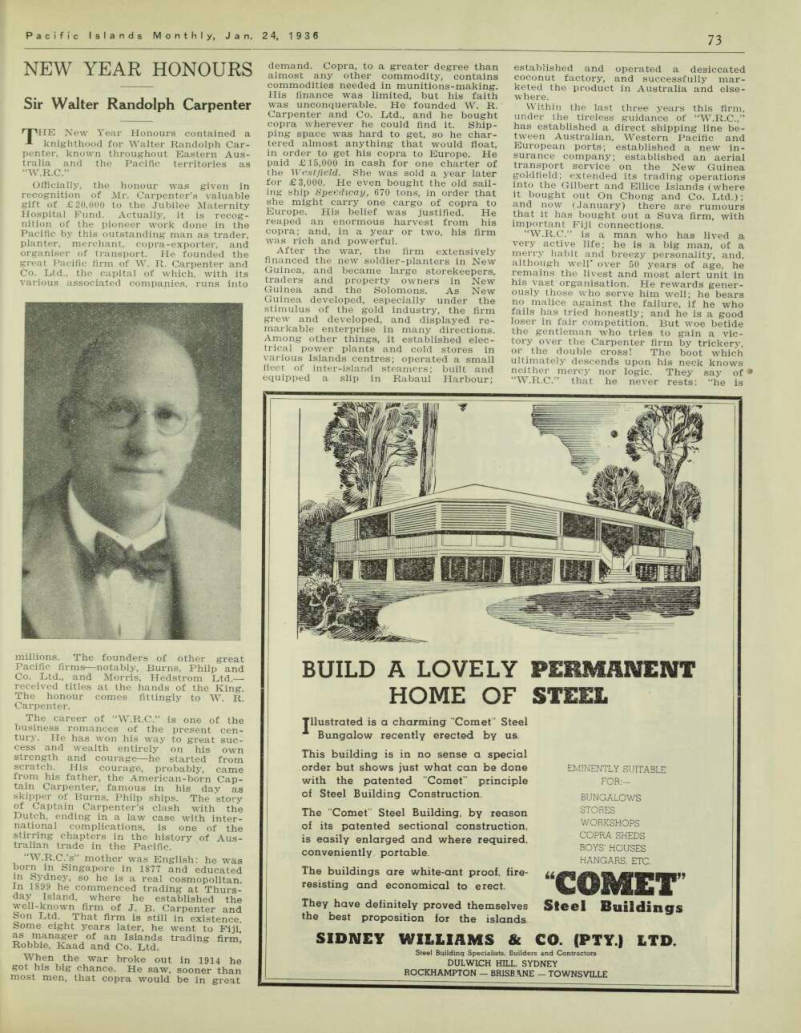
Sir Walter Randolph Carpenter
THE New Year Honours contained a A knighthood for Walter Randolph Car penter, known throughout Eastern Aus tralia and the Pacific territories as
“W.R.C.”
Officially, the honour was given in recognition of Mr. Carpenter’s valuable gift of £20,000 to the Jubilee Maternity Hospital Fund. Actually, it is recog nition of the pioneer work done in the Pacific by this outstanding man as trader, planter, merchant, copra-exporter, and organiser of transport. He founded the great Pacific firm of W. R. Carpenter and Co. Ltd., the capital of which, with its various associated companies, runs into
millions. The founders of other great Pacific firms —notably, Burns, Philp and Co. Ltd., and Morris, Hedstrom Ltd.— received titles at the hands of the King.
The honour comes fittingly to W. R.
Carpenter.
The career of “W.R.C.” is one of the business romances of the present cen tury. He has won his way to great suc cess and wealth entirely on his own strength and courage—he started from scratch. His courage, probably, came from his father, the American-born Cap tain Carpenter, famous in his day as skipper of Burns, Philp ships. The stow of Captain Carpenter’s clash with the Dutch, ending in a law case with inter national complications, is one of the stirring chapters in the history of Aus tralian trade in the Pacific.
“W.R.C.’s” mother was English: he was born in Singapore in 1877 and educated in Sydney, so he is a real cosmopolitan.
In 1899 he commenced trading at Thurs day Island, where he established the well-known firm of J. B. Carpenter and Son Ltd. That firm is still in existence.
Some eight years later, he went to Fiji, as manager of an Islands trading firm' Robbie, Kaad and Co. Ltd.
When the war broke out in 1914 he got his big chance. He saw, sooner than most men, that copra would be in great
demand. Copra, to a greater degree than almost any other commodity, contains commodities needed in munitions-making.
His finance was limited, but his faith was unconquerable. He founded W. R.
Carpenter and Co. Ltd., and he bought copra wherever he could find it. Shippmg space was hard to get, so he chartered almost anything that would float, m order to get his copra to Europe. He Pf ld T £ 1 5 - 00 ,? m cash for pne charter of i he l\ e^ eld ' T She was so i? year later for £3.000. He even bought the old sailmg ship Speedway, 670 tons, in order that she might carry one cargo of copra to Europe. His belief was justified. He reaped an enormous harvest from his copra; and, in a year or two. his firm was rich and powerful. . i Aftei the war, the firm extensively financed the new soldier-planters in New Guinea, and became large storekeepers, traders and Property owners in New Gumea and the Solomons. As New Guinea developed, especially under the stimulus of the gold industry, the firm grew and developed, and displayed remarkable enterprise in many directions.
Among other things, it established electncal power plants and cold stores in various Islands centres; operated a small fleet of mter-island steamers; built and equipped a slip in Rabaul Harbour;
established and operated a desiccated coconut factory, and successfully mar keted the product in Australia and else where.
Within the last three years this firm, under the tireless guidance of “W.R.C.,” has established a direct shipping line be tween Australian, Western Pacific and European ports; established a new in surance company; established an aerial transport service on the New Guinea goldfield; extended its trading operations into the Gilbert and Ellice Islands (where it bought out On Chong and Co. Ltd.); and now (January) there are rumours that it has bought out a Suva firm, with important Fiji connections.
“W.R.C.” is a man who has lived a very active life; he is a big man, of a merry habit and breezy personality, and, although well’ over 50 years of age, he remains the livest and most alert unit in his vast organisation. He rewards gener ously those who serve him well; he bears no malice against the failure, if he who fails has tried honestly; and he is a good loser in fair competition. But woe betide the gentleman who tries to gain a vic tory over the Carpenter firm by trickery, or the double cross! The boot which ultimately descends upon his neck knows neither mercy nor logic. They say of * “W.R.C.” that he never rests; “he is
always cooking up something new.” He does not seek profits, so much as achieve ment —he has a boy’s delight in success.
His is the joy of the true builder.
The only unhappy feature of this knighthood is that the euphonious “W.R.” disappears, and a new and portentous person, ‘‘Sir Walter” takes his place. To several hundred hard-working people, the “W.R.” has represented for many years a very real personality—the active, restless, jolly chief whom they all loyally follow. Knighthood will not change the man himself; but his friends and asso ciates are going to have a hard time, schooling themselves to say “Sir Walter” when they mean “W.R.” For all that, their congratulations have poured in upon him in overwhelming measure.
Advertisements & other items, p. 75 (1 item)
“Comet”
BUILD A LOVELY PERMANENT
HOME OF STEEI
Illustrated is a charming "Comet” Steel A Bungalow recently erected by us.
This building is in no sense a special order but shows just what can be done with the patented “Comet” principle of Steel Building Construction.
The "Comet” Steel Building, by reason of its patented sectional construction, is easily enlarged and where required, conveniently portable.
The buildings are white-ant proof, fireresisting and economical to erect.
They have definitely proved themselves the best proposition for the islands
EMINENTLY SUITABLE
FOR:-
BUNGALOWS
STORES
WORKSHOPS
COPRA SHEDS
BOYS' HOUSES
HANGARS, ETC.
“COMET”
Steel Buildings
SIDNEY WILLIAMS & CO. (PTY.) LTD.
Steel Building Specialists, Builders and Contractors
DULWICH HILL, SYDNEY
ROCKHAMPTON BRISBANE TOWNSVILLE
Mr. H. Leonard Murray, C.B.E.
j\/|R. LEONARD MURRAY, official sec retary to the Lieutenant Governor of Papua, and member of the Executive and Legislative Councils, has been in the Ter ritory since 1909, and has well earned the honour of C.B.E. He has been Sir Hu bert Murray’s right-hand man for 20 years; and he has added to his own out
standing personal ability, an invaluable knowledge of his distinguished uncle’s policy and methods in tropical adminis tration. His balanced judgment and quiet ‘efficiency must have been of great help to Sir Hubert, during the latter’s 28 years’ successful reign in Papua.
Mr. Murray, among other things, is captain of the Government’s yacht Laura hada; and, in reference thereto, we have a note from a well-known man, who says: “I have seen this Leonard Murray do things with his ship, among puzzling reefs on dark nights, and in handling natives with firmness and justice, which show extraordinary nerve and cool ness. He has achieved really heroic feats in taking the Lieut.-Governor, by day and night, to points along that coast, among those awful reefs—all without any fuss or publicity. I am glad that his long, useful service has received some recognition.”
Captain James B. Nursey, who re cently arrived in Sydney from Canada, sailed for Salamaua, New Guinea, by the Montoro on January 11. He will spend three or four months in the Territory on business and pleasure.
Mr. L. J. Joubert, assistant general manager of Bulolo Gold Dredging Limited, will arrive in Sydney by the Monterey at the end of January, after furlough in America. He will return to New Guinea by the Neptuna in February.
N. Guinea
Planting Industry In
Agriculture Director’s Tour
THE Director of Agriculture in New Guinea, Mr. George Murray, has re turned from a ten-months’ world tour with a mass of valuable information relating to the improvement of existing industries in New Guinea, and the intro duction of new ones. The best of it is being kept, naturally, for official sub mission to the Administrator; but a P.I.M. representative gathered a few in teresting facts from Mr. Murray’s obser vations, in many countries.
Mr. Murray spent many useful days in Malaya and Ceylon, examining copra production methods. He travelled in Malaya to various plantations with Mr.
Cook, copra research officer, whom he re gards as the world’s greatest authority on his subject. Mr. Cook, with a view to improving quality, has been experi menting with copra driers, and he has practically arrived at the conclusion that several medium-sized driers will give a higher and more even quality than one large drier of the Ceylon type.
The New Guinea Copra Inspection Or dinance has been studied and highly approved in Malaya; but Mr. Murray did not think its application would be feasible there, 'owing to the enormous amount of copra produced by natives.
Derris Industry
Mr. Murray spent some time in London and in Malaya examining the derris-root industry, which might be suitable for New Guinea. Derris is now a valuable commodity: but there seem to be certain puzzling features connected with its pro duction. Derris must have a certain toxic content, and it is doubtful whether this is controlled by soil, by cultivation, or by variety. Mr. Murray is inclined to think that the secret lies in the variety; and, when in Singapore, he tried to get some roots of the variety known as Changi, but failed. He thinks that, If derris were to be established successfully in New Guinea, the services of an agri cultural chemist would be needed.
L.M.S. Samoans Deprecate
Sunday Work
From Our Own Correspondent APIA, December 5.
IT seems that the necessity to work the last Hauraki, which arrived at Apia on a Sunday, has wounded the religious suscep tibilities of the orthodox in Samoa. Though Roman Catholics and Mormons accepted the Sunday work as a necessity in a case of emergency, some adherents of the London Missionary Society had consider able scruples and sent a deputation to the Acting Administrator to voice their objec tions.
The banana shipment if left standing on the wharf till Monday would probably have suffered considerably by the ripening of a portion of the fruit. The working of the Hauraki on Sunday, therefore, was abso lutely necessary and public opinion sup ported the Administration in this regard.
Mrs. Gunther, wife of Dr. C. E. M.
Gunther, Medical Officer of Bulolo Gold Dredging Ltd. in New Guinea, will return to Australia with her son by the Mon terey on January 27 after a holiday in the United States.
Advertisements & other items, p. 76 (1 item)
2t" Loads in Shells
WATERPROOF CARTRIDGES
The most popular cartridge of all with keen Duck sportsmen because the/ combine every essential necessary to good shooting. r>o Vr
High Velocity —Long
Range—Hard Hitting
No Excessive Pressure or Recoil Both these “1.C.1.” Brands are Loaded with “Neoflak”-the world's most successful shot gun propellant. 2r** o *2 u Ort K tr i & a n
iUM
non a/ 404 Obtainable Everywhere
“Loch Ness Monster”
In The Solomons
Letter to the Editor.
WITH pleasure and satisfaction I read in the October “P.1.M.” a letter from Mr.
M. E. Livingstone, of Salamaua, New Guinea, in support of my encounter with the “Loch Ness Monster.”
It seems difficult for many to believe that my story is authentic, in spite of the fact that my brother saw the “monster,” as well as I. Perhaps now the “Doubting Thomases” will believe I really did see the creature of which I wrote, and that it was not the result of a heavy supper, or of too much “home-brew.”
I sent a description of the serpent to the Australian Museum, but they could not classify it. They said several similar creatures had been seen and reported at different times, but none had ever been caught. Until one is captured, they-stated, it is impossible to say what it is.
I am, etc.,
Geoff Gaskell.
Tulagi, 5.1., December 1, 1935.
Former Samoan Planter’S
Death In Switzerland
From Our Own Correspondent APIA, December 14.
INFORMATION has reached Apia that Mr. J. Helg, who was well remembered by many residents in Samoa, died on November 8 at Zurich, Switzerland. He had been ailing for a long time.
Mr. Helg, who was a native of Switzer land, went to Samoa in 1896 as an over seer for the plantations of the old D.H. and P.G. He was a very efficient planter and during his long term of service with the firm rose to the position of manager of the large coconut plantation at Muli fanua, at one time considered to be the largest in the world. He acted as Swiss Consul in Samoa during 1914-1918 and re turned home after the termination of the war.
Mr. Helg left a wife and several children in Switzerland. Two of his sons, Messrs.
F. and J. Helg, are still living in Samoa.
Strike On T.I. Luggers
A N official investigation is to be made into complaints by aborigines which are reported to have resulted in a strike by Torres Strait Islanders employed on State luggers.
Some misunderstanding apparently arose, as the aborigines employed on boats owned by the State are paid more than the islanders on private vessels.
Mr. A. W. Jacobs has been appointed to the board of directors of Upper Sepik Gold Syndicate N.L., in place of Mr. A.
Barclay, who has resigned.
Rabaul News
From Our Own Correspondent RABAUL, January 10.
WEDDINGS have been popular of late. Mr.
Basil Challis, of the Department of Agri culture, was married on December 24 to Miss Gwen Bowen. On the same day Mr. Frank Venning, of the Government Stores Department, Rabaul, was married to Miss Norma Cassel, the ceremony being performed in the Church of Eng land by Archdeacon de Voil. Then on January 4 Mr. Keith Chambers, youngest son of Rev. W.
J. Chambers, of Rewa, Fiji, was married to Miss Jean Herford-Smith, of Croydon, N.S.W., and Mr. J. P. L. Burke took as his bride Miss Annie Hughes, of Cremorne. The latter ceremony was performed in the Roman Catholic Church by Rev.
Father Madigan.
The Nellore on December 24 took away from Rabaul one of its oldest Government officials in the person of Mr. E. Featherstone Phibbs, who has occupied the position of Chief Collector of Customs in the Territory since before the incep tion of Civil Administration in 1921. “Teddy”
Phibbs arrived in the Territory in 1915 with the A.N. and M.E. Forces. He was a most popular official and was an active member of many of the sporting and social organisations in the town.
Mr. Phibbs had reached retiring age.
Mrs. Jessie Newport, an ' old resident of the Territory, and widow of the late Major Newport, one-time N.G. Director of Agriculture, departed on December 24 for the East and India, where she will visit relatives. Mrs. Newport was the recipient of many farewell gifts and messages, and left with the good wishes of everyone.
Mr. Leslie Clark has resigned his office as honorary secretary of the Rabaul Amateur Turf Club. The position has been taken over by Mr. J. B. Cruise, a well-known racing enthusiast.
A benefit concert was held on January 10 for
Major Berkely Ayris, who recently retired from the N.G. Public Service. Major Ayris has been a tower of strength in the formation of the Rabaul Dramatic and Musical Society and other social and sporting organisations, and his depar ture from Rabaul will mean a decided loss to the community. The concert was arranged by the Society, with Mrs. Backhouse in charge of the programme. A testimonial fund was also opened as a mark of appreciation of the work which the Major had done during his eight years in the Territory. It is understood that he will proceed to the goldfields to take up an appoint ment. Rabaul’s loss will be Wau’s gain.
“Listening-in” sets obtained by local residents show that reception is very satisfactory. Knob twisters, however, complain that VK3LR has a disconcerting booming sound on its wave-length.
At the annual school break-up, held on Decem ber 13, the head teacher, Mr. R. W. Crouch, stated that the attendance average for 1935 had been much better than the previous year. Mr.
Crouch mentioned the necessity for a more liberal system in connection with the granting of scholar ships for pupils in the Territory. At present for all pupils domiciled in New Guinea there is only one bursary available each year, the value of which is £34, and it is deemed to be inadequate.
As a result of the Administrator’s visit to the Sepik River district it is understood that the “controlled areas” there will be extended.
Advertisements & other items, p. 77 (2 items)
Batteries
AT BLUE MOUNTAINS
SPRINGWOOD, N.S.W.
Springwood Ladies* College
Est. 1897. Kindergarten to Leaving Certificate. Tennis, Riding, Swimming, Team Games. Unequalled climate. Pure Jersey Milk. Senior and Junior Houses. Open-air sleeping. Inclusive fees. Special vacation arrangements for Island pupils.
M. E. DURAND, Principal.
TRINITY SCHOOL
KEW, VICTORIA
President of Council: Headmaster: A. O. HENTV, Esq. FRANK SHANN, M.A., Dip. Ed.
The School is well equipped and splendidly situated. Its present size (about 40 boarders and 230 day boys) makes it possible for every boy to come into personal touch with the Head Master and a staff of 10 experienced and successful masters (including seven University Graduates). The general life of the school is very varied and full of vigour. The Head Master will be pleased to send the Illustrated Year Book for 1936-7 on application, and to give full information about the school, which is approved by the University of Melbourne as a Class “A” School for the Intermediate and School Leaving Examinations. Two Preparatory Schools—Charles Street, Kew, for boarders and day boys; and St. Hilary’s Hall, John Street, East Kew, for boys and little girls.
Term dates for 1936; February 11, June 2, September 15.
Postal Address: Kew, E. 4., Victoria Telephone: Hawthorn 412
FOR LONGER LIFE
USE .. .
ERG
BATTERIES
FOR
CARS, TRUCKS, RADIO,
HOUSELIGHTING,
MARINE WORK,
MOTORCYCLES
If not represented in your district write direct to— ERG BATTERIES LTD. 156 GOULBURN ST., SYDNEY. N.S.W.
TO ELECTRICAL ENGINEERS - MANUFACTURERS OF QUALITY BATTERIES
Costumiere
Mrs. N. WALKER-FLYNN
Late SS POWELL STREET, COOGEE
MALAGUNA ROAD, RABAUL
HEMSTITCHING AND PICOT
EDGING
Copies of Mab’s Fashions; Roma’s Pictorial Fashions and Home Fashions available.
P.O. Box 11«. TeL: 141
Islands Produce
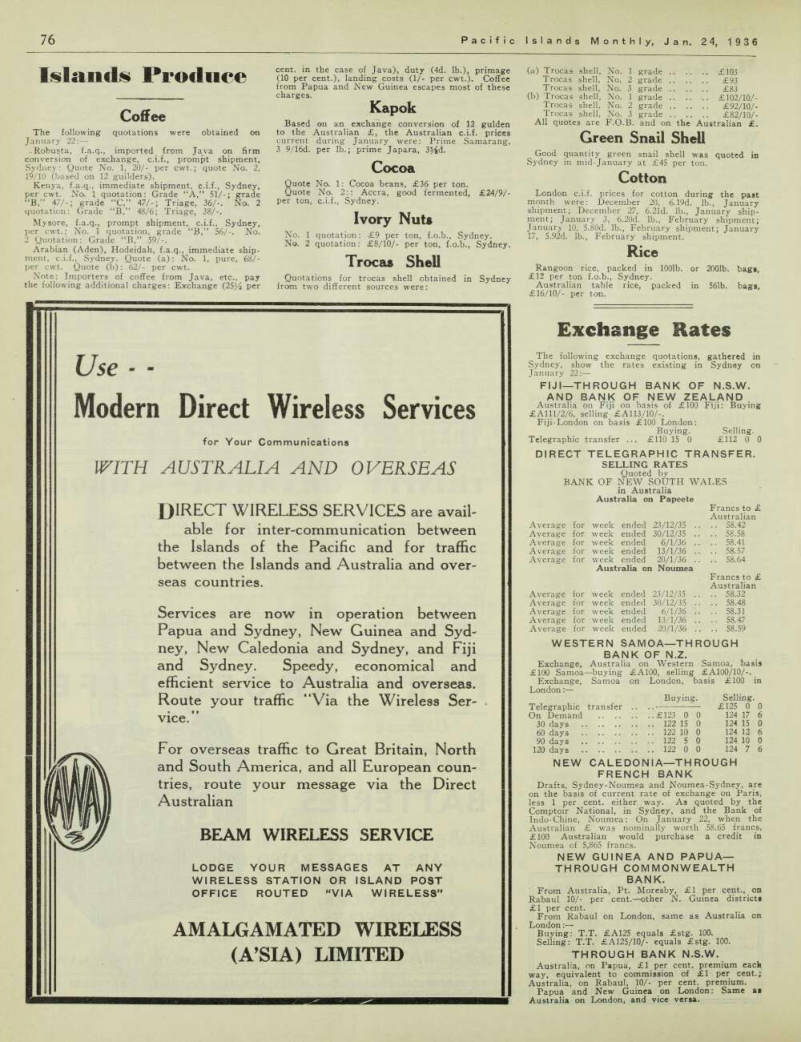
Coffee
The following quotations were obtained on January 22; —- Robusta, f.a.q., imported from Java on firm conversion of exchange, c.i.f., prompt shipment, Sydney: Quote No. 1, 20/- per cwt.; quote No. 2, 19/10 (based on 12 guilders).
Kenya, f.a.q., immediate shipment, c.i.f., Sydney, per cwt. No. 1 quotation: Grade “A,” 51/-; grade “B,” 47/-; grade “C,” 47/-; Triage, 36/-. No. 2 quotation: Grade “B,” 48/6; Triage, 38/-.
Mysore, f.a.q., prompt shipment, c.i.f., Sydney, per cwt.; No. 1 quotation, grade “B,” 56/-. No. 2 Quotation: Grade “B,” 59/-, Arabian (Aden), Hodeidah, f.a.q., immediate ship ment, c.i.f., Sydney. Quote (a): No. 1, pure, 68/per cwt. Quote (b): 62/- per cwt.
Note: Importers of coffee from Java, etc., pay the following additional charges: Exchange (25j£ per
cent, in the case of Java), duty (4d. lb.), primage (10 per cent.), landing costs (1/- per cwt.). Coffee from Papua and New Guinea escapes most of these charges.
Kapok
Based on an exchange conversion of 12 gulden to the Australian £, the Australian c.i.f. prices current during January were: Prime Samarang, 3 9/16d. per lb.; prime Japara, 3^d.
Cocoa
Quote No. 1; Cocoa beans, £36 per ton.
Quote No. 2:: Accra, good fermented, £24/9/per ton, c.i.f., Sydney.
Ivory NuU
No. 1 quotation; £9 per ton, f.0.b., Sydney.
No. 2 quotation: £B/10/- per ton, f.0.b., Sydney.
Trocaa Shell
Quotations for trocas shell obtained in Sydney from two different sources were:
(a) Trocas shell, No. 1 grade £lO3 Trocas shell, No, 2 grade £93 Trocas shell, No. 3 grade £B3 (b) Trocas shell, No. 1 grade £lO2/10/- Trocas shell. No. 2 grade £92/10/- Trocas shell, No. 3 grade £B2/10/- All quotes are F. 0.8. and on the Australian £.
Green Snail Shell
Good quantity green snail shell was quoted in Sydney in mid-January at £45 per ton.
Cotton
London c.i.f. prices for cotton during the past month were: December 20, 6.19 d. lb., January shipment; December 27, 6.21 d. lb., January ship ment; January 3,6.20 d. lb., February shipment; January 10, 5.80 d. lb., February shipment; January 17, 5.92 d. lb., February shipment.
Rice
Rangoon rice, packed in 1001 b. or 2001 b. bags, £l2 per ton f.0.b., Sydney.
Australian table rice, packed in 561 b. bags, £l6/10/- per ton.
Exchange Hates
The following exchange quotations, gathered in Sydney, show the rates existing in Sydney on January 22: —
Fiji—Through Bank Of N.S.W.
And Bank Of New Zealand
Australia on Fiji on basis of £lOO Fiji: Buying £ All 1/2/6, selling £AII3/10/-.
Fiji-London on basis £lOO London: Buying. Selling.
Telegraphic transfer ... £llO 15 0 £ll2 0 0
Direct Telegraphic Transfer.
Selling Rates
Quoted by
Bank Of New South Wales
in Australia Australia on Papeete
Australia on Noumea
Western Samoa—Through
Bank Of N.Z.
New Caledonia—Through
French Bank
Drafts, Sydney-Noumea and Noumea-Sydney, are on the basis of current rate of exchange on Paris, less 1 per cent, either way. As quoted by the Comptoir National, in Sydney, and the Bank of Indo-Chine, Noumea: On January 22, when the Australian £ was nominally worth 58.65 francs, £lOO Australian would purchase a credit in Noumea of 5,865 francs.
New Guinea And Papua
Through Commonwealth
Bank.
From Australia, Pt. Moresby, £1 per cent., on Rabaul 10/- per cent. —other N. Guinea districts £1 per cent.
From Rabaul on London, same as Australia on London:— Buying: T.T. £AI2S equals £stg. 100.
Selling: T.T. £AI2S/10/- equals £stg. 100.
Through Bank N.S.W.
Australia, on Papua, £1 per cent, premium each way, equivalent to commission of £1 per cent.; Australia, on Rabaul, 10/- per cent, premium.
Papua and New Guinea on London: Same as Australia on London, and vice versa.
Francs to £ Australian Average for week ended 23/12/35 .. .. 58.42 Average for week ended 30/12/35 .. .. 58.58 Average for week ended 6/1/36 .. .. 58.41 Average for week ended 13/1/36 .. .. 58.57 Average for week ended 20/1/36 .. .. 58.64
Francs to £ Australian Average for week ended 23/12/35 .. .. 58.32 Average for week ended 30/12/35 .. .. 58.48 Average for week ended 6/1/36 ’.. .. 58.31 Average for week ended 13/1/36 .. .. 58.47 Average for week ended 20/1/36 .. .. 58.59
Exchange, Australia on Western Samoa, basis £100 Samoa —buying £A100, selling £A100/10/-.
Exchange, Samoa on London, basis £100 in London:— Buying.
Selling.
Telegraphic transfer £125 0 0 On Demand !! .! £ 123 0 0 124 17 6 30 days .. .. 122 IS 0 124 15 0 60 days .. .. 122 10 0 124 12 6 90 days .. .. 122 5 0 124 10 0 120 days .. .. 122 0 0 124 7 6
Advertisements & other items, p. 78 (1 item)
Modern Direct Wireless Services
Use - -
for Your Communications
WITH AUSTRALIA AND OVERSEAS
DIRECT WIRELESS SERVICES are avail-
able for inter-communication between the Islands of the Pacific and for traffic between the Islands and Australia and overseas countries.
Services are now in operation between Papua and Sydney, New Guinea and Sydney, New Caledonia and Sydney, and Fiji and Sydney. Speedy, economical and efficient service to Australia and overseas.
Route your traffic “Via the Wireless Service.”
For overseas traffic to Great Britain, North and South America, and all European countries, route your message via the Direct Australian
BEAM WIRELESS SERVICE
LODGE YOUR MESSAGES AT ANY
WIRELESS STATION OR ISLAND POST
OFFICE ROUTED “VIA WIRELESS"
AMALGAMATED WIRELESS
(A’SIA) LIMITED
Market Quotations
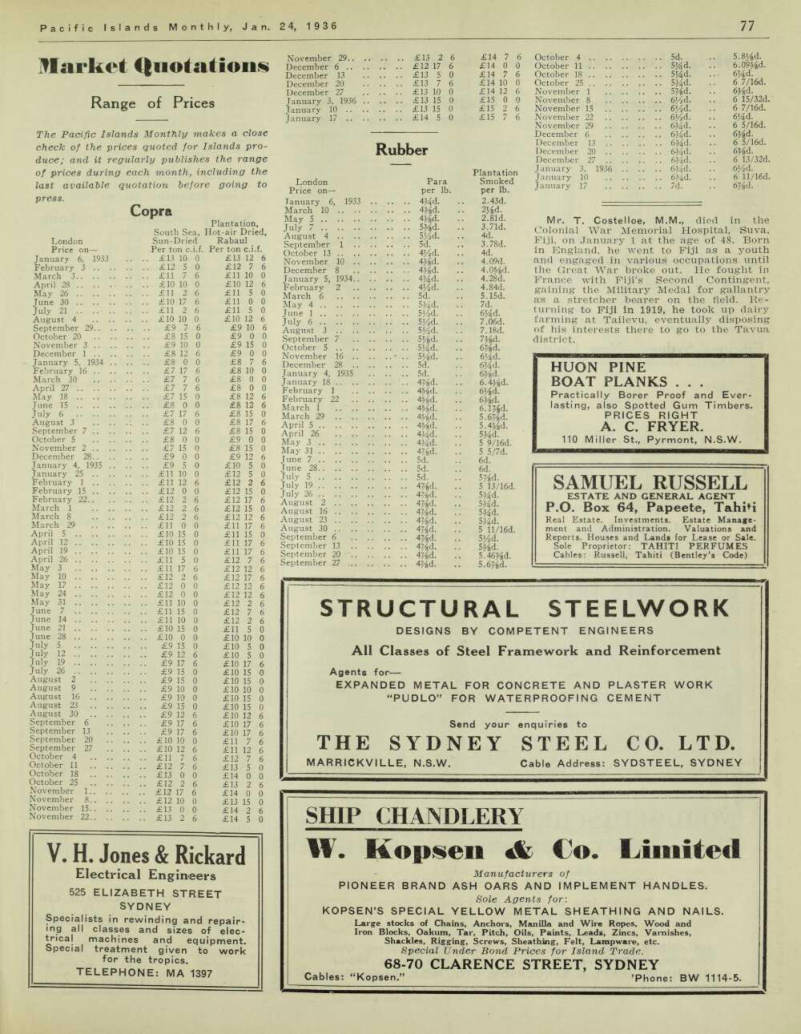
Range of Prices
The Pacific Islands Monthly makes a close check of the prices quoted for Islands pro duce; and it regularly publishes the range of prices during each month, including the last available quotation before going to press.
Copra
Rubber
Mr. T. Costelloe, M.M., died in the Colonial War Memorial Hospital, Suva, Fiji, on January 1 at the age of 48. Born in England, he went to Fiji as a youth and engaged in various occupations until the Great War broke out. He fought in France with Fiji’s Second Contingent, gaining the Military Medal for gallantry as a stretcher bearer on the field. Re turning to Fiji In 1919, he took up dairy farming at Tailevu, eventually disposing of his interests there to go to the Tavua district.
October 4 . .. Sd. 5.8^d.
October 11 . .. 5%d. 6.09^d.
October 18 . .. 5^d. .. 6^d.
October 25 . .. sy 4 d. 6 7/16d.
November 1 . .. sy/sd.
6jid.
November 8 . .. ey 2 d. 6 15/32d.
November 15 . .. ey 2 d. 6 7/16d.
November 22 . .. 6y 2 d. .. 6*4d.
November 29 6 5/16d.
December 6 . .. ey 4 d. .. 6j£d.
December 13 . .. 6^d. 6 5/16d.
December 20 . .. 6Hd. 6j£d.
December 27 . .. 6Hd. 6 13/32d.
January 3. 1936 .. . . .. 6jid. .. 6y 2 d.
January 10 . .. 6Hd. 6 ll/16d.
January 17 .. .. . . .. 7d. .. 6^d.
November 29.. .. .. £13 2 6 £14 7 6 December 6 .. .. .. .. £12 17 6 £14 0 0 December 13 .. .. £13 5 0 £14 7 6 December 20 .. .. £13 7 6 £14 10 0 December 27 .. .. £13 10 0 £14 12 6 January 3, 1936 .. .. .. £13 15 0 £15 0 0 January 10 .. .. .. .. £13 15 0 £15 2 6 January 17 .. .. .. .. £14 5 0 £15 7 6
London Para Plantation Smoked Price on — per lb. per lb.
January 6, 1933 .. . .. 2.43d.
March 10 . .. 2'Ad.
May 5 . 4tfd. .. 2.81d.
July 7 . .. 3.71d.
August 4 . .. 4d.
September 1 .. .. . 5d. 3.78d.
October 13 . 4^d. 4d.
November 10 .. .. . 4^d. 4.09d.
December 8 .. .. . 4Ad. 4.0^d.
January 5, 1934.. .. . 4J4d. .. 4.28d.
February 2 .. .. . 4J/ 2 d. 4.84d.
March 6 . Sd. 5.15d.
May 4 . 554d. .. . 5^d. 7d.
June 1 6 l Ad.
July 6 . 5^d. 7.06d.
August 3 . 5^d. 7.18d.
September 7 . .. 7Hd.
October 5 . .. 67Ad.
November 16 .. .. . 5y$d. .. ey A d.
December 28 .. .. . 5d. 6'Ad.
January 4, 1935 . 5d. 63/ 8 d.
January 18 . 4^d. 6.4^d.
February 1 .. .. . 4Hd. .. 6^d.
February 22 .. .. . 4Vsd. .. 6^d.
March 1 . .. 6.1^d.
March 29 • 45^d. 5.6%d.
April 5 . 4^d. 5.4^d.
April 26 . 444d. 5J4d.
May 3 . 4Hd. 5 9/16d.
May 31 . 4?/ 8 d. .. 5 5/7d.
June 7 . 5d. 6d.
June 28 . Sd. 6d.
July 5 . Sd.
S^d.
July 19 . 47Ad. .. 5 13/16d.
July 26 . 4^d. $Ad.
August 2 . .. 5J4d.
August 16 ■ 4^d. 5Hd.
August 23 • 47/ s d.
SAd.
August 30 . 47^d. 5 ll/16d.
September 6 .. .. . 47/ 8 d. .. 5'Ad.
September 13 .. .. . 4^d. 5Ad.
September 20 .. .. . 47^d. 5.46^d.
September 27 ... .. .. 4]4d. ..
S.6^d.
Plantation, South Sea, Hot-air Dried, London Sun-Dried Rabaul Price on — Per ton c.i.f.
Per ton c.i.f.
January 6, 1933 . .. £13 10 0 £13 12 6 February 3 . .. £12 5 0 £12 7 6 March 3 . .. £11 7 6 £11 10 0 April 28 . .. £10 10 0 £10 12 6 May 26 . .. £11 2 6 £11 5 0 June 30 . .. £10 17 6 £11 0 0
July 21
. .. £11 2 6 £11 5 0 August 4 . .. £10 10 0 £10 12 6 September 29 . .. £9 7 6 £9 10 6 October 20 . .. £8 15 0 £9 0 0 November 3 . .. £9 10 0 £9 15 0 December 1 . .. £8 12 6 £9 0 0 January 5, 1934 .. . . .. £8 0 0 £8 7 6 February 16 . .. £7 17 6 £8 10 0 March 30 . .. £7 7 6 £8 0 0 April 27 . .. £7 7 6 £8 0 0 May 18 . .. £7 15 0 £8 12 6 June 15 . .. £8 0 0 £8 12 6 July 6 . .. £7 17 6 £8 15 0 August 3 . .. £8 0 0 £8 17 6 September 7 . .. £7 12 6 £8 15 0 October 5 . .. £8 0 0 £9 0 0 November 2 . .. £7 IS 0 £8 IS 0 December 28 . .. £9 0 0 £9 12 6 January 4, 1935 .. . . .. £9 5 0 £10 5 0
January 25
. .. £11 10 0 £12 5 0 February 1 . .. £11 12 6 £12 2 6 February 15 . .. £12 0 0 £12 15 0 February 22 . .. £12 2 6 £12 17 6 March 1 . .. £12 2 6 £12 IS 0 March 8 . .. £12 2 6 £12 12 6 March 29 . .. £11 0 0 £11 17 6 April 5 . .. £10 15 0 £11 IS 0 April 12 , .. £10 15 0 £11 17 6 April 19 , .. £10 15 0 £11 17 6 April 26 . .. £11 5 0 £12 7 6 May 3 . .. £11 17 6 £12 12 6 May 10 .. £12 2 6 £12 17 6 May 17 . .. £12 0 0 £12 12 6 May 24 . .. £12 0 0 £12 12 6 May 31 . .. £11 10 0 £12 2 6 June 7 .. £11 15 0 £12 7 6 June 14 , .. £11 10 0 £12 2 6 June 21 .. £10 15 0 £11 5 0 J une 28 .. £10 0 0 £10 10 0 July 5 0 £10 5 0 July 12
July 19
.. £9 12 6 6 £10 5 £10 17 0 6 July 26 .. £9 15 0 £10 IS 0 August 2 .. £9 15 .. £9 10 o £10 15 £10 10 o August 9 0 0 August 16 .. £9 10 .. £9 15 o £10 15 £10 IS ft August 23 0 0 August 30 .. £9 12 6 £10 12 6 September 6 .. .. £9 17 6 £10 17 £10 17 £11 7 g September 13 .. .. £9 17 6 g
September 20 ..
.. £10 10 0 6 September 27 .. .. .. £10 12 6 £11 12 £12 7 f.
October 4 .. £11 7 6 o 6 October 11 6 £13 5 0 October 18 0 £14 0 0 October 25 .. £12 2 6 £13 2 6 November 1 6 £14 0 0 November 8 . £12 10 o £13 15 £14 2 ft November 15 0 6 November 22 .. £13 2 6 £14 5 0
Advertisements & other items, p. 79 (1 item)
W. Kopsen A Co. Limitetl
HUON PINE
BOAT PLANKS . . .
Practically Borer Proof and Everlasting, also Spotted Gum Timbers.
PRICES RIGHT
A. C. FRYER.
110 Miller St., Pyrmont, N.S.W.
SAMUEL RUSSELL
ESTATE AND GENERAL AGENT
P.O. Box 64, Papeete, Tahiti
Real Estate. Investments. Estate Management and Administration. Valuations and Reports. Houses and Lands for Lease or Sale.
Sole Proprietor: TAHITI PERFUMES Cables: Russell, Tahiti (Bentley’s Code)
STRUCTURAL STEELWORK
DESIGNS BY COMPETENT ENGINEERS
All Classes of Steel Framework and Reinforcement Agents for— EXPANDED METAL FOR CONCRETE AND PLASTER WORK
"PUDLO” FOR WATERPROOFING CEMENT
Send your enquiries to
THE SYDNEY STEEL CO. LTD.
MARRICKVILLE, N.S.W. Cable Address: SYDSTEEL, SYDNEY
SHIP CHANDLERY
W. Kopsen A Co. Limitetl
Manufacturers of PIONEER BRAND ASH OARS AND IMPLEMENT HANDLES.
Sole Agents for : KOPSEN’S SPECIAL YELLOW METAL SHEATHING AND NAILS.
Large stocks of Chains, Anchors, Manilla and Wire Ropes, Wood and Iron Blocks, Oakum, Tar, Pitch, Oils, Paints, Leads, Zincs, Varnishes, Shackles, Rigging, Screws, Sheathing, Felt, Lampware, etc.
Special Under Bond Prices for Island Trade.
68-70 CLARENCE STREET, SYDNEY
Cables: “Kopsen.” 'Phone: BW 1114-5.
V. H. Jones & Rickard
Electrical Engineers
525 ELIZABETH STREET
SYDNEY
Specialists in rewinding and repair* ing all classes and sizes of electrical machines and equipment.
Special treatment given to work for the tropics.
TELEPHONE: MA 1397
Europe—Sydney—New Guinea
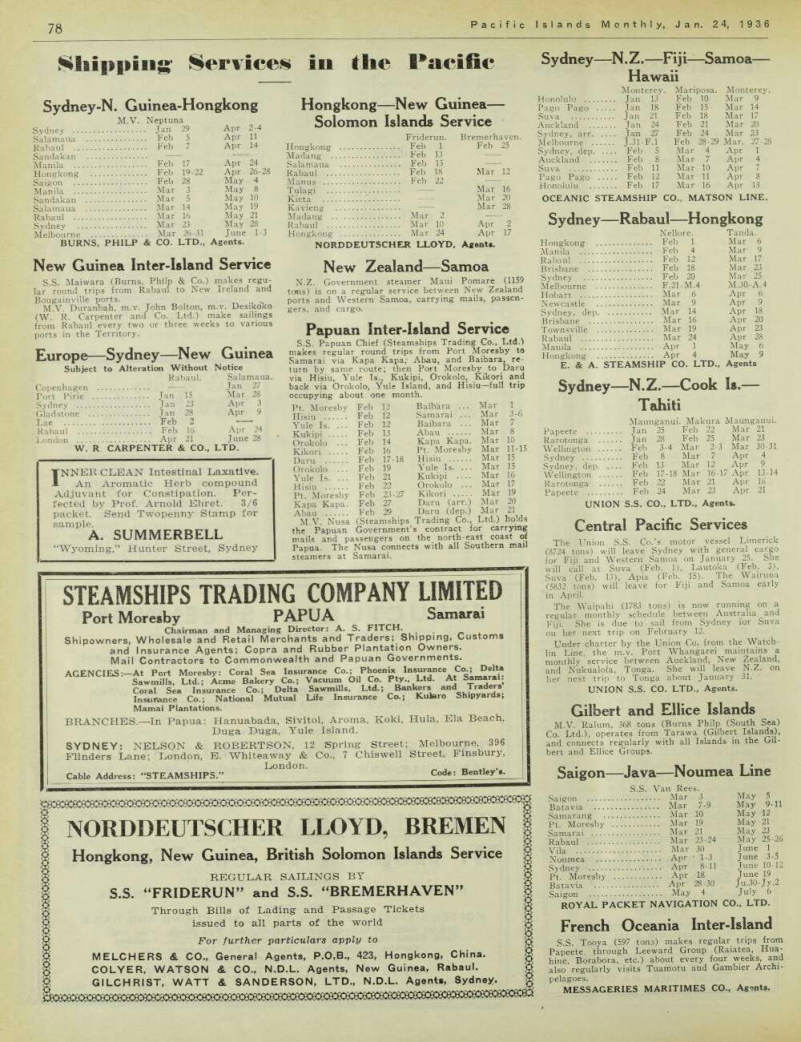
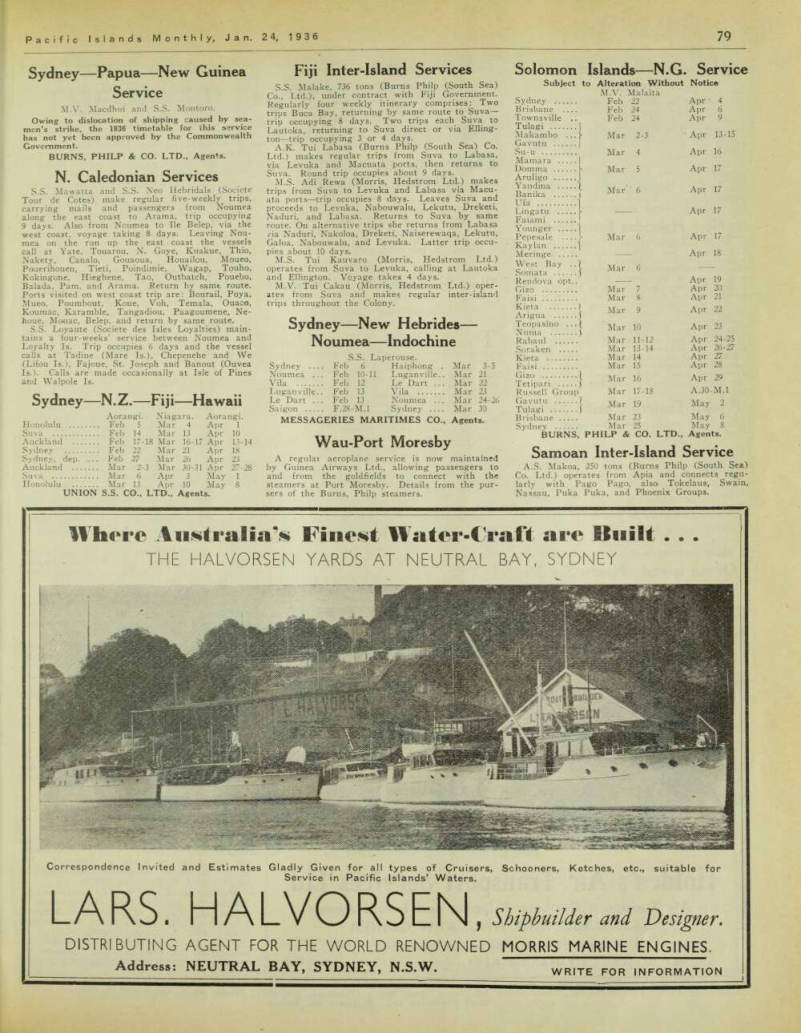
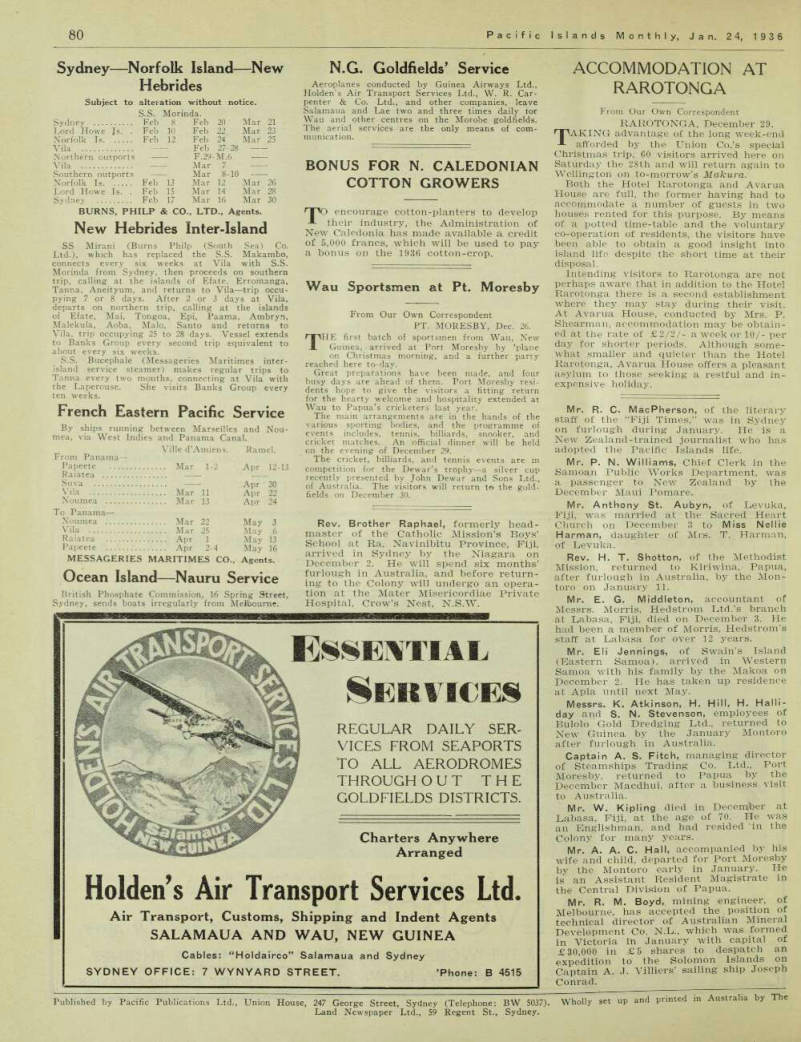
Shipping Services in the Pacific
Sydney-N. Guinea-Hongkong
New Guinea Inter-Island Service
S.S. Maiwara (Bums. Philp & Co.) makes regu lar round trips from Rabaul to New Ireland and Bougainville ports. , „ . „ •, *.
M.V. Duranbah, m.v. John Bolton, m.v. Desikoko (W. R. Carpenter and Co. Ltd.) make sailings from Rabaul every two or three weeks to various ports in the Territory.
Europe—Sydney—New Guinea
Hongkong—New Guinea— Solomon Islands Service
New Zealand —Samoa
N.Z. Government steamer Maui Pomare (1159 tons) is on a regular service between New Zealand ports and Western Samoa, carrying mails, passen gers, and cargo.
Papuan Inter-Island Service
S.S. Papuan Chief (Steamships Trading Co., Ltd.) makes regular round trips from Port Moresby to Samarai via Kapa Kapa, Abau, and Baibara, re turn by same route; then Port Moresby to Daru via Hisiu, Yule Is., Kukipi, Orokolo, Kikori and back via Orokolo, Yule Island, and Hisiu —full trip occupying about one month.
Pt. Moresby Feb 12 Baibara ... Mar 1 Hisiu Feb i 2 Samarai ... Mar 3-6 Yule Is. ... Feb 12 Baibara ... Mar 7 Kukipi Feb 13 Abau Mar 8 Orokolo ... Feb 14 Kapa Kapa. Mar 10 Kikori Feb 16 Pt. Moresby Mar 11-15 Daru Feb 17-18 Hisiu Mar 15 Orokolo ... Feb 19 Yule Is. ... Mar 15 Yule Is. ... Feb 21 Kukipi ... Mar 16 Hisiu Feb 22 Orokolo ... Mar 17 Pt. Moresby Feb 23-27 Kikori Mar 19 Kapa Kapa. Feb 27 Daru (arr.) Mar 20 Abau Feb 29 Daru (dep.) Mar 21 M.V. Nusa (Steamships Trading Co., Ltd.) ho.ds the Papuan Government’s contract for carrying mails and passengers on the north-east coast of Papua. The Nusa connects with all Southern mail steamers at Samarai.
Sydney—N.Z.—Fiji—Samoa— Hawaii
Sydney—Rabaul—Hongkong
Sydney—N.Z.—Cook Is. — Tahiti
Central Pacific Services
The Union S.S. Co.’s motor vessel Limerick (8724 tons) will leave Sydney with general cargo for Fiji and Western Samoa on January 25. She will call at Suva (Feb. 1), Lautoka (Feb. 3), Suva (Feb. 13), Apia (Feb. 15). The Wairuna (5832 tons) will leave for Fiji and Samoa early in April.
The Waipahi (1783 tons) is now running on a regular monthly schedule between Australia and Fiji. She is due to sail from Sydney for Suva on her next trip on February 12.
Under charter by the Union Co. from the Watch lin Line, the m.v. Port Whangarei maintains a monthly service between Auckland, New Zealand, and Nukualofa, Tonga. She will leave N.Z. on her next trip to Tonga about January 31.
Union S.S. Co. Ltd., Agents.
Gilbert and Ellice Islands
M.V. Ralum, 368 tons (Bums Philp (South Sea) Co. Ltd.), operates from Tarawa (Gilbert Islands), and connects regularly with all Islands in the Gil bert and Ellice Groups.
Saigon—Java—Noumea Line
French Oceania Inter-Island
S.S. Tooya (597 tons) makes regular trips from Papeete, through Leeward Group (Raiatea, Hua hine, Borabora, etc.) about every four weeks, and also regularly visits Tuamotu and Gambier Archi pelagoes.
Messageries Maritimes Co., Agents.
M.V.
Neptuna Svdney 29 Apr 2-4 Salamaua ... .. Feb 5 Apr 11 Rabaul .. Feb 7 Apr 14 Sandakan Manila .. Feb 17 Apr 24 Hongkong ... .. Feb 19-22 Apr 26-28 Saigon .. Feb 28 May 4 Manila .. Mar 3 May 8 Sandakan ... 5 May 10 Salamaua ... .. Mar 14 May 19 Rabaul .. Mar 16 May 21 Sydney 23 May 28 Melbourne ... 26-31 June 1-3
Burns,
Philp
& CO.
Ltd.,
Agents.
Subject to Alteration Without Notice Rabaul. Salamaua.
Copenhagen Jan 27 Port Pirie Jan 15 Mar 28 Sydney Jan 23 Apr 3 Gladstone Jan 28 Apr 9 Lae Feb 2 Rabaul Feb 16 Apr 24 London Apr 21 June 28
W. R Carpenter & Co., Ltd.
Friderun.
Bremerbaven.
Hongkong ... Feb 1 Feb 25 Madang ,... Feb 13 — Salamaua — ■ — Rabaul ... Feb 18 Mar 12 Manus ... Feb 22 — Tulagi Mar 16 Kieta Mar 20 Kavieng Mar 28 Madang ... Mar 2 — Rabaul ... Mar 10 Apr 2 Hongkong ... Mar 24 Apr 17
Norddeutscher Lloyd,
Agent*.
Monterey. Mariposa.
Monterey.
Honolulu ...
Feb 10 Mar 9 Pago Pago Feb 15 Mar 14 Suva Feb 18 Mar 17 Auckland .
Feb 21 Mar 20 Sydney, arr. ... Jan 27 Feb 24 Mar 23 Melbourne .
J.31-F.1 Feb 28-29 Mar. 27-28 Sydney, dep.
Feb 5 Mar 4 Apr 1 Auckland .
Feb 8 Mar 7 Apr 4 Suva Feb 11 Mar 10 Apr 7 Pago Pago Feb 12 Mar 11 Apr 8 Honolulu Feb 17 Mar 16 Apr 13
Oceanic
Steamship
Co., Matson Line.
Nellore.
Tanda.
Hongkong .
Feb 1 Mar 6 Manila Feb 4 Mar 9 Rabaul Feb 12 Mar 17 Brisbane ...
Feb 18 Mar 23 Sydney Feb 20 Mar 25 Melbourne .
F.21-M.4 M.30-A.4 Hobart Mar 6 Apr 6 Newcastle Mar 9 Apr 9 Sydney, dep.
Mar 14 Apr 18 Brisbane ...
Mar 16 Apr 20 Townsville .
Mar 19 Apr 23 Rabaul Mar 24 Apr 28 Manila May 6 Hongkong .
May 9 E. & A.
Steamship Co. Ltd.,
Agents
Maunganui . Makura Mauhganui.
Papeete Jan 25 Feb 22 Mar 21 Rarotonga Jan 28 Feb 25 Mar 23 Wellington Feb 3-4 Mar 2-3 Mar 30-31 Sydney Feb 8 Mar 7 Apr 4 Sydney, dep Feb 13 Mar 12 Apr 9 Wellington Feb 17-18 Mar 16-17 Apr 13-14 Rarotonga Feb 22 Mar 21 Apr 18 Papeete Feb 24 Mar 23 Apr 21
Union
S.S. Co., Ltd.,
Agents.
s.s.
Van Rees.
Saigon Batavia ... Mar ... Mar 3 7-9 May May 5 9-11 Sarnarang ... Mar 10 May 12 Pt. Moresby ... Mar 19 May 21 Samarai ... Mar 21 May 23 Rabaul ... Mar 23-24 May 25-26 Vila ... Mar 30 June 1 Noumea • 1-3 June 3-5 Sydney 8-11 June 10-12 Pt. Moresby 18 June 19 Batavia ... Apr 28-30 Ju.30- Jy.2 Saigon ... May 4 July 6
Royal Packet
Navigation
Co., Ltd.
Sydney—Papua —New Guinea
Service
M.V. Macdhui and S.S. Montoro.
Owing to dislocation of shipping caused by sea men’s strike, the 1836 timetable for ibis service has not yet been approved by the Commonwealth Government.
Burns, Philp & Co. Ltd., Agents.
N. Caledonian Services
5.5. Mawatta and S.S. Neo Hebridals (Societe Tour de Cotes) make regular five-weekly trips, carrying mails and passengers from Noumea along the east coast to Arama, trip occupying 9 days. Also from Noumea to He Belep, via the west coast, voyage taking 8 days. Leaving Nou mea on the run up the east coast the vessels call at Yate, Touarou, N. Goye, Kuakue, Thio, Nakety, Canalo, Gouaoua, Houailou, Moueo, Pouerihouen, Tieti, Poindimie, Wagap, Touho, Kokingone, Hieghene, Tao, Outbatch, Pouebo, Balada, Pam, and Arama. Return by same route.
Ports visited on west coast trip are: Bourail, Poya, Mueo, Poumbout, Kone, Voh, Temala, Ouaco, Koumac, Karamble, Tangadiou, Paagoumene, Ne houe, Mouac, Belep, and return by same route. 5.5. Loyaute (Societe des Isles Loyalties) main tains a four-weeks’ service between Noumea and Loyalty Is. Trip occupies 6 days and the vessel calls at Tadine (Mare Is.), Chepenehe and We (Lifou Is.), Fajoue, St. Joseph and Banout (Ouvea Is.). Calls are made occasionally at Isle of Pines and Walpole Is.
Fiji Inter-Island Services
S.S. Malake, 736 tons (Burns Philp (South Sea) Co., Ltd.), under contract with Fiji Government.
Regularly four weekly itinerary comprises: Two trips Buca Bay, returning by same route to Suva— trip occupying 8 days. Two trips each Suva to Lautoka, returning to Suva direct or via Elling ton —trip occupying 3 or 4 days.
A.K. Tui Labasa (Burns Philp (South Sea) Co.
Ltd.) makes regular trips from Suva to Labasa, via Levuka and Macuata ports, then returns to Suva. Round trip occupies about 9 days.
M.S. Adi Rewa (Morris, Hedstrom Ltd.) makes trips from Suva to Levuka and Labasa via Macu ata ports —trip occupies 8 days. Leaves Suva and proceeds to Levuka, Nabouwalu, Lekutu, Dreketi, Naduri, and Labasa. Returns to Suva by same route. On alternative trips she returns from Labasa Naduri, Nakoloa, Dreketi, Naiserewaqa, Lekutu, Galoa, Nabouwalu, and Levuka. Latter trip occu pies about 10 days.
M.S. Tui Kauvaro (Morris, Hedstrom Ltd.) operates from Suva to Levuka, calling at Lautoka and Ellington. Voyage takes 4 days.
M.V. Tui Cakau (Morris, Hedstrom Ltd.) oper ates from Suva and makes regular inter-island trips throughout the Colony.
Sydney—New Hebrides —
Noumea—lndochine
Wau-Port Moresby
A regular aeroplane service is now maintained by Guinea Airways Ltd., allowing passengers to and from the goldfields to connect with the steamers at Port Moresby. Details from the pur sers of the Burns, Philp steamers.
Solomon Islands—N.G. Service Subject to Alteration Without Notice
Samoan Inter-Island Service
A.S. Makoa, 250 tons (Burns Philp (South Sea) Co. Ltd.) operates from Apia and connects regu larly with Pago Pago, also Tokelaus, Swain, Nassau, Puka Puka, and Phoenix Groups.
Sydney—N.Z.—Fiji—Hawaii
Aorangi. Niagara. Aorangi.
Honolulu Feb 5 Mar 4 Apr 1 Suva Feb 14 Mar 13 Apr 10 Auckland Feb 17-18 Mar 16-17 Apr 13-14 Sydney Feb 22 Mar 21 Apr 18 Sydney, dep. ... Feb 27 Mar 26 Apr 23 Auckland Mar 2-3 Mar 30-31 Apr 27-28 Suva Mar 6 Apr 3 May 1 Honolulu Mar 13 Apr 10 May 8
Union S.S. Co., Ltd., Agents.
S.S. Laperouse.
Sydney Feb 6 Haiphong .
Mar 3-5 Noumea ...
Feb 10-11 Luganville..
Mar 21 Vila Feb 12 Le Dart ...
Mar 22 Luganville..
Feb 13 Vila Mar 23 Le Dart ...
Feb 13 Noumea ...
Mar 24-26 Saigon F.28- M.l Sydney Mar 30
Messageries
Maritimes Co.,
Agents.
M.V. Malaita Sydney Feb 22 Apr 4 Brisbane Feb 24 Apr 6 Townsville ..
Feb 24 Apr 9 Tulagi 1 1 Makambo ... ] [ Mar 2-3 Apr 13-15 Gavutu I Su-u Mar 4 t Apr 16 Mamara 1
Domma j
[ Mar 5 Apr 17
Aruligo I
Yandina 1 Banika 1 [ Mar 6 Apr 17 Ufa 1 Lingatu Apr 17 Faiami 1 Younger 1 1 Pepesale Mar 6 Apr 17 Kaylan ] 1 Meringe Apr 18 West Bay ..] Somata J Mar 6 Rendova opt.. — Apr 19 Gizo Mar 7 Apr 20 Faisi Mar 8 Apr 21 Kieta I Mar 9 Apr Arigua '
Teopasino ..."
Mar 10 Apr 23 Numa 24-25 Rabaul Mar 11-12 Apr Soraken Mar 13-14 Apr 26-27 Kieta Mar 14 Apr 27 Faisi Mar 15 Apr 28 Gizo [ Mar 16 Apr 29 Tetipari ' 1 Russell Group Mar 17-18 A.30-M.1 Gavutu Tulagi Mar 19 May 2 Brisbane Mar 23 May 6 Sydney Mar 25 May 8
Burns,
Philp & Co. Ltd.,
Agents.
Sydney—Norfolk Island—New Hebrides Subject to alteration without notice.
New Hebrides Inter-Island
SS Mirani (Burns Philp (South Sea) Co.
Ltd.), which has replaced the S.S. Makambo, connects every six weeks at Vila with S.S.
Morinda from Sydney, then proceeds on southern trip, calling at the islands of Efate. Erromanga, Tanna, Aneityum, and returns to Vila—trip occu pying 7 or 8 days. After 2 or 3 days at Vila, departs on northern trip, calling at the islands of Efate, Mai, Tongoa, Epi, Paama, Ambryn, Malekula, Aoba, Malo, Santo and returns to Vila, trip occupying 25 to 28 days. Vessel extends to Banks Group every second trip equivalent to about every six weeks.
S.S. Bucephale (Messageries Maritimes inter island service steamer) makes regular trips to Tanna every two months, connecting at Vila with the Laperouse. She visits Banks Group every ten weeks.
French Eastern Pacific Service
By ships running between Marseilles and Nou mea, via West Indies and Panama Canal.
Ocean Island—Nauru Service
British Phosphate Commission, 16 Spring Street, Sydney, sends boats irregularly from Melbourne.
N.G. Goldfields’ Service
Aeroplanes conducted by Guinea Airways Ltd., Holden’s Air Transport Services Ltd., W. R. Car penter & Co. Ltd., and other companies, leave Salamaua and Lae two and three times daily tor Wau and other centres on the Morobe goldfields.
The aerial services are the only means of com munication.
S.S. Morinda.
Sydney Feb 8 Feb 20 Mar 21 Lord Howe Is. . Feb 10 Feb 22. Mar 23 Norfolk Is Feb 12 Feb 24 Mar 25 Vila Feb 27-28 Northern outports F.29-M.6 Vila Mar 7 Southern outports Mar 8-10 Norfolk Is Feb 13 Mar 12 Mar 26 Lord Howe Is. . Feb 15 Mar 14 Mar 28 Sydney Feb 17 Mar 16 Mar 30
Burns, Philp & Co., Ltd., Agents.
Ville d’Amiens.
Ramel.
From Panama— Papeete Apr 12-13 Raiatea — Suva Apr 20 Vila Apr 22 Noumea Mar 13 Apr 24 To Panama— Noumea Mar 22 May 3 Vila May 6 Raiatea May 13 Papeete May 16
Messageries
Maritimes Co.,
Agents.
Advertisements & other items, pp. 80-81 (1 item)
Steamships Trading Company Limited
INNER CLEAN Intestinal Laxative.
An Aromatic Herb compound Adjuvant for Constipation. Perfected by Prof. Arnold Ehret. 3/6 packet. Send Twopenny Stamp for sample.
A. SUMMERBELL
"Wyoming,” Hunter Street, Sydney
STEAMSHIPS TRADING COMPANY LIMITED
Port Moresby PAPUA Samarai
Chairman and Managing Director: A. S. FITCH.
Shipowners, Wholesale and Retail Merchants and Traders; Shipping, Customs and Insurance Agents; Copra and Rubber Plantation Owners.
Mail Contractors to Commonwealth and Papuan Governments.
AGENCIES:—At Port Moresby: Coral Sea Insurance Co.; Phoenbc Ins l u^ nCe A . C °o; t P®!
Sawmills. Ltd.; Acme Bakery Co.; Vacuum Oil Co. Pty. Ltd. At Samarai.
Coral Sea Insurance Co.; Delta Sawmills, Ltd.; Bankers “ d Insurance Co.; National Mutual Life Insurance Co.; Kuiaro Shipyards, Mamai Plantations.
BRANCHES.—In Papua; Hanuabada, Sivitoi, Aroma, Koki, Hula, Ela Beach, Duga Duga, Yule Island.
SYDNEY: NELSON & ROBERTSON, 12 Spring Street; Melbourne, 396 Flinders Lane; London, E. Whiteaway & Co., 7 Chiswell Street, Finsbury, London.
Cable Address: “STEAMSHIPS.” Code: Bentleys.
NORDDEUTSCHER LLOYD, BREMEN
Hongkong, New Guinea, British Solomon Islands Service
REGULAR SAILINGS BY
S.S. “FRIDERUN” and S.S. “BREMERHAVEN”
Through Bills of Lading and Passage Tickets issued to all parts of the world For further particulars apply to MELCHERS & CO., General Agents, P. 0.8., 423, Hongkong, China.
COLYER, WATSON & CO., N.D.L. Agents, New Guinea, Rabaul.
GILCHRIST, WATT & SANDERSON, LTD., N.D.L. Agents, Sydney.
Whore Australia's Finest Wnler-Crail are SEiiilt
THE HALVORSEN YARDS AT NEUTRAL BAY, SYDNEY ■I lie? - ssgsi Correspondence Invited and Estimates Gladly Given for all types of Cruisers, Schooners, Ketches, etc., suitable for Service in Pacific Islands’ Waters.
LARS. HALVORSEN,
Shipbuilder and Designer.
DISTRIBUTING AGENT FOR THE WORLD RENOWNED MORRIS MARINE ENGINES.
Address: NEUTRAL BAY, SYDNEY, N.S.W.
WRITE FOR INFORMATION
Cotton Growers
Bonus For N. Caledonian
TX) encourage cotton-planters to develop their industry, the Administration of New Caledonia has made available a credit of 5,000 francs, which will be used to pay a bonus on the 1936 cotton-crop.
Wau Sportsmen at Pt. Moresby
From Our Own Correspondent
Pt. Moresby, Dec. 26.
THE first batch of sportsmen from Wau, New Guinea, arrived at Port Moresby by ’plane on Christmas morning, and a further party reached here to-day.
Great preparations have been made, and four busy days are ahead of them. Port Moresby resi dents hope to give the visitors a fitting return for the hearty welcome and hospitality extended at Wau to Papua’s cricketers last year.
The main arrangements are in the hands of the various sporting bodies, and the programme of events includes, tennis, billiards, snooker, and cricket matches. An official dinner will be held on the evening of December 29.
The cricket, billiards, and tennis events are :n competition for the Dewar’s trophy—a silver cup recently presented by John Dewar and Sons Ltd., of Australia. The visitors will return to the gold fields on December 30.
Rev. Brother Raphael, formerly head master of the Catholic Mission’s Boys’
School at Ra, Navinibitu Province, Fiji, arrived in Sydney by the Niagara on December 2. He will spend six months’ furlough in Australia, and before return ing to the Colony will undergo an opera tion at the Mater Misericordiae Private Hospital, Crow’s Nest, N.S.W.
Accommodation At
Rarotonga
From Our Own Correspondent RAROTONGA, December 29. f I MAKING advantage of the long week-end afforded by the Union Co.’s special Christmas trip, 60 visitors arrived here on Saturday the 28th and will return again to Wellington on to-morrow’s Makura.
Both the Hotel Rarotonga and Avarua House are full, the former having had to accommodate a number of guests in two houses rented for this purpose. By means of a potted time-table and the voluntary co-operation of residents, the visitors have been able to obtain a good insight into island life despite the short time at their disposal.
Intending visitors to Rarotonga are not perhaps aware that in addition to the Hotel Rarotonga there is a second establishment where they may stay during their visit.
At Avarua House, conducted by Mrs. P.
Shearman, accommodation may be obtain ed at the rate of £2/2/- a week or 10/-per day for shorter periods. Although some what smaller and quieter than the Hotel Rarotonga, Avarua House offers a pleasant asylum to those seeking a restful and in expensive holiday.
Mr. R. C. M acPherson, of the literary staff of the “Fiji Times,” was in Sydney on furlough during January. He is a New Zealand-trained journalist who has adopted the Pacific Islands life.
Mr. P. N. Williams, Chief Clerk in the Samoan Public Works Department, was a passenger to New Zealand by the December Maui Pomare.
Mr. Anthony St. Aubyn, of Levuka, Fiji, was married at the Sacred Heart Church on December 3 to Miss Nellie Harman, daughter of Mrs. T. Harman, of Levuka.
Rev. H. T. Shotton, of the Methodist Mission, returned to Kiriwina, Papua, after furlough in Australia, by the Mon toro on January 11.
Mr. E. G. Middleton, accountant of Messrs. Morris, Hedstrom Ltd.’s branch at Labasa, Fiji, died on December 3. He had been a member of Morris, Hedstrom’s staff at Labasa for over 12 years.
Mr. Eli Jennings, of Swain’s Island (Eastern Samoa), arrived in Western Samoa with his family by the Makoa on December 2. He has taken up residence at Apia until next May.
Messrs. K. Atkinson, H. Hill, H. Halli day and S. N. Stevenson, employees of Bulolo Gold Dredging Ltd., returned to New Guinea by the January Montoro after furlough in Australia.
Captain A. S. Fitch, managing director of Steamships Trading Co. Ltd., Port Moresby, returned to Papua by the December Macdhui, after a business visit to Australia.
Mr. W. Kipling died in December at Labasa, Fiji, at the age of 70. He was an Englishman, and had resided 'in the Colony for many years.
Mr. A. A. C. Hall, accompanied by his wife and child, departed for Port Moresby by the Montoro early in January. He is an Assistant Resident Magistrate in the Central Division of Papua.
Mr. R. M. Boyd, mining engineer, of Melbourne, has accepted the position of technical director of Australian Mineral Development Co. N.L., which was formed in Victoria in January with capital of £30,000 in £5 shares to despatch an expedition to the Solomon Islands on Captain A. J. Villiers’ sailing ship Joseph Conrad.
Advertisements & other items, pp. 82-84 (2 items)
80
Pacific Islands Monthly, Jan. 24, 1936
Published by Pacific Publications Ltd., Union House, 247 George Street, Sydney (Telephone: BW 5037). Wholly set up and printed in Australia by The Land Newspaper Ltd., 59 Regent St., Sydney.
Services
Ha#7» m
Essential
REGULAR DAILY SER-
VICES FROM SEAPORTS
TO ALL AERODROMES
THROUGH OUT THE
GOLDFIELDS DISTRICTS.
Charters Anywhere Arranged
Holden’s Air Transport Services Ltd.
Air Transport, Customs, Shipping and Indent Agents
SALAMAUA AND WAU, NEW GUINEA
Cables: “Holdairco” Salamaua and Sydney SYDNEY OFFICE: 7 WYNYARD STREET. ’Phone: B 4515
THE WORLD’S LARGEST
AERIAL FREIGHTING SERVICE
GUINEA AIRWAYS LTD. was established in 1927; and it has grown in the following way, until it is to-day the largest freight-carrying air-service in the world: Guinea Airways Ltd. operates regular air services in New Guinea and Papua, and uses over 33 Aerodromes and Landing-grounds in the two Territories.
One of Guinea Airways’ new 14-passenger Ford Aeroplanes, on an aerodrome in New Guinea. * -:# ■rrA "
I ' m ' AERIAL-TRANSPORT Speedy, Safe and Dependable made possible the Rapid Development of the great Morobe Goldfield, and the Consequent Enrichment of the Mandated Territory. Aeroplanes, running on Regular Schedules, without Difficulty or Delay, carried in Dredges, Crushing Mills, Cyaniding Plants, Motor Vehicles, Hydro-Electric Machinery, and Every Kind of Goods Needed by a Large and Growing European Community.
GUINEA AIRWAYS L T S
LAE - SALAMAUA
HEAD OFFICE: NEW GUINEA OFFICE:
BROOKMAN BUILDINGS LAE
GRENFELL STREET MANDATED TERRITORY OF
ADELAIDE, S.A. NEW GUINEA
BRANCH OFFICES AND AGENTS AT WAU, SALAMAUA, PORT MORESBY, AND SYDNEY
S 5 * % ««
SSS
d* P' p/i-> v i V n n 0 i i i i
WELCOME CARGO
"Lower away ” —and what a welcome cargo it is!
Resells Pilsener—in the famous long bottle—the drink which eases the white man’s burden!
Call for a bottle to-night and relish its malt and
hop flavour.
. * m ■ I .w v 'o O . > ' J ' 57T 7T7r - o r os£ o I r\ * ■ ■ Bl o’o*"" >, iv :■
RESCH’S
LONG BOTTLE
PILSENER
o •. I /y c S & CV^ Mi* £ I W-vi J&M &s ‘Sr. 7 —» 27
SISCH
S ,Ls en Eft I* CM *5 p Us