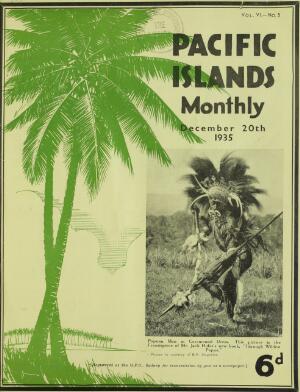
Pacific
Islands
Monthly
Vol. Vl. No. 5
December 20th 1935
6 d
C yteoistered at the G.P.0., Sydney for transmission hy post as a newspaper .]
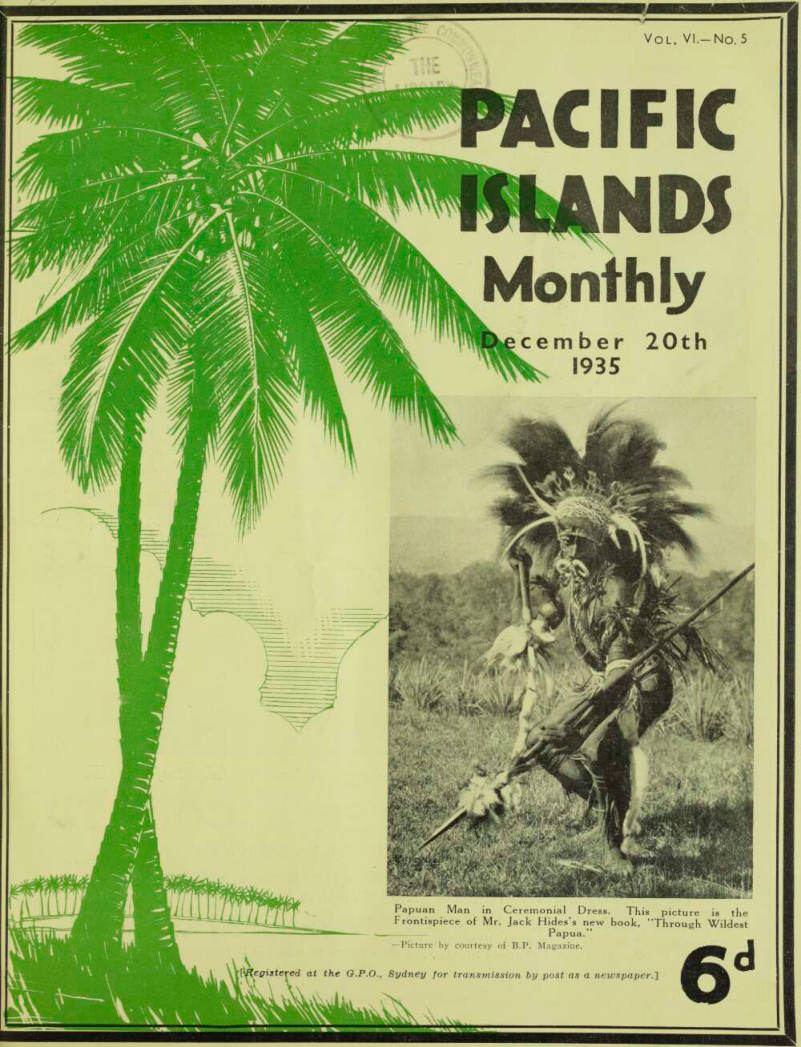
Papuan Man in Ceremonial Dress. This picture is the Frontispiece of Mr. Jack Hides’s new book, “Through Wildest
Papua.” —Picture by courtesy of B.P. Magazine.
Advertisements & other items, p. 2 (1 item)
Assisting Development and
1 Progress in
the Pacific
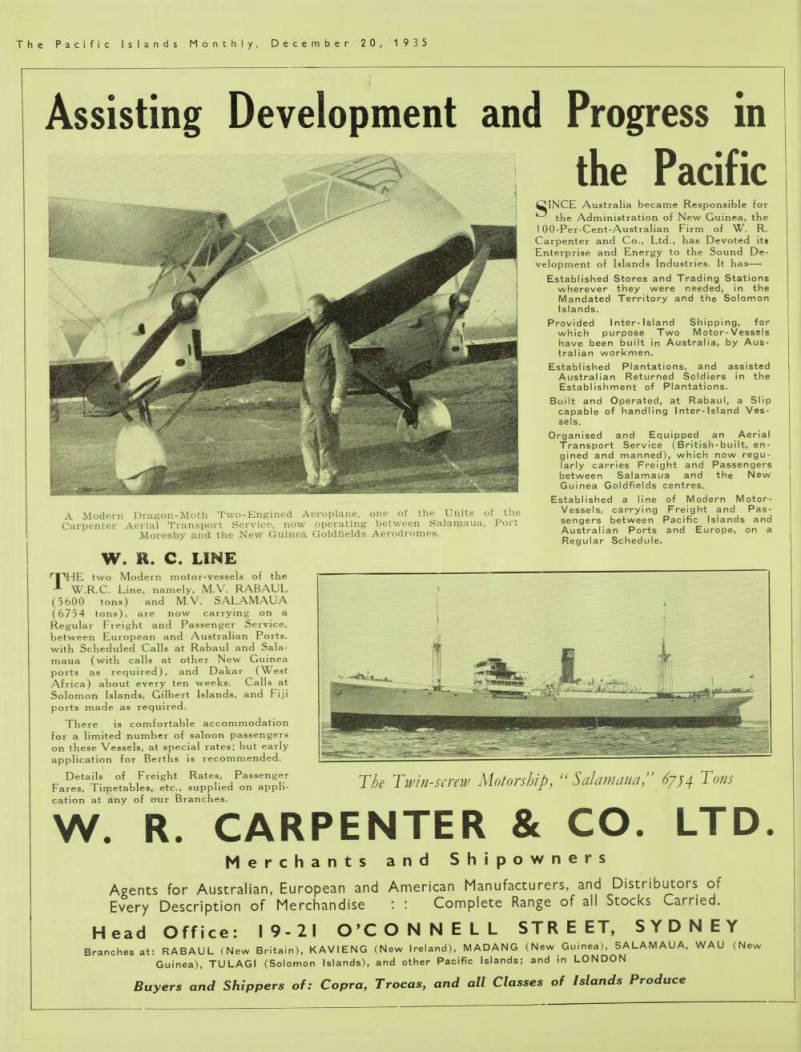
CINCE Australia became Responsible for the Administration of New Guinea, the 1 00-Per-Cent-Australian Firm of W. R.
Carpenter and Co., Ltd., has Devoted its Enterprise and Energy to the Sound Development of Islands Industries. It has— Established Stores and Trading Stations wherever they were needed, in the Mandated Territory and the Solomon Islands.
Provided Inter-Island Shipping, for which purpose Two Motor-Vessels have been built in Australia, by Australian workmen.
Established Plantations, and assisted Australian Returned Soldiers in the Establishment of Plantations.
Built and Operated, at Rabaul, a Slip capable of handling Inter-Island Vessels.
Organised and Equipped an Aerial Transport Service (British-built, engined and manned), which now regularly carries Freight and Passengers between Salamaua and the New Guinea Goldfields centres.
Established a line of Modern Motor- Vessels, carrying Freight and Passengers between Pacific Islands and Australian Ports and Europe, on a Regular Schedule.
W. R. C. LINE
THE two Modern motor-vessels of the W.R.C. Line, namely, M.V. RABAUL (5600 tons) and M.V, SALAMAUA (6754 tons), are now carrying on a Regular Freight and Passenger Service, between European and Australian Ports, with Scheduled Calls at Rabaul and Salamaua (with calls at other New Guinea ports as required), and Dakar (West Africa) about every ten weeks. Calls at Solomon Islands, Gilbert Islands, and Fiji ports made as required.
There is comfortable accommodation for a limited number of saloon passengers on these Vessels, at special rates; but early application for Berths is recommended.
Details of Freight Rates, Passenger Fares, Timetables, etc., supplied on application at any of our Branches.
W. R. CARPENTER & CO. LTD.
Merchants and Shipowners
Agents for Australian, European and American Manufacturers, and Distributors of Every Description of Merchandise : : Complete Range of all Stocks Carried.
Head Office: 19-21 O’CONNELL STREET, SYDNEY
Branches at: RABAUL (New Britain), KAVIENG (New Ireland), MADANG (New Guinea), SALAMAUA, WAU (New Guinea), TULAGI (Solomon Islands), and other Pacific Islands; and in LONDON Buyers and Shippers of: Copra, Trocas, and all Classes of Islands Produce The Twin-screw Motorsbip, “ Salamaua ” 6yj4 Tons
Assisting Development and
i A Modern Dragon-Moth Two-Engined Aeroplane, one of the Units of the Carpenter Aerial Transport Service, now operating between Salamaua, Port Moresby and the New Guinea Goldfields Aerodromes.
Pacific Islands Travellers
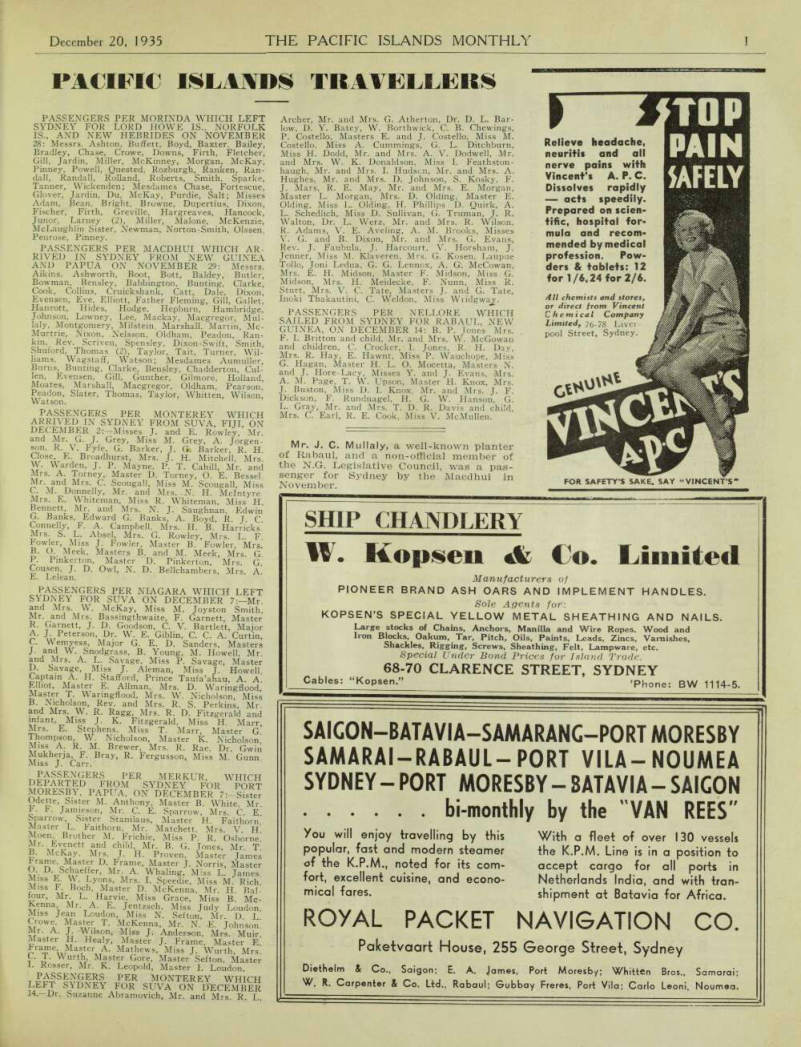
Passengers Per Morinda Which Left
Sydney For Lord Howe Is., Norfolk
Is., And New Hebrides On November
28: Messrs. Ashton, Buffett, Boyd, Baxter, Bailey, Bradley, Chase, Crowe, Downs, Firth, Fletcher, Gill, Jardin, Miller, McKinney, Morgan, McKay, Pinney, Powell, Quested, Rozburgh, Ranken, Ran dall, Randall, Rolland, Roberts, Smith, Sparke, Tanner, Wickenden; Mesdames Chase, Fortescue, Glover, Jardin, Du, McKay, Purdie, Salt; Misses Adam, Bean, Bright, Browne, Dupertius, Dixon, Fischer, Firth, Greville, Hargreaves, Hancock, Junor, Larney (2), Miller, Malone, McKenzie, McLaughlin Sister, Newman, Norton-Smith, Olssen, Penrose, Pinney.
Passengers Per Macdhui Which Ar
Rived In Sydney From New Guinea
And Papua On November 29: Messrs.
Aikins, Ashworth, Boot, Bott, Baldey, Butler, Bowman, Bensley, Babbington, Bunting, Clarke, Cook, Collins, Cruickshank, Catt, Dale, Dixon, Evensen, Eve, Elliott, Father Fleming, Gill, Gallet, Hanrott, Hides, Hodge, Hepburn, Hambridge, Johnson, Lowney, Lee, Mackay, Macgregor, Mul laly, Montgomery, Milstein, Marshall, Martin, Mc- Murtrie, Nixon, Nelsson, Oldham, Peadon, Ran kin, Rev. Scriven, Spensley, Dixon-Swift, Smith, Shuford, Thomas (2), Taylor, Tait, Turner, Wil liams, Wagstaff, Watson; Mesdames Aumuller, Burns, Bunting, Clarke, Bensley, Chadderton, Cul len, Evensen, Gill, Gunther, Gilmore, Holland, Moates, Marshall, Macgregor, Oldham, Pearson, Peadon, Slater, Thomas, Taylor, Whitten, Wilson, Watson.
Passengers Per Monterey Which
ARRIVED IN SYDNEY FROM SUVA, FIJI, ON DECEMBER 2:—Misses J. and E. Rowley, Mr. and Mr. G. J. Grey, Miss M. Grey, A. Jorgen son, R. V. Fyfe, G. Barker, J. G. Barker, R. H. r Broadhurst, Mrs. J. H. Mitchell, Mrs.
W. Warden, J. P. Mayne, P. T. Cahill, Mr. and Mrs. A. Torney, Master D. Torney, O. E. Bessel r \? n( U Mrs - C Scougall, Miss M. Scougall, Miss C. M. Donnelly, Mr. and Mrs. N. H. Mclntyre Mrs. E. Whiteman, Miss R. Whiteman, Miss H.
Bennett, Mr. and Mrs. N. J. Saughnan, Edwin G. Banks, Edward G. Banks, A. Boyd, R J C Connelly, F. A. Campbell. Mrs. H. B. Harricks!
Mrs. S. L. Absel, Mrs. G. Rowley, Mrs. L. F Fowler, Miss J. Fowler, Master B. Fowler, Mrs.
B. O. Meek, Masters B. and M. Meek, Mrs G P. Pinkerton, Master D. Pinkerton, Mrs. G Cousen, J. D. Owl, N. D. Bedchambers, Mrs. A.
E. Lelean.
Passengers Per Niagara Which Left
Sydney For Suva On December 7:-Mr.
and Mrs. W. McKay, Miss M. Joyston Smith, Mr. and Mrs. Bassingthwaite, F. Garnett, Master R. Garnett, J. D. Goodson, C. V. Bartlett, Major A. J. Peterson, Dr. W. E. Giblin, C. C. A. Curtin, C. Wemyess, Major G. E. D. Sanders, Masters J. and W. Snodgrass, B. Young, M. Howell, Mr. and Mrs. A. L. Savage, Miss P. Savage, Master D. Savage, Miss J. Aleman, Miss J. Howell Captain A. H. Stafford, Prince Taufa’ahau, A. A.
Elliot, Master E. Allman, Mrs. D. Waringflood, Master T. Waringflood, Mrs. W. Nicholson, Miss B NichoJson, Rev. and Mrs. R. S. Perkins, Mr. and Mrs. W. R. Ragg, Mrs. R. D. Fitzgerald and infant, Miss J. K. Fitzgerald, Miss H. Marr, Mrs. E. Stephens. Miss T. Marr, Master G Thompson, W. Nicholson, Master K. Nicholson, AHss A. R M. Brewer, Mrs. R. Rae, Dr. Gwin Mukherja, F. Bray, R. Fergusson, Miss M. Gunn.
Miss J. Carr.
Passengers Per Merkur Which
Departed From Sydney For Port
Moresby, Papua, On December 7:—Sister
Odette, Sister M. Anthony, Master B. White, Mr h. h. Jamieson, Mr. C. E. Sparrow, Mrs. C. E Sparrow Sister Stanilaus, Master H. Faithorn Master L. Faithorn, Mr. Matchett, Mrs. V. H Moen Brother M. Frichie, Miss P. R. Osborne. £ lr '™ v T 5 nett and child > Mr - B - G - Jones, Mr. T.
B. McKay. Mrs. J. H. Proven, Master James frame Master D Frame, Master J. Norris, Master B'. D - Sdjaeffer, Mr. A Whaling, Miss L. James.
Miss E. W. Lyons, Mrs. I. Speedie, Miss M. Rich, Miss F. Boch, Master D. McKenna, Mr. H. Bal four, Mr. L. Harvie, Miss Grace, Miss B. Mc- Kenna Mr A. E. Jentzsch, Miss Judy Loudon, Miss Jean Loudon, Miss N. Sefton, Mr D L Crowe, Master T. McKenna, Mr. N. -E. Johnson!
Mr. A. J Wilson, Miss J. Anderson, Mrs. Muir.
Master H. Healy, Master J. Frame, Master E ra 4^ e U 7 Ma ® ter ,, A - Mathews, Miss J. Wurth, Mrs.
C. T. Wurth Master Gore, Master Sefton, Master I. Rosser, Mr. K. Leopold, Master I. Loudon.
Passengers Per Monterey Which
Left Sydney For Suva On December
14- Dr. Suzanne Abramovich, Mr. and Mrs. R. L
Archer, Mr. and Mrs. G. Atherton, Dr. D. L. Bar low, D. Y. Batey, W. Borthwick, C. B. Chewings, P. Costello, Masters E. and J. Costello, Miss M.
Costello, Miss A. Cummings, G. L. Ditchburn, Miss H. Dodd, Mr. and Mrs. A. V. Dodwell, Mr. and Mrs. W. K. Donaldson, Miss I. Feathston haugh, Mr. and Mrs. I. Hudson, Mr. and Mrs. A.
Hughes, Mr. and Mrs. D. Johnson, S. Kosky, F.
J. Mars, R. E. May, Mr. and Mrs. E. Morgan, Master L. Morgan, Mrs. D. Olding, Master E.
Olding, Miss L. Olding, H. Phillips D. Quirk, A.
L. Schedlich, Miss D. Sullivan, G. Truman, J. R.
Walton, Dr. L. Werz, Mr. and Mrs. R. Wilson, R. Adams, V. E. Aveling, A. M. Brooks, Misses V. G. and B. Dixon, Mr. and Mrs. G. Evans, Rev. J. Faubula, J. Harcourt, V. Horsham, J.
Jenner, Miss M. Klaveren, Mrs. G. Kosen, Laupue Tollo, Joni Ledua, G. G. Lennox, A. G. McGowan, Mrs. E. H. Midson, Master F. Midson, Miss G.
Midson, Mrs. H. Meidecke, F. Nunn, Miss R.
Sturt, Mrs. V. C. Tate, Masters J. and G. Tate, Inoki Thakautini, C. Weldon, Miss Wridgwaj.
Passengers Per Nellore Which
Sailed From Sydney For Rabaul, New
GUINEA, ON DECEMBER 14: B. P. Jones Mrs.
F. I. Britton and child, Mr. and Mrs. W. McGowan and children, C. Crocker, I. Jones, R. H. Day, Mrs. R. Hay, E. Hawnt, Miss P. Wauchope, Miss G. Hagan, Master H. L. O. Mocetta, Masters N. and J. Hore-Lacy, Misses Y. and J. Evans, Mrs.
A. M. Page, T. W. Upson, Master H. Knox, Mrs.
J. Buston, Miss D. I. Knox, Mr. and Mrs. J. F.
Dickson, F. Rundnagel, H. G. W. Hanson, G.
L. Gray, Mr. and Mrs. T. D. R. Davis and child, Mrs. C. Earl, R. E. Cook, Miss V. McMullen.
Mr. J. C. Mullaly, a well-known planter of Rabaul, and a non-official member of the N.G. Legislative Council, was a pas senger for Sydney by the Macdhui in November.
Advertisements & other items, p. 3 (1 item)
Saigon-Batavia-Samarang-Port Moresby
Relieve headache, neuritis and all nerve pains with Vincent's A. P. C.
Dissolves rapidly
acts speedily.
Prepared on scientific, hospital formula and recommended by medical
profession. Pow-
ders & tablets: 12
for 1/6,24 for 2/6.
All chemists and stores, direct from Vincent Chemical Company Limited, 76-78 Liver pool Street, Sydney.
V)\H*
FOR SAFETY'S SAKE. SAY “VINCENT’S*
SHIP CHANDLERY
W. Ko[i§eu Co. Limited
Manufacturers of PIONEER BRAND ASH OARS AND IMPLEMENT HANDLES.
Sole Agents for: KOPSEN’S SPECIAL YELLOW METAL SHEATHING AND NAILS. stocks of Chains, Anchors, Manilla and Wire Ropes. Wood and Iron Blocks, Oakum, Tar, Pitch, Oils, Paints, Leads, Zincs, Varnishes, Shackles, Rigging, Screws, Sheathing, Felt, Lampware, etc.
Special Under Bond Prices for Island Trade.
68-70 CLARENCE STREET, SYDNEY
Cables: “Kopsen.” ’Phone; BW 1114-5.
SAIGON-BATAVIA-SAMARANG-PORT MORESBY
SAMARAI-RABAUL-PORT VILA-NOUMEA
SYDNEY - PORT MORESBY - BATAVIA - SAIGON
bi-monthly by the "VAN REES"
You will enjoy travelling by this popular, fast and modern steamer of the K.P.M., noted for its comfort, excellent cuisine, and economical fares.
With a fleet of over 130 vessels the K.P.M. Li ne is in a position to accept cargo for all ports in Netherlands India, and with transhipment at Batavia for Africa.
ROYAL PACKET NAVIGATION CO.
Paketvaart House, 255 George Street, Sydney
Diethelm & Co., Saigon; E. A. James, Port Moresby; Whitten Bros., Samarai; W. R. Carpenter & Co. Ltd., Rabaul; Gubbay Freres, Port Vila; Carlo Leoni, Noumea.
Advertisers
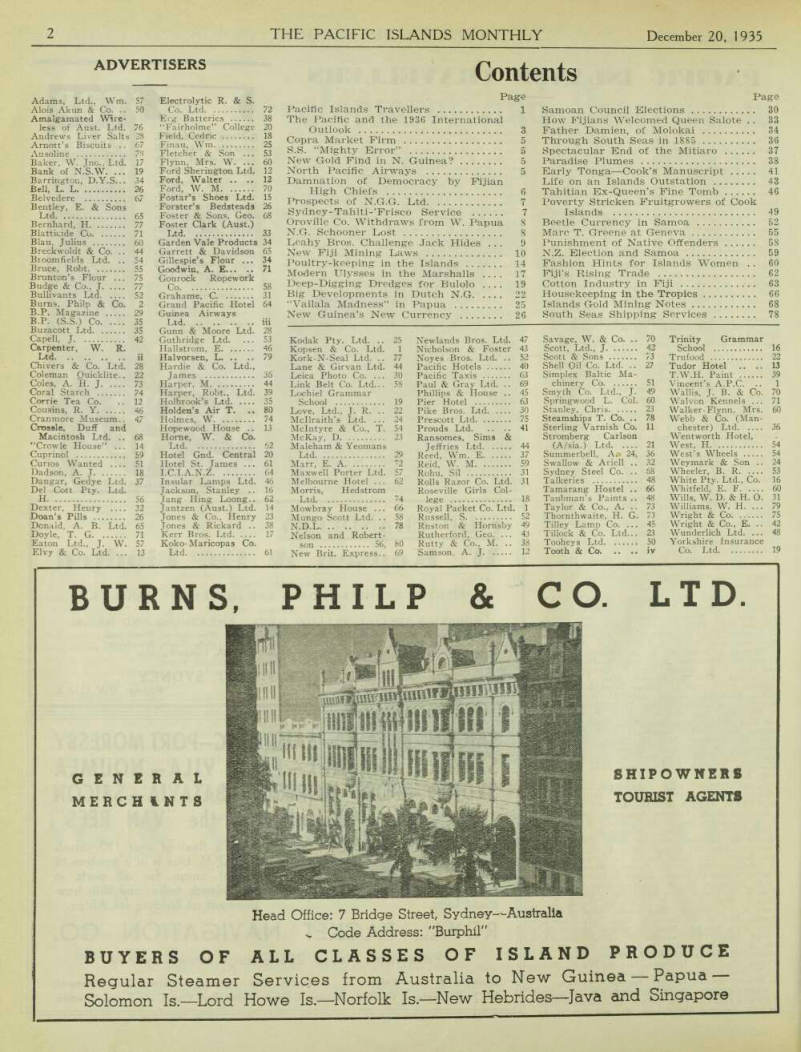
Adams, Ltd., Wm. 57 Alois Akun & Co. .. 50 Amalgamated Wire less of Aust. Ltd. 76 Andrews Liver Salts 28 Arnott’s Biscuits .. 67 Ausoline 78 Baker, W. Jno., Ltd. 17 Bank of N.S.W. ... 19 Barrington, D.Y.5... 34 Bell, L. L 26 Belvedere 67 Bentley, E. & Sons Ltd 65 Bernhard, H 77 Blatticide Co 71 Blau, Julius 60 Breckwoldt & Co. .. 44 Bi cornfields Ltd. .. 54 Bruce, Robt 55 Brunton’s Flour ... 75 Budge & Co., J 77 Bullivants Ltd 52 Burns, Philp & Co. 2 B.P. Magazine 29
B.P. (S.S.) Co 35
Buzacott Ltd 35 Capell, J 42 Carpenter, W. R.
Ltd ii Chivers & Co. Ltd. 28 Coleman Quicklite.. 22 Coles, A. H. J 73 Coral Starch 74 Corrie Tea Co. .. 12 Cousins, R. Y 46 Cranmore Museum.. 47 Crossle, Duff and Macintosh Ltd. .. 68 “Crowle House” ... 14 Cuprinol 59 Curios Wanted ... 51 Dadson, A. J 18 Dangar, Gedye Ltd. 37 Del Cott Pty. Ltd.
H 56 Dexter, Henry 32 Doan’s Pills 26 Donald, A. B. Ltd. 65 Doyle, T. G 71 Eaton Ltd., J. W. 57 Elvy & Co. Ltd. ... 13
Electrolytic R. & S.
Co. Ltd 72 Erg Batteries 38 “Fairholme” College 20 Field, Cedric 18 Finau, Wm. ... 25 Fletcher & Son ... S 3 Flynn, Mrs. W. ... 60 Ford Sherington Ltd. 12 Ford, Walter .. .. 12 Ford, W. M 70 Fostar’s Shoes Ltd. 15 Forster’s Bedsteads 26 Foster & Sons, Geo. 68 Foster Clark (Aust.) Ltd 33 Garden Vale Products 34 Garrett & Davidson 65 Gillespie’s Flour ... 34 Goodwin, A. E 71 Gourock Ropework Co 58 Grahame, C 31 Grand Pacific Hotel 64 Guinea Airways Ltd iii Gunn & Moore Ltd. 28 Guthridge Ltd. ... 53 Hallstrom, E 46 Halvorsen, L 79 Hardie & Co. Ltd., James 36 Harper, M 44 Harper, Robt., Ltd. 39 Holbrook’s Ltd 35 Holden’s Air T. ..80 Holmes, W 74 Hopewood House .. 13 Home, W. & Co.
Ltd 62 Hotel Gnd. Central 20 Hotel St. James ... 61
1.C.1.A.N.Z 64
Insular Lamps Ltd. 46 Jackson, Stanley .. 16 Jang King Loong.. 62 Jantzen (Aust.) Ltd. 14 Jones & Co., Henry 23 Jones & Rickard .. 38 Kerr Bros. Ltd 17 Koko-Maricopas Co.
Ltd 61
Kodak Pty. Ltd. .. 25 Kopsen & Co. Ltd. 1 Kork-N-Seal Ltd. .. 77 Lane & Girvan Ltd. 44 Leica Photo Co. ... 30 Link Belt Co. Ltd... 58 Lochiel Grammar School 19 Love, Ltd., J. R. .. 22 Mcllraith’s Ltd. ... 24 Mclntyre & Co., T. 54 McKay, D 23 Maleham & Yeomans Ltd 29 Marr, E. A 7 2 Maxwell Porter Ltd. 57 Melbourne Hotel ... 62 Morris, Hedstrom Ltd 74 Mowbray House ... 66 Mungo Scott Ltd. .. 58
N.D.L 78
Nelson and Robert son 56, 80 New Brit. Express.. 69
Newlands Bros. Ltd. 47 Nicholson & Foster 43 Noyes Bros. Ltd. .. 52 Pacific Hotels 40 Pacific Taxis 63 Paul & Gray Ltd. .. 69 Phillips & House .. 45 Pier Hotel 63 Pike Bros. Ltd 30 Prescott Ltd 75 Prouds Ltd. .. .. 41 Ransomes, Sims & Jeffries Ltd 44 Reed, Wm. E 37 Reid, W. M 59 Rohu, Sil 31 Rolls Razor Co. Ltd. 31 Roseville Girls Col lege 18 Royal Packet Co. Ltd. 1 Russell, S 52 Ruston & Hornsby 49 Rutherford, Geo. ... 43 Rutty & Co., M. .. 38 Samson, A. J 12
Savage, W. & Co. .. 70 Scott, Ltd., J 42 Scott & Sons 73 Shell Oil Co. Ltd. .. 27 Simplex Baltic Ma chinery Co 51 Smyth Co. Ltd., J. 49 Springwood L. Col. 60 Stanley, Chris 23 Steamships T. Co. .. 78 Sterling Varnish Co. 11 Stroraberg Carlson (A/sia.) Ltd 21 Summerbell, A:* 24, 36 Swallow & Ariell .. 32 Sydney Steel Co. .. 68 Talkeries 48 Tamarang Hostel .. 66 Taubman’s Paints.. 48 Taylor & Co., A. .. 73 Thornthwaite, H. G. 73 Tilley Lamp Co. ... 45 Tillock & Co. Ltd... 23 Tooheys Ltd 50 Tooth & Co iv
Trinity Grammar School 16 Trufood 22 Tudor Hotel .. .. 13 T.W.H. Paint 39 Vincent’s A.P.C. .. 1 Wallis, J. B. & Co. 70 Walvon Kennels ... 71 Walker-Flynn, Mrs. 60 Webb & Co. (Man chester) Ltd 36 Wentworth Hotel, West, H 54 West’s Wheels 54 Weymark & Son .. 24 Wheeler, B. R 53 White Pty. Ltd., Co. 16 Whitfeld, E. F 60 Wills, W. D. &H. O. 31 Williams, W. H. ... 79 Wright & Co 75 Wright & Co., E. .. 42 Wunderlich Ltd. ... 48 Yorkshire Insurance Co. Ltd 19
Contents
Page Pacific Islands Travellers 1 The Pacific and the 1936 International Outlook 3 Copra Market Firm 5 S.S. “Mighty Error” 5 New Gold Find in N. Guinea? 5 North Pacific Airways 5 Damnation of Democracy by Fijian High Chiefs 6 Prospects of N.G.G. Ltd 7 Sydney-Tahiti-’Frisco Service 7 Oroville Co. Withdraws from W. Papua 8 N.G. Schooner Lost 8 Leahy Bros. Challenge Jack Hides ... 9 New Fiji Mining Laws 10 Poultry-keeping in the Islands 14 Modern Ulysses in the Marshalls ... 17 Deep-Digging Dredges for Bulolo ... 19 Big Developments in Dutch N.G 22 “Vailala Madness” in Papua 25 New Guinea’s New Currency 26
Page Samoan Council Elections 30 How Fijians Welcomed Queen Salote .. 33 Father Damien, of Molokai 34 Through South Seas in 1885 36 Spectacular End of the Mitiaro 37 Paradise Plumes 38 Early Tonga—Cook’s Manuscript 41 Life on an Islands Outstation 43 Tahitian Ex-Queen’s Fine Tomb 46 Poverty Stricken Fruitgrowers of Cook Islands 49 Beetle Currency in Samoa 52 Marc T. Greene at Geneva 55 Punishment of Native Offenders 58 N.Z. Election and Samoa 59 Fashion Hints for Islands Women 60 Fiji’s Rising Trade 62 Cotton Industry in Fiji 63 Housekeeping in the Tropics 66 Islands Gold Mining Notes 68 South Seas Shipping Services 78
Advertisements & other items, p. 4 (1 item)
Burns, Philp & Co. Ltd.
GENERAL
MERCHANTS
ZM mnm in lllliw . ■ UV:> * ! > » In
til
11 /A Head Office: 7 Bridge Street, Sydney—Australia >. Code Address: "Burphil"
BUYERS OF ALL CLASSES OF ISLAND
SHIPOWNERS
TOURIST AGENTS
PRODUCE
Regular Steamer Services from Australia to New Guinea Papua Solomon Is.—Lord Howe Is. —Norfolk Is. —New Hebrides —Java and Singapore
The Pacific Islands Monthly
The Newspaper Magazine of the South Seas [Registered at G.P.0., Sydney, for transmission ~by post as a newspaper ]
Published Once Each Month and Circulated in Australia and New Zealand and in the following Pacific Territories and Islands Groups:
Crown Colony of Fiji.
Australian Territory of Papua.
Mandated Territory (Australia) of New Guinea, Bismarck Archipelago and Northern Solomon Islands.
Mandated Territory (Japan) of Marshall, Caroline and Marianna Islands.
French Territory of New Caledonia.
British and French Condominium of New Hebrides.
American Territory of Eastern Samoa.
American Territory of Guam.
Mandated Territory of Nauru.
British Crown Colony of Gilbert and Ellice Islands.
Mandated Territory (New Zealand) of Samoa.
British Solomon Islands Protectorate, British Protectorate of Tongan Islands.
New Zealand Territory of Cook Islands.
Australian Territory of Norfolk Island.
French Colony of Oceania (Tahiti, etc.).
American Territory of Hawaiian Islands.
Owned and Produced by Pacific Publications Ltd., Union House , 247 George Street, Sydney.
Telephone Bw 5037
P.O. Box 3408 R
Contributions Articles, Stories, and Photographs dealing with Pacific Islands Subjects are invited, and will be paid for on publication at usual rates.
Subscription Rates Per Annum, within British Empire, Prepaid Post Free 6/- Per Annum, elsewhere, prepaid, Post Free .. 8/- Single Copies 6d.
Editor and Publisher:
R. W. Robson.
Advertisements
Advertising rates furnished on application.
Colours, etc. by Arrangement.
Process Blocks made at Advertiser’s expense when required. Screen, 100.
Changes of Advertising Copy should reach this Office by Bth of each month, otherwise previous advertisement may be repeated.
Registered Address for Radiograms and Cables; “PACPUB” Sydney Agents The following are authorised to receive subscrip tions for “The Pacific Islands Monthly”— Islands Branches of Burns, Philp & Co., Ltd., and Burns Philp (South Seas) Co., Ltd.
Islands Branches of W. R. Carpenter & Co., Ltd.
All Branches of Morris, Hedstrom & Co., Ltd.
G. Thomas & Co., Rabaul, New Guinea.
Whitten Bros., Ltd., Samarai, Papua.
P. Costello, Suva, Fiji.
J. Muir, Suva, Fiji.
All Branches and Representatives of W. H. Grove and Sons, Ltd., Auckland, New Zealand.
S. Russell, Papeete, Tahiti. , Cook Islands Trading Co., Rarotonga, Cook Is.
Vol. VI., No. 5
Sydney, December 20, 1935
I 6d - Per c°Py rrice J Prepaid: 6/- p.a.
Outlook
The Pacific and the 1936 International Outlook
7 JTIIS is being written on December 17, on the eve of going to press. On December I 8, the Council of the League of Nations meets, to make a vital decision concerning the Italo-Abyssinian matter; and on December 19, the Prime Minister of Great Britain will deliver a statement likely to affect profoundly the future of the British Empire. It is possible that, between the moment of writing this, and the dawn of 1936, something will occur, m the realm of international politics, that actually will mould the future of this civili sation. There is little doubt about what is going to happen within the next few days; and, even before the event, it is possible to <Wuss our reasonable expectations for One paragraph of recapitulation. Italy, having made out a very good case, defied the League of Nations and attacked Abys sinia. The League moved ponderously, during many months, and finally cut off all trade with Italy in munitions and near munitions (“sanctions”). Italy growled; but carried on. Then the League pre pared to cut off oil supplies. Italy said that that would be regarded as an act of war. Britain then formally asked how many of the League members would join Ler in fighting Italy to uphold the law of
the League. Such a scamper was never seen before! It was the acid test. Britain shrugged her shoulders and, in consulta tion with France, evolved a “peace plan,” by which half of Abyssinia was to be given to Italy. The League, on the 1 Bth, is to either accept or reject the plan (rejection is certain) ; and on the 19th, Britain’s Prime Minister will explain to the world that Britain, alone, cannot carry on the League and fight the League’s battles against recalcitrant members.
It is clear that the international machin ery, created for the settlement of inter national disputes is in the melting-pot. It is the end of the idealistic League of Na tions. It was a beautiful conception, like the teachings of Jesus Christ and Karl Marx. But what man, with real knowledge of human history and human nature, would expect to see international affairs directed by a League of Nations, any more than he would expect humanity to adopt scientific Socialism or the precepts of practical Christianity? All honour to the men who strive to replace the law of the jungle with the spirit of love, be they parsons or poli ticians, prohibitionists or merely followers of Major Douglas. For ourselves, while we take off our hats in the presence of sin cere reformers, we prefer to keep our feet
planted hard on mother earth and a thick stick at hand, ready for the thief who waits always around the corner.
Under the dreamy Ramsay MacDonald, Britain disarmed to the point of lunacy; but not one Great Power followed her example. Driven by fiery idealists, Britain kept the League of Nations in existence although Manchukuo and Gran Chaco showed it to be but a farce; and, finally, under Baldwin, she threw her whole weight and influence behind the League and, using the Abyssinian trouble as a vehicle, she “forced a showdown.”
We can be very proud of what our great Motherland has done! If other nations had been sincere in their professed allegiance to the ideal, the League of Nations would have lived and been effective. But, in the end, the only great Power left standing with Britain at Geneva was France a re luctant France. Italy, though still a mem ber, is fighting the League, Bolshevist Russia is internationally undependable a slow-moving, cumbersome experiment in humanitarianism. Britain forced the issue with Italy in order to show, in practical fashion, the uselessness of the League. She knew, months ago, what the outcome would be; and, months ago, she began to re-arm. The developments of December, 1935, world-shaking, and perhaps surpris ing to some, have been no surprise to the wise men of Westminster. The occurrences of 1935 have served as the events of 1936 will disclose only to speed up the re-armament of Great Britain. In that fact
lies our comfort and, probably, the se curity of world peace.
In the world, there are six Great Powers Britain, United States, France, Germany, Italy and Japan. We may, for the present, omit Russia that inchoate and uncorre lated mass. Three of those Powers have territory, vast material resources, room for expansion. Three others Germany, Italy and Japan are increasing most rapidly in population, and have no territory into which to expand. In relation to these fun damental things, there is no law, except that of the tooth and claw. Those great nations know that they must have new country, or perish. So they will take new country if they can. If, in taking new country, they cause some slight distress among that country’s inhabitants well, (to use an irresistible trans-Pacific expres sion) that’s just too bad!
Of what use, in such circumstances, is international idealism? Of the three land hungry Powers, Japan and Germany have left the League, and Italy now is half out.
France has been loyal to Britain, and has gone a long way with Britain in this League business albeit very unwillingly, for the French are realists. But now, surely, the farce is ended. The fact that this end was long foreseen does not at all detract from the admiration and respect which we must accord the men who tried so staunchly to make the League of Na tions an effective force.
And now, what of the future what of 1936? Probably, it will be a year of in tense anxiety and much talk of war; but, if our statesmen are as wise as they seem to be, there need be no war. The surest guarantee of world peace is an armed Britain. We may be “perfidious Albion,” and a country of storekeepers, and a race of hungry land-grabbers; but every nation knows that the British dislike war, and will go to any lengths to avoid war, and that their disinclination to fight does not mean that they cannot fight. So long as Britain is ready to fight, and to throw in her weight on the side of peace and justice, there will be little risk of war.
But readiness for war connotes some thing more than a willing spirit. War, nowadays, means mechanisation and tech nical skill in the nth degree. Prepared ness, nowadays, means hundreds of war ships and thousands of aeroplanes and hundreds of thousands of trained soldiers.
Fortunately, the Empire generally is pros perous, and easily can stand the strain of armaments. This insurance of our secur ity should be paid gladly.
There is a sign of the times, even as we write. The Naval Conference has met in London; and the old naval building agree ment has gone overboard. Japan insists on the right to build a navy as big as that of Britain or America. Statesmen, still, are striving and arguing; but it looks as if, next year, the navy-building race will be resumed. This is of vital importance to the Pacific, because two of the contestants, United States and Japan, will be presently throwing their rival navies into the North ern Pacific.
Germany’s demand for new territory certainly will be heard of in 1936; and, almost as certainly, the demand will take the shape, first, of an appeal to Britain, and an attempt to secure some sort of alliance with Britain. This will be one of
the gravest responsibilities thrown upon British statesmen. There are those who argue that, if Britain were to help Ger many to recover her proper place in the world, and were to secure the goodwill and friendship of the German people, there could be no greater guarantee of world peace. Those of us who remember the aggressive, swashbuckling Prussians of 1914 may be excused, however, if we wonder whether the “Deutschland Über Alle” spirit of 1914 has been completely exorcised. In any event, the future of New Guinea and Samoa will be subject to survey.
The Pacific, in 1936, will be under the shadow of grave international readjust ments; but, apart from that, it should ex perience some inspiring progress made in commerce, industry, transport and com munication. The world is giving increas ing attention to the rich Pacific territories, and we are about to see, in this region, the era of romance supplanted by the era of development.
Search For Oil In
New Guinea
From Our Own Correspondent RABAUL, December 5.
IN the course of a speech at a dinner given here last evening by Mr. L. V.
Waterhouse, Mr. W. A. Freeman, chairman of Oil Search Ltd. and various mining companies, described the activities of Oil Search Ltd. in the Aitape district, and emphasised the imperial value of any dis covery of oil in payable quantity in New Guinea.
and Bridges
Floods Damage Fiji Roads and Bridges
From Our Own Correspondent SUVA, December 6 CONTINUOUS and severe weather throughout Viti Levu has caused much damage to the overland road, some parts being under water. Several bridges are down and many culverts have been washed away.
The pontoon at Nausori across the Rewa River has stopped running, and all traffic is held up. The new Rewa bridge, now being built, seems to be undamaged.
Rainfall for November totalled over 26 inches, against a monthly average during the last 50 years of 9.89 inches. There is a possibility that the sugar-cane crop may suffer from the heavy rainfall.
Mr, Eric J. Morgan, a director of Mount Morgan Developments Ltd., sailed from Melbourne for Suva by the Monterey on December 10. He will inspect his com pany’s mining area in Fiji.
Advertisements & other items, p. 6 (1 item)
To all our Readers, and to numerous
friends throughout the Pacific Islands, who have so kindly sent us special goodwill messages, we tender our best wishes for
A MERRY CHRISTMAS
and
A HAPPY NEW YEAR
I I I V m ap “Did you see her lips? And her old man had the hide to give US a lecture on chewing betel-nut!” [For the information of non-betel-nut-chewing territories, it ™ ay be explained that betel nu k have encarmined mouths.)
Copra Firm
THE copra market maintains its strength.
Ruling prices, compared with the rates prior to the depression, are not calculated to bring fortunes out of coconut planta tions: but nevertheless they nowadays do allow the planters to expect some fair mar gin of profit, especially in those territories which get some benefit from the Australian and New Zealand rates of exchange.
One of those admirable summaries of the oil seeds market, issued by Messrs. H. M.
F. Faure & Co., London, dated October 14, after making a survey of world conditions relating to the production of oil seeds, and examining the international political conditions which affect the market, ex presses the opinion that prices will at least hold their present level for some time to come. There have been increases in lin seed oil, soya bean oil and whale oil; while the apparent available supply of cottonseed oil is less than usual —an important factor in estimating the future of copra.
The S.S. “Mighty Error”
THE following libellous verses were written by Mrs. Kathleen Bignell, of “Fulakora” Plantation, Solomon Islands, some years ago; but, as the “Mitiaro” was then still in commission, publication was suppressed. The little ship was taken to sea and scuttled recently, however, so the feelings of no one need be hurt if the following is issued as
an epitaph:
IT was the “Mighty Error”
That sailed the tropic seas; Her hull it ran on an ancient plan, And her engines could only wheeze.
Her steering gear was slightly queer; Her bilge quite out of date.
When her anchor was weighed, I’m much afraid, It never drew the weight.
Her wobbling screw was stuck on with glue, Her paint was past its prime.
Her masts were at angle “45,”
And her funnel out of line.
Her bunkers were bust and deep in rust, Her anchors green with moss.
If blood be the price of merchant-ships, She’d have been a sanguine loss.
It was only a fortnight yesterday, They laid her on her side, And patched up her sins with benzine tins, While the rigging was all retied.
Then the Captain rang, “Full speed ahead”; Old “Wardie” sighed “She might,”
But the piston rods were at evens and odds, And the pumps refused to bite.
A land breeze shook her from bow to stern.
And we found she’d come unstuck; But we managed to reach Meringe beach By the grace of God’s good luck.
So bring your hammer and tacks, Sir Mate, And strike as you struck before.
Though she may be delayed a short decade.
You’ll see Makambo once more.
The little inter-island steamer “Mitiaro,” sinking near Tulagi, Solomon Islands, after being scuttled.
Hon. J. G. (“Gus”) Nelsson
Said to be the most popular member of the Papuan Council. He arrived in the Territory in the early nineties, and, since then, has been engaged in mining, planting, trading, recruiting, and (as he says) “anything with a few bob in it.” He is now a Director of Gold Mines of Papua, Ltd., which is moving rapidly to successful production in Misima and Woodlark. Mr. Nelsson was a recipient of the Jubilee Gold Medal (which seel).
New Gold Find?
Interest in Wampit Valley, N.G.
From a Special Correspondent WAU, Dec. 1.
THERE has been much interest here in the report of an important new find of gold in the Wampit valley, near Gurakor, at the northern end of the Morobe gold field. Several men have gone out, but re liable information is lacking.
The Wampit is a small tributary of the Markham river. It flows parallel with the Watut River, another tributary, from which it is separated by a mountain range. The shape of the Wampit valley suggests that, if there is gold there, it should provide a wonderful catchment.
Excitement At Edie Creek
From Our Own Correspondent EDIE CREEK, December 3.
Most of the independent men, and some from the companies’ staffs, have gone from Edie Creek to the Wampit, where it was reported that a new El Dorado has been found. The excitement has been intense, but it has now subsided. Those who are down on the Wampit include Messrs. A.
H. Cresswell, Bob Lyons, W. C. Abbie, W.
Cameron and O. Bieri.
Captain Sir Maxwell H. Maxwell-Ander son, C.8.E., K.C., R.N. (Rtd.), Chief Justice of Fiji, w T ho is at present on furlough in England, has announced that he will re tire from the Colonial Service in Feb ruary.
Airways
North Pacific
Inaugural Flight, Frisco to Manila
AN historic flight was made in the North Pacific at the end of Novem ber.
A large aeroplane operated by Pan American Airways left San Francisco on November 23, carrying two tons of mail matter, and flew direct to Honolulu, Hawaii, in 21 hours 20 minutes. It sub sequently continued the journey to Mid way Island, Wake Island, and Guam Island, where it arrived on November 27.
It flew the last 1537 miles from Wake to Guam in 10 hours 3 minutes. The aero plane left Guam on November 28 and flew, without incident, to Manila, Philip pine Islands.
This inaugural flight was carried out by a huge aeroplane weighing 25 tons, called the China Clipper, under the com mand of Captain Musick, Its departure from San Francisco was made the occa sion of a great public demonstration, in which it was emphasised that thus was marked the beginning of great aerial ser vices in the Pacific, including a service running southwards through the Central Pacific, from Honolulu to Auckland.
On the second section of the voyage to the Philippines (Honolulu to Manila) the ’plane carried 14 passengers, all em ployees of Pan American Airways.
It was announced about the same time that the Royal Dutch Air Line, which for years has been successfully operating a service between the East Indies and Europe, would commence a regular ser vice from Batavia (Java) to Manila (Philippines). This would connect with the new Pan American Airways service, and would make it possible for letters from the United States, using this route, to connect with the Imperial Airways’
London-Sydney service, to reach the principal cities in Australia in eight or nine days.
It was announced from Auckland on November 22 that the agreement between the New Zealand Government and Pan American Airways, providing for a ’Frisco-Auckland service, was to be signed on November 23. It stipulated a minimum of two return trips a month and a maximum of two trips a week. The service was to be commenced not later than the end of 1936. The agreement contains special provision for reciprocal use of landing stations on British and American territory by American and British aeroplanes.
Kurukuru Paper
From Our Own Correspondent PT. MORESBY, December 10.
IT really looks as if the paper industry may be established here.
The experts are agreed that Kurukuru grass will make extraordinarily good pap er. Natives near Buna (Northern Division) have agreed to sell large areas of Kuru kuru land. Further developments are expected.
Mr. Leo Gibbons, general manager of Gold Mines of Papua Ltd., arrived in Australia from Misima Island by the Montoro in November. He will return to Eastern Papua early in the New Year.
Democracy
Damnation Of
Remarkable Statement Issued
by High Chiefs of Fiji
A STATEMENT of unusual interest, embodying the Fijian natives’ opinion of the alteration of the constitution of the Legislative Council, was submitted early in November to the Colonial Sec retary, Suva, by the native members of the Legislative Council, who signed ‘‘for and on behalf of the senior chiefs of Fiji.”
Fiji was developed by Britain, much as other South Seas countries have been developed. The natives were assisted and educated and, in due course, given a share in government. Under the Fiji system the Europeans, the Fijians, and the Indians each elected representatives to the Legislative Council. Complications were introduced when the rapidly-grow ing Indian community demanded the ‘‘common roll.” Acceptance of this plan would have meant eventually handing over Fiji and the Fijians to an Indian Government. The British decided, in stead, to abolish the elective system alto gether and substitute therefor a Legis lative Council composed of representa tives of all three races, nominated by the Governor.
The statement of the Fijian chiefs is in 12 sections and it traverses, in autho ritative fashion, the constitutional history of Fiji. It is emphasised that the his tory of the Fijian people is such that they unstintingly give allegiance to their superior chiefs, and the constitution of Fijian society is such that men cannot hold the high office of chief unless they are men of superior ability and per sonality, ‘‘Reared for ages in this atmosphere,” says the statement, ‘‘the native possesses a strong sense of obligation towards the State. Rights he does not press, the tribal structure of society affording him sufficient protection . . . He visualises government as commands issued in the general interest by a hierarchy composed of chiefs, priests, and elders. Authority he regards as something chiefs alone are qualified to wield. The notion that the people are the best judges of matters of vital importance to the welfare of a state, the idea contained in the referen dum, is for him utterly incomprehensible, for unconsciously he feels it to mean the transfer of power from knowledge to ignorance.”
With* this damning indictment of ‘‘democracy” as we know it, the Fijian chiefs proceed to argue in favour of the nominative system of appointing the Legislative Council, as against the elec tive system which is being abandoned in Fiji; and they declare unequivocally for the proposed nominative system.
This statement of the point of view of the Fijians has been prepared with re markable forensic skill and presented with equally remarkable literary ability; and it is worthy of publication in Euro pean countries as a telling argument against the evils .which have sprung out of our democratic systems of government. ‘‘Our fathers,” say the chiefs, ‘‘ceded this country to Great Britain in order to secure for themselves, their people, and posterity a form of government that would ensure peace and happiness, justice and prosperity ... In the development of democracy lies a danger we must all
dread —the predominance of ignorance and prejudice in the councils of the Colony, forces just as nefarious and ruinous whether they be in alliance with Europeans, Indians, or Fijians. Such are the perils that lie ahead of the elective system, and such are the grave dangers that threaten, not only our landed in terests, but also the wider interests of the Europeans.”
The natives say that they have come to the parting of the ways and, looking ahead in the light of their own interests and also in the interests of those to whom they handed over their country—the British —they choose deliberately the sys tem of government by nomination. The historic document is signed by D. Togani valu, P. E. Cakobau, and J. L. V. Sukuna.
It is an interesting coincidence that this declaration of constitutional policy by the native chiefs was published within a few days of the anniversary of the signing of the deed of cession under which the king and high chiefs of Fiji gave their country ‘‘unreservedly to her Britannic Majesty, Queen of Great Britain and Ireland, and we trust and fully repose in her that she will rule Fiji justly and affectionately, that we may continue to live in peace and prosperity.”
This deed of cession was accepted for mally on October 10, 1874. On December 5, 1935, the Governor of Fiji (Sir Mur chison Fletcher) at Nasova, Levuka, for mally unveiled a memorial which has been erected there on the very site where the chiefs in 1874 ceded the islands to Great Britain. There was much ceremo nial and many interesting speeches made by Europeans and Fijians, and the event was written down as a red-letter day in the history of Fiji.
Proposed Representation
From Our Own Correspondent SUVA, December 3.
The unofficial members of the Council, by nine votes to two, passed a resolution asking that the three predominant races, Fijian, European and Indian, be repre sented on the Council by an equal number of members nominated by the Governor.
Four Europeans, three Fijians, and two Indians voted for the resolution, while two Europeans voted against it.
A particularly well-equipped seaside residence, situated on a beach within 22 miles of Sydney, surrounded by lawns and natural bush, is advertised for sale in this issue.
The Tongan Government is said to be contem plating the refitting of the motor vessel "Hifofua,” so as to restore regular inter-island communication.
The vessel was laid up during the depression, and now is in bad condition. She is shown lying at her mooring behind Bagaimotu Island, near Nukualofa.
(Hettig, photo.)
Ludwig Schmidt Charged At
Murder Of Four
Natives
Ludwig Schmidt Charged At Rabaul
From Our Own Correspondent RABAUL, December 16.
LUDWIG SCHMIDT appeared in the Supreme Court in November on four charges of wilful murder of natives, be tween August and September, 1934. Three natives are named and one is unknown Schmidt pleaded not guilty and the case was adjourned to a date to be fixed.
Joshua King, charged with attempting to do bodily harm by firing on natives, pleaded not guilty. The Crown alleged that King was one of a party with Schmidt, Schultze and Groos, in July, 1934, on a tributary of the Sepik River, and shot at a crowd of natives who were peaceful and were not attacking. After a week’s hear ing King was found guilty and was re manded for sentence.
Helmuth Schultze, charged with abduct ing a native female for the purpose of carnal knowledge, was also found guilty and was remanded for sentence.
Torres Straits Gold
From Our Own Correspondent
Thursday Is., Dec. 5.
AFTER having investigated gold possi bilities for some time, Mr. Ted Cad zow has left Possession Island, near Cape York, on a health trip on the coastal steamer Wandana.
Expert opinion is to the effect that there are rich gold deposits on Possession Island that would pay handsomely if worked under proper conditions.
Advertisements & other items, p. 8 (1 item)
Wrapper !
Look on the Front of Your
There may be a sign stamped on the front of the wrapper which brings this copy of the “P.1.M.” to you.
The meaning of the marks: 0 Your subscription will expire with the next or following issue.
Your subscription will expire with this issue. rhis means that your subscription has expired; and that we have sent you this further copy in case you wish to continue as a subscriber, and have forgotten to send in your suscription. Prompt attention is respectfully requested.
Your subscription (6/- per annum, or 8/- in the case of countries outside the British Empire—which includes postage) may be sent direct, or may be paid to any of our agents (listed on page 3).
PACIFIC PUBLICATIONS LTD.
Union House, 247 George St., Sydney
Prospectsof N.G. Goldfields Ltd.
Steady Return From Golden Ridges and Alluvial
IN a report dated London, November 22, Mining Trust Ltd., consulting engi neers to New Guinea Goldfields Ltd., summarise N.G.G. Ltd.’s operations in the year ended September 30, 1935.
During the year, in the Edie Creek area, the following footage was driven: Drives and crosscuts, 2365 feet; shaft sinking, 148 feet; rises and winzes, 1035 feet.
On No. 2 level, Edie lode No. 1, 357 feet were driven on the vein, which gave an average assay of 15.5 dwt.; then the vein was cut oft by a fault, and the drive was stopped by water. Diamond drilling in this vicinity gave inconclusive results, owing to locally disturbed structural con ditions.
A crosscut driven south from No. 4 shaft, Edie lode No. 2, was carried 318 feet without finding the vein, which has been cut off by a fault between No. 4 and No. 5 levels. The downward exten sion of the vein is to be sought by diamond drilling.
Diamond drilling has proved the vein at depth below the adit level at Karuka— -115 inches wide, assaying 0.26 oz. at 97 feet, and 77 inches wide, assaying 0.36 oz. at 205 feet.
Good progress has been made with the erection of the Edie Creek mill.
Prospecting in the Edie area has not disclosed any new ore bodies.
The Golden Ridges mill recovered 22,075 oz. of fine gold, but the ore obtained by open-cut was exhausted. Ore is now be ing mined from the southern extension of the deposit. A large body of valuable ore was proved and worked at Upper Ridges, and ore is being taken thence to the mill by an aerial ropeway.
The co. obtained 8701 oz. of fine gold and 6775 oz. silver from alluvial workings, and tributers produced 6918 oz. of gold and 5156 oz. of silver.
The co. now is obtaining hydro-electric power for Golden Ridges and Edie Creek from Bulolo G.D. powerhouse.
The co.’s working profit is shown thus for the year:
In the previous year Golden Ridges yielded 25,790 oz. and a working profit of £151,272; while from alluvial the co. produced 9753 oz. and tributers 5049 oz. of gold, with a working profit of £65,631.
The total working profit for the year just ended is about the same as in the previ ous year; so that, if overhead has not varied, the shareholders may receive the same dividend (5 per cent, last year, but equal now to 20 per cent, on capital, which was written down in March by 75 per cent.).
The stock market does not seem to think so, however, for the shares (for merly £l, now 5/-) remain around 6/-, which is a low figure for anything carry ing 20 per cent.
The outlook for New Guinea Goldfields Ltd. appears to depend largely upon Edie Creek operations. A working profit of around £200,000 from Golden Ridges and alluvial working, combined, will give a return on the written-down capital; but a big annual profit from Edie Creek opera tions is necessary, if N.G.G. Ltd. is going to become a money-spinner comparable with Bulolo Gold Dredging Ltd. The latest report, in that respect, is not very encouraging. The vein in Edie lode No. 1 has been lost, and in lode No. 2 workings they were still seeking for it on Septem ber 30. There is good ore in Karuka and in the upper Edie levels, which will be ready for the Edie mill when it com mences operations early in 1936. It was estimated, at the beginning of 1935, that there were 156,000 tons of milling ore, averaging .501 oz. gold, available for the Edie mill, assuring it of supplies—and, presumably, a steady working profit— until 1940. That is quite satisfactory, so far as it goes, but the exploratory opera tions of 1935, on which depend milling operations three or four years hence, have been disappointing.
Mr. Jack Hepburn, cadet in the Dis trict Services Department of the New Guinea Administration, arrived in Sydney on furlough by the Macdhui on Novem ber 29.
Oz.
Value.
From Edie Creek ... . — — „ Golden Ridges .. . 22,075 £130,091 „ alluvial gold ... . 15,6191 ,, „ silver . 11,9311 76,830
No Papuan Sugar
And the Reason Why
From Our Own Correspondent PT. MORESBY, December 10.
IT is recognised now that there is no hope for sugar growing in Papua. Australia is against the plan. It seems that if Papua grows sugar, the Australian quota of sugar supplied under the Imperial Preference Scheme will be disturbed.
It has been apparent for a long time that there was some obstacle in the way of growing sugar in Papua, where condi tions are ideal for this industry. The real explanation is now known.
Papua should concentrate on rubber growing; and, if Australia does her duty by her Territory, Papuan rubber growers will flourish. That may be some compen sation for the sugar position.
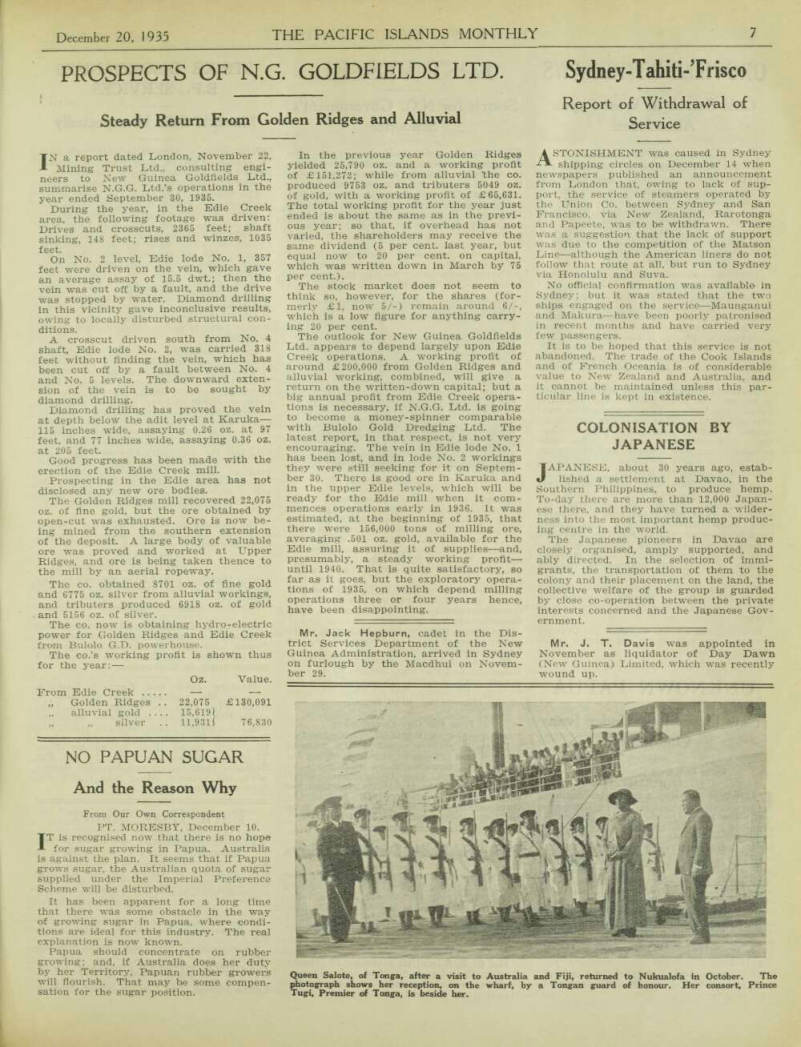
Queen Salote, of Tonga, after a visit to Australia and Fiji, returned to Nukualofa in October. The photograph shows her reception, on the wharf, by a Tongan guard of honour. Her consort. Prince Tugi, Premier of Tonga, is beside her.
Sydney-Tahiti-'Frisco
Report of Withdrawal of Service
A STONISHMENT was caused in Sydney shipping circles on December 14 when newspapers published an announcement from London that, owing to lack of sup port, the service of steamers operated by the Union Co. between Sydney and San Francisco, via New Zealand, Rarotonga and Papeete, was to be withdrawn. There was a suggestion that the lack of support was due to the competition of the Matson Line—although the American liners do not follow that route at all, but run to Sydney via Honolulu and Suva.
No official confirmation was available in Sydney; but it was stated that the two ships engaged on the service—Maunganui and Makura—have been poorly patronised in recent months and have carried very few passengers.
It is to be hoped that this service is not abandoned. The trade of the Cook Islands and of French Oceania is of considerable value to New Zealand and Australia, and it cannot be maintained unless this par ticular line is kept in existence.
Colonisation By
Japanese
JAPANESE, about 30 years ago, estab lished a settlement at Davao, in the Southern Philippines, to produce hemp.
To-day there are more than 12,000 Japan ese there, and they have turned a wilder ness into the most important hemp produc ing centre in the world.
The Japanese pioneers in Davao are closely organised, amply supported, and ably directed. In the selection of immi grants, the transportation of them to the colony and their placement on the land, the collective welfare of the group is guarded by close co-operation between the private interests concerned and the Japanese Gov ernment.
Mr. J. T. Davis was appointed in November as liquidator of Day Dawn (New Guinea) Limited, which was recently wound up.
Oroville Withdraws
Gold Search in West Papua Abandoned
, From Our Own Correspondent PT. MORESBY, December 1.
THE Oroville Dredging Company has abandoned its prospecting and explor ing activities in Western Papua. The per sonnel has been recalled from the base camp above D’Albertis Junction, on the Fly River, and all equipment is being removed.
The staff and equipment are expected in Port Moresby on the Papuan Chief, from Daru, on December 20.
Thus ends one of the biggest enterprises of the kind that Papua has known.
The company had obtained certain rights over 29,000 square miles in the Western Division, and had organised an expedition of experts, equipped with modern devices, including a Short Scion seaplane. The Papuan Legislative Council, in July, 1934, by the Mining (Facilities for Development) Ordinance, gave the company its special status.
Oroville Company commenced operations in March, 1935, from a base camp, 550 miles up the Fly River. The seaplane was used extensively, prospecting parties being landed wherever indications were promis ing. A Government Patrol Officer, with police and carriers, accompanied the party.
The Oroville party consisted of nine Euro peans and numerous natives.
There have been many contradictory re ports, in the past half century, about gold in this region. Sir William MacGregor re ported in 1890 that there was no payable gold there. Messrs. Frank and James Pryke, who accompanied Sir Rupert Clark’s expedition up the Fly in the launches Kis met and La Caravine, in 1914, reported colours of gold, but nothing in payable quantities.
Mr. Ward Williams, the American mining expert in charge of Oroville’s operations, left Papua on October 31 on a visit to New York.
It is not yet known whether the Oroville Dredging Co. will carry out further pros pecting in Papua.
Unknown Papua
New Expedition Under Ivan Champion
From Our Own Correspondent PT. MORESBY, December 9.
EARLY in January a patrol or exploring expedition under Mr. Ivan Champion will leave Port Moresby for the purpose of examining the country in unknown Central Papua, southwards of the region explored by Mr. Jack Hides early this year.
It will be remembered that Mr. Hides re ported that, from the heights above the Rentoul River, looking southwards, he saw a vast hill and valley system, which he thought was densely populated. It is understood that Mr. Champion will go across from the Purari to the Strickland River, considerably southwards of the route followed by Mr. Hides, and will endeavour to find and examine the country seen by Mr, Hides.
If conditions warrant it, the Administra tion may establish a police camp in this new country.
Lost Vessel
Search for N.G. Government’s Schooner
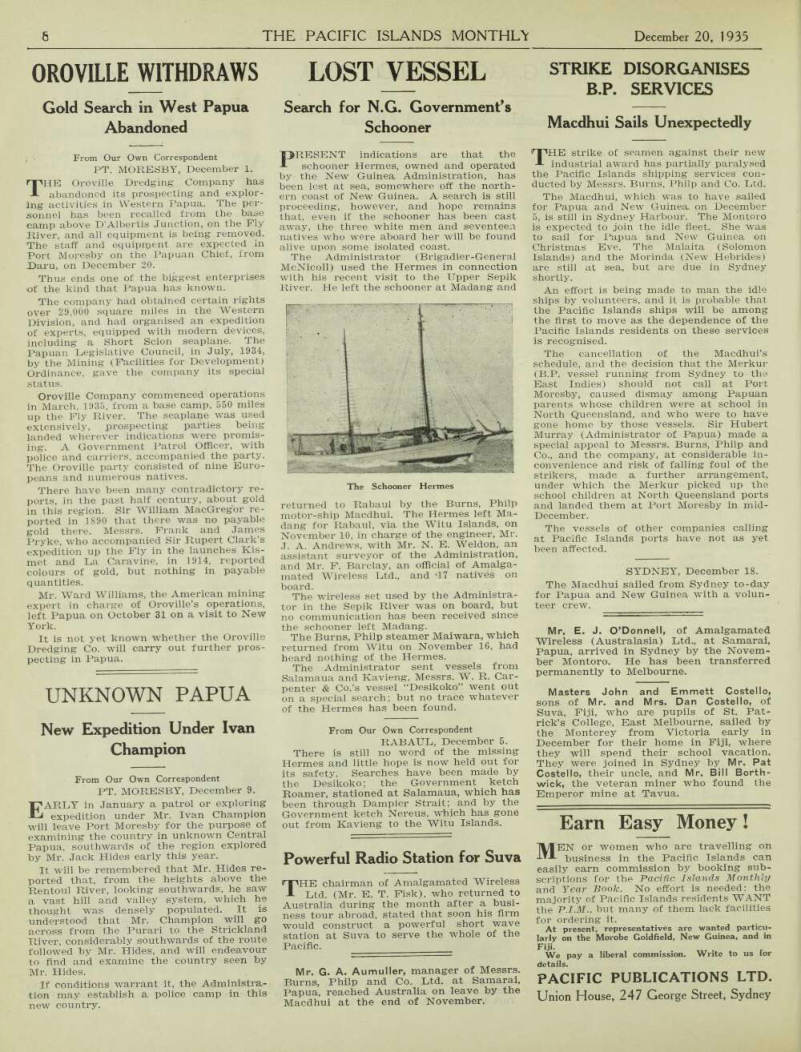
PRESENT indications are that the schooner Hermes, owned and operated by the New Guinea Administration, has been lost at sea, somewhere off the north ern coast of New Guinea. A search is still proceeding, however, and hope remains that, even if the schooner has been cast away, the three white men and seventeen natives who were aboard her will be found alive upon some isolated coast.
The Administrator (Brigadier-General McNicoll) used the Hermes in connection with his recent visit to the Upper Sepik River. He left the schooner at Madang and
returned to Rabaul by the Burns, Philp motor-ship Macdhui. The Hermes left Ma dang for Rabaul, via the Witu Islands, on November 10, in charge of the engineer, Mr.
J. A. Andrews, with Mr. N. E. Weldon, an assistant surveyor of the Administration, and Mr. F. Barclay, an official of Amalga mated Wireless Ltd., and -17 natives on board.
The wireless set used by the Administra tor in the Sepik River was on board, but no communication has been received since the schooner left Madang.
The Burns, Philp steamer Maiwara, which returned from Witu on November 16, had heard nothing of the Hermes.
The Administrator sent vessels from Salamaua and Kavieng, Messrs. W. R. Car penter & Co.’s vessel “Desikoko” went out on a special search; but no trace whatever of the Hermes has been found.
From Our Own Correspondent RABAUL, December 5.
There is still no word of the missing Hermes and little hope is now held out for its safety. Searches have been made by the Desikoko; the Government ketch Roamer, stationed at Salamaua, which has been through Dampier Strait; and by the Government ketch Nereus, which has gone out from Kavieng to the Witu Islands.
The Schooner Hermes
Powerful Radio Station for Suva
THE chairman of Amalgamated Wireless Ltd. (Mr. E. T. Fisk), who returned to Australia during the month after a busi ness tour abroad, stated that soon his firm would construct a powerful short wave station at Suva to serve the whole of the Pacific.
Mr. G. A. Aumuller, manager of Messrs.
Burns, Philp and Co. Ltd. at Samarai, Papua, reached Australia on leave by the Macdhui at the end of November.
Strike Disorganises
B.P. Services
Macdhui Sails Unexpectedly
THE strike of seamen against their new industrial award has partially paralysed the Pacific Islands shipping services con ducted by Messrs. Burns, Philp and Co. Ltd.
The Macdhui, which was to have sailed for Papua and New Guinea on December 5, is still in Sydney Harbour. The Montoro is expected to join the idle fleet. She was to sail for Papua and New Guinea on Christmas Eve. The Malaita (Solomon Islands) and the Morinda (New Hebrides) are still at sea, but are due in Sydney shortly.
An effort is being made to man the idle ships by volunteers, and it is probable that the Pacific Islands ships will be among the first to move as the dependence of the Pacific Islands residents on these services is recognised.
The cancellation of the Macdhui’s schedule, and the decision that the Merkur (B.P. vessel running from Sydney to the East Indies) should not call at Port Moresby, caused dismay among Papuan parents whose children were at school in North Queensland, and who were to have gone home by those vessels. Sir Hubert Murray (Administrator of Papua) made a special appeal to Messrs. Burns, Philp and Co., and the company, at considerable in convenience and risk of falling foul of the strikers, made a further arrangement, under which the Merkur picked up the school children at North Queensland ports and landed them at Port Moresby in mid- December.
The vessels of other companies calling at Pacific Islands ports have not as yet been affected.
SYDNEY, December 18.
The Macdhui sailed from Sydney to-day for Papua and New Guinea with a volun teer crew.
Mr. E. J. O’Donnell, of Amalgamated Wireless (Australasia) Ltd., at Samarai, Papua, arrived in Sydney by the Novem ber Montoro. He has been transferred permanently to Melbourne.
Masters John and Emmett Costello, sons of Mr. and Mrs. Dan Costello, of Suva, Fiji, who are pupils of St. Pat rick’s College, East Melbourne, sailed by the Monterey from Victoria early in December for their home in Fiji, where they will spend their school vacation.
They were joined in Sydney by Mr. Pat Costello, their uncle, and Mr. Bill Borth wick, the veteran miner who found the Emperor mine at Tavua.
Advertisements & other items, p. 10 (1 item)
Earn Easy Money I
MEN or women who are travelling on business in the Pacific Islands can easily earn commission by booking subscriptions for the Pacific Islands Monthly and Year Booh. No effort is needed: the majority of Pacific Islands residents WANT the P.1.M., but many of them lack facilities for ordering it.
At present, representatives are wanted particularly on the Morobe Goldfield, New Guinea, and in We pay a liberal commission. Write to us for details.
PACIFIC PUBLICATIONS LTD.
Union House, 247 George Street, Sydney
London
Leahy Brothers In
Challenge to Jack Hides
Messrs michael and j. l. leahy, well-known as New Guinea prospec tors, and explorers, appear to have been busy in London lately. On November 21, Mr. M. Leahy gave a lecture before the Royal Geographical Society, on tribal cus toms in Central New Guinea, illustrated with cinema films.
It has been reported that the Leahy brothers will be associated with a British semi-scientific expedition, that is coming out to New Guinea next year, to carry out an exploration in Central New Guinea.
Meanwhile, many people have been puzzled by the following statement in the London “Evening News”: Mr. Michael Leahy and his brother, Mr. J. L. Leahy, in tend to challenge, the claim of Mr. Jack Hides to the exploration of 7000 square miles of Papua. Mr. M. Leahy claims that two 13,000 feet mountains, described by Mr.
Hides, do not exist. “We shall place all our proofs before the Royal Geographical So ciety,” said Mr. Leahy.
Mr. Hides’s exploration was carried out at the southern end of the central table land, while Messrs. Leahy operated at the northern end. There is no doubt that Mr.
Hides explored new country; and Mr. Hides did not in any way challenge the claims of the Leahy brothers. No one can under stand the ill-feeling displayed towards Mr.
Hides by Messrs. Leahy, both in Australia and London. It would almost appear that Messrs. Leah# thought they had established a monopoly of New Guinea exploration.
Germany’S Demand For
Colonies
NOT much is heard, outside of Germany, about Germany’s demand for the return of her colonies (which include Samoa and New Guinea); but the agitation goes on.
There was a demonstration in Hamburg on December 6, when General von Epp said: — “We can now take colonies from no other land, from the North to the South Pole.
The whole world is appropriated.
“To our own former colonies, however, we still have an inalienable right. We must not leave our countrymen in these colonies in the lurch. By proclaiming our desire for colonies we strengthen the resolution of our compatriots overseas.
“Germany has no Imperialistic aims, but requires colonies as the sources of raw materials and a field for the initiative of the younger generation.”
Mr. Jack Hides had made arrangements to return to Papua by the Merkur early in December, after five months’ fur lough; but his plans were altered at the last moment, and he is still in Sydney.
The Crown Prince of Tonga, Taufa’ahau, who is a student at Newington College, Sydney, left Sydney by the Niagara early in December for Suva, en route to his home This popular young man—he is held in high esteem at the College, both as a scholar and an athlete—has de veloped an interest in archaeology, and is reported to be assisting some of the savants in gathering data in the islands which has a bearing upon race migra tions.
Goldfields Strike Settled
AFTER being prolonged for over three weeks, the strike among workmen at New Guinea Goldfields Limited’s Golden Ridges mine, near Wau, New Guinea, was settled at the end of November.
The dispute originated with a demand by eight engine-drivers for higher wages; later 20 artisans and miners struck in sympathy with the engine-men.
Though little detail concerning the settle ment is available in Sydney, it is under stood that the engine-drivers were not re engaged and that most of the workmen and miners were taken on again.
Drought On Thursday Is.
From Our Own Correspondent
Thursday Is., Dec. 3.
THERE is a serious water shortage on Thursday Island. The town reservoir is quite empty, and has been cleaned out in readiness for the expected rain. The reserve supply that was stored in the abandoned military underground tank on Green Hill is at an end.
The town’s supply gave out on Novem ber 22, and for almost a fortnight there have been no indications of rain. About a dozen residents have private wells, but the remainder have to carry water from three shallow wells on vacant allotments.
Government officials can be seen daily carrying home a kerosene tin of water for a bath. Community washing takes place around the public w'ells and with T.l.’s large coloured population there is a heavy drain on the supply.
Population Of Gilbert
And Ellice Colony
MUCH interesting information about the Gilbert and Ellic Islands Colony is contained in the Annual Report on Edu cation for the year 1934, just to hand. This shows that in this colony there were then 32,991 people—Gilbertese, 28,654; Ellice Islanders, 4,042; Chinese (exclusive of in dentured labourers), 41; Europeans, 254.
There were four Government schools with 133 pupils; 17 mission boarding schools with 364 male and 428 female scholars; 31 mission-aided village schools with 878 male and 617 female scholars; and 180 ordinary village schools with 2,153 male and 2,352 female scholars. So far as the missions are concerned, the work of education is divided between the Sacred Heart Order of Roman Catholics and the London Missionary Society. The Govern ment spent £4,990 on education.
Terrifying Earthquake
A MEMBER of a geological research party, Mr. H. Eve, was out in the Tor ricelli Mountains, Northern New Guinea, with 50 carriers, looking for oil, when he became involved in the recent earthquake in that region. The party had a terrifying experience. The ground seemed to pitch and roll, and they were obliged to hold on to trees. The damage on the lowlands was not severe, but in the hills whole villages were destroyed and many mountain passes were blocked.
Oil Depot For Papeete
From Our Own Correspondent
Papeete, Dec. 1.
SHIP-OWNERS and yachtsmen will be interested to learn that the Com pagnie Francais© des Phosphates de I’Oceanie is to install a fuel oil depot in Papeete. When erected on the company’s premises in close proximity to the wharf, the plant will consist of four rustless steel tanks with a total capacity of 3,300 cubic metres, and will be equipped with special tubes for supplying oil direct to ships.
Construction work will commence at an early date, and when completed, oil will be available for passing vessels at a much cheaper rate than hitherto. The plans for a larger oil depot contemplated by the French naval authorities, of which a good deal was heard last year, appear to be in abeyance for the time being.
Shark Attacks T.L Diver
From Our Own Correspondent
Thursday Is., Dec. 4.
A COLOURED Thursday Islander, James Messit, was the hero of a recent shark incident. While diving for shell on the Great Barrier Reef he was at tacked by a shark, but managed to break away and dive to the ocean floor. When he came up again the shark had dis appeared.
The lugger took the victim to Innis fail, Queensland, but the journey was a protracted one owing to the absence of wind. In the hospital Messit’s many lacerations were attended to with hun dreds of stitches and much bandaging.
The latest news is that he is now able to hobble about the hospital, a striking example of the value of presence of mind.
Advertisements & other items, p. 11 (1 item)
Pacific Islands
JUST PUBLISHED
YEAR BOOK
1935-36 Ed’n.—43o pp.—Many new Maps
A reliable, comprehensive guide to
the Rapidly-Developing Territories
of the Pacific.
STATISTICS FROM OVER 20
ADMINISTRATIONS
NEW COUNTRIES WITH
NEW OPPORTUNITIES
Special Features include: Description of new Pacific Islands Gold Industries; Pidgin Vocabulary; Aviation in Pacific; Pacific Personalities; History of Pacific Exploration; Business and Residential Directories of Principal Territories.
Bound in cloth, 9/6; in Light Board, 7/6; plus postage (British countries, 6d; foreign, 1/-).
From all Booksellers and Island Stores, or from
PACIFIC PUBLICATIONS
LTD.
Union House, 247 George St.,
Sydney.
A Governor with a Big Axe!
Fiji Makes Laudable Effort to Discourage Roguery in New Gold Mining Industry
ANEW mining law, to discourage specu lation, has been introduced in Fiji by the Governor.
In his address before the Legislative Council the Governor (Sir Murchison Flet cher) said that the gold in Fiji was the property of the Crown, and the Govern ment would not countenance dealings in that property without its consent.
Some persons, said the Governor, applied for prospecting licences for the sole pur pose of speculation and had no intention of fulfilling conditions. They pegged out land in the closest possible proximity to a gold-bearing area and then gave privately to some financier an option over the licence which they hoped to obtain. They ven tured nothing themselves, even the licence fee being paid by their associates.
The Government would use every means to prevent the placing of this unnecessary burden upon the industry. In some com panies the persons responsible for financial arrangements retained too large a con sideration, while the charges for the flota tion of some companies appeared to be unduly high. It might be in the public interest if more publicity was given to Fiji mining finance.
The Government at present had no con trol over the private prospectus where under shares were placed privately. Cer tain prospectus statements were grossly misleading, and the Government proposed to amend the law to include private prospectuses.
The Government would continue to try to thwart adventurers who for their own ends sought to exploit the credulous public.
Eruption in Tonga
Craters Overflow
TT was reported from Nukualofa, Tonga, on December 8, that the craters Aho fakatau and Hina, on Niuafoou Island, in the Tongan group, erupted on Saturday, December 7. The two intervening craters also remain active, and all four are now throwing flames seventy feet high.
Lava is flowing into the sea along a two-mile front, from an area of molten lava, estimated at 1500 acres. Steam is rising from the sea upwards of a mile out.
Two villages (Belani and Togamamao) have been evacuated as a precaution.
There has been no loss of life, but some plantations on the fringe of the old lava field were destroyed.
The eruption is believed to be bigger than the one which occurred in 1929, and was preceded by 20 earthquake shocks, accompanied by electrical disturbance and torrential rain.
New Vessel for Tahitian Trade
From Our Own Correspondent PAPEETE, December 1.
A NEW vessel, to take the place of the small steamer Ville de Papeete, which was wrecked on the reef at Haraiki Island ('Tumotu Archipelago) last year, is now on the way from Prance to the order of the Compagnie Prancaise des Phosphates de
I’Oceanie, and will henceforth be employed in carrying freight and passengers between the Company’s headquarters in Papeete and the island of Makatea, where the phosphate mines are situated.
The vessel is a three-masted schooner, with auxiliary Sulzer Diesel engines of 375 h.p., which .will give a speed of 10 knots per hour. The schooner is 48 metres long and eight metres wide, and has accommo dation for first class as well as deck pas sengers. She also contains a refrigerating room, and the capstan and winches are operated by electricity.
To Help Planters
New Guinea Agricultural Gazette
* ’HE first issue of the New Guinea Agricultural Gazette is to hand.
The purpose of this excellent publica tion is to make known to planters in New Guinea the results of the experimental and demonstration work carried out by the New Guinea Department of Agricul ture. This development is long overdue.
The Department of Agriculture, through its plantation at Keravat and its work on plantations throughout the territory, has a splendid record of service, and its full value has not been available in the past because it was not able to tell in dividual planters just what it was doing and what it had accomplished.
The principal articles in the first issue are: “Peanuts as a Crop in New Guinea,” by George H. Murray; “The Long-horned Treehopper of Coconuts,” by John L.
Froggatt; “Derris—lts Cultural and Eco nomic Possibilities,” by R. E. P. Dwyer; “Preparation of New Guinea Cocoa for Market,” by E. C. D. Green; “Eucalyptus Naudiniana,” by C. C. Marr; and “Meteor ology,” by B. G. Challis.
If this journal maintains the standard of its first issue it will be invaluable to the planters of New Guinea.
N.G.’S White Prisoners
THE Federal Parliament has passed a Bill called “Removal of Prisoners Bill,” which has special application to New Guinea.
It appears that when Europeans are sentenced to terms of imprisonment in New Guinea they may be sent to serve their sentences in the prisons of New South Wales or Queensland. At the ex piration of their sentences they are en titled to claim transport back to New Guinea. But in many cases the crime for which they are punished is one which brings about their formal deportation from the territory; and it has happened in a number of cases that men, having been formally transported to New Guinea, have with equal formality been deported from that territory. The purpose of the new law is 'to provide that, when there is an order of deportation against a discharged prisoner, such discharged prisoner may not claim transportation to New Guinea.
The development of gold mining in Fiji, said the chairman of Colonial Sugar Refining Co. (Mr. E. R. Knox) recently, had not disturbed the normal conditions in the colony, but there was a risk of serious dislocation of labour supply if this new and somewhat uncertain industry was not controlled properly.
Seaplane Flight Spoiled
Solomon Islands
From Our Own Correspondent
Tulagi, Dec. 1.
KEEN disappointment was felt on Satur day last, when the trial run of the local seaplane was spoiled, owing to its striking some submerged object, just as it was leav ing the water.
The bus had to be brought ashore, with out grave injury to itself or the flier.
Repairs could be done quite readily but for the impossibility of securing the neces sary materials either locally or at short notice. The flight is merely postponed.
The “Joseph Conrad”
The visit of the training ship “Joseph Conrad” has relieved monotony. The very look of a sailing ship gave romance and history to the port. The visitors took part in various sport, and local residents took advantage of the opportunity to ob serve at first hand the workings of these wonderful craft. Before leaving the group, the vessel called at Guadalcanal, where supplies of fresh food were taken aboard.
Attack On An Overseer
The recent incident in the Faisi district, in which an overseer was very seriously in jured by some of the labour force, seems to have been ably handled by the officials sent up to enquire into and try the case.
Is There Gold in the Solomons?
From Our Own Correspondent
Tulagi, Dec. 1.
THE old scepticism with which mining ventures have been looked on, especi ally by local wiseacres, is giving way under the continued interest being taken by out side capital.
It is recognised that work is in the stages of investigation, even now, but it felt that there must be something worth investigation.
The efforts of the residents of the Solo mons, who grdped for the gold, the exist ence of which they were confident of, and endured ridicule, are now justified to the extent that worth-while minerals are indi cated.
A few months should prove, one way or the other, whether there really, is gold in the Solomons.
Traders and A. I.B. Stores
In Torres Strait
From Our Own Correspondent
Thursday Is., Dec. 5.
THE Thursday Island Chamber of Commerce is organizing an agitation against trading stores on Torres Strait Islands belonging to the Aboriginal In dustries Board. The profits from these are devoted entirely to the welfare of the natives, but local traders complain of serious loss of trade in consequence of these activities.
Before the advent of the Islands branch stores the natives spent a good deal of money in Thursday Island shops. The chief stores of the Aboriginal Industries Board are on Badu Island, where boat building and other useful crafts are taught to young islanders.
Tropicalities
ONE well-informed correspondent com ments thus on the election of Mr. A.
G. Smyth to the Legislative Council of Western Samoa: “This was something of a blow for the New Zealand Government. Mr. Smyth was one of those deported, owing to his support of the Mau: and it was on his return to Apia, when the natives were giving him a demonstrative welcome, that the clash with the police occurred, and Tamasese was killed. The ballot shows where lies the direction of the sympathies of the European residents of Samoa.” ♦ ♦ ♦ AUSTRALIAN Born British Subject” writes from Tulagi, 5.1.: “In ‘Tropicalities* some time ago there was a paragraph from which the following is an extract: “ ‘We beg to make formal protest against the continued use of “British”
Solomon Islands. The word “British” actually has no meaning.’
“I am rather surprised that a ‘British’ publication should give this as its con sidered opinion. I, for one, see quite a lot in the word ‘British,’ and am proud to be able to include it in my address, and would be very sorry to see it done away with.”
Our friend, in order to shout his pat riotism, shuts his eyes to history. Until 1914, there were two sections of the Solo mon Islands—German (Buka and Bou gainville) and British (the rest of the group). It therefore was customary and necessary to speak of “British Solomon Islands.” It is no longer necessary; all the Solomons are under British adminis tration —the northern islands being part of the Mandated Territory, and the re mainder enjoying their old form of go vernment. The “P.1.M.” is British to the backbone, but it does not suggest “British Fiji” or “British Cook Islands.” There would be justification for “British Samoa,” however, to distinguish that territory from American Samoa. * • ♦ A CORRESPONDENT of the “Rabaul Times,” with multitudes of words, ridi cules recent statements in the Pacific Islands Monthly —especially our claims that Wogamush is about 150 miles from the mouth of the Sepik River; that the Aitape earthquake was not reported in the Aus tralian newspapers until long after the event; and that General Griffiths intro duced a system of pack drill to the native prisons of New Guinea.
It is very clear that the anonymous writer is a New Guinea public servant, writing in an extremely bad temper, and it is scarcely worth wasting time and space in splitting straws with him. We will merely say, categorically, that the latest map shows Wogamush 150 miles from the Sepik mouth (the N.G. writer having made the distance 300 miles, by measuring the distance along the winding river /); that the Director of the Riverview Observatory, Sydney, had not even heard of the earth quake in the Torricelli mountains until, about mid-October, we supplied him with a •copy of our correspondent’s report; and that, even if the Prison Regulations pro viding packdrill were passed in 1931, it is certain that they were not applied generally until General Griffiths took hold in 1932-33.
The gentleman refers to a statement pub lished by us some months ago, to the effect that certain public officials of New Guinea had accepted favours at the hands of Ger man shipping interests; and he querulously
says that we have neither withdrawn the statement nor apologised for it. Quite true.
We shall withdraw the statement, and apologise for it, when it is shown to be incorrect. * * * QUITE a commotion was caused in a suburb of Apia, Western Samoa, one recent Sunday, when a resident in convivial week-end mood told some local-born boys that “the local Administration was seeking recruits for the coming Anglo-Italian war and that intending warriors would be medically examined by the Apia doctors.”
He added that “recruits would get a free trip to New Zealand and that agents would be paid 5/- per head for every man pro cured by them.”
The tale spread like wildfire among the natives and a few hours afterwards a crowd of native boys appeared at the residence of the practical joker, asking for further information. Having sobered up meantime, and being worried about the result of his joke, he managed to send the eager war riors home, though one trustful innocent actually presented himself next morning to a surprised doctor with a demand for medi cal examination. * * * AN inquiry was made some months ago concerning the whereabouts of Dom ingo de Brum. Father Carl Heine, a missionary in Jaluit, Marshall Islands, writes: “I regret to say that Domingo de Brum died about two years ago. He was a very decent chap and I liked him well.
He was at Nauru when the war broke out. His father was a Portuguese and his mother a Marshall Islander. Born in these islands, then under the German Protectorate, he became a naturalised German citizen. When Nauru was occu pied he was told he might remain if he claimed British protection. Having re ceived a fair deal from the Germans he said that it was only honourable to stand by his pledge, so he was sent to the
internment camp near Sydney with other Germans.” * * ♦ A RESIDENT of New Guinea informs us that it is a practicable and com paratively simple thing to bring a car from New Guinea, for use in Australia during furlough. Freight from New Guinea to Sydney was £25; wharfage charges were 28/-; he was allowed to run the “bus” for three months in Aus tralia on the New Guinea registration, and • then was able to register in Aus tralia for a short period only; and he did not have to pay for a driver’s licence.
This is the first time, in years, that we have heard a visitor praise any Austra lian institution; as a rule, Australian rules and regulations seem to have been designed by Satan himself to harass and exasperate all people from overseas. * * * THE Montreal branch of the Royal Empire Society has arranged an Em pire Products Exhibition, which will be held next January. Australia has supplied useful literature, but the Islands Territories are not represented. If it is not too late, publicity material at least should be sent.
The address is: Mr. W. Tees Curran, Royal Empire Society, Sun Life Building, Mont real, Canada. ♦ ♦ ♦ WE like modesty; but one must adver tise. The following note is to hand from a missionary in a back-blocks station in Papua: “The P.I.M. seems to be in every house with an iron roof up here —and I have seen it often under grass. Really, it is a great paper.” * * * ON May 2, 1935, two tourists, M. E. Kirk and A. Forder, cast a port-wine bottle into the sea near Suva, Fiji. Inside was a note —“our first sad parting on a wonderful world’s tour.” The bottle was picked up, on October 21, 1935, by a planter, near one of the passages through the reef, at the eastern end of Sud-Est Island, Eastern Papua. The bottle had travelled over 1200 miles in six months, through an ocean dotted over with islands.
Advertisements & other items, pp. 13-14 (1 item)
home
STERLING
Guaranteed C 3
LOOKS
BETTER
LONGER
STERLING
home
MADE BY
STERLING VARNISH CO.
PAINT
For
TROPICAL
SUN and
SALT-LADEN
AIR
SYDNEY, N.S.W.
NEGLECT OF DEFECTIVE SIGHT
MAY CAUSE SERIOUS RESULTS
Take Care of Your Eyes Consult
WALTER FORD
D.8.0.A., M.0.0.A.
Optometrist and Optician 4th Floor, Challis House Martin Place, Sydney Established over 30 years Tel.: Most moderate charges BW 6131
Ccccie Tea Co’s
JfaA gtade TEAS £ CCEfEES.
toK
$ Co SO * A F
FOR REAL ENJOYMENT AND COM-
PLETE SATISFACTION IN TEAS
AND COFFEES INSIST ON
“CORRI E’S.”
After years of careful study, the Corrie Tea Company has acquired a thorough knowledge of the right blendings of Teas and Coffees required for the Islands.
You will find Corrie’s Teas are “deliciously different,” and are already THE MOST POPULAR TEAS IN FIJI, where they enjoy an immense demand.
Should you, as yet, be unable to procure, please forward name of your Storekeeper, and A
GENEROUS SAMPLE WILL BE SENT YOU.
Ask for “CORRIE’S”
—The Tea that is “Deliciously
Different.”
Correspondence Invited.
THE CORRIE TEA CO.
39 Bathurst St., Sydney.
LIGHT, STRONG SUITCASES
'Xiu.
jr&c the
v jSfrr\
G L O BITE
tylo cflieM ahe juity
ctS cjmrJl.
BELTS FOR MEN
Made of the toughest fibre obtainable, Globite Suit Cases, in grained or smooth finish, are as smart as leather . . . but lighter to carry and lower in price. They are reinforced to stand the roughest handling.
FORDITE are economy cases . . . cheaper than Globite, and made with broad grain finish.
Traders are invited to write in for full particulars of these quick
selling lines
Stoutly made of leather in many colours and designs, Ford Sherington Belts are fitted with easily adjusted nickel fastenings. They are smart and hard-wearing. Ask for F.S. Leather Belts.
Ford Sherington, Ltd.
Manufacturers (Wholesale only)
KIPPAX STREET, SYDNEY. N.S.W.
About Islands People
Mr. B. W. Sherman, formerly A.D.O. at Gasmata, who resigned from the New Guinea public service several months ago, arrived in Sydney in December from Lon don, where he spent several weeks.
Mr. Colin Mac Kay, chairman of direc tors of Watut Gold Alluvials N.L. and Irowat Gold Alluvials N.L., returned to Australia by the Macdhui at the end of November after a visit to the companies’ properties in New Guinea.
Mr. P. J. McDonald, a well-known iden tity of Papua and New Guinea, was mar ried recently to Miss Gertrude Gellweiler at the Residency, Misima Island, Eastern Papua. The bride was formerly matron at Port Moresby Hospital.
Sister Christine Woods, of the Mela nesian Mission’s Hospital on Malaita Island, Solomon Group, reached Sydney on leave by the Southern Cross on December 9.
Mr. Stanley W. Jackson, Fellow of the Institute of Optometrists, will leave Syd ney early in the New Year on a business visit to Papua and the Mandated Terri tory of New Guinea.
Captain R. A. Williams, master of the Melanesian Mission’s schooner Southern Cross, brought his vessel to Sydney early in December to be overhauled. Mr. Wil liams, who was accompanied by his wife and small son, was formerly in the service of Messrs. Burns, Philp and Co., Ltd.
Mr. Frank Hambridge, chairman of directors of Cuthbert’s Misima Gold Mine Ltd., returned to Sydney by the Macdhui on November 29, after a visit to Misima Island, Papua, to inspect the mine. His company had taken over the property on October 18, he said, and had begun treat ment of ore immediately. The battery worked three shifts daily until November 4, when floods caused work to be tem porarily suspended.
Mr. Paul Laine, of the French Colonial Administration, who is on his way to Vila, New Hebrides, where he will serve for three years in an administrative capacity, recently arrived in Victoria by the Ville de Strasbourg. He was accompanied by his wife, daughter and mother.
Rev. Dr. Charles E. Fox, who has served for 34 years with the Melanesian Mission, arrived in Sydney by the motor yacht Southern Cross on December 9. He is stationed at Pawa, Ugi, Solomon Islands, and is the only white member of the native mission order known as The Brothers. Dr. Fox holds the degree of Doctor of Literature from the New Zealand University.
Mrs. A. D. Lelean, of Ba, Fiji, arrived in Australia by the Monterey on Decem ber 2, preceding her husband, who will shortly return from Fiji after 18 years of service. Mr. Lelean will later take up circuit work in Victoria for the Methodist Church.
Mr. O. J. Atkinson, Assistant Resident Magistrate at Abau, Eastern Division, Papua, left Port Moresby on six months' leave by the Montoro in December. He is being relieved by Mr. A. C. Hall.
Rev. A. H. Scriven, of New Zealand, arrived in Sydney from Rabaul by the Macdhui on November 29, after officially inspecting the work of N.Z. Methodist missionaries in the Solomon Islands. He said that Rev. J. F. Goldie, who pioneered the establishment of the mission in the group, is still in charge at Roviana. In spite of his 34 years of strenuous ser vice, he was still in fine health, added Mr. Scriven.
Mrs. B. C. Meek, accompanied by her two children, reached Sydney by the December Monterey. Her husband is in charge of the Methodist Mission’s Agri cultural School at Navuso.
Mr. R. A. Woodward, of Papua, re turned by the Government ketch Vailala to Daru, in the Western Divi sion, where he is Resident Magistrate.
Mr. S. H. Chance, who was relieving at Daru, has now gone to Kikori, Delta Division, as Acting R.M.
Mr. F. Noack, who has been receiving theological instruction at Concordia Col lege, Adelaide, has been accepted as a worker for the Lutheran Church in New Guinea.
Mr. Ralph Farr has been accepted by the Australasian Union Conference of Seventh Day Adventists for medical missionary work in Papua. He will leave for the S.D.A. headquarters at Mirigeda in January and will later open a new station at Orokolo, in the Gulf Division.
Mr. Witt, a representative of the Aus tralian Gold Mining Corporation arrived in Noumea by the Ville de Strasbourg recently to search for gold in the central region of New Caledonia.
Mr. John T. Howse will leave Sydney by the January Malaita for Choiseul Island, Solomons Group, where he has been appointed to mission work for the Seventh Day Adventist Society.
Mr. D. M. Lazarus, of Ontong Java, Solo mon Islands, arrived in Sydney in Decem ber on three months’ furlough. He is the only white planter and trader in that sec tion of the group. The people there —an isolated community of Polynesian stock — are steadily, if not rapidly, decreasing in numbers, said Mr. Lazarus. They do not seem to have the physique to resist ordin ary sicknesses.
Count Henry Theodore von Moltke, who had been in ill-health for some years, died at Norfolk Island, on November 8, at the age of 65. A Dane by birth, he went to the Fiji Islands at the close of last century and became an overseer in the Colonial Sugar Refining Company at Rewa. He purchased the C.S.R. Co’s Lakena plantation, but later relinquished this estate to settle in New Zealand.
Failing health made it necessary for him to seek a warmer climate and about five years ago he took up residence on Norfolk Island, Mr. “Jock” Cromar has gone to live in Australia, says our Solomon Islands cor respondent; and his departure deprives us of one of our most interesting and oldest citizens. Most folk find it hard to believe that “Jock” has really left us, and all wish him every happiness among his old Queensland friends, who knew of the Solomons as “Jock” chiefly remem bered them —the Solomons of kanaka recruiting days.
Miss Nancy Wyborn, daughter of Mr. and Mrs. Arthur Wyborn, of Rigo, Papua, was married to Mr. Ronald Vivian Old ham, of Steamships Trading Co. Ltd., Port Moresby, on November 18. After the ceremony at Mr. Wyborn’s home the couple left by launch for Port Moresby to join the Macdhui for Australia, where they will spend their honeymoon.
Mr. H. Robert Nesbitt, of Rabaul, New Guinea, was married to Miss Jean King, of Manly, at St. George’s Church, Rabaul, on November 5. They have now gone to Wau, where Mr. Nesbitt has taken charge of Rabaul Recreation Co.’s new picture theatre.
Dr. C. M. Dawson left Apia, Western Samoa, on a brief visit to New Zealand by the Hauraki bn November 24.
Nurse Vera Pearson, of the Methodist Mission, reached Sydney by the Montoro on November 7, after serving for three years at the Salamo Hospital. She has retired from the sisterhood, but will return to Papua as the wife of Rev.
H. Robinson, Methodist missionary at Salamo.
Mr. Charles E. Sparrow, A.M.1.N.A., Technical Instructor at the Methodist Mission Society’s Training Institute at Fergusson Island, Eastern Papua, arrived in Sydney by the Montoro on November 7. He married Miss Gladys Thomas in Sydney on December 4 and with his bride sailed for Salamo, Papua, by the Merkur the following day.
Advertisements & other items, pp. 14-16 (2 items)
Kurrajong
Wheeny Creek Farm
Forty-five miles from Sydney Superior modern accommodation, abundance of cream, eggs, and poultry. 5 acres orchard. Tennis, etc.
Tariff: Double, £2/2/- each; Single, £2/10/- ’Phone: Kurrajong 42 Proprietor: A. J. SAMSON Formerly New Guinea Public Service
FINISHING SCHOOL FOR GIRLS
Hopewood House is the only school of its kind in Australia, being unique in educational purpose, equipment and beauty of surroundings.
It provides a splendid educational course on sound cultural lines. All subjects, which include Literature, Languages, Music, Art, Dramatic Art, Dancing, Tennis, Golf, etc., Domestic Science, Dressmaking, Home Crafts, Complete Secretarial Course, etc., are under the direction of skilled specialists of recognised standing.
The special Finishing Course is an excellent preparation for travel or further study abroad.
All possible facilities are provided for the development of the individual talents, tastes and ability of every student, and special courses may be arranged at an inclusive fee.
Further information and an illustrated prospectus may he obtained from Principal —
MISS NANCY JOBSON, M.A. (Melb.)
“Hopewood House,” Darling Point, Sydney
ELVFS
Special Mail Department
-for RECORDS
ELVY'S, Sydney's famous old-established Music House, can send you every Record that you may want. Special Mail Department for Island residents.
Here are some new releases: CONCERTO IN A MAJOR, K. 219 (Mozart)— Allegro aperto; Adagio; Tempo di Menuetto. Heifetz (violinist) and London Philharmonic Orchestra (Conducted by John Barbirolli).—D.B.2l99/2202. 8/- each.
Complete, £l/12/-. A handsome Album (Series No. 216) is presented free to purchasers of the complete set.
“THE GIRL FRIEND”—FiIm.—Two Together —F.T. Haunting Me—F.T. (Not from film), Eddy Duchin and His Orchestra.— E.A.1555, 4/-.
Write for complete free lists. Elvy’s a
ELVI «&
SAY TO ME “I LOVE YOU” (Dites-moi “Te Vous Aime”). LIKE A WOMAN (Comme Une Femme). —Lucienne Boyer, soprano (singing in French). —10-inch, DO 1405, 4/-.
JOE DANIELS AND HIS HOT SHOTS in “Drumnasticks.”—Sweet Sue. St. Louis 81ue5.—A6249, 4/-.
SOL HOOPIPS HAWAIIAN QUARTETTE.
—Flower Lei. Kamehameha Waltz.— G 22476, 2/6. : noted for prompt service. Order Now.
CO. LTD.
397 George Street, Sydney. 'Phone: M 2319.
TUDOR HOTEL
Room Only Rate, 5/- per day. Meals a la carte. Accommodation for 100 guests. One minute from G.P.O.
127 PHILLIP ST. Tel.: BW 27M
Next door to Martin Place
Sydney
✓ess
4 It’s the magic of Jantzen-Stitch that gives you lovely youthful lines and keeps your figure in control. Because of this exclusive process your Jantzen fits perfectly and permanently. This year Jantzens are particularly charming. There are two luxurious new fabrics—Kava-Knits —and smart new designs.
The World's Favourite Swimming Suit Made in Australia
About Islands People
Poultry-keeping

Jungle-fowl, and Some Feeding Errors
By H. Charles Reed, of Samoa
ONLY recently has a little well-deserved attention been given to the keeping of the utility-breeds of domestic fowls in the Pacific Islands.
Except perhaps in Hawaii—where poul try-keeping is modernised —one usually sees the funny little “hen-fruit” called eggs which grace the market-places of Bombay, Cairo, and similar places.
The fact is that poultry thrive as well in the Pacific Islands as in most parts of Australasia. But, like the growing of vegetables, poultry-keeping is largely relegated to the native labour of the Islands. Many folk keep a few hens of the Island type, have a coconut scraped daily for their food, and leave the hens at that. Do the hens then return good sized eggs for their keep? No, sir, they do not!
It certainly pays to keep a few fowls, especially where the table scraps may help to feed them; but the coconut is by no means a complete food for poultry, and when solely on this diet the poultry get “fed-up” of coconut and will leave it on the ground untouched.
It is just as essential that the hens should have right feeding, pure water, grit and shelter in the Pacific Islands as else where. It is just as essential to import new blood, new roosters, to improve the Island stock. This, the Oriental would never think of. He is quite content with undersized eggs of, often, undecided “freshness,” that he has always known.
Of course, all eggs are eggs; and, in the Islands, one is expected to pay the same price for the bantam-sized egg as for a respectable egg; and the Chinese restaur ants are buyers of eggs of every descrip tion (including those known as "too fresh”).
So degenerate are the general run of poultry in the Islands that a decent sized Rhode Island Red rooster appears as a giant among the native-bred stock, while eggs of two to three ounces in weight are wondered at. The native-bred hens of the Islands are known by the Polynesian name of “Sa’a” (meaning short and small). The jungle-fowl or bush-hens, are known as “Moa-ai-vao” (fowls that feed in the bush). These are very plentiful, and are in-bred with the domestic fowls to a great extent.
In the villages one sees the jungle-roos ters being carried about as pets by the
boys, who use them to decoy their fellows in the bush. The birds, when set down to a “challenge,” will begin to crow direct ly, and will soon entangle any adversary, who should take up their challenge, by means of a cord attached to the left foot of the pet bird.
But, to return to the Chinese poultry keeper of the Pacific: He will buy all the poultry he can (at the Chinese value). He will cut off the toes of his hens to pre vent them from interfering in his garden or scratching out his seed-beds. He will scrape up enough food to keep the hens going, and will dispose of all the eggs and fowls h’e can raise to his own com munity and restaurants.
It is in the commencement—the attempt to raise young chickepjs or ducklings —where most folks come to grief. Many people will tell you very definitely that poultry do not succeed in the Islands. This is where the Chinaman usually succeeds.
And why? Just as a Chinaman knows what is required with a poor soil, so he appears to know something of the value of foods, not alone for himself, but for the feeding of poultry. He sees the Island planter feed boiled rice or breadcrumbs to the young chicks or ducklings—and he knows that dead foods are deadly to chicks. He feeds his newly-hatched birds on live ant-eggs, and his birds thrive.
These huge ant-mounds may be found everywhere in the bush by those who will trouble to collect them. They adhere to decaying trees and, when cut down and kept in a sack, may afford food for the chicks for a week or more. Young birds grow in a really wonderful manner when fed exclusively on ant eggs, fresh from the bush trees. It is not generally known that these huge nests of termites can be had for the taking in the bush lands of the Islands. But it makes poultry-keep ing worth while to John Chinaman, who probably gains a wider knowledge of the resources of the Islands in a few months than many of his learned white brothers acquire in years.
Where land is available a small patch of white millet, maize, and the papaya fruit will greatly help in the economical feeding of a few head of cattle, pigs, and poultry. But some people never learn from experience, and daily throw out a few handfuls of dry rice to their hens or ducks, and expect the birds to fatten and thrive. Well, it simply doesn’t hap pen.
In regard to the periodical visits of “fowl-sickness” that occur in and around Apia (Western Samoa), this writer has proved that much of the soil found within the municipality of Apia is “infected” soil, and much of the “fowl-sickness” is due to picking up food infected by their own droppings during the wet season on these soils. The turning of the soil and a liberal
application of lime is perhaps the best treatment. Burnt coral lime is quite use ful, and cheaply made in the Islands.
Perhaps the encouragement of school gardens and school lectures on matters of poultry-keeping and management would do much to improve the outlook in the future for the younger generation. The jungle-fowl might then be relegated to the jungle instead of to the backyard.
Advertisements & other items, p. 16 (1 item)
Private
IN THE HEART
OF SYDNEY
r v> ,s* Ay
PRIVATE
HOTEL
ANNOUNCEMENT. . .
ISLANDS’ PATRONS of “CROWLE HOUSE” are
informed that this well-known SYDNEY PRIVATE HOTEL is under NEW AND EXPERT MANAGE- MENT, and has been LAVISHLY RE-FURNISHED THROUGHOUT. Every convenience is available, including Hot and Cold Water in all Bedrooms, Electric Elevator, Laundries, Electric Irons, Pressing Rooms, etc. (Free Service).
Visitors holidaying in Sydney will find Comfort and Contentment at this conveniently situated Hotel. Excellent Cuisine.
TARIFF:
Single Room. Bed & B’fast., 7/6 per day. 45/- per week.
Double Room. Bed & B’fast., 14/- per day. 84/- per week. Casual Meals 2/- each.
161 CASTLEREAGH ST.
J. C. HUGHES
Proprietor Radios and Telegrams:
“GROWL-
HOUSE,”
SYDNEY.
The Condominium
Farce
A Planter Writes Bitterly
A PLANTER in the New Hebrides in a recent letter writes very bitterly about political and economic conditions in the Condominium.
He again lays emphasis on the fact that French interests are steadily and consist ently supporting French planters and increasing the hold of the French in the Group, while the few remaining British planters are as consistently ignored. He says that at one anchorage in the Group the French planters then were receiving for their copra £7 per ton, plus a bonus of 200 francs; native copra brought £7 per ton; but the best price offered for British copra was £4 per ton—and “not wanted, at that.”
This, says our correspondent, is typical of what is happening in the Group. The British planters who several years ago were induced to settle there have been practically forgotten and ignored. “Under these conditions, it is very hard to under stand how or where this much-boomed British justice comes in, as we British planters are still expected to make our own living, and pay our share of public costs.”
Our correspondent comments on the fact that, while no attempt whatever is made to encourage British settlement, or protect existing British interests, the British side of the Condominium Administration is fin anced through the Colonial Office, just as it always has been financed, and all the British administrative machinery remains in existence. Why maintain this ex pense? Why continue the farce? Why not hand over the Group to the French and cut out a heavy annual expense, from which no apparent benefit is derived?
Pacific Islands
New Refrigerator Unit for Pacific Islands
HITHERTO most non-mechanical refrigerators for use in the Pacific Islands, where no elec tricity is available, have been produced in the flat chest type with a Hft-up lid. Mr. J. W.
Long, consulting engineer and refrigerating sur veyor, of Sydney, and an expert in absorption type systems, has now announced the production of the “Evercold” Absorption Refrigerator, which has been designed to be equipped into the more con ventional vertical cabinet, so that Islands users may now have a prototype of the electric re frigerator.
The “Evercold” is kerosene-operated, using a specially designed lamp. It is noiseless and vibrationless and has no moving parts. Another feature is that no running water is required for cooling purposes. In design this new absorption unit is extremely simple; the boiler being located in the bottom compartment of the cabinet and the evaporator unit and ice-making trays are at tached to the top of the cabinet interior, and there is a surprising minimum of valves, pipes, or control gadgets.
South Seas distributors for this new type of refrigerator unit are Messrs. Simplex Baltic Machinery Co., Ltd., 608-614 Harris St., Sydney whose announcement is published in this issue***
Mr. W. R. Humphries, formerly Resi dent Magistrate of the Delta Division, Papua, who has been relieving Mr. C. T.
Wurth as R.M. in the Central Division, left Port Moresby in December on three months’ leave.
Mr. A. J. Marshall, an Australian an thropologist, will leave Sydney this month for Boram, near Wewak, on the North Coast of the N.G. mainland, to carry out scientific investigations in the district.
Advertisements & other items, pp. 17-18 (1 item)
Shoe Store
'V' -v<- -V *"«k,
Fostars guarantee to
save you money ... to deliver all footwear
safely... and satisfy you
perfectly.
Fostars new Catalogue is the most complete Shoe Catalogue ever issued in Australia. Every possible type in footwear is to be found in it. Ladies Genuine Pumps from 7/11 to 39/6.
Mens Genuine Welts from 9/9 to 37/6.
Childrens and Sports Shoes Slippers Heavy Duty Work Boots etc., etc.— all at Factory prices which save up to 15/- per pair, as Fostars are manufacturers selling direct to you.
AWL 323—Smart Oxford Tie, in White, Black or Navy Calf, with Cut-out Sides. Full Round Toes.
Junior or High Spike Heels.
Genuine Pump Soles. Half Sizes.
Price . . 12/9 •-•-L 9 -vxC TWT33—A neat Sandal Strap, featured in White Calf, with Cutouts and Perforated Trims. Round Toe Shape. Sport Cuban Heels.
Genuine Pump Soles. Half Sizes.
Price 10/9 “This Year’s Swagger Hit” • CTM I r-Tan Yearling, or • CBM 5 Black Yearling • Solid Leather Soles Undoubtedly a smart shoe Buying your shoes by mail is simplicity itself when you buy From Fostars COMPLETE Shoe Catalogue.
UJr/te For FREE Catalogue to ‘lSLANDS’Department. Fostars Shoes Ltd. Box 395Qv. C.P.O. Sydney, Aust.
Storekeepers, traders etc. write For special terms. ■ “SATISFIED CUSTOMERS HAVE BUILT OUR BUSIM
STANLEY W. JACKSON. F .i.o.(s y d.)
OPTOMETRIST and OPTICIAN
OF CROYDON, N.S.W. - - - 20 YEARS’ EXPERIENCE Consultations at “Papua Hotel,” P. Moresby, from Feb. 12 to Mar. 12. Dates for other centres will be published in local papers.
Will arrive at Port Moresby, en route
to New Guinea, by the Montoro,
February 12, 1936.
Make this Your Opportunity of consulting me regarding your Eye Troubles.
Itinerary will include Port Moresby - Samaral - Wau - Salamaua - Rabaul - Madang
3riniti| Grammar S>rl|nnl
Summer 2?UI ani» #tratlffi*ti»
NEW SOUTH WALES
A Church of England Boarding and Day School (One of the Associated Schools of N.S.W.) The Boarding House stands in 1 3 acres, with 3
Playing Fields, Tennis Courts, Gymnasium, etc.
Boys are received from the age of eight years, and are taken to the Leaving Certificate Standard on either the Classical or the Modern side. The School has an excellent record in Public Examinations.
Special vacation facilities are available for Boarders from the Islands.
Address applications for Prospectus to the Bursar at Strathfleld .
Headmaster: REV. P. W. STEPHENSON, M.A., B.D.
C. O. White, Pty.
386 POST OFFICE PLACE. MELBOURNE, C.l
AGENTS FOR OCEANIA:
Australasian Jam Co. Pty. Ltd., Melbourne—Jams, Soups, Canned Fruits, Sauces, etc. . , Gartside Bros. Products Pty. Ltd., Melbourne —G.B. Brand Canned Vegetables.
Lipton Ltd. (England), Melbourne —Ceylon Teas. .
Rosko Products Pty. Ltd., Melbourne —Canned Meats, Specialty Trade Meats. .
Yodel Milk Co., Melbourne—Full Cream Dried Milk.
Kremilk Co., Melbourne—Perfect Infants’ Food.
Passila Passion Fruit Products Ltd., Melbourne—Passila Pure Passion Fruit Juice.
Also Tinned Butter, Condensed Milk, Skim Milk, Starch, Soaps, Toilet Powders, Peroxide, Axe & Pick Handles, etc.
ENGLISH AGENCIES: ...
Galvanised Iron, All Types Spades, Shovels, Picks, Electric L'ght Plants, Mining and Builders’ Requisites, Butchers’ Knives, Cutlery, Softgoods, etc.
London Offices: 1 7 Philpot Lane,
London, E.C.3
Cable Address: “Lawlenma,” London.
"Lawlenma,” Melbourne
SHIPPERS. INDENTORS.
BRITISH AND AUSTRALIAN
MANUFACTURERS’ REPRESENTATIVES
Indents executed for all classes of Hardware, Grocery, Trade and Toilet Goods at bond
prices.
WE SOLICIT YOUR ENQUIRIES FOR ALL
• CLASSES OF ISLANDS MERCHANDISE
Rabaul Cashier
Convicted Of Stealing
From Our Own Correspondent.
Rabaul, Nov. 25.
/CHARGED with stealing three sums of money amounting to £lO3 from his employers, W. R. Carpenter and Co. Ltd., Rabaul, Hedley V. Boyle, cashier, was found guilty on two charges and sentenc ed to one year’s imprisonment and six months, to be served concurrently.
The case came before the Chief Judge on November 11 in the Supreme Court and the evidence showed the accused had, over a period of months, covered up his cash deficiencies by a systematic falsi fication of the monthly reconciliation statements.
The defence stated that from January last the accused had noticed cash short ages which he thought were his own mistakes, but as they continued and grew in proportion he suspected someone was stealing small amounts. At first he made up the deficiencies but later, at the end of the month, he showed the monthly deficiency as an unbanked deposit.
Oil Prospecting In N.G.
INTEREST in oil prospecting in New Guinea has been revived by the state ment of Mr. J. N. Montgomery at Brisbane that he was impressed by the possibilities of profitable oil production in that territory.
Mr. Montgomery is the leader of a geo logical survey party, which has made an investigation of 2,000 square miles of coun try in the Sepik district, and he returned to Sydney to attend a conference of prin cipals of Oil Search Ltd.
For some time rumours have been cur rent in mining circles regarding the activ ities in New Guinea of companies osten sibly formed to investigate gold areas. In this connection the name of Enterprise of New Guinea N.L. has been freely men tioned, but no official announcement has been forthcoming beyond the issue of a report from the general manager in New Guinea (Mr. Harold Taylour) suggesting that capital be increased with a view to en gaging in the search for petroleum.
Dr. I. H. Beattie, Mr. D. M. N. Me- Farlane, and Mr. A. H. Martin were elected Councillors of the Municipality of Suva, Fiji, in November.
A Modern Ulysses
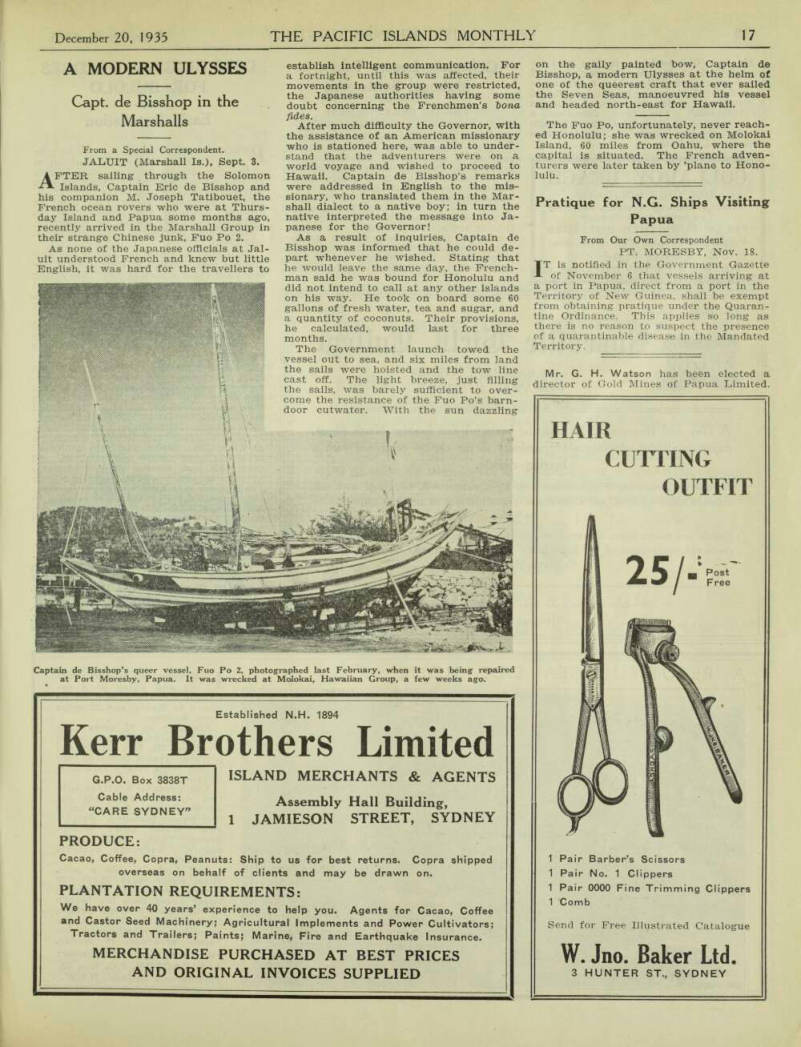
Capt. de Bisshop in the Marshalls
From a Special Correspondent.
JALUIT (Marshall Is.), Sept. 3.
AFTER sailing through the Solomon Islands, Captain Eric de Bisshop and his companion M. Joseph Tatibouet, the French ocean rovers who were at Thurs day Island and Papua some months ago, recently arrived in the Marshall Group in their strange Chinese junk, Fuo Po 2.
As none of the Japanese officials at Jal uit understood French and knew but little English, it was hard for the travellers to
establish intelligent communication. For a fortnight, until this was affected, their movements in the group were restricted, the Japanese authorities having some doubt concerning the Frenchmen’s &ona fides.
After much difficulty the Governor, with the assistance of an American missionary who is stationed here, was able to under stand that the adventurers were on a world voyage and wished to proceed to Hawaii. Captain de Bisshop’s remarks were addressed in English to the mis sionary, who translated them in the Mar shall dialect to a native boy; in turn the native interpreted the message into Ja panese for the Governor!
As a result of inquiries, Captain de Bisshop was informed that he could de part whenever he wished. Stating that he would leave the same day, the French man said he was bound for Honolulu and did not intend to call at any other islands on his way. He took on board some 60 gallons of fresh water, tea and sugar, and a quantity of coconuts. Their provisions, he calculated, would last for three months.
The Government launch towed the vessel out to sea, and six miles from land the sails were hoisted and the tow line cast off. The light breeze, just filling the sails, was barely sufficient to over come the resistance of the Fuo Po’s barn door cutwater. With the sun dazzling
on the gaily painted bow. Captain de Bisshop, a modern Ulysses at the helm of one of the queerest craft that ever sailed the Seven Seas, manoeuvred his vessel and headed north-east for Hawaii.
The Fuo Po, unfortunately, never reach ed Honolulu; she was wrecked on Molokai Island, 60 miles from Oahu, where the capital is situated. The French adven turers were later taken by 'plane to Hono lulu.
Captain de Bisshop’s queer vessel, Fuo Po 2, photographed last February, when it was being repaired at Port Moresby, Papua. It was wrecked at Molokai, Hawaiian Group, a few weeks ago.
Pratique for N.G. Ships Visiting
Papua
From Our Own Correspondent
Pt. Moresby, Nov. 18.
IT is notified in the Government Gazette of November 6 that vessels arriving at a port in Papua, direct from a port in the Territory of New Guinea, shall be exempt from obtaining pratique under the Quaran tine Ordinance. This applies so long as there is no reason to suspect the presence of a quarantinable disease in the Mandated Territory.
Mr, G. H. Watson has been elected a director of Gold Mines of Papua Limited.
m. Guy chantepieure is the nom-deplume used by Madame Dussap, wife of the former Consul-General for France in New South Wales, who has just published a new book under the title of “Escales Oceaniennes.” The book describes a journey made by Madame Dussap through the picturesque islands of New Hebrides and New Caledonia.
Advertisements & other items, pp. 19-20 (2 items)
W. Jno. Baker Ltd.
HAIR
CUTTING
OUTFIT
25/ Post Free > 1 Pair Barber’s Scissors 1 Pair No. 1 Clippers 1 Pair 0000 Fine Trimming Clippers 1 Comb Send for Free Illustrated Catalogue
W. Jno. Baker Ltd.
3 HUNTER ST., SYDNEY
COLLAROY BEACH
FOR YOUR HOLIDAYS
Surfing, Golfing, Fishing, Boating Ten miles from Sydney
FULLY FURNISHED COTTAGES
Properties for sale. For particulars: Cedric Field P.O. Box 2, Collaroy Beach, N.S..W.
Labor Omnia Vincit
&tß?tnUp (&xxl (Unlike
29 BANCROFT AVENUE.
ROSEVILLE, N. SYDNEY
A Day and Boarding School on the beautiful and healthy North Shore, enjoying all the advantages of proximity to the capital combined with a
bracing climate.
A new residence for boarders has just been completed, equipped with all modern conveniences, and allowing a larger number of resident pupils to be enrolled.
Pupils are taken from the earliest ages to leaving stage, and are under the personal supervision of the Principal. Arrangements may be made for the holidays, if wished.
Prospectus may be obtained upon application.
Princioal. MISS I. DAVIES, 8.A., Dip. Ed.
A BEAUTIFUL SEA SIDE HOME...
FOR those desirous of retiring and living in a delightful climate, 20 minutes by motor to Manly and 22 miles from Sydney.
Standing in U acres (approx.) ground. Absolute beach frontage, 156 ft. Select and private. House contains four rooms, large return verandah.
Garage.
Also gardener’s cottage with two rooms. Well laid out garden, lawns. Council Light and Power installed. Frigidaire. Motor Lawn Mower.
Septic Tank. Good water supply. Buildings concrete and fibro.
Golf Links within a mile.
High water mark about 150 yards. Good beach fishing. A buyer could keep his launch at Pittwater, 2 miles distant, thus obtaining access to the beautiful Hawkesbury River.
Terms arranged, if needed.
Full particulars from owner:
A. J. DADSON, P.O. Box 92,
Haymarket, Sydney, N.S.W.
Kerr Brothers Limited
Established N.H. 1894
ISLAND MERCHANTS & AGENTS
Assembly Hall Building,
1 JAMIESON STREET, SYDNEY
PRODUCE:
Cacao, Coffee, Copra, Peanuts: Ship to us for best returns. Copra shipped overseas on behalf of clients and may be drawn on.
PLANTATION REQUIREMENTS:
We have over 40 years’ experience to help you. Agents for Cacao, Coffee and Castor Seed Machinery; Agricultural Implements and Power Cultivators; Tractors and Trailers; Paints; Marine, Fire and Earthquake Insurance.
MERCHANDISE PURCHASED AT BEST PRICES
AND ORIGINAL INVOICES SUPPLIED
G.P.O. Box 3838 T
Cable Address:
“CARE SYDNEY”
Makogai Settlement
Gilbertese Lepers Taken to Makogai Settlement
From Our Own Correspondent
Suva, Nov. 25.
UNDER charter to the Western Pacific High Commission, Messrs. Morris, Hedstrom’s motor vessel Tui Cakau made a voyage to Tarawa, Gilbert Islands, early in November to bring 48 lepers to the settlement on Makogai Island, Fiji.
She arrived in the group on November 2, and the patients were taken aboard under the charge of a Native Medical Prac titioner and several assistants. On Novem ber 14, the lepers were landed at Makogai where the authorities had all facilities in readiness for their arrival. After being disinfected, the Tui Cakau returned to Suva the same day.
Early Installation
Deep-Digging Dredges
For Bulolo
BULiOLO Gold Dredging Ltd. is to pro ceed immediately with the installation of two deep-digging dredges. Shareholders at the annual meeting in Vancouver in November were informed by Mr. C. A.
Banks, managing director, that with six dredges, including the present four, in operation, earnings should be materially, though not necessarily proportionately, increased.
Mr. Banks said that the first of the new dredges would dredge to 80ft. below water level, and carry a bank of 40ft., thus giving a total digging depth of 120 ft. The second would dig to about 115 ft., and carry a bank of 50ft., making a total possible digging depth of about 165 ft. The cost would be met by the sale of up to 60,000 reserved shares to private purchasers, in small lots at about market price, as funds were required.
These new dredges will recover the gold from the second, or lower, bottom, dis covered under the present dredging area two years ago. The four existing dredges take gold only from the upper level, and cannot reach down to the second bottom.
On the Bulolo River, and about six miles from the upper end of the company’s holdings, Mr. Banks said, an additional area had been tested and acquired, and from this and several small contiguous areas being negotiated for, about 10 million yards of 25 cent gravel might be reason ably expected. For the five months to November 1, 4,748,000 cubic yards had been dredged for a recovery of 54,223 ounces fine gold.
Mr. and Mrs. J. Sutton arrived in Syd ney from Papua by the Montoro on November 7. After serving for many years as Head Gaoler at Port Moresby, Mr. Sutton is on long leave prior to re tiring from the Papuan Public Service.
During his absence from the territory, Mr. D. J. Mahon is relieving at Port Moresby gaol.
“Komet”
The Capture Of The
Letter to the Editor.
HENRY DEXTER’S article on the cap ture of the “Komet,” and his com ments, inspire me to relate a few facts concerning the incident.
For approximately three weeks prior to the capture of this unit of the Kaiser’s Navy in New Guinea waters, we, as crew of the little “Nusa,” then equipped with two guns (one a three-pounder, the other a 12pounder field gun on a ship mounting) had been searching the waterways of the coasts of New Guinea.
The reason for this activity was the fact that “Komet” had a very good radio outfit, and a busy operator.
The late Steve Whiteman, then a busi ness man of Rabaul, at last approached the authorities with an offer of help in this search. And so, on October 8, as stated, this vessel, with Commander (then Lieut.- Commander) Jackson in charge, left Rabaul to continue the search.
The personnel of the party that formed the crew of this vessel included two gun crews, one for the for’ard gun and one for the weapon aft. These, together with the engineers (“Nusa” had steam those days) and the signallers and coxswain, were drawn from the Navy. The balance of the party consisted of 20 soldiers, in charge of Lieut.-Colonel Paton, who also commanded a machine-gun squad, included in the detachment.
On the morning of October 11 this vessel was in the vicinity of the Kombi group of Islands, situated in the centre of the North Coast of New Britain. Steaming slowly along the passage between the mainland and the group, the “Nusa” turned into the mouth of the Linga Linga river. Above the tall trees at the mouth of the river could be seen the twin spires of the “Komet’s” masts.
On the left bank of the river the newly cleared and planted area of the Linga Linga plantation stretched like a mown swathe of lawn and, right opposite the bungalow, the “Komet” lay at anchor.
The “Nusa” ran alongside this vessel’s gangway, and the party immediately boarded her.
Captain Mueller, of the “Komet,” was shaving in his cabin; and his look of astonishment when Commander Jackson asked for the surrender of the vessel, could be appreciated, even on a half-lathered face.
Commander Jackson, now deceased, was a very proud officer, the day he returned to Rabaul with the “Komet,” steaming about two cable-lengths in the rear of his vessel. The Rabaul garrison turned out in force to welcome the vessel as she berthed at the old wharf Jn Simpsonhaven.
The “Komet” was then taken to Aus tralia, and converted into an armed auxiliary cruiser, and returned to Rabaul at the end of 1914. Her return as the “Una” was heralded by a wassail, the like of which has never been repeated in this little town.
There is one irregularity in this story of Dexter’s, and that is that the native crew of the “Nusa” returned with the caps of the native crew of the “Komet.” There were no natives, except six firemen on board the “Nusa,” and these people were below during the proceedings.
It is interesting to learn that Tommy Powles was a member of this crew, and that he is still alive. I wonder if Dexter will tell me where Tommy enlisted—that is, if he knows. The capture of the
“Komet,” as reported in the Government Gazette dated October 15, is correct in every detail.
It may b© of interest to recall that the “Nusa” captured quite a large number of inter-island vessels, including the “Mega long,” “Siar,” the ill-fated “Sumatra,” the schooner “Samoa” (absolutely the finest schooner In these waters) and some smaller fry. Her crew were paid prize-money amounting to about £27 just after hostilities ended.
I am, etc.,
Maski Mike.
Rabaul, N.G.
Miss B. D. Meares, nursing sister on the staff of the Namanula Hospital, New Britain, arrived in Sydney on leave by the Neptuna on November 10.
Mr. I. Railey, an old and well-known resident of Apia, where for many years he had been in business, left Samoa with his family by the Hauraki in November.
He intends to settle down in the North Auckland district of New Zealand, where he has acquired business interests.
Advertisements & other items, p. 21 (1 item)
Travellers' Cheques
to CHI E L - k s ' y l d l n a e r y a ’
Junior Grammar School for Boys, Ideal surroundings. Individual attention. Home atmosphere.
Principal: JOHN CAMERON, M.A., (Trin. Coll., Cambridge) For 10 years one of the Senior Masters at The King’s School, Parramatta.
The Yorkshire Insurance Coy.
LIMITED
Established in York —1824
FIRE ACCIDENT MARINE
Total Assets exceed £15,000,000
Agents and Attorneys throughout the Pacific Islands: SUVA: A. Q. McGowan & Co. PAPUA; SALAMAUA: A. Innes. Port Moresby: E. A. James.
KAVIENG: F. V. Saunders. Samarai: E. J. Morrow.
NEW GUINEA BRANCH: Park St., RABAUL. E. G. MacADAM, Manager.
Travellers' Cheques
FOR WORLD WIDE AND LOCAL USE
The Bank of New South Wales issues Travellers’ Cheques as follows:
IN ENGLISH CURRENCY—
For visitors to Great Britain, Europe, America, Asia, etc.
IN AUSTRALIAN CURRENCY—
For travellers within Australia, New Zealand, Fiji, New Guinea and Papua.
IN NEW ZEALAND CURRENCY—
For visitors to the Dominion of New Zealand.
Bank of New South Wales Travellers’ Cheques are especially convenient, as they are accepted by the principal shipping and railway companies, hotels, stores, tourist bureaux, etc., throughout the world.
Bank of New South Wales Travellers’ Cheques can be cashed at any of the Bank’s 747 branches in Australia, New Zealand, the Pacific Islands and London, and at its 7,500 agents and correspondents throughout the world.
Travellers’ Cheques are obtainable through any branch of the Bank
BANK OF NEW SOUTH WALES
(Established 1817) 185A.1935
Rarotonga’S Three
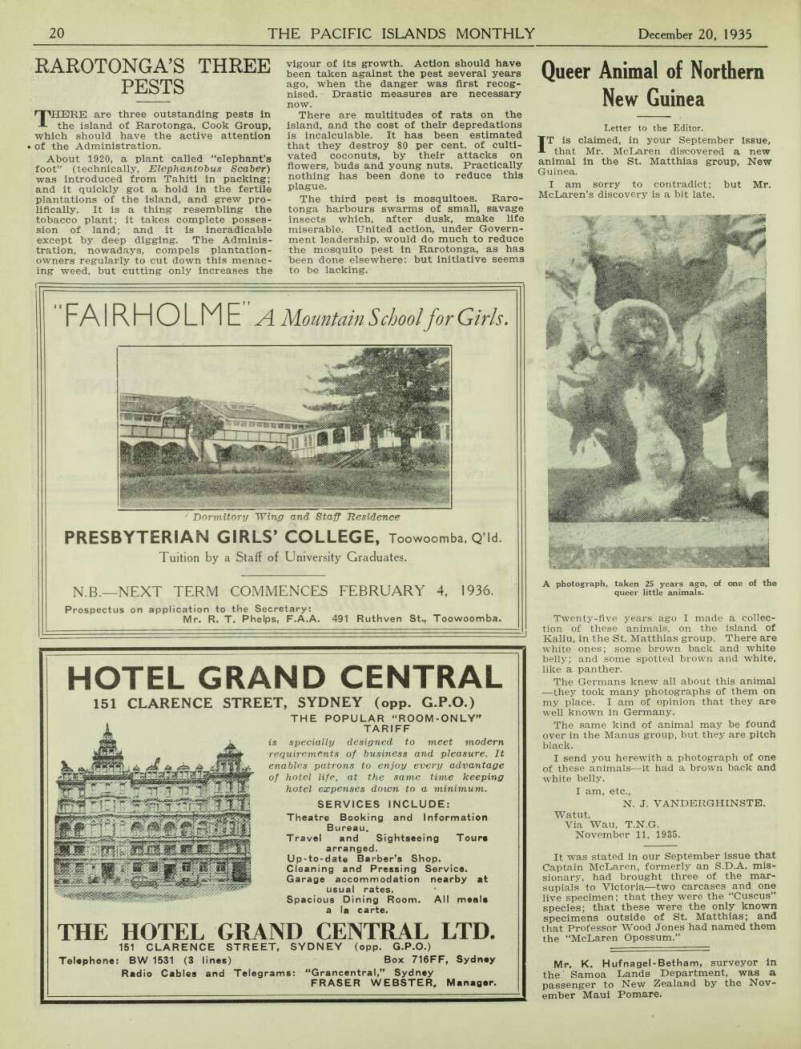
Pests
THERE are three outstanding pests in the island of Rarotonga, Cook Group, which should have the active attention • of the Administration.
About 1920, a plant called “elephant’s foot” (technically, Elephantobus Scaher ) was introduced from Tahiti in packing; and it quickly got a hold in the fertile plantations of the island, and grew prolifically. It is a thing resembling the tobacco plant; it takes complete possession of land; and it is ineradicable except by deep digging. The Administration, nowadays, compels plantationowners regularly to cut down this menacing weed, but cutting only increases the
vigour of its growth. Action should have been taken against the pest several years ago, when the danger was first recog nised. Drastic measures are necessary now.
There are multitudes of rats on the island, and the cost of their depredations is incalculable. It has been estimated that they destroy 80 per cent, of culti vated coconuts, by their attacks on flowers, buds and young nuts. Practically nothing has been done to reduce this plague.
The third pest is mosquitoes. Raro tonga harbours swarms of small, savage insects which, after dusk, make life miserable. United action, under Govern ment leadership, would do much to reduce the mosquito pest in Rarotonga, as has been done elsewhere; but initiative seems to be lacking.
Queer Animal of Northern
New Guinea
Letter to the Editor.
IT is claimed, in your September issue, that Mr. McLaren discovered a new animal in the St. Matthias group, New Guinea.
I am sorry to contradict; but Mr.
McLaren’s discovery is a bit late.
Twenty-five years ago I made a collec tion of these animals, on the island of Kaliu, in the St. Matthias group. There are white ones; some brown back and white belly; and some spotted brown and white, like a panther.
The Germans knew all about this animal —they took many photographs of them on my place. I am of opinion that they are well known in Germany.
The same kind of animal may be found over in the Manus group, but they are pitch black.
I send you herewith a photograph of one of these animals —it had a brown back and white belly.
I am, etc.,
N. J. Vanderghinste.
Watut, Via Wau, T.N.G.
November 11, 1935.
It was stated in our September issue that Captain McLaren, formerly an S.D.A. mis sionary, had brought three of the mar supials to Victoria —two carcases and one live specimen; that they were the “Cuscus” species; that these were the only known specimens outside of St. Matthias; and that Professor Wood Jones had named them the “McLaren Opossum.”
Mr. K. Hufnagel-Betham, surveyor in the Samoa Lands Department, was a passenger to New Zealand by the Nov ember Maui Pomare.
A photograph, taken 25 years ago, of one of the queer little animals.
Advertisements & other items, pp. 22-24 (2 items)
Hotel Grand Central
“FAIRHOLME” A Mountain School for Girls.
mmmm i ' Dormitory Wing and Staff Residence
PRESBYTERIAN GIRLS’ COLLEGE, Toowoomba, Q’ld.
Tuition by a Staff of University Graduates.
N.B.—NEXT TERM COMMENCES FEBRUARY 4, 1936.
Prospectus on application to the Secretary: Mr. R. T. Phelps, F.A.A. 491 Ruthven St., Toowoomba.
HOTEL GRAND CENTRAL
151 CLARENCE STREET, SYDNEY (opp. G.P.0.)
k m ■m Wm
THE POPULAR “ROOM-ONLY"
TARIFF
is specially designed to meet modern requirements of business and pleasure. It enables patrons to enjoy every advantage of hotel life, at the same time keeping hotel expenses down to a minimum.
SERVICES INCLUDE:
Theatre Booking and Information Bureau.
Travel and Sightseeing Toure arranged.
Up-to-date Barber’s Shop.
Cleaning and Pressing Service.
Garage accommodation nearby at usual rates.
Spacious Dining Room. All meals a la carte.
THE HOTEL GRAND CENTRAL LTD.
151 CLARENCE STREET, SYDNEY (opp. G.P.0.)
Telephone: BW 1531 (3 lines) Box 716 FF, Sydney Radio Cables and Telegrams: “Grancentral," Sydney
FRASER WEBSTER, Manager.
Stromlierg- Carlson
C^Tt'notiT^cl'ng
The Sensational NEW Range of
World-Wide Raro,uol * c
Receivers
The Finest Radios Yet Rnilt for City and Country Now ... for the first time in Radio History ...
GUARANTEED short-wave reception on a Dual-wave receiver! Clear, undistorted, RELIABLE entertainment in your own home . . from all parts of the world. In their new Dualwave models Stromberg-Carlson engineers have achieved the ultimate in tonal perfection, performance and cabinet beauty.
The imposing Console cabinet stands 35 inches high, 35 inches wide, and is 88% HEAVIER than the ordinary cabinet— truly a magnificent “outsize” receiver.
In choosing a Stromberg-Carlson Dual-wave Receiver, you can be SURE of perfect reception . . . . genuine entertainment ... from all over the world.
Model 736. Here is a 7-valve Dual-wave Superheterodyne which has proved itself the foremost Dual-wave model on the radio market today. It incorporates every worthwhile modern device for the perfection of tone and reception. Designed to operate on 110 or 240 volts alternating current, it is the finest all-electric Dual-wave receiver ever offered for as low as 39 guineas.
Model 836 is an 8-valve Dual-wave Superheterodyne. Operating with equal efficiency on either Alternating or Direct Current (200-260 v.), this Receiver is easily the best of its kind available REGARDLESS of price. Here are some of the marvellous features that put this receiver in a value-class of its own.
Wide range reproduction from a whisper to concert hall volume.
Tone compensation. • Specially designed speaker. • Tone control. • Selectorlite dial revolutionises tuning. • New nonmicrophonic condenser. • Full automatic Volume Control. • In the new and strikingly designed cabinet ... 43 guineas.
Model 888—a battery operated Dual-wave receiver that brings in the foreign programmes on the same dial as local broadcasts. It features 8-valves (2 volt valves throughout) Automatic Volume Control New Selectorlite Dial special shelf to house all batteries—fuse lamp to protect filaments against faulty battery connection—extremely low battery consumption and many other features which make it the equal of the finest allelectric sets. Price 45 guineas Write to-day for the fullest details of these “miracle” receivers, specifying voltage of currents available.
Prices F. 0.6. Sydney * — STROMBERG CARLSON (A/SIA) LTD., 72 William Street, Sydney.
Get your
iaan copy
of the
NEW TRUFOOD
RECIPE BOOK
69 specially tested recipes—all kinds of new ideas for attractive things to cook cakes, pastry, puddings, custards, desserts, savouries, sauces, etc.
Recipe Department” c/- Box 4267 Y. G.P.O.
Sydney Please send me POST FREE, a copy of The Trufood Boo* of 69 Tempting Recipes Name
(BLOCK LETTERSJ
Address 3U.74.34
I
LAMP - COLEMAN - LANTERN
TWO I N ONE
Coleman Duo-Lite is both Lamp & Lantern It is just the finest Room or Reading Lamp, giving splendid Brilliance—yet soft to the eyes.
Lifted from the Base with Shade off it is just the handiest, safest and most radiant night chaser imaginable.
No Gale can affect it—No Insect can penetrate.
For Island Use this Great Little Job is unbeatable—lt Burns Kerosene Benzine.
Ask your Island Storekeeper for Catalogue or Demonstration.
COLEMAN LAMP & STOVE CO. LTD.
Toronto, Canada. 500 Kent Street, Sydney.
OOD TEA benefits the health. Science has proved this. As KINKARA is a GOOD Tea, it should be used always ... Morning... N00n... Night. KINKARA, the Health Tea, calms the nerves; restores energy and banishes mental stress.
KINKARA Tea is no dearer than ordinary brands.
KIMAIgA
J. R. Love & Co., Ltd., Sydney.
Big Developments In Dutch New Guinea
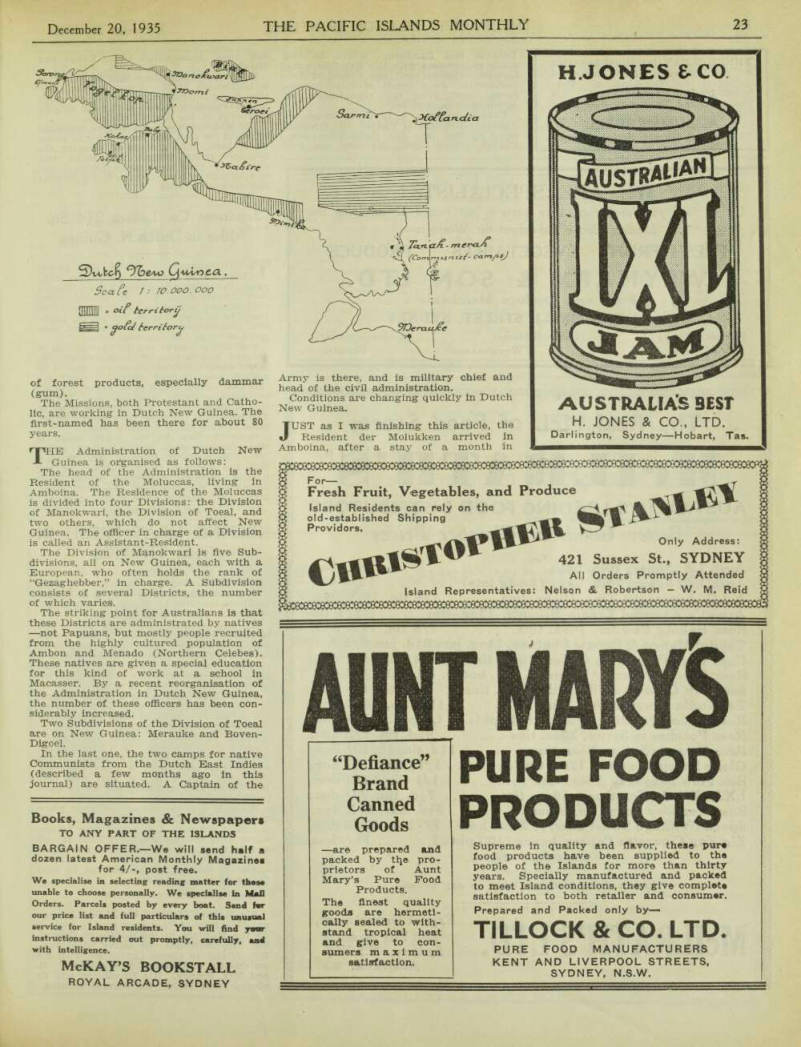
Oil Companies—Aerial Survey—Geological Exploration— Extensive Gold Search—Cotton Plantations
Specially written for the “Pacific Islands Monthly" by S. van Oosten, officer of the Dutch East Indies Civil Service
Amboina (D.E.1.), Nov. 8.
IF a planter takes up a big area of land to make a plantation, he starts by bring ing a part of it into production. That this would not be the poorest land seems to be obvious —he uses the best or most accessible land, first. The same thing can be applied to nations which have to develop colonies.
The only part of the Dutch colonies not yet opened up is Dutch New Guinea; and, observing the way we are starting here, this “not yet,” I am glad to say, can be cut out very soon. This is due, first, to the oil company, called the Netherlands New Guinea Oil Company (which is a combina tion of the Bataafsche Petroleum Cos., the Colonial Oil Cos., and the Pacific Oil Cos.) which already has started operations on an enormous scale..
The Oil Company has taken up an area of 10 millions h.a. (about 25 millions acres) in the N.W., S.W., and N.E. parts of Dutch New Guinea, with its centre at Babo (Wes tern New Guinea).
THE Oil Company has ordered an air survey to be made of this area by the Royal Dutch East Indian Airways (K.N.1.L.M.), which will occupy at least years, and for which purpose three De Havilland Rapide Dragons recently flew over from Europe to Babo, where a large aerodrome has been constructed. Another aerodrome, at the island of Efman, near Sorong, is nearly ready. A third one is being laid out at Seroei (on the island of Jappen). The laying out of a fourth one will soon start at Mimika (Southern New Guinea).
The flying and mechanical staff consists of about 25 men, under a flight-captain of the Dutch army.
IN the meantime, a party of 10 geologists is exploring the country.
Babo, now, is a small European settle ment.
For unskilled labour, the Oil Company has engaged hundreds of Papuans (natives of Dutch New Guinea). The skilled labour is being done by the imported, more civi lised people of other parts of the Dutch East Indies (Borneo, the Kei Islands, etc.).
The wages of the Papuans are about £1 a month, excluding food. What this means for a society as primitive as that of the Papuans, needs no explanation.
ANOTHER big industry will soon start business in Dutch New Guinea — namely, the gold-mining. An area of about 3| millions h.a. (8,000,000 acres) will be granted to a combination of three com panies: the Billiton Cos. Ltd. (Dutch), the firm of Messrs. Erdmann and Sielcken (Dutch) and the Oroville Gold Dredgingr Cos. Ltd. (British) —the last one providing 49 per cent, of the capital. This area is partly situated in the Vogelkop (i.e., Birds head, the N.W. part of New Guinea), and partly in the Subdivision Merauke, where it is linked up with the area in Papua (Fly River) now being explored by the Orovillo people.
A THIRD company now working in Dutch New Guinea is the Japanese “Nanyo Kohatsu Kaisha” (South Sea Development Cos.). It has a rather un important area in Manokwari, but a far more important cotton plantation at Momi, and dammar (gum) concessions near Nabire (Northern New Guinea).
Though the cotton-plantation is still in the experimental stage, the Japanese have applied for other areas at Momi and Sarmi, altogether 5,500 h.a., for cotton growing.
The granting of these areas is still under consideration and will at all events be subject to the acceptance of some im portant conditions.
THEN there are, near Manokwari, about 250 and near Hollandia (Humbolds Bay) about 100 Eurasian “colonists,” trying to make a living out of farming on a small scale. It is, however, in too early a stage to give any definite opinion about it.
At Manokwari there is a government sawmill, and another at Kokas; both are sawing ironwood.
We have just received word from Batavia that several big Dutch East Indian com panies (connected with the K.P.M.) are creating a Dutch New Guinea Trading Cos., which will applv for enormous areas in N. and W. New Guinea fcr the exploitation
of forest products, especially dammar (sum).
The Missions, both Protestant and Catho lic, are working in Dutch New Guinea. The first-named has been there for about 80 years. fTTHE Administration of Dutch New A Guinea is organised as follows: The head of the Administration is the Resident of the Moluccas, living in Amboina. The Residence of the Moluccas is divided into four Divisions: the Division of Manokwari, the Division of Toeal, and two others, which do not affect New Guinea. The officer in charge of a Division is called an Assistant-Resident.
The Division of Manokwari is five Sub divisions, all on New Guinea, each with a European, who often holds the rank of “Gezaghebber,” in charge. A Subdivision consists of several Districts, the number of which varies.
The striking point for Australians is that these Districts are administrated by natives —not Papuans, but mostly people recruited from the highly cultured population of Ambon and Menado (Northern Celebes).
These natives are given a special education for this kind of work at a school in Macasser. By a recent reorganisation of the Administration in Dutch New Guinea, the number of these officers has been con siderably increased.
Two Subdivisions of the Division of Toeal are on New Guinea: Merauke and Boven- Digoel, In the last one, the two camps for native Communists from the Dutch East Indies (described a few months ago in this journal) are situated. A Captain of the
Army is there, and is military chief and head of the civil administration.
Conditions are changing quickly in Dutch New Guinea.
JUST as I was finishing this article, the Resident der Molukken arrived in Amboina, after a stay of a month in
Batavia and Bandoeng, where he had many conferences with His Excellency the Governor-General and the Chiefs of De partments. As a result of these confer ences, next year the organisation of Administration will be: Fakfak becomes a Division, under an Assistant-Resident at Fakfak, the Division being divided into five Subdivisions —i.e., Fakfak, Boven-Digoel, Merauke and two
new ones; Inanawatan (near Babo) and Mimika.
East, of Mimika, there will be stationed a Lieutenant of the Army, at the same time doing Administration work; the same in the Vogelkop, where a Captain will be in charge of the new Subdivision.
The number of soldiers will be increased by about 160 men, and the number of police by 60 men. The process of bringing the country under control will make this necessary. Four more medical officers will be stationed on New Guinea; also a forester and an agriculturist.
Advertisements & other items, pp. 25-26 (1 item)
Products
H.JONES &C 0
s*aM
AUSTRALIA’S BEST
H. JONES & CO., LTD.
Darlington, Sydney—Hobart, Tas.
Foi Fresh Fruit, Vegetables, and Produce Island Residents can rely on the old-established Shipping Providers.
v w» w
>o' Island Representatives; Only Address: 421 Sussex St., SYDNEY All Orders Promptly Attended Nelson & Robertson W. M. Reid
“Defiance”
Brand
Canned
Goods
—ar© prepared and packed by tlj© proprietors of Aunt Mary’s Pur© Food Products.
The finest quality goods are hermetically sealed to withstand tropical heat and give to consumers maximum satisfaction.
PURE FOOD
PRODUCTS
Supreme in quality and flavor, these pure food products have been supplied to the people of the Islands for more than thirty years. Specially manufactured and packed to meet Island conditions, they give complete satisfaction to both retailer and consumer.
Prepared and Packed only by—
TILLOCK & CO. LTD.
PURE FOOD MANUFACTURERS
KENT AND LIVERPOOL STREETS,
SYDNEY, N.S.W.
Books, Magazines & Newspapers
TO ANY PART OF THE ISLANDS
BARGAIN OFFER.—We will send half a dozen latest American Monthly Magazines for 4/post free.
We specialise in selecting reading matter for these unable to choose personally. We specialise in Mall Orders. Parcels posted by every boat. Send fer our price list and full particulars of this unusual service for Island residents. You will find year instructions carried out promptly, carefully, and with intelligence.
McKAY’S BOOKSTALL
ROYAL ARCADE, SYDNEY
INNERCLEAN Intestinal Laxative.
An Aromatic Herb compound Adjuvant for Constipation. Perfected by Prof. Arnold Ehret. 3/6 packet. Send Twopenny Stamp for sample.
A. SUMMERBELL
“Wyoming,” Hunter Street, Sydney
WE ARE SPECIALISTS!
Let us have your confidence, sixty years is our record of supplying the Leading Houses throughout the World in—
FRESH FRUIT VEGETABLES PRODUCE
WEYMARK & SON LTD.
Fruit and Produce Merchants
14-18 STEAMMILL STREET, SYDNEY
Phones: MA 3612 Cable Address: Codes—Bentleys. (4 lines) "Weymarkson” Private.
Tha Real Mcl. of Food Stores
HcILRATH
AUSTRALIA’S LEADING FOOD DISTRIBUTORS
Better Goods at Cheaper Prices
Aust. I.A. Sugar, 701 b. bags 14/- bag Aust. I.A. Sugar, 701 b. bags (3-bag lots) 13/6 bag A.J.C. Asparagus Tips, tins 1/4 tin, 15/6 doz.
Arnott’s Assorted Cream Biscuits, 13oz. tins 1/7 tin Rosa Baking Powder, 16oz. tins . 1/6 tin, 17/- doz.
Capital Mango & Papaw Chutney, lloz. jars B£d. jar, 8/3 doz.
Rosa Pure Plantation Coffee, 16oz. tins . . 2/4 tin, 26/6 doz.
Rosa Pure Flavouring Essences, loz. bots. . Bd. bot., 7/6 doz.
Snowcap Canadian Pilchards, 16oz. tins . 8-Jd. tin, 8/- doz.
Zealandia Crayfish, Boz. tins lid. tin, 10/6 doz.
Rosa Mixed Pudding Fruits, 16oz. pkts. . 1/- pkt., 11/6 doz.
Rosa Peaches in Syrup, 30oz. tins 94d. tin, 9/3 doz.
Rosa Pears in Syrup, 30oz. tins lid. tin, 10/104 doz.
Globe Sheep Tongues, 12oz. tins 1/14 tin, 13/- doz.
Rex Pork Sausages, 16oz. tins 1/1 tin, 12/6 doz.
I.X.L. Whole Tomatoes, 16oz. tins 74d. tin, 7/- doz.
Rosa Laundry Soap, large bars 82d. bar, 8/3 doz.
Special Vintage Sweet Sherry, 260 z. bots . 2/- bot., 23/6 doz.
Zig Zag Cigarette Papers, boxes (100 pkts.) 11/- box Prices F. 0.8. Sydney.
Export Price Lists available on application.
McILRATH’S LTD.
Export Department, 202 Pitt Street, Sydney, N.S.W., Australia.
Japanese Co. Leases 214 Sq.
Miles in Dutch N. Guinea
THE Government of Dutch East Indies has granted a lease to a Japanese com pany, the Nanyo Kohatsu Kaisha (South Seas Development Co.) of 137,000 acres (214 square miles) of land at Geelvink Bay, Dutch New Guinea, for cotton grow ing, The concession is for five years, one tenth of what the Japanese asked.
Founded primarily for the exploitation of natural and industrial resources in the South Seas, the company—capitalised at 20 million yen (approx. £1,000,000) —has for the past three years been experimenting in cotton growing, and has now decided that it should start on a commercial basis.
The company intends to produce 20,000 bales of long staple cotton a year.
Geelvink Bay, on the north coast, is three degrees south of the equator, about 700 miles north of Darwin. This is only half the distance from Australia of the nearest Japanese enterprise, which is at Davao, in the south of the Philippines, about eight degrees north of the equator.
Keeping Meat Fresh In
The Tropics
A USEFUL hint for keeping meat fresh on outstations where there is no freezer has been supplied by Mr. T. K. Colquhoun, of Manus, New Guinea.
By this method, he writes, steak and sausages may be kept up to five weeks, but chops or other meat with bones should be used within a fortnight. First obtain a sufficient number of good clean 30oz. fruit tins. After the meat has thawed drain off all the blood and cook as usual.
Place three-quarters to a pound of meat in each tin and pour over sufficient very hot fat to cover it by at least an inch. The fat should be nearly boiling.
I find that suet is better and usually cheaper than dripping. It is put through a mincer, then boiled and strained. When poured over the meat it seals perfectly.
Place the tins in a cool spot well pro tected from ants, and the meat will be quite fresh when required.
When it is desired to use the meat, place the tin on the stove till the fat melts; lift the meat out with a fork and pour boiling water over it —this washes all the fat off and makes it hot and ready for immediate consumption. The fat may be utilized again for cooking, but should not be used for covering other meat.
Sir Hubert Murray, K.C.M.G., Lieuten ant-Governor of Papua, arrived in Sydney by the Montoro in the middle of Decem ber. He intended to leave for Nor folk Island to spend Christmas with his son-in-law and daughter, Captain C. R. and Mrs. Pinney. His Excellency will be absent from Papua for several months.
“Vailala Madness”
Wave of Religious Fanaticism That Swept Papua in 1919
By Mollie Lett
REFERENCE in the October number of the Pacific Islands Monthly to an out break of religious fanaticism in New Guinea among the natives of Buka and Bougainville, recalls the extraordinary wave of fanaticism which swept through the Gulf of Papua in 1919, causing intense excitement among the natives of the dis trict and alarm to some Europeans.
At the time it was generally known as “Vailala Madness” or “Orokolo Kava Kava (madness)” and the symptoms were described in pidgin English as “head ’e go round” on account of the dizziness experi enced by the natives while in the trance, which was a feature of the excitement.
In some respects it will be seen that the two disturbances are similar as they pre sent features in common.
Towards the end of 1919 the idea spread, from some unknown source, among the natives of Arihavu, near Orokolo, in the Papuan Gulf, that their ancestors’ spirits were to return shortly as white men in a large vessel containing quantities of food.
On their arrival, it was believed, they would sweep the settlers into the bush and leave the natives undisturbed to enjoy not only the good things to come, but the fruits of the white men’s labour.
The idea was entertaining and it spread.
Great preparations were made for the visi tors’ reception—painted flagpoles and buildings of improved design and construc tion were erected in the village compounds.
Large tables, surrounded with seats, were set up and decorated with flowers in glass bottles.
The natives’ enthusiasm grew with their efforts and a constant “lookout” was kept for the expected vessel, all the chief men of the village wearing their best clothes in anticipation. The excitement spread like wildfire along the coast to the east and to the inland villages behind, and reached such proportions that it well earned its name of “madness.” As the fantastic ideas spread they were merged into half digested beliefs from the Bible. Some natives from the large village of Vailala, destroyed their ancestral charms, and induced others to do likewise. Carrying Bibles in their hands they asserted that Christ had come down and spoken to them, which had made their heads dizzy.
As weeks passed without any appearance of the vessel they became impatient and erected wireless masts, to get into com munication with God to find the cause of the delay, and daily they sent messages that all was in readiness. So fully con vinced were they in their beliefs that they were deaf to both ridicule and reason. It became an obsession; village routine was disturbed and all regular work ceased.
Trading remained at a standstill, all the village coconuts being stacked in high piles in the compounds.
But this bonfire of frenzy could not last long; it needed more fuel than the natives’ excited imagination could supply. After four or five months it had practically died down, though occasional sporadic outbursts occurred in isolated villages.
During the wave of excitement, the Magistrate of the division visited villages most seriously affected, and the worst cases were taken to the station at Kerema.
There they were put to work and fed until they returned to a normal state of mind.
In this manner some check was kept on the hysteria.
For a short period after the disturbance the “ancestors’ house,” with its tables and chairs, stood neglected in the village com pounds and caused a little embarrassment.
Any amused criticism as to their use was met with looks of cold disapproval. But the memory was short lived and soon the buildings and tables merged into the life of the village and became useful as dwell ings and firewood.
Twelve months later nothing remained to remind one of the fantastic affair.
Lavongai Leper Colony
From Our Own Correspondent WAU, Nov. 3.
THE Taskul Observation Colony for lepers on Lavongai (New Hanover), the large mountainous and well-watered island lying 20 miles N.W. of New Ireland, is to house quiescent cases from Anelaua, which is adjacent to the Colony.
It is hoped that in time the leper colony will become self-supporting. The cultiva tion of land, and the housing, etc., are to be worked on a community basis. Surplus foods and materials will be sold for the benefit of the whole colony.
Advertisements & other items, pp. 27-28 (1 item)
Just what you have
WILLIAM FINAL
Photographer
FRIENDLY IS., OCEANIA
Silent Filming, 35 mm., or 16 mm., to order. Interesting views and natives’ life scenes, 5/3 prepaid anywhere.
, V Of Kodak Dealers throughout the Islands, and
Kodak [Australasia] Pty. Ltd.
379 GEORGE STREET, SYDNEY
AND ALL STATES
Just what you have
been waiting for!...
All the fascinating advantages of work on 36 exposure 35 mm. film—without -expense or complication—for the small investment of £lO/10/- • That fine instrument you’ve always wanted but could not previously afford. • Easy to use—easy to load—nothing new to learn. • Light in weight—a delight to operate. • Low in price, yet unsurpassed in performance. • With f/3.5 Xenar Lens and Speed Compur Shutter (1 sec. to 1/500). Price, £lO/10/-.
POST COUPON FOR FOLDER
I ' 1 Please forward special Retina Literature to I I
I NAME I
I I
: ADDRESS :
Why Suffer
with
Pains
in the
Back?
Every Picture is
*‘T£EEP THE KIDNEYS WELL
and they will keep you well.”
This golden rule has saved much needless suffering with urinary disorders, getting up at night, backache, dizzy attacks, rheumatism, sciatica, lumbago and renal dropsy. These troubles arise from impurities which healthy kidneys would filter away to be expelled with the urine.
Self-poisoning begins when the kidneys become overstrained. Thai is why it is essential to strengthen the weakened kidneys with Doan’s Back ache Kidney Pills immediately. Thou sands of grateful users testify to the success of Doan’s Pills in flushing the kidneys and so removing the poisons which so quickly upset the system.
Be sure to insist upon
Doan's
Backache Kidney
Pills
HOUSE-HOLD WORDS Throughout the SOUTHERN HEMISPHERE . .
Forster’s “OLYMPIC” Bedsteads
Illustrated is one of many strong and suitable bedsteads we manufacture for the Islands.
Obtainable also in four post designs and in any colour.
Gold shaded colourings produce a very pleasing effect.
Established in 1859 and still the leading manufacturers of high grade metallic and wooden bedsteads —hospital furniture steel office furniture and shelving refrigerator cabinets —ice chests —general furniture in metal or wood— porcelain enamelling, etc., is the record of
FORSTER’S BEDSTEADS LTD
MARY ANN STREET, ULTIMO, SYDNEY, AUSTRALIA.
Cables: Bedsteads, Sydney. Codes: Bentley’s and Private.
New Currency
Perforated Coins Introduced in New Guinea
■\rEW GUINEA’S new currency became -Ll legal tender on Monday, December 2.
English and Australian shillings, sixpences, threepences and pennies remain legal tender; but they will not be circulated.
They will, it is presumed, be taken in by the banks whenever possible, and the new coins issued in their place.
The new coins, which have been issued generally, are: One shilling, silver alloy, perforated.
Sixpence, cupro-nickel, perforated.
Threepence, cupro-nickel, perforated.
Penny, bronze, perforated.
Bank notes will circulate in the Territory in the same way as formerly. There seems to be some doubt about florins. The new coinage does not include the handy two shilling piece, so presumably the Australian florin will circulate as heretofore.
The idea behind the innovation is good; but the natives never could be induced to use Anglo-Australian sixpences, three pences and pennies, and it remains to be seen whether they will accept them now, when they can thread them on a string and hang them around their necks.
Hitherto, most native exchange has been carried out with shillings (called “marks” —a survival of the German time) and sticks of trade tobacco, which have a cur rency value of a fraction of a penny.
The effect of this has not been in favour of the native. He buys very many things which are priced at less than one shilling, although he has only shillings to spend: and the Administration says that often, in the “change” adjustment, the native has been unfairly treated. The introduction of the smaller coins is designed to assist and protect the native: but a great deal of persuasion and patience, and perhaps some force, will be needed to induce the more remote tribes to accept and use the new currency.
The primitive natives do not require much money. But all must pay to the government the head-tax of 10/- per
annum; and, in order to get this, they will work and trade, and painfully accumulate the necessary number of “marks.” No one will envy the district officers and tax gatherers their task of introducing and ex plaining the new currency.
Recruiters —those who go out among the primitive tribes and induce the men, by gifts and promises of money and foods to sign on as labourers —will meet many diffi culties. It is not easy at the best of times to tempt natives into labour contracts with “marks,” which they understand and desire.
How, then, are they going to fare when they offer the new, perforated coins to those suspicious Stone-Age gentlemen?
The Administration has bought this coinage at very much less than its face value; and, issuing it at the same price as the money it is withdrawing from circula tion, it will make a substantial profit. One estimate shows a profit of £2OOO per annum.
Probably, it will be much more than that, as the Administration will get the benefit of all the coin that is lost, hoarded and otherwise withdrawn from circulation.
“The Hurricane”

Messrs. Nordhoff and Hall's New Volume of the Tuamotus
THE well-known American novelists, Messrs. Charles B. Nordhoff and James Norman Hall, who have been settled in French Oceania for some years, have sold the serial rights of their new book to the New York Saturday Evening Post. The writers have also disposed of the movie rights for “Pitcairn’s Island,” the.last book of their famous “Bounty” trilogy.
“The Hurricane” is the title of the new book. “It has proved the hardest job either Hall or I ever tackled,” said Mr. Nordhoff.
“We re-wrote it completely from beginning to end three times before we could get a draft that seemed any good at all. It took us eight months to arrive at 80,000 words for the final draft —surely a world’s record for two menl”
The scene of the story is the Tuamotu Archipelago or the so-called “Atolls of the Sun.” It deals with native life, and has only three white characters in it. The tremendous work which Messrs.
Nordhoff and Hall put into their books once again proves the old adage that hard writing makes easy reading. The clarity of style in the work of these two most interesting literary partners cf the Pacific has always been a feature of their books.
Mr. Nordhoff, who was in Sydney last year, expected to leave for the United States on December 3, but owing to the illness of one of his daughters his plans were upset.
Mr. A. H. Bunting, M.L.C., of Samarai, Papua, arrived in Australia on business by the Macdhui at the end of November.
Advertisements & other items, pp. 28-30 (1 item)
L. L. Bell, F Lo. (Syd.)
OPTICIAN
WINGELLO HOUSE.
ANGEL PLACE SYDNEY
Prescriptions for Glasses made up and Despatched by Return Mail.
New Lenses or Frames supplied on receipt of the broken parts.
The best Goggles for Aviators, Motorists, Welders and Mechanics.
“Cash on Delivery Post”: Sydney Prices
moo
tL
AS A BIRD
the car
that runs on
SHELL
OIL
Today's more efficient engines make possible hour after hour of high speed, but more than ever it is necessary to have an Oil that will retain its lubricating qualities under the hottest conditions.
Shell Motor Oil has been developed to meet these conditions, to smooth motor travel into the glide of a bird. Made from crudes that produce oil of the richest lubricating qualities . . . refined by processes developed by the world-wide Shell research laboratories ... it Is the perfect oil for to-day's conditions.
CUNN e MOORE
' for all Sports Goods
1 ■ . /V JWnle far interesting free Catalogues y'
/U .[to CUNN b MOORE LTD
CARRINGTON St.
2.., NOTTINGHAM ENG.
CHI VERS
I* IT It E
FOODS
GOLD MEDAL JAMS
CANNED ENGLISH FRUITS
CANNED ENGLISH
VEGETABLES
CUSTARD POWDER
OLD ENGLISH MARMALADE
JELLY CRYSTALS, ETC.
Obtainable from all Leading Grocery Stores -- Write to Department A., Chivers and Sons Ltd., Histon, Cambridge, England, for attractive Recipe Book E. 76 cv^ mi & & EAT in moderation. Take daily exercise in the open air. Do not worry. Go to bed at a reasonable hour. Correct-or prevent the little ills by taking a sparkling glass of Andrews.
Follow these simple rules and you will enjoy mental and physical well-being. In particular, remember, that incomplete elimination is the cause of many everyday ills and discomforts. Prompt correction is supplied by Andrews Liver Salt, which gently restores the natural healthy physical rhythm, and is at the same c time a pleasant, cooling, health giving drink. 443
ANDREWS
LIVER SALT
SCOTT & TURNER, LTD.
NEWCASTLE UPON TYNE, ENGLAND.
ifir l I
Rabaul's Chinatown
From Our Own Correspondent WAU, Nov. 1.
RABAUL’ S Chinatown is to be altered.
All leases held of allotments in the Asiatic Settlement on New Britain expired on June 30 last. Previously a survey of the settlement was made and a report sub mitted to the authorities.
As a result changes are to be made and the tenure of leaseholds will be increased from 10 years to periods not exceeding 30 years.
British Expert’s Opinion
Papuan Sugar
From Our Own Correspondent
Pt. Moresby, Nov. 12.
HAVING recently visited Papua to in spect Sangara Sugar Co.’s property outside Buna, in the Northern Division, Mr. Moody Stewart, a British sugar expert, spoke in glowing terms of the Territory’s sugar prospects, on his return to Queens land. “Papua is a wonderful country,” he averred, “and is especially suitable for the growing of sugar cane.”
It is known that the Territory possesses lands ideal for sugar growing, as it is the home of the “Badila” variety, the richest cane known in the world. It is still con fidently hoped that with the ideal condi tions of soil, labour and climate, Papuan sugar planters may yet successfully com pete with world growers.
Sangara Sugar Estates Limited was formed in July, 1931, with a nominal capital of £1,000,000 in 1,000,000 shares of £1 each.
Of this 450,000 shares were offered for sub scription, 50,000 fully paid were issued to vendors, and 500,000 were held in reserve.
The object of the company was to acquire 20,000 acres of approved sugar lands near Buna and to plant sugar on an extensive scale for export to England and Canada.
Unfortunately, sufficient capital was not forthcoming at the time, owing to the general economic depression and the com pany’s enterprise was shelved until better conditions prevailed.
It was a disappointment, for in 1931-32, as at the present time, Great Britain and Canada offered markets for sugar. Papua as a British dominion enjoys the advan tage of a British Empire preference.
Employer’s Raincoat
When A "Thief” Is Not
A Thief
N.G. Native “Borrows” His Employer’s Raincoat
From Our Own Correspondent
Rabaul, Nov. 16.
A CASE recently came before the Dis trict Court at Rabaul where an em ployer, through the Police Department, charged a native servant with the theft of a raincoat. Although the evidence showed that the native took his master’s coat when he left for a week-end visit to his village and also that it was not re covered until a native constable was sent there, the accused was found not guilty and the case was dismissed.
The defence was that as it was raining the servant had without permission “bor rowed” his master’s raincoat and owing to a puncture in his bicycle tyre, was un able to return at the expiry of his week end leave. Defendant stated he had no intention of permanently depriving his employer of the coat.
This raises the question of a fine dis tinction between “borrowing without per mission” and “stealing,” and the line of defence in this case creates a precedent for other servants to adopt under similar circumstances. It may even extend to the “borrowing” of shirts and ties on Sun days for church attendance or similar functions, Mr. Gus Nelsson, nominated member of the Papua Legislative Council, arrived on a visit to Sydney by the Macdhui on November 29.
On Leisurely Cruise To
U.S.A.
Te Rapunga Arrives at Cook Is. from New Zealand
From Our Own Correspondent
Rarotonga, Nov. 3.
ON October 1 the 10 tons ketch Te Rapunga arrived here after a 21 days’ voyage from New Zealand. On board were Captain George Dibbern (owner), Mr. Roy Murdock (navigator), Mr. Maurice Black, M.A., and Miss Eileen Morris, of Napier.
The Te Rapunga (length 32 ft., beam 11 ft., draught sft.) was built about 10 years ago at Kiel, Germany, and made the voyage out to N.Z. via the Panama Canal, her crew then consisting of Capt. Dibbern, his nephew Gunter Schramm, and the Baroness Von Fritch. On the journey from Panama to ’Frisco she set what must be almost a time record for small yachts, taking 101 days between ports.
Leaving Hauraki Gulf for the Pacific on September 11, the Te Rapunga encountered a succession of gales and calms, and during the former was hove to three times. The record run for the trip to the Cook Islands was 204 miles logged in one day.
Arriving at the Avarua anchorage some amusement was caused when the yacht fouled her anchor in the coral, and the doctor and customs officer having just boarded, were immediately conscripted to haul in the cable!
Captain Dibbern is renewing old memories and friendships in Rarotonga, and finds the island much changed since his last visit in 1913. It is his present intention to cruise slowly through the Society and Paumotu Groups, thence to Honolulu and San Francisco. At the rate which they are now proceeding—the Te Rapunga having already stayed here over a month —the trip promises to be a long one.
Philatelist Wants Islands Pen
Friends
RESIDENTS of the Pacific Islands who are interested in stamp collecting or in correspondence relating to same are in vited to communicate with Mr. E. A. Zed ler, P.O. Box 50, Queenstown, South Africa. Mr. Zedler is eager to make con tact with people of similar interests in the South Seas.
In a letter to the Editor, Mr, Zedler says: “I am a German, and during the War I was interned in the German concentration camp at Liverpool, near Sydney. There I made the acquaintance of a number of people from the Islands, whose addresses I since have lost.”
To Develop Mica Deposits
The prospectus of Cape York Mica, Ltd., a company with a nominal capital of £25,000, in 5/- shares, has been issued.
It is proposed to develop large deposits of mica, at the head of the Morehead River, Cape Yorke Peninsula, Northern Queensland. The directors are Messrs.
Norman Hill, J. C. McKeown and A. G.
Potter, of Sydney, and Mr. H. K. N. Mac donnell, of Cairns. Captain A. J. Kenrick is consulting engineer.
Mr. and Mrs. C. J. Mason, returned to Somata, Solomon Islands by the Malaita in November after furlough in Australia.
N.G. Kunai Grass
From Our Own Correspondent WAU, Nov. 2.
THE possibility of a paper pulp manu facture becoming an established indus try in New Guinea is receiving considera tion by the Administration.
It is interesting to note that already experimental areas of Kunai grass have been laid out near Rabaul, to determine the growth and yield. A study is also being made of the length of period between har vestings which will be most suitable to its virility.
Kunai grass is said to be superior to the famous Esparto grass, grown mostly in South America, from which better class paper is manufactured.
Advertisements & other items, pp. 31-32 (1 item)
Wentworth
Maleham & Yeomans
Ltd
BOWDON ST., SHEFFIELD, ENG.
Manufacturers of all kinds of
BUTCHERS’, STICKING AND
SHEATH KNIVES
RAZORS AND SCISSORS
Specialty
HAIRDRESSER SCISSORS
PRICE LIST ON APPLICATION
UMfiMiWt
READ THE
B.P. MAGAZINE
SUMMER NUM BER
Now on Sale Short Stories . . . Pictures Travel Articles . . Pages for the Children Stage Latest Fashions ... Screen
ONE SHILLING PER COPY
ON SALE AT ALL NEWSAGENTS AND BOOKSELLERS
"The
Wentworth
CHURCH HILL, SYDNEY
Phone: 81V1361
(10 Lines) Telegraphic Address: "Mum,” Sydney
Sydney’s Exclusive
Hotel
Situated only two minutes from the General Post Office, Railway Station, and leading theatres. All rooms Steam-heated in Winter and Air-cooled in Summer, and equipped with Telephone, and Hot and Cold Water.
Excellent Cuisine.
Tariff : Room and Breakfast, from 10/6 per day; Inclusive from 18/- per day.
For full particulars apply to The Manager
mnm.
The ROLLS Safety Razor
Simplifies Shaving
If you’re tired of buying blades and need a better razor for a cleaner shave—buy a “ROLLS” RAZOR. Has a hollow ground blade which is guaranteed for five years against defective material and workmanship. Nickel plated throughout. Self-stropping and Honing. Price 50/-.
PIKE BROTHERS Ltd.
In Queen Street, BRISBANE
For Speedy, Accurate and
Versatile Photography . . . there’s nothing like the
LEICA
Camera
(MODEL ))
HERE ARE THE REASONS WHY
1 BUILT-IN SHORT BASE RANGE
FINDER gives you perfect focus automatically.
2. —FOCAL PLANE SHUTTER with
the greatest range of shutter speeds on any camera —1 second, i, in addition to all regular speeds between l/20th and l/500th second.
3. ELEVEN DIFFERENT LENSES
AVAILABLE.
4. —36 PICTURES from a single roll of cinema film. Sharp negatives.
Enlargements up to any size.
5. SMALL, COMPACT, FITS THE
POCKET, easy and fast to operate. Very inexpensive to maintain.
Leica Service Why not take advantage of it?
We SPECIALIZE in the development, printing, and enlarging of miniature negatives, and INDIVIDUAL ATTENTION is given to every order. We have the BEST POSSIBLE EQUIPMENT and our experts have at their disposal, an up-to-date Research Dept. Miniature negatives having a superior detail and grain quality, require special attention to obtain perfect enlargements, and this expert attention we are able to give. SKILLED TECHNICIANS will help you overcome any difficulties you may be experiencing, by giving suitable advice, either personally or through our MAIL DEPT. Inquiries will be given prompt attention.
Write NOW, for further particulars to
LEICA PHOTO SERVICE
KYLE HOUSE, 31 MACQUARIE PLACE, SYDNEY
(The only Leica Specialists in Australia )
DEVELOPING PRINTING FILM SUPPLIES
Samoan Legislative Council
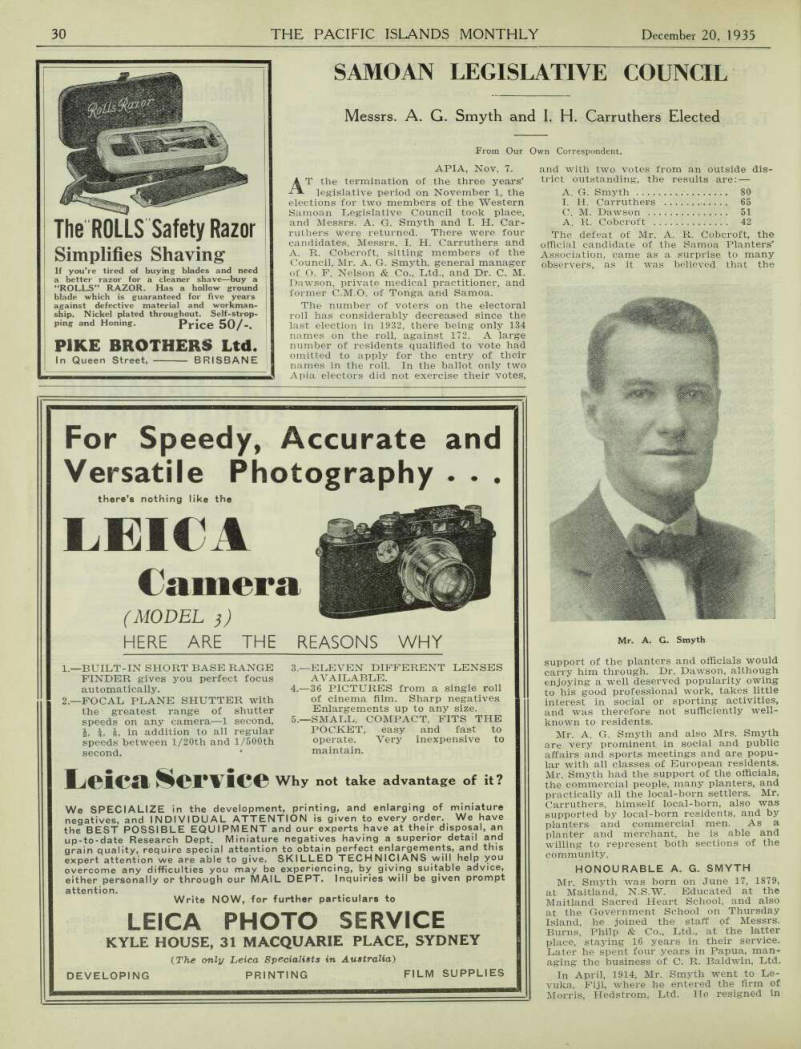
Messrs. A. G. Smyth and I. H. Carruthers Elected
From Our Own Correspondent
Apia, Nov. 7.
AT the termination of the three years’ legislative period on November 1, the elections for two members of the Western Samoan Legislative Council took place, and Messrs. A. G. Smyth and I. H. Car ruthers were returned. There were four candidates, Messrs. I. H. Carruthers and A. R. Cobcroft, sitting members of the Council, Mr. A. G. Smyth, general manager of O. F, Nelson & Co., Ltd., and Dr. C. M.
Dawson, private medical practitioner, and former C.M.O. of Tonga and Samoa.
The number of voters on the electoral roll has considerably decreased since the last election in 1932, there being only 134 names on the roll, against 172. A large number of residents qualified to vote had omitted to apply for the entry of their names in the roll. In the ballot only two Apia electors did not exercise their votes,
and with two votes from an outside dis trict outstanding, the results are: A. G. Smyth 80 I. H. Carruthers 65 C. M. Dawson 51 A. R. Cobcroft 42 The defeat of Mr. A. R. Cobcroft, the official candidate of the Samoa Planters' Association, came as a surprise to many observers, as it was believed that the
support of the planters and officials would carry him through. Dr. Dawson, although enjoying a well deserved popularity owing to his good professional work, takes little interest in social or sporting activities, and was therefore not sufficiently well known to residents.
Mr, A. G. Smyth and also Mrs. Smyth are very prominent in social and public affairs and sports meetings and are popu lar with all classes of European residents.
Mr. Smyth had the support of the officials, the commercial people, many planters, and practically all the local-born settlers. Mr.
Carruthers, himself local-born, also was supported by local-born residents, and by planters and commercial men. As a planter and merchant, he is able and willing to represent both sections of the community.
Honourable A. G. Smyth
Mr. Smyth was born on June 17, 1879, at Maitland, N.S.W. Educated at the Maitland Sacred Heart School, and also at the Government School on Thursday Island, he joined the staff pf Messrs.
Burns, Philp & Co., Ltd., at the latter place, staying 16 years in their service.
Later he spent four years in Papua, man aging the business of C. R. Baldwin, Ltd.
In April, 1914, Mr. Smyth went to Le vuka, Fiji, where he entered the firm of Morris, Hedstrom, Ltd. He resigned in
Mr. A. G. Smyth
1918 to accept a position with the late H. J. Moors, in Apia, Samoa. After the outbreak of the influenza epidemic in 1918 he left Samoa to open the Auckland office of Messrs. O. F. Nelson & Co., Ltd, In 1920 he bought out the business of Mr.
N. Johanssen, at Apia, which he sold to Morris, Hedstrom, Ltd., at the end of 1927.
From 1928 to 1930, Mr. Smyth was con nected with the firm of A. M. Brodziak and Co., Ltd., of Suva, Fiji, After the liqui dation of the latter firm in 1930, he re turned to Apia, to take control of the Apia branch of Morris, Hedstrom, Ltd., resign ing in 1933 to join Messrs. O. F, Nelson & Co., Ltd., of which firm he is at present general manager and a director.
Hon. I. H. Carruthers
Mr. Carruthers, who has been first elected member of the Council for the last three years, has now been elected as second member. Born in Samoa on Oc tober 27, 1888, the son of the late R. H.
Carruthers, a British barrister and solicitor, who was a prominent resident under the Three Power regime, he was educated at the Apia Marist School.
Leaving school he took up a commer cial career, starting as an island trader.
Gradually he built up a small business, owning schooners, and slowly extended his operations. For some time he was in partnership with the Hon. A. G. Smyth, but later established his own business again, now trading as I. H. Carruthers, Ltd., popularly called the “Fifty-fifty”
Store.
Following the example of his father, who introduced cocoa planting to Samoa, by planting the first 25 acres from seeds obtained from the D.H. & P.G. Co., he leased from the Administration the cocoa
plantation of Malaedono on the west coast of Upolu. Mr. Carruthers is a member of the committee of the Planters’ Association and the Chamber of Commerce, and has taken an active interest in all matters pertaining to the welfare and progress of the territory.
As first elected member he has taken an ‘important part in all discussions of the Council on matters of policy. The important new “Samoan Status Ordinance,” which gave the local-born of mixed parentage the right to declare themselves native Samoans and thus obtain land and title rights from their Samoan mothers’ side, was passed greatly due to his efforts.
Mr. G. Kingsley Roth, District Com missioner of Suva, Fiji, has been trans ferred to Levuka to relieve Mr. A.
Walker, D.C. and Collector of Customs, who has proceeded to New Zealand owing to ill-health.
Rev. Mother Mary Pia arrived in Syd ney from Europe by the French steamer Ville de Strasbourg on November 22.
Under her care was a party of missionary sisters (three Italians and seven from France), who will take up duties in the South Seas, two going to Noumea, two to Vila, three to Suva, one to Apia, and one to Tonga.
Mr. I. H. Carruthers
Advertisements & other items, pp. 33-34 (1 item)
Rolls Razor
THE IDEAL GIFT
THE WORLDS BEST SAFETY
WHEN you give him a Rolls Razor you give him Shaving Comfort for life, and you have the satisfaction of knowing that your Gift is the best the World has to offer.
Illustrated Catalogue and Price List sent free on application.
■Colls Razor Co. of Australia Ltd.
8a CASTLEREAGH STREET SYDNEY, N.S.W.
'OUR HANDS MAKE GOOD ARMS’
FIREARM REPAIRS.
FIREARMS SENT C.O.D.
THE WONDER RIFLE
There is no better rifle made than the “WALTHER." It uses 22 cal, long rifle cartridges, is a single shot, repeater, and automatic, ALL IN ONE RIFLE.
PRICE, £lO/10/.
Winchester latest 22 cal. S.S. Rifle, Model 67, 27-inch barrel. PRICE, 45/-.
Postage extra on above rifles.
SIL ROIILH axf.
Gunsmith, Importer of High-grade Firearms and Fishing 1 Tackle Specialist. f 143 Elizabeth St., Sydney (near Market St.)
TACKLE TO TACKLE FISHINGS
sti
CAPSTAN
CIGARETTES
CORK-TIPPED
OK PLA I N
a$T
(ti&Z
esh
t*
CAPSTAN
NAVY CUT TOBA(
Mtiukf'icm ffinetf
leaf
To Planters I am a Buyer of
CASTOR OIL SEED
IN ANY QUANTITY
Send Sample for quote, stating quantity available.
Castor Seed Shelters, any capacity.
Advice and Instructions Regarding Planting, Harvesting and Packing of Castor Oil Seeds given freely. Selected Seed for Planting available.
C. GRAHAME
4 DALLEY STREET SYDNEY
PACIFIC TRADERS!
The Blade of Best Quality, and the Most Profitable to Handle, is: These blades are of the three-holed (Gillette) type. I have made a careful test of all blades, over a long period, while I was trading at Milne Bay, Papua, and the British-made Jewel was far ahead of any other. I now have the Pacific agencs' for Jewel blades, and strongly recommend them Send P. 0.0, for trial gross, post free, 10/- (Australian) or 8/- (sterling). Reduction for quantities. Sample package, 2/6.
Iping, Midhurst, Sussex, England
WW Ek
e^KFSAFETY*
O- R to all traders.
HENRY DEXTER
Swallow & ArielFs
I PLUM
I PUDDINGS
J-lb., 1-lb., 1 2 -lbs., 2-lbs., and 3-lbs.
Renowned for Quality Manufactured at Port Melbourne, Australia
Samoan Planters’
Association
From Our Own Correspondent
Apia, Nov. 7.
AT the annual meeting of the Samoan Planters’ Association, the report of the committe was read, giving a summary of activities during the last year. Many important results were achieved by the co-operation of the committee with the Administration. These were also favour ably commented upon in the last official report on the Territory to the League of Nations.
The President, Mr. F. L. A. Goetz, who is departing by the Mara Pomare, made a valedictory speech, in which he gave some valuable advice in regard to the future policy and activities of the Association.
Members of the committee and of the association spoke in appreciation of his great interest and the good work Mr.
Goetz had done for Samoan planters.
Mr. D. R. A. Eden, the newly appointed general manager of the New Zealand Reparation Estates, has been elected Acting President of the Association pro tevi.
Chimbu Area
New Guinea Government’s Influence Extended
From Our Own Correspondent WAU, Nov. 4.
THE station gardens on the Ega and Goromei police posts in the Chimbu area have been vastly improved. These have not only increased the native food supply, but reduced the general expenditure of the posts, which, on account of aerial freights, is high.
Generally, the supervision of these gar dens is left to the native police, the white officers’ time being fully employed in ex tensive patrols throughout the area. As a result of successful Administration patrols a more satisfactory degree of influence has been established, especially among the Chimbu tribes.
The overland route between the Ramu post and the Chimbu has been made more secure by the reopening of the base camp at Bena Bena. Mails are now carried regu larly each week by native police between Ramu and Bena Bena and the track which connects those two centres has been im proved and completed.
Great improvement has been noticed at the Ramu post in the relations with natives. A considerable amount of atten tion still has to be given the district, and the country lying between it and the Chimbu before peaceful and reasonable con ditions prevail.
The European population continues to increase on the Upper Watut, where miners and prospectors are extending their opera tions. Natives there are gradually being brought under control and there is practic ally no trouble, their relations with pros pectors being quite satisfactory.
The Administration has kept in constant touch with the Kuku Kukus in order to establish good feeling and confidence with the advancing mining community. Miners and their mining labourers are slowly developing relations of mutual confidence with natives of the district.
Polynesian Dialects
Mr. F. W. Stimson’s Dictionary Ready for Publication
From Our Own Correspondent
Papeete, Nov. 1.
AFTER a visit to his headquarters in Hawaii, Mr. Frank W. Stimson, Re search Associate in Polynesian Lin guistics attached to the staff of the Bishop Museum, Honolulu, has returned to Tahiti by the Maunganui.
It is understood that Mr. Stimson's comparative dictionary of the Polynesian dialects —a masterly work which will estab lish the author as the foremost authority on the subject—is almost ready for publica tion. Several other bulletins —the, results of a long sojourn in the Tuamotu Archi pelago —are also due to appear in the near future.
Mr. Stimson is now engaged upon the translation of ancient chants and legends of which he has a vast collection from the various islands of the south-eastern Tua motus. This work will keep him fully occupied for some months to come.
Mr. and Mrs. Carlton Younger, of the Solomon Islands, are spending a month’s holiday in Australia. Mr. Younger is a planter at Cape Marsh.
How Queen Salote Was
Received in Fijian Island of Lakemba
THE landing of the Queen of Tonga at Lakemba. in the Lau Group, Fiji, on October 11, to take part in the Metho dist Mission centenary celebrations, was described by Rev. A. Wesley Amos in a recent article in a Melbourne newspaper.
The Queen, who had been in Australia, travelled specially from Sydney in the Katoomba to be present at this func tion. She was met at Lakemba by her own yacht, which had brought several of her people from Nukualofa.
In the old days, there was much fight ing in the Lau Islands between Tongans and Fijians, and the present inhabitants are a mixture of the two races.
Four hundred visitors arrived at the little island in the Katoomba, and their disembarkation occupied four hours. They were accommodated in picturesque shel ters of bamboos and foliage.
The last to come ashore (said Mr.
Amos) was Her Majesty Queen Salote Tubou (Dame, C.8.E.), of Tonga, who is distantly connected with the chiefly tribes of this group. Her boat carried her to a large new canoe in the bay, which ferried her to the sandy beach, where the sturdy Fijians lifted the canoe bodily and carried the royal visitor up to the en trance of the town.
Here she entered a gaily decorated arch and stepped on a newly woven mat of honour held by two rows of women over the whole length of some 400 yards.
Accompanied by chiefs and Tongan visi tors, the procession moved slowly forward, passing the Langis (tomb) where the chief Finau was buried last year.
Wearing a mourning mat, the Queen paused, while her Tongan courtiers chanted a dirge. The procession led to her quarters, where she was received by Randi ni Nayan—the widow of the chief. Thence she was conducted to the Native Council House for a series of most interesting celebrations. * The presentation began with 10 whales’ teeth —the symbolic instrument of Fiji and accompanied by much ritual. Then followed the offering of the bunch of coconuts, typifying the fruit and food of the land, the platter borne by comely maidens, carrying lighted torches, sig nifying their readiness to serve Her Majesty.
The elaborate ritual concluded with the ceremonial drinking of the Kava ( Piper Methysticum) .
This was followed by a great exchange of goods. The Queen’s yacht from Tonga had brought 1,000 bottles of aromatic coconut oil, much prized for the anoint ing of faces and bodies, and many hun dreds of woven mats and fathoms of tapa (paper cloth). In return, many huge wooden bowls, fine samples of native craftsmanship, were presented to the Queen and her party.
After presentation of large quantities of native food—turtles, pigs, bullocks, fish, yams, taro, tapioca, etc.—the even ing meal followed.
Mr. William R. Smith, who for 10 years was manager of the Aitutaki branch of Messrs. A. B. Donald and Co. Ltd. in the Cook Islands, recently resigned owing to ill-health. He has now opened a store at Te Aroha, a town in the Waikato farm ing district of New Zealand.
Advertisements & other items, pp. 35-36 (1 item)
Foster Clark's
1 CANT THINK WHAT'S COME
OVER JOHN-HE NEVER WANTS
TO COME HOME FOR DINNER]. t
I'M SURE IT COULD NT BE
THAT - I GIVE HIM LOVELY
MILK PUDDINGS.THEY ARE
EVER SO GOOD FOR HIM
i\ /? iO
OH YOU SWEET
simpleton! men
DON'T LIKE MILK
! PUDDINGS. BUT
HE'LL LOVE FRUIT
SERVED WITH
FOSTER CLARKS
CUSTARD. THAT IS
DELICIOUS AND SO
VERY NOURISHING
Don’t make the mistake which this wife made. Of course milk puddings are good for your husband —but that doesn’t make
them interesting. Now, Foster
Clark’s creamy Custard is fourfifths milk . . . which means nourishment . . . and also it is so rich, creamy and deliciously flavoured that your husband is sure to enjoy it. And so will you. »• ii
MY FIRST DINNER AT
HOME FOR WEEKS
AND IT'S DELICIOUS
DARLING IT MUST HAVE
COST YOU A PACKET
sSP * £
IT DID-BUT ONLY A
PACKET OF FOSTER
CLARK S CUSTARD
AND A LITTLE FRUIT
I’M SO CLAD YOU LIKE IT.
FREE TESTED RECIPES
Nearly 100 of them and all delicious. Send for your copy to Foster Clark (Australia) Limited, Dept. R. 8., 17 Thurlow Street, Redfern, N.S.W., enclosing Id. stamp for postage.
Foster Clark's
creamy CUSTARD
«/ FC3-185
GILLESPIE’
“ANCHOR”
FLOUR
TRADE
MARK
The Standard of Quality.
fk Australia’s Choicest Products: Green Peas French Beans Cauliflower m I
Always..
make sure you have at hand an ample Reserve of these
Delicious . .
Garden
Vale
Ready-toserve Vegetables IP?
V
Father Damien Of Molokai
Body of Hawaii’s Leper Hero to be Taken to Belgium
November 18 cables from London announced that the body of Father Damien, the Belgian priest who laboured for 16 years among Hawaiian lepers on Molokai Island will be taken to his native land, for reburial in the chapel of St.
Joseph at Louvain. The President of the United States, Franklin D. Roosevelt, has authorised the conveyance of the body to Belgium in an American warship.
The life of Father Damien (Joseph de Veuster) is one of great self-sacrifice and simple heroism. Setting himself the task of ministering physical and spiritual healing to the unfortunate lepers, he toiled faithfully for long years in an atmosphere of filth and squalor, eventu ally contracting the ghastly disease himself. He died of leprosy among the other sufferers in that little settlement on Molokai which was described as “a pitiful place to visit and a hell to dwell in.”
Born of.middle-class parents on January 3, 1841, at Tremeloo six miles from Louvain, he commenced his community life at the age of 18 as a drawer of water and a hewer of wood. Owing to his ignorance of Latin and Greek his superiors decided he could not take holy orders. Damien, however, begged the Fathers to permit his brother, who was
about to be ordained, to instruct him.
This was granted, and he studied with such voracious diligence and made such progress that he was allowed to prepare for the priesthood.
Took Brother’S Place
Shortly afterwards a party of mis sionaries of the Society of the Sacred Heart of Jesus and Mary was making ready to leave for the Sandwich Islands (Hawaii). Amongst them was Damien’s brother, then a priest, but he was seized by fever before the departure and Damien beseeched the authorities to let him take his brother’s place.
He was sent, and in 1873 arrived in Honolulu where he was ordained, and given charge of an outside district on Oahu Island. At the dedication service of a new church at Maui some months later, Damien met the Bishop of Honolulu and appealed to him to be allowed to work among the native lepers at Molokai, the state lazaret. Receiving the Bishop’s sanction, he left the same day, travelling on a cattle boat to the prison he had voluntarily chosen.
Deplorable Housing Conditions
Housing conditions on Molakai were deplorable and the moral plight of the lepers was even worse than the havoc wrought by the disease. Damien com menced work immediately and finding the settlement unsuitable built a new one.
He created a permanent water supply and made so many improvements in health conditions that the death-rate dropped perceptibly and the patients’ sufferings were eased.
His life was a busy one, full of rough hardships and privations. Often the colony ran out of provisions and Damien was the first to go short.
One day after years of toil as he sat instructing a group of lepers, a coal fell from the fire upon the palm of his hand.
He did not notice it and felt no burn — and then he knew that the fearful scourge had come upon him. After much suffering he died on April 15 1889.
Stevenson’S Famous Pamphlet
Father Damien and his work among the Molokai lepers was the subject of a vitriolic pamphlet vigorously penned by the great Robert Louis Stevenson in reply to an attack upon the Belgian priest by Dr. C. M. Hyde, a Presbyterian minister of Honolulu. On February 24, 1890* Stevenson who was recovering his broken health in New South Wales was shown
a copy of the Sydney Presbyterian, dated October 26. 1889, in which Dr. Hyde cast grave aspersions upon Damien’s moral character.
The letter, originally addressed to Rev.
H. B. Gage, and re-published in the maga zine, was as follows: — Dear Brother, —In answer to your inquiries about Father Damien, I can only reply that we who knew the man are surprised at the extrava gant newspaper laudations, as if he were a most saintly philanthropist. The simple truth is, he was a coarse, dirty man, headstrong and bigoted. He was not sent to Molokai, but went there without orders; and did not stay at the leper settlement (before he became one himself), but circulated freely over the whole island (less than half the island is devoted to the lepers), and lie came often to Honolulu. He had no hand in the reforms and improvements inaugurated, wh;ch were the work of our Board of Health, as occasion required and means were provided. He was not a pure man in his relations with women, and the leprosy of which he died should be attributed to his vices and carelessness. Others have done much for the lepers, our own ministers, the government physicians, and so forth, but never with the Catholic idea of meriting eternal life.
—C. M. Hyde.
After reading the paper, Stevenson leaped to his feet in furious anger, de claring that he must reply at once to smash the traducer of a dead man for whom he had conceived an ardent ad miration. Next morning he wrote the famous defence in his room at the Union Club, Bligh Street. Sydney. It was the work of only a few hours and stands now almost exactly as it was in the first hastily written draft.
Stevenson wrote graphically of his own feelings and observations when he visited the leper station. In masterly style he soundly denounced Damien’s detractor, handling words, as he expressed it, “to convey truth and arouse emotion.” With the skill of a scientist, he dissected and criticised Rev. Hyde’s letter and drew a portrait of the missionary as a noble hero labouring among the afflicted lepers.
By and by, after his letter had been published in England, Australia, and New York, Stevenson himself regretted its violence. He confessed that it was “bar barously harsh,” and that he might have defended Damien equally well without inflicting pain on others.
Advertisements & other items, p. 36 (1 item)
Barrington’S
'Phone: FX 3378 ’Phone: FX 3378
DRIVE YOURSELF
SERVICE
Cars Hired without Drivers from 10/- per day; Tourers, 3d. per mile; Sedans, 4d. and sd. per mile. Our Fleet includes 1934 Dodge Sedan*.
Write for Reservations, or 'phone when in city and we will deliver Car to your address.
243 ANZAC PARADE, SOUTH
KENSINGTON, N.S.W.
New Caledonia's Gold
Dr. Hills Investigating for Australian Interests
GOLD seekers are turning their eyes from Fiji to New Caledonia, where although there are nickel and chrome mines, no gold mine has yet been proved.
Several Australian mining men have re cently visited Noumea to examine supposed gold-bearing areas and in November Dr.
Loftus Hills left Melbourne for New Cale donia to investigate reported gold finds on the island on behalf of Sydney and Adelaide interests.
Concessions over large areas have been obtained from the French Government and Dr. Hills will look over the properties and report to the parties concerned. A prominent Victorian geologist, Dr. Hills was the first to affirm the possibilities of the Tavua field, Fiji. On his return from Noumea, he will depart for Suva, probably early in January.
In recent months three Australian com panies have been actively engaged in gold seeking in New Caledonia. They are: Diahot River Gold Dredging Syndicate N.L., of Adelaide, which holds an option over 12,000 acres on the Diahot River, north-east coast of New Caledonia. This company’s property was surface tested by Mr. J. Hay, who estimated values at more than 4/- a cubic yard. Later Dr. Jensen carried out a detailed examination.
Upper Diahot River Gold Dredging Syndicate N.L., formed in December, 1934, acquired from C. R. Donaldson an option over 3,000 acres on the Upper Diahot River.
Dr. Jensen scout bored the area, but did not find gold values beneath the surface.
Investigations are still being carried out on the property.
Caledo-Austral Gold Syndicate N.L., formed in Adelaide early this year, obtained an option over the Honfleur and Queyras mines. The syndicate also has an option over 9,000 acres of dredging leases on the Tende River, near Upper Diahot Gold Co.’s areas.
Advertisements & other items, pp. 37-38 (1 item)
Anchovy
HOLBROOKS
PASTE
Tie House of. .
HOLBROOK
Packs in dainty jars a delicious paste made from finest Gorgona Anchovies.
It will keep in any climate and is a wonderful stand-by for the concoction of many delightful luncheon and supper savories.
Try it spread lightly on hot buttered toast, or for a more substantial meal serve it on toast with a poached or scrambled egg.
Other varieties of Fish and Meat Pastes: Holbrooks Bloater, Salmon, Salmon & Shrimp, Chicken & Ham, Ham & Tongue, Veal & Tongue, and Turkey & Tongue.
Holbrooks
(Australasia) Ltd.
WATERLOO - NEW SOUTH WALES
BURNS PHILP
(South Sea) Co. Ltd.
Island Traders & Shipowners Registered Office: Suva, Fiji.
ALSO BRANCHES AT:
Fiji: Levuka, Lautoka, Labasa, Ba, Sigatoka, Rotuma.
Tonga : Nukualofa, Haapai, Vavau.
Samoa: Apia, Pago Pago (American Samoa).
Solomons: Makambo, Gizo, Faisi.
New Hebrides: Vila.
Gilberts: Tarawa.
Norfolk Is. Nauru. Niue. Wallis Is. Futuna Is.
Code Address: “Burnsouth.”
To Pacific Islands
Traders
SAVE MONEY AND BUY YOUR
GOODS DIRECT FROM
MANCHESTER—
Write to us for Quotations, Details, etc.
WE ARE MANUFACTURERS OF
GREY, WHITE AND COLOURED
TEXTILES
Raimi materials of every description.
Para Reds.
White and Blue Drills.
Grey and White Calicos.
Super Drill.
Ecru Tussore.
Dyed Poplins, Woven-s tripad Poplins.
Table Cloths.
Serviettes.
Sheets.
Pillow Cases.
Quilts.
Bedspreads.
Art Silk Pises Goods.
Bath Wraps.
Glass Cloths.
Sweat Rags.
Bias Binding.
Braids, Printed Calicos, Popiins, Woven Coloured Ginghams, etc.
Extract from a letter sent to us by an Islands storekeeper who recently retired;— Milne Bay, Papua. 1.10.34.
“. . .a success due—in a great measure —to the excellent service rendered for so many years by your firm. Yours. faithfully,
“H. DEXTER.”
A. WEBB & COMPANY
(Manchester) LTD.
86 GEORGE ST., MANCHESTER
Contractors to H.M. and Foreign Governments.
Bentley’s Code, and ABC Code 4th and sth Editions.
Telegraphic Address; “WASTOCK,” Manchester.
By using this Economical, Fire Retardant and White Ant Proof building material for External and Internal Walls and Ceilings, you can build a comfortable and durable Bungalow Home AT LOW COST! "FIBROLITE" is easily and quickly erected. No waste. Less labour. No painting. For full information, write for illustrated "Fibrolite" Booklet F. 6 FREE AND POST FREEI
JAMES HARDIE & COY. LTD.
ASBESTOS HOUSE, YORK STREET, SYDNEY, N.S.W.
(Box 3935 V., G.P.0., Sydney)
Through South
Seas In 1885
Apia Resident’s Voyage In The “Buster”
From Our Own Correspondent APIA, November 1.
ON October 5, 1885,. a small three-masted schooner, the “Buster,” left Auckland harbour, New Zealand, for a lengthy cruise around the South Sea Islands. The. purpose of the voyage was to make a complete round of inspection of the numerous Island stations of the Auckland firm of Henderson and Macfarlane Ltd., to whom the “Buster” belonged, and also to find sites for new stations.
Captain was in command, with Mr. Geo. Dunnet as supercargo, and on board were Mr. Frederick J. Moss, a member of the N.Z. House of Represen tatives, and Mr. T. Andrew, an Auckland photographer. The story of this interest ing months cruise through many little known Island groups, is graphically told in a book written by Mr. Moss and pub lished in London in 1889 entitled, “Through Atolls and Islands in the Great South Sea,” illustrated with many excellent photo graphs taken by Mr. Andrew.
Of the ship’s company on that memor able trip, as far as is known, only Mr.
Andrew, now nearly 80 ydars old, is still alive. He is still in harness and mentally and physically very lively with a splendid memory and a keen interest in life. After a span of 50 years he is still able to tell of the many queer sights and incidents during the voyage.
He relates of the visit to Niue Island, where Rev. Frank Lawes was in charge of the London Missionary Society; of Suwar row Island, the rendezvous of the old South
Sea pirate, Bully Hayes, where his guns were found; of Manihiki, famed for beauti ful hats made of the pandanus leaf; of Penrhyn, the pearling island; of Swain’s Island, where the Jennings family holds sway; and of the Tokelaus, the Gilberts and the Marshalls, where many strange personalities were met with.
Calls were also made in the Mortlocks, at that time thickly populated, and at Pleasant Island (Nauru), where Mr.
Andrew missed the chance of a lifetime, taking a photograph of a rocky outgrowth believed to be a fossil formation and which later proved to be pure phosphate.
On Nauru Mr. Andrew met the famous writer Louis Becke and spent a night in his house. Interesting also were the old mysterious ruins encountered at Ponape Island in the Caroline group.
On the “Buster” Mr. Andrew returned 1o Auckland, but a short time later went to Fiji and the New Hebrides. In 1890 he went to Samoa and has been settled here ever since as a photographer, planter (he planted the first para rubber in Samoa and was one of the pioneer cocoa plan ters) and later as a merchant. Sixty-six years without a holiday and a rest —and not a day of sickness —is surely a record to be proud of.
Village.
Waterspout Hits Cook
Islands
Houses Wrecked in Arorangi Village.
From Our Own Correspondent
Rarotonga, Nov. 3.
SWIRLING in from the ocean on the evening of October 14, a waterspout wrecked a number of houses in the village of Arorangi.
It had been a wet Sunday, and by eight o’clock everybody was indoors. Unob served, the column of water travelled across the lagoon, decreasing in volume as it approached the shore, from whence it passed inland as a furious funnel of air.
Careering up the village, it stripped the roofs of four houses, wrecking the veran dahs of several others. Twenty fowls roosting in a tree disappeared completely, and many sheets of galvanised iron were wrapped like paper around the branches of adjacent trees.
Mr. Peter Callaghan, disabled ex-soldier, was in his room at Tapai Pirangi’s store when the baby cyclone struck the prem ises. “I was just undressing,” he said, “when there was a report like a pistol-shot overhead, and the roof went. The force of the wind was terrific; it held me up against the wall for fully 30 seconds. The floor mats were whipped off the ground and I thought the whole house was coming down! ”
Fortunately nobody was seriously in jured, although several persons received minor cuts and bruises occasioned by the falling and broken debris of their homes.
Advertisements & other items, p. 38 (1 item)
A. E. Summerbell’S
COLONIC irrigation is one of the best methods of cleansing the lower bowel, and is recommended by the medical profession.
Treatment is obtainable at
ROOMS
Wyoming, Macquarie Street, Sydney
Suwarrow Is. To-Day
Visit of American Yacht “Nomad”
Letter to the Editor.
I read with great interest the article about Suwarrow Island, in the August Pacific Islands Monthly, and may be able to supply a little additional information.
On April 3, 1933, the American yacht “Nomad,” set sail from Suva, bound for San Francisco. On board were four young men (one of whom was myself) who were destined to spend 169 days aboard the 50ft. cvaft before reaching California.
After calling at several islands in the Eastern Fiji group, we visited Nukualofa, Vavau and Pago Pago. Leaving American Samoa we sailed for Danger Island, or Puka Puka, for some years the home of Robert Frisbie, author of the book “Puka Puka.” It was after leaving the latter island, that we struck adverse winds and sets, which threw us off our course.
We spent eight days getting nowhere so decided to make for the nearest land, and accordingly at 8.30 a.m. on June 9, we dropped anchor in the lagoon at Suwarrow Island. The 50 coconut trees mentioned by Captain Sterndale had multiplied to several thousand, in fact considerable difficulty was experienced in getting through the bush owing to the growth of young trees. There were two or three buildings in a dilapidated state, also an old sail-boat in a rotting con dition.
We replenished our water supply from a large concrete cistern which must have held several hundred gallons. Tacked to
the wall of the largest building was a notice stating that the schooner France had visited the island in 1926. Fish and seabirds were in abundance.
After cavorting about the island for four glorious days—“kings of all we surveyed,” we set sail, and on June 28, arrived at Penrhyn Island, where we had the good fortune to meet Captain Viggo Rasmus sen and Mr. Philip Woonton, the Resident Agent. They were kindness itself —and we enjoyed several good meals and some good Scotch on board the “Tiare Taporo,” before setting sail for Honolulu.
I am, etc,,
Rob. R. Wright.
Loloma Gold Mine, Tavua, Fiji. 28/10/35.
Influenza In Tahiti
From Our Own Correspondent
Papeete, Nov. 1.
IN common with several other Pacific Island Group's, Tahiti was visited re cently by an influenza epidemic of a mild description. A considerable number of the population contracted the complaint and for a few days business houses and other employers were short of hands.
Fortunately there were few deaths and these could be traced mostly to elderly people or to neglected cases, which had suffered a relapse. A timely downpour of rain quickly terminated this unpleasant visitation.
Mr. J. A. Norrie, Commissioner of Labour in Samoa, who is also Crown Solicitor and Land Registrar, left Apia for New Zealand by the Maui Pomare on November 7.
Spectacular End of the Mitiaro Old B.P
Mitiaro Old B.P. Vessel Scuttled in the Solomons
THE blowing-up of the old steamer Mitiaro outside Tulagi Harbour, in the Solomon Islands, recently, removed a relic of an interesting chapter in the history of Burns, Philp and Co., Ltd., in the Pacific, said the “Sydney Morning Herald” on November 22.
In the early days communications be tween plantations in the Solomons group were of the most haphazard nature, but as, in the course of time, these places began to produce copra in ever-increasing quan tities, Burns, Philp and Co. Ltd. established a system of communication with schooners, which answered the purpose for many years. Then the small steamers Rogea and Sicloce were placed in commission, but, as supplies increased, they were replaced by the Maapa and the Tamarina.
The Maapa was lost at sea with all hands,
and the Tamarina was transferred to the Gilberts. Then the company put on the steamer Malaita of about 200 tons, which covered the prescribed area in much quicker time than her predecessors, and had special accommodation for passengers.
When she began to fail, the Mitiaro, a vessel 150 feet long, and of 360 tons gross, was purchased from a French company by Burns, Philp. Her original name had been Jolly Helen, later the Oceania, and finally it was altered to Mitiaro (locally Mighty Error). When the depression became acute, and copra prices fell, the Mitiaro was laid up.
She later made a few irregular trips on behalf of certain local interests before she was scrapped. On one occasion, after a hole had rusted in her side above the water line, somebody stuffed a growing coconut in the hole from the outside, and the old
ship steamed into port with a six-foot palm growing out of her side.
Lever Bros.’ motorship Kurimarau towed the vessel to sea recently, and several charges of dynamite were exploded within her, but with little result. Then the sea cocks were opened, but she did not sink for five or six hours afterwards.
When it did come the end was sudden and spectacular. There was a dull boom as the water rushed into the engine-room, and the bulkhead carried away. With nose high, she shot downward. One more burst of spray, and the ship disappeared from sight.
Mr. G. Sharood, who has been manager for many years of Messrs. A. B. Donald and Go’s establishment in Papeete, left Tahiti by the Hauraki in November for a few months’ vacation in New Zealand.
Advertisements & other items, pp. 39-40 (1 item)
DIESEL Engine
Your Sydney Agent?
William E. Reed
(Established 1913)
UNION HOUSE
247 GEORGE ST., SYDNEY
Shell sold, and goods supplied at wholesale prices, on commission.
Enquiries welcomed.
5 h.p. for lyd. per Hour
J N every part of the world where the work is hardest, the going heaviest, and an engine is left almost to look after itself; there will be found the Lister Diesel.
Any purchaser of a Lister Diesel can look forward to years of trouble-free service, and the last ounce of power will be got out of the fuel which is put into it.
For full particulars regarding this remedy for all power troubles, write at once to Desk P.M., Box 509AA G.P.O., Sydney.
DIESEL Engine
WRITE FOR CATALOGUE NO. 53
DANGAR, GEDYE & Co. Ltd.
Malloch House, 10-14 Young Street, Sydney
Neclaka
The World’s Best
INSULATED COPPER
WIRE
(Rubber Covered and Lacquered)
FOR . . .
Motor Cars
Marine Engines
AND . . .
Stationary Engines
f & 0 0 & 4
100-FOOT SPOOLS
Sizes from 3 m.m. to 9 m.m. Also 6 or 12volt Battery Cables. • Send for Samples and Prices.
M.
Sole Australian Agents . . . nI -T-yy p Australia House Ia w I I T OC VU. y Carrington St., Sydney
FOR LONGER LIFE
USE ...
ERG
BATTERIES
FOK-
CARS, TRUCKS, RADIO,
HOUSELIGHTING,
MARINE WORK,
MOTORCYCLES
If not represented in your district write direct to— ERG BATTERIES LTD. 156 GOULBURN ST., SYDNEY,’N.S.W.
TO ELECTRICAL ENGINEERS - MANUFACTURERS OF QUALITY BATTERIES
Paradise Plumes
By Henry Dexter
UNDOUBTEDLY, sentiment was the cause of closing- the market for plumes in Great Britain, although the agitation that brought this about was based on fallacy.
Thirty years ago, it was a common thing to read articles written by most worthy people, in which the shooting of the bird-of-paradise, the egret, and the goura pigeon, were all treated as if com parable one with the other.
Even that usually well-informed paper, “The Shooting Times,” condemned all three, until one of their correspondents pointed out that the circumstances of the shooting of the three varieties of birds were as far apart as the poles.
The egret shows its plumes during the breeding. season. To shoot them then meant that the young were left to a lingering death by starvation.
Undoubtedly, the goura needed protec tion, because the bird could be absolutely exterminated in a district in a very short time, I know of one case in which this actually occurred, a coloured missionary being responsible.
The common Raggiana (Bird of Para dise) is protected by nature. It is found in some of the most inaccessible country in the world, and the bird that carries the marketable plumes has finished breed ing. It is as great a nuisance to the breeding pairs as an old cock pigeon in a dove cote. Further, it can be found over many thousand of square miles.
While a market existed, Port Moresby was one of the points from which plumes were shipped, and some of the incidents in connection with the traffic are not without humour. , A certain coloured man—we will call him M.—who had lost part of one arm through trying to shoot a fish while the muzzle of his gun was in the water, came into Port on a canoe. He offered a bird to a man, S, who kept a small store near B.P.’s wharf.
S. had never seen a bird of the kind before. It was a magnificent specimen.
He offered M. £lO for it. This M. declined.
He pointed out that a “Sir William Mac- Gregor” was worth £6O to £7O. There were several of these in different collec tions all over the world, but his bird was—as far as he knew —absolutely unique.
M. declined the offer of £lO and left.
Just then H. (the policeman) came along.
S. called him over and informed against M.
H. walked down to the wharf, and arrived just as M. was stepping off his canoe with a bundle of washing under the stump of his arm. H, told him that he wished to search the canoe. M. raised no objection, and walked away.
On M.’s return, H. had just completed the search, and he told M. that he had been looking for a prohibited bird. M. then said he had taken it ashore with
the washing. This proved to be true.
He had also sold it, for very much more than the £lO offered by S. But the pur chaser had cause to regret the deal, when he found that the bird was a common Raggiana, artfully dyed and bleached.
Twenty years ago, Port Moresby had only one white policeman. All those that I remember, over a number of years, were popular, save H.
In those days Ryan’s Hotel was situated at the foot of Paga Hill. H. boarded there, and an individual nick named Scotty was also a boarder.
Scotty had fifteen birds.
Sitting at meals, Scotty thought that H. seemed unduly interested in him; so he changed his time for eating: and, by pure coincidence, H. changed his also.
The thing got on Scotty’s nerves.
"Why the dickens do you keep looking at me?” he said to H., and H. replied that he was just going to ask Scotty the same question.
Sure that H. was watching him, Scotty burnt his birds. After which he felt — unjustly—that H. had done him an injury.
Scotty’s two mates also had fifteen birds each: and these they desired to dispose of when the "Matunga” was alongside of the wharf, the next night.
By arrangement, the three had a violent quarrel, while H. was within hear ing. Scotty then came to H., and told him some story about his mates having treated him shabbily, and of his deter mination to get his own back. Taking H. to the beach, he removed some sand, and produced a bird wrapped in wax paper.
H. told him to replace the bird.
Next evening H. was hiding near the beach, and there he spent the night, watching, while Scotty and his mates shipped their thirty birds. Yes, thirty— because a pal of Scotty’s had retrieved the perfectly good bird that had acted as bait, directly Scotty and H. had left the beach.
Long after the collection of birds be came illegal in Papua, they were exported from Dutch New Guinea, an export duty of five shillings a head producing quite a large revenue.
Five ex-Papuans went down there, Roche, Penrose, Dressier, Jackson, and Bell. As far as I know nothing is known
of the end of Roche. I last had news of him when I was coming along the coast of Jaya ten yea rs ago. It was some time later t hat he disappeared, Tlie c i rcums tances relating to the mur( jer of the other four men has been we u told - n the PIMm hy Dr. Vernon.
Dressier was an Austrian. He was at one time j n partnership with Captain Hunter, of Port Moresby. He was in terned during the war. Later, he returned to Papua, and then went to Dutch New Guinea, his companion being Bell, an ex soldier, who was formerly a salesman in B.P.’s store in Port Moresby.
Some time after the murder of these men the R.M. at Daru (now the Hon. A. P.
Lyons) was some distance up the Fly River, and one of his police found a skull, with gold stoppings in the teeth.
The skull was shown to ‘‘Daddy Leigh, a travelling dentist. He identified three of the fillings as his own work; and the other two were recognised by a dentist near the internment camp as work he had done for Dressier.
Advertisements & other items, pp. 40-41 (1 item)
V. H. Jones & Rickard
Electrical Engineers
525 ELIZABETH STREET
SYDNEY
Specialists in rewinding and repair* ing all classes and sizes of electrical machines and equipment.
Special treatment given to work for the tropics.
TELEPHONE: MA 1397
Robert Harper & Company Ltd.
MERCHANTS and MANUFACTURERS
DAY STREET - - SYDNEY
SILVER STAR RICE STARCH
" PIONEER JELLY CRYSTALS
EXPRESS CUSTARD POWDERS
COFFEES—PEPPERS—SPICES
RICE—TEA—ETC.
Islands Orders Receive EXPERT ATTENTION
FIFTY YEARS EXPERIENCE IN ISLANDS TRADE
“Carriso” May Fly
Panama’S Flag
From Our Own Correspondent
Apia, Nov. 5.
IT is reported in Apia that the Island steamer “Carriso,” of the American firm Flood Bros., may be withdrawn from the service owing to trouble with the American authorities and labour unions regarding the crew. Ships under the American flag are not allowed to carry native or Chinese crews, while a white crew is too expensive for the long South Sea trips.
It may be found necessary to register the vessel under the Panama flag, like the 'other ships of the same line, the "Beulah” and "Noumea.”
Mr. and Mrs. W. Heritage sailed from Sydney for the Solomon Islands by the Malaita on November 16. He will relieve the manager of Messrs. W. R. Carpenter and Co’s branch at Tulagi for several months.
Mr. Harrison W. Smith, Chevalier du Merite Agricole, returned to Tahiti in November by the Makura after visiting his home in Maine, United States of America.
Mr. J. C. Williamson, mining engineer for Guadalcanal Gold Development Co., departed from Australia for Makambo, Solomon Islands, by the November Malaita.
Advertisements & other items, pp. 41-42 (1 item)
±] J Bad
'f r C n SwnJuuk
ML A straw boater may be a solace gainst Sol, but it won't keep your head dry in a shower!
You can keep your head comfortable anytime, anywhere providing the car's hood has been dressed with T.W.H. Hood Dressing. * fh 1
A T.W.H. TREATED
TOP IS PROOF
AGAINST ANY
WEATHER
[And talking of protection see [that your tent is dressed with IT. W. H. waterproofing solution. Ideal also for tarpaulins, (coloured verandah blinds, (round sheets, oil skins, etc.
LISTEN IN
TO 2 ii. lt. lo vthe T.W.H.
Session every Friday ni£lit af
T. W.H
WHERE TO STAY IN PORT MORESBY
THE
PAPUA HOTEL
Catering specially for Tourists and Travellers Situated on high ground overlooking both coasts, its Spacious Lounges are always Cool and Comfortable. Tariff: Per Day, 16/-; per week, £5/5/-; per month, £l4; bed and breakfast, 10/-; bedroom FIRST-CLASS ACCOMMODATION. CaS meet all steamers.
PARTIES ARRANGED.
Licensee: Papua Hotel, Ltd.
HOTEL MORESBY N “™ E
COMFORTABLE
ACCOMMODATION
ONLY THE BEST
BRANDS OF
WINES, SPIRITS
AND BEERS
IN STOCK
LICENSEE:
Hotel Moresby
Ltd.
COSMOPOLITAN
HOTEL
Samarai
First-class Accommodation for Tourists and Travellers Ball-room; Electric Light; Billiards; Freezing-works; Cold Store. Best brands of Wines, Spirits, Ales.
MODERATE TARIFF
Fishing Trips and Launch Excursions arranged Licensee: E. J. Morrow
TAHITI
AND
French Oceania
This book, by Samuel Russell, is a valuable work of reference. It gives, in relation to Tahiti and French Oceania, complete details of administration, commerce, sport, tourist resorts, industries, excursions, hotels, immigration and land laws, etc.
Yachtsmen and fishermen, who are visiting Tahiti in increasing numbers, will find this a most useful handbook.
It also supplies a fascinating account of life in Tahiti—one of the most delightful places of residence in the world.
Copies from: S. RUSSELL, Papeete, Tahiti, and
Pacific Publications Ltd.,
247 George Street, Sydney
Pries in Australia (posted): Cloth bound, */-; paper-cover, 5/-.
SAMARAI HOTEL
Ths Rendezvous of ths Miners of Eastern Papua.
Comfortable Accommodation for Tourists, Travellers and Residents. Best Brands of Spirits and Wines—Victorian Lager Beers.
FISHING EXCURSIONS ARRANGED
Licensee: Mrs. L. M. SKELLY.
HOTEL BULOLO
WAU, T.N.G.
Picturesquely situated, overlooking the Wau Aerodrome, at the Business centre of the Morobe Goldfields.
FIRST-CLASS CUISINE—3O com-
fortable Bed-rooms —Hot and Cold Showers—Fresh Fruit, Vegetables, and Dairy Produce from the Hotel Gardens.
The Hotel Bulolo is famous for its wide, cool verandah-lounge.
Only the Best Brands of Wines, Spirits, and Beers in stock.
HOTEL 1C A BAIL
COOL AND SPACIOUS LOUNGES COM PORTABLE
ROOMS—DINNER PARTIES SPECIALLY ARRANGED
Excellent Dance Floor and Music. vv 01 — f in mm Under the Personal Management of Mrs. H. Luxmoore
Mr. Arthur Brander,
Of Tahiti
lyf H. Arthur Brander, who returned to Tahiti a few years ago after an absence of many years abroad, is a mem ber of a family which has made commer cial history in Eastern Polynesia.
Alexander Salmon, his grandfather, went to Tahiti from London about 1827, and on marrying Arii-Taimai, the foster sister of Queen Pomare IV, assumed a position of considerable influence in Tahiti. The Queen specially lifted the interdiction against the marriage of foreigners with Tahitian women so that the couple might wed.
Mr. Brander’s father, a native of Elgin, Scotland, where he was born in 1816, settled in Auckland in 1840. After paying a visit to Tahiti, he was so enraptured with the island that he returned in 1842, and later married a daughter of Alexander Salmon and Arii-Taimai. Another daugh ter was the late ex-Queen Marau, widow of Pomare V. Mr. and Mrs. Brander possessed several estates in Tahiti, and every important visitor at that time was entertained by them. Two of their sons were at school in Sydney at the same time as Queen Marau, It was the custom of their father to send his children to complete their education, either in Aus tralia or in Europe, in one of the family schooners.
Mr. Arthur Brander was sent to the ancient seat of learning at St. Andrews in Scotland. Nowadays, he is the Papeete secretary of the Syndicat d’lnitiative de la Colonie de Tahiti, to give the local Tourist Association its impressive French title.
His brother, Mr. Wini Brander, is still en gaged in mercantile pursuits in French Oceania. Both brothers are noted recon teurs, and have many interesting stories to tell of their early boyhood during one of the most illuminating phases in Tahitian history. Indeed, it is regrettable that their recollections have not been put in book form long ere this.—“Eriki.”
S.I. Timber For Rabaul
From Our Own Correspondent
Tulagi, Nov. 12.
r TVHE Malaita, on her last trip through -I the group called at Marovo Lagoon, which had not been visited for some time, to pick up a parcel of Solomon Islands timber for Rabaul, New Guinea. The Seventh Day Adventist Mission was re sponsible for the shipment.
Though the timber industry has existed in the group for a quarter of a century or more, the export of sawn timber from Marovo is a new departure. The Vani koro Kauri Timber Co. Pty., Ltd., which has long been established at Vanikoro Island, in the Santa Cruz Group, makes irregular shipments of huge kauri logs to Australia, mostly to Melbourne.
Papuan Air Mail Rate
THE rate of postage by air on first class mail matter from Papua to New Guinea has been reduced to per half ounce (from 3d.) in addition to the ordinary postage of 2d per ounce. This makes the rate between Papua and New Guinea the same as that from New Guinea to Papua and throughout Australia.
Early Tonga
Cook’s Manuscript Transferred to Sydney Mitchell Library
NOT the least interesting to Pacific students of the treasures in the Cook Collection of the Australian Museum, which have been transferred on exchange to the Mitchell Library in Sydney, are four pages in the handwriting of the great navigator which relate to his visit to Tonga in September, 1773.
Cook was then at Tongatabu, or as Abel Tasman called the island, “Amsterdam.”
The manuscript is in a remarkably good state of preservation. It is written in the crabbed, familiar hand of Cook, though somewhat smaller in formation than other specimens of his handwriting in the col lection.
Members of the ship’s company, pre sumably, differed on comparing the physi cal characteristics of the Tongans and Tahitians. “Some of our gentlemen were of the opinion that they were a much handsomer race (than the Tahitians),” wrote Captain Cook. “Others again main tained a contrary opinion, of which num ber I was one.” Both men and women he described as “of a common size with Europeans, in colour a lightish copper, and more uniformly so than the inhabitants of Otahieti and the Society Islands.”
“The women, in particular, were the merriest creatures I ever met with,” he said, “and will keep chattering by one’s side without the least invitation. In general they have been modest,” he added, “though there were no want of those of a different stamp, and as we had got some venereal complaints on board I took all possible care to prevent it being com municated to them.”
Captain Cook found, however, that the Tongans were equally expert at pilfering as the Tahitians. Their songs he found “agreeable enough—not only their voices, but their music also was very har monious.” The manuscript also contains references to the manufacture of clothing and baskets, also the amusement of the Tongans.
The mutilation of fingers puzzled Cap tain Cook and his officers. “We cannot find an explanation,” he admitted, after examining many missing little fingers. He found, however, that the customary method of salutation was by touching noses, “as is done in New Zealand.” “The women take hold of my hand, kiss it, and lift it to their heads,” he added.
“If nature has been wanting in any thing,” he concluded, “it is in the article of fresh water, which is shut up in the bowels of the earth and for which they are obliged to dig.” Nevertheless, he was frankly amazed at the high state of cul tivation which, he believed, must have cost immense labour.
In addition to this manuscript relating to Tonga, the collection now lodged in the Mitchell Library includes twelve draft pages for Cook’s original journal relating, principally, to New Zealand; eight pages from the journal of the second voyage; drafts of five letters written by him from Batavia in 1770; also four letters written to Sir Joseph Banks. Another important acquisition is Cook’s note on the transit of Venus, and a second note relating to one of his charts of Magellan Straits.
Likewise included in the transfer is the famous Corner Copy of Cook’s first jour nal, kept on the Endeavour and written by Richard Orton, the ship’s clerk. It de rives its name from John Corner, who purchased it in 1890. When it was offered
to the New South Wales Government some years ago, however, it was rejected on the recommendation of James Bondwick, who was under the impression that it was a copy. Cook students now realise, of course, that it is second in importance only to the original Cook journal. A photostat copy for the use of research workers was made some time ago by the trustees of the Mitchell Library.
E.R.
Advertisements & other items, pp. 43-44 (1 item)
Catalogue
A SELECTION FROM THE . .
ILmas
mm Lady’s Bag Combs. Assorted colours and designs, 6/6.
Fine quality Briar Pipes, in 5 shapes, 4/6. Silver mounted Pipes, from 10/-.
A new Baguette shape 15-jewel high-grade movement. 9ct. gold, with cord or ribbon, £5.
OUR Coloured Catalogue will help you solve your Xmas Gifts problem because it illustrates such a variety of Novelties selected from each department of the Business. Write now for a copy which will be sent post free by return post.
The celebrated “Cyma” jewelled lever. Nickel Chrome Case £3, Gold-filled Case £4/10/-.
Fine quality Diamond Engagement Ring with diamond set shoulders; Pure Platinum settings £25.
Smaller Stones £2O.
A Fine 2-Stone Diamond Ring, White Gold and Platinum Settings, £25.
Smaller Stones £l5/15/-.
PKOIIDS LTD.
The Gift Store
Cr. KING & PITT STREETS,
SYDNEY
KETCHES,
SCHOONERS,
LAUNCHES
And All Types of Boats suitable for Islands work A large fleet of sound and reliable craft on hand. Let me know your requirements or instruct your Sydney Agent to inspect on your behalf.
My experience is at your service.
J. CAPELL
Boatbuilder and Engineer
ELITE SHEDS,
RUSHCUTTER BAY, SYDNEY
Woven Wire for All Industry )|
COPRA DRYING TRAYS, FLOORS. Etc.
FRUIT DRYING TRAYS, MINING SCREENS
Heavy Mosquito Gauze in Phosphor Bronze and Other Metals Impervious to Salt Sea Air WIRE DOOR MATS AND GENERAL WIRE WORKS
E. WItIGHT A CO. LTD.
Office and Works: 148-152 Cleveland St., Sydney, N.S.W. • Telegraphic Address: “Wrightmake.” Chippendale. f* £
Scott’s Renown Brand Rope,
Cordage and
Binder
Cable Address: Ropey a rd, Sydney.
Twine
of Every
Description
MANUFACTURED AT
MASCOT, N.S.W.
By
J. Scott Ltd.
Head Office and Store:
163 CLARENCE ST.,
SYDNEY, N.S.W.
Australian Peacocks For
Tahiti
ISLANDS agents in Australia are accus tomed to receiving strange requests from their clients in the South Seas. Neverthe less, Mr. W. M. Reid, a Sydney exporter, rubbed his eyes recently when he got a letter from a resident of Papeete asking for a quartet of Australian peacocks.
It transpired that the Islander wanted them “to add tone to his garden.” He is contemplating importing several hens and may make an attempt to breed them.
Finding four birds of sufficiently good breeding to decorate the tropics proved a difficult task for Mr. Reid. Eventually he secured four at Wellington, New South Wales, and shipped them to Tahiti by the Makura on November 21.
Samoan Copra
Upward Price Trend Stirs Buyers Into Activity
From Our Own Correspondent APIA, November 6, the copra price at the present time seems to be fluctuating, the ten dency nevertheless is apparently upwards and natives all over the islands are industriously cutting copra, and large quantities are being delivered' from the outside districts.
Apia sheds and the customs storage are crowded; cargo steamers are obtain ing emergency cargoes and the next Union steamer, the Cape Yorke for Vancouver due on November 19 is booked for 600 tons of copra and a parcel of cocoa, all she can possibly take. Union Co. cargo steamers from Apia usually lift only 100 or 200 tons.
With a better price of copra ruling, there is also keen competition between buyers, especially in the neighbourhood of Apia. Some of the smaller buyers, having confidence in the future of the copra market, buy up all the copra they can obtain. While recently the tendency was to close outside trading stations to avoid losses, at present new stations are being established, driers built, and greater activity is apparent everywhere.
On account of the American strike, the Wairuna omitted her call at Apia for a shipment of bananas in October. Now news has been received by wireless, that the Hauraki, due on November 12, is delayed and is unable to reach Apia be fore the 24th —another disappointment for Samoan banana-growers. At present with an over-supply of fruit for export there is keen competition for banana cases. The Maui Pomare this trip is again taking away a full shipment of fruit of excellent quality.
Reports of the cocoa crop are very satisfactory, although in some districts more rain is desired. However, the crop should still turn out the most prolific Samoa has had for the last few years.
Commonwealth
Philippine Islands Now a Commonwealth
\ FTER a long struggle for Filipino in dependence, a proclamation establish ing the new Philippine Commonwealth and extending the official blessing of the United States on the Filipino people, was signed by President Roosevelt on Nov ember 15.
The official announcement concluded with the statement that the new Philip pine Government is successor to “all rights and obligations” of the old Govern ment.
The following day Senor Manuel Quezon, became the first President of the Com monwealth. The former American Governor-General (Mr. Frank Murphy) was appointed first High Commissioner, and will act in the capacity of official adviser.
Customs returns for October show that Norfolk Island imported £3669 worth of goods from Australia as against £2488 last year. Exports were £371 for October this year, compared with £328 for 1934.
The Yamashita Steamship and Mining Company is considering the establishment of a direct shipping service between Japan and Noumea, New Caledonia, eliminating: Sydney as a transhipment port.
Life On An Islands Outstation
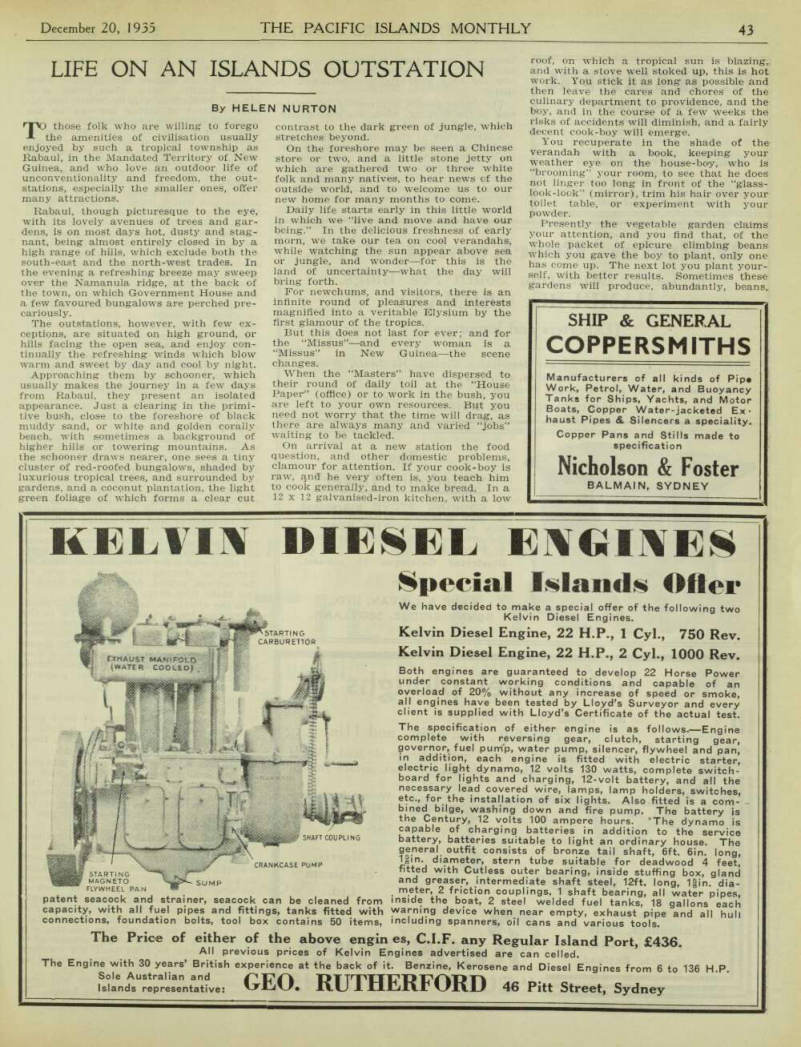
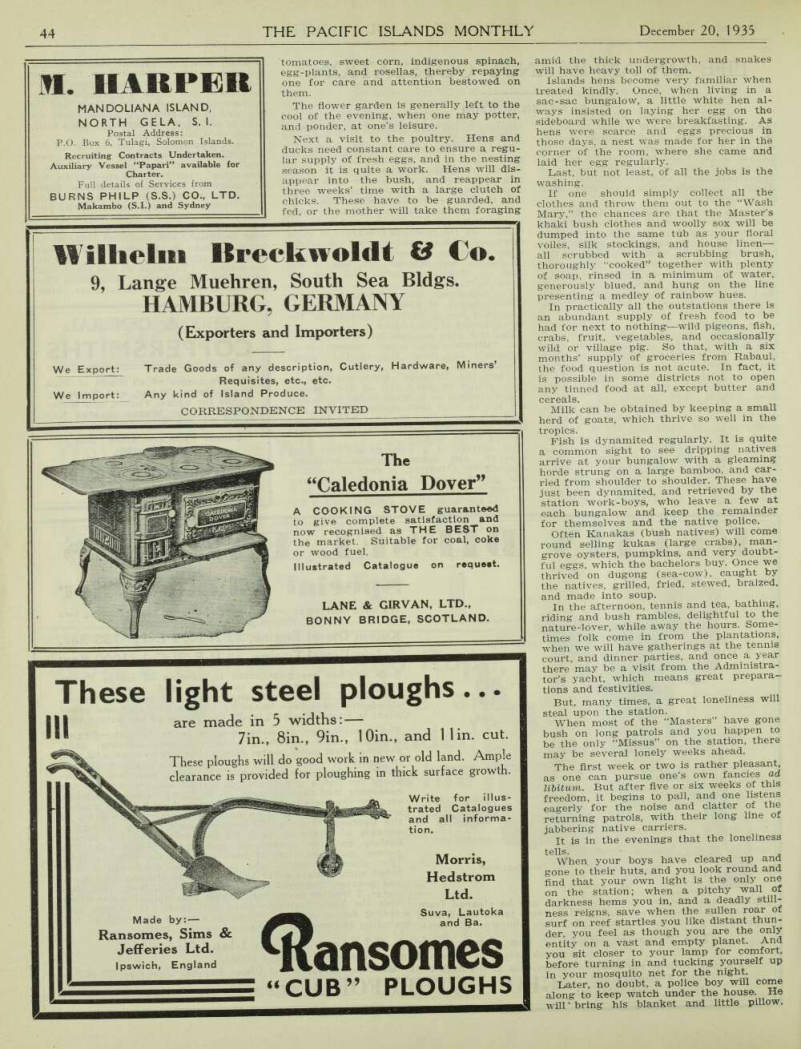
By Helen Nurton
f TX) those folk who are willing to forego the amenities of civilisation usually enjoyed by such a tropical township as Rabaul, in the Mandated Territory of New Guinea, and who love an outdoor life of unconventionality and freedom, the out stations, especially the smaller ones, offer many attractions, Rabaul, though picturesque to the eye, with its lovely avenues of trees and gar dens, is on most days hot, dusty and stag nant, being almost entirely closed in by a high range of hills, which exclude both the south-east and the north-west trades. In the evening a refreshing breeze may sweep over the Namanula ridge, at the back of the town, on which Government House and a few favoured bungalows are perched pre cariously.
The outstations, however, with few ex ceptions, are situated on high ground, or hills facing the open sea, and enjoy con tinually the refreshing winds which blow warm and sweet by day and cool by night.
Approaching them by schooner, which usually makes the journey in a few days from Rabaul, they present an isolated appearance. Just a clearing in the primi tive bush, close to the foreshore of black muddy sand, or white and golden corally beach, with sometimes a background of higher hills or towering mountains. As the schooner draws nearer, one sees a tiny cluster of red-roofed bungalows, shaded by luxurious tropical trees, and surrounded by gardens, and a coconut plantation, the light green foliage of which forms a clear cut
contrast to the dark green of jungle, which stretches beyond.
On the foreshore may be seen a Chinese store or two, and a little stone jetty on which are gathered two or three white folk and many natives, to hear news of the outside world, and to welcome us to our new home for many months to come.
Daily life starts early in this little world in which we “live and move and have our being.” In the delicious freshness of early morn, we take our tea on cool verandahs, while watching the sun appear above sea or jungle, and wonder —for this is the land of uncertainty—what the day will bring forth.
For newchums, and visitors, there is an infinite round of pleasures and interests magnified into a veritable Elysium by the first glamour of the tropics.
But this does not last for ever; and for the “Missus”—and every woman is a “Missus” in New Guinea —the scene changes.
When the “Masters” have dispersed to their round of daily toil at the “House Paper” (office) or to work in the bush, you are left to your own resources. But you need not worry that the time will drag, as there are always many and varied “jobs” waiting to be tackled.
On arrival at a new station the food question, and other domestic problems, clamour for attention. If your cook-boy is raw, he very often is, you teach him to cook generally, and to make bread. In a 12 x 12 galvanised-iron kitchen, with a low
roof, on which a tropical sun is blazing,, and with a stove well stoked up, this is hot work. Yo.u stick it as long as possible and then leave the cares and chores of the culinary department to providence, and the boy, and in the course of a few weeks the risks of accidents will diminish, and a fairly decent cook-boy will emerge.
You recuperate in the shade of the verandah with a book, keeping your weather eye on the house-boy, who is “brooming” your room, to see that he does not linger too long in front of the “glass look-look” (mirror), trim his hair over your toilet table, or experiment with your powder.
Presently the vegetable garden claims your attention, and you find that, of the whole packet of epicure climbing beans which you gave the boy to plant, only one has come up. The next lot you plant your self, with better results. Sometimes these gardens will produce, abundantly, beans.
tomatoes, sweet corn, indigenous spinach, egg-plants, and rosellas, thereby repaying one for care and attention bestowed on them.
The flower garden is generally left to the cool of the evening, when one may potter, and ponder, at one’s leisure.
Next a visit to the poultry. Hens and ducks need constant care to ensure a regu lar supply of fresh eggs, and in the nesting season it is quite a work. Hens will dis appear into the bush, and reappear in three weeks’ time with a large clutch of chicks. These have to be guarded, and fed, or the mother will take them foraging
amid the thick undergrowth, and snakes will have heavy toll of them.
Islands hens become very familiar when treated kindly. Once, when living in a sac-sac bungalow, a little white hen al ways insisted on laying her egg on the sideboard while we were breakfasting. As hens were scarce and eggs precious in those days, a nest was made for her in the corner of the room, where she came and laid her egg regularly.
Last, but not least, of all the jobs is the washing.
If one should simply collect all the clothes and throw them out to the “Wash Mary,” the chances are that the Master’s khaki bush clothes and woolly sox will be dumped into the same tub as your floral voiles, silk stockings, and house linen — all scrubbed with a scrubbing brush, thoroughly “cooked” together with plenty of soap, rinsed in a minimum of water, generously blued, and hung on the line presenting a medley of rainbow hues.
In practically all the outstations there is an abundant supply of fresh food to be had for next to nothing—wild pigeons, fish, crabs, fruit, vegetables, and occasionally wild or village pig. So that, with a six months’ supply of groceries from Rabaul, the food question is not acute. In fact, it is possible in some districts not to open any tinned food at all, except butter and cereals.
Milk can be obtained by keeping a small herd of goats, which thrive so well in the tropics.
Fish is dynamited regularly. It is quite a common sight to see dripping natives arrive at your bungalow with a gleaming horde strung on a large bamboo, and car ried from shoulder to shoulder. These have just been dynamited, and retrieved by the station work-boys, who leave a few at each bungalow and keep the remainder for themselves and the native police.
Often Kanakas (bush natives) will come round selling kukas (large crabs), man grove oysters, pumpkins, and very doubt ful eggs, which the bachelors buy. Once we thrived on dugong (sea-cow), caught by the natives, grilled, fried, stewed, braized, and made into soup.
In the afternoon, tennis and tea, bathing, riding and bush rambles, delightful to the nature-lover, while away the hours. Some times folk come in from the plantations, when we will have gatherings at the tennis court, and dinner parties, and once a year there may be a visit from the Administra tor’s yacht, which means great prepara tions and festivities.
But, many times, a great loneliness will steal upon the station.
When most of the “Masters” have gone bush on long patrols and you happen to be the only “Missus” on the station, there may be several lonely weeks ahead.
The first week or two is rather pleasant, as one can pursue one’s own fancies ad UUtum. But after five or six weeks of this freedom, it begins to pall, and one listens eagerly for the noise and clatter of the returning patrols, with their long line of jabbering native carriers.
It is in the evenings that the loneliness tells.
When your boys have cleared up and gone to their huts, and you look round and find that your own light is the only one on the station; when a pitchy wall of darkness hems you in, and a deadly still ness reigns, save when the sullen roar of surf on reef startles you like distant thun der, you feel as though you are the only entity on a vast and empty planet. And you sit closer to your lamp for comfort, before turning in and tucking yourself up in your mosquito net for the night.
Later, no doubt, a police boy will come along to keep watch under the house. He will ‘ bring his blanket and little pillow.
and snore vociferously till dawn. It is a comfort to wake up in the night and hear him.
On nights when the moon shines her sil ver radiance on waving fronds of palms, making brilliant the shimmering grass, and waking into life a quiet world, the cricket shrills, the muk-muk sends his muffled melody from forest trees, the hammer-bird taps, the flying-fox screeches gibberishly in search of bananas under the verandah roof, or flies ghoulishly through the house; while from the native quarters and nearby villages an ever-rising cadence of gara muts (drums), song, and thud of dance give promise of a restless night.
A police-boy will come along as usual to “watch.” For perhaps half an hour he will sit cross-legged on his blanket, puffing fit fully at his “cigarette” of trade tobacco and newspaper. He will then rise silently, and vanish like a wraith through the lam bent moonlight in the direction of the throbbing drums.
Advertisements & other items, pp. 45-46 (1 item)
Kelvin Diesel
SHIP & GENERAL
COPPERSMITHS
Manufacturers of all kinds of Pipe Work, Petrol, Water, and Buoyancy Tanks for Ships, Yachts, and Motor Boats, Copper Water-jacketed Ex* haust Pipes & Silencers a speciality.
Copper Pans and Stills made to specification
Nicholson & Foster
BALMAIN, SYDNEY
KELVIN DIESEL
STARTING
CARBURETTOR
Special Islands Offer
We have decided to make a special offer of the following two Kelvin Diesel Engines.
Kelvin Diesel Engine, 22 H.P., 1 CyL, 750 Rev.
Kelvin Diesel Engine, 22 H.P., 2 Cyl., 1000 Rev.
Both engines are guaranteed to develop 22 Horse Power under constant working conditions and capable of an overload of 20% without any increase of speed or smoke, all engines have been tested by Lloyd’s Surveyor and every client is supplied with Lloyd’s Certificate of the actual test.
The specification of either engine is as follows.—Engine complete with reversing gear, clutch, starting gear, governor, fuel pump, water pump, silencer, flywheel and pan, in addition, each engine is fitted with electric starter, electric light dynamo, 12 volts 130 watts, complete switchboard for lights and charging, 12-volt battery, and all the necessary lead covered wire, lamps, lamp holders, switches, etc., for the installation of six lights. Also fitted is a combined bilge, washing down and fire pump. The battery is the Century, 12 volts 100 ampere hours. *The dynamo is capable of charging batteries in addition to the service battery, batteries suitable to light an ordinary house. The general outfit consists of bronze tail shaft, 6ft. 6in. long, 1 8 m. diameter, stern tube suitable for deadwood 4 feet, fitted with Cutless outer bearing, inside stuffing box, gland and greaser, intermediate shaft steel, 12ft. long, I|in. dia- ... , , . . m . e f er ' 2 faction couplings, 1 shaft bearing, all water pipes, patent seacock and strainer, seacock can be cleaned from inside the boat, 2 steel welded fuel tanks, 18 gallons each capacity, with all fuel pipes and fittings, tanks fitted with warning device when near empty, exhaust pipe and all hull connections, foundation bolts, tool box contains 50 items, including spanners, oil cans and various tools.
The Price of either of the above engin es, C.I.F. any Regular Island Port, £436.
All previous prices of Kelvin Engines advertised are can celled.
The Engine with 30 years’ British experience at the back of it. Benzine, Kerosene and Diesel Engines from 6to 136 H.P.
Islands representative: GEO. RUTHERFORD 46 Pitt Street, Sydney Jt 4.- W
IXfIAU&T MANIFOt.O
(WATER COOUEOJ ,
In sa i I i. m ■ ■ ':V L
STARTING
MAGNETO
FLYWHEEL PAN
SUM
SHAFT COUPLING
CRANKCASE PUMP
IW. HARPER
MANDOLIANA ISLAND,
NORTH GELA, S. I.
Postal Address: P.O. Box 6, Tulagi, Solomon Islands.
Recruiting Contracts Undertaken.
Auxiliary Vessel “Papari” available for Charter.
Full details of Services from
BURNS PHILP (S.S.) CO., LTD.
Makambo (5.1.) and Sydney
Wilhelm Breckwoldt & Co.
9, Lange Muehren, South Sea Bldgs.
HAMBURG, GERMANY
(Exporters and Importers) We Export: Trade Goods of any description, Cutlery, Hardware, Miners’
Requisites, etc., etc.
We Import: Any kind of Island Produce.
CORRESPONDENCE INVITED
' IsSfe'
The
‘‘Caledonia Dover”
A COOKING STOVE guaranteed to give complete satisfaction and now recognised as THE BEST on the market. Suitable for coal, coke or wood fuel.
Illustrated Catalogue on request.
LANE & GIRVAN, LTD.,
BONNY BRIDGE, SCOTLAND.
These light steel ploughs
111 • • • are made in 3 widths: 7in., Bin., 9in., 10in., and 1 1 in. cut.
These ploughs will do good work in new or old land. Ample clearance is provided for ploughing in thick surface growth.
Made by: Ransomes, Sims & Jefferies Ltd.
Ipswich, England Write for illustrated Catalogues and all information.
Morris, Hedstrom Ltd.
Suva, Lautoka fV ouva, l_c*U LUPvet and Ba.
Miansomcs
a
CUB” PLOUGHS
T.I. Lugger Seeks Pearling
Grounds in Papua
From Our Own Correspondent.
Pt. Moresby, Nov. 28.
nPHE lugger Amy, of the Wanetta Pearl ing Co., Thursday Island, arrived at Daru last month, and proceeded to Port Moresby, to investigate the possibilities of Papuan waters for pearl shell fishery.
The Amy will return early next year and will proceed to the Eastern Division, where formerly rich beds profitably em ployed a few pearl fishermen many years ago.
Mr. F. L. A. Goetz Leaves
Western Samoa
From Our Own Correspondent
Apia, Nov. 7.
BY the Maui Pomare, which leaves to day, Mr. F. L. A. Goetz, general man ager of the New Zealand Reparation Estates, who recently resigned his posi tion, departs from Samoa after five and a half years of service.
During his term of office Mr. Goetz thoroughly reorganised the concern and succeeded in reducing expenditure of the estates from £117,000 to £37,000. He was faced with the difficult task of guiding the Government plantations through the worst times of the depression, when pro duce prices reached bedrock and all over the South Seas plantations had to close down.
Active and energetic, of strong person ality, and a tireless worker who demanded efficiency and devotion to duty of his wor kers, Mr. Goetz made many friends in Samoa, but also, which seems natural under the circumstances, quite a few severe critics. That on the whole, how ever, his efforts for the progress and wel fare of Samoa were much appreciated by the general public, was clearly shown by the number of farewell dinners and par ties given before his departure from Samoa and the complimentary speeches, in which his good services to the com munity, to commerce, and sport were duly recognised.
Mr. Goetz took special interest in all matters pertaining to agricultural inter ests in Samoa, and had reorganised the Samoan Planters’ Association, of which he had been president for the last few years.
Mr. Louis Fricotte, a middle-aged Frenchman, who arrived in Sydney from New Hebrides by the Morinda on Nov ember 11, saw for the first time in his life electric trains, trams and a big city.
He is a boat builder at Vila, where he has resided for 27 years. Born of French parents in Noumea he lived there for 22 years before going to the Condominium.
Advertisements & other items, pp. 47-48 (1 item)
Tilley
UMBRELLAS
Specially made for Tropical Conditions
ONLY BRITISH FRAMES USED
Guaranteed FAST DYED Coverings Strong Canvas-Covered Beach and Garden Umbrellas in Medium and Large Sizes—Brass Fittings Throughout.
“Shelta” Brand Umbrellas
Manufactured by
Phillips and
House
453 Kent Street
SYDNEY
428 Adelaide St.
BRISBANE
Inquiries invited from Pacific Islands Distributors We supply the trade only.
T.L. 10 TABLE LAMP
The Tilley Table Lamp with its clear, white, steady light shows your room to the best advantage, as well as banishing eyestrain when reading or doing needlework. No smell or glare. Does not flicker when standing in a draught. Made throughout in lacquered brass and fitted with opal shade.
Constructed on scientiflc principles and free from danger.
MODERNISE YOUR LIGHTING
by using
TILLEY
KEROSENE VAPOUR LAMPS AND LANTERNS
300 candle-power—Light of 6 hours for Id.
Tilley Lamps and Lanterns are indispensable to those living in the Pacific Islands and all tropical countries. They are British-made throughout of finest workmanship and materials and are designed to withstand rough usage. Absolutely safe and cannot explode. They burn ordinary kerosene under pressure and are preheated by the same oil, S o that only one TJT\ is necessary. The Kerosene Lighter draws its oil supply from the container of the Lamp itself, and does away with the use of methylated spirit. Give a brilliant illumination of 300 c.p. When filled will burn for 6 hours at a cost of Id. without attention other than occasional pumping. Make no unpleasant hissing noise and all indoor models are fitted with a special silencer.
Obtainable throughout the Pacific Islands from the Branches of:
BURNS PHILP & CO., LTD., and
BURNS PHILP (SOUTH SEAS) CO., LTD.
If any difficulty, please write direct to: THE TILLEY LAMP CO. (Dept. P.M.), HENDON, LONDON, N.W.4.
NO WICKS
NO CHIMNEYS
NO SMELL
DRAUGHT PROOF
INSECT PROOF
BRITISH MADE
THROUGHOUT
P.L.54 STORM LANTERN
Tilley Lantern is invaluable for all'outdoor work;: can be hung up, stood down or carried about just as required. Will burn steadily anywhere, unaffected by weather, however severe, being: wind and rain-proof.
Strongly made of bras*.
No parts to rust, corrode or get out of order. Get rid of all antiquated devices and use this up-todate Lantern.
This Perfect Window System for
Tropic Homes is made possible by
COUSINS’ Improved
“WESTBELE ”
CASEMENT STAYS
(Patented)
- wnm Ww>
4rtf t Ir
Si: - ' * fir '.
mmrn*w
I These Windows can be OPENED
TO ANY ANGLE—to CATCH or
TURN the BREEZE—thus giving complete ventilation control. » They are SECURE IN ANY POSITION —no banging. 9 They are DEFINITELY
WEATHERPROOF.
9 They can be SIMPLY and
QUICKLY CLOSED.
‘WESTEELE” STAYS are EASILY
FITTED at LOW COST
Messrs. Dickson & Yorston Pty. Ltd., Melbourne, write; “ . . . have adopted the ‘Westeele’
Casement Stays system and delighted with result.”
Write for particulars
Manufactured R y CQUSINS
BUILDERS’ SUPPLIES
CHIPPENDALE. SYDNEY
The ‘Austral’ Auto-Flush Cabinet
The latest in Sanitary Installations for non-sewered areas Approved by the N.S.W. Boar<| of Health.
A Patent Closet that gives you convenience, health, and refinement similar to a w.c. A great advance on anything yet offered.
No water supply required.
Price, £.15 (Aust.), F. 0.8., Sydney Can be installed by any handy man.
Leaflet on application.
INSULAR LAMPS (Syd.), ltd.
42 Market St., SYDNEY
An Ancient Tahitian Marae
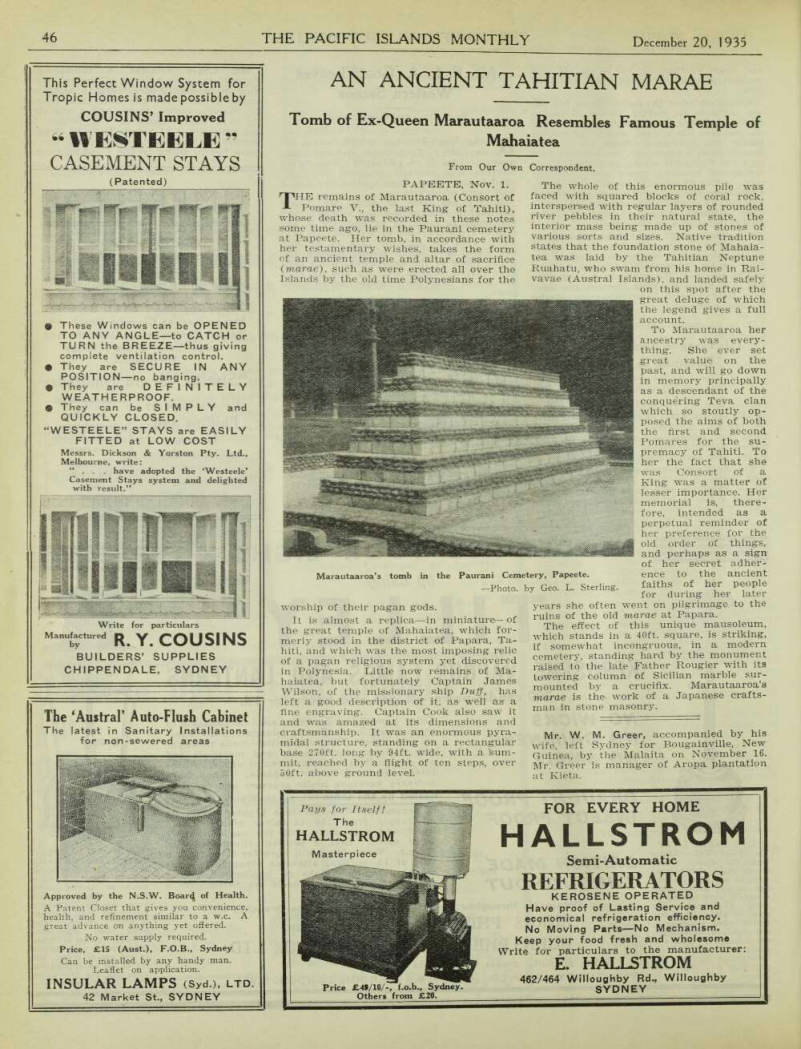
Tomb of Ex-Queen Marautaaroa Resembles Famous Temple of Mahaiatea
From Our Own Correspondent.
Papeete, Nov. 1.
THE remains of Marautaaroa (Consort of Pomare V., the last King of Tahiti), whose death was recorded in these notes some time ago, lie in the Paurani cemetery at Papeete. Her tomb, in accordance with her testamentary wishes, takes the form of an ancient temple and altar of sacrifice (marae), such as were erected all over the Islands by the old time Polynesians for the
worship of their pagan gods.
It is almost a replica—in miniature—of the great temple of Mahaiatea, which for merly stood in the district of Papara, Ta hiti, and which was the most imposing relic of a pagan religious system yet discovered in Polynesia. Little now remains of Ma haiatea, but fortunately Captain James Wilson, of the missionary ship Duff, has left a good description of it, as well as a fine engraving. Captain Cook also saw it and was amazed at its dimensions and draftsmanship. It was an enormous pyra midal structure, standing on a rectangular base 270 ft. long by 94ft. wide, with a Sum mit, reached by a flight of ten steps, over 50ft. above ground level.
The whole of this enormous pile was faced with squared blocks of coral rock, interspersed with regular layers of rounded river pebbles in their natural state, the interior mass being made up of stones of various sorts and sizes. Native tradition states that the foundation stone of Mahaia tea was laid by the Tahitian Neptune Ruahatu, who swam from his home in Rai vavae (Austral Islands), and landed safely
on this spot after the great deluge of which the legend gives a full account.
To Marautaaroa her ancestry was every thing. She ever set great value on the past, and will go down in memory principally as a descendant of the conquering Teva clan which so stoutly op posed the aims of both the first and second Pomares for the su premacy of Tahiti. To her the fact that she was Consort of a King was a matter of lesser importance. Her memorial is, there fore, intended as a perpetual reminder of her preference for the old order of things, and perhaps as a sign of her secret adher ence to the ancient faiths of her people for during her later
years she often went on pilgrimage to the ruins of the old marae at Papara.
The effect of this unique mausoleum, which stands in a 40ft. square, is striking, if somewhat incongruous, in a modern cemetery, standing hard by the monument raised to the late Father Rougier with its towering column of Sicilian marble sur mounted by a crucifix. Marautaaroa’s marae is the work of a Japanese crafts man in stone masonry.
Mr. W. M. Greer, accompanied by his wife, left Sydney for Bougainville, New Guinea, by the Malaita on November 16.
Mr. Greer is manager of Aropa plantation at Kieta.
Marautaaroa’s tomb in the Paurani Cemetery, Papeete. —'Photo, by Geo. L. Sterling.
Advertisements & other items, p. 48 (1 item)
Hallstrom
Pays for Itself!
The
Masterpiece Price £.41/10/-, f.0.b,, Sydney.
Others from £2O.
FOR EVERY HOME
HALLSTROM
Semi-Automatic
REFRIGERATORS
KEROSENE OPERATED
Have proof of Lasting Service and economical refrigeration efficiency.
No Moving Parts —-No Mechanism.
Keep your food fresh and wholesome Write for particulars to the manufacturer:
E. HALLSTROM
462/464 Willoughby Rd., Willoughby
SYDNEY
Cook Is. Fruit
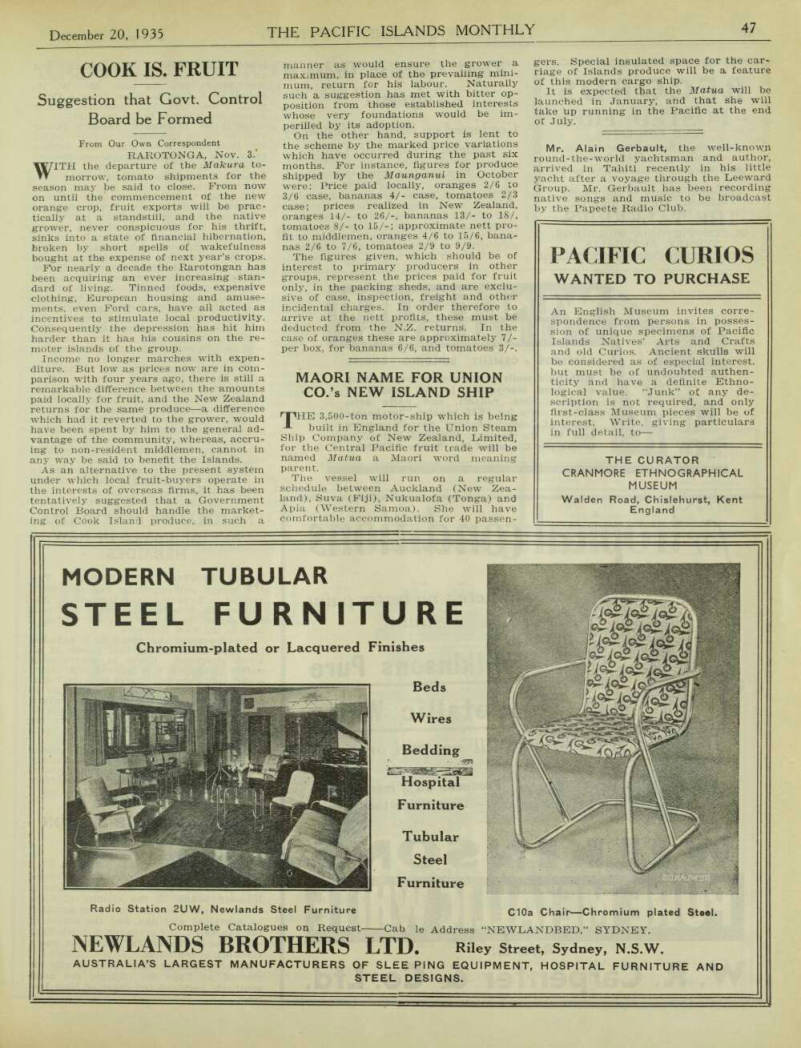
Suggestion that Govt. Control Board be Formed
From Our Own Correspondent
Rarotonga, Nov. 3.'
WITH the departure of the Makura to morrow, tomato shipments for the season may be said to close. From now on until the commencement of the new orange crop, fruit exports will be prac tically at a standstill, and the native grower, never conspicuous for his thrift, sinks into a state of financial hibernation, broken by short spells of wakefulness bought at the expense of next year’s crops.
For nearly a decade the Rarotongan has been acquiring an ever increasing stan dard of living. Tinned foods, expensive clothing, European housing and amuse ments, even Ford cars, have all acted as incentives to stimulate local productivity.
Consequently the depression has hit him harder than it has his cousins on the re moter islands of the group.
Income no longer marches with expen diture. But low as prices now are in com parison with four years ago, there is still a remarkable difference between the amounts paid locally for fruit, and the New Zealand returns for the same produce—a difference which had it reverted to the grower, would have been spent by him to the general ad vantage of the community, whereas, accru ing to non-resident middlemen, cannot in any way be said to benefit the Islands.
As an alternative to the present system under which local fruit-buyers operate in the interests of overseas firms, it has been tentatively suggested that a Government Control Board should handle the market ing of Cook Island produce, in such a
manner as would ensure the grower a maximum, in place of the prevailing mini mum, return for his labour. Naturally such a suggestion has met with bitter op position from those established interests whose very foundations would be im perilled by its adoption.
On the other hand, support is lent to the scheme by the marked price variations which have occurred during the past six months. For instance, figures for produce shipped by the Maunganui in October were: Price paid locally, oranges 2/6 to 3/6 case, bananas 4/- case, tomatoes 2/3 case; prices realized in New Zealand, oranges 14/- to 26/-, bananas 13/- to IS/, tomatoes 8/- to 15/-; approximate nett pro fit to middlemen, oranges 4/6 to 15/6, bana nas 2/6 to 7/6, tomatoes 2/9 to 9/9.
The figures given, which should be of interest to primary producers in other groups, represent the prices paid for fruit only, in the packing sheds, and are exclu sive of case, inspection, freight and other incidental charges. In order therefore to arrive at the nett profits, these must be deducted from the N.Z. returns. In the case of oranges these are approximately 7/per box, for bananas 6/6, and tomatoes 3/-.
Maori Name For Union
Co's New Isl Anti Ship
THE 3,500-ton motor-ship which is being built in England for the Union Steam Ship Company of New Zealand, Limited, for the Central Pacific fruit trade will be named Matua a Maori word meaning parent.
The vessel will run on a regular schedule between Auckland (New Zea land), Suva (Fiji), Nukualofa (Tonga) and Apia (Western Samoa). She will have comfortable accommodation for 40 passen
gers. Special insulated space for the car riage of Islands produce will be a feature of this modern cargo ship.
It is expected that the Matua will be launched in January, and that she will take up running in the Pacific at the end of July.
Mr. Alain Gerbault, the well-known round-the-world yachtsman and author, arrived in Tahiti recently in his little yacht after a voyage through the Leeward Group. Mr. Gerbault has been recording native songs and music to be broadcast by the Papeete Radio Club.
Advertisements & other items, pp. 49-50 (1 item)
Steel Furniture
PACIFIC CURIOS
WANTED TO PURCHASE
An English Museum invites correspondence from persons in possession of unique specimens of Pacific Islands Natives’ Arts and Crafts and old Curios. Ancient skulls will be considered as of especial interest, but must be of undoubted authenticity and have a definite Ethnological value. “Junk” of any description is not required, and only first-class Museum pieces will be of interest. Write, giving particulars in full detail, to —
THE CURATOR
CRANMORE ETHNOGRAPHICAL
MUSEUM
Walden Road, Chislehurst, Kent England
MODERN TUBULAR
STEEL FURNITURE
Chromium-plated or Lacquered Finishes Beds Wires Bedding - .M Hospital Furniture Tubular Steel Furniture eg: J eg: W £ £ 9 ; r Radio Station 2UW, Newlands Steel Furniture Cloa Chair —Chromium plated Steel.
Complete Catalogues on Request Cab le Address “NEWLANDBED,” SYDNEY.
NEWLANDS BROTHERS LTD. Riley Street, Sydney, N.S.W.
AUSTRALIA’S LARGEST MANUFACTURERS OF SLEE PING EQUIPMENT, HOSPITAL FURNITURE AND
STEEL DESIGNS.
RECORDS
-POSTED FREE
SEND FOR LISTS
Australia’s finest Record Shop, specialising in Mail Orders.
Any Records procured and sent same day.
Dozens of clients in the Pacific Islands. We pay freight.
THE TALKERIES
QUEEN VICTORIA BUILDINGS
SYDNEY, AUSTRALIA
ASBESTOS - CEMENT BUILDING SHEETS
With rigid walls of Durabesfos any building will stand four-square to the assaults of weather, time, rodents, and white ants.
Call or write for FREE booklet "Durabestos Homes of Colourful Beauty" describing many uses for Durabestos. WUNDERLICH LTD., Crown and Cleveland Sts., Redfern, SYDNEY.
D 2.45
y& tropica I conditions
> Mi There's no better paint than
Wilkinsons Pure
Metallic White
Will not peel or crack Produces 33% more Paint than White Lead
WILKINSONS
Ap'PntQ*
W. R. Carpenter & Co. Ltd.
Polynesia”
“Royal Georgian Order of Polynesia”
Conferred on British Admiral by Queen Pomare of Tahiti
From Our Own Correspondent
Papeete, Nov. 1.
THE life of Queen Pomare and the his tory surrounding her important reign over Tahiti have been subjects of much research recently and the following particu lars concerning the ancient “Royal Geor gian Order of Polynesia” will no doubt b© of interest. This is not, as might be sup
posed, a fancy flight of the imagination, but an historical fact unearthed by that assid uous delver into the past, Mr. W. W.
Bolton, M.A., and is taken from a Com mand Paper (No. 142) presented to the British Government in the year 1847.
Just prior to Dupetit Thouar’s second visit to Tahiti (November 1, 1834) whilst her undisputed sovereignty was holding sway over the protectorate, Queen Pomare wrote on June 15, 1834, to Rear Admiral Thomas, Commander-in-Chief in the Pacific Ocean, as follows: — “Wishing to testify to you, O Admiral, my great satisfaction for all the good ser vices you have rendered to me in my distress, I send to you, by the first oppor tunity, the highest proof that I can give you of my gratitude and pleasure. This is to make known that I have conferred upon you the first and highest honour of Tahiti, and which I had determined upon estab lishing and did establish, so as to reward my kind friends of Britain who had come to my help in this time of my great trouble, as well as to reward my high chiefs who had been faithful to their Queen. The emblems of this order of merit shall be sent to you very soon, as I have sent to Britain for them.
“According then to the rules in your and other lands, I hereby nominate you a Knight Grand Cross of the Royal Georgian Order of Polynesia as a perpetual testimony of my great satisfaction, and I shall write to my sister Queen, the great Victoria, to grant you permission to wear this token of my gratitude for the services you have done for me and for my dominions.—Pom are, Queen of Tahiti.”
There is, however, no known record as to whether the gallant Admiral actually became a K.G.O.
Naturalist Penetrates
Burial Caves In New
Hebrides
Mrs. Fenton Woodburn, A Vic
torian anthropologist and naturalist, arrived in Sydney by the Morinda on No vember 25, bringing specimens of fossils and skulls, which she collected during a visit to the New Hebrides.
She described the group as a paradise for naturalists, saying that fossils of all kinds abounded. Eager to secure some native skulls, she was lowered 800 ft. down a cliff, and then penetrated into the burial caves. She expected some difficulties in securing the natives’ help in this venture, but was surprised to find them ready to assist in every way. They, however, re fused to handle the skulls or to carry them. .
Other specimens she secured included 10 varieties of ants, a species of shrimp, which shed its claws when anyone touched them, and four extraordinary beetles from the island of Erromanga.
Nussing Island Beacon
From Our Own Correspondent
Rajbaul, Nov. 23.
THE Administration recently completed the erection of an “unwatched” light on Nussing Island, in the vicinity of Cape Crettin, near Finschhafen. It is actuated by acetylene and gas, and the action of the sun valve, and gives out a quick flash once every ten seconds. The light has a visibility of ten miles.
Another similar light will shortly be erected at Cape St. George, the most southerly point on the coast of New Ire land.
Poverty-Stricken Fruit-Growers Of
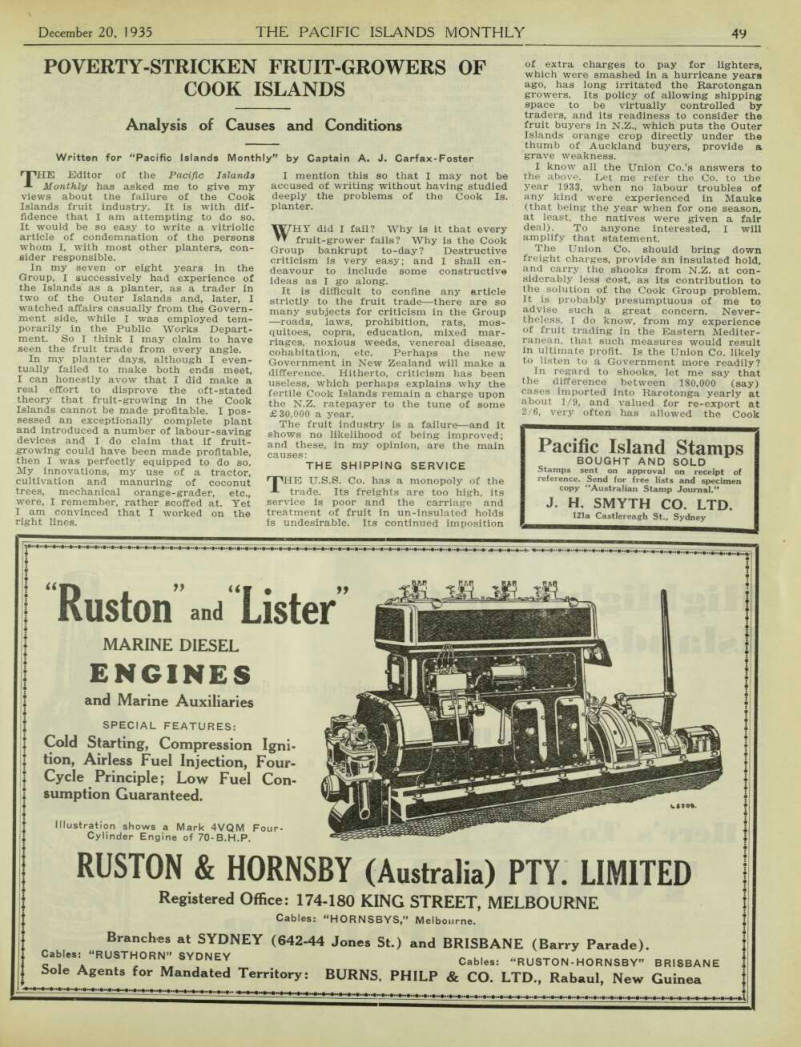
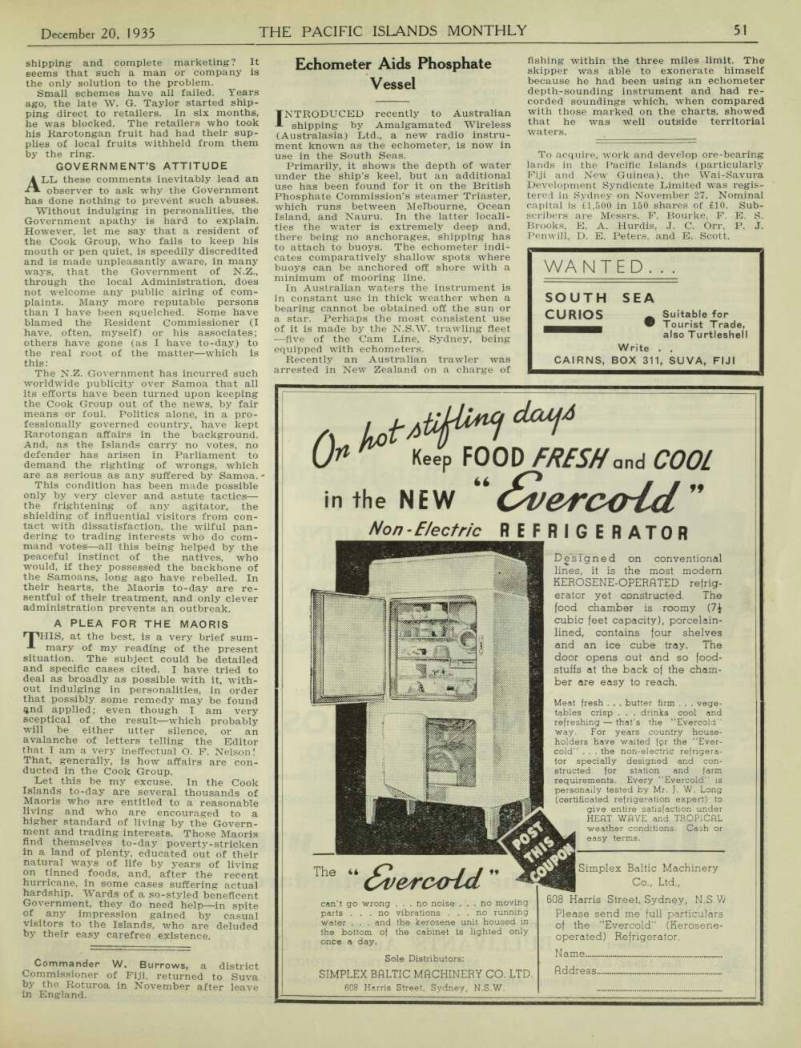
Cook Islands
Analysis of Causes and Conditions
Written for “Pacific Islands Monthly” by Captain A. J. Carfax-Foster
THE Editor of the Pacific Islands Monthly has asked me to give my views about the failure of the Cook Islands fruit industry. It is with dif fidence that I am attempting to do so.
It would be so easy to write a vitriolic article of condemnation of the persons whom I, with most other planters, con sider responsible.
In my seven or eight years in the Group, I successively had experience of the Islands as a planter, as a trader in two of the Outer Islands and, later, I watched affairs casually from the Govern ment side, while I was employed tem porarily in the Public Works Depart ment. So I think I may claim to have seen the fruit trade from every angle.
In my planter days, although I even tually failed to make both ends meet, I can honestly avow that I did make a real effort to disprove the oft-stated theory that fruit-growing in the Cook Islands cannot be made profitable. I pos sessed an exceptionally complete plant and introduced a number of labour-saving devices and I do claim that if fruit growing could have been made profitable, then I was perfectly equipped to do so.
My innovations, my use of a tractor, cultivation and manuring of coconut trees, mechanical orange-grader, etc., were, I remember, rather scoffed at. Yet I am convinced that I worked on the right lines.
I mention this so that I may not be accused of writing without having studied deeply the problems of the Cook Is. planter.
WHY did I fail? Why is it that every fruit-grower fails? Why is the Cook Group bankrupt to-day? Destructive criticism is very easy; and I shall en deavour to include some constructive ideas as I go along.
It is difficult to confine any article strictly to the fruit trade —there are so many subjects for criticism in the Group —roads, laws, prohibition, rats, mos quitoes, copra, education, mixed mar riages, noxious weeds, venereal disease, cohabitation, etc. Perhaps the new Government in New Zealand will make a difference. Hitherto, criticism has been useless, which perhaps explains why the fertile Cook Islands remain a charge upon the N.Z, ratepayer to the tune of some £30,000 a year.
The fruit industry is a failure—and it shows no likelihood of being improved; and these, in my opinion, are the main causes:
The Shipping Service
T'HE U.S.S. Co. has a monopoly of the A trade. Its freights are too high, its service is poor and the carriage and treatment of fruit in un-insulated holds is undesirable. Its continued imposition
of extra charges to pay for lighters, which were smashed in a hurricane years ago, has long irritated the Rarotongan growers. Its policy of allowing shipping space to be virtually controlled by traders, and its readiness to consider the fruit buyers in N.Z., which puts the Outer Islands orange crop directly under the thumb of Auckland buyers, provide a grave weakness.
I know all the Union Co.’s answers to the above. Let me refer the Co. to the year 1933, when no labour troubles of any kind were experienced in Mauke (that being the year when for one season, at least, the natives were given a fair deal). To anyone interested, I will amplify that statement.
The Union Co. should bring down freight charges, provide an insulated hold, and carry the shocks from N.Z. at con siderably less cost, as its contribution to the solution of the Cook Group problem.
It is probably presumptuous of me to advise such a great concern. Never theless, I do know, from my experience of fruit trading in the Eastern Mediter ranean, that such measures would result in ultimate profit. Is the Union Co. likely to listen to a Government more readily?
In regard to shocks, let me say that the difference between 180,000 (say) cases imported into Rarotonga yearly at about 1/9, and valued for re-export at 2/6, very often has allowed the Cook
Islands’ yearly report to show a balance in favour of exports over imports—a bol stering of trade figures that is quite unjustifiable.
A Fruit Ring?
THE existence of a fruit ring is always denied. Nevertheless, having been employed by it, I state unequivocally that a strong and ruthless fruit ring does con trol, not only the Cook Islands, but a great number of growers around Auck land. At the moment, it is certain that three Auckland firms virtually have a stranglehold upon the fruit trade and are powerful enough to dictate policy, not only to the Union Co., but to Government Departments.
Until the N.Z. Government takes a hand, and prevents any firm acting as a commission agent whilst it is at the same time buying fruit on its own account, no grower can hope to put fruit upon the N.Z. market at a price which does not suit the fruit ring.
That is the crux of the matter; and, failing Government action, the only solu tion seems to be to interest outside capital in order to establish a complete marketing system in Rarotonga and N.Z., so that growers may increase production and use all the present waste acres to grow fruit. The smaller cost of shipping and marketing, coupled with education of the N.Z. public to fruit-eating, would almost overnight result in profit to the public in the form of cheap fruit and in providing a comfortable living for the growers.
Let me assure the Auckland merchants that I know all their answers to the above. I am not indulging in vain dreams. The cry of the fruit ring, for years, has been that there is no profit in Islands fruit.
I believe in hard facts talking for them selves. If their contention be true, why do they employ highly paid agents to deal in the fruit? Philanthropy? Hardly!
To their outcries about poor native pack ing and dishonest natives, I reply that if they are to be allowed to continue buying Island fruit, they themselves should supervise the packing of the fruit, instead of being content to buy Union Co.’s carters’ notes. Then they will be entitled to grumble at poor fruit received in N.Z.
The supervision of packing they have never done —in spite of good opportuni ties under the old regulations, when they were supposed to construct and operate their own packing sheds. In defiance of the Government, they failed to do this, and to-day they are in the position of
having Government officials to inspect the fruit, at the expense of the growers.
This state of affairs is a disgrace. No buyer of fruit should be allowed to use fruit, bought by him, to manipulate the price of fruit which is consigned to him as a commission agent. Nor should he be allowed to use the Government as a policeman for his interests.
To cite actual facts: I once watched a case of bananas go through a sale in Wellington—noted its number, noted the retailer who bought it, and discovered afterwards that the grower actually was paid 4/- less than his case realised. I tried at the time to get action taken, but with no result.
The Rarotongan growers, nowadays, are all so far beneath the thumb of trading firms that it is virtually impossible to get any collective action from them. The natives are a fine race of people: yet one cannot blame them overmuch if they, under the stress of poverty, do a little sharp work to beat the fruit regulations.
The Maori appreciates a square deal, and, if it is given to him, and a profit can be made from his fruit, will not resort to sharp practices.
In the Editor’s office lies testimony that this can be done, in the shape of a cer tificated auditor’s report, covering six months’ trading, showing a handsome profit, coupled with a petition from the natives to keep that particular trader there. That is very conclusive proof that a fair deal is readily appreciated by the Maoris.
Decontrol of the fruit industry by the Auckland ring could be broken. Any capitalist of vision could do it, with good results to everyone. Where is the man who is courageous enough to dare Government disapproval, dare competi tion by Auckland, dare the apathy of discouraged growers, and start a com bined co-operative plan for packing,
shipping and complete marketing? It seems that such a man or company is the only solution to the problem.
Small schemes have all failed. Years ago, the late W. G. Taylor started ship ping direct to retailers. In six months, he was blocked. The retailers who took his Rarotongan fruit had had their sup plies of local fruits withheld from them by the ring.
Government’S Attitude
ALL these comments inevitably lead an observer to ask why the Government has done nothing to prevent such abuses.
Without indulging in personalities, the Government apathy is hard to explain.
However, let me say that a resident of the Cook Group, who fails to keep his mouth or pen quiet, is speedily discredited and is made unpleasantly aware, in many ways, that the Government of N.Z., through the local Administration, does not welcome any public airing of com plaints. Many more reputable persons than I have been squelched. Some have blamed the Resident Commissioner (I have, often, myself) or his associates; others have gone (as I have to-day) to the real root of the matter —which is this: The N.Z. Government has incurred such worldwide publicity over Samoa that all its efforts have been turned upon keeping the Cook Group out of the news, by fair means or foul. Politics alone, in a pro fessionally governed country, have kept Rarotongan affairs in the background.
And, as the Islands carry no votes, no defender has arisen in Parliament to demand the righting of wrongs, which are as serious as any suffered by Samoa.
This condition has been made possible only by very clever and astute tactics— the frightening of any agitator, the shielding of influential visitors from con tact with dissatisfaction, the wilful pan dering to trading interests who do com mand votes —all this being helped by the peaceful instinct of the natives, who would, if they possessed the backbone of the Samoans, long ago have rebelled. In their hearts, the Maoris to-day are re sentful of their treatment, and only clever administration prevents an outbreak.
A Plea For The Maoris
7 1 ’’HIS, at the best, is a very brief sum mary of my reading of the present situation. The subject could be detailed and specific cases cited. I have tried to deal as broadly as possible with it, with out indulging in personalities, in order that possibly some remedy may be found and applied; even though I am very sceptical of the result—which probably will be either utter silence, or an avalanche of letters telling the Editor that I am a very ineffectual O. F. Nelson!
That, generally, is how affairs are con ducted in the Cook Group.
Let this be my excuse. In the Cook Islands to-day are several thousands of Maoris who are entitled to a reasonable living and who are encouraged to a higher standard of living by the Govern ment and trading interests. Those Maoris find themselves to-day poverty-stricken in a land of plenty, educated out of their natural ways of life by years of living on tinned foods, and, after the recent hurricane, in some cases suffering actual hardship. Wards of a so-styled beneficent Government, they do need help—in spite of any impression gained by casual visitors to the Islands, who are deluded by their easy carefree existence.
Commander W. Burrows, a district Commissioner of Fiji, returned to Suva by the Roturoa in November after leave in England.
Advertisements & other items, pp. 51-52 (1 item)
Ruston
Pacific Island Stamps
BOUGHT AND SOLD
Stamps sent on approval on receipt of reference. Send for free lists and specimen copy “Australian Stamp Journal.”
J. H. SMYTH CO. LTD.
121 a Castlereagh St., Sydney
Ruston
U
and lister
MARINE DIESEL
ENGINES
and Marine Auxiliaries
SPECIAL FEATURES;
Cold Starting, Compression Ignition, Airless Fuel Injection, Four- Cycle Principle; Low Fuel Consumption Guaranteed.
Illustration shows a Mark 4VQM Four- Cylinder Engine of 70-B.H.P.
RUSTON & HORNSBY (Australia) PTY. LIMITED
Registered Office: 174-180 KING STREET, MELBOURNE Cables: “HORNSBYS” Melbourne.
Branches at SYDNEY (642-44 Jones St.) and BRISBANE (Barry Parade).
Cables: RUSTHORN” SYDNEY Cables: “RUSTON-HORNSBY” BRISBANE
Sole Agents for Mandated Territory: BURNS, PHILP & CO. LTD., Rabaul, New Guinea AO 99 im
A Message
to Merchants ...
NOW IS THE RIGHT TIME to
buy from CHINA to grasp the benefit of the present favourable exchange. Trade between China, Australia and the South Sea Islands is again in full swing. You are assured of prompt service and strictly factory prices by
ALOIS AKUN
& COMPANY
IMPORTERS, EXPORTERS AND
MANUFACTURERS’ AGENTS.
180 NATHAN ROAD, KOWLOON,
HONGKONG.
The Buying Headquarters in China for Australian and Islands Merchants.
Office and Store also at Rabaul, New Guinea.
Specialising in Chinese & Japanese Goods suitable for ISLANDS
TRADE.
Highlights in the
Islands . . .
The prolific Pacific Islands produce wonderful crops, flowers, trees, people, and
THIRSTS!
Then you are grateful for this drink that is a pal to your palate, and an ally of health
“ Here’s To’ee”—
room: vs
PIL.SBNBR
IN THE BOTTLE WITH THE YELLOW LABEL 9 § t Qoheys
LAGS
Vessel
Echometer Aids Phosphate Vessel
INTRODUCED recently to Australian shipping by Amalgamated Wireless (Australasia) Ltd., a new radio instru ment known as the echometer, is now in use in the South Seas.
Primarily, it shows the depth of water under the ship’s keel, but an additional use has been found for it on the British Phosphate Commission’s steamer Triaster, which runs between Melbourne, Ocean Island, and Nauru. In the latter locali ties the water is extremely deep and, there being no anchorages, shipping has to attach to buoys. The echometer indi cates comparatively shallow spots where buoys can be anchored off shore with a minimum of mooring line.
In Australian waters the instrument is in constant use in thick weather when a bearing cannot be obtained off the sun or a star. Perhaps the most consistent use of it is made by the N.S.W. trawling fleet —five of the Cam Line, Sydney, being equipped with echometers.
Recently an Australian trawler was arrested in New Zealand on a charge of
fishing within the three miles limit. The skipper was able to exonerate himself because he had been using an echometer depth-sounding instrument and had re corded soundings which, when compared with those marked on the charts, showed that he was well outside territorial waters.
To acquire, w r ork and develop ore-bearing lands in the Pacific Islands (particularly Fiji and New Guinea), the Wai-Savura Development Syndicate Limited was regis tered in Sydney on November 27. Nominal capital is £1,500 in 150 shares of £lO. Sub scribers are Messrs. F. Bourke, F. E. S.
Brooks, E. A. Hurdis, J. C. Orr, P. J.
Penwill, D. E. Peters, and E. Scott.
Advertisements & other items, p. 53 (1 item)
£verarid
WANTED
SOUTH SEA
CURIOS Suitable for 9 Tourist Trade, also Turtleshell Write . .
CAIRNS, BOX 311, SUVA, FIJI
U* Keep FOOD FR£SHani COOL
in the NEW “ SveTOclcl''
Non-Electric REFRIGERATOR
The **
£verarid
can't go wrong ... no noise ... no moving parts ... no vibrations ... no running water . . . and the kerosene unit housed in the bottom of the cabinet is lighted only once a day.
Sole Distributors:
SIMPLEX BALTIC MACHINERY CO. LTD.
608 Harris Street, Sydney, N.S.W.
Designed on conventional lines, it is the most modern
KEROSENE-OPERATED refrig-
erator yet constructed. The food chamber is roomy (7$ cubic feet capacity), porcelainlined, contains four shelves and an ice cube tray. The door opens out and so foodstuffs at the back of the chamber are easy to reach.
Meat fresh . . . butter firm . . . vegetables crisp . . . drinks cool and refreshing —that's the “Evercold" way. For years country householders have waited fpr the ‘'Evercold'' . . . the non-electric refrigerator specially designed and constructed for station and farm requirements. Every “Evercold'' is personally tested by Mr. J. W. Long (certificated refrigeration expert) to give entire satisfaction under
HEAT WAVE and TROPICAL
weather conditions. Cash or easy terms.
Simplex Baltic Machinery Co., Ltd., 608 Harris Street, Sydney, N.S.W Please send me full particulars of the “Evercold" (Keroseneoperated) Refrigerator.
Name Address..
Mining Handbook
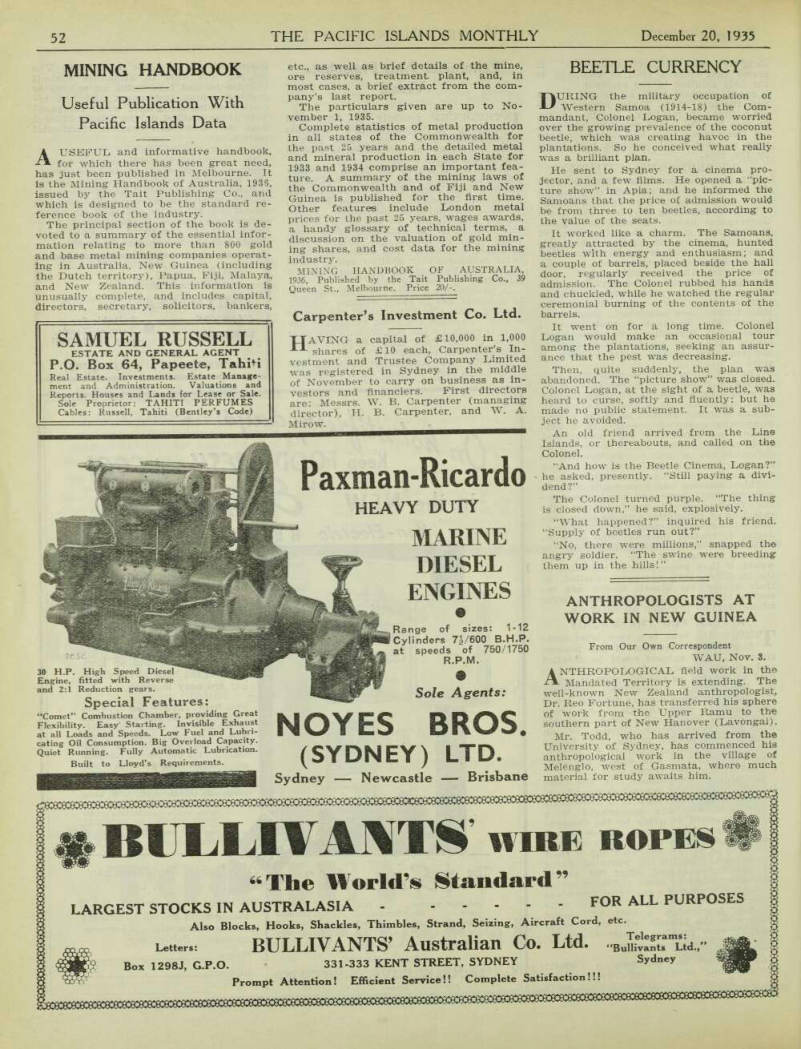
Useful Publication With Pacific Islands Data
A USEFUL and informative handbook, for which there has been great need, has just been published in Melbourne. It is the Mining Handbook of Australia, 1936, issued by the Tait Publishing Co., and which is designed to be the standard re ference book of the industry.
The principal section of the book is de voted to a summary of the essential infor mation relating to more than 800 gold and base metal mining companies operat ing in Australia, New Guinea (including the Dutch territory), Papua, Fiji, Malaya, and New Zealand. This information is unusually complete, and includes capital, directors, secretary, solicitors, bankers,
etc., as well as brief details of the mine, ore reserves, treatment plant, and, in most cases, a brief extract from the com pany’s last report.
The particulars given are up to No vember 1, 1935.
Complete statistics of metal production in all states of the Commonwealth for the past 25 years and the detailed metal and mineral production in each State for 1933 and 1934 comprise an important fea ture. A summary of the mining laws of the Commonwealth and of Fiji and New Guinea is published for the first time.
Other features include London metal prices for the past 25 years, wages awards, a handy glossary of technical terms, a discussion on the valuation of gold min ing shares, and cost data for the mining industry.
Mining Handbook Of Australia,
1936, Published by the Tait Publishing Co., 39 Queen St., Melbourne. Price 20/-.
Carpenter’s Investment Co. Ltd.
HAVING a capital of £ 10,000 in 1,000 shares of £lO each, Carpenter’s In vestment and Trustee Company Limited was registered in Sydney in the middle of November to carry on business as in vestors and financiers. First directors are: Messrs. W. B. Carpenter (managing director), H. B. Carpenter, and W. A.
Mirow.
Beetle Currency
DURING the military occupation of Western Samoa (1914-18) the Com mandant, Colonel Logan, became worried over the growing prevalence of the coconut beetle, which was creating havoc in the plantations. So he conceived what really was a brilliant plan.
He sent to Sydney for a cinema pro jector, and a few films. He opened a “pic ture show” in Apia; and he informed the Samoans that the price of admission would be from three to ten beetles, according to the value of the seats.
It worked like a charm. The Samoans, greatly attracted by the cinema, hunted beetles with energy and enthusiasm; and a couple of barrels, placed beside the hall door, regularly received the price of admission. The Colonel rubbed his hands and chuckled, while he watched the regular ceremonial burning of the contents of the barrels.
It went on for a long time. Colonel Logan would make an occasional tour among the plantations, seeking an assur ance that the pest was decreasing.
Then, quite suddenly, the plan was abandoned. The “picture show” was closed.
Colonel Logan, at the sight of a beetle, was heard to curse, softly and fluently: but he made no public statement. It was a sub ject he avoided.
An old friend arrived from the Line Islands, or thereabouts, and called on the Colonel.
“And how is the Beetle Cinema, Logan?" he asked, presently. “Still paying a divi dend?”
The Colonel turned purple. “The thing is closed down,” he said, explosively.
“What happened?” inquired his friend.
“Supply of beetles run out?”
“No, there were millions,” snapped the angry soldier. “The swine were breeding them up in the hills!”
Anthropologists At
Work In New Guinea
From Our Own Correspondent WAU, Nov. 8.
Anthropological field work in the Mandated Territory is extending. The well-known New Zealand anthropologist, Dr. Reo Fortune, has transferred his sphere of work from the Upper Ramu to the southern part of New Hanover (Lavongai).
Mr. Todd, who has arrived from the University of Sydney, has commenced his anthropological work in the village of Melenglo, west of Gasmata, where much material for study awaits him.
Advertisements & other items, p. 54 (1 item)
lIUtiLJVAI¥TS’ wire ropes#
SAMUEL RUSSELL
ESTATE AND GENERAL AGENT
P.O. Box 64, Papeete, Tahiti
Real Estate. Investments. Estate Management and Administration. Valuations and Reports. Houses and Lands for Lease or Sale.
Sole Proprietor: TAHITI PERFUMES Cables: Russell, Tahiti (Bentley’s Code)
30 H.P. High Speed Diesel Engine, fitted with Reverse and 2:1 Reduction gears.
Special Features:
“Comet” Combustion Chamber, providing Great Flexibility. Easy' Starting. Invisible Exhaust at all Loads and Speeds. Low Fuel and Lubrieating Oil Consumption. Big Overload Capacity.
Quiet Running. Fully Automatic Lubrication.
Built to Lloyd’s Requirements.
Paxman-Ricardo
HEAVY DUTY
MARINE
DIESEL
ENGINES
® Range of sizes: 1-12 Cylinders B.H.P. at speeds of 750/1750
R.P.M.
m
Sole Agents:
NOYES BROS.
(SYDNEY) LTD.
Sydney Newcastle Brisbane
lIUtiLJVAI¥TS’ wire ropes#
“The World’s Standard”
LARGEST STOCKS IN AUSTRALASIA - FOR ALL PURPOSES Also Blocks, Hooks, Shackles, Thimbles, Strand, Seizing, Aircraft Cord, etc.
BULLIVANTS’ Australian Co. Ltd. .. Bu mt£. am Lk,”
Letters;
Box 1298 J, G.P.O.
331-333 KENT STREET, SYDNEY
Prompt Attention! Efficient Service!! Complete Satisfaction!
Sydney
Search Goes On
Gold Prospectors Active In New Guinea
From Our Own Correspondent WAU, Nov. 1.
GOLD continues to be won from the fields of New Guinea as consistently and considerably as ever. For the quarter ended September 30, 73,972 ozs., valued at £A435,518, were exported from the territory, mostly the production of the Morobe gold field.
The Tugi-Tugi goldfield in the New Ire land district has been commanding some attention. Recently a mining engineer in spected the field and, after completing his inspection, pegged out three leases. It is reported that prospects of the area are promising, and that it is likely that pros pecting will continue on a larger scale.
The Kupei goldfield in the Kieta district (Bougainville), where a quantity of mining machinery has already been landed, is being prospected actively. Several mining engineers have proceeded to the area to investigate the possibilities of the field.
Since several prospecting areas have been applied for, the Bainings district (New Britain) has been interesting miners and prospectors. Leases have been pegged and other prospecting areas and ordinary reef claims have been granted. The increased activity in the district, however, has not yet been justified by substantial rewards.
The gold-seeking activities which are being carried on in the vicinity of Wewak (Sepik district), appear to be satisfactory.
The “Samoa Herald”
From Our Own Correspondent
Apia, Nov. 15.
r T'HE “Samoa Herald,” the local weekly -*• newspaper, announced a change of management on November 8. The former proprietor and editor, Mr. G. W. Griffith, after Controlling the paper for 16 months, has handed the business back to the pre vious owners, the Samoa Times Printing and Publishing Co. Ltd. Mr. J. H. Waller has now taken up the position of manag ing-editor on their behalf, Mr. Waller was latterly proprietor of the Pacific Printery, Suva, Fiji, and is well and favourably known in Samoa. Twelve years ago he was superintendent of the London Missionary Society’s printing press at Malua, where he did much valuable work.
Bright Send-off to Mr. G. S. Hill,
of Vila, N.H.
From a Special Correspondent.
VILA, November 7.
A bright dinner party was given on Saturday, November 2 to Mr. and Mrs. G. S. Hill, prior to their departure by the Van Rees on a well earned six months’ leave in Australia. At the coffee stage the party was invaded by surprise raiders, composed of a large number of Vila inhabitants, both British and French, all bent on wishing the Hills “Bon Voyage.”
Mr. Hill has been an officer of the Condominium Government for the past five years. Part of the time he was in the Titles Office and latterly has been Treasurer for the Joint Administration.
Protest Of Samoan
Banana Growers
From Our Own Correspondent
Apia, Nov. 21.
FOR a considerable time much criticism has been levelled at the Administration by European and native banana growers owing to the fact that the quotas of hona fide producers were cut down for the bene fit of European dealers. It is said for instance, that one man especially, at Fasi toouta, was given a virtual monopoly of his district and Europeans and natives of the neighbourhood were refused the quotas they were entitled to.
Representations were without success until the Samoan Faipule (native represen tatives) took the matter up, lodging an objection w r ith the Administration. The Samoans pointed out that native growers desired to pack and deliver their own bananas, as in former years so as to obtain the full price (at present 4/6 per case) for
their produce. Hitherto they have lost 1/6 per cage tQ the dealer; who> it is alleged. often makes unjustified deductions and delays payments of the amounts due.
The Administration apparently has taken notice and the high quotas of dealers will be cut out in future. The whole intended scheme of appointing European district agents to control the production of their districts has now been abandoned, to the satisfaction of growers.
Mr. Frank Stock, Postmaster at TulagL returned to the Solomon Islands by the Malaita in November after furlough spent in England.
Advertisements & other items, pp. 55-56 (1 item)
Yo Unger”
ISLAND SHIPPING
Freight, Forwarding and Customs Service. Import and Export.
B. R. Wheeler
17-19 Bridge St., SYDNEY Correspondence Invited. Tel.: B 5396
a
ABBOT” WATER FILTERS
r '~ Send for Leaflet and Prices. -4=
BELIEVE IT OR NOT. The “Abhor
is Germproof and approved by the Board of Health.
PRESSURE
DRIP TYPE
AND
Unfiltered water, besides being unpleasant, contains many germs, and during summer the water often contains a lot of rust and slime.
WHY DRINK
DIRTY WATER
when you can have pure and germ-free water at very little outlay?
Manufactured only by
I 10-12 PARRAMATTA ROAD
Ujm mWm CAMPERDOWN, SYDNEY, N.S.W.
Do You Know that the Famous
YO UNGER”
STOVES AND
RANGES
made with extended Firebox specially for long Wood fuel, are Self-Setting and, provided sufficient Flue Piping is attached, can be used in almost any position?
The No. 7W. “Younger” Range can now be supplied fitted with Legs, as per illustration. Ask for quotation for this Range, also Illustrated Catalogue and Price List for both Single and Double Oven Stoves.
Younger Stoves are Widely Used Throughout the Pacific Islands.
G. FLETCHER & SON 50 Oxford Street, Sydney
West’s Wheel
(F. H. Bishop, Proprietor)
60-64 Bay St., Sydney
MANUFACTURERS
OF ALL TYPES OF WHEELS
FOR WAGGONS, CARTS,
TRAILERS, CARS
SUPPLIERS
OF WHEEL PARTS, RIMS,
SPOKES, AXLES, BOXES, etc.
We have the plant and have been established forty years Write for Information and Quotations
PAINT
HORSE SHOE BRAND
IN PASTE OR READY
MIXED FORM
Made in Scotland—
fni
WHITE LEAD, WHITE ZINC,
AND ALL COLOURS
—therefore Reliable!
Thomas Mcintyre & Co. Ltd., Glasgow, Scotland
lIAICIEI WEST - - Sydney’s Sailmaker
Caters for every class of
SAIL, CANVAS,
ROPE & WIRE
EQUIPMENT
Send your enquiries to us
ADDRESS;
BALMAIN.
SYDNEY
m* <• * ' -
SECTION OF OUR SAIL LOFT
SHIP CHANDLERY - HARDWARE
BROOMFIELDS LIMITED, 152 Sussex St., SYDNEY
Large and Complete Stocks of SHIP CHANDLERY.
Ironmongery of all kinds—Paints, White Lead and Oils.
Sole Agents for : P. H. MUNTZ & CO.’S 3-CROWN BRAND METAL SHEATHING.
PEACOCK & BUCHANS’ ENGLISH READY-MIXED PAINTS.
WRITE FOR SHIP CHANDLERY CATALOGUE
Special “In Bond” Prices for all Island enquiries quoted on application
CABLES: “BOOM,” SYDNEY
New B.P. Store At Nukualofa
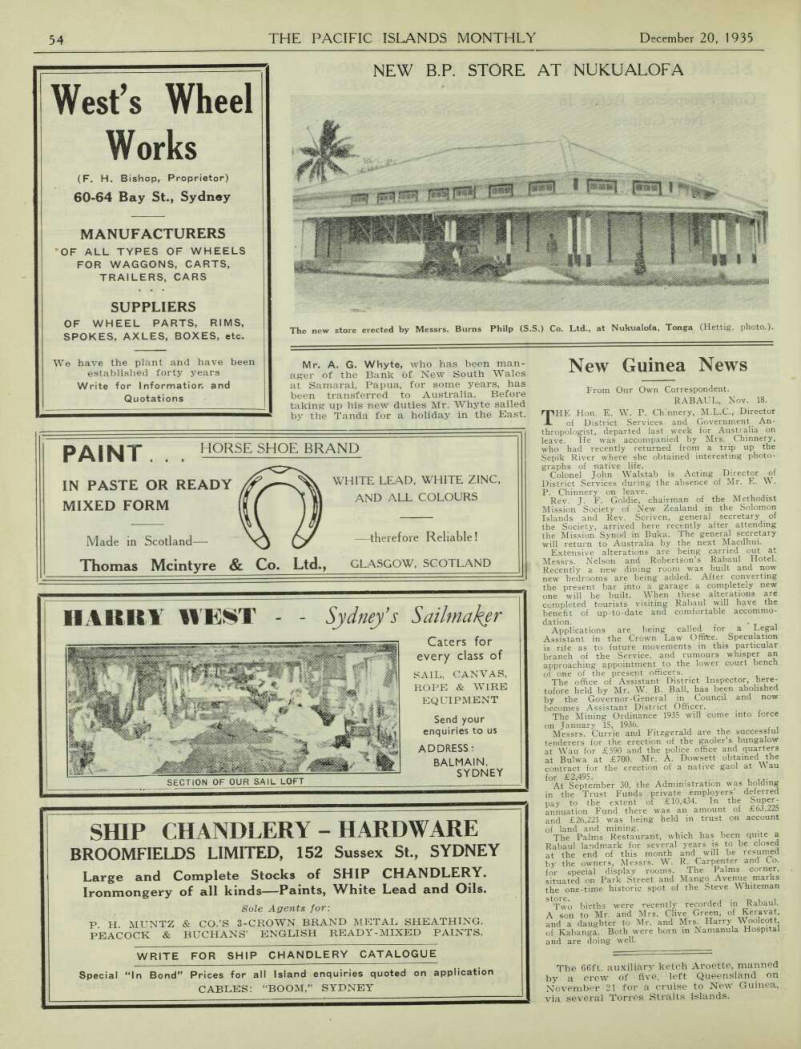
Mr. A. G. Whyte, who has been man ager of the Bank of New South Wales at Samarai, Papua, for some years, has been transferred to Australia. Before taking up his new duties Mr. Whyte sailed by the Tanda for a holiday in the East.
The new store erected by Messrs. Burns Philp (S.S.) Co. Ltd., at Nukualofa, Tonga (Hettig, photo.)
New Guinea News
From Our Own Correspondent.
Rabaul, Nov. 18.
THE Hon. E. W. P. Chinnery, M.L.C., Director of District Services and Government An thropologist, departed last week for Australia on leave. He was accompanied by Mrs. Chinnery, who had recently returned from a trip up the Sepik River where she obtained interesting photo graphs of native life.
Colonel John Walstab is Acting Director of District Services during the absence of Mr. E. W.
P. Chinnery on leave.
Rev. J. F. Goldie, chairman of the Methodist Mission Society of New Zealand in the Solomon Islands and Rev. Scriven, general secretary of the Society, arrived here recently after attending the Mission Synod in Buka. The general secretary will return to Australia by the next Macdhui.
Extensive alterations are being carried out at Messrs. Nelson and Robertson’s Rabaul Hotel.
Recently a new dining room was built and now new bedrooms are being added. After converting the present bar into a garage a completely new one will be built. When these alterations are completed tourists visiting Rabaul will have the benefit of up-to-date and comfortable accommo dation. - * T 1 Applications are being called for a Legal Assistant in the Crown Law Offite. Speculation is rife as to future movements in this particular branch of the Service, and rumours whisper an approaching appointment to the lower court bench of one of the present officers.
The office of Assistant District Inspector, here tofore held by Mr. W. B. Ball, has been abolished by the Governor-General in Council and now becomes Assistant District Officer.
The Mining Ordinance 1935 will come into force on January 15, 1936.
Messrs. Currie and Fitzgerald are the successful tenderers for the erection of the gaoler s bungalow at Wau for £590 and the police office and quarters at Bulwa at £7OO. Mr. A. Dowsett obtained the contract for the erection of a native gaol at Wau for £2,495. . . ...
At September 30, the Administration was holding in the Trust Funds private employers’ deferred pay to the extent of £10,434. In the Super annuation Fund there was an amount of £63,225 and £26,221 was being held in trust on account of land and mining. . , The Palms Restaurant, which has been quite a Rabaul landmark for several years is to be closed at the end of this month and will be resumed by the owners, Messrs. W. R. Carpenter and Co. for special display rooms. The Palms corner, situated on Park Street and Mango Avenue marks the one-time historic spot of the Steve Whiteman St Two births were recently recorded in Rabaul.
A son to Mr. and Mrs. Clive Green, of Keravat, and a daughter to Mr. and Mrs. Harry Woolcott, of Kabanga. Both were born in Namanula Hospital and are doing well.
The 66ft. auxiliary ketch Aroette, manned by a crew of five, left Queensland on November 21 for a cruise to New Guinea, via several Torres Straits islands.
Geneva
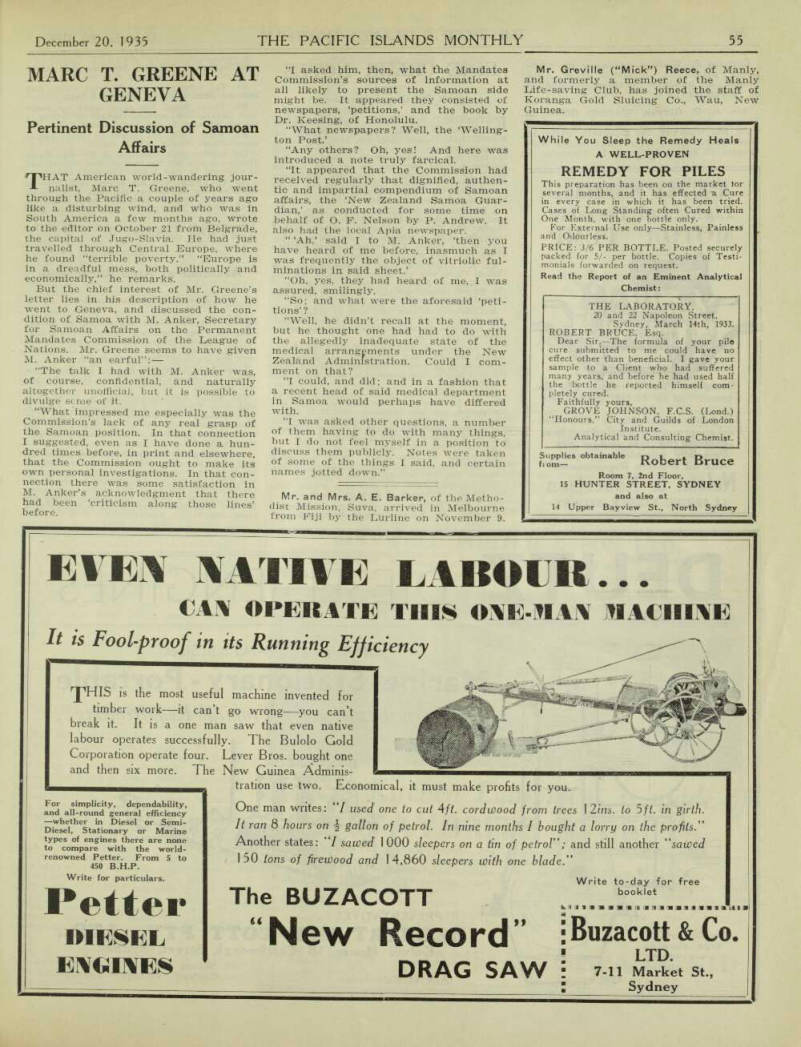
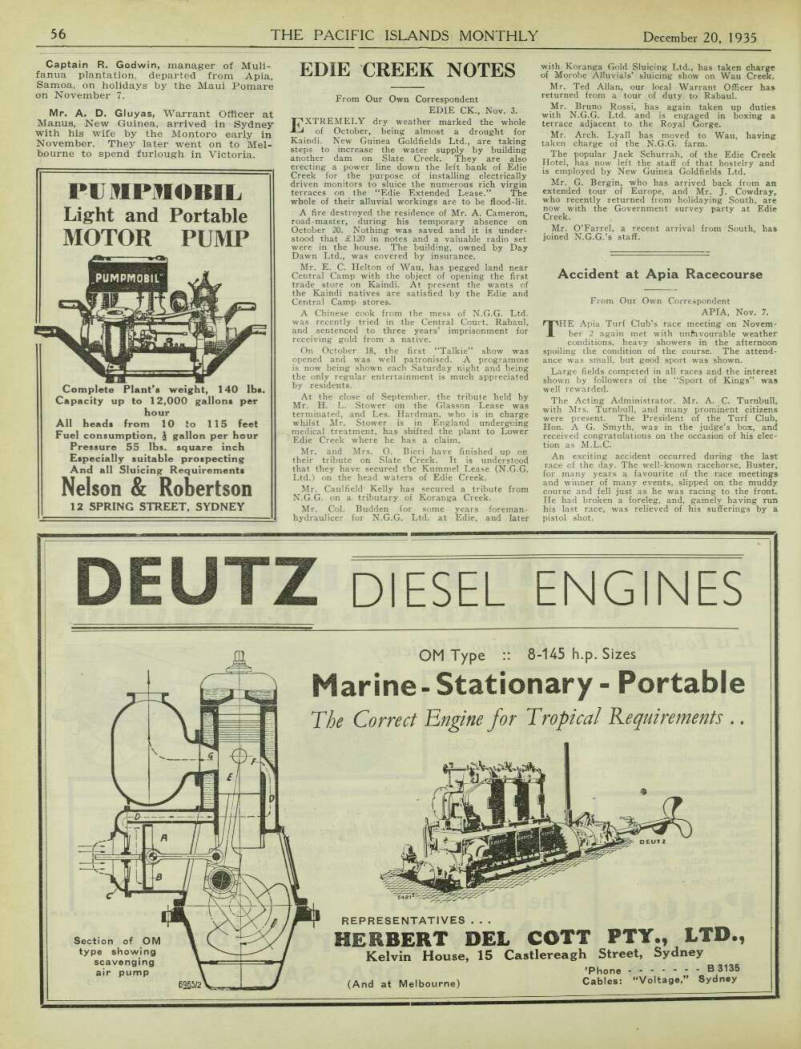
Marc T. Greene At
Pertinent Discussion of Samoan Affairs
THAT American world-wandering jour nalist, Marc T. Greene, who went through the Pacific a couple of years ago like a disturbing wind, and who was in South America a few months ago, wrote to the editor on October 21 from Belgrade, the capital of Jugo-Slavia. He had just travelled through Central Europe, where he found “terrible poverty.” “Europe is in a dreadful mess, both politically and economically,” he remarks.
But the chief interest of Mr. Greene's letter lies in his description of how he went to Geneva, and discussed the con dition of Samoa with M. Anker, Secretary for Samoan Affairs on the Permanent Mandates Commission of the League of Nations. Mr. Greene seems to have given M. Anker “an earful”: “The talk I had with M. Anker was, of course, confidential, and naturally altogether unofficial, but it is possible to divulge seme of it.
“What impressed me especially was the Commission’s lack of any real grasp of the Samoan position. In that connection I suggested, even as I have done a hun dred times before, in print and elsewhere, that the Commission ought to make its own personal investigations. In that con nection there was some satisfaction in M. Anker’s acknowledgment that there had been ‘criticism along those lines’ before.
“I asked him, then, what the Mandates Commission’s sources of information at all likely to present the Samoan side might be. It appeared they consisted of newspapers, ‘petitions,’ and the book by Dr. Keesing, of Honolulu.
“What newspapers? Well, the Welling ton Post.’
“Any others? Oh, yes! And here was introduced a note truly farcical.
“It appeared that the Commission had received regularly that dignified, authen tic and impartial compendium of Samoan affairs, the ‘New Zealand Samoa Guar dian,’ as conducted for some time on behalf of O. F. Nelson by P. Andrew. It also had the local Apia newspaper.
“ ‘Ah,’ said I to M. Anker, ‘then you have heard of me before, inasmuch as I was frequently the object of vitriolic ful minations in said sheet.’
“Oh, yes, they had heard of me, I was assured, smilingly.
“So; and what were the aforesaid ‘peti tions’ ?
“Well, he didn’t recall at the moment, but he thought one had had to do with the allegedly inadequate state of the medical arrangements under the New Zealand Administration. Could I com ment on that?
“I could, and did; and in a fashion that a recent head of said medical department in Samoa would perhaps have differed with.
“I was asked other questions, a number of them having to do with many things, but I do not feel myself in a position to discuss them publicly. Notes were taken of some of the things I said, and certain names jotted down.’’
Mr. and Mrs. A. E. Barker, of the Metho dist Mission, Suva, arrived in Melbourne from Fiji by the Lurline on November 9.
Mr. Greville (“Mick") Reece, of Manly, and formerly a member of the Manly Life-saving - Club, has joined the staff of Korang-a Gold Sluicing Co., Wau, New Guinea.
Captain R. Godwin, manager of Muli fanua plantation, departed from Apia, Samoa, on holidays by the Maui Pomare on November 7.
Mr. A. D. Gluyas, Warrant Officer at Manus, New Guinea, arrived in Sydney with his wife by the Montoro early in November. They later went on to Mel bourne to spend furlough in Victoria.
Advertisements & other items, pp. 57-58 (1 item)
“New Record ” ißuzacott & Co.
While You Sleep the Remedy Heals
A WELL-PROVEN
REMEDY FOR PILES
This preparation has been on the market lor several months, and it has effected a Cure in every case in which it has been tried.
Cases of Long Standing often Cured within One Month, with one bottle only.
For External Use only—Stainless, Painless and Odourless.
PRICE: 3/6 PER BOTTLE. Posted securely packed for 5/- per bottle. Copies of Testimonials forwarded on request.
Read the Report of an Eminent Analytical Chemist;
THE LABORATORY,
20 and 22 Napoleon Street, Sydney, March 14th, 1933.
ROBERT BRUCE, Esq.
Dear Sir, —The formula of your pile cure submitted to me could have no effect other than beneficial. I gave your sample to a Client who had suffered many years, and before he had used half the bottle he reported himself completely cured.
Faithfully yours,
GROVE JOHNSON, F.C.S. (Lend.)
“Honours.” City and Guilds of London Institute.
Analytical and Consulting Chemist.
Supplie, obtainable Robert Bruce
Room 7, 2nd Floor,
15 HUNTER STREET, SYDNEY
and also at 14 Upper Bayview St., North Sydney
EVEN NATIVE I AIEOI IS ...
CAN OPERATE THIS ONE-MAN MACHINE
It is Fool-proof in its Running Efficu r J I HIS is the most useful machine invented for timber work—it can’t go wrong—you can’t break it. It is a one man saw that even native labour operates successfully. The Bulolo Gold Corporation operate four. Lever Bros, bought one and then six more. The New Guinea Admmis- a tration use two. Economical, it must make profits for you.
One man writes; “/ used one to cut Aft. cordwood from trees 12 ins. to sft. in girth.
It ran 8 hours on \ gallon of petrol. In nine months I bought a lorry on the profits .”
Another states: I sawed 1000 sleepers on a tin of petrol and still another “sawed 130 tons of firewood and 14,860 sleepers with one blade."
Write to-day for free
The BUZACOTT “L...
“New Record ” ißuzacott & Co.
• LTD.
DRAG SAW i 7-11 Market St.,
I Sydney For simplicity, dependability, and all-round general efficiency —whether in Diesel or Semi- Diesel, Stationary or Marine types of engines there are none to compare with the worldrenowned Fetter. From 5 to
450 B.H.P.
Write for particulars.
Petter
DIESEL
ENGINES
ncy
iSSik • *
jv
PUUIPUIOBIL
Light and Portable
MOTOR PUMP
Complete Plant’s weight, 140 lbs.
Capacity up to 12,000 gallons per hour All heads from 10 to 115 feet Fuel consumption, J gallon per hour Pressure 55 lbs. square inch Especially suitable prospecting And all Sluicing Requirements
Nelson & Robertson
12 SPRING STREET, SYDNEY
DEUTZ DIESEL ENGINES
■i 69f15/2 OM Type :: 8-145 h.p. Sizes Section of OM type showing scavenging air pump
Marine-Stationary - Portable
The Correct Engine for Tropical Requirements . a
DEUTZ
REPRESENTATIVES . . .
HERBERT DEL COTT PTY., LTD.,
Kelvin House, 15 Castlereagh Street, Sydney 'Phone 83135 (And at Melbourne) Cables: “Voltage,” Sydney
Edie Creek Notes
From Our Own Correspondent
Edie Ck., Nov. 3.
EXTREMELY dry weather marked the whole of October, being almost a drought for Kaindi. New Guinea Goldfields Ltd., are taking steps to increase the water supply by building another dam on Slate Creek, They are also erecting a power line down the left bank of Edie Creek for the purpose of installing electrically driven monitors to sluice the numerous rich virgin terraces on the “Edie Extended Lease.” The whole of their alluvial workings are to be flood-lit.
A fire destroyed the residence of Mr. A. Cameron, road-master, during his temporary absence on October 20. Nothing was saved and it is under stood that £l2O in notes and a valuable radio set were in the house. The building, owned by Day Dawn Ltd., was covered by insurance.
Mr. E. C. Helton of Wau, has pegged land near Central Camp with the object of opening the first trade store on Kaindi. At present the wants of the Kaindi natives are satisfied by the Edie and Central Camp stores.
A Chinese cook from the mess of N.G.G. Ltd. was recently tried in the Central Court, Rabaul, and sentenced to three years’ imprisonment for receiving gold from a native.
On October 18, the first “Talkie” show was opened and was well patronised. A programme is now being shown each Saturday night and being the only regular entertainment is much appreciated by residents.
At the close of September, the tribute held by Mr. H. L. Stower on the Glasson Lease was terminated, and Les. Hardman, who is in charge whilst Mr. Stower is in England undergoing medical treatment, has shifted the plant to Lower Edie Creek where he has a claim.
Mr. and Mrs. O. Bieri have finished up on their tribute on Slate Creek. It is understood that they have secured the Kummel Lease (N.G.G.
Ltd.) on the head waters of Edie Creek.
Mr. Caulfield' Kelly has secured a tribute from N.G.G. on a tributary of Koranga Creek.
Mr. Col. Budden for some years foreman hydraulicer for N.G.G. Ltd. at Edie, and later
with Koranga Gold Sluicing Ltd., has taken charge of Morobe Alluvials’ sluicing show on Wau Creek.
Mr. Ted Allan, our local Warrant Officer has returned from a tour of duty to Rabaul.
Mr. Bruno Rossi, has again taken up duties with N.G.G. Ltd. and is engaged in boxing a terrace adjacent to the Royal Gorge.
Mr. Arch. Lyall has moved to Wau, having taken charge of the N.G.G. farm.
The popular Jack Schurrah, of the Edie Creek Hotel, has now left the staff of that hostelry and is employed by New Guinea Goldfields Ltd.
Mr. G. Bergin, who has arrived back from an extended tour of Europe, and Mr. J. Cowdray, who recently returned from holidaying South, are now with the Government survey party at Edie Creek.
Mr. O’Farrel, a recent arrival from South, has joined N.G.G.’s staff.
Accident at Apia Racecourse
From Our Own Correspondent
Apia, Nov. 7.
THE Apia Turf Club’s race meeting on Novem ber 2 again met with unfavourable weather conditions, heavy showers in the afternoon spoiling the condition of the course. The attend ance was small, but good sport was shown.
Large fields competed in all races and the interest shown by followers of the “Sport of Kings” was well rewarded.
The Acting Administrator, Mr. A. C. Turnbull, with Mrs. Turnbull, and many prominent citizens were present. The President of the Turf Club, Hon. A G. Smyth, was in the judge’s box, and received congratulations on the occasion of his elec tion as M.L.C.
An exciting accident occurred during the last race of the day. The well-known racehorse, Buster, for many years a favourite of the race meetings and winner of many events, slipped on the muddy course and fell just as he was racing to the front.
He had broken a foreleg, and, gamely having run his last race, was relieved of his sufferings by a pistol shot.
New Guinea Cocoa
Effort to Combat Indifference of Australian Manufacturers
THE following letter, which is self-ex planatory, was sent, in December, to a number of leading confectionery manufac turers of Australia: ‘Although the Commonwealth Govern ment continues to pay a bounty on the production of cocoa in New Guinea, and although the New Guinea Administration is spending a good deal of money and effort in improving the quality of cocoa beans grown there, the trade is not making any thing like the progress that was hoped for.
Enquiries which we have made this week in Sydney indicate clearly that the main obstacle to the development of this desir able industry is the stubborn opposition of the big confectionery manufacturing firms of Australia to the introduction of New Guinea cocoa beans.
“We brought this matter under the no tice of Australian confectionery manufac turers over a year ago and we were in formed by them of numerous reasons (mainly based on the quality of the New Guinea product) why the N.G. cocoa beans could not be used in Australia. We took pains to circulate this information and we know that the most determined efforts have been made in New Guinea to overcome the early difficulties of this industry and pro duce a high-grade cocoa bean. But the total lack of encouragement being given to the New Guinea cocoa growers, in any shape or form, by the Australian manufac turers, threatens to strangle this industry at its birth.
“Accordingly, we are sending this letter to the leading confectionery manufacturers to inform them that, on behalf of the New Guinea cocoa growers, we propose to bring the whole position under the attention of the Sydney Chamber of Commerce and of the Commonwealth Government, and we are assembling various data in support of their plea that the Commonwealth Govern ment should take early steps to place a higher import duty upon foreign grown cocoa or take some other similar step to protect the product of the Australian terri tory.”
Yours faithfully,
R. W. Robson
Managing Director,
Pacific Publications Ltd.
Professor Peter Buck
“T AM still working on the material relat ing to Mangareva,” wrote Professor Peter H. Buck, of the Bishop Museum, Honolulu, in a recent letter to a Sydney friend, “for there is much detail that takes up time.” On returning from the United States last year Dr. Buck spent consider able time in the Gambier Group. Of late he has conferred in Honolulu with Mr, P.
W. Stimson, who has carried out extensive field work on behalf of the Bishop Museum in the Tuamotu Islands.
After his long sojourn abroad Professor Buck was glad to return to Honolulu where he has purchased a home in a quiet part of the city. “I have acquired the feeling that this is home,” said the scientist, who recently re-visited his native land of New Zealand, where he was received with traditional Maori ceremonies.
Mr. C. E. Quin, assistant secretary in the Samoan Administration, sailed for New Zealand on leave by the Maui Pomare early in November.
Oroville Seaplane
From Our Own Correspondent
Pt. Moresby, Nov. 15.
THE Oroville Company’s Short Scion seaplane in charge of Flight-Lieutenant Stuart Campbell which left Port Moresby on November 5 for the D’Albertis base camp on the Ply River, was delayed by heavy rain and bad visibility at Kikori in the Delta Division. The 'plane did not reach its destination until November 9.
As no word came through of its arrival at the camp, some anxiety was felt as to the ’plane’s safety. Early on Saturday, November 9, Pilot Orme Denny flew from Wau in a Guinea Airway’s machine to Kerema and thence to Kikori; and next day the Laurabada, with Sir Hubert Murray on board, left to continue the search.
On the Laurabada’s arrival at Kikori it was learned that Stuart Campbell had already made a safe landing on the Ply River.
The Papuan government statements for the quarter ending September 30 last show an increase of revenue of £4,984, compared with the corresponding period of the pre vious year. Revenue was £35,564 against £30,582 in 1934.
Advertisements & other items, pp. 59-60 (1 item)
Bitumenoid Roofihtg
Timber Joinery
ETC.
PREPARED BUILDINGS
ready for erection a speciality.
SHIP and BOAT BUILDING
TIMBERS specially catered for
FIBROLITE, PLYWOODS.
GALVANISED IRON.
CANEC.
O CONSIGNMENTS shipped
by RETURN STEAMERS
to the Islands.
John W. Eaton Ltd.
WEST CRESCENT ST.,
NORTH SYDNEY
TELEPHONES; X 5051 (5 line.)
BITUMENOID ROOFIhTG
MADE IN AUSTRALIA
BitumenmcJ Roofings Dampcourses and Insulating Felts arc made from the world’s best raw materials. Warranted to stand the most rigid tests. p - ,„ , , „ BITUMENOID THE BEST Sa?,,ra’ 2 v.u P k' Floonn K* Waterproof Materials; Saturated Felt; Resilient Road Jointing; K A IS£ t Da pX.°.r S^L"d^^u D „T PCOUr " i I ' 2lb - L “ d Dampcouroe; Roofinj
SAMPLES AND PRICE LISTS ON APPLICATION.
PORTER & SON LTD
107 REDFERN ST.. REDFERN, SYDNEY, N.S.W. ’Phone, M 3157 IVtum«S
Modern Kitchen Equipment is made of
STAYBRITE STEEL
More and more up-to-date homes are having Staybrite Steel kitchen equipment installed. Sinks, draining-boards, tables, etc.—all made of stainless, rustless, everlasting Staybrite Steel.
Staybrite Steel kitchen equipment looks beautiful and saves work. It only requires the regular use of soap and water to
Agents
maintain for all time its original mirrorpolish.
Make YOUR kitchen up-to-date and attractive too! Have Staybrite Steel equipment installed. The agents for this metal of a thousand uses in the home will gladly supply you with full information. Write by the first mail!
WILLIAM ADAMS & COMPANY LTD.
THE “STAYBRITE” HOUSE 175 CLARENCE STREET, SYDNEY
BIRKMREB
WATERPROOF CANVAS
The Original and Best for all purposes where a thoroughly waterproof covering is required.
SAILCLOTHS, DUCKS, &c.
of FLAX, HEMP and COTTON.
FISHING NETS,
LINES & TWINES.
Extensive Stocks carried.
Ensuring prompt despatch.
THE
Gourock EXPORT Co.
LIMITED
397 KENT ST., SYDNEY, N.S.W.
MUNGO SCOTT Ltd.
EXPORTERS OF
SUPERB FLOUR
FOR
38 YEARS
SUPERB
RELIABILITY
AND PROMPT
SHIPMENT
SUMMER HILL
SYDNEY
AUSTRALIA
LINK-BELT CO. LTD.
17 GOULBURN STREET, SYDNEY
O o o o: P
Centrifugal
Discharge Bucket Elevator Equipment for and Mechanical Modern Machinery Elevating, Conveying Handling of Material.
Sole Agents in Australia for Ewart Chain Belting in Malleable or Steel.
Specialists in Power Transmission Machinery.
Large Stocks always kept of Steel Shafting, Cast Iron, Steel, or Wood Split Pulleys.
Plummer Blocks, Collars, Couplings, Leather Belting, Hangar Bearings.
Lubricators, Engineers’ Wrenches.
MANUFACTURING ENGINEERS
Punishment of Native
Offenders Some Examples From New Guinea
Letter to the Editor.
NOT only is time wasted as well as the punishment unsatisfactory in taking an erring native employee to the local District Officer but it also puts the overseer in an unenviable position.
This is my recipe in dealing with a line of natives. Imagine you are a school teacher in charge of a class of European male children of an average age of 15.
Then whatever action you would take to deal with an offender is the right course to take in dealing with a line of natives.
Imagine the outcry down South if pupils. were given a term of imprisonment for playing truant or stealing some small article etc. That is what it amounts to up here. Also what was our opinion in our school days of the master who could not control his pupils but had to call in the headmaster to keep order? W© looked on him as a nincompoop and gradually lost our respect for him. So does a native lose respect for an overseer who has to keep order by reporting offenders to the D.O.
It is reported our new Administrator has issued an order that if any government officer strikes a native it means instant dis missal. This is rather drastic. To give a. case: I was working gold in an uncon trolled area. A police patrol passed through and a police boy attempted rape on a Kanaka girl. I reported it, but no action was taken, except that the police boy wa& promised calaboose.
The result was that the Kanakas (with whom I had been dealing for native foods for many months) came down, all armed to “pay back” on me. They were persuaded to desist by a newly-arrived mission boy who could speak the language (the only way they can learn the white man’s law).
He explained that I had nothing to do with the patrol officer and that the police boy would be punished. They contented them selves with felling a tree across the road, saying that no more native foods were to pass that tree. So I was cut off from native foods until the affair had blown over.
Some time later, another patrol passed through on the other side of the river. A police boy stole a bunch of betel-nut from one of the houses as the patrol was passing through a village. The patrol officer, look ing back, noticed the natives talking ex citedly and saw the police boy with the betel-nut. He stopped the patrol, gave the police boy a caning, and returned the bunch of betel-nut. We did not have any trouble with those natives —if anything our rela tions were improved, because it showed them that we meted out justice to all.
Now, I ask you, which patrol officer took the correct action? The first was a menace, whereas the second, who broke the law, did nothing but good.
Is it any wonder that this indication of policy by our new Administrator has been sharply criticised.
I am, etc.,
Waiting.
Salamaua, New Guinea.
Finishing School for Girls
SITUATED in charming grounds at Darling Point, Sydney, Hopewood House is the ideal finishing school for Islands girls. The purpose of this institution is to enable girls on leaving school to continue their education on sound lines of general culture and to develop their special ajiti tudes and talents. It is hoped thus to bring within reach some of the opportunities for culture for which in the past it has been necessary for parents to send their daughters ln this way students will be able to use their leisure wisely and so furnish their minds that they will become cultivated, interesting women and gracious hostesses and home-makers.
The individual progress, welfare and happiness of every student are the personal care of the principal, Miss Nancy Jobson, M.A., who has had a wide experience as a headmistress.
All classes are held within the school under the direction of teachers of repute and experience.
Pupils can receive tuition in a wide range of subjects: modern languages, diction and dramatic art, music, etching, dancing (ballroom and clas sical), domestic science, art and etching, secretarial
work, etc. .
In addition to sleeping accommodation for twenty boarders, Hopewood House provides for the use of students a well-equipped library, a music ana common room, a gymnasium, and a studio. Ihere are sleeping-out balconies, sun-rooms, large grass tennis court in splendid condition.
Samoa
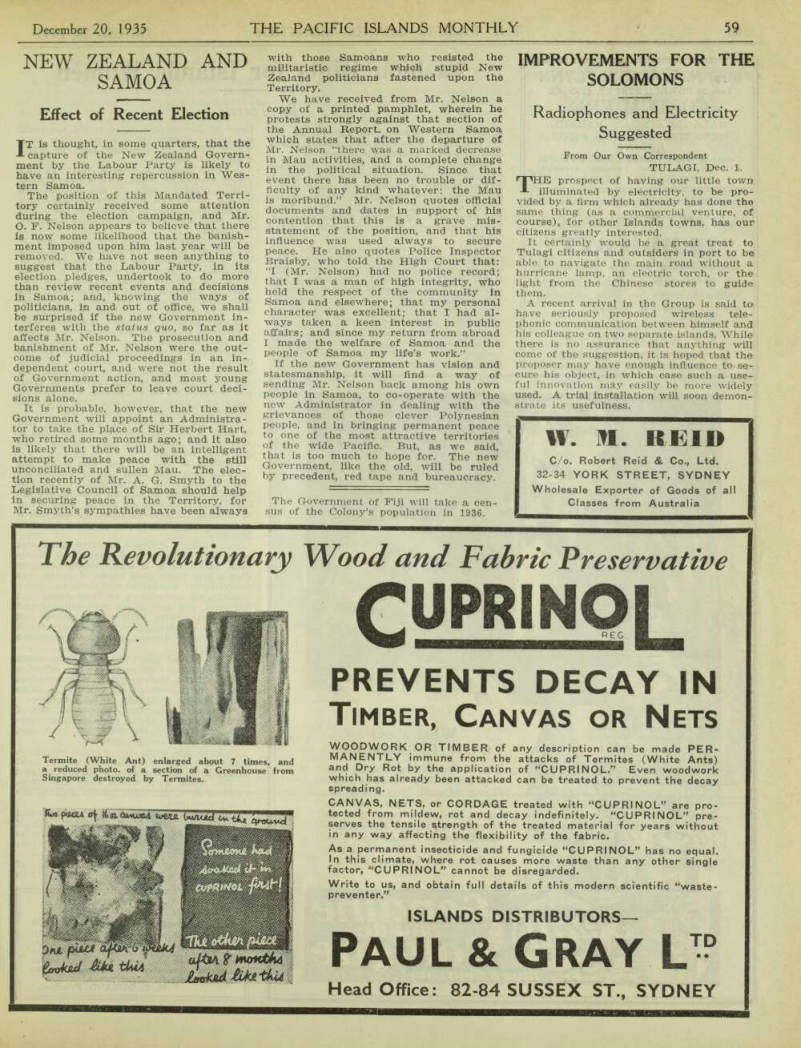
New Zealand And
Effect of Recent Election
IT is thought, in some quarters, that the capture of the New Zealand Govern ment by the Labour Party is likely to have an interesting repercussion in Wes tern Samoa.
The position of this Mandated Terri tory certainly received some attention during the election campaign, and Mr.
O. F. Nelson appears to believe that there is now some likelihood that the banish ment imposed upon him last year will be removed. We have not seen anything to suggest that the Labour Party, in its election pledges, undertook to do more than review recent events and decisions in Samoa; and, knowing the ways of politicians, in and out of office, we shall be surprised if the new Government in terferes with the status quo, so far as it affects Mr. Nelson. The prosecution and banishment of Mr. Nelson were the out come of judicial proceedings in an in dependent court, and were not the result of Government action, and most young Governments prefer to leave court deci sions alone.
It is probable, however, that the new Government will appoint an Administra tor to take the place of Sir Herbert Hart, who retired some months ago; and it also is likely that there will be an intelligent attempt to make peace with the still unconciliated and sullen Mau. The elec tion recently of Mr. A. G. Smyth to the Legislative Council of Samoa should help in securing peace in the Territory, for Mr. Smyth’s sympathies have been always
with those Samoans who resisted the militaristic regime which stupid New Zealand politicians fastened upon the Territory.
We have received from Mr. Nelson a copy of a printed pamphlet, wherein he protests strongly against that section of the Annual Report, on Western Samoa which states that after the departure of Mr. Nelson “there was a marked decrease in Mau activities, and a complete change in the political situation. Since that event there has been no trouble or dif ficulty of any kind whatever: the Mau is moribund.’’ Mr. Nelson quotes official documents and dates in support of his contention that this is a grave mis statement of the position, and that his influence was used always to secure peace. He also quotes Police Inspector Braisby, who told the High Court that: “I (Mr. Nelson) had no police record; that I was a man of high integrity, who held the respect of the community in Samoa and elsewhere; that my personal character was excellent; that I had al ways taken a keen interest in public affairs; and since my return from abroad I made the welfare of Samoa and the people of Samoa my life’s work.”
If the new Government has vision and statesmanship, it will find a way of sending Mr. Nelson back among his own people in Samoa, to co-operate with the new Administrator in dealing with the grievances of those clever Polynesian people, and in bringing permanent peace to one of the most attractive territories of the wide Pacific. But, as we said, that is too much to hope for. The new Government, like the old, will be ruled by precedent, red tape and bureaucracy.
The Government of Fiji will take a cen sus of the Colony’s population in 1936.
Suggested
Improvements For The
Solomons
Radiophones and Electricity Suggested
From Our Own Correspondent
Tulagi, Dec. 1.
nPHE prospect of having our little town illuminated by electricity, to be pro vided by a firm which already has done the same thing (as a commercial venture, of course), for other Islands towns, has our citizens greatly interested.
It certainly would be a great treat to Tulagi citizens and outsiders in port to be able to navigate the main road without a hurricane lamp, an electric torch, or the light from the Chinese stores to guide them.
A recent arrival in the Group is said to have seriously proposed wireless tele phonic communication between himself and his colleague on two separate islands. While there is no assurance that anything will come of the suggestion, it is hoped that the proposer may have enough influence to se cure his object, in which case such a use ful innovation may easily be more widely used. A trial installation will soon demon strate its usefulness.
Advertisements & other items, pp. 61-62 (1 item)
rureiN
W. HI. UEID
C/o. Robert Reid & Co., Ltd.
32-34 YORK STREET, SYDNEY
Wholesale Exporter of Goods of all Classes from Australia
The Revolutionary
u r**f Termite (White Ant) enlarged about 7 times, and a reduced photo, of a section of a Greenhouse from Singapore destroyed by Termites.
°t ItSSSu «wa U<j
3/u.
cvrfvaoL fruH
Thjt&^jinp^m
Wood and Fabric Preservative
rureiN
PREVENTS DECAY IN
Timber, Canvas or Nets
WOODWORK OR TIMBER of any description can be made PER- MANENTLY immune from the attacks of Termites (White Ants) and Dry Rot by the application of “CUPRINOL.” Even woodwork which has already been attacked can be treated to prevent the decay spreading.
CANVAS, NETS, or CORDAGE treated with “CUPRINOL” are protected from mildew, rot and decay indefinitely. “CUPRINOL” preserves the tensile strength of the treated material for years without in any way affecting the flexibility of the fabric.
As a permanent insecticide and fungicide “CUPRINOL” has no equal.
In this climate, where rot causes more waste than any other single factor, “CUPRINOL” cannot be disregarded.
Write to us, and obtain full details of this modern scientific “wastepreventer.”
ISLANDS DISTRIBUTORS—
Paul & Gray l™
Head Office: 82-84 SUSSEX ST., SYDNEY
Mrs. N. WALKER-FLYNN
Late 35 POWELL STREET, COOGEE
COSTUMIERE
MALAGUNA ROAD, RABAUL
HEMSTITCHING AND PICOT
EDGING
Copies of Mab’s Fashions; Roma’s Pictorial Fashions and Home Fashions available.
P.O. Box 11«. TeL: 141
A HOME FOR SCHOOLBOYS
“LED»I€OTT”
School House offers a solution of the problem of education by providing a home for boys attending school in Sydney.
Prospectus on application to
E. F. WHITFELD, B.A.
McMAHON'S POINT, SYDNEY
What about
YOUR Christmas Gift?
A “47//” Present, of course, the traditional gift for difficult-to-please people all over the world. There is “47//" Genuine Eau de Cologne, refreshing, fragrant, always en vogue, there are Perfumes, Powders, and dainty Presentation Caskets for your selection. Whoever the recipient, "4 711 " will be eagerly welcomed as a fitting compliment.
Fashion Hints for Islands Women
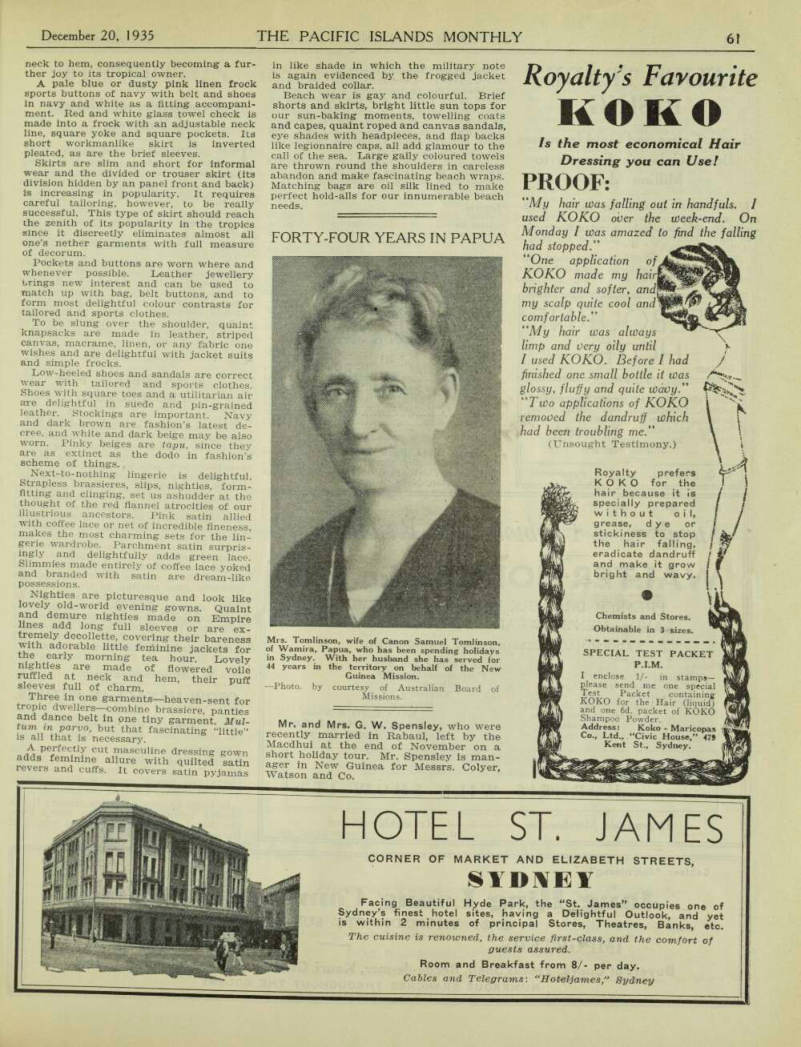
By Theme
OINCE draperies are the dernier cri for evening, we go clad with classic splen dour in gowns exquisitely draped.
Flowing panels, and floating shoulder scarves, interpret the classical trend.
Satins falling in sculptured folds meta morphose mere mortals into goddesses lovely to behold. Yet withal these folds and draperies, figures are subtly revealed, lissome and graceful with softly rounded curves.
For the ultra-modern woman—she with the courage of her convictions —comes the reward of being different in the sophisti cated, softly-draped and girdled gown, tip tilted in front to reveal narrow parts of contrasting colour. Heel-less slippers of lame, velvet or kid, play a fitting accom paniment and shriek modernity.
A white taffeta frock, its skirt standing out with old world charm, has a cross over bodice made berthe fashion, and tucks a sweet old fashioned posy in its waist. Gar
lands of flowers are roped round the neck for festive hours, for a single flower or a whole galaxy of blossoms may be worn with equal success.
A medieval gown of black velvet or dull crepe, girdles its waist with a heavy cord.
Finely pleated tulle or net outlines its square neck; and long sleeves, full from the shoulder, taper to slimness at the wrist.
Hair worn halo fashion completes a picture of charm.
One shoulder covered, the other bare, is delightfully new for evening wear. Sounds like a slogan, but there is none better of adoption. A georgette gown with all its draperies cleverly arranged on one hip, falls in graceful folds to the floor. Its bodice, softly draped over one lovely shoul der, pins its faith in a rhinestone clasp of huge proportions to make it discreetly safe.
Evening capes are gorgeous and roman tic and breathe revelry in every line.
Swaggering capes reach to the floor as the military influence extends to evening clothes. Tulle capes fall to the knees, and are no longer ruffled and frilled, but crisp and decisive, cleverly trimmed with narrow braid or ribbon velvet and caught at the high neckline with a jewelled clip.
With its fairy-tale air, cellophane tied in huge bows, forms lovely scarves, and is woven into light and airy fabrics with glittering success.
Pleating is still popular and trims the sleeves, neck, and hem line of a most at tractive georgette dinner gown. The full balloon sleeves, accordeon pleated, are the highlights of this lovely gown. Sleeves are of infinite variety—Chinese, bishop, and a new soft variation of the quaint old “leg o’ mutton.”
Day clothes strike a military note, and with their frogged and epauletted shoul ders, pinch back jackets, swash-buckling capes, and yards and yards of braid, are marvellously attractive and dashing.
Soutache embroidery is fascinating and different, and applies itself to tailored and afternoon gowns with equal success. It adorns the waist and yoke of an afternoon frock, which thereby achieves immediate distinction.
A beflowered georgette afternoon gown has full raglan sleeves slit to the elbow, a softly shirred bodice and a wide swathed belt of its predominating colour. A large flower blooms exotically on its shoulder.
For festive afternoons choose a frock of printed crepe de chene (the washing vari ety) with frills at the waist and neck line.
It is full of feminine appeal.
Jackets are worn for divers occasions.
Some have capes attached, others are tight fitting little affairs often in direct contrast to the frock with which they are worn.
Pinched in at the back, dinner jackets are chic personified.
Tub frocks of every variety, youthful and charming in their fresh simplicity, are of such infinitesimal cost one may always go freshly clad. Gay little scarves give them added charm.
A shirtmaker frock —the salvation of every woman’s wardrobe buttons from
neck to hem, consequently becoming a fur ther joy to its tropical owner.
A pale blue or dusty pink linen frock sports buttons of navy with belt and shoes in navy and white as a fitting accompani ment. Red and white glass towel check is made into a frock with an adjustable neck line, square yoke and square pockets. Its short workmanlike skirt is inverted pleated, as are the brief sleeves.
Skirts are slim and short for informal wear and the divided or trouser skirt (its division hidden by an panel front and back) is increasing in popularity. It requires careful tailoring, however, to be really successful. This type of skirt should reach che zenith of its popularity in the tropics since it discreetly eliminates almost all one’s nether garments with full measure of decorum.
Pockets and buttons are worn where and whenever possible. Leather jewellery brings new interest and can be used to match up with bag, belt buttons, and to form most delightful colour contrasts for tailored and sports clothes.
To be slung over the shoulder, quaint knapsacks are made in leather, striped canvas, macrame, linen, or any fabric one wishes and are delightful with jacket suits and simple frocks.
Low-heeled shoes and sandals are correct wear with tailored and sports clothes.
Shoes with square toes and a utilitarian air are delightful in suede and pin-grained leather. Stockings are important. Navy and dark brown are fashion’s latest de cree, and white and dark beige may be also worn. Pinky beiges are tapu, since they are as extinct as the dodo in fashion’s scheme of things.
Next-to-nothing lingerie is delightful.
Strapless brassieres, slips, nighties, form fitting and clinging, set us ashudder at the thought of the red flannel atrocities of our illustrious ancestors. Pink satin allied with coffee lace or net of incredible fineness, makes the most charming sets for the lin gerie wardrobe. Parchment satin surpris ingly and delightfully adds green lace.
Slimmies made entirely of coffee lace yoked and branded with satin are dream-like possessions.
Nighties are picturesque and look like lovely old-world evening gowns. Quaint and demure nighties made on Empire lines add long full sleeves or are ex tremely decollette, covering their bareness with adorable little feminine jackets for the early morning tea hour. Lovely ni *L,es are made of flowered voile ruffled at neck and hem, their puff sleeves full of charm.
Three in one garments—heaven-sent for tropic dwellers— -combine brassiere, panties and dance belt in one tiny garment. Mul tum m paryo, but that fascinating “little” is all that is necessary.
A perfectly cut masculine dressing gown adds feminine allure with quilted satin revers and cuffs. It covers satin pyjamas
in like shade in which the military note is again evidenced by the frogged jacket and braided collar.
Beach wear is gay and colourful. Brief shorts and skirts, bright little sun tops for our sun-baking moments, towelling coats and capes, quaint roped and canvas sandals, eye shades with headpieces, and flap backs like legionnaire caps, all add glamour to the call of the sea. Large gaily coloured towels are thrown round the shoulders in careless abandon and make fascinating beach wraps.
Matching bags are oil silk lined to make perfect hold-alls for our innumerable beach needs.
Advertisements & other items, p. 62 (1 item)
Springwood Ladies* College
AT BLUE MOUNTAINS
SPRINGWOOD, N.S.W.
Est. 1897. Kindergarten to Leaving Certificate. Tennis, Riding, Swimming, Team Games. Unequalled climate. Pure Jersey Milk. Senior and Junior Houses. Open-air sleeping. Inclusive fees. Special vacation arrangements for Island pupils.
M. E. DURAND. Principal
Forty-Four Years In Papua
Mr. and Mrs. G. W. Spensley, who were recently married in Rabaul, left by the Macdhui at the end of November on a short holiday tour. Mr. Spensley is man ager in New Guinea for Messrs. Colyer, Watson and Co.
Mrs. Tomlinson, wife of Canon Samuel Tomlinson, of Wamira, Papua, who has been spending holidays in Sydney. With her husband she has served for 44 years in the territory on behalf of the New Guinea Mission. —Photo, by courtesy of Australian Board of Missions.
Advertisements & other items, p. 63 (1 item)
Royalty’s Favourite
KOKO
Is the most economical Hair Dressing you can Use!
PROOF:
‘My hair was falling out in handfuls. I used KOKO over the week-end. On Monday I was amazed to find the falling
had stopped."
“One application of KOKO made my hair\ brighter and softer, and my scalp quite cool and comfortable.”
“My hair was always
limp and very oily until I used KOKO. Before I had finished one small bottle it was
glossy, fluffy and quite Wavy.”
“Two applications of KOKO removed the dandruff which had been troubling me.” (Unsought Testimony.) Royalty prefers KOKO for the hair because it is specially prepared without o i l v grease, dye or stickiness to stop the hair falling, eradicate dandruff and make it grow bright and wavy.
Chemists and Stores.
Obtainable in 3 sizes.
SPECIAL TEST PACKET
P.I.M.
I enclose 1/- in stamps— please send me one special Test Packet containing KOKO for the Hair (liquid) and one 6d. packet of KOKO Shampoo Powder.
Address: Koko - Maricopas Co., Ltd., “Civic House,” 479 Kent St., Sydney.
HOTEL ST. JAMES
CORNER OF MARKET AND ELIZABETH STREETS
SYDNEY
Facing Beautiful Hyde Park, the “St. James" occupies one of Sydney’s finest hotel sites, having a Delightful Outlook, and yet is within 2 minutes of principal Stores, Theatres, Banks, etc.
The cuisine is renowned, the service first-class, and the comfort of guests assured.
Room and Breakfast from 8/- per day.
Cables and Telegrams: “Hotel,james; ” Sydney
Rising
Fiji’S Trade
Sugar, Copra and Gold Increases Bring Colony’s Exports to Million Mark
'p'Ul’S trade is booming again. Sub stantial increases in sugar, copra, and gold for the nine months ended September 30 have bolstered up exports to over a million pounds.
Valued at £279,207 higher than last year, sugar particularly has helped to swell export figures and bring the total
trade (exports and imports) of the Colony to £2,183,441, compared with £1,625,057 in 1934. Due to improved market prices more copra was cut and the value rose by £67,995. Activity in the gold industry is reflected in the trade figures; produc tion was 3,985 ozs. against 911 ozs. last year, and the value amounted to £31,150, an increase of £24,473.
For the period under review exports exceeded imports by £359,831. The fol lowing table shows the position:
Sister Clara Pech has been dedicated in Australia for work with the Neuen dettelsau (Lutheran) Mission Society at Finschhafen, New Guinea.
1934 1935 £ £ Imports Suva ... 470,383 629,397 Lautoka 219,948 265,585 Levuka 13,375 16,823 Total £703,706 £911,805 Exports— Suva 309,825 399,391 Lautoka 567,789 811,463 Levuka 43,710 60,782 Total £921,351 £1,271,636 Excess of Exports £217,645 £359,831
Exports
In Detail
1934 1935 £ £ Bananas 46.379 44,974 Copra 104,446 172,441 Gold Bullion 6,677 31,150 Moiasses 9,435 10,521 Trocus Shell 19,121 16,090 Sugar 624,580 903,787 Other Articles 110,713 92,673
Atebrin
Experiences of Malaria Sufferers
THE belief seems to be growing that, while the Atebrin system of treating malaria is effective for those who are leav ing fever-ridden countries, it is of no value to those who must again take the risk of infection.
A correspondent reported recently that, as a result of Atebrin treatment, she seemed to get a new and original attack of fever, as if she were visiting the tropics for the first time.
We now have this note from a missionary who returned to Papua in October: “Atebrin is a delusion and a snare for all returning to the Islands. I got a fierce attack of malaria here, after a course of Atebrin down South; and that seems to be a common experience. I got the form of fever I used to get in India, and which I had not had here before.”
Prospectors
A Handbook For
The third edition of “Handbook for Pros pectors” has been issued by McGraw-Hill Publishing Co. Ltd., Aldwych House, Lon don. It has been compiled by Mr. M. W. von Bernewitz, who has spent many years in association with the gold-mining in dustry in practically every gold-producing country in the world. His book is designed to instruct and assist miners all over the world, irrespective of what metal they may be seeking. The Handbook, which has been brought right up to date, is in three sec tions. The first advises in regard to equip ment, transportation, food, health and first aid, and laws affecting mining: the second part supplies a great mass of technical and scientific data relating to the search for metals, and recovery and treatment of same; and the third deals with the value and occurrence of metallic and non-metallic minerals. It is a book of 360 pages, pro fusely illustrated, skilfully arranged and copiously indexed, and should be invaluable to the prospector. The retail price is 18/-.
Crow Menace In Witu Is.
From Our Own Correspondent WAU, Nov. 4. have become a serious menace in a the Witu group of islands (off the North Coast of New Britain). The raiders pierce the young green coconuts which, when so damaged, fall to the ground.
In order to cope with this menace it has become necessary to remove crows from the list of protected birds for a period of six months.
Advertisements & other items, p. 64 (1 item)
Suva's Fashion Rendezvous
MELBOURNE
HOTEL :i
■— SUVA ■=
Centrally situated near Government offices. Opposite sea baths and bowling green. Excellent table.
Terms moderate. Best brands of liquor kept, including Hardy’s famous wines.
E. C. DOBELL Proprietor
Suva's Fashion Rendezvous
WALTER HORN E & Co. Ltd.
PREMIER DRAPERS. LADIES’, CHILDREN’S
AND MEN’S WEAR SPECIALISTS
LADIES’ HAIRDRESSING AND MANICURING
Dress Fabrics and Silks Household Drapery Clothing Tailoring Mercery Men’s Boots & Shoes Men’s Hats & Caps Island Curios Frocks Millinery Foundations and Lingerie Hosiery Ladies’ Shoes & Sandals Ribbons and Laces Hairdressing Manicuring
“IF IT’S NEW...
HORNE’S WILL SHOW IT”
Dependable Merchandise
Reasonably Priced
P.O. Box Cables: “Janinloong”
Jang* lling Loong Company Liiiiilocl
20-24 THOMSON ST., SUVA, FIJI
IMPORTERS EXPORTERS
Buyers of Copra, Trocas Shell, Beche-de-mer, Kauri Gum, and other Island Products,
NUMEROUS BRANCHES THROUGHOUT THE COLONY
Fiji Cotton
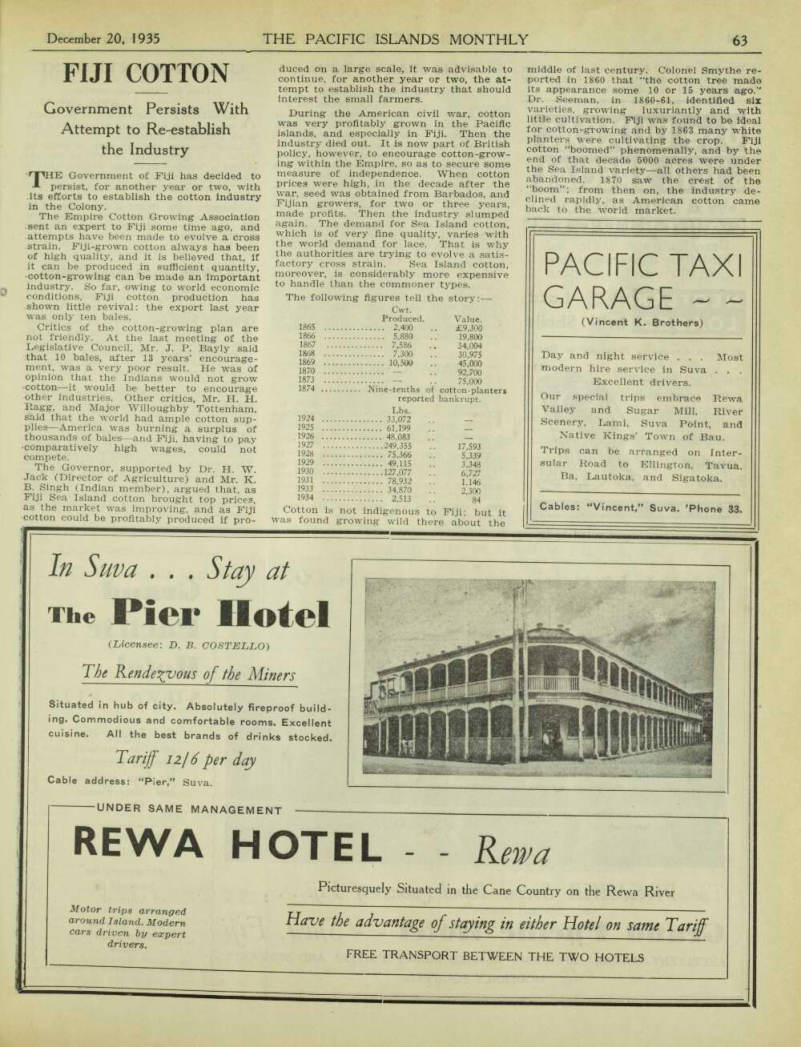
Government Persists With Attempt to Re-establish the Industry
1 1 tHE Government of Fiji has decided to persist, for another year or two, with its efforts to establish the cotton industry in the Colony.
The Empire Cotton Growing Association sent an expert to Fiji some time ago, and attempts have been made to evolve a cross strain. Fiji-grown cotton always has been of high quality, and it is believed that, If it can be produced in sufficient quantity, cotton-growing can be made an important industry. So far, owing to world economic conditions, Fiji cotton production has shown little revival: the export last year was only ten bales.
Critics of the cotton-growing plan are not friendly. At the last meeting of the Legislative Council, Mr. J. P. Bayly said that 10 bales, after 13 years’ encourage ment, was a very poor result. He was of opinion that the Indians would not grow •cotton —it would be better to encourage other industries. Other critics, Mr, H. H.
Ragg, and Major Willoughby Tottenham, said that the world had ample cotton sup plies—America was burning a surplus of thousands of bales—and Fiji, having to pay •comparatively high wages, could not compete.
The Governor, supported by Dr. H. W.
Jack (Director of Agriculture) and Mr. K.
B. Singh (Indian member), argued that, as Fiji Sea Island cotton brought top prices, as the market was improving, and as Fiji cotton could be profitably produced if pro
duced on a large scale, it was advisable to continue, for another year or two, the at tempt to establish the industry that should Interest the small farmers.
During the American civil war, cotton was very profitably grown in the Pacific islands, and especially in Fiji. Then the industry died out. It is now part of British policy, however, to encourage cotton-grow ing within the Empire, so as to secure some measure of independence. When cotton prices were high, in the decade after the war, seed was obtained from Barbados, and Fijian growers, for two or three years, made profits. Then the industry slumped again. The demand for Sea Island cotton, which is of very fine quality, varies with the world demand for lace. That is why the authorities are trying to evolve a satis factory cross strain. Sea Island cotton, moreover, is considerably more expensive to handle than the commoner types.
The following figures tell the story:
middle of last century. Colonel Smythe re ported in 1860 that “the cotton tree made its appearance some 10 or 15 years ago.”
Dr. Seeman, in 1860-61, identified six varieties, growing- luxuriantly and with little cultivation. Fiji was found to be ideal for cotton-growing and by 1863 many white planters were cultivating the crop. Fiji cotton “boomed” phenomenally, and by the end of that decade 5000 acres were under the Sea Island variety—all others had been abandoned. 1870 saw the crest of the “boom”; from then on, the industry de clined rapidly, as American cotton came back to the world market.
1865 ..
Cwt.
Produced. 2,400 Value. £9,300 1866 ... 5,880 19,800 1867 .. 7.586 ., 34,004 1868 ... 7,300 30,975 1869 ... 45,000 1870 ... 92,700 1873 .. 75,000 1874 ... of cotton-planters reported bankrupt. 1924 ...
Lbs. 33,072 1925 ... 1926 ... 1927 ... 17,593 1928 ... 5,339 1929 ... 3,348 1930 ... 6,727 1931 ... 1,146 1933 ... 2,300 1934 ... 84 Cotton is not indigenous to Fiji; but it was found growing wild there about the
Advertisements & other items, pp. 65-66 (1 item)
Rewa Hotel - Kara
PACIFIC TAXI
GARAGE - -
(Vincent K. Brothers) Day and night service . . . Most modern hire service in Suva . . .
Excellent drivers.
Our special trips embrace Rewa Valley and Sugar Mill, River Scenery, Lami, Suva Point, and Native Kings’ Town of Bau.
Trips can be arranged on Intersular Road to Ellington, Tavua, Ba, Lautoka, and Sigatoka.
Cables: “Vincent,” Suva. 'Phone 33.
In Suva . . . Stay at
The Pier Hotel
( Licensee: D. B. COSTELLO)
The Rendezvous of the Miners
Situated in hub of city. Absolutely fireproof building. Commodious and comfortable rooms. Excellent cuisine. All the best brands of drinks stocked.
Tariff n[6 per day
Cable address: “Pier,” Suva.
UNDER SAME MANAGEMENT -
REWA HOTEL - Kara
Picturesquely Situated in the Cane Country on the Rewa River Motor trips arranged 7T ; T " around island. Modern tiave the advantage of staying in either Hotel on same Tariff cars driven by expert ° J <* ' drivers.
FREE TRANSPORT BETWEEN THE TWO HOTELS
Brother A. J. Burke, of the Marist Mission Order, departed from Sydney for Tulagi, 5.1., by the November Malaita.
UseDUXBAC
&. ICIL SPECIAL
'WATERPROOF’
CARTRIDGES
Heavy loads, high velocity, and hard hitting at long range assure clean kills under all conditions.
NEOFLAK
LOADED
A 2f Load In 21 Shells Without Excessive Pressure or Recoil “Neoflak” Powder is the latest and most successful of all shot gun propellants
Popular
Prices O 2c Y 3 m £
ICI
w Xi)4t 9kaJues %o 'Djfjkhjutce.l
% The PREMIER Social Ren of Fiji . . .
Grand Pacific Hotel - - Suva, Fiji EXCELLENT CUISINE. EFFICIENT TRAINED INDIAN WAITERS AND SERVANTS.
MODERNLY EQUIPPED.
Grand
Pacific
Hotel
SUVA, FIJI
Delightfully situated in tropical gardens overlooking Suva harbour and the Pacific Ocean.
TARIFF: from 17/6 per Day Accommodation Reserved by Wireless Cable address: “Grandpacif"
Suva
Film Star At Suva
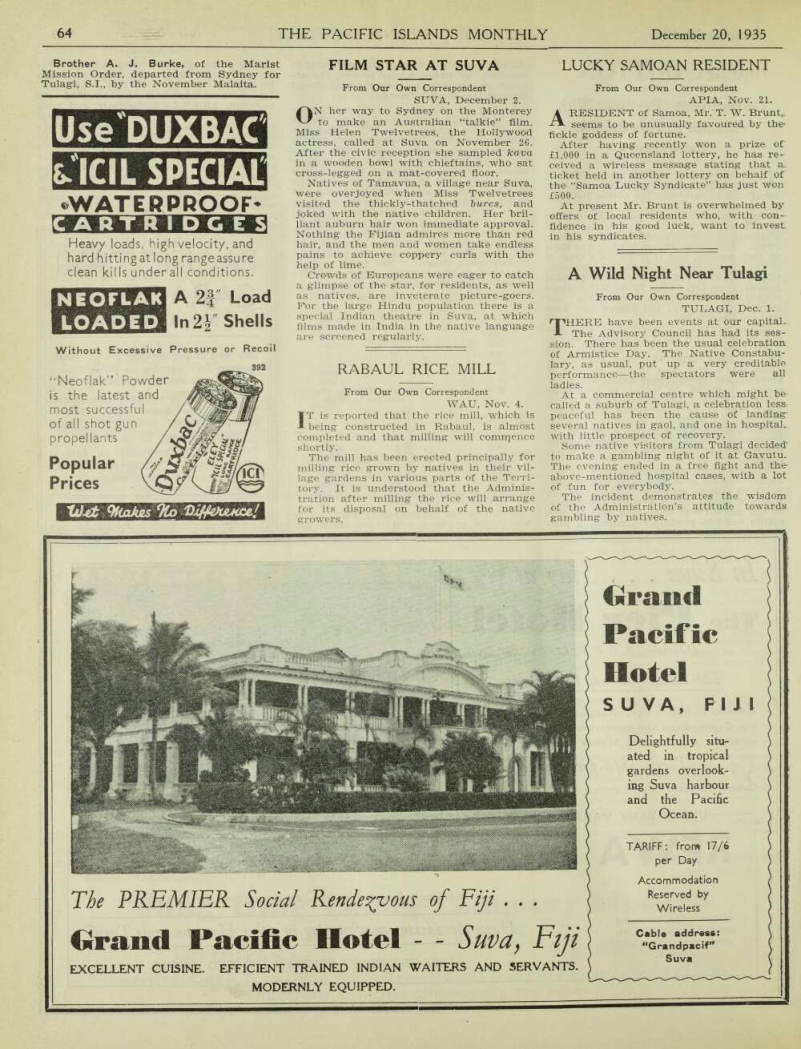
From Our Own Correspondent SUVA, December 2.
ON her way to Sydney on the Monterey to make an Australian “talkie” film, Miss Helen Twelvetrees, the Hollywood actress, called at Suva on November 26.
After the civic reception she sampled kava in a wooden bowl with chieftains, who sat cross-legged on a mat-covered floor.
Natives of Tamavua, a village near Suva, were overjoyed when Miss Twelvetrees visited the thickly-thatched bures, and joked with the native children. Her bril liant auburn hair won immediate approval.
Nothing the Fijian admires more than red hair, and the men and women take endless pains to achieve coppery curls with the help of lime.
Crowds of Europeans were eager to catch a glimpse of the star, for residents, as well as natives, are inveterate picture-goers.
For the large Hindu population there is a special Indian theatre in Suva, at which films made in India in the native language are screened regularly.
Rabaul Rice Mill
From Our Own Correspondent WAU, Nov. 4.
IT is reported that the rice mill, which is being constructed in Rabaul, is almost completed and that milling will commence shortly.
The mill has been erected principally for milling rice grown by natives in their vil lage gardens in various parts of the Terri tory. It is understood that the Adminis tration after milling the rice will arrange for its disposal on behalf of the native growers.
Lucky Samoan Resident
From Our Own Correspondent
Apia, Nov. 21.
A RESIDENT of Samoa, Mr. T. W. Brunt,, seems to be unusually favoured by the* fickle goddess of fortune.
After having recently won a prize of £l,OOO in a Queensland lottery, he has re ceived a wireless message stating that a. ticket held in another lottery on behalf of the “Samoa Lucky Syndicate” has just won £5OO.
At present Mr. Brunt is overwhelmed by offers of local residents who, with con fidence in his good luck, want to invest in his syndicates.
A Wild Night Near Tulagi
From Our Own Correspondent
Tulagi, Dec. 1.
THERE have been events at our capital..
The Advisory Council has had its ses sion. There has been the usual celebration of Armistice Day. The Native Constabu lary, as usual, put up a very creditable performance—the spectators were all ladies.
At a commercial centre which might be called a suburb of Tulagi, a celebration less peaceful has been the cause of landing several natives in gaol, and one in hospital,, with little prospect of recovery.
Some native visitors from Tulagi decided to make a gambling night of it at Gavutu.
The evening ended in a free fight and the above-mentioned hospital cases, with a lot of fun for everybody.
The incident demonstrates the wisdom of the Administration’s attitude towards gambling by natives.
How to Combat Dry Rot
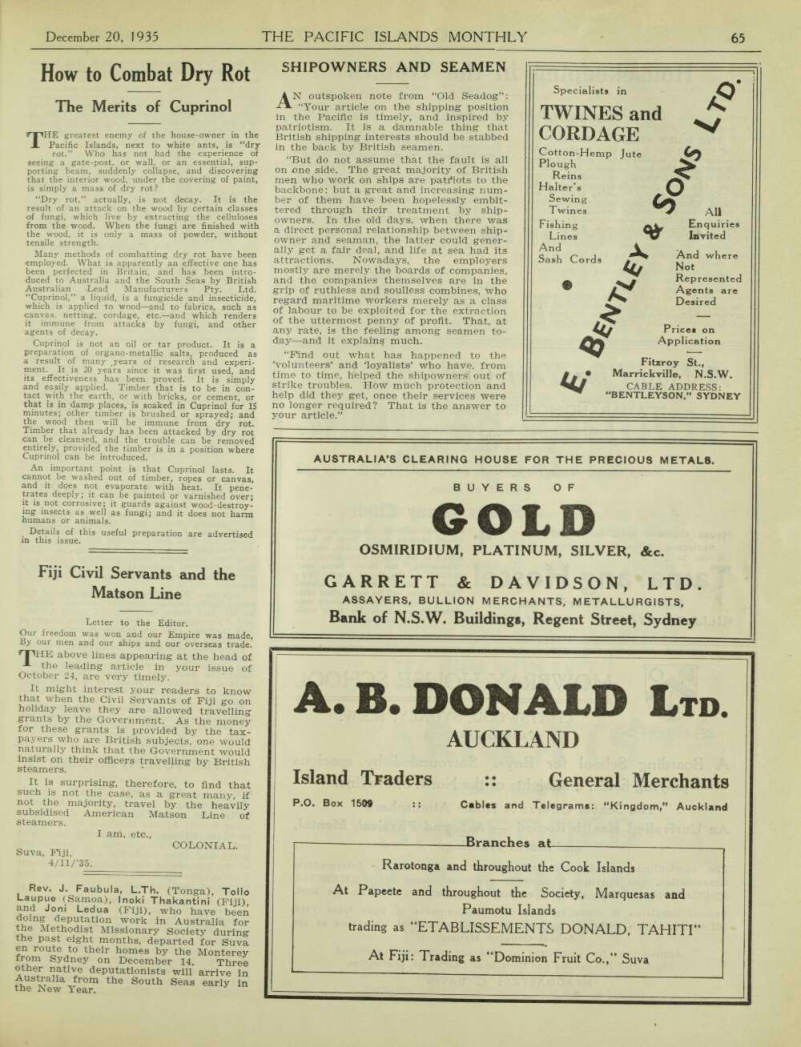
The Merits of Cuprinol
THE greatest enemy of the house-owner in the Pacific Islands, next to white ants, is “dry rot.” Who has not had the experience of seeing a gate-post, or wall, or an essential, sup porting beam, suddenly collapse, and discovering that the interior wood, under the covering of paint, is simply a mass of dry rot?
“Dry rot,” actually, is not decay. It is the result of an attack on the wood by certain classes of fungi, which live by extracting the celluloses from the wood. When the fungi are finished with the wood, it is only a mass of powder, without tensile strength.
Many methods of combatting dry rot have been employed. What is apparently an effective one has been perfected in Britain, and has been intro duced to Australia and the South Seas by British Australian Lead Manufacturers Pty. Ltd.
“Cuprinol,” a liquid, is a fungicide and insecticide, which is applied to wood—and to fabrics, such as canvas, netting, cordage, etc. —and which renders it immune from attacks by fungi, and other agents of decay.
Cuprinol is not an oil or tar product. It is a preparation of organo-metallic salts, produced as a result of many years of research and experi ment. It is 20 years since it was first used, and its effectiveness has been proved. It is simply and easily applied. Timber that is to be in con tact with the earth, or with bricks, or cement, or that is in damp places, is soaked in Cuprinol for IS minutes; other timber is brushed or sprayed; and the wood then will be immune from dry rot.
Timber that already has been attacked by dry rot can be cleansed, and the trouble can be removed entirely, provided the timber is in a position where Cuprinol can be introduced.
An important point is that Cuprinol lasts. It cannot be washed out of timber, ropes or canvas, and it does not evaporate with heat. It pene trates deeply; it can be painted or varnished over; it is not corrosive; it guards against wood-destroy ing insects as well as fungi; and it does not harm humans or animals.
Details of this useful preparation are advertised in this issue.
Fiji Civil Servants and the Matson Line
Matson Line
Letter to the Editor.
Our freedom was won and our Empire was made, By our men and our ships and our overseas trade. *TVHE above lines appearing at the head of A the leading article in your issue of October 24, are very timely.
It might interest your readers to know that when the Civil Servants of Fiji go on holiday leave they are allowed travelling grants by the Government. As the money for these grants is provided by the tax payers who are British subjects, one would naturally think that the Government would insist on their officers travelling by British steamers.
It is surprising, therefore, to find that such is not the case, as a great many, if not the majority, travel by the heavily subsidised American Matson Line of steamers.
I am. etc.,
. Colonial.
Suva, Fiji, 4/11/’35.
Rev. J. Faubula, L.Th. (Tonga), Tollo Laupue (Samoa), Inoki Thakantini (Fiji), and Jom Ledua (Fiji), who have been domg deputation work in Australia for the Methodist Missionary Society during the past eight months, departed for Suva en route to their homes by the Monterey from Sydney on December 14. Three other native deputationists will arrive in Australia from the South Seas early in the New Year.
Shipowners And Seamen
AN outspoken note from “Old Seadog”: “Your article on the shipping position in the Pacific is timely, and inspired by patriotism. It is a damnable thing that British shipping interests should be stabbed in the back by British seamen.
“But do not assume that the fault is all on one side. The great majority of British men who work on ships are patriots to the backbone: but a great and increasing num ber of them have been hopelessly embit tered through their treatment by ship owners. In the old days, when there was a direct personal relationship between ship owner and seaman, the latter could gener ally get a fair deal, and life at sea had its attractions. Nowadays, the employers mostly are merely the boards of companies, and the companies themselves are in the grip of ruthless and soulless combines, who regard maritime workers merely as a class of labour to be exploited for the extraction of the uttermost penny of profit. That, at any rate, is the feeling among seamen to day—and it much.
“Find out what has happened to the ‘volunteers’ and ‘loyalists’ who have, from time to time, helped the shipowners out of strike troubles. How much protection and help did they get, once their services were no longer required? That is the answer to your article.”
Advertisements & other items, p. 67 (1 item)
Gold
Specialists in
TWINES and
CORDAGE
& Cotton-Hemp Jute Plough Reins Halter’s Sewing Twines Fishing Lines And Sash Cords / X <</ £ All Enquiries Invited And where Not Represented Agents are Desired Prices on Application «/ Fitzroy St., Marrickville, N.S.W.
CABLE ADDRESS:
‘BENTLEYSON,” SYDNEY
AUSTRALIA’S CLEARING HOUSE FOR THE PRECIOUS METALS.
BUYERS OF
GOLD
OSMIRIDIUM, PLATINUM, SILVER, &c.
GARRETT & DAVIDSON, LTD.
ABSAYERS, BULLION MERCHANTS, METALLURGISTS,
Bank of N.S.W. Buildings, Regent Street, Sydney
A. B. DONALD Ltd.
AUCKLAND
Island Traders :: General Merchants P.O. Box 1509 Cables and Telegrams: “Kingdom,” Auckland Branches at Rarotonga and throughout the Cook Islands At Papeete and throughout the Society, Marquesas and Paumotu Islands
trading as ‘‘ETABLISSEMENTS DONALD. TAHITI”
At Fiji: Trading as ‘‘Dominion Fruit C 0.,” Suva
Housekeeping in the Tropics
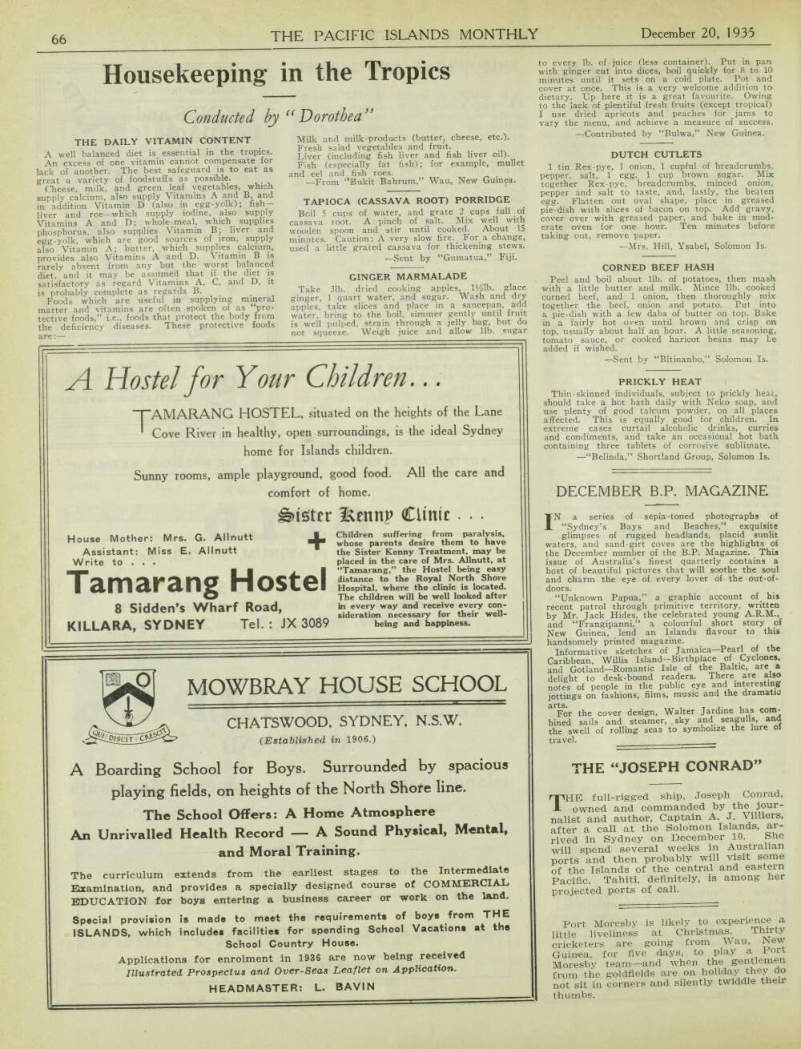
Conducted hy (( Dorothea”
The Daily Vitamin Content
... • A well balanced diet is essential in the tropics.
An excess of one vitamin cannot compensate lor lack of another. The best safeguard is to eat as great a variety of foodstuffs as possible.
Cheese, milk, and green leaf vegetables, which liver and roe—which supply iodine, also supply Vitamins A and D; whole-meal, which supplies phosphorus, also supplies Vitamin B; liver and egg-yolk, which are good sources of iron, supply also Vitamin A; butter, which supplies calcium, provides also Vitamins A and D. Vitamin B is rarely absent from any but the worst balanced diet, and it may be assumed that if the diet is fSSSSU g t"ts V regSd S S £ C ' Foods which are useful in supplying mineral matter and vitamins are often spoken of as “protective foods,” i.e., foods that protect the body from the deficiency diseases. These protective foods are-
Milk and milk-products (butter, cheese, etc.).
Fresh salad vegetables and fruit.
Liver (including fish liver and fish liver oil).
Fish (especially fat fish); for example, mullet and eel and fish roes. . —From ‘*Bukit Bahrum,” Wau, New Guinea.
Tapioca (Cassava Root) Porridge
Beil 5 cups of water, and grate 2 cups full of cassava root. A pinch of salt. Mix well with wooden spoon and stir until cooked. About 15 minutes. Caution: A very slow fire. For a change, used a little grated cassava for thickening stews. —Sent by “Gumatua,” Fiji.
Ginger Marmalade
Take 31b. dried cooking apples, glace ginger, 1 quart water, and sugar. Wash and dry apples, take slices and place in a saucepan, add water, bring to the boil, simmer gently until fruit is well pulped, strain through a jelly bag, but do not squeeze. Weigh juice and allow 11b. sugar
to every lb. of juice (less container). Put in pan with ginger cut into dices, boil quickly for 8 to 10 minutes until it sets on a cold plate. Pot and cover at once. This is a very welcome addition to dietary. Up here it is a great favourite. Owing to the lack of plentiful fresh fruits (except tropical) I use dried apricots and peaches for jams to vary the menu, and achieve a measure of success. —Contributed by “Bulwa,” New Guinea.
Dutch Cutlets
1 tin Rex-pye, 1 onion, 1 cupful of breadcrumbs, pepper, salt, 1 egg, 1 cup brown sugar. Mix together Rex-pye, breadcrumbs, minced onion, pepper and salt to taste, and, lastly, the beaten egg. Flatten out oval shape, place in greased pie-dish with slices of bacon on top. Add gravy, cover over with greased paper, and bake in mod erate oven for one hour. Ten minutes before taking out, remove paper. —Mrs. Hill, Ysabel, Solomon Is.
Corned Beef Hash
Peel and boil about 11b. of potatoes, then mash with a little butter and milk. Mince lib. cooked corned beef, and 1 onion, then thoroughly mix together the beef, onion and potato. Put into a pie -dish with a few dabs of butter on top. Bake in a fairly hot oven until brown and crisp on top, usually about half an hour. A little seasoning, tomato sauce, or cooked haricot beans may be added if wished. —Sent by “Bitinanbo,” Solomon Is.
Prickly Heat
Thin-skinned individuals, subject to prickly heat, should take a hot bath daily with Neko soap, and use plenty of good talcum powder, on all places affected. This is equally good for children. In extreme cases curtail alcoholic drinks, curries and condiments, and take an occasional hot bath containing three tablets of corrosive sublimate. —“Belinda,” Shortland Group, Solomon Is.
December B.P. Magazine
IN a series of sepia -toned photographs of “Sydney’s Bays and Beaches,” exquisite glimpses of rugged headlands, placid sunlit waters, and sand-girt coves are the highlights of the December number of the B.P. Magazine. This issue of Australia’s finest quarterly contains a host of beautiful pictures that will soothe the soul and charm the eye of every lover of the out-of doors.
“Unknown Papua,” a graphic account of his recent patrol through primitive territory, written by Mr. Jack Hides, the celebrated young A.R.M., and “Frangipanni,” a colourful short story of New Guinea, lend an Islands flavour to this handsomely printed magazine.
Informative sketches of Jamaica—Pearl of the Caribbean, Willis Island—Birthplace of Cyclones, and Gotland —Romantic Isle of the Baltic, are a delight to desk-bound readers. There are also notes of people in the public eye and interesting jottings on fashions, films, music and the dramatic ai For the cover design, Walter Jardine has com bined sails and steamer, sky and seagulls, and the swell of rolling seas to symbolize the lure ot travel.
The “Joseph Conrad”
THE full-rigged ship, Joseph Conrad, owned and commanded by the jour nalist and author, Captain A. J. Villiers, after a call at the Solomon Islands, ar rived in Sydney on December 10. She will spend several weeks in Australian ports and then probably will visit some of the Islands of the central and eastern Pacific. Tahiti, definitely, is among her projected ports of call.
Port Moresby is likely to experience a little liveliness at Christmas. Thirty cricketers are going from Wau, New Guinea, for five days, to play a Port Moresby team —and when the gentlemen from the goldfields are on holiday they do not sit in corners and silently twiddle their thumbs.
Advertisements & other items, p. 68 (1 item)
Tamarang Hostel
A Hostel for Your Children..
~PAMARANG HOSTEL, situated on the heights of the Lane Cove River in healthy, open surroundings, is the ideal Sydney
home for Islands children.
Sunny rooms, ample playground, good food. All the care and
comfort of home.
lister Hennp Clinic ■ ■
House Mother: Mrs. G. Allnutt Assistant: Miss E. Allnutt Write to . . . +
Tamarang Hostel
8 Sidden’s Wharf Road,
KILLARA, SYDNEY Tel. : JX 3089
Children suffering from paralysis, whose parents desire them to have the Sister Kenny Treatment, may be placed in the care of Mrs. Allnutt, at “Tamarang,” the Hostel being easy distance to the Royal North Shore Hospital, where the clinic is located.
The children will be well looked after in every way and receive every consideration necessary for their wellbeing and happiness.
a^o
MOWBRAY HOUSE SCHOOL
CHATSWOOD, SYDNEY, N.S.W.
(Established in 1906.) A Boarding School for Boys. Surrounded by spacious playing fields, on heights of the North Shore line.
The School Offers: A Home Atmosphere
An Unrivalled Health Record A Sound Physical, Mental,
and Moral Training.
The curriculum extends from the earliest stages to the Intermediate Examination, and provides a specially designed course of COMMERCIAL EDUCATION for boys entering a business career or work on the land.
Special provision is made to meet the requirements of boys from THE ISLANDS, which includes facilities for spending School Vacations at the School Country House.
Applications for enrolment in 1936 are now being received Illustrated Prospectus and Over-Seas Leaflet on Application.
HEADMASTER; L. BAVIN
Little Islander’s Corner
SEVERAL little Islanders are welcomed in this issue. Will you all please send me your birthday dates and your photograph or a snapshot?
Loving Christmas and New Year greetings go to you all, and the wish that the coming year will bring to you and yours prosperity and happiness.
Dear Dorothea, —We are now at Misima for twelve months, and although the work is interest ing here, we miss our folks. Misima is off the mainland and, in its tropical way, is very like other parts of Papua. Since writing you last my sister broke her leg and the knowledge I gained in Sydney, coupled with my boy scouts’ training has been of great assistance. The scout movement in Papua is growing. I came across some curious native handicraft recently, and will send some on when opportunity arises.
In our recent cricket match at Moresby, I made 64, not out, but don’t think that is good because the bowlers were “crook.” The P.I.M. is a great boon to us and is as good as a letter from friends.
Misima. Nov. 13. “PAPUA.”
Dear Dorothea, —I will tell you about the ways and customs of the natives on the island on which I live.
Although, the natives of to-day are very primi tive, there still remain lots of instances that show that their forefathers were far superior. Their canoes, weapons, intricately woven baskets and mats, sundry household utensils, and fishing tackle, all tell of the brains that invented them. It is only by seeing them that one can realize how clever some of their ideas are, for fishing and other things.
To-day, although the articles invented long ago are still made, I do not think the present day native is capable of inventing any more convenient ones. If ever I ask them why such a thing is done thus, they answer by saying that that was how it used to be done, and other than that they did not know. Or if j asked some of them do they make canoes and if they did not, they would say that they did not, simply because their father did not, and so it is that all arts are handed down from father to son.
In most of their work, the natives of a village will combine and help, as in house-making, and garden-making. The food obtained by a village is, to a certain extent, shared. Should anyone catch a lot of fish, or kill a pig, or gather a lot of wild fruits, it is all shared amongst the village inhabitants. The garden produce, however, is not always shared like this, unless someone should have but a poor return from his garden, then all will club in and give him some food.
Tulagi, S.I. G. GASKELL.
Dear Dorothea, —Have you ever been to Wau?
It is nearly 3J4 thousand feet above sea-level and in the last two years has gone ahead marvellously.
We have talkies twice a week, a splendid library, new golf links and two splendid hotels. A few months ago the new road to Edie Creek was opened and we can go up now and back in a couple of hours. It is marvellous up “on top” as the creek is called. It is very cold up there at night, so cold we have log fires, and every night it pours rain as well. But down here at Wau, it is a milder climate. The natives are very faithful if you are kind to them.
We have the best aeroplane service in the world and the very best pilots, too, and no one is afraid of flying. Every two years we go South for holidays and many of the children stay South at school. But as there is to be a High School up here soon, it will make a difference.
Best wishes from
“Maaski”
Wau, New Guinea.
Cook Islanders' Needlework
From Our Own Correspondent RAROTONGA, November 2.
A PLEASING departure from routine jri - was staged on October 30 by Mr. and Mrs. R. Walker, Government teachers at Arorangi school, when a sale of needle work was held at their house. The ex hibits ranged from beautifully finished sets to single articles, all of which were the work of native schoolchildren between the ages of 10 and 14, The sale was well patronised, and the proceeds will be devoted to the purchase
of sports goods and such-like equipment, for which there is no official grant.
In a recent competition organised in New Zealand, this same school entered 12 samples of needlework, and out of 6,000 entries, secured 13 awards, including the third prize.
Mr. and Mrs. Gordon Marshall, of Port Moresby, are enjoying furlough in Syd ney at present. They will return to Papua by the December Macdhui.
Mr. G. S. Hill, Treasurer of the Con dominium Government of the New Heb rides, and Lieutenant-Colonel H. E* Woodman, Assistant District Officer at Madang, New Guinea, came into the pub lic eye in December when they each drew out for lucky ticket holders the first four marbles in ballots of the N.S.W. State Lottery.
Mr. K. W. Steed man has been appointed legal manager of Upper Sepik Gold Syn dicate, No Liability.
Advertisements & other items, pp. 69-70 (1 item)
Arnotts
The Islanders’ Sydney Home ...
Location KGLVEDERE
81 BAYSWATER ROAD, DARLINGHURST
Exclusive.
A fine house with its wealth of pleasant old associations.
The Garden Suites, designed on most modern lines.
Excellent grounds with beautifully hept gardens—and dotted with comfortable garden seats.
Private telephones if desired.
An atmosphere of rest and grateful quietness.
Ideal location.
Near White City Tennis Courts.
Seven minutes to G.P.O.
Close to Shopping Centre.
Trams stop at gates.
BELVEDERE is Controlled & Supervised by Islands People for Islands People TERMS: From £2/12/6 Weekly.
MR. & MRS. C. WAGER (late of Fiji), Proprietors.
THERE'S NO SUBSTITUTE
FOR QUALITY
CRISP and delicious, oven tinted to a rich but tender brown, baked to that final fraction of a second which holds perfect flavour without loss of protein or vitamin content.
Made of whole fine selected wheat grains. These appetising SHREDDED WHEATMEAL BISCUITS are the most tempting form of health food and extremely easy to digest.
TRY THEM WITH BUTTER,
CHEESE, JAM OR HONEY
ARNOTtS
FAMOUS
SHREDDED
WHEATMEAL
BISCUITS
Always ask your Grocer for Arnoff’s
“THEY ARE BETTER THAN EVER”
Mining Ore Treatment
Machinery
Complete Cyanide Plants Supplied- Dorr Classifiers.
Dorr Thickeners.
Dorr Agitators.
Oliver Filters.
Merril Crowe Zinc Dust Gold Precipitation Richardson Mine Fans.
FANS AND AIR HEATERS
For Ventilation, Copra Drying Rooms, etc.
Enquire from
CROSSLE, DUFF AND
MACINTOSH LTD.
52 Bridge Street, SYDNEY
STRUCTURAL STEELWORK
DESIGNS BY COMPETENT ENGINEERS
All Classes of Steel Framework and Reinforcement Agents for— EXPANDED METAL FOR CONCRETE AND PLASTER WORK
“PUDLO” FOR WATERPROOFING CEMENT
Send your enquiries to
THE SYDNEY STEEL CO. LTD.
MARRICKVILLE, N.S.W. Cable Address: SYDSTEEL, SYDNEY
GOLD MINING PLANT
Stamper Batteries, Huntington Mills,
Jaw Crushers, Pelton Wheels, etc.
Illustration shows our 2-Head Nissen Stamper Battery, also made unth 4-Head. Stamps 1,20015 a. each, also made in lighter weights.
Write for full particulars We are also Makers of
Brick, Tile, and Pipe Making
Machinery, etc., Machine Moulded Gear Wheels up to 14ft. dia. x 24in. face
George Foster & Sons Ltd.
Prince’s Highway, St. Peters, N.S.W.
Code: A.B.C. sth Edition Telegraphic and Cable Address: “Fosterion,” SYDNEY
Pacific Mining
Notes
From Fiji
Aloha Central, G.M.
COMMENTING on the development work carried out by Aloha Central G.M. N.L., Tavua, Fiji, Dr. Loftus Hills, consulting geologist, stated in November that the most important development during the past three months had been on the northern section of the area north of the Vinisinu Creek. Starting from the vicinity of the northern continuation of the Sultan lode in this direction, and working up the slope eastwards towards the President lode, rich loams were encountered, and subsequent trenching and shaft sinking had disclosed numerous ore occurrences with encourag ing values. Some of these had been shown to be horizontal spreads from lodes associated with shears, and some of these latter undoubtedly con tinued downwards. The maze of ore formations disclosed by the work in this area presented a
complicated problem in mining exploration, but
the use of the diamond drill, when available, would throw much of the necessary light on this section of the area. The ore occurrences here were, in his opinion, important. They showed that the “S,”
“C” and “P” lode groups continued northwards with profnising gold deposition. The work on the Sultan lode had preceeded at a slower rate than anticipated owing to the amount of water encountered in No. 1 shaft. With the small pump available it was found undesirable to continue No. 1 shaft beyond a vertical depth of 55 feet, and
it was necessary to crosscut at that depth, al though, as pointed out in a previous report, cross cutting was undesirable until at least 100 feet depth had been attained. The geological structure indicated that down to 100 feet at least an un favourable horizon existed, and that the low values and narrow width of the Sultan lode in the crosscut at the 55-feet level confirms this conclusion. The true value of the downward ex tension of the Sultan lode would not become apparent until penetration to beyond the 100 feet vertical depth had been attained. This would be effected by means of the diamond drill now in operation. The work of the last three months had shown greater distribution of gold and ore formations than was observable three months ago. and it was now apparent that the adequate ex ploration of the Aloha Central 30 acres was a task of some magnitude. The diamond drill would be invaluable in this exploration.
East Reefs Consolidated N.L.
Directors of East Reefs Consolidated N.L. have issued 1000 shares in reserve to shareholders at £3 on application, and allotment. Shareholders registered on December 3, had the right to apply for shares in the proportion of one for every three contributing or fully paid shares held. Transfer books were closed from December 3 to December 5.
Loloma And Tavua Developments
Mr. E. G. Banks, mining engineer, and a direc tor of Loloma (Fiji) G.M, N.L. and Tavua Gold Developments Ltd., has returned to Melbourne after a second visit to the properties at Tavua, Fiji. Mr. Banks said early in December that since his previous visit work on the Loloma area had proceeded steadily. Several more prospecting shafts had been sunk along the line of the lode, and there was well over 1000 feet definitely proved along the strike of the lode. Other shafts being sunk north and south had not yet got in touch with the lode, but in his opinion further extension of the lode would be proved as work proceeded.
The main shaft was down 120 feet, at which point a crosscut would be driven to intersect the lode.
This would be met within a distance of 30 feet.
The adit level being extended in a southerly direction had reached a distance of 180 feet, and was still carrying payable values. The latest important development at the adit level was a crosscut towards the footwall, at 144 feet in the tunnel. At the time of his visit over 30 feet of 9-oz. ore had been disclosed, with the footwall not in hand.
Regarding the area of Tavua Gold Developments, south of the Emperor and east of Koroere, Mr.
Banks said two drilling plants were at work and three adits were in course of extension. Some ore had been proved in two bores and in No. 5 tunnel. The work had been undertaken with the object of proving the extension of the Emperor lode into block 209-210. In view of the fact that payable ore had been located, this block, Mr.
Banks considers, warrants thorough prospecting.
Vees United N.L
Sir Henry Scott, attorney of Vees United N.L.. in Fiji, has advised the management that the Governor has given his approval to_ an option which had been provisionally entered into by the company over an area of approximately 480 acres, covered by prospecting licence 245, in the Sigatoka district, and recommended by Dr. Loftus Hills, consulting geologist. The company has also been granted registration in the colony as a foreign company.
Tavua Gold Developments
The manager of Tavua Gold Developments Ltd., Tavua, Fiji, reports that No. 4 bore has cut the lode 10ft. wide, of which assaying 3dwt. and 2]/ 2 it. sdwt. The lode has been cut in the No. 5 tunnel on the same lease, 16ft. assaying 2dwt. and 4ft. on the hanging-wall 4dwt. The lode is being driven on in the tunnel. The previous message stated the No. 4 bore was down 365 ft. in country, and the lode_ was expected to be cut at an early date.
Emperor Mines Ltd.
Directors of Emperor Mines Ltd., Tavua, Fiji, report that the services of Mr. G. L. Ditchburn, late mill superintendent of Golden Plateau N.L..
Cracow, Queensland, have been secured. Tests made by him of the oxidised ore in the mine during his recent extended visit disclose that there are no metallurgical or other difficulties in its treatment. The capacity of the present plant will be increased to 400 or 500 tons a week by the addition of larger settling vats. This work is well in hand, and should be completed shortly. Output will then be approximately 2000 tons a month.
The directors are also considering the erection of a milling plant capable of treating a large tonnage.
Meanwhile crushing will be continued with the unit now in operation. Consideration is being given to a scheme for the supply of ample electrical
power for mining and other purposes on the field.
It is. probable that a separate company, in which the leading companies on the field will become interested, will be formed for this purpose.
Crushing 644 tons of ore for the four weeks ended November 30, the company recovered 532)4 oz. of bullion, containing 490 oz. of gold, a grade of 15.2 dwt. a ton. The loss in the tailings was 1 dwt. a ton. The average grade of the ore treated declined by 4 dwt. a ton compared with the preceding period. Output and production, however, increased. Following are the past three yields:—
Koroere Gold N.L.
Progress reports received in Melbourne in Nov ember from Koroere Gold N.L., were not appreciated in the market, as the shares fell to 19/-. Values in the drives and crosscuts in the Koroere area were again low, the highest being in the south drive off the No. 4 tunnels, viz., 11 dwt. On the west Cardigan lode, east crosscut, a small amount of 12dwt. ore was obtained, but beyond this nothing payable. The property appears to be developing into one of low grade ore. Even the Cardigan lode, where high values were ob tained prior to the formation of the company and also just recently, is not living up to expectations.
The market for these shares is liable to fluctuate violently, as it has very little firm basis of value.
Mt, Morgan Developments Ltd.
Mount Morgan Developments Ltd. announced at the end of November that it had taken an option over the property covered by prospecting licence No. 287 in Fiji, and was proceeding to further prospect and commence the development of the area. The property was approximately seven miles from Suva, and was believed to be a newly dis covered mineral area. The option had been taken after favourable preliminary report from Mr. A.
A. Boyd, who had personally inspected the pro perty, which comprised 35 acres. It carried the right to acquire further adjoining areas.
Mt. Kasi Mines Ltd.
During the fortnight ended December 8, 484 tons of ore were crushed by Mount Kasi Mines Limited Fiji. The total head value was 1230z5., and total
tail value, 20ozs. Ore has now been drawn from development. The clean-up on December 6 yielded 1540 z. bullion, estimated to contain 130 oz. fine gold.
Additional treatment plant has been ordered to enable the tonnage to be brought up to the estimate. This plant should arrive on the field late in January. The new issue of 66,001 shares, at a premium of 7/- has been over-subscribed.
Fiji Mining Corporation N.L.
What is considered by the field engineer of Fiji Mining Corporation N.L., Tavua, Fiji, to be the most important development since operations were started on prospecting lease 214, about a mile east of the Emperor property, was reported during the month, a sample of ore at a depth of 50 feet assaying 2 oz. 4 dwt. a ton. The country, he emphasised, was unexplored, with great possibilities. An option is held over the area until February 1 next.
The progress report received is as follows: No. 2 shaft: Started crosscut at 50ft., now in sft. south, sample of east side assayed 2oz. 4dwt. ton. No. 3 shaft: East crosscut at 45ft. advanced 14ft.; for 6ft. on north side assay value ton, and for 6ft. on south side assay value ton.
Face of crosscut low.
Oct. S. Nov. 2. Nov. 30.
Ore (dry weight), tons 365 470 644 Fine gold, oz. 360 453 490 Grade, dwt. 19.7 19.2 15.2
From Papua
Misima Central Gold N.L.
At the recent general meeting of Misima Central Gold N.L., Misima Island, Papua, Mr. S. E. who presided, informed shareholders of the position of the company. Subsequent to the report of Mr. A. Hargrave, mining engineer, which was favourable, Mr. H. F. Pearson, mining engineer, inspected the company’s leases (Ginisea and Tomiera) and recommended that work on the leases be discontinued, though the mine manager (Mr. J. Miller), in his report, protested against xhe manner in which the leases were examined and sampled. He asserted that samples were taken out crudely and wrongly. The company had practically no funds to carry on, and the £360 in hand would return shareholders about 4/- a share. A resolution was carried that appli cation be made for exemption of labour covenants and that an endeavour be made to obtain an ex
tension of the option over Miller’s leases prepara tory to a reconstruction of the company,
Alluvial Gold Ltd.
Transfer books of Alluvial Gold Ltd., Papua and New Zealand were closed from December 7 to December 14, in order that the shares in Kanieri Gold Dredging Ltd., a company to be incorporated in New Zealand, might be offered for subscription to shareholders.
New Misima Gold Mines Ltd.
The last report of New Misima Gold Mines Ltd., before a new company took over the property stated:—For the month ending October 17, 1492 tons of ore were put through the mill yielding 1072 tons of sand and 420 of slime for gold bullion of approximate value in Australian currency of £4485. Mine work was carried on as usual; main levels were extended 52 feet; crosscuts 21 feet; rises 68 feet; repairs to main levels 93 feet. Monthly dividend No. 48 of 2/- per share was declared payable.
Gold Mines Of Papua Ltd.
Steady progress is being made at Misima and Woodlark Islands, Eastern Papua, by Gold Mines of Papua Limited. The general manager, Mr. Leo Gibbons, reporting to his directors at the end of November said that the drives on Misima Island exceeded 9,000 feet, of which 3,000 feet were of payable ore of an average value of 49/6 Australian currency. The average width of the ore was seven feet. The drainage tunnel had intersected the main lode which showed strong permanent charac teristics. He estimated that 400,000 tons of ore
-were available above the drainage tunnel and he recommended the installation of a unit capable •of treating 3,000 tons per month. The company had obtained a reservation of 240 acres on the •Gulewa River on Misima Island with a view to installing a plant for hydro-electric power. A motor road from the port to the leases was almost completed and it was hoped to arrange a regular •call by the direct steamer.
With regard to lsland the manager reported that the cyanide plant had commenced -development on the Mumadau property had already proved about 20 0)0 tons of ore worth 77/- *° n ‘ f ThIS P. artlcu^ r area 0 ™Jf -addition of crushing units to the present cyanide Gold Mines of Papua Ltd. now employs. 11 Europeans, and 160 native labourers at Misima Island and 6 Europeans and 70 labourers on Woodlark Island.
Louisiade Gold, N.L.
Louisiade Gold No Liability, a gold prospecting -company registered in New South Wales, was registered early in November in Port Moresby as a foreign company. The public officer of the companv in Papua is Mr. J. B. Roche, and the registered office is at Misima Island, Eastern Papua
A general meeting of Louisiade Gold, N.L., was held in Sydney on December 16. It was reported that the Co.’s representative, Mr. Roche, was now at Sudest Island, Eastern Papua, making a close examination of the Co.’s leases. A labour force is be : ng assembled, with a view to working some of the alluvial gold. The Co., in its future operations, will be guided by the reports of Mr.
Roche. <- , iiviiqiiviA cm n minf
Cuthrerts Misima Gold Mine
Mine developments proceeded a,
usua , during th< p<iriod , reatment operations were suspended bv heavy floods on Cooktown Creek, Preliminary construction work for the enlarged P lant has
Guinea Gold N.L.
The 19th ordinary general meeting of Guinea Gold, N.L., was held in Adelaide on November 29.
The most interesting business comprised reports concerning the investigation which the company is making of gold-bearing areas it holds under lease in the Lakekamu district. Papua. It was reported that the company s chairman, Mr. C. V.
T. Wells, was at that moment on the field. Re ports indicate that the engineer in charge was not yer able to make a final recommendation concerning the value of the area. It was indicated
that probably a final report would be available about the end of January.
Advertisements & other items, pp. 71-72 (1 item)
Pill, ii GRAY LIMIT
New Britain Express
Delivery
GENERAL OVERSEAS AGENTS
GENERAL CARRIERS, BAGGAGE
AND FORWARDING AGENTS.
ROYAL MAIL CONTRACTORS.
Reliable Cars and Trucks
We aim to give quick and reliable Service at reasonable costs. P.O. Box 116. ’Phone 141.
W. WALKER-FLYNN, Proprietor, Malaguna Road, Rabaul, T.N.G.
Pill, ii GRAY LIMIT
SHIPCHANDLERS, MERCHANTS, SAILMAKERS and AIRCRAFT SUPPLIERS
HEAD OFFICE: 82-84 SUSSEX STREET :: SYDNEY We carry the largest stocks of Islands requirements in Australia including Shipchandlery; Hardware: Aircraft: Send us your enquiries for all types of Sails, Boat Covers & Tarpaulins Island Distributors of CCPUIMOL the new Preservative BRANCHES AT BRISBANE, MELBOURNE, NEWCASTLE, PORT ADELAIDE AND AT LONDON
MgMlflrg PLAHT
Portable Batteries, Fixed Batteries, Tube and Ball Mills, Shoes and Dies, Screens, Copper Plates, Trucks, “Challenge” Ore Feeders, Rock Crushers, Cyanide Tanks, Pipe Lines, Pumps
PROSPECTING PLANT
Casing, Drilling Tools, Engine Rigs, Sampling Gear, Pumps, Wire Ropes, etc.
DREDGING PLANT
Large or Small Designed and Built Agents for HADFIELD’S Manganese Steel Buckets. Tumblers, Gears, Carbon and Alloy Steels
J. B. WALLIS & CO.
CHALLIS HOUSE SYDNEY
“STAR” BRAND
SHOVF.T.S SCOOPS SPADES
All Sizes All Styles for All Purposes
Quality Tools Fully Warranted
Made by experts Blades manufactured from special English carbon-manganese steel under correct oil heat treatment. Fitted with high grade Australian mountain ash handles. Well over 200,000 supplied to satified customers, including Commonwealth Government and all Australian State Governments, Mines, and Industrial undertakings.
Enquiries solicited from bona fide Wholesale Traders.
Literature and Price Lists on request.
Sole Makers:
W. SAVAGE & CO. LTD.
155 George St., Erskineville, S ydney, N.S.W.
Telegraphic Address: “Starshovel,” Sydney
Also Stone Forks, Digging Forks, etc.
From New Guinea
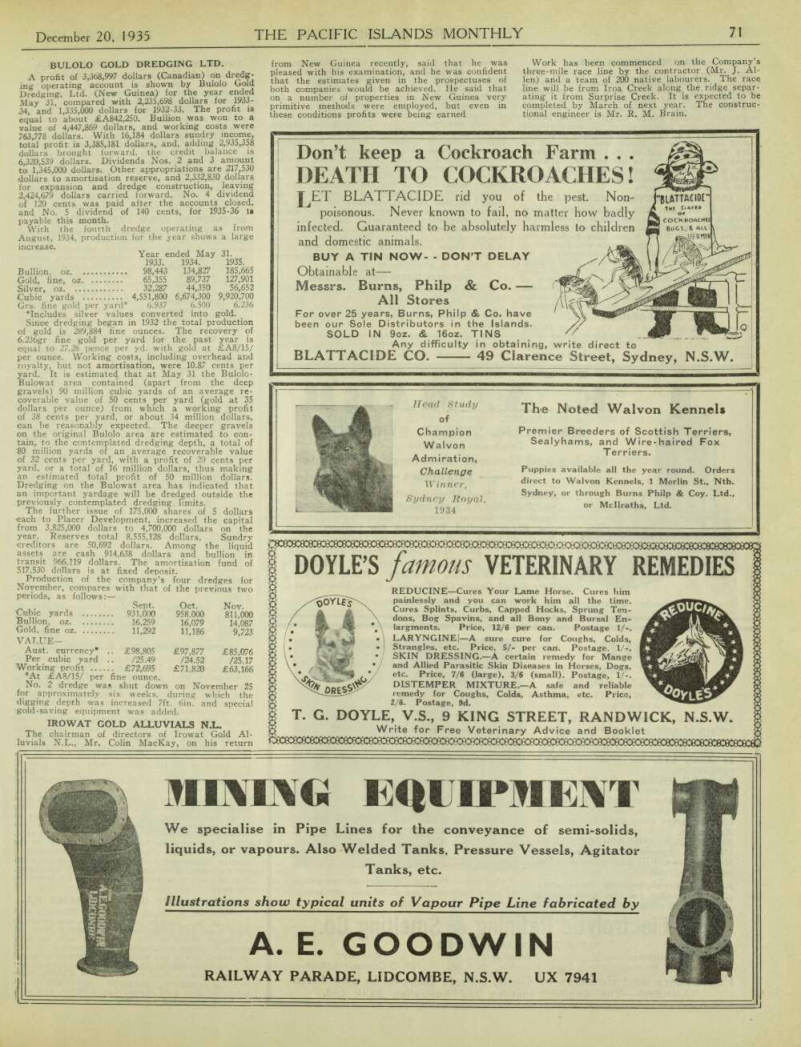
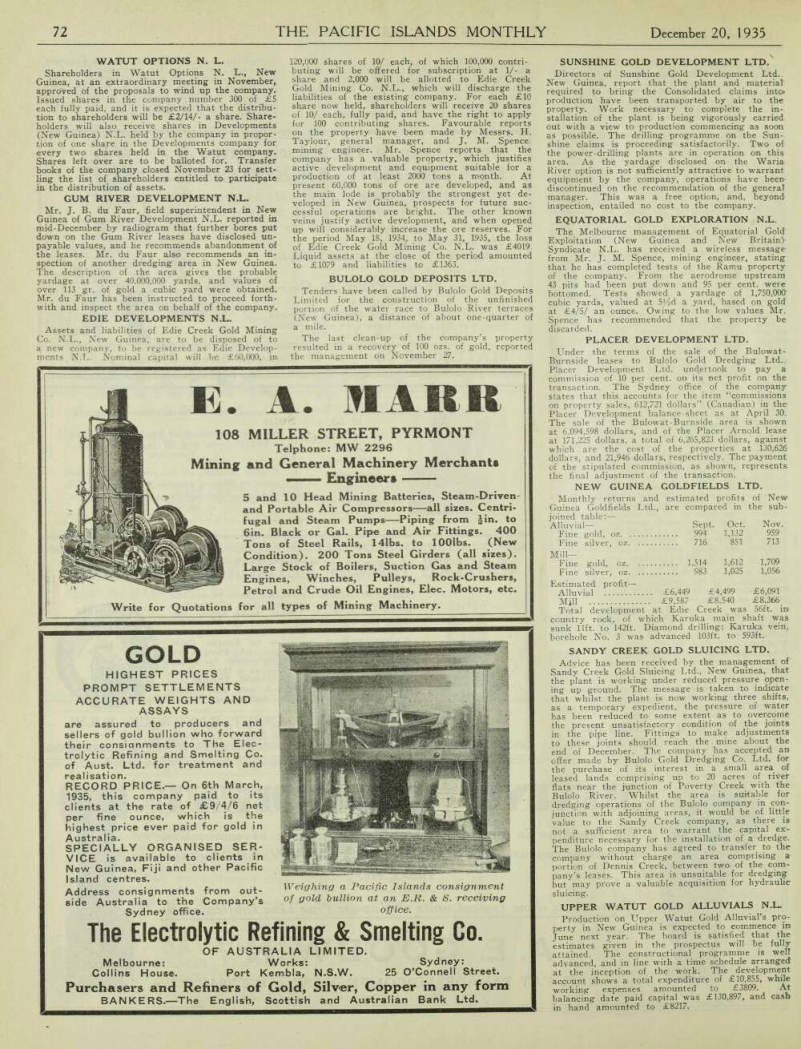
Upper Sepik Gold Mining Syndicate
At a special meeting of Upper Sepik Gold Mining Syndicate N.L. recently, reports on the leases in New Guinea, in which the syndicate is interested, was placed before shareholders. Mr.
J. M. Spence, consulting engineer, of Messrs.
Spence and Smith, of Wau, advised that the property of 350 acres was on the east side of the Bulolo River. The wash exposed in pits, costeens and faces worked by the vendor, was of small nature and was much smaller than was general in the district. The depth of wash exposed in sections of the property was up to 30 feet deep, but taking the depth as exposed in pits and costeens over the tested areas, the average depth would be 12 feet. Practically one-third of the lower area of the property had been tested by pitting and costeening, and dish prospects taken by him in most cases gave excellent results. It would take several months to test thoroughly the whole of the areas, and from his brief visit he could take only casual dish tests, and as this method of computing values was most unreliable, he could not place an approximate value on the ground. In his opinion there as a large area of wash, but without further work it was practically impossible to form any estimate. In his opinion the property would make an ideal sluicing pro position. Working with two units it would be possible to put through boxes a big daily yardage.
The gold was of a coarse nature, and samples which he took from various points gave a value of 836 fine. He suggested the installation of a pumping plant on the Bulolo River, adjacent to the property. The property had every chance of a big future. The syndicate s engineer (Mr. H. Wil liams) submitted a lengthy report. He said the total result of tests showed that aproximately 3,000,000 yards would give 10/ a yard; 1,000,000 yards, 8/ a yard, and 2,000,000 yards, 5/ a yard.
He estimated there were 4,000,000 to 5,000,000 yards untested, which, according to dish results, should give values consistent with the ground tested. He suggested the flotation of a company of £70,000.
This would cover purchase considerations for six leases, the erection of two plants, each capable of putting through 1500 yards a day. Whilst prepa rations were being made to install plants, boxes could be put in where high values were obtained.
He had secured an option over three leases ad joining Nos. 1 and 2 leases. Taking the leases as a whole they would comprise 2000 acres. The purchase consideration would be £25,000 to £26,000.
Morobe Alluvials N.L.
Morobe Alluvials N.L., operating alluvial properties on the Little Wau Creek, New Guinea, reports that it has treated 1,670 cubic yards of ground for a return of 570 z. 14dwt. of gold. A partial clean-up of 500 yards early in October returned 220 z. of gold, or about 7/ a yard. The return from the treatment now reported is about 5/6 a yard, with gold at £8 an ounce.
Enterprise Of New Guinea
Reporting for the period October 31 to November 16, Mr. H. Taylour, general manager in New Guinea of Enterprise of New Guinea N.L., advises that mining and prospecting operations have been carried out in the Watut Valley. Mining has been confined to box sluicing at Oriabanda, and hydraulicing with a small pilot plant at Surprise Creek. During the period an oxidised formation associated with a quartz porphyry intrusion was cut. Dish prospects showed free gold over a width of 6 feet. Gold production and prospecting has been temporarily stopped to permit of all available labour being concentrated on a water-race con struction and installation of a larger sluicing plant at Surprise Creek.
Bulolo Gold Dredging Ltd.
A profit of 3,368,997 dollars (Canadian) on dredg ing operating account is shown by Bulolo Gold Dredging, Ltd. (New Guinea) for the year ended May 31, compared with 2,235,698 dollars for 1933- 34, and 1,335,000 dollars for 1932-33. The profit is equal to about £A842,250. Bullion was won to a value of 4,447,869 dollars, and working costs were 763,778 dollars. With 16,184 dollars sundry income, total profit is 3,385,181 dollars, and, adding 2,935,358 dollars brought forward, the credit balance is 6,320,539 dollars. Dividends Nos. 2 and 3 amount to 1,345,000 dollars. Other appropriations are 217,530 dollars to amortisation reserve, and 2,332,830 dollars for expansion and dredge construction, leaving 2,424,679 dollars carried forward. No. 4 dividend of 120 cents was paid after the accounts closed, and No. 5 dividend of 140 cents, for 1935-36 is payable this month.
With the fourth dredge operating as from August, 1934, production for the year shows a large
of gold is 289,884 fine ounces. The recovery of 6.236 gr fine gold per yard for the past year is equal to 27.28 pence per yd. with gold at £AB/15/ per ounce. Working costs, including overhead and royalty, but not amortisation, were 10.87 cents per yard. It is estimated that at May 31 the Bulolo- Bulowat area contained (apart from the deep gravels) 90 million cubic yards of an average re coverable value of 50 cents per yard (gold at 35 dollars per ounce) from which a working profit of 38 cents per yard, or about 34 million dollars, can be reasonably expected. The deeper gravels on the original Bulolo area are estimated to con tain, to the contemplated dredging depth, a total of 80 million yards of an average recoverable value of 32 cents per yard, with a profit of 20 cents per yard, or a total of 16 million dollars, thus making an estimated total profit of 50 million dollars.
Dredging on the Bulowat area has indicated that an important yardage will be dredged outside the previously contemplated dredging limits.
The further issue of 175,000 shares of 5 dollars ■each to Placer Development, increased the capital from 3,825,000 dollars to 4,700,000 dollars on the year. Reserves total 8,555,128 dollars. Sundry creditors are 50,692 dollars. Among the liquid assets are cash 914,638 dollars and bullion in transit 966,119 dollars. The amortisation fund of 517,530 dollars is at fixed deposit.
Production of the company’s four dredges for November, compares with that of the previous two periods, as follows:
Irowat Gold Alluvials N.L.
The chairman of directors of Irowat Gold Al luvials N.L., Mr. Colin Mac Kay, on his return
from New Guinea recently, said that he was pleased with his examination, and he was confident that the estimates given in the prospectuses of both companies would be achieved. He said that on a number of properties in New Guinea very primitive methods were employed, but even in these conditions profits were being earned
Work has been commenced on the Company’s three-mile race line by the contractor (Mr. J. Al len) and a team of 200 native labourers. The race line will be from Iroa Creek along < the ridge separ ating it from Surprise Creek. It is expected to be completed by March of next year. The construc tional engineer is Mr. R. M. Brain.
increase.
Year ended May 31. 1933. 1934. 1935.
Bullion, oz 98,443 134,827 185,665 Gold, fine, oz 65,355 89,737 127,901 Silver, oz 32,287 44,350 56,652 Cubic yards 4,551,800 6,674,300 9,920,700 Grs. fine gold per yard* 6.937 6.500 6.236 *Includes silver values converted into gold.
Since dredging began in 1932 the total production
Cubic yards Sept.
Oct.
Nov. .. 931,000 958.000 811,000 Bullion, oz 16,259 16,079 14,087 Gold, fine oz
Value—
11,292 11,186 9,723 Aust. currency* .. £98,805 £97,877 £85,076 Per cubic yard /2S.49 Z24.52 /25.17 Working profit *At £A8/1S/ per .. £72,695 fine ounce. £71.820 £63,166 No. 2 dredge was shut down on November 25 for approximately six weeks, during which the digging depth was increased 7ft. 6in. and gold-saving equipment was added. special
Watut Options N. L.
Shareholders in Watut Options N. L., New Guinea, at an extraordinary meeting in November, approved of the proposals to wind up the company.
Issued shares in the company number 300 of £5 each fully paid, and it is expected that the distribution to shareholders will be £2/14/- a share. Shareholders will also receive shares in Developments (New Guinea) N.L. held by the company in propertion of one share in the Developments company for every two shares held in the Watut company.
Shares left over are to be balloted for. Transfer books of the company closed November 23 for settling the list of shareholders entitled to participate in the distribution of assets. riIM p.vFD npvn nPMFWT TSI I
Gum River Development N.L.
Mr. J. B. du Faur, field superintendent in New Guinea of Gum River Development N.L. reported in mid-December by radiogram that further bores put down on the Gum River leases have disclosed unpayable values, and he recommends abandonment of the leases. Mr. du Faur also recommends an inspection of another dredging area in New Guinea.
The description of the area gives the probable yardage at over 40,000,000 yards, and values cf over 113 gr. of gold a cubic yard were obtained.
Mr. du Faur has been instructed to proceed forthwith and inspect the area on behalf of the company.
Edie Developments N.L.
Assets and liabilities of Edie Creek Gold Mining Co. N.L., New Guinea, are to be disposed of to a new company, to be registered as Edie Developments N.L. Nominal capital will be £60,000, in
120,000 shares of 10/ each, of which 100,000 contri buting will be offered for subscription at 1/- a share and 2,000 will be allotted to Edie Creek Gold Mining Co. N.L., which will discharge the liabilities of the existing company. For each £lO share now held, shareholders will receive 20 shares of 10/ each, fully paid, and have the right to apply for 100 contributing shares. Favourable reports on the property have been made by Messrs. H.
Taylour, general manager, and J. M. Spence, mining engineer. Mr Spence reports that the company has a valuable property, which justifies active development and equipment suitable for a production of at least 2000 tons a month. At present 60,000 tons of ore are developed, and as the main lode is Probably the strongest yet de veloped in New Guinea, prospects for future suc cessful operations are bright. The other known veins justify active development, and when opened up w ni considerably increase the ore reserves. For the period May 18, 1934, to May 31, 1935, the loss 0 Edie Creek Gold Mining Co. N.L. was £4019 Liquid assets at the close of the period amounted to £1079 and liabilities to £1363.
Bulolo Gold Deposits Ltd.
Tenders have been called by Bulolo Gold Deposits Limited for the construction of the unfinished portion of the water race to Bulolo River terraces (New Guinea), a distance of about one-quarter of a mde - The last clean-up of the company’s property resulted in a recovery of 100 ozs. of gold, reported the management on November 27.
Sunshine Gold Development Ltd.
Directors of Sunshine Gold Development Ltd..
New Guinea, report that the plant and material required to bring the Consolidated claims into* production have been transported by air to the property. Work necessary to complete the in stallation of the plant is being vigorously carried out with a view to production commencing as soon as possible. The drilling programme on the Sun shine claims is proceeding satisfactorily. Two of the power-drilling plants are in operation on this area. As the yardage disclosed on the Waria River option is not sufficiently attractive to warrant equipment by the company, operations have been discontinued on the recommendation of the general manager. This was a free option, and, beyond inspection, entailed no cost to the company.
Equatorial Gold Exploration N.L.
The Melbourne management of Equatorial Gold Exploitation (New Guinea and New Britain)- Syndicate N.L. has received a wireless message from Mr. J. M. Spence, mining engineer, stating that he has completed tests of the Ramu property of the company. From the aerodrome upstream 43 pits had been put down and 95 per cent, were bottomed. Tests showed a yardage of 1,750,000" cubic yards, valued at 5)4d a yard, based on gold at £4/5/ an ounce. Owing to the low values Mr.
Spence has recommended that the property be discarded.
Placer Development Ltd.
Under the terms of the sale of the Bulowat- Burnside leases to Bulolo Gold Dredging Ltd..
Placer Development Ltd. undertook to pay a commission of 10 per cent, on its net profit on the transaction. The Sydney office of the company states that this accounts for the item “commissions on property sales, 612,721 dollars” (Canadian) in the Placer Development balance-sheet as at April 30.
The sale of the Bulowat-Burnside area is shown at 6,094,598 dollars, and of the Placer Arnold lease at 171,225 dollars, a total of 6,265,823 dollars, against which are the cost of the properties at 130,626 dollars, and 21,946 dollars, respectively. The payment of the stipulated commission, as shown, represents the final adjustment of the transaction.
New Guinea Goldfields Ltd.
Monthly returns and estimated profits of New Guinea Goldfields Ltd., are compared in the sub joined table; —
Estimated profit— Alluvial £6,449 £4,499 £6,091 Mill £9,587 £8,540 £8,366 Total development at Edie Creek was 56ft. in country rock, of which Karuka main shaft was sunk lift, to 142 ft. Diamond drilling: Karuka vein, borehole No. 3 was advanced 103 ft. to 593 ft.
Sandy Creek Gold Sluicing Ltd.
Advice has been received by the management of Sandy Creek Gold Sluicing Ltd., New Guinea, that the plant is working under reduced pressure open ing up ground. The message is taken to indicate that whilst the plant is now working three shifts, as a temporary expedient, the pressure of water has been reduced to some extent as to overcome the present unsatisfactory condition of the joints in the pipe line. Fittings to make adjustments to these joints should reach the mine about the end of December. The company has accepted an offer made by Bulolo Gold Dredging Co. Ltd. for the purchase of its interest in a small area of leased lands comprising up to 20 acres of river flats near the junction of Poverty Creek with the Bulolo River. Whilst the area is suitable for dredging operations of the Bulolo company in con junction with adjoining areas, it would be of little value to the Sandy Creek company, as there is not a sufficient area to warrant the capital ex penditure necessary for the installation of a dredge.
The Bulolo company has agreed to transfer to the company without charge an area comprising a portion of Dennis Creek, between two of the com pany’s leases. This area is unsuitable for dredging but may prove a valuable acquisition for hydraulic sluicing.
Upper Watut Gold Alluvials N.L.
Production on Upper Watut Gold Alluvial’s pro perty in New Guinea is expected to commence in June next year. The board is satisfied that the estimates given in the prospectus will be fully attained. The constructional programme is well advanced, and in line with a time schedule arranged at the inception of the work. The development account shows a total expenditure of £10,855, while working expenses amounted to £3809. At balancing date paid capital was £130,897, and. cash in hand amounted to £8217.
Alluvial — Sept.
Oct.
Nov.
Fine gold, oz 994 1,132 959 Fine silver, oz 716 851 713 Mill- Fine gold, oz 1,514 1,612 1,709 Fine silver, oz. ... 983 1,025 1,056
Advertisements & other items, pp. 72-74 (1 item)
W. M. Ford
Ship, Yacht & Boat Builder
Berry’s Bay, North Sydney
(Established 1870) BUILDERS of all kinds of Island Craft from Dinghies to Auxiliary Schooners of any tonnage. New and Second-hand Island Craft of various types in stock. New and Secondhand Full Diesel, Crude Oil, Benzine and Kerosene Engines.
Please Send on Your Enquiries
Don’t keep a Cockroach Farm . . .
DEATH TO COCKROACHES!
L ET . BLATTACIDE rid you of the pest. Nonpoisonous. Never known to fail, no matter how badly infected. Guaranteed to be absolutely harmless to children and domestic animals.
BUY A TIN NOW- - DON’T DELAY Obtainable at — Messrs. Burns, Philp & Co.
All Stores For over 25 years, Burns, Philp & Co. have been our Sole Distributors in the Islands.
SOLD IN 9oz. & 16oz. TINS
Any difficulty in obtaining, write direct to BLATTACIDE CO. 49 Clarence Street, Sydney, LAmoor tut SIUYtO COCt\f>OACrt(S Bucs, & ALL FRfllN \ E
N.S.W.
Head Study of Champion Walvon Admiration, Challenge Winner, Sydney Royal, 1934
The Noted Walvon Kennel*
Premier Breeders of Scottish Terriers, Sealyhams, and Wire-haired Fox T erriers.
Puppies available all the year round. Orders direct to Walvon Kennels, 1 Merlin St., Nth.
Sydney, or through Burns Philp & Coy. Ltd., or Mcllraths, Ltd.
DOYLE’S famous VETERINARY REMEDIES
oOYLfs
ORES>
REDUCINE—Cures Your Lame Horse. Cures him painlessly and you can work him all the time.
Cures Splints, Curbs, Capped Hocks, Sprung Tendons, Bog Spavins, and all Bony and Bursal Enlargments. Price, 12/6 per can. Postage 1/-.
LARYNGINE] —A sure cure for Coughs, Colds, Strangles, etc. Price, 5/- per can. Postage. 1/-.
SKIN DRESSING.—A certain remedy for Mange and Allied Parasitic Skin Diseases in Horses, Dogs, etc. Price, 7/6 (large), 3/6 (small). Postage, 1/-.
DISTEMPER MIXTURE.—A safe and reliable remedy for Coughs, Colds, Asthma, etc. Price, 2/6. Postage, 9d.
T. G. DOYLE, V.S., 9 KING STREET, RANDWICK, N.S.W.
Write for Free Veterinary Advice and Booklet
MINING EQUIPMENT
We specialise in Pipe Lines for the conveyance of semi-solids, liquids, or vapours. Also Welded Tanks, Pressure Vessels, Agitator Tanks, etc.
Illustrations show typical units of Vapour Pipe Line fabricated by
A. E. GOODWIN
RAILWAY PARADE, LIDCOMBE, N.S.W. UX 7941
E. A. MARK
108 MILLER STREET, PYRMONT
Telphone: MW 2296 Mining and General Machinery Merchant#
■■■— Engineer#
5 and 10 Head Mining Batteries, Steam-Driven' and Portable Air Compressors—all sizes. Centrifugal and Steam Pumps—Piping from Jin. to 6in. Black or Gal. Pipe and Air Fittings. 400 Tons of Steel Rails, 14lbs. to lOOlbs. (New Condition). 200 Tons Steel Girders (all sizes).
Large Stock of Boilers, Suction Gas and Steam Engines, Winches, Pulleys, Rock-Crushers, Petrol and Crude Oil Engines, Elec. Motors, etc.
Write for Quotations for all types of Mining Machinery. -I
GOLD
HIGHEST PRICES
PROMPT SETTLEMENTS
ACCURATE WEIGHTS AND
ASSAYS
are assured to producers and sellers of gold bullion who forward their consianments to The Electrolytic Refining and Smelting Co. of Aust. Ltd. for treatment and realisation.
RECORD PRICE.— On 6th March, 1935, this company paid to its clients at the rate of £9/4/6 net per fine ounce, which is the highest price ever paid for gold in Australia.
SPECIALLY ORGANISED SER-
VICE is available to clients in New Guinea, Fiji and other Pacific Island centres.
Address consignments from outside Australia to the Company’s Sydney office. 5 1 Weighing a Pacific Islands consignment of gold bullion at an E.R. & S. receiving office.
The Electrolytic Refining & Smelting Co.
OF AUSTRALIA LIMITED.
Melbourne: Works: Sydney: Collins House. Port Kembla, N.S.W. 25 O’Connell Street.
Purchasers and Refiners of Gold, Silver, Copper in any form BANKERS.—The English, Scottish and Australian Bank Ltd.
Pacific Is. Gold
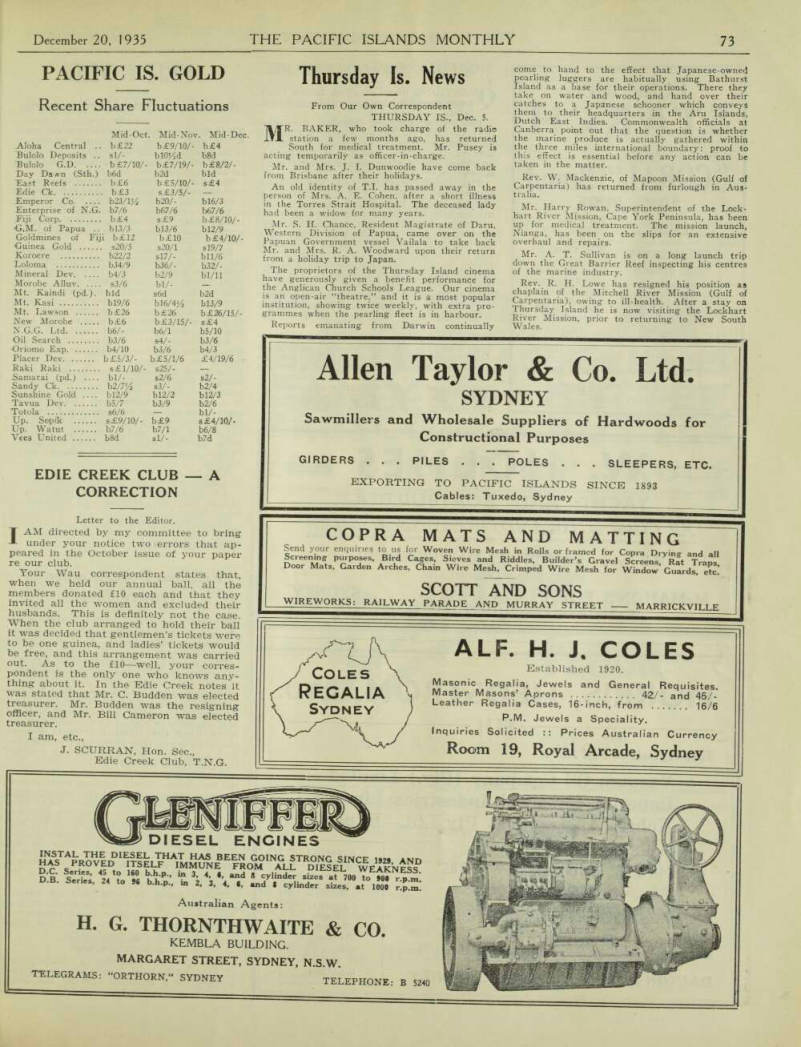
Recent Share Fluctuations
Mid-Oct. Mid-Nov. Mid-Dec Aloha Central .. b£22 b£9/10/b£4 Bulolo Deposits .. si/bl054d b8d Bulolo G.D b£7/10/b£7/19/b£8/2/- Day Dawn (Sth.) b6d b2d bld East Reefs b£6 b £5/10/s£4 Edie Ck b£3 s£3/S/- — Emperor Co b23/lH b20/bl6/3 Enterprise of N.G. b7/6 b6 7/6 b67/6 Fiji Corp b£4 s£9 b£8/10/- G,M. of Papua .. bl3/3 b!3/6 bl2/9 Goldmines of Fij i b£12 b£10 b £4/10/ - Guinea Gold s20/S s20/l si 9/7 Koroere b22/2 sl7/bll/6 Uoloma b34/9 b36/b 32/- Mineral Dev b4/3 b2/9 bl/11 Morobe Alluv s3/6 bV- Mt. Kaindi (pd.). bid sed b2d Mt. Kasi bl9/6 bl6/4^2 bl3/9 Mt. Lawson b£26 b£26 b £26/15/- New Morobe b£6 b£3/15/s£4 N.G.G. Ltd b6/be/i b5/10 Oil Search b3/6 s4/b3/6 ■Oriomo Exp b4/10 b3/6 b4/3 Placer Dev b£5/3/b £5/1/6 £4/19/6 Raki Raki s£l/10/s25 /- — Samarai (pd.) bl/s2/6 s2 /- Sandy Ck b2 ny 2 s 3/b2/4 Sunshine Gold bl2/9 bl2/2 bl2/3 Tavua Dev b5/7 b3/9 b2/6 Totola s6/6 bl/- Up. Sepik s£9/10/b£9 s£4/10/- Up. Watut b7/6 b7/l b6/8 Yees United b8d si/b7d
Edie Creek Club-A
Correction
Letter to the Editor, T AM directed by my committee to bring J- under your notice two errors that ap peared in the October issue of your paper re our club.
Your Wau correspondent states that, when we held our annual ball, all the members donated £lO each and that they invited all the women and excluded their husbands. This is definitely not the case.
When the club arranged to hold their ball it was decided that gentlemen’s tickets were to be one guinea, and ladies’ tickets would be free, and this arrangement was carried out. As to the £lo—well, your corres pondent is the only one who knows any thing about it. In the Edie Creek notes it was stated that Mr. C. Budden was elected treasurer. Mr. Budden was the resigning officer, and Mr. Bill Cameron was elected treasurer.
I am, etc.,
J. Scurran
Hon. Sec.,
Edie Creek Club, T.N.G.
Thursday Is. News
From Our Own Correspondent
Thursday Is., Dec. 5.
MR. BAKER, who took charge of the radio station a few months ago, has returned South for medical treatment. Mr. Pusey is acting temporarily as officer-in-charge.
Mr. and Mrs. J. I. Dunwoodie have come back from Brisbane after their holidays.
An old identity of T.I. has passed away in the person of Mrs. A. E. Cohen, after a short illness in the Torres Strait Hospital. The deceased lady had been a widow for many years.
Mr. S. H. Chance, Resident Magistrate of Daru, Western Division of Papua, came over on the Papuan Government vessel Vailala to take back Mr. and Mrs. R. A. Woodward upon their return from a holiday trip to Japan.
The proprietors of the Thursday Island cinema have generously given a benefit performance for the Anglican Church Schools League. Our cinema is an open-air “theatre,” and it is a most popular institution, showing twice weekly, with extra pro grammes when the pearling fleet is in harbour.
Reports emanating from Darwin continually
come to hand to the effect that Japanese-owned pearling luggers are habitually using Bathurst Island as a base for their operations. There they take on water and wood, and hand over their catches to a Japanese schooner which conveys them to their headquarters in the Aru Islands, Dutch East Indies. Commonwealth officials at Canberra point out that the question is whether the marine produce is actually gathered within the three miles international boundary: proof to this effect is essential before any action can be taken in the matter.
Rev. W. Mackenzie, of Mapoon Mission (Gulf of Carpentaria) has returned from furlough in Aus tralia.
Mr. Harry Rowan, Superintendent of the Lock hart River Mission, Cape York Peninsula, has been up for medical treatment. The mission launch, Nianga, has been on the slips for an extensive overhaul and repairs.
Mr. A. T. Sullivan is on a long launch trip down the Great Barrier Reef inspecting his centres of the marine industry.
Rev. R. H. Lowe has resigned his position as chaplain of the Mitchell River Mission (Gulf of Carpentaria), owing to ill-health. After a stay on Thursday Island he is now visiting the Lockhart River Mission, prior to returning to New South Wales.
Advertisements & other items, pp. 75-76 (1 item)
Allen Taylor & Co. Ltd.
SYDNEY
Sawmillers and Wholesale Suppliers of Hardwoods for Constructional Purposes GIRDERS . . . PILES . . . POLES . . . SLEEPERS, ETC.
EXPORTING TO PACIFIC ISLANDS SINCE 1893
Cables: Tuxedo, Sydney
Send your enquiries to us for Woven Wire Mesh in Rolls or framed for Screening purposes, Bird Cages, Sieves and Riddles, Builder’s Gravel Door Mats, Garden Arches, Chain Wire Mesh, Crimped Wire Mesh for
SCOTT AND SONS
WIREWORKS: RAILWAY PARADE AND MURRAY STREET
Copra Drying and all Screens, Rat Traps, Window Guards, etc.
MARRICKVILLE
afv
DIESEL
ENGINES
tet z\\\t Lsvtutr i rSsS
H.
G.
Australian Agents:
THORNTHWAITE & CO.
KEMBLA BUILDING.
TELEGRAMS:
MARGARET STREET, SYDNEY, N.S.W.
ORTHORN,” SYDNEY TELEPHONE: B 5240
PURE RICE
STARCH
Always ask for . . .
“CORAL” Brand
100% PURE
Noted for its
QUALITY
and
WHITENESS
Goes Farthest and gives Lasting Finish
WILL NOT
STICK TO
IRON
Obtainable from Leading Island Stores Manufactured by Coral Starch Ltd.
Sydney, N.S.W.
SN
CORALBRANO
RICE STARCH
1
W. HOLMES
YACHT AND BOATBUILDER
All Classes of VESSELS^ a Sole Agent “ R.N.” DIESEL MARINE ENGINES.
SEND FOR PARTICULARS.
McMAHON’S POINT
Cable Address:
SYDNEY
“HOLMAC,” Sydney.
MORRIS, HEDSTROM, Ltd
FIJI
Sole Agents in Fiji for . . .
Vacuum Oil Company (Pty.) Limited
Imperial Chemical Industries Limited
Nobel (Australasia) Pty Ltd. —Explosives
Full Stocks of
MINERS AND PROSPECTORS’
REQUISITES
Also SODIUM CYANIDE, ZINC
DUST, Etc., Etc.
Sydney Office:
DALTON HOUSE, 115 PITT ST., SYDNEY
Branches throughout the gold bearing areas Lautoka, Ba, Tavua, Penang, Nadi, and Sigatoka
Norfolk Island Affairs
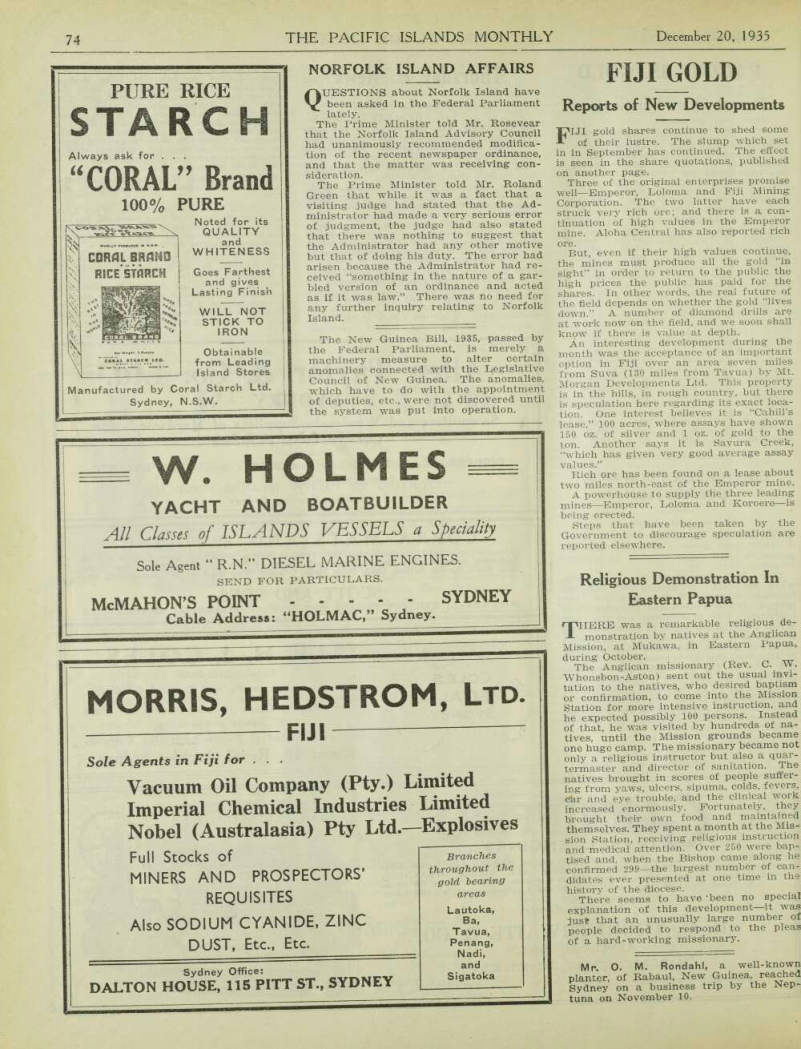
QUESTIONS about Norfolk Island have been asked in the Federal Parliament lately.
The Prime Minister told Mr. Rosevear that the Norfolk Island Advisory Council had unanimously recommended modifica tion of the recent newspaper ordinance, and that the matter was receiving con sideration.
The Prime Minister told Mr. Roland Green that while it was a fact that a visiting judge had stated that the Ad ministrator had made a very serious error of judgment, the judge had also stated that there was nothing to suggest that the Administrator had any other motive but that of doing his duty. The error had arisen because the Administrator had re ceived “something in the nature of a gar bled version of an ordinance and acted as if it was law.” There was no need for any further inquiry relating to Norfolk Island.
The New Guinea Bill, 1935, passed by the Federal Parliament, is merely a machinery measure to alter certain anomalies connected with the Legislative Council of New Guinea. The anomalies, which have to do with the appointment of deputies, etc., were not discovered until the system was put into operation.
Fiji Gold
Reports of New Developments
FIJI gold shares continue to shed some of their lustre. The slump which set in in September has continued. The effect is seen in the share quotations, published on another page.
Three of the original enterprises promise well —Emperor, Loloma and Fiji Mining Corporation. The two latter have each struck very rich ore; and there is a con tinuation of high values in the Emperor mine. Aloha Central has also reported rich ore.
But, even if their high values continue, the mines must produce all the gold “in sight” in order to return to the public the high prices the public has paid for the shares. In other words, the real future of the field depends on whether the gold “lives down.” A number of diamond drills are at work now on the field, and we soon shall know if there is value at depth.
An interesting development during the month was the acceptance of an important option in Fiji over an area seven miles from Suva (130 miles from Tavua) by Mt.
Morgan Developments Ltd. This property is in the hills, in rough country, but there is speculation here regarding its exact loca tion. One interest believes it is “Cahill’s lease,” 100 acres, where assays have shown 150 oz. of silver and 1 oz. of gold to the ton. Another says it is Savura Creek, “which has given very good average assay values.”
Rich ore has been found on a lease about two miles north-east of the Emperor mine.
A powerhouse to supply the three leading mines—Emperor, Loloma and Koroere —is being erected.
Steps that have been taken by the Government to discourage speculation are reported elsewhere.
Eastern Papua
Religious Demonstration In Eastern Papua
THERE was a remarkable religious de monstration by natives at the Anglican Mission, at Mukawa, in Eastern Papua, during October. The Anglican missionary (Rev. C. W.
Whonsbon-Aston) sent out the usual invi tation to the natives, who desired baptism or confirmation, to come into the Mission Station for more intensive instruction, and he expected possibly 100 persons. Instead of that, he was visited by hundreds of na tives, until the Mission grounds became one huge camp. The missionary became not only a religious instructor but also a quar termaster and director of sanitation. The natives brought in scores of people suffer ing from yaws, ulcers, sipuma, colds, fevers, ear and eye trouble, and the clinical woi k increased enormously. Fortunately, they brought their own food and maintained themselves. They spent a month at the Mis sion Station, receiving religious instruction and medical attention. Over 250 were bap tised and. when the Bishop came along he confirmed 299—the largest number of can didates ever presented at one time in the history of the diocese.
There seems to have ‘been no special explanation of this development—it was jusf* that an unusually large number of people decided to respond to the pleas of a hard-working missionary.
Mr. O. M. Rondahl, a well-known planter, of Rabaul, New Guinea, reached Sydney on a business trip by the Nep tuna on November 10.
New Books
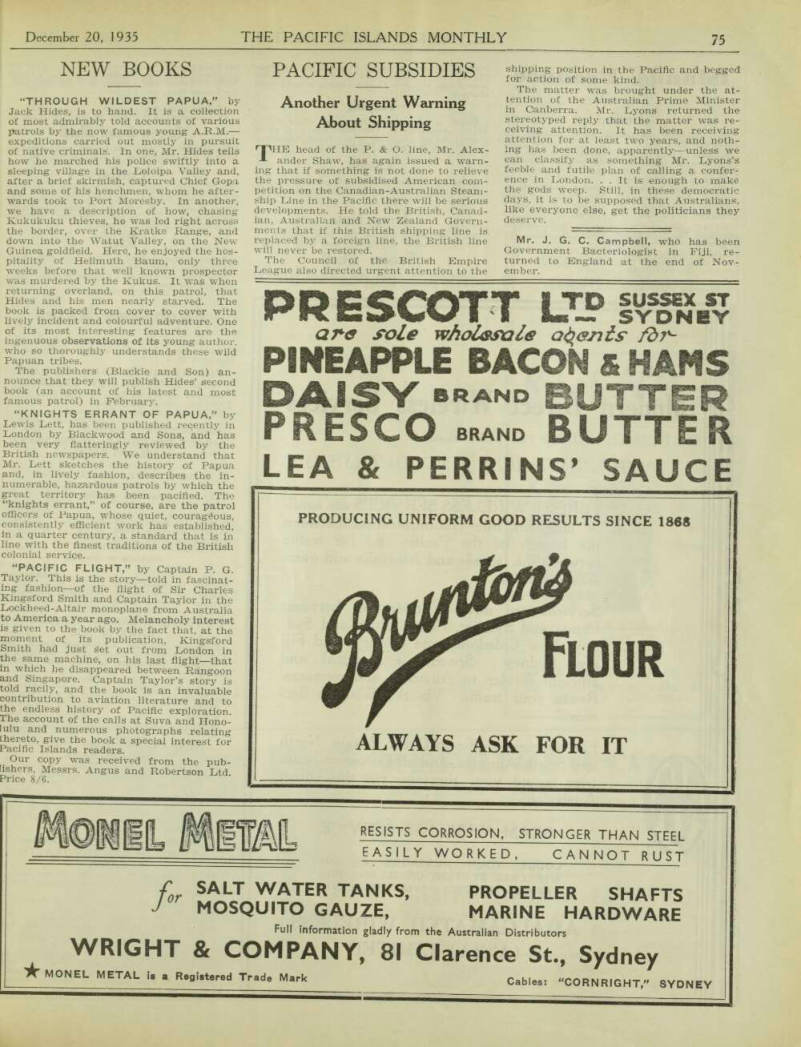
“Through Wildest Papua,” By
Jack Hides, is to hand. It is a collection of most admirably told accounts of various patrols by the now famous young A.R.M. — expeditions carried out mostly in pursuit of native criminals. In one, Mr, Hides tells how he marched his police swiftly into a sleeping village in the Loloipa Valley and, after a brief skirmish, captured Chief Gopa and some of his henchmen, whom he after wards took to Port Moresby. In another, we have a description of how, chasing Kukukuku thieves, he was led right across the border, over the Kratke Range, and down into the Watut Valley, on the New Guinea goldfield. Here, he enjoyed the hos pitality of Hellmuth Baum, only three weeks before that well known prospector was murdered by the Kukus. It was when returning overland, on this patrol, that Hides and his men nearly starved. The book is packed from cover to cover with lively incident and colourful adventure. One of its most interesting features are the ingenuous observations of its young author, who so thoroughly understands these wild Papuan tribes.
The publishers (Blackie and Son) an nounce that they will publish Hides’ second book (an account of his latest and most famous patrol) in February.
“Knights Errant Of Papua,” By
Lewis Lett, has been published recently in London by Blackwood and Sons, and has been very flatteringly reviewed by the British newspapers. We understand that Mr. Lett sketches the history of Papua and, in lively fashion, describes the in numerable, hazardous patrols by which the great territory has been pacified. The “knights errant,” of course, are the patrol officers of Papua, whose quiet, courageous, consistently efficient work has established, in a quarter century, a standard that is in line with the finest traditions of the British colonial service.
“PACIFIC FLIGHT,” by Captain P. G.
Taylor. This is the story—told in fascinat ing fashion—of the flight of Sir Charles Kingsford Smith and Captain Taylor in the Lockheed-Altair monoplane from Australia to America a year ago. Melancholy interest is given to the book by the fact that, at the moment of its publication, Kingsford Smith had just Set out from London in the same machine, on his last flight—that in which he disappeared between Rangoon and Singapore. Captain Taylor’s story is told racily, and the book is an invaluable contribution to aviation literature and to the endless history of Pacific exploration.
The account of the calls at Suva and Hono lulu and numerous photographs relating thereto, give the book a special interest for Pacific Islands readers.
Our copy was received from the pub lishers, Messrs. Angus and Robertson Ltd.
Price 8/6.
About Shipping
Pacific Subsidies
Another Urgent Warning About Shipping
r I ''HE head of the P. & O. line, Mr. Alex ander Shaw, has again issued a warn ing that if something is not done to relieve the pressure of subsidised American com petition on the Canadian-Australian Steam ship Line in the Pacific there will be serious developments. He told the British, Canad ian, Australian and New Zealand Govern ments that if this British shipping line is replaced by a foreign line, the British line will never be restored.
The Council of the British Empire League also directed urgent attention to the
shipping position in the Pacific and begged for action of some kind.
The matter was brought under the at tention of the Australian Prime Minister in Canberra. Mr. Lyons returned the stereotyped reply that the matter was re ceiving attention. It has been receiving attention for at least two years, and noth ing has been done, apparently—unless we can classify as something Mr. Lyons’s feeble and futile plan of calling a confer ence in London. . . It is enough to make the gods weep. Still, in these democratic days, it is to be supposed that Australians, like everyone else, get the politicians they deserve.
Mr. J. G. C. Campbell, who has been Government Bacteriologist in Fiji, re turned to England at the end of Nov ember.
Advertisements & other items, p. 77 (1 item)
Flour
PRESCOTT L T J? IydtJb S Y ar-a sole wholesale a penis'
PINEAPPLE BACON & HANS
DAISY BRAND BUTTER
FRESCO BRAND BUTTER
LEA & PERRINS’ SAUCE
PRODUCING UNIFORM GOOD RESULTS SINCE 1
9
Flour
ALWAYS ASK FOR IT
imm
RESISTS CORROSION. STRONGER THAN STEEL
EASILY WORKED. CANNOT RUST
for SALT WA TER TANKS, PROPELLER SHAFTS J mosquito gauze, marine hardware Full Information gladly from the Australian Distributors WRIGHT & COMPANY, 81 Clarence St., Sydney ir MONEL METAL I. . R. a irt«J Tr.d, M.rk Cab 'CORNRIGHT," SYDNEY
islands Produce
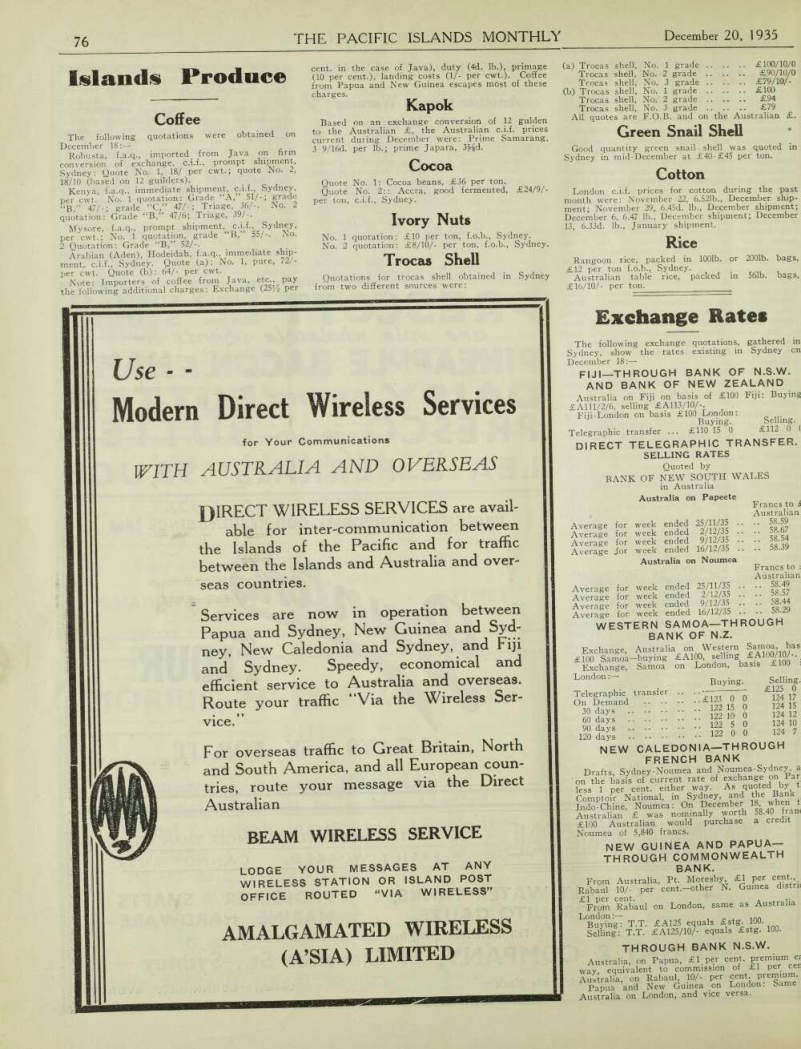
Coffee
The following quotations were obtained on December 18; — Robusta, f.a.q., imported from Java on nrm conversion of exchange, c.i.f., prompt shipment, Sydney: Quote No. 1, 18/ per cwt.; quote No. 2, 18/10 (based on 12 guilders).
Kenya, f.a.q., immediate shipment, c.i.f., Sydney, per cwt. No. 1 quotation: Grade “A,” 51/-; grade “B,” 47/-; grade “C,” 47/-; Triage, 36/-. No. 2 quotation: Grade “B,” 47/6; Triage, 39/-.
Mysore, f.a.q., prompt shipment, c.i.f., Sydney, per cwt.; No. 1 quotation, grade B, 55/-. JNo. 2 Quotation: Grade “B,” 52/-.
Arabian (Aden), Hodeidah, f.a.q., immediate ship ment, c.i.f., Sydney. Quote (a): No. 1, pure, 72/per cwt. Quote (b): 64/- per cwt.
Note: Importers of coffee from Java, etc., pay the following additional charges: Exchange (25/ 2 per
cent, in the case of Java), duty (4d. lb.), primage (10 per cent.), landing costs (1/- per cwt.). Coffee from Papua and New Guinea escapes most of these charges.
Kapok
Based on an exchange conversion of 12 gulden to the Australian £, the Australian c.i.f. prices current during December were: Prime Samarang, 3 9/16d. per lb.; prime Japara, 3Hd.
Cocoa
Quote No. 1: Cocoa beans, £36 per ton.
Quote No. 2;: Accra, good fermented, £24/9/per ton, c.i.f., Sydney.
Ivory Nuts
No. 1 quotation; £lO per ton, f.0.b., Sydney.
No. 2 quotation: £B/10/- per ton, f.0.b., Sydney.
Trocas Shell
Quotations for trocas shell obtained in Sydney from two different sources were:
(a) Trocas shell, No. 1 grade £100/10/0 Trocas shell, No. 2 grade .. .. .-. £90/10/0 Trocas shell, No. 3 grade £79/10/- (b) Trocas shell, No. 1 grade £100 Trocas shell, No. 2 grade £94 Trocas shell, No. 3 grade £79 All quotes are F.O.B. and on the Australian £,
Green Snail Shell
Good quantity green snail shell was quoted in Sydney in mid-December at £40-£45 per ton.
Cotton
London c.i.f. prices for cotton during the past month were: November 22, 6.521b., December ship ment; November 29, 6.45d. lb., December shipment; December 6, 6.47 lb., December shipment; December 13, 6.33d. lb., January shipment.
Rice
Rangoon rice, packed in 1001b. or 2001b. bags, £12 per ton f.o.b., Sydney. .
Australian table rice, packed in 561b. bags, £16/10/- per tom
Exchange Hates
The following exchange quotations, gathered in Sydney, show the rates existing in Sydney cn December 18: —
Fiji —Th Rough Bank Of N.S.W.
And Bank Of New Zealand
Australia on Fiji on basis of £lOO Fiji: Buying £Alll/2/6, selling £AII3/10/-.
Fiji-London on basis £lOO London; Buying. Selling.
Telegraphic transfer ... £llO 15 0 £ll2 0 (
Direct Telegraphic Transfer.
Selling Rates
Quoted by
Bank Of New South Wales
in Australia
Western Samoa —Through
Bank Of N.Z.
Exchange, Australia on ' Western Samoa, has; £lOO Samoa— buying £AIOO, selling £AIOO/10/-.
Exchange, Samoa on London, basis £lOO i
New Caledonia —Through
French Bank
Drafts, Sydney-Noumea and Noumea-Sydney, a on the basis of current rate of exchange on less 1 per cent, either way. As , qU t t Comptoir National, in Sydney, and Bank Indo-Chine, Noumea: On December_ 18 whenit Australian £ was nominally worth 58.40 fran< £lOO Australian would purchase a credit Noumea of 5,840 francs.
New Guinea And Papua
Through Commonwealth
Bank.
From Australia, Pt. Moresby, £1 per cent Rabaul 10/- per cent.—other N. Guinea distru £ From Rabaul on London, same as Australia buying: T.T. £AI2S equals £stg. 100.
Selling: T.T. £AI2S/10/- equals £stg. 100.
Through Bank N.S.W.
Australia, on Papua, £l.per “nt. premium « wav equivalent to commission of £1 per ecu Sralia. on RabauK 10/- per cent premmm Papua and New Guinea on London, same Australia on London, and vice versa.
Average for Australia on Papeete week ended 25/11/35 ..
Francs to i Australian .. 58.59 Average for week ended 2/12/35 .. .. 58.67 Avpraffe for week ended 9/12/35 .. .. 58.54 Average ior week ended 16/12/35 .. .. 58.39 Average for Australia on Noumea week ended 25/11/35 ..
Francs to i Australian .. 58.49 Average for week ended 2/12/35 .. .. 58.57 Average for week ended 9/12/35 .. 58.44 Average for week ended 16/12/35 .. , .. 58.29
London: Buying.
Telegraphic transfer .. £{25 0
%d«s and :: :: So 8
S S? s ‘ ‘ ... 122 10 0 124 12 SS;; .. .. 122 5 0 124 10 iSdays :: :: ™ ° 0 124 7
Advertisements & other items, p. 78 (1 item)
Modern Direct Wireless Services
Use - -
for Your Communications
WITH AUSTRALIA AND OVERSEAS
DIRECT WIRELESS SERVICES are avail-
able for inter-communication between the Islands of the Pacific and for traffic between the Islands and Australia and overseas countries.
Services are now in operation between Papua and Sydney, New Guinea and Sydney, New Caledonia and Sydney, and Fiji and Sydney. Speedy, economical and efficient service to Australia and overseas.
Route your traffic Via the Wireless Ser- • 9 9 vice.
For overseas traffic to Great Britain. North and South America, and all European countries, route your message via the Direct Australian
BEAM WIRELESS SERVICE
lodge your messages at any
WIRELESS STATION OR ISLAND POST
OFFICE ROUTED “VIA WIRELESS"
AMALGAMATED WIRELESS
(A’SIA) LIMITED
Market Quotations
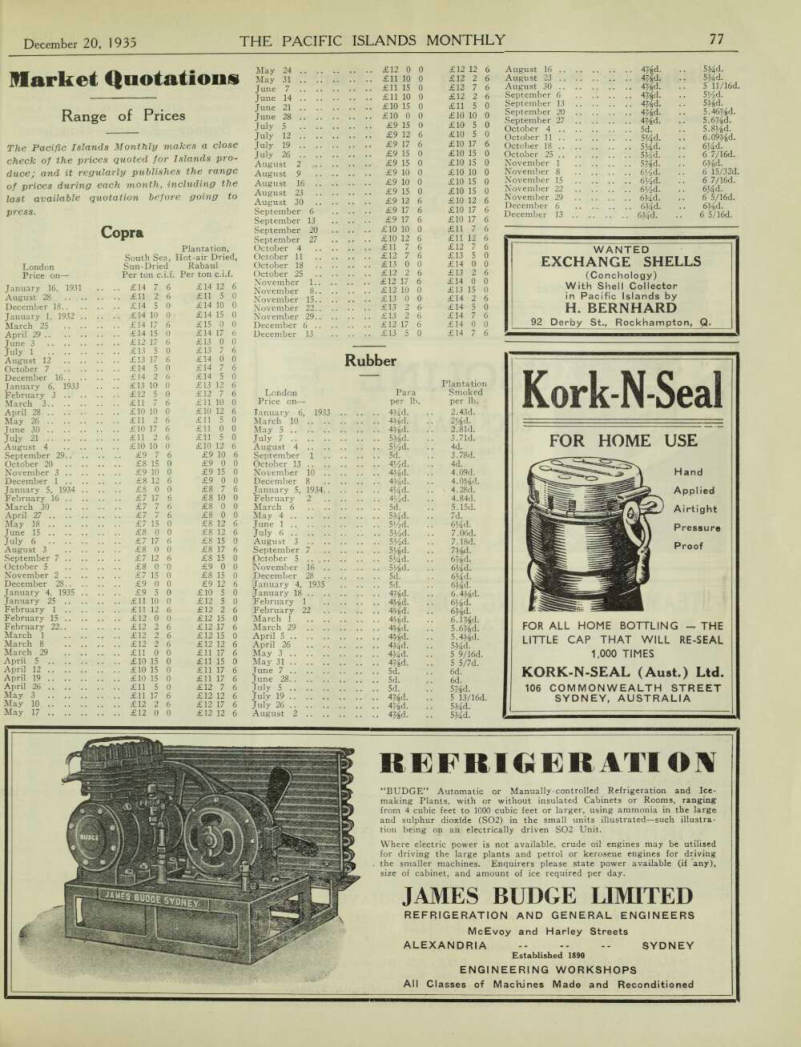
Range of Prices
The Pacific Islands Monthly makes a close check of the prices quoted for Islands pro duce; and it regularly publishes the range of prices during each month, inchiding the last available quotation before going to press.
Copra
Plantation, South Sea, Hot-air Dried, London Sun-Dried Rabaul Price on — Per ton c.i.f.
Per ton c.i.f.
January 16, 1931 .. .. £14 7 6 £14 12 6 August 28 .. .. .. .. £11 2 6 £11 5 0 December 18.. .. .. £14 5 0 £14 10 0 January 1. 1932 .. .. .. £14 10 0 £14 IS 0 March 25 ... .. .. £14 17 6 £15 0 0 April 29 .. .. £14 15 0 £14 17 6 June 3 .. .. £12 17 6 £13 0 0 July 1 .. .. £13 5 0 £13 7 6 August 12 .. .. ,. .. £13 17 6 £14 0 0 October 7 .. .. .. .. £14 5 0 £14 7 6 December 16.. .. .. .. £14 2 6 £14 5 0 January 6, 1933 .. .. £13 10 0 £13 12 6 February 3 .. .. .. .. £12 5 0 £12 7 6 March 3 .. .. £11 7 6 £11 10 0 April 28 .. .. £10 10 0 £10 12 6 May 26 .. .. £11 2 6 £11 5 0 June 30 .. .. £10 17 6 £11 0 0 July 21 .. .. £11 2 6 £11 5 0 August 4 .. .. .. .. £10 10 0 £10 12 6 September 29.. .. ... £9 7 6 £9 10 6 October 20 .. .. ... £8 15 0 £9 0 0 November 3 .. .. ... £9 10 0 £9 IS 0 December 1 .. .. .. .. £8 12 6 £9 0 0 January 5, 1934 .. ... £8 0 0 £8 7 6 February 16 .. .. .. .. £7 17 6 £8 10 0 March 30 .. .. ... £7 7 6 £8 0 0 April 27 ... £7 7 6 £8 0 0 May 18 ... £7 15 0 £8 12 6 June IS ... £8 0 0 £8 12 6 July 6 ... £7 17 6 £8 15 0 August 3 ... ... £8 0 0 £8 17 6 September 7 .. .. .. £7 12 6 £8 15 0 October 5 .. .. .. .. £8 0 0 £9 0 0 November 2 .. .. .. .. £7 IS 0 £8 15 0 December 28.. .. ... £9 0 0 £9 12 6 January 4, 1935 .. ... £9 5 0 £10 5 0 January 25 .. .. .. .. £11 10 0 £12 5 0 February 1 .. .. .. .. £11 12 6 £12 2 6 February 15 .. .. .. .. £12 0 0 £12 15 0 February 22.. .. .. £12 2 6 £12 17 6 March 1 ... .. .. £12 2 6 £12 IS 0 March 8 ... .. .. £12 2 6 £12 12 6 March 29 .. .. .. .. £11 0 0 £11 17 6
April 5
.. .. £10 15 0 £11 15 0 April 12 .. .. £10 15 0 £11 17 6 April 19 .. .. £10 15 0 £11 17 6 April 26 .. .. £11 5 0 £12 7 6 May 3 6 £12 12 6 May 10 .. .. £12 2 6 £12 17 6 May 17 .. .. £12 0 0 £12 12 6
August 16 .. .. 4^d. 5H d.
August 23 .. .. 47/ 8 d. 5^d.
August 30 .. .. 4%d. 5 ll/16d September 6 .. . ► .. .. 47/ 8 d. sy 2 d.
September 13 .. .. 47/sd. 5Hd. j September 20 .. .. .. .. 47/sd. 5.46^d.
September 27 .. .. .. .. 47/sd. 5.6^d.
October 4 .. .. Sd. 5.8^d.
October 11 .. .. 5/ 4 d. 6.09^d.
October 18 .. .. 5j4d. 6j4d.
October 25 .. .. 5^d. 6 7/16d.
November 1 .. .. .. .. 57/sd. 6/»d- November 8 .. ., .. .. 6/ 2 d. 6 15/32d.
November 15 .. .. .. .. 6/ 2 d. 6 7/16d.
November 22 .. .. .. .. 6^d. 6j4d.
November 29 .. .. 6 5/16d.
December 6 .. .. 6/ 8 d.
December 13 .. .. .. 6Hd. 6 5/16d.
May 24 .. .. £12 0 0 £12 12 6 May 31 .. .. £11 10 0 £12 2 6 June 7 .. .. £11 IS 0 £12 7 6 June 14 .. .. £11 10 0 £12 2 6 June 21 .. .. £10 15 0 £11 5 0 June 28 .. .. £10 0 0 £10 10 0 July 5 .. .. £9 15 0 £10 5 0 July 12 .. .. £9 12 6 £10 5 0 July 19 .. .. £9 17 6 £10 17 6 July 26 .. ., £9 15 0 £10 15 0 August 2 ... .. .. £9 15 0 £10 15 0 August 9 .. .. .. .. £9 10 0 £10 10 0 August 16 .. .. .. .. £9 10 0 £10 15 0 August 23 .. .. .. .. £9 15 0 £10 IS 0 August 30 .. .. ■ .. .. £9 12 6 £10 12 6 September 6 .. .. .. £9 17 6 £10 17 6 September 13 .. . 6 £10 17 6 September 20 .. . .. .. £10 10 0 £11 7 6 September 27 .. . .. £10 12 6 £11 12 6 October 4 .. .. . .. .. £11 7 6 £12 7 6 October 11 .. .. £12 7 6 £13 5 0 October 18 .. .. . 0 0 £14 0 0 October 25 .. .. . .. .. £12 2 6 £13 2 6 November 1 . .. £12 17 6 £14 0 0 November 8 ,. .. £12 10 0 £13 15 0 November 15.. .. . .. .. £13 0 0 £14 2 6 November 22 ,. .. £13 2 6 £14 5 0 November 29 ,. .. £13 2 6 £14 7 6 December 6 ,. .. £12 17 6 £14 0 0 December 13 .. . ,. .. £13 5 0 £14 7 6
Rubber
Plantation London Para Smoked Price on— per lb. per lb.
January 6, 1933 W. 2.43d.
March 10 .. .. 4f$d. 25*d.
May 5 2.81d.
July 7 5*d. .. 3.71d.
August 4 .. .. 5'Ad. .. 4d.
September 1 .. 5d. 3.78d.
October 13 .. .. 4'Ad. .. 4d.
November 10 .. 4**d. 4.09d.
December 8 4*$d. 4.0^d.
January 5, 1934.. 4'Ad. .. 4.28d.
February 2 4'Ad. .. 4.84d.
March 6 .. .. 5d.
S.lSd.
May 4 5Md. .. 7d.
June 1 6'Ad.
July 6 .. .. .. .. 7.06d.
August 3 .. .. 554 d. 7.18d.
September 7 5'Ad. .. 7^d.
October 5 S'Ad. 6^d.
November 16 .. sy s d. 6*Ad.
December 28 . • 5d. 6'Ad.
January 4, 1935 5d. 6Hd.
January 18 .. .. 4?^d. 6.4Hd.
February 1 6%d.
February 22 4^d. 6yid.
March 1 .. .. 6.1fcd.
March 29 .. .. 4Hd. .. 5.6fcd.
April 5 5.4Hd.
April 26 .. .. .. 5Hd.
May 3 5 9/16d.
May 31 4Hd. .. 5 5/7d.
June 7 6d, June 28 6d.
July 5 S^d.
July 19 5 13/16d.
July 26 47^d. 5V 4 d.
August 2 .. .. 4fcd. ..
SHd.
Advertisements & other items, p. 79 (1 item)
Kork-N-Seai
WANTED
EXCHANGE SHELLS
(Conchology) With Shell Collector in Pacific Islands by
H. BERNHARD
92 Derby St., Rockhampton, Q.
Kork-N-Seai
FOR ALL HOME BOTTLING - THE
LITTLE CAP THAT WILL RE-SEAL
1,000 TIMES
KORK-N-SEAL (Aust.) Ltd.
106 COMMONWEALTH STREET
SYDNEY, AUSTRALIA
FOR HOME USE
Appl led Airtight Pressure Hand Proof
lIEFIIICJEII ATI »I
“BUDGE” Automatic or Manually-controlled Refrigeration and Icemaking Plants, with or without insulated Cabinets or Rooms, ranging' from 4 cubic feet to 1000 cubic feet or larger, using ammonia in the large and sulphur dioxide (SO2) in the small units illustrated—such illustration being on an electrically driven SO2 Unit.
Where electric power is not available, crude oil engines may be utilised for driving the large plants and petrol or kerosene engines for driving the smaller machines. Enquirers please state power available (if any), size of cabinet, and amount of ice required per day.
JAMES BUDGE LIMITED
REFRIGERATION AND GENERAL ENGINEERS
McEvoy and Harley Streets
ALEXANDRIA SYDNEY
Established 1890
ENGINEERING WORKSHOPS
All Classes of Machines Made and Reconditioned
Sydney—N.Z.—Cook Is.—
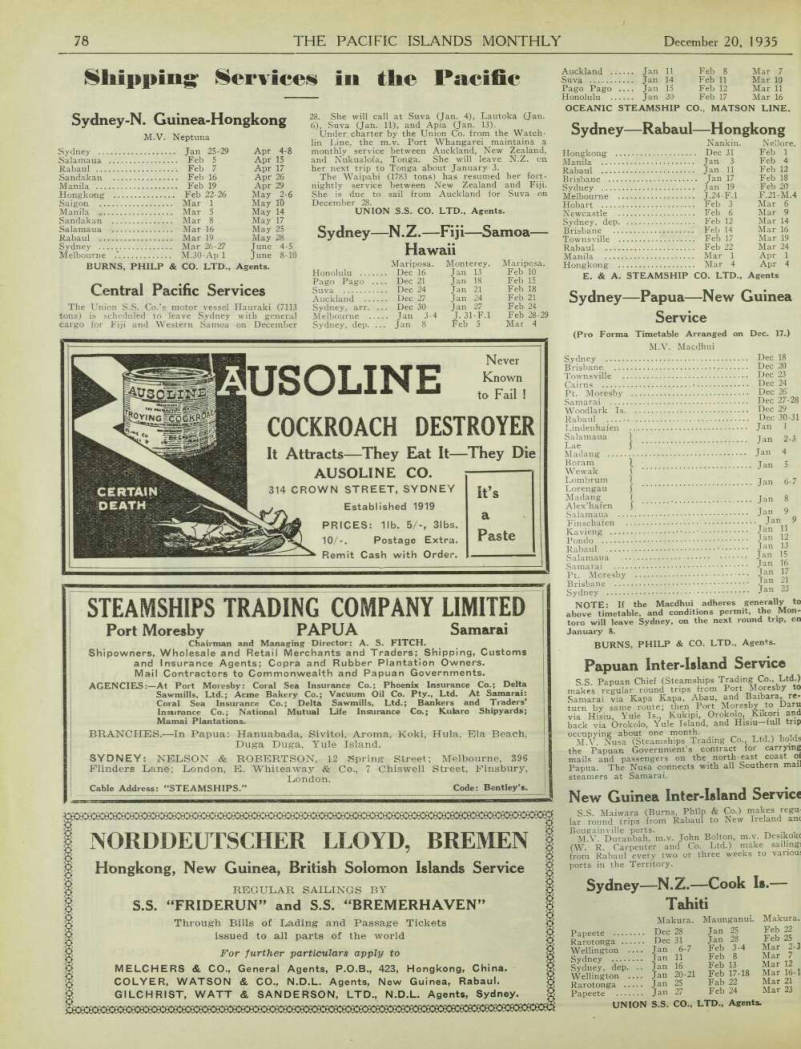
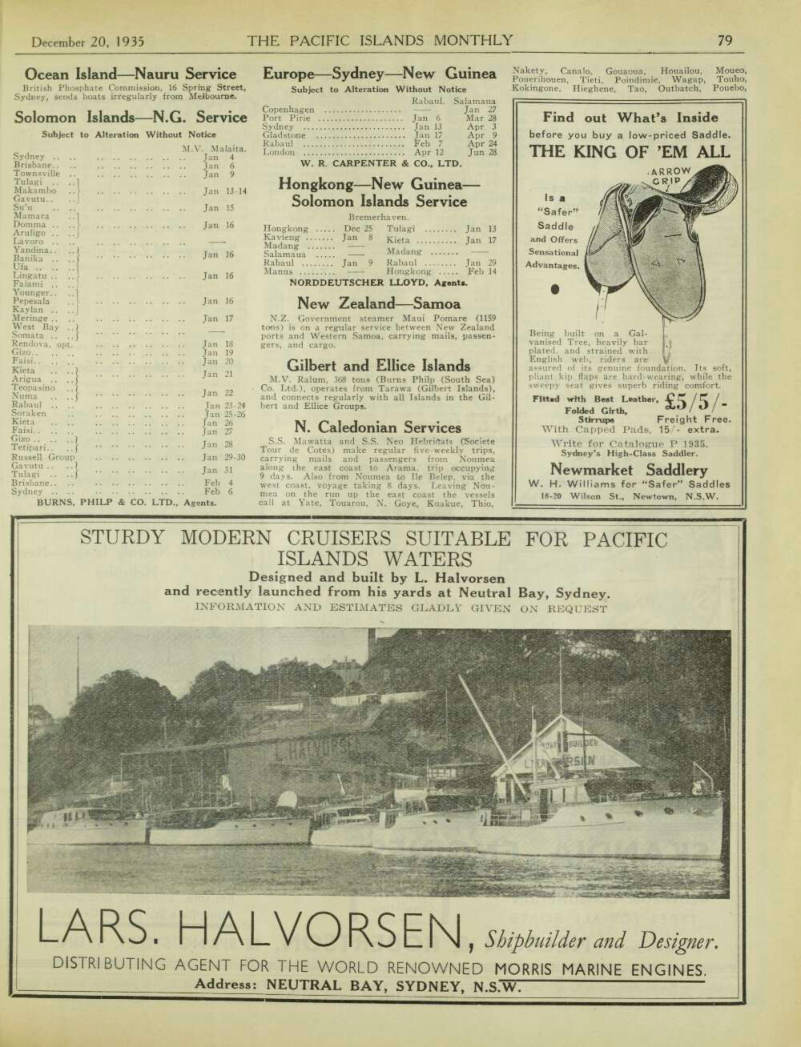
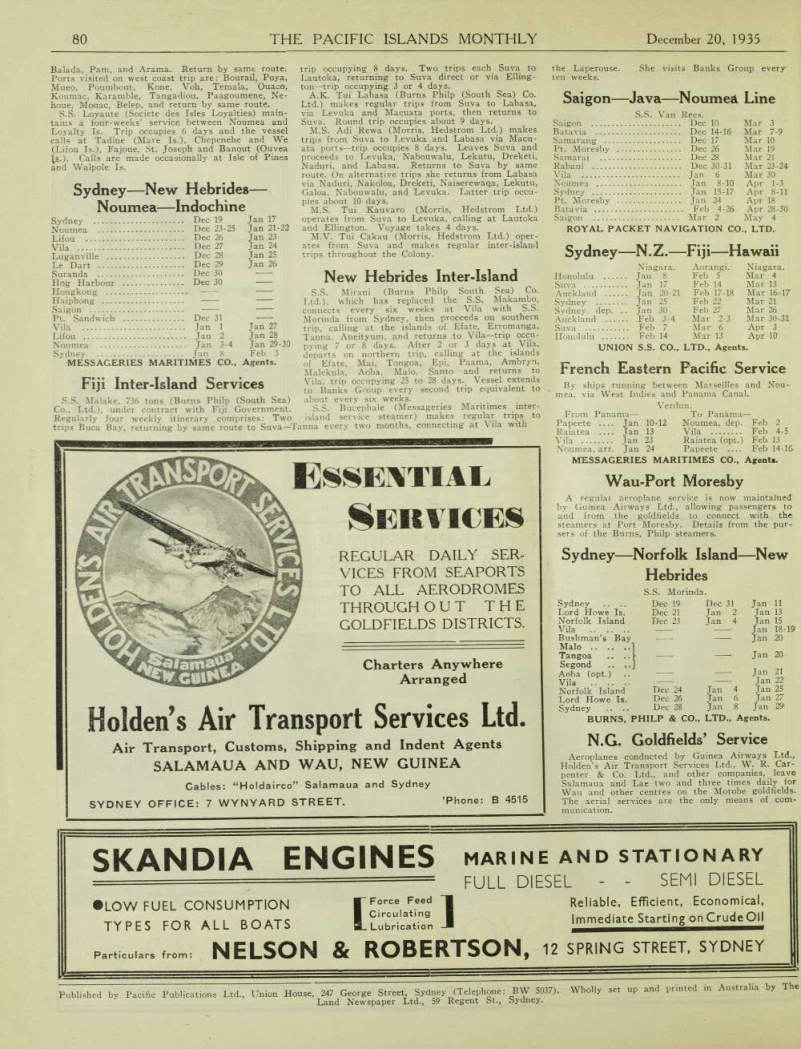
Shipping Services in the Pacific
Sydney-N. Guinea-Hongkong
Central Pacific Services
The Union S.S. Co.’s motor vessel Hauraki (7113 tons) is scheduled to leave Sydney with general cargo for Fiji and Western Samoa on December
28. She will call at Suva (Jan. 4), Lautoka (Jan. 6), Suva (Jan. 11), and Apia (Jan. 13).
Under charter by the Union Co. from the Watch lin Line, the m.v. Port Whangarei maintains a monthly service between Auckland, New Zealand, and Nukualofa, Tonga. She will leave N.Z. on her next trip to Tonga about January 3.
The Waipahi (1783 tons) has resumed her fort nightly service between New Zealand and Fiji.
She is due to sail from Auckland for Suva on December 28.
Union S.S. Co. Ltd., Agents.
Sydney—N.Z.—Fiji—Samoa—
Hawaii
Sydney—Rabaul—Hongkong
Sydney—Papua—New Guinea Service
NOTE: If the Macdhui adheres generally to above timetable, and conditions permit, the Mon toro will leave Sydney, on the next round trip, on January 8.
Burns, Philp & Co. Ltd., Agents.
Papuan Inter-Island Service
5.5. Papuan Chief (Steamships Trading Co., Ltd.) makes regular round trips from Port Moresby to Samarai via Kapa Kapa, Abau, and Baibara, re turn by same route; then Port Moresby to .Uaru via Hisiu, Yule Is., Kukipi, Orokolo, Kikon and back via Orokolo, Yule Island, and Hisiu—full trip occupying about one month. ...
M.V. Nusa (Steamships Trading Co., Ltd.) ho-ds the Papuan Government’s contract for carrying mails and passengers on the north-east coast ot Papua. The Nusa connects with all Southern mail steamers at Samarai.
New Guinea Inter-Island Service
5.5. Maiwara (Burns, Philp & Co.) makes regu lar round trips from Rabaul to New Ireland am Bougainville ports. .. , M.Y T . Duranbah, m.v. John Bolton, m.v. Desikokc (W. R. Carpenter and Co. Ltd.) make sailing! from Rabaul every two or three weeks to vanoui ports in the Territory.
Sydney—N.Z.—Cook Is.—
Tahiti
M.V.
Neptuna Sydney 25-29 Apr 4-8 Salamaua ... Feb 5 Apr IS Rabaul ... Feb 7 Apr 17 Sandakan ... Feb 16 Apr 26 Manila 19 Apr 29 Hongkong ... .. Feb 22-26 May 2-6 Saigon .. Mar 1 May 10 Manila .. Mar 5 May 14 Sandakan .. Mar 8 May 17 Salamaua .. Mar 16 May 25 Rabaul 19 May 28 Sydney .. Mar 26-27 June 4-5 Melbourne .*.. . M.30- Ap 1 June 8-10
Burns,
Philp
& CO.
Ltd.,
Agents.
Mariposa.
Monterey.
Mariposa.
Honolulu ... ... Dec 16 Jan 13 Feb 10 Pago Pago ... Dec 21 Jan 18 Feb 15 Suva ... Dec 24 Jan 21 Feb 18 Auckland .. ... Dec 27 Jan 24 Feb 21 Sydney, arr. ... Dec 30 Jan 27 Feb 24 Melbourne . ... Jan 3-4 J. 31-F.l Feb 28-29 Sydney, dep. ... Jan 8 Feb 5 Mar 4
Auckland Jan 11 Feb 8 Mar 7 Suva Jan 14 Feb 11 Mar 10 Pago Pago Jan 15 Feb 12 Mar 11 Honolulu Jan 20 Feb 17 Mar 16
Oceanic Steamship Co., Matson Line.
Nankin.
Nellore, Hongkong ..
Feb 1 Manila Feb 4 Rabaul Feb 12 Brisbane Feb 18 Sydney Feb 20 Melbourne ..
J.24-F.1 F.21-M.4 Hobart Feb 3 Mar 6 Newcastle Mar 9 Sydney, dep.
Feb 12 Mar 14 Brisbane Feb 14 Mar 16 Townsville .
Feb 17 Mar 19 Rabaul Feb 22 Mar 24 Manila Mar 1 Apr 1 Hongkong .
Mar 4 Apr 4 E. & A.
Steamship Co. Ltd.,
Agents
(Pro Forma Timetable Arranged on M.V. Macdhui Dec. 17.) Sydney Dec 18 Dec 20 Dec 23 . Dec 24 Pt. Moresby Samarai Woodlark Is. . Dec 26 . Dec 27-28 . Dec 29 . Dec 30-31 Lindenhafen .
Salamaua ] Lae j Madang Boram Wewak Lombrum I Lorengau j Madang Alex’hafen j Jan 1 Jan 2-3 Jan 4 ,. Jan S .. Jan 6-7 ,. Jan 8 . Jan 9 Finschafen ... Jan 9 Jan 11 . Jan 12 Jan 13 Jan 15 . Jan 16 Pt. Moresby . Jan 17 . Tan 21
Papeete Rarotonga Wellington Sydney ...
Makura.
Dec 28 Dec 31 Jan 6-7 Tan 11 Maunganui.
Jan 25 Jan 28 Feb 3-4 Feb 8 Makura.
Feb 22 Feb 25 Mar 2-3 Mar 7 Sydney, dep. ..
Wellington ...
Rarotonga Papeete Jan Jan Jan Jan S.S. 16 20-21 25 27 Feb 13 Feb 17-18 Fab 22 Feb 24 Mar 12 Mar 16-1 Mar 21 Mar 23
Union
CO..
LTD., Agents.
Ocean Island—Nauru Service British Phosphate Commission, 16 Spring Street, Sydney, sends boats irregularly from Melbourne.
Solomon Islands—N.G. Service
Europe—Sydney—New Guinea
Hongkong—New Guinea — Solomon Islands Service
Norddeutscher Lloyd, Agent..
New Zealand —Samoa
N.Z. Government steamer Maui Pomare (1159 tons) is on a regular service between New Zealand ports and Western Samoa, carrying mails, passen gers, and cargo.
Gilbert and Ellice Islands
M.V. Ralum, 368 tons (Burns Philp (South Sea) Co. Ltd.), operates from Tarawa (Gilbert Islands), and connects regularly with all Islands in the Gil bert and Ellice Groups.
N. Caledonian Services
S.S. Mawatta and S.S. Neo Hebridals (Societe Tour de Cotes) make regular five-weekly trips, carrying mails and passengers from Noumea along the east coast to Arama. trip occupying 9 days. Also from Noumea to He Belep, via the west coast, voyage taking 8 days. Leaving Nou mea on the run up the east coast the vessels call at Yate, Touarou, N. Goye, Kuakue, Thio,
Nakety, Canalo, Gouaoua, Houailou, Moueo, Pouerihouen, Tieti, Poindimie, Wagap, Touho, Kokingone, Hieghene, Tao, Outbatch, Pouebo,
Subject to Alteration Without Notice M.V. Malaita.
Sydney ..
Brisbane..
Jan 4 Townsville ..
Tulagi Makambo Gavutu..
Jan 13-14 Su’u .. ..
Mamara Domma .. ..
Jan 16 Aruligo .. ..
Lavoro Yandina..
Banika .. ..
Jan 16 Ufa Lingatu Faiami .. ..
Jan 16 Younger..
Pepesala Kaylan .. ..
Jan 16 Meringe ..
West Bay Somata .. ..] Jan 17 Rendova, opt.
Gizo..
Jan 18 Jan 19 Faisi..
Jan 20 Kieta .. ..)
Arigua .. .. ]
Jan 21 Teopasino ..( Jan 22 Numa ..
Rabaul Jan 23-24 Soraken Jan 25-26 Kieta Ja rj 2 f\ Faisi Jan 27 Gizo Tetipari.. ..J Jan 28 Russell Group Gavutu .. .. ] Jan 29-30 Jan 31 Tulagi .. . .J Brisbane.. .. Feb 4 Sydney ..
Feb 6
Burns,
PHILP & CO. LTD., Agents.
Subject to Alteration Without Notice Rabaul. Salamaua Copenhagen Jan 27 Port Pirie Jan 6 Mar 28 Sydney Jan 13 Apr 3 Gladstone Jan 17 Apr 9 Rabaul Feb 7 Apr 24 London Apr 12 Jun 28
W. R Carpenter & Co., Ltd.
Bremerhaven.
Hongkong Dec 25 Tulagi Jan 13 Kavieng Jan 8 Kieta j an 17 Madang ,, , Salamaua Madang Rabaul Jan 9 Rabaul Jan 29 Manus Hongkong Feb 14
Balada, Pam, and Arama. Return by same route.
Ports visited on west coast trip are; Bourail, Poya, Mueo, Poumbout, Kone, Voh, Temala, Ouaco, Koumac, Karamble, Tangadiou, Paagoumene, Ne houe, Mouac, Belep, and return by same route.
S.S. Loyaute (Societe des Isles Loyalties) main tains a four-weeks’ service between Noumea and Loyalty Is. Trip occupies 6 days and the vessel calls at Tadine (Mare Is.), Chepenehe and We (Lifou Is.), Fajoue, St. Joseph and Banout (Ouvea Js.). Calls are made occasionally at Isle of Pines and Walpole Is.
Sydney—New Hebrides —
Noumea —Indochine
Fiji Inter-Island Services
S.S. Malake, 736 tons (Burns Philp (South Sea) Cos., Ltd.), under contract with Fiji Government.
Regularly four weekly itinerary comprises; Two
trips Buca Bay, returning by same route to Suva —Tanna
;rip occupying 8 days. Two trips each Suva to Lautoka, returning to Suva direct or via Elling ton —trip occupying 3 or 4 days.
A.K. Tui Labasa (Burns Philp (South Sea) Cos.
Ltd.) makes regular trips from Suva to Labasa, via Levuka and Macuata ports, then returns to Suva. Round trip occupies about 9 days.
M.S. Adi Rewa (Morris, Hedstrom Ltd.) makes trips from Suva to Levuka and Labasa via Macu ata ports —trip occupies 8 days. Leaves Suva and proceeds to Levuka, Nabouwalu, Lekutu, Dreketi, Naduri. and Labasa. Returns to Suva by same route. On alternative trips she returns from Labasa via Naduri, Nakoloa, Dreketi, Naiserewaqa, Lekutu, Galoa, Nabouwalu, and Levuka. Latter trip occu pies about 10 days.
M.S. Tui Kauvaro (Morris, Hedstrom Ltd.) operates from Suva to Levuka, calling at Lautoka and Ellington. Voyage takes 4 days.
M.V. Tui Cakau (Morris, Hedstrom Ltd.) oper ates from Suva and makes regular inter-island trips throughout the Colony,
New Hebrides Inter-Island
5.5. Mirani (Burns Philp South Sea) Cos.
Ltd.), which has replaced the S.S. Makambo, connects every six weeks at Vila with S.S.
Morinda from Sydney, then proceeds on southern trip, calling at the islands of Efate, Erromanga, Tanna, Aneityum, and returns to Vila —trip occu pying 7 or 8 days. After 2 or 3 days at Vila, departs on northern trip, calling at the islands of Efate, Mai, Tongoa, Epi, Paama, Ambryn, Malekula, Aoba, Malo, Santo and returns to Vila, trip occupying 25 to 28 days. Vessel extends to Banks Group every second trip equivalent to about every six weeks. 5.5. Bucephale (Messageries Maritimes inter island service steamer) makes regular trips to
every two months, connecting at Vila with
the Laperouse. She visits Banks Group every ten weeks.
Saigon—Java—Noumea Line
Sydney—N.Z.—Fiji—Hawaii
French Eastern Pacific Service
By ships running between Marseilles and Nou mea, via West Indies and Panama Canal.
Wau-Port Moresby
A regular aeroplane service is now maintained by Guinea Airways Ltd., allowing passengers to and from the goldfields to connect with the steamers at Port Moresby. Details from the pur sers of the Burns, Philp steamers.
Sydney—Norfolk Island —New
Hebrides
N.G. Goldfields’ Service
Aeroplanes conducted by Guinea Airways Ltd., Holden’s Air Transport Services Ltd., W. R. Car penter & Co. Ltd., and other companies, leave Salamaua and Lae two and three times daily for Wau and other centres on the Morobe goldfields.
The aerial services are the only means of com munication.
Sydney Dec 19 Jan 17 Noumea Dec 23-25 Jan 21-22 Lifou Dec 26 Jan 23 Vila Dec 27 Jan 24 Luganville Dec 28 Jan 25 Le Dart Dec 29 Jan 26 Suranda Dec 30 — Hog Harbour — Hongkong — Haiphong — Saigon — Pt. Sandwich Dec 31 — Vila Jan 27 Lifou Jan 28 Noumea Jan 3-4 Jan 29-30 Sydney Jan 8 Feb 3
Messageries
Maritimes Co.,
Agents.
s.s.
Van Rees.
Saigon 10 Mar 3 Batavia 14-16 Mar 7-9 Samarang 17 Mar 10 Pt. Moresby 26 Mar 19 Samarai 28 Mar 21 Rabaul 30-31 Mar *■ CM S3 Vila 6 Mar 30 Noumea 8-10 Apr 1-3 Sydney 15-17 Apr 8-11 Pt. Moresby Jan 24 Apr 18 Batavia Feb 4-26 Apr 28-30 Saigon Mar 2 May 4
Royal Packet
Navigation Co
., Ltd.
Niagara.
Aorangi.
Niagara.
Honolulu Jan 8 Feb 5 Mar 4 Suva Jan 17 Feb 14 Mar 13 Auckland Jan 20-21 Feb 17-18 Mar 16-17 Sydney Jan 25 Feb 22 Mar 21 Sydney, dep. ..
Jan 30 Feb 27 Mar 26 Auckland Feb 3-4 Mar 2-3 Mar 30-31 Suva Feb 7 Mar 6 Apr 3 Honolulu Feb 14 Mar 13 Apr 10
Union
s.s. co„ LTD., Agents.
Verdun.
From Panama— To Panama— Papeete Jan 10-12 Noumea, dep. Feb 2 Raiatea Jan 13 Vila Feb 4-5 Vila Tan 23 Raiatea (opt.) Feb 13 Noumea, arr. Jan 24 Papeete Feb 14-16
Messageries Maritimes Co., Agent*.
S.S. Morinda.
Sydney Dec 19 Dec 31 Jan 11 Lord Howe Is.
Dec 21 Jan 2 Jan 13 Norfolk Island Dec 23 Jan 4 Jan 15 Vila Jan 18-19 Jan 20 Bushman’s Bay Male 1 — — Tangoa .. ..
Segond .. ..J — Jan 20 Aoba (opt.) — — Jan 2!
Vila — — Jan 22 Norfolk Island Dec 24 Jan 4 Jan 25 Lord Howe Is.
Dec 26 Jan 6 Jan 27 Sydney .. ..
Dec 28 Jan 8 Jan 29
Burns, Philp & Co.,
LTD., Agents.
Advertisements & other items, pp. 80-84 (3 items)
78
December 20, 1 935
THE PACIFIC ISLANDS iMONTHLY
Usoline
■fi Roving
Never Known to Fail !
COCKROACH DESTROYER
It Attracts—They Eat It—They Die
AUSOLINE CO.
314 CROWN STREET, SYDNEY
Established 1919 PRICES: 11b. 5/-, 3lbs. 10/-. Postage Extra.
Remit Cash with Order. it’
Paste
STEAMSHIPS TRADING COMPANY LIMITED
Port Moresby PAPUA Samarai
Chairman and Managing Director: A. S. FITCH.
Shipowners, Wholesale and Retail Merchants and Traders; Shipping, Customs and Insurance Agents; Copra and Rubber Plantation Owners.
Mail Contractors to Commonwealth and Papuan Governments.
AGENCIES: —At Port Moresby: Coral Sea Insurance Co.; Phoenix Insurance Co.; Delta Sawmills, Ltd.; Acme Bakery Co.; Vacuum Oil Co. Pty., Ltd. At Samarai: Coral Sea Insurance Co.; Delta Sawmills, Ltd.; Bankers and Traders’
Insurance Co.; National Mutual Life Insurance Co.; Kuiaro Shipyards; Mamai Plantations.
BRANCHES.—In Papua: Hanuabada, Sivitoi, Aroma, Koki, Hula, Ela Beach, Duga Duga, Yule Island.
SYDNEY: NELSON & ROBERTSON, 12 Spring Street; Melbourne, 396 Flinders Lane; London, E. Whiteaway & Co., 7 Chiswell Street, Finsbury, London.
Cable Address: “STEAMSHIPS.” Code: Bentley’s.
NORDDEUTSCHER LLOYD, BREMEN
Hongkong, New Guinea, British Solomon Islands Service
REGULAR SAILINGS BY
S.S. “FRIDERUN” and S.S. “BREMERHAVEN”
Through Bills of Lading and Passage Tickets issued to all parts of the world For further particulars apply to MELCHERS & CO., General Agents, P. 0.8., 423, Hongkong, China.
COLYER, WATSON & CO., N.D.L. Agents, New Guinea, Rabaul.
GILCHRIST, WATT & SANDERSON, LTD., N.D.L. Agents, Sydney.
Find out What’s Inside
before you buy a low-priced Saddle.
THE KING OF 'EM ALL
.ARROW
Is a “Safer”
Saddle and Offers Sensational Advantages.
Being built on a Galvanised Tree, heavily bar plated, and strained with English web, riders are assured of its genuine foundation. Its soft, pliant kip flaps are hard-wearing, while the sweepy seat gives superb riding comfort.
Fitted with Best Leather, -C C / C / Folded Girth, Stirrups Freight Free.
With Capped Pads, 15/- extra.
Write for Catalogue P 1935.
Sydney’s High-Class Saddler.
Newmarket Saddlery
W. H. Williams for “Safer” Saddles 18-20 Wilson St., Newtown, N.S.W.
STURDY MODERN CRUISERS SUITABLE FOR PACIFIC
ISLANDS WATERS
Designed and built by L. Halvorsen and recently launched from his yards at Neutral Bay, Sydney.
INFORMATION AND ESTIMATES GLADLY GIVEN ON REQUEST 4
pMTlpil aa
ML rrtttllSl M I I mm
LARS. HALVORSEN
Shipbuilder and Designer.
DISTRIBUTING AGENT FOR THE WORLD RENOWNED MORRIS MARINE ENGINES.
Address: NEUTRAL BAY, SYDNEY, N.S.W!
r* W\ MG Xv Hi
Essential
Services
REGULAR DAILY SER-
VICES FROM SEAPORTS
TO ALL AERODROMES
THROUGH OUT THE
GOLDFIELDS DISTRICTS.
Charters Anywhere Arranged
Holden’s Air Transport Services Ltd.
Air Transport, Customs, Shipping and Indent Agents
SALAMAUA AND WAU, NEW GUINEA
Cables: “Holdairco” Salamaua and Sydney SYDNEY OFFICE: 7 WYNYARD STREET. ’Phone: B 4515
SKANDIA ENGINES MARINE AND STATIONARY
FULL DIESEL - - SEMI DIESEL • LOW FUEL CONSUMPTION ■“Force Feed "| Reliable, Efficient, Economical, TYPES FOR ALL BOATS LLTilati™ J Immediate Starting on Crude Oil Particulars from: NELSON & ROBERTSON, 12 SPRING STREET, SYDNEY
THE WORLD’S LARGEST
AERIAL FREIGHTING SERVICE
GUINEA AIRWAYS LTD. was established in 1927; and it has grown in the following way, until it is to-day the largest freight-carrying air-service in the world: Guinea Airways Ltd. operates regular air services in New Guinea and Papua, and uses over 33 Aerodromes and Landing-grounds in the two Territories.
One of Guinea Airways’ new 14-passenger Ford Aeroplanes, on an aerodrome in New Guinea. 4t : * ' i i i ¥1
.xui
■ . ■ tel ' . ' -V. ' • . ... . -
>SC f r
‘ ' ■ wm AERIAL-TRANSPORT Speedy, Safe and Dependable made possible the Rapid Development of the great Morobe Goldfield, and the Consequent Enrichment of the Mandated Territory. Aeroplanes, running on Regular Schedules, without Difficulty or Delay, carried in Dredges, Crushing Mills, Cyaniding Plants, Motor Vehicles, Hydro-Electric Machinery, and Every Kind of Goods Needed by a Large and Growing European Community.
GUINEA AIRWAYS L™
LAE
HEAD OFFICE:
BROOKMAN BUILDINGS
GRENFELL STREET
ADELAIDE, S.A.
BRANCH OFFICES AND AGENTS
- SALAMAUA
NEW GUINEA OFFICE:
LAE
MANDATED TERRITORY OF
NEW GUINEA
AT WAU, SALAMAUA, PORT MORESBY, AND SYDNEY
' *: \ s ' -> 1 IS
TOOTH & CO LIMITED
WAVERIEY BREWERY
k S<W>, / V E 217 (0 -4*
ensures a
PERFECT BRINK
PRESERVES THE FLAVOUR
When ordering lager, first look for the Diamondshaped Label —that is your guarantee of quality.
Then notice the “Spot” Crown Seal, it is designed to retain that quality, and ensure perfect freshness and flavour in any climate R.L. 13.27
80
December 20, 1933
THE PACIFIC ISLANDS MONTHLY
Published by Pacific Publications Ltd., Union House, 247 George Street, Sydney (Telephone: BW 5037). Wholly set up and printed in Australia by The Land Newspaper Ltd., 59 Regent St., Sydney.