Pacific
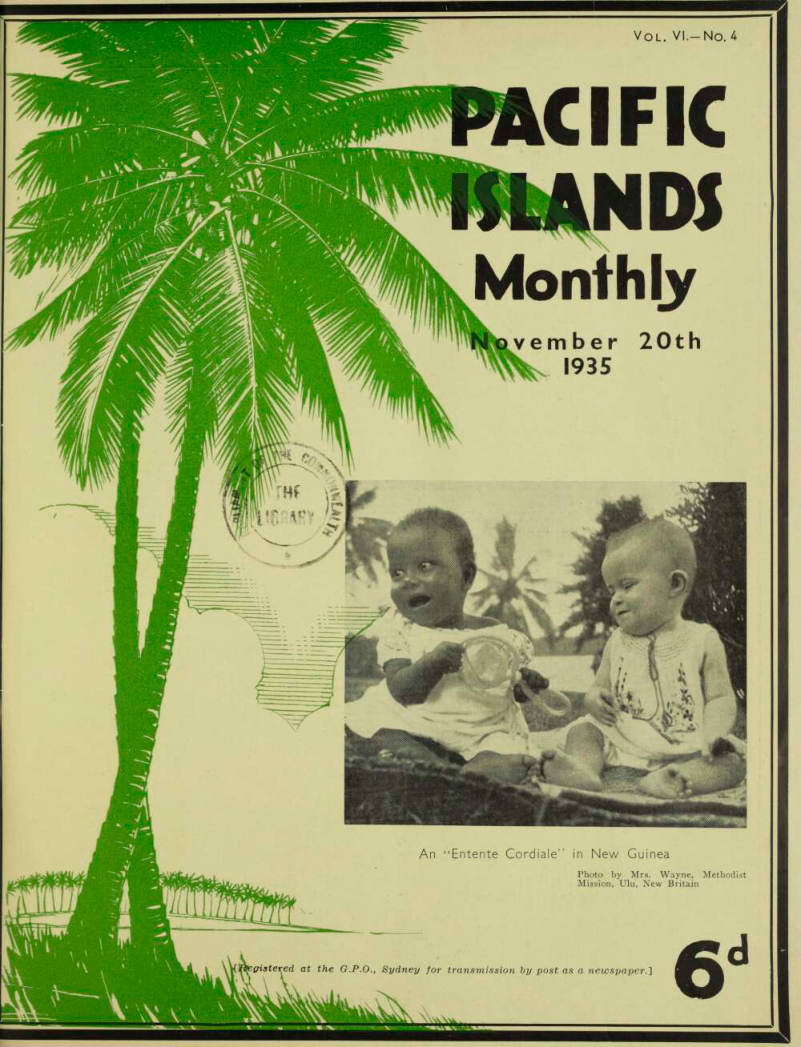
Islands
Monthly
Vol. Vl. No. 4
November 20th 1935
iSfaffistered at the G.P.0., Sydney for transmission hy post as a newspaper.']
6 d
An “Entente Cordiale” in New Guinea
Photo by Mrs. Wayne, Methodist Mission, Ulu, New Britain
Advertisements & other items, p. 2 (1 item)
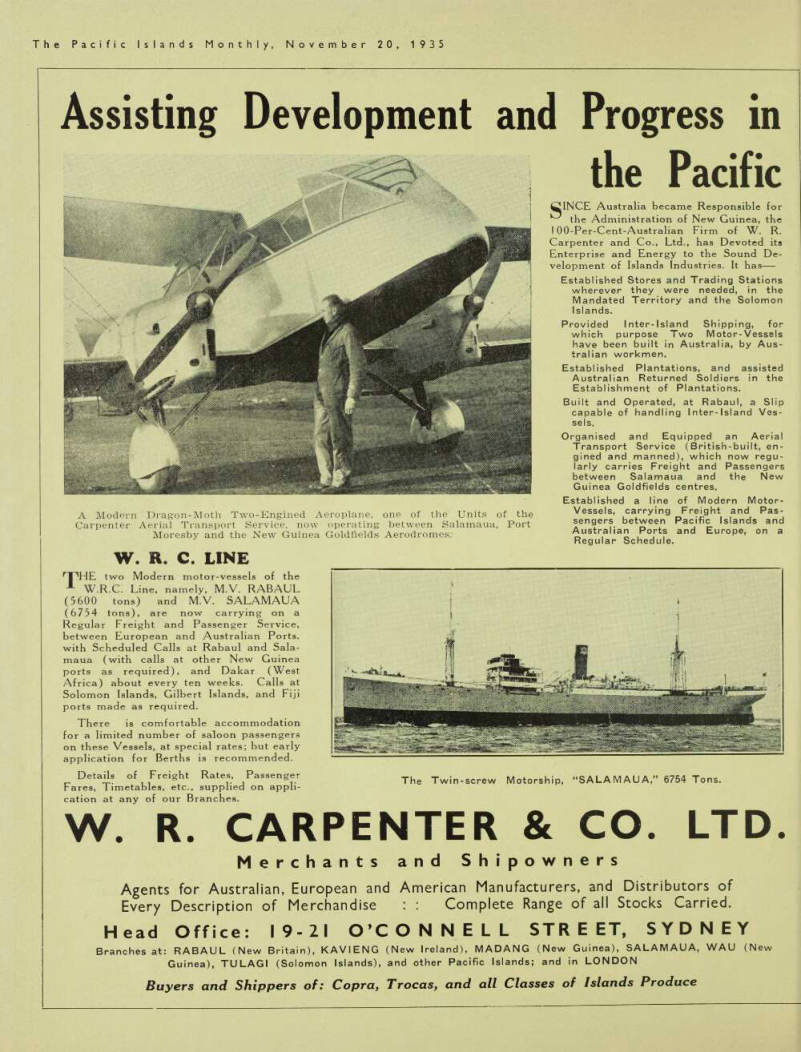
Assisting Development and Progress in
'•v i i ■ A Modern Dragon-Moth Two-Engined Aeroplane, one of the Units of the Carpenter Aerial Transport Service, now operating between Salamaua, Port Moresby and the New Guinea Goldfields Aerodromes.
the Pacific
CINCE Australia became Responsible for the Administration of New Guinea, the I 00-Per-Cent-Australian Firm of W. R.
Carpenter and Co., Ltd., has Devoted its Enterprise and Energy to the Sound Development of Islands Industries. It has Established Stores and Trading Stations wherever they were needed, in the Mandated Territory and the Solomon Islands.
Provided Inter-Island Shipping, for which purpose Two Motor-Vessels have been built in Australia, by Australian workmen.
Established Plantations, and assisted Australian Returned Soldiers in the Establishment of Plantations.
Built and Operated, at Rabaul, a Slip capable of handling Inter-Island Vessels.
Organised and Equipped an Aerial Transport Service (British-built, engined and manned), which now regularly carries Freight and Passengers between Salamaua and the New Guinea Goldfields centres.
Established a line of Modern Motor- Vessels, carrying Freight and Passengers between Pacific Islands and Australian Ports and Europe, on a Regular Schedule.
W. R. C. LINE
r I two Modern motor-vessels of the A W.R.C. Line, namely. M.V. RABAUL (5600 tons) and M.V. SALAMAUA (6734 tons), are now carrying on a Regular Freight and Passenger Service, between European and Australian Ports, with Scheduled Calls at Rabaul and Salamaua (with calls at other New Guinea ports as required), and Dakar (West Africa) about every ten weeks. Calls at Solomon Islands, Gilbert Islands, and Fiji ports made as required.
There is comfortable accommodation for a limited number of saloon passengers on these Vessels, at special rates; but early application for Berths is recommended.
Details of Freight Rates, Passenger Fares, Timetables, etc., supplied on application at any of our Branches.
W. R. CARPENTER & CO. LTD.
Merchants and Shipowners
Agents for Australian, European and American Manufacturers, and Distributors of Every Description of Merchandise ; ; Complete Range of all Stocks Carried.
Head Office: 19-21 O’CONNELL STREET, SYDNEY
Branches at: RABAUL (New Britain), KAVIENG (New Ireland), MADANG (New Guinea), SALAMAUA, WAU (New Guinea), TULAGI (Solomon Islands), and other Pacific Islands; and in LONDON Buyers and Shippers of: Copra, Trocas, and all Classes of Islands Produce ..
The Twin-screw Motorship, “SALAMAUA,” 6754 Tons.
Pacific Islands Travellers
Passengers Per Macdhui Which
Sailed From Sydney For Papua And
New Guinea On October 24: Messrs.
Annersley, Allan, Atkinson, Aitchison, Bates, Brett, Bryant, Bilston, Blaikie-Webster, Bartlett, Brown, Budden (2), Cleary, Catnmon, Crellin, Conde. Chapman. Collins, Deckert, Dougherty, Draper Doering, Earl, Flynn, Feldt, Green, Gough, Guthrie, Goodwyn, Grigor, Hitchcock, Healy, Har per, Hambridge, Harris, Jewell, Johnsen, Keith, Kenyon, Liscaeld, Mackay, Mel, Moody, McKay, McNamara, Morgan, Father Manion, Naughton, O’Malley, Ormond, Pratt, Parer, Pym, Pollock, Phillpott, Pines, Roche, Roberts, Smith, Sturgeon, Sellers, Sheehan, Bro. Salois, Thogessen, Way, Walker, Wood, Waldron, Wainwright, Wilkinson, Judge Wanliss, Wright, Walsh, Walters, Vial.
Mesdames Everall, Feldt, Flynn, Gill, Gough, Grigor, Lewis, McGregor, Pym, Roberts, Smith (2), Wright. Misses Blum, Cassell, Hoeger, Judd, King, McGregor, Maguire. Smith, Taeuber.
Passengers Per Lurline Which Ar
RIVED IN SYDNEY FROM SUVA, FIJI, ON NOVEMBER s:Miss Esme Brown, A. G. Camp bell, W. Candler, Mrs. C. L. Cheng, Masters Cecil and Homer Cheng, Mrs. C. Corbett, Misses P. and D.' Corbett, Mr. and Mrs. C. V. Crocket, Mr. and Mrs. James Crocket, Mrs. Mary Davies, Guy Ditchburn, Miss Nita Dunstone, Miss Irene Ed wards, John K. Flemons, Henry G. Foxall, Mrs.
A. B. Freeman, Mr. and Mrs. W. F. Furlong, W. G. Higgs, Dr. Loftus Hills, Mrs. A. King Irving, Miss F. Kealy, Dr. L. A. Kortum, E. A.
Lawler, Miss Shiu Luen, Mrs. Edna MacFarlan, Miss Velma Mackenzie, Mrs. A. D. Mclntosh, Hugh McLeod, C. F. Michell, Mrs. Ann Morton, Mr. and Mrs. H. S. Mount, Mrs. Helen Nichols, Frank P. Noble, Miss Mary L. Peck, Eric Powell, Mr. and Mrs. Kallil Saap, Mrs. M. Siddins, Misses M. J. and L. Siddins, H. C. Wilkins, Mr. and Mrs. A. E. Barker, C. J. Braden, Miss M. Brown, L. Chang, Miss A. de Vos, Miss E. Jarrett, Mrs.
G. Johnson, Master A. Johnson, H. O. Lindquist, A. MacGillivray, C. E. Mansell, Mrs. P. M. Mills, Mrs. A. F. Ragg, Mrs. J. M. Wren.
Passengers Per Montoro Which Ar
RIVED IN SYDNEY FROM PAPUA AND NEW GUINEA ON NOVEMBER 7: Messrs. Austen, Anderson, Allen, Baird, Black, Cummings, Clinton, Condren, Dexter, Davies, Frame, Gray, Gibbons, Gluyas, Hayles, Holcomb, Horsfall, Heaslip, Hurst, Ingold, Jamieson, Jones, Mateer, McDonald, Mc- Ewan, Marjason, Marshall, Mclntosh, McLean, Melrose, Murray, O’Donnell, Provan, Page, Parer.
Priest, Quigley, Reardon, Ross, Ryan, Reilly, Ralfs, Reilly, Sparrow, Sutton, Timms, Weir, Williams, Williams, Wilson, Zoffman; Mesdames Anderson.
Beaton, Cater, Ferguson, Gray, Grilling, Giblin, Gluyas, Heaslip, Hayles, Marshall, Melrose, Mur ray, O’Donnell, Sutton; Misses Blumer, Cooper, Goff, Leeder, Mills, Nichols, Pearson, Wood, Wood, Wyndham.
Passengers Per Aorangi Which Sail
ED FROM SYDNEY FOR SUVA, FIJI, ON NOVEMBER 7: A. F. Smith, Miss M. R. Adams, Mr. and Mrs. F. H. Hamlin, D. W. Robertson, Mrs. M. B. Nash, J. C. Fyffe, Mr. and Mrs. J. G.
Davis, Miss E. Hughes, Mrs. F. Small, A. A. C.
Wilson, F. Rostier, D. Cunningham, T. E. Scott, H. F. Hopkinson, Mr. and Mrs. T. Montague, P.
B. Owen, D. C. Paris, T. W. Marston, T. J. Hand cock, Mr. and Mrs. P. W. Moncrieff, Miss Rose Coster, Miss M. Anderson.
Passengers Per Malaita Which Ar
RIVED IN SYDNEY FROM SOLOMON IS. AND
Rabaul (N.G.) On November 8: Messrs.
Anderson, Baddeley, Collin, Cromar, Crichlow, Deck, Hoff, Hammond, Johnston, Kudnig, O’Brien, Pinder, Lincoln, Roberts, Rhoades, Rawson, Saun dars, Sim, Watsford, Williams, Williamson, Youn ger; Mesdames Ewers, Ferris, Graham, Hoff, Johnson, Kidnie, Knibbs, Sutton, Seton, Williams, Williamson, Younger; Misses Devir, Drewitt, Eli, Fitzgerald, Maddison, Morrow, McConnell, Mac intosh, Placid, Stick.
Passengers Per Neptuna Which Ar
RIVED IN SYDNEY FROM NEW GUINEA ON NOVEMBER 10; Messrs. Anderson (2), Blackman, Balfour, Billing, Haynes, Clarence, Cranston, Cur rie, Davies, Deards, Gilbertz, Gardner, Gallagher, Heron, Hallam, Keywood, Lens, Lyall, Marshall, Pilling, Rondahl, Raynes, Sanderson, Vickery, Wil liams, Wilson, Price; Mesdames Adelskold, Bal four, Hyland, Heron, Marshall, Pollard, Hallam, Streeter, Vickevy, Thompson; Misses Clapperton, Gallagher, Hayes, Meares, McAdam.
Passengers Per Morinda Which Ar
Rived In Sydney From New Hebrides
NORFOLK IS., AND LORD HOWE IS. ON NOVEMBER 11: Messrs. Austis, Buffett, Barnes, Clarke, Casson, Crothers, Dickson, Eastment, Edge, Fricotte, Greenwood, Howard, Foon, Hewitt, Hef ferman, Johnson, McQuarie, Moutray, Marks, Mil lea, Macmillan, Milne, Morgan, Mulcahy, Prit chard, Peachman, Payten, Rose, Rice, Stewart, Shaw. Smith, Stitt, Thomas, Todd, Williams, Woodburn; Mesdames Dickson, Dowell, Easy, Ea.stment, Gibson, Gary, Heriot, Howard, Lewing ton. McQuarie, Macmillan, Payten, Stewart, Sau zier, Thomas, Tovey, Williams, Woodburn, Wool nough, Milne, Weymouth; Misses Bowden, Butler.
Baker, Dibley, Dibley, Dowell, Ferrier, Harvey, Hinton, Gary, Keepence, Morcom, Needham, Nor man, Nall, Pond, Tomkins, Wickam, Zwar.,
Passengers Per Van Rees Which Ar
RIVED IN SYDNEY ON NOVEMBER 12 : Samarai: E. Wilson, Mrs. L. Wilson, Miss E.
Evenett; Rabaul: M. McKay, J. E. Webster, Mr. and Mrs. E. C. Monck; Vila: Mr. and Mrs. G.
Hill and child, Dr. C. Murray, Mrs. I. M. Kebble white, W. Marr, Miss A. Noel; Noumea: N. Hardy, Mrs. S. Faivre and child, Mrs. M. Boulanger and child, K. Murakami, Miss V. Buaillon. J. L.
Imbault, Mrs. A. Mortensen, Miss M. Bocquet, Miss L. Dorbritz, Mr. and Mrs. L. Dorbritz, Mrs.
Em. Guichard, G. Kerr, P. de Casteljau, Mrs. G.
Gratian and child, Mrs. C. Johnston and two chil dren, B. Houger, Miss E. Daly, Mrs. J. Journot and child, A. Deroche, Mrs. L. de Casabianca and two children.
Passengers Per Lurline Which Sail
ED FROM SYDNEY FOR SUVA, FIJI. ON NOVEMBER 13: A. Askew, E. G. Banks, E.
Banks, Jnr., Miss Helen Bennet, Mr. and Mrs.
F. J. Colman, Miss C. Donnelly, T. Featherstone, Mr. and Mrs. Loughnan, Mr. and Mrs. N. H.
Mclntyre, A. Ousey, Mrs. A. H. Phillips, Mr.
Pinder, Mr. and Mrs. C. H. Scougall, Miss M. L.
Scougall, Mrs. Whitman, Miss Whitman, W. R.
Collas, E. J. Foote, Miss E. B. Geeves, Master J. Johnson, Master H. Jones, Mr. and Mrs. R. P.
Little, Masters Jan. and Colin Little, Mrs. E. A.
Lowell, Master Rex Lowell, J. P. Mayne, Miss E. M. Montier.
Passengers Per Montoro Which Sail
ED FROM SYDNEY FOR PAPUA AND NEW GUINEA ON NOVEMBER 13: Messrs. Adams, Allman, Brown, Butler, Bowden, Bell, Brereton, Clark, Crampton, Caldwell, Ewen, Frankel, Frank, Francis, Fahey, Ferguson, Frame, Gamble, Grif fith Hockey, Irvine, Johnson, Keyes, Kuter, McKeahnie, McDonald, Powell, Phillips, Pangrazio, Swanson, Taylor, Thomson, Thomas, Watson, Wood, Waesch; Mesdames Brereton, Brugh, Bud den, Clark, Crocker, Dupain, Francis, Garland, Higgins, • Hockey, Irvine, Lees, Mace, Munro, Moore, Normoyle, Roja, Wallace; Misses Cooper, Campbell, Dupain (2), Leader, Mace.
Passengers Per Morinda Which Sail
ED FROM SYDNEY FOR LORD HOWE IS.
AND NORFOLK IS. ON NOVEMBER 16: Messrs.
Bailey, Chaffer, D’Arcy-Jones, Finley, Fenton, Horner, Howard, Hetherington, Jenkins, Spooner, Shaw, Seaborn, Wickstead; Mesdames Bailey, Bradley, Chaffer, D’Arcy-Jones, Dargan, Evans, Finlay, Guthrie, Horner, Meyer, Pettigrew, Wick stead; Misses Bailey, Davies, Everett, Frazer, Hessford, Murphy, Stuart, Wells.
Passengers Per Malaita Which Sail
ED FROM SYDNEY FOR SOLOMON IS. AND
Rabaul (N.G.) On November 16: Messrs.
Fraser, Froy, Greer, Hudson, Heritage, Judd, Lamond, Mason, Small, Sanders, Stokie,' Stock, Stubbings, Williamson, Wells, Wallace (2), Bishop, Aubin, Rev. J. M. Coicaud, Rev. D. Coicaud, Bro.
Burke; Mesdames Fraser, Greer, Gorringe, Hicks, Heritage, Harrison, Murphy, McLaughlin, O’Con nell, Sanders, Small; Misses Callachor, Devir, Fitz gerald, Logan, Nisbett, O’Connell, Sanders, Toole.
Advertisements & other items, p. 3 (1 item)
Saicon-Batavia-Samaranc-Port Moresby
f Relieve headache, neuritis and all nerve pains with Vincent’s A. P. C.
Dissolves rapidly
acts speedily.
Prepared on scientific, hospital for* mula and recommended by medical
profession. Pow-
ders & tablets: 12 for 1/6.24 for 2/6.
All chemists and stores, or direct from Vincent Chemical Company Limited, 76-78 Liverpool Street, Sydney.
FOR SAFETY'S SAKE, SAY “VINCENT'S’
SAICON-BATAVIA-SAMARANC-PORT MORESBY
SAMARAI-RABAUL- PORT VILA- NOUMEA
SYDNEY - PORT MORESBY - BATAVIA - SAIGON
... bi-monthly by the "VAN REES"
You will enjoy travelling by this popular, fast and modern steamer of the K.P.M., noted for Its comfort, excellent cuisine, and economical fares.
With a fleet of over 130 vessels the K.P.M. Line is in a position to accept cargo for all ports in Netherlands India, and with transhipment at Batavia for Africa.
ROYAL PACKET NAVIGATION CO.
Paketvaart House, 255 George Street, Sydney
Diethelm & Co., Saigon; E. A. James, Port Moresby; Whitten Bros., Samarai; W. R. Carpenter & Co. Ltd., Rabaul; Gubbay Freres, Port Vila; Carlo Leoni, Noumea.
Advertisers
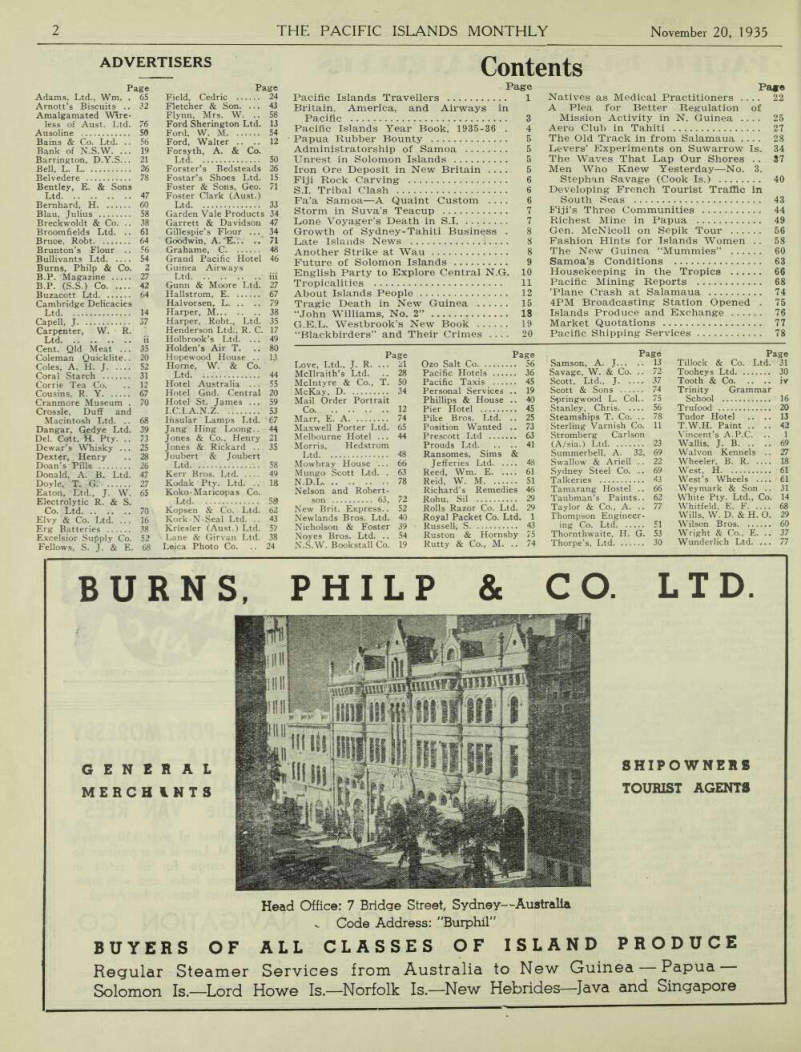
Page Adams, Ltd., Wm. . 65 Arnott’s Biscuits .. 32 Amalgamated Wire less of Aust. Ltd. 76 Ausoline 50 Bains & Co. Ltd. .. 56 Bank of N.S.W. ... 19 Barrington, D.Y.5... 21 Bell, L. L 26 Belvedere 78 Bentley, E. & Sons Ltd 47 Bernhard, H 60 Blau, Julius 58 Breckwoldt & Co. .. 38 Broomfields Ltd. .. 61 Bruce, Robt 64 Brunton’s Flour .. 56 Bullivants Ltd 54 Burns, Philp & Co. 2 B.P. Magazine 27
B.P. (S.S.) Co 42
Buzacott Ltd 64 Cambridge Delicacies Ltd 14 Capell, J 37 Carpenter, W. R.
Ltd ii Cent. Qld Meat ... 35 Coleman Quicklite.. 20 Coles, A. H. J 52 Coral Starch 31 Corrie Tea Co. .. 12 Cousins, R. Y 67 Cranmore Museum . 70 Crossle, Duff and Macintosh Ltd. .. 68 Dangar, Gedye Ltd. 39 Del. C<*tt, H. Pty. .. 73 Dewar’s Whisky ... 25 Dexter, Henry .. 28 Doan’s Pills 26 Donald, A. B. Ltd. 47 Doyle, T- G: 27 Eaton, Ltd., J. W. 65 Electrolytic R. & S.
Co. Ltd 70 Elvy & Co. Ltd. ... 16 Erg Batteries 38 Excelsior Supply Co. 52 Fellows, S. J. & E. 68
Page Field, Cedric 24 Fletcher & Son. ... 43 Flynn, Mrs. W. .. 58 Ford Sherington Ltd. 13 Ford, W. M 54 Ford, Walter .. .. 12 Forsyth, A. & Co.
Ltd 50 Forster’s Bedsteads 26 Fostar’s Shoes Ltd. 15 Foster & Sons, Geo. 71 Foster Clark (Aust.) Ltd 33 Garden Vale Products 34 Garrett & Davidson 47 Gillespie’s Flour ... 34 Goodwin, A. 'E... ..’ 71 Grahame, C 48 Grand Pacific Hotel 46 Guinea Airways Ltd .hi Gunn & Moore Ltd. 27 Hallstrom, E 67 Halvorsen, L 79 Harper, M 38 Harper, Robt., Ltd. 35 Henderson Ltd., R. C. 17 Holbrook’s Ltd. ... 49 Holden’s Air T. .. 80 Hopewood House .. 13 Home, W. & Co.
Ltd 44 Hotel Australia ... 55 Hotel Gnd. Central 20 Hotel St. James ... 59
1.C.1.A.N.Z S 3
Insular Lamps Ltd. 67 Jang Hing Loong.. 44 Jones & Co., Henry 21 Jones & Rickard .. 35 Joubert & Joubert Ltd 58 Kerr Bros. Ltd 49 Kodak Pty. Ltd. .. 18 Koko-Maricopas Co.
Ltd 58 Kopsen & Co. Ltd. 62 Kork-N-Seal Ltd. .. 43 Kriesler (Aust.) Ltd. 57 Lane & Girvan Ltd. 38 Leica Photo Co. .. 24
Page Love, Ltd., J. R. ... 21 Mcllraith’s Ltd. .. 28 Mclntyre & Co., T. 50 McKay, D 34 Mail Order Portrait Co 12 Marr, E. A 74 Maxwell Porter Ltd. 65 Melbourne Hotel ... 44 Morris, Hedstrom Ltd 48 Mowbray House ... 66 Mungo Scott Ltd. . 63
N.D.L 78
Nelson and Robert son 63, 72 New Brit. Express.. 52 Newlands Bros. Ltd. 40 Nicholson & Foster 39 Noyes Bros. Ltd. .. 54 N.S.W. Bookstall Co. 19
Page Ozo Salt Co 56 Pacific Hotels 36 Pacific Taxis 45 Personal Services .. 19 Phillips & House .. 40 Pier Hotel 45 Pike Bros. Ltd. .. 25 Position Wanted .. 73 Prescott Ltd 63 Prouds Ltd 41 Ransomes, Sims & Jefferies Ltd 48 Reed, Wm. E 61 Reid, W. M. ... 51 Richard’s Remedies 46 Rohu, Sil 29 Rolls Razor Co. Ltd. 29 Royal Packet Co. Ltd. 1 Russell, S 43 Ruston & Hornsby 75 Rutty & Co., M. .. 74
Page Samson, A. J 13 Savage, W. & Co. .. 72 Scott, Ltd., J 37 Scott & Sons 74 Springwood L. Col.. 75 Stanley, Chris 56 Steamships T. Co. .. 78 Sterling Varnish Co. 11 Stromberg Carlson (A/sia.) Ltd 23 Summerbell, A. 32, 69 Swallow & Ariell .. 22 Sydney Steel Co. .. 69 Talkeries 43 Tamarang Hostel .. 66 Taubman’s Paints.. 62 Taylor & Co., A. .. 77 Thompson Engineer ing Co. Ltd 51 Thornthwaite, H. G. S 3 Thorpe’s, Ltd. 30
Page Tillock & Co. Ltd. 31 Tooheys Ltd 30 Tooth & Co iv Trinity Grammar School 16 Trufood 20 Tudor Hotel .. .. 13 T.W.H. Paint .. .. 42 Vincent’s A.P.C. .. 1 Wallis, J. B 69 Walvon Kennels .. 27 Wheeler, B. R 18 West, H 61 West’s Wheels ... 61 Weymark & Son .. 31 White Pty. Ltd., Co. 14 Whitfeld, E. F 68 Wills, W. D. &H. O. 29 Wilson Bros 60 Wright & Co., E. .. 37 Wunderlich Ltd. ... 77
Contents
Page Pacific Islands Travellers 1 Britain, America, and Airways in Pacific 3 Pacific Islands Year Book, 1935-36 . 4 Papua Rubber Bounty 5 Administratorship of Samoa 5 Unrest in Solomon Islands 5 Iron Ore Deposit in New Britain ... 5 Fiji Rock Carving 6 S.I. Tribal Clash 6 Fa’a Samoa —A Quaint Custom ... 6 Storm in Suva’s Teacup 7 Lone Voyager’s Death in S.I 7 Growth of Sydney-Tahiti Business . 8 Late Islands News 8 Another Strike at Wau 8 Future of Solomon Islands 9 English Party to Explore Central N.G. 10 Tropicalities 11 About Islands People 12 Tragic Death in New Guinea 15 “John Williams, No. 2” 18 G.E.L. Westbrook’s New Book 19 “Blackbirders” and Their Crimes ... 20
Pa#« Natives as Medical Practitioners ... 22 A Plea for Better Regulation of Mission Activity in N. Guinea ... 25 Aero Club in Tahiti 27 The Old Track in from Salamaua ... 28 Levers’ Experiments on Suwarrow Is. 34 The Waves That Lap Our Shores .. S 7 Men Who Knew Yesterday—No. 3.
Stephan Savage (Cook Is.) 40 Developing French Tourist Traffic in South Seas 43 Fiji’s Three Communities 44 Richest Mine in Papua 49 Gen. McNicoll on Sepik Tour 56 Fashion Hints for Islands Women . . 58 The New Guinea “Mummies” 60 Samoa’s Conditions 63 Housekeeping in the Tropics 66 Pacific Mining Reports 68 ’Plane Crash at Salamaua 74 4PM Broadcasting Station Opened . 75 Islands Produce and Exchange 76 Market Quotations 77 Pacific Shipping Services 78
Advertisements & other items, p. 4 (1 item)
Burns, Philp & Co. Ltd.
GENERAL
MERCKINTS
nil
ill!!' ■M 1 m •« %
ill
n
SHIPOWNERS
TOURIST AGENTS
Head Office: 7 Bridge Street, Sydney— Australia v Code Address: "Burphil"
BUYERS OF ALL CLASSES OF ISLAND PRODUCE Regular Steamer Services from Australia to New Guinea Papua Solomon Is.—Lord Howe Is.—Norfolk Is.—New Hebrides—Java and Singapore
The Pacific Islands Monthly
The Newspaper-Magazine Of The South Seas
[ Registered at G.P.0., Sydney, for transmission ty post as a newspaper ]
Published Once Each Month and Circulated in Australia and New Zealand and in the following Pacific Territories and Islands Groups:
Crown Colony of Fiji.
Australian Territory of Papua.
Mandated Territory (Australia) of New Guinea, Bismarck Archipelago, and Northern Solomon Islands.
Mandated Territory (Japan) of Marshall, Caroline and Marianna Islands.
French Territory of New Caledonia.
British and French Condominium of New Hebride*.
American Territory of Eastern Samoa.
American Territory of Guam.
Mandated Territory of Nauru.
British Crown Colony of Gilbert and Ellice Islands.
Mandated Territory (New Zealand) of Samoa.
British Solomon Islands Protectorate.
British Protectorate of Tongan Islands.
New' Zealand Territory of Cook Islands.
Australian Territory of Norfolk Island.
French Colony of Oceania (Tahiti, etc.).
American Territory of Hawaiian Islands.
Owned and Produced by Pacific Publication Ltd Union Houte, 247 George Street, Sydney.
Telephone Bw 5037
P.O. Box 3408 R
Contributions Articles, Stories, and Photographs dealing with Pacific Islands Subjects are invited, and will be paid for on publication at usual rates.
Subscription Rates Per Annum, within British Empire, Prepaid Post Free &'• Per Annum, elsewhere, prepaid, Post Free . 8/- Single Copies 6d.
Editor and Publisher:
R. W. Robson.
Advertisements
Advertising rates furnished on application.
Colours, etc. by Arrangement.
Process Blocks made at Advertiser's expense when required. Screen, 100.
Changes of Advertising Copy should reach this Office by Bth of each month, otherwise previous advertisement may be repeated.
Registered Address for Radiograms and Cables: "PACPUB" Sydney Agents The following are authorised to receive subscrip tions for "The Pacific Islands Monthly"— Islands Branches of Burns, Philp & Co., Ltd., and Burns Philp (South Seas) Co., Ltd.
Islands Branches of W. R. Carpenter & Co., Ltd.
All Branches of Morris, Hedstrom & Co., Ltd.
G. Thomas & Co., Rabaul, New Guinea.
Whitten Bros., Ltd., Samarai, Papua.
P. Costello, Suva, Fiji.
J. Muir, Suva, Fiji.
All Branches and Representatives of W. H. Grove and Sons, Ltd., Auckland, New Zealand.
S. Russell, Papeete, Tahiti.
Cook Islands Trading Co., Rarotonga, Cook Is.
Vol. VI., No. 4
Sydney, November 20, 1935
J 6d ‘ PCr C ° Py * Flee i Prepaid: 6/- p.a.
Britain, America, and Airways
in the Pacific
J)EVELOPMENTS during the month indicate that possibly in 1936 — trans-Pacific air transport services will be established connecting Hawaii and the Philippines in the North Pacific, and Hawaii and New Zealand, in the South Pacific.
The moving spirit in this development is an enterprising and very active American company called Pan-American Airways, which already has established a service between ’Frisco and Hawaii; has formed landing-stations on Midway, Wake and Guam Islands, in readiness for the North Pacific service which will connect Hawaii and the Philippines; and has surveyed various islands (notably Palmyra Howland, Baker, Jarvis) in the Central Pacific with a view to preparing landing-stations for the Hawaii-New Zealand service.
Pan-American Airways, in October, formally asked the New Zealand Government if it would approve of a weekly air-mail service between Hawaii and Auckland. New Zealand, naturally, was
interested; but, first, it asked the Home Government what it thought about the matter. mjj started something Britain had A been watch i n g American activities in the Pacifi not with hostility, but with a certain amount of uneasiness. Behind the charter on which Imperial Airways operates there is a great and sound conception—namely, that it is vital to the sa f ety Q f t h e Empire that the airways wh i c h gi ve service to the Empire shall
be British-controlled. Imperial Airways’
liners now mn out from London to every i mpor tant section of the Empire, except Canada and New Zealand. It was obvious to anyone who has watched the th ’ of the t British or g an i sa tion the past decade, that the next . T , extension would bring in New Zealand the .f aC J fic But a service embracing 2000-miles hops over empty ocean is not arL eas y thing t 0 visualise or plan.
Into this picture, while Imperial Airways still is unready, has come Pan-
American Airways; and it created a pretty problem for British diplomacy.
British public opinion, both in Britain and throughout the Empire, is over whelmingly friendly to America. The Americans are our liveliest competitors in practically every field of human en deavour, but we do not dislike them on that account. On the contrary, we recog nise that, so long as the two great sections of the Anglo-Saxon race keep reasonably close together, following the same humanitarian ideals, the peace of the world, and national progress and indivi dual liberty, will be protected. We fight like tom-cats when we meet en masse— “Doughboys” versus “Diggers” in France in 1918; Union Line versus Matson Line in the Pacific in 1935, for example—but we have the most sincere respect and admiration for each other.
Conditions in the Pacific present us with a typical Anglo-American problem.
There are, roughly, four sides to the Pacific. The United States, with Canada, dominates one; British Dominions (Aus tralia and New Zealand) dominate another; the South American countries, which do not count, represent another side; and the Empire of Japan, which counts very much, completes the square.
There is the problem, as plain and
embarrassing as any problem well could be: Who is to dominate the Pacific?
S° far as British public is concerned, there is not the slightest desire to compete with America for domination in the Pacific. The Imperial Government will do nothing to irritate American public opinion. Dominions feeling to wards America is completely happy. If all the Canadians were transported to Mars, and Canada were filled up with Australians and New Zealanders, not a stick or stone need be shifted along the U.S,A.-Canadian frontier. It would remain, as it is today, an unprotected, imaginary line. We trust the Americans and, in spite of trouble-making Hearsts and sundry wild-mouthed demagogues, we believe that the Americans trust us.
But, in this matter of Pacific influence and balance of power, there is one con sideration paramount in every British mind, and that is the need for the protection and conservation of the Empire. The feeling is stronger today than ever before in history; and that is because the British hate war, and recognise that, in a restless, jealous, snarling world, their only hope of safety lies in Imperial unity and readiness.
Airways, supplementing and comple
menting sea-ways, are vital to inter- Dominions communications and defences.
Dare we surrender the Pacific link of the Imperial airways chain to any non- British nation, even to the friendly Americans ?
With these considerations in mind, let us return to Pan-American Airways and New Zealand, and observe the extremely interesting thing that has happened. It is all summed up in these news messages from London, which were published early in November in the Australian newspapers: New Zealand’s acceptance of the offer of Pan-American Airways to provide a weekly service between San Francisco and Auckland is being discussed in Lon don. There has been no official comment, but it is understood that the British Gov ernment intends immediately to seek from America reciprocal rights for the use of American flying-boat bases in the Pacific, in the event of a British flying-boat service being established. It is recognised that New Zealand is fully entitled to make her own arrangements with Pan-Ameri can Airways, but there is some appre hension lest the aerial counterpart of the situation in respect to the Matson line of steamships (subsidised) should arise.
United States circles in London are much interested in New Zealand’s deal with Pan-American Airways, as they are aware that Great Britain had re cently urged New Zealand to delay arrangements pending a settlement of certain aspects of the 1937 Imperial scheme.
An American authority points out that Pan-American Airways, unlike Imperial
Airways, is not connected with the Gov ernment, and is at liberty to make its own contracts abroad, but obviously the development of the trans-Pacific service must introduce international considera tions, and therefore must become the subject of political discussion between Great Britain, New Zealand and United States.
Pan-American Airways is agreeable to the reciprocal proposal insisted upon by the New Zealand Government, viz., that British aircraft should have the right to use American territory if a British Pacific service is established. Confirmation is now awaited from the American Govern ment.
Simultaneously with the news of Pan- American Airways tentative reciprocal agreement with New Zealand for a trans pacific service whereby British aircraft would be entitled to use American islands.
Imperial Airways announces:—“British air transport welcomes the opportunity of co-operating with the United States, which has special interests in the Pacific.
It is hoped that in due course a British trans-Pacific service will operate in close co-operation with Pan-American Airways.
It is considered probable that a British service will operate the route from Van couver to New Zealand and Australia, and that United States ’planes will fly to the Philippines. Naturally it is our aim to establish an entirely British service round the world,”
This is the first official intimation of British intentions in the Pacific. The fact that the Americans are likely to have a substantial start is not regarded as an obstacle to an amicable division of the services.
Pacific Islands Year Book
The 1935-36 Issue
rPHE Pacific Islands Year Book, 1935-36,.
A will be published on November 28, and. copies will be available immediately there after at a cost of 9/6 (cloth cover) and 7/6 (paper cover), plus an additional 6d.. when postage is required.
This Year Book was published first in; 1932, and it enjoyed a world-wide sale.
The economic depression in 1933-34 made its re-publication inadvisable, but this year, owing to improved business condi tions, and assistance given by a number of leading Pacific firms, it has been re issued, in a revised and extended form.
This issue of the Year Book includes; A new and specially-drawn map of the Pacific.
Maps of all the principal territories and groups; (about 20 in all).
Business directories and lists of European resi dents in New Guinea, Papua, Solomons, Nauru, Gilbert and Ellice, New Caledonia, Fiji, Samoa, Cook Islands, Tahiti.
Latest available statistics relating to the various, administrations.
A newly-compiled history of Pacific explorations- A Pidgin-English vocabulary, A guide for persons proposing to travel in the Pacific.
Photographs and brief biographies of men prom inently connected with administration, missions and commerce in the Pacific.
Copies of the book may be obtained in due course from the principal stores and bookshops in the Pacific; or from the pub lisher, Pacific Publications Ltd., Union House, 247 George Street, Sydney.
Advertisements & other items, p. 6 (1 item)
m
Islands Hostess: A cocktail before kai-kai?
Guest: No, thanks! Doctor’s orders—only soft stuff for me.
House-boy: More better ’e takim this one, Sinabada. Soft stuff ’e no stop beer ’e altogether finish yesterday.
Iron Ore
Huge Deposit Reported In New Britain
MR. W. B. PILLING, a director of East ern Prospecting Syndicate, No Liabil ity, of Melbourne, who reached Sydney on the Neptuna on November 10, told the “Sydney Morning Herald” that there was .an almost fabulous quantity of high-grade iron ore in New Britain.
He had been sent up by his firm, he said, to make a first-hand survey of the iron-bearing area, and he had found something far greater than had been de scribed in the stories he had heard con cerning the locality.
He had been told that the magnetic needles on ship’s compasses had been known to be deflected as much as ten •degrees when passing close to the locality, and he had been able to confirm this indi cation of a huge deposit of iron.
His firm had purchased an area of 500 acres, right on the sea coast, and he had found here a most remarkable formation.
A moderate estimate was that there was 10,000,000 tons of ore actually in sight, and, as the tendency for iron was to be buried deep in the bowels of the earth it was almost impossible to hazard even a wild guess as to the quantity which lay below.
The nearness to the water’s edge and the fact that there was ample depth to give loading facilities for cargo boats, combined with the cheap labour which would be available, added to the value of the deposit.
This deposit had been discovered by Lieutenant-Colonel J. J. Cummings, for merly city engineer at Newcastle and later Surveyor-General in charge of mines at New Guinea, who came across it when the territory was being taken over from the Germans. He reported it to Mr. Evan G. R. Stanley, the geologist, who in turn reported the discovery to the League of Nations. It seemed remarkable that such a rich potential iron mine should have re mained undisturbed so long.
Mr. J. D. Patterson, chairman of direc tors of the company, who came from Mel bourne to meet Mr. Pilling, said that his company had been approached by a Jap anese firm, which was anxious to negoti ate for the purchase of the complete out put of the mine, but he was not at liberty to make any further statement on the matter at the present time.
This huge deposit of iron ore is situated inland and southwards from Talasea, on the northern coast of New Britain, ac cording to Captain A. J. Kenrick, a prom inent mining engineer, who has carried out much survey work in New Guinea.
Papua and Dutch N. Guinea. The deposit was discovered by German Government officials, he said, and they worked portion of the area near the coast.
Captain Joseph Chaniel, a well-known figure in New Caledonia and New Heb rides, recently died in Noumea, Born at Antibes, Prance, he ran away to sea as a boy. In 1900 he arrived in Australia as maitre d’armes of the schooner Pacifique.
Shortly afterwards he joined the St. Louis as chief mate, becoming master about 1903, Capt. Chaniel held this command for more than 20 years, trading between Noumea, Newcastle and Sydney. Later he commanded the St. Antoine in the New Caledonian coastal trade, visiting Aus tralia occasionally in the St. Antoine, Neo Hebridais, and other vessels.
Rubber Bounty In
Papua
Future of the Industry
IT is believed in some quarters that, owing to strong representations by Sir Hubert Murray, the 2d per lb bounty on rubber production in Papua will be made a permanent thing. The present system is operating satisfactorily. Australia pays the Papuan planters this bounty; and Australia in return receives all the Papuan rubber, which is absorbed into her own industries.
If this bounty is made permanent it will be really a wonderful thing for the Territory of Papua—and, moreover, it will create in that Territory some very attractive opportunities for young Austra lians to establish themselves as rubber planters.
There is in Papua plenty of land suit able for rubber planting;, and rubber production there is not under the restric tions which are in operation in other rub ber-growing countries.
Tavua’S Discoverer
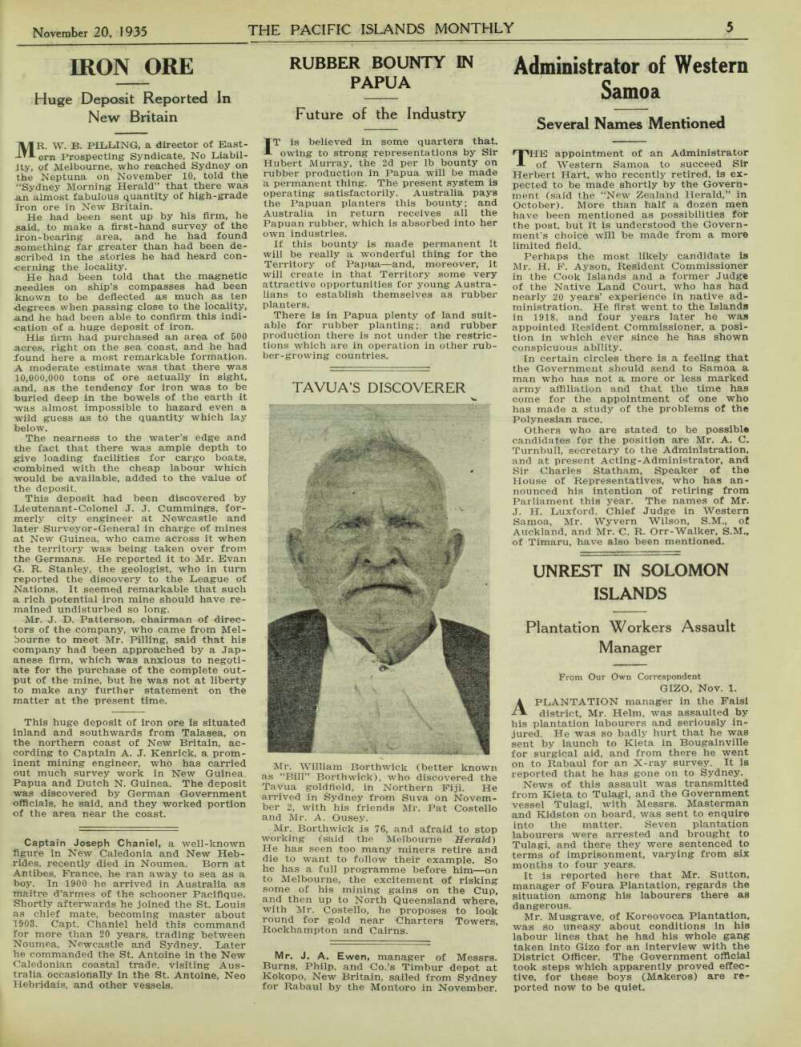
Mr. William Borthwick (better known as “Bill” Borthwick), who discovered the Tavua goldfield, in Northern Fiji. He arrived in Sydney from Suva on Novem ber 2, with his friends Mr. Pat Costello and Mr. A. Ousey.
Mr. Borthwick is 76, and afraid to stop working (said the Melbourne Herald) He has seen too many miners retire and die to want to follow their example. So he has a full programme before him—on to Melbourne, the excitement of risking some of his mining gains on the Cup, and then up to North Queensland where, with Mr. Costello, he proposes to look round for gold near Charters Towers, Rockhampton and Cairns.
Mr. J. A. Ewen, manager of Messrs.
Burns, Philp, and Co.’s Timbur depot at Kokopo, New Britain, sailed from Sydney for Rabaul by the Montoro in November.
Samoa
Administrator of Western Samoa Several Names Mentioned
THE appointment of an Administrator of Western Samoa to succeed Sir Herbert Hart, who recently retired, is ex pected to be made shortly by the Govern ment (said the “New Zealand Herald,” in October). More than half a dozen men have been mentioned as possibilities for the post, but it is understood the Govern ment’s choice will be made from a more limited field.
Perhaps the most likely candidate is Mr. H. F. Ayson, Resident Commissioner in the Cook Islands and a former Judge of the Native Land Court, who has had nearly 20 years’ experience in native ad ministration. He first went to the Islands in 1918, and four years later he was appointed Resident Commissioner, a posi tion in which ever since he has shown conspicuous ability.
In certain circles there is a feeling that the Government should send to Samoa a man who has not a more or less marked army affiliation and that the time has come for the appointment of one who has made a study of the problems of the Polynesian race.
Others who are stated to be possible candidates for the position are Mr. A. C.
Turnbull, secretary to the Administration, and at present Acting-Administrator, and Sir Charles Statham, Speaker of the House of Representatives, who has an nounced his intention of retiring from Parliament this year. The names of Mr.
J. H. Luxford, Chief Judge in Western Samoa, Mr. Wyvern Wilson, S.M., of Auckland, and Mr. C. R. Orr-Walker, S.M., of Timaru, have also been mentioned.
Manager
Unrest In Solomon
Islands
Plantation Workers Assault Manager
From Our Own Correspondent
Gizo, Nov. 1.
A PLANTATION manager in the Faisl district, Mr. Helm, was assaulted by his plantation labourers and seriously in jured. He was so badly hurt that he was sent by launch to Kieta in Bougainville for surgical aid, and from there he went on to Rabaul for an X-ray survey. It is reported that he has gone on to Sydney.
News of this assault was transmitted from Kieta to Tulagi, and the Government vessel Tulagi, with Messrs. Masterman and Kidston on board, was sent to enquire into the matter. Seven plantation labourers were arrested and brought to Tulagi, and there they were sentenced to terms of imprisonment, varying from six months to four years.
It is reported here that Mr, Sutton, manager of Foura Plantation, regards the situation among his labourers there as dangerous.
Mr. Musgrave, of Koreovoca Plantation, was so uneasy about conditions in his labour lines that he had his whole gang taken into Gizo for an interview with the District Officer, The Government official took steps which apparently proved effec tive, for these boys (Makeros) are re ported now to be quiet.
Rock-Carvings From Fiji
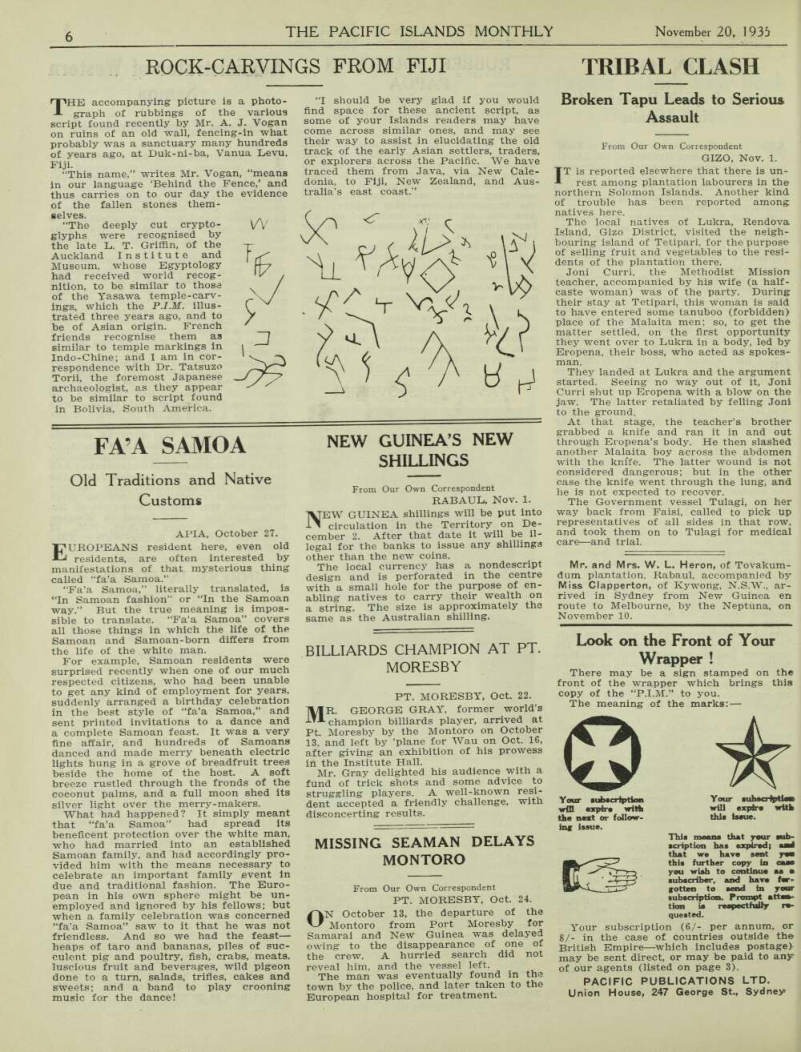
THE accompanying picture is a photo graph of rubbings of the various script found recently by Mr. A. J. Vogan on ruins of an old wall, fencing-in what probably was a sanctuary many hundreds of years ago, at Duk-ni-ba, Vanua Levu.
Fiji.
“This name,” writes Mr. Vogan, “means in our language ‘Behind the Fence,’ and thus carries on to our day the evidence of the fallen stones them
selves.
“The deeply cut crypto glyphs were recognised by the late L. T. Griffin, of the Auckland Institute and Museum, whose Egyptology had received world recog nition, to be similar to those of the Yasawa temple-carv ings, which the P.I.M. illus trated three years ago, and to be of Asian origin. French friends recognise them as similar to temple markings in Indo-Chine; and I am in cor respondence with Dr. Tatsuzo Torii, the foremost Japanese archaeologist, as they appear to be similar to script found in Bolivia, South America.
“I should be very glad if you would find space for these ancient script, as some of your Islands readers may have come across similar ones, and may see their way to assist in elucidating the old track of the early Asian settlers, traders, or explorers across the Pacific. We have traced them from Java, via New Cale donia, to Fiji, New Zealand, and Aus tralia’s east coast.”
Fa’A Samoa
Old Traditions and Native Customs
APIA, October 27.
EUROPEANS resident here, even old residents, are often interested by manifestations of that mysterious thing called “fa’a Samoa.”
“Fa’a Samoa,” literally translated, is *Tn Samoan fashion” or “In the Samoan way.” But the true meaning is impos sible to translate. “Fa’a Samoa” covers all those things in which the life of the Samoan and Samoan-born differs from the life of the white man.
For example, Samoan residents were surprised recently when one of our much respected citizens, who had been unable to get any kind of employment for years, suddenly arranged a birthday celebration in the best style of “fa’a Samoa,” and sent printed invitations to a dance and a complete Samoan feast. It was a very fine affair, and hundreds of Samoans danced and made merry beneath electric lights hung in a grove of breadfruit trees beside the home of the host. A soft breeze rustled through the fronds of the coconut palms, and a full moon shed its silver light over the merry-makers.
What had happened? It simply meant that “fa’a Samoa” had spread its beneficent protection over the white man, who had married into an established Samoan family, and had accordingly pro vided him with the means necessary to celebrate an important family event in due and traditional fashion. The Euro pean in his own sphere might be un employed and ignored by his fellows; but when a family celebration was concerned “fa’a Samoa” saw to it that he was not friendless. And so we had the feast— heaps of taro and bananas, piles of suc culent pig and poultry, fish, crabs, meats, luscious fruit and beverages, wild pigeon done to a turn, salads, trifles, cakes and sweets; and a band to play crooning music for the dance!
New Guinea’S New
Shillings
From Our Own Correspondent
Rabaul, Nov. 1.
NEW GUINEA shillings will be put into circulation in the Territory on De cember 2. After that date it will be il legal for the banks to issue any shillings other than the new coins.
The local currency has a nondescript design and is perforated in the centre with a small hole for the purpose of en abling natives to carry their wealth on a string. The size is approximately the same as the Australian shilling.
Moresby
Billiards Champion At Pt.
Pt. Moresby, Oct. 22.
MR. GEORGE GRAY, former world’s champion billiards player, arrived at Pt. Moresby by the Montoro on October 13, and left by ’plane for Wau on Oct. 16, after giving an exhibition of his prowess in the Institute Hall.
Mr. Gray delighted his audience with a fund of trick shots and some advice to struggling players. A well-known resi dent accepted a friendly challenge, with disconcerting results.
Montoro
Missing Seaman Delays
From Our Own Correspondent
Pt. Moresby, Oct. 24.
ON October 13, the departure of the Montoro from Port Moresby for Samarai and New Guinea was delayed owing to the disappearance of one of the crew. A hurried search did not reveal him, and the vessel left.
The man was eventually found in the town by the police, and later taken to the European hospital for treatment.
Tribal Clash
Broken Tapu Leads to Serious Assault
From Our Own Correspondent
Gizo, Nov. 1.
IT is reported elsewhere that there is un rest among plantation labourers in the northern Solomon Islands. Another kind of trouble has been reported among natives here.
The local natives of Lukra, Rendova Island, Gizo District, visited the neigh bouring island of Tetipari, for the purpose of selling fruit and vegetables to the resi dents of the plantation there.
Joni Curri, the Methodist Mission teacher, accompanied by his wife (a half caste woman) was of the party. During their stay at Tetipari, this woman is said to have entered some tanuboo (forbidden) place of the Malaita men; so, to get the matter settled, on the first opportunity they went over to Lukra in a body, led by Eropena, their boss, who acted as spokes man.
They landed at Lukra and the argument started. Seeing no way out of it, Joni Curri shut up Eropena with a blow on the jaw. The latter retaliated by felling Joni to the ground.
At that stage, the teacher’s brother grabbed a knife and ran it in and out through Eropena’s body. He then slashed another Malaita boy across the abdomen with the knife. The latter wound is not considered dangerous; but in the other case the knife went through the lung, and he is not expected to recover.
The Government vessel Tulagi, on her way back from Faisi, called to pick up representatives of all sides in that row, and took them on to Tulagi for medical care—and trial.
Mr. and Mrs. W. L. Heron, of Tovakum dum plantation, Rabaul, accompanied by Miss Clapperton, of Kywong, N.S.W., ar rived in Sydney from New Guinea en route to Melbourne, by the Neptuna, on November 10.
Advertisements & other items, p. 8 (1 item)
Wrapper !
Look on the Front of Your
There may be a sign stamped on the front of the wrapper which brings this copy of the “P.1.M.” to you.
The meaning of the marks: © Your subscription will expire with thia Issue.
This means that your subscription has expired; and that wo have sent ywm this further copy in case you wish to continue as a subscriber, and have fargotten to send in year subscription. Prompt attention is respectfully requested.
Your subscription (6/- per annum, or 8/- in the case of countries outside the British Empire—which includes postage) may be sent direct, or may be paid to anyof our agents (listed on page 3),
PACIFIC PUBLICATIONS LTD.
Union House, 247 George St., Sydney Your subscription will expire with the next or following issue.
Teacup
Storm In Suva's
The Mayor and a Referendum
'T'HE Municipal Council of Suva, Fiji, on October 26, in opposition to the wishes of the Governor, took a referendum of electors on the question: “Do you approve of Government control of the municipality of Suva?”
The answer was: Yes, 64; No, 295.
The plan that Suva municipality should be controlled by a council nominated by the Governor, instead of one elected by the residents appears to be the only al ternative to eventual confusion and strife.
Already, the Indians vastly outnumber the Europeans, and they naturally de mand equal franchise rights.
The leader of the opposition to the nominative council system, and the pro moter of the referendum, is Hon. Alport Barker, mayor of Suva. Mr. Barker also is editor of the local newspaper. We have read the reports of council meetings, and the newspaper’s editorials; and, appar ently, Mr. Barker’s main argument is that ancient, demogogic one: “The people must not be deprived of their democratic rights,”
It is very remarkable. Mr, Barker talked as if he were a mayor-cum-editor in Australia or New Zealand. He appeared to be blind to the entirely different con ditions of Fiji, and blissfully ignorant of the history of Indian settlement in the Empire during the last 20 or 30 years.
The vote (295 to 64) was practically valueless. The people, hearing only one side of the question—for the full case for the Government was not presented—voted with Mr. Barker, in the direction in which their inclinations quite naturally lay.
We must respect Mr. Barker’s fearless ness and capacity for independent thought: but we think he would have rendered much better public service if he had removed himself from the atmosphere of petty municipal politics, and sought the broad-visioned. Imperial viewpoint. He seems to have quite missed the point that there is another important Imperial issue involved in this storm in the Suva teacup.
Actually it does not matter twopence whether Suva is controlled by a nominated or elected council; but it is important that 5000 Europeans, 85,000 Indians and 100,000 Fijians should live happily together in this very rich Crown Colony.
Mr. Barker should go and live in Aus tralia, and learn a few things about his precious “democracy.”
Mr. F. R. Charlton, Commissioner of Lands in Fiji, has been appointed a nominated member of the Legislative Council.
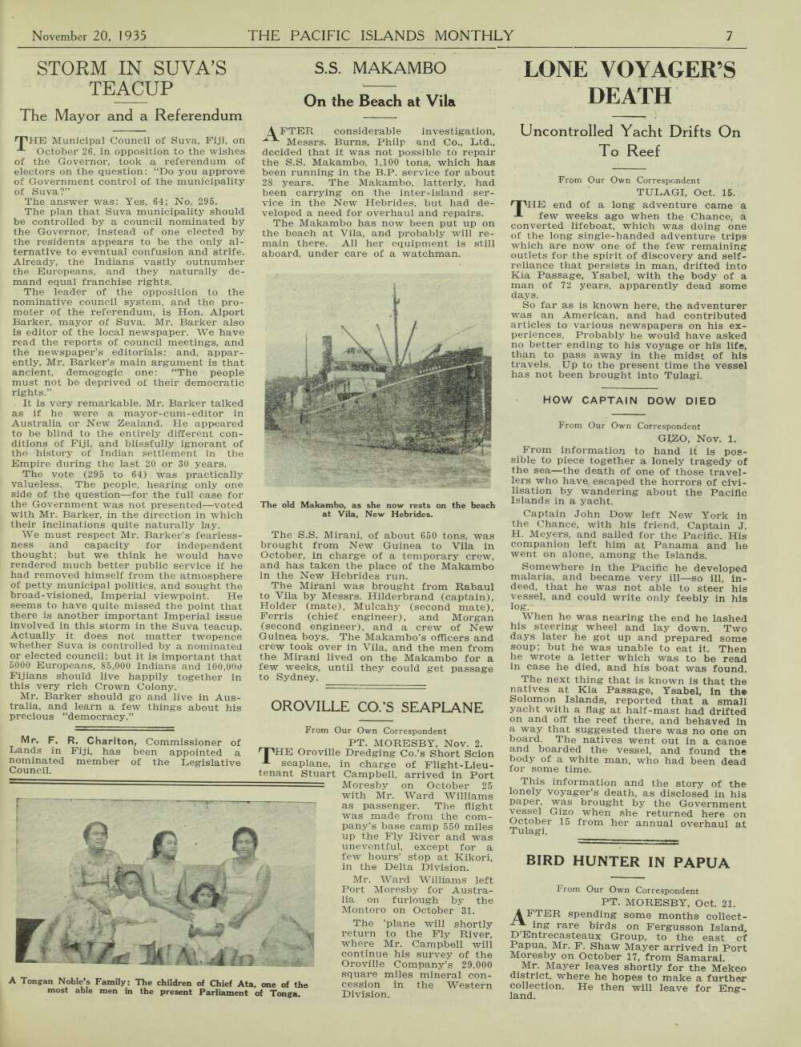
On the Beach at Vila
S.S. Makambo
A FTER considerable investigation, Messrs. Burns, Philp and Co., Ltd., decided that it was not possible to repair the S.S. Makambo, 1,100 tons, which has been running in the B.P. service for about 28 years. The Makambo, latterly, had been carrying on the inter-island ser vice in the New Hebrides, but had de veloped a need for overhaul and repairs.
The Makambo has now been put up on the beach at Vila, and probably will re main there. All her equipment is still aboard, under care of a watchman.
The S.S. Mirani, of about 650 tons, was brought from New Guinea to Vila in October, in charge of a temporary crew, and has taken the place of the Makambo in the New Hebrides run.
The Mirani was brought from Rabaul to Vila by Messrs. Hilderbrand (captain), Holder (mate), Mulcahy (second mate), Ferris (chief engineer), and Morgan (second engineer), and a crew of New Guinea boys. The Makambo’s officers and crew took over in Vila, and the men from the Mirani lived on the Makambo for a few weeks, until they could get passage to Sydney.
The old Makambo, as she now rests on the beach at Vila, New Hebrides.
Oroville Co.’S Seaplane
From Our Own Correspondent
Pt. Moresby, Nov. 2.
'T'HE Oroville Dredging Co.’s Short Scion seaplane, in charge of Flight-Lieu tenant Stuart Campbell, arrived in Port
Moresby on October 25 with Mr. Ward Williams as passenger. The flight was made from the com pany’s base camp 550 miles up the Ply River and was uneventful, except for a few hours’ stop at Kikori, in the Delta Division, Mr. Ward Williams left Port Moresby for Austra lia on furlough by the Montoro on October 31.
The ’plane will shortly return to the Fly River, where Mr. Campbell will continue his survey of the Oroville Company’s 29,000 square miles mineral con cession in the Western Division.
A Tongan Noble’s Family: The children of Chief Ata, one of the most able men in the present Parliament of Tonga-
Lone Voyager’S
Death
Uncontrolled Yacht Drifts On To Reef
From Our Own Correspondent
Tulagi, Oct. 15.
T'HE end of a long adventure came a few weeks ago when the Chance, a converted lifeboat, which was doing one of the long single-handed adventure trips which are now one of the few remaining outlets for the spirit of discovery and self reliance that persists in man, drifted into Kia Passage, Ysabel, with the body of a man of 72 years, apparently dead some days.
So far as is known here, the adventurer was an American, and had contributed articles to various newspapers on his ex periences. Probably he would have asked no better ending to his voyage or his life, than to pass away in the midst of his travels. Up to the present time the vessel has not been brought into Tulagi.
How Captain Dow Died
From Our Own Correspondent Nov. 1.
From information to hand it is pos sible to piece together a lonely tragedy of the sea—the death of one of those travel lers who have, escaped the horrors of civi lisation by wandering about the Pacific Islands in a yacht.
Captain John Dow left New York in the Chance, with his friend, Captain J.
H. Meyers, and sailed for the Pacific. His companion left him at Panama and he went on alone, among the Islands.
Somewhere in the Pacific he developed malaria, and became very ill—so ill, in deed, that he was not able to steer his vessel, and could write only feebly in his log.
When he was nearing the end he lashed his steering wheel and lay down. Two days later he got up and prepared some soup; but he was unable to eat it. Then he wrote a letter which was to be read in case he died, and his boat was found.
The next thing that is known is that the natives at Kia Passage, Ysabel, In th® Solomon Islands, reported that a small yacht with a flag at half-mast had drifted on and off the reef there, and behaved in a way that suggested there was no one on board. The natives went out in a canoe and boarded the vessel, and found the body of a white man, who had been dead for some time.
This information and the story of the lonely voyager’s death, as disclosed in his paper, was brought by the Government vessel Gizo when she returned here on October 15 from her annual overhaul at Tulagi.
Bird Hunter In Papua
Prom Our Own Correspondent
Pt. Moresby, Oct. 21.
AFTER spending some months collect ing rare birds on Fergusson Island, D’Entrecasteaux Group, to the east of Papua, Mr. F. Shaw Mayer arrived in Port Moresby on October 17, from Samarai.
Mr. Mayer leaves shortly for the Mekeo district, where he hopes to make a further collection. He then will leave for Eng land.
Tropical Growth!
Romantic History of a Sydney- Tahiti Business
ANE dark day in 1931, Mr. W. M. Reid had a financial stocktaking. He had retired several years earlier, but a com bination of Depression, Mr. Lang, and World Unrest, had knocked his invest ments endways. That day he had paid out in income tax more money than he had actually received in income during the previous year.
So Mr. and Mrs. Reid docided to flee from depression, to a charming country they knew well —Tahiti. Before leaving, Mr. Reid went out among his old Sydney friends and sought agencies. “Perhaps I can make enough out of commissions to cover steamer fares,” said he.
When he arrived in Tahiti, he was authorised to sell Brunton’s flour, Kit-
chen’s soaps. F. J. Walker’s canned meats, Johnny Walker whisky, and one or two other things. Among his samples were two tons of flour.
Business dragged. Tahiti purchased mostly American foods, and was set in its ways. It looked as if Mr. Reid would have to give the flour away, or pay freight back to Sydney, or eat it himself.
There were seven Chinese bakers in Papeete, all wedded to Californian flour.
But Chinamen always are sportsmen, Mr. Reid went to each of the bakers.
“The Brunton slogan is ‘More Loaves to the Bag.’ ” said he. “Here is a bag of flour. Make it into bread. If you don’t get more loaves out of it than out of the same amount of American flour, you can have this flour for nothing. If you do get more loaves you can pay for the flour and give me an order.”
Every man accepted. Each of them got more loaves, and each did as he had pro mised. From that time on, all of those seven bakers have used Australian flour.
Tahitians ate only American canned meat. Mr. Reid would go among them, open a tin of Australian meat under their dainty noses, and persuade them to eat it. “Bon!” they said. “Tres bon!” They began to ask for Australian meat.
The 18th Amendment was still dom inating social life in the United States.
Papeete was a kind of clearing-house for
gigantic bootlegging operations. Mr. Reid, with his whisky agency, found himself in the thick of it. He secured orders for thousands of pounds worth of the Scottish brew.
When he returned to Sydney, some months later, Mr. Reid obtained a small office, and spent a profitable month buy ing and shipping foods to Tahiti. Then a mall came in from Tahiti, with many more orders, and he was kept busy for another month. That was the beginning of the business of W. M. Reid, Pacific Islands agent.
New agencies came his way. A mem ber of the Arnott family said to him one day: “There isn’t an Arnott biscuit in all Tahiti.” Mr. Reid looked into the matter. To-day, large consignments of Arnott’s biscuits go to French Oceania by every steamer.
The business has grown amazingly. In 1931 the staff comprised Mr. Reid and Mrs. Reid, who acted as his secretary.
To-day there are 21 persons on the salary list in Sydney. They ship to Tahiti
“everything from pigs to precious stones.”
They have introduced the Nyngan goats (a special strain of milkers) to Polynesia —also dogs, pigs, horses. Mr. Reid has bought many Australian racehorses for Tahiti clients —and every notable race there, in the last four years, has been won by an animal selected and shipped by W.M.R.
The firm has established active agencies in Fiji and New Guinea, but the bulk of its business is done with Tahiti. This is all new trade for Australia —practically the whole of it was taken from the Ameri cans.
Gloomy people say there are no oppor tunities left for enterprise in the Pacific and that Australian goods cannot compete with foreign products, anyway. Mr. W.
M. Reid supplies the answer. It is not a respectful answer.
Miss Mildred Hancock and Miss Ida R.
Malone have been appointed Matron and Sister respectively at the Presbyterian Mission’s Paton Memorial Hospital, Vila, New Hebrides. Sisters M. L. Neave and Jean Burnell, who have been at the Vila hospital for some years, have retired, and are returning to Victoria. This institu tion was erected as a memorial to the late Rev. Dr. John Paton, who founded the Presbyterian Mission in New Hebrides.
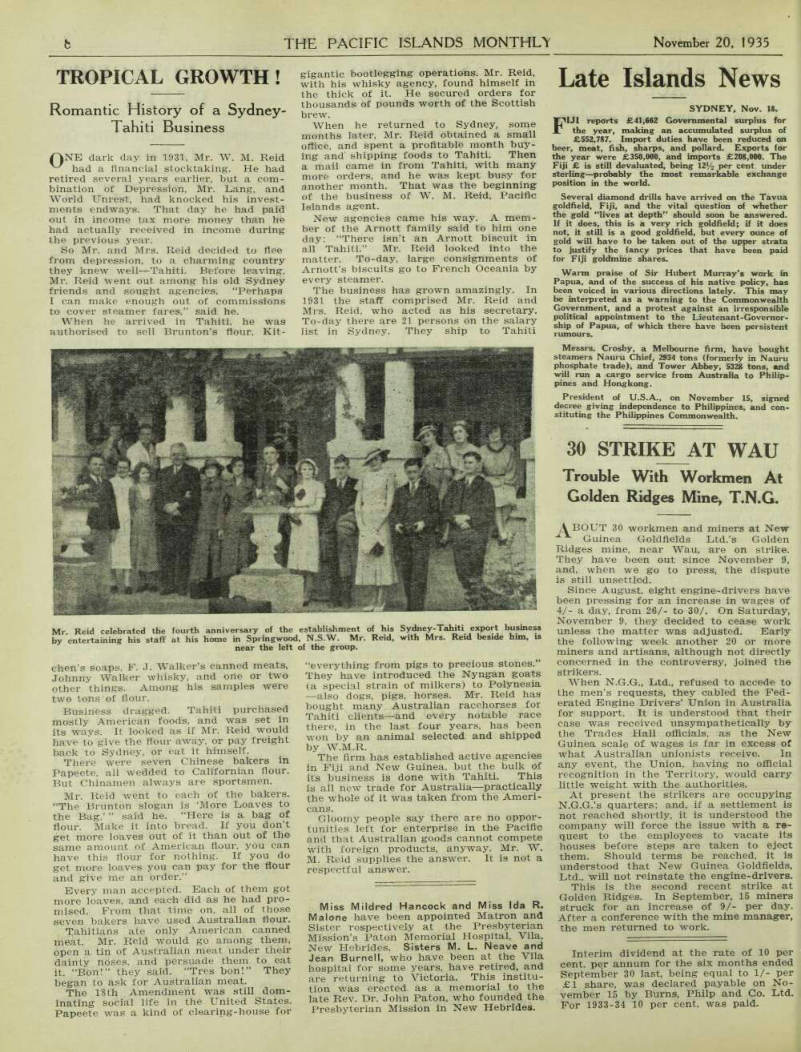
Mr Reid celebrated the fourth anniversary of the establishment of his Sydney-Tahiti export business by entertaining his staff at his home in Springwood, N.S.W. Mr. Reid, with Mrs. Reid beside him, is near the left of the group.
Late Islands News
Sydney, Nov. 18.
FIJI reports £41,662 Governmental surplus for the year, making an accumulated surplus of £552,787. Import duties have been reduced on beer, meat, fish, sharps, and pollard. Exports for the year were £350,000, and imports £208,000. The Fiji £ is still devaluated, being 12% per cent, under sterling—probably the most remarkable exchange position in the world.
Several diamond drills have arrived on the Tavua goldfield, Fiji, and the vital question of whether the gold “lives at depth” should soon be answered.
If it does, this is a very rich goldfield; if it does not, it still is a good goldfield, but every ounce of gold will have to be taken out of the upper strata to justify the fancy prices that have been paid for Fiji goldmine shares.
Warm praise of Sir Hubert Murray’s work in Papua, and of the success of his native policy, has been voiced in various directions lately. This may be interpreted as a warning to the Commonwealth Government, and a protest against an irresponsible political appointment to the Lieutenant-Governor ship of Papua, of which there have been persistent rumours.
Messrs. Crosby, a Melbourne firm, have bought steamers Nauru Chief, 2934 tons (formerly in Nauru phosphate trade), and Tower Abbey, 5328 tons, and will run a cargo service from Australia to Philip pines and Hongkong.
President of U.S.A., on November 15, signed decree giving independence to Philippines, and con stituting the Philippines Commonwealth.
30 Strike At Wau
Trouble With Workmen At Golden Ridges Mine, T.N.G.
A BOUT 30 workmen and miners at New Guinea Goldfields Ltd.’s Golden Ridges mine, near Wau, are on strike.
They have been out since November 9, and, when we go to press, the dispute is still unsettled.
Since August, eight engine-drivers have been pressing for an increase in wages of 4/- a day, from 26/- to 30/. On Saturday, November 9, they decided to cease work unless the matter was adjusted. Early the following week another 20 or more miners and artisans, although not directly concerned in the controversy, joined the strikers.
When N.G.G., Ltd., refused to accede to the men’s requests, they cabled the Fed erated Engine Drivers’ Union in Australia for support. It is understood that their case was received unsympathetically by the Trades Hall officials, as the New Guinea scale of wages is far in excess of what Australian unionists receive. In any event, the Union, having no official recognition in the Territory, would carry little weight with the authorities.
At present the strikers are occupying N.G.G.’s quarters; and, if a settlement is not reached shortly, it is understood the company will force the issue with a re quest to the employees to vacate its houses before steps are taken to eject them. Should terms be reached, it is understood that New Guinea Goldfields, Ltd., will not reinstate the engine-drivers.
This is the second recent strike at Golden Ridges. In September, 15 miners struck for an increase of 9/- per day.
After a conference with the mine manager, the men returned to work.
Interim dividend at the rate of 10 per cent, per annum for the six months ended September 30 last, being equal to 1/- per £1 share, was declared payable on No vember 15 by Burns, Philp and Co. Ltd.
For 1933-34 10 per cent, was paid.
Future Of Solomon Islands
Arguments For and Against Australian Control
Letter to the Editor.
f’ OULD the Solomon Islands be administered from Rabaul?”
The question, given prominence in your issue dated July 23. has for long exercised the minds of settlers and those t°^ er c S ou:t h r°y. haVe ’ indir6Ctly ’ " in The answer vouchsafed by many thinking, responsible persons may be summed up in the phrase “Why not?” This reply, it must be confessed, is based largely on the prevailing feeling that any change in administrative control can hardly fall short of being an improvement on the apathetic, entirely selfish and futile methods that now obtain.
Your contention that S.I. officials are not always to blame for much of the weakness and inefficiency with which they are frequently charged will meet with fairly general acceptance. They are by no means faultless; but that aspect of the matter is subsidiary to the much more important one of London-Suva, or Canberra-Rabaul control, and may be regarded as a detail which doubtless would receive attention if, and when, a change ° f^ dministration took place - The statement that “there is nothing Inherently wrong with what is done by Suva ’ raises a tempest of protest. There is an appalling lack of interest, sympathy ana understanding of the conditions and of th e Solomons, combined with a disdainful attitude towards all representations by those who do know and are e?nme r nt ed nf°^ the p We f lfa f e a + nd S£ d gOV ‘ ernment of the Protectorate. The case fJLcTiT- bUVa r , Ule was / tated at some length m your columns a few months ago under the caption “Should the Governor of Fiji be High Commissioner for the
Western Pacific,- and it is unnecessary to quote here the reasoned arguments advanced by your contributor. Epitom ised, they were (if Mr. Kipling will for give the liberty with his immortal lines): at Su a va 'SSJT* °* *° l — But if this question of change in the territorial ownership of the Solomons is to become a subject of practical politics, and is to receive the serious consideration it deserves, care must be taken to guard against the dissemination of erroneous information and exaggerated statements.
S.I. affairs are not intimately known in Australia, and consequently it is not sur prising to find unintentional errors ap pearing in an article presumably based on a mass of correspondence, much of which is from well-intentioned, but not always well-informed sources.
The statement that the Solomons are a heavy and continuing expense to the Colonial Office is right off the track, and unfortunately conveys the misleading impression that Australia may be asked to take over a bankrupt group of islands.
Unlike Papua, which is a heavy and con tinuing drain upon the Commonwealth Treasury, the Solomons have never re ceived nor asked for a subsidy from the Colonial Office. On the contrary, the Protectorate not only meets its adminis trative costs, but pays a proportion of the expense of maintaining the Western Pacific High Commission, besides contri- J?} 111 ?* £ 3 ’ o .°? pt T annum towards the bloated subsidy which the Commonwealth Government expends on a shipping ser vice that benefits New Guinea not less than it does the Solomons.
Notwithstanding these charges for ex
traneous services the Protectorate bal ance sheet on March 31, 1935, showed an accumulated surplus of over £60,000, The domination of Australian commer cial interests, suggested as constituting an embarrassment to the Colonial Office, is a natural condition inevitable by reason of the contiguity of the group to Australia. There is no embarrassment or ill-feeling on that score; but if Austra lian control promises to result in putting the brake on the near-domination of Chinese commercial interests within the Protectorate (desirable from the point of view of Australian defence policy), you may be assured that that factor alone would weigh heavily with Islanders in favour of the change-over.
It is not at all clear why it should be assumed that Unilever interests would oppose the transfer of the Solomons to Australia; and, even if they did, surely Australia would not allow a commercial combine, however powerful, to dominate considered Imperial and national policy?
But the suggested opposition seems nebu lous. All the copra produced by Lever’s Pacific Plantations in the Solomons is shipped to, and manufactured into Uni lever products, in Australia. Levers would experience less difficulty than al most any other producer in the Solomons in complying with existing New Guinea regulations. Their estates are organised on approved lines, and the quality of the copra they produce will compare favour ably with any in the world.
Incidentally, the higher price obtained for New Guinea copra, as compared with the average Solomon product, is not en tirely due (as appears to be implied) to the system of grading and inspection in force in New Guinea. Grading and in spection may help to maintain and ensure the standard of quality, but the market places a higher value on hot-air dried copra than on that which is smoke-dried, and, in the method of curing, Solomons plantations, with some exceptions, lag behind those of N.G. But that lee-way will be made up in due course, irrespec tive of the Administration in control.
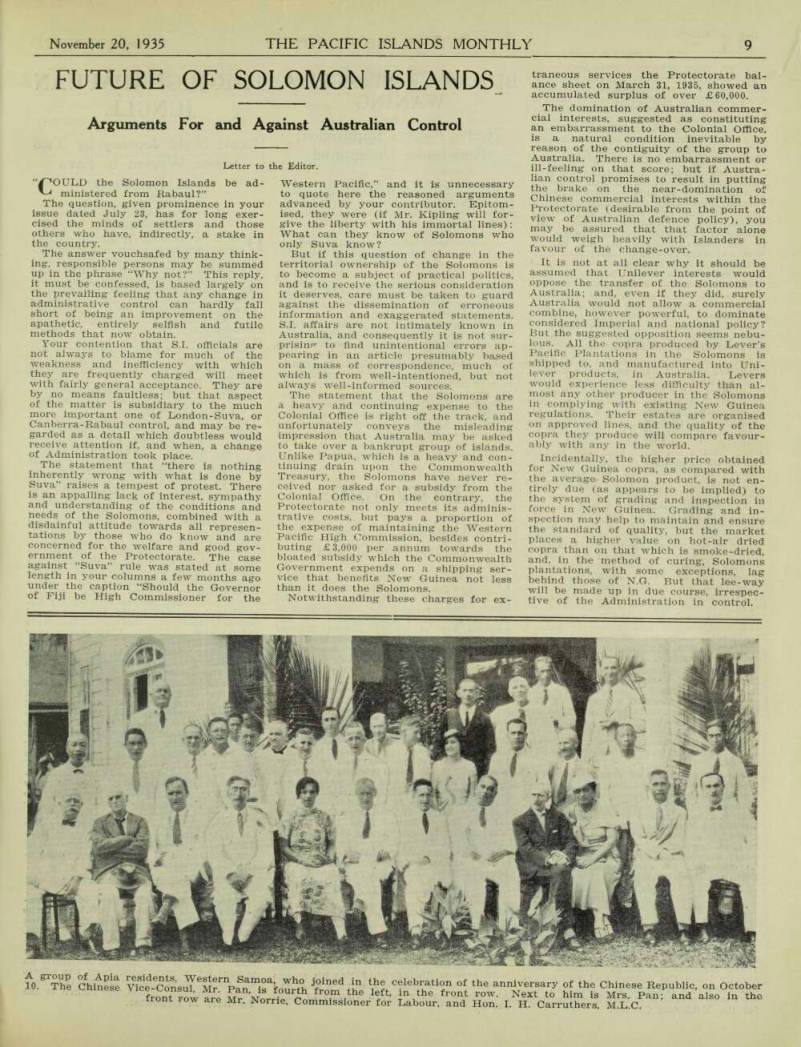
A group of Apia residents, western Samoa, who joined in the celebration of the anniversary of the Chinese Republic, on October 10. The Chinese Vice-Consul, Mr. Pan,is jfourth from the left, in the front row. Next to him is Mis pan; and also in the front row are Mr. Norrie, Commissioner for Labur, and Hon. I. H. Carruthers, M.L.C.
The so-called problem presented by the Malaita-man is absurdly over-rated, and there is not the slightest need to send a platoon of district officers and patrol leaders to subdue him. Heaven save us from any such colossal folly. Malaita is at present administered by one district officer, with a dozen or so native police, and they haven’t had a scrap for years.
The much-maligned Malaita-man is a virile, husky individual, reputed to be the best and most dependable worker in the Pacific. Practically all the plantations in the Solomons are staffed by Malaita labour, and the fear of these “wild” tribesmen being attracted to New Guinea is the chief objection present in the minds of employers to the Solomons com ing under Australian control when, pre sumably, natives would be free to pro ceed from the one territory to the other.
It is true that the Malaita-man dis plays independence and even arrogance on occasion, but in that he is not a unique specimen of humanity—black or white —and properly treated and handled he is loyal, obedient and courageous.
Let it be understood that the Malaita man has a justifiable grievance against the Administration, a grievance which, long simmering in the mind of an un tutored, inarticulate aboriginal, in time assumes the proportions of a serious in justice; and that mental condition has been responsible for any “boil-over” of pent-up feelings that has occurred in the past. In the Solomons generally, and on the island of Malaita particularly, district officers and police are primarily tax collectors. In effect, taxes are extorted at the point of the bayonet.
The Malaita-man cannot understand — and he is not alone in his incomprehen sion—why he should have to pay a tax for which he receives no service in return.
Government, whose paramount aim is to display a financial “profit” in the business of administration, takes, but gives noth ing—except to Civil Servants. It is no exaggeration to say that the provision of a hospital or two, adequately staffed and equipped, and the establishment of an elementary school, would do more good and confer more lasting benefit than a regiment of district officers and police men—and the Malaita problem would cease to trouble.
But in the Solomons the fundamental function and obligation of a “Protec torate” government has been lost sight of, and the spectacle is witnessed of New Guinea, a comparative tyro in the sphere of native administration, setting an example and showing the way in so far at least as the provision of medical and educational services to natives are con cerned.
The advantages and disadvantages of Australian control of the Solomons are too numerous and complex to be dealt with adequately in a letter; but the ques tion you have raised is of profound in terest and importance, and would furnish a fitting subject for close investigation in both territories by an impartial Com mission appointed by the Commonwealth Government, in conjunction with the British Colonial Office.
I am, etc.,
Astrolabe.
Tulagi, S.I., 19/10/’35.
Rev. T. N. Deller, of Bau, who has done notable work in Fiji during the past 14 years for the Methodist Mission, will shortly leave the Colony and settle per manently in Australia. It is reported that he hopes to take a circuit in Queensland for the Methodist Church.
Buka “Fanat Agism”
Waning
Twelve Natives Imprisoned; Ring-leader Uncaptured
From Our Own Correspondent
Rabaul, Nov. 3.
LATEST reports regarding the outbreak of religious “fanatacism” in Buka and Northern Bougainville indicate that the unrest is on the wane.
A Government official recently made a patrol through the affected areas and arrested 12 of the agitators, all of whom were tried and sentenced to varying periods of imprisonment. The ring leader, Sanapo, is still at large, having hidden somewhere in the bush on the island of Buka.
Exhibits during the trials included native-made flags, bearing the initial “P” and crosses in several designs. The initial stands for the name of the native Pako, who was implicated in the fanatic movement in 1932. He was arrested, tried and imprisoned, and died while serving his sentence.
Sanapo is alleged to have received a “visit” from Pako in a dream and been instructed to spread reports among the natives of the coming resurrection and the supplies of foodstuffs which would be made available to all “believers.”
Leahy Bros.
To Lead British Party Into Central New Guinea
SEEKING native specimens in Mount Hagen region for the British Museum, an English party under Lord Moyne will shortly leave London for New Guinea in the peer’s luxury yacht Rosaura. The ex pedition will be led by Messrs. Michael and James Leahy, the Australian ex plorers, who already have done much pioneering work in Central New Guinea.
For several years the Leahy Brothers have prospected for gold in the Mt. Hagen area and are on friendly terms with the natives in that uncontrolled area. It is hoped to obtain enough specimens of axes, knives, spears and primitive native wares to add a special section to the British Museum’s valuable collection.
Born in Dublin in 1880, Lord Moyne is the third son of the first Earl of Iveagh.
He served in the South African War, being wounded and mentioned in despatches, and won the D.S.O. in the Great War. Enter ing politics in 1906, he was Under-Secretary for War during 1922-23, Financial Secre tary to the Treasurer from 1923-25, and Minister for Agriculture and Fisheries from 1925 to 1929. Before being raised to peerage he was Colonel Walter Guinness.
The Rosaura, which replaced Lord Moyne’s yacht Roussalka (wrecked in 1933 in a fog off the Irish coast), is described as the most luxurious vessel ever fitted in a British shipyard for a private person.
Formerly she was the English Channel passenger steamer Dieppe. Two pet mon keys, which always accompany the owner on hia travels, have special accommodation in the saloon.
In February last Lord Moyne’s yacht, with several distinguished English guests aboard, visited Sydney, making a brief call at Rabaul on her return voyage to Eng land.
Jungle
Through Papuan
Heroic Night Journey by Two White Women to Save Sick Neighbour
From Our Own Correspondent
Pt. Moresby, Oct. 27.
DEEDS of heroism by white women have become a commonplace in Pa pua, so much so that they are treated with a certain indifference by settlers, and seldom do those who perform them suffer from the embarrassment of a thunder of applause. Occasionally an outstanding incident occurs which by its exceptional character startles the residents from their composure and calls forth a loud tribute of praise.
Such an incident occurred early in Oc tober in the eastern end of Papua, when two white women, Mrs. H, R. Glanville and Miss D. Irwin, travelled throughout the night on foot for 35 miles over ex tremely difficult and treacherous country to attend a sick neighbour.
The wife of the manager of Mamai Plantation, Port Glascow, fell dangerously sick, and her husband, Mr. W. G. Blun dell, hearing of a trained nurse at Mo gubu Plantation, off Amazon Bay to the west, sent in haste for her assistance. The message arrived late one afternoon, and without hesitation, the nurse, Mrs. Glan ville, and the daughter of the manager, Miss Irwin, set off in the gathering dark ness to cross Amazon Bay for Milport Harbour and Port Glascow with two na tives and some food for the journey.
Unfortunately, high tide forced them to cut inland to scale the steep cliffs that fall sheer to the water’s edge, and to climb the rocky heights behind, which are the chief features of the coastal district.
Thick jungle and broken country lay be yond and for five hours they struggled through, until by midnight they were faced with a 1,300 ft. bluff which they climbed, only to descend later to swamps.
These they scrambled through with only the light of a hurricane lantern to guide them, and again entered jungle.
Two and a half hours later, nearing Port Glascow, they passed through villages, whose bewildered inhabitants turned out to gaze in astonishment at the two white women as they pushed off in canoes into the black darkness of the harbour on the last lap of their journey before crossing the hills to Mamai. They reached Mamai at five in the morning, after eleven hours’ hard going, and were ready to attend im mediately to the patient. Happily they arrived in time to save her from the dreaded disease of Papua—blackwater fever.
This deed of heroism is certainly one for which these two white women have deservedly earned the admiration and congratulations of all residents through out the Territory.
Patrol Officer J. O’Malley, who accom panied Mr. Jack Hides, A.R.M., on the recent successful expedition through the unknown north-west country of Papua, returned to Port Moresby by the Mac dhui from Sydney on October 24. Since August last he had been in Australia on special leave, recovering from the effects of the hazardous trip through the lime stone area. Mr. Hides will return to the Territory in December.
Tropicalities
THERE can be no more fascinating hobby than that followed by Mr. A. .J. Vogan, who has wandered far and wide over the Pacific, seeking traces of ancient .migrations and extinct cities. Within recent years he has been in New Cale donia, in Eastern Papua and in various ■corners of Fiji, and in all those places he has secured details and photographs of mysterious things which may some day help in piecing together the story of what happened in these Pacific lands long be fore the advent of the white man. Mr.
Vogan has an extraordinary collection of books and documents dealing with the •early history of mankind. From certain of his manuscripts he has prepared plans .and details of an ancient city which he •claims once existed near the Upper Mis sissippi, in North America; and he has .given these to his friend, Mr. E. J. Bryce, -of Sydney. Mr. Bryce has been travelling Jn Central Asia and Russia, and is now on Jus way to the West Indies and Mexico.
He has promised to go and examine the .site of Mr. Vogan’s ancient city. Mr.
Vogan says that the city was destroyed some 2,000 years ago and that it was once the home of millions of people. * * * IT is reported in the Sydney newspapers that, in 1936, Cinesound Ltd. (a Syd ney firm which makes cinema films), in conjunction with United Artists, will make a film based on lon Idriess’s book, “Gold Dust and Ashes,” which tells the story of the discovery of the New Guinea gold field. * * * THE Administrator of the tiny phos phate island of Nauru was originally the most absolute ruler in the world (said Sir Robert Garran, in an address recently in Melbourne). His ordinances were not subject to disallowance by anyone, and he was bound by no instructions. But a supplementary agreement of 1933 between the high contracting parties—Britain, Australia, and New Zealand—clipped his wings a little. Little legislation in such a simple and orderly community had been necessary, however. No budget difficulties worried the Administration. The ex penses of administation, as far as they were not met out of other revenue, were defrayed out of the proceeds of phos phates. ♦ • ♦ X>ILL BORTHWICK, who discovered the new Fiji goldfield, put £2 on Peter Pan at the Melbourne Cup; and declared he would back the animal every time it started in a race. Everyone thought the prospector was merely demonstrating faith in a marvellous bit of horseflesh; but the reason, while sentimental, was quite different. It appears that, 60 years ago, at Dumfries Academy, in Scotland, Borthwick had a schoolmate, one James Barrie. This was the same person who afterwards wrote “Peter Pan,” and be came world-famous as Sir James Barrie.
Borthwick, at the Cup, met a man whom he had not seen for 39 years, when they were fellow-miners together in New Zealand. Borthwick now has gone off to Queensland where, despite his age and his bank balance (both represented in high units), he is going to do some more prospecting. * ♦ ♦ T ORD BEAUCHAMP, who is spending > some months in Sydney, following a visit to Tahiti, received a ceremonial visit from a young Polynesian chief the other day. Teuira Tuteao, a cousin of Koroki.
the Maori king, presented the felicitations of the Kingite tribes as once, many years ago, Lord Beauchamp was the manuhiri, or guest of the late King Mahuta, at Waahi, near Huntley, New Zealand.
Teuira Tuteao (The Lightning that Struck the World) is a direct descendant of that notable navigator, Hoturoa, cap tain of the Tainui canoe, which left Papara, Tahiti, for New Zealand, more than six centuries ago. He was accom panied to Sydney by his young cousin, Te Akonga Pihama, another close relative of the Maori king. Both chiefs are students for the Methodist Maori ministry. • * * ALTHOUGH Jack Hides, of Papua, is living the quietest of lives just now— recovering his health, nursing his new baby and writing his new book —he can not keep out of the news. On November 14 he was driving a car over the Har bour Bridge. A lorry, loaded with long steel rails, came careering up behind him, failed to stop quickly, and the steel rails were driven through the back of Hides’s car. The rails stopped within a couple of inches of the young explorer’s head.
He may have had several narrow escapes from death, but none was much closer than this, ♦ ♦ * It/I'EASURES to give the respective countries authority to co-operate with the League of Nations, in regulating the whaling industry in the Antarctic, have been adopted by the Parliaments of Aus tralia and New Zealand. It is all part of a slow-moving procedure to implement “an International Convention for the Regulation of Whaling,” which was drawn up by the League of Nations, and signed in 1931. Whale oil, as every planter knows, has become an important sub stitute for coconut oil; and the Antarctic whale oil marketed in the last ten years has increased in quantity so much that it has been definitely a factor in the disorganisation of the copra market. The whale herds of Antarctica already have
been decimated, however; and, without the Convention, it was only a question of tipie before the creatures would dis appear from the Southern oceans (just as they have disappeared from other oceans during the past 100 years) and the copra industry correspondingly re lieved. Police action under the Conven tion may delay extermination; but the end of the Antarctic whale is definitely in sight. • * * EVER heard of the Cartier Islands? No —neither have I. It appears, how ever, that they are one of the various Pacific Territories owned or controlled by Australia. My authority is Sir Robert Garran, formerly Commonwealth Solici tor-General, who gave an address in Mel bourne recently. The Cartier Islands are “half-way between Australia and Timor.”
All the map-makers I know have ignored them. • • • THE skipper of a tramp steamer, in writing up the log recording an eventful day, rounded off his task with the entry: “Mate intoxicated.” To the mate, who indignantly protested on read ing it, the skipper retorted: “Well, it’s true, ain’t it?”
On the following day it was the mate’s duty to write up the log, and he com pleted his account with “Skipper sober.”
The captain stared at it for a moment, then exploded.
“Well, it’s true, ain’t it?” was the mate’s rejoinder.
Mr. R, Mel rose, District Officer at Sala maua, arrived in Sydney from New Guinea by the Montoro on November 7.
During the past 18 months, he said, the territory has progressed amazingly; aero planes have doubled, and, in the year ended June 30, the gold production in creased by £400,000 over that of 1933-34.
Mr. Howard L. Clark, of the Bay Loo Company, Rabaul, who was married in N.S.W. last month to Miss Ellen Liggins, departed from Sydney for New Guinea with his wife by the Montoro on November 13. He is secretary of the Rabaul Ama teur Turf Club.
Advertisements & other items, pp. 13-14 (1 item)
home
STERLING
HOME PAINT
Guaranteed
LOOKS
BETTER
LONGER
STERLING
home
m CD For
TROPICAL
SUN and
SALT-LADEN
AIR
MADE BY
STERLING VARNISH CO. - - SYDNEY, N.S.W.
NEGLECT OF DEFECTIVE SIGHT
MAY CAUSE SERIOUS RESULTS
Take Care of Your Eyes Consult
WALTER FORD
D.8.0.A., M.0.0.A.
Optometrist and Optician 4th Floor, Challis House Martin Place, Sydney Established over 30 years Tel.: Most moderate charges BW 6131
An Ideal Xmas Gift A Portrait In Oils Few people realise the beautiful portraits that can be made from photos and snapshots of loved members of the family or well remembered scenes. Old and faded originals can be made into most lifelike portraits when reproduced by our staff of highly skilled artists. , .
The Mail Order Portrait Co. have decided to extend operations to the Pacific Islands, thus enabling you to obtain high class Por tr * than usual city prices. This is made possible by your DEALING DIRECT WITH OUR STUDIOS and thereby eliminating salesmans commissions, travelling and hotel expenses, etc.
In order to make our work known throughout the Islands we are making this
SPECIAL XMAS ADVERTISING OFFER
One beautiful Portrait in Oils, framed complete, measuring 22 x 18 inches: Usual price *%//' Specially reduced to
INSTRUCTIONS FOR ORDERING:
Post photograph, or snap of subject, stating clearly colour of hair, eyes, complexion, draperies etc. Whether three-quarter, bust or full length required; also in case of one to be taken from a group, mark clearly. All originals will be carefully returned.
All orders must be accompanied by a deposit of at least 15/-, and the balance need not paid until you receive the portrait from your post office.
Write for illustrated circular, sent post free.
MAIL ORDER PORTRAIT CO.
205 Miller Street, North Sydney, N.S.W. (Australia)
Ccccie Tea Co’s
JtufkgKuk TEAS $ COffEES
CQls
$ l#S S?t So
ESN
THESE SUPERIOR TEAS AND
COFFEES ARE NOW OBTAIN-
(, ABLE THROUGHOUT MOST OF
THE PACIFIC ISLANDS
You will find Corrie’s Teas are “deliciously different,” and are already THE MOST POPULAR TEAS IN FIJI, where they enjoy an immense demand.
Should you, as yet, be unable to procure, please aga forward name of your Storekeeper, and A
GENEROUS SAMPLE WILL BE SENT YOU.
Ask for “CORRIE’S”
—The Tea that is “Deliciously
Different”
Correspondence Invited.
THE CORRIE TEA CO.
39 Bathurst St., Sydney.
About Islands People
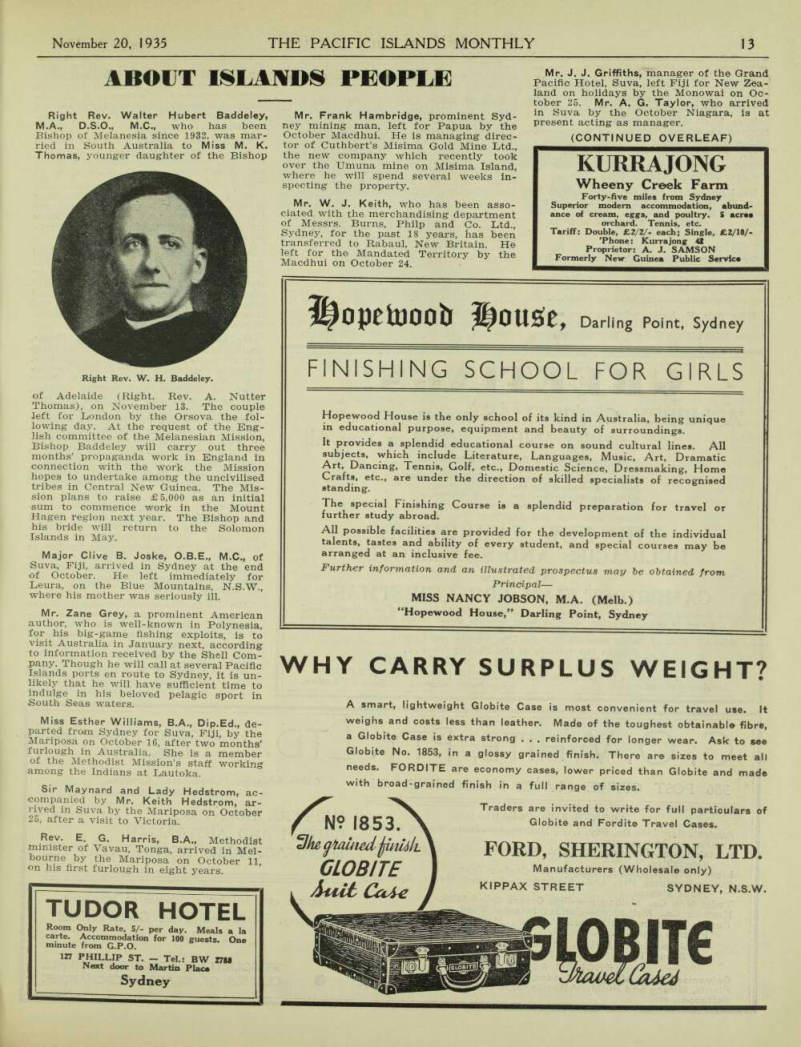
Rev. F. W. Noack, one of the leaders of the New Evangelical Lutheran Church in Australia, has left for New Guinea, where, with the Rev. H. Freund, he will open a mission station.
Mr. A. J. Murray, who has been a mem ber of Messrs. Burns Philp (South Sea) Go’s staff at Apia, Western Samoa, for a number of years, arrived in Auckland by the Lurline on November 2 to spend fur lough with his relatives in New Zealand.
On the completion of his leave he will join one of B.P.’s branches in Fiji.
Rev. J. Housden, 8.A., L. Th., of Dar win, has announced his engagement to Miss Moira Hennessey, assistant registrar
of the Anglican Church at Thursday Island.
Mr. James Sim, of Hathorn Sound, Solomon Islands, arrived in Sydney on holidays by the Malaita on November 8.
He is Lever’s Pacific Plantations Co.’s copra inspector in the group.
Dr. Gordon Heaslip, superintendent of the Methodist Mission’s hospital at Sala mo, Papua, has resigned through ill health. He arrived in Australia from Papua by the Montoro on November 7.
Mr. and Mrs. J. L. Taylor returned to New Guinea by the Nankin in October after visiting Australia, America and the East. Mr. Taylor will shortly assume the duties of District Officer in the Morobe district.
Mr. Bridle, chief accountant of New Zea land Reparations .Estates, was married recently in New Zealand; and was accom panied by his young wife on his return to Samoa, Mr. B. C. Ballard has now settled down in Vila, New Hebrides, as “Solicitor re presenting Australian interests in the Condominium.” He has taken the places of Mr. Wallace, who retired from that position some time ago.
Mr. L. G. Vial, cadet in the New Guinea Public Service, left Cairns, North Queens land, for Rabaul by the Macdhui on October 29. He had been on short fur lough in Australia.
Mr. J. Blaikie Webster, of London, left Brisbane for New Guinea by the Mac dhui on October 26 to inspect the areas of New Guinea Goldfields Ltd. of whicli he is chairman of directors.
Mr. Charles H. Sturgeon, radio-telegra phist on the staff of Amalgamated Wire less (A/sia) Ltd. at Rabaul, sailed from Sydney by the Macdhui on October 26 for New Britain.
His Honour D. S. Wanllss, Chief Judg& of the Mandated Territory of New Gui nea, returned to Rabaul by the October Macdhui, after long leave spent in Vic toria and New South Wales.
Mr. and Mrs. L. R. Butler, of Murray Island, Torres Strait, arrived in Sydney from Thursday Island by the Marella, on.
October 28. Mr. Butler, who has been Government superintendent, and schoolteacher on the island for a year,, has relinquished his lonely post owing to ill-health. About 500 Murray Islanders are engaged in the trocus shell and beche de-mer industries, said Mr. Butler.
Nurse H. M. Prowse, of the Methodist Mission’s Hospital at Vunairima, New Britain, arrived in Sydney, on leave, by the Montoro on October 1.
Mr. A. W. McMillan, Inspector of Indian Schools in Fiji, returned to Suva with his wife and daughter by the Mariposa in Oc tober.
Captain A. S. Fitch, managing-director of Steamships Trading Co. Ltd., Port Moresby, Papua, arrived in Sydney on a. business trip by the Macdhui on October 17.
Mr. T. Aitchison, cadet in the N.G. Dis trict Services Department, sailed for Rabaul after short leave in Australia, by the Macdhui, in October.
Right Rev. Walter Hubert Baddeley, M.A., D. 5.0., M.C., who has been Bishop of Melanesia since 1932, was mar ried in South Australia to Miss M. K.
Thomas, younger daughter of the Bishop
of Adelaide (Right. Rev. A. Nutter Thomas), on November 13. The couple left for London by the Orsova the fol lowing day. At the request of the Eng lish committee of the Melanesian Mission, Bishop Baddeley will carry out three months’ propaganda work in England in connection with the work the Mission hopes to undertake among the uncivilised tribes in Central New Guinea. The Mis sion plans to raise £5,000 as an initial sum to commence work in the Mount Hagen region next year. The Bishop and his bride will return to the Solomon Islands in May.
Major Clive B. Joske, 0.8. E., M.C., of Suva, Fiji, arrived in Sydney at the end of October. He left immediately for Leura, on the Blue Mountains, N.S.W., where his mother was seriously ill.
Mr. Zane Grey, a prominent American author, who is well-known in Polynesia, for his big-game fishing exploits, is to visit Australia in January next, according to information received by the Shell Com pany. Though he will call at several Pacific Islands ports en route to Sydney, it is un likely that he will have sufficient time to indulge in his beloved pelagic sport in South Seas waters.
Miss Esther Williams, 8.A., Dip. Ed., de parted from Sydney for Suva, Fiji, by the Mariposa on October 16, after two months’ furlough in Australia. She is a member of the Methodist Mission’s staff working among the Indians at Lautoka.
Sir Maynard and Lady Hedstrom, ac companied by Mr. Keith Hedstrom, ar rived in Suva by the Mariposa on October 25, after a visit to Victoria.
Rev. E. G. Harris, 8.A., Methodist minister of Vavau, Tonga, arrived in Mel bourne by the Mariposa on October 11, on his first furlough in eight years.
Mr. Frank Hambridge, prominent Syd ney mining man, left for Papua by the October Macdhui. He is managing direc tor of Cuthbert’s Misima Gold Mine Ltd., the new company which recently took over the Umuna mine on Misima Island, where he will spend several weeks in specting the property.
Mr. W. J. Keith, who has been asso ciated with the merchandising department of Messrs. Burns, Philp and Co. Ltd., Sydney, for the past 18 years, has been transferred to Rabaul, New Britain. He left for the Mandated Territory by the Macdhui on October 24.
Mr. J. J. Griffiths, manager of the Grand Pacific Hotel, Suva, left Fiji for New Zea land on holidays by the Monowai on Oc tober 25. Mr. A. G. Taylor, who arrived in Suva by the October Niagara, is at present acting as manager,
(Continued Overleaf)
Right Rev. W. H. Baddeley.
Mr. M. J. H ealy, of the Papuan Magis terial Service, who arrived in Sydney with his wife early in August, returned to Port Moresby by the Macdhui on October 24.
Miss Ethel Slade, of the New Guinea Mission at Dogura, Papua, is at present in Sydney on furlough.
Mr. E. A. Feldt, District Officer, re turned to New Guinea from Brisbane by the Macdhui on October 26.
Dr. Kervingant, who recently arrived in New Caledonia, has replaced Dr. Passe rieux at the Government Hospital, Nou mea. Dr. Passerieux returned to France, via Indo-China, by the La Perouse on Oc tober 21.
Dr. Agnes Hoeger, an American, has joined th© medical staff of the Lutheran Mission in New Guinea. She has been engaged for a term of seven years and will be stationed at Amele, Madang District.
Miss Ada N. Lade, who was principal for 11 years of the Methodist Mission’s Avoka Girls’. High School, Western Samoa,
died, after a protracted illness, on October 6.
Rev. W. Milne, of the Presbyterian Mis sion in New Hebrides, reached Sydney by the Morinda on November 12. With his wife, who assists him in his work at Nguna Island, he will shortly leave for New Zealand. Mr. Milne was born at Nguna and has followed in the footsteps of his father, who was also a missionary there. Having been educated in the Dominion, he is returning to renew youth ful associations.
Colonel A. T. Watson, London mining engineer, left Sydney for the New Guinea goldfields by the Montoro on November 13. He will later join the Neptuna for Manila and go on to England via Sin gapore.
Rev. T. Macmillan, Presbyterian mis sionary at Tanna Island, New Hebrides, arrived in Sydney with his wife by the Morinda on November 12. He has just retired after 40 years’ work in the group, and intends to settle in Melbourne.
Mr. Clyde Taylor, constructional engi neer of Bulolo Gold Dredging Co., who* recently returned to Australia from fur lough in America, departed for Wau, via Port Moresby, by the Montoro on Novem ber 13.
Mr. and Mrs. Claude T. Drane arrived in Sydney from New Guinea by the Nan kin on October 23. Mr. Drane is a mem ber of the Vacuum Oil Co.’s staff at Rabaul.
Mr. and Mrs. W. G. Hill, of Vila, New Hebrides, arrived in Australia by the- Van Rees on November 12. Mr. Hill is treasurer of the Condominium Govern ment.
Mr. C. Thomas, of the Sydney Steel Co. Ltd., of Marrickville, N.S.W., left.
Sydney for the Mandated Territory by the Montoro in mid-November, He will supervise the erection of new stores and. offices for Guinea Airways Limited and a new hangar for Holden’s Air Transport Service Ltd. at Salamaua.
Mr. Henry Dexter left Samarai, Papua, within a fortnight after his arrival there and returned to England by the Mooltan, which sailed from Sydney in mid-Novem ber. Mr. Dexter had intended to settle down in Samarai and resume trading, and he brought out with him, for that purpose, a large quantity of goods. Radio grams had reached him before he actually arrived in Samarai, however, conveying information which made it imperative for him to return to London to attend to family matters. Mr. Dexter, accordingly,, sold his goods to one of the stores in Samarai and caught the south-bound.
Montoro, Mr. C. V. T. Wells, of Adelaide, chair man of Guinea Gold N.L., and of Guinea Airways Ltd., left Sydney in mid- November to visit Papua and New Guinea. It is expected that, while in Papua, he will visit the Lakekamu dis trict, where an extensive investigation of gold-bearing country is being carried out by Guinea Gold N.L.
Mr. G. R. Thomas, New South Wales- Director of Education, returned to Aus tralia by the Morinda on November 12,. from Norfolk Island, where he inspected! the Government school, which works ac cording to the N.S.W. syllabus.
Mr. and Mrs. D. R. Irvine, of Gili Gili! plantation, Samarai, departed from Syd ney for Papua by the November Montoro..
Advertisements & other items, pp. 15-16 (2 items)
About Inlands People
13
THE PACIFIC ISLANDS MONTHLY
November 20, 1935
ABOUT INLANDS PEOPLE
Globite )
KURRAJONG
Wheeny Creek Farm
Forty-five miles from Sydney Superior modem accommodation, abundance of cream, eggs, and poultry. S acres orchard. Tennis, etc.
Tariff: Double, £2/2/- each; Single, £2/10/- ’Phone: Kurra jong 42 Proprietor: A. J. SAMSON Formerly New Guinea Public Service
Darling Point. Sydney
FINISHING SCHOOL FOR GIRLS
Hopewood House is the only school of its kind in Australia, being unique in educational purpose, equipment and beauty of surroundings.
It provides a splendid educational course on sound cultural lines. All subjects, which include Literature, Languages, Music, Art, Dramatic Art, Dancing, Tennis, Golf, etc., Domestic Science, Dressmaking, Home Crafts, etc., are under the direction of skilled specialists of recognised standing.
The special Finishing Course is a splendid preparation for travel or further study abroad.
All possible facilities are provided for the development of the individual talents, tastes and ability of every student, and special courses may be arranged at an inclusive fee.
Further information and an illustrated prospectus may he obtained from Principal —
MISS NANCY JOBSON, M.A. (Melb.)
“Hopewood House," Darling Point, Sydney
WHY CARRY SURPLUS WEIGHT?
A smart, lightweight Globite Case is most convenient for travel use. It weighs and costs less than leather. Made of the toughest obtainable fibre, a Globite Case is extra strong . . . reinforced for longer wear. Ask to see Globite No. 1853, in a glossy grained finish. There are sizes to meet all needs. FORDITE are economy cases, lower priced than Globite and made with broad-grained finish in a full range of sizes.
IBsl\
eJhe (pouted \
GLOBITE )
S*u£ Cate j
Traders are invited to write for full particulars of Globite and Fordite Travel Cases.
FORD, SHERINGTON, LTD.
Manufacturers (Wholesale only)
KIPPAX STREET SYDNEY, N.S.W.
mm
TUDOR HOTEL
Room (fcily Rate, 5/- per day. Meals a la carte. Accommodation for 100 guests. One minute from G.P.O. 127 P ” ILLIP ST. Tel.: BW 27M Next door to Martin Place
Sydney
GREETINGS!
A MERRY CHRISTMAS and a
HAPPY NEW YEAR to You All
While Europe’s eye is fix’d on mighty things, The fate of Empires and the fall of kings; While quacks of State must each produce hi* plan, And even children lisp the Rights of Man; Amid this mighty fuss, just let me mention.
The Rights of Woman merit some attention.
Always Ask For and See That You Get . .
THE NEW CAMBRIDGE
DELICACIES AND SMALLGOODS
AND A
CAMBRIDGE HAM FOR CHRISTMAS!
Now that the warm weather is approaching, you can always be assured of an enjoyable meal if you care to make a selection from the many varieties of our cooked Delicacies which are manufactured from the finest quality products from Australia s resources. These goods are obtainable from all leading storekeepers in the City, Suburbs, and Country.
And in the Islands of the Pacific from ...
Messrs. W. R. Carpenter and Co. Ltd.
FACTORY: BOURKE AND PHILLIP STREETS, REDFERN
Telephone: MA 6213-14-15. Telegraphic Address: “Delicacies, Redfern.
C. O. White, Pty.
386 POST OFFICE PLACE. MELBOURNE. C.l
AGENTS FOR OCEANIA:
Australasian Jam Co. Pty. Ltd., Melbourne—Jams, Soups, Canned Gartsid^Brifs 3 Products Pty. Ltd., Melbourne—G.B. Brand Canned Vegetables. , Lipton Ltd. (England), Melbourne—Ceylon Teas.
Rosko Products Pty. Ltd., Melbourne —Canned Meats, Specialty Trade Meats. . . ...
Yodel Milk Co., Melbourne —Full Cream Dried Milk.
Kremilk Co., Melbourne—Perfect Infants’ Food.
Passila Passion Fruit Products Ltd., Melbourne—Passila Pure Passion Fruit Juice.
Also Tinned Butter, Condensed Milk, Skim Milk, Starch, Soaps, Toilet Powders, Peroxide, Axe & Pick Handles, etc.
ENGLISH AGENCIES; .
Galvanised Iron, All Types Spades, Shovels, Picks, Electric Light Plants, Mining and Builders’ Requisites, Butchers Knives, Cutlery, Softgoods, etc. ■ London Offices: 1 7 Philpol Lane, London, E.C.3 Cable Address: “Lawlenma,” London.
“Lawlenma,” Melbourne
SHIPPERS, INDENTORS.
BRITISH AND AUSTRALIAN
MANUFACTURERS’ REPRESENTATIVES
Indents executed for all classes of Hardware, Grocery, Trade and Toilet Goods at bond
prices
WE SOLICIT YOUR ENQUIRIES FOR ALL
• CLASSES OF ISLANDS MERCHANDISE
Report
Tragic Death In T.N.G
Misleading and Inaccurate Report
Letter to the Editor AN article in your September, 1935, issue headed “Crime On Goldfields,” from a “Special Correspondent,” is so recklessly inaccurate, and so calculated to mislead readers, besides inflicting—mischievously —pain on some people concerned, that I feel constrained to write you, pointing out the extent and character of these glar ing misstatements.
These may be due to extreme zeal with out due care and thought on the part of the “Special Correspondent,” or may be attributable to the “journalese” spirit that at times disregards mere truth. Bacon says of Pilate: “What is truth —said jest ing Pilate—and would not stay for answer.” I do think that your own responsibility for statements made by your “Special Correspondent” is well recognised in the realms of law.
Let me deal shortly with the misstate ments —which are better described as wil ful perversions of fact.
Para. 1: “One of the most startling crimes, etc.” did not in fact occur (as your correspondent would have people believe) “on the verandah of the Bulolo Hotel” —it occurred (vide reports—offi cial and Coroner’s inquest) at Wilde’s Sawmill, some two miles or more from Wau. The actual minutiae —the details of time and circumstance—cannot be stated with exactitude, but surmised for the most part. There were not 12 persons pre sent; i.e., the crime did not occur “in front of a dozen people” as your pains taking correspondent states.
Para. 2: The police evidence points to a shotgun as having been used—not a re volver, as your correspondent blithely mis states, and the action did not occur on the verandah of the hotel. Mrs. Hender son did not die “in a few minutes,” but expired some 20 or more hours after the tragedy, in the Wau Hospital.
Para. 3: News of the tragedy certainly spread—as it would in a small community —quickly; but none of the reputable citi zens noticed any incursion of scandal mongers or those driven by prurient curiosity into Wau from the Watut or elsewhere, as a direct result of the un fortunate occurrence, Para. 4: Evidently concerns some pri vate vendetta of your estimable corre spondent—for the meaning is too obscure and anonymous.
Para. 5; There were 3 cases tried at Wau—the charges being for breaches of the Gold Buyers’ Ordinance, and for re ceiving. One man received a sentence of 2 years, a second man 3 years, and the third 1| years on 1 charge and 3 years on another charge, the sentences being made concurrent.
Para. 6: This calls for no special men tion.
Mr. W. Hockey—one of the principals in the tragedy—was not a resident of Merri Creek, but a sawmiller in the em ploy of C. L. B. Wilde; and the tragedy occurred in the late Mr. Hockey’s house at the sawmill, and apparently without witnesses.
I do not desire to labour the points too greatly. Suffice it to say that 1 demand space for this letter of “correction” lest the apparently wilful—even malicious— report of your correspondent go unchal lenged. I will not stress the obvious, for your “Special Correspondent,” keenly anxious to achieve sensationalism and possibly to vent some personal rancour,
bids fair to involve your publication in serious trouble.
I would suggest that you seek some confirmation of his or her reports in the future; for the article to which I now take such serious exception can be con tradicted almost in every line by the offi cial reports with which it is at variance.
I am, etc.,
Wau, T.N.G.,
F. S. Stewart (Mrs.)
Oct. 28, 1935.
Editorial Note
We can do no more, unfortunately, than give publicity to the above correction, and to express to our readers and to Mrs.
Stewart (who is proprietress of the Bulolo Hotel, Wau, and a relation of the late Mrs.
Henderson) our sincere regret that we published so inaccurate and distorted a
report of the tragedy. We try conscien tiously to maintain accuracy and fairness in the columns of this journal;, but occa sionally we err.
In the case under notice, we accepted the report from a source which we be lieved could be depended upon for fair ness and accuracy, and we published it in good faith. —Ed., P.I.M.
Advertisements & other items, p. 17 (1 item)
Shoe Store
AWL 323—Smart Oxford Tie, in White, Black or Navy Calf, with Cut-out Sides. Full Round Toes.
Junior or High Spike Heels.
Genuine Pump Soles. Half Sizes.
Price . . . . 12 9
SHOE STORE
Fostars guarantee to
save you money ... to deliver all iootwear
safely... and satisfy you
perfectly.
Fostars new Catalogue is the most complete Shoe Catalogue ever issued in Australia. Every possible type in footwear is to be found in it. Ladies Genuine Pumps from 7/11 to 39/6.
Mens Genuine Welts from 9/9 to 37/6.
Childrens and Sports Shoes Slippers Heavy Duty Work Boots —etc., etc.— all at Factory prices which save up to 15/- per pair, as Fostars are manufacturers selling direct to you.
TWT33—A neat Sandal Strap, featured in White Calf, with Cutouts and Perforated Trims. Round Toe Shape. Sport Cuban Heels.
Genuine Pump Soles. Half Sizes.
Price 10/9 “This Year's Swagger Hit” • CTM 1 —Tan Yearling, or • CBM 5 Black Yearling • Solid Leather Soles Undoubtedly a smart shoe Buying your shoes by mail is simplicity itself when you buy From Fostars COMPLETE Shoe Catalogue.
LUrite For FREE Catalogue to ‘lSLANDS'Department, Fostars Shoes Ltd. Box 395Qv. C.P.O. Sydney, Aust.
Storekeepers, traders etc. write For special terms. ■ "SATISFIED CUSTOMERS HAVE BUILT OUR BUSINESS’!
Regret in Papua
Letter to the Editor.
T FEEL, as an old resident of Papua, -*■ that I must write in indignation about the reference to Mrs. Henderson’s tragic end, in your September issue, by your Special Correspondent at Wau.
Mrs. Henderson had very many friends in this Territory—friends whom she had
helped in their times of need. I could quote numbers of cases where men, down and out, were assisted by her—fed, housed and clothed, when they hadn’t a bean to their names; and she assisted them with such good grace, and with such kindness and consideration, that her memory will always live in their minds with gratitude and good feeling.
It came as a great shock to see an account of her tragic end, depicted not only incorrectly, but in such a sensational and malicious manner in your paper, when we were all grieved over the news of her death.
In writing this, I feel sure lam endors ing the sentiments of her many friends in Papua.
I am, etc.,
Pt. Moresby,
Old Miner.
Oct. 31, 1935.
Methodist Church Faces
Crisis in Fiji
TTNLESS £6OOO is contributed by Methodist churchgoers in Australia before November 30, the Methodist Over seas Mission will be compelled to make drastic reductions in its Fiji staff, de clared prominent churchmen who took part in the Centenary Cruise to Fiji, on their return to Melbourne on October 25.
Under the chairmanship of Rev. A. J.
Barclay (President-General of the Aus tralian Methodist Church), a committee met in Suva after the Centenary cele brations to consider the position in the light of first-hand knowledge gained during their visit to the group. As a result of the meeting the following cable was sent to Methodist churches in Aus tralia : “Deeply impressed with the work the Church is doing in Fiji, the committee views with grave apprehension the possi bility of a withdrawal of European mis sionaries, and urges the home church to support to the utmost the appeal for needed funds to prevent threatened re trenchment.”
Formerly of Fiji, Rev. A. Wesley Amos (Victorian secretary of the Overseas Mis sion), who took part in the Katoomba cruise, stated that unless at least the additional £6OOO was forthcoming, it would be necessary to withdraw seven missionaries. This would mean the tem porary closing of several missionary institutions.
Members of the Mission board, he said, were much impressed with the vitality of the Methodist Church in Fiji. Several new church proposals and plans for the extension of others were under considera tion to meet the growing needs of the Fijian Christians.
“I noticed a remarkable development in both the religious and commercial sides of the work in Fiji since I last visited it,” he remarked. “Those who took part in the cruise were greatly pleased with the , attractive personalities of the Fijian natives, and the urgent need to continue the church’s work among them on an effective basis.”
Electricity For
Salamaua
THE little town of Salamaua, the port of the New Guinea goldfield, is to have an electric light supply, Messrs. R. A.
Laws and F. H. Daulton have applied to the Administrator for formal permission to supply light and power. Current will be A.C. —lighting on 240 volts, and power on 415 volts.
Advertisements & other items, pp. 18-19 (2 items)
Elvis
®rtnitg Grammar
iHUI aitii #trattyfiflh
NEW SOUTH WALES
A Church of England Boarding and Day School (On© of the Associated Schools of N.S.W.) The Boarding House stands in 1 3 acres, with 3
Playing Fields, Tennis Courts, Gymnasium, etc.
Boys are received from the age of eight years, and are taken to the Leaving Certificate Standard on either the Classical or the Modern side. The School has an excellent record in Public Examinations.
Special vacation facilities are available for Boarders from the Islands.
Address applications for Prospectus to the Bursar at Strathfield Headmaster: REV, P. W. STEPHENSON, M.A., B.D.
h
ELVIS
Special Mail Department
-for RECORDS
ELVY’S, Sydney’s famous old-established Music House, can send you every Record that you may want. Special Mail Department for Island residents.
Here are some new releases CASALS Finest Living ’Cellist Cachucha. —10 inch.
“Goyescas” Intermezzo (Granados).
Toccata in G Major—Adagio (Bach) Pablo Casals (’Cellist), with Pianoforte Accompaniment. —D.B.lo67t, 8/-.
THE GONDOLlERS—Selection—Two Sides.
Debroy Somers Band (Augmented)—(l) For the Merriest Fellows Are We; There Lived a King; Buon ’giorno Signorine; A Regular Royal Queen. (2) Take a Pair of Sparkling Eyes; Here We Are at the Risk of Our Lives; No Possible Doubt Whatever; Ah, Me! You Men Will Never Understand; Dance *DO 1348, 4/-.
LANCE FAIRFAX, The New Singing Star- Gentlemen, The King! When Moonbeams Softly Fall.— lo inch. DO 1412, 4/-.
NAT GONELLA AND HIS GEORGIANS—
Nagasaki (Quick Step) ; Tiger Rag.—lo inch Purple Label (A 6193), 4/-.
All Jimmie Rodgers’ Admirers will want this Record —Little Jimmie’s Good-bye to Jimmie Rodgers; I Miss My Dear Sweet Mother.— Asher Sizemore and Little Jimmie, Singing, with Guitar. G 22467, 2/6.
Write for complete free lists. Elvy’s are noted for prompt service. Order Now.
ELVY A CO. LTD.
397 George Street, Sydney. 'Phone: M 2319.
can neat* HENDERSON HATS!
1 !<■ h I ■»»•*»« m A summer light Bangkok Straw, wide brimmed, dashing, smartly stitched.
Quite inexpensive.
By Appointment.
THESE FAMOUS
AUSTRALIAN HATS
NOW AVAILABLE
THROUGHOUT THE
PACIFIC ISLANDS
I N a nutshell, it means simply this. Instead of ordering your Henderson Hat from a firm hundreds of miles across the Sea, and depending on their judgment, you will now be able to walk into your local store and choose the Henderson Hat of your dreams, across the counter.
Thus come to you direct from the hands of skilled Henderson designers these captivating creations.
Already Fashion leaders in New Zealand, India, Ceylon, Singapore, Hong Kong, South Africa, and Jamaica.
. and non YOU
can neat* HENDERSON HATS!
YOUR LOCAL STORE HAS THEM
VISITING tourists and residents from your Islands have ’ commented on the absence of Henderson Hats in your stores. They emphasised the long-felt need for Hats of recognised quality, style, and value. They asked us if we would supply local stores with Henderson Hats. We thought the matter over, and now have pleasure in announcing that a special Department has been developed to supply your needs. We feel you will be happy to hear of this decision.
We invite Traders with a large Island distribution to communicate with us. Illustrated Catalogues, Booklets, Slides and Showcards will be forwarded to enhance displays and to promote interest in Henderson Hats. Instruct your Sydney Agent to inspect the new Ranges of Henderson creations at our modern Showrooms. We invite requests for sample shipments. Convenient terms easily arranged.
HATS FOR WOMEN
Since grandma’s day, Henderson Hats have been regaled as fashion’s finest. Made by skilled M’Uiners, their insoiration comes from London, Paris, and New York. Their stylish beauty is traditional. Their value renowned.
HATS FOR MEN
Created for men who appreciate style.
Henderson Hats are peerless productions of enduring beauty and surpassingly good style.
Panamas, Fur Felts and Wool Felt Hats are available. Notable qualities at notable prices.
Write for particulars to
R. C. HENDERSON LTD.
Randle Street, Sydney •
Cables and Telegrams: ■' Sonderhend”
Bentley’s Code
Memory Of 70 Years
Ago
Launching of “John Williams No. 2”
(Written for “Pacific Islands Monthly” by William F. Wilson, P.O. Box 3235, Honolulu, Hawaii.) IN your August issue, in an article headed “Rescued by Bully Hayes—A Long-forgotten Story of Suwarrow Is land,” it is stated that Captain Hayes came along in his brig, the Rona, laden down with the fittings and stores taken from the wreck of the L.M.S. vessel “John Williams No. 2,” which had gone ashore on Niue or Savage Island, and which had been bought by Bully Hayes.
This leads me to say something about this same “John Williams No. 2.”
The first vessel of that name had been wrecked on Pukapuka (or Danger) Island.
W r ith the insurance money, together with the pennies subscribed by Sunday school children throughout the United Kingdom, and in addition £250 received from Samoa (the proceeds of coconut oil), an order was given to Messrs. Hall, the well known Aberdeen shipbuilders, to go ahead with the construction of a new vessel.
When the day of the launch arrived, October 5,1865 —0 r exactly seventy years
from the date on which I write —over six thousand school children, including the present writer and his brother, were drawn up in ranks opposite the shipyard, near the Aberdeen dock gates. When the ship slid into the water, fully masted and rigged, the assembled multitude of chil dren struck up the familiar hymn, “When Mothers of Salem Their Children Brought to Jesus.”
After the launch, five hundred adults were entertained at a luncheon by Messrs.
Hall, the shipbuilders. Those present in cluded George Thompson, founder and owner of the Aberdeen line of sailing ships, trading between London and Syd ney, and now changed to steamers, ply ing the same route; J. T. Rennie, founder and owner of the Natal line; the four brothers Duthie, shipowners and builders, long known in the China tea and Sydney wool-carrying business (one of the last of their vessels being the Port Jackson, sold, I think, to either the City of Sydney or to New South Wales as a reformatory or training ship and anchored in Sydney harbour); and Walter Hood, builder of the Thermopylae, on board of which I have been.
After being fully fitted out, the “John Williams No. 2” was taken round to the Thames, and thrown open to the admir ing gaze of the many young Cockneys who had put up their mites to help to build the ship.
It is related that one gang of boys, after making a critical inspection of the vessel, wound up in the saloon, where they began to clamber over and soil the lovely scarlet plush settees and cushions —the dernier cri in ship’s decorations in those days. One of the officers came along and, seeing what was going on, ordered the youngsters to cease their pranks and to make themselves scarce.
One of the juveniles looked up with an
astonished air and said: “Why, the man must be crazy. He’s ordering us about in our own shipl”
In due course, the “John Williams No. 2” found its way to Sydney, touching en route at Melbourne for show-off pur poses. Sailing from Sydney with mis sionary supplies, it went ashore on the island of Aneityum, New Hebrides, but was got off and taken back to Sydney for reconditioning. It sailed again with missionaries for various stations in the South Seas, one of the reverend gentle men being James Chalmers (“Tamate”), bound for Rarotonga, and afterward favourably known to R.L.S. He, as is well known, was murdered by savages in Papua.
Bad luck pursued the “John Williams No. 2,” for she drifted ashore in a calm, on to the rocks of Niue (or Savage Island) and stuck fast there. Bully Hayes came along in his brig, the Rona, and bought the wreck-hulk and stores; and it was after he had stripped the vessel of all its fittings and stores that he sailed off, with the rescued missionaries and crew, for Tahiti, Rarotonga and Samoa.
It was on this occasion that Bully Hayes called at Suwarrow Island, as mentioned in the Pacific Islands Monthly.
The bell of the “John Williams No. 2” was recovered and is now, or was until recently, in the possession of Mr. Ernest B. Vaile, of Auckland, The “John Williams No. 5” is now going its rounds to the various missionary stations kept up by the London Mis sionary Society. But, although the pre sent writer has travelled a good deal in the South Seas, and was in Sydney in 1879, when the Exhibition was on, he has never chanced (outside being present at the launch of the “John Williams No. 2” on October 5, 1865) to meet any of the L.M.S. “John Williams.”
Advertisements & other items, p. 20 (1 item)
Big Picture
ISLAND SHIPPING
Freight, Forwarding and Customs Service. Import and Export.
B. R. Wheeler 17-19 Bridge St., SYDNEY Correspondence Invited. Tel.: B 5396
Of Kodak Dealers throughout the Islands, and
Kodak [Australasia] Pty. Ltd.
379 GEORGE STREET, SYDNEY
AND ALL STATES
Small Camera
Convenience—
Big Picture
Pleasure—
at Low Film Cost...
In short the fascinating advantages of work on 36 exp. 35mm. film—but without expense or complication. • That fine instrument you’ve always wanted but could not previously afford. • Easy to use—easy to load—nothing new to learn. • Light in weight—a delight to operate. • Low in price, yet unsurpassed in performance. • With f/3.5 Xenar Lens and Speed Compur Shutter (1 sec. to 1/500). Price, £lO/10/-.
WRITE FOR SPECIAL FOLDER
G. E. L. Westbrook
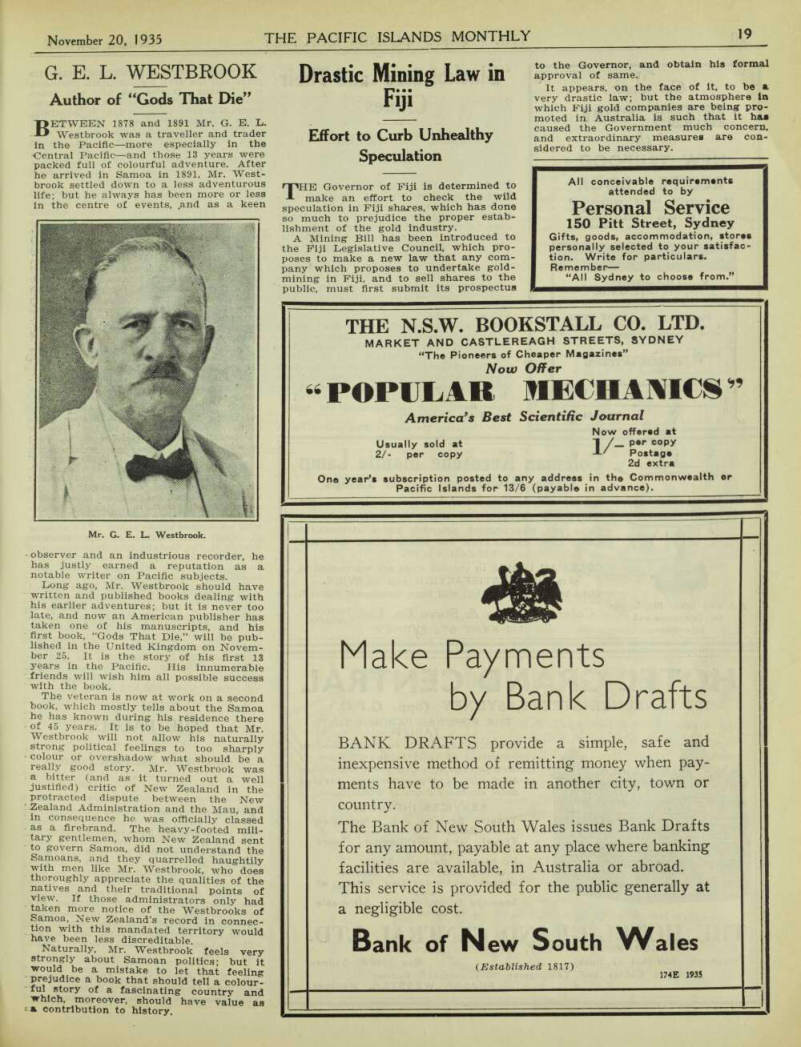
Author of “Gods That Die”
Between ms and 1891 Mr. g. e. l.
Westbrook was a traveller and trader In the Pacific —more especially in the Gentral Pacific —and those 13 years were packed full of colourful adventure. After he arrived in Samoa in 1891, Mr. West brook settled down to a less adventurous life; but he always has been more or less in the centre of events, .and as a keen
observer and an industrious recorder, he has justly earned a reputation as a notable writer on Pacific subjects.
Long ago, Mr. Westbrook should have written and published books dealing with his earlier adventures; but it is never too late, and now an American publisher has taken one of his manuscripts, and his first book, “Gods That Die,” will be pub lished in the United Kingdom on Novem ber 25. It is the story of his first 13 years in the Pacific. His innumerable friends will wish him all possible success with the book.
The veteran is now at work on a second book, which mostly tells about the Samoa he has known during his residence there of 45 years. It is to be hoped that Mr.
Westbrook will not allow his naturally strong political feelings to too sharply colour or overshadow what should be a really good story. Mr. Westbrook was a bitter (and as it turned out a well justified) critic of New Zealand in the protracted dispute between the New Zealand Administration and the Mau, and in consequence he was officially classed as a firebrand. The heavy-footed mili tary gentlemen, whom New Zealand sent to govern Samoa, did not understand the Samoans, and they quarrelled haughtily with men like Mr. Westbrook, who does thoroughly appreciate the qualities of the natives and their traditional points of view. If those administrators only had taken more notice of the Westbrooks of Samoa, New Zealand’s record in connec tion with this mandated territory would have been less discreditable.
Naturally, Mr. Westbrook feels very strongly about Samoan politics; but it would be a mistake to let that feeling prejudice a book that should tell a colour ful story of a fa scinating country and which, moreover, should have value as a contribution to history.
Mr. G. E. L. Westbrook.
Drastic Mining Law in Fiji Effort
Fiji Effort to Curb Unhealthy Speculation
THE Governor of Fiji is determined to make an effort to check the wild speculation in Fiji shares, which has done so much to prejudice the proper estab lishment of the gold industry.
A Mining Bill has been introduced to the Fiji Legislative Council, which pro poses to make a new law that any com pany which proposes to undertake gold mining in Fiji, and to sell shares to the public, must first submit its prospectus
to the Governor, and obtain his formal approval of same.
It appears, on the face of it, to be a very drastic law; but the atmosphere In which Fiji gold companies are being pro moted in Australia is such that it has caused the Government much concern, and extraordinary measures are con sidered to be necessary.
Advertisements & other items, pp. 21-22 (1 item)
Make Payments
All conceivable requirements attended to by
Personal Service
150 Pitt Street, Sydney
Gifts, goods, accommodation, stores personally selected to your satisfaction. Write for particulars.
Remember — “All Sydney to choose from."
THE N.S.W. BOOKSTALL CO, LTD.
MARKET AND CASTLEREAGH STREETS, SYDNEY
“The Pioneers of Cheaper Magazines”
Now Offer
« POPULAR MECIIA\I(S ”
America’s Best Scientific Journal
Now offered at Usually sold at 1 /_ P*«* copy 2/- per copy A/ Postage 2d extra One year's subscription posted to any address in the Commonwealth or Pacific Islands for 13/6 (payable in advance).
Make Payments
by Bank Drafts
BANK DRAFTS provide a simple, safe and inexpensive method of remitting money when payments have to be made in another city, town or country.
The Bank of New South Wales issues Bank Drafts for any amount, payable at any place where banking facilities are available, in Australia or abroad.
This service is provided for the public generally at a negligible cost.
Bank of New South Wales
(Established 1817) 174 E 1935
Get your
COPT
the
NEW TRUFOOD
RECIPE BOOK
99 specially tested recipes—aU kinds of new ideas for attractive things to cook cakes, pastry, paddings, costards, desserts, savouries, sauces, etc.
POST THIS COUPON TODAY
‘ Recipe Department ” c/- Box 4267 Y. G.P.0..
Sydney. of Please send me POST a copy of The Trufood of 69 Tempting Recipes N
(BLOCK LETTERS)
Address
MJ4J4
'T\ Ask your Island Storekeeper for Catalogues and Information
Coleman Kerosene Mantle Lamp
These Newer and Better Lamps
are big with brilliance and beauty and design yet economical to burn and strong in construction.
Fitted with PARCHMENT SHADES, ROTO AUTOMATIC
LONG LIFE GENERATOR and positive FUEL AND AIR
RELEASE VALVE.
COLEMAN LAMPS in various sizes are warranted to give fullest SATISFACTION and SERVICE.
They burn Kerosene, but will burn Benzine if desired.
Coleman Lamp & Stove Co. Ltd. J?Js?da°’
500 KENT ST., SYDNEY
HOTEL GRAND CENTRAL
151 CLARENCE STREET, SYDNEY (opp. G.P.0.)
m
THE POPULAR "ROOM-ONLY”
TARIFF
is specially designed to meet modem requirements of business and pleasure. It enables patrons to enjoy every advantage of hotel life, at the same time keeping hotel expenses down to a minimum.
SERVICES INCLUDE:
Theatre Booking and Information Bureau.
Travel and Sightseeing Tours arranged.
Up-to-date Barber's Shop.
Cleaning and Pressing Service.
Garage accommodation nearby at usual rates.
Spacious Dining Room. All meals a la carte.
THE HOTEL GRAND CENTRAL LTD.
151 CLARENCE STREET, SYDNEY (opp. G.P.0.)
Telephone: BW 1531 (3 lines) Box 716 FF, Sydney Radio Cables and Telegrams; “Grancentral,” Sydney
FRASER WEBSTER, Manager.
“Blackbirders” and Their
Crimes Valuable Contribution To History
IT is estimated that, during the “black birding” period in the South Seas— from 1855 to 1904, a matter of 50 years— about 100,000 natives of the Pacific Islands were taken from their homes and carried off to work on plantations in Australia, Fiji and South America. The majority of them never returned.
The horrible story is told by that very competent historian, Mr. Thomas Dun babin (editor of Sydney Sun), in a new book, “Slavers of the South Seas.” The following is from the Melbourne Herald’s review.
The first Kanaka labourers were brought to Australia in 1847 by Benjamin Boyd, of Twofold Bay, to act as shepherds. The experiment was a failure and the trade languished until the outbreak of the Civil War in America, which, because of the Northern blockade, put a premium on cotton. Many plantations were started in Queensland, and the demand for native labour grew steadily.
By the time the short-lived cotton boom
had passed, sugar-growing had taken place and the need for labourers increased still further. During the fifty odd years that the “trade” ran its infamous course, 60,000 Kanakas were brought to Australia, alone. Thousands of others were shipped to Fiji, and hundreds, captured by Peru vian slavers, died jn the guano islands off the coast of South America. The Queensland slave-trade alone almost de populated whole islands in the New Hebrides and Solomon groups.
Ever since white men sailed in Southern waters, there had been a certain amount of blackbirding—chiefly of native women, by sealers and whalers. But it was not until the convict system (virtually a slave system) ended and the sugar plantations in the north put a premium on cheap labour, that the trade reached its heyday.
It attracted the scum of the earth, men so devoid of morality and humanity that they more than challenge comparison with their African compeers. Many of them were arrested, tried and sentenced to terms of imprisonment for their brutali ties, but many escaped sentence on legal technicalities, thanks to the efforts of in terested parties, although the conscience of the Colony as a whole was opposed to the trade.
In the early days, while the black birders had the advantage of firearms over spears and arrows, the odds were in their favour. Later on, as the natives became possessed of guns, things became more even. The Melanesians of the Western Pacific, the best material for slaves, were no easy victims.
“These savages fought back fiercely,” writes Mr. Dunbabin. “The sandal wooders of an earlier day had bought their scented wood with blood, and the blackbirders lost boat’s crew after boat’s crew in their voyages. Many a black birding vessel was cut off by islanders, who massacred all on board. The number of white men killed in the Western islands in the blackbirding days runs into hundreds. Many of them deserved their death; some, like Bishop Patteson, died to expiate the sins of others.”
Pieced together from stray bits gathered from official reports, stories in old news papers, the writings of naval officers, of missionaries and traders, the book is not only a tribute to the author’s industry, but also to the skill with which he has woven a complete picture from such scat tered material, it is far above the average novel in intensity of its interest, drama, and tales of courage and endurance in the face of treachery and death.
The Palolo
Feasting in Samoan Islands
From Our Own Correspondent APIA, October 27.
THE palolo—the mystery creature of the coral reefs —appeared as usual this year, strictly according- to schedule, on October 19. The native Samoans were all ready and waiting for their favourite delicacy and, when the moon indicated that the moment' had come, the natives went to the reefs and gathered large quantities of the marine worm, and there was much feasting. The occasion was not confined to the Samoans—many Europeans appreciate this delicacy of the South Seas, and palolo, for a day or two, appeared on many formal tables in Upolu and Savaii.
Mr. A. H. Gauld, Burns, Philp and Co.’s plantation inspector, was a passenger for New Guinea by the October Montoro.
Cakabau Memorial Church At Bau, Fiji
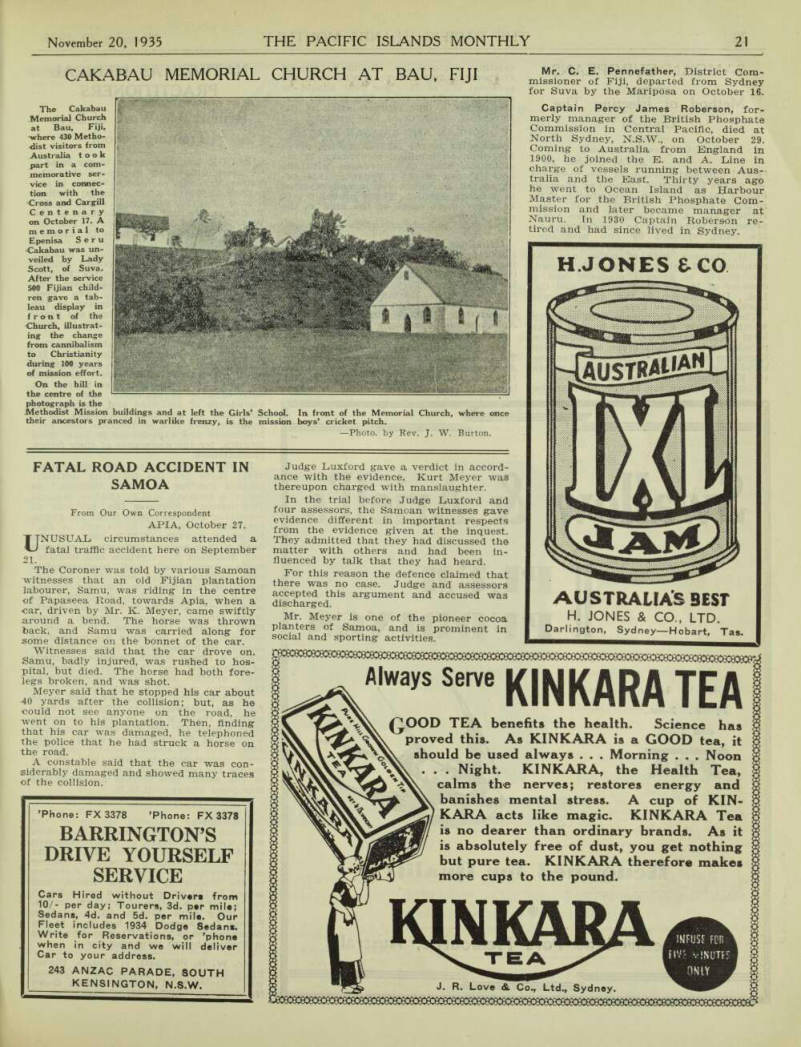
The Cakabau Memorial Church at Bau, Fiji, where 40 Metho dist visitors from Australia took part in a com memorative ser vice in connec tion with the Cross and Cargill Centenary on October 17. A memorial to
Epenisa Seru
Cakabau was un veiled by Lady Scott, of Suva.
After the service 500 Fijian child ren gave a tab leau display in front of the Church, illustrat ing the change from cannibalism to Christianity during 100 years of mission effort.
On the hill in the centre of the photograph is the
Methodist Mission buildings and at left the Girls' School. In front of the Memorial Church, where once their ancestors pranced in warlike frenzy, is the mission boys’ cricket pitch.
Photo, by Rev. J. W. Burton.
Samoa
Fatal Road Accident In
From Our Own Correspondent APIA, October 27.
UNUSUAL circumstances attended a fatal traffic accident here on September 21.
The Coroner was told by various Samoan witnesses that an old Fijian plantation labourer, Samu, was riding in the centre of Papaseea Road, towards Apia, when a car, driven by Mr. K. Meyer, came swiftly around a bend. The horse was thrown back, and Samu was carried along for some distance on the bonnet of the car.
Witnesses said that the car drove on.
Samu, badly injured, was rushed to hos pital, but died. The horse had both fore legs broken, and was shot.
Meyer said that he stopped his car about 40 yards after the collision; but, as he could not see anyone on the road, he went on to his plantation. Then, finding that his car was damaged, he telephoned the police that he had struck a horse on the road, A constable said that the car was con siderably damaged and showed many traces of the collision.
Judge Luxford gave a verdict in accord ance with the evidence. Kurt Meyer was thereupon charged with manslaughter.
In the trial before Judge Luxford and four assessors, the Samoan witnesses gave evidence different in important respects from the evidence given at the inquest.
They admitted that they had discussed the matter with others and had been in fluenced by talk that they had heard.
For this reason the defence claimed that there was no case. Judge and assessors accepted this argument and accused was discharged.
Mr. Meyer is one of the pioneer cocoa planters of Samoa, and is prominent in social and sporting activities.
Mr. C. E. Pennefather, District Com missioner of Fiji, departed from Sydney for Suva by the Mariposa on October 16.
Captain Percy James Roberson, for merly manager of the British Phosphate Commission in Central Pacific, died at North Sydney, N.S.W., on October 29.
Coming to Australia from England in 1900, he joined the E. and A, Line in charge of vessels running between Aus tralia and the East. Thirty years ago he went to Ocean Island as Harbour Master for the British Phosphate Com mission and later became manager at Nauru. In 1930 Captain Roberson re tired and had since lived in Sydney.
Advertisements & other items, p. 23 (1 item)
K(N£A£A
H.JONES e-co c
AUSTRAL
AUSTRALIA’S BEST
H. JONES & CO., LTD.
Darlington, Sydney—Hobart, Tas.
Always Serve K NKARATEA
Q.OOD TEA benefits the health. Science has proved this. As KINKARA is a GOOD tea, it should be used always . . . Morning . . . Noon .. . Night. KINKARA, the Health Tea, calms the nerves; restores energy and banishes mental stress. A cup of KIN- KARA acts like magic. KINKARA Tea is no dearer than ordinary brands. As it is absolutely free of dust, you get nothing but pure tea. KINKARA therefore makes more cups to the pound.
K(N£A£A
J. R. Love & Co., Ltd., Sydney.
'Phone: FX 3378 'Phone: FX 3378
BARRINGTON’S
DRIVE YOURSELF
SERVICE
Cars Hired without Drivers from 10/- per day; Tourers, 3d. per mils; Sedans, 4d. and sd. per mile. Our Fleet includes 1934 Dodge Sedans.
Write for Reservations, or 'phone when in city and we will deliver Car to your address.
243 ANZAC PARADE, SOUTH
KENSINGTON, N.S.W.
Samoan Europeans
Method of Electing The Council
From Our Own Correspondent APIA, October 26.
THE triennial election of two members of the Legislative Council of Western Samoa takes place on November 1. The retiring members, Messrs. I. H. Car ruthers and A. R. Cobcroft, have again presented themselves as candidates and are being opposed by two new can didates, i.e., Mr. A. J. Smyth and Dr.
C. M. Dawson, both of whom are old residents and well and favourably known.
Mr. Smyth is general manager and a director of Messrs. O. F. Nelson and Co.
Ltd. Dr. Dawson is the only private medical practitioner here.
The voters are Europeans with property worth at least £2OO or an income of at least £2OO annually. The European population is officially given as 3,000 (600 European and 2,400 of European-Samoan blood) and there are 134 registered voters (84 Europeans and 50 of mixed blood).
Europeans here are of opinion that the
existing electoral law should be altered and every adult European who pays the personal tax of 25/- per year should be given the right to vote. The present sys tem is not a true representation of the European residents of the territory.
European And Samoan Status
According to the official gazette, seven part-Samoan families, comprising 29 in dividuals, have, in accordance with the new Samoan Status Ordinance, 1934, re linquished European status and reverted to Samoan status. There probably will be many more cases of the kind in the near future.
Mr. Higgs, inspector for the well-known Island firm of Carpenters, and Mr. Haw thorn, of the same firm, arrived in Apia in October by the Carrisso on their way from Rotuma Island. They continued the voy age to Suva by Matson liner from Pago Pago. Both gentlemen made many friends during their short stay in Apia, says our Apia correspondent.
Mr. Emil Oldekaver, an old resident of Tonga and Samoa, died on October 18, at Apia Hospital, aged 75, after a long illness.
He was a well-known trader in the Islands.
Training School
Natives As Medical
Practitioners
Remarkable Work of Suva Training School
SELDOM has there come to my hand a more interesting document than Native Medical Practitioner, which is the periodical journal of the Central Medical School of Suva, Fiji. It is edited by Dr, T. Clunie, Medical Superintendent of the- War Memorial Hospital, Suva, and D. C. M. MacPherson, who is Dr. assistant.
This journal must be quite unique; because, in it, there are articles written, in excellent English by native Fijians, Tongans, Samoans, Cook Islanders and Solomon Islanders, who have been trained in medicine and surgery at the Suva institution, and who now are prac tising among their own people in their several islands.
This is indeed a remarkable indication of what is happening in the Pacific Is lands. Here are men whose grandfathers or great-grandfathers were “untutored savages,” and they have been proved not only capable of acquiring the simpler knowledge of medicine and surgery, but also able to use that knowledge in a practical way and to describe their per formances and experiences in quite good English, for the assistance of their fellow practitioners.
In the journal before me (September,. 1935) there are the following articles: “Infant Feeding in Native Villages,” in which a Samoan N.M.P. (Native Medical Practitioner) discusses the problem or preparing suitable native foods for young children; “Dysentery Epidemics in Ra,” in which a Fijian N.M.P. tells how he dealt with a serious outbreak of sickness and describes how serums and disinfec tants were used and bacteriological examinations carried out; “A Few Ex periences,” in which a Solomon Islands N.M.P. discusses various conditions met with during his practice in the Short lands Group, Solomon Islands; “Four Skull Fracture Operations,” in which a Samoan N.M.P. describes his method of dealing with fractures; “Poison Fish,” in which a Fijian N.M.P, describes methods of treatment; and there are numerous other articles and notes contributed by the native medical practitioners.
No doubt the editors, who are noted for their enthusiasm in this work, have assisted the N.M.P’s. in the preparation of this material; but the articles indicate a standard of medical knowledge, tech nical skill and literary ability which is truly astonishing to those who do not realise the speed with which the natives of the South Sea Islands are acquiring European culture. —R.W.R.
The Roman Catholic Bishop of the Solomon Islands, the Rev. J. M. Aubin, who was consecrated by the Archbishop of Wellington, on October 20, at the Wellington Cathedral, arrived in Sydney on November 5. Prior to his elevation to the Bishopric, the new Bishop had served in the Solomons as a priest for 28 years. He is a native of Brittany, France.
Travelling with Bishop Aubin is Rev.
Father D. Coicaud, who has been in the Solomons for 20 years. They spent a week in Sydney before returning home.
Mr. W. N. Phillpott, of Messrs. Burns, Philp and Co. Ltd., Rabaul, New Guinea, was married in Australia to Miss Gwen Newbury on October 16.
Advertisements & other items, pp. 24-25 (2 items)
Swallow & ArielFs
i-ib., i-ib., lj-lb»., 2-lbs., and 3-lbs.
PLUM
PUDDINGS
Renowned for Quality Manufactured at Port Melbourne, Australia
Stromberg-Carlson
notiriCLTig
The Sensational NEW Range of
World-Wide w p "-‘ llu ‘“ K
Receivers
The Finest Radios Yet Built for City and Country Now ... for the first time in Radio History ...
GUARANTEED short-wave reception on a Dual-wave receiver! Clear, undistorted, RELIABLE entertainment in your own home . . from all parts of the world. In their new Dualwave models Stromberg-Carlson engineers have achieved the ultimate in tonal perfection, performance and cabinet* beauty.
The imposing Console cabinet stands 33 inches high, 35 inches wide, and is 88% HEAVIER than the ordinary cabinet— truly a magnificent “outsize” receiver.
In choosing a Stromberg-Carlson Dual-wave Receiver, you can be SURE of perfect reception . . . . genuine entertainment ... from all over the world.
Model 736. Here is a 7-valve Dual-wave Superheterodyne which has proved itself the foremost Dual-wave model on the radio market today. It incorporates every worthwhile modern device for the perfection of tone and reception. Designed to operate on 110 or 240 volts alternating current, it is the finest all-electric Dual-wave receiver ever offered for as low as 39 guineas.
Model 836 is an 8-valve Dual-wave Superheterodyne. Operating with equal efficiency on either Alternating or Direct Current (200-260 v.), this Receiver is easily the best of its kind available REGARDLESS of price. Here are some of the marvellous features that put this receiver in a value-class of its own.
Wide range reproduction from a whisper to concert hall volume.
Tone compensation. • Specially designed speaker. • Tone control. • Selectorlite dial revolutionises tuning. • New nonmicrophonic condenser. • Full automatic Volume Control. • In the new and strikingly designed cabinet ... 43 guineas.
Model 888—a battery operated Dual-wave receiver that brings in the foreign programmes on the same dial as local broadcasts. It features 8-valves (2 volt valves throughout) Automatic Volume Control New Selectorlite Dial special shelf to house all batteries—fuse lamp to protect filaments against faulty battery connection—extremely low battery consumption and many other features which make it the equal of the finest allelectric sets. Price 45 guineas Write to-day for the fullest details of these “miracle” receivers specifying voltage of currents available.
Prices F. 0.8. Sydney STROMBERG CARLSON (A/SIA) LTD., 72 William Street, Sydney.
Samoans are Cutting Copra
Better Prices
From Our Own Correspondent APIA, October 22.
THERE is an inclination here to bless the war in Abyssinia; for copra is rising, and is expected to go higher.
Glycerine, used in the manufacture of explosives, is a component of copra and therefore needed for the conduct of war.
Copra rose during the Great War to £43 per ton, resulting in unparalleled pros perity for copra-producing countries.
In expectation of higher prices, natives and Europeans alike are cutting large quantities of copra. Small buyers are
competing against the big firms, and native producers are benefiting by this keen competition. The weather is splen did for the cutting of copra, and all over the islands the natives are energetically at work.
A good cocoa crop is being picked and planters hope that, corresponding with the general upward movement of prices of raw materials, the cocoa price will also improve.
Prospects for bananas are also good, and the Inspector of Produce hopes to get full shipments of good-quality fruit during the coming months. Though the Inspector of Produce is an efficient and experienced official, banana shipments have not been delivered as smoothly as is desirable. Growers are urging the Administration to create an Advisory Board of European and native growers to advise and to work in conjunction with the Inspector and at the same time rep resent the interests of the producers.
Mr. and Mrs. J. L. Street arrived in Syd ney from Rabaul, New Guinea, by the Nankin on October 23. Mr. Street is Re gistrar-General of the Supreme Court in New Guinea, and during his absence Mr.
I. Shoobridge, of the Crown Law Office, will be Acting Registrar-General.
Day Dawn’s Financial
Troubles Proposal to Wind Up
JTAVING been unsuccessful in raising A additional capital, the directors of Day Dawn (New Guinea), Ltd;, propose that the company be wound up. The directors report that large sums are ow ing for machinery, stores, and carriage, and action has been taken against the company by several ®f the largest credi tors. The company owns plant and stores at the mine at Edie Creek, and creditors should eventually be paid in full. They believe that the company’s affairs would be controlled more efficiently by a liqui dator with authority to form a new com pany of, say. 40,000 shares' of 10/- each to purchase for £ 10,000 the assets of the ■ old company. The liquidator would then be able to discharge creditors’ claims and pay a small dividend to shareholders.
The new company, subject to arrange ments for the supply of power, could begin cyaniding the tailings dump, esti mated to contain 35,000 tons of assay value of 4dwt per ton gold, from which a profit of not less than £1 per ton would be expected. The mine has not been tested at depth, they add, and boring operations would be advisable.
The “Explanation”
Why Canberra Did Not Visit Rabaul
From Our Own Correspondent
Rabaul, Nov. 2.
IN the Australian newspapers recently the Minister for Defence made the follow ing statement from Canberra, explaining, in part, the reason for the flagship Can berra not visiting Rabaul, as originally intended when the Fleet departed on the Spring cruise in August: “Both the Canberra and the Sussex,” said the Minister, “had been sent to Dar win instead of Rabaul as previously planned, partly because of a shortage of meat and other food supplies at Rabaul, as a result of a recent interruption of ship ping services. The residents of Rabaul had protested to the Minister for External Affairs (Sir George Pearce), who visited the Territory recently, against the pro posed naval visit, because it would re quire all the available refrigerator space and deprive local people of supplies."
Considerable indignation is felt by a number of local residents at the fore going remarks of Mr. Parkhill, more es pecially in view of the fact that it is a statement quite contrary to truth. No representation whatsoever was made to Sir George Pearce during his visit regard ing this matter, for the simple reason that there was no occasion for such a request to be made, or any fear of a shortage of supplies. Ample provision had been made by the shipping company to meet the added requirements of the naval unit.
For several years, Rabaul residents have anxiously awaited a visit from an Aus tralian warship; especially as during the last few years war vessels from Germany, Japan and France have paid official visits to the port. The last call made by an Australian warship was in 1930.
Advertisements & other items, p. 26 (1 item)
Leica
COLLAROY BEACH
FOR YOUR HOLIDAYS
Surfing, Golfing, Fishing, Boating Ten miles from Sydney
FULLY FURNISHED COTTAGES
Properties for sale. For particulars: Cedric Field P.O. Box 2, Collaroy Beach, N.S..W.
For Speedy, Accurate and
Versatile Photography . . . there’s nothing like the
LEICA
Camera
(MODEL $)
HERE ARE THE REASONS WHY
1. BUILT-IN SHORT BASE RANGE
FINDER gives you perfect focus automatically.
2. FOCAL PLANE SHUTTER with
the greatest range of shutter speeds on any camera—l second, i, i, I, in addition to all regular speeds between l/20th and 1/Booth second.
3. ELEVEN INTERCHANGEABLE
LENSES, including telephoto, speed, wide angle lenses, and others. 4.-36 PICTURES from a single roll of cinema film. Sharp negatives.
Enlargements up to any size.
S—SMALL. COMPACT, FITS THE
POCKET, easy and fast to operate. Very inexpensive to maintain.
6.—DOUBLE EXPOSURES are im-
possible.
LEICA SERVICE . . . Why not take advantage of it?
We SPECIALIZE in the development, printing, and enlarging of miniature negatives, and INDIVIDUAL ATTENTION is given to every order. There is absolutely NO mass production. We have the BEST POSSIBLE EQUIP- MENT and our experts have at their disposal, an up-to-date Research Dept.
Miniature negatives having a superior detail and gtain quality, require special attention to obtain perfect enlargements, and this expert attention we are able to give. SKILLED TECHNICIANS will help you overcome any difficulties you may be experiencing, by giving suitable advice, either personally or through our MAIL DEPT. Inquiries will be given prompt attention.
Write NOW, for further particulars to
LEICA PHOTO SERVICE
KYLE HOUSE, 31 MACQUARIE PLACE, SYDNEY
(The only Leica Specialists in Australia)
LEICA SALES COLOURING
ENLARGING REPRODUCING
DEVELOPING CAMERA REPAIRS
PRINTING FILM SUPPLIES
A Plea for Better Regulation of Mission
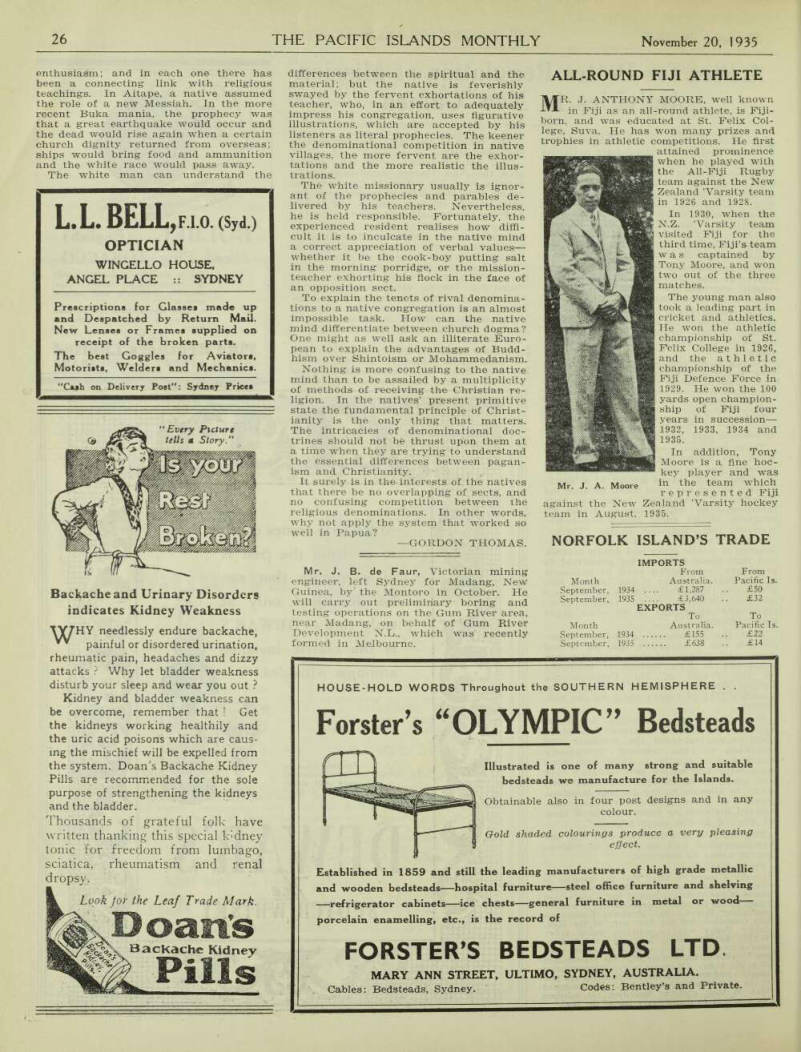
Activities in New Guinea
ON several occasions the suggestion has been made, when missionary activities have caused denominational friction in outlying districts of New Guinea, that each missionary denomination be allotted a separate sphere of activity in which to carry on its work. This would obviate the “‘overlapping” which causes such keen competition among native mission teachers —to an extent, sometimes, that embarrassing situations are created for the Europeans in charge.
The system was introduced in Papua years ago, and operated most successfully —until one sect disregarded the restric tions in certain areas.
The reason given in official circles for the non-introduction of the system in New Guinea is the “freedom of conscience” clause in the Terms of Mandate, which reads: Subject to the provisions of any local law for the maintenance of public order and public morals, the mandatory shall ensure in the Terri tory freedom of conscience and the free exercise of all forms of worship, and shall allow all missionaries, nationals of any State Member of the League of Nations, to enter into, travel and reside in the Territory for the purpose of prosecuting their calling.
There has been more than one occasion when the unchecked activities of mis sionaries has resulted in breaches of pub lic order; and yet no action of a disci plinary nature has been taken because the “freedom of conscience” bogey has been interpreted by officialdom as giving all religious bodies carte blanche—notwith standing the stipulation in the “Terms” that the “freedom” is subject to the main tenance of public order and public morals, and that those missionaries permitted to prosecute their calling shall be nationals of any State Member of the League. Ex actly how this affects nationals who are not State Members of the League—Ger mans and Americans to wit—has never been indicated.
That the Permanent Mandates Com mission has a suspicion that all is not quite well where mission activities are concerned in New Guinea is indicated by the report of the Commission’s Twenty-Seventh Session, when New Guinea’s 1933-34 report came up for dis cussion.
M. Palacios was anxious to know whether the Administration “exercised effective control over the methods and activities of the various missionary societies, particularly in their first con tacts with the native populations.” He also asked “whether any steps had been taken to allocate to the various missions spheres of activity in the recently dis covered districts or elsewhere, or if they all worked in the same regions.”
The reply to this question was that the Administration had no policy of alloca tion of areas to missions.
Finally M. Orts thought it useful to recall that the question of the interpretation of the “freedom of conscience” clause in the various mandates had already been raised by the accredited representatives of another mandatory Power. The Mandates Commission had concluded that the first duty of the Man datory Power was to maintain public order.
Within that framework, it should maintain free dom of conscience, but freedom of conscience must not be allowed to interfere with the maintenance of public order. Of course, every administration should avoid any act prejudicial to any given sect or to evangelisation in general. He presumed that, in their economic activities, the missions were subject to the ordinary law of the land.
The reply to the last question was in the affirmative.
This announcement by M. Orts should give the New Guinea Administration a definite lead for action in the event of future incidents arising, where sectarian enthusiasm creates unrest or open violence among native people.
Any government is naturally averse to censuring any particular denomination lest, it be thought partial in its religious views. But the “freedom of conscience” clause has allowed the Administration to deftly avoid action where action has been called for. In all other matters native welfare has been a paramount considera tion. There is no reason now why the Administration should not take steps to prevent religious confusion among primi tive natives.
Reports have repeatedly been received of “fanaticism” amongst natives. Aitape, Morobe, Buka and Namatanai districts have all suffered from waves of mistaken
enthusiasm; and in each one there has been a connecting link with religious teachings. In Aitape, a native assumed the role of a new Messiah. In the more recent Buka mania, the prophecy was that a great earthquake would occur and the dead would rise again when a certain church dignity returned from overseas; ships would bring food and ammunition and the white race would pass away.
The white man can understand the
differences between the spiritual and the material: but the native is feverishly swayed by the fervent exhortations of his teacher, who, in an effort to adequately impress his congregation, uses figurative illustrations, which are accepted by his listeners as literal prophecies. The keener the denominational competition in native villages, the more fervent are the exhor tations and the more realistic the illus trations.
The white missionary usually is ignor ant of the prophecies and parables de livered by his teachers. Nevertheless, he is held responsible. Fortunately, the experienced resident realises how diffi cult it is to inculcate in the native mind a correct appreciation of verbal values — whether it be the cook-boy putting salt in the morning porridge, or the mission teacher exhorting his flock in the face of an opposition sect.
To explain the tenets of rival denomina tions to a native congregation is an almost impossible task. How can the native mind differentiate between church dogma?
One might as well ask an illiterate Euro pean to explain the advantages of Budd hism over Shintoism or Mohammedanism.
Nothing is more confusing to the native mind than to be assailed by a multiplicity of methods of receiving the Christian re ligion. In the natives’ present primitive state the fundamental principle of Christ ianity is the only thing that matters.
The intricacies of denominational doc trines should not be thrust upon them at a time when they are trying to understand the essential differences between pagan ism and Christianity.
It surely is in the interests of the natives that there be no overlapping of sects, and no confusing competition between the religious denominations. In other words, why not apply the system that worked so well in Papua?
Gordon Thomas.
Mr. J. B. de Faur, Victorian mining engineer, left Sydney for Madang, New Guinea, by the Montoro in October. He will carry out preliminary boring and testing operations on the Gum River area, near Madang, on behalf of Gum River Development N.D., which was recently formed in Melbourne.
Advertisements & other items, pp. 27-28 (1 item)
Dewars
BOLBEC (English)
Sliced Plug TOBACCO
I T is specially packed in handy hermetically sealed tins, assuring freshness and natural aroma.
A really fine tobacco for the man who wants something different.
Price 3/3
(2oz. Tin) '
Pike Brothers Limited
QUEEN STREET BRISBANE
Much that comes down to us from the past is of a quality that can be described 01
truly rare
is the classic ir amongst whiskie
DEWARS
-)/ 7/te
SCOTCH WHISKY
Venetian Glass in Mur ano Museum . green with detail in cream <Sc gold K 8998
LL BELL,F I O (Syd.)
OPTICIAN
WINGELLO HOUSE.
ANGEL PLACE :: SYDNEY
Prescriptions for Glasses made up and Despatched by Return Mail.
New Lenses or Frames supplied on receipt of the broken parts.
The best Goggles for Aviators, Motorists, Welders and Mechanics.
"Cash on Delivery Post": Sydney Prices
'Every Picture tells a Story/’
Backache and Urinary Disorders indicates Kidney Weakness "\Y7HY needlessly endure backache, ’ * painful or disordered urination, rheumatic pain, headaches and dizzy attacks ? Why let bladder weakness disturb your sleep and wear you out ?
Kidney and bladder weakness can be overcome, remember that ! Get the kidneys working healthily and the uric acid poisons which are causing the mischief will be expelled from the system. Doan’s Backache Kidney Pills are recommended for the sole purpose of strengthening the kidneys and the bladder.
Thousands of grateful folk have
written thanking this special k-dney
tonic for freedom from lumbago, sciatica, rheumatism and renal
dropsy.
Backache Kidney
All-Round Fiji Athlete
MR. J. ANTHONY MOORE, well known in Fiji as an all-round athlete, is Fiji born, and was educated at St. Felix Col lege, Suva. He has won many prizes and trophies in athletic competitions. He first
attained prominence when he played with the All-Fiji Rugby team against the New Zealand ’Varsity team in 1926 and 1928.
In 1930, when the N.Z. ’Varsity team visited Fiji for the third time, Fiji’s team was captained by Tony Moore, and won two out of the three matches.
The young man also took a leading part in cricket and athletics.
He won the athletic championship of St.
Felix College in 1926, and the athletic championship of the Fiji Defence Force in 1929. He won the 100 yards open champion ship of Fiji four years in succession— -1932, 1933, 1934 and 1935.
In addition, Tony Moore is a fine hoc key player and was in the team which represented Fiji
against the New Zealand ’Varsity hockey team in August, 1935.
Mr. J. A. Moore
Norfolk Island’S Trade
Imports
From From Month Australia. Pacific Is.
September, 1934 ... £1,287 .. £50 September, 1935 ... £3,640 .. £32
Exports
To To Month Australia. Pacific Is.
September, 1934 £155 .. £22 September, 1935 £638 .. £14
Advertisements & other items, p. 28 (1 item)
Forster’s “OLYMPIC” Bedsteads
HOUSE-HOLD WORDS Throughout the SOUTHERN HEMISPHERE . .
Illustrated is one of many strong and suitable bedsteads we manufacture for the Islands.
Obtainable also in four post designs and in any colour.
Gold shaded colourings produce a very pleasing effect.
Established in 1859 and still the leading manufacturers of high grade metallic and wooden bedsteads—hospital furniture steel office furniture and shelving —refrigerator cabinets—ice chests—general furniture in metal or wood porcelain enamelling, etc., is the record of
FORSTER’S BEDSTEADS LTD
MARY ANN STREET, ULTIMO, SYDNEY, AUSTRALIA.
Cables: Bedsteads, Sydney. Codes: Bentley’s and Private.
New Aero Club
Association Hopes to Make Tahitians Air-minded
From Our Own Correspondent
Papeete, Oct. 6.
THE statutes of a new organisation, to be known as the “Aero Club de Tahiti,” were recently made public in the Journal Officiel of the Colony, and are cre ating a considerable amount of local in terest.
The objects of the Association, which is under the honorary presidency of His Excellency, the Governor, are, among others, to encourage the development of aviation in French Oceania, and the in struction of the Tahitian population in the technique and practice of flying. This it is proposed to bring about by the pro motion of various forms of aerial travel, the training of Tahitian pilots, instruc tion and drill for military schools, and the general diffusion among the public—par ticularly the younger generation of Ta hitians —of the idea of travel by means of aeroplanes.
As a means towards the desired end a technical library is to be created, and a school for mechanics and aerial construc tion established, ’Planes will be at the disposal of members who wish to under take a course of practical training in the art of flying, and in radio telegraphy and weather observation. Articles 30 to 32 of the statutes provide for a general Go vernment supervision of the association’s activities, while regulations prepared by the Council of Administration are subject to the approbation of the Air Ministry and of the “Federation Aeronautique de France.”
On the list of foundation members are the names of Mr. Geo. Bambridge, (Mayor of Papeete), Lieutenant J. Guichard (who distinguished himself as a pilot during the War, and has been the main instigator in the formation of the new Association), Messrs. Hall and Nordhoff (whose flying record in the celebrated Escadrille La fayette is well known), Monsieur Ques not (President of the Papeete Chamber of Commerce), and many other local nota bilities.
Undoubtedly, there is a future for air. travel among the scattered archipelagoes comprising the Colony of French Oceania, where nearly every island has either an interior or exterior lagoon of sheltered water —some of enormous size. No doubt the ambitious programme laid down by the founders of the “Aero Club de Tahiti” will take a long time to reach fruition, chiefly for economic reasons, but it is ex pected that steady progress will be made.
The first ’plane has already been con structed, and will no doubt take the air as soon as its engine arrives.
Hon. A. Jewell, non-official member of the Executive and Legislative Councils of Papua, returned to Port Moresby from Sydney by the October Macdhui, after a seven months’ visit to Great Britain.
Mandated Islands?
Defensive Works In
THERE are three groups of Pacific Islands held under the Mandate sys tem —i.e., New Guinea, by Australia; Western Samoa, by New Zealand; and the Carolines and Marshall Islands, by Japan—and the question has been raised at Geneva as to where their legitimate activities under the Mandates cease, and colonising activities commence.
The Norwegian delegate to the League of Nations, Dr. Lange, declared at Geneva on September 18 that the Mandated lands were simply camouflaged colonies; and he gave as an instance the activities of the Japanese in the Marshalls and Caro lines. Dr. Lange said that certain har bour works and other constructions pro ceeding in the Marshalls and Carolines
were a disguised form of fortification, designed for the use of the Japanese fleet. Japan’s contention that they were intended for civil and commercial pur poses was unconvincing, because the large sums involved were not justified by civil requirements.
A statement issued by the Japanese Foreign Office in Tokyo on September 19 reiterated that the purpose of the works in the Mandated islands was purely economic, and suspicions expressed at Geneva were baseless.
The position is remarkable, because Japan has withdrawn from the League of Nations and apparently does not recog nise the wishes of that body; and she has stated, moreover, in the most explicit terms, that she will in no circumstances give up the Marshall and Caroline Islands, which she now holds nominally under a League of Nations mandate.
Advertisements & other items, pp. 29-30 (2 items)
B.P. Magazine
Head Study of Champion Walvon Admiration, Challenge Winner, Sydney Royal, 1934
The Noted Walvon KenneU
Premier Breeders of Scottish Terriers, Sealyhams, and Wire-haired Fox Terriers.
Puppies available all the year round. Orders direct to Walvon Kennels, 1 Merlin St., Nth.
Sydney, or through Burns Pbilp St Coy. Ltd., or Mcllraths, Ltd.
DOYLE’S famous VETERINARY REMEDIES
REDUCINE—Cures Year Lame Horse. Cures kina painlessly and you can work him all the time.
Cures Splints, Curbs, Capped Hocks, Sprung Tendons, Bog Spavins, and all Bony and Bursal Enlargements. Price, 12/6 per can. Postage, 1/-.
LARYNGINE.—A sure cure for Coughs, Colds, Strangles, etc. Price, 5/- per can. Postage, 1/-.
SKIN DRESSING,—A certain remedy for Mange and Allied Parasitic Skin Diseases in Horses, Dogs, etc. Price, 7/6 (large), 3/6 (small). Postage, 1/-.
DISTEMPER MIXTURE.—A safe and reliable remedy for Coughs, Colds, Asthma, etc. Price, 2/6. Postage, 9d.
T. G. DOYLE, v.s„ 9 KING STREET, RANDWICK, N.S.W.
Writ® for Free Veterinary Advice and Booklet bOYLBs m
ORES*
ON SALE AT ALL
READ THE
B.P. MAGAZINE
SPRING NUMBER
Now on Sale Short Stories Pictures Travel Articles Pages for the Children. Stage.
Latest Fashions Screen One Shilling per Copy
NEWS AGENTS AND BOOKSELLERS
PACIFIC TRADERS!
The Blade of Best Quality, and the Most Profitable to Handle, is: These blades are erf the three-holed (Gillette) type. I have made a careful test of all blades, over a lon* period, while I was trading at Milne Bay, Papua, and the British-made Jewel was far ahead of any other. I now have the Pacific agency for Jewel blades, and strongly recommend them Send P. 0.0. for trial gross, post free, 10/- (Australian) or 8/- (sterling). Reduction for quantities. Sample package, 2/6.
Iping, Midhurst, Sussex, England
O*KrSXFEfY.
-^RAZOR
to all traders.
HENRY DEXTER
Whether Times are Good or Bad, They Can be made Better by dealing with
McILRATH’S
THE SERVICE FOOD STORE
Rosa Full Cream Condensed Milk (4 doz.), 6/3 doz., 22/- case Mixed Crown Soap, wrapped 60’s and 72*s 26/- case Searchlight Phenyle, 5-gal. drums 10/6 drum Finest Roller Flour, 501 b 5/9 bag, 9/- tin St. George Lamb & Peas, 14oz. tins 1/2 J tin, 14/- doz.
Arnott’s Sao Biscuits, No. 2 tins 1/6 tin, 17/- doz.
Bulk Curry Powder, loose 1/- lb., 11/- doz. 0. 50/50 Cordial, 260 z. bots 1/6 bot., 17/6 doz.
Rosa Dripak Prunes, 71b. tins 4/3 tin, 48/- doz.
Hansen’s Fruit Junket Essence 7-Jd. bot., 7/- doz.
Rosa Jelly Crystals, pint pkts 4Jd. pkt., 4/- doz.
Arnott’s Plum Puddings, Boz, tins IOJd. tin, 10/3 doz. 1. Tomato Soup, 16oz. tins Bd. tin, 7/9 doz.
I.X.L. Spaghetti in Sauce, Boz. tins 6£d. tin, 6/- doz.
Selmore Fruit Saline, 16oz. tins 1/1 i tin, 13/- doz.
Special Vintage Invalid Port, 260 z. bots. . . 2/6 bot., 29/6 doz.
Dandy Starch, 14oz. cartons 7d. each, 6/9 doz.
Selmore Toilet Paper, soz. rolls 2d. each, 1/10 doz.
Yoga Tea, Finest Ceylon Blend, per lb. . . 1/11 pkt., 2/3 tin Prices f.o.b. Sydney
EXPORT PRICE LISTS AVAILABLE ON APPLICATION
McILRATH’S LTD.
Export Department, 202 Pitt Street, Sydney, Australia
GUNN e MOORE ltd
t n
for all Sports Goods
Write for interesting free Catalogues
to GUNN f/ MOORE LTD
CARRINGTON ST..
NOTTINGHAM ENG.
The Oldtrack In
Memories of New Guinea Gold field Prior to the Aeroplane Services
(Specially written for “Pacific Islands Monthly” hy M.G.) Part II TOWARDS the end of 1926, the Biengi tribe —Upper Bulolo—became trouble some. Picking off stragglers, they decapitated and disembowelled them, taking the bodies to eat. How long this had been going on before it was dis covered will never be known, but appar ently it was some time. Many miners commented on the number of “deserters” they lost on this stage, and attributed it to the fact that it was the last stage before Kaindi.
The discovery of the murders was an accident. A straggler, overtaken by dark ness, slept in the kunai alone. Rising
before dawn, he pushed ahead to rejoim his line. Arriving on a hilltop, he could see the track for miles ahead, and a line* of boys moving leisurely along, with the usual straggler in the rear. He then saw the kanakas creep up behind this boy and murder him.
The cat was out of the bag! The Government sent in a Patrol Officer who* arrested some natives which he hoped were the murderers. The Biengi then openly murdered two Government boys, to “pay back” for those arrested.
The trouble with the Biengi tribe was. ascribed to various causes. The two most persistent rumours at the time was that a miner had shot a native pig; and, another, that a mission teacher had a craving for European foods, especially rice and milk, and he incited the natives to do the killing, taking good care not to do the job himself.
Actually, the natives would not take much inciting. A fighting cannibal tribe, always at war with the Buangs, Kuku kukus or Kaiwa tribes, the advent of the whites had interfered with their chief excitement in life, and indentured natives were as good a food as any other. Then there were the packs to plunder.
Encounter With Bushmen
Going to the beach with a line of boys, and two other miners, we found our selves surrounded by these bow-and arrow men. Armed only with one shot gun between the three of us, we just stood there awaiting their next move.
Yelling something in unison, they laid their six feet bows on the ground. Leaving them there a moment or two, they shouted another guttural sentence; then, lifting their bows, they strung their arrows anc£ drew back the string to its full extent.
We expected a flight of arrows any mo ment; but, to our surprise, they again uttered the same sentence.
This performance continued for some considerable time. It was obvious they wished us to understand that if the prisoners held by the Government were released they would cease to be trouble some.
Having a brain wave, I placed my hands together in front of me as though manacled then pointed to Salamaua, and, bringing my hand around in a sweeping motion, I indicated their loved ones would be returned to them.
With a yell of understanding they raced away. I have since met a number of those kanakas who held us up, and we have laughed over the incident to gether.
Through Hostile Country
Returning from the beach that trip, I was unarmed. Not a firearm could I beg, borrow or steal. So, relying on over taking someone going my way who carried arms, I arrived within a day’s stage of the Biengi country. My boys were dis tinctly nervy and I half expected deser tions. , .
Many other boys were in this camp waiting until some white man came to escort them through the hostile country.
Fortunately, one boy had a .22 rifle, but he only had one cartridge. Lining up everyone in the camp —about ninety I told them if they wished to come with m© they would have to keep close together.
They needed no second telling. Not a boy allowed more than a short yard to separate him from the one in front, the whole day.
Carrying the pearifle, with its one cart ridge, at the rear, and putting my boss boy armed with an axe and knife, in front, we travelled those grass lands at record speed. The punitive expedition, in charge of Warden McLean, was already in the kunai; but, always having a clear
view, the kanakas kept just out of effec tive rifle shot.
As we walked down the long spur past Kabul Village we could see the Warden’s party, on our right, and the kanakas, who were shouting defiance, on the left, Later, the Warden’s party succeeded in .surrounding the kanakas, at night, and a fight ensued, some kanakas being killed. night, we slept at House Bamboo on the bank of the Bulolo River, with a well armed party, who were going in the •opposite direction. The boys asked us to post a guard and, armed with rifles, they paced solemnly up and down all night.
I was awakened several times when they were relieving sentries. Otherwise we were not disturbed.
Fly in from Salamaua to Wau, now, in .35-45 minutes, and you will wonder why all this fuss about the old track in. The magic of the aeroplane has you—its an nihilation of space and distance, and the •dwarfing of earth-bound things, delude you into thinking the distances are not so very great, the mountains not so very high, the ground not so very rough or rocky.
The Early Stages
The track in was not “as the crow flies.” Who cut the first track? No one.
It was made by the bare feet of the stone-age hunters and raiders. For strategic reasons these kanakas wherever possible had their tracks along the highest ridges and spurs; thus many a mountain was climbed that could have "been avoided. Naturally, the early pros pectors followed these tracks and we of the rush, in turn, followed them.
Leaving Salamaua, the very start was tiring—tramping through the soft beach sand to Logua. Here, there was usually delay; either the kanakas would not come and collect you with their canoes (Major Skeets rectified this later) or the xiver was in flood, which meant returning to Salamaua. After crossing the Frisco, ■one passed through flat, swampy, leech infested country, then climbed Komiatum.
This mountain, about 1,500 ft., was bereft of all shade or water, and the sun beat down unmercifully on one’s back in the -afternoon. If it was raining, the red vol canic clay gave no foothold.
After spending the night at Komiatum one started again by climbing some hun dreds of feet, then descended a steep, greasy track to House Sac-sac No. 1 for the mid-day halt. The afternoon was spent following a stream, Bugap Creek, crossing and re-crossing, now along the bed and now along the bank. This was •a very beautiful little valley. Various exotic flowers bloomed in profusion and bright-plumaged birds seemed more in abundance than elsewhere in T.N.G.
The night was spent at House Sac-sac No. 2. On the* third day, one turned up the Bitoi Valley, crossing many big tribu taries, any of which caused a hold-up if in flood. Crossing the Bitoi River by way cf the well-known Bridge Kunda—popu lar only with equilibrists and would-be Blondins—the afternoon was spent zig zagging up Waipali, a dreadful 4,000 ft. bump in the country, without shade. One passed the night in a very poor sort of a village, to which water had to be carried for some considerable distance, and no native foods were available.
Terrible Gagagadu
Along razor-backs, to Wibaining, then a dreadful hand-over-hand climb down to the Bitoi River again, which one followed for a couple of miles. There was one spot, where the track skirted this river, that was particularly dangerous. It necessitated moving along crab-wise, hanging on by nitches cut in the cliff face, with the seething river thirty feet
below. The boys appropriately attached the sobriquet of “Black Bokis” (flying fox) to this spot. That afternoon’s climb was the worst on the whole of the track. Up, up, ever up, almost perpendicular the whole- way. Every hour you thought you saw the summit, and when you arrived it was only a short change of gradient that had deceived you, Gadagadu had seven of the false sum mits. On my first trip, I remember, my cook-boy, seeing the fourth false summit, felt sure it was the top and made an extra spurt; his disillusionment was so great that he sat and wept. Manfully plodding
on, he began to sway with exhaustion, and I had to hump his pack the last 1000 ft., arriving at Gadagadu more dead than alive.
Real mountain warriors were the Kia was. Every village was perched high on a mountain-top, clear of the bush.
Ascending Gadagadu Mountain, and look ing across the Bitoi Gorge, gardens— divided into plots by logs—could be seen on the precipitous bush-covered moun tainsides. To attend those gardens, the kanakas had to ascend and descend the enormous mountains. The reason was ob vious. They built their villages on the
kunai mountains for defence, but the grass country was not good gardening soil.
The “Big Six” (Darby, Levien, and the others) established relay stores at Gada gadu to utilize better the occasional lines of casual carriers they obtained from the beach villages.
The Moss Country
Leaving Gadagadu, the track passed into the high-altitude moss forest. Here
lichen grew ad. lib —every tree trunk and bough was moss or lichen covered. Leaf mould and moss covered the earth several feet deep, between the aerial roots of the trees. Walking became a nightmare—just stepping from one slippery, moss-covered root to another. It was necessary to place the foot cautiously so that the waist of the boot gripped the root; even so, falls were numerous. Rain seemed to fall con tinuously; or a thick, soaking mountain mist (actually clouds), enveloped one.
The whole forest was damp, dank, and eerily silent. No life was in evidence, ex cept our unhappy selves and our miser able carriers, who seemed too impressed, or depressed, to utter a word.
Up one mountain and down again, all day long. It took hands and feet to climb up; and, going down, the kneecaps felt as though they would split with the strain.
A stick was of little asistance as, once weight was placed on it, it sank through the moss and leafage, some distance be fore reaching the ground.
The stage camp at House Copper No. 1 was the highest on the road, over 7 8 000 ft. On our first trip we missed this camp and spent the night on the summit, 8,300 ft., sometimes called House Copper No. 2.
The boys spent most of the night posi tively howling with the cold; and, under a kuruka lean-to, my mate and I, wrap ping a blanket around our shoulders, sat and alternately blew on some rotten water-logged sticks, miscalled a fire. The rain poured down on us, the poor kuruka roofing only serving to divert it into streams instead of drops. It was one of the unhappiest nights of my life, not ex cluding the war.
From House Copper on to House Kuru ka (or Bairu Camp, as it is marked on some maps) the same thing: moss forests, aerial roots, constant falls, mountains, more mountains, rain, more rain. At one stretch, a creek bed was followed for three
hours —boulder-strewn, swift-flowing, and steep. To make things more interesting, there were several water-falls to climb, greasy, weather-worn bed-rock, a case of hang on by tooth and nail, whilst the Arctic waters filled ones’ shirt and trousers from above. House Kuruka was not a bad camp, although often referred to as “Flea Camp.” They certainly kept one busy.
Down To The Bulolo
The following day the descent of the range began in earnest. Jar —jar—jar!
Hang on or drop hundreds of feet, or slither on your seat until some tree or boulder brought you up with a bump.
Many times on the road, lop-sided legs would have been useful for negotiating the sidlings. Crawling around the side of steep mountains was often worse than climbing them. Descending the range also meant many ascents, going down perhaps 1,000 ft. and up 800 ft.
Far below House Kuruka was Quobaik River, which was followed for an hour, crossing and re-crossing. On my first trip, we were held up here by a flood, and, in a torrential downpour, we rigged our flys on the mountainside and found them hardly sufficient to crowd under. But, by lying closely side-by-side, we just fitted in. I picked my cook-boy as the less odorous to be my next floor neighbour, whilst my mate chose the boss-boy for his. During the night there must have been some re-shuffle, for I wakened with the foul smell of a very unwashed grillea covered carrier, who had somehow dis placed the reasonably clean cook-boy.
Up hill and down dale, then out once more into the open kunai. After days of rank tropical bush and dank mountain forests, the sight of the glorious Bulolo Valley from this vantage point was breath-taking. We sat and contemplated it for an hour, whilst our clothes dried in
the warm sunshine. So many of your readers have seen this beautiful valley that I need not describe it.
Past Rabul Village quite friendly-seem ing, then down kunai spurs—compara tively comfortable walking after the aerial roots of the range, and stones of the creek beds. Avery high log led across the Bulolo River. It swayed nauseatingly when traversed and I, for one, was always terrified of it. Later, kunda vines were strung across to act as hand rails.
After spending the night at House Bamboo, the seventh day was an easy stage. Along the flats of the Bulolo, over half a dozen creeks, past where Wau now stands, over the Crater and down to An derson’s Creek. This was a very good camp, and gave us our first sight of gold mining. Smart, Burke, and Anderson had worked this area out in 1925.
And Up To Edie Creek
The last day, up to Edie Creek, was a killer. The track, although always ascend ing, skirted around the mountain diagon ally. There always was rain or mist, and drip, drip, drip from the trees. There was no place for a mid-day spell. Logs to climb over or under, and landslides to negotiate. But “Mecca” was at the end, albeit cold and wet.
The stages I have mentioned here were altered when Dover’s Track came into use. House Sac-sac No. 2 to Waipali be came House Sac-sac No. 2 to Wibaining. to allow an earlier start on the dreadful Gadagadu climb. Many cut the House Kuruka to House Bamboo stage down to House Kuruka to House Kunai —on the edge of the grass lands above the Biengi villages—and from House Kunai they went through to Wau Creek.
Advertisements & other items, pp. 31-32 (1 item)
Rolls Razor
THE IDEAL GIFT
THE WORLDS BEST SAFETY
WHEN you give him a Rolls Razor you give him Shaving Comfort for life, and you have the satisfaction of knowing that your Gift is the best the World has to offer.
Illustrated Catalogue and Price List sent free on application.
Rolls Razor Co. of Australia Ltd.
8a CASTLEREAGH STREET SYDNEY, N.S.W.
‘OUR HANDS MAKE GOOD ARMS”
Firearm Repairs.
The wonderful Winchester standard of quality is maintained in their new models. 22. Single Shot Rifle, with 27 inch barrel, model 67 457- Ditto, model 68 55/- 22. Repeater, model 69 90/- 22. „ model 57 165/- 22. „ model 62 110/- 22 Automatic model 63 ... £9/10/- 22. „ model 61 150/- (Postage extra on above rifles) 22. Hornet, 250/3000 and 270 calibre, Repeaters, model 54, £l5/10/- Write for Catalogue. Gunsmith, Importer of High-grade Firearms and Fishing Tackle Specialist. 143 Elizabeth St., Sydney (near Market St.)
“FISHING TACKLE TO TACKLE FISHING”
SIL ROHLH £».
/P tA
km 1
CAPSTAN
NAVY CUT TOBACCO
nuule (ftcm ttu , Cfruit' " I i*• »
CAPSTAN
CIGARETTES
CORK-TIPPED
OR. PLA I N
* I
PST
II FEED for . . .
POULTRY
DAIRY COWS
HORSES and DOGS
We ship throughout the Islands our special feeds for all classes of stock.
These feeds offer stock owners the highest value for cost that is obtainable and can be depended upon to give the best results.
Write for free literature.
THORPES LTD.
Stock & Poultry Feed Manufacturers, 313-317 Sussex St. f Sydney
Highlights in the
Islands . . • The prolific Pacific Islands produce wonderful crops, flowers, trees, people, and
THIRSTS!
Then you are grateful for this drink that is a pal to your palate, and an ally of health
“Here’s To’ee”—
room: vs
PILSBNBR
IN THE BOTTLE WITH THE YELLOW LABEL
Fiji’S Eleventh Show
From Our Own Correspondent
Suva, Oct. 21.
IN fine weather, the Eleventh Annual Fiji Show was opened at Suva on October 15 by the Governor, Sir Murchison Fletcher, K.C.M.G., C.8.E., accompanied by Major Clive B. Joske, 0.8. E., M.C., Honorary A.D.C. Speaking briefly at the ceremony, His Excellency congratulated the Department of Agriculture on the high standard of the show. The Governor later spent some time inspecting the Colony’s resources displayed on the various exhibits.
Sir Maynard Hedstrom’s cup for district ex hibits was presented to Mr. B. L. Meek, on be half of Navuso-Davuilevu district. In the agricul tural section, the Government Department’s dis play attracted much attention, showing the manu facture of tobacco and cigars, copra and cotton growing, and the grading of fruit for export.
Fiji’s new gold industry was represented by ore samples from the Emperor mine and assaying apparatus exhibited by the Government Analyst.
The story of sugar cultivation in the group was illustrated by models and photographs on the Colonial Sugar Refining Co.’s stand.
Faure, Blattman & Co.
THE well-known London firm of Faure, Blatt man and Company, which has been prom inent for a long - time in the European vege table oil seeds market, has altered its name. In a recent circular to clients it was stated that the partnership between Henry M. F. Faure, Richard T. Blattman, James C. A. Faure, and Peter H.
Faure had been dissolved by mutual consent.
A new company styled H. M. F. Faure and Company has been formed under the direction cf Messrs H. M. F. Faure, J. C. A. Faure and -r. H. Faure. The latter firm will carry on busi ness m much the same manner as Faure, Blattman and Co., and will operate from the same address, viz., Cunard House, Leadenhall St., London, E.C.3.
Miss Ida C. Wench, who has served since 1909 with the Melanesian Mission at Guadalcanal, Solomon Islands, departed from Sydney for England on sick fur lough by the Orsova on November 9.
Papuan Planters’
Association
From Our Own Correspondent PORT MORESBY, October 16.
A PLANTERS’ Association has recently been formed in Papua to promote and protect the interests of the planters throughout the Territory.
It is understood that all party and local politics (except so far as they affect plant ing interests) are to be rigidly excluded.
The association has been formed solely for the purpose of furthering the planting in terests, and particular stress has been laid down that the association should be com posed only of members actively engaged in planting.
The hon. secretaries, Messrs. G. A. Lou don and R. Walshe advise that many planters have applied for membership in the Central Division and it is anticipated that a considerable number of applications will arrive shortly from the East—a busy centre of plantations.
Miss Mary Edwards, a well-known Australian artist, who spent some time in French Oceania several years ago, is at present painting the portrait of Crown Prince George Taufa’ahau, of Tonga, in her studio at Woollahra.
Advertisements & other items, p. 33 (1 item)
Aunt Marts
PURE RICE
STARCH
Always ask for . . .
“CORAL” Brand
100% PURE
CQRAL BRfINO
RICE STARCH
& Noted for its
QUALITY
and
WHITENESS
Goes Farthest and gives Lasting Finish
WILL NOT
STICK TO
IRON
Obtainable From Leading Island Stores Manufactured by Coral Starch Ltd.
Sydney, N.S.W.
WE ARE SPECIALISTS!
Let us have your confidence, sixty years is our record of supplying the Leading Houses throughout the World in—
FRESH FRUIT VEGETABLES PRODUCE
WEYMARK & SON LTD.
Fruit and Produce Merchants
14-18 STEAMMILL STREET, SYDNEY
Phones: MA 3612 Cable Address: Codes Bentleys. (4 lines) “Weymarlcson” Private.
AUNT MARTS
“Defiance”
Brand
Canned
Goods
PURE FOOD
PRODUCTS
—are prepared and packed by the proprietors of Aunt Mary’s Pure Food Products.
The finest quality goods are hermetically sealed to withstand tropical heat and give to consumers maximum satisfaction.
Supreme in quality and flavor, these pure food products have been supplied to the people of the Islands for more than thirty years. Specially manufactured and packed to meet Island conditions, they give complete satisfaction to both retailer and consumer.
Prepared and Packed only by—
TILLOCK & CO. LTD.
PURE FOOD MANUFACTURERS
KENT AND LIVERPOOL STREETS,
SYDNEY, N.S.W.
Guinea
Public Service Of New
THE following alterations in the staff of the New Guinea Public Service were published in the Administration’s Bulletin No. 43, issued at the end of September:—
Appointments And Promotions
Lloyd Pursehouse, Cadet, District Service Dept.; Herbert Spencer Roberts, Medical Officer, Health Dept.; Edith Lydia Shaw, Nurse, Health Dept.; Joslyn Elizabeth Bannister, Nurse, Health Dept.; Arthur Ernest Fry, Inspector of Mines and Machinery; Allan James Clarke, Mechanic and Linesman, Treasury Dept.; R. R. McLennan, pro moted to Clerk, District Services Dept.
Transfers
F. J. Jeffery, Inspector, Agriculture Dept., Slabaul to Kavieng; J. D. Marshall, Customs Clerk, Salamaua to Rabaul; K. W. Nettleship, Cus toms Clerk, Rabaul to Salamaua; E. A. Feldt, District Officer, Madang to Rabaul; J. W. Hodge kiss, Patrol Officer, Wewak to Ambunti; G. M.
Keogh, Patrol Officer, Rabaul to Salamaua; G.
Ellis, Assistant District Officer, Talesea to Rabaul; E. D. Robinson, Assistant District Officer, Wewak to Rabaul; H. E. Woodman, Assistant District Officer, Gasmata to Rabaul; R. B. McVil ley, Cadet, Otibanda to Wau; T. A. Hough, Cadet, Wau to Otibanda; C. D. Bates, Patrol Officer, Wau to Salamaua; E. G. Sheldon, Sur veyor, Wau to Salamaua; I. Clark, Medical Assist ant, Edie Creek to Rabaul; Miss L. E. Locke, Nurse, Kavieng to Rabaul; Miss D. M. May,
Nurse, Rabaul to Kavieng; H. W. Quinton, Medi cal Assistant, Rabaul to Kieta; W. N. B. Boland, Medical Assistant, Gasmata to Rabaul; A. C.
Ewing, Medical Assistant, Madang to Maty Island, en route to Lorengau; J. F. Collins, Medi cal Assistant, Salamaua to Edie Creek; A. M.
Eglinton, Storeman, Treasury Dept., Rabaul to Salamaua; J. W. Smith, Stores Inspector, Treasury Dept., Rabaul to Kieta; A. J Clarke, Mechanic and Linesman, Treasury Dept., Rabaul to Sala maua.
Temporary Appointments
Mrs. L. Broadbent, Typiste, Government Sec retary’s Dept.; C. M. O’Brien, Chainman, Lands Dept.; Mrs. J. Daley, Housekeeper, European Hospital, Wau; C. C. Wood, Storeman, Public Works Dept.; R. H. Stevens, Clerk, Treasury Dept.
Police Force Transfers
Warrant Officer A. L. Jones, Kokopo to Kieta; Warrant Officer A. M. Sinclair, Kieta to Rabaul; Warrant Officer N. B. N. Blood, Rabaul to Kokopo; Warrant Officer A. Barnes, Rabaul to Wau; Warrant Officer W. E. Allen, Edie Creek to Rabaul; Warrant Officer R. H. Hicks, Wau to Rabaul; Warrant Officer E. E. Walker, Rabaul to Lorengau.
Mr. Fred. J. Deckert, one of the pioneers of motor transport on the New Guinea goldfields, returned to the Mandated Ter ritory after holidays in Australia, by the last Macdhui. His business is now con ducted under the title of the Wau Carry ing Company.
Australian Exporters
Excise Duty On
Tobacco To Pacific Is.
May be Lifted to Help Australian Exporters
THE manufacture of trade tobacco for use by Pacific Islands natives is al most wholly in the hands of American interests, who annually export thousands of pounds worth of black stick tobacco.
In the Federal Parliament at the end of September, the Hon. A. E. Green (Wes tern Australia) questioned the Minister for Trade and Customs (Hon. T. W.
White) regarding the possibility of as sisting Australian manufacturers to capture the tobacco trade of at least those islands commercially related to the Com monwealth.
“In view of the fact that all the tobacco consumed in the Solomon Islands, valued at £11,495 per annum, is exported en tirely from the United States of America, and that that country does not import any Solomon Islands produce, whereas Aus tralia imports goods to the value of £120,371 per annum, or two-thirds of the total S.I. exports,” said Mr. Green, “will the Minister consider the adyisableness of entirely removing the excise duty on prospective exports of tobacco and ciga rettes produced by Australian manufac turers prepared to try to capture the Solomon Islands trade? Will he also make inquiries with regard to oppor tunities for similar trade in the Mandated Territory of New Guinea and Papua?”
“Australia would doubtless like to ob tain the Pacific Islands trade in tobacco, and the matter has been thoroughly in vestigated,” replied Mr. White. “It has been found, however, that the tobacco used by the natives is a black twist of a class not manufactured in Australia.
Indeed, there is not available in this country labour of the kind necessary to manufacture it. In order to encourage the use of Australian dark leaf the Govern ment has reduced the excise duty on tobacco intended to be sold to Australian aborigines. They prefer tobacco in plug form. However I shall investigate the possibility of completely lifting the excise duty on tobacco intended for the Pacific Islands trade.”
Rich Silver Lode Discovered
Near Suva
From Our Own Correspondent SUVA, October 23.
REPORTS have reached Suva that a silver lode has been discovered by pros pectors about four miles from the capital.
Surface indications are that it is rich. It is doubtful, however, if a lease can be granted as the lode is situated within Suva’s water catchment area and no other suitable water supply is available.
Rev. and Mrs. Ernest Lawton arrived in Sydney from Norfolk Island by the Morinda on October 21. Mr. Lawton has been stationed on N.I. for the Melanesian Mission since 1933.
Advertisements & other items, p. 34 (2 items)
Arnotts
THERE’S NO SUBSTITUTE
FOR QUALITY
ARNOTTS SAO BISCUITS are the result of half a century of specialization, they have that light flaky texture —that perfection of quality which makes them delicious with butter, cheese, ham paste or fruit, and exceedingly popular with everyone.
On cold nights try them this way: Butter the SAO Biscuits, grate a little cheese over each, and sprinkle with cayenne pepper —one minute in a hot, dry oven and serve whilst hot.
ARNOTTS
FAMOUS
SAO
R EL O D.
BISCUITS
Always ask your Grocer for Arnott’s
“THEY ARE BETTER THAN EVER”
INNERCL.EAN Intestinal Laxative.
An Aromatic Herb compound Adjuvant for Constipation. Perfected by Prof. Arnold Bhret. »/• packet. Send Twopenny stamp for
“ mP A. SUMMERBELL
“Wyoming," Hunter Street, Sydney
is Rejected
Soap “Dumping” In
Tahiti
Plan to Limit Importations is Rejected
From Our Own Correspondent
Papeete, Oct. 5,
A T a recent meeting of the Papeete Chamber of Commerce, a lively dis cussion took place upon the proposition of local soap manufacturers, of which there are several of French and Chinese nation ality, to limit the importations of New Zealand and Australian laundry soap to 25 tons per annum. It was pointed out that the protective tax of 75 francs per kilo imposed on foreign soaps in June, 1934, had failed to diminish importations to any appreciable extent, and a greater measure of protection was needed against the “dumping” of foreign manufactured soaps on the Tahiti market, which was bringing about the ruin of the local in dustry.
Official statistics for the first six months of 1935 indicate that importations of foreign laundry soaps were between 150 and 200 tons. The total consumption of the Colony is estimated by the Chamber of Commerce at 250 tons per annum.
Other members of the Chamber spoke strongly against any measure which would increase the cost of living, and it was stated that good soap from Marseilles was actually being landed in Tahiti at a cost very near to that of the New Zealand soap: the protection already existing was therefore considered to be sufficient. One member proposed that instead of limiting the importation of soap to 25 tons per an num, New Zealand should purchase from Tahiti an amount of fruit and other pro ducts equal in value to the goods im ported from that counry—French fruit being at present subject to a heavy duty in New Zealand.
In the end, the proposition of the local soap manufacturers was rejected by the unanimous vote of the Chamber, it being considered that an additional import tax on foreign soap, or the limitation of im portations from abroad, would not be justified at the present time.
A surtax of 20 francs per 100 kilos on gasolene was later agreed to by a majority of the Chamber, it having been stated by His Excellency the Governor that the re venue derived from the tax would be used exclusively for the maintenance of roads.
Theme Song Of Labour
Ordinance
Letter to the Editor the new New Guinea ordinance rela tive to native labour has been printed and is for sale.
On reading- through it one is struck with a paragraph that so often occurs that I think it should be called the Theme Song of Native Labour: “Penalty, One Hundred Pounds.”
Let us glance through the laws of civilised countries of the world and see where and for what offences this penalty is shown. Then compare.
It is about time that steps were taken to curb the extreme lengths to which New Guinea law-makers and judges seem prone to go.
I am, etc..
N.G. Resident.
Aitape, N.G., 21/9/’35.
Advertisements & other items, pp. 35-36 (1 item)
Foster Clark's
suppose, you try one o
THE.SE RECIPES in tke
FOSTER. CLARK COOKE
BOOK. THERE- CUSTARD
JELLY. THKT SOUNDS
(SICE.
<=. St
IT LOOKS OOOq]
TMA'AM
7 oh,muianwe.
Itwat ?udd\ng
[WE HAD AT
LUNCH-T\(v\e
TO-DAV WAS i
[SCRUMPTIOUS/
PLEASE, CAM
WE HAVE IT q
AGAIN SOON <
if
IT WAS GOODJ
DAPUHoVIIIJ
ASK COOK TO
MAKE
another
WVTH
FOSTER
CLARK'S
CUSTARD,!
TOTAORROVi
Halid Af
Your children will like Custard Jelly just as much as Bobby did. This is how it’s made :
CUSTARD JELLY
i pt. water 1 pt. pkt. Foster Clark’s Table Jelly 1 pt. FOSTER CLARK’S creamy
CUSTARD
Turn jelly into a basin. Add \ pint of water, just off the boil. Stir occasionally till dissolved. Leave till nearly cold, then stir in the custard, also cool. Beat with an egg whisk till well blended. Turn into a mould rinsed out with cold water. When set, turn into a glass dish and decorate with chopped jelly of a contrasting colour, or serve with canned berries. Enough for 6 persons.
RECIPE BOOK FREE
Write to Foster Clark (Australia) Ltd., Dept. R. 8., 17 Thurlow St., Redfern, N.S.W., enclosing Id. stamp, and Elizabeth Craig’s Recipe Book will be posted free.
Qjj
Foster Clark's
creamy CUSTARD
GILLESPIE’S
“ANCHOR”
FLOUR
TRADE
MARK
The Standard of Quality.
V r\ >
Always .
make sure Australia’s Choicest Products: you have Brussels Sprouts White Turnips Sweet Corn Tomato Puree Tomato Sauce Tomato Soup Tutti Fruit Sauce (Worcestershire flavor) at hand Beetroot Spinach Cabbage Carrots Parsnips Celery Green Peas French Beans Cauliflower an ample ii Reserve of these
Delicious .
Garden
m
Vale
Ready-toserve •JB Vegetables
1-4 BROWN STR€-ET, NEWTOWN
SYDN-EY. AUSTRALIA
J
Suwarrow Island
Levers’ Experiments with Torres Strait Shell
IN the September issue of the Pacific Islands Monthly there was published a Tropicality stating that Captain Charles Menmuir took a large consignment of pearl shell from Thursday Island to the Northern Cook Islands in 1906. We asked for fur ther information regarding the outcome of the experiment.
A subscriber in Melbourne, Mr. C.
Buchanan, of the Australian and Overseas Travel Service, courteously supplied the Sydney address of Captain Menmuir, who is now secretary of the Royal Shipwreck Relief and Humane Society of New South Wales. The latter provided the following details about the experiment: Early in 1906 Levers’ S.S. Upolu left Sydney, en route from the Solomon Islands to Torres Strait, to transfer a cargo of live pearl shell to Suwarrow Island, some 500 miles north-west of Rarotonga, in the Cook Group. On arrival at Sunday Island in Torres Strait, 30,000 shells were gathered and placed in barrels, holding roughly a dozen shells each. The barrels were mounted on oblong frames attached to tiers of shelves, which had been specially fitted up between decks, and were so ar ranged that a constant flow of pumped water percolated through them.
Only golden-lip shell was taken —blacklip shell being already plentiful at Suwar
row, where Levers’ Pacific Plantations Pty.
Ltd. maintained a pearling station. The difference in price between golden-lip and black-lip shell was at that time in the vicinity of £9O per ton and the commercial cultivation of golden-lip shell at Suwarrow seemed a sound business proposition.
Loaded with shell, the Upolu, under the command of Captain Menmuir, left Torres Strait for the Northern Cook Islands, via Suva, Fiji. A successful crossing was accomplished, with an infinitesimal loss of shell. At Suwarrow the pearl shells were placed in wire covered frames, and lowered into the lagoon. The Upolu departed, leav ing an English conchologist, Mr. (later Sir) Saville Kent, in charge of the experi ments. His assistant was Mr. James Huddy, of Torres Strait, who afterwards became manager of Messrs. Levers’ at Gavutu, Solomon Islands.
Subsequently the shells spatted and pro duced pearl shell, which, however, was not quite the success hoped for. Unfortunately, before further necessary experiments could be undertaken, Levers’ lease of Suwarrow expired, and the New Zealand Government declined to renew it. After the N.Z. authorities took over the island very little was done to continue the experi ments, and eventually they were aban doned.
When she left Suwarrow Island, the Upolu returned to the Solomons and later was sold to interests in China. During the Great War she kept up a service between San Francisco (Western America) and Papeete (Tahiti). It is believed that she was lost several years later on the China coast.
One of that fine band of Scottish seamen who, at the beginning of the century, sailed the Seven Seas, from Greenock to the Gilberts, from ’Frisco to the Fijis, in charge of men and ships, Captain Charles Menmuir spent over 20 years in and about the Pacific Islands. In 1897 he left Sydney in the S.S. Fernmount and, after trading in the Gilbert Group for On Chong and Co., Ltd., joined Levers’ to take command of their trading vessel. In 1910 he went to England to supervise the building of the steamer Kulambangra, which he sailed out to the Solomons, Captain Menmuir left Levers’ service in 1914, after taking the Kulambangra back to England. In cidentally that vessel was later sold in Great Britain for the West African Coast trade; she eventually was wrecked in Borneo.
It was stated in the Commonwealth Parliament during October that in the year 1933-34 Papua imported from America goods worth £30,139 —including tobacco £14,490, and benzine and oils £7,000. The exports from Papua to U.S.A. consisted entirely of natural his tory specimens, worth £5,820.
Advertisements & other items, p. 36 (1 item)
Books, Magazines & Newspapers
TO ANY PART OF THE ISLANDS
BARGAIN OFFER. —We will send half a dozen latest American Monthly Magazines for 4/-, post free.
We specialise in selecting reading matter for those unable to choose personally. We specialise in Mall Orders. Parcels posted by every boat. Send for our price list and full particulars of this unusual service for Island residents. You will find your instructions carried out promptly, carefully, and with intelligence.
McKAY’S BOOKSTALL
ROYAL ARCADE, SYDNEY
Stolen Copra
Cook Is. Mystery
Solved
School-children Breakfast On Stolen Copra
From Our Own Correspondent.
RAROTONGA, October 6. gradual disappearance of a quan tity of copra stored on the wharf here has for some time puzzled officials of the Union Steamship Co. Last week the mystery was solved, and what had been thought to be the work of rats turned out to be entirely due to the depredations of Avarua school-children.
Now something is radically wrong somewhere when school-children eat up wards of 16 bags of copra, and enquiry revealed the distressing fact that the majority of the youngsters leave home in the morning without breakfast, sub stituting a few scraps of stolen copra hastily washed at a nearby tap. Many of them have to walk a considerable dis tance and since school —for some extra ordinary reason—commences at 7 a.m. a number, even in normal times, start the day with only a few cold kumuras or taro to see them through until 1 or 2 p.m.
But, to-day, even the cold tuber is often absent.
This is particularly the case in Avarua, where a big proportion of the population is made up of natives from other islands of the group, and who, being locally land less, depend for their living on wages, fishing, the making of curios, the charity of relatives, etc. The hurricane of last February, temporarily washed out or materially reduced these sources and to aggravate matters further many people have gambled on the chance of a good return from tomatoes and accordingly neglected the planting of their own food orops.
Another six months and the situation will adjust itself, but in the interval it seems a pity that the children should have to suffer when at the outside £l5 or £2O a month would provide them with a bowl of hot coffee and a half-loaf each every morning. Admittedly the Admini stration is already carrying a heavy load of expense, but as part of this is “top hamper” in the form of not wholly in dispensable supernumerary officials, per haps something could be done.
American Copra Taxes
Letter to the Editor.
TIEGARDING your article, “Baffling Copra Market,” in your issue of July 23, I think you are confusing the American Processing Tax, instituted by the powers delegated under the Agricultural Adjust ment Act (which delegated powers have since been held to be ultra vires) and the Excise Tax on Oils, Fats and Oilseeds which was included in the Revenue Bill of 1934.
The validity of these latter taxes has never been in question.
I am, etc.,
H. M. F. Faure.
Leadenhall Street, London. September 10, 1935.
EDITORIAL NOTE: In the article referred to, we had commented upon the remarkable puzzle presented by the copra market. The world statistical position, and market students of emin e?ce ’, SU( as Mr. Faure, indicated that prices Should rise, whereas prices remained low. We suggested, as one contributing factor, the imposts
placed on copra imports by America, which had the effect of turning Philippines supplies away from the U.S.A. to the European market, and de pressing the latter. It is obvious, on re-reading our article, that we did confuse the two sets of taxes, as suggested by Mr. Faure. However, the effect was the same: Philippines copra was thrown on to the sick European market.
Incidentally, the position has changed consider ably since the article was written. Copra prices have improved steadily, and the critics and prophets have been justified.
Mr. George Brett, who has large coco nut plantation interests in Eastern Papua, returned to Samarai by the Macdhui from Sydney in October.
Advertisements & other items, pp. 37-38 (1 item)
Fitzroy
V. H. Jones & Rickard
Electrical Engineers
525 ELIZABETH STREET
SYDNEY
Specialist* in rewinding and repairing all classes and sizes of electrical machines and equipment.
Special treatment given to work for the tropics.
TELEPHONE: MA 1397
Robert Harper & Company Ltd.
MERCHANTS and MANUFACTURERS
DAY STREET - - SYDNEY
SILVER STAR RICE STARCH
W PIONEER JELLY CRYSTALS
EXPRESS CUSTARD POWDERS
COFFEES—PEPPERS—SPICEJS
RICE—TEA—ETC.
Islands Orders Receive EXPERT ATTENTION
FIFTY YEARS EXPERIENCE IN ISLANDS TRADE
SPICED, CORNED. ROAST
f 7 BOILED BEEF
AND IN MUTTON
IN 120z,11b.21b,aib.41b.
Slb.C'frlb ROUND
CANS AND IN TAPERS
FITZROY
SHEEP
TONGUES
CORNED OXTONGUES - BEEF & PORK S4USACEX
FITZROY
I gggr
HL UIjOUOIwSA f F
INnsaW
THE ORUJINa- pack in a class by itself.'
ALSO THE EAMOUS SI HAMPER MEATS
W ROUND AND TAP£R CANS /JJ QZ . 2+ OZ. £ 6 IBS
OCI-M-E C<D. Em DSIAND TIRADE MEATS
BERSERKER & fpjj| CXPAIW BRANDS
t*£ve*y stz* PH.OM /2 oz to 6ca cans.
NO &*TR,A CHANGE- FOR. ASSORTMENT
PACKED CASES OR CARTONS - SEND EOR. PIR.DCE ifiSTT D& CENTRAL QUEENSLAND MEAT EXPORT CO. LTD.
LAKES CREEK - ROCKHAMPTON
CABLE APPBESS;- TOMOAMA ROCKHAMPTON. .
WHERE TO STAY IN PORT MORESBY
THE
PAPUA HOTEL
Catering specially for Tourists and Travellers Situated on high ground overlooking both coasts, its Spacious Lounges are always Cool and Comfortable. Tariff: Per Day, 16/-; per week, £.5/5/-; per month, £l4; bed and breakfast, 10/-; bedroom only, 7/6.
FIRST-CLASS ACCOMMODATION. Cars meet all steamers.
PARTIES ARRANGED.
Licensee: Papua Hotel, Ltd.
HOTEL MORESBY
COMFORTABLE
ACCOMMODATION
ONLY THE BEST
BRANDS OF
WINES, SPIRITS
AND BEERS
IN STOCK
LICENSEE:
Hotel Moresby
Ltd.
COSMOPOLITAN
HOTEL
Samarai
First-class Accommodation for Tourists and Travellers Ball-room; Electric Light; Billiards; Freezing-works; Cold Store. Best brands of Wines, Spirits, Ales.
MODERATE TARIFF
Fishing Trips and Launch Excursions arranged Licensee: E. J. Morrow
TAHITI
AND
French Oceania
This book, by Samuel Russell, is a valuable work of reference. It gives, in relation to Tahiti and French Oceania, complete details of administration, commerce, sport, tourist resorts, industries, excursions, hotels, immigration and land laws, etc.
Yachtsmen and fishermen, who are visiting Tahiti in increasing numbers, will find this a most useful handbook.
It also supplies a fascinating account of life in Tahiti—one of the most delightful places of residence in the world.
Copies from: S. RUSSELL, Papeete, Tahiti, and
Pacific Publications Ltd.,
247 George Street, Sydney
Price in Australia (posted): Cloth bound, 6/-; paper-cover, 5/-.
HOTEL BULOLO
WAU, T.N.G.
Picturesquely situated, overlooking the Wau Aerodrome, at the Business centre of the Morobe Goldfields.
FIRST-CLASS CUISINE—3O com-
fortable Bed-rooms —Hot and Cold Showers —Fresh Fruit, Vegetables, and Dairy Produce from the Hotel Gardens.
The Hotel Bulolo is famous for its wide, cool verandah-lounge.
Only the Best Brands of Wines, Spirits, and Beers in stock.
SAMARAI HOTEL
Ths Rendezvous of the Miners of Eastern Papua.
Comfortable Accommodation for Tourists, Travellers and Residents. Best Brands of Spirits and Wines—Victorian Lager Beers.
FISHING EXCURSIONS ARRANGED
Licensee; Mrs. L. M. SKELLY.
HOTEL
KAUAUL
COOL AND SPACIOUS LOU NGES COM PORTABLE
ROOMS—DINNER PARTIES SPECIALLY ARRANGED
Excellent Dance Floor and Music.
Under the Personal Management of Mrs. H. Luxmoore
The Waves That Lap Our Shores
(A notable American writer, with quaint humour and delightful satire, gives his impressions of some visitors to Eastern Polynesia.)
POPULAR interest in the islands of the Pacific is a curious phenomenon. It moves in waves, but these do not follow one another, either with regularity in time or uniformity in size.
To survey the entire historical proces sion, from the first great tidal-wave of general interest that resulted from the dis coveries of Captains Wallis, Bougainville and Cook, to the present day, would be impossible without taking all the sea-room the Pacific affords. 1 shall, therefore, con tent myself with mention of some of the latter-day waves I have watched advanc ing and receding through French Poly nesia. No doubt other P.I.M. readers would have a somewhat similar story to tell of those they have seen splashing over their coral reefs.
There has been very little of the stately, rhythmical motion usually inherent in wave progression. To me, they seem to come in a somewhat messy fashion, the backwash of one meeting the onset of the next, and these conflicting impulses give a choppy effect to all. Nevertheless, waves are discernible, and as each one recedes, it is seen to have had a character of its own.
A QUITE general wave of interest moved outward, island-ward, immediately after the war. People wanted to get away from the kind of civilisation that could produce such a disaster, and where could they go if not to the small groups of islands in the remotest of oceans?
There were ironic ripples on the surface of this wave. We had, formerly, considered the inhabitants of these islands as savages, barbarians, in need of our enlightening in fluence. After the war we were less sure as to the direction from which enlighten ment should come.
Many of these post-war travellers still knew little of the South Seas except that Captain Cook had explored them. They expected to find the islands about as he had left them, and so they came with trunks filled with tenpenny nails, glass beads, spools of wire, brass curtain-rings for brown noses, and the like, to be used in barter with the savages. But the savages were not interested, and the result was that all the island roads and beaches were so cluttered with cheap trinkets and other trash, discarded by the disillusioned travellers, that the mess has not been wholly cleared up even to this day.
WHEN this wave had receded, came Y another which brought with it a mixed grill of human ingredients that seemed to have been assembled from every where. There were nature men with skinny shanks, mild vegetarian eyes, and a com plete preoccupation with matters of diet, which prevented them from thinking of anything except the raw fruit that went into their bellies. Pre-nudists, garbed in parens, ran up and down the beaches, half crazy with our larger island freedom, shouting and eating bananas.
Adherents of Gauguin came to paint what Gauguin did, better than he did, and the brisk slip-slapping of their brushes was the predominating music of the arrival of this wave. I doubt whether, in the his tory of painting, there have ever been so many masterpieces of primitive art smeared upon good canvas as were smeared at Tahiti during the years 1920-22. Where are they now?
MUCH the wettest of all the waves fol lowed. It came, of course, from the then-arid lands of the U.S.A. Prohibition brought us what amounted to an inunda tion of some of the most engaging old soaks that a man could wish to clink glasses with.
To be sure, their one topic of conversa tion was “the good old days” at home, gone forever, as they then believed; but they had qualities of heart that would have endeared them to any human being, and I have shed more than one tear over their graves. For this wave failed to recede, or most of it did. It seeped, drop by 90 per cent.-pure drop, into the sandy soil of our island cemeteries, where flowers of the most intoxicating odours sprang up with memorial promptitude. 7 ’HEN came the scientific wave—but it is scarcely accurate to speak of the scien tific interest in the islands as having a
wavelike formation. It is nearer the truth to say that wavelets of such interest are lapping the coral reefs at all times. Some of these bring men who are authorities in their various fields and who accomplish work of permanent value. Far be it from me to speak lightly of them!
But amongst them, though not of them, are scientists of another kind.
A perceptible number of these latter were wafted to Polynesia a few years back.
There were both men and women, some what on the adolescent side. It was as though certain universities had loosed at the same time hopeful young specialisers in anthropology, granting them travelling
scholarships, with the understanding that their specialising was to be done upon the long-suffering natives of the South Seas.
Wherever you heard the word “pattern” lingering in the air, you could be sure that a group of these young scientists was nearby. “Culture patterns,” “behaviour patterns” ... there was a ceaseless patter about patterns. They would have been speechless without the word —as dumb as American high-school students without their serviceable “swell.”
Some had taken post-graduate work in psychology, with special reference to the psychology of sex. Their enthusiasm for this branch of the subject seemed a bit lopsided. They gloated over it, and lost no time in ravishing the virgin field of Poly nesia. All the natives know, of course, that there is such a thing as sex; but they didn’t know, until these young specialisers came, how enormously im portant it is: a concern that occupies, or should occupy, an arc of 358 degrees of the circle of their interests.
It was difficult, at first, for the investi gators to get into action, for they could not speak the language of the islanders they were investigating. But they overcame this. They hired interpreters, and roamed through the native villages, whispering young men and women off behind coconut palms and purau trees, where they ques tioned them, at second-hand, about their love life. For all the natural reluctance of Polynesians—as well as other folk —to discuss these intimate matters with com plete strangers, to say nothing of discuss ing them through interpreters, the scien tists gathered bales of data. They filled trunks with notebooks dripping with secrets, and then rushed home to write books with such titles as “Adolescent Poly nesia,” “The Love Life of the Puka- Pukans,” “Relics of Phallic Symbolism in the Childhood Games of the Ahu-Ahuians,” and the like. They were trained—or better, perhaps, over-trained Phallic-Symbolists.
Everywhere they went they moved in a veritable forest of them. They spotted them even on absolutely plane surfaces.
The very waves of the sea that carried them from island to island were infallible phallic.
I REMEMBER one young woman who was, perhaps, super-typical rather than typical, of the others. She had thin sandy hair, squirrel teeth, and a lisp in her speech. She missed no chances. She was here, there, everywhere. She would even gumshoe up to some dignified old Colonial, old enough to be her grandfather, fix him with a glance, and startle him with some such question as: “Will you dethscribe to me, pleathe, the prethithe technique of copulation among the nativeth?”
She was a holy terror! Even the most hardened old sinners in Polynesia fled at her approach. But she had come for infor mation and she was bound to have it. I have often wondered what learned anthro pological treatise she mothered when she went home.
I remember one young male whose book, the result of his sojourn, was a huge one.
In his Preface, where he outlined the scope of it, he observed, by the way: “It was necessary for me to spend five months in learning the language.” Having so lightly leaped that hurdle, he had seven additional months to give to his studies proper. There are plodders in this same field who have been climbing the steeps of language for years, hoping to reach the fruit this young genius gobbled up at one meal, so to speak. There is nothing like having the gift of tongues!
BUT, to return to waves, I recall one that was horrible —truly so. Residents of the Society Group, of Tahiti in particular, will not soon forget it. Fortunately, it
wasn’t large, but it brought with it an assortment of flotsam and jetsam composed of numerous sexes, but with scarcely any representatives of the two old reliable ones: male and female.
This strange and sudden invasion of betwixt-and-betweens has never been ade quately explained. Some thought there must have been an accountable increase in their numbers elsewhere, and that Ta hiti was receiving the overflow. Others believed that, in some international con gress of these Viva Sexlessnists, new worlds to conquer had been discussed, and that a careful examination of all the worlds there are, had revealed only Poly nesia as lacking the ministrations of these latter-day missionaries. However that may be, come they did, from lands as widely separated as England, Germany, and the U.S.A. But further reference to this wave may be waived. It retired as suddenly, but not as unaccountably, as it had come.
There have been so many waves, of vari ous kinds, that it is difficult to speak of them in their order. The round-the-world tourist wave must not be forgotten. It is justifiable to consider the arrival of any round-the-world tourist hotel as a wave in itself. In ports like Canton, Bombay, Singapore, the arrival of these ships causes, I imagine, no more than a percep tible ripple on the surface of indigenous life. But on little islands like Tahiti, where the vessel arriving is larger than the island arrived at, the excitement is great. Great, but short-lived.
THE globe-girdlers’ wave is the funniest of all to watch advancing. lam speak ing from the point-of-view of the looker on.
The natives on the crumb of land where the vessel is to call, array themselves in flowers. The local merchants wear their broadest smiles as they dust the cobwebs off their curios. The people on the advanc ing wave itself smile in their turn as they see the green shores of these lotus-lands growing momentarily more distinct and entrancing. They load their cameras and don their sun-helmets and sun-suits for going ashore. Now the wave is close by.
The joyful local merchants are waving their cupped hands in welcome from the quai; the natives are singing one of their charming songs, the eager tourists waving back from along the rail.
And then, just as the wave is about to break, and everyone is happily thinking what a beautiful break it is to- be for all concerned—Whish-sh-sh! The wave has receded —gone! So brief was the splash that the sand of the beaches is scarcely wetted by it. Before welcomers or wel comed have had time to rub their eyes, the steamer is off again. The irate mer chants see nothing in their tills. The astonished natives see nothing but a van ishing smudge of smoke. The wistful travellers see nothing of the island save the peak of its highest mountain descend ing into the sea behind them, as though Father Neptune were sending it down in an express elevator.
Steamship companies offer their pros pective globe-girdlers a tempting array of ports in their beautifully - illustrated itineraries. Tempting is precisely what they must be, even after the voyage has been completed.
Many waves, besides those mentioned here, “have swelled, foamed for a moment, and gone,” across French Polynesia.
At present, the wave of world-wide in
dustrial depression has absorbed all the others. This wave, in defiance of natural law, doesn’t travel. It seems to remain stationary, over the smoke-blackened homes of its origin.
Polynesia is, therefore, enjoying a period of blessed peace; and it is blessed, I think, to the natives. They have their islands to themselves for a little while. I doubt if it will be for long. I predict that, once trans pacific airways are established —and that time is at hand—the islands of the South Seas will be, not occasionally, but per manently waved.
J.N.H.
Miss V. Roberts, who has been at the Samarai Hospital, will act as Matron at the Port Moresby Hospital until the re tiring matron’s leave of 10i months ex pires. Miss M. Franklin, who has been relieving nurse there for some time, is to be appointed to the position of Sister.
Mr. and Mrs. F. W. Bunting returned to Papua by the October Montoro. Mr.
Bunting has large plantation interests at Samarai, in the Eastern Division.
Miss Nellis Stead, of the Melanesian Mission’s school at Maravovo, Solomon Islands, arrived in Sydney on furlough by the Malaita at the end of September.
Advertisements & other items, pp. 39-41 (1 item)
Cordage and
KETCHES,
SCHOONERS,
LAUNCHES
And All Types of Boats suitable for Islands work A large fleet of sound and reliable craft on hand. Let me know your requirements or instruct your Sydney Agent to inspect on your behalf.
My experience is at your service.
J. CAPELL
Boatbuilder and Engineer
ELITE SHEDS,
RUSHCUTTER BAY, SYDNEY
Woven Wire for All Industry
COPRA DRYING TRAYS, FLOORS, Etc.
FRUIT DRYING TRAYS, MINING SCREENS
Heavy Mosquito Gauze in Phosphor Bronze and Other Metals Impervious to Salt Sea Air WIRE DOOR MATS AND GENERAL WIRE WORKS Or % n' £ lT *
E. U KIGIIT A CO. LTD.
Office and Works: 148-152 Cleveland St., Sydney, N.S.W.
Telegraphic Addreaa: "Wrightmake,” Chippendale.
Scott’s Renown Brand Rope,
Cordage and
Binder
Twine
Cablt Addraaa: Ropeyard, Sydney. * ass r :J :r
of Every
Description
MANUFACTURED AT
MASCOT, N.S.W.
By
J. Scott Ltd.
Head Office and Store:
163 CLARENCE ST.,
SYDNEY. N.S.W.
ML HARPER
MANDOLIANA ISLAND,
NORTH GELA, S. I.
Postal Address: P.O. Box 6, Tulagi, Solomon Islands.
Recruiting Contracts Undertaken.
Auxiliary Vessel "Papari” available for Charter.
Full details of Services from
BURNS, PHILP (S.S.) CO., LTD.
Makambo (5.1.) and Sydney.
Wilhelm Breckwoldt & Co. 9, Lange Muehren, South Sea Bldgs.
HAMBURG GERMANY
(Exporters and Importers) We Export: Trade Goods of any description, Cutlery, Hardware, Miners' Requisites, etc., etc.
We Import: Any kind of Island Produce.
CORRESPONDENCE INVITED
The
“Caledonia Dover’'
A COOKING STOVE guaranteed to give complete satisfaction and now recognised as THE BEST on th© market. Suitable for coal, coke or wood fuel.
Illustrated Catalogue on request.
LANE & GIRVAN, LTD.,
BONNY BRIDGE, SCOTLAND.
FOR LONGER LIFE
USE .. .
ERG
BATTERIES
FOK-
CARS, TRUCKS, RADIO,
HOUSELIGHTING,
MARINE WORK,
MOTORCYCLES
If not represented in your district write direct to— ERG BATTERIES LTD. 156 GOULBURN ST., SYDNEY. N.S.W.
TO ELECTRICAL ENGINEERS MANUFACTURERS OF QUALITY BATTERIES
SHIP & GENERAL
COPPERSMITHS
Manufacturers of all kinds of Pipe Work, Petrol, Water, and Buoyancy Tanks for Ships, Yachts, and Motor Boats, Copper Water-jacketed Exhaust Pipes & Silencers a speciality.
Copper Pans and Stills made to specification
Nicholson & Foster
BALMAIN, SYDNEY
jz-2
5 h.p. for l|d. per Hour
j[ N every part of the world where the work is hardest, the going heaviest, and an engine is left almost to look after itself; there will be found the Lister Diesel.
Any purchaser of a Lister Diesel can look forward to years of trouble-free service, and the last ounce of power will be got out of the fuel which is put into it.
For full particulars regarding this remedy for all power troubles, write at once to Desk P.M., Box 509 AA G.P.0., Sydney.
DIESEL Engine
WRITE FOR CATALOGUE NO. 53
DANGAR, GEDYE & Co. Ltd.
Malloch House, 10-14 Young Street, Sydney
Men Who Knew Yesterday
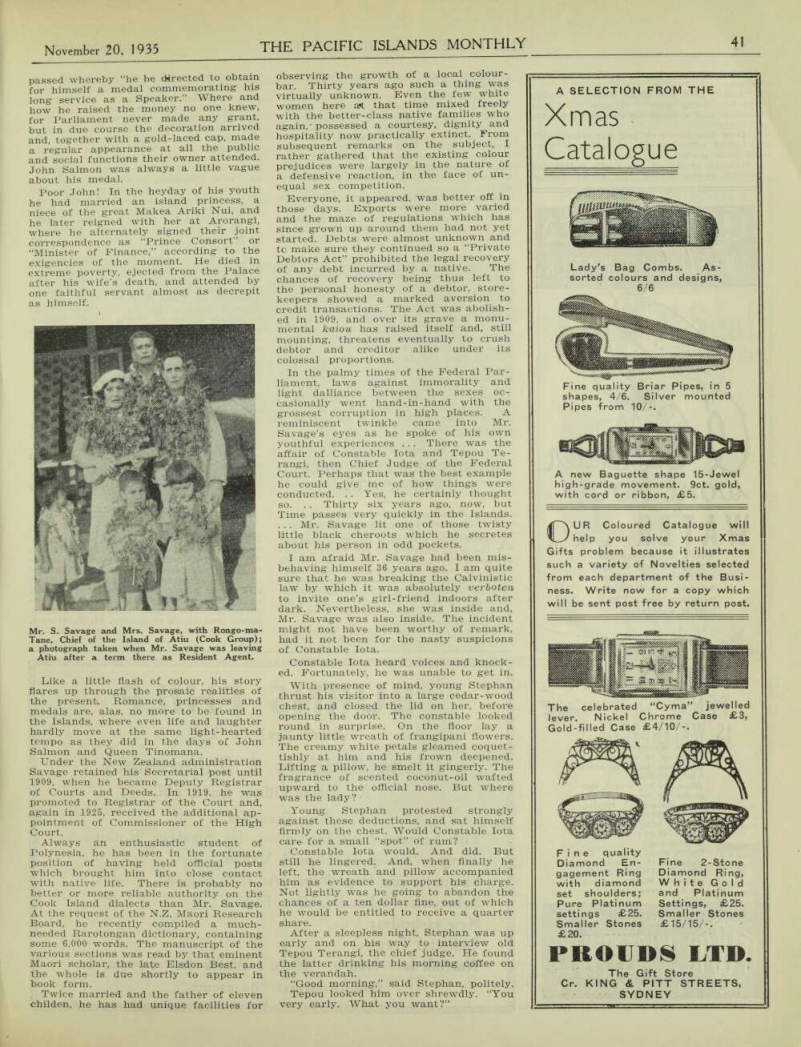
By Julian Hillas
3.—Stephan Savage
T>EADERS of the “Journal of Poly nesian Research” already are ac acquainted with the name of Stephan Savage as a contributor and authority on matters Polynesian.
Born in New Zealand, on the Thames Goldfields, Savage hit the Islands trail at the age of 21, coming to Rarotonga in 1894 on the invitation of Henry Nicholas, then a prominent figure in the small white community, and owner of a cotton ginnery erected during the boom which followed the American Civil War. But cotton was never a great success in the Islands and here, as in Tahiti, one comes across the rusting remains of machinery that scarcely paid its own freight charges.
Henry Nicholas, however, had other irons in the fire and young Savage soon found himself building buggies, temper ing steel and acting as a compositor on the “Torea” —first non-sectarian news sheet in the Protectorate. A certain independence of spirit led to differences of opinion and old Mr. Nicholas, having the usual prerogative of employers, used it to terminate their association.
From the “Torea,” Savage went over to the rival “loi Karenga,” published by Oscar Owen, a former Melbourne printer, A year or so later he bought out the latter and, the paper having been in corporated with the “Cook Islands Gazette,” he continued issuing it, with the help of five native assistants, until 1900, when Colonel Gudgeon, C.M.G.,
offered him the appointment of Inter preter and Clerk to the Federal Parlia ment. But the dual position soon created difficulties of its own, the same indepen dent spirit leading Savage to publish several critical and derogatory letters in the “loi Karenga,”
The end of the paper was brought about by Colonel Gudgeon, with charac teristic directness. Marching into the editorial office, the irate old gentleman waved the offending sheet in the air and then pointed to a peculiarly offensive letter. After listening to Savage’s ex planations he turned round suddenly, in terrupting him in the middle of a sen tence.
“What’ll you take to close the paper altogether?” he demanded; and, without giving the other time to reply, he slapped down on the table an appointment as Government Secretary. “How’ll that suit you?” he went on, darkly. “No self respecting Secretary would think of running down his own Administration.”
A week later the “loi Karenga” dis appeared from circulation!
The Federal Parliament continued to exist until the Annexation of the Group in 1901, when it was superceded by a Resident Commissioner and an Island Council consisting of nominated represen tatives of the principal districts. At the last Parliamentary session the Speaker, John Salmon, took advantage of the occasion to have himself awarded the one and only distinction ever conferred by that august body and a motion was duly
passed whereby “he be directed to obtain for himself a medal commemorating his long service as a Speaker.” Where and how he raised the money no one knew, for Parliament never made any grant, but in due course the decoration arrived and, together with a gold-laced cap, made a regular appearance at all the public and social functions their owner attended.
John Salmon was always a little vague about his medal.
Poor John! In the heyday of his youth he had married an island princess, a niece of the great Makea Ariki Nui, and he later reigned with her at Arorangi, where he alternately signed their joint correspondence as “Prince Consort” or “Minister of Finance,” according to the exigencies of the moment. He died in extreme poverty, ejected from the Palace after his wife’s death, and attended by one faithful servant almost as decrepit as himself.
Like a little flash of colour, his story flares up through the prosaic realities of the present, Romance, princesses and medals are, alas, no more to be found in the Islands, where even life and laughter hardly move at the same light-hearted tempo as they did in the days of John Salmon and Queen Tinomana.
Under the New Zealand administration Savage retained his Secretarial post until 1909, when he became Deputy Registrar of Courts and Deeds. In 1919, he was promoted to Registrar of the Court and, again in 1925, received the additional ap pointment of Commissioner of the High Court.
Always an enthusiastic student of Polynesia, he has been in the fortunate position of having held official posts which brought him into close contact with native life. There is probably no better or more reliable authority on the Cook Island dialects than Mr. Savage.
At the request of the N.Z. Maori Research Board, he recently compiled a much needed Rarotongan dictionary, containing some 6,000 words. The manuscript of the various sections was read by that eminent Maori scholar, the late Elsdon Best, and the whole is due shortly to appear in book form.
Twice married and the father of eleven childen, he has had unique facilities for
observing the growth of a local colour bar. Thirty years ago such a thing was virtually unknown. Even the few white women here a?t that time mixed freely with the better-class native families who again,' possessed a courtesy, dignity and hospitality now practically extinct. From subsequent remarks on the subject, I rather gathered that the existing colour prejudices were largely in the nature of a defensive reaction, in the face of un equal sex competition.
Everyone, it appeared, was better off in those days. Exports were more varied and the maze of regulations which has since grown up around them had not yet started. Debts were almost unknown and tc make sure they continued so a “Private Debtors Act’’ prohibited the legal recovery of any debt incurred by a native. The chances of recovery being thus left to the personal honesty of a debtor, store keepers showed a marked aversion to credit transactions. The Act was abolish ed in 1909, and over its grave a monu mental kaiou has raised itself and, still mounting, threatens eventually to crush debtor and creditor alike under its colossal proportions.
In the palmy times of the Federal Par liament, laws against immorality and light dalliance between the sexes oc casionally went hand-in-hand with the grossest corruption in high places. A reminiscent twinkle came into Mr.
Savage’s eyes as he spoke of his own youthful experiences ... There was the affair of Constable lota and Tepou Te rangi, then Chief Judge of the Federal Court. Perhaps that was the best example he could give me of how things were conducted. . . Yes, he certainly thought so. .. Thirty six years ago, now, but Time passes very quickly in the Islands. . Mr. Savage lit one of those twisty little black cheroots which he secretes about his person in odd pockets.
I am afraid Mr. Savage had been mis behaving himself 36 years ago. I am quite sure that he was breaking the Calvinistic law by which it was absolutely verhoten to invite one’s girl-friend indoors after dark. Nevertheless, she was inside and, Mr. Savage was also inside. The incident might not have been worthy of remark, had it not been for the nasty suspicions of Constable lota.
Constable lota heard voices and knock ed. Fortunately, he was unable to get in.
With presence of mind, young Stephan thrust his visitor into a large cedar-wood chest, and closed the lid on her, before opening the door. The constable looked round in surprise. On the floor lay a jaunty little wreath of frangipani flowers.
The creamy white petals gleamed coquet tishly at him and his frown deepened.
Lifting a pillow, he smelt it gingerly. The fragrance of scented coconut-oil wafted upward to the official nose. But where was the lady?
Young Stephan protested strongly against these deductions, and sat himself firmly on the chest. Would Constable lota care for a small “spot” of rum?
Constable lota would. And did. But still he lingered. And, when finally he left, the wreath and pillow accompanied him as evidence to support his charge.
Not lightly was he going to abandon the chances of a ten dollar fine, out of which he would be entitled to receive a quarter share.
After a sleepless night, Stephan was up early and on his way to interview old Tepou Terangi, the chief judge. He found the latter drinking his morning coffee on the verandah.
“Good morning,” said Stephan, politely.
Tepou looked him over shrewdly. “You very early. What you want?”
Mr. S. Savage and Mrs. Savage, with Rongo-ma- Tane, Chief of the Island of Atiu (Cook Group); a photograph taken when Mr. Savage was leaving Atiu after a term there as Resident Agent.
“Well, you see, I’m in trouble,” Stephan began.
“Aah!” said the Chief Justice. “What you bin doing now? Women?” Tepou Terangi had a sneaking sympathy for the offender.
“How much money you got with you?” he asked, after listening in silence. “Turn out your pockets, my boy.”
Stephan produced one Chile dollar and twenty cents, which the Chief Justice
promptly tucked under the waistband of his pareu.
“That’s alright,” he said, comfortably.
“You leave this to me ... here comes lota.”
Constable lota harangued the “Court.”
The “Court” continued sipping coffee. A wreath? Bah! Why, anybody might be given a wreath. As for the pillow, per haps the defendant himself used coconut oil on his hair? Stephan nodded emphatic ally.
Tepou shook his head reproachfully. In future, lota had better be more careful before charging respectable Europeans on mere suspicion. As an after-thought, he drew out the twenty cent piece and handed :t to the constable. It would never do to discourage him altogether from bringing any fresh cases. Also, it slightly eased the Chief Justice’s own conscience; and, the business of the morning being satisfactorily settled, he poured himself a second cup of black island coffee.
Mr. Savage is one of those men who are like the wheels of a clock; they do the work without being seen. Indeed, there have been times when it was very doubt ful whether the hands would have gone round at all without his unobtrusive and efficient assistance. Placed on the retired list in 1929, he is nevertheless still in harness as a supernumerary officer, hold ing all his former appointments; and that, I think, speaks for itself in these days of general retrenchment.
Advertisements & other items, pp. 42-44 (2 items)
Umbrellas
Specially made for Tropical Conditions
ONLY BRITISH FRAMES USED
Guaranteed FAST DYED Coverings Strong Canvas-Covered Beach and Garden Umbrellas in Medium and Large Sizes —Brass Fittings Throughout.
“Shelta” Brand Umbrellas
Manufactured by
Phillips and
House
453 Kent Street
SYDNEY
428 Adelaide St.
BRISBANE
Inquiries invited from Pacific Islands Distributors We supply the trade only.
Steel Furniture
MODERN TUBULAR
Chromium-plated or Lacquered Finishes Beds Wires Bedding Hospital Furniture Tubular Steel Furniture
hsrJSrJffi
k k dr Radio Station 2UW, Newlands Steel Furniture Complete Catalogues on Request- Cloa Chair—Chromium plated Steel. ■Cab le Address “NEWLANDBED,” SYDNEY.
Complete Catalogues on ±iequesi - NEWLANDS BROTHERS LTD. Riley Street, Sydney, N.S.W.
AUSTRALIA’S LARGEST MANUFACTURERS OF SLEEPING EQUIPMENT, HOSPITAL FURNITURE AND
A SELECTION FROM THE
Xmas
Catalog u e
imm
Lady’s Bag Combs. Assorted colours and designs, 6/6 Fine quality Briar Pipes, in 5 shapes, 4/6. Silver mounted Pipes from 10/-.
A new Baguette shape 15-Jewel high-grade movement. 9ct. gold, with cord or ribbon, £5. o UR Coloured Catalogue will help you solve your Xmas Gifts problem because it illustrates such a variety of Novelties selected from each department of the Business. Write now for a copy which will be sent post free by return post.
The celebrated “Cyma” jewelled lever. Nickel Chrome Case £3, Gold-filled Case £4/10/-. o Fine quality Diamond Engagement Ring with diamond set shoulders; Pure Platinum settings £25.
Smaller Stones £2O.
Fine 2-Stone Diamond Ring, White Gold and Platinum Settings, £25.
Smaller Stones £l5/15/-.
PROVDB LTD.
The Gift Store
Cr. KING & PITT STREETS,
SYDNEY
AomiJxxnd
WATER
★ ★ 'k That's a "waterproof" statement that no one can fault and similarly no one can fault the assertion that a T.W.H. tent is waterproof. *
A T.W.H. 4
TENT L '
IS WATERPROOF
T.W.H. Waterproof fabrics stand up to any climatic conditions and are absolutely reliable.
When you buy a tent, tarpaulin or whenever you Available in need waterproof fabrics, J-pint tins to insist on the genuine T.W.H. 5-gall, drums, product. REMEMBER ALSO T.W.H. Waterproofing Solution and T.W.H. Hood Dressing (in Black and 15 colours).
LISTEN IN TO 2 G.B.
to Ihe T.W.H. Session 10.15 every Friday night.
== T.W.H.
B ELMORE N. S. W.
Hi.
“Maison De Sante” Opened
At Papeete
From Our Own Correspondent.
PAPEETE, October 4.
A welcome addition to the medical ■ i -*“ facilities afforded by the French Gov ernment in Papeete is the new private clinic recently opened under the name of the “Maison de Sante” by an associa tion of distinguished French specialists.
This institution is situated on the Quai des Subsistances in a cool and attractive site facing the harbour.
The surgical department is under the care of Dr. S. Rabinovitch, Officer of the
Legion d’Honneur, and Dr. A. Audemar, both of whom have had extensive hos pital experience in France: Dr. Rabino vitch is in fact the owner of a similar, but much larger clinic which has long been established in Paris. There is also an up-to-date X-Ray department, the equipment for which arrived recently from America. Dr. J. Bachelier, who has also had the benefit of a large experience in Paris hospitals, is in charge of this section. Dr. A. Pugnaire, from the “Necker” hospital in Paris is a specialist in diseases of the nose, throat, and eyes.
The charges for patients in the “Maison de Sante” are very reasonable, and there is no doubt that as time goes on the facilities provided therein will be more and more appreciated by the local public.
Many cases needing the attention of a specialist, which in the past would have necessitated an expensive voyage to America or New Zealand, can now be treated successfully on the spot. The intending visitor to Tahiti will be pleased to learn that there is now available a highly skilled service in almost every department of surgery and medicine.
B.N.G. Co.’S Profit
r rHE British New Guinea Development Co. Ltd. (a British Co. operating coconut and rubber plantations in Papua) made a profit of £12,515 in 1934-35, mostly from rubber. The Co.’s general position has been much improved; but it still is handicapped by the dead weight of £llO,OOO of debentures carrying 7 per cent, interest.
Mr. Dave Brown returned to the Cook Islands, from New Zealand, on October 6, to take over the management of Messrs.
W. H. Grove and Son’s branch at Raro tonga. The appointment is a popular one in many quarters as he made numerous friends in the group during his several years with the Cook Islands Native As sociation. The former manager of Messrs.
Grove and Son’s store, Mr. H. R. Harris, has returned to New Zealand with his family.
Advertisements & other items, p. 44 (1 item)
Burns Philp
(South Sea) Co. Ltd.
Island Traders & Shipowners
Registered Office: Suva, Fiji.
Also Branches at Fiji: Levuka, Lautoka, Labasa, Ba, Sigatoka, Rotuma.
Tonga: Nukualofa, Haapai, Vavau.
Samoa: Apia, Pago Pago (America Samoa).
Solomons: Makambo, Gizo, Faisi.
New Hebrides: Vila.
Gilberts: Tarawa.
Norfolk Is. Nauru. Niue. Wallis Is. Futuna Is.
Code Address: “Burnsouth.”
Developing French Tourist Traffic
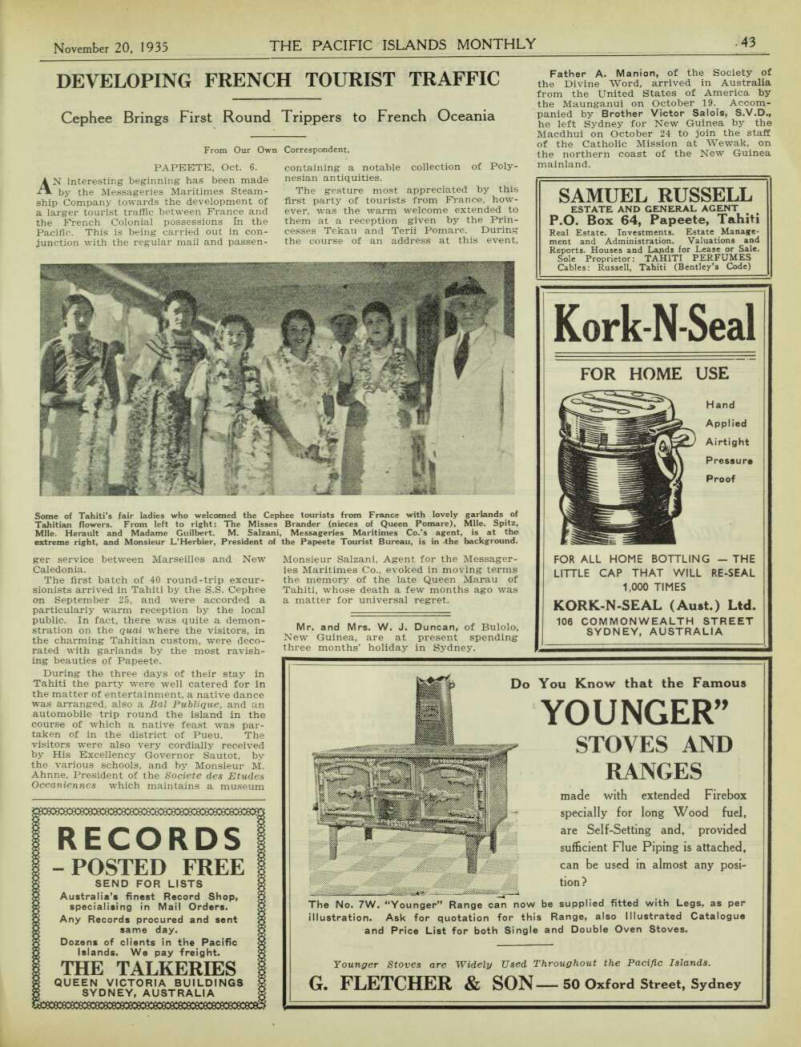
Cephee Brings First Round Trippers to French Oceania
From Our Own Correspondent.
Papeete, Oct. 6.
AN interesting beginning has been made by the Messageries Maritimes Steamship Company towards the development of a larger tourist traffic between France and the French Colonial possessions m the Pacific. This is being carried out in conjunction with the regular mail and passen-
ger service between Marseilles and New Caledonia.
The first batch of 40 round-trip excur sionists arrived in Tahiti by the S.S. Cephee on September 25, and were accorded a particularly warm reception by the local public. In fact, there was quite a demon stration on the quai where the visitors, in the charming Tahitian custom, were deco rated with garlands by the most ravish ing beauties of Papeete.
During the three days of their stay in Tahiti the party were well catered for in the matter of entertainment, a native dance was arranged, also a Bal Puhlique, and an automobile trip round the island in the course of which a native feast was par taken of in the district of Pueu. The visitors were also very cordially received by His Excellency Governor Sautot, by the various schools, and by Monsieur M.
Ahnne, President of the Societe des Etudes Oceaniennes which maintains a museum
containing a notable collection of Poly nesian antiquities.
The gesture most appreciated by this first party of tourists from France, how ever, was the warm welcome extended to them at a reception given by the Prin cesses Tekau and Terii Pomare. During the course of an address at this event,
Monsieur Salzani, Agent for the Messager ies Maritimes Co., evoked in moving terms the memory of the late Queen Marau of Tahiti, whose death a few months ago was a matter for universal regret.
Mr. and Mrs. W. J. Duncan, of Bulolo, New Guinea, are at present spending three months’ holiday in Sydney.
Father A. Manion, of the Society of the Divine Word, arrived in Australia from the United States of America by the Maunganui on October 19. Accom panied by Brother Victor Salois, S.V.D., he left Sydney for New Guinea by the Macdhui on October 24 to join the staff of the Catholic Mission at Wewak, on the northern coast of the New Guinea mainland.
Some of Tahiti’s fair ladies who welcomed the Cephee tourists from France with lovely garlands of Tahitian flowers. From left to right: The Misses Brander (nieces of Queen Pomare), Mile. Spitz, Mile. Herault and Madame Guilbert. M. Salzani, Messageries Maritimes Co.’s agent, is at the extreme right, and Monsieur L’Herbier, President of the Papeete Tourist Bureau, is in the background.
Mr. Peter Cowan, of Mauke Island, Souther* Cook Group, who arrived at Rarotonga recently by schooner to seek medical attention, shares octagenarian honours with Mr. Charlie Ward, writes our Cook Islands correspondent. After 30 years’ service with Messrs. A. B. Donald & Co. in their various Islands branches, he set up for himself as an independent trader, and to date has 51 years’ residence in the group to his credit. Mr. Cowan has a numerous family. His eldest son repre sents the district of Matavera on the Rarotonga Island Council, and visitors to Tahiti will, no doubt, remember Mr.
Tata Cowan, not only as the director and popular referee of the many sporting events staged in Papeete, but as one of the most hospitable and helpful of people to those new to the ways of that colony.
Advertisements & other items, pp. 45-46 (1 item)
Kork-N-Seal
SAMUEL RUSSELL
ESTATE AND GENERAL AGENT
P.O. Box 64, Papeete, Tahiti
Real Estate. Investments. Estate Management and Administration. Valuations and Reports. Houses and Lands for Lease or Sale.
Sole Proprietor: TAHITI PERFUMES Cables: Russell, Tahiti (Bentley’s Code)
Kork-N-Seal
FOR ALL HOME BOTTLING - THE
LITTLE CAP THAT WILL RE-SEAL
1,000 TIMES
KORK-N-SEAL (Au*t.) Ltd.
106 COMMONWEALTH STREET
SYDNEY, AUSTRALIA
FOR HOME USE
Applied Airtight Pressure Proof Hand
i.
Do You Know that the Famous
YOUNGER”
STOVES AND
RANGES
made with extended Firebox specially for long Wood fuel, are Self-Setting and, provided sufficient Flue Piping is attached, can be used in almost any position?
The No. 7W. “Younger” Range can now be supplied fitted with Legs, as per illustration. Ask for quotation for this Range, also Illustrated Catalogue and Price List for both Single and Double Oven Stoves.
Younger Stoves are Widely Used Throughout the Pacific Islands.
G. FLETCHER & SON 50 Oxford Street, Sydney
RECORDS
-POSTED FREE
SEND FOR LISTS
Australia's finest Record Shop, specialising in Mail Orders.
Any Records procured and sent same day.
Dozens of clients in the Pacific Islands. We pay freight.
THE TALKERIES
QUEEN VICTORIA BUILDINGS
SYDNEY, AUSTRALIA
MELBOURNE
HOTEL ::
—■ SUVA -
Centrally situated near Government offices. Opposite sea baths and bowling green. Excellent table.
Terms moderate. Best brands of liquor kept, including Hardy’s famous wines.
E. C. DOBELL Proprietor
Suva’s Fashion Rendezvous
WALTER HORNE & Co. Ltd.
PREMIER DRAPERS. LADIES’, CHILDREN’S
AND MEN’S WEAR SPECIALISTS
LADIES’ HAIRDRESSING AND MANICURING
Frocks Millinery Foundations and Lingerie Hosiery Ladies’ Shoes & Sandals Ribbons and Laces Hairdressing Manicuring Dress Fabrics and Silks Household Drapery Clothing Tailoring Mercery Men’s Boots & Shoes Men’s Hats & Caps Island Curios
“IF IT’S NEW...
HORNE’S WILL SHOW IT”
Dependable Merchandise Reasonably Priced
Cables: "Janinloong”
P.O. Box 117
Jang: lllug Loong C ompany Limited
20-24 THOMSON ST., SUVA, FIJI
IMPORTERS EXPORTERS
Buyers of Copra, Trocas Shell, Beche-de-mer, Kauri Gum, and other Island Products.
NUMEROUS BRANCHES THROUGHOUT THE COLONY
The Three Communities In Fiji
An Outstanding Political and Administrative Puzzle
From Our Own Correspondent.
Suva, Oct. 20.
THE proposal to alter the constitution of the Fiji Legislative Council by the sub stitution of Nominated members for the present Elected members, if not exactly engaging undivided public attention amongst the Colonists themselves, at least continues to occupy a large proportion of the space in the “Fiji Times.”
Naturally, the champions of liberty are always the more vocal section of any British community, and it is’ therefore, only natural that, apart from the known editorial views, the columns of the Hon.
Alport Barker’s paper express only the viewpoint of that section which opposes any change in the present method of the election by the Europeans of representa tives in the Legislative Council.
There, too, are detailed reports, writ ten in excellent English, of meetings of the self-styled Indian Association of Fiji, at which similar protests are made against the loss of the right to elect Indian re presentatives.
The outside observer may well think that when Europeans and Indians alike voice a common protest, the community as a whole share the same views, and that there is unison, if not exactly harmony, in
their voices. Thus, there is some real danger that the true worth of their views may be overestimated in Downing Street, half the world away from Suva; for free dom of choice of one’s representatives is a cry that appeals naturally enough to British democracy.
However, with traditional caution, the Colonial Office has deferred its decision on the proposal (which originated with the Indian Elected members) until such time as the wishes of the community as a whole can be more accurately measured.
Just how that measuring is to be done is a difficult problem.
THERE are the three well-known ele ments in the mixed population of Fiji—Fijians, Europeans, and Indians, each with differing interests and stan dards. In the Legislative Council there are at present six Europeans, three In dians, and three Fijians, selected from the respective communities.
In the ’eighties, or thereabouts, when Indian immigration to Fiji commenced, the Indians were promised a status in Fiji which would be no whit inferior to others of His Majesty’s subjects. If nothing else be done meanwhile, it is at least a foregone conclusion that within the near future the numbers of the re presentatives must be revised, so that each element has equal representation in the Council —in other words, the num ber of European members must be re duced to four.
There are none so blind as those who will not see, and, whatever views it may be expedient to express at this juncture, it seems inevitable and natural that the next demand from the Indian community will be to join with the other two com munities in electing common representa tives, instead of community representa tives as at present.
The Fijian population is 90,000, its de cline having been arrested and turned into a very slight annual increase. The European population is stationary at about 4,000 to 5,000. But the Indian population, which jumped from 60,000 to somewhere about 85,000 between 1921 and 1934, is -increasing by leaps and bounds.
Thus, it is easy to forecast the section of the community from which all the Elected members of Council would be drawn in not very many years to come.
Quite apart from the disadvantage of having no European representatives to express the views of the European com munity, there are practical difficulties in applying the principle of a democratic Common Roll to the Fijians, more es pecially the upsetting of their present structure of government by the Elders.
THERE is, however, another factor in the problem —one which affects the Europeans only, and which is not gener ally apparent to them as yet.
In the early years of the present consti tution of the Legislative Council, the European members (amongst them Mr.
M. Hedstrom and Mr. H. M. Scott) advo cated the extension of the franchise to men of mixed blood, provided that their fathers were Europeans, and this was carried into effect. Mr. Eyre Hutson (then acting as Colonial Secretary) considered that at some future date the half-caste vote would create serious embarrassment in the elections, since the half-castes of European fathers were henceforward clas sed as European voters, and their sons would, in due course, be entitled to claim in their turn, the right to vote as Euro peans. To-day, the number of half-caste voters is increasing rapidly, and, in certain of the European electorates, it is only a matter of time before they will be the dominant factor. In the Suva district, for example, there are estimated to be now about five half-castes entitled to the vote for seven whites.
It looks, therefore, as though the time is fast approaching when, in any case, the electoral power of the white European is doomed to be swamped, either from within his community or without. Most Europeans who have some degree of re sponsibility, and some stake in the Colony’s future, incline to the view that they would do well to insure themselves against the prospects of complete loss of representation by delegating to the Go vernor the duty of selecting a proper num ber of Fijian, European and Indian mem bers to express the views of the three communities in the Legislative Council.
YVTHEN all is said and done, the direct ** responsibility of the Government of Fiji rests upon the Governor, appointed by the Colonial Office, and ruling by virtue of his majority of Civil Servants in the Council. The others are there merely to advise the Governor as to their own per sonal interpretation of the opinions held by the colonists. Even though those community representatives were selected by the Governor, and not elected by the people, it is derogatory to the communities themselves to suggest that members so selected would be afraid to oppose their views to those of the Governor. On the contrary, it is but reasonable to suppose that their views would show a breadth of vision and an impersonal detachment sadly lacking, at times, under present conditions.
It is clear that both Europeans and In dians in Fiji are divided on the question of Elected v. Selected Members, but for differing reasons, at heart. Mr. Malcolm McDonald, in London, will be faced with the problem of deciding what is in the best interests of Fiji and the Fijians, for whom he is the trustee. The only safe forecast is that his advisers, the officials of the Colonial Office, will take a long time to come to a final decision.
Strange ’Planes Seen
Again In New Guinea
From Our Own Correspondent.
RABAUL, October 14. lITYSTERIOUS ’planes have been sighted again by natives in two more or less isolated parts of the Mandated Territory during the past few months.
One, seen a few months ago, was flyifig in the vicinity of the Witu group and another last week was reported by the natives to be flying off the East New Ireland coast in the Namatanai area. The latter machine is reported to have been painted black.
No explanation of their presence has been made known.
Mr. F. P. Archer, of Jame plantation, Buka Passage, New Guinea, returned to the Mandated Territory in October.
Advertisements & other items, p. 47 (1 item)
Rewa Hotel Rewa
PACIFIC TAXI
GARAGE - -
(Vincent K. Brothers) Day and night service . . . Most modern hire service in Suva . . .
Excellent drivers.
Our special trips embrace Rewa Valley and Sugar Mill, River Scenery, Lami, Suva Point, and Native Kings’ Town of Bau.
Trips can be arranged on Intersular Road to Ellington, Tavua, Ba, Lautoka, and Sigatoka.
Cables: "Vincent," Suva. 'Phone 33.
In Suva . . . Stay at
The Pier Hotel
( Licensee : D. B. COSTELLO.)
The Rendezvous of the Miners
Situated in hub of city. Absolutely fireproof building. Commodious and comfortable rooms. Excellent cuisine. All the best brands of drinks stocked.
Tariff ill 6 P er day
Cable address: “Pier," Suva > '5.-Is
UNDER SAME MANAGEMENT
REWA HOTEL Rewa
Picturesquely Situated in the Cane Country on the Rewa River Have the advantage of staying in either Hotel on same Tariff
FREE TRANSPORT BETWEEN THE TWO HOTELS
Motor trips arranged around Island. Modern cars driven by expert drivers.
New Bridge For Tahiti
From Our Own Correspondent.
PAPEETE, October 8.
A sum of 200,000 francs has been allo cated from the 1936 budget for the erection of a new bridge over the Vaitipiha River at Tautira, Tahiti, ac cording to a statement recently made by His Excellency Governor Sautot.
Some years ago the iron and concrete structure spanning this river, which at times becomes a formidable torrent over 100 yards in width, was entirely washed away by a great flood. This was replaced by a low-level concrete bridge, but it has not been a success.
Tautira is perhaps the most beautiful district in Tahiti, and a favourite week end resort for Papeete townspeople. The commencement of the new bridge is therefore awaited with interest.
This century"
Tavua “The Find of This century"
Pat Costello on Discoveries and Rewards
Letter t 0 the Editor T REFER to your article in September I. , ,r, , , . , * lssue and that P art which reads: “There seems to be no doubt that a rich, new gold-mining industry has been established in Fiji, on the northern side of Viti Levu Its birth however was i ,'T mun, nowever, was attended by so much mad speculation— particularlv in Melbourne—that the ac- Pduicuidiiy ill ivieiuoui ae—tnat vne ac tual value of development has been under suspicion: many people thought that it was impossible that anything worth while could exist when so many rogues and near-rogues were active.”
To this, I take strong exception.
Bill Borthwick and I are responsible for the birth of the Tavua Goldfields, and Messrs. E. G. Theodore, John Wren, Pat Cody and Frank Packer are respon sible for the development of the field Bill and I have our limitations, and our resnons i b imies ceased after months of responsipinties ceasea alter montns or prospecting, when we indicated that gold occurs in the locality, with a good chance G f living down. Dr. Loftus Hill then came and reported favourably on the field After that, the Development Syndicate came along and tested the area, and did so with their own money; and, up to the time of the Emperor float, an amount in the region of £lOO,OOO had been expended b y the Syndicate. I should be very J
pleased to have the addresses of any other four people who are prepared to risk £lOO,OOO in a gold venture.
It is possible that the people who spent this amount of money may obtain a mil lion pounds in return, or, roughly, 10 to 1 on their outlay. As the ratio of good gold mines are about two in a hundred, I contend that the Syndicate are en titled to what is coming to them; and Bill and I are satisfied with the crumbs that fall from the table.
It must also be remembered that some of Australia’s leading experts condemned the area. But Dr. Loftus Hill’s summing up of the field, when only a few trenches had been opened up, is something of which he should be justly proud.
I maintain that, at Tavua, there is what may be termed the “Magic Circle,” which embraces the Emperor, Loloma, Koroere, Cardigan, the 30-acre block and Dolphin areas; these properties have excellent chances of success, and, outside those areas, time, hard work and development alone will tell.
Many people who felt sorry for Bill and myself in the prospecting stages of Tavua have now turned their sorrow into affec tion, and are asking whether it is not possible to obtain a holding on what they term the ‘“ground floor.” In other words, they “want something for nothing.”
I still maintain that Tavua is the find of this century.
I am, etc.,
Pat Costello.
Suva., October 12, 1935.
Mr. William G. Wiedermann, of the Melanesian Mission, arrived in Sydney from Rabaul by the Malaita on Septem ber 26. Since 1933 he has been stationed at Arawe, New Britain.
Advertisements & other items, p. 48 (2 items)
Rheumatism
AND
KIDNEY TROUBLES
DEFINITELY OVERCOME BY “UREX.”
the new scientific remedy which cures by removing the cause.
RHEUMATISM, LUMBAGO, SCIATICA, NEU-
RITIS, PAINS IN BACK, JOINTS AND LIMBS,
KIDNEY AND BLADDER TROUBLES and all
kindred complaints will vanish like magic before this wonderful remedy.
Neglect is dangerous and will result in a premature decline of your powers, breakdown, and a shortening of life.
No matter what other remedies you have tried, whether you are seven years of age or seventy, man or woman, “UREX” will relieve you. It “gets right to the spot,” and stops that pain.
Money back if no relief.
Obtainable only from the manufacturer, price 5/8, postage free.
RICHARD'S RELIABLE REMEDIES,
17 Bond Street, Sydney
Grand Pacific Hotel - - Suva, Fiji
■ m m mm ' >i H TA? PREMIER Social Ren of Fiji . . .
Grand Pacific Hotel - - Suva, Fiji EXCELLENT CUISINE. EFFICIENT TRAINED INDIAN WAITERS AND SERVANTS.
MODERNLY EQUIPPED.
Grand
Pacific
Hotel
SUVA, FIJI
Delightfully situated in tropical gardens overlooking Suva harbour and the Pacific Ocean.
TARIFF: from 17/6 per Day Accommodation Reserved by Wireless Cable address: “Grandpacif”
Suva
Fiji
Currency Confusion in Fiji
T>USINESS people and housewives in Fiji have been sorely tried for some time by the vagaries of the Government regarding the coinage (says Sydney Morning Herald of October 22).
First, the banks’ notes were withdrawn and the Government supplied all notes needed for general use, including notes pf 5/-, 10/-, £l, £5, £lO, and £2O. The Government next issued a coinage con sisting chiefly of specially made nickel pennies and halfpennies, each having a hole, and low-grade silver sixpennies, shillings, and florins. Then came an edict that Australian and New Zealand silver would not be allowed as legal tender.
This caused consternation and annoy ance, as the Government and the banks had introduced these coins. Thousands of pounds worth of these coins were hoarded by Indians, in preference to banking their savings. Residents were immediately charged 2d in the shilling discount for all Australian and New Zealand silver coins. In spite of protests, this became a general practice.
On September 30 it was announced that British silver coinage would not be ec cepted as legal tender. People were astounded. No British coins are now accepted in any Government office. It was the Government that introduced the British coinage. To-day thousands of pounds of British coins are stored away by Indians and others, for in the natives’ opinion the safest thing in money was a British coin. People watch carefully to see that British coins are not given to them instead of the new Fiji coins. The banks accept British coins at face value.
But the wily Chinese vegetable man is taking no risks, so daily excited argu ments are heard at back doors when housewives offer British coins and the Chinese murmurs, “No can do.”
Road Constructed to Napa Napa
Skirting Pt. Moresby’S
Shores
From Our Own Correspondent PORT MORESBY, October 13.
THE well-known ship and boat-builder A of Port Moresby, Mr. George Stewart, whose slip lies across the harbour at Napa Napa, immediately opposite the township, recently constructed a portion of road in the inner harbour to link up his premises with the old established road from Port Moresby to Fairfax. This road was used freely in the old days before the sisal hemp plantation to the north of Fairfax Harbour was abandoned. Since then the road has fallen into disuse.
The construction of this portion of road entailed a considerable amount of work and the building of small bridges to span the creek beds and low lying ground which lies to the head of the harbour.
As a result of Mr. Stewart’s enterprise, residents are now able to cover the 16 miles distance in cars in good time and in comfort.
The road is extremely picturesque, leading along the harbour’s edge, through a dense growth of foliage, past coconut groves and villages of the Baroni people, making only a tew detours into the grass and gum which are the principal features of the inland country.
Rarotonga
San Marino Minister At Rarotonga
From Our Own Correspondent RAROTONGA, October 7. ¥OW that all eyes are turned towards ltaly, an interesting - visitor to the Cook Islands is Mr. Melville A. Jamieson, who, with his wife, has been staying at the Hotel Rarotonga.
Mr. Jamieson is Consul-General in London for the Republic of San Marino, and was specially nominated as Minister for the Republic during the recent Jubilee Celebrations.
San Marino, founded in the 4th cen tury A.D., is the only surviving, one of many medieval Italian states. The Re public issues its own coinage and stamps, and inside the walled city on Monte Titano many of the principal buildings date back over a thousand years. /In matters of major importance San Marino usually follows Italy’s political lead, and during the Great War joined the Allied cause a fortnight after her powerful neighbour.
Mr. and Mrs. H. L. Dunn left Sydney by the Malaita on October 5. He is storekeeper for Messrs. Lever’s Pacific Plantations Pty. Ltd., at Gavutu, S.I.
Advertisements & other items, p. 49 (1 item)
Gold
Specialists in
TWINES and
CORDAGE
Cotton-Hemp Jute Plough Reins Halter’s Sewing Twines Fishing Lines And Sash Cord & / S' All Enquiries Invited And where Not Represented Agents are Desired Prices on Application «/ Filzroy Marrickville, St.,
N.S.W.
CABLE ADDRESS:
‘BENTLEYSON,” SYDNEY
AUSTRALIA’S CLEARING HOUSE FOR THE PRECIOUS METALS.
BUYERS OF
GOLD
OSMIRIDIUM, PLATINUM, SILVER, &c.
GARRETT & DAVIDSON, LTD.
ASSAYERS, BULLION MERCHANTS, METALLURGISTS,
Bank of N.S.W. Buildings, Regent Street, Sydney
A. B. DONALD Ltd.
AUCKLAND
Island Traders :: General Merchants P.O. Box 1509 :: Cables and Telegrams; “Kingdom," Auckland Branches at Rarotonga and throughout the Cook Islands At Papeete and throughout the Society, Marquesas and Paumotu Islands
trading as “ETABLISSEMENTS DONALD, TAHITI”
At Fiji: Trading as ‘‘Dominion Fruit C 0.,” Suva
Cook Is. Director of Agriculture
From Our Own Correspondent.
RAROTONGA, October 7.
PLANTERS and others concerned with A the Cook Islands’ fruit-trade should be satisfied with the recent appointment of Mr. W. T. Goodwin to the post of Director of Agriculture. Mr. Goodwin, who has been seconded from the N.Z.
Department of Agriculture for a three year term, was formerly Assistant Direc tor of Horticulture.
With experience gathered in and around Hobart and the famous fruit-growing Huon Valley, it is confidently expected that the new Director’s broom will sweep off some of the cobwebs which have over grown the Rarotongan fruit industry. It is the usual irony of fate that his arrival should coincide with an unprecedented
low level in local produce prices and a corresponding apathy among growers.
Thoroughly conversant with every branch of his profession, Mr. Goodwin visited South America, Canada and Great Britain in 1928, making a close study of marketing conditions on behalf of the N.Z. Fruit Board. There was a grim smile at the corners of his mouth when questioned about the future prospects of C.I. fruit. “The day of the old ‘bush’ orange is definitely over,” he said, “I can’t tell exactly what will replace it, but I do know that.”
Mr. William Brian Molloy, barrister-at law, of Sydney, N.S.W., has been admitted to practise as a barrister and solicitor in the Central Court of Papua. It is Mr.
Molloy’s intention to practise as a bar rister and solicitor in Port Moresby.
Strait
Tales Of Torres
Taken from official letters dated Ist January and 11th April, 1872, written at Somerset, Queensland, by Mr. F. L. Jar dine, police magistrate: POR some time past, there has been a story in circulation here that, on the coast of New Guinea, close to Bristow Island, there are two pairs of twins, one pair male, the other female, joined to gether “back to back,” so that when walking one carries the other. I think the story most improbable and as yet have never met any person who has actually seen them, but everybody knows “someone who has.” Lately I have had several inquiries concerning them from would-be “Barnums,” who seriously as sert that “they would pay much better than pearl shell!” I believe £2OO per pair is the latest price offered for them. the information of Mr. Tucker, Master of the schooner, “Margaret Jane,” I issued a warrant for the appre hension of nine Rotuma men, who had stolen a boat and deserted from his vessel while anchored at Campbell Island.
John Larkins, the person now in charge of the station, denied all knowledge of their whereabouts, but the men were afterwards apprehended with his party at Murray Island, to which place the station was then in course of removal. The boat was discovered, concealed in the scrub on Yorke Island, but her oars were found on the station in possession of Delargy’s people.
The deserters were brought to Somer set. Some of them speak good English and are Christians.
They give as their reason for abscond ing the brutality of the Mate (hereafter referred to as X) who, it appears, was in the habit of compelling them to dive for shell by firing at them with a revolver.
They also state that he sank a canoe full of Marbiack (Mabuiag) natives, who were making their escape from the schooner, where they had been employed as divers, and fired indiscriminately among them, killing two. Mr. Chester verified their statement, as in a recent visit to Mar biack, the natives complained of the loss of two men, Nukis and Edowah, who they affirm were shot by the mate of the “Margaret Jane.”
Mr. Chester also tells me that the con fident and fearless demeanour which formerly characterised the Marbiack people has given place to a cowed and sullen manner; and now, instead of gathering on the beach to welcome a boat’s arrival, they make off with all their propery into the scrub as soon as one heaves in sight.
This man X .. on hearing that it was Captain Tucker’s intention to call at Cape York, left the vessel and took a passage to Sydney by the “James Merriman.”
G.H.V.
Advertisements & other items, p. 50 (2 items)
The Popular Light Steel
MORRIS, HEDSTROM, Ltd.
FIJI
Sole Agents in Fiji for . . .
Vacuum Oil Company (Pty.) Limited
Imperial Chemical Industries Limited
Nobel (Australasia) Pty Ltd. —Explosives
Full Stocks of
MINERS AND PROSPECTORS’
REQUISITES
Also SODIUM CYANIDE, ZINC
DUST. Etc., Etc.
Sydney Office:
DALTON HOUSE, 115 PITT ST., SYDNEY
Branches throughout the gold bearing areas Lautoka, Ba, T avua, Penang, Nadi and Sigatoka
The Popular Light Steel
Plough
types of ploughs and implements meeting all requirements, as well as lawn mowers, aerodrome equipment, steam engines, boilers, etc.
The “Victory” combines maximum strength with minimum 'weight and draught. Turns a furrow up to 6-ins. deep by 10-ins. wide. Weight 85 lbs.
We also supply numerous other Illustrated literature and ail information from:
Morris,
Hedstrom
Ltd.
Suva, Lautoka and Ba
victory plough
Made by:—RANSOMES, SIMS & JEFFERIES, LTD., IPSWICH, ENGLAND
Castor Oil Seed
To Planters I am a Buyer of
IN ANY QUANTITY
Send Sample for quote, stating quantity available.
Castor Seed Shelters, any capacity.
Advice and Instructions Regarding Planting, Harvesting and Packing of Castor Oil Seeds given freely. Selected Seed for Planting available.
C. GRAHAME
4 DALLEY STREET SYDNEY
Papua
Richest Mine In
Romance of the Unwanted Umuna Property
From Our Own Correspondent PORT MORESBY, October 28.
WITH the sale of the rich Umuna mine at Misima Island to a company re cently formed in Australia called Cuthbert s Misima Goldmines Ltd., it is interesting to recall the romantic history of this once unwanted property. Fred Cuthbert and G. O. Wilkinson, who made £lOO,OOO (in cash and shares) out of the deal with the new company, purchased the Umuna lease for £2,000; within six years they had re covered over £145,000 worth of gold from it.
Gold was first discovered on Misima Island in 1888 when early prospectors from Cooktown, Queensland, crossed over in schooners on the report of gold in the Louisiade, Archipelago, and worked the island after first prospecting Sud Est and Rossel to the south, without any appre ciable results.
By 1889, 500 miners were attracted to the field, and worked the different creeks and gullies, finding rough gold, sometimes in nuggets weighing several ounces. Up to 1891 traces of gold could, in fact, be found in most places to the west of the island, but no gold bearing reefs had been reported, upon which it appeared, the future of the field depended.
It was not astonishing that alluvial gold became scarce by 1893, and the prospectors becoming discontented crossed over to the mainland to Bartle Bay and further north to the Mambare River. By 1894 only 19 miners remained; a few of the oldest, liv ing principally upon native foods, the gold they secured being insufficient to buy stores.
From 1895 to 1903 interest was entirely ■diverted from Misima, by the rich gold discoveries on the Yodda and at Woodlark Island, and only eight miners persisted in their efforts on the abandoned field. But in 1904 “Bob” Boyd was rewarded, when lie discovered a gold bearing reef on his Umuna claim, with the result that in the following year seven gold mining leases were taken up and recommended for sur
vey. There seemed a prospect of a large mining concern becoming interested and undertaking extensive operations on the island, but nothing came out of the nego tiations and the interest in Misima once more declined.
Hope was not abandoned, however, and several attempts were made to awaken the mining world to the contemplation of hid den wealth on Misima. One reads of a gold mining syndicate in 1911 erecting a mill to deal with any soft lode, but it was not until the end of 1914 that the possi bilities of the island’s resources were fully recognised. The Broken Hill Proprietary Block 10 Company started negotiations, and eventually took over all the interests of the various companies and syndicates, including 13 gold mining leases. Umuna was thus absorbed in the new enterprise.
The company, now known as Block 10 Misima Gold Mines N.L., became activelj' engaged in development work, and by 1917 had erected plants and commenced treat ment of both sand and slime with good recoveries. Over 50 Europeans were em ployed under the charge of Mr. O. B. Ward, and there was a large number of native labourers. As progress continued there seemed every prospect of a rich mining community becoming an established fact in the Territory.
After several years of continued effort in which there seemed to be every possi bility of success, it came as a shock to residents in the Bast to learn that the mortgagees had closed down on Block 10 for huge sums of money and that the com pany was to cease operations in September, 1922.
Again Misima retired into the obscurity from which it seemed impossible to emerge, except for only short periods, A local syndicate, Misima Gold Mining Co., took over several of the abandoned leases shortly afterwards for a small sum of money. These leases included Umuna, and for four and a half years the company carried on their enterprise, but with only comparative success. In October, 1927, they also ceased operations.
It was their intention to refloat, secure new capital, and reorganise, but capitalists proved coy, and the glittering rewards that were offered from Misima left them entirely unmoved. But, becoming impatient, the spirits of Umuna shrieked for recognition, and eventually, in 1928, it was sold with other leases to Mr. Fred Cuthbert, a wsll known Queensland miner, and Mr. G. O.
Wilkinson for £2OOO, and they took posses sion immediately.
In 1928 Messrs. Cuthbert and Wilkinson erected plant to the value of £7OOO and con structed a road from the mine to the anchorage at Bwagaoia. Treatment was commenced in 1929 and the gold yield for the year ending June, 1930, was £6,584, and the prospects of New Misima Gold Mines Ltd. already showed promise.
In 1931 the gold recovery increased to £14,398, and in 1932 £25,293, an increase of over £lO,OOO on the previous year. So marked were the results of the company that in the government’s annual report for the Territory it was stated that “The brightest spot in the gold mining firma
ment was at Misima Island within the Louisiade goldfield. There operations were most successful, enabling the payment of a monthly dividend throughout the year.”
Still further increases followed in 1933 and 1934, when from £28,992 the gold re covery rose to £31,820, and in the last financial year (1935) the returns showed £37,946. The company declared an in creased monthly dividend of 2/- in the pound (equal to 120 per cent. p.a.).
So with justice, untempered by envy, the famous Umuna mine might easily be called the richest gold mine in Papua.
Advertisements & other items, pp. 51-52 (1 item)
Olives
are an attractive and appetising addition to a well-served meal. •
Holbrooks Olives
Are thoroughly dependable.
Only the finest fruit is imported, and by skilful preserving the luscious flavour and crispness is retained.
The following varieties, in tall bottles, or glass tumblers, are packed by the House of Holbrook.
HOLBROOKS
MANZANILLA OLIVES
For cocktails
HOLBROOKS QUEEN
OLIVES
HOLBROOKS STUFFED
(PIMIENTO) OLIVES
For table use
HOLBROOKS SLICED
OLIVES
For sandwiches or garnishing
HoI brooks
(Australasia) Ltd. *
WATERLOO,.- NEW SOUTH WALES
Established N.H. 1894.
Kerr Brothers Limited
ISLAND MERCHANTS & AGENTS
139 Clarence Street
SYDNEY
MERCHANDISE PURCHASED AT BEST PRICES
AND ORIGINAL INVOICES SUPPLIED
Copra, Cacao, Coffee, Castor Seed, Trocas, and other Island Produce sold on commission.
Agents for: Howard Rotary Hoes for plantation cleaning and cultivation, Cacao, Coffee, Castor Seed Machinery.
Write to us for particulars and prices.
G.P.O. Box 3838 T
Cable Address:
“CARE SYDNEY"
PAINT
HORSE SHOE BRAND
IN PASTE OR READY
MIXED FORM
Made in Scotland
fni
WHITE LEAD, WHITE ZINC,
AND ALL COLOURS
—therefore Reliable!
Thomas Mclntyre & Co. Ltd., Glasgow, Scotland
OViNGI
CERTAIN
DEATH
USOLINE
COCKROACH DESTROYER
Never Known to Fall!
It Attracts —They Eat It-
AUSOLINE CO.
314 CROWN STREET, SYDNEY
Established 1919 PRICES: 11b. 5/-, 3lbs, 10/-. Postage Extra.
Remit Cash with Order.
-They Dia
It’S Paste
Save time, trouble, temper specify these universally preferred
ROPES, CORDAGES&TWINES
■ti 7
TRAM
Made by the largest Rope and Cordage manufacturers in Australasia, “Kookooburra” Ropes, Cordages, and Twines are tested to provide that extra endurance, which is only found in “Kookooburra” quality lines.
Specially manufactured for the stresses of tropical conditions.
Other well-known products include Sash Cords, Halters, Plow Reins, Jute and Hemp Seaming Twines.
KOOKOORIJRRA
BRAND
A. FORSYTH & Co. Ltd 339 KENT ST
SYDNEY.
Cable Address: “Rope," Sydney
a Business?
Is Kwato a Mission or a Business?
Mr. Norman Izod Returns To the Argument
Letter to the Editor T OOKING through Mr. Cecil Abel’s; reply in the July issue of the P.I.M. to criticism of the Kwato Mission, I can not let it go without a few comments.
He states that “the strong feeling in Eastern Papua regarding Kwato’s trading activities applies to only a very small minority who are directly affected.” This is not so. Ask the unaffected people, and a safe bet would be 10 to 1 against Kwato.
With regard to the Chamber of Com merce deputation to the Governor, Mr.
Abel implies that no such deputation ap proached the Governor. I was one of those appointed to meet His Excellency at the monthly meeting of the Chamber, from which I was unfortunately absent.
I had nothing prepared at so short notice and, in any case, was up against the difficulty I have mentioned before, i.e., lack of proof.
We consider Kwato competition unfair, and that the business, due to its associa tion with the Mission, gets all sorts of direct and indirect advantages over its rivals. We are absolutely convinced that this is so, and see it working out day by day, but an outsider cannot prove this and cannot obtain the necessary informa tion to do so. Therefore, although these injustices continue, there is no means of getting them altered and no convincing* case can be brought before His Excel lency. Mr. Abel naively says that “if facts are hard to obtain it is because Kwato has never been asked to supply them.”
Mr. Abel assures us that every penny and more of the Government subsidy is devoted to technical training, and that every gift in money or kind is devoted entirely to the object for which it is given.
This is as it should be, but it puts a very definite line of demarcation between Kwato’s Mission and Kwato Extension Association’s business. Myself, 1 fail to see how this line can be so sharply drawn, even with the best intentions.
To the looker-on, Kwato is much more of a mission-assisted business, than a business-assisted mission. Presumably the profits of the business should go to the Mission’s support and expansion. The surmise is that they go to the support and expansion of the business, and the business further receives indirect help from its mission association.
For instance, to which do the launches belong, mission or business? They have three launches engaged in competitive business for the major portion of their time. They were built at Kwato by the Technical Department, the labour used, native tradesmen and scholars under a white instructor, presumably paid out of the Government subsidy. Were the ma terials, engines, etc., paid for by the business or the Mission? If they are the property of the Mission, does the business pay for the use of them?
When the tourist ship Narkunda was here, Kwato had their latest boat in course of construction, and when the tourists visited the station, there was a notice on it to the effect that it was being built for mission work, but that lack of funds was delaying its comple tion. I don’t know if this had the desired effect in contributions, but I do know
that ever since then the boat has been used as a money-earner. It enabled Kwato to cut the Milne Bay freight rates to a point that precluded competition, and collect, roughly, £5OO per year with only a native crew to pay over and above the fuel bill! They have now laid down a 60ft. boat. Its cost to Kwato (mission or busi ness) will be equally low, built under the above conditions, and I fully expect to see this running as a money-earning craft in the near future. Rough on other boat owners!
If, on the other hand, it is sold, it will bring in an enormous profit. Rough on competing boat builders!
Another instance. For a recent fairly big job, Kwato’s quote was less than half that of a white shipwright, so they, of course, got the job. The work again was carried out by the Government subsidised Technical Department. Cost to Kwato insignificant. It is doubtful whether more than three or four of the tradesmen em ployed on the job were receiving as much as £2 per month. It is obviously a mere waste of time quoting against the prices that the mission-business tie-up make possible, and the annoying part of it is that it cannot be checked.
Their position is watertight, for Mr.
Abel says they are a philanthropic, non dividend paying concern, and that all profits therefrom go to the benefit of the mission, etc., etc. It is a Mission which is enabled to carry on by the activities of its business and profits therefrom. Outsiders think (but cannot prove) that it is a good business made good only by the pull and advantages that the Mission gives it, with profits going apparently to the ex pansion of the business.
In your leader of the P.1.M., August number, on “Missionaries, etc.,” you say: “It all depends on the point of view”; but the key of the trouble is not in what non-mission folk think of missionaries, or
vice-versa. The nucleus of the whole trouble is the spoon-fed conditions by which they encroach on business.
They insult us by talking of “healthy competition.” Competition is, of course, the life of business, but nothing will con vince me that the variety served up by Kwato is healthy. On the other hand, I consider it a malignant growth which is spreading unchecked. There is definitely no room for this kind of thing in such a small community as this. Every job they unfairly take from the tradesman, and every sale they make of goods or services, means a cut price or an exces sive profit.
Far from “the firms and individuals benefiting by the service that is being rendered to progressive business enter prise,” they find themselves in the posi tion of the British manufacturer com peting with the Japanese.
Australia raises a tariff wall against Japan’s products. Papua grants Kwato a subsidy!
I am, etc.,
Norman H. Izod.
Samarai, Papua, 21/9/’35.
New S.I. Gold Co.
HAVING a nominal capital of £5OOO in 100,000 shares of 1/- each, Solomon Islands Gold Development Limited was registered at Canberra, N.S.W., early in October. The published objects of the new company are “to adopt a certain agreement and to carry on the business of general mining.” First directors are: Vincent A.
Brownhill, Frederick C. Emanuel, Leslie J.
Davis, William N. Harding, Ernest A.
Laurence, Charles H. Smith, and William Wood.
Pike Bros.’ Annual Meeting
AT the 30th Annual Meeting- of shareholders of Pike Brothers Limited the well-knowm Queensland firm of tailors and outfitters, Mr.
Wyndham Pike (governing director) declared a dividend of 2 1 / 2 per cent, for the half year, mak ing a total of 7 per cent, for the year. Referring to the growth of the tailoring section, Mr. Pike said that the remodelling of this department would have a very considerate influence on increased business during the next 12 months. The opening of a newly-erected “Daylight” selection lounge allowed customers to make their choice of materials in brilliant daylight. The company had by far the largest and most varied stock of suitings in the Commonwealth, he remarked. In every department, satisfactory progress had been made, and in both of the new departments (Masonic Regalia and “Breville” radio) very satisfactory progress had been made, and the future for both of those sec tions looked bright. Particular attention during the year had been given to the matter of cater ing for schools, sporting bodies, clubs and insti tutions with regard to uniforms, blazers, wool ties, pockets, caps, etc., and the firm were fortunately in the position now of being privileged to supply most of the important institutions, schools and’ clubs in Queensland, Papua, and New Guinea.*** Hon. A, P. Lyons, Director of Public- Works and Director of Mines in Papua, has relinquished at his own request the offlee of Director of Agriculture. Mr. E.
B. Bignold, Crown Law Officer, who al ready holds the position of Deputy Com missioner for Lands, has been appointed the new Agricultural Director of Papua.
Advertisements & other items, pp. 53-54 (1 item)
Mining Machinery
W. n. ISEID
C/o Robert Reid & Co., Ltd.
32-34 YORK STREET, SYDNEY
Wholesale Exporter of Goods of all Classes from Australia
MINING MACHINERY
of all classes, including—
Dredging and Sluicing Plants
Gravel and Water Pumps Elevators Nozzles Piping and Valves Improved Type Gravel Pump.
SEND YOUR ENQUIRIES TO
Mining Plants have been supplied to a number of Companies in New Guinea, and we are, therefore, fully conversant with local conditions.
Hydraulic Elevator, with Swivelling Suction Pipe.
THOMPSON’S ENGINEERING & PIPE CO. LTD
SYDNEY OFFICE
CASTLEMAINE, VICTORIA
Cable Address; “THOMPSONS, CASTLEMAINE.”
KEMBLA BUILDING 58 MARGARET STREET
New Britain Express
Delivery.
GENERAL OVERSEAS AGENTS.
GENERAL CARRIERS, BAGGAGE
and FORWARDING AGENTS
ROYAL MAIL CONTRACTORS
Reliable Cars and Truck*
We aim to sire quick and reliable Service at reasonable cost*. P.O. Box 11®. ’Phone 14L W. WALKER-FLYNN, Proprietor, Malaguna Road, Rabaul, T.N.G.
advt
EXCELSIOR SUPPLY CO. LTD
The Most Extensive Manufacturers the British Empire of.. .
RUBBER STAMPS,
INKS, STENCILS,
MARKING DEVICES,
ACME STAMP PADS
We have a big range of Special
FRUIT CASE MARKING SETS
We also Manufacture or Supply a complete line of
Spraying Machines
for all purposes.
Let u* know your requirements and we will quote you by return. Ask for our Big Catalogue.
Sole Australasian Distributors of tbe World Famous SHEAFFER FOUNTAIN
PENS and PENCILS.
EXCELSIOR SUPPLY CO. LTD.
Head Office: 160 GEORGE STREET WEST,
SYDNEY. N.S.W.
Islands Products Ltd.
ON October 25 the following notice ap peared among the list of new com panies registered in Sydney during the month: Islands Products Limited, with a capital of £lOO,OOO in shares of £1 each. Objects: To carry on the business of bankers, finan ciers and manufacturers, and to invest money at interest in New Guinea and else where. Subscribers to the new company are W. R. Carpenter, C. H. Y. Carpenter, Edith Carpenter, Frances V. Cliff, Eileen E. Proud, Hilda F. Smith, and H. B, Smith.
Sex and Temperament
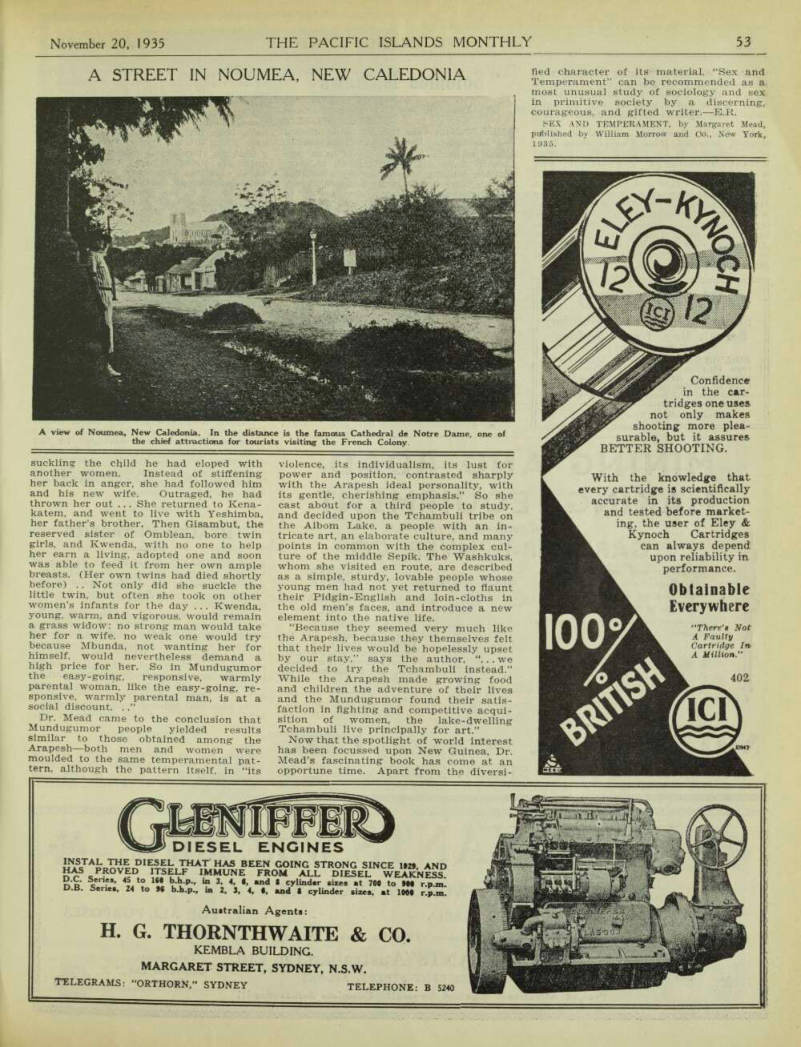
A Study in the Wilds of New Guinea
T\R. MARGARET MEAD, of the Ameri can Museum of Natural History, is well-known to students of Pacific affairs as the author of the provocative books “Coming of Age in Samoa” and “Growing Up in New Guinea.” The assistant curator of ethnology at that famous American institution has now published “Sex and Temperament in Three Primi tive Societies,” the material obtained by Dr. Reo Fortune and herself during their two years’ stay in New Guinea in 1931-33.
In a generous acknowledegment to her husband, Dr. Fortune, the writer says; “For assistance in the field my major thanks are due to Dr. Fortune for the partnership that made it possible for me to work with peoples more savage and more inaccessibly located than I would have been able to reach alone; for co operation in the collection of the linguistic and ethnological material upon which these studies are based: and for much concrete material concerning the men’s cults and all those aspects of the men’s lives which a woman ethnologist is prac tically debarred from studying.” In particular, the author is also indebted for her husband’s analysis “of the very diffi cult Arapesh language.”
Despite the handicaps of her sex —a difficulty that was largely overcome by her association with Dr. Fortune, who, incidentally, has since returned to the New Guinea field —Dr. Mead has compiled an extremely interesting and valuable book. The American is a racy narrator and would, indeed, have made an excellent journalist. Without in any way detract ing from the value of her work one is tempted to say that Dr. Mead has kept in view when writing this book the public demand she has already created for her writings. “Sex and Temperament” is not one of those abstruse scientific compen diums beyond the grasp of the average reader. Dr. Mead never forgets that she is dealing with human material. After all, the work of an anthropologist should interest the general public just as much as the investigator’s own learned col leagues. first section of the book is devoted to the mountain- dwelling Arapesh; in fluences of a co-operative society; growth an,d initiation of an Arapesh boy and the growth and betrothal of an Arapesh girl; birth, marriage, and the Arapesh ideal (and those who deviate from the latter).
The river-dwelling Mundugumor are dealt with in the second section. The pattern of social life among the lake-dwelling Tchambuli provides material for the third section. In the last portion of her book Dr. Mead sums up the results of her in vestigation.
Life is often complex in a native com munity. An involved and elaborate “social pattern” has it disadvantages, particularly for the women. The case of Kwenda, a woman of the Mundugumor, is not only interesting for the light Dr.
Mead has thrown upon the marital diffi culties of the strange New Guinea folk she has studied, but it is a good example of the graphic, stimulating, and breezy style of the writer; “Kwenda was plump and soft, where the ideal Mundugumor woman is tall, lithe, and slender. Kwenda loved children.
She had refused to throw away her first child, a boy, in spite of her husband’s request that she do so. While she was
suckling the child he had eloped with another women. Instead of stiffening her back in anger, she had followed him and his new wife. Outraged, he had thrown her out ... She returned to Kena katem, and went to live with Yeshimba, her father’s brother. Then Gisambut, the reserved sister of Omblean, bore twin girls, and Kwenda, with no one to help her earn a living, adopted one and soon was able to feed it from her own ample breasts. (Her own twins had died shortly before) Not only did she suckle the little twin, but often she took on other women’s infants for the day ... Kwenda, young, warm, and vigorous, would remain a grass widow: no strong man would take her for a wife, no weak one would try because Mbunda, not wanting her for himself, would nevertheless demand a high price for her. So in Mundugumor the easy-going, responsive, warmly parental woman, like the easy-going, re sponsive, warmly parental man, is at a social discount. ..”
Dr. Mead came to the conclusion that Mundugumor people yielded results similar to those obtained among the Arapesh—both men and women were moulded to the same temperamental pat tern, although the pattern itself, in “its
violence, its individualism, its lust for power and position, contrasted sharply with the Arapesh ideal personality, with its gentle, cherishing emphasis.” So she cast about for a third people to study, and decided upon the Tchambuli tribe on the Aibom Lake, a people with an in tricate art, an elaborate culture, and many points in common with the complex cul ture of the middle Sepik. The Washkuks, whom she visited en route, are described as a simple, sturdy, lovable people whose young men had not yet returned to flaunt their Pidgin-English and loin-cloths in the old men’s faces, and introduce a new element into the native life.
“Because they seemed very much like the Arapesh, because they themselves felt that their lives would be hopelessly upset by our stay,” says the author, .. we decided to try the Tchambuli instead.”
While the Arapesh made growing food and children the adventure of their lives and the Mundugumor found their satis faction in fighting and competitive acqui sition of women, the lake-dwelling Tchambuli live principally for art.”
Now that the spotlight of world interest has been focussed upon New Guinea, Dr.
Mead’s fascinating book has come at an opportune time. Apart from the diversi
tied character of its material, “Sex and Temperament” can be recommended as a. most unusual study of sociology and sex in primitive society by a discerning, courageous, and gifted writer. —E.R.
SEX AND TEMPERAMENT, by Margaret Mead, published by William Morrow and Go., New York, 1935.
Mr. M. Wenzel, a German artist, arrived in Melbourne from Europe on October 24 by the Blue Funnel line steamer Asca nius. On a world tour, he will visit the South Sea Islands to paint landscapes.
Mr. G. W. Spensley, of Rabaul, New Guinea, married Miss Thyrza Ross-Cox, of Victoria, at St. George’s Church, Rabaul, on October 14. The ceremony was a quiet affair, but afterwards the many friends of the bride and bridegroom filled the spacious lawn at the residence of the Hon. H. H. Page (Government Secretary), where the reception was held. Mr. Spens ley is manager for Messrs. Colyer, Watson, and Co., in New Guinea, and hails from Auckland, New Zealand, while the bride is a Melbourne girl, daughter of Mr. and Mrs. Ross-Cox, of St. Kilda.
Advertisements & other items, pp. 55-56 (2 items)
A Street In Noumea. New Caledonia
A view of Noumea, New Caledonia. In the distance is the famous Cathedral de Notre Dame, one of the chief attractions for tourists visiting the French Colony.
H. G. Thornthwaite & Co.
ffk
U/ % 12 Ic Confidence in the cartridges one uses mgr not only makes tr shooting more pleasurable, but it assures
BETTER SHOOTING.
With the knowledge that every cartridge is scientifically accurate in its production and tested before marketing, the user of Eley & k Kynoch Cartridges can always depend upon reliability in performance.
Obtainable
Everywhere
in “There’s Not A Faulty Cartridge In A Million o 402
ICI
am
h D
ESEL
ENGINES
ITi S c TA n n .T. I ?,|. DIESEL THAT HAS BEEN GOING STRONG SINCE 1929, AND HAS PROVED ITSELF IMMUNE FROM ALL DIESEL WEAKNESS.
D.C. Senes, 45t0 IS# b.h.p., in 3,4, I, and S cylinder sixes at 700 to 900 r.p.m.
D.B. Senes, 24 to 90 b.h.p., in 2, J, 4,0, and t cylinder sizes, at 1000 r.p.m.
Australian Agents:
H. G. THORNTHWAITE & CO.
KEMBLA BUILDING.
MARGARET STREET, SYDNEY, N.S.W.
TELEGRAMS: "ORTHORN,” SYDNEY TELEPHONE: B 5240
W. M. FORD
Ship, Yacht & Boat Builder
Berry’s Bay, North Sydney
(Established 187 d.) BUILDERS of all kinds of Island Craft from Dinghies to Auxiliary Schooners of any tonnage. New and Second-hand Island Craft of various types in stock. New and Second-hand Full Diesel, Crude Oil, Benzine and Kerosene Engines.
Please Send on Your Enquiries.
MINING AND ROAD-
MAKING EQUIPMENT
Manufactured by the
GARDNER-DENVER CO.
Equipment with outstanding qualities. Rugged and strong. Long life under toughest conditions.
There are 50 years’ development and experience behind the present modern designs.
GARDNER-DENVER
AUTOMATIC STOPER, Model 77H
A heavy duty type, automatically rotated, wet construction with direct or reverse air feed. Balanced throttle valve. Rifle bar rotation. Easily handled.
GARDNER-
DENVER
HAND-HELD
DRILL
Model 555 A medium weight drill for excavation, road work, shaft sinking, etc. Perfect balance. 4 pawl rotation obviates backlash. The fastest drill in its weight class.
Write for full information of Gardner-Denver products.
NOTES KUOS. (SIDVEI) LTD,
115 CLARENCE STREET, SYDNEY
BRANCHES AT NEWCASTLE AND BRISBANE
BULLIVANTS WIRE ROPES
LARGEST
“THE WORLD’S STANDARD”
STOCKS IN AUSTRALASIA - - - - FOR ALL PURPOSES Also Blocks, Hooks, Shackles, Thimbles, Strand, Seizing, Aircraft Cord, otc.
Letters: BULLIVANTS’ Australian Co. Ltd.
Bex 1298 J, G.P.O. 331-333 KENT STREET, SYDNEY Prompt Attention! Efficient Service!! Complete Satisfaction 11!
Telegrams: ‘Bnllivants Ltd.,’
Sydney.
Solomon Is. News
From Our Own Correspondent
Tulagi, Oct. 15.
THE Malaita this trip included among her ports Tetere on Guadalcanal, where mineral investigations have ap parently been promising enough to war rant the landing of some heavy gear that could not conveniently be handled except by a large vessel. A certain amount of road-making has been done, and residents hope that the road is really the path to prosperity. Other ventures of the same kind show signs of progress.
Japanese shelling luggers, or the same lugger in various places, have been sighted recently. In the Marovo Lagoon, a resident actually boarded the Haito Maru, and spoke for some time with the captain and engineer. He has sent a full description of the visitors to Tulagi.
The inter-island vessel Mitiaro, which had been laid up since the early days of the depression, except for a harbour tour taken in a fit of restlessness a few months ago, has been shorn of her fittings and has followed her predecessor the Malanta to a watery grave. For some time she had been the home of Mr. Jock Cromar, who has been compelled to look for other quarters.
Until information was received re cently that the Malaita had left Sydney,
a few settlers were distinctly worried about things. Rice was unobtainable at the principal merchants, although the ar rival of the Bolton from Rabaul relieved the situation. Beer also was getting a bit short, though still procurable. It would have been disastrous had there been no beer when the warship Sussex arrived!
Chinese stores, and especially restaur ants, are using tobacco currency these days. Natives purchase meals and in some cases goods, from the Chinese stores, for tobacco, in the same way as they do among themselves. It is a sign of the narrow margin of profit that contents the Asiatic, when he uses coin that so de preciates in value, as must a stick of tobacco when much handled. It is said that New Guinea stores use this form of currency to a great extent in their deal ings with natives.
Responsible Solomon Islands folk have often said that there are no poisonous snakes in the group. But at present in one small district there is almost a plague of those reptiles. Quite recently there were three deaths from snake bites.
Mr. F. L. Pinching, who, in spite of ill-health, has carried on his medical work for Messrs. Levers’ Pacific Plantations, Ltd., long after he might reasonably have considered his share of good work in the Solomons had earned him the right to a rest, leaves by this steamer for Sydney.
Dr. Gunther has replaced Mr. Pinching.
Levers’ medical craft, the Miro, which looked like being a total wreck on the Guadalcanal coast, was salvaged by the Valerie, Messrs. C. Bignell and J. Adam deserving great credit for getting the vessel safely off, and into the slip at Tulagi. Fortunately the weather was good after the vessel grounded.
Health In Tropics
SIR LEONARD ROGERS, in charge of the Tropical Diseases Hospital, Lon don, discusses in the current issue of the “Practitioner” rules for remaining healthy in the tropics. .
“Exercises must be taken daily, he says, “but not to the point of exhaustion.
Daily bathing is also essential, and an adequate amount of sleep is more necessary than anywhere else. Intellectual pursuits should not be neglected, and alcohol should be taken in comparatively small amounts, I would not suggest more than a pint and a half of light lager a day.”
He adds that tea and coffee are excellent mild stimulants and restoratives in the tropics. ■ Miss Marion Hardacre, who was a member of the Melanesian Mission staff from 1904 until she retired in 1929, died early in September at Brisbane, Queens land.
Advertisements & other items, pp. 57-58 (1 item)
Australia
The
The Pacific Islands Monthly, Nov. 20. 1935.
Holiday Time . . .
Suggests Sydney and
“THE AUSTRALIA”
“The Aralla**
Marlin Place Extension (As illustrated)
Opening Shortly
Christmas inevitably suggests “The Australia” —its scenes of gaiety—its special holiday attractions—its famous cuisine—and, above all, the fact that guests of “The Australia” have the very real satisfaction of being in the heart of social and commercial activities—a most important consideration in a cosmopolitan metropolis like Sydney.
Here, amid the limitless resources of one of the world s great hotels, your holiday or business trip will be enjoyed to the full.
NEW “ROOM
ONLY” RATES
Single Room, from 10/6 per day Ltouble Room, from 20/- per day Telegraphic Address “ Austraotel, Sydney’ & IT# filial
MO* I
I I
“BAINOL”
WHITE ANT PREVENTIVE
BORER EXTERMINATOR
WOOD PRESERVATIVE
The most scientific preparation on the market for the above purposes “BAINOL” is packed in containers to suit any size job, and is sold in quarts, halfgallon, one-gallon and four-gallon tins, and in 45-gallon drums at a reduced rate.
Prices: Quarts 2/11, Gallons 7/11, 4-Gallons £l/«/3, 45 Gallons £.13/4/2.
Australian Currency, F. 0.8., Sydney Sole Manufacturers:
Bains’ White Ant Exterminator
BW 6462 CO. LTD. LM 1025
Established 40 Years.
Scottish House, 17-19 Bridge St., Sydnsr lnquiries Regarding Agency Invited.
Fei Fresh Fruit, Vegetables, and Produce Island rasidsnts can rely on the old-established Shipping Providers.
C tf
8* * Only Addressi 421 Sussex St., SYDNEY All Orders Promptly Attended Island Representatives: Nelson & Robertson W. M.
Neptune’s Greatest Gift to Man —
OZO SALT
The word “OZO” means the Sea. OZO SALT is made from Sterilized Sea Water of the Pacific Ocean and dried In vacuum.
“NOTHING PURER ON EARTH.”
Ask for It In the new IJlb. Patent Package. Specially designed (for the Island and Eastern Trade) to resist Moisture, Humidity and Water. CAN BE OPENED AND RESEALED WITH THE GREATEST OF EASE. ORDER A PACKET TO-DAY.
Other "OZO” Specialities are; Ozo Health Salt.
Ozo Celery Salt.
“Sea-King” Gravy Salt.
OZO SALT CO.
SYDNEY
PRODUCING UNIFORM GOOD RESULTS SINCE 1868
Flour
ALWAYS ASK FOR IT
On Sepik Tour
General McNicoll Near Dutch Border
From Our Own Correspondent
Rabaul, Nov. 2.
THE Administrator (General W. Ram say McNicoll) left Rabaul by the last Macdhui and travelled by that vessel as far as Wewak, on the northern coast of the mainland, where he transferred to one of the small Government schooners.
After making an inspection of the new station at Wewak, he proceeded up the Sepik River, accompanied by A.D.O.
McCarthy and an amateur wireless ex pert, Mr. Weldon.
This is His Honour’s second trip up
the Sspik River, and there is speculation in some quarters as to the necessity which requires the Chief Executive of the Terri tory to make such long tours in this out of-the-way district. Some of the more optimistic miners hope that after the Ad ministrator has made the trip and found the natives to be tractable in areas which are at present proclaimed as being “un controlled,” an order may be issued re scinding the original proclamations, thus enabling experienced miners to enter dis tricts, which were previously explored by them many years ago.
The journey up the Sepik to October River (450 miles from the sea and about 15 miles from the Dutch border) was made by the Hermes. There General McNicoll left the schooner and continued his voyage on the launch Osprey. Near the Dutch border the river grew narrower and shoaled rapidly. A strong current and temporary engine trouble resulted in the launch colliding with a submerged snag and almost capsizing. The A.D.O. and one native fell overboard, but man aged to swim to a snag and were assisted back to the launch by river natives.
Through the efforts of the native ser geant, Nadu, most of the cargo, which also fell off the launch, was recovered next day. The anchor and cable were lost and the launch was leaking slightly, but a more serious situation was averted by clever handling of the craft by the engi neer, Andrews. The party later returned to the October River.
One of the features of this tour has been the contact maintained by His Honour with the civilised world through the medium of wireless. From time to time he has despatched to Rabaul details of his observations, for promulgation further afield.
It is something of a coincidence that the present tour of the Administrator is just 50 years after the Sepik was discovered by Dr. Finsch in 1885, and 25 years after the explorations of Dr. Schultze, who was the leader of the Dutch-German boundary expedition in 1910. Little did those pioneers think that science would make such progress as to enable the inhabit ants of the Sepik to “listen-in” to a musical programme, broadcast from America, or hear the latest war news from a coloured nation in Africa fighting against a European Power. Such, how ever, was the case during General McNicoll’s tour in the few weeks he has been in this area.
Unrest On Malaita
From Our. Own Correspondent
Tulagi, Oct. 15.
RECRUITERS and others from Malaita report rumours of unrest among th© natives of parts of Malaita. In some SSI the attitude of the natives appears to have been distinctly threatening, and. if reports be true, defiant of authority.
This is the largest district in the group, and, as the greatest source of labour, in a sense the most important.
All who have worked Malaita are aware that weakness is the J? o®* 0 ®* eerous policy with those (or any) natives, Ind anyone taking charge of this district needs to exercise the greatest firmness.
While only recruiters and others regu larly on Malaita can have a good idea of the state of affairs there, local residents are sufficiently familiar with the Malaita men to realise that the sßua tion is one that requires careful handling, and the sooner any nonsense is checked, the better for the whole group.
Advertisements & other items, pp. 59-60 (1 item)
Kriesler
THE HIIAES H.T. SUPPLY
Unfailing Radio Battery Service for at least 20 years 9 % 3o •Uj 50 6Q *0 No So % Mo Mo p VcNe'- 60° free se n *A*e* s O*
Features—
• Automatically charges from Radio A Battery. • No Acid. • No Lead Plates • Stands any discharge or charge. • Indestructible electrically. • Thos. Edison Patent.
KRIESLER-DIJAE'WAAE
RATTERI RADIOS
can be supplied equipped with Milnes
KRIESLER
(AEST.) ETD.
MYRTLE, PINE & BEAUMONT STS., CHIPPENDALE, SYDNEY
AVOID INERT CREAMS
What woman does not sigh after this radiant freshness, this juvenile tint that excites admiration? CREME SIMON makes the skin lovely, —it is always active and is delicately perfumed.
For Perfect Beauty use
CREME SIMON
also
POUDRE SIMON
(7 Shades), and
SIMON SOAP
a
CREME
Si MON
PARIS
Obtainable Chemists and Stores Sol* Agents: Joub*rt&« Joubert Pty.Ltd.,Melbourne
V
tV^ e
* a >4O o* &t at* Ift de £av*
MWV
Vce9 oi\t^ c *t° 4IU its t V° uS ltot» \o^ c vn oa ’A* Co atvcc // ii*% z Yd«* auc dV-^ c ra Kao iKc iotc tt\ Ot tvsts dxttc // o^S
DECOI
EAU
m * mm *
SSSZ&
m
Fashion Hints for Islands Women
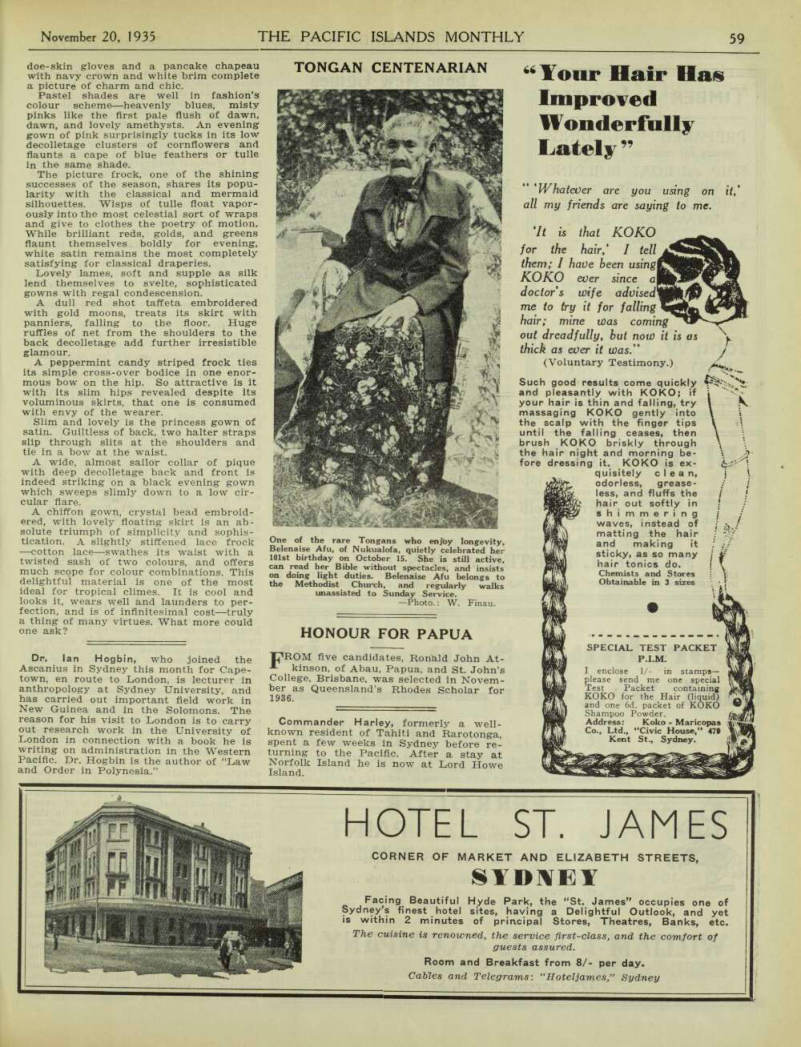
By Therese
Accessories are the high lights of fashion and it is impossible to over estimate their importance. Not extrava gances but necessities, their careful and discriminate choosing reduces one’s dress expenditure amazingly and makes the wardrobe versatile beyond belief.
A change of accessories, and hi, presto! you and your frock take on different characters as if by magic.
Hats, gloves, bags, scarves, etc., should be chosen with infinite thought and due regard to one’s entire wardrobe. And then follows careful attention to those gifts of the gods—shoes to be treed, gloves care fully tended, hats brushed, bags tissue stuffed to retain their shape, and so on.
All this attention shares equal importance with discriminate choice, since accessory pack-drill prolongs its life and gives to lovely women a well groomed soignee ap pearance.
Delightful bags of linen come to us in a variety of shapes and colours, and are the ideal accompaniment to a linen frock
or suit. Glass rings singly or in pairs are their only trimming note.
Pig-skin gloves, belts and bags are charming, and there is an imitation pec cary equally effective at only half the price. Knitted belts of wool or string, with patent leather bits and buckles have the quaintest of patent leather posies to add a matching note.
Straw pochettes and belts and gaily striped canvas ones with matching san dals are ideal beach accessories. Scarves are all the colours of the rainbow, blended with indescribable artistry, gay and romantic as a gipsy’s song.
Collars take many shapes—turreted like old battlement towers; peaked and round; sailor shapes, cool and breezy, with all the tang of the sea in their jaunty freshness; the Eton collar, stiffly starched, in bright colours on a light or dark frock, its loose bow falling in soft contradiction from beneath its primness; and so on.
A bib and tucker, pintucked down the centre front, which is about six inches wide with tiny box pleats on either side, pops over the head and ties at the waist, gallantly lifting a last year’s frock out of the gloom.
Down in the pages of history goes 1935as a “blouse and skirt” year. Such de lightful blouses and well tailored skirts — and of what economy! Blouses gay and vivid, sports shirts, formal blouses or frivolous little things that defy their practical tailored skirts with wicked glee; and for evening, too, in the brightest pos sible colours. Several of them to suit one’s every whim, all to one well cut skirt, and offering full scope for ingenuity.
There is a crisp quality about summer materials that makes them refreshing to look upon. Imitation linens, with all the virtues of linen, at half its cost, are much in favour with those facing the prob lem of getting much out of little. It comes in slub, floral, check, and spotted effects, and all are charming. Colour combina tions holding as they do, an exalted place in the scheme of things are used for every possible occasion. . . .
A rough linen suit, with plaid jacket in lovely soft shades of oatmeal, pink and brown, sports a pink blouse and the palest pink panama hat, dipped down over the nose in a provoking manner. Brown ac cessories complete a most attractive en semble.
A pin-striped silk frock, shirt-maker style, in brown and white, with an accom panying coat, adds an unusually dashing note with its royal blue patent belt and posy, A blue handkerchief floats gaily from the pocket and either blue or brown and white shoes may be worn.
A charming three-piece of floral crepe de chene has Mikado sleeves on its three quarter length jacket. It trims them with bands of white silk pique and quaint little motifs of the same material adorn the dress, , , , White linen suits have backless and sleeveless dresses. A long sailor collar which buttons to the low back is a de lightful innovation, and makes it possible to dispense with the coat for less formal occasions. . . ...
Trim little capes swing jauntily rrom shoulders, turning the sunbathing frock into more formal wear.
A navy and white spotted afternoon gown trims its “high to the throat” line, with two little envelope peaks front and back, and treats its pockets in the same amusing way. Navy shoes and bag, white
doe-skin gloves and a pancake chapeau with navy crown and white brim complete a picture of charm and chic.
Pastel shades are well in fashion’s colour scheme—heavenly blues, misty pinks like the first pale flush of dawn, dawn, and lovely amethysts. An evening gown of pink surprisingly tucks in its low decolletage clusters of cornflowers and flaunts a cape of blue feathers or tulle in the same shade.
The picture frock, one of the shining successes of the season, shares its popu larity with the classical and mermaid silhouettes. Wisps of tulle float vapor ously into the most celestial sort of wraps and give to clothes the poetry of motion.
While brilliant reds, golds, and greens flaunt themselves boldly for evening, white satin remains the most completely satisfying for classical draperies.
Lovely lames, soft and supple as silk lend themselves to svelte, sophisticated gowns with regal condescension.
A dull red shot taffeta embroidered with gold moons, treats its skirt with panniers, falling to the floor. Huge ruffles of net from the shoulders to the back decolletage add further irresistible glamour.
A peppermint candy striped frock ties its simple cross-over bodice in one enor mous bow on the hip. So attractive is it with its slim hips revealed despite its voluminous skirts, that one is consumed with envy of the wearer.
Slim and lovely is the princess gown of satin. Guiltless of back, two halter straps slip through slits at the shoulders and tie in a bow at the waist.
A wide, almost sailor collar of pique with deep decolletage back and front is indeed striking on a black evening gown which sweeps slimly down to a low cir cular flare.
A chiffon gown, crystal bead embroid ered, with lovely floating skirt is an ab solute triumph of simplicity and sophis tication. A slightly stiffened lace frock —cotton lace—swathes its waist with a twisted sash of two colours, and offers much scope for colour combinations. This delightful material is one of the most ideal for tropical climes. It is cool and looks it, wears well and launders to per fection, and is of infinitesimal cost —truly a thing of many virtues. What more could one ask?
Dr. lan Hogbin, who joined the Ascanius in Sydney this month for Cape town, en route to London, is lecturer in anthropology at Sydney University, and has carried out important field work in New Guinea and in the Solomons. The reason for his visit to London is to carry out research work in the University of London in connection with a book he is writing on administration in the Western Pacific. Dr. Hogbin is the author of “Law and Order in Polynesia.”
Tongan Centenarian
One of the rare Tongans who enjoy longevity, Belenaise Afu, of Nukualofa, quietly celebrated her 101st birthday on October 15. She is still active, can read her Bible without spectacles, and insists on doing light duties. Belenaise Afu belongs to the Methodist Church, and regularly walks unassisted to Sunday Service.
Photo.: W. Finau.
Honour For Papua
five candidates, Ronald John At kinson, of Abau, Papua, and St. John’s College, Brisbane, was selected in Novem ber as Queensland’s Rhodes Scholar for 1936.
Commander Harley, formerly a well known resident of Tahiti and Rarotonga, spent a few weeks in Sydney before re turning to the Pacific. After a stay at Norfolk Island he is now at Lord Howe Island,
Advertisements & other items, pp. 61-62 (1 item)
Hotel St. James
66 Your Hair Has
Improved
Wonderfully
Lately ”
“ ‘ Whatever are you using on all my friends are saying to me. it,' ft r > — %A i \
'lt is that KOKO
for the hair ;* I tell
them; I have been using\
KOKO ever since a
doctor s wife advised
me to try it for falling
hair; mine was coming
out dreadfully, but now it is as thick as ever it was." (Voluntary Testimony.) Such good results come quickly and pleasantly with KOKO; if your hair is thin and falling, try massaging KOKO gently into the scalp with the finger tips until the falling ceases, then brush KOKO briskly through the hair night and morning before dressing it. KOKO is exquisitely clean, odorless, greaseless, and fluffs the hair out softly in shimmering waves, instead of matting the hair and making it sticky, as so many hair tonics do.
Chemists and Stores Obtainable in 3 sizes
SPECIAL TEST PACKET
P.I.M.
I enclose 1/- in stamps— please send me one special Test Packet containing KOKO for the Hair (liquid) and one 6d. packet of KOKO Shampoo Powder.
Address: Koko - Maricopas Co., Ltd., “Civic House,” 479 Kent St., Sydney. {W g.
! fit I
HOTEL ST. JAMES
CORNER OF MARKET AND ELIZABETH STREETS,
SYDNEY
Facing Beautiful Hyde Park, the “St. James” occupies one of Sydney’s finest hotel sites, having a Delightful Outlook, and yet is within 2 minutes of principal Stores, Theatres, Banks, etc.
The cuisine is renowned, the service first-class, and the comfort of guests assured.
Room and Breakfast from 8/- per day.
CaVles and Telegrams : " Hotelfames,” Sydney
Timber Joinery
ETC.
PREPARED BUILDINGS
ready for erection a speciality.
SHIP and BOAT BUILDING
TIMBERS specially catered for
FIB ROLITE, PLYWOODS.
GALVANISED IRON,
CANEC.
O CONSIGNMENTS shipped
by RETURN STEAMERS
to the Islands.
John W. Eaton Ltd.
WEST CRESCENT ST.,
NORTH SYDNEY
TELEPHONES: X 5051 (5 lines)
BITUMENOID ROOFING
MADE IN AUSTRALIA
Bitumenoid Roofings, Dampcourses and Insulating Felts are made from the world’s best raw materials. Warranted to stand the most rigid tests.
BITUMENOID THE BEST
Roofing, 1,2, 3-ply; Flooring, Waterproof Materials; Saturated Felt; Resilient Road Jointing; Natural Asphalt Dampcourse; 2 and 3-ply Dampcourse; l-21b. Lead-core Dampcourse; Roofing Cement; Asphalt Paints; Roofing Compound.
SAMPLES AND PRICE LISTS ON APPLICATION.
MAXWELL PORTER & SON LTD.
ESTABLISHED 1888. BUILDERS’ SUPPLIES
107 REDFERN ST., REDFERN, SYDNEY, N.S.W. ’Phone, M 3157. Cables: Bitumenoid
Scorching Sun. Rain
and Sea ■ air
Co/j/joto/feciTERRODOR
Your buildings, whether built of iron, steel, or wood, will be perfectly protected against the ravages of the weather if painted with the most enduring paint you can buy—
FERRODOR
PAINT
(ANTI-
CORROSIVE)
Ferrodor is used extensively by N.S.W. Government Railways and Public Works Departments—definite proof of its quality.
Ferrodor is non-poisonous, and available in a full range of colours.
Obtainable at all leading Paint Houses and the Sole Agents
WIIUAM ADAMS A. COMPANY
175 Clarence Street, Sydney
“Mummies”
Those New Guinea “Mummies”
A Scientist’s Comments
Letter to the Editor ly/TARVELS now come out of New Guinea as they used to go out of Africa, One expects the public to be interested, even excited; but fusty scientists are supposed to keep their heads and refrain from talking till they have got hold of the available facts. Having seen myself quoted however —before I have even spoken —first on the “new race” (as it is freely called) which Messrs. Hides and O’Malley reported from Papua, and now on the “mummies” discovered by Dr. Atcherley in the Mandated Territory, I feel that I am justified by self-defence in writing to the press.
When the “mummies” (I put them in inverted commas because I understand they are still sub judice ) were first re ported, the “Papuan Courier” asked me if I would give an opinion on them. I declined for the ample reason that I had none to give. But I see that your own correspondent at Wau —whoever he may be —reports in your last issue that I share
Dr. Fortune’s opinion that the mummified remains are contemporary with the pre sent natives of the district, and that we both emphatically disagree with the theory (allegedly put forward by Dr, Firth) that they may have some connec tion with the Egyptians.
My sole contribution to the literature of the subject has been a personal note to Dr. Fortune congratulating him on the tone of his brief report quoted in the “Papuan Courier” in August. This is a very different thing from expressing agreement with his views, and still more different from offering an opinion for pub lication in the press.
The fact is that I would hardly allow myself to form an opinion. For in the first place I have neither seen the “mum mies” nor read any adequate description of them; and in the second I am so completely ignorant of the subjects of mummies at large that I should not de pend on myself to recognise one outside a museum.
Whether the remains are or are not contemporary with the present day natives I have not the faintest idea; and whether they are or are not ultimately connected with the mummies of ancient Egypt I do not really care. If there was any point in his original report upon which I felt entirely at one with Dr. For tune it was where he said that the dis covery did not greatly interest him. It belongs to a branch of the wide tree of anthropology upon which neither I, nor, I believe, Dr. Fortune, would care to climb —much less to “swing.”
Those who are by qualification and op portunity able to investigate the New Guinea “mummies” may well ask, if they read your September issue, what right this anthopologist from Papua has to express an opinion. I have none, Mr.
Editor; and that is why I have expressed none.
Yours faithfully,
F. E. Williams.
Govt. Anthropologist, Port Moresby, 30/10/’35.
Editorial Note
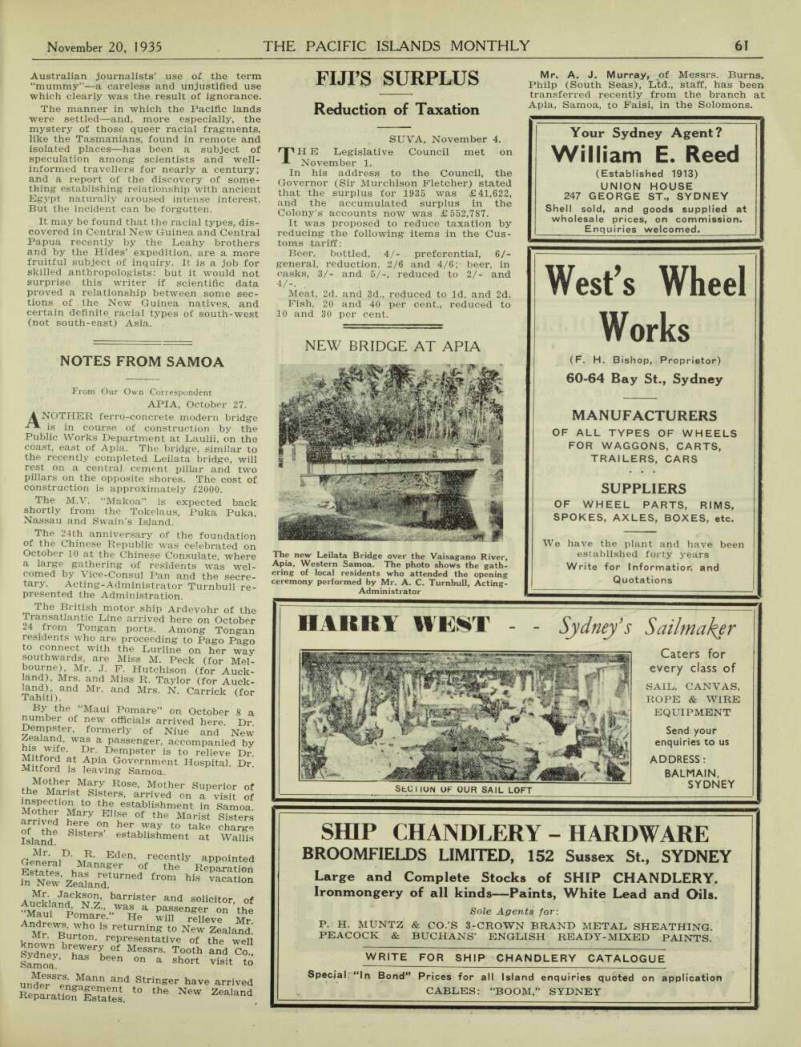
There is no doubt that irresponsible journalism gave the name of “mummies” to the human remains found in the cave near Salamaua, New Guinea, and that there is no scientific justification for the term.
The popular meaning of “mummy” is a body that has been preserved for very many centuries by special treatment of the body itself (and the ancient Egyptians had developed a marvellous technique in this regard) and (this more especially) by wrapping the body tightly in great rolls of fabric.
So far as we know, there is not the slightest indication that the New Guinea bodies had been wrapped. They had, apparently, been preserved in a remark able manner; but only experts of great skill will be able to say whether, in this respect, there is any indication of an Egyptian technique. The chances seem to be overwhelmingly against it. It is much more likely that the bodies are pre served, partly by drying and native treat ment (a common enough thing among those peoples) and partly by natural chemical action in the cave in which they were placed.
“Mummification” —mostly of the corpses of royal personages—was a common practice of the Egyptians, between 3000 B.C. and 1000 8.C.; and, if it were proved that the custom had been employed in New Guinea, it would be a discovery of outstanding scientific importance. But nothing of this kind can be expected.
Interest, abroad, was stirred only by the
Australian journalists’ use of the term “mummy”—a careless and unjustified use which clearly was the result of ignorance.
The manner in which the Pacific lands were settled —and, more especially, the mystery of those queer racial fragments, like the Tasmanians, found in remote and isolated places—has been a subject of speculation among scientists and well informed travellers for nearly a century; and a report of the discovery of some thing establishing relationship with ancient Egypt naturally aroused intense interest.
But the incident can be forgotten.
It may be found that the racial types, dis covered in Central New Guinea and Central Papua recently by the Leahy brothers and by the Hides’ expedition, are a more fruitful subject of inquiry. It is a job for skilled anthropologists: but it would not surprise this writer if scientific data proved a relationship between some sec tions of the New Guinea natives, and certain definite racial types of south-west (not south-east) Asia.
Notes From Samoa
From Our Own Correspondent APIA, October 27.
A NOTHER ferro-concrete modern bridge is in course of construction by the Public Works Department at Laulii, on the coast, east of Apia. The bridge, similar to the recently completed Leilata bridge, will rest on a central cement pillar and two pillars on the opposite shores. The cost of construction is approximately £2OOO.
The M.V. “Makoa” is expected back shortly from the Tokelaus, Puka Puka, Nassau and Swain’s Island.
The 24th anniversary of the foundation of the Chinese Republic was celebrated on October 10 at the Chinese Consulate, where a large gathering of residents was wel comed by Vice-Consul Pan and the secre tary. Acting-Administrator Turnbull re presented the Administration.
The British motor ship Ardevohr of the Transatlantic Line arrived here on October 24 from Tongan ports. Among Tongan residents who are proceeding to Pago Pago to connect with the Lurline on her way southwards, are Miss M. Peck (for Mel bourne), Mr. J. F. Hutchison (for Auck and), Mrs. and Miss R. Taylor (for Auck land), and Mr. and Mrs. N. Garrick (for JL clllltl).
By the “Maui Pomare” on October 8 a number of new officials arrived here Dr Dempster, formerly of Niue and New Zealand, was a passenger, accompanied by D ?, m P ster is to relieve Dr. at Apia Government Hospital. Dr Mitford is leaving Samoa.
Mother Mary Rose, Mother Superior of the Manst Sisters, arrived on a visit of MotbPr t 0 establish ment in Samoa.
Mother Mary Ehse of the Marist Sisters of r TbP °? her way to take charge Island Slsters establishment at Wallis Cenprnl D Eden ’ recently appointed State. h^f na f 6r ° f the Reparation S New’ze“and. Urned fr ° m his vacation AMkiaid Ck N7 barrister and solicitor, of Auckland, N.Z., was a passenger on the Maui Pomare.’’ He will relieve Mr M! W Burtl° ‘ S returnins to New Zealand!
Mr, Burton, representative of the well Sydnev ° f Messrs - Tooth and Co..
Samoa been ° n a short visit to un^r 8 and Stringer have arrived Reparations. t 0 th ® N ® W Zealand
Fiji’S Surplus
Reduction of Taxation
SUVA, November 4.
TH E Legislative Council met on November 1.
In his address to the Council, the Governor (Sir Murchison Fletcher) stated that the surplus for 1935 was £41,622, and the accumulated surplus in the Colony’s accounts now was £552,787.
It was proposed to reduce taxation by reducing the following items in the Cus toms tariff: Beer, bottled, 4/- preferential, 6/general, reduction, 2/6 and 4/6; beer, in casks, 3/- and 5/-, reduced to 2/- and 4/-. .
Meat, 2d. and 3d., reduced to Id. and 2d.
Fish, 20 and 40 per cent., reduced to 10 and 30 per cent.
New Bridge At Apia
Mr. A. J. Murray, of Messrs. Burns, Philp (South Seas), Ltd., staff, has been transferred recently from the branch at Apia, Samoa, to Faisi, in the Solomons.
The new Leilata Bridge over the Vaisagano River, Apia, Western Samoa. The photo shows the gath ering of local residents who attended the opening ceremony performed by Mr. A. C. Turnbull, Acting- Administrator
Advertisements & other items, p. 63 (1 item)
Works
Your Sydney Agent?
William E. Reed
(Established 1913)
UNION HOUSE
247 GEORGE ST., SYDNEY
Shell sold, and goods supplied at wholesale prices, on commission.
Enquiries welcomed.
West’s Wheel
Works
(F. H. Bishop, Proprietor)
60-64 Bay St., Sydney
MANUFACTURERS
OF ALL TYPES OF WHEELS
FOR WAGGONS, CARTS,
TRAILERS, CARS
SUPPLIERS
OF WHEEL PARTS, RIMS,
SPOKES, AXLES, BOXES, etc.
We have the plant and have been established forty years Write for Information and Quotations
lIAKIKI WEST - - Sydney’s Sailmaker
tv e
Xjt
wm I
StCIION OF OUR SAIL LOFT
Caters for every class of
SAIL, CANVAS,
ROPE & WIRE
EQUIPMENT
Send your enquiries to us
ADDRESS;
BALMAIN.
SYDNEY
SHIP CHANDLERY - HARDWARE
BROOMFIELDS LIMITED, 152 Sussex St., SYDNEY
Large and Complete Stocks of SHIP CHANDLERY.
Ironmongery of all kinds—Paints, White Lead and Oils.
Sole Agents for: P. H. MUNTZ & CO.’S 3-CROWN BRAND METAL SHEATHING.
PEACOCK & BUCHANS’ ENGLISH READY-MIXED PAINTS.
WRITE FOR SHIP CHANDLERY CATALOGUE
Special “In Bond" Prices for all Island enquiries quoted on application
CABLES: “BOOM,” SYDNEY
N.G. Goldfields Strike
Letter to the Editor IN your October issue, on page 57, you report that a strike of miners occurred on the Morobe goldfields, New Guinea, between September 7 and 11, and that this strike was caused by New Guinea Goldfields Ltd. informing 15 miners that their wages were to be reduced 1/- per day. This report is not correct.
The facts are that some of the miners at our Golden Ridges mine served an ultimatum on the manager that, unless their wages were increased by 9/- per day, they would cease work. The request was refused, and the miners went on strike.
A conference with the men eventually led to a Letter understanding and the men returned to work a few days later.
I am, etc.,
J. Farram
Sydney Manager.
New Guinea Goldfields Ltd.
All Quiet In Samoa
From Qur Qwn Correspondent APIA, October 27.
Ilf ATTERS political are quiet here just , L “"f 01 tion between Administration and Mail seems to be developing.
Mr . A c Turnbull who has been here , for y ears - and who IS well liked, is acting as Administrator, and his in fluence is all to the good. c +-u„ There are former bitter critics of the Administration who say that if the New Zealand politicians will only leave us alone, and allow Mr. Turnbull to carry on in his quiet and efficient manner, there will be no more trouble in Samoa.
Cocoa-Planting In
New Guinea
Letter to the Editor THE remarks of Mr. Nixon-Westwood A about cocoa-growing in New Guinea, published in your September issue, call for comment.
I think I am correct in saying that the planters of the Territory have no great respect for the Agricultural Department’s work of the past; but the action of Mr.
E. C. Green (the officer of the Depart ment to whom the reference is made) in spending his furlough of 12 months— quite different to a flying visit —studying the cocoa industry and problems con nected with it, under the tutorship of some of the world’s foremost Tropical Agriculturists, is a commendable and progressive step.
Since Mr, Green’s return to the Terri tory, he has given unstintingly the results of his observations and teachings at Trinidad to anyone interested and has been able to give a number of planters valuable information. Mr. Green is now the Superintendent of the Demonstration Plantation of the Department of Agri culture, and is busy planting cocoa in various experimental ways; and the knowledge thus gained will be very valu able in the future. He is also making experiments in fermentation. Practical benefit has already been obtained from these experiments.
The Thesis presented by Mr. Green in part requirement for the Associateship of The Imperial College of Tropical Agriculture (he is the first Australian to gain this distinction) has been published as a Bulletin by the Department: and to the majority of planters here, who know practically nothing about cocoa, it will prove a valuable guide and should in terest them to the extent of making them seek further knowledge of the subject.
Maybe Samoan methods would be ap plicable here, and the suggestion that a planter from Samoa could give us valuable information is feasible; but the Department has apparently not thought all this out yet and Mr. Nixon-Westwood’s letter may lead them to investigate the desirability of; (1) Sending an officer to Samoa for experience or (2) Engaging an experienced man from Samoa. (1) of course would mean: (a) Who? (b) When? (c) How?; and (2) could go ad infinitum.
In the .meantime, let us give a measure of praise to Mr. Green’s good work.
I am, etc..
Turalam.
Rabaul. T.N.G.
October 19, 1935.
G.O.M. Of Samoa
From Our Own Correspondent APIA, October 27.
WITHIN one week recently, three of the oldest European residents celebrated their birthdays and received congratula- Mr. Niedecke, Senr., completed his 79th year of life, Mr. G. E. L. Westbrook reached 75, and Mr. Paul Hoeflich 79.
The latter two gentlemen are old and well-known Island identities who arrived on our shores on the same day, 45 years three gentlemen are mentally and physically fit, and still enjoying life, and probably will be with us for a long lime to come.
Advertisements & other items, p. 64 (1 item)
conditions
SHIP CHANDLERY
M. Kopsen Co. Limited
Manufacturers of PIONEER BRAND ASH OARS AND IMPLEMENT HANDLES.
Sole Agents for ; KOPSEN’S SPECIAL YELLOW METAL SHEATHING AND NAILS.
Large stocks of Chains, Anchors, Manilla and Wire Ropes, Wood and Iron Blocks, Oakum, Tar, Pitch, Oils, Paints, Leads, Zincs, Varnishes, Shackles, Rigging, Screws, Sheathing, Felt, Lampware, etc.
Special Under Bond Prices for Island Trade.
68-70 CLARENCE STREET, SYDNEY
Cables: “Kopsen.” ’Phone: BW 1114-5.
conditions
1 •4 / V There’s no better paint than Wilkinsons Pure Metallic White Will not peel or crack Produces 33% more Paint than White Lead
WILKINSONS
PURE METALLIC WHITE
Agents: W. R. Carpenter & Co. Ltd.
Condition
Samoa’S
Survey of Trade and Population
From Our Own Correspondent APIA, October 28.
TTHE Fifteenth Annual Report on Wes tern Samoa to the League of Nations which has been published recently, con tains little of special importance.
It shows, however, that for the period under consideration (April 1, 1934, to March, 1935) the total trade, as well as export and import values have largely de creased, as against the figures of former years. Total trade turnover amounted to only £220,901, as compared with £324,693 for the previous year, a decrease of almost 32 per cent. Total trade thus amounted to only half the volume of the pre-war period, 1910-12. Of the total trade turn over, exports amounted to £128,117 (£173,837 in 1933) and imports to £92.784 (£150,856 in 1933), showing a favourable balance of £35,333. Imports in 1934 were 72.4 per cent, of the value of exports, as •compared with 86.8 per cent, in 1933, the decrease being due to acute economic con ditions prevailing during the year.
Exports of Samoan produce are given as follows:
Copra exports were the smallest since the 1916/18 period, while cocoa and banana exports were the largest in quantity, though not in value. It is safe to predict, however, that for the present financial year, owing to better crops and higher pro duce prices, exports and imports will show a large increase.
The revenue of the Administration, in 1934/35, amounted to £78.808 (£90,613 in 1933/34), the departments of Health and Customs showing the largest decreases: while expenditure is given as £76.505 <89,955 in 1933/34), nearly all departments showing a decrease. This leaves a small surplus for the financial year of £2.303.
The Administration now holds an accumu lated surplus of £15,755.
The administrative staff shows only slight changes. It is pointed out that of the officers in charge of departments, those in charge of education, health, native, pub lic works, postal and radio, lands and sur vey, and police—those most in contact with the Samoans—have an average Samoan service of 14| years each. Other important office-holders, such as Administrator. Col lector of Customs, Treasurer, Commissioner of Labour and Public Trustee, Auditor and Harbourmaster, and Secretary to the Ad ministration, have much shorter periods of Samoan service.
Ir regard to crime and administration of iaw, the report shows an increase of approximately 50 per cent, in criminal offences reported during the year. Most of the cases, however, were not of a serious nature.
The infant mortality rate for 1934 was 104,8 per 1000 registered births. This high rate is likely to continue until the instruc tional work undertaken by the Adminis tration amongst the natives can bear results.
Population figures for 1934, given in the report, are again based on the count taken in 1932/33, during the yaws campaign. It has been pointed out previously that these figures are quite inaccurate and the figure given for the total population (53,087) is much too high; 45,000 would probably be more correct. The numbers of persons of European and Samoan descent, as stated, are much toe low, many of these being counted as native Samoans. A fair esti mate would be about 4000. The number of persons of mixed Chinese and Samoan
blood, also counted as Samoans, are esti mated at about 1000, The number of Chinese labourers in Samoa (632 on January 1, 1934) decreased during the year by 129, only 503 being counted on December 31, 1934.
New Zealand At Geneva
Giving an account of Samoa to the Man dates Commission of the League of Nations at Geneva on October 30, the High Com missioner for New Zealand (Sir James Parr) said that 11 white and 36 native police were preserving order there among 50,000 people.
There had been a great improvement upon the former troublous conditions, he said.
A certain temporary political agitation had recently been revived. The Govern ment thought it was related to the im pending elections, but the Administrator believed that any dissatisfaction was in spired from only one quarter. The general situation was improving. Trade in 1934
Calendar year, 1933 Calendar year, 1934 Tons Value Tons Value Copra .. 11,526 £101,347 8.948 £60,654 Cocoa .. 899 41,813 1.027 29,498 Cases Cases Bananas . 81,983 26,999 96.225 35,796
had declined about 31 per cent., but had improved to a marked degree in the first three months of 1935. Prices were rising, especially for copra and bananas, and health and sanitation were improving.
The work of Samoan teachers and doc tors was entirely satisfactory.
Advertisements & other items, pp. 65-66 (1 item)
Prescott Ltp
are sole wholesale a den is /dr-
PINEAPPLE BACON £ HANS
DAISV BRAND BUTTER
FRESCO BRAND BUTTER
LEA & PERRINS’ SAUCE
MUNGO SCOTT Ltd.
EXPORTERS OF
SUPERB FLOUR
FOR
38 YEARS
SUPERB
RELIABILITY
AND PROMPT
SHIPMENT
SUMMER HILL
SYDNEY
AUSTRALIA
SKANDIA ENGINES MARINE AND STATIONARY
FULL DIESEL - - SEMI DIESEL
Reliable, Efficient, Economical, Immediate Starting on Crude Oil Particulars from: NELSON & ROBERTSON, 12 SPRING STREET, SYDNEY
• LOW FUEL CONSUMPTION
TYPES FOR ALL BOATS
r Force Feed "]§ Circulating ■-Lubrication -M
While You Sleep the Remedy Heals
A WELL-PROVEN
REMEDY FOR PILES
This preparation has been on the market tor several months, and it has effected a Cure in every case in which it has been tried.
Cases of Long Standing often Cured within One Month, with one bottle only.
For External Use only—Stainless, Painless and Odourless.
PRICE: 3/6 PER BOTTLE. Posted securely packed for 5/- per bottle. Copies of Testimonials forwarded on request.
Read the Report of an Eminent Analytical Chemist:
THE LABORATORY.
20 and 22 Napoleon Street, Sydney, March 14th, 1933.
ROBERT BRUCE, Esq.
Dear Sir, —The formula of your pile cure submitted to me could have no effect other than beneficial. I gave your sample to a Client who had suffered many years, and before he had used half the bottle he reported himself completely cured.
Faithfully yours,
GROVE JOHNSON, F.C.S. (Lond.)
“Honours,” City and Guilds of London Institute.
Analytical and Consulting Chemist.
Supplies obtainable from—
Robert Bruce
Room 7, 2nd Floor,
15 HUNTER STREET, SYDNEY
and also at 14 Upper Bayview St., North Sydney
For all places where there is clearing or timber-getting work, the Buzacott New Record Drag Saw the one-man machine which does the work of many men. Will cut through logs up to 7 feet diameter.
Native labour can operate f 6 ... . .L pumping outwithout harm to the ; t s unriva e d for value and efficiency from sturdy little pumpers which can run up to twelve hours on a gallon of petrol, to centrifugal pumps for the larger jobs. Used in mines and for irrigation throughout the Commonwealth, they never give trouble.
Write "for illustrated pamphlet. machine. Write for particulars.
Buzacott & Co.
LTD.
7-11
Market St.,
Sydney
Australia
‘Buzacott* Pumps
and Pumpers
THERE are many Fetters in use to-day and their rapidly increasing popularity is due to the satisfactory service they give all over the world. Diesels and Semi-diesels, which give you a complete feeling of security (they never “let you down"), in a range from 6 to 540 b.h.p., are renowned for their robust construction, simplicity of operation, easy starting and efficiency.
Full particulars of any type sent on request.
Tell us your plans and allow us to advise you.
Write to-day.
High efficiency and conservative rating are Fetter features, too. .
Diesel and Semi-Diesel
Marine
and
Stationary
Types
FETTER Engines
on Tanna, New Hebrides
Presbyterians Discuss Mission Problems at Annual Synod on Tanna, New Hebrides
THOUGH the perils and hardships of mis sionaries have been considerably lessened since the pioneer evangelists arrived to Christianise the untutored savages of the South Seas, there still remain certain Pacific Islands where mis sionaries carry their lives in their hands as they advance to spread the gospel teachings. Among those pagan territories are the lesser civilised islands of the New Hebrides group.
The difficulties confronting the workers of the Presbyterian Church in the Condominium were discussed at the Mission Synod held recently at Lenakel, West Tanna. The meeting passed a minute expressing deep regret at the death of Apon, a native teacher, who was shot by heathen natives at Leviamb, West Malekula, in July last.
Present at the First Session were: Revs. T.
MacMillan, B.A. (Moderator), W. V. Milne, J. E.
Jaffray, W. Anderson, D. McLeod, M. 8., Ch.B., J. W. P. Gillan, 8.A., B. R. C. Nottage, 8.A., W. F. Paton, 8.A., B.D. The British Resident Commissioner (Mr. G. A. Joy) addressed the meet ing, discussing the question of native welfare.
Mr. B. C. Ballard, solicitor representing Australian interests in the Condominium, spoke at the invita tion of the Synod on native lands and surveys in relation to the Mission’s . activities.
Having received a communication from 'the Bishop of Melanesia regarding natives from islands under his mission care who are working in Vila or on outlying plantations, the members of the Synod Committee decided after consideration to agree to his placing native teachers where Melanesian Mission natives are working. The Bishop gave his assurance that there would be ho proselytising on the part of the native teachers.
The Presbyterian Mission informed the Melanesian Society that there was no opening for another church on Santo Island. - Mr. A. Stewart, who had recently been seriously ill, will shortly begin special deputation work in Australia. He will urge the Victorian and N.S.W.
Churches to provide missionaries for Nogugu, White Sands (Tanna), South-West Bay (Malekula), Paama, and South and West Santo.
In an interesting comment on the physique of the natives of White Sands district, Rev. T. Mac- Millan (East Tanna) said" that Captain" Cook on his visit there in 1774 described the men as strong
and vigorous, but rather small of stature. That description was true of the Tannamen when he arrived in 1896; to-day they are a more stalwart race, taller and bigger, of decidedly improved
physique.
The following are extracts from a minute based on reports from the Mission’s stations:— Several Tangoa-trained teachers have been settled in villages; erne was sent to Hareyi, Big Bay, Santo, but trouble in the village, culminating in the shooting of a man and the consequent flight of the natives from justice, left an empty village* so the teacher returned home.
A teacher settled at Benelang, Malekula, and has reported 20 converts. Three teachers from Nguna, with a missionary spirit, went to other islands—two to Tanna, one to Achin. Of the for mer two, one died on Tanna, and the other was forced to leave on account of his wife’s sickness.
Teachers are still needed in several islands, par ticularly Ambrim, Tongoa and Tanna. Dr. Mac leod reports that the want of teachers of English is the most pressing on Tanna. Combined villages, both in Tanna and in Tongoa, have offered to support a teacher, and provide him with house and garden.
The situation at Nguna was particularly difficult.
Thieving, strained relations between trader and natives, and dissatisfaction over the disposal of arrowroot money, all contributed to the difficulties presented to the missionary. An outbreak of “su,” or witchcraft, on Emae, added to the heavy burden.
The people of Tongoa are not staunch in their faith. Of the men on the membership roll only 28 out of 400 took Communion. Kava-drinking con tinues to hamper the work, and added to this is an anti-white-man feeling which is being en couraged by certain natives.
In spite of these drawbacks work is proceeding steadily. Collections are either remaining level or increasing. Special services have been held in various parts of the islands. On Malo, 51 services were held by the open-air band among heathens.
On Tanna, a weekly service is held at the leper settlement.
Missionaries are keeping in touch with out stations, and furthering the work there. Notable journeys were the two through Santo undertaken by Mr. W. Anderson. This involved about 4(1 hours’ walking in four days, the way lying through difficult country. .
The work of the Teachers’ Training Institution goes on apace, and has now settled down under its new Principal. There are 41 students in residence.
Coincidences
By Henry Dexter
OF all the yarns told by the “old timers’’ on the verandah of the store in Milne Bay (Eastern Papua) none interested me more than one in which Bill Guy—then a well known identity—was concerned.
Bill, with a party of other men, was leaving Samarai in a cutter for Woodlark Island. The skipper in charge of the ves sel was named Einar Johanessen. The parting from old friends had been an un usually “wet” one, and Bill was almost a cot case.
It was the Nor’-west season. The cutter had a fair wind through China Straits.
As soon as sail was set one of the boys dropped a towline overboard. Bill was sitting right aft, on a camp stool.
Suddenly, the party noticed a commo tion in the water about ten fathoms astern. Bill, unnoticed by the others, had fallen overboard; and the hook on the tow-line had caught him by the instep.
The vessel was immediately luffed into the wind, and Bill was hauled on board, with a badly torn foot, and his lungs full of salt water.
The vessel brought him back to Sama rai. He made a complete recovery, but his foot was badly scarred.
Bill joined up in the early days of the war. On one occasion, he was on leave in London. A party of soldiers were re lating outstanding happenings that had occurred in various parts of the world.
Sid Bishop was among those present.
He told the above story; and was a very surprised man when Bill tapped him on the shoulder and said: “I’m the bloke you’ve been talking about!” He then stripped off one of his puttees and showed the scars.
Bill returned to Papua after the war; but later he died in Australia. Sid Bis hop blew himself up with dynamite while “shooting” fish there in Milne Bay.
There was another outstanding coinci dence in connection with Sid Bishop’s war service. He was a member of a machine gun section, which had been having a particularly hectic time.
Sid, in an undertone, said: “I’d sooner be back in New Guinea!”
“What do you know of New Guinea?” asked the man next to him.
It was Brossey, who left his desk in Port Moresby in the early days of the war. He was badly wounded, but he re turned later to Papua, and now is in Nor folk Island.
Incidentally, Sid Bishop was one of the whitest of men. Peace to his ashes.
Papuan Kuru-Kuru Grass
From Our Own Correspondent
Pt. Moresby, Oct. 29.
IVJESSRS. MASON, senior and junior, -‘■’■“■continue with their investigations in Papua, seeking suitable areas of Kuru kuru grass for paper manufacture. They have recently been inspecting the supply of Kuru-kuru grass in the Western Divi sion, but met with little success.
After visits to the Masingara, Oriomo, and Wassi Kussa districts, west of the Fly River, they have definitely decided that the conditions do not warrant any further investigations, and that no further action in regard to Kuru-kuru should be taken in the Western Division.
Mr. L. V. Waterhouse, technical director of Bulolo Gold Dredging, Ltd., and Mr. W.
A. Freeman, chairman of Placer Develop ment, Ltd., left Sydney by the Neptuna on November 20 for the New Guinea gold field. They will return by the next Mon toro.
Thursday Is. Notes
From Our Own Correspondent
Thursday Is., Nov. 4.
THE Governor-in-Council has appointed Mr.
William J. Wood as a member of the T.I.
Town Council in place of Mr. R. Fergusson, who recently resigned.
October 31 was the Golden Jubilee of the Town Council as a local authority, and the anniversary was recognised by the holding of a citizens’ dance in the Victoria Memorial Institute.
Mr. H. E. Oates, of South Australia, has joined the staff of the local radio station.
Mr. A. J. Broad is now sub-collector of Customs in place of Mr. C. Bliss, who has been transferred to Brisbane after three years’ service.
Another Japanese sampan has been sighted; this one making its way through the Endeavour Strait.
Coast Pilot Godkins has conducted five Japanese whalers down the coast. They are of 200 tons each and called in for water, making their way to Hobart, where they will rejoin their mother-ship, which is of 13,000 tonnage. From Tasmania they will proceed to the Southern whaling grounds.
Dr. G. H. Vernon has returned to Daru, Western Papua. A few evenings before he left members of the local branch of the Royal Geographical Society gave a social evening in his honour in the resi dence of Dr. Nimmo. Our popular visitor gave a paper on the district in which he now resides, suggesting several lines of research.
Mr. Probys has been gazetted as the Torres Strait representative of the Pacific Islands Asso ciation. His wife and child have now arrived at the island.
Alderman Don Farquhar has returned from his visit to Brisbane.
The Right Rev. Stephen Davies, Bishop of Car pentaria, has gone to Darwin for confirmation and other episcopal duties.
Mr. and Mrs. Hennessey, Dr. Nimmo, and Mr.
Cecil Dene have returned to the island from South, also Mr. and Mrs. F. Hockings.
Mr. Michael Portley, 8.A., has made his final tour of the Torres Strait Islands for the year in his capacity as Inspector of Aboriginal Schools.
Mrs. Portley accompanied him on the Melbidir.
Constable Martin has been transferred from Cairns to join the local police force, Constable Hawkes, of Thursday Is., replacing him at Cairns.
The Torres Strait Fresh Food and Ice Co. Pty.
Ltd. has relinquished its business as butchers, aerated water and ice manufacturers, and the Thursday Island Fresh Food & Ice Co. has com menced business at the premises of the original firm. Messrs. J. C. Mills, Claude Sluce and Bruce Lovey are the proprietors of the new firm.
Amotag visitors who have been staying on the island are Mr. Swinburn (Inspector of Weights and Measures), Captain Bundy (Messrs. John Dewar & Sons), Mr. Scott (State Government Machinery Inspector), Mr. Brooks (a world traveller), and Mesdames Green and Holman James, of Melbourne.
A lecture by Mr. E. W. Sareanalis has been
delivered on the history and life-cycle of the mother-of-pearl oyster, under the auspices of the Royal Geographical Society. The subject was dealt with in masterly fashion and was illustrated with diagrams and specimens.
It was reported from Tokio on Novem ber 1 that the Yamashita Steamship Co. intends to extend its service to New Zea land from December to compete with the Osaka Shosen Company’s forthcoming service.
Advertisements & other items, p. 67 (1 item)
Neel aka
WANTED
EXCHANGE SHELLS
(Conchology) With Shell Collector in Pacific Islands by
H. BERNHARD
92 Derby St., Rockhampton, Q.
...n <**&&&
FOR SALE
Auxiliary Yacht
“Viking”
38ft. 0.A., 12ft. beam, 3ft. draught, 30-40 h.p. Stearns Marine Motor.
Very substantially built boat. Fully equipped for pleasure cruising. Suitable for converting to working boat.
Price, £7OO.
For further particulars write to— WILSON, Box 665 G.P.0., Brisbane
Neel aka
The World’s Best
INSULATED COPPER
WIRE
(Rubber Covered and Lacquered)
FOR . . .
Motor Cars
Marine Engines
AND . . .
Stationary Engines
& 2 0 0 &
100-FOOT SPOOLS
Sizes from 3 m.m. to 9 m.m. Also 6 or 12volt Battery Cables.
Send for Samples and Prices.
Sole Australian Agents . . .
M. RUTTY & CO.,
Australia House Carrington St., Sydney
Housekeeping in the Tropics
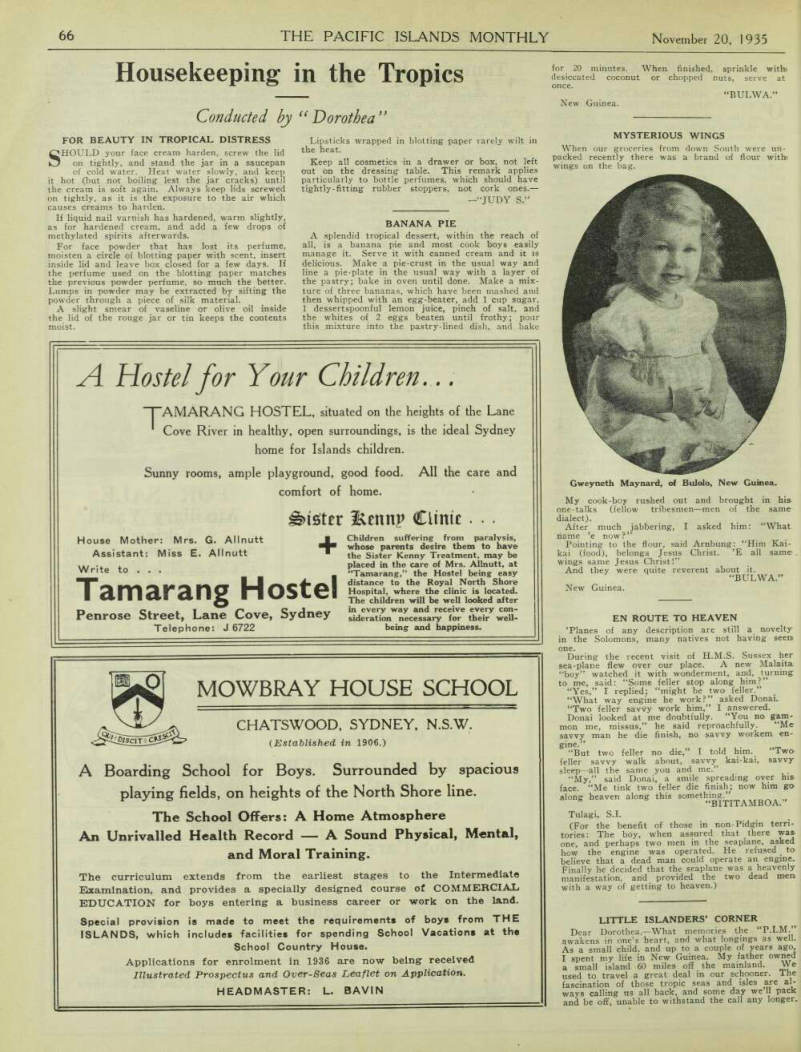
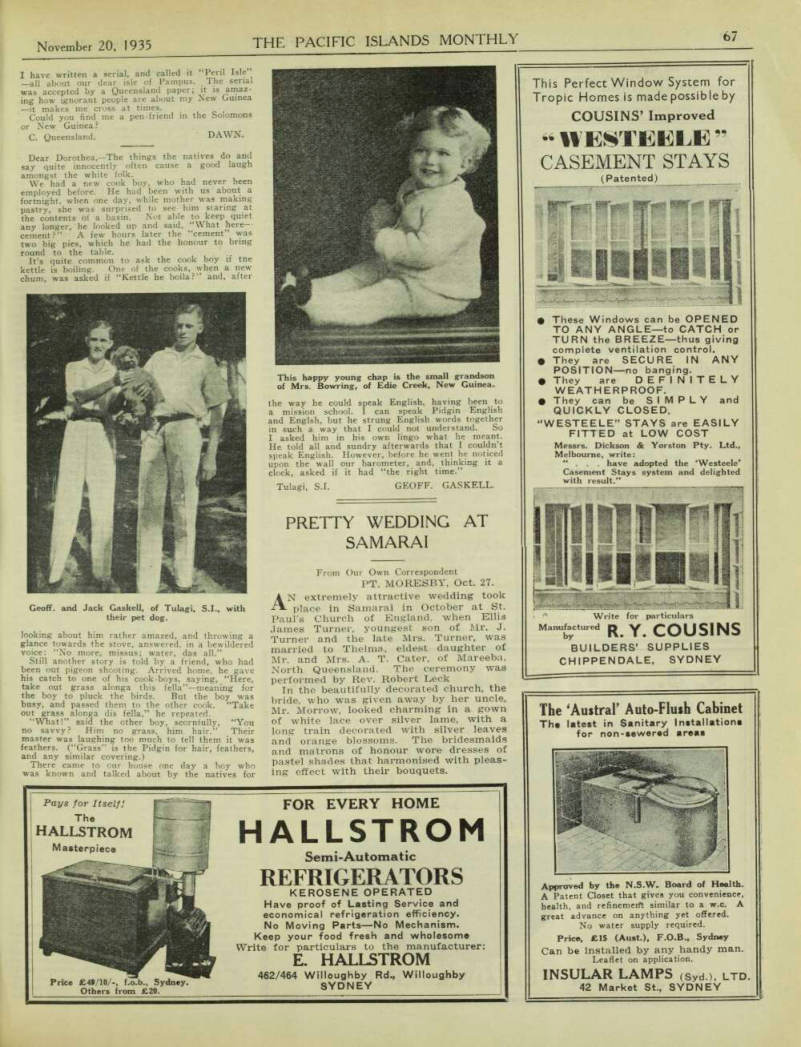
Conducted by “Dorothea”
For Beauty In Tropical Distress
SHOULD your face cream harden, screw the lid on tightly, and stand the jar in a saucepan of cold water. Heat water slowly, and keep it hot (but not boiling lest the jar cracks) until the cream is soft again. Always keep lids screwed on tightly, as it is the exposure to the air which causes creams to harden.
If liquid nail varnish has hardened, warm slightly, as for hardened cream, and add a few drops of methylated spirits afterwards.
For face powder that has lost its perfume, moisten a circle of blotting paper with scent, insert inside lid and leave box closed for a few days. If the perfume used on the blotting paper matches the previous powder perfume, so much the better.
Lumps in powder may be extracted by sifting the powder through a piece of silk material.
A slight smear of vaseline or olive oil inside the lid of the rouge jar or tin keeps the contents moist.
Lipsticks wrapped in blotting paper rarely wilt in the heat.
Keep all cosmetics in a drawer or box, not left out on the dressing table. This remark applies particularly to bottle perfumes, which should have tightly-fitting rubber stoppers, not cork ones.—
“Judy S.”
Banana Pie
A splendid tropical dessert, within the reach of all, is a banana pie and most cook boys easily manage it. Serve it with canned cream and it is delicious. Make a pie-crust in the usual way and line a pie-plate in the usual way with a layer of the pastry; bake in oven until done. Make a mix ture of three bananas, which have been mashed and then whipped with an egg-beater, add 1 cup sugar, 1 dessertspoonful lemon juice, pinch of salt, and the whites of 2 eggs beaten until frothy; pour this mixture into the pastry-lined dish, and bake
for 20 minutes. When finished, sprinkle withi desiccated coconut or chopped nuts, serve at once.
“Bulwa.”
New Guinea.
Mysterious Wings
When our groceries from down South were un packed recently there was a brand of flour witbi wings on the bag.
My cook-boy rushed out and brought in his one-talks (fellow tribesmen —men of the same dialect).
After much jabbering, I asked him: “What name ’e now?”
Pointing to the flour, said Arnbung: “Him Kai kai (food), belonga Jesus Christ. ’E all same wings same Jesus Christ!”
And they were quite reverent about it.
“Bulwa.”
New Guinea.
En Route To Heaven
’Planes of any description are still a novelty in the Solomons, many natives not having seen one.
During the recent visit of H.M.S. Sussex her sea-plane flew over our place. A new Malaita “boy” watched it with wonderment, and, turning to me, said: “Some feller stop along him?”
“Yes,” I replied; “might be two feller.”
“What way engine he work?” asked Donai.
“Two feller savvy work him,” I answered.
Donai looked at me doubtfully. “You no gam mon me, missus,” he said reproachfully. “Me savvy man he die finish, no savvy workem en- S “But two feller no die,” I told him-. “Two feller savvy walk about, savvy kai-kai, savvy sleep—all the same you and me.”
“My,” said Donai, a smile spreading over his face. “Me tink two feller die finish; now him go along heaven along this something.”
“Bititamboa.”
Tulagi, S.I. (For the benefit of those in non-Pidgin terri tories: The boy, when assured that there was one, and perhaps two men in the seaplane, asked how the engine was operated. He refused to believe that a dead man could operate an engine.
Finally he decided that the seaplane was a heavenly manifestation, and provided the two dead men with a way of getting to heaven.)
Little Islanders’ Corner
Dear Dorothea,—What memories the “P.1.M.” awakens in one’s heart, and what longings as well.
As a small child, and up to a couple of years ago, I spent my life in New Guinea. My father owned a small island 60 miles off the mainland. Jwe used to travel a great deal in our schooner. The fascination of those tropic seas and isles are al ways calling us all back, and some day we 11 pack and be off, unable to withstand the call any longer.
Gweyneth Maynard, of Bulolo, New Guinea.
I have written a serial, and called it Peril Isle —all about our dear isle of Pampus. The serial was accepted by a Queensland paper; it is amaz ing how ignorant people are about my New Guinea —it makes me cross at times.
Could you find me a pen-friend in the Solomons or New Guinea ?
C. Queensland.
Dawn.
Dear Dorothea,—The things the natives do and say quite innocently often cause a good laugh amongst the white folk.
We had a new cook boy, who had never been employed before. He had been with us about a fortnight, when one day, while mother was making pastry, she was surprised to see him staring at the contents of a basin. Not able to keep quiet any longer, he looked up and said, “What here cement?” A few hours later the “cement” was two big pies, which he had the honour to bring round to the table.
It’s quite common to ask the cook boy if ttie kettle is boiling. One of the cooks, when a new chum, was asked if “Kettle he boila?” and, after
looking about him rather amazed, and throwing a glance towards the stove, answered, in a bewildered voice: “No more, missus; water, das all.”
Still another story is told by a friend, who had been out pigeon shooting. Arrived home, he gave his catch to one of his cook-boys, saying, “Here, take out grass alonga this fella” —meaning for the boy to pluck the birds. But the boy was busy, and passed them to the other cook. “Take out grass alonga dis fella,” he repeated.
“What!” said the other boy, scornfully, “You no savvy? Him no grass, him hair.” Their master was laughing too much to tell them it was feathers. (“Grass” is the Pidgin for hair, feathers, and any similar covering.) There came to our house one day a boy who was known and talked about by the natives for
the way he could speak English, having been to a mission school. I can speak Pidgin English and Englsh, but he strung English words together in such a way that I could not understand. So I asked him in his own lingo what he meant.
He told all and sundry afterwards that I couldn’t speak English. However, before he went he noticed upon the wall our barometer, and, thinking it a clock, asked if it had “the right time.”
Tulagi, S.I.
Geoff. Gaskell.
Geoff, and Jack Gaskell, of Tulagi, S.I., with their pet dog.
This happy young chap is the small grandson of Mrs. Bowring, of Edie Creek, New Guinea.
Advertisements & other items, p. 68 (1 item)
Tamarang Hostel
A Hostel for Your Children...
”I“AMARANG HOSTEL, situated on the heights of the Lane Cove River in healthy, open surroundings, is the ideal Sydney
home for Islands children.
Sunny rooms, ample playground, good food. All the care and
comfort of home.
lister ixcnnp Clinic.
House Mother: Mrs. G. Allnutt Assistant: Miss E. Allnutt + Write to . . .
Tamarang Hostel
Penrose Street, Lane Cove, Sydney
Telephone: J 6722 Children suffering from paralysis, whose parents desire them to have the Sister Kenny Treatment, may be placed in the care of Mrs. Allnutt, at “Tamarang,” the Hostel being easy distance to the Royal North Shore Hospital, where the clinic is located.
The children will be well looked after in every way and receive every consideration necessary for their wellbeing and happiness.
w
MOWBRAY HOUSE SCHOOL
CHATSWOOD. SYDNEY, N.S.W.
(Established in 1906.) A Boarding School for Boys. Surrounded by spacious playing fields, on heights of the North Shore line.
An Unrivalled Health Record A Sound Physical, Mental, The curriculum extends from the earliest stages to the Intermediate Examination, and provides a specially designed course of COMMERCIAL EDUCATION for boys entering a business career or work on the land.
ISLANDS, which includes facilities for spending School Vacations at the School Country House.
Applications for enrolment in 1936 are now being received Illustrated Prospectus and Over-Seas Leaflet on Application.
HEADMASTER: L. BAVIN
The School Offers: A Home Atmosphere and Moral Training.
Special provision is made to meet the requirements of boys from THE
Pretty Wedding At
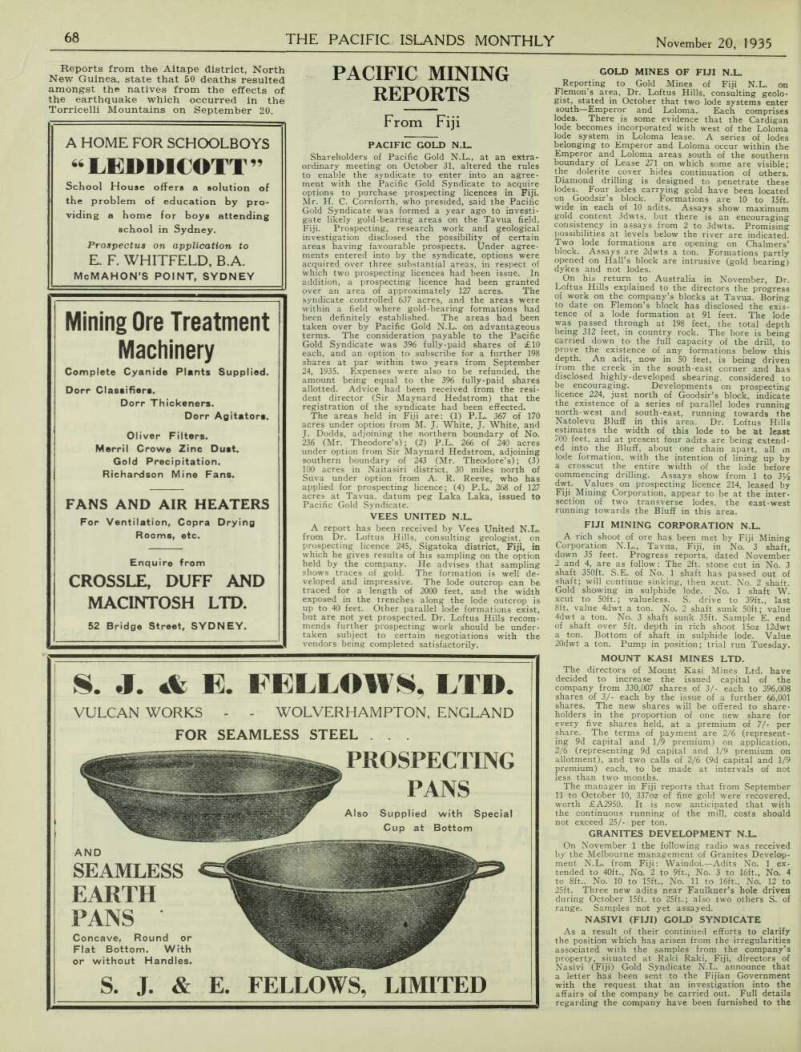
Samarai
From Our Own Correspondent
Pt. Moresby, Oct. 27.
AN extremely attractive wedding took place in Samarai in October at St.
Paul’s Church of England, when Ellis James Turner, youngest son of Mr. J.
Turner and the late Mrs. Turner, was married to Thelma, eldest daughter of Mr. and Mrs. A. T. Cater, of Mareeba.
North Queensland. The ceremony was performed by Rev. Robert Leek In the beautifully decorated church, the bride, who was given away by her uncle, Mr. Morrow, looked charming in a gown of white lace over silver lame, with a long train decorated with silver leaves and orange blossoms. The bridesmaids and matrons of honour wore dresses of pastel shades that harmonised with pleas ing effect with their bouquets.
Reports from the Aitape district, North New Guinea, state that 50 deaths resulted amongst the natives from the effects of the earthquake which occurred in the Torricelli Mountains on September 20.
Advertisements & other items, pp. 69-70 (1 item)
Hallstrom
This Perfect Window System for
Tropic Homes is made possible by
COUSINS’ Improved
44 WESTJBBLE ”
CASEMENT STAYS
(Patented) • These Windows can be OPENED
TO ANY ANGLE—to CATCH or
TURN the BREEZE—thus giving complete ventilation control. • They are SECURE IN ANY POSITION—no banging. ♦ They are DEFINITELY
WEATHERPROOF.
♦ They can be SIMPLY and
QUICKLY CLOSED.
“WESTEELE” STAYS are EASILY
FITTED at LOW COST
Messrs. Dickson & Yorston Pty. Ltd., Melbourne, write: “ . . . have adopted the ‘Westeele’
Casement Stays system and delighted with result,”
HUB
n Write for particulars
Manufactured R y. COUSINS
BUILDERS' SUPPLIES
CHIPPENDALE, SYDNEY
The ‘Austral’ Auto-Flush Cabinet
Tha latest in Sanitary Installations for non-sewerad areas Approved by the N.S.W. Board of Health.
A Patent Closet that gives you convenience, health, and refinemerft similar to a w.c. A great advance on anything yet offered.
No water supply required.
Price, £l5 (Aust.), F. 0.8., Sydney Can be installed by any handy man.
Leaflet on application.
INSULAR LAMPS (Syd.), ltd.
42 Market St., SYDNEY
Pays for Itself!
The
HALLSTROM
Masterpiece %- m Price £49/10/-, f.0.b., Sydney.
Others from £2O.
FOR EVERY HOME
HALLSTROM
Semi-Automatic
REFRIGERATORS
KEROSENE OPERATED
Have proof of Lasting Service and economical refrigeration efficiency.
No Moving Parts—No Mechanism.
Keep your food fresh and wholesome Write for particulars to the manufacturer:
E. HALLSTROM
462/464 Willoughby Rd., Willoughby
SYDNEY
A HOME FOR SCHOOLBOYS
“LEDDICOTT”
School House offers a solution of the problem of education by providing a home for boys attending school in Sydney.
Prospectus on application to
E. F. WHITFELD, B.A.
McMAHON'S POINT, SYDNEY
Mining Ore Treatment
Machinery
Complete Cyanide Plants Supplied.
Dorr Classifiers.
Dorr Thickeners.
Dorr Agitators.
Oliver Filters.
Merril Crowe Zinc Dust.
Gold Precipitation.
Richardson Mine Fans.
FANS AND AIR HEATERS
For Ventilation, Copra Drying Rooms, etc.
Enquire from
CROSSLE, DUFF AND
MACINTOSH LTD.
52 Bridge Street, SYDNEY.
S. .1. A E. FELLOWS, LTD.
VULCAN WORKS - - WOLVERHAMPTON, ENGLAND
FOR SEAMLESS STEEL
PROSPECTING
PANS
Also Supplied with Special Cup at Bottom
AND
SEAMLESS
EARTH
PANS '
Concave, Round or Flat Bottom. With or without Handles.
S. J. & E. FELLOWS, LIMITED
Pacific Mining
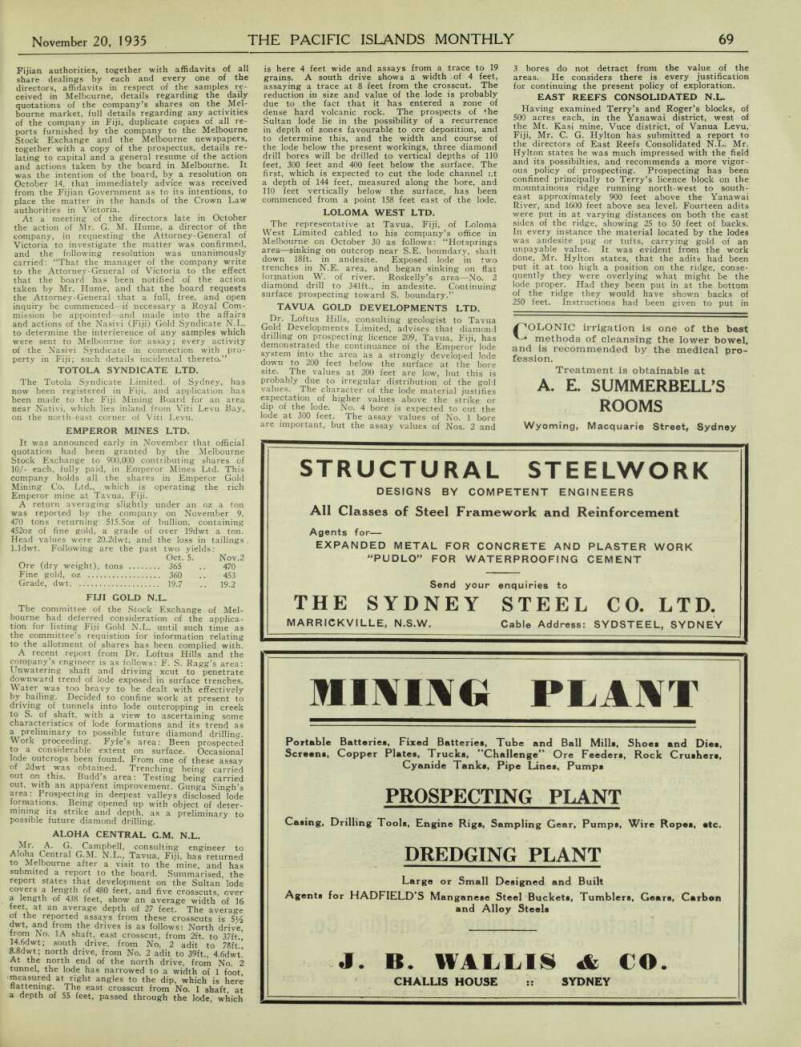
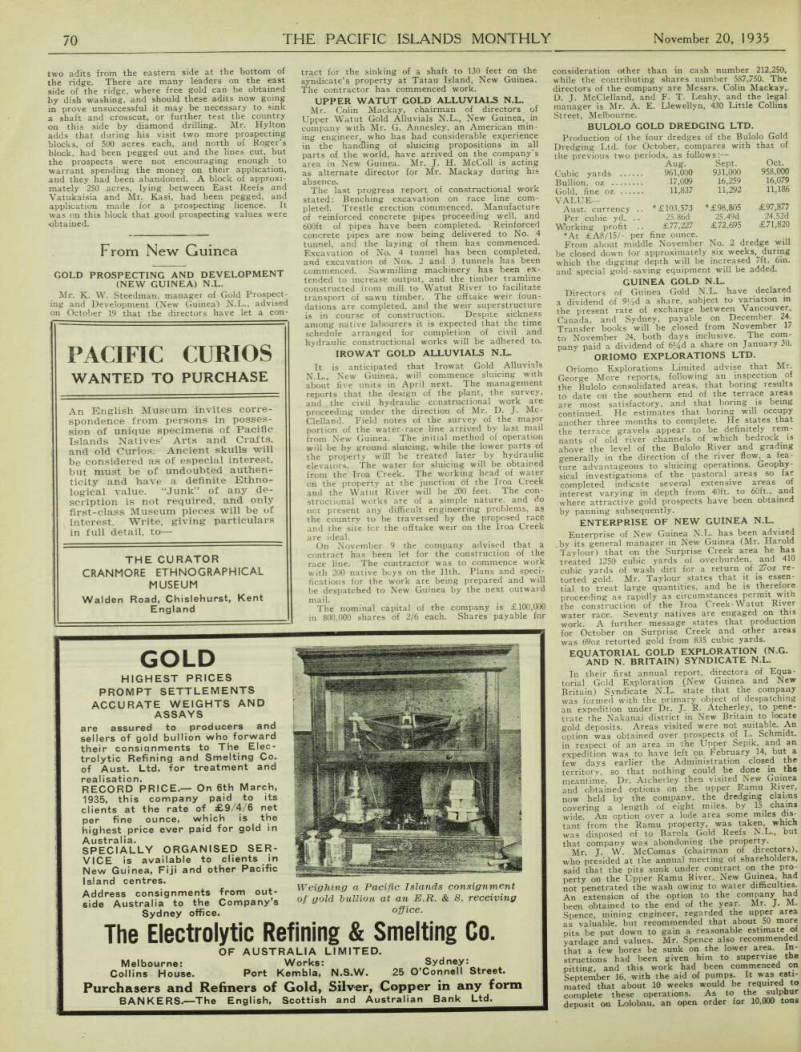
Reports
From Fiji
Pacific Gold N.L.
Shareholders of Pacific Gold N.L., at an extra ordinary meeting on October 31, altered the rules to enable the syndicate to enter into an agree ment with the Pacific Gold Syndicate to acquire options to purchase prospecting licences in Fiji.
Mr. H. C. Cornforth, who presided, said the Pacific Gold Syndicate was formed a year ago to investi gate likely gold-bearing areas on the Tavua field, Fiji. Prospecting, research work and geological investigation disclosed the possibility of certain areas having favourable prospects. Under agree ments entered into by the syndicate, options were acquired over three substantial areas, in respect of which two prospecting licences had been issue. In addition, a prospecting licence had been granted over an area of approximately 127 acres. The syndicate controlled 637 acres, and the areas were within a field where gold-bearing formations had been definitely established. The areas had been taken over by Pacific Gold N.L. on advantageous terms. The consideration payable to the Pacific Gold Syndicate was 396 fully-paid shares of £lO each, and an option to subscribe for a further 198 shares at par within two years from September 24, 1935. Expenses were also to be refunded, the amount being equal to the 396 fully-paid shares allotted. Advice had been received from the resi dent director (Sir Maynard Hedstrom) that the registration of the syndicate had been effected.
The areas held in Fiji are: (1) P.L. 367 of 170 acres under option from M. J. White, J. White, and J. Dodds, adjoining the northern boundary of No. 236 (Mr. Theodore’s); (2) P.L. 266 of 240 acres under option from Sir Maynard Hedstrom, adjoining southern boundary of 243 (Mr. Theodore’s); (3) 100 acres in Naitasiri district, 30 miles north of Suva under option from A. R. Reeve, who has applied for prospecting licence; (4) P.L. 268 of 127 acres at Tavua, datum peg Laka Laka, issued to Pacific Gold Syndicate.
Vees United N.L.
A report has been received by Vees United N.L. from Dr. Loftus Hills, consulting geologist, on prospecting licence 245, Sigatoka district, Fiji, in which he gives results of his sampling on the option held by the company. He advises that sampling shows traces of gold. The formation is well de veloped and impressive. The lode outcrop can be traced for a length of 2000 feet, and the width exposed in the trenches along the lode outcrop is up to 40 feet. Other parallel lode formations exist, but are not yet prospected. Dr. Loftus Hills recom mends further prospecting work should be under taken subject to certain negotiations with the vendors being completed satisfactorily.
Gold Mines Of Fiji N.L.
Reporting to Gold Mines of Fiji N.L. on Flemon’s area, Dr. Loftus Hills, consulting geolo gist, stated in October that two lode systems enter south—Emperor and Loloma. Each comprises lodes. There is some evidence that the Cardigan lode becomes incorporated with west of the Loloma lode system in Loloma lease. A series of lodes belonging to Emperor and Loloma occur within the Emperor and Loloma areas south of the southern boundary of Lease 271 on which some are visible; the dolerite cover hides continuation of others.
Diamond drilling is designed to penetrate these lodes. Four lodes carrying gold have been located on Goodsir’s block. Formations are 10 to 15ft. wide in each of 10 adits. Assays show maximum gold content 3dwts, but there is an encouraging consistency in assays from 2 to 3dwts. Promising possibilities at levels below the river are indicated.
Two lode formations are opening on Chalmers’ block. Assays are 2dwts a ton. Formations partly opened on Hall’s block are intrusive (gold bearing) dykes and not lodes.
On his_ return to Australia in November, Dr.
Loftus Hills explained to the directors the progress of work on the company’s blocks at Tavua. Boring to date on Flemon’s block has disclosed the exis tence of a lode formation at 91 feet. The lode was passed through at 198 feet, the total depth being 312 feet, in country rock. The bore is being carried down to the full capacity of the drill, to prove the existence of any formations below this depth. An adit, now in 50 feet, is being driven from the creek in the south-east corner and has disclosed highly-developed shearing, considered to be encouraging. Developments on prospecting licence 224, just north of Goodsir’s block, indicate the existence of a series of parallel lodes running north-west and south-east, running towards the Natolevu Bluff in this area. Dr. Loftus Hills estimates the width of this lode to be at least 700 feet, and at present four adits are being extend ed into the Bluff, about one chain apart, all m lode formation, with the intention of lining up by a crosscut the entire width of the lode before commencing drilling. Assays show from 1 to 3 1 / 2 dwt. Values on prospecting licence 214, leased by Fiji Mining Corporation, appear to be at the inter section of two transverse lodes, the east-west running towards the Bluff in this area.
Fiji Mining Corporation N.L.
A rich shoot of ore has been met by Fiji Mining Corporation N.L., Tavua, Fiji, in No. 3 shaft, down 35 feet. Progress reports, dated November 2 and 4, are as follow: The 2ft. stone cut in No. 3 shaft 350 ft. S.E. of No. 1 shaft has passed out of shaft; will continue sinking, then xcut. No. 2 shaft.
Gold showing in sulphide lode. No. 1 shaft W. xcut to 50ft.; valueless. S. drive to 39ft., last Bft. value 4dwt a ton. No. 2 shaft sunk 50ft; value 4dwt a ton. No. 3 shaft sunk 35ft. Sample E. end of shaft over sft. depth in rich shoot 15oz 12dwt a ton. Bottom of shaft in sulphide lode. Value 20dwt a ton. Pump in position; trial run Tuesday.
Mount Kasi Mines Ltd.
The directors of Mount Kasi Mines Ltd. have decided to increase the issued capital of the company from 330,007 shares of 3/- each to 396,008 shares of 3/- each by the issue of a further 66,001 shares. The new shares will be offered to share holders in the proportion of one new share for every five shares held, at a premium of 7/- per share. The terms of payment are 2/6 (represent ing 9d capital and 1/9 premium) on application, 2/6 (representing 9d capital and 1/9 premium on allotment), and two calls of 2/6 (9d capital and 1/9 premium) each, to be made at intervals of not less than two months.
The manager in Fiji reports that from September 11 to October 10, 3370 z of fine gold were recovered, worth £A2950. It is now anticipated that with the continuous running of the mill, costs should not exceed 25/- per ton.
Granites Development N.L.
On November 1 the following radio was received by the Melbourne management of Granites Develop ment N.L. from Fiji: Waindoi.—Adits No. 1 ex tended to 40ft., No. 2 to 9ft., No. 3 to 16ft., No. 4 to Bft., No. 10 to 15ft., No. 11 to 16ft., No. 12 to 25ft. Three new adits near Faulkner’s hole driven during October 15ft. to 25ft.; also two others S. of range. Samples not yet assayed.
Nasivi (Fiji) Gold Syndicate
As a result of their continued efforts to clarify the position which has arisen from the irregularities associated with the samples from the company’s property, situated at Raki Raki, Fiji, directors of Nasivi (Fiji) Gold Syndicate N.L. announce that a letter has been sent to the Fijian Government with the request that an investigation into the affairs of the company be carried out. Full details regarding the company have been furnished to the
Fijian authorities, together with affidavits of all share dealings by each and every one of the directors, affidavits in respect of the samples re ceived in Melbourne, details regarding the daily quotations of the company’s shares on the Mel bourne market, full details regarding any activities of the company in Fiji, duplicate copies of all re ports furnished by the company to the Melbourne Stock Exchange and the Melbourne newspapers, together with a copy of the prospectus, details re lating to capital and a general resume of the action and actions taken by the board in Melbourne. It was the intention of the board, by a resolution on October 14, that immediately advice was received from the Fijian Government as to its intentions, to place the matter in the hands of the Crown Law authorities in Victoria.
At a meeting of the directors late in October the action of Mr. G. M. Hume, a director of the company, in requesting the Attorney-General of Victoria to investigate the matter was confirmed, and the following resolution was unanimously carried: “That the manager of the company write to the Attorney-General of Victoria to the effect that the board has been notified of the action taken by Mr. Hume, and that the board requests the Attorney-General that a full, free, and open inquiry be commenced—if necessary a Royal Com mission be appointed—and made into the affairs and actions of the Nasivi (Fiji) Gold Syndicate N.L. to determine the interference of any samples which were sent to Melbourne for assay; every activity of the Nasivi Syndicate in connection with pro perty in Fiji; such details incidental thereto.”
Totola Syndicate Ltd.
The Totola Syndicate Limited, of Sydney, has now been registered in Fiji, and application has been made to the Fiji Mining Board for an area near Nativi, which lies inland from Viti Levu Bay, on the north-east corner of Viti Levu.
Emperor Mines Ltd.
It was announced early in November that official quotation had been granted by the Melbourne Stock Exchange to 900,000 contributing shares of 10/- each, fully paid, in Emperor Mines Ltd. This company holds all the shares in Emperor Gold Mining Co. Ltd., which is operating the rich Emperor mine at Tavua, Fiji.
A return averaging slightly under an oz a ton was reported by the company on November 9, 470 tons returning 515.50 z of bullion, containing 4520 z of fine gold, a grade of over 19dwt a ton.
Head values were 20.2dwt, and the loss in tailings . l.ldwt. Following are the past two yields: Oct. 5. Nov. 2 Ore (dry weight), tons 365 .. 470 Fine gold, oz 360 .. 453 Grade, dwt 19.7 .. 19.2
Fiji Gold N.L.
The committee of the Stock Exchange of Mel bourne had deferred consideration of the applica tion for listing Fiji Gold N.L. until such time as the committee’s requistion for information relating to the allotment of shares has been complied with.
A recent report from Dr. Loftus Hills and the company’s engineer is as follows: F. S. Ragg’s area: Unwatering shaft and driving xcut to penetrate downward trend of lode exposed in surface trenches.
Water was too heavy to be dealt with effectively by bailing. Decided to confine work at present to driving of tunnels into lode outcropping in creek to S. of shaft, with a view to ascertaining some characteristics of lode formations and its trend as a preliminary to possible future diamond drilling.
Work proceeding. Fyfe’s area: Been prospected to a considerable extent on surface. Occasional lode outcrops been found. From one of these assay of 2dwt was obtained. Trenching being carried out on this. Budd’s area: Testing being carried out, with an apparent improvement. Gunga Singh’s area: Prospecting in deepest valleys disclosed lode formations. Being opened up with object of deter mining its strike and depth, as a preliminary to possible future diamond drilling.
Aloha Central G.M. N.L.
.Mr. Campbell, consulting engineer to Aloha Central G.M. N.L., Tavua, Fiji, has returned to Melbourne after a visit to the mine, and has submited a report to the board. Summarised, the report states that development on the Sultan lode covers a length of 480 feet, and five crosscuts, over a length of 438 feet, show an average width of 16 feet, at an average depth of 27 feet. The average of the reported assays from these crosscuts is Sy 2 dwt, and from the drives is as follows: North drive, from No. 1A shaft, east crosscut, from 2ft. to 37ft.! 14.6dwt; south drive, from No. 2 adit to 78ft., B.Bdwt; north drive, from No. 2 adit to 39ft., 4.6dwt!
At the north end of the north drive, from No. 2 tunnel, the lode has narrowed to a width of 1 foot measured at right angles to the dip, which is here flattening The east crosscut from No. 1 shaft, at a depth of 55 feet, passed through the lode, which
is here 4 feet wide and assays from a trace to 19 grains. A south drive shows a width of 4 feet, assaying a trace at 8 feet from the crosscut. The reduction in size and value of the lode is probably due to the fact that it has entered a zone of dense hard volcanic rock. The prospects of the Sultan lode lie in the possibility of a recurrence in depth of zones favourable to ore deposition, and to determine this, and the width and course of the lode below the present workings, three diamond drill bores will be drilled to vertical depths of 110 feet, 300 feet and 400 feet below the surface. The first, which is expected to cut the lode channel ;.t a depth of 144 feet, measured along the bore, and 110 feet vertically below the surface, has been commenced from a point 158 feet east of the lode.
Loloma West Ltd.
The representative at Tavua, Fiji, of Loloma West Limited cabled to his company’s office in Melbourne on October 30 as follows: “Hotsprings area—sinking on outcrop near S.E. boundary, shaft down 18ft. in andesite. Exposed lode in two trenches in N.E. area, and began sinking on flat formation W. of river. Roskelly’s area —No. 2 diamond drill to 341 ft., in andesite. Continuing surface prospecting toward S. boundary.”
Tavua Gold Developments Ltd.
Dr. Loftus Hills, consulting geologist to Tavua Gold Developments Limited, advises that diamond drilling on prospecting licence 209, Tavua, Fiji, has demonstrated the continuance of the Emperor lode system into the area as a strongly developed lode down to 200 feet below the surface at the bore site. The values at 200 feet are low, but this is probably due to irregular distribution of the gold values. The character of the lode material justifies expectation of higher values above the strike or dip of the lode. No. 4 bore is expected to cut the lode at 300 feet. The assay values of No. 1 bore are important, but the assay values of Nos. 2 and
3 bores do not detract from the value of the areas. He considers there is every justification for continuing the present policy of exploration.
East Reefs Consolidated N.L.
Having examined Terry’s and Roger’s blocks, of 500 acres each, in the Yanawai district, west of the Mt. Kasi mine, Vuce district, of Vanua Levu, Fiji, Mr. C. G. Hylton has submitted a report to the directors of East Reefs Consolidated N.L. Mr.
Hylton states he was much impressed with the field and its possibilties, and recommends a more vigor ous policy of prospecting. Prospecting has been confined principally to Terry’s licence block on the mountainous ridge running north-west to south east approximately 900 feet above the Yanawai River, and 1600 feet above sea level. Fourteen adits were put in at varying distances on both the east sides of the ridge, showing 25 to 50 feet of backs.
In every instance the material located by the lodes was andesite pug or tufts, carrying gold of an unpayable value. It was evident from the work done, Mr. Hylton states, that the adits had been put it at too high a position on the ridge, conse quently they were overlying what might be the lode proper. Had they been put in at the bottom of the ridge they would have shown backs of 250 feet. Instructions had been given to put in
two adits from the eastern side at the bottom of the ridge. There are many leaders on the east side of the ridge, where free gold can be obtained by dish washing, and should these adits now going in prove unsuccessful it may be necessary to sink a shaft and crosscut, or further test the country on this side by diamond drilling. Mr. Hylton adds that during his visit two more prospecting blocks, of 500 acres each, and north of Roger’s block, had been pegged out and the lines cut, but the prospects were not encouraging enough to warrant spending the money on their application, and they had been abandoned. A block of approxi mately 250 acres, lying between East Reefs and Vatukaisia and Mt. Kasi, had been pegged, and application made for a prospecting licence. It was on this block that good prospecting values were obtained.
Advertisements & other items, p. 71 (1 item)
mrciNCJ plmt
irrigation is one of the best methods of cleansing the lower bowel, and is recommended by the medical profession.
Treatment is obtainable at
A. E. SUMMERBELL’S
ROOMS
Wyoming, Macquarie Street, Sydney
STRUCTURAL STEELWORK
DESIGNS BY COMPETENT ENGINEERS
All Classes of Steel Framework and Reinforcement Agents for— EXPANDED METAL FOR CONCRETE AND PLASTER WORK
“PUDLO” FOR WATERPROOFING CEMENT
Send your enquiries to
THE SYDNEY STEEL CO. LTD.
MARRICKVILLE, N.S.W. Cable Address: SYDSTEEL, SYDNEY
mrciNCJ plmt
Portable Batteries, Fixed Batteries, Tube and Ball Mills, Shoes and Dies, Screens, Copper Plates, Trucks, "Challenge” Ore Feeders, Rock Crushers, Cyanide Tanks, Pipe Lines, Pumps
PROSPECTING PLANT
Casing, Drilling Tools, Engine Rigs, Sampling Gear, Pumps, Wire Ropes, etc.
DREDGING PLANT
Large or Small Designed and Built Agents for HADFIELD’S Manganese Steel Buckets, Tumblers, Gears, Carbon and Alloy Steels
J. B. WALLIS cV CO.
CHALLIS HOUSE :: SYDNEY
From New Guinea
Gold Prospecting And Development
(New Guinea) N.L.
Mr. K. W. Steedman. manager of Gold Prospect ing and Development (New Guinea) N.L., advised on October 19 that the directors have let a con
tract for the sinking of a shaft to 130 feet on the syndicate’s property at Tatau Island, New Guinea.
The contractor has commenced work.
Upper Watut Gold Alluvials N.L.
Mr. Colin Mackay, chairman of directors of Upper Watut Gold Alluvials N.L., New Guinea, in company with Mr. G. Annesley, an American min ing engineer, who has had considerable experience in the handling of sluicing propositions in all parts of the world, have arrived on the company’s area in New Guinea. Mr. J. H. McColl is acting as alternate director for Mr. Mackay during his absence.
The last progress report of constructional work stated: Benching excavation on race line com pleted. Trestle erection commenced. Manufacture of reinforced concrete pipes proceeding well, and 600 ft of pipes have been completed. Reinforced concrete pipes are now being delivered to No. 4 tunnel, and the laying of them has commenced.
Excavation of No. 4 tunnel has been completed, and excavation of Nos. 2 and 3 tunnels has been commenced. Sawmilling machinery has been ex tended to increase output, and the timber tramline constructed from mill to Watut River to facilitate transport of sawn timber. The offtake weir foun dations are completed, and the weir superstructure is in course of construction. Despite sickness among native labourers it is expected that the time schedule arranged for completion of civil and hydraulic constructional works will be adhered to.
Irowat Gold Alluvials N.L.
It is anticipated that Irowat Gold Alluvials N.L., New Guinea, will commence sluicing with about five units in April next. The management reports that the design of the plant, the survey, and the civil hydraulic constructional work are proceeding under the direction of Mr. D. J. Mc- Clelland. Field notes of the survey of the major portion of the water-race line arrived by last mail from New Guinea. The initial method of operation wdl be by ground sluicing, while the lower parts of the property will be treated later by hydraulic elevators. The water for sluicing will be obtained from the Iroa Creek. The working head of water on the property at the junction of the Iroa Creek and the Watut River will be 200 feet. The con structional works are of a simple nature, and do not present any difficult engineering problems, as the country to be traversed by the proposed race and the site for the offtake weir on the Iroa Creek are ideal.
On November 9 the company advised that a contract has been let for the construction of the race line. The contractor was to commence work with 200 native boys on the 11th. Plans and speci fications for the work are being prepared and will be despatched to New Guinea by the next outward mail.
The nominal capital of the company is £lOO,OOO in 800,000 shares of 2/6 each. Shares payable for
consideration other than in cash number 212,250, while the contributing shares number 587,750. The directors of the company are Messrs. Colin Mackay,.
D. J. McClelland, and F. T. Leahy, and the legal manager is Mr. A. E. Llewellyn, 430 Little Collins Street, Melbourne.
Bulolo Gold Dredging Ltd.
Production of the four dredges of the Bulolo Gold Dredging Ltd. for October, compares with that of the previous two periods, as follows: —
From about middle November No. 2 dredge will be closed down for approximately six weeks, during which the digging depth will be increased 7ft. 6m. and special gold-saving equipment will be added.
Guinea Gold N.L.
Directors of Guinea Gold N.L. have declared a dividend of a share, subject to variation in the present rate of exchange between Vancouver, Canada, and Sydney, payable on December 24.
Transfer books will be closed from November 1/ to November 24, both days inclusive. The com pany paid a dividend of a share on January „0.
Oriomo Explorations Ltd.
Oriomo Explorations Limited advise that Mr.
George More reports, following an inspection of the Bulolo consolidated areas, that boring results to date on the southern end of the terrace areas are most satisfactory, and that boring is being continued. He estimates that boring will occupy another three months to complete. He states that the terrace gravels appear to be definitely rem nants of old river channels of which bedrock is above the level of the Bulolo River and grading generally in the direction of the river flow, a fea ture advantageous to sluicing operations. Geophy sical investigations of the pastoral areas so far completed indicate several extensive areas of interest varying in depth from 40ft. to 60ft., and where attractive gold prospects have been obtained by panning subsequently.
Enterprise Of New Guinea N.L.
Enterprise of New Guinea N.L. has been advised by its general manager in New Guinea (Mr. Harold ’ Taylour) that on the Surprise Creek area he has treated 1250 cubic yards of overburden, and 410 cubic yards of wash dirt for a return of 270 z re torted gold. Mr. Taylour states that it is essen tial to treat large quantities, and he is therefore proceeding as rapidly as circumstances permit with the construction of the Iroa Creek-Watut River water race. Seventy natives are engaged on this work. A further message states that production for October on Surprise Creek and other areas was 69cz retorted gold from 835 cubic yards.
Equatorial Gold Exploration (N.G.
And N. Britain) Syndicate N.L.
In their first annual report, directors of Equa torial Geld Exploration (New Guinea and New Britain) Syndicate N.L. state that the company was formed with the primary object of despatching an expedition under Dr. J. R. Atcherley, to pene trate the Nakanai district in New Britain to locate gold deposits. Areas visited were not suitable. An option was obtained over prospects of L. Schmidt, in respect of an area in the Upper Sepik, and an expedition was to have left on February 14, but a few days earlier the Administration closed the territory, so that nothing could be done in the meantime. Dr. Atcherley then visited New Guinea and obtained options on the upper Ramu River, now held by the company, the dredging claims covering a length of eight miles, by 15 chains wide. An option over a lode area some miles dis tant from the Ramu property, was taken, which was disposed of to Barola Gold Reefs N.L., out that company was abondoning the property.
Mr. J. W'. McComas (chairman of directors), who presided at the annual meeting of shareholders, said that the pits sunk under contract on the pro perty on the Upper Ramu River, New Guinea, had not penetrated the wash owing to water difficulties.
An extension of the option to the company had been obtained to the end of the year. Mr. J. M.
Spence, mining engineer, regarded the upper area as valuable, but recommended that about 50 more pits be put down to gain a reasonable estimate of yardage and values. Mr. Spence also recommended that a few bores be sunk on the lower area. In structions had been given him to supervise the pitting, and this work had been commenced on September 16, with the aid of pumps. It was esti mated that about 10 weeks would be required to complete these operations. As to the J^ 1 P bur deposit on Lolobau, an open order for 10,000 tons
Aug.
Sept.
Oct.
Cubic yards 961,000 931,000 958,000 Bullion, oz 17,009 16,259 16,079 Gold, fine oz 11,837 11,292 11,186
Value-
Aust. currency .. *£103.573 *£98,805 £97,877 Per cubic yd. .. 25 86d 25.49d 24.52d Working profit .. £77,227 £72,695 £71,820 *At £A8/15/- per fine ounce.
at £5/5/- a ton had been obtained, but as only about 25,000 tons was recoverable, expenditure on plant and equipment was not justified. At an •extraordinary meeting resolutions were passed al tering the co.’s rules to enable it to be listed on the Melbourne Stock Exchange.
Upper Sepik Gold Syndicate N.L.
A wireless message has been received by the management of Upper Sepik Gold Syndicate N.L. from its representative in New Guinea (Mr. H.
Williams), who has been testing the option of the •company near Wau, New Guinea, stating that he has built up the property to 2000 acres. Mr. J. M.
Spence, mining engineer, of New Guinea, has been check-sampling on the areas, and it is understood that his report is favourable. Mr. Williams ad vises that he will shortly leave Wau for Melbourne and the position will be discussed with the direc tors on his arrival. In the meantime the question -of forming an operating company will be held in abeyance. The report forwarded on the com pletion of the testing stated that the tests show that there are 3,000,000 cubic yards of ground, showing values of 10/- a yard, 1.000,000 yards giving values of 8/- a yard, and 2,000,000 yards of a value ■of 5/- a yard. He reports that there are 4,000,000 yards that have not been tested, and which give rgood dish prospects.
Placer And Bulolo Companies
Placer Development Ltd., Canada, has declared an interim dividend of 50 cents Canadian currency, and Bulolo Gold Dredging Ltd. an interim dividend •of 1 dollar 40 cents a share. The companies have large holdings in New Guinea. Both dividends payable to shareholders in Australia and New Guinea were subject to 5 per cent, absentee tax, plus exchange, and were payable on November 12.
The dividend of Placer Development is equal to about 2/6, and on Bulolo Dredging about 7/1 a share in Australian currency. On July 9 last, the Placer company paid a dividend of 2 dollars 40 cents a share, equal to 11/9, and Bulolo 1 dollar 20 cents, equal to 5/10)4. Since then, shares of 5 dollars each in the Placer company have been subdivided into shares of one dollar each. Transfer Looks of both companies will be closed from Novem ber 13 to November 30, both days inclusive.
Avoca Developments N.L.
Avoca Developments N.L., a Melbourne mining company, which holds options over 10 properties in Victoria, has taken an option over three leases on the Middle Watut River, New Guinea, embrac ing about 430 acres of alluvial flats and terraces and river bed. Preliminary investigations indi cate that there were good grounds to believe that the area contained several million yards of wash flirt, and the leases are suitable for ground sluicing on a large scale. The leases have been worked in a small way by the vendors using primitive sluice boxes. A team of 30 boys under the supervision of an experienced prospector is due to arrive at the property, and testing will commence immediately.
This is expected to take about three months. Pas sengers can be flown to the nearby aerodrome, but cannot be flown out again, and must return cn foot. This is one of the reasons why these leases were not previously exploited in a large way.
Watut Options N.L.
An extraordinary meeting of shareholders of Watut Options N.L. was held in Melbourne on November 14 to consider a resolution that the company should be wound up voluntarily, and that the assets should be distributed. Shares held by the company in Developments (New Guinea) N.L. will be distributed in the proportion of one share
in that company for two shares held in Watut Options; shares remaining after this distribution will be balloted for.
Bulolo Gold Deposits Ltd.
The directors of Bulolo Gold Deposits, Limited, have accepted an offer of £lO,OOO cash from Bulolo Gold Dredging Ltd. for approximately 210 acres of the former company’s property at Wau, New Guinea. The portion comprises river flats suitable for dredging purposes only, and which could not have been operated by the selling company. Bulolo Gold Deposits retains the whole of its terrace pro perty, amounting to approximately 420 acres, where its sluicing operations are being carried on. It retains, also, its water rights. Sluicing on the pre sent limited scale is reported to have shown a profit during the last year. When the present directorate was appointed last October there was a mortgage debenture of £lOOO over the company’s assets, and no funds were then available. The company has since paid off the debenture and has now at its disposal funds in excess of' £11,500.
Developments (N.G.) N.L.
Directors of Developments (New Guinea) N.L. have under consideration a large area of dredgable ground in new country. Information in regard to the area is encouraging, and arrangements have been made for a preliminary inspection. After consideration of reports on No. 1 area at Watut, known as Theobold and Hydes, and in view of the high price asked for the property, the option has been abandoned. Other properties under offer to the company have been considered, but it has been decided to concentrate on the first-mentioned pro perty, owing to its possibilities.
Advertisements & other items, p. 72 (1 item)
The Electrolytic Refining & Smelting Co.
PACIFIC CURIOS
WANTED TO PURCHASE
An English Museum invites correspondence from persons in possession of unique specimens of Pacific Islands Natives’ Arts and Crafts, and old Curios. Ancient skulls will be considered as of especial interest, but must be of undoubted authenticity and have a definite Ethnological value. “Junk” of any description is not required, and only first-class Museum pieces will be of interest. Write, giving particulars in full detail, to —
THE CURATOR
CRANMORE ETHNOGRAPHICAL
MUSEUM
Walden Road, Chislehurst, Kent England
GOLD
HIGHEST PRICES
PROMPT SETTLEMENTS
ACCURATE WEIGHTS AND
ASSAYS
are assured to producers and sellers of gold bullion who forward their consignments to The Electrolytic Refining and Smelting Co. of Aust. Ltd. for treatment and realisation.
RECORD PRICE.— On 6th March, 1935, this company paid to its clients at the rate of £9/4/6 net per fine ounce, which is the highest price ever paid for gold in Australia.
SPECIALLY ORGANISED SER-
VICE is available to clients in New Guinea, Fiji and other Pacific Island centres.
Address consignments from outside Australia to the Company’s Sydney office.
Weighing a Pacific Islands consignment of gold bullion at an E.R. & 8. receiving office.
The Electrolytic Refining & Smelting Co.
OF AUSTRALIA LIMITED.
Melbourne: Works: Sydney: Collins House. Port Kembla, N.S.W. 25 O’Connell Street.
Purchasers and Refiners of Gold, Silver, Copper in any form BANKERS.—The English, Scottish and Australian Bank Ltd.
From Papua
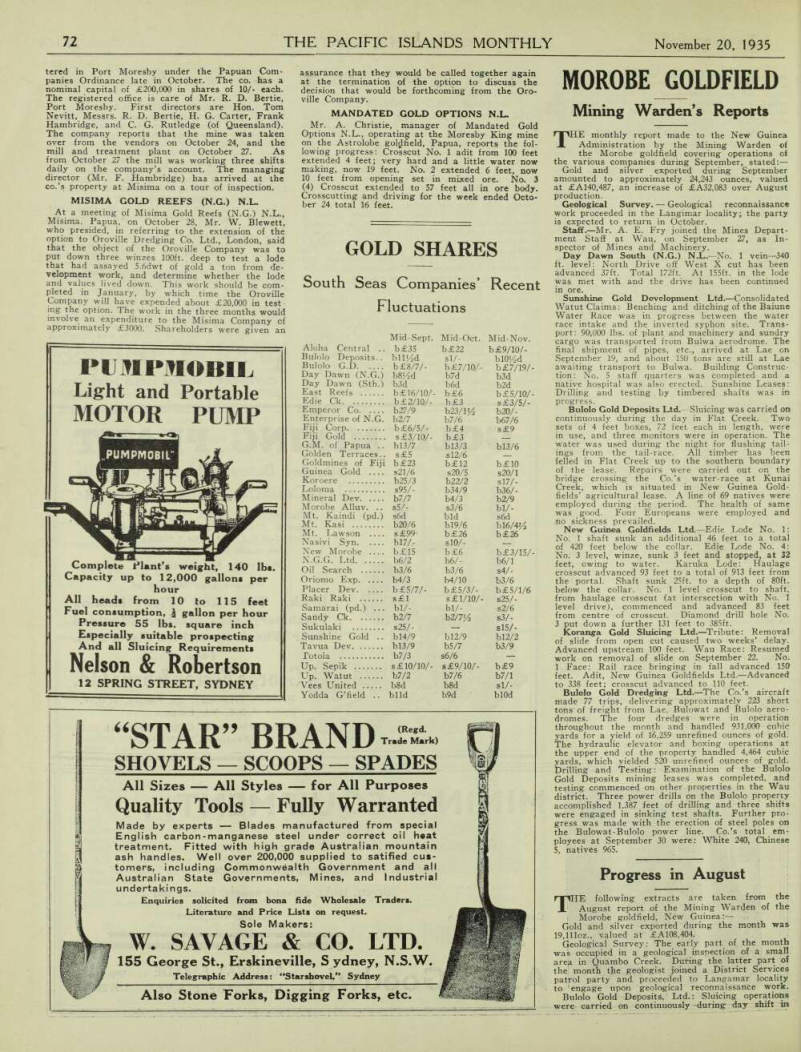
Misima United N.L.
Mr. H. F. Pearson, the engineer of Misima United N.L., Papua, reports that operations on the Loui siade leases of the company have been suspended, and that work is being commenced on the Patricia leases, where satisfactory assays were obtained over a fair length. Since last report 230)4ft. of driving and crosscutting had been completed, the smaller progress being due to sickness among the men and the increasing hardness of the ground.
Gold Mines Of Papua Ltd.
At an extraordinary general meeting of Gold Mines of Papua, Limited, in Canberra, at the end of October, a resolution was agreed to increasing the capital from £60,000 to £135,000, by the creation of 300,000 more shares of 5/- each, to provide funds for the equipment of the mine. A report from the board stated that at Misima Island, although the ore reserves were not completely blocked out, the directors considered the results indicated suffi cient tonnage to warrant a treatment plant. The chairman (Mr. F. G. Pratten) said that represen tations had been made to the Commonwealth Gov ernment by the Papuan Administration and resi dents of Papua for direct and regular communi cation between Sydney and Misima and Woodlark Islands. On both islands there was great activity, and in the near future more than £lOO,OOO a year would be spent there on wages alone by mining companies.
Cuthbert’S Misima Gold Mine Ltd.
Cuthbert’s Misima Gold Mine Limited was regis
tered in Port Moresby under the Papuan Com panies Ordinance late in October. The co. has a nominal capital of £200,000 in shares of 10/- each.
The registered office is care of Mr. R. D. Bertie, Port Moresby. First directors are Hon. Tom Nevitt, Messrs. R. D. Bertie, H. G. Carter, Frank Hambridge, and C. G. Rutledge (of Queensland).
The company reports that the mine was taken over from the vendors on October 24, and the mill and treatment plant on October 27. As from October 27 the mill was working three shifts daily on the company’s account. The managing director (Mr. F. Hambridge) has arrived at the co.’s property at Misima on a tour of inspection.
Misima Gold Reefs (N.G.) N.L.
At a meeting of Misima Gold Reefs (N.G.) N.L., Misima, Papua, on October 28, Mr. W. Blewett, who presided, in referring to the extension of the option to Oroville Dredging Co. Ltd., London, said that the object of the Oroville Company was to put down three winzes 100 ft. deep to test a lode that had assayed s.6dwt of gold a ton from de velopment work, and determine whether the lode and values lived down. This work should be com pleted in January, by which time the Oroville Company will have expended about £20,000 in test ing the option. The work in the three months would involve an expenditure to the Misima Company of approximately £3OOO. Shareholders were given an
assurance that they would be called together again at the termination of the option to discuss the decision that would be forthcoming from the Oro ville Company.
Mandated Gold Options N.L.
Mr. A. Christie, manager of Mandated Gold Options N.L., operating at the Moresby King mine on the Astrolobe goldfield, Papua, reports the fol lowing progress; Crosscut No. 1 adit from 100 feet extended 4 feet; very hard and a little water now making, now 19 feet. No. 2 extended 6 feet, now 10 feet from opening set in mixed ore. No. 3 (4) Crosscut extended to 57 feet all in ore body.
Crosscutting and driving for the week ended Octo ber 24 total 16 feet.
Advertisements & other items, pp. 73-74 (1 item)
advt
GOLD MINING PLANT
Stamper Batteries, Huntington Mills,
Jaw Crushers, Pelton Wheels, etc.
m vr > ** Illustration shows our 2-Head Nissen Stamper Battery, also made with 4-Head. Stamps 1,200Z65. each, also made in lighter toeights.
Write for full particulars We are also Makers of
Brick, Tile, and Pipe Making
Machinery, etc., Machine Moulded
Gear Wheels up to 14ft. dia. x 24in.
face
George Foster & Sons Ltd.
Prince’s Highway, St. Peters, N.S.W.
Code: A.B.C. sth Edition Telegraphic and Cable Address: “Fosterion,” SYDNEY
advt
PUMPMOBIL
Light and Portable
MOTOR PUMP
PUMPMOBIL"
Complete Plant’s weight, 140 lbs.
Capacity up to 12,000 gallons per hour All heads from 10 to 115 feet Fuel consumption, J gallon per hour Pressure 55 lbs. square inch Especially suitable prospecting And all Sluicing Requirements
Nelson & Robertson
12 SPRING STREET, SYDNEY
“STAR” BRAND
SHOVELS SCOOPS SPADES
All Sizes All Styles for All Purposes
Quality Tools Fully Warranted
Made by experts Blades manufactured from special English carbon-manganese steel under correct oil heat treatment. Fitted with high grade Australian mountain ash handles. Well over 200,000 supplied to satified customers, including Commonwealth Government and all Australian State Governments, Mines, and Industrial undertakings.
Enquiries solicited from bona fide Wholesale Traders.
Literature and Price Lists on request.
Sole Makers:
W. SAVAGE & CO. LTD.
155 George St., Erskineville, S ydney, N.S.W.
Telegraphic Address: “Starshovel,” Sydney
Also Stone Forks, Digging Forks, etc.
Gold Shares
South Seas Companies’ Recent Fluctuations
Mid-Sept.
Mid-Oct.
Mid-Nov.
Aloha Central .. b£35 b£22 b£9/10/- Bulolo Deposits.. bll^d sl/blO^d Bulolo G.D b£8/7/b£7/10/b£7/19/- Day Dawn (N.G.) b8^d b7d b3d Day Dawn (Sth.) b3d b6d b2d East Reefs b£ 16/10/b£6 b£S/10/- Edie Ck b£2/10/b£3 s£3/5/- Emperor Co b27/9 h23/\y 2 b20/- Enterprise of N.G. b2/7 b7/6 b67/6 Fiji Corp b £6/5/b£4 s£9 Fiji Gold s£3/10/b£3 G.M. of Papua .. bl3/7 bl3/3 bl3/6 Golden Terraces.. s£5 si 2/6 Goldmines of Fiji b£23 b£12 b£10 Guinea Gold s21/6 s20/5 s20/l Koroere b25/3 b22/2 sl7/- Loloma s95/b34/9 b36/- Mineral Dev b7/7 b4/3 b2/9 Morobe Alluv. .. s5/s3/6 bl/- Mt. Kaindi (pd.) s6d bid s6d Mt. Kasi b20/6 bl9/6 bl6/4^ Mt. Lawson ... s£99b£26 b£26 Nasivi Syn bl7/slO/- New Morobe b £ IS b£6 b£3/15/- N.G.G. Ltd b6/2 b6/b6/l Oil Search b3/6 b3/6 s4/- Oriomo Exp b4/3 b4/10 b3/6 Placer Dev b£5/7/b£S/3/b £5/1/6 Raki Raki s£l s£l/10/s2S/- Samarai (pd.) ... bl/bl/s2/6 Sandy Ck b2/7 h2/7'A s3/- Sukulaki s25/- — sl5/- Sunshine Gold .. bl4/9 bl2/9 bl2/2 Tavua Dev bl3/9 b5/7 b3/9 Potola b7/3 s6/6 — Up. Sepik s £10/10/s£9/10/b£9 Up. Watut b7/2 b7/6 b7/l Vees United b8d b8d sl/- Yodda G’field .. blld b9d blOd
Morobe Goldfield
Mining Warden’s Reports
THE monthly report made to the New Guinea Administration by the Mining Warden of the Morobe goldfield covering operations of the various companies during September, stated:— Gold and silver exported during September amounted to approximately 24,243 ounces, valued at £A140,487, an increase of £A32,083 over August production.
Geological Survey. Geological reconnaissance work proceeded in the Langimar locality; the party is expected to return in October.
Staff.—Mr. A. E. Fry joined the Mines Depart ment Staff at Wau, on September 27, as In spector of Mines and Machinery.
Day Dawn South (N.G.) N.L.—No. 1 vein—34o ft. level: North Drive off West X cut has been advanced 37ft. Total 172 ft. At 155 ft. in the lode was met with and the drive has been continued in ore.
Sunshine Gold Development Ltd.—Consolidated Watut Claims: Benching and ditching of the Baiune Water Race was in progress between the water race intake and the inverted syphon site. Trans port: 90,000 lbs. of plant and machinery and sundry cargo was transported from Bulwa aerodrome. The final shipment of pipes, etc., arrived at Lae on September 19, and about 150 tons are still at Lae awaiting transport to Bulwa. Building Construc tion: No. 5 staff quarters was completed and a native hospital was also erected. Sunshine Leases: Drilling and testing by timbered shafts was in progress.
Bulolo Gold Deposits Ltd.—Sluicing was carried on continuously during the day in Flat Creek. Two sets of 4 feet boxes, 72 feet each in length, were in use, and three monitors were in operation. The water was used during the night for flushing tail ings from the tail-race. All timber has been felled in Flat Creek up to the southern boundary of the lease. Repairs were carried out on the bridge crossing the Co.’s water-race at Kunai Creek, which is situated in New Guinea Gold fields’ agricultural lease. A line of 69 natives were employed during the period. The health of same was good. Four Europeans were employed and no sickness prevailed.
New Guinea Goldfields Ltd.—Edie Lode No. 1: No. 1 shaft sunk an additional 46 feet to a total of 420 feet below the collar. Edie Lode No. 4: No. 3 level, winze, sunk 3 feet and stopped, at 32 feet, owing to water. Karuka Lode: Haulage crosscut advanced 93 feet to a total of 913 feet from the portal. Shaft sunk 25ft. to a depth of 80ft. below the collar. No. 1 level crosscut to shaft, from haulage crosscut (at intersection with No. I level drive), commenced and advanced 83 feet from centre of crosscut. Diamond drill hole No. 3 put down a further 131 feet to 385 ft.
Koranga Gold Sluicing Ltd.—Tribute: Removal of slide from open cut caused two weeks’ delay.
Advanced upstream 100 feet. Wau Race: Resumed work on removal of slide on September 22. No. 1 Face; Rail race bringing in fall advanced 150 feet. Adit, New Guinea Goldfields Ltd.—Advanced to 338 feet; crosscut advanced to 110 feet.
Bulolo Gold Dredging Ltd.—The Co.’s aircraft made 77 trips, delivering approximately 223 short tons of freight from Lae, Bulowat and Bulolo aero dromes. The four dredges were in operation throughout the month and handled 931,000 cubic yards for a yield of 16,259 unrefined ounces of gold.
The hydraulic elevator and boxing operations at the upper end of the property handled 4,464 cubic yards, which yielded 520 unrefined ounces of gold.
Drilling and Testing: Examination of the Bulolo Gold Deposits mining leases was completed, and testing commenced on other properties in the Wau district. Three power drills on the Bulolo property accomplished 1,387 feet of drilling and three shifts were engaged in sinking test shafts. Further pro gress was made with the erection of steel poles on the Bulowat-Bulolo power line. Co.’s total em ployees at September 30 were: White 240, Chinese 5, natives 965.
Progress in August
THE following extracts are taken from the August report of the Mining Warden of the Morobe goldfield, New Guinea: — Gold and silver exported during the month was 19,1110 z., valued at £A108,404.
Geological Survey: The early part of the month was occupied in a geological inspection of a small area in Quambo Creek. During the latter part of the month the geologist joined a District Services patrol party and proceeded to Langamar locality to engage upon geological reconnaissance work.
Bulolo Gold Deposits, Ltd.: Sluicing operations were carried on continuously during day shift in
Flat Creek. One set of sluice boxes was in use.
Timber was felled and burnt ahead of working operations up to the southern boundary of the Co.’s lease. Pit-sawing with two saws, was in operation during the whole of the period. Four Europeans and a line of 69 natives were employed.
Koranga Gold Sluicing, Ltd.: Sluicing continued at No. 1 face throughout the month, the results being satisfactory. Tail race from the Bulolo has been advanced 130 ft. from the open cut. Progress was retarded on account of landslides which occurred below Little Wau intake; the slides cur tailing the water supply.
Sunshine Gold Development, Ltd.; Benching of the race was completed excepting for several chains of rock work near the intake. Ditching of the race commenced on August 13, and one mile of ditching was completed. About 72,0001 b. of cargo and plant were transported from Bulwa ’drome.
The inverted syphon pipes were placed at suitable positions along the proposed line ready for rivetting and screwing. The Sunshine leases were being ’ tested by pitting and drilling. The number of Europeans engaged was 17, and number of natives, 358.
Bulolo Gold Dredging, Ltd.: The Co.’s aircraft made 65 trips and delivered approximately 182 short tons of freight at Bulowat and Bulolo ’dromes. All four dredges were in operation throughout August, and handled 961,000 cubic yards, which yielded 17,0090 z. of unrefined gold. Testing of Bulolo Gold Deposits, Ltd.’s leases was con tinued. Almost 1980 ft. of drilling was aecomplished by three power drills on the Bulolo Dredging Co.’s property at Bulolo. Another 3000 ft. of steel poles was completed on the Bulowat-Bulolo power line.
The elevator and boxing operations on the upper end of Bulolo property handled 4811 yards of dirt which yielded 4710 z. of unrefined gold. Except for a light form of influenza which affected a number of the white and native labour, the health of the employees was quite good.
M rs. W. Dupain, wife of Messrs. Burns, Philp’s manager at Port Moresby, returned to Papua with her two daughters, Misses L. and D. Dupain, by the Montoro in mid- November.
Edie Creek Notes
From Our Own Correspondent
Edie Ck., Oct. 3.
MR. J. CURRY, in charge of the electrical plant of N.G.G., Ltd., met with a serious accident whilst working on a pole recently. Coming in contact with a live wire carrying 11,000 volts, he was severely burnt and thrown to the ground.
He is now in Wau Hospital and is making satis factory progress. Mr. Chas. Orr, who has taken over the duties of Mr. Curry, was recently dis charged from the Wau Hospital, where he was admitted suffering from the effects of an electro cution on the main power line a couple of months ago.
Mr. W. C. Abbie has returned from his health trip South, and is working his claim on the Merri again. A 15oz. slug, recovered a few days after his return, was his welcome home.
Mr. Burns, N.G.G. mine manager at Edie Creek, has resigned and is at present in Wau.
Mr. and Mrs. Alex. Malcolm, of the “Merri Mack” Lease, have left the Merri and are now residing in Wau.
Mr. Russ V. Wild, who was tributing on the “Royal” Lease, is now mining on the Bulolo.
Mr. Arch. Lyall, previously employed on the “Eldorado” Lease, has now joined N.G.G., Ltd., staff.
Mr. W. Topping, of New Guinea Goldfields, Ltd., has been transferred to Golden Ridges.
Mr. Hartigan has taken up residence at Edie Creek in the employ of the Wau Carrying Co.
Mr. Dick Campbell has finished up at Day Dawn Ltd., and joined the N.G.G. staff. Mr. J. Ashcroft is now caretaker at Day Dawn.
Mr. McKenzie has left “Developments” and is now on the Watut River.
Mr. W. W. (“Nobby”) Clark has returned from three months’ holiday in Sydney, and is at pre sent staying at Edie Creek Hotel.
Mr. Peacock, late of Innisfail, North Queens land, has joined N.G.G., Ltd., hydraulicing staff.
A recent new arrival at Lae was Master David Collins, aged about ten days or so. This young man first saw the light of day at Salamaua early in September and has already taken his place in the social life at Lae—particularly at night, when he raises his voice in “song.”
New Publication, Richly
Souvenir Book Of Pacific
Isles
New Publication, Richly Illustrated
THE world is an open book to the in veterate globe trotter; but the stay at-home also has a chance now and then of enjoying a tour, be it only a mental journey, when he comes across a book such as “Picturesque Isles of the South Seas.”
This attractive volume depicts some of the lure and beauty of Papua, New Guinea and the Solomon Islands. Its 64 pages contain reading matter and a wealth of camera studies which give the reader pleasure both by the intrinsic loveliness of the pictures themselves and their su perb reproduction. Toned art paper has been used and the cover displays a line design in full colour by Walter Jardine, whose work is deservedly admired. This volume is 3/6 per copy, post free, and is a delightful memento to send abroad as well as to friends at home. It can be pro cured from the bookstalls or from Messrs.
Burns, Philp & Co. Ltd., 7 Bridge St., Sydney.
Advertisements & other items, p. 75 (1 item)
Deutz Diesel Engines
Position Wanted
By Young Single Man of Good Character.
Mines Dept. Diesel and Gas Oil Certificates. Knowledge Oxy-welding, Fitting, Machining, Blacksmithing. Tractor Driving.
Mining Co. preferred. Highest Credentials.
Write—R. N. Goodhew
C/o. “P.1.M.,” Box 340 SR, Sydney.
DEUTZ DIESEL ENGINES
I 6265(2 Section of OM type showing scavenging air pump OM Type :: 8-145 h.p. Sizes
Marine-Stationary - Portable
The Correct Engine for Tropical Requirements , MC.
I
REPRESENTATIVES . . .
HERBERT DEL COTT PTY., LTD.,
Kelvin House, 15 Castlereagh Street, Sydney 'Phone B 3135 (And at Melbourne) Cables; “Voltage," Sydney
Mr. Jack Hides
First Book is Published
r I ’HE first book written by Mr. Jack A Hides (in 1934) was published in Lon don by Messrs. Blackie on October 10, 1935. It is called “Through Wildest Papua,” and it is a fascinating account of various patrols carried out in more or less unexplored parts of Papua by Mr. Hides when he was a Patrol Officer.
The book is divided into two main sec tions. The first section is concerned prin cipally with a patrol into the Loloipa val ley in Central Papua, to capture cannibals and murderers; while the second section of the book describes very vividly the ad ventures encountered in an expedition which took the patrol right over into the Morobe district, in the Mandated Terri tory of New Guinea. In the latter expe dition Mr. Hides had some extraordinary experiences with the Kiapou pygmies; and, later, he was saved from starvation by Baum, the well known Morobe pros pector, who shortly afterwards was mur dered by the Kukukukus.
“Through Wildest Papua” has been very flatteringly reviewed by the Australian newspapers; and this, together with the publicity recently received by Mr. Hides, should have ensured a good sale in Aus tralia. Unfortunately, however, the pub lishers have made the mistake of selling the book at 13/6 (Australian currency) and Australian people will not pay this price for books. “Through Wildest Papua” has been purchased by an Ameri can publisher, and British and American sales should compensate for missed oppor tunities in Australia.
Mr. Hides will return to Papua in De cember. In the meantime, he has com pleted a new book dealing with his recent exploratory expedition into the unknown centre of New Guinea. This book already has been sold and will be published in London early in 1936. It probably will be called “The Papuan Wonderland,” or something like that. We have seen the manuscript, and prophesy that the book will be a “winner.”
Salamaua
’Plane Crash At
Another Carpenter Machine Wrecked
ANE of W. H. Carpenter and Co.’s D.H. 6l aeroplanes, piloted by G. J. I.
Clark, crashed while taking off from the Logui aerodrome, Salamaua, New Guinea, on October 24. Though the machine was wrecked beyond repair, the pilot was not seriously injured.
Another ’plane to replace the D.H. 61 has been purchased in London by the company and will shortly be shipped to New Guinea by the W.R.C. line.
This is the second mishap that has be fallen the Carpenter air fleet within a month. Three weeks earlier one of the company’s Dragon Moths crashed into the treetops at Black Cat Creek, while flying between Salamaua and Wau. The pilot, Colin Ferguson, died from injuries while being taken to Wau Hospital.
Situated in swamp land, the Salamaua ’drome becomes extremely treacherous after heavy rains, making it very difficult for ’planes to take off and land with safety. Recently it has been receiving the attention of the New Guinea Admini stration’s public works department and the runway of several hundred yards was being repaired.
Rising steeply as they take off towards the sea, the aeroplanes bank, then turn to commence the sharp climb to 6000 ft., which is necessary to fly across the rug ged mountain ranges. From Salamaua to Wau the trip occupies less than 20 minutes, but there is no possible landing ground between the two townships in the event of bad weather or engine trouble.
Mr. P. J. O’Brien, of Kulumbangra, Solomon Islands, arrived in Sydney by the Malaita on November 8. He has been in the group for 17 years and after furlough in Australia will return to Stanmore Es tate in the Solomons in January.
Rabaul Notes
From Our Own Correspondent
Rabaul, Nov. 4.
THE wedding ceremony took place at St.
George’s Church on November 2 of Miss Mervyn Pitt, of Melbourne, and Mr. Rus Beaver, of the N.G. Expropriation Board staff.
The service was conducted by Archdeacon de Voil.
Dr. E. T. Brennan, Director of Public Health, who has been in Australia attending the Pacific Medical Conference, returned by the Tanda. Dr.
Brennan took away with him the Mapos “mummy," which he handed over to experts in Canberra for an opinion. No official statement has yet been made as to its probable origin or date.
The Cosmopolitan Hotel has changed hands.
Mr. M. J. Willmott has taken over the license from Mr. Monck. The latter departed for south by the Van Rees. Mr. Willmott was at one time a member of the New Guinea Police Force, but resigned some time ago and spent some months on the goldfields.
The German Club has transferred its quarters from the old club rooms to the Cosmopolitan Hotel.
The presentation of trophies to members of the Rabaul District Lawn Tennis Association took place in the B.P. club rooms recently. The Hon.
H. H. Page, in the absence of the president (Mr.
J. Ahern), presented the B.P. cup to Mr. A. K.
Whiteman for the men’s singles championship.
Mrs. Cartledge won the cup for the ladies’ singles
championship.
Mr. D. S. Davies, the local chemist, will leave by the next Neptuna for a health trip to Western Australia.
Mr. and Mrs. H. E. Robinson departed by the Salamaua for a trip to England. Mr. Robinson, who is attached to the Treasury staff, is proceed ing on long leave.
The son and daughter of Captain and Mrs.
Macco, who were resident in the Kavieng district during the German time, arrived from Europe recently by the Salamaua. They are staying with their grand-aunt, Mrs. Schmidt, at Rainau.
Mr. “Jerry” Cummins, well-known by older residents as Secretary for Lands during the mili tary occupation, has been spending some months in the Territory in the interests of Australian mining companies. He departed recently for New castle, N.S.W.
Farmer Papuan Officials Death
From Our Own Correspondent
Pt, Moresby, Oct. 26.
THE death occurred in Samarai Hospi tal on October 21 from blackwater fever of Mr. Frederick Headon, formerly of the Papuan Public Service and lat terly prospector and miner in the North eastern Division of the Territory.
Mr. Headon, who had been seriously ill for some days, was picked up by the Laurabada at Baniara on her eastern trip and brought into Samarai unconscious.
He died in hospital an hour after admit- The late Mr. Headon was born in Devonshire, England, in 1886, and came to Papua in 1913, joining the Public Ser vice as Overseer in the Public Works Department. In 1917 he was appointed Gaoler at Samarai, and in 1925 Inspector of Native Plantations. In July, 1931, he became Controller of Native Coffee Plan tations in the Northern Division and re mained in that position until his retire ment on superannuation in March this year.
Mr. G. Barker, mine manager of Aloha Central Gold Mines N.L., at Tavua, Fiji, has completed his term of engagement and returned to Australia to take up a position as manager of a Victorian mine.
Mr. J. Rowe, mine foreman of Aloha, has now been appointed manager.
Mr. Ward Williams, American mining expert, who has been directing operations in Papua for Messrs. Oroville Dredging Co., Ltd., arrived in Sydney by the Mon toro on November 7. He left for a vaca tion in Honolulu, Hawaii, by the Lurlme, on November 13.
Advertisements & other items, p. 76 (1 item)
E. A. Harr
COPRA MATS AND MATTING
Send your enquiries to us for Woven Wire Mesh in Rolls or framed for Copra Drying, and all Screening purposes, Bird Cages, Sieves and Riddles, Builder's Gravel Screens, Rat Traps, Door Mats, Garden Arches, Chain Wire Mesh, Crimped Wire Mesh for Window Guards, etc.
SCOTT AND SONS
WIREWORKS: RAILWAY PARADE AND MURRAY STREET. MARRICKVILLE
E. A. HARR
108 MILLER STREET, PYRMONT
Telphone: MW 2296 Mining and General Machinery Merchant*
Engineer*
5 and 10 Head Mining Batteries, Steam-Driven and Portable Air Compressors—all sizes. Centrifugal and Steam Pumps—Piping from iin. to Sin. Black or Gal. Pipe and Air Fittings. 400 Tons of Steel Rails, 14lbs. to lOOlbs. (New Condition). 200 Tons Steel Girders (all sizes).
Large Stock of Boilers, Suction Gas and Steam Engines, Winches, Pulleys, Rock-Crushers, Petrol and Crude Oil Engines, Elec. Motors, etc.
Write for Quotations for all types of Mining Machinery.
New Broadcasting
Station Opened
4PM Port Moresby Now In Operation
From Our Own Correspondent.
PORT MORESBY, November 5.
October 25, before a large gathering of residents. Sir Hubert Murray, K.C.M.G. (Lieutenant Governor of Papua), officially opened the new broadcasting station, 4PM, at Port Moresby. It is the first commercial broadcasting station to be erected in the Pacific.
In broadcasting his address, Sir Hubert Murray, stated that Papua had seen many changes since he first came to the Terri tory, more than 30 years ago, but of all those changes, he considered the estab lishment of this wireless broadcast trans mitter to be in many ways the most re markable. In declaring the station open, he expressed on behalf of all the resi dents, their high appreciation of the skill and enterprise of Amalgamated Wireless (A’sia) Ltd. in rendering a great service to the Territories of Papua and New Guinea.
“We shall all benefit by this service,” declared Sir Hubert, “but, in particular, it will be a priceless blessing to those who hold the lonely outposts of these terri tories, the planters, miners and others, who are far removed from the centres of settlement. It is a lonely and often a monotonous life that these pioneers lead, and I am glad to think that, through the establishment of this service they will
feel less cut off from civilisation, and that they are still part of the great world be yond the limits of Papua and New Guinea.”
Following His Excellency’s address, His Honour Mr. Justice Gore, Mr. R. D. Bertie and Mr. E. Frame spoke over the air.
In their addresses they emphasised the satisfaction of all residents in the in stallation of the new station, and the benefits that would be received by lonely settlers in the far-flung outposts of the Territory.
The new broadcasting transmitter has a “B” class license, and will be on the air for two sessions daily—excepting Sundays —between the hours of 7 and 8 a.m. and 1 and 2 p.m,, transmitting on a wave length of 221 metres, and 1,360 Kc. These times will be extended if the occasion arises.
Preliminary experiments have been en tirely satisfactory. During daylight tests listeners at Wau, Salamaua, Thursday Is land and Darwin have reported excellent reception. Reports from various parts of Australia and New Zealand have remarked upon the splendid quality and strength of the night transmission.
Mr. C. F. Dale, manager of Port Mores by Radio Station, who was responsible for the installation of the new plant, advises that for the present the programmes will consist of recorded music, sponsored ses sions, and news items —local, Australian and European.
Rev. Maurice Prater, Presbyterian mis sionary at Paama, New Hebrides, who has been on furlough in Great Britain, will arrive in Melbourne with his wife and daughter by the Maloja on November 25.
After a short stay in Victoria they will return to the Condominium.
How The War Medals
Came Back
WEWAK (N.G.), October 26. r\VER three years ago a returned sol dier in northern New Guinea missed his war medals, which had reposed at the bottom of a box for many years.
The job seemed to be an “inside” one; but, on questioning his house staff, he could get no satisfaction at all. How long they had been missing from the box he was unable to tell. Knowing that they were not of much value to anyone, and that, if a native had them, he could not pass them off as coins, he more or lesa forgot the matter.
Recently, a Patrol Officer on the Sepik River was confronted by a native in a village with two heavy discs, and asked to exchange them for single “marks."
The officer, although himself not a re turned soldier, soon found them to be mutilated war medals. The parts carry ing the ribbons had been cut away and the edges filed down. Where the native got them from he was—as is usual In such cases—quite at a loss to explain.
Another native had simply given them to him.
The medals were confiscated and duly returned to the rightful owner.
Advertisements & other items, p. 77 (1 item)
Ruston” and “Lister” Marine Diesel Engines
AT BLUE MOUNTAINS
SPRINGWOOD, N.S.W.
Springwood Ladies’ College
Eat. 1897. Kindergarten to Leaving Certificate. Tennis, Riding, Swimming, Team Games. Unequalled climate. Pure Jersey Milk. Senior and Junior Houses. Open-air sleeping. Inclusive fees. Special vacation arrangements for Island pupils.
M. E. DURAND, Principal.
ii
Ruston” and “Lister” Marine Diesel Engines
and Marine Auxiliaries
Stocks of Representative sizes always on hand, available for immediate delivery
SPECIAL FEATURES:—
Cold Starting, Compression
Ignition, Airless Fuel Injection,
Four Cycle Principle.
LOW FUEL CONSUMPTION
Guaranteed and Maintained In Sizes up to 650 B.H.P.
Full particulars from RUSTON & HORNSBY (Aust.) PTY., LTD.
SYDNEY MELBOURNE BRISBANE
P.O. Box 1569 E P.O. Box 4508 P.O. Box 366 E
Islands Produce
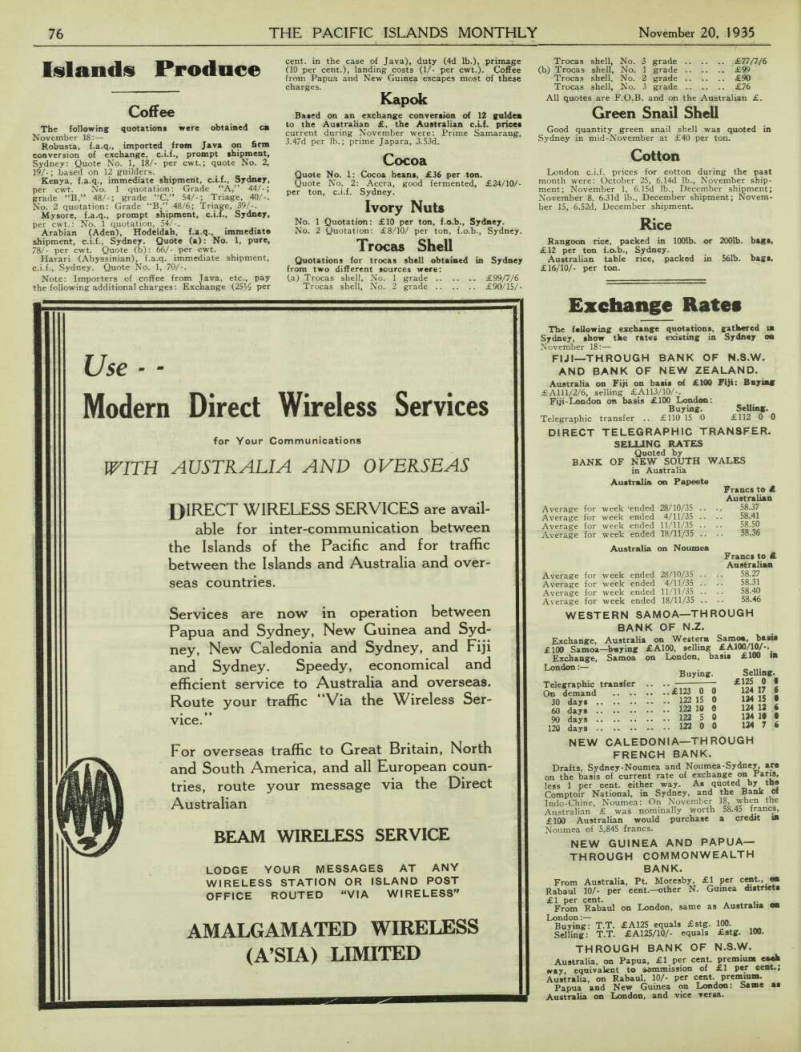
Coffee
The following quotations were obtained cn November 18: — Robusta, f.a.q., imported from Java on firm conversion of exchange, c.i.f., prompt shipment, Sydney: Quote No. 1, 18/- per cwt.; quote No. 2, 19/-; based on 12 guilders.
Kenya, f.a.q., immediate shipment, c.i.f., Sydney, per cwt. No. 1 quotation: Grade “A,” 44/-; grade “B,” 48/-; grade “C,” 54/-; Triage, 40/-.
No. 2 quotation: Grade “B,” 48/6; Triage, 39/-.
Mysore, f.a.q., prompt shipment, c.i.f., Sydney, per cwt.: No. 1 quotation, 54/-.
Arabian (Aden), Hodeidah, f.a.q., immediate shipment, c.i.f., Sydney. Quote (a): No. 1, pure, 78/- per cwt. Quote (b); 66/- per cwt.
Harari (Abyssinian), f.a.q. immediate shipment, c.i.f., Sydney. Quote No. 1, 70/-.
Note: Importers of coffee from Java, etc., pay the following additional charges; Exchange (25)4 per
cent, in the case of Java), duty (4d lb.), primage (10 per cent.), landing costs (1/- per cwt.). Coffee from Papua and New Guinea escapes most of these charges.
Kapok
Based on an exchange conversion of 12 gulden to the Australian £, the Australian c.Lf. prices current during November were; Prime Samarang, 3.47 d per lb.; prime Japara, 3.53 d.
Cocoa
Quote No. 1; Cocoa beans, £36 per ton.
Quote No. 2: Accra, good fermented, £24/10/per ton, c.i.f. Sydney.
Ivory Nuts
No. 1 Quotation: £lO per ton, f.0.b., Sydney.
No. 2 Quotation: £B/10/ per ton, f.0.b., Sydney.
Trocas Shell
Quotations for trocas shell obtained in Sydney from two different sources were: (a) Trocas shell, No. 1 grade £99/7/6 Trocas shell, No. 2 grade £9O/15/-
Trocas shell, No. 3 grade £77/7/6 (b) Trocas shell, No. 1 grade £99 Trocas shell, No. 2 grade £9O Trocas shell, No. 3 grade £76 All quotes are F. 0.8. and on the Australian £.
Green Snail Shell
Good quantity green snail shell was quoted in Sydney in mid-November at £4O per ton.
Cotton
London c.i.f. prices for cotton during the past month were: October 25, 6.14 d lb., November ship ment; November 1,6.15 d lb., December shipment; November 8,6.31 d lb., December shipment; Novem ber 15, 6.52 d, December shipment.
Rice
Rangoon rice, packed in 1001 b. or 2001 b. bags, £l2 per ton f.0.b., Sydney.
Australian table rice, packed in 561 b. bags, £l6/10/- per ton.
Exchange Rates
The fallowing exchange quotations, gathered m Sydney, show the rates existing in Sydney on November 18: —
Fiji—Through Bank Of N.S.W.
And Bank Of New Zealand.
Australia on Fiji on basis of £h)0 Fiji: Baying £ All 1/2/6, selling £A113/10/-.
Fiji-London on basis £100 London: Buying. Selling.
Telegraphic transfer .. £110 IS 0 £112 0 0
Direct Telegraphic Transfer.
Selling Rates
Quoted by
Bank Of New South Wales
in Australia
Western Samoa—Through
Bank Of N.Z.
Exchange, Australia on Western Samoa, basis £100 Samoa—buying £A100, selling £A100/10/-.
Exchange, Samoa on London, basis £100 m London: —
New Caledonia—Through
French Bank.
Drafts, Sydney-Noumea and Noumea-Sydney, are on the basis of current rate of exchange on Paris, less 1 per cent, either way. As quoted by the Comptoir National, in Sydney, and the Bank of Indo-Chine, Noumea; On November 18, when the Australian £ was nominally worth 58.45 francs, £lOO Australian would purchase a credit m Noumea of 5,845 francs.
New Guinea And Papua
Through Commonwealth
Bank.
From Australia, Pt. Moresby, £1 per cent., an Rabaul 10/- per cent. —other N. Guinea district* £1 per cent. . , From Rabaul on London, same as Australia os London:— .
Buying: T.T. £AI2S equals £stg. 100.
Selling: T.T. £AI2S/10/- equals £stg. 100.
Through Bank Of N.S.W.
Australia, on Papua, £lper cent, premium ea«h way, equivalent to somraission of £1 per cent., Australia, on Rabaul, 10/- per cent, prenuum.
Papua and New Guinea on London: Same a* Australia on London, and vice versa.
Australia on Papeete Francs to £ Australian Average for week •ended 28/10/35 .. 58.37 Average for week ended 4/11/35 .. 58.41 Average for week ended 11/11/35 .. 58.50 Average for week ended 18/11/35 .. 58.36 Australia on Noumea Francs to £ Australian Average for week ended 28/10/35 .. 58.27 Average for week ended 4/11/35 .. 58.31 Average for week ended 11/11/35 .. 58.40 Average for week ended 18/11/35 .. 58.46
LOnQ ° n - Buying:. Selim*.
Telegraphic transfer ... 0 I On demand £123 0 0 17 6 30 days 122 IS 0 124 IS § 60 days 122 10 0 124 12 i days 122 5 0 124 1* • 120 days 122 0 0 124 7 6
Advertisements & other items, p. 78 (1 item)
Modern Direct Wireless Services
Use - -
for Your Communications
WITH AUSTRALIA AND OVERSEAS
DIRECT WIRELESS SERVICES are avail-
able for inter-communication between the Islands of the Pacific and for traffic between the Islands and Australia and overseas countries.
Services are now in operation between Papua and Sydney, New Guinea and Sydney, New Caledonia and Sydney, and Fiji and Sydney. Speedy, economical and efficient service to Australia and overseas.
Route your traffic “Via the Wireless Service.”
For overseas traffic to Great Britain, North and South America, and all European countries, route your message via the Direct Australian
BEAM WIRELESS SERVICE
LODGE YOUR MESSAGES AT ANY
WIRELESS STATION OR ISLAND POST
OFFICE ROUTED “VIA WIRELESS"
AMALGAMATED WIRELESS
(A’SIA) LIMITED
Market Quotations
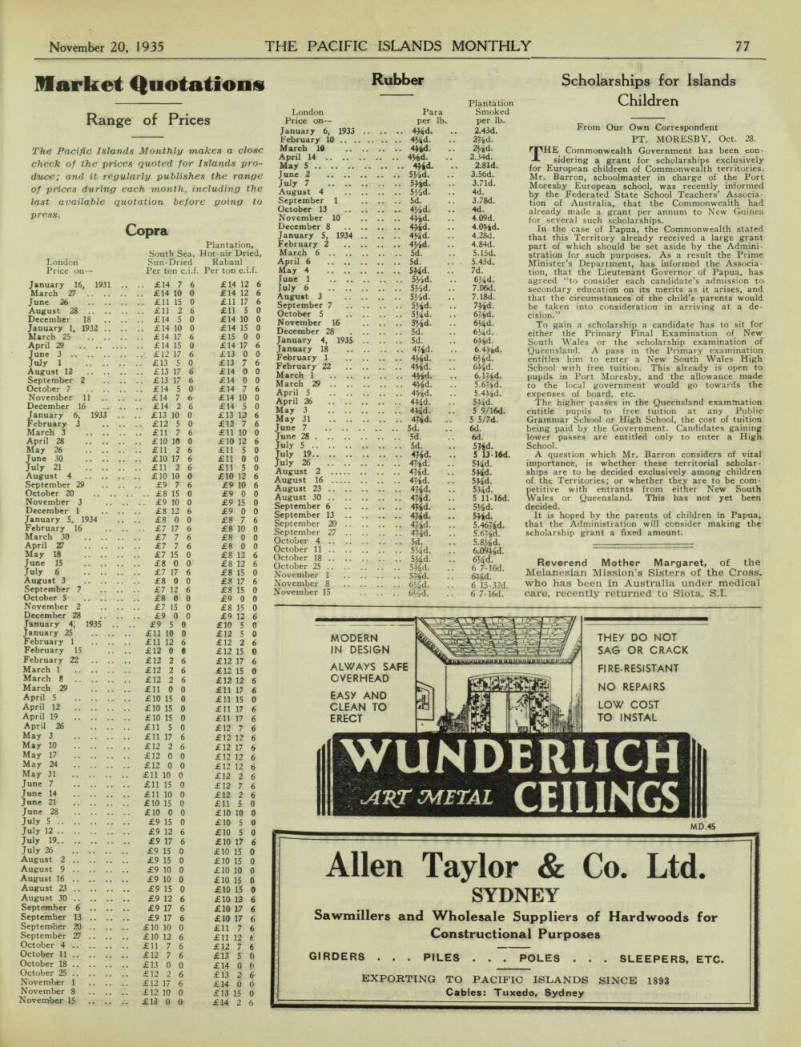
Range of Prices
The Pacific Islands Monthly makes a close check of the prices quoted for Islands pro duce; and it regularly publishes the range of prices during each month, including the last available quotation before going to press.
Rubber
Plantation London Para Smoked Price on — per lb. per lb.
January 6, 1933 4*d. .. 2.43d.
February 10 .. .. 4Jid. .. 2%d.
March 10 4f*d. .. m d.
April 14 4Hd. .. 2.34d.
May 5 4fid. .. 2.81d.
June 2 .. .. 3.56d.
July 7 .. ..
Skid. . • 3.71d.
August 4 Sj'ad. 4d.
September 1 5d. 3.78d.
October 13 4/ a d. 4d.
November 10 4f*d. .. 4.09d.
December 8 4**d. .. 4.0Hd.
January 5, 1934 4^d. 4.28d.
February 2 4J*d. 4.84d.
March 6 .. .. 5d.
S.lSd.
April 6 .. .. 5d. 5.43d.
May 4 .. ..
SVa d. •• 7d.
June 1 ... syid. 6kid.
July 6 ... sy a d. 7.06d.
August 3 S^d. 7.18d.
September 7 Stfd. .. 7*id.
October 5 Stfd. .. 6?id.
November 16 Skid. 6kid.
December 28 Sd. 6J4d.
January 4, 1935 January 18 5d. 6kid. 4Hd. .. 6.4psid, February 1 4*d. .. 6Jid.
February 22 4kid. .. 6Hd.
March 1 .. .. 4kid. .. e.md.
March 29 .. .. 4Hd. 5.6Hd.
April 5 ... .. 5.4Hd.
April 26 ... 4*4d. ..
Skid.
May 3 ... 4f4d. .. 5 9/16d.
May 31 .. 4Jid. .. 5 5/7d.
June 7 6d.
June 28 5d. 6d.
July S Skid. 5 13-16d.
Skid.
July 19 July 26 ...
W. .. 4fcd. ..
August 2 4*id.
Skid.
August 16 47^d.
Skid.
August 23 .. .. 4j*d. ..
Skid.
August 30 .. .. ■■ 5 ll-16d.
September 6 W. ..
Skid.
September 13 .. 4J*d. ..
Skid.
September 20 .. 4Jid.
S.46Jid.
September 27 .. 47/ 8 d. .. 5.6?id.
October 4 .. ..
S.&Ad.
October 11 .. ..
Skid. .. 6.09kgd.
October 18 .. .. 5j4d. .. ey 4 d.
October 25 .. .. , Skid. .. 6 7-16d.
November 1 .. , 5&d. (Skid.
November 8 6'Ad. 6 15-32d.
November IS 6^d. 6 7-16d.
Copra
South Sea, Plantation, Hot-air Dried, London Sun-Dried Rabaul Price on — Per ton c.i.f.
Per ton c.i.f.
January 16, 1931 .. .. £14 7 6 £14 12 6 March 27 .. .. .. .. £14 10 0 £14 12 6 June 26 ... .. .. £11 IS 0 £11 17 6 August 28 .. .. .. .. £11 2 6 £11 5 0 December 18 .. .. £14 5 0 £14 10 0 January 1, 1932 .. .. .. £14 10 0 £14 IS 0 March 25 .. .. .. .. £14 17 6 £15 0 0 April 29 £14 15 0 £14 17 6
June 3
.. .. £12 17 6 £13 0 0 July 1 ... .. .. £13 5 0 £13 7 6 August 12 .. .. .. .. £13 17 6 £14 0 0 September 2 .. .. £13 17 6 £14 0 0 October 7 .. .. .. .. £14 5 0 £14 7 6 November 11 .. .. £14 7 6 £14 10 0 December 16 .. .. £14 2 6 £14 5 0 January 6, 1933 .. .. £13 10 0 £13 13 6 February 3 .. .. £12 5 0 £12 7 6 March 3 ... .. .. £11 7 6 £11 10 0 April 28 ... .. .. £10 10 0 £10 12 6 May 26 ... .. .. £11 2 6 £11 5 0 June 30 .. .. .. .. £10 17 6 £11 0 0 July 21 ... .. .. £11 2 6 £11 5 0 August 4 .. .. .. .. £10 10 0 £10 12 6 September 29 .. .. £9 7 6 £9 10 6 October 20 ... .. .. £8 IS 0 £9 0 0 November 3 .. .. £9 10 0 £9 15 0 December 1 .. .. £8 12 6 £9 0 0 January 5, 1934 .. .. £8 0 0 £8 7 6 February 16 .. .. £7 17 6 £8 10 0 March 30 ... .. .. £7 7 6 £8 0 0 April 27 ... .. .. £7 7 6 £8 0 0 May 18 ... ,. .. £7 15 0 £8 12 6 June 15 .. .. £8 0 0 £8 12 6 July 6 .. .. £7 17 6 £8 15 0 August 3 .. .. .. .. £8 0 0 £8 17 6 September 7 .. , ,. .. £7 12 6 £8 IS 0 October S .. .. £8 0 0 £9 0 0 November 2 .. , ,. .. £7 15 0 £8 15 0 December 28 .. . .. .. £9 0 0 £9 12 6 January 4, 1935 .. £9 5 0 £10 5 0 January 25 .. .. £11 10 0 £12 5 0
February 1 .. ..
£11 12 6 £12 2 6 February 15 £12 0 e £12 15 0
February 22 ..
£12 2 6 £12 17 6 March 1 £12 15 0 March 8 £12 2 6 £12 12 6 March 29 ... £11 0 0 £11 17 6 April 5 £11 IS 0 April 12 £11 17 6 April 19 £10 15 0 £11 17 6 April 26 ... £12 7 6 May 3 £12 12 6 May 10 £12 17 6 May 17 .. £12 0 0 £12 12 6 May 24 £12 12 6 May 31 £11 10 0 £12 2 6 June 7 £11 IS 0 £12 7 6
June 14
£12 2 6 June 21 £10 15 0 £11 5 0 June 28 £10 0 0 £10 10 0 July 5 £10 5 0 July 12 £9 12 6 £10 5 0 July 19 £9 17 6 £10 17 6 July 26 £10 15 0 August 2 £10 15 0 August 9 £10 10 0 August 16 £10 15 0 August 23 £10 15 0 August 30 £9 12 6 £10 12 6 September 6 .. ., £9 17 6 £10 17 6 September 13 .. .. £10 17 6 September 20 .. .. £10 10 0 £11 7 6
September 27 ..
.. £10 12 6 £11 12 6 October 4 £12 7 6- October 11 £13 5 0 October 18 .. £13 0 0 £14 0 fi October 25 £13 2 6 November 1 .. .. £14 0 0 November 8 .. .. £12 10 0 £13 15 0 November 15 .. .. £14 2 6
Children
Scholarships for Islands Children
From Our Own Correspondent
Pt. Moresby, Oct. 28.
THE Commonwealth Government has been con sidering a grant for scholarships exclusively for European children of Commonwealth territories.
Mr. Barron, schoolmaster in charge of the Port Moresby European school, was recently informed by the Federated State School Teachers’ Associa tion of Australia, that the Commonwealth had already made a grant per annum to New Guinea for several such scholarships.
In the case of Papua, the Commonwealth stated that this Territory already received a large grant part of which should be set aside by the Admini stration for such purposes. As a result the Prime Minister’s Department, has informed the Associa tion, that the Lieutenant Governor of Papua, has agreed “to consider each candidate’s admission to secondary education on its merits as it arises, and that the circumstances of the child’s parents would be taken into consideration in arriving at a de cision.’’
To gain a scholarship a candidate has to sit for either the Primary Final Examination of New South Wales or the scholarship examination of Queensland. A pass in the Primary examination entitles him to enter a New South Wales High School with free tuition. This already is open to pupils in Port Moresby, and the allowance made to the local government would go towards the expenses of board, etc.
The higher passes in the Queensland examination entitle pupils to free tuition at any Public Grammar School or High School, the cost of tuition being paid by the Government. Candidates gaining lower passes are entitled only to enter a High School.
A question which Mr. Barron considers of vital importance, is whether these territorial scholar ships are to be decided exclusively among children of the Territories; or whether they are to be com petitive with entrants from either New South Wales or Queensland. This has not yet been decided.
It is hoped by the parents of children in Papua, that the Administration will consider making the scholarship grant a fixed amount.
Reverend Mother Margaret, of the Melanesian Mission’s Sisters of the Cross, who has been in Australia under medical care, recently returned to Siota, S.I.
Advertisements & other items, p. 79 (1 item)
Allen Taylor & Co. Ltd.
MODERN
IN DESIGN
IiUSUiM.LLIS^^
ALWAYS SAFE
OVERHEAD
s
EASY AND
CLEAN TO
ERECT
» A
THEY DO NOT
SAG OR CRACK
FIRE-RESISTANT
NO REPAIRS
LOW COST
TO INSTAL
\AT*X METAL CEILINGS
MD.45
Allen Taylor & Co. Ltd.
SYDNEY
Sawmillers and Wholesale Suppliers of Hardwoods for Constructional Purposes
. . SLEEPERS, ETC.
GIRDERS
PILES
POLES
EXPORTING TO PACIFIC ISLANDS SINCE 1893
Cables: Tuxedo, Sydney
Shipping' Services in the Pacific
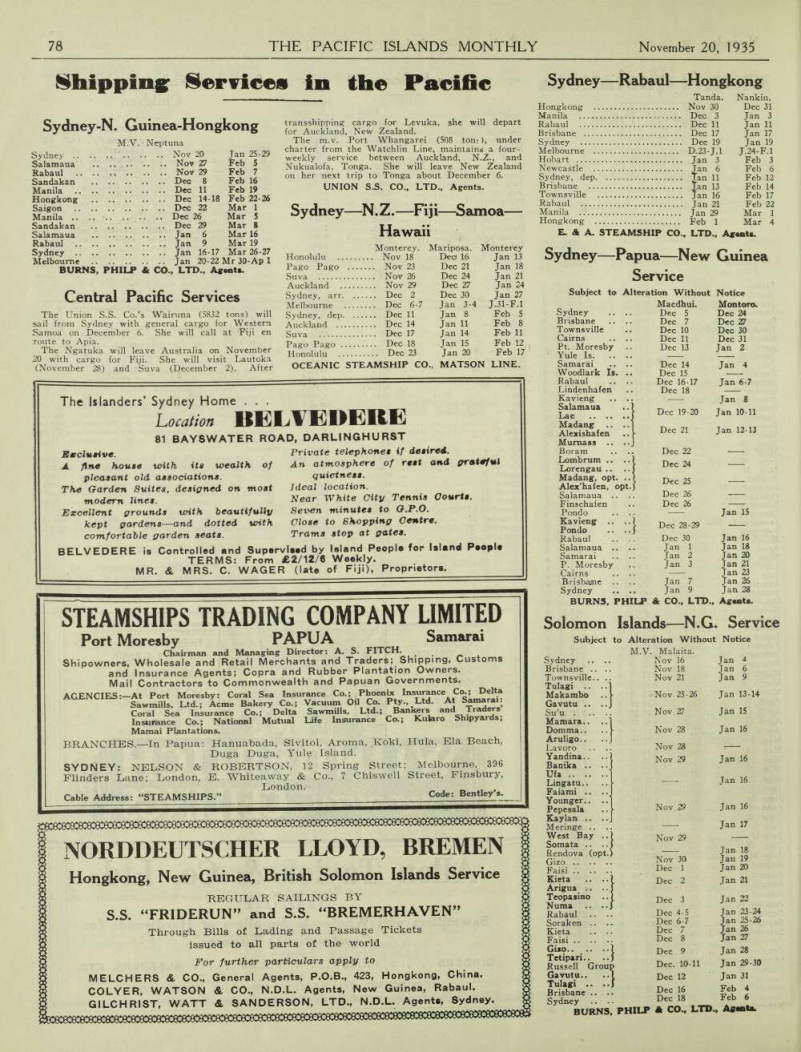
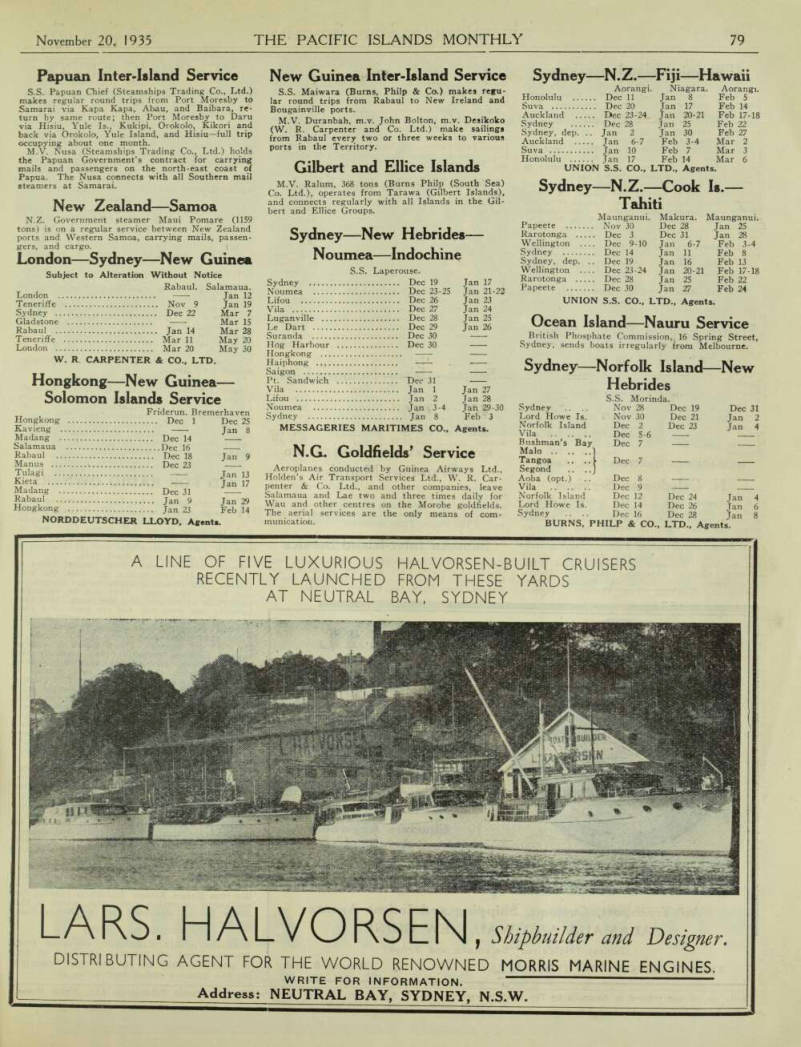
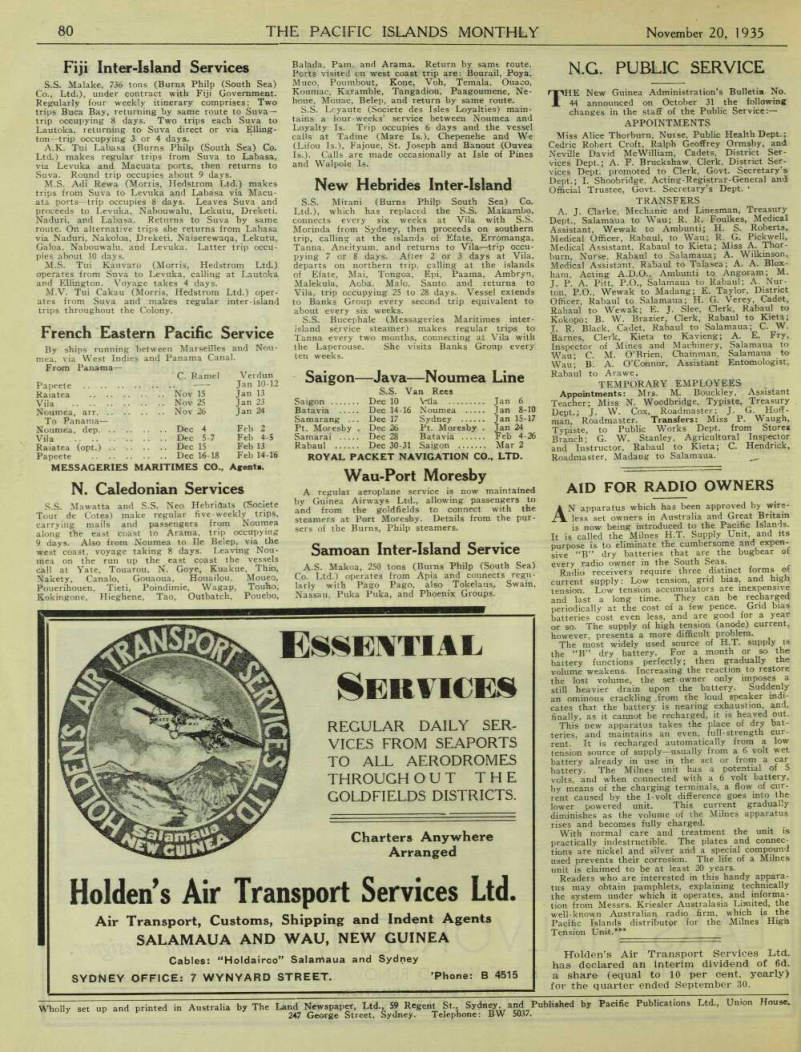
Sydney-N. Guinea-Hongkong
Central Pacific Services
The Union S.S. Co.’s Wairuna (5832 tons) will sail from Sydney with general cargo for Western Samoa on December 6. She will call at Fiji en route to Apia.
The Ngatuka will leave Australia on November 20 with cargo for Fiji. She will visit Lautoka (November 28) and Suva (December 2). After
transshipping cargo for Levuka, she will depart for Auckland, New Zealand.
The m.v. Port Whangarei (508 tom), under charter from the Watchlin Line, maintains a four weekly service between Auckland, N.Z., and Nukualofa, Tonga. She will leave New Zealand on her next trip to Tonga about December 6.
Union S.S. Co., Ltd., Agents.
Sydney—N.Z.—Fiji—Samoa—
Hawaii
Sydney—Rabaul—Hongkong
Sydney—Papua—New Guinea Service Subject to Alteration Without Notice
Solomon Islands —N.G. Service Subject to Alteration Without Notice
M .V. Neptuna Sydney 20 Jan 25-29 Salamaua .. .. 27 Feb S Rabaul 29 Feb 7 Sandakan 8 Feb 16 Manila Dec 11 Feb 19 Hongkong .. ..
Dec 14 ■18 Feb 22-26 Saigon 22 Mar 1 Manila .. .. .. .
Mar 5 Sandakan 29 Mar S Salamaua 6 Mar 16 Rabaul 9 Mar 19 Sydney 16- •17 Mar 26-27 Melbourne 20- 22 Mr 30 -Ap 1
Burns, Philp & Co., Ltd.,
Agents.
Monterey.
Mariposa.
Monterey Honolulu Deo 16 Jan 13 Pago Pago Nov 23 Dec 21 Jan 18 Suva Dec 24 Jan 21 Auckland Nov 29 Dec 27 Jan 24 Sydney, arr.
Dec 2 Dec 30 Jan 27 Melbourne Dec 6-7 Jan 3-4 J.31-F.1 Sydney, dep.
Dec 11 Jan 8 Feb S Auckland ..
Dec 14 Jan 11 Feb 8 Suva Dec 17 Jan 14 Feb 11 Pago Pago .
Jan 15 Feb 12 Honolulu ..
Dec 23 Jan 20 Feb 17
Oceanic
Steamship Co
., Matson Line.
Tanda.
Nankin.
Hongkong Dec 31 Manila Jan 3 Rabaul Jan 11 Brisbane Dec 17 Jan 17 Sydney Dec 19 Jan 19 Melbourne ... D.23-J.1 J.24-F.1 Hobart Feb 3 Newcastle Feb 6 Sydney, dep Feb 12 Brisbane Feb 14 Townsville Feb 17 Rabaul Feb 22 Manila Mar 1 Hongkong Mar 4 E. A A. STEAMSHIP CO., LTD.. A# eaU.
Macdhui.
Montoro.
Sydney Dec 5 Dec 24 Brisbane .. ..
Dec 7 Dec 27 Townsville ..
Dec 10 Dec 30 Cairns .. ..
Dec 11 Dec 31 Pt. Moresby Dec 13 Jan 2 Yule Is — Samarai .. ..
Dec 14 Jan 4 Woodlark Is. ..
Dec 15 Rabaul .. ..
Dec 16-17 Jan 6-7 Lindenhafen Dec 18 Kavieng .. . • Jan 8 Salamaua Lae Dec 19-20 Jan 10-11 Madang ..
Aleiishafcn Dec 21 Jan 12-13 Mumass .. . • Boram Dec 22 — Lombrum .. ..' Lorengau ..
Dec 24 — Madang, opt. ..
Dec 25 Alex’hafen, opt.
Salamaua .. ..
Dec 26 — Finschafen Dec 26 — Pondo .. . .
Jan IS Kavieng ..
Pondo .. [ Dec 28-29 — Rabaul .. .
Dec 30 Jan 16 Salamaua .. . . Jan 1 Jan 18 Samarai .. .
Jan 2 Jan 20 P. Moresby Jan 3 Jan 21 Cairns .. . .
Jan 23 Brisbajne .. .
Jan 7 Jan 26 Sydney .. .
Jan 9 Jan 28
Burns, Philp & Co., Ltd.,
, Agents.
M.V. Malaita.
Sydney Nov 16 Jan 4 Brisbane ..
Nov 18 Jan 6 Townsville..
Nov 21 Jan 9 Tulagi .. ..
Makambo Nov 25-26 Jan 13-14 Gavutu .. ..
Jan 15 Su’u .
Nov 27 Mamara..
Domma..
Nov 28 Jan 16 Aruligo..
Nov 28 Lavoro — Yandina..
Banika ..
Nov 29 Jan 16 Ufa .. ..
Lingatu.. — Jan 16 Faiami ..
Younger..
Pepesala Nov,29 Jan 16 Kaylan ..
Jan 17 Meringe .. — West Bay Nov 29 Somata ..
Jan 18 Rendova (opt.) ' Gizo ..
Nov 30 Jan 19 Dec 1 Jan 20 Kieta Dec 2 Jan 21 Arigua ..
Teopasino Numa .. ..
Dec 3 Jan 22 Rabaul Dec 4-5 Jan 23-24 Soraken ..
Dec 6-7 Jan 25-26 Kieta Dec 7 Jan 26 Faisi .. ..
Dec 8 Jan 27 Gizo..
J Dec 9 > Dec. 10-11 Tetipari..
Russell Grou Jan 28 Jan 29-30 Gavutu..
L Dec 12 Jan 31 Tulagi ..
Brisbane ..
Sydney ..
Dec 16 Dec 18 Feb 4 Feb 6
Burns,
, Philp A Co., Ltd.
, Agent*.
Papuan Inter-Island Service
S.S. Papuan Chief (Steamships Trading Co., Ltd.) makes regular round trips from Port Moresby to Samarai via Kapa Kapa, Abau, and Baibara, re turn by same route; then Port Moresby to Daru via Hisiu, Yule Is., Kukipi, Orokolo, Kikori and back via Orokolo, Yule Island, and Hisiu —full trip occupying about one month.
M. Nusa (Steamships Trading Co., Ltd.) holds the Papuan Government’s contract for carrying mails and passengers on the north-east coast of Papua. The Nusa connects with all Southern mail steamers at Samarai.
New Zealand—Samoa
N. Government steamer Maui Pomare (1159 tons) is on a regular service between New Zealand ports and Western Samoa, carrying mails, passen gers, and cargo.
London—Sydney—New Guinea
Subject to Alteration Without Notice
Hongkong—New Guinea— Solomon Islands Service
New Guinea Inter-Island Service
S.S. Maiwara (Burns, Philp & Co.) makes regu lar round trips from Rabaul to New Ireland and Bougainville ports.
M.V. Duranbah, m.v. John Bolton, m.v. Desikoko (W. R. Carpenter and Co. Ltd.) make sailings from Rabaul every two or three weeks to various ports in the Territory.
Gilbert and Ellice Islands
M.V. Ralum, 368 tons (Burns Philp (South Sea) Co. Ltd.), operates from Tarawa (Gilbert Islands), and connects regularly with all Islands in the Gil bert and Ellice Groups.
Sydney—New Hebrides —
Noumea—lndochine
S.S. Laperouse.
N.G. Goldfields’ Service
Aeroplanes conducted by Guinea Airways Ltd., Holden’s Air Transport Services Ltd., W. R. Car penter & Co. Ltd., and other companies, leave Salamaua and Lae two and three times daily for Wau and other centres on the Morobe goldfields.
The aerial services are the only means of com munication.
Sydney—N.Z.—Fiji—Hawaii
Sydney—N.Z.—Cook Is.— Tahiti
Ocean Island—Nauru Service British Phosphate Commission,. 16 Spring Street, Sydney, sends boats irregularly from Melbourne.
Sydney—Norfolk Island—New Hebrides S.S. Morinda.
Rabaul. Salamaua.
London Jan 12 Teneriffe Nov 9 Jan 19 Sydney Dec 22 Mar 7 Gladstone Mar 15 Rabaul Jan 14 Mar 28 Teneriffe Mar 11 May 20 London Mar 20 May 50
W. R Carpenter & Co., Ltd.
Hongkong Kavieng Madang Salamaua Friderun. Bremerhaven Rabaul Manus Jan 9 Tulagi Kieta Jan 13 Jan 17 Madang Rabaul Jan 29 Hongkong Feb 14
Norddeutscher Lloyd. Agent..
Sydney Dec 19 Jan 17 Noumea Dec 23-25 Jan 21-22 Lifou Dec 26 Jan 23 Vila Dec 27 Jan 24 Luganville Dec 28 Jan 25 Le Dart Dec 29 Jan 26 Suranda — Hog Harbour — Hongkong — Haiphong —— — Saigon — Pt. Sandwich — Vila Jan 27 Lifou Jan 28 Noumea Jan 29-30 Sydney Feb 3
Messageries
Maritimes Co.,
Agents.
Aorangi. Niagara. Aorangi, Honolulu Dec 11 Jan 8 Feb 5 Suva Dec 20 Jan 17 Feb 14 Auckland Dec 23-24 Jan 20-21 Feb 17-18 Sydney Dec 28 Jan 25 Feb 22 Sydney, dep. .. Jan 2 Jan 30 Feb 27 Auckland Jan 6-7 Feb 3-4 Mar 2 Suva Jan 10 Feb 7 Mar 3 Honolulu Jan 17 Feb 14 Mar 6
Union S.S. Co., Ltd., Agents.
Maunganui . Makura.
Maunganui.
Papeete Nov 30 Dec 28 Jan 25 Rarotonga Dec 3 Dec 31 Jan 28 Wellington Dec 9-10 Jan 6-7 Feb 3-4 Sydney Dec 14 Jan 11 Feb 8 Sydney, dep. ..
Dec 19 Jan 16 Feb 13 Wellington Dec 23-24 Jan 20-21 Feb 17-18 Rarotonga Dec 28 Jan 25 Feb 22 Papeete Dec 30 Jan 27 Feb 24
Union
F S.S. Co.,
Ltd.,
Agents.
Sydney Nov 28 Dec 19 Dec 31 Lord Howe Is.
Nov 30 Dec 21 Jan 2 Norfolk Island Vila Dec 2 Dec S-6 Dec 7 Dec 23 Jan 4 Bushman's Bay Malo 1 — —
Tangoa .. .. 1
Segond .. . .J Dec 7 — — Aoba (opt.) Dec 8 Vila Dec 9 Norfolk Island Dec 12 Dec 24 Jan 4 Lord Howe Is.
Dec 14 Dec 26 Jan 6 Sydney Dec 16 Dec 28 Tan 8
Burns, Philp & Co.,
LTD., Agents.
Fiji Inter-Island Services
S.S. Malake, 736 tons (Burns Philp (South Sea) Co., Ltd.), under contract with Fiji Government.
Regularly four weekly itinerary comprises: Two trips Buca Bay, returning by same route to Suva — trip occupying 8 days. Two trips each Suva to Lautoka, returning to Suva direct or via Elling ton —trip occupying 3 or 4 days.
A.K. Tui Labasa (Burns Philp (South Sea) Co.
Ltd.) makes regular trips from Suva to Labasa, via Levuka and Macuata ports, then returns to Suva. Round trip occupies about 9 days.
M.S. Adi Rewa (Morris, Hedstrom Ltd.) makes trips from Suva to Levuka and Labasa via Macu ata ports —trip occupies 8 days. Leaves Suva and proceeds to Levuka, Nabouwalu, Lekutu, Dreketi, Naduri, and Labasa. Returns to Suva by same route. On alternative trips she returns from Labasa via Naduri, Nakoloa, Dreketi, Naiserewaqa, Lekutu, Galoa, Nabouwalu, and Levuka. Latter trip occu pies about 10 days.
M.S. Tui Kauvaro (Morris, Hedstrom Ltd.) operates from Suva to Levuka, calling at Lautoka and Ellington. Voyage takes 4 days.
M.V. Tui Cakau (Morris, Hedstrom Ltd.) oper ates from Suva and makes regular inter-island trips throughout the Colony.
French Eastern Pacific Service
By ships running between Marseilles and Nou mea, via West Indies and Panama Canal.
From Panama —
N. Caledonian Services
S.S. Mawatta and S.S. Neo Hebrktats (Societe Tour de Cotes) make regular five-weekly trips, carrying mails and passengers from Noumea along the east coast to Arama, trip occupying 9 days. Also from Noumea to He Belep, via the west coast, voyage taking 8 days. Leaving Nou mea on the run up the east coast the vessels call at Yate, Touarou, N. Goye, Kuakue, Thio, Nakety, Canalo, Gouaoua, Houailou, Moueo, Pouerihouen, Tieti, Poindimie, Wagap, Touho, Kokingone, Hieghene, Tao, Outbatch, Pouebo,
Balada, Pam, and Arama. Return by same route.
Ports visited on west coast trip are: Bourail, Poya, Mueo, Poumbout, Kone, Voh, Temala, Ouaco, Koumac, Karamble, Tangadiou, Paagoumene, Ne houe, Mouac, Belep, and return by same route. 5.5. Loyaute (Societe des Isles Loyalties) main tains a four-weeks’ service between Noumea and Loyalty Is. Trip occupies 6 days and the vessel calls at Tadine (Mare Is.), Chepenehe and We (Lifou Is.), Fajoue, St. Joseph and Banout (Ouvea Is.). Calls are made occasionally at Isle of Pines and Walpole Is.
New Hebrides Inter-Island
5.5. Mirani (Burns Philp South Sea) Co.
Ltd.), which has replaced the S.S. Makambo, connects every six weeks at Vila with S.S.
Morinda from Sydney, then proceeds on southern trip, calling at the islands of Efate, Erromanga, Tanna, Aneityum, and returns to Vila—trip occu pying 7 or 8 days. After 2 or 3 days at Vila, departs on northern trip, calling at the islands of Efate, Mai, Tongoa, Epi, Paama, Ambryn, Malekula, Aoba. Male. Santo and returns to Vila, trip occupying 25 to 28 days. Vessel extends to Banks Group every second trip equivalent to about every six weeks. 5.5. Bucephale (Messageries Maritimes inter island service steamer) makes regular trips to Tanna every two months, connecting at Vila with the Laperouse. She visits Banks Group every ten weeks.
Saigon—Java—Noumea Line
S.S. Van Rees Saigon Dec 10 Vila Jan 6 Batavia Dec 14-16 Noumea Jan 8-10 Samarang ... Dec 17 Sydney Jan 15-17 Pt. Moresby . Dec 26 Pt. Moresby . Jan 24 Samarai Dec 28 Batavia Feb 4-26 Rabaul Dec 30-31 Saigon Mar 2
Royal Packet Navigation Co., Ltd.
Wau-Port Moresby
A regular aeroplane service is now maintained by Guinea Airways Ltd., allowing passengers to and from the goldfields to connect with the steamers at Port Moresby. Details from the pur sers of the Burns, Philp steamers.
Samoan Inter-Island Service
A.S. Makoa, 250 tons (Burns Philp (South Sea) Co. Ltd.) operates from Apia and connects regu larly with Pago Pago, also Tokelaus, Swain, Nassau, Puka Puka, and Phoenix Groups.
C. Ramel Verdun Papeete Jan 10-12 Raiatea Jan 13 Vila .. .. Nov 25 Jan 23 Noumea, arr Jan 24 To Panama — Noumea, dep Feb 2 Vila Dec 5-7 Feb 4-5 Raiatea (opt.) .. ..
Dec 15 Feb 13 Papeete Dec 16-18 Feb 14-16
Messageries
Maritimes Co..
Agents.
Advertisements & other items, pp. 80-82 (1 item)
Steamships Trading Company Limited
The Islanders’ Sydney Home . . .
Location BELVEDERE
of
81 BAYBWATER ROAD, DARLINGHURST
Private telephones if desired.
An atmosphere of rest and grateful quietness.
Ideal location.
Near White City Tennis Courts.
Seven minutes to OJ*.O.
Close to Shopping Centre.
Trams stop at gates.
Exclusive.
A fine house with its wealth pleasant old associations.
The Garden Suites, designed on most modern lines.
Excellent grounds with beautifully kept gardens—and dotted with comfortable garden seats.
BELVEDERE is Controlled and Supervised by Island People for Island People TERMS: From £2/12/6 Weekly.
MR. & MRS. C. WAGER (late of Fiji), Proprietors.
STEAMSHIPS TRADING COMPANY LIMITED
Samarai
Port Moresby PAPUA
Chairman and Managing Director; A. S. FITCH. Shipowners, Wholesale and Retail Merchants and Traders; Shipping, Customs and Insurance Agents; Copra and Rubber Plantation Owners.
Mail Contractors to Commonwealth and Papuan Governments.
AGENCIES:—At Port Moresby: Coral Sea Insurance Co.; Phoenbc Ins T u P? nce . , C< kL Sawmills, Ltd.; Acme Bakery Co.; Vacuum Oil Co. Pty. Ltd. At Samarai.
Coral Sea Insurance Co.; Delta Sawmills, Ltd.; Bankers and traders Insurance Co.; National Mutual Life Insurance Co.; Kularo Shipyards, Mamai Plantations.
BRANCHES.—In Papua; Hanuabada, Sivitoi, Aroma, Koki, Hula, Ela Beach, Duga Duga, Yule Island.
SYDNEY: NELSON & ROBERTSON, 12 Spring Street; Melbourne, 396 Flinders Lane; London, E. Whiteaway & Co., 7 Chiswell Street, Finsbury, London. , Cable Address: “STEAMSHIPS.” Code; Bentleys.
NORDDEUTSCHER LLOYD, BREMEN
Hongkong, New Guinea, British Solomon Islands Service
REGULAR SAILINGS BY
S.S. “FRIDERUN” and S.S. “BREMERHAVEN”
Through Bills of Lading and Passage Tickets issued to all parts of the world For further particulars apply to MELCHERS & CO., General Agents, P. 0.8., 423, Hongkong, China.
COLYER, WATSON & CO., N.D.L. Agents, New Guinea, Rabaul.
GILCHRIST, WATT & SANDERSON, LTD., N.D.L. Agents, Sydney.
A LINE OF FIVE LUXURIOUS HALVORSEN-BUILT CRUISERS
RECENTLY LAUNCHED FROM THESE YARDS
AT NEUTRAL BAY, SYDNEY
ggBBf 1 ttliflp
SUN
LARS. HALVORSEN,
Shipbuilder and Designer.
DISTRIBUTING AGENT FOR THE WORLD RENOWNED MORRIS MARINE ENGINES.
WRITE FOR INFORMATION.
Address: NEUTRAL BAY, SYDNEY, N.S.W.
w \ & %
Essential
Services
REGULAR DAILY SER-
VICES FROM SEAPORTS
TO ALL AERODROMES
THROUGH OUT THE
GOLDFIELDS DISTRICTS.
Charters Anywhere Arranged
Holden s Air Transport Services Ltd.
Air Transport, Customs, Shipping and Indent Agents
SALAMAUA AND WAU, NEW GUINEA
Cables: “Holdairco” Salamaua and Sydney SYDNEY OFFICE: 7 WYNYARD STREET. 'Phone: B 4515
N.G. Public Service
npHE New Guinea Administration’s Bulletin No.
JL 44 announced on October 31 the following changes in the staff of the Public Service: —
Appointments
Miss Alice Thorburn, Nui se, Public Health Dept.; Cedric Robert Croft, Ralph Geoffrey Ormsby, and Neville David McWilliam, Cadets, District Ser vices Dept.; A. F. Bruckshaw, Clerk, District Ser vices Dept, promoted to Clerk, Govt. Secretary’s Dept.; I. Shoobridge, Acting-Registrar-General and Official Trustee, Govt. Secretary’s Dept. *
Transfers
A. J. Clarke, Mechanic and Linesman, Treasury Dept., Salamaua to Wau; R. R. Foulkes, Medical Assistant, Wewak to Ambunti; H. S. Roberts, Medical Officer, Rabaul, to Wau; R. G. Pickwell, Medical Assistant, Rabaul to Kieta; Miss A. Thor burn, Nurse, Rabaul to Salamaua; A. Wilkinson, Medical Assistant, Rabaul to Talasea; A. A. Blox ham, Acting A.D.0., Ambunti to Angoram; M.
J. P. A. Pitt, P. 0., Salamaua to Rabaul; A. Nur ton, P. 0., Wewak to Madang; E. Taylor, District Officer, Rabaul to Salamaua; H. G. Verey, Cadet, Rabaul to Wewak; E. J. Slee, Clerk, Rabaul to Kokopo; B. W. Brazier, Clerk, Rabaul to Kieta; J. R. Black, Cadet, Rabaul to Salamaua; C. W.
Barnes, Clerk, Kieta to Kavieng; A. E. Fry, Inspector of Mines and Machinery, Salamaua to Wau; C. M. O’Brien, Chainman, Salamaua to Wau; B. A. O’Connor, Assistant Entomologist, Rabaul to Arawe.
Temporary Employees
Appointments: Mrs. M. Bouckley, Assistant Teacher; Miss N. Woodbridge, Typiste, Treasury Dept.; J. W. Cox, Roadmaster; J. G. Hoff man, Roadmaster. Transfers: Miss P. Waugh, Typiste, to Public Works Dept, from Stores Branch; G. W. Stanley, Agricultural Inspector and Instructor, Rabaul to Kieta; C. Hendrick, Roadmaster, Madang to Salamaua.
Aid For Radio Owners
AN apparatus which has been approved by wire less set owners in Australia and Great Britain is now being introduced to the Pacific Islands.
It is called the Milnes H.T. Supply Unit, and its purpose is to eliminate the cumbersome and expen sive “B” dry batteries that are the bugbear of every radio owner in the South Seas.
Radio receivers require three distinct forms of current supply: Low tension, grid bias, and high tension. Low tension accumulators are inexpensive and last a long time. They can be recharged periodically at the cost of a few pence. Grid bias batteries cost even less, and are good for a year or so. The supply of high tension (anode) current, however, presents a more difficult problem.
The most widely used source of H.T. supply is the “B” dry batterv. For a month or so the battery functions perfectly; then gradually the volume weakens. Increasing the reaction to restore the lost volume, the set-owner only imposes a still heavier drain upon the battery. Suddenly an ominous crackling from the loud speaker mdi cates that the battery is nearing exhaustion and, finally, as it cannot be recharged, it is heaved out.
This new apparatus takes the place of dry bat teries, and maintains an even, full-strength cur rent. It is recharged automatically from a low tension source of supply—usually from a 6 volt wet battery already in use in the set or from a car battery. The Milnes unit has a potential of 5 volts, and when connected with a 6 volt battery, by means of the charging terminals, a flow of cur rent caused by the 1-volt difference goes into the lower powered unit. This current gradually diminishes as the volume of the Milnes apparatus rises and becomes fully charged.
With normal care and treatment the unit is practically indestructible. The plates and connec tions are nickel and silver arid a special compound used prevents their corrosion. The life of a Milnes unit is claimed to be at least 20 years.
Readers who are interested in this handy appara tus may obtain pamphlets, explaining technically the system under which it operates, and informa tion from Messrs. Kriesler Australasia Limited, the well-known Australian radio firm, which is the Pacific Islands distributor for the Milnes High Tension Holden’s Air Transport Services Ltd. has declared an interim dividend of fid. a share (equal to 10 per cent, yearly) for the quarter ended September 30.
Advertisements & other items, pp. 82-84 (2 items)
80
November 20, 1 933
THE PACIFIC ISLANDS MONTHLY
Wholly set up and printed in Australia by The Land Newspaper, Ltd., 59 Regent St Sydney and Published by Pacific Publications Ltd., Union House.
J 247 George Street, Sydney. Telephone: BW 5037.
Guinea Airways L«
lAFETY- EFFICIENCY- ECONOMY
The Value of Aerial Transport
Has Been Convincingly
Demonstrated in
New Guinea
ms ■
|Mgggjg
ro ‘ii & / * Lower Left: The interior of a passenger ’plane, New Guinea Airways servis® AERIAL TRANSPORT MADE THE MOROBE GOLDFIELD POSSIBLE in New Guinea, where a few years ago there was only primitive unexplored jungle, there is now a flourishing gold industry. There are several townships, four great modern dredges, many sluicingplants and crushing-mills, two large hydro-electric stations, power transmission lines, motor roads, schools, cinemas, hotels, stores, etc.
All this has been made possible by Aerial Transport. There is no road or track between the Goldfields and the coast. Aeroplanes, flying in all weathers on regular time-tables, have carried in a large European population, thousands of native labourers, machinery and equipment, foodstuffs, livestock, etc. freight cost at first was high—but not nearly so high as it would have been if the Administration had had to tax the Goldfields community to build Arterial Roads. And it is now being steadily reduced.
Guinea Airways Lid. launched its unique aenal transport service seven years age, with one machine and a handful of men. To-day , it operates a fleet of modem aeroplanes , and employs very large European and native staffs.
GUINEA service aeroplanes carry on one of the biggest transport organisations in the world, in one of the world’s most primitive tropical countries; yet no aerial transport system in the world can show a smaller percentage of accidents, or a better record of efficiency and
dependability.
GUINEA AIRWAYS L«
A visit to Central New Guinea, in one of Guinea Airways’ speedy and comfortable air-liners, is a unique and delightful experience.
Travellers may leave the steamer at Port Moresby, fly across to Morobe (time of journey, 1 hour 45 minutes) and spend nine days in the Goldfield centres before rejoining steamer at Lae for Rabaul. Or, after visiting Rabaul, they may disembark at Salamaua or Lae, spend several days on the Goldfields, and fly to Port Moresby to rejoin the steamer. All information from Pursers on the steamers.
LAE • SALAMAUA
I ffiSE ER N
SCHS
EXPO
PILSENE
rSQcnx
MITtD
SYDNEY
R A
PILSENER
£ When two long thirsts equal one
long bottle!
"IVhat’s yours?”
"Resch’s Pilsener.”
"So’s mine.” z When you ask for Pilsener insist - on the long bottle.
kESCH'S
p IO 27