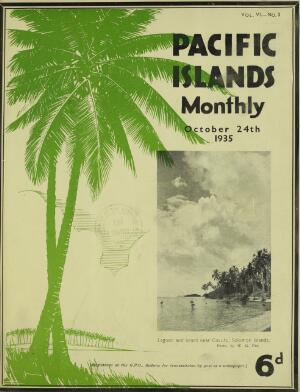
Islnnds
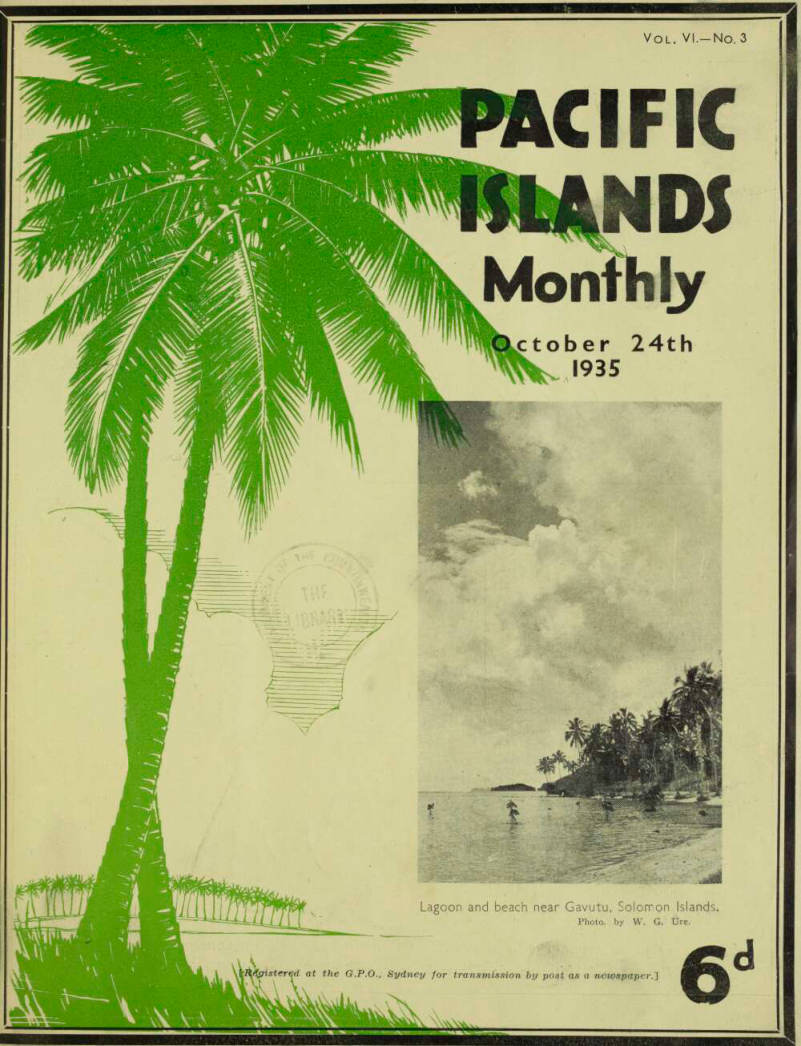
Pacific
Monthly
Vol. Vi.—No. 3
October 24th 1935
at the G.P.0., Sydney for transmission by post as a newspaper.']
6 d
Lagoon and beach near Gavutu, Solomon Islands.
Photo, by W. G. Ure.
Advertisements & other items, p. 2 (1 item)
Assisting Development and Progress in
the Pacific
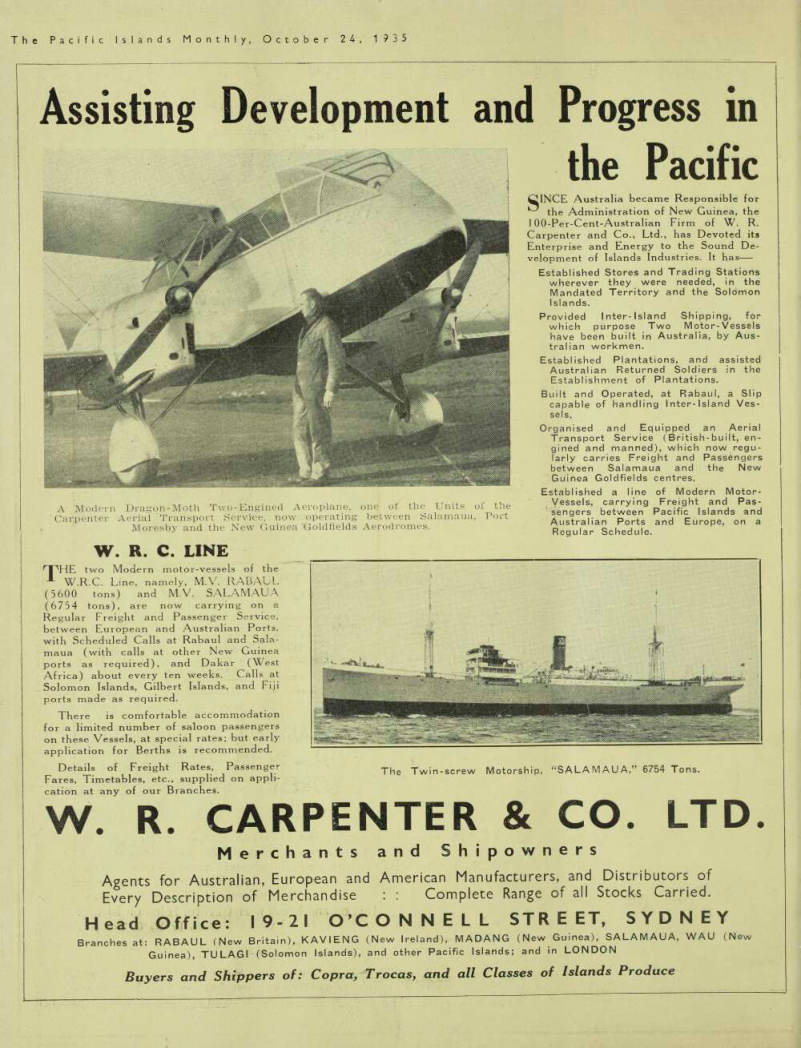
CINCE Australia became Responsible for the Administration of New Guinea, the 1 00-Per-Cent-Australian Firm of W. R.
Carpenter and Co., Ltd., has Devoted its Enterprise and Energy to the Sound Development of Islands Industries. It has Established Stores and Trading Stations wherever they were needed, in the Mandated Territory and the Solomon Islands.
Provided Inter-Island Shipping, for which purpose Two Motor-Vessels have been built in Australia, by Australian workmen.
Established Plantations, and assisted Australian Returned Soldiers in the Establishment of Plantations.
Built and Operated, at Rabaul, a Slip capable of handling Inter-Island Vessels.
Organised and Equipped an Aerial Transport Service (British-built, engined and manned), which now regularly carries Freight and Passengers between Salamaua and the New Guinea Goldfields centres.
Established a line of Modern Motor- Vessels, carrying Freight and Passengers between Pacific Islands and Australian Ports and Europe, on a Regular Schedule.
W. R. C. LINE
r I 'HE two Modern motor-vessels of the W.R.C. Line, namely, M.V. RABALL (3600 tons) and M.V. SALAMAUA (6754 tons), are now carrying on a Regular Freight and Passenger Service, between European and Australian Ports, with Scheduled Calls at Rabaul and Salamaua (with calls at other New Guinea ports as required), and Dakar (West Africa) about every ten weeks. Calls at Solomon Islands, Gilbert Islands, and Fiji ports made as required.
There is comfortable accommodation for a limited number of saloon passengers on these Vessels, at special rates; but early application for Berths is recommended.
Details of Freight Rates, Passenger Fares, Timetables, etc., supplied on application at any of our Branches.
W. R. CARPENTER & CO. LTD.
Merchants and Shipowners
Agents for Australian, European and American Manufacturers, snd Distributors of Every Description of Merchandise : : Complete Range of all Stocks Carried.
Head Office: 19-21 O’CONNELL STREET, SYDNEY
Branches at: RABAUL (New Britain), KAVIENG (New Ireland), MADANG (New Guinea), SALAMAUA, WAU (New Guinea), TULAGI (Solomon Islands), and other Pacific Islands; and in LONDON Buyers and Shippers of: Copra, Trocas, and all Classes of Islands Produce |r m The Twin-screw Motorship, “SALAMAUA,” 6754 Tons. \ K J ? ' : i ■ " .
Hi ■ m A Modern Dragon-Moth Two-Engined Aeroplane, one of the Units of the Carpenter Aerial Transport Service, now operating between Salamaua, Port Moresby and the New Guinea Goldfields Aerodromes.
Pacific Islands Travellers
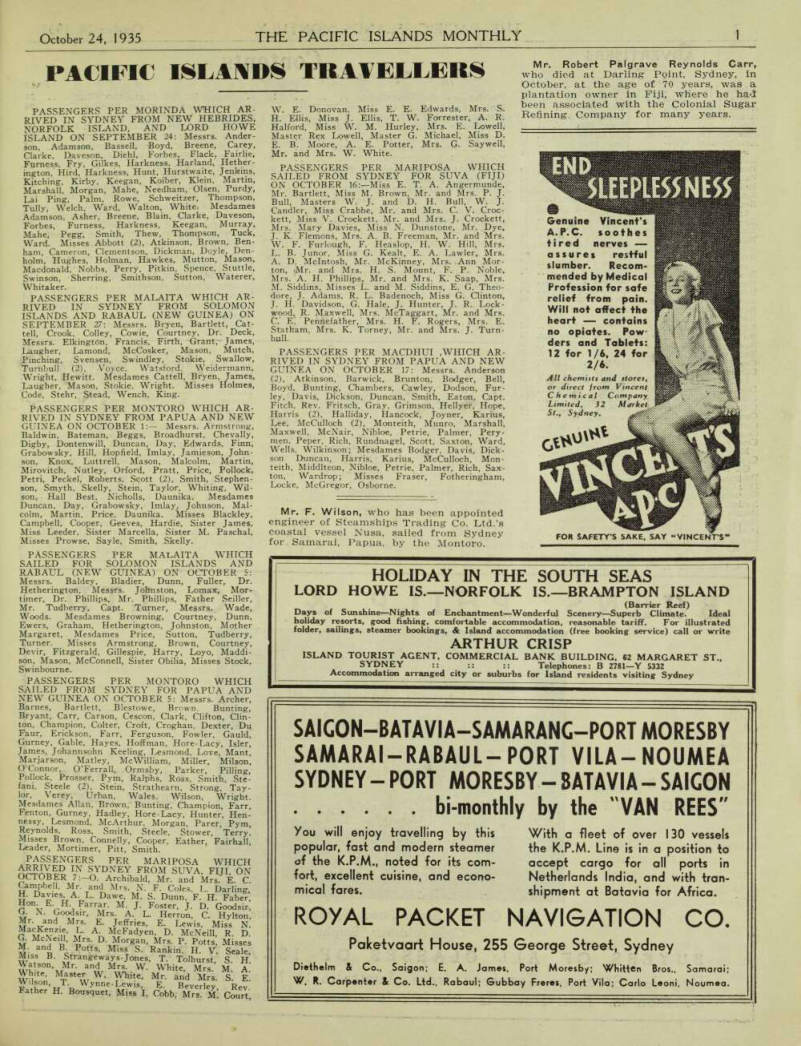
Passengers Per Morinda Which Ar
Rived In Sydney From New Hebrides,
Norfolk Island. And Lord Howe
ISLAND ON SEPTEMBER 24: Messrs. Ander son, Adamson, Bassell, Boyd, Breene, Carey, Clarke, Daveson, Diehl, Forbes, Flack, Fairlie, Furness, Fry, Gilkes, Harkness, Harland, Hether mgton, Hird, Harkness, Hunt, Hurstwaite, Jenkins, Kitching, Kirby, Keegan, Koiber, Klein, Martin, Marshall, Morgan, Mahe, Needham, Olsen, Purdy, Lai Ping, Palm, Rowe, Schweitzer, Thompson, Tully, Welch, Ward, Walton, White.- Mesdames Adamson, Asher, Breene, Blain, Clarke, Daveson, Forbes, Furness, Harkness, Keegan, Murray, Mahe, Pegg, Smith, Thew, Thompson, Tuck, Ward. Misses Abbott (2), Atkinson, Brown, Ben ham, Cameron, Clementson, Dickman, Doyle, Den holm, Hughes, Holman, Hawkes, Mutton, Mason, Macdonald, Nobbs, Perry, Pitkin, Spence, Stuttle, Swinson, Sherring, Smithson, Sutton, Waterer, Whitaker.
Passengers Per Malaita Which Ar
Rived In Sydney From Solomon
Islands And Rabaul (New Guinea) On
SEPTEMBER 27: Messrs. Bryen, Bartlett, Cat tell, Crook, Colley, Cowie, Courtney, Dr. Deck, Messrs. Elkington, Francis, Firth, "Grant, James, Laugher, Lamond, McCosker, Mason, Mutch, Pinching, Svensen, Swindley, Stokie, Swallow, Turnbull (2), Voyce, Watsford. Weidermann, Wright, Hewitt. Mesdames Cattell, Bryen, James, Laugher, Mason, Stokie. Wright. Misses Holmes, Code, Stehr, Stead, Wench, King.
Passengers Per Montoro Which Ar
RIVED IN SYDNEY FROM PAPUA AND NEW GUINEA ON OCTOBER 1: Messrs. Armstrong, Baldwin, Bateman, Beggs, Broadhurst, Chevally, Digby, Dontenwill, Duncan, Day, Edwards, Finn, Grabowsky, Hill, Hopfield, Imlay, Jamieson, John son, Knox, Luttrell, Mason, Malcolm, Martin, Mirovitch, Nutley, Orford, Pratt, Price, Pollock, Petri, Peckel, Roberts, Scott (2), Smith, Stephen son, Smyth, Skelly, Stein, Taylor, Whiting, Wil son, Hall Best, Nicholls, Daunika. Mesdames Duncan, Day, Grabowsky, Imlay, Johnson, Mal colm, Martin, Price, Daunika. Misses Blackley, Campbell, Cooper, Geeves, Hardie, Sister James, Miss Leeder, Sister Marcella, Sister M. Paschal, Misses Prowse, Sayle, Smith, Skelly.
Passengers Per Malaita Which
Sailed For Solomon Islands And
Rabaul (New Guinea) On October 5:
Messrs. Baldey, Bladier, Dunn, Fuller, Dr.
Hetherington, Messrs. Johnston, Lomax, Mor timer, Dr. Phillips, Mr. Phillips, Father Seiller, Mr. Tudberry, Capt. Turner, Messrs. Wade, Woods. Mesdames Browning, Courtney, Dunn, Ewers, Graham, Hetherington, Johnston, Mother Margaret, Mesdames Price, Sutton, Tudberry, Turner. Misses Armstrong, Brown, Courtney, Devir, Fitzgerald, Gillespie, Harry, Loyo, Maddi son, Mason, McConnell, Sister Obilia, Misses Stock, Swinbourne.
Passengers Per Montoro Which
Sailed From Sydney For Papua And
NEW GUINEA ON OCTOBER 5: Messrs. Archer, Barnes, Bartlett, Blestowe, Brown. Bunting, Bryant, Carr, Carson, Cescon, Clark, Clifton, Clin ton, Champion, Colter, Croft, Croghan, Dexter, Du Faur, Erickson, Farr, Ferguson, Fowler, Gauld, Gurney, Gable, Hayes, Hoffman, Hore-Lacy, Isler, James, Johannsohn Keeling, Lesmond, Love, Mant, Marjarson, Matley, McWilliam, Miller, Milson, O’Connor, O’Ferrall, Ormsby, Parker, Pilling, Pollock, Prosser, Pym, Ralphs, Ross, Smith, Ste fani, Steele (2), Stein, Strathearn, Strong, Tay lor, Verey, Urban, Wales, Wilson, Wright.
Mesdames Allan, Brown, Bunting, Champion, Farr, Fenton, Gurney, Hadley, Hore-Lacy, Hunter, Hen nessy, Lesmond, McArthur, Morgan, Parer, Pym, Reynolds, Ross, Smith, Steele, Stower, Terry.
Misses Brown, Connelly, Cooper, Eather, Fairhall, Leader, Mortimer, Pitt, Smith. a££^l^ G t ERS PER MARIPOSA WHICH £££?£ IN SYD NEY FROM SUVA, FIJI, ON OCTOBER 7; —O. Archibald, Mr. and Mrs. E. C.
Campbell, Mr and Mrs. N. F. Coles. L. Darling, H. Davies A L. Dawe, M. S. Dunn, F. H. Faber, Hon E H Farrar. M. J. Foster, J. D. Goodsir, N - f o< S Sir ’ £ lrs ; L. Herron, C. Hylton, Mr and Mrs. E. Jeffries, E. Lewis, Miss N.
MacKenzie. L. A McFadyen, D. McNeill, R. D.
G. McNeill, Mrs. D Morgan, Mrs. P. Potts, Misses SJ-. an £ B Q J otts - Miss t S. Rankin, H. V. Seale, M is s B. Strangeways-Jones, T. Tolhurst, S. H Watson Mr. and Mrs. W. White, Mrs. M a’
Wilson t” W W " I'' 1 ’ 1 -'’ Ik f r - and Mrs - S - El Wilson, T. Wynne-Lewis, E. Beverlev R« v Father H. Bousquet, Miss I. Cobb, Mrs. M. cJurt.
W. E. Donovan, Miss E. E. Edwards, Mrs. S.
H. Ellis, Miss J. Ellis, T. W. Forrester, A. R.
Halford, Miss W. M. Hurley, Mrs. E. Lowell, Master Rex Lowell, Master G. Michael, Miss D.
E. B. Moore, A. E. Potter, Mrs. G. Saywell, Mr. and Mrs. W. White.
Passengers Per Mariposa Which
Sailed From Sydney For Suva (Fiji)
ON OCTOBER E. T. A. Angermunde, Mr. Bartlett, Miss M. Brown, Mr. and Mrs. P. J.
Bull, Masters W. J. and D. H. Bull, W. J.
Candler, Miss Crabbe, Mr. and Mrs. C. V. Croc kett, Miss V. Crockett, Mr. and Mrs, J. Crockett, Mrs. Mary Davies, Miss N. Dunstone, Mr. Dye, J. K. Flemons, Mrs. A. B. Freeman, Mr. and Mrs.
W. F. Furlough, F. Heaslop, H. W. Hill, Mrs.
L. B. Junor, Miss G. Kealt, E. A. Lawler, Mrs.
A. D. Mclntosh, Mr. McKinney, Mrs. - Ann Mor ton, Mr. and Mrs. H. S. Mount, F. P. Noble, Mrs. A. H. Phillips, Mr. and Mrs. K. Saap, Mrs.
M. Siddins, Misses L. and M. Siddins, E. G. Theo dore, J. Adams, R. L. Badenoch, Miss G. Clinton, J. H. Davidson, G. Hale, J. Hunter, J. R. Lock wood, R. Maxwell, Mrs. McTaggart, Mr. and Mrs.
C.’ E. Pennefalher, Mrs. H. F. Rogers, Mrs. E.
Statham, Mrs. K. Torney, Mr. and Mrs. J. Turn bull.
Passengers Per Macdhui ,Which Ar
RIVED IN SYDNEY FROM PAPUA AND NEW GUINEA ON OCTOBER 17: Messrs. Anderson (2), Atkinson, Barwick, Brunton, Bodger, Bell, Boyd, Bunting, Chambers, Cawley, Dodson, Fur ley, Davis, Dickson, Duncan, Smith, Eaton, Capt.
Fitch, Rev. Fritsch, Gray, Crimson, Hellyer, Hope, Harris (2), Halliday, Hancock, Joyner, Karius, Lee, McCulloch (2), Monteith, Munro, Marshall, Maxwell, McNair, Nibloe, Petrie, Palmer, Pery men, Peper, Rich, Rundnagel, Scott, Saxton, Ward, Wells, Wilkinson; Mesdames Bodger, Davis, Dick son Duncan, Harris, Karius, McCulloch, Mon teith, Middlteon, Nibloe, Petrie, Palmer, Rich, Sax ton, Wardrop; Misses Fraser, Fotheringham, Locke, McGregor, Osborne.
Mr. F. Wilson, who has been appointed engineer of Steamships Trading Co. Ltd.’s coastal vessel Nusa, sailed from Sydney for Samarai, Papua, by the Montoro.
Mr. Robert Palgrave Reynolds Carr, who died at Darling Point, Sydney, in October, at the age of 70 years, was a plantation owner in Fiji, where he had been associated with the Colonial Sugar Refining. Company for many years.
Advertisements & other items, p. 3 (1 item)
mmmm
e m
Genuine Vincent's A. P. C. soothes tired nerves assures restful slumber. Recommended by Medical Profession for safe relief from pain.
Will not affect the heart contains no opiates. Powders and Tablets: 12 for 1/6. 24 for 2/6.
All chemists and stores, or direct from Vincent Chemical Company Limited, 32 Market St., Sydney.
FOR SAFETY’S SAKE. SAY -VINCENT’S-
HOLIDAY IN THE SOUTH SEAS
LORD HOWE IS.—NORFOLK IS.—BRAMPTON ISLAND
(Barrier Reef) Days of Sunshine—Nights of Enchantment—Wonderful Scenery—Superb Climate. Ideal holiday resorts, good fishing, comfortable accommodation, reasonable tariff. For illustrated folder, sailings, steamer bookings, & Island accommodation (free booking service) call or write
ARTHUR CRISP
ISLAND TOURIST AGENT, COMMERCIAL BANK BUILDING, 62 MARGARET ST., SYDNEY :: Telephones: B 2781—Y 5332 Accommodation arranged city or suburbs for Island residents visiting Sydney
SAICON-BATAVIA-SAMARANC-PORT MORESBY
SAMARAI-RABAUL-PORT VILA-NOUMEA
SYDNEY - PORT MORESBY - BATAVIA - SAIGON
bi-monthly by the "VAN REES"
You will enjoy travelling by this popular, fast and modern steamer of the K.P.M., noted for its comfort, excellent cuisine, and economical fares.
With a fleet of over 130 vessels the K.P.M. Line is in a position to accept cargo for all ports in Netherlands India, and with transhipment at Batavia for Africa.
ROYAL PACKET NAVIGATION CO.
Paketvaart House, 255 George Street, Sydney
Diethelm & Co., Saigon; E. A. James, Port Moresby; Whitten Bros., Samarai; W. R. Carpenter & Co. Ltd., Rabaul; Gubbay Freres, Port Vila; Carlo Leoni, Noumea.
Advertisers
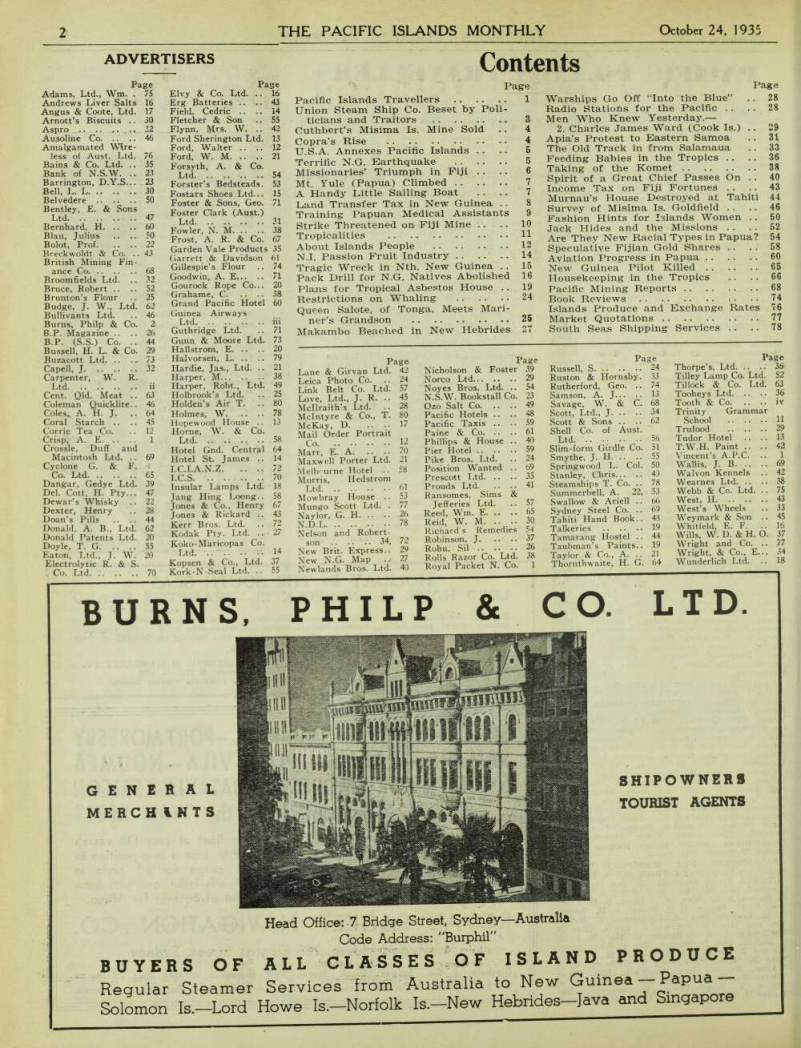
Page Adams, Ltd., Wm. . 75 Andrews Liver Salts 16 Angus & Coote, Ltd. 17 Arnott’s Biscuits .. 30 Aspro .. ... 32 Ausoline Co. .. .. 46 Amalgamated Wire less of Aust. Ltd. 76 Bains & Co. Ltd. .. 35 Bank of N.S.W. .. 23 Barrington, D.Y.5... 23 Bell, L. L 30 Belvedere 50 Bentley, E. & Sons Ltd 47 Bernhard, H 60 Blau, Julius .. .. 50 Bolot, Prof 22 Breckwoldt & Co. .. 43 British Mining Fin ance Co 68 Broomfields Ltd. .. 32 Bruce, Robert .. .. 52 Brunton’s Flour .. 25 Budge, J. W., Ltd. 62 Bullivants Ltd. .. 46 Burns, Philp & Co. 2 B.P. Magazine .. .. 26
B.P. (S.S.) Co. .. 44
Bussell, H. L. & Co. 29 Buzacott Ltd. .. .. 73 Capell, J 32 Carpenter, W. R.
Ltd ii Cent. Qld. Meat .. 63 Coleman Quicklite.. 46 Coles, A. H. J. .. 64 Coral Starch .. .. 45 Corrie Tea Co. .. 12 Crisp, A. E 1 Crossle. Duff and Macintosh Ltd. .. 69 Cyclone G. & F.
Co. Ltd 65 Dangar, Gedye Ltd. 39 Del. Cott, H. Pty... 47 Dewar’s Whisky .. 22 Dexter, Henry .. 28 Doan’s Pills .. .. 44 Donald, A. 8., Ltd. 62 Donald Patents Ltd. 20 Doyle, T. G 55 Eaton, Ltd., J. W. 20 Electrolytic R. & S.
Co. Ltd 70
Page Elvy & Co. Ltd. .. 16 Erg Batteries .. .. 43 Field, Cedric .. .. 14 Fletcher & Son .. 55 Flynn, Mrs. W. .. 42 Ford Sherington Ltd. 13 Ford, Walter .. .. 12 Ford, W. M 21 Forsyth, A. & Co.
Ltd 54 Forster’s Bedsteads. 53 Fostars Shoes Ltd... 15 Foster & Sons, Geo. 71 Foster Clark (Aust.) Ltd 31 Fowler, N. M 38 Frost, A. R. & Co. 67 Garden Vale Products 35 Garrett ,& Davidson 61 Gillespie’s Flour .. 74 Goodwin, A. E 71 Gourock Rope C 0... 20 Grahame, C 38 Grand Pacific Hotel 60 Guinea Airways Ltd in Guthridge Ltd. .. 71 Gunn & Moore Ltd. 73 Hallstrom, E 20 Halvorsen, L 79 Hardie, Jas., Ltd. .. 21 Harper, M... ... .. 38 Harper, Robt., Ltd. 49 Holbrook’s Ltd. .. 25 Holden’s Air T. ..80 Holmes, W 78 Hopewood House .. 13 Horne, W. & Co.
Ltd 58 Hotel Gnd. Central 64 Hotel St. James .. 14
1.C.1.A.N.Z 72
I.C.S 70
Insular Lamps Ltd. 18 Jang King Loong.. 58 Jones & Co., Henry 67 Jones & Rickard .. 43 Kerr Bros. Ltd. .. 72 Kodak Pty. Ltd. .. 27 Koko-Maricopas Co.
Ltd. 14 Kopsen & Co., Ltd. 37 Kork-N-Seal Ltd. .. 55
Page Lane & Girvan Ltd. 42 Leica Photo Co. .. 24 Link Belt Co. Ltd. 57 Love, Ltd., J. R. • • 45 Mcllraith’s Ltd. .. 28 Mclntyre & Co., T. 80 McKay, D 17 Mail Order Portrait Co 12 Marr, E. A 70 Maxwell Porter Ltd. 21 Melbrurne Hotel .. 58 Morris, Hedstrom Ltd 61 Mowbray House .. 53 Mungo Scott Ltd. . 77 Naylor, G. H 26
N.D.L 78
Nelson and Robert son 34, 72 New Brit. Express.. 29 New N.G. Map ..' 27 Newlands Bros. Ltd. 40
Page Nicholson & Foster 39 Norco Ltd 29 Noyes Bros. Ltd. .. 54 N.S.W. Bookstall Co. 23 Ozo Salt Co 49 Pacific Hotels .. .. 48 Pacific Taxis .. .. 59 Paine & Co. .. .. 61 Phillips & House .. 40 Pier Hotel 59 Pike Bros. Ltd. .. 24 Position Wanted .. 69 Prescott Ltd 35 Prouds Ltd 41 Ransomes, Sims & Jefferies Ltd. .. 57 Reed, Wm. E 65 Reid, W. M 30 Richard’s Remedies 54 Robinson, J 37 Rohu, Sil 26 Rolls Razor Co. Ltd. 38 Royal Packet N. Co. 1
Page Russell, S 24 Ruston & Hornsby. 33 Rutherford, Geo. .. 74 Samson, A. J 13 Savage, W. & C. 68 Scott, Ltd., J 34 Scott & Sons .. . • 62 Shell Co. of Aust.
Ltd. .. •• •• 56 Slim-form Girdle Co. 51 Smythe, J. H 55 Springwood L. Col. 50 Stanley, Chris 49 Steamships T. Co. .. 78 Summerbell, A. 22, 53 Swallow & Ariell .. 66 Sydney Steel Co. .. 69 Tahiti Hand Book.. 43 Talkeries 19 Tamarang Hostel .. 44 Taubman’s Paints.. 19 Taylor & Co., A. .. 21 Thornthwaite, H. G. 64
Page Thorpe’s, Ltd. .. .. 36 Tilley Lamp Co. Ltd. 52 Tillock & Co. Ltd. 63 Tooheys Ltd 36 Tooth & Co iv Trinity Grammar School 11 Trufood 29 Tudor Hotel .. .. 13 T.W.H. Paint .. .. 42 Vincent’s A.P.C. .. 1 Wallis, J. B 69 Walvon Kennels .. 42 Wearnes Ltd 38 Webb & Co. Ltd. .. 75 West, H 43 West’s Wheels .. 33 Weymark & Son .. 45 Whitfeld, E. F. .. 16 Wills, W. D. &H. O. 37 Wright and Co. .. 77 Wright, & Co., E... 34 Wunderlich Ltd. .. 18
Contents
Page Pacific Islands Travellers .. .. .. 1 Union Steam Ship Co. Beset by Poli ticians and Traitors 3 Cuthbert’s Misima Is. Mine Sold . . 4 Copra’s Rise 4 U.S.A. Annexes Pacific Islands .. .. 5 Terrific N.G. Earthquake 5 Missionaries’ Triumph in Fiji .. .. 6 Mt. Yule (Papua) Climbed 7 A Handy Little Sailing Boat .. .. 7 Land Transfer Tax in New Guinea . . 8 Training Papuan Medical Assistants 9 Strike Threatened on Fiji Mine .. .. 10 Tropicalities H About Islands People 12 N.I. Passion Fruit Industry 14 Tragic Wreck in Nth. New Guinea .. 15 Pack Drill for N.G. Natives Abolished 16 Plans for Tropical Asbestos House .. 19 Restrictions on Whaling 24 Queen Salote, of Tonga, Meets Mari ner’s Grandson 25 Makambo Beached in New Hebrides 27
Page Warships Go Off “Into the Blue” .. 28 Radio Stations for the Pacific .. .. 28 Men Who Knew Yesterday.— 2. Charles James Ward (Cook Is.) .. 29 Apia’s Protest to Eastern Samoa .. 31 The Old Track in from Salamaua .. 33 Feeding Babies in the Tropics .. .. 36 Taking of the Komet 38 Spirit of a Great Chief Passes On .. 40 Income Tax on Fiji Fortunes . . .. 43 Murnau’s House Destroyed at Tahiti 44 Survey of Misima Is. Goldfield .. .. 46 Fashion Hints for Islands Women .. 50 Jack Hides and the Missions .. .. 52 Are They New Racial Types in Papua? 54 Speculative Fijian Gold Shares .. .. 58 Aviation Progress in Papua 60 New Guinea Pilot Killed 65 Housekeeping in the Tropics .. .. 66 Pacific Mining Reports 68 Book Reviews 74 Islands Produce and Exchange Rates 76 Market Quotations 77 South Seas Shipping Services .. .. 78
Advertisements & other items, p. 4 (1 item)
Burns. Philp & Co. Ltd.
GENERAL
MERCK ISIS
ffl 11l m imraoas mu fm lUtfiW m.
I HU
li I li I HI
SHIPOWNERS
TOURIST AGENTS
Head Office: 7 Bridge Street, Sydney— Australia Code Address: "Burphil BUYERS OF ALL CLASSES OF ISLAND PRODUCE Regular Steamer Services from Australia to New Guinea -Papua- Solomon Is.—Lord Howe Is.—Norfolk Is.—New Hebrides—Java and Singapore
The Pacific Islands Monthly
The Newspaper-Magazine Of The South Seas
[Registered at G.P.0., Sydney, for transmission hy post as a newspaper ]
Published Once Each Month and Circulated in Australia and New Zealand and in the following Pacific Territories and Islands Groups:
Crown Colony of Fiji.
Australian Territory of Papua.
Mandated Territory (Australia) of New Guinea, Bismarck Archipelago, and Northern Solomon Islands.
Mandated Territory (Japan) of Marshall, Caroline and Marianna Islands.
French Territory of New Caledonia.
British and French Condominium of New Hebrides.
American Territory of Eastern Samoa.
American Territory of Guam.
Mandated Territory of Nauru.
British Crown Colony of Gilbert and Ellice Islands.
Mandated Territory (New Zealand) of Samoa.
British Solomon Islands Protectorate.
British Protectorate of Tongan Islands.
New Zealand Territory of Cook Islands.
Australian Territory of Norfolk Island.
French Colony of Oceania (Tahiti, etc.).
American Territory of Hawaiian Islands.
Owned and Produced by Pacific Publication 9 Ltd Union House, 247 George Street, Sydney .
Telephone Bw 5037
P.O. Box 3408 R
Contributions Articles, Stories, and Photographs dealing with Pacific Islands Subjects are invited, and will be paid for on publication at usual rates.
Subscription Rates Per Annum, within British Empire, Prepaid Post Free 6/- Pcr Annum, elsewhere, prepaid, Post Free . 8/- Single Copies 6d.
Editor and Publisher:
R. W. Robson.
Advertisements
Advertising rates furnished on application.
Colours, etc. by Arrangement.
Process Blocks made at Advertiser’s expense when required. Screen, 100.
Changes of Advertising Copy should reach this Office by Bth of each month, otherwise previous advertisement may be repeated.
Registered Address for Radiograms and Cable*: “PACPUB” Sydney Agents The following are authorised to receive subscrip tions for “The Pacific Islands Monthly”— Islands Branches of Burns, Philp & Co., Ltd., and Bums Philp (South Seas) Co., Ltd.
Islands Branches of W. R. Carpenter & Co., Ltd.
All Branches of Morris, Hedstrom & Co., Ltd.
G. Thomas & Co., Rabaul, New Guinea.
Whitten Bros., Ltd., Samarai, Papua.
P. Costello, Suva, Fiji.
J. Muir, Suva, Fiji.
All Branches and Representatives of W. H. Grove and Sons, Ltd., Auckland, New Zealand.
S. Russell, Papeete, Tahiti.
Cook Islands Trading Co., Rarotonga, Cook Is.
Vol. VI., No. 3
Sydney, October 24, 1933
P 6d. Per Copy 1 riCC Prepaid; 6/- pa.
Union S.S. Co. Beset By Politicians
And Traitors
Our freedom was won and our Empire was made, By our men and our ships and our overseas trade.
A LT HOUGH everyone concerned has urged the need for haste in dealing with the Pacific shipping problem—i.e., the undermining of the unprotected Union Company (British) by the heavily subsidised Matson Line (American) — the Commonwealth Government appears to have done no more than it has done during the past two years—which is pre cisely nothing. Mr. Lyons, in Septem ber, promised that there would be a con ference with the Matson Line, but no more has been heard of the plan.
The Melbourne “Age” has been criticising the Commonwealth Govern ment sharply for its inaction, and the Prime Minister has been questioned in Parliament about his plans. But he seems to have no plans. At any rate, no information has been made available to the Parliamentary questioners.
Meanwhile, the Union Company has been subjected to another attack, of
another and more treacherous character.
There was a strike of waterside workers in Vancouver; and, after it had dislocated coastal shipping, it was broken by the formation of volunteer labour corps, which worked the ships. The crew of the trans-Pacific liner Niagara was held up on October 11, at the moment of sail ing from Sydney, with a full passenger list, by a demand from the crew that the Co. give a guarantee that non-union labour would not be allowed to work the ship at Vancouver. The Co., of course, could not give any such undertaking; and so the ship was tied up, and the pas sengers transferred to the next outgoing Matson liner.
It is bad enough that this great Pacific pioneering company should be left by indifferent governments to meet single handed the subsidised competition of America, in the manner described; but it is a national tragedy that the Company is not protected against the traitorous activities of the Australian Seamen’s Union.
One expects competition from foreign countries; but one does not expect, while fighting that competition, to be stabbed in the back by the people and the organi sations to whom one looks for support.
It would benefit all British interests in the South Seas if certain numerous gentlemen of the Australian Seamen’s Union were placed in a line against a wall and summarily shot. They are a menace to good government and indus trial peace, and they are a growing danger to that freedom of the South Seas that is guaranteed by British Imperial influence. The best that can be said of them is that they are too stupid, and too intoxicated with their own politico economic nostrums, to realise what they are doing. What they are doing —in so many words —is to gravely weaken, at home, certain Australian and New Zealand shipowners who already are hard pressed in the field of international competition. When British shipowners are driven off the seas, the end of the Empire will be in sight, and the restless gentlemen of the Seamen’s Union will have something to squeal about.
The Union Company, in the Central and Eastern Pacific, and Messrs. Burns, Philp and Co. in the Western Pacific, have not only established a great trans port business, but also have done a
splendid Imperial job of work by carry ing the Red "Ensign to every islet and beach the Equator, and, through guaranteeing regular services, by estab lishing British communities throughout the Pacific territories. It was in such manner that British ships and British enterprise won the British Empire; and it is the possession of the Empire, and all it means, that allows British people to enjoy a high standard of life, and freedom to work and organise for a still
higher standard.
But when concerns like the Australian Seamen’s Union proceed to attack the Union Co. in the way described, and when, owing to some footling argument on the Australian coast, they hold up the Burns Philp Pacific Islands liners, it is clear that freedom has been turned into license, and that anti-British treachery is being practised. One does not blame directly the rank and file of men who serve on the ships; but, indirectly, they are responsible, because they allow their union to be controlled by a gang of pot bellied loafers whose one myopic aim is to “break down the forces of capitalism by creating everlasting trouble.”
If the Australian and New Zealand Governments had any vision, and any real. sense of responsibility as the guardians of the British flag in the South Pacific, they long ago would have aban doned this semi-apologetic attitude towards foreign competitors and domestic traitors, and would have seen to it that the shipping companies which carry their flags into distant seas are adequately pro tected and supported. It may or may not be that the companies pay dividends that are too large and wages that are too small. That, surely, is a matter for inquiry and regulation at home, before the proper tribunals.
The plight of the Union Steamship Company to-day, beset abroad by the merciless competition of powerful foreign interests, and ceaselessly harassed at home by anti-British Communist agita tors, can be read only as deplorable proof of the feebleness of these pleasure jaunting, shilly-shallying Australasian Governments. Our publicists are very busy, in these days, crying maledictions upon the name of Mussolini. Can one imagine Mussolini standing idly by allowing some big organisation carrying his flag to be torn to pieces between ruth less foreign interests and the mad dogs of Bolshevism? Has a century’s resi dence beneath the South Pacific sun sapped our Australasian nations of their finest British qualities of strength and aggressiveness ?
Cuthbert’s Money-Spinner
is Sold New Company Buys Misima Mine
From Our Owhi- Correspondent.
Port Moresby, Oct. 9.
AN inspection of the property of New Misima Gold Mines Ltd., on the island of Misima, has been completed by the mining engineer, Mr. C. Rutledge, who arrived in the Territory early in Sep tember from Sydney, on behalf of a southern company. The price asked for the property was £75,000 in cash and £20,000 in shares.
It is understood that the terms have been accepted and that the option over the New Misima Gold Mines was exer cised this week, and that the mine will be taken over immediately by a company to be called Cuthbert’s Misima Goldmines Ltd.
It is reported that the new company has been formed by Mr. Frank Ham bridge, of Sydney.
The property was bought in 1928 for £ 2,000 by Messrs. Fred Cuthbert and G.
O. Wilkinson, and those two hardworking, practical men, in the past six years, have
taken out of the mine gold worth £145,000. Recently they have been pay ing a dividend on £1 shares at the rate of 2/- per month (120 per cent per annum!).
Copra’S Rise
WRITING on September 20, we remarked on the lifelessness of the copra mar ket; pointed out that aUthe factors pointed to an early rise; and added that “London commentators remain undismayed—they insist that copra prices must increase/' Quotations since then:—
Price in Australian Currency ... 16 5 0 17 10 0 A rise of £2/10/- per ton, sterling, in four weeks, will help to keep the wolf off the plantation verandah.
Dr. C. S. James, M. 8., B.Ch., F.R.C.S., who has been for six years at the Methodist Mission’s Stewart Hospital at Vunairima, New Britain, has accepted the position of Medical Officer for the Mela nesian Mission Hospital at Fauabu, Solo mon Islands. He will take up duties early next year.
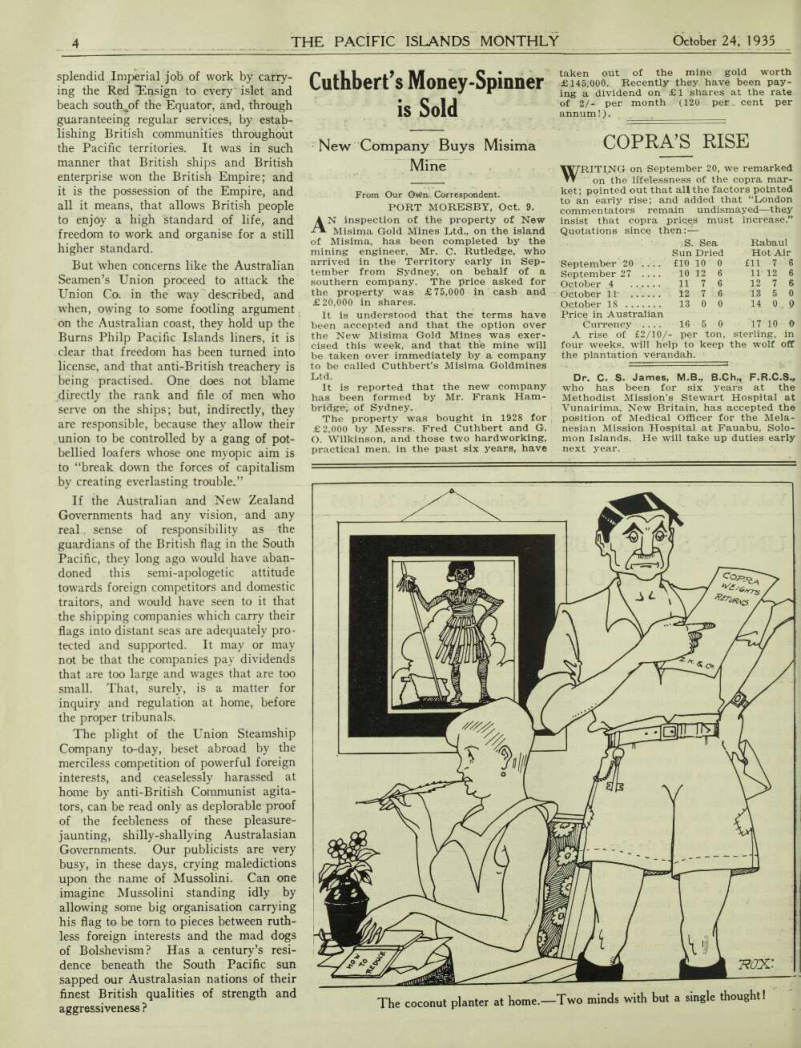
The coconut planter at home. —Two minds with but a single thought!
; ■ S.
Sea Rabaul Sun Dried Hot Air September 20 .. . . £10 10 0 £11 7 6 September 27 . . 10 12 6 11 12 6 October 4 ... 11 7 6 12 7 6 October 11 ... 12 7 6 13 5 0 October 18 13 0 0 14 0 0
Annexed By U.S.A.
Baker, Howland and Jarvis Is.
IT was announced in Washington on October 14 that the small islands of Jarvis, Baker and Howland have been formally annexed by the United States.
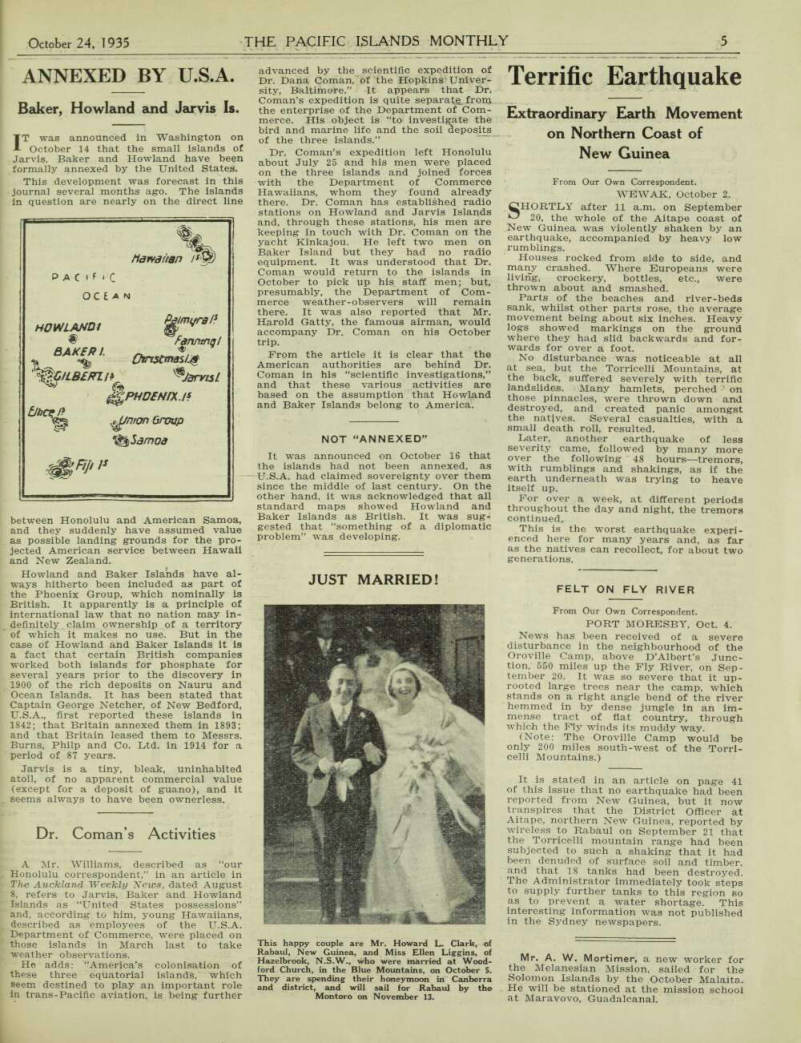
This development was forecast in this journal several months ago. The islands in question are nearly on the direct line
between Honolulu and American Samoa, and they suddenly have assumed value as possible landing grounds for the pro jected American service between Hawaii and New Zealand.
Howland and Baker Islands have al ways hitherto been included as part of the Phoenix Group, which nominally is British. It apparently is a principle of international law that no nation may in definitely claim ownership of a territory of which it makes no use. But in the case of Howland and Baker Islands it is a fact that certain British companies worked both islands for phosphate for several years prior to the discovery in 1900 of the rich deposits on Nauru and Ocean Islands. It has been stated that Captain George Netcher, of New Bedford, U.S.A., first reported these islands in 1842; that Britain annexed them in 1893; and that Britain leased them to Messrs.
Burns, Philp and Co. Ltd. in 1914 for a period of 87 years.
Jarvis is a tiny, bleak, uninhabited atoll, of no apparent commercial value (except for a deposit of guano), and it seems always to have been ownerless.
Dr. Coman’s Activities
A Mr. Williams, described as “our Honolulu correspondent,” in an article in The Auckland Weekly News, dated August 8, refers to Jarvis, Baker and Howland Islands as “United States possessions” and, according to him, young Hawaiians, described as employees of the U.S.A.
Department of Commerce, were placed on those islands in March last to take weather observations.
He adds: “America’s colonisation of these three equatorial islands, which seem destined to play an important role in trans-Pacific aviation, is being further
advanced by the scientific expedition of Dr. Dana Coman, of the Hopkins Univer sity, Baltimore.” It appears that Dr.
Coman’s expedition is quite the enterprise of the Department of Com merce. His object is “to investigate the bird and marine life and the soil deposits of the three islands.”
Dr. Coman’s expedition left Honolulu about July 25 and his men were placed on the three islands and joined forces with the Department of Commerce Hawaiians, whom they found already there. Dr. Coman has established radio stations on Howland and Jarvis Islands and, through these stations, his men are keeping in touch with Dr. Coman on the yacht Kinkajou. He left two men on Baker Island but they had no radio equipment. It was understood that Dr.
Coman would return to the islands in October to pick up his staff men; but, presumably, the Department of Com merce weather-observers will remain there. It was also reported that Mr.
Harold Gatty, the famous airman, would accompany Dr. Coman on his October trip.
From the article it is clear that the American authorities are behind Dr.
Coman in his “scientific investigations,” and that these various activities are based on the assumption that Howland and Baker Islands belong to America.
Not “Annexed"
It was announced on October 16 that the islands had not been annexed, as U.S.A. had claimed sovereignty over them since the middle of last century. On the other hand, it was acknowledged that all standard maps showed Howland and Baker Islands as British. It was sug-* gested that “something of a diplomatic problem” was developing.
Just Married!
This happy couple are Mr. Howard L. Clark, of Rabaul, New Guinea, and Miss Ellen Liggins, of Hazelbrook, N.S.W., who were married at Wood ford Church, in the Blue Mountains, on October 5.
They are spending their honeymoon in Canberra and district, and will sail for Rabaul by the Montoro on November 13.
Terrific Earthquake
Extraordinary Earth Movement on Northern Coast of New Guinea
From Our Own Correspondent.
WEWAK, October 2.
SHORTLY after 11 a.m. on September 20, the whole of the Aitape coast of New Guinea was violently shaken by an earthquake, accompanied by heavy low rumblings.
Houses rocked from side to side, and many crashed. Where Europeans were living, crockery, bottles, etc., were thrown about and smashed.
Parts of the beaches and river-beds sank, whilst other parts rose, the average movement being about six inches. Heavy logs showed markings on the ground where they had slid backwards and for wards for over a foot.
No disturbance was noticeable at all at sea, but the Torricelli Mountains, at the back, suffered severely with terrific landslides. Many hamlets, perched on those pinnacles, were thrown down and destroyed, and created panic amongst the natives. Several casualties, with a small death roll, resulted.
Later, another earthquake of less severity came, followed by many more over the following 48 hours—tremors, with rumblings and shakings, as if the earth underneath was trying to heave itself up.
For over a week, at different periods throughout the day and night, the tremors continued.
This is the worst earthquake experi enced here for many years and, as far as the natives can recollect, for about two generations.
Felt On Fly River
From Our Own Correspondent.
Port Moresby, Oct. 4.
News has been received of a severe disturbance in the neighbourhood of the Oroville Camp, above D’Albert’s Junc tion, 550 miles up the Fly River, on Sep tember 20. It was so severe that it up rooted large trees near the camp, which stands on a right angle bend of the river hemmed in by dense jungle In an im mense tract of flat country, through which the Ply winds its muddy way. (Note; The Oroville Camp would be only 200 miles south-west of the Torri celli Mountains.) It is stated in an article on page 41 of this issue that no earthquake had been reported from New Guinea, but it now transpires that the District Officer at Aitape, northern New Guinea, reported by wireless to Rabaul on September 21 that the Torricelli mountain range had been subjected to such a shaking that it had been denuded of surface soil and timber, and that 18 tanks had been destroyed.
The Administrator immediately took steps to supply further tanks to this region so as to prevent a water shortage. This interesting information was not published in the Sydney newspapers.
Mr. A. W. Mortimer, a new worker for the Melanesian Mission, sailed for the Solomon Islands by the October Malaita.
He will be stationed at the mission school at Maravovo, Guadalcanal.
Missionaries’ Triumph In Fiji
Methodists Celebrate Centenary of First Landing
ON October 12, 1835, there landed on the beach at Lakemba, in the Lau Archipelago Fiji, the Rev. William Cross and Rev. David Cargill, M.A., pioneer missionaries. They had come to introduce Christianity to the Fijians, than whom there were then no more bloodthirsty cannibals on earth. They had come directly from Tonga, which had embraced Christianity, and they carried to the Fijian chiefs commendations and presents from the ruler of Tonga, King George.
On October 12, 1935, on the very same spot, there was a great gathering of Methodist missionaries and other churchmen to cele brate the centenary.
There were numerous ceremonies, including the opening and dedi cation of a memorial church. Among the notable people present was Dame Salote, Queen of Tonga, direct descendant of that King of Tonga who sent Cross and Cargill to Fiji to start the great work of Chris tianity.
The gathering at La kemba was only one of a score of import ant events connected with the centenary,
which was fittingly celebrated. The condition of Fiji and of the Fijians to-day, compared with 1835, is one of the world’s outstanding examples of the benefits of Christianity, sensibly ap plied to a primitive people. The Fijians in 1835, although a race of fine physique and intelligence, and of considerable culture, were addicted to practices so horrible and repugnant —universal cannibalism was only one of them—that Fiji became known throughout the world as a synonym for the most repellant kind of savagery.
To-day the Fijians are among the most attractive of the South Seas races. They are intelligent and easily acquire the arts and crafts of Europeans; they have praise worthy social qualities, and are hospitable and law-abiding; they have a fine .spirit and national pride; they are generally Christians; and, although “Europeanised, they are steadily increasing in numbers.
There need be no fear for the Fijian people of the future.
For this remarkable metamorphosis, the Christian missionaries are entitled to full credit. Many of them, going among the early savages, made the ultimate sacrifice some were actually cooked and eaten but they stuck bravely to the job, and they had 100 per cent, success. All the Christian churches had a share in this work, but, as Messrs. Cross and Cargill were non-con formists, the Methodist missionary organi sations took a leading part in this month’s centenary celebrations.
The liner Katoomba sailed from Sydney on October 5 with a party of 435 persons, efficiently organised by the Australian Methodist Church. The party included the president of the Methodist General Con ference (Rev. A. J. Barclay), the president of the New South Wales Conference (Rev.
M. K. Gilmour), the general secretary of the Methodist Missionary Society of Aus tralia (Rev. J. W. Burton), the various
State secretaries for oversea missions, the Rev. R. C. G. Page (president of the Tonga Methodist Church), and the Queen of Tonga, who was returning home after a visit to Australia.
One interesting personality in the party was Miss H. Baker, a famous missionary, and herself the daughter of the late Rev.
Thomas Baker, who was murdered by the mountaineers of Central Fiji in 1867, and whose body was dismembered, cooked and eaten by this once-savage people. Many
years later the descendants of these very people made a great ceremonial presenta tion to the Methodist Mission as an atone ment for the evil deeds of their fathers, and took their part in erecting the great Baker Memorial Hall, which stands near to the original mission station from which Mr. Baker went to his death. That hall is now used for the training of Fijian ministers, teachers and pastors, and Miss Baker, on this occasion, unveiled a memorial tablet that has been placed in this building to perpetuate the name of her martyred father.
The Katoomba party’s itinerary was:— October 10. —Arrival at Lautoka; visit to various places in district, including historic Vunda, where it is said that the ancestors of the present Fijian races, coming from an unknown land, beached their canoes some six or seven hundred years ago.
October 11. —At Suva.
October 12, 13.—At Lakemba— centenary celebrations.
October 14. —At Somosomo, where Cross is buried.
October 15. —At Levuka; thence in even ing to Suva.
October 16-19. —Visits to Davuilevu (the educational town of the Methodist Mission and the largest educational centre in the Pacific) and to Bau, the native capital.
October 20. —Concluding thanksgiving service in Albert Park, Suva; broadcast throughout Australia by Stations 2CH and 3DB at 9 a.m. (Sydney time).
October 25.—Return to Sydney.
Mrs. A. de Latour, wife of the New Guinea manager of New Guinea Gold fields Ltd., returned to Salamaua by the Montoro on October 5, after a holiday visit to Australia.
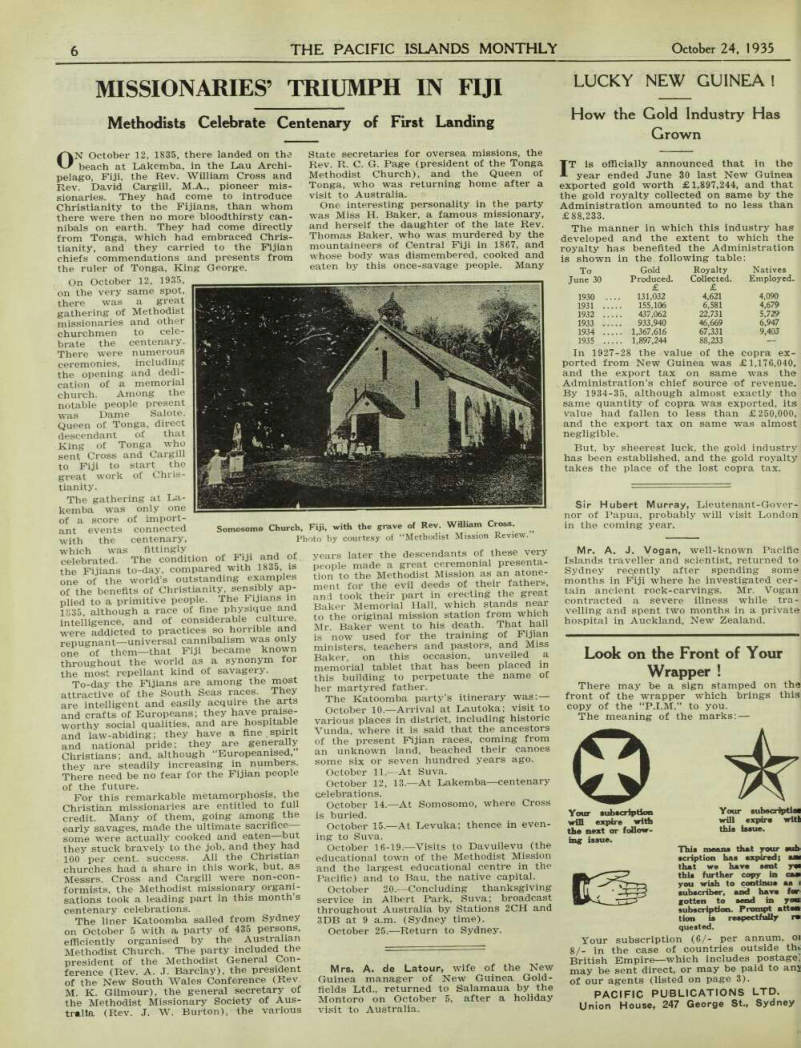
Somosomo Church, Fiji, with the grave of Rev. William Cross.
Photo by courtesy of “Methodist Mission Review."
Lucky New Guinea!
How the Gold Industry Has Grown
IT is officially announced that in the year ended June 30 last New Guinea exported gold worth £1,897,244, and that the gold royalty collected on same by the Administration amounted to no less than £88,233.
The manner in which this industry has developed and the extent to which the royalty has benefited the Administration is shown in the following table;
In 1927-28 the value of the copra ex ported from New Guinea was £1,176,040, and the export tax on same was the Administration’s chief source of revenue.
By 1934-35, although almost exactly the same quantity of copra was exported, its value had fallen to less than £250,000, and the export tax on same was almost negligible.
But, by sheerest luck, the gold industry has been established, and the gold royalty takes the place of the lost copra tax.
Sir Hubert Murray, Lieutenant-Gover nor of Papua, probably will visit London in the coming year.
Mr. A. J. Vogan, well-known Pacific Islands traveller and scientist, returned to Sydney recently after spending some months in Fiji where he investigated cer tain ancient rock-carvings. Mr. Vogan contracted a severe illness while tra velling and spent two months in a private hospital in Auckland, New Zealand.
To Gold Royalty Natives June 30 Produced.
Collected.
Employed. £ £ 1930 ... 131,032 4,621 4,090 1931 155,106 6,581 4,679 1932 437,062 22,731 5,729 1933 933,940 46,669 6,947 1934 1,367,616 67,331 9,403 1935 1,897,244 88,233 —
Advertisements & other items, p. 8 (1 item)
Wrapper !
Look on the Front of Your
There may be a sign stamped on the front of the wrapper which brings this copy of the “P.1.M.” to you.
The meaning of the marks: O k Your subscription will expire will this issue.
This means that your sub script ion has expired; a» that wo have sent ye* this further copy in cm you wish to continue as I subscriber, and have for gotten to send in yott subscription. Prompt atten tion is respectfully re quested.
Your subscription (6/- per annum, 01 8/- in the case of countries outside thi British Empire—which includes postage; may be sent direct, or may be paid to anj of our agents (listed on page 3).
PACIFIC PUBLICATIONS LTD.
Union House, 247 George St., Sydney Your subscription will expire with the next or following issue.
Mt. Yule Climbed
Another Exploring Feat In Papua
From Our Own Correspondent.
Pt. Moresby, Oct. 4.
ON May 16, Mr. R. S. Speedie, Assis tant Magistrate on patrol from the recently established police camp in the Goilala district, in the interior of the Central Division, climbed Mt. Yule and reached the summit at 10,412 ft. He was accompanied by Patrol Officer Watkins and a party of police, and the two men spent six days on the heights, making observations.
Many years ago, in the early days of British New Guinea, George Belford, a Samoan half-caste, in the employ of Sir William MacGregor, was said to have ascended this familiar feature of the south coast. He was reported to have left on the summit a bottle of whisky, as proof of his feat of endurance, but an extended search by Messrs. Speedie and Watkins failed to reveal this valued relic, or any other trace whatever of a previous visit. They concluded that the mountain top had not been visited before.
Mr. Speedie cut a track from the south east, and, climbing over spurs of the mountain at 7,000 ft., reached ground to the south, where ladders were necessary to scale sheer rock faces 100 ft. high, run ning north to south. The main spurs on the eastern side he found to slope gradu ally to the west, where the nature of the country changed from thick jungle to tussock grass and stunted tree fern growth.
To the north, where they were pre pared to face precipices of great height, they were astonished to find only gently sloping ground, and passed through stunted growth and over grassy vales until they were confronted with a sheer drop—“what might be described as a white void beneath them.” Careful in vestigations along the edge proved even tually, and to their surprise, that they had reached the summit of the mountain.
“In spite of the pardonable feeling of elation at the conquest,” stated Mr.
Speedie, “we were both disappointed at the simplicity of the climb after fortify ing ourselves against and looking forward to all sorts of hazardous adventures.”
Standing on the edge of a 5,000 ft. drop to the north, a magnificent view could be gained of the Kunimaipa valley, lying between Mt. Chapman and Mt. Strong, near the border, and the villages perched high on the ridges of the spurs of the different valleys stretching below them.
A fire was built on the summit, and the huge columns of smoke that rose in the still morning air seemed greatly to disturb the inhabitants in the valleys.
Even the Kunimaipa people, far away, could be heard shouting from the moun tain tops. “Come down,” they called frantically, “or you will die”; and the message was passed on from crest to crest until it reached the white men, who were violating the strongholds of the mountain spirits, for which the penalty is death.
Mr. Speedie built a cairn of stones on the northernmost end of the summit, marking a post with a broad arrow and the date of their arrival, and left a record of the climb in a bottle amongst the stones.
Mt. Yule was named after Lieutenant Yule, who examined the coastline in the Bramble, from the Gulf to Redscar Bay In 1846.
The Southampton Flying-boat
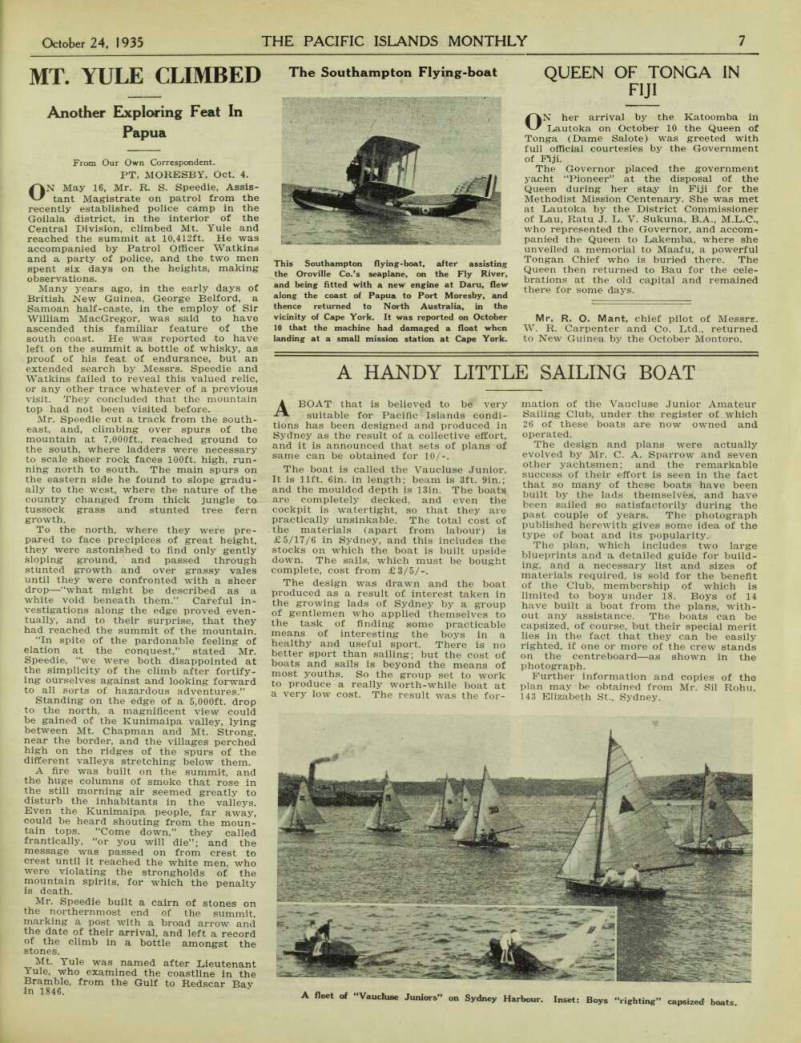
This Southampton flying-boat, after assisting the Oroville Co.’s seaplane, on the Fly River, and being fitted with a new engine at Daru, flew along the coast of Papua to Port Moresby, and thence returned to North Australia, in the vicinity of Cape York. It was reported on October 10 that the machine had damaged a float when landing at a small mission station at Cape York.
Fiji
Queen Of Tonga In
ON her arrival by the Katoomba in Lautoka on October 10 the Queen of Tonga (Dame Salote) was greeted with full official courtesies by the Government of Fiji.
The Governor placed the government yacht “Pioneer” at the disposal of the Queen during her stay in Fiji for the Methodist Mission Centenary. She was met at Lautoka by the District Commissioner of Lau, Ratu J. L. V. Sukuna, 8.A., M.L.C., who represented the Governor, and accom panied the Queen to Lakemba, where she unveiled a memorial to Maafu, a powerful Tongan Chief who is buried there. The Queen then returned to Bau for the cele brations at the old capital and remained there for some days.
Mr. R. O. Mant, chief pilot of Messrs.
W. R. Carpenter and Co. Ltd., returned to New Guinea by the October Montoro.
Advertisements & other items, p. 9 (1 item)
“pslS:
A HANDY LITTLE SAILING BOAT
A BOAT that is believed to be very suitable for Pacific Islands conditions has been designed and produced in Sydney as the result of a collective effort, and it is announced that sets of plans of same can be obtained for 10/-. ic ir t fiin in Q-
InJ thp mnnwS . 4“'h
ll® ~!! cockpit is watertight so that they are practically unslnkable’ The total cost of ‘llmTtftnTr d 'f r h m • la , b °d Ur) ,b S
“pslS:
co o mpiete Th c e os S t a fr S om Vh i3/5/ mUSt * b ° Ught complete, cost trom Ld/5/-.
The design was drawn and the boat produced as a result of interest taken in the growing lads of Sydney by a group of gentlemen who applied themselves to the task of finding some practicable means of interesting the boys in a healthy and useful sport. There is no better sport than sailing; but the cost of boats and sails is beyond the means of most youths. So the group set to work to produce a really worth-while boat at a very low cost. The result was the for-
mation of the Vaucluse Junior Amateur Sailing Club, under tha register of which 26 of these boats are now owned and operated.
The design and plans were actually evolved by Mr. C. A. Sparrow and seven other yachtsmen: and the remarkable success of their effort is seen in the fact that 80 many of these boats have been bunt by the lads themselves, and have been salled 80 satisfactorily during the
ifome Wea°of the
of boat Tnd ifT“opularlty
build®
“a^necessaryMsf fnd
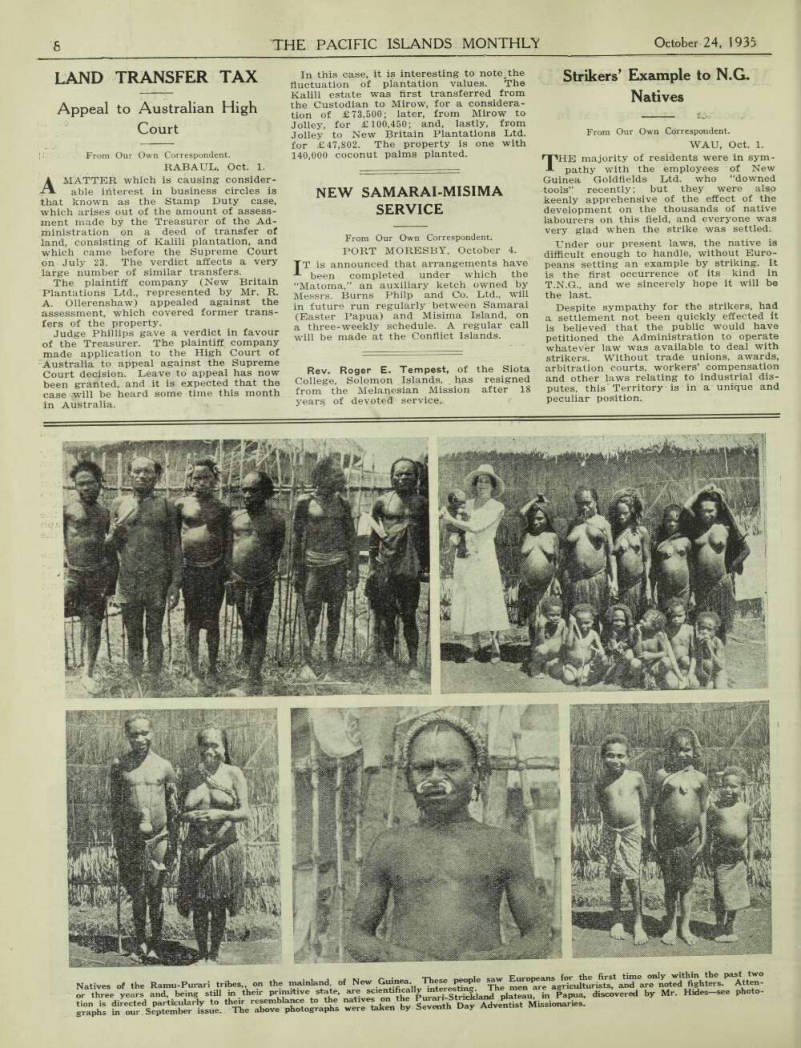
materials required, is sold for the benefit of the Club, membership of which is limited to boys under 18. Boys of 14 have built a boat from the plans, with out any assistance. The boats can be capsized, of course, but their special merit lies in the fact that they can be easily righted, if one or more of the crew stands on the centreboard—as shown in the photograph.
Further information and copies of the plan may be obtained from Mr. Sil Rohu. 143 Elizabeth St., Sydney.
A fleet of “Vauclufie Juniors” on Sydney Harbour. Inset: Boys “righting” capsized boats.
Appeal to Australian High
Land Transfer Tax
Appeal to Australian High Court
;. From Our Own Correspondent.
Rabaul, Oct. 1.
A MATTER which is causing consider able interest in business circles is that known as the Stamp Duty case, which arises out of the amount of assess ment made by the Treasurer of the Ad ministration on a deed of transfer of land, consisting of Kalili plantation, and which came before the Supreme Court on July 23. The verdict affects a very large number of similar transfers.
The plaintiff company (New Britain Plantations Ltd., represented by Mr. R.
A. Ollerenshaw) appealed against the assessment, which covered former trans fers of the property.
Judge Phillips gave a verdict in favour of the Treasurer. The plaintiff company made application to the High Court of Australia to appeal against the Supreme Court decision. Leave to appeal has now been granted, and it is expected that the case will be heard some time this month in Australia.
In this case, it is interesting to note, the fluctuation of plantation values. The Kalili estate was first transferred from the Custodian to Mirow, for a considera tion of £73,500; later, from Mirow to Jolley, for £100,450; and, lastly, from Jolley to New Britain Plantations Ltd. for £47,802. The property is one with 140,000 coconut palms planted.
New Samarai-Misima
Service
From Our Own Correspondent.
PORT MORESBY, October 4.
TT is announced that arrangements have been completed under which the “Matoma,” an auxiliary ketch owned by Messrs. Burns Philp and Co. Ltd., will in future run regularly between Samarai (Easter Papua) and Misima Island, on a three-weekly schedule. A regular call will be made at the Conflict Islands.
Rev. Roger E. Tempest, of the Siota College, Solomon Islands, has resigned from the Melanesian Mission after 18 years of devoted service.
Strikers’ Example to N.G,
Natives
From Our Own Correspondent.
WAU, Oct. 1.
THE majority of residents were in sym pathy with the employees of New Guinea Goldfields Ltd. who “downed tools” recently; but they were also keenly apprehensive of the effect of the development on the thousands of native labourers on this field, and everyone was very glad when the strike was settled.
Under our present laws, the native is difficult enough to handle, without Euro peans setting an example by striking. It is the first occurrence of its kind in T.N.G., and we sincerely hope it will be the last.
Despite sympathy for the strikers, had a settlement not been quickly effected it is believed that the public would have petitioned the Administration to operate whatever law was available to deal with strikers. Without trade unions, awards, arbitration courts, workers’ compensation and other laws relating to industrial dis putes, this Territory is in a unique and peculiar position.
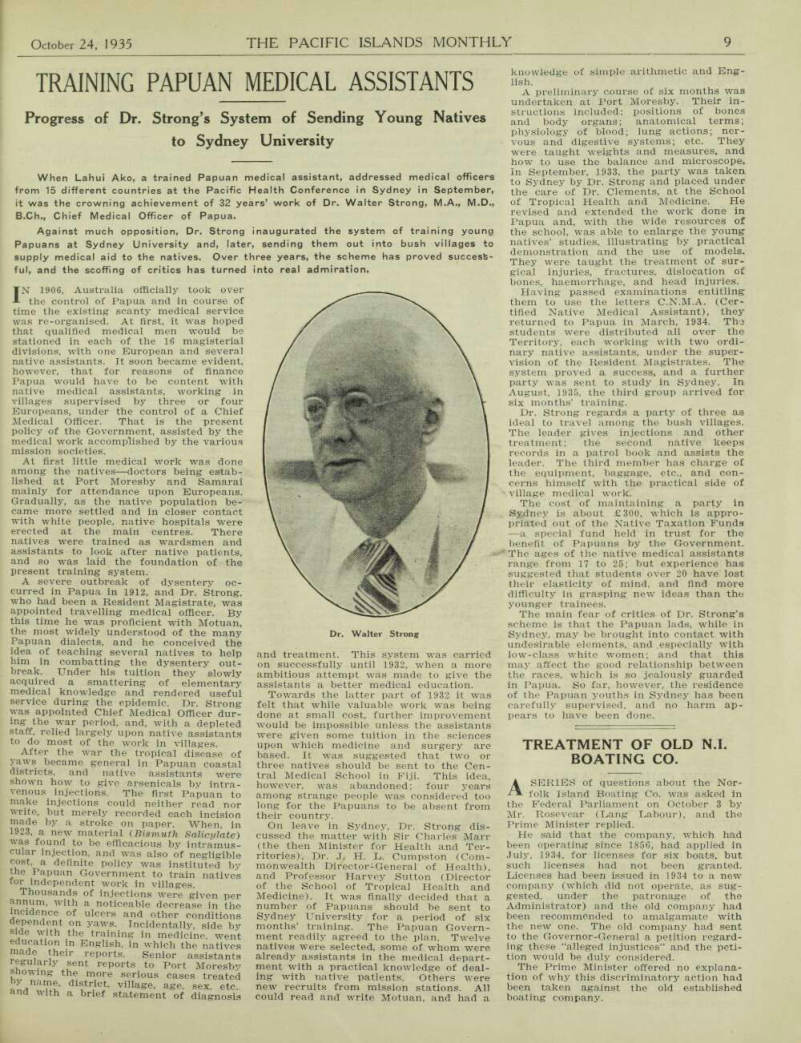
Natives of the Ramu-Purari tribes, on the mainland, of New saw Europeans for the first time only within the past two or three years and, being still in their primitive state, are scientifically intersting The men are agriculturists, and are noted fighrers. Attention is dorected partocularly to their resemnlance to the natives on the Pura
Training Papuan Medical Assistants
Progress of Dr. Strong’s System of Sending Young Natives to Sydney University
When Lahui Ako, a trained Papuan medical assistant, addressed medical officers from 15 different countries at the Pacific Health Conference in Sydney in September, it was the crowning achievement of 32 years’ work of Dr. Walter Strong, M.A., M.D., B.Ch., Chief Medical Officer of Papua.
Against much opposition, Dr. Strong inaugurated the system of training young Papuans at Sydney University and, later, sending them out into bush villages to supply medical aid to the natives. Over three years, the scheme has proved success ful, and the scoffing of critics has turned into real admiration.
IN 1906, Australia officially took over the control of Papua and in course of time the existing scanty medical service was re-organised. At first, it was hoped that qualified medical men would be stationed in each of the 16 magisterial divisions, with one European and several native assistants. It soon became evident, however, that for reasons of finance Papua would have to be content with native medical assistants, working in villages supervised by three or four Europeans, under the control of a Chief Medical Officer. That is the present policy of the Government, assisted by the medical work accomplished by the various mission societies.
At first little medical work was done among the natives—doctors being estab lished at Port Moresby and Samarai mainly for attendance upon Europeans.
Gradually, as the native population be came more settled and in closer contact with white people, native hospitals were erected at the main centres. There natives were trained as wardsmen and assistants to look after native patients, and so was laid the foundation of the present training system.
A severe outbreak of dysentery oc curred in Papua in 1912, and Dr. Strong, who had been a Resident Magistrate, was appointed travelling medical officer. By this time he was proficient with Motuan, the most widely understood of the many Papuan dialects, and he conceived the idea of teaching several natives to help him in combatting the dysentery out break. Under his tuition they slowly acquired a smattering of elementary medical knowledge and rendered useful service during the epidemic. Dr. Strong was appointed Chief Medical Officer dur ing the war period, and, with a depleted staff, relied largely upon native assistants to do most of the work in villages.
After the war the tropical disease of yaws became general in Papuan coastal districts, and native assistants were shown how to give arsenicals by intra venous injections. The first Papuan to make injections could neither read nor write, but merely recorded each incision made by a stroke on paper. When, in 1923, a new material (Bismuth Salicylate) was found to be efficacious by intramus cular injection, and was also of negligible cost, a definite policy was instituted by the Papuan Government to train natives for independent work in villages.
Thousands of injections were given per annum, with a noticeable decrease in the incidence of ulcers and other conditions dependent on yaws. Incidentally, side by side with the training in medicine, went education in English, in which the natives made their reports. Senior assistants regularly sent reports to Port Moresby snowing the more serious cases treated by name, district, village, age. sex, etc. and with a brief statement of diagnosis
and treatment. This system was carried on successfully until 1932, when a more ambitious attempt was made to give the assistants a better medical education.
Towards the latter part of 1932 it was felt that while valuable work was being done at small cost, further improvement would be impossible unless the assistants were given some tuition in the sciences upon which medicine and surgery are based. It was suggested that two or three natives should be sent to the Cen tral Medical School in Fiji. This idea, however, was abandoned; four years among strange people was considered too long for the Papuans to be absent from their country.
On leave in Sydney, Dr. Strong dis cussed the matter with Sir Charles Marr (the then Minister for Health and Ter ritories), Dr. J. H. L. Cumpston (Com monwealth Director-General of Health), and Professor Harvey Sutton (Director of the School of Tropical Health and Medicine). It was finally decided that a number of Papuans should be sent to Sydney University for a period of six months’ training. The Papuan Govern ment readily agreed to the plan. Twelve natives were selected, some of whom were already assistants in the medical depart ment with a practical knowledge of deal ing with native patients. Others were new recruits from mission stations. All could read and write Motuan, and had a
knowledge of simple arithmetic and Eng lish.
A preliminary course of six months was undertaken at Port Moresby. Their in structions included: positions of bones and body organs; anatomical terms; physiology of blood; lung actions; ner vous and digestive systems; etc. They were taught weights and measures, and how to use the balance and microscope.
In September, 1933, the party was taken to Sydney by Dr. Strong and placed under the care of Dr. Clements, at the School of Tropical Health and Medicine. He revised and extended the work done in Papua and, with the wide resources of the school, was able to enlarge the young natives’ studies, illustrating by practical demonstration and the use of models.
They were taught the treatment of sur gical injuries, fractures, dislocation of bones, haemorrhage, and head injuries.
Having passed examinations entitling them to use the letters C.N.M.A. (Cer tified Native Medical Assistant), they returned to Papua in March, 1934. The students were distributed all over the Territory, each working with two ordi nary native assistants, under the super vision of the Resident Magistrates. The system proved a success, and a further party was sent to study in Sydney. In August, 1935, the third group arrived for six months’ training.
Dr. Strong regards a party of three as ideal to travel among the bush villages.
The leader gives injections and other treatment; the second native keeps records in a patrol book and assists the leader. The third member has charge of the equipment, baggage, etc., and con cerns himself with the practical side of village medical work.
The cost of maintaining a party in Sydney is about £3OO, which is appro priated out of the Native Taxation Funds —a special fund held in trust for the benefit of Papuans by the Government.
The ages of the native medical assistants range from 17 to 25; but experience has suggested that students over 20 have lost their elasticity of mind, and find more difficulty in grasping new ideas than the younger trainees.
The main fear of critics of Dr. Strong’s scheme is that the Papuan lads, while in Sydney, may be brought into contact with undesirable elements, and especially with low-class white women; and that this may affect the good relationship between the races, which is so jealously guarded in Papua. So far, however, the residence of the Papuan youths in Sydney has been carefully supervised, and no harm ap pears to have been done.
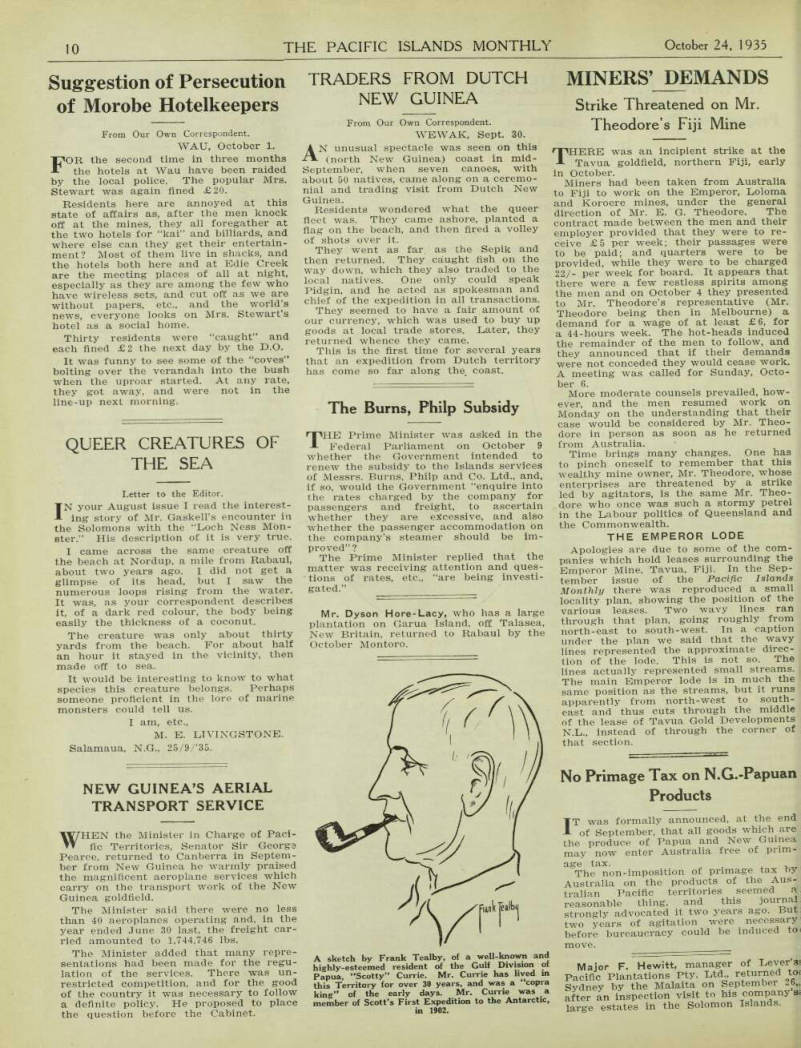
Dr. Walter Strong
Treatment Of Old N.I.
Boating Co.
A SERIES of questions about the Nor folk Island Boating Co. was asked in the Federal Parliament on October 3 by Mr. Rosevear (Lang Labour), and the Prime Minister replied.
He said that the company, which had been operating since 1856, had applied in July, 1934, for licenses for six boats, but such licenses had not been granted.
Licenses had been issued in 1934 to a new company (which did not operate, as sug gested, under the patronage of the Administrator) and the old company had been recommended to amalgamate with the new one. The old company had sent to the Governor-General a petition regard ing these “alleged injustices’’ and the peti tion would be duly considered.
The Prime Minister offered no explana tion of why this discriminatory action had been taken against the old established boating company.
Suggestion of Persecution
of Morobe Hotelkeepers
From Our Own Correspondent.
WAU, October 1.
FOR the second time in three months the hotels at Wau have been raided by the local police. The popular Mrs.
Stewart was again fined £2O.
Residents here are annoyed at this state of affairs as, after the men knock off at the mines, they all foregather at the two hotels for “kai” and billiards, and where else can they get their entertain ment? Most of them live in shacks, and the hotels both here and at Edie Creek are the meeting places of all at night, especially as they are among the few who have wireless sets, and cut off as we are without papers, etc., and the world’s news, everyone looks on Mrs. Stewart’s hotel as a social home.
Thirty residents were “caught” and each fined £2 the next day by the D.O.
It was funny to see some of the “coves” bolting over the verandah into the bush when the uproar started. At any rate, they got away, and were not in the line-up next morning.
Queer Creatures Of
The Sea
Letter to the Editor.
IN your August issue I read the interest ing story of Mr. Gaskell’s encounter in the Solomons with the “Loch Ness Mon ster.” His description of it is very true.
I came across the same creature off the beach at Nordup, a mile from Rabaul, about two years ago. I did not get a glimpse of its head, but I saw the numerous loops rising from the water.
It was, as your correspondent describes it, of a dark red colour, the body being easily the thickness of a coconut.
The creature was only about thirty yards from the beach. For about half an hour it stayed in the vicinity, then made off to sea.
It would be interesting to know to what species this creature belongs. Perhaps someone proficient in the lore of marine monsters could tell us.
I am, etc.,
M. E. Livingstone.
Salamaua, N.G., 25/9/’35.
Transport Service
New Guinea’S Aerial
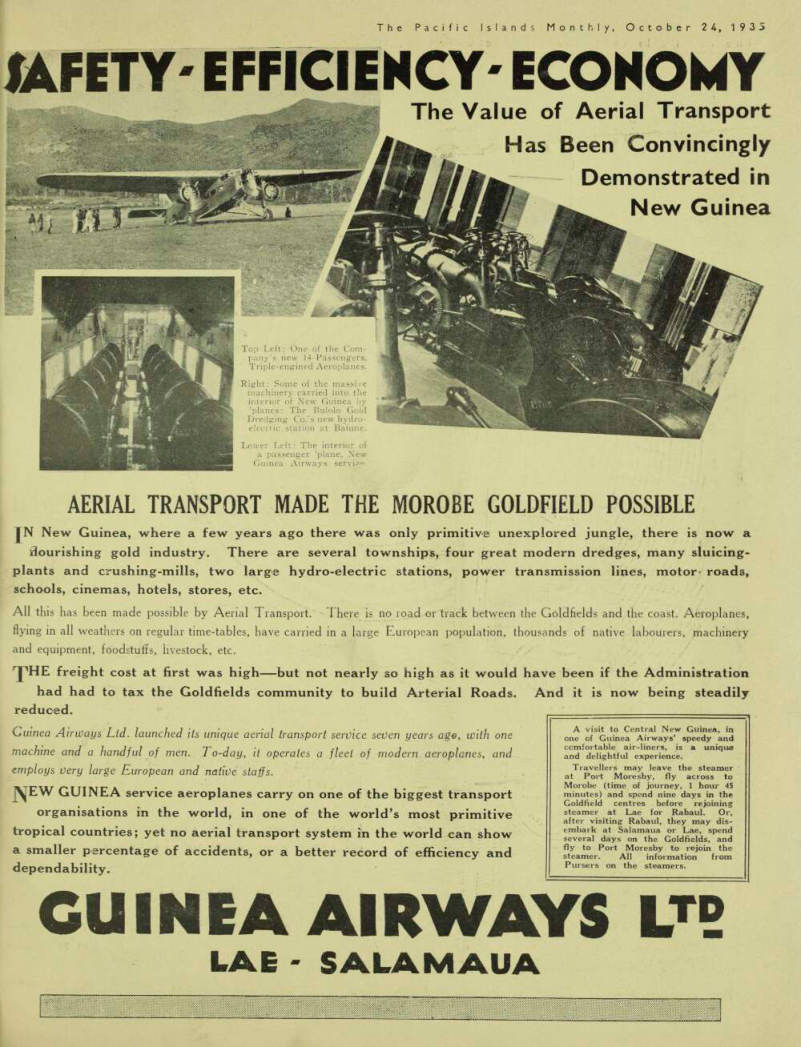
WHEN the Minister in Charge of Paci fic Territories, Senator Sir George Pearce, returned to Canberra in Septem ber from New Guinea he warmly praised the magnificent aeroplane services which carry on the transport work of the New Guinea goldfield.
The Minister said there were no less than 40 aeroplanes operating and, in the year ended June 30 last, the freight car ried amounted to 1,744,746 lbs.
The Minister added that many repre sentations had been made for the regu lation of the services. There was un restricted competition, and for the good of the country it was necessary to follow a definite policy. He proposed to place the question before the Cabinet.
New Guinea
Traders From Dutch
From Our Own Correspondent.
WEWAK, Sept. 30.
AN unusual spectacle was seen on this (north New Guinea) coast in mid- September, when seven canoes, with about 50 natives, came along on a ceremo nial and trading visit from Dutch New Guinea.
Residents wondered what the queer fleet was. They came ashore, planted a flag on the beach, and then fired a volley of shots over it.
They went as far as the Sepik and then returned. They caught fish on the way down, which they also traded to the local natives. One only could speak Pidgin, and he acted as spokesman and chief of the expedition in all transactions.
They seemed to have a fair amount of our currency, which was used to buy up goods at local trade stores. Later, they returned whence they came.
This is the first time for several years that an expedition from Dutch territory has come so far along the. coast.
The Burns, Philp Subsidy
THE Prime Minister was asked in the Federal Parliament on October 9 whether the Government intended to renew the subsidy to the Islands services of Messrs. Burns, Philp and Co. Ltd., and, if so, would the Government “enquire into the rates charged by the company for passengers and freight, to ascertain whether they are excessive, and also whether the passenger accommodation on the company’s steamer should be im proved” ?
The Prime Minister replied that the matter was receiving attention and ques ■ tions of rates, etc., “are being investi gated.”
Mr. Dyson Hore-Lacy, who has a large plantation on Garua Island, off Talasea, New Britain, returned to Rabaul by the October Montoro.
A sketch by Frank Tealby, of a well-known and highly-esteemed resident of the Gulf Division of Papua, “Scotty” Currie. Mr. Currie has lived in this Territory for over 30 years, and was a ‘ copra king” of the early days. Mr. Currie was a member of Scott’s First Expedition to the Antarctic, in 1902.
Miners’ Demands
Strike Threatened on Mr.
Theodore’s Fiji Mine
THERE was an incipient strike at the Tavua goldfield, northern Fiji, early in October.
Miners had been taken from Australia to Fiji to work on the Emperor, Loloma and Koroere mines, under the general direction of Mr. E. G. Theodore. The contract made between the men and their employer provided that they were to re ceive £5 per week; their passages were to be paid; and quarters were to be provided, while they were to be charged 22/- per week for board. It appears that there were a few restless spirits among the men and on October 4 they presented to Mr. Theodore’s representative (Mr.
Theodore being then in Melbourne) a demand for a wage of at least £6, for a 44-hours week. The hot-heads induced the remainder of the men to follow, and they announced that if their demands were not conceded they would cease work.
A meeting was called for Sunday, Octo ber 6.
More moderate counsels prevailed, how ever, and the men resumed work on Monday on the understanding that their case would be considered by Mr. Theo dore in person as soon as he returned from Australia.
Time brings many changes. One has to pinch oneself to remember that this wealthy mine owner, Mr. Theodore, whose enterprises are threatened by a strike led by agitators, is the same Mr. Theo dore who once was such a stormy petrel in the Labour politics of Queensland and the Commonwealth.
The Emperor Lode
Apologies are due to some of the com panies which hold leases surrounding the Emperor Mine, Tavua, Fiji. In the Sep tember issue of the Pacific Islands Monthly there was reproduced a small locality plan, showing the position of the various leases. Two wavy lines ran through that plan, going roughly from north-east to south-west. In a caption under the plan we said that the wavy lines represented the approximate direc tion of the lode. This is not so. The lines actually represented small streams.
The main Emperor lode is in much the same position as the streams, but it runs apparently from north-west to south east and thus cuts through the middle of the lease of Tavua Gold Developments N.L., instead of through the corner of that section.
Products
No Primage Tax on N.G.-Papuan Products
IT was formally announced, at the end of September, that all goods which are the produce of Papua and New Guinea may now enter Australia free of prim- ”tctX.
The non-imposition of primage tax by Australia on the products of the Aus tralian Pacific territories seemed a; reasonable thing, and this journal; strongly advocated it two years ago. But. two years of agitation were necessary before bureaucracy could be induced toi move.
Major F. Hewitt, manager of Lever’s?
Pacific Plantations Pty. Ltd., returned tot Svdnev by the Malaita on September 26,. after an inspection visit to his company « large estates in the Solomon Islands.
Tropicalities
JVTORFOLK ISLAND can supply two outstanding examples of the danger that lies in tampering with the balance of Nature by the careless introduction of new plant and animal life. Off the •coast of Norfolk Island is Phillip Island, and long ago this was a green and pleasant place. Someone introduced rab bits to Phillip Island, as a source of food .supply and as something to shoot at.
The rabbits—after the manner of rabbits the world over—increased enormously, so that they completely destroyed the grass and small shrubs. To-day Phillip Island is little more than a bare and barren rock, and people say that erosion is now proceeding so rapidly, owing to the effects of rain and wind, that one can see the shape of the island changing from year to year.
Somone introduced to N.I. a pretty flower called the Cape Tulip (known locally as “Cascade Onion”); but it did not remain in the flower garden. It in waded the paddocks, and is now creeping with alarming rapidity over the hillsides and valleys, killing the grasses and tak ing, complete possession of the pastures.
It is a plant of no value and is already a serious pest. * * ♦ the faded pages of a bundle of official documents recently removed to the Mitchell Library in Sydney is the record of a tragedy in the Pacific more than a •century ago. It is a record, too, of the callous indifference of some of the old whaling captains, and their disregard for human life in some of the islands they touched at. Two of the crew of the “Lady Rowena,” whaler, gave evidence at Ton gatabu on July 3, 1833, before Captain Price Blackwood, R.N., of H.M.S. “Imo gene,” of the killing of a number of na tives of New Britain. It appeared that *ome of the islanders approached the whaler in canoes with “no sign of war like aggression.” Several natives were killed outright, and others wounded. The chief was shot by the commander, Cap tain Russell, who gave no reason for his conduct. Furthermore, he picked up a native boy, who had been wounded in the cheek, “although his father, as was sup posed from his anxiety to retain him. made every resistance.” The lad was still on the vessel when the deponents gave evidence before Captain Blackwood.
What ultimately became of him history •does not relate. H.M.S. “Imogene” brought the men who gave this evidence back to Sydney from Tonga, their papers were forwarded to Governor Bourke, but apparently nothing further was done in the matter.—E.R. * * * G. NORDMANN, one of Tahiti’s V bes t known citizens, recalls a meeting with Governor Schultz, one time Governor •of Samoa, whose death was recently announced in the “P.1.M.” Like most Poly nesians, Oscar, in his young days, had the urge to travel and see something of the world. Therefore, he joined the old Sierra under the command of Captain Trask. On •one voyage their most distinguished pas senger was the Governor of German Samoa. Oscar, who had been appointed bedroom steward to that dignitary, had, naturally, an excellent knowledge of French, but was not so much at home with <Jerman. So, in English, the young Tahitian asked Governor Schultz how
many oranges he would like in the morn ing. “Nien!” declared His Excellency, most emphatically. Promptly, at 8 a.m. the following day, Oscar arrived with nine oranges for Governor Schultz. Since those days he has learnt that when a man says “No” in German he means it. Oscar’s home at Punauuia was for many years occupied by that eccentric French genius, the late Paul Gauguin. Gauguin’s half-caste son and Tahitian widow still live in the imme diate vicinity. He has re-christened the house “Hacienda Paul Gauguin.”—E.R. • ♦ * “¥ TNLESS early action is taken to stop the activities of unauthorised fisher men in the Manus area of New Guinea, it is feared that the reefs will be cleared out and the trochus fishing industry ruined. Frequent reports have been re ceived of the presence of Japanese fish ing vessels on the reefs. The vessels available to the Administration have not sufficient speed to patrol the waters of the territory, and the need for a fast patrol launch is being considered.”
This is part of the report of Sir George Pearce to Cabinet, after his recent Minis terial tour of the Pacific Territories. It merely emphasises the slowness and cir cumlocution of so-called governments.
Every one of the facts stated was known over a year ago, and was frequently reported. * * * ONE of the most curious of post mortems is about to take place in Canberra. Scientists will examine one of the “mummified” bodies found recently in a cave near Salamaua, New Guinea, with the object of deciding whether the body was artificially preserved, or mum mified, or whether its preservation was merely an accident associated with the conditions in the cave. If it is really a mummy, deductions of a highly interest ing character will be made by the scientists.
UNIVERSITY graduates are being selected by New Zealand for training in the Dominion’s “tropical corps,” for service in Cook Islands, Western Samoa and Niue. One man already is in Apia, and two others may go shortly to other territories. If the system develops, selected men may be sent to the N.Z. universities to undergo post-graduate courses in anthropology, the history and customs of the Polynesian races, and Polynesian languages. The recent history of Samoa is a blot upon New Zealand administration; but against that may be set the Dominion’s good record in the Cook Islands, and its success in saving and re-establishing the Maori race. The Maoris now are actually growing in num bers, and are increasingly valuable citi zens of New Zealand. ♦ ♦ * THE published accounts of the Solomon Islands Protectorate and of the Gilbert and Ellice Islands Colony show a condi tion of finance that must bring covetous water into the mouths of sundry Govern ment Treasurers of larger dominions. The Solomon Islands have an excess of assets over liabilities of over £60,000; and the Protectorate carries £53,000 in actual cash, and another £55,000 under the heading of investments. The Gilbert and Ellice Islands at the end of 1934 had an excess of assets over liabilities of £112,778. Assets included £llO,OOO In cash, £54,000 in investments, and £50,000 in readily accessible funds. * ♦ * WE can fairly claim that the Pacific Islands Monthly reaches around the world. A few months ago, a reader in South-west Africa asked us if we could find for him a man whom he had met in the war period and who, he believed, was now somewhere in the Pacific Islands. We published a paragraph, containing the en quiry. As a result, a gentleman who re sides in Yokohama, Japan, has written to us to say that the man enquired for was alive and well a year ago and was, he thought, in the Caroline or Marshall Islands: and he has supplied the address of a missionary in Jaluit, in the Japanese Mandated Territory, who probably can give exact information.
Advertisements & other items, pp. 13-14 (1 item)
Qlrtmtg Grammar S’rlinal
Summer iSUI anb &tratlfft*lb
NEW SOUTH WALES
A Church of England Boarding and Day School (One of the Associated Schools of N.S.W.) The Boarding House stands in 1 5 acres, with 3
Playing Fields, Tennis Courts, Gymnasium, etc.
Boys are received from the age of eight years, and are taken to the Leaving Certificate Standard on either the Classical or the Modern side. The School has an excellent record in Public Examinations.
Special vacation facilities are available for Boarders from the Islands.
Address applications for Prospectus to the Bursar at Strathfield Headmaster: REV. P. W. STEPHENSON, M.A., B.D.
NEGLECT OF DEFECTIVE SIGHT
MAY CAUSE SERIOUS RESULTS
Take Care of Your Eyes Consult
WALTER FORD
D.8.0.A., M.0.0.A.
Optometrist and Optician 4tK Floor, Challis House Martin Place, Sydney Established over 30 years Tel.: Most moderate charges BW 6131
An Ideal Xmas Gift A Portrait In Oils Few people realise the beautiful portraits that can be made from photos and snapshots of loved members of the family or well remembered scenes. Old and faded originals can be made into most lifelike portraits when reproduced by our staff of highly skilled artists. . . .. „ ..
The Mail Order Portrait Co. have decided to extend operations to the Pacific Islands, thus enabling you to obtain high class portraiture at less than usual city prices. This is made possible by your DEALING DIRECT WITH OUR STUDIOS and thereby eliminating salesmans commissions, travelling and hotel expenses, etc.
In order to make our work known throughout the Islands we are making this
SPECIAL XMAS ADVERTISING OFFER
One beautiful Portrait in Oils, framed complete, measuring 22 x 18 inches; Usual price %%/ /.
Specially reduced to
IN ST RUCTIONS FOR ORDERING:
Post photograph, or snap of subject, stating clearly colour of hair, eyes complexion drapers, etc. Whether three-quarter, bust or full length required; also m case of from a group, mark clearly. All originals will be carefully relumed All orders must be accompanied by a deposit of at least 15/-, and the balance need paid until you receive the portrait from your post office.
Write for illustrated circular, sent post free.
MAIL ORDER PORTRAIT CO.
205 Miller Street, North Sydney, N.S.W. (Australia)
Ccccie Tea Cc’s
(fflog-h-
-\ef s to A
TEAS $ COEEEES.
THESE SUPERIOR TEAS AND
COFFEES ARE NOW OBTAIN-
ABLE THROUGHOUT MOST OF
THE PACIFIC ISLANDS
You will find Corrie’s Teas are “deliciously different,” and are already THE MOST POPULAR TEAS IN FIJI, where they enjoy an immense demand.
Should you, as yet, be unable to procure, please forward name of your Storekeeper, and A
GENEROUS SAMPLE WILL BE SENT YOU.
Ask for “CORRIE’S”
—The Tea that is ‘'Deliciously
Different.”
Correspondence Invited.
THE CORRIE TEA CO.
39 Bathurst St., Sydney.
About Islands People
Mr. W. H. Brabant, formerly Comp troller of Customs in Fiji, arrived re cently in Melbourne from Europe, accom panied by his daughter. He left Fiji in April and has been travelling with his daughter, Miss S. M. Brabant, in Eng land and France. After spending the summer in Sydney, Mr. and Miss Brabant will return to Fiji.
Miss Ella Angermunde, daughter of the late Mr. Theodore Angermunde and Mat ron Angermunde, of Chelmsford Hospital, Newtown, Sydney, left on October 16 by the Mariposa for Fiji, where she will be married on October 26 to Mr. Bert Silva, elder son of Mr. and Mrs. F. Silva, of Inverell. Miss Angermunde, who trav elled with Mr. and Mrs. E. G. Theodore,
received many handsome presents before leaving Sydney, and was given an official farewell by the Mayors of Erskineville, Darlington and Newtown, Mr. G. A. V. Stanley, a geologist who is attached to the staff of Oil Search Ltd., arrived in Sydney by the Macdhui on August 30 on furlough. For several months recently he was with a party in New Guinea mapping an area in the Sepik district.
Dr. W. M. Strong, Chief Medical Of ficer of Papua, who brought a party of Papuans to Australia to be trained at Sydney University, returned to the Ter ritory by the Montoro from Sydney on October 5.
Mr. A. T. Acton, manager of Burns, Philp (S.S.) Co. Ltd. at Levuka, Fiji, proceeded to New Zealand on furlough at the end of September, During his absence, Mr. N. O. Carlson is acting as manager.
Mr. F. L. Pinching, S.I. travelling medi cal officer for Lever’s Pacific Plantations Pty. Ltd., who recently was ill in Tulagi Hospital, came South by the Malaita at the end of September.
Rev. Alfred E. Teall, of the Melanesian Mission at Vureas, Banks Islands, New Hebrides, has been inducted as Arch deacon of Southern Melanesia in place of Rev. R. Godfrey, who recently retired on account of ill-health.
Mr. J. S. Mutch, of the Port and Marine Department in the Solomon Islands Ad ministration, arrived in Sydney from Tulagi on leave by the September Malaita.
Mr. J. Clark left Sydney for Papua by the Montoro on October 5 to take up a position on a coconut plantation near Port Moresby.
Sister Amy Thompson, of the Mela nesian Mission at Aoba, New Hebrides, has been transferred to Siota, the mis sion’s headquarters in the Solomon Islands.
Mr. J. Gable left Brisbane for Samarai, Papua, en route to Misima Island by the October Montoro. He has been appointed assayer for Misima Gold Reefs (N.G.) N.L., relieving Mr. J. McNair.
Rev. C. Seiller, S.M., of the Marist Mission at Kieta, Bougainville Island, New Guinea, returned to his station by the Malaita from Sydney on October 5.
A native of Alsace Lorraine, Father Seiller has been a Catholic missionary in Melanesia for over 30 years.
Mr. P. J. Martin, a planter of Mioko Island, Duke of York Islands, New Guinea, arrived in Australia by the Montoro on October 1 with his wife and baby son, Murray James.
Dr. Northcote Deck, F.R.G.S., a former South Sea Evangelical missionary for 20 years in the Solomon Islands, who re visited the Protectorate in July, returned to Sydney by the Malaita on September 26.
Mr. I. H. Grabowsky, manager of Guinea Airways Ltd. in the Mandated Territory, arrived in Sydney from Port Moresby, Papua, with his wife on October 1, They later went on to Victoria.
Mr. Arthur Milner, who has been for some' time in charge of the Melanesian Mission’s ketch Patteson, has been trans
ferred to the Mission’s Central School at Pawa, Ugi Island, in the Solomons.
Mr. I. F. Champion, with his wife and child, departed from Brisbane for Port Moresby early in October. He is assis tant Resident Magistrate at Misima Is land, Papua.
Mr. John C. Sinclair, of Lautoka, died suddenly at Suva on September 30, at the age of 67. Son of a prominent agri cultural family in Australia, he went to Fiji 25 years ago to join the Colonial Sugar Refining Co. Ltd. During recent years he had been engaged in gold pros pecting. He had claims at Cuvu and Tavua, being associated at the latter field with Mr. W. Borthwick, who originally ■discovered the rich deposits there.
Mr. Robert Rudland Bode, of Lami, Fiji, died in the Colonial War Memorial Hospital, Suva, on September 20, aged 72.
He was an accomplished musician, having been organist at Suva Holy Trinity Pro- Cathedral and also at Honolulu Cathed ral, Hawaii. For the past two years he .had been teaching music at Lami.
Dr. Gerrit Wilder, of Hawaii, who was well known in Fiji and Polynesia as an ■expert botanist, died at his home in Honolulu on September 29. He was born dn Hawaii about 1865 and in his endeav
ours to introduce new plants to Hawaii made many visits to other South Sea Islands. Dr. Wilder spent some time at Tahiti studying Pacific flora, particularly the cultivation of the breadfruit tree, upon which he was an authority.
Messrs. A. W. Hopfield, J. Nutley, and J. W. Scott, who have been acting as technical advisers to Bulolo Gold Dredg ing Co. Ltd., arrived in Sydney from New Guinea by the Montoro on October 1.
They left later for the United States of America to spend a year’s furlough.
Rev. H. C. Howard, of Enfield, N.S.W., sailed for Fiji by the Katoomba in Oc tober to take part in the Methodist Mis sion’s centenary celebrations. He is a grandson of Rev. W. Cross, one of the (Continued overleaf)
Rev. Geoffrey Herbert Donald Ross, who was educated in England, recently joined the Melanesian Mission’s staff. At present he is stationed at Arawe, New Britain.
Photo, by courtesy of “Southern Cross Log."
pioneer Methodist missionaries, who first landed in Fiji on October 12, 1835.
Mr. Raymond Hill, of the Melanesian Mission, has been transferred from the Solomon Islands to the Anglican Mission station at Arawe, Ilak River, New Britain. A New Zealander, he studied scientific farming for several years at Hawkesbury Agricultural College, New South Wales. Later he spent 12 months as overseer on a plantation on Bougain ville Island, New Guinea, and then re turned to Australia to receive training prior to entering the service of the Melanesian Mission.
Mr. W. J. Bryant, Government Super intendent of Saibai, Dauan and Boigu Islands in the Torres Strait, left Sydney for Queensland by the Montoro on Octo ber 5. At Brisbane he joined the Wan dana and journeyed to Thursday Island; later he went across to his headquarters at Saibai on the Government ketch. Mr.
Bryant has been at Saibai Island for three years.
Major Stuart Love, Oroville Dredging Co. Ltd.’s engineer, who has been testing for some time Misima Gold Reef’s property on Misima Island, South-Eas tern Papua, left for Samarai by the Montoro on October 5, after a business visit to Australia. He said that Misima Island interests are strongly advocating a direct steamer service between the island and Australia.
Mr. C. J. Baldey, of Messrs. J. Gollin and Co. Ltd., Sydney, left by the Malaita on October 5 for Rabaul via the Solomon Islands. He will return to Australia from New Britain by the Montoro. Mr. Baldey is also Islands traveller for Messrs.
Nicholas Pty. Ltd., of Melbourne, manu facturers of the well-known product, “Aspro,”
Mr. N. J. Tudberry, of Arigua Estate, Bougainville, New Guinea, returned to Kieta by the Malaita on October 5.
Miss Gellweiler, Matron of the Euro pean Hospital, Port Moresby, left on October 13 for Misima, where she will marry Mr. P. J. McDonald, a well-known resident of Papua. Miss Gellweiler, who had held the position of matron for over five years, was known widely for her efficiency, and she will be greatly missed by the residents of Port Moresby and district.
Mr. J. Svensen, a plantation owner at Ovi Harbour, Guadalcanal, Solomon Is lands, arrived in Australia by the Malaita on September 26.
Mr. George Kingston, an English gold prospector, who had been in New Guinea since 1928, died at Wau Hos pital on September 3, aged 45. He was one of the pioneers of the Black Cat mining area, Morobe goldfields.
Advertisements & other items, pp. 15-16 (2 items)
A Rout Islands People
13
THE PACIFIC ISLANDS MONTHLY
October 24, 1 933
A ROUT ISLANDS PEOPLE
Ford, Siierington, Ltd.
KURRAJONG
Wheeny Creek Farm
Forty-five miles from Sydney Superior modern accommodation, abundance of cream, eggs, and poultry. S acres orchard. Tennis, etc.
Tariff: Double, £2/2/- each; Single, £2/10/- ’Phone: Kurrajong 42 Proprietor; A. J. SAMSON Formerly New Guinea Public Service
3|opetooob J|ouse, Darling Point, Sydney
FINISHING SCHOOL FOR GIRLS
Hopewood House is the only school of its kind in Australia, being unique in educational purpose, equipment and beauty of surroundings.
It provides a splendid educational course on sound cultural lines. All subjects, which include Literature, Languages, Music, Art, Dramatic Art, Dancing, Tennis, Golf, etc., Domestic Science, Dressmaking, Home Crafts, etc., are under the direction of skilled specialists of recognised standing.
The special Finishing Course is a splendid preparation for travel or further study abroad.
All possible facilities are provided for the development of the individual talents, tastes and ability of every student, and special courses may be arranged at an inclusive fee.
Further information and an illustrated prospectus may he obtained from Principal —
MISS NANCY JOBSON, M.A. (Melb.)
“Hopewood House,” Darling Point, Sydney
GLOB IT E
W'
SMART, HCillT and
STRONG
Its body strongly made all in one piece, reinforced with nickelled corner guards, Globite Travel Case No. 1858 is smoothfinished like glossy leather, but lighter in weight and lowerpriced.
FORDITE are economy cases . . . cheaper than Globite, and made with broad grain finish.
F.S. LEATHER BELTS, smart and easily adjusted, are extra durable . . . made in varied designs.
TRADERS are invited to write for full particulars of these lines.
FORD, SIIERINGTON, LTD.
Manufacturers (Wholesale only)
KIPPAX STREET ... SYDNEY, N.S.W.
TUDOR HOTEL
Room Only Rate, 5/- per day. Meals a la carte. Accommodation for 100 guests. One minute from G.P.O. 127 PHILLIP ST. - Tel.: BW 27M Next door to Martin Place
Sydney
I am 56
and without a Grey Hair, thanks to using KOKO for over 30 years .” (Voluntary testimony)
KOKO
“KOKO stopped my hair falling after three applications and has made it grow quite wavy.” (Voluntary testimony) “KOKO is the lest thing I know for Dandruff. My family have used it for years and would not le without it.” (Voluntary testimony) © Splendid for Danm druff and Falling Hair.
KOKO
Odorless, Harmless.
Greaseless, Recommended by Royalty.
Endorsed by 300 Chemists.
Prolongs the life of the Wave.
Improves the color.
Chemists and Stores.
Obtainable in 3 sizes.
Koko-Maricopas Co.
LIMITED
“Civic House,” 479 Kent St.
Sydney, N.S.W.
COLLAROY BEACH
FOR YOUR HOLIDAYS
Surfing, Golfing, Fishing, Boating Ten miles from Sydney
FULLY FURNISHED COTTAGES
Properties for sale. For particulars: Cedric Field P.O. Box 2, Collaroy Beach, N.S..W.
jx n
HOTEL ST. JAMES
CORNER OF MARKET AND ELIZABETH STREETS,
SIDNEY
Facing Beautiful Hyde Park, the “St. James" occupies one of Sydney’s finest hotel sites, having a Delightful Outlook, and yet is within 2 minutes of principal Stores, Theatres, Banks, etc.
The cuisine is renowned, the service first-class, and the comfort of guests assured.
Room and Breakfast from 8/- per day.
Cables and Telegrams : "Hoteljames " Sydney
May Be Salvation
In Passion Fruit
Norfolk Is. Seeks New Industries
THERE are indications that the severe economic distress of Norfolk Island is to end in a passion fruit industry; and the islanders now hope that from the fruit of the passion-fruit vine, which grows luxuriantly all over the little ter ritory, they will at least derive a regular income. This journal, some years ago. strongly urged the establishment of a N.I. passion fruit industry. The Norfolk Island passion fruit is of superior quality, and there is an unlimited supply of the fruit.
Mr. G. A. Flack, of Manly, Sydney, is. at the head of the new plan. He is prepared to establish a canning factory in Norfolk Island not later than January next, and to pay the islanders IJd. per lb. for all fruit brought to his factory, on condition that he is himself given certain guarantees in regard to supply. He says that he will take as much fruit as the islanders can produce; but obviously he is not going to pioneer an industry of this kind, only to have some rival con cern come in and ride on the success of his project, and interfere with his supply by offering the islanders a higher and possibly uneconomic price for the fruit.
The Norfolk Island community appears to be well disposed towards Mr. Flack’s plan, and negotiations are likely to come to a successful conclusion.
Until the steamer connection with Auckland was discontinued, an Auckland firm, Messrs. Thompson and Hills, car ried on passion-fruit canning in a modest way on Norfolk Island. Since they ceased operations, small canning plants have been operated by Mr. Scott Robinson and Mr. Bennett; but their purchases of pas sion fruit have been small and unimpor tant.
Another section of the Norfolk Islanders is trying to establish a butter-making industry. Led by Mr. Locksmith, a suc cessful farmer, and aided by the Com monwealth Bank, they are now building a small dairy factory and they hope to be able at least to supply the domestic requirements of Norfolk Island. Critics of the plan, however, say that there can not be any successful dairying industry in Norfolk Island until a much better breed of cow is introduced, and until some practical plan of pasture improvement is put into operation. The cows of Nor folk Island are a nightmare in the sight of men who have studied the dairying industry in New Zealand and Australia.
42 Natives Lost
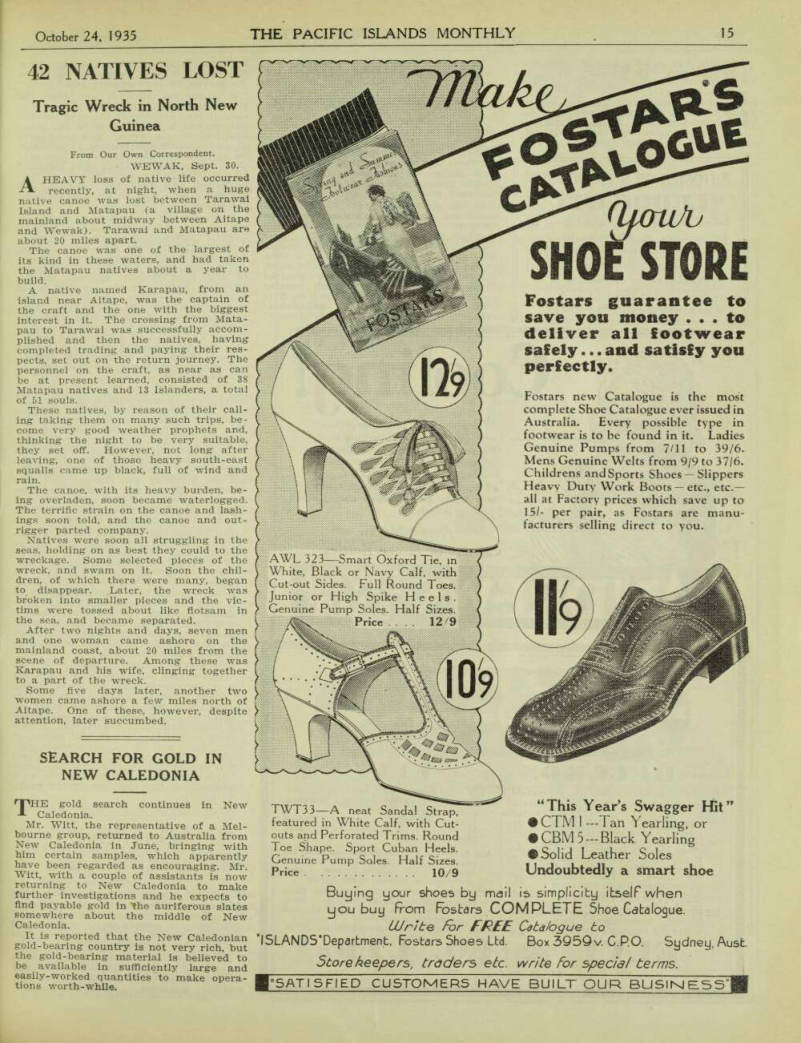
Tragic Wreck in North New Guinea
From Our Own Correspondent.
WEWAK, Sept. 30.
A HEAVY loss of native life occurred recently, at night, when a huge native canoe was lost between Tarawal Island and Matapau (a village on the mainland about midway between Aitape and Wewak). Tarawai and Matapau are about 20 miles apart.
The canoe was one of the largest of its kind in these waters, and had taken the Matapau natives about a year to build.
A native named Karapau, from an island near Aitape, was the captain of the craft and the one with the biggest interest in it. The crossing from Mata pau to Tarawai was successfully accom plished and then the natives, having completed trading and paying their res pects, set out on the return journey. The personnel on the craft, as near as can be at present learned, consisted of 38 Matapau natives and 13 Islanders, a total of 51 souls.
These natives, by reason of their call ing taking them on many such trips, be come very good weather prophets and, thinking the night to be very suitable, they set off. However, not long after leaving, one of those heavy south-east squalls came up black, full of wind and rain.
The canoe, with its heavy burden, be ing overladen, soon became waterlogged.
The terrific strain on the canoe and lash ings soon told, and the canoe and out rigger parted company.
Natives were soon all struggling in the seas, holding on as best they could to the wreckage. Some selected pieces of the wreck, and swam on it. Soon the chil dren, of which there were many, began to disappear. Later, the wreck was broken into smaller pieces and the vic tims were tossed about like flotsam in the sea, and became separated.
After two nights and days, seven men and one woman came ashore on the mainland coast, about 20 miles from the scene of departure. Among these was Karapau and his wife, clinging together to a part of the wreck.
Some five days later, another two women came ashore a few miles north of Aitape. One of these, however, despite attention, later succumbed.
Search For Gold In
New Caledonia
THE gold search continues in New Caledonia.
Mr. Witt, the representative of a Mel bourne group, returned to Australia from New Caledonia in June, bringing with him certain samples, which apparently have been regarded as encouraging. Mr.
Witt, with a couple of assistants is now returning to New Caledonia to make further investigations and he expects to find payable gold in the auriferous slates somewhere about the middle of New Caledonia.
It is reported that the New Caledonian gold-bearing country is not very rich, but the gold-bearing material is believed to be available in sufficiently large and easily-worked quantities to make opera tions worth-while.
During August 9,819 tons of copra were exported from New Guinea. Shipments to Australia totalled 891 tons, 1,767 tons were consigned to France, and to the United Kingdom 7,161 tons. The latter shipment is a considerable increase over previous shipments. During 1933-34 the total shipment to the United Kingdom amounted to only 6,764 tons.
Advertisements & other items, pp. 17-18 (1 item)
Shoe Store
4 >*T ' .F './■•
Fostars guarantee to
save you money ... to deliver all footwear safely •.. and satisfy you
perfectly.
*x. x Fostars new Catalogue is the most complete Shoe Catalogue ever issued in Australia. Every possible type in footwear is to be found in it. Ladies Genuine Pumps from 7/11 to 39/6.
Mens Genuine Welts from 9/9 to 37/6.
Childrens and Sports Shoes Slippers Heavy Duty Work Boots etc., etc. — all at Factory prices which save up to 15/- per pair, as Fostars are manufacturers selling direct to you.
AWL 323—Smart Oxford Tie, in White, Black or Navy Calf, with Cut-out Sides. Full Round Toes.
Junior or High Spike Heels.
Genuine Pump Soles. Half Sizes.
Price ... 12 7 9 TWT33—A neat Sandal Strap, featured in White Calf, with Cutouts and Perforated Trims. Round Toe Shape. Sport Cuban Heels.
Genuine Pump Soles. Half Sizes.
Price 10/9 “This Year’s Swagger Hit • CTM 1 —Tan Yearling, or • CBM 3 Black Yearling • Solid Leather Soles Undoubtedly a smart shoe Buying your shoes by mail is simplicity itself when you buy From Fostars COMPLETE Shoe Catalogue.
LUr/te For FREE Cdtahgue to ‘lSLANDS'Department. Fostars Shoes Ltd. Box 3959 v. C.P.O. Sydney, Aust Storekeepers, traders etc. write For specie! terms.
CUSTOMERS HAVE BUILT OUR BUSIKIESS’H
A HOME FOR SCHOOLBOYS
44 LEDDICOTT ”
School House offers a solution of the problem of education by providing a home for boys attending school in Sydney.
Prospectus on application to
E. F. WHITFELD, B.A.
McMAHON’S POINT, SYDNEY
Cooling!
When the heat seems oppressive and you long for something cooling and refreshing, try a glass of effervescing, thirst - quenching Andrews. Andrews cools and invigorates almost immediately and helps you to keep cool by cooling the blood.
Available in
4 oz» & 8 oz ♦ Bottles bfn W 4 $ I A
KE€OKOS
ELVY’S
ELVY’S, Sydney’s famous old-established Music House, can send you every Record that you may want. Special Mail Department for Island residents.
Here are some new releases: “TOAD OF TOAD HALL”— Selection—Parts 1 and 2. Introducing: Prologue; “Wind in the Willows”; Alfred’s Theme; Toad’s Song; Phoebe’s Dance; Badger’s Theme; Finale, Act I.; Opening Music, Act L, Scene IV.; “The Rat’s Song”; “The Rabbits’ Ballet”; “The Weasel’s Song (Fraser-Simson).
New Mayfair Orchestra (with Vocalists).
C. 2724, 61- MENUHIN . . Plays Bach’s “Chaconne.
Chaconne (unaccompanied Partita No. 2 D Minor) (Bach)—Parts 1 to 4. Yehudi Menuhin (Violin, unaccompanied). D.B. 2289/90, 8/- each.
And here is a Torrani Record you must not miss! G 21644— My Swiss Miss Yodel, Mexican Yodel. Harry Torrani, Yodler, accompanying himself on the Guitar.
BELLE BAKER . . . New Rhythm Blues Singer— B.B294, 4/-.—Old Mammy Mine, Blue Moon. Belle Baker (singing), with Orchestral accompaniment.
Chaconne (unaccompanied Partita No. & u rcnestrai accompaniment.
Write for complete free lists. Elvy’s are noted for prompt service. Order Now.
BLVI «fe CO. LTD.
397 George Street, Sydney. ’Phone: M 2319.
Pack-Drill Goes!
More Political Interference In New Guinea?
REPORTS have reached Australia that there has been political interference with the prison system in New Guinea, which has worked satisfactorily during the past two years.
In the period prior to 1932, there was great and growing dissatisfaction in the territory with the Administration’s methods of punishing native offenders — particularly those guilty of minor crimes.
The natives usually were given a term in the calaboose; but, to the native mind, the gaol sentence represented no punish ment whatever. They enjoyed regular food, regular hours, shelter and security and, in leisurely mowing the District Officer’s lawn or patching a section of
roadway, they worked no harder than they would if they were carrying on in the service of their regular employers.
It is not too much to say that the prison system became a farce —or, at any rate, it was a farce in the eyes of tho natives, but a real tragedy to the plan ters, traders and miners. The latter were in no circumstances allowed to adminis ter corporal punishment—yet if they sent their native servants along to be punished by the officials for some offence, all that happened was that the offender was committed to a term in the ever-welcome calaboose.
It was really a dangerous situation; but no one did anything about it until General Griffiths took charge, as Adminis trator, in 1932. That sane and practical man sized up the situation very quickly, and he introduced a system of pack-drill to the New Guinea prisons. Native offenders were suddenly required to do something more than eat and sleep and carry out a few leisurely tasks. They were marched out frequently into the prison yard, loaded with bags of sand or stone and, under well-trained native police, were compelled to march briskly up and down for considerable periods, setting down and lifting up their burdens at the word of command.
It was a laborious punishment, but what made it more hateful to the native mind was the monotony of it. Native prisoners learned to regard the pack drill part of the calaboose with horror; and the calaboose lost all its attractions.
A sentence of imprisonment came to mean something to the native mind; the improvement in labour discipline through out the Territory was marked, and very welcome. There was nothing cruel or improper in the pack-drill system—it was exactly the thing that was needed to make the prison system effective.
But immediately the Minister in Charge of this Territory, Senator Sir George Pearce, made his official visit there in August, orders were given for the dis continuance of pack-drill, and the old calaboose system has been reverted to.
No explanation has been issued; so it can only be presumed that some mis chievous fool has reached the Minister’s ear with a horrid suggestion of what Geneva may think; or that some strange new wave of sentiment has swept over the New Guinea bureaucracy.
The steady “Europeanisation” of the primitive races of New Guinea is produc ing a very large class of sophisticated, or “flash,” natives, who are very hard to control, and who always are eager to undermine the control and discipline of the white man. Men experienced in New Guinea conditions declare that sooner or later there will be an unfortunate out break; and when that comes the blame for it can be laid directly upon the heads of those gentlemen responsible for such “reforms” as the abolition of the pack drill system.
“Fanaticism”
From Our Own Correspondent.
RABAUL, October 1.
T ATEST reports from Buka are that action has been taken by Administra tion officials in respect to the outbreak of fanaticism, or sorcery (see page 32 of this issue) raging in that district, and that the situation is well in hand.
An isolated penal settlement is what Is required to segregate ring- leaders in such circumstances, accompanied by stern dis ciplinary measures.
Kava-Drinking
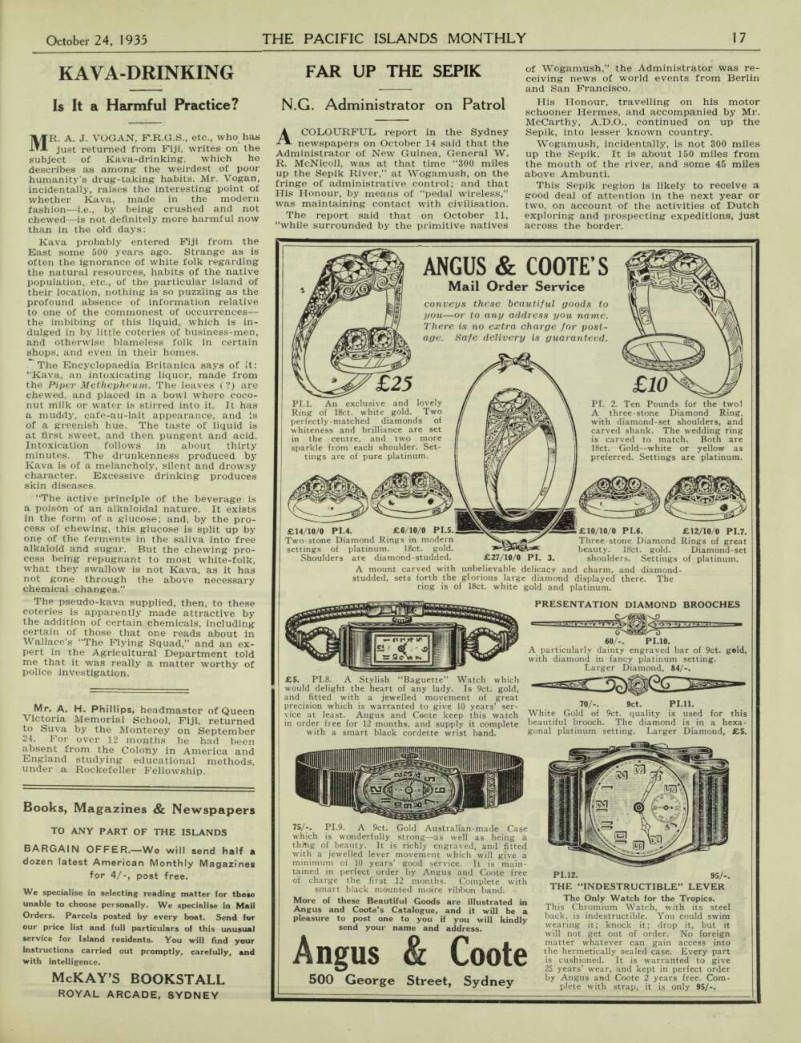
Is It a Harmful Practice?
MR. A. J. VOGAN, F.R.G.S., etc., who has just returned from Fiji, writes on the subject of Kava-drinking, which he describes as among the weirdest of poor humanity’s drug-taking habits. Mr. Vogan, incidentally, raises the interesting point of whether Kava, made in the modern fashion —i.e., by being crushed and not chewed —is not definitely more harmful now than in the old days: Kava probably entered Fiji from the East some 500 years ago. Strange as is often the ignorance of white folk regarding the natural resources, habits of the native population, etc., of the particular island of their location, nothing is so puzzling as the profound absence of information relative to one of the commonest of occurrences — the imbibing of this liquid, which is in dulged in by little coteries of business-men, and otherwise blameless folk in certain shops, and even in their homes.
The Encyclopaedia Britanica says of it: “Kava, an intoxicating liquor, made from the Piper Methepheum. The leaves (?) are chewed, and placed in a bowl where coco nut milk or water is stirred into it. It has a muddy, cafe-au-lait appearance, and Is of a greenish hue. The taste of liquid is at first sw r eet, and then pungent and acid.
Intoxication follows in about thirty minutes. The drunkenness produced by Kava is of a melancholy, silent and drowsy character. Excessive drinking produces skin diseases.
“The active principle of the beverage is a poison of an alkaloidal nature. It exists in the form of a glucose; and, by the pro cess of chewing, this glucose is split up by one of the ferments in the saliva into free alkaloid and sugar. But the chewing pro cess being repugnant to most white-folk, what they swallow is not Kava, as it has not gone through the above necessary chemical changes.”
The pseudo-kava supplied, then, to these coteries is apparently made attractive by the addition of certain chemicals, including certain of those that one reads about in Wallace’s “The Flying Squad,” and an ex pert in the Agricultural Department told me that it was really a matter worthy of police investigation.
Mr. A. H. Phillips, headmaster of Queen Victoria Memorial School, Fiji, returned to Suva by the Monterey on September 24. For over 12 months he had been absent from the Colony in America and England studying educational methods, under a Rockefeller Fellowship.
Far Up The Sepik
N.G. Administrator on Patrol
A COLOURFUL report in the Sydney newspapers on October 14 said that the Administrator of New Guinea, General W.
R. McNicoll, was at that time “300 miles up the Sepik River,” at Wogamush, on the fringe of administrative control; and that His Honour, by means of “pedal wireless,” was maintaining contact with civilisation.
The report said that on October 11, “while surrounded by the primitive natives
of Wogamush,” the Administrator was re ceiving news of world events from Berlin and San Francisco.
His Honour, travelling on his motor schooner Hermes, and accompanied by Mr.
McCarthy, A.D.0., continued on up the Sepik, into lesser known country.
Wogamush, incidentally, is not 300 miles up the Sepik. It is about 150 miles from the mouth of the river, and some 45 miles above Ambunti.
This Sepik region is likely to receive a good deal of attention in the next year or two, on account of the activities of Dutch exploring and prospecting expeditions, just across the border.
Advertisements & other items, p. 19 (2 items)
Angus & Coote
'S
Mail Order Service
conveys these beautiful goods to you—or to any address you name.
There is no extra charge for postage. Safe delivery is guaranteed. £25 PI.l. An exclusive and lovely Ring of 18ct. white gold. Two perfectly-matched diamonds of whiteness and brilliance are set in the centre, and two more sparkle from each shoulder. Settings are of pure platinum. £l4/10/0 P 1.4. £6/10/0 P 1.5.
Two-stone Diamond Rings in modern settings of platinum. 18ct. gold.
Shoulders are diamond-studded. $5 & £lO PI. 2. Ten Pounds for the two I A three-stone Diamond Ring, with diamond-set shoulders, and carved shank. The wedding ring is carved to match. Both are 18ct. Gold—white or yellow as preferred. Settings are platinum. mm £lO/10/0 P 1.6. £l2/10/0 P 1.7.
Three-stone Diamond Rings of great beauty. 18ct. gold. Diamond-set shoulders. Settings of platinum. £27/10/0 PI. 3.
A mount carved with unbelievable delicacy and charm, and diamondstudded, sets forth the glorious large diamond displayed there. The ring is of 18ct. white gold and platinum.
PRESENTATION DIAMOND BROOCHES
6'
60/-. PI.IO.
A particularly dainty engraved bar of 9ct. g»ld, with diamond in fancy platinum setting.
Larger Diamond, 84/-.
ST a A* £S. PI.B. A Stylish “Baguette” Watch which would delight the heart of any lady. Is 9ct, gold, and fitted with a jewelled movement of great precision which is warranted to give 10 years’ service at least. Angus and Ceote keep this watch in order free for 12 months, and supply it complete with a smart black cordette wrist band. 70/-. Oct, Pl.ll.
White Gold of 9ct. quality is used for this beautiful brooch. The diamond is in a hexagonal platinum setting. Larger Diamond, £5. 75/-. P 1.9. A 9ct. Gold Australian-made Case which is wonderfully strong—as well as being a thing of beauty. It is richly engraved, and fitted with a jewelled lever movement which will give a minimum of 10 years’ good service. It is maintained in perfect order by Angus and Coote free of charge the first 12 months. Complete with smart black mounted moire ribbon band.
More of these Beautiful Goods are illustrated in Angus and Coote’s Catalogue, and it will be a pleasure to post one to you if you will kindly send your name and address.
Angus & Coote
500 George Street, Sydney
m ran PI ©0 P 1.12. 95/-.
THE “INDESTRUCTIBLE” LEVER
The Only Watch for the Tropics.
This Chromium Watch, with its steel back, is indestructible. You could swim wearing it; knock it; drop it, but it will not get out of order. No foreign matter whatever can gain access into the hermetically sealed case. Every part is cushioned. It is warranted to give 25 years’ wear, and kept in perfect order by Angus and Coote 2 years free. Complete with strap, it is only 95/-.
Books, Magazines & Newspapers
TO ANY PART OF THE ISLANDS
BARGAIN OFFER.—We will send Half a dozen latest American Monthly Magazines for 4/-, post free.
We specialise in selecting reading matter for those unable to choose personally. We specialise in Mail Orders. Parcels posted by every boat. Send for our price list and full particulars of this unusual service for Island residents. You will find your instructions carried out promptly, carefully, and with intelligence.
McKAY’S BOOKSTALL
ROYAL ARCADE, SYDNEY
Cook Is.
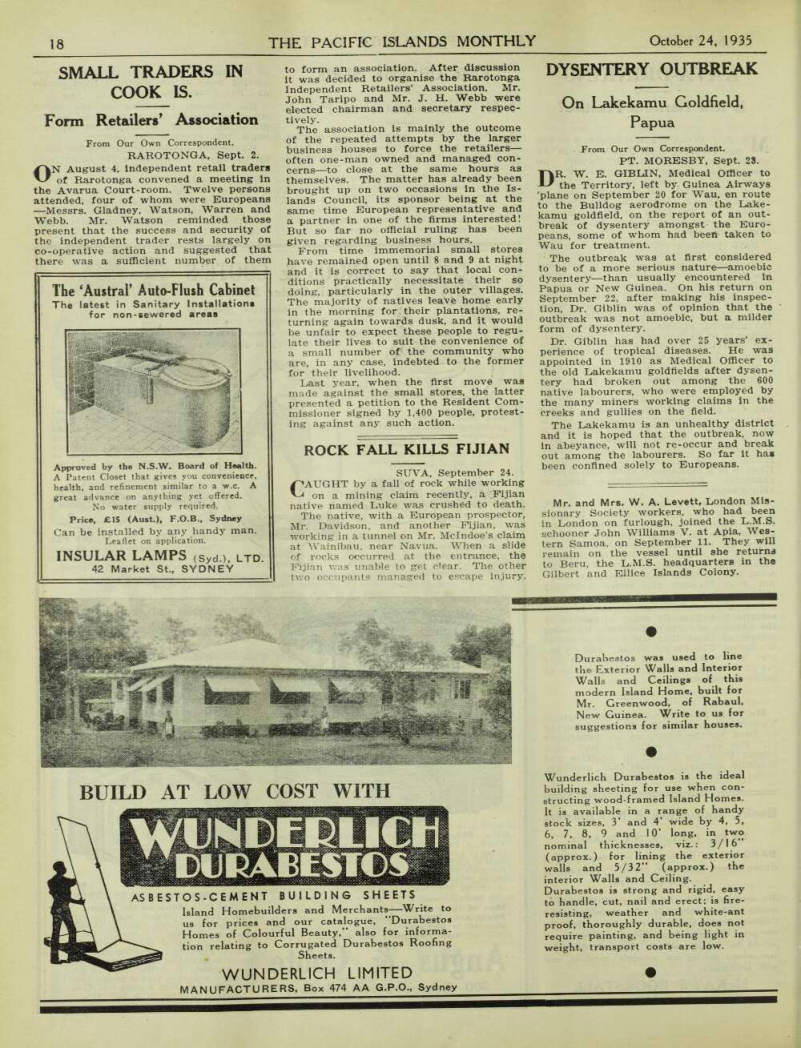
Small Traders In
Form Retailers’ Association
From Our Own Correspondent.
Rarotonga, Sept. 2.
ON August 4, independent retail traders of Rarotonga convened a meeting in the Avarua Court-room. Twelve persons attended, four of whom were Europeans —Messrs. Gladney, Watson, Warren and Webb. Mr. Watson reminded those present that the success and security of the independent trader rests largely on co-operative action and suggested that there was a sufficient number of them
to form an association. After discussion it was decified to organise the Rarotonga Independent Retailers’ Association. Mr.
John Taripo and Mr. J. H. Webb were elected chairman and secretary respec tively.
The association is mainly the outcome of the repeated attempts by the larger business houses to force the retailers — often one-man owned and managed con cerns —to close at the same hours as themselves. The matter has already been brought up on two occasions in the Is lands Council, its sponsor being at the same time European representative and a partner in one of the firms interested!
But so far no official ruling has been given regarding business hours.
From time immemorial small stores have remained open until 8 and 9 at night and it is correct to say that local con ditions practically necessitate their so doing, particularly in the outer villages.
The majority of natives leave home early in the morning for their plantations, re turning again towards dusk, and it would be unfair to expect these people to regu late their lives to suit the convenience of a small number of the community who are, in any case, indebted to the former for their livelihood.
Last year, when the first move was made against the small stores, the latter presented a petition to the Resident Com missioner signed by 1,400 people, protest ing against any such action.
Rock Fall Kills Fijian
SUVA, September 24.
CAUGHT by a fall of rock while working on a mining claim recently, a Fijian native named Luke was crushed to death.
The native, with a European prospector, Mr. Davidson, and another Fijian, was working in a tunnel on Mr. Mclndoe’s claim at Wainibau, near Navua. When a slide of rocks occurred at the entrance, the Fijian was unable to get clear. The other two occupants managed to escape injury.
Papua
Dysentery Outbreak
On Lakekamu Goldfield, Papua
From Our Own Correspondent.
Pt. Moresby, Sept. 28.
DR. W. E. GIBLIN, Medical Officer to the Territory, left by Guinea Airways ’plane on September 20 for Wau, en route to the Bulldog aerodrome on the Lake kamu goldfield, on the report of an out break of dysentery amongst the Euro peans, some of whom had beeft taken to Wau for treatment.
The outbreak was at first considered to be of a more serious nature —amoebic dysentery—than usually encountered in Papua or New Guinea. On his return on September 22, after making his inspec tion, Dr. Giblin was of opinion that the outbreak was not amoebic, but a milder form of dysentery.
Dr. Giblin has had over 25 years’ ex perience of tropical diseases. He was appointed in 1910 as Medical Officer to the old Lakekamu goldfields after dysen tery had broken out among the 600 native labourers, who were employed by the many miners working claims in the creeks and gullies on the field.
The Lakekamu is an unhealthy district and it is hoped that the outbreak, now in abeyance, will not re-occur and break out among the labourers. So far it has been confined solely to Europeans.
Mr. and Mrs. W. A. Levett, London Mis sionary Society workers, who had been in London on furlough, joined the L.M.S. schooner John Williams V. at Apia, Wes tern Samoa, on September 11. They will remain on the vessel until she returns to Beru, the L.M.S. headquarters in the Gilbert and Ellice Islands Colony.
Advertisements & other items, p. 20 (1 item)
Build At Low Cost With
The ‘Austral’ Auto-Flush Cabinet
The latest in Sanitary Installations for non-sewered areas a Approved by the N.S.W. Board of Health.
A Patent Closet that gives you convenience, health, and refinement similar to a w.c. A great advance on anything yet offered.
No water supply required.
Price, £l5 (Aust.), F. 0.8., Sydney Can be installed by any handy man.
Leaflet on application.
INSULAR LAMPS ( syd.), ltd. 42 Market St., SYDNEY
« Durabeatos was used to line the Exterior Walls and Interior Walla and Ceilings of this modern Island Home, built for Mr. Greenwood, of Rabaul, New Guinea. Write to us for suggestions for similar houses.
BUILD AT LOW COST WITH
i I
AS BESTOS - CEMENT BUILDING SHEETS
Island Homebuilders and Merchants- —Write to us for prices and our catalogue, “Durabestos Homes of Colourful Beauty," also for information relating to Corrugated Durabestos Roofing Sheets.
Wunderlich Durabestos is the ideal building sheeting for use when constructing wood-framed Island Homes.
It is available in a range of handy stock sizes, 3* and 4’ wide by 4,5, 6,7, 8, 9 and 10’ long, in two nominal thicknesses, viz.: 3/16 (approx.) for lining the exterior walls and 5/32” (approx.) the interior Walls and Ceiling.
Durabestos is strong and rigid, easy to handle, cut, nail and erect; is fireresisting, weather and white-ant proof, thoroughly durable, does not require painting, and being light in weight, transport costs are low.
WUNDERLICH LIMITED
MANUFACTURERS, Box 474 AA G.P.0., Sydney
Plans For An Asbestos House In The Tropics
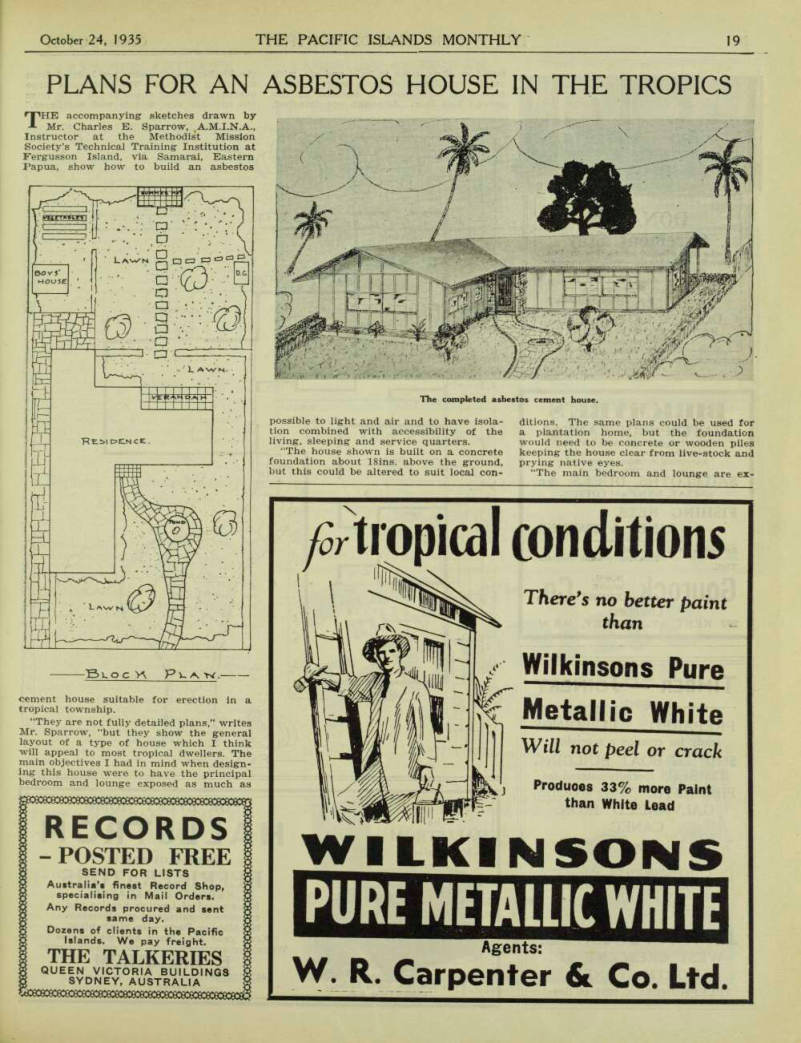
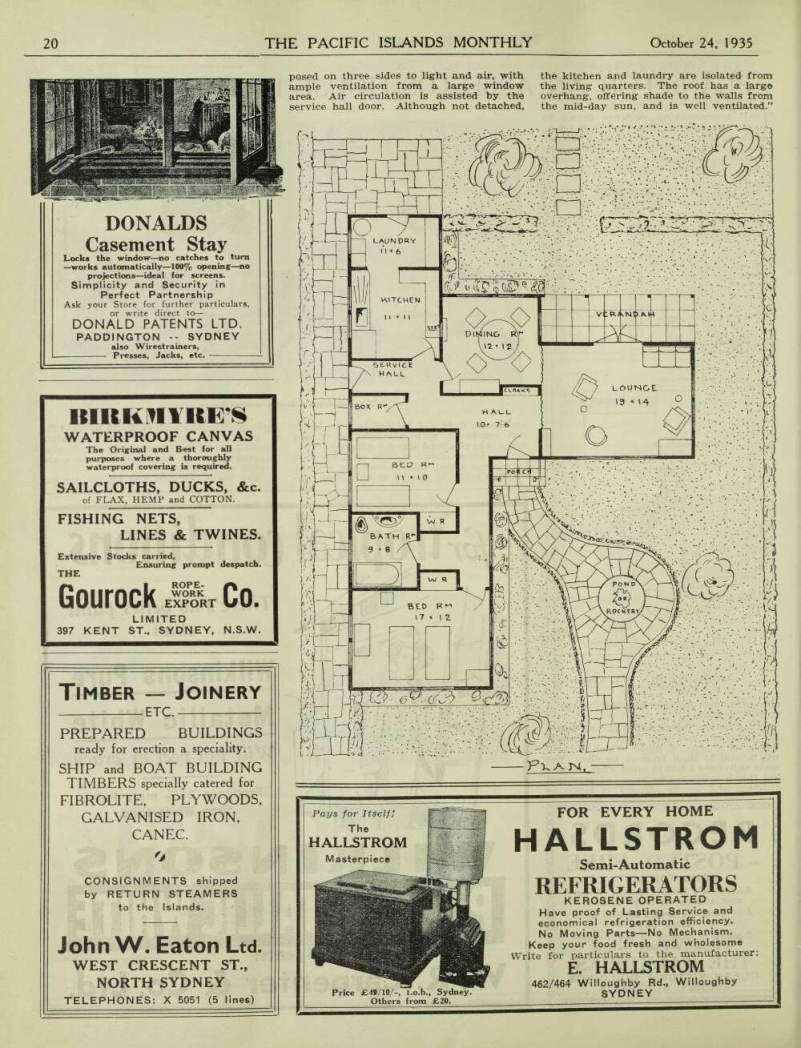
THE accompanying" sketches drawn by Mr. Charles E. Sparrow, A.M.1.N.A., Instructor at the Methodist Mission Society’s Technical Training Institution at Fergusson Island, via Samarai, Eastern Papua, show how to build an asbestos
cement house suitable for erection in a tropical township.
“They are not fully detailed plans," writes Mr. Sparrow, “but they show the general layout of a type of house which I think will appeal to most tropical dwellers. The main objectives I had in mind when design ing this house were to have the principal bedroom and lounge exposed as much as
possible to light and air and to have isola tion combined with accessibility of the living, sleeping and service quarters.
“The house shown is built on a concrete foundation about 18ins. above the ground, but this could be altered to suit local con
ditions. The same plans could be used for a plantation home, but the foundation would need to be concrete or wooden piles keeping the house clear from live-stock and prying native eyes.
“The main bedroom and lounge are ex-
Block Plan
The completed asbestos cement house.
posed on three sides to light and air, with ample ventilation from a large window area. Air circulation is assisted by the service hall door. Although not detached,
the kitchen and laundry are isolated from the living quarters. The roof has a large overhang, offering shade to the walls from the mid-day sun, and is well ventilated.”
Advertisements & other items, pp. 21-22 (1 item)
conditions
r* i / There's no better paint than Wilkinsons Pure Metallic White Will not peel or crack Produces 33% more Paint than White Lead
WILKINSONS
PURE METALLIC WHITE
Agents W. R. Carpenter & Co. Ltd.
RECORDS
-POSTED FREE
SEND FOR LISTS
Australia'* finest Record Shop, specialising in Mail Orders.
Any Records procured and sent same day.
Dozens of clients in the Pacific Islands. We pay freight.
THE TALKERIES
QUEEN VICTORIA BUILDINGS
SYDNEY, AUSTRALIA
DONALDS
Casement Stay
Locks the window—no catches to turn —works automatically—loo% opening—no projections—ideal for screens.
Simplicity and Security in Perfect Partnership Ask your Store for further particulars, or write direct to —
DONALD PATENTS LTD.
PADDINGTON -- SYDNEY
also Wirestrainers, Presses, Jacks, etc.
mmmißE’s
WATERPROOF CANVAS
The Original and Best for all purposes where a thoroughly waterproof covering is required.
SAILCLOTHS, DUCKS, &c.
of FLAX, HEMP and COTTON.
FISHING NETS,
LINES & TWINES.
Extensive Stocks carried.
Ensuring prompt despatch.
THE
Gourock EXPORT Co.
LIMITED
397 KENT ST.. SYDNEY, N.S.W.
Timber Joinery
ETC.
PREPARED BUILDINGS
ready for erection a speciality.
SHIP and BOAT BUILDING
TIMBERS specially catered for
FIBROLITE, PLYWOODS,
GALVANISED IRON,
CANEC.
O CONSIGNMENTS shipped
by RETURN STEAMERS
to the Islands.
John W. Eaton Ltd.
WEST CRESCENT ST.,
NORTH SYDNEY
TELEPHONES: X 5051 (5 lines)
Itself le
HALLSTROM
Masterpiece for Th
RSi
Price £49/10/-, f.0.b., Sydney.
Others from £2O.
FOR EVERY HOME
HALLSTROM
Semi-Automatic
REFRIGERATORS
KEROSENE OPERATED
Have proof of Lasting Service and economical refrigeration efficiency.
No Moving Parts—No Mechanism.
Keep your food fresh and wholesome Write for particulars to the manufacturer:
E. HALLSTROM
462/464 Willoughby Rd., Willoughby
SYDNEY
Taxation Cruelty
Retired Papuan Officials
MANY people who are compelled to live in Australia complain of the extreme harshness of the Australian taxation sys tem, and Mr. J. T. Bensted, a retired offi cer of the Papuan Public Service, has drawn attention to a particularly flagrant example of taxation cruelty.
Papua is staffed by Australians; and when Papuan officials reach retiring age they naturally prefer to live in Australia, particularly as their pensions are paid in Australian currency. Certain of the earlier Papuan officials spent the better part of their lives under unenviable con ditions, and the retiring allowances actually were purchased by the officials from their meagre savings. Yet, the Tax ation Commissioner of New South Wales forces these men to pay unemployment re lief taxation upon their pensions.
“Surely,” says Mr. Bensted, “there is no equity in the State taxing an income to the earning of which it made no contri bution, and which was earned in the long ago outside the State, and under ex tremely adverse conditions: and further, for which tax the State will give abso lutely no return to the taxpayer? Actually these allowances represent ‘new’ money coming into the State, and, instead of driving these men away, one would expect the State to encourage them to settle here.”
Nephew of Admiral Beatty
Dies at Wau
WAU, September 18.
TRAVELLER, soldier, scion of the old English nobility, lovable and popular, Lyn Brooke, the oldest mining identity in the Territory, died at Wau European Hos pital recently. He had been out in the Lower Bulolo area and contracted the dread Japanese River Fever. Thinking it was another bout of malaria, he let the fever get too great a hold of him before his faithful boys brought him into Dr. Von De Boch. All that could be done was done, but he died without regaining conscious ness. He was a nephew of the famous Admiral Beatty, and was in every respect a gallant gentleman.
A striking tribute was paid him by resi dents, who came from all districts by ’plane to pay their last respects to a man who had endeared himself to everyone. Pathetic, too, was the way his faithful “house boy” sat outside his window, day and night, while he was in the hospital, and on learn ing of his Masta’s death he broke down and wept bitterly.
Tiny American Yacht On
Suva Reef
SUVA, September 25.
"DETURNING to Suva from Kadavu on September 17, the five-tons American schooner-yacht Cimba ran on to the main reef in heavy weather. She was refloated the following day and returned to port.
Several hull planks were damaged, as was much of the running rigging.
Since 1933 the Cimba has been cruising around the world. Originally manned by three adventurous Americans, she now has only her two owners aboard, Messrs.
Richard Maury and George Taggart.
Landslide At Edie Ck.
From Our Own Correspondent.
Edie Ck, Sept. 1.
ON August 25 several chains of the road between Kaindi and Central Camp slipped into Edie Creek. Fortun ately the enormous slide came slowly enough to allow the removal of the ele vator of New 1 Guinea Goldfields Ltd., which was directly beneath it.
Messrs. Crampton and Kincaird, with a long line of N.G.G. boys and much dyna mite, succeeded in clearing away the slide and cutting a new road within a few days.
Captain P. Donovan, in command of Messrs. Burns Philp (S.S.) Co.’s inter island vessel Malake, reached Sydney on October 8. Captain Donovan will not go back to the Colony; he has decided to reside permanently in Australia with his wife, who arrived in Sydney from Fiji by the Niagara on October 5. After be ing overhauled in Australia, the Malake will return to the Fiji service at the end of October.
Advertisements & other items, pp. 23-24 (1 item)
Allen Taylor & Co. Ltd.
W. M. FORD
Ship, Yacht & Boat Builder
Berry’s Bay, North Sydney
(Established 157».) BUILDERS of all kinds of Island Craft from Dinghies to Auxiliary Schooners of any tonnage. New and Second-hand Island Craft of various types in stock. New and Second-hand Full Diesel, Crude Oil, Benzine and Kerosene Engines.
Please Send on Your Enquiries.
Allen Taylor & Co. Ltd.
SYDNEY
Sawmillers and Wholesale Suppliers of Hardwoods for Constructional Purposes GIRDERS . . . PILES . . . POLES . . . SLEEPERS, ETC.
EXPORTING TO PACIFIC ISLANDS SINCE 1893
Cables: Tuxedo, Sydney
BITUMENOID ROOFING
MADE IN AUSTRALIA
Bitumenoid Roofings, Dampcourses and Insulating Felts are made from the world’s best raw materials. Warranted to stand the most rigid tests.
BITUMENOID THE BEST
Roofing, 1,2, 3-ply; Flooring, Waterproof Materials; Saturated Felt; Resilient Road Jointing; Natural Asphalt Dampcourse; 2 and 3-ply Dampcourse; l-21b. Lead-core Dampcourse; Roofing Cement; Asphalt Paints; Roofing Compound.
SAMPLES AND PRICE LISTS ON APPLICATION.
MAXWELL PORTER & SON LTD.
ESTABLISHED 1888. BUILDERS’ SUPPLIES
107 REDFERN ST., REDFERN, SYDNEY, N.S.W. ’Phone, M 3157. Cables: Bitumenoid
A k By using this Economical, Fire Retardant and White Ant Proof building material for External and Internal Walls and Ceilings, you can build a comfortable and durable Bungalow Home —AT LOW COST! "FIBROLITE" is easily and quickly erected. No waste. Less labour. No painting. For full information, write for illustrated "Fibrolite" Booklet F. 6 —FREE AND POST FREEI
JAMES HARDIE & COY. LTD.
ASBESTOS HOUSE, YORK STREET, SYDNEY, N.S.W.
(Box 3935 V., G.P.0., Sydney)
Free Dancing Lessons
In Your Own Home Without Music or Partner.
Yes. Prof. Bolot’s amazing Correspondence System of instruction now makes it possible for anyone—YOU. yourself—to learn dancing in one evening. I GUAR- ANTEE the system is as EASY as A B C. and failure is impossible.
Prof. Bolot is offering copies of his remarkable book, “Dancing as a Fine Art,” FREE to all readers of this paper. Let this book show YOU how to become a graceful, finished, popular dancer. Prof. Bolot will send you the first 2 lessons in dancing absolutely free. Send your name and address, with 4d to cover postage.
Professor Bolot, 66 Oxford-street, Sydney.
AGE
is the Crowning Stage in a series of fermentations. Fermentation means Life. Age dissipates its roughness, rounds off its edges, and refines its character, leaving nothing behind but the Rarest Elixir of Life.
Dewar’s is the Veteran of Stimulants. It is ripe for Promotion to your Palate.
DEWARS
The WHISKY
Accident On Wau-Edie Ck.
Road
WAU, September 16.
A TRAGEDY was averted by a narrow margin the other evening, when Mr.
Arthur Ireland (brother of Jack Ireland, accountant at N.G.G.) was driving a car load of guests from Wau to Edie Creek for the much looked for Creek Ball.
Nearing B.P.’s stofe the road seemed crumbly and patchy, and fortunately Ire land slowed down, but not before the car overturned. Just as it had come to a stand still there was an omnious rumbling like a “guria” and down 3,500 feet went the side of the road they had just passed!
Prank Leyden was badly injured and taken into Wau Hospital; Ireland also; but Judd (whose car it was) and the others were lucky to receive only a shaking.
By the way, this dance caused much heartburning in the district. Those who ran it contributed £lO each, and the lady guests from Wau received printed invita tions: but their husband’s names were not included!
The affair was a great success—a Wau, in fact!
Misima Gold
G.M. of Papua Plan Production In E. Papua
AN important decision, affecting gold mining development in Eastern Papua, has been taken by the Directors of Gold Mines of Papua Ltd. (generally called the Pratten Group), who hold leases on Misima and Woodlark Islands.
G.M. of Papua took over leases on Misima from Misima Options Ltd., which had gathered something from the wreck of the Mount Sisa Company. Shortly after wards, G.M. of Papua acquired properties on Woodlark Island. Since then the com pany has been very quietly engaged in;— (1) Thoroughly exploring the ground at Misima, where it proved a very large ore body, averaging about 46/ per ton. (2) Establishing, on Woodlark Island, a cyanide plant for the treatment of tailings from the old Kulumadau tailings. This plant is reported to have commenced operations recently. (3) The formation of a new company.
Woodlark Gold Mines Ltd. (which is owned by G.M. of Papua) to develop the ap parently rich North Kulumadau lode. (4) Unwatering and opening up the old Woodlark King Mine (on Woodlark Island), formerly a rich producer. (5) Examination of a possible dredging area on Woodlark Island.
Operations have been proceeding for about a year. The market’s opinion of the company’s prospects is shown in the fact that its 5/ shares usually are quoted at between 13/ and 14/.
The company’s directors have now de cided to proceed to production on Misima Island. A treatment plant is to be installed and, for this purpose, the capital of the company is to be increased from £60,000 to £135,000 by the creation of 70,000 new shares of 5/ each, to be offered first to the existing shareholders.
The circular to shareholders gives an absolute minimum of information. That, and the Pratten reputation for success in mining, suggest that there are likely to be interesting developments in Eastern Papua.
Samoa Legislative
Council Election
From Our Own Cor respondent.
APIA, Sept. 24.
THE electoral roll for the Samoa Legis lative Council election, to be held on November 1, is now open for inspection and so far contains 125 names of voters.
There will probably be a few more names added before the list is closed.
So far, no candidates have declared their intention to offer themselves for election, though several names of pros pective candidates are mentioned as pro babilities. The sitting elected members are the Hons. I. H. Carruthers and A, R.
Cobcroft.
Advertisements & other items, p. 24 (1 item)
A. E. Summerbell’S
COLONIC irrigation is one of the beat methods of cleansing the lower bowel, and is recommended by the medical profession.
Treatment is obtainable at
ROOMS
Wyoming, Macquarie Street, Sydney
The Deputy Magistrate
By Henry Dexter
JONES, A.R.M. of a Government station in the Gulf Division of Papua, had sent for a man who was reported to have given one of his boys a gun, with out being in possession of the necessary permit.
In due course the delinquent arrived at the station. He may be called Smith. The AR.M declared the “Court of Petty Ses sions to be open.’’ Smith pleaded guilty.
Judgment was pronounced by the A.R.M.: “Five pounds, or fourteen days.”
Smith hadn’t a penny, and elected to “take it out.”
He had his meals at the A.R.M. s bun galow, and was instructed by the A.R.M. to Issue rations, and superintend a gang of native prisoners who were doing odd jobs about the station.
Three days later, news came of trouble In the Marfula district. It was essential that the A.R.M. should lose no time in getting inland to attend to it.
H© told Smith to carry on until his re turn, and left with his police and carriers.
Two days later, a man (Robinson) came In. He had been sent for to answer exactly the same charge as in Smith’s case. Smith, with the correct procedure fresh in his memory, told the new arrival that the A.R.M. was away, but had instructed him to carry on.
Smith accordingly held court, and con ducted the case quite correctly. Robinson admitted that he had broken the law, and judgment was given—“Five pounds, or 14 days.”
Robinson did not possess the proverbial bean; so Smith handed over the issuing of rations to him, and the supervision of the prisoners. Smith, as senior prisoner, took charge. He also took his ease.
A few days later, the little steamer under the B.P. flag came along the coast, and Smith decided to call it a day, and left the station, with a feeling that h© had been a very good boy indeed.
N.Z. Minister At Cook Is.
From Our Own Correspondent.
RAROTONGA, September 3.
PASSING through Rarotonga on the August Maunganui on his way home from the Meat Quota Conference in London, the Hon. J. G. Coates, N.Z.
Minister of Finance, spent the day ashore obtaining first-hand knowledge of the Dominion’s furthest-off dependency.
Officially received in the Court-Room by the Resident Commissioner (Judge H.
F. Ayson, C.M.G.), Mr. Coates expressed his pleasure and satisfaction with the island’s rapid recovery from the effects of the recent hurricane. He said the general appearance of the people, and their contented and healthy aspect im pressed him very favourably.
Mr. Coates witnessed a display by Avarua school-children and after visiting the Hospital was entertained at a native umukai in Taputapuatea, during which a troup of young people led by Takau and Tere Makea, daughters of Tinirau Makea Ariki, gave exhibitions of local singing and dancing.
Dr. and Mrs. H. B. Hetherington re turned to Tulagi, Solomon Islands, by the Malaita from Sydney on October 5. Dr.
Hetherington, who is Senior Medical Officer of the Protectorate, came to Aus tralia to attend the Pacific Health Con ference held at Sydney in September.
Port Moresby
Earth Tremor Felt at Port Moresby
From Our Own Correspondent.
PORT MORESBY, September 12.
A fairly severe earth tremor was felt in Port Moresby on August 30, early in the morning. Many residents com plained of broken crockery and even of being thrown out of bed in their sleep.
The tremor was considered to be as severe as any yet felt in the district.
A former geologist to the Papuan Government once ventured the opinion that eventually the peninsula at the en trance of the harbour upon which Port Moresby stands with such dignity will one day disappear, into the sea, the re sult of an upheaval which any day may overtake us unawares!
Advertisements & other items, pp. 25-26 (1 item)
Bank of New South Wales
'Phone: FX 3378 'Phone: FX 3378
BARRINGTON'S
DRIVE YOURSELF
SERVICE
Cars Hired without Driver* from 10/- per day; Tourers, 3d. per mile; Sedans, 4d. and sd. per mile. Our Fleet includes 1934 Dodge Sedans.
Write for Reservations, or 'phone when in city and we will deliver Car to your address.
243 ANZAC PARADE, SOUTH
KENSINGTON, N.S.W.
THE N.S.W. BOOKSTALL CO. LTD.
MARKET AND CASTLEREAGH STREETS, SYDNEY
“The Pioneers of Cheaper Magazines"
Now Offer
“POPULAR MECHANICS”
America’s Best Scientific Journal
Now offered at Usually sold at 1 / per copy 2/- per copy A/ Postage 2d extra One year’s subscription posted to any address in the Commonwealth or Pacific Islands for 13/6 (payable in advance).
ERS
MO TH 0 HE The Bank of New South Wales provides complete facilities for the transaction of banking business throughout Australasia and with other countries.
The Bank establishes commercial credits by mail or cable. It issues drafts and makes money transfers by letter or telegraph. It negotiates and collects Bills of Exchange and issues for the convenience of travellers, Letters of Credit and Travellers’ Cheques, available all over the world.
Bank of New South Wales
(Established 1817) 735 "branches in Australia, New Zealand, The Pacific Islands London. Agents and Correspondents throughout the world. 138—1935
CLOTHES FOR MEN and THEIR SONS
The“CALCUTTA”
Indian Pith Helmet
A Tropical climate demands sensible headwear as well as lightweight suits.
You’ll enjoy wearing a “Calcutta” always light, cool and comfortable.
It is covered with White Drill and equipped with puggaree and chin strap.
Made in India.
PRICE
22/6
PIKES
OF QUEEN STREET, BRISBANE
For Speedy, Accurate and
Versatile Photography . . . there’s nothing like the
LEICA
Camera
(MODEL i)
HERE ARE THE REASONS WHY
I.—BUILT-IN SHORT BASE RANGE
FINDER gives you perfect focus automatically.
2—FOCAL PLANE SHUTTER with
the greatest range of shutter speeds on any camera—l second, i, J, in addition to all regular speeds between l/20th and l/500th second. speed, wide angle lenses, and others. 4. PICTURES from a single roll of cinema film. Sharp negatives.
Enlargements up to any size,
5. SMALL, COMPACT, FITS THE
POCKET, easy and fast to operate. Very inexpensive to maintain.
3.—ELEVEN INTERCHANGEABLE 6.—DOUBLE EXPOSURES are im-
LENSES, including telephoto, possible.
For the above reasons the name LEICA is not merely the name of a modern photographic instrument; it has come to be associated in the photographic world with a new conception of photography, marked by new possibilities of pictorial and optical precision previously unachieved. To-day it forms the basis of a unique photographic process that is extraordinarily universal in its range of application. The process is known as the LEICA PROCESS.
Write NOW, for further particulars to
LEICA PHOTO SERVICE
KYLE HOUSE, 31 MACQUARIE PLACE, SYDNEY
(The only Leica Specialists in Australia)
LEICA SALES
ENLARGING
DEVELOPING
PRINTING
COLOURING
REPRODUCING
POSITIVE PRINTING
SLIDE MAKING
CAMERA REPAIRS
FILM SUPPLIES
Restrictions On
Whaling
The Geneva Convention
Legislation giving effect to New Zealand’s undertakings in the inter national convention for the regulating of whaling will be passed by Parliament this session (said the Auckland Weekly News of September 11). The convention was signed at Geneva on September 24, 1931.
New Zealand figures largely in the arrange ment, because it is responsible for the administration of the Ross Dependency, where whaling is carried on extensively.
The Minister for Marine stated that the Dominion had a deep interest in the matter by virtue of its administration of the Ross Dependency. Before the signing of the convention a very close investigation was made into the general conditions of whale stocks throughout the world and into the industry generally. A conference which was held as a preliminary to the conclusion of the investigation was attended by repre sentatives of the principal countries in
volved. It could therefore be considered international in its scope. The principal object of the convention was the conserva tion of the species and it was sought to achieve this by various prohibitions and regulations, which it was proposed to put into legislative form.
The Minister said the season for pelagic whaling—the taking and treating of whales by factories at sea —in all waters south of 40 degrees south had, during the coming season, been restricted to the period from December 1, 1935, to March 15, 1936.
Japanese Ships for Whaling
Grounds
A new venture for Japanese craft was seen in the arrival at Thursday Island on October 8 of five steamers, each with a speed of 12 knots and a capacity of 200 tons, en route to the whaling grounds in the Southern Pacific.
Tony Ringel’S Misfortune
TONY” —as 72 year-old Anton Ringel is known to all on the Papuan gold fields—has met with another misfortune.
He arrived at Mukawa on Collingwood Bay to await, with his stores and recruit ed labour, the arrival of the Mission schooner, Maclaren King, which would take him away up the North-east coast, and stayed in the Goverment rest house, a native building near the Mukawa Mis sion Station, He retired at 10 p.m., but somewhere around 3 a.m. he was awaken ed and found his bed on fire. The fire, which had started in the kitchen, com pletely destroyed the building.
“Tony” is lucky to have escaped, but he lost all his stores, save two bags of rice, some money and his papers and personal belongings—about £5O in all.
“Tony” is one of the “old timers,” who landed in Papua first in 1899 and, after making sufficient to retire on, returned to his native Austria in 1908. He married and settled down there; but the war robbed him of practically everything and, in 1925, he returned, bringing with him his son, who soon after became seriously ill, and died after being taken to Bris bane. Marvellous the spirit of the “old timer” —pencil and paper at 4 a.m. in the Mission House, and his plans quickly made for a new order. No fuss, though the fire had not awakened him until his pillows were well alight and the top roll of his mattress had gone.
Mr. T. J. V. Wright, son of Mr. and Mrs. J. V. Wright, of Papua, died at Madang, New Guinea, on August 12. Over 20 years ago, as a small boy, he was a well-known identity of Port Moresby, where he lived with his parents at Sap phire Creek, the flourishing little centre of the old copper mines.
Mr. D. Luttrell, manager of the Gizo branch of Messrs. Burns Philp (S.S.) Co. Ltd., arrived in Sydney by the Mon toro on October 1. After a brief stay in New South Wales, he left for a holiday in Tasmania.
Advertisements & other items, p. 26 (1 item)
Samuel Russell
ESTATE AND GENERAL AGENT
P.O. Box 64, Papeete, Tahiti
Real Estate. Investments. Estate Management and Administration. Valuations and Reports. Houses and Lands for Lease or Sale.
Sole Proprietor: TAHITI PERFUMES Cables: Russell, Tahiti (Bentley’s Code)
Queen Salote Meets Mariner’S Grandson
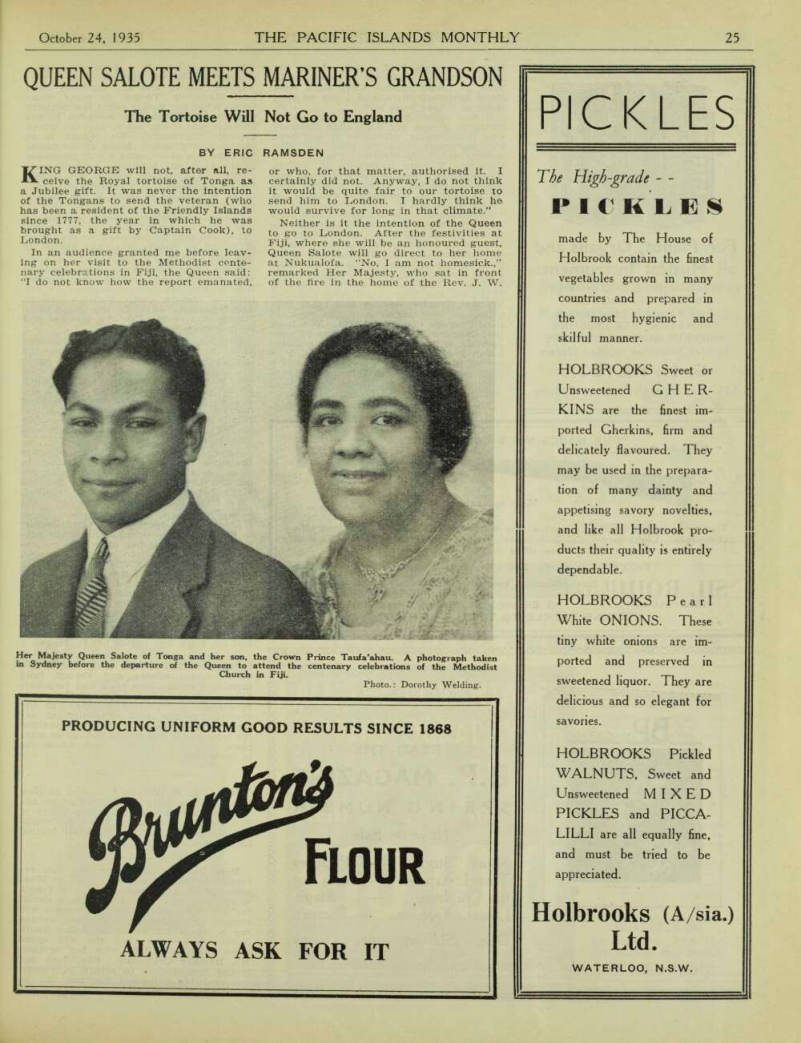
The Tortoise Will Not Go to England
By Eric Ramsden
KING GEORGE will not, after all, receive the Royal tortoise of Tonga as a Jubilee gift. It was never the intention of the Tongans to send the veteran (who has been a resident of the Friendly Islands since 1777, the year in which he was brought as a gift by Captain Cook), to London.
In an audience granted me before leaving on her visit to the Methodist centenary celebrations in Fiji, the Queen said: “I do not know how the report emanated,
or who, for that matter, authorised it. I certainly did not. Anyway, Ido not think it would be quite fair to our tortoise to send him to London. I hardly think he would survive for long in that climate."
Neither is it the intention of the Queen to go to London. After the festivities at Fiji, where she will be an honoured guest, Queen Salote will go direct to her home at Nukualofa. “No, I am not homesick.,” remarked Her Majesty, who sat in front of the fire in the home of the Rev. J, W.
Her Majesty Queen Salote of Tonga and her son, the Crown Prince Taufa’ahau. A photograph taken m Sydney before the departure of the Queen to attend the centenary celebrations of the Methodist Church in Fiji.
Photo.: Dorothy Welding.
Burton at Haberfield, a rug across her knees. “But I shall not be sorry to be back in Tonga again. After all, I have many responsibilities, and I am as busy there as I have been here.”
It was unfortunate for the Queen that, owing to illness, her Australian itinerary was considerably curtailed; it had been her particular wish to visit the Blue Mountains, also Melbourne. The operation that Her Majesty underwent in Sydney was of a more serious character than was generally realised. It will be some time before she is completely restored to health.
Nevertheless, Queen Salote found time before leaving Sydney to grant an audience to Mr. Harris McCulloch, of Mosman, the 76-year-old grandson of Mariner of Tonga.
Mr. McCulloch was disappointed some years ago at not meeting the Queen’s hus band, Prince Tugi, the Tongan Prime Minister. Tugi is the direct descendant of Finau, the fierce chief who captured William Charles Mariner and other sur vivors of the massacre of the crew of the “Port au Prince” in 1806. The book that Mariner subsequently wrote in con junction with Dr. John Martin, an Edin burgh medical man, is still regarded as one of the classics of Polynesia, and is a positive repository of information con cerning the manners, customs, and histori cal happenings of the Tonga of his day.
The Queen, incidentally, told Mr. Me-
Culloch that she is a descendant of a younger brother of Finau.
Queen Salote and her husband have read Mariner’s “Tonga” on many occa sions. When her visitor asked Her Majesty whether the vocabulary compiled by his ancestor was of any use to-day, the Queen replied; “Certainly. We regard it as extremely valuable.” Many of the young Tongans, she added, were keenly interested in the past, and Mariner’s book was re garded as a unique record, not merely for its vocabulary, but because of its de tailed description of many of the ancient ceremonies.
“Your grandfather’s name is still re membered in Tonga,” declared the Queen.
“The cave that he described on the island of Yavau so vividly is always known as ‘Mariner's Cave’.”
When Mr. McCulloch stated that he was desirous of visiting the Tongan Islands but had been prevented by the irregular steamer communication between Australia and Nukualofa, the Queen said: “Come next year! The new steamer will be in service then.”
Her Majesty answered many questions asked by Mr. McCulloch concerning the islands in which his grandfather spent five impressionable years of his boyhood —he was under twenty years of age when he managed to escape from Finau’s son and successor —and also showed a keen interest in the additional biographical details with which he was able to supply her. The Queen showed that she was well versed in Tonga’s history.
After discussing the problems of other branches of the Polynesian family in other parts of the Pacific, the Queen re marked that she was grateful for the many benefits her people had received.
“We have indeed been fortunate,” she said, simply.
Salote is an excellent conversationalist in English. When speaking in public not withstanding, it is her invariable custom to use Tongan. Often enough, hswever, she will add a few words in English. Her Majesty spoke of her five years at school in New Zealand, and recalled many of the friends she had known in those days, including such well-known Maori per sonalities as the late Sir James Carroll and Sir Maui Pomare, and Professor Peter H. Buck (Te Rangihiroa). Both Sir Maul and Dr. Buck had visited her in Tonga.
Salote impressed one as a kindly, gra cious personality, one well acquainted with current affairs, and, though fully cognisant of her own rank and responsi bilities as the First Lady of Tonga, is essentially a womanly woman. In her stately carriage and simplicity of de meanour the Queen of Tonga personified the long line of ancestors, famous as war riors, renowned in song, from whom she is descended.
Mr. J. E. P. Walker, who died in New South Wales early in October at an ad vanced age, had visited many parts of Fiji, Samoa, and Tonga, where he estab lished agencies for the National Mutual Life Assurance Ltd.
Miss Beatrice Grimshaw has just re turned to Australia from a visit to Wes tern Samoa, American Samoa, and Tonga, where she had been gathering material for her 36th book. Miss Grimshaw will remain in Sydney until she has written her novel —which, of course, has a South Seas setting—and then she will spend some time in N.S.W. with her brother, Mr. Ramsay Grimshaw. She does not intend immediately to return to Papua, but probably will visit England in the coming year.
Advertisements & other items, pp. 27-28 (1 item)
Flour
PICKLES
The High-grade - -
PIC K L E 8
made by The House of Holbrook contain the finest vegetables grown in many countries and prepared in the most hygienic and skilful manner.
HOLBROOKS Sweet or Unsweetened GH ER- KINS are the finest imported Gherkins, firm and delicately flavoured. They may be used in the preparation of many dainty and appetising savory novelties, and like all Holbrook products their quality is entirely dependable,
HOLBROOKS Pearl
White ONIONS. These tiny white onions are imported and preserved in sweetened liquor. They are delicious and so elegant for savories.
HOLBROOKS Pickled WALNUTS, Sweet and Unsweetened MIXED
PICKLES and PICCA-
LILLI are all equally fine, and must be tried to be appreciated.
Holbrooks (A/sia.)
Ltd.
WATERLOO, N.S.W.
PRODUCING UNIFORM GOOD RESULTS SINCE 1868
9
FLOUR
ALWAYS ASK FOR IT
For Pianos, Organs and
all Musical Instruments
STRINGS AND FITTINGS OF
EVERY DESCRIPTION
Sole Agents for the famous
“SENATOR” ACCORDEONS
“ROYAL” MUSICAL STRINGS
Special Attention to Mail Orders
G. H. NAYLOR
133 Castlereagh Street, Sydney
‘OUR HANDS MAKE GOOD ARMS’
Firearm Repairs.
Firearms sent C.O.D.
Most accurate rifles yet made.
Two new models of Mauser bolt-action magazine rifles for .22 cal. long rifle cartridges. Light model, 23a inch barrel, weight 61b. Heavy model, 26a inch barrel, weight 81b. These rifles group into |-inch at 50 yards.
Price for either rifle, £lO/10/-, postage extra.
OTT T3/*\TT¥T( Late \ Gunsmith, Importer of High-grade Firearms and Fishing OJLJLi JtHJIIIJ I A.I.F. j Tackle Specialist.
Phone: MA 3540 143 Elizabeth St., Sydney (near Market St.)
“FISHING TACKLE TO TACKLE FISHING"
READ THE
B.P. MAGAZINE
SPRING NUMBER
Now on Sale Short Stories Pictures Travel Articles Pages for the Children. Stage.
Latest Fashions Screen One Shilling per Copy ON SALE AT ALL NEWSAGENTS AND BOOKSELLERS
2LEE
9
Makambo Beached
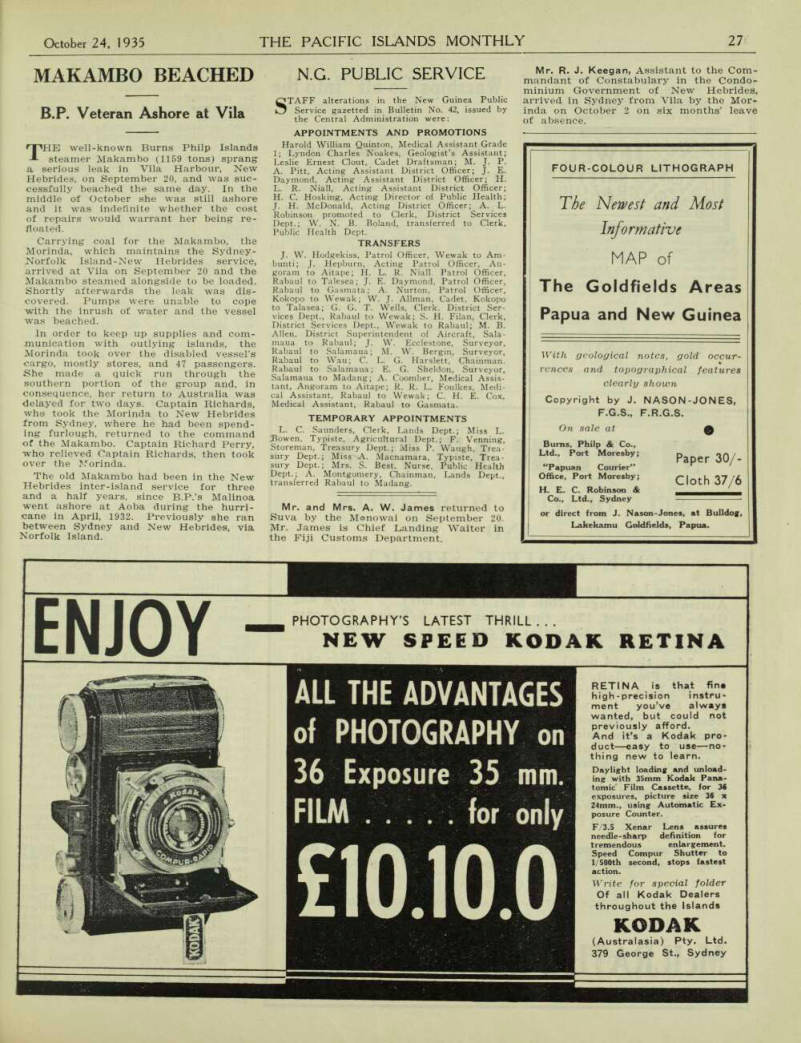
B.P. Veteran Ashore at Vila
THE well-known Burns Philp Islands steamer Makambo (1159 tons) sprang a serious leak in Vila Harbour, New Hebrides, on September 20, and was suc cessfully beached the same day. In the middle of October she was still ashore and it was indefinite whether the cost of repairs would warrant her being re floated.
Carrying coal for the Makambo, the Morinda, which maintains the Sydney- Norfolk Island-New Hebrides service, arrived at Vila on September 20 and the Makambo steamed alongside to be loaded.
Shortly afterwards the leak was dis covered. Pumps were unable to cope with the inrush of water and the vessel was beached.
In order to keep up supplies and com munication with outlying islands, the Morinda took over the disabled vessel’s cargo, mostly stores, and 47 passengers.
She made a quick run through the southern portion of the group and, in consequence, her return to Australia was delayed for two days. Captain Richards, who took the Morinda to New Hebrides from Sydney, where he had been spend ing furlough, returned to the command of the Makambo. Captain Richard Perry, who relieved Captain Richards, then took over the Morinda.
The old Makambo had been in the New Hebrides inter-island service for three and a half years, since B.P.’s Malinoa went ashore at Aoba during the hurri cane in April, 1932. Previously she ran between Sydney and New Hebrides, via Norfolk Island.
N.G. Public Service
STAFF alterations in the New Guinea Public Service gazetted in Bulletin No. 42, issued by the Central Administration were:
Appointments And Promotions
Harold William Quinton, Medical Assistant Grade 1; Lyndon Charles Noakes, Geologist’s Assistant; Leslie Ernest Clout, Cadet Draftsman; M. J. P.
A. Pitt, Acting Assistant District Officer; J. E.
Daymond, Acting Assistant District Officer; H.
L. R. Niall, Acting Assistant District Officer; H. C. Hosking, Acting Director of Public Health; J. H. McDonald, Acting District Officer; A. L.
Robinson promoted to Clerk, District Services Dept.; W. N. B. Boland, transferred to Clerk, Public Health Dept.
Transfers
J. W. Hodgekiss, Patrol Officer, Wewak to Am bunti; J. Hepburn, Acting Patrol Officer, An goram to Aitape; H. L. R. Niall Patrol Officer, Rabaul to Talesea; J. E. Daymond, Patrol Officer, Rabaul to Gasmata; A. Nurton, Patrol Officer, Kokopo to Wewak; W. J. Allman, Cadet, Kokopo to Talasea; G. G. T. Wells, Clerk, District Ser vices Dept., Rabaul to Wewak; S. H. Filan, Clerk, District Services Dept., Wewak to Rabaul; M. B.
Allen, District Superintendent of Aircraft, Sala maua to Rabaul; J. W. Ecclestone, Surveyor, Rabaul to Salamaua; M. W. Bergin, Surveyor, Rabaul to Wau; C. L. G. Harslett, Chainman.
Rabaul to Salamaua; E. G. Sheldon, Surveyor, Salamaua to Madang; A. Coomber, Medical Assis tant, Angoram to Aitape; R. R. L. Foulkes, Medi cal Assistant, Rabaul to Wewak; C. H. E. Cox, Medical Assistant, Rabaul to Gasmata.
Temporary Appointments
L. C. Saunders, Clerk, Lands Dept.; Miss L.
Bowen, Typiste, Agricultural Dept.; F. Venning, Storeman, Treasury Dept.; Miss P. Waugh, Trea sury Dept.; Miss A. Macnamara, Typiste, Trea sury Dept.; Mrs. S. Best. Nurse, Public Health Dept.; A. Montgomery, Chainman, Lands Dept., transferred Rabaul to Madang.
Mr. and Mrs. A. W. James returned to Suva by the Monowai on September 20.
Mr. James is Chief Landing Waiter in the Fiji Customs Department.
Mr. R. J. Keegan, Assistant to the Com mandant of Constabulary in the Condo minium Government of New Hebrides, arrived in Sydney from Vila by the Mor inda on October 2 on six months’ leave of absence.
Advertisements & other items, pp. 29-30 (1 item)
Enjoy
FOUR-COLOUR LITHOGRAPH
The Newest and Most
Informative
MAP of
The Goldfields Areas
Papua and New Guinea
With geological notes, gold occur - % rences and topographical features clearly shown Copyright by J. NASON-JONES,
F.G.S., F.R.G.S.
On sale at Bums, Philp & Co., Ltd., Port Moresby; “Papuan Courier"
Office, Port Moresby; H. E. C. Robinson & Co., Ltd., Sydney *
Paper 30/-
Cloth 37/6
or direct from J. Nason-Jones, at Bulldog, Lakekamu Goldfields, Papua.
ENJOY
PHOTOGRAPHY'S LATEST THRILL .. .
NEW SPEED KODAK RETINA
f. m t
ALL THE ADVANTAGES
of PHOTOGRAPHY on
36 Exposure 35 mm.
FILM ... for only
RETINA is that fins high-precision instrument you’ve always wanted, but could not previously afford.
And it’s a Kodak product—easy to use—nothing new to learn.
Daylight loading and unloading with 35mm Kodak Panatomic Film Cassette, for 36 exposures, picture size 36 x 24mm., using Automatic Exposure Counter.
F/3.5 Xenar Lens assures needle-sharp definition for tremendous enlargement.
Speed Compur Shutter to /500th second, stops fastest action.
Write for special folder Of all Kodak Dealers throughout the Islands
KODAK
(Australasia) Pty. Ltd. 379 George St., Sydney
PACIFIC TRADERS!
The Blade of Best Quality, and the Most Profitable to Handle, is: These blades are of the three-holed (Gillette) type. I have made a careful test of all blades, over a long period, while I was trading at Milne Bay, Papua, and the British-made Jewel was far ahead of any other. I now have the Pacific agency for Jewel blades, and strongly recommend them Send P. 0.0. for trial gross, post free, 10/- (Australian) or 8/- (sterling). Reduction for quantities. Sample package, 2/6. / s / "7 7"7
JEWEL
'I I' VSL KA L K to all traders.
HENRY DEXTER
• SAMARAI, PAPUA
McILRAIH’S
SELL QUALITY FOODSTUFFS
AND
GIVE QUALITY SERVICE
Australian I.A. Sugar, 701 b. bags ... l*?
Australian I.A. Sugar, 701 b. bags (3 bag lots) . . 13/6 bag Globe Trade Beef, 12oz. tins (4 doz.) 5/9 doz., 21/- case Globe Trade Beef, 12oz. tins (3 case lots) 20/- case St. George Army Rations— 14oz. tins (4 doz.) 10/- doz., 38/- case Pyramid Fine Salt, 1-cwt. bags o/?i Arnott’s Best Assorted Biscuits, No. 2 tins ... 2/li nil Kraft Cheese, 41b. pkts Sid. P>t., 8/3 doz.
Rosa Pure Plantation Coffee, 11b. tins 2/4 tm, 26/6 doz.
Montserrat Lime Juice, 260 z. bots 2/8 bot., 31/- doz.
Finest Khadrewi Dates, loose 4d. lb., 3/9 doz.
Sultanas, Best Australian, loose SJd. lb., 5/- doz.
Rosa Sliced Peaches, 30oz. tins 9d. tin, 8/104 doz.
Rosa Powdered Gelatine, 4oz. pkts 114 d. pkt., 11/- doz.
Rosa Honey, Best Western, 21b tins 1/2 tin, 13/9 doz.
Capital Mango and Papaw Chutney— lloz. jars lid. jar, 10/9 doz.
Rosa Worcester Sauce, 9oz. bots 54d. bot., 5/3 doz.
Yoga Tea, Finest Ceylon Blend, per lb. . . 1/11 pkt., 2/3 tin Prices f.o.b. Sydney
EXPORT PRICE LISTS AVAILABLE ON APPLICATION
McILRATH’S LTD.
Export Department 202 Pitt Street
SYDNEY, AUSTRALIA
Warships Go off “Into the Blue”
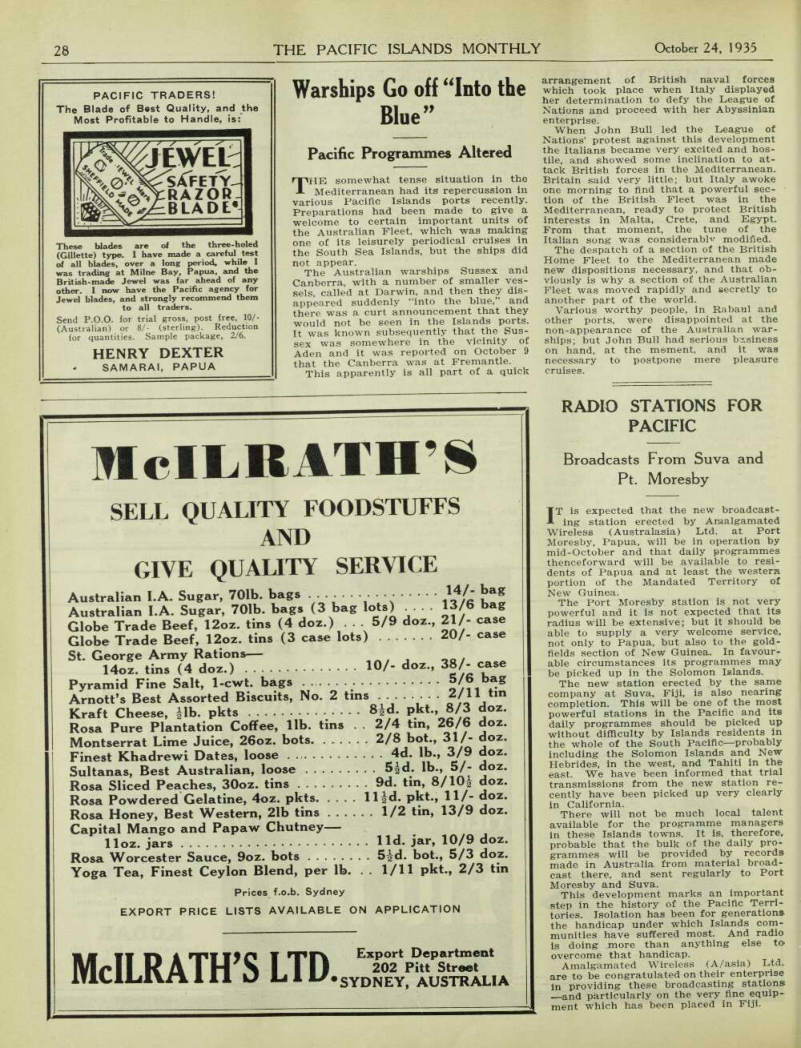
Blue”
Pacific Programmes Altered
THE somewhat tense situation in the Mediterranean had its repercussion in various Pacific Islands ports recently.
Preparations had been made to give a welcome to certain important units of the Australian Fleet, which was making one of its leisurely periodical cruises in the South Sea Islands, but the ships did not appear.
The Australian warships Sussex and Canberra, with a number of smaller ves sels, called at Darwin, and then they dis appeared suddenly “into the blue,” and there was a curt announcement that they would not be seen in the Islands ports.
It was known subsequently that the Sus sex was somewhere in the vicinity of Aden and it was reported on October 9 that the Canberra was at Fremantle.
This apparently is all part of a quick
arrangement of British naval forces which took place when Italy displayed her determination to defy the League of Nations and proceed with her Abyssinian enterprise.
When John Bull led the League of Nations’ protest against this development the Italians became very excited and hos tile, and showed some inclination to at tack British forces in the Mediterranean.
Britain said very little; but Italy awoke one morning to find that a powerful sec tion of the British Fleet was in the Mediterranean, ready to protect British interests in Malta, Crete, and Egypt.
From that moment, the tune of the Italian song was considerable modified.
The despatch of a section of the British Home Fleet to the Mediterranean made new dispositions necessary, and that ob viously is why a section of the Australian Fleet was moved rapidly and secretly to another part of the world.
Various worthy people, in Rabaul and other ports, were disappointed at the non-appearance of the Australian war ships; but John Bull had serious business on hand, at the moment, and it was necessary to postpone mere pleasure cruises.
Pt. Moresby
Radio Stations For
Pacific
Broadcasts From Suva and Pt. Moresby
IT is expected that the new broadcast ing station erected by Amalgamated Wireless (Australasia) Ltd. at Port Moresby, Papua, will be in operation by mid-October and that daily programmes thenceforward will be available to resi dents of Papua and at least the western portion of the Mandated Territory of New Guinea.
The Port Moresby station is not very powerful and it is not expected that its radius will be extensive; but it should be able to supply a very welcome service, not only to Papua, but also to the gold fields section of New Guinea. In favour able circumstances its programmes may be picked up in the Solomon Islands.
The new station erected by the same company at Suva, Fiji, is also nearing completion. This will be one of the most powerful stations in the Pacific and its daily programmes should be picked up without difficulty by Islands residents in the whole of the South Pacific —probably including the Solomon Islands and New Hebrides, in the west, and Tahiti in the east. We have been informed that trial transmissions from the new station re cently have been picked up very clearly in California.
There will not be much local talent available for the programme managers in these Islands towns. It is, therefore, probable that the bulk of the daily pro grammes will be provided by records made in Australia from material broad cast there, and sent regularly to Port Moresby and Suva.
This development marks an important step in the history of the Pacific Terri tories. Isolation has been for generations the handicap under which Islands com munities have suffered most. And radio is doing more than anything else to overcome that handicap.
Amalgamated Wireless (A/asia) Ltd. are to be congratulated on their enterprise in providing these broadcasting stations —and particularly on the very fine equip ment which has been placed in Fiji.
Men Who Knew Yesterday
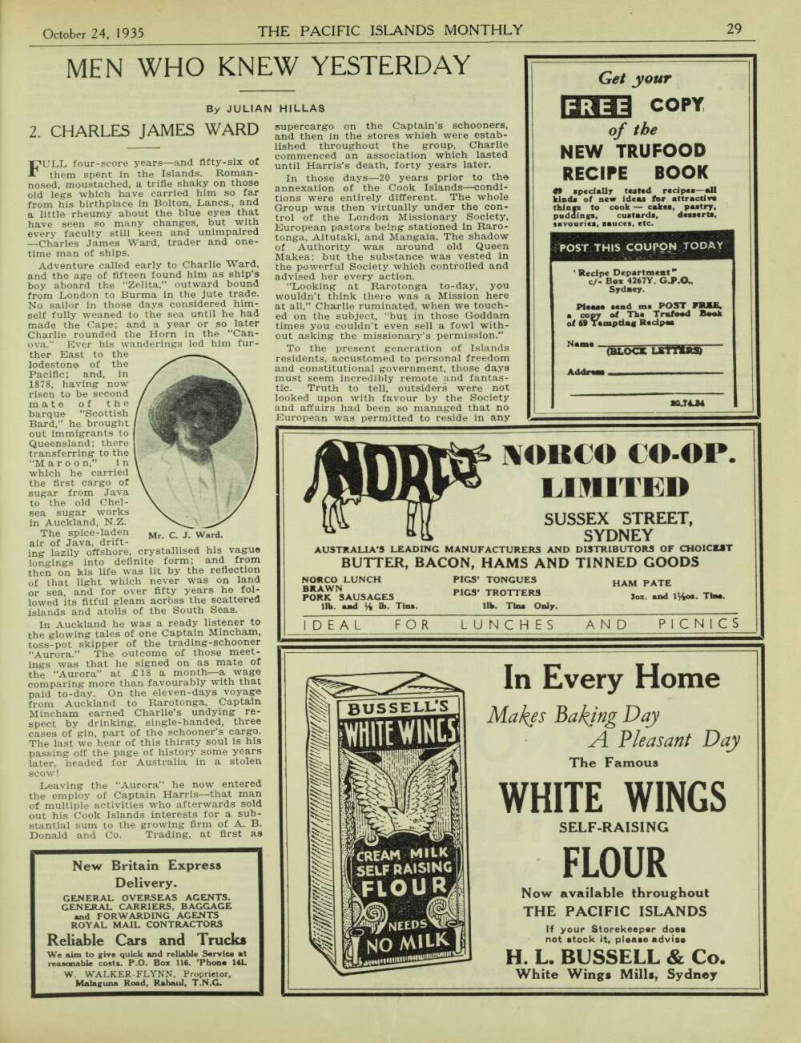
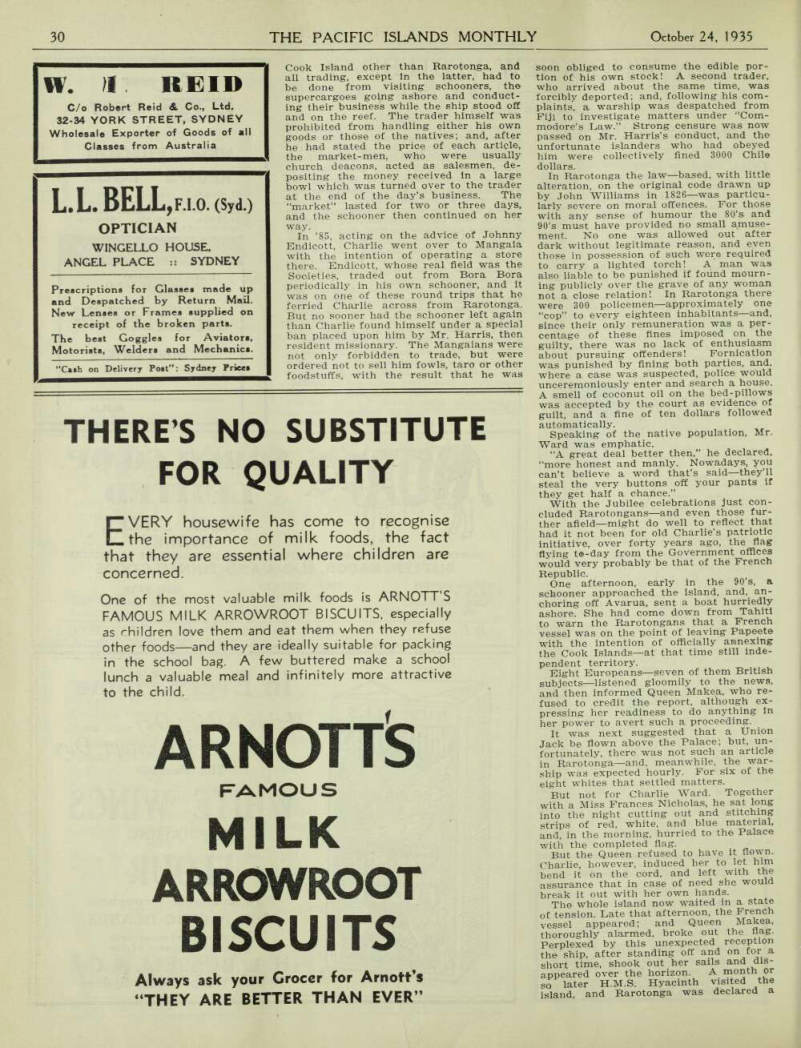
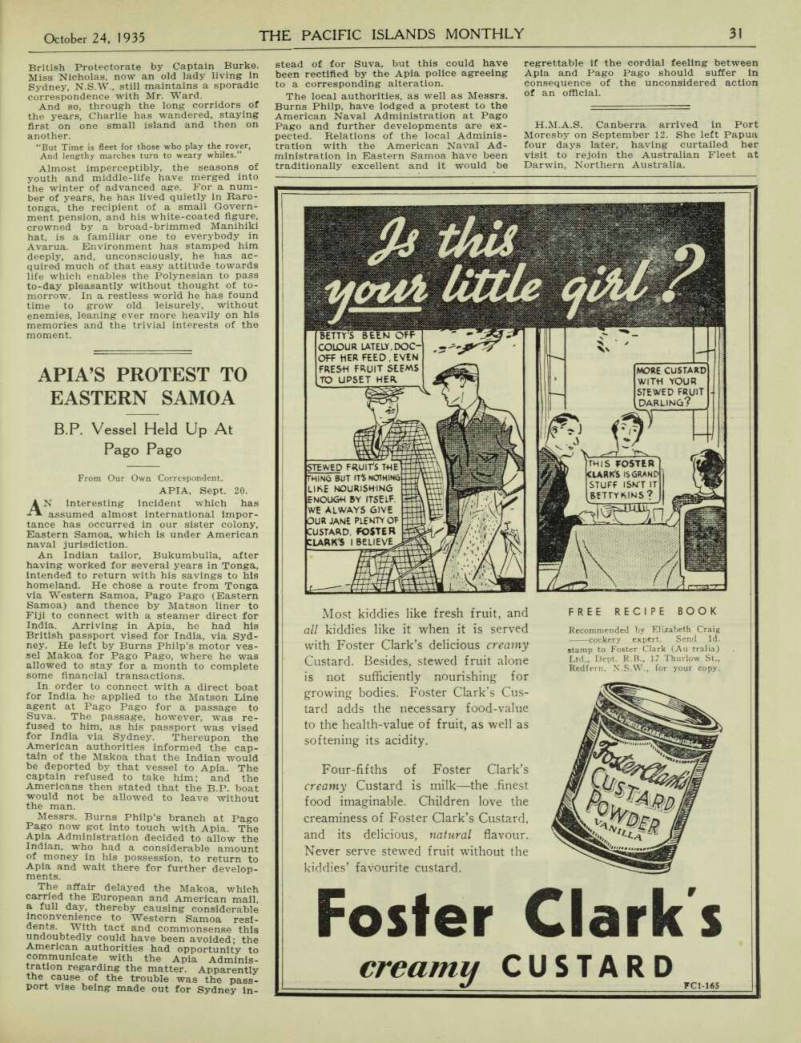
By Julian Hillas
2. Charles James Ward
FULL four-score years—and fifty-six of them spent in the Islands. Roman nosed, moustached, a trifle shaky on those old legs which have carried him so far from his birthplace in Bolton, Lancs., and a little rheumy about the blue eyes that have seen so many changes, but with every faculty still keen and unimpaired —Charles James Ward, trader and one time man of ships.
Adventure called early to Charlie Ward, and the age of fifteen found him as ship’s boy aboard the “Zelita,” outward bound from London to Burma in the jute trade.
No sailor in those days considered him self fully weaned to the sea until he had made the Cape; and a year or so later Charlie rounded the Horn in the “Can ova.” Ever his wanderings led him fur
ther East to the lodeston© of the Pacific; and, in 1878, having now risen to be second mate of the barque “Scottish Bard,” he brought out immigrants to Queensland; there transferring to the “M aroo n,” in which he carried the first cargo of sugar from Java to the old Chel sea sugar works in Auckland, N.Z.
The spice-laden
air of Java, drift ing lazily offshore, crystallised his vague longings into definite form; and from then on his life was lit by the reflection of that light which never was on land or sea, and for over fifty years he fol lowed its fitful gleam across the scattered islands and atolls of the South Seas.
In Auckland he was a ready listener to the glowing tales of one Captain Mincham, toss-pot skipper of the trading-schooner “Aurora.” The outcome of those meet ings was that he signed on as mate of the “Aurora” at £lB a month —a wage comparing more than favourably with that paid to-day. On the eleven-days voyage from Auckland to Rarotonga, Captain Mincham earned Charlie’s undying re spect by drinking, single-handed, three cases of gin, part of the schooner’s cargo.
The last we hear of this thirsty soul is his passing off the page of history some years later, headed for Australia in a stolen scow!
Leaving the “Aurora” he now entered the employ of Captain Harris —that man of multiple activities who afterwards sold out his Cook Islands interests for a sub stantial sum to the growing firm of A. B.
Donald and Co. Trading, at first as
supercargo on the Captain’s schooners, and then in the stores whieh were estab lished throughout the group, Charlie commenced an association which lasted until Harris’s death, forty years later.
In those days—2o years prior to the annexation of the Cook Islands —conditions were entirely different. The whole Group was then virtually under the con trol of the London Missionary Society, European pastors being stationed in Raro tonga, Aitutaki, and Mangaia, The shadow of Authority was around old Queen Makea; but the substance was vested in the powerful Society which controlled and advised her every action.
“Looking at Rarotonga to-day, you wouldn’t think there was a Mission here at all,” Charlie ruminated, when we touch ed on the subject, “but in those Goddam times you couldn’t even sell a fowl with out asking the missionary’s permission.”
To the present generation of Islands residents, accustomed to personal freedom and constitutional government, those days must seem incredibly remote and fantas tic. Truth to tell, outsiders were not looked upon with favour by the Society and affairs had been so managed that no European was permitted to reside in any
Mr. C. J. Ward.
Cook Island other than Rarotonga, and all trading, except in the latter, had to be done from visiting schooners, the supercargoes going ashore and conduct ing their business while the ship stood off and on the reef. The trader himself was prohibited from handling either his own goods or those of the natives; and, after he had stated the price of each article, the market-men, who were usually church deacons, acted as salesmen, de positing the money received in a large bowl which was turned over to the trader at the end of the day’s business. The “market” lasted for two or three days, and the schooner then continued on her way.
In ’B5, acting on the advice of Johnny Endicott, Charlie went over to Mangaia with the intention of operating a store there. Endicott, w r hose real field was the Societies, traded out from Bora Bora periodically in his own schooner, and it was on one of these round trips that he ferried Charlie across from Rarotonga.
But no sooner had the schooner left again than Charlie found himself under a special ban placed upon him by Mr. Harris, then resident missionary. The Mangaians were not only forbidden to trade, but were ordered not to sell him fowls, taro or other foodstuffs, with the result that he was
soon obliged to consume the edible por tion of his own stock! A second trader, who arrived about the same time, was forcibly deported; and, following his com plaints, a warship was despatched from Fiji to investigate matters under “Com modore’s Law.” Strong censure was now passed on Mr. Harris’s conduct, and the unfortunate islanders who had obeyed him were collectively fined 3000 Chile dollars.
In Rarotonga the law —based, with little alteration, on the original code drawn up by John Williams in 1826—was particu larly severe on moral offences. For those with any sense of humour the 80’s and 90’s must have provided no small amuse ment. No one was allowed out after dark without legitimate reason, and even those in possession of such were required to carry a lighted torch! A man was also liable to be punished if found mourn ing publicly over the grave of any woman not a close relation! In Rarotonga there were 300 policemen—approximately one “cop” to every eighteen inhabitants —and, since their only remuneration was a per centage of these fines imposed on the guilty, there was no lack of enthusiasm about pursuing offenders! Fornication was punished by fining both parties, and, where a case was suspected, police would unceremoniously enter and search a house.
A smell of coconut oil on the bed-pillows was accepted by the court as evidence of guilt, and a fine of ten dollars followed automatically.
Speaking of the native population, Mr.
Ward was emphatic.
“A great deal better then,” he declared, “more honest and manly. Nowadays, you can’t believe a word that’s said —they’ll steal the very buttons off your pants if they get half a chance.”
With the Jubilee celebrations just con cluded Rarotongans—and even those fur ther afield —might do well to reflect that had it not been for old Charlie’s patriotic initiative, over forty years ago, the flag flying t©-day from the Government offices would very probably be that of the French Republic.
One afternoon, early in the 90’s, a schooner approached the island, and, an choring off Avarua, sent a boat hurriedly ashore. She had come down from Tahiti to warn the Rarotongans that a French vessel was on the point of leaving Papeete with the intention of officially annexing the Cook Islands —at that time still inde pendent territory.
Eight Europeans—seven of them British subjects—listened gloomily to the news, and then informed Queen Makea, who re fused to credit the report, although ex pressing her readiness to do anything in her power to avert such a proceeding.
It was next suggested that a Union Jack be flown above the Palace; but, un fortunately, there was not such an article in Rarotonga—and, meanwhile, the war ship was expected hourly. For six of the eight whites that settled matters.
But not for Charlie Ward. Together with a Miss Frances Nicholas, he sat long into the night cutting out and stitching strips of red, white, and blue material, and, in the morning, hurried to the Palace with the completed flag.
But the Queen refused to have it flown.
Charlie, however, induced her to let him bend it on the cord, and left with the assurance that in case of need she would break it out with her own hands.
The whole island now waited in a state of tension. Late that afternoon, the French vessel appeared; and Queen Makea, thoroughly alarmed, broke out the flag.
Perplexed by this unexpected reception the ship, after standing off and on for a short time, shook out her sails and dis appeared over the horizon. A month or so later H.M.S. Hyacinth visited the island, and Rarotonga was declared a
British Protectorate by Captain Burke.
Miss Nicholas, now an old lady living In Sydney, N.S.W., still maintains a sporadic correspondence with Mr. Ward.
And so, through the long corridors of the years, Charlie has wandered, staying first on one small island and then on another.
“But Time is fleet for those who play the rover, And lengthy marches turn to weary whiles.”
Almost imperceptibly, the seasons of youth and middle-life have merged into the winter of advanced age. For a num ber of years, he has lived quietly in Raro tonga, the recipient of a small Govern ment pension, and his white-coated figure, crowned by a broad-brimmed Manihiki hat, is a familiar one to everybody in Avarua. Environment has stamped him deeply, and, unconsciously, he has ac quired much of that easy attitude towards life which enables the Polynesian to pass to-day pleasantly without thought of to morrow. In a restless world he has found time to grow old leisurely, without enemies, leaning ever more heavily on his memories and the trivial interests of the moment.
Advertisements & other items, pp. 31-32 (1 item)
White Wings
Get your
OTfli copy
of the
NEW TRUFOOD
RECIPE BOOK
99 specially tasted recipes— all kinds of new ideas for attractive thin as to cook cakes, pastry, paddings, custards, desserts, savouries, sauces, etc.
POST THIS COUPON TODAY
‘ Recipe Department ** c/- Box 4267 Y. G.P.0., Sydney.
Please send me POST FRJKE» a copy of The Trnfood Book of 69 Tempting Recipes N * m * (BLOCK UStftKSi Address 10.T4-M
VOIUO CO-OP.
LIMITED
SUSSEX STREET,
SYDNEY
AUSTRALIA’S LEADING MANUFACTURERS AND DISTRIBUTORS OF CHOICEST
BUTTER, BACON, HAMS AND TINNED GOODS
NORCO LUNCH PIGS’ TONGUES
PIGS’ TROTTERS
lib. Tins Only.
BRAWN
PORK SAUSAGES
lib. and Vi lb. Tins.
HAM PATE
Soz. and iVios. Tina.
IDEAL
FOR
LUNCHES
AND
PICNICS
n *s
RUSSELL
% s§i * m
In Every Home
Makes Raking Day
A Pleasant Day
The Famous
WHITE WINGS
SELF-RAISING
FLOUR
Now available throughout
THE PACIFIC ISLANDS
If your Storekeeper does not stock It, please advise
H. L. BUSSELL & Co.
White Wings Mills, Sydney
New Britain Express
Delivery.
GENERAL OVERSEAS AGENTS.
GENERAL CARRIERS, BAGGAGE
and FORWARDING AGENTS
ROYAL MAIL CONTRACTORS
Reliable Cars and Trucks
We aim to give quick and reliable Service at reasonable costs. P.O. Box 116. ’Pbona 14L W. WALKER-FLYNN, Proprietor, Malaguna Road, Rabaul, T.N.G.
W. If REID
C/o Robert Reid & Co., Ltd.
32-34 YORK STREET, SYDNEY
Wholesale Exporter of Goods of all Classes from Australia
L.L. BELL,F I O. (Syd.)
OPTICIAN
WINGELLO HOUSE.
ANGEL PLACE :: SYDNEY
Prescription* for Glasses made up and Despatched by Return Mail.
New Lenses or Frames supplied on receipt of the broken parts.
The best Goggles for Aviators, Motorists. Welders and Mechanic*.
“Cash on Delivery Post”: Sydney Price*
THERE’S NO SUBSTITUTE
FOR QUALITY
EVERY housewife has come to recognise the importance of milk foods, the fact that they are essential where children are concerned.
One of the most valuable milk foods is ARNOTT S
FAMOUS MILK ARROWROOT BISCUITS, especially
as children love them and eat them when they refuse other foods—and they are ideally suitable for packing in the school bag. A few buttered make a school lunch a valuable meal and infinitely more attractive to the child.
ARNOTT!S
FAMOUS
MILK
ARROWROOT
BISCUITS
Always ask your Grocer for Arnott’s
“THEY ARE BETTER THAN EVER”
Apia’S Protest To
Eastern Samoa
B.P. Vessel Held Up At Pago Pago
From Our Own Correspondent.
APIA, Sept. 20.
AN interesting incident which has assumed almost international impor tance has occurred in our sister colony, Eastern Samoa, which is under American naval jurisdiction.
An Indian tailor, Bukumbulla, after having worked for several years in Tonga, intended to return with his savings to his homeland. He chose a route from Tonga via Western Samoa, Pago Pago (Eastern Samoa) and thence by Matson liner to Fiji to connect with a steamer direct for India. Arriving in Apia, he had his British passport vised for India, via Syd ney. He left by Burns Philp’s motor ves sel Makoa for Pago Pago, where he was allowed to stay for a month to complete some financial transactions.
In order to connect with a direct boat for India he applied to the Matson Line agent at Pago Pago for a passage to Suva. The passage, however, was re fused to him, as his passport was vised for India via Sydney. Thereupon the American authorities informed the cap tain of the Makoa that the Indian would be deported by that vessel to Apia. The captain refused to take him; and the Americans then stated that the B.P. boat would not be allowed to leave without the man.
Messrs. Burns Philp’s branch at Pago Pago now got into touch with Apia. The Apia Administration decided to allow the Indian, who had a considerable amount of money in his possession, to return to Apia and wait there for further develop ments.
The affair delayed the Makoa, which carried the European and American mail, a full day, thereby causing considerable inconvenience to Western Samoa resi dents. With tact and commonsense this undoubtedly could have been avoided; the American authorities had opportunity to communicate with the Apia Adminis tration regarding the matter. Apparently the cause of the trouble was the pass port vise being made out for Sydney in
stead of for Suva, but this could have been rectified by the Apia police agreeing to a corresponding alteration.
The local authorities, as well as Messrs.
Burns Philp, have lodged a protest to the American Naval Administration at Pago Pago and further developments are ex pected. Relations of the local Adminis tration with the American Naval Ad ministration in Eastern Samoa have been traditionally excellent and it would be
regrettable if the cordial feeling between Apia and Pago Pago should suffer in consequence of the unconsidered action of an official.
H.M.A.S. Canberra arrived in Port Moresby on September 12. She left Papua four days later, having curtailed her visit to rejoin the Australian Fleet at Darwin, Northern Australia.
Advertisements & other items, pp. 33-34 (1 item)
Foster Clark s
I ¥
BETTY'S BEEN Off
COLOUR LATELY, DOC-
OFF HER FEED, EVEN
FRESH FRUIT SEEMS
TO UPSET HER
X\
MORE CUSTARD
WITH YOUR
STEWED FRUIT
DARLING?
A & this foster
CLARK'S ISGRAND
STUFF ISN'T IT
STEWED FRUITS THE
FHING BUT ITS NOTHING
LIKE NOURISHING
ENOUGH BY ITSELF.
WE ALWAYS GIVE
OUR JANE PLENTY OF
CUSTARD, FOSTER
CLARK'S I BELIEVE .
BETTYKINS?
.IY
Lr iQ
Most kiddies like fresh fruit, and all kiddies like it when it is served with Foster Clark’s delicious creamy Custard. Besides, stewed fruit alone is not sufficiently nourishing for growing bodies. Foster Clark’s Custard adds the necessary food-value to the health-value of fruit, as well as
softening its acidity.
Four-fifths of Foster Clark’s creamy Custard is milk —the finest food imaginable. Children love the creaminess of Foster Clark’s Custard, and its delicious, natural flavour.
Never serve stewed fruit without the kiddies’ favourite custard.
FREE RECIPE BOOK
Recommended by Elizabeth Craig cookery expert. Send Id. stamp to Foster Clark (Au tralia) Ltd., Dept. R. 8., 17 Thurlow St., Redfern, N.S.W., for your copy.
D
Foster Clark s
creamy CUSTARD
•/ FCI-165
KETCHES,
SCHOONERS,
LAUNCHES
And All Types of Boats suitable for Islands work A large fleet of sound and reliable craft on Hand. Let me know your requirements or instruct your Sydney Agent to inspect on your behalf.
My experience is at your service.
J. CAPELL
Boatbuilder and Engineer
ELITE SHEDS,
RUSHCUTTER BAY, SYDNEY
SHIP CHANDLERY - HARDWARE
BROOMFIELDS LIMITED, 152 Sussex St., SYDNEY
Large and Complete Stocks of SHIP CHANDLERY.
Ironmongery of all kinds—Paints, White Lead and Oils.
Sole Agents for: P. H. MUNTZ & CO.’S 3-CROWN BRAND METAL SHEATHING.
PEACOCK & BUCHANS’ ENGLISH READY-MIXED PAINTS.
WRITE FOR SHIP CHANDLERY CATALOGUE
Special “In Bond" Prices for all Island enquiries quoted on application
CABLES: “BOOM,” SYDNEY
WHEN YOU WOKE UP
THIS MORNING
How did you feel? Headachy, irritable, dopey and nervy—or fresh, bright and alert. A good start off in the morning is essential to the strenuous hours ahead. If out of sorts when you wake up, take two or three “ASPRO" tablets after breakfast. The relief is almost instantaneous. “ASPRO" will quickly banish your Headache, quieten your Nerves, and will soothe away Pains and Aches, because after ingestion in the system, it is anti-pyretic and an internal antiseptic. Furthermore, in attacks of a feverish nature, “ASPRO" promotes a healthy action of the skin, thus allowing the poisons in the system to be eliminated through the pores in. a perfectly natural manner. Start the day right for health. If out of sorts n
IS YOUR STANDBY
BUY A PACKET TO-DAY FOR PROOF
Fijian Killed in Apia Motor
Accident
From Our Own Correspondent.
APIA, Sept. 27.
A SERIOUS motor accident occurred on September 21 on the Lotopa Road leading to the plantation district. Mr. K.
Meyer, a prominent planter, was driving home in his car with Mr. W. Blenner hassett, manager of the Apia branch of the Bank of New Zealand. Turning a bend near the side road leading to Tuai namat plantation, the car struck with full force a horse and rider, coming from the opposite direction.
The horse was killed outright, while the rider, an elderly Fijian plantation labourer, named Sam, was shockingly mutilated, both legs and an arm being crushed and broken. The victim was taken to the Government Hospital in the car of Mr. J. Petersen, whose plantation is close to the scene of the accident, but he died shortly after.
Mr. A. M. Turnbull, plantation manager for Messrs. Burns, Philp and Co. Ltd., returned to Australia after a business visit to Rabaul by the Malaita on Sep tember 26.
Fanaticism In New
Guinea
Buka Natives Wait for “Ship of the Millennium.”
From Our Own Correspondent.
RABAUL, September 20.
IN the December 1932 issue of the Pacific Islands Monthly, it was reported that a wave of religious fanaticism had swept over portion of Buka (Mandated New Guinea). Word has now been received, though not officially confirmed, that a fresh outbreak has occurred in the same district and is extending to the island of Bougain ville.
As in the former instance certain natives are alleged to have received “word” in visions and dreams that large vessels will appear off the coast of the island and bring them supplies. The particular point in the present “prophecy” is that the whites resi dent on the island will be taken away and the natives left undisturbed.
The first “information” was to the effect that the vessel would be a B.P. steamer; this failing to run to the prophetic schedule other “advice” was received that it would be a Carpenter ship; and now the latest rumour is that it will be a German steamer.
Natives are kept constantly watching for the advent of this “ship of the Millen nium,” and at certain points along the coast masts have been erected, decorated with leaves and native garlands.
Four Toes?
Why Has A Pig Got
These Little Ones Have Five!
From Our Own Correspondent.
Pt. Moresby, Sept. 12.
11/|R. J. O’MALLEY, patrol officer, who accompanied Mr. Jack Hides on his recent famous patrol from the Strickland to the Purari, was interested to find that pigs presented to the party by the natives of the cultivated valleys of the head waters of the Purari all had five toes.
Further investigations proved that nearly all the pigs of the district were similar in this respect.
Five-toed pigs are not uncommon to Papua; already they have puzzled of ficials in the Delta Division, where they have been found in numbers in soma villages. Mr. C. H. Rich, of the magis terial service, some time ago secured the feet of an adult pig and a piglet, which the Government forwarded to Mr. A. S.
Le Souef, of the Taronga Park Zoo, Syd ney, for examination.
Previously, five-toed pigs in Papua were reported to Mr. Le Soeuf, who was very interested in the discovery. He stated at the time that if the pigs were not freaks, they - showed a reversion of evolution, and that if they were common in a certain district they might have evolved from a throwback, or might have been induced by animals living in swampy grounds extending over a long period.
From the reports of the Hides-O’Mal ley patrol, there seems to have been no swampy grounds in the cultivated val leys where the pigs were encountered, so it may be taken that they show some reversion of evolution.
The Old Track In
Memories of New Guinea Gold field Prior to the Aeroplane Services
Specially written for “Pacific Islands Monthly” iy M.G.
SOME months ago the “P.1.M.” published an amusing article on the old Edie- Wau Road, “Flirting with Death and Der kert,” which brought to my mind many of the incidents of the track from Salamaua to Edie Creek during the days of the 1926-27 rush. I have not the pen of the writer of that article, and things don’t seem quite so humorous when they become a daily process. At the time, I found the eight days’ tramp no joke: and it was then that I conceived the idea that if all the mountains of New Guinea were flattened out, they would easily cover the rest of the globe. The Goldfield is a land of “ups and downs” in more ways than one. It may be a great place for Highland Scots and mountain goats: but give me aero planes—God bless ’em!
Speaking of Highland Scots, I remember three who were there in the old days.
“Scotty” was a raw-boned son of the heather, who put up a great record of suc cessive trips to and from Salamaua, often humping a pack. He was rather sensitive about his bony knees and, therefore, shun ned shorts. On his third trip, he came in by the Missim track, and arrived with ragged strips of trousers flapping around his lean thighs: “I couldna stand they wet strides any longer, so I cut ’em off with a bush knife, and it was verra blunt!”
was his explanation. He had produced a kind of kilt, which was greatly admired by his carriers. another yarn is told of Scotty. He was doing his morning toilet on the Merri, when another miner came along and told him of some claim-jumping. Scotty, hold ing his false teeth in his hand, listened with a grave face. Then he remarked: “Aye, the scoondrels! I’d crush ’em! ” And, closing his fist fiercely in emphasis, he crushed his dental plate to bits.
A straighter, whiter man than Scotty doesn’t exist. Wherever he is, may his ounces be many!
Another of the same clan was Skipper McGuiness, of B.P.’s steamers fame. I once met him on the road at Wee Baining, wearing a sand-shoe on one foot and a hob-nail boot on the other. His hob-nails had hurt him, so he changed to the sand shoes. But at “House Copper” the rats had eaten away the whole of one side of his sandshoes. Weighted, on one side like this, he must have had a great trip to the beach.
Don McGuiness was the third Scot. I never met him on the road, but I did in court, but that’s another story.
Marny Blackford ai’gued that he had the solution of the transport difficulty; Get a herd of goats, load each with a pack, and lead them in. Thus you would have your goods transported, milk en route, and meat on arrival!
Llama were strongly in favour, until someone discovered that the nearest ob tainable were in South America.
Another chap had a real brain wave.
His scheme was to inflate a number of small balloons sufficiently to lift 100 lbs. off the ground, tie them in line and lead them along. What he would do when going through the dense bush, or where
the gas was to come from for inflation, were questions he studiously avoided.
A syndicate of six, from North Queens land, arranged that two should work a claim, and four act as carriers. They actu ally did get in, and one died within a few days of arrival. Two syndicates unsuc cessfully tried mule transport. But, until the ’planes arrived, the native carriers were the only success.
The late C. J. Levien, on his last trip to
the Field, presented the Wau Recreation Club with a trophy on which was to be engraved a native carrying a full pack: “The real hero of the Field.” Many of us who had been working boys for a number of years had a poor opinion of their work ing capacity; but we found this opinion changing to admiration and pride at their achievements. To carry 50 pounds from Salamaua to Edie in a week was a meri torious feat. Scoffers who do not really know boys or the track will argue: “Oh, it is easy for them”—“physically built for it”—“no imagination,” etc., etc. But more than a few boys died on the road; a few just collapsed—they went until their hearts gave out.
I agree that boys lack imagination to a certain extent; but nevertheless, after the first trip, the boys had sufficient imagina tion to speak with dread of certain stages of the road, especially Gadagado. Also, it must be remembered that in tribal life the women do all the carrying.
Certainly, hundreds of boys deserted either dumping valuable cargo in the bush or stealing it —but, such deserters were mainly from employers quite new to the country and natives. Fortunately, the Administrator chose a District Officer (Major S. S. Skeets) for Salamaua who was big enough for the job and, but for his strength and his appreciation of the state of affairs on the Goldfields, hundreds who
eventually saw Edie Creek in the early days would have found it impossible to do so. Another sagacious act of the Admin istration was that, when they appointed the Warden, he was given the powers of a District Officer. This dual office allowed him to understand both the miners’ and their natives’ viewpoint. For the first few years, commonsense instead of law was used by the District Services on the Field.
Employers gave their boys every possible consideration, and most of those who struck gold paid a high bonus to their na tives when returning them home.
The spirit of comradeship was evident on the road —and not only amongst the Europeans. Everyone attended any sick boys they met en route; they carried them to the nearest shelter and left them medi cines. This spirit of comradeship was akin to that of the A.I.F. —which is not surpris ing, as more than 90 per cent, of the miners cf 1926-7, and before, were re turned men. Actually, the whole Goldfield had this spirit of friendliness and mutual helpfulness until 1930-1, when that small town feeling, parochialism and cliques, became noticeable. As one old miner re marked, “When the women and goats ar rive, it’s time for us to get out.” The “come in and have a cup of tea spirit” is still extant in the outside areas.
During the rush, the newcomers to the Territory had a bad time. Recruiters charged £25 per boy. The over-anxious would-be miners, afraid all the country would be pegged, rushed things. 50 lbs. was (and still is) the recognised boy’s load, but they could not resist adding an other five pounds or so, instead of reducing it to 40 or 45 pounds for the first trip. Woe betide the employer who over loaded, if Major Skeets found him out.
These new-comers, instead of nursing their boys along, and making the first trip in nine days, would attempt to hustle, to do it in six; result, they would wake up one morning to find every boy had deserted them.
Another great mistake, made by nearly ail of us, was in proportioning the loading.
We invariably took an excess of tools, re sulting in a shortage of foodstuffs. In sufficient, or poor quality, tent flys were responsible for much sickness; and it seemed impossible to obtain suitable boots.
Often the bluchers lost their heels within the first two or three days, and the re mainder of the journey, in heel-less boots, was simply agony. One was indeed lucky if a pair of boots lasted more than a re turn trip.
“Jockey” Jack, a very popular wag in those days, faced the road in dancing pumps, with a tin of porridge and mighty little else. He got there, and made good.
Eater, a fine old prospector, known as “Carbine,” came in without a single boy, arriving with bags wrapped around his feet. Two or three Europeans died on the way in, and a number had to turn back.
Perhaps the worst trip on this road was that of the late Herb. Wilson, of the En deavour Lease, Koranga Creek. He was carried to the beach, ill and blood-poisoned.
Another was a boy employed by Ernie Banks, who had his leg crushed at Edie, and was carried to Salamaua and attended by Cyril Lambert, mortification setting in en route. He survived, and his leg was saved, although he was 20 days on the trip.
To hear really good stories of the early days on the track, long before the rush I refer to, one should listen to Ernie Dover, now of Lower Edie Creek. He is a famous humourist.
Mr. Colin Marr, of the New Guinea De partment of Agriculture, arrived in Syd ney from Rabaul by the Tanda on Sep tember 18.
Advertisements & other items, pp. 35-36 (1 item)
Ruston
West’s Wheel
Works
(F. H. Bishop, Proprietor)
60-64 Bay St., Sydney
MANUFACTURERS
OF ALL TYPES OF WHEELS
FOR WAGGONS, CARTS,
TRAILERS, CARS
SUPPLIERS
OF WHEEL PARTS, RIMS,
SPOKES, AXLES, BOXES, etc.
We have the plant and have been established forty years Write for Information and Quotations
u
Ruston
MARINE DIESEL
ENGINES
and Marine Auxiliaries
SPECIAL FEATURES:
Cold Starting, Compression Igni
tion, Airless Fuel Injection, Four Cycle Principle; Low Fuel Con
sumption Guaranteed.
MADE IN SIZES UP TO 650-B.H.P,
Illustration shows a Mark 4VQM Four- Cylinder Engine of 70-B.H.P. 1. . *“ Sole Agents for Australia and the Islands:
RUSTON & HORNSBY (Australia) PTY. LIMITED
Registered Office: 174-180 KING STREET, MELBOURNE Cables: “HORNSBYS,” Melbourne.
Branches at SYDNEY (642-44 Jones St.) and BRISBANE (Barry Parade).
Cables; “RUSTHORN” Cables: “RUSTON-HORNSBY”
PII9IPMOBIL
Light and Portable
MOTOR PUMP
PUMPMOBIL
Complete Plant’s weight, 140 lbs.
Capacity up to 12,000 gallons per hour All heads from 10 to 115 feet Fuel consumption, £ gallon per hour Pressure 55 Ihs. square inch Especially suitable prospecting And all Sluicing Requirements
Nelson & Robertson
12 SPRING STREET, SYDNEY
Woven Wire for All Industry
COPRA DRYING TRAYS, FLOORS, Etc.
FRUIT DRYING TRAYS, MINING SCREENS
Heavy Mosquito Gauze in Phosphor Bronze and Other Metals Impervious to Salt Sea Air WIRE DOOR MATS AND GENERAL WIRE WORKS 0^ T V f- Or £ tr
E. WRIGHT A CO. LTD.
Office and Works: 148-152 Cleveland St., Sydney, N.S.W.
Telegraphic Addreas: " Wrightmake,” Chippendale.
Cable Addreae: Ropeyard, Sydney.
Scott’s Renown Brand Rope,
Cordage and
Binder
Twine
of Every
Description
MANUFACTURED AT
MASCOT, N.S.W.
By
J. Scott Ltd.
Head Office and Store;
163 CLARENCE ST.,
SYDNEY, N.S.W.
jiinary^i
IWM)
m%
Lese-Majesty In Fiji
Appeal Case Dismissed
SUVA, September 14.
AN appeal in a case which received much prominence locally was dealt with at the Supreme Court, Suva, on Sept. 6. Harold J. V. Rice, a missionary who described himself as “one of Jehovah's witnesses,” appealed to the Acting Chief Justice (Mr. R. S. Thacker) against his conviction and fine of £25 or three months in gaol by the Rewa District Commissioner on July 25 for acting in a manner preju dicial to the peace and good order of the Colony.
The Acting Attorney-General (Mr. A.
Hallam Roberts) alleged that Rice had made certain statements to Eseia Koroi, Buli of Dawasamu, and seven Fijians, tra ducing members of the Royal Family, the Fiji Governor, and District Commissioners.
It was also alleged that he spoke badly of other missionaries and priests in Fiji. An gered by his remarks, the natives ordered him out their house and journeyed to Suva to complain to the authorities. Rice was convicted, explained Mr. Hallam Roberts, under an ordinance designed to prevent the natives from being disturbed by people passing through their midst.
The appellant, who conducted his own case, denied the statements and spoke at great length on the teachings of his re ligion and their relation to the rulers of subject people. He maintained that the statements alleged to have been made by him were no more than bona fide expres sions of his religious faith —to be accepted or rejected as the hearers pleased. He also stated that the evidence given in the lower court had not been correctly taken •down.
His Honour, in a long judgment, upheld the magistrate’s finding and dismissed the appeal.
Mr. A. P. Cowie, of the South Sea Evan gelical Mission, at Inakona, Guadalcanal, Solomon Islands, arrived in Sydney on leave by the Malaita on September 27.
He departed for New Zealand by the Marama on October 11, and will spend six months’ furlough at Gore, in the South Island, before returning to Melanesia.
Mrs. Edna May Stephen, of Matupi Farm, New Guinea, died at her home on September 13. Arriving in the Territory ■early in 1927, she became attached to the clerical staff of Messrs. W. R. Carpenter and Co., Ltd. After her marriage to Mr.
R. J. Stephen, of Rabaul, she carried on her duties as confidential secretary at Carpenters’ Rabaul office.
H.M.S. Leith At Tahiti
from our uwn uorresponucm.
Papeete, Sept. 7.
JJ.M.S. Leith, the new mine-sweeper attached to the New Zealand squadron of the Royal Navy, arrived in Papeete on August 27, making the third R.N. ship to visit this colony during the last two months. Owing to the illness of one of x ... , , . the officers the Leith had curtailed her visits to French outports, and made direct for Papeete, arriving three days ahead of schedule.
Officers and men of H.M.S. Leith, as is always the case with British ships 'Visit ing Tahiti, were welcomed with true Tahitian hospitality, and accorded official facilities and courtesies.
Giant Crude Oil Engine
CONSIDERABLE interest was shown at the Centenary Royal Show, Melbourne, in the exhibit of Messrs. Ruston and Hornsby (Aust.) Pty. Ltd., who had installed the largest totally enclosed crude oil engine of 220 8.H.P., manufactured at Lincoln, England, by Messrs, Ruston and Hornsby, Ltd., who were the pioneers of , the airless injection cold-starting crude oil l \ was fl s ?l dfirst few dayS ° the show to a flour-nulling firm, In view of the interest aroused, the exhibitors have decided to make a similar display this year, The weight of this engine, when erected and running, will exceed 10 tons, and will certainly
ITS? working and
j n course Q installation throughout Australia and the Islands for electric lighting and power sup ply, mining, flour milling, refrigeration, etc., and those in service have given eminent satisfaction.***
Rabaul and District Electric Supply Co.
Ltd, showed a net profit of £2,884 for the year ended June 30, compared with £2,124 for 1933-34. Dividend of 12 per cent. (6 interim and 6 final) accounted for £2,650 and, with £913 brought forward, £1,147 is carried forward. At a shareholders’ meeting on September 13 the company’s name was changed to Rabaul Electricity Limited.
Advertisements & other items, pp. 37-38 (2 items)
Prescott L T J? Iy S^Jb S Y
are sole wholesale agents /br-
PINEAPPLE BACON & HANS
DAISY BRAND BUTTER
FRESCO BRAND BUTTER
LEA & PERRINS’ SAUCE
Always..
Vv make sure Australia s Choicest Products: you have Brussels Sprouts White Turnips Sweet Corn Tomato Puree Tomato Sauce Tomato Soup Tulti Fruit Sauce Beetroot Spinach Cabbage Carrots Parsnips Celery at hand Green Peas French Beans Cauliflower an ample IS Reserve of m these i Delicious . .
Garden
WM
Vale
Ready-toserve Vegetables
11l FEED for . . .
POULTRY
DAIRY COWS
HORSES and DOGS
We ship throughout the Islands our special feeds for all classes of stock.
These feeds offer stock owners the highest value for cost that is obtainable and can be depended upon to give the best results.
Write for free literature.
THORPES LTD.
Stock & Poultry Feed Manufacturers, 313-317 Sussex St., Sydney
tssssa
LAGi?
\SURE
TOOHEYS
PILSENEB.
“Bainol”
WHITE ANT PREVENTIVE
BORER EXTERMINATOR
WOOD PRESERVATIVE
The most scientific preparation on the market for the above purposes “BAINOL” is packed in containers to suit any size job, and is sold in quarts, halfgallon, one-gallon and four-gallon tins, and in 45-gallon drums at a reduced rate.
Prices: Quarts 2/11, Gallons 7/11, 4-Gallons £l/«/3, 45 Gallons £l3/4/2.
Australian Currency, F. 0.8., Sydney Sole Manufacturers:
Bains’ White Ant Exterminator
BW 6462 CO. LTD. LM 1025
Established 40 Years.
Scottish House, 17-19 Bridge St., Sydney Inquiries Regarding Agency Invited.
Feeding Babies In The Tropics
Letter to the Editor.
TN your March issue a correspondent, A “Christina,” makes certain statements which if carried out may lead to consider able trouble in babies and young children.
“Christina” speaks of giving a stronger food to babies in the tropics, but does not mention which to increase the sugar, fat or protein? Presumably, she advises to increase all, as she speaks of giving a “second bottle.”
It is certainly, an excellent idea to give as much water as baby will take, but to increase fats to a higher percentage than that ordered for a colder climate is out of all reason.
“Christina” speaks of her second child looking better and bonnier than her older child. That is quite often the case. Some times the first child has to pay for the mother’s lack of experience. Also, the mother usually has less nervous anxiety over her second child- I live in a very highly malarious locality and. like your correspondent, sometimes have to trust the native girls with the entire work of caring for numbers of artiflcally fed babies. If any reader is tempted to say “natives live through any thing,” let me tell you that such is not the case, as brown babies have less re sistance than white ones and are more difficult to rear.
At no time w'ould I suggest continuing with the use of the teat after baby is nine months old. In fact, as soon as baby shows his first teeth the bottle should be discontinued. It is very rarely that a properly handled baby will for long refuse to drink from a spoon or cup. The same food should be given as was given in
the bottle, and any necessary changes should be made when he has become accustomed to the new way of drinking.
Sit baby in his high chair, stand at his side or behind him and, with your arm around his head, hold a plate under his chin. Of course, baby will make a very poor attempt, at first, but with patience and practice he will soon improve.
“Christina” speaks of “giving a baby up to eighteen months old a bottle.” At eighteen months a baby should have for gotten all about his bottle; in fact, a well-managed baby can hold his own cup and delight in doing so by the time he is that age. Before baby is nine months old he should be given an occasional drink from a cup to accustom him gradually to the new way of drinking.
The tropics have many disadvantages for baby, but he is fortunate in that there is frequently more poultry on the adults’ table than in some more moderate climates. When baby is six months, give him the well-scraped leg bone. This will not only amuse him but also teach him what his hands are intended for- The bone helps to cut his teeth.
To put perhaps the least important reason first, teats and feeding bottles are very expensive and should be discon tinued as soon as possible. Then there is cleanliness. A domestic native, boy or girl, can be trusted to wash thoroughly a cup and spoon, but a rubber teat and glass feeding bottle are a much more complicated affair. Even the best native cannot always be trusted to wash his or her hands, and a cup needs much less handling than a teat and bottle.
I agree that there are times when it
Is absolutely necessary to leave the care of your baby to a native; and, for that very reason, discontinue the use of the feeding bottle as soon as possible.
Another reason “Christina” gives for the long continued use of the bottle is “that it is an easy way to administer medicine.” No medicine should ever be given in with baby’s food. When baby is “off colour” he will frequently refuse portion of his food and, if the medicine has been put into the bottle, he will also then be refusing the necessary medicine.
Medicine such as quinine should not be given near feeding time. Unless the need is very urgent, half an hour before the time for the bottle is a good time.
Of course, baby will at first object to this treatment, but it is effective. Quinine tablets are particularly easy to give by holding baby’s jaws open with your thumb and finger and with the first finger of the other hand place the quinine on the back of his tongue, well back so that he cannot return it. As your child grows older make a little game of this and teach him to put his own quinine down “red lane.”
Just one other remark regarding teats.
“Christina” speaks of using a teat with a large hole. This is quite wrong and will very soon lead to indigestion, sleepless ness and loss of weight. This also causes him to gulp his food and, when you return to a good teat, baby will strongly object. Never give baby a teat with a large hole.
Be you the busy wife of a missionary, the wife of a struggling planter or the wife of the man who has left struggling days behind, the care of your own baby is a God-given privilege. If you care for that child yourself instead of leaving it to native labour, you will be well repaid.
An active woman in the tropics is much healthier than one who has a “boy” at her beck and call. In event of sickness, it is wise to have an assistant who can be called on to do these things for baby, but let that one be a girl and there will be less likelihood of trouble. Even the girl with a brown or black skin has the mother instinct. Such work as that of nursegirl is not suited to the dark skinned man.
If “Christina,” or any other mother, would like to ask any questions regarding feeding or management of baby, infor mation would be willingly sent by the Sister-in-charge at the Plunket Nurse Rooms, 283 Elizabeth Street, Sydney; or I would be willing to reply through the editor of this paper.
I am etc.,
Plunket Nurse.
Papua, July 3, 1935.
Mr. Douglas Askew, who was for some time in the Banks Group, New Hebrides, as a member of an expedition exploring sulphur deposits there, has now settled down on a coconut plantation at Manaba on the coast of Malaita, Solomon Islands m the service of the Malayta Co., Ltd.
This is a pretty lonely place,” he says, in a cheery letter, “but it is a relief to be away from the smell of sulphur.”
Pastor Thomas Adams, superintendent ot the Methodist Mission on Norfolk Is land died in a private hospital on Sep tember 2. Known to young and old as + Tom,” he had been connected with the N.I. Methodist Church for over 7 was a direct descendant of John Adams (Alexander Smith, of H.M.S.
Bounty), the last of the original band of ™and e in S m h o° ° n lonely Pitcai ™
Display Of Samoan
Handicrafts
From Our Own Correspondent.
APIA, Sept. 27. local branch of Messrs. Burns, Philp (S.S.) Co., Ltd., which recently exhibited interesting features of the local soap-making industry, shows at present in its windows displays of two more branches of local industries.
One is an exhibition of drawings of landscapes and scenery of Samoa, Hono lulu, Easter Island, etc., drawn on Tapa cloth, made by the Samoans from the bark of the mulberry tree. The work is by a w r ell-known local artist, Mr. Charles
Reed, and should prove very attractive to tourists who desire characteristic souv enirs of Samoa.
There is also a display of various trin kets, pieces of furniture, bowls, wireless cabinets, wardrobes and utensils, made In Samoa, by Mr. C. Hall and an assistant, of Samoan bush trees, especially the Talie tree, the Fau tree, the Mamala tree, and other local timbers. There are also walk ing sticks, ash trays and various articles suitable for sale as souvenirs and curios.
Mr. Hall has already received orders from overseas firms for his products, Mr. H. Thew has been appointed sec retary of Day Dawn South (New Guinea) Limited.
Advertisements & other items, pp. 39-40 (1 item)
(JiM/mieut leaf
SHIP CHANDLERY .. .
W. Kopseu A Co. Limited
Manufacturers of PIONEER BRAND ASH OARS AND IMPLEMENT HANDLES.
Sole Agents for : KOPSEN’S SPECIAL YELLOW METAL SHEATHING AND NAILS.
Lanfe Stocks of Chains, Anchors, Manilla and Wire Ropes, Wood and Iron Blocks, Oakum, Tar, Pitch, Oils, Paints, Leads, Zincs, Varnishes, Shackles, Rigging, Screws, Sheathing, Felt, Lampware, etc.
Special Under Bond Prices for Island trade.
68-70 CLARENCE STREET. SYDNEY
Cables: “Kopsen.” ’Phone: BW 1114-5
A YACHT TO BE PROUD OF
• • . AT A PRICE mTHIN REASON
EXPERT BOATBUILDER
AND DESIGNER. . .
ISLAND WORK A
SPECIALITY. . . .
R.M.Y.C. “Hoona” (Vice Com’re Victor Heine) ROBINSON, 8 School St., Balmain, N.S.W.
s
CAPSTAN
CIGARETTES
CORK-TIPPED
P LA I N
<1 ru^
iw l
(M tn
£SH
PST
CAPSTAN
NAVY CUT TOBACCO
m/ideftcM the (fuwtf
(JiM/mieut leaf
M. HARPER
MANDOLIANA ISLAND,
NORTH GELA, S. I.
Postal Address: P.O. Box 6, Tulagi, Solomon Islands.
Recruiting Contracts Undertaken.
Auxiliary Vessel "Papari” available for Charter.
Full details of Services from
BURNS, PHILP (S.S.) CO., LTD.
Makambo (5.1.) and Sydney.
BRITAIN’S PRICELESS CONTRIBUTION TO MAN’S
COMFORT AND HAPPINESS
ROLLS-RAZOR
The Aristocrat of all Safety Razors SOLE AGENTS for Australia and the Islands of the Pacific.
THE ROLLS RAZOR CO. OF AUSTRALIA LTD.
Mendes Chambers, 8a Castlereagh Street, Sydney.
SERVICE. —We have a complete equipment for Repairs in case of accident to your Razor. Blades can be Reset and adjustments made by return mail.
“WYRNWAY” BRAND
SHIRTS, PYJAMAS
UNDERWEAR AND TIES
ARE QUALITY PRODUCTS
WEARNES LIMITED
MANUFACTURERS 17 PARKER ST.. SYDNEY
VICTORY Camp Folding Furniture
The Folding Bed, Open 6ft. 3ln. by 2ft. 3in.; when Folded, 86in. by 7in. by Sin.
The Strongest Collapsible Stretcher made —will stand the hardest
THE VICTORY CAMP STOOL
useful fop all purposes where a strong lightweight Stool is required.
Tents, Tarpaulins, Bedding and Wire Mattresses etc., quoted for.
The Victory Furniture can be supplied through AH Burns, Philp & Co.'s Branches Catalogues available on application wear Manufactured by: N. M. FOWLER, Elizabeth St., Newtown, Sydney
Norfolk Island Trade
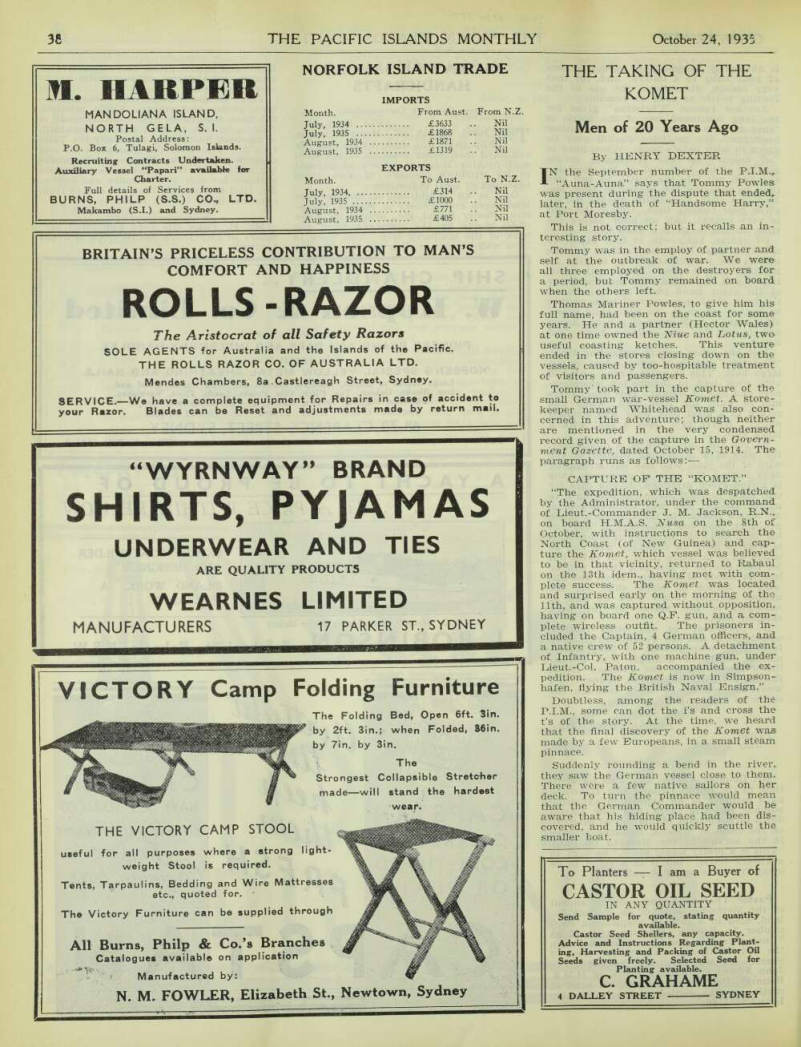
Imports
Month.
From Aust.
From N.Z.
July, 1934 ... £3633 Nil July, 1935 ... £1868 Nil August, 1934 . £1871 Nil August, 1935 . £1319 Nil
Exports
Month.
To Aust.
To N.Z.
July, 1934, ... £314 Nil July, 1935 £1000 Nil August, 1934 . £771 Nil August, 1935. . £405 Nil
The Taking Of The
Komet
Men of 20 Years Ago
By Henry Dexter
IN the September number of the P.I.M.* “Auna-Auna” says that Tommy Powles was present during the dispute that ended, later, in the death of “Handsome Harry,” at Port Moresby.
This is not correct; but it recalls an in teresting story.
Tommy was in the employ of partner and self at the outbreak of war. We were all three employed on the destroyers for a period, but Tommy remained on board when the others left.
Thomas Mariner Powles, to give him his full name, had been on the coast for some years. He and a partner (Hector Wales) at one time owned the Niue and Lotus, two useful coasting ketches. This venture ended in the stores closing down on the vessels, caused by too-hospitable treatment of visitors and passengers.
Tommy 'took part in the capture of the small German war-vessel Komet. A store keeper named Whitehead was also con cerned in this adventure; though neither are mentioned in the very condensed record given of the capture in the Govern ment Gazette, dated October 15, 1914. The paragraph runs as follows: —
Capture Of The “Komet.”
“The expedition, which was despatched by the Administrator, under the command of Lieut.-Commander J. M. Jackson, R.N., on board H.M.A.S. Nusa on the Bth of October, with instructions to search the North Coast (of New Guinea) and cap ture the Komet, which vessel was believed to be in that vicinity, returned to Rabaul on the 13th idem., having met with com plete success. The Komet was located and surprised early on the morning of the 11th, and was captured without opposition, having on board one Q.F. gun, and a com plete wireless outfit. The prisoners in cluded the Captain, 4 German officers, and a native crew of 52 persons. A detachment of Infantry, with one machine gun, under Lieut.-Col, Paton, accompanied the ex pedition. The Komet is now in Simpson hafen, flying the British Naval Ensign.”
Doubtless, among the readers of the P.1.M., some can dot the i’s and cross the t’s of the story. At the time, we heard that the final discovery of the Komet was made by a few Europeans, in a small steam pinnace.
Suddenly rounding a bend in the river, they saw the German vessel close to them.
There were a few native sailors on her deck. To turn the pinnace would mean that the German Commander would be aware that his hiding place had been dis covered, and he would quickly scuttle the smaller boat.
It must have been a dramatic moment when the pinnace quietly ran alongside.
The native crew were locked in the for’castle and their caps were placed on the heads of the native crew of the pinnace.
The German Commander was found, standing in front of a mirror in his cabin, shaving. He turned, to find himself look ing into the barrel of a revolver.
In answer to a question, he said his officers were ashore shooting pigeons.
When they returned unsuspectingly, with empty guns on their shoulders, it was a simple matter to secure them.
Steam was raised, and the vessel brought down the river, A very filthy white ensign, taken from the pinnace, was flown at the masthead, over the German eagle.
Tommy’s services were rewarded with a commission, and he was made second in command of the vessel, which was re named the Una. I saw her recently; she is doing her bit in the pilot service at Mel bourne.
With regard to Tommy’s further adven tures, one would like to write something on the lines of “From Powdermonkey to Admiral” but it would be fiction.
At Samarai, Tommy landed in all the glory of gold braid, with short naval sword.
Lovey Clunn, who will be recalled by all oldtimers, asked him, “What he was doing with the scrub knife!”
In Samarai, Tommy engaged unwisely in festivities. He offended similarly at the next port. A third reprimand carried with it his retirement from the service.
Some time later, I had a letter from the late John MacDonald, who told me that Tommy was harbourmaster at one of the Queensland ports, and had settled down as a highly esteemed citizen.
The Nusa is now the property of Steam
ships Trading Co., and is running on the N.E. coast of Papua.
Hector Wales found gold-digging in the Mandated Territory much more profitable than running the Lotus Lovey Clunn is the young lady who was shown a picture of Lord Nelson, portrayed with the empty sleeve. When asked if she knew who it was, she replied: “Oh, some silly old chap who has been shooting fish, I suppose.’’
“Auna-Auna” writes: “Those were the days! The men they’ve got now are not the men they had.”
I wonder! Surely, while we have young men of the quality of those who have re cently made Southern readers “Islands conscious,” we need not fear to compare them with men of the past.
Advertisements & other items, p. 40 (1 item)
Castor Oil Seed
To Planters I am a Buyer of
IN ANY QUANTITY
Send Sample for quote, stating quantity available.
Castor Seed Shellers, any capacity.
Advice and Instructions Regarding Planting, Harvesting and Packing of Castor Oil Seeds given freely. Selected Seed for Planting available.
C. GRAHAME
4 DALLEY STREET SYDNEY
Wreck Of M.V. Drina
From Our Own Correspondent.
Rabaul, Sept. 12.
AN enquiry was held in Rabaul on August 22 into the stranding of the motor vessel, Drina, of the Drina River Company.
Evidence showed that the vessel went ashore near Cape Cunningham, on the night of July 26, the cause being excep tionally heavy weather and consistent rains. It was shown in the evidence that in the neighbourhood of the stranding at that time 4,930 points of rain were re corded from July 21 to 26.
The Board found that the ship had been handled with care and no blame could be attached to anyone concerned.
Senator Hattil Spencer Foil, of Queens land, has joined the directorate of New Guinea Goldfields, Ltd.
Papua
Coconut Planting in Eastern Papua
ATRS. Elizabeth Mahony’s fine coconut plantation on Moturina, south-east of Sudest, has been purchased by Mr, George Brett, well-known in that part of Eastern Papua. Mr. Brett intends to plant more coconut areas on Moturina, and also contemplates extending his plan tations on Sudest itself. Mr. Brett, who is interested in goldmining in Eastern Papua, returned to Samarai by the Mon toro on October 5.
The purchase of the Bunting-Aumuller planting and desiccated coconut interests near Samarai by a Ceylon group has stir red up new hope among coconut planters in Eastern Papua, who believe that a better market for coconut and copra is about to open up.
Mr. John Albert Wilson, of Port Moresby, Papua, died at his home at Kon idobu on September 4. He had been a re sident of Papua for 16 years. Going to Papua in 1919, he joined the Papuan Ad ministration as a boat-builder. After four years in the Public Service, he resigned to commence business on his own account.
Advertisements & other items, pp. 41-42 (1 item)
DIESEL Engine
SHIP & GENERAL
COPPERSMITHS
Manufacturers of all kinds of Pipe Work, Petrol, Water, and Buoyancy Tanks for Ships, Yachts, and Motor Boats, Copper Water-jacketed Exhaust Pipes & Silencers a speciality.
Copper Pans and Stills made to specification
Nicholson & Foster
BALMAIN, SYDNEY
jsl -2
5 h.p. for l|d. per Hour
|T N every part of the world where the work is hardest, the going heaviest, and an engine is left almost to look after itself; there will be found the Lister Diesel.
Any purchaser of a Lister Diesel can look forward to years of trouble-free service, and the last ounce of power will be got out of the fuel which is put into it.
For full particulars regarding this remedy for all power troubles, write at once to Desk P.M., Box 509AA G.P.O., Sydney. er*
DIESEL Engine
WRITE FOR CATALOGUE NO. 53
DANGAR, GEDYE & Co. Ltd.
Malloch House, 10-14 Young Street, Sydney
UMBRELLAS
ONLY BRITISH FRAMES USED
' Guaranteed FAST DYED Coverings Strong Canvas-Covered Beach and Garden Umbrellas in Medium and Large Sizes—Brass Fittings Throughout.
“Shelta” Brand Umbrellas
Specially made for Tropical Conditions Manufactured by
Phillips and
House
453 Kent Street
SYDNEY
428 Adelaide St.
BRISBANE
Inquiries invited from Pacific Islands Distributors We supply the trade only.
MODERN TUBULAR
STEEL FURNITURE
Chromium-plated or Lacquered Finishes Beds Wires Bedding Hospital Furniture Tubular Steel Furniture m
rZSTSTJi
I 4‘
frM
OZ.
Radio Station 2UW, Newlands Steel Furniture Cloa Chai.—Chromium plated Steel.
Complete Catalogues on Request Cable Address “NEWLANDBED," SYDNEY.
NEWLANDS BROTHERS LTD. Riley Street, Sydney, N.S.W.
AUSTRALIA’S LARGEST MANUFACTURERS OF SLEEPING EQUIPMENT, HOSPITAL FURNITURE AND
CTCCI nPRIfiNS.
Cocoa Industry For
New Guinea
ONE of the most thorough jobs of work ever done in an Islands Department of Agriculture has been carried out by Mr. E.
C. D. Green, the New Guinea agricultural officer who was sent, for a term, to the Imperial College of Tropical Agriculture, in TrinidaJ, West Indies.
Mr. Green made a special study of the industry of cocoa-production, and the result of his researches is seen in a pam phlet just issued by the Department of Agriculture, New Guinea, entitled “Possi bility of Developing an Economic Cocoa Industry in New Guinea, after a study of the industry in Trinidad, and a suggested policy for that development.” Into this compilation Mr. Green has put the result of his valuable researches, his actual ex perience and much careful thought. The possibility of successful cocoa-production in New Guinea is examined from every angle: and the pamphlet will be invaluable to the planters who are considering this particular crop.
Part IV. of the Pamphlet carries these sub-headings:—“Method of establishment: selection of land; clearing the forest; drainage; preparation of land; layout of estate; variety to plant; planting distance; wind breaks: methods of planting; estate management; pruning: picking and break ing: fermentation: drying and curing; grading and inspection.”
Mr. and Mrs. C. H. Came arrived in Auckland, New Zealand, by the Monterey, from Fiji, on September 6. Mr. Came is manager of Messrs. Morris, Hedstrom, Ltd., at Ba.
The Spirit of a Great Chief
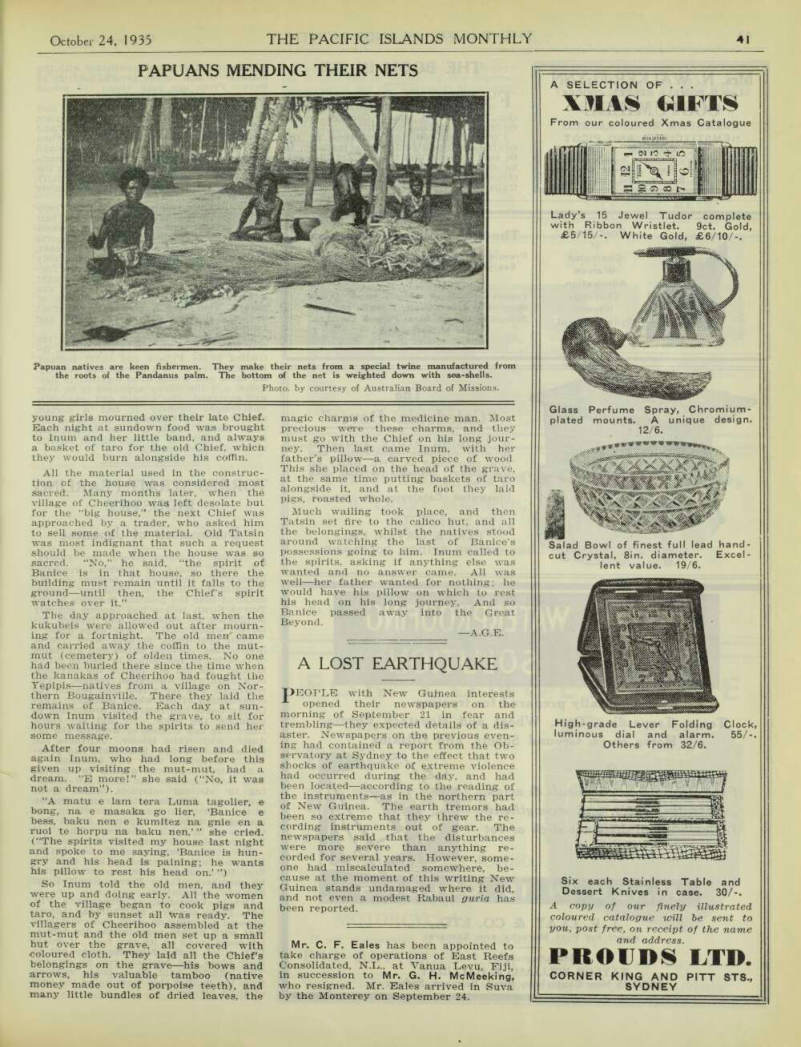
Passes On
TX)R many weeks old Chief Banice had -T been ill. His villagers waited for him to breathe his last—they would be able to work their gardens again, but while he lay ill nothing could be done.
So sure were they of his impending death that they set to and built a great, long house wherein to lay his coffin.
Just as though arranged, old Banice died —three days after the house was completed. Amid much wailing, the old men of the village broke up one of the late Chief’s chunuhais (canoes) and out of it constructed a coffin. At sundown they laid Banice in his coffin, arrayed in all his brightest clothes. Baskets of taro (native potato) were placed in the coffin with him in case he should be hungry on his way. After the sun had set the old men carried the coffin bearing the last of Banice —their most respected Chief and medicine man—to rest for a fortnight in the house they had built.
All the kukubeis (girls) about the age of 16 in the village of Cheerihoo (which is situated on Buka Island in the Nor thern Solomons) and the other nearby villages were gathered together and put into the Luma pun (Big house). There they were to remain for a fortnight to mourn over the Chief, who had left an only daughter, Inum, a kukubei of 16.
Since she must mourn over her father, the other kukubeis were compelled to keep her company. They were not to put a foot outside the Luma until the fort night was up, was the strict command of the old men. So for a fortnight the
young girls mourned over their late Chief.
Each night at sundown food was brought to Inum and her little band, and always a basket of taro for the old Chief, which they would burn alongside his coffin.
All the material used in the construc tion of the house was considered most sacred. Many months later, when the village of Cheerihoo was left desolate but for the “big house,” the next Chief was approached by a trader, who asked him to sell some of the material. Old Tatsin was most indignant that such a request should be made when the house was so sacred. “No,” he said, “the spirit of Banice is in that house, so there the building must remain until it falls to the ground—until then, the Chief’s spirit watches over it.”
The day approached at last, when the kukubeis were allowed out after mourn ing for a fortnight. The old merf came and canned away the coffin to the mut mut (cemetery) of olden times. No one had been buried there since the time when the kanakas of Cheerihoo had fought the Yepipis—natives from a village on Nor thern Bougainville. There they laid the remains of Banice. Each day at sun down Inum visited the grave, to sit for hours waiting for the spirits to send her some message.
After four moons had risen and died again Inum, who had long before this given up visiting the mut-mut, had a dream. “E more!” she said (“No, it was not a dream”).
“A matu e lam tera Luma tagolier, e bong, na e masaka go lier, ‘Banice e bess, baku nen e kumitez na gnie en a ruoi te horpu na baku nen,’ ” she cried. (“The spirits visited my house last night and spoke to me saying, ‘Banice is hun gry and his head is paining; he wants his pillow to rest his head on.’ ”) So Inum told the old men, and they were up and doing early. All the women of the village began to cook pigs and taro, and by sunset all was ready. The villagers of Cheerihoo assembled at the mut-mut and the old men set up a small hut over the grave, all covered with coloured cloth. They laid all the Chief’s belongings on the grave—his bows and arrows, his valuable tamboo (native money made out of porpoise teeth), and many little bundles of dried leaves, the
magic charms of the medicine man. Most precious were these charms, and they must go with the Chief on his long jour ney. Then last came Inum, with her father’s pillow—a carved piece of wood This she placed on the head of the grave, at the same time putting baskets of taro alongside it, and at the foot they laid pigs, roasted whole.
Much wailing took place, and then Tatsin set fire to the calico hut, and all the belongings, whilst the natives stood around watching the last of Banice’s possessions going to him. Inum called to the spirits, asking if anything else was wanted and no answer came. All was well —her father wanted for nothing; he would have his pillow on which to rest his head on his long journey. And so Banice passed away into the Great Beyond.
A.G.E.
Papuans Mending Their Nets
Papuan natives are keen fishermen. They make their nets from a special twine manufactured from the roots of the Pandanus palm. The bottom of the net is weighted down with sea-shells.
Photo, by courtesy of Australian Board of Missions.
A Lost Earthquake
X>EOBLE with New Guinea interests A opened their newspapers on the morning of September 21 in fear and trembling—they expected details of a dis aster. Newspapers on the previous even ing had contained a report from the Ob servatory at Sydney to the effect that two shocks of earthquake of extreme violence had occurred during the day, and had been located —according to the reading of the instruments—as in the northern part of New Guinea. The earth tremors had been so extreme that they threw the re cording instruments out of gear. The newspapers said that the disturbances were more severe than anything re corded for several years. However, some one had miscalculated somewhere, be cause at the moment of this writing New Guinea stands undamaged where it did, and not even a modest Rabaul guria has been reported.
Mr. C. F. Bales has been appointed to take charge of operations of East Reefs Consolidated, N.L., at Vanua Levu, Fiji, in succession to Mr. G. H. McMeeking, who resigned, Mr. Bales arrived in Suva by the Monterey on September 24.
Advertisements & other items, pp. 43-44 (1 item)
Profds Ltd.
A SELECTION OF . . .
XMAS GIFTS
From our coloured Xmas Catalogue monimiu CA - =
G 4 K) -T
C: S, a co t"
Lady’s 15 Jewel Tudor complete with Ribbon Wristlet. 9ct. Gold, £5/15/-. White Gold, £6/10/-. 3 Glass Perfume Spray, Chromiumplated mounts. A unique design. 12/6. -N Salad Bowl of finest full lead handcut Crystal, Sin. diameter. Excellent value. 19/6.
High-grade Lever Folding Clock, luminous dial and alarm. 55/-.
Others from 32/6.
Six each Stainless Table and Dessert Knives in case. 30/-.
A copy of our finely illustrated coloured catalogue vnll be sent to you, post free, on receipt of the name and address.
PROFDS LTD.
CORNER KING AND PITT STS.,
SYDNEY
Mrs. N. WALKER-FLYNN
Late 35 POWELL STREET, COOGEE
COSTUMIERE
MALAGUNA ROAD, RABAUL
HEMSTITCHING AND PICOT
EDGING
Copies of Mab’s Fashions; Roma’s Pictorial Fashions and Home Fashions available.
P.O. Box 116. TeL: 141
Head Study of Champion Walvon Admiration, Challenge Winner, Sydney Royal, 1934
The Noted Walvon Kennels
Premier Breeders of Scottish Terriers, Sealyhams, and Wire-haired Fox Terriers.
Puppies available all the year round. Orders direct to Walvon Kennels, 1 Merlin St., Nth, Sydney, or through Burns Philp & Coy. Ltd., or Mcllraths, Ltd.
The
“Caledonia Dover”
A COOKING STOVE guaranteed to give complete satisfaction and now recognised as THE BEST on the market. Suitable for coal, coke or wood fuel.
Illustrated Catalogue on request.
LANE & GIRVAN, LTD.,
BONNY BRIDGE, SCOTLAND.
WATERPROOFING
SOLUTION
Specially prepared for treating Tents, Tarpaulins, Cart, Wheat and Haystack Covers, Horse Rugs, Ground Sheets, and Oilskins Free of injurious chemicals & acids, penetrates, binds, and strengthens.
Is flexible and does not stick or rot material
MADE IM 15
v;
J. R. CLAY & CO. LTD.,
Agent for Port Moresby and Samara!
Manufacturers:
TAYLOR WILLIAMS & HALLIDAY
185-195 New Canterbury Road, Belmore, Sydney
The Boom In Fiji
FIJI provides a remarkable illustration of the efficiency of British colonisa tion,” commented Mr. V. Cornaga on his return to Auckland recently.
Commenting on the influence of the newly-established gold-mining industry, to be seen in Suva and the country districts, he said that business people reported in creased trade, and every vessel from Aus tralia and New Zealand was bringing
miners and other people connected with the industry to add to the general activity of Suva. From one mail vessel 140 people had recently landed at Suva.
Apart from gold mining, Fiji was also attracting increased numbers of tourists from New Zealand, Australia, America and Europe, and it was anticipated that when the Union Company’s new inter-island vessel was placed on the run many Ameri can tourists would go to Suva to await the Island vessel, and the splendid opportunity it offered for a cruise which was almost without equal.
Mr. Cornaga pointed out that not only were the tourist figures for the first half of the present year almost up to the whole of last year’s total, but also that imports and exports showed a considerable increase.
The export of gold was adding considerably to those figures, which would show a fur ther increase as other mines were brought into operation. Apart from that, there was a marked increase in the production of sugar. That had a very marked effect upon the spending capacity of the Ba and Lautoka districts.
Mr. Cornaga also remarked . upon the fact that despite its mixed population, in cluding 96,656 Fijians and 80,991 Indians,.
Fiji appeared to be a law-abiding country.
All races and creeds lived together in har mony, and the colony appeared to be very well governed. For a small and practically undeveloped country it had a certain, future. It was situated as it was on the main Pacific route, and an enterprising: reading policy was opening up the interior to settlers and tourists.
Domination of Japanese
Torres Strait Pearling
Industry
GIVING evidence before the Federal Tariff Board at Brisbane recently,.
Francis E. Hockings, a partner in the Wanetta Pearling Co., Thursday Island, declared that the pearling industry in the Torres Strait region had become entirely dominated by Japanese and foreign in terests which paid a lower wage scale.
Their operations, he said, were free of license fees, customs duties and all forms, of taxation or restriction by fishing regu lations. He did not favour the payment of a bounty to Australian vessels. The real need was for a root and branch re organisation of the whole industry. Aus tralian boats had restricted production to maintain the price. He did not think there was any chance of working the in dustry with white labour. Japanese ran the whole industry. Europeans had prac tically no say in their own business.
A patrol boat was needed to impress both local Japanese and check law-break ing by visiting sampans, which broke every law. Witness said a reorganisation of the industry and more supervision was. needed to make the Japanese aware that they were in British territory. They had become very arrogant and domineering.
The acting chairman of the board (Mr..
Syanan) said it seemed to him that the first thing needed- was concerted action by members of the Torres Strait Pearl Shellers’ Association.
Donald Farquhar, of Farquhar’s Pty.
Ltd., pearl shellers, at Thursday Island, opposed a bounty on shell, and considered that with proper organisation the indus try could stand on its own feet. It would help a lot if the Japanese were put ln> their place and business run by owners.
The industry paid when boats working from the mother ship were under the eyes of their owners.
Fortunes
Income Tax On Fiji
Collectors on the Warpath
THE subject of income tax in relation to Fiji mining transactions is likely to bulk large in the future and to give head aches to governments, taxation commis sioners and investors.
Some huge profits have been made al ready by speculators in Fiji gold mines; and the Government of Fiji, as well as taxation authorities in six Australian States and one Commonwealth, are busily sharpening their carving knives.
Fiji extracts a five per cent, gold royalty: but only one Fiji gold mine on the Tavua field has yet reached production. In con sequence, the public revenues have not benefited much from the new gold industry.
Fortunes have been made out of Fiji gold, but they have been made by speculators in shares; and share speculators notoriously are gentlemen who show a curious shy ness in sharing their gains with govern ments.
Fiji also imposes a modest rate of in come tax; and one can imagine the Fiji Government biting its fingernails and de ciding that, since it cannot yet get a royalty on Fiji gold, it will get a share of the profits by way of income tax.
Such startling stories of fortunes made out of the Tavua field have been published that one may be sure that every taxation department in Australia is on the alert, and one hears that already the net has been spread wide. It is said, for instance, that the hounds of taxation are in full cry after Messrs. Theodore, Wren, Packer and Co., who are supposed to have cleaned up phenomenal sums out of the Emperor enterprise.
Goldmines speculators are notoriously shrewd and downy birds and it can be taken as certain that, even as they were assembling their rich profits, they were making plans in regard to taxation. It is reported, for instance, that one of the leading figures of the Tavua developments, although for many years an Australian citizen, has made plans to escape punitive taxation by obtaining domicile in Fiji, and by registering his Fiji enterprise in an even more distant part of the Empire.
Some of the gentlemen in the Fiji gold mining game are chuckling over the case of a young Englishman, who literally fell into a fortune and then decided to make a visit to London. He went off with the clear understanding that he was to return to Fiji and he took his fortune with him.
He has not returned; and his address is uncertain; and the Fiji Government has not collected income tax on a mere £50,000 or so.
Incidentally, if and when the Tavua goldfield reaches big production, the ques tion of whether there is to be a gold royalty only, or a gold royalty plus income tax, is likely to become a really live ques tion. Under present conditions it looks as if bona fide Australian investors in Fiji goldmines will have to pay about four dif ferent taxes—namely, Fiji gold royalty.
Fiji income tax, Australian State income tax, and Commonwealth income tax. Look ing at it from that angle one is inclined to say that the investor in Fiji goldmines is entitled to every penny legitimate, or near legitimate, that he can get out of the en terprise.
Mr. George Kenneth Kingston, an Eng lishman, who had been mining and pros pecting for gold for many years on the Morobe field, died at Wau on September 3.
Matron A. S. Williamson left Sydney for Misima Island, Papua, by the Septem ber Macdhui, for the Methodist Missionary Society.
Mr. Cecil Henry Penrice died in Suva Colonial War Memorial Hospital on Sep tember 2, as the result of injuries sus tained in a motor-cycle accident. He was 6l years of age. Going to Fiji from Eng land in 1894, he took up banana planting at Samabula. Later he was plantation overseer for 10 years on Verata Estate.
After the Great War Mr. Penrice engaged in the dairying industry at Rewa, until the 1932 floods destroyed his stock.
Advertisements & other items, pp. 45-46 (1 item)
Batteries
V. H. Jones & Rickard
Electrical Engineers
525 ELIZABETH STREET
SYDNEY
Specialists in rewinding and repairing all classes and sizes of electrical machines and equipment.
Special treatment given to work for the tropics.
TELEPHONE: MA 1397
HARRY WEST - - Sydney’s Sailmaker
Caters for every class of
SAIL, CANVAS,
ROPE & WIRE
EQUIPMENT
Send your enquiries to us
ADDRESS:
BALMAIN.
SYDNEY
r\ V. mM m u m
SECTION OF OUR SAIL LOFT
Wilhelm Breckwoldt & Co.
9, Lange Muehren, South Sea Bldgs.
HAMBURG GERMANY
(Exporter* and Importer*) We Export: Trade Goods of any description, Cutlery, Hardware, Miner*’
Requisites, etc., etc.
We Import: Any kind of Island Produce.
CORRESPONDENCE INVITED
FOR LONGER LIFE
USE .. .
ERG
BATTERIES
FOR
CARS, TRUCKS, RADIO,
HOUSELIGHTING,
MARINE WORK,
MOTORCYCLES
If not represented in your district write direct to— ERG BATTERIES LTD. 156 goulburn st„ sYDNEYrN.s.w, TO ELECTRICAL ENGINEERS MANUFACTURERS OF QUALITY BATTERIES
A HOSTEL
For Your Children
Tamarang Hostel, situated on the heights of the Lane Cove River in healthy, open surroundings, is the ideal Sydney home for Islands children.
Sunny rooms, ample playground, good food.
All the care and comfort of home.
House Mother: Mrs. G. Allnutt.
Assistant: Miss E. Allnutt, Write to:
TAMARANG HOSTEL
Penrose Street, Lane Cove Sydney Telephone: J 6722.
£vd that
Backache!'
m “Every Picture tells a Story.”
TZEEP ACTIVE AND WELL!
* Don’t endure backache, dizzy attacks, renal dropsy, rheumatism, sciatica, lumbago, urinary disorders, gravel, stone, unnatural drowsiness, and bladder weakness!
These symptoms tell you that the kidneys are weak —that you urgently need Doan's Backache Kidney Pills, Delay only makes matters worse —uric acid and other harmful impurities are being allowed to collect in the blood, setting up mischief in every vulnerable part of the body.
Get right to the cause of the trouble the weakened kidneys.
Strengthen them by taking Doan’s
Pills, the special kidney tonic, and you will be amazed how quickly you will feel yourself again.
Be sure to insist upon
Doan’s
Backache Kidney
Pills
Murnau’s House Destroyed
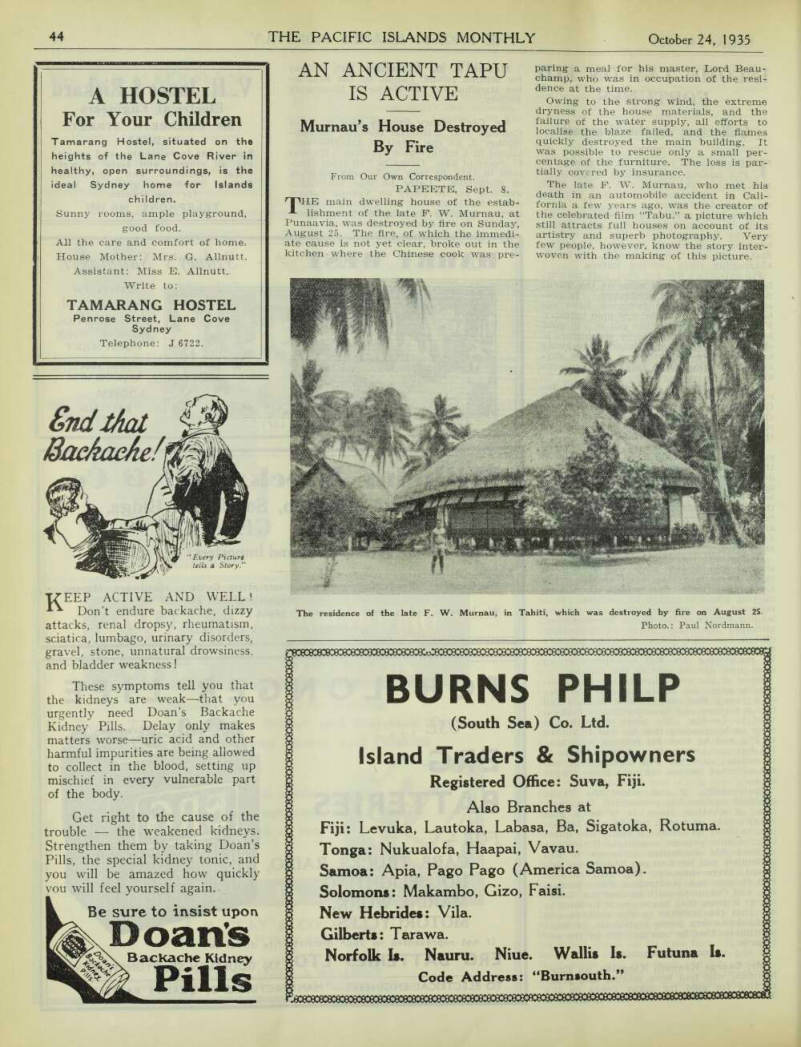
An Ancient Tapu
Is Active
By Fire
From Our Own Correspondent.
Papeete, Sept. 8.
main dwelling house of the estab lishment of the late F. W. Murnau, at Punaavia, was destroyed by Are on Sunday, August 25. The fire, of which the immedi ate cause is not yet clear, broke out in the kitchen where the Chinese cook was pre
paring a meal for his master, Lord Beau champ, who was in occupation of the resi dence at the time.
Owing to the strong wind, the extreme dryness of the house materials, and the failure of the water supply, all efforts to localise the blaze failed, and the flames quickly destroyed the main building. It was possible to rescue only a small per centage of the furniture. The loss is par tially covered by insurance.
The late F. W. Murnau, who met his death in an automobile accident in Cali fornia a few years ago, was the creator of the celebrated film “Tabu.” a picture which still attracts full houses on account of its artistry and superb photography. Very few people, however, know the story inter woven with the making of this picture.
The residence of the late F. W. Murnau, in Tahiti, which was destroyed by fire on August 25.
Photo.: Paul Nordmann.
The name “Tabu” (which really ought to be spelled “Tapu”), is a word which means in the Polynesian language “forbidden,” or “sacred.”
A large part of Murnau’s picture was filmed on a small, low islet, one of many similar islets strung like a necklace along the outer reef of Borabora, in the Leeward group, and which make the enclosed lagoon such an attractive place for yachtsmen and visiting warships.
But Murnau’s particular islet has a sinis ter reputation among the natives. It is a place strewn with the remains of ancient viaraes (temples), and haunted by the ghosts of those who were brought hither to be sacrificed on the altars of the old-time heathen gods. Unearthly voices are said to sigh and whisper through the pendant fronds of the Casuarina trees lining the beach. It is tapu in the real Polynesian meaning of the word.
Murnau was warned of misfortune: but his artistic and romantic soul would not be denied —in fact, the stories connected with this islet made a strong appeal to him, as the most suitable place in which to film the story he had planned. In due time the picture was finished, and his luxurious home in Punaavia was well on the way to completion. Here he intended to spend the remainder of his days, among the natives he had grown to love. When he left for California, to put sound into the picture, the presage of disaster was strong upon him. So overwhelming was his emotion that he could not meet his friends to bid them good-bye. He was killed soon after his arrival in America.
Later on, it is said, a wealthy lady of San Francisco, tenant of the Punaavia establishment, committed suicide therein.
And there have been other incidents which would take too much space to recount here, but all tending to show that the old tapu is still exercising its malevolent influence.
Such at least is the native interpretation of events. Now comes the fire!
Lord Beauchamp removed to the Blue Lagoon Hotel, and later departed from Tahiti for Australia by the Makura on September 7. It is much regretted that he should have been obliged to curtail his visit owing to the unfortunate circum stances of the fire. Much sympathy is felt here for Mr. R. Murnau. brother of the late film director, in the financial and senti mental loss he sustains.
Advertisements & other items, p. 46 (1 item)
Burns Philp
(South Sea) Co. Ltd.
Island Traders & Shipowners
Registered Office: Suva, Fiji.
Also Branches at Fiji: Levuka, Lautoka, Labasa, Ba, Sigatoka, Rotuma.
Tonga: Nukualofa, Haapai, Vavau.
Samoa: Apia, Pago Pago (America Samoa).
Solomons: Makambo, Gizo, Faisi.
New Hebrides: Vila.
Gilberts: Tarawa.
Norfolk Is. Nauru. Niue. Wallis Is. Futuna Is.
Code Address: “Burnsouth.”
Fiji’S Gold Boom
The Governor’s Problem
From Our Own Correspondent.
SUVA, October 2.
QINCE his return from England, the ° Governor of Fiji, Sir Murchison Fletcher, has been much engaged in study ing the problem presented by the gold mining activities of various Australian Companies. It is known that he is par ticularly concerned with the speculation which is rife in Fiji gold-mining shares in Australia, and more particularly in the case of those companies who have not so far acquired titles in Fiji.
The Nasivi affair has demonstrated the need for prompt action in regard to deny ing statements made regarding alleged concessions obtained in Fiji.
The “Fiji Times and Herald” has com mented recently upon the need for releas ing in Fiji information given to the Stock Exchanges of Melbourne and Sydney by the various Companies engaged in pros pecting operations. As it is, it takes some
weeks before the statements published in the Australian Press are available at Suva, and when inaccuracies are noticed, the mischief has already been done.
All Companies operating in Fiji are com pelled to register, and steps, therefore, could be taken to enforce upon them the necessity of making full information available in Fiji as it is made in Sydney or Melbourne.
In view of the discretionary powers in vested in the Governor under the Mining Ordinance, a prospecting company would be well advised to comply, not merely with the letter of the law, but with the spirit thereof.
Mr. J. C. Barley (Resident Commis sioner in the Gilbert and Ellioe Islands Colony), accompanied by Mrs. Barley, passed through Sydney early in October, on their way from Queensland, to catch a steamer for Ocean Island. Mr. Barley has suffered a severe illness, the result of malaria, contracted in the Solomons, and has been recuperating for some months in South Queensland.
Mr. D. R. A. Eden, of Vailala planta tion, Samoa, has been appointed general manager of the N.Z. Reparation Estates, in Western Samoa, in succession to Mr.
F. L. A. Gotz.
Advertisements & other items, p. 47 (1 item)
Kjnjgusa
PURE RICE
STARCH
Always ask for . . .
“CORAL” Brand
Manufactured by Coral Starch Ltd.
Sydney, N.S.W.
WE ARE SPECIALISTS!
Let us have your confidence, sixty years is our record of supplying the Leading Houses throughout the World in—
FRESH FRUIT VEGETABLES PRODUCE
WEYMARK & SON LTD.
Fruit and Produce Merchants
14-18 STEAMMILL STREET, SYDNEY
Phones: MA 3612 Cable Address: Codes—Bentleys. (4 lines) "Weymarkson” Private.
Always Serve
KINKARA TEA
TEA benefits the health. Science has proved this. As KINKARA is a GOOD tea, it should be used always . . . Morning . . . Noon - • Night. KINKARA, the Health Tea, calms the nerves; restores energy and banishes mental stress. A cup of KIN- KARA acts like magic. KINKARA Tea is no dearer than ordinary brands. As it is absolutely free of dust, you get nothing but pure tea. KINKARA therefore makes more cups to the pound.
KJNJgUSA
J. R. Love & Co., Ltd., Sydney.
Survey of Misima
Goldfield
WE arrived at Bwagaoia, the port at Misima (Eastern Papua) at 10 a.m. after a two-days run from Samarai. We could see the island for hours before we arrived, looking huge and forbidding after the small coral islands we had passed, and with rain shrouding its lofty peaks.
The harbour is small but well sheltered, with an ample depth of water. On the left of the wharf several buildings appeared among the coconut palms on the fore shore, while on the right Burns Philp’s store stood. We were lucky enough to have arrived while the motor truck from New Misima Gold Mines was at the wharf.
We got a lift to the mines. It is not a trip recommended for pleasure or comfort, “but it is full of interest.
In about an hour’s time we came to the
top and saw the prospecting drives of the Misima United Co. This company has a number of leases which it is prospecting at present. As far as we could ascertain their results, so far, have warranted fur ther work. There was a staff of seven Europeans and 40 natives.
We then descended around more curves to New Misima Goldmines property. Our first view' of this dividend-paying com pany’s show was the saw-house, where piles of timber were stacked for use in the mine. From a view of the timber-denuded slopes, we came to the conclusion that the timber supply is a problem which merits a deal of thought on the part of companies intending to operate on the island of Misima.
A little further on we came to the mill— a ten head stamper battery and cyanide plant, which treats twelve hundred tons of ore per month for a value, in Australian currency, of £3OOO. This company is pay ing a 10 per cent, dividend every month, the highest in the Commonwealth. Fred
W. Cuthbert is managing director, P. R.
Osborne (late of Port Moresby) is the cyanide manager, and James Quintrell the underground manager. Sixteen Europeans and 200 natives are employed. Later, we were shown through the mine and the miles of levels, the large stopes, the heat and other things all impressed us.
After leaving Umuna, as the place is locally known, we proceeded by hiking to Mt. Sisa, where Gold Mines of Papua are carrying out prospecting and development work. This company certainly deserves to succeed, as a great amount of work has been done. We understood that a pilot plant was to be erected shortly.
Beyond Mt. Sisa are numerous leases be longing to Misima United, on which no work has been done as yet. An area be longing to Misima Central is also out there, but as no one was there we could not see through the extensive workings.
Further on, we came to the St. Patrick lease, owned by Jack Smith. He and party have done a lot of prospecting and are at present waiting the arrival of an engineer to report on the show for a party that have an option over the area.
On our way back we called in at Misima Reefs where the Oroville Co. has an option.
Major S. Love is in charge of their work which has been going on now for sixteen months. We declined an invitation to view their underground workings, but saw quite a lot of ore, very much similar to Umuna ore, at the mouths of several of their adits.
The position of the Ginisia leases was pointed out to us, but as no one was there we did not go over.
We still had sufficient time left to make a short visit to Quartz Mountain and were shown over their most up-to-date plant.
The next time we visit Misima there probably will be several mines at the pro ducing stage. We cannot verify Mark Twain’s definition of a min© as “a hole in the ground owned by a liar,” but would not care to dispute the Misima definition of a liar as “a man who has a mining lease for sale.” We were given to understand that there is still a large area of the island not covered by mining leases yet.
Daika.
Mr. C. H. Karius, Assistant Resident Magistrate at Rigo, Central Division, Papua, arrived in Sydney from Port Moresby by the Macdhui in October, on seven months’ furlough. During his ab sence Mr. W. H. Robinson, of the Native Taxation Department, is taking charge of affairs at Rigo.
Mr. and Mrs. Norman Brown arrived in Sydney from Fiji by the Monterey on September 9. Married at Suva on Sep tember 3, they will spend their honeymoon in Australia. Before her marriage the bride was Miss Enid Walcot, of Suva.
Advertisements & other items, p. 48 (1 item)
# BULLIVANTS wire ropes
>_l_. /.
Coleman Kerosene Mantle Lamp
These Newer and Better Lamps
are big with brilliance and beauty and design yet economical to burn and strong in construction.
Fitted with PARCHMENT SHADES, ROTO AUTOMATIC
LONG LIFE GENERATOR and positive FUEL AND AIR
RELEASE VALVE.
COLEMAN LAMPS in various sizes are warranted to give fullest SATISFACTION and SERVICE.
They burn Kerosene, but will burn Benzine if desired.
Ask your Island Storekeeper for Catalogues and Information
Coleman Lamp & Stove Co. Ltd.
500 KENT ST., SYDNEY
USOLINE i™.
COCKROACH DESTROYER
It Attracts —They Eat It- Dia
AUSOLINE CO.
314 CROWN STREET, SYDNEY
Established 1919 PRICES: lib. 5/-, 3lbs. 10/-. Postage Extra.
Remit Cash with Order.
It’s a Paste
BULLIVANTS wire ropes
“THE WORLD’S STANDARD”
LARGEST STOCKS IN AUSTRALASIA - FOR ALL PURPOSES Also Blocks, Hooks, Shackles, Thimbles, Strand, Seizing, Aircraft Cord, etc.
Letters: BULLIVANTS’ Australian Co. Ltd. Teie g ram.= Box 1298 J, G.P.O. 331-333 KENT STREET, SYDNEY Prompt Attention! Efficient Service!! Complete Satisfaction!!! ‘Bullivants Ltd.,’
Sydney.
Safety Last in New Guinea
Letter to the Editor.
CALAMAUA aerodrome, at the very front door of the goldfields, is in a shocking state of disrepair and is unsafe for humans or aeroplanes. It seems that a fatal accident or two is necessary be fore the Administration authorities will put the ’drome in order, and provide at least some reasonable measure of safety to those who are obliged to pilot or travel as passengers in aeroplanes.
The following notice, signed by the Acting Warden, appears on the notice board of the Warden’s office at Wau: “The attention of miners is drawn to the minute of the (government Secretary as set out hereunder:—T am directed to re quest you to draw the attention of the mining community in the Morobe district to the necessity of great care where human life is endangered. There have been three fatal accidents very recently, and during the examination of the Annual Report for 1933-34, members of the Man dates Commission referred to the matter of accidents on the Goldfields’.”
Ye gods! The Mandates Commission!
What about the Administration doing its job, and keeping first-class inspectors of mines on the Goldfield? During the past twelve months, three mining engineers of varied experience have thrown in their jobs with the New Guinea Mines Depart ment. Why? At the present time it is questionable if there is one man in the New Guinea service capable of acting as inspector of mines. Although the Gold field is producing gold to the value of £2.000,000 per year, the control of the Department is in the hands of men
who would not know a mine if they fell down the shaft of one!
As one who has to earn his bread and butter as a surface or underground miner, 1 have seen mining malpractices during the past few months on the Morobe Gold field that would cause strikes in other countries. This would not happen with proper supervision of mining work by the Government. Anyone can manage a mine under the New Guinea mining law, cer tificated managers not being necessary as in Australia and elsewhere. In New Guinea, hundreds of white men and thousands of natives are engaged in the mining industry, and their safety is something that the Government ap parently winks at, with the blind eye, and gazes steadfastly at the Mandates Com mission with the one that is not so blind.
If a little of the money now being lavished at Wau on painted palaces (costing over £1,300 eacn!) for pen-pushers of a pampered Public Service (pardon the alliteration), were spent on safeguarding the lives of black and white in the Morobe District, and in assisting mining, the country would be worth fighting for.
During the past twelve months I’ve been eking out a precarious crust as a miner, but I’m off to the Abyssinian war, Mr.
Editor. It will be just as safe as mining in New Guinea.
I am etc.,
Safety First And Last.
Edie Creek, T.N.G. 20/8/35.
Mr. Harvey George Morton, of Doa, Papua, married Miss Vera Harriet Lein ster, of Atherton, North Queensland, at St. John’s Anglican Church, Port Moresby, on September 19.
The British Phosphate Commissioners’ vessel Nauru Chief, which has been en gaged for several years in the phosphate trade between Nauru, Ocean Island, and Melbourne, has been sold to William Crosby and Cos. Pty. Ltd., a Melbourne shipping firm, for trade in the East.
Advertisements & other items, pp. 49-50 (1 item)
Deutz Diesel Engines
Specialists in
TWINES and
CORDAGE
Cotton-Hemp Jute Plough Reins Halter’s Sewing Twines Fishing Lines And Sash Cords / <4/ & V All Enquiries Invited And where Not Represented Agents are Desired Prices on Application u/ Fitzroy St., Marrickville, N.S.W.
CABLE ADDRESS:
‘BENTLEYSON,” SYDNEY
DEUTZ DIESEL ENGINES
i i 6°55/2 OM Type :: 8-145 h.p. Sizes >ection of OM type showing scavenging air pump
Marine- Stationary - Portable
The Correct Engine for Tropical ..
f I
DEUI I
G
REPRESENTATIVES . . .
HERBERT DEL COTT PTY., LTD.,
Kelvin House, 15 Castlereagh Street, Sydney
(And at Melbourne) ’Phone B 3135 Cables: “Voltage,” Sydney
WHERE TO STAY IN PORT MORESBY
FIRST-CLASS ACCOMMODATION.
THE
PAPUA HOTEL
Catering specially for Tourists and Travellers Situated on high ground overlooking both coasts, its Spacious Lounges are always Cool and Comfortable. Tariff: Per Day, 16/-; per week, £5/5/-; per month, £l4; bed and breakfast, 10/-; bedroom only, 7/6.
Cars meet all steamers.
PARTIES ARRANGED.
Licensee: Papua Hotel, Ltd.
HOTEL MORESBY
NEAR THE
WHARF
COMFORTABLE
ACCOMMODATION
ONLY THE BEST
BRANDS OF
WINES, SPIRITS
AND BEERS
IN STOCK
LICENSEE:
Hotel Moresby
Ltd.
COSMOPOLITAN
HOTEL
Samarai
First-class Accommodation for Tourists and Travellers Ball-room; Electric Light; Billiards; Freezing-works; Cold Store. Best brands of Wines, Spirits, Ales.
MODERATE TARIFF
Fishing Trips and Launch Excursions arranged Licensee: E. J. Morrow
TAHITI
AND
French Oceania
RECENTLY PUBLISHED
This book, by Samuel Russell, has just been published. It is a valuable work of reference, insofar as it gives, in relation to Tahiti and French Oceania, complete details of administration, commerce, sport, tourist resorts, industries, excursions, hotels, immigration and land laws, etc.
Yachtsmen and fishermen, who are visiting Tahiti in increasing numbers, will find this a most useful handbook.
It also supplies a fascinating account of life in Tahiti—one of the most delightful places of residence in the world.
Copies from: S. RUSSELL, Papeete, Tahiti.
ANY SYDNEY BOOK STORE.
Pacific Publications Ltd.,
247 George Street, Sydney
Price in Australia (posted): Cloth bound, 6/-; paper-cover, 5/-.
SAMARAI HOTEL
The Rendezvous of the Miners of Eastern Papua.
Comfortable Accommodation for Tourists, Travellers and Residents. Best Brands of Spirits and Wines —Victorian Lager Beers.
FISHING EXCURSIONS ARRANGED
Licensee: Mrs. L, M. SKELLY.
HOTEL BULOLO
WAU, T.N.G.
Picturesquely situated, overlooking the Wau Aerodrome, at the Business centre of the Morobe Goldfields.
FIRST-CLASS CUISINE—3O com-
fortable Bed-rooms —Hot and Cold Showers —Fresh Fruit, Vegetables, and Dairy Produce from the Hotel Gardens.
The Hotel Bulolo is famous for its wide, cool verandah-lounge.
Only the Best Brands of Wines, Spirits, and Beers in stock.
OVEL It AIS A I I.
COOL AND SPACIOUS LOUNGES - COMFORTABLE
ROOMS - DINNER PARTIES SPECIALLY ARRANGED
Excellent Dance Floor and Musk. a i Jk □ 1 Under the Personal Management of Mrs. H. Luxmoore
at Rarotonga
The Royal Molars
How a Calamity Was Averted at Rarotonga
From Our Own Correspondent.
Rarotonga, Sept. 2.
LORING ANDREWS, the American writer and novelist, who recently re turned from California to take up per manent residence here, had an amusing experience whilst fishing last month.
The author favours the native method of getting his dinner and is highly pro ficient underwater with diving glasses and a 12ft. barbless spear, with which he thinks nothing of spending three or four hours exploring coral caverns on the ocean side of the reef.
A short time before this incident oc curred, Tinirau Makea Ariki, Paramount Chief of Rarotonga and also an enthu siastic fisherman, had gone out at Aro rangi to seek the wily kingfish. There was a choppy sea running and, coming back, the royal canoe capsized at the entrance to the narrow passage. The Chief, who was alone, scrambled ashore with difficulty, minus canoe, fishing tackle, fish and —his false teeth. The loss of the latter was serious. Two visiting warships were due shortly and there were to be feasts and junketings at which he would be prominent.
Young bloods were sent to Arorangi and there spent hours unsuccessfully searching for the missing plates. Days passed and soft foods continued to be served at the Palace.
A week later, Loring Andrews, swim ming about outside the passage, saw, 10 feet below, a strange twin marine growth, pearly white and apparently growing on a pale pink crescent base. Intrigued, he dived down and to his astonishment found a perfectly good set of false teeth.
Enquiry revealed their ownership and the royal molars were restored to the royal mouth, social calamity was averted, and gastronomic equanimity re-estab lished in the Palace.
Petty Thefts In Samoa
From Our Own Correspondent.
APIA, Sept. 26.
"OETTY thefts, mostly committed by -*• Samoan youngsters, are of common occurrence at the present time in Samoa.
In at least three cases lately, young Sa moans under the guise of sellers of fruit, have managed to steal varying amounts of money, mostly banknotes, from the offices and residences of Europeans in Apia. Thefts of fowls, ducks and pigs are of common occurrence. The police are energetically hunting after the offenders, and in some cases severe birch ings have been administered to the culprits.
The Harbourmaster’s house was in vaded recently by thieves, who got away with the contents of the ice chest and various household utensils, while Mr.
Syddall’s store was broken into and a quantity of cigarettes and tobacco stolen.
Before the Apia High Court early in September Faanuna, a Samoan woman Apia, was found guilty of having stolen trinkets and jewellery worth £l2 from the house of a European resident.
When searching Paanunu’s house to re cover the articles—gold brooches, ear rings, necklaces, etc.—the police found a silver wristlet watch stolen previously from one of the Marist Brothers.
Distinguished Visitors At
Cook Islands
From Our Own Correspondent.
Rarotonga, Sept. 5.
Captain Michael Greaves And
the Baroness von Bruckner, who are en route to Honolulu via New Zealand, have been staying here for the past month.
Whereas Hawaii and Tahiti are consis tently favoured by the decorative and amusing, people of this type are infre quent visitors to Rarotonga where their clothes and whole manner have a dis tressing habit of reminding us that the world is still turning and that our own particular speed is a lap or two behind the rest.
The Baroness is typical of that smart post-war Germany which made a cult of health and a fetish of physical perfection.
Captain Greaves has a distinguished military record. Attached for several years to the Allied Police Commission in Constantinople, he later, as a member of the British Secret Service, played no small part during those turbulent days which pre ceded the forming of the Irish Free State.
Fired at and wounded in a Dublin hotel, he exchanged shots with his attacker, a brother of the notorious rebel leader, Daniel Breen, and both men were subse quently driven to the hospital in the same ambulance!
Suva residents will remember Captain Greaves as Government fruit inspector, a position which he held for five years.
Advertisements & other items, pp. 51-52 (1 item)
Ozo Salt
For—
Fresh Fruit, Vegetables, and Produce
Island residents can rely on the wmjr nuurevsi
421 Sussex St., SYDNEY
All Orders Promptly Attended Island Representatives: Nelson & Robertson W. M. Reid old-established Shipping Providers. »s»°*
Neptune’s Greatest Gift to Man—
OZO SALT
The word “OZO” means the Sea. OZO SALT Is made from Sterilized Sea Water of the Pacific Ocean and dried in vacuum.
“NOTHING PURER ON EARTH."
Ask for It In the new IJlb. Patent Package. Specially designed (for the Island and Eastern Trade) to resist Moisture, Humidity and Water. CAN BE OPENED AND RESEALED WITH THE GREATEST OF EASE. ORDER A PACKET TO-DAY.
Other "OZO” Specialities are: r\~7 CAI T TO Ozo Health Salt. UZ - U OALI LU.
Ozo Celery Salt. cvnwcv “Sea-King" Gravy Salt. SIUWfcI
Robert Harper & Company Ltd.
MERCHANTS and MANUFACTURERS
DAY STREET - - SYDNEY
SILVER STAR RICE STARCH
PIONEER JELLY CRYSTALS
EXPRESS CUSTARD POWDERS
COFFEES— PEPPERS—SPICES
RICE—TEA—ETC.
Islands Orders Receive EXPERT ATTENTION
FIFTY YEARS EXPERIENCE IN ISLANDS TRADE
AT BLUE MOUNTAINS
SPRINGWOOD, N.S.W.
Springwood Ladles* College
Est. 1897. Kindergarten to Leaving Certificate. Tennis, Riding, Swimming, Team Games. Unequalled climate. Pure Jersey Milk. Senior and Junior Houses. Open-air sleeping. Inclusive fees. Special vacation arrangements for Island pupils.
M. E. DURAND, Principal.
The Islanders’ Sydney Home . . .
Location BELVEDEKG
81 BAYSWATER ROAD, DARLINGHU RST
Exclusive.
A fine house with its wealth of pleasant old associations.
The Garden Suites, designed on most modern lines.
Excellent grounds with beautifully kept gardens—and dotted with comfortable garden seats.
Private telephones if desired.
An atmosphere of rest and grateful quietness.
Ideal location.
Near White City Tennis Courts.
Seven minutes to 0.P.0.
Close to Shopping Centre.
Trams stop at gates.
Island People for Island People
BELVEDERE
s Controlled and Supervised by TERMS: From £2/12/6 Weekly.
MR. & MRS. C. WAGER (late of Fiji), Proprietors.
I
dancing
/ J Jr at the theatre don’t flk A>W I . forget now and then to dab a few drops of "4711" Genuine Eau de Cologne on temples and forehead; it will refresh, invigorate, revive.
•GLOCKEWC
Genuine
W7ll\m Eau de
-Cologne
Fashion Hints for Islands Women
By Therese
TJ7ITH greater enthusiasm than ever I before we turn our thoughts to sports, since clothes for such occasions are so full of charm —athletic, workman
like, faultless in cut and design, but en chantingly feminine even when poaching on man’s preserves. Trouser skirts, the ingenious and delightful compromise be tween shorts and skirts make ideal tennis wear. Made in pique there is a little bolero jacket to play a fitting accompani ment.
The call of the sea finds answer in the intriguing swim-suits presented to us in this year of grace. The modern maid, beautiful as Aphrodite, covers her lissom body with a brief net swim-suit lined with flesh tinted milanese —a paradox in modesty that is irresistible as it is para doxical. Rubber bathing suits cling lovingly to the figure and fascinating little knee-length matching skirts cover their briefness for the beach.
Printed cotton play-suits, high of collar but guiltless of back have a little girl air about them and are ideal for idling on sunlit beaches. Well cut shorts with tail ored turn ups and knife edge creases call for short sleeved tailored shirts. French sandals with string soles lashed together with white and scarlet are gay and at tractive as indeed are all the beach ac cessories.
Enveloping gay spotted towelling capes, with burnouse hood offer protection from a too ardent sun. The good old onion bag lined with bright coloured oiled silk ac cepts its new role as the perfect hold-all for our thousand and one beach needs with a most nonchalant air. Rope belts, brilliantly dyed, encircle slim waists of knee-length jackets. Basque halter tops of scarlet navy and white bare one’s back to the sun. Beach hats of tremend ous proportions vie with the demure sun bonnets and turbans to make the beach scene one of infinite variety.
Tailored suits of impeccable cut are ideal all day wear. A natural linen suit with wide revers heavily stitched and short well fitting skirt, gaily dons a red and white spotted blouse which ties at the throat with jaunty bow. Jumper suits of tailored simplicity add a frivolous note by fringing the edges of their workmanlike pockets.
The spectator sports frock with var iations of neck and skirt retains its well merited popularity. Bright scarves tied in bows or worn sling fashion lend them a new and distinctive air. A dull pink linen frock tucked of bodice and pocket buttons down the front shirt-maker style.
A tri-colour scarf knots at the throat.
Low heeled shoes of suede give dash.
Clothes are full of movement —happy carefree movement, indicative of Spring, young and daring, flaunting their modern ity with pride. Short and flaring for day, calling for good poise and a boyish stride. —no mincing simpering maidens here.
Floor length for evening, floating, glam orous things brimful of romance and lovely as a starlit sky. f Tulle, wherever possible is fashion s decree, so clouds of this misty, swirling, floating dream stuff attaches itself to frocks already charming. It drifts over a slim gown of Parma satin. A huge cluster of violets nestles in its lovely folds,_ mak ing a picture of glamour and sophistica tion. Lace stiffened or softly clinging is youthful in the extreme and makes the most charming of formal and informal evening gowns. Wide sashes of taffeta encircle them, tying in bustle bow with ends trailing floorward.
Floral materials are much in vogue gay exotic flowers on light and dark grounds. They are made with wide swirl
ing skirts, ruffled at neck and hem line in Edwardian fashion. Festive dresses that frisk lightly through the summer night are made of seersuckers, hroderie anglaise, starched cotton, lace, pique, and linen. A white pique evening frock with spotted halter collar at back tying in a huge bow at the front decolletage boasts a distinctive difference.
Evening capes are dramatic in design.
A chiffon cape with shirred yoke and gathered frill makes a delightful wrap for a tropical night. A circular taffeta cape carries an air of sophistication, its sole adornment a huge paste clip glittering gleefully at its neck line. A lame jacket gives dual service as a top for a well-cut skirt and again as a wrap for another frock. Tulle jackets, floral, tartan, or plain are dramatic moments in our lives.
Fans of lace, tulle, chiffon or flowers are the dernier cri and add an old world charm to our toilette.
East meets West, gorgeously and exotically in the adaptation of saris, dhotis, etc., to modern evening wear.
Classical draperies carry infinite glamour.
Lovely folds of clinging satin are draped to form an evening gown and all the glory that was Greece returns.
Flowers brighten everything. Huge clusters or individual blooms add greater liveliness to an already lovely season.
Quaint little vegetable posies, as unex pected as they are charming, brighten our tailored suits.
Shoes are interesting and unusual. Low heeled sandals are for both day and even ing wear. Especially are these in keeping with the Indian and Turkish influence In evening gowns. Jewelled and beribboned, they are intriguing, amusing and very fascinating.
Hats surely were designed for dwellers in the sun. Ruddy bamboo straws are charming and nothing could be more de lightful for tropic climes. Cartwheel in size with flat crowns rising to tiny peaks they leave nothing to be desired in the scheme of things. Paper panamas come in lovely shades, and are light weight, attractive and comfortable to wear.
Linen, pique and taffeta stitched and re stitched are the beloved of our hearts, useful as they are for divers occasions.
Lingerie is more alluring than ever.
Dainty and effeminate it is beauty in carnate. A pink satin nightie, bias cut and trimmed with real lace, is something to dream about, and in, o’nights. Charm ing floral nighties on Empire lines look like informal evening gowns. Panties are delightful froths of chiffon and lace, and slips with adjustable straps and lace hems, meet the need of the shorter in formal all day frock and the longer formal afternoon gown with gracious adapt ability.
Three More Cadets For
N.G. Service
TT seems that New Guinea in the eyes * of young- Australians is a land brimful of opportunity and adventure. In 1932 the Federal Government called for appli cations for six cadetships in the New Guinea District Service. The response was overwhelming—27oo replies were re ceived.
In August last applications were invited for 16 further appointments. Three ap pointees were required urgently by the N.G. Administration and from 1370 appli ®a"tf Messrs. N. D. McWilliam (Lind field) C. R. Croft (Newcastle), and R O.
Ormsby (Bellevue Hill) were chosen. The young men, who are of good appearance ai education, left Sydney for Rabaul by the Montoro on October 5.
Mr. George Hoffman, Government Road master in the N.G. Administration, re turned to Salamaua after furlough in Australia by the Montoro from Sydney on October 5.
Advertisements & other items, pp. 53-54 (1 item)
mitlValbtJjne
(j^ a
WEAR IT FOR
IO DAYS
AT OUR
EXPENSE
mitlValbtJjne
"THREE INCHES
IO DAYS
IN wiFh
yhe cSUntjatm CitJle
BACK COME CURVES —GRACEFUL
WOMANLY CURVES
I Mould your body to alluring lines. Rid yourself of unnatural Bulging Hips—Huge, Unlovely Bust—do this Quickly—Easily—and Safely with the Slimform Perforated Latex Girdle and Uplift Brassiere. ■ These amazing Garments not only Beautify your figure instantly—but they also Reduce weight in less time than is possible with any other method. The gentle Massage-like action of these remarkable Garments dissolve fat cells and expels unwanted substances from the system through pore secretion.
Q Slimform Garments are made to measura in Model* to suit figure requirements. We suggest our Front Fastening Model for the medium figure ... Side Fastening Model for “between figures”... and Semi-Pull-On for the Younger Set. ■ >V. %** * -o
WEAR THEM FOR DAYS
AT OUR EXPENSE
■ We want you to try the Slimform Girdle and Uplift Brassiere. Test them for yourself... in your Own Home ~. for 10 Days at Our Expense. Then, if you have not reduced by at least 3 Inches around the Waist-Line and Hips, they will cost you nothing!
B This liberal offer should be proof of the faith we have in these astounding Garments. You are to be the judge. If you have not Reduced your weight by a considerable amount, and your Waist-line and Hips by at least 3 Inches .. . then the trial costs you nothing and you will not be further obligated.
NO DIET, DRUGS, OR
EXERCISES
■ The wonderful part of the Slimform Girdle method of reducing is its absolute Safety and Comfort.
You take No Drugs—No Exercise— You Eat Normal Meals—and take all the rest you wish... yet we Guarantee you will Reduce at least 3 Inches in 10 Days, ■ Your body is kept Cool. .. Fresh .. , and Comfortable whilst achieving this ... because the ventilating Perforations allow the skin pores to breath* normally. There is no irritation, chafing or discomfort, and perfect freedom of action to bend, stoop or swing is assured.
THE MASSAGE-LIKE ACTION REDUCES
QUICKLY, COMFORTABLY and SAFELY
■ The massage-like action of the Slimform Garments takes the place of months of tiring, backbreaking exercises. It removes surplus fat and stimulates the body once more into energetic health. ■ The Slimform Girdle kneads away the fat at only those places where you want to reduce. Beware of reducing methods which take weight off where not desired... for a scawny neck and face are as unattractive as an over-fat figure.
SEND FOR 10 DAYS FREE TRIAL OFFER ■ You can prove to yourself quickly and definitely whether or not this efficient Slimform Girdle will reduce your Waist-Line and Hips. You need not risk one penny, try it for 10 Days... then send it back if not completely astonished at results. ■ The Trial Offer is for a limited time... therefore, Do Not Delay. Send 2d. stamp for postage of literature illustrating and describing the Slimform Girdle and Brassiere ... and full particulars of the 10 Days’ Trial Offer.
SLIMFORM GIRDLE COY. LTD.
55 NATIONAL BUILDING, 250 PITT STREET. SYDNEY
While You Sleep the Remedy Heals
A WELL-PROVEN
REMEDY FOR PILES
This preparation has been on the market for several months, and it has effected a Cure in every case in which it has been tried.
Cases of Long Standing often Cured within One Month, with one bottle only.
For External Use only—Stainless, Painless and Odourless.
PRICE: 3/6 PER BOTTLE. Posted securely packed for 5/- per bottle. Copies of Testimonials forwarded on request.
Read the Report of an Eminent Analytical Chemist:
THE LABORATORY,
20 and 22 Napoleon Street, Sydney, March 14th, 1933.
ROBERT BRUCE, Esq.
Dear Sir, —The formula of your pile cure submitted to me could have no effect other than beneficial. I gave your sample to a Client who had suffered many years, and before he had used half the bottle he reported himself completely cured.
Faithfully yours,
GROVE JOHNSON, F.C.S. (Lend.)
“Honours,” City and Guilds of London Institute.
Analytical and Consulting Chemist. obuinab ' e Robert Bruce Room 7, 2nd Floor,
15 HUNTER STREET, SYDNEY
and also at 14 Upper Bayview St., North Sydney
FOR BRILLIANT LIGHTING
USE
TILLEY
KEROSENE VAPOUR LAMPS AND LANTERNS
300 candle-power—Light of 6 hours for Id.
No Wicks
No Chimneys
No Smell
Draught Proof
Insect Proof
British Made
Throughout
Obtainable throughout To those living in the Pacific Islands, modern science now offers a new form of lighting in place of the old-fashioned methods. Tilley Lamps and Lanterns give you the best possible light at a minimum cost.
British made throughout of the finest workmanship and designed to withstand rough usage. Absolutely safe and cannot explode. They burn ordinary kerosene under pressure, and are preheated by the same oil so that only one fuel is necessary. The Kerosene Lighter draws its oil supply from the container of the Lamp itself, and does away with the use of methylated spirit. Give a brilliant illumination of 300 c.p. at a cost of Id. for 6 hours, without attention other than occasional pumping, the Pacific Islands from the Islands Branches of: BURNS PHILP & CO., LTD., and BURNS PHILP (SOUTH SEAS) CO., LTD.
If any difficulty, please write direct to: THE TILLEY LAMP CO. (Dept. P.M.) HENDON, LONDON, N.W.4
T.L. 10 TABLE LAMP
The Tilley Table Lamp with its clear, white, steady light shows your room to the best advantage, as well as banishing eyestrain when reading or doing needlework. No smell or glare. Does not flicker when standing in a draught. Made throughout in lacquered brass and fitted with opal shade.
Free from danger and cannot explode even if overturned.
P.L.54 STORM LANTERN
Tilley Lantern is invaluable for all outdoor work; can be hung up, stood down or carried about just as required. Will burn steadily anywhere, unaffected by weather, however severe, being wind and rain-proof.
Strongly made of brass.
No parts to rust, corrode or get out of order. Get rid of all antiquated devices and use this up-todate Lantern.
Jack Hides And The Missions
How Some of the Organisations Dealt With a Thorny Subject
MISSIOXARY bodies of modern vintage are more tolerant than the stovepipe hat variety of sixty or eighty years ago; and the manner in which some of the Aus tralian mission organisations composed their differences with Mr. Jack Hides is a model worthy of study by argumentative people in secular life.
The following circular, distributed among the Missionary Societies, etc., early in Oc tober, is self-explanatory.
SOME of our people have been perturbed by the statements that have appeared in the daily press, from which it would seem that Mr. Jack Hides, who conducted such a remarkable and heroic expedition to the interior of Papua, discovering a large and hitherto unknown tribe, had suggested that this new-found people should be left alone, and that missionaries and others should not be permitted to enter their territory.
Most of us felt that he must have been, as so many of us have been, misreported in the press, and that a frank talk with him might clear up some misunderstand ings.
The Rev. J. W. Burton, as Chairman of the National Missionary Council of Australia, wrote to Mr. Hides, and invited him to meet some of the executive officers of the major missionary societies. In ac cepting this invitation Mr. Hides wrote as follows: “Firstly, I wish you to understand clearly that I have not, at any time, made any criticism, or reference to Papuan
missions or missionaries—or any influence of missions on native peoples. Whatever I have said has been upon these new people, among whom, of course, no mis sions have yet been. I think I raised a point on Christianity. I asked ‘Was Christianity alone sufficient for these people (the new race) ?’ and when I did so I had in mind various American and Eng lish peoples who seem to get the idea that this newly discovered tableland, with its dense population, is just a modern Jerusalem, and all they would have to do would be to enter it. It is, of course, a bigger problem than that.
“What I would not like to see, person ally, is outside missions in an unholy scramble to be first among these new people. I think we have better and more experienced missionaries in Papua.
“What is to be the future of these people I do not know; for Sir Hubert Murray controls the destiny of Papua’s people, and he has not told me. But I think you may rest assured that there will be no interference with them from other sources than the Government and missions. I have a great love and a great interest for my country, and it was a relief to me to learn that there was no gold, or indi cations of it, in this area in question.
“I hope I have made myself clear. It seems absurd to suggest that I, born in Papua, my greatest friend and guide a missionary, should try to condemn some thing that has withstood so many diffi culties for so long. I should be grateful if you would clarify my idea to your con
nections, and clear away any misunder standing.”
Mr. Hides was met at luncheon by the Rev. Canon Needham (chairman of the Australian Board of Missions), Rev. A.
Fleming (secretary of the Presbyterian Foreign Mission Committee), Mr, R. Hic kin (Secretary of the National Missionary Council), and Rev. J. W. Burton, M.A. (general secretary of the Methodist Board of Missions). The Rev. L. Hurst (secre tary of the London Missionary Society) and Rev. R. J. Hewett (secretary of the New South Wales branch of the Church Missionary Society) were unable to be present.
In a very frank and manly way, Mr.
Hides amplified what he had written in his letter to Mr. Burton, and pointed out that he was merely expressing the fear that a type of inexperienced missionaries might go amongst these people, disrupt their social system, and cause such dis integration of native life as would bring in its train disaster. He had in mind re ports that had come to him which sug gested that there would be an unholy rusn on the part of some bodies to occupy this territory: and he did not wish to see any such competition and consequent con fusion to the people.
He had nothing but appreciation of the work of the missionaries at present en gaged in Papua, and stated that he num bered some of the missionaries among his best friends. Emphatically, his remarks did not apply to the major societies at present in Papua.
The real question at issue seemed to be, “What is meant by Christianity?” If by that elastic term is understood a mere method ©f “saving souls only” without any care for the whole life of the people, then we are at one with Mr. Hides. Chris tianity, however, has wider implications and a vaster programme than that. The mission of Jesus was to human life in its totality—embracing moral, physical, and economic good as well as spiritual eman cipation. Nor can they be separated.
We were all impressed by Mr. Hides’ sincerity and frankness, and more than once, as he evidenced his love for these people, we were touched by his enthu siasm and devotion. And he has earned the right to speak on their behalf.
We found that in the main we were in harmony with his objective—a sane mis sionary policy working in conjunction with a sane civil administration. All this points the moral that missionaries who go to these primitive peoples should be thoroughly equipped for their delicate task and should be aware of the danger of breaking down a long-organised past without having carefully thought out plans for future development. For old interests, if a change has to be made, there must be substituted new and wor thier ones.
It was a happy gathering and we con fidently assure our people that Mr. Jack Hides and the Papuan Government staff, of which he is so illustrious a member, are in complete sympathy with the mission ary objective which is the well-being—in the widest and best sense—of native races.
The Dog Hill Light
THE old light—the only one on Papua’s X East coast—erected by the Anglican Mission on Cape Vogel, near Mukawa, blessed and lit by Bishop Stone-Wigg on July 24, 1899, is to be replaced in a few weeks’ time by an AGA light, with a flash of one second in two seconds.
The light has been in the hands of the Government for some time and is lit each night by a boy, under the supervision of the mission priest at Mukawa.
Sentenced
Illicit Gold Buyers
From Our Own Correspondent.
Edie Ck., Sept. 2.
ON remand from the District Court, R.
Hall-Best, miner, J. H. Nicholls, store manager, and U. Cavalieri, mill hand, appeared before Judge Phillips in Circuit Court on charges under the Gold Buyers Ordinance. Best pleaded guilty, Mr. V. Florance appearing on his behalf, and was sentenced to three years’ im prisonment. Nicholls, who also pleaded guilty, received three years on the first charge and 18 months on the second to be served concurrent. Mr. Basil H. Hill
appeared for Cavalieri, who was sen fenced to two years.
Later in August a Chinese employed as a cook at N.G.G. mess was arrested for alleged gold buying from a native and appeared before the District Court.
Mr, D. M. Cook (Messrs. Ollenshaw and Macgregor) defended. The accused was remanded to the Criminal Court,
Advertisements & other items, pp. 55-56 (1 item)
Forster’s “OLYMPIC” Bedsteads
INNERCLEAN Intestinal Laxative.
An Aromatic Herb compound Adjuvant for Constipation. Perfected by Prof. Arnold Ehret. J/< packet. Send Twopenny stamp for sample.
A. SUMMERBELL
"Wyoming," Hunter Street, Sydney
MOWBRAY HOUSE SCHOOL
CHATSWOOD. SYDNEY, N.S.W.
(Established in 1906.) A Boarding School for Boys. Surrounded by spacious playing fields, on heights of the North Shore line.
The School Offers: A Home Atmosphere
An Unrivalled Health Record A Sound Physical, Mental,
and Moral Training.
The curriculum extends from the earliest stages to the Intermediate Examination, and provides a specially designed course of COMMERCIAL EDUCATION for boys entering a business career or work on the land.
Special provision is made to meet the requirements of boys from THE ISLANDS, which includes facilities for spending School Vacations at the School Country House.
Applications for enrolment in 1936 are now being received Illustrated Prospectus and Over-Seas Leaflet on Application.
HEADMASTER: L. BAVIN
0
HOUSE-HOLD WORDS Throughout the SOUTHERN HEMISPHERE . .
Forster’s “OLYMPIC” Bedsteads
Illustrated is one of many strong and suitable bedsteads we manufacture for the Islands.
Obtainable also in four post designs and in any colour.
Gold shaded colourings produce a very pleasing effect.
Established m 1859 and still the leading manufacturers of high grade metallic and wooden bedsteads—hospital furniture steel office furniture and shelving refrigerator cabinets—ice chests—general furniture in metal or wood— porcelain enamelling, etc., is the record of
FORSTER’S BEDSTEADS LTD
MARY ANN STREET, ULTIMO, SYDNEY, AUSTRALIA.
Cables: Bedsteads, Sydney. Codes: Bentley’s and Private.
RHEUMATISM
AND
KIDNEY TROUBLES
DEFINITELY OVERCOME BY “UREX.”
the new scientific remedy which cures by removing the cause.
RHEUMATISM, LUMBAGO, SCIATICA, NEU-
RITIS, PAINS IN BACK, JOINTS AND LIMBS,
KIDNEY AND BLADDER TROUBLES and all
kindred complaints will vanish like magic before this wonderful remedy.
Neglect is dangerous and will result in a premature decline of your powers, breakdown, and a shortening of life.
No matter what other remedies you have tried, whether you are seven years of age or seventy, man or woman, “UREX” will relieve you. It “gets right to the spot,” and stops that pain.
Money back if no relief.
Obtainable only from the manufacturer, price 5/6, postage free.
RICHARD’S RELIABLE REMEDIES,
17 Bond Street, Sydney
Save time, trouble, temper specify these universally preferred
ROPES, CORDAGES&TWINES
Made by the largest Rope and Cordage manufacturers in Australasia, “Kookooburra” Ropes, Cordages, and Twines are tested to provide that extra endurance, which is only found in “Kookooburra” quality lines.
Specially manufactured for the stresses of tropical conditions.
Other well-known products include Sash Cords, Halters, Plow Reins, Jute and Hemp Seaming Twines.
KOOKOOBURRA
BRAND
iff***
TRADE
M£RK
A. FORSYTH & Co. Ltd. 339
KENT ST.
SYDNEY.
Cable Address: “Rope," Sydney
PAXMAN-RICARDO
“Comet-Head” High Speed
DIESEL
ENGINES
STATIONARY, MARINE,
AND TRACTION
SPECIAL FEATURES:
Great Accessibility.
Invisible Exhaust at all Loads and Speeds.
Low Fuel and Lubricating Oil Consumption.
Big Overload Capacity.
Great Flexibility.
Easy Starting.
Cold Starting, Full Diesel Engines ava Traction and Marine Types.
MM 40 K.W. Paxman-Ricardo six-cylinder High-speed Diesel Engine Generating Set.
Investigation of these features will prove savings of many pounds per annum on installations of even moderate size.
Manufactured by
DAVEY PAXMAN & CO.
(Colchester) LTD., ENGLAND
to 1,200 h.p. in Stationary, Sole Agents:
NOYES BROS. (Sydney) LTD
115 CLARENCE ST.
SYDNEY
197
ELIZABETH ST.
BRISBANE
11 WATT STREET
NEWCASTLE
Are They New Racial Types in Papua?
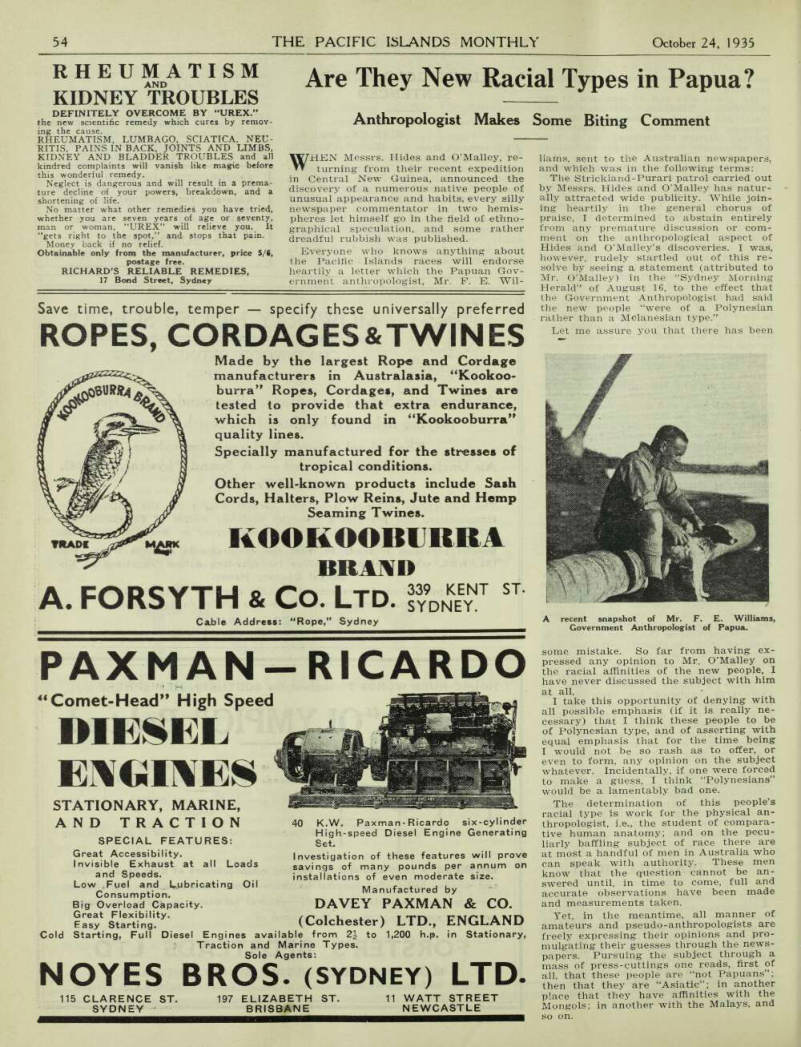
Anthropologist Makes Some Biting Comment
WHEN Messrs. Hides and O’Malley, re turning from their recent expedition in Central New Guinea, announced the discovery of a numerous native people of unusual appearance and habits, every silly newspaper commentator in two hemis pheres let himself go in the field of ethno graphical speculation, and some rather dreadful rubbish was published.
Everyone who knows anything about the Pacific Islands races will endorse heartily a letter which the Papuan Gov ernment anthropologist, Mr. F. E. Wil
liams, sent to the Australian newspapers, and which was in the following terms: The Strickland-Purari patrol carried out by Messrs. Hides and O’Malley has natur ally attracted wide publicity. While join ing heartily in the general chorus of praise, I determined to abstain entirely from any premature discussion or com ment on the anthropological aspect of Hides and O’Malley’s discoveries. I was, however, rudely startled out of this re solve by seeing a statement (attributed to Mr. O’Malley) in the “Sydney Morning Herald” of August 16, to the effect that the Government Anthropologist had said the new people “were of a Polynesian rather than a Melanesian type.”
Let me assure you that there has been
some mistake. So far from having ex pressed any opinion to Mr. O’Malley on the racial affinities of the new people, I have never discussed the subject with him at all.
I take this opportunity of denying with all possible emphasis (if it is really ne cessary) that I think these people to be of Polynesian type, and of asserting with equal emphasis that for the time being I would not be so rash as to offer, or even to form, any opinion on the subject whatever. Incidentally, if one were forced to make a guess, I think “Polynesians” would be a lamentably bad one.
The determination of this people’s racial type is work for the physical an thropologist, i.e., the student of compara tive human anatomy; and on the pecu liarly baffling subject of race there are at most a handful of men in Australia who can speak with authority. These men know that the question cannot be an swered until, in time to come, full and accurate observations have been made and measurements taken.
Yet, in the meantime, all manner of amateurs and pseudo-anthropologists are freely expressing their opinions and pro mulgating their guesses through the news papers. Pursuing the subject through a mass of press-cuttings one reads, first of all, that these people are “not Papuans”; then that they are “Asiatic”; in another place that they have affinities with the Mongols; in another with the Malays, and so on.
A recent snapshot of Mr. F. E. Williams, Government Anthropologist of Papua.
One of the most prominent of Australian dailies refers (editorially) to the appear ance of the new people as “highly sugges tive of ancient Greek or Assyrian types, yet suggestive, too, of the Semitic.” And one writer actually asks the question whether they can be “an independent sur vival of an almost pure early migration from the cradle of humanity”; and, again, whether “the resemblance to the Wise Men of the East” is merely a coincidence.
You will appreciate my feelings when I found it written down in the papers that I had added to this strange medley by comparing them to Polynesians.
I do not know to what extent the Press itself may be responsible for this balder dash. But there is one especially ridicu lous feature of it for which the Press must surely be to blame. That is the recur rence of the phrase “White Race” in the headlines.
If we examine the letterpress of Mr.
Hides’ own contributions, or of the state ments quoted beneath these very head lines, we find that he refers to the people at most as light-skinned, by which he obviously means that they are of a lighter brown than some others whom he has met with in Papua. Mr. Hides did not describe them as white to me, and I do not believe that he has described them as white to anybody. I can only attribute these misleading headlines to an uncriti cal enthusiasm on the part of certain Pressmen, or else to a deliberate intention to catch the eye of a credulous public.
Whether the newly-discovered people— whatever their skin colour—can be pro perly called a new race seems to me wholly questionable. Most of us, even the handful of competent physical anthro pologists themselves, are still somewhat uncertain as to the meaning of the word.
But we might be discreet enough to leave the matter to them; for even if they dis agree, as they probably will, they still have a good idea of what they are talk ing about.
In the meantime* it may be pointed out that the manners and customs of the people, their dress, weapons, houses, agri culture, etc., are simply not relevant to the question of race. Nothing is so cold, we are informed, as yesterday’s news, and, probably, by the time this letter reaches you, popular attention will have swerved in some different direction. And by the time we are able to say anything of real reliability and value about the anthro pology of the new people, public interest in the subject may be entirely dead. This, however, will not matter greatly. Those who care to follow up the inquiry will have to delve in the pages of some scien tific jeurnal, where writers are more cau tious and less excitable.
Mr. C. T. Halstead, who was recently appointed Suva manager of Messrs. Cable and Wireless Ltd., arrived in Fiji by the Monowai in September. Mr. H. Lanyon, whom he replaced, left for New'Zealand by the Niagara on September 27.
Mr. F. E. Smith, of Clevedon, New Zealand, married Miss Cora Ray Edwards, of Suva, at the Holy Trinity Pro-Cathed ral, Suva, on September 27. They left Fiji by the Niagara the same day for Auckland, where they will make their new home.
Interests Rarotongans
Torpedo Practice
From Our Own Correspondent.
RAROTONGA, September 4.
ON August 15, H.M.N.Z.S. Dunedin, flying the broad pennant of Commo dore the Hon. E. R. Drummond, M.V.0., dropped anchor off Avarua, Rarotonga.
As the vessel was scheduled to remain five days a comprehensive programme had been arranged for the entertainment of officers and men. Lorry-loads of sailors were driven round the island, sports com petitions were held in the various vil lages and a number of dances given.
On Saturday, the 17th, Tinirau Makea Ariki organised a small fish-drive at Titikaveka followed by a native umukai for the officers. Before leaving for Nukualofa on August 19 the Dunedin fired two practice torpedoes, an evolution which created great interest among the native who lined the waterfront to watch this unusual sight.
Miss H. Baker, who has been a mission worker for 30 years among the Australian aboriginals at La Perouse, Sydney, left on October 5 by the Katoomba to attend the centenary celebrations of the Metho dist Church in Fiji. Her father was Rev.
Thomas Baker, the first white missionary martyred in Fiji.
Advertisements & other items, pp. 57-58 (2 items)
Kork-N-Seal
FOR ALL HOME BOTTLING - THE
LITTLE CAP THAT WILL RE-SEAL
1,000 TIMES
KORK-N-SEAL (Aust.) Ltd.
106 COMMONWEALTH STREET
SYDNEY, AUSTRALIA
FOR HOME USE
Appl led Airtight Pressure Proof Hand
DOYLE’S famous VETERINARY REMEDIES
oOYte*
RES#
REDUCINE—Cures Your Lame Horae. Cures him painlessly and you can work him all the time.
Cures Splints, Curbs, Capped Hocks, Sprung Tendons, Bog Spavins, and ail Bony and Bursal Enlargements. Price, 12/S per can. Postage, 1/-.
LARYNGINE.—A sure cure for Coughs, Colds, Strangles, etc. Price, S/- per can. Postage, 1/-, SKIN DRESSING.—A certain remedy for Mange and Allied Parasitic Skin Diseases in Horses, Dogs, etc. Price, ?/• (large), J/« (small). Postage. I/-.
DISTEMPER MIXTURE.—A safe and reliable remedy for Coughs, Colds, Asthma, etc. Price, 2/«. Postage, 9d.
T. G. DOYLE, v.s„ 9 KING STREET, RANDWICK, N.S.W.
Write for Free Veterinary Advice and Booklet
Do You Know that the Famous
YOUNGER”
STOVES AND
RANGES
made with extended Firebox specially for long Wood fuel, are Self-Setting and, provided sufficient Flue Piping is attached, can be used in almost any position?
The No. 7W. “Younger” Range can now be supplied fitted with Legs, as per illustration. Ask for quotation for this Range, also Illustrated Catalogue and Price List for both Single and Double Oven Stoves.
Younger Stoves are Widely Used Throughout the Pacific Islands.
G. FLETCHER & SON 50 Oxford Street, Sydney
THE PUREST,
s & F
JVV*v
• There is nothing lighter or brighter than "Pennant”; it is the BEST kerosene you can buy. Its light is bright and unflickering, soft and entirely restful.
Super-refined, free from any sulphur content, "Pennant” is smokeless, sootless, odourless. For all lighting and heating purposes use "Pennant.”
ENNANT
EROSENE
m WMM Ll*
PRODUCT
PK 14
Pacific Islands Stamps
BOUGHT AND SOLD
Stamps sent on approval on receipt oi reference. Send for free lists and specimen copy “Australian Stamp Journal.”
J. H. SMYTH CO. LTD.
121 a Castlereagh St., Sydney
Miners’ Strike
Ugly Situation in New Guinea
A STRIKE, involving about 100 European miners and artisans, which for a time had a very ugly appearance, occurred on the Morobe goldfield, New Guinea, between September 7 and 11. It was eventually settled.
The trouble commenced at New Guinea Goldfields Ltd.’s Golden Ridges mill and cyanide plant, near Wau. Fifteen miners were informed that their wages were to be reduced 1/ per day. They promptly ceased work; and they said they would not resume until they receiver higher, instead of lower wages. They were then discharged by the mine manager. Winchmen and scraper men ceased work in sympathy.
On Monday, September 9, the miners em ployed by New Guinea Goldfields Ltd. at Edie Creek came out on strike, in sympathy with the Golden Ridges men, and all were immediately paid off. All the unemployed men were thus without quarters; and pro ceeded to Wau, where lack of accommoda tion led to a good deal of discomfort.
Meetings were held during Monday and Tuesday and, eventually, an agreement was reached whereby all the men from both mines returned to work on Wednesday, on the same terms as were in operation prior to the dispute.
Bronze Medal For Brave
Papuan
From Our Own Correspondent.
PORT MORESBY, September 24.
TABUA, a Papuan native of Mabaduan, west of the Fly River, in the Western Division, and formerly an employee of the pearling- fleet at Thursday Island, has been awarded the Royal Humane Society’s bronze medal for his heroic efforts to save the lives of members of the crew of the pearling lugger Rhodopis.
On March 12, 1934, a cyclone swept the northern coast of Queensland and the Rhodopis, with six other luggers, Waikato, Mossman, Quest, Lotus, Mildred and Way wego, overturned off Melville Island. Over 60 lives were lost, three of whom were Europeans. Only three members of the Rhodopis’s crew of 14 survived—three natives of Mabaduan, one being Tabua, who received the medal.
Educating Islands Children
LIFE in the Islands entails no greater sacrifice than the separation from one’s children when once they arrive at school age, and the prob lem of finding schools that offer the assurance that parents living at great distances look for, is not always easy of solution. In this connection, the announcement of Mowbray House School, Chatswood, N.S.W., appearing in this issue will be of interest to readers who are contemplating placing their boys at boarding school.
Mowbray House is one of the largest and best known privately conducted boarding schools in N.S.W. It was established by the present head master, Mr. L. Bavin, 30 years ago, and receives the support of Old Boys and ex-parents of the school, who may be found in almost every part of x e The school has won a high reputation for the soundness of its work, and boasts of a fine record of school sport. A most attractive feature from the point of view of the parent domi ciled in the Islands is the heme-like atmosphere brought into the boys’ lives, and the attention paid to their health and comfort.
The disabilities confronting Islands residents in ma a c^°^ce schools for their sons are les sened by the special provisions made at Mowbray House for boys from the tropics, which include tacilities for spending school vacations at the school country house in the bracing climate of the Southern Highlands.***
Torres Strait Notes
From Our Own Correspondent.
Thursday Is., Oct. 3.
OUR cable has been broken for some weeks between Horn Island and Cape York in the Endeavour Strait through constant chaf ing on the coral reefs. A spell of calm weather enabled the mechanic to effect repairs, though for a while T.I. was dependent entirely upon the radio station.
Several local pearlshellers have been giving evi dence in Brisbane before the Tariff Board com mittee of enquiry, which has been investigating the question of a Government bounty to assist the Australian marine industry. Objections have been raised to a bounty, as it would doubtless in volve irksome Government control. It is still hoped that the local M.O.P. business will see better days, when some of the existitig handi caps are removed.
Mr. Cecil Done, T.I. Town Clerk, is in Bris bane on town council business. Amongst other matters he arranged a deputation to the Govern ment relating to additional unemployment relief money for the benefit of local men, who are awaiting an improvement in the marine industry.
Mr. Stoyles, officer-in-charge of the radio station, has left on transfer, and Mr. Baker has taken his position.
Mr. Goforth, of the T.I. State School, had to journey hurriedly to Australia for an internal operation. Mr. Ross, of Herberton, has arrived as the relieving teacher.
Mr. Provis has come from Sydney to take charge of the shipping department at the local branch of Messrs. Bums, Philp & Co.
Mr, Ernest Stephens, another victim of the Great War, has been laid to rest in our local cemetery. He had been ill for many months. The pall-bearers were members of the Returned Soldiers’ Association, which was strongly repre sented at the funeral.
Advertisements & other items, p. 59 (1 item)
ansomes
LINK-BELT CO. LTD.
17 GOULBURN STREET, SYDNEY
o O o
Centrifugal
Discharge
Bucket Elevator ■jO Modern Machinery Equipment for Elevating, Conveying and Mechanical Handling of Material.
Sole Agents in Australia for Ewart Chain Belting in Malleable or Steel.
Specialists in Power Transmission Machinery.
Large Stocks always kept of Steel Shafting, Cast Iron, Steel, or Wood Split Pulleys.
Plummer Blocks, Collars, Couplings, Leather Belting, Hangar Bearings.
Lubricators, Engineers’ Wrenches.
MANUFACTURING ENGINEERS
These Light Steel Cultivators
are adaptable for a variety of operations Special features: Suitable for use Made by
Ransomes,
Sims and
Jefferies,
Ipswich England with one bullock or horse. Can be supplied with a wide range of reversible points and shares.
Made in three sizes.
“MIDGET” (fixed) with 5 tines covering 24 inches.
BTSL (single lever) adjustable for width from 14 inches to 24 inches.
Can be fitted with ridging body.
BTDL (2 levers) with 5 or 7 tines.
ansomes
LIGHT STEEL
Walking Cultivators
“Indecent” Pareu
A Quaint Story From London
(From the Sunday Dispatch, London) SOME months ago, the French Minister for the Colonies, Louis Rollin, rescind ed the rule banning pareus in Tahiti.
The development occurred in rather an amusing way.
Recently, the women on the French Riviera have taken to wearing the new beach wear of flowered cotton brassiere, with scanty knee-length wrap-around skirt, copied from the one-piece pareus of the Tahitian girls.
Tahiti was in the boom, and the fashion spread to America. United States manu
facturers started featuring Tahiti pareus, and socially-minded American women at Miami and other social resorts soon fol lowed the fashions of Nice and Cannes.
At the French Ottawa conference, Monsieur Rollin learned with amazement the irony of the situation. For many years the native girls of Tahiti have been for bidden to wear the “indecent” pareu, and have always worn the short-sleeved long cotton dresses. The costumes of the women on the beaches of Cannes, Nice, and Miami could not look much different on Poly nesians, and against the background which they were really made for. In consequence, the rule was rescinded, and the Tahitian girls are now smiling.
Bank Of N.Z. Closed Down
At Levuka
SUVA, Sept. 27.
AFTER having operated at Ovalau Island for 59 years, the Levuka branch of the Bank of New Zealand has been shut down. In 1876 the N.Z. Bank took over the establishment of the Fiji Banking and Commerce Co., a syndicate of local planters and traders. The only other bank at Levuka is the Bank of New South Wales, opened about 30 years ago, which is still carrying on operations.
Mr. C. E. Redgrave, who was manager of the N.Z. Bank oh Ovalau Island, and his assistant, Mr. R. H. Page, have arrived in Suva to complete the transfer of accounts from Levuka.
Speculative Fijian
Shares
Indications of a Slump
f TTHE gold industry in Fiji is not going so well —for the speculators, that Is.
The following appeared in the Sydney Bulletin of October 9:—- Fiji gold shares continue speculative, a pro nounced weakening in market support being: noticeable last week. Emperors, which had been up to around 30/-, fell back to 22/-, recovering" to 24/- on Friday; and Lolomas, selling at 50/two or three weeks ago, were weak at 38/-.
Kororeres have also seen much higher than last Friday’s 18/-; Nasivis, at £57 some time ago, were changing hands at 15/-. Tavua Develop ments, selling at 15/6 a month ago, are down to 6/8, and Vees United, which went to 2/- a little while back, are around 9d. Speculators who have a fancy for a particular show don’t like being put off it; but the prices paid for some Fiji propositions over the past few months have been, ridiculous, considering the amount of develop ment work towards proving ore-bodies.
Mount Kasi, on the other large island (Vanua Levu) in the Fiji group, at this stage is the safest mining proposition in Fiji. It has been working unobtrusively for two or three years, and a large body of about lOdwt. ore seems to have been definitely established. It is free milling ore, and extraction of the metal is turning out to be inexpensive, with small losses in the: tailings. The 3/- (paid) shares are around 18/6, giving the undertaking a valuation of £300,000.
That figure seems to be well covered by ore re serves.
This development is merely a confirma tion of what this journal has been urgingr for many months—namely, that there may be and probably is a body of gold-bearing ore in Tavua, sufficiently rich to justify the establishment of a gold industry, but that the enterprise has been surrounded by so much lunatic speculation and semi-roguery that the infant industry may be smothered, before it begins properly to breathe.
The fault does not lie with the Govern ment of Fiji. That wise institution has done everything possible to discourage speculation and encourage legitimate enter prise. Grave fault, however, does lie with the Australian authorities, who have per mitted the most outrageous things to be done in Pitt Street and Collins Street in the name of Fiji goldmining.
The Australian Stock Exchange specu lators who eventually are left with the scrip probably will be heavy losers; but a s we look over the record of stock exchange transactions during the past six months we can only reflect that they will receive no more than they deserve. The genuine mining men—the prospectors and the mining engineers—have done their duty properly and legitimately, and for the most part all of what has been written has been justified.
Most of the trouble, and all of the bad smell, have been caused by greedy people in Sydney and Melbourne who have been trying to get something for nothing.
Mr. R. Lane, of Lami, Fiji, returned to the Colony from a visit to Australia by the September Monowai.
Advertisements & other items, p. 60 (1 item)
Jang: lling: Loong: C ompany Limited
MELBOURNE
HOTEL ..
SUVA - =
Centrally situated near Government offices. Opposite sea baths and bowling: green. Excellent table.
Terms moderate. Best brands of liquor kept, including Hardy’s famous wines.
E. C. DOBELL Proprietor
Suva’s Fashion Rendezvous
WALTER HORN E & Co. Ltd.
PREMIER DRAPERS. LADIES’, CHILDREN’S
AND MEN’S WEAR SPECIALISTS
LADIES' HAIRDRESSING AND MANICURING
Frock* Millinery Foundations and Lingerie Hosiery Ladies’ Shoes & Sandals Ribbons and Laces Hairdressing Manicuring Dress Fabrics and Silks Household Drapery Clothing Tailoring Mercery Men's Boots & Shoes Men's Hats & Caps Island Curios
“IF IT’S NEW...
HORNE’S WILL SHOW IT”
Dependable Merchandise Reasonably Priced
Cables: “Janinloong’
P.O. Box 117
Jang: lling: Loong: C ompany Limited
20-24 THOMSON ST., SUVA, FIJI
IMPORTERS EXPORTERS
Buyers of Copra, Trocas Shell, Bechc-de-mcr, Kauri Gum, and other Island Products.
NUMEROUS BRANCHES THROUGHOUT THE COLONY
Sudest Gold
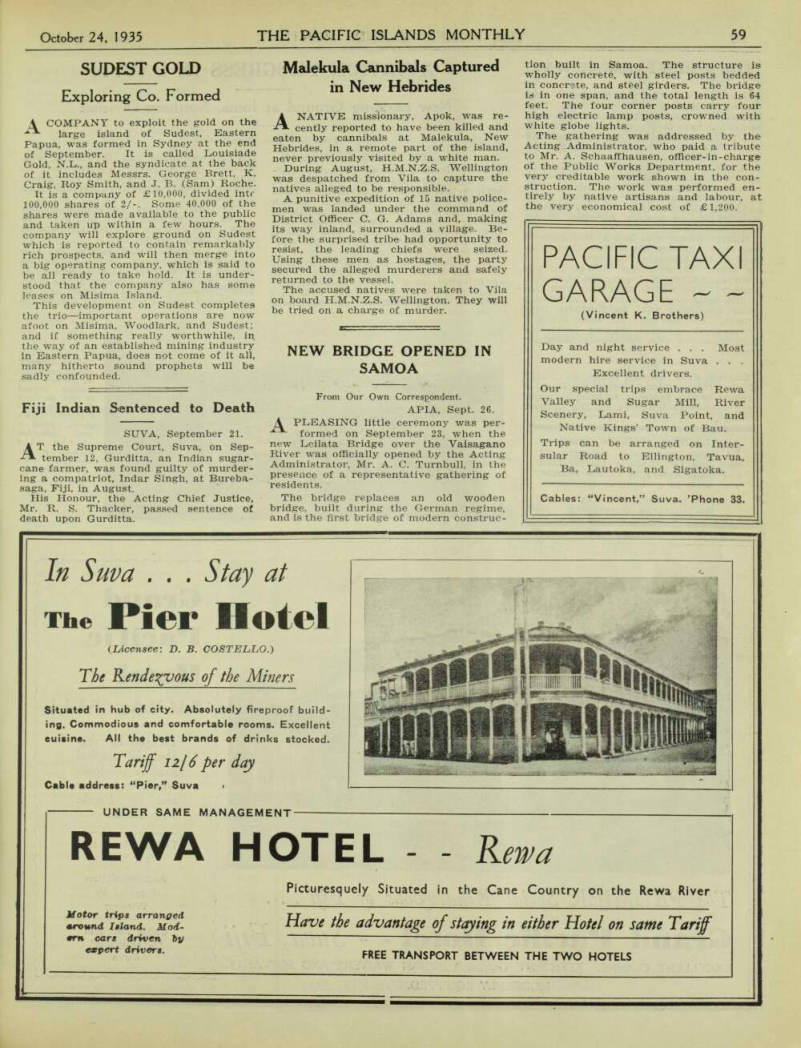
Exploring Co. Formed
A COMPANY to exploit the gold on the large island of Sudest, Eastern Papua, was formed in Sydney at the end of September. It is called Louisiade Gold, N.L., and the syndicate at the back of it includes Messrs. George Brett, K, Craig, Roy Smith, and J. B. (Sam) Roche.
It is a company of £lO,OOO, divided intr 100,000 shares of 2/-. Some 40,000 of the shares were made available to the public and taken up within a few hours. The company will explore ground on Sudest which is reported to contain remarkably rich prospects, and will then merge into a big operating company, which is said to be all ready to take hold. It is under stood that the company also has some leases on Misima Island.
This development on Sudest completes the trio —important operations are now afoot on Misima, Woodlark, and Sudest: and if something really worthwhile, in the way of an established mining industry in Eastern Papua, does not come of it all, many hitherto sound prophets will be sadly confounded.
Fiji Indian Sentenced to Death
SUVA, September 21.
AT the Supreme Court, Suva, on Sep tember 12, Gurditta, an Indian sugar cane farmer, was found guilty of murder ing a compatriot, Indar Singh, at Bureba saga, Fiji, in August.
His Honour, the Acting Chief Justice, Mr. R. S. Thacker, passed sentence of death upon Gurditta.
Malekula Cannibals Captured
in New Hebrides
A NATIVE missionary, Apok, was re cently reported to have been killed and eaten by cannibals at Malekula, New Hebrides, in a remote part of the island, never previously visited by a white man.
During August, H.M.N.Z.S. Wellington was despatched from Vila to capture the natives alleged to be responsible.
A punitive expedition of 15 native police men was landed under the command of District Officer C. G. Adams and, making its way inland, surrounded a village. Be fore the surprised tribe had opportunity to resist, the leading chiefs were seized.
Using these men as hostages, the party secured the alleged murderers and safely returned to the vessel.
The accused natives were taken to Vila on board H.M.N.Z.S. Wellington. They will be tried on a charge of murder.
New Bridge Opened In
Samoa
From Our Own Correspondent.
APIA, Sept. 26.
A PLEASING little ceremony was per formed on September 23, when the new Leilata Bridge over the Vaisagano River was officially opened by the Acting Administrator, Mr. A. C. Turnbull, in the presence of a representative gathering of residents.
The bridge replaces an old wooden bridge, built during the German regime, and is the first bridge of modern construe -
tion built in Samoa. The structure is wholly concrete, with steel posts bedded in concrete, and steel girders. The bridge is in one span, and the total length is 64 feet. The four corner posts carry four high electric lamp posts, crowned with white globe lights.
The gathering was addressed by the Acting Administrator, who paid a tribute to Mr. A. Schaaffhausen, officer-in-charge of the Public Works Department, for the very creditable work shown in the con struction. The work was performed en tirely by native artisans and labour, at the very economical cost of £1,200.
Advertisements & other items, p. 61 (1 item)
Rewa Hotel - -
PACIFIC TAXI
GARAGE - -
(Vincent K. Brothers) Day and night service . . . Moat modern hire service in Suva . . .
Excellent drivers.
Our special trips embrace Rewa Valley and Sugar Mill, River Scenery, Lami, Suva Point, and Native Kings’ Town of Bau.
Trips can be arranged on Intersular Road to Ellington, Tavua, Ba, Lautoka, and Sigatoka.
Cables: “Vincent,” Suva. ’Phone 33.
In Suva . . . Stay at
The Pier Hotel
( Licensee: D. B. COSTELLO.)
The Rendezvous of the Miners
Situated in hub of city. Absolutely fireproof building. Commodious and comfortable rooms. Excellent cuisine. All the best brands of drinks stocked.
Tariff ill 6 P er day
Cable address: “Pier,” Suva > Pi 11! 1
UNDER SAME MANAGEMENT
REWA HOTEL - -
Motor trips arranged around Island. Modern cars driven by expert drivers.
Picturesquely Situated in the Cane Country on the Rewa River Have the advantage of staying in either Hotel on same Tariff
FREE TRANSPORT BETWEEN THE TWO HOTELS
'■ ' '■ v- i]/ r . i ; ) i-,
The Kirke Farm At Wau
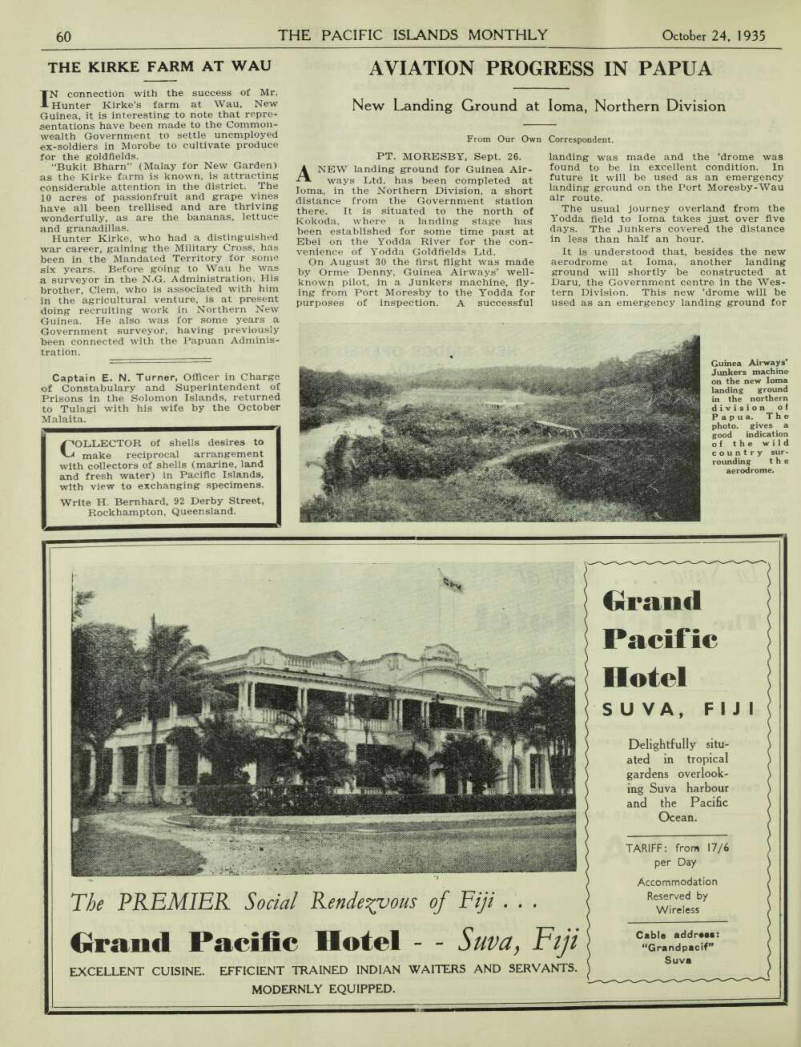
IN connection with the success of Mr.
Hunter Kirke’s farm at Wau, New Guinea, it is interesting to note that repre sentations have been made to the Common wealth Government to settle unemployed ex-soldiers in Morobe to cultivate produce for the goldfields.
“Bukit Bharn” (Malay for New Garden) as the Kirke farm is known, is attracting considerable attention in the district. The 10 acres of passionfruit and grape vines have all been trellised and are thriving wonderfully, as are the bananas, lettuce and granadillas.
Hunter Kirke, who had a distinguished war career, gaining the Military Cross, has been in the Mandated Territory for some six years. Before going to Wau he was a surveyor in the N.G. Administration. His brother, Clem, who is associated with him in the agricultural venture, is at present doing recruiting work in Northern New Guinea. He also was for some years a Government surveyor, having previously been connected with the Papuan Adminis tration, Captain E. N. Turner, Officer in Charge of Constabulary and Superintendent of Prisons in the Solomon Islands, returned to Tulagi with his wife by the October Malaita.
Aviation Progress In Papua
New Landing Ground at Ioma, Northern Division
From Our Own Correspondent.
Pt. Moresby, Sept. 26.
ANEW landing ground for Guinea Air ways Ltd. has been completed at loma, in the Northern Division, a short distance from the Government station there. It is situated to the north of Kokoda, where a landing stage has been established for some time past at Ebei on the Yodda River for the con venience of Yodda Goldfields Ltd.
On August 30 the first flight was made by Orme Denny, Guinea Airways’ well known pilot, in a Junkers machine, fly ing from Port Moresby to the Yodda for purposes of inspection. A successful
landing was made and the ’drome was found to be in excellent condition. In future it will be used as an emergency landing ground on the Port Moresby-Wau air route.
The usual journey overland from the Yodda field to loma takes just over five days. The Junkers covered the distance in less than half an hour.
It is understood that, besides the new aerodrome at loma, another landing ground will shortly be constructed at Daru, the Government centre in the Wes tern Division. This new ’drome will be used as an emergency landing ground for
Guinea Airways’
Junkers machine on the new Ioma landing ground in the northern division of Papua. The photo, gives a good indication of the wild country sur rounding the aerodrome.
’planes flying from Somerset (at the tip of Cape York Peninsula, North Queensland) and Thursday Island to Port On September 18 Guinea Airways’ Ford ’plane, with Orme Denny as pilot, made its first landing on the Bulldog ’drome, the landing ground on the Lakekamu goldfields constructed by Guinea Gold N.L. Owing to excessive rains the ground was not in its best condition; in spite of this a successful landing was made and the ’plane took off for Port Moresby and returned to Wau the following day with passengers from the Macdhui for the goldfields.
The R.A.A.F. Southampton flying boat, in charge of Squadron-Leader A. E. Hempel, Pilot-Officer L. E. Burt and a crew of three, arrived in Port Moresby from Yule Island on September 5. En route they examined the coastline from Daru for possible landing grounds, calling in at Kikori, Kerema and Yule Island.
On September 13, Squadron-Leader Hempel made a flight to Bulldog and Wau in Guinea Airways’ ’plane, returning to Port Moresby on September 18. The Southampton will proceed shortly to Darwin via Daru after the arrival of engine parts from Australia.
Advertisements & other items, p. 62 (1 item)
Grand Pacific Hotel - - Suva, Fiji
COLLECTOR of shells desires to make reciprocal arrangement with collectors of shells (marine, land and fresh water) in Pacific Islands, with view to exchanging specimens.
Write H. Bernhard, 92 Derby Street, Rockhampton, Queensland.
N I ■ a n The PREMIER Social Rendezvous of Fiji . . .
Grand Pacific Hotel - - Suva, Fiji EXCELLENT CUISINE. EFFICIENT TRAINED INDIAN WAITERS AND SERVANTS.
MODERNLY EQUIPPED.
Delightfully situated in tropical gardens overlooking Suva harbour and the Pacific Ocean.
TARIFF: from 17/6 per Day Accommodation Reserved by Wireless Cable addrees: “Grandpacif”
Suva
Governor Of N. Caledonia
Visits Suva
SUVA, September 23.
CALLING at Fiji on his return from Futuna and Wallis Islands, His Excel lency M. Siadoux, Governor of New Cale donia and French High Commissioner for the Western Pacific, arrived at Suva on September 13, on board the Amiral Charner.
Courtesy calls were exchanged between M. Siadoux and Sir Murchison Fletcher (Governor of Fiji and British High Com missioner for the Western Pacific), and the Hon. Alport Barker (Mayor of Suva) and the Commander of the French sloop.
Capitaine de F. P. Aldus. The French Governor was entertained at Suva by Major C. B. Joske, 0.8. E., M.C., Consul for France.
The Amiral Charner departed for Nou mea, New Caledonia, the same evening.
Rarotongan Produce
“Visits Friends” At Mauke
From Our Own Correspondent.
RAROTONGA, September 13.
C.S. SHEAFHOLME, bound From American ports to New Zealand, was diverted to pick up a mixed shipment of tomatoes and oranges from Rarotonga and Mauke respectively. The vessel ar rived here in mid-August, and, having taken on board approximately 4,000 cases of tomatoes, proceeded to Mauke to load oranges, returning again to Rarotonga for clearance two days later.
The Sheafholme is a slow ship and considerable anxiety was felt by local tomato shippers as to the condition of their produce on arrival at Auckland.
The fact that the whole shipment was on consignment added greatly to this anxiety.
Surprise was also expressed that the tomatoes should have been, as the natives say, “taken to visit their friendsY in Mauke when the ship might easily have loaded them on her return from that island, thus giving the fruit a far better chance of reaching New Zealand in good condition.
Modern Market In
Papeete
From Our Own Correspondent.
Papeete, Sept. 3.
A USEFUL innovation for Tahiti is the new establishment known as the Oceanic Market, which opened recently opposite the Banque de ITndo Chine in Papeete.
Housewives who are averse to leaving their beds at the first streak of dawn in order to make the day’s purchases of fresh provisions may now obtain supplies from the Oceanic at any hour of the day or night. There is also an immediately avail able supply of delicacies not usually ob tainable except by special order, such as poultry, fresh milk, pastry, imported game birds, and sausages. Ice is delivered daily to regular clients.
Run in conjunction with the Oceanic Market is the “Taverne,” which comprises a coffee shop, grill room, ice cream parlor, and general refreshment catering. The refrigerating equipment for this establish ment is operated by electricity, and pro vides storage space consisting of three chambers, each of 100 cubic metres capacity.
On a world cruise, the N.Z. yacht Te Rapunga arrived at Rarotonga, Cook Is., early in October.
Advertisements & other items, p. 63 (1 item)
Gold
J o H N B U L L
Malt & Hops
WILL BREW A NICE DRINKING
BEER
MADE FROM THE
FINEST ENGLISH
MALT & HOPS
STOCKED BY I
Burns, Philp & Co., Ltd.,
RABAUL
MAKERS:
Paine & Co., Ltd., St. Neots, Hunt*., England.
AUSTRALIA’S CLEARING HOUSE FOR THE PRECIOUS METALS.
BUYERS OF
GOLD
OSMIRIDIUM, PLATINUM, SILVER, &c.
GARRETT & DAVIDSON, LTD.
ASSAYERS, BULLION MERCHANTS, METALLURGISTS.
Bank of N.S.W. Buildings, Regent Street, Sydney
MORRIS, HEDSTROM, Ltd
FIJI
Sole Agents in Fiji for . . .
Vacuum Oil Company (Pty.) Limited
Imperial Chemical Industries Limited
Nobel (Australasia) Pty Ltd. —Explosives
Full Stocks of
MINERS AND PROSPECTORS’
REQUISITES
Also SODIUM CYANIDE, ZINC
DUST, Etc., Etc.
Sydney Office:
DALTON HOUSE, 115 PITT ST., SYDNEY
Branches throughout the gold bearing areas Lautoka, Ba, T avua, Penang, Nadi and Sigatoka
N.G. Goldfields Notes
WAU, September 26.
MR. and Mrs. Kevin Parer are on their way South from Wau and will spend a few weeks in Sydney before going on to relatives in Melbourne.
Miss Dot Blackley, who has been In the •Government Service at Rabaul for two years, has enjoyed her holiday out in the Watut area and is, prior to leaving for Sydney, staying with her popular brother, “Snow” Blackley, at Golden Ridges.
The newly-formed Dramatic Society at Wau is busy with rehearsals; and, for Ghristmas, they are putting on an amusing show called “Respectability.”
Mr. Clem Kirke, who has been recruiting
in New Ireland for the past two moons, re turned to Wau this week after a very suc cessful expedition.
Profound regret is felt here at the pass ing of “Rusty” Richards, at Brisbane. Tom Richards (Lieut., M.C.) has paid the price of the Great Tragedy of 1914. He was badly gassed and, after suffering much for the past two years, was ordered to Bris bane, and died there at the end of the month. He had many interests up here.
He was greatly loved, and his articles in the Sydney Mail were among the finest ever written on New Guinea. His remains (cremated) were buried in the family vault at Manly, N.S.W., in the presence of many old A.I.F. men, the Last Post being sounded by ong. of his comrades of the 18th Bat talion.
Edie Creek News
From Our Own Correspondent.
EDIE CREEK, September 2.
PEOPLE who do not like our climate, say there are only two seasons at Edie Creek; the rainy season and the wet season. Local residents think August must be the wet season for the whole month has been drizzly with leaden skies, but the rainfall has not been great. Bad in fluenzal colds, locally known as “Kus,’ have affected both European and natives.
On August 11, the annual meeting of the Edie Sports Club was held at the hotel. Officers elected; President, Cyril Eldred; secretary, J. Scarrah; treasurer, C. Budden.
Day Dawn have let all their alluvial ground on tribute. Mrs. Bowring, Robert Symes (who re cently returned from a much-deserved holiday in Australia, Fiji and New Zealand), Arch Lyall (who has returned from Rabaul), and George Cooper are the lucky tributers. As all Day Dawn alluvials are on the Merri, and its tributaries, this stream will have a new lease of life.
Mr. L. C. Shoppee was the successful tenderer for the famous El Dorado properties sold by the Lyall deceased estate.
Rumour has it that N.G.G. have struck a rich lode on the Maori Creek fall of the Kaindi tain. It means longer life and greater activities to these parts, if this is true.
On August 7, N.G.G. Athletic Club gave a send off to the popular Kingsbury couple and Mrs.
Gillis at the N.G.G. Mess, Edie Creek. The func tion was well attended and dancing was en joyed to the small hours.
Mr. C. Marshall has arrived at Edie Creek to fill the office of Mines Superintendent, vacated by Mr. Kingsbury. Mrs. Marshall is a welcome addi tion to our few local ladies.
Monday, the 19th, saw another farewell party, this time to Mr. and Mrs. R. G. (Dick) Courtney, who are moving to a claim recently discovered in the Bulwa area. Held in the N.G.G. European Hospital, the party was a great success.
Mr. Russ Wild finished up on his N.G.G. tribute on the Royal Lease on August 20. As usual, his “wash-up” was good.
Mr. H. L. (Bill) Stower, of the Glasson Lease, has been granted an extension of tribute. Shortly he will proceed to England for further medical treatment. Mrs. Stower has undergone an opera tion in Sydney and is rapidly recovering. Mean while Mr. Lcs. Hardman, Mrs. Stower’s brother, is keeping the boxes filled.
Mr. Harold Strong, who relieved Mr. George Hoffman as road-master, has now left us to re sume duties in Wau. He has been replaced by Mr. A. Cameron.
Mr. Ivan Clark, Government Medical Assistant, has been transferred to Rabaul. Mr. Collins, a new-comer to T.N.G., has relieved him.
Mr. “Doc” Davies has left the employ of N.G.G.
Ltd., and is now tributing on the “Wattle Lease,”
Edie Creek.
Advertisements & other items, p. 64 (1 item)
A. B. Donald Ltd.
COPRA MATS AND MATTING
Send your enquiries to us for Woven Wire Mesh in Rolls or framed for Copra Drying, and all Screening purposes. Bird Cages. Sieves and Riddles, Builder’s Gravel Screens, Rat Traps, Door Mats, Garden Arches, Chain Wire Mesh, Crimped Wire Mesh for Window Guards, etc.
SCOTT AND SONS
WIRE WORKS: RAILWAY PARADE AND MURRAY STREET, MARRICKVILLE
A. B. DONALD Ltd.
AUCKLAND
Island Traders :: General Merchants
P.O. Box 150 f :: Cable* and Telegram*: “Kingdom/' Auckland Branches at Rarotonga and throughout the Cook Islands At Papeete and throughout the Society, Marquesas and Paumotu Islands
trading as “ETABLISSEMENTS DONALD. TAHITI’*
At Fiji: Trading as “Dominion Fruit Co..’* Suva
REFRIGERATION
“BUDGE” Automatic or Manually-controlled Refrigeration and Icemaking Plants, with or without insulated Cabinets or Rooms, ranging from 4 cubic feet to 1000 cubic feet or larger, using ammonia in the large and sulphur dioxide (SG2) in the small units illustrated—such illustration being on an electrically driven SO2 Unit.
Where electric power is not available, crude oil engines may be utilised for driving the large plants and petrol or kerosene engines for driving the smaller machines. Enquirers please state power available (if any), size of cabinet, and amount of ice required per day.
JAMES BUDGE LIMITED
REFRIGERATION AND GENERAL ENGINEERS
McEvoy and Harley Streets
ALEXANDRIA -- -- SYDNEY
Established 1890
ENGINEERING WORKSHOPS
All Classes of Machines Made and Reconditioned
Samoa News
From Our Own Correspondent.
APIA, Sept. 26.
COMMENCING in October, the Union Co. steamers running from Vancouver to Auck land, are to call at Apia again every four weeks to take shipments of bananas for the Auck land market. There is a surplus of bananas offer ing at the present time, but it is doubtful whether there will be an ample quantity offering to provide full shipments. The Administration intends, how ever, to accept bananas in future from the more remote districts of Upolu and Savaii and further more to lease suitable Crown land at reasonable rates, and build a road inland parallel to the beach road, which will open up thousands of acres of good land suitable for banana and cocoa planting.
After the completion of the third annual boxing tournament of the Marist Brothers’ School, which attracted a large audience to the Tivoli Theatre, Mr. F. L. A. Goetz, general manager of the N.Z.
Reparation Estates, who is leaving Samoa shortly, was presented with an illuminated address, on behalf of the director, teaching staff, and pupil* of the Marist Brothers’ School.
The Swedish steamer Anten called at Apia re cently to load 1800 tons of copra. Copra is still coming in very freely from the outside districts and export figures should be considerably higher than for the last few years.
The Maui Pomare took away a capacity cargo of bananas—oyer 7600 cases. The fruit was of excellent quality and should reach New Zealand In perfect condition.
Among arrivals by the Maui Pomare were Lance- Corporal J. M. H. Bower, of the Samoan Con stabulary, and his wife, and Mr. Adkins (Bank of New Zealand), who returned to Samoa after several years’ absence.
Rev. and Mrs. Conrad G. Stallan left Samoa recently for a vacation in England. On his return, Rev. Stallan will be transferred to American Samoa.
Rev. H. S. Perkins is expected back in Decem ber, when he will resume charge of the London Missionary Society’s activities. Meantime, Rev.
S. H. F. Phillips, head of the Malua Schools, is acting in his place.
The Hon. I. H. Carruthcrs, M.L.C., has re ceived a communication from the New Zealand Government acknowledging receipt of the resi dents’ petition asking for the appointment of Mr.
A. C. Turnbull as Administrator of Samoa. The N.Z. authorities state that full consideration will be given to the petition.
Mr. J. A. Norrie, Commissioner of the High Court, Labour Commissioner, Crown Solicitor and Crown Prosecutor, is leaving Samoa in December.
Mr. R. V, Kay, of the New Zealand Mortgage Corporation, has been appointed to fill the various positions.
Chief Judge J. H. Luxford is at present presiding at a session of the Lands and Titles Commission, where a lengthy calendar of native cases is being heard. He will return to New Zealand by the next Maui Pomare.
Rev. Father O’Reilly, of Paris, France, has been paying a short visit to Samoa. Father O’Reilly has done much scientific research work of an ethnological and anthropological character in the Solomon Islands, which he intends to continue in other groups, in the interest of the French Gov ernment, the Paris Ethnological Museum and Vatican Museum at Rome.
Marketing Pacific Islands Gold
GOLD companies and miners in the Pacific Islands should, for their own protection, market their ore through a well-known established organisation which can be relied upon to give prompt settlement. By so doing, delays and inconvenience are avoided and full payment is assured. The Electrolytic Refining and Smelting Co., whose works are at Port Kembla, N.S.W., and Sydney office at 25 O’Connell St., is actively en gaged in purchasing and refining gold and silver and has a good record of satisfaction with a large circle of clients. The Co.’s production of refined gold is at the rate of over £1,000,000 annually.
The Electrolytic R. and S. Co. has established facilities for the receiving and handling of bullion making for absolute safety and confidence. Assay ing and refining are in charge of technicians of wide experience and the Co. has good market con
tacts in London; for example, the record price of gold in Australia—£9/4/6 net per fine oz.— was paid by the Co. in March, 1935. Gold-sellers in the Pacific Islands and New Zealand should consign their parcels to the Co.’s Sydney office, thus expediting settlement. With New Guinea and Papua, except in very unusual circumstances, settlement cheque is forwarded by outgoing mail of the same vessel. As well as unrefined gold, the company purchases slags, ashes, crucibles, etc., containing gold.
The Electrolytic Refining and Smelting Co. of Australia Ltd., was formed in 1908, primarily for the purpose of refining by an electrolytic pro cess the blister copper produced by Mt. Morgan G.M. Co., Queensland. The plant was later ex tended to handle the blister from Mt. Lyell, Hamp
den, Cloncurry, and Cobar, and became the largest refinery in the British Empire.
In 1928 the works were purchased by the Broken Hill Associated Smelters Pty. Ltd., whose lead smelting plant at Port Pirie, S.A., is one of th« most efficient in the world. Islands visitors to Australia are invited to inspect the Port Kcmbla works and witness the interesting processes in volved in producing refined gold, silver and copper from bullion, mattes and ores.—*** Rev. and Mrs. H. Boettger, of the Neuendettelsau (Lutheran) Mission Soc iety at Logaweng, New Guinea, returned to Pinschhafen, after furlough, by the Montoro early in October.
Advertisements & other items, p. 65 (1 item)
Fitzroy Bdaiannedmuis
Wholesome and Delicious Foods
Island residents can always ensure quality foods that are wholesome and delicious by ordering
AUNT MARY’S
PURE FOOD PRODUCTS
These appetising food products are specially manufactured and packed to meet Island conditions.
Full of flavour and refreshing nourishment they appeal to the palates of all who partake.
For over thirty years the brand “Aunt Mary’s” has been a guarantee of quality to the people of the Islands.
Prepared and packed only by
TILLOCK & Co. Ltd.
Pure Food Manufacturers *
KENT AND LIVERPOOL STREETS
SYDNEY, N.S.W.
Ask also for “Defiance”
Brand Canned Goods They are supreme in excellence.
Prepared and packed by the proprietors of Aunt Mary’s Pure Food Products
FIPST
IN 1868
FITZROY BDAiaNNEDMUIS
STILL
BEST IN
1935
SPICED, CORNED. ROAST
0 BOILED BEEF
AND IN MUTTON
IN 12 or. Ilk 2 lb, ilk 4 lb. slb, C 61b ROUND
CANS AND IN TAPERS
FITZROY
SHEEP
TONGUES
CORNED QX TONGUES - BEEF & FORK S4USAGES
FITZROY
IIINtIIVEF
THI OBIOINa*- PACK IH A CLASS BY ITSELF /
ALSO THL EAMCUS H| HAMPER MEATS
W *oo*o ANO TAPE* cans >5 /2 OZ . Z-* OZ, £<s 13S
C»<D«M*E C(D. LTD. DSLAND TRADE MEATS
BERSERKER &
/N eveRY Six A PR.OM
OX-PALM BRANDS
/Z OZ no 6LA CANS.
NO fc*TA,A CHAR.CE- f-OR. A SSOR.TM B-M T PACKED CASES OR CARTONS - SEND EOR PRICE IfIST DXi CENTRAL QUEENSLAND MEAT EXPORT CO. LTD.
, LAKES CREEK - ROCKHAMPTON
CABLE ADDRESS;- TOMOANA ROCKHAMPTON.
Insurance
Papuans Get £900
From Our Own Correspondent.
Pt. Moresby, Sept. 26.
FIVE Papuans employed on a T.I. pearl ing lugger perished in a cyclone in Torres Strait last year and the Protector of Aboriginals at Thursday Island made insurance claims on behalf of their dependents. As a result a sum of £3OO was awarded to relatives of three of the de ceased. The £9OO was forwarded to the Papuan Administration by the T.I. authori ties.
In view of the large sum of money avail able to natives who obviously have not advanced sufficiently to be able to make use
of it to the best advantage, the Papuan Government passed in the Legislative Council last July an amendment to the Native Ordinance (1893-35) whereby a trustee may be appointed by the Central Court for money or property of the value of £5O and upwards. This, of course, applies to natives who appear to be unable to utilise large sums of money, etc., to their best ability.
On September 4 His Honour, Mr. Justice Gore, in Chamber upon application by the Commissioner for Native Affairs (Mr. J.
T. O’Malley) appointed the Treasurer of the Territory (Mr. E. C. Harris) as trustee in each of the three cases. He ordered that the sum of £9OO be applied, capital and interest, for the benefit of the de pendents at the discretion of the trustee.
S.I. “Amazons” Story is Denied
No Skirmish
Letter to the Editor.
WITH reference to an article published in The Pacific Islands Monthly of July, under the heading of “Amazons to the Rescue on Shortland Island,” I would be obliged if you would print this denial of the statements.
The Jubilee Celebrations held in the Shortlands were organised by the District Officer and the Right Reverend Father Boch and went off most happily in every way.
After Divine Service at the Marist Mission all residents of the district (Euro peans, natives and Asiatics) were invited to attend the “Breaking of the Flag” at the Government Station, and after this ceremony was completed everyone joined in singing “God Save the King.” In the afternoon dances were arranged by the various natives in the district and, in addi tion to the local natives, the Malaitamen employed on various plantations and oa the steamer gang gave displays.
Never for one moment were relations be tween the Malaitamen and the Shortland Islands natives in the least bit strained and the so-called “promising scrap” quoted by your correspondent existed only in his imagination.
Your correspondent wrote from Tulagi, which is about 300 miles from Shortlands.
Three Tulagi residents were present at the Celebrations, but it seems incredible that any one of them would have distorted the history of a very happy day for the sake of “a good story.” A distorted account has been published, however, and residents of this district feel indignant about it.
It is untrue articles like this that put ideas into the minds of natives, many of whom can now read. There is no doubt that, to their primitive minds, the “wish is father to the thought”: and who can blame them for thinking that the white people present were disappointed that there was not a “promising scrap” at the termination of the dancing.
I am, etc.,
C. W. Seton.
Shortlands,
5.1., 16/8/35.
Miss Molly Swinbourne, of Wahroonga T N.S.W., sailed by the Malaita on October 5 for Tulagi. On her arrival there she was to be married to Mr. J. Menzies, of Talena, Solomon Islands. The bride’s new home will be at the copra plantation on Talena Island, where she will be the only white woman.
Advertisements & other items, p. 66 (1 item)
Niffb
Coles
Regalia
Sydney
ALF. H. J. COLES
Established 1920.
Masonic Regalia, Jewels and General Requisites.
Master Masons’ Aprons 42/- and 45/- Leather Regalia Cases, 16-inch, from 16/6 P.M. Jewels a Speciality.
Inquiries Solicited :: Prices Australian Currency
Room 19, Royal Arcade, Sydney
HOTEL GRAND CENTRAL
151
CLARENCE STREET, SYDNEY (opp. G.P.0.)
THE POPULAR "ROOM-ONLY”
TARIFF
is specially designed to meet modern requirements of business and pleasure. It enables patrons to enjoy every advantage of hotel life, at the same time keeping hotel expenses down to a minimum.
SERVICES INCLUDE:
Theatre Booking and Information Bureau.
Travel and Sightseeing Tours arranged.
Up-to-date Barber’s Shop.
Cleaning and Pressing Service.
Garage accommodation nearby at usual rates.
Spacious Dining Room. All meals a la carte.
THE HOTEL GRAND CENTRAL LTD.
151 CLARENCE STREET, SYDNEY (opp. G.P.0.)
Telephone: BW 1531 (3 lines) Box 716 FF, Sydney Radio Cables and Telegrams: “Grancentral,” Sydney
FRASER WEBSTER, Manager.
f m sat
NIFFB
DIESEL ENGINES
INSTAL THE DIESEL THAT HAS BEEN GOING STRONG SINCE 1929, AND HAS PROVED ITSELF IMMUNE FROM ALL DIESEL WEAKNESS.
D.C. Series, 45 to 160 b.h.p., in 3,4, 6, and 8 cylinder sizes at 700 to 900 r.p.m.
D.B. Series, 24 to 96 b.h.p., in 2,3, 4,6, and 8 cylinder sizes, at 1000 r.p.m.
Australian Agents:
H. G. THORNTHWAITE & CO.
KEMBLA BUILDING.
MARGARET STREET, SYDNEY, N.S.W.
TELEGRAMS: “ORTHORN,” SYDNEY TELEPHONE: B 5240
fa r ;?■ B
Pilot Ferguson
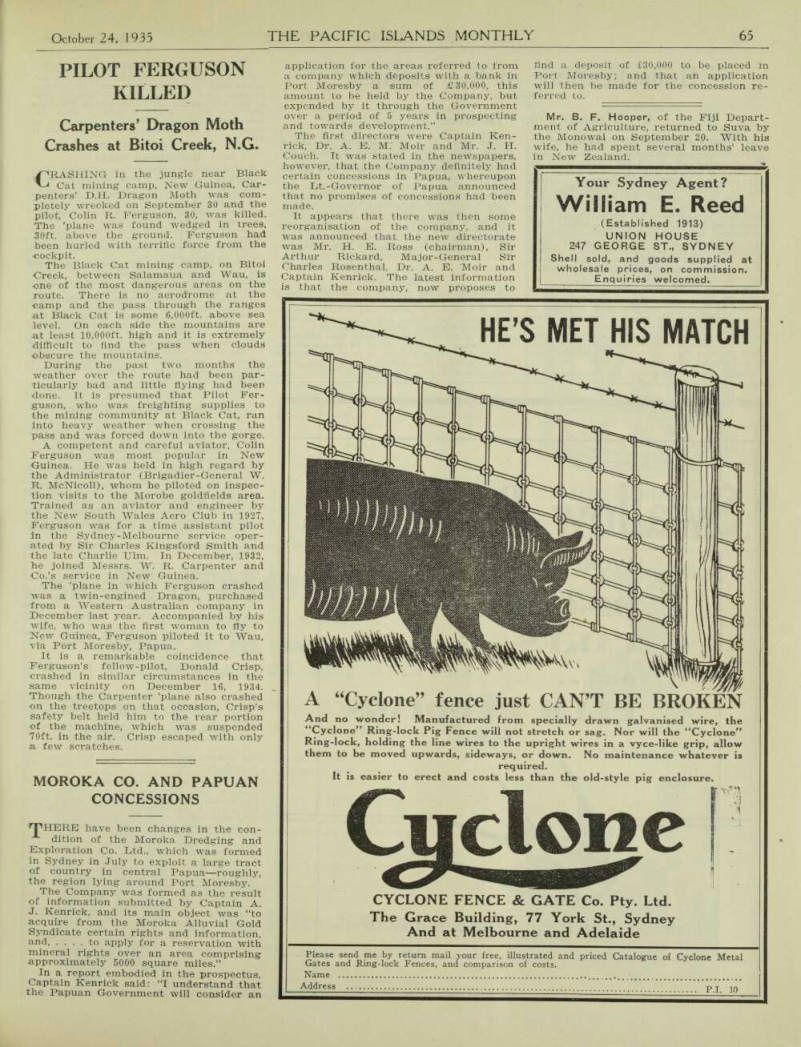
Killed
Carpenters’ Dragon Moth Crashes at Bitoi Creek, N.G.
CRASHING in the jungle near Black Cat mining camp, New Guinea, Car penters’ D.H. Dragon Moth was com pletely wrecked on September 30 and the pilot, Colin R. Ferguson, 30, was killed.
The ’plane was found wedged in trees, 50ft. above the ground. Ferguson had been hurled with terrific force from the ■cockpit.
The Black Cat mining camp, on Bitoi Creek, between Salamaua and Wau, is one of the most dangerous areas on the route. There is no aerodrome at the camp and the pass through the ranges at Black Cat is some 6,000 ft. above sea level. On each side the mountains are at least 10,000 ft. high and it is extremely ■difficult to find the pass when clouds obscure the mountains.
During the past two months the weather over the route had been par ticularly bad and little flying had been done. It is presumed that Pilot Fer guson, who was freighting supplies to the mining community at Black Cat, ran into heavy weather when crossing the pass and was forced down into the gorge.
A competent and careful aviator, Colin Ferguson was most popular in New Guinea. He was held in high regard by the Administrator (Brigadier-General W.
R. McNicoll), whom he piloted on inspec tion visits to the Morobe goldfields area.
Trained as an aviator and engineer by the New South Wales Aero Club in 1927, Ferguson was for a time assistant pilot in the Sydney-Melbourne service oper ated by Sir Charles Kingsford Smith and the late Charlie Ulm. In December, 1932, he joined Messrs. W. R. Carpenter and Co.’s service in New Guinea.
The ’plane in which Ferguson crashed was a twin-engined Dragon, purchased from a Western Australian company in December last year. Accompanied by his wife, who was the first woman to fly to New Guinea, Ferguson piloted it to Wau, via Port Moresby, Papua.
It is a remarkable coincidence that Ferguson’s fellow-pilot, Donald Crisp, crashed in similar circumstances in the same vicinity on December 16, 1934.
Though the Carpenter ’plane also crashed on the treetops on that occasion, Crisp’s safety belt held him to the rear portion of the machine, which was suspended 70ft. in the air. Crisp escaped with only a few scratches.
Concessions
Moroka Co. And Papuan
THERE have been changes in the con dition of the Moroka Dredging and Exploration Co. Ltd., which was formed in Sydney in July to exploit a large tract of country in central Papua—roughly, the region lying around Port Moresby.
The Company was formed as the result of information submitted by Captain A.
J. Kenrick, and its main object was “to acquire from the Moroka Alluvial Gold Syndicate certain rights and information, and, ... to apply for a reservation with mineral rights over an area comprising approximately 5000 square miles.”
In a report embodied in the prospectus, Captain Kenrick said: “I understand that the Papuan Government will consider an
application for the areas referred to from a company which deposits with a bank in Port Moresby a sum of £30,000, this amount to be held by the Company, but expended by it through the Government over a period of 5 years in prospecting and towards development.”
The first directors were Captain Ken rick, Dr. A. E. M. Moir and Mr. J. H.
Couch. It was stated in the newspapers, however, that the Company definitely had certain concessions in Papua, whereupon the Lt.-Governor of Papua announced that no promises of concessions had been made.
It appears that there was then some reorganisation of the company, and it was announced that the new directorate was Mr. H. E. Ross (chairman), Sir Arthur Rickard, Major-General Sir Charles Rosenthal, Dr. A. E. Moir and Captain Kenrick. The latest information is that the company, now proposes to
find a deposit of £30,000 to be placed In Port Moresby; and that an application will then be made for the concession re ferred to.
Mr. B. F. Hooper, of the Fiji Depart ment of Agriculture, returned to Suva by the Monowai on September 20. With his wife, he had spent several months’ leave in New Zealand.
Advertisements & other items, p. 67 (1 item)
He’S Met His Match
Your Sydney Agent?
William E. Reed
(Established 1913)
UNION HOUSE
247 GEORGE ST., SYDNEY
Shell sold, and goods supplied at wholesale prices, on commission.
Enquiries welcomed.
HE’S MET HIS MATCH
S M S k N SL kk fc-t M kk rs M Wi skvvv A “Cyclone” fence just CAN’T BE BROKEN And no wonder! Manufactured from specially drawn galvanised wire, the “Cyclone” Ring-lock Pig Fence will not stretch or sag. Nor will the “Cyclone”
Ring-lock, holding the line wires to the upright wires in a vyce-like grip, allow them to be moved upwards, sideways, or down. No maintenance whatever is required.
It is easier to erect and costs less than the old-style pig enclosure. c
one
CYCLONE FENCE & GATE Co. Pty. Ltd.
The Grace Building, 77 York St., Sydney And at Melbourne and Adelaide Please send me by return mail your free, illustrated and priced Catalogue of Cyclone Metal Gates and Ring-lock Fences, and comparison of costs.
Name Address P.I. 10
Housekeeping in the Tropics
Conducted by “ Dorothea ”
Uses For Coconut Cream
COCONUT cream can be used in cooking to make nourishing and tasty dishes. It is obtained by scraping finely the white meat of a mature nut, and squeezing it through cheese cloth. Greens such as Chinese cabbage, sweet potato tops, ten der taro leaves, or the tiny leaves at the tips of pumpkin shoots are all improved if, after they have been cooked in salted water, the water is strained off and sufficient coconut cream is added to moisten them. Reheat but do * not allow to boil, as the coconut cream will curdle and spoil the appearance of the dish. An onion chopped finely and boiled with the greens, and a pinch of curry powder added with the coconut cream, makes a pleasant change.
Here is a recipe using either Irish or sweet potatoes: Peel the potatoes and an equal quantity of onions, and slice into rounds. Put into a pie dish in alternate layers, adding a little salt between layers, and finish with a layer of pota toes. Add enough coconut cream to come about three parts up the dish, and bake until the onion is cooked and the potatoes browned.
Manioc can be substituted for potatoes, but it
is best baked in a casserole with the lid on, as the manioc bakes very hard if exposed and does not brown nicely.
Baked bananas in coconut cream is a quickly made and appetising dish.
Peel ripe bananas and place in a shallow dish.
Put a squeeze of lemon juice and a little sugar on each, and add sufficient cream not quite to cover the bananas. Bake until they are cooked and lightly browned.
Coconut cream can be used with stewed or tinned fruits, in place of ordinary cream; and, added to sweet pastry in place of milk, it imparts a delicate and unusual flavour.
“ARAORE,” Papua.
Tropical Curry
In a saucepan fry dices of a small green paw paw, banana and onion in a tablespoon of fat.
Add r /\ teaspoon of pepper and salt, 1 teaspoon lemon juice and sugar, and 1 dessertspoon each of coarse coconut, sultanas, flour and curry powder. Cook for a few minutes, then add large cup of water or stock. Allow all to simmer for half an hour, then add cup of minced cold meat or flaked fish. Heat for 10 minutes, then serve garnished with rice and slices of lemon.
Rice And Banana Pudding
One-third fill a pie dish with cooked rice and. spread with a thin layer of jam. Mash three bananas, spread on jam, and place another layer of jam on bananas. Add more cooked rice, then, pour over whole pint of milk in which has. been beaten one egg and a scant tablespoon of sugar. Bake in a moderate oven till custard is set.
JUDY S., Giligili, Papua.
Household Hints
Half the jobs that get put off never get done.
When washing silver, place a teaspoonful of borax in the water.
Lemon juice and salt will remove stains from the handles of knives.
Scorch stains on linen can be removed by rub bing with powdered borax.
Do not put lingerie or fine linen through the wringer.
Alum in the last rinsing water restores the colour of faded materials.
Melted butter makes an excellent substitute for olive oil in a salad dressing.
To cut warm cake, dip the knife in cold water.
For hot bread use a heated knife.
Well-dried orange and lemon peel both burn well, and help to eke out the fuel.
To prevent cakes burning, grease the tins with lard, not butter, and sprinkle lightly with flour.
If a stocking “ladders,” try stitching the sides of the “ladder” together, using a fairly coarse stitch on the machine. As the fabric usually gives, this method of mending will not make the stockings too light.
Bukit Bahrum, Wau.
Little Islanders' Corner
“Dorothea” welcomes several little Islanders, this issue and has written to “Gunatua” in Fiji, also to “Ruve” of Sigatoka, and sent stamps for her collection and names of pen friends.
Will Dawn Cantle write me again? Her long letter was most interesting. Dawn is only 16* and has had a serial story accepted by a Queens land paper. The story is built around Dawn’s life on an island off the coast of Papua.
Joan Sturrick’s letter and contributions are receiving attention, also letters from John Eng land, Wilfred Mayne, Betty Woodland and Joyce Moxham.
Will little Islanders send birthday dates to “Dorothea” ?
Dear Dorothea, — Two Fijian boys decided to go out fishing one day. On their way back home, the rowlocks fell overboard. The smart lads marked the spot with a spear, anchored the boat, and swans ashore, expecting to find the rowlocks on the beach!
After a long search, it suddenly dawned on the brainy pair to swim back to the marked spot and dive for the lost articles.
Yours faithfully.
Gumatua.
Wai Kava, Vanua Levu, Fiji.
Dear Dorothea, — I am twelve years old, and will be thirteen on January 5. , , .. , My father is a surveyor, and we have lived! in this district since I was two years old.
It is one of the nicest parts of the Fiji group* The climate here is always cool and fine, with a fresh breeze blowing in from the sea. We have very nice beaches and bathing, too.
Just now we are awaiting the completion of the new road, which will link us up with Suva, the capital. It will be about a hundred miles drive, and a matter of about three and a half or four hours’ journey by car.
I see that you have offered to exchange stamps with “Little Islanders.” I am a keen collector myself, and have a few Tongan stamps which I would be glad to exchange with anyone in the South Pacific.
I would like a European pen friend of my own age, from either New Guinea, Papua, the Solo mons, or Samoa, please.
I will take the pen-name of Ruve, the Fijian word for wood pigeon.
At the moment I have no photograph of myselt to send you, but will do so later on.
Yours sincerely,
“Ruve.”
Sigatoka, Fiji.
Any Little Islander may correspond with “Ruve,” by writing first to “Ruve,” c/o ‘ Pacific Islands Monthly,” 247 George Street, Sydney.
Advertisements & other items, p. 68 (1 item)
Swallow & ArielFs
WORLD RENOWNED
BISCOTS
CAKES
mill..
PEIIM POHMAGS
Manufactured at Port Melbourne,Australia
Desiccated Coconut
London Interests Buy In At Samarai
From Our Own Correspondent.
Pt. Moresby, Oct. 4.
ANEW company was registered in Port Moresby in August as Vavas seur’s Ahioma Ltd., with a nominal capi tal of £15,000, in shares of £1 each, to take over the desiccated coconut factory owned by Ahioma Desiccating Co. Ltd. at Ahioma, near Samarai. The first direc tors are Messrs. C. E. Aumuller and W.
H. Wright (Samarai), R. D. Bertie (Port Moresby), and Percy Vavasseur Appleby and G. R. H. Buxton (London). It is provided that so long as Vavasseur and Co. Ltd., of London, hold more than half of the issued capital, they shall have the sole right of appointing and removing the directors of the company.
The manufacture of desiccated coconut became an established industry in 1926, as the result of special encouragement given by the Australian tariff. Three companies erected plants and commenced operations—namely, Commonwealth Copra Company, of Milne Bay (Gili Gili); Coco nut Products Ltd., at Aroa, in Redscar Bay (west of Port Moresby); and Ahioma Desiccating Co. Ltd., at Ahioma, near Samarai.
The export of desiccated coconut jumped from 40 to 108 tons in 1927-28 to 1,467 tons in 1930-31, valued at £79,264.
Since then, the export has shown a de crease, owing to the manufacturers being compelled, with the New Guinea manu facturers, to restrict their output in order not to flood their only market, Australia.
The export in 1933-34 was 1,274 tons, valued at £48,000.
Death Of Old Papuan
Resident
From Our Own Correspondent PORT MORESBY. October 4.
THE death occurred in the European A Hospital on October 2 of a very well known resident of the Territory, Mr.
Walter M. Reid, nephew of the late Sir George Reid.
Mr. Reid lived at Aroma. When the coastal steamer “Papuan Chief” arrived, he was found in an unconscious condition.
He was immediately brought to Port Moresby, but did not regain consciousness and died the following day. He was 50 years of age and had been in the Territory since 1909, as a trader and recruiter.
Trading In The Solomons
“A Trader,” writing from Tulagi, Solo mon Islands, declares that ‘‘certain people down here have an arrangement with a Chinese trader. They always let him know when a payment is going to be made to their native labour; and, when he arrives, and is all ready to ‘trade,’ they pay out the wages. In return for this, the overseer gets some sort of commis sion, in trade or kind. At one time, the usual thing, for giving a trader an ‘open go’ at newly paid labour was 10 per cent, of the cash takings.”
Comment seems superflous!
Mr. R. A. Clinton, superintending engi neer to Lakekamu Goldfields (Papua) Development N.L., who has been in Aus tralia reporting to his principals the re sults of progress made in Papua, left for Port Moresby by the Montoro on October f..
Miss Nancy Armstrong, of Cambridge, New Zealand, has been accepted by the Melanesian Mission as a worker in the Solomon Islands. She left Australia for Siota, where she will be stationed, by the Malaita on October 5.
Advertisements & other items, pp. 69-70 (1 item)
A. R. Frost «Fe Co.
H.JONES &C 0
Q
AUSTRALIA’S BEST
H. JONES & CO., LTD.
Darlington, Sydney—Hobart, Tas.
A. R. FROST «fe CO.
(A. R. FROST, late of E. F. Wilks & Co., Ltd.)
LATEST IN ALL MAKES OF RADIOS,
REFRIGERATORS AND RECORDS
RADIOS from £l5-15
REFRIGERATORS from £49-10
Special Care taken in Packing.
Deliveries by Return Mail.
mfpMBIA
PORTABLE
£4lOO Agents for: RADIOLA, S.T.C., AIRZONE, Stromberg-Carlson RADIOS.
Latest COLUMBIA, H.M.V., REGAL, PARLO-
PHONE RECORDS.
A. R. FROST A CO.
Manchester Unity Building, Sydney Telephone, MA 7394 Semi-Automatic Refrigerator
BRITISH
MINING
FINANCE
PROPRIETARY LIMITED
Incorporated in Victoria
A.P.A. Buildings,
379 Collins St., Melbourne,
C.l, Australia.
Telegraphic and Cable Address: “Lexco,”
Melbourne Codes: Bentley's.
Telephone, F. 1264 Mining Investigation, Finance and
Management.
Attorneys in Australia and the Pacific Islands for Overseas’
Mining Organisations.
The Company invites enquiries and is prepared to undertake the
Legal Management and/or
Secretarial operations of Min-
ing and Trading Enterprises.
Mining propositions considered
with a view to flotation.
Gold Mining Maps: Man-
dated Territory of New Guinea and Australian
Territory of Papua.
The Company has for sale the undermentioned copyrighted maps, which are its own recent productions: 1. Map of the Complete Morobe Goldfields, Mandated Territory of New Guinea and surrounding Goldfields, including Papuan areas, showing principal Company areas and air routes.
Size of Map: 35 inches by 30 inches.
Price on Paper Chart: 7/6 plus 9d. postage.
Price on Canvas and Rollers: £1 plus 1/- postage. 2. Detailed Map of the Wau-Edie Creek Leases and Areas in the Upper Bulolo portion of the Morobe Goldfield, showing established Hydro - electric power transmission lines; also air routes.
Size of Map: 40 inches by 30 inches.
Price: Same as Map No. 1.
From Fiji
Pacific Mining
Reports
Fiji Gold N.L.
In a report to the directors of the Fiji Gold N.L. on his return from Fiji, Mr. D. Reid states he visited the areas on the Tavua goldfield, for which licences have been granted, accompanied by Dr. Loftus Hills, consulting geologist, and Mr. H.
V. Francis, engineer in charge of development work on the field. One of the areas showing great promise is known as Budd’s, which com prises 480 acres, and is situated immediately west of the Koroere, and joins Loloma West on the south. A large hill or spur near the centre of this area, rising up between two deep gorges, is en gaging attention. An adit has been driven in on the southern side of an extensive lode formation.
The first assays from this adit are awaited.
Another area of promise, is F. S. Ragg’s, two miles east of Budd’s, but about nine miles by road. The development work on this area will be consider ably expedited in the near future. A prospecting shaft is down 60 feet, and an assay from one of the trenches recently gave an encouraging result of 8 dwt. It is the intention of the board to diamond drill these areas at depth as soon as the plant on the field is available.
East Reefs Consolidated N.L.
Advice has been recived in Melbourne by the management of East Reefs Consolidated N.L., from Mr. C. F. Eeles, Yanawai, Fiji, that he has com menced two new tunnels on the eastern side of the hill, which are now in 62 feet. These tunnels will give approximately 250 feet of backs.
Pacific Gold N.L.
To prospect for gold in Fiji and develop any areas which may be acquired. Pacific Gold N.L, has been formed in Melbourne with a nominal capital of £20,000, in 2000 shares of £lO each. For subscription, 1350 shares were offered at par, holders of Pacific Gold Syndicate shares having the prior right of application, and 650 shares are in reserve. The contributing issue was under written by H. Byron Moore, Day and Journeaux, 376-380 Collins Street. Melbourne. The directors are Messrs. H. C. Comforth, T. Luxton, N. S.
Stuckey, R. P. Carver, and Sir Maynard Hed strom (Fiji). Mr. G. K. Moore, of Bewick More ing and Co., Collins House, is the legal manager.
In the prospectus it is pointed out that in various sections of Viti Levu gold has been found, and judging by surface indications, and by costeens, trenches, shafts and tunnels elsewhere, it is safe to assume that gold is not confined solely to the Tavua field. It is only on the extension of pros pecting and expert investigation that other discov eries are possible. Although geological investi gation is incomplete, the indications are favourable to the occurrence of substantial ore bodies and their persistence to depth—possibly great depth.
Rewa Prospecting Syndicate
The management of Rewa Prospecting Syndicate reports that the syndicate has abandoned its area at Fiji owing to the low values disclosed. An alluvial area is now being investigated by the syndicate.
Aloha Central G.M., N.L.
Negotiations have been concluded between Koroere G.M., N.L., and Aloha Central G.M., N.L., for the satisfactory working of the Cardigan lode should it be found to underlie the Aloha Central area. An agreement has been prepared and ap proved by the solicitors to the parties concerned, and it is in course of completion, Mr. Costello has granted, free of cost to the company, an ex tension of the option to Aloha Central G.M., N.L., until December 31 next. He has also expressed his willingness to extend the option to an even later date should the company so desire.
Granites Development N.L.
The Melbourne management of Granites Devel opment N.L. has received word from the company’s representative in Fiji that the Nandi property of the company was inspected by Dr. Loftus Hills, and he suggested that a prospecting shaft should be sunk where the samples from the surface assayed 4dwt. a ton. Dr. Loftus Hills strongly recom mended tunnelling Blair’s property.
Vees United, N.L.
The directors of Vees United, N.L., report that they have abandoned negotiations with the ven dors of the property in the Lautoka district, Fiji.
They state that they had ascertained that the vendors did not possess a prospecting licence, an application having been lodged but not granted.
The vendors are, therefore, unable to sell or enter into any agreement to sell. With regard to the assays which were published as being up to soz. actually the company’s representative was in formed they were a good deal higher. The com pany’s assays give results from sgr. to 18dwt. sgr. gold per ton. These assays also showed a high percentage of copper. The company is now nego tiating for a property in the Sigatoka district, which will be reported on by its consulting geolo gist, Dr. Loftus Hills.
Sukulaki Gold Development, N.L.
Owing to the unfavourable results obtained, di rectors of Sukulaki Gold Development, N.L., have decided to cease operations, and abandon the option over the Sukulaki area, in the Tavua district, Fiji.
Emperor Mines Ltd.
Large-scale operations were foreshadowed by Mr.
E. G. Theodore, director of Emperor Mines Ltd., Tavua, Fiji, at a shareholders’ meeting in Mel bourne on October 3. Mr. Theodore said the working down to the 100 feet level had definitely indicated certain features. It was quite clear that on the lease there was a unique fault shear. This could be regarded as a most important structural feature, as it indicated the extension of the ore channel. There were other subsidiary ore bodies which may be parallel lodes or other forms of occurrences. Crosscuts had opened up large bodies of ore to the east and west, with good values throughout the whole distance. The width of the structure had yet to be proved, but already it was known that there was a large tonnage of valuable
ore. Good values had been proved for a length of 1000 feet, with every prospect of them continu ing in a northerly direction for a considerable dis tance. The values could continue for 2000 feet without going outside the Emperor property.
On this main line of shearing a winze was started near the footwall side of the lode, and at a depth of 22 feet the sulphide ore definitely exhibited telluride. Values from 38 feet to 50 feet were a ton. The winze had been temporarily stopped pending the installation of pumping equipment. At the end of November the extended plant would be operating at a capacity of 2000 tons of ore, of an average grade of 12dwt. a ton, a month. Within the next twelve months sufficient data should be obtained from underground development down to 200 feet and from mill treatment to formulate a sound practical policy for the future working of the mine. This data should have no difficulty in providing this tonnage. Development work would now be more rapid as additional men were being employed, and an air compressor had been in stalled. The remuneration of each director was fixed at £250 per annum.
A message from Fiji on October 8 stated that for the four weeks ended October 5 the mill treated 365 tons of ore (dry weight) for a yield of 3600 z. of fine gold
Raki Raki (Fiji) Syndicate
In view of the unsatisfactory report on the Raki Raki field, furnished by Dr. Loftus Hills, it was resolved at a meeting of the board of directors at Melbourne on October 4, that Raki Raki (Fiji) Gold Syndicate N.L. will not exercise the option held on the field. Because of the present disturbing conditions the directors do not intend to consider any further areas, but have decided that the com pany be wound up and a return of at least 30/- out of money in hand will be made to shareholders.
Directors further state that negotiations are in hand to obtain a return of other money that has been expended for the purpose of increasing the return to shareholders
Hickey’S Gordon Gold, N.L.
Owing to unfavourable results obtained from test ing operations, directors of Hickey’s Gordon Gold, N.L., have decided to abandon the option over pros pecting licence No. 220 on Tavua goldfield, Fiji.
This Melbourne company secured an option over the area in April last and have been actively prospecting and testing it ever since. The area joins a corner of the Emperor lease and its southern boundary runs along the Nasivi River.
Gold Mines Of Fiji, N.L.
In a report to the directors of Gold Mines of Fiji, N.L., Tavua, Fiji, on his return from Fiji, Mr. Donald Reid, a director of the company, states the various areas for which prospecting licences have been issued are scattered over the whole of Tavua goldfield, and the development work has been commenced on all, but so far only in initial stages. Every area contains important possibilities.
The engineer in charge (Mr. H. V. Francis) had a lot of preliminary work to do before the main work of developing the areas could be proceeded with. Apart from Flemon’s area, for the quick de velopment of which it has been decided to float a development company, Mr. Reid was particularly impressed with the possibilities of Goodsir’s block.
This area is located in the central portion of the Tavua goldfield, and has a number of outcrops of silicified rock, in which extensive lode formations exist. One large hill terminates in the high cliff which overhangs the Nasivi River, and at the base of this cliff, on the eastern side just above the water level, four adits are being driven in about a chain apart. No. 1 adit is in 38ft., and all assays went 2dwt. No. 2 adit at the opening went 2dwt. and 2ft. in assayed 3dwt. No. 3 adit is in 15ft. all assays 2dwt. No. 4 adit is in 10ft. all assays 2dwt. Dr. Loftus Hills considers these assays most important and encouraging. It is the intention of the board to place the diamond drill on the block for immediate testing at depth.
Hanlon’S West Silver-Lead, N.L.
i j t he end of September, Hanlon’s West Silver lead N.L. secured the right to an option, subject
to examination within one month, over 360 acres on the Tavua goldfield, Fiji, adjoining the Sukulaki Gold Developments Co. on the north. The option was for eight months on the following terms: — £250 cash deposit within a month or after ex amination. £250 on the issue of a prospecting licence, and £2500 and 15 per cent, of shares if the option were exercised. The company had ap proximately £7OOO in hand.
Advertisements & other items, pp. 70-71 (1 item)
“Star” Brand ™
SHOVELS SCOOPS SPADES
All Sizes All Styles for All Purposes
Quality Tools Fully Warranted
Made by experts Blades manufactured from special English carbon-manganese steel under correct oil heat treatment. Fitted with high grade Australian mountain ash handles. Well over 200,000 supplied to satified customers, including Commonwealth Government and all Australian State Governments, Mines, and Industrial undertakings.
Enquiries solicited from bona fide Wholesale Traders.
Literature and Price Lists on request.
Sole Makers:
W. SAVAGE & CO. LTD.
155 George St., Erskineville, S ydney, N.S.W.
Telegraphic Address: “Starshovel,” Sydney
Also Stone Forks, Digging Forks, etc.
POSITION WANTED
Married Man, age 27, Desires Position Qualifications: 5 years’ experience in Fiji as Assist ant More Mmgcf, and as Plantation Overseer.
Full knowledge double entry book-keeping, native labour, shipping, and costing. Overseer in charge extensive Island cattle and dairy farm. Practical experience launches, marine engines, timber construction, etc. Copies of references forwarded to any interested prospective employer. Write: R. HANSEN, c/o “Pacific Publications Ltd.,”
Union House, Sydney.
From New Guinea
Bulolo Gold Dredging Ltd.
Production of the four dredges of Bulolo Gold Dredging, Ltd., for September, compares with that of the previous two periods, as follows: —
Upper Watut Alluvials, N.L.
A geological survey of the Upper Watut area, in. the Morobe district, New Guinea, was recently completed by Mr. N. H. Fisher, Government gelo gist. The report is of interest to shareholders of Upper Watut Alluvials, N.L. Mr. Fisher states the properties of the company are well placed, as they are fed not only by the Upper Watut River, but by the three tributaries, namely, Roaring Creek, Surprise Creek, and Iroa Creek. Below the properties held by the company is the granite bar at the mouth of the gorge, which has been re sponsible for holding back the gold and gravels which form the flats and terraces on the property.
Despite the holding back of these gravels and gold, the gold which has gone downstream to the area
below the junction of the Bulolo River has been, in greater quantities that that distributed to the Lower Watut River by the Bulolo River. The
July. Aug - . Sept.
Cubic yards 968,000 961,000 931,000 Bullion, oz 15,647 17,009 16,259 Gold, fine, oz 10,847 11,837 11,292
Value—
Aust. currency.. *£94,911 *£103,573 *£98,805 Per cub. yd /23.S3 /2S.86 /2S.49 Working profit ... £66,893 £ 77,227 £72,695 * At £A8/15/- per fine ounce.
fineness of the gold in the Upper Watut basin covered by the company’s properties is given as 830 fine. In the prospectus the fineness of gold was taken as 800 fine. Mention of the values to be found in the creek bed and terraces of the Iroa Creek is made. The Iroa Creek covers the property of the recently formed company—lrowat Gold Alluvials, N.L. The report states the conglomerate beds of the Upper Watut basin contain an appre ciable quantity of fine gold, and that the whole series shows signs of tranquil conditions of deposi tion.
Since the formation of the Watut Co. an area known as Day’s has been acquired. This property, in the opinion of the directors, adequately replaces the Mainka area, the option over which was not exercised owing to the existence of long-term tributers’ agreements.
Constructional plant has arrived on the Co.'s area at Upper Watut, and it is anticipated the civil engineering and hydraulic will be completed in January. ( The Co. has accepted the tender of Siemens (Aust.), Pty. Ltd., for the supply of English elec tric water turbines, automotors and switchboard for £6362. The gear is for the erection of a hydro electric power plant. The conditions require de livery at Lae, New Guinea, inside six months, the manufacturers to send their own engineers to supervise the erection. Current will be generated at a voltage of 3000, and the available head of water is 270 feet. The water will be diverted from Big Slate Creek at a point approximately 3 y 2 miles
from the surge tank, which stands 270 feet above the power station.
Oriomo Explorations, Ltd.
Directors of Oriomo Explorations Limited report that at Bulolo, New Guinea, good progress is being made in boring the 145 acres Consolidated claims.
Results are so far up to expectation. The bores already completed on the river and terraces give results rising from 17 to over 19 grains a cubic yard, in depths ranging from 39 to 43 feet. Mr.
G. A. More left for the area by the Macdhui on September 12. He was accompanied by Mr. M.
Milstein, geophysical surveyor. Mr. Milstein, by a series of magnetometric traverses will determine the trend of the old river beds on the pastoral areas. These will indicate the position and depth of bores, and nature of plant necessary to prove values. This should materially lessen the cost and time of testing these extensive areas.
Koranga Gold Sluicing Ltd.
Operations of Koranga Gold Sluicing Ltd., were interfered with by landslides during the year ended June 30 last, but production for the year from the company’s own leases was 22300 z. bullion, which realised £10,437. In addition there was produced from the New Guinea Goldfields Co.’s leases, cn which it had a tribute, 6110 z., which realised £1735. Net profit for the year was £3917. Three dividends, each of 6d a share, were paid, and two bonuses each of 1/6 a share, making a total dis tribution of 4/6 a share, or 22y 2 per cent. Through the application of a mining ordinance which gives a lessee working in the bed of a stream a prior right to the water supply as against a lessee who diverts the water from the bed of a stream, the company was compelled to construct a new race from the Little Wau Creek, which cost £2325.
This work has now been completed. A general inspection of native labour was carried out during the year by the Administration, and the official expressed gratification at the contented labourers, their excellent housing, and the care extended by this company to them.
Upper Sepik Gold Syndicate N.L.
A report has been received by the management of Upper Sepik Gold Syndicate N.L. from Mr.
H. Williams on the property six miles from Wau, New Guinea, in hilly country. The gold-bearing position, he advises, was old river beds. There ap peared to be three different beds, and the chief one was being tested. It would contain approxi mately 6,000,000 cubic yards, the values ranging from 8/- to £2 a yard. He had put down 56 holes, ranging in depth from 12 to 18 feet. The over burden would average 2 feet, but was chiefly wash from the surface. The gold was coarse, and of good quality, being chiefly in the wash from 5 feet from the surface to the bedrock. All tests were being done by boxing. The wash was easily treated. Very little clay or pug were present, and large stones were few. The main old river bed running alongside a well-watered creek made it an ideal sluicing proposition. Water could be brought from the creeks at the head of the property at no great expense. Mr. Williams suggests the formation of a company, and to leave further testing of the property until production takes place in three weeks. A company, Mr. Williams adds, would be producing quickly after flotation, as the property is so situated that it would only be a matter of putting in pipes, pumps and nozzle.
There would be no water races to cut to treat the first 4,000,000 to 5,000,000 yards.
Madang Alluvials N.L.
Madang Alluvials N.L. has been formed in Victoria with a capital of £ISOO, in £1 shares, to acquire the whole of the interest of the Madang Gold Syndicate N.L. in areas being tested by Gum River Development N.L. The areas comprise four dredging leases, having a total area of about 2000 acres, situated on the Gum River, in the Madang district, New Guinea. The purchase agreement be tween Madang Alluvials and the Madang Syndi cate provides for the payment by Madang Alluvials of £IOOO within one month of registration, and also that the Madang Syndicate is to subscribe for 1000 shares. Of the total shares in the new com pany 150 shares are to be allotted as fully paid to Mr. T. Schilling, of Madang, for services rendered, and 1050 shares are being subscribed at £1 each on application, while 300 shares are to be held in reserve.
Gold Prospecting And Development
(New Guinea), N.L.
Mr. K. W. Steedman, legal manager in Mel bourne, of Gold Prospecting and Development (New Guinea) N.L. advises that, on the recommendation of the engineer, a six months’ working option has been take on the reward lease, on the pro claimed goldfield of Tugi Tugi, on the island of Tatau, Tabar Island group. New Guinea. Tatau is approximately 80 miles south-east of Kavieng,
and rises to 1000 feet above sea level. The area is about 800 feet above sea level, and comprises a large lode formation of soft, easily worked, material. The lode runs the length of the lease, and gold has been proved over a width of 50 feet and a length of 100 feet along the formation.
Prospecting has been hampered owing to heavy undergrowth. From a costeen 35 feet long by 10 feet wide and 10 feet deep, the original pros pectors recovered lOOoz. of gold by sluicing the lode material through sluice boxes. Two hundred oz. of gold was recovered in a short space of time, although primitive methods of extraction were used.
Tailings, for a distance of half a mile downstream were dollied by the engineer, and all showed fine gold, as did the residues thrown out of the boxes.
In the opinion of the syndicate’s engineer, mining operations will show a profit of £2/10/- a ton.
The directors intend proceeding with a vigorous developmental policy, comprising shaft sinking, cross-cutting and adit driving, to prove the dimen sions of the find.
Developments (New Guinea) N.L.
Having inspected No. 1 area on the Upper Watut, New Guinea, under option to Developments (New Guinea) N.L., Messrs. Spence and Smith, engineers, of Wau, recommend testing the property. The lease consists of a series of flats up to 15 chains wide, containing a large area of wash. Arrange ments are being made for systematic testing, as recommended by the engineers.
Golden Terraces (N.G.) Syndicate
A report has been received from Mr. T. R.
Victor, mining engineer, in which he states that he has inspected all the areas at Edie Creek under option to Golden Terraces (New Guinea) Syndi cate N.L., and that he finds that conditions are exceedingly rough. There are many huge boulders,, and it is impossible to improve on present methods of working, except with heavy expenditure. The terraces are limited and scattered, and, in his opinion, the areas definitely are not suitable for a company.
Golden Deeps, N.L.
The secretary of Golden Deeps N.L. reports that under instructions from the directors, Mr. T. R.
Victor, mining engineer, of Melbourne, visited the field and the following radio has been received from him: “Have inspected deeps, recommend opening out at 67 feet main level immediately, some good values.” In view of this encouraging report by Mr. Victor, the directors have instructed the mine manager to proceed with the work.
Equatorial Gold Exploration
Syndicate
Accounts of Equatorial Gold Exploration (New Guinea and New Britain) Syndicate N.L. for the year ended July 16, show a loss of £3536 Cash in hand at the end of the term amounted to £587, while sundry debtors owed £l5O. Prospectors’ ex penses were £1756, and lease rents were £520, while expenses of management amounted to £1035.
Creditors were owed £64. A circular accompanying the balance sheet reviews the company’s opera tions in New Guinea. An option over dredging claims on the Upper Ramu River is now held.
Mr. J- M. Spence, mining engineer, of Wau, states that the lower areas require testing by boring, and that to make substantive report on the upper areas he would require to have them pitted under his own supervision. On September 16 he cabled that he had commenced operations, and would be pitting for about 10 weeks. An extension of the option had been granted until December 31, without any further payment to the owners of the area.
Irowat Gold Alluvials N.L.
To acquire from Mt. Lawson Prospecting and Option Syndicate N.L. leases at the junction of the Iroa Creek and Upper Watut River, New Guinea, comprising an area of 434 acres, Irowat Gold Alluvials N.L. has been formed. Capital is £lOO,OOO, in 800,000 shares of 2/6 each, of which 587,750 have been subscribed for and 212,250 are to be issued as fully paid, of which 156,250 will be allotted to shareholders in the Mt. Lawson Syndicate and 56,000 to the holders of the leases.
Shareholders in Mt. Lawson had the right to apply for 187,500 of the contributing shares, and the Syndicate will also receive a cash considera tion of £14,000. The Syndicate will pay the original vendors £10,500, in addition to the fully paid shares. The prospectus states that the cubic yardage will, from present information, be ap proximately 4,500,000, with the possibility of side pegging increasing this amount. Testing has been carried out by Messrs. Spence and Smith, of Wau, and embraces a substantial portion of the area. This has given an average value to date of between 3/- and 4/- a cubic yard. The wash is favourably situated for ground sluicing. The creek bed will be treated by hydraulic elevators.
Apart from a race, other capital expenditure will be confined to plant, which is simple and com paratively inexpensive. There will be five sluic
ing units, and in estimating revenue it has been assumed that four units out of the five will be in constant operation. Mr. D. J. McClelland, engineer, and Messrs. Spence and Smith are of opinion that costs will not exceed 9d. a yard, and may be lighter, but calculations have been based on 1/- a yard. The recoverable value a cubic yard at a conservative estimate, with gold at £8 an oz., is 3/-, and the cost 1/-, leaving a net profit of 2/- a yard. Based on 600,000 cubic yards at 2/- would provide £60,000, which is equivalent to 1/6 a share per annum.
Morobe Alluvials N.L.
Operations of Morobe Alluvials N.L., New Guinea, were held up owing to delay in getting transfers of leases and titles completed, and dif ficulty in organising fresh labour. A partial clean up, however, resulted in 220 z. of gold from about 500 yards of material.
New Guinea Goldfields Ltd.
Monthly returns of production and estimated profits of New Guinea Goldfields Ltd, are as follows:
New Morobe Gold N.L.
Having inspected the Kela lode, near Salamaua,.
New Guinea, held under option by New Morobe Gold N.L. from Malinar (New Guinea) Gold Ltd., Mr, T. R. Victor, mining engineer to Australian.
Gold Development N.L., advises the abandonment of the option. The directors will adopt the recommendation. Known as the Kela Ridges, the area is a mile in length and 500 feet wide, con sisting of a large ironstone and quartz formation disclosed by a landslide. The ridges in which the formation occurs are 600 feet in height, and preliminary tests were reported to have given satisfactory values. The ore does not disclose visible gold, but assays and check assays gave an average value of 12dwt. Mgr. a ton. The area was pegged by Mr. M. Chambers, the Malinar Co.’s New Guinea representative. The representative of New Morobe in New Guinea early in September reported that he had traced the reef for 150 feet in length by 6 feet wide, adding that it was carrying high values. New Morobe also owns an area of about 960 acres, close to the Sunshine aerodrome, in New Guinea.
The area is reported to consist of low flats, some of them three miles in width, with the Watut River as the centre of the leases. Messrs. Spence and Smith, of Wau, the company’s engineers, having expressed the opinion that they consider the leases sufficiently attractive to warrant boring and testing, boring will be undertaken. As the wash is likely to be deep a power drill will be used. Share values of New Morobe and Malinar Gold weakened on the Stock Exchange following the recommendation of Mr. Victor.
Enterprise Of New Guinea N.L.
A message was recently received by the Mel bourne office of Enterprise of New Guinea N.L. from the company’s general manager in New Guinea (Mr. Harold Taylour) suggesting that the capital of the company should be increased with a view to extending its activities to petroleum search and further mining and general develop ments in New Guinea. The directors held a meeting to discuss the proposal, and the ques tion is under consideration. They state that while the company has ample capital for present mining operations, it will be necessary to raise additional funds if a comprehensive oil search is to be undertaken. During September and October reports were current that Dutch interests who have been seeking the eastern extension of their proved oilfield, sank a bore close to the boundary of the Enterprise Co. with favourable results.
Mr. Taylour reports that while prospecting re cently on one of the properties held by the com pany in New Guinea an adit which has been commenced revealed an oxidised lode 3ft. wide.
Free gold is showing in every sample washed, and the formation presents favourable indications.
Production on the Surprise Creek lease, from September 18 to 28, was 20oz. of bullion from 430 cubic yards, showing a return; of 6/- a cubic yard, taking bullion at £6/10/- an oz. This work is being carried on with a pilot plant to obtain an estimate of the values, prior to the in stallation of a large sluicing plant. A further area has been pegged at Surprise Creek, adjacent to the present holding. Costeening on the Ona banda area has disclosed some auriferous forma tions of an encouraging nature, but further work must be done to ascertain values.
Alluvial — July August Sept.
Fine gold, oz 1,599 1,250 994 Fine silver, Mill (Golden oz Ridges), 1,251 927 718 Fine gold. oz 1,525 1,592 1,514 Fine silver, oz 1,095 1,065 983
Estimated profit— June July August Alluvial .. £9,000 £7,818 £6,449 Mill 5,989 7,449 9,587
Advertisements & other items, pp. 71-74 (1 item)
Mining Plant
Mining Ore Treatment
Machinery
Complete Cyanide Plants Supplied.
Dorr Classifiers.
Dorr Thickeners.
Dorr Agitators.
Oliver Filters.
Merril Crowe Zinc Dust.
Gold Precipitation.
Richardson Mine Fans.
FANS AND AIR HEATERS
For Ventilation, Copra Drying Rooms, etc.
Enquire from
CROSSLE, DUFF AND
MACINTOSH LTD.
62 Bridge Street, SYDNEY.
STRUCTURAL STEELWORK
DESIGNS BY COMPETENT ENGINEERS
All Classes of Steel Framework and Reinforcement Agents for— EXPANDED METAL FOR CONCRETE AND PLASTER WORK
“PUDLO” FOR WATERPROOFING CEMENT
Send your enquiries to
THE SYDNEY STEEL CO. LTD.
MARRICKVILLE, N.S.W. Cable Address: SYDSTEEL, SYDNEY
MINING PLANT
Portable Batteries, Fixed Batteries, Tube and Ball Mills, Shoes and Dies, Screens, Copper Plates, Trucks, “Challenge” Ore Feeders, Rock Crushers, Cyanide Tanks, Pipe Lines, Pumps •
PROSPECTING PLANT
Casing, Drilling Tools, Engine Rigs, Sampling Gear, Pumps, Wire Ropes, etc.
DREDGING PLANT
Large or Small Designed and Built Agents for HADFIELD’S Manganese Steel Buckets, Tumblers, Gears. Carbon and Alloy Steels
J. B. WALLIS A CO.
CHALLIS HOUSE :: SYDNEY
MiningH-g
Latest Revised Courses
INTERNATIONAL
CORRESPONDENCE SCHOOLS gj
140 Elizabeth Street, Sydney Sirs,—Please send me free prospectus showing how I can succeed in the occupation I have marked.
-GOLD MINING & METALLURGY
-METAL mining ENGINEERING
-PROSPECTING -ASSAYING
-MINING-ELECT. -SURVEYING
-COPPER MINING & METALLURGY
Other New Courses
-DIESEL ENG. -WELDING ENG.
-AIR CONDITIONING
REFRIGERA TION -ELEC. ENG
-ELECTRICAL ILLUMINATION
-INTERNAL COMBUSTION -RADIO
Enquiries cost only aid. stamp. Post Now!
Name Address “p.m!
K. 108
Mining
A. HARR
MILLER STREET, PYRMONT
Telphone: MW 2296 and General Machinery Merchant*
Engineer*
5 and 10 Head Mining Batteries, Steam-Driven and Portable Air Compressors—all sizes. Centrifugal and Steam Pumps—Piping from Jin. to 6in. Black or Gal. Pipe and Air Fittings. 400 Tons of Steel Rails, 14lbs. to lOOlbs. (New Condition). 200 Tons Steel Girders (all sizes).
Large Stock of Boilers, Suction Gas and Steam Engines, Winches, Pulleys, Rock-Crushers, Petrol and Crude Oil Engines, Elec. Motors, etc.
Write for Quotations for all types of Mining Machinery.
GOLD
HIGHEST PRICES
PROMPT SETTLEMENTS
ACCURATE WEIGHTS AND
ASSAYS
are assured to producers and sellers of gold bullion who forward their consignments to The Electrolytic Refining and Smelting Co. of Aust. Ltd. for treatment and realisation.
RECORD PRICE. — On 6th March, 1935, this company paid to its clients at the rate of £9/4/6 net per fine ounce, which is the highest price ever paid for gold in Australia.
SPECIALLY ORGANISED SER-
VICE is available to clients in New Guinea, Fiji and other Pacific Island centres.
Address consignments from outside Australia to the Company’s Sydney office.
Weighing a Pacific Islands consignment of gold bullion at an E.R. & <S. receiving office.
The Electrolytic Refining & Smelting Co.
OF AUSTRALIA LIMITED.
Melbourne: Works: Sydney: Collins House. Port Kembla, N.S.W. 25 O’Connell Street.
Purchasers and Refiners of Gold, Silver, Copper in any form BANKERS.—The English, Scottish and Australian Bank Ltd.
ABBOT” WATER FILTERS
AUSTRALIAN ABBOT
GUTHRIDGE
CAMPEROOWN
SYDNEY,
NUFACTURERS
m FI Send for Leaflet and Prices.
BELIEVE IT OR NOT. The “Abbot”
is Germproof and approved by the Board of Health.
PRESSURE AND
DRIP TYPE
Unfiltered water, besides being unpleasant, contains many germs, and during summer the water often contains a lot of rust and slime.
WHY DRINK
DIRTY WATER
when you can have pure and germ-free water at very little outlay?
Manufactured only by
LTD.
10-12 PARRAMATTA ROAD
CAMPERDOWN, SYDNEY, N.S.W.
GOLD MINING PLANT
Stamper Batteries, Huntington Mills,
Jaw Crushers, Pelton Wheels, etc.
Illustration shows our 2-Head Nissen Stamper Battery, also made with 4-Head. Stamps 1,200Z65. each, also made in lighter weights.
Write for full particulars We are also Makers of Brick, Tile, and Pipe Making Machinery, etc., Machine Moulded Gear Wheels up to 14ft. dia. x 24in. face ■i m m IF 'll : T
M George Foster & Sons Ltd.
Prince's Highway, St. Peters, N.S.W. ighway, Code: A.B.C. sth Edition Telegraphic and Cable Address: “Fosterion” SYDNEY
m * o All Welded M.S. Receivers.
MINING EQUIPMENT...
We specialise in welded, mild steel constructions for all classes of pipework, copra dryers, tanks, pressure vessels, frames and Consult us when machine bedplates next requiring quotations
A. E. Goodwin,
RAILWAY PARADE
LIDCOMBE, N.S.W.
’Phone UX 7941
o c* Short Long Long Rifle Solid and Hollow Point o
22 NON RU/TING
RIM FIRE?
No smoke, no rust and longer life for the rifle barrel because of absence of residues —these are factors that, combined with sureness and swiftness, have gained for 1.C.1. ,22's foremost place in popular favour
OBTAINABLE EVERYWHERE
SIWRT
Established N.H. 1894
Kerr Brothers Limited
PRODUCE: Planters, are you getting best possible returns?
We ship to best markets; consult us.
PLANTATION REQUIREMENTS: We have over 40 years’ experience to help you. Agents for Cacao and Coffee Machinery; Agricultural Implements and Power Cultivators; Tractors and Trailers; Paints; Marine, Fire and Earthquake Insurance.
Write to us for particulars and prices.
MERCHANDISE PURCHASED AT BEST PRICES AND ORIGINAL
INVOICES SUPPLIED
SKANDIA ENGINES
MARINE AND STATIONARY
FULL DIESEL - - SEMI DIESEL
•low fuel consumption
TYPES FOR ALL BOATS
r Force Feed Circulating I ■-Lubrication -■ Reliable, Efficient, Economical, Immediate Starting on CrudeOH NELSON & ROBERTSON, 12 spring street. Sydney
From Papua
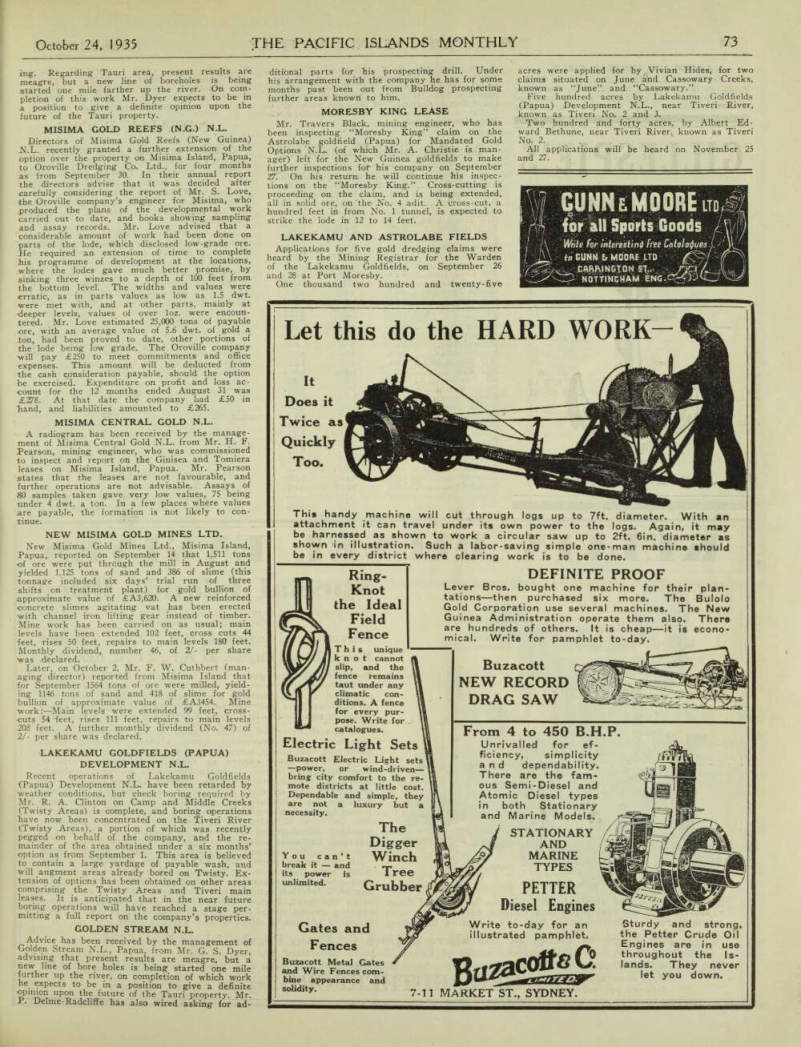
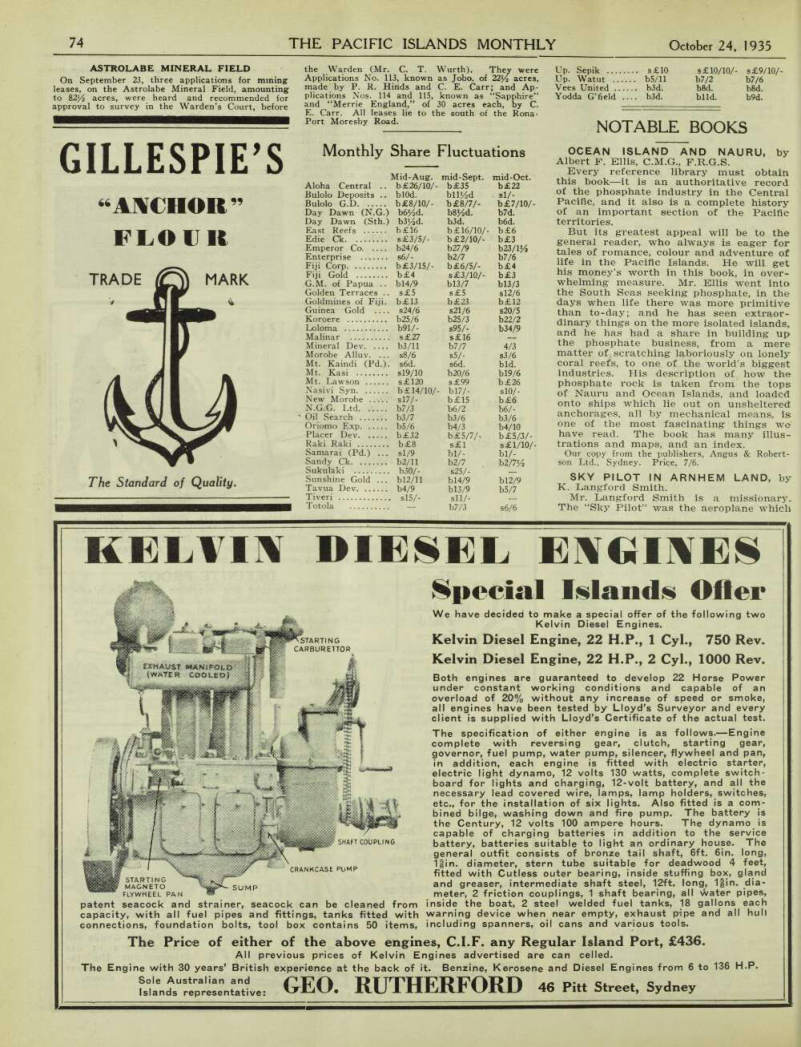
Guinea Gold N.L.
The secretary of Guinea Gold N.L., Adelaide, has received a wireless message from Mr. G. b.
Dyer, who is inspecting the company s properties in Papua, stating that the upper part of the Bubuau claims, where the creek branches, looks hopeful, and the Punjab area also looks encourag
ing. Regarding Tauri area, present results are meagre, but a new line of boreholes is being started one mile farther up the river. On com pletion of this work Mr. Dyer expects to be in a position to give a definite opinion upon the future of the Tauri property.
Misima Gold Reefs (N.G.) N.L.
Directors of Misima Gold Reefs (New Guinea) N.L. recently granted a further extension of the option over the property on Misima Island, Papua, to Oroville Dredging Co. Ltd., for four months as from September 30. In their annual report the directors advise that it was decided after carefully considering the report of Mr. S. Love, the Oroville company’s engineer for Misima, who produced the plans of the developmental work carried out to date, and books showing sampling and assay records. Mr. Love advised that a considerable amount of work had been done on parts of the lode, which disclosed low-grade ore.
He required an extension of time to complete his programme of development at the locations, where the lodes gave much better promise, by sinking three winzes to a depth of 100 feet from the bottom level. The widths and values were erratic, as in parts values as low as 1.5 dwt. were met with, and at other parts, mainly at ■deeper levels, values of over loz. were encoun tered. Mr. Love estimated 25,000 tons of payable ore, with an average value of 5.6 dwt. of gold a ton, had been proved to date, other portions of the lode being low grade. The Oroville company will pay £250 to meet commitments and office expenses. This amount will be deducted from the cash consideration payable, should the option be exercised. Expenditure on profit and loss ac count for the 12 months ended August 31 was £278. At that date the company had £5O in Land, and liabilities amounted to £265.
Misima Central Gold N.L.
A radiogram has been received by the manage ment of Misima Central Gold N.L. from Mr. H. F.
Pearson, mining engineer, who was commissioned to inspect and report on the Ginisea and Tomiera leases on Misima Island, Papua. Mr. Pearson states that the leases are not favourable, and further operations are not advisable. Assays of 80 samples taken gave very low values, 75 being under 4 dwt. a ton. In a few places where values are payable, the formation is not likely to con tinue.
New Misima Gold Mines Ltd.
New Misima Gold Mines Ltd., Misima Island, Papua, reported on September 14 that 1,511 tons of ore were put through the mill in August and yielded 1,125 tons of sand and 386 of slime (this tonnage included six days’ trial run of three shifts on treatment plant) for gold bullion of approximate value of £A3,630. A new reinforced concrete slimes agitating vat has been erected with channel iron lifting gear instead of timber.
Mine work has been carried on as usual; main levels have been extended 102 feet, cross cuts 44 feet, rises 50 feet, repairs to main levels 180 feet.
Monthly dividend, number 46, of 2/- per share was declared.
Later, on October 2, Mr. F. W. Cuthbert (man aging director) reported from Misima Island that for September 1564 tons of ore were milled, yield ing 1146 tons of sand and 418 of slime for gold bullion of approximate value of £A3454. Mine work:—Main levels were extended 99 feet, cross cuts 54 feet, rises 111 feet, repairs to main levels 208 feet. A further monthly dividend (No. 47) of 2/- per share was declared.
Lakekamu Goldfields (Papua)
Development N.L.
Recent operations of Lakekamu Goldfields (Papua) Development N.L. have been retarded by weather conditions, but check boring required by Mr. R. A. Clinton on Camp and Middle Creeks (Twisty Areas) is complete, and boring operations have now been concentrated on the Tiveri River (Twisty Areas), a portion of which was recently pegged on behalf of the company, and the re mainder of the area obtained under a six months’ option as from September 1. This area is believed to contain a large yardage of payable wash, and will augment areas already bored on Twisty. Ex tension of options has been obtained on other areas comprising the Twisty Areas and Tiveri main leases. It is anticipated that in the near future boring operations will have reached a stage per mitting a full report on the company’s properties.
Golden Stream N.L.
Advice has been received by the management of Golden Stream N.L., Papua, from Mr. G. S. Dyer, advising that present results are meagre, but a new line of bore holes is being started one mile further up the river, on completion of which work “ e . expects to be in a position to give a definite opinion upon the future of the Tauri property. Mr.
P. Delme-Radcliffe has also wired asking for ad
ditional parts for his prospecting drill. Under his arrangement with the company he. has for some months piast been out from Bulldog prospecting further areas known to him.
Moresby King Lease
Mr. Travers Black, mining engineer, who has been inspecting “Moresby King” claim on the Astrolabe goldfield (Papua) for Mandated Gold Options N.L. (of which Mr. A. Christie is man ager) left for the New Guinea goldfields to make further inspections for his company on September 27. On his return he will continue his inspec tions on the “Moresby King.” Cross-cutting is proceeding on the claim, and is being extended, all in solid ore, on the No. 4 adit. . A cross-cut, a hundred feet in from No. 1 tunnel, is expected to strike the lode in 12 to 14 feet.
Lakekamu And Astrolabe Fields
Applications for five gold dredging claims were heard by the Mining Registrar for the Warden of the Lakekamu Goldfields, on September 26 and 28 at Port Moresby.
One thousand two hundred and twenty-five
acres were applied for by Vivian Hides, for two claims situated on June and Cassowary Creeks, known as “June” and “Cassowary.”
Five hundred acres by Lakekamu Goldfields (Papua) Development N.L., near Tiveri /River, known as Tiveri No. 2 and 3.
Two hundred and forty acres, by Albert Ed ward Bethune, near Tiveri River, known as Tiveri No. 2.
All applications will be heard on November 25 and 27.
Astrolabe Mineral Field
On September 23, three applications for mining leases, on the Astrolabe Mineral Field, amounting to 82 l /2 acres, were heard and recommended for approval to survey in the Warden’s Court, before
the Warden (Mr. C. T. Wurth), They were Applications No. 113, known as Jobo, of acres, made by P. R. Hinds and C. E. Carr; and Ap plications Nos. 114 and 115, known as “Sapphire” and “Merrie England,” of 30 acres each, by C.
E. Carr. All leases lie to the south of the Rona- Port Moresby Road.
Advertisements & other items, pp. 75-76 (1 item)
Ra2agsffi££
'I?
GUNN t MOORE lu
for all Sports Goods I - Wl ry M/n/e Far interesting Free Catalogues ,j A V ia CUNN Er MOORE LTD
CARRINGTON ST-
NOTTINGHAM ENG
Let this do the HARD WORK
Does it
Twice as
Quickly
Too.
This handy machine will cut through logs up to 7ft. diameter. With an attachment it can travel under its own power to the logs. Again, it may be harnessed as shown to work a circular saw up to 2ft. 6in. diameter as shown in illustration. Such a labor-saving simple one-man machine should be in every district where clearing work is to be done.
DEFINITE PROOF
Lever Bros, bought one machine for their plantations—then purchased six more. The Bulolo Gold Corporation use several machines. The New Guinea Administration operate them also. There are hundreds of others. It is cheap—it is economical. Write for pamphlet to-day.
Ring-
Knot
the Ideal
Field
Fence
This unique knot cannot slip, and the fence remains taut under any climatic conditions. A fence for every purpose. Write for catalogues.
Electric Light Sets
Buzacott Electric Light sets —power, or wind-driven— bring city comfort to the remote districts at little cost.
Dependable and simple, they are not a luxury but a necessity.
You can’t Winch break it and its power is 1 TCC
unlimited. Grubber
Gates and
Fences
Buzacott Metal Gates and Wire Fences combine appearance and solidity.
Buzacott
NEW RECORD
DRAG SAW
From 4 to 450 B.H.P Unrivalled for efficiency, simplicity and dependability.
There are the famous Semi-Diesel and Atomic Diesel types in both Stationary and Marine Models.
STATIONARY
AND
MARINE
TYPES
FETTER
Diesel Engines
Write to-day for an illustrated pamphlet.
Ra2agsffi££
7-11 MARKET ST., SYDNEY.
Sturdy and strong, the Petter Crude Oil Engines are in use throughout the Islands. They never let you down.
GILLESPIE’S
“ANCHOR”
FLOUR
TRADE
MARK
The Standard of Quality.
KELVIN DIESEL ENGINES
J 4.
I
'STARTING
CARBURETTOR
EXHAUST MANIFOLD
(WATER COOLED)
E M u t
SHAFT COUPLING
V
SUMP
CRANKCASE PUMP
STARTING
MAGNETO
FLYWHEEL PAN
patent seacock and strainer, seacock can be cleaned from capacity, with all fuel pipes and fittings, tanks fitted with connections, foundation bolts, tool box contains 50 items,
Special Islands Oiler
We have decided to make a special offer of the following two Kelvin Diesel Engines.
Kelvin Diesel Engine, 22 H.P., 1 Cyl., 750 Rev.
Kelvin Diesel Engine, 22 H.P., 2 Cyl., 1000 Rev.
Both engines are guaranteed to develop 22 Horse Power under constant working conditions and capable of an overload of 20% without any increase of speed or smoke, all engines have been tested by Lloyd’s Surveyor and every client is supplied with Lloyd’s Certificate of the actual test.
The specification of either engine is as follows. —Engine complete with reversing gear, clutch, starting gear, governor, fuel pump, water pump, silencer, flywheel and pan, in addition, each engine is fitted with electric starter, electric light dynamo, 12 volts 130 watts, complete switchboard for lights and charging, 12-volt battery, and all the necessary lead covered wire, lamps, lamp holders, switches, etc., for the installation of six lights. Also fitted is a combined bilge, washing down and fire pump. The battery is the Century, 12 volts 100 ampere hours. The dynamo is capable of charging batteries in addition to the service battery, batteries suitable to light an ordinary house. The general outfit consists of bronze tail shaft, 6ft. 6in. long, I|in. diameter, stern tube suitable for deadwood 4 feet, fitted with Cutless outer bearing, inside stuffing box, gland and greaser, intermediate shaft steel, 12ft. long, I|in. diameter, 2 friction couplings, 1 shaft bearing, all water pipes, inside the boat, 2 steel welded fuel tanks, 18 gallons each warning device when near empty, exhaust pipe and all huh including spanners, oil cans and various tools.
The Price of either of the above engines, C.I.F. any Regular Island Port, £436.
All previous prices of Kelvin Engines advertised are can celled.
The Engine with 30 years’ British experience at the back of it. Benzine, Kerosene and Diesel Engines from 6to 136 H.P.
Islands representative:
GEO. RUTHERFORD 46 Pitt Street, Sydney
Monthly Share Fluctuations
Mid-Aug. mid-Sept. mid-Oct.
Aloha Central .. b £26/10/b£3S b£22 Bulolo Deposits .. blOd. hlVAd sl/- Bulolo G.D b£8/10/b£8/7/b£7/10/- Day Dawn (N.G.) b6^d. b8'M. b7d.
Day Dawn (Sth.) b3j4d. b3d. b6d.
East Reefs b £16 b £16/10/ b£6 Edie Ck s£3/5/b£2/10/b£3 Emperor Co b24/6 b27/9 b23/lj4 Enterprise s6/bin b7/6 Fiji Corp b£3/15/b£6/S/b£4 Fiji Gold b£4 s£3/10/b£3 G.M. of Papua .. bl4/9 bl3/7 bl3/3 Golden Terraces .. s£5 s£5 sl2/6 Goldmines of Fiji. b£13 b£23 b£12 Guinea Gold ... s24/6 s21/6 s20/S Koroere b2S/6 b25/3 bll/2 Loloma b91/s95/b34/9 Malinar s£27 s£16 Mineral Dev b3/ll b7/7 4/3 Morobe Alluv. ... s8/6 s5/s3/6 Mt. Kaindi (Pd.). s6d. s6d. bid.
Mt. Kasi S19/10 b20/6 bl9/6 Mt. Lawson s£120 s£99 b£26 Nasivi Syn b £14/10/bl7/slO/- New Morobe sl7/b£15 b£6 N.G.G. Ltd b7/3 b6/2 b6/- Oil Search b3/7 b3/6 b3/6 Oriomo Exp b5/6 b4/3 b4/10 Placer Dev b£32 b £5/7/b£S/3/- Raki Raki b£8 s£l s£l/10/- Samarai (Pd.) ... sl/9 bl/bl/- Sandy Ck b2/ll bl/7 b2/7*4 Sukulaki b30/s2S/- Sunshine Gold ... bl2/ll bl4/9 bl2/9 Tavua Dev b4/9 bl3/9 b5/7 Tiveri slS/sll/- Totola b7/3 s6/6
Up. Sepik .. s£10 s £10/10/s£9/10/- Up. Watut .. bS/11 b7/2 b7/6 Vees United .. b3d. b8d. b8d.
Yodda G’field .. .. b3d. blld. b9d.
Notable Books
Ocean Island And Nauru, By
Albert F. Ellis. C.M.G., F.R.G.S.
Every reference library must obtain this book—it is an authoritative record of the phosphate industry in the Central Pacific, and it also is a complete history of an important section of the Pacific territories.
But its greatest appeal will be to the general reader, who always is eager for tales of romance, colour and adventure of life in the Pacific Islands. He will get his money’s worth in this book, in over whelming measure. Mr. Ellis went into the South Seas seeking phosphate, in the days when life there was more primitive than to-day; and he has seen extraor dinary things on the more isolated islands, and he has had a share in building up the phosphate business, from a mere matter of scratching laboriously on lonely coral reefs, to one of the world’s biggest industries. His description of how the phosphate rock is taken from the tops of Nauru and Ocean Islands, and loaded onto ships which lie out on unsheltered anchorages, all by mechanical means, is one of the most fascinating things we have read. The book has many illus trations and maps, and an index.
Our copy from the publishers, Angus & Robert son Ltd., Sydney. Price, 7/6.
Sky Pilot In Arnhem Land, By
K. Langford Smith.
Mr. Langford Smith is a missionary.
The “Sky Pilot” was the aeroplane which
he used in his work. Arnhem Land is in Northern Australia. The combination appears a little dull; but, by the grace of fortune, Mr. Langford Smith has a sense of humour, and the story of his adventures is told in a delightful fashion.
We got more hearty laughs out of this book than from anything we have read for years. We particularly commend the story of how this young man learned to drive a model T Ford; or the account of how he was “treed” by a buffalo.
Perhaps his funniest story is his des cription of how he took his native ser vant and his dog for their first ride in an aeroplane. He thought his servant’s expression of agony, and his maddened attempts to climb out of the ’plane, were due to fear. He discovered later, how ever, that the terrified dog had fastened his teeth in the first thing available. “If my servant had been wearing trousers,” said Langford Smith naively, “they would have been very badly torn.”
The book has a serious side, and is a worthy contribution to mission literature.
Our copy from the publishers, Angus & Robert son Ltd., Sydney. Price, 6/-.
Norfolk Is. And The Bounty
MUTINY, by Percy J. Marks, of 92 Pitt St., Sydney.
This pamphlet is a valuable addition to the literature on the subject. Mr. Marks, it is clear, has engaged in a tireless search of available records, and has assembled facts and dates in a way that makes an interesting story, and that will be very useful to future historians, Mr. Marks has devoted himself to a compilation of the strange history of Norfolk Island: his references to the Bounty Mutiny come into the story only in relation to the in troduction of the Pitcairners to N.I.
The latter landed there (40 men, 47 women, 54 boys and 53 girls, total 194) on June 8, 1856. They brought eight sur names to N.I. —Adams, Christian, McCoy, Quintal, Young (descendants of the Bounty mutineers) and Buffett, Evans and Nobbs (descendants of men who joined the Pitcairn community after it was discovered in 1808). All those sur names flourish there to-day. We should describe Mr, Marks’ pamphlet as the most complete and authoritative history of Norfolk Island, yet published.
The Blending Of Cultures: An
Essay on the Aims of Native Education, by F. E. Williams, M.A., B.Sc., Govern ment Anthropologist in Papua.
The introduction of European civilisa tion to Pacific races, who themselves have cultures not incomparable to European standards of life of a thousand years ago, has created difficult problems for ad ministrators. Those problems have been tackled in a scientific and a practical way in Papua; and Mr. Williams, in his 44-page pamphlet, describes what has been done, and the possible and probable directions of future work in this field. It is a compilation that will be of value to tropical administrators everywhere, and to scientists generally.
Notes From Lae
From a Special Correspondent.
LAE, Oct. 9, T AE is now a township, ranking high in the Mandated Territory of New Guinea, It is a centre of great activity, being the headquarters of Guinea Air ways Ltd. and one of the biggest (if not the biggest) aircraft centres in the Southern Hemisphere. The European population is now around the hundred mark and is increasing each steamer.
Accommodation is being taxed; so much
so that a new hotel has been commenced and is expected to be completed in a month or two. Travellers and others will then be assured of good accommodation and service.
On the evening of October 5 a dinner was held at the hotel to wish hon voyage to Messrs. Boyd and Whitlow. The for mer is proceeding South on leave, and Mr. Whitlow is going East to have an other look at Fujiyama. It was also an occasion to celebrate the birthday of Mr.
C. Steed, an old resident of the Islands.
At another table a dinner party was held in honour of Mr. J. Turner, well-known pilot for Guinea Airways Ltd., who is proceeding South on leave.
A permanent Administration office building has just recently been completed and in the near future an Assistant Dis trict Officer, Patrol Officer and Clerk will be stationed here. A new bungalow is now nearly completed for the Govern ment representative, as is also one for the local manager of Messrs. Burns, Philp and Co. Ltd. In course of construction also is the new bachelor quarters for Vacuum Oil Co. Pty. Ltd. Quite recently the new hangar for Guinea Airways Ltd. was completed and was officially opened by Lady Pearce, in the presence of a representative gathering.
Departures for the South by this Mac dhui include Mr. S. D. Marshall, who will be remembered for his solo flight to Aus tralia and back some time ago in his Widgeon ’plane. Mr. Marshall is leaving his ’plane here temporarily, but hopes to soon return and fly it again to Australia.
Recent returns to Lae include Mr. and Mrs. J. Gething, both looking very well after their holiday, and they brought with them a speed-boat belonging to Mr. Bob Gurney, one of Airways’ chief pilots.
For the last few weeks we have had the pleasure of the company of a number of Bulolo Gold Dredging Co.’s men, who have been down here to construct a new punt to be used in discharging heavy cargo consigned to that firm.
Advertisements & other items, p. 77 (1 item)
Ferrodor Corrosive) Paint
To Pacific Islands
Traders
SAVE MONEY AND BUY YOUR
GOODS DIRECT FROM
MANCHESTER—
Write to us for Quotations. Details, etc.
WE ARE MANUFACTURERS OF
GREY, WHITE AND COLOURED
TEXTILES
Rami materials of every description.
Para Reds.
White and Blue Drills.
Grey and White Calicos.
Super Drill.
Ecru Tussore.
Dyed Poplm*.
Woven-striped Poplins.
Table Cloths.
Serviettes.
Sheets.
Pillow Cases.
Quilts.
Bedspreads.
Art Silk Pises Goode.
Bath Wraps.
Glass Cloths.
Sweat Rase.
Bias Binding.
Braids, Printed Calicos, Poplins, Woven Coloured Ginghams, etc.
Extract from a letter sent to us by an Islands storekeeper who recently retired:— Milne Bay, Papua. 1.10.34.
“. . .a success due—in a great measure —to the excellent service rendered for so many years by your firm. Yours faithfully,
“H. DEXTER.”
A. WEBB & COMPANY
(Manchester) LTD.
86 GEORGE ST., MANCHESTER
Contractors to H.M. and Foreign Governments.
Bentley’s Code, and ABC Code 4th and sth Editions.
Telegraphic Address: “WASTOCK,” Manchester.
km &
Rain
and Sun ...
—as destructive to
Woodwork as Fire!
Rain and dew cause unprotected woodwork to swell. The sun makes it shrink again. Unprotected woodwork is in a state of constant movement which affects the joints and also causes cracks which become centres for decay. Prevent the decay of YOUR property! coat it with a paint that WILL protect it against rain and sun.
Use only—
FERRODOR CORROSIVE) PAINT
Frrst give woodwork (and ironwork) a priming coat of FERRODOR NO. 29 NATURAL STEEL GREY, then follow it up with any of the 25 modern FERRODOR colours which are supplied in paste form or ready to use.
Obtain FERRODOR PAINT (colour card on request) at all leading merchants or the Sole Agents—
WILLIAM ADAMS L COMPANY
175 CLARENCE STREET, SYDNEY
Islands Prodace
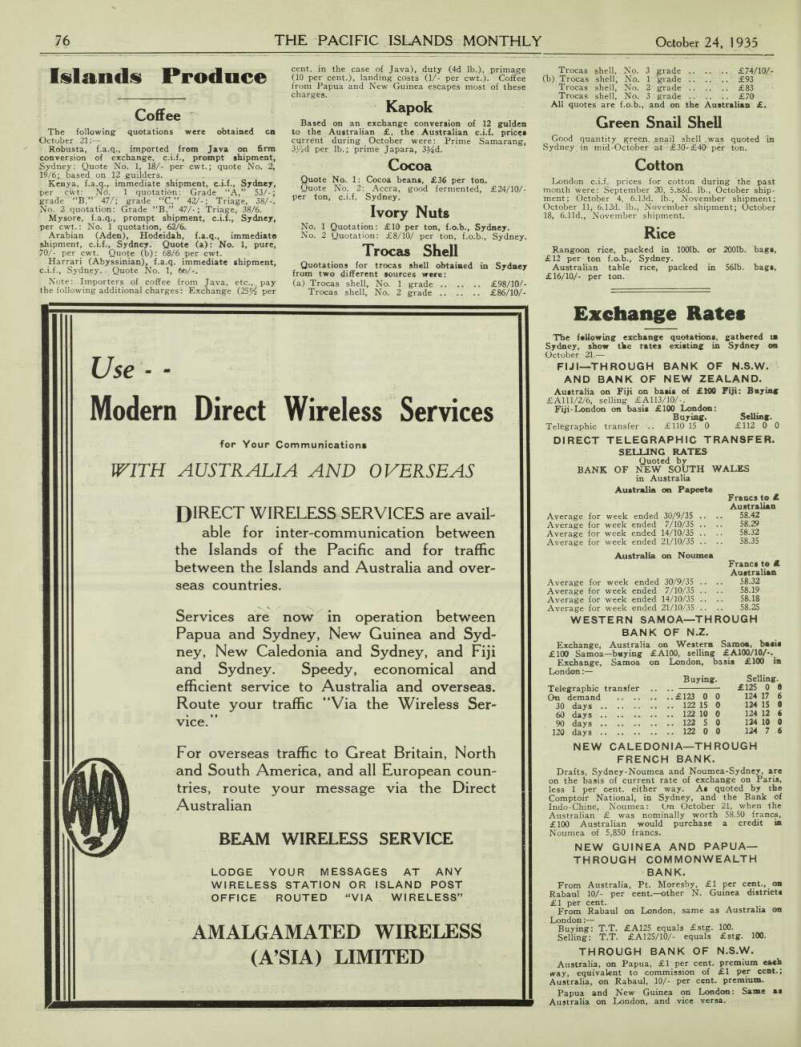
Coffee
The following quotations were obtained cn October 21;— Robusta, f.a.q., imported from Java on firm conversion of exchange, c.i.f., prompt shipment, Sydney: Quote No. 1, 18/- per cwt.; quote No. 2, 19/6; based on 12 guilders.
Kenya, f.a.q., immediate shipment, c.i.f., Sydney, per cwt: No. 1 quotation: Grade “A,” 53/-; grade “B,” 47/; grade “C,” 42/-; Triage, 38/-.
No. 2 quotation: Grade “B,” 47/-; Triage, 38/6.
Mysore, f.a.q., prompt shipment, c.i.f., Sydney, per cwt.; No. 1 quotation, 62/6.
Arabian (Aden), Hodeidah, f.a.q., immediate shipment, c.i.f., Sydney. Quote (a): No. 1, pure, 70/- per cwt. Quote (b): 68/6 per cwt.
Harrari (Abyssinian), f.a.q. immediate shipment, c.i.f., Sydney. Quote No, 1, 60/-.
Note: Importers of coffee from Java, etc.,, pay the following additional charges'; Exchange (25% per
cent, in the case of Java), duty (4d lb.), primage (10 per cent.), landing costs (1/- per cwt.). Coffee from Papua and New Guinea escapes most of these charges.
Kapok
Based on an exchange conversion of 12 gulden to the Australian £, the Australian c.i.f. prices current during October were: Prime Samarang, 3 l / 2 d per lb.; prime Japara, 324d.
Cocoa
Quote No. 1: Cocoa beans, £36 per ton.
Quote No. 2: Accra, good fermented, £24/10/per ton, c.i.f. Sydney.
Ivory Nuts
No. 1 Quotation: £10 per ton, f.o.b., Sydney.
No. 2 Quotation: £8/10/ per ton, f.o.b., Sydney.
Trocas Shell
Quotations for trocas shell obtained in Sydney from two different sources were: (a) Trocas shell, No. 1 grade £98/10/- Trocas shell, No. 2 grade £86/10/-
Trocas shell, No. 3 grade £74/10/- (b) Trocas shell, No. 1 grade .. .. .. £93 Trocas shell, No. 2 grade £83 Trocas shell, No. 3 grade £70 All quotes are f.o.b., and on the Australian £.
Green Snail Shell
Good quantity green, snail shell .was quoted in Sydney in mid-October at £30-£40 per ton.
Cotton
London c.i.f. prices for cotton during the past month were: September 20, 5.88d. lb., October ship ment; October 4, 6.13d. lb., November shipment; October 11, 6.12d. lb., November shipment; October 18, 6.11d., November shipment.
Rice
Rangoon rice, packed in 1001b. or 2001b. bags, £12 per ton f.o.b., Sydney.
Australian table rice, packed in S6Ib. bags, £16/10/- per ton.
Exchange Rates
The following exchange quotations, gathered in Sydney, show the rates existing in Sydney on October 21. —
Fiji—Through Bank Of N.S.W.
And Bank Of New Zealand.
Australia on Fiji on basis of £100 Fiji: Baying £A111/2/6, selling £A113/10/-.
Fiji-London on basis £100 London: Buying. Selling.
Telegraphic transfer .. £110 15 0 £112 0 0
Direct Telegraphic Transfer.
Selling Rates
Quoted by
Bank Of New South Wales
in Australia
Western Samoa—Through
Bank Of N.Z.
Exchange, Australia on Western Samoa, basic £lOO Samoa—baying £AIOO, selling Exchange, Samoa on London, basis £lOO in London:—
New Caledonia—Through
French Bank.
Drafts, Sydney-Noumea and Noumea-Sydney, are on the basis of current rate of exchange on Paris, less 1 per cent, either way. As quoted by the Comptoir National, in Sydney, and the Bank of Indo-Chine, Noumea: On October 21, when the Australian £ was nominally worth 58.50 francs, £lOO Australian would purchase a credit in Noumea of 5,850 francs.
New Guinea And Papua
Through Commonwealth
Bank.
From Australia, Pt. Moresby, £1 per cent., on Rabaul 10/- per cent.—other N. Guinea districts £1 per cent.
From Rabaul on London, same as Australia on London: — Buying: T.T. £AI2S equals £stg. 100.
Selling: T.T. £AI2S/10/- equals £stg. 100.
Through Bank Of N.S.W.
Australia, on Papua, £1 per cent, premium eaeh way, equivalent to commission of £1 per cent.; Australia, on Rabaul, 10/- per cent, premium.
Papua and New Guinea on London: Same at Australia on London, and vice versa.
Australia on Papeete Average for week ended 30/9/35 .. • Francs to £ Australian 58.42 Average for week ended 7/10/35 .. 58.29 Average for week ended 14/10/35 .. 58.32 Average for week ended 21/10/35 .. . 58.35 Australia on Noumea Average for week ended 30/9/35 .. .
Francs to £ Australian 58.32 Average for week ended 7/10/35 .. . 58.19 Average for week ended 14/10/35 .. • 58.18 Average for week ended 21/10/35 .. . 58.25
Buying. Selling.
Telegraphic transfer .. .. £125 0 0 On demand £123 0 0 124 17 6 30 days 122 IS 0 124 IS 0 60 days 122 10 0 124 12 6 90 days 122 5 0 124 10 0 120 days 122 0 0 124 7 6
Advertisements & other items, p. 78 (1 item)
Modern Direct Wireless Services
Use -
WITH AUSTRALIA AND OVERSEAS
DIRECT WIRELESS SERVICES are avail-
able for inter-communication between between the Islands and Australia and overseas countries.
Papua and Sydney, New Guinea and Sydney, New Caledonia and Sydney, and Fiji and Sydney. Speedy, economical and efficient service to Australia and overseas.
Route your traffic “Via the Wireless Ser- • • t vice.
For overseas traffic to Great Britain, North and South America, and all European countries, route your message via the Direct Australian for Your Communications the Islands of the Pacific and for traffic Services are now in operation between
BEAM WIRELESS SERVICE
LODGE YOUR MESSAGES AT ANY
WIRELESS STATION OR ISLAND POST
OFFICE ROUTED “VIA WIRELESS"
AMALGAMATED WIRELESS
(A’SIA) LIMITED
Market Quotations
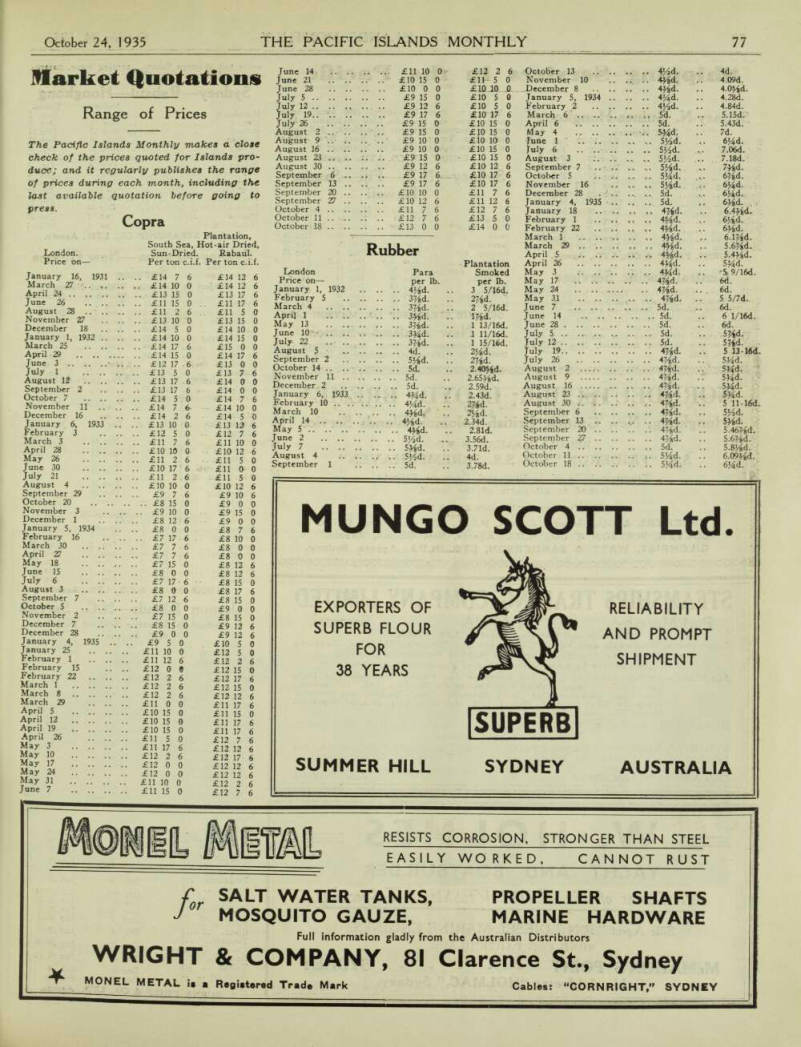
Range of Prices
The Pacific Islands Monthly makes a close check of the prices quoted for Islands pro duce; and it regularly publishes the range of prices during each month, including the last available quotation before going to press.
June 14 . .. £11 10 0 £12 2 6 June 21 £10 15 0 fit- 5 0 June 28 £10 0 0 £10 JO 0 July 5 .. £9 15 0 £10 5 0 July 12 .. 6 £10 5 0 July 19.. £9 17 6 £10 17 6 July 26 £9 15 0 £10 15 0 August 2 £9 15 0 £10 15 0 August 9 .. .. £9 10 0 £10 10 0 August 16 £9 10 0 £10 15 0 August 23 . . £9 15 0 £10 IS 0 August 30 £9 12 6 £10 12 6 September 6 .. .. £9 17 6 £10 17 6 September 13 .. .. £9 17 6 £10 17 6
September
20 .. .. .. £10 10 0 £11 7 6 September 27 .. .. .. £10 12 6 £11 12 6 October 4 .. £11 7 6 £12 7 6 October 11 .. £12 7 6 £13 5 0 October 18 .. £13 0 0 £14 0 (1
Rubber
Plantation London Para Smoked Price on— per lb. per lb.
January 1, 1932 February 5 .. 4^d. 3 5/16d. 3Hd. 2% d.
March 4 3Hd. 2 5/16d.
April 1 . .. .. 3^d.
IHd.
May 13 3H d. 1 13/16d.
June 10 . .. .. 3Hd. 1 ll/16d.
July 22 3Hd. 1 15/16d.
August 5 .. . 4d. 2%d.
September 2 .
S%d. 2Hd.
October 14 5<L 2.40^d.
November 11 .. . 5d. 2.65jid.
December 2 .. . 5d. 2.59d.
January 6, 1933 4f4d. 2.43d.
February 10 .. .. 4 %d. 2Hd.
March 10 .. .. ... .. 4Hd. 2'/ s d.
April 14 2.34d.
May 5 ., 2.81d.
June 2 .. 3.56d.
July 7 .. .. 5Hd. 3.71d.
August 4 .. .. .. S'Ad. 4d.
September 1 .. .. 5d. ., 3.78d.
October 13 .. .. .. .. 4y a d. 4d.
November 10 ... .. 4Hd. . 4.09d. . December 8 .. .. 4^d. , , 4.0Xd.
January 5, 1934 .. .. .. 4'Ad. . . 4.28d.
February 2 .. .. .. .. 4y 3 d. , , 4.84d.
March 6 S.lSd.
April 6 .. .. 5d.
S.43d.
May 4 .. .. SHd. . . 7d.
June 1 .. .. sy 3 d. 6'Ad.
July 6 .. .. S'/ 3 d. , , 7.06d.
August 3 ... ... sy 3 d. 7.18d.
September 7 ... .. .. S'Ad. 7^d.
October 5 ... .. .. S'Ad. 6Jid.
November 16 ... .. S'Ad. 6V*d.
December 28 .. .. Sd. 6'Ad.
January 4, 1935 .. .. Sd. 6Hd.
January 18 .. . 6.4 Yid.
February 1 .. . „ 4%d. . . 6%d.
February 22 ... ... 4Hd. 6Hd.
March 1 . .. .. 4*id. e.vAd.
March 29 5.67Ad.
April 5 . . 5.4Hd.
April 26 .. .. 4Hd. sy 4 d.
May 3 4^d. . .
'S9/16d.
May 17 .. .. 4^d. 6d.
May 24 .. 4^d. . . 6d.
May 3J .. 47^d. 5 5/7d.
June 7 .. .. Sd. , . 6d.
June 14 Sd. 6 l/16d.
June 28 .. .. Sd. 6d.
July 5 ., . .
SHd.
July 12 Sd. 57Ad.
July 19 4%d. . . 5 13-16d.
July 26 .. .. 47Ad.
SHd.
August 2 .. .. 4^d.
SHd.
August 9 .. .. 4^d.
SHd.
August 16 .. .. 47^d.
SHd.
August 23 ... .. 47/ 8 d.
SHd.
August 30 47^d. . . 5 ll-16d.
September 6 .. ., 4^d. sy 3 d.
September 13 .. ., ■ . • 4m.
SHd.
September 30 .. 4%d. 5.46^d.
September 27 .. . 4iid. . , 5.6^d.
October 4
S.Shd.
October 11 554d. 6.Q9Hd.
October 18 S'Ad. 6'Ad.
London.
Copra
Plantation, South Sea, Hot-air Dried.
Sun-Dried. Rabaul.
Price on— Per ton c.i. f. Per ton c.i.f.
January 16, 1931 .. .. £14 7 6 £14 12 6 March 27 .. *, .. .. £14 10 0 £14 12 6 April 24 £13 17 6 June 26 ... .. .. £11 15 0 £11 17 6 August 28 .. .. £11 5 0 November 27 .. .. £13 10 0 £13 15 0 December 18 .. .. £14 5 0 £14 10 0 January 1, 1932 .. .. .. £14 10 0 £14 15 0 March 25 ... .. .. £14 17 6 £15 0 0 April 29 £14 15 0 £14 17 6
June 3 ■
£13 0 0 July 1 ... .. .. £13 5 0 £13 7 6 August 12 .. .. £14 0 0 September 2 .. .. £13 17 6 £14 0 0 October 7 £14 7 6 November 11 .. .. £14 7 6 £14 10 0 December 16 .. .. £14 2 6 £14 5 0 January 6, 1933 .. .. £13 10 0 £13 13 6 February 3 .. .. £12 5 0 £12 7 6 March 3 ... £11 10 0 April 28 ... £10 12 6 May 26 ... £11 5 0 June 30 ... .. .. £10 17 6 £11 0 0 July 21 ... .. .. £11 2 6 £11 5 0 August 4 .. .. .. .. £10 10 0 £10 12 6 September 29 .. .. £9 7 6 £9 10 6 October 20 .. .. £8 IS 0 £9 0 0 November 3 .. .. £9 10 0 £9 15 0 December 1 £9 0 0 January 5, 1934 .. .. £8 0 0 £8 7 6 February 16 .. .. £7 17 6 £8 10 0 March 30 .. .. .. £7 7 6 £8 0 0 April 27 ... .. .. £7 7 6 £8 0 0 May 18 ... .. .. £7 IS 0 £8 12 6 June IS .. ,. £8 12 6 July 6 ... £8 IS 0 August 3 .. .. £8 17 6 September 7 .. .. £7 12 6 £8 15 0 October 5 .. .. .. .. £8 0 0 £9 0 0 November 2 £8 15 0 December 7 .. .. £8 15 0 £9 12 6 December 28 .. .. £9 0 0 £9 12 6 January 4, 1935 . .. £9 5 0 £10 5 0 January 25 .. .. £11 10 0 £12 5 0 February 1 .. .. .. £11 12 6 £12 2 6
February IS
.. £12 0 e £12 15 0
February 22
£12 2 6 £12 17 6 March 1 .. £12 2 6 £12 IS 0 March 8 .. £12 2 6 £12 12 6 March 29 ... .. £11 0 0 £11 17 6
April 5
.. £10 IS 0 £11 IS 0 April 12 £11 17 6
April 19
£10 IS 0 £11 17 6 April 26 ... £12 7 6 May 3 .. £11 17 6 £12 12 6 May 10 £12 2 6 £12 17 6 May 17 £12 12 6 May 24 £12 12 6 May 31 .. £11 10 0 £12 2 6 June 7 £12 7 6
Advertisements & other items, p. 79 (1 item)
Mungo Scott Ltd.
EXPORTERS OF
SUPERB FLOUR
FOR
38 YEARS
SUPERB
RELIABILITY
AND PROMPT
SHIPMENT
SUMMER HILL
SYDNEY
AUSTRALIA
Mum
RESISTS CORROSION. STRONGER THAN STEEL
EASILY WORKED, CANNOT RUST
f SALT WATER TANKS, PROPELLER SHAFTS
J MOSQUITO GAUZE, MARINE HARDWARE
Full information gladly from the Australian Distributors WRIGHT & COMPANY, 81 Clarence St., Sydney MONEL METAL is a Registered Trade Mark
Cables: “CORNRIGHT” SYDNEY
Shipping Services in the Pacific
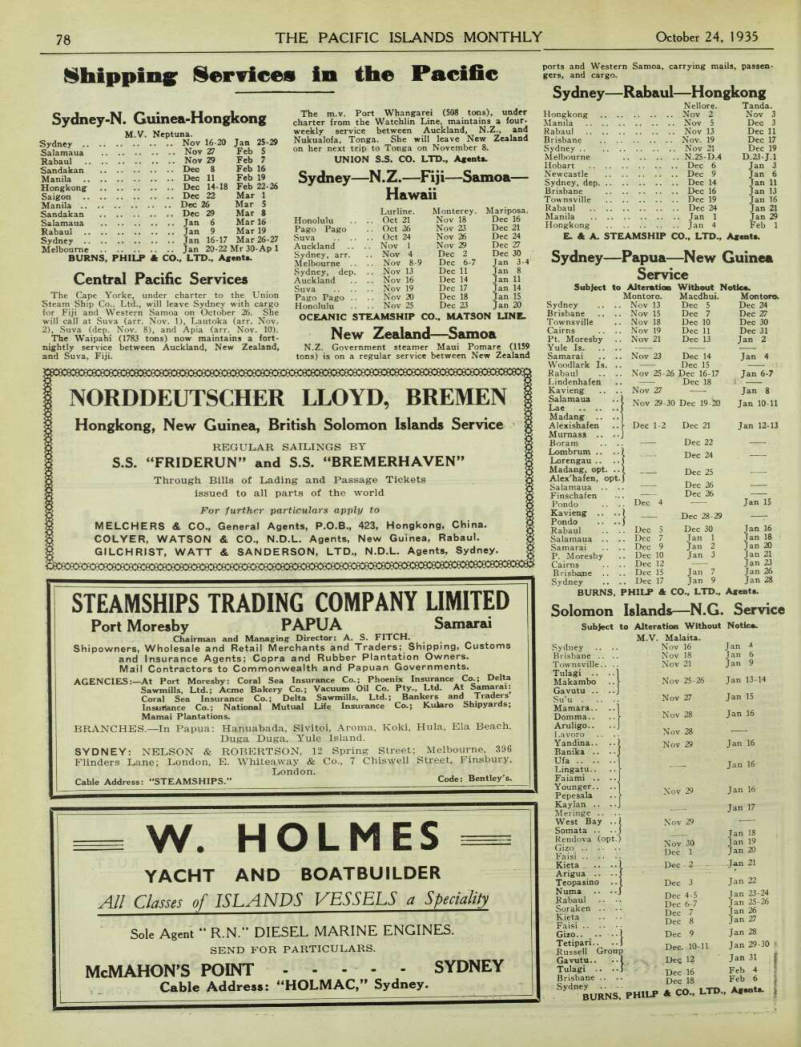
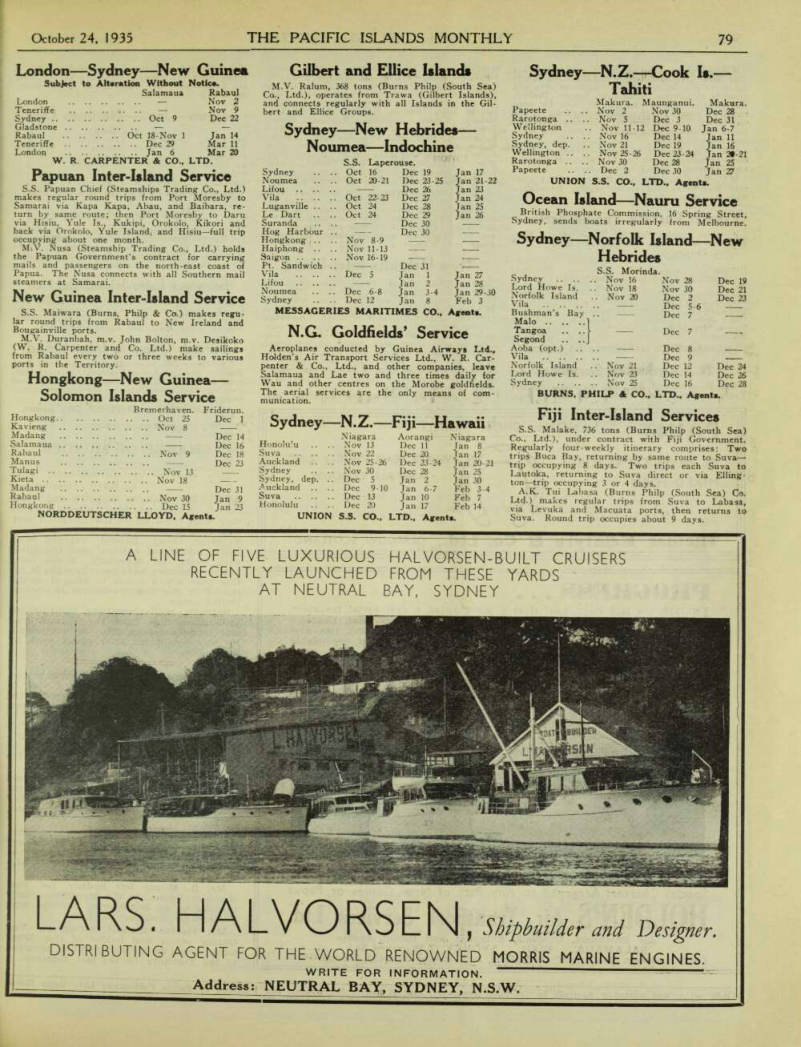
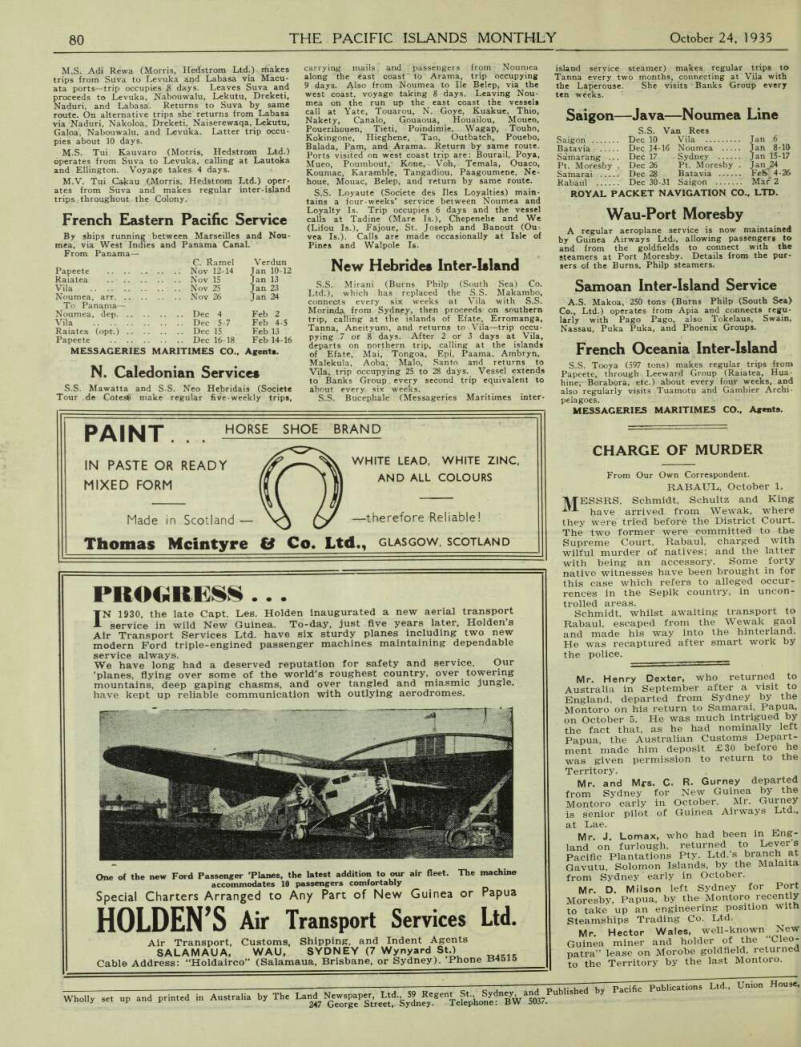
Sydney-N. Guinea-Hongkong
Central Pacific Services
The Cape Yorke, under charter to the Union Steam Ship Cos., Ltd., will leave Sydney with cargo for Fiji and Western Samoa on October 26. She will call at Suva (arr. Nov. 1), Lautoka (arr. Nov. 2), Suva (dep. Nov. 8), and Apia (arr. Nov. 10).
The Waipahi (1783 tons) now maintains a fort nightly service between Auckland, New Zealand, and Suva, Fiji.
The m.v. Port Whangarei (508 tons), under charter from the Watchlin Line, maintains a four weekly service between Auckland, N.Z., and Nukualofa, Tonga. She will leave New Zealand on her next trip to Tonga on November 8.
Union S.S. Co. Ltd., Agent*.
Sydney—N.Z.—Fiji—Samoa—
Hawaii
New Zealand —Samoa
N.Z. Government steamer Maui Pomare (1159 tons) is on a regular service between New Zealand
ports and Western Samoa, carrying mails, passen gers, and cargo.
Sydney—Rabaul—Hongkong
Sydney—Papua—New Guinea Service Subject to Alteration Without Notice.
Solomon Islands—N.G. Service Subject to Alteration Without Notice.
M .V. Ncptuna.
Sydney 16-20 Jan 25-29 Salamaua .. .. 27 Feb 5 Rabaul 29 Feb 7 Sandakan Dec 8 Feb 16 Manila 11 Feb 19 Hongkong .. .. 14-18 Feb 22-26 Saigon Dec 22 Mar 1 Manila Dec 26 Mar 5 Sandakan 29 Mar 8 Salamaua .. .. 6 Mar 16 Rabaul 9 Mar 19 Sydney 16-17 Mar 26-27 Melbourne .. ..
Jan 20-22 Mr 30- Ap 1
Burns, Philp * Co., Ltd., Agents.
Lurline.
Monterey.
Mariposa.
Honolulu Oct 21 Nov 18 Dec 16 Pago Pago Oct 26 Nov 23 Dec 21 Suva Oct 24 Nov 26 Dec 24 Auckland .. ..
Nov 1 Nov 29 Dec 27 Sydney, arr.
Nov 4 Dec 2 Dec 30 Melbourne ..
Nov 8-9 Dec 6-7 Jan 3-4 Sydney, dep.
Nov 13 Dec 11 Jan 8 Auckland Nov 16 Dec 14 Jan 11 Suva Nov 19 Dec 17 Jan 14 Pago Pago ..
Nov 20 Dec 18 Jan 15 Honolulu Nov 25 Dec 23 Jan 20
Oceanic Steamship
Co., Matson Line.
Nellore.
Tanda.
Hongkong . Nov 2 Nov 3 Manila Dec 3 Rabaul Dec 11 Brisbane Nov. 19 Dec 17 Sydnev Dec 19 Melbourne .. N.25-D.4 D.23-J.1 Hobart Jan 3 Newcastle Jan 6 Sydney, dep .. Dec 14 Jan 11 Brisbane .. Dec 16 Jan 13 Townsville .. Dec 19 Jan 16 Rabaul Jan 21 Manila Jan 29 Hongkong Feb 1
E. * A. Steamship Co., Ltd.,
Agents.
Montoro.
Macdhui.
Montoro.
Sydney .. ..
Nov 13 Dec 5 Dec 24 Brisbane .. ..
Nov 15 Dec 7 Dec 27 Townsville Nov 18 Dec 10 Dec 30 Cairns .. ..
Nov 19 Dec 11 Dec 31 Ft. Moresby ..
Nov 21 Dec 13 Jan 2 Yule Is — - — — Samarai .. ..
Nov 23 Dec 14 Jan 4 Woodlark Is. .. — Dec 15 — Rabaul Nov 25-26 Dec 16-17 Jan 6-7 Lindenhafen — Dec 18 i Kavieng .. ..
Nov 27 — Jan 8 Salamaua .. I
Lac j
Madang .. ..
Nov 29-30 Dec 19-20 Jan 10-11 Alexishafen Mumass .. ..
Dec 1-2 Dec 21 Jan 12-13 Boram — Dec 22 — Lombrum Lorengau • Dec 24 .
Madang, opt. ..
Alex’hafen, opt. , Dec 25 — Salamaua .. — Dec 26 — Finschafen — Dec 26 — Pondo .. .
Dec 4 — Jan 15 Kavieng .. ..
Pondo .. ..; s - Dec 28-29 Jan 16 Rabaul .. . . Dec 5 Dec 30 Salamaua .. . , Dec 7 Jan 1 Jan 18 Samarai .. . . Dec 9 Jan 2 Jan 20 P. Moresby . Dec 10 Jan 3 Jan 21 Cairns .. . . Dec 12 — Jan 23 Brisbane . Dec 15 Jan 7 Jan 26 Sydney . Dec 17 Jan 9 Jan 28
Burns. Philp & Co. F Ltd..
Agent*.
M.V.
Malaita.
Sydney Nov 16 Jan 4 Brisbane ..
Nov 18 Jan 6 Townsville..
Nov 21 Jan 9 Tulagi ..
Jan 13-14 Makambo Nov 25-26 Gavutu .. ..
Jan 15 Su’u .
Nov 27 Mamara..
Jan 16 Domma..
Nov 28 Aruligo..
Nov 28 Lavoro Yandina..
Nov 29 Jan 16 Banika .. ■■ Ufa .. ..
Jan 16 Lingatu.. — Faiami .. ..
Younger..
Pepesala Nov 29 Jan 16 Kaylan ..
Meringe . . — Jan 17 West Bay .. [ Nov 29 ■ Somata .. [ Jan 18 Jan 19 Rendova (op Gizo Nov 30 Faisi . . • Dec 1 Jan 20 Kieta Dec 2 Jan 21 Arigua ..
Teopasino Dec 3 Jan 22 Numa Kabaul Soraken ..
Kieta Dec 4-5 Dec 6-7 Dec 7 Dec 8 Jan 23-24 Jan 25-26 Jan 26 Jan 27 Gizo..
I Dec 9 Jan 28 Tetipari..
Russell Gro 1 ?
Dec. 10-11 Jan 29-30 .* Y <14 f Gavutu. . 1 Dec 12 Jan 31 1 Tulagi . • 1 Dec 16 Feb 4 !
Brisbane ..
Dec 18 Feb 6 Sydney burns,
, Philp * Co., Ltd ’
, Agents, j
London—Sydney—New Guinea Subject to Alteration Without Notice.
Papuan Inter-Island Service
5.5. Papuan Chief (Steamships Trading Co., Ltd.) makes regular round trips from Port Moresby to Samarai via Kapa Kapa, Abau, and Baibara, re turn by same route; then Port Moresby to Daru via Hisiu, Yule Is., Kukipi, Orokolo, Kikori and back via Orokolo, Yule Island, and Hisiu —full trip occupying about one month.
M.V. Nusa (Steamship Trading Co., Ltd.) holds the Papuan Government’s contract for carrying mails and passengers on the north-east coast of Papua. The Nusa connects with all Southern mail steamers at Samarai.
New Guinea Inter-Island Service
5.5. Maiwara (Burns, Philp & Co.) makes regu lar round trips from Rabaul to New Ireland and Bougainville ports.
M.V. Duranbah, m.v. John Bolton, m.v. Desikoko (W. R. Carpenter and Co. Ltd.) make sailings from Rabaul every two or three weeks to various ports in the Territory.
Hongkong—New Guinea—
Solomon Islands Service
Gilbert and Ellice Islands
M.V. Ralum, 368 tons (Burns Philp (South Sea) Co., Ltd.), operates from Trawa (Gilbert Islands), and connects regularly with all Islands in the Gil bert and Ellice Groups.
Sydney—New Hebrides—
Noumea—lndochine
N.G. Goldfields’ Service
Aeroplanes conducted by Guinea Airways Ltd., Holden’s Air Transport Services Ltd., W. R. Car penter & Co., Ltd., and other companies, leave Salamaua and Lae two and three times daily for Wau and other centres on the Morobe goldfields.
The aerial services are the only means of com munication.
Sydney—N.Z.—Fiji—Hawaii
Sydney—N.Z.—Cook Is. — Tahiti
Ocean Island—Nauru Service British Phosphate Commission, 16 Spring Street, Sydney, sends boats irregularly from Melbourne.
Sydney—Norfolk Island—New Hebrides
Fiji Inter-Island Services
S.S. Malake, 736 tons (Bums Philp (South Sea) Co., Ltd.), under contract with Fiji Government.
Regularly four-weekly itinerary comprises: Two trips Buca Bay, returning by same route to Suva—• trip occupying 8 days. Two trips each Suva to Lautoka, returning to Suva direct or via Elling ton—trip occupying 3 or 4 days.
A.K. Tui Lahasa (Burns Philp (South Sea) Co.
Ltd.) makes regular trips from Suva to Labasa, via Levuka and Macuata ports, then returns to Suva. Round trip occupies about 9 days.
London Salamaua Rabaul Nov 2 Teneriffc — Nov 9 Sydney .. ..
Oct 9 Dec 22 Gladstone .. — Rabaul .. .
Oct 18-Nov 1 Jan 14 Teneriffe Dec 29 Mar 11 London Jan 6 Mar 20 W. R
Carpenter & Co.,
Ltd.
Hongkong Kavieng Madang Bremerhaven. .. Oct 25 Friderun.
Dec 1 Dec 14 Dec 16 Dec 18 Dec 23 Salamaua Rabaul Manus Tulagi Kieta Madang Dec 31 Tom O Rabaul .
Hongkong Dec IS Jan 23
Norddeutscher Lloyd. Agent..
S.S. Laperouse.
Sydney Oct 16 Dec 19 Jan 17 Noumea Oct 20-21 Dec 23-25 Jan 21-22 Lifou .. .. — Dec 26 Jan 23 Vila .. ..
Oct 22-23 Dec 27 Jan 24 Luganville ..
Oct 24 Dec 28 Jan 25 Le Dart Oct 24 Dec 29 Jan 26 Suranda — Dec 30 — Hog Harbour — Dec 30 Hongkong ..
Nov 8-9 Haiphong ..
Nov 11-13 — — Saigon ..
Nov 16-19 Pt. Sandwich Dec 31 Vila .. ..
Dec 5 Jan 1 Jan 27 Lifou .. .. — Jan 2 Jan 28 Noumea Dec 6-8 Jan 3-4 Jan 29-30 Sydney Dec 12 Jan 8 Feb 3
Messageries Maritimes Co..
Agents.
Niagara Aorangi Niagara Honolulu .. .. Nov 13 Dec 11 Jan 8 Suva Nov 22 Dec 20 Jan 17 Auckland .. .. Nov 25-26 Dec 23-24 Jan 20-21 Sydney .. .. Nov 30 Dec 28 Jan 25 Sydney, dep. .. Dec 5 Jan 2 Jan 30 .Auckland .. .. Dec 9-10 Jan 6-7 Feb 3-4 Suva Dec 13 Jan 10 Feb 7 Honolulu .. .. Dec 20 Jan 17 Feb 14
Union S.S. Co., Ltd., Agent..
Papeete ..
Makura.
Nov 2 Maunganui.
Nov 30 Makura.
Dec 28 Rarotonga ..
Wellington Nov 5 Dec 3 Dec 31 Nov 11 -12 Dec 9 -10 Jan 6-7 Sydney ..
Nov 16 Dec 14 Jan 11 Sydney, dep.
Nov 21 Dec 19 Jan 16 Wellington .. . Nov 25-26 Dec 23-24 Jan 29-21 Rarotonga Nov 30 Dec 28 Jan 25 Papeete .. . . Dec 2 Dec 30 Jan 27
Union
S.S. Co.
. LTD., Agents.
Sydney S.S. Morinda. .. Nov 16 Nov 28 Dec 19 Lord Howe Is. • Nov 18 Nov 30 Dec 21 Norfolk Island .. Nov 20 Dec 2 Dec 23 Vila Dec 5-6 Bushman’s Bay Dec 7 Malo 1 Tangoa .. ..
Dec 7 Segond .. ..I Aoba (opt.) . „ Dec 8 Vila — Dec 9 Norfolk Island .. Nov 21 Dec 12 Dec 24 Lord Howe Is. .. Nov 23 Dec 14 Dec 26 Sydney Dec 16 Dec 28
Burns, Philp A. Co..
LTD.. Agents.
M.S. Adi Rewa (Morris, Hedstrom Ltd.) rfiakes trips from Suva to Levuka and Labasa via Macu ata ports —trip occupies days. Leaves Suva and proceeds to Levuka, Nabouwalu, Lekutu, Dreketi, Naduri, and Labasa. Returns to Suva by same route. On alternative trips she returns from Labasa via Naduri, Nakoloa, Dreketi, Naiserewaqa, Lekutu, Galoa, Nabouwalu, and Levuka. Latter trip occu pies about 10 days.
M-S. Tui Kauvaro (Morris, Hedstrom Ltd.) operates from Suva to Levuka, calling at Lautoka and Ellington. Voyage takes 4 days.
M.V. Tui Cakau (Morris, Hedstrom Ltd.) oper ates from Suva and makes regular inter-island trips, throughout the Colony.
French bias tern Pacific Service
By ships running between Marseilles and Nou mea, via West Indies and Panama Canal.
From Panama —
N. Caledonian Services
S.S. Mawatta and S.S. Neo Hebridais (Societe Tour de Cotes!) make regular five-weekly trips,
carrying mails, and passengers from' Noumea along the east coast to Arama, trip occupying 9 days. Also from Noumea to He Belep, via the west coast, voyage taking 8 days. Leaving Nou mea on the run up the east coast the vessels call at Yate, Touarou, N. Goye, Kuakuc, Thio, Nakety, Canalo. Gouaoua, Houailou, Moueo, Poueriheuen, Tieti, Poindimie, Wagap, Touho, Kokingone, Hieghene, Tao, Outbatch, Pouebo, Balada, Pam, and Arama. Return by same route.
Ports visited on west coast trip are: Bourail, Poya, Mueo, Poumbout, - Kone, Voh, Temala, Ouaco, Koumac, Karamble, Tangadiou, Paagoumene, Ne houe, Mouac, Belep, and return by same route. 5.5. Loyaute (Societe des lies Loyalties) main tains a four-weeks’ service between Noumea and Loyalty Is. Trip occupies 6 days and the vessel calls at Tadine (Mare Is.), Chepenehe and We (Lifou Is.), Fajoue, St. Joseph and Banout (Ou vea Is.). Calls are made occasionally at Isle of Pines and Walpole Is.
New Hebrides Inter-Island
5.5. Mirani (Burns Philp (South Sea) Cos.
Ltd.), which has ■ replaced the S.S. Makambo, connects every six weeks at Vila with S.S.
Morinda, from Sydney, then proceeds on southern trip, calling at the islands of Efate, Erromanga, Tanna, Aneityum, and returns to Vila—trip occu pying 7 or 8 days. After 2 or 3 days at Vila, departs on northern trip, calling at the islands of Efate, Mai, Tongoa, Epi, Paama, Ambryn, Malekula, Aoba, Malo, Santo and returns to Vila, trip occupying 25 to 28 days. Vessel extends to Banks Group, every second trip equivalent to about every six weeks. 5.5. Bucephale (Messageries Maritimes inter
island service steamer) makes regular trips to Tanna every two months, connecting at Vila with the Laperouse. She visits Banks Group every ten weeks.
Saigon—Java—Noumea Line
Wau-Port Moresby
A regular aeroplane service is now maintained by Guinea Airways Ltd;, allowing passengers to and from the goldfields to connect with the steamers at Port Moresby. Details from the pur sers of the Burns. Philp steamers.
Samoan Inter-Island Service
A.S. Makoa, 256 tons (Burns Philp (South Sea) Co., Ltd.) operates from Apia and connects regu larly with Pago Pago, also Tokelaus, Swain, Nassau, Puka Puka, and Phoenix Groups.
French Oceania Inter-Island
S.S. Tooya (597 tons) makes regular trips from Papeete, through Leeward Group (Raiatea, Hua hine; Borabora, etc.) about every four weeks, and also regularly visits Tuamotu and Gambier Archi pelagoes.
Messageries Maritimes Co., Agents.
C. Ramel Verdun Papeete .. .. Nov 12-14 Jan 10-12 Raiatea Jan 13 Vila .. .. Nov 25 Jan 23 Noumea, arr To Panama — .. .. Nov 26 Jan 24 Noumea, dep Feb 2 Vila .. .. Dec 5-7 Feb 4-5 Raiatea (opt.) .. ..
Dec 15 Feb 13 Papeete Dec 16-18 Feb 14-16
Messageries
Maritimes Co.,
Agents.
S.S.
Van Rees Saigon Dec 10 Vila Jan 6 Batavia Dec 14- •16 Noumea Jan 8-10 Samarang ...
Dec 17 - Sydney Jan 15-17 Pt. Moresby .
Dec 26 Pt. Moresby .
Jan 24 Samarai Dec 28 Batavia Feb- 4-26 Rabaul Dec 30-31 Saigon Mar 2
Royal Packet Navigation Co.
, Ltd.
Advertisements & other items, pp. 80-82 (1 item)
= W. Holmes
NORDDEUTSCHER LLOYD, BREMEN
Hongkong, New Guinea, British Solomon Islands Service
REGULAR SAILINGS BY
S.S. “FRIDERUN” and S.S. “BREMERHAVEN”
Through Bills of Lading and Passage Tickets issued to all parts of the world For further particulars apply to MELCHERS & CO., General Agents, P. 0.8., 423, Hongkong, China.
COLYER, WATSON & CO., N.D.L. Agents, New Guinea, Rabaul.
GILCHRIST, WATT & SANDERSON, LTD., N.D.L. Agents, Sydney.
STEAMSHIPS TRADING COMPANY LIMITED
Port Moresby PAPUA Samarai
Chairman and Managing Director: A. S. FITCH.
Shipowners, Wholesale and Retail Merchants and Traders; Shipping, Customs and Insurance Agents; Copra and Rubber Plantation Owners.
Mail Contractors to Commonwealth and Papuan Governments.
AGENCIES;—At Port Moresby: Coral Sea Insurance Co.; Phoenix Insurance Co.; Delta Sawmills, Ltd.; Acme Bakery Co.; Vacuum Oil Co. Pty., Ltd. At Samarai: Coral Sea Insurance Co.; Delta Sawmills, Ltd.; Bankers and Traders Insurance Co.; National Mutual Life Insurance Co.; Kularo Shipyards; Mamai Plantations.
BRANCHES—In Papua: Hanuabada, Sivitoi, Aroma, Koki, Hula, Ela Beach, Duga Duga, Yule Island.
SYDNEY: NELSON & ROBERTSON, 12 Spring Street; Melbourne, 396 Flinders Lane; London, E. Whiteaway & Co., 7 Chiswell Street. Finsbury, London. . , Cable Address: “STEAMSHIPS.” Code: Bentleys.
= W. HOLMES
YACHT AND BOATBUILDER
All Casses oJ_ ISLANDS VESSELS a Speciality Sole Agent “ R.N.” DIESEL MARINE ENGINES.
SEND FOR PARTICULARS.
McMAHON’S POINT SYDNEY
Cable Address: “HOLMAC,” Sydney.
A LINE OF FIVE LUXURIOUS HALVORSEN-BUILT CRUISERS
RECENTLY LAUNCHED FROM THESE YARDS
AT NEUTRAL BAY, SYDNEY
•i|8Wl»» ms
SIN
% II i t * 7 *
LARS. HALVORSEN
Shipbuilder and Designer.
DISTRIBUTING AGENT FOR THE WORLD RENOWNED MORRIS MARINE ENGINES.
WRITE FOR INFORMATION.
- Address: NEUTRAL BAY, SYDNEY, N.S.W.
PAINT
HORSE SHOE BRAND
IN PASTE OR READY
MIXED FORM
Made in Scotland
fni
WHITE LEAD, WHITE ZINC.
AND ALL COLOURS
—therefore Reliable!
Thomas Mclntyre & Co. Ltd., Glasgow, Scotland
PROGRESS .. .
IN 1930, the late Capt. Les. Holden inaugurated a new aerial transport service in wild New Guinea. To-day, just five years later, Holden’s Air Transport Services Ltd. have six sturdy planes including two new modern Ford triple-engined passenger machines maintaining dependable service always. , We have long had a deserved reputation for safety and service. Our ’planes, flying over some of the world’s roughest country, over towering mountains, deep gaping chasms, and over tangled and miasmic jungle, have kept up reliable communication with outlying aerodromes.
One of the new Ford Passenger ’Planes, the latest addition to our air fleet. The machine accommodates 10 passengers comfortably Special Charters Arranged to Any Part of New Guinea or Papua
HOLDEN’S Air Transport Services Ltd.
Air Transport, Customs, Shipping, and Indent Agents
SALAMAUA, WAU, SYDNEY (7 Wynyard St.)
Cable Address: “Holdairco” (Salamaua, Brisbane, or Sydney). Phone B4bi&
Charge Of Murder
From Our Own Correspondent.
RABAUL, October 1.
JI/TESSRS. Schmidt, Schultz and King have arrived from Wewak, where they were tried before the District Court.
The two former were committed to the Supreme Court, Rabaul, charged with wilful murder of natives; and the latter with being an accessory. Some forty native witnesses have been brought in for this case which refers to alleged occur rences in the Sepik country, in uncon trolled areas.
Schmidt, whilst awaiting transport to Rabaul, escaped from the Wewak gaol and made his way into the hinterland.
He was recaptured after smart work by the police, Mr. Henry Dexter, who returned to Australia in September after a visit to England, departed from Sydney by the Montoro on his return to Samarai, Papua, on October 5. He was much intrigued by the fact that, as he had nominally left Papua, the Australian Customs Depart ment made him deposit £3O before he was given permission to return to the Territory.
Mr. and Mfs. C. R. Gurney departed from Sydney for New Guinea by the Montoro early in October. Mr. Gurney is senior pilot of Guinea Airways Ltd., at Lae.
Mr. J. Lomax, who had been in Eng land on furlough, returned to Lever’s Pacific Plantations Pty. Ltd.’s branch at Gavutu, Solomon Islands, by the Malaita from Sydney' early in October.
Mr. D. Mi Ison left Sydney for Port Moresby, Papua, by the Montoro recently to take up an engineering position witn Steamships Trading Co. Ltd.
Mr. Hector Wales, well-known New Guinea miner and holder of the Cle0 “ patra” lease on Morobe goldfield, returned to the Territory by the last Montoro.
Advertisements & other items, pp. 82-84 (2 items)
80
October 24, 1935
THE PACIFIC ISLANDS MONTHLY
Wholly se, up and printed in Australia by The Ltd. fe 59 and by Pac.fie Publ.ca.
Guinea Airways L™
SAFETY- EFFICIENCY' ECONOMY
f: - *i^±
i $L fID
The Value of Aerial Transport
Has Been Convincingly
Demonstrated in
New Guinea
Top Left: One of the Company’s new 14-Passengers, Triple-engined Aeroplanes.
Right: Some of the massive machinery carried into the interior of New Guinea by ’planes: The Bulolo Gold Dredging Co.’s new hydroelectric station at Baiune.
Lower Left: The interior of a passenger ’plane, New Guinea Airways servi?° AERIAL TRANSPORT MADE THE MOROBE GOLDFIELD POSSIBLE IN New Guinea, where a few years ago there was only primitive unexplored jungle, there is now a flourishing gold industry. There are several townships, four great modern dredges, many sluicingplants and crushing-mills, two large hydro-electric stations, power transmission lines, motor- roads,
schools, cinemas, hotels, stores, etc.
All this has been made possible by Aerial Transport. There is no road or track between the Goldfields and the coast. Aeroplanes, flying in all weathers on regular time-tables, have carried in a large European population, thousands of native labourers, machinery
and equipment, foodstuffs, livestock, etc.
r freight cost at first was high—but not nearly so high as it would have been if the Administration had had to tax the Goldfields community to build Arterial Roads. And it is now being steadily
reduced.
Guinea Airways Ltd. launched its unique aerial transport service seven years age, with one machine and a handful of men. To-day, it operates a fleet of modern aeroplanes, and employs very large European and native staffs.
GUINEA service aeroplanes carry on one of the biggest transport organisations in the world, in one of the world’s most primitive tropical countries; yet no aerial transport system in the world can show a smaller percentage of accidents, or a better record of efficiency and
dependability.
A visit to Central New Guinea, in one of Guinea Airways’ speedy and comfortable air-liners, is a unique and delightful experience.
Travellers may leave the steamer at Port Moresby, fly across to Morobe (time of journey, 1 hour 45 minutes) and spend nine days in the Goldfield centres before rejoining steamer at Lae for Rabaul. Or, after visiting Rabaul, they may disembark at Salamaua or Lae, spend several days on the Goldfields, and fly to Port Moresby to rejoin the steamer. All information from Pursers on the steamers.
GUINEA AIRWAYS L™
LAE - SALAMAUA
I E K EM »0«
SCHS
SAL EXPO
■SENE
3ttorn ID
SYDN
ft When two-long thirsts equal one
long bottle!
\ "What’s yours?
: ’’Resch’s Pilsener"
I "So’s mine.” \ When you ask for Pilsener insist : on the long bottle.
RESCH'S
PILSENER
P lO 27