Islands
Pacific
Monthly
Vol. V. No. 12
July 23rd, 1935
[Registered at the G.P.O., Sydney for transmission by post as a newspaper.]
6 d
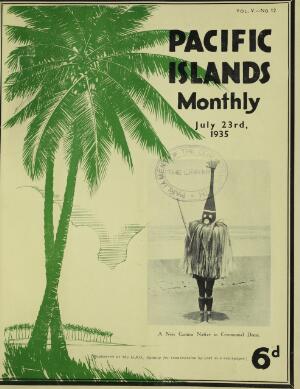
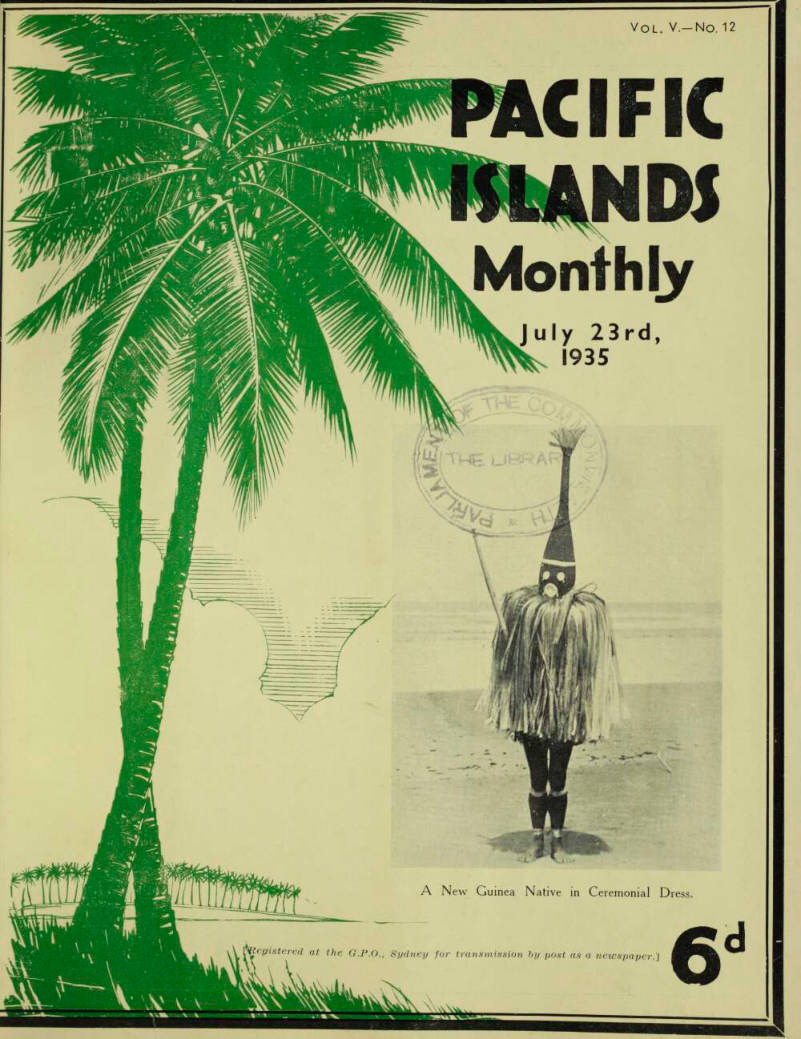
A New Guinea Native in Ceremonial Dress.
Advertisements & other items, p. 2 (1 item)
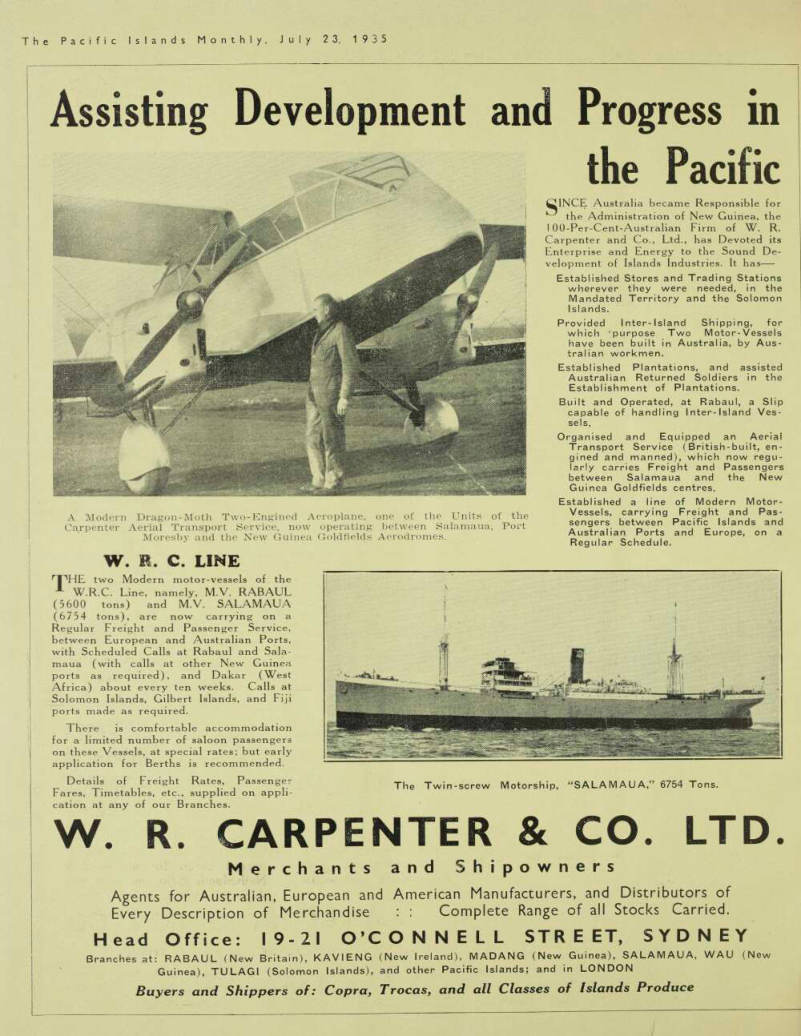
Assisting Development and Progress in
the Pacific
SINCE Australia became Responsible for the Administration of New Guinea, the 100-Per-Cent-Australian Firm of W. R.
Carpenter and Co., Ltd., has Devoted its Enterprise and Energy to the Sound Development of Islands Industries. It has Established Stores and Trading Stations wherever they were needed, in the Mandated Territory and the Solomon Islands.
Provided Inter-Island Shipping, for which purpose Two Motor-Vessels have been built in Australia, by Australian workmen.
Established Plantations, and assisted Australian Returned Soldiers in the Establishment of Plantations.
Built and Operated, at Rabaul, a Slip capable of handling Inter-Island Vessels.
Organised and Equipped an Aerial Transport Service (British-built, engined and manned), which now regularly carries Freight and Passengers between Salamaua and the New Guinea Goldfields centres.
Established a line of Modern Motor- Vessels, carrying Freight and Passengers between Pacific Islands and Australian Ports and Europe, on a Regular Schedule.
W. R. C. LINE
THE two Modern motor-vessels of the W.R.C. Line, namely, M.V. RABAUL (5600 tons) and M.V. SALAMAUA (6754 tons), are now carrying on a Regular Freight and Passenger Service, between European and Australian Ports, with Scheduled Calls at Rabaul and Salamaua (with calls at other New Guinea ports as required), and Dakar (West Africa) about every ten weeks. Calls at Solomon Islands, Gilbert Islands, and Fiji ports made as required.
There is comfortable accommodation for a limited number of saloon passengers on these Vessels, at special rates; but early application for Berths is recommended.
Details of Freight Rates, Passenger Fares, Timetables, etc., supplied on application at any of our Branches.
W. R. CARPENTER & CO. LTD.
Merchants and Shipowners
Agents for Australian, European and American Manufacturers, and Distributors of Every Description of Merchandise : Complete Range of all Stocks Carried.
Head Office: 19-21 O’CONNELL STREET, SYDNEY
Branches at: RABAUL (New Britain), KAVIENG (New Ireland), MADANG (New Guinea), SALAMAUA, WAU (New Guinea), TULAGI (Solomon Islands), and other Pacific Islands; and in LONDON Buyers and Shippers of Copra, Trocas, and all Classes of Islands Produce The Twin-screw Motorship, “SALAMAUA,” 6754 Tons.
A Modern Dragon-Moth Two-Engined Aeroplane, one of the Units of the Carpenter Aerial Transport Service, now operating between Salamaua, Port Moresby and the New Guinea Goldfields Aerodromes.
Pacific Islands Travellers
Passengers Per Morinda Which
Sailed From Sydney For Lord Howe
IS., NORFOLK IS., AND N. HEBRIDES ON JUNE 22: Messrs. Adams, Gozar, Green, Hird, Joy, Moore, Peronnet, Phillips, Scott, Segoe (2), Smith, Wallis, Dr. Frater, Capt. Stopp; Mesdames Adams, Ballard, Butler, Davidson, Evans, Frater, Joy, Phillips, Segoe, Smith, Stopp, Wallis; Misses Farley, Keay, Murray, Sear, Stahl, Wilkinson.
Passengers Per Mariposa Which
Sailed From Sydney For Suva, Fiji,
ON JUNE 26. —Mrs. S. Baird, Misses N., M., and A. Baird, Mrs. A. E. Brell, R. F. Brell, Miss B.
Burnett, Mrs. E. D. Collins, Mrs. M. Collins, Dr. and Mrs. W. J. Cross, Mr. and Mrs. C. Degenhardt, Hon. and Mrs. E. H. Farrar, Miss M.
Frost, M. D. Garretty, Mr. and Mrs. J. Jacobs, Mrs. M. Martin, Mr. and Mrs. A. H. Moverley, G. A. Mutch, Mr. and Mrs. E. Purbrick, G. O.
Ramsay, Mr. and Mrs. C. W. Sangster, Mr. and Mrs. G. Sangster, Miss K. Sargood, Mrs. M. Sargood, Miss M. Sevil, Mr. and Mrs. H. F. Stratman, Mrs. A. Thompson, Mr. and Mrs. L. D.
Whyte, J. B. Williams, W. E. Benham, Mr. and Mrs. W. M. Caldwell, Master W. Caldwell, Misses M. and B. Caldwell, K. Cramp, Mrs. M. Doran, W. P. Edward, Mrs. R. Grant, M. Grimes, Miss H. Hammatt, Mrs. E. T. Hart, Mrs. E. M. May, Miss M. A. May, H. T. Stredwick, Mrs. E. E.
Uren, R. Weeks.
Passengers Per Malaita Which Ar
Rived In Sydney From Solomon Is
LANDS ON JULY 2: Messrs. Abbott, Aubin, Barrett, Cox, Coicaud, Deland, Easton, Flood, Fraser, Gray, Kippax, Love, Meller, Moreau, McGurk, Quessy, Rodger, Simpson, Whitlock; Mesdames Wells-Burgess, Barrett, Bignell, Cameron, Deland, Easton, Greer, Hackett, Kippax, Meller, McCosker, McNaught, McMaster, Roxborough, Simpson; Misses Angel, Champion, Heath, Rutherford, Stewart (2), Sampson (3), Simpson, Totenhofer.
Passengers Per Montoro Which Ar
RIVED IN SYDNEY FROM PAPUA AND NEW GUINEA ON JULY 2: Messrs. Barker, Bowden, Bodell, Brand, Brown, Carr, Cescon, Coe, Crooks, Dodwell, Digby, Freney, Froday, Grant, Guilliard, Green, Gunter, Hopkins, Healy, De Boom, Jerome, Johnson, Martin, McKinley, McComas, McNair, McSkimming, Mackey, Mitchell, Nairn, Nottle, Nelson, Purell, Piper, Preddy, Scott, Sear, Smith, Spier, Torringtom, Vinall, Vesper, Waldron, Wesley, Workman, Babbington; Mesdames Blanch, Brown, Budden, Flower, Franklin. Hart, Marum, Pym, Reynolds, Richard, Smith, McNamee; Miss Yates.
Passengers Per Van Rees Which
Arrived In Sydney From Papua, N.G.,
VILA, AND NOUMEA ON JULY 10: Mrs. Colardeau, Mrs. Gros and child, Mr. de Groen, Miss Lesser, Mr. Morton, Mr. Marjarson, Mr. Pearce, Mr. Besine, Mr. Nitcherlein, Rev. Father Seiller, Rev. Father Servant, Rev. Father O’Reilly, Miss Royer, Miss Wilkins.
Passengers Per Montoro Which Sail
ED FROM SYDNEY FOR PAPUA AND NEW GUINEA ON JULY 6: Messrs. Boisen, Burgess, Barnes, Buckland, Bartlett, Brennan, Barker, Costa (2), Comrie, Clark, Collins, Crook, Conroy, Clemow, Colebrook, de Plater, Davies, Evans, Edwards, Eagles, Groves, Glasson, Gerber, Grose, Guest, Garvie, Hartigan, Honnegger, Hemmingway, Jefferey, Jennings, Irwin, Kane, Latchford, Loy, McClelland, McLennan, McNair, Nielson, Ogilvie, Pestell, Peacock, Price (2), Pearson, Park, Peper, Quigley, Roche, Rose, Richardson, Reid, Rutledge, Swindley, Sloman, Smith, Savione, Sullivan, Stringer, Schau, Taylor, Tapsell, Toohey, Worden, Walke; Mesdames Edwards, Bruce, Bannon, Barker, Beck. Casamanta. Bartlett, Fahey, Gumgley, Oakes, McCullock, McClafferty, Jones, Leahy, Price, Roche, Rose, Schaffer, Studd, Wiles, Peacock, Stirling; Misses Franklin, Andrews, Grant, Hardie, Murray, McCulloch. Parker, Jenkins, Sloman, Stewart (2), Vary, Nicholas.
Passengers Per Macdhui Which Ar
RIVED IN SYDNEY FROM PAPUA AND NEW GUINEA ON JULY 17.—Messrs. Bath, Blau, Boston, Brett, Carson, Poland, Contempree, Cooper, Craig, Clarke, Crookshanks, Curie. Davis, Dean (2) Dyason, Dredge, Farlow, Farquharson, Father Fillodeau, Messrs. Garlick, Gething, Goodwin (2), Grabowsky, Graham, Gurney, Goulding, Hargrave, Harris, Hindman, Hinks, Jennings, Kienzle, Knightly, Kudnig, Lane (2), Lesmond, Lohmann, Lovegreen, Lovell, Maclean, Mant. Mayers, McClelland, Millar, Nobbs, O’Connor, Pollock, Prosser, Price, Roche, Spehr, Dr. Simson, Messrs.
Shannon, Stower, Stacey, Woodville, Youl. Mes-
dames Baldwin, Bannigan, Barker, Bellmaine, Boston, Buston, Court, Dean, Garlick, Gething, Grabowsky, Gurney, Hargrave, Haynes, Hockey, Hutchinson, Lees, Lewis, Mant, Lady Murray, Nobbs, Pollock, Pfiefer, Spehr, Smith, Stower, Youl.
Misses Bailey, Dean, Fairhall, McKinnon, Nicholson, Watson.
Passengers Per Malaita Which De
Parted From Sydney For Solomon Is.
And Rabaul (N.G.), On July 13.—Messrs.
Hipkin, Wilson, Corry, Clarke, Bent, Dr. Deck, Messrs. McCall, Courtney, Williamson, Paton, Gendess, Hansen, Webb, Turnbull, Vischer, Rafferty, Green, Rev. Metcalfe, Rev. Scriven. Mesdames Cattell, Williamson, Corry, Clarke, Bent, Neil, Cullen, Sim, Hawker, Rafferty. Misses Clarke, Morris, King, Waterman. Buckland, Holmes, Rafferty, Letherbridge, McCole, Penny, Fitzgerald.
Passengers Per Morinda Which Ar-
RIVED IN SYDNEY FROM LORD HOWE AND NORFOLK ISLANDS ON JUNE 17: Messrs. Bell, Goldsmith, Macpherson, Miller, Ramsay, Rutherford, Upton, Denehey, Moore-Jones, Jesse; Mesdames Adams, Cashman, Goldsmith, Macpherson, Monro, Moorhead, Denehey, Ireton, Moore-Jones, Westwood; Misses Cashman, Cavalier, Jackson, Smith, Litchfield, Twiss.
Passengers Per Monterey Which
ARRIVED IN SYDNEY FROM SUVA, FIJI, ON JULY 15.—Mrs. K. Baird, Misses M., N., and A. Baird, Miss B. Burnett, F. Callaghan, Miss E.
Collins, Mrs. M. Collins, Dr. and Mrs. W. G.
Cross, Mr. and Mrs. C. Degenhardt, Mrs. S.
Farrar, Miss M. M. Frost, Mr. and Mrs. J. Jacobs, E. Lewis, W. R. Main, Mrs. M. Martin, Mrs.
J. W. Mason, C. F. Michell, Mr. and Mrs. A. H.
Moverley, Mr. and Mrs. E. Purbrick, Mrs. D. Purbrick, Miss K. Sanderson, Mr. and Mrs. C. W.
Sangster, Mr. and Mrs. G. Sangster, Miss M.
Sevil, H. P. Stratman, R. C. Symes, Mr. and Mrs.
L, D. Whyte, Father Destable, Sister E. C. Frost, C. K. Gock, Father Lejeune, Father Oreve, J.
Reid, A. Sundin, D. Sundin.
Passengers Per Morinda Which Ar-
Rived In Sydney From New Hebrides,
Norfolk And Lord Howe Islands, On
JULY 11. —Messrs. Codd, Davis, Dulhunty, Green,
Hardaker, Key, Kerr, Perry, Phillips, Rose, Rex, Tempest, Ward, Wallis. Mesdames, Ashby, Butler, Codd Davidson, Felton, Ghilardi, Grassick, Harper, Kay, Lloyd, Phillips, Read, Salt, Weil, Ward, Wallis. Misses Beattie, Bourne, Bright, Brown, Costin, Farley, Felton, Gabriel, Grigor, Hurley, Kier, Keay, Johnstone, Lamb, Mathieson, Parslow, Richardson, Stewart, Thew, Waldow, Walker.
Passengers Per Neptuna Which
Sailed From Sydney For New Guinea
ON JUNE 29. —Messrs. Anderson, Allnutt, Dennis, Flower, Harris, Dr. Hosking, Messrs. Hanrahan, Johnson, Kennedy-Duff, Rev. Lewis, Messrs.
McCulloch, McDonald, Montgomery, Dr. McKenna, Messrs. Nagy, O’Dea, Powell, Roberts (2), Saxton, Stewart, Scherp, Thompson, Wilkins, Wilde, Williams. Mesdames Anderson, Adeskold, Broadbexit, Caddy, Duncan, Fitzgerald, Hosking, Lewis, McDonald, McDowsett, O’Dea, Pollard, Phillips, Roberts (2), Stewart. Misses Clapperton, Idriess.
Seeking Gold In The
Louisiades
THE 32ft. yacht Gitana II., carrying Messrs. R. B. Moffatt and J. R. Vicary, of Victoria, arrived at Misima Island, Eastern Papua, from Victoria, on June 22. The yacht was joined there by Captain Gerald Pentland, the well-known aviator, who is Mr. Moffatt’s brother-in-law. They arrived at Samarai a few days later and completed plans for a gold prospecting expedition in the various islands of the Louisiade Archipelago. They are prepared to spend a couple of years on this expedition if necessary. Gold has been found in many islands of the Louisiades —notably Misima, Sud Est and Woodlark.
Dr. C. M. Deland, a member of the New Guinea Medical Service, who has been stationed in Bougainville for some time, arrived in Sydney during July to undergo a special course of a year’s duration at the University of Sydney.
Advertisements & other items, p. 3 (1 item)
Saigon-Batavia-Samaranc-Port Moresby
HOLIDAY IN THE SOUTH SEAS
LORD HOWE IS. NORFOLK IS. BRAMPTON ISLAND
(Barrier Reef)
Days of Sunshine—Nights of Enchantment—Wonderful Scenery—Superb Climate. Ideal holiday resorts, good fishing, comfortable accommodation, reasonable tariff. For illustrated folder, sailings, steamer bookings, & island accommodation (free booking service) call or write
ARTHUR CRISP
ISLAND TOURIST AGENT, COMMERCIAL BANK BUILDING, 62 MARGARET ST., SYDNEY Telephones: B 2781—Y 5332 Accommodation arranged city or suburbs for island residents visiting Sydney
SAIGON-BATAVIA-SAMARANC-PORT MORESBY
SAMARAI-RABAUL- PORT VILA-NOUMEA
SYDNEY - PORT MORESBY - BATAVIA - SAIGON
bi-monthly by the "VAN REES"
You will enjoy travelling by this popular, fast and modern steamer of the K.P.M., noted for its comfort, excellent cuisine, and economical fares.
With a fleet of over 130 vessels the K.P.M. Line is in a position to accept cargo for all ports in Netherlands India, and with transhipment at Batavia for Africa.
ROYAL PACKET NAVIGATION CO.
Paketvaart House, 255 George Street, Sydney
Diethelm & Co., Saigon; E. A. James, Port Moresby; Whitten Bros.. Samarai; W. R. Carpenter & Co. Ltd., Rabaul; Gubbay Freres, Port Vila; Carlo Leoni, Noumea.
Advertisers
Page A. Powders .. 22 Angus & Robertson 29 Antinea Drug Co. .. 47 Arnott’s Biscuits 17 Asprey’s Compound 44 Aspro 13 Ausoline Co. 23 Austen, Geo. & Co. 32 Bains & Co. Ltd. .. 22 Bank of N.S.W. .. 27 Barrington, D.Y.S. 27 Bell, L. L. 12 Belvedere 22 Bentley, E. 53 Bernhard, H 27 Blau, Julius .. 60 Breckwoldt & Co. .. 28 Broomfields, Ltd. .. 77 Bruce, Robert .. .. 44 Brunton’s Flour .. 35 Bullivants Ltd. .. 66 Burns, Philp & Co. 2 B. Magazine.. .. 36
B.P. (S.S.) Co. ..64
Burton, F. W. 12 Bussell, H. L. & Co. 24 Buzacott Ltd. 42 Byrne, C. R. 74 Capeil, J. . 34 Carpenter, W. R. .. ii.
Cent. Q’ld. Meat .. 58 Coleman Quicklite.. 13 Coles, A. H. J. .. 75 Cooper, W. and Nephews, Ltd. .. 22 Coral Starch .. .. 57 Craignathan .. .. 18 Crisp, A. E. 1 Crossle, Duff and Macintosh, Ltd. .. 70 Cyclone G. & F. .. 65 Dangar, Gedye .. 50 Dawn Cafe .. .. 23 Del, Cott, H. Pty. .. 46 Dexter, Henry.. .. 33 Doans 28 Donald, A. B. 19 Donald Patents Ltd. 28 Doyle, T. G. 26 Eaton, Ltd., J. W. 40 Electrolytic R. & S.
Co. 68 Elvy & Co. Ltd. .. 14 Erg Batteries .. .. 66
Page Euston Hotel .. .. 18 Excel Battery Co. .. 25 Excelsior Supply .. 48 Fairbanks Morse .. 21 Farquharson, Mrs... 60 Fletcher & Son 14 Flexibo Lighting .. 42 Flynn, Mrs. W. .. 65 Ford Sherington Ltd. 51 Ford, W. M. 49 Forsyth, A. 20 Forster’s Bedsteads 73 Foster & Sons, Geo. 71 Fowler, N. M. 61 Frost, A. R. & Co. 30 Garden Vale Products 25 Garrett & Davidson 40 Gillespie’s Flour .. 46 Gleniffer Engines .. 49 Goodwin, A. E. .. 71 Grahame, C. 49 Grand Pacific Hotel 54 Gregory, A. 62 Griffin, Brian .. .. 12 Guinea Airways .. iii Guthridge Ltd. .. 70 Hallstrom, E. 48 Halvorsen, L. 76 Harper, M. 79 Harper, Robt. 42 Henly’s D.Y.S. .. 43 Holbrook’s Ltd. .. 39 Holden’s Air T. .. 79 Horne, W. Co. Ltd. 52 Hotel Gnd. Central 49 Hudson, Ltd. Geo. 72 Hughes, A. J. 75
I.C.I.A.N.Z. 63
I.C.S. 69
Insular Lamps Ltd. 31 Jang King Loong .. 52 Jones, A. 79 Jones & Rickard .. 63 Kelvin Engines .. 57 Kepert, V. R. 66 Kerr Bros. 12 Kodak Pty. Ltd. .. 16 Kopsen & Co. 24 Kork-N-Seal .. .. 50 Lane and Girvan .. 57 Lecia Photo Co. .. 31 Link Belt Co. .. 47 Lone Hand Soap . 43 Love Ltd., J. R. .. 59
Page McDonald’s Hotel .. 52 McHugh 30 McIlraith’s, Ltd. .. 23 McIntyre 74 McKay 33 McMichan, B. A. .. 19 Marr, E. A. 70 Martins, D.Y.S. .. 32 Maxwell Porter .. 44 Melbourne Hotel .. 52 Morris Hedstrom Ltd. 55 Mungo Scott Ltd... 67 Navlor G. H. 56
N.D.L.. .. 78
Nelson and Robertson .. .. 19, 21, 74 New Brit. Express 67 Newlands Bros. .. 56 Nicholson & Foster 67 Norco 20 Noyes Bros. 26
Page N.S. W. Bookstall Co. 55 Ozo Salt Co. 61 Pacific Hotels .. .. 45 Pacific Taxis .. 55 Paine & Co 26 Phillips & House .. 51 Pier Hotel 53 Pike Bros. .. .. 38 Pioneer Spring Co... 36 Position Wanted .. 16 Prescott, Ltd. 35 Prouds, Ltd. .. .. 41 Ramsay, Valmai .. 13 Reid, W. M. 50 Reilingh, W. . .. 54 Richard’s Remedies 25 Robinson J. 24 Rohu, Sil
Rolls Razor 51
Royal Packet N. Co. 1 Russell, S. 40 Ruston & Hornsby 33
Page Savage, W. & Co. 68 Scott, Ltd., J. 40 Scott & Bowne .. 67 Scott & Sons .. .. 74 Shaw, E. 18 Smith, Geo. F. ..18 Springwood L. Col. 65 Stanley, Chris. .. 58 Steamships T. Co... 77 Steel Imp. Co. .. 58 Summerbell, A. . 12, 16 Swallow & Ariell .. 32 Sydney Steel Co. .. 69 Tahiti Hdbk. 45 Talkeries 27 Taubman’s Paints 43 Thompson’s Eng’g. 38 Thornthwaite, H. G. 49 Thorpe’s, Ltd. 64 Tillock & Co. Ltd. 63 Tooheys Ltd. 34 Tooth & Co. iv
Page Trinity Grammar School 11 Trufood 61 Tudor Hotel .. .. 13
T.W.H. 62
Vacuum Oil .. .. 37 Victor Chemical .. 63 Vincent’s A.P.C. .. 20 Vincent Bros. 15 Wallis, J. B. 69 Walvon Kennels .. 60 Ward, L. A. 48 Weames .. .. 35 West’s Wheels .. 36 Weymark & Son .. 72 Wheeler, B. R. .. 17 Williams, W. H. 17, 64 Wills, W. D. &. H. O. 15 Wilshire, H. .. .. 56 Wood’s Peppermint 39 Wright & Co., E. .. 62 Wunderlich, Ltd. .. /5
Contents
Page Pacific Islands Travellers 1 Could Solomon Is. Be Administered from Rabaul? 3 Baffling Copra Market 4 Romantic Story of Fanning Is. and Washington Is 5 Papua Reduces Primage Tax . . . . 5 Queen Salote’s Visit to Australia . . 6 Bigger Dredges for New Guinea .. .. 6 Fiji Gold Licenses 6 Marking Bluejackets’ Graves in Solomons 6 Islands as Landing Grounds 7 Gold on Bougainville Is. (N.G.) . . . 7 Samoa’s Next Administrator . . .. 8 Hides’ Expedition Crosses Papua . . 8 Day Dawn’s Troubles .. 9 New Guinea Coins 9 Papua’s Gold Tropicalities About Islands People 12 Mummies Found in N.G. Cave . . . . 15 How Rarotongan Royalty Was Established 17 Judge Ayson’s Record in Cook Is. .. 19
Page Synthetic Rubber Productions . . . . 22 Next Move in Western Samoa . . .. 25 Graves of Early L.M.S. Missionaries in French Oceania 28 Conspiracy Exposed in New Guinea . . 33 Career of late G. W. Partsch, Samoa 35 More Strange Fiji Rock Carving .. 38 1,000 Miles in Small Boat 40 Incidents of Early Pt. Moresby . . .. 42 Roads That Lead to Edie Creek . . 46 Kwato Mission’s Reply to Criticism .. 50 Prosperous Fiji 52 The Franchise in Fiji 53 Garden Magic in Samoa 54 Fashion Hints for Islands Women . . 60 Cruise of Cook Is. Leper Ship .. . . 64 Life on Isolated Puka Puka Is 65 N.G. Goldfields News 67 Pacific Mining Reports 68 Housekeeping in the Tropics . . .. 73 Dyott Expedition Postponed .. . . 75 Market Quotations 76 Islands Produce and Exchange Rates 77 Shipping Services in the South Seas 78 Index to Volume V 80
Advertisements & other items, p. 4 (1 item)
Burns, Philp & Co. Ltd.
GENERAL
MERCHINTS
SHIPOWNERS
TOURIST AGENTS
Head Office: 7 Bridge Street, Sydney— Australia Code Address: "Burphil"
BUYERS OF ALL CLASSES OF ISLAND
Regular Steamer Services from Australia to New Guinea — Papua— Solomon Is.—Lord Howe Is.—Norfolk Is.—New Hebrides—Java and Singapore
PRODUCE
The Pacific Islands Monthly
The Newspaper-Magazine Of The South Seas
[Registered at G.P.O., Sydney, for transmission by post as a newspaper.]
Published Once Each Month and Circulated in Australia and New Zealand and in the following Pacific Territories and Islands Groups:
Crown Colony of Fiji.
Australian Territory of Papua.
Mandated Territory (Australia) of New Guinea, Bismarck Archipelago, and Northern Solomon Islands.
Mandated Territory (Japan) of Marshall, Caroline and Marianna Islands.
French Territory of New Caledonia.
British and French Condominium of New Hebrides.
American Territory of Eastern Samoa.
American Territory of Guam.
Mandated Territory of Nauru.
British Crown Colony of Gilbert and Ellice Islands.
Mandated Territory (New Zealand) of Samoa.
British Solomon Islands Protectorate.
British Protectorate of Tongan Islands.
New Zealand Territory of Cook Islands.
Australian Territory of Norfolk Island.
French Colony of Oceania (Tahiti, etc.).
American Territory of Hawaiian Islands.
Owned and Produced by Pacific Publications Ltd., Union House, 247 George Street, Sydney.
Telephone Bw 5037
P.O. Box 3408 R
Contributions Articles, Stories, and Photographs dealing with Pacific Islands Subjects are invited, and will be paid for on publication at usual rates.
Subscription Rates Per Annum, within British Empire, Prepaid Post Free 6/- Per Annum, elsewhere, prepaid. Post Free . 8/- Single Copies 6d.
Editor and Publisher:
R. W. Robson.
Advertisements Advertising rates furnished on application.
Colours, etc. by Arrangement.
Process Blocks made at Advertiser’s expense when required. Screen, 100.
Changes of Advertising Copy should reach this Office by Bth of each month, otherwise previous advertisement may be repeated.
Registered Address for Radiograms and Cables: “PACPUB” Sydney Agents The following are authorised to receive subscrip tions for “The Pacific Islands Monthly”— Islands Branches of Burns, Philp & Co., Ltd., and Burns Philp (South Seas) Co., Ltd.
Islands Branches of W. R. Carpenter & Co., Ltd.
All Branches of Morris, Hedstrom & Co., Ltd.
G. Thomas & Co., Rabaul.
Whitten Bros., Ltd.. Samarai.
P. Costello, Suva, Fiji.
J. Muir, Suva.
All Branches and Representatives of W. H. Grove and Sons, Ltd., Auckland.
S. Russell, Papeete, Tahiti.
Cook Islands Trading Co., Rarotonga.
Vol. V., No. 12.
Sydney, July 23, 1935.
Price 6d Per Copy Prepaid: 6/- p.a.
from Rabaul?
Could Solomon Islands be Administered from Rabaul?
THE time may not be inopportune to state the proposition that the administration of the Solomon Islands should be taken over by Australia from the British Colonial Office. There are a dozen sound practical reasons for the change; while the chief arguments against it appear to be mostly of an academic or selfish character.
The Solomon Islands administration is part of the responsibility of the High Commissioner for the Western Pacific, whose headquarters are at Suva, and who necessarily finds that communication with the Solomons is inconvenient and irregular. Trade and communication with the Solomons are almost an Australian monopoly—so much so that, although the Solomon Islands are part of the British Colonial Office administration Australian exchange conditions rule m t e group.
There is much discontent among the residents of the Solomons, and criticism of the Administration. Letters of complaint come to this office by every mail,
Some of the criticism is captious and irresponsible, but some seems to be soundly based. Careful inquiry suggests that the fundamental cause of the dis content is Suva control. There is nothing inherently wrong with what is done by Suva—it is only the appalling incon venience caused by slow and broken communication. S.I. officials are some times charged with weakness and ineffi ciency—but investigation usually shows that the officials are the victims of circumstance. Practically all of these difficulties would be removed if they were more closely in touch with head quarters.
The British Colonial Office probably would be glad to get rid of the Solomons, Under the present system the territory is a heavy and continuing expense, while the domination of Australian commercial interests in the group must be a frequent embarrassment.
If the Solomons could be detached from Colonial office administration and attached to the New Guinea administra
tion, the territory could be administered very much more cheaply, probably for something between £30,000 and £40,000 per annum. Experienced administrative officials say that, with Bougainville and Buka, the group could be divided very conveniently into three administrative districts, with headquarters in Rabaul, with which there is quick and frequent communication. The administrative machinery of New Guinea would fit conveniently onto the Solomons, and would function easily and smoothly.
The ethnological, agricultural, medical, educational, industrial, and commercial conditions are virtually the same in the Solomons as they are in New Guinea; whereas, with the possible exception of the New Hebrides, there is not the same similarity of conditions between the Solo mons apd any of the other groups and territories over which the High Com missioner for the Western Pacific has jurisdiction.
It is probable that the majority of the residents in the Solomon Islands would not object to Australian jurisdiction, as in nearly all cases their associations and connections are with Australia. The big trading firms with interests in the Solomons are almost wholly Australian.
Taxation is no heavier in New Guinea than in the Solomons. There is, how ever, tariff preferences for British goods in the Solomons, whereas in New Guinea there is only an ad valorem revenue duty.
It is probable that opposition to the idea would come from the Lever interests.
Lever’s Pacific Plantations Pty. Ltd. operate a chain of plantations in the Solomons, and copra from those planta tions, of course, is shipped to Unilever interests in Europe and elsewhere. Copra production in the Solomon is not under the same strict supervision as it is in New Guinea, and, for that reason, the Lever plantations have followed a system which probably would be in conflict with regulations in force in New Guinea. It would be hoped, however, that Solomon Islands planters would not permit Lever opposition, based on this circumstance, to interfere with any plan to change to Australian control, because if New Guinea regulations governing the pro duction of copra were to operate in the Solomon Islands in such a way that Solomon Islands copra were graded as New Guinea copra is graded, the S.I. producers would gain substantially. The world’s market values N.G. copra at at least 20/- per ton more than S.I. copra.
It can be said in a general way that the Australian Administration in New Guinea has been more successful in handling the natives than the Solomons Administration. The natives in the two territories are generally of the same type; but whereas, in New Guinea, native labour works fairly well and under a proper sense of discipline, it is a notorious fact that in the Solomon Islands official dom seems to be more or less embarrassed by the Malaita-men. The natives of Malaita are a war-like, aggressive people and they appear never to have accepted European control in the ordinary sense of the term. It is impossible here to examine the problem to the point where blame for this position could be laid; but the fact remains that the Malaita men’s defiance of white authority is
something that embarrasses frequently
the relationship between the Administration officials in their relation with the natives. Without over-rating the serious ness of the Malaita-men problem, we believe that if a couple of experienced district officers and a few well-tried patrol-leaders from the New Guinea territory were placed in charge of the troublesome districts in the Solomons, the difficulties to which we refer would
presently disappear.
There are two substantial advantages which S.I. planters and traders would enjoy immediately if the change were made. Much better and cheaper labour would become available; and the Solo mons would have the benefit of a first class medical service. The Solomons, during recent years, have been almost deprived of an adequate service; while New Guinea, in this respect, has been very well equipped.
The success which has attended Aus tralian administration in New Guinea entitles the Commonwealth Government to think seriously about this suggestion of taking over the Solomon Islands terri tory; and if the Federal Government has any vision—a matter concerning which there is argument! —it will make a move in this direction at an early date. We believe that the British Colonial Office would be glad to consider this solution of the Solomon Islands Administration
problem.
The real obstacle would be provided by those academic politicians who would contend that it is not possible to link an administration carried on under a League of Nations mandate —which is the case in New Guinea —with the administration of a group which would become virtually a territory of Australia. As a matter of fact, such an objection is purely academic and could be solved simply enough, even if it were not a fact that the League of Nations difficulty is likely to end soon with the disintegration of the League of Nations.
It has been pointed out repeatedly in this journal that, for reasons of strategy, it is desirable that Australia should have control of as much as is possible of that fringe of islands which lie off the northern and north-eastern coast of the continent, and which include Papua, New Guinea, Solomon Islands, New Hebrides, and Norfolk Island. In other words, from the point of view of defence —a subject which is receiving much consideration in Australia at present —it is very desirable that Australia should exercise jurisdiction over the Solomon Islands, in the same way that it does in New Guinea.
Miss Beatrice Grimshaw, the well known South Seas novelist, who came to Australia early this year from Papua, de parted recently for Tonga, after spending several months at Bathurst, N.S.W. She will remain in the Tongan group for a couple of months gathering material for further books. Miss Grimshaw has just written an autobiography, “Thirty Years in the South Seas,” which will be pub lished shortly in America.
Baffling Copra
Market
Why Does Price Not Rise?
THE copra market was depressed in mid-June; and, in comment, we said that there seemed to be no good reason for the fall in rates, and that prices should rise soon.
It is now July 19; and prices not only have not recovered —they have fallen fur ther. The position is extraordinary, and baffling.
We have interviewed, to-day, the prin cipal copra merchants in Sydney, and they declare that they are completely at a loss. They do not know of one substan tial reason why prices should have fallen by 40/- within a few weeks. They are inclined to blame the all-powerful Uni lever. Combine for the decline, basing their argument on the important fact that, although copra has fallen so sharply, the coconut oil quotation has been maintained.
Qur information from London is to the same effect—the leading British traders in vegetable oil seeds have not retreated, in any particular, from the view they expressed early in 1935—namely, that the
Index of Volume V. of the Pacific Islands Monthly (August 1934-July 1935, inclusive) is published on page 80 of this issue.
world statistical position (indicating a reduction of world supplies) justified the opinion that the copra price would im prove during the year, and would hold, at least, into 1936.
Even in June, 1935, at the moment when the copra price took its first heavy tumble, Mr. H. M. F. Faure, head of Messrs. Faure, Blattman and Co., was addressing an important conference in Brussels, and reiterating his opinion that prices should maintain their level, and increase, if anything. And Mr. Faure is one of the most conservative market com mentators in London.
It is possible that the market has been affected by the American position. America, last year, put heavy imposts on Philippine Islands copra, and thus diverted Philip pine supplies to the European market.
Then the new law was relaxed, the Philip pines product resumed its flow to America, and the European market recovered. For many months now, the law courts of U.S.A. have been fighting about the legality of the “processing tax,” which apparently affects the copra price: and it was announced in the news cablegrams on July 18 that the U.S.A. Court of Ap peals had declared the tax unconstitu tional. “The question now goes to the Supreme Court, and a decision is expected before Christmas.” Meanwhile, the pro cessing tax continues.
It is difficult to offer any advice to copra growers and dealers. The price is down, and without apparent reason.
There are several good reasons why it should be up, and rising. The situation generally is complicated by the operations of the Unilever Combine, and by economic nationalism.
On all the known factors, the price should rise soon, and smartly.
Islands For Sale
Romantic Story of Fanning and Washington
IT was announced in London on July 1 that Fanning Island and Washington Island, in the Central Pacific, are being offered for sale by a firm of city solicitors.
Housing accommodation, motor-boats and other conveniences will go to the pur-
chaser. A company which has been work ing in the copra islands for 20 years is said to be the vendor.
This bare statement marks another stage in one of the Central Pacific’s many romances. The strange story of Fanning and Washington Islands can be only very briefly outlined here.
Fanning Is. was discovered by Captain Fanning, of the whaler “Betsy” in 1798, and it was annexed by Britain in 1888, Washington, nearby, was similarly an nexed in 1889. Both are beautiful and fertile places, densely covered with tropi cal vegetation. The Fanning atoll is miles long by 4 miles wide; but the land surrounding a fine lagoon, is nowhere more than half a mile across. The Wash ington atoll is almost circular, and 10 miles around; but, instead of surrounding the usual lagoon, it encloses a freshwater lake.
About 1857, a whaling ship put ashore on uninhabited Fanning, an Ayrshire Scotsman, William Greig. He was alone for some time, and then was joined by another man, who brought a boat and some supplies. They succeeded in making contact with natives on other islands, and both married Polynesian women, and had large families. They induced communities of Gilbert Islanders to join them. They were industrious, and planted Fanning and Washington Islands with coconuts and prospered. Both men died there. The younger Greigs carried on; but the son of the other man did not like the life, and went away. Later, he sold his interests there to a Suva man.
Meanwhile, a young French priest, Father Rougier, had settled as a mission ary in North-west Fiji. To him there came one day, seeking help, a Frenchman,
an escapee from the convict prisons of New Caledonia. Father Rougier befriended and protected him; and, when he died, he bequeathed his property to the mission ary. It was discovered that his estate was valuable—he had been left a consid erable fortune.
The Suva man, who had secured a share in Fanning and Washington Islands, got into financial troubles—a law case with Messrs. Burns, Philp and Co., Ltd. had gone against him. He sold his share of the two islands to Father Rougier.
Father Rougier and the Greig family were associated for a time in the owner ship of the two islands; and then the missionary sold his interests to Fanning Island Ltd. Subsequently, he acquired a 99 years’ lease of Christmas Island, south east of Fanning Island, where he estab lished large plantations.
Fanning and Washington Islands have been owned and operated, for a score of years, by Fanning Island Ltd.
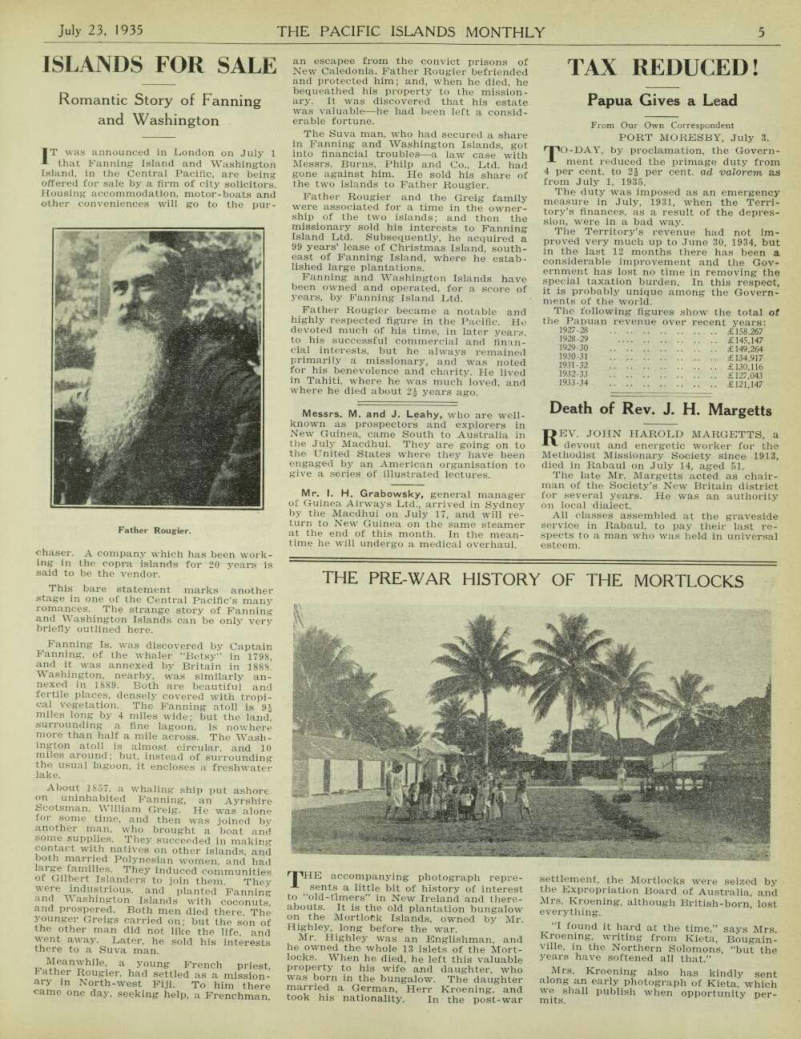
Father Rougier became a notable and highly respected figure in the Pacific. He devoted much of his time, in later years, to his successful commercial and finan cial interests, but he always remained primarily a missionary, and was noted for his benevolence and charity. He lived in Tahiti, where he was much loved, and where he died about 2½ years ago.
Messrs. M. and J. Leahy, who are well known as prospectors and explorers in New Guinea, came South to Australia in the July Macdhui. They are going on to the United States where they have been engaged by an American organisation to give a series of illustrated lectures.
Mr. I. H. Grabowsky, general manager of Guinea Airways Ltd., arrived in Sydney by the Macdhui on July 17, and will re turn to New Guinea on the same steamer at the end of this month. In the mean time he will undergo a medical overhaul.
Father Rougier.
Tax Reduced!
Papua Gives a Lead
From Our Own Correspondent
Port Moresby, July 3.
TO-DAY, by proclamation, the Government reduced the primage duty from 4 per cent, to 2½ per cent, ad valorem as from July 1, 1935.
The duty was imposed as an emergency measure in July, 1931, when the Terri tory’s finances, as a result of the depres sion, were in a bad way.
The Territory’s revenue had not im proved very much up to June 30, 1934, but in the last 12 months there has been a considerable improvement and the Gov ernment has lost no time in removing the special taxation burden. In this respect, it is probably unique among the Govern ments of the world.
The following figures show the total of the Papuan revenue over recent years: 1927- £158,267 1928- £145,147 1929- £149,264 1930- £134,917 1931- £130,116 1932- £127,043 1933- £121,147
Death of Rev. J. H. Margetts
Rev. John Harold Margetts, A
devout and energetic worker for the Methodist Missionary Society since 1913, died in Rabaul on July 14, aged 51.
The late Mr. Margetts acted as chair man of the Society’s New Britain district for several years. He was an authority on local dialect.
All classes assembled at the graveside service in Rabaul, to pay their last re spects to a man who was held in universal esteem.
The Pre-War History Of The Mortlocks
THE accompanying photograph represents a little bit of history of interest to "old-timers" in New Ireland and thereabouts. It is the old plantation bungalow on the Mortlock Islands, owned by Mr.
Highley, long before the war.
Mr. Highley was an Englishman, and he owned the whole 13 islets of the Mortlocks. When he died, he left this valuable property to his wife and daughter, who was born in the bungalow. The daughter married a German, Herr Kroening, and took his nationality. In the post-war
settlement, the Mortlocks were seized by the Expropriation Board of Australia and Mrs. Kroening, although British-born, lost everything.
“I found it hard at the time,” says Mrs.
Kroening, writing from Kieta, Bougainville, in the Northern Solomons, “but the years have softened all that.”
Mrs. Kroening also has kindly sent along an early photograph of Kieta which we shall publish when opportunity permits.
Queen Salote
A visit to Australia
QUEEN SALOTE of Tonga will arrive in Sydney on July 31 on her way to attend the centenary of the Victorian Methodist Church.
Queen Salote will be accorded a civic reception by the Lady Mayoress of Sydney on July 31, and in the evening of August 1 in Sydney Town Hall she will be wel
corned by a combined gathering of Metho dist congregations. Speakers will include the State Premier, the President of the Methodist Conference (Rev. M. K. Gil mour), and the Rev. Roger C. Page (who is a resident of Nukualofa, Tonga, and who is a brother of the Acting Prime Minister of Australia).
During the ensuing few days Queen Salote will be entertained at various re ceptions and meetings. She is described by the Sydney papers as “highly educated —speaks English fluently—the Town Hall audiences will hear a gifted orator.”
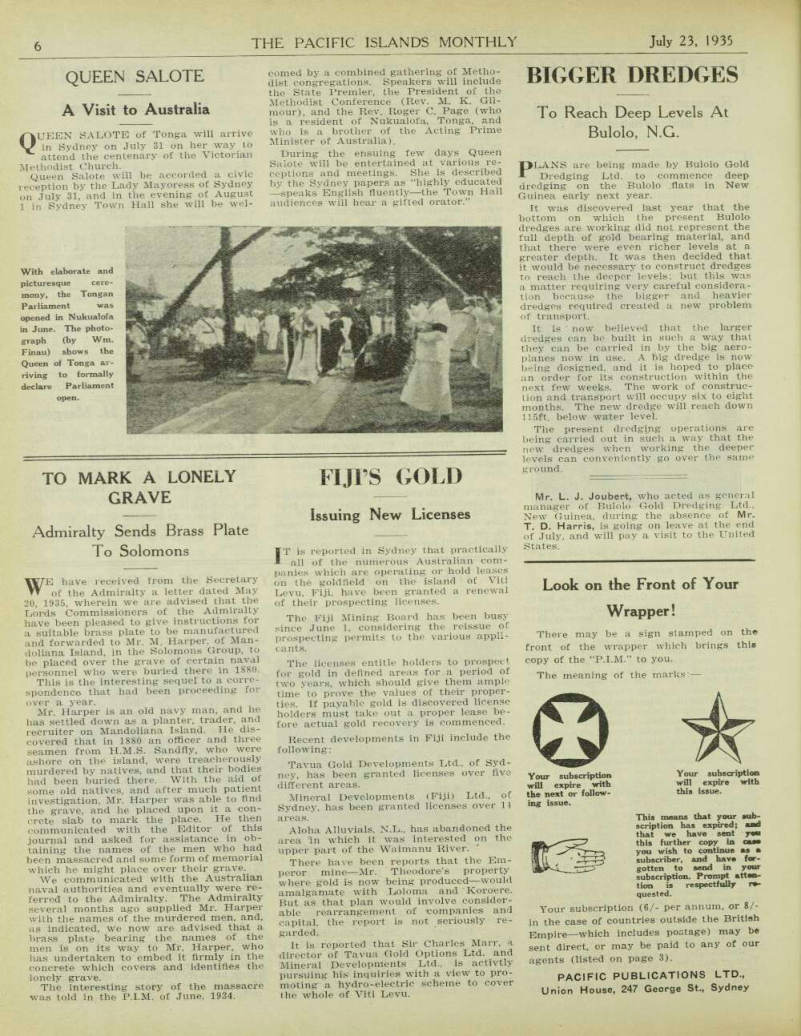
With elaborate and picturesque cere mony, the Tongan Parliament was opened in Nukualofa in June. The photo graph (by Wm.
Finau) shows the Queen of Tonga ar riving to formally declare Parliament open.
To Mark A Lonely
Grave
Admiralty Sends Brass Plate To Solomons
WE have received from the Secretary of the Admiralty a letter dated May 20, 1935, wherein we are advised that the Lords Commissioners of the Admiralty have been pleased to give instructions for a suitable brass plate to be manufactured and forwarded to Mr. M. Harper, of Man doliana Island, in the Solomons Group, to be placed over the grave of certain naval personnel who were buried there in 1880.
This is the interesting sequel to a corre spondence that had been proceeding for over a year.
Mr. Harper is an old navy man, and he has settled down as a planter, trader, and recruiter on Mandoliana Island. He dis covered that in 1880 an officer and three seamen from H.M.S. Sandfly, who were ashore on the island, were treacherously murdered by natives, and that their bodies had been buried there. With the aid of some old natives, and after much patient investigation, Mr. Harper was able to find the grave, and he placed upon it a con crete slab to mark the place. He then communicated with the Editor of this journal and asked for assistance in ob taining the names of the men who had been massacred and some form of memorial which he might place over their grave.
We communicated with the Australian naval authorities and eventually were re ferred to the Admiralty. The Admiralty several months ago supplied Mr. Harper with the names of the murdered men, and, as indicated, we now are advised that a brass plate bearing the names of the men is on its way to Mr. Harper, who has undertaken to embed it firmly in the concrete which covers and identifies the lonely grave.
The interesting story of the massacre was told in the P.I.M. of June, 1934.
Fiji’S Gold
Issuing New Licenses
IT is reported in Sydney that practically all of the numerous Australian com panies which are operating or hold leases on the goldfield on the island of Viti Levu, Fiji, have been granted a renewal of their prospecting licenses.
The Fiji Mining Board has been busy since June 1, considering the reissue of prospecting permits to the various appli cants.
The licenses entitle holders to prospect for gold in defined areas for a period of two years, which should give them ample time to prove the values of their proper ties. If payable gold is discovered license holders must take out a proper lease be fore actual gold recovery is commenced.
Recent developments in Fiji include the following; Tavua Gold Developments Ltd., of Syd ney, has been granted licenses over five different areas.
Mineral Developments (Fiji) Ltd., of Sydney, has been granted licenses over 14 areas.
Aloha Alluvials, N.L., has abandoned the area in which it was interested on the upper part of the Waimanu River.
There have been reports that the Em peror mine—Mr. Theodore’s property where gold is now being produced —would amalgamate with Loloma and Koroere.
But as that plan would involve consider able rearrangement of companies and capital, the report is not seriously re garded.
It is reported that Sir Charles Marr, a director of Tavua Gold Options Ltd. and Mineral Developments Ltd., is activtly pursuing his inquiries with a view to pro moting a hydro-electric scheme to cover the whole of Viti Levu.
Bigger Dredges
To Reach Deep Levels At Bulolo, N.G.
PLANS are being made by Bulolo Gold Dredging Ltd. to commence deep dredging on the Bulolo flats in New Guinea early next year.
It was discovered last year that the bottom on which the present Bulolo dredges are working did not represent the full depth of gold bearing material, and that there were even richer levels at a greater depth. It was then decided that it would be necessary to construct dredges to reach the deeper levels; but this was a matter requiring very careful considera tion because the bigger and heavier dredges required created a new problem of transport.
It is now believed that the larger dredges can be built in such a way that they can be carried in by the big aero planes now in use. A big dredge is now being designed, and it is hoped to place an order for its construction within the next few weeks. The work of construc tion and transport will occupy six to eight months. The new dredge will reach down 115 ft. below water level.
The present dredging operations are being carried out in such a way that the new dredges when working the deeper levels can conveniently go over the same ground.
Mr. L. J. Joubert, who acted as general manager of Bulolo Gold Dredging. Ltd..
New Guinea, during the absence of Mr.
T. D. Harris, is going on leave at the end of July, and will pay a visit to the United States.
Advertisements & other items, p. 8 (1 item)
Wrapper!
Look on the Front of Your
There may be a sign stamped on the front of the wrapper which brings this copy of the “P.I.M.” to you.
The meaning of the marks:— Your subscription will expire with the next or following issue.
Your subscription will expire with this issue.
This means that your subscription has expired; and that we have sent you this further copy in cass you wish to continue as a subscriber, and have forgotten to send in your subscription. Prompt attention is respectfully requested.
Your subscription (6/- per annum, or 87in the case of countries outside the British Empire —which includes postage) may be sent direct, or may be paid to any of our agents (listed on page 3).
PACIFIC PUBLICATIONS LTD.,
Union House, 247 George St., Sydney
Islands As Landing Grounds
Tiny Atolls Assume International Importance
islands in the central Pacific, which for 100 years have been dis missed simply as “low-lying,” sandy atolls of no consequence,” have suddenly assumed considerable importance, and some of the Powers are said to be inclined even to squabble concerning their ownership.
The explanation, of course, is the pend ing inauguration of trans-Pacific air ser vices—and more particularly the establish ment of a service between Hawaii and Fiji
or Samoa, so courageously pioneered by Sir Kingsford Smith in recent years.
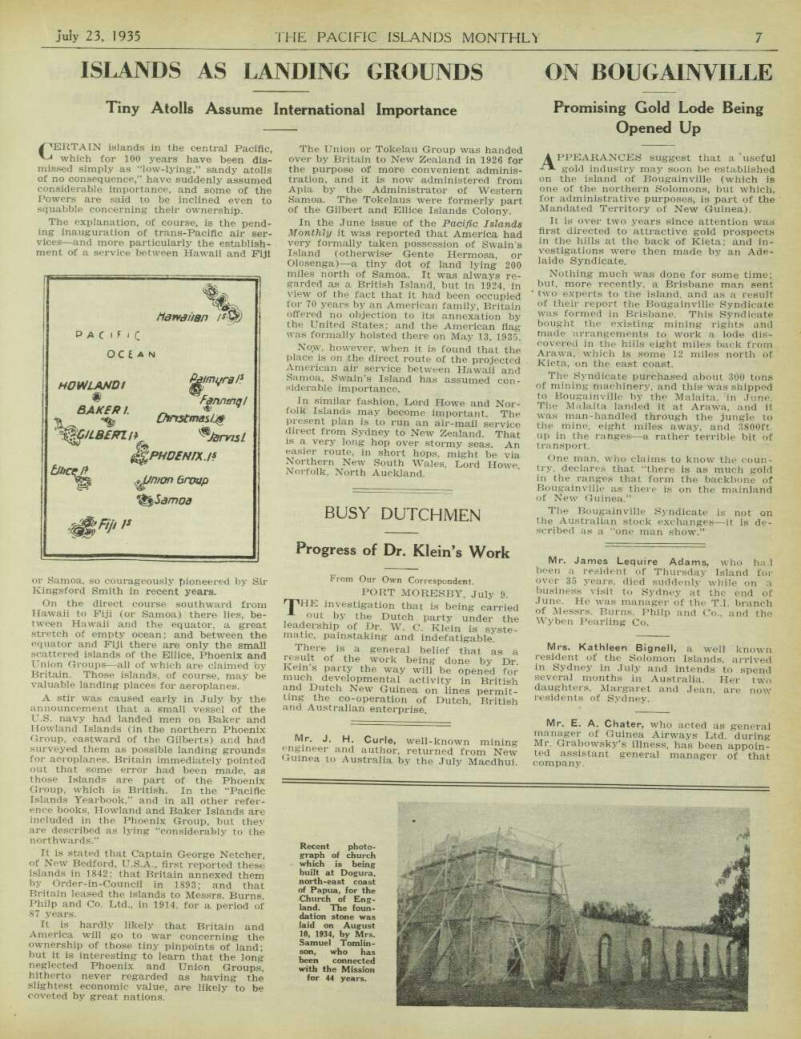
On the direct course southward from Hawaii to Fiji (or Samoa) there lies, be tween Hawaii and the equator, a great stretch of empty ocean; and between the equator and Fiji there are only the small scattered islands of the Ellice, Phoenix and Union Groups—all of which are claimed by Britain. Those islands, of course, may be valuable landing places for aeroplanes.
A stir was caused early in July by the announcement that a small vessel of the U.S. navy had landed men on Baker and Howland Islands (in the northern Phoenix Group, eastward of the Gilberts) and had surveyed them as possible landing grounds for aeroplanes. Britain immediately pointed out that some error had been made, as those Islands are part of the Phoenix Group, which is British. In the “Pacific Islands Yearbook,” and in all other refer ence books, Howland and Baker Islands are included in the Phoenix Group, but they are described as lying “considerably to the northwards.”
It is stated that Captain George Netcher, of New Bedford, U.S.A., first reported these islands in 1842; that Britain annexed them by Order-in-Council in 1893; and that Britain leased the islands to Messrs. Burns, Philp and Co. Ltd., in 1914, for a period of 87 years.
It is hardly likely that Britain and America will go to war concerning the ownership of those tiny pinpoints of land; but it is interesting to learn that the long neglected Phoenix and Union Groups, hitherto never regarded as having the slightest economic value, are likely to be coveted by great nations.
The Union or Tokelau Group was handed over by Britain to New Zealand in 1926 for the purpose of more convenient adminis tration, and it is now administered from Apia by the Administrator of Western Samoa. The Tokelaus were formerly part of the Gilbert and Ellice Islands Colony.
In the June issue of the Pacific Islands Monthly it was reported that America had very formally taken possession of Swain’s Island (otherwise Gente Hermosa, or Olosenga)—a tiny dot of land lying 200 miles north of Samoa. It was always re garded as a British Island, but in 1924, in view of the fact that it had been occupied for 70 years by an American family, Britain offered no objection to its annexation by the United States; and the American flag was formally hoisted there on May 13, 1935.
No t w, however, when it is found that the place is on the direct route of the projected American air service between Hawaii and Samoa, Swain’s Island has assumed con siderable importance.
In similar fashion, Lord Howe and Nor folk Islands may become important. The piesent plan is to run an air-mail service direct from Sydney to New Zealand. That is a very long hop over stormy seas. An easier route, in short hops, might be via Northern New South Wales, Lord Howe Norfolk. North Auckland.
Busy Dutchmen
Progress of Dr. Klein’s Work
From Our Own Correspondent.
Port Moresby, July 9.
THE investigation that is being carried out by the Dutch party under the leadership of Dr. W. C. Klein is syste matic, painstaking and indefatigable.
There is a general belief that as a result of the work being done by Dr.
Kern’s party the way will be opened for much developmental activity in British and Dutch New Guinea on lines permit ting the co-operation of Dutch, British and Australian enterprise.
Mr. J. H. Curie, well-known mining engineer and author, returned from New Guinea to Australia by the July Macdhui.
On Bougainville
Promising Gold Lode Being Opened Up
APPEARANCES suggest that a useful gold industry may soon be established on the island of Bougainville (which is one of the northern Solomons, but which, for administrative purposes, is part of the Mandated Territory of New Guinea).
It is over two years since attention was first directed to attractive gold prospects in the hills at the back of Kieta; and in vestigations were then made by an Ade laide Syndicate.
Nothing much was done for some time; but, more recently, a Brisbane man sent two experts to the island, and as a result of their report the Bougainville Syndicate was formed in Brisbane. This Syndicate bought the existing mining rights and made arrangements to work a lode dis covered in the hills eight miles back from Arawa, which is some 12 miles north of Kieta, on the east coast.
The Syndicate purchased about 300 tons of mining machinery, and this was shipped to Bougainville by the Malaita, in June.
The Malaita landed it at Arawa, and it was man-handled through the jungle to the mine, eight miles away, and 3800 ft. up in the ranges—a rather terrible bit of transport.
One man, who claims to know the coun try, declares that “there is as much gold in the ranges that form the backbone of Bougainville as there is on the mainland of New Guinea.”
The Bougainville Syndicate is not on the Australian stock exchanges—it is de scribed as a “one man show.”
Mr. James Lequire Adams, who had been a resident of Thursday Island for over 35 years, died suddenly while on a business visit to Sydney at the end of June. He was manager of the T.I. branch of Messrs. Burns, Philp and Co., and the Wyben Pearling Co.
Mrs. Kathleen Bignell, a well known resident of the Solomon Islands, arrived in Sydney in July and intends to spend several months in Australia. Her two daughters, Margaret and Jean, are now residents of Sydney.
Mr. E. A. Chater, who acted as general manager of Guinea Airways Ltd. during Mr. Grabowsky’s illness, has been appoin ted assistant general manager of that company.
Recent photo greph of church which is being built at Dogura, north-east coast of Papua, for the Church of Eng land. The foun dation stone was laid on August 10, 1934, by Mrs.
Samuel Tomlin son, who has been connected with the Mission for 44 years.
Administrator of Western
Samoa An Expert Or An Office- Holder?
LATEST reports from New Zealand and Samoa are to the effect that a well known gentleman of New Zealand is to be rewarded for his political and party work for the reigning powers in New Zealand by being appointed to what officialdom regards as the remunerative and easy job of Administrator of Western Samoa.
Another correspondent says that Judge Ayson, Resident Commissioner of Rarotonga, who has made a success of his governorship there, and whose name was mentioned as a likely successor to Sir Herbert Hart, “is not sufficiently well in with the official crowd in Welling ton,” and therefore is not likely to be appointed.
If this should prove to be a correct forecast, every friend of New Zealand and of Samoa will feel deep regret. The Adminstratorship in Samoa, connected as it is with a curious problem in native psychology, is one of the most difficult jobs in the Pacific, yet New Zealand has filled it repeatedly with men who, while worthy and well meaning gentlemen, were most definitely unfitted for the re sponsibility. Samoa does not want a complacent and unimaginative office holder —Samoa needs and must have a man with vision, and with positive quali ties. who will put an end to conditions which have existed for more than a score of years, and which are a reflection upon British Colonial administration.
If another wrong appointment is made it is probable that an agitation will com mence against New Zealand, which will not cease until the mandate is removed from that little country and placed with some other authority which can exercise it in a more creditable manner.
Pacific Islands Year Book
THE 1935 edition of the Pacific Islands Year Book, after much unforeseen de lay in the work of compilation, is now being printed; and copies will be avail able almost immediately. This edition contains a great deal of additional matter —particularly late trade figures and lists of European residents in the various Ter ritories.
Judge Coyle goes to Norfolk Island in August to adjudicate in an action brought by a former president of the Executive Council of Norfolk Island (Mr. C. C. R.
Nobbs) against the Administrator (Cap tain C. R. Pinney), from whom Mr. Nobbs is claiming £3,000 damages in respect of action taken by the Executive Council for the Territory to remove him from the presidency.
Messrs. Dermott and Niall Lane, sons of the late Captain R. M. Lane, A.A.M.C., of Melbourne, and Mrs. Lane, of Manly, returned to Australia from Edie Creek, New Guinea, by the Macdhui on July 17.
Mr. and Mrs. R. O. Mant have arrived in Sydney from Salamaua, where Mr.
Mant is chief pilot in the firm of W. B.
Carpenter and Company. They will spend three months’ furlough in Australia.
Papuan Patrol
Returns to Coast After Long Absence in Unknown Interior
THE Papuan official patrol, led by Mr.
Jack Hides, Assistant Resident Magis trate, and Patrol Officer, J. O’Malley, which left the upper waters of the Strick land River in Western Papua in January last to explore the unknown country to the north-east, made its appearance on the Gulf of Papua at Kikori on July 17, and then proceeded immediately by coas tal steamer to Port Moresby.
The appearance of the little expedition was greeted with relief. The return of the expedition had been looked for at the end of May, and its continued absence was causing a little anxiety—although there was no alarm. Messrs. Hides and O’Malley are experienced and clever pat rol leaders, and it was felt that the chances were all in favour of their making a safe return.
Nothing is known, as we go to press, of the results of the expedition, beyond a brief radiogram from Mr. Hides to a friend in Sydney stating: “Crossed suc
cessfully—interesting discoveries.”
This apparently means that Mr. Hides succeeded in crossing the barren and dan gerous limestone belt that lies in unex plored Central Papua between the upper waters of the Strickland and the Upper Purari.
The last heard from Mr. Hides had been written early in February, just before the party disappeared into the unknown north-east. He said that they were then following a river which went off into the north-east, and ran through country that appeared to be densely populated.
It may be assumed that the discoveries that have been made will include the character of the country, the number and type of the native inhabitants, and the possible course that is followed by the upper tributaries of the Purari. There is nothing yet, however, to indicate how far east Mr. Hides’ party penetrated. They may not have reached the Purari head waters, and may have been compelled to swing south-east and southwards before reaching the Purari. In that event, of course, they would come down the Kikori River to the Gulf of Papua.
It is apparently a fine achievement which adds much additional lustre to the already well-known names of Messrs.
Hides and O’Malley.
Primage
Desiccated Coconut
Thursday Is. Plan to Avoid Primage
IT is reported that a small local company is taking steps to establish in Thurs day Island a factory for the manufacture of desiccated coconut.
Under the present ridiculous conditions imposed by the Australian Customs, desic cated coconut from Papua and New Guinea is forced to pay a primage duty.
The idea behind the Thursday Island plan is to manufacture desiccated coconut there, from material supplied by the Torres Strait Islands, and that this will enter the Australian market as an Aus tralian product and consequently be free from primage. Thursday Island, of course, is a part of Australia proper.
Big Plans Afoot in New
Guinea and Papua Minister Goes North on July Macdhui
THE Minister in Charge of Australian Pacific Territories, Senator Sir George Pearce, will leave by the Macdhui on July 25 on a visit to Papua and New Guinea, where he will personally examine various matters connected with the administra tion. It is intended that the Minister shall spend as much time as possible on the Morobe goldfield: and he will fly over from the goldfield to Port Moresby to re join the Macdhui there, arriving back in Sydney about August 27.
Among the matters which will have the personal attention of the Minister are: Amendments of the ordinances relating to prospecting for oil in New Guinea and Papua—certain strong interests have in timated that they will spend large sums in prospecting for petroleum in the Terri tories provided they are assured of the right to profits made by the exploitation of their discoveries. It is contended that the- present ordinances do not sufficiently safeguard private prospecting interests.
The whole question of assisting the de velopment of Papua and New Guinea by giving increasing facilities to the aviation services—co-ordination of services will be sought, and an extension of the services to provide an aerial link with Australia may be arranged.
The question of continuing the Govern ment subsidy to the shipping services con ducted by Messrs. Burns, Philp and to.
Ltd., between Australia and Papua, New Guinea and Solomons. The five years contract between the firm and the Govern ment expired in March, 1934, and has not yet been renewed— merely extended from half-year to half-year.
The Minister’s visit to the Territory is to be a very short one, unfortunately, and he will have to display an extraordinary amount of industry if he is to deal ade quately with even half of the problems which will be thrust upon him by hopeful planters and miners during his visit.
Resident
Windfall For Apia
From Our Own Correspondent.
APIA, July 5.
THE glad tidings were received yester day that the fifth prize amounting to £1000 in an Australian Art Union has fallen to Apia, the lucky winner having given the nom de plume “The Four Just Men,” c/o T. W. B., P.O., Apia. A resident of Apia, with such initials to his name was first suspected and had to answer numerous inquiries and con gratulations, but later it was found that Mr. Theodore W. Brunt, storekeeper and baker, of Motootua, Apia, was the lucky winner.
As an elder of the Mormon Church of Latter Day Saints, Mr. Brunt intends to donate a portion of his winnings to the church, while with part of the balance, he will purchase the banana plantation he has leased from the N.Z. Reparation Estates. Only a few months ago, Mr.
Brunt’s small store was completely de stroyed by fire, so his windfall is very acceptable.
Day Dawn
Dismay at Edie Creek, N.G.
From Our Own Correspondent.
Edie Ck., July 1.
DISMAY was caused here when Day Dawn mine ceased operations.
The mine was regarded as a sound pro position, and when the staff was reduced in May it was anticipated that it was only a temporary measure.
Representatives of New Guinea Gold fields Ltd. at present are making a thorough test of the mine, and the sludge dams, and many people believe that this indicates that a proposal to purchase is under consideration.
Day Dawn is claimed to be the only deposit in New Guinea where the lode has been followed into the sulphide zone.
N.G.G. are diamond-drilling to prove values at depth. The writer adheres to his opinion that Day Dawn mine will yet prove itself one of the best on the field.
Messrs. Campbell, Ashcroft, Crampton, and Brian Lane are the only members of Day Dawn staff retained. Some of the other employees have found employment locally. A number are still unfortunate, but it is expected that N.G.G. Ltd. will engage them shortly. The Day Dawn labour line have been taken over by the two big companies.
Day Dawn’s Financial
Troubles
THE new directorate of Day Dawn (New Guinea) Ltd. has been busy during July with its plan for issuing 10 per cent, debentures to the total value of £8000, redeemable in July, 1939, in order that it may provide funds for proceeding with operations at Edie Creek. It is hoped by this means to obtain sufficient capital to operate the cyanide plant and treat about 36,000 tons of tailings which are lying there.
If the new capital is secured, it is ex pected that cyaniding will commence im mediately, and that the question of fur ther mining operations will be reserved for consideration later on, after the results of cyaniding have been ascertained.
If, however, the capital required is not secured from the issue of debentures the directors may have to consider important alternative proposals—among which, of course, is that of selling the whole pro perty. One report from Edie Creek indi cates that the belief is held there that New Guinea Goldfields Ltd. may become interested in the property. There is no official justification for this report in Sydney, however.
The opinion of experts is that Day Dawn is a valuable property and that, if it can survive the present financial crisis, it may then return to the dividend-paving list.
Planters’ Association
For Papua
AN attempt is being made to reconstitute the Planters’ Association of Papua, so that Papuan planters may speak with a united voice on many mat ters affecting their welfare.
The moving spirits in the new organisa tion are Messrs. G. A. Louden, of Port Moresby, and Walshe, of Domara.
Last German Governor of
Dr. Schultz Dead
Last German Governor of Samoa
Dr. Erich Schultz-Werth, The
last German Governor of Western Samoa, which was taken over by the New Zealand Administration from the Ger mans in 1914, died on June 25.
Dr. Schultz’s last act as governor is described by N. A. Rowe in the book, “Samoa Under the Sailing Gods”: “Before the landing of the military forces, Dr. Schultz called the natives to gether, and told them that the quarrel was not theirs, but between Germany and Britain, and they were to take no part.
Some of had suggested opposing the occupation. There was no resistance by the Germans.”
In 1899, at the age of 29, Dr. Schultz was appointed judge at Dar-es-Salaam. in German West Africa; then he spent a year in the German Colonial Office; and in 1901 he was sent as judge to Samoa to assist Dr. Solf, who at that time combined the office of Governor with that of Chief Justice. In 1904 Dr. Solf was relieved of the Chief Justiceship, and Dr. Schultz succeeded him. On Dr. Solf’s retirement, Dr. Schultz was appointed Governor, and was in that position when the New Zea land Expeditionary Force took possession.
He was interned in New Zealand during the war.
Dr. Schultz was well known in the Cen tral Pacific, as the result of 10 years’ resi dence in the South Seas, and he was esteemed by men of all nationalities.
Patrol Boats for North-West
Pacific
THE Commonwealth Government pro poses to build two fast motor boats or sloops for patrol work in the seas north ward of Australia. One, to do patrol work in the Timor Sea, will be based at Darwin, North Australia, and the other will be stationed at Rabaul, to patrol the waters around New Guinea, and also to be used for the conveyance of Administration officials.
Orders for the boats have not yet been given, but it is expected that the work will be undertaken at Cockatoo Island.
Sydney.
N. Guinea Coins
To Be Specially Minted
THE Pacific Islands territories are be coming currency conscious. Fiji has just established its own coinage, and now New Guinea is following suit.
New Guinea native labourers will shortly be paid in special New Guinea coinage, which will be perforated, so that natives can string the coins together and carry them as beads on a necklace.
The new tokens, which will be the first perforated coins issued by the Royal Mint in Melbourne, will comprise a shilling in Australian silver, sixpenny and three penny pieces in cupro-nickel, and bronze pennies. Designs embodying coconut palms and similar symbols will be adopted for the coins. It is expected that all the coins will be in circulation before the end of the year.
It is officially stated that Australian coinage, which has been in circulation since Australia assumed control of New Guinea, has only a limited circulation among the natives, and that the new coins are being minted with the object of edu cating the natives in the use of money.
When the new coins are available they will be the only ones circulated in the Territory. A date will be fixed after which a bank shall not, without the writ ten consent of the Administrator, know ingly tender or pay in the Territory to any person British or Australian coins other than gold.
It is difficult to understand why New Guinea should have decided to exclude Australian coins, while (presumably) re taining Australian notes. The difficulty about native payments could have been overcome quite simply by issuing a special perforated coin, bearing a fixed relation ship to the Australian coins.
However, the matter no doubt has been well argued out in Rabaul, and we can only await with interest the results of the experiment.
Dr. G. H. Vernon, M.C., a well-known planter of Daru, Western Papua, returned to Thursday Island at the end of June, from an extended tour of Japan and For mosa. After a brief sojourn visiting old friends on T.I., where he was for many years Government Medical Officer, Dr.
Vernon crossed over to Daru bv launch early in July.
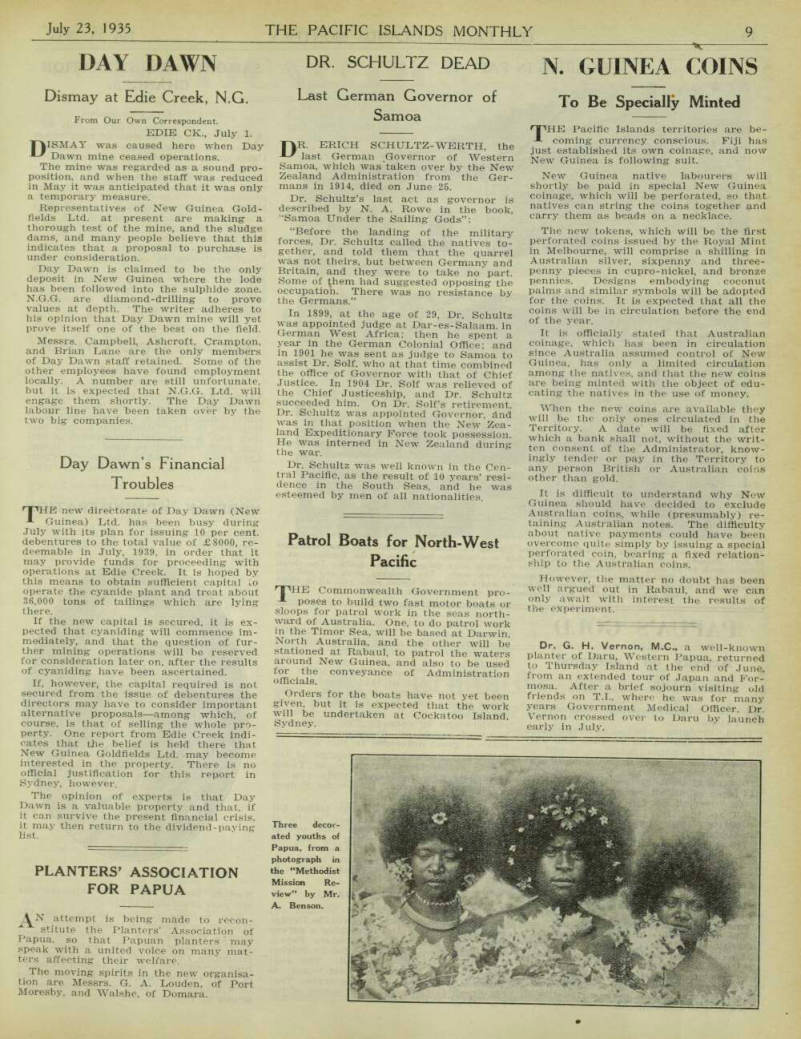
Three decor ated youths of Papua, from a photograph in the “Methodist Mission Re view" by Mr.
A. Benson.
Progress In Papua
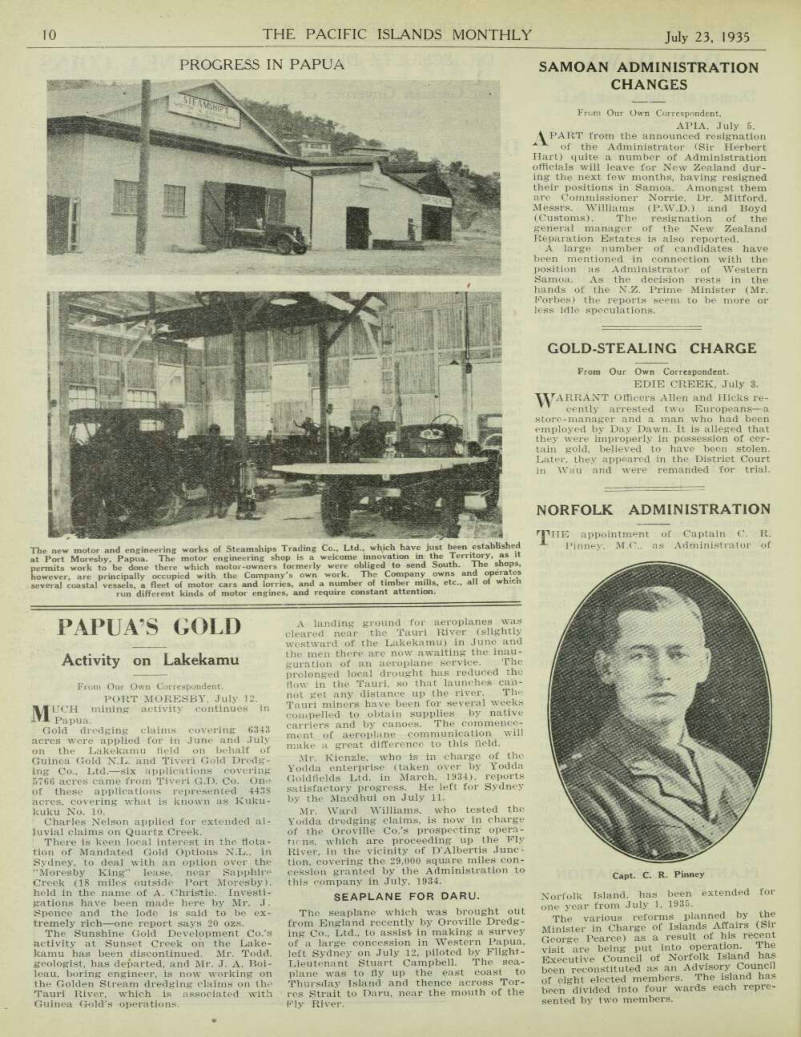
The new motor and engineering works of Steamships Trading Co., Ltd., which have just teen established at Port Moresby, Papua. The motor engineering shop is a welcome innovation in the Territory, as it permits work to be done there which motor-owners formerly were obliged to send South. The shops, however, are principally occupied with the Company’s own work. The Company owns and operates several coastal vessels, a fleet of motor cars and lorries, and a number of timber mills, etc., all or which run different kinds of motor engines, and require constant attention.
Papua’S Gold
Activity on Lakekamu
From Our Own Correspondent.
Port Moresby, July 12.
MUCH mining activity continues in Papua.
Gold dredging claims covering 6343 acres were applied for in June and July on the Lakekamu field on behalf of Guinea Gold N.L. and Tiveri Gold Dredg ing Co., Ltd. —six applications covering 5766 acres came from Tiveri G.D. Co. One of these applications represented 4438 acres, covering what is known as Kuku kuku No. 10.
Charles Nelson applied for extended al luvial claims on Quartz Creek.
There is keen local interest in the flota tion of Mandated Gold Options N.L.. in Sydney, to deal with an option over the “Moresby King” lease, near Sapphire Creek (18 miles outside Port Moresby), held in the name of A. Christie. Investi gations have been made here by Mr. J.
Spence and the lode is said to be ex tremely rich —one report says 20 ozs.
The Sunshine Gold Development Co.’s activity at Sunset Creek on the Lake kamu has been discontinued. Mr. Todd, geologist, has departed, and Mr. J. A. Boi leau, boring engineer, is now working on the Golden Stream dredging claims on the Tauri River, which is associated with Guinea Gold’s operations.
A landing ground for aeroplanes was cleared near the Tauri River (slightly westward of the Lakekamu) in June and the men there are now awaiting the inau guration of an aeroplane service. The prolonged local drought has reduced the flow in the Tauri, so that launches can not get any distance up the river. The Tauri miners have been for several weeks compelled to obtain supplies by native carriers and by canoes. The commence ment of aeroplane communication will make a great difference to this field.
Mr. Kienzle, who is in charge of the Yodda enterprise (taken over by Yodda Goldfields Ltd. in March. 1934), reports satisfactory progress. He left for Sydney by the Macdhui on July 11.
Mr. Ward Williams, who tested the Yodda dredging claims, is now in charge of the Oroville Co.’s prospecting opera tic ns, which are proceeding up the Fly River, in the vicinity of D’Albertis Junc tion, covering the 29,000 square miles con cession granted by the Administration to this company in July, 1934.
Seaplane For Daru.
The seaplane which was brought out from England recently by Oroville Dredg ing Co., Ltd., to assist- in making a survey of a large concession in Western Papua, left Sydney on July 12, piloted by Flight- Lieutenant Stuart Campbell. The sea plane was to fly up the east coast to Thursday Island and thence across Tor res Strait to Daru, near the mouth of the Fly River.
Samoan Administration
Changes
From Our Own Correspondent.
APIA, July 5.
APART from the announced resignation of the Administrator (Sir Herbert Hart) quite a number of Administration officials will leave for New Zealand dur ing the next few months, having resigned their positions in Samoa. Amongst them are Commissioner Norrie, Dr. Mitford, Messrs. Williams (P.W.D.) and Boyd (Customs). The resignation of the general manager of the New Zealand Reparation Estates is also reported.
A large number of candidates have been mentioned in connection with the position as Administrator of Western Samoa. As the decision rests in the hands of the N.Z. Prime Minister (Mr, Forbes) the reports seem to be more or less idle speculations.
Gold-Stealing Charge
From Our Own Correspondent.
Edie Creek, July 3.
WARRANT Officers Allen and Hicks recently arrested two Europeans—a store-manager and a man who had been employed by Day Dawn. It is alleged that they were improperly in possession of cer tain gold, believed to have been stolen.
Later, they appeared in the District Court in Wau and were remanded for trial.
Norfolk Administration
THE appointment of Captain C. R.
Pinney, M.C., as Administrator of
Norfolk Island, has been extended for one year from July 1, 1935.
The various reforms planned by the Minister in Charge of Islands Affairs (Sir George Pearce) as a result of his visit are being put into operation. The Executive Council of Norfolk Island has been reconstituted as an Advisory Council of eight elected members. The island has been divided into four wards each repre sented by two members.
Capt. C. R. Pinney
Tropicalites
“BLESSED are the meek, for they shall inherit the Kingdom of Heaven.” I think of that, sometimes, when writing about the Chinese. As a nation, they are being thrashed and battered by the Japa nese. As individuals, they are attacked and jeered at frequently. Every now and again, some writer in this journal says a few bitter words about their expanding activities in the Pacific Islands. But they never reply, never protest, never re taliate in a fashion that anyone may notice. Knocked back, in one place, they appear silently somewhere else, and carry on. Sometimes one wonders if they are human. But they are human—if the quality of hatred is any indication. They hate the Japanese; and, if one could see behind the scenes, one would be amazed at the thoroughness with which they boy cott Japanese institutions —and, notably, Japanese goods. Japan, of course, is try ing to control and mould China to her Imperialistic will. On the extent to which she succeeds depends much of the future of the world. Is it possible to mould a people so unresistant and unimpression able as the Chinese?
These reflections are induced by recent protests from the Solomons against the unchecked increase there of Chinese traders and Chinese trade. Various Euro pean traders there seem to have thrown everything except their copra driers at the Chinese. But the Chinese never reply, and go placidly on. * * * POLYNESIAN melodies die hard. At times they may be put aside in favour of something more modern, but again and again the Polynesian girl will turn to the repertoire of her mother.
Of late, all the Tahitian belles have been humming a little song known as “Manu rere,” or “The Flying Bird.” One heard it in every village; it had seized the imagination of the young Polynesians of both sexes in much the way that a new jazz record does with juvenile European listeners. It was sung at a smart tempo, as is invariably the case in Tahiti, and the words, naturally, were in the Tahitian tongue.
Though its Tahitian singers were not aware of the fact, “Manurere” actually originated in New Zealand. It is an old Maori melody. During the war the former native Minister (Sir Apirana Ngata, M.P.) composed new and more appropriate words for an ancient theme, and that is how the modern “Manurere” came into existence. When the Rarotongans heard it at Waitangi last year, they were so intrigued with its lilting melody that they took it back with them to the Cook Islands.
From Rarotonga to Tahiti is not far after all, and “Manurere” soon became the rage in French Oceania.—E.R. * * * HERE is a question for anthropologists.
Is “Europeanisation” of native races necessarily “degeneration”?
An English water-colour artist, Mr. W.
A. Macdonald, who passed through Syd ney recently, after 14 years in Tahiti, told the newspapers that “Tahiti was a beau tiful place, but had changed for the worse. This was not due to the French Administration, but to the degeneration of the natives. To-day there were too many half-castes. The old race was passing away.”
The Polynesians of 100 years ago had a fine racial pride and spirit. Europeans admired them, and settled among them and cohabited with them, and proceeded to convert them to European customs habits and outlook. They succeeded only
too well. And now they insist that the half-castes and the “Europeanised” com munity they created, are “degenerate.”
Negro and Asiatic peoples have ac cepted European culture, and have not degenerated. Why should such a process be regarded as inevitable in the case of former virile and attractive races of the South Seas? * * * THE gentleman described in a recent issue of “Smith’s Weekly” as having made a launch trip from Samarai to Dar win, afterwards “going on alone” from that point to Rabaul, whence he tramped to the Bulolo goldfield, has been awarded a Jubilee Medal, by unanimous vote of an hilarious Territories population. * * * COCONUT oil may be falling into some little disfavour as an ingredient of soap and margarine—but it has other uses. The “Journal of Tropical Medicine and Hygiene” says: “Until recently the Ranchi European Mental Hospital was in fested with bugs, in spite of the fact that disinfection was carried out once a month by means of the immersion of the iron beds and fittings into boiling water, and although mattresses, pillows, etc., were subjected to the effects of steam. A method which has brought about complete eradication of the bugs is by merely wiping down all bedsteads once a week with a rag dipped in coconut oil. The cost of the procedure is exceedingly small and does away with all the bother of moving the beds, boiling mattresses, etc.” * * * THE centenary falls this year of the death of Mrs. Cook, the wife of the famous navigator of the Pacific. A lonely old woman, she lived until her ninety second year—the last of her family. All six children of James Cook and his wife died before their mother. James, the eldest, a promising young officer in the Royal Navy, died in 1794. He was last seen being rowed to the sloop “Spitfire” on a winter evening, at Poole, in 1794.
What happened to him has never been satisfactorily explained; the presumption
is, of course, that he was drowned. Natha niel the next son, was drowned when the “Thunderer” sank in a hurricane off Jamaica in 1780. Hugh, the third son, died of scarlet fever in 1793, soon after his admittance to Christ’s College, Cam bridge. The three other children did not survive infancy. Mrs, Cook left £1000 to the Church of St. Andrew the Great in Cambridge for the preservation of her tomb and that of her son Hugh; also the maintenance of the memorial to her famous husband and other members of the Cook family. * * * THE Bishop of Melanesia has decided to follow the example set not long ago by his episcopal brother, the Bishop in Polynesia, and take unto himself a wife. Bishop Baddeley will arrive in Sydney towards the end of the year on his way to Western Australia where his mar riage will take place with Miss K. Nutter Thomas, daughter of the Bishop of Ade laide, and Mrs. Nutter Thomas. After a honeymoon visit to England, they will make a stay in New Zealand on their way back to the Mission field. The young Bishop, who has made himself popular in his tropical diocese, had a distinguished war record. Since his appointment in 1932 he has extensively covered his widely scattered diocese.
Tropical Medicine
AT the present time many Islands folk are attending the course of tropical medicine and hygiene at the Sydney Uni versity.
These lectures are arranged not only for those already doing a University course, but also for missionaries, nurses, planters, parents, and anyone who lives or contemplates living in the tropics. In cluded in the present classes are several brides-to-be.
Dr. Baldwin, who is a noted authority on tropical health matters, has arranged the lectures in such a practical common sense manner that any intelligent lay per son can comprehend them. Dr. Harvey- Sutton will deliver a series of talks on tropical hygiene at the beginning of August.
Advertisements & other items, pp. 13-14 (1 item)
Trinity Grammar School
Summer Hill and Strathfield
NEW SOUTH WALES
A Church of England Boarding and Day School (One of the Associated Schools of N.S.W.) The Boarding House stands in 15 acres, with 3
Playing Fields, Tennis Courts, Gymnasium, etc.
Boys are received from the age of eight years, and are taken to the Leaving Certificate Standard on either the Classical or the Modern side. The School has an excellent record in Public Examinations.
Special vacation facilities are available for Boarders from the Islands.
Address applications for Prospectus to the Bursar at Strathfleld Headmaster: REV. P. W. STEPHENSON, M.A., B.D.
INNERCLEAN Intestinal Laxative.
An Aromatic Herb compound Adjuvant for Constipation. Perfected by Prof. Arnold Ehret. 3/6 packet. Send Twopenny stamp for sample.
A. SUMMERBELL
"Wyoming,” Hunter Street, Sydney
L. L. BELL, F.I.O. (Syd.)
OPTICIAN
WINGELLO HOUSE.
ANGEL PLACE :: SYDNEY
Prescriptions for Glasses made up and Despatched by Return Mail.
New Lenses or Frames supplied on receipt of the broken parts.
The best Goggles for Aviators, Motorists, Welders and Mechanics.
“Cash on Delivery Post”: Sydney Prices
For Well Bred
FOXIES, CATTLE KELPIES,
POMERANIANS or Any Other (Both Sexes) Established 5 Years.
Write to
57 Goulburn St., Sydney
(A Feeding Chart with Every Animal.) Satisfaction Guaranteed
ISLAND PATRONS RECEIVE SPECIAL ATTENTION.
ISLANDERS VISITING SYDNEY . . .
Can with confidence place their requirements in my hands.
BRIAN GRIFFIN, REAL ESTATE
75 DARLINGHURST ROAD, KING’S CROSS
I have a most comprehensive list of furnished and unfurnished flats and bungalows conveniently situated at prices to suit all.
Letters and telegrams receive immediate attention and accommodation can be ready on your arrival. ;; Telephone: F 3586
Established N.H. 1894
Kerr Brothers Limited
WANTED
COCOA BEANS—For Australian and Overseas Markets
TROCAS SHELL
BURGOS SHELL for Overseas Markets
SANDALWOOD
Send large or small consignments.
Market quotations sent regularly, on request Merchandise purchased at best prices and original invoices supplied
About Islands People
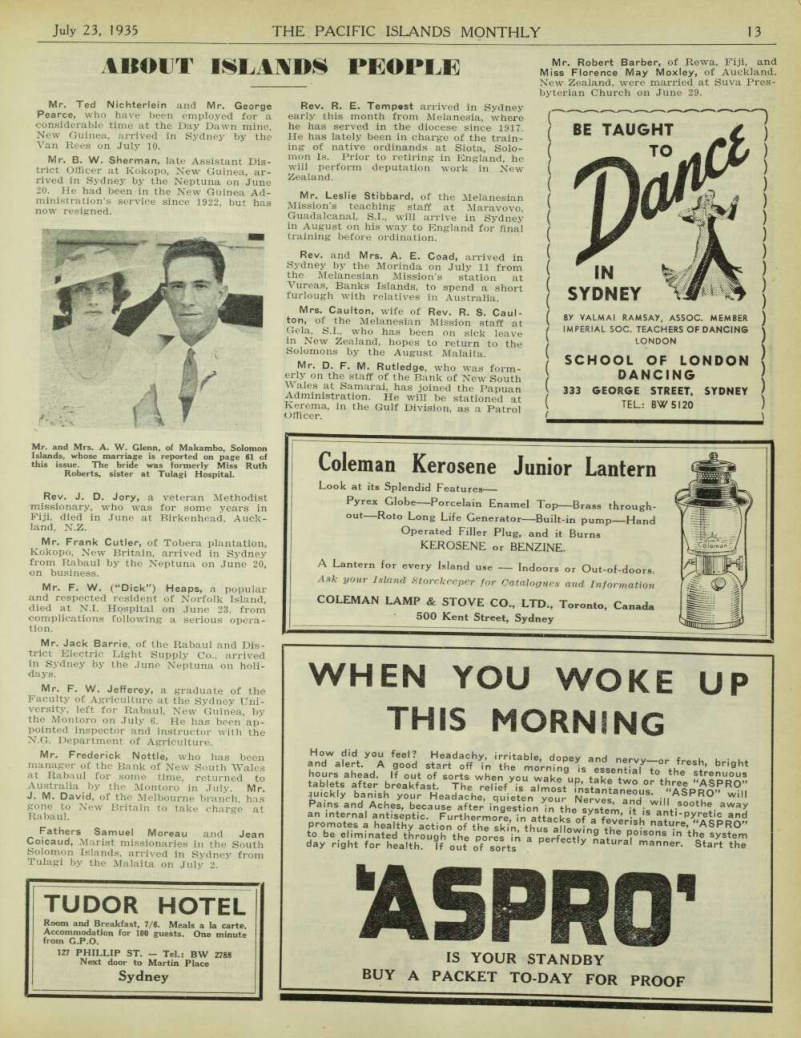
Mr. and Mrs. George Aumuller, who have been in Sydney for some months during Mr. Aumuller’s extended leave, left by the Marella for Port Moresby on July 6. They will later go on to Samarai where Mr. Aumuller is manager of Messrs.
Burns, Philp and Co.’s branch. The two young Aumuller girls are now at a board ing school in Moss Vale, N.S.W.
Pastor G. Peacock, who has been ap pointed Superintendent of S.D.A. missions in New Guinea in succession to Mr. G.
McLaren, who resigned recently, left Sydney for Matupi (Rabaul) by the July Montoro. Mr. Peacock has had many years experience as a missionary in the Pacific Islands; he was first stationed in Papua, then the Solomon Islands, and before being appointed to his present position was in the New Hebrides for three and a half years, during the latter part of which he was Superintendent of S.D.A. work in the Condominium, with headquarters at Aoba, South Santo.
“Working under Mr. S. H. Gander, S.D.A. native teachers are rapidly penetrating the Mount Hagen area,” said Mr. Peacock.
“Recently, we doubled the native teaching staff at Ramu, our base for work in Cen tral New Guinea, and another white mis sionary will shortly proceed to the Man dated Territory to assist Mr, Gander in his evangelistic work among the primitive tribes in that new region.”
Mr. Lauriston Sharp, of Harvard Uni versity, U.S.A., arrived at Thursday Island early in June by the Francis Pritt. For several months he has been conducting anthropological investigations among the natives of the Gulf country, and is now engaged in systematising his valuable scientific data.
Mr. and Mrs. O. B. Hug returned to the Solomon Islands by the July Malaita, after an extended holiday of 18 months spent in Tasmania and Queensland. Mr.
Hug’s plantation is at Maru Bay, San Cristoval.
Rev. and Mrs. J. W. Dixon returned to Papua recently by the Macdhui from Bris bane, with their baby daughter who was born in May last. Mr. Dixon is Principal of the Methodist Mission’s Training Col lege at Salamo.
Lady Murray, wife of the Lieutenant- Governor of Papua, arrived in Australia from Port Moresby on July 17. She in tends to leave shortly for New Zealand, and, after a brief visit to Christchurch, will continue on to England.
Rev. and Mrs. A. E. Brawn, who ar rived in Sydney from the Methodist Mis sion’s station at Nakanai, New Britain, by the March Montoro, have been advised by medical authorities against returning to the tropics. Mr. Brawn will do deputa tion service in the Australian States until he is appointed to a circuit in New South Wales.
Mr. Rajmal Singh, son of Sergeant- Major Singh, of the Fiji Constabulary, died after an operation at the Colonial War Memorial Hospital, Suva, on June 15.
Joining the Fiji Public Works Department in 1924 as an engineering apprentice, he later qualified as a fitter and engineer in the Mechanical Engineer’s Department at Walu Bay, Fiji. He was a prominent member of the Boy Scouts’ Association of Fiji, and, as captain of the Indian Reform League football team for the last three years, was a keen sportsman.
Rev. and Mrs, Robert Leek, who have been on furlough in Melbourne, returned to Papua by the Montoro on July 6. Mr Leek is rector of St. Paul’s Church at Samarai, and in addition is responsible for much of the business administration in Papua of the New Guinea Mission (Anglican).
Mr. Percy Jackson, of Buka Passage, New Guinea, died at Bonis on May 25.
Arriving in New Guinea in 1915, he was for a time overseer of Teopasino planta tion, and later was manager of the S.I.P. property at Lofung, Solomon Islands. Returning to New Guinea, he managed Baniu estate for some years. At the time of his death, Mr. Jackson was engaged in trad ing on his own account.
Mr. D. J. McClelland, chairman of direc tors of Upper Watut Gold Alluvials N.L., left Sydney for the Mandated Territory by the Montoro on July 6. He will visit the company’s areas in the Upper Watut district and supervise the erection of plant in connection with the hydro-electric power scheme on the company's property at Big Slate Creek.
Mr. Ted Nichterlein and Mr. George Pearce, who have been employed for a considerable time at the Day Dawn mine.
New Guinea, arrived in Sydney by the Van Rees on July 10.
Mr. B. W. Sherman, late Assistant Dis trict Officer at Kokopo, New Guinea, ar rived in Sydney by the Neptuna on June 20. He had been in the New Guinea Ad ministration’s service since 1922, but has now resigned.
Rev. J. D. Jory, a veteran Methodist missionary, who was for some years in Fiji, died in June at Birkenhead, Auck land, N.Z.
Mr. Frank Cutler, of Tobera plantation, Kokopo, New Britain, arrived in Sydney from Rabaul by the Neptuna on June 20, on business.
Mr. F. W. (“Dick”) Heaps, a popular and respected resident of Norfolk Island, died at N.I. Hospital on June 23, from complications following a serious opera tion.
Mr. Jack Barrie, of the Rabaul and Dis trict Electric Light Supply Co., arrived in Sydney by the June Neptuna on holi days.
Mr. F. W. Jefferey, a graduate of the Faculty of Agriculture at the Sydney Uni versity, left for Rabaul, New Guinea, by the Montoro on July 6. He has been ap pointed inspector and instructor with the N.G. Department of Agriculture.
Mr. Frederick Mottle, who has been manager of the Bank of New South Wales at Rabaul for some time, returned to Australia by the Montoro in July. Mr.
J. M. David, of the Melbourne branch, has gone to New Britain to take charge at Rabaul.
Fathers Samuel Moreau and Jean Coicaud, Marist missionaries in the South Solomon Islands, arrived in Sydney from Tulagi by the Malaita on July 2.
Rev. R. E. Tempest arrived in Sydney early this month from Melanesia, where he has served in the diocese since 1917.
He has lately been in charge of the train ing of native ordinands at Siota, Solo mon Is. Prior to retiring in England, he will perform deputation work in New Zealand.
Mr. Leslie Stibbard, of the Melanesian Mission’s teaching staff at Maravovo, Guadalcanal, S.I., will arrive in Sydney in August on his way to England for final training before ordination.
Rev. and Mrs. A. E. Coad, arrived in Sydney by the Morinda on July 11 from the Melanesian Mission’s station at Vureas, Banks Islands, to spend a short furlough with relatives in Australia.
Mrs. Caulton, wife of Rev. R. S. Caul ton, of the Melanesian Mission staff at Gela, S.I., who has been on sick leave in New Zealand, hopes to return to the Solomons by the August Malaita.
Mr. D. F. M. Rutledge, who was form erly on the staff of the Bank of New South Wales at Samarai, has joined the Papuan Administration. He will be stationed at Kerema, in the Gulf Division, as a Patrol Officer.
Mr. Robert Barber, of Rewa, Fiji, and Miss Florence May Moxley, of Auckland, New Zealand, were married at Suva Pres byterian Church on June 29.
Mr. and Mrs. A. W. Glenn, of Makambo, Solomon Islands, whose marriage is reported on page 61 of this issue. The bride was formerly Miss Ruth Roberts, sister at Tulagi Hospital.
Rev. Norman H. Wright, B.A., Methodist missionary among the Indians at Ba, Fiji, has been in Auckland, New Zealand, on sick leave. He will return to Suva at the end of July, Mr. Vernon John Dolton, a recent arrival in the Mandated Territory, died sud denly at Wau aerodrome, New Guinea, on May 24.
Mrs. Sarah Annie Webb, widow of Rev.
A. J. Webb (who was one of the first Methodist missionaries in Fiji), died at Chatswood, N.S.W., on July 5, aged 88.
She accompanied her husband to Levuka in 1868, when he was appointed to replace Rev. Thomas Baker, who had been mur dered by natives. Mr. Webb and his fellow missionaries helped to bring about the treaty under which the chiefs ceded their land to the Crown, thereby making Fiji a Crown Colony. Mrs. Webb had many interesting stories to tell of the early days in Fiji, when cannibals stalked
through the mission station and the evangelists thought that any moment might be their last.
Mr. J. F. Wilson, assistant manager and secretary of Amalgamated Wireless (Aus tralasia) Ltd., returned to Sydney by the June Neptuna, after a business visit to the Mandated Territory.
Rev. Alfred Butchart, of North Mala, Solomon Islands, who came to Sydney in March to undergo treatment at St.
Luke’s hospital, having broken his leg in three places, has resigned from the Melanesian Mission owing to general ill health. He has accepted a position on the staff of Archdeacon Chauvel, of Bro ken Hill, and will shortly take up his duties in the big N.S.W. mining town.
Engineer-Rear Admiral G. W. Bodell returned to Sydney from Rabaul, New Guinea, by the Montoro on July 2.
Mr. John Wilson, of Western Australia, who has just been appointed representa tive in New Zealand for the Melanesian Mission, left Sydney for the Solomon Islands by the Malaita on July 13. He will spend three months travelling throughout the group in order to obtain first-hand knowledge of the Melanesian Mission’s work in the South Seas. Upon his return to Australia, he will depart for New Zealand to commence his duties there. Mr. Wilson is a son of the Bishop of Banbury (Western Australia), who was formerly a Bishop of Melanesia.
Rev. and Mrs. L. A. McArthur arrived in Sydney recently from New Guinea to seek medical opinion on Mrs. McArthur’s health, following her recent breakdown at Vunairima, where her husband is principal of the Methodist Mission’s train ing institute. According to latest advice, there is little hope of her returning to the territory.
Rev. W. Burvill, B.A., Th.L., of the Quetta Cathedral, Thursday Island, is at present ill in the Torres Strait hospital.
Mrs. Thomas Mow, wife of the Chinese teacher-pastor of the Methodist Mission at Rabaul, recently arrived in New Britain from China by the Nankin. She will assist in the work at the Methodist Chinese school, particularly among the senior girls. Mrs. Mow will also engage in pastoral work among the women of Rabaul’s Chinatown.
Mr. W. A. Macdonald, an English artist, who has lived in Tahiti for 14 years, ar rived in Australia early in July by the Maunganui. He said that he went to Tahiti shortly after the war to stay a few days; but the charm and beauty of the French islands so captured his imagination that he remained there for more than a decade. Mr. Macdonald is an impressionist painter in watercolours.
Advertisements & other items, pp. 15-16 (2 items)
About Islands People
13
THE PACIFIC ISLANDS MONTHLY
July 23, 1935
ABOUT ISLANDS PEOPLE
This Morning
BE TAUGHT
TO IN
SYDNEY
BY VALMAI RAMSAY, ASSOC. MEMBER
IMPERIAL SOC. TEACHERS OF DANCING
LONDON
SCHOOL OF LONDON
DANCING
333 GEORGE STREET, SYDNEY
TEL: BW 5120
Coleman Kerosene Junior Lantern
Look at its Splendid Features— Pyrex Globe Porcelain Enamel Top Brass throughout Roto Long Life Generator Built-in pump Hand Operated Filler Plug, and it Bu rns
KEROSENE or BENZINE.
A Lantern for every Island use Indoors or Out-of-doors.
Ask your Island Storekeeper for Catalogues and Information COLEMAN LAMP & STOVE CO., LTD., Toronto, Canada 500 Kent Street, Sydney
WHEN YOU WOKE UP
THIS MORNING
How did you feel? Headachy, irritable, dopey and nervy—or fresh, bright and alert. A good start off in the morning is essential to the strenuous hours ahead. If out of sorts when you wake up, take two or three "ASPRO" tablets after breakfast. The relief is almost instantaneous. "ASPRO" will quickly banish your Headache, quieten your Nerves, and will soothe awy Pains and Aches, because after ingestion in the system, it is anti-pyretic and an internal antiseptic. Furthermore in attacks of a feverish nature, "ASPRO" promotes a healthy action of the skin, thus allowing the poisons in the system to be eliminated through the pores in a perfectly natural manner. Start the day right for health. If out of sorts
'ASPRO'
IS YOUR STANDBY
BUY A PACKET TO-DAY FOR PROOF
TUDOR HOTEL
Room and Breakfast, 7/6. Meals a la carte.
Accommodation for 100 guests. One minute from G.P.O. 127 PHILLIP ST. - Tel.: BW 2788 Next door to Martin Place
Sydney
THE LARGEST STOVE...
in the Pacific Islands is installed at the Bulolo Hotel, Wau—and it is a
YOUNGER
3 0 YOUNGER Stoves and Ranges are widely used throughout the Pacific Islands, for they embody in their construction everything calling for Efficiency in Working, Economy in fuel consumption and Durability.
Special Stoves for Island requirements with cast-iron ovens.
Write for quotations and catalogue of single and double oven stoves.
G. FLETCHER & SON
50 OXFORD STREET, SYDNEY
SEND
TO
ELVY’S RECORDS
Gladys Moncrieff, “Sorrow and Tears” (from “The Broken Melody ), One Night of Love” 2/6 Reginald Dixon (organ solo), “Teddy-Bears’
Picnic,” “Whistler and His Dog 2/6 Derickson and Brown (Tenor with Piano), “Be Still, My Heart,” "It's the Talk of the Town” 4/- Marek Weber (Light Orchestral), “Sweetheart” (Waltz), Strauss; “The Quaker Girl” (Waltz), Monckton 4/- You can be sure if you buy at Elvy's your records will reach you by return mail safely wrapped, and be posted cu A Selection of Records which we recommend: Lucienne Boyer (soprano), “Without You, “Son Regard,” 10 inch - 4/- The Western Bros., “Play the Game, You Cads,” “After All That,” 10 inch ... 4/- Joseph Schmidt, “My Song Goes Round the World,” “One Life, One Love (sung in Harry and His Mayfair Hotel Orchestra, “No Moon, No Stars, Just You (Waltz), “The Object of My Affection (Fox Trot), 10 inch 4/the price you pay will be the lowest possible.
H.M.V., COLUMBIA, PARLOPHONE, and REGAL ZONOPHONE catalogues will be posted on FREE upon application.
Elvy's seventy-two years' trading in musical instruments ensures that your every requirements in RADIO, PIANOS, PLAYER PIANOS, ORGANS and ANY OTHER musical instrument will be fulfilled to your utmost satisfaction. Special terms for those resident m the Pacific Islands.
Established 1863
ELVY & CO. LTD.
397 GEORGE STREET, SYDNEY
Between King and Markets Streets.
'Phone M 2319
Gold-seekers’ Hardships in New Guinea
New Guinea
A WARNING of the hardships that awaited prospectors who entered New Guinea with less than £500 to support them, was sounded by Dr. J. R.
Atcherley, an expert mining engineer, who returned to Melbourne in July after a visit to New Guinea.
Men were arriving at Rabaul, he said, with only £50, and their plight was hopeless. It was necessary for each to lodge £30 with the Administration before entry to the territory was allowed, and too often this money had to be used to re patriate gold seekers after their failure.
“There is no casual work available for unqualified mining men,’’ Dr. Atcherley added; “most of the white men on the goldfields are experienced men who are working for the big companies, and all the labour is done by natives. A number of men went up seeking work last month, and they have had to return at the ex pense of the Administration.
“All the payable auriferous area known is taken up, although there is a good deal of prospecting going on. Exploration of this kind takes money, and a prospector needs to have at least £500 at his back before he can be considered to have any chance at all of finding good country.
“Unless a man applies for work from this end as a technician or engineer, or in another capacity which commends him to the companies, he has little chance."
Mummies In New
Guinea Cave
Dr. J. R. Atcherley’s Find Near Salamaua
DURING the month Australian newspapers have given prominence to a discovery by Dr. J. R. Atcherley, of Mel bourne, of mummies in a cave at Mapos, 30 miles inland from Salamaua, New Guinea.
Dr. Atcherley is not the first to report this discovery; the find was referred to by Mr. Hall Best about the middle of last year, and was reported, with description of mummified native remains, in the Pacific Islands Monthly of July, 1934.
“I was on a prospecting expedition for New Morobe Gold Options when we dis covered the cave,” said Dr. Atcherley, on his return to Australia by the Montoro on July 2. “It was about 40ft. from the ground, and was a tortuous winding laby rinth.
“Inside we found a shelved mausoleum, on which were hundreds of mummies, all sitting with their chins on their hands and their elbows on their knees. It appeared to me that they had been preserved by the dripping of limewater from the cave stalactites. Local scientists believe, however, that there was pre-mummification—that the bodies were preserved be fore burial in the cavern.”
Dr. Atcherley added that the mummies’ features were negroid, although apparent pigmentation was lighter than that of present day New Guinea natives. This colouration, however, might have been induced by the action of limewater. It would be impossible to give the exact ages of the mummies, he concluded; the gene ral opinion was that their ages varied from between 1000 to 2000 years.
Melbourne Professor Sceptical
Commenting on the discovery of human remains in New Guinea, Professor Wood Jones, of the Chair of Anatomy, Mel bourne University, said that he was not satisfied, from the chat he had had with Dr. Atcherley and from the photographs he had seen, that they were mummies.
“If they are,” the professor said, “it would be the first time that mummies have been found in New Guinea, and it would lead one to assume that the natives there had lived in a culture higher than hitherto believed possible.
“I understand that Dr. Atcherley will seek official authority to send one of the bodies to the National Museum in Mel bourne for examination. After it arrives, and is proved to have been mummified, a new and important theory about the cul ture of the early New Guinea natives may be evolved.”
Mr. C. E. Tait, director of Messrs. W.
S. Tait and Co. Ltd., Islands merchants, of Sydney, returned to Australia recently by the Laperouse, after a business visit to New Caledonia. He said that N.C. chrome and nickel mines were working at full pressure in consequence of the ru mour of an impending war between Italy and Abyssinia.
Mr. H. E. Annear, mining engineer, of Melbourne, sailed from Sydney at the end of June for Suva, Fiji, to inspect several leases on behalf of Victoria Develop ment, N.L.
Administrator
Death of Former Norfolk Is.
MR. M. V. MURPHY, a former Administrator and Chief Justice of Norfolk Island, died in Sydney on June 30 at the age of 78 years. He had been associated in various official capacities with Norfolk Island for 30 years, and did much to im prove lease-holdings on the island.
He was attached to the Royal Commission which was sent to N.I. in 1896 to report on the Island’s affairs and effect surveys. Subsequently, he carried out surveys on Lord Howe Island and adjusted land disputes. He made a survey of all the hold ings, and he laid out the township of Kingston, N.I.
In 1900 Mr. Murphy joined the British survey ship Britannia, which was engaged on that part of the All-Red cable route between New Zealand and Queensland, via Norfolk Island. Later, he supervised for 15 months the erection of the cable station at Anson Bay, and the building of a wind ing road down the steep coastal escarpment.
As secretary to the Royal Commission to Nor folk Island in 1903, he again spent some time on the island. In 1905 he was appointed officer-in charge of N.I. affairs, under the direction of Mr.
William Houston, Deputy Administrator, whom he succeeded on the latter’s resignation in 1913. Later in the year, he became Chief Magistrate and Ad ministrator, and guided Norfolk Island’s destiny until his resignation in 1920. Six years later he returned to the island for six months to reorganise the administration.
Writing New Book, Hakon
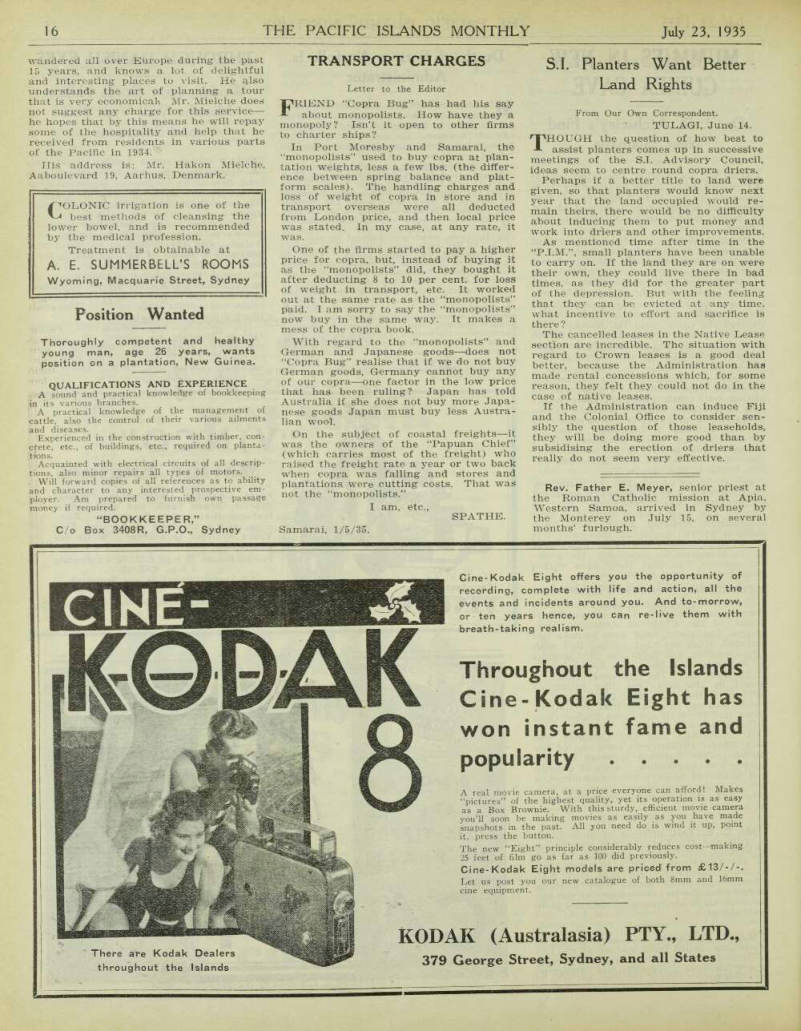
Through Danish Eyes
Writing New Book, Hakon Mielche Will Visit N.G. and Solomons
THAT clever young Danish artist, Mr.
Hakon Mielche, who recently wrote a book describing his interesting experiences in the Pacific with the Monsunen scien tific expedition, will be in Australia next year He has been commissioned by his pub lishers to go to Central Australia, New Guinea, and the Solomons to write and illustrate a series of articles and a book dealing with those Territories. It is to be hoped that English translations will be available. Mr. Mielche writes in Danish. of course, but he has an attractive literary touch and a light style, and his thumbnail illustrations are delightful.
Mr. Mielche has asked the Pacific Islands Monthly to inform all persons resident in the Pacific, who plan a tour in EuroPe that if they will get into communication with him, he will assist them in planning a European trip. He has
wandered all over Europe during the past 15 years, and knows a lot of delightful and interesting places to visit. He also understands the art of planning a tour that is very economical. Mr. Mielche does not suggest any charge for this service— he hopes that by this means he will repay some of the hospitality and help that he received from residents in various parts of the Pacific in 1934.
His address is: Mr. Hakon Mielche, Aaboulevard 19, Aarhus, Denmark.
Advertisements & other items, p. 17 (1 item)
“Vinco
The Vibrationless . . .
Manufactured by
VINCENT BROS.
Marine Engines
Float Chamber Carburettor, Impulse Starter, Brass Tank, and many other features that ensure Economical Running, and a Lifetime of Service. Five Years Written Guarantee. Write for Leaflet.
F.O.B. Price: h.p. £28/10/- complete „ „ 4 h.p. £42/10/- All Installation Fittings Supplied Counter-balanced Crankshaft, Brass 44 Wentworth Park Rd., Glebe
SYDNEY, N.S.W.
CAPSTAN
CIGARETTES
CORK-TIPPED
OR PLAIN
CAPSTAN
NAVY CUT TOBACCO
made from the finest Virginian leaf
Transport Charges
Letter to the Editor FRIEND “Copra Bug” has had his say about monopolists. How have they a monopoly? Isn’t it open to other firms to charter ships?
In Port Moresby and Samarai, the “monopolists” used to buy copra at plan tation weights, less a few lbs. (the differ ence between spring balance and plat form scales). The handling charges and loss of weight of copra in store and in transport overseas were all deducted from London price, and then local price was stated. In my case, at any rate, it was.
One of the firms started to pay a higher price for copra, but, instead of buying it as the “monopolists” did, they bought it after deducting 8 to 10 per cent, for loss of weight in transport, etc. It worked out at the same rate as the “monopolists” paid. I am sorry to say the “monopolists” now buy in the same way. It makes a mess of the copra book.
With regard to the “monopolists” and German and Japanese goods—does not “Copra Bug” realise that if we do not buy German goods, Germany cannot buy any of our copra—one factor in the low price that has been ruling? Japan has told Australia if she does not buy more Japa nese goods Japan must buy less Austra lian wool.
On the subject of coastal freights—it was the owners of the “Papuan Chief” (which carries most of the freight) who raised the freight rate a year or two back when copra was falling and stores and plantations were cutting costs. That was not the “monopolists.”
I am, etc.,
Spathe.
Samarai, 1/5/35.
Land Rights
S.I. Planters Want Better Land Rights
From Our Own Correspondent.
Tulagi, June 14.
THOUGH the question of how best to assist planters comes up in successive meetings of the S.I. Advisory Council, ideas seem to centre round copra driers.
Perhaps if a better title to land were given, so that planters would know next year that the land occupied would re main theirs, there would be no difficulty about inducing them to put money and work into driers and other improvements.
As mentioned time after time in the “P.I.M.”, small planters have been unable to carry on. If the land they are on were their own, they could live there in bad times, as they did for the greater part of the depression. But with the feeling that they can be evicted at any time, what incentive to effort and sacrifice is there?
The cancelled leases in the Native Lease section are incredible. The situation with regard to Crown leases is a good deal better, because the Administration has made rental concessions which, for some reason, they felt they could not do in the case of native leases.
If the Administration can induce Fiji and the Colonial Office to consider sen sibly the question of those leaseholds, they will be doing more good than by subsidising the erection of driers that really do not seem very effective.
Rev. Father E. Meyer, senior priest at the Roman Catholic mission at Apia, Western Samoa, arrived in Sydney by the Monterey on July 15, on several months’ furlough.
Advertisements & other items, p. 18 (1 item)
popularity
Colonic irrigation is one of the best methods of cleansing the lower bowel, and is recommended by the medical profession.
Treatment is obtainable at
A. E. SUMMERBELL’S ROOMS
Wyoming, Macquarie Street, Sydney
Position Wanted
Thoroughly competent and healthy young man, age 26 years, wants position on a plantation, New Guinea.
QUALIFICATIONS AND EXPERIENCE
A sound and practical knowledge of bookkeeping in its various branches.
A practical knowledge of the management of cattle, also the control of their various ailments and diseases.
Experienced in the construction with timber, concrete, etc., of buildings, etc., required on plantations.
Acquainted with electrical circuits of all descriptions, also minor repairs all types of motors.
Will forward copies of all references as to ability and character to any interested prospective employer. Am prepared to furnish own passage money if required.
“BOOKKEEPER,”
C/o Box 3408 R, G.P.O., Sydney
There are Kodak Dealers throughout the Islands Cine-Kodak Eight offers you the opportunity of recording, complete with life and action, all the events and incidents around you. And to-morrow, or ten years hence, you can re-live them with breath-taking realism.
Throughout the Islands
Cine-Kodak Eight has
won instant fame and
popularity
A real movie camera, at a price everyone can afford! Makes “pictures” of the highest quality, yet its operation is as easy as a Box Brownie. With this sturdy, efficient movie camera you’ll soon be making movies as easily as you have made snapshots in the past. All you need do is wind it up, point it, press the button.
The new “Eight” principle considerably reduces cost—making 25 feet of film go as far as 100 did previously.
Cine-Kodak Eight models are priced from £13/-/-.
Let us post you our new catalogue of both 8mm and 16mm cine equipment.
KODAK (Australasia) PTY., LTD.,
379 George Street, Sydney, and all States
A King Is Made!
How Royalty Was Established In Rarotonga
By Julian Hillas
THE trouble started over a hundred years ago; and, of course, there was a woman at the bottom of it. Or more correctly, three women; for, according to the benighted heathenish sort of way things were then looked at, they were all queens, with equal rights both in and out of the communal royal bed.
Whether they got on well together, and which did this or that task about the Palace, does not come into this story.
The point is that in the year 1823 they were the genuine hall-marked tapa clothed, flower-crowned wives of Tino mana, Ariki of Arorangi. Remember, in those days nobody thought much of monogamy, and a king with less than three wives simply wouldn’t have cut any ice at all.
But nothing untoward rocked this mat rimonial boat until the arrival of the first missionaries, who whispered in the Royal ear that having three wives was hardly the right thing to do. Christian decency pointed to a single course. Let the king choose one and dismiss the others.
Poor, plump Tinomana, harassed by the enormity of such a decision, found him self pulled in several directions. Three, to be exact. But with the aid, prompting and protection of his new advisers he eventually selected the youngest and most attractive of the trio; and, with her, came into the fold as respectably married as any suburban church-sidesman.
The knotty question of succession was also settled at the same time. Offspring of the legitimate Queen had priority; but, on the death of Tinomana’s immediate successor, the children or next-of-kin of the two rejected “wives” were to reign respectively. This arrangement sounded plain and straightforward enough then, especially as no one gave a thought to what sort of a tangle three separate families, all breeding prolifically, might make of such a plan in the course of a hundred odd years.
In the course of time, the original Tino mana died, and first one and then another of the three families reigned in his stead, until each had had its turn on the throne of Arorangi. For the sake of clarity, I give the names by which they are com monly known to-day. They are the Heathers, the Pirangis and the Napas; and, by marriage, the Heathers had iden tified themselves with the powerful clan of Makea, from which the Paramount Chiefs of Rarotonga are drawn.
The fun began last year, following the death of Tuoro Tinomana; and it has since galloped through all the stages of a Gil bert and Sullivan production.
Each family had had its turn; and each had stood pat for a second innings— eleven claimants, six from the Heathers, three from the Pirangis, and two from the Napas.
The late Tuoro—a Heather—had con siderably complicated matters before his death by nominating his son Rangi, ob taining for this nomination the support of the Mataiapos (or district headmen). The three families, however, objected, on the dual grounds of Rangi’s youth and the fact that that particular branch had just occupied the throne.
Rangi was bowled, middle stump.
Tinirau Makea, by virtue of his posi tion as Paramount Chief of Rarotonga, as well as his being a member of the Heather
group, then proposed David Isiah, also of the same family. The district headmen countered with the objection that David Isiah had no wife to shoulder the queenly duties.
Faced by this fresh difficulty, the Para mount Chief made a further suggestion.
Let Ngatae Vaine, sister of the deceased Tinomana, and a distant relation of David Isiah’s, reign jointly with the latter. But Ngatae Vaine, a lady of some character, refused flatly to share the Palace with a king who was not her husband.
Not to be defeated the Paramount Chief rose brilliantly to the occasion. What, he asked, was a simpler or more obvious solution than that the two get married?
The one was a widow and the other a widower.
For a moment the Heather dynasty seemed assured.
And then, baldly and brutally, but with no uncertain voice, David Isiah announced that nothing, not even a Crown, would in duce him to marry again, either Ngatae Vaine or anybody else.
David Isiah went out l.b.w.
Impasse!
Meanwhile, both the Pirangi and Napa candidates had said very little, the Napas because they were not sure about their
own claims, and the Pirangis because they were so certain about theirs that it would have been undignified to thrust themselves forward.
At this juncture, Tinirau Makea him self went in to bat —more, I believe, with the object of bringing the rest of the team to their senses than with any serious in tention of knocking up a high personal score. His action had the desired effect, and the Resident Commissioner convened a Native Land Court at which the claim ants appeared with all the paraphernalia of ancestral records, land titles, and faded entries in Bibles handed down from one generation to another.
Through these, the Commissioner con scientiously waded, with the result that the Pirangi claim emerged triumphant.
Old Tuki Pirangi left the court, meta phorically carrying not only his bat but the entire cricket bag, in which it is hoped that some thoughtful official had packed the Royal crown.
For ever and a day, until a new form of democracy abolishes Island Royalty, the Pirangis will continue to sit, unchal lenged, on the throne of Arorangi.
The grounds are empty, the last spec tator gone home, and the pavilion closed.
Advertisements & other items, pp. 19-20 (1 item)
Arnotts
ISLAND SHIPPING
Freight, Forwarding and Customs Service. Import and Export.
B. R. Wheeler
17-19 Bridge St., SYDNEY Correspondence Invited. Tel.: B 5396
A FREE BELT
Made of strong plaited kangaroo, is given away to every purchaser of 2 pairs of our
RIDING TROUSERS.
RIDING TWIST, expertly tailored. Shades: Dark Grey, Fawn, and Olive. 14/6 a pair.
W. H. Williams:
18-20 WILSON-STREET,
NEWTOWN.
Makers of Newmarket Safer Saddlery.
THERE’S NO SUBSTITUTE
FOR QUALITY
ARNOTT'S SAO BISCUITS are the result of half a century of specialization, they have that light flaky texture —that perfection of quality which makes them delicious with butter, cheese, ham paste or fruit, and exceedingly popular with everyone.
On cold nights try them this way: Butter the SAO Biscuits, grate a little cheese over each, and sprinkle with cayenne pepper—one minute in a hot, dry oven and serve whilst hot.
ARNOTTS
FAMOUS
SAO
BISCUITS
Always ask your Grocer for Arnott’s
“THEY ARE BETTER THAN EVER”
VIRTUS SHIRTS
are obtainable in
Three Sleeve Lengths
Short— eliminating the necessity of wearing armbands or sewing tucks in sleeves.
Medium—the regular average sleeve length.
Long—made extra long in sleeves specially to fit men with very long arms.
Reliable English Woven Shirtings Prices from 10/6 —Patterns Posted free. Write to
ERNEST SHAW
135 PITT ST., SYDNEY
TARIFF:
Bed and Breakfast 8/6 per day, £2/10/- weekly Luncheon and Dinner a la Carte
EUSTON HOTEL
CENTRALLY SITUATED
Modern Services Throughout :: A. HOBAN, Prop. 272 GEORGE ST., SYDNEY, opp. Wynyard Station
FOR
Pedigreed Terriers, Kelpies, Spaniels,
Greyhounds, Bull Terriers, etc.
Write
GEO. F. SMITH
(Judge for Many N.S.W. Dog Societies) Dealer in All Kinds of Live Animals. Zoos Supplied.
777 GEORGE STREET, SYDNEY.
Firearms Repairs. “OUR HANDS MAKE GOOD ARMS”
QUALITY FISHING TACKLE
There is always a wonderful feeling of satisfaction in knowing the Tackle will stand the strain.
Write now for my Fishing Catalogue (200 illustrations) and Firearm Catalogue (500 illustrations).
SIL ROHU [Late A.I.F.] GUNSMITH
Importer oI High-grade Firearms and Fishing Tackle Specialist. ’Phone MA 3540 143 ELIZABETH STREET. SYDNEY (near Market Street).
“FISHING TACKLE TO TACKLE FISHING.”
CRAIGNATHAN Private Hotel,
Situated right at Neutral Bay Wharf—15 minutes from
G.P.O.
IS AN IDEAL RESIDENCE FOR THE ISLAND VISITOR
TO SYDNEY.
Families specially catered for.
NEUTRAL BAY
:: SYDNEY ::
Swimming Baths Tennis Billiards Boatsheds
(Halvorsen’s).
Spacious Grounds FACING THE PICTURESQUE
HARBOUR.
Full Tariff from 10/- per day.
FULL INFORMATION AS TO TERMS, ETC., ON APPLICATION TO MANAGER. rams: “Craignathan,” Neutral Bay Phone: X 2472
What Termites Do In Suva
WHILE the premises of Sturt Ogilvie Ltd., Suva, were recently undergoing extensive alterations by A. H. Marlow a termite (white ants) nest of extraordinary dimensions was exposed. The wall was 6in. thick and the wall purlins and studs 4ft. apart.
As can be seen in the accompanying photograph the nest occupied about one and a half of these areas, or twelve cubic feet, over an area of twenty-four square feet.
Also in the photograph, below the exist ing nest, can be seen the marks indicating where the old nest had been. This old nest fell away as workmen stripped off the lin ing boards. These boards, on both sides of the wall near the nest, consisted only of a layer of paint, all woodwork having been destroyed by the ants. In fact, all woodwork in the wall, studs, nogging, etc., was practically hollow, with just an outside shell through which it was easy to push one’s finger.
Termite Nest in Suva Building
Judge Ayson
His Record in Cook Is.
From Our Own Correspondent.
Rarotonga, June 16.
STRAWS showing the direction of public opinion have lately waved gently in the New Zealand press ahent the forth coming appointment of Administrator of Western Samoa.
The Christchurch “Times” pertinently points out that there are not in the Dominion many men with the necessary qualifications for this particular office.
The outstanding record of Judge Ayson, C.M.G., as Resident Commissioner of the Cook Islands is quoted as an example of what can be effected by a sympathetic and kindly, yet withal a firm and impartial, man at the head of affairs.
The inference is obvious. Samoa is a more important post—and that post will shortly become vacant.
We in Rarotonga have often wondered at the good fortune which has repeatedly left Judge Ayson among us. And now, again, with this appointment filling the official horizon, speculation is once more rife and local sentiment on the lines of the old song “We don’t want to lose you, but we think you ought to go!”
But whoever may ultimately become the new Administrator of Western Samoa does not detract from the interesting parallel provided by these two Adminis trations, both exercised over very similar peoples, but one having a history of con tinuous blundering, while the other is a chapter of beneficial rule and general contentment. Wherein did the former fail?
The answer, I think, lies principally in the personal equation.
No one who has not spent some con siderable time in a small, comparatively isolated Islands community can assess the importance or significance of the many tiny jealousies and infinitesimal clashing interests which make the path of an Administrator no easy road to travel.
For thirteen years Judge Ayson has successfully balanced the power of trader and planter, at the same time maintaining a frictionless relationship between the Administration and the native population.
Those—and they represent a very small minority indeed—who dislike the present regime, are apt to complain that it owes its smooth working to the principle of "'apres moi le deluge." On the other hand, deluges do not usually appear out of clear skies, and the best evidence of clear human atmospherics in the Cook Islands are the smiling faces and general appearance of well-being seen everywhere in these Islands after thirteen years of Judge Ayson’s uninterrupted authority.
Fresh Water For Ships
From Our Own Correspondent.
SUVA, June 25.
RECENTLY, work was undertaken to improve the watering facilities at Suva for vessels touching at the port. New pumping machinery was installed, not without some criticism as to the installa tion being in advance of the requirements.
It is interesting to note that when the “Franconia” was here, she was supplied with 1624 tons of water. On the same day, the “Mariposa” took 713 tons. The total amount paid was £106/10/-.
Apparently Suva’s rainfall is not al together wasted these days.
Interesting Agricultural
Experiment
AN interesting experiment is being carried out on Pamua Island, near San Cristoval, in the Solomons Group, by the Melanesian Mission. On that island, Mr. Herbert D. Freshwater is conducting an agricultural experimental farm with crops and plants obtained from the New Guinea Administration’s demonstration plantation at Keravat.
The Melanesian Mission is encouraging village headmen on every island in the group to send young men to Pamua to study new methods of agriculture which, in the Mandated Territory of New Guinea, have proved to the natives their superior ity over the old ways.
In writing of the scheme recently, the Bishop of Melanesia said that if the Solomon Islanders learned only of the value of the rotation of crops then the experiment would not have been in vain.
Crop rotation, he wrote, not only enables the natives to retain gardens at com paratively short distances from their vil lages instead of pushing further and further away into the bush, but at the same time provides natural manuring for the ground, which does much to improve native agriculture and enable the cul tivators to get full value from what is grown.
Advertisements & other items, pp. 21-22 (1 item)
A. B. Donald Ltd.
PUMPMOBIL
Light and Portable
MOTOR PUMP
Complete Plant’s weight, 140 lbs.
Capacity up to 12,000 gallons per hour All heads from 10 to 115 feet Fuel consumption, ½ gallon per hour Pressure 55 lbs. square inch Especially suitable prospecting And all Sluicing Requirements
Nelson & Robertson
12 SPRING STREET, SYDNEY
BEAU BEN
VETERINARY PREPARATIONS
FOR DOGS AND CATS
BEAU BEN
Beau Ben’s Veterinary Household Remedies are prepared and supervised by a qualified chemist and a Veterinary Surgeon, who has had so many years of practical training that he can fittingly be termed a Specialist and an authority on the dog in health and disease.
Condition Powders 15 1/- Wormelene Syrup (Puppies) 2/- bot.
Wormelene Syrup (Dogs) . . 2/6 bot.
Worm Powders 9/- doz.
Diarrhoea Mixture 3/- bot.
Dermadex Skin Lotion 3/6 bot.
Dermadex Skin Ointment .. 2/6 jar Seafoam 1/6 bot.
Cough Linctus 3/- bot.
Nerve Tonic 3/- bot.
Catalogues Posted on Application—Islands Distributors Invited to Write to: BEAU BEN DOG AND CAT REMEDY COMPANY
3 CATHERINE STREET, LEICHHARDT, N.S.W.
A. B. DONALD Ltd.
AUCKLAND
Island Traders :: General Merchants
P.O. Box 1509 :: Cables and Telegrams: “Kingdom,” Auckland Branches at Rarotonga and throughout the Cook Islands At Papeete and throughout the Society, Marquesas and Paumotu Islands
trading as “ETABLISSEMENTS DONALD, TAHITI”
At Fiji: Trading as ‘‘Dominion Fruit Co.,” Suva
STOP
Tired nerves are the cause of Headache, Neuritis, Neuralgia, Rheumatism, Lumbago, Sciatica. Get instant relief from all nerve pains with Genuine VINCENT’S A.P.C. as recommended by Doctors, Dentists, Chemists, and Nurses. 12 for 1/6, 24 for 2/6.
All Chemists and Stores, or direct from Vincent Chemical Company Limited, Market St., Sydney, Australia
Nerve
Pains
FOR SAFETY’S SAKE, SAY VINCENT'S’
NORCO CO-OP.
LDIITED
SUSSEX STREET,
SYDNEY
AUSTRALIA’S LEADING MANUFACTURERS AND DISTRIBUTORS OF CHOICEST
BUTTER, BACON, HAMS AND TINNED GOODS
NORCO LUNCH
BRAWN
PORK SAUSAGES
1lb. and ½ lb. Tins.
PIGS’ TONGUES
PIGS’ TROTTERS
1lb. Tins Only.
IDEAL FOR LUNCHES
HAM PATE
3oz. and 1½oz. Tins.
AND PICNICS
Save time, trouble, temper specify these universally preferred
ROPES, CORDAGES & TWINES
Made by the largest Rope and Cordage manufacturers in Australasia, “Kookoo- Specially manufactured for the stresses of tropical conditions.
Other well-known products include Sash Cords, Halters, Plow Reins, Jute and Hemp Seaming Twines.
KOOKOOBURRA
BRAND
hurra” Ropes, Cordages, and Twines are tested to provide that extra endurance, which is only found in “Kookooburra” quality lines.
A. FORSYTH & Co. Ltd
339 KENT ST.
SYDNEY.
Cable Address: “Rope." Sydney
Away From Worldly
Cares
Three New Zealanders Seek Isolation on Sunday Is.
EARLY in June the N.Z. yacht “Ngataki” hove to off a thickly wooded cove on uninhabited Sunday Island, in the Ker madec Group, 600 miles north-east of Auckland and 600 miles south from Tonga. A boat manned by three young men and loaded with supplies, corrugated iron, and a pair of Alsatians, put off from the vessel and slowly headed for the beach.
As the small boat grounded on the shingle, the “Ngataki’s” pennant dipped twice and the white yacht gracefully spread her wings and turned into the wake of the sun. Shading their eyes, Alfred Bacon and his two companions followed her until the sea-rim claimed the “Ngataki” as its own.
These three men intend to spend the rest of their lives in complete isolation on the 72,000 acres island. After build ing a house with the iron, they will clear
plantations and cultivate foodstuffs and fruit in the rich volcanic soil. Their Alsatian dogs will help to exterminate the myriads of rats which abound on the island.
Bacon was one of three New Zealanders concerned in the last tragic attempt to settle on the island in 1926. On that occasion, one of his companions, as a result of a minor cut on the hand, de veloped tetanus, and died. The others returned to New Zealand on the Govern ment steamer.
Ever since his return, Bacon has cherished a wish to go back to the island to end his days there.
The triangular island was discovered in 1793 by D’Entrecasteaux and named Raoul. Three years later Captain Raw son, of the Britannia, named it Sunday Island. Since then many attempts have been made to colonise this lonely speck in the Pacific.
Baker and Reid, with their families, arrived in 1837 and lived there for six years. Henry Cook and an American, Halstead, were there for two years before being driven away by an eruption of the island’s volcano. In 1878, Mr. Bell and a party of Niue natives sailed from Samoa to grow vegetables on the island. The Bell family remained for many years, eventually withdrawing to New Zealand in 1914, leaving Sunday Island uninhabited save for a colony of wild goats.
The island itself is the top of an extinct volcano, the crater of which is about a mile in diameter. It is the only inhabit able island in the Kermadec Group, and is covered with dense bush, palms, and tree ferns. It is an attractive place, but is handicapped by lack of a sheltered anchorage.
Pitcairners Now Prefer
Cash To Bartering
FOR more than 100 years the people of Pitcairn Island, descendants of the famous Bounty mutineers, have bartered with passing ships a few bunches of bananas, a dozen or so mangoes, bread fruit, and paw paws for a bag of flour, tobacco, or a pair of shoes, etc. Now, however, they demand to be paid in hard cash. They do not discriminate in terms of currency provided they get money they are content.
When the freighter Cornwallis arrived in Melbourne from America recently the crew told of their experience when they called at Pitcairn on their way to Aus tralia. Manning three large whaleboats given them by the New Zealand Govern ment, the islanders rowed out to the ves sel with baskets of limes, mangoes, oranges, and bananas. The fruit was hoisted aboard and the crew prepared to lower a bag of flour. But the Pitcairners flatly refused to have it, saying that they would not leave the Cornwallis without receiving money for their produce.
To humour them the officers supplied them with several American dollars and the hardy Islanders rowed back to shore thoroughly satisfied.
New Gold Co. for S.I.
WITH a capital of £5000 in 500 shares of £10 each, Pacific Islands Gold Development Ltd. has been formed in Sydney to acquire a goldmine in the Solomon Islands and to explore and pros pect auriferous land in the Group. The first directors of the new company are: Hon. J. C. Watson, T. Courtney, and G. E.
Clift.
Agricultural Committee For Cook Islands
Cook Islands
From Our Own Correspondent.
Rarotonga, June 15.
AN Agricultural Advisory Committee was formed recently with the object of co-operating with the Administration in all matters relating to the fruit trade.
The Committee, which is representative of all interests, consists of the Resident Commissioner, the Director of Agricul ture, a representative of the European planters (Mr. Wigmore), a representative of the local exporters (Mr. McKegg), and two representatives of the native planters (Makea Ariki-Nui and Mr. C. Cowan).
Although the Committee’s powers are purely advisory, it is hoped that so repre sentative a body will by discussion and mutual agreement be able to further the interests of a trade with which all are vitally concerned.
Betel-Nut Chewers
WORD from Henry Dexter; I'm inclined to agree with “Salamaua” on the betel-chewing question. Our Eas tern Papuan natives were about the most intelligent of the many races of which I have had experience. This does not go to show that the chewing made them so, but that it did not affect the brain ad versely.
I shall always give betel one testimonial.
When the dreadful epidemic of mouth disease broke out in the division then known as the S. Eastern, in 1915, the betel-chewers were not affected. The non-chewers gave us an anxious time.
Little George
HE knew New Guinea up and down, In mountain, swamp and gorge, This hardy miner, tough and brown, We know as “Little George,”
He tried his luck on every field, Back in a former day: At times they’d give a decent yield, At others barely pay.
Among the early pioneers In Guinea’s fevered land He battled round for many years One of a restless band.
Quite often all alone he’d go O’er river, creek and range Where flooded mountain torrents flow, Through jungle weird and strange.
When still a youth he roved around In cheery, casual way; Some useful patches thus he found Inland from Cloudy Bay.
Many stories he would tell In dry and hum’rous style.
Many times he suffered hell, And bore it with a smile.
We know this gallant little man, A comrade tried and true; We always found him in the van When testing country new.
Grim danger never troubled him, All hardship was a joke; When flush he’d satisfy each whim, Nor squeal when he went broke.
When luck was in he’d freely spend— He was no slave to pelf— He’d oftentimes his money lend, And then go short himself.
Best wishes to our good old mate!
And, now, for old time’s sake, We hope that he will soon or late A tidy fortune make.
Frank Pryke.
Rev. H. A. Scriven, Foreign Missions general secretary of the New Zealand Methodist Church, arrived in Sydney re cently by the Monowai on his way to the Solomon Islands. He left for Tulagi by the Malaita on July 13.
Advertisements & other items, pp. 23-24 (1 item)
Engines
"VITAMATE”!
“VITAMATE” is a delicious South American Beverage, free of Tannin, and owing to its chemical contents (Iron, Copper, and Manganese) ensures the physical well-being of those who partake of it.
Because of its beneficial influence on the Liver and Kidneys it maintains the body free of poisons and is therefore a powerful remedy against Rheumatism, Anaemia, Diabetes, Indigestion, Insomnia and other allied disorders.
See that you get “VITAMATE” and no other brand.
“VITAMATE” is pure.
“VITAMATE” means—
Health, Happiness,
Strength, Long Life.
AUSTRALIAN DISTRIBUTORS:
Messrs. Nelson & Robertson
12 Spring Street, SYDNEY
TWELVE AND A HALF YEARS SERVICE . . . . is the record of
Fairbanks
Morse
Engines
in this vessel Papuan Government Motor ship “Laurabada”
Fairbanks Morse Co. (Aust.) Ltd. 29-33 Clarence Street Sydney Box 2672EE
A.B.C.
Tasteless Condition Powders “Stop Your Dog Scratching”
Price 1/- pkt., post free.
A.B.C. WORM MIXTURE, 2/-
A.B.C. have a remedy for every dog ailment. Any chemist or store stocks A.B.C. Dog Remedies.
A.8.C., 306 Miller St., North Sydney,
N.S.W.
“BAINOL”
WHITE ANT PREVENTIVE
BORER EXTERMINATOR
WOOD PRESERVATIVE
The most scientific preparation on the market for the above purposes “BAINOL” is packed in containers to suit any size job, and is sold in quarts, halfgallon, one-gallon and four-gallon tins, and in 45-gallon drums at a reduced rate.
Prices: Quarts 2/11, Gallons 7/11, 4-Gallons £1/6/3, 45 Gallons £13/4/2.
Australian Currency, F.O.B., Sydney Sole Manufacturers:
Bains’ White Ant Exterminator
BW 6462 CO. LTD. LM1025
Established 40 Years.
Sottish House, 17-19 Bridge St., Sydney Inquiries Regarding Agency Invited.
The Islanders’ Sydney Home . . .
Location BELVEDERE
Of
81 BAYSWATER ROAD, DARLINGHURST
Private telephones if desired.
An atmosphere of rest and grateful quietness.
Ideal location.
Near White City Tennis Courts.
Seven minutes to G.P.O.
Close to Shopping Centre.
Trams stop at gates.
Exclusive.
A fine house with its wealth pleasant old associations.
The Garden Suites, designed on most modern lines.
Excellent grounds with beautifully kept gardens—and dotted with comfortable garden seats.
BELVEDERE is Controlled and Supervised by Island People for Island Peop TERMS: From £2/12/6 Weekly.
MR. & MRS. C. WAGER (late of Fiji), Proprietors.
PULVEX
THE SUPERIOR INSECTICIDE POWDER
ACTUALLY KILLS FLEAS, ETC. (IT DOES NOT
MERELY STUPIFY THEM) AND KEEPS THEM
OFF FOR SOME DAYS AFTER TREATMENT For All Skin Diseases of a Parasitic Nature use
NON-POISONOUS
NON-IRRITANT / KUR-MANGE
The Popular English Remedy
kur-mange is in powder form, ready FOR USE WHEN MIXED WITH COLD WATER
NON-CARBOLIC . NON-POISONOUS
WILLIAM COOPER & NEPHEWS
(AUST.) LTD.
4 O’CONNELL STREET
SYDNEY
by Synthetic Productions
Rubber Planters Menaced by Synthetic Productions
THE outlook for rubber-growers is not good. Despite international organisa tion, there is much over-production, and the market rates are consistently depress ed. Meanwhile, the use of synthetic rub ber is increasing very rapidly. Fortu nately, this development does not greatly affect the Pacific Territories —in only one of them, Papua, is rubber grown in large quantities.
The following paragraphs have appeared in various journals: The last month of the first year of the export regulation scheme for rubber finds the position less favourable for the grower than it was a year ago, says a London trade report. Producing costs in the countries of production have increased by over 100 per cent., owing to the necessary reduction in outputs, and now show hardly any margin of profit on production with the selling price below 6d. A year ago the spot quotation was 7d, and estates were on full production. The percentage of the exportable maximum will be fur ther reduced by 5 per cent, to 65 per cent, of standard production, from July 1, and will remain in force to the end of the year unless again revised by the International Rubber Committee.
Methyl Rubber
In the course of an article on synthetic rubber in Germany the “Übersee Post” says: ‘‘Synthetic rubber was first employ ed on a large scale during the war. What was known as ‘methyl rubber’ was pro duced by the German chemists, more par ticularly as a substitute for vulcanite.
The industry was closed down after the war because the substitute could not com pete with the natural product either in quality or price. In the meantime, Ger man chemists have achieved remarkable progress in this direction. The experi ments made with motor car tyres of syn thetic rubber are stated to have been satis factory. The question of wholesale pro duction is largely influenced by considera tion of cost. As long as it was necessary to employ carbide of calcium as the base of the new product, the price for the first materials was sometimes as much as 50 per cent, higher than that of the natural rubber. On the other hand, it is quite possible that butadiene will be obtained as a by-product in the hydrogenation of coal at a price which will make the manu facture of synthetic rubber a practical proposition.
From Limestone And Coal
A report from an official Soviet source recently received in London states that the construction of a large artificial rubber manufacturing plant in Erivan, Armenia, is nearing completion. The product known as Sovpren will be produced from lime stone and coal by means of a new process discovered about two years ago. The chief advantages of the new method, as compared with the production of synthetic rubber from alcohol, are the low cost of the finished product, and the elimination of the necessity of high pressure and high temperatures in the manufacturing pro cess. The new rubber is reported to have excellent wearing qualities, can be worked easily, and is practically free from deter ioration as a result of ageing. In addi tion to its acid-resisting quality it is also insoluble in petrol. Besides synthetic rubber, the plant will manufacture as by products lacquers, paints, and various materials used in building.
Threat To British Industry
Mr O. A Mendelsohn, Public Analyst of Victoria, who reached Sydney recently from San Francisco, said that synthetic rubber was being increasingly used in the United States. The substance had been taken up by the Du Pont group, and was used for all small articles for which rub ber hitherto had been required. In time it would be used for motor tyres. The effect on British rubber supplies would become serious, as the synthetic material was being manufactured in the United States.
Russia’S Rubber
The value of Soviet Russia’s purchases of rubber in Great Britain during April last amounted only to £1001. compared wuh £117,141 in the corresponding month a year ago. This sharp fall in the Soviet’s foreign purchases of a raw material es sential to the implementing of the second Five-Year-Plan is accounted for by the rapid increase in internal sources of pro duction As long ago as 1932 it was an nounced that a rubber productive Plant called Tau-sagis had been discovered It flourished in a temperate climate at alti tudes between 3000 and 4000 feetroots weighed between 2lb. and 4lb., and gave a 40 per cent, lactic yield, from which about 15 per cent, of pure rubber could be obtained. Beyond this source of supply, there is the development of syn thetic methods of manufacture to be taken into account.—S.M. Herald.
Catching Flying-Fish
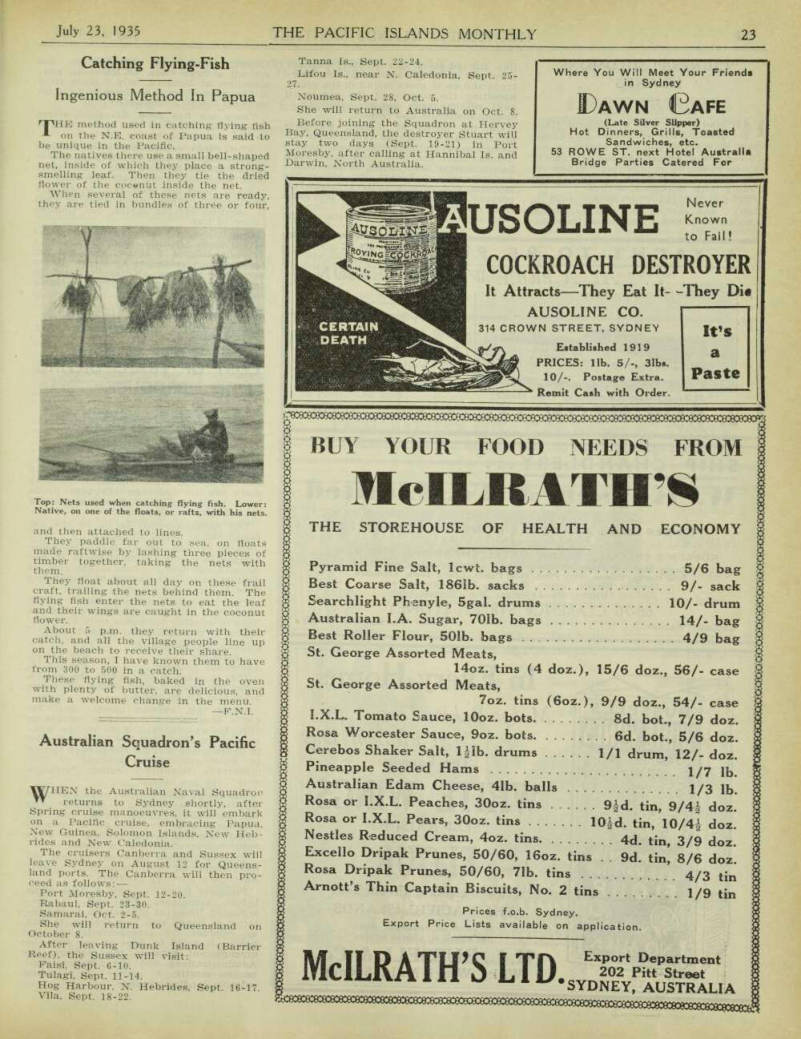
Ingenious Method In Papua
THE method used in catching flying fish on the N.E. coast of Papua is said to be unique in the Pacific.
The natives there use a small bell-shaped net, inside of which they place a strong smelling leaf. Then they tie the dried flower of the cocenut inside the net.
When several of these nets are ready, they are tied in bundles of three or four,
and then attached to lines.
They paddle far out to sea, on floats made raftwise by lashing three pieces of timber together, taking the nets with them.
They float about all day on these frail craft, trailing the nets behind them. The flying fish enter the nets to eat the leaf and their wings are caught in the coconut flower.
About 5 p.m. they return with their catch, and all the village people line up on the beach to receive their share.
This season, I have known them to have from 300 to 500 in a catch.
These flying fish, baked in the oven with plenty of butter, are delicious, and make a welcome change in the menu.
F.N.I.
Top: Nets used when catching flying fish. Lower: Native, on one of the floats, or rafts, with his nets.
Australian Squadron's Pacific
Cruise
WHEN the Australian Naval Squadron returns to Sydney shortly, after Spring cruise manoeuvres, it will embark on a Pacific cruise, embracing Papua, New Guinea, Solomon Islands, New Heb rides and New Caledonia.
The cruisers Canberra and Sussex will leave Sydney on August 12 for Queens land ports. The Canberra will then pro ceed as follows: Port Moresby, Sept. 12-20.
Rabaul, Sept. 23-30.
Samarai, Oct. 2-5.
She will return to Queensland on October 8.
After leaving Dunk Island (Barrier Reef), the Sussex will visit: Faisi, Sept. 6-10.
Tulagi, Sept. 11-14.
Hog Harbour, N. Hebrides, Sept. 16-17.
Vila, Sept. 18-22.
Tanna Is., Sept. 22-24.
Llfou Is., near N. Caledonia, Sept. 25- 27.
Noumea, Sept. 28, Oct. 5.
She will return to Australia on Oct. 8.
Before joining the Squadron at Hervey Bay, Queensland, the destroyer Stuart will stay two days (Sept. 19-21) in Port Moresby, after calling at Hannibal Is. and Darwin, North Australia.
Advertisements & other items, p. 25 (1 item)
Mcilrath’S
Where You Will Meet Your Friends in Sydney
Dawn Cafe
(Late Silver Slipper) Hot Dinners, Grills, Toasted Sandwiches, etc. 53 ROWE ST. next Hotel Australia Bridge Parties Catered For
AUSOLINE
Never Known to Fail!
COCKROACH DESTROYER
It Attracts—They Eat It- -They Die
AUSOLINE CO.
314 CROWN STREET, SYDNEY
Established 1919 PRICES: 1lb. 5/-, 3lbs. 10/-. Postage Extra.
Remit Cash with Order.
It'S Paste
BUY YOUR FOOD NEEDS FROM
McILRATH’S
THE STOREHOUSE OF HEALTH AND ECONOMY
Pyramid Fine Salt, 1cwt. bags 5/6 bag Best Coarse Salt, 186lb. sacks 9/- sack Searchlight Phenyle, 5gal. drums 10/- drum Australian LA. Sugar, 70lb. bags 14/- bag Best Roller Flour, 50lb. bags 4/9 bag St. George Assorted Meats, 14oz. tins (4 doz.), 15/6 doz., 56/- case St. George Assorted Meats, 7oz. tins (60z.), 9/9 doz., 54/- case I.X.L. Tomato Sauce, 10oz. bots 8d. bot., 7/9 doz.
Rosa Worcester Sauce, 9oz. bots 6d. bot., 5/6 doz.
Cerebos Shaker Salt, 1½lb. drums 1/1 drum, 12/- doz.
Pineapple Seeded Hams 1/7 Australian Edam Cheese, 4lb. balls 1/3 lb, Rosa or I.X.L. Peaches, 30oz. tins 9½d. tin, 9/4½ doz.
Rosa or I.X.L. Pears, 30oz. tins 10½d. tin, 10/4½ doz.
Nestles Reduced Cream, 4oz. tins 4d. tin, 3/9 doz.
Excello Dripak Prunes, 50/60, 16oz. tins 9d. tin, 8/6 doz.
Rosa Dripak Prunes, 50/60, 7lb. tins 4/3 tin Arnott’s Thin Captain Biscuits, No. 2 tins 1/9 tin Prices f.o.b. Sydney.
Export Price Lists available on application.
McILRATH'S LTD. Export Department 202 Pitt Street Sydney, Australia
“Chinese” Solomons
Islands
Letter to the Editor.
I AM glad to see that the Chinese trading question has been taken up so seri ously by some of our local people.
I can never understand the attitude of the Government in allowing Chinese to rank equally on matters of licenses and trading with European settlers.
As long as the Chinese remained in Tulagi, and carried on with gardening, laundry work, and a few stores, the situa
tion did not seem very serious; but now they are gradually creeping into every trade and on to every island in the group, upsetting the morale of the native (if any), ruining trade, and generally under mining discipline and respect.
On the island of Ysabel, we have hitherto happily escaped this trouble —although several times the question of a Chinese store has been brought forward.
Petitions have been signed by the traders and planters of Ysabel, the Melanesian Mission, and certain natives themselves praying that the Chinese be prevented from settling here.
In spite of all these protests, Chang
Cheong, trader and boat-builder, has erected a large store, of European con struction, at Mindoru, only 7 miles from a European store, and intends to start business almost immediately.
There are five good European stores already on Ysabel, as well as numbers of native stores and native hawkers.
When copra was down in price, Chinese traders did not buy. European stores never refused to purchase. The same thing applies to ivory nuts and shell.
When times are good, the Chinese are everywhere. When prices drop, or cash is required for tax-paying, the Chinese refuse to buy.
One writer in your columns complains of the term “British” being attached to Solomon Islands. I object, also, but not for the same reason as he gives. Under present conditions, “British” should be left out and “Chinese” Solomon Islands substituted.
I am, etc.,
Kathleen D. Bignell.
S.I., 12/5/35. (Trader’s Wife).
Cost Of Transporting
Produce
How Aeroplanes Could Be Used
THE need for cheaper transport in Papua and New Guinea, if planters there are to make an adequate liveli hood, is illustrated by figures submitted by a Papuan coffee-grower.
The solution seems to lie in the de velopment of aerial transport.
Dutch coffee, from Java, is being dumped in Sydney at from 2d. to 3d. per lb., c.i.f., Sydney. The actual cost of production in Java is said to be not less than 3½d. per lb.
The Papuan coffee-grower, whose figures we have at hand, shows that the costs of sending his coffee from his plan tation to the Australian market were: Papuan transport and handling 876 per lb.
Australian charges 598 per lb.
This is equal to practically 1½d. per lb. —not far short of what Dutch coffee has been , sold for in Sydney.
When this Papuan planter sent his coffee crop to the Australian market in 1934, he was charged £164 by the Aus tralian Customs, for the portion landed in Sydney, and £75 for the portion landed in Melbourne —all on account of that monstrous imposition called “primage duty” (10 per cent.).
The Dutch-grown coffee pays a duty of 4d. per lb., in addition to primage; but the foregoing figures show that the Papuan industry requires all the protec tion it can get, if it is to meet the com petition from “dumped” products.
This is another argument against the maintenance of the primage duty against Australian territory products.
Probably it will be only a little while before aeroplanes will call, at pre arranged times, at plantations in the in terior of Papua and New Guinea, to pick up produce for transportation to the ports. It could be done at any time, by arrangement between the planters, the Administrations and the aviation com panies—mostly, a matter of providing suitable landing-grounds.
Advertisements & other items, p. 26 (1 item)
White Wings
A YACHT TO BE PROUD OF
... AT A PRICE WITHIN REASON
R.M.Y.C. “Hocna” (Vice Com’re Victor Heine)
EXPERT BOATBUILDER
AND DESIGNER. . .
ISLAND WORK A
SPECIALITY. . . .
J. ROBINSON, 8 School St., Balmain, N.S.W.
SHIP CHANDLERY
W. Kopsen & Co. Limited Manufacturers of PIONEER BRAND ASH OARS AND IMPLEMENT HANDLES.
Sole Agents for : KOPSEN’S SPECIAL YELLOW METAL SHEATHING AND NAILS.
Large Stocks of Chains, Anchors, Manilla and Wire Ropes, Wood and Iron Blocks, Oakum, Tar, Pitch. Oils, Paints, Leads, Zincs, Varnishes, Shackles, Rigging, Screws, Sheathing, Felt, Lampware, etc.
Special Under Bond Prices for Island trade.
68-70 CLARENCE STREET, SYDNEY
Cables: “Kopsen.” ’Phone: BW 1114-5
In Every Home
Makes Baking Day
A Pleasant Day
The Famous
WHITE WINGS
SELF-RAISING
FLOUR
Now available throughout
THE PACIFIC ISLANDS
If your Storekeeper does not stock it, please advise
H. L. BUSSELL & Co.
White Wings Mills, Sydney
Next Move In Western Samoa
Will New Administrator be Given More Power ?
(Contributed)
WESTERN SAMOA is anxiously await ing an announcement from Welling ton, N.Z. The retiring Administrator departs in July. Who is to be his suc cessor?
A wrong appointment, now, might easily set in train events which will mean the withdrawal of the Mandate from New Zealand.
The Administration of Western Samoa has ever proved a thorny problem for New Zealand.
The hectic post-war period created political, economic, social, and legal diffi culties, which the inexperienced N.Z. offi cials sent to the Territory often found hard to cope with. The natives, elated and happy amid the post-war high prices of produce and liberal wages, willingly co-operated with the Government, as they were used to do under the pre-war Ger man rule; but the European residents, planters, and traders were less pleased with the changes brought about, when the New Zealand Government deemed it necessary to introduce many new measures.
Severe criticism was levelled at the Administration which, among other things, was blamed with extravagance and lack of co-operation with the settlers, who wanted more representation and a voice in the councils of the Administration. The land question, the unwarranted intro duction of prohibition for Europeans, and other arbitrary measures, were the main sources of dissatisfaction.
But the New Zealand Government re mained adamant and aloof, granting only small and unimportant concessions to the Europeans. A more concilliatory attitude was adopted when General Richardson became Administrator. He partly appeased the Europeans and brought about better understanding with the European planters.
Of strong individuality, and taking much interest in the Samoans. General Richardson tried to promote the political and economic welfare of the natives by measures which involved radical and important changes in their inherited tra ditions, customs, and the social system.
He chose the wrong advisers in his native policy. The rapid changes aroused the resentment of the most influential chiefs and their active or passive resistance.
Punitive measures, deportations, imprison ment, and fines followed, to suppress opposition—and as a result the Samoan “Mau” was born in 1926 as a powerful anti-Administration movement. With its birth, the previous opposition to the Ad ministration, which came from the Euro pean element, was relegated to the back ground.
The history of the Mau movement, and the failure of the Administration during many years to suppress the “Mau” and conciliate the Samoans are well known.
The crisis was reached under the adminis tration of General Richardson’s successor, Colonel Allen, when in 1929 High Chief Tamasese at the head of a Mau proces sion, was killed in an affray with the police on Apia’s main road.
General Hart, succeeding Colonel Allen, found the Administration faced with a stubborn wall of native resentment and sullen non-co-operation. His administra torship has been peaceful: but it has not been notable for any great improvement in the Mau situation. These natives like an energetic, bustling forceful man. But General Hart has pursued “a policy of masterly inactivity.” Perhaps it was a good policy. He made few new friends
for the Administration; but he made no further enemies.
As the local paper put it, the only good one could say of his term as Administra tor was that he took a keen interest in sport and actively participated in bowling and golf. Personally quite a likable man he thought it best, in order to avoid the pitfalls into which his predecessors had fallen, to remain inactive and aloof; the only event of importance during his term of office being the trial and deportation of the Samoa-born Mau leader, O. F. Nelson —and in this event he took only a small part.
(Continued overleaf)
A feature of General Hart’s Administra tion was the exchanges of State visits with the Governor of the neighbouring American Samoa, which occurred with regularity several times a year—accom panied by much firing of salutes, guards of honour, visits to plantations, and offi cial balls at Vailima —where Samoa offi cialdom was brilliantly represented, with practically the total exclusion of Euro pean residents of Apia, This latter prac tice was in vivid contrast to General Rich ardson’s time when, on important official occasions, every respectable European re sident of Samoa was invited to Vailima.
Of course, the strange inactivity of General Hart may be due to the fact that he had to obey strict orders from Wel lington, where the External Affairs Office wished to reserve all important and even unimportant decisions to themselves and refused to let the Administrator have a free hand in any matters of policy.
The question of a successor looms large in the public interest. There is complete agreement that in the interests of finance, economy, and efficiency, no decorative figurehead or placid office-holder is wanted here.
The name of Judge Ayson, at present.
Resident Commissioner of the Cook Islands, is mentioned as a possible choice.
This would be warmly welcomed here, for several reasons. Judge Ayson, when ap pointed, would be able to occupy the com bined positions of Judge and Administra
tor, and so save the trouble and expense of the present method of sending to Apia from New Zealand a judge on circuit.
But the chief reasons are that Judge Ayson has a wide knowledge of native affairs, that he has a reputation for the successful handling of difficult political situations, and that he is a man of tact and common sense.
Doubtless, the Samoan Mandate and the policy of New Zealand has been discussed in London between the British Govern ment and Prime Minister Forbes. It is hoped that, as a result, greater co-opera tion between the Samoan Administration, the inhabitants of the Mandated Terri tory, Europeans, and Samoans alike will be secured.
Advertisements & other items, pp. 27-28 (1 item)
Always..
RHEUMATISM
AND
KIDNEY TROUBLES
DEFINITELY OVERCOME BY “UREX.”
the new scientific remedy which cures by removing the cause.
RHEUMATISM, LUMBAGO, SCIATICA, NEU-
RITIS, PAINS IN BACK, JOINTS AND LIMBS,
KIDNEY AND BLADDER TROUBLES and all
kindred complaints will vanish like magic before this wonderful remedy.
Neglect is dangerous and will result in a premature decline of your powers, breakdown, and a shortening of life.
No matter what other remedies you have tried, whether you are seven years of age or seventy, man or woman, “UREX” will relieve you. It “gets right to the spot,” and stops that pain.
Money back if no relief.
Obtainable only from the manufacturer, price 5/6, postage free.
RICHARD’S RELIABLE REMEDIES,
17 Bond Street, Sydney.
EXCEL BATTERIES
15 Months’ Guarantee.
The Product With A Reputation.
Prices F.O.B. Sydney (Australian Currency). Packing and Cases No Charge 13 Plate. 100 amp 30/- 15 Plate. 120 amp 35/- 17 Plate. 140 amp 45/-
SPECIAL CYCLE BATTERY
Six (6) Months’ Guarantee
At 25/- EACH.
EXCEL BATTERY COY., 77-79 William St., SYDNEY APPLICATIONS FOR AGENCY INVITED FROM ALL CENTRES
Always..
make sure Australia's Choicest Products: you have Green Peas French Beans Cauliflower Beetroot Spinach Cabbage Carrots Parsnips Celery Brussels Sprouts White Turnips Sweet Corn Tomato Puree Tomato Sauce Tomato Soup Tutti Fruit Sauce at hand an ample Reserve of these Delicious
Garden
Vale
Ready-toserve Vegetables
Malt & Hops
WILL BREW A NICE DRINKING
BEER
MADE FROM THE
FINEST ENGLISH
MALT & HOPS
STOCKED BY:
Burns, Philp & Co., Ltd.,
RABAUL
MAKERS:
Paine & Co., Ltd.,
St. Neots, Hunts., England.
DOYLE’S famous VETERINARY REMEDIES
REDUCINE—Cures Your Lame Horse. Cures him painlessly and you can work him all the time.
Cures Splints, Curbs, Capped Hocks, Sprung Tendons, Bog Spavins, and all Bony and Bursal Enlargements. Price. 12/6 per can. Postage, 1/-.
LARYNGINE.—A sure cure for Coughs, Colds, Strangles, etc. Price, 5/- per can. Postage, 1/-.
SKIN DRESSING.—A certain remedy for Mange and Allied Parasitic Skin Diseases in Horses, Dogs, etc. Price, 7/6 (large), 3/6 (small). Postage, 1/-.
DISTEMPER MIXTURE.—A safe and reliable remedy for Coughs, Colds, Asthma, etc. Price, 2/6. Postage, 9d.
T. G. DOYLE, v.s., 9 KING STREET, RANDWICK, N.S.W.
Write for Free Veterinary Advice and Booklet
Priestman
Grabs
For all types of excavating work, may be attached to any existing crane, for the removal of mud, river gravel, etc.
Send for particulars of the PRIESTMAN “CUB” EXCAVATOR, ¼ cub. yard capacity, weight tons, operated by petrol-paraffin, or crude oil engine. This type of Excavator may be used as a Shovel, Dragline, Trencher or Skimmer.
NOYES BROS, (Sydney) LTD.
115 Clarence Street, Sydney. ’Phone: B 7581 (10 lines). 11 Watt Street, Newcastle; 197 Elizabeth Street, Brisbane.
Plea for Another Mandatory
Letter to the Editor SMALL though Samoa is, its tragic post war history is known in every civilised country. Yet, year after year, the Man dates Commission have complacently lis tened to a tissue of obvious absurdities from New Zealand’s representative. Each year he has stated the same thing, that the Mau is dead or dying, and that all is well in the Territory. Yet the years roll by, and still the Mau exists without any apparent diminution in the numbers of its followers. Does this inspire confidence in the League of Nations, that body you once referred to as a “fantastic creation” ?
I think very few people to-day question the advisability of transferring the Samoan mandate to some other power more capable of governing than New Zea land. But, as you once suggested, official dom will try to prevent the politicians from doing what is obviously the right thing. This we must expect from people who, even to-day, blather about their pres tige in Samoa. People whose efforts to govern this little Territory have made them a laughing-stock, and who still talk of prestige, are obviously incapable of realising what outside opinion really is.
They appear to be protected by an armour of self-satisfaction and personal egotism, which precludes the possibility of their ever realising their ignorance of Samoan psychology.
The one hope left for this Territory is that a change of Government will take place at the coming elections in New Zea land, which may result in the transfer of the mandate. I, for one, sincerely hope so, for we have already suffered much from the experiment of placing this Ter ritory under the control of New Zealand.
I am, etc.,
Dirigo.
Apia, 29/3/35.
Of Papua
Death Of Mr. A. R. Dette,
From Our Own Correspondent.
Pt. Moresby, June 12.
THE death occurred suddenly, at the European Hospital, Port Moresby, on June 7, of Mr. A. Richard Dette, only son of Mrs. M. A. Dette, of Port Moresby, who had been in ill health for some time past.
The late Richard Dette was a well known and respected resident of the Ter ritory who, though only a very young man, had been a member of the Papuan Public Service since 1924. Educated at St. Joseph’s College, Sydney, he first came to the Territory with his mother in 1917, when quite a lad.
He was a nephew of Mr. J. D. Ryan, at one time a well-known business man in the Territory, Mrs. Summers, Mrs. N.
F. Davies, and Mrs. Hendra, all former residents of Port Moresby.
Big Ben In Central
Papua
TWO people in one corner of Papua drew up to the wireless cabinet.
Short-wave reception was coming in pretty clearly—height of the rivers, vari ous rainfalls, prices of fat sheep—all quite interesting to somebody. But the thrill of the evening’s programme was not yet.
Dutifully, they listened to this transmis sion; but with one eye on the clock.
“Now, it is nearly time for the Empire broadcast. Try to tune in, in readiness.”
Dials are painstakingly twirled, and then: “There is the carrier wave. Now take care. Here it comes!”
“Are you sure that that is England?”
“Of course! Can’t you tell an English voice?”
“It’s rather faint, isn’t it?”
“Well, yes. But look at the distance it has to travel, and the climates it comes through. It starts in the cold of an Eng lish winter, crosses seas, blistering deserts, monsoon rains, tropical heat and thunder, and yet we hear the very voice right here, at the Antipodes, and only a little South of the Equator.”
“What’s that? ‘Gales and snowstorms are raging in many parts of the British Isles.’ And here we are, sweltering in 93 degrees in the shade!”
“ ‘Parliament having special sittings on the Indian question.’ That will take a hit of settling, too!”
“Now, here’s music. My word! Doesn’t it remind you of last long leave? Do you remember the band at the Corner House Restaurant, and the fair-haired conduc tor, who walked amongst the diners play ing his violin?
“That’s a nice item they are playing —new to us, of course, in this outlandish corner of the globe.
“Listen! The chimes from Big Ben!
Can’t you fancy yourself hurrying over Westminster Bridge, or along the Em bankment, or up Whitehall, or across Par liament Square, while overhead the sonor ous notes boom out on the nippy March air? They say there is now a bigger clock than Big Ben in London—a product of the country that mostly worships big ness in everything. Well, they may make their Big Toms, and their Big Sams, but there will never be another Big Ben. His chimes always bring vision of the Homeland.”
Empire Broadcast! To some, it spells a whole heap of experimentation in coils and waves and transmission and reception and what not. To dwellers at the heart of things it may mean only news that is stale.
But to those of us who live in the outer outposts of Empire, it is a breath of home, an inspiration. We remember our race, And the homes from which we come, the high traditions of fair play and just deal ing which are the pride of all the sorts and conditions of men that belong under the British flag.
For an hour or so we can forget the miles of darkness stretching away on every side: the dense mysterious bush, standing like grim walls around the home stead clearing, and we are back in the gaily lit, busy streets of the world’s greatest city.
For just a few minutes, we are Home
again.
C.F.R.
Yacht For New Guinea
"WANTED, adventurous man to sail in yacht to New Guinea. Apply be tween 12 and 2.”
That was the advertisement inserted by Raymond Penny and Arthur Moses, who intend to sail around New Guinea in Penny’s 30ft. ketch, Whileaway.
And at noon, to use Penny’s words, “the corridors were crowded with applicants, the lift was full, and men were beginning to queue up outside the building.
Finally “Tony” McNally was chosen.
In boisterous weather the Whileaway cleared Sydney Heads the following night for Newcastle, but was forced to return owing to severe storms off the coast. After a day or so in port they sailed again for New Guinea and the East.
Advertisements & other items, pp. 29-30 (2 items)
Bank of New South Wales
Phone FX 3378 Phone FX 3378
BARRINGTON’S
DRIVE YOURSELF
SERVICE
Cars Hired without Drivers from 10/- per day; Tourers, 3d. per mile; Sedans, 4d. and sd. per mile. Our Fleet includes 1934 Dodge Sedans.
Write for Reservations, or 'phone when in city and we will deliver Car to your address.
243 ANZAC PARADE, SOUTH
KENSINGTON, N.S.W.
HIS MASTER’S VOICE PORTABLES
Special Bargain for Island Residents
Slightly Used H-M Portables Model (C101). REDUCED from £11/11/- to £3/19/6
FREE DELIVERY TO NEAREST PORT
ANYWHERE
TALKERIES
Q.V. BUILDINGS, SYDNEY
Goods sent C.O.D. is desired.
Includes Needles and two presentation Records. The above price covers everything.
Records Posted Free
The Bank of New South Wales provides complete facilities for the transaction of banking business throughout Australasia and with other countries.
The Bank establishes commercial credits by mail or cable. It issues drafts and makes money transfers by letter or telegraph. It negotiates and collects Bills of Exchange and issues for the convenience of travellers. Letters of Credit and Travellers’ Cheques, available all over the world.
Bank of New South Wales
(ESTABLISHED 1817)
730 branches in Australia , New Zealand, The Pacific Islands and London. Agents and Correspondents throughout the world. 138A—1935.
DONALDS
Wt. 4½lbs.
Price. 22/6. Send for Free Catalogue.
WIRE STRAINER
Requires no skill —takes an unlimited length of loose wire—quick and efficient—stretches plain, netted or barb—light, and folds into small compass—stretches at any part of fence or at post—works automatically—used for endless other purposes besides fencing.
PRESSES, for baling Wool, Tobacco, Copra, etc.
CASEMENT STAYS, JACKS, etc.
DONALD PATENTS LTD.
PADDINGTON, SYDNEY
Your Store Can Secure
PILES
How to relieve them.
YOU can’t mistake piles. You feel A uneasy and fidgety, wondering how on earth to stop that irritation or bleeding. Day and night piles worry you, taking your heart out of your job.
You can’t stand still for long, and you feel just as bad when sitting. Piles are dilated or inflamed veins of the lower bowel and are aggravated by a cold or constipation. In severe cases surgical treatment even may be necessary. Let Doan’s Ointment give you the relief you so sorely need. This special pile prescription is healing, antiseptic and soothing. This is why it is equally successful in overcoming eczema and other itching skin complaints.
Mrs. A. Craw, 59 Rolfe Street, Leichhardt, Sydney, says: “About two years ago I used Doan’s Ointment for a bad attack of piles, and I am pleased to tell you that it cured me, and I have had no return of that distressing complaint since. I suffered terribly before I used Doan’s Ointment, the pain and irritation being often very trying. Different preparations I used failed to give me any relief, but Doan’s Ointment soon fixed me up, and I am very glad to have an opportunity of saying a few words in praise of this fine remedy. I always keep a tin in the house now, and I find it very useful at times.”
Six years later, Mrs. Craw says: “I have had no return of Piles since Doan’s Ointment cured me. My experience proves that Doan’s Ointment is a genuine remedy for piles.”
Doan’s Ointment is sold by all chemists and storekeepers. Foster- McClellan Co., Proprietors, 15 Hamilton Street, Sydney.
But be sure you get DOAN’S.
Collector of shells desires to make reciprocal arrangement
make reciprocal arrangement with collectors of shells (marine, land and fresh water) in Pacific Islands, with view to exchanging specimens.
Write H. Bernhard, 92 Derby Street, Rockhampton, Queensland.
Graves Of Early L.M.S. Missionaries
Discovered in French Oceania by Englishman
From Our Own Correspondent.
Papeete, June 12.
DEVOTING his talents during the last few years to the unremitting labour of digging out authentic material con nected with Islands history, Mr. W. W.
Bolton, M.A., a scholarly Englishman who has been a resident of Tahiti for a long time, has collected an enormous mass of material, all of which must find a place in the complete account of events which will one day be written. Possessed by an insatiable lust for details, the curiosity of a true searcher after knowledge, and a remarkable faculty for observation which permits very little to escape his attention, Mr. Bolton has gathered to gether and recorded in his voluminous notebooks a wealth of data which will be of great value to the historian.
Of more immediate interest, however,, especially to English people, is the re discovery by Mr. Bolton of the graves of several of the pioneer English mission aries who died and were buried in Tahiti and Moorea. The locations of all of these, with the exception of Rev. Henry Nott,. the former bricklayer, whose grave at Arue was restored a few years ago by a group of local admirers, had become lost owing to the neglect brought about by political changes, to the final withdrawal from the scene of the English mission aries in 1886, and to the decay and obliteration wrought by an overwhelming growth of tropical jungle.
One of the most important events in Tahiti’s early history was the arrival of the ship Duff, sent out by the London
Mr. W. W. Bolton, M.A. (left), the discoverer of the hitherto lost graves of early missionaries in Tahiti, with Mr. Charles B. Nordhoff (right), the American author, at the site, at Matavai, of the burial place of the Duff arrivals (Messrs. Jefferson and Lewis). The first Christian church in Tahiti was erected in the immediate vicinity, which is not far from Point Venus, where Captain Cook took his historic observations.
Missionary Society in 1797, which landed four ordained ministers, fourteen artisans, five women and two children. These pioneers of the Gospel were well received by the natives but the work of evange lisation was hampered by ancient cus
toms, by the opposition of renegade foreigners, and by the prevalence of Euro pean diseases brought by whalers and others for which the missionaries got the blame. One or two missionaries died of sickness, others fled to New South Wales, and some deserted the cause to marry native women.
As time went on political upheavals and tribal wars disturbed the island to such an extent that the mission establishment at Matavai was destroyed—one of the missionaries was murdered and the rest departed, with the exception of Nott (who remained in Moorea with Pomare II.) and Hayward (who went to Huahine Island in the Leeward Group). Most of the evangelists returned to Moorea in 1811 and 1812, but work was not resumed in Tahiti till 1817, King Pomare having in the meantime accepted Christianity and thus opened the way.
The graves located by Mr. Bolton are those of Rev. T. Lewis (who was mur dered by natives in 1799 and buried at Matavai Bay), Rev. J. Jefferson (who died in 1807 and was also buried at Mata vai Bay), the wheelright, H. Bicknell (who was buried in Moorea in 1820) and two other missionaries who arrived later than the Duff company and who were buried in the Papara district of Tahiti.
The present day directors of the London Missionary Society are much interested in these discoveries and arrangements are now being made to have the graves re stored and suitable commemorative stones erected thereon.
According to the records of the London Missionary Society the original inscrip tion on Rev. Henry Nott’s gravestone at Arue was as follows: ‘‘Sacred to the memory of Rev. Henry Nott missionary, who departed from this life of sin and sorrow and entered into his rest on the 2nd day of May, 1844, after having endured a great fight of afflictions. He had been for 48 years
the faithful servant of the London Missionary Society, having been sent out by them in the ship Duff, commanded by Captain James Wilson in the year 1796. He was translator of the sacred scriptures into the Tahitian language.”
Advertisements & other items, pp. 30-32 (1 item)
Wilhelm Breckwoldt & Co.
9, Lange Muehren, South Sea Bldgs.
HAMBURG GERMANY
(Exporters and Importers) We Export: Trade Goods of any description, Cutlery, Hardware, Miners' Requisites, etc., etc.
We Import: Any kind of Island Produce.
CORRESPONDENCE INVITED
TECHNICAL BOOKS—
Order from Angus & Robertson Ltd.
WITH the improvement in the economic situation in Australasia there has arisen a steady and everincreasing demand from technical men and skilled workers in all trades and professions for reliable information on the applications of modern science to all branches of industry.
Without up-to-date technical literature it is impossible to keep pace with modern developments. Especially does this apply in places far removed from the great industrial centres where expert technical advice is available. To meet the growing inquiry we have a carefully selected stock of modern English and American technical books, and by every mail advance copies of new publications are arriving. Catalogues of books on any technical subject are posted free on application, and we can procure from any part of the world technical books not obtainable in Australia.
AUDEL’S ENGINEERS’ AND
MECHANICS’ GUIDES
A complete encyclopedia of all the working knowledge an engineer, machinist, or mechanic need have. This is a library of 8 volumes, well made and strongly bound, containing in all over 4 500 pages and 8,500 illustrations. Price, £3/10/- (post 2/6).
Partial List of Contents Theory, practice and operation of all steam engines, valve mechanisms—valve settings— pumps—uniflow and poppet-valve engines— locomotives marine engines turbines rotary engines—indicators—lubrication—gas, gasoline, oil, semi-diesel and diesel engines —theory and construction of all types of steam boilers —heat—combustion —fuel analysis —mechanical stokers —oil burners —repair of boilers —pipes and pipe fitting—heating and ventilation —refrigeration—cooling towers condensers—distilling apparatus—cranes and hoists —ropes and cables —electricity—electric engineering.
AUDEL’S CARPENTERS’ AND
BUILDERS' GUIDES
A library of 4 volumes giving inside trade information for carpenters, builders, joiners, building mechanics and all woodworkers.
These guides give short-cut instructions, new methods, ideas, solutions, plans, and moneysaving suggestions. A practical daily helper and quick reference. Over 1,600 pages and 3,700 illustrations. Price, 33/- (post 1/6).
Partial List of Contents Tools —steel square—saw filing—joinery—furniture builders’ mathematics drawings— plans specifications estimates house and roof framing—laying out —foundations —doors —windows—stair building—mill work —painting.
HANDBOOK OF AERONAUTICS.
Vol. I.
A compendium of the modern practice of aeronautical engineering. Published under the Authority of the Council of the “Royal Aeronautical Society,” with which is incorporated the Institution of Aeronautical Engineers.
Second and enlarged edition, 1934. 721 pages, fully illustrated. 38/- (post 1/4).
Contents: Aerodynamics — Performance Construction Materials Meteorology Instruments —Wireless—Air Survey and Photography— Design data and Formulae—Design and Construction of Gliders and Sailplanes—General.
HANDBOOK OF AERONAUTICS.
Vol. 11.
Aero-engines, Design and Practice. By Andrew Swan, B.Sc., A.M.I.C.E., A.F.R.Ae.S. 1934. 400 pages, illustrated. 22/6 (post 1/-).
Contents: Design data—Performance data —Design and
Stress Calculations—Supercharging—Carbu-
rettors and Intake Systems—Cooling —lgnition —Fuels and Fuel Systems—Lubricating Oils and Oil Systems—Exhaust Systems and Silencing—Engine Heaters and Starting— Testing of Engines—Compression Ignition Engines—Airscrews.
NOTE.—These volumes are sold separately.
RADIO PHYSICS COURSE
By Alfred A. Ghirardi. 992 pages, and over 500 illustrations. 1932. 30/- (post 1/-).
A book no technical student, set builder, experimenter, or service man can afford to be without. This is undoubtedly the most outstanding general book on Radio to be published during the last three or four years. In addition to general radio information it contains splendid sections on short waves, television, and sound pictures.
THE DIESEL HANDBOOK
By Julius Rosbloom. Second Edition.
Profusely illustrated. 1935. 25/- (post 1/-) “Diesel Hand Book” should be in possession of very Diesel engineer. It is as important as the engine. Make it your friend and it will impart to you friendly advice when in need.
Contents: Heat, A Form of Energy—Heat, As Applied to Liquids—Gases—Liquids and Their Characteristics—Oils in Service Requirements—Oil Storage and Piping Systems—Valves—Pumps for Diesel Service—Electrical Subjects—Simplified Methods in Practical Calculation — Types and Designs of Diesel Engines—Engine Operation—Auxiliaries—Marine Practice —Fuel and Lubricating Oils —Accessories— Electrical Transmission —Operating Troubles and Their Causes—Formulae and Tables —Indicator Practice—Points to Remember —Diesel Docomotives —Diesel Automobiles—Rules of Lloyd’s American Bureau of Shipping, National Board of Underwriters, etc.
AUDEL’S NEW ELECTRIC
LIBRARY
12 volumes, 7,000 pages. 9,000 illustrations.
Reliable information. Plain language. Pocket Size. Quick reference. £4/10/- (post 2/S).
Audel’s New Electric Library gives, in plain words, a complete working knowledge of electrical engineering in all its phases. This Library places electricity at your finger-tips.
Every subject is indexed, so that you can turn right to it. The books are a study course and a reference guide in one, written in plain, every-day language—no wasted words—only what you need to know. The guides are a complete course in electrical engineering.
STANDARD HANDBOOK FOR
ELECTRICAL ENGINEERS
1933 Edition. Every section fully revised. 600 pages larger, 2816 pages. 4½ x 7in.
Profusely illustrated. 48/- (post I/-).
With 26 years of service to the electrical engineering profession behind it, it is hardly necessary to describe the nature of the Standard Handbook. Its 28 big sections, each written by one or more recognised specialists, cover every phase of electrical engineering, giving a wealth of standards, data, description and practice in remarkably compact yet accessible form.
MACHINERY'S HANDBOOK
Ninth edition. 1934. 48/- (post 1/-) “Machinery’s Handbook” is the recognised reference book for the machinery-building industry. Its 1,592 pages contain the latest data, standards and formulae based on established facts. It is packed from cover to cover with essential information needed daily by machine designers, inventors, and builders of everything mechanical, from a typewriter to a locomotive. Reference to “Machinery’s Handbook” saves costly experiments, avoids errors, and reduces calculations to a minimum.
Thumb indexed and divided into 14 Sections for easy reference.—1. Log Tables. 2. Trig.
Tables. 3. Mechanics. 4. Strength of Materials. 5. Gearing. 6. Bolts and Screws. 7. Speeds and Feeds. 8. Fits and Limits. 9. Screw Threads. 10. Small Tools. 11.
Heat Treatment. 12. Pipe Fittings. 13.
Weights and Measures. 14. Index.
CIVIL ENGINEERING HANDBOOK
By Leonard C. Urquhart, Editor-in-chief, Professor of Structural Engineering, Cornell University, and a Staff of Specialists. 885 pages, 6x9. Over 900 illustrations. Flexible binding. 1934. 35/- (post 1/-).
Here is a handbook devoted solely to Civil Engineering—comprehensive, modem, reliable, reasonably priced, and planned along lines that will make it of most frequent use to the many men of diverse interests making up this field.
Ten Sections, each a Textbook on its Subject.—1. Surveying. 2. Railway and Highway Engineering. 3. Mechanics of Materials. 4.
Hydraulics. 5. Stresses in Framed Structures. 6. Steel Design. 7. Concrete. 8.
Foundations. 9. Sewerage and Sewerage Disposal. 10. Water Supply and Purification.
OFFICIAL REFRIGERATION
SERVICE MANUAL
Prepared especially for the Maintenance Service of Small Units. By L. K. Wright, Member of American Society of Mechanical Engineers, Member of American Society of Refrigerating Engineers. 368 pages (1144 x 8½in.). 35/- (post 1/6).
All refrigerating machines sooner or later require some sort of service, such as overhauling, or replacement of worn parts. Any person possessing a familiarity with ordinary mechanical devices, who is capable of using mechanics’ tools with a fair degree of dexterity, can certainly effect repairs or any ot the small mechanical units if he follows the instructions given here.
Most Comprehensive Range of Technical Books in Australia.
ANGUS & ROBERTSON LTD.
89 CASTLEREAGH STREET, SYDNEY
SKIN DISEASES
By the application of his Secret Formula in the treatment of all Skin Diseases, Mr. John J. McHugh, Consulting Chemist, 124 Liverpool St., Sydney, is able to assure sufferers of a complete and speedy recovery.
Letters of gratitude from all parts of the world may be inspected at his rooms. Skin complaints successfully treated include: Tinea, Eczema, Psoriasis, Acne, Germ Under the Nail, Varicose Veins and Ulcers, Ringworm, Pruritis, Dandruff, Rosacea, Infantile Eczema, etc.
Readers are invited to call or write to Mr. McHugh, and he will advise them without obligation.
Consulting Hours: Monday, Wednesday, Thursday. 10 a.m. to 5 p.m.: Tuesday and Friday, 10 a.m. to 9 p.m.; Saturday, 9 a.m. to 12 noon.
JOHN J. McHUGH, Ph.C.
(Member of the Pharmaceutical Society, N.S.W.) Consulting & Pharmaceutical Chemist
1st FLOOR, 124 LIVERPOOL ST.
(opp. Snow’s), SYDNEY ’Phone MA 5028
A. R. FROST & CO.
(A. R. FROST, late of E. F. Wilks & Co., Ltd.)
LATEST IN ALL MAKES OF RADIOS,
REFRIGERATORS AND RECORDS
RADIOS from £15-15
REFRIGERATORS from £49-10
Special Care taken in Packing.
Deliveries by Return Mail.
Agents for: RADIOLA, S.T.C., AIRZONE, Stromberg-Carlson RADIOS.
Latest COLUMBIA, H.M.V., REGAL, PARLO
PHONE RECORDS.
A. R. FROST & CO.
P9 Her Majesty’s Arcade, Pitt St. Level
Sydney
Telephone, MA 7394 Semi-Automatic Refrigerator
Public Service of New Guinea
THE following staff changes in the New Guinea Public Service were published in the Adminis tration’s Bulletin No. 39;
Appointments
Miss D. M. Maye, Nurse, Public Health De partment; Leslie G. Selwood, Draftsman, Lands Department; Ernest F. Donovan, Carpenter, Pub lic Works Department; A. K. Walker, Customs Clerk (Promoted); H. Alday, Clerk, Government Sec. Dept. (Promoted); J. H. Jones, Acting Dis trict Officer, District Service; C. W. G. Fox, Act ing Warden, Mines Dept.
Transfers
F. G. Palfreyman, Customs Clerk, Rabaul to Salamaua; W. M. Marshall, Customs Clerk, Sala maua to Rabaul; E. W. Oakley, District Officer, Manus to Wewak; H. L. Downing, A.D.O., Rabaul to Salamaua; J. W. Hodgekiss, Patrol Officer, Rabaul to Wewak; H. E. Hamilton, Acting Patrol Officer, Rabaul to Angoram; L. G. Selwood, Draftsman, Rabaul to Wau; F. E. Cattell, Medi cal Assistant, Buka Passage to Kieta; A. Coom ber, Medical Assistant, Wewak to Ambunti; R.
T. Squires, Medical Assistant, Angoram to We wak; Miss B. McGuigan, Nurse, Rabaul to Sala maua.
Temporary Appointments
C. Hendrick, Roadmaster, District Services De partment; Miss T. Cox, Nurse, Public Health Department; F. Venning, Storeman, Treasury De partment; J. Laird, Schooner Engineer, Public Works Department; E. R. Hale, Chainman, Lands Department; Miss E. Owens, Nurse, transferred from Rabaul to Wau.
N. G. Police Force Transfers
N. R. Taylor, Warrant Officer, Salamaua to Wau; H. J. Stevenson, Warrant Officer, Edie Creek to Wewak; A. E. Halley, Warrant Officer, Wewak to Angoram; W. E. Allen, Warrant Offi cer, Salamaua to Wau; D. Munro, appointed War rant Officer, 2nd class.
Danger
Aeroplane Services
In Papua
Sir Hubert Murray Sees a Danger
From Our Own Correspondent.
Pt. Moresby, June 15.
IN the annual report for the Territory of Papua for the year 1933-34, just pub lished, the Lieutenant-Governor (Sir Hu bert Murray) deals with aeroplane services in Papua.
“When prosperity return to Papua,” he writes, “aeroplane services will certainly be established. Apart from their value to planters and others, they are obviously of great assistance in the pacification of outlying districts and in the maintenance of order.”
Sir Hubert Murray, however, points out a danger to this advance that cannot be overlooked from an administrative point of view. That is the comparative neglect of the native populations between stations, and the loss of contact that would follow as a result, if patrols were conducted by air instead of on foot.
The introduction of the motor car in India, he indicates, had similar effects to that which the aeroplane might cause in Papua. Contact with the bulk of the people in India was lost to a great extent by the introduction of motor cars.
The old civil servants formerly travelled slowly through the villages, biding their time, listening to all and sundry complaints.
This condition has changed; to-day they flash by along splendid roads and stop only for a short time at the larger centres.
The possible loss of contact with village people is a matter the Administration should bear in mind, considers Sir Hubert, if aeroplane communication ever becomes established in the Territory. He makes reference to Mr. Wyndham, who, in his book “Native Education,” makes much the same objection to the substitution of motor for horse transport, which he says, “has diminished the personal and intimate rela tions between European officials and na tives,. which in the past has been one of the most admirable features of many colonial administrations.”
Official American Visit to Apia
From Our Own Correspondent.
APIA, June 1 THE station ship, Ontario, of the American Administration at Pago Pago. American Samoa, arrived at Apia on May 21 on one of her frequent visits.
The present occasion was an official or “state” visit, which took place amongst much salute firing, guards of honour, visits to plantations and an official visit to Government plantations.
The elaborate ceremony adopted seemed a trifle unwarranted when compared with the scant arrangements made on the oc casion of the King’s Jubilee, when a display of official ceremony would have been more in order.
A letter sent to the local paper by “Old Timer” very properly reminds the public of the splendid way the present King’s coronation was celebrated by the British residents of Apia in 1910 under German Administration, and which vividly con trasts with the very poor showing made by the New Zealand Administration in 1935.
Easter Island Mystery
A CLAIM to have solved the mystery of the gigantic statues on Easter Island, in the Pacific, is made by M. Henri Lava chery, curator of the Museum of Art and History at Brussels, says the London “Daily Telegraph.’’ He was a member of the Franco-Belgian expedition which went out to study them last year.
These extraordinary monuments, which vary in height from 15ft. to 30ft., and number some hundreds, are not, he says, the vestiges of an extinct civilisation, but the work of the Maori ancestors of the present population who settled on the island between the years 1000 and 1200 of our era. The statues, he holds, are the memorial stones of mass graves measur ing about 250 ft. by 30ft.
The expedition located 15 of these graves, each of which apparently belonged to a separate village.
M. Lavachery says that, in consequence of the ravages of the weather and of the natives, who use the statues as quarries, it is to be feared that after the lapse of two or three centuries nothing will remain of these curious monuments but formless blocks of stone.
Advertisements & other items, pp. 33-34 (1 item)
Leica
The 'Austral’ Auto-Flush Cabinet The latest in Sanitary Installations for non-sewered areas Approved by the N.S.W. Board of Health.
A Patent Closet, that gives you convenience, health, and refinement similar to a w.c. A great advance on anything yet offered.
No water supply required.
Price, £15 (Aust.), F.O.B., Sydney Can be installed by any handy man.
INSULAR LAMPS (Syd.), ltd.
42 Market St., SYDNEY Leaflet on application.
For Speedy, Accurate and
Versatile Photography . . . there’s nothing like the
LEICA
Camera
(MODEL 3)
HERE ARE THE REASONS WHY
1. BUILT-IN SHORT BASE RANGE
FINDER gives you perfect focus automatically.
2. FOCAL PLANE SHUTTER with
the greatest range of shutter speeds on any camera—1 second, ½, ¼, ⅛, in addition to all regular speeds between 1/20th and 1/500th second. speed, wide angle lenses, and others. 4. —36 PICTURES from a single roll of cinema film. Sharp negatives.
Enlargements up to any size.
5. —SMALL, COMPACT, FITS THE
POCKET, easy and fast to operate. Very inexpensive to maintain.
3.—ELEVEN INTERCHANGEABLE 6.—DOUBLE EXPOSURES are im-
LENSES, including telephoto, possible.
For the above reasons the name LEICA is not merely the name of a modern photographic instrument; it has come to be associated in the photographic world with a new conception of photography, marked by new possibilities of pictorial and optical precision previously unachieved. To-day it forms the basis of a unique photographic process that is extraordinarily universal in its range of application. The process is known as the LEICA PROCESS Write NOW, for further particulars to
LEICA PHOTO SERVICE
KYLE HOUSE, 31 MACQUARIE PLACE, SYDNEY
(The only Leica Specialists in Australia)
LEICA SALES
ENLARGING
DEVELOPING
PRINTING
COLOURING
REPRODUCING
POSITIVE PRINTING
SLIDE MAKING
CAMERA REPAIRS
FILM SUPPLIES
SEEDS that SUCCEED
Vegetable and Flower Seeds 3d. and 6d. per Packet Spraying Fluids Stocked
George Austen and Co
Seed Merchants 4 Parker Street, SYDNEY Established 1898.
DRIVE YOURSELF
during your stay
in Sydney
in a 1934 Model Sedan at 6d per mile. Minimum from 15/ per day.
Write or cable, and we will reserve a car for you. Free Service all over N S.W.. with advantages enjoyed by N.R.M.A. members.
Martin’s Drive Yourself
Service
191 WILLIAM ST., SYDNEY
Swallow & Ariell’s
Popular Assortments
OUEEN’S OWN MIXED BISCUITS:
A delightful assortment of Sweet and Cream Biscuits and Wafers in attractively labelled Tin.
LADIES’ AFTERNOON TEA:
Such favourites as Peter Pan Biscuits, Vanilla Custards, Oyster Cream Wafers, Champagne Fingers (12 varieties m all) comprise this Extra Choice Assortment. Supplied m No. 1 Flat Tins only.
MORNING TEA:
A square Flat Tin containing some of the less Rich varieties of our Sweet Biscuits, including Milk Arrowroot, Osborne, Coffee, Diamond, etc.
SWALLOW & ARIELL LTD.
Port Melbourne Australia
Samoa-N.Z. Fruit
Shipments
Shortage of Bananas
Front Our Own Correspondent.
APIA, June 4.
OUT of the last five banana shipments sent to New Zealand, it is officially stated that three resulted in a loss to the Administration. In no case was it pos sible to obtain sufficient quantity of good sound fruit, for full shipments to be for warded.
Undoubtedly there has been during the past few months a natural shortage of bananas, resulting from adverse weather conditions at the beginning of the year.
But this natural shortage does not wholly explain the small quantity of fruit de livered for export to N. Zealand. When the Administration arranged early in 1935 for intermediate steamers of the Union Co. to call at Apia on their return from Van couver to N.Z. and take shipments direct to the Auckland market, banana growers did not receive sufficient notice of the
arrangement, in time to plant additional areas.
When General Richardson initiated and encouraged the banana industry in Samoa, he, as well as his successors, wanted to create a new source of revenue mainly for native Samoans. European planters and their participation in the banana scheme were only a second consideration and of minor importance. When the political trouble started and the Mau movement was launched, the Administra tion used the banana monopoly to reward Government adherents and punish Mau men by excluding the latter from banana shipments.
It proved necessary, however, to admit Europeans into the scheme to a much larger degree than was intended at first, owing to the natives supplying insufficient quantities of fruit. The Administration had to sell or lease land to a number of European planters specially for banana growing; these banana plantations have now come into bearing and are at the present time the mainstay of the banana export industry.
In spite of the low copra price ruling, Samoan natives prefer to cut copra and do not bother with bananas, which re quire considerable care in spraying, weed ing, packing, etc. The Administration therefore, have had to rely on European planters, who depend solely on the pro ceeds from their banana shipments and consequently endeavour to supply good quality and well packed fruit.
During the months June to September, 1935, banana shipments will be limited to the Maui Pomare and it is hoped that there will be sufficient fruit for full ship ments. The intermittent shipments by Union Co. steamers may be resumed in October next.
Lae Bids Farewell To
Pilot Wiltshire
From a Special Correspondent.
LAE (N.G.), June 9.
THURSDAY, June 6, was a gala day for Lae. In the evening practically all Guinea Airways employees and their wives assembled at the Hotel Cecil to bid farewell to Mr. “Bill” Wiltshire, one of New Guinea’s best known pilots, who is leaving the Territory shortly to return to England, after spending some years in New Guinea.
Mr. Wiltshire is so well-known person ally or by repute in the Territory that it is needless to enumerate his many good qualities and the sterling service he has rendered to residents on the goldfields.
It was with great regret that practically the whole of the Lae population said fare well to him. However, the actual process of saying farewell was most enjoyable and everyone had a really pleasant night.
The evening was spent very pleasantly and everyone enjoyed the dancing, but the tit bit came when Mr. Wiltshire was presented with a puk puk (crocodile) as a memento of New Guinea.
The ladies excelled themselves in providing the good things for supper, and Mrs. Chater, in mauve satin, was here, there and everywhere.
Mrs. Ross, in flowered morocain, was noticed, as was also Mrs. Gething, in royal blue sand crepe.
Others present were Mrs. Baldie, in tomato red lace, Mrs. Johnson, in blue organdi, Mrs. Priebe, in figured morocain with cowl neck, Mrs. Bal four, in pink organdi, Mrs. Martin, in flowered pique voile, Mrs. Gurney, in black satin, Miss Sewell, looking very nice in a cream net frock, Mrs Phillips, in flowered pique voile, Mrs. Col lins, in black velvet with fur trimmings, Mrs.
Eekhoff, in pink flowered voile, Mrs. Edwards, in a frock of black lace and Mrs. Conwell looked perfect in a frock of pink satin trimmed with silver lame.
Conspiracy Exposed in New Guinea Demand
New Guinea Demand for Reform of Judicial System
(Contributed)
A CASE of great local and general in terest was heard recently in the Dis trict Court, Salamaua.
On June 5, a man whom we shall call “Smith,” a highly respected resident of Lae, was charged with a very serious offence against a small kanaka girl.
It proved to be an ingenious conspiracy by a native house-boy and three native accomplices (one a native police-ser geant) at the Salamaua Hotel. For a while, the case looked very black against Smith.
After three days and a half of careful cross-examination and argument by Mr.
V. A. Florance, of Wau, (counsel for the accused) the Police Prosecutor, Mr. W.
J. Livingstone, became convinced that Smith was the victim of a conspiracy and discussed the case with the District Officer, Mr. R. Melrose. During the week-end adjournment the “boys” were tricked into a full confession, and on Monday morning their confessions were read and the case against Smith was dismissed.
Mr. Downing, A.D.O., who heard the case, and Mr. Florance, both compli mented Mr. Livingstone on the fair manner in which he had conducted the prosecution, and assisted in unravelling
the tangled net in which Smith had been trapped.
The story is interesting from many points of view, and suggests the need for an overhaul of the judicial system in New Guinea.
Briefly, the facts are these: Smith is a successful recruiter and part of his policy is to be very generous to the native children and the old (lapun) men and women of the villages. Children constantly come to him to beg for “marks” (shillings) which he invariably gives. On Tuesday, 28th May, in the afternoon, he was resting in a small room on the beach, at the back of the Salamaua Hotel, when a “monkey” (small boy) and a piccanniny “mary,” about six years old, with one of the hotel boys, came to his room, woke him up, and asked for a mark to buy “kai-kai.” The hotel boy, Una, then went away.
Smith sat up on the side of the bed, and told them they must not come to his room, as plenty of boys about there were thieves, and if anything were stolen from his room he would wonder whether they (the children) had stolen it. He also reminded them that he had given the "monkey” some money that morning.
While talking to them in Pidgin he was playfully pulling the piccinniny’s hair and ears and patting her cheek. She tried to climb on to the bed, but he put her down, gave them a shilling, and sent them away. There were a lot of “boys” just outside the door, which was wide open, and the children were only in the room about two minutes.
In an adjoining room was Temba a “wash boy,” ironing clothes. He heard the voices and looked through a hole in the wall—saw everything that happened.
Temba had a “cross” against Smith—i.e., nursed a private grudge because Smith had frequently sworn at him for making
too much noise. So he invented a par ticularly revolting story, replete with disgusting details, and told it to a police boy. The ‘‘monkey” he schooled to cor roborate the tale, and a third boy, who had looked into Smith’s room when the children were there, also gave evidence of what he had seen—and added a lot more to fit in with Temba’s story.
Under cross-examination, the natives contradicted themselves and each other, without knowing it. Soon it became per fectly obvious that not one of their stories could possibly be correct. But they “stuck to their guns,” and the magis trate at mid-day on Saturday said it was a matter for the Supreme Court in Ra baul, 600 miles away, and that he had practically made up his mind to commit Smith for trial.
However, during the week-end, the “boys” admitted that the whole story was invented. They, no doubt, will be pun ished in due course, but that is poor con solation for Smith, for his distress of mind and loss of time and money. If the magistrate had committed him for trial it is unlikely that Smith would have been found guilty—although it is be lieved that certain men who were inno cent have been “framed” by natives and sent in gaol in New Guinea. To have cleared himself in Rabaul would have cost hundreds of pounds, and weeks away from his business. Also, Mr. Melrose Dr. Sinclair, Mr. Livingstone, and at least seven natives would have had to go to Rabaul, and a relief for Mr. Living stone sent to Salamaua.
Clearly, there should be some means of protecting white residents —every possible care is taken that a native has a fair trial. The law in this respect, as admin istered in New Guinea, is not what it might be. Some of the magistrates ap parently cannot bring themselves to be lieve that a kanaka will tell a lie —or, maybe, they have no confidence in their own discrimination, and will whenever possible commit for trial, and damn the expense.
The Criminal Code of Queensland has been adopted in the Territory and applies equally to white and black people. A
white witness is sworn in the usual manner, but a native is merely cautioned to tell the truth in these illuminating (but not very binding) words: — “Now you must talk true —das all — S’pose you gammon along court big fella trouble e come up behind (later)”; and he is asked “You savee?” He replies “Yessir,” and then proceeds with his evidence —or perjury.
But the worst feature of our system is that we do not have a Circuit Court.
Every indictable offence has to go to Rabaul. And why, in the name of jus tice and common sense, should this be?
Think of the waste of time and money when all witnesses have to go to Rabaul!
Magistrates are in nearly every case obliged to send indictable cases—however flimsy the evidence may be —to Rabaul.
Will the Administrator or one of the judges or the Crown Law Officer deign to answer the question “Why is there no Circuit Court in New Guinea?”
It has been promised for years; and now the Goldfields population is growing at a terrific rate, and the Morobe district is the money spinner for the Territory.
For many years Sir Hubert Murray himself went on circuit in Papua, for in that Territory they do try and keep up with the march of civilization.
The law is the embodiment Of everything that’s excellent, but why should they keep it all to them selves in Rabaul —at our expense?
Rev. Frank Lewis, chairman of the New Britain district of the Methodist Mission, left Sydney with his wife and young son by the Neptuna on June 29, after six months’ furlough in Australia. Mr. Lewis’ two elder sons are remaining in Aus tralia as boarding-students at Wesley College, Melbourne.
Advertisements & other items, pp. 35-36 (1 item)
“Bucyrus-Armstrong" (All Steel) Drill!
Books, Magazines & Newspapers
TO ANY PART OF THE ISLANDS
BARGAIN OFFER.—W e will send half-a-dozen assorted Magazines for 4/- (post free).
We specialise in selecting reading matter for those unable to choose personally. We specialise in Mail Orders. Parcels posted by every boat. Send for our price list and full particulars of this unusual service for Island residents. You will find your instructions carried out promptly, carefully, and with intelligence.
McKAY’S BOOKSTALL
ROYAL ARCADE, SYDNEY
PACIFIC TRADERS!
The Blade of Best Quality, and the Most Profitable to Handle, is: These blades are of the three-holed (Gillette) type. 1 have made a careful test of all blades, over a long period, while I was trading at Milne Bay, Papua, and the British-made Jewel was far ahead of any other. I now have the Pacific agency for Jewel blades, and strongly recommend them Send P.O.O. for trial gross, post free, 10/- (Australian) or. 8/- (sterling). Reduction for quantities. Sample package, 2/6. to all traders.
HENRY DEXTER
Iping, Midhurst, Sussex, England
DOUBLE your Footage per Day ...
“BUCYRUS-ARMSTRONG" (All Steel) DRILL!
A FEW OF THE SPECIAL FEATURES:-
Rubber Shock Absorber makes steel line effective.
A Mounting to exactly suit your conditions.
Built for operation year after year without rebuilding.
Easily handled, convenient controls.
Ample power, supplied by Four-cylinder gasoline engine.
Effective protection against weather.
Direct-drive drilling motion with machine-cut steel gears.
Steel derrick telescopes eleven feet.
Eight point tubular derrick braces.
High speed jack-shaft assembly mounted on roller bearings.
Steel bull reel.
ASK TO BE PLACED UPON OUR MAILING LIST FOR FREE COPIES OF “THE DRILLER.”
Full particulars from the Sole Australian Distributors Ruston & Hornsby [Aust.] Pty. Ltd.
MELBOURNE
174-180 King St.
SYDNEY
642-44 Jones St.
BRISBANE
Barry Parade
FOR SALE
Two fine Boats that are extra good buying and carry my personal recommendation
(1) KETCH RIG.
37ft. 6in. x 10ft. 6in. Draught 4ft. 16 h.p. Fetter Diesel Engine, metalled bottom. Engine and hull in perfect order.
Wonderful sea boat; built by Hayes; 7 years old ... £700
(2) RAISED DECK AUXILIARY
CRUISER.
34ft. Beautifully built. 16 h.p.
Hercules Marine Engine. Good accommodation for four. Large cockpit with fish ice box. Perfect order £800 Apply—
Jack Capell
Boat Builder and Engineer
RUSHCUTTER BAY
SYDNEY
Telephone - - FM 1442
South Seas Pioneer
Death of Mr. G. W. Partsch, of Western Samoa
From Our Own Correspondent.
APIA, June 6.
IN the evening of June 3, Mr. George W.
Partsch, one of the oldest and most respected settlers of Western Samoa, died suddenly of heart failure at his home at Vailoa, Apia,
With his death departed one of the few remaining old identities of Samoa, who form a tie with the old times and the days of the hardy South Sea pioneers. During the last 46 years, Mr. Partsch had been one of the best known and respected iden tities on Apia beach, endearing himself to the European community by his genial and straightforward manner, and gaining the respect of the Samoans.
Mr. Partsch, who had reached the age of 85 years, was born in Hamburg, Ger many, the descendent of an Austrian army officer of Vienna. Driven by his adventur ous spirit, he left his home at an early age to try his luck in the glamorous South Seas. He went first to Tahiti as a seaman on a trading schooner and later visited Samoa (then under German administra tion) as mate of a sailing vessel. After the adventurous sea-faring life he decided to settle in Vavau, Tonga, as a trader for the big German firm, D.H. and P.G.
Three years later he joined the firm of McArthur & Co., in those days the prin cipal competitor of the German company.
For a time he traded for McArthur’s on Haapai Island in the Tongan Group. How ever, the sea called; and so in 1884 he left Tonga as supercargo for Grevsmuhl, Crawford & Co., of San Francisco and Samoa. For five years he journeyed among the Gilbert and Ellice Group and the Mar shall Islands.
In 1889, shortly after the unfortunate hurricane the ravages of which were still visible everywhere, Mr. Partsch arrived in Apia and decided to stay there perman ently. He purchased a hotel and for 10 years conducted the business successfully.
At the end of that period he became an auctioneer and general commission agent.
Finally, when the group was taken over by New Zealand, he joined Messrs. Burns,
Philp (S.S.) Co.’s staff and had been a trader at their Vailoa station for many years.
Mr. Partsch’s death was mourned by a son and daughter, who lived with him, also by several grandchildren, and a son living in America. He lost his wife and one daughter many years ago. Mr. Partsch, who was a devoted son of his country, was a President of Honour of the Apia German Club Concordia. His funeral was attended by a large and representative gathering of mourners, who, at the cemetery, were impressively addressed by Pastor R. Reye, of the Seventh Day Ad ventist Mission.
Late Mr. G. W. Partsch
N. G. Mining Warden Warns
Share Investors
PEOPLE connected with the gold industry of New Guinea and particularly those of the investing public, who from time to time speculate in goldmining shares, will be interested in the warning sounded by the Warden of the Morobe goldfield, New Guinea, in May.
After the get-rich-quick share vendors, the next menace to the good name of the mining industry is the pompous, unquali fied “expert” upon whose glowing report
gullible men and women pour their savings into wild-cat companies formed “to work the areas.” Generally, the only thing they work is the three-card trick on the unsus pecting shareholders.
“During the past few months options have been taken over large areas held under mining tenure on the Morobe Gold field,” wrote the Warden in his report for April, 1935.
“Self-styled mining engineers have been sent from Australia to examine and report upon some of these areas, and the invest ing public would be well advised to investi gate the professional status of those en gaged as mining engineers, before sub scribing to the share issues of companies formed to work the properties.
“It is thought that legislation, along the lines of the ‘Professional Engineer’s Act’ of Queensland could, with advantage, be introduced in New Guinea.”
Advertisements & other items, pp. 37-38 (1 item)
Flour
PRESCOTT LTD
are sole wholesale agents
PINEAPPLE BACON & HAMS
DAISY BRAND BUTTER
FRESCO BRAND BUTTER
LEA & PERRINS’ SAUCE
“WYRNWAY” BRAND
SHIRTS, PYJAMAS
UNDERWEAR AND TIES
ARE QUALITY PRODUCTS
WEARNES LIMITED
MANUFACTURERS 17 PARKER ST., SYDNEY
PRODUCING UNIFORM GOOD RESULTS SINCE 1868
Flour
ALWAYS ASK FOR IT
West’s Wheel
Works
(F. H. Bishop, Proprietor)
60-64 Bay St., Sydney
MANUFACTURERS
OF ALL TYPES OF WHEELS
FOR WAGGONS, CARTS,
TRAILERS, CARS
SUPPLIERS
OF WHEEL PARTS, RIMS,
SPOKES, AXLES, BOXES, etc.
We have the plant and have been established forty years Write for Information and Questions
READ THE
B.P. MAGAZINE
WINTER NUMBER
Now on Sale Short Stories Pictures Travel Articles Pages for the Children. Stage.
Latest Fashions Screen One Shilling per Copy ON SALE AT ALL NEWSAGENTS AND BOOKSELLERS
Cable Address: “PIOSPRING.”
Established 42 Years.
PIONEER SPRING 40. LTD
McEVOY STREET, ALEXANDRIA, SYDNEY, N.S.W.
Are the leading Springmakers. manufacturing Coil, Volute, and Laminated Springs for all Motor Cars, Trucks, Tractors, all kinds of Locomotives and Rolling Mock.
Write for our Catalogue and Price List We are also Expert Forgers and Blacksmiths.
Stones In Copra: Samoan
Trader Fined
From Our Own Correspondent.
APIA, June 4.
A TRADER on Savaii Is., Western Samoa, was recently fined at the Apia Court, for buying copra from na tives in which a large quantity of shell and stones was detected.
This practice, due mostly to negligence of the trader when inspecting the copra, has led to heavy losses and damages suffered by Apia merchants in the past, as stones in the copra seriously damaged the machinery of the crushing mills.
Lately, owing to heavy fines for the offenders, the practice has been almost abolished.
Collecting Alligator
Skins
Hunters at Work in Papua
From Our Own Correspondent.
Pt. Moresby, June 13.
MESSRS. BURCHETT and Contempree arrived in Papua from Sydney by the Montoro on June 2, and left on June 5, for Vilirupu, 100 miles east of Port Moresby, to collect alligator skins in the shallow creeks and mangrove flats, where the rep tiles thrive. There is a market for these skins in Australia, provided they are pre pared and marketed in a satisfactory man ner.
Early in 1932, what is believed to have been the first auction sale of crocodile skins in Melbourne was conducted by a wool house. About 180 skins, all from Townsville, Queensland, were offered, and prices ranged from 6/- to 27/- a dozen, which was hardly remunerative to the col lectors. Imported skins at the time brought about £5 a dozen.
Ninety per cent, of the offerings were bought by Messrs. Geo. Pizzey and Son, Ltd., tanners, of Pitzroy, who are large buyers of crocodile skins for shoes and ladies’ handbags. This company imported most of their skins from India and the East, and there should be a good market open for Papuan skins with similar Arms throughout Australia, provided the prices are satisfactory.
Years ago Messrs. Tost and Rohu, of Sydney, offered £5 each for good skins from Papua; but it is doubtful whether the same price would be offered to-day.
Higher Meat Charges At
Rabaul
From Our Own Correspondent.
Rabaul, June 6.
FOR some six months Rabaul house wives have felt the benefit of com petition in the ranks of the butchers.
Now, however, there seems to have arisen what might be termed “a butchers’ agree ment,” for prices have been stabilised on a higher basis, much to the regret of the careful housewife.
There seems to be a tendency to charge excessive rates for fresh meat, considering that the refrigerated freight rate is 1d. per lb., and insurance works out at something like 1/16d. per lb., and there is no import duty. Truly this is an age of pacts, agreements, and co-or dination, save in the ranks of the pri mary producers and consumers. Rabaul should meet this new development with a Housewives’ Association.
Advertisements & other items, p. 39 (1 item)
and Processes
Why Mobiloil is Always First:
VACUUM
HAS
MANY
PLANTS
LIKE
TH Modern Refineries
and Processes
Mobiloil is being continuously improved. The Vacuum Oil Company, makers of Mobiloil, have unequalled resources as regards modern refinery equipment; manpower; and technical knowledge and experience.
The most UP-TO-DATE PROCESSES applied to the very best of crude oils produce the World s Quality Oil-Mobiloil.
REGD.
FIRST FOR PERFORMANCE AND ECONOMY
VACUUM OIL COMPANY PTY. LTD
(INCORPORATED IN AUSTRALIA)
School at Tahiti Leper Station
From Our Own Correspondent.
Papeete, June 12.
ONE of the last public ceremonies per formed by His Excellency Governor Montagne before his departure for France was the inauguration on May 4, of a new school house at Orafara leper station, which occupies a beautiful valley on the north coast of Tahiti, about 8 miles from Papeete. The patients interned at the station total about 122 persons, who have been brought together from all the scat
tered islands comprising the Colony of French Oceania.
A large number of Papeete residents made the journey to Orofara to be pre sent at this important function, which marked a red letter day in the lives of the unfortunate inmates of the settle ment. Speeches appropriate to the occa sion were delivered by Monseigneur Ame dee Nouailles (Vicaire Apostolique de Tahiti), Mile. Cadoustow (school mistress of the leper colony), Monsieur Robert Teai, and Monsieur Henri Grand (Presi dent of the local branch of the Red Cross Association).
In his address, Monsieur Grand gave a resume of the work accomplished by the devoted French ladies who have enthu siastically attached themselves to the Red Cross Organisation. Initiated some two years ago, the society has since been instrumental in bringing about many beneficial changes at Orofara. The com mittee has instituted an anti-tuberculosis campaign and raised funds, by means of the sale of special stamps, for the free distribution of cod liver oil and other preventives.
Monsieur Grand also paid a warm tri bute to Governor Montagne and his wife who, ever since their arrival in the Colony, have taken a very keen personal interest in all Questions affecting the public health, and have shown a special solicitude for the welfare of the inmates of Orofara.
Rev. John W. Burton, General Secretary of the Methodist Missionary Society of Australasia, sailed from Sydney for Western Samoa by the Mariposa on June 26. He will make an official inspection of the mission stations there and attend the centenary celebrations of the arrival of the first European Methodist mission ary at Manono Island in 1835. Mr. Burton will return to Australia in August.
Carvings in Fiji
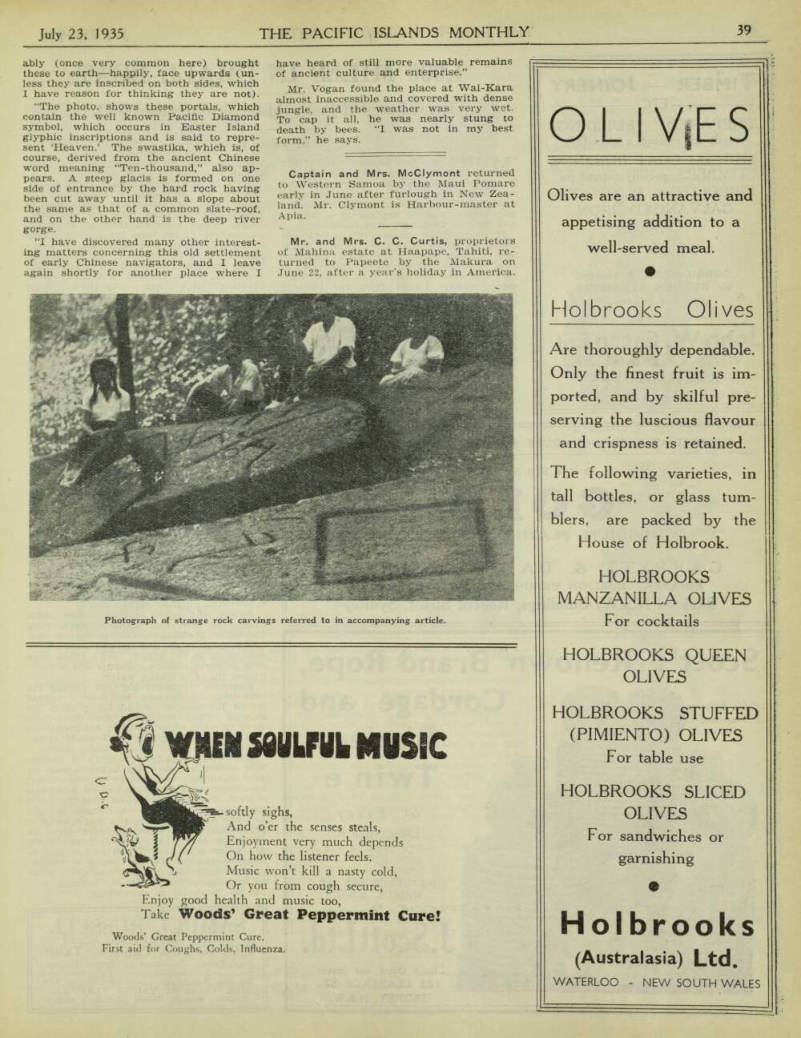
More Strange Reck Carvings in Fiji
Further interesting archaeological discoveries are reported hy Mr. A. J.
Vogan who has been engaged in the self imposed task of scientific investigation in the Pacific for many years.
Mr. Vogan in 1933 discovered and made plaster casts of very strange rock carvings in a cave in the Yasawas, north-west Fiji; and experts who examined copies of the queer script declared that they were Chinese characters pre-dating the Christian era.
Mr. Vogan early this year received fur ther information, and left Sydney in April and proceeded direct to Daku-Niba, Wai kara, Vanua Levu, in Fiji, where he dis covered further carvings of a similar character, on what appeared to be the remains of ancient fortifications.
Writing from Suva, on June 6, Mr.
Vogan said he was about to return to Vanua Levu, but that he had already found evidence that the ancient folk who made the deep groovings in the very hard vol canic rock were the same as those who made the carvings he found in the Yasawa cave. The native name of the new find is “Daku-Niba” which means “Behind the fence or wall.”
“A steep climb brings one to a step or stone that is still in its original position across the jungle path,” says Mr. Vogan.
“On this stone is a strange castellated device which is not in any language, apparently.
“Further up the hill, a chain or so, two great stones, about 16 feet high, once stood on either side of the entrance to the Fort, or Holy Place. Earthquakes prob
ably (once very common here) brought these to earth —happily, face upwards (un less they are inscribed on both sides, which I have reason for thinking they are not).
“The photo, shows these portals, which contain the well known Pacific Diamond symbol, which occurs in Easter Island glyphic inscriptions and is said to repre sent ‘Heaven.’ The swastika, which is, of course, derived from the ancient Chinese word meaning “Ten-thousand,” also ap pears. A steep glacis is formed on one side of entrance by the hard rock having been cut away until it has a slope about the same as that of a common slate-roof, and on the other hand is the deep river gorge.
“I have discovered many other interest ing matters concerning this old settlement of early Chinese navigators, and I leave again shortly for another place where I
have heard of still more valuable remains of ancient culture and enterprise.”
Mr. Vogan found the place at Wai-Kara almost inaccessible and covered with dense jungle, and the weather was very wet.
To cap it all, he was nearly stung to death by bees. “I was not in my best form,” he says.
Captain and Mrs. McClymont returned to Western Samoa by the Maui Pomare early in June after furlough in New Zea land. Mr. Clymont is Harbour-master at Apia.
Mr. and Mrs. C. C. Curtis, proprietors of Mahina estate at Haapape, Tahiti, re turned to Papeete by the Makura on June 22, after a year’s holiday in America.
Photograph of strange rock carvings referred to in accompanying article.
Advertisements & other items, pp. 40-42 (2 items)
Mining Machinery
EVEN THOUGH YOU ARE
THOUSANDS OF MILES
AWAY
You can still shop at
Pike
BROTHERS LTD.
The Leading Outfitters since 1850 in
QUEEN STREET, BRISBANE
Send now for
FREE ILLUSTRATED
CATALOGUE
OF MEN’S WEAR, ETC.
A Special Staff Attends to All Mail Orders No Delay
MINING MACHINERY
Improved Type Gravel Pump.
SEND YOUR ENQUIRIES TO—
of all classes, including—
Dredging and Sluicing Plants
Gravel and Water Pumps Elevators Nozzles Piping and Valves Mining Plants have been supplied to a number of Companies in New Guinea, and we are, therefore, fully conversant with local conditions.
Hydraulic Elevator, with Swivelling Suction Pipe.
THOMPSON’S ENGINEERING & PIPE €O. LTD.
CASTLEMAINE, VICTORIA
Cable Address: “THOMPSONS, CASTLEMAINE.”
SYDNEY OFFICE KEMBLA BUILDING 58 MARGARET STREET
Holbrooks
OLIVES
Olives are an attractive and appetising addition to a well-served meal.
Holbrooks Olives
Are thoroughly dependable.
Only the finest fruit is imported, and by skilful preserving the luscious flavour and crispness is retained.
The following varieties, in tall bottles, or glass tumblers, are packed by the House of Holbrook.
HOLBROOKS
MANZANILLA OLIVES
For cocktails
HOLBROOKS QUEEN
OLIVES
HOLBROOKS STUFFED
(PIMIENTO) OLIVES
For table use
HOLBROOKS SLICED
OLIVES
For sandwiches or garnishing
Holbrooks
(Australasia) Ltd.
WATERLOO - NEW SOUTH WALES
WHEN SOULFUL MUSIC
softly sighs,
And o’er the senses steals, Enjoyment very much depends On how the listener feels.
Music won’t kill a nasty cold, Or you from cough secure, Enjoy good health and music too, Take Woods’ Great Peppermint Cure!
Woods’ Great Peppermint Cure.
First aid for Coughs, Colds, Influenza.
Timber Joinery
ETC.
PREPARED BUILDINGS
ready for erection a speciality.
SHIP and BOAT BUILDING
TIMBERS specially catered for
FIBROLITE, PLYWOODS,
GALVANISED IRON,
CANEC.
CONSIGNMENTS shipped
by RETURN STEAMERS
to the Islands.
John W. Eaten Ltd.
WEST CRESCENT ST.,
NORTH SYDNEY
TELEPHONES: X 5051 (5 lines)
AUSTRALIA’S CLEARING HOUSE FOR THE PRECIOUS METALS.
BUYERS OF
GOLD
OSMIRIDIUM, PLATINUM, SILVER, &c.
GARRETT & DAVIDSON, LTD.
ASSAYERS, BULLION MERCHANTS, METALLURGISTS,
Bank of N.S.W. Buildings, Regent Street, Sydney
Scott’s Renown Brand Rope,
Cordage and
Binder
Twine Cable Address: Ropeyard, Sydney.
of Every
Description
MANUFACTURED AT
MASCOT, N.S.W.
By
J. Scott Ltd.
Head Office and Store:
163 CLARENCE ST.,
SYDNEY, N.S.W.
1,000 Miles In Small Boat
The Odyssey of Jimmy Marsters, of Palmerston Is.
By Julian Hillas
"MUTINY on the Bounty” and “Men Against the Sea” recently have famil iarised many people with Bligh’s epic voy age over 3000 miles of practically unknown water. Bligh carried a sextant and other instruments and as captain of a man o’ war he was an experienced navigator.
It remains for someone to picture the almost equally epic feat of “Jimmy” Mars ters, quarter-caste Palmerston Islander, who, with a single companion, traversed in 1919 the thousand odd miles which sepa rate Penrhyn Island from the Phoenix Group in the north.
Marsters’ knowledge of navigation was confined to a rudimentary acquaintance with the stars and a belief that if a boat left Penrhyn and followed in the wake of the setting sun she would eventually, plus a little luck, reach Samoa.
Sixteen years ago Jimmy was a husky young man in the early twenties, the pos sessor of a soft winning way with the ladies of Penrhyn, where life was dull and fathers notoriously more hard-hearted
than on any other island of the Cook Group.
Time hung heavily and adventure called.
A tin of “bush-beer,” two friends, a lonely spot on the warm moon-washed sands —and Marsters took up the chal lenge. They were all tired of Penrhyn.
Somewhere in the west lay islands where living was easier and parents more com pliant: where the plums of life had a rare bloom and could be taken for the asking.
And so it was decided that these three, together with their respective young women, should sail away from unlovely Penrhyn. The beer filled them with a fine new sense of courage and, as they stole back to the sleeping village, romance danced before them along the shores of the lagoon.
To Marsters was assigned the task of procuring a suitable boat, and he selected the best of the small pearling craft, a twenty-foot carvel-built cutter half-decked and freshly painted. The work of pro visioning her was left to the other two.
One night, a week or so later, six people crept quietly through the settlement and, wading out into the shallow lagoon, boarded the cutter where she lay at anchor. Paddling silently into the chan nel, they steered for the great passage in the reef. A few lights still shone from the houses ashore and, away on the left, a cock crowed in the darkness. For a moment the spirit of adventure flickered and, dur ing that second, one of the couples slipped overboard and swam for the beach.
In silence, the other four paddled on, through the crescent horns of the passage and, sweeping out on the tide, bore away to starboard. The sounds of the village were now smothered by the boom of the surf, and the island itself only showed as a low bank on their right.
Again, the spirit of adventure sank almost to zero, and another couple took the water, striking out for the nearby reef.
Jimmy Marsters and the girl Topou were now alone in the cutter. With them were fifty or sixty mature coconuts and a four gallon tin of drinking water.
Marsters tightened his belt, cursed his erstwhile companions and set a course which he believed would bring them to Samoa. Then he lashed the tiller and went to sleep with Topou in his arms.
He kept on doing this —with slight varia tions —for the next twenty-eight days.
Once he managed to catch a booby bird which had foolishly taken a nap on the masthead; but otherwise they lived on coconuts, ad infinitum and ad nauseum.
Now, it is only in fiction that the hero feeds his wench on such unvarying diet and she marries him in the last chapter— presumably to live happily ever after on the same fare. In real life, things work out differently; and, if you do not believe me, you can ask Topou. She is a middle aged woman; but she still has quite a lot to say about coconuts in general and Jimmy Marsters in particular.
Advertisements & other items, p. 42 (1 item)
Samuel Russell
ESTATE AND GENERAL AGENT
P.O. Box 64, Papeete, Tahiti
Real Estate. Investments. Estate Management and Administration. Valuations and Reports. Houses and Lands for Lease or Sale.
Sole Proprietor: TAHITI PERFUMES Cables: Russell, Tahiti (Bentleys Code)
Avarua Hospital Staff, Cook Is.
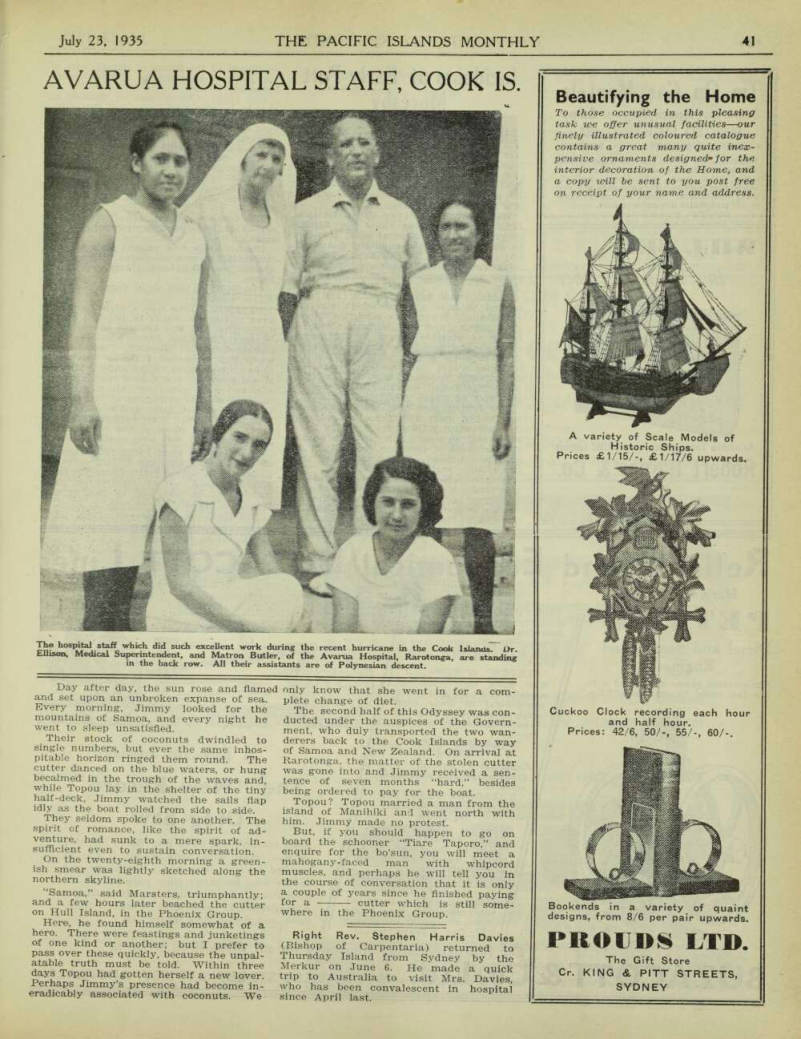
Day after day, the sun rose and flamed and set upon an unbroken expanse of sea.
Every morning, Jimmy looked for the mountains of Samoa, and every night he went to sleep unsatisfied.
Their stock of coconuts dwindled to single numbers, but ever the same inhos pitable horizon ringed them round. The cutter danced on the blue waters, or hung becalmed in the trough of the waves and, while Topou lay in the shelter of the tiny half-deck, Jimmy watched the sails flap idly as the boat rolled from side to side.
They seldom spoke to one another. The spirit of romance, like the spirit of ad venture, had sunk to a mere spark, in sufficient even to sustain conversation.
On the twenty-eighth morning a green ish smear was lightly sketched along the northern skyline.
“Samoa,” said Marsters, triumphantly; and a few hours later beached the cutter on Hull Island, in the Phoenix Group.
Here, he found himself somewhat of a hero. There were feastings and junketings of one kind or another; but I prefer to pass over these quickly, because the unpal atable truth must be told. Within three days Topou had gotten herself a new lover.
Perhaps Jimmy’s presence had become in eradicably associated with coconuts. We
only know that she went in for a com plete change of diet.
The second half of this Odyssey was con ducted under the auspices of the Govern ment, who duly transported the two wan derers back to the Cook Islands by way of Samoa and New Zealand. On arrival at Rarotonga, the matter of the stolen cutter was gone into and Jimmy received a sen tence of seven months “hard,” besides being ordered to pay for the boat.
Topou? Topou married a man from the island of Manihiki and went north with him. Jimmy made no protest.
But, if you should happen to go on board the schooner “Tiare Taporo,” and enquire for the bo’sun, you will meet a mahogany-faced man with whipcord muscles, and perhaps he will tell you in the course of conversation that it is only a couple of years since he finished paying for a cutter which is still some where in the Phoenix Group.
Right Rev. Stephen Harris Davies (Bishop of Carpentaria) returned to Thursday Island from Sydney by the Merkur on June 6. He made a quick trip to Australia to visit Mrs. Davies, who has been convalescent in hospital since April last.
The hospital staff which did such excellent work during the recent hurricane in the Cook Islands Dr.
Ellison, Medical Superintendent, and Matron Butler, of the Avarua Hospital, Rarotonga, are standing in the back row. All their assistants are of Polynesian descent.
Advertisements & other items, pp. 43-44 (1 item)
Prouds Ltd.
Beautifying the Home
To those occupied in this pleasing task we offer unusual facilities — our finely illustrated coloured catalogue contains a great many quite inexpensive ornaments designed for the interior decoration of the Home, and a copy unll be sent to you post free on receipt of your name and address.
A variety of Scale Models of Historic Ships.
Prices £1/15/-, £l/17/6 upwards.
Cuckoo Clock recording each hour and half hour.
Prices: 42/6, 50/-, 55/-, 60/-.
Bookends in a variety of quaint designs, from 8/6 per pair upwards.
PROUDS LTD.
The Gift Store
Cr. KING & PITT STREETS,
SYDNEY
Tie On Gas Mantels
Something Better for your Lamp
FLEXIBO LIGHTING CO
9-15 KIPPAX STREET s: SYDNEY
Manufacturers of the famous Flexibo Gas Mantle, suitable for all petrol storm-proof lamps, table lamps, tilly lamps, and all hollow wire systems. Flying insects will not break this mantle. Agents wanted —samples to all prospective reputable agents.
WILL SET
in ANY Weather Available Throughout the Pacific Islands Robert Harper & Co.
LTD.
S YDNEY-
Reliable and Economical Buzacott L ines
Here are the
PETTER
Diesel and Semi-Diesel
Engines
For reliable power combined with low fuel costs. In sizes from 5 h.p.
THE “DIGGER” WINCH
A light, portable, one-man machine with enormous power. It will uproot any tree or stump with little effort.
“ALSTON” WINDMILLS
Well built, light running models. The best and most 1 economical of their kind made anywhere. Size and type to suit every requirement.
BUZACOTT SPRAY
PUMPS
Reasonably priced, well constructed and absolutely reliable.
BUZACOTT ELECTRIC
LIGHT AND POWER
PLANTS
Enjoy the benefits of electricity. Instant light and power at the touch of a switch. Economical to run and trouble-free.
BUZACOTT GATES AND
FENCES
of fine quality and thorough workmanship. Also Chain Wire, all meshes and gauges for Copra Trays
A Buzacott Specialty
The “New Record”
Drag Saw
Saws through logs up to 7ft. Being mounted on two large, wide-tyred wheels it can be handled easily by one man. The power unit can be used for many other purposes on the plantation. As supplied to New Guinea Administration, Lever Bros. Pacific Plantations, and Bulolo Gold Mines Ltd.
For full explanatory literature for all these lines write to
BUZACOTT & Co. Ltd
7-11 MARKET STREET, SYDNEY, AUSTRALIA.
Moresby
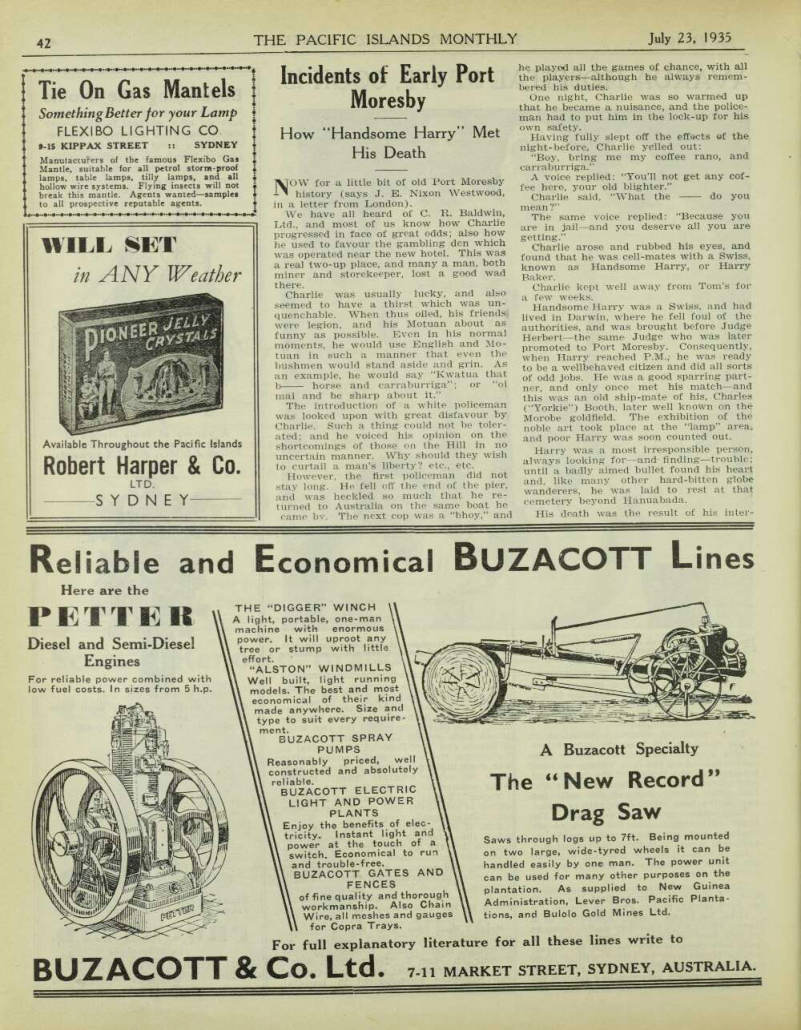
Incidents of Early Port Moresby How “Handsome Harry” Met His Death
NOW for a little bit of old Port Moresby history (says J, E. Nixon Westwood, in a letter from London).
We have all heard of C. R. Baldwin, Ltd., and most of us know how Charlie progressed in face of great odds; also how he used to favour the gambling den which was operated near the new hotel. This was a real two-up place, and many a man, both miner and storekeeper, lost a good wad there.
Charlie was usually lucky, and also seemed to have a thirst which was un quenchable. When thus oiled, his friends were legion, and his Motuan about as funny as possible. Even in his normal moments, he would use English and Mo tuan in such a manner that even the bushmen would stand aside and grin. As an example, he would say “Kwatua that b— horse and carraburriga”; or “oi mai and be sharp about it.”
The introduction of a white policeman was looked upon with great disfavour by Charlie. Such a thing could not be toler ated; and he voiced his opinion on the shortcomings of those on the Hill in no uncertain manner. Why should they wish to curtail a man’s liberty? etc., etc.
However, the first policeman did not stay long. He fell off the end of the pier, and was heckled so much that he re turned to Australia on the same boat he came by. The next cop was a “bhoy,” and
he played all the games of chance, with all the players—although he always remem bered his duties.
One night, Charlie was so warmed up that he became a nuisance, and the police man had to put him in the lock-up for his own safety.
Having fully slept off the effects of the night-before, Charlie yelled out: “Boy, bring me my coffee rano, and carraburriga.”
A voice replied: “You’ll not get any cof fee here, your old blighter.”
Charlie said, “What the —do you mean?”
The same voice replied: “Because you are in jail—and you deserve all you are getting.”
Charlie arose and rubbed his eyes, and found that he was cell-mates with a Swiss, known as Handsome Harry, or Harry Baker.
Charlie kept well away from Tom’s for a few weeks.
Handsome Harry was a Swiss, and had lived in Darwin, where he fell foul of the authorities, and was brought before Judge Herbert —the same Judge who was later promoted to Port Moresby. Consequently, when Harry reached P.M., he was ready to be a wellbehaved citizen and did all sorts of odd jobs. He was a good sparring part ner, and only once met his match —and this was an old ship-mate of his, Charles (“Yorkie”) Booth, later well known on the Morobe goldfield. The exhibition of the noble art took place at the “lamp” area, and poor Harry was soon counted out.
Harry was a most irresponsible person, always looking for —and finding—trouble; until a badly aimed bullet found his heart and, like many other hard-bitten globe wanderers, he was laid to rest at that cemetery beyond Hanuabada.
His death was the result of his inter
fering with the woman of a Frenchman and, when it happened, he was, I think, playing poker in Tom McCrann’s little parlour. Two of his player friends were Louie Jones, of Hula, and Alf Greenaway, of Dedele.
The Frenchman, on returning from the Lalcki, was informed by his woman that Harry had been visiting her again; and this news so incensed the Frenchman that he set out to give Harry the biggest scare of his life. On learning where he was, he made his way to the parlour, and told Harry what he was going to do.
The Frenchman aimed at the floor; but Alf Greenaway became alarmed and jumped up, knocking the revolver, which at that moment exploded, and poor Hand some was no more. He sagged in his chair, and the poker players finished their hand.
Tom McGrann’s stepson ran into the street yelling “Murder! Murder!” but he was so excited that he was unable to say where or when.
Thus ended the life of another of New Guinea’s mysterious residents. He came from no one knew where, and the manner of his death seemed to be entirely in keeping wdth his life.
Advertisements & other items, p. 44 (1 item)
42
July 23, 1933
THE PACIFIC ISLANDS iMONTHLY
Another Version
Harry Baker landed at Port Moresby in 1910; he was looking for a job, and interviewed the late Charles Baldwin.
Mr. Baldwin told him to look in the next day. When leaving, Baker mentioned that, should a reference be needed, he was well known to Judge Herbert. Bald win told him that such things as refer ences were not asked for in Port Moresby.
As it happened, Judge Herbert passed later in the day, and Baldwin mentioned the incident of the morning.
“Harry Baker?” said the Judge. “I know him well. I sentenced him to a term of imprisonment in the Northern Territory for being concerned in the murder of a Chinaman.”
I don’t think this counted as a recom mendation, but Baker was employed by Baldwin for some years—in fact, until his death —in driving the old steam launch “Ruby.”
While I was in Abau, a man named Freese applied to me for a permit to allow his native “wife” to travel with him to Port Moresby, on the steamer “Wakefield.” Tooani, the woman in ques tion, was a good-looking girl who had been brought up in the mission on Mailu Island.
When the couple arrived in Port Moresby they became associated with Baker. The almost inevitable happened.
In Freese’s absence, Baker forced his attentions on Tooani.
Immediately on his return, Freese heard from Tooani what had happened.
Freese found Baker and Tom McCrann’s playing cards. He drew a revolver and shot Baker dead. Freese was sentenced to five years’ imprisonment.
Henry Dexter.
Mr. David Lees, formerly of Suva, died in Victoria at the end of May at the age of 50. He entered the Immigration Depart ment of the Fiji Government Service as a clerk in 1909. After serving in the Audit and Treasury Departments, he was ap pointed in 1931 as Assistant Treasurer.
Mr. Lees retired in 1932.
Japanese Squadron Visits
Western Samoa
From Our Own Correspondent.
APIA, June 7.
THE visit of the Japanese squadron, the training ships Asama and Yakumo, expected on the forenoon of King’s Birthday, was postponed until the next day on ac count of the sudden death of an officer, Paymaster Captain Hamano, who died on May 31, during the squadron’s visit to Suva, Fiji. He was cremated on board and accorded a funeral with full naval honours. This incident delayed the de parture of the squadron from Fiji by a day.
By a strange coincidence, Captain Ha
mano was the only officer on board the squadron who had previously visited Samoa in 1915, when serving on the cruiser Nisshin during the war.
After the official calls, the ships were thrown open to visitors, while the crews and officers were granted shore leave in turns. Soon the beach and the roads in and around Apia were crowded with groups of neatly uniformed, smiling and well behaved little sailors of Japan, dignified and often bespectacled officers and youth ful cadets, who inspected native life and especially the flora of Samoa with great interest. Occasionally they tried coco nuts, oranges or bananas hospitably offered by friendly Samoan natives. The sailors seemed somewhat disappointed to find none of their countrymen in Samoa, while Chinese coolies did not seem amic ably disposed towards the Japanese.
Officers of the squadron were taken for drives into the country and witnessed songs and dances given in their honour by boys of the Government school at Avele.
Their scant naval pay did not allow the visitors to spend much money in Samoa, though souvenirs were bought by officers and large numbers of photographs and view cards were purchased.
The cruisers left on the afternoon of June 4 for Honolulu, from whence they will return homewards, calling at several of the Japanese mandated islands.
Mrs. J. Arnold, a native of Belgium who had resided in Fiji for over 30 years, died at Suva in May.
Advertisements & other items, pp. 45-46 (1 item)
B.A.C. Weed Killer
’Phone FL 1266. 'Phone FL 1266.
HENLY’S
DRIVE YOURSELF
SERVICE
197 William Street :: Sydney Cars Hired without Drivers on a Mileage Basis as under: — OPEN CARS—By the Day. 3d. per Mile.
Minimum, 30 Miles Week Days. 60 Miles Sundays.
SEDANS—By the Day. 4d, per Mile.
Minimum, 30 Miles Week Days. 60 Miles Sundays.
Special quotations for holidays.
Payment, plus 2/6 per day or 7/6 per week for insurance. A deposit must be left on car, which is refunded when car is returned.
Our Fleet of Cars includes 1934 Plymouths, Hired at a Slight Increase.
A CLEAN PLANTATION GUARANTEED
WITH
B.A.C. Weed Killer
Used on Malay States Rubber Plantations; approved by British Malay Rubber Institute F.O.B. Sydney. Sold in 4 gallon tins—2 tins to a case. 4/3 per gallon (Australian Currency). In concentrated form. Agents wanted in every group Particulars from:
LONE HAND SOAP CO.
554 Botany Rd., Alexandria, Sydney, Australia
RECOMMENDED!
"SUN” Brand Paint on your Home means
definite PROTECTION against tropical
sun and sea-moist air.
Sun Proof and Rain Proof on every Surface
W. R. CARPENTER & CO., LTD.
NEW GUINEA, SOLOMON ISLANDS
and all other South Sea Islands.
While You Sleep the Remedy Heels
A WELL-PROVEN
REMEDY FOR PILES
This preparation has been on the market for several months, and it has effected a Cure in every case in which it has been tried.
Cases of Long: Standing often Cured within One Month, with one bottle only.
For External Use only—Stainless, Painless and Odourless.
PRICE: 3/6 PER BOTTLE. Posted securely packed for 5/- per bottle. Copies of Testimonials forwarded on request.
Read the Report of an Eminent Analytical Chemist:
THE LABORATORY,
20 and 22 Napoleon Street, Sydney. March 14th, 1933.
ROBERT BRUCE, Esq.
Dear Sir, —The formula of your pile cure submitted to me could have no effect other than beneficial. I gave your sample to a Client who had suffered many years, and before he had used half the bottle he reported himself completely cured.
Faithfully yours,
GROVE JOHNSON, F.C.S. (Lond.)
"Honours,” City and Guilds of London Institute.
Analytical and Consulting Chemist.
Robert Bruce
Room 7, 2nd Floor,
15 HUNTER STREET, SYDNEY
and also at 14 Upper Bayview St., North Sydnoy
BITUMENOID ROOFING
MADE IN AUSTRALIA
Bitumenoid Roofings, Dampcourses and Insulating Felts are made from the world’s best raw materials. Warranted to stand the most rigid tests.
BITUMENOID THE BEST
Roofing, 1,2, 3-ply; Flooring, Waterproof Materials; Saturated Felt; Resilient Road Jointing; Natural Asphalt Dampcourse; 2 and 3-ply Dampcourse; 1-2lb. Lead-core Dampcourse; Roofing Cement; Asphalt Paints; Roofing Compound.
SAMPLES AND PRICE LISTS ON APPLICATION.
MAXWELL PORTER & SON LTD.
ESTABLISHED 1888. BUILDERS' SUPPLIES
117 REDFERN ST., REDFERN, SYDNEY, N.S.W. 'Phone M 3157 Cables: Bitumenoid
ASPREY’S LATEX COMPOUND
(PATENTED)
FOR IMPROVING LUBRICATING OILS
Adds Years to the Life of Machinery and Motor Car LATEX COMPOUND improves any oil, adds extra oiliness, resists heat anti makes the oil last twice as long, saves wear and tear, and halves lubrication and maintenance costs.
INTERNAL
COMBUSTION
ENGINES
FARMING
MACHINERY
SAWMILLING
MACHINERY
STEAM
CYLINDER
LUBRICATION
Add ½ pint of Asprey’s Latex Compound to each gallon of lubricating oil for motor cars, lorries, tractors, and stationary engines, and note cooler and sweeter running, lower fuel consumption, greater power, fewer repairs and lower oil consumption.
Add ½ pint of Asprey’s Latex Compound to each gallon of lubricating oil for headers, harvesters, reapers and binders, ploughs, drills, mowers, disc cultivators windmills, separators, chaffcutters, etc., and save time and repair bills Add ½ Pint of Asprey’s Latex Compound to each gallon of oil for saw spindle bearings and all .sawmilling machinery and be free from hot and scored bearings.
Add ½ pint of Asprey’s Latex Compound to each gallon of oil. which will result in more horsepower with lessened oil consumption and general increase in efficiency.
MANUFACTURERS ALSO OF ASPREYS SUPER BELT DRESSING Obtainable from the Trade and from WILLIAM BROOKS & CO., LTD., 35 Pitt Street, Sydney.
Sydney Doctor Working In
Tropical Health
Research
Sydney Doctor Working In Mekeo District, Papua
From Our Own Correspondent.
Pt. Moresby, June 20
Dr. F. W. Clements, Who Is
on the staff of the School of Public Health and Tropical Medi cine at the Sydney University ar rived in Port Moresby early in June, accompanied by an assistant, Mr.
K. Clinton, to make a survey of health conditions in Papua. He will study in particular the effect of diet on the dif ferent tribes of the country in the treat ment of ulcers, a subject on which Dr.
Clements has done a considerable amount of research work.
Dr. Clements and Mr. Clinton left on June 12 for Yule Island, from whence they will travel to the Mekeo district, on the mainland. There they will have an excellent opportunity of studying in the one district the different health con ditions affected by the various altitudes.
The country in from Yule Island rises gradually from the sea-board over large plains to high mountain ranges and sup ports a thick population.
After two months in the Territory, Dr.
Clements will leave by the mail steamer late in August for Sydney. He will be accompanied by Dr. Walter Strong who will have charge of the third group of native medical assistants to undertake a course of elementary training in medi cine at the Sydney University.
Dr. Clements who acted as tutor under Professor Harvey Sutton to the previous groups of native medical students from Papua, is watching with interest their field work following on their training in Svdney. It is reported that their standard of work has shown marked improvement since their return to the Territory.
Handed
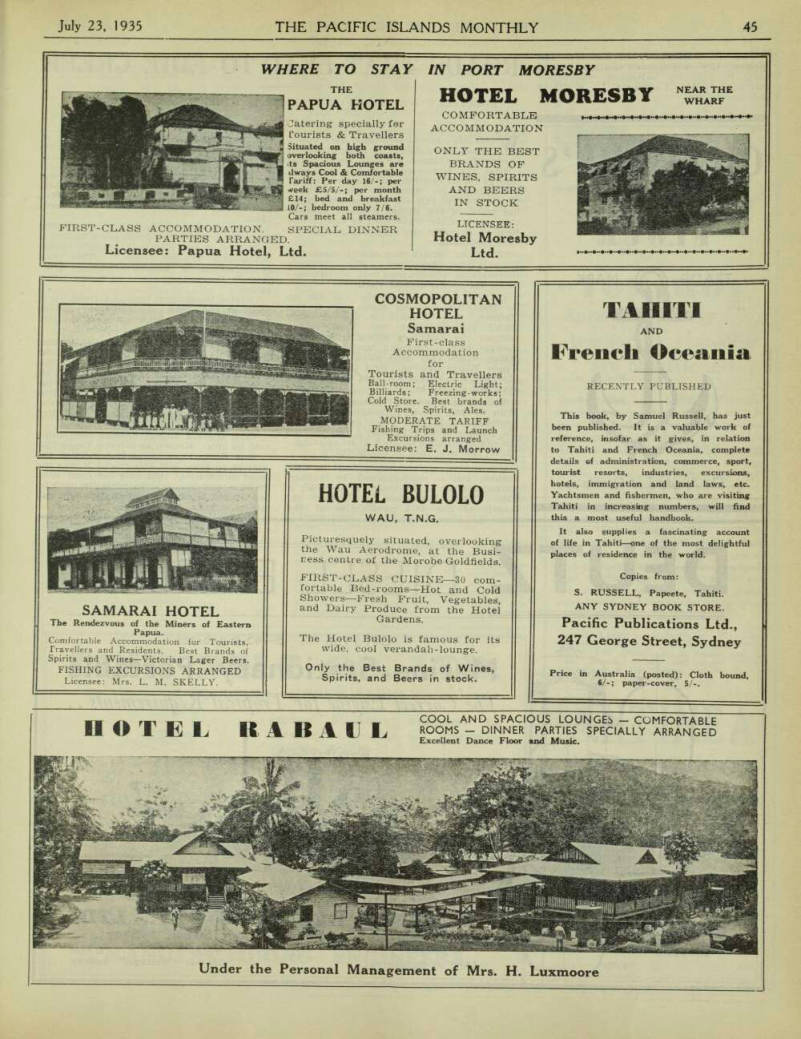
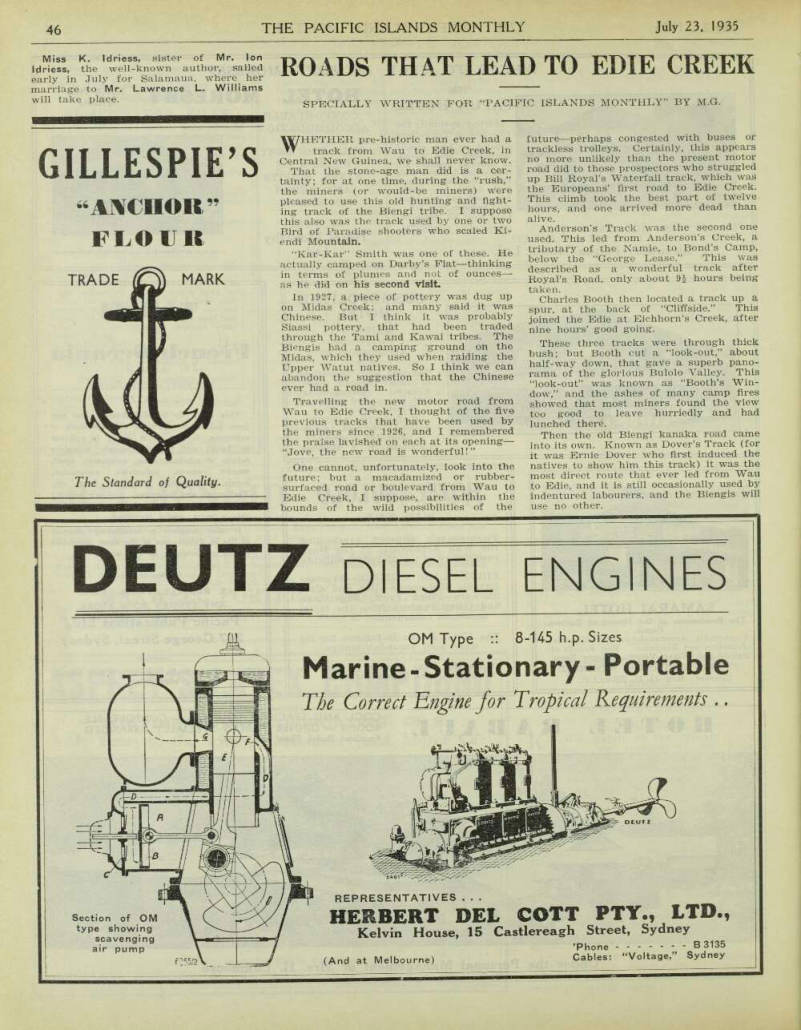
Around the Globe Single- Handed
From Our Own Correspondent.
Port Moresby, June 20.
KNOWN widely as the “library navi gator,” on account of his book acquired maritime knowledge, Captain Harry Pidgeon, arrived in Port Moresby in his small yacht Islander, on June 4, direct from Honolulu after a voyage last ing 12 days.
In 1923, Capt. Pidgeon called in at Port Moresby on a previous tour around the world, during which he wrote a book, called “Around the World Single- Handed.” His enterprise of four years’ duration was acclaimed at the time to be one of the greatest of modern adven tures.
His vessel, the Islander, was built by Capt. Pidgeon himself, from information contained in a yachting magazine. The yawl is a 34-ft. vessel having a 10-ft. 9-in. beam and drawing unloaded 5-ft. of water.
After a short stay in Port Moresby, Capt. Pidgeon proceeded through Torres Strait to the East Indies on his second round-the-world cruise.
Miss K. Idriess, sister of Mr. Ion Idriess, the well-known author, sailed early in July for Salamaua, where her marriage to Mr. Lawrence L. Williams will take place.
Advertisements & other items, p. 47 (1 item)
Hotel Bulolo
WHERE TO STAY
THE
PAPUA HOTEL
Catering specially for Tourists & Travellers Situated on high ground overlooking both coasts, ts Spacious Lounges are tlways Cool & Comfortable Tariff: Per day 16/-; per week £5/5/-; per month £14; bed and breakfast 10/-; bedroom only 7/6.
Cars meet all steamers.
CLASS ACCOMMODATION. SPECIAL DINNER
PARTIES ARRANGED.
Licensee: Papua Hotel, Ltd.
IN PORT MORESBY
HOTEL MORESBY Near the wharf
COMFORTABLE
ACCOMMODATION
ONLY THE BEST
BRANDS OF
WINES, SPIRITS
AND BEERS
IN STOCK
LICENSEE:
Hotel Moresby
Ltd.
COSMOPOLITAN
HOTEL
Samarai
First-class Accommodation for Tourists and Travellers Ball-room; Electric Light; Billiards; Freezing-works; Cold Store. Best brands of Wines, Spirits, Ales.
MODERATE TARIFF
Fishing Trips and Launch Excursions arranged Licensee: E. J. Morrow
TAHITI
AND
French Oceania
RECENTLY PUBLISHED
This book, by Samuel Russell, has just been published. It is a valuable work of reference, insofar as it gives, in relation to Tahiti and French Oceania, complete details of administration, commerce, sport, tourist resorts, industries, excursions, hotels, immigration and land laws, etc.
Yachtsmen and fishermen, who are visiting Tahiti in increasing numbers, will find this a most useful handbook.
It also supplies a fascinating account of life in Tahiti—one of the most delightful places of residence in the world.
Copies from: S. RUSSELL, Papeete, Tahiti.
ANY SYDNEY BOOK STORE.
Pacific Publications Ltd.,
247 George Street, Sydney
Price in Australia (posted): Cloth bound, 6/-; paper-cover, 5/-.
SAMARAI HOTEL
The Rendezvous of the Miners of Eastern Papua.
Comfortable Accommodation for Tourists, Travellers and Residents. Best Brands of Spirits and Wines —Victorian Lager Beers.
FISHING EXCURSIONS ARRANGED
Licensee: Mrs. L. M. SKELLY.
HOTEL BULOLO
WAU, T.N.G.
Picturesquely situated, overlooking the Wau Aerodrome, at the Business centre of the Morobe Goldfields.
FIRST-CLASS CUISINE—30 com-
fortable Bed-rooms—Hot and Cold Showers—Fresh Fruit, Vegetables, and Dairy Produce from the Hotel Gardens.
The Hotel Bulolo is famous for its wide, cool verandah-lounge.
Only the Best Brands of Wines, Spirits, and Beers in stock.
HOTEL RABAUL
COOL AND SPACIOUS LOUNGES — COMFORTABLE
ROOMS - DINNER PARTIES SPECIALLY ARRANGED
Excellent Dance Floor and Music.
Under the Personal Management of Mrs. H. Luxmoore
Roads That Lead To Edie Creek
SPECIALLY WRITTEN FOR “PACIFIC ISLANDS MONTHLY” BY M.G.
WHETHER pre-historic man ever had a track from Wau to Edie Creek, in Central New Guinea, we shall never know.
That the stone-age man did is a cer tainty; for at one time, during the “rush,” the miners (or would-be miners) were pleased to use this old hunting and fight ing track of the Biengi tribe. I suppose this also was the track used by one or two Bird of Paradise shooters who scaled Ki endi Mountain.
“Kar-Kar” Smith was one of these. He actually camped on Darby’s Flat —thinking in terms of plumes and not of ounces— as he did on his second visit.
In 1927, a piece of pottery was dug up on Midas Creek; and many said it was Chinese. But I think it was probably Siassi pottery, that had been traded through the Tami and Kawai tribes. The Biengis had a camping ground on the Midas, which they used when raiding the Upper Watut natives. So I think we can abandon the suggestion that the Chinese ever had a road in.
Travelling the new motor road from Wau to Edie Creek, I thought of the five previous tracks that have been used by the miners since. 1926, and I remembered the praise lavished on each at its opening— “Jove, the new road is wonderful!”
One cannot, unfortunately, look into the future; but a macadamized or rubber surfaced road or boulevard from Wau to Edie Creek, I suppose, are within the bounds of the wild possibilities of the
future —perhaps congested with buses or trackless trolleys. Certainly, this appears no more unlikely than the present motor road did to those prospectors who struggled up Bill Royal’s Waterfall track, which was the Europeans’ first road to Edie Creek.
This climb took the best part of twelve hours, and one arrived more dead than alive.
Anderson’s Track was the second one used. This led from Anderson’s Creek, a tributary of the Namie, to Bond’s Camp, below the “George Lease.” This was described as a wonderful track after Royal’s Road, only about 9½ hours being taken.
Charles Booth then located a track up a spur, at the back of “Cliffside.” This joined the Edie at Eichhorn’s Creek, after nine hours’ good going.
These three tracks were through thick bush; but Booth cut a “look-out,” about half-way down, that gave a superb pano rama of the glorious Bulolo Valley. This “look-out” was known as “Booth’s Win dow,” and the ashes of many camp fires showed that most miners found the view too good to leave hurriedly and had lunched there.
Then the old Biengi kanaka road came into its own. Known as Dover’s Track (for it was Ernie Dover who first induced the natives to show him this track) it was the most direct route that ever led from Wau to Edie, and it is still occasionally used by indentured labourers, and the Biengis will use no other.
Ascending the precipitous mountainside at the back of what is now the N.G.G. Ltd. office at Wau, 7½ hours’ climb (about 4,000 feet) brought one to the divide; and another hour's descent by way of Snake and Merri Creeks landed one at Darby’s Flat, As a heart-breaking climb, this track no equal, in my opinion—except, perhaps, Mt. Everest. I haven't tried that!
Walking in from Salamaua in six days, and facing Dover's track on the seventh, produced many a groan. It was the limit of human endurance, especially if several of your boys had "cracked up" on the track, and you had carried a 50-lbs. pack most of the way from Salamaua. This mountain is sometimes shown on old plans as Corpse Hill, owing to a number of dysentery-weakened carriers dying there.
I remember a great argument on the "beach" about what methods of transport could be used on the road in. This was before anyone, except perhaps Levien, had seen the possibilities of aerial transport.
Many fantastic suggestions were made; but one new-comer, who had not then faced the track, declared elephants were what we wanted. He had “seen what they could do in Burma and ought to know.”
When it was pointed out that he had not seen the track he stated “he’d heard enough about it.”
One day, some weeks later, I found our elephant-champion three parts of the way up Corpse Hill, lying stretched on his back, absolutely done. I could not help asking: “What about elephants now’”
His "Ye Gods, no! Anything not sired by a mountain goat is impossible here!” caused a smile all round.
The fifth track was first called “Lyall’s Road.” It was in advance of the other track, in that it was constructed for mules —but not for the lorry traffic, for which it has been used for the last year. The idea of this track emanated from someone (I think Mr. Cutler, now a planter at Kokopo) at a meeting of the now defunct Morobe District Miners' Association and was taken up immediately.
The miners joined with the “Big Six”
in the construction; and nearly everyone not “broke” contributed tools, tents, flys, or boys. The late Mr. David Lyall was placed in charge, being then in the employ of the “Big Six.”
This road was improved, patched up and “jiggered up” for six years, by many parties—but mostly by Ellyou Co., N.G.G.
Ltd., Day Dawn, Wally Corden and other mule-owners, and Fred Deckert and other lorry-owners.
Until 1933-4 the Administration seems to have contributed little to the enormous expense of improving and maintaining this track. N.G.G. Ltd. probably contributed half of the total expenditure.
The sixth road, the “New Road,” has been built for heavy motor traffic and is an improvement on many of the main roads in the Australian country. The grade is 1 in 9 to 1 in 15 in the steepest parts. Located and rough-surveyed by Mr.
Wm. Fox (Chief Government Surveyor at Wau ) and surveyed and supervised by Major D. G. Sinclair, of the Works Department, Wau it is a credit to their locating and engineering ability.
The people of the field, being more or less in daily contact with the two men responsible for this good work, fail to remark on it. Had these gentlemen been brought especially from U.S.A. or Australia to do the job, they would have departed in a blaze of glory.
The contractors, Messrs. Judd and Leahy, working with 250 to 270 boys, did the work in a creditable manner, and well within the specified contract time. They are no loafers, and appear likely to become the big contracting firm of this Territory, The view from many points on the road is magnificent; and, on a clear day, or in the early morning, when the mists are rising from the valleys, I doubt if it can be excelled anywhere.
I should mention that what is known as the New Road is actually only part of the way to Edie; for, leaving Wau by the new road, one joins the N.G.G. road at Kunai Creek, and follows this until the new road is picked up again at the power house. This new section then carries one to “Water Karuka,” where the old road is
joined again. Widened, graded and metal led by Roadmaster George Hoffman, with 50-70 Government boys, this part of the old road is comparatively level.
Standard track vehicles now unload be tween “Water Karuka” and Maori Creek, and the specially constructed narrow wheel-base lorries used on the old road take the loading on to Edie. It is expected that the standard-wheel-base lorries will be able to go right through to Central Camp,
Upper Edie Creek, by the end of July, and that the close of 1935 will see every de tail of the heavy motor traffic road from Wau to Upper Edie Creek completed.
Whilst bowling along the new road in a limousine, we should not forget those pio neer track-finders of only a few years ago —“Shark-Eye” Park, Levien, Royal, Dover, Booth and others; and those who have tried so hard to link us by road to the coast —“Mark” Sheldon, Jenson and others.
Advertisements & other items, pp. 48-50 (1 item)
Deutz Diesel Engines
GILLESPIE’S
“ANCHOR”
FLOUR
TRADE
MARK
The Standard of Quality.
DEUTZ DIESEL ENGINES
Section of OM type showing scavenging air pump
OM Type :: 8-145 h.p. Sizes
Marine - Stationary - Portable The Correct Engine for Tropical Requirements ..
REPRESENTATIVES . . .
HERBERT DEL COTT PTY., LTD.,
Kelvin House, 15 Castlereagh Street, Sydney ’Phone B 3135 (And at Melbourne) Cables: “Voltage,” Sydney
"TOE ROT"
Spreads Rapidly . . .
temporary remedies
are of little use
Such relief as so-called “simple" remedies may afford can at best be only temporary; they are powerless to check the spread of the trouble.
That is why doctors wholeheartedly approve and recommend Antinea Lotion as the remedy for “Toe Rot" and allied Tropic Skin Infections.
Antinea Lotion is a combination of extremely powerful germicidal oils many times stronger than carbolic.
The very first application of Antinea arrests the development of the germs and prevents the disease from spreading; further applications night and morning will soon destroy the germs completely and eradicate every trace of infection.
Antinea Lotion is obtainable at all branches of Burns, Philp & Co. Ltd., Morris, Hedstrom & Co. Ltd. (Suva), A. J, Swann and Co.
Ltd. (Suva), Brown and Joske (Suva), Michelmore & Co. (Suva), and W. R. Carpenter & Co. Ltd.
ANTINEA
ANTISEPTIC LOTION
Small Size
2/6
Triple
Quantity
5/6
COMMONWEALTH & DOMINION
AGENCIES LTD.
168 Day Street, Sydney, N.S.W.
LINK-BELT CO. LTD.
17 GOULBURN STREET, SYDNEY
Centrifugal
Discharge
Bucket Elevator Modern Machinery Equipment for Elevating, Conveying and Mechanical Handling of Material.
Sole Agents in Australia for Ewart Chain Belting in Malleable or Steel.
Specialists in Power Transmission Machinery.
Large Stocks always kept of Steel Shafting, Cast Iron, Steel, or Wood Split Pulleys.
Plummer Blocks. Collars, Couplings, Leather Belting, Hangar Bearings.
Lubricators, Engineers’ Wrenches.
MANUFACTURING ENGINEERS
“A Thousand Miles
from the nearest ice-works, and yet we always have ice cubes for drinks and all the conveniences of an electric refrigerator.” —Extract from letter from satisfied Island client.
HALLSTROM’S non-electric Refrigerators give efficient refrigeration without trouble. So simple a child can operate it.
Price £49/10/- f.o.b. Sydney. Others from £20. Write for descriptive folder to the manufacturer.
E. HALLSTROM
462 Willoughby Road, Willoughby
SYDNEY
EXCELSIOR SUPPLY CO. LTD.
for all purposes.
Let us know your requirements and we will quote you by return. Ask for our Big Catalogue.
Sole Australasian Distributors of the World Famous SHEAFFER FOUNTAIN
PENS and PENCILS.
EXCELSIOR SUPPLY CO. LTD.
Head Office: 160 GEORGE STREET WEST,
SYDNEY, N.S.W.
We have a big range of Special
FRUIT CASE MARKING SETS
RUBBER STAMPS.
INKS, STENCILS.
Marking Devices.
ACME STAMP PADS
The most extensive Manufacturers in the British Empire of We also Manufacture or Supply a complete line of
Spraying Machines
Samoa’S Troubles
"THE man who really could have helped the New Zealand Government in its task of governing Western Samoa was Mr. Griffin,” says a London corres pondent, who knows the South Seas well. ‘‘He died ten years too soon. ‘‘Some of the old hands, such as H.
J. Moors, were in a position to act as advisers, but the autocratic set at the Government buildings were too thick headed to realise how really ‘new chummy’ they were, and they would not accept the proffered help.
“Western Samoa is a really wonderful group, and is peopled by folk who are as far ahead of the average native as the British think they are ahead of back ward Europeans. The Samoans have an outlook on life which is not understood by Europeans: and, further, the average man who is in the Civil Service of Samoa does not consider that he should under stand them.
“Mr. Griffin, being an expert Samoan language translator, was able to under stand what they said to him and, with one or two possible exceptions, he was the only white man who could without effort follow them in any discussion. Mr.
Williams, late of Savai’i, was another, but as they are now both with their fore fathers, all that can be said is that their efforts did not apparently meet with the success they deserved.
“If the people of New Zealand and those of Western Samoa could only agree on and have the B class mandate in stead of the C mandate, 95 per cent. of these troubles would entirely disappear, and Samoa would become that ‘Pearl of the Pacific’ we all knew it to be in our younger days.”
The Rabaul Museum
From Our Own Correspondent.
Rabaul, June 7.
THE Rabaul Museum, in which are housed many valuable exhibits of an ethnographical, ornithological and his torical nature, is now open to the public on the first Sunday each month. Hitherto residents have been unable to visit this interesting building owing to the fact that the doors have been closed after the ordinary Public Service hours, i.e., 8 to 12 a.m. and 1.30 to 3.30 p.m.
There are so many exhibits that many of them cannot be displayed to advantage, and it is time some steps were taken to organise properly a New Guinea Museum in which exhibits from every part of the Territory could be concentrated and pro perly displayed. New Guinea should have the best collection of ethnographical specimens in the world; they are avail able within our boundaries and should be obtained before the natives have disposed of them to itinerant collectors or have forgotten the art of manufacturing many of their interesting crafts.
This is a matter which might easily be taken up by the Australian National Re search Council. It is a work which should be done with the least possible delay.
Advertisements & other items, p. 50 (1 item)
L. A. Ward
TENNIS
TROPICAL RESTRINGS AND GUT
CONSULT
L. A. WARD
WEST END SPORTS DEPOT,
8 GEORGE ST. WEST SYDNEY
Saved By N. Guinea Native
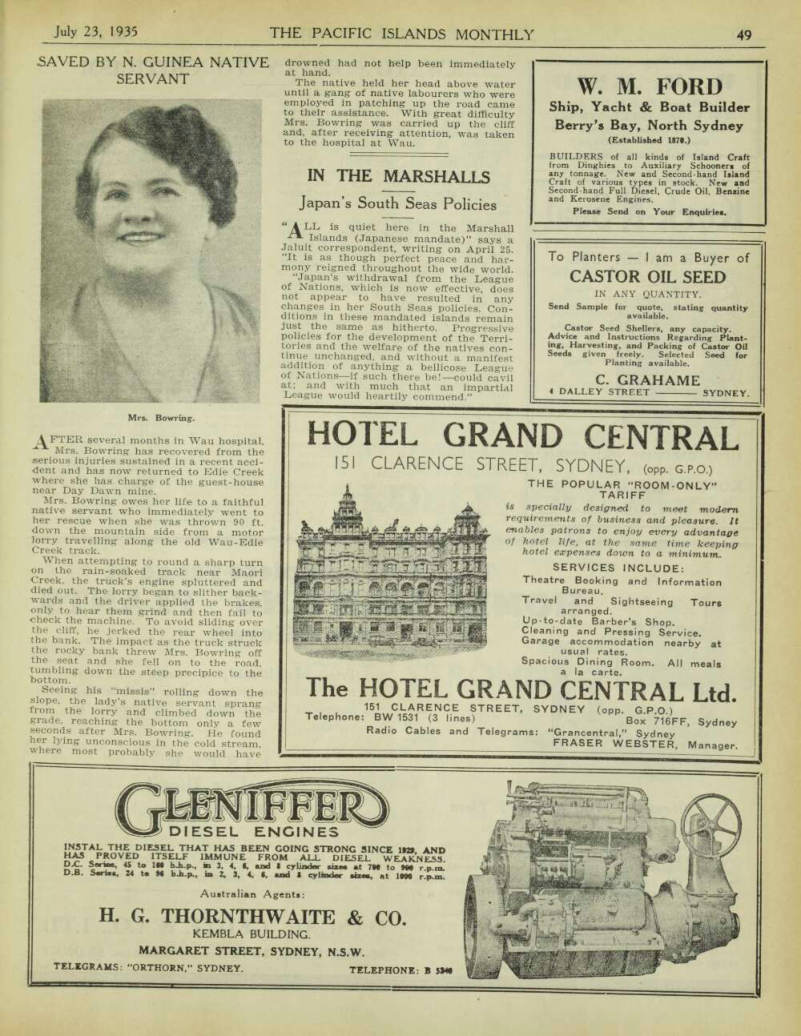
Servant
AFTER several months in Wau hospital, Mrs. Bowring has recovered from the serious injuries sustained in a recent acci dent and has now returned to Edie Creek where she has charge of the guest-house near Day Dawn mine.
Mrs. Bowring owes her life to a faithful native servant who immediately went to her rescue when she was thrown 90 ft. down the mountain side from a motor lorry travelling along the old Wau-Edie Creek track.
When attempting to round a sharp turn on the rain-soaked track near Maori Creek, the truck’s engine spluttered and died out. The lorry began to slither back wards and the driver applied the brakes, only to hear them grind and then fail to check the machine. To avoid sliding over the cliff, he jerked the rear wheel into the bank. The impact as the truck struck the rocky bank threw Mrs. Bowring off the seat and she fell on to the road, tumbling down the steep precipice to the bottom.
Seeing his “missis” rolling down the slope, the lady’s native servant sprang from the lorry and climbed down the grade, reaching the bottom only a few seconds after Mrs. Bowring. He found her lying unconscious in the cold stream, where most probably she would have
drowned had not help been immediately at hand.
The native held her head above water until a gang of native labourers who were employed in patching up the road came to their assistance. With great difficulty Mrs. Bowring was carried up the cliff and, after receiving attention, was taken to the hospital at Wau.
Mrs. Bowring.
In The Marshalls
Japan 's South Seas Policies
“ALL is quiet here in the Marshall Islands (Japanese mandate)” says a Jaluit correspondent, writing on April 25.
“It is as though perfect peace and har mony reigned throughout the wide world.
“Japan’s withdrawal from the League of Nations, which is now effective, does not appear to have resulted in any changes in her South Seas policies. Con ditions in these mandated islands remain just the same as hitherto. Progressive policies for the development of the Terri tories and the welfare of the natives con tinue unchanged, and without a manifest addition of anything a bellicose League of Nations—if such there be!—could cavil at; and with much that an impartial League would heartily commend.”
Advertisements & other items, pp. 51-52 (1 item)
Hotel Grand Central
W. M. FORD
Ship, Yacht & Boat Builder
Berry’s Bay, North Sydney
(Established 1870.) BUILDERS of all kinds of Island Craft from Dinghies to Auxiliary Schooners of any tonnage. New and Second-hand Island Craft of various types in stock. New and Second-hand Full Diesel, Crude Oil, Benzine and Kerosene Engines.
Please Send on Your Enquiries.
To Planters I am a Buyer of
CASTOR OIL SEED
IN ANY QUANTITY.
Send Sample for quote, stating quantity available.
Castor Seed Shelters, any capacity.
Advice and Instructions Regarding Planting, Harvesting, and Packing of Castor Oil Seeds given freely. Selected Seed for Planting available.
C. GRAHAME
4 DALLEY STREET SYDNEY.
HOTEL GRAND CENTRAL
151 CLARENCE STREET, SYDNEY, (opp. G.P.O.)
THE POPULAR “ROOM-ONLY"
TARIFF
is specially designed to meet modem requirements of business and pleasure. It enables patrons to enjoy every advantage of hotel life, at the same time keeping hotel expenses down to a minimum.
SERVICES INCLUDE:
Theatre Booking and Information Bureau.
Travel and Sightseeing Tours arranged.
Up-to-date Barber’s Shop.
Cleaning and Pressing Service.
Garage accommodation nearby at usual rates.
Spacious Dining Room. All meals a la carte.
The HOTEL GRAND CENTRAL Ltd.
151 CLARENCE STREET, SYDNEY (opp. G.P.O)
Telephone: BW 1531 (3 lines) Box 716 FF, Sydney Radio Cables and Telegrams: “Grancentral,” Sydney
FRASER WEBSTER, Manager.
DIESEL ENGINES
INSTAL THE DIESEL THAT HAS BEEN GOING STRONG SINCE 1929, AND HAS PROVED ITSELF IMMUNE FROM ALL DIESEL WEAKNESS.
D.C. Series, 45 to 100 b.h.p., in 3,4, 6, and 8 cylinder sixes at 790 to 999 r.p.m.
D.B. Series, 24 to 96 b.h.p., in 2, 3,4, 6, and 8 cylinder sizes, at 1000 r.p.m.
Australian Agents:
H. G. THORNTHWAITE & CO.
KEMBLA BUILDING.
MARGARET STREET, SYDNEY, N.S.W.
TELEGRAMS: “ORTHORN,” SYDNEY. TELEPHONE: B 514#
W. M. REID
C/o Robert Reid & Co., Ltd.
32-34 YORK STREET, SYDNEY
Wholesale Exporter of Goods of all Classes from Australia
Kork-N-Seal
FOR ALL HOME BOTTLING - THE
LITTLE CAP THAT WILL RE-SEAL
1,000 TIMES
KORK-N-SEAL (Aust.) Ltd.
106 COMMONWEALTH STREET
SYDNEY, AUSTRALIA
FOR HOME USE
Applied Airtight Pressure Proof Hand
The most complete range of
HOME LIGHTING PLANTS
ever ottered
The “Nevertire” Full Automatic Plant Here is the lighting plant that THINKS!
From a small 10-light plant, through a wide range to 7.3 kilowatts or more. Semi-automatic, fullautomatic; direct-coupled or belt-driven; all voltages.
LISTER
Petrol or Diesel
Engine drive.
The marvellous “OMNISTAT” automatic engine control starts the Lister engine as soon as you switch on more than half-a-dozen lights, which are lit by the battery. The generator continues to supply current until only a few lights are in use. Then the engine stops, ready to restart automatically, as soon as another call is made for current. Simple in action, and absolutely positive. With this plant you can operate an automatic electric refrigerator on a 32 volt system and you need have no worry about the current supply—it is always available, automatically.
Write for catalogues and details of prices free of Australian Customs Duty.
DANGAR, GEDYE & CO., LTD.
Malloch House, 10-14 Young Street - SYDNEY
Kwato’S Reply To Criticism
Letter to the Editor.
WE feel compelled to reply to the increasing number of letters that are being published in your columns with reference to the Kwato Mission and Trading.
In the first place, Mr. Fletcher’s state ment in your November issue, that these criticisms express the “views of the popu lation of the Eastern end of the Terri tory,” is both misleading and quite un true.
There certainly is, to use your own words, “a very strong feeling in Eastern Papua regarding Kwato’s trading activi ties,” but it applies to a very small minor ity who happen to be directly affected.
They have every right to voice their point of view in the press, but should not con vey the impression that this is the feel ing of the majority.
You add that the Samarai Chamber of Commerce should prepare a case for sub mission to the Lieutenant Governor. The Samarai Chamber of Commerce is a rep resentative body of keen business men who certainly would have no hesitation in preparing a case—if there were a case to prepare, or if they considered such ac tion necessary. The fact that these griev ances receive no support from a body of prominent Samarai residents is a fair indication of the relative strength of this feeling.
The large number of business firms and local residents who have employed or bought the products of Papuan crafts men at Kwato include: Messrs. Burns, Philp and Co., Ltd., Steamships Trading Co., Ltd., A. H. Bunting, Whitten Bros., Ltd., The Bank of New South Wales, The B.N.G.
Development Co., Ltd., at Waigani, The Milne Bay Rubber Pty., Ltd., The Commonwealth Copra
Company Ltd,, Gili Gili. The Oroville Dredging Co., Ltd., Misima, Quartz Mountain (Papua), Ltd., The Ahioma Desiccating Co., Ltd., The Cosmo politan Hotel, The Samarai Hotel, The Papua and Pacific Produce Co.. Ltd., the Hon. G. Nels son, Mr. Norman Izod, Mr. F. Evenett, Mr. Brudo, Mr. D. L. Pullen, Mr. H. Spiller, and many others.
These firms and individuals are benefitting by the service that is being rendered to progressive business enterprise in this part of the country.
The Papuan is making his contribution towards recovery in the very departments for which the Government technical training has fitted him. The demand for skilled Papuan workers is greater than it ever has been, and appears to be in creasing. Every white tradesman in this locality seems to be fully occupied, and some have more work than they can cope with. There is room for all just at present, and plenty of room for a little healthy competition.
The above facts will serve to show that a real cross-section of local public opinion would un doubtedly reveal some “strong feeling” in quite the opposite direction.
By far the most serious charge made in the letters you have published is that the Kwato Mis sion is misusing and mishandling public funds — e.g., the Government Subsidy—and donations from supporters overseas. In your issue of November 22, Mr. Fletcher states that, with the help of this grant, “given OSTENSIBLY for the purpose. of conducting technical schools for natives at Kwato, this Company can underquote any traders or tradesmen in the Territory ... If they (the Government) give a subsidy for technical purposes it is up to them to see that the WHOLE of that amount is spent on the business for which it is given. If it is, neither Mr. Harrison nor myself can complain.” (The capitals are mine.) We take this opportunity of reassuring your readers and the many friends of this Mission throughout the Territory and elsewhere, that every penny of the Government subsidy for Technical Education is used for Technical Education. More over, our figures show that more is spent on this department than the amount granted to us by the Government. We hope Mr. Fletcher will be satis fied with this statement, but we feel obliged to
point out the extreme seriousness of making an absolutely groundless charge of misappropriation against a philanthropic body without first taking the trouble to investigate the facts. It should also be made clear by those who complain that facts are hard to obtain, that these facts have never been asked for, nor have we ever refused to give information about the administration of public monies.
In his letter published in your February issue, Mr. Izod states that “the donors of the generous gifts” we receive, “only hear one side of the story,” and implies that they are not aware that their gifts are being misused for commercial purposes or to undercut white tradesmen. We have no hesitation in saying that these fantastic statements are absolutely untrue. The fact is that every gift— whether money or kind—that is given for Mission purposes, be this educational, medical, or evan gelistic, is devoted entirely to this object, and to this only.
Finally, we feel it is necessary to state very briefly: That the Incorporated Kwato Extension Asso ciation, a non-dividend paying Company, was incorporated in London in 1919, and that all profits are devoted to the objects of the Mission.
That we do comply with all Government regula tions affecting registered boats, and we do not claim immunity from the Native Labour Ordin ances and Regulations.
That the total amount of gold taken out of Milne Bay by anyone connected with the Associa tion amounted to 1½ ounces! (And that was on a claim more than ten miles from where Mr.
Fletcher was working.) That so-called “Kwato natives” are free agents, and are at liberty to leave Kwato when they choose, and peg claims in Milne Bay, Normanby Island, or wherever they like. They work as pri vate individuals for themselves, often trading with, and sometimes buying gold from other natives.
That the reply “Kwato,” in response to a ques tion “Where do you come from?” does not neces sarily mean that that native is in the employ of Kwato. The term “Kwato native” is often used very loosely of anyone living in the Kwato district, and sometimes by unscrupulous natives who have no connection with us whatsoever.
That Mr. Henry Dexter, our erstwhile neigh bour, during the whole time he lived and traded in Milne Bay, never found any cause to com plain of Kwato undercutting or competition, and specifically said so in a letter to the “Pacific Islands Monthly.”
That we hope all who have a grievance against us —real or imaginary—will communicate with us or come and see us. We are reasonable people who are concerned about the happiness and welfare of every section of the community, white as well as brown.
I am, etc.,
Cecil C. G. Abel
Managing Director, Inc. Kwato Extension Association.
Samarai, Papua, 10/5/’35.
Inconsistent Native Evidence
From Our Own Correspondent.
Rabaul, May 27
IN March, three indentured labourers, two men and a woman, arrived at Kokopo from a Bainings plantation and laid a complaint to the Government officer that the European plantation manager had committed rape on the woman. It was stated that the offence had been witnessed by the manager’s cook-boy looking through a hole in the floor.
To verify the statements the A.D.O. (Mr. B. W. Sherman) made a visit to the plantation and there reconstructed the alleged offence, but found that it was im possible through the hole in the floor to make the observation alleged by the cook-boy. Becoming suspicious the A.D.O. warned the complainants of the gravity of making false statements and insisted on the truth being given.
At this juncture the woman made a statement that there had been no rape, and that the whole story was concocted by the cook-boy who had been assaulted by the master. As revenge, he had sug
gested that she should go to her husband and complain of being raped by the mas ter. The cook-boy would then corroborate the evidence, reporting that he had seen the offence committed, through a hole in the floor.
A similar signed statement was made by the cook-boy who admitted the charge was “trumped up” for the purpose of ob taining revenge on the plantation mana ger.
On May 7, the two natives (Ningmi, the woman and Isaash, the cook-boy) ap peared before His Honour Judge Phillips in the Supreme Court on a charge of conspiracy. To the surprise of everyone present the pair pleaded not guilty eventually maintaining that their original story, as told at Kokopo on the first oc casion, was true.
After summing up the evidence Judge Phillips acquitted both the defendants.
Mr. J. A. Todd field anthropologist of the Australian National Research Coun cil, will return to New Guinea shortly.
He spent over 12 months in 1933-34 at New Britain, and many of his observa tions and conclusions have been published in the Council’s quarterly journal, “Oceania.”
Mr. Harrison W. Smith, Chevalier du Merite Agricole, left Tahiti by the Maun ganui at the end of May for a three months’ visit to his estate in Maine,
U.S.A.
Advertisements & other items, pp. 53-54 (1 item)
Rolls-Razor
UMBRELLAS
Specially made for Tropical Conditions
ONLY BRITISH FRAMES USED
Guaranteed FAST DYED Coverings Strong Canvas-Covered Beach and Garden Umbrellas in Medium and Large Sizes —Brass Fittings Throughout.
“Shelta” Brand Umbrellas
Manufactured by
Phillips and
Inquiries invited from
House
453 Kent Street
SYDNEY
428 Adelaide St.
BRISBANE
Pacific Islands Distributors We supply the trade only.
BRITAIN’S PRICELESS CONTRIBUTION TO MAN’S
COMFORT AND HAPPINESS
ROLLS-RAZOR
The Aristocrat of all Safety Razors SOLE AGENTS for Australia and the Islands of the Pacific.
THE ROLLS RAZOR CO. OF AUSTRALIA LTD.
Mendes Chambers, 8a Castlereagh Street, Sydney.
SERVICE. —We have a complete equipment for Repairs in case of accident to your Razor. Blades can be Reset and adjustments made by return mail.
LIGHT, STRONG SUITCASES
BELTS FOR MEN
Stoutly made of leather in many colours and designs, Ford Shoring ton Belts are fitted with easily adjusted nickel fastenings. They are smart and hard-wearing. Ask for F.S. Leather Belts.
Made of the toughest fibre obtainable, Globite Suit Cases, in grained or smooth finish, are as smart as leather . . . but lighter to carry and lower in price. They are reinforced to stand the roughest handling.
FORDITE are economy cases . . . cheaper than Globite, and made with broad grain finish.
Traders are invited to write in for full particulars of these quick
selling lines
Ford Sherington, Ltd.
Manufacturers (Wholesale only)
KIPPAX STREET, SYDNEY, N.S.W.
MELBOURNE
HOTEL
SUVA
Centrally situated near Government offices. Opposite sea baths and bowling green. Excellent table.
Terms moderate. Best brands of liquor kept, including Hardy’s famous wines.
E. C. DOBELL Proprietor
Under the personal management of . . .
MR. AND MRS. W. G. HALSTEAD
MCDONALD’S HOTEL
SUVA FIJI
Catering specially for tourists and travellers, and situated in centre of town.
First-class cuisine, comfortable rooms, hot and cold water. Tariff. 12/6 per day.
Only the best brands of Wines, Spirits and Beers kept in stock
Suva’s Fashion Rendezvous
WALTER HORNE & Co. Ltd.
PREMIER DRAPERS, LADIES’, CHILDREN’S
AND MEN’S WEAR SPECIALISTS
LADIES’ HAIRDRESSING AND MANICURING
Frocks Millinery Foundations and Lingerie Hosiery Ladies’ Shoes & Sandals Ribbons and Laces Hairdressing Manicuring Dress Fabrics and Silks Household Drapery Clothing Tailoring Mercery Men’s Boots & Shoes Men’s Hats & Caps Island Curios
“IF IT’S NEW...
HORNE’S WILL SHOW IT
Dependable Merchandise
Reasonably Priced
Cables: “Janinloong”
P.O. Box 117 Jang Hing Loong Company Limited
20-24 THOMSON ST., SUVA, FIJI
IMPORTERS EXPORTERS
Buyers of Copra, Trocas Shell, Beche-de-mer, Kauri Gum, and other Island Products.
NUMEROUS BRANCHES THROUGHOUT THE COLONY
Prosperous Fiji
Large Governmental Surplus— Striking Trade Outlook
From Our Own Correspondent.
SUVA, July 1.
THE Legislative Council met at Suva recently, when the Acting-Governor, Hon. A. A. Wright, presented a survey of the Colony’s activities to date. His re port read rather like the review by a managing director of the progress of his company to his shareholders and the business-like manner in which facts and figures were stated is to be commended.
The ordinary revenue of the Govern ment exceeded the ordinary expenditure by £5600 odd, an especially satisfactory state of affairs, having regard to the try ing circumstances of 1934. Ordinary re venue was £601,000—about £4000 less than for 1933 —whilst expenditure totalled £595,400 —about £25,500 more than 1933.
It had been anticipated in the Budget of 1933 that there would be a deficit in the 1934 accounts of no less than £24,000. Most of the improvement is due to increased collections at the Customs House.
On the statement of capital assets and liabilities the Colony shows a remarkable increase of £60,000. Direct assets exceed liabilities by £261,000, by far the largest surplus in the history of Fiji. In addi tion there are reserves totalling £25,000, so that the surplus plus reserves is almost sufficient to redeem half the Colony’s debt.
In ten years, from 1924 to 1934, a deficit of £155,000 in the accounts of Fiji has been turned into a handsome surplus.
As to the export and import trade, imports declined about per cent, in value, whilst exports were down nearly 20 per cent. Of the exports, copra, al though in tonnage greater than 1934, was valued at much less. The picture changes however for the first five months of 1935, when the value of exports, although largely the same in volume, increased by about 5 per cent.
Sugar produced in 1934 amounted to 105,000 tons, but in 1935 should reach 123,000 tons. Copra will probably remain steady at about 25,000 tons, but the rise in price from £8 London to £12 means an additional £100,000 at least coming into the Colony. New Zealand will prob ably take much the same quantity of bananas from us, whilst Canada and Aus tralia are potential markets not to be ignored. As to gold, ask Collins Street!
One could almost hear the subdued cheering of the shareholders in Fiji (un limited) as the acting managing director summed up the position: “The prospects of the sugar crop are exceptionally promising; the increase in the price of copra is being maintained; there is again a limited market for bananas in Australia; it is hoped that a footing has been obtained in the banana market of Western Canada; and the bene fits of the tourist traffic, and the indirect, and before long, the direct benefits of gold mining should be reflected in the revenues of the Colony for 1935. I feel that we can look forward with confidence to the future.”
Samoan Administrator’S
Last Malaga
THE Administrator’s last official malaga or inspection trip round the islands was undertaken on June 6. The trip round the island of Upolu was ter minated on June 15, and the trip round Savaii on June 28.
On July 3 His Excellency travelled to Pago Pago (American Samoa) on the U.S.S. Ontario to return the last official visit of the Governor of American Samoa.
He attended the Fourth of July celebra tions at Pago Pago and returned to Apia on July 5.
The Administrator will depart for New Zealand on July 25 by the Maui Pomare.
Mr. Turnbull, Secretary to the Adminis trator, will act as Administrator until the arrival of a successor.
The Franchise In Fiji
Rapid Growth of Indian Population Creates a Problem
From Our Oxon Correspondent
SUVA, July 3.
DURING the May session of the Legislative Council, an ordinance was passed altering the system of municipal government in Suva.
As previously explained in these columns, the civic affairs of Suva are administered now by a mayor and council of nine, elected by the ratepayers. The Legislative Council has decided that from the beginning of next year the elective principle is to be abolished and that in future the municipality is to be administered by a municipal commission of thirteen.
The chamman and six members will be nominated by the Governor of Fiji from amongst the government officials, whilst two Europeans, two Fijians, and two-Indians will be selected—by the Governor— from amongst the ratepayers of Suva.
The ordinance passed the Council with only a small minority of dissent, as it was clear that the change in the constitution of the municipal council was a method of gratifying the aspirations of the Indians to political equality and preserving the rights of the two communities who are likely to find themselves much in the minority before long—the Europeans and Fijians.
It was therefore expected that the question of political equality in the Fiji Legislative Council should be raised once more.
The precedent of the Suva Municipal
Council seemed worth following in the case of the superior body (the Legislative Council) and the principle of each community having an equal number of representatives nominated by the Governor ap peared a rational means of burying the old bogey of the common roll.
The Hon. K. B. Singh introduced a motion expressing a desire to revert to the principle of nomination in the case of the non-official members of the Legislative Council, each community to have its own representation. The resolution was supported by Sir Maynard Hedstrom and Sir Henry Scott, amongst others, but op posed by Hon. Alport Barker and two others. It read as follows: “That, in the opinion of this Council, it would be in the best interests of the colony and the various races resident therein if the European and Indian mem bers as well as the Fijian members , were nominated and not elected—an equal num ber of seats to be reserved for each of the three communities.”
The motion was agreed to by five votes to three, neither the officials nor the Fijians voting.
Subsequently, a public meeting was called in the Suva Town Hall where Hon.
Alport Barker and others spoke in con demnation of the motion.
Sir Henry Scott and Sir Maynard Hed strom spoke in favour of making this rather unpalatable change. Both their arguments and their presence carried
more weight than their opponents with the somewhat motley assemblage.
The vote taken was distinctly farcical, it being alleged that 65 voted for the Bar ker views, and that 35 opposed.
As the European electors of the south ern division number over seven hundred, it will be appreciated that the community is not really stirred over the prospective loss of the franchise.
Fiji has received three valuable gifts in recent months. Lord Nuffield gave £5000 sterling towards erecting an Anglican Cathedral in Suva. The Rockefeller Foun dation granted £2200 towards building a pathological laboratory at the Central Medical School for the training of native medical practitioners, and the New York Academy of Medicine has presented a very large complement of up-to-date medical books to the same medical school.
Advertisements & other items, pp. 55-56 (1 item)
Rewa Hotel - - Rewa
Specialists in
TWINES and
CORDAGE
Cotton-Hemp Jute Plough Reins Halter’s Sewing Twines Fishing Lines And Sash Cords All Enquiries Invited And where Not Represented Agents are Desired Prices on Application Fitzroy St., Marrickville, N.S.W.
CABLE ADDRESS:
‘BENTLEYSON,” SYDNEY
In Suva . . . Stay at
The Pier Hotel
( Licensee: D. B. COSTELLO.)
The Rendezvous of the Miners
Situated in hub of city. Absolutely fireproof building. Commodious and comfortable rooms. Excellent cuisine. All the best brands of drinks stocked.
Tariff 12/6 per day Cable address: “Pier," Suva
UNDER SAME MANAGEMENT—
REWA HOTEL - - Rewa
Motor trips arranged around Island. Modern cars driven hy expert drivers.
Picturesquely Situated in the Cane Country on the Rewa River Have the advantage of staying in either Hotel on same Tariff
FREE TRANSPORT BETWEEN THE TWO HOTELS
W. REILINGH
ZUIDLAREN (HOLLAND)
Former Consul of the Netherlands
SALES-MANAGER TO
MESSRS. BOTJE ENSING & CO.
SHIPBUILDERS, ENGINEERS
BOILERMAKERS
LIGHTCRAFT
Before deciding on any Motor or Steamlaunch, Lighter, Barge, Sailing or Tankship, request us to submit plans and prices.
No Costs—No obligations
The PREMIER Social Rendezvous Fiji .. .
Grand Pacific Hotel - - Suva, Fiji EXCELLENT CUISINE. EFFICIENT TRAINED INDIAN WAITERS AND SERVANTS.
MODERNLY EQUIPPED.
Grand
Pacific
Hotel
SUVA, FIJI
Delightfully situated in tropical gardens overlooking Suva harbour and the Pacific Ocean.
TARIFF: from 17/6 per Day Accommodation Reserved by Wireless Cable address: “Grandpacif”
Suva
Indian Clerks Threaten Chief
Justice A Gilbertian Situation
From Our Own Correspondent.
SUVA, June 17.
A TRULY Gilbertian situation has arisen in Fiji.
Last year the Chief Justice (His Honour Sir Maxwell Maxwell-Anderson) uttered from the Bench a condemnation in no un certain terms of the conduct of certain Indian clerks to solicitors —this, as a re sult of the trial for perjury of one Jaimal, an Indian money-lender. He then issued instructions that no documents, etc., in terpreted by these clerks were to be accepted at the Supreme Court Registries and consequently no solicitor would em ploy them.
Some of the clerks resented strongly the imputations put upon them, and it is reported that they have actually prepared for issue against Sir Maxwell Maxwell- Anderson writs for libel claiming £5000 damages. The only place in which such actions could be brought would be the Supreme Court of Fiji—His Honour’s own court.
Mr. A. H. Buckland, who was recently accepted by the Australian Board of Missions for work in Papua, sailed for Port Moresby by the Montoro on July 6.
He will be stationed on the north-east coast of Papua, and will be engaged in teaching and other missionary work. Mr.
Buckland has had missionary experience in New Hebrides, having been stationed for some years at Tanna Island.
Discovery?
Garden Magic — or a Valuable Horticultural Discovery?
We are indebted for the following in teresting article to Mr. Charles Reed, a well-known horticulturist, of Western Samoa.
A PLANT of the lily family which may prove of value and importance in the prevention and eradication of the various forms of plant-diseases which are caused by “fungi” has been investigated by the writer at Apia, Western Samoa, For many years past, the Samoans have made it a practice to plant at the base of all their bread-fruit trees and other food-trees two small bulbs of a species of lily called in Samoan “Lau Talo-Talo.”
These bulbs, the natives assert, will effec tively prevent attack by the common fun goid disease Limu-mea (Fomes semitostos), a deadly parasitic fungus, which at tacks and rapidly kills many of the tropi cal economic trees and plants, such as the breadfruit tree, hovea-rubber trees, cocoa and coffee trees. Jungle trees and garden vegetables are equally liable to attack by this fungus.
When the root, or mycelium, of the fungus comes into contact with the root of any living tree, the tree is usually doomed, for, in a short space of time, the white, cotton-like medium or root will envelop the living roots of its victim, work up through the cambium (or bark) and form ring-worm-like concentric rings around the base of the tree, which destroy the sap and kill the tree, giving off the characteristic evil odour of the toadstool.
Eventually the fungus may fruit, and produce spores.
The usual method is to dig a trench around the affected tree and treat by burning or liming. In Samoa, however, the natives simply plant their prophylac tic bulb, the Lau Talo-Talo, and so ward off attack.
What Is “Lau Talo-Talo”?
Originally, it was a Samoan discovery.
The idea of a lily bulb being efficacious against deadly fungoid plant diseases was ridiculed by the two or three whites who had heard of the native practice. The bulb, so the writer was informed, was the common caladium of our gardens.
At the Government Agricultural Experi mental Station the writer permitted his cadets to plant 50 breadfruit trees. Each tree had planted at its base two Lau Talo- Talo bulbs, one on either side of the tree.
On a nearby section, another fifty breadfruit saplings were planted, with no protecting bulbs.
Both sections were cultivated in the same manner. One year later, those areas were examined for disease by the writer.
He found that there was no sign of fungus disease among the breadfruit trees planted with the Lau Talo-Talo, while in the case of the other section 27 trees had been lost by Limu-mea, or fungus.
The result was encouraging, and led to further experiments, which were carried out among cocoa trees and tomato plants, and with the same result. In no instance did I find trees or plants attacked or de stroyed by the parasitic fungus, where the prophylactic bulb had been planted.
I later found the Lau Talo-Talo bulb in flower, and was able to identify the plant as a native of Asia (C. Asiaticum), an exotic to Samoa.
The writer has also examined a large number of breadfruit trees planted in the ordinary course of things by the natives themselves (always with this “protecting” bulb) but never so far has he found a tree killed by fungus disease.
Hence, witchcraft or superstition, or garden-magic, or whatever it may be termed, becomes at least a subject of interest.
Short-Sighted Architects
From Our Own Correspondent.
SUVA, June 25.
THE necessary lands at Naiqaqi have been acquired upon which are to be erected the new government offices in Suva. Naiqaqi means literally “the mill” and is the locality where was erected in 1871 the first sugar mill in Fiji by Messrs.
Brewer and Joske.
It was hoped that competitive designs would be called for in Australia and New Zealand from leading architects, but it is understood that the respective architects’ institutes demanded the right to award the prizes to the designs they themselves considered to be the best. Academically such designs might have been the more merit-worthy, but the client’s wishes were to take second place. Hence, a govern ment architect probably will be appointed, and Australian and New Zealand archi tects will lose a large, fat plum.
Mr. P. H. Edmunds, who has been for 25 years the manager on Easter Island for the English syndicate which holds the ranching concession from the Chilian Government, left Tahiti recently for a short holiday in England. On his return to French Oceania, Mr. Edmunds will take up residence in the Paea district of Tahiti.
Fiji's New Coinage
From Our Own Correspondent.
SUVA, June 25.
THE total face value of the new Fiji coinage minted in London and now in Fiji is £44,200.
Following on the issue of this coinage, a notice was published in April that United Kingdom coinage was no longer legal ten der in the Colony! The value of the pound sterling has not, however, suffered any appreciable decline on the money ex changes of New York and Paris.
Wireless”?
Is It Farewell To “Beach Wireless”?
From Our Own Correspondent.
SUVA, June 17.
NEGOTIATIONS are in progress with A.W.A. for improving the wireless service in the Colony.
Rumour has it that a Fiji broadcasting company is to be formed and that we shall no longer be restricted to Australian and New Zealand programmes.
For many years, of course, there has been a species of broadcasting in Suva from certain stations which is very recep tive to “beach wireless.”
Mr. R. M. Brain, who has been ap pointed constructional engineer of Upper Watut Gold Alluvials, N.L., left Sydney for Salamaua, New Guinea, by the Nep tuna on June 29.
Advertisements & other items, pp. 57-58 (1 item)
Morris, Hedstrom, Ltd
PACIFIC TAXI
GARAGE
(Vincent K. Brothers) Day and night service . . . Most modem hire service in Suva . . .
Excellent drivers.
Our special trips embrace Rewa Valley and Sugar Mill, River Scenery, Lami, Suva Point, and Native Kings’ Town of Bau.
Trips can be arranged on Intersular Road to Ellington, Tavua, Ba, Lautoka and Sigatoka.
Cables: “Vincent,” Suva. ’Phone 33.
FOR SUPERIOR SERVICE SHOP AT
SYDNEY’S BRIGHTEST BOOKSHOP
WHERE SATISFACTION IS GUARANTEED.
Thousands of books to suit all Literary tastes are attractively displayed on tables of easy access; this enables you to select your books in comfort. An expert staff are ready to give the required assistance.
Our Technical Section is well equipped with books on all subjects—Electrical, Engineering, Carpentry, Building, Plumbing, Radio, etc., Work handbooks with simple instructions for the Amateur, Advanced Text Books for the Skilled Tradesman. special technical journal service, subscriptions taken FOR ANY JOURNAL IN THE WORLD. PRICE LIST OF ANY SUBJECTS
ON APPLICATION.
Our Mail Order Service is unsurpassed. A trained staff opens the mail and despatches the goods the same day.
N.S.W. BOOKSTALL CO., LTD.
MARKET AND CASTLEREAGH STREETS SYDNEY ’Phone M 4361.
MORRIS, HEDSTROM, Ltd
FIJI
Sole Agents in Fiji for . . .
Vacuum Oil Company (Pty.) Limited Imperial Chemical Industries Limited Nobel (Australasia) Pty Ltd.—Explosives
LANGUAGES, MATHEMATICS,
SCIENCES
Correspondence Courses Maintain Your Cultural Connections with Sydney.
Write: HECTOR WILSHIRE, M.A.
(3 Scholarships, 3 Medals)
COACHING SCHOOL
All Examinations, Expert Graduate Staff.
327 GEORGE STREET, SYDNEY
For Pianos, Organs and
all Musical Instruments
STRINGS AND FITTINGS OF
EVERY DESCRIPTION
Sole Agents for the famous
"SENATOR” ACCORDEONS
“ROYAL” MUSICAL STRINGS
Special Attention to Mail Orders
G. H. NAYLOR
133 Castlereagh Street, Sydney
MODERN TUBULAR
STEEL FURNITURE
Chromium-plated or Lacquered Finishes Beds Wires Bedding Hospital Furniture Tubular Steel Furniture Radio Station 2UW, Newlands Steel Furniture C10a Chair-Chromium plated Steel.
Complete Catalogues on Request Cable Address “NEWLANDBED,” SYDNEY.
NEWLANDS BROTHERS LTD. Riley Street, Sydney, N.S.W.
AUSTRALIA’S LARGEST MANUFACTURERS OF SLEEPING EQUIPMENT, HOSPITAL FURNITURE AND
STEEL DESIGNS.
Annual General Meeting
Unilever
THE annual general meeting of Uni lever Ltd. —the great international soap and margarine combine which vir tually controls the world’s copra price— was held in London in May.
The chairman, Mr. S. D’Arcy Cooper, said that the sharp reaction in the prices of oils and oil seeds in early 1935 was due to world shortage following the disastrous drought in the United States and parts of the Eastern Hemisphere which seriously affected the production of oil seeds, and, amongst others, ground nuts.
The higher cost of raw material would not be seriously felt on soap, but the position as regards margarine would be different, as the price of butter and lard represents a maximum beyond which margarine cannot well be advanced. The butter imports into the United Kingdom had been steadily increasing since 1927 and the quantity imported in 1934 showed an expansion of 72 per cent, over 1927 The margarine turnover had not suffered to the same extent as the sale of butter had increased. The combined consump tion of butter and margarine per head of population in the United Kingdom amounted to 33.3 lbs. in 1934 as against 29.9 lbs. in 1928.
Compared with 1933, Unilever’s total sales of margarine and edible fats in all countries decreased by only 1½ per cent.
The total sales of cattle cake and cattle food by Unilever companies amounted to approximately 1¾ millions —an increase of almost 4 per cent, over 1933. The com bined turnover of soap of the entire
Unilever organisation amounted to 3¾ millions —an increase of 3.5 per cent, over 1933, which itself was a record year. The average profits for the two companies worked out at 9½ per cent, as against 8.9 per cent, for the corresponding period last year. Of this amount, the dividend distributed on the ordinary shares worked out at about 4.8 per cent., so that 4.7 per cent, is retained in the business.
“Pedal” Wireless
Extension of System in South Seas
THE system of carrying on communi cation between centres in primitive countries like New Guinea, the Solomons, etc., by means of portable wireless sets introduced by Amalgamated Wireless, Ltd., within the last two years is being steadily extended in the South Seas territories.
The power required for transmission is supplied by a pedal apparatus, operated by one man.
Sets already are being successfully used by district and patrol officers in New Guinea, and they can communicate with their own stations, or with the regular radio stations, at set times, from the most isolated situations. A know ledge of Morse is essential —although it is believed to be only a matter of a little time before telephones will take the place of the Morse instruments.
Most of the mission organisations in the Islands are expected to adopt the system. The Methodist Foreign Missions Board, in February, allocated £200 for the purchase of sets for outlying mission stations in Papua.
Sacred Heart Mission Celebrates
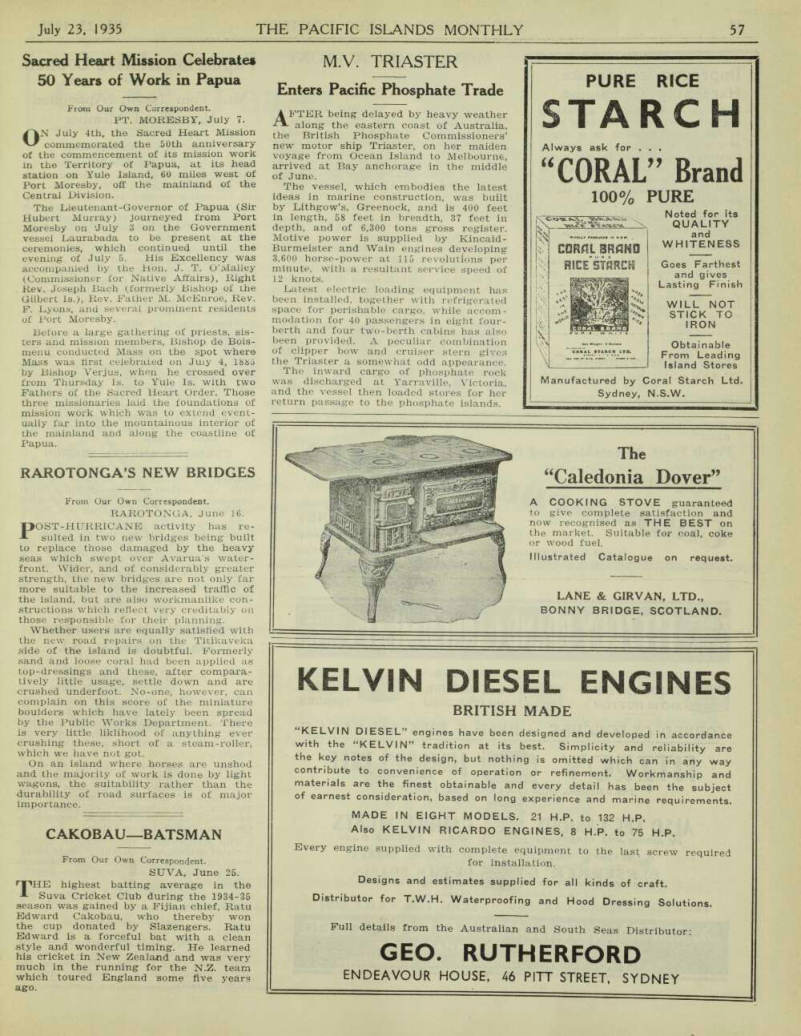
50 Years of Work in Papua
From Our Own Correspondent.
Pt. Moresby, July 7.
ON July 4th, the Sacred Heart Mission commemorated the 50th anniversary of the commencement of its mission work in the Territory of Papua, at its head station on Yule Island, 60 miles west of Port Moresby, off the mainland of the Central Division.
The Lieutenant-Governor of Papua (Sir Hubert Murray) journeyed from Port Moresby on July 3 on the Government vessel Laurabada to be present at the ceremonies, which continued until the evening of July 5. His Excellency was accompanied by the Hon. J. T. O’Malley (Commissioner for Native Affairs), Right Rev. Joseph Bach (formerly Bishop of the Gilbert Is.), Rev. Father M. McEnroe, Rev.
F. Lyons, and several prominent residents of Port Moresby.
Before a large gathering of priests, sis ters and mission members, Bishop de Bois menu conducted Mass on the spot where Mass was first celebrated on July 4, 1885 by Bishop Verjus, when he crossed over from Thursday Is. to Yule Is. with two Fathers of the Sacred Heart Order. Those three missionaries laid the foundations of mission work which was to extend event ually far into the mountainous interior of the mainland and along the coastline of Papua.
Rarotonga’S New Bridges
From Our Own Correspondent.
Rarotonga, June 16.
POST-HURRICANE activity has resulted in two new bridges being built to replace those damaged by the heavy seas which swept over Avarua’s water front. Wider, and of considerably greater strength, the new bridges are not only far more suitable to the increased traffic of the island, but are also workmanlike con structions which reflect very creditably on those responsible for their planning.
Whether users are equally satisfied with the new road repairs on the Titikaveka side of the island is doubtful. Formerly sand and loose coral had been applied as top-dressings and these, after compara tively little usage, settle down and are crushed underfoot. No-one, however, can complain on this score of the miniature boulders which have lately been spread by the Public Works Department. There is very little liklihood of anything ever crushing these, short of a steam-roller, which we have not got.
On an island where horses are unshod and the majority of work is done by light wagons, the suitability rather than the durability of road surfaces is of major importance.
Cakobau—Batsman
From Our Own Correspondent.
SUVA, June 25.
THE highest batting average in the Suva Cricket Club during the 1934-35 season was gained by a Fijian chief, Ratu Edward Cakobau, who thereby won the cup donated by Slazengers. Ratu Edward is a forceful bat with a clean style and wonderful timing. He learned his cricket in New Zealand and was very much in the running for the N.Z. team which toured England some five years ago.
M.V. Triaster
Enters Pacific Phosphate Trade
AFTER being delayed by heavy weather along the eastern coast of Australia, the British Phosphate Commissioners’ new motor ship Triaster, on her maiden voyage from Ocean Island to Melbourne, arrived at Bay anchorage in the middle of June.
The vessel, which embodies the latest ideas in marine construction, was built by Lithgow’s, Greenock, and is 400 feet in length, 58 feet in breadth, 37 feet in depth, and of 6,300 tons gross register.
Motive power is supplied by Kincaid- Burmeister and Wain engines developing 3,600 horse-power at 115 revolutions per minute, with a resultant service speed of 12 knots.
Latest electric loading equipment has been installed, together with refrigerated space for perishable cargo, while accom modation for 40 passengers in eight four berth and four two-berth cabins has also been provided. A peculiar combination of clipper bow and cruiser stern gives the Triaster a somewhat odd appearance.
The inward cargo of phosphate rock was discharged at Yarraville, Victoria, and the vessel then loaded stores for her return passage to the phosphate islands.
Advertisements & other items, pp. 59-60 (1 item)
Starch
PURE RICE
Always ask for . . .
“CORAL” Brand
Manufactured by Coral Starch Ltd.
Sydney, N.S.W.
The
“Caledonia Dover”
A COOKING STOVE guaranteed to give complete satisfaction and now recognised as THE BEST on the market. Suitable for coal, coke or wood fuel.
Illustrated Catalogue on request.
LANE & GIRVAN, LTD.,
BONNY BRIDGE, SCOTLAND.
KELVIN DIESEL ENGINES
BRITISH MADE
“KELVIN DIESEL" engines have been designed and developed in accordance with the “KELVIN” tradition at its best. Simplicity and reliability are the key notes of the design, but nothing is omitted which can in any way contribute to convenience of operation or refinement. Workmanship and materials are the finest obtainable and every detail has been the subject of earnest consideration, based on long experience and marine requirements.
MADE IN EIGHT MODELS. 21 H.P. to 132 H.P.
Also KELVIN RICARDO ENGINES, 8 H.P. to 75 H.P.
Every engine supplied with complete equipment to the last screw required for installation.
Designs and estimates supplied for all kinds of craft.
Distributor for T.W.H. Waterproofing and Hood Dressing Solutions.
Full details from the Australian and South Seas Distributor:
GEO. RUTHERFORD
ENDEAVOUR HOUSE, 46 PITT STREET, SYDNEY
Impregno Steel Surface
Hardening Compound
For local hardening by sprinkling the compound on the hot steel part, or for case hardening to a depth of one thirty-second of an inch by treating the object to be casehardened in a molten bath of the compound. Equipment required, an open fire, a steel pot, and a tin of compound.
IMPREGNO Case Hardening Crystals
For muffle case hardening.
IMPREGNO Quenching Oil is an invaluable aid to the satisfactory hardening of gears, tools, etc.
Firms handling Engineers’ Supplies or Hardware are invited to communicate with us with a view to acting as distributors for these lines.
THE . .
Steel Improvement Co.
102 BAY ROAD, NORTH SYDNEY,
N.S.W,
For—
Fresh Fruit, Vegetables, and Produce
Island residents can rely on the old-established Shipping Providers.
Only Address:
421 Sussex St., SYDNEY
All Orders Promptly Attended Island Representatives: Nelson & Robertson W. M. Reid
SPICED, CORNED. ROAST
& BOILED BEEF
AND IN MUTTON
IN 12 oz., 1lb, 2lb, 3lb, 4lb. 5lb., & 6lb. ROUND
CANS AND IN TAPERS
FITZROY
SHEEP
TONGUES
CORNED OXTONGUES - BEEF & PORK SAUSAGES
FITZROY LUNCHEON BEEF
THE ORIGINAL PACK IN A CLASS BY ITSELF !
ALSO THE FAMOUS HAMPER MEATS
ROUND AND TAPER CANS
C.Q.M.E. CO. LTD. ISLAND TRADE MEATS
BERSERKER & OX-PALM BRANDS
NO EXTRA CHARGE FOR ASSORTMENT
PACKED CASES OR CARTONS - SEND FOR PRICE LIST The CENTRAL QUEENSLAND MEAT EXPORT CO. LTD.
LAKES CREEK - ROCKHAMPTON
Cable ADDRESS:- TOMOANA ROCKHAMPTON.
Mitiaro On A Jaunt
From Our Own Correspondent.
Tulagi, June 18.
THE s.s. Mitiaro, now the residence of the author of “Jock of the Islands,” must have become infected with the spirit of adventure, emanating from the pages that were written aboard. Recently, after lying for months at her moorings, she got skittish and broke away, making a quite obviously hopeless attempt to get out of Tulagi unobserved by way of the too shallow back passage.
For a while she rested on the sands there, but as the passage is used by many small vessels, and she was blocking the fairway, the s.s. Durour, now almost as much a feature of Tulagi as the Mitiaro, was prevailed upon to come to her assist ance, and towed her over to Makambo.
In view of the Mitiaro’s tendency to roam, quite elaborate precautions have been taken to check her.
The Durour has been held up by a repeti tion of her previous difficulty in getting a native crew. Some of her European crew fell sick, and now she cannot con tinue her voyage to Sydney until the copra steamer arrives on June 24 with two new engineers.
Papua Legislative Council
Mr. Tom Nevitt Appointed Non-official Member
From Our Own Correspondent.
Pt. Moresby, June 22.
BY a notice in the Commonwealth Gazette of June 5 it is notified that the Governor-General has accepted the resignation of Mr. G. W. Guttridge as non-official member of the Legislative Council of Papua, to take effect as from February 9, 1935.
Notice was also given that the Gover nor-General had approved of the appoint ment of Mr. Tom Nevitt to be a non official member of the Legislative Council of Papua as from July 1. Everyone in Papua will heartily congratulate the Government and Mr. Nevitt on his ap pointment to the Council.
Mr. Nevitt has had a very long ex perience of commercial and planting life in the Territory, and during all stages of the country’s development he has, shown considerable commercial and finan cial ability. An expert on agriculture and possessing a sound knowledge of mining, Mr. Nevitt’s advice to the Gov ernment on all matters relating to the general welfare of the Territory should carry some weight.
Council’S Annual Session
The annual session of the Legislative Council of Papua will be held in July after the arrival of the Macdhui from Samarai on July 10. The first meeting will probably be held on July 15.
The list of bills to be brought forward is quite formal and needs little comment, except an unusual one to amend the Marriage Ordinance. The existing Or dinance provides that no marriage is valid unless celebrated between 8 a.m. and 8 p.m. This provision is to be repealed.
On Shortland Is., S.I.
Amazons to the Rescue On Shortland Is., S.I.
From Our Own Correspondent.
Tulagi, June 15.
THE Jubilee celebrations at an out station in the Solomons group were enlivened by a promising “scrap” between local natives and plantation Malaitamen, fired with excitement and misdirected loyalty.
The situation was beginning to worry European sticklers for law and order, and the Shortland Is. men were getting the worst of it. Seeing their men folk yielding, the women of Shortland, daughters of a warrior race, charged to the help of their better halves.
The Malaitamen, unaccustomed to this form of attack, and fearful of their treat ment at the hands of the reinforcements —or perhaps because they were gentle men —accepted defeat.
“And it was just as well for them,” say the heroines.
Mr. and Mrs. A. B. Stewart, of the New Zealand Reparation Estates, Western Samoa, recently returned to Apia by the Maui Pomare, after a holiday visit to New Zealand.
Commonwealth authorities have given permission for the Burns, Philp motor ship Merkur to carry passengers between Thursday Island and Commonwealth ports. This was necessary because the Merkur (recently taken over from Ger man interests), is registered in Hong kong.
Advertisements & other items, pp. 61-62 (1 item)
Good Tea
a life Saver!
"A cup of good tea is an excellent ‘life-saver' for anyone who suffers from fainting spells.”
These convincing words were uttered by Dr.
William Brady, an authority on such matters.
This is the new design of all containers of “Mother’s Choice” lines.
“Kinkara”, the health tea, is a good tea. All dust and foreign matter are extracted and each packet contains only “super-sorted” specially selected leaves, giving rich, juicy liquors.
“Kinkara” is economical, because it makes more cups to each pound.
Never infuse for more than five minutes.
"Mother's Choice” Products
“Mother’s Choice products in New South Wales command a ready sale, and the following goods are packed under this well-known brand:—
BAKING POWDER flavouring MIXED CUT PEEL
ESSENCE
CUSTARD POWDER CURRY POWDER SPAGHETTI
JELLY CRYSTALS FRUIT SALINE BAKED BEANS
Try them To-day — Sold throughout “The Island*”
CRAFTS AND HOBBIES
Correspondence Tuition in Weaving, Spinning, Basketry, Flower-making, Felt and Woollen Toys, etc. Principal: Mrs. G.
Farquharson, Kembla Building, 58 Margaret Street, Sydney, or c/o. Pacific Publications Ltd., Box 3408R, Sydney.
Head Study of Champion Walvon Admiration, Challenge Winner, Sydney Royal, 1934 The Noted Walvon Kennels Premier Breeders of Scottish Terriers, Sealyhams, and Wire-haired Fox Terriers.
Puppies available all the year round. Orders direct to Walvon Kennels, 1 Merlin St., Nth.
Sydney, or through Burns Philp & Coy. Ltd., or McIlraths, Ltd.
Fashion Hints for Islands Women
By Therese
VARIETY in dress is the “sauce piquante” of woman’s existence. Her penchant for change coupled with a com plete knowledge of self enables a woman to go disguised as several lovely beings —to-day the demure early Victorian, to morrow the Grecian goddess and so on ad infinitum.
Sports kit must be comfortable, well cut and tailored. For tennis, skirts are short and full and a little dash of colour is per
missible. One-piece sports frocks are of extreme simplicity, depending on cut and quality of material, such as crease resisting linens and heavy crepes de chene for their chic. For sunlit days sporting attire is cool and appealing.
Knitted jumpers of cotton are ideal for tropical wear and possess infinite variety and charm. With their coming, gone is the fear of the old adage, “Satan finds mis chief for idle hands to do,” since merely to regard one of these is to be seized with the ardent desire to busy one’s fingers in like accomplishment.
Beach wear is delightful; shorts in plaid, spotted, striped or plain materials sport gay, sun tan tops. Towelling wraps in colours as varied as Joseph’s coat cover wickedly brief and audacious bathing suits of satin —the perfect cover for the perfect figure. A new and attractive beach wrap is evolved from a six-foot square of towel ling and makes an ideal sun-baking rug also. Sandals for beach wear are in linen or string with clippety-clop wooden heels.
Bags match and sport wooden clips and are extremely attractive.
We all come up from Somerset in our smocks for afternoon wear. We wear them in gorgeously patterned materials over slim skirts and face the world undaunted.
Troubadour capes are delightful on linen suits. They swing with dash and abandon from shoulders and have much appeal.
Three-quarter coats of taffeta are worn over summer frocks —a leather taffeta with marvellous wearing propensities. The col lars and cuffs are stitched, corded or quilted and reach the heights of fashion.
Diagonal stripes are as popular as ever; so a frock of blue and white stripes ties its waist with stripes of red —very dashing indeed.
Little Eton collars stiffly starched give a delightful air of sweet simplicity to frocks of linen. The collars are in any contrast ing shade the wayward fancy wills, and two or three gardenias are substituted for the übiquitous bow that usually accom panies collars of this type.
A grey chiffon afternoon gown adds colour with a flower of green at its shoulder and wide belt of green and silyer—an attractive and gorgeously cool combination.
Yellow and red make an unusual but charming contrast. An amber frock of voile organza or crepe de chene tucks into its waist a huge red flower which repeats itself on the brim of the shining aTnber straw hat.
Brilliant blouses scoff lovingly at sober skirts—bright yellows, blues, greens and scarlets lend a gaiety that is exhilarating.
Skirts are slim with more fulness in front and back and slightly shorter than of yore.
Dramatic in effect, daring in line and with a naughty Directoire charm is the gown of black taffeta, tip tilted in front and held aloft by shoulder straps of almost negligible quantity. In direct contradiction it swathes its shoulders with blush pink taffeta which ties in an enormous bow on the shoulder. A shirred bodice guiltless of back, carries a huge bow at the waist, and has a quaint Puritan collar which extends down the back, cleverly covering its nakedness. The collar is detachable, so you may choose modesty or sophistica tion.
For the divinely tall and most divinely beautiful comes the classical toga of old Greece and Rome. Beautiful and grace fully flowing draperies, metamorphoze the wearer into a goddess, lovely to behold.
Low on the nape of the neck is the
Grecian knot, and a crescent headdress completes the illusion.
Chiffons —light and lovely things—are a delightful interpretation of gaiety. Chiffon, shirred from neck to hip, boasts a multi coloured riband at the waist. A jewelled clip gleams in its dusky folds. A loose airy coat with voluminous sleeves shirred into the arm holes accompanies it and floats its way to success.
A gown of black cire lace goes over a foundation of taffeta and enormous cart wheel frills of stiffened organdie surround the armholes which are garlanded with flowers. Flowers are of paramount importance; whenever possible they must be worn. Huge posies or garlands; or the merest field flower posies; single flowers; or flowers in groups of three, are yours for divers occasions and add beauty to your toilette.
There are many intriguing gadgets to wear with clothes. Buckles, clips, belts, buttons, of glass, crystal, wood, brilliants or metal make a simple frock look “haute couture.” Clothes are exciting and exact ing, loudly demanding attention to detail.
Gloves for all occasions are simple, the smartest glove of the moment being loose fitting at the wrist. Fabric gloves with stitched fingers are also very smart. For evening wear gloves of taffeta and organdie take their place in the scheme of things. They are rucked at the wrist and flower banded.
Hats offer keen interest. Veils are worn but no longer are they mere suggestions.
They float gaily from the hats, and are of chiffon, lace or tulle. Stiffened veils are added to the chapeaux of tiny brim, and can be twisted at any angle to your mood.
Shoes are of grave importance and must be carefully chosen with due regard to suitability and occasion. The ubiquitous court shoe is always a happy choice.
Oxfords are ideal for tweeds and such like and the new monk shoe is suitable for sporting occasions.
Coloured lisle hose loom large on the sporting horizon, while stockings of gauzy sheerness reign supreme for evening wear.
There is flattering softness about the new lingerie which is more feminine than ever. Darling little jackets for negligee wear are frilled and ruffled and breath taking in their loveliness. Voile of un believable fineness evolves the sweetest of nighties in shades of white, peach and pale rose, and are edged with lovely lace.
Foundation garments are of satin and net, and mould the figure in alluring curves.
Hymen At Tulagi
From a Special Correspondent.
Tulagi, July 1.
June 22 at Tulagi, Solomon Islands, Miss R. Roberts, late Sister at Tulagi Hospital, was married to Mr. A. W. Glenn, book-keeper at Messrs. Burns Philp (S.S.) Co.’s branch at Makambo. The ceremony was conducted at the local courthouse by Rev. S. G. Caulton, of the Melanesian Mission.
After the wedding, 60 guests were en tertained at the home of Mr. and Mrs. S.
G. C. Knibbs, where the bride and groom received the felicitations of local residents.
The happy couple left Tulagi to spend a week’s honeymoon at Berande Estate, and will later reside in their new home at Makambo.
Mr. Eric Bieske, a well-known miner of Wau, New Guinea, died in Wau hos pital after a severe attack of dysentery on June 2. For several years he had been prospecting for gold in the Edie Creek district.
Thursday Is. Notes
From Our Own Correspondent
Thursday Is., July 3.
Alderman Alex. Corran And Mrs. Cor
ran, Mayor and Mayoress of Thursday Is., recently celebrated their golden wedding. For the occasion they acted as the host and hostess to 150 guests in the Town Hall, which was pret tily decorated with flags and zamia palms. Mr.
J. Adams presented them with a substantial wal let of notes on behalf of the assembled company.
He pointed out that this was the first golden wedding that has occurred on T.I. Dancing, sing ing, and music filled a most enjoyable and pleas ant evening. Aldermen of the Town Council at the last meeting presented the Mayor with a gold mounted walking-stick of Queensland satinwood.
Miss Hawthorne, Girl Guide commissioner, has left for Australia after a tour of the Torres Strait Islands.
Mrs. Zahel, of Badu Island, has been the guest for a few days of Mr. and Mrs. Arthur Sullivan.
Mrs. Sullivan has now gone to Badu to stay with Mrs. Zahel.
Mr. W. Ewart, of Thursday Is., and Miss Mavis Mundell, of Brisbane, were married on June 15 in the Quetta Cathedral by the Bishop of Car pentaria. The bride was given away by Dr.
Nimmo. A short honeymoon was spent at the C.W.A. House on Prince of Wales Island, Torres Strait.
Alderman Corran, the Mayor, has been pre sented with a gavel made of Queensland timber to mark the golden jubilee of the establishment of the Town Council as a local authority.
Mr. and Mrs. Eric Corran have returned to their home in Roma, Queensland. Mrs. Vowels has gone South with them for a holiday.
Mr. W. J. Woods was married to Mrs. Dodt at the District Registrar’s Office, early in June.
Mr. D. Farquhar, of Messrs. Farquhar’s Pty., has returned to T.I., after a business trip to Brisbane.
News has been received of the death in Brisbane of Mr. John Quinn, who had been ailing for a long period. Some years ago, he was in charge of the quarantine station at Thursday Is.
Mr. Frank Hockings, of the Wanetta Pearling Co., has left for a holiday in Western Queensland.
The local branch of the Country Women’s Asso ciation has elected Mrs. Norman Hockings as president, and Mrs. John Partridge as secretary, for the ensuing year.
Mr. E. J. Hennessey has made a good recovery from his recent illness, and has now gone away for a long period of convalescence. Accompanied by his wife, he will spend the first two months of his holiday at Southport.
Mr. E. K. Thorpe, of Thursday Is., and Nurse Allison, late matron of the Cooktown Hospital, were married recently in Brisbane.
The Hon. John Mullan, Attorney-General for Queensland, and Mr. D. Riordan, M.H.R., are expected to arrive by the next Taiping. The for mer will make an official visit to the Torres Strait Islands on the Melbidir.
To dispose of the surplus of the silver jubilee celebrations fund, it has been decided to present T.I. schoolchildren with a small jubilee medal. The balance of the collection will be handed over to the Jubilee Museum Fund for the purchase of show cases.
Advertisements & other items, pp. 63-64 (1 item)
Ozo Salt
Get your
free copy
of the
NEW TRUFOOD
RECIPE BOOK
69 specially tested recipes—all kinds of new ideas for attractive things to cook cakes, pastry, puddings, custards, desserts, sauces, etc.
“Recipe Department," c/- Box 3922TT G.P.O.
Sydney.
Please send me POST FREE, a copy of The Trufood Book of 69 Tempting Recipes.
Name
(BLOCK LETTERS)
Neptune’s Greatest Gift to Man—
OZO SALT
The word “OZO” means the Sea. OZO SALT Is made from Sterilized Sea Water of the Pacific Ocean and dried in vacuum.
“NOTHING PURER ON EARTH.”
Ask for it in the new IJlb. Patent Package. Specially designed (for the Island and Eastern Trade) to resist Moisture, Humidity and Water. CAN BE OPENED AND RESEALED WITH THE GREATEST OF EASE. ORDER A PACKET TO-DAY.
Other “OZO” Specialities are: Ozo Health Salt.
Ozo Celery Salt.
“Sea-King” Gravy Salt.
OZO
SALT CO.
SYDNEY
VICTORY Camp Folding Furniture
The Folding Bed, Open 6ft. 3in. by 2ft. 3in.; when Folded, 36in. by 7in. by 3in.
The Strongest Collapsible Stretcher made—will stand the hardest wear.
THE VICTORY CAMP STOOL
useful for alt purposes where a strong lightweight Stool is required.
Tents, Tarpaulins, Bedding and Wire Mattresses etc., quoted for.
The Victory Furniture can be supplied through All Burns, Philp & Co.’s Branches Catalogues available on application Manufactured by: N. M. FOWLER, Elizabeth St., Newtown, Sydney
ALBERT GREGORY
107 York Street, Sydney.
Saddlery,
Saddler’s Ironmongery
Leather and Paint Merchant.
LEATHERS— Art Work, Sole, Harness, Roans, Suedes, Bag, Kangaroo, Bridles, Belts, Spurs, Stirrups, Breastplates. SADDLES Race, Exercising, Park and Stock.
Leather Belting and Pump Cups.
Paint Merchant.
For House and Roofs, ready mixed . . 13/6 gallon Special Value House Paint 10/6 gallon Brushes, Kalsomine, White Lead and Oil.
Samples of Leathers on Application.
Woven Wire Jor_ All Industry
COPRA DRYING TRAYS, FLOORS, Etc.
FRUIT DRYING TRAYS, MINING SCREENS
Heavy Mosquito Gauze in Phosphor Bronze and Other Metals Impervious to Salt Sea Air WIRE DOOR MATS AND GENERAL WIRE WORKS
E. WRIGHT & CO. LTD.
Office and Works: 148-152 Cleveland St., Sydney, N.S.W.
Telegraphic Address: “Wrightmake,” Chippendale.
WATERPROOFING
SOLUTION
Specially prepared for treating Tents, Tarpaulins, Cart, Wheat and Haystack Covers, Horse Rugs, Ground Sheets, and Oilskins Free of injurious chemicals & acids, penetrates, binds, and strengthens.
Is flexible and does not stick or rot material.
J. R. CLAY & CO. LTD..
Agent for Port Moresby and Samarai Sole Distributor for Pacific Islands GEO. RUTHERFORD, 46 Pitt Street, Sydney Manufacturer:
TAYLOR WILLIAMS & HALLIDAY
185-195 New Canterbury Road, Belmore, Sydney
Cocoa Grades
Some Criticism for Samoa
“LONDONER” writes: “I do not like the squeal from the cocoa planters of Samoa (P.I.M., March). They were able, like all other tropical planters, to get big prices for their crops; but even cocoa does not run to 3 or 4 automobiles on an acreage of 160; neither can the profit, even at the best of times, run to extended trips around the world, etc. No single commodity can keep at the artificial prices enjoyed after the war, and it was up to the planters to save and look ahead for the rainy days.
“In Samoa, though every cocoa planter knew so much more than the other fel low; and instead of pulling together and having one first grade standard of bean each man followed his own bent. Thus, at times, one in a shipment of 200 bags no less than 20 different standards of what 20 planters thought was first grade. Consequently, instead of building up a definite market in Britain, the Samoan planters were compelled to sell piecemeal and take what was offered.
Anyway, there it is, and until Samoan No. 1 grade can be marketed as a “bulk grade,’’ I am afraid the buyers will still keep them down in price.
“That does not alter my opinion that cocoa for New Guinea, on a proper basis, would be an excellent thing for that Ter ritory.
“Australian manufacturers would buy if they knew the beans were O.K.”
Fertiliser for Cook Is. Crops
From Our Own Correspondent.
Rarotonga, June 14.
AS the result of the native fruit growers’ decision last year, to allow the freight reduction of 3d a case to ac crue, there arrived by the last mail steamer 60 tons of fertiliser, bought by the Administration out of the accumulated funds.
The fertiliser will be distributed among growers proportionally to the size of last season’s shipments. It is intended for use on orange trees, but as some speculation is already rife regarding its effect on tomatoes we may yet live to see Raro tonga produce the world’s super fruit —or is it vegetable?
Largest Neon Sign
The largest Neon sign installation in the British Empire, in which Callender’s “Ancalite” Neon Sign Cable was exclusively used, was put into operation at the end of last year. The sign, erected for the Canadian Government, is situated on the banks of the Mersey, not far from Liverpool. It is in the form of a triangle 60ft. long on each side, containing a gigantic maple leaf, which appears in huge letters “Canada ; the words “Quality Mark” appearing underneath the maple. Wording and triangle are in red, the maple leaf being illuminated in green.
The sign itself, erected on an enormous steel structure, is 75ft. high and 100 ft. wide. Over 3,000 ft. of Neon tubing was used and high tension current is supplied from 86 transformers. The steel structure is designed to withstand a wind velocity of 80 m.p.h. Callender’s “Ancalite" Neon Sign Cable was used throughout because it is the ideal dielectric on account of its ozone resisting properties and its exceptionally high resistance to voltage stress.
Callender’s Cable & Construction Co. has been represented in Australia for the past 40 years by Messrs. Noyes Bros. (Sydney) Ltd.***
The Melanesian Maid
“This doggerel,’’ as he called it, is sent by Mr. E. W. Harrison, of Sebulugomwa, Eastern Papua, “with apologies to the gentleman who wrote 'The Polynesian Maid’.’’
“I hope,” says Mr. Harrison, “that it will be read by those bald-headed gentlemen who labour under the delusion that romance may be found in Melanesia, among nut-brown maidens lan guishing on golden beaches.”
Fortunately, the devastating Mr. Harrison says nothing about Polynesia, so that we can keep some of our illusions.
O MELANESIAN maiden!
O nut-brown “tart” — To live a life of love with thee Would break my blinking heart.
O Melanesian mind— Sans love, and black as night: Ne’er touched by true affection— Nor plagued by introspection.
O Melanesian smell, That cannot be mistaken; Oil, sweat, and grease as well— And cleanliness forsaken.
O Melanesian jaw’s harp, Torturing the night.
Calling to lovers darksome, Setting their hearts alight.
O Melanesian girls— O nut-brown maids!
Small insects roam their greasy curls And bite the dusky jades.
Alas! Poor Melanesian, No Romance dwells with thee— No long-drawn sigh, nor clinging kiss, Nor other signs of lovers’ bliss.
So, Farewell! “Bamahuta”! (Whichever you like best) — We’ll search for sweethearts cleaner In a land where smells are sweeter.
You make, of Love, a jest.
“Make Paper”
S.I. Labourers’ Trick
Paid Recruits Refuse To “Make Paper”
From Our Own Correspondent.
Tulagi, June 17.
RECRUITERS in the Solomons Islands are finding themselves up against a rather hard problem that only prompt and sensible alteration of the Labour Regulation can solve.
Natives have recruited tolerably well since the reduced wage has been in force, but naturally prefer more if they can get it. Now they have inaugurated a system of joining the ship, taking six months’ wages on the strength of recruit ing, and then flatly refusing to have their agreement ratified.
The recruiter has to stand the loss in the first place, but of course will pass it on to the planter, for recruiting fees are now at an unprecedented and irreducible minimum. As the practice becomes known to be successful, it will mean an impos sible situation. Local officials realize the urgent need for a prompt alteration of the Regulation, and it is to be hoped that Fiji authorities can grasp the situation.
The first case of natives refusing to fulfil their moral obligations happened at an out-station. Since then it has hap pened more than once before the Inspec tor of Labour at Tulagi, where the best legal advice in the Group is procurable.
Recruiters feel sure that there is no remedy, short of an amendment of the Regulation.
Madame P. Vois, wife of the manager of the Caledon Nickel Co.’s mines in New Caledonia, arrived in Sydney recently from Noumea. She will be joined by her husband late this month and together they will sail for France. Mr. and Mrs.
Vois will return to Noumea in February next year.
Rev. H. T. Shotton, M.A., who arrived in Sydney from Kiriwina, Papua, by the April Macdhui on furlough, has applied for extended leave on account of illness.
Advertisements & other items, p. 65 (1 item)
Aunt Mary’S
V. H. Jones & Rickard
Electrical Engineers
525 ELIZABETH STREET
SYDNEY
Specialists in rewinding and repairing all classes and sizes of electrical machines and equipment.
Special treatment given to work for the tropics.
TELEPHONE: MA 1397
IN CASES OF EMERGENCY YOUR
HOME IS INCOMPLETE WITHOUT A
MEDICINE CABINET. BE PREPARED!
You can purchase the highest quality surgical dressings, pharmaceutical requirements and all chemists sundries at the lowest possible prices direct from
The VICTOR PHARMACEUTICAL
AGENCIES
Phillip House, Phillip St,, Sydney.
Orders, inquiries and quotations attended to immediately. Enclose postage for reply.
Address all mail to The Manager, Box 3749SS, G.P.O., Sydney Confidence in the cartridges one uses not only makes
shooting more plea-
surable, but it assures
BETTER SHOOTING.
With the knowledge that
every cartridge is scientifically
accurate in its production and tested before marketing, the user of Eley &
Kynoch Cartridges
can always depend upon reliability in
performance.
Obtainable
Everywhere
ICI
“There's Not A Faulty Cartridge In A Million.”
Wholesome and Delicious Foods
Island residents can always ensure quality foods that are wholesome and delicious by ordering
AUNT MARY’S
PURE FOOD PRODUCTS
These appetising food products are specially manufactured and packed to meet Island conditions.
Full of flavour and refreshing nourishment they appeal to the palates of all who partake.
For over thirty years the brand “Aunt Mary’s” has been a guarantee of quality to the people of the Islands.
Prepared and packed only by
TILLOCK & Co, Ltd.
Pure Food Manufacturers
KENT AND LIVERPOOL STREETS
SYDNEY, N.S.W.
Ask also for “Defiance”
Brand Canned Goods They are supreme in excellence.
Prepared and packed by the proprietors of Aunt Mary’s Pure Food Products
Cruise Of Leper
Ship
Dr. Ellison’s Round Trip
From Our Own Correspondent.
Rarotonga, June 20.
HAVING just completed a tour of the Group for the purpose of collecting and transporting lepers to the Govern ment station in Fiji, Dr. Ellison returned by the last mail-steamer to resume his duties as Resident Medical Officer.
Even the Olympian calm with which the doctor describes his experiences does not prevent parts of this voyage from sounding like the more macabre imagin ings of some novelist with a penchant for horrors.
Starting with a crew who were unaware of the task before them, and the over coming of whose objections called for no small display of tact, Dr. Ellison went on to tell of inspection after inspection at each island, of a slowly mounting human cargo, of insanity aboard, and of his own unarmed entry into one of the “cages” to quieten the would-be homicide.
Dr. Ellison has made a special study of leprosy, and it is largely due to his unremitting surveillance that the disease is decreasing in this Group. Ignorance and carelessness on the part of native communities present one of the major difficulties, contact rather than heredity being responsible for its appearance and continuation in certain families.
In the remote atolls, carelessness has often been carried to dangerous extremes, as was the case not so very long ago in Rakahanga, where some seven or eight young bucks, segregated on a small motu, made a nightly practice of crossing to the settlement and there visiting their erstwhile lady-friends. These excursions only ended with the destruction of a large canoe which they had secretly built and kept concealed among the undergrowth of the motu.
Thirty-five lepers were collected in all, including five from Samoa and one from
Niue. The worst cases were placed in the ship’s hold, the remainder being ac commodated on deck in specially con structed “cages.”
Commenting on the general condition of the northern islanders. Dr. Ellison, whose last visit was in 1927, said that he had been struck by their present lack of prosperity, due to the heavy fall of copra and pearl-shell prices, upon which these islands are wholly dependent for their income. On the other hand, he was of the opinion that despite the depression these people were actually better off without many of the luxuries to which they were formerly accustomed, their health to-day being distinctly better than in 1927 and on the whole superior to that of the Raro tongans, whose greater contact with the outside world rendered them more prone to diseases and epidemics.
Also, Dr. Ellison added, they were by far the happiest and most contented looking folk in the Cook Group. In these Isolated but self-supporting islands, “de pression” really means little more than a shortage of tobacco or one less pair of pants for Sunday.
Handing over his duties to Dr. Ellison, Lieut.-Colonel Dawson left for Welling ton on the last boat. Col. Dawson, who proved as generous as he was popular during his short stay, returned the hos pitality which he had received from local residents by a number of very jolly little theatre parties to his new friends.
A photograph of Dr. Ellison and some of his assistants is published on page 41.
Dr. W. C. Klein, who has been studying economic and developmental conditions in New Guinea and Papua for the Dutch New Guinea Committee, returned to Port Moresby from the Mandated Territory in mid-June by 'plane from Wau. On June 25, Dr. Klein and his secretary, Mr. S. van Oosten, sailed from Pt. Moresby on the Laurabada for the Eastern and South- Eastern Divisions of Papua, as guests of His Excellency Sir Hubert Murray. The party returned to the capital on July 3, and it was Dr. Klein’s intention to sail for the Dutch East Indies by the Van Rees on July 19.
Advertisements & other items, p. 66 (2 items)
Thorpes Ltd.
FEED for . . .
POULTRY
DAIRY COWS
HORSES and DOGS
We ship throughout the Islands our special feeds for all classes of stock.
These feeds offer stock owners the highest value for cost that is obtainable and can be depended upon to give the best results.
Write for free literature.
THORPES LTD.
Stock & Poultry Feed Manufacturers, 313-317 Sussex St., Sydney
Find out What’s Inside
before you buy a low-priced Saddle.
THE KING OF 'EM ALL
Is a
“Safer”
Saddle
and Offers Sensational Advantages Being built on a Rustless Tree, heavily bar plated, and strained with English web, riders are assured of its genuine foundation. Its soft, pliant kip flaps are hardwearing, while the sweepy seat gives superb riding comfort.
Fitted with Best Leather, £5/5/- Folded Girth, Stirrups Freight Free.
Capped Pads as illustrated, 15/- extra.
Write for Catalogue P 1935.
SYDNEY’S HIGH-CLASS
SADDLER.
Newmarket Saddlery
W. H. Williams for “Safer” Saddles
18-20 WILSON ST., NEWTOWN
N.S.W.
Burns Philp
(South Sea) Co. Ltd.
Island Traders & Shipowners
Registered Office: Suva, Fiji.
Also Branches at Fiji: Levuka, Lautoka, Labasa, Ba, Sigatoka, Rotuma.
Tonga: Nukualofa, Haapai, Vavau.
Samoa: Apia, Pago Pago (America Samoa).
Solomons: Makambo, Gizo, Faisi.
New Hebrides: Vila.
Gilberts: Tarawa.
Norfolk Is. Nauru. Niue. Wallis Is. Futuna Is.
Code Address: “Burnsouth.”
Life On Isolated Puka Puka
Dr. E. Beaglehole Studies Conditions on Lonely Island in Northern Cooks
From Our Own Correspondent.
APIA, July 4.
A RRIVING in Apia on June 17 by the Makoa, Dr. and Mrs. Ernest Beagle hole have returned from Puka Puka (or Danger Island) in the Northern Cook Group, after eight months’ investigation, mainly anthropological research work, undertaken on behalf of the Bernice P.
Bishop Museum, of Honolulu, Hawaii.
Dr. Beaglehole is a noted scientist and anthropologist, and the research work just completed at Puka Puka forms part of a general survey of the Polynesian islands, stretching from Hawaii to New Zealand and far away Easter Island. By this general survey, material is gathered referring to all branches of the Poly nesian race, which will serve for com parative study for the fixation of their common and original characteristics.
This study may lead later on to more definite conclusions regarding the origin of the Polynesians, on which there has been much speculation ever since the discovery and exploration of the South Sea Islands.
Dr. Beaglehole has brought back ample material referring to all sides of the life and culture of the Puka Puka natives, of whom there are at present 626 on the Island. Owing to the remoteness of the island and the scant communication with the outside world (only 3 or 4 times a year), the island people form an excellent object for study, as they have kept their racial characteristics comparatively pure, no intermarrying having taken place and very little immigration of other islanders.
Of foreigners, only one white man (Mr.
K. D. Frisbie) lives permanently on the island, besides the Resident Commis sioner, Mr. Geoffrey Henry and his wife, who themselves are of part Rarotongan blood. A trading station, kept by Messrs.
Burns Philp (S.S.) Co. Ltd., has been closed for several years and the Island’s copra is taken and goods provided by occasional visits of B.P.’s trading schooner.
The island was called Danger Island by Commodore Byron, the submerged tail of the surrounding reef making it dan gerous for ships. The place is covered with luxuriant coconut groves; there are also a few tamanu trees and an ex tensive growth of the pandanus or screw palm. The only food crop, however, besides the coconut palms, is taro, grown in the numerous excavations on the Island. Another article of food for the natives, besides coconuts and taro, is fish, though the fishing round the island is not exactly abundant. The natives, however, are expert fishermen, and manage to catch sufficient for their needs.
Pigs and fowls are killed only at cere monial functions and feasts.
The population of the island was much larger in ancient times, probably reach ing 1000 or more. Slaving ships from Peru carried off a great number, and about 200 years ago a tidal wave wiped out most of the inhabitants, only 14 families surviving. In 1914 the taro patches on the island were destroyed by a seismic wave, and a serious shortage of food resulted: the Cook Is. Adminis tration eventually had to transport part of the population to Rarotonga. Owing to a deficiency of iron in the soil, only
limited cultivation of foodstuffs is pos sible and the island cannot support much more than its present population.
The natives of Puka Puka are and always have been a people of primitive habits, contented, honest and industrious.
They are skilful in the manufacturing of mats, hats and basketware from pan danus leaves, though owing to a lack of demand this industry is stagnant. The
houses of the natives are mostly roofed with pandanus, too.
Puka Puka is governed by the Resident Commissioner with an advisory council of native representatives (two members of every village), who have the power of ariki. The supreme chief at the present time is 90 years old. All the natives are Christians, having been converted originally by the London Missionary Society; at present the Seventh Day Adventist and the Catholic Missions have many adherents on the islands.
A Government school for all children on the island is conducted by Mr. and Mrs. Henry, who, in addition to many
other activities, also keep a dispensary and treat cases of sickness. The islanders are generally healthy and strong, and sanitary conditions are good. In contrast other Polynesian islands, yaws, apart from some after effects, have practically disappeared, owing to inoculation by a medically trained Samoan some years ago. There are, however, cases of fever, filaria (probably introduced from Samoa), ulcers (owing to the unvaried diet of nuts and taro and a scarcity of fresh water for washing), also venereal disease and, in consequence, cases of blindness or eye disease among children.
Though the Commissioner and his wife
do their best to alleviate suffering being unqualified they cannot in many cases correctly diagnose the diseases. Many natives therefore consult native “doctors” first and, these failing, later seek Mr.
Henry’s aid. The Cook Islands Adminis tration, spends very little on the ad ministration of Puka Puka, but there is a pressing need for the Government to send a properly trained medical man there to attend to the medical needs of the islanders.
An interesting feature of native life is that there are no less than four different dialects spoken on the island. There is first of all the old original Puka Puka language, nowadays in use only by some of the old people, then the modern lan guage of Puka Puka in common use.
Further, there is a mixed Puka Puka and Rarotongan language, gaining prepon derance at present, and lastly the Raro tongan language, used officially in court, church and school. The pure Puka Puka language is being abandoned gradually and Dr. Beaglehole intends to compose a grammar and dictionary of the language for preservation.
According to Dr. Beaglehole, the advent of the depression with low prices for copra, and the difficulty of obtaining clothing and the small luxuries the na tives have been used to previously, have had a bewildering effect on the Puka Puka islanders. Of European foodstuffs, they mainly used rice in supplementing their own native food, but now they get along quite well without it. Taught by the missionaries that their ancient ways of dressing were sinful and immoral, the natives became immensely embarrassed when their European singlets, dresses and loinclothes became tattered rags and they were unable to buy new ones to replace them. But gradually on Puka Puka the old fibre skirts are appearing and in place of the lime-walled house of modern times the open air hut of former years is again constructed, probably to the physical benefit of the islanders.
In gathering the voluminious and com prehensive material on the islanders, which is contained in a stack of note books, and the sifting and preparing of which requires an immense amount of work, Mrs. Beaglehole, the attractive young wife of the scientist has been of great help and assistance to her husband.
Especially, as she has compiled a great deal of valuable data regarding the children and women, in the latter’s out side and domestic, work, their fashions, talk and beliefs, thus materially assist ing in the general survey of Islands culture.
Dr. Beaglehole will submit his reports, when written up in proper form, to the Bishop museum, which will probably publish them in the Museum’s Bulletins and thus make them available to the in terested public and the scientific world.
Advertisements & other items, pp. 67-68 (1 item)
The Unbreakable, Immovable
Mrs. N. WALKER-FLYNN
Late 35 POWELL STREET, COOGEE
COSTUMIERE
MALAGUNA ROAD, RABAUL
HEMSTITCHING and PICOT EDGING.
Copies of Mab’s Fashions; Roma’s Pictorial Fashions and Home Fashions available. — P.O. Box 116. Tel.: 141.
AT BLUE MOUNTAINS
SPRINGWOOD, N.S.W.
Springwood Ladies’ College
Est. 1897. Kindergarten to Leaving Certificate. Tennis, Riding, Swimming, Team Games. Unequalled climate. Pure Jersey Milk. Senior and Junior Houses. Open-air sleeping. Inclusive fees. Special vacation arrangements for Island pupils.
M. E. DURAND, Principal.
NO BOAR WILL EVER BREAK THAT LOCK.
NO BULL WILL EVER BREAK THAT FENCE.
THE UNBREAKABLE, IMMOVABLE
LOCK OF “CYCLONE” RING-LOCK
FENCE
There’s a reason for the enormous strength of a “Cyclone”
Ring-lock Fence. A ring of steel wire is locked around the upright and horizontal wires (which are of HARD-steel) wherever they cross; this locks them together so securely that they cannot be moved upwards, downwards or sideways—the fence remains completely rigid under all conditions.
CYCLONE FENCE & GATE Co. Pty. Ltd.
The Grace Building, 77 York St., Sydney And at Melbourne and Adelaide Please send me by return mail your free, illustrated and priced Gates and Ring-lock Fences, and comparison of costs.
Name Catalogue, of Cyclone Metal Address
FAST AUXILIARY KETCHES
AT ONE-THIRD OF SYDNEY PRICES
Offers are invited from anyone wishing to purchase a first-class ocean going ketch. There are eight to be selected from, ranging in size from 13 to over 20 tons, at prices from £350 to £1,300, the largest being a new boat still on the slips.
Apply—
V. R. KEPERT, Pearler, DARWIN, N.A.
FOR LONGER LIFE
USE. . .
ERG
BATTERIES
FOR
CARS, TRUCKS, RADIO,
HOUSELIGHTING,
MARINE WORK,
MOTORCYCLES
If not represented in your district write direct to— ERG BATTERIES LTD. 156 GOULBURN ST.. SYDNEY, N.S.W.
TO ELECTRICAL ENGINEERS - MANUFACTURERS OF QUALITY BATTERIES
BULLIVANTS wire ropes
“THE WORLD’S STANDARD”
LARGEST STOCKS IN AUSTRALASIA - FOR ALL PURPOSES Also Blocks, Hooks, Shackles, Thimbles, Strand, Seizing, Aircraft Cord, etc.
Letters: BULLIVANTS’ Australian Co. Ltd-
Box 1298J, G.P.O. 331-333 KENT STREET, SYDNEY Prompt Attention! Efficient Service!! Complete Satisfaction!!!
"Bullivants Ltd.,"
Sydney.
N.G. Goldfields News
From Our Own Correspondent.
Edie Creek, June 24.
THE new road between Wau and Edie Creek is proving a boon. Already no less than six lorries are operating regularly and several cars have climbed up the grade. The point of change over from the standard-wheel-base lorries to the narrow gauge lorries has shifted to a spot be tween Maori Creek and Blue Point, showing the excellent progress made by Mr. Geo. Hoffman in widening the road. Fares between Wau and Edie Creek have been reduced from £1 each way to 12/6 single and £1 return and freights from ⅞d. to ½d. lb.
Steady rain for the first week in May caused a number of landslides on the road and culminated in a flood in the creeks on the 7th.
A mild, but nevertheless distressing form of ’flu affected most of the local Europeans and natives during May.
A visitor of Kaindi, Miss E. Protheroe, the the guest of Mrs. Cresswell, at Stower’s Creek, had a little excitement a few days after arrival recently, when a landslide struck the room she was sleeping in. The fall of rock crashed into her room and completely buried her bed a second after she had jumped clear. Her only injuries were a few abrasions. Miss Protheroe has now taken the position of relieving sister at the Salamaua Hospital.
Our lone woman miner, Mrs. E. Rex, has ceased work on her tribute on Schrater’s lease and intends to try her luck on Whitburne’s Creek.
Mr. A. E. Silburne has aquired the "D. and W.” claim from Mr. A. G. Villiers, who has taken up residence in Wau. In the past, the “D. and W.” has produced some very rich returns and Mr. Silburne is very satisfied.
Mr. Russ. Wild has returned after a short stay in Rabaul and it seems that he has now re covered from his recent ailment. His April “clean-up’’ was said to be in the vicinity of 325 ozs. and the May production promises to ap proach that figure.
Mr. R. G. (Dick) Courtney has been “bush”— another of those secret expeditions so prevalent among the miners since the pegging boom. Mr.
Courtney is still winning good gold from the Midas Extended tribute.
Apparently Mr. A. H. (“Cressy”) Cresswell is also suffering from the pegging mania, for he has gone “bush” several times lately.
Mr. and Mrs. Russell-Smith, who, until re cently, were residents of Kaindi, have a son and heir. They have now settled down at Bulolo.
N.G.G. Ltd., are preparing for the removal of their head office to Edie Creek. The tender for erection of new offices has been let to Mr. G. An derson. Mr. Van Burgh, a very well-known N.G. identity has joined the N.G.G. staff
Wau Notes
From Our Own Correspondent.
WAU, July 2.
THE amazing growth of this part of the world in two years literally takes one’s breath away. By the last Montoro five new motor cars arrived for the following: Mr. Tommy Thompson, a new Ford sedan; Mr. Bill Kennedy, an Erskine sedan; the Manager of N.G. Goldfields Ltd., a Ford tourer; Fred Deckert, another sedan (making his fleet two trucks and two closed cars); and the medical officer at Wau also has a new sedan.
Now that the new road to the Creek is open, week-end excursions to Edie are a delight.
Whereas a few months ago it took two to three hours by car from Wau to Edie, now, if you care to flirt with Death and Deckert, you can get there and back in a little over an hour.
A syndicate of influential men has been formed here with a view to holding whippet races, now that the horse racing fever has died down.
After five years of more or less a “free go,” the police in Morobe, like the police down South, started raiding the hotels, with the result that the Hotel Bulolo was recently fined £25 and the new Wau Hotel £10, for selling liquor after the prescribed hours.
Guinea Airways planes have been working over time carrying in passengers to Wau. About 37 new residents for the goldfields arrived by the last Montoro. All recent boats for New Guinea, especi ally for the goldfields, have been filled to capacity.
The new District Office at Wau is almost com pleted. The building comprises new Post Office and Warden’s Office, both of which were badly needed.
Mr. T. G. V. Blakey, General Manager of Day Dawn (New Guinea) Ltd., had the misfortune to break his leg on King’s Birthday.
The Bachelors’ Ball held recently was a huge success, over 200 dancers being on the floor.
A popular resident of Wau, Mr. J. Hoile, has written a song entitled “Farewell New Guinea,’’ and set it to music himself. It is rather good.
Quite a lot here would like to say “Farewell New Guinea,’’ but no matter how long they stay, once they leave they are all eager to return.
Mr. N. P. H. Neal, M.L.C. and local director of Day Dawn (New Guinea) Ltd., paid a hurried visit to the goldfields during the first week in June.
Mr. E. Hitchcock returned by the Montoro to his mining interests on the Watut. At one time he was W.O. at Edie Creek; now he is one of New Guinea’s mining magnates.
Mr. Bob Anstey arrived from Sydney by the last Montoro to assist Fred Deckert to keep the flag of the Wau Carrying Co. flying.
Dr. V. W. T. McGusty, Fiji Government Inspecting Medical Officer, left Suva with his wife by the Niagara on June 28, for furlough in England.
Advertisements & other items, p. 69 (1 item)
Scott's
New Britain Express
Delivery.
GENERAL OVERSEAS AGENTS.
GENERAL CARRIERS, BAGGAGE and
FORWARDING AGENTS
ROYAL MAIL CONTRACTORS
Reliable Cars and Trucks.
We aim to give quick and reliable Service at reasonable costs. P.O. Box 116. 'Phone 141.
W. WALKER-FLYNN, Proprietor, Malaguna Road, Rabaul, T.N.G.
SHIP & GENERAL
COPPERSMITHS
Manufacturers of all kinds of Pipe Work, Petrol, Water, and Buoyancy Tanks for Ships, Yachts, and Motpr Boats, Copper Water-jacketed Exhaust Pipes & Silencers a speciality.
Copper Pans and Stills made to specification
Nicholson & Foster
BALMAIN, SYDNEY
YOUR girl
has this same
The Weak Spot in growing children is through the tissues of the throat and lungs.
That is where disease germs enter.
SCOTT’S
EMULSION is
made specially to strengthen and protect this Weak Spot.
That is why a child taking
SCOTT’S
EMULSION is
able to ward off successfully, coughs, colds, bronchitis and infectious diseases.
Give your child SCOTT’S EMULSION from to-day
SCOTT'S
Emulsion
Pacific Mining
Reports
From Fiji
Aloha Central G.M.
A detailed report by Dr. Loftus Hills on Costello’s block of 30 acres, under option to Aloha Central G.M.N.L. has been received by the management in Victoria. Dr. Hills states there are at least four lodes on the block corresponding to the four lines of shear. The eastern lode extends from the northern boundary south-eastwards and passes out of the area in the south-eastern corner. It is 1500 feet in length, and the indicated width is from 10 to 20 feet. The western group of lodes is controlled by the three lines of shear, which are spaced within a width of 250 feet. The width of the indivi dual lodes is obscured by their intermittent coales cence into a composite lode, which in places will
probably prove to be up to 250 feet in width. This lode system also extends 1500 feet, and in direction parallels the eastern lode. The work in progress must be regarded merely as the initial steps in exploring and testing what is really an extensive system of lode formations. It can be expected that development will prove large tonnages of ore re serves. What the gold content or grade of this ore will be, only the development work and systematic sampling will disclose. But the geological evidence justifies him in expecting the recognition of tellu rides at any time. High-grade ore undoubtedly occurs and can be expected to recur throughout the lodes both in length and depth. If efficiently handled the lodes should show a profit on large scale ore averaging 3 dwt. of gold a ton.
Following is a progress report recently issued by the mine manager; No. 1 shaft, sunk 3ft., to 19ft., in solid lode. Present width, 5ft. No sign of footwall. Present width of lode payable. No. 2 shaft, 10ft., to 26ft., in dark andesite. No. 3 shaft, 10ft., to 27ft., in dark andesite. Xcut towards No. 2 shaft, to 4ft. No. 1 tunnel, 17ft., to 35ft., dark an desite. No. 2 tunnel, 20ft, in 43ft. Present width of lode formation, 23ft. Traces of gold. Cut out road from Emperor-road to mine. Lorry can now get
to mine. Eastern lode; Excavating approach to tunnel.
Koroere Gold N.L.
The last report received in Australian from the representative in Fiji of Koroere Gold N.L. stated: Tunnels advanced to 165 ft., 9ft., 134 ft., 82ft. re spectively. No. 1 tunnel from 145 to 155 ft., 3dwt.; No. 3 tunnel from 114 to 124 ft., 3dwt.; lode chan nels not yet reached. Cardigan lode section ex tending 250ft. N. No. 3 shafts 3 costeens show width lode 18ft. Values varying between 2 and 12dwt., with average 4dwt. Shaft 30ft. deep; same average values. Ten trenches W. lode disclose length 270 ft., width 7ft. Average value, 7dwt. N. lode across creek length, 160 ft., width 15ft., assay ing 2dwt.
Viti Levu Gold N.L.
In a report on the property of Viti Levu Gold N.L., despatched from Lautoka, Fiji, Mr. Earl Scott states that although the first assays were mostly disappointing, the general outlook has improved since, as there is now 3ft. of ore, giving good dish samples, and a further width, as yet insufficiently tested, but showing a little free gold in the dish.
Sinking is proceeding on the best values, as well as trenching at other places along the line of lode.
Other portions of the area are being opened up for sampling. Sixteen native boys are being em ployed.
Loloma West Ltd.
Advice has been received by the management of Loloma West Ltd., Fiji, that the Loloma West block has been granted as a prospecting licence.
The issue of the Hot Springs and Drumasi areas has been deferred pending a survey to eliminate the sugar cane areas and to determine the boundaries.
Granites Development N.L.
Granites Development N.L. has been advised by its agent in Fiji that he has secured a six months’ free option over an application for a proposed lease on the headwaters of the Waimanu River, and that he is forwarding samples for assay. The purchase consideration is £3,000 in cash and a 10 per cent, fully paid share interest in the capital of a company formed to develop the property. A further exten sion of six months can be obtained on payment of £IOO. The representative in Fiji has also obtained free sampling options over two properties on the Tavua field, and options over two areas in the Nandi district. Arrangements are being made to test these areas.
Aloha Alluvials N.L.
Further testing by Mr. E. T. Lewis in the Wai damu River region, Fiji, on behalf of Aloha Allu vials N.L., has given disappointing results. Mr.
Lewis advised the management that three bores put down about the middle of the Lower Waidamu River area to 30 feet, 49 feet and 47 feet respec tively, showed no sign of gold, except in a few of the finest possible float colours on the surface. Most of the material was gravel and hill rubbish, con firming his previous advice that the denuding of this country was not old enough to deposit alluvial gold. Mr. Lewis added that he did not expect any improvement. The Waidamu River area appeared to be distinctly worse. He considered the whole of the properties of the company worthless. The directors have instructed Mr. Lewis to put down five more bores on the Lower Waimanu area and five bores on the W'aidamu area. The company’s options and reservations in the Waimanu River region collectively comprise an unbroken tract of territory extending continuously for a distance of 25 miles, starting from the junction of the Wai manu and Rewa rivers, and proceeding along the bed of the Waimanu River to the junction of that river with the Waiturua River. Mr. R. M. Boyd, mining engineer, who recently inspected the areas on behalf of the company, reported that, as was the case with the lower areas on the Waimanu River, the depths of the Waidamu River areas were unknown, and must be determined by bor ing. His sampling was confined to the upper washes, and the samples from both areas were from the river banks and adjacent flats. A small samp ling dish was used, and the results could only be regarded as approximate. Mr. Boyd reported his sampling produced exceedingly gratifying results, and proved the existence of payable values in the upper wash over a wide extent of country.
At a special meeting in July of the directors of Aloha Alluvials N.L., Fiji, it was decided to ac cept the recommendation of Mr. E. T. Lewis to abandon the alluvial areas on the Upper Waimanu River, Viti Levu. Mr. Lewis will now concentrate upon testing the alluvial flats on the lower Wai manu River and on the Waidamu River.
Loloma Gold Mines, N.L.
Reports issued by the management of Loloma Gold Mines N.L. have been as follows: June 24: Mr. Doran, the company’s engineer, re ports adit 63 to 68 feet, 16½ oz. per ton; 68 to 72 feet, 2oz. per ton; 72 to 76 feet, 6½oz. per ton;
all bulk assays. Face 7ft. wide, most of value con tained in two feet footwall side of lode. Separate sample there gave unusually high assay, therefore will check sampling. Bulk sample, No. 2 shaft, 38 to 44 feet, 5oz. per ton; 44 to 47 feet, per ton; 47 to 50 feet, 11loz. per ton; 50 to 52 feet, per ton. Lode 8ft. wide.
June 29: Adit extended to 80ft.; bore at 72ft. in footwall for 4ft. assayed 31oz. per ton. Prior to this point lode split and turned into footwall side.
At 80ft. new make appeared in face about 1ft. wide, remainder of face low grade. Bulk sample from 76 to 80ft., assayed 2oz., excluding rich footwall ore.
No. 1 shaft at 34ft. lode 6ft. wide assayed 2oz. 12 dwt. No. 2 shaft bulk sample from 52 to 55 feet assayed 7oz. No. 3 shaft in ore 38 to 50ft.; no sign of footwall. Average assay, 11dwt. No. 5 shaft at 16ft. assayed 2oz. 2dwt.; at 20ft. 5oz.. Gold shoot extends north at least 300 ft. and south 280 ft. to present adit face.
July 3: No. 3 shaft, bulk sample, 50 to 54ft., 24dwt per ton, full width of shaft. No. 2 shaft, bulk 55 to 57ft., 6oz. 7dwt., full width of shaft.
Gold Mines Of Fiji.
Gold Mines of Fiji N.L. reports receipt of a cable from the company’s engineer (Mr. H. V.
Francis) stating he and Mr. A. Bowler have been informed by Mr. Harry Morton, prospector and shareholder in the Emperor mine, that he had traced the Emperor lode to the boundary of Flemons block, which is under option to the com pany, by a series of trenches, showing good values.
Advices received from the company’s solicitors in Fiji state that prospecting licences had been ap proved to the company for six months for 377 acres of the Goodsir area; 261 acres of Flemons area, 350 acres of Hall's area; 237 acres of the Chalmers area; 240 acres of the Fyfe area; and 300 acres of Nasivi area. The Ali area has been deferred, pending an investigation of the apparent overlap ping of boundaries. Nominal capital is £30,000, in 3000 shares of £10 each, of which 2000 shares were subscribed for at £5 a share; 250 are held under option to the promoters for nine months, and 750, fully paid, have been allotted to the ven dor. The directors are Messrs. A. Bowler, G. R.
Clarke, D. Reid, F. Voss Smith and S. Wright- Smith. Mr. J. D. Morison, Bank-place, Melbourne, is the legal manager.
Nasivi (Fiji) Gold Syndicate.
Having abandoned the areas on the Tavua field, Nasivi (Fiji) Gold Syndicate N.L. is now directing attention to anew field at Riki Riki, 30 miles further east. At an extraordinary meeting held in July, Mr. P. J. Maloney, a director, in formed shareholders that the syndicate’s geologist deemed the prospects of sufficient importance to apply for an area of 1000 acres. Three lodes ex posed were respectively 20 feet, 15 feet and 4 feet in width, and contained seams giving free gold in pan sampling up to loz. a ton. The lodes con tained mineralised seams and quartz leaders. The creek sands and loams over the whole area con tained fine gold. The geological series are similar to the Tavua country rock structure. Assays of samples across the faces of each lode will tie for warded shortly. Nominal capital of the syndicate is £10,000, in 2000 shares of £5 each. The directors are Messrs. G. G. Dunstan, D. C. G. Hill, P.
J. Maloney and J. B. Laing.
East Reefs Consolidated N.L.
East Reefs Consolidated N.L., having been regis tered in Fiji, the Mining Board has granted the licences in the title of the company. These licences cover applications for two areas of 500 acres each on the Yanawai gold field, Vanua Levu, pegged on behalf of the company by Mr. T. J. Rogers and party. A cablegram received in Melbourne on July 11 advised that a new lode has been discovered. It is assumed that this lode was found by the com pany’s prospector. Details of locality and value are not yet to hand. Mr. G. H. McMeeking has resigned his position of underground manager of Mt. Kasi Mines Ltd., and has consented to take charge of East Reefs operations at Yanawai. His appointment dates from August 4. Mining equip ment requisitioned by him left Melbourne for Fiji early in July.
Advertisements & other items, p. 70 (1 item)
“Star” Brand
SHOVELS - SCOOPS - SPADES
All Sizes All Styles for All Purposes
Quality Tools Fully Warranted
Made by experts Blades manufactured from special English carbon-manganese steel under correct oil heat treatment. Fitted with high grade Australian mountain ash handles. Well over 200,000 supplied to satified customers. including Commonwealth Government and all Australian State Governments, Mines, and Industrial undertakings.
Enquiries solicited from bona fide Wholesale Traders.
Literature and Price Lists on request.
Sole Makers:
W. SAVAGE & CO. LTD.
155 George St., Erskineville, Sydney, N.S.W.
Telegraphic Address: “Starshovel,” Sydney
Also Stone Forks, Digging Forks, etc.
Producers and sellers of Gold Bullion may feel assured that there are advantages in dealing with a well-established and widely-organised Company.
THE ELECTROLYTIC REFINING & SMELTING COMPANY OF AUSTRALIA LIMITED is equipped to provide those advantages in the highest degree possible combined with faithful service.
Its facilities for receiving and handling bullion are convenient and safe. Its assaying and refining are in the hands of highly qualified technicians. Its markets are world-wide, ensuring the best prices being paid.
For example the Record Price of gold in Australia was established by this Company on 6th March, 1935, when payment was made to its clients at the rate of £9/4/6 net per fine oz.
SELLERS IN NEW GUINEA, NEW ZEALAND, PACIFIC ISLANDS, and elsewhere outside Australia should consign their materials to the Company’s Sydney Office.
PROCEEDS FOR NEW GUINEA AND NEIGHBOURING CENTRES are forwarded by the outgoing mail of the same vessel which brings the bullion except in very unusual circumstances. Prompt settlement is a feature of the Company’s service.
Gold Miners:
Instruct your Bankers or your Forwarding Agents to deposit your bullion with:
THE ELECTROLYTIC REFINING & SMELTING CO.
OF AUSTRALIA LIMITED
Melbourne: Works: Sydney: Collins House. Port Kembla, N.S.W. 25 O’Connell Street.
PURCHASERS AND REFINERS OF GOLD, SILVER, COPPER IN ANY FORM BANKERS: —The English, Scottish & Australian Bank Ltd.
From New Guinea
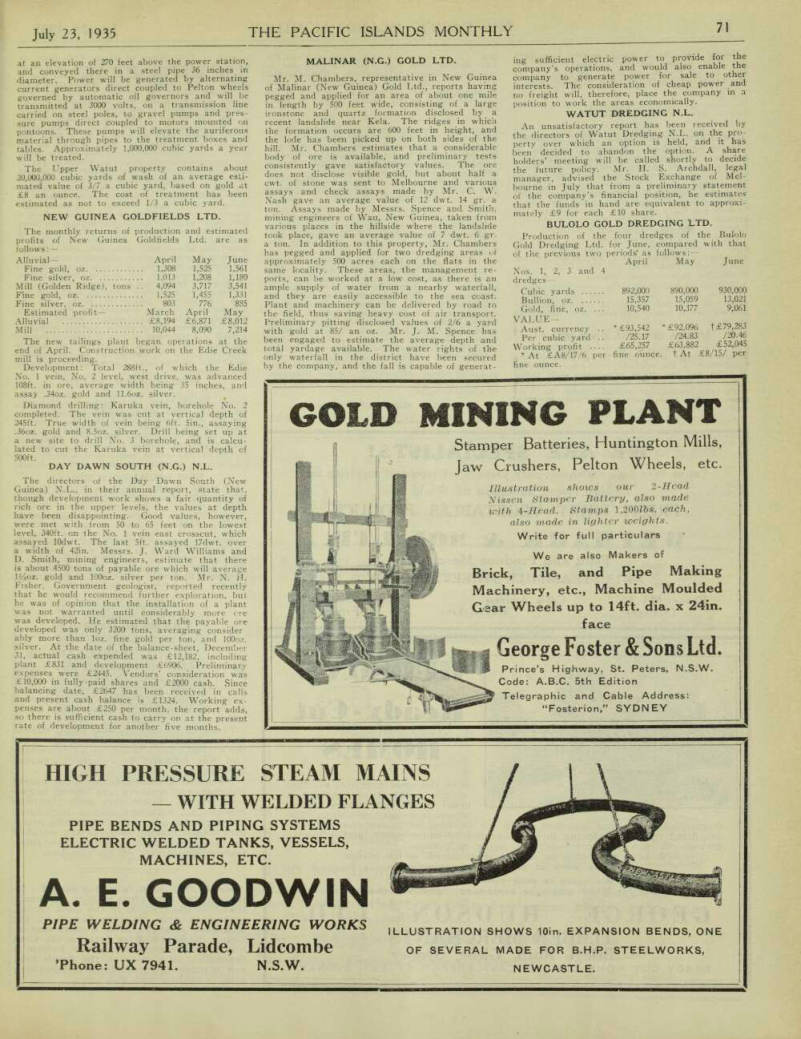
New Morobe Gold, N.L.
Dr. J. R. Athcherley, representative of New Morobe Gold N.L., who recently returned to Mel bourne, has reported to the directors on the pro gress made by the expedition and the interests secured on behalf of the company. Dr. Atcherley reports as follows:—Ornapinka and Yonka Dredgmg Properties: These areas are hydraulic sluicing propositions that can be worked conjointly at a
low cost, and comprise a series of river flats and terraces. The average values are 2/7 a cubic yard, based on gold at £4 an oz. Messrs. Spence and Smith- mining engineers, of Wau, New Guinea have check pitted the areas and have reported values of from 1/4 to 4/2 a cubic yard at the old price of gold. They are now emanating the total yardage available. Wewak: The gold-dredging area of 1000 acres at Wewak, at the junction of the Selling and Nordum rivers, on the north coastal region of New Guinea, which is held under a twelve months’ free working option, is being bored, and first results should be to hand at an early date.
Upper Watut: A free option has been obtained over a large area on the Upper Watut, embracing 13 miles of the river by 15 chains wide. Mr. J. M.
Spence, who has inspected the area on behalf of the company, has posted his preliminary report.
Lower Watut: Dr. Atcherley’s staff pegged approximately 2000 acres of ground, comprising a deep bucket dredging area, which, in the opinion of Messrs. Spence and Smith, is worthy of being tested for gold values. Kela: Approximately two miles of auriferous country has been pegged on the line of reef and adjacent flats. A recent land slide disclosed a large gold-bearing formation After a preliminary test was made and values determined the available portion of the ridge and adjacent flats were pegged. A portion of this area had already been pegged by another company, and the average assay of six samples taken from the adjoining property by Messrs. Spence and Smith gave a result which indicates that the company's property is of considerable value. Dr. Atcherley reports there are many hundreds of thousands of tons partially exposed, which can be worked economically by means of an open cut into the hill.
This gold-bearing formation, as exposed, is approximately 600 feet high, one mile and a half long, and 500 feet wide. Mr. Beecham, the company’s engineer, is tunnelling and costeening the area to discover the extent of the gold-bearing formation.
Mr. J. M. Spence, of Messrs. Spence and Smith,
has been instructed to inspect and report on the property on behalf of the company.
Equatorial Gold Syndicate.
Mr. J. W. McComas, chairman of directors of Equatorial Gold Exploration (New Guinea and Britain) Syndicate N.L., who has returned from New Guinea, reports that he visited the com-
pany’s .areas on the Ramu with Mr. J. M. Spence, who made numerous tests. From these results Mr.
Spence considers the property is a valuable one; that over an area of 3½ miles of the leases the values are so satisfactory that a plan to work this portion should be proceeded with as soon as possible, and in the meantime testing of the bal ance of the area be undertaken by boring on ac count of the depth of wash. Mr. McComas has arranged for Mr. Spence and Mr. Smith to give a full report and advise as to the future of the property. Mr. McComas also investigated the sul phur deposit on Lolobau Island, off New Britain, and reported that the sulphur he was able to in spect on the surface was of excellent quality.
Upper 3Epik Gold Syndicate.
To confer with the directors of Upper Sepik Gold Syndicate N.L., regarding the development of a lode formation at Bainings, New Britain, Mr. H.
Williams, the mining engineer, recently made a hurried trip from New Guinea. This lode, the management reports, is of large dimensions, and dish samples prove gold over a large area. The samples justify the carrying out of the development work recommended. While this development work is being carried out an alluvial proposition over which the company has an option will be tested.
An option on 3000 acres of alluvial ground in the Salamaua district, New Guinea, has been secured on reasonable terms. The ground is reputed to carry values averaging 6/- a yard. It will be tested immediately after No. 1 alluvial proposition on the Upper Watut River is tested.
Platinum Guinea Gold
Directors of Platinum Guinea Gold N.L. regret, in their half-yearly report, that the original object of the company —to investigate New Guinea areas
—failed, but a dredging property in Victoria, which they hope will prove payable, is under con sideration. Half of the company’s capital has been invested in Gold Mines of Fiji N.L., representing 20 shares.
Sandy Creek Gold Sluicing
In a circular to shareholders of Sandy Creek Gold Sluicing Ltd. on June 25, Mr. H. Grey (secre tary) reported that the directors have approved of a hydraulic sluicing scheme (to be known as No. 1 Scheme) which is primarily intended for treating gold bearing gravels on a portion of the bed of Sandy Creek. A water race to fit in with this and probable future proposals has been surveyed and the work of construction is well on the way.
This race bringing water from a position much higher up Sandy Creek to a suitable position above the hydraulic sluicing, and elevating plant for No. 1 Scheme will skirt the hillsides for a considerable distance and will be a kind of costeen traversing from the outset and for the major portion of its length the solid country rock and towards the end a small portion of the alluvial deposits of the Midlothian Breccia Deposits. The construction of this race will, therefore, afford an opportunity to examine for their gold values, reefs which occur in this portion of the country, and the small por tion of the alluvial deposits. An area adjoining Poverty Creek has been chosen for close examina tion and test in the immediate future as the Directors are of the opinion that good values and extensive deposits will be proved there. This por tion of the property may prove to be a valuable and fairly extensive dredging area. It is expected that No. 1 Scheme will be in operation before the end of the present calendar year. Gold recovery will be carried on in the meantime by box sluicing.
Messrs. H. B. Jamieson, H. G. Hyde and J. W.
Hinks, the company’s directors who recently re turned from an inspection of the property in New Guinea are impressed with the potential value of the areas.
Day Dawn (N.G.) Ltd.
To provide funds to continue development opera tions at the Day Dawn mine, commence cyaniding operations and discharge certain liabilities, the directors of Day Dawn (New Guinea) Ltd., New Guinea, have decided to make available to share holders an issue of £8000 10 per cent, debentures, secured by a charge over the assets, to be issued in denominations of £5 each, or multiples thereof, and redeemable in July, 1939, or earlier, at the option of the directors. The company was formed in November, 1929, and has since paid £29,006 in dividends. It is estimated there are available for treatment by cyaniding 36,000 tons of tailings of an assay value of 4 dwt. of gold and 12 oz. of silver a ton. A cyanide plant has been erected at a cost of over £15,000. It is believed the tail ings will return a net profit of 20/ a ton, and a net profit of at least £1000 a month is expected when cyanide operations are started and the plant is properly run in. Liabilities are set down at £6000, of which £3000 is payable at present.
Enterprise Of N. Guinea
The management of Enterprise of New Guinea N.L. received the following radio message early In July:— Forwarded to Melbourne Mint bullion 48¼ oz., being production to June 22. This is from approximately 600 yards, equivalent to 8/9 a cubic yard. Bullion value estimated at £5/10/ an oz.
Serious delay being experienced by influenza epidemic. Machinery arrived at Salamaua. Being transported to Surprise Creek leases.
Upper Watut Gold Alluvials
Upper Watut Gold Alluvials Co. has commenced construction of the water race, a vital part of the hydro-electric scheme, which-is being installed, to develop 1800 h.p. about the centre of its properties on the Upper Watut River. About 400 natives are employed on this work under the supervision of 12 white men. The saw mill is at work cutting timber for staff houses and other structures, and tenders are to be invited for the power plant. It is expected that the scheme of treatment will now be in operation inside 12 months. The source of water supply is Big Slate Creek, a tributary of the Watut River, and observations of the flow on this creek show the minimum flow as 150 cusecs.
There is a large catchment area. The scheme provides for the diversion of about 80 cusecs from the creek about three miles upstream from the power station. The water is to be conveyed to the power station through a concrete lined race, Armco iron fluming on elevated trestles, and four tunnels.
The fall of the race is three feet a mile. The tunnels are to be lined with reinforced concrete pipes, to be manufactured on the site, and a gully is to be traversed by a steel pipe. Safety escape weirs are to be constructed at entrances to tunnels to allow automatically the safe escape of water in the event of a blockage along the race.
The water will be delivered to a steel surge tank
at an elevation of 270 feet above the power station, and conveyed there in a steel pipe 36 inches in diameter. Power will be generated by alternating current generators direct coupled to Pelton wheels governed by automatic oil governors and will be transmitted at 3000 volts, on a transmission line carried on steel poles, to gravel pumps and pres sure pumps direct coupled to motors mounted on pontoons. These pumps will elevate the auriferous material through pipes to the treatment boxes and tables. Approximately 1,000,000 cubic yards a year will be treated.
The Upper Watut property contains about 20,000,000 cubic yards of wash of an average esti mated value of 3/7 a cubic yard, based on gold at £8 an ounce. The cost of treatment has been estimated as not to exceed 1/3 a cubic yard.
New Guinea Goldfields Ltd,
The monthly returns of production and estimated profits of New Guinea Goldfields Ltd. are as follows: —
The new tailings plant began operations at the end of April. Construction work on the Edie Creek mill is proceeding.
Development: Total 288 ft., of which the Edie No. 1 vein, No. 2 level, west drive, was advanced 108 ft. in ore, average width being 35 inches, and assay .34oz. gold and 11.6oz. silver.
Diamond drilling: Karuka vein, borehole No. 2 completed. The vein was cut at vertical depth of 245 ft. True width of vein being 6ft. sin., assaying .36oz. gold and 8.5oz. silver. Drill being set up at a new site to drill No. 3 borehole, and is calcu lated to cut the Karuka vein at vertical depth of 500 ft.
Day Dawn South (N.G.) N.L.
The directors of the Day Dawn South (New Guinea) N.L., in their annual report, state that, though development work shows a fair quantity of rich ore in the upper levels, the values at depth have been disappointing. Good values, however, were met with from 50 to 65 feet on the lowest level, 340 ft. on the No. 1 vein east crosscut, which assayed 10dwt. The last 5ft. assayed 17dwt. over a width of 42in. Messrs. J. Ward Williams and D. Smith, mining engineers, estimate that there is about 4500 tons of payable ore which will average gold and 100oz. silver per ton. Mr. N. H.
Fisher, Government geologist, reported recently that he would recommend further exploration, but he was of opinion that the installation of a plant was not warranted until considerably more ore was developed. He estimated that the payable ore developed was only 3200 tons, averaging consider ably more than 1oz. fine gold per ton, and 100oz. silver. At the date of the balance-sheet, December 31, actual cash expended was £12,182, including plant £831 and development £6906. Preliminary expenses were £2445. Vendors’ consideration was £10,000 in fully-paid shares and £2000 cash. Since balancing date, £2647 has been received in calls and present cash balance is £1324. Working ex penses are about £250 per month, the report adds, so there is sufficient cash to carry on at the present rate of development for another five months.
Malinar (N.G.) Gold Ltd.
Mr. M. Chambers, representative in New Guinea of Malinar (New Guinea) Gold Ltd., reports having pegged and applied for an area of about one mile in length by 500 feet wide, consisting of a large ironstone and quartz formation disclosed by a recent landslide near Kela The ridges in which the formation occurs are 600 feet m height and the lode has been picked up on both sides of the hill . Mr. Chambers estimates that a considerable body of ore is available, and preliminary tests consistently gave satisfactory values The ore does not disclose visible gold but about half a cwt. of stone was sent to Melbourne and various assays and check assays mane oy Mr. C. W.
Nash gave an average value of 12 dwt. 14 gr. a ton. Assays made by Messrs. Spence and Smith, mining engineers of Wau, New Guinea, taken from various places in the hillside where the landslide took place, gave an average value of 7 dwt. 6 gr. a ton. In addition to this property, Mr. Chambers has pegged and applied for two dredging areas of approximately 500 acres each on the flats in the same locality. These areas, the management reports, can be worked at a low cost, as there is an ample supply of water from a nearby waterfall, and they are easily accessible to the sea coast.
Plant and machinery can be delivered by road to the field, thus saving heavy cost of air transport.
Preliminary pitting disclosed values of 2/6 a yard with gold at 85/ an oz. Mr. J. M. Spence has been engaged to estimate the average depth and total yardage available. The water rights of the only waterfall in the district have been secured by the company, and the fall is capable of generat-
ing sufficient electric power to provide for the company’s operations, and would also enable the company to generate power for sale to other interests. The consideration of cheap power and no freight will, therefore, place the company in a position to work the areas economically.
Watut Dredging N.L.
An unsatisfactory report has been received by the directors of Watut Dredging N.L. on the pro perty over which an option is held, and it has been decided to abandon the option. A share holders’ meeting will be called shortly to decide the future policy. Mr. H. S. Archdall, legal manager, advised the Stock Exchange of Mel bourne in July that from a preliminary statement of the company’s financial position, he estimates that the funds in hand are equivalent to approxi mately £9 for each £10 share.
Bulolo Gold Dredging Ltd.
Production of the four dredges of the Bulolo Gold Dredging Ltd. for June, compared with that of the previous two periods' as follows: —
Alluvial — April May June Fine gold, oz 1,308 1,525 1,561 Fine silver, oz 1,013 1,208 1,180 Mill (Golden Ridge), tons 4,094 3,717 3,541 Fine gold, oz 1,525 1,455 1,331 Fine silver, oz 803 776 885 Estimated profit— March April May Alluvial £8,194 £6,871 £8,012 Mill 10,044 8,090 7,214
April May June Nos. 1, 2, 3 and 4 dredges— Cubic yards 892,000 890,000 930,000 Bullion, oz 15,357 15,059 13,021 Gold, fine, oz. ... 10,540 10,377 9,061
Value—
Aust. currency .. *£93,542 *£92,096 t£79,28o Per cubic yard .. /25.17 724.83 Working profit ... £65,257 £63,882 £52,045 * At £A8/17/6 per fine ounce, t At £8/15/ per fine ounce.
During June No. 2 dredge worked nine days practically without revenue, preparing pond for deep digging dredge now being designed and in this period dredged 69,000 cubic yards of tailings.
Advertisements & other items, pp. 71-73 (1 item)
Mining
Latest Revised Courses
INTERNATIONAL
CORRESPONDENCE SCHOOLS
140 tlizabeth Street, Sydney Sirs, — Please send me free prospectus showing how I can succeed in the occupation I have marked.
—GOLD MINING & METALLURGY
—METAL MINING ENGINEERING
PROSPECTING —ASSAYING
—MINING ELECT SURVEYING
——COPPER MINING & METALLURGY
Other New Courses
DIESEL ENG. —WELDING ENG.
—AIR CONDITIONING
—REFRIGERATION —ELEC. FNG
—ELECTRICAL ILLUMINATION
—INTERNAL COMBUSTION —RADIO
Enquiries cost only aid. stamp. Host Now!
Address
STRUCTURAL STEELWORK
DESIGNS BY COMPETENT ENGINEERS
All Classes of Steel Framework and Reinforcement Agents for — EXPANDED METAL FOR CONCRETE AND PLASTER WORK
“PUDLO” FOR WATERPROOFING CEMENT
Send your enquiries to
THE SYDNEY STEEL CO. LTD.
MARRICKVILLE, N.S.W. Cable Address: SYDSTEEL, SYDNEY
MINING PLANT
Portable Batteries, Fixed Batteries, Tube and Ball Mills, Shoes and Dies, Screens, Copper Plates, Trucks, “Challenge*’ Ore Feeders, Rock Crushers, Cyanide Tanks, Pipe Lines, Pumps
PROSPECTING PLANT
Casing, Drilling Tools, Engine Rigs, Sampling Gear, Pumps, Wire Ropes, etc.
DREDGING PLANT
Large or Small Designed and Built Agents for HADFIELD’S Manganese Steel Buckets, Tumblers, Gears, Carbon and Alloy Steels
J. B. WALLIS & CO.
CHALLIS HOUSE SYDNEY
Mining Ore Treatment
Machinery
Complete Cyanide Plants Supplied.
Dorr Classifiers.
Dorr Thickeners.
Dorr Agitators.
Oliver Filters.
Merril Crowe Zinc Dust.
Gold Precipitation.
Richardson Mine Fans.
FANS AND AIR HEATERS
For Ventilation, Copra Drying Rooms, etc.
Enquire from
CROSSLE, DUFF AND
MACINTOSH LTD.
52 Bridge Street, SYDNEY.
EXPLOSIVES,
WATER FILTERS,
MINING MACHINERY
We sell ail classes of explosives and accessories, but for the Island trade we specially recommend our RENDROCK EXPLOSIVE, which can be transported by any steamer as general cargo. RENDROCK is not an explosive until it is required to be used, then a few seconds converts it to a high explosive. It is the most economical explosive on the market, our free Bulletin describing same sent on request. We can supply you with a water filter to give germ-free water of any capacity desired; write us, giving particulars of your requirements. Send us your enquiries for all classes of mining machinery. Our “Curvilinear” Concentrating table shipped to all parts of the world, and we now offer McRICHPALS new Gold and Tin Saving Machine.
Suitable for alluvial working, hand and power operated, this machine is something new, and what you have been looking for. Send for descriptive leaflets.
GUTH RID G E LTD.
10-12 Parramatta Rd., Camperdown, Sydney, N.S.W.
E. A. MARIS
108 MILLER STREET, PYRMONT
Telephone: MW 2296 Mining and General Machinery Merchants
Engineers
5 and 10 Head Mining Batteries, Steam-Driven and Portable Air Compressors—all sizes. Centrifugal and Steam Pumps—Piping from Jin. to 6in. Slack or Gal. Pipe and Air Fittings. 400 Tons of Steel Rails, 14lbs. to 100lbs. (New Condition). 200 Tons Steel Girders (all sizes).
Large Stock of Boilers, Suction Gas and Steam Engines, Winches, Pulleys, Rock-Crushers, Petrol and Crude Oil Engines, Elec. Motors, etc.
Write for Quotations for all types of Mining Machinery.
GOLD MINING PLANT
Stamper Batteries, Huntington Mills,
Jaw Crushers, Pelton Wheels, etc.
Illustration shows our 2-Head Nissen Stamper Battery, also made with 4-Head. Stamps 1,200lbs. each, also made in lighter weights.
Write for full particulars We are also Makers of
Brick, Tile, and Pipe Making
Machinery, etc., Machine Moulded Gear Wheels up to 14ft. dia. x 24in. face
George Foster & Sons Ltd.
Prince’s Highway, St. Peters, N.S.W.
Code: A.B.C. 5th Edition Telegraphic and Cable Address: “Fosterion,” SYDNEY
HIGH PRESSURE STEAM MAINS
WITH WELDED FLANGES
PIPE BENDS AND PIPING SYSTEMS
ELECTRIC WELDED TANKS, VESSELS,
MACHINES, ETC.
A. E. GOODWIN
PIPE WELDING & ENGINEERING WORKS
Railway Parade, Lidcombe
’Phone: UX 7941.
N.S.W.
ILLUSTRATION SHOWS 10in. EXPANSION BENDS, ONE
OF SEVERAL MADE FOR B.H.P. STEELWORKS,
NEWCASTLE.
From Papua
Lakekamu Goldfields Development
Mr. R. A. Clinton, superintending engineer to Lakekamu Goldfields (Papua) Development N.L., has reported on additional bores on the Tiveri leases. Four bores gave values up to 6d a yard.
The average value of the four bores was 4d, and the average depth 19 ft. The plant has been shifted to the main creek (Tiveri main leases). Four bores on bore line No. 1 gave values up to 6/6, and the average value of the four bores was approxi mately 5/ over an average depth of 25 ft.
JULY 3.—Twisty areas, three scout bores put down on bore line No. 1, on Camp Creek, half a mile east of previous bores. Depth 40ft., values /5.5 per cubic yard; 39ft., /8.7; 43ft., 1/10. Length of this line of bores is six chains.
JULY 8. —Advice from prospecting party which left Port Moresby in May states that the pros pectors had reached one of the areas which they had set out to locate, and that scout boring had begun on a large area.
Misima Central Gold N.L.
In their half-yearly report the directors of Misima Central Gold N.L. advise that on the registration of the company four leases—three of 24 acres and one of 14 acres—were held under option from the vendors. Six additional leases have since been pegged and applied for by the com pany, making a total area of acres. Four leases, of 96 acres, are at Ginisea, about a mile east of the leases of New Misima Gold Mines
Ltd., and six leases are at Tomiera, north of the New Misima areas, and is on the same line of lode with similar characteristics. Developmental work is in progress on the areas. Expenditure for the period was £1839, and at the close of the half-year the company had a surplus of liquid assets of £1512.
A report issued recently by the company’s engineer at work on one of the Louisiade leases, states that he expected shortly to cut the lode, which he anticipates will carry good values and be over 12 feet in width. The assay plant is being installed, and work which had been delayed through sickness and want of building material is now pro gressing rapidly. It is definitely established that both the Mt. Sisa lodes run into the Misima North leases, and are practically vertical at the point of entry.
A report from the Ginisea leases said that lodes are proving to be of great width and carrying good values. No. 1 tunnel in 110 ft. entirely in lode.
Crosscut at 20ft. put in at 30ft., and still in lode.
Crosscut at 70ft. put in 12½ft., still in lode. Crosscut at 95ft. put in 41ft., where porphyry footwall struck. Lode principally black manganese rubbly quartz and fine and coarse gold is showing in dish washing. No. 3 tunnel in 103 ft. Lode 12ft. wide has been cut. Expect cut main lode farther in.
No. 4 tunnel in 95ft. Lode is 47ft. wide at present, but hanging wall not yet been reached. No. 5 tunnel in 59ft. Cut 18ft. lode, comprising 2ft. brown, 12ft. black, manganese, and 4ft. red rubbly quartz, followed by 17ft. black lode, and still in lode. Total width without hanging wall reached is 65ft. No. 6 tunnel in 65ft. Lode over 60ft. wide, hanging wall not reached. From this adit assays of 14dwt. obtained. Two other adits com menced. Lode should be cut at 200 ft., giving 250 ft. of workable backs.
Gold Mines Of Papua
After providing £778 for depreciation, expenditure
account of Gold Mines of Papua Ltd. since its inception to March 31, shows a debit balance of £12,928. At the close of the period there was a surplus of liquid assets of £7868. Exploration work on Misima Island, the directors report, has been carried on continuously with encouraging results.
The extent of work in the various drives amounts to 3300 feet, of which 1000 feet has been in ore.
The average width is 7 feet, of an average value at the present price of gold of 46/ a ton. The property is being developed from 14 adits at five separate horizons between the bed of the creek and the crown of the ridge, a vertical height of 8000 feet. In several of the workings the value of the ore is of much higher grade than the general average. Values appear to be increasing, and the directors believe a sufficiently large tonnage is indicated to eventually warrant equipment. Con sideration is being given to the installation of a pilot plant with a view to determining the most economical method of treatment. The erection of plant to treat the sands and slimes on Woodlark Island has almost been completed, and it is ex pected that production will commence next month.
The company has taken an option over an alluvial area of approximately 600 acres of dredgable land on Woodlark Island, said to contain payable values.
Arrangements have been made to scout bore the area. During the period the option over the Kulumadau lode was exercised, to comply with the terms of which a development company, Wood lark Gold Mines Ltd., with a nominal capital of £10,000, was registered at Port Moresby in December last. The work of prospecting this lode is progressing, and although results are encouraging, no forecast of results or values can be estimated at this stage.
Yodda Goldfields Ltd.
Though production of Yodda Goldfields Ltd., Papua, for the first five months was less than anticipated, being 230oz. bullion to the end of January, the directors report that the yields in creased in the next five months, being February 53oz., March 66oz., April 59oz., May 60oz., and June 70oz. The average of more than 60oz. per month for this period would show a profit over the expenses, which average about £350 per month.
New Misima Gold Mines
Mr. F. W. Cuthbert, managing director of New Misima Gold Mines Ltd. reported as follows on June 8: About 1259 tons of ore were put through the mill in May, yielding 954 tons of sand and 305 of slime for gold bullion of approximate value in Australian currency of £2601/15/3. Mine work has been carried on as usual, main levels have been extended 90 feet, rises 108 feet, cross-cuts 57 feet. Repairs to main levels 108 feet. Owing to Co.’s good financial position the monthly dividend has now been increased from 1/6 to 2/-.
Curias at Rabaul
Rabaul, July 12.
PROBABLY the severest gurias (earth tremors) ever felt at Rabaul, New Guinea, were experienced on the after noon of July 8. Tremors were reported to have been felt over a radius of 30 miles.
Preceded by a rumbling noise, similar to thunder, five separate shocks disturbed the capital. Each lasted for a few seconds and was followed by sustained swaying movement.
No material damage was done, except for shattered crockery and broken house hold effects. Motor cars parked outside commercial buildings moved backwards and forwards. In one of the clubs mem bers ceased playing billiards and watched the balls careering up and down the tables, rebounding queerly off the cushions.
Mr. R. D. Frisbie, who has lived for 15 years as the only white man on the lonely island of Puka Puka, in the Cook Group, arrived at Apia, Western Samoa by the Makoa on June 17. After a short stay on Samoa, he departed for America via Van couver by the Sheafholme. Mr. Frisbie is the author of a book on the South Seas and of numerous magazine and newspaper articles dealing with Polynesia.
Advertisements & other items, p. 74 (1 item)
Hudson’S
WE ARE SPECIALISTS!
Let us have your confidence, sixty years is our record of supplying the Leading Houses throughout the World in—
FRESH FRUIT VEGETABLES PRODUCE
WEYMARK & SON LTD.
Fruit and Produce Merchants
14-18 STEAMMILL STREET, SYDNEY
Phone: MA 3612 Cable Address: Codes Bentleys. (4 lines) "Weymarkion' Private.
HUDSON’S
Ready Cut
HOMES
offer the most practical solution of the problem of erecting a home in districts where skilled labour is difficult to obtain. The cut and prepared ready for erection, all doors and windows framework is cut and prepared ready for erection, all doors and windows are fitted ready for placing in position, and verandah posts, plates, architraves, etc., are prepared ready for fixing in position.
A very efficient plan service is rendered, which makes the work of erection very simple.
We quote to your own or any design.
Send for latest catalogue containing many new designs.
GEORGE HUDSON LTD.
TIMBER MERCHANTS
Bridge Road, Glebe, Sydney
READY CUT HOME DEPT.: 7 CASTLEREAGH STREET, SYDNEY
Housekeeping in the Tropics
Conducted by “Dorothea"
SEVERAL correspondents have drawn attention to “’flu” epidemics in the Pacific. Medical men strongly advise all sufferers to continue their daily dose of quinine without fail—that is one of the salient points to remember with coughs and colds in the tropics. Never omit your quinine.
Medical men say also that ’flu attacks are often confused with malaria attacks, and vice versa.
Influenza, in its very infectious epidemic form, usually takes from one to four days to develop, and, when once established, may last for ten days. Its onset is sud den. There is a general aching, the tem perature is raised, and there may be alternating feverish and shivering attacks, sore throat, cough, and maybe general symptoms of a cold in the head. The temperature usually remains high for a few days, and then returns to normal, leaving the patient feeling extremely weak. Influenza may attack the respira tory, alimentary, or nervous system, but the above may be taken as the common variety. The chief complications to be guarded against are heart affections, pneumonia, and occasionally ear troubles.
Heart complications should be emphasised.
Patients are often over-anxious to re sume their work too soon after an attack of influenza, with the result that undue strain is put upon an already weakened heart muscle.
In all cases of colds or influenza it is advisable to administer 5 to 10 grains of quinine three times daily for two days, as so many cases of illness in the tropics are due to a weakened resisting power,
caused by the malarial germs. If this is done, and the cold, dysentry, or illness then treated in the ordinary way, a more rapid recovery is assured.
If you should contract the disease, do not fight against it. Go to bed at once, and undergo proper treatment.
Hints for Islands Housekeepers
On Pins And Needles
Put a small quantity of talcum powder in a tin which has a tightly-fitting lid, and in this keep your pins and needles. They will not rust if the tin is shaken occasionally, and will also be smoother to use on materials.
Needles and pins which are already rusty should be pierced into a cake of sand soap several times, then rubbed on emery paper.
Needles not to be used for some time may be kept in a small bottle (an empty junket tablet bottle is good) filled with oil.
If a needle feels sticky when in use, pass it through a thick strand of your hair.—Prize to “Judy S.,” Samarai, Papua.
Recipe For Coconut Pie
With so many fresh coconuts available perhaps the housekeeper would like to try this one on her menu.
Coconut Pie.—Two eggs, two cups of sugar, one cup of grated coconut, one cup milk, one teaspoon vanilla and a pinch of salt. Add coconut to milk and let stand for one hour. Beat the sugar and eggs and salt together, until very light. Add vanilla and milk with coconut. Turn into a pie-dish lined with pastry and bake forty minutes in a moderate oven.—Prize to Mrs. Harvey, Bain-
ings, Rabaul.
Banana Cream
Take gelatine, 3 bananas, 1 pint of canned miik, 2 eggs, vanilla essence. Soak the gela tine in with the milk for two or three hours, then stir over the fire until thoroughly dissolved.
Pour the milk on to the beaten yolks of two eggs; return to the pan and stir until the mix ture thickens, but do not let boil. Let it cool, then add the vanilla essence (to taste) the peeled and thinly-sliced bananas, and the whites of the eggs, beaten to a stiff froth. Stir gently until the mixture shows signs of setting, then pour into a wetted mould, and put in Icyball. I find 4 tablespoonsful of canned milk to pint of water (good measure) is about right for all cooking, etc. —Acknowledgment to Mrs. R. Hill, Fera, Ysabel, Solomon Islands.
Pickle For Pig Or Goat
This useful recipe may be welcome for pickling in the Tropics.
Put two gallons of water into a clean kero sene tin, then add two pounds of salt, one-and-a half cups of sugar, half tablespoon bi-carbonate of soda, half tablespoon saltpetre.
Stir till partly dissolved, then-put in the meat and put on the fire, bring to boil and boil for five minutes. Take away and store in a cool place; see all meat is below the brine; cover with wet bag. When the meat is required for use, boil as usual, according to the size of joint.— Acknowledgment to Mrs. Harvey, Bainings, Rabaul.
It Happened One Day
(Prize to “Bukit Bahrum,” Wau, N.G.)
WE were expecting important guests for dinner, and my husband suggested we include in our menu our famous rum omelette.
I duly gave instructions to my cook boy.
The first part of the dinner proceeded amid much jollity, then Beisa, resplendent in a milk-white lap-lap, with our initials embroidered in red on one corner, arrived with the omelette.
“Ah!” exclaimed our guests, “we heard
of your omelette many miles before we landed here!”
Hubby duly served the omelette, and we proceeded. Then —discreet laying aside of forks. I looked, then tasted. Imagine my horror when I discovered it was satur ated with methylated spirits!
I called Beisa: “What fella name you burn on this kai-kai?”
“E alia same one fella rum, e burn alia same; me no find d’key kai-kai house (store room); me pour one fella lamp— allee same!”
Mercifully, my guests had a sense of humour!
Rev. Father J. M. Oreve, S.M., of the Marist Mission at Suva, arrived in Sydney from Fiji by the Monterey on July 15. He was accompanied by Rev. L. Lejeune, of Cawaci, Ovalau Island, and Rev. D. Des table, of Bemana, Viti Levu.
Mr. Roy Field, a well-known resident of Papua, who has been for many years on the staff of Burns, Philp and Cos., Ltd., at Port Moresby, left on July 2 for the Lake kamu goldfield to take up a position with Guinea Gold, N.L.
Advertisements & other items, pp. 75-76 (1 item)
High-Grade Metal Beds & Cabinets
Manufactured in Australia by
FORSTER’S RFDSTFADS
LIMITED
An excellent storage cabinet, fitted with adjustable shelves, adaptable to any storage purpose and particularly recommended for hospitals. Can be safely locked against theft, dust, and vermin.
A cheap combination metallic bedstead, manufactured specially for tropical conditions. Made in all sizes, diamond or woven web.
A handsome steel locker.
Made in single units, in rows against the wall, or back to back down centre of room.
Can be installed in any part desired to fit space and needs.
ALSO MANUFACTURERS OF
Chairs and Furniture, Wire Mattresses, Ice-chests, Refrigerator Cabinets (Commercial and Household), Ships’ All-metal Berths, Steel Shelving, Steel Office Equipment, Hospital Furniture
Porcelain Enamelling, etc.
FORSTER’S REDSTEADS LIMITED
Mary Ann Street, Ultimo, Sydney, Australia.
Codes: Bentley’s and Private.
Cables: “BEDSTEADS,” Sydney.
paint.
IN PASTE OR READY
MIXED FORM
Made in Scotland Thomas Macintyre & Co.
BRAND
WHITE LEAD, WHITE ZINC,
AND ALL COLOURS
—therefore Reliable!
Ltd GLASGOW, SCOTLAND
COPRA MATS AND MATTING
Send your enquiries to us for Woven Wire Mesh in Rolls or framed for Screening purposes, Bird Cages, Sieves and Riddles, Builder’s Gravel Door Mats, Garden Arches, Chain Wire Mesh, Crimped Wire Mesh for
SCOTT AND SONS
WIREWORKS: RAILWAY PARADE AND MURRAY STREET,
Copra drying, and all Screens, Rat Traps, Window Guards, etc.
MARRICKVILLE
“Invincible” and “Duralife”
ALUMINIUM WARE
MANUFACTURED BY
c. R. Byrne
EST.
1925 187-9 William Street, Bankstown, N.S.W.
Island Traders apply for Price Lists and Agency Terms
SKANDIA ENGINES
MARINE & STATIONARY
FULL DIESEL. SEMI DIESEL.
Reliable Efficient Economical Immediate Starting on Crude Oil Low Fuel Consumption Force Feed Circulating Lubrication
TYPES FOR ALL BOATS
NELSON & ROBERTSON
12 Spring Street, Sydney Particulars from:
N.G. Public Service
STAFF appointments, transfers, etc., notified in Bulletin No. 40, issued by the N.G. Adminis tration, on June 30, were: —
Appointments
F. H. Moy, Cadet; R. S. McPherson, Assistant Teacher; R. J. McConnell, Clerk, Govt. Secre tary’s Dept.; K. M. Chambers, Customs Clerk; G.
E. Ballam, Surveyor; E. W. Oakley, Acting Dis trict Officer.
Transfers
Customs Dept.; J. D. Marshall, Clerk, Rabaul to Salamaua; F. G. Palfreyman, Clerk, Salamaua to Rabaul; H. P. Seale, Clerk, Rabaul to Lae.
District Services Dept.: T. L. McAdam, D.O., Rabaul to Kavieng; H. A. Gregory, A.D.O., Kavieng to-Rabaul; F. H. Moy, Cadet, Rabaul to Kieta; E. T. Fulton, Clerk, Madang to Rabaul; S. H. Filan, Clerk, Rabaul to Wewak; A. C. Kos key. Clerk. Rabaul to Kokopo; K. C. McMullen, A.D.O., Rabaul to Kokopo; M. B. Pickering, Clerk, Kavieng to Rabaul; C. D. Bates, P.O., Salamaua to Wau.
Govt. Secretary’s Dept.: R. S. McPherson, As sistant Teacher, Rabaul to Kavieng.
Lands Dept.: H. J. Badger, Chainman, Wau to Salamaua; A. W. Ardlie. Surveyor. Rabaul to Kavieng; H. Taylour, Warden, Wau to Sala maua: E. R. Hale, Chainman, Rabaul to Kavieng; G. D. Cowdery, Chainman, Rabaul to Wau; G. E.
Ballam, Surveyor, Wau to Salamaua.
Public Health Dept.; A. V. G. Price, Rabaul to Kieta; A. E. Ewing, Madang to Rabaul; A.
E. Wilkinson, Gasmata to Rabaul; W. N. S.
Couzens, Rabaul to Madang; C. B. Walsh, Wau to Salamaua.
Public Works Dept.: E. F. Donovan, Carpenter, Rabaul to Kavieng.
Temporary Appointments
Miss A. G. Evans, Typiste, Dept, of Agricul ture; J. Lyall, Carpenter, District Services Dept.; Miss E. Protheroe, Nurse, Health Dept.; C.
Darbyshire, Draftsman, Titles Dept.
N.G. Police Force
D. Crawley appointed Warrant Officer, 2nd class; H. C. Gridley promoted from Ist class- Warrant Officer to Inspector; H. Gpromoted from 2nd class Warrant Officer to 1st class Officer; E. Steeples, Inspector, transferred from Rabaul to Wau.
Makoa Visits Wallis Is.
From Our Own Correspondent.
APIA, July 6.
MESSRS. BURNS PHILP’S auxiliary schooner Makoa (Captain Doughty) returned to Apia from a trip to Swain’s Island and the Tokelau Islands on July 1, carrying a full load of copra. The vessel left again on July 4 for Wallis.
Island, a French possession to the north east of Fiji which has been without communication with the outside world for some considerable time and where Messrs. Burns Philp maintain a trading station.
Passengers on the Makoa to Wallis Island were Rev. Father Schwer, of the Roman Catholic Mission. and three Samoan catechists who will complete their training at the Central Training School and Seminary of the mission at Wallis Island. Another passenger was Mrs. May, whose husband is taking over the management of Messrs. Burns, Philp’s branch at Wallis from Mr. Jones.
For Papuan Coastal Shipping
From Our Own Correspondent.
Port Moresby, July 3.
THE Steamships Trading Co. Ltd., of Papua, in July, purchased the “Maira,” a 35-ton boat with a new 4-cylinder 5 h.p. Diesel engine, made by Petters. The vessel is about a year old, and should be very handy on the Papuan coast.
The Company is also fitting a Diesel Fetter engine (85 h.p., 4-cylinder) to the old “Veimauri,” which has given much valuable service on the coast.
The same Company has just placed a contract with the Kwato shipyards for three shelling luggers, which are to be delivered within the next three or four months.
Cocoa In New Guinea
WRITING from London, Mr. J. E. Nixon Westwood makes some interesting comments on the attempt to establish the cocoa growing industry in New Guinea.
The writer emphasises the need for proper training of planters who undertake this particular crop. “Cocoa is an entirely dif ferent production to copra or rubber,” he says. “Temperatures, altitudes, winds and soil sanitation take a far greater toll than in either of the two above mentioned.
Diseases and how to treat them, pruning, cutting back and picking are all jobs for practical men, which take years to learn."
Expedition is Postponed
Captain Dyott
DYOTT, who was to have led an exploring and scientific expedition into New Guinea and Papua, has post poned his enterprise for a time.
In a letter from London to the Editor of the P.I.M., Capt. Dyott says that he has been informed by the Commonwealth Gov ernment that the Sepik-Mt. Hagen area of New Guinea has been closed against all Europeans and in those circumstances he felt it would be no use bringing his expedition to Australia. They had in tended to leave at the end of May for Sydney, but they cancelled all arrangements. Capt. Dyott expresses surprise that the New Guinea Administration should regard the area as dangerous; “but,” he adds, “I presume they know their business —although I think a well organised expedition would have been useful in re-establishing friendly rela tions.”
In the interim, Captain Dyott is lead ing a short expedition to Ecuador, but he hopes to carry out his New Guinea project on his return.
Early History of Fiji Gold
WE have received from a correspondent at Tavua, Fiji, a correction of an article which appeared in the June issue entitled “Fiji Gold —Description of Tavua Field.” The writer of the article refers to “the 30 acres which Messrs. Costello reserved for themselves when they sold the Emperor and Koroere to the Theodore Group.”
Our correspondent remarks: “This is quite wrong. The Emperor mine was originally owned by the Lololeru Private Prospecting Syndicate—the first syndicate to be formed in connection with the Tavua fields. It was comprised of three local men, i.e., Messrs. G. C. Foulis, H. L. Mor ton, and H. J. Stevens, who pegged it out in the very earliest days of the field. Subsequently this syndicate sold the Emperor to the Theodore group, retaining an inter est which they still hold.”
Laka’S Letter
DOES anyone in Papua know Francis Emanual Laka?
A man unpacking bales of rubber in a Melbourne factory found a letter, addressed simply “Working man,” and dated January 13.
“Dear Sir,” it ran, “on Sunday morning we got 13 bales. We got plenty rubber trees here in Papua. We got plenty stations in Papua. Some B.P.’s and some stations far away from bush. Some white men live in the bush. That’s all. —Francis Emanual Laka.
“I am working in Hikinumu.”
Mr. Charles J. Thompson, assistant en gineer in the Fiji Works Department, died at Lautoka in June, from heart seizure following influenza. Joining the department in 1914, he served at Lautoka, Ra, and Suva, where he was in charge of the construction of the Colonial War Memorial Hospital. He was appointed as sistant engineer in 1927; but recently had been acting as assistant to Mr. A. A.
Ragg (Assistant Director of Works).
“Dreadful People”
A PORT MORESBY correspondent is caustic.
“The Australian coastal liner Katoomba, which has extended her North Queensland pleasure cruise to Port Moresby, came in early in July with 400 or more tourists — some of them most dreadful people, about whom the less said the better. We enter tained two of them —and we haven’t re covered yet.
“If this Papuan town is going to be sub jected to this sort of thing I think some official notice should be taken of it. It is bad enough for us Europeans, but the really serious aspect is the effect upon the natives of these irresponsible people from down-under.”
Crown Lands In Samoa
From Our Own Correspondent.
APIA, July 5.
LATELY a number of bush land plots, belonging to the New Zealand Reparation Estates, have been leased on reasonable terms and conditions to local residents. The land is suitable for banana cultivation and is to be used mainly for that purpose.
Commencing next April, two steamers monthly are to load bananas here for the New Zealand market, so that there is plenty of scope for banana growers. The policy of the Reparation Estates in mak ing Crown lands available in small plots and on liberal terms to local people is welcomed.
Advertisements & other items, p. 77 (1 item)
Oilskin Coats
Coles
Regalia
Sydney
ALF. H. J. COLES
Established 1920.
Masonic Regalia, Jewels and General Requisites.
Master Masons’ Aprons 42/- and 457- Leather Regalia Cases, 16-inch, from 16/6 P.M, Jewels a Speciality.
Inquiries Solicited :: Prices Australian Currency
Room 19, Royal Arcade, Sydney
ISLAND HOME BUILDERS.—You can now
erect everlasting Homes quickly and at LOW COST by using DURABESTOS (Asbestos Cement) Building Sheets for Walls and Ceilings.
Big. sturdy sheets —economical to transport — easy to fix —fireproof—does not need painting.
Write for prices and Free Catalogue, “Durabestos Homes of Colourful Beauty,” WUNDERLICH LTD..
Box 474 AA, G.P.O., SYDNEY.
RESISTS TIME-WEATHER
Oilskin Coats
FOR LONG, HARD WEAR ANYWHERE
This special line will not stick, crack or perish in the hottest climates, and some have stood eleven years’ continuous wear.
A Special Model in Any Size for Any Purpose The Wearers of a Hughes Oilskin are our advertisement.
THE
BEST
QUALITY
OILSKINS
MADE
and Guaranteed by the Manufacturer Write for Catalogue and Price Lists
A. J. HUGHES,
121 REGENT STREET, SYDNEY
Market Quotations
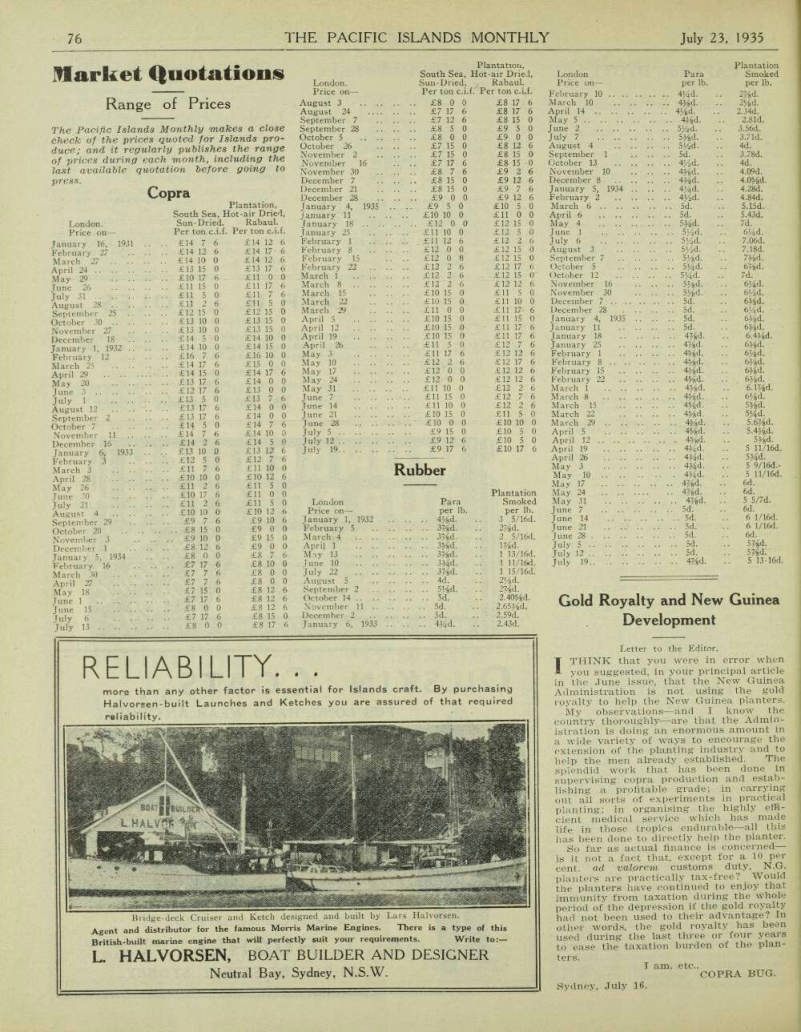
Range of Prices
The Pacific Islands Monthly makes a close check of the prices quoted for Islands pro duce; and it regularly publishes the range of prices during each month, including the last available quotation before going to press.
London. Price on —
Copra
Plantation, Hot-air Dried, Rabaul. Per ton c.i.f.
South Sea, Sun-Dried. Per ton c.i.f.
January 16, 1931 £14 7 6 £14 12 6 February 27 .. .. £14 12 6 £14 17 6 March 27 .. .. .. .. £14 10 0 £14 12 6 April 24 .. .. £13 15 0 £13 17 6 May 29 ... .. .. £10 17 6 £11 0 0 June 26 -. .. .. .. £11 15 0 £11 17 6 July 31 .. .. .. .. .. £11 5 0 £11 7 6 August 28 .. .. .. .. £11 2 6 £11 5 0 September 25 .. .. £12 15 0 £12 15 0 October 30 .. .. .. £13 10 0 £13 15 0 November 27 .. .. £13 10 0 £13 15 0 December 18 £14 5 0 £14 10 0 January 1, 1932 .. .. .. £14 10 0 £14 15 0 February 12 .. .. £16 7 6 £16 10 0 March 25 .. .. .. .. £14 17 6 £15 0 0 April 29 £14 15 0 £14 17 6 May 20 ... .. .. £13 17 6 £14 0 0 June 3 .. .. £12 17 6 £13 0 0 July 1 ... .. .. £13 5 0 £13 7 6 August 12 .. .. .. .. £13 17 6 £14 0 0 September 2 .. .. £13 17 6 £14 0 0 October 7 .. .. .. .. £14 5 0 £14 7 6 November 11 .. .. £14 7 6 £14 10 0 December 16 .. .. £14 2 6 £14 5 0 January 6, 1933 .. .. £13 10 0 £13 12 6 F ebruary 3 .. £12 5 0 £12 7 6 March 3 ... .. .. £11 7 6 £11 10 0 April 28 ... .. .. £10 10 0 £10 12 6 May 26 ... .. .. £11 2 6 £11 5 0 June 30 .. .. £10 17 6 £11 0 0 July 21 .. .. .. £11 2 6 £11 5 0 August 4 .. .. £10 10 0 £10 12 6 September 29 ... £9 7 6 £9 10 6 October 20 .. . £8 15 0 £9 0 0 November 3 .. .. £9 10 0 £9 15 0 December 1 .. .. £8 12 6 £9 0 0 January 5, 1934 ... £8 0 0 £8 7 6 February 16 .. .. £7 17 6 £8 10 0 March 30 ... £7 7 6 £8 0 0 April 27 ... £7 7 6 £8 0 0 May 18 .. .. .. .. £7 15 0 £8 12 6 June 1 .. .. £7 17 6 £8 12 6 June 15 -. .. ... £8 0 0 £8 12 6 July 6 .. .. .. £7 17 6 £8 15 0
July 13
... £8 0 0 £8 17 6
London Price on — Para per lb.
Plantation Smoked per lb.
February 10 . .. 4^d. 2?id.
March 10 .. 4*id. 2/gd.
April 14 .. 4%d. 2.34d.
May 5 . .. 454$d. 2.81d.
June 2 .. 5/ 2 d. 3.56d.
July 7 . .. 5Hd. 3.71d.
August 4 . .. Stfd. 4d.
September 1 . .. 5d. 3.78d.
October 13 . .. 4/ 2 d. 4d.
November 10 . .. 4#d. 4.09d.
December 8 . .. 4Vsd. 4.05-id.
January 5, 1934 . .. V/ 4 d. 4.28d.
February 2 . .. 4J/ 2 d. 4.84d.
March 6 . .. 5d. 5.15d.
April 6 . .. 5d. 5.43d.
May 4 . .. 5Ud. 7d.
June 1 .. .. 5/ 2 d. 654d.
July 6 . .. 5^d. 7.06d.
August 3 ... . .. 5j/ 2 d. 7.18d.
September 7 .. .. 5/ g d. md.
October 5 .. .. 5-4d. md.
October 12 . .. 5J4d. 7d.
November 16 .. .. 5^d. 6^d.
November 30 .. .. 3'Ad. 6/ 2 d.
December 7 .. .. 5d. 6Hd.
December 28 6/4d.
January 4, 1935 .. .. 5d. 65id.
January 11 .. .. 5d. 65id.
January 18 .. .. 4^d. 6.45id.
January 25 .. .. md. 65id.
February 1 .. .. 4^d. 6^id.
February 8 .. .. 45id. 65-id.
February 15 .. .. 43/gd. 65id.
February 22 .. .. 4V»d. 65-id.
March 1 .. .. 4S/ S d. 6.1?id.
March 8 .. .. 4§4id. 6j-id.
March 15 .. .. 45-id.
S^gd.
March 22 .. .. 4^d. 5/4d.
March 29 .. .. 4Hd. 5.6?id.
April 5 .. .. 45-id. 5.45id.
April 12 .. . 45/id. 55id.
April 19 .. .. 454d. 5 ll/16d.
April 26 .. .. 454d. sy 4 d.
May 3 .. .. 4V 4 d. 5 9/16d.- May 10 .. . 4V 4 d. 5 ll/16d.
May 17 .. .. VAd. 6d.
May 24 .. VAd. 6d.
May 31 .. . . 47/gd. 5 5/7d.
June 7 .. .. 5d. 6d.
June 14 .. .. 5d. 6 l/16d.
June 21 .. .. Sd. 6 l/16d.
June 28 .. .. 5d. 6d.
July 5 .. .. 5d.
S?id.
July 12 .. .. 5d. 5^d.
July 19 .. .. 4%d. 5 13-16d.
Plantation, Hot-air Dried, Rabaul. Per ton c.i.f.
South Sea, Sun-Dried, Per ton c.i.f.
London. Price on — August 3 .. £8 0 0 £8 17 6 August 24 .. £7 17 6 £8 17 6 September 7 .. £7 12 6 £8 15 0 September 28 .. £8 5 0 £9 5 0 October 5 .. £8 0 0 £9 0 0 October 26 .. £7 15 0 £8 12 6 November 2 .. £7 15 0 £8 15 0 November 16 .. £7 17 6 £8 15 0 November 30 .. £8 7 6 £9 2 6 December 7 . .. £8 15 0 £9 12 6 December 21 , .. £8 15 0 £9 7 6 December 28 . .. £9 0 0 £9 12 6 January 4, 1935 .. £9 5 0 £10 5 0 January 11 .. £10 10 0 £11 0 0 January 18 . .. £12 0 0 £12 15 0 January 25 £11 10 0 £12 5 0 February 1 £11 12 6 £12 2 6 February 8 .. £12 0 0 £12 15 0 February 15 .. £12 0 0 £12 15 0 February 22 £12 2 6 £12 17 6 March 1 .. £12 2 6 £12 15 0 March 8 £12 2 6 £12 12 6 March 15 .. £10 15 0 £11 5 0 March 22 .. £10 15 0 £11 10 0 March 29 £11 0 0 £11 17 6 April 5 .. £10 15 0 £11 15 0 April 12 .. £10 15 0 £11 17 6 April 19 £10 15 0 £11 17 6 April 26 .. £11 5 0 £12 7 6 May 3 £11 17 6 £12 12 6 May 10 .. £12 2 6 £12 17 6 May 17 .. £12 0 0 £12 12 6 May 24 .. £12 0 0 £12 12 6 May 31 £11 10 0 £12 2 6 June 7 £11 15 0 £12 7 6 June 14 £11 10 0 £12 2 6 June 21 £10 15 0 £11 5 0 June 28 £10 0 0 £10 10 0 July 5 £9 15 0 £10 5 0 July 12 £9 12 6 £10 5 0 July 19 £9 17 6 £10 17 6
Rubber
Plantation Smoked per lb.
London Price on — Para per lb.
January 1, 1932 4y a d. 3 5/16d.
February 5 3ftd. .. 27^d.
March 4 3Hd. 2 5/16d.
April 1 3#d.
VAd.
May 13 m d. 1 13/16d.
June 10 3^d. 1 ll/16d.
July 22 V/sd. 1 15/16d.
August 5 .. 2%d.
September 2 5 Mid. ■ • 27^d.
October 14 5d. 2.40Hd.
November 11 5d. 2.65^d.
December 2 5d. 2.59d.
January 6, 1933 4^d. 2.43d.
Development
Gold Royalty and New Guinea Development
Letter to the Editor.
I THINK that you were in error when you suggested, in your principal article in the June issue, that the New Guinea Administration is not using the gold royalty to help the New Guinea planters.
My observations —and I know the country thoroughly—are that the Admin istration is doing an enormous amount in a wide variety of ways to encourage the extension of the planting industry and to help the men already established. The splendid work that has been done in supervising copra production and estab lishing a profitable grade; in carrying out all sorts of experiments in practical planting; in organising the highly effi cient medical service which has made life in those tropics endurable —all this has been done to directly help the planter.
So far as actual finance is concerned— is it not a fact that, except for a 10 per cent, ad valorem customs duty, N.G. planters are practically tax-free? Would the planters have continued to enjoy that immunity from taxation during the whole period of the depression if the gold royalty had not been used to their advantage? In other words, the gold royalty has been used during the last three or four years to ease the taxation burden of the plan ters.
I am, etc.,
Copra Bug.
Sydney, July 16.
Advertisements & other items, p. 78 (1 item)
Neutral Bay, Sydney, N.S.W.
RELIABILITY. . .
more than any other factor is essential for Islands craft. By purchasing Halvorsen-built Launches and Ketches you are assured of that required reliability.
Bridge-deck Cruiser and Ketch designed and built by Lars Halvorsen.
Agent and distributor for the famous Morris Marine Engines. There is a type of this British-built marine engine that will perfectly suit your requirements. Write to:—
L. HALVORSEN, BOAT BUILDER AND DESIGNER
Neutral Bay, Sydney, N.S.W.
Islands Produce
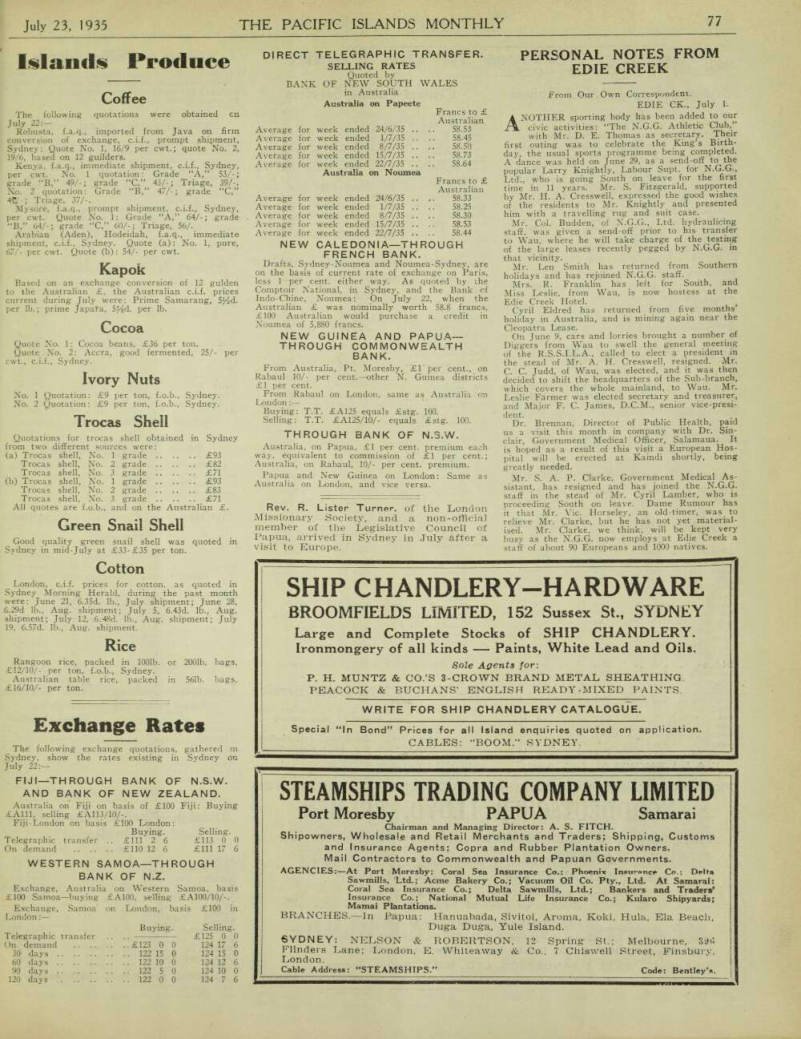
Coffee
The following quotations were obtained on July 22: Robusta, f.a.q., imported from Java on firm conversion of exchange, c.i.f., prompt shipment, Sydney: Quote No. 1, 16/9 per cwt.; quote No. 2, 19/6, based on 12 guilders.
Kenya, f.a.q., immediate shipment, c.i.f., Sydney, per cwt. No. 1 quotation: Grade “A,” 53/-; grade “B,” 49/-; grade “C,” 43/-; Triage, 39/-.
No. 2 quotation: Grade “B,” 47/-; grade “C,” 4f/-; Triage, 37/-.
Mysore, f.a.q., prompt shipment, c.i.f., Sydney, per cwt. Quote No. 1: Grade “A,” 64/-; grade “B,” 64/-; grade “C,” 60/-; Triage, 56/.
Arabian (Aden), Hodeidah, f.a.q., immediate shipment, c.i.f., Sydney. Quote (a): No. 1, pure, 67/- per cwt. Quote (b): 54/- per cwt.
Kapok
Based on an exchange conversion of 12 gulden to the Australian £, the Australian c.i.f. prices current during July were; Prime Samarang, 5½d. per lb.; prime Japata, 5⅝d. per lb.
Cocoa
Quote No. 1: Cocoa beans, £36 per ton.
Quote No. 2: Accra, good fermented, 25/- per cwt., c.i.f., Sydney.
Ivory Nuts
No. 1 Quotation; £9 per ton, f.o.b., Sydney.
No. 2 Quotation; £9 per ton, f.o.b., Sydney.
Trocas Shell
Quotations for trocas shell obtained in Sydney from two different sources were: (a) Trocas shell. No. 1 grade £93 Trocas shell, No. 2 grade £82 Trocas shell. No. 3 grade £71 (b) Trocas shell. No. 1 grade £93 Trocas shell, No. 2 grade £83 Trocas shell, No. 3 grade £71 All quotes are f.o.b., and on the Australian £.
Green Snail Shell
Good quality green snail shell was quoted in Sydney in mid-July at £33-£35 per ton.
Cotton
London, c.i.f. prices for cotton, as quoted in Sydney Morning Herald, during the past month were: June 21, 6.35d. lb., July shipment; June 28, 6.29d lb., Aug. shipment; July 5, 6.43d. lb., Aug. shipment; July 12, 6.48d. lb., Aug. shipment; July 19, 6.57d. lb., Aug. shipment.
Rice
Rangoon rice, packed in 100lb. or 200lb. bags, £1/10/- per ton, f.o.b., Sydney.
Australian table rice, packed in 56lb. bags, £1/10/- per ton.
Exchange Rates
The following exchange quotations, gathered in Sydney, show the rates existing in Sydney on July 22:
Fiji—Through Bank Of N.S.W.
And Bank Of New Zealand.
Australia on Fiji on basis of £100 Fiji: Buying £A111, selling £A113/10/-.
Fiji-London on basis £100 London;
Western Samoa—Through
Bank Of N.Z.
Exchange, Australia on Western Samoa, basis £100 Samoa—buying £A100, selling £A100/10/-.
Exchange, Samoa on London, basis £100 in London: —
Direct Telegraphic Transfer.
Selling Rates
Quoted by
Bank Of New South Wales
in Australia
New Caledonia—Through
French Bank.
Drafts, Sydney-Noumea and Noumea-Sydney, are on the basis of current rate of exchange on Paris, less 1 per cent, either way. As quoted by the Comptoir National, in Sydney, and the Bank cf Indo-Chine, Noumea; On July 22, when the Australian £ was nominally worth 58.8 francs, £100 Australian would purchase a credit in Noumea of 5,880 francs.
New Guinea And Papua
Through Commonwealth
Bank.
From Australia, Pt. Moresby, £1 per cent., on Rabaul 10/- per cent.—other N. Guinea districts £1 per cent.
From Rabaul on London, same as Australia on London Buying: T.T. £A125 equals £stg. 100.
Selling: T.T. £A125/10/- equals £stg. 100.
Through Bank Of N.3.W.
Australia, on Papua, £1 per cent, premium each way, equivalent to commission of £1 per cent.; Australia, on Rabaul, 10/- per cent, premium.
Papua and New Guinea on London: Same as Australia on London, and vice versa.
Rev. R. Lister Turner, of the London Missionary Society, and a non-official member of the Legislative Council of Papua, arrived in Sydney in July after a visit to Europe.
Australia on Papeete Francs to £ Australian Average for week ended 24/6/35 .. 58.53 Average for week ended 1/7/35 .. 58.45 Average for week ended 8/7/35 .. 58.50 Average for week ended 15/7/35 .. 58.73 Average for week ended 22/7/35 .. 58.64 Australia on Noumea Francs to £ Australian Average for week ended 24/6/35 .. 58.33 Average for week ended 1/7/35 .. 58.25 Average for week ended 8/7/35 .. 58.30 Average for week ended 15/7/35 .. 58.53 Average for week ended 22/7/35 .. 58.44
Buying. Selling.
Telegraphic transfer .. £111 2 6 £113 0 0 On demand £110 12 6 £111 17 6
Buying. Selling.
Telegraphic transfer —— £125 0 0 On demand £123 0 0 124 17 6 30 days 122 15 0 124 15 0 60 days 122 10 0 124 12 6 90 days 122 5 0 124 10 0 120 days 122 0 0 124 7 6
Personal Notes From
Edie Creek
From Our Own Correspondent.
Edie Ck., July 1.
ANOTHER sporting body has been added to our civic activities: “The N.G.G. Athletic Club," with Mr. D. E. Thomas as secretary. Their first outing was to celebrate the King’s Birth day, the usual sports programme being completed.
A dance was held on June 29, as a send-off to the popular Larry Knightly, Labour Supt. for N.G.G., Ltd., who is going South on leave for the first time in 11 years. Mr. S. Fitzgerald, supported by Mr. H. A. Cresswell, expressed the good wishes of the residents to Mr. Knightly and presented him with a travelling rug and suit case.
Mr. Col. Budden, of N.G.G., Ltd. hydraulicing staff, was given a send-off prior to his transfer to Wau, where he will take charge of the testing of the large leases recently pegged by N.G.G. in that vicinity.
Mr. Len Smith has returned from Southern holidays and has rejoined N.G.G. staff.
Mrs. R. Franklin has left for South, and Miss Leslie, from Wau, is now hostess at the Edie Creek Hotel.
Cyril Eldred has returned from five months holiday in Australia, and is mining again near the Cleopatra Lease.
On June 9, cars and lorries brought a number of Diggers from Wau to swell the general meeting of the R.S.S.I.L.A., called to elect a president in the stead of Mr. A. H. Cresswell, resigned. Mr.
C. C. Judd, of Wau, was elected, and it was then decided to shift the headquarters of the Sub-branch, which covers the whole mainland, to Wau. Mr.
Leslie Farmer was elected secretary and treasurer, and Major F. C. James, D.C.M., senior vice-presi dent.
Dr. Brennan, Director of Public Health, paid us a visit this month in company with Dr. Sin clair, Government Medical Officer, Salamaua. It is hoped as a result of this visit a European Hos pital will be erected at Kaindi shortly, being greatly needed.
Mr. S. A. P. Clarke, Government Medical As sistant, has resigned and has joined the N.G.G. staff in the stead of Mr. Cyril Lamber, who is proceeding South on leave. Dame Rumour has it that Mr. Vic. Horseley, an old-timer, was to relieve Mr. Clarke, but he has not yet material ised. Mr. Clarke, we think, will be kept very busy as the N.G.G. now employs at Edie Creek a staff of about 90 Europeans and 1000 natives.
Advertisements & other items, p. 79 (1 item)
Ship Chandlery-Hardware
BROOMFIELDS LIMITED, 152 Sussex St., SYDNEY
Large and Complete Stocks of SHIP CHANDLERY.
Ironmongery of all kinds Paints, White Lead and Oils.
Sole Agents for : P. H. MUNTZ & CO.’S 3-CROWN BRAND METAL SHEATHING.
PEACOCK & BUCHANS’ ENGLISH READY-MIXED PAINTS.
WRITE FOR SHIP CHANDLERY CATALOGUE.
Special “In Bond” Prices for all Island enquiries quoted on application.
CABLES: “BOOM.” SYDNEY.
STEAMSHIPS TRADING COMPANY LIMITED
Port Moresby PAPUA Samara!
Chairman and Managing Director: A. S. FITCH.
Shipowners, Wholesale and Retail Merchants and Traders; Shipping, Customs and Insurance Agents; Copra and Rubber Plantation Owners.
Mail Contractors to Commonwealth and Papuan Governments.
AGENCIES:—At Port Moresby: Coral Sea Insurance Co.; Phoenix Insurance Co.: Delta Sawmills, Ltd.; Acme Bakery Co.; Vacuum Oil Co. Pty., Ltd. At Samara!: Coral Sea Insurance Co.; Delta Sawmills, Ltd.; Bankers and Traders’
Insurance Co.; National Mutual Life Insurance Co.; Kularo Shipyards; Mamai Plantations.
BRANCHES.—In Papua: Hanuabada, Sivitoi, Aroma, Koki, Hula, Ela Beach, Duga Duga, Yule Island.
SYDNEY: NELSON & ROBERTSON, 12 Spring St.; Melbourne, 396 Flinders Lane; London, E. Whiteaway & Co.. 7 Chisvvell Street, Finsbury.
London.
Cable Address: “STEAMSHIPS.” Code: Bentley’s.
Sydney—Rabaul—Hongkong
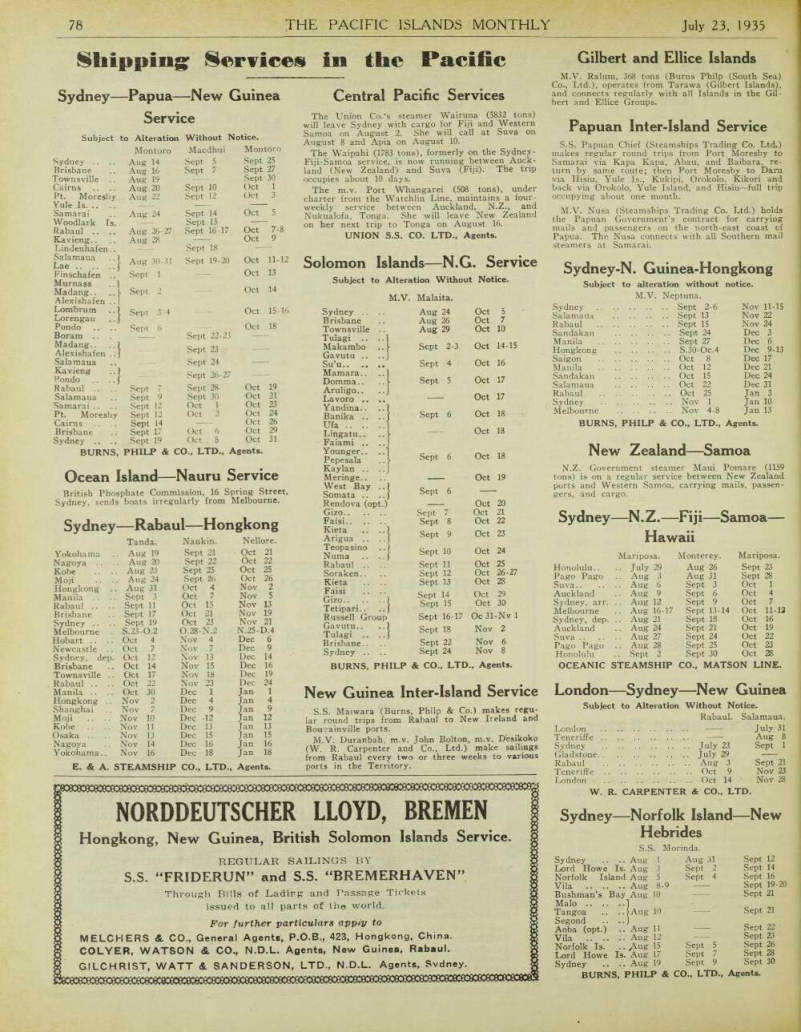
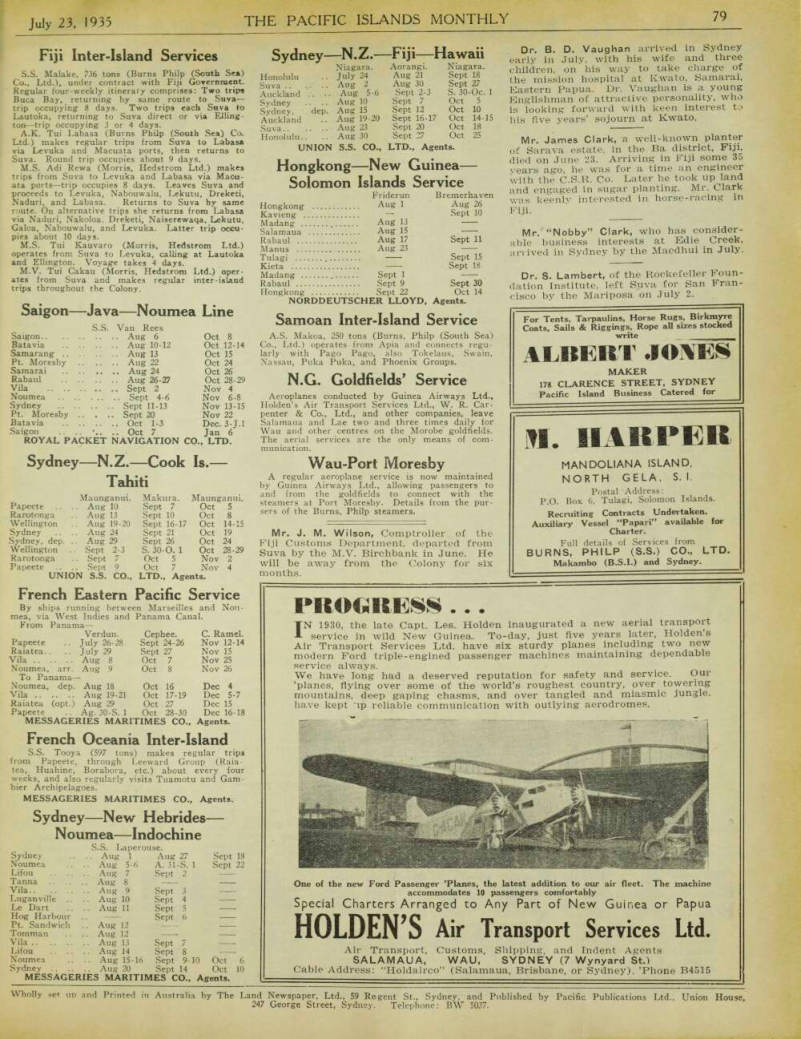
Shipping Services in the Pacific
Sydney—Papua—New Guinea Service
Burns, Philp & Co., Ltd., Agents.
Ocean Island —Nauru Service
British Phosphate Commission, 16 Spring- Street, Sydney, sends boats irregularly from Melbourne,
Sydney—Rabaul—Hongkong
Central Pacific Services
The Union Co.'s steamer Wairuna (5832 tons) will leave Sydney with cargo for Fiji and Western Samoa on August 2. She will call at Suva on August 8 and Apia on August 10.
The Waipahi (1783 tons), formerly on the Sydney- Fiji-Samoa service, is now running between Auck land (New Zealand) and Suva (Fiji). The trip occupies about 10 days.
The m.v. Port Whangarei (508 tons), under charter from the Watchlin Line, maintains a four weekly service between Auckland, N.Z., and Nukualofa, Tonga. She will leave New Zealand on her next trip to Tonga on August 16.
Union S.S. Co. Ltd., Agents.
Solomon Islands —N.G. Service
Subject to Alteration Without Notice.
Burns, Philp & Co., Ltd., Agents.
New Guinea Inter-Island Service
S.S. Maiwara (Burns, Philp & Co.) makes regu lar round trips from Rabaul to New Ireland and Bougainville ports.
M.V. Duranbah, m.v. John Bolton, m.v. Desikoko (W. R. Carpenter and Co., Ltd.) make sailings from Rabaul every two or three weeks to various ports in the Territory.
Gilbert and Ellice Islands
M.V. Ralum, 368 tons (Burns Philp (South Sea) Co., Ltd.), operates from Tarawa (Gilbert Islands), and connects regularly with all Islands in the Gil bert and Ellice Groups.
Papuan Inter-Island Service
S.S. Papuan Chief (Steamships Trading Co. Ltd.) makes regular round trips from Port Moresby to Samarai via Kapa Kapa, Abau, and Baibara, re turn by same route; then Port Moresby to Daru via Hisiu, Yule Is., Kukipi, Orokolo, Kikori and back via Orokolo, Yule Island, and Hisiu—full trip occupying about one month.
M.V. Nusa (Steamships Trading Co. Ltd.) holds the Papuan Government’s contract for carrying mails and passengers on the north-east coast cf Papua. The Nusa connects with all Southern mail steamers at Samarai.
Sydney-N. Guinea-Hongkong
Subject to alteration without notice.
Burns, Philp & Co., Ltd., Agents.
New Zealand —Samoa
N.Z. Government steamer Maui Pomare (1159 tons) is on a regular service between New Zealand ports and Western Samoa, carrying mails, passen gers, and cargo.
Sydney—N.Z.—Fiji—Samoa—
Hawaii
London—Sydney—New Guinea
Sydney—Norfolk Island —New Hebrides
Subject to Alteration Without Notice.
Montoro Macdhui Montoro Sydney Aug 14 Sept 5 Sept 25 Brisbane Aug 16 Sept 7 Sept 27 Townsville Aug 19 Sept 30 Cairns Aug 20 Sept 10 Oct 1 Pt. Moresby Aug 22 Sept 12 Oct 3 Yule Is Samarai Aug 24 Sept 14 Oct 5 Woodlark Is.
Sept 15 Rabaul Aug 26-27 Sept 16-17 Oct 7-8 Kavieng Aug 28 Oct 9 Lindenhafen Sept 18 Salamaua ..Aug 30 . 31 Sept 19-20 Oct 11-12 Finschafen . Sept 1 Oct 13 Murnass Oct 14 Madang Sept 2 Alexishafen Lombrum Sept 3-4 Oct 15-16 Lorengau Pondo Sept 6 Oct 18 Boram Sept 22-23 Madang Alexishafen Sept 23 Salamaua Sept 24 Kavieng Pondo Sept 26-27 Rabaul Sept 7 Sept 28 Oct 19 Salamaua Sept 9 Sept 30 Oct 21 Samarai Sept 12 Oct 1 Oct 23 Pt. Moresby Sept 12 Oct 2 Oct 24 Cairns Sept 14 Oct 26 Brisbane Sept 17 Oct 6 Oct 29 Sydney Sept 19 Oct 8 Oct 31
Tanda Nankin Nellore Yokohama Aug 19 Sept 21 Qct 21 Nagoya Aug 20 Sept 22 Oct 22 Kobe Aug 23 Sept 25 Oct 25 Moji Aug 24 Sept 26 Oct 26 Hongkong Aug 31 Oct 4 Nov 2 Manila Sept 3 Oct 7 Nov 5 Rabaul Sept 11 Oct 15 Nov 13 Brisbane Sept 17 Oct 21 Nov 19 Sydney Sept 19 Oct 23 Nov 21 Melbourne S.23-0.2 0.28-N.2 N.25-D.4 Hobart Oct 4 Nov 4 Dec 6 Newcastle Oct 7 Nov 7 Dec 9 Sydney, dep, Oct 12 Nov 13 Dee 14 Brisbane Oct 14 Nov 15 Dec 16 Townsville Oct 17 Nov 18 Dec 19 Rabaul Oct 22 Nov 23 Dec 24 Manila Oct 30 Dec 1 Jan 1
Hongkong
Nov 2 Dec 4 Jan 4 Shanghai Nov 7 Dec 9 Jan 9 Moji Nov 10 Dec 12 Jan 12 Kobe Nov 11 Dec 13 Jan 13 Osaka Nov 13 Dec 15 Jan 15 Nagoya Nov 14 Dec 16 Jan 16 Yokohama Nov 16 Dec 18 Jan 18 E. & A. STEAMSHIP CO., LTD., Agents.
M.V. Malaita.
Sydney Aug 24 Oct 5 Brisbane Aug 26 Oct 7 Townsville Aug 29 Oct 10 Tulagi Makambo Sept 2-3 Oct 14-15 Gavutu Su’u Sept 4 Oct 16 Mamara Oct 17 Domma Sept 5 Aruligo Oct 17 Lavoro Yandina Oct 18 Banika Sept 6 Ufa Lingatu Oct 18 Faiami Younger Pepesala Sept 6 Oct 18 Kaylan Meringe Oct 19 West Bay Somata Sept 6 Rendova (opt.) Oct 20 Gizo Sept 7 Oct 21 Faisi Sept 8 Sept 9 Oct 22 Kieta Arigua Oct 23 Teopasino Numa Sept 10 Oct 24 Rabaul Sept 11 Oct 25 Soraken Sept 12 Oct 26-27 Kieta Sept 13 Oct 28 Faisi Gizo Sept 14 Sept 15 Oct 29 Oct 30 Tetipari Russell Group Sept 16-17 Oc 31-Nv 1 Gavutu Tulagi Sept 18 Nov 2 Brisbane Sept 22 Nov 6 Sydney Sept 24 Nov 8
Sydney M.V. Neptuna Nov 11-13 Salamaua Nov 22 Rabaul Sept 15 Nov 24 Sandakan Dec 3 Manila Dec 6 Hongkong S.30-Oc.4 Dec 9-13 Saigon Oct 8 Dec 17 Manila Oct 12 Dec 21 Sandakan Oct 15 Dec 24 Salamaua Oct 22 Dec 31 Rabaul Oct 25 Jan 3 Sydney Nov 1 Jan 10 Melbourne Jan 13
Mariposa Monterey Mariposa Honolulu July 29 Aug 26 Sept 23 Pago Pago Aug 3 Aug 31 Sept 28 Suva Aug 6 Sept 3 Oct 1 Auckland Aug 9 Sept 6 Oct 4 Sydney, arr.
Aug 12 Sept 9 Oct 7 Melbourne Aug 16-17 Sept 13-14 Oct 11-13 Sydney, dep. .. Aug 21 Sept 18 Oct 16 Auckland .. Aug 24 Sept 21 Oct 19 Suva .. .. Aug 27 Sept 24 Oct 22 Pago Pago .. Aug 28 Sept 25 Oct 23 Honolulu .. Sept 2 Sept 30 Oct 28
Oceanic Steamship Co., Matson Line.
Subject to Alteration Without Notice.
Rabaul.
Salamaua.
London July 31 Teneriffe .. .
Aug 8 Sydney July 23 Sept 1 Gladstone..
July 29 Rabau1 Aug 3 Sept 21 Teneriffe ..
Nov 23 London Oct 14 Nov 28
W. R. Carpenter & Co., Ltd.
S.S. Morinda.
Sydney .. Aug 1 Aug 31 Sept 12 Lord Howe Is. Aug 3 Sept 2 Sept 14 Norfolk Island Aug 5 Sept 4 Sept 16 Vila .. ..
Sept 19-20 Bushman’s Bay Aug 10 Sept 21 Malo .. ..
Tangoa
.. f-Aug 10
Sept 21 Segond Aoba (opt.) .. Aug 11 Sept 22 Vila .. ..
Sept 23 Norfolk Is. .. ,Aug 15 Sept 5 Sept 26 Lord Howe Is. Aug 17 Sept 7 Sept 28 Sydney .. Aug 19 Sept 9 Sept 30
Burns, Philp & Co., Ltd., Agents.
Fiji Inter-Island Services
S.S. Malake, 736 tons (Burns Philp (South Sea) Co., Ltd.), under contract with Fiji Government.
Regular four-weekly itinerary comprises: Two trips Buca Bay, returning by same route to Suva— trip occupying 8 days. Two trips each Suva to Lautoka, returning to Suva direct or via Elling ton —trip occupying 3 or 4 days.
A.K. Tui Labasa (Burns Philp (South Sea) Co.
Ltd.) makes regular trips from Suva to Labasa via Levuka and Macuata ports, then returns to Suva. Round trip occupies about 9 days.
M.S. Adi Rewa (Morris, Hedstrom Ltd.) makes trips from Suva to Levuka and Labasa via Macu ata ports—trip occupies 8 days. Leaves Suva and proceeds to Levuka, Nabouwalu, Lekutu, Dreketi, Naduri, and Labasa. Returns to Suva by same route. On alternative trips she returns from Labasa via Naduri, Nakoloa, Dreketi, Naiserewaqa, Lekutu, Galoa, Nabouwalu, and Levuka. Latter trip occu pies about 10 days.
M.S. Tui Kauvaro (Morris, Hedstrom Ltd.) operates from Suva to Levuka, calling at Lautoka and Ellington. Voyage takes 4 days.
M.V. Tui Cakau (Morris, Hedstrom Ltd.) oper ates from Suva and makes regular inter-island trips throughout the Colony.
Saigon—Java—Noumea Line
Sydney—N.Z.—Cook Is.— Tahiti
French Eastern Pacific Service
French Oceania Inter-Island
S.S. Tooya (597 tons) makes regular trips from Papeete, through Leeward Group (Raia tea, Huahine, Borabora, etc.) about every four weeks, and also regularly visits Tuamotu and Gam bier Archipelagoes.
Messageries Maritimes Co., Agents.
Sydney—New Hebrides—
Noumea—Indochine
Sydney—N.Z.—Fiji—Hawaii
Hongkong—New Guinea — Solomon Islands Service
Samoan Inter-Island Service
A.S. Makoa, 250 tons (Burns, Philp (South Sea) Co., Ltd.) operates from Apia and connects regu larly with Pago Pago, also Tokelaus, Swain, Nassau, Puka Puka, and Phoenix Groups.
N.G. Goldfields’ Service
Aeroplanes conducted by Guinea Airways Ltd., Holden’s Air Transport Services Ltd., W. R. Car penter & Co., Ltd., and other companies, leave Salamaua and Lae two and three times daily for Wau and other centres on the Morobe goldfields.
The aerial services are the only means of com munication.
Wau-Port Moresby
A regular aeroplane service is now maintained by Guinea Airways Ltd., allowing passengers to and from the goldfields to connect with the steamers at Port Moresby. Details from the pur sers of the Burns. Philp steamers.
Mr. J. M. Wilson, Comptroller of the Fiji Customs Department, departed from Suva by the M.V. Birchbank in June. He will be away from the Colony for six months.
Dr. B. D. Vaughan arrived in Sydney early in July, with his wife and three children, on his way to take charge of the mission hospital at Kwato, Samarai, Eastern Papua. Dr. Vaughan is a young Englishman of attractive personality, who is looking forward with keen interest to his five years’ sojourn at Kwato.
Mr. James Clark, a well-known planter of Sarava estate, in the Ba district, Fiji, died on June 23. Arriving in Fiji some 35 years ago, he was for a time an engineer with the C.S.R. Co. Later he took up land and engaged in sugar planting. Mr. Clark was keenly interested in horse-racing in Fiji.
Mr. “Nobby” Clark, who has consider able business interests at Edie Creek, arrived in Sydney by the Macdhui in July.
Dr. S. Lambert, of the Rockefeller Foun dation Institute, left Suva for San Fran cisco by the Mariposa on July 2.
Saigon S.S. Van Rees Oct 8 Batavia Oct 12-14 Samarang Oct 15 Pt. Moresby Oct 24 Samarai Oct 26 Rabaul Aug 26-27 Oct 28-29 Vila Nov 4 Noumea Nov 6-8 Sydney Sept 11-13 Nov 13-15 Pt. Moresby . ... Sept 20 Nov 22 Batavia Oct 1-3 Dec. 3-J.l Saigon . .. Oct 7 Jan 6
Royal Packet Navigation Co., Ltd.
Maunganui. Makura. Maunganui.
Papeete .. .. Aug 10 Sept 7 Oct 5 Rarotonga .. Aug 13 Sept 10 Oct 8 Wellington .. Aug 19-20 Sept 16-17 Oct 14-15 Sydney .. .. Aug 24 Sept 21 Oct 19 Sydney, dep. .. Aug 29 Sept 26 Oct 24 Wellington .. Sept 2-3 S. 30-0. 1 Oct 28-29 Rarotonga .. Sept 7 Oct 5 Nov 2 Papeete .. .. Sept 9 Oct 7 Nov 4
Union S.S. Co., Ltd., Agents.
Niagara.
Aorangi.
Niagara.
Honolulu .. July 24 Aug 21 Sept 18 Suva Aug 2 Aug 30 Sept 27 Auckland .. .. Aug 5-6 Sept 2-3 S. 30-Oc. 1 Sydney .. .. Aug 10 Sept 7 Oct 5 Sydney, dep. Aug 15 Sept 12 Oct 10 Auckland .. Aug 19-20 Sept 16-17 Oct 14-15 Suva Aug 23 Sept 20 Oct 18 Honolulu.. .. Aug 30 Sept 37 Oct 25
Union S.S. Co., Ltd., Agents.
Friderun Bremerhaven Hongkong Aug 1 Aug 26 Kavieng Sept 10 Madang .
Aug 13 Salamaua Aug IS Rabaul Aug 17 Sept 11 Manus Aug 23 Tulagi Sept 15 Kieta Sept 18 Madang .
Rabaul Sept 9 Sept 30 Hongkong Oct 14
Norddeutscher Lloyd, Agents.
By ships running between Marseilles and Noumea, via West Indies and Panama Canal.
From Panama— Verdun.
Cephee.
C. Ramel.
Papeete .. July 26-28 Sept 24-26 Nov 12-14 Raiatea.. .. July 29 Sept 27 Nov 15 Vila Aug 8 Oct 7 Nov 25 Noumea, arr. Aug 9 Oct 8 Nov 26 To Panama— Noumea, dep. Aug 18 Oct 16 Dec 4 Vila Aug 19-21 Oct 17-19 Dec 5-7 Raiatea (opt.) Aug 29 Oct 27 Dec 15 Papeete Ag. 30-S. 1 Oct 28-30 Dec 16-18
Messageries Maritimes Co., Agents.
S.S. Laperouse.
Sydney .. Aug 1 Aug 27 Sept 18 Noumea Aug 5-6 A. 31-S. 1 Sept 22 Lifou .. Aug 7 Sept 2 Tanna .. Aug 8 Vila Sept 3 Luganville .. .. Aug 10 Sept 4 Le Dart Aug 11 Sept 5 Hog Harbour Sept 6 Pt. Sandwich Aug 12 Tomman Aug 12 Vila .. Aug 13 Sept 7 Lifou Sept 8 Noumea .. Aug 15-16 Sept 9- 10 Oct 6 Sydney .. Aug 20 Sept 14 Oct 10
Messageries Maritimes Co., Agents.
Advertisements & other items, pp. 80-81 (2 items)
Norddeutscher Lloyd, Bremen
Hongkong, New Guinea, British Solomon Islands Service.
REGULAR SAILINGS BY
S.S. “FRIDERUN” and S.S. “BREMERHAVEN”
Through Bills of Ladirg and Passage Tickets issued to all parts of the world.
For further particulars apply to MELCHERS & CO., General Agents, P.O.B., 423, Hongkong, China.
COLYER, WATSON & CO., N.D.L. Agents, New Guinea, Rabaul.
GILCHRIST, WATT & SANDERSON, LTD., N.D.L. Agents, Svdney.
For Tents, Tarpaulins, Horse Rugs, Birkmyre Coats, Sails & Riggings, Rope all sizes stocked write
ALBERT JONES
MAKER
178 CLARENCE STREET, SYDNEY
Pacific Island Business Catered for
M. HARPER
MANDOLIANA ISLAND,
NORTH GELA, S. I.
Postal Address: P.O. Box 6, Tulagi, Solomon Islands.
Recruiting Contracts Undertaken.
Auxiliary Vessel “Papari” available for Charter.
Full details of Services from
BURNS, PHILP (S.S.) CO., LTD.
Makambo (B.S.I.) and Sydney.
PROGRESS . . .
IN 1930, the late Capt. Les. Holden inaugurated a new aerial transport service in wild New Guinea. To-day, just five years later, Holden s Air Transport Services Ltd. have six sturdy planes including two new modern Ford triple-engined passenger machines maintaining dependable service always.
We have long had a deserved reputation for safety and service. Our ’planes, flying over some of the world’s roughest country, over towering mountains, deep gaping chasms, and over tangled and miasmic jungle, have kept ip reliable communication with outlying aerodromes.
One of the new Ford Passenger ’Planes, the latest addition to our air fleet. The machine accommodates 10 passengers comfortably Special Charters Arranged to Any Part of New Guinea or Papua
HOLDEN’S Air Transport Services Ltd.
Air Transport, Customs, Shipping, and Indent Agents
SALAMAUA, WAU, SYDNEY (7 Wynyard St.)
Cable Address: “Holdairco” (Salamaua, Brisbane, or Sydney). ’Phone 84515
79
THE PACIFIC ISLANDS MONTHLY
July 23, 1935
Wholly set up and Printed in Australia by The Land Newspaper, Ltd., 59 Regent St., Sydney, and Published by Pacific Publications Ltd., Union House, 247 George Street, Sydney. Telephone: BW 5037.
Index to Volume V.
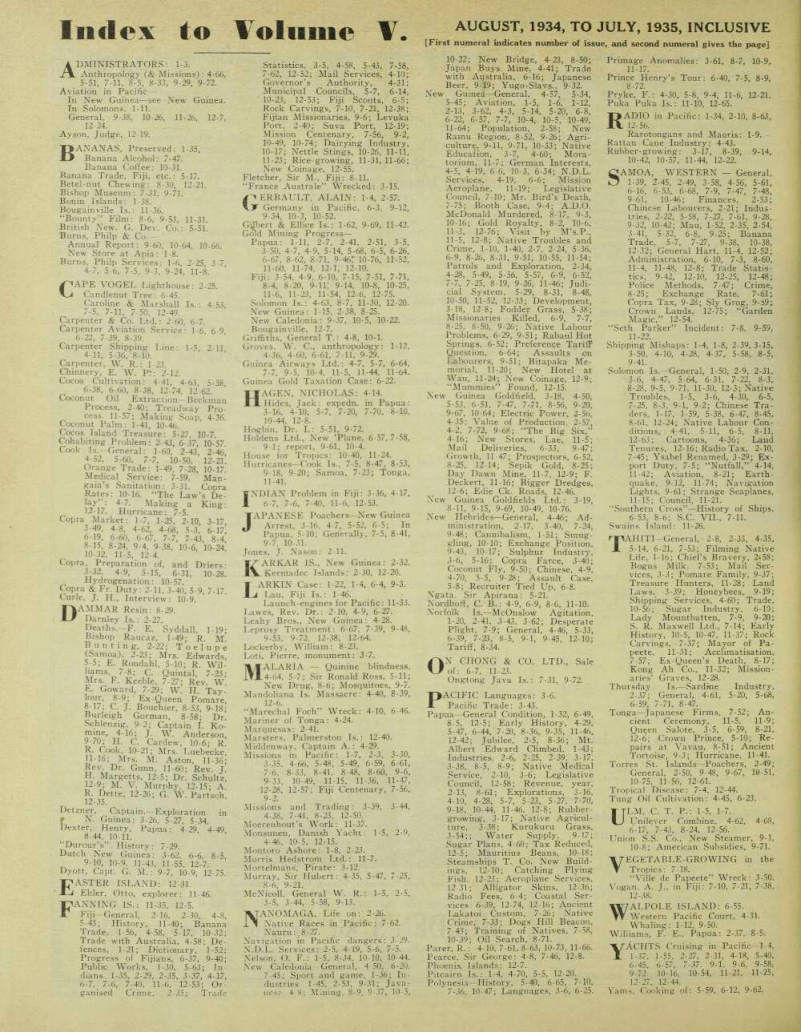
August, 1934, To July, 1935, Inclusive
[First numeral indicates number of issue, and second numeral gives the page]
Administrators; 1-3.
Anthropology (& Missions) : 4-66, 5-51, 7-11, 8-5, 8-33, 9-29, 9-72.
Aviation in Pacific — In New Guinea —see New Guinea.
In Solomons, 1-11.
General, 9-38, 10-26, 11-26, 12-7, 12-24.
Ayson, Judge, 12-19.
BANANAS, Preserved: 1-35, Banana Alcohol: 7-47.
Banana Coffee: 10-31.
Banana Trade, Fiji, etc.: 5-17.
Betel-nut Chewing: 8-30, 12-21.
Bishop Museum; 7-31, 9-71.
Bonin Islands: 1-38.
Bougainville Is.: 11-36.
“Bounty” Film: 8-6, 9-53, 11-31.
British New. G. Dev. Co.: 5-51.
Burns, Philp & Co.— Annual Report; 9-60, 10-64, 10-66.
New Store at Apia: 1-8.
Burns, Philp Services: 1-6, 2-25, 3-7, 4-7, 5-6, 7-5, 9-3, 9-24, 11-8.
CAPE VOGEL Lighthouse: 2-25.
Candlenut Tree: 6-45.
Caroline & Marshall Is.: 4-53, 7-5, 7-11, 7-50, 12-49.
Carpenter & Co. Ltd.: 2-60, 6-7.
Carpenter Aviation Service: 1-6 6-9 6-22, 7-39, 8-39.
Carpenter Shipping Line; 1-5, 2-11, 4-11, 5-36, 8-10.
Carpenter, W. R.: 1-23.
Chinnery, E. W. Pr: 2-12.
Cocoa Cultivation: 4-41, 4-63, 5-58 6-38, 6-60, 8-38, 12-74, 12-62.
Coconut Oil Extraction—Beckman Process, 2-40; Treadway Pro cess. 11-57; Making Soap, 4-36.
Coconut Palm: 1-41, 10-46.
Cocos Island Treasure: 5-27, 10-7.
Cohabiting Problem: 2-43, 6-37, 10-57.
Cook Is.—General: 1-60, 2-43 , 2-46 4-52, 5-60, 7-7, 10-50. 12-21.
Orange Trade: 1-49, 7-28, 10-17.
Medical Service: 7-59. Man gaia’s Sanitation: 3-31. Copra Rates: 10-16. “The Law’s Delay": 4-7. Making a King: 12-17. Hurricane: 7-5.
Copra Market; 1-7, 1-25, 2-10, 3-17 3-49. 4-8, 4-62, 4-68, 5-3, 6-17, 6-19, 6-60, 6-67, 7-7, 7-43, 8-4 8-15. 8-24, 9-4, 9-38, 10-6, 10-24, 10-32, 11-5, 12-4.
Copra, Preparation of, and Driers 3-32 4-9, 5-15, 6-31, 10-28.
Hydrogenation: 10-57.
Copra & Fr. Duty: 2-11, 3-40, 5-9, 7-17.
Curie, J. H., Interview: 10-9.
DAMMAR Resin: 8-29.
Darnley Is.: 2-27.
Deaths.—F. E. Syddall, 1-19; Bishop Raucaz, 1-49; R M Bunting, 2-22; Toelupe (Samoa), 2-23; Mrs. Edwards, 5-5; E. Rondahl, 5-10; R. Wil hams, 7-8; C. Quintal, 7-23; Mrs. F. Keeble, 7-27; Rev. W.
E. Coward, 7-29; W. H. Tay lour, 8-9; Ex-Queen Pomare, 8-17; C. J. Bouchier, 8-53, 9-18; Burleigh Gorman, 8-58; Dr.
Schlenzig, 9-2; Captain I. Komine, 4-16; J. W. Anderson, 9-70; H. C. Cardew, 10-6; R.
R. Cook, 10-21; Mrs. Luebecke, 11-16; Mrs. M. Aston, 11-36; Rev. Dr. Gunn, 11-60; Rev. J.
H. Margetts, 12-5; Dr. Schultz, 12-9; M. V. Murphy, 12-15; A.
R. Dette, 12-26; G. W. Partsch, 12-35.
Detzner, Captain.—Exploration in N. Guinea: 3-26, 5-27, 5-34.
Dexter, Henry, Papua: 4-29 4-49 8-44, 10-11.
“Durour’s” History: 7-29.
Dutch New Guinea: 3-62. 6-6, 8-5, 9-10, 10-9. 11-43, 11-55, 12-7.
Dyott, Capt. G. M.: 9-7, 10-9, 12-75.
Easter island; 12-31.
Ehler, Otto, explorer: 11-46.
Fanning is.; 11-35, 12-5.
Fiji—General, 2-16, 2-30, 4-8, 5-43; History, 11-40; Banana Trade, 1-56, 4-58, 5-17, 10-32; Trade with Australia, 4-58; De fences, 1-21; Dictionary, 1-52; Progress of Fijians, 6-37, 9-40; Public Works, 1-30, 5-63; In dians. 1-35, 2-29, 2-35, 3-37, 4-17, 6-7, 7-6, 7-40, 11-6, 12-53; Or ganised Crime, 2-35; Trade
Statistics, 3-5, 4-58, 5-43, 7-58, 7- 12-52; Mail Services, 4-10; Governor’s Authority, 4-31; Municipal Councils, 5-7, 6-14, 10-23, 12-53; Fiji Scouts, 6-5; Rock Carvings, 7-10, 7-21, 12-38; Fijian Missionaries, 9-6; Levuka Port, 2-40; Suva Port, 12-19; Mission Centenary, 7-56, 9-2, 10-49, 10-74; Dairying Industry, 10- Nettle Stings, 10-26, 11-11, 11- Rice-growing, 11-31, 11-66; New Coinage, 12-55.
Fletcher, Sir M., Fiji: 8-11.
“France Australe” Wrecked: 3-15.
Gerbault, Alain: 1-4, 2-57.
Germany in Pacific, 6-3, 9-12, 9-34, 10-3, 10-52.
Gilbert & Ellice Is.: 1-62, 9-69, 11-42.
Gold Mining Progress— Papua: 1-11, 2-7, 2-41, 2-51, 3-5, 3- 4-7, 4-9, 5-14, 5-68, 6-5, 6-26, 6- 8-62, 8-71, 9-46, 10-76, 11-52, 11-60, 11-74, 12-1, 12-10.
Fiji: 3-54, 4-9, 6-10, 7-15, 7-51, 7-71, 8- 8-20, 9-11; 9-14, 10-8, 10-25, 11-6, 11-23, 11-54, 12-6, 12-75.
Solomon Is.: 4-63 , 8-7, 11-30, 12-20.
New Guinea: 1-15, 2-38, 8-25.
New Caledonia: 9-37, 10-5, 10-22.
Bougainville, 12-7.
Griffiths, General T.; 4-8, 10-1.
Groves, W. C., anthropology; 1-12, 4-36, 4-60, 6-61, 7-11, 9-29.
Guinea Airways Ltd.: 4-7, 5-7, 6-64, 7-7, 9-5, 10-4, 11-5, 11-44, 11-64.
Guinea Gold Taxation Case: 6-22.
Hagen, Nicholas: 4-14.
Hides, Jack: expedn. in Papua: 3-16, 4-10, 5-7, 7-20, 7-70, 8-10, 10-44, 12-8.
Hogbin, Dr. I.: 5-51, 9-72.
Holdens Ltd., New ’Plane, 6-57, 7-58, 9-1; report, 9-61, 10-4.
House for Tropics: 10-40, 11-24.
Hurricanes—Cook Is., 7-5, 8-47, 8-53, 9-18, 9-20; Samoa, 7-23; Tonga, 11-41.
INDIAN Problem in Fiji; 3-36, 4-17, 6-7, 7-6, 7-40, 11-6, 12-53.
JAPANESE Poachers —New Guinea Arrest, 3-16, 4-7, 5-52, 6-5; In Papua, 5-10; Generally, 7-5, 8-41, 9-7, 10-31.
Jones, J. Nason: 2-11.
KARKAR IS., New Guinea: 2-32.
Kermadec Islands: 2-30, 12-20.
Larkin Case: 1-22, 1-4, 6-4, 9-3.
Lau, Fiji Is.: 1-46.
Launch-engines for Pacific: 11-33.
Lawes, Rev. Dr.: 2-10, 4-9, 6-27.
Leahy Bros., New Guinea: 4-28.
Leprosy Treatment; 6-67, 7-39, 9-48, 9-53, 9-72, 12-38, 12-64.
Lockerby, William: 8-23.
Loti, Pierre, monument: 3-7.
MALARIA Quinine blindness, 4-64, 5-7; Sir Ronald Ross, 5-11; New Drug, 8-6; Mosquitoes, 9-7.
Mandoliana Is. Massacre: 4-40, 8-39, 12-6.
“Marechal Foch” Wreck: 4-10, 6-46.
Mariner of Tonga: 4-24.
Marquesas: 2-41.
Marsters, Palmerston Is.: 12-40.
Middenway, Captain A.: 4-29.
Missions in Pacific: 1-7, 2-3, 3-30, 3-35. 4-66, 5-48, 5-49, 6-59, 6-61, 7-6, 8-33, 8-41, 8-48, 8-60, 9-6, 9-33, 10-49, 11-15, 11-36, 11-47, 12-28, 12-57; Fiji Centenary, 7-56, 9-2.
Missions and Trading: 3-39, 3-44, 4-38, 7-41, 8-23, 12-50.
Moerenhout’s Work: 11-37.
Monsunen, Danish Yacht: 1-5, 2-9, 4-46, 10-5, 12-15.
Montoro Ashore: 1-8, 2-23.
Morris Hedstrom Ltd.: 11-7.
Mortelmans, Pirate: 3-12.
Murray, Sir Hubert: 4-35, 5-47, 7-25, 8-6, 9-21.
McNicoll, General W. R.: 1-5, 2-5, 3-5, 3-44, 5-58, 9-13.
NANOMAGA, Life on: 2-26.
Native Races in Pacific; 7-62.
Nauru: 8-27.
Navigation in Pacific dangers; 3-29.
N.D.L. Services; 2-5, 4-19, 5-6, 7-5.
Nelson. O. F.: 1-5, 8-34, 10-10, 10-44.
New Caledonia—General, 4-50, 6-20, 7-45; Sport and game, 1-36; In dustries 1-45, 2-53, 9-31; Java nese 4-8; Mining, 8-9, 9-37, 10-5,
10- New Bridge, 4-23, 8-50; Japan Buys Mine, 4-41; Trade with Australia, 6-16; Japanese Beer, 9-19; Yugo-Slavs., 9-32.
New Guinea—General, 4-57, 5-34, 5-45; Aviation, 1-5, 1-6, 1-12, 2- 3-62, 4-3, 5-14, 5-20, 6-8, 6- 6-57, 7-7, 10-4, 10-5, 10-49, 11- Population, 2-58; New Ramu Region, 8-52, 9-26; Agri culture, 9-11, 9-71, 10-33; Native Education, 3-7, 4-60; Mora torium, 11-7; German Interests,
4-5, 4-19, 6-6, 10-3, 6-34; N.D.L.
Services, 4-19, 6-6; Mission Aeroplane, 11-19; Legislative Council, 7-10; Mr. Bird’s Death, 7- Booth Case, 9-4; A.D.O.
McDonald Murdered, 8-17, 9-3, 10-16; Gold Royalty, 8-2, 10-6, 11-3, 12-76; Visit by M’s.P., 11-5, 12-8; Native Troubles and Crime, 1-10, 1-40, 2-7, 2-24, 5-36, 6-9, 8-26, 8-31, 9-51, 10-55, 11-54; Patrols and Exploration, 2-34, 4-28, 5-49, 5-56, 5-57, 6-9, 6-52, 7-7, 7-25, 8-19, 9-26, 11-46; Judicial System, 5-29, 8-31, 8-48, 10-50, 11-52, 12-33; Development, 3-18, 12-8; Fodder Grass, 5-38; Missionaries Killed, 6-9, 7-7, 8-25, 8-50, 9-26; Native Labour Problems, 6-29, 9-51; Rabaul Hot Springs, 6-52; Preference Tariff Question, 6-64; Assaults on Labourers, 9-51; Bitapaka Me morial, 11-20; New Hotel at Wau, 11-24; New Coinage, 12-9; “Mummies” Found, 12-15.
New Guinea Goldfield, 3-18, 4-50, 5-53, 6-51, 7-47, 7-71, 8-56, 9-20, 9-67, 10-64; Electric Power, 2-56, 4-35; Value of Production, 2-57, 4-2, 7-72, 9-68; “The Big Six,” 4-16; New Stores, Lae, 11-S; Mail Deliveries, 6-33, 9-47; Growth, 11-47; Prospectors, 6-52, 8-25, 12-14; Sepik Gold, 8-25; Day Dawn Mine. 11-7, 12-9; F.
Deckert, 11-16; Bigger Dredges, 12-6; Edie Ck. Roads, 12-46.
New Guinea Goldfields Ltd.: 3-19, 8-11, 9-15, 9-69, 10-49, 10-76.
New Hebrides—General, 4-46; Ad ministration, 2-17, 3-40, 7-24, 9-48; Cannibalism, 1-51; Smuggling, 10-10; Exchange Position, 9-43, 10-17; Sulphur Industry, 3-6, 5-16; Copra Farce, 3-40; Coconut Fly, 9-50; Chinese, 4-9, 4-70, 5-5, 9-28; Assault Case, 5-8; Recruiter Tied Up, 6-8.
Ngata. Sir Apirana: 5-21.
Nordhoff, C. B.: 4-9, 6-9, 8-6, 11-10.
Norfolk Is. —McOnslow Agitation, 1-20, 2-41, 3-43, 3-62; Desperate Plight, 7-9; General, 4-46, 5-33, 6-39, 7-23, 8-5, 9-1, 9-45, 12-10; Tariff, 8-34.
On Chong & Co. Ltd., Sale
of: 6-7, 11-23.
Ongtong Java Is.: 7-31, 9-72.
PACIFIC Languages: 3-6.
Pacific Trade: 3-43.
Papua—General Condition, 1-32, 6-49, 8-5, 12-5; Early History, 4-29, 5-47, 6-44, 7-20, 8-36, 9-35, 11-46, 12-42; Jubilee, 2-5, 8-36; Mt.
Albert Edward Climbed, 1-43; Industries, 2-6, 2-25, 2-39. 3-17, 3-38, 8-5, 8-9; Native Medical Service, 2-10, 3-6; Legislative Council, 12-58; Revenue, year, 2-13, 8-61; Explorations, 3-16, 4-10, 4-28, 5-7, 5-23, 5-27, 7-70, 9-18, 10-44, 11-46, 12-8; Rubber growing, 3-17; Native Agricul ture, 3-38; Kurukuru Grass, 3-54; Water Supply, 9-17; Sugar Plans, 4-60; Tax Reduced, 12-5; Mauritius Beans, 10-18; Steamships T., Co. New Build ings, 12-10; Catching Flying Fish, 12-23; Aeroplane Services, 12-31; Alligator Skins, 12-36; Radio Fees, 6-4; Coastal Ser vices, 6-39, 12-74, 12-16; Ancient Lakatoi Custom, 7-26; Native Crime, 7-33; Dogs Hill Beacon, 7-43; Training of Natives, 7-58, 10-39; Oil Search, 8-71.
Parer, R.: 4-10, 7-61, 8-63, 10-73, 11-66.
Pearce, Sir George; 4-8, 7-46, 12-8.
Phoenix Islands: 12-7.
Pitcairn Is.: 1-4, 4-70, 5-5, 12-20.
Polynesia—History, 5-40, 6-65, 7-10, 7-36, 10-47; Languages, 3-6, 6-25.
Primage Anomalies: 3-61, 8-7, 10-9,. 11-17.
Prince Henry’s Tour: 6-40, 7-5, 8-9, 8-72.
Pryke, F.: 4-30, 5-8, 9-4, 11-6, 12-21.
Puka Puka Is.: 11-10, 12-65.
RADIO in Pacific: 1-34, 2-10, 8-63, 12-56.
Rarotongans and Maoris: 1-9.
Rattan Cane Industry; 4-43.
Rubber-growing: 3-17, 8-39, 9-14, 10-42, 10-57, 11-44, 12-22.
SAMOA, WESTERN - General, 1-39, 2-45, 2-49, 3-58, 4-56, 5-61, 6-16, 6-53 , 6-68, 7-9, 7-47, 7-48, 9-61, 10-46; Finances, 2-53;.
Chinese Labourers, 2-21; Indus tries, 2-22, 5-58, 7-27, 7-61, 9-28, 9-32, 10-42; Mau, 1-52, 2-35, 2-54, 3-41, 5-32, 6-8, 9-25; Banana Trade, 5-7, 7-27, 9-38, 10-38, 12-32; General Hart, 11-4, 12-52;.
Administration, 6-10, 7-3, 8-60, 11-4, 11-48, 12-8; Trade Statis tics, 9-42, 12-10, 12-25, 12-48; Police Methods, 7-47; Crime, 8-25; Exchange Rate, 7-61; Copra Tax, 9-28; Sly Grog, 9-59; Crown Lands, 12-75; “Garden Magic,” 12-54.
“Seth Parker” Incident; 7-8, 9-59, 11-22.
Shipping Mishaps: 1-4, 1-8, 2-39, 3-15, 3-50, 4-10, 4-28, 4-37, 5-58, 8-5, 9-41.
Solomon Is.—General, 1-50, 2-9, 2-31, 3-6, 4-47, 5-64, 6-31, 7-22, 8-3, 8-28, 9-5, 9-71, 11-30, 12-3; Native Troubles, 1-5, 3-6, 4-30, 6-5. 7-25, 8-3, 9-1, 9-2; Chinese Tra ders, 1-17, .1-59, 5-38, 6-47, 8-45, 8-61, 12-24; Native Labour Con ditions, 4 : 41,. 5-11, 6-5, 8-11, 12-63; Cartoons, 4-36; Land Tenures, 12-16; Radio Tax, 2-10, 7-45; Ysabel Renamed, 3-29; Ex port Duty, 7-5; “Nutfall,” 4-14, 11-42; Aviation, 8-21; Earth quake, 9-12, 11-74; Navigation Lights, 9-61; Strange Seaplanes, 11-15; Council, 11-21.
“Southern Cross”—History of Ships,
6-53, 8-6; S.C. Vii., 7-11.
Swains Island; 11-26.
TAHITI— General, 2-8, 2-33, 4-35, 5-14, 6-21, 7-53; Filming Native Life, 1-16; Chief’s Bravery, 2>-S8; Bogus Milk, 7-53; Mail Ser vices, 3-3; Pomare Family, 9-37; Treasure Hunters, 11-28; Land Laws, 3-39; Honeybees, 9-19; Shipping Services, 4-60; Trade, 10-56; Sugar Industry, 6-10; Lady Mountbatten, 7-9, 9-20; S. R. Maxwell Ltd., 7-14; Early History, 10-5, 10-47, 11-37; Rock Carvings, 7-37; Mayor of Pa peete. 11-31; Acclimatisation, 7-57; Ex-Queen’s Death, 8-17; Kong Ah Co., 11-32; Mission aries’ Graves, 12-28.
Thursday Is. —Sardine Industry, 2-37; General, 4-61, 5-20, 5-68, 6-59, 7-71, 8-47.
Tonga—Japanese Firms, 7-52; An cient Ceremony, 11-5, 11-9; Queen Salote, 3-5, 6-59, 8-21, 12-6; Crown Prince, 5-10; Re pairs at Vavau, 8-51; Ancient Tortoise, 9-3; Hurricane, 11-41.
Torres St. Islands —Poachers, 2-49; General, 2-50, 9-48, 9-67, 10-51, 10-75, 11-56, 12-61.
Tropical Disease; 7-4, 12-44.
Tung Oil Cultivation: 4-45 , 6-23.
Ulm, C. T. P.: 1-5, 1-7.
Unilever Combine, 4-62, 4-68, 6-17, 7-43 , 8-24, 12-56.
Union S.S. Co., New Steamer, 9-1, 10-8; American Subsidies, 9-71.
Vegetable-Growing In The
Tropics: 7-18.
“Ville de Papeete” Wreck: 3-50.
Vogan, A. J., in Fiji; 7-10, 7-21, 7-38, 12-38.
Walpole Island: 6-55.
Western Pacific Court, 4-31.
Whaling: 1-12, 9-50.
Williams, F. E., Papua; 2-37, 8-5.
YACHTS Cruising in Pacific—l-4, 1-37, 1-55, 2-27, 2-31, 4-18, 5-40, 6-45, 6-57, 7-37. 9-1. 9-6, 9-58, 9-72. 10-16, 10-54, 11-21. 11-25, 12-27, 12-44.
Yams, Cooking of: 5-59, 6-12, 9-62.
Advertisements & other items, p. 83 (1 item)
Aerial Transport
PIONEERED AND CARRIES ON
THE NEW GUINEA GOLD INDUSTRY
Centre —One of the Bulolo Dredges under construction in Central New Guinea—three aeroplanes operated by Guinea Airways Ltd. discharging cargo.
Top right—Dairy cattle being loaded into a Guinea Airways plane for transport to the Goldfields.
Lower left —Interior of one of Guinea Airways cargo-carrying aeroplanes.
SAFETY . . . SPEED . . . COMFORT . . . DEPENDABILITY EIGHT years ago, Central New Guinea was almost unexplored, and practically inaccessible.
To-day, although there are no roads through the dense jungles and precipitous mountains, the Morobe Goldfield, in Central New Guinea, is the seat of a flourishing industry. There are half a dozen growing townships, four huge, modern dredges, two hydro-electric stations, crushing-mills, saw-mills, etc. . . Aerial transport alone made this possible.
Aeroplanes, flying in all weathers on regular timetables, connecting the coastal towns of Lae, Salamaua and Port Moresby with over thirty inland aerodromes and landing-grounds, have carried in thousands of tons of engineering equipment, a large European population, thousands of native labourers, foodstuffs, livestock, mails, etc.
Guinea Airways Ltd. launched its unique aerial transport service seven years ago, with one machine and a handful of men. To-day, it operates a fleet of modern aeroplanes, and employs very large European and native staffs.
NEW GUINEA service aeroplanes carry on one of the biggest transport organisations in the world, in one of the world’s most primitive tropical countries; yet no aerial transport system in the world can show a smaller percentage of accidents, or a better record of efficiency
and dependability.
A visit to Central New Guinea, in one of Guinea Airways speedy and comfortable air-liners, is a unique and delightful experience.
Travellers may leave the steamer at Port Moresby, fly across to Morobe (time of journey, 1 hour 45 minutes) and spend nine days in the Goldfield centres before rejoining steamer at Lae for Rabaul. Or, after visiting Rabaul, they may disembark at Salamaua or Lae, spend several days on the Goldfields, and fly to Port Moresby to rejoin the steamer. All information from Pursers on the steamers.
GUINEA AIRWAYS Ltd
LAE • SALAMAUA