Advertisements & other items, pp. 1-2 (2 items)
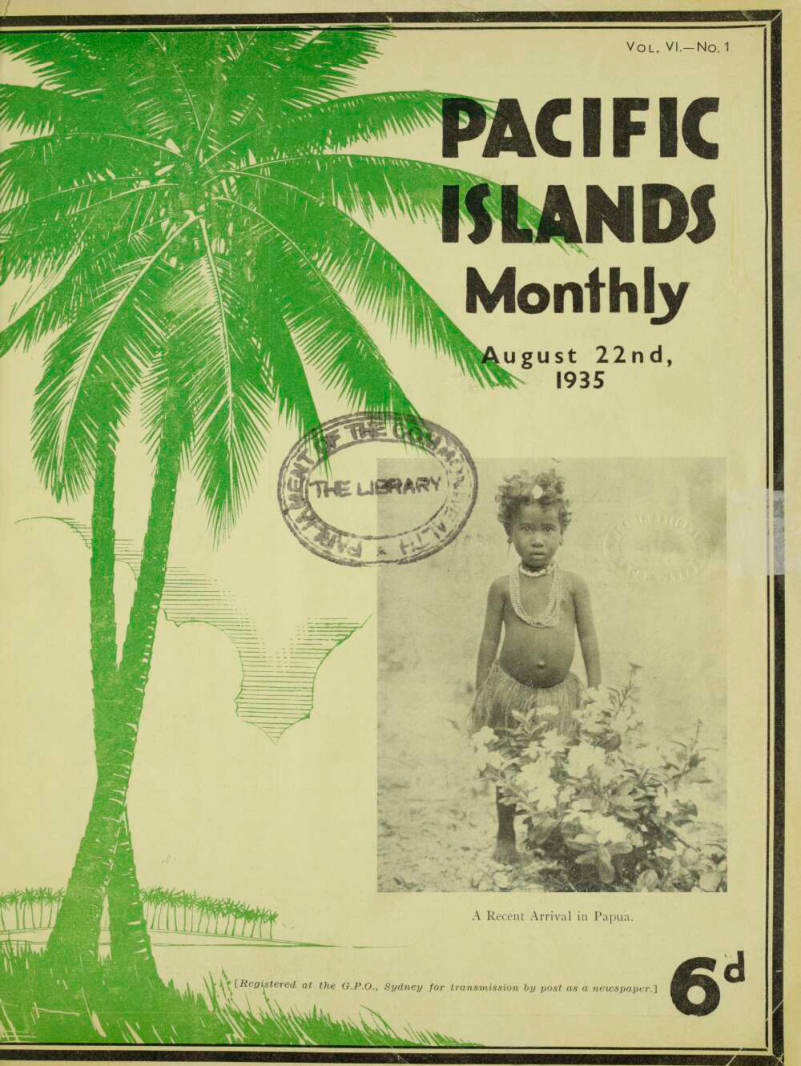
Pacific
ISLANDS
Monthly
Vol. VI. —No. 1
August 22nd, 1935
[Registered at the G.P.O., Sydney for transmission by post as a newspaper.]
6 d
A Recent Arrival in Papua.
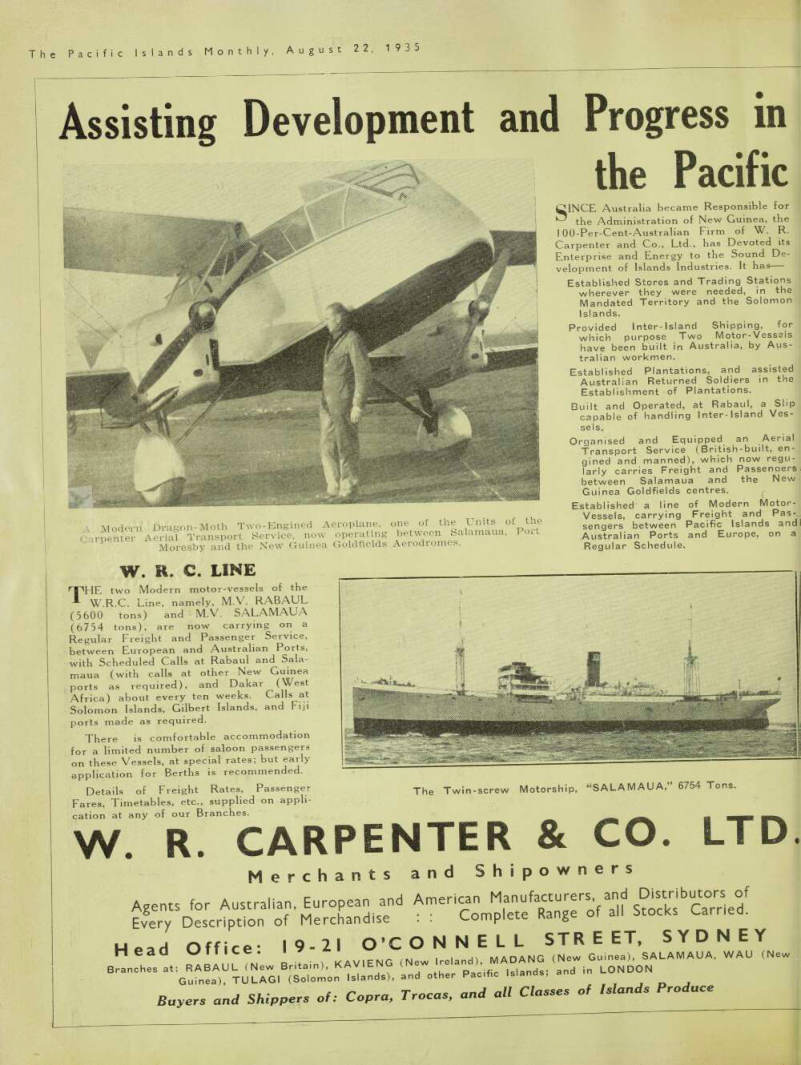
Assisting Development and Progress in
the Pacific
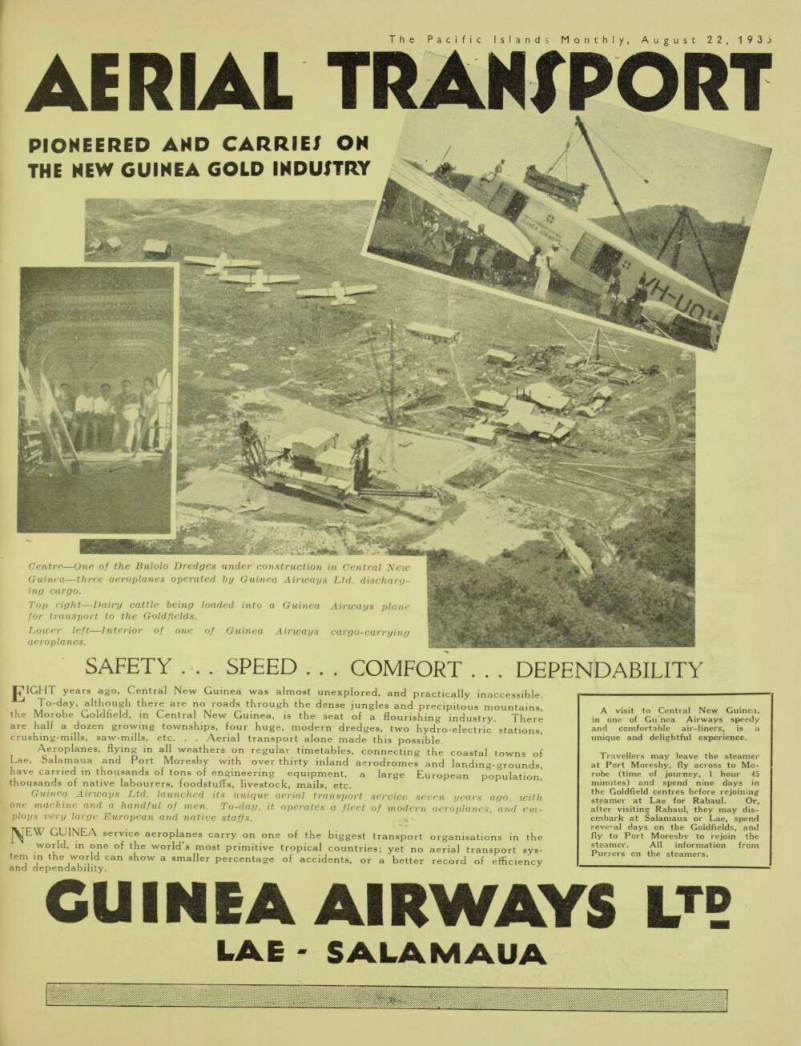
A Modern Dragon-Moth Two-Engined Aeroplane, one of the Units of the Aerial Transport Service, now operating between Salamaua, Poit Moresby and the New Guinea Goldfields Aerodromes.
Carpenter SINCE Australia became Responsible for the Administration of New Guinea, the 100-Per-Cent-Australian Firm of W. R.
Carpenter and Co., Ltd., has Devoted its Enterprise and Energy to the Sound Development of Islands Industries. It has— Established Stores and Trading Stations wherever they were needed, in the Mandated Territory and the Solomon Islands.
Provided Inter-Island Shipping, for which purpose Two Motor-Vessels have been built in Australia, by Australian workmen.
Established Plantations, and assisted Australian Returned Soldiers in the Establishment of Plantations.
Built and Operated, at Rabaul, a Slip capable of handling Inter-Island Vessels.
Organised and Equipped an Aerial Transport Service (British-built, engined and manned), which now regularly carries Freight and Passengers between Salamaua and the New Guinea Goldfields centres.
Established a line of Modern Motor- Vessels, carrying Freight and Pas-, sengers between Pacific Islands and Australian Ports and Europe, on a Regular Schedule.
W. R. C. LINE
two Modern motor-vessels of the W.R.C. Line, namely, M.V. RABAUL (3600 tons) and M.V. SALAMAUA (6754 tons), are now carrying on a Regular Freight and Passenger Service, between European and Australian Ports, with Scheduled Calls at Rabaul and Salamaua (with calls at other New Guinea ports as required), and Dakar (West Africa) about every ten weeks. Calls at Solomon Islands, Gilbert Islands, and Fiji ports made as required.
There is comfortable accommodation for a limited number of saloon passengers on these Vessels, at special rates; but early application for Berths is recommended.
Details of Freight Rates, Passenger Fares, Timetables, etc., supplied on application at any of our Branches.
The Twin-screw Motorship, “SALAMAUA,” 6754 Tons. cation at any of our Branches.
W. R. CARPENTER & CO. LTD.
Merchants and Shipowners
Agents for Australian, European and American Manufacturers, and Distributors pf Every Description of Merchandise . . Complete Range of all Stocks Carried.
Head Office ; 19-21 O'CONNELL STREET, SYDNEY Buyers and Shippers of: Copra, Trocas, and all Classes of Islands Produce
Pacific Islands Travellers
Passengers Per Macdhui Which De-
Parted From Sydney For Papua And
NEW GUINEA ON JULY 24.—Messrs. Archer, Armstrong, Allen, Aichison, Burgoyne, Boto, Bell, Barnes, Cromie, Crisp, Collier, Cutler, Crawford, Durcher, Eaton, Ecclestone, Fowler, Father Flem ing, Messrs. Farrer, Grabowsky, Glasson, Halli gan, Hewitt, Higgins, Hart, Hawes, Harding (2), Jackson, Kelly, Kentish, Father Kenny, Messrs.
Lang, Little, Lillycrapp, Marsh, Moody, Minoque, Muir, Munro, McKinlay, McCulloch, Nelson, Noakes, Orr, Sir George Pearce, Dr. Pockley, Messrs. Penfold, Plater, Quinton, Rees, Shutt, Symes, Sharp, Smith, Rev. Turner, Messrs. Todd, Wilkins, Woodman, Walker, Whiter, Young. Mesdames, Allan, Austin, Best, Cromie, Coomber, Colquhoun, Fowler, Grabowsky, Harrison, Hawes, Kelly, Kentish, Leaver, Lamble, Munro, Moran, Martin, Nelson, Lady Pearce, Mesdames Swinfield, Sharp, Turner, Woodman, Watson. Misses Brown, Buchanan, Bowen, Rev. Mother Brendan, Rev.
Mother Concepta, Misses Duggan, Gale, Glasson, Kentish, Maguire, Penny, Ryan, Smith (2), Wil liamson, Yates.
Passengers Per Morinda Which Ar-
RIVED IN SYDNEY FROM LORD HOWE AND
Norfolk Islands On July 29,—Messrs.
Alderson, Burrell, Crozier, Douglas, Gibson, Harper, May, Moore, Potter, Warburton (2), Webster, Wilson. Mesdames Abbie, Crozier, Wilson. Misses Bell (2), Edwards, Gibson, Stahl, Johnston, Shaw.
Passengers Per Morinda Which
Sailed From Sydney For Lord Howe
And Norfolk Islands On July 20.—
Messrs. Argali, Burrell, Gibson, Innes, Muston, Savage, Wilson, Warburton (2), Watts, Whitton.
Mesdames Abbie, Anderson, Blain, Innes, Savage, Williams, Wilson. Misses Bell (2), Benham, Edwards, Gibson, Johnston, Shaw.
Passengers Per Mariposa Which
Arrived In Sydney From Suva, Fiji,
ON AUGUST 12:—E. G. Banks, Miss A. Barrow, R. F. Brell, Mr. and Mrs. W. E. Clegg, Miss I. W. Clemens, E. J. Coote, R. A. Coxon, Miss S. Donnan, Hon. E. H. Farrar, Rev. J. F. Giles, Mr. and Mrs. E. D. Gilchrist, Mrs. F. Graham, Mrs. A. Haig, Mrs. B. Hammond, Mr. and Mrs.
E. Hume, Mr. and Mrs. H. H. Hutcherson, W.
S. Kenyon, Dr. Thomas S. Kirkland, Dr. J.
Loftus-Hills, Mr. F. B. Lowther-Crofton, Miss B. Lowther-Crofton, Mrs. M. M. MacFarlane, Mr. and Mrs. W. H. Martin, Master D. Martin, Mrs. G. Matear, J. McGrogan, Mrs. B. Norton, Miss A. Peters, R. F. Pinder, Mr. and Mrs.
F. A. Roberg, Mrs. Marjorie Sargood, Miss K.
Sargood, E. G. Schlapp, H. Schlapp, E. Sullings, Mr, and Mrs. W. J. Sumpton, Mrs. A. Thompson, Mr. and Mrs. K. C. Waugh, Mrs. C. M. Cobham, A Dollar, W. H. Fisher, Miss E. Geeves, S. R.
Grover, Mrs. N. Hart, S. Henderson. R. W.
Lane, E. Leauli, Mr. and Mrs. R. P. Little, Masters Ian and Colin Little, Miss E. Montier, W. T. Nicholson, R. C. Thomas, Miss E. M.
Williams, Mr. Yee Kin.
Passengers Per Morinda, Which
Sailed From Sydney For Lord Howe
IS., NORFOLK IS., AND NEW HEBRIDES ON AUGUST 1: Messrs. Ashburner, Austin, Adams, Bill, Byrne, Barnes, Coyle, Castieau, Campbell, Champion, Cahill (2), Caldwell, Chegwyn, Chavey ron, Day, Daval, Franklyn, Gollan, Gibbons, Gilkes, Hynes, Jones (2), Kan, Links, Lewis, McCoy, Macdonald, Peters, Perry, Peyten, Roche, Sargeant, Schreiber, White, Waddy, Wood; Mesdames Campbell, Champion, Gollan, Gibson, Lewis, Macdonald, Peters, Payton, Perry, Roche, Smith, Schmidt, Wood, Wyatt; Misses Boyd, Le Cornu, Dent, Evans, Foley, GregerSon, Harris, Knight, Sullivan, Singleton, Thompson.
Passengers Per Monterey, Which
SAILED FROM SYDNEY FOR FIJI ON JULY 24: Mrs. A. Martha, E. G. Banks, Miss I. W.
Clemens, Mr. Cooper, Miss H, B. Corbett, R.
Fyfe, Mrs. J. Galliene, Mrs. A. Haig, Chas. A.
Holmes, Mr. and Mrs. G. M. Hume, Mr. and Mrs. H. Hutchinson, W. Main, Miss G. Matear, Mrs. G. Mowhng, Mrs. B. Norton, J. J. Sullivan, T. W. Taylor, C. M. Walters, Mr. and Mrs. K. C. Waugh, A. S. Atkinson, O. Austin, Mr. and Mrs. E. L. Baker, G. Beckett, Miss M. O. Brown, Mr. and Mrs. C. A. Burness, P.
F. Cahill, Mr. and Mrs. W. B. Connell, C.
Davidson, Mr. De Costa, R. Gulin, M. S. R.
Hansen, Mrs. D. Hawkins, Sister Mary Leonie Pedau, Mr. Williams, R. C. Wilson.
Passengers Per Montoro, WHICH
Arrived In Sydney From Papua And
NEW GUINEA ON AUGUST 12: Messrs. Abra-
hams, Benham, Bowles, Bach, Boileau, Clark, Clinton, DeKantzow, Davies, Edwards, Flower, Frankcomb Gordon, Hoffman, Healy, Hides, Hitchcock, Joubert, Judd, Lane, McLeod, McClelland, McLaughlan, McDiarmid, McCulloch, Miller, O’Malley, Price, D. Price, Pym, Parer, Rogerson, Rose, Rudd, Roche, Ross, Roberts, Speedie, Simmonds, Saleeby, Scutts, Thistlewayte, Thompson, Townsend, Taylor, Champion, Whitton, Zampetti; Mesdames Boileau, Casamenta, Davies, Edwards, Healy, Lewis, McLaughlan, McCullogh, Nicholson, Miller, Normoyle, Price, Rogerson, Rose, Ross, Stirling, Simmonds, Shaw, Roche, Taylor Thompson, Townsend, Champion, Vary; Misses Bruce, Brandis, Hooton, Hanlon, Leader, Matthews, Nicholas, Ritchie, Stephen, Tinnion, McCullogh.
20% Dividend
Tiveri Gold Co. Declares
From Our Own Correspondent.
Pt. Moresby, July 16.
THE annual general meeting of shareholders of Tiveri Gold Dredging Co. Ltd. was held in Port Moresby on July 9, and the accounts for the year to June 30 showed a satisfactory position.
The meeting authorised a dividend of 20 per cent.
The total revenue for the year amounted to £10,744. Working expenses were £5,178, and £597 was expended on capital accounts. The 20 per cent, dividend absorbs £2,990 and bonuses to the field staff total £150, leaving a credit balance at profit and loss of £2,338 to be carried forward, after deducting £238 brought forward from the previous year.
Messrs. J. W. Hinks, T. L. Sefton and G. G.
Smith were re-elected directors and, with Messrs.
A. L. Clarke and T. Nevitt, form the present board of directors.
Mr. D. G. Bull arrived at Apia from New Zealand by the Maui Pomare on July 24 to conduct an official inspection of schools in Western Samoa.
Tulagi Notes
From Our Own Correspondent.
TULAGI, August 4.
H.M.S. Sussex is to pay a four days' visit to Faisi and Tulagi during Sep tember. Loyal Britishers look forward to a very enjoyable time when the vessel is in port.
His many friends will be deeply grieved to hear of the death of Mr. J. C. West, which occurred at Bitama, Malaita, on July 16. Mr. West, one of the most popular and best-loved residents of the Eastern Solomons, arrived in the group shortly after the war, where he served with the Light Horse. He also served in the Sinarango Expedition on Malaita. He was a particularly successful recruiter, having the complete confidence of the natives.
The interment took place at Auki, Malaita.
Again the Solomons have been visited by a very beautiful yacht, this time a French vessel. Although the visit was brief, the party spent long enough here to become very popular, and the fine schooner was an attractive feature of the harbour.
The auxiliary ketch Miro, the property of Messrs. Levers’ Pacific Plantations Ltd., and used chiefly for medical work, went on the reef at Mauronia a few days ago.
The vessel is in a very critical condition, but provided the weather conditions remain good, there is a possibility of re-floating her. Mr. Bignell’s Valerie, with the requisite gear in charge of Mr. J. Adam, was despatched to attempt to save the Miroand the result of their efforts is now awaited.
Mr. F. L. Pinching, Levers’ medical officer, is in hospital in Tulagi. His condition has been very serious, but recently showed slight improvement.
A well-known Ysabel native, Walter Notare, has passed away.
Advertisements & other items, p. 3 (1 item)
Saicon-Batavia-Samarang-Port Moresby
HOLIDAY IN THE SOUTH SEAS
LORD HOWE IS.—NORFOLK IS.—BRAMPTON ISLAND
(Barrier Reef) Days of Sunshine—Nights of Enchantment—Wonderful Scenery—Superb Climate. Ideal holiday resorts, good fishing, comfortable accommodation, reasonable tariff. For illustrated folder, sailings, steamer bookings, & Island accommodation (free booking service) call or write
ARTHUR CRISP
ISLAND TOURIST AGENT, COMMERCIAL BANK BUILDING, 62 MARGARET ST„ SYDNEY ;; ;; Telephones: B 2781—Y 5332 Accommodation arranged city or suburbs for Island residents visiting Sydney
SAICON-BATAVIA-SAMARANG-PORT MORESBY
SAMARAI-RABAUL- PORT VILA-NOUMEA
SYDNEY - PORT MORESBY - BATAVIA - SAIGON
bi-monthly by the "VAN REES"
You will enjoy travelling by this popular, fast and modern steamer of the K.P.M., noted for its comfort, excellent cuisine, and economical fares.
ROYAL PACKET
With a fleet of over 130 vessels the K.P.M. Line is in a position to accept cargo for all ports in Netherlands India, and with transhipment at Batavia for Africa.
NAVIGATION CO.
Paketvaart House, 255 George Street, Sydney
Diethelm & Co., Saigon; E. A. James. Port Moresby; Whitten Bros.. Samarai; W. R. Carpenter & Co. Ltd., Rabaul; Gubbay Freres, Port Vila; Carlo Leoni, Noumea.
Advertisers
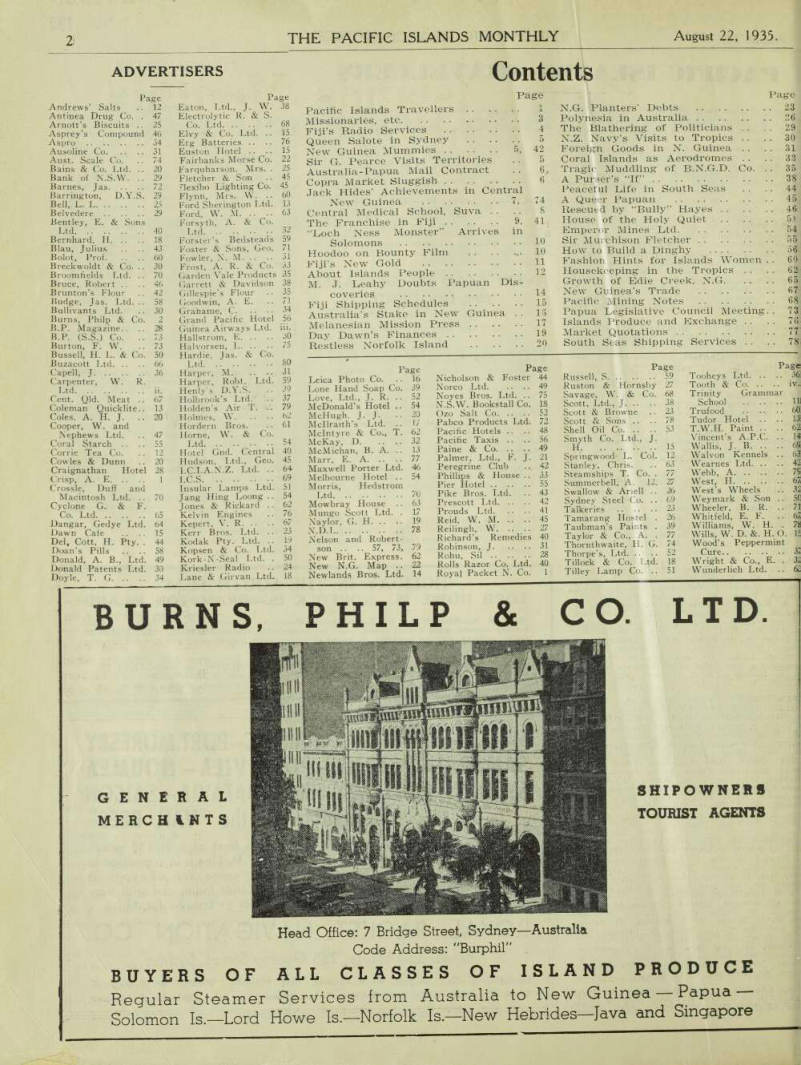
Page Andrews’ Salts .. 12 Antinea Drug Co. . 47 Arnott’s Biscuits .. 25 Asprey’s Compound 46 Aspro 34 Ausoline Co. .. .. 31 Aust. Scale Co. .. 74 Bains & Co. Ltd. .. 20 Bank of N.S.W. .. 29 Barnes, Jas. 72 Barrington, D.Y.S. 29 Bell, L. L. 25 Belvedere 29 Bentley, E. & Sons Ltd. 40 Bernhard, H. 18 Blau, Julius .. .. 43 Bolot, Prof. 60 Breckwoldt & Co. .. 30 Broomfields Ltd. .. 70
Bruce, Robert .. .. 46
Brunton’s Flour .. 42 Budge, Jas. Ltd. .. 58 Bullivants Ltd. .. 30 Burns, Philp & Co. 2 B.P. Magazine.. .. 28
B.P. (S.S.) Co. .. 73
Burton, F. W. .. 73 Bussell, H. L. & Co. 50 Buzacott Ltd. 66 Capell, J. 36 Carpenter, W. R.
Ltd. ii.
Cent. Qld. Meat .. 67 Coleman Quicklite.. 13 Coles, A. H. J. ..20 Cooper, W. and Nephews Ltd. .. 47 Coral Starch .. .. 55 Corrie Tea Co. .. 12 Cowles & Dunn .. 20 Craignathan Hotel 28 Crisp, A. E. 1 Crossle, Duff and Macintosh Ltd. .. 70 Cyclone G. & F.
Co. Ltd 65 Dangar, Gedye Ltd. 64 Dawn Cafe .. .. IS Del, Cott, H. Pty. . 44 Doan’s Pills .. .. 58 Donald, A. B., Ltd. 49 Donald Patents Ltd. 30 Doyle, T. G. 34
Page Eaton, Ltd., J. W. 38 Electrolytic R. & S.
Co. Ltd 68 Elvy & Co. Ltd. .. 15 Erg Batteries .. .. 76 Euston Hotel .. .. 15 Fairbanks Morse Co. 22 Farquharson, Mrs. . 25 Fletcher & Son .. 45 Hexibo Lighting Co. 45 Flynn, Mrs. W. .. 60 Ford Sherington Ltd. 13 Ford, W. M. 63 Forsyth, A. & Co.
Ltd. 32 Forster’s Bedsteads 59 Foster & Sons, Geo. 71 Fowler, N. M. 31 Frost, A. R. & Co. 33 Garden Vale Products 35 Garrett & Davidson 38 Gillespie’s Flour .. 35 Goodwin, A. E. .. 71 Grahame, C. 34 Grand Pacific Hotel 56 Guinea Airways Ltd. iii.
Hallstrom, E. 30 Halvorsen, L. 75 Hardie, Jas. & Co.
Ltd. 80 Harper, M. 31 Harper, Robt. Ltd. 59 Henly’s D.Y.S. .. 39 Holbrook’s Ltd. .. 37 Holden’s Air T. .. 79 Holmes, W. 62 Hordern Bros. 61 Horne, W. & Co.
Ltd. 54 Hotel Gnd. Central 40 Hudson, Ltd., Geo. 45
I.C.I.A.N.Z. Ltd. .. 64
I.C.S. 69
Insular Lamps Ltd. 51 Jang Hing Loong .. 54 Jones & Rickard .. 62 Kelvin Engines . 76 Kepert, V. R. 67 Kerr Bros. Ltd. .. 23 Kodak Pty. Ltd. .. 19 Kopsen & Co. Ltd. 54 Kork-N-Seal Ltd. . 50 Kriesler Radio .. 24 Lane & Girvan Ltd. 18
Page Leica Photo Co. ... 16 Lone Hand Soap Co. 39 Love, Ltd., J. R. .. 52 McDonald’s Hotel .. 54 McHugh, J. J. 20 Mcllraith’s Ltd. .. 17 Mclntyre & Co., T. 62 McKay, D. .. ..32 McMichan, B. A. .. 13 Marr, E. A. 77 Maxwell Porter Ltd. 46 Melbourne Hotel .. 54 Morris, Hedstrom Ltd. 70 Mowbray House .. 63 Mungo Scott Ltd. . 17 Naylor, G. H. 19
N.D.L. 78
Nelson and Robert son .. .. 57, 73, 79 New Brit. Express. 62 New N.G. Map . . 22 Newlands Bros. Ltd. 14
Page Nicholson & Foster 44 Norco Ltd. 49 Noyes Bros. Ltd. .. 75 N.S.W. Bookstall Co. 18 Ozo Salt Co. 52 Pabco Products Ltd. 72 Pacific Hotels .. .. 48 Pacific Taxis .. .. 56 Paine & Co. 49 Palmer, Ltd., F. J. 21 Peregrine Club .. 42 Phillips & House .. 33 Pier Hotel 55 Pike Bros. Ltd. .. 43 Prescott Ltd. 42 Prouds Ltd. 41 Reid, W. M. 45 Reilingh, W. .. .. 27 Richard’s Remedies 40 Robinson, J. 31 Rohu, Sil 28 Rolls Razor Co. Ltd. 40 Royal Packet N. Co. 1
Page Russell, S. 59 Ruston & Hornsby 27 Savage, W. & Co. 68 Scott, Ltd., J. 38 Scott & Browne .. 23 Scott & Sons .. . 78 Shell Oil Co. 53 Smyth Co. Ltd., J.
H. 15 Springwood L. Col. 12 Stanley, Chris. .. 63 Steamships T. Co. . 77 Summerbell, A. 12, 27 Swallow & Ariell .. 26 Sydney Steel Co. .. 69 Talkeries .. . 23 Tamarang Hostel . 26 Taubman’s Paints . 39 Taylor & Co., A. . 77 Thornthwaite, H. G. 74 Thorpe’s, Ltd. 52 Tillock & Co. Ltd. 18 Tilley Lamp Co. .. 51
Page Tooheys Ltd. 36 Tooth & Co. iv..
Trinity Grammar School 11 Trufood 60 Tudor Hotel .. .. 13 T.W.H. Paint .. .. 62 Vincent’s A.P.C. .. 14 Wallis, J. B. 65 Walvon Kennels .. 65 Wearnes Ltd. 42 Webb, A. 75 West, H. 62 West’s Wheels .. 32 Weymark & Son .. 50 Wheeler, B. R. .. 71 Whitfeld, E. F. .. 67 Williams, W. H. . 78 Wills, W. D. &. H. O. 15 Wood’s Peppermint Cure 37 Wright & Co., E. . 32 Wunderlich Ltd. .. 63
Contents
Page Pacific Islands Travellers .. .. .. 1 Missionaries, etc 3 Fiji’s Radio Services 4 Queen Salote in Sydney 5 New Guinea Mummies 5, 42 Sir G. Pearce Visits Territories .. 5 Australia-Papua Mail Contract .. 6.
Copra Market Sluggish 6 Jack Hides’ Achievements in Central New Guinea 7, 74 Central Medical School, Suva . . . . 8 The Franchise in Fiji 9, 41 “Loch Ness Monster” Arrives in Solomons 10 Hoodoo on Bounty Film 10 Fiji’s New Gold 11 About Islands People 12 M. J. Leahy Doubts Papuan Dis coveries 11 Fiji Shipping Schedules 15 Australia’s Stake in New Guinea .. 18 Melanesian Mission Press 17 Day Dawn’s Finances 19 Restless Norfolk Island 20
Page N.G. Planters’ Debts 23 Polynesia in Australia 26 The Blathering of Politicians .. . . 29 N.Z. Navy’s Visits to Tropics .. . . 30 Foreign Goods in N. Guinea .. .. 31 Coral Islands as Aerodromes . . . . 33 Tragic Muddling of B.N.G.D. Co. .. 35 A Purser’s “If” 38 Peaceful Life in South Seas . . . . 44 A Queer Papuan 45 Rescued by “Bully” Hayes 46 House of the Holy Quiet 51 Emperor Mines Ltd 54 Sir Murchison Fletcher 55 How to Build a Dinghy 56 Fashion Hints for Islands Women . . 60 Housekeeping in the Tropics . . . . 62- Growth of Edie Creek, N.G. 65 New Guinea’s Trade 67 Pacific Mining Notes 68 Papua Legislative Council Meeting.. 73 Islands Produce and Exchange .. .. 76 Market Quotations 77 South Seas Shipping Services . . .. 78
Advertisements & other items, p. 4 (1 item)
Burns. Philp & Co. Ltd.
General
MERCHANTS
SHIPOWNERS
TOURIST AGENTS
Head Office: 7 Bridge Street, Sydney—Australia Code Address: "Burphil"
BUYERS OF ALL CLASSES OF ISLAND PRODUCE Regular Steamer Services from Australia to New Guinea Papua Solomon Is.—Lord Howe Is.—Norfolk Is.—New Hebrides—Java and Singapore
The Pacific Islands Monthly
The Newspaper-Magazine Of The South Seas
[Registered at G.P.O., Sydney, for transmission by post as a newspaper.]
Published Once Each Month and Circulated in Australia and New Zealand and in the following Pacific Territories and Islands Groups:
Crown Colony of Fiji.
Australian Territory of Papua.
Mandated Territory (Australia) of New Guinea, Bismarck Archipelago, and Northern Solomon Islands.
Mandated Territory (Japan) of Marshall, Caroline and Marianna Islands.
French Territory of New Caledonia.
British and French Condominium of New Hebrides.
American Territory of Eastern Samoa.
American Territory of Guam.
Mandated Territory of Nauru.
British Crown Colony of Gilbert and Ellice Islands.
Mandated Territory (New Zealand) of Samoa.
British Solomon Islands Protectorate.
British Protectorate of Tongan Islands.
New Zealand Territory of COok Islands.
Australian Territory of Norfolk Island.
French Colony of Oceania (Tahiti, etc.).
American Territory of Hawaiian Islands.
Owned and Produced by Pacific Publications Ltd., Union House , 247 George Street, Sydney.
Telephone Bw 5037
P.O. Box 3408 R
Contributions Articles, Stories, and Photographs dealing with Pacific Islands Subjects are invited, and will be paid for on publication at usual rates.
Subscription Rates Per Annum, within British Empire, Prepaid Post Free 6/- Per Annum, elsewhere, prepaid, Post Free . 87- Single Copies 6d.
Editor and Publisher;
R. W. Robson.
Advertisements
Advertising rates furnished on application.
Colours, etc. by Arrangement.
Process Blocks made at Advertiser’s expense when required. Screen, 100.
Changes of Advertising Copy should reach this Office by 8th of each month, otherwise previous advertisement may be repeated.
Registered Address for Radiograms and Cables: “PACPUB” Sydney Agents The following are authorised to receive subscrip tions for “The Pacific Islands Monthly”— Islands Branches of Burns, Philp & Co., Ltd., and Burns Philp (South Seas) Co., Ltd.
Islands Branches of W. R. Carpenter & Co., Ltd.
All Branches of Morris, Hedstrom & Co., Ltd.
G. Thomas & Co., Rabaul.
Whitten Bros., Ltd., Samarai.
P. Costello, Suva, Fiji.
J. Muir, Suva.
All Branches and Representatives of W. H. Grove and Sons, Ltd., Auckland.
S. Russell, Papeete, Tahiti.
Cook Islands Trading Co., Rarotonga.
Vol. VI., No. I.
Sydney, August 22, 1933
Prire 6d - Per Copy Prepaid: 6/- p.a.
Missionaries, Etc.
NOT long ago one of the most able missionaries in the South Seas, in a private letter to the editor, said this: “Sometimes I feel tempted to write and thank you for your fairness to Christian Missions, and sometimes I feel that I should like to wring your neck for your unfairness!"
Therein we have the key to the whole wearisome controversy between mission aries and traders, missionaries and an thropologists, and so on. It all depends upon the point of view. The argument goes on and on, and no one is satisfied, or convinced, or happy. The trader who has to compete with a mission store in the next bay, or the planter who finds that labour-line discipline has been destroyed by over-enthusiastic attention to the souls of the labourers, calls male dictions upon the church militant. But the official who sees a missionary’s good work in the fields of education and medi cine, or the recruiter whose schooner has been towed off a lee shore by a crew from the ever-helpful mission station, will be ready with words of praise and gratitude.
So much depends, too, upon the kind of man the missionary is. This writer
asked a mission organiser: “What is your major difficulty? Finance?” “No!” was the emphatic reply. “It is personnel —the difficulty of persuading many ex cellent people that religious fervour alone does not qualify one for work in the foreign mission field.” “And next to that?” “The difficulty of explaining away the white man to the native,” he answered. Think that out.
We have not published much, in recent months, about what non-mission folk think of missionaries—it seemed to be leading nowhere. But we have received very many letters on the subject, some presenting cogent and striking argu ments. Those that are worthy of notice deal mostly with the economic aspect — with the impropriety of permitting mis sions, fortified by subsidies and assisted by abundant, cheap, native labour, to engage in trading, planting, building, etc., in competition with traders and tradesmen. The mission bodies—with out exception, we think—have now ac cepted the principle that mission activi ties must not enter the competitive field of trade and commerce. But the inter
pretation of that rule has caused friction and high feeling, in a few places.
There are few wealthy mission bodies.
As a rule, mission work is carried out, often under bitter financial stress, by voluntary effort and small donations of money. The economic ideal for which they naturally all strive is a self-support ing mission station, where the work is not cramped by financial considerations, and where appeals to the mother church for funds can be avoided. The missionaries, in such circumstances, eagerly engage in any proper enterprise which will provide them with greater facilities for work, or will help in feeding their station: copra production, coffee-growing, boat-build ing, even gold-digging and trochus fishing, have been regarded by them as legitimate activities. Is it to be won dered at that the missionaries become impatient and querulous when told that they must abandon these enterprises, and correspondingly limit their work of sal vation and education, in order that other Europeans may engage in the same ac tivities for profit? On the other hand, why should the missions be allowed to deprive white men of a means of live lihood? It all depends on the point of view.
The kernel of the argument is the value of the work being done by the mis sions. We may ignore, for the moment, the age-old controversy of whether Pa cific islanders can be, or should be, “Christianised.” But upon the invading Europeans there does lie the responsi bility of protecting the indigenous peoples, and of combatting the evils which attend the impact of Western civilisation. The Christian churches have undertaken that duty, with its in finite ramifications. The missionaries have come into the Pacific as a kind of buffer, between a ruthless commercialism, on the one hand, and a helpless, stone age people, on the other. The Pacific administrations, for their part, must pro tect the missionaries.
There have been some fools of mis sionaries, just as there have been some priceless scoundrels of traders. But the quaint “Bible-banger,” who made the Polynesians wear trousers, belongs to another age, and so does the gin-soaked rascal whose hobby was the enslavement and murder of natives. Our inquiries, made all over the Pacific, suggest that the majority of missionaries, nowadays, are broad-minded, manly fellows; that traders generally play the game in a thoroughly decent fashion; and that there is a real friendship between the two classes, based on mutual esteem.
And that, gentlemen, is why we have not published your numerous letters.
There are a few unpleasant missionaries, and traders, still about; but why spoil a really creditable picture by devoting unnecessary attention to a very few indi viduals, of fast-disappearing types?
General Hart Leaves Samoa
From Our Own Correspondent.
APIA, August 2.
SIR HERBERT HART, Administrator of the Mandated Territory, has departed by the Maui Pomare to New Zealand after the termination of his extended term of four years. During the last few days a large number of farewell functions showed the regard in which he was held by all those who had the pleasure of meeting him.
As Administrator, his powers .were ap parently more limited than those granted to his predecessors, who had left him a most difficult political situation. Sir Herbert’s smiling, courteous and genial personality will be long remembered, especially by the members of the Administration. The Samoans gave a taalolo at Mulinu’u in honour of the departing Administrator, when regret at his departure was suitably expressed by native orators.
Mr. A. C. Turnbull, Secretary to the Administration, is acting as Administrator until the arrival of a successor.
Rev. Father Granger, a Roman Catho lic missionary in Papua, died of fever at Yule Island on July 18. He had been in charge of Inawaia station for almost 30 years.
Fiji Radio
New Arrangements with
A.W.A.
From Our Own Correspondent.
Suva, Aug. 1.
AFTER some protracted negotiations an agreement has been reached for a further extension of the arrangement be tween Amalgamated Wireless (Austra lasia) Ltd. and the Fiji Government.
The modified arrangement provides that the Company will operate all the external wireless services, and the Fiji Govern ment the internal telegraph services, for which the Company is to instal two new wireless stations. A.W.A. will operate stations at Suva for the conduct of wire less services with Australia and the Pa cific Islands, and also ships at sea.
The agreement also provides that the Company will instal and operate a broad casting service at an early date.
Coastal Shipping Strike Dis
Montoro Held Up
Coastal Shipping Strike Dis organises Islands Steamer Services
THE Montoro, due to sail for Papua and New Guinea on August 14, and the Malaita, to leave for the Solomons on the 24th, have become involved in the Aus tralian coastal shipping strike, and Islands shipping services are correspondingly dis located.
No one knows why the seamen refused to work the B.P. ships—the “big firm” did not seem to be in any way connected with the dispute. The “Reds” in the Seamen’s Union got control of the situation as soon as the trouble developed, however, and the “Red” policy is to destroy everything.
At this moment (August 21) the moderates in the union seem to be getting the upper hand, and there are hopes that a settlement will be reached and that the ships will be moving again by the end of this week.
Miss Margaret Mary Isom, the infant daughter of the Melanesian Mission printer at Guadalcanal, looks out from her balcony, and sees nothing wrong with the Solomon Islands.
W. R. Carpenter & Co.’s
Profit for Year
AN increase in profits from £36,392 last year, to £48.684 for the year ended June 30 last, is reported by Messrs. W.
R. Carpenter and Co. Ltd., well-known Islands traders. The following is the “Sydney Morning Herald” analysis of the report:— Dividend of 8 per cent, (an unchanged rate) on the old capital, and pro rata om the shares issued in March, requires £30,400. The directors recommend a special bonus of 2 per cent, to commemo rate the completion of the twenty-first year of the company’s operations, andl this requires £9200. A sum of £10,000( is transferred to reserve against invest ments, and £5000 to branch reserves for doubtful debts, and £6082 is carried for ward, compared with £11,998 brought forward.
t Not stated. * Not shown separately. ** Including bank, f Land and buildings, ships, aeroplane plant, etc.
The company has expanded considerably since the last accounts. It purchased two 9000-ton Diesel motor vessels, and has inaugurated its own service from Great Britain to Australia and New Guinea. It has also increased its aerial fleet to five ’planes. The directors state that further expansion is contemplated during the current year. The benefit of the increase in capital will not be reflected in the profit and loss account until the next balancing period, when substantial movements are anticipated. Since June 30 the company has acquired the whole of the preference issue of W. R.
Carpenter and Co. (Solomon Islands) Ltd.
Year ended June 30. 1933. £ 1934. £ 1935. £ Net profit 34,105 36,392 48,684 24,133 24,133 30,40« 9.20< To investment reserve 10,00( To branch reserves, for 5,00 doubtful debts To repairs and replace- 8,075 ments 4,000 Forward 7,814 11,998 6,08 Gross profit 45,354 49,376 t
Liabilities-
Capital 301,666 339,788 468,32 Reserve 200,000 200,000 200,00 Replacement reserve ... 16,000 20,000 Creditors 15,501 17,596 **78,18 Bank 475
Assets—
Investments 127,697 140,617 217,81; Shipping property 28,075 28,155 t277,4!; Branch balances 351,132 418,867 Debtors 7,687 21,284 225,01 Stock 31 15 72,4:1 Cash 41,067 Ventures in abeyance .. 881 554 Unexpired charges
Development of British and Dutch New Guinea
Dutch New Guinea
THE following cable was published in Australia on August 5: A company has been formed in Amsterdam for the development of unexplored New Guinea. The pioneer work will be undertaken by British and Dutch aviators piloting De Haviland Rapide ’planes. It is hoped to discover gold, and at least to determine the possibilities of thousands of acres at present covered with forest.
Sydney
Queen Salote In
Tonga’s Ruler is Cordially Received
Queen Salote Tubou, D.B.E., Ruler
of Tonga, arrived in Sydney as the guest of the Methodist Church on July 30. Many interesting descriptions of the Islands potentate and her little kingdom appeared in the Australian newspapers; and, for a few days after her arrival, crowds gathered in Sydney whenever it was known that she would make a public appearance.
It is not a pleasant thing to be stared at in this fashion by strange people, but Salote bore the ordeal with quiet dignity.
She was attended by two maids-of-honour,
Misses F. Oneone and F. Tubou (pretty Tongan girls of noble birth), and Rev.
Roger C. G. Page, who is president of the Tonga Methodist Conference.
The Queen made no public appearance without the assistance of Mr. Page, and usually one or two prominent men of the Methodist Mission organisation were in the party. As a result of this careful assistance and good management, the numerous public appearances of the Queen passed off without any untoward incident, and her charm and poise made a good im pression upon the fickle Sydney crowds.
When the Marama berthed the first to meet Her Majesty was her eldest son, Prince Tuafa’ahau, who is a popular student at Newington College, N.S.W. The 17-years-old heir to the Tongan throne, who is six feet tall, was affectionately greeted in European fashion by his mother.
For several days, Salote was kept busy with official calls. She was accorded a civic reception at the Sydney Town Hall on July 31; lunched with the Governor and Lady Hore-Ruthven at Government House; and was entertained at the George Brown Training College by Mrs. J. W.
Burton, wife of the general secretary of the Methodist Mission. The following evening, as the central figure in a large and very friendly gathering, she was offi cially welcomed by the Methodist Church at Sydney Town Hall.
Shunning all display of ostentation, Salote quietly attended Divine Service with her son at Haberfield Methodist Church, on Sunday, August 4. The en suing fortnight was spent in visiting the beauty spots of Sydney’s surrounding dis tricts, and in renewing acquaintance with
Australian people who had known her in Tonga.
On August 13, Queen Salote entered a private hospital to undergo a minor operation. It was successfully performed and in mid-August she was still convales cent in hospital. It was hoped that she might spend a few days recovering on the Blue Mountains, but medical opinion advised against the extreme cold which is now gripping that popular re sort.
Early in September, Her Majesty will leave Sydney for Canberra, and later will go on to Victoria, as the guest of Rev.
J. W. Grove, president of the Victorian Methodist Conference. On October 3, she will depart from Australia by the Katoomba for Fiji, to take part in the centenary celebrations at Lakemba, where the first Methodist missionaries landed in Fiji in 1835.
Mr. V. A. Pratt, of Tobera plantation, who is one of the best known planters in New Guinea, left Sydney by the Mari posa on August 21, with the intention of spending a few months in the western states of America and Mexico.
A snapshot on the wharf at Nukualofa, when Queen Salote was leaving Tonga. Left to right: Mr. J. S. Neil (British agent), Mrs. Ragnar Hyne (wife of the Chief Justice), and Mr. W. G. Bagnall (Minister for Finance).
Territories
Australian Minister In
Brief Visit to Rabaul
THE Minister in Charge of Australia’s Pacific territories (Sir George Pearce) arrived in Rabaul on August 5 and de parted on August 6. He was then to visit some of the outposts, and spend a few days on the Morobe goldfield; after which he was to fly across to Port Moresby and join the Macdhui there for Sydney.
Australian newspapers report that at Rabaul the Minister had a long, private interview with members of the Planters’
Association, who urged that the Common wealth Government should permit a sub stantial writing-down in the value of expropriated plantations. It was reported that “there is strong opposition in Rabaul to this proposal on the grounds that at least 80 per cent. of the plantations are owned or completely controlled by big trading companies which for many years have been paying large dividends.” (Reference to an article on this subject elsewhere in this issue will show that the companies concerned are disposed to make concessions to the planters in the same proportion as concessions are made by the Commonwealth.—Editor.) A Rabaul correspondent telegraphed: There has been considerable criticism of Sir George Pearce’s decision to spend only one day in Rabaul. Many residents, wish ing to ventilate grievances, have not been given an opportunity of interviewing the Minister.
Paramount chiefs, who after several meetings have drawn up a list of 14 sug gested reforms, say they have been ignored.
Visit To Papua
When the Minister arrived in Port Moresby on August 1, he was joined by the Lieut.-Governor of Papua (Sir Hu bert Murray), and the latter accompanied Sir George Pearce on the steamer west wards to Yule Island, back to Port Moresby and on to Samarai. There, the Lieut.-Governor left the ship and pro ceeded on an inspection up the north-east coast of Papua. While the Macdhui was in Port Moresby, over 40 lady residents met Lady Pearce at an afternoon recep tion arranged by Mrs. R. T. Gore, wife of the chief judicial officer.
Dr. Reo Fortune
DR. RAYMOND FIRTH, formerly occupant of the chair of anthropology at the University of Sydney, and now lec turer at the University of London, has suggested that Dr. Reo Fortune should
investigate the mummified remains re cently discovered in New Guinea. For some months Dr. Fortune (who is a New Zealander and has been attached to the anthropology department at Sydney Uni versity) has been working at Finintegu, in the Morobe district, New Guinea.
Dr. Fortune was in New Guinea two years ago with his wife, Dr. Margaret Mead, of the American Museum of Nat-
ural History, New York. He is the author of “Omaha Secret Societies” and “Sor cerers of Dobu,” and has contributed to leading- scientific journals; he is a Ph.D of Columbia. Dr. Mead is equally well known for her writings on New Guinea and Samoa. —E.R.
Dr. Reo Fortune.
A photograph of one of the “mummies” found recently in a cave in New Guinea. (See article on page 42 of this issue.)
New Store For Nukualofa
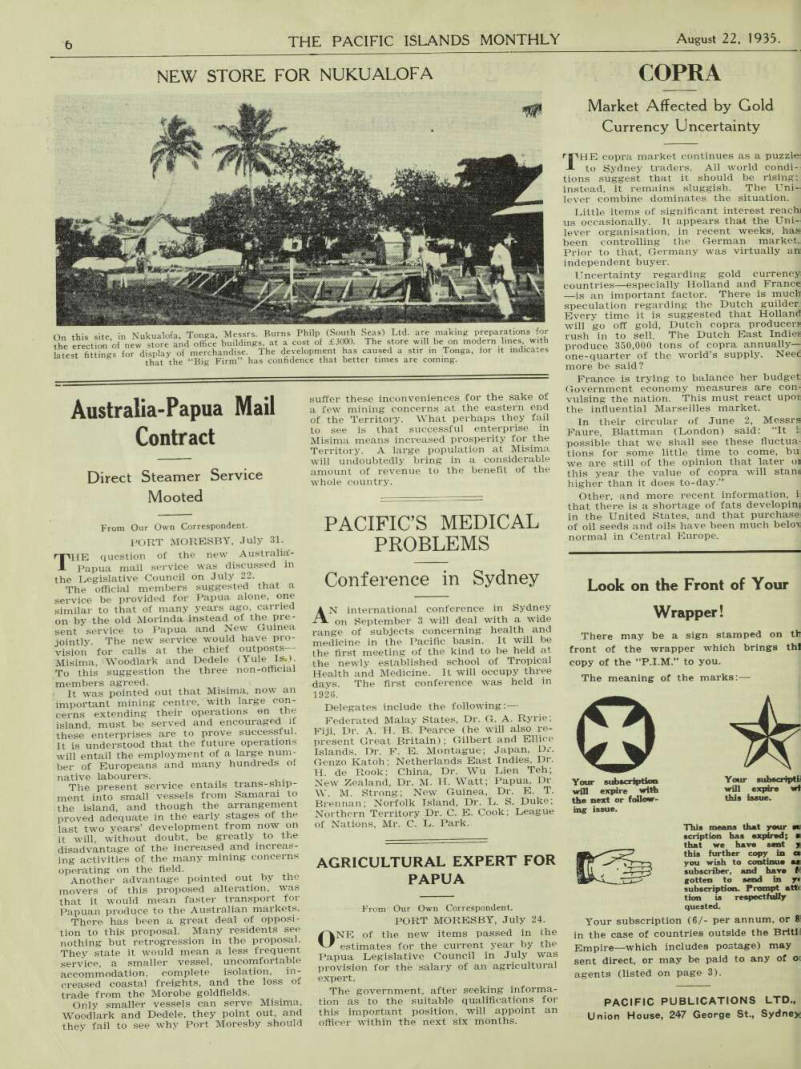
On this site in Nukualofa, Tonga, Messrs. Burns Philp (South Seas) Ltd. are making preparations for the erection of new store and office buildings, at a cost of £3000. The store will be on modern lines with latest fittings for display of merchandise. The development has caused a stir in Tonga, for it indicates that the “Big Firm” has confidence that better times are coming.
Australia-Papua Mail
Contract Direct Steamer Service Mooted
From Our Own Correspondent.
Port Moresby, July 31.
THE question of the new Australia- Papua mail service was discussed in the Legislative Council on July 22.
The official members suggested that a service be provided for Papua alone, one similar to that of many years ago, carried on by the old Morinda instead of the pre sent service to Papua and New Guinea jointly. The new service would have pro vision for calls at the chief outposts— Misima, Woodlark and Dedele (Yule Is.).
To this suggestion the three non-official members agreed.
It was pointed out that Misima, now an important mining centre, with large con cerns extending their operations on the island, must be served and encouraged if these enterprises are to prove successful.
It is understood that the future operations will entail the employment of a large num ber of Europeans and many hundreds of native labourers.
The present service entails trans-ship ment into small vessels from Samarai to the island, and though the arrangement proved adequate in the early stages of the last two years’ development from now on it will, without doubt, be greatly to the disadvantage of the increased and increasing activities of the many mining concerns operating on the field.
Another advantage pointed out by the movers of this proposed alteration, was that it would mean faster transport for Papuan produce to the Australian markets.
There has been a great deal of opposi tion to this proposal. Many residents see nothing but retrogression in the proposal.
They state it would mean a less frequent service, a smaller vessel, uncomfortable accommodation, complete isolation, in creased coastal freights, and the loss of trade from the Morobe goldfields.
Only smaller vessels can serve Misima, Woodlark and Dedele, they point out, and they fail to see why Port Moresby should
suffer these inconveniences for the sake of a few mining concerns at the eastern end of the Territory. What perhaps they fail to see is that successful enterprise in Misima means increased prosperity for the Territory. A large population at Misima will undoubtedly bring in a considerable amount of revenue to the benefit of the whole country.
Pacific’S Medical
Problems
Conference in Sydney
AN international conference in Sydney on September 3 will deal with a wide range of subjects concerning health and medicine in the Pacific basin. It will be the first meeting of the kind to be held at the newly established school of Tropical Health and Medicine. It will occupy three days. The first conference was held in 1928.
Delegates include the following:— Federated Malay States, Dr. G. A. Ryrie; Fiji, Dr. A. H. B. Pearce (he will also re present Great Britain); Gilbert and Ellice Islands, Dr. F. E. Montague; Japan, Dr.
Genzo Katoh; Netherlands East Indies, Dr.
H. de Rook; China, Dr. Wu Lien Teh; New Zealand, Dr. M. H. Watt; Papua, Dr W. M. Strong; New Guinea, Dr. E. T.
Brennan; Norfolk Island, Dr. L. S. Duke; Northern Territory Dr. C. E. Cook; League of Nations, Mr. C. L. Park.
Agricultural Expert For
Papua
From Our Own Correspondent.
Port Moresby, July 24.
ONE of the new items passed in the estimates for the current year by the Papua Legislative Council in July was provision for the salary of an agricultural expert.
The government, after seeking informa tion as to the suitable qualifications for this important position, will appoint an officer within the next six months.
Copra
Market Affected by Gold Currency Uncertainty
THE copra market continues as a puzzle to Sydney traders. All world condi tions suggest that it should be rising: instead, it remains sluggish. The Uni lever combine dominates the situation.
Little items of significant interest reach us occasionally. It appears that the Uni lever organisation, in recent weeks, has been controlling the German market.
Prior to that, Germany was virtually an independent buyer.
Uncertainty regarding gold currency countries —especially Holland and France —is an important factor. There is much speculation regarding the Dutch guilder.
Every time it is suggested that Holland will go off gold, Dutch copra producers rush in to sell. The Dutch East Indies produce 350,000 tons of copra annually— one-quarter of the world’s supply. Need more be said?
France is trying to balance her budget Government economy measures are con vulsing the nation. This must react upon the influential Marseilles market.
In their circular of June 2, Messrs Faure, Blattman (London) said: “It is possible that we shall see these fluctua tions for some little time to come, but we are still of the opinion that later on this year the value of copra will stand higher than it does to-day.”
Other, and more recent information, in that there is a shortage of fats developing in the United States, and that purchases of oil seeds and oils have been much below normal in Central Europe.
Advertisements & other items, p. 8 (1 item)
Wrapper!
Look on the Front of Your
There may be a sign stamped on the front of the wrapper which brings this copy of the “P.I.M.” to you.
The meaning of the marks: Your subscription (6/- per annum, or 8 s in the case of countries outside the British Empire—which includes postage) may be sent direct, or may be paid to any of our agents (listed on page 3).
PACIFIC PUBLICATIONS LTD.,
Union House, 247 George St., Sydney Your subscription will expire with the next or following issue.
Your subscription will expire with this issue.
This means that your subscription has expired; and that we have sent you this further copy in case you wish to continue as a subscriber, and have forgotten to send in your subscription. Prompt attention is respectfully quested.
Central New Guinea Gives Up Its Secrets
Hides Proves Existence of Vast Fertile Tableland, Densely Inhabited by Skilled Agriculturists of Peculiar Racial Type
By R. W. Robson
NEVER in the history of the Pacific Islands have the newspapers of Aus tralia given to the work of exploration the attention which they have in recent weeks accorded the expedition that was led through the unknown north-west corner of Papua by Mr. Jack Hides, A.R.M., and Patrol Officer O’Malley, between January and July.
There have been many other expeditions, equally successful and of great importance (some led by Mr. Hides himself) but on this occasion the Australian press—and, in fact, the press of the world —gave to Mr.
Hides’ exploits and discoveries the same publicity as they might have given to H. M.
Stanley’s travels a couple of generations ago.
It was just luck —and no one will envy Mr. Hides his good fortune. He has car ried out a magnificent job of work; his performance reflects the greatest credit upon the Papuan Administration; and he has, through all this blaze of publicity, borne himself with a quietness and modesty which have been very favourably com mented upon in Australia. He was not to know that the Australian newspapers suddenly have become “Islands conscious.”
The Pacific Islands are now receiving from newspapers and public men in Australia a degree of attention that represents com pensation, in some measure, for the neglect which they suffered for many decades.
Details of what was accomplished by Mr.
Hides’ expedition are given elsewhere. The importance of what was done lies in the fact that Mr. Hides’ discoveries proved that there is, in that vast and hitherto un known centre of British New Guinea (that is, astride of the border between Papua and the Mandated Territory) an enormous tableland, carrying a large number of river systems; and that in their magnificent valleys there reside an incredible number of people, of a type generally very different from the coastal natives of Papua and New Guinea —people who are skilled agri culturists, and with social organisations and communal customs which almost sug gest that they are a race apart.
If one looks at a recent map of Papua and the Mandated Territory, one will see a great blank space marked “unexplored,” right in the centre of the land mass, and astride the border of the two territories.
Many great rivers apparently have their sources in this unknown interior—the Fly and the Strickland, the Kikori, and the Purari, flowing southwards into the Gulf of Papua; and the mighty Sepik and the Ramu, flowing northwards to the northern coast of New Guinea. It is now becoming clear that the chief source of these rivers —particularly the Strickland, the Kikori, the Purari, and the southern tributaries of the Sepik and the Ramu —is the great central plateau, lying apparently at a height varying from 3000 to 6000 feet in the centre of the island, immediately east wards of the Dutch-British border.
The first indications of the nature of this mysterious country were made public a couple of years ago, when Messrs. J. L.
Taylor and the well-known Leahy brothers, penetrating in a north-westerly direction from the northern limits of the Morobe goldfields in New Guinea, succeeded in reaching Mount Hagen, which is over 13,000 feet high. They crossed the upper waters of the northwards-flowing Ramu, and then, between the Ramu and Mount
Hagen, they discovered a series of great river systems, watering a magnificent park-like plateau, inhabited by a superior race of primitive agriculturists, who never before had seen white men. It was clear that these river systems disappeared into the mountains to the south, to become one river; and it was also apparent that these rivers were nothing less than the upper waters of the Purari—although no one yet has actually traced the connection be tween the southward-flowing river sys tems discovered by Messrs. Taylor and Leahy (in New Guinea) and the Purari proper, where it emerges from the moun tains in Papua and flows into the Gulf of Papua.
Between the Ramu and Mount Hagen, Messrs. Taylor and Leahy found a dense population divided into numerous tribes— which tribes, for purposes of convenience, they grouped into two divisions, which they called the Benna Bennas (after the most easterly Purari river systems) and the Wahgis (after the most westerly of the Purari river systems). In other words, the Benna Bennas are the more easterly of the newly-discovered tribes in New Guinea, whereas the Wahgis are the most westerly, being right under the shadow of Mount Hagen itself.
Messrs. Taylor and Leahy reported that, from the vicinity of Mt. Hagen they could see a continuation of this magnificent plateau country, evidently densely popu lated, stretching away into the west and southwest towards the Papuan border.
That was two years ago; and, since then, the only additional information concerning this mysterious inland plateau has com prised details of the Benna Bennas and Wahgis.
What Messrs. Taylor and Leahy did in Central Mandated Territory, Mr. Hides did in Central Papua.
Mr. Hides’ expedition defines and com pletes the picture; and, for that reason, it will probably be written down in the future as the last and most important of the explorations made in the centre of this mighty island of New Guinea. Mr. Hides, penetrating from the south and south-west, has proved beyond any shadow of doubt that the vast upland region, which com mences eastwards and southwards of Mt.
Hagen, continues southward, deep into Papua, as a vast inland plateau of extra ordinary fertility; and that it is inhabited right down to the Papuan limestone barrier by a class of people similar to those whom Messrs. Taylor and Leahy discovered in the Ramu-Mt. Hagen region.
IT appears that, far to the southwards of the Mandated Territory-Papua border, and running parallel with it—that is, east and west —there is an almost im passable limestone range or barrier. It is ghastly country—about 7000 to 8000 feet high, sparsely covered with poor tim ber, incredibly broken and inhospitable, where never a beast is seen nor a bird is heard. It is a country where there is much rain but no water—all the rain fall disappears into the limestone.
Northwards of this barrier lies the country discovered and described by Mr.
Hides, and called “Wonderland” by the Australian newspapers. Numerous rivers from the north find their way southwards towards the Gulf of Papua, through deep gorges in the limestone, but the gorges do not provide means of human com munication. They are death-traps, be cause the rivers are subject to sudden freshet.
Apparently, through the ages, people from the north have come down and settled along the rich valleys, and have remained there as dense populations of skilled agriculturists. But they have not, in any numbers, passed the limestone barrier. The rich valleys and the dense populations described by Messrs. Taylor
(Continued on page 74)
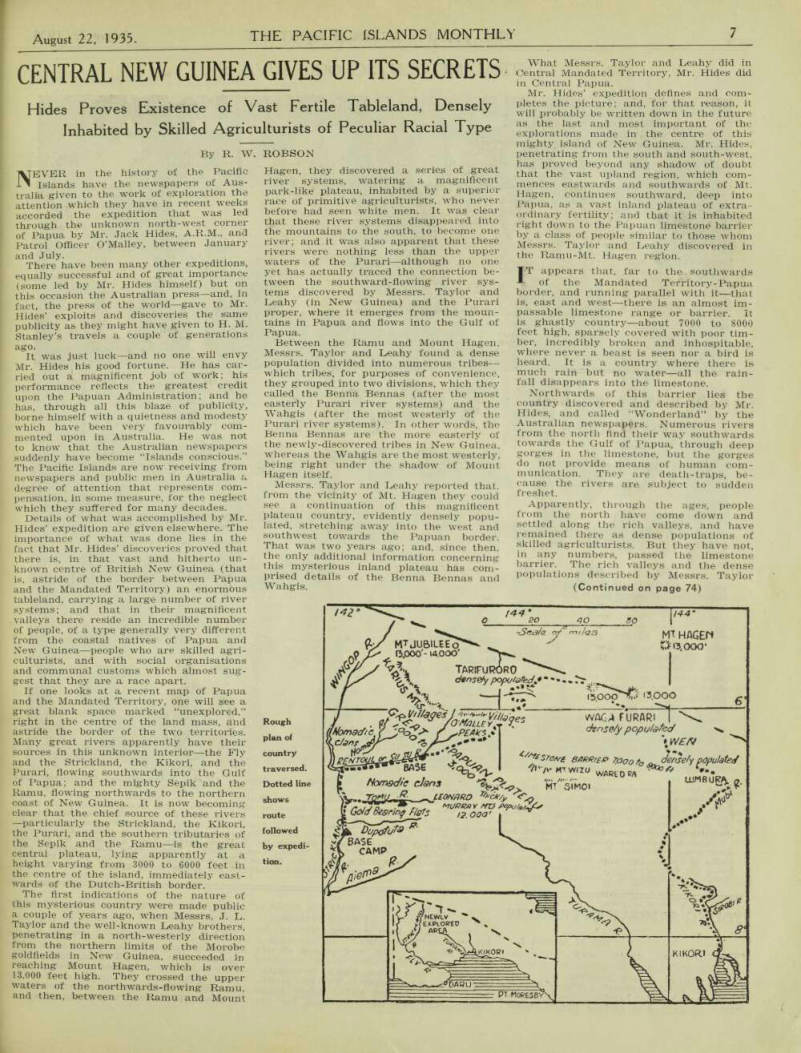
Rough plan of country traversed.
Dotted line shows route followed by expedi tion.
and Leahy in New Guinea, and by Mr.
Hides in Papua, end suddenly against the limestone barrier. Southwards of the barrier, apparently, there are different kinds of people inhabiting a different kind of country. There clearly has been com munication and intermixture between them, but not to any marked extent.
Without any doubt, explorations with in the next few years will confirm and extend the discoveries of these young ex plorers. It will be found that in that vast region that lies between Morobe in the east and the Dutch border on the west, and between the Sepik and Ramu rivers in the north and the limestone barrier in the south, there is an enormous native population, inhabiting innumerable well-watered valleys which in all direc tions intersect the fertile central table land. , It will be found, also, that generally these people, although they display many tribal differences, are of a special racial type —a people, for the most parß of good stature, and with markedly aquiline fea tures. In many places they show strong Papuan or Melanesian characteristics, but the great majority do not appear to be
Papuans or Melanesians. Neither are they Polynesians But there seems to be one distinctive section. Mr. Hides, in the most definite fashion, has described to me a people who in habit a valley at the western (or Stride ]and) end of the country he explored. He said that these people have a skin almost Anglo-Saxon in colour; that they are lightly built and even effeminate in ap pearance; and that he estimated that there were at least 50,000 of them.
These light-skinned folk were at the wes f ern e nd of the districts he pene trated and he said that the tribes there abouts clearly had never previously been contact with whites. But towards the eagtern end of his pa trol, southwards and south-eastwards of Mount Hagen, and near the p ura ri River, he found much ev i de nce that the tribes had been in con t with white people in the north, north wa^s ‘” ( e ®f mestone barrle r appeared
mmmmm
tion of crops; they appeared to have a remarkable system of communal life, adapted to their practice of living on iso lated farms rather than in villages; and they are notable for a variety of curious customs, which on investigation may es tablish affinities which will allow scien tists to trace something of their history.
It certainly seems to be a rich field for the anthropologist.
The Papuan Police
An outstanding feature of the Hides expedition was the extraordinarily fine service rendered by the Papuan Armed Constabulary. Mr. Hides had with him less than a dozen native police; yet they stood by him with such staunchness and loyalty that the little party was able to come unscathed through a territory that was always strange and dangerous, and often actively hostile.
The two leaders, Messrs. Hides and O’Malley, appear to have worked together in a fine spirit of comradeship and mutual trust; that, of course, was to be expected.
But the thing that is most worthy of praise, and concerning which we should like much further information, is the splendid service rendered to the two white officers by those Papuan policemen. There is not much wrong with an Administra tion which has service of this kind at its command.
Young Explorers In A
Maelstrom
Messrs. Hides and O’Malley were given special leave to come South by the Mon toro, early in August. Immediately, they were involved in a press hullabulloo which they must have found more terrifying" than anything encountered north of the limestone barrier.
Mr. Hides was met in Queensland by a representative of the Sydney Morning Herald-Melbourne Argus group, who signed him up for a series of illustrated articles. This stirred a rival newspaper group to activity, and some funny things happened. The rival group evidently protested to the Federal authorities. “Mr.
Hides,” they probably said, “is a Papuan Government official. Who gave him the right to sell to our rivals an exclusive story based on material gathered in his duties as a Government officer? If he has a report to make, all newspapers are entitled to it.”
It would appear that the Federal au thorities accepted this argument. Mr.
Hides had submitted to the Lieutenant- Governor a 35,000-words report on his expedition; and the Governor had promptly transmitted it to Canberra. A few hours after it reached Canberra it was released to the newspapers.
So we had the interesting spectacle of the Herald-Argus group publishing a specially compiled account of Mr. Hides expedition; while the rival group, on the same days, were publishing copious ex
tracts from Mr. Hides’ official report.
For over a week, therefore, Mr. Hides and his “Papuan Wonderland” were front page news in every city of the Common wealth. Summaries of the articles evi dently were cabled overseas, for there were interesting comments in overseas newspapers: even the London “Times” de voted a leading article to the subject of whether an attempt should be made to preserve these newly-discovered natives in an unspoiled condition.
The rival group, however, in their eagerness to beat the Herald-Argus group, made rather a hash of the official report. The series of articles in the Herald-Argus newspapers gave a clear, graphic account of what had been achieved: but the material that was dished up from the official report by special correspondents at Canberra was such a jumble that few could make head or tail of it—it was just a series of dis connected incidents and descriptions.
Meanwhile, Mr. Hides had arrived in Sydney, where he was more or less torn to pieces by reporters, overcome by a first-class dose of malaria and driven nearly frantic by demands for speeches and articles from a multitude of pub lishers, luncheon-club organisers, broad casting stations, etc. He fled into the bush to nurse his malaria and his new baby, and he still is there at the moment of this writing.
Central Medical School, Suva. Fiji
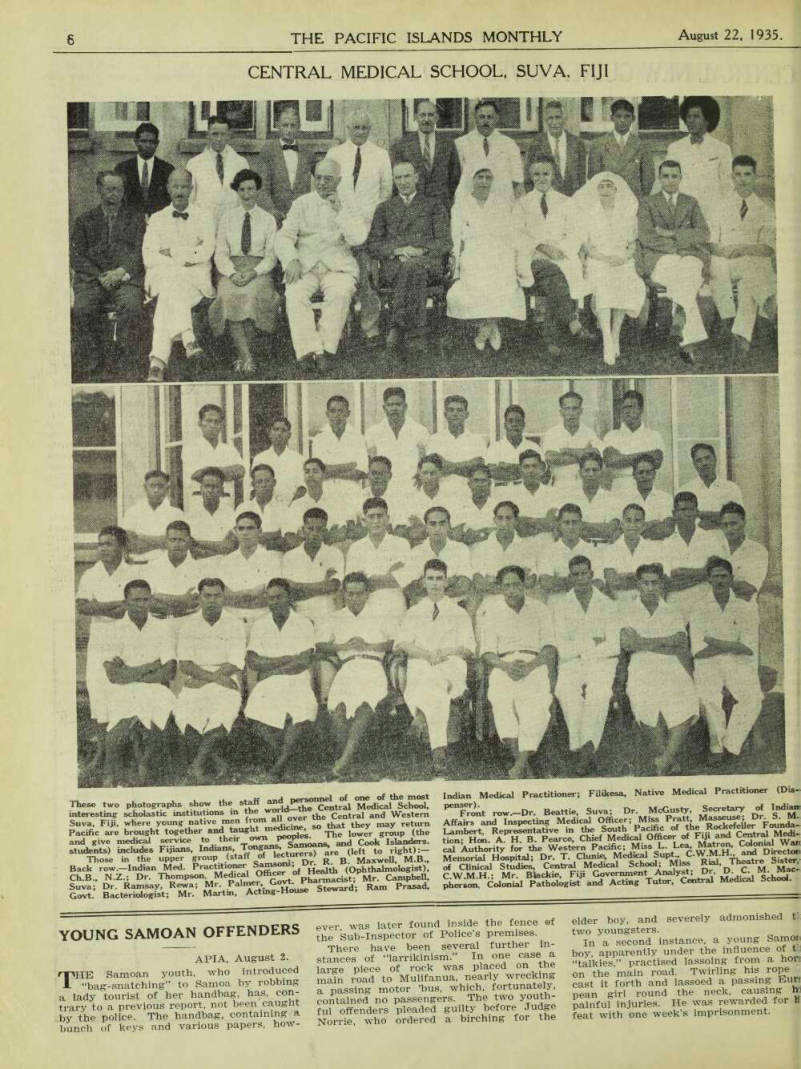
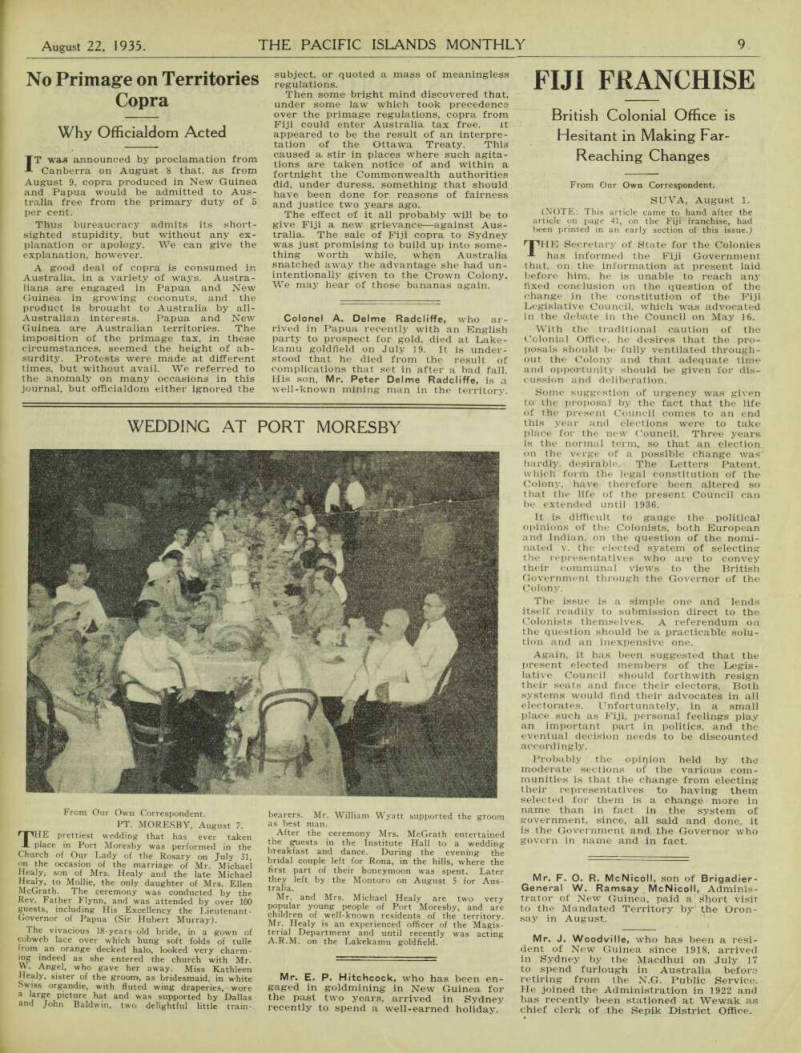
These two photographs show the staff and personnel of one of the most interesting scholastic institutions in the world— the Central and Medical School, Suva, Fiji, where young native men from all the Central and Western Pacific are brought together and taught medicine, so that they may return and give medical service to their own peoples. The lower group (the students) includes Fijians, Indians, Tongans, Samoans, and Cook Islanders.
Those in the upper group (staff of lecturers) are (left to right):- Back row.—Indian Med. Practitioner Samsoni; Dr. R. B. Maxwell, M.B., Ch.B., N.Z.; Dr. Thompson, Medical Officer of (Ophthalmologist), Suva; Dr. Ramsay, Rewa; Mr. Palmer, Govt. Pharmacist; Mr. Campbell, Govt. Bacteriologist; Mr. Martin, Acting-House Steward; Ram Prasad,
Indian Medical Practitioner; Filikesa, Native Medical Practitioner (Dis
penser).
Front row.—Dr. Beattie, Suva; Dr, McGusty, Secretary of Indian Affairs and Inspecting Medical Officer; Miss Pratt, Masseuse; Dr. S.M.
Lambert, Representative in the South Pacific of the Rockefeller Founda tion; Hon. A.H.B. Pearce, Chief Medical Officer of Fiji and Central Medical Authority for the Western Pacific; Miss L. Lea, Matron, Colonial Wan Memorial Hospital; Dr. T. Clunie, Medical Supt., C.W.M.H., and Director of Clinical Studies, Central Medical School; Miss Rial, Theatre Sister, C.W.M.H.; Mr. Blackie, Fiji Government Analyst; Dr. D. C. M. Mac pherson, Colonial Pathologist and Acting Tutor, Central Medical School.
Young Samoan Offenders
APIA, August 2.
THE Samoan youth, who introduced “bag-snatching” to Samoa by robbing a lady tourist of her handbag, has, con trary to a previous report, not been caught by the police. The handbag, containing a bunch of keys and various papers, how
ever was later found inside the fence of the Sub-Inspector of Police’s premises.
There have been several further in stances of “larrikinism.” In one case a large piece of rock was placed on the main road to Mulifanua, nearly wrecking a passing motor ’bus, which, fortunately, contained no passengers. The two youth ful offenders pleaded guilty before Judge Norrie, who ordered a birching for the
elder boy, and severely admonished the two youngsters.
In a second instance, a young Samoan boy, apparently under the influence of the “talkies,” practised lassoing from a horn on the main road. Twirling his rope, he cast it forth and lassoed a passing European girl round the neck, causing her painful injuries. He was rewarded for his feat with one week’s imprisonment.
Copra
No Primage on Territories Copra Why Officialdom Acted
IT was announced by proclamation from Canberra on August 8 that, as from August 9, copra produced in New Guinea and Papua would be admitted to Aus tralia free from the primary duty of 5 per cent.
Thus bureaucracy admits its short sighted stupidity, but without any ex planation or apology. We can give the explanation, however.
A good deal of copra is consumed in Australia, in a variety of ways. Austra lians are engaged in Papua and New Guinea in growing coconuts, and the product is brought to Australia by all- Australian interests. Papua and New Guinea are Australian territories. The imposition of the primage tax, in these circumstances, seemed the height of ab surdity. Protests were made at different times, but without avail. We referred to the anomaly on many occasions in this journal, but officialdom either ignored the
subject, or quoted a mass of meaningless regulations.
Then some bright mind discovered that, under some law which took precedence over the primage regulations, copra from Fiji could enter Australia tax free. It appeared to be the result of an interpre tation of the Ottawa Treaty. This caused a stir in places where such agita tions are taken notice of and within a fortnight the Commonwealth authorities did, under duress, something that should have been done for reasons of fairness and justice two years ago.
The effect of it all probably will be to give Fiji a new grievance—against Aus tralia. The sale of Fiji copra to Sydney was just promising to build up into some thing worth while, when Australia snatched away the advantage she had un intentionally given to the Crown Colony.
We may hear of those bananas again.
Colonel A. Delme Radcliffe, who ar rived in Papua recently with an English party to prospect for gold, died at Lake kamu goldfield on July 19. It is under stood that he died from the result of complications that set in after a bad fall.
His son, Mr. Peter Delme Radcliffe, is a well-known mining man in the territory.
Wedding At Port Moresby
From Our Own Correspondent.
PT. MORESBY, August 7.
THE prettiest wedding that has ever taken place in Port Moresby was performed in the Church of Our Lady of the Rosary on July 31, on the occasion of the marriage of Mr Michael Healy, son of Mrs. Healy and the late Michael Healy, to Mollie, the only daughter of Mrs. Ellen McGrath. The ceremony was conducted by the Rev. Father Flynn, and was attended by over 100 guests, including His Excellency the Lieutenant- Governor of Papua (Sir Hubert Murray).
The vivacious 18-years-old bride, in a gown of cobweb lace over which hung soft folds of tulle from an orange decked halo, looked very charm ing indeed as she entered the church with Mr.
W. Angel, who gave her away. Miss Kathleen Healy, sister of the groom, as bridesmaid, in white Swiss organdie, with fluted wing draperies, wore a large picture hat and was supported by Dallas and John Baldwin, two delightful little train-
bearers. Mr. William Wyatt supported the groom as best man.
After the ceremony Mrs. McGrath entertained the guests in the Institute Hall to a wedding breakfast and dance. During the evening the bridal couple left for Rona, in the hills, where the first part of their honeymoon was spent. Later they left by the Montoro on August 5 for Ausralia.
Mr. and Mrs. Michael Healy are two very popular young people of Port Moresby, and are children of well-known residents of the territory.
Mr. Healy is an experienced officer of the Magisterial Department and until recently was acting A.R.M. on the Lakekamu goldfield, Mr. E. P. Hitchcock, who has been en gaged in goldmining in New Guinea for the past two years, arrived in Sydney recently to spend a well-earned holiday.
Fiji Franchise
British Colonial Office is Hesitant in Making Far- Reaching Changes
From Our Own Correspondent.
SUVA, August 1. (NOTE; This article came to hand after the article on page 41, on the Fiji franchise, had been printed in an early section of this issue.) THE Secretary of State for the Colonies has informed the Fiji Government that, on the information at present laid before him, he is unable to reach any fixed conclusion on the question of the change in the constitution of the Fiji Legislative Council, which was advocated in the debate in the Council on May 16.
With the traditional caution of the Colonial Office, he desires that the pro posals should be fully ventilated through out the Colony and that adequate time and opportunity should be given for dis cussion and deliberation.
Some suggestion of urgency was given to the proposal by the fact that the life of the present Council comes to an end this year and elections were to take place for the new Council. Three years is the normal term, so that an election on the verge of a possible change was hardly, desirable. The Letters Patent, which form the legal constitution of the Colony, have therefore been altered so that the life of the present Council can be extended until 1936.
It is difficult to gauge the political opinions of the Colonists, both European and Indian, on the question of the nomi nated v. the elected system of selecting the representatives who are to convey their communal views to the British Government through the Governor of the Colony.
The issue is a simple one and lends itself readily to submission direct to the Colonists themselves. A referendum on the question should be a practicable solu tion and an inexpensive one.
Again, it has been suggested that the present elected members of the Legis lative Council should forthwith resign their seats and face their electors. Both systems would find their advocates in all electorates. Unfortunately, in a small place such as Fiji, personal feelings play an important part in politics, and the eventual decision needs to be discounted accordingly.
Probably the opinion held by the moderate sections of the various com munities is that the change from electing their representatives to having them selected for them is a change more in name than in fact in the system of government, since, all said and done, it is the Government and the Governor who govern in name and in fact.
Mr. F. O. R. McNicoll, son of Brigadier- General W. Ramsay McNicoll, Adminis trator of New Guinea, paid a visit to the Mandated Territory by the Oronsay in August.
Mr. J. Woodville, who has been a resi dent of New Guinea since 1918, arrived in Sydney by the Macdhui on July 17 to spend furlough in Australia before retiring from the N.G. Public Service.
He joined the Administration in 1922 and has recently been stationed at Wewak as chief clerk of the Sepik District Office.
“Loch Ness Monster” Arrives In Solomons
Letter to the Editor.
I HAD an unusual experience to-day, whilst fishing from my canoe, just off the edge of a reef.
I was alone, and intently watching my bait, when I heard a sound behind me like someone breathing deeply. I looked round quickly and saw what I thought was a huge alligator, but soon realised, to my dismay, that it was a monster of the deep I had never seen before.
It had a head similar to an alligator, but the nose was more square, and it was about 18 inches wide and 36 inches long. Its body, of a dark red colour, was from 20 to 25 feet long, and as round as a coconut tree. It came in great loops out of the water. The monster came in a kind of bounding motion towards me, with open mouth, breathing heavily with each bound.
Thinking, in a case like this, that dis cretion was the better part of valour, I quickly pulled up my anchor, and made for the shallows, and I heaved a sigh of relief when it went “bounding” past me on its way. Soon after passing me, it submerged.
My brother, who had been ashore, joined me a few minutes after the crea
ture disappeared. I told him of what I had seen, and we both went out in our canoes in the direction the beast had taken.
About five minutes later, it came up again, just ahead of us, went through its antics again of bounding, and breathing, then went down. We watched it for some time, and saw it come up several times, finally disappearing in the distance.
It had no legs, and as far as I could see, no fins. Its tail I did not notice. I have seen both a reef eel and a conger eel, but this creature was not like either of these.
The same creature was seen, so the na tives tell me, by two “boys,” while they were crossing in a canoe to a neighbour ing island, about six weeks ago, but they were not close to it. It is new to them, nobody ever having seen one before.
It is the closest I ever was, or wish to be, to the old mariners’ fabulous sea serpent, especially when alone in a one man canoe.
I am, etc.,
Geoff. Gaskell.
Buena Vista, Solomon Islands, 5/8/1935.
By Methodists
First Missionary In
Western Samoa
Landing of Rev. Peter Turner Commemorated at Manono By Methodists
From Our Own Correspondent.
APIA, July 24.
IN the presence of a large gathering of Samoan adherents of the Methodist Mission and of Rev. .1. W. Burton, M.A., General Secretary of the Methodist Mis sionary Society of Australia, a monument was unveiled on July 17 on the island of Manono, to commemorate the landing 100 years ago of Rev. Peter Turner, the first Methodist Missionary to arrive in Samoa.
The unveiling of the monument was one of the last official acts performed by the departing Administrator (Sir Herbert Hart) who, with Mrs. Hart and an official party, arrived on the pilot launch from Apia, escorted by a,number of decorated fautasis. An impressive church service was held, after which Sir Herbert briefly addressed the meeting, reminding those present that one of his first official acts in Samoa had been the unveiling of a monument to Rev. John Williams and that the present ceremony was one of his last acts at the close of his term in Samoa.
Rev. Burton in his speech stressed the importance of the work of the Mission and the ready assistance rendered to the church in Samoa by the mother church in Aus tralia. During the afternoon a fa’alolo was given by natives and ceremonial gifts pre sented, while the Manono High Chief Leiataua Lesa welcomed the visitors to his island.
Rev. R. P. Fallowes, of the Melanesian Mission station on Santa Ysabel, Solo rpon Islands, has been for some months very, ill in Sydney Hospital. He has slightly, and hopes to leave for his home in England in September.
Progress of Small French Colony
Wallis Island
Progress of Small French Colony in Central Pacific
From Our Own Correspondent.
APIA, July 24.
RECENT visitors who returned to Apia after a trip to Wallis Island, probably the smallest French Colony, established as such since 1917, tell some interesting news of the little known and rarely visited island, which lies away from the trade routes of the Pacific.
The 4,500 dusky inhabitants of Wallis (or Uvea Island) are ruled by a French Resident Agent, with only one other French official to assist him. There is one European trader and three white Roman Catholic missionaries resident on Wallis.
The natives are all Catholics and there is a large Roman Catholic Seminary where native priests are trained for the whole of the South Pacific.
The present French Resident Agent is a medical man, Dr. David, who takes a deep interest in the natives entrusted to his care. He has built a new hospital and numerous dispensaries around the island and has succeeded in considerably improv ing sanitation and the general state of health of the natives, who were previously suffering from skin diseases.
When the price of copra, the main pro duct of the island, dropped down, Dr. David, seeking some other source of revenue for the natives, introduced the ricinus (castor oil) plant to Wallis, which took on well and recently the first nine tons of castor oil seed were exported.
Rev. A. H. Scriven, a former missionary in Papua, sailed from Sydney by the Malaita for Solomon Islands on July 13.
He is now general secretary of the Methodist Mission Society of New Zeal and and will inspect all mission stations in the group, returning to New Zealand at the end of the year.
Hoodoo On Bounty
Film
Ship Sunk with Serious Loss Off California
BAD luck is attending the work of filming “The Mutiny on the Bounty.”
The Metro-Goldwyn-Mayer Corporation made preparations last year for an out standing Pacific film, which would tell the story of the 150-years-old tragedy, based on Nordhoff and Hall’s recent book, “Mutiny.” A company was sent down from the United States to Tahiti at the end of last year to construct all that part of the story requiring an Islands setting; and, somehow or other, after the job was complete, a considerable section of the film was damaged, and the work had to be done over again in Tahiti.
On July 27, when the balance of the film was being “shot” off the island of San Miguel, coast of California, on a barge that had been reconstructed to look like the “Bounty,” another accident oc curred. The barge was sunk by heavy seas; Glenn Strong, well-known camera man was drowned; and sound and picture equipment worth £10,000 was lost.
The work will go on of course, and the film will be completed: but there does seem to be a hoodoo on it, somewhere.
Reports of the accident are meagre, and it is not known how many of the seventy-five players engaged in the pic ture were aboard the vessel at the time she was lost. It is assumed that all were saved.
The stars of the production, including Clark Gable, Charles Laughton and Franchot Tone, were not with the pro duction unit at San Miguel Island.
The barge which was sunk was the replica of the famous “Bounty,” especi ally built for the film from plans and specifications discovered in a rare book, "A Narrative of the Mutiny on His Majesty’s ship Bounty,” written by the commander, Lieutenant William Bligh, and published in 1790.
The title of the picture having been decided —it was to be called “The Mutiny on the Bounty”—Irving Thalberg, who was directing, had to select someone to take the role of Bligh, the tyrant com mander of the ill-fated vessel. His choice fell on Charles Laughton, who was about to start with London Film Productions, under the great French director, Rene Clair, in “Sir Tristram Goes West.”
Laughton was recalled to Hollywood to take the part of Bligh—a role for which he was admirably suited.
Co-starred with Laughton were Clark Gable, as Fletcher Christian, the young officer who led the mutiny, and Franchot Tone, as Peter Heywood (the young mid shipman who is given prominence in Nordhoff and Hall’s story).
Glenn Strong was one of the best known men in the game, and had shown exceptional skill and adaptibility in a task of more than ordinary difficulty.
It is believed that the loss of the equip ment and the vessel will not prevent the completion of the picture, although this will naturally be much delayed.
A tremendous amount of work had been done in making an exact replica of the Bounty, which was a vessel of a some what unusual type, and this labour will now have to be duplicated.
A quantity of valuable film was also lost with the ship, but most of the com pleted film was safely ashore.
Fiji’S New Gold
Value of Emperor Mine
IT is possible, now, to measure the progress of the Fiji gold industry by something more tangible than company flotations and the flamboyant quotations of the share markets.
For the six months ended June 30 the gold exported from Fiji totalled 1805oz. sdwt., valued at £14,262, in Fijian cur rency. For the whole of last year the total export amounted to 1003oz., valued at £7590. Besides this, since June 30, a shipment from the Mount Kasi mine of 230oz. has come to Suva. This represented the first clean-up from the new plant.
The flotation of the Emperor mine (Tavua, Northern Viti Levu), and the amazing values placed on the property, are described elsewhere. Mr. T. R. Vic tor, in a recent statement, said that the Emperor was a difficult lode to sum up.
Some people classed it as a volcanic plug, others as a large hydrothermal spring, which, he considered, was very near the mark. Definite north and south shearing, extending for 1300 ft., was known. The lode had been proved for a length of over 1000 ft.; the greatest width was 400 ft., reaching the limits of values on either side. No quartz was present, the ore consisting of andesite, felsite, kaolin and other highly siliceous material.
It is this belief—that the Emperor is a “volcanic plug”—which has caused so much controversy about the value of the Tavua field. There are many people, still, who believe that severe disappoint ment awaits those who have invested heavily in the Tavua properties wmich are not part of the Emperor.
A London group, acting through E. L. and C. Baillieu, the Melbourne share brokers, has become interested in Loloma. on the Tavua field, Fiji (says “Sydney Bulletin” of August 7). A new company, Loloma (Fiji) Gold Mines, N.L., has been formed with a nominal capital of £225,000 in 5/- shares, of which London will take 150,000, called to 1/6, at a premium of 18/6 each, and will be entitled to appoint one director to the board. Each con trib. in the old company will be exchanged for two contribs. in the new company, credited as paid to 1/6 each; fully-paids will also be exchanged one for two. The idea is to provide capital for further development and for the installation of a treatment plant. The property, which is still in the development stage, has yielded some exceptionally high assays to shallow depths over good widths.
For other references to Fiji mining developments, see “Mining Notes.”
Fiji Now Confident Of
Industry’S Future
From Our Own Correspondent.
SUVA, August 7.
THE search for gold continues in Fiji, A but the first wild thrills have calmed down.
Curiously enough, very little is known in Suva of the activities of the various companies. More is known in Australia than here since the various managers all report by cable and by letter to their directors without divulging the contents of these reports locally. So that, more often than not, the first news of good assay results or providing new finds comes from a jump in the share quota tions.
We are at least in daily touch with the share market, through the activities of a well-known local firm, in whose office is a ooard upon which the daily quotations are marked up and through whom shares are bought and sold daily.
Mt. Kasi have commenced production under their new manager, Mr. Spiers, and are actually winning gold. The famous Emperor continues to produce gold in regular quantities and the plant is now being extended. Loloma, Koroere and Aloha Central are carrying on vigorous prospecting work and getting encouraging results. Mineral Developments and Tavua Gold Developments have diamond drilling plants arriving, which get into action in August.
Nasivi have caused a sensation with their new find at Raki Raki, about 30 miles away from the Tavua field and their assay reports mark the find as one of considerable importance. Aloha Alluvials caused a sensation of a different sort through the ejnphatically adverse report of the expert sent to test the Waimanu river proposition.
“Kalgoorlie,” said Dr. Loftus Hills, the other day, “was discovered in 1893, but it was not in full swing until 1898 —five years later.” It will be much the same in the development of the Tavua field. It was discovered in December, 1933, and it will certainly not be before December, 1938, that mines such as the Emperor.
Koroere, Loloma, and Aloha Central will be running to their full capacity.
The effect, therefore, upon the economic life of Fiji is not likely to be quite so immediate as is generally thought, but there is by now a degree of certainty as to the future that was lacking some short six months ago.
Rev. E. A. Codd, principal of the Mela nesian Mission’s training school at Vureas, Banks Group, 100 miles north of the New Hebrides, is at present spending furlough with friends in South Australia, where he was formerly curate of St.
Augustine’s Church of England at Unley.
On the completion of his leave, Mr. Codd will sail for Norfolk Island to relieve Rev. E. Lawton. Later he will journey to the Solomon Islands to take charge of the Teachers’ Training College at Siota.
In Samoa
Balancing The Budget
Administration Expects Small Surplus for 1933-36
From Our Own Correspondent.
APIA, July 23.
THE estimates for the financial year from April 1, 1935, to March 31, 1936. have just been issued by the Administration. Estimates of revenue and expenditure show considerable increases, both in receipts and expenditure. Last year’s expected deficit of £4,246 was, in spite of low produce prices, turned into a surplus of £2,303. For 1935-36 receipts are estimated at £84,150 against £71,520, while expenditure is estimated at £83,834 against £75,766. The Administration expects a small surplus of £316.
The increased estimated revenue includes postal and radio (due mainly to increased revenue from sales of stamps, etc.), public works (increased electric current sale and electric installations), and treasury, cus toms, etc. The latter department shows an increased estimate of £12,570, due to ex pected increases in copra export duty, im port duty and various rates and taxes. The health department anticipates a decrease of £1,250 for sales of stores.
Estimated expenditure shows increases in the following departments: Adminis trator and Government House (£600), health (£1595 —mainly under the headings “salaries of staff” and “instruments, drugs and stores”), and public works (£7,105).
The latter increase is voted mainly under the headings: maintenance of buildings and roads, stores for allocation, new bridges, roads and sea walls.
The estimates seem to be conservative.
Already four months of the financial year have passed and it seems that the results so far have exceeded expectations. There is a large copra crop, and planters expect a good cacao crop towards the end of the year, while banana exports will improve again in October, when the Union Co.’s vessels from Vancouver resume calling at Apia.
Advertisements & other items, pp. 13-14 (1 item)
Trinity Grammar School
Summer Hill and Strathfield
NEW SOUTH WALES
A Church of England Boarding and Day School (One of the Associated Schools of N.S.W.) The Boarding House stands in 13 acres, with 3
Playing Fields, Tennis Courts, Gymnasium, etc.
Boys are received from the age of eight years, and are taken to the Leaving Certificate Standard on either the Classical or the Modern side. The School has an excellent record in Public Examinations.
Special vacation facilities are available for Boarders from the Islands.
Address applications for Prospectus to the Bursar at Strathfleld Headmaster: REV. P. W. STEPHENSON, M.A., B.D.
AT BLUE MOUNTAINS
N.S.W.
Springwood Ladies' College
Est. 1897. Kindergarten to Leaving Certificate. Tennis, Riding, Swimming, Team Games. Unequalled climate. Pure Jersey Milk. Senior and Junior Houses. Open-air sleeping. Inclusive fees. Special vacation arrangements for Island pupils.
M. E. DURAND, Principal.
Corrie Tea Co’s
High Grade TEAS & COFFEES.
ANNOUNCEMENT . . .
In response to numerous requests. The Corrie Tea Co. have decided to make their famous blends available throughout THE WHOLE OF THE PACIFIC ISLANDS. You will find Corrie’s Teas are “deliciously different,” and are already THE MOST POPULAR TEAS IN FIJI, where they enjoy an immense demand.
Should you, as yet, be unable to procure, please forward name of your Storekeeper, and A
GENEROUS SAMPLE WILL BE SENT YOU
Ask for “CORRIE’S”
—The Tea that is "Deliciously
Different”
Correspondence Invited.
THE CORRIE TEA CO.
39 Bathurst St., Sydney.
EAT in moderation. Take daily exercise in the open air. Do not worry. Go to bed at a reasonable hour. Correct or prevent the little ills by taking a sparkling glass of Andrews.
Follow these simple rules and you will enjoy mental and physical well-being. In particular, remember, that incomplete elimination is the cause of many everyday ills and discomforts. Prompt correction is supplied by Andrews Liver Salt, which gently restores the natural healthy physical rhythm, and is at the same time a pleasant, cooling, health giving drink.
ANDREWS
LIVER SALT
SCOTT & TURNER. LTD.
NEWCASTLE UPON TYNE, ENGLAND
443
About Islands People
Mr. George Boyd left Apia by the Maui Pomare recently on transfer to New Zealand after two years’ service with the Samoan Administration.
Mr. Brian Lane, eldest son of the late Captain R. M. Lane, A.A.M.C., of Mel
bourne, and Mrs. Lane, of Manly, returned. to Sydney on August 12 by the Montoro, after spending three years at Wau, New Guinea.
Dr. Eroni Leauli, a Fijian native medi cal practitioner, arrived in Sydney by the Mariposa on August 12, en route to Tulagi to take up a position with the Solomon Islands Medical Department.
Dr. Loftus Hills, a Melbourne mining geologist who is connected with several of the big Fiji mining syndicates, arrived in Sydney from Suva by the Mariposa on August 12.
Rev. Dr. J. M. Bach, a former mis sionary of the Sacred Heart in the Gilbert Group, returned to Australia, after a visit to Catholic mission stations in Papua, by the Montoro on August 12.
Mr. James O. Smith, Jnr., son of Mr.
J. O. Smith, the well-known planter of Wunawutung, New Guinea, paid a brief visit to his father’s plantation by the Oronsay early in August. A brilliant student at Hawkesbury Agricultural Col lege, New South Wales, he is specialising in tropical agriculture with a view to seeking later a position with the New Guinea Department of Agriculture. His father is very well known in New Britain and has been in Melanesia for over 25 years. He was first a recruiter in the Solomon Islands and later went to New Guinea as overseer for Dindenhafen Estates. After being connected for a time with Vunamarita plantation, Mr. Smith acquired the property at Wunawutung and for many years has been a planter and trader in the delightful north coast district of New Britain.
Mr. J. Wadsworth, director of Apia Observatory, Western Samoa, departed from Pago Pago (American Samoa) by the Monterey for America at the end of July. He is en route to Poland to attend an international meteorological confer ence at Warsaw.
Mr. E. G. Banks, a mining engineer of Melbourne, returned to Australia in August after inspecting the Tavua and Raki Raki goldfields in Fiji.
Mr. D. J. McClelland, a director of Upper Watut Gold Alluvials Ltd., returned to Australia by the Montoro on August 12, after a visit to his company’s proper ties in New Guinea.
Suva remembers Miss Pamela Bourne as a tall, handsome young visitor in 1932, with her mother, Lady Bourne. The pair spent some time in Kadavu, and were en thralled with Fijian life. It is reported that Miss Bourne has published a book in England dealing in racy and original fashion with her stay in Fiji.
Mrs. John Johnston, a member of an old Islands family, died at her home in Apia, Western Samoa, on July 15, from heart disease. She was the eldest daugh ter of the late Captain Schmidt, of the D.H. and P. Co., and was born in Samoa in 1896.
Mr. Edward Skelton Garton, of Rabaul, New Guinea, died at Ravuvu on July 17, at the age of 69. He went to Rabaul in 1918 and was attached to the Treasury Department. Four years later he was appointed educational instructor and remained in that position for three years.
Of recent years he had conducted a seaside resort near Rabaul. Mr. Garton was a member of the Fellowship of Australian Writers and had contributed many poems to Australian journals.
Miss D. Glasson, of the Methodist Mission, returned to Papua by the Macdhui on July 26, after furlough in New South Wales. She is stationed at Salamo as the Chairman’s assistant and bookkeeper.
Mr. G. M. Rodger, who has been a member of the Malayta Co.’s staff for some years, has been engaged by Mr.
Gus Nelsson, of Port Moresby, to take charge of his interests at Woodlark Island. Mr. Rodger will leave Sydney for his new position by the Macdhui on September 5. He has just announced his engagement to Miss Joan Marie Doherty, youngest daugther of Mr. C. L. Doherty, of Ashfield.
Rev. D. L. Francis and Mrs. Francis, who were married recently at Malaita, Solomon Islands, returned to Australia by the Malaita on August 16. Mrs. Francis, who before her marriage was Miss E.
Piggot, of Auckland, met her husband at Malaita, where they were both doing work for the Melanesian Mission. After a short sojourn in Sydney, they will depart for the New Hebrides, where they will make their new home.
Captain G. H. McLaren, who has been many years in Fiji, Solomon Islands and New Guinea as skipper of S.D.A. Mission schooners and who recently retired owing to the continued ill-health of his wife, visited Rabaul in August by the Oronsay.
Possessing a wide knowledge of the territory and its natives, he was excellently fitted to give a very interesting illustrated travel lecture on “Bare Facts About New Guinea” to the 500 tourists aboard the Oronsay. He went to Fiji for the Seventh Day Adventist Mission soon after the war and was later in the Solomons, before being transferred to New Guinea. Since 1929, he was superintendent of S.D.A. work in the Mandated Territory, with headquarters at Matupi, near Rabaul.
Captain McLaren, who is now living permanently in Melbourne, will leave again shortly for New Guinea in connection with a business venture and will be absent for some two months.
Mr. W. Breckwoldt and Mr. W. Schmeding, representing the Hamburg firm of general merchants, Messrs. Wilhelm Breckwoldt and Co., who have opened offices in Suva and Rabaul, recently arrived in Apia, Western Samoa, by the Tisnaren. After transacting business in Samoa they left by the Makoa for Suva, where Mr. Schmeding is the branch manager.
Mr. Albert J. Batchelor, formerly a missionary in Papua, has succeeded Rev. W.
H. McFarlane as travelling secretary in Victoria for the Australian Board of Missions. Mr. McFarlane, who was a popular and respected missionary in Torres Strait for 17 years, has taken up duties as vicar of Scotsdale Church of England, Tasmania.
Rev. Father Haller, Marist Missionary in Western Samoa, returned to Apia by the Makoa in July after a lengthy vacation in Australia. He is stationed at Leauvaa, on Upolu Island.
Miss Olga Koch, of Lautoka, Fiji, was married to Mr. Louis Flemming Leake, of Sydney, on August 14.
Mr. A. J. Smeaton has been elected a director of Sandy Creek Gold Sluicing Ltd., in place of Mr. S. H. Carroll, who has retired from the board.
Advertisements & other items, pp. 14-15 (2 items)
A. Summerbell
INNERCLEAN Intestinal Laxative.
An Aromatic Herb compound Adjuvant for Constipation. Perfected by Prof. Arnold Ehret. 3/8 packet. Send Twopenny stamp for sample.
"Wyoming,” Hunter Street, Sydney
Ask your Island Storekeeper for Catalogues and Information
Coleman Kerosene Mantle Lamp
These Newer and Better Lamps
are big with brilliance and beauty and design yet economical to burn and strong in construction.
Fitted with PARCHMENT SHADES, ROTO AUTOMATIC
LONG LIFE GENERATOR and positive FUEL AND AIR
RELEASE VALVE.
COLEMAN LAMPS in various sizes are warranted to give fullest SATISFACTION and SERVICE.
They burn Kerosene, but will burn Benzine if desired.
Coleman Lamp & Stove Co. Ltd. TORONTO,
CANADA
500 KENT ST., SYDNEY
BEAU BEN
VETERINARY PREPARATIONS
FOR DOGS AND CATS
BEAU BEN
Beau Ben’s Veterinary Household Remedies are prepared and supervised by a qualified chemist and a Veterinary Surgeon, who has had so many years of practical training that he can fittingly be termed a Specialist and an authority on the dog in health and disease.
Condition Powders 15 1/- Wormelene Syrup (Puppies) 2/- bot.
Dermadex Skin Lotion 3/6 bot.
Dermadex Skin Ointment .. 2/6 Jar 2/6 bot. Seafoam 1/6 bot. 9/- doz. Cough Linctus 3/- bot. 3/- bot. Nerve Tonic 3/- bot.
Catalogues Posted on Application—lslands Distributors Invited to Write to: BEAU BEN DOG AND CAT REMEDY COMPANY
3 CATHERINE STREET, LEICHHARDT, N.S.W.
Wormelene Syrup (Dogs) Worm Powders . ..
Diarrhoea Mixture
WHY CARRY SURPLUS WEIGHT?
A smart, lightweight Globite Case is most convenient for travel use. It weighs and costs less than leather. Made of the toughest obtainable fibre, a Globite Case is extra strong . . . reinforced for longer wear. Ask to see Globite No. 1853, in a glossy grained finish. There are sizes to meet all needs. FORDITE are economy cases, lower priced than Globite and made with broad-grained finish in a full range of sizes.
Traders are invited to write for full particulars of Globite and Fordite Travel Cases.
FORD, SHERINGTON, LTD.
Manufacturers (Wholesale only)
KIPPAX STREET SYDNEY, N.S.W.
TUDOR HOTEL
Room and Breakfast, 7/6. Meals a la carte.
Accommodation for 100 quests. One minute from G.P.O. 127 PHILLIP ST. - Tel.: BW 2788 Next door to Martin Place
Sydney
13
THE PACIFIC ISLANDS MONTHLY
August 22, 1935.
ABOUT ISLANDS PEOPLE
Young Explorers
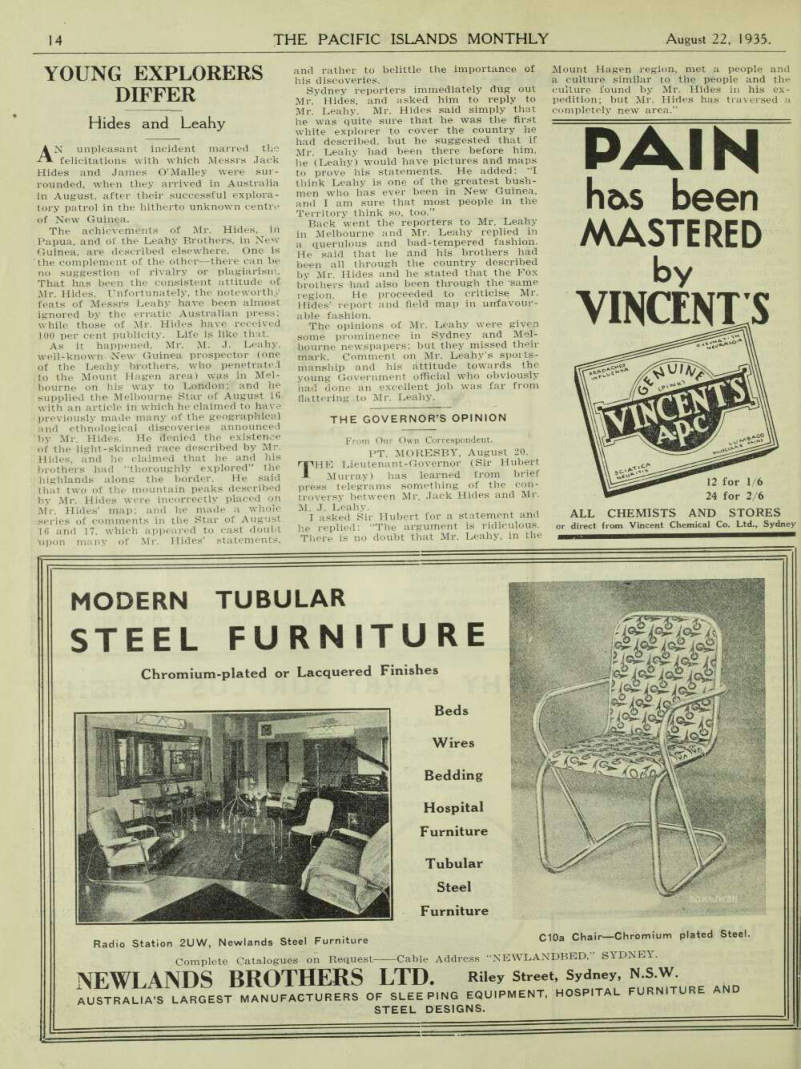
Differ
Hides and Leahy
AN unpleasant incident marred the felicitations with which Messrs Jack Hides and James O’Malley were sur rounded, when they arrived in Australia in August, after their successful explora tory patrol in the hitherto unknown centre of New Guinea.
The achievements of Mr. Hides, in Papua, and of the Leahy Brothers, in New Guinea, are described elsewhere. One is the complement of the other —there can be no suggestion of rivalry or plagiarism.
That has been the consistent attitude of Mr. Hides. Unfortunately, the noteworthy feats of Messrs Leahy have been almost ignored by the erratic Australian press; while those of Mr. Hides have received 100 per cent publicity. Life is like that.
As it happened, Mr. M. J. Leahy, well-known -New Guinea prospector (one of the Leahy brothers, who penetrated to the Mount Hagen area) was in Mel bourne on his way to London: and he supplied the Melbourne Star of August 16 with an article in which he claimed to have previously made many of the geographical and ethnological discoveries announced by Mr. Hides. He denied the existence of the light-skinned race described by Mr.
Hides, and he claimed that he and his brothers had ‘‘thoroughly explored” the highlands along the border. He said that two of the mountain peaks described by Mr. Hides were incorrectly placed on Mr. Hides’ map; and he made a whole series of comments in the Star of August 16 and 17. which appeared to cast doubt upon many of Mr. Hides’ statements.
and rather to belittle the importance of his discoveries.
Sydney reporters immediately dug out Mr. Hides, and asked him to reply to Mr. Leahy. Mr. Hides said simply that he was quite sure that he was the first white explorer to cover the country he had described, but he suggested that if Mr. Leahy had been there before him, he (Leahy) would have pictures and maps to prove his statements. He added: “I think Leahy is one of the greatest bush men who has ever been in New Guinea, and I am sure that most people in the Territory think so, too.”
Back went the reporters to Mr. Leahy in Melbourne and Mr. Leahy replied in a querulous and bad-tempered fashion.
He said that he and his brothers had been all through the country described by Mr. Hides and he stated that the Fox brothers had also been through the same region. He proceeded to criticise Mr.
Hides’ report and field map in unfavour able fashion.
The opinions of Mr. Leahy were given some prominence in Sydney and Mel bourne newspapers; but they missed their mark. Comment on Mr. Leahy’s sports manship and his attitude towards the young Government official who obviously had done an excellent job was far from flattering to Mr. Leahy.
The Governor’S Opinion
From Our Own Correspondent.
PT. MORESBY, August 20.
THE Lieutenant-Governor (Sir Hubert Murray) has learned from brief press telegrams something of the con troversy between Mr. Jack Hides and Mr.
M. J. Leahy.
I asked Sir Hubert for a statement and he replied: “The argument is ridiculous.
There is no doubt that Mr. Leahy, in the
Mount Hagen region, met a people and a culture similar to the people and the culture found by Mr. Hides in his ex pedition; but Mr. Hides has traversed a completely new area.”
Advertisements & other items, p. 16 (1 item)
Pain
has been
MASTERED
by
VINCENTS
12 for 1/6 24 for 2/6
ALL CHEMISTS AND STORES
or direct from Vincent Chemical Co. Ltd., Sydney
MODERN TUBULAR
STEEL FURNITURE
Chromium-plated or Lacquered Finishes Beds Wires Bedding Hospital Furniture Tubular Steel Furniture Radio Station 2UW, Newlands Steel Furniture C10a Chair-Chromium plated Steel.
Complete Catalogues on Request Cable Address “NEWLANDBED,” SYDNEY.
NEWLANDS BROTHERS LTD. Riley Street, Sydney, N.S.W.
AUSTRALIA’S LARGEST MANUFACTURERS OF SLEEPING EQUIPMENT, HOSPITAL FURNITURE AND
STEEL DESIGNS.
Famine
A Feast And A
Fiji’s Protest Against Shipping Schedules
From Our Own Correspondent.
Suva, Aug. 1.
THE present unsatisfactory arrange ment of the arrival and departure dates of the two competing shipping com panies, the Matson and the Union —whose vessels all come within a few days of each other to Suva —was discussed at a recent meeting of the Suva Chamber of Commerce.
Both companies maintain a four weekly service from Australia to the Pacific coast of America and Canada, via Fiji. The north-bound Union liner passes through Suva on a Friday, to be fol lowed by the north-bound Matson vessel on the following Tuesday. That same week, usually on the Friday, the south bound Union liner goes through and four days later the Matson vessel also goes south.
Thus, within ten days, we have all our big mail liners bustling through Suva— and then stagnation for three weeks! It seems incredibly badly arranged and there is much dissatisfaction felt in Fiji.
On the one hand the Union Co. say that their schedules are so organised that they maintain a fortnightly service from New Zealand to Vancouver (via Hawaii) and to San Francisco (via Tahiti) alternately.
They feel that to alter this schedule would entail considerable dislocation of their programme. The Matson people say that their programme is governed by their schedule of sailings from San Francisco and Los Angeles to Honolulu, and they, too, cannot face the alteration of their sailings.
If any alteration is to be made, one would think that the Matson people should give way to those who were first in the trade, the Union Co. But it would be a nice gesture of the Union Co.—and likely to be genuinely appreciated—if they attempted in some sense or other to pal liate the upset caused to the Matson Co. by an alteration in the latter’s schedule.
Even the Fiji Government might con sider offering some inducement to the one or other company to make the change for the sake of the rapidly growing tourist traffic with Australia.
As the position is at present, the hotel accommodation of Suva’s five hotels is completely booked out for a few days in the month, but stands empty in between times. A continuity of traffic would keep the hotels reasonably well filled and lead to the construction of hotels more attrac tive in their amenities.
Possibly the ingenuity and persistence of Sir Murchison Fletcher will evolve a solution of the problem.
When the Prime Minister of Australia arrived in Sydney from America on August 12, he stated that he had had con versations with the Prime Minister of
New Zealand, the Matson Line represen tatives, and Union S.S. Company mana gers regarding the competition between the Matson and Union lines, the Ameri can subsidy, and the manner in which the interests of the two British Dominions are affected. It is believed that, out of those discussions, some solution of the prob lem will be evolved; and this should end the particular trouble experienced by Suva.
Advertisements & other items, p. 17 (1 item)
Euston Hotel
Pacific Islands Stamps
BOUGHT AND SOLD
Stamps sent on approval on receipt of reference. Send for free lists and specimen copy "Australian Stamp Journal.”
J. H. SMYTH CO. LTD.
121a Castlereagh St., Sydney
TARIFF:
Bed and Breakfast 8/6 per day, £2/10/- weekly
CENTRALLY SITUATED
Euston Hotel
Modern Services Throughout Luncheon and Dinner a la Carte 272 GEORGE ST., SYDNEY,
A. HOBAN, Prop.
opp. Wynyard Station
RECORDS from ELVY'S
ELVY’S, Sydney’s famous old-established Music House, can send you every Record that you may want. Special Mail Department for Island residents.
Here are some new releases: PETER DAWSON—Two Stirring Songs: The Winding Road (Araby-Andrew), The Man in the Street (Longstaffe). PETER DAWSON (Bass-Baritone), with Orchestral accompaniment. 8.8262, 4/-.
NAT GONELLA and HIS GEORGIANS
with Choruses by NAT GONELLA. A. 6159, (4/-). Mister Rhythm-Man— Quick Step; Star Dust Slow Fox Trot.
Write for complete free lists. Elvy’s are
RONALD FRANKAU IN FURTHER
FRIVOLITIES. A. 6167 (4/ ) I’m Terribly, Terribly British, Chinese Nights. *A.6110 (4/-): My Secretary, if I Were the Dic- Dictator.
Well Loved Irish Songs Recorded by a Real Irish Tenor, SEAMUS O’DOHERTY.— G. 22362; Shall My Soul Pass Through Ireland, I Left Ireland and Mother Because We Were Poor. noted for prompt service. Order Now.
ELVI A CO. LTD.
397 George Street, Sydney. M 2319
CAPSTAN
NAVY CUT TOBACCO
Where You Will Meet Your Friends in Sydney
Dawn Cafe
(Late Silver Slipper) Hot Dinners, Grills, Toasted Sandwiches, etc. 53 ROWE ST., next Hotel Australia Bridge Parties Catered For
Australia's Stake In
New Guinea
Amazing Development-Need for Preferential Tariff
Mr. J. F. Jennings, M.P., leader of a Federal Parliamentary Party which re cently visited Papua and New Guinea, very courteously has supplied us with the following summary of his impressions.
HOW little is known by Australians of the important Australian territories of New Guinea and Papua is one of the first impressions gained from a visit.
The investigation and study of native problems, trade conditions, health mat ters, the air service and gold conditions, the travel of some 200 miles in Guinea Airway’s aeroplanes, the inspection of the goldfields, with the many interviews with business, shipping and mining men, planters and Government officials, on many of the problems raised, gave our
party an immense amount of information which it is hoped will be of value in fu ture discussions and legislation.
One was greatly impressed by the re markable N.G. air service, and the aero plane journey from the coast over the mountains. Few can visualise this Wau ’drome, with ’planes coming in and going out like taxi cabs. The goldfields popula tion must be the most air-minded people in the world. They fly in planes with the same unconcern as Sydney people ride in trams. The remarkable air trans port system, carrying goods of all des cription, is one of the world’s marvels.
A great air tradition has been built up by these Australian air pilots, of whom Australians must feel proud.
We will see an air service eventually from Australia to New Guinea and Papua.
There are no insuperable distance dif ficulties.
You face up to the mammoth difficulties of road construction in New Guinea when you travel up Edie Creek Road to Edie Creek. The cost given to us of the con structed portion of it (12 feet wide) was approximately £4000 per mile. The cost of maintenance on mountain roads here, with heavy rainfalls and landslides, must be a huge one. It would appear in con
sequence that transport generally must be confined to aircraft.
One is impressed, in Wau, with the many active citizens who show efficiency, energy and resource, anxious to help on the progress of the district. Building con struction is going on apace there, with an abundance of suitable timber in the vicinity. With its rapid growth, Wau should be a most important town in the territory.
We had evidence at an Edie Creek home that modern science has made most things possible, with moving pictures of the Wahgi tribe, and with music from a 15-valve radio set, connecting with the world’s broadcasting stations.
We had many good reports of the work of the Administration in Papua, where Sir Hubert Murray, with his sound policy and great knowledge of the natives, has done much for the advancement of Papua.
There were good reports also in New Guinea, where General McNicoll has already visited so many centres and is carrying on the work with zeal and efficiency.
One was particularly interested in the development of the coffee and cocoa in dustry in New Guinea, and the claims that the products were equal to the world’s best. There appears to be a good future for these two products in Australia.
Under a 10 per cent. General Tariff, Australian trade is subjected to severe opposition from foreign countries. On last year’s figures, out of a total of N.G. imports of £924,000, Australia supplies goods to the value of £375,000.
What Australia has she must hold; and goods, of course, must at least be the equal to those of foreign competitors. The territories are half way to the East and Australian traders would do well to check up on their business in these parts and at least prevent the trade from being taken by other countries.
There is justification for a preferential tariff being imposed in New Guinea in favour of British goods. As far as Aus tralia is concerned, she has splendidly developed the country, controlled the na tives and shown the world she has faith fully fulfilled her trust. Australia is en titled to a trade preference.
The need for a modern survey of the waters surrounding the territories, as well as along the coast of North Aus tralia, was impressed upon us.
There are unlimited possibilities for ex tended tourist traffic in New Guinea and Papua. The innumerable attractions suitably advertised would bring profitable results.
The primitive and fascinating villages near Port Moresby: the wonderful island of Samarai, set like a gem in the centre of the Pacific, with a profusion of tropi cal foliage and shady avenues; the beauty of Rabaul, with its shady trees, gardens, remarkable hot springs and sur roundings; the goldfields of New Guinea; the modern air transport system, one of the world’s wonders; the numerous tropical islands and the primitive life of the natives —these are only some of the main features that can be mentioned in a brief survey.
Australia must always control New Guinea and Papua. Trade and commerce there are valuable; but, for strategic reasons, Australian control is imperative.
Mr. R. A. Clinton, mining engineer for Lakekamu Goldfields (Papua) Develop ment N.L., arrived in Sydney from Port Moresby by the August Montoro.
Advertisements & other items, p. 18 (1 item)
Leica
For Speedy, Accurate and
Versatile Photography . . . there’s nothing like the
Camera
(MODEL 3)
HERE ARE THE REASONS WHY
1.—BUILT-IN SHORT BASE RANGE
FINDER gives you perfect focus automatically.
2—FOCAL PLANE SHUTTER with
the greatest range of shutter speeds on any camera —1 second, in addition to all regular speeds between 1/20th and 1/500th second. speed, wide angle lenses, and others. 4. PICTURES from a single roll of cinema film. Sharp negatives.
Enlargements up to any size.
5. SMALL, COMPACT, FITS THE
POCKET, easy and fast to operate. Very inexpensive to maintain. 3. —ELEVEN INTERCHANGEABLE 6. —DOUBLE EXPOSURES are im- LENSES, including telephoto, possible.
For the above reasons the name LEICA is not merely the name of a modern photographic instrument; it has come to be associated in the photographic world with a new conception of photography, marked by new possibilities of pictorial and optical precision previously unachieved. To-day it forms the basis of a unique photographic process that is extraordinarily universal in its range of application. The process is known as the LEICA PROCESS.
Write NOW, for further particulars to
LEICA PHOTO SERVICE
KYLE HOUSE, 31 MACQUARIE PLACE, SYDNEY
(The only Leica Specialists in Australia )
LEICA SALES
ENLARGING
DEVELOPING
PRINTING
COLOURING
REPRODUCING
POSITIVE PRINTING
SLIDE MAKING
CAMERA REPAIRS
FILM SUPPLIES
of Melanesia
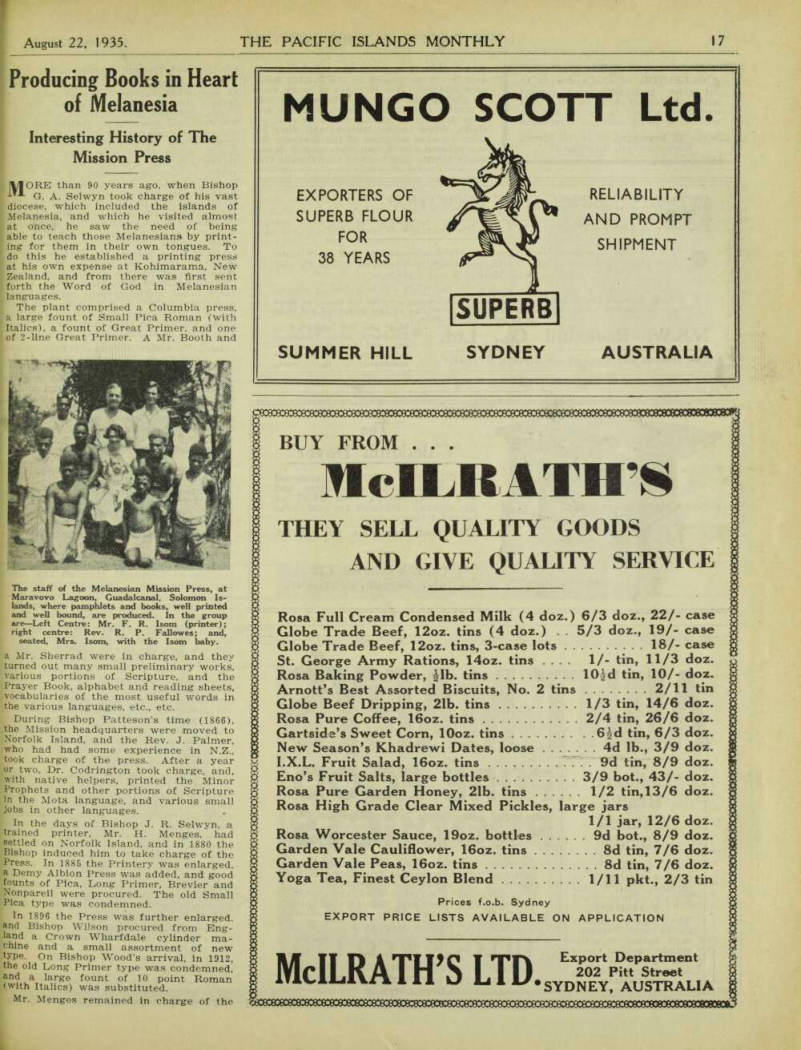
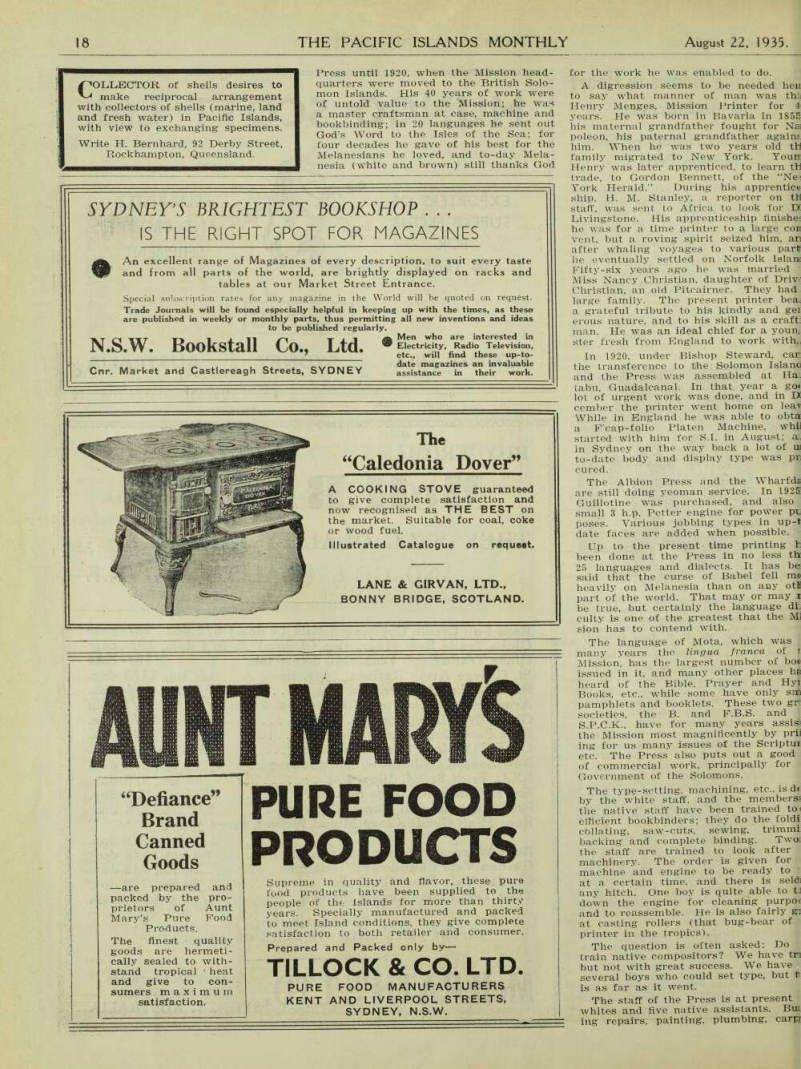
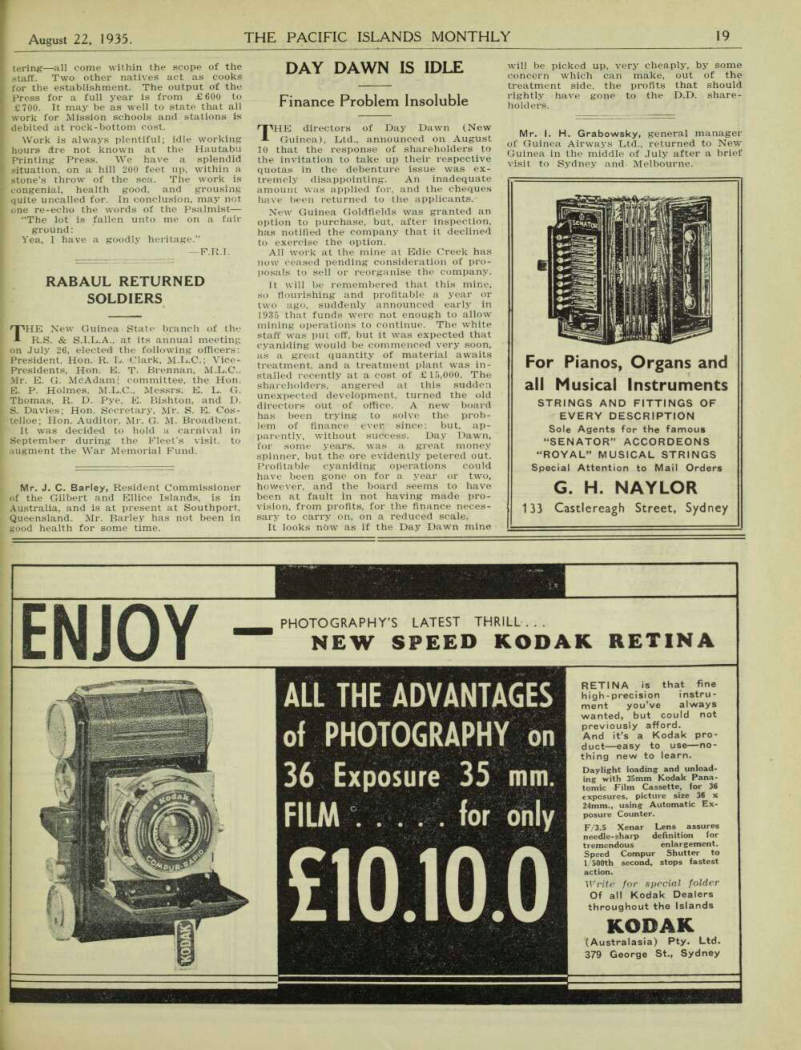
Producing Books in Heart of Melanesia Interesting History of The Mission Press
MORE than 90 years ago, when Bishop G. A. Selwyn took charge of his vast diocese, which included the islands of Melanesia, and which he visited almost at once, he saw the need of being able to teach those Melanesians by print ing for them in their own tongues. To do this he established a printing press at his own expense at Kohimarama, New Zealand, and from there was first sent forth the Word of God in Melanesian languages.
The plant comprised a Columbia press, a large fount of Small Pica Roman (with Italics), a fount of Great Primer, and one of 2-line Great Primer. A Mr. Booth and
a Mr. Sherrad were in charge, and they turned out many small preliminary works, various portions of Scripture, and the Prayer Book, alphabet and reading sheets, vocabularies of the most useful words in the various languages, etc., etc.
During Bishop Patteson’s time (1866), the Mission headquarters were moved to Norfolk Island, and the Rev. J. Palmer, who had had some experience in N.Z., took charge of the press. After a year or two, Dr. Codrington took charge, and, with native helpers, printed the Minor Prophets and other portions of Scripture in the Mota language, and various small jobs in other languages.
In the days of Bishop J. R. Selwyn, a trained printer, Mr. H. Menges, had settled on Norfolk Island, and in 1880 the Bishop induced him to take charge of the Press. In 1885 the Printery was enlarged, a Demy Albion Press was added, and good founts of Pica, Long Primer, Brevier and Nonpareil were procured. The old Small Pica type was condemned.
In 1896 the Press was further enlarged, and Bishop Wilson procured from Eng land a Crown Wharfdale cylinder ma chine and a small assortment of new type. On Bishop Wood’s arrival, in 1912, the old Long Primer type was condemned, and a large fount of 10 point Roman (with Italics) was substituted.
Mr. Menges remained in charge of tho
The staff of the Melanesian Mission Press, at Maravovo Lagoon, Guadalcanal, Solomon Is lands, where pamphlets and books, well printed and well bound, are produced. In the group are—Left Centre: Mr. F. R. Isom (printer); right centre: Rev. R. P. Fallowes; and, seated, Mrs, Isom, with the Isom baby.
Press until 1920, when the Mission head quarters were moved to the British Solo mon Islands. His 40 years of work were of untold value to the Mission; he was a master craftsman at case, machine and bookbinding; in 20 languages he sent out God’s Word to the Isles of the Sea; for four decades he gave of his best for the Melanesians he loved, and to-day Mela nesia (white and brown) still thanks God
for the work he was enabled to do.
A digression seems to be needed here to say what manner of man was this Henry Menges, Mission Printer for 40 years. He was born in Bavaria in 1855 his maternal grandfather fought for Napoleon, his paternal grandfather against him. When he was two years old the family migrated to New York. Young Henry was later apprenticed, to learn the trade, to Gordon Bennett, of the “New York Herald.” During his apprenticeship, H. M. Stanley, a reporter on the staff, was sent to Africa to look for Dr.
Livingstone. His apprenticeship finished he was for a time printer to a large convent, but a roving spirit seized him, and after whaling voyages to various parts, he eventually settled on Norfolk Island.
Fifty-six years ago he was married to Miss Nancy Christian, daughter of Driver Christian, an old Pitcairner. They had a large family. The present printer been a grateful tribute to his kindly and generous nature, and to his skill as a craftsman. He was an ideal chief for a youngster fresh from England to work with.
In 1920, under Bishop Steward, came the transference to the Solomon Islands and the Press was assembled at Hatabu, Guadalcanal. In that year a good lot of urgent work was done, and in December the printer went home on leave.
While in England he was able to obtain a F’cap-folio Platen Machine, which started with him for S.I. in August; a. in Sydney on the way back a lot of upto-date body and display type was procured.
The Albion Press and the Wharfds are still doing yeoman service. In 1925 Guillotine was purchased, and also a small 3 h.p. Petter engine for power purposes. Various jobbing types in up-todate faces are added when possible.
Up to the present time printing has been done at the Press in no less than 25 languages and dialects. It has been said that the curse of Babel fell more heavily on Melanesia than on any other part of the world. That may or may not be true, but certainly the language diffculty is one of the greatest that the Mission has to contend with.
The language of Mota, which was for many years the lingua franca of the Mission, has the largest number of books issued in it, and many other places have heard of the Bible, Prayer and Hymn Books, etc., while some have only small pamphlets and booklets. These two great societies, the B. and F.B.S. and S.P.C.K., have for many years assisted the Mission most magnificently by printing for us many issues of the Scripture etc. The Press also puts out a good of commercial work, principally for the Government of the Solomons.
The type-setting, machining, etc., is done by the white staff, and the members of the native staff have been trained to be efficient bookbinders; they do the folding, collating, saw-cuts, sewing, trimming, backing and complete binding. Two of the staff are trained to look after the machinery. The order is given for a machine and engine to be ready to go at a certain time, and there is seldom any hitch. One boy is quite able to take down the engine for cleaning purposes and to reassemble. He is also fairly good at casting rollers (that bug-bear of a printer in the tropics).
The question is often asked; Do you train native compositors? We have tried but not with great success. We have several boys who could set type, but that is as far as it went.
The staff of the Press is at present whites and five native assistants. Building repairs, painting, plumbing, carpentry
tering—all come within the scope of the staff. Two other natives act as cooks for the establishment. The output of the Press for a full year is from £600 to £700. It may be as well to state that all work for Mission schools and stations is debited at rock-bottom cost.
Work is always plentiful; idle working hours are not known at the Hautabu Printing Press. We have a splendid situation, on a hill 200 feet up, within a stone’s throw of the sea. The work is congenial, health good, and grousing quite uncalled for. In conclusion, may not one re-echo the words of the Psalmist — “The lot is fallen unto me on a fair ground: Yea, I have a goodly heritage.”
F.R.I.
Advertisements & other items, pp. 19-20 (1 item)
advt
BUY FROM . . .
McILRATH’S
THEY SELL QUALITY GOODS
AND GIVE QUALITY SERVICE
Rosa Full Cream Condensed Milk (4 doz.) 6/3 doz., 22/- case Globe Trade Beef, 12oz. tins (4 doz.) . . 5/3 doz., 19/- case Globe Trade Beef, 12oz. tins, 3-case lots 18/- case St. George Army Rations, 14oz. tins ... 1/- tin, 11/3 doz.
Rosa Baking Powder, ½lb. tins 10½d tin, 10/- doz.
Arnott’s Best Assorted Biscuits, No. 2 tins 2/11 tin Globe Beef Dripping, 2lb. tins 1/3 tin, 14/6 doz.
Rosa Pure Coffee, 16oz. tins 2/4 tin, 26/6 doz.
Gartside’s Sweet Corn, 10oz. tins 6½d tin, 6/3 doz.
New Season’s Khadrewi Dates, loose 4d lb., 3/9 doz.
I.X.L. Fruit Salad, 16oz. tins 9d tin, 8/9 doz.
Eno’s Fruit Salts, large bottles 3/9 bot., 43/- doz.
Rosa Pure Garden Honey, 2lb. tins 1/2 tin, 13/6 doz.
Rosa High Grade Clear Mixed Pickles, large jars 1/1 jar, 12/6 doz.
Rosa Worcester Sauce, 19oz. bottles 9d bot., 8/9 doz.
Garden Vale Cauliflower, 16oz. tins 8d tin, 7/6 doz.
Garden Vale Peas, 16oz. tins 8d tin, 7/6 doz.
Yoga Tea, Finest Ceylon Blend 1/11 pkt., 2/3 tin Prices f.o.b. Sydney
EXPORT PRICE LISTS AVAILABLE ON APPLICATION
McILRATH’S LTD
COLLECTOR of shells desires to make reciprocal arrangement with collectors of shells (marine, land and fresh water) in Pacific Islands, with view to exchanging specimens.
Write H. Bernhard, 92 Derby Street, Rockhampton, Queensland.
SYDNEY’S BRIGHTEST BOOKSHOP . . .
IS THE RIGHT SPOT FOR MAGAZINES
An excellent range of Magazines of every description, to suit every taste and from all parts of the world, are brightly displayed on racks and tables at our Market Street Entrance, Special subscription rates for any magazine in the World will be quoted on request.
Trade Journals will be found especially helpful in keeping up with the times, as these are published in weekly or monthly parts, thus permitting all new inventions and ideas to be published regularly.
N.S.W. Bookstall Co., Ltd.
Cnr. Market and Castlereagh Streets, SYDNEY Men who are interested in Electricity, Radio Television, etc., will find these up-todate magazines an invaluable assistance in their work.
The
“Caledonia Dover”
A COOKING STOVE guaranteed to give complete satisfaction and now recognised as THE BEST on the market. Suitable for coal, coke or wood fuel.
Illustrated Catalogue on request.
LANE & GIRVAN, LTD.,
BONNY BRIDGE, SCOTLAND.
AUNT MARTS
“Defiance”
Brand
Canned
Goods
PURE FOOD
PRODUCTS
—are prepared and packed by the proprietors of Aunt Mary’s Pure Food Products.
The finest quality goods are hermetically sealed to withstand tropical heat and give to consumers maximum satisfaction.
Supreme in quality and flavor, these pure food products have been supplied to the people of the Islands for more than thirty years. Specially manufactured and packed to meet Island conditions, they give complete satisfaction to both retailer and consumer.
Prepared and Packed only by—
TILLOCK & CO. LTD.
PURE FOOD MANUFACTURERS
KENT AND LIVERPOOL STREETS,
SYDNEY, N.S.W.
Rabaul Returned
Soldiers
THE New Guinea State branch of the R.S. & S.I.L.A., at its annual meeting on July 26, elected the following officers; President, Hon. R. L. Clark, M.L.C.; Vice- Presidents, Hon. E. T. Brennan, M.L.C..
Mr. E. G. McAdam; committee, the Hon.
E. P. Holmes, M.L.C., Messrs. E. L. G.
Thomas, R. D. Pye, E. Bishton, and D.
S. Davies; Hon. Secretary. Mr. S. E. Cos telloe; Hon. Auditor, Mr. G. M. Broadbent.
It was decided to hold a carnival in September during the Fleet’s visit, to augment the War Memorial Fund.
Mr. J. C. Barley, Resident Commissioner of the Gilbert and Ellice Islands, is in Australia, and is at present at Southport, Queensland. Mr. Barley has not been in good health for some time.
Day Dawn Is Idle
Finance Problem Insoluble
THE directors of Day Dawn (New Guinea), Ltd., announced on August 10 that the response of shareholders to the invitation to take up their respective quotas in the debenture issue was ex tremely disappointing. An inadequate amount was applied for, and the cheques have been returned to the applicants.
New Guinea Goldfields was granted an option to purchase, but, after inspection, has notified the company that it declined to exercise the option.
All work at the mine at Edie Creek has now ceased pending consideration of pro posals to sell or reorganise the company.
It will be remembered that this mine, so flourishing and profitable a year or two ago, suddenly announced early in 1935 that funds were not enough to allow mining operations to continue. The white staff was put off, but it was expected that cyaniding would be commenced very soon, as a great quantity of material awaits treatment, and a treatment plant was in stalled recently at a cost of £15,000. The shareholders, angered at this sudden unexpected development, turned the old directors out of office. A new board has been trying to solve the prob lem of finance ever since; but, ap parently, without success. Day Dawn, for some years, was a great money spinner, but the ore evidently petered out.
Profitable cyaniding operations could have been gone on for a year or two, however, and the board seems to have been at fault in not having made pro vision, from profits, for the finance neces sary to carry on, on a reduced scale.
It looks now as if the Day Dawn mine
will be picked up, very cheaply, by some concern which can make, out of the treatment side, the profits that should rightly have gone to the D.D. share holders.
Mr. I. H. Grabowsky, general manager of Guinea Airways Ltd., returned to New Guinea in the middle of July after a brief visit to Sydney and Melbourne,
Advertisements & other items, pp. 21-22 (1 item)
Enjoy
For Pianos, Organs and
all Musical Instruments
STRINGS AND FITTINGS OF
EVERY DESCRIPTION
Sole Agents for the famous
“SENATOR” ACCORDEONS
“ROYAL” MUSICAL STRINGS
Special Attention to Mail Orders
G. H. NAYLOR
133 Castlereagh Street, Sydney
ENJOY
PHOTOGRAPHY'S LATEST THRILL .. .
NEW SPEED KODAK RETINA
ALL THE ADVANTAGES
of PHOTOGRAPHY on
36 Exposure 35 mm.
FILM
KODAK
(Australasia) Pty. Ltd. 379 George St., Sydney RETINA is that fine high-precision instrument you’ve always wanted, but could not previously afford.
And it’s a Kodak product —easy to use —nothing new to learn.
Daylight loading and unloading with 35mm Kodak Panatomic Film Cassette, for 36 exposures, picture size 36 x 24mm., using Automatic Exposure Counter.
F/3.5 Xenar Lens assures needle-sharp definition for tremendous enlargement.
Speed Compur Shutter to 1/500th second, stops fastest action.
Write for special folder Of all Kodak Dealers throughout the Islands
SKIN DISEASES
By the application of his Secret Formula in the treatment of all Skin Diseases, Mr. John J. McHugh, Consulting Chemist, 124 Liverpool St., Sydney, is able to assure sufferers of a complete and speedy recovery.
Letters of gratitude from all parts of the world may be inspected at his rooms. Skin complaints successfully treated include: Tinea, Eczema, Psoriasis, Acne, Germ Under the Nail, Varicose Veins and Ulcers, Ringworm, Pruritis, Dandruff, Rosacea, Infantile Eczema, etc.
Readers are invited to call or write to Mr. McHugh, and he will advise them without obligation.
Consulting Hours: Monday, Wednesday, Thursday, 10 a.m. to 5 p.m.: Tuesday and Friday, 10 a.m. to 9 p.m.; Saturday, 9 a.m. to 12 noon.
JOHN J. McHUGH, Ph.C.
(Member of the Pharmaceutical Society, N.S.W.) Consulting & Pharmaceutical Chemist
1st FLOOR, 124 LIVERPOOL ST.
(opp. Snow’s), SYDNEY ’Phone MA 5028
Coles
Regalia
Sydney
ALF. H. J. COLES
Established 1920.
Masonic Regalia, Jewels and General Req Master Masons’ Aprons 42/- and 45/- Leather Regalia Cases, 16-mch, from 16/6 P.M. Jewels a Speciality.
Inquiries Solicited Prices Australian Currency
Rnnm 19. Roval Arcade, Sydney
MODEL 60.
THE IDEAL
WINCHESTER
ALL-SERVICE
LOW-COST
RIFLE
.22 Cal. Bolt-action Single-shot 23in. proof steel round tapered barrel, bright chromium finished bolt and trigger, safety firing pin, one-piece pistol-grip walnut stock full rounded well-proportioned forearm with convenient finger grooves, shotgun type butt plate, Lyman gold bead front sight, sporting rear sight with sliding elevator, handles short and long-rifle standard and Super-Speed cartridges.
Take-down model only As above, with 27in. barrel and safe indicator on bolt.
Weight packed, 8lb. 40/
MODEL 62.—.22 CAL. SLIDE-ACTION
HAMMER REPEATING RIFLE
23-inch round tapered barrel shotgun-type walnut stock —' with checkered steel butt plate and straight grip, new design walnut action slide handle, Lyman bead front sight, sporting rear sight; specially designed to handle the new super-speed ammunition. Magazine capacity, 20 short VR /I 11/ 16 long, or 14 long rifle. Take-down model only. Weight packed, 10lb.
COWLES & DUNN, 71 King St., Sydney Cable Address: “CODUN,” Sydney
Restless Norfolk Island
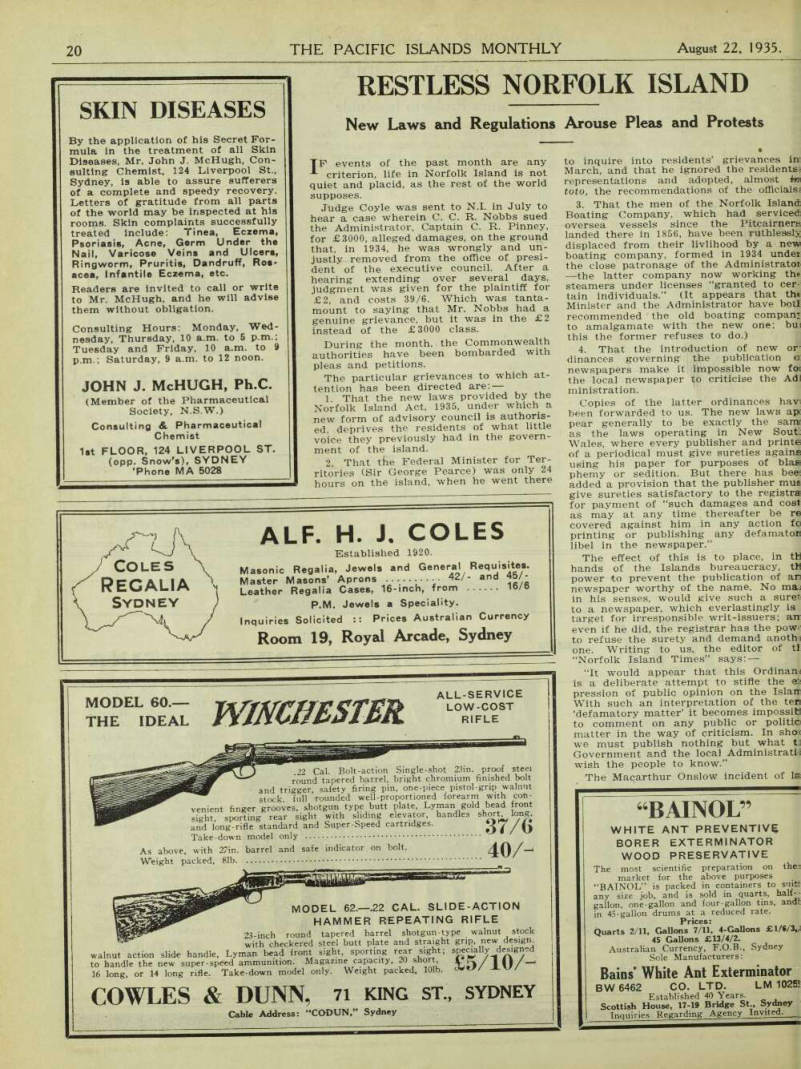
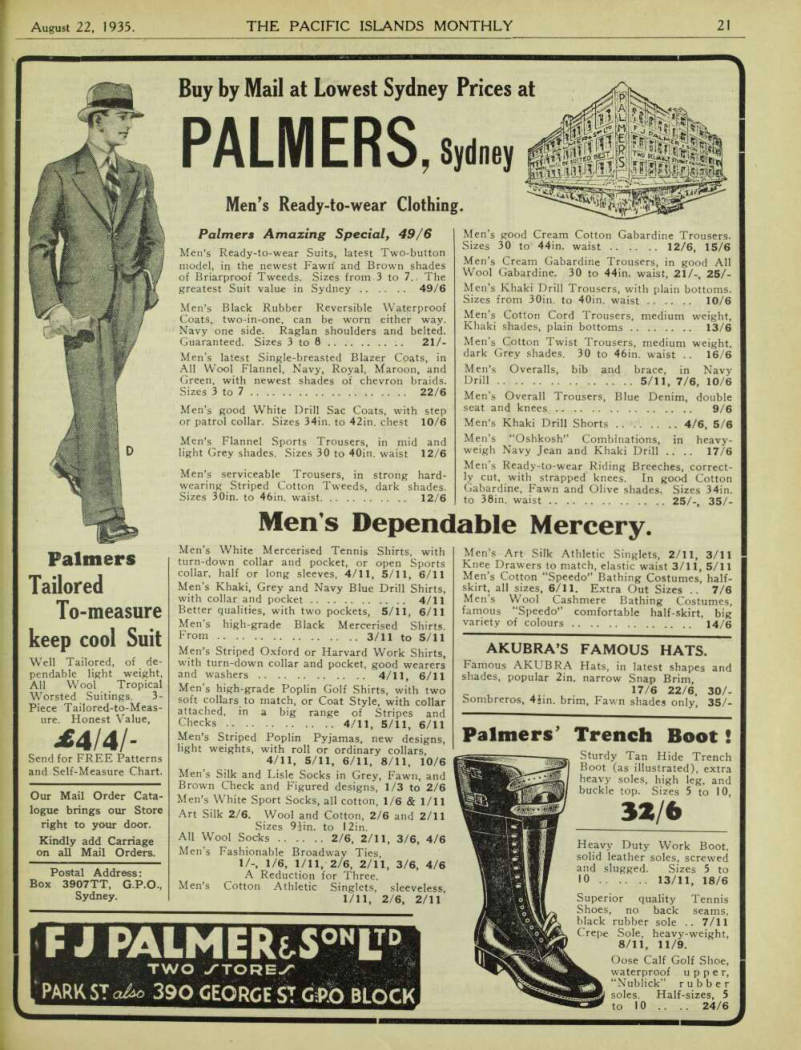
New Laws and Regulations Arouse Pleas and Protests
IF events of the past month are any criterion, life in Norfolk Island is not quiet and placid, as the rest of the world supposes.
Judge Coyle was sent to N.I. in July to hear a case wherein C. C. R. Nobbs sued the Administrator, Captain C. R. Pinney, for £3000, alleged damages, on the ground that, in 1934, he was wrongly and unjustly removed from the office of president of the executive council. After a hearing extending over several days, judgment was given for the plaintiff for £2, and costs 39/6. Which was tantamount to saying that Mr. Nobbs had a genuine grievance, but it was in the £2 instead of the £3000 class.
During the month, the Commonwealth authorities have been bombarded with pleas and petitions.
The particular grievances to which at tention has been directed are: 1. That the new laws provided by the Norfolk Island Act, 1935, under which a new form of advisory council is authorised, deprives the residents of what little voice they previously had in the government of the island. 2. That the Federal Minister for Territories (Sir George Pearce) was only 24 hours on the island, when he went there
to inquire into residents’ grievances in March, and that he ignored the residents' representations and adopted, almost in toto, the recommendations of the officials. 3. That the men of the Norfolk Island Boating Company, which had serviced oversea vessels since the Pitcairners landed there in 1856, have been ruthlessly displaced from their livelihood by a new boating company, formed in 1934 under the close patronage of the Administrator —the latter company now working the steamers under licenses “granted to certain individuals.” (It appears that the Minister and the Administrator have both recommended the old boating company to amalgamate with the new one; but this the former refuses to do.) 4. That the introduction of new ordinances governing the publication a newspapers make it impossible now for the local newspaper to criticise the Administration.
Copies of the latter ordinances have been forwarded to us. The new laws appear generally to be exactly the same as the laws operating in New South Wales, where every publisher and printer of a periodical must give sureties against using his paper for purposes of blasphemy or sedition. But there has been added a provision that the publisher must give sureties satisfactory to the registrar for payment of “such damages and costs as may at any time thereafter be recovered against him in any action for printing or publishing any defamation libel in the newspaper.”
The effect of this is to place, in the hands of the Islands bureaucracy, the power to prevent the publication of an newspaper worthy of the name. No man in his senses, would give such a surety to a newspaper, which everlastingly is a target for irresponsible writ-issuers; and even if he did, the registrar has the power to refuse the surety and demand another one. Writing to us, the editor of the “Norfolk Island Times” says; “It would appear that this Ordinance is a deliberate attempt to stifle the expression of public opinion on the Island.
With such an interpretation of the ten ‘defamatory matter’ it becomes impossible to comment on any public or political matter in the way of criticism. In short we must publish nothing but what the Government and the local Administrator wish the people to know.”
The Macarthur Onslow incident of la
year showed that there is a quarrelsome and difficult section in the Norfolk Island population of 1000 or so, and that it is very ready to criticise the Administration and resist governmental authority. The
circumstances of that incident probably did more than anything else to create in Canberra a belief that the only way to keep peace on the Island would be to give the people a minimum of self government.
On top of that, there is the economic situation. For a number of reasons, for which no one is to blame, it is at present impossible to provide these people with an adequate market for their produce.
Many otherwise contented and quiet residents, finding themselves seriously embarrassed, therefore have joined the ranks of the agitators, and are ready to blame the Administrator for all their mis fortunes. This will die down when economic conditions improve.
Captain Pinney may have thought, three years ago, that he was receiving one of the “plums” of Pacific administra tion. Actually, he has been given a hornets’ nest.
But, with a full knowledge of the Nor folk Islanders’ peculiar temperament and unusual circumstances, and realising the special difficulties of administering an isolated community where petty intrigue and back-door chatter are recognised public amusements, one has the feeling that in N.I., to-day, the faults are not all on one side. The bureaucracy seems to be losing some of its benevolence, and becoming bad-tempered. That business of wiping out the 80-years’ old company of boatmen has a harsh look; and the extra ordinary act in relation to the publication of newspapers certainly has upon it all the marks of a peevish bureaucracy on the warpath. And when bureaucracy gets away with the bit between its teeth it is good-bye to the liberties of the people, of which newspapers, with all their faults, are the main safeguard.
One hesitates to comment on the N.I. situation, without knowing more of the
local situation and of the case for the defence. We know that difficult elements exist in the N.I. community, and we know that Captain Pinney is not the type of man to be turned easily into an oppressive or bull-headed tyrant. But he has been subjected to an unconscionable amount of economic worry and petty ir ritation and, under the stress of it, he may have forgotten the good manners he learned in Papua.
If the N.I. people really are oppressed, Canberra soon will hear of it, for there are many newspapers and persons in Australia always ready to have a crack at bureaucracy. The present regime in N.I. is likely to endure for another year so N.I. had better make the best of it: The N.I. people, before they really can get a hearing, have to live down the unfortunate reputation they gained for themselves as trouble-makers in the Macarthur-Onslow affair, last year.
Advertisements & other items, pp. 22-24 (1 item)
“Bainol”
WHITE ANT PREVENTIVE
BORER EXTERMINATOR
WOOD PRESERVATIVE
The most scientific preparation on thea market for the above purposes “BAINOL” is packed in containers to suit? any size job, and is sold in quarts, half-gallon, one-gallon and four-gallon tins, andt in 45-gallon drums at a reduced rate.
Prices: Quarts 2/11, Gallons 7/11, 4-Gallons £1/6/3 45 Gallons £13/4/2.
Australian Currency, F.O.B., Sydney Sole Manufacturers;
Bains’ White Ant Exterminator
BW 6462 CO. LTD. LM 1025
Established 40 Years.
Scottish House, 17-19 Bridge St., Sydney Inquiries Regarding Agency Invited.
Buy by Mail at Lowest Sydney Prices at
PALMERS, Sydney
Men’s Ready-to-wear Clothing.
Palmers Amazing Special, 49/6
Men’s Ready-to-wear Suits, latest Two-button model, in the newest Fawn and Brown shades of Briarproof Tweeds. Sizes from 3 to 7., The greatest Suit value in Sydney 49/6 Men’s Black Rubber Reversible Waterproof Coats, two-in-one, can be worn either way.
Navy one side. Raglan shoulders and belted.
Guaranteed. Sizes 3 to 8 21/- Men’s latest Single-breasted Blazer Coats, in All Wool Flannel, Navy, Royal, Maroon, and Green, with newest shades of chevron braids.
Sizes 3 to 7 22/6 Men’s good White Drill Sac Coats, with step or patrol collar. Sizes 34in. to 42in. chest 10/6 Men’s Flannel Sports Trousers, in mid and light Grey shades. Sizes 30 to 40in. waist 12/6 Men’s serviceable Trousers, in strong hardwearing Striped Cotton Tweeds, dark shades.
Sizes 30in. to 46in. waist 12/6 Men’s good Cream Cotton Gabardine Trousers.
Sizes 30 to 44in. waist 12/6, 15/6 Men’s Cream Gabardine Trousers, in good All Wool Gabardine. 30 to 44in. waist, 21/-, 25/- Men’s Khaki Drill Trousers, with plain bottoms.
Sizes from 30in. to 40in. waist 10/6 Men’s Cotton Cord Trousers, medium weight, Khaki shades, plain bottoms 13/6 Men’s Cotton Twist Trousers, medium weight, dark Grey shades. 30 to 46in. waist 16/6 Men’s Overalls, bib and brace, in Navy Drill . .. 5/11, 7/6, 10/6 Men’s Overall Trousers, Blue Denim, double seat and knees 9/6 Men’s Khaki Drill Shorts 4/6, 5/6 Men’s “Oshkosh” Combinations, in heavyweigh Navy Jean and Khaki Drill .. .. 17/6 Men’s Ready-to-wear Riding Breeches, correctly cut, with strapped knees. In good Cotton Gabardine, Fawn and Olive shades. Sizes 34in. to 38in. waist 25/-, 35/-
Men s Dependable Mercery.
Palmers
Tailored
To-measure
keep cool Suit
Well Tailored, of dependable light weight, All Wool Tropical Worsted Suitings. 3- Piece Tailored-to-Measure. Honest Value, £ 4/4/ - Send for FREE Patterns and Self-Measure Chart.
Our Mail Order Catalogue brings our Store right to your door.
Kindly add Carriage on all Mail Orders.
Postal Address:
Box 3907TT, G.P.O.,
Sydney.
Men’s White Mercerised Tennis Shirts, with turn-down collar and pocket, or open Sports collar, half or long sleeves, 4/11, 5/11, 6/11 Men’s Khaki, Grey and Navy Blue Drill Shirts, with collar and pocket 4/11 Better qualities, with two pockets, 5/11, 6/11 Men’s high-grade Black Mercerised Shirts.
From 3/11 to 5/11 Men’s Striped Oxford or Harvard Work Shirts, with turn-down collar and pocket, good wearers and washers 4/11, 6/11 Men’s high-grade Poplin Golf Shirts, with two soft collars to match, or Coat Style, with collar attached, in a big range of Stripes and Checks 4/11, 5/11, 6/11 Men’s Striped Poplin Pyjamas, new designs, light weights, with roll or ordinary collars, 4/11, 5/11, 6/11, 8/11, 10/6 Men’s Silk and Lisle Socks in Grey, Fawn, and Brown Check and Figured designs, 1/3 to 2/6 Men’s White Sport Socks, all cotton, 1/6 & 1/11 Art Silk 2/6. Wool and Cotton, 2/6 and 2/11 Sizes to I2in.
All Wool Socks 2/6, 2/11, 3/6, 4/6 Men’s Fashionable Broadway Ties, 1/-, 1/6, 1/11, 2/6, 2/11, 3/6, 4/6 A Reduction for Three.
Men’s Cotton Athletic Singlets, sleeveless, 1/11, 2/6, 2/11
F J PALMER & SON Ltd
TWO STORES
PARK ST also 390 GEORGE ST G.P.O BLOCK Men’s Art Silk Athletic Singlets, 2/11, 3/11 Knee Drawers to match, elastic waist 3/11, 5/11 Men’s Cotton “Speedo” Bathing Costumes, halfskirt, all sizes, 6/11. Extra Out Sizes .. 7/6 Men’s Wool Cashmere Bathing Costumes, famous “Speedo” comfortable half-skirt, big variety of colours 14/6
AKUBRA’S FAMOUS HATS.
Famous AKUBRA Hats, in latest shapes and shades, popular 2in. narrow Snap Brim 17/6 22/6, 30/- Sombreros, 4hn. brim, Fawn shades only, 35/-
Palmers’ Trench Boot!
Sturdy Tan Hide Trench Boot (as illustrated), extra heavy soles, high leg, and buckle top. Sizes 5 to 10, 32/6 Heavy Duty Work Boot, solid leather soles, screwed and slugged. Sizes sto 10 13/11, 18/6 Superior quality Tennis Shoes, no back seams, black rubber sole .. 7/11 Crepe Sole, heavy-weight, 8/11, 11/9.
Oose Calf Golf Shoe, waterproof upper, “Nublick” rubber soles. Half-sizes, 5 to 10 .. .. 24/6
FOUR-COLOUR LITHOGRAPH
The Newest and Most
Informative
MAP of
The Goldfields Areas
Papua and New Guinea
With geological notes, gold occurrences and. topographical features clearly shown Copyright by J. NASON-JONES,
F.G.S., F.R.G.S.
On sale at Burns, Philp & Co., Ltd., Port Moresby; “Papuan Courier”
Office, Port Moresby; H. E- C. Robinson & Co., Ltd., Sydney or direct from J. Nason-Jones, at Bulldog, Lakekamu Goldfields, Papua.
Paper 307-
Cloth 37/6
Yacht Ho Ho Ashore
THE Norwegian yacht Ho-Ho broke from her mooring and drifted on the rocks in Ball Bay, Norfolk Island, on August 8, at daylight. The damage is not known, but the prospect of refloating the cutter is considered doubtful.
The cutter Ho-Ho left Sydney on July 21 for Fiji, Tonga and Tahiti. She had been 18 months coming from Norway via South Africa.
Miss Laura Morris, of Auckland, New Zealand, left Sydney for the Solomon Islands by the Malaita on July 13. She is a graduate of the N.Z. Bible Training Institute and has been sent to Malaita by the South Sea Evangelical Society to do mission work at One Pusu.
Advertisements & other items, p. 24 (1 item)
Model 36
10 HORSEPOWER MARINE ENGINE
Fairbanks
Morse
Model 36
Diesel Engines
10 to 160 Horsepower Buy from the Manufacturers and get the Benefit of their EXPERIENCE
SPARE PARTS
ALWAYS
AVAILABLE
Fairbanks, Morse Co.
(AUST.) LTD.
Box 2672EE, G.P.O.,
SYDNEY
Debts
New Guinea Planters’
Debts Suggestions for Readjustment
THE following official notification was issued early in June: “The Commonwealth Government has extended until June 30, 1936, the mora torium regarding plantations in New Guinea. In view of the improving copra market the Government expects New Guinea planters to resume instalment payments from July 1, 1936.”
It now appears that the announcement was a little premature. For several months the copra market had been im proving and, apparently, had reached a stage which allowed copra growers a sub stantial margin over costs. But almost from the date of the announcement the world copra market —for reasons which still are unknown to all observers —has sagged considerably, with the result that the margin of profit has shrunk to the point where there is really nothing avail able for such purposes as the resumption of interest and capital payments.
It is still a long way to July 1, 1936, and much may happen in the meantime to affect the copra market; but it can be said definitely at the moment that on the pre sent basis of copra prices it is quite im possible for New Guinea planters to resume instalment payments, and it is just as well that the Commonwealth Gov ernment should recognise that fact.
We have been informed by one of the leading firms which assist in financing New Guinea planters that, so far as it is concerned, it will not make one penny piece available to planters, under present conditions, to assist them in resuming in stalment payments. The same firm, how ever, is prepared, if the Commonwealth Government will substantially write down the value of the expropriated plantations in New Guinea, to write down the plan ters debts to the firm in the same pro portion.
This probably will bring before the Commonwealth Government the whole question of the New Guinea planters’ indebtedness to the Government in respect of expropriated plantations. Those planta tions were sold to the planters under a system of tender in years when the copra price was high and profitable; and there is not the slightest doubt that to-day a very large proportion of the capital value of those plantations has disappeared.
The same thing has happened in connec tion with all primary production and it is one of the most difficult problems in con nection with national finance.
The position probably is more simple in
New Guinea than in Australia and it should not be difficult to discover a modus operandi. We have no official information on the subject but we suspect that the big firms which carry on trade and finance in the Territory have themselves built up considerable reserves as a set off against, the obviously depreciated value of the expropriated plantations on which they have loaned money; and if, as indi cated, those firms are prepared to use their reserves in writing off a proportion of the planters’ debts, the Commonwealth Government should not miss the oppor tunity of securing an all-round readjust ment which should be satisfactory to everyone concerned.
We suggest that this is a matter con cerning which the planters’ associations in New Guinea should interest themselves.
There are many people who say that a \vriting down of values now would be most unfair to those who tendered un successfully for the expropriated planta tions and this argument has had a good deal of weight in the past. Unquestion ably, there was ridiculous over-valuation in tendering but that does not alter the fact that the world copra market has altered very much in the last seven years and that, quite apart from all question of over-tendering, the basis on which coco nut plantations are valued has been per manently altered.
Fiji Libel Action Settled
From Our Own Correspondent
Suva, Aug. 1.
THE proposed action for libel against the Chief Justice has been settled. It is reported that the terms of settlement provide for the withdrawal of the ban upon the employment as interpreters, by local solicitors, of certain Indian clerks, and that a circular rescinding previous instructions has been issued by the Regis trar of the Supreme Court. It is said, also, that a sum, by way of compensa tion, has been agreed to be paid.
Rev. R. Lister Turner, of the London Missionary Society, at Delena, Papua, returned to Port Moresby by the July Macdhui. Mr. Turner, who is a non offlcial member of the Papua Legislative Council, had been on furlough in Eng land with his wife.
Advertisements & other items, pp. 25-26 (2 items)
Kerr Brothers Limited
ALL
children
have this
same The Weak Spot in children is through the tissues of the throat and lungs. This is where disease germs enter.
That is why doctors recom-
mend SCOTT’S EMULSION
which is specially made to strengthen and protect this
Weak Spot.
Children who have the aid of
SCOTT’S
Emulsion
Established N.H. 1894
Kerr Brothers Limited
ISLAND MERCHANTS & AGENTS
139 Clarence Street
SYDNEY
PRODUCE: Planters, are you getting best possible returns?
We ship to best markets; consult us.
PLANTATION REQUIREMENTS: We have over 40 years’ experience to help you. Agents for Cacao and Coffee Machinery; Agricultural Implements and Power Cultivators; Tractors and Trailers; Paints; Marine, Fire and Earthquake Insurance.
Write to us for particulars and prices.
MERCHANDISE PURCHASED AT BEST PRICES AND ORIGINAL
INVOICES SUPPLIED
G.P.O. Box 3838 T
Cable Address:
“CARE SYDNEY"
HERE ALWAYS COMES A TIME
When an invention is developed which not only appeals to all but is fundamentally necessary for you to sell—so as to be able to compete YOU OWE IT TO YOURSELF TO SECURE THIS VERY VALUABLE FRANCHISE.
ALL TYPES OF RADIO ... ALL SETS ARE TROPIC PROOFED.
KRIEBLER A/sia LIMITED
MYRTLE, PINE and BEAUMONT STREETS, CHIPPENDALE, N.S.W., Phone M 4391 (2 lines) Advertisers will appreciate mentioning this journal in your replies.
Records
-POSTED FREE
SEND FOR LISTS
Australia’s finest Record Shop, specialising in Mail Orders.
Any Records procured and sent same day.
Dozens of clients in the Pacific Islands. We pay freight.
THE TALKERIES
QUEEN VICTORIA BUILDINGS
SYDNEY, AUSTRALIA
Gilbert Islands
New Radio Station For Gilbert Islands
A DISTINCT improvement is to be made in the Gilbert Islands, in the Central Pacific, by the installation of a radio station at Butaritari by Messrs. W T .
R. Carpenter and Co.
This station, which is a 250-watt stan dard telegraph - telephone instrument, manufactured by Amalgamated Wireless, will be used to establish daily communi cation with Ocean Island, and through Ocean Island to Rabaul, so linking up with Australia. The Butaritari station will also communicate direct with ships at sea and generally will afford improved facilities for traders, planters and others who maintain touch with the outer world.
Ray Parer’s Expedition
Sepik River Gold
MR. RAY PARER, Australian aviator, is leading a gold search in the Sepik River Valley, New Guinea, according to advice received by the Shell Company.
When the Macdhui sailed from Brisbane at the end of July it had on board an aeroplane for Captain Eric Stevens, who is to pilot the expedition as far as the ’plane can take it, and a 35ft. launch, bought by Mr. Parer, for the new gold venture.
Those associated with Mr. Parer are Brigadier-General W. Wisdom, a former Administrator of the Mandated Territory.
Mr. W. Smith, a Melbourne broker, and Mr. D. Glasson, one of the original dis coverers of the Edie Creek field.
The expedition will be absent for 12 months, and will attempt to penetrate virgin jungle to a distance of 450 to 500 miles.
Cook Island Notes
From Our Own Correspondent.
Rarotonga, July 14.
AMONG the recipients of the King’s Birthday Honours is Karika Takau Ariki Vaine, to Majesty has been pleased to award the O.B.E. Karika Ariki is the sole surviving signatory to the original Treaty of Annexation, by which these Islands came into the possession of New Zealand in 1900. Herself head of a family long distinguished in local annals, she is a kinswoman of the late Makea Takau Ariki, last inde pendent sovereign, and remembered to this day as the "Queen Victoria of the Cook Islands.”
For 38 years a resident of Rarotonga, Mr. Percy S. Shearman leaves us to strike out afresh for himself in New Zealand. Volunteering early dur ing the Great War, he accompanied the Rarotongan Contingent of the N.Z. Pioneer Batt. to France, Palestine and Egypt, acting, in addition to his regimental duties, as interpreter for the native troops. Returning to the Islands he became a partner in the trading firm of Bonar & Shearman, concerning himself principally with the fruit-buying side of the business. Mr. Shearman’s only son is at school in N.Z. and it is largely in the inter ests of the boy’s future that he is now leaving.
All good wishes go with him in what, at best, must be a difficult task in these precarious times.
On June 15, social Rarotonga met on the lawns of the Bowling Club for the official opening of the Club season. Upwards of a hundred members and visitors were present, the ladies of the Club providing a very excellent afternoon tea. Bowls are becoming increasingly popular here and the Club, formed in 1930, owes much of its present success to the early work and enthusiasm of Mr.
Dave Brown, leading local player.
Arrivals And Departures.
Two distinguished visitors, General Post and General Exodus, have been at work here lately and Change has been the order of the day among members of the commercial fraternity. In A. B Donald & Co., Mr. Sam Bennett has replaced
Mr. E. H. Townsend as manager, and the places of Messrs. Hill and Ulfsby are now occupied by Mr. Morel and Mr. Duck, the latter being pre viously in the employ of the Cook Island Trading Co. Incoming to the last mentioned firm are Messrs. Cunningham, Snow and Cooper; outgoing Messrs. Ainger, Duck and Webb. Our two native companies, the R.F.C. and C.I.N.A., both retrenching, have been compelled to part with Accountant Ford and Store-Manager Dave Brown respectively.
A New Store.
Another—and more cheerful—aspect of affairs is shown by the recent opening of Messrs. W. H.
Grove and Son’s new premises on the Avarua waterfront. The building, a handsomely-fitted wood and iron general store, has been erected en tirely by local labour under the direction of Mr.
Karl Olsen, at a cost of slightly over £1200. In 1932, before our prison discipline was tautened up, a prisoner broke jail and entering Messrs. Groves’ old premises at night, set fire to the building, in an attempt to cover evidence of his visit. Estab lished here over 30 years, the firm is well known in Tonga, Fiji and Tahiti as wholesalers and agents. A novel feature of the new store, which is under the management of Mr. H. R. Harris, is the show-room effect given by one of the latest model British-built Ford saloons, for which the firm is the local concessionaire.
Captain J. B. Munns, who died in Syd ney on August 7, aged 80 years, served on shipping routes from New Zealand to Australia, and to Fiji and Samoa, for 55 years.
Advertisements & other items, pp. 27-28 (1 item)
Arnottis
CRAFTS AND HOBBIES
Correspondence Tuition in Weaving, Spinning, Basketry,Flower-making, Felt, and Woollen Toys, etc. Principal; Mrs- G.
Farquharson, Kembla Building, 58 Margaret Street, Sydney, or c/o. Pacific Publications Ltd., Box 3408 R, Sydney.
LL BELL, F.I.O. (Syd.)
OPTICIAN
WINGELLO HOUSE.
ANGEL PLACE SYDNEY
Prescriptions for Glasses made up and Despatched by Return Mail.
New Lenses or Frames supplied on receipt of the broken parts.
The best Goggles for Aviators, Motorists, Welders and Mechanics.
“Cash on Delivery Post”: Sydney Prices
THERE’S NO SUBSTITUTE
FOR QUALITY
CRISP and delicious, oven tinted to a rich but tender brown, baked to that final fraction of a second which holds perfect flavour without loss of protein or vitamin content.
Made of whole fine selected wheat grains. These appetising SHREDDED WHEATMEAL BISCUITS are the most tempting form of health food and extremely easy to digest.
TRY THEM WITH BUTTER,
CHEESE, JAM OR HONEY
ARNOTTiS
FAMOUS
SHREDDED
WHEATMEAL
BISCUITS
Always ask your Grocer for Arnott’s
“THEY ARE BETTER THAN EVER”
A HOSTEL
For Your Children
Tamarang Hostel, situated on the heights of the Lane Cove River in healthy, open surroundings, is the ideal Sydney home for Islands children.
Sunny rooms, ample playground, good food.
All the care and comfort of home.
House Mother; Mrs. G. Allnutt.
Assistant: Miss E. Allnutt.
Write to:
TAMARANG HOSTEL
Penrose Street, Lane Cove Sydney Telephone; J 6722.
Swallow & Ariell
LIMITED
Port Melbourne :: Australia Manufacturers Since 1854 of
HIGH QUALITY
Ship and
Cabin Biscuits CABIN (Including Small Cabin)
PACIFIC CABIN
CABIN CRACKERS
BREAKFAST BISCUITS
NAVY & PILOT BREAD
Packed expressly for export in tins up to 50lbs.
Polynesia In Australia
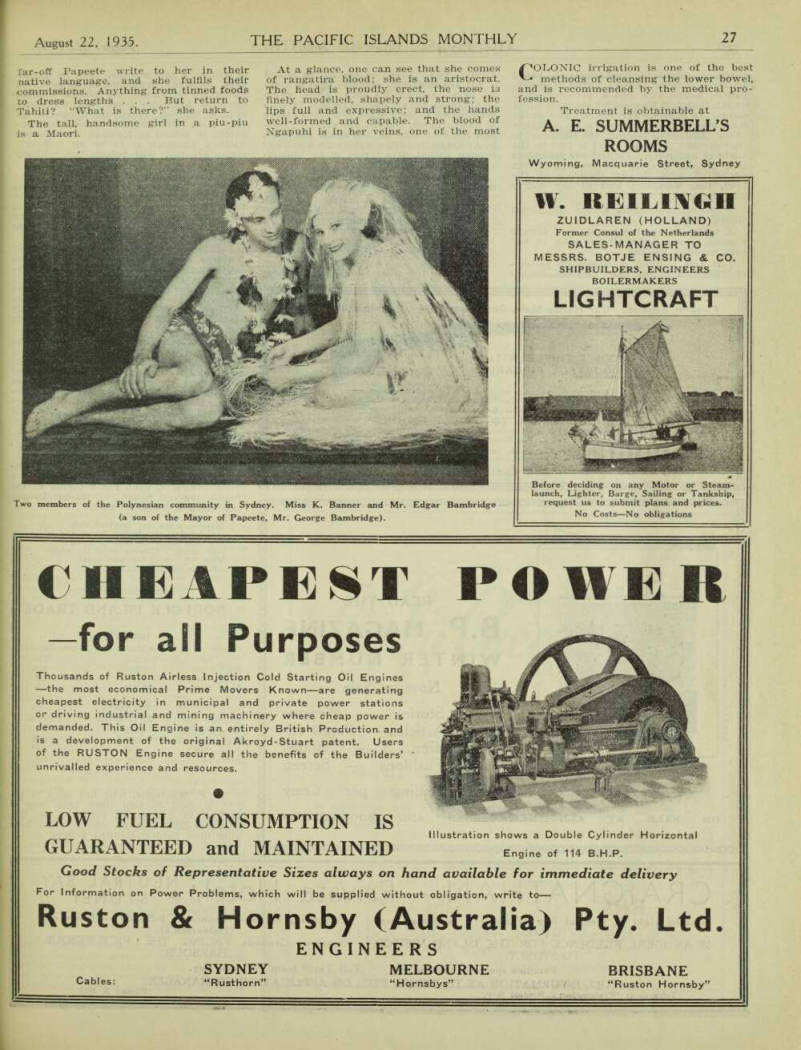
The Brown-skinned Children of Oceania are Attracted, Moth-like, by the Lights of Sydney
Crown the hair and come away!
Hear the calling of the moon And the whispering scents that stray About the idle warm lagoon.
Hasten, hand in human hand Down the dark, the flowered way, Along the whiteness of the sand, And in the water’s soft caress Wash the mind of foolishness. —“Tiare Tahiti.”
THOSE lines were written when Rupert Brooke was intoxicated with the beauty and the simplicity of Tahitian life.
When he reached San Francisco some months later, he wrote in a letter to a friend: “Oh God! Oh God! How I hate civilisation and houses and trams and collars! ”
Most of us can sympathise with the
poet. Whether suited, temperamentally or not, we long for a tropic isle; long to inhale “the whispering scents that stray about the idle warm lagoon”; for an existence where the battle of life is not so strenuous as in a modern city.
Such, however, is not the case with young Tahiti.
Young Tahiti wants the bright lights of civilisation: the hustle and the bustle of the great world outside: the glamour and the glitter, motor cars, movies, wire less —in fact, everything to which we are accustomed and which we would gladly put aside. The race of life is to the swift. What has Papeete to offer its ambitious sons and daughters? There, the Chinaman is in economic supremacy.
These young people have seen enough of waving palms arid blue lagoons.
To them the lights of Sydney attract, and moth-like, from all parts of the Pacific, they come.
From the days when old Parson Mars den sent a sugar mill to Tahiti, and encouraged that enterprising monarch, Pomare II., to send shiploads of pigs to Port Jackson, Sydney has been the natural commercial centre of the Pacific.
To the young Tahitian, the adolescent Cook Islander, the adventurous Maori, Sydney represents life itself! That is why, although sometimes ill-fitted to bear the brunt of battle, these brown-skinned children of Oceania come to the met ropolis. Foreigners on an alien strand, though still inheriting all the natural prejudice of their ancestors, they meet on a common ground—all Polynesians.
Yet each preserves his own identity.
The Maori still finds the accent of the Rarotongan a little strange; the Tahitian considers himself superior to the more ceremonious Samoan; when it comes to family trees the Tongan believes that he has no peer in the whole Pacific. But a, common bond, a common heritage, unites them. All are children of the sun. Therefore, they come together, constituting; Sydney’s smallest colony, dance their dances, sing their songs.
Take, for instance, the little French: girl, Pepe, dancing in a magnificent head dress, which falls, like a cascade, across her shoulders. Beneath the soft, paper— like draperies of her costume, a recent gift from her relatives in Papeete, is a scarlet and white pareu. No European woman could ever dance like Pepe. Yet, strangely enough, she is as fair as a lily; her eyes are of the blue of a Tahitian lagoon.
Though she chatters like a French woman, Pepe is not French. Neither is she Tahitian.
Born in New Zealand and taken to Papeete as a child, she is a curious ma ture, an unusual psychological study.
British by birth, French by environment, at heart she is Polynesian. The dance is her method of expression. French, Eng lish Tahitian —in all three languages she is adept. Therefore, on coming to Syd ney, Pepe had little difficulty in obtaining employment. By day she is employed in a commercial house translating the letters that arrive from Tahiti and othen French possessions in the Pacific. Now that Pepe is in Australia, friends from
far-off Papeete write to her in their native language, and she fulfils their commissions. Anything from tinned foods to dress lengths . . . But return to Tahiti? “What is there?” she asks.
The tall, handsome girl in a piu-piu is a Maori.
At a glance, one can see that she comes of rangatira blood; she is an aristocrat.
The head is proudly erect, the nose is finely modelled, shapely and strong; the lips full and expressive; and the hands well-formed and capable. The blood of Ngapuhi is in her veins, one of the most
Two members of the Polynesian community in Sydney. Miss K. Banner and Mr. Edgar Bambridge (a son of the Mayor of Papeete, Mr. George Bambridge).
northern tribes in New Zealand, noted warriors, famous carvers, gifted in speech and in song. She has a pedigree of a length that few European noblemen could claim. It reaches far beyond the canoe that brought her ancestors to Aotearoa (New Zealand), beyond the horizon to “far distant Hawaiki,” and is lost in the mists of antiquity. Around her shoulders is a kakahu, a softly woven mat of flax decorated with downy feathers of the kiwi, that flightless bird of her native New Zealand.
What brought HER across the Great Ocean of Klwa?
A desire to see the world. “I always wanted to see Sydney,” she said, in her soft, musical English.
Tall and slender, a crown of yellow eyed daisies in his hair (for the sweet
scented Tiare Tahiti of his native island is not procurable in Sydney), and a scar let pareu around his hips, Edgar came to Australia for a different reason. Despite his English name, the lad is French; there is native blood, too, in his veins. Des pite the fact that he has spent six years in Australia, he still speaks with a marked French accent. His father is an import ant official in Papeete.
Edgar came to Sydney to learn the wool trade.
La Belle France demands, however, that her sons shall all bear arms. There fore, Edgar will soon return to Tahiti for his military training. Eight months in barracks at pay that cannot even keep him in cigarettes, and then he will return to Australia, Andre, on the other hand, has only been
in Sydney a few months. Yet, he speaks good English, using his eyes and his hands to emphasise his points. Andre came to Australia from New Caledonia to learn English. It was not altogether an easy task. The English that he had ac quired in school at Noumea was useless.
Andre’s ambition is to be an “officer”; soon, he, too, will return for military training. . . .
Slender and graceful, sedately swaying from the hips in a dance of Rarotonga, where centuries ago her ancestors settled from Tahiti, is a Cook Island maiden.
Delicately featured, she, too, shows every trace of distinguished breeding, and her hands are tapered and slender.
Beside her is a handsome Samoan; her features are finely cast, the eyes deep brown and expressive. In the little com pany she is distinguished for her intri cate footwork in the dance, a branch in which her people are experts. She wears the head-dress of a taupo. Its human hair is distressing to the Maori, for it reminds her of the dead.
The little woman from Rotumah, an island not far distant from Fiji, is a nurse, highly qualified and skilled in her profession. But, in the excitement of the dance, she forgets the civilisation of the European, with all its attendant prob lems. For the time being, with her sis ters and brothers of Oceania, she is back: home. The lights of Sydney are forgotten.
Tum-tum-tum —Edgar, with his inher ent sense of rhythm, taps the drum, in cessantly.
Solo, with a chorus of ukeleles, Andre strums a Spanish guitar. We are all a little homesick, each for a corner of the Pacific we call home . . . Rupert Brooke expressed it when he said: Mamua, when our laughter ends And hearts and bodies, brown and white Are dust about the door of friends; Or scent, a-blowing down the night.
Then, Oh, then, the wise agree, Comes our immortality!
E.R.
Advertisements & other items, pp. 29-30 (1 item)
—for all Purposes
COLONIC irrigation is one of the best methods of cleansing the lower bowel, and is recommended by the medical profession.
Treatment is obtainable at
A. E. SUMMERBELL’S
ROOMS
Wyoming, Macquarie Street, Sydney
W. REILINGH
ZUIDLAREN (HOLLAND)
Former Consul of the Netherlands
SALES-MANAGER TO
MESSRS. BOTJE ENSING & CO.
SHIPBUILDERS, ENGINEERS
BOILERMAKERS
LIGHTCRAFT
Before deciding on any Motor or Steamlaunch, Lighter, Barge, Sailing or Tankship, request us to submit plans and prices.
No Costs—No obligations
CHEAPEST POWE R
—for all Purposes
Thousands of Ruston Airless Injection Cold Starting Oil Engines —the most economical Prime Movers Known—are generating cheapest electricity in municipal and private power stations or driving industrial and mining machinery where cheap power is demanded. This Oil Engine is an entirely British Production and is a development of the original Akroyd-Stuart patent. Users of the RUSTON Engine secure all the benefits of the Builders’ unrivalled experience and resources.
LOW FUEL CONSUMPTION IS
GUARANTEED and MAINTAINED
Illustration shows a Double Cylinder Horizontal Enqine of 114 B.H.P.
Good Stocks of Representative Sizes always on hand available for immediate delivery For Information on Power Problems, which will be supplied without obligation, write to—
Ruston & Hornsby (Australia) Pty. Ltd.
ENGINEERS
SYDNEY MELBOURNE BRISBANE
Cables: “Rusthorn” “Hornsbys” “Ruston Hornsby”
Firearm Repairs: “Our Hands Make Good Arms” Firearms Sent C.O.D.
DON’T TRIFLE WITH
DOUBTFUL FIREARMS
Sil Rohu’s expert attention is at your service without obligation. ; Send for my wonderful Catalogue. 500 illustrations and details of the world s best and reliable makers.
“FISHING TACKLE TO TACKLE FISHING”
The same high standard of quality is a feature in my new fishing catalogue (200 illustrations).
Specialities: Trout, Big Game and Deep Sea Fishing.
Gunsmith, Importer of High-grade Firearms and Fishing Tackle Specialist. ’Phone: MA 5430 * A.I.F. Elizabeth St., Sydney (near Market St.)
advt
CRAIGNATHAN Private Hotel,
NEUTRAL
SYDNEY
BAY
Situated right at Neutral Bay Wharf—15 minutes from
G.P.O.
IS AN IDEAL RESIDENCE FOR THE ISLAND VISITOR
TO SYDNEY.
Families specially catered for.
Boatsheds Swimming Baths Tennis — Billiards (Halvorsen’s).
Spacious Grounds FACING THE PICTURESQUE
HARBOUR.
Full Tariff from 10/- per day.
FULL INFORMATION AS TO TERMS, ETC., ON APPLICATION TO MANAGER.
Telegrams: “Craignathan," Neutral Bay.
Phone: X 2472
Norfolk Island Trade
Dr. F. Montague, who has been in the Fiji Medical Service since 1926, was in Sydney in August, en route to the Gilbert and Ellice Islands, where he has been appointed Senior Medical Officer of the Colony, with headquarters at Tarawa.
Imports.
Month From Australia From Pacific Is.
May, 1934 £2023 £2 May, 1935 £1027 £25 June, 1934 £1174 £24 June, 1934 £3513 £19
Exports.
Month To Australia To Pacific Is May, 1934 £812 Nil May, 1935 £812 £22 June, 1934 £787 £19 June, 1935 £345 £3
The Blathering of Politicians New Caledonia’s Condition
Politicians New Caledonia’s Condition
of people who know Islands conditions thoroughly pass through Sydney in the course of a year; yet the newspaper reporters consistently ignore them, and as consistently “inter view” every inconspicuous member of Australia’s innumerable Parliaments, who uses part of his expenses allowance on a winter cruise to the “Isles of Sunshine.”
It would appear that newspaper folk, in this respect, are living still in the Vic torian era, when members of Parliament usually were men of intelligence, educa tion and vision, whose opinions were worth having. To-day, and since pro fessionalism has dominated politics, mem bers of Parliament are about the last men who should be allowed into the journalistic limelight, which they so eagerly seek.
Many M.P.’s, M’s.L.A., etc., have been tripping around the Islands lately, and the Press has been giving prominence to some particularly asinine opinions. This, for instance: “Noumea was in the doldrums. Butter was 3/- a lb., and was of poor quality.
New Caledonia had considerable natural resources, but it was the Cinderella of French possessions. Cheap but inefficient Tonkinese labourers were taken there to work the mines and plantations. In other hands New Caledonia would have great possibilities.”
This from an inconspicuous member of the N.S.W. Parliament, who seemed to think —Heaven knows why!—he was an authority on New Caledonia. Actually, the French have a far better record of colonisation and development in New Caledonia than Australia has in the Northern Territory, for instance; and the colony is not in the doldrums. It suffered severely from slump, as we all suffered, but it has made a good recovery in the last two years, in which it has been as sisted by the increasing activity and pros perity of the nickel and chrome mines, and smelting works. This is a good mar ket for Australian products, and, if only the politicians would give some attention to the tariff relationship between Aus tralia and New Caledonia instead of pas sing ill-informed nonsense along to the newspapers, the market would be a much better one.
Other politicians have given the re porters their delightful impressions of Papua and New Guinea; with the result that quite a number of earnest gentlemen have been writing to the newspapers to correct the politicians’ misstatements. One of the travellers, for instance, said that the Papuan police spoke the Port Mores by native dialect, which was Motuan, and that the Administration was trying to introduce Motuan as a lingua franca.
Actually, the police, being drawn from many districts, speak a hotch-potch of all dialects —a kind of Motuan-Pidgin— and the Administration’s definite policy is to steadily increase the use of English.
Mr. George Farwell, who arrived in Sydney recently after a lengthy sojourn in Tahiti, has been seriously ill. Mr. Far well was one of the treasure-seekers in the Tuamotu Group last year. Soon after his arrival in Australia he contracted pneumonia, and had to enter hospital.
Fewer Pearls
Mysterious Marine Influence
"WHY are pearls fewer now than a few years ago?” was a question asked at an official inquiry into the pearling industry, held at Broome, W.A. on August 5.
Mr. J. F, Mackenzie, master pearler, replied: “Some extraordinary marine con ditions we pearlers cannot understand has affected the production of pearls, which has been declining for the last five years.”
Dr. Eric Pockley departed from Sydney for Madang, New Guinea, on business by the Macdhui on July 25.
Advertisements & other items, pp. 31-32 (1 item)
Location BELVEDERE
'Phone: FX 3378 'Phone: FX 3378
BARRINGTON’S
DRIVE YOURSELF
SERVICE
Cars Hired without Drivers from 10/- per day; Tourers, 3d. per mile; Sedans, 4d. and sd. per mile. Our Fleet includes 1934 Dodge Sedans.
Write for Reservations, or ’phone when in city and we will deliver Car to your address.
243 ANZAC PARADE, SOUTH
KENSINGTON, N.S.W.
The Islanders’ Sydney Home . . .
Location BELVEDERE
81 BAYSWATER ROAD. DARLINGHURST
Exclusive.
A fine house with its wealth of pleasant old associations.
The Garden Suites, designed on most modern lines.
Excellent grounds with beautifully kept gardens—and dotted toith comfortable garden seats.
Private telephones if desired.
An atmosphere of rest and grateful quietness.
Ideal location.
Near White City Tennis Courts.
Seven minutes to 0.P.0.
Close to Shopping Centre.
Trams stop at gates.
BELVEDERE is Controlled and Supervised by Island People for Island People TERMS: From £2/12/6 Weekly.
MR. & MRS. C. WAGER (late of Fiji), Proprietors.
It is safer, and your cheque book provides a permanent record of your expenditure.
The opening of a cheque account with the Bank of New South Wales is a simple matter, and the various services that the Bank renders to its customers will be courteously explained at any of the Bank’s 730 branches.
It is not necessary to keep a large credit balance, and whenever you have a surplus of five pounds, you can place it on Fixed Deposit with the Bank, and arrange to have the interest paid in regularly to your cheque account.
BANK OF NEW SOUTH WALES
(Established 1817) The Oldest and Largest Bank in Australasia 140A-1935
DONALDS
Casement Stay
Locks the window —no catches to turn —works automatically—loo% opening—no projections—ideal for screens.
Simplicity and Security in Perfect Partnership Ask your Store for further particulars, or write direct to —
DONALD PATENTS LTD.
PADDINGTON -- SYDNEY
also Wirestrainers, Presses, Jacks, etc.
The
HALLSTROM
Masterpiece Pays for Itself Price £49/10/-, f.o.b., Sydney.
Others from £20.
FOR EVERY HOME
HALLSTROM
Semi-Automatic
REFRIGERATORS
KEROSENE OPERATED
Have proof of Lasting Service and economical refrigeration efficiency.
No Moving Parts—No Mechanism.
Keep your food fresh and wholesome Write for particulars to the manufacturer:
E. HALLSTROM
462/464 Willoughby Rd., Willoughby
SYDNEY
Wilhelm Breckwoldt & Co.
9, Lange Muehren, South Sea Bldgs.
HAMBURG GERMANY
(Exporters and Importers) We Export: Trade Goods of any description, Cutlery, Hardware, Miners' Requisites, etc., etc.
We Import: Any kind of Island Produce.
CORRESPONDENCE INVITED
BULLIVANTS wire ropes
“THE WORLD’S STANDARD”
LARGEST STOCKS IN AUSTRALASIA - FOR ALL PURPOSES Also Block., Hooks, Shackle., Thimble., Strand, Seizing, Aircraft Cord, etc.
Letter.: BULLIVANTS’ Australian Co. Ltd- Telegram.: Boa 1298 J, G.P.O. 331-333 KENT STREET. SYDNEY Prompt Attention! Efficient Service!! Complete Satisfaction!!!
“Bullivants Ltd.,’
Sydney.
Melanesian Curios In
Sydney
AN interesting display of native craft work and of photographs, mostly from the Solomon Islands, has been placed on view at the offices of the Melanesian Mission, in Union House, Sydney. There are beautifully woven ceremonial dresses, combs inlaid with pearlshell, and utensils of many kinds. Some of the exhibits show interesting evidence of European influence. Many of the exhibits are rare, and will become rarer as cheap imported goods replace the products of the native craftsman. This applies, for example, to fishhooks, painstakingly made of shell, which are rapidly being replaced by fac tory-made hooks of steel.
Visitors also may see miniature moving pictures, illustrating the work of the missions.
This plan of giving publicity to the work of the mission has been very suc cessfully put into operation by the or ganisation’s indefatigible secretary, Major Robinson.
Tropic Isles
The Navy’s Visits to Tropic Isles Social Value of Such Events
From Our Own Correspondent.
Rarotonga, July 14.
ON Wednesday, July 3rd., H.M.S. “Dio mede” dropped anchor off Avarua, where she remained until the following Saturday. On the night of her arrival European ladies ashore arranged a dance in honor of Captain Graham and the officers.
A feature of the evening was the row of attractive native and half-caste girls occupying two sides of the hall, but who, through a scarcity of partners, hardly danced at all. Few, if any, were intro duced to the visitors; although, judging from certain remarks heard, they were not alone in this respect. Indeed, as in variably happens on these occasions, the former were almost entirely monopolised, by a small clique.
The cost —to New Zealand ratepayers— of these lengthy visits by warships must be greatly out of proportion to the rather dubious moral effect which they have on the “brown brother.” The “Diomede” stayed 3½ days, and the “Dunedin,” due here next month, is scheduled to remain a further five. Without attempting to quote actual figures, the “all-in” expenses of two such cruisers over a nine days’ visit must represent an expenditure which even the most Kiplingesque-minded would hesitate to endorse as proportionate to the value received.
Although no people are less belligerent or so little in need of a reminder of the man a of Big Fella White Man, than are the Cook Islanders, one nevertheless can not help thinking that some part of the time spent on picnics, parties and sports could be better employed in exhibitions of drill, landing-party manoeuvres, etc., which would at least leave a lasting im pression. After all, if it really is neces sary for these vessels to pay such lengths calls, one presumes that at all events their crews are “on service,” and this being so, it might be just as well to avoid creating an impression that a warship is a sort of luxury cruiser with a complel ment of uniformed tourists.
Commander A. H. Davey, of the Union Company’s Monowai, which made a cruise of Fiji, Tonga, and Samoa in July, spent many pleasant hours in the chief port of those groups renewing acquaintances For many years he was master of the Union Company’s steamers Tofua and Talone, well-known warriors of the day; when the Central Pacific was crisscrossed by frequent cargo services from New Zealand and Australia.
Foreign Goods in New
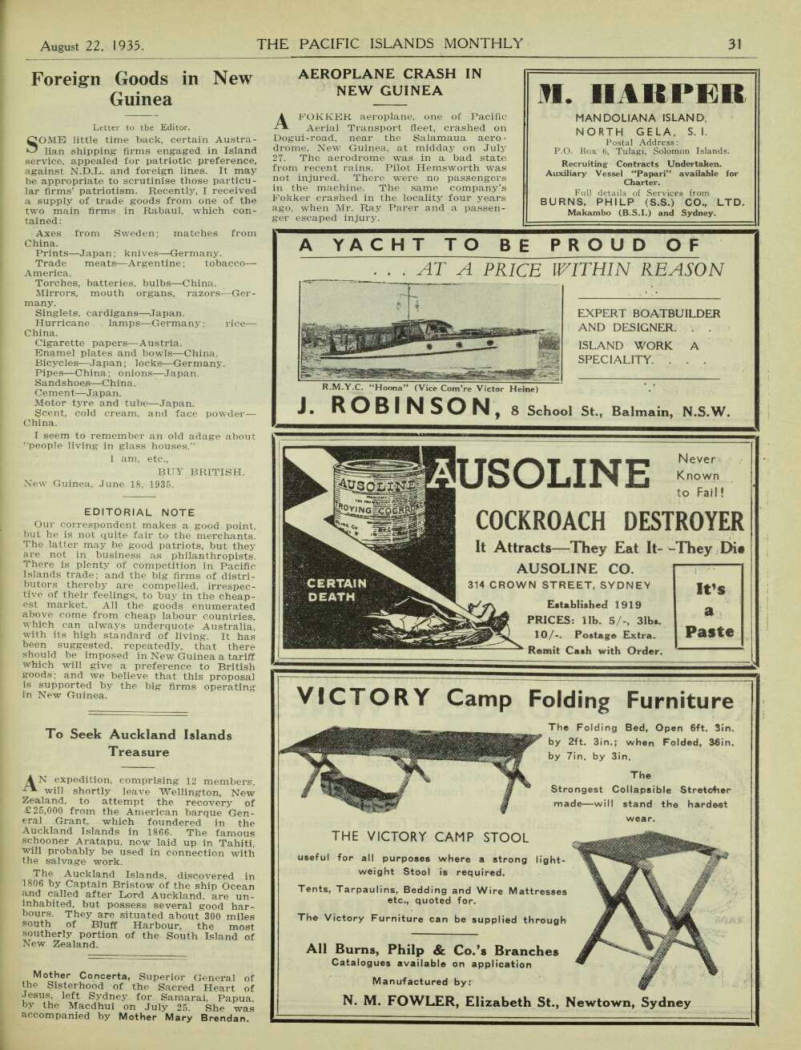
Guinea
Letter to the Editor.
SOME little time back, certain Austra lian shipping firms engaged in Island service, appealed for patriotic preference, against N.D.L. and foreign lines. It may be appropriate to scrutinise those particu lar firms’ patriotism. Recently, I received a supply of trade goods from one of the two main firms in Rabaul, which con tained: Axes from Sweden; matches from China.
Prints—Japan; knives —Germany.
Trade meats —Argentine; tobacco — America.
Torches, batteries, bulbs—China.
Mirrors, mouth organs, razors—Ger many.
Singlets, cardigans—Japan.
Hurricane lamps—Germany; rice— China.
Cigarette papers—Austria.
Enamel plates and bowls —China.
Bicycles—Japan; locks —Germany.
Pipes—China; onions—Japan.
Sandshoes—China.
Cement—Japan.
Motor tyre and tube—Japan. §cent, cold cream, and face powder— China.
I seem to remember an old adage about ‘ people living in glass houses.”
I am, etc..
Buy British.
New Guinea, June 18, 1935.
Editorial Note
Our correspondent makes a good point, but he is not quite fair to the merchants.
The latter may be good patriots, but they are not in business as philanthropists.
There is plenty of competition in Pacific Islands trade; and the big firms of distri butors thereby are compelled, irrespec tive of their feelings, to buy in the cheap est market. All the goods enumerated above come from cheap labour countries, which can always underquote Australia, with its high standard of living. It has been suggested, repeatedly, that there should be imposed in New Guinea a tariff which will give a preference to British goods; and we believe that this proposal is supported by the big firms operating in New Guinea.
To Seek Auckland Islands
Treasure
AN expedition, comprising 12 members, will shortly leave Wellington, New Zealand, to attempt the recovery of £25,000 from the American barque Gen eral Grant, which foundered in the Auckland Islands in 1866. The famous schooner Aratapu, now laid up in Tahiti, will probably be used in connection with the salvage work.
The Auckland Islands, discovered in 1806 by Captain Bristow of the ship Ocean and called after Lord Auckland, are un inhabited. but possess several good har bours. They are situated about 300 miles south of Bluff Harbour, the most southerly portion of the South Island of New Zealand.
Mother Concerts, Superior General of the Sisterhood of the Sacred Heart of Jesus, left Sydney for Samarai, Papua, by the Macdhui on July 25. She was accompanied by Mother Mary Brendan.
Aeroplane Crash In
New Guinea
AFOKKER aeroplane, one of Pacific Aerial Transport fleet, crashed on Dogui-road, near the Salamaua aero drome, New Guinea, at midday on July 27. The aerodrome was in a bad state from recent rains. Pilot Hemsworth was not injured. There were no passengers in the machine. The same company’s Fokker crashed in the locality four years ago, when Mr. Ray Parer and a passen ger escaped injury.
Advertisements & other items, pp. 33-34 (1 item)
Usoline
HI. HARPER
MANDOLIANA ISLAND,
NORTH GELA, S. I.
Postal Address: P.O. Box 6, Tulagi, Solomon Islands.
Recruiting Contracts Undertaken.
Auxiliary Vessel "Papari” available for Charter.
Full details of Services from
BURNS, PHILP (S.S.) CO., LTD.
Makambo (8.5.1.) and Sydney.
A YACHT TO BE PROUD OF
... AT A PRICE WITHIN REASON
EXPERT BOATBUILDER
AND DESIGNER. . .
ISLAND WORK A
SPECIALITY. . . .
R.M.Y.C. “Hoona” (Vice Com’re Victor Heine) J. ROBINSON, 8 School St., Balmain, N.S.W.
TtSJ.
USOLINE
COCKROACH DESTROYER
Never Known to Fall!
It Attracts—They Eat It- -They Dia
AUSOLINE CO.
314 CROWN STREET, SYDNEY
Established 1919 PRICES: lib. 5/-, 3lbs. 10/-. Postage Extra.
Remit Cash with Order.
It's Paste
VICTORY Camp Folding Furniture
The Folding Bed, Open 6ft. Sin. by 2ft. 3in.; when Folded, 36in. by 7in. by Sin.
The Strongest Collapsible Stretcher made—will stand the hardest wear.
THE VICTORY CAMP STOOL
useful for all purposes where a strong lightweight Stool is required.
Tents, Tarpaulins, Bedding and Wire Mattresses etc., quoted for.
The Victory Furniture can be supplied through All Burns, Philp & Co.’s Branches Catalogues available on application Manufactured by: N. M. FOWLER, Elizabeth St., Newtown, Sydney
West’s Wheel
Works
(F. H. Bishop, Proprietor)
60-64 Bay St., Sydney
MANUFACTURERS
OF ALL TYPES OF WHEELS
FOR WAGGONS, CARTS,
TRAILERS, CARS
SUPPLIERS
OF WHEEL PARTS, RIMS,
SPOKES, AXLES, BOXES, etc.
We have the plant and have been established forty years Write for Information and Quotations
Woven Wire for All Industry
COPRA DRYING TRAYS, FLOORS. Etc.
FRUIT DRYING TRAYS, MINING SCREENS
Heavy Mosquito Gauze in Phosphor Bronze and Other Metals Impervious to Salt Sea Air WIRE DOOR MATS AND GENERAL WIRE WORKS
E. WftllOHT «& CO. LTD.
Office and Works: 148-152 Cleveland St., Sydney, N.S.W.
Telegraphic Address: "Wrightxnakc,” Chippendale.
Or/£ r* £
Save time, trouble, temper specify these universally preferred
ROPES, CORDAGES&TWINES
Made by the largest Rope and Cordage manufacturers in Australasia, “Kookooburra” Ropes, Cordages, and Twines are tested to provide that extra endurance, which is only found in “Kookooburra” quality lines.
Specially manufactured for the stresses of tropical conditions.
Other well-known products include Sash Cords, Halters, Plow Reins, Jute and Hemp Seaming Twines.
KOOKOOBIIKBA
BRAND
A. FORSYTH & Co. Ltd. “Ulv NT st Cable Address: “Rope,” Sydney '
M£RK
TRADE
Aviation Equipment In New Guinea
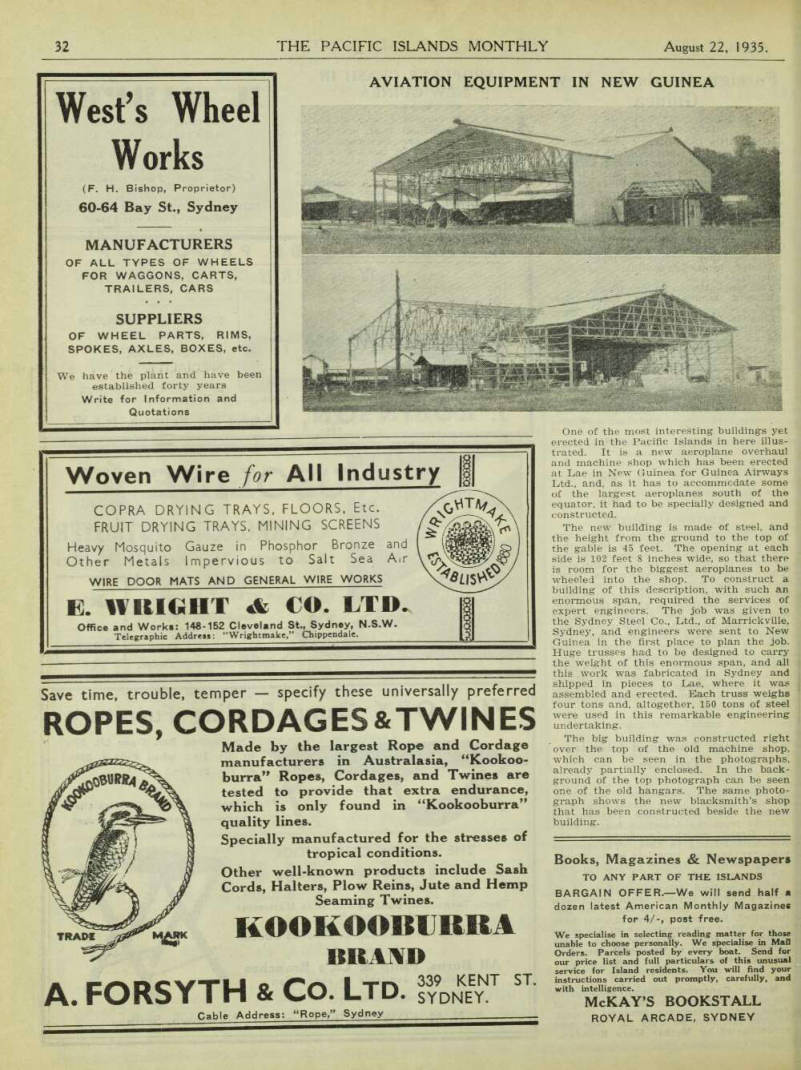
One of the most interesting buildings yet erected in the Pacific Islands in here illus trated. It is a new aeroplane overhaul and machine shop which has been erected at Lae in New Guinea for Guinea Airways Ltd., and, as it has to accommodate some of the largest aeroplanes south of the equator, it had to be specially designed and constructed.
The new building is made of steel, and the height from the ground to the top of the gable is 45 feet. The opening at each side is 102 feet 8 inches wide, so that there is room for the biggest aeroplanes to be wheeled into the shop. To construct a building of this description, with such an enormous span, required the services of expert engineers. The job was given to the Sydney Steel Co., Ltd., of Marrickville, Sydney, and engineers were sent to New Guinea in the first place to plan the job.
Huge trusses had to be designed to carry the weight of this enormous span, and all this work was fabricated in Sydney and shipped in pieces to Lae, where it was assembled and erected. Each truss weighs four tons and, altogether, 150 tons of steel were used in this remarkable engineering undertaking.
The big building was constructed right over the top of the old machine shop, which can be seen in the photographs, already partially enclosed. In the back ground of the top photograph can be seen one of the old hangars. The same photo graph shows the new blacksmith’s shop that has been constructed beside the new building.
Advertisements & other items, p. 34 (1 item)
Books, Magazines & Newspapers
TO ANY PART OF THE ISLANDS
BARGAIN OFFER. —We will send half a dozen latest American Monthly Magazines for 4/-, post free.
We specialise in selecting reading matter for those unable to choose personally. We specialise in Mail Orders. Parcels posted by every boat. Send for our price list and full particulars of this unusual service for Island residents. You will find your instructions carried out promptly, carefully, and with intelligence.
McKAY’S BOOKSTALL
ROYAL ARCADE, SYDNEY
Aerodromes
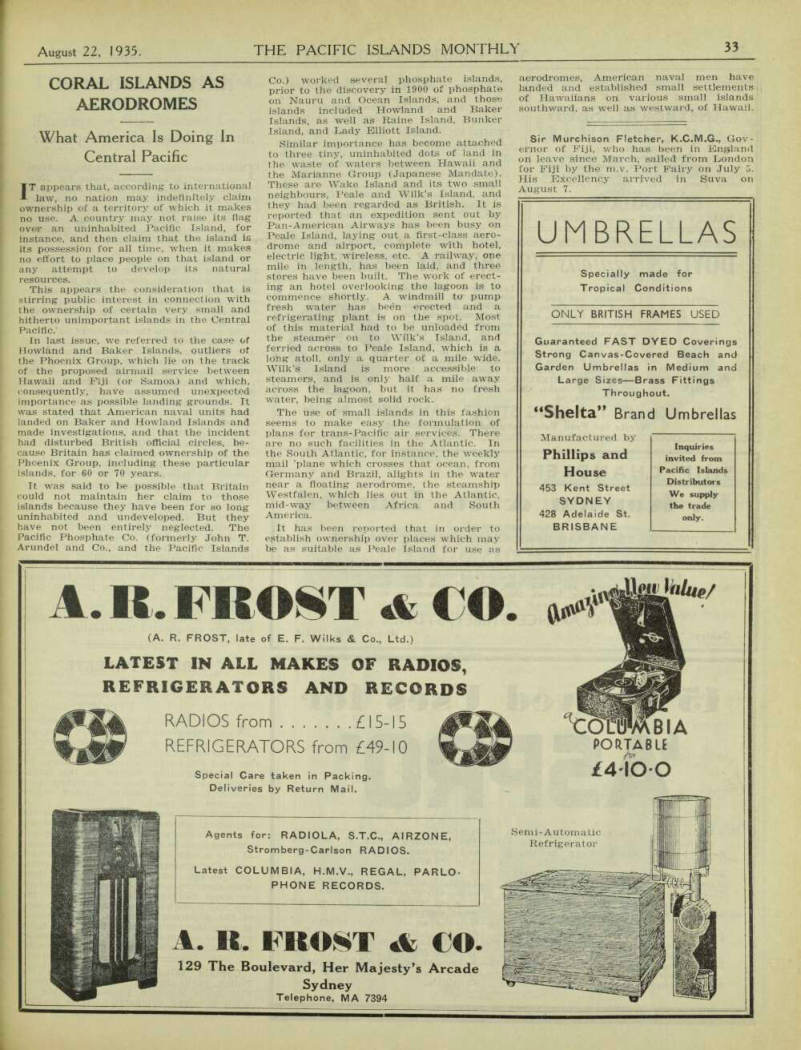
Coral Islands As
What America Is Doing In Central Pacific
IT appears that, according to international law, no nation may indefinitely claim ownership of a territory of which it makes no use. A country may not raise its flag over an uninhabited Pacific Island, for instance, and then claim that the island is its possession for all time, when it makes no effort to place people on that island or any attempt to develop its natural resources.
This appears the consideration that is stirring public interest in connection with the ownership of certain very small and hitherto unimportant islands in the Central Pacific.' In last issue, we referred to the case of Howland and Baker Islands, outliers ot the Phoenix Group, which lie on the track of the proposed airmail service between Hawaii and Fiji (or Samoa) and which, consequently, have assumed unexpected importance as possible landing grounds. It was stated that American naval units had landed on Baker and Howland Islands and made investigations, and that the incident had disturbed British official circles, be cause Britain has claimed ownership of the Phoenix Group, including these particular islands, for 60 or 70 years.
It was said to be possible that Britain could not maintain her claim to those islands because they have been for so long uninhabited and undeveloped. But they have not been entirely neglected. The Pacific Phosphate Co. (formerly John T.
Arundel and Co., and the Pacific Islands
Co.) worked several phosphate islands, prior to the discovery in 1900 of phosphate on Nauru and Ocean Islands, and those islands included Howland and Baker Islands, as well as Raine Island, Bunker Island, and Lady Elliott Island.
Similar importance has become attached to three tiny, uninhabited dots of land in the waste of waters between Hawaii and the Marianne Group (Japanese Mandate).
These are Wake Island and its two small neighbours, Peale and Wilk’s Island, and they had been regarded as British. It is reported that an expedition sent out by Pan-American Airways has been busy on Peale Island, laying out a first-class aero drome and airport, complete with hotel, electric light, wireless, etc. A railway, one mile in length, has been laid, and three stores have been built. The work of erect ing an hotel overlooking the lagoon is to commence shortly. A windmill to pump fresh water has been erected and a refrigerating plant is on the spot. Most of this material had to be unloaded from the steamer on to Wilk’s Island, and ferried across to Peale Island, which is a long atoll, only a quarter of a mile wide.
Wilk’s Island is more accessible to steamers, and is only half a mile away across the lagoon, but it has no fresh water, being almost solid rock.
The use of small islands in this fashion seems to make easy the formulation of plans for trans-Pacific air services. There are no such facilities in the Atlantic. In the South Atlantic, for instance, the weekly mail ’plane which crosses that ocean, from Germany and Brazil, alights in the water near a floating aerodrome, the steamship Westfalen, which lies out in the Atlantic, mid-way between Africa and South America.
It has been reported that in order to establish ownership over places which may be as suitable as Peale Island for use as
aerodromes, American naval men have landed and established small settlements of Hawaiians on various small islands southward, as well as westward, of Hawaii.
Sir Murchison Fletcher, K.C.M.G., Gov ernor of Fiji, who has been in England on leave since March, sailed from London for Fiji by the m.v. Port Fairy on July 5.
His Excellency arrived in Suva on August 7.
Advertisements & other items, pp. 35-36 (1 item)
A. R. Front A Co.
UMBRELLAS
Specially made for Tropical Conditions
ONLY BRITISH FRAMES USED
Guaranteed FAST DYED Coverings Strong Canvas-Covered Beach and Garden Umbrellas in Medium and Large Sizes —Brass Fittings Throughout.
“Shelta” Brand Umbrellas
Manufactured by
Phillips and
House
453 Kent Street
SYDNEY
428 Adelaide St.
BRISBANE
Inquiries invited from Pacific Islands Distributors We supply the trade only.
A. R. FRONT A CO.
(A. R. FROST, late of E. F. Wilks & Co., Ltd.)
LATEST IN ALL MAKES OF RADIOS,
REFRIGERATORS AND RECORDS
RADIOS from £l5-15
REFRIGERATORS from £49-10
Special Care taken in Packing.
Deliveries by Return Mail.
Ikn UiLio/
"'cocPmbia
PORTABLE
/ur
£4lOO
Agents for: RADIOLA, S.T.C., AIRZONE, Stromberg-Carlson RADIOS.
Latest COLUMBIA, H.M.V., REGAL, PARLO-
PHONE RECORDS.
A. It. FROST A CO.
129 The Boulevard, Her Majesty’s Arcade Sydney Telephone, MA 7394 Semi-Automatic Refrigerator I:
To Planters I am a Buyer of
CASTOR OIL SEED
IN ANY QUANTITY
Send Sample for quote, stating quantity available.
Castor Seed Shellers, any capacity.
Advice and Instructions Regarding Planting, Harvesting and Packing of Castor Oil Seeds given freely. Selected Seed for Planting available.
C. GRAHAME
4 DALLEY STREET SYDNEY
DOYLE’S famous VETERINARY REMEDIES
REDUCINE—Cures Your Lame Horse. Cures Kim painlessly and you can work him all the time.
Cures Splints, Curbs, Capped Hocks, Sprung Tendons, Bog Spavins, and all Bony and Bursal Enlargements, Price. 12/6 per can. Postage, 1/-.
LARYNGINE.—A sure cure for Coughs, Colds, Strangles, etc. Price, S/- per can. Postage, 1/-.
SKIN DRESSING.—A certain remedy for Mange and Allied Parasitic Skin Diseases in Horses, Dogs, etc. Price, 7/6 (large), 3/6 (small). Postage, 1/-.
DISTEMPER MIXTURE,—A safe and reliable remedy for Coughs, Colds, Asthma, etc. Price, 2/6, Postage, 9d.
T. G. DOYLE, v.s.. 9 KING STREET, RANDWICK, N.S.W.
Write for Free Veterinary Advice and Booklet 00YL65 & s#
ORES
SHIP CHANDLERY .. .
W. Kopsen ti Co. Laiuite«l
Manufacturers of PIONEER BRAND ASH OARS AND IMPLEMENT HANDLES.
Sole Agents for ; KOPSEN’S SPECIAL YELLOW METAL SHEATHING AND NAILS.
Large Stocks of Chains, Anchors, Manilla and Wire Ropes, Wood and Iron Blocks, Oakum. Tar, Pitch, Oils, Paints, Leads, Zincs, Varnishes, Shackles, Rigging, Screws, Sheathing, Felt, Lampware. etc.
Special Under Bond Prices for Island trade.
68-70 CLARENCE STREET, SYDNEY
Cables; “Kopsen.” ’Phone; BW 1114-5
15 Proved Uses lor
h 1— It relieves Headaches in 5 to 10 minutes. 2 It brings Sweet Sleep to the Sleepless. 3 It relieves Rheumatism in one night. 4 It will ease the Nagging Pains of Neuritis and Neuralgia. 5 Take “ASPRO” to relieve Toothache. 6 “ASPRO” taken according to directions will smash up a Cold or ’Flu attack in 24 hours. 7 |t brings relief without harming the heart. 8— It soothes away Irritability. g—|t speedily reduces Temperature. 10 —The stabbing pains of Sciatica and Lumbago can be hunted out with “ASPRO.” : 11—It can be taken at any time, m Tram, Train, at Home, at Busi-
ness, anywhere—everywhere.
12— It gives great relief to women when depressed. 13— it relieves ill after effects of Alcohol. 14— It relieves Dengue and Malaria by reducing the fever. 15— As a Gargle “ASPRO” is wonderful for Sore Throats and T onsilitis.
Tooya’s Mishap in Tuamotus
From Our Own Correspondent.
Papeete, July 9.
THE Fr. Oceania inter-island steamer Tooya (597 tons) met with a slight mishap on her last trip through the Tuamotu archipelago, and is at present on the slip at Papeete undergoing repairs.
The damage done, as the result of touch ing a reef near the island of Takaroa, is not very serious, and is covered by insur ance. The Tooya is expected to resume her regular schedule at an early date.
Native Labour In
New Guinea
Should Talasea Be Reopened?
THERE are indications that the problem of securing adequate labour for New Guinea enterprises will become acute. The gold industry is growing and developing, and there is an increasing call in that direction for native labour; and, mean while, the recovery of the copra industry is creating a further demand for inden tured labour.
The areas to which recruiters customarily resort are not producing a sufficient num ber of additional recruits to meet the demand. The natives generally are becom ing more sophisticated and are inclined to raise their price. Recruiting is more diffi cult and the higher cost, of course, is being passed on to the employers.
A movement is afoot to urge the Administration to re-open the Talasea dis trict (northern New Britain) to recruiters.
When the Nakanai murders occurred in 1926, the Talasea district was closed against recruiting. In 1928, when the Adminis tration wanted labour for Lae and the Markham-Wau road, etc., Talasea was opened to recruiting for a month; but before recruiters could get there the Administration had filled its labour require ments and Talasea was closed again. On one occasion, since, Talasea has been opened, to supply labour to Messrs. Car penter and Co.'s disiccated coconut industry at Pondo.
The argument of those who want Talasea opened up again is that the Administration in nine years has had ample opportunity to pacify the district and that the very large native population there might now be made available for recruiting purposes.
It is stated, also, that the natives are quit© willing to accept indentures and that con siderable numbers of them have actually offered their services.
The closing of part of the Sepik area and the Mount Hagen area to recruiters has also complicated the situation.
Fire At Papeete
From Our Own Correspondent.
Papeete, July 7.
AFIRE, which might have had serious consequences but for the complete absence of wind at the time, broke out in the workshops of Messrs. Bambridge Dex ‘ter and Co. on the afternoon of June 20.
The conflagration started in the kapok ginnery and was due, it is stated, to a spark from the electric motor which operates the plant.
The flames very quickly spread to the adjoining workshops, which contained many valuable units for wood working and automobile repairs; it is feared that much of this machinery will be unfit for further use. Fortunately, on account of the calm ness of the day and the fact that there were many volunteers from the local garri son, and marines from the “Zeelee,” the fire was brought under control before any of the adjoining buildings were involved.
Messrs. Bambridge Dexter and Co.’s main premises escaped and also the Banque de I’lndo Chine, which is in close proximity.
Captain Wladyslaw Wagner, in the Polish yacht Javo 11., arrived at Suva, Fiji, from Western Samoa on July 12.
With, a young compatriot, he is making a leisurely cruise of the world.
Tragic Muddling
Blunders of Big Trading Co. In Early Papua
WHEN the British New Guinea De velopment Company was first mooted in England in 1910, a certain nobleman criticised the methods that the promoters intended to adopt, and time has proved how wise his views were.
He was of opinion that the company would be ill-advised to hurry out the Bentinck. He pointed out that she might arrive too soon, with the possibility that there would be no building ready for the thousands of tons of cargo that she would carry. As an alternative he advocated that a three-masted sailing ship that was available should be purchased; this ves sel could, on arrival at Port Moresby, be covered in, Noah’s Ark fashion.
He also pointed out that in his opinion the company were ill-advised to take up options on a number of land areas, ex tending over many hundreds of miles of coast. A large area under one supreme head could be taken up, thus saving the cost of a dozen scattered managers, and the further cost of maintaining a small fleet of vessels with which to keep up communication. The history of the com pany during the 25 years that has elapsed has shown the wisdom of everything he advocated.
The Bentinck arrived at Port Moresby on Sunday, June 26, 1910. There was not a building of any kind ready to receive her cargo, and horse lorries were bring ing hard-wood piles to be used in build ing a small store. Space was hired under bungalows, and under the “Pagoda,” now known as the Top Hotel.
A temporary store was later made available; its floor was formed of steel rails, and the flooring of the upper storey was provided by opening cases of gal vanised iron, and using the timber in place of floorboards. The iron was stacked out in the open; tons of it were stolen, and quantities destroyed by the weather, as it was not even stacked on end. Pil fering of the more portable goods was rife.
When a suitable building was at length available ordinary business methods were conspicuous by their entire absence. Even a cash desk was not thought necessary.
The salesmen pocketed all takings and handed them in at intervals.
At one time, when the general man ager and his assistant were humping rocks to make an approach to a wharf, onlookers were amused to see a gawky Goarabari native pat the latter on the shoulder and say to him; “My word, Talbudda, you savvy too much.”
Meantime, the small vessels that had been provided to keep up communication with the numerous plantations were run without any kind of system. On one occasion the Rambler was sent on a journey of 500 miles with only a small camphorwood box and a letter.
One of the areas that had been pur chased, out on the Brown River, had never been seen by anyone representing the company. A good deal of work was done on it, all tools and supplies being carried out by natives. It was then found that the only part of the land fit for growing rubber was along the border of the river. This strip when cleared had to be abandoned because it was nine feet under water in the nor’west season.
In view of the advice given by the nobleman, it is interesting to recall that the Bentinck was eventually sold to a timber company, and a three-master
named the James Craig was taken in part payment. This vessel acted as a storage hulk in Port Moresby for some years, but was sold, and put into commission again after the outbreak of war. The Bentinck was renamed the James Craig, and as far as is known is still in the New Zealand timber trade. With her well-decks and wide hatches, she probably made an ideal little ship for the purpose.—HENßY
Dexter.
Answer to Correspondent
To G.S.B. —The Editor of this journal does not “loathe politicians”; but, with all his heart and soul, he does hate the system which produces professional politicians and the inevitable result of professionalism in politics—namely, bureaucrats and bureaucracy. There are many admirable men in the seven Australian Parliaments; but how many of them make any real effort to reform the rotten system! Having been elected to Parliament, they are well content to sit around in the pleasant social clubs that are provided for them (Aus tralian Parliaments are noted for their comfort) and leave the actual work of government to “public servants,” who actually are responsible to nobody, and who often use their considerable powers very tyrannically. ‘ls it any wonder therefore, that one develops strong feeling concerning all members of Parliament! This writer worked for years as a pressman in various Parliaments — New Zealand, Commonwealth, N.S.W., and House of Commons, particularly—and is well acquainted with the conditions of parliamentary life, and the laziness and uselessness of the great majority of members.
Mr. G. H. Hume, of Melbourne, was elected a director of Nasivi (Fiji) Gold Syndicate, N.L., in July.
The Newcastle and Hunter River Steamship Co.’s intrastate vessel Gwydir has been fitted by Amalgamated Wireless (Aust.) Ltd. with apparatus enabling the master to ’phone the company’s offices in Sydney and Newcastle while sailing be tween those ports.
Advertisements & other items, pp. 37-38 (1 item)
Gillespie’S
‘‘MCIIOI6 ”
i ro l it
TRADE
MARK
The Standard of Quality.
k Australia’i S,-' Green Peas French Beans Cauliflower
'garp e Pftde
k
K PRODUCT* LIMITED
2-4 BROWN STRC-ET, N-EWTOWN
SYDN-EY. -AUSTRALIA
FOR SALE
Two fine Boats that are extra good buying and carry my personal recommendation
(1) KETCH RIG.
37ft. 6in. x 10ft. Gin. Draught 4ft. 16 h.p. Fetter Diesel Engine, metalled bottom. Engine and hull in perfect order.
Wonderful sea boat; built by Hayes; 7 years old ... £7OO
(2) RAISED DECK AUXILIARY
CRUISER.
34ft. Beautifully built. 16 h.p.
Hercules Marine Engine. Good accommodation for four. Large cockpit with fish ice box. Perfect order £BOO Apply—
Jack Capell
Boat Builder and Engineer
RUSHCUTTER BAY
SYDNEY
Telephone - - - FM 1442
IPOHEYS:
mm
SURE
TOOHEYS
PILSENER.
Black Versus White
The Results of a Mutual Misunderstanding
Letter to the Editor.
ONE gathers from the letters of “Veri,” “Duk Duk,” and “Pioneer,” in recent issues of the P.1.M., that New Guinea planters are going through a stage familiar to those with knowledge of early colonisation problems.
There has always been friction between black and white in new countries. Two widely-separated stages of civilisation are difficult to co-ordinate; black misunderstands white and vice-versa, and many white settlers expect more intelligence— and more self-control —from natives than they them selves possess. Civilisation is supposed to foster intelligence. It is the white man’s part to educate raw natives to his requirements, he cannot reason ably expect skilled labourers and faithful service ready made.
Everybody who has had experience with native labour knows the extreme irritation of managing raw recruits, especially when finances are bad, and one has an attack of malaria. Because they find a new tool (native labour) • awkward in their hands many new settlers blame only the tool, for getting that it takes time to learn to use it.
Similarly, because they cannot make their wishes understood, they blame the stupidity of the natives, forgetting again that the natives’ difficulty is just as great.
Real superiority does not express itself in stupidity, intolerance and brutality, and the strong hand (as advocated by “Veri” and “Duk Duk”) is the counterpart of a weak personality. Oppres sion and the methods of the slave-trader have never been known to increase the value of a subject race.
Obviously, the settler, whose job is to make as good a living as he can, has little time and in clination to concern himself with the posterity of his native labourers. Before making up his mind to settle in New Guinea, he should realise that
the welfare of the native population is the prim ary object of the Administration. If such a policy does not appeal to him, he should choose some other country for his activities. If he decides to invest his money and labour in spite of it, he would be wise to mould his own policy in accordance with existing laws, and not feel aggrieved that the Gov ernment ideal is not modified to suit his peculiar requirements and his personal ambition.
Among Australian residents in New Guinea, a land that calls for the spirit of adventure, it is inevitable that those men should be most in evi dence whose desire for dominance is too often their only qualification for authoritative positions. Some of them have never before had a dog (or a wife) to order about in their own country, and their sudden acquisition of power and authority is too great a burden. They condemn loudly and without mercy the clumsiness and grotesque blunders of natives to whom their ways are as equally dis tressing.
It is not that they are inhuman; they do not or will not, understand the gap that separates them; or their imagination fails them. The whole question is one of common sense, and it has two sides, the white and native.
Evidently New Guinea is going through a stage that Papua passed through a generation ago. At that time administrative methods for protecting natives called forth much the same discontent and adverse criticism as expressed by “Veri.” “Duk Duk” and “Pioneer.” So very reasonably, these outbursts may be taken to be the natural and in evitable concomitants of early colonisation in a primitive country.
The wisdom of Papuan methods in those days is evident to-day in the satisfactory relationship be tween employers and labourers. Time will remedy the trouble in New Guinea —if they do not make a mess of it first!
I am, etc.,
Old Observer.
Samarai, Papua, June 20, 1935.
Father Kenny, of the Sacred Heart Mission Hostel, Kensington, N.S.W., left by the July Macdhui on a tour of the Catholic mission stations in Papua.
New Tribes In
N. Guinea
Administration’s “Tenderness”
By “A Ramu Miner”
authorities, in closing the Ramu- Mount Hagen area, following upon the murder of the missionaries, are showing a tenderness for the natives which is not altogether approved by men who know this country.
This country has to be opened up. It is already being penetrated in all directions by prospectors; the gold is there and you cannot keep them out. It is no use dis playing too much tenderness towards the natives —if white men are to be safe these natives must be taught to respect white men, and the only thing the natives under stand is force.
No primitive natives in this world have ever been brought under control without an exhibition of power—Zulus, Maoris, Red Indians, and so on. In this country, Levien subdued the Buang natives, the Bulolo tribes were thoroughly thrashed, the Ger mans subdued the natives in Madang and Manus, and the Kukukukus are now tak ing it in the neck. This Ramu-Mt. Hagen country will not be made safe for white men until history has been repeated.
The Administration must realise that, with aerial freights at 2/6 per lb., it is necessary to buy all available foodstuffs from the local tribes. There are certain terms agreed upon in practice for the pur chase of food, and for the payment of carriers. It unfortunately has become a habit of officials to overpay these natives and, immediately this is done, the natives demand a new standard of pay.
Along comes another miner or pros pector, and the natives —say about 50 of them—shoulder his packs and off they go. usually accompanied by about 200 of their friends. At the end of the carry the white
man pays the usual rates. Immediately the natives become very ugly—l have seen it myself, several times. The white man does not realise that some foolish official has established a new standard of pay, and the natives do not understand the white man’s refusal to pay the higher rate. They cannot speak to each other, and explain, and so the natives hang around the camp until they are shooed away, angry and fermenting.
This is not an infrequent incident, and one is always liable to attack. A common precaution is to keep a primed plug in one’s pocket, close to the match box. The thing, of course, is harmless, compared with a Mills bomb, but it kicks up a lot of dust and makes a magnificent noise— quite enough to scare off the natives.
These officials who overpay natives are not being free with their own money. They think it nothing to make a gift of a common axe—but we miners have to pay 10/- freight on that axe.
EDITORIAL NOTE.—Here we have the same old controversy. This Ramu-Mount Hagen area of New Guinea was penetrated by white men for the first time within the last three years, and the very numerous natives are still as they were “in the beginning”—primitive and uncon trolled. The white men naturally want to go in and exploit the country’s natural wealth; and they cannot see why they should be prevented. The Administration, on the other hand, is seeking to observe that established international principle which says that a country belongs to the indigenous inhabitants, no matter how primitive they may be.
In time, no doubt, this new, rich country in New Guinea will be over-run by Europeans, just as the countries of the Zulus, Red Indians and Maoris were overrun. But, in the meantime, while “peaceful penetration” proceeds, it unques tionably is the duty of the Administration to pro tect the newly-discovered tribes in every possible way.
The Commonwealth Government is seeking applications for another batch of cadet appointments to the Public Service of New Guinea. About 30 cadets have been appointed since the system was in augurated in 1925, and the six original appointees are now Assistant District Officers, The system so far has operated very successfully.
Advertisements & other items, pp. 39-40 (2 items)
37
THE PACIFIC ISLANDS MONTHL\
August 22. 1935.
Anchovy
HOLBROOKS
PASTE
Tie House of . .
HOLBROOK
Packs in dainty jars a delicious paste made from finest Gorgona Anchovies.
It will keep in any climate and is a wonderful stand-by for the concoction of many delightful luncheon and supper savories.
Try it spread lightly on hot buttered toast, or for a more substantial meal serve it on toast with a poached or scrambled egg.
Other varieties of Fish and Meat Pastes: Holbrooks Bloater, Salmon, Salmon & Shrimp, Chicken & Ham, Ham & Tongue, Veal & Tongue, and Turkey & Tongue.
Holbrooks
(Australasia) Ltd.
WATERLOO - NEW SOUTH WALES
\ I & is wisdom’s way— Control of a cold without delay.
Malignant croup needs a “first-aid” nigh, An instant dose saves many-a-sigh.
The bottle on hand must be “the best,”
The treatment we trust by time and test For children’s colds there’s “check” at command Wkh Woods’ Great Peppermint Cure on hand.
Woods’ Great Peppermint Cure.
For Coughs and Colds never fail?
Timber Joinery
ETC.
PREPARED BUILDINGS
ready for erection a speciality.
SHIP and BOAT BUILDING
TIMBERS specially catered for
FIBROLITE, PLYWOODS.
GALVANISED IRON.
CANEC.
O CONSIGNMENTS shipped
by RETURN STEAMERS
to the Islands.
John W. Eaton Ltd.
WEST CRESCENT ST.,
NORTH SYDNEY
TELEPHONES: X 5051 (5 lines)
AUSTRALIA'S CLEARING HOUSE FOR THE PRECIOUS METALS.
BUYERS OF
GOLD
OSM1RIDIUM, PLATINUM, SILVER, &c.
GARRETT & DAVIDSON, LTD.
ASSAYERS, BULLION MERCHANTS. METALLURGISTS,
Bank of N.S.W. Buildings, Regent Street, Sydney
Cable Addrcaa: Ropeyard, Sydney.
Scott’s Renown Brand Rope,
Cordage and
Binder
Twine
of Every
Description
MANUFACTURED AT
MASCOT, N.S.W.
By
J. Scott Ltd.
Head Office and Store:
163 CLARENCE ST.,
SYDNEY, N.S.W.
Australian Museum
New Guinea Collection At Australian Museum
rpHE Australian Museum authorities A have made arrangements to increase their collection of objects from New Guinea (which includes Papua), which is already one of the most comprehensive in the world. Under the new scheme the whole of the Fly River districts will be carefully combed for new material, and the present collection considerably in creased. When complete the collection in Sydney of New Guinea material will be the finest in existence.
Home For Islands Children
SITUATED on the heights of Lane Cove River, Tamarang Hostel has been established to pro vide a Sydney home for Islands and country children who come to Australia to be educated.
Under the care of Mrs. G. Allnutt, children receive the comforts and attention of home life. Miss Elizabeth Allnutt, her assistant, has been trained in child welfare and psychology and undertakes kindergarten tuition for children under six years.
Tamarang Hostel is in open surroundings and children there are able to lead healthy, outdoor lives. Mrs. Allnutt suggests that Islands child ren who are now attending school in Australia should stay at her hostel during the school vacation
in September.—■***
A Purser’S “If”
(With apologies to Rudyard Kipling.) If you can keep your head when half the Boat Train Lose steamer trunks, and blame the loss on you; If you can he mistaken for the Boatswain, And not get rattled at that error, too.
If you can dance with those not young or pretty, Stick at your job for twenty hours on end, And help to organise the Sports Commit tee, Yet still count every passenger your friend.
If you can drink till dawn and not be blotto, Avoid the Boat Deck when the moon is
bright,
And never quite forget that little motto Which runs : “The passenger is always right.”
If you can keep your temper and your hooks straight, Give sound advice to those who dread the Bight, Deal tactfully with Captain, or with cook’s mate, And answer silly questions day and night.
If you can meet the ship’s Vamp—and resist her, Learn to look on at sports, yet play the game, Fall for one girl, though you dislike her sister, And treat those two inseparables the same.
If you can act just like an elder brother To hopeful maids who want to learn a lot, And steer to leeward of some scheming mother Who’s marked you plainly as a sitting shot.
If you can wear a look of deepest sorrow When last Good-byes are said to Mel bourne’s shore, Then work like blazes —knowing on the morrow You must give welcome to two hundred more.
If you can flirt with dowagers through dinner, To doubtful ladies be a bit high-hat, Yours is the ship, and every soul that’s in her, And —which is more — you’ll be a Diplo mat.
Faster Service
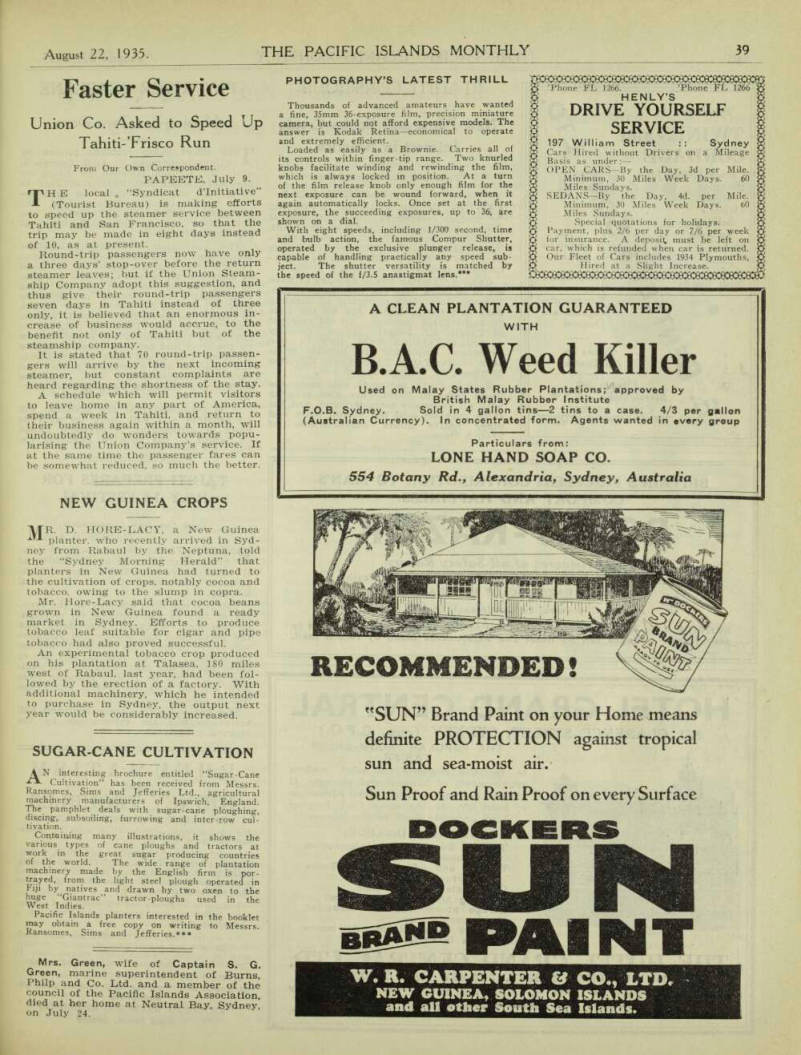
Union Co. Asked to Speed Up Tahiti-’Frisco Run
From Our Own Correspondent.
Papeete, July 9.
TH E local , “Syndicat dTnitiative” (Tourist Bureau) is making efforts to speed up the steamer service between Tahiti and San Francisco, so that the trip may be made in eight days instead of 10, as at present.
Round-trip passengers now have only a three days’ stop-over before the return steamer leaves; but if the Union Steam ship Company adopt this suggestion, and thus give their round-trip passengers seven days in Tahiti instead of three only, it is believed that an enormous in crease of business would accrue, to the benefit not only of Tahiti but of the steamship company.
It is stated that 70 round-trip passen gers will arrive by the next incoming steamer, but constant complaints are heard regarding the shortness of the stay.
A schedule which will permit visitors to leave home in any part of America, spend a week in Tahiti, and return to their business again within a month, will undoubtedly do wonders towards popu larising the Union Company’s service. If at the same time the passenger fares can be somewhat reduced, so much the better.
New Guinea Crops
IATR. D. HORE-LACY, a New Guinea planter, who recently arrived in Syd ney from Rabaul by the Neptuna, told the “Sydney Morning Herald” that planters in New Guinea had turned to the cultivation of crops, notably cocoa and tobacco, owing to the slump in copra.
Mr. Hore-Lacy said that cocoa beans grown in New Guinea found a ready market in Sydney. Efforts to produce tobacco leaf suitable for cigar and pipe tobacco had also proved successful.
An experimental tobacco crop produced on his plantation at Talasea, 180 miles west of Rabaul, last year, had been fol lowed by the erection of a factory. With additional machinery, which he intended to purchase in Sydney, the output next year would be considerably increased.
Sugar-Cane Cultivation
A N interesting brochure entitled “Sugar-Cane Cultivation” has been received from Messrs.
Ransomes, Sims and Jefferies Ltd., agricultural machinery manufacturers of Ipswich, England.
The pamphlet deals with sugar-cane ploughing, discing, subsoiling, furrowing and inter-row cul tivation.
Containing many illustrations, it shows the various types of cane ploughs and tractors at work in the great sugar producing countries of the world. The wide range of plantation machinery made by the English firm is por trayed, from the light steel plough operated in Fiji by natives and drawn by two oxen to the huge “Giantrac” tractor-ploughs used in the West Indies.
Pacific Islands planters interested in the booklet may obtain a free copy on writing to Messrs.
Ransomes, Sims and Jefferies.*** Mrs. Green, wife of Captain S. G.
Green, marine superintendent of Burns, Philp and Co. Ltd. and a member of the council of the Pacific Islands Association, died at her home at Neutral Bay, Sydney, on July 24.
Photography’S Latest Thrill
Thousands of advanced amateurs have wanted a fine, 35mm 36-exposure film, precision miniature camera, but could not afford expensive models. The answer is Kodak Retina—economical to operate and extremely efficient.
Loaded as easily as a Brownie. Carries all of its controls within finger-tip range. Two knurled knobs facilitate winding and rewinding the film, which is always locked in position. At a turn of the film release knob only enough film for the next exposure can be wound forward, when it again automatically locks. Once set at the first exposure, the succeeding exposures, up to 36, are shown on a dial.
With eight speeds, including 1/300 second, time and bulb action, the famous Compur Shutter, operated by the exclusive plunger release, is capable of handling practically any speed sub ject. The shutter versatility is matched by the speed of the f/3.5 anastigmat lens.***
Advertisements & other items, pp. 41-42 (1 item)
Bbshs Paint
’Phone FL 1266. ’Phone FL 1266
HENLY’S
DRIVE YOURSELF
SERVICE
197 William Street : Sydney Cars Hired without Drivers on a Mileage Basis as under:— OPEN CARS-By the Day, 3d per Mile.
Minimum, 30 Miles Week Days. 60 Miles Sundays.
SEDANS—By the Day, 4d. per Mile.
Minimum, 30 Miles Week Days. 60 Miles Sundays.
Special quotations for holidays.
Payment, plus 2/6 per day or 7/6 per week for insurance. A deposit, must be left on car, which is refunded when car is returned.
Our Fleet of Cars includes 1934 Plymouths, Hired at a Slight Increase.
A CLEAN PLANTATION GUARANTEED
WITH
B.A.C. Weed Killer
Used on Malay States Rubber Plantations; approved by British Malay Rubber Institute F. 0.8. Sydney. Sold in 4 gallon tins—2 tins to a case. 4/3 per gallon (Australian Currency). In concentrated form. Agents wanted in every group Particulars from:
LONE HAND SOAP CO.
554 Botany Rd., Alexandria, Sydney, Australia
■t ji« ■'V.
RECOMMENDED!
"SUN” Brand Paint on your Home means
definite PROTECTION against tropical
sun and sea-moist air.
Sun Proof and Rain Proof on every Surface
bbSHS PAINT
W. R. CARPENTER & CO., LTD.
NEW GUINEA, SOLOMON ISLANDS
and all other South Sea Islands.
Specialists in
TWINES and
CORDAGE
Cotton-Hemp Plough Reins Halter’s Sewing Twines Fishing Lines And Sash Cords Jute / X <4/ $ All Enquiries Invited And where Not Represented Agents are Desired Prices on Application u/ Fitzroy St., Marrickville, N.S.W.
CABLE ADDRESS:
‘BENTLEYSON,” SYDNEY
BRITAIN’S PRICELESS CONTRIBUTION TO MAN’S
COMFORT AND HAPPINESS
ROLLS-RAZOR
The Aristocrat of all Safety Razors
SOLE AGENTS for Australia and the Islands of the Pacific.
THE ROLLS RAZOR CO. OF AUSTRALIA LTD.
Mendes Chambers, 8a Castlereagh Street, Sydney.
SERVICE. —We have a complete equipment for Repairs in case of accident to your Razor. Blades can be Reset and adjustments made by return mail.
HOTEL GRAND CENTRAL
151 CLARENCE STREET, SYDNEY (opp. G.P.0.)
THE POPULAR “ROOM-ONLY"
TARIFF
is specially designed to meet modern requirements of business and pleasure. It enables patrons to enjoy every advantage of hotel life, at the same time keeping hotel expenses down to a minimum.
SERVICES INCLUDE:
Theatre Booking and Information Bureau.
Travel and Sightseeing Tours arranged.
Up-to-date Barber’s Shop.
Cleaning and Pressing Service.
Garage accommodation nearby at usual rates.
Spacious Dining Room. All meals a la carte.
THE HOTEL GRAND CENTRAL LTD.
151 CLARENCE STREET, SYDNEY (opp. G.P.0.)
Telephone: BW 1531 (3 lines) Box 716 FF, Sydney Radio Cables and Te.egrams: . Sydney Tt
“Tahiti Conscious”
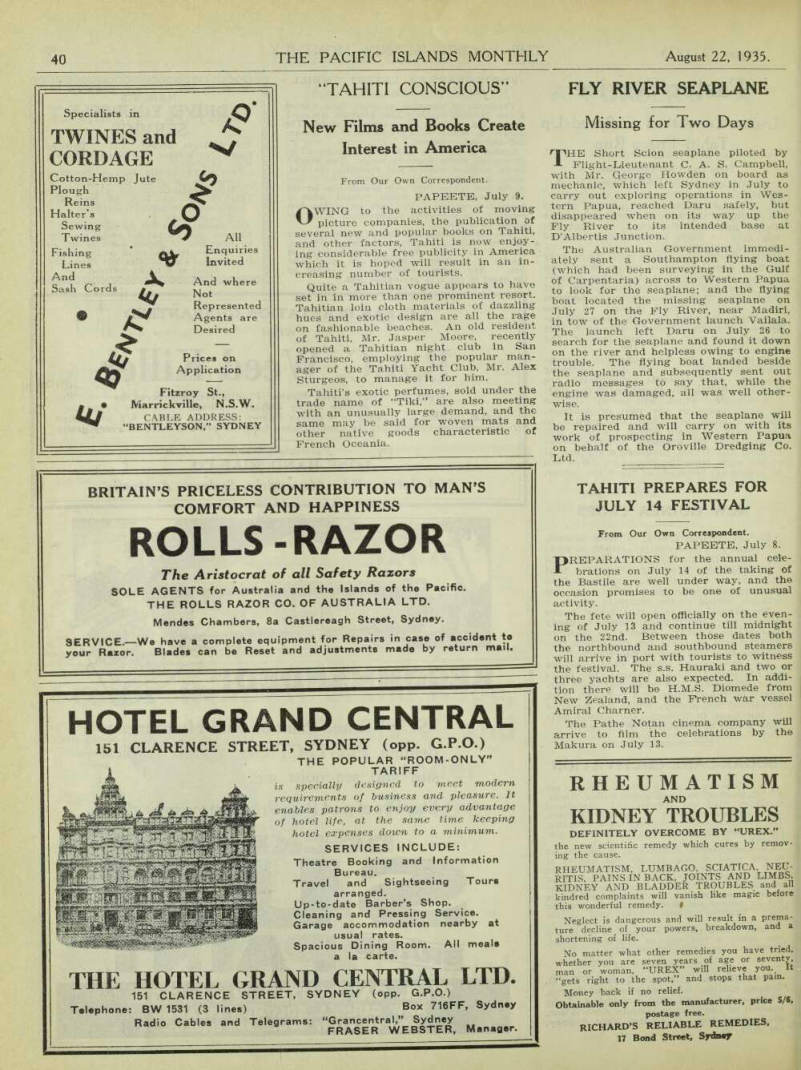
New Films and Books Create Interest in America
From Our Own Correspondent.
Papeete, July 9.
OWING to the activities of moving picture companies, the publication of several new and popular books on Tahiti, and other factors, Tahiti is now enjoy ing considerable free publicity in America which it is hoped will result in an in creasing number of tourists.
Quite a Tahitian vogue appears to have set in in more than one prominent resort.
Tahitian loin cloth materials of dazzling hues and exotic design are all the rage on fashionable beaches. An old resident of Tahiti, Mr. Jasper Moore, recently opened a Tahitian night club in San Francisco, employing the popular man ager of the Tahiti Yacht Club, Mr. Alex Sturgeos, to manage it for him.
Tahiti’s exotic perfumes, sold under the trade name of “Tiki,” are also meeting with an unusually large demand, and the same may be said for woven mats and other native goods characteristic of French Oceania.
Missing for Two Days
Fly River Seaplane
THE Short Scion seaplane piloted by Flight-Lieutenant C. A. S. Campbell, with Mr. Qeorge Howden on board as mechanic, which left Sydney in July to carry out exploring operations in Wes tern Papua, reached Daru safely, but disappeared when on its way up the Fly River to its intended base at D’Albertis Junction.
The Australian Government immedi ately sent a Southampton flying boat (which had been surveying in the Gulf of Carpentaria) across to Western Papua to look for the seaplane; and the flying boat located the missing seaplane on July 27 on the Fly River, near Madiri, in tow of the Government launch Vailala.
The launch left Daru on July 26 to search for the seaplane and found it down on the river and helpless owing to engine trouble. The flying boat landed beside the seaplane and subsequently sent out radio messages to say that, while the engine was damaged, all was well other wise.
It is presumed that the seaplane will be repaired and will carry on with its work of prospecting in Western Papua on behalf of the Oroville Dredging Co.
Ltd.
Tahiti Prepares For
July 14 Festival
From Our Own Correspondent.
Papeete, July 8.
PREPARATIONS for the annual cele brations on July 14 of the taking of the Bastile are well under way, and the occasion promises to be one of unusual activity.
The fete will open officially on the even ing of July 13 and continue till midnight on the 22nd. Between those dates both the northbound and southbound steamers will arrive in port with tourists to witness the festival. The s.s. Hauraki and two or three yachts are also expected. In addi tion there will be H.M.S. Diomede from New Zealand, and the French war vessel Amiral Charner.
The Pathe Notan cinema company will arrive to film the celebrations by the Makura on July 13.
Advertisements & other items, p. 42 (1 item)
Rheumatism
AND
KIDNEY TROUBLES
DEFINITELY OVERCOME BY “UREX”
the new scientific remedy which cures by removing- the cause.
RHEUMATISM, LUMBAGO SCIATICA NEU-
RITIS, PAINS IN BACK, JOINTS AND LIMBS,
KIDNEY AND BLADDER TROUBLES and all
kindred complaints will vanish like magic before this wonderful remedy. Neglect is dangerous and will result in a premature decline of your powers, breakdown, and a shortening of life.
No matter what other remedies you have tried, whether you are seven years of age or seventy, man or woman, “UREX” will relieve you.. It “gets right to the spot,” and stops that pain.
Money back if no relief.
Obtainable only from the manufacturer, price S/6, postage free.
RICHARD’S RELIABLE REMEDIES,
17 Bond Street, Sydney
End Of European Franchise In Fiji
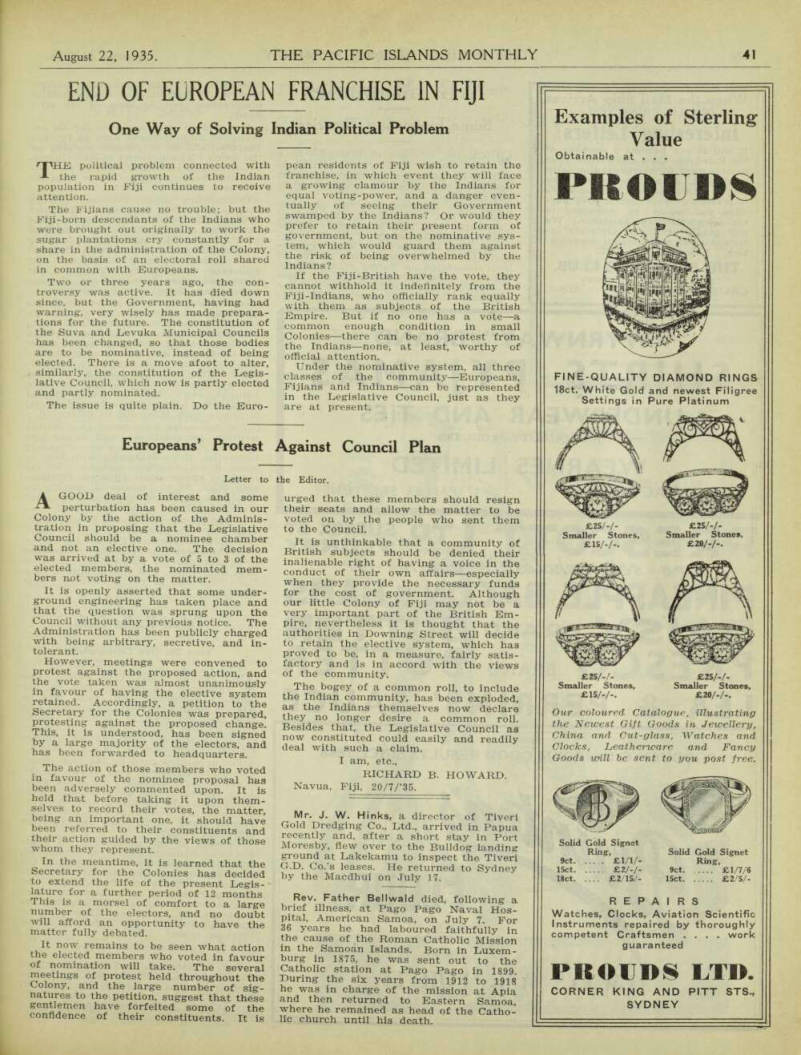
One Way of Solving Indian Political Problem
THE political problem connected with the rapid growth of the Indian population in Fiji continues to receive attention.
The Fijians cause no trouble; but the Fiji-born descendants of the Indians who were brought out originally to work the sugar plantations cry constantly for a share in the administration of the Colony, on the basis of an electoral roll shared in common with Europeans.
Two or three years ago, the con troversy was active. It has died down since, but the Government, having had warning, very wisely has made prepara tions for the future. The constitution of the Suva and Levuka Municipal Councils has been changed, so that those bodies are to be nominative, instead of being elected. There is a move afoot to alter, similarly, the constitution of the Legis lative Council, which now is partly elected and partly nominated.
The issue is quite plain. Do the Euro
pean residents of Fiji wish to retain the franchise, in which event they will face a growing clamour by the Indians for equal voting-power, and a danger even tually of seeing their Government swamped by the Indians? Or would they prefer to retain their present form of government, but on the nominative sys tem, which would guard them against the risk of being overwhelmed by the Indians?
If the Fiji-British have the vote, they cannot withhold it indefinitely from the Fiji-Indians, who officially rank equally with them as subjects of the British Empire. But if no one has a vote —a common enough condition in small Colonies—there can be no protest from the Indians —none, at least, worthy of official attention.
Under the nominative system, all three classes of the community—Europeans, Fijians and Indians—can be represented in the Legislative Council, just as they are at present.
Europeans’ Protest Against Council Plan
Letter to the Editor.
A GOOD deal of interest and some perturbation has been caused in our Colony by the action of the Adminis tration in proposing that the Legislative Council should be a nominee chamber and not an elective one. The decision was arrived at by a vote of 5 to 3 of the elected members, the nominated mem bers not voting on the matter.
It is openly asserted that some under ground engineering has taken place and that the question was sprung upon the Council without any previous notice. The Administration has been publicly charged with being arbitrary, secretive, and in tolerant.
However, meetings were convened to protest against the proposed action, and the vote taken was almost unanimously in favour of having the elective system retained. Accordingly, a petition to the Secretary for the Colonies was prepared, protesting against the proposed change.
This, it is understood, has been signed by a large majority of the electors, and has been forwarded to headquarters.
The action of those members who voted in favour of the nominee proposal has been adversely commented upon. It is held that before taking it upon them selves to record their votes, the matter, being an important one, it should have been referred to their constituents and their action guided by the views of those whom they represent.
In the meantime, it is learned that the Secretary for the Colonies has decided to extend the life of the present Legis lature for a further period of 12 months This is a morsel of comfort to a large number of the electors, and no doubt will afford an opportunity to have the matter fully debated.
It now remains to be seen what action the elected members who voted in favour of nomination will take. The several meetings of protest held throughout the Colony, and the large number of sig natures to the petition, suggest that these gentlemen have forfeited some of the confidence of their constituents. It is
urged that these members should resign their seats and allow the matter to be voted on by the people who sent them to the Council.
It is unthinkable that a community of British subjects should be denied their inalienable right of having a voice in the conduct of their own affairs—especially when they provide the necessary funds for the cost of government. Although our little Colony of Fiji may not be a very important part of the British Em pire, nevertheless it is thought that the authorities in Downing Street will decide to retain the elective system, which has proved to be, in a measure, fairly satis factory and is in accord with the views of the community.
The bogey of a common roll, to include the Indian community, has been exploded, as the Indians themselves now declare they no longer desire a common roll.
Besides that, the Legislative Council as now constituted could easily and readily deal with such a claim.
I am, etc.,
Richard B. Howard.
Navua, Fiji, 20/7/’35.
Mr. J. W. Hinks, a director of Tiveri Gold Dredging Co., Ltd., arrived in Papua recently and, after a short stay in Port Moresby, flew over to the Bulldog landing ground at Lakekamu to inspect the Tiveri G.D. Co.’s leases. He returned to Sydney by the Macdhui on July 17.
Rev. Father Bellwald died, following a brief illness, at Pago Pago Naval Hos pital, American Samoa, on July 7. For 36 years he had laboured faithfully in the cause of the Roman Catholic Mission in the Samoan Islands. Born in Luxem burg in 1875, he was sent out to the Catholic station at Pago Pago in 1899.
During the six years from 1912 to 1918 he was in charge of the mission at Apia and then returned to Eastern Samoa, where he remained as head of the Catho lic church until his death.
Advertisements & other items, pp. 43-44 (1 item)
Prouds
Examples of Sterling
Value
Obtainable at . . .
PROUDS
e
HI N
FINE-QUALITY DIAMOND RINGS
18ct. White Gold and newest Filigree Settings in Pure Platinum SA £2S/-/- Smaller Stones, £l5/-/-. £25/-/- Smaller Stones, £2O /-/-. £25/-/- Smaller Stones, £l5/-/-. £25/-/- Smaller Stones, £2O/-/-.
Owr coloured Catalogue, illustrating the Neivest Gift Goods in Jetoellery, China and Cut-glass, Watches and Clocks, Leatherware and Fancy Goods vrill he sent to you post free. m Solid Gold Signet Ring, 9ct £l/1/- 15ct £2/-/- 18ct £2/15/- Solid Gold Signet Ring, 9ct £l/7/6 15ct £2/5/-
REPA I R S
Watches, Clocks, Aviation Scientific Instruments repaired by thoroughly competent Craftsmen ... work guaranteed
PROUDS UTD.
CORNER KING AND PITT STS.,
SYDNEY
When the Mail Ship Arrives
DOES IT BRING YOU
Interesting Letters?
It will if you become a member of the Peregrine Club and extend your environment by corresponding with intelligent people throughout the world. Many present members are interested in your island life; perhaps you would be interested in their metropolitan existence. We will gladly send you complete information of our unusual organisation. Address:
THE PEREGRINE CLUB,
P.O. Box 249, Monterey
CALIFORNIA -- -- U.S.A.
“WYRNWAY” BRAND
SHIRTS, PYJAMAS
UNDERWEAR AND TIES
ARE QUALITY PRODUCTS
WEARNES LIMITED
MANUFACTURERS 17 PARKER ST.. SYDNEY
PRESCOTT L T D I^dSe??
are sols wholesale aQ&nts' foi^-
PINEAPPLE BACON & HANS
DAISV BRAND BUTTER
FRESCO BRAND BUTTER
LEA & PERRINS’ SAUCE
PRODUCING UNIFORM GOOD RESULTS SINCE 1868
Flour
ALWAYS ASK FOR IT
N.G. Mummies
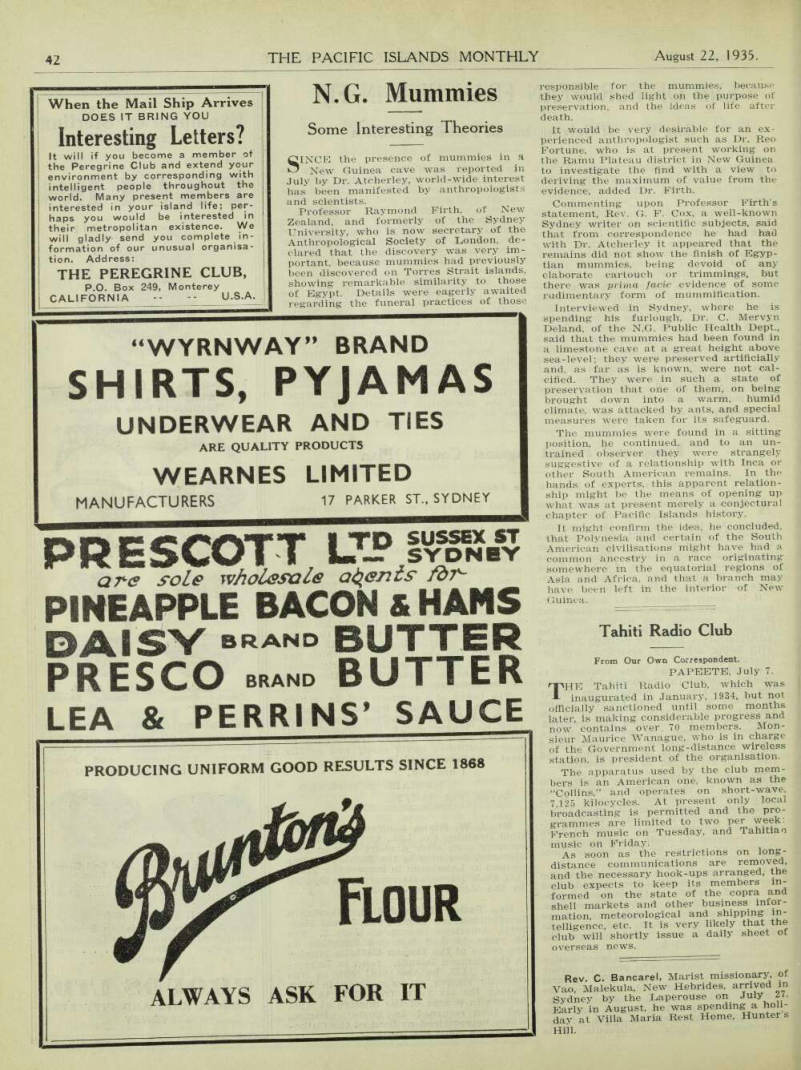
Some Interesting Theories
SINCE the presence of mummies in a New Guinea cave was reported in July by Dr. Atcherley, world-wide interest has" been manifested by anthropologists and scientists.
Professor Raymond Firth, of New Zealand, and formerly of the Sydney University, who is now secretary of the Anthropological Society of London, de clared that the discovery was very im portant, because mummies had previously been discovered on Torres Strait islands, showing remarkable similarity to those of Egypt. Details were eagerly awaited regarding the funeral practices of those
responsible for the mummies, because they would shed light on the purpose of preservation, and the ideas of life after death.
It would be very desirable for an ex perienced anthropologist such as Dr. Reo Fortune, who is at present working on the Ramu Plateau district in New Guinea, to investigate the find with a view to deriving the maximum of value from the evidence, added Dr. Firth.
Commenting upon Professor Firth’s statement, Rev. G. F. Cox, a well-known Sydney writer on scientific subjects, said that from correspondence he had had with Dr. Atcherley it appeared that the remains did not show the finish of Egyp tian mummies, being devoid of any elaborate cartouch or trimmings, but there was prima facie evidence of some rudimentary form of mummification.
Interviewed in Sydney, where he is spending his furlough, Dr. C. Mervyn Deland, of the N.G. Public Health Dept., said that the mummies had been found in a limestone cave at a great height above sea-level; they were preserved artificially and, as far as is known, were not cal cified. They were in such a state of preservation that one of them, on being brought down into a warm, humid climate, was attacked by ants, and special measures were taken for its safeguard.
The mummies were found in a sitting position, he continued, and to an un trained observer they were strangely suggestive of a relationship with Inca or other South American remains. In the hands of experts, this apparent relation ship might be the means of opening up what was at present merely a conjectural chapter of Pacific Islands history.
It might confirm the idea, he concluded, that Polynesia and certain of the South American civilisations might have had a common ancestry in a race originating somewhere in the equatorial regions of Asia and Africa, and that a branch may have been left in the interior of New Guinea.
Tahiti Radio Club
From Our Own Correspondent.
Papeete, July 7.
THE Tahiti Radio Club, which was inaugurated in January, 1934, but not officially sanctioned until some months later, is making considerable progress and now contains over 70 members. Mon sieur Maurice Wanague, who is in charge of the Government long-distance wireless station, is president of the organisation.
The apparatus used by the club mem bers is an American one, known as the “Collins,” and operates on short-wave. 7,125 kilocycles. At present only local broadcasting is permitted and the pro grammes are limited to two per week.
French music on Tuesday, and Tahitian music on Friday.
As soon as the restrictions on long distance communications are removed, and the necessary hook-ups arranged, the club expects to keep its members in formed on the state of the copra and shell markets and other business infor mation, meteorological and shipping in telligence, etc. It is very likely that the club will shortly issue a daily sheet ot overseas news.
Rev. C. Bancarel, Marist missionary, of Vao, Malekula, New Hebrides, arrived m Sydney by the Laperouse on July il.
Early in August, he was spending a holi day at Villa Maria Rest Home, Hunters Hill.
Responsibility
Peaceful Life In The
South Seas
I A Question of Individual Responsibility
LIVING in various pleasant but isolated places in the South Seas are men of birth, education, and culture, who have left the busier countries in disgust, and settled down to a simple life in the sunshine, far from the worries of a restless and often turbulent world.
The position and outlook of these men sometimes are criticised. It has been said of them that they are “deserters”; but the expatriates reply fiercely that they surely are free to withdraw from the world of affairs if it is not to their liking—they are not responsible for the modern conditions which make life in Europe and America intolerable for so many of them.
Discussing this subject in a personal letter, a friend in America says: “The expatriates hold that what we call our ‘civilisation’ is a farce, that society is rotten, and so on—with all of which I heartily agree. But I think that there is this to be said. We ourselves have made this ‘civilisation’; we ourselves are this society. Thus upon each one of us lies an individual responsibility in respect of it.
If we flee it all, are we not somewhat derelict to that responsibility? I think we are. Moreover, I think that an additional share of responsibility rests upon men of the outstanding ability of some of the fellows we meet in the South Seas and who, instead of cavilling at the world, might be able to do a great deal towards restoring it to sanity and decency.”
It is reminiscent of the harsh views of old Covenanters, this doctrine of individual responsibility. Modern opinion rejects it; and so it is charged against modern society by some philosophers that the world is drifting steadily towards those conditions of luxury, indifference and sloth which destroyed many great civilisations long before the Christian era.
One supposes it all boils down to the question of whether, having been born into a world which we did not choose, under conditions in which we had no voice, we are free to arrange our lives as we wish.
The circumstances of life in “highly civilised” communities —the crash and clatter of modern transport, the ghastly mockery of the thing we call democracv, the ruthlessness and cruelty of “big busi ness” the sickening hypocrisy of “social uplift”—become an intolerable horror to sensitive and imaginative people; and, whenever they can, they seek quiet and isolated places, where life at least is simpler and cleaner.
Have we the right to say to such people that they should abandon their deliberately chosen retreats, and return to the busier world, and apply themselves to the utterly hopeless task of trying to make humanity a little less inhuman?—R.W.R.
Monsieur Fernand Legras, editor of Le Bulletin du Commerce, a leading news paper of New Caledonia, paid a short visit to Australia in July. He took the opportunity while in Sydney of renewing old Islands acquaintances and seeking material for articles for his journal. M.
Legras’ last visit to the Commonwealth was during the Great War, when he passed through Sydney en route to France with the New Caledonian contingent.
Fiji’s Domestic Rice Production
THE statement in the Pacific Islands Monthly of June that Fiji has. now so large an acreage under rice crops that it is almost independent of imported rice is challenged by a Suva resident, Mr.
James Mclntyre.
Mr. Mclntyre says that he is doubtful whether there is anything like 10,000 acres under rice in Fiji and he adds that it is still necessary to import much rice— mostly from Rangoon.
The Government rice mill has been closed but there are several small mills in operation, notably those operated by Messrs. McGowan. Bull Bros., Williams, Burns, Philp and Co., and others.
It is a pity, remarks Mr. Mclntyre, that correspondents do not verify their state ments prior to publication.
Dr. G. M. Rodger, of the Malayta Co.
Ltd., of Sydney, returned to Australia from the Solomon Islands by the Malaita in July. He spent several months in the group visiting the company’s estates at Cape Marsh and Malaita.
Advertisements & other items, p. 45 (1 item)
O’Coiogne
m r CLOTHES FOR MENl
I AND THEIR SONS J
Write for . .
Complete
ILLUSTRATED
CATALOGUE
of Men’s Wear, etc.
Post Free on Application to
PIKES
OF QUEEN STREET, BRISBANE
The Leading Outfitters of the Commonwealth.
When dancing
or at the theatre don’t forget now and then to dab a few drops of "4:711** Genuine Eau de Cologne on temples and forehead; it will ’ 47/; iS refresh, invigorate,
/iMi
f i. revive.
EAU DE Col£
OE CO
Lfc,d.CeiM"« *
-GIOCKENQ
W! w
4/// ) Eau de
O’Coiogne
Perfume From Old-World
Cologne
Where the Paris-Warsaw Express crosses Europe’s most romantic river, Cologne Cathedral lifts its twin spires above the noise of the crowded city streets below. Here is the ancient sits of Colonia Aggrippina, outpost of Imperial Rome at the height of her power; here, too, is the source of that delightful water: Eau de Cologne. From the old metropolis on the Rhine, the fame of this fragrant refresher spread to the four corners of the globe, until it has to-day become not merely a passing fashion, but a toilet necessity for the worldly wise.
Indeed, how better to refresh tired nerves and muscles after a strenuous day than by a dash of ■“4711” Eau de Cologne in the bath-water. Inhaled from the handkerchief or dabbed on forehead and temples, it banishes headache and brain fag; sprayed in the sick room, it sweetens the atmos phere and renders it fragrant and cool. Truly, life would be a great deal poorer to-day without the romantic charm of Eau de Cologne as a link with a colourful past. Cologne “4711”—they are two names indeed which it would be difficult to blot out from the brilliant galaxy of human history.-***
Torres Strait News
From Our Own Correspondent.
Thursday Is., July 20.
MR. W. CARPENTER and Mrs. Cleveland, Senior, have been married in Townsville.
They are expected to return here soon for a short stay on the island prior to their journey to England.
Mr. and Mrs. E. K. Thorpe have returned to Thursday Is., after their recent marriage in Bris bane.
Mr. and Mrs. Rowan were the guests of Mr. and Mrs. A. T. Sullivan early in July, They have now returned to the Lockhart River Mission, Rev. Canon Morris, principal of C.E. Grammar School, East Brisbane, and Mr. Wade, one of the masters, have been visiting Rev. Schomberg, at St.
Paul’s Mission, Moa Island.
Mr. T. Prior, of the Court House, has left T.I. on transfer to Palm Island, near Townsville.
Rev. and Mrs. Nicholls, of Cooktown, left by the Wandana for Queensland on July 15, Mrs. and Miss Brake also returned by the same vessel.
Mr. George Roberts and his wife and son were rescued recently by Messrs. Everett and Hamilton Smith, of the Booby Island Lighthouse staff.
Their launch, Pacific, was sinking five miles from Booby Island, when the lightkeepers rowed out to them in a small boat. Subsequently the trio were brought to T.I. by the Commonwealth Gov ernment launch, Calopus.
Mrs. Loutit arrived recently to reside with her son, who is manager of the local branch of the National Bank of Australasia.
The Anglican Synod of the diocese of Carpen taria gathered early in July, and its session lasted two days, under the presidency of the Bishop. An outing to Wai-weer Island for the Synod members and friends was organised by Mr. Sullivan, the diocesan treasurer. A social evening was given by the ladies of the parish in the Cathedral Hall in honour of the representatives from distant por tions of the diocese.
Dr. C. C. Simpson, chairman of the Pacific Islands Association, returned to Sydney from a business visit to Papua by the Macdhui on July 17.
Learning Ancient
Maori Craft
Two Rarotongans Train as Carvers at Rotorua, N.Z.
TWO young Rarotongans, members of the Cook Islands party which visited New Zealand for the Waitangi celebra tions last year, are making fine progress at the Maori Crafts School at Rotorua, New Zealand. Mr. Hamilton, the director, speaks of their work in the highest terms.
They will remain at Rotorua until they become proficient carvers, and will then return to the Cook Group. The object of their tuition is to enable them to be com petent enough to erect and carve a meet ing house at Rarotonga for Makea-nui Ariki Tinirau. As leader of the Cook Islands party to New Zealand, Makea Tinirau visited several t chare whakairo (carved meeting houses) in different parts of the Dominion, and was much impressed with their design.
The proposed house at Rarotonga will be on the lines of the whare whakairo at Aotearoa and will embody many of the native Rarotongan designs.
Mr. Eric Ramsden, a well-known Syd ney writer on Polynesian topics, returned to Australia recently after a visit to Tahiti, where he gathered much interest ing literary material. Messrs. Putnam and Sons, London publishers, have re quested Mr. Ramsden to give them an option over his forthcoming book on French Oceania.
Advertisements & other items, p. 46 (2 items)
Nicholson & Foster
SHIP & GENERAL
COPPERSMITHS
Manufacturers of all kinds of Pipe Work, Petrol, Water, and Buoyancy Tanks for Ships, Yachts, and Motor Boats, Copper Water-jacketed Exhaust Pipes & Silencers a speciality.
Copper Pans and Stills made to specification
Nicholson & Foster
BALMAIN, SYDNEY
Deutz Diesel Engines
D Section of OM type showing scavenging air pump OM Type :: 8-145 h.p. Sizes
Marine-Stationary - Portable
The Correct Engine for Tropical Requirements ..
DEUTZ
REPRESENTATIVES . . .
HERBERT DEL COTT PTY., LTD.,
Kelvin House, 15 Castlereagh Street, Sydney (And at Melbourne) ’Phone B 3135 Cables: “Voltage,” Sydney
A Queer Fellow
By Henry Dexter
THE Pacific has no monopoly of queer characters; but in the course of my 25 years there I met quite a few, and none of them was more difficult to understand than D.
He was a cattleman on Giligili Planta tion, which is the property of the Common wealth Copra Company (Lever’s). Occa sionally, one meets a man who is by tem perament unfit to have charge of natives.
D was an outstanding instance of this. If a native looked at him, it was wrong; if he did not, it was equally wrong.
D. used to come down to my store on Sunday afternoons. He was a well-read man, and had. an excellent memory. He had been convicted twice of assaults on natives. In Papua, a third conviction bars a man from working indentured labor.
According to the views expressed by D., the natives had no rights at all. They should be rounded up and sent to work, whether they wished it or not. That D. really did believe his ideas were justified, I have not the shadow of a doubt.
I had no objection to D. expressing these views, as often as he pleased, but I frequently protested at the language used by him when doing so. A few ordinary swear words were too common to be noticed, but D.’s language was filthy. The same unpleasant word was used over and over again, and three hours of it on end was a bit wearing.
My first protests were mild. These failing, I made them a bit stronger; but they met the same fate.
One day, the “Nusa” was alongside loading cattle. The wife of the skipper came up to the store. D. sat down and talked to her for an hour. His language would have been acceptable to any com pany.
The next day he was coming up the steps, when he turned and spoke to a native in his usual langauge. Perhaps I was not quite normal that day. Anyway.
I made a vigorous protest. D. stood calmly listening while I did so, and then replied: “And when were you ordained?’’
He turned and walked away, and from that day he never again visited the store.
A little later, he lost his job on Giligili, and, as there was no similar work in the district, he went out prospecting. The inevitable happened; he assaulted his boys, and they ran away and complained to the Resident Magistrate. D. was con victed, and fined. This, of course, pre vented his working any but casual boys; and no native is likely to work long for such a man when he can drop tools at any moment that he chooses.
Again, the inevitable happened; and D. found himself without labor. He took the attitude that the Government, by not allowing him to sign on boys, had taken away his living.
Going in to Samarai, he asked two men to whom he owed money to summon him in the Small Debts Court, his idea being to gain publicity for the airing of his grievances. Both of the men refused to take proceedings. He next went to the office of the Resident Magistrate, and ask ed him what would happen if he put his foot through the window. The R.M. told him that he would be sentenced to im prisonment.
D. promptly smashed the window. He was sent to Port Moresby to serve his sentence. Here he decided on a hunger strike—day after day he refused to touch his food. On the fifth day, the M.O. re ported that D.’s life would shortly be in
danger. A quorum of the Council was got together, and a short Act was passed, which immediately became law.
D. was taken down to a ship that was leaving for South. He saw that there was nothing to be gained by holding out any longer, so he sat down and had his first meal for six days.
It is interesting to note that D. was honourable in money matters. After he had arrived South, a sum sufficient to pay all his debts in Papua was forwarded by him, D. was a non-smoker, and I never saw him touch anything but teetotal drinks.
He told me that he did at one time drink stronger stuff, but he “had made a fool of himself.”
Rev. H. Boileau (Noumea), Rev. J. B.
Chavreuil (La Conception), Rev. E. Bres son (St. Louis), and Rev. J. Hulbert (Kone), Marist missionaries of New Caledonia, arrived in Sydney on furlough by the July Laperouse.
Advertisements & other items, pp. 47-48 (1 item)
“Younger”
W. M. REID
C/o Robert Reid & Co., Ltd.
32-34 YORK STREET, SYDNEY
Wholesale Exporter of Goods of all Classes from Australia
Tie On Gas Mantels
Somethingßetter for your Lamp
FLEXIBO LIGHTING CO.
•-IS KIPP AX STREET :: SYDNEY
Manutacturcrs of the famous Flexibo Gas Mantle, suitable for all petrol storm-proof lamps, table lamps, tilly lamps, and all hollow wire systems. Flying insects will not break this mantle. Agents wanted—samples to all prospective reputable agents.
Do You Know that the Famous
“YOUNGER”
STOVES AND
RANGES
made with extended Firebox specially for long Wood fuel, are Self-Setting and, provided sufficient Flue Piping is attached, can be used in almost any position?
The No. 7W. “Younger” Range can now be supplied fitted with Legs, as per illustration. Ask for auotation for this Range, also Illustrated Catalogue and Price List for both Single and Double Oven Stoves. * v Younger Stoves are Widely Used Throughout the Pacific Islands.
G. FLETCHER & SON 50 Oxford Street, Sydney
n
Ready - Cut
HOWES
offer the most practical solution of the problem of erecting a home in districts where skilled labour is difficult to obtain. The framework is cut and prepared ready for erection, all doors and windows are fitted ready for placing in position, and verandah posts, plates, architraves, etc., are prepared ready for fixing in position.
A very efficient plan service is rendered, which makes the work of erection very simple.
We quote to your own or any design.
Send for latest catalogue containing many new designs.
GEORGE HUDSON LTD.
TIMBER MERCHANTS
Bridge Road, Glebe, Sydney
READY CUT HOME DEPT.: 7 CASTLEREAGH STREET, SYDNEY
While You Sleep the Remedy Heals
A WELL-PROVEN
REMEDY FOR PILES
This preparation has been on the market for several months, and it has effected a Cure in every case in which it has been tried.
Cases of Long Standing often Cured within One Month, with one bottle only.
For External Use only—Stainless, Painless and Odourless.
PRICE: 3/6 PER BOTTLE. Posted securely packed for 5/- per bottle. Copies of Testimonials forwarded on request.
Read the Report of an Eminent Analytical Chemist:
THE LABORATORY,
20 and 22 Napoleon Street, Sydney, March 14th, 1933.
ROBERT BRUCE, Esq.
Dear Sir,—The formula of your pile cure submitted to me could have no effect other than beneficial. I gave your sample to a Client who had suffered many years, and before he had used half the bottle he reported himself completely cured.
Faithfully yours,
GROVE JOHNSON, F.C.S. (Loud.)
“Honours,” City and Guilds of London Institute.
Analytical and Consulting Chemist.
Robert Bruce
Supplies obtainable from — Room 7, 2nd Floor,
15 HUNTER STREET. SYDNEY
and also at 14 Upper Bayview St., North Sydney
BITUMENOID ROOFING
MADE IN AUSTRALIA
Bitumenoid Roofings, Dampcourses and Insulating Felts are made from the world’s best raw materials. Warranted to stand the most rigid tests.
BITUMENOID THE BEST , ,
Roofing, 1,2, 3-ply; Flooring, Waterproof Materials; Saturated Felt; Resilient Road Natural Asphalt Dampcourse; 2 and 3-ply Dampcourse; l-21b. Lead-core Dampcourse, Roofing Cement; Asphalt C^g“ E " d iISTS 0 N APPLICATION.
MAXWELL PORTER & SON LTD.
FSTARI TSHFO 1888 BUILDERS’ SUPPLIES
107 REDFERN ST., REDFERN, SYDNEY, N.S.W. ’Phone, M 3157. Cables: Bitumenoid
ASPREY’S LATEX COMPOUND
(PATENTED)
FOR IMPROVING LUBRICATING OILS
Adds Years to the Life of Machinery and Motor Cars lATEX COMPOUND improves any oil, adds extra oiliness, resists heat and ■A makes the oil last twice as long, saves wear and tear, and halves lubrication and maintenance costs.
INTERNAL
COMBUSTION
ENGINES
Add Vo pint of Asprey’s Latex Compound to each gallon of lubricating oil for motor cars, lorries, tractors and stationary engines, and note cooler and sweeter running, lower fuel consumption, greater power, fewer repairs and lower oil consumption.
Add % pint of Asprey’s Latex Compound to each gallon of lubricating oil for headers, harvesters, reapers and binders, ploughs, drills: mowers, disc cultivators windmills, separators, chaffcutters, etc., and save tine and repair tills Add V 2 pint of Asprey’s Latex Compound to each gallon of oil for saw spindle bearings and all sawmilling machinery and be free from hot and scored bearings.
Add y 2 Pint of Asprey’s Latex Compound to each gallon of oil, which will result in more horsepow ’ with lessened oil consumption and general increase in efficiency, MANUFACTURERS ALSO OF ASPREY'S SUPER BELT DRESSING
FARMING
MACHINERY
SAWMILLING
MACHINERY
STEAM
CYLINDER
LUBRICATION
Obtainable from the Trade and from WILLIAM BROOKS & CO., LTD- 35 Pitt Street, Sydney.
Rescued By “Bully” Hayes
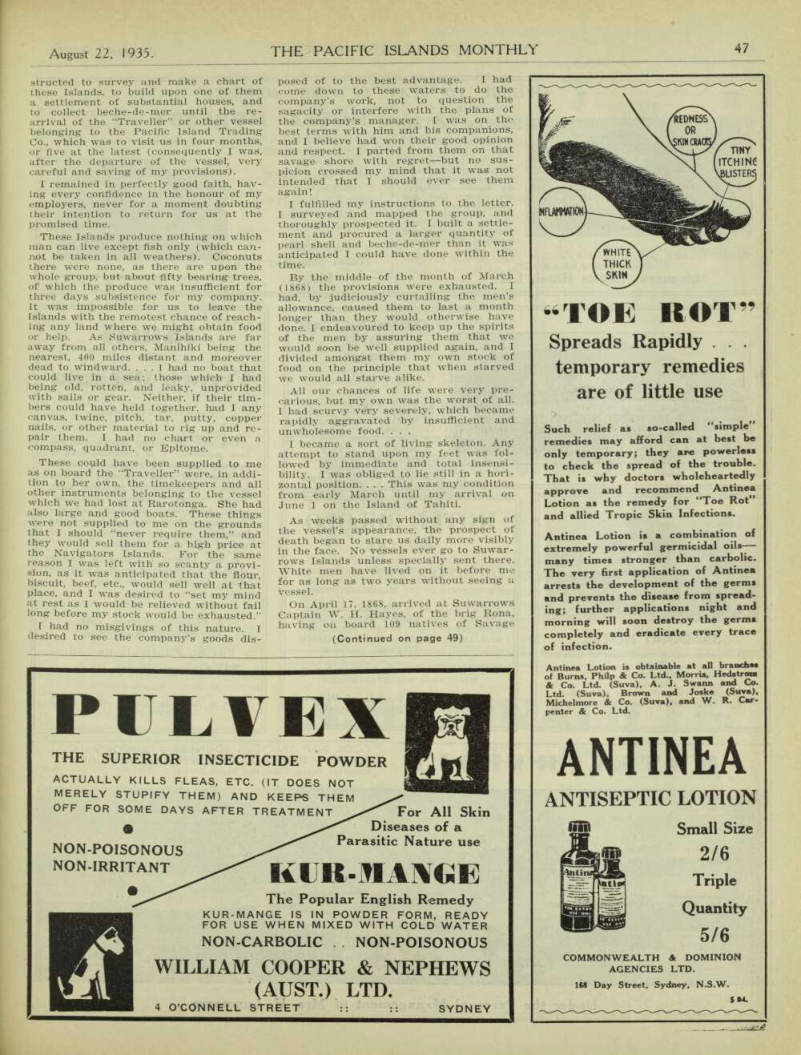
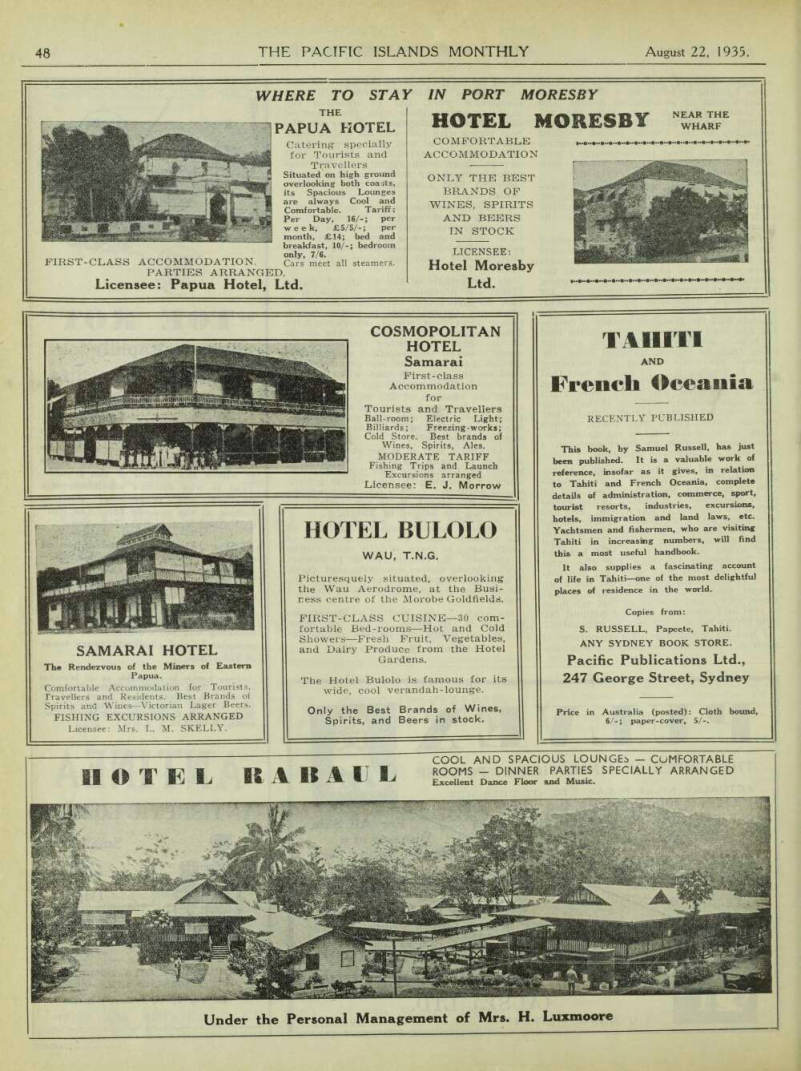
A Long-forgotten Story of Suwarrow Island
THERE have been many tales of Suwarrow.
One of these was given wide publicity by Richards and Gurr in their book, “White Man, Brown Woman.” This is the story of the diary of George Randolph, concerning a search for hidden treasure.
The diary, they stated, was in the pos session of Mr. Charles Ward, of Raro tonga. But reference to Mr. Ward proved that not only did he not possess such a diary, but he had never even heard of it.
And further researches in likely quarters have failed to reveal any knowledge of it.
Here, however, is a tale that is at least attested by the sworn declaration of one of its chief protagonists, Captain H. B.
Sterndale. In the Monthly Review (N.Z.) of the year 1890, there is a series of ar ticles by Sterndale, reprinted from the Auckland Weekly News. In these articles, entitled “A Lone Land,” he tells some stories of Suwarrow, but not the one related below.
His story, written at Papeete in 1868, is entitled “Declaration of Captn. H. B.
Sterndale, Superintendent of Suwarrows Islands, with respect to the settlement and abandonment of said place.” It is a story, if it is true, that is as strange as any fiction, and it has a special interest in
that it represents “Bully” Hayes, for once, at least, in the guise of benefactor and friend. One cannot do better than tell it in the words of Sterndale and Hayes themselves.
The former’s declaration is as follows; On the 18th August, 1867, I sailed from Melbourne on board the schooner Tra veller (John Tyack, master) of that port, the property of the Pacific Island Trad ing Company Limited.
The duties for which I was engaged in this adventure were the surveying and re porting upon certain Islands of which the said company had obtained leases from the British Crown, and also to form upon one of them a settlement and depot of trade and to procure pearl shell, beche de-mer, or whatsoever merchandise these Islands produced.
The gentleman by whom I had been re tained for this service, Mr. John Laving ton Evans, the original lessee of the said Islands, accompanied us as Superinten dent of the company’s operations in the Pacific.
We departed from Melbourne with two vessels sailing in company. They had been specially purchased and fitted out for this expedition; they were filled to the deck with valuable cargo consisting of every description of goods suitable for the Island trade, a great quantity of pro vision, and building materials. We had also submarine armour and apparatus for the manufacture of fresh water. We car ried a surgeon. Exclusive of the officers of the ships our party consisted of four, the Chief Superintendent, his assistant, the surgeon, and myself. We were all shareholders in the venture, but my own interest being small in comparison to those of the others. I took no share in their councils, being satisfied to execute the orders of the company’s superinten dent, having perfect confidence in his ex perience and ability to conduct the expe dition to a successful issue.
Immediately on arriving at the Harvey Group (Cook Islands) the smaller of our two vessels was wrecked upon the reef of Rarotonga. This was a great misfortune, and seriously jeopardised the success of our operations in the South Sea.
In the Harvey Group we shipped a number of natives to be employed in the collection of beche-de-mer, and proceeded to Suwarrows Islands, where we arrived on the 16th of October, and took posses sion. On this place we found three per sons, a half-breed boy (native of Man gaia), a native of Manihiki, and an Indian Lascar. They were doing nothing, having no boats and little water or food —had we not arrived they must have starved to death.
On the 4th of November, 1867 the “Tra veller” departed, leaving me on the Island with eighteen men, two women, and three children. They were all natives of the neighboring groups (with the exception of the Lascar and a New Guinea man); none were British subjects save myself.
Upon my landing were delivered to me a stock of provisions sufficient for four months, according to the dietary scale of Maldon Island, with a copy of which I was furnished, and instructed in accord ance with it to regulate the rations of my men.
The Islands are without water, but I had a condensing apparatus. I was in
structed to survey and make a chart of these Islands, to build upon one of them a settlement of substantial houses, and to collect beche-de-mer until the rearrival of the “Traveller” or other vessel belonging to the Pacific Island Trading Co., which was to visit us in four months, or five at the latest (consequently I was, after the departure of the vessel, very careful and saving of my provisions).
I remained in perfectly good faith, having every confidence in the honour of my employers, never for a moment doubting their intention to return for us at the promised time.
These Islands produce nothing on which man can live except fish only (which cannot be taken in all weathers). Coconuts there were none, as there are upon the whole group, but about fifty bearing trees, of which the produce was insufficient for three days subsistence for my company.
It was impossible for us to leave the Islands with the remotest chance of reaching any land where we might obtain food or help. As Suwarrows Islands are far away from all others, Manihiki being the nearest, 400 miles distant and moreover dead to windward. ... I had no boat that could live in a sea; those which I had being old, rotten, and leaky, unprovided with sails or gear. Neither, if their timbers could have held together, had I any canvas, twine, pitch, tar, putty, copper nails, or other material to rig up and repair them. I had no chart or even a compass, quadrant, or Epitome. • These could have been supplied to me as on board the “Traveller” were, in addition to her own, the timekeepers and all other instruments belonging to the vessel which we had lost at Rarotonga. She had also large and good boats. These things were not supplied to me on the grounds that I should “never require them ” and they would sell them for a high price at the Navigators Islands. For the same reason I was left with so scanty a provision, as it was anticipated that the flour, biscuit, beef, etc., would sell well at that place, and I was desired to “set my mind at rest as I would be relieved without fail long before my stock would be exhausted.”
I had no misgivings of this nature. I desired to see the company’s goods dis-
posed of to the best advantage. I had come down to these waters to do the company’s work, not to question the sagacity or interfere with the plans of the company’s manager. I was on the best terms with him and his companions, and I believe had won their good opinion and respect. I parted from them on that savage shore with regret—but no sus picion crossed my mind that it was not intended that I should ever see them again!
I fulfilled my instructions to the letter.
I surveyed and mapped the group, and thoroughly prospected it. I built a settle ment and procured a larger quantity of pearl shell and beche-de-mer than it was anticipated I could have done within the time.
By the middle of the month of March (1868) the provisions were exhausted. I had, by judiciously curtailing the men’s allowance, caused them to last a month longer than they would otherwise have done. I endeavoured to keep up the spirits of the men by assuring them that we would soon be well supplied again, and I divided amongst them my own stock of food on the principle that when starved we would all starve alike.
All our chances of life were very pre carious, but my own was the worst of all.
I had scurvy very severely, which became rapidly aggravated by insufficient and unwholesome food. . . .
I became a sort of living skeleton. Any attempt to stand upon my feet was fol lowed by immediate and total insensi bility. I was obliged to lie still in a hori zontal position. . . . This was my condition from early March until my arrival on June 1 on the Island of Tahiti.
As weeks passed without any sign of the vessel’s appearance, the prospect of death began to stare us daily more visibly in the face. No vessels ever go to Suwar rows Islands unless specially sent there.
White men have lived on it before me for as long as two years without seeing a vessel.
On April 17, 1868, arrived at Suwarrows Captain W. H. Hayes, of the brig Rona, having on board 109 natives of Savage
(Continued on page 49)
Island, and Captain Geoffery Strickland, the father of the young half-breed whom I had found on Suwarrows Islands on my arrival in October of the previous year.
Captain Hayes was on his way to Mani hiki, en route for Tahiti. To the care and kindness of this gentleman I am indebted for the preservation of my life and that of the people under my charge.
At the time of his arrival I was in a state of great exhaustion, not expecting to survive more than a few days longer, having discontinued the writing of my journal, being no longer able to write legibly.
I was unwilling, nevertheless, to aban don the settlement, desiring to send away the most helpless of my people and to re main with such as were willing to remain with me.
Nevertheless, Captain Hayes, in spite •of the crowded state of his vessel and his scarcity of provisions (he having been blown away from Savage Island in a hurricane before having time to complete his sea stock) insisted on taking us all on board, declaring “that he did not consider himself justified in leaving us there,” especially myself, who appeared to be at the point of death. As far as my men were concerned they could not have existed long, as it is well known that even the savages of the Islands of the Pacific ■cannot live upon fish alone for any length of time without coconut or other vege tables. Such a regimen invariably pro duces diarrhoea, and exhaustion, and •death is the result.
Consequently, on April 23, 1868, I aban doned the settlement, Captain Hayes and his crew being of opinion that I could not live to reach any civilised place.
On May 4, I landed at Alliconga, or Reirsons Island, where I proposed to re main until the re-arrival of Captn. Hayes from Savage Island, to which place he was obliged to return before proceeding to Tahiti.
On Reirsons Island are no white in habitants, but I was treated with the greatest kindness by the natives, and by Captn. Geoffery Strickland, who also re mained there.
A few days after the departure of the Rona there arrived at Reirsons Island the Moorea schooner, Captn. Waterman, of Tahiti (belonging to the firm of A. W.
Hort). This gentleman offered me a passage to Tahiti where I arrived on June 1. By the owners of the vessel In which I was brought to this place and by the other merchants of Papeete I was received with much sympathy. three weeks treatment In the Military Hospital I am now able to walk about. Whether I shall eventually recover my strength or whether I may not yet lose one of my limbs is a question as yet uncertain.
From facts which have since come to my knowledge I am now made aware that on his departure from Suwarrows Islands in November last it was not intended by Mr. Evans to return to take us off those islands or to bring us supplies.
In the first place, on arriving at Samoa he put up the vessel and cargo for sale, and having disposed of them departed for Sydney without taking any steps to have us visited or our condition enquired into on Suwarrows Islands.
He endeavoured while there to conceal the fact that he had left a British subject on those Islands. When questioned he written declaration before the British Consul of Samoa that he had sup plied to us more than twelve months’ pro lta^ in f minutel y the items, also h ® had furnished me with a large boat of tonnage sufficient for the convey ance of myself and my whole company to
Samoa or elsewhere, with navigation in struments and every necessary for such a voyage.
Thus were my chances of help from Samoa (which was the nearest civilised place to me) entirely cut off, had it not been for the fact that the consul’s faith in Mr, Evans’ declaration was consider ably shaken by the assurances of such of the officers and crew of Mr. Evans’ vessel as remained in Samoa, the chief officer showing his delivery book in proof that the stores landed to me on Suwarrows Islands were insufficient for five months.
In consequence of this, the Consul and missionary of Samoa wrote to Captn.
Hayes, of the Rona, requesting him to endeavour to help us. Had it not been for their kind forethought in this respect, and for the promptitude in acceding to their wishes of Captn. Hayes, who at great risk and loss of time to himself removed us from Suwarrows Islands, we must in evitably have miserably perished.
I have now sufficient proof that Mr.
Evans and his companions, before they left the South Sea, were of opinion that I would not be able to obtain from Suwar rows Islands sufficient cargo to pay for sending a vessel to take us away from it.
By his letters to residents of Tahiti and Rarotonga during the time that he re mained in the Islands, and by another to Mr. Brander, of Tahiti, written from Sydney, bearing date May 18, 1868, it is
evident that he never did intend to return or to send anyone else in his place to those Islands upon which he had aban doned us. Up to the period upon which our provisions became exhausted I had procured upon the Islands seven tons of beche-de-mer and four tons of pearl shell. ... , , Captain Hayes’ vessel being already full almost to the deck with material from the wreck of the John Williams at Savage Island, on his arrival at Suwarrows, he was unwilling to take on board any such cargo as that which I had collected; but, upon representing to him my determina tion to remain upon those Islands unless he would consent to buy what I had, he made me an offer for the lot (comprising beche-de-mer, pearl shell, three old boats, some iron pots, water tanks, broken lum ber, galvanised iron, and a still) of 855 dollars, which, considering the unsaleable character of such articles in this port (Tahiti) (the only place to which he was going where he would have any chance to dispose of them), was extremely liberal.
Had he chosen to take them for nothing and put us all on shore at the next land which he made, where we would be able to procure food, it would have been obvi ously my duty in consideration of the lives of my men to let him have them, but he declined to accept of them on such terms, proposing on the contrary to take them at a fair valuation or to leave them behind
and take us away for nothing.
There follows Sterndale’s story a brief statement by Hayes endorsing it so far as his own connection with it was con cerned; “I have read through the above declara tion, and subscribe to that portion of it which commences with my arrival at Suwarrows Islands on the 17th of March last. The statement of Captn. Sterndale of the condition of himself and his com pany in that place, the manner in which he abandoned the Islands, and the dis posal of his effects is in every particular correct. —W. H. Hayes.”
Whether Sterndale’s declaration had any result in bringing Evans to account for his inhuman behaviour, inquiry has not revealed. Sterndale himself is de scribed by W. E. Gudgeon, who was re sponsible for the printing of the articles in the Monthly Review, as “one of the most gifted writers who has ever set foot in this colony. Probably his best-known work is that on the Trade and Resources of the South Seas, published in the Ap pendix to the journals of the N.Z. House of Representatives in 1874.” It is evident from “A Lone Land,” says Gudgeon, that Sterndale must have “passed most of his life among the wildest scenes and charac ters of the Pacific, and the least-known parts of the American continent, consort ing with all the lawless or eccentric characters who found safe asylum in these little-known resorts of criminal humanity.”
J.L.
Advertisements & other items, pp. 49-52 (1 item)
Pijlvex
REDNESS
OR
SKIN CRACK
fir
r TINY
ITCH INC
.BLISTERS
NfumnoN
WHITE
THICK
SKIN
“TOE HOT”
Spreads Rapidly . . .
temporary remedies
are of little use
Such relief as so-called simple remedies may afford can at best be only temporary; they are powerless to check the spread of the trouble.
That is why doctors wholeheartedly approve and recommend Antinea Lotion as the remedy for “Toe Rot” and allied Tropic Skin Infections.
Antinea Lotion is a combination of
extremely powerful germicidal oils-
many times stronger than carbolic.
The very first application of Antinea arrests the development of the germs and prevents the disease from spreading; further applications night and morning will soon destroy the germs completely and eradicate every trace of infection.
Antinea Lotion is obtainable at all branches of Bums, Pbilp & Co. Ltd., Morris, Hedstroca & Co, Ltd. (Suva), A. J. Swann and Co.
Ltd. (Suva), Brown and Joske (Suva), Michelmore & Co. (Suva), and W. R. Carpenter & Co. Ltd.
ANTINEA
ANTISEPTIC LOTION
fin
Anti nti
Small Size
2/6
Triple
Quantity
5/6
COMMONWEALTH & DOMINION
AGENCIES LTD.
168 Day Street, Sydney, N.S.W.
SU.
PIJLVEX
THE SUPERIOR INSECTICIDE POWDER
ACTUALLY KILLS FLEAS, ETC. (IT DOES NOT
MERELY STUPIFY THEM) AND KEEP-S THEM
OFF FOR SOME DAYS AFTER TREATMENT For AH Skin Diseases of a NON-POISONOUS Parasitic Nature use Tsr 3
NON-IRRITANT
KIJR-MANGE
The Popular English Remedy
KUR-MANGE IS IN POWDER FORM, READY
FOR USE WHEN MIXED WITH COLD WATER
NON-CARBOLIC
NON-POISONOUS
WILLIAM COOPER & NEPHEWS
(AUST.) LTD.
4 O’CONNELL STREET
SYDNEY
FIRST-CLASS
WHERE TO STAY
THE
PAPUA HOTEL
Catering specially for Tourists and Travellers Situated on high ground overlooking both coasts, its Spacious Lounges are always Cool and Comfortable. Tariff: Per Day, 16/-; per week, £.5/5/-; per month, £l4; bed and breakfast, 10/-; bedroom only, 7/6.
ACCOMMODATION. Cars meet all steamers.
PARTIES ARRANGED.
Licensee: Papua Hotel, Ltd.
IN PORT MORESBY
HOTEL MORESBY NEA „ R A ™ E
COMFORTABLE
ACCOMMODATION
ONLY THE BEST
BRANDS OF
WINES, SPIRITS
AND BEERS
IN STOCK
LICENSEE:
Hotel Moresby
Ltd.
COSMOPOLITAN
HOTEL
Samarai
First-class Accommodation for Tourists and Travellers Ball-room; Electric Light; Billiards; Freezing-works; Cold Store. Best brands of Wines, Spirits, Ales.
MODERATE TARIFF
Fishing Trips and Launch Excursions arranged Licensee: E. J. Morrow
TAHITI
AND
French Oceania
RECENTLY PUBLISHED
This book, by Samuel Russell, has just been published. It is a valuable work of reference, insofar as it gives, in relation to Tahiti and French Oceania, complete details of administration, commerce, sport, tourist resorts, industries, excursions, hotels, immigration and land laws, etc.
Yachtsmen and fishermen, who are visiting Tahiti in increasing numbers, will find this a most useful handbook.
It also supplies a fascinating account of life in Tahiti—one of the most delightful places of residence in the world.
Copies from: S. RUSSELL, Papeete, Tahiti.
ANY SYDNEY BOOK STORE.
Pacific Publications Ltd.,
247 George Street, Sydney
Price in Australia (posted): Cloth bound, 6/-; paper-cover, 5/-.
HOTEL BULOLO
WAU, T.N.G.
Picturesquely situated, overlooking the Wau Aerodrome, at the Business centre of the Morobe Goldfields.
FIRST-CLASS CUISINE—3O com-
fortable Bed-rooms —Hot and Cold Showers —Fresh Fruit, Vegetables, and Dairy Produce from the Hotel Gardens.
The Hotel Bulolo is famous for its wide, cool verandah-lounge.
Only the Best Brands of Wines, Spirits, and Beers in stock.
SAMARAI HOTEL
The Rendezvous of the Miners of Eastern Papua.
Comfortable Accommodation for Tourists, Travellers and Residents. Best Brands of Spirits and Wines —Victorian Lager Beers.
FISHING EXCURSIONS ARRANGED
Licensee; Mrs. L. M. SKELLY.
II OT E E IS AISA U E 1 """ - --
COOL AND SPACIOUS LOUNGEb - COMFORTABLE
ROOMS - DINNER PARTIES SPECIALLY ARRANGED
Excellent Dance Floor and Music. m □ Under the Personal Management of Mrs. H. Luxmoore
J B O U
H rOADE MA * K
roa AllC A JOUR GOODS Jm N L
REGISTERED
Malt & Hops
WILL BREW A NICE DRINKING
BEER
MADE FROM THE
FINEST ENGLISH
MALT & HOPS
STOCKED BY:
Burns, Philp & Co., Ltd.,
RABAUL
MAKERS:
Paine & Co., Ltd.,
St, Neots, Hunts., England.
NOItCO CO-OP.
LIMITED
SUSSEX STREET,
SYDNEY
AUSTRALIA'S LEADING MANUFACTURERS AND DISTRIBUTORS OF CHOICEST
BUTTER, BACON, HAMS AND TINNED GOODS
NORCO LUNCH PIGS' TONGUES
BRAWN
PORK SAUSAGES PIGS ' TROTTERS
11b. and Vi lb. Tins. lib. Tin* Only.
HAM PATE
3oz. and I'/iox. Tina.
IDEAL
FO R
LUNCHES
AND
PICNICS
A. B. DONALD Ltd.
AUCKLAND
Island Traders
P.O. Box 1509
:: General Merchants
Cables and Telegrams: “Kingdom/' Auckland —— Branches at— Rarotonga and throughout the Cook Islands At Papeete and throughout the Society, Marquesas and Paumotu Islands
trading as “ETABLISSEMENTS DONALD, TAHITI”
“■ - At Fiji: Trading as ‘‘Dominion Fruit C 0.,” Suva
Kork-N-Seal
FOR ALL HOME BOTTLING - THE
LITTLE CAP THAT WILL RE-SEAL
1,000 TIMES
KORK-N-SEAL (Aust.) Ltd.
106 COMMONWEALTH STREET
SYDNEY, AUSTRALIA
FOR HOME USE
Applied Airtight Pressure Proof Hand
WE ARE SPECIALISTS !
Let us have your confidence, sixty years is our record of supplying the Leading Houses throughout the World in —
FRESH FRUIT VEGETABLES PRODUCE
WEYMARK & SON LTD.
Fruit and Produce Merchants
14-18 STEAMMILL STREET, SYDNEY
Phones: MA 3612 (4 lines) Cable Address: Codes— Bentleys.
“Weymarkson" Private -
'S
BUSSELL
v' KS
In Every Home
Makes Staking Day
A Pleasant Day
The Famous
WHITE WINGS
SELF-RAISING
FLOUR
Now available throughout
THE PACIFIC ISLANDS
If your Storekeeper does not stock it, please advise
H. L. BUSSELL & Co.
White Wings Mills, Sydney
“Bag-Snatcher” At Apia
From Our Own Correspondent.
APIA, July 15.
DURING the visit of the Union Co.’s tourist vessel Monowai, the first case of “bag-snatching” occurred in Samoa. A lady tourist walking on Apia beach and carrying a handbag containing some papers and money, had her handbag sud denly torn from her hands by a Samoan urchin, who afterwards fled at full speed.
The police department was informed, and is trying to locate a suspect. Crimes of this kind are extremely rare in Samoa.
Busy Apia Harbour
From Our Own Correspondent.
APIA, July 16.
ON Monday, July 15, Apia harbour showed quite an animated scene of activity.
The giant Monowai was at anchor alongside the cargo steamer Noumea, of the Flood Line, under the flag of Panama, loading 1000 tons of copra. Then the m.v.
John Williams, of the London Missionary Society, arrived on one of her usual cruises through the Islands. Burns, Philp and Co.’s schooner Makoa also arrived from the French Wallis Islands with a load of copra for transhipment to France.
The 35 foot yawl Cimba was in port, from Pago Pago, with Captain Taggert and another American on board. Captain Taggert. an interesting type of globetrot ter, is at home alike in Alaska as a gold prospector, on a whaling ship, or as a pearl diver in the Marquesas.
Mr. S. O. Irvine, managing director of Messrs. Parsons Bros, and Co. Pty. Ltd., Svdnev, died in Sydney on July 8. His son. Mr. D. G. Irvine, is manager of Gih Gili estate. Samarai, Papua.
Quiet
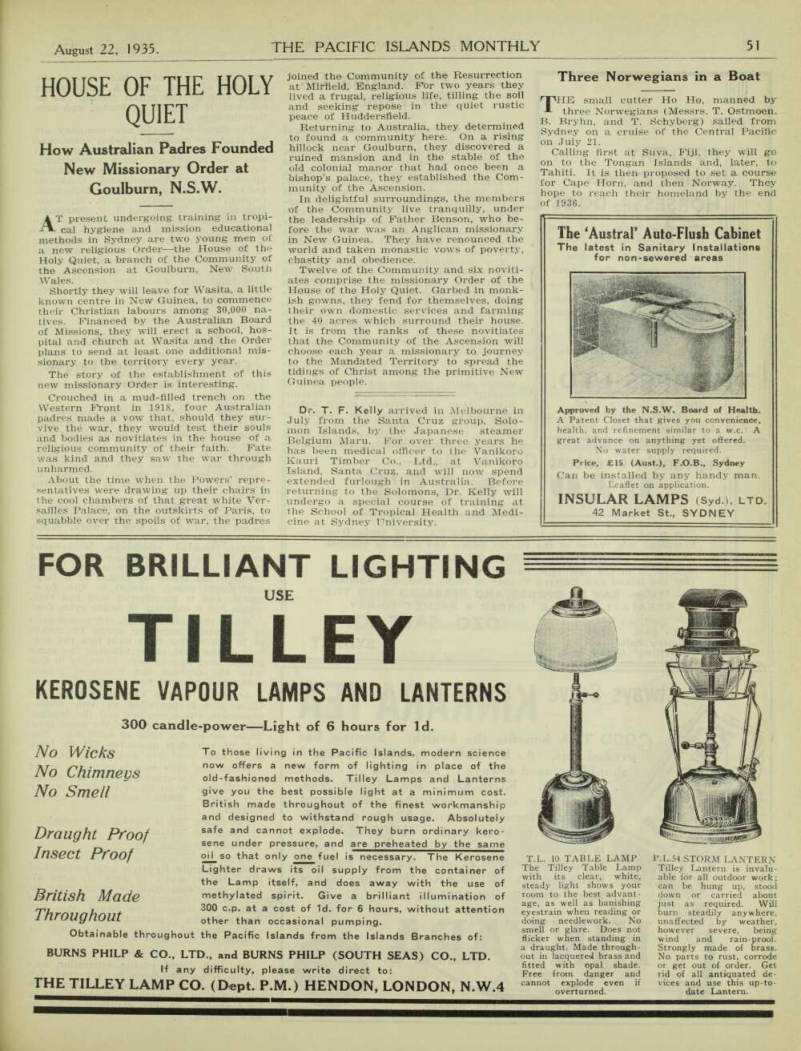
House Of The Holy
How Australian Padres Founded New Missionary Order at Goulburn, N.S.W.
AT present undergoing training in tropi cal hygiene and mission educational methods in Sydney are two young men of a new religious Order —the House of the Holy Quiet, a branch of the Community of the Ascension at Goulburn, New South Wales.
Shortly they will leave for Wasita, a little known centre in New Guinea, to commence their Christian labours among 30,000 na tives. Financed by the Australian Board of Missions, they will erect a school, hos pital and church at Wasita and the Order plans to send at least one additional mis sionary to the territory every year.
The story of the establishment of this new missionary Order is interesting.
Crouched in a mud-filled trench on the Western Front in 1918, four Australian padres made a vow that, should they sur vive the war, they would test their souls and bodies as novitiates in the house of a religious community of their faith. Fate was kind and they saw the war through unharmed.
About the time when the Powers’ repre sentatives were drawing up their chairs in the cool chambers of that great white Ver sailles Palace, on the outskirts of Paris, to squabble over the spoils of war. the padres
joined the Community of the Resurrection at Mirfield, England. For two years they lived a frugal, religious life, tilling the soil and seeking repose in the quiet rustic peace of Huddersfield.
Returning to Australia, they determined to found a community here. On a rising hillock near Goulburn, they discovered a ruined mansion and in the stable of the old colonial manor that had once been a bishop’s palace, they established the Com munity of the Ascension.
In delightful surroundings, the members of the Community live tranquilly, under the leadership of Father Benson, who be fore the war was an Anglican missionary in New Guinea. They have renounced the world and taken monastic vows of poverty, chastity and obedience.
Twelve of the Community and six noviti ates comprise the missionary Order of the House of the Holy Quiet. Garbed in monk ish gowns, they fend for themselves, doing their own domestic services and farming the 40 acres which surround their house.
It is from the ranks of these novitiates that the Community of the Ascension will choose each year a missionary to journey to the Mandated Territory to spread the tidings of Christ among the primitive New Guinea people.
Dr. T. F. Kelly arrived in Melbourne in July from the Santa Cruz group, Solo mon Islands, by the Japanese steamer Belgium Maru. For over three years he has been medical officer to the Vanikoro Kauri Timber Co., Ltd., at Vanikoro Island, Santa Cruz, and will now spend extended furlough in Australia. Before returning to the Solomons, Dr. Kelly will undergo a special course of training at the School of Tropical Health and Medi cine at Sydney University.
Three Norwegians in a Boat
THE small cutter Ho Ho, manned by three Norwegians (Messrs. T.
B. Bryhn, and T. Schyberg) sailed from Sydney on a cruise of the Central Pacific on July 21.
Calling first at Suva, Fiji, they will go on to the Tongan Islands and, later, to Tahiti. It is then proposed to set a course for Cape Horn, and then Norway. They hope to reach their homeland by the end of 1936.
Advertisements & other items, pp. 53-54 (1 item)
Tilley
The ‘Austral’ Auto-Flush Cabinet
The latest in Sanitary Installations for non-sewered areas Approved by the N.S.W. Board of Health.
A Patent Closet that gives you convenience, health, and refinement similar to a w.c. A great advance on anything yet offered.
No water supply required.
Price, £l5 (Aust.), F. 0.8., Sydney Can be installed by any handy man.
Leaflet on application.
INSULAR LAMPS (Syd.), ltd.
42 Market St., SYDNEY
FOR BRILLIANT LIGHTING
USE
TILLEY
KEROSENE VAPOUR LAMPS AND LANTERNS
300 candle-power—Light of 6 hours for Id.
To those living in the Pacific Islands, modern science now offers a new form of lighting in place of the old-fashioned methods. Tilley Lamps and Lanterns give you the best possible light at a minimum cost, British made throughout of the finest workmanship and designed to withstand rough usage. Absolutely safe and cannot explode. They burn ordinary kerosene under pressure, and are preheated by the same oil so that only one fuel is necessary. The Kerosene Lighter draws its oil supply from the container of the Lamp itself, and does away with the use of methylated spirit. Give a brilliant illumination of 300 c.p. at a cost of Id. for 6 hours, without attention other than occasional pumping.
Obtainable throughout the Pacific Islands from the Islands Branches of: BURNS PHILP & CO., LTD., and BURNS PHILP (SOUTH SEAS) CO., LTD.
If any difficulty, please write direct to: THE TILLEY LAMP CO. (Dept. P.M.) HENDON, LONDON, N.W.4
No Wicks
No Chimneys
No Smell
Draught Proof
Insect Proof
British Made
Throughout
i
T.L. 10 TABLE LAMP
The Tilley Table Lamp with its clear, white, steady light shows your room to the best advantage, as well as banishing eyestrain when reading or doing needlework. No smell or glare. Does not flicker when standing in a draught. Made throughout in lacquered brass and fitted with opal shade.
Free from danger and cannot explode even if overturned.
P.L.54 STORM LANTERN
Tilley Lantern is invaluable for all outdoor work; can be hung up, stood down or carried about just as required. Will burn steadily anywhere, unaffected by weather, however severe, being wind and rain-proof.
Strongly made of brass.
No parts to rust, corrode or get out of order. Get rid of all antiquated devices and use this up-todate Lantern.
11l FEED for . . .
POULTRY
DAIRY COWS
HORSES and DOGS
We ship throughout the Islands our special feeds for all classes of stock.
These feeds offer stock owners the highest value for cost that is obtainable and can be depended upon to give the best results.
Write for free literature.
THORPES LTD.
»| Stock & Poultry Feed Manufacturers, 313-317 Sussex St., Sydney
i’s Greatest Gift to Man —
OZO SALT
The word "OZO” means the Sea. OZO SALT is made from Sterilized Sea Water of the Pacific Ocean and dried in vacuum.
“NOTHING PURER ON EARTH.”
Ask for it in the new Ulb. Patent Package. Specially designed (for the Island and Eastern Trade) to resist Moisture, Humidity and Water. CAN BE OPENED AND RESEALED WITH THE GREATEST OF EASE. ORDER A PACKET TO-DAY.
Other "OZO” Specialities are: Ozo Health Salt.
Ozo Celery Salt.
“Sea-King” Gravy Salt.
OZO SALT CO.
SYDNEY
s m & §
Always Serve ANKARA TEA
OOD TEA benefits the health. Science has this. As KINKARA is a GOOD tea, it should be used always . . . Morning . . . Noon . . Night. KINKARA, the Health Tea, calms the nerves; restores energy and banishes mental stress. A cup of KIN- KARA acts like magic. KINKARA Tea is no dearer than ordinary brands. As it is absolutely free of dust, you get nothing but pure tea. KINKARA therefore makes more cups to the pound.
J. R. Love & Co., Ltd., Sydney.
For Papua
New Prospecting Co.
ANEW company to operate in Central Papua and, later on, in the eastern section of Dutch New Guinea, the Moroka Dredging and Exploration Co. Ltd., was introduced to the market in London, Sydney, Melbourne, and Adelaide in July.
It is seeking about £50,000 to carry out a preliminary investigation of gold-bear ing areas on the St. Josephe River, which flows into the Gulf of Papua just to west ward of Yule Island. It is expected that much of the capital will be subscribed in London.
The preliminary syndicate, which gath ered the first necessary data and obtained promises of concessions from the Papuan Government included Captain A. J. Ken rick, well-known mining engineer, Dr. A.
E. M. Moir, and Messrs. Couch, Armitage, Loomes, Carter, T. M. Foster, G. M. Reid, and L. M. Turner.
The new company intends to apply for and take up, under a prospecting license issued by the Papuan Government, a re servation with mineral rights over 5000 square miles, represented by a strip of country extending from the St. Josephe River, near Yule Island, along behind Port Moresby (including the Yodda), to Cape Nelson. Operations are to be com menced in the St. Josephe River basin,
where Captain Kenrick has reported the presence of good gold. A small power plant will do the initial testing; to be followed, if justified, by bucket and suc tion dredges.
The directors of the new company are Sir Reginald Holland, London (chairman of the Consolidated and Investment Trust) who has important Dutch connections; Professor J. G. Lawn, London (managing director. New Consolidated Goldfields Ltd.); Sir William Robinson, Melbourne; Captain Kenrick, Dr. A. E. M. Moir, Messrs. J. H. Couch and T. F. Trembath.
It is understood that the company can obtain the reservation desired as soon as £30,000 is deposited with the Government in Port Moresby, to be spent in develop mental operations. The company is offer ing 11,000 £5 shares to the public, and 5000 fully paid £5 shares are to go to the Mooroka Alluvial Gold Syndicate, for all its rights and data.
Unique Vessel
Chien She is World's Largest Suction Dredger
ANEW twin-screw suction dredger, the Chien She, built for the Whangpoo Conservancy Board of Shanghai Harbour, was launched recently in Danzig. Con structed for work on the “Fairy Flats,” which are 25 miles from the mouth of the Yangtse-kiang, she is, consequently, similar in most respects to a seafaring vessel.
The Chien She, the largest vessel of her type in the world, has been delivered to her owners and is now at work. While the vessel is under way, a trunk-shaped sucker, located amidships, is lowered until it touches the sea-bottom. Mud thrown up by the sucker is then drawn through the trunk by means of a large centrifugal pump, located in the fore castle, and is transferred into the hold, which has a capacity of 34,500 cubic feet.
When the hold is filled, the vessel puts to sea and dumps her cargo by means of 20 two-winger flaps built into the bot tom of the hold, or by utilising the same pumps used to load her. Working in this way, the dredger can transport 215,000 cubic feet of mud per 10-hour day.
According to the Vacuum Oil Co., the Chien She is propelled by two triple expansion steam engines and the dredger pump by another engine of the same type.
These develop a total of 5,000 h.p. The hull of the ship measures 373 ft. long, 60 ft. wide, and has a depth of 26i ft.
When the ship was launched a great number of fire-crackers were set off by the Chinese in an effort to rid it of any evil spirits which might be lurking therein.
The Chien She is lubricated throughout by Gargoyle marine oils.
Mr. Benjamin Ryder, a long resident of Fiji, died at Suva on July 17, aged 67.
After being employed for many years by the Colonial Sugar Refining Company s branch as Nausori, he joined the Fiji Public Works Department at Walu Bay, and remained in the service until he retired a short time ago.
Mr. J. A. Todd, of the Australian Na tional Research Council, departed for New Guinea by the Macdhui in July. He will continue his anthropological work at Lindenhafen, on the southern coast of New Britain.
Mr. F. O. Cutler, of Messrs. Cutler and Pratt Ltd., owners of Tobera plantation at Kokopo, New Britain, returned to Rabaul by the Macdhui in July after a four weeks’ business visit to Australia.
Advertisements & other items, pp. 55-56 (1 item)
Maximum Power And Mileage
A. m&m mm The difference between SHELL and ordinary motor spirit is most noticeable. Shell starts the engine instantly —from cold—and supplies even, consistent power that ensures immediate pick-up. Full power is reached in a fraction of the time taken with ordinary petrol, whilst power and mileage are greater than is possible with any other spirit.
For summer performance in winter, always fill at the Shell pump. to SI6
MELBOURNE
HOTEL „
SUVA "
Centrally situated near Government offices. Opposite sea baths and bowling green. Excellent table.
Terms moderate. Best brands of liquor kept, including Hardy’s famous wines.
E. C. DOBELL Proprietor
Under the personal management of . . •
MR. AND MRS. W. G. HALSTEAD
McDonald’s hotel
SUVA FIJI
Caterina specially for tourists and travellers, and situated in centre of town.
F*s™Ls P c%sine, comfortable rooms, hot and cold water. Tariff, 12/6 per day.
Only the best brands of Wines, Spirits and Beers kept in stock
Suva’s Fashion Rendezvous
WALTER HORN E & Co. Ltd.
PREMIER DRAPERS. LADIES’, CHILDREN’S
AND MEN’S WEAR SPECIALISTS
LADIES’ HAIRDRESSING AND MANICURING
Frocks Millinery Foundations and Lingerie Hosiery Ladies’ Shoes & Sandals Ribbons and Laces Hairdressing Manicuring Dress Fabrics and Silks Household Drapery Clothing Tailoring Mercery Men’s Boots & Shoes Men’s Hats & Caps Island Curios
“IF IT’S NEW...
HORNE’S WILL SHOW IT
Dependable Merchandise
Reasonably Priced
Cables: “Janinloong”
P.O. Box 117
Jims* 81 ins* Loong Company Limited
20-24 THOMSON ST., SUVA, FIJI
IMPORTERS EXPORTERS
Buyers of Copra, Trocas Shell, Beche-de-mer, Kauri Gum, and other Island Products.
NUMEROUS BRANCHES THROUGHOUT THE COLONY
Emperor Mine
To Purchase Rich
£1,000,000 Co. Formed In Melbourne
AFLUTTER was caused on the Mel bourne stock exchange at the end of July when it was announced that Emperor Mines Ltd. had been registered with a nominal capital of £1,000,000 in 10/- shares to negotiate for the purchase of all shares in Emperor Gold Mining Co.
Ltd., which is at present operating the famous Emperor mine at Tavua, Fiji.
Principal shareholders in the operating company are Messrs. E. G. Theodore, P.
F. Cody, J. Wren and F. Packer.
Details of the new flotation are meagre, but it is understood that shareholders of
Australian Gold Development, N.L., which was associated with the Loloma and Koroere companies, have participating share rights. It appears that Emperor Mines Ltd. may be treated as a holding company only, the operating company still being kept in existence.
A figure in excess of £500,000 in cash and shares has been mentioned as the purchase price of the mine. Against this, the value of gold in sight down to a level of 100 feet has been estimated at £1,000,000. If the negotiations are suc cessful, Emperor Mines Ltd. probably will erect a bigger plant and mill to carry out operations on a larger scale and at a greater depth.
Situated on the northern slope of Koroere Hill, the Emperor mine is al ready equipped with an up-to-date mill, but of somewhat limited capacity. About 2,000 tons of ore are being treated a month and crushings to date have aver aged more than 1 oz. of bullion a ton, the bullion being about 850 parts fine.
A tunnel has been driven into the side of the hill about 1,000 ft. along the line of lode, which has been proved by 13 crosscuts to be almost 150 ft. wide, with satisfactory values all the way.
The directors of Emperor Mines Ltd., whose qualifications are 500 shares in the company, include Mr. Wallace H.
Smith and Mr. Haddon A. Smith. The secretary is Mr. L. B. Tomlins, of 360 Collins Street, Melbourne.
New Vessel for Dutch South
Sea Islands Service
IT was announced: during August that the Royal bqtch Packet Navigation Company is building a new 5000 ton motor ship in Holland for the run between Sai gon and Australian poTtss, via Papua, New Guinea, New Hebrides, and New Cale donia. The vessel is expected to be ready next year.
motor ship refloated
THE Norwegian motor ship Hoegh Trader, which stranded on Horseshoe Reef, 65 miles north-east of Suva, Fiji, on July 25, while en route from Los Angeles to Adelaide, slipped off the reef on August 1. She was not seriously damaged, and proceeded to Suva, and later resumed her voyage, under her own power. She was assisted, while on the reef, by the motor ship Noumea and H.M.S. Leith, a naval sloop.
Mrs. Cyril Doyle left for New Guinea to join her husband, who is now with Messrs. W. R. Carpenter and Co. Ltd.
Mr. Doyle was formerly a resident of Fiji.
He is an old “Shore” boy, and carried off many honours at sport.
Departure from Fiji Expected
Sir Murchison Fletcher
IT is reported that Sir Murchison ■ Fletcher, who has occupied the dual position of Governor of Fiji and High Commissioner for the Western Pacific during the past six years, is about to move on to another field of activity. He has just returned to Suva after a visit to London.
The news will be received with regret in the Central Pacific. Although the term of his governorship has included some of the most difficult years in the economic history of the world. Sir Mur chison Fletcher’s work in Fiji and the allied territories has been consistently praised. He may not always have pleased the people; but there has not been heard, directed against him, one charge of un fairness, injustice, or tyrannical conduct.
That is a rather remarkable record, for the High Commission for the Western Pacific has extraordinary powers.
During his term of office he has had to deal with two problems of peculiar dif ficulty—the demand of the Indian com munity in Fiji for the common roll, and the sudden flare-up of the gold industry in Fiji. In both cases, he has handled the situation in a way that has won pre sent commendation and probably will be praised by future generations.
Term May Be Extended
From Our Own Correspondent.
SUVA, August 8.
Sir Murchison Fletcher returned from sick leave by the Port Fairy on August
7. His term of service would normally come to an end about November this year, but it is confidently anticipated that it will be extended.
Mr. A. A. Wright, who has been administering the Governor since March, is to proceed on well-earned leave, and during his absence Mr. A. L. Armstrong will continue to act as Colonial Secretary.
The Chief Justice, Sir Maxwell Max well-Anderson, is also proceeding on leave shortly, when Mr. R. S. Thacker will act in his place.
Marist Missions of the Pacific
Pacific
THE Provincial Chapter of the Marist Missions in the Pacific Islands was held at the Villa Maria Monastery, Hun ter’s Hill, at the end of July. The chapter which is held every seven years, was pre sided over by the Provincial of the Marist Missions in the Pacific Islands (Very Rev.
Father T. J. Bertin, S.M.).
Delegates were present from Tonga, Samoa, Fiji, New Hebrides, New Cale donia, and the North and South Solomon Islands. Matters were dealt with con cerning the work and organisation of the Missions. Mass was celebrated by the Rev. Father R. Fillion S.M. (Wallis Island, New Caledonian Group).
The following delegates were elected to attend the world chapter of the Marist Order in Rome on October 15: —The Pro vincial (Very Rev. T. J. Bertin, S.M.), the Procurator of Marist Missions (Very Rev.
Father G. E. Bergeron, S.M.), and the Rev. Fathers Cyprian Destable, S.M.
(Fiji) and Edward Meyer, S.M. (Apia, Samoa). The delegates left Sydney on August 17 by the Oronsay, and will dis embark at Naples for Rome.
The World Chapter, which is held every seven years, will be attended by repre sentatives of the Marist Provinces throughout the world, and will be held at the Marist headquarters, Villa Santa Maria, Rome.
Advertisements & other items, p. 57 (1 item)
Rewa
PURE RICE
STARCH
Always ask for . , .
“CORAL” Brand
100% PURE
Noted for its
QUALITY
and
WHITENESS
Goes Farthest and gives Lasting Finish
WILL NOT
STICK TO
IRON
Obtainable From Leading Island Stores
CCRfILBRAND
RICE STARCH
CORAL STARCH LTV.
Manufactured by Coral Starch Ltd.
Sydney, N.S.W.
In Suva . . . Stay at
The Pier Hotel
( Licensee : D. B. COSTELLO.)
The Rendezvous of the Miners
Situated in hub of city. Absolutely fireproof building. Commodious and comfortable rooms. Excellent cuisine. All the best brands of drinks stocked.
Tariff 12/6 per day
Cable address: “Pier,” Suva »
UNDER SAME MANAGEMENT
HOTEL - -
Picturesquely Situated in the Cane Country on the Rewa River Have the advantage of staying in either Motel on same Tariff
FREE TRANSPORT BETWEEN THE TWO HOTELS
REWA
Motor trips arranged around Island. Modern cars driven by expert drivers.
II I
Palish Yacht at Suva
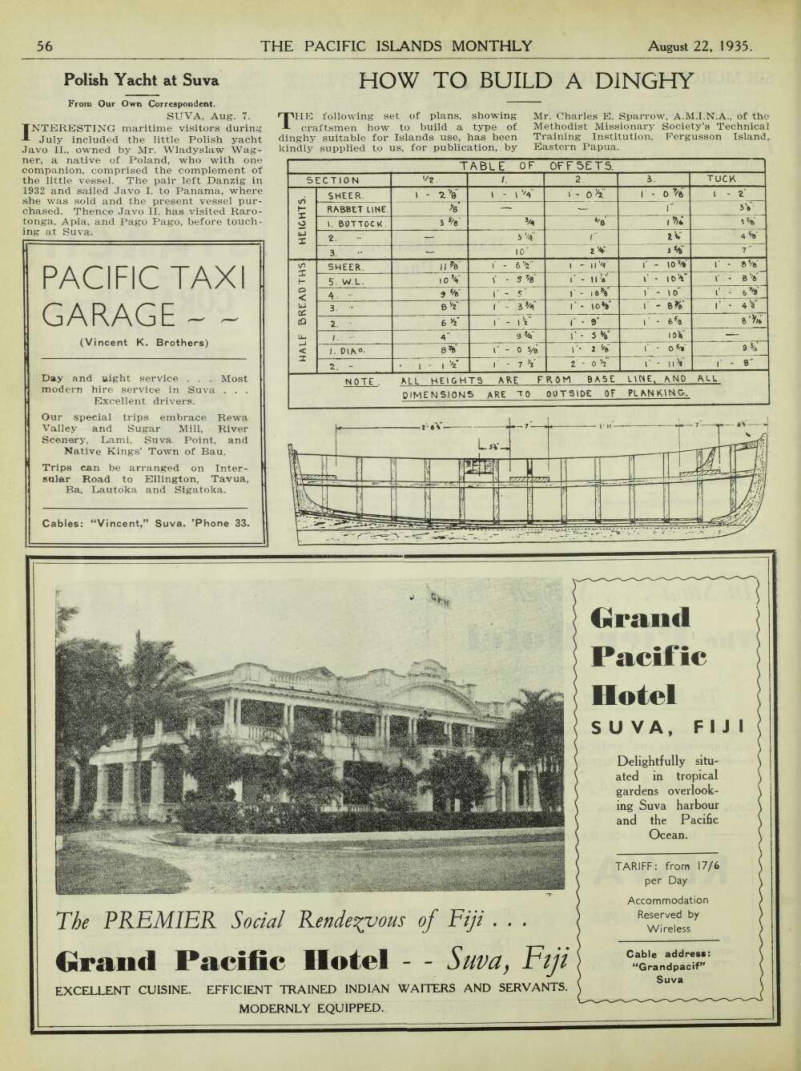
From Our Own Correspondent.
Suva, Aug. 7.
INTERESTING maritime visitors during July included the little Polish yacht Javo IL, owned by Mr. Wladyslaw Wag ner, a native of Poland, who with one companion, comprised the complement of the little vessel. The pair left Danzig in 1932 and sailed Javo I. to Panama, where she was sold and the present vessel pur chased. Thence Javo 11. has visited Raro tonga, Apia, and Pago Pago, before touch ing at Suva.
How To Build A Dinghy
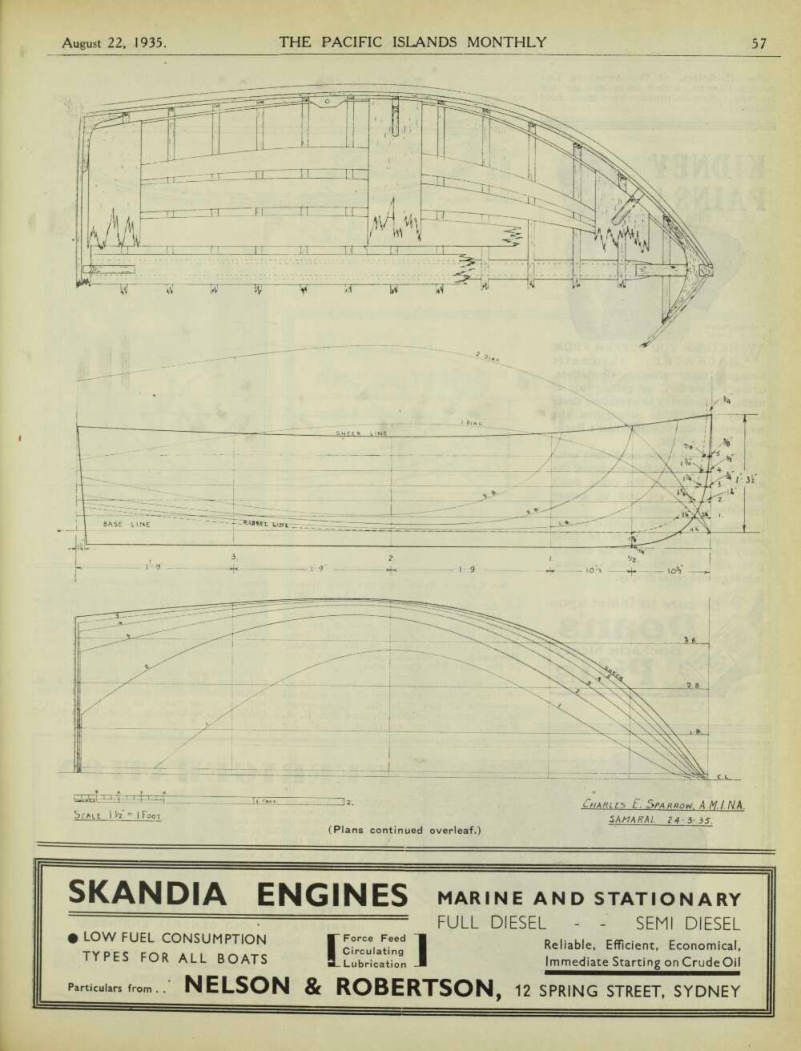
T'HE following set of plans, showing A craftsmen how to build a type of dinghy suitable for Islands use, has been kindly supplied to us, for publication, by
Mr. Charles E, Sparrow, A.M.1.N.A., of the Methodist Missionary Society’s Technical Training Institution, Fergusson Island, Eastern Papua.
Table Of
0Ff5Et5,
Section
f. 2. 3.
Tuck
Sheer.
i - eV
i - i V 1-0 Hi’ 1 - 0 *6 1 - 2
Rabbet Line.
V — — r 3 V 3o
1. Buttock
3 H % v e l?/4 V* bJ X 2. — 3 ]/ 4 /” lV 4 3. — 10' 2 'V 3 V 7" v">
Sheer
II % r - ev 1 - II 4 r - »o *v r - ftV X H 5. W l. 1 0 V V - 5 V r - iiv \ * ioV 1 • 8 V o < 4 9 V r - s"
1 - Tot
r - »o" 1* - sV IU 3. - ©V 1* - jK i* - ioV
i - ih'
r * a v CD 2. 6*' r - iV 1 * B' (■ u_ /.
A" 9 J/ 4 1* - 5 V 10V — < i. Dl A ©V l‘ - 0 5/0 1- 2 V r ■ o v 9 ** n 2. “
• I - i V
r - ? v 2 - 0 V
\‘ * itV
r - 0
Note .
All Heights Are From Base
line, and
Alu
Dimensions Are To
Outside Of
Planking-.
(Plans continued overleaf.)
Rev. D. Spiers, of the American Lu theran Church, sailed from Sydney for Madang, New Guinea, by the July Macdhui.
Mr. Edward Rand, who has been Ameri can Consul in Tahiti since April, 1933, left for Panama by the Commisaire Ramel on July 3, en route to Washington. From Panama, Mr. Rand proceeded to the United States by coastal steamer. Dur ing Mr. Rand’s absence Mr. Scudder Mersman, Vice-Consul, will take charge of the American Consulate.
Mr. R. M. Glasson, a well-known miner of New Guinea and one of the original members of the “Big Six” (discoverers of the Morobe goldfield), and Mr. R. S.
Moody, a mining engineer, sailed for
Boram, on the north coast of the New Guinea mainland, by the Macdhui on July 25. They will be joined by Mr. Ray Parer, the famous Australian airman, and will set off for the interior to inves tigate a gold dredging area for New Guinea (North) Development, N.L., whicli was recently formed in Melbourne.
The Bishop-elect of the Southern- Solomon Islands (Most Rev. Dr. J. M.
Aubin, S.M.), who is at present in Sydney, will be consecrated in St. Mary s pro - Cathedral, Wellington, New Zealand, by Archbishop O’Shea, on September 29.
Advertisements & other items, pp. 58-60 (2 items)
Pacific Taxi
GARAGE -~
(Vincent K. Brothers) Day and eight service . . . Most modern hire service in Suva . . .
Excellent drivers.
Our special trips embrace Rewa Valley and Sugar Mill, River Scenery, Lami, Suva Point, and Native Kings’ Town of Bau.
Trips can be arranged on Intersular Road to Ellington, Tavua, Ba, Lautoka and Sigatoka.
Cables: “Vincent,” Suva. ’Phone 33.
Aim m m m L ■ The PREMIER Social Rendezvous of Fiji . . .
Grand Pacific Hotel - - Suva, Fiji EXCELLENT CUISINE. EFFICIENT TRAINED INDIAN WAITERS AND SERVANTS.
MODERNLY EQUIPPED.
Grand
Pacific
Hotel
S U VA, FIJI
Delightfully situated in tropical gardens overlooking Suva harbour and the Pacific Ocean.
TARIFF: from 17/6 per Day Accommodation Reserved by Wireless Cable address: “Grandpacif”
Suva
Skandia Engines Marine And Stationary
LOW FUEL CONSUMPTION
TYPES FOR ALL BOATS
FULL DIESEL
Particulars from . . [Force Feed "■ Circulating I Lubrication J NELSON & ROBERTSON, 12 SPRING STREET, SYDNEY
SEMI DIESEL
Reliable, Efficient, Economical, Immediate Starting on Crude Oil
KIDNEY
PAINS !
•• Every Future tells a Story.”
TY/HETHER YOU SUFFER FROM
w BACKACHE, rheumatic twinges, dizzy attacks, headaches, urinary disorders, or getting up at night, the best way to overcome these kidney pains is to strengthen the weakened kidneys with Doan’s Backache Kidney Pills.
Often as not these conditions arise after a cold or chill has overtaxed the kidneys. Whatever the cause don’t wait until you are laid up before repairing the mischief.
Doan’s Pills have a diuretic action; they enable the kidneys to filter away the poisons which so quickly give rise to rheumatism, sciatica, lumbago and renal dropsy.
Be sure to insist upon
Doan's
Backache Kidney
Pills
mm -r ' H
refrigeration
“RTTnrF" Automatic or Manually-controlled Refrigeration and Ice- -1„T sulphur dToxlde <SO2) in the small units ihustra.ed-such .Lustration being on an electrically driven SO2 Unit. size of cabinet, and amount of ice required per day.
JAMES BUDGE LIMITED
REFRIGERATION AND GENERAL ENGINEERS
McEvoy and Harley Streets
ALEXANDRIA " " SYDNEY
Established 1890
ENGINEERING WORKSHOPS
All Classes of Machines Made and Reconditioned
Big Fijian Fish
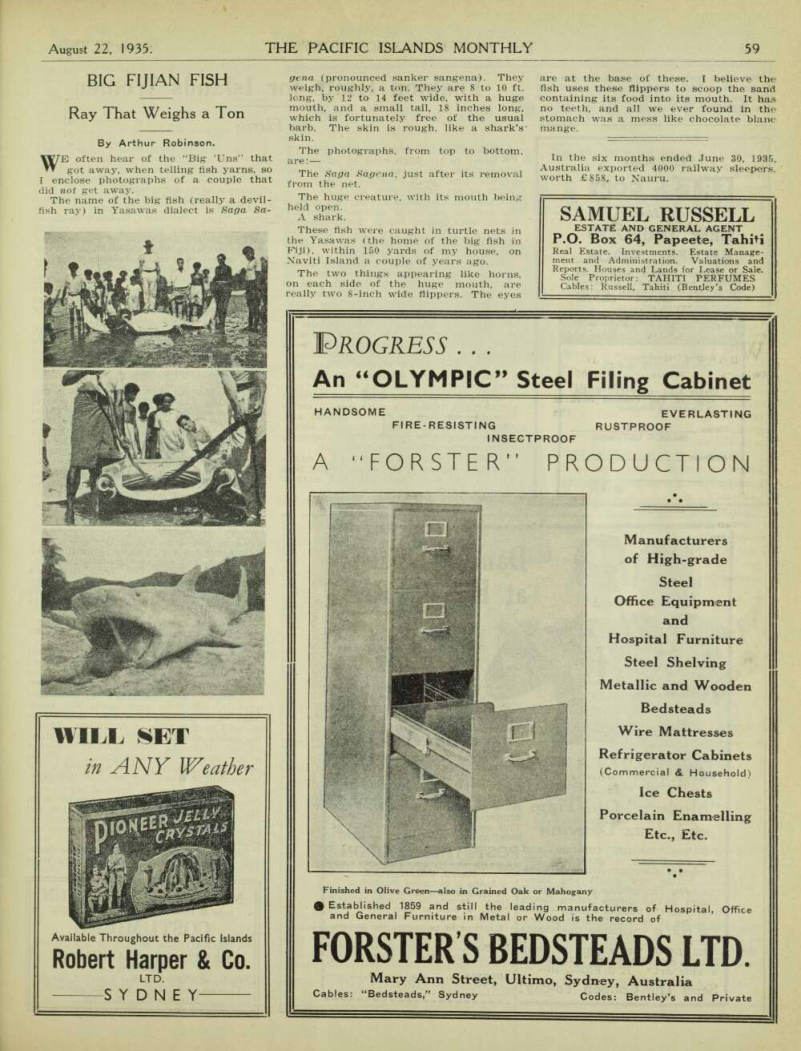
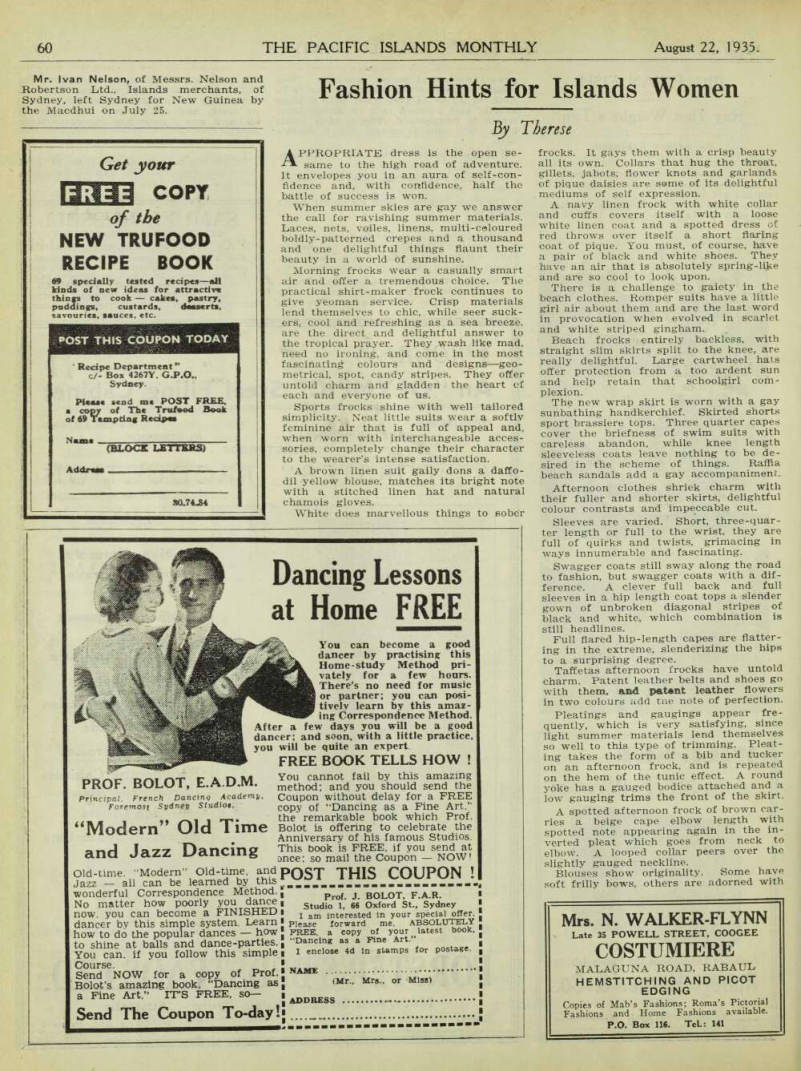
Ray That Weighs a Ton
By Arthur Robinson.
WE often hear of the “Big ’Uns” that got away, when telling fish yarns, so I enclose photographs of a couple that did not get away.
The name of the big fish (really a devil fish ray) in Yasawas dialect is Saga 8a-
gena (pronounced sanker sangena). They weigh, roughly, a ton. They are 8 to 10 ft. long, by 12 to 14 feet wide, with a huge mouth, and a small tail, 18 inches long, which is fortunately free of the usual barb. The skin is rough, like a shark’s skin.
The photographs, from top to bottom, are:— The Saga Sagena, just after its removal from the net.
The huge creature, with its mouth being held open.
A shark.
These fish were caught in turtle nets in the Yasawas (the home of the big fish in Fiji), within 150 yards of my house, on Naviti Island a couple of years ago.
The two things appearing like horns, on each side of the huge mouth, are really two 8-inch wide flippers. The eyes
are at the base of these. I believe the fish uses these flippers to scoop the sand containing its food into its mouth. It has no teeth, and all we ever found in the stomach was a mess like chocolate blanc mange.
In the six months ended June 30, 1935, Australia exported 4000 railway sleepers, worth £B5B, to Nauru.
Mr. I van Nelson, of Messrs. Nelson and Robertson Ltd., Islands merchants, of Sydney, left Sydney for New Guinea by the Macdhui on July 25.
Advertisements & other items, pp. 61-62 (1 item)
Forster S Bedsteads Ltd.
SAMUEL RUSSELL
ESTATE AND GENERAL AGENT
P.O. Box 64, Papeete, Tahiti
Real Estate. Investments. Estate Management and Administration. Valuations and Reports. Houses and Lands for Lease or Sale.
Sole Proprietor: TAHITI PERFUMES Cables: Russell, Tahiti (Bentley’s Code)
Progress ...
An “OLYMPIC” Steel Filing Cabinet
HANDSOME EVERLASTING
FIRE-RESISTING RUSTPROOF
INSECTPROOF
A “FORSTER” PRODUCTION
Manufacturers of High-grade Steel Office Equipment and Hospital Furniture Steel Shelving Metallic and Wooden Bedsteads Wire Mattresses Refrigerator Cabinets (Commercial & Household) Ice Chests Porcelain Enamelling Etc., Etc.
Finished in Olive Green—also in Grained Oak or Mahogany ® Established 1859 and still the leading manufacturers of Hospital, Office and General Furniture in Metal or Wood is the record of
FORSTER S BEDSTEADS LTD.
Mary Ann Street, Ultimo, Sydney, Australia Cables: “Bedsteads,” Sydney Codes: Bentley’s and Private [
HILL SET
in ANY Weather Available Throughout the Pacific Islands Robert Harper & Co.
LTD.
-S Y D N E Y
Get your
Him copy
of the
NEW TRUFOOD
RECIPE BOOK
69 specially tested recipes—all kinds of new ideas for attractive things to cook cakes, pastry, paddings, custards. desserts, savouries, sauces, etc.
POST THIS COUPON TODAY
' Recipe Department" c/- Box 4267 Y. G.P.0., Sydney.
Please send me POST FR££, a copy of The Trufood Book of 69 Tempting Recipes
N * m * (BLOCK LETTERS)
Address 50.74.54
r
►KJk4
Dancing Lessons
at Home FREE
You can become a good dancer by practising this Home-study Method privately for a few hours.
There’s no need for music or partner; you can positively learn by this amazing Correspondence Method.
After a few days you will be a good dancer; and soon, with a little practice, you will be quite an expert
FREE BOOK TELLS HOW !
PROF. BOLOT, E.A.D.M.
Principal. French Dancinq Academy .
Foremost Sydney Studios.
“Modern” Old Time
and Jazz Dancing
You cannot fail by this amazing method; and you should send the Coupon without delay for a FREE copy of “Dancing as a Pine Art.” the remarkable book which Prof.
Bolot is offering to celebrate the Anniversary of his famous Studios.
This book is FREE, if you send at ance; so mail the Coupon NOW!
Old-time. Modern” Old-time, and pQgJ THIS COUPON !
Jazz all can be learned by this ... wonderful Correspondence Method., Prof j BOLOT p.A.R.
No matter how poorly you dance , Studio i,” ee Oxford St., Sydney now. you can become a FINISHED I lam j nterest ed in your special offer, dancer by this simple system. Learn ■ piease forward me, absolutely how to do the popular dances how! free, a copy of your latest book, to shine at balls and dance-parties., “Dancing as a Pme > Art.
You can. if you follow this simple I I enclose 4d in stamps for postage.
Course Send NOW for a copy of Prof. J name Bolot’s amazing book, “Dancing asj a Fine Art.” IT’S FREE, so- i (Mr.. Mrs., or Miss)
Send The Coupon To-dayl|
Fashion Hints for Islands Women
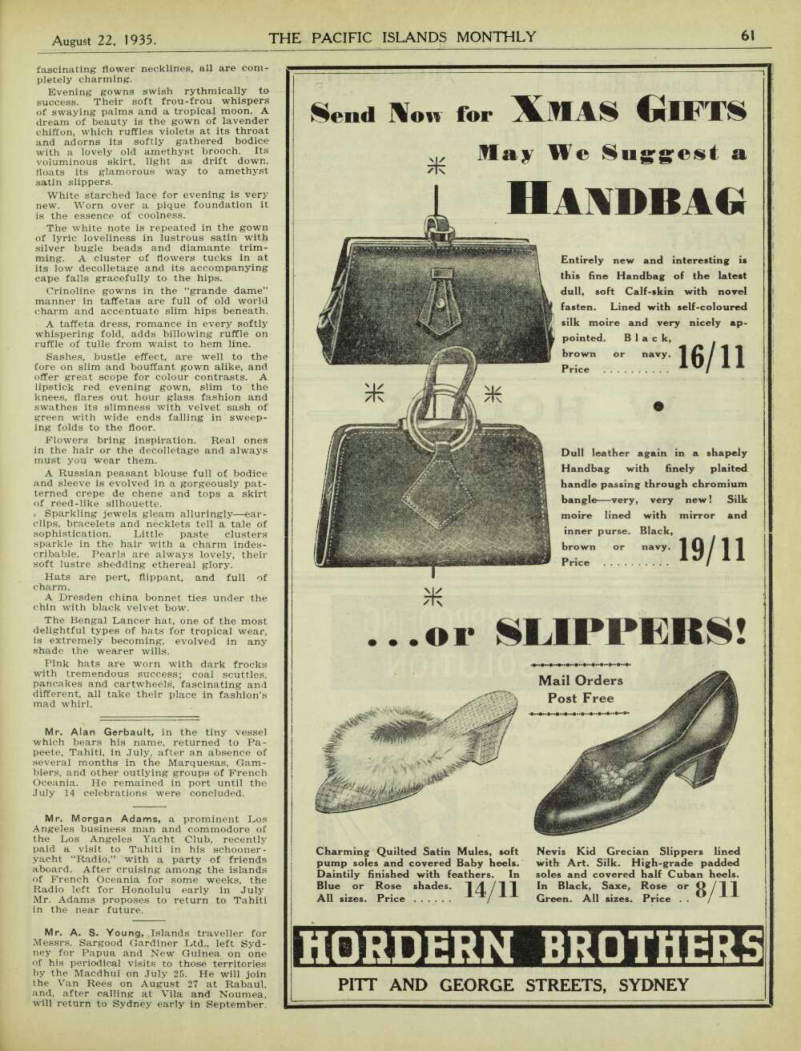
By Therese
APPROPRIATE dress is the open se same to the high road of adventure.
It envelopes you in an aura of self-con fidence and, with confidence, half the battle of success is won.
When summer skies are gay we answer the call for ravishing summer materials.
Laces, nets, voiles, linens, multi-celoured boldly-patterned crepes and a thousand and one delightful things flaunt their beauty in a world of sunshine.
Morning frocks wear a casually smart air and offer a tremendous choice. The practical shirt-maker frock continues to give yeoman service. Crisp materials lend themselves to chic, while seer suck ers, cool and refreshing as a sea breeze, are the direct and delightful answer to the tropical prayer. They wash like mad. need no ironing, and come in the most fascinating colours and designs—geo metrical, spot, candy stripes. They offer untold charm and gladden the heart of each and everyone of us.
Sports frocks shine with well tailored simplicity. Neat little suits wear a softly feminine air that is full of appeal and, when worn with interchangeable acces sories, completely change their character to the wearer’s intense satisfaction.
A brown linen suit gaily dons a daffo dil yellow blouse, matches its bright note with a stitched linen hat and natural chamois gloves.
White does marvellous things to sober
frocks. It gays them with a crisp beauty all its own. Collars that hug the throat, gillets, jabots, flower knots and garlands* of pique daisies are some of its delightful mediums of self expression.
A navy linen frock with white collar and cuffs covers itself with a loose white linen coat and a spotted dress of red throws over itself a short flaring coat of pique. You must, of course, have a pair of black and white shoes. They have an air that is absolutely spring-like and are so cool to look upon.
There is a challenge to gaiety in the beach clothes. Romper suits have a little girl air about them and are the last word in provocation when evolved in scarlet and white striped gingham.
Beach frocks entirely backless, with straight slim skirts split to the knee, are really delightful. Large cartwheel hats offer protection from a too ardent sun and help retain that schoolgirl com plexion.
The new wrap skirt is worn with a gay sunbathing handkerchief. Skirted shorts sport brassiere tops. Three quarter capes cover the briefness of swim suits with careless abandon, while knee length sleeveless coats leave nothing to be de sired in the scheme of things. Raffia beach sandals add a gay accompaniment.
Afternoon clothes shriek charm with their fuller and shorter skirts, delightful colour contrasts and impeccable cut.
Sleeves are varied. Short, three-quar ter length or full to the wrist, they are full of quirks and twists, grimacing in ways innumerable and fascinating.
Swagger coats still sway along the road to fashion, but swagger coats with a dif ference. A clever full back and full sleeves in a hip length coat tops a slender gown of unbroken diagonal stripes of black and white, which combination is still headlines.
Full flared hip-length capes are flatter ing in the extreme, slenderizing the hips to a surprising degree.
Taffetas afternoon frocks have untold charm. Patent leather belts and shoes go with them, and patent leather flowers in two colours add tne not© of perfection.
Pleatings and gaugings appear fre quently, which is very satisfying, since light summer materials lend themselves so well to this type of trimming. Pleat ing takes the form of a bib and tucker on an afternoon frock, and is repeated on the hem of the tunic effect. A round yoke has a gauged bodice attached and a low gauging trims the front of the skirt.
A spotted afternoon frock of brown car ries a beige cape elbow length with spotted note appearing again in the in verted pleat which goes from neck to elbow. A looped collar peers over the slightly gauged neckline.
Blouses show originality. Some have soft frilly bows, others are adorned with
fascinating flower necklines, all are com pletely charming.
Evening gowns swish rythmically to success. Their soft frou-frou whispers of swaying palms and a tropical moon. A dream of beauty is the gown of lavender chiffon, which ruffles violets at its throat and adorns its softly gathered bodice with a lovely old amethyst brooch. Its voluminous skirt, light as drift down, floats its glamorous way to amethyst satin slippers.
White starched lace for evening is very new. Worn over a pique foundation it is the essence of coolness.
The white note is repeated in the gown of lyric loveliness in lustrous satin with silver bugle beads and diamante trim ming. A cluster of flowers tucks in at its low decolletage and its accompanying cape falls gracefully to the hips.
Crinoline gowns in the “grande dame” manner in taffetas are full of old world charm and accentuate slim hips beneath.
A taffeta dress, romance in every softly whispering fold, adds billowdng ruffle on ruffle of tulle from waist to hem line.
Sashes, bustle effect, are well to the fore on slim and bouffant gown alike, and offer great scope for colour contrasts. A lipstick red evening gown, slim to the knees, flares out hour glass fashion and swathes its slimness with velvet sash of green with wide ends falling in sweep ing folds to the floor.
Flowers bring inspiration. Real ones in the hair or the decolletage and always must you wear them.
A Russian peasant blouse full of bodice and sleeve is evolved in a gorgeously pat terned crepe de chene and tops a skirt of reed-like silhouette. ♦ Sparkling jewels gleam alluringly—ear clips, bracelets and necklets tell a tale of sophistication. Little paste clusters sparkle in the hair with a charm indes cribable. Pearls are always lovely, their soft lustre shedding ethereal glory.
Hats are pert, flippant, and full of charm.
A Dresden china bonnet ties under the chin with black velvet bow.
The Bengal Lancer hat, one of the most delightful types of hats for tropical wear, is extremely becoming, evolved in any shade the wearer wills.
Pink hats are worn with dark frocks with tremendous success; coal scuttles, pancakes and cartwheels, fascinating and different, all take their place in fashion’s mad whirl.
Mr. Alan Gerbault, in the tiny vessel which bears his name, returned to Pa peete, Tahiti, in July, after an absence of several months in the Marquesas, Gam biers, and other outlying groups of French Oceania. He remained in port until the July 14 celebrations were concluded.
Mr. Morgan Adams, a prominent Los Angeles business man and commodore of the Los Angeles Yacht Club, recently paid a visit to Tahiti in his schooner yacht “Radio,” with a party of friends aboard. After cruising among the islands of French Oceania for some weeks, the Radio left for Honolulu early in July Mr. Adams proposes to return to Tahiti in the near future.
Mr. A. S. Young, Islands traveller for Messrs. Sargood Gardiner Ltd., left Syd ney for Papua and New Guinea on one of his periodical visits to those territories by the Macdhui on July 25. He will join the Van Rees on August 27 at Rabaul, and, after calling at Vila and Noumea, will return to Sydney early in September.
Advertisements & other items, pp. 62-64 (1 item)
Costumiere
Mrs. N. WALKER-FLYNN
Late 35 POWELL STREET, COOGEE
MALAGUNA ROAD, RABAUL
HEMSTITCHING AND PICOT
EDGING
Copies of Mab’s Fashions; Roma’s Pictorial Fashions and Home Fashions available.
P.O. Box 116. TeL: 141
Send Non for Xfl lS Gill*
Hay We Suggest a
Handbag
* 7k /l\ Entirely new and interesting is this fine Handbag of the latest dull, soft Calf-skin with novel fasten. Lined with self-coloured silk moire and very nicely appointed. Black, brown or navy.
Price 16/11 Dull leather again in a shapely Handbag with finely plaited handle passing through chromium bangle—very, very new! Silk moire lined with mirror and inner purse. Black, brown or navy.
Price 19/11
or SLIPPERS!
Mail Orders Post Free v-m Charming Quilted Satin Mules, soft pump soles and covered Baby heels.
Daintily finished with feathers. In Blue or Rose shades. 1 /|. /II All sizes. Price Nevis Kid Grecian Slippers lined with Art. Silk. High-grade padded soles and covered half Cuban heels.
In Black, Saxe, Rose or Green. All sizes. Price . . 8/1 i
HORDERN BROTHERS
PITT AND GEORGE STREETS, SYDNEY
V. H. Jones & Rickard
Electrical Engineers
525 ELIZABETH STREET
SYDNEY
Specialists in rewinding and repairing all classes and sizes of electrical machines and equipment.
Special treatment given to work for the tropics.
TELEPHONE: MA 1397
PAINT
HORSE SHOE BRAND
IN PASTE OR READY
MIXED FORM
Made in Scotland mi
WHITE LEAD. WHITE ZINC
AND ALL COLOURS
—therefore Reliable!
Thomas Mclntyre & Co. Ltd., Glasgow, Scotland
- W. HOLMES ==
YACHT AND BOATBUILDER
All oJ_
Sole Agent " R.N.” DIESEL MARINE ENGINES.
SEND FOR PARTICULARS.
McMAHON’S POINT SYDNEY
Cable Address: “HOLMAC,” Sydney.
WATERPROOFING
SOLUTION
Specially prepared for treating Tents, Tarpaulins, Cart, Wheat and Haystack Covers, Horse Rugs, Ground Sheets, and Oilskins Free of injurious chemicals & acids, penetrates, binds, and strengthens.
Is flexible and does not stick or rot material.
J. R. CLAY & CO. LTD.,
Agent for Port Moresby and Samarai V,
MADE IN 15 COLORS
Sole Distributor for Pacific Islands GEO. RUTHERFORD, 46 Pitt Street, Sydney Manufacturer:
TAYLOR WILLIAMS & HALLIDAY
185-195 New Canterbury Road, Belmore, Sydney
Housekeeping in the Tropics
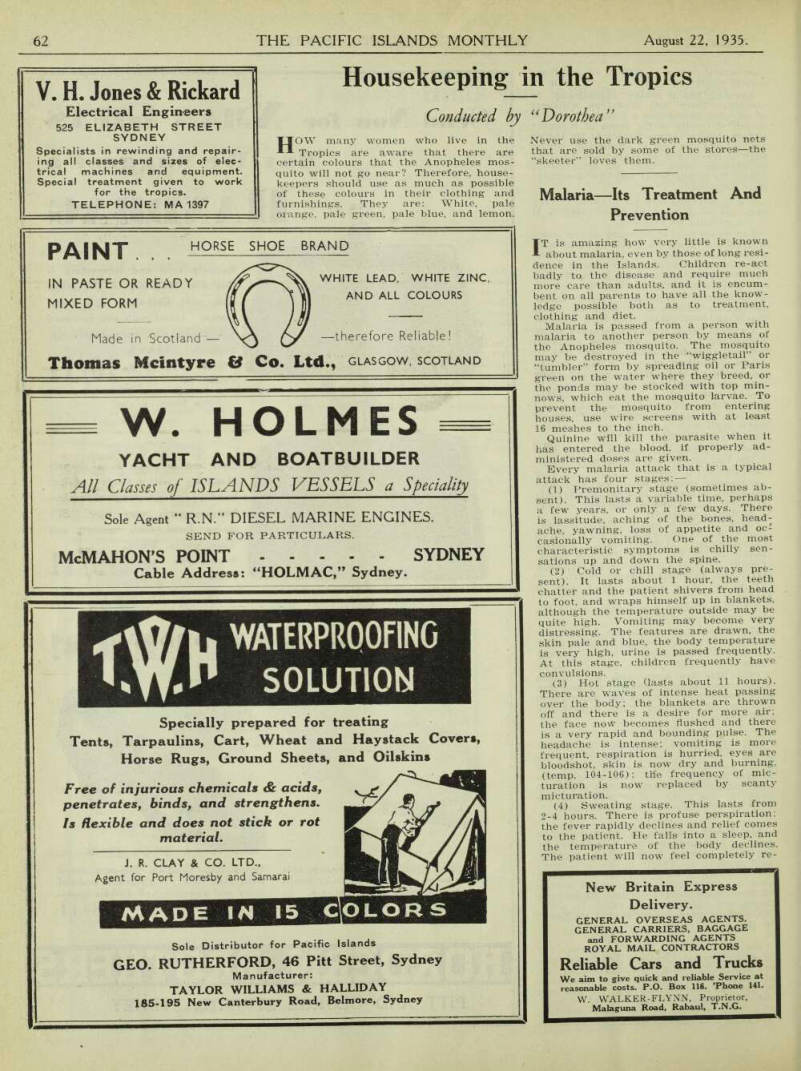
Conducted by “Dorothea ”
HOW many women who live in the Tropics are aware that there are certain colours that the Anopheles mos quito will not go near? Therefore, house keepers should use as much as possible of these colours in their clothing and furnishings. They are: White, pale orange, pale green, pale blue, and lemon.
Never use the dark green mosquito nets that are sold by some of the stores —the “skeeter” loves them.
Malaria—lts Treatment And
Prevention
IT is amazing how very little is known about malaria, even by those of long resi dence in the Islands. Children re-act badly to the disease and require much more care tha,n adults, and it is encum bent on all parents to have all the know ledge possible both as to treatment, clothing and diet.
Malaria is passed from a person with malaria to another person by means of the Anopheles mosquito. The mosquito may be destroyed in the “wiggletail” or “tumbler” form by spreading oil or Paris green on the water where they breed, or the ponds may be stocked with top min nows, which eat the mosquito larvae. To prevent the mosquito from entering houses, use wire screens with at least 16 meshes to the inch.
Quinine will kill the parasite when it has entered the blood, if properly ad ministered doses are given.
Every malaria attack that is a typical attack has four stages: (1) Premonitary stage (sometimes ab sent). This lasts a variable time, perhaps a few years, or only a few days. There is lassitude, aching of the bones, head ache, yawning, loss of appetite and oc casionally vomiting. One of the most characteristic symptoms is chilly sen sations up and down the spine. (2) Cold or chill stage (always pre sent). It lasts about 1 hour, the teeth chatter and the patient shivers from head to foot, and wraps himself up in blankets, although the temperature outside may be quite high. Vomiting may become very distressing. The features are drawn, the skin pale and blue, the body temperature is very high, urine is passed frequently.
At this stage, children frequently have convulsions. (3) Hot stage (lasts about 11 hours).
There are waves of intense heat passing over the body; the blankets are thrown off and there is a desire for more air: the face now becomes flushed and there is a very rapid and bounding pulse. The headache is intense; vomiting is more frequent, respiration is hurried, eyes are bloodshot, skin is now dry and burning, (temp. 104-106); the frequency of ma turation is now replaced by scanty micturation. (4) Sweating stage. This lasts from 2-4 hours. There is profuse perspiration: the fever rapidly declines and relief comes to the patient. He falls into a sleep, and the temperature of the body declines.
The patient will now feel completely re
lieved, though sometimes there might still be a slight persisting headache.
During these four stages the spleen en larges temporarily —it may be four .finger lengths under the ribs—but then it will return almost to normal after the attack.
As it is left a little larger after each attack, after years of chronic malaria it may be enlarged to an enormous degree. (The enlargement of the spleen in child ren is used to measure the prevalence of malaria in the district.) After a certain length of time the children seem to be come immune to malaria, but the spleen remains enlarged.
It Happened One Day
(Acknowledgment to J. W. Thompson, Bulolo, T.N.G.) f have never forgotten my first impression of what fun one can get out of observing the remarks of the boys.
On arriving at a party given by a local Magistrate, I was impressed with the frigid atmosphere of the place—not the usual cocktail party atmosphere—one had to create an impression on these young tourists. Everything was very dignified and solemn, and I was, preparing to be thoroughly bored, when a remark from one of the boys, altered the evening en tirely—for me.
A very austere and dignified old lady, in a dress nothing under the thirty guineas mark, and seeking (with the help of the dress, and an acquired accent) to impress the company, ordered a cocktail.
I happened to overhear how the order was passed on, as follows; “Missy belong black calico, she wantein cocktail.”
Little Islanders’ Corner
1 DOROTHEA" welcomes little Islanders from Papua, Suva. Solomon Islands and New Guinea, and if any children de sire pen-friends, or to exchange stamps.
“Dorothea” can help them.
A packet of stamps has been sent to Linda Caine of Suva, who wants pen friends as well.
Dear Dorothea, — I would like very much to correspond with young people, about 17, who are interested in stamp collecting, reading, all sports, and photography.
Would you be so kind as to get me some pen friends in Africa, India, Burma, Hawaii, and New Guinea ? 1 have no one to write to in those countries, in which I am very interested, and would be very pleased indeed if I could exchange friendly letters with anyone in those places who would care to write to a girl in Fiji.
Suva is a very picturesque town as seen from the harbour. It has many well-paved streets, "beautiful botanic gardens, recreation grounds, and many fine buildings. Suva Harbour can accommo date the largest ships in the world, and even H.M.S. Hood can berth alongside our quays. Many shipping lines make Suva a port of call on account of its geographical position. It is also the base for H.M. New Zealand warships on their winter cruise to the islands. Suva’s population ,is a cosmopolitan one, consisting of the native race (the Fijians), Indians, a number of Chinese, a few Japa
nese, and a sprinkling from practically every island in the Pacific, not to mention about 5000 Europeans.
Sincerely yours,
Linda Caine.
Suva, Fiji.
Dear Dorothea,— Since returning to Papua, where I live, I nave been engaged re-visiting old friends and also con tinuing my studies. We are all very enthusiastic over the newly formed Boy Scout Troop, and it
promises to be very popular in Port Moresby. My sister Gena has had a very bad accident to her foot, but my first-aid knowlege was of great help until the medical man fixed up the wound.
It is very wild country out here and the natives are very primitive, although their craft work, such as baskets, intricately woven, shields, and weapons, are very much sought after by tourists and visitors and in that way the villagers are able to earn a little money.
I am grateful for any papers or magazines as I pass them on to others when I am finished. With all good wishes for the section.
Yours sincerely,
Willie Gavera.
Rarai, Mekeo District, Via Kairuku, Central Division, Papua.
Advertisements & other items, pp. 64-66 (1 item)
Reliable Cars and Trucks
New Britain Express
Delivery.
GENERAL OVERSEAS AGENTS.
GENERAL CARRIERS, BAGGAGE
and FORWARDING AGENTS
ROYAL MAIL CONTRACTORS
Reliable Cars and Trucks
We aim to give quick and reliable Service at reasonable costs. P.O. Box 116. 'Phone 141.
W. WALKER-FLYNN, Proprietor, Malaguna Road, Rabaul, T.N.G.
For—
Fresh Fruit, Vegetables, and Produce
Island residents can rely on the old-established Shipping Providers. il# V m only Address:
421 Sussex St., SYDNEY
All Orders Promptly Attended Island Representatives: Nelson & Robertson W. M. Reid
Head Study of Champion Walvon Admiration, Challenge Winner, Sydney Royal. 1934
The Noted Walvon Kennels
Premier Breeders of Scottish Terriers, Sealyhams, and Wire-haired Fox Terriers.
Puppies available all the year round. Orders direct to Walvon Kennels, 1 Merlin St., Nth.
Sydney, or through Burns Philp & Coy. Ltd., or Mcllraths, Ltd.
ASBESTOS - CEMENT BUILDING SHEETS
With rigid walls of Durabestos any building will stand four-square to the assaults of weather, time, rodents, and white ants.
Call or write for FREE booklet "Durabestos Homes of Colourful Beauty" describing uses for Durabestos. WUNDERLICH LTD., Crown and Cleveland Sts., Redfern, SYDNEY.
o
®3issirTc@^
MOWBRAY HOUSE SCHOOL
CHATSWOOD, SYDNEY, N.S.W.
(Established in 1906.) A Boarding School for Boys. Surrounded by spacious playing fields, on heights of the North Shore line.
The School Offers: A Home Atmosphere
An Unrivalled Health Record A Sound Physical, Mental, and Moral Training.
The curriculum extends from the earliest stages to the Intermediate Examination, and provides a specially designed course of COMMERCIAL EDUCATION for boys entering a business career or work on the land.
Special provision is made to meet the requirements of boys from THE ISLANDS, which includes facilities for spending School Vacations at the School Country House.
Applications for enrolment in 1936 are now being received Illustrated Prospectus and Over-Seas Leaflet on Application.
HEADMASTER: L. BAVIN
W. M. FORD
Ship, Yacht & Boat Builder
Berry’s Bay, North Sydney
(Established 1870.) BUILDERS of all kinds of Island Craft from Dinghies to Auxiliary Schooners of any tonnage. New and Second-hand Island Craft of various types in stock. New and Second-hand Full Diesel, Crude Oil, Benzine and Kerosene Engines.
Please Send on Your Enquiries.
No smoke, no rust, and longer life for the rifle barrel, because of absence of residues — these are factors that, combined with sureness and swiftness, have gained for 1.C.1. .22 s foremost place in popular favour.
A Product of
1.C.1.A.N.Z. Ltd.
SHORT
LONG
(Ammunition Section) 380 Collins Street , Melbourne
LONG RIFLI
AND
HOLLOW
POI
Obtainable
Everywhere
277 Clarence Street, Sydney
5 h.p. for Hd. per Hour
N every part of the world where the work is hardest, the going heaviest, and an engine is left almost to look after itself; there will be found the Lister Diesel.
Any purchaser of a Lister Diesel can look forward to years of trouble-free service, and the last ounce of power will be got out of the fuel which is put into it.
For full particulars regarding this remedy for all power troubles, write at once to Desk P.M., Box 509AA G.P.O., Sydney.
DIESEL Engine
WRITE FOR CATALOGUE NO. 53
DANGAR, GEDYE & Co. Ltd.
Malloch House, 10-14 Young Street, Sydney
eti
is
Notes From Samarai
TifRS. A. CRIDLAND, wife of the Resi dent Magistrate at Cape Nelson, Papua, has been very ill with fever.
It is said that nearly everyone who has been through a course of the anti malaria drug Atebrin is having the same trouble —very bad fever. Atebrin so thoroughly clears the system of fever, that when one gets it again it is like a first attack.
When the “Laurabada” arrived at Port Nelson, Mrs. Cridland had the pleasure of entertaining Sir Hubert Murray, Miss Meg Bunting, Mr. and Mrs. Grist, Cecil Abel, from Kwato, Mr. Len Murray, and an English member of Parliament.
Between five and ten ounces of gold are being won daily by Mr. Hoile from sluicing operations on the lower Edie Alluvials lease in New Guinea, held under option by Golden Terraces (New Guinea) Syndicate, N.L. Mr. Hoile is employing ordinary boxing methods and is being assisted by a few natives.
Messrs. Smeaton and Graham have sold out their property at Sandy Creek, New Guinea, and have gone to Tufi, near the Musa River, in Eastern Papua.
Guinea
To Prospect In New
Well-known Men in New Co.
ItTR. RAY PARER (aviator), Brigadier General E. A. Wisdom and Messrs.
R. M. Glasson and R. M. V. Blakemore are directors of New Guinea (North) De velopment, N.L., a company formed with a nominal capital of £lO,OOO, in 2000shares of £5 each, of which 1,000 shares have been offered for subscription at £2 per share on allotment. Six hundred are being issued fully paid to the members of an expedition and the remaining 400 are to be held in reserve.
The prospectors are Messrs. R. Shaw- Moody (who about two years ago found the Golden Deeps, and has had consider able experience), Raymond Parer, and R.
M. Glasson (one of the original dis coverers of Edie Creek). The expedition left by the last “Macdhui” and will in vestigate what they hope will prove to be an extensive gold dredging area in the Sepik area of New Guinea.
The syndicate will subscribe toward the cost of transport and boring operations to the amount of £5O per week, until application is made for a lease or leases.
The prospectors provide all necessary equipment, including an aeroplane and launch, at their own expense.
Rev. C. Moir Smith, of the London Mis sionary Society, returned to Papua from Brisbane by the Macdhui on July 27, after furlough in Australia since April. He is stationed at Urika, in the Delta division, Papua.
Growth Of Edie
Creek
From Our Own Correspondem.
Edie Creek, July 30.
THE transition of Edie Creek from a scattered alluvial mining settlement to a township has never been so marked as during the last month or two.
The closing of the Day Dawn Mine, closely followed by Developments Mine (E.C.G.M.N.D.), and the marked decrease in tributors and independent miners, whilst N.G.G. are increasing their staff and activities, has caused the centre of the settlement to shift from Kiendi, where the Hotel, Edie Store, Native Hospital and Soldiers Hall are situated, upstream to Central Camp.
So rapidly are the “small men” disap pearing that shortly one will no longer hear: “So-and-So picked up a bonzer slug,” or “I believe Jack Johnson has got onto a jeweller’s shop in the Merri.”
The latest movements are: Dawn Day has reduced its staff from four to two: Messrs. Ashcroft and Campbell. “De velopments” paid off its staff, retaining Mr. McKenzie as caretaker. Both these mines are endeavouring to raise more capital South. The famous “El Dorado”
Lease from which the late Harry Darby and later the late David Lyall and his son won fortunes is up for tender. “The Cleopatra Lease,” pegged by Mr. Chas.
Booth for Mr. Hector Wales in 1926, and from which he has won thousands of ounces, is now under option to N.G.G.
The three tributors of N.G.G. who are working on the main stream, Edie Creek —Messrs. Russ Wild, H. L. (Bill) Stower and R. G. Courtney—have received a months’ notice. All old-timers, they have been winning very good gold for the last year. It is now N.G.G.’s intention to work this ground themselves, and Mr. Gordon Wild has been engaged to carry on the job.
Headquarters Creek, until recently worked on tribute by Mr. Caulfield-Kelly, is also being worked by “wages men.”
Mr. Kelly, who was recently very ill, has gone on a health trip.
Messrs. Peter Pianti and W. W. Clarke have finished up on the Merri, and have gone Southward, thus reducing the popu lation of this stream to seven.
Joe Taylor, one of the pioneers, who recently was working on the Watut, has “set-in” on the Wattle Lease, which was last worked by “Big” Jim Ryan. There are now nine leases and claims being worked on the mainstream, Upper Edie Creek—Wainright, on the “Queen of Sheba”; Schrater and Shoppee on the Re serve; Silburne on the “D. & W.”; Cyril Eldred and Hadley Bros, on the “Tucker”; Alex. Dickson and Bill Cameron on the “Boomerang”; and Joe Taylor on the “Wattle.”
Slate Creek and its tributaries support Messrs. Fitzsimmons and Bieri.
Mrs. Vic. Florance of Wau is at present staying with Mr. and Mrs. Bieri.
Mrs. Bowring has closed down her Mess at Kiendi and is trying her luck on Kabiak Creek.
Ern. Bowden of the “Boomerang,” who recently recovered from pneumonia, is at present holidaying South.
We were glad to see Mrs. Jack Crampton back after her very serious illness.
Mr. an d Mrs. Stower, who have both been in ill-health for some time, have gone South for treatment.
Mr H Kingsbury, the world-famous geologist, who has been engaged at Edie Creek undertaking a geological survey of the field, for the Mining trust (consulting engineers for the N.G.G.) dur ing the last six years, and has acted as Mines Supt. at Edie . Creek since Major Harrison’s de
parture for London, is now leaving us for U.S.A. via the Far East and London. Forty-five friends gave Mr. and Mrs. Kingsbury a surprise farewell party on July 13, when presentations were made to this very popular couple and Mrs. Gillis. Mr.
Ken. Spinks expressed the residents’ regret at their departure. During Mr. and Mrs. Kingsbury’s stay at Edie Creek they have laid out what is without doubt one of the finest gardens in New Guinea.
Mr. Chas. Marshall, who recently returned from South with a bride, is to take over the office of Mine Supt. on Mr. Kingsbury’s departure.
The erection of Hoile’s Picture Theatre at Kiendi is nearing completion.
Miss Leslie, of Wau, is now hostess at our local hostelry.
Mr. Ivan Clarke has taken charge of the native hospital. We are pleased to see such an ex perienced man in this position.
Mr. Brian Lane, who finished up at Day Dawn, is taking a long promised holiday in Australia.
Mr. George Hoffman, Government Road Master, has completed the new Wau-Edie Creek Road and is now going to Sydney for a well deserved
holiday. Standard-wheel-base lorries and cars can now go right through to Central Camp, Upper Edie Creek.
Mr. Harold Strong, of the P.W.D., who has been in charge of the road construction in the Wau township, is now engaged on the making of the difficult Merri Creek crossing.
Mr. Frank Doulton, who was working the “Glasson Lease” for N.G.G. has now left the company.
Mr. J. H. Curie, the famous author of travel books, has just explored our mountain. No doubt, Mr. Curie, with his extensive and penetrating knowledge of men and mines, will have much to say about T.N.G. and its inhabitants in his next book.
Mr. McCullock, chairman of Directors of N.G.G.
Ltd., has been inspecting the workings of that company.
Mrs. L. Shoppee, nee Sister Joseph, who was recently married at Salamaua, has now taken up her residence at the Reserve, Edie Creek.
Mrs. S. Fitzgerald has joined Mr. Fitzgerald at their home near N.G.G. Sawmill.
Mrs. A. H. Cresswell is away holidaying in Salamaua for a week or so.
The white staff of Day Dawn South Mine, at Bartlett’s Creek, has been reduced to one miner, who is carrying on development work.
Hidden Valley, which is a tributary of the Upper Watut River, and is almost due South of Edie Creek, and draws its supplies from here, still supports about four miners. There was a big rush to this area in 1929.
Advertisements & other items, p. 67 (1 item)
for Pigs
SUBDIVIDE
for Cattle
c <® ■
one
with
RINGLOCK FENCES & GATES
“Cyclone” Ringlock Fencing provides the perfect means of subdividing inexpensively, with minimum consumption of time for digging post holes and erecting the fence, with minimum requirements of posts and strainers, and with ease of handling for temporary subdivision if required, for “Cyclone” can be taken down, re-rolled and re-erected with the greatest ease.
The coupon here will bring you informative literature, showing the correct * v "" types for cattle, pigs, horses, etc. Post it now! ** 11 5 “ ‘Cyclone’ is not a type of fence, but is our registered trade mark, and can only be legally applied to fences manufactured by us.”
Cyclone Fence & Gate Co. Pty. Ltd.
The Grace Building, 77 York Street, Sydney and at Melbourne and Adelaide <|j> e Please send me by return mail your free illustrated and priced catalogue of "Cyclone" MetaJ Gates and King-lock Fences.
P. 1.8.
New Samarai Hospital
From Our Own Correspondent.
Port Moresby, July 27.
THE Legislative Council has voted £2,500 to be spent on the construction of a new Samarai Hospital this year. The total estimated cost of the building is £3OOO, and work will commence at an early date.
An amount of £550 has been set down for the purchase of an X-ray plant for the Port Moresby European Hospital.
Goldfields
Maps Of New Guinea
VI7E have received from Messrs. J. Creffield Pty. »\ Ltd., Melbourne, copies of two maps which have just been produced with the co-operation of Mr. C. Lexius Burlington. The first is a map of the complete Morobe goldfield in New Guinea and it shows also the surrounding goldfields, in cluding the Papuan areas. The principal air routes, radio stations and ports of entry are in dicated. The price on paper is 7/6 and mounted on calico and roller 20/-. The other map, sold at the same price, shows the Wau-Edie Creek field and indicates the various areas held by the different mining companies, together with a great deal of useful detail.
Details of a new map by Mr. J. Nason Jones, showing the New Guinea and Papua goldfields in extraordinary detail, are advertised in this issue.
N.G. Gold Shares
Recent fluctuations in the shares of three of the main gold companies operating on the Morobe gold field, New Guinea, were as follows:
Major F. Hewitt, general manager of Lever’s Pacific Plantations Ltd., left Sydney by the Macdhui on July 25 to make a tour of inspection of the Lever plantations in Papua, New Guinea, and the Solomon Islands. He will be absent for about two months.
Prince Karl Leopold von Schoenburg Walden burg, who is related to most of the Royal families of Europe, arrived in Syd ney from Italy by the Corfu on July 25.
After a week's sightseeing in New South Wales, he left by the Makura on August 1 to spend several months in Tahiti.
Rev. R. Pillion, of the Marist Mission station at Lano, Wallis Island, in the Vicariate Apostolic of Central Oceania, arrived in Sydney by the Laperouse from Noumea on July 27. With other Marist missionaries, who recently arrived in Sydney from their stations in the South Seas, he attended the Provincial Chapter of the order on August 5.
Bulolo G.D. N.G. Ltd.
Placer Co.
June 1 .. .. .. b £9/4/6 .. b5/2 .. b£27/9/- June 8 .. .. .. s£9/3/- .. b5/4 .. b£28 Tune 15 .. .. b£9/5/- .. b5/6 .. b £28/14/- June 22.. .. .. s£9/9/- .. b5/3 .. b £29/15/- June 29.. .. .. s £9/8/- .. b5/5 .. b £32/12/6 July 6 .. .. b £9/2/- .. b5/6 .. b£33/5/- July 13 .. .. .. b£8/13/- .. b5/2 .. b£31 July 20 .. .. .. s£9 .. b5/5 .. b £31/17/6 July 27 .. .. .. s£8/19/- .. b6/2 .. b£31/15/- August 3 .. s£8/15/- .. b6/9 .. b £31/17/6 August 10 .. .. s £8/2/6 .. b6/8 .. b £31/10/- August 17 .. .. s£8/15/- .. b6/ll .. b£6/S/-* * Placer Development Co.’s shares are now quoted on the as previously. basis of one dollar, instead of hve
Chinese Artisans
Not Enough for New Guinea’s Needs
From Our Own Correspondent.
Rabaul, July 27.
THE Hon. J. C. Mullaly, M.L.C., a mem ber of the R.S. and 5.1.L.A., at the annual meeting of the Rabaul branch, pointed out the difficulty he had person ally experienced in obtaining the services of Chinese artisans for work upon his coconut estate, and he declared that it was impossible to engage competent Asiatic artisans.
During the discussion it was stated that although there were scores of un employed Asiatics in Chinatown they were not qualified artisans and could be classed as “unemployable.”
Mr. Mullaly then moved that the Ad ministration be approached with the request to import, under indenture, Chinese artisans to meet the require ments of present conditions.
The resolution was carried.
EDITORIAL NOTE: It is indeed surprising to find such a proposal coming- from such a source.
The idea of introducing more Chinese into New Guinea would be bitterly resisted in Australia — New Guinea, surely has a sufficient Asiatic popu lation. If New Guinea-born Chinese are not good workmen and artisans that surely is the fault of the New Guinea education system: and the remedy is obvious. See that the younger Chinese are given adequate technical education and so are made “employable.”
Rev. R. L. Walker, accompanied by his wife and son, arrived in Fiji by the Aorangi on July 26 to take charge of St.
Andrew’s Presbyterian Church, Suva,
Advertisements & other items, p. 68 (1 item)
“Buiacott
Petter Atomic Diesel Engines
For sturdy, thoroughly reliable power at the lowest possible cost. Simple Si design—robust construction—trouble- K free and can be operated without skilled labour.
COLD STARTING.
In Stationary and Marine Types, Auxiliary and Electric Lighting Sets. From 5 to 540 and the famous Fetter Semi-Diesel En- gines.
For price, terms and full explanatory literature concerning all these reliable Buzacott Lines, write to ■t 'S
Pwr/arott &■ C° Limited
The “New Record” Drag Saw
Speedy. Simple. Reliable, toughest of logs, up to 7 ft.
Guinea Administration, Lever tions, and Bulolo Gold Mines Saws through the As supplied to New Bros. Pacific Planta- Ltd.
7-11 Market Street
Sydney, Australia
RELIABLE
“Buiacott
LINES
“Buzacott” Spray
Pumps are competitively priced, wellconstructed, and entirely dependable.
“Buzacott” Gates and Fences add charm and dignity to the plantation or home. Recognised everywhere as the best procurable.
Also Chain Wire, all meshes and gauges, for Copra Trays.
“Alston” Windmills Require little attention. Easy to handle, thoroughly built, well-balanced. Priced to suit every pocket.
The “Digger” Winch A light, portable one-man machine with enormous power. It will uproot any tree or stump with ease.
“Gilco” Electric Light Plant No fuel costs —entirely wind driven. A proved success.
New Guinea’S Trade
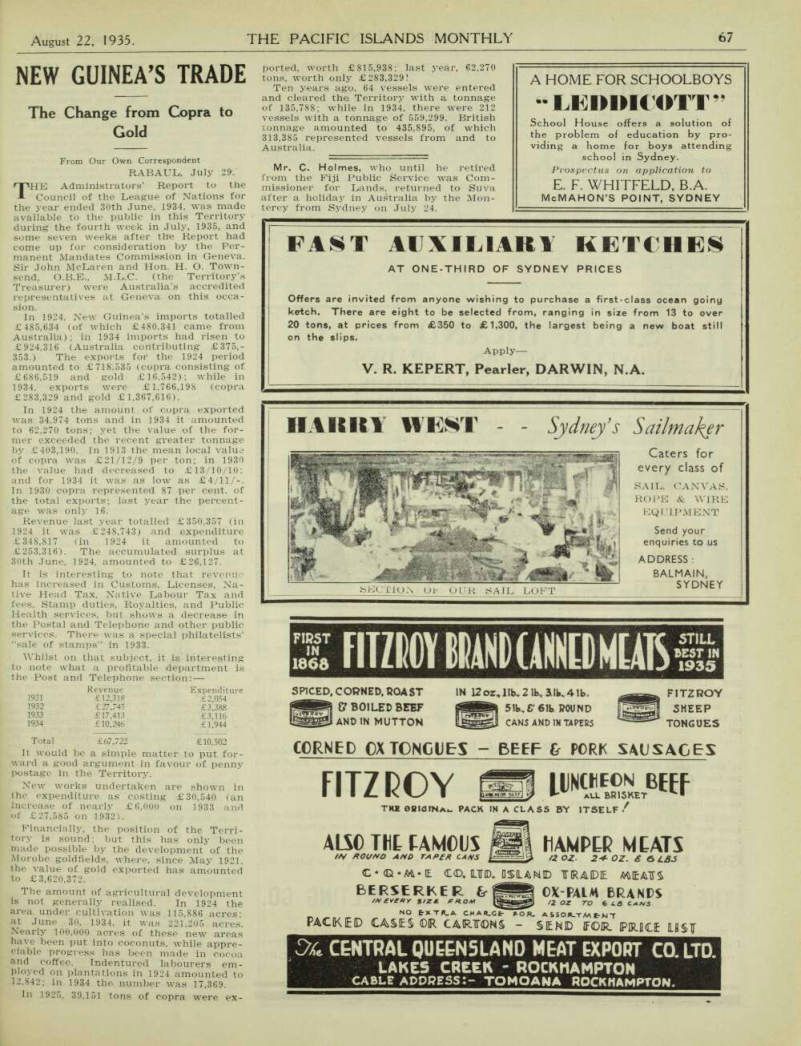
The Change from Copra to Gold
From Our Own Correspondent
Rabaul, July 29.
THE Administrators’ Report to the Council of the League of Nations for the year ended 30th June, 1934, was made available to the public in this Territory during the fourth week in July, 1935, and some seven weeks after the Report had come up for consideration by the Per manent Mandates Commission in Geneva.
Sir John McLaren and Hon. H. O. Town send, 0.8. E., M.L.C. (the Territory’s Treasurer) were Australia’s accredited representatives at Geneva on this occa sion.
In 1924, New Guinea’s imports totalled £485,634 (of which £480,341 came from Australia); in 1934 imports had risen to £924,316 (Australia contributing £375,- 353.) The exports for the 1924 period amounted to £718,535 (copra consisting of £686,519 and gold £16,542); while in 1934. exports were £1,766,198 (copra £283,329 and gold £1,367,616).
In 1924 the amount of copra exported was 34,974 tons and in 1934 it amounted to 62,270 tons; yet the value of the for mer exceeded the recent greater tonnage by £403,190. In 1913 the mean local value of copra was £2l/12/9 per ton; in 1930 the value had decreased to £l3/10/10: and for 1934 it was as low as £4/11/-.
In 1930 copra represented 87 per cent, of the total exports; last year the percent age was only 16.
Revenue last year totalled £350,357 (in 1924 it was £248,743) and expenditure £348,817 (in 1924 it amounted to £253,316). The accumulated surplus at 30th June, 1924, amounted to £26,127.
It is interesting to note that revenue has increased in Customs, Licenses, Na tive Head Tax. Native Labour Tax and fees, Stamp duties, Royalties, and Public Health services, but shows a decrease in the Postal and Telephone and other public services. There was a special philatelists’
“sale of stamps” in 1933.
Whilst on that subject, it is interesting to note what a profitable department is the Post and Telephone section:
It would be a simple matter to put for ward a good argument in favour of penny postage in the Territory.
New works undertaken are shown in the expenditure as costing £30,540 (an increase of nearly £6,000 on 1933 and of £27,585 on 1932).
Financially, the position of the Terri tory is sound; but this has only been made possible by the development of the Morobe goldfields, where, since May 1921, the value of gold exported has amounted to £3,620,372.
The amount of agricultural development is not generally realised. In 1924 the area under cultivation was 115,886 acres: at June 30, 1934. it was 221,205 acres.
Nearly 100,000 acres of these new areas have been put into coconuts, while appre ciable progress has been made in cocoa and coffee. Indentured labourers em ployed on plantations in 1924 amounted to 12,842; in 1934 the number was 17,369.
In 1925, 39,151 tons of copra were ex
ported, worth £815,938; last year, 62,270 tons, worth only £283,329!
Ten years ago, 64 vessels were entered and cleared the Territory with a tonnage of 135,788; while in 1934, there were 212 vessels with a tonnage of 559,299. British tonnage amounted to 435,895, of which 313,385 represented vessels from and to Australia.
Mr. C. Holmes, who until he retired from the Fiji Public Service was Com missioner for Lands, returned to Suva after a holiday in Australia by the Mon terey from Sydney on July 24.
Revenue Expenditure 1931 £12,318 £2,054 1932 £ 27,745 £3.388 1933 £17,413 £3,116 1934 £10,246 £1,944 Total £67,722 £10,502
Advertisements & other items, p. 69 (1 item)
rpagw*/ <
A HOME FOR SCHOOLBOYS
“LB»»I€OTT”
School House offers a solution of the problem of education by providing a home for boys attending school in Sydney.
Prospectus on application to
E. F. WHITFELD, B.A.
McMAHON’S POINT, SYDNEY
FAST AUXILIARY KETCHES
AT ONE-THIRD OF SYDNEY PRICES
Offers are invited from anyone wishing to purchase a first-class ocean going ketch. There are eight to be selected from, ranging in size from 13 to over 20 tons, at prices from £350 to £1,300, the largest being a new boat still on the slips.
Apply—
V. R. KEPERT, Pearler, DARWIN, N.A.
Il lme V WEST
Sydney’s Sailmaker
rpagw*/ <
<* T m
SECTION Ut OUK SAIL LOFT
Caters for every class of
SAIL, CANVAS,
ROPE & WIRE
EQUIPMENT
Send your enquiries to us
ADDRESS :
BALMAIN,
SYDNEY
FIRST
IN 1868
SPICED. CORNED, ROAST
*7 BOILED BEEF
AND IN MUTTON
FITZROY
iUHCHCOW frttF
unsays
tkb original pack ih a class by itself /
ALSC THt fAMOUS ® HAMPER MEATS
W ROUND AND TAPER CANS tZ OZ- 2+OZ. £6> ISS
C-Q-M-E CO. LTD. DStLAND TTRADIE MEATS
BERSERKER &■ HSIS| OX-PALAi BRANTS
/nevzhy size PR.OM /2 oz ro 6l& cans
NO tXTA.A CHAR.CE A-OR, ASSORTMENT
PACIKED CASES (DR CARTONS - SEND TOR. PRICE EfISTT
CENTRAL QUEENSLAND MEAT EXPORT CO. LTD.
LAKES CREEK - ROCKHAMPTON
CABLE ADDRESS:- TOMOAWA ROCKHAMPTON.
Pacific Mining
Notes
From FIJI
Loloma West Ltd.
Following recommendations made by Dr. Lof tus Hills in his report on the leases of Loloma West Ltd., Tavua, Fiji, a cable message from the mine reports the following progress; Loloma West Blocks—Shaft sunk to 17ft. and timbered to 14ft. Costeaning E. of shaft. Hotspnngs Area—Costeaning on hillside above river, pros pecting S. Drumasi Area —Costeaning adits Nos. 1 and 2, no change. Building's completed on each drive. Assayer and assay plant arrived in Fiji on July 26. The work is being carried out under the direction of Dr. Loftus Hills, who has been retained by the company to supervise de velopment work. . - The latest report from the manager is as fol lows; “Drumasi Area —No. 1 adit to 76ft., face
in lode matter, and samples awaiting assayer.
No. 2 adit to 100 ft., began xcut S. No. 6 adit commenced on E. side of creek and N. from No. 2 to cut underneath outcrop on hill. Hot springs Area—Continuing prospecting and taken samples every 10ft. for assay; no free gold in dish prospects. Roskelly’s Area—Shaft sunk to 22ft., timbered to 16ft.”
The company has obtained diamond drilling plant to drill to 500 ft. for prospecting the areas at Tavua, Fiji. It is expected that the plant and a drill expert will commence field operations early in September.
Nasivi (Fiji) Syndicate N.L.
Nasivi (Fiji) Syndicate N.L. reports that a cable message has been received from Mr. D.
C. J. Hill, its representative on the newly dis covered Raki Raki field, stating that the lode has been traced over a length of more than three miles. The width of the lode is approxi mately 60ft. and the depth is approximately 600 ft.
Two hundred feet more of costeaning has been completed, and values have been consistent throughout. The Nasivi company was formed early in March this year to send Mr. M. J.
Foster, accompanied by its engineer (Mr. Hill), t© inspect auriferous areas discovered by Mr.
Foster. Capital of the company is £lO,OOO in shares of £5 each, and 1,500 shares have been subscribed at £2. The company abandoned op tions held at Tavua on the recommendation of Mr. Hill, and later Mr. Hill reported the dis covery at Raki Raki, 32 miles east of Tavua.
He stated that three lodes had been exposed, 20ft., 15ft., and 4ft. in width. Later, Mr. Hill reported that he had taken samples from costeans which, when sent to Melbourne, gave assay values of Boz. to 15oz. a ton. No development work has been done on the area apart from costeaning, but the high values and the large ore body ex posed give promise of the development of a rich field. The depth of 600 ft. stated in the latest message refers to the exposure of the lode on a hill at an altitude of 1,200 ft., while the lode has again been exposed in the valley 600 ft. below, indicating 600 ft. of backs to be worked. The field has been inspected by the Mining Board of Fiji, and it is expected that it will shortly be proclaimed a gold area and that the company will be granted prospecting licences over a large portion of it. A tentative reservation has been granted to the company covering about 7,000 acres. A director, Mr. G. M. Hume, visited the field at the end of July and on his return to Australia advised the board to form a larger company to take over the whole of the syndicate’s interests. Shareholders will receive a fully paid share interest in the new company, and have an exclusive right to apply on a basis to be deter mined for the whole of the contributing issue.
The share market reacted immediately to this new development and in mid-August the £5 shares (paid £2) were quoted on Melbourne ex change at £42.
Results of assays from samples brought back by Mr. G. M. Hume, from the Nasivi mine at Raki Raki were: From samples taken over 5-foot sections along the costean, values were —12 gr., 13 oz. 12 dwt. 10 gr., 15 oz. 14 dwt. 19 gr., 13 oz. 7 dwt. 12 gr., 1 dwt. 15 gr., 16 gr., 12 gr., 10 oz. 19 dwt. 4 gr., 12 oz. 8 dwt. 6 gr., 11 oz. 18 dwt. 19 gr., 8 oz. 7 dwt. 21 gr., 8 gr., 8 gr., 1 oz. 18 dwt. 21 gr., 2 oz. 12 dwt. 14 gr., 5 oz. 18 dwt. 10 gr., 1 oz. 12 dwt. 8 gr., 5 oz. 10 dwt. 18 gr., 8 oz. 12 dwt. 19 gr., 10 oz. 8 dwt. 2 gr., and 9 dwt. 7 gr.
Raki Raki (Fiji) Gold Syndicate
Nominal capital of Raki Raki (Fiji) Gold Syn dicate N.L., recently formed in Melbourne, will be £12,500, in 2,500 shares of £5 each. The company will operate at Raki Raki, Fiji. Mr, H. W. Percival, 422 Collins Street, Melbourne, is the legal manager. Application has been made for the registration of the company. At a meet ing of directors on August 7 it was decided to withhold the allotment of shares pending con firmation of certain details from the co.’s rep resentative on the field.
Viti Levu Gold N.L.
In a report, dated July 3, forwarded by the leader of the prospecting party of Viti Levu Gold N.L. at Lautoka, Fiji, he advises; The recent rich assays were from surface ore and indicate that we may expect occasional enrichments in our area. At 14ft. from the surface dish pros pects do not indicate a continuance of these high values, but there are highly mineralised veins in the lode matter at that depth which assays may prove to be equally auriferous. Free gold is still obtainable. No. 1 shaft is down 45ft., and dish prospects indicate an improvement in values. It is highly probable that a zone of secondary en richment will occur just above the sulphides, and I am hopeful that we shall have the good fortune to encounter good values in further sinking. The gold is contained in a body which is up to 40ft. in width and should we be able to prove a large tonnage it should be a commercial proposition.
I am continuing the sinking of No. 1 shaft and trenching on the line of lode to the south, where loam tests indicate a further continuance of values. Without assays no indication can be given of the value of the ore, as dish prospects have been misleading at times. Sometimes it is nearly a fortnight before samples can be assayed owing to the volume of samples being put through. , , .
Aug. 17: Dr. Loftus Hills has recommended the abandonment of the area held by Viti Levu N.L. under option at Momi Bay, Fiji. The directors are negotiating for other areas.
Loloma Gold Mines N.L.
The directors of Loloma Gold Mines N.L., Fiji, report that an agreement made with London in terests provides for the reconstruction of the present company and the formation of a new company, to be known as Loloma (Fiji) Gold Mines N.L., with a nominal capital of £Z2S,UUU. divided into 900,000 shares of 5/- each. Under the agreement, 420,000 contributing shares m the new company, paid up to 1/6 per share, will be allotted to the contributing shareholders in the old company on the basis of two shares m the new company for one share held m the existing
company, and 180,000 shares fully paid to 5/- per share will be allotted to the holders of the fully paid shares in the existing company on the basis of two fully-paid shares in the new company for each fully-paid share in the existing company.
Of the remaining 300,000 shares, the London group will take up 150,000 contributing shares, paid to 1/6 per share, at a premium of 18/6 per share.
The London group will be entitled to appoint one director to the Melbourne board. The direc tors state that the arrangement will provide ample additional capital to enable comprehensive developmental work to be undertaken and the installation of large up-to-date treatment plant.
Capital of the present co. is £150,000 in 300,000 shares of 10/- each. The area over which a new prospecting licence was issued in June is of 199 acres, situated at Tova Tova, six miles from Tavua, on Viti Levu Island. Directors are Messrs.
W. H. Smith, T. R. Victor, P. F. Cody, J. Wren, E. J. Banks, and E. G. Theodore.
Fiji Gold N.L.
A cable message received by Fiji Gold N.L. in August from the company’s solicitor in Fiji (Sir Henry Scott) stated that the application for prospecting licences for Budd’s and Ragg’s areas had been approved. Budd’s claim is immediately to the south-east of Koroere, and south of Loloma West. Some trenches have exposed a formation on a spur of the Koroboya Range, and another in a creek which runs parallel with the spur.
Low assays for gold have been obtained in both formations. Ragg’s claim has been tested by trenches and shafts. It is understood that pros pects of gold have been obtained from the for mations disclosed. Work done is insufficient to show the extent and value of the ore body. An assayer, selected by the Chamber of Mines of New Zealand, is expected to arrive in Fiji shortly.
The company’s assaying plant arrived safely by the Monowai.
Assays From Loloma Mine
The mine manager of Loloma Gold Mines N.L. reports the following assays and progress:— July 26: Adit extended to 96ft., from 76ft. to 96ft. average assay 3 oz. 4 dwt. for bulk sample, full width of sft. Main shaft sunk to 51ft., tim bered ,to 27ft.; now erecting head frame. For mation shows in shaft from 30ft. downwards, and is now 6ft. wide; average assay 1)4 dwt. No. 1 shaft only in use for pumping. No. 2 shaft 57ft. to 61ft., assayed 4 oz. 17 dwt.; lode over 6ft. wide. No. 3 shaft 54ft. to 61ft., assayed 7)4 dwt. a ton. Shaft in ore for last 18ft.; still in ore.
No. 4 shaft at 20ft. assayed 4)4 oz. a ton over width sft. No. 5 shaft 27ft. to 33ft., assayed 2)4 oz. a ton full width shaft; neither wall showing.
August 3; Main shaft sunk 55ft., timbered 43ft. Head frame erected. Placing winch in position. Adit extended to 115 ft. Average assay 8 oz. a ton. Xcut started at 94ft. in hanging wall. Extended 7ft., giving average assay of 3)4 oz. a ton from bulk samples. Shafts Nos. 1, 2 and 4: Bailing and pumping only. Shaft No. 3: Sunk 67ft. Average assay 1 oz. 18 dwt. a ton.
Rich ore showing at bottom. Shaft No. 5: Sunk 42ft. Average assay 3 oz. 18 dwt. a ton. Shaft No. 6: Commenced about 400 ft. S.E. of adit. Lode Bft. wide. Obtained good pan prospects.
August 14; The main shaft is being sunk at a point approximately 120 ft. north-east of No. 1 shaft away from the present line of lode. The formation in this shaft, now reported to be ap proximately 6ft. wide, and giving values of 1)4 dwt. a ton, appears to be a new make of ore.
East Reefs Consolidated N.L.
Mr. G. H. McMeeking took over the manage ment of the Fiji operations of East Reefs Con solidated N.L. on July 22. The new lode, pre viously reported, was located just outside the company’s boundary. On being opened, Mr. Mc- Meeking was satisfied that it would make into the company’s lease. An assay of the lode gave a value of l)i oz. a ton. Mining equipment has arrived in Suva, and is being delivered to the field. A message received early in August ad vised that values on the west side of the hill are bearing north-east, according to dish pros pects. No. 1 and 2 crosscuts have been started with 24 men, including natives. The mine man ager states that he is pleased with prospects.
He is of the opinion that the hill will contain “one very big lode.” A progress report is being forwarded by mail. A director sailed from Mel bourne by the Mariposa on August 17, taking an assay plant with him. He will assist in plan ning the policy for the development of the property.
Koroere Gold N.L.
The directors of Koroere Gold N.L., Melbourne, have received the following report from the mine manager at Tavua, Fiji: No. 1 tunnel to 279 ft.
Hard andesite. No values. No. 2 to 202 ft. Mixed formation. Values—at 180 ft., 1 dwt.; 190 ft., 3 dwt.
No. 3 to 236 ft. Andesite. No values. No. 4 to 170 ft. Lode silicified from 150 ft. Values, 4)4 dwt.;
at 160 ft., 3 dwt.; 170 ft., 4 dwt. Cardigan: Prepar ing for erection head frame at main shaft.
South Gordon Gold N.L.
Directors of South Gordon Gold N.L. advise having abandoned the area held at Gordon, Victoria. The directors are negotiating for an option in Fiji, and with this object in view it has been decided to make a call of 3d a share. In the event of nego tiations being completed, and a prospecting licence granted over the area by the Mining Board of Fiji, shareholders will be notified.
Aloha Alluvials N.L.
Having abandoned the alluvials properties on the Waimanu and Waidamu Rivers, Viti Levu, Fiji, over which rights were held, Aloha Alluvials N.L. will wind up forthwith and will return the unexpended funds, amounting to approximately £B5OO, to shareholders. Options over other pro perties in Fiji have been offered to the directors, but as the company was formed for a specific pur pose which has failed, the directors are of opinion the funds should not be diverted to any other ven ture. As soon as outstanding liabilities have been determined and liquidated, the surplus will be re paid to the holders of the shares which were sub scribed for in cash for prospecting. The fully-paid shares issued to Aloha Syndicate G.M. N.L., as part consideration for the transfer of properties, will not participate in the division of the net assets.
Furthermore, Aloha Syndicate G.M. N.L. has de cided to refund the amount of £5OO paid in cash as part consideration for the transfer of the alluvial properties. The syndicate was formed in May with a nominal capital of £25,000 in 5000 shares of £5 each.
Fiji Mining Corporation
The management of the Fiji Mining Corporation, Melbourne, have received advices from their party in Fiji, as follows: — July 22: Tavua, Fiji.—P.L. 214: West crosscut extended to -36 ft. in country. North-west crosscut extended to 25ft., colours. Started north drive
parallel with lode and extended 12ft. Withdrawn from Yako area.
July 29.—N.W. xcut to 35ft., last 13ft. show colours gold. N. drive parallel with lode extended to 25ft., colours. Will xcut later.
Aloha Gold Mining Group
Mr. F. W. Gilder has resigned as legal manager
of Aloha Syrldicate G.M. N.L. and Aloha Central G.M. N.L., and Mr. H. Richmond has resigned as legal manager of Aloha Alluvial N.L. Mr. J. H.
Roxburgh, member of the firm of Smith, Johnson and Co., chartered accountants, has been appointed legal manager of the three companies. The regis tered office has been changed from 349 Collins Street, Melbourne, to 394 Collins Street, Mel bourne.
Mr. G. Baiker, mine manager of Aloha Central G.M. N.L., Tavua, Fiji, reports; No. 2 tunnel; S. drive, width 4ft. Average value for 14ft., 23 dwt.
No. 1 shaft: Lode 17ft. Average value, 14 dwt.
Other workings, traces. The following assay re sults have been forwarded by Mr. Barker by mail: No. 2 shaft, W. xcut, 25ft. from shaft: Face sample of hanging wall of main lode, 19 dwt., fine gold. No. 2 tunnel: Face sample, 83ft. from en trance, 6 dwt., fine gold. Trench on hill ovet creek from camp, seam of stone, 6in. wide, 30ft. from W. end, 4 dwt. fine gold. No. 5 shaft, 10 to 15ft., deep dark and yellow andesite (oxidised), 12 dwt. fine gold. No. 6 shaft, 5 to 10ft., dark ande site, 4 dwt. fine gold. No. 1 shaft from bottom of shaft, 30ft. deep, 6 dwt. fine gold. No. 2 tunnel, 68ft. to 73ft. trom entrance in lode, S. end of drive, 1 oz. 4 dwt. fine gold. No. 2 tunnel, 73ft. to 78ft. from entrance, in lode, S. side of drive, 1 oz. 2 dwt. fine gold. No. 2 tunnel, 78ft. to 83ft. from entrance, in lode, S. side of drive, 1 oz. 4 dwt. fine gold. No. 2 tunnel, 83ft. to 88ft. from entrance, in lode, S. side of drive, 1 oz. fine gold. No. 1 shaft: Resumed sinking No. 1A shaft to 31ft.
Value, 5 dwt. No. IB shaft; W. xcut to 10ft.
Value, 6 dwt. No. 1 tunnel to 167 ft. No. 2 tun nel: S. drive to 50ft. Value, 6dwt. Learning N. of creek. Cut leader, carrying gold. Not yet
assayed.
Totola Syndicate Ltd.
Company has closed with an option on a property
situated in Vitu Levu (Fiji), comprising 500 acres of new auriferous ground. For the purpose of prospecting and developmental work, the reserve shares will now be issued preferentially in the proportion of two for each three held by existing shareholders. Last report from manager stated: No. 1 level, sloping, section 1 north, bulk assay s)4dwt. width 20in.; section 7 south, bulk assay 9dwt, width 36in; sections 8 and 9 south, bulk assay 6)4dwt, width 40in. Development: Section 1 north, winze sunk 7ft to 77ft, bulk assay KMwt, width 48in. No 2 level: Section 1 north, overhead sloping, assays 18dwt, width 72in. Section 1 south: Assays width 36in. Redemption Lease: Section 11, sloping, bulk assay 9dwt.
Gold Mines Of Fiji N.L.
Directors of Gold Mines of Fiji N.L. have re ceived a preliminary report from Dr. Loftus Hills on Flemons, Chalmers, Goodsirs, Halls and Fyfe’s areas, in which he states that the blocks possess promising features, warranting active exploration by adits and shafts. He has recommended a ces sation of expenditure on Nasiv Ali’s block, as it is of no immediate interest. Work on the areas is now confined, under his instructions, to specific lodes, which will dovetail with a systematic struc tural geological survey under his direction. He has recommended that a diamond drilling plant be obtained at once for future exploration. He states that Flemons’ area is an important position, with attractive possibilities, and that the areas are well placed, technically explored, efficient, and satisfac tory results will follow. The assayer has arrived in Suva, and will begin assaying at once.
Sir Henry Scott, solicitor in Fiji to the company, has advised the management that all requirements of the Mining Board have been complied with. The five prospecting licences had been approved in the name of the company, and the titles were secure.
Advertisements & other items, pp. 70-72 (1 item)
“Star” Brand -K.
SHOVELS SCOOPS SPADES
All Sizes All Styles for All Purposes
Quality Tools Fully Warranted
Made by experts Blades manufactured from special English carbon - manganese steel under correct oil heat treatment. Fitted with high grade Australian mountain ash handles. Well over 200,000 supplied to satified customers, including Commonwealth Government and all Australian State Governments, Mines, and Industrial undertakings.
Enquiries solicited from bona fide Wholesale Traders.
Literature and Price Lists on request.
Sole Makers:
W. SAVAGE & CO. LTD.
155 George St., Erskineville, S ydney, N.S.W.
Telegraphic Address; “Starshovel/’ Sydney
Also Stone Forks, Digging Forks, etc.
Producers and sellers of Gold BIIIMOR may feel assured that there are advantages in dealing with a well-established and widely-organised Company.
THE ELECTROLYTIC REFINING & SMELTING COMPANY OF AUSTRALIA LIMITED is equipped to provide those advantages in the highest degree possible combined with faithful service.
Us facilities for receiving and handling bullion are convenient and safe. Its assaying and refining are in the hands of highly qualified technicians. Its markets are world-wide, ensuring the best prices being paid.
For example, the RCCOTCI Pt*iC6 of gold in Australia was established by this Company on 6th March, 1935, when payment was made to its clients at the rate of £9/4/6 net per fine oz.
SELLERS IN NEW GUINEA, NEW ZEALAND, PACIFIC ISLANDS, and elsewhere outside Australia should consign their materials to the Company’s Sydney Office.
PROCEEDS FOR NEW GUINEA AND NEIGHBOURING CENTRES are forwarded by the outgoing mail of the same vessel which brings the bullion except in very unusual circumstances. Prompt settlement is a feature of the Company’s service.
Gold Miners: Instruct your Bankers or your Forwarding Agents to deposit your bullion with:
THE ELECTROLYTIC REFINING & SMELTING CO.
OF AUSTRALIA LIMITED
Melbourne: Works: ® yd "T Collins House. Port Kembla, N.S.W. 25 O Connell Street.
PURCHASERS AND REFINERS OF GOLD, SILVER, COPPER IN ANY FORM BANKERS: —The English, Scottish & Australian Bank Ltd.
Mining ■Hj
■ ' Latest Revised Courses
i INTERNATIONAL
■ CORRESPONDENCE SCHOOLS
140 Elizabeth Street, Sydney Sirs, — Please send me free prospectus showing how I can succeed in the occupation I have marked.
S -GOLD MINING & METALLURGY
m —METAL MINING ENGINEERING
■ -PROSPECTING -ASSAYING
■ -MINING-ELECT. SURVEYING
■ -COPPER MINING & METALLURGY
Other New Courses
S -DIESEL ENG. -WELDING ENG.
■ —AIR CONDITIONING
m REFRIGERATION ELEC. ENG
■ -ELECTRICAL ILLUMINaI lON
■ -INTERNAL COMBUSTION -RADIO
STRUCTURAL STEELWORK
DESIGNS BY COMPETENT ENGINEERS
All Classes of Steel Framework and Reinforcement Agents for— EXPANDED METAL FOR CONCRETE AND PLASTER WORK
“PUDLO" FOR WATERPROOFING CEMENT
Send your enquiries to
THE SYDNEY STEEL CO. LTD.
MARRICKVILLE, N.S.W. Cable Address: SYDSTEEL, SYDNEY
MINING PLANT
Portable Batteries, Fixed Batteries, Tube and Ball Mills, Shoes and Dies, Screens, Copper Plates, Trucks, ‘‘Challenge” Ore Feeders, Rock Crushers, Cyanide Tanks, Pipe Lines, Pumps
PROSPECTING PLANT
Casing, Drilling Tools, Engine Rigs, Sampling Gear, Pumps, Wire Ropes, etc.
DREDGING PLANT
Large or Small Designed and Built Agents for HADFIELD’S Manganese Steel Buckets, Tumblers, Gears, Carbon and Alloy Steels
J. B. WALLIS cV CO.
CHALLIS HOUSE :: SYDNEY
Mining Ore Treatment
Machinery
Complete Cyanide Plants Supplied.
Dorr Classifiers.
Dorr Thickeners.
Dorr Agitators.
Oliver Filters.
Merril Crowe Zinc Dust.
Gold Precipitation.
Richardson Mine Fans.
FANS AND AIR HEATERS
For Ventilation, Copra Drying Rooms, etc.
Enquire from
CROSSLE, DUFF AND
MACINTOSH LTD.
52 Bridge Street, SYDNEY.
SHIP CHANDLERY - HARDWARE
BROOMFIELDS LIMITED, 152 Sussex St., SYDNEY
Large and Complete Stocks of SHIP CHANDLERY.
Ironmongery of all kinds—Paints, White Lead and Oils.
Sole Agents for: P H MUNTZ & CO.’S 3-CROWN BRAND METAL SHEATHING.
PEACOCK & BUCHANS’ ENGLISH READY-MIXED PAINTS.
WRITE FOR SHIP CHANDLERY CATALOGUE
Special “In Bond” Prices for all Island enquiries quoted on application
CABLES: “BOOM.” SYDNEY
MORRIS, HEDSTROM, Ltd.
FIJI
Sole Agents in Fiji for . .
Vacuum Oil Company (Pty.) Limited Imperial Chemical Industries Limited Nobel (Australasia) Pty Ltd.—Explosives
From New Guinea
Upper Watut Alluvials N.L.
With the arrival of the constructional engineer of Upper Watut Gold Alluvials X.L. on the com pany’s field in New Guinea, good progress has been made on the construction work of the hydro-elec tric scheme. The European staff now numbers 16, about 230 natives are working on the race line, and more native labour is being engaged. A re cent report from the company’s officials on the field stated: Race line: Excavation of bench and catch drains for race line has been commenced by the contractors, and the section from surge tank site to the exit end of No. 1 tunnel is well under way and should be completed shortly. Tunnel; The portal at exit of No. 1 tunnel now being opened up, and seepage drain has been cut for a distance of approximately 200 ft. around and above portal to prevent slips interfering with the tunnel work. Survey: A contour survey of weir site has been made, also longtitudinal section of proposed syphon has been levelled. Sawmill: For the month of Jupe, 11,965 super feet of timber was cut.
Upper Sepik Gold N.L.
An option has been acquired by the representa tive and engineer of Upper Sepik Gold Syndicate N.L. over a property in the Morobe district. New Guinea. He reports having tested portion of the area, and that it is an alluvial ground sluicing pro position, estimated to contain 3,000,000 cubic yards.
The depth of the ground is 30 feet, the gold is coarse, and values are estimated at 20/ a yard.
Particulars are being forwarded by mail. He is also negotiating for a further large area in the same district.
Malinar (N.G.) Gold Ltd.
The representative of Malinar (New Guinea) Gold Ltd. advises that further assay tests conduct ed by Messrs. Spence and Smith, consulting engi neers, on the Kela property, New Guinea, disclose assay values averaging 10 dwt. 8 grs. a ton. They add that present development work proves that the formation extends over a large area. Pros pecting work is being continued by means of tun nelling and costeening.
Watut Dredging N.L.
Voluntary liquidation was deeded upon by W atut Dredging N.L. at an extraordinary meeting in July. Mr. J. J. Liston, who presided, said the report of Mr. J. M. Spence on the property on the Lower Watut, Wau, New Guinea, was not satis factory, and as the company was formed for a specific purpose the directors recommended the winding up. Contributing shareholders, it was expected, would receive £9/5/- for each £lO sub-
S Cnb Ed Equatorial Gold Syndicate
Equatorial Gold Exploration (New Guinea and New Britain) Syndicate N.L. has received the re port of Mr. J. M. Spence, of Messrs. Spence and D Smith, mining engineers, of his inspection ot the alluvial areas on the Ramu River for the leases
of which the company holds an option. Sum marised, the report states that leases Nos. 221 and 125, the upper area, comprise a valuable property.
His prospects, from the few pits that have bot tomed on surface wash only, gave satisfactory re sults, and 6n one occasion high results. Owing to the heavy nature of the gold in this area pits must be bottomed to estimate correct values. Lease No. 221, and part of lease No. 126, the lower area, appear to be an ideal dredging proposition if depth of wash and values are sufficiently attrac tive, and in his opinion the wash will be of con siderable depth. It cannot be tested by pits, and a drilling plant is essential. Mr. Spence advises that on the upper area one or two pits be sunk to bottom on each flat therein to prove correctly yardage and values, and that such area can be worked by gravel pumps or jet elevators. He re commends that at a later date the lower area be tested by drilling. Ample power for any plant required may be generated from the river, the normal flow of which is not under 50 cubic feet a second, with a big fall.
N. Guinea (Nth.) Development N.L.
Messrs. W. H. Smith, E. A. Wisdom, R. M. V.
Blakemore, R. M. Glasson, and R. J. P. Parer were elected directors, and Mr. R. W. Stringer, 422 Collins Street, Melbourne, legal manager, of New Guinea (North) Development N.L., at a pre liminary meeting of shareholders. The company has been formed with a nominal capital of £lO,OOO in 2000 shares of £5 each, to finance an expedition to investigate an extensive gold dredging area in New Guinea. For subscription, 1000 shares were offered at £2 each, 400 are in reserve, and 600, fully paid, will be allotted to Messrs. Glasson and Parer. The expedition will consist of Messrs. R.
S. Moody, Glasson, and Parer. Mr. Moody, who claims to be possessed of certain information re lating to the property, will receive three-eighths in number of the shares allotted and received by the syndicate in any subsidiary company regis tered to develop the property. In the event of a cash payment being made to the syndicate over and above the cost of investigating and suffi ciently proving the area for flotation into a work ing company, it has been agreed to pay Mr.
Moody three-eighths of the balance. The syndi cate will subscribe towards the cost of expenses of carrying on transport, boring, and pitting operations to the extent of £5O a week, only until such time as assistance is required, or when a lease or leases have to be applied for. The pros pectors will make available a motor-driven boat, aft aeroplane, boring plant, etc.
Guinea Gold N.L.
Development discontinued and work concentrated on plant erection. No. 1 winze off “B 3” shaft on main lode down 40ft, average 6dwt. No. 1 winze off No. 2 main shaft down 30ft, average Bdwt; north drive off No. 3 main shaft stopped at 63ft, average over last 35ft. Driving at 100 ft, level western lode off “B 7” shaft dis continued; for 90ft. average 15dw. This de velopment opens up new line of lode. Main lode at 200 ft level driven on for 75ft, average sdwt.
Development Of New Guinea N.L.
With a nominal capital of £20,000, in 4000 shares of £5 each, Development of New Guinea N.L. has been formed. For subscription, 2500 shares were offered at £3 on application and allotment; the vendors and promoters will receive 700 fully paid and also have an option for six months to take up an additional 300, and 500 are in reserve. The directors are Messrs. W. H. Smith, P. S. Cody, J. Wren, A. G. Campbell and A. R. Dodson, and the legal manager, Mr. H. S. Archdall, 422 Collins
Street, Melbourne. The company has three pro perties. No. 1 is on the Upper Watut River, ad joining on the north-east the Nauti property of Enterprise of New Guinea N.L. No. 2 is at Sur prise Creek, Upper Watut, adjoining the Waigaud area of Enterprise of New Guinea N.L., and in close proximity to the Iroa lease of Mount Law son Prospecting and Option Syndicate N.L. No. 3 area is adjoining and contiguous to No. 1 area.
Shareholders in Watut Options N.L. will be en titled to receive one fully-paid share for each two shares at present held, and they also had priority of application for one share for each share held.
Enterprise Of New Guinea
Enterprise of New Guinea N.L. has been advised by its general manager in New Guinea (Mr. H.
Taylour) that preparations for sluicing on the Surprise Creek and Watut River areas are well advanced. He expects a trial run-off shortly.
Mr. Taylour states that he is shortly resuming sluicing on the new area.
Morobe Alluvials N.L.
Directors of New Morobe Gold N.L. have ac quired a dredging area, “Guinea Scarfe,” on the Little Wau Creek, adjoining the property of New Guinea Goldfields Ltd. A company has been form ed, to be known as Morobe Alluvials N.L., to work the area. Nominal capital is £75,000, in 150,000 shares of 10/- each, of which shareholders had the right to apply for 120,000 shares, in the proportion of 50 shares for each share held, at 5/- a share, application and allotment. A report on the pro perty by Mr. J. M. Spence, mining engineer, of Wau, New Guinea, states that in no case has bot tom been reached, and to a shallow depth approxi mately 18,580 cubic yards have been treated for a
return of 1892 oz. 16 dwt., which return has been confirmed by the Department of Mines, Wau. Mr.
Spence has been endeavouring to calculate the yardage of the gold-bearing gravels, and in a radiogram received recently he stated: “Ander son’s Lease: Terraces, 1,800,000; creek bed, 400,000; river flats, 800,000; total, 3,000,000 cubic yards.
Depth of wash only estimated at 9 feet below creek bed, and as no bottom is showing on lease, boring will undoubtedly increase figures consider ably.” In a later report, Mr. Spence affirmed that he had no hesitation in stating that the property was a valuable one. Due to the formation of the ground to be worked, gold production can be com menced forthwith, and will be carried on during the period necessary for the installation of further plant and electricity. The length of the lease is 80 chains, and width, including the creek, 10 chains. Very little of the lease has been worked.
At present, a face of approximately 45 feet, is being worked at a depth of 7 feet, by crude boxing methods. Directors of the new company are Messrs. E. A. Wisdom, W. H. Smith, T. R. Vic tor, R. Blackmore, A. D. Douglas, and W. G.
Digby, and the manager, Mr. R. W. Stringer (Stringer and Phillips Ltd.), 422 Collins Street, Melbourne.
Sandy Creek Sluicing
Sandy Creek Gold Sluicing Ltd. (New Guinea), whose Sydney office is at Warwick Building, Ham ilton Street, reported as follows early in August; The order for the No. 1 hydraulic sluicing and elevating plant has been placed, and as delivery of such plant is promised for an earlier date than expected, and as good progress upon the construc tion of the company’s water race is reported from the mine, it is now anticipated that hydraulic
sluicing operations on the company’s property will be in full swing well before the end of the present calendar year, possibly by about the end of October.
It will be of interest to shareholders to know that this No. 1 plant will have a capacity of ap proximately 11,000 cubic yards of gravel per month and that, as it is expected the water available from the company’s race will be more than suffi cient for No. 1 plant, it is intended after the race has been constructed to utilise the surplus water to ground sluice the adjacent slopes (below the race) of the Midlothian Gravel Deposit. This lat ter proposal should not only supplement gold re coveries but be a first step towards proving the values in such deposit.
New Guinea Goldfields Ltd.
Monthly returns of production and estimated profits otiN.G. Goldfields Jse'»s follows;:— ■
Bulolo Gold Dredging Ltd.
May. *June.
July.
Cubic yds. treated (4 dredges) 890,000.. 930,000 968,000 Bullion, oz 15,059 13,021 15,647 Containing fine gold, oz 10,377 9,061 10,847 Value of production £92,096 £79,284 £94,911 IWorking profit .. £63,882 £52,045 £66.894 {Based on gold at £8 15/- (Australian) an oz. *Nc. 2 dredge, worked nine days practically without revenue, preparing pond for deep-digging dredge now being designed, and in inis period dredged 69,000 cubic yards of tailings.
Alluvial— May. June. July.
Fine gold, oz 1,525 1,561 1,599 Fine silver, oz 1,208 1,180 1,251 Mill (Golden Ridge), tons 3,717 3,541 — Fine gold, oz 1,455 1,331 1,525 Fine silver, oz 776 885 1,095 Estimated profit— April. May. June.
Alluvial £6,871 £8,012 £9.000 Mill 8,090 7.214 5,989
Advertisements & other items, pp. 73-74 (1 item)
Gold Mining Plant
ISLAND SHIPPING
Freight, Forwarding and Customs Service. Import and Export.
B. R. Wheeler
17-19 Bridge St., SYDNEY Correspondence Invited. Tel.: B 5396
GOLD MINING PLANT
T*[
Stamper Batteries, Huntington Mills,
Jaw Crushers, Pelton Wheels, etc.
Illustration shows our 2-Head Nissen Stamper Battery, also made with \-Head. Stamps 1,200Z65. each, also made in lighter loeights.
Write for full particulars We are also Makers of
Brick, Tile, and Pipe Making
Machinery, etc., Machine Moulded
Gear Wheels up to 14ft. dia. x 24in. face l l George Foster & Sons Ltd. ;f jP Prince’s Highway, St. Peters, N.S.W.
Code: A.B.C. sth Edition Telegraphic and Cable Address: “Fosterion,” SYDNEY
Light Plate Welded Conduits
MININ G PIPEWORK .. .
We specialise in pipe lines for the conveyance of semi-solids, liquids, or vapours. Also welded tanks, pressure vessels, agitator tanks, etc.
A. E. GOODWIN,
Allow us to i quote for i
; your next j
installation i
CIOBEX
(GLOBE BEEF EXTRACT)
CIOBEX
FOR GOOD BEEF TEA
CIOBEX
FOR SOUPS e-GRAVIES
CIOBEX
DELICIOUS SPREAD THINLY ON BREAI
OOtainMs on 2. 02. jars omjoL in 4 ajxd B ot. CONTAINERS Obtainable from All Island Traders
From Papua
Yodda Goldfields Ltd.
At a special general meeting of shareholders of Yodda Goldfields Ltd., New Guinea, held in Sydney on July 22, Mr. H. T. Kienzle, who is making a brief visit to Sydney, submitted a report on the property. In a circular to shareholders the direc
tors advise that production started in August, 1934.
Owing to the inaccessibility of the field a special aerodrome had to be built for the landing of planes, and the specifications prescribed by the administration necessitated expenditure exceeding the original estimate by over 100 per cent. From May to August heavy rains on two occasions washed the dam away, necessitating the construc tion of a dam nearly twice as large and strong: than was actually essential under normal condi tions. This caused a stoppage of work, which meant considerably more expense of an unproduc tive nature. Until the end of September only one unit —that on Hal Creek—was operating, and to the end of January bullion produced was only 230 oz. from both units. For the succeeding three months output was 179 oz., and for May 60 oz., and June 70 oz. Monthly expenses average £350.
New Misima Goldmines Ltd.
Operations for the 12 months ended April 30,. 1935, stated Mr. F. W. Cuthbert, managing director of New Misima Goldmines, Ltd., Misima Island, Papua, in the sixth annual report to shareholders, on July 5, have been most successful; and the balance sheet bears out that statement to an extra ordinary degree. After providing £6287 for de preciation the company earned a net profit of £17,652. Dividends totalling 18/- per share, equal t ., 90 per cent., absorbed £12,600, and, after allowing for a bonus of £630 for the white staff of 14, the carry-forward is increased to £21,439 from £17,017.
The plant treated 14,762 tons for a yield of 16,712' oz. bullion, valued at £A30,440. Ore reserves at 81,340 tons, are slightly higher. With an addi tion of £5OOO during the year, the reserve fund (on fixed deposit) has been raised to £14,000. which covers the amount of issued capital. The monthly dividend has been increased from 1/6 to 2/- per share. Additional plant installed included new cone classifier, new slime elevator bucket belt, headgear, and fixtures, and new smelting furnace.
Two additional houses for native labour (now 22S boys), new dwelling for white men, new lime room, and bulk receiving store on trading allotment were erected. A new Leyland 6-wheel motor L> r f. y chassis was purchased and a suitable body built at Misima. It is of 3 tons capacity and is giving good service. Extra timber reserves of 1300 acres, containing a large supply of Rul timber, have been secured. Mine development included driving 52sit., rises 1034 ft., crosscuts 287 ft., total 1849 ft. Mr.
G. O. Wilkinson has resigned and Mr. A. Pym has been appointed a director in his place.
Advertisements & other items, p. 74 (1 item)
Squares
PABCO
ENAMEL SURFACED
Are the Ideal Floor Coverings for Pacific Islands Homes There are many good reasons . . .
PABCO
FLOOR COVERING
v V: %
EASILY CLEANED
WATERPROOF
• APPEARANCE: The large variety of delightful colour designs brings brightness and a new interest to any room or verandah. ©DURABILITY: Pabco Squares are not affected by climate, and are made for long service from the highest grade material. • EASE OF CLEANING: Being waterproof, by simply wiping over with a damp mop they appear bright and fresh. . • ECONOMICAL: The low cost and long life of Pabco Squares make them economical in every sense. , . . • EASY TRANSPORT: Pabco Squares are compactly rolled and securely packed m heavy tube, and are cheaply and safely transportable.
PABCO SQUARES ARE HYGIENIC
PABCO SQUARES made in following sizes: 6ft. x 9ft. 9ft. x 9ft. 9ft. x 10ft. 6in. 9ft. x 12ft.
An extensive oattern range of these beautiful yet low priced floor coverings can be seen at any store of Burns, Philp & Co., Ltd. W. R. Carpenter & Co., Ltd.
PABCO PRODUCTS (AUSTRALIA) LTD.. SYDNEY, N.S.W.
The Spirit Of Revolt
Passes
Jottings on the July Session of Papua’s Legislative Council
From a Special Correspondent.
Port Moresby, August 2.
TIME was when the sessions of the Legislative Council of Papua cheered our drooping spirits with the certainty that wordy warfare would be waged remorse lessly. We looked forward to the forceful speeches with which some of our non official members would maintain their right to criticise and condemn. We knew that, in the seclusion of the Council Chamber, our champions would contend, with em phatic speech and compelling gesture, for the opposition’s privilege of scornful inter jection; and that, ignoring the repressed exasperation of the Government forces, they would maintain the noble principle of protest against the persecution of an oppressed people.
But of late a tragic change has taken place. Last year we were astounded to learn that on several questions our repre sentatives so far forgot themselves as to vote with the official members; and that the nearest approach to sensation occurred when one non-official member asked that some point might be explained to him.
It was a severe blow. We felt that the depression had got us. We were losing our proud spirit of resistance, and sinking to the deplorable level of a people that cravenly condones the actions of its Government.
This year we hoped for better things.
Rubber was paying; copra showed some slight tendency to rise; and Australian stockbrokers were doing well ,out of our alleged gold mines. There were several Bills to be introduced with titles as provo cative as one could wish. The forceful in fluence of our local press was used to ginger up our representatives to a proper spirit of revolt, and the Samarai contingent appeared satisfactorily warlike.
It was perfect fighting weather when the session opened on July 25, bright and cool, with a fresh breeze blowing from the south-east, and carrying to the Council Chamber the faint drone of peaceful snores from some over-worked department. The Hon. Arthur Jewell was absent on a trip to Europe; so was Mr. G. W. Guttridge, who has left Papua to solve its own troubles, and whose place was taken by Mr. T. L. Nevitt, a well-known resident of long standing, primed by his manv friends with suggestions as to fighting tactics. Mr.
A. H. Bunting was there, of course, from Samarai: and with him was Mr. J. G.
Nelsson, the veteran of many verbal battles, the dauntless hero who has spoken so many moving words about cattle-ticks, and ticks, and cattle.
The Printers and Newspapers Ordinance, giving wider discretionary powers to judges of the Central Court, got through easily. So did an amendment to the Mining Act (Queensland adopted). There was a little discussion of the Sogeri road, and our champions licked their dry lips at the introduction of a Bill to amend the Liquor Ordinance. However, there was little of interest in the Bill, though its pleasant sounding title seemed to instil a sense of good-fellowship in the breasts of the non officials, which carried them over the inter vening week-end.
So far all was peaceful; and the rest of the session was to be even worse. An Appropriation Bill was passed without opposition, and the Estimates were barely discussed. Obviously our men were rattled; and from that point they appear to have made no effort to preserve the sacred tradi tion of obstruction. Even an amendment to the Transactions with Natives Ordin ance was permitted to go through quietly.
There was no piquancy in the discussion of a Mining Grant. When the Government announced that an agricultural expert was to be engaged for the benefit of planters, not one of the non-officials had the spirit to object; and Mr. Nevitt went so far as to consent to assist the Government in selecting a suitable man.
The final blow fell when discussion was introduced of our mail contract service— up-to-date a humourously unilateral arrangement which permits a subsidised mail steamer to run four weeks late (or is it five?) on her schedule without penalty. Then indeed we felt that all was lost: that we were not only defeated, but crushed. For Mr. Nelsson, the reliable old war-horse, the one sturdy hope of all who are truly “agin the Gov’mint,” the indomit able, truculent and universally beloved champion of the Opposition, made a little speech on the proposed new contract.
Not in exposure of the nefarious inten tions of the official members. Not as a belated effort to vindicate his reputation.
But designed, as he himself admitted, “to strengthen the hands of the Government!”
And on this regretable note of peace and goodwill, the session ended.
Advertisements & other items, pp. 75-76 (2 items)
Vitamate
is a delicious beverage which has wonderful Tonic properties, and because of its beneficial influence on the Liver and Kidneys is excellent for people living in the tropical countries. • Chemists and Doctors would be well advised to look up Yerba Mate in the British Medical Journal as VITAMATE is made from this product. Very favourable reference will be found therein.
If your Storekeeper does not stock it, send to the Australian Distributors
Nelson & Robertson
12 Spring Street, SYDNEY
For Well Bred
FOXIES, CATTLE KELPIES,
POMERANIANS or Any Other (Both Sexes) Established 5 Years Write & ,10*) PrOP flrk !•
57 Goulburn St., Sydney
(A Feeding Chart with Every Animal.) Satisfaction Guaranteed
ISLAND PATRONS RECEIVE SPECIAL ATTENTION.
BURNS PHILP
(South Sea) Co. Ltd. island Traders & Shipowners Registered Office: Suva, Fiji.
Also Branches at Fiji: Levuka, Lautoka, Labasa, Ba, Sigatoka, Rotuma.
Tonga: Nukualofa, Haapai, Vavau.
Samoa: Apia, Pago Pago (America Samoa).
Solomons: Makambo, Gizo, Faisi.
New Hebrides: Vila.
Gilberts: Tarawa.
Norfolk Is. Nauru. Niue. Wallis Is. Futuna Is.
Code Address: “Burnsouth.”
asc -rrxr
ST ORES
CANTEENS
HOTELS
CLUBS
HOSPITALS
S C H O OLS
all find this
“ASCO”
SLICING
MACHINE
USEFUL
The ASCO “Bulldog” slices Bacon. Tinned Meat, Bread, Cake, Fruit, Sausage, Vegetables, etc., THINLY, QUICKLY. EASILY. Saves money by stopping food
waste. GUARANTEED PERFORMANCE.
Price, £2B Packed F. 0.8.
Sydney (Australian Currency)
AUSTRALASIAN SCALE CO. LTD.,
89/91 QUAY STREET (Railway Square), SYDNEY
UNiFFni
DIESEL ENGINES
iim«5TAl THE DIESEL THAT HAS BEEN GOING STRONG SINCE 1929, AND
ITSELF IMMUNE FROM ALL DIESEL WEAKNESS.
DC Series 45 to 160 b.h.p., in 3,4, 6, and 8 cylinder sizes at 700 to 900 r.p.m.
DB leries, 24 to 96 b.h.p. in 2. 3. 4, 6. and 8 cylinder sizes, at 1000 r.p.m.
Australian Agents:
H. G. THORNTHWAITE & CO.
KEMBLA BUILDING.
MARGARET STREET, SYDNEY, N.S.W.
TELEGRAMS: “ORTHORN,” SYDNEY TELEPHONE: B 5240
m. s»ar m w
74
August 22, 1935.
THE PACIFIC ISLANDS MONTHLY
Hides Expedition (Continued from page 7)
The Expedition
T*HE following is a brief summary of the achievement of what the Lieutenant- Governor describes as “one of the hardest and most difficult expeditions ever under taken in any part of the island of New Guinea.” Details have been published in the Australian newspapers in August.
Patrol, led by Mr. Jack Hides, A.R.M., and Patrol Officer James O’Malley, left Daru on January 1 with 14 native police, 30 carriers and 8 tons of stores; proceeded 350 miles up Fly and Strickland Rivers in Government launch “Vailala,” with Mr.
Woodward, R.M.; left Mr. Woodward near Douglas Bend on January 10, and, for four weeks, fought their way upstream in canoes; on February 6, encountered great river entering Strickland from the north east: named this Rentoul River, and fol lowed it up for 41 miles. * Canoes were then abandoned, and one sent back with four police and two sick carriers. Party, comprising two officers, 10 police and 28 carriers, plunged into the unknown, going north-east.
They encountered, between the Ren toul and the limestone barrier, a vast area of undulating scrubland, with a large semi-nomadic population. These were shy, nervous people; they attacked frequently in small parties, but were easily frightened off. Isolated dwellings, built high on piles, on small cleared areas, were frequently passed. Bananas and sugar cane were grown. Game (pigeons, cassowary, etc.) was plentiful. For 45 days they relayed their stores over a vast plateau, and were faced on April 5 with the limestone.
It took seven days to cover 11 miles, over a limestone surface broken by great chasms and fissures, amid dwarfed and twisted vegetation. Police and carriers suffered from torn feet and bitterly cold rain—six were disabled. They abandoned half their stores.
From 7000 feet, they finally gazed far out over a series of thickly populated and intensely cultivated valleys, the Tari Fu rore River system. They descended from the limestone barrier, crossed the river (named Ryan), and a mountain, and entered the valley system. The Ryan, or Tari, seemed a tributary of the Kikori.
For five weeks, they marched through the Tari Furoro district, attacked re
peatedly by hordes of persistently hostile natives. They observed an astonishing system of irrigation and cultivation. There was evidence of constant inter-tribal fighting and cannibalism. The first tribes met were people with light brown skins and long, curling hair.
The party was refused food. They were conserving their rice, and were almost starving, in the midst of plenty.
Travelling north and east, they came to and crossed a mountain, about 13,000 feet (which they provisionally named Mt.
Champion) and came down on May 5 into another series of closely cultivated river valleys, part of the headwaters of the Purari. The river was the Waga, and the district, the Waga Furari. The Waga is a tributary of the Purari.
During May, they travelled east and south through this thickly populated region. The people were hostile and treacherous, and constantly attacked.
They refused to give or sell foods. The
men were bearded, and usually wore large wigs of human hair.
The party, on May 13, fought a day long battle against many hundreds of warriors. The native police were splen did —cool and unflinching.
Mt. Champion appeared to be the divide between the headwaters of the Kikori and the Purari.
At the end of May, the party turned south, and commenced the return trip across the terrible limestone barrier. They suffered great privations, chiefly from cold and extreme hunger, and were lucky to escape death.
South of the barrier, near the Erewa River, they met friendly tribes, who gave them food, shelter and transport.
They got down to the Government station at Kikori on June 19.
“Which is Hides and which O’Malley T* asked the officer there, as two scarecrows, bearded, tattered, torn and emaciated, crawled wearily out of the canoes.
Advertisements & other items, p. 77 (1 item)
Mining Naciidiebi
“BUILT-IN” SOUNDNESS
The result of SUPERIOR CRAFTSMANSHIP is a contributing factor to the popularity throughout the Pacific Islands of H ALVO RSEN -BUILT
LAUNCHES and KETCHES
fl 1811
HAL
Bridge Deck Cruiser and Ketch designed and built by Lars Halvorscn Distributing Agent for the famous Morris Marine Engines There is a type of this British Built Marine Engine to suit your requirements Write to:
L. HALVORSEN, Boat Builder and Designer
NEUTRAL BAY, SYDNEY, N.S.W.
MINING NACIIDIEBI
• PAXMAN CRUDE OIL ENGINES
• GARDNER-DENVER ROCK DRILLS
• SYMONS PATENT CONE CRUSHERS
• RANSOMES AND RAPIER DIESEL
EXCAVATORS
•ROSS PATENT FEEDERS, for ore and stone
•CASSEL’S CYANIDE, etc., etc.
Koies IBico*. [sidmei] Ltd.
115 CLARENCE STREET, SYDNEY
•11 WATT ST., NEWCASTLE • 197 ELIZABETH ST., BRISBANE
Islands Produce
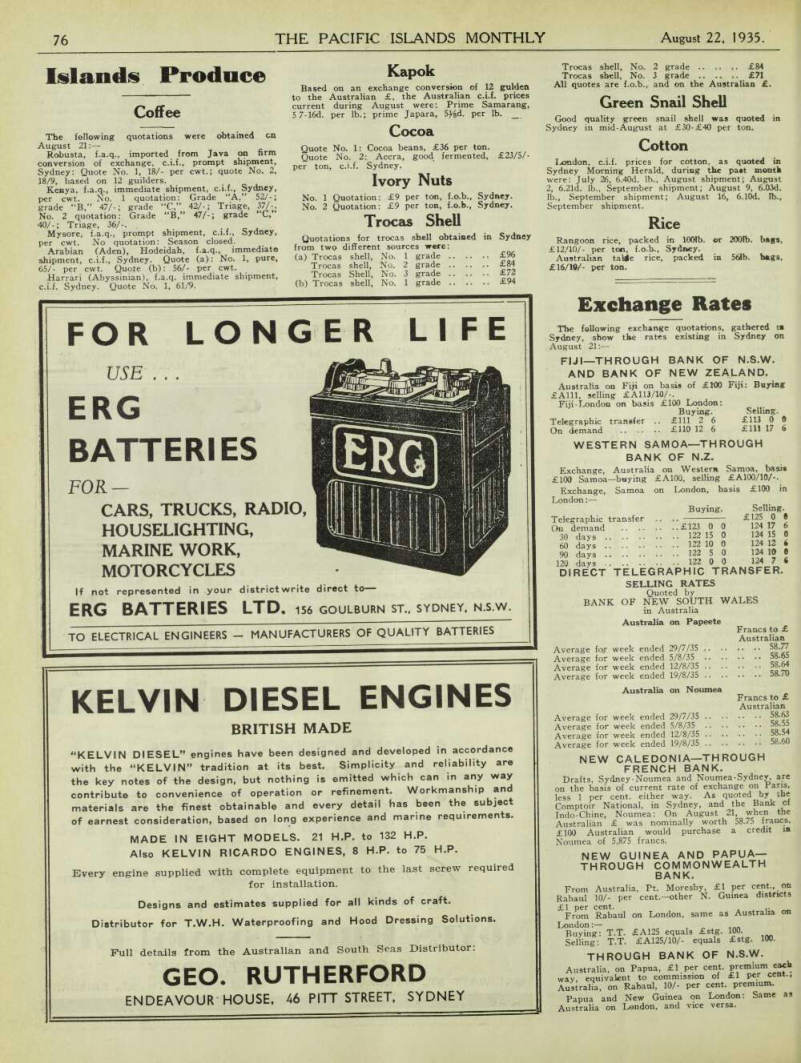
Coffee
The following quotations were obtained on August 21: — Robusta, f.a.q., imported from Java on firm conversion of exchange, c.i.f., prompt shipment, Sydney: Quote No. 1, 18/- per cwt.; quote No. 2, 18/9, based on 12 guilders.
Kenya, f.a.q., immediate shipment, c.i.f., Sydney, per cwt. No. 1 quotation; Grade “A,” 52/-; grade “B,” 47/-; grade “C,” 42/-; Triage, 37/-.
No. 2 quotation: Grade “B,” 47/-; grade C, 40/-; Triage, 36/-. . , e , Mysore, f.a.q., prompt shipment, c.i.f., Sydney, per cwt. No quotation; Season closed.
Arabian (Aden), Hodeidah, f.a.q., immediate shipment, c.i.f., Sydney. Quote (a): No. 1, pure, 65/- per cwt. Quote (b): 56/- per cwt.
Harrari (Abyssinian), f.a.q. immediate shipment, c.i.f. Sydney. Quote No. 1, 61/9.
Kapok
Based on an exchange conversion of 12 gulden to the Australian £, the Australian c.i.f. prices current during August were: Prime Samarang, 5 7-16 d. per lb.; prime Japara, Sy&d. per lb.
Cocoa
Quote No. 1: Cocoa beans, £36 per ton.
Quote No. 2; Accra, good fermented, £23/5/per ton, c.i.f. Sydney.
Ivory Nuts
No. 1 Quotation; £9 per ton, f.0.b., Sydney.
No. 2 Quotation; £9 per ton, f.0.b., Sydney.
Trocas Shell
Quotations for trocas shell obtained in Sydney from two different sources were; (a) Trocas shell, No. 1 grade £96 Trocas shell, No. 2 grade £B4 Trocas Shell, No. 3 grade £72 (b) Trocas shell, No. 1 grade £94
Trocas shell. No. 2 grade £B4 Trocas shell, No. 3 grade £7l All quotes are f.0.b., and on the Australian £.
Green Snail Shell
Good quality green snail shell was quoted in Sydney in mid-August at £3O-£4O per ton.
Cotton
London, c.i.f. prices for cotton, as quoted in Sydney Morning Herald, during the past month were: July 26, 6.40 d. lb., August shipment; August 2,6.21 d. lb., September shipment; August 9,6.03 d. lb., September shipment; August 16, 6.10 d. Ib., September shipment.
Rice
Rangoon rice, packed in 1001 b. or 2001 b. bags, £l2/10/- per ton, f.0.b., Sydney.
Australian tafcfe rice, packed in 561 b. hags, £l6/10/- per ton.
Exchange Rates
The following exchange quotations, gathered im Sydney, show the rates existing in Sydney on August 21: —
Fiji—Through Bank Of N.S.W.
And Bank Of New Zealand.
Australia on Fiji on basis of £lOO Fiji: Buying £AIII, selling £AII3/10/-.
Fiji-London on basis £lOO London: Buying. Selling.
Telegraphic transfer .. £lll 2 6 £ll3 0 0 On demand £llO 12 6 £lll 17 6
Western Samoa—Through
Bank Of N.Z.
Exchange, Australia on Western Samoa, basis £lOO Samoa —buying £AIOO, selling £AIOO/10/-.
Exchange, Samoa on London, basis £lOO in London: —
Direct Telegraphic Transfer.
Selling Rates
Quoted by
Bank Of New South Wales
in Australia
New Caledonia—Through
French Bank.
Drafts, Sydney-Noumea and Noumea-Sydney, are on the basis of current rate of exchange on Pans, less 1 per cent, either way. As quoted by the Comptoir National, in Sydney, and the Bank of Indo-Chine, Noumea: On August 21, when the Australian £ was nominally worth 58.75 francs, £lOO Australian would purchase a credit m Noumea of 5,875 francs.
New Guinea And Papua
Through Commonwealth
Bank.
From Australia, Pt. Moresby, £1 per cent., on Rabaul 10/- per cent.—other N. Guinea districts £1 per cent. . . „ From Rabaul on London, same as Australia on London: — Buying; T.T. £AI2S equals £stg. 100.
Selling: T.T. £AI2S/10/- equals £stg. 100.
Through Bank Of N.S.W.
Australia, on Papua, £l.per cent, premiumeact wav. equivalent to commission of £1 per cent., Australia, on Rabaul, 10/- per cent, premium.
Papua and New Guinea on London; Same as Australia on London, and vice versa.
Buying. Selling.
Telegraphic transfer .. .. £125 0 0 On demand £123 0 0 124 17 6 30 days 122 15 0 124 IS 0 60 days 122 10 0 124 12 6 90 days 122 5 0 124 10 0 120 days 122 0 0 124 7 i
Australia on Papeete Average for week ended 29/7/35 .. ..
Francs to £ Australian .. .. 58.77 Average for week ended S/8/35 .. . • Average for week ended 12/8/35 .. .. .. 58.64 Average for week ended 19/8/35 .. ..
Australia on Noumea Average for week ended 29/7/35 ..
Francs to £ Australian .. .. 58.63 Average for week ended 5/8/35 ..
Average for week ended 12/8/35 .. ..
Average for week ended 19/8/35 .. ..
Advertisements & other items, p. 78 (1 item)
Batteries
FOR LONGER LIFE
USE . . .
ERG
BATTERIES
FOR
CARS, TRUCKS, RADIO,
HOUSELIGHTING,
MARINE WORK,
MOTORCYCLES
If not represented in your district write direct to — ERG BATTERIES LTD. 156 GOULBURN ST.. SYDNEY. N.S.W.
TO ELECTRICAL ENGINEERS MANUFACTURERS OF QUALITY BATTERIES
KELVIN DIESEL ENGINES
BRITISH MADE
“KELVIN DIESEL” engines have been designed and developed in accordance with the “KELVIN” tradition at its best. Simplicity and reliability are the key notes of the design, but nothing is omitted which can in any way contribute to convenience of operation or refinement. Workmanship and materials are the finest obtainable and every detail has been the subject of earnest consideration, based on long experience and marine requirements.
MADE IN EIGHT MODELS. 21 H.P. to 132 H.P.
Also KELVIN RICARDO ENGINES, 8 H.P. to 75 H.P.
Every engine supplied with complete equipment to the last screw required for installation.
Designs and estimates supplied for all kinds of craft.
Distributor for T.W.H. Waterproofing and Hood Dressing Solutions.
Full details from the Australian and South Seas Distributor:
GEO. RUTHERFORD
ENDEAVOUR HOUSE, 46 PITT STREET, SYDNEY
market Quotations
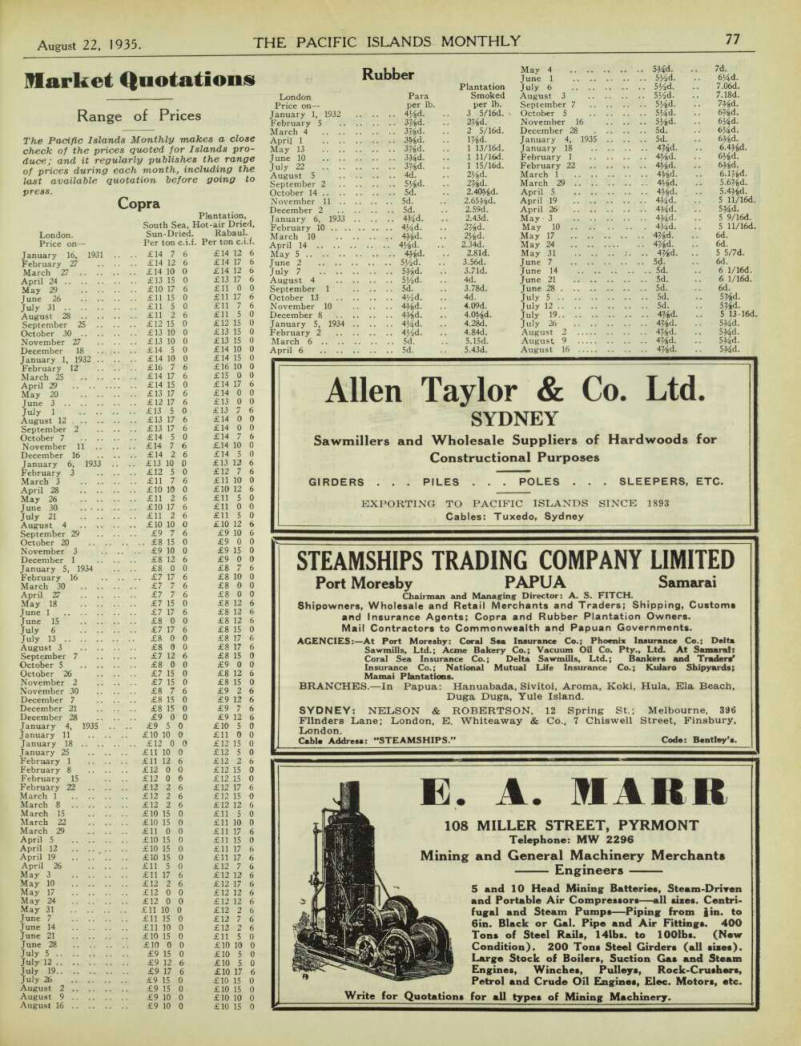
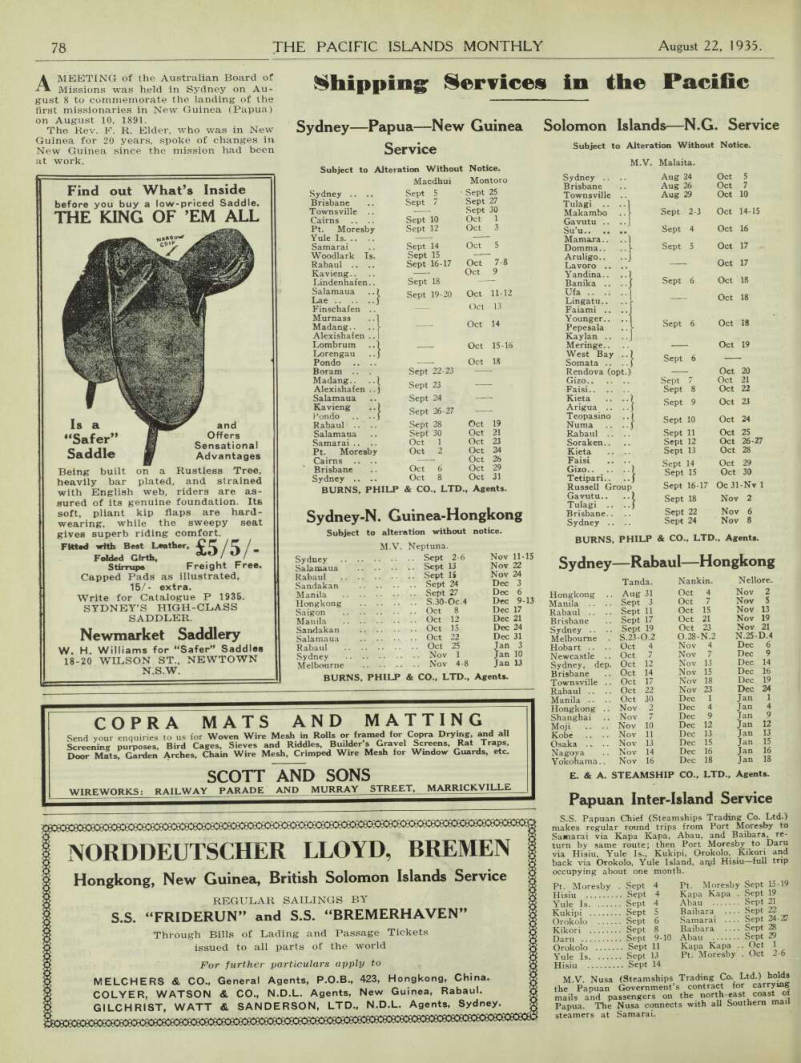
Range of Prices
The Pacific Islands Monthly makes a close check of the prices quoted for Islands pro duce; and it regularly publishes the range of prices during each month, including the last available quotation before going to press.
May 4 .. sy 4 d. . . 7d.
June 1 , . 6'Ad.
July 6 . .. Stfd. 7.06d, August 3 . .. 5j4d. . . 7.18d.
September 7 .. .. . .. 5/ 8 d. 7Jid.
October 5 ... . .. SHd. 6%d.
November 16 . .. s%d. ey 4 d.
December 28 ... . .. 5d. 6'Ad.
January 4, 1935 .. . .. 5d. 6V s d.
January 18 .. .. .. .. 4Jid. 6.45id.
February 1 . .. 4f$d. 6Jid.
February 22 .. .. . .. 45-id. 6Jid.
March 1 .. .. 4 $id. e.n/%d.
March 29 .. .. 45/gd. 5.6Hd.
April 5 .. .. 45-id. 5.45id.
April 19 . .. *V 4 d. . . 5 ll/16d.
April 26 . .. 4Hd. 554d.
May 3 .. .. 4Hd. 5 9/16d.
May 10 .. . 4Hd. 5 ll/16d.
May 17 . .. 47/sd. 6d.
May 24 .. 4?id. 6d.
May 31 .. 4ftd. 5 5/7d.
June 7 . .. Sd. 6d.
June 14 .. .. 5d. 6 l/16d.
June 21 .. .. 5d. 6 l/16d.
June 28 ,. .. Sd. 6d.
July 5 .. .. 5d. 5?id.
July 12 .. .. Sd. 5Jid.
July 19 .. .. 4Jid. 5 13-16d.
July 26 .. .. 47/gd. 554d.
August 2 .. .. 4Hd.
S^d.
August 9 .. .. 4fcd. . . sy 4 d.
August 16 .. .. 4*id. syd.
London
Rubber
Para Plantation Smoked Price on— per lb. per lb.
January 1, 1932 4/ 8 d. .. 3 5/16d. v February 5 3^d. 2%d.
March 4 3fcd. 2 5/16d.
April 1 ... 3^d. md.
May 13 .. .. 3Vid. 1 13/16d.
June 10 .. .. 3^d. 1 ll/16d.
July 22 .. .. 3^d. 1 15/16d.
August 5 4d. 2'Ad.
September 2 5^d. 27/ a d.
October 14 .. ..
Sd. 2.40fid.
November 11 .. 5d. 2.6Sjid.
December 2 5d. 2.59d.
January 6, 1933 4J4d. 2.43d.
February 10 .. .. 4*4d. 27/Sd.
March 10 .. 4*6d. 2/gd.
April 14 4^d. 2.34d.
May 5 4^d. 2.81d.
June 2 sy 3 d. 3.56d.
July 7 3.71d.
August 4 .. . sy 2 d. 4d.
September 1 5d. 3.78d.
October 13 .. 4^d. 4d.
November 10 4f£d. 4.09d.
December 8 .. 4J*d. .. 4.0^d.
January 5, 1934 4}4d. 4.28d.
February 2 .. 4'Ad. 4.84d.
March 6 .. .. 5d.
S.lSd.
April 6 5d. 5.43d.
London.
Price on— January 16, 1931
Copra
Plantation, South Sea, Hot-air Dried, Sun-Dried. Rabaul.
Per ton c.i.f. Per ton c.i.f. .. .. £14 7 6 £14 12 6 February 27 £14 12 6 £14 17 6 March 27 £14 10 0 £14 12 6 April 24 .. .. £13 15 0 £13 17 6 May 29 £10 17 6 £11 0 0 June 26 £11 15 0 £11 17 6 July 31 .. .. £11 5 0 £11 7 6 August 28 .. £11 2 6 £11 5 0 September 25 £12 15 0 £12 15 0 October 30 .. £13 10 0 £13 15 0 November 27 £13 10 0 £13 15 0 December 18 £14 5 0 £14 10 0 January 1, 1932 £14 10 0 £14 15 0 February 12 £16 7 6 £16 10 0 March 25 £14 17 6 £15 0 0 April 29 .. . £14 15 0 £14 17 6 May 20 £13 17 6 £14 0 0 June 3 .. .. £12 17 6 £13 0 0 July 1 £13 5 0 £13 7 6 August 12 £13 17 6 £14 0 0 September 2 £13 17 6 £14 0 0 October 7 £14 5 0 £14 7 6 November 11 £14 7 6 £14 10 0 December 16 £14 2 6 £14 5 0 January 6, 1933 £13 10 0 £13 13 6 February 3 £12 5 0 £12 7 6 March 3 £11 7 6 £11 10 0
April 28
£10 10 0 £10 12 6 May 26 £11 2 6 £11 5 0 June 30 £10 17 6 £11 0 0 July 21 £11 2 6 £11 5 0 August 4 £10 10 0 £10 12 6
September 29
£9 7 6 £9 10 6 October 20 .. £8 15 0 £9 0 0 November 3 . £9 10 0 £9 15 0 December 1 £8 12 6 £9 0 0 January 5, 1934 £8 0 0 £8 7 6 February 16 . £7 17 6 £8 10 0 March 30 £7 7 6 £8 0 0 April 27 £7 7 6 £8 0 0 May 18 £7 IS 0 £8 12 6 June 1 .. .. £7 17 6 £8 12 6 June 15 £8 0 0 £8 12 6 July 6 £7 17 6 £8 15 0 July 13 .. .. £8 0 0 £8 17 6 August 3 £8 0 0 £8 17 6 September 7 £7 12 6 £8 15 0 October 5 £8 0 0 £9 0 0 October 26 £7 IS 0 £8 12 6 November 2 £7 IS 0 £8 15 0 November 30 £8 7 6 £9 2 6 December 7 £8 15 0 £9 12 6 December 21 £8 15 0 £9 7 6 December 28 £9 0 0 £9 12 6 January 4, 1935 £9 5 0 £10 5 0 January 11 £10 10 0 £11 0 0 January 18 .. £12 0 0 £12 15 0 January 25 £11 10 0 £12 5 0 February 1 £11 12 6 £12 2 6 February 8 £12 0 0 £12 15 0 February 15 £12 0 0 £12 15 0 February 22 £12 2 6 £12 17 6 March 1 .. .. £12 2 6 £12 15 0 March 8 .. .. £12 2 6 £12 12 6 March IS £10 15 0 £11 5 0 March 22 £10 15 0 £11 10 0 March 29 £11 0 0 £11 17 6 April 5 .. .. £10 IS 0 £11 IS 0 April 12 .. .. £10 15 0 £11 17 6 April 19 .. .. £10 15 0 £11 17 6 April 26 £11 5 0 £12 7 6 May 3 .. .. £11 17 6 £12 12 6 May 10 .. .. £12 2 6 £12 17 6 May 17 £12 0 0 £12 12 6 May 24 £12 0 0 £12 12 6 May 31 .. .. £11 10 0 £12 2 6 June 7 .. .. £11 15 0 £12 7 6 June 14 .. .. £11 10 0 £12 2 6 June 21 .. .. £10 15 0 £11 5 0 June 28 .. . £10 0 0 £10 10 0 July 5 £9 15 0 £10 5 0 July 12 £9 12 6 £10 5 0 July 19 £9 17 6 £10 17 6 July 26 .. .. £9 IS 0 £10 IS 0 August 2 .. .. £9 15 0 £10 15 0 August 9 .. .. £9 10 0 £10 10 0 August 16 .. .. £9 10 0 £10 15 0
A MEETING of the Australian Board of Missions was held in Sydney on Au gust 8 to commemorate the landing of the first missionaries in New Guinea (Papua) on August 10, 1891.
The Rev. F. R. Elder, who was in New Guinea for 20 years, spoke of changes in New Guinea since the mission had been at work.
Advertisements & other items, pp. 79-80 (1 item)
E. A. Li A 1C It
Allen Taylor & Co. Ltd.
SYDNEY
Sawmillers and Wholesale Suppliers of Hardwoods for Constructional Purposes GIRDERS . . . PILES . . . POLES . . . SLEEPERS, ETC.
EXPORTING TO PACIFIC ISLANDS SINCE 1893
Cables: Tuxedo, Sydney
STEAMSHIPS TRADING COMPANY LIMITED
Port Moresby PAPUA Samarai
Chairman and Managing Director: A. S. FITCH.
Shipowners, Wholesale and Retail Merchants and Traders; Shipping, Customs and Insurance Agents; Copra and Rubber Plantation Owners.
Mail Contractors to Commonwealth and Papuan Governments.
AGENCIES:—At Port Moresby: Coral Sea Insurance Co.; Phoenix Insurance Co.; Delta Sawmills, Ltd.; Acme Bakery Co.; Vacuum Oil Co. Pty., Ltd. At Samaral: Coral Sea Insurance Co.; Delta Sawmills, Ltd.; Bankers and Traders' Insurance Co.; National Mutual Life Insurance Co.; Kularo Shipyards; Mamai Plantations.
BRANCHES.—In Papua: Hanuabada, Sivitoi, Aroma, Koki, Hula, Ela Beach, Duga Duga, Yule Island.
SYDNEY: NELSON & ROBERTSON, 12 Spring St.; Melbourne, 396 Flinders Lane; London, E. Whiteaway & Co.. 7 Chiswell Street, Finsbury, London.
Cable Address: “STEAMSHIPS.” Code: Bentley’s.
E. A. lI A 1C It
108 MILLER STREET, PYRMONT
Telephone: MW 2296 Mining and General Machinery Merchants
Engineers
5 and 10 Head Mining Batteries, Steam-Driven and Portable Air Compressors—all sizes. Centrifugal and Steam Pumps—Piping from Jin. to 6in. Black or Gal. Pipe and Air Fittings. 400 Tons of Steel Rails, 14lbs. to lOOlbs. (New Condition). 200 Tons Steel Girders (ail sizes).
Large Stock of Boilers, Suction Gas and Steam Engines, Winches, Pulleys, Rock-Crushers, Petrol and Crude Oil Engines, Elec. Motors, etc.
Write for Quotations for all types of Mining Machinery.
Find out What’s Inside
before you buy a low-priced Saddle.
THE KING OF ’EM ALL
V Is a and “Snfer” Hf Offers o jji Ja Sensational Saddle M Advantages Being built on a Rustless Tree, heavily bar plated, and strained with English web, riders are assured of its genuine foundation. Its soft, pliant kip flaps are hardwearing, while the sweepy seat gives superb riding comfort.
Fitted with Best Leather, £ / Folded Girth, ' ' Stirrups Freight Free.
Capped Pads as illustrated, 15/- extra.
Write for Catalogue P 1935.
SYDNEY’S HIGH-CLASS
SADDLER.
Newmarket Saddlery
W. H. Williams for “Safer" Saddles
18-20 WILSON ST.. NEWTOWN
N.S.W.
COPRA MATS AND MATTING
Send your enquiries to us for Woven Wire Mesh in Rolls or framed for Copra Drymg, and all Screening purposes. Bird Cages, Sieves d L Builder s Gravel Screens, Rat Traps.
Door Mats; Garden Arches, Chain Wire Mesh, Crimped Wire Mesh for Window Guards, etc.
SCOTT AND SONS
WIREWORKS: RAILWAY PARADE AND MURRAY STREET, MARRICKVILLE
NORDDEUTSCHER LLOYD, BREMEN
Hongkong, New Guinea, British Solomon Islands Service
REGULAR SAILINGS BY
S.S. “FRIDERUN” and S.S. “BREMERHAVEN”
Through Bills of Lading and Passage Tickets issued to all parts of the world For further particulars apply to MELCHERS & CO., General Agents, P. 0.8., 423, Hongkong, China.
COLYER, WATSON & CO., N.D.L. Agents, New Guinea, Rabaul.
GILCHRIST, WATT & SANDERSON, LTD., N.D.L. Agents, Sydney.
Sydney—Rabaul—Hongkong
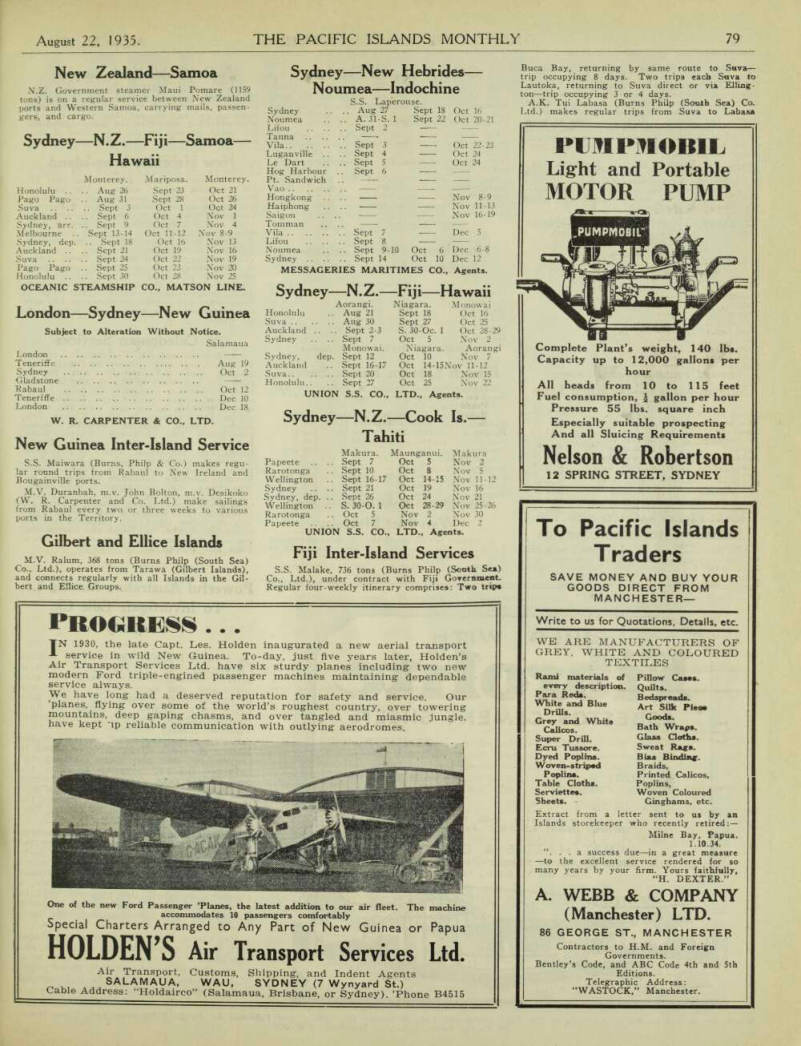
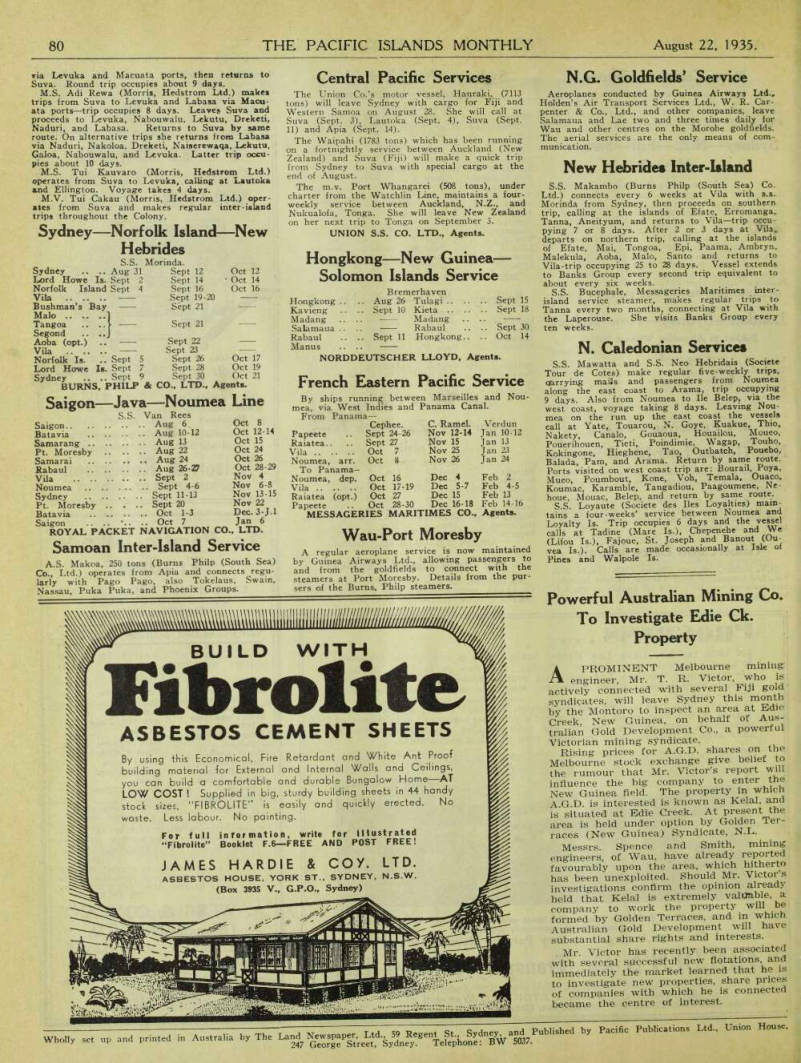
Shipping Services in the Pacific
Sydney—Papua—New Guinea
Service Subject to Alteration Without Notice.
Sydney-N. Guinea-Hongkong Subject to alteration without notice.
Solomon Islands —N.G. Service Subject to Alteration Without Notice.
Sydney—Rabaul—Hongkong
Papuan Inter-Island Service
S.S. Papuan Chief (Steamships Trading Co. Ltd.) makes regular round trips from Port Moresby to Samarai via Kapa Kapa, Abau, and Baibara, re turn by same route; then Port Moresby to Daru via Hisiu, Yule Is., Kukipi, Orokolo, Kikori and back via Orokolo, Yule Island, ai\d Hisiu —full trip occupying about one month.
Pt. Moresby . Sept 4 Pt. Moresby Sept 15-19 Hisiu Sept 4 Kapa Kapa . Sept 19 Yule Is Sept 4 Abau Sept 21 Kukipi Sept 5 Baibara Sept 22 Orokolo Sept 6 Samarai Sept 24-27 Kikori Sept 8 Baibara ... Sept 28 Daru Sept 9-10 Abau Sept 29 Orokolo Sept 11 Kapa Kapa .. Oct \ Yule Is Sept 13 Pt. Moresby . Oct 2-6 Hisiu Sept 14.
M.V. Nusa (Steamships Trading Co. Ltd.) holds the Papuan Government’s contract for carrying mails and passengers on the north-east coast ot Papua. The Nusa connects with all Southern mail steamers at Samarai.
Macdhui Montoro Sydney .. ..
Sept 5 Sept 25 Brisbane Sept 7 Sept 27 Townsville .. — Sept 30 Cairns .. ..
Sept 10 Oct 1 Pt. Moresby Sept 12 Oct 3 Yule Is — Samarai Sept 14 Oct 5 Woodlark Is.
Sept 15 Rabaul .. ..
Sept 16-17 Oct 7-8 Kavieng.. — Oct 9 Lindenhafen..
Sept 18 Salamaua
Lae
Sept 19-20 Oct 11-12 Finschafen .. — Oct 13 Murnass Oct 14 Madang.. . .}■ — Alexishafen .. Lombrum ..) Oct 15-16 Lorengau ..j Pondo — Oct 18 Boram ..
Sept 22-23 Madang..
Alexishafen ..) Sept 23 Salamaua Sept 24 Kavieng ..) Pondo .. ..) Sept 26-27 Rabaul ..
Sept 28 Oct 19 Salamaua Sept 30 Oct 21 Samarai .. ..
Oct 1 Oct 23 Pt. Moresby Oct 2 Oct 24 Cairns .. .. — Oct 26 Brisbane Oct 6 Oct 29 Sydney .. ..
Oct 8 Oct 31
Burns, Philp
& CO., LTD., Agents.
M.V.
Sydney Neptuna.
Nov 11-15 Salamaua .. Sept 13 Nov 22 Rabaul Nov 24 Sandakan .. Sept 24 Dec 3 Manila .. Sept 27 Dec 6 Hongkong Saigon .. S.30-Oc.4 Dec 9-13 .. Oct 8 Dec 17 Manila .. Oct 12 Dec 21 Sandakan .. Oct 15 Dec 24 Salamaua .. Oct 22 Dec 31 Rabaul .. Oct 25 Jan 3 Sydney .. Nov 1 Jan 10 Melbourne Jan 13
Burns, Philp
& Co., Ltd.,
Agents.
M.V.
Malaita.
Sydney ..
Aug 24 Oct 5 Brisbane . .
Aug 26 Oct 7 Townsville . .
Aug 29 Oct 10 Tulagi .. ■•1 Oct 14-15 Makambo •• Sept 2-3 Gavutu .. ..J Su’u.. ..
Sept 4 Oct 16 Maraara.. • •1 Oct 17 Domma.. ••1 Sept 5 Aruligo.. ••j Oct 17 Lavoro .. — Yandina..
Oct 18 Banika ..
Sept 6 Ufa .. ..
Oct 18 Lingatu.. — Faiami Younger..
Pepesala Sept 6 Oct 18 Kaylan ..
Meringe.. — Oct 19 West Bay Somata .. !
Sept 6 Rendova (opt.) — Oct 20 Gizo..
Sept 7 Oct 21 Faisi..
Sept 8 Oct 22 Kieta Arigua .. 1 Sept 9 Oct 23 Teopasino Numa Sept 10 Oct 24 Rabaul ..
Sept 11 Oct 25 Soraken.. ..
Sept 12 Oct 26-27 Kieta Sept 13 Oct 28 Faisi • • Sept 14 Oct 29 Gizo..
Tetipari.. i Sept 15 Oct 30 Russell Group Sept 16-17 Oc 31-Nv 1 Gavutu..
Tulagi .. •• Sept 18 Nov 2 Brisbane..
Sept 22 Nov 6 Sydney .. • • Sept 24 Nov 8
Burns,
Philp & Co., Ltd
., Agents.
Tanda.
Nankin.
Nellore.
Hongkong . . Aug 31 Oct 4 Nov 2 Manila . Sept 3 Oct 7 Nov 5 Rabaul Sept 11 Oct 15 Nov 13 Brisbane . Sept 17 Oct 21 Nov 19 Sydney .. . Sept 19 Oct 23 Nov 21 Melbourne S.23-( 0.2 0.28- N.2 N.25-D.4 Hobart Oct 4 Nov 4 Dec 6 Newcastle ..
Oct 7 Nov 7 Dec 9 Sydney, dep . Oct 12 Nov 13 Dec 14 Brisbane Oct 14 Nov 15 Dec 16 Townsville .. , Oct 17 Nov 18 Dec 19 Rabaul ..
Oct 22 Nov 23 Dec 24 Manila ..
Oct 30 Dec 1 Jan 1 Hongkong ..
Nov 2 Dec 4 Jan 4 Shanghai Nov 7 Dec 9 Jan 9 Moji ..
Nov 10 Dec 12 Jan 12 Kobe ..
Nov 11 Dec 13 Jan 13 Osaka .. ..
Nov 13 Dec 15 Jan 15 Nagoya Nov 14 Dec 16 Jan 16 Yokohama..
Nov 16 Dec 18 Jan 18 E. & A.
Steamship
CO.,
Ltd.,
Agents.
New Zealand—Samoa
N.Z. Government steamer Maui Pomare (1159 tons) is on a regular service between New Zealand ports and Western Samoa, carrying mails, passen gers, and cargo.
Sydney—N.Z.—Fiji—Samoa—
Hawaii
London —Sydney—New Guinea Subject to Alteration Without Notice.
New Guinea Inter-Island Service
S.S. Maiwara (Burns, Philp & Co.) makes regu lar round trips from Rabaul to New Ireland and Bougainville ports.
M.V. Duranbah, m.v. John Bolton, m.v. Desikoko (W. R. Carpenter and Co. Ltd.) make sailings from Rabaul every two or three weeks to various ports in the Territory.
Gilbert and Ellice Islands
M.V. Ralum, 368 tons (Burns Philp (South Sea) Co., Ltd.), operates from Tarawa (Gilbert Islands), and connects regularly with all Islands in the Gil bert and Ellice, Groups.
Sydney—New Hebrides — Noumea —Indochine
Sydney—N.Z.—Fiji—Hawaii
Sydney—N.Z.—Cook Is.— Tahiti
Fiji Inter-Island Services
S.S. Malake, 736 tons (Burns Philp (South Sea) Cos., Ltd.), under contract with Fiji Government.
Regular four-weekly itinerary comprises: Two tripe
Buca Bay, returning by same route to Suva— trip occupying 8 days. Two trips each Suva to Lautoka, returning to Suva direct or via Elling ton —trip occupying 3 or 4 days.
A.K. Tui Labasa (Burns Philp (South Sea) Cos.
Ltd.) makes regular trips from Suva to Labasa
Monterey.
Mariposa.
Monterey.
Honolulu .. .. Aug 26 Sept 23 Oct 21 Pago Pago Aug 31 Sept 28 Oct 26 Suva .. ..
Oct 1 Oct 24 Auckland .. .. Sept 6 Oct 4 Nov 1 Sydney, arr. .. Sept 9 Oct 7 Nov 4 Melbourne Sept 13-14 Oct 11-12 Nov 8-9 Sydney, dep . .. Sept 18 Oct 16 Nov 13 Auckland .. .. Sept 21 Oct 19 Nov 16 Suva .. ..
Oct 22 Nov 19 Pago Pago .. Sept 25 Oct 23 Nov 20 Honolulu .. .. Sept 30 Oct 28 Nov 25
Oceanic
Steamship
Co., Matson Line.
Salamaua London Teneriffe Aug 19 Sydney Oct 2 Gladstone Rabaul Oct 12 Teneriffe Dec 10 London Dec 18
W. R. Carpenter & Co., Ltd.
Sydney
S.S. Lap’erouse.
,. Aug 27 Sept 18 Oct 16 Noumea A. 31-S. 1 Sept 22 Oct 20-21 T if on Tdtin^ Vila Oct 22-23 Luganville .. .. Sept 4 — Oct 24 Le Dart .. Sept 5 — Oct 24 Hog Harbour . Sept 6 — — Pt. Sandwich — — — Vao —
Hongkong
— Nov 8-9 Haiphong — ■ Nov 11-13 Saigon . — Nov 16-19 Tomman — — — Vila — Dec 5 Lifou Sept 8 Noumea .. Sept 9-10 Oct 6 Dec 6-8 Sydney ..
Oct 10 Dec 12
Messageries Maritimes Co.,
Agents.
Aorangi.
Niagara.
Monowai Honolulu .. Aug 21 Sept 18 Oct 16 Suva .. .. .. Aug 30 Sept 27 Oct 25 Auckland .. .. Sept 2-3 S. 30-Oc. 1 Oct 28-29 Sydney .. .. Sept 7 Oct 5 Nov 2 Monowai.
Niagara.
Aorangi Sydney, dep. Sept 12 Oct 10 Nov 7 Auckland .. Sept 16-17 Oct 14-lSNov 11-12 Suva.. .. .. Sept 20 Oct 18 Nov 15 Honolulu.. .. Sept 27 Oct 25 Nov 22
Union S.S. Co.,
LTD., Agents.
Makura.
Maunganui.
Mak ura Papeete ..
Sept 7 Oct 5 Nov 2 Rarotonga Sept 10 Oct 8 Nov 5 Wellington Sept 16-17 Oct 14-15 Nov 11-12 Sydney .. ..
Sept 21 Oct 19 Nov 16 Sydney, dep. ..
Sept 26 Oct 24 Nov 21 Wellington S.30-0. 1 Oct 28-29 Nov 25-26 Rarotonga Oct 5 Nov 2 Nov 30 Papeete ..
Oct 7 Nov 4 Dec 2
Union
S.S. Co.,
, Ltd.
, Agents.
via Levuka and Macuata ports, then returns to Suva. Round trip occupies about 9 days.
M.S. Adi Rewa (Morris, Hedstrom Ltd.) makes trips from Suva to Levuka and Labasa via Macu ata ports—trip occupies 8 days. Leaves Suva and proceeds to Levuka, Nabouwalu, Lekutu, Dreketi, Naduri, and Labasa. Returns to Suva by same route. On alternative trips she returns from Labasa via Naduri, Nakoloa, Dreketi, Naiserewaqa, Lekutu, Galoa, Nabouwalu, and Levuka. Latter trip occu pies about 10 days.
M.S. Tui Kauvaro (Morris, Hedstrom Ltd.) operates from Suva to Levuka, calling at Lautoka and Ellington. Voyage takes 4 days.
M.V. Tui Cakau (Morris, Hedstrom Ltd.) oper ates from Suva and makes regular inter-island trips throughout the Colony.
Sydney—Norfolk Island—New
Hebrides
Saigon—Java—Noumea Line
Samoan Inter-Island Service
A.S. Makoa, 250 tons (Burns Philp (South Sea) Co., Ltd.) operates from Apia and connects regu larly with Pago Pago, also Tokelaus, Swain, Nassau, Puka Puka, and Phoenix Groups.
Central Pacific Services
The Union Co.’s motor vessel, Hauraki, (7113 tons) will leave Sydney with cargo for Fiji and Western Samoa on August 28. She will call at Suva (Sept. 3), Lautoka (Sept. 4), Suva (Sept. 11) and Apia (Sept. 14).
The Waipahi (1783 tons) which has been running on a fortnightly service between Auckland (New Zealand) and Suva (Fiji) will make a quick trip from Sydney to Suva with special cargo at the end of August.
The m.v. Port Whangarei (508 tons), under charter from the Watchlin Line, maintains a four weekly service between Auckland, N.Z., and Nukualofa, Tonga. She will leave New Zealand on her next trip to Tonga on September 3.
Union S.S. Co. Ltd., Agents.
Hongkong—New Guinea —
Solomon Islands Service
French Eastern Pacific Service
Wau-Port Moresby
A regular aeroplane service is now maintained by Guinea Airways Ltd., allowing passengers to and from the goldfields to connect with the steamers at Port Moresby. Details from the pur sers of the Burns. Philp steamers.
N.G. Goldfields’ Service
Aeroplanes conducted by Guinea Airways Ltd., Holden’s Air Transport Services Ltd., W. R. Car penter & Co., Ltd., and other companies, leave Salamaua and Lae two and three times daily for Wau and other centres on the Morobe goldfields.
The aerial services are the only means of com munication.
New Hebrides Inter-bland
5.5. Makambo (Burns Philp (South Sea) Co.
Ltd.) connects every 6 weeks at Vila with s.s.
Morinda from Sydney, then proceeds on southern trip, calling at the islands of Efate, Erromanga, Tanna, Aneityum, and returns to Vila —trip occu pying 7 or 8 days. After 2 or 3 days at Vila, departs on northern trip, calling at the islands of Efate, Mai, Tongoa, Epi, Paama, Ambryn, Malekula, Aoba, Malo, Santo and returns to Vila-trip occupying 25 to 28 days. Vessel extends to Banks Group every second trip equivalent to about every six weeks. 5.5. Bucephale, Messageries Maritimes inter island service steamer, makes regular trips to Tanna every two months, connecting at Vila with the Laperouse. She visits Banks Group every ten weeks.
N. Caledonian Service*
5.5. Mawatta and S.S. Neo Hebridais (Socictc Tour de Cotes) make regular five-weekly trips, parrying mails and passengers from Noumea along the east coast to Arama, trip occupying 9 days. Also from Noumea to He Belep, via the west coast, voyage taking 8 days. Leaving Nou mea on the run up the east coast the vessels call at Yate, Touarou, N. Goye, Kuakue, Thio, Nakety, Canalo, Gouaoua, Houailou, Moueo, Pouerihouen, Tieti, Poindimie, Wagap, Touho, Kokingone, Hieghene, Tao, Outbatch, Pouebo, Balada, Pam, and Arama. Return by same route.
Ports visited on west coast trip are: Bourail, Poya, Mueo, Poumbout, Kone, Voh, Temala, Ouaco, Koumac, Karamble, Tangadiou, Paagoumene, Ne houe, Mouac, Belep, and return by same route. 5.5. Loyaute (Societe des lies Loyalties) main tains a four-weeks’ service between Noumea and Loyalty Is. Trip occupies 6 days and the vessel calls at Tadine (Mare Is.), Chepenehe and We (Lifou Is.), Fajoue, St. Joseph and Banout (Ou vea Is.). Calls are made occasionally at Isle ot Pines and Walpole Is.
S.S. Morinda.
Sydney .. .. Aug 31 Sept 12 Oct 12 Lord Howe Is. Sept 2 Sept 14 • Oct 14 Norfolk Island Sept 4 Sept 16 Oct 16
Vjia
10- Bushman’s Bay Sept 21 Malo 1
Tangoa .. ..V
Sept 21 — Segond .. ..J Aoba (opt.) ..
Sept 22 — Vila Sept 23 — Norfolk Is. .. Sept 5 Sept 26 Oct 17 Lord Howe Is. Sept 7 Sept 28 Oct 19 Sydney .. .. Sept 9 Sept 30 Oct 21
Burns, Philp & Co.. Ltd.,
, Agents.
s.s.
Saigon Van Rees Oct 8 Batavia .. Aug 10-12 Oct 12-14 Samarang Oct IS Pt. Moresby .. Aug 22 Oct 24 Samarai Oct 26 Rabaul .. Aug 26-27 Oct 28-29 Vila Nov 4 Noumea Nov 6-8 Sydney . Sept 11-13 Nov 13-15 Pt. Moresby . . . .
Batavia . Sept 20 Nov 22 .. Oct 1-3 Dec. 3-J.l Saieon .. . . '. . .. Oct 7 Jan 6
Royal Packet Navigation Co., Ltd.
Bremerhaven Hongkong .. . Aug 26 Tulagi ..
Kavieng .. . Sept 10 Kieta ..
Madang .. . , Madang — Salamaua .. .
Rabaul .. .. Sept 30 Rabaul .. . . Sept 11 Hongkong, .. Oct 14 Manus .. . .
Norddeutscher Lloyd,
Agents.
By ships running between Marseilles and Nou mea, via West Indies and Panama Canal.
From Panama — Cephee.
C. Ramel.
Verdun Papeete Sept 24-26 Nov 12-14 Jan 10-12 Raiatea..
Sept 27 Nov 15 Jan 13 Vila Oct 7 Nov 25 Jan 23 Noumea, arr.
Oct 8 Nov 26 Jan 24 To Panama- Noumea, dep.
Oct 16 Dec 4 Feb 2 Vila Oct 17-19 Dec 5-7 Feb 4-5 Raiatea (opt.) Oct 27 Dec 15 Feb 13 Papeete Oct 28-30 Dec 16-18 Feb 14-16
Messageries
Maritimes Co.,
Agents.
Advertisements & other items, pp. 81-82 (1 item)
HOLDEN’S Air Transport Services Ltd.
PMPMOBIL
Light and Portable
MOTOR PUMP
Complete Plant's weight, 140 lbs.
Capacity up to 12,000 gallons per hour All heads from 10 to 115 feet Fuel consumption, J gallon per hour Pressure 55 lbs. square inch Especially suitable prospecting And all Sluicing Requirements
Nelson & Robertson
12 SPRING STREET, SYDNEY
To Pacific Islands
Traders
SAVE MONEY AND BUY YOUR
GOODS DIRECT FROM
MANCHESTER—
Write to us for Quotations. Details, etc.
WE ARE MANUFACTURERS Ol
GREY, WHITE AND COLOURED
TEXTILES
Rami materials of every description.
Para Reds.
White and Blue Drills.
Grey and White Calicos.
Super Drill.
Ecru Tussore.
Dyed Poplins.
Woven- striped Poplins.
Table Cloths.
Serviettes.
Sheets.
Pillow Cases.
Quilts.
Bedspreads.
Art Silk Pieoe Goods.
Bath Wraps.
Glass Cloths.
Sweat Rags.
Bias Binding.
Braids, Printed Calicos, Poplins, Woven Coloured Ginghams, etc.
Extract from a letter sent to u» by an Islands storekeeper who recently retired: — Milne Bay, Papua. 1.10.34.
“. . . a success due—in a great measure —to the excellent service rendered for so many years by your firm. Yours faithfully,
“H. DEXTER.’
A. WEBB & COMPANY
(Manchester) LTD.
86 GEORGE ST., MANCHESTER
Contractors to H.M. and Foreign Governments.
Bentley’s Code, and ABC Code 4th and sth Editions.
Telegraphic Address: “WASTOCK," Manchester.
progress ...
TN 1930, the late Capt. Les. Holden inaugurated a new aerial transport service in wild New Guinea. To-day, just five years later, Holden’s Air Transport Services Ltd. have six sturdy planes including two new modern Ford triple-engined passenger machines maintaining dependable service always.
We have long had a deserved reputation for safety and service. Our ’planes, flying over some of the world’s roughest country, over towering mountains, deep gaping chasms, and over tangled and miasmic jungle, have kept ip reliable communication with outlying aerodromes. a* 4 One of the new Ford Passenger ’Planes, the latest addition to our air fleet. The machine accommodates 10 passengers comfortably Special Charters Arranged to Any Part of New Guinea or Papua
HOLDEN’S Air Transport Services Ltd.
Air Transport, Customs, Shipping, and Indent Agents ok, . SALAMAUA, WAU, SYDNEY (7 Wynyard St.) Cable Address: “Holdairco” (Salamaua, Brisbane, or Sydney). ’Phone 84515
m
BUILD WITH
Fibrolite
ASBESTOS CEMENT SHEETS
By using this Economical, Fire Retardant and White Ant Proof building material for External and Internal Walls and Ceilings, you can build a comfortable and durable Bungalow Home— AT LOW COST ! Supplied in big. sturdy building sheets in 44 handy stock sizes. "FIBROLITE” is easily and quickly erected. No waste. Less labour. No painting.
For full information, write for Illustrated “Fibrolite” Booklet F.6—FREE AND POST FREE!
JAMES HARDIE & COY. LTD.
ASBESTOS HOUSE. YORK ST.. SYDNEY, N.S.W.
(Box 3935 V., G.P.0., Sydney)
Property
Powerful Australian Mining Co.
To Investigate Edie Ck.
A PROMINENT Melbourne mining engineer, Mr. T. R. Victor, who is actively connected with several Fiji gold syndicates, will leave Sydney this month by the Montoro to inspect an area at Edie Creek, New Guinea, on behalf of Aus tralian Gold Development Co., a powerful Victorian mining syndicate.
Rising prices for A.G.D. shares on the Melbourne stock exchange give belief to the rumour that Mr. Victor’s report "will influence the big company to enter the New Guinea field. The property in which A.G.D. is interested is known as Kelal, and is situated at Edie Creek. At present the area is held under option by Golden Ter races (New Guinea) Syndicate, N.L.
Messrs. Spence and Smith, mining engineers, of Wau, have already reported favourably upon the area, which hitherto has been unexploited. Should Mr. Victors investigations confirm the opinion already held that Kelal is extremely valuable, a company to work the property will be formed by Golden Terraces, and in which Australian Gold Development will have substantial share rights and interests.
Mr. Victor has recently been associated with several successful new flotations, and immediately the market learned that he is to investigate new properties, share prices of companies with which he is connected became the centre of interest.
Advertisements & other items, pp. 82-84 (2 items)
80
August 22, 1935.
THE PACIFIC ISLANDS MONTHLY
Wholly set up and printed in Australia by The n §W Pub, ' Ci “' OnS
Aerial Transport
PIONEERED AND CARRIE/ OK
THE NEW GUINEA GOLD INDU/TRY
H i * wm » Centre—One of the Bulolo Dredges under construction in Central New Guinea—three aeroplanes operated by Guinea Airways Ltd. discharging cargo.
Top right—Dairy cattle being loaded into a Guinea for transport to the Goldfields.
Lower left—lnterior of one of Guinea Airways aeroplanes. cargo-carrying SAFETY . . . SPEED . . . COMFORT . . . DEPENDABILITY ££IGHT years ago, Central New Guinea was almost unexplored, and practically inaccessible.
To-day, although there are no roads through the dense jungles and precipitous mountains, the Morobe Goldfield, in Central New Guinea, is the seat of a flourishing industry. There are half a dozen growing townships, four huge, modern dredges, two hydro-electric stations, crushing-mills, saw-mills, etc. . . Aerial transport alone made this possible.
Aeroplanes, flying in all weathers on regular timetables, connecting the coastal towns of Lae, Salamaua and Port Moresby with over thirty inland aerodromes and landing-grounds, have carried in thousands of tons of engineering equipment, a large European population! thousands of native labourers, foodstuffs, livestock, mails, etc.
Guinea Ait ways Ltd. launched its unique aerial transport service seven years ago, with one machine and a handful of men. To-day, it operates a fleet of modern aeroplanes, and employs very large European and native staffs.
GUINEA service aeroplanes carry on one of the biggest transport organisations in the world, in one of the world’s most primitive tropical countries; yet no aerial transport system in the world can show a smaller percentage of accidents, or a better record of efficiency and dependability.
A visit to Central New Guinea, in one of Gu'nea Airways speedy and comfortable air-liners, is a unique and delightful experience.
Travellers may leave the steamer at Port Moresby, fly across to Morobe (time of journey, 1 hour 4S minutes) and spend nine days in the Goldfield centres before rejoining steamer at Lae for Rabaul. Or, after visiting Rabaul, they may disembark at Salamaua or Lae, spend several days on the Goldfields, and fly to Port Moresby to rejoin the steamer. All information from Pursers on the steamers.
GUINEA AIRWAYS L™
LAE - SALAMAUA
as if. “ 2* gw p/f I ER W 1 \\|\.
I- 1 0 ') o r> 0 0 *) o ? f
WELCOME CARGO
"Lower away ” —and what a welcome cargo it is!
Resch’s Pilsener—in the famous long bottle— the drink which eases the white man’s burden!
Call for a bottle to-night and relish its malt and
hop flavour.
RESCH’S
LONG BOTTLE
PILSENER
c^. p\V5 ,\ t *** '/ a>. i W-J •t ST?
Y‘7 <S
mil
e R r"
Piu.. 27 pscH*
SI*CK
CK & 3&S ls^ eB Ls ENf pi
SSKf
fl tS Id o' 'S