Advertisements & other items, pp. 1-2 (2 items)
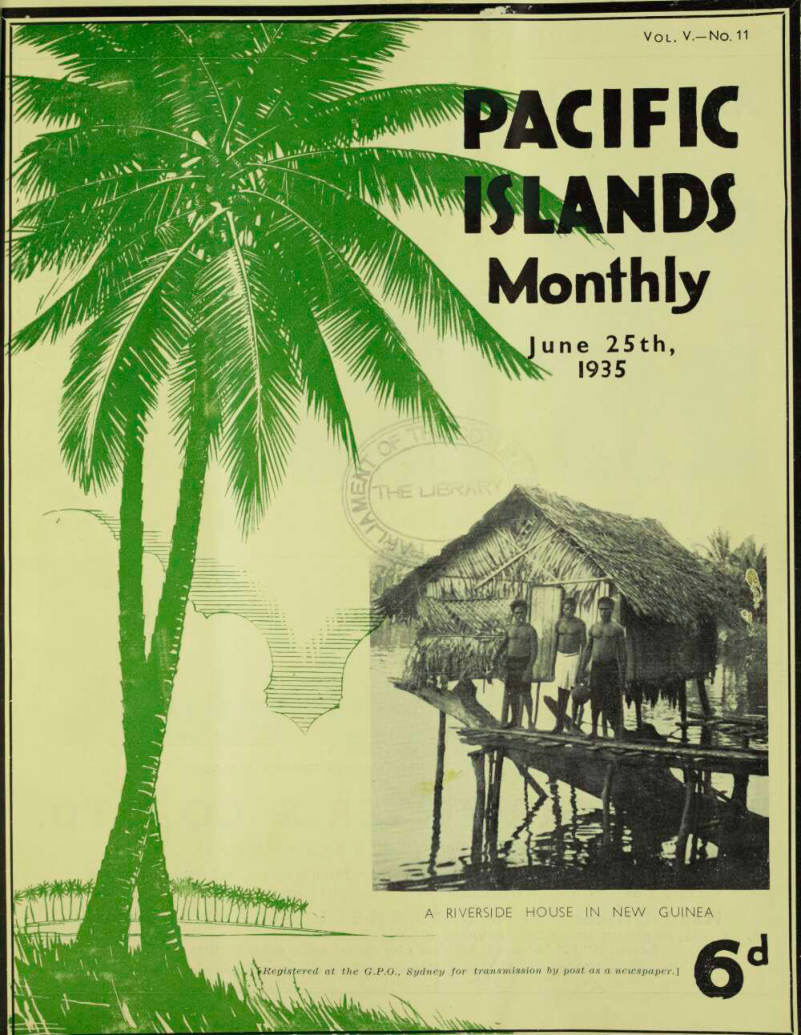
Pacific
ISLANDS
Mothly
VOL. V.-No. 11
June 25th, 1935
[Registered at the G.P.O., Sydney for transmission by post as a newspaper.]
6 d
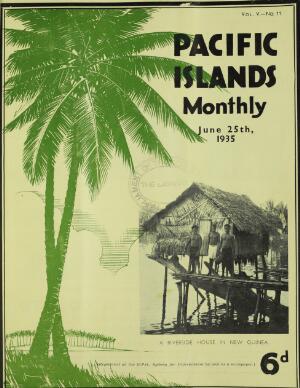
A RIVERSIDE HOUSE IN NEW GUINEA
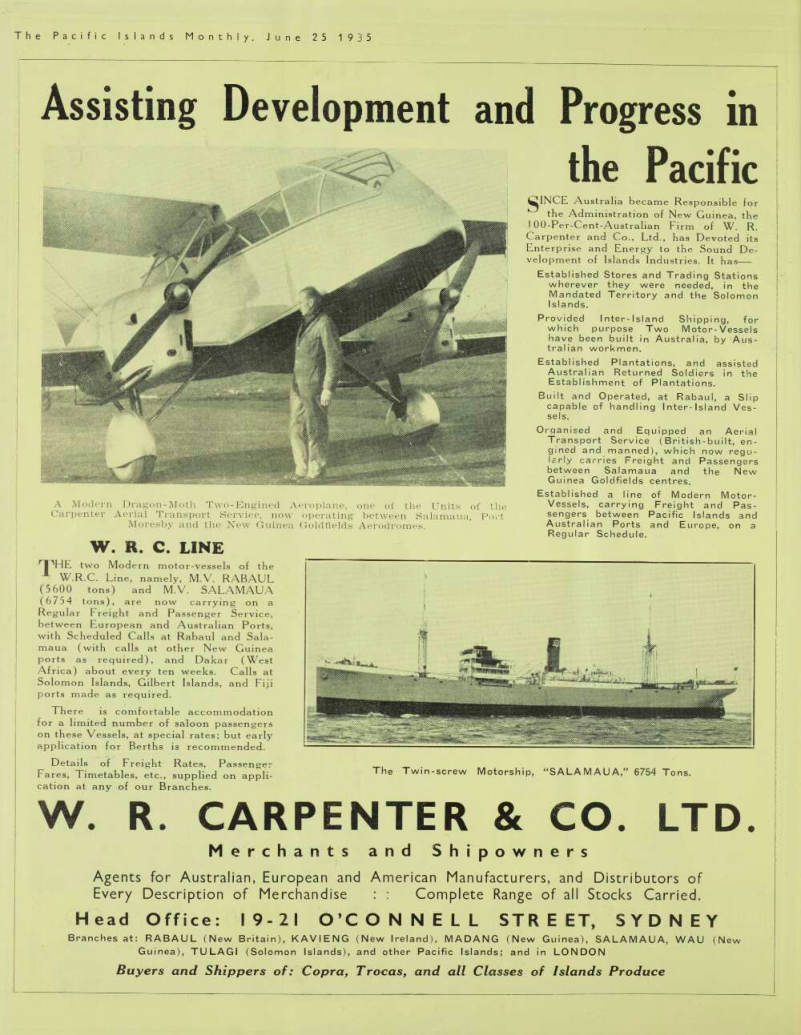
Assisting Development and Progress in
the Pacific
SINCE Australia became Responsible for the Administration of New Guinea, the 100-Per-Cent-Australian Firm of W. R.
Carpenter and Co., Ltd., has Devoted its Enterprise and Energy to the Sound Development of Islands Industries. It has- Established Stores and Trading Stations wherever they were needed, in the Mandated Territory and the Solomon Islands.
Provided Inter-Island Shipping, for which purpose Two Motor-Vessels have been built in Australia, by Australian workmen.
Established Plantations, and assisted Australian Returned Soldiers in the Establishment of Plantations.
Built and Operated, at Rabaul, a Slip capable of handling Inter-Island Vessels.
Organised and Equipped an Aerial Transport Service ( British-built, engined and manned), which now regularly carries Freight and Passengers between Salamaua and the New Guinea Goldfields centres.
Established a line of Modern Motor- A Modern Dragon-Moth Two-Engined Aeroplane, one of the Units of the Vessels, carrying Freight and Pas- Carpenter Aerial Transport Service, now operating between Salamaua, Port sengers between Pacific Islands and Moresby and the New Guinea Goldfields Aerodromes. Australian Ports and Europe, on a Regular Schedule.
W. R. C. LINE
THE two Modern motor-vessels of the W.R.C. Line, namely, M.V. RABAUL (5600 tons) and M.V. SALAMAUA (6734 tons), are now carrying on a Regular Freight and Passenger Service, between European and Australian Ports, with Scheduled Calls at Rabaul and Salamaua (with calls at other New Guinea ports as required), and Dakar (West Africa) about every ten weeks. Calls at Solomon Islands, Gilbert Islands, and Fiji ports made as required.
There is comfortable accommodation for a limited number of saloon passengers on these Vessels, at special rates; but early application for Berths is recommended.
Details of Freight Rates, Passenger Fares, Timetables, etc., supplied on application at any of our Branches.
W. R. CARPENTER & CO. LTD.
Merchants and Shipowners
Agents for Australian, European and American Manufacturers, and Distributors of Every Description of Merchandise : Complete Range of all Stocks Carried.
Head Office: 19-21 O’CONNELL STREET, SYDNEY
Branches at: RABAUL (New Britain), KAVIENG (New Ireland), MADANG (New Guinea), SALAMAUA, WAU (New Guinea), TULAGI (Solomon Islands), and other Pacific Islands; and in LONDON Buyers and Shippers of: Copra , Trocas , and all Classes of Islands Produce The Twin-screw Motorship, “SALAMAUA,” 6754 Tons.
Pacific Islands Travellers
Passengers Per Montoro Which Ar
Rived In Sydney From New Guinea
AND PAPUA ON MAY 18; Messrs. Arnold, Travers-Black, Burton, Carroll, Chance, Clarke, J.
B. Carroll, Chambers, Crabbe, Davis, Dougan, Fair hall (2), Farr, Furley, Gordon, Grove, Geake, Grant. Greene, Gallagher, Harse, Hindes, Innes, Kendrick Kerr, Kohnke (2), Light, Ludge, A.
Macdonald, A. E. McDonald, MacArthur, McLean, Mackie Moran, Mosely, McLaren, O’Mara. Penno, Pike, Rovere, Schuler, Sharp, Smith, Stephani, A. G. Stewart, Scott, J. Stewart, Stobo, Taylour, Teelmg, Turner, Richardson, Wallace, Wilkins, Williams. Wood; Mesdames Beck, Chance, Bur row, Crabbe, Dupain, Gillweiler, Hennessy, Hig gins, Light, Macarthur, Potter, Rouse, Sherman, Stewart, R chardson; Misses George, A. M. Cooper.
Fairhall, Gillweiler, Elson.
Passengers Per Malaita Which Ar
RIVED IN SYDNEY FROM SOLOMON IS. AND RABAUL (N.G.) ON MAY 21: Messrs. Affleck, Bent, Creighton, Chaize, Clarke, Forster, Kenyon, Kolster. Long, Murphy, Parsons, Parkes, Stack, Turner, Tarleton, Tam Nun, Webster, Wood, Wil liamson; Mesdames Atkinson, Abel, Bent, Caulton, Forster, Harrison. Phillips, Stack, Turner, Web ster, Whitlock; Misses Logan, Jones, LeFebre, Phillips, Reed.
Passengers Per Aorangi Which Sail
ED FROM SYDNEY FOR SUVA, FIJI, ON MAY 23: Mr. and Mrs. B. Millard, M. M. F. Horsfield, Dr. J. B. Stone, Mr. and Mrs. W. E. Mune, C. J.
Baldey, Sir Charles Marr, Mrs. J. E. Toy, Mr. and Mrs. M A. Mumford, F. H. Dafty, O. L.
Davidson, H. Boath F. B. Lowther Crofton, L.
Bessell, Miss B. Lowther Crofton, F. Dillon, Mrs.
H. B. Bowen, Captain W. H. Brett, R. D, Miller, Mr. and Mrs. H. E. Allear, Miss H. F. Mills, A.
Jorgensen, A. J. Phillips, C. S. Grant, H. A.
Cater, F. C. Beddoes, R. H. T. Brook, W. E.
Kelly, R. Graham, G. T. Byfield, Mr. and Mrs.
W. Logan, Miss R. H. Cuthbert, J. W. Peek, R.
A. Peek, G. E. Bessell, P. J. Klimeck, F. W.
Lee, I. Douglas.
Passengers Per Morinda Which Ar
Rived In Sydney From New Hebrides.
NORFOLK IS. AND LORD HOWE IS. ON MAY 27; Mr. A. H. Buckland, Mrs. E. Bradley, Mr.
R. Cantor, Mr. A. Copland, Mrs. D. Everett, Miss H. Every, Mr. E. L. Horton, Mr. S. G. Jones, Mr.
J. M. Nicol, Mrs. J. M.Nicol, Mr. G. Peacock, Master P. Pinney, Miss E. M. Schwabe, Mrs. E.
Thomson, Mrs. M. D. Wearn, Mr. K. S. Whitton, Miss E. Wilson, Mr. M. G. Ussher.
Passengers Per Malaita Which De
Parted From Sydney For Solomon Is.
AND RABAUL (N.G.) ON MAY 30: Messrs.
Simpson Kippax, Green, Nobbs, Captain Grant, Neill, Vance, Foulkes, Easton, Rear Admiral Bodell, Askew, Lee, Pilcher, Menzies, Clift, Grif fiths, Taylor, Clift, Ross, Murphy, Godward, Bil ton, Greenwood, Ault, Stevens; Mesdames Simp son, Kippax, McMaster, McNaught, Hackett, Nobbs, Wilson, Easton, Askew, Burgess, Marun, Ferris. Griffiths, Taylor, Stevens; Misses Ruther ford, Heath, Simpson, Svensen, Stewart (2), Deck, Angel, Sampson (3), Schrader, Fey.
Passengers Per Montoro Which Sail
ED FROM SYDNEY FOR PAPUA AND NEW GUINEA ON MAY 25: Messrs. Anderson, Allen, Bowen-Jones, Beckett, Robinson, James, Brown, Dodwell, Grieve, Digby, Forbes, Healy, Dr. Clem ents, Spier, Hitchcock, Pollard, Frame, Smith, Tor rington, Mullins, Bertie, Anderson. Livingstone, de Kantzow, Ridout, Stobo, Jones, Thomas, Clinton, Lowe, Munro, Robertson, Burt, Col. Baird, Maw son, Jackson, Innes Cooke, Burchett, Toogood, Poland, English, Contempree, Verrall, Denny, Dr.
Heaslip, Pomeroy, Brudo, Ritchie, Col. Hooper, Marjarson, Gibson, Burston, Crawley, McKibbin, Phibbs, Wilson, McAdam, Mackay, Coldham, David, Cowdery, Moy, McPherson, McKenzie, Leg gatt, Lucas, McClafferty, Harley, McMillan, Cruickshanks, Disney, Kay, Owers, Eldred, Gal lagher, Abbie, Lang, Moore, Johnson, Lang, Hughes, Yates, McLeod, Rudd, Waldby, Collett, Tracey, Bald, Smith, Ward, Holder, Zandro, Bartallotti, Dodds, Mosely, Henshilwood, Senyard, Taylor, Mackie; Mesdames Brown, Williams, Denny, Ga rad, Corke, Healy, Frame, Smith, Hea slip, Pomeroy, Owen-Turner, Brudo, Phibbs, Mac kay, Mills, David, Leggatt, Poland (2), Gurr, Anderson, Owers, Dodds, Taylor, Mackie; Misses Brown, Stephen, Devine, Brudo, Bellelis, Dawson, Poland, Robertson, Odermatt, Gardiner.
Passengers Per Macdhui, Which Ar
RIVED IN SYDNEY FROM PAPUA AND NEW GUINEA ON JUNE 7:—Messrs. Beck, Brett, Buik, Briggs, Cotton, Clappison, Clay, Carpenter, Ec clestone, Goodman, Gray, George, Heiner, Kmloch, Like, Macgregor, Mirow, Oldham, Payne, Parer, Rowe, Smith, McKay-Smith, J. Sinclair, Smart, Tyler, Tudor, Veale, Walker, Wallman, Woodman, H. Young. Mesdames Clapison, Dunstan, Gray, George, Heiner, Kinloch, Luff, Mitchell, McKay- Smith. Tyler, Turner. Misses Ashdown, McKay- Smith.
Passengers Per Morinda. Which
LEFT SYDNEY FOR LORD HOWE AND NOR
Folk Islands On June B:—Messrs. Bell.
Goldsmith, Hardy, Miller, MacPherson, Norton- Knight, Quintal, Masters Quintal (2), Messrs.
Rutherford, Ramsay, Upton. Mesdames Allen, Adams, Costin, Cashman, Goldsmith, Munro, Moss, MacPherson, Norton-Knight, Pinney, Quintal, Read. Misses Cavalier, Cashman, Cameron, Dit zell (2), Jackson, Moorhead, Smith, Stuart.
Passengers Per Macdhui, Which
Sailed For Papua And New Guinea
FROM SYDNEY ON JUNE 13;—Mr. Bock, Dr.
Simpson, Mr. G. Dyer, Rt. Rev. Dr. J. Bach, Rev.
Bro. P. E. Titz, Mr. Justice R. T. Gore, Messrs.
Sexton, Hirst, Townsend, Clark, Venables, Lane, Johnson, Angel, Tuckey, Pierce, Keyes, Dickson, McDonald, Jacobs, Thompson, Clark, Wales, How den. Rev. Dixon, Messrs. Rentoul, Chance, Wright, McMullen, Hutchinson, Spring, Dodd, Ryan, Thomas, Cruise, Forman, Miller, McConnell, Lees, Wilkinson, Chester, Collins, Wight, Clarke, Rowe, Whyte, Halliday, Spence, Lyon, Gallet, Bethune, Cousens, Vincent, Youll, Dean, Grabowsky, Jen nings, Boston, J. H. Curie, Dyason, Hill, McClel land, W. M. Nairn, Stacey, Price, Spehr. Mesdames Bock, Verral, Clark, Hallam, Schafer, Harris, James, Gore, Sexton, Marshall, Palmer, Chance, Dixon, Rentoul, Doyle, Ewing, McMullen, Cruise, Ryan, Collins, Nicholson, Jones, Gray, Armstrong, Heath, Cousens, Youll, Grabowsky, Barker, Bell maine, Boston, Hill. Dean, A. K. Smith, Spehr.
Misses McGahan, N. McGahan, Harris, Beebe, Shand, Kent, Chance. Campbell, Hanlon, Gray, Matron Miller, Misses Draney, Nicholson, Ritchie,
Saunders, Elliott, Best, Klotzbeucher, Maguire,
D Passengers Per Monterey Which Ar
RIVED IN SYDNEY FROM SUVA FIJI, ON AIAY 20: Allan Bowler, R. M. Boyd, Mr. and Mrs. G. Brotchie, Misses W. and B. Brotchie, Mr. and Mrs. H. W. Buckley, A. G. Campbell, J. Christensen, Pat Cody, J. F Kieran, W. G.
Lawler, F. Leahy, Mr. and Mrs. W. H. C.
Mayne, W. F. McGlynn, W Nicholson, J. V.
Ratcliffe, Mr. and Mrs. C. A. Reid, Mr and Mrs.
R. J. Sands, T. J. Shepard, Mr. and Mrs. H. C.
Tucker. Misses M. and E. Twopenny, Misses L. and H. Vaughan, Miss T. Victor, Dr. and Mrs.
L T. Ward, C. Burness, A. Burness, G. Lennox, Mr. and Mrs. I. E. Lucchinelli, W. B. McEwan, J. B. Williams, R. C. Wilson.
Passengers Per Monterey Which
LEFT SYDNEY FOR SUVA, FIJI, ON MAY 29; A. C. Chester, Miss Ella Clark, Mrs. E. B. Cos tello, Master D. Costello, Mrs. D. M. Costello, Miss Susan Ellis. Mrs. S. H. Ellis, Master J. Ellis G.
X. Goodsir, Rowland Green, J. Grieve, J. A. Gro mann, Miss E. Harper, T. J. Horne, C. Hunter, E.
Lewis, Miss Nancy Mac Queen, Mr and Mrs. R.
Mair, Miss A. McDonald T. McPherson, J. Mc- Pherson, Miss B. Moore, Mrs. K. A. Motley, Miss E. A. Motley, G. O’Byrne, Mrs. C. Wades, Miss E. W. Wailes, Miss M. Wallace, L. T. Warner, T.
H. Wynne-Lewis, Miss M. R. Anderson, Miss L Anderson, W. Cawrse, A. E. Cornish, E. Dun can, Miss S. M. Edmondson, Mrs. I. S. Eyre, S.
R. Grover, A. Halford, Miss M. Ker, Mrs. R. S.
Lyons. D. McCallum, J. Merrington, J. Parsons, Mrs. H. Parsons, A. Radley, A. Savery, Miss A.
Sewell, Mrs. E. Simpson, Master J. Simpson, Mrs.
Hedley Smith, J. W. Wiggett.
To Visit Morobe Goldfield
Mr. J. D. Ogilvie. Sydney manager for Thompson’s Engineering and Pipe Co.
Ltd., of Castlemaine, Victoria, the well known manufacturers of dredging and mining machinery, will leave Sydney for New Guinea by the Montoro on July 6.
He will visit the chief mining centres of the territory and intends to leave for Australia in August. Anyone wishing to interview Mr. Ogilvie may get in touch with him at the hotel in Wau.
Advertisements & other items, p. 3 (1 item)
bi-monthly by the "VAN REES"
HOLIDAY IN THE SOUTH SEAS
LORD HOWE IS. NORFOLK IS. BRAMPTON ISLAND
(Barrier Reef)
Days of Sunshine—Nights of Enchantment —Wonderful Scenery—Superb Climate. Ideal holiday resorts, good fishing, comfortable accommodation, reasonable tariff. For illustrated folder, sailings, steamer bookings, & island accommodation (free booking service) call or write
ARTHUR CRISP
ISLAND TOURIST AGENT, COMMERCIAL BANK BUILDING, 62 MARGARET ST., SYDNEY Telephones: B 2781—Y 5332 Accommodation arranged city or suburbs for island residents visiting Sydney
SAICON-BATAVIA-SAMARANG-PORT MORESBY
SAMARAI-RABAUL- PORT VILA-NOUMEA
SYDNEY - PORT MORESBY - BATAVIA- SAIGON
bi-monthly by the "VAN REES"
You will enjoy travelling by this popular, fast and modern steamer of the K.P.M., noted for its comfort, excellent cuisine, and economical tares.
With a fleet of over 130 vessels the K.P.M. Line is in a position to accept cargo for all ports in Netherlands India, and with transhipment at Batavia for Africa.
ROYAL PACKET NAVIGATION CO.
Paketvaart House, 255 George Street, Sydney
Diethelm & Co., Saigon; E. A. James, Port Moresby; Whitten Bros., Samarai; W. R. Carpenter & Co. Ltd., Rabaul; Gubbay Freres, Port Vila; Carlo Leoni, Noumea.
Advertisers
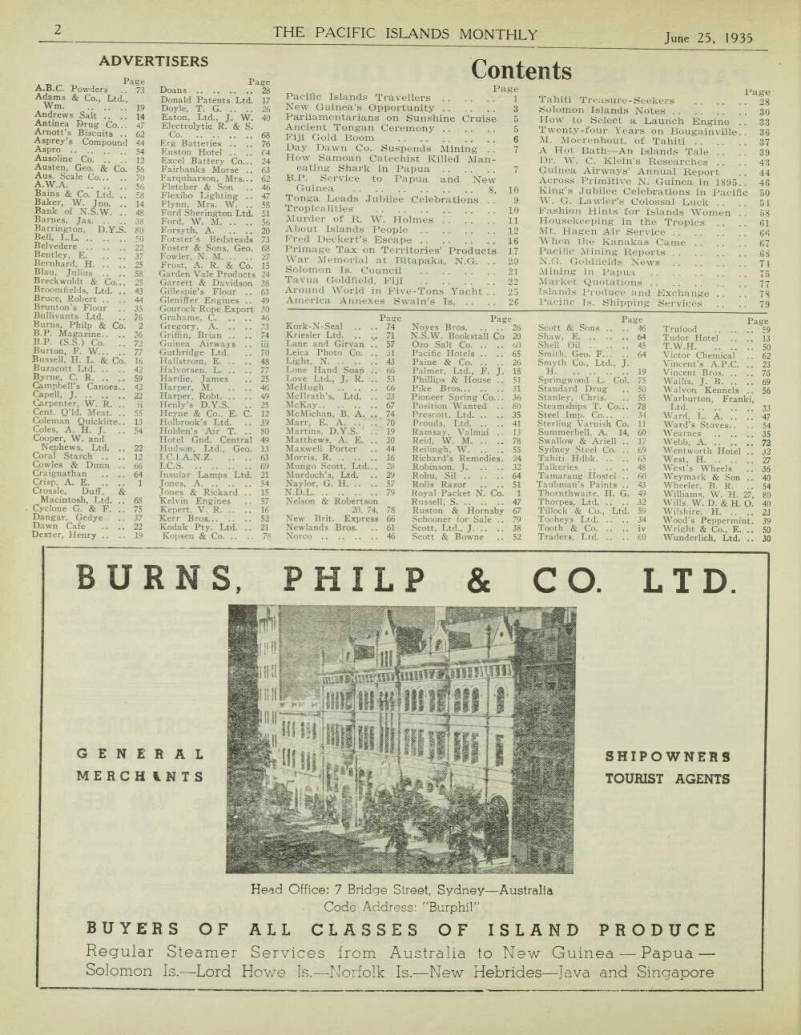
Page AB.C. Powders .. 73 Adams & Co., Ltd., Wm. 19 Andrews Salt .. .. 14 Antinea Drug Co... 47 Arnott’s Biscuits .. 62 Asprey’s Compound 44 Aspro 54 Ausoline Co. 12 Austen, Geo. & Co. 56 Aus. Scale Co. 70
A.W.A. 56
Bams & Co. Ltd. .. 58 Baker, W. Jno. .. 14 Bank of N.S.W. .. 48 Barnes, Jas. 38 Barrington, D.Y.S. 80 Bell, L.L. 50 Belvedere 22 Bentley, E. 37 Bernhard, H. 25 Blau, Julius .. .. 58 Breckwoldt & Co... 25 Broomfields, Ltd. .. 43 Bruce, Robert .. .. 44 Brunton’s Flour .. 35 Bullivants Ltd. .. 76 Burns, Philp & Co. 2 B.P. Magazine.. .. 36
B.P. (S.S.) Co. .. 72
Burton, F. W. 77 Bussell, H. L. & Co. 16 Buzacott Ltd. 42 Byrne, C. R. 59 Campbell’s Canoes.. 42 Capell, J. 22 Carpenter, W. R. .. ii Cent. Q’ld. Meat. .. 55 Coleman Quicklite.. 13 Coles, A. H. J. .. 54 Cooper, W. and Nephews, Ltd. .. 22 Coral Starch .. .. 12 Cowles & Dunn .. 66 Craignathan .. .. 64 Crisp, A. E. 1 Crossle, Duff, & Macintosh, Ltd. .. 68 Cyclone G. & F. .. 75 Dangar, Gedye .. 37 Dawn Cafe .. 22 Dexter, Henry .. .. 19
Page Doans 28 Donald Patents Ltd. 17 Doyle, T. G. 26 Eaton, Ltd., J. W. 40 Electrolytic R. & S.
Co. 68 Erg Batteries .. .. 76 Euston Hotel .. .. 64 Excel Battery Co... 24 Fairbanks Morse .. 63 Farquharson, Mrs... 62 Fletcher & Son .. 46 Flexibo Lighting .. 47 Flynn. Mrs. W. .. 58 Ford Sherington Ltd. 51 Ford, W. M. 56 Forsyth, A. 20 Forster’s Bedsteads 73 Foster & Sons, Geo. 68 Fowler, N. M. 27 Frost, A. R. & Co. 15 Garden Vale Products 24 Garrett & Davidson 38 Gillespie’s Flour .. 61 Gleniffer Engines .. 49 Gourock Rope Export 30 Grahame, C. .. .. 46 Gregory, A. 33 Griffin, Brian .. .. 74 Guinea Airways .. iii Guthridge Ltd. .. 70 Hallstrom, E. 48 Halvorsen, L. 77 Hardie, James .. 25 Harper, M. 46 Harper, Robt. 49 Henly’s D.Y.S. .. 25 Heyne & Co., E. C. 12 Holbrook’s Ltd. .. 39 Holden’s Air T. .. 80 Hotel Gnd. Central 49 Hudson, Ltd., Geo. 13
I.C.I.A.N.Z. 63
I.C.S. 69
Insular Lamps Ltd. 21 Jones, A. 54 Jones & Rickard .. IS Kelvin Engines .. 57 Kepert, V. R. 16 Kerr Bros. 52 Kodak Pty. Ltd. .. 21 Kopsen & Co. 78
Page Kork-N-Seal .. .. 74 Kriesler Ltd. .. 71 Lane and Girvan .. 57 Leica Photo Co. .. 31 Light, N. 43 Lone Hand Soap .. 66 Love Ltd., J. R. .. 53 McHugh 66 McIlrath’s, Ltd. .. 23 McKay 67 McMichan, B. A. .. 74 Marr, E. A. 70 Martins, D.Y.S. .. 19 Matthews, A. E. .. 30 Maxwell Porter .. 44 Morris, R. 16 Mungo Scott, Ltd... 28 Murdoch’s, Ltd. .. 29 Naylor, G. H. 57
N.D.L. 79
Nelson & Robertson 20, 74, 78 New Brit. Express 66 Newlands Bros. .. 61 Norco 46
Page Noyes Bros. 26 N.S.W. Bookstall Co 20 Ozo Salt Co. 60 Pacific Hotels .. .. 65 Paine & Co. 26 Palmer, Ltd., F. J. 18 Phillips & House .. 51 Pike Bros. 31 Pioneer Spring Co... 36 Position Wanted .. 80 Prescott, Ltd. 35 Prouds, Ltd. 41 Ramsay, Valmai .. 13 Reid, W. M. 78 Reilingh, W. 55 Richard’s Remedies. 24 Robinson, J. 32 Rohu, Sil 64 Rolls Razor .. .. 51 Royal Packet N. Co. 1 Russell, S. 47 Ruston & Hornsby 67 Schooner for Sale .. 79 Scott, Ltd., J. 38 Scott & Bowne .. 52
Page Scott & Sons .. .. 46 Shaw, E. 64 Shell Oil 45 Smith, Geo. F. 64 Smyth Co., Ltd., J.
H. 19 Springwood L. Col. 75 Standard Drug .. 50 Stanley, Chris. .. 55 Steamships T. Co... 78 Steel Imp. Co. 34 Sterling Varnish Co. 11 Summerbell, A. 14, 60 Swallow & Ariell .. 17 Sydney Steel Co. .. 69 Tahiti Hdbk. 65 Talkeries 48 Tamarang Hostel .. 60 Taubman’s Paints .. 43 Thornthwaite, H. G. 49 Thorpes, Ltd 32 Tillock & Co., Ltd. 59 Tooheys Ltd. 34 Tooth & Co. iv Traders, Ltd. 60
Page Trufood .. ... 59 Tudor Hotel .. .. 13
T.W.H. 50
Victor Chemical .. 62 Vincent’s A.P.C. .. 23 Vincent Bros. 76 Wallis, J. B. 69 Walvon Kennels .. 56 Warburton, Franki, Ltd. 33 Ward, L. A. .. .. 47 Ward’s Stoves.. .. 54 Wearnes 35 Webb, A. 72 Wentworth Hotel .. 32 West, H. 27 West’s Wheels .. 36 Weymark & Son .. 40 Wheeler, B. R. .. 54 Williams, W. H. 27, 80 Wills, W. D. & H. O. 40 Wilshire, H. 23 Wood’s Peppermint. 39 Wright & Co., E. .. 50 Wunderlich, Ltd. .. 30
Contents
Page Tahiti Treasure-Seekers 28 Solomon Islands Notes 30 How to Select a Launch Engine . . 33 Twenty-four Years on Bougainville.. 36 M. Moerenhout, of Tahiti 37 A Hot Bath—An Islands Tale . . . . 39 Dr. W. C. Klein’s Researches .. .. 43 Guinea Airways’ Annual Report . . 44 Across Primitive N. Guinea in 1895.. 46 King’s Jubilee Celebrations in Pacific 50 W. G. Lawler’s Colossal Luck . . . . 54 Fashion Hints for Islands Women . . 58 Housekeeping in the Tropics . . . . 61 Mt. Hagen Air Service 66 When the Kanakas Came 67 Pacific Mining Reports 68 N. Goldfields News 71 Mining in Papua 75 Market Quotations 77 Islands Produce and Exchange . . . . 78 Pacific Is. Shipping Services . . . . 79
Page Pacific Islands Travellers 1 New Guinea’s Opportunity 3 Parliamentarians on Sunshine Cruise 5 Ancient Tongan Ceremony 5 Fiji Gold Boom 6 Day Dawn Co. Suspends Mining . . 7 How Samoan Catechist Killed Man eating Shark in Papua 7 B.P. Service to Papua and New Guinea 8, 10 Tonga Leads Jubilee Celebrations .. 9 Tropicalities 10 Murder of R. W. Holmes 11 About Islands People 12 Fred Deckert’s Escape 16 Primage Tax on Territories’ Products 17 War Memorial at Bitapaka, N.G. . . 20 Solomon Is. Council 21 Tavua Goldfield, Fiji 22 Around World in Five-Tons Yacht . . 25 America Annexes Swain’s Is. 26
Advertisements & other items, p. 4 (1 item)
Burns. Philp & Co. Ltd.
GENERAL
MERCHANTS
Head Office: 7 Bridge Street, Sydney—Australia Code Address: "Burphil"
SHIPOWNERS
TOURIST AGENTS
BUYERS OF ALL CLASSES OF ISLAND PRODUCE Regular Steamer Services from Australia to New Guinea Papua Solomon Is.—Lord Howe Is.—Norfolk Is.—New Hebrides —Java and Singapore
The Pacific Islands Monthly
The Newspaper-Magazine Of The South Seas
[Registered at G.P.O., Sydney, for transmission by post as a newspaper.]
Published Once Each Month and Circulated in Australia and New Zealand and in the following Pacific Territories and Islands Groups;
Crown Colony of Fiji.
Australian Territory of Papua.
Mandated Territory (Australia) of New Guinea, Bismarck Archipelago, and Northern Solomon Islands.
Mandated Territory (Japan) of Marshall, Caroline and Marianna Islands.
French Territory of New Caledonia.
British and French Condominium of New Hebrides.
American Territory of Eastern Samoa.
American Territory of Guam.
Mandated Territory of Nauru.
British Crown Colony of Gilbert and Ellice Islands.
Mandated Territory (New Zealand) of Samoa.
British Solomon Islands Protectorate.
British Protectorate of Tongan Islands ; New Zealand Territory of Cook Islands.
Australian Territory of Norfolk Island French Colony of Oceania (Tahiti, etc.).
American Territory of Hawaiian Islands.
Owned and Produced by Pacific Publications Ltd., Onion House, 247 George Street, Sydney .
Telephone Bw 5037
P.O. Box 3408 R
Contributions Articles, Stories, and Photographs dealing with Pacific Islands Subjects are invited, and will be paid for on publication at usual rates.
Editor and Publisher:
R. W. Robson.
Advertisements Advertising rates furnished on application.
Colours, etc. by Arrangement.
Registered Address for Radiograms and Cables: “PACPUB” byaney
Subscription Rates Per Annum, within British Empire, Prepaid Post Free 6/- Per Annum, elsewhere, prepaid, Post Free .. 8/- Single Copies 6d.
Process Blocks made at Advertiser’s expense when required. Screen, 100.
Changes of Advertising Copy should reach this Office by 8th of each month, otherwise previous advertisement may be repeated.
Agents The following are authorised to receive subscrip tions for “The Pacific Islands Monthly - Islands Branches of Burns Philp & Co., Ltd., and Burns Philp (South Seas) Co., Ltd.
Islands Branches of W. R. Carpenter & Co.. Ltd.
All Branches of Morns, Hedstrom & Co., Ltd.
G. Thomas & Co., Rabaul.
Whitten Bros., Ltd.. Samarai.
P. Costello, Suva, Fiji.
I. Muir, Suva.
All Branches and Representatives of W. H. Grove and Sons, Ltd., Auckland.
S. Russell, Papeete, Tahiti.
Cook Islands Trading Co., Rarotonga.
Vol. V., No. 11.
Sydney, June 23, 1933.
Price 6d- Per Copy Prepaid: 6/- p.a.
New Guinea’S Opportunity
of the administration in New Guinea declare that, though a spirit of opportunism prevails, there is failure to take advantage of the present favour able conditions to make due provision for the future development of the Terri tory’s enormous natural resources.
The establishment of the gold industry on the Morobe field saved the New Guinea Administration from financial embarrassment during the depression years, in which period practically every other Islands government found it im possible to accommodate its fixed annual expenditure to its dwindling revenue.
But New Guinea, enjoying a steadily increasing revenue from its 5 per cent, royalty on gold produced, has been able to show, nearly every year, a substantial surplus. The accumulated surplus is not what it might be, because much of the funds thus obtained have been used to repay to the Australian Common wealth portion of the considerable loans made to New Guinea during the extrava gant regime of the war and post-war
periods. The figures are something like this:
The figures for 1934 are not available; but it is known that for 9 months, to March 31, 1934, the revenue was £264,739; expenditure, £256,933; and that £15,468 was repaid to Commonwealth. The Customs revenue for the year was not less than £140,000, and the gold royalty well over £60,000.
Incidentally, it is most difficult to examine the finances of this Territory: first, owing to the method of keeping the which are not adequately sum marised anywhere; and, secondly, owing to the exasperating delay in issuing the annual reports. The annual report for the year 1933-34, for instance, is still unavailable. However, the fact that in terests us at the moment is that the
Administration of New Guinea is deriv ing a very large and profitable and in creasing revenue from the gold industry —both directly, by way of royalty, and indirectly, by way of Customs revenue and incidental taxes and fees.
But, while the gold industry has been growing and developing, the remainder of the territory has been in a condition of virtual stagnation. The copra market, for the better part of two years, was unprofitable, or practically so, and the majority of planters have been hanging on “by the skin of their teeth,” and the assistance of the financial and trading institutions. One would have supposed, in these circumstances, that the Adminis tration would have made every effort to encourage and assist the establishment of industries other than coconut produc tion, and which would be based upon the country’s enormously rich natural resources. The Department of Agricul ture appears to have done what it could to encourage planters to cultivate crops as an alternative to coconuts, such as cocoa, coffee, kapok, peanuts, etc.; but the Administration generally has sat with folded hands and thanked God for the gold industry.
1930 £ 1931 £ 1932 £ 1933 £ Import duties .. 117,526 120,233 121,307 134,942 Export duties .. 61,419 48,058 28,079 10,635 Head tax 24,823 22.764 23,270 22,069 Gold Royalty 4,621 6,581 22,731 46,669 Public Service .. 38,305 31,601 43,499 29,988 Survey fees, etc. 43,299 12,616 17,727 30,012 Total Revenue .. 339,642 290,233 306,072 321,917 Total Expdture .. 356,312 293,377 282,404 321,567 Received from Commonwealth 7,000 Repaid to Commonwealth 1,103 1,159 8,218 29,537 Leaving due to Commonwealth 81,899 87,740 79,522 49,984
The first essential thing, in an Administration which seeks to develop a country’s primary industries, is a land policy. One of our correspondents says that the New Guinea land policy is neither intelligent nor vigorous. As a matter of simple fact, the N.G. Administration appears to have no land policy at all. By a land policy is meant a policy of selecting land suitable for European settlement; suggesting industries for which that land is suitable; encouraging people to take up the land and use it for production; and providing suitable transport facilities. All that has been done in this direction by the N.G. Administration in the last ten years could be written on one side of a postage stamp.
There are in New Guinea huge areas of fertile land, at various elevations, completely unoccupied by natives, just as it was in the beginning. It is land capable of producing any kind of tropical product. It is a country of abundant regular rainfall, where there is plenty of timber, plenty of running water, plenty of cheap native labour, and a super abundance of foodstuffs required for the labour lines. Moreover, it is a tax-free country —tax-free, at any rate, in comparison with frightfully overburdened states like Australia and New Zealand.
Medical science has made such strides during the last two decades that many of the terrors of tropical residence have been removed.
It may be said that it is no use encouraging settlement in such a place as New Guinea unless markets are assured —that settlement inevitably will follow the clear-cut and established demand for products upon which such settlement may be based. That is an unsound argument.
World conditions are such to-day that new settlement, based upon primary industries, must have a certain amount of governmental assistance; and New Guinea provides ideal conditions in this connection, because New Guinea has a very profitable gold industry, and much revenue is available therefore for the encouragement of new industries.
Now is the time to make the gold industry of New Guinea of permanent value to the territory. Gold is at an extraordinary value. It appears at present as if it will be maintained so for a considerable time, but there is no guarantee of that. The economic conditions which affect the whole world, and which govern the value of gold, are in a state of daily flux, and may be altered at any time. He is a very optimistic man, indeed, who accepts any favourable
condition arising from the gold industry as a permanent condition. He is a very wise man who seeks to use the present gold position as a means of encouraging and establishing other industries which give some promise of permanency; New Guinea, for some time to come, can expect about £50,000 per annum from gold royalties. That is a gift from the gods, and it would be a shocking thing if it were all frittered away in administration expenses. The administration of the Morobe goldfield, of course, represents an extra tax on the government: but that should be more than provided by the extra Customs revenue. A wise Administration would be indifferent to the demands of the services, and deaf to the blandishments of the Federal Treasurer, and would earmark that £50,000 per annum for the
permanent enrichment —through develop-
ment —of New Guinea.
There appears to be some truth in the criticism, which we frequently have
heard levelled against the N.G. Administration, that it is cursed with “a native complex.” It would seem that the Administration’s unwillingness to in augurate a vigorous policy of land settle ment is due to far too tender a regard for native land rights. It is the accepted axiom of British rule that native land rights shall be protected; but it is absurd and, indeed, ludicrous to argue that there are now, or ever will be, sufficient natives in New Guinea to occupy the unalienated lands. The rights of the natives can be fully guaranteed for a dozen generations or more, to come, while enormous areas of the land still unoccupied can be made available for
European settlement.
It is not necessary to contemplate a policy of permanent alienation of land.
The system under which the Government acts as trustee for the natives, and permits European occupation of the land on long-term leases, works quite satisfactorily in many tropical countries. The ownership of the lands thereby remains with the natives; and, if a position
should develop in the remote future when the native population has so increased that it requires the lands that have been leased, then the natives may resume possession. If that should not be necessary, the steadily increasing value of the lands under the occupation of Europeans is an increasing asset held for the benefit of the natives. The system that is being followed in New Guinea is of no use to the natives, to the Administration, or to anyone else.
Missionaries And Traders
The publication of a long article, embodying several strongly-worded letters to the editor, on the above subject, has been postponed until July, owing to pressure on space.
Also held over, for the same reason, are contributions relating to the administration of justice in New Guinea.
Knighthood for General Hart
A KNIGHTHOOD has been conferred upon Brigadier-General H. E. Hart, D.S.O., C.B., C.M.G., V.D., who has been Administrator of Western Samoa since 1931.
All who are acquainted with conditions
in that part of the Pacific will be glad that this honour has been awarded to General Hart. His has been an unenviable task. He took charge of the Territory when it was seething with discontent, the result of blundering administration, and of stupid interference by politicians totally in experienced in tropical government; and his exemplary patience and unvarying kindliness and
courtesy have done much to bring peace and quietness to “the Ireland of the Pacific.” It is doubtful if New Zealand will ever re-establish the prestige of the Union Jack in Samoa, but that is not the fault of General Hart. He can be congratulated upon his work, and upon his well-deserved award.
It was reported from Samoa at the end of May that General Hart’s term as Administrator of Samoa will terminate in July. His successor has not yet been named, but it is believed in some quarters, that Judge Ayson, Resident Commissioner in the Cook Islands, may receive the appointment.
Brig.-General H. E.
Hart.
To Manage Enterprise N.L.
Harold Taylour
Mr. Harold Taylour, Who For
several years has rendered distinguished service as Mining Warden at Wau, New Guinea, arrived in Sydney en route to Melbourne by the Montoro in May; and, later, accompanied by his wife and son, he sailed for the East, on furlough.
While in Australia, Mr. Taylour accepted the position of general manager of the activities in New Guinea of Enterprise of New Guinea, N.D., which is vigorously pushing ahead with operations on its areas in the Upper Watut River district, on Suprise Creek, and at Oriabanda.
No announcement has been made; but this presumably means that Mr. Taylour has resigned from the N.G. public service.
It is a serious loss to the Administration, but Enterprise, N.L., has secured a valuable man.
Sunshine Cruise
Six Members on a Sunshine Cruise Opportunities for New Guinea Hospitality
THE following inconspicuous paragraph appeared in the Sydney newspapers on June 5: “Interest in New Guinea problems has led Mr. J. T. Jennings, M.P., (leader), and Messrs. A. Lane, McClelland, Price, Stacey, and Nairn, members of the Commonwealth Parliament, to sail by the Macdhui next week to spend about two weeks in the Territory on an unofficial investigation.
The Administrator, General McNicol, will give them facilities.”
On behalf of the residents of New Guinea, we can only hope for the best; but we fear the worst —and that is, that these six worthy Parliamentarians are merely following the ways of their kind all the world over.
Solemnly assuring the respectful reporters that they are “to spend two weeks on an unofficial investigation in the Territory,” they actually are going to enjoy a sunshine cruise to the Islands, thus escaping the depth of the Australian winter.
The information they will gather in two weeks will be worse than useless. Tropical administration is a job for trained experts, and has no relation whatever to the accursed system which gives us Party Governments, professional politicians, and “democratic” Parliaments. What can they know of New Guinea who only the New Guinea ports know? What can they learn in a fortnight, running round on the Macdhui?
They will have a hundred conflicting tales poured into their ears, and they necessarily will get their views of New Guinea affairs from odd angles. They will return to Canberra to pose asauthorities on the Pacific —the shorter their stay in the Islands, the more confidently do such tourists advance their opinions!—and they probably will make themselves a well meaning nuisance to the Administrators of New Guinea and Papua.
However, they travel as Parliamentarians —with the usual substantial transport concessions, no doubt —and we hope they will have a pleasant trip.
New Guinea hospitality is famous: and, if our friends there only will rise to the occasion, and keep this little band of kindly gentlemen more or less under the influence of Messrs. Tooth and Toohey during the two weeks’ visitation —it is a fine old Islands custom —they will be doing the Territories a real service.
The foregoing is written sorrowfully, rather than offensively. This writer, on about seven different occasions, has had opportunities for seeing the results of Parliamentary jaunts to the Islands, from both Australia and New Zealand, and is of opinion that such things should be forcibly suppressed.—R.W.R.
WAU, June 7. —It is reported here that a party of six politicians (U.A.P. and Country Party) will visit us by the June Macdhui, and that another party (Lang-Labour members) will follow on the Montoro. Help!
Copra Market
COPRA prices did not vary much until mid-June. Then a sharp fall occurred; but the steady, slow improvement in the world’s economic condition is constantly being checked by political disturbances and war alarms. Thus, in recent weeks, we have had the threat of financial chaos in France; the increasing tempo of German armaments; Italy’s defiance of the Powers over Abyssinia; the belligerence of Japan in Northern China; and the sensational N.I.R.A. collapse in America.
The sharp fall in mid-June is said to be due to the “Combine,” which is using purchases of whale oil, etc., to attack copra sellers.
Copra growers should not lose heart.
The world statistical position affecting oil seeds is quite sound. There has been no fall in the price of oil —only in copra.
Prices should recover shortly.
New Stores at Lae
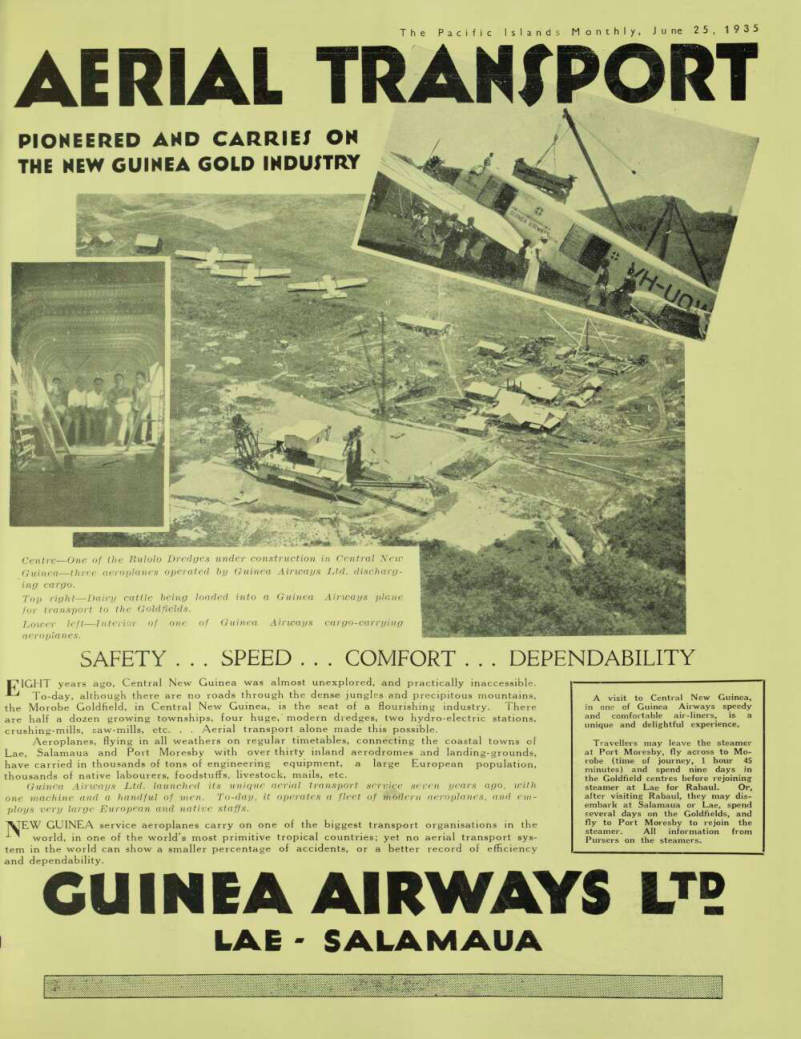
GUINEA AIRWAYS LTD., the company which conducts the major aerial transport service on the New Guinea gold fields, is extending its premises at Lae.
Included in the building programme is a new overhaul shop and store, which will cover an area of 128 sq. ft. The steel frame structure has 4-ton trusses, giving a clear span of 120 ft. This enables the largest Junkers plane to be taken right inside the building for overhaul, while provision is being made for a second machine to have engines changed at the same time, without any congestion.
The building will be complete with runway (for engine changing), machine and welding shop, and engine and spare parts store. The existing buildings will be dismantled and re-erected as a carpenter’s shop.
A new cargo store. 70ft. by 50ft., is also being erected for Bulolo Gold Dredging Ltd., at Lae. The building also of steel frame will be equipped with a three-tons crane for handling heavy machinery. A railway truck will run through the store and out on to the aerodrome, so as to facilitate the loading and unloading of cargo from the Bulolo Co.’s big Junkers planes.
The contractor for these works is the Sydney Steel Company Ltd., of Marrickville, New South Wales. All the heavy material for the new stores has been successfully carried in, in sections, to the field from the coast by Guinea Airways Ltd.
Reflection of the torch lights in Nukualofa lagoon.
Appointed Catholic Bishop
Rev. J. M. Aubin
Appointed Catholic Bishop of South Solomon Is.
IN succession to the late Bishop Aloysius Raucaz, S.M., who died in Sydney in July last year, Right Rev. J. M. Aubin, S.M., of Tangarare, has been appointed Vicar Apostolic of the Southern Solomon Islands and Titular Bishop of Telepte.
The Bishop-Elect was born at Chateaubriant, in the Diocese of Nantes, France, on December 29, 1882. After completing his studies in his native town, he entered the Great Seminary of Nantes, and was ordained priest in 1906. Shortly afterwards, he joined the Society of the Marist Fathers and sailed in 1907 for the Solomon Islands.
Rev. Aubin was stationed first at Rua Sura as Procurator of the Mission and secretary to Bishop Bertreux, first Bishop of the South Solomon Islands. Upon the death of Bishop Bertreux, he was given charge of Ruavatu district, on the north coast of Guadalcanal.
In 1928 he was elected delegate to the Chapter-General of the Marist Order held in Rome. Subsequently, he was appointed Pro-Vicar of Mission in the Solomon Islands, and was elevated to Superior upon the death of Bishop Raucaz.
The Very Reverend Father Aubin will arrive in Sydney by the Malaita on July 1 to make arrangements for his episcopal consecration.
Ceremony
Ancient Tongan
First Time for 50 Years
For the first time for 50 years, the Tuhakabakanava ceremony was performed in Tonga, at Nukualofa, on May 6, to celebrate the jubilee of King George V.
The ceremony was carried out by 1500 native children. They were placed, at regular intervals, along six miles of beach around Nukualofa, and each had a supply of brushwood torches, which burn long and brilliantly.
At a prearranged signal, at 7 p.m.—the firing of a gun—each youngster lit a torch. The effect was extraordinary. The long line of lights was reflected in the
quiet waters of the lagoon—there was about it a suggestion of fairy land. The display lasted for an hour.
This was the highest honour that could be paid to His Majesty King George.
The last time this ceremony was performed by the Tongans was over 50 years ago and in honour of their own King George of Tonga — a man both reverenced and feared.
The origin of this ceremony seems to be now unknown. All that is known is that it is the greatest compliment the Tongans can bestow.
Matt Crowe
I met him first in distant Perth This tall and robust man— I’ve often seen him prove his worth As only brave men can.
His height was fully six feet six; A mighty breadth of chest — T’was tough on others should he mix A tumble with the best.
For years Old Matt I had not seen Till came his Yodda strike; He made it after he had been To Yukon and Klondike, Looking gray and gaunt and old, And bent and slightly lame — It seemed the bitter Yukon cold Had shrunk that mighty frame.
But still his heart was good and sound And hopeful as of old.
He and mates soon battled round And found the Yodda gold.
Grim danger he would never shirk His quick hand on a gun.
A lot of pioneering work This tall gray man has done.
Few people understood Old Matt They feared his caustic wit; But I had soon discovered that A straight man, full of grit.
Few as good as he are found And I should surely know — For many years I battled round As mates with long Matt Crowe.
Now old Matt has passed away: No more he’ll take the track; There’s many left who wish that they Could only call him back.
We follow on quite blindly But we know we have to go: May they think of us as kindly As we think of long Matt Crowe.
Frank Pryke.
Fiji Gold Boom
Interest and Speculation Still at Fever Heat
GOLD excitement in Fiji still runs at fever heat.
The Colony has been overrun during the past couple of months by men of all kinds, who have arrived from all parts of the world to get in early on what is confidently believed to be a rapidly developing gold industry.
The cold fact of the matter, however, is that up to date only one mine has been proved—Mr. Theodore’s Emperor Mine at Tavua. Mr. Theodore is there, personally directing operations. Good gold has been obtained there, and it is expected that values will increase richly as the shafts go down.
All round the Emperor Mine, and all along the river valleys, right across the island of Viti Levu, down to the vicinity of Suva itself, prospectors are at work.
A huge area of country has been pegged, and operations to prove values are proceeding. Crushing is planned on the leases in the Tavua district, while they are talking of dredging in the valleys of the tributaries of the Rewa.
Many notable men have been in Fiji lately; and many stirring plans have been made for the development of Fiji—always provided that gold values are proved. But it is to be remembered, still, that even on the leases close to the Emperor Mine, in the Tavua district, values are not yet proved.
There is talk of a hydro-electric scheme to supply light and power to the whole of Viti Levu.
At least three different interests, which plan seaplane and aeroplane services to
operate in connection with the developing goldfields, have been represented in Fiji recently.
Mr. Theodore is still the “mystery man” of Fiji—he works hard, but gives very little indication of his plans. Persistent rumour says that an amalgamation of the Emperor Mine with the Loloma and Koroere leases adjoining is likely. It seems a feasible and logical development. But reports from Melbourne are to the effect that Mr. P. F. Cody (who with Mr.
Theodore, Mr. John Wren and Mr. Frank Packer comprise the group which owns the Emperor Mine) is strongly opposed to such an amalgamation. He says that they have spent £80,000 on the mine, and that there is no reason why they should share with any other group the rich profits that are confidently anticipated.
Mr. Cody said that enough ore was in sight to keep the mill occupied for many years. The last crushing had returned about 450 ozs. of bullion (850 parts fine) from 300 tons of ore. Additions were being made to the settling tank and filtration sections, and when completed the mill could treat 500 tons weekly.
Meanwhile the Government, while giving all reasonable encouragement to prospectors, and facilities to the extraordinary number of new companies which have sprung up, is proceeding with caution.
Licenses are being renewed by a special board, but only after careful enquiry. Mr.
J. C. Grieve, formerly a Victorian mining inspector, has been appointed Mining Adviser to the Fiji Government. Mr. H.
H. Gibson, formerly of the New Zealand Mines Department, has been appointed secretary of the Mining Board.
Sugar production had already made Fiji one of the richest British Colonies. Fiji felt the 1931-1934 depression less than any Territory in the Pacific. It now appears as if, in that fortunate clime, wealth is to be piled on wealth—for it is beyond question that, if the confident predictions of
Fiji Hindus
Sanatan Dharm Conference at Nadi
AS an indication of the activities of the large and growing body of Indians in Fiji, it is interesting to note that the Second Annual General Conference of the Sanatan Dharm was held at Nadi, Viti Levu, in April. The Sanatan Dharm is a powerful Indian religious sect, and has a large following in Fiji.
The celebrations commenced with a picturesque procession, which included many school children carrying coloured religious flags. The parade of the followers of the Sanatan Dharm was headed by a Punjabi
band. Later, Hindu scholars preached to the assembly of the principles upon which their religion is founded.
The following day the Conference, under the chairmanship of Pundit Hardeoji Sharma, of Sigatoka, debated the sociological problems of the Indians in Fiji.
It was stressed that they should work unceasingly for unity among the religious sects in Fiji, to promote good feeling and peace in the Indian community in the Colony.
After lengthy deliberations the Conference decided that the best method of uniting the North and South Indian children in Fiji was by religious teachings through a Sanscrit College. It was resolved to establish an Institution at Korovuto, Nadi, under the charge of an executive committee, where Fiji Indians may learn something of their own art and literature.
A group of delegates at the Sanatan Dharm Conference, Nadi.
the many expert mining men are soundly based. Fiji is to enjoy a wonderful gold boom.
There are reports that some of the most powerful British and American groups in terested in gold production are now taking a keen interest in Fiji; and, if the gold values are there, these powerful groups will buy in, at almost any cost, much as they did in New Guinea.
Advertisements & other items, p. 8 (1 item)
Wrapper!
Look on the Front of Your
There may be a sign stamped on the front of the wrapper which brings this copy of the “P.I.M.” to you.
The meaning of the marks:— Your subscription (6/- per annum, or 87in the case of countries outside the British Empire—which includes postage) may be sent direct, or may be paid to any of our agents (listed on page 3).
PACIFIC PUBLICATIONS LTD.,
Union House, 247 George St., Sydney
Your subscription will expire with the next or following issue.
Your subscription will expire with this issue.
This means that your subscription has expired; and that we have sent you this further copy in case you wish to continue as a subscriber, and have forgotten to send in your subscription. Prompt attention is respectfully requested.
N. Guinea Moratorium
We are officially advised as we go to press that the Commonwealth Government has extended until June 30, 1936, the moratorium regarding plantations in New Guinea. In view of the improving copra market, the Government expects N.G. planters to resume instalment payments from July, 1936.
Day Dawn Mine
Reduction of Staff
A surprise was caused in mining circles in Sydney early in June when a report was received from New Guinea that the Day Dawn mine at Edie Creek had closed down, and that the staff had been dismissed.
Subsequent inquiry showed that the mine had not closed down, but that mining operations had virtually ceased, and all but three or four of the European staff of about 17 had been dispensed with.
It was announced that it was hoped to operate the cyanide treatment plant at an early date. A very large quantity of ore was treatment.
The company believes that there is rich ore at a deeper level, but considerably more capital is needed to prove values and exploit same. It is understood that efforts are being made to raise this capital, and it was reported that an appeal was made to the Administration.
The Day Dawn mine was regarded, two of three years ago, as one of the richest on the New Guinea field, and its shares were at a high premium. Altogether, gold to the value of over £150,000 was taken out of Day Dawn, and about 60 per cent, of the capital originally subscribed was returned in the shape of dividends. A number of people, however, who bought shares at high prices are now heavy losers, because the shares, which now have a nominal value of 5/-, are quoted at about 1/1. They fell from 1/10 within a few days.
Lively Meeting of Shareholders
There were angry scenes at the annual meeting of shareholders of Day Dawn (New Guinea) Ltd. in Sydney on June 17.
The directors took the extraordinary course of barring out the press reporters: so that a firsthand report of proceedings is not available.
The directors, in a circular to shareholders, pointed out that, though the balance-sheet as at December 31 shows cash reserves at £9420 against external liabilities of £4473, all cash resources are now depleted and further cash is required to carry on operations. They proposed to issue 600 8 per cent. £100 debentures to be offered to shareholders pro rata to present holdings. They considered that £6000 will be sufficient to commence operating the
cyanide plant and to carry out boring operations.
An application for financial assistance had been made to the Administrator of New Guinea, but this would take some time to decide, and immediate capital is necessary. It is estimated that there are at least 30,000 tons of tailings which have been assayed at 4dwt. gold and 12oz. silver per ton, the approximate recoverable value being conservatively estimated at £2 per ton. Recovery cost should not exceed 15/- per ton. There is 200 ft. of payable values in the bottom level.
The meeting carried a vote of “no confidence” in the board of directors. The retiring directors (Messrs. O’Neill and Walter Murray) were defeated, and two new candidates (Captain C. McKenzie and Mr. K. O. Loane) were elected.
The position, in mid-June, was that Day Dawn mine was definitely closed down, so far as mining is concerned, but it was hoped to arrange sufficient capital to proceed with cyaniding.
In the year ended December 31, 1934, Day Dawn (N.G.) Ltd., made a net profit of £12,477. With £20,169 brought forward, £32,646 was available, out of which was paid a dividend absorbing £6000. The surplus of liquid assets was then £9257.
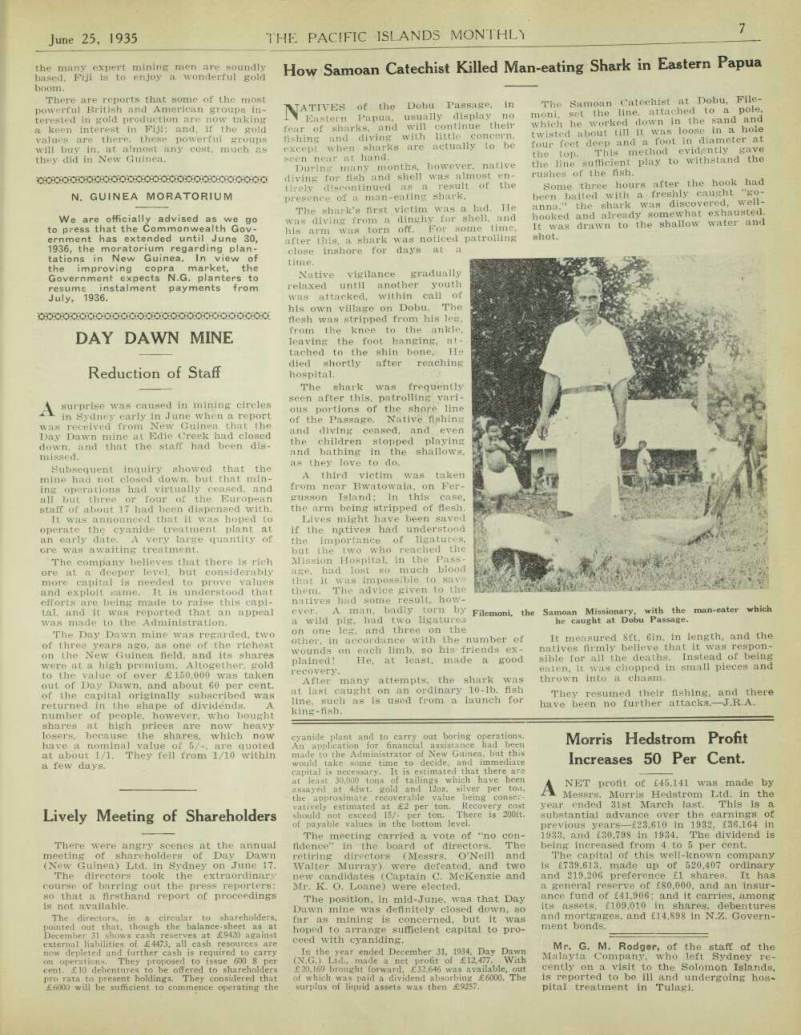
How Samoan Catechist Killed Man-eating Shark in Eastern Papua
NATIVES of the Dobu Passage, in Eastern Papua, usually display no fear of sharks, and will continue their fishing and diving with little concern, except when sharks are actually to be seen near at hand.
During many months, however, native diving for fish and shell was almost entirely discontinued as a result of the presence of a man-eating shark.
The shark’s first victim was a lad. He was diving from a dinghy for shell, and his arm was torn off. For some time, after this, a shark was noticed patrolling
close inshore for days at a time.
Native vigilance gradually relaxed until another youth was attacked, within call of his own village on Dobu. The flesh was stripped from his leg, from the knee to the ankle, leaving the foot hanging, attached to the shin bone. He died shortly after reaching hospital.
The shark was frequently seen after this, patrolling various portions of the shore line of the Passage. Native fishing and diving ceased, and even the children stopped playing and bathing in the shallows, as they love to do.
A third victim was taken from near Bwatowaia, on Fergusson Island; in this case, the arm being stripped of flesh.
Lives might have been saved if the natives had understood the importance of ligatures, but the two who reached the Mission Hospital, in the Passage, had lost so much blood that it was impossible to save them. The advice given to the natives had some result, however. A man, badly torn by a wild pig, had two ligatures on one leg, and three on the
other, in accordance with the number of wounds on each limb, so his friends explained! He, at least, made a good recovery.
After many attempts, the shark was at last caught on an ordinary 10-lb. fish line, such as is used from a launch for king-fish.
The Samoan Catechist at Dobu, Filemoni, set the line, attached to a pole, which he worked down in the sand and twisted about till it was loose in a hole four feet deep and a foot in diameter at the top. This method evidently gave the line sufficient play to withstand the rushes of the fish.
Some three hours after the hook had been baited with a freshly caught "goanna,” the shark was discovered, wellhooked and already somewhat exhausted.
It was drawn to the shallow water and shot.
It measured 8ft. 6in. in length, and the natives firmly believe that it was responsible for all the deaths. Instead of being eaten, it was chopped in small pieces and thrown into a chasm.
They resumed their fishing, and there
have been no further attacks.—J.R.A.
Filemoni, the Samoan Missionary, with the man-eater which he caught at Dobu Passage.
Morris Hedstrom Profit
Increases 50 Per Cent.
A NET profit of £45,141 was made by Messrs. Morris Hedstrom Ltd. in the year ended 31st March last. This is a substantial advance over the earnings of previous years—£23,610 in 1932, £36,164 in 1933, and £30,798 in 1934. The dividend is being increased from 4 to 5 per cent.
The capital of this well-known company is £739,613, made up of 520,407 ordinary and 219,206 preference £1 shares. It has a general reserve of £80,000, and an insurance fund of £41,906; and it carries, among its assets, £109,010 in shares, debentures and mortgages, and £14,898 in N.Z. Govern ment bonds.
Mr. G. M. Rodger, of the staff of the Malayta Company, who left Sydney recently on a visit to the Solomon Islands, is reported to be ill and undergoing hospital treatment in Tulagi.
B.P. Service To Papua And N. Guinea
Public Dissatisfaction—And Some Further Considerations
THE newspapers, of late, have published a number of complaints about the steamers which, under the contract between Messrs. Burns, Philp & Co., Ltd. and the Commonwealth, carry on the mail and transport services between Australia, and Papua and New Guinea.
The steamers, in recent months, have not adhered to the published timetables, and this has caused serious inconvenience to many people in both Territories, including a dislocation of food supplies. It is also stated that the steamers, on occasion, have been overcrowded.
As a result of the dissatisfaction exist ing in Papua, it is announced that the Lieut.-Governor of Papua has made the following representations to the Commonwealth Government: 1. The present three-weekly service, with the vessels following the present itinerary, is suitable, if the timetables were adhered to. 2. It is much desired that a timetable be approved for periods of 12 months at a time, and that the contractors be required to adhere strictly to such timetable. For over a year one of the present contract vessels has been unable to keep to her timetable. She is invariably late.
We submit that the footnote to timetables, “Sailing dates from intermediate ports are approximate only,” should be omitted, and that the contractors be bound under penalty to time table dates as regards the territorial capitals at least. 3. We recommend that no proposal to omit Brisbane by either vessel, whether bound North or South, be entertained; and that a stay of at least one week at Sydney be insisted upon. 4. In the event of the “Montoro” being unable to cope with the passengers and cargo offering, also of adhering strictly to her timetable, that a more modern vessel should be placed on the run with greater speed, and with larger and more suitable accommodation. 5. Finally, it is requested that, in view of the greatly increased traffic now offering these contract vessels between Australia and the Territories, and of the extent to which they engage in the cargo traffic from Brisbane and Sydney to North Queensland ports, the rates of fares and freights be reduced.
According to the information which we have received from New Guinea there would appear to be justification for all these complaints: but we suggest that the wrath of the Islands residents who are suffering inconvenience should be turned against the Commonwealth Government as much as against Messrs. Burns, Philp & Co., Ltd.
B.P. are regarded as a suitable target for all criticism—probably because they are guilty of the indiscretion of paying a regular dividend on their capital and because they never make any public reply to public complaints against them.
We hold no brief for B.P., and on occasion we have been obliged to contribute our share of criticism of the Big Firm's operations; but on this occasion it is fitting that the other side of the picture should be presented.
When Australia was suffering under the financial depression B.P. were asked to accept a subsidy reduced by one-fifth, and were given permission to reduce, by one fifth, the units of their Islands fleet. As a result, the Islands timetables were completely re-arranged, and the services since have been carried out by four steamers instead of five. This meant that every timetable had to be compressed to its limit, and there was little room for variations, and none for accidents.
It is by no means a secret—and yet,
curiously enough, it is not generally known—that the Burns, Philp contract for Pacific Islands services, which expired in March, 1934, has not been renewed. It was a five years’ contract and, by agreement between the Commonwealth Government and B.P., it was extended for six months. We presume that it since has been extended for similar periods, and we presume that this has been done at the request of the Commonwealth Government.
We do know for a fact that no new contract has been made, and that B.P. are still carrying on under the terms of the old contract, with the alteration made under the stress of the depression (which provided for a reduced subsidy and a reduced Islands fleet).
It may be taken as certain that there will be no new contract made until the Commonwealth Minister responsible (now Senator Sir George Pearce) personally visits the Islands Territories; and Sir George Pearce, so far as we know, has made no arrangements yet for such a visit. This means that for the present, and for some time in the future, B.P. must plan to carry on with the present reduced subsidy and, necessarily, the present fleet of four steamers.
Obviously, there should be another steamer on the New Guinea-Papuan service; but B.P. may not be expected to supply that additional service while the future remains so uncertain. These things necessarily are carefully planned—particularly by an experienced board like that of B.P. The copra outlook has improved: but there is no guarantee what ever that the present gold premium will hold. In the absence of a contract, B.P. cannot be expected to provide another new steamer on the strength of the hope that the New Guinea gold industry will continue to prosper.
Therefore, the New Guinea-Papuan service must be maintained by two steamers, which are running on time tables in which every hour counts. When anything of an unforeseen character occurs to disturb the timetables, such as special holidays and exceptional weather, everyone suffers.
B.P. are not indifferent to the position —in fact, there are- signs that it has been giving the directors a good deal of concern. Several months ago, we published the fact that B.P. had submitted new timetables to the Commonwealth Government, so re-arranged that it became possible to work a third steamer into the Papuan-New Guinea run, and to relieve the pressure at the goldfields ports. This plan would have provided temporary relief, pending the preparation of a new contract. But certain sectional interests to which the new schedules had to be submitted objected so fiercely that the whole plan was abandoned.
When unforeseen conditions were met with, trouble developed, as a matter of course.
In March, the Montoro encountered exceptionally stormy weather (with heavy rain at almost every N.G. port touched at) and was late in returning to Sydney, and in getting away on her April run.
She steamed right into a nest of troubles, caused by an extraordinary sequence of holidays.
There were the Easter holidays; and
in New Guinea the Easter holidays stretch from Friday to Tuesday inclusive. No one knows why in New Guinea they enjoy an Easter Tuesday: but it is a fact that on Easter Tuesday no official in New Guinea demeans himself with work. So the Montoro, already out of her timetable, could not work any port between Easter Friday and Easter Tuesday (inclusive).
Wednesday was a working day; but Thursday, April 25, was Anzac Day and another holiday. Some days later there came another special holiday, Jubilee Day.
The effect of it all was that the Montoro's schedule was thrown into complete confusion, and everyone concerned in New Guinea and Papua suffered accordingly—the shipping company, probably, worst of all.
Then the Macdhui. leaving late in April, was similarly in trouble. There was some delay at Yule Island, further delay, owing to berthing difficulties, at Port Moresby: with the result that the steamer, at Samarai, could not complete her discharge on the Saturday night, and had to lie there over Sunday. When she ultimately arrived at Rabaul, she found the Bremerhaven and an E. & A. steamer in ahead of her, and already waiting for the one inadequate Government berth.
It is an extraordinary fact that, although there are other wharves in Rabaul whereat cargo may be discharged, the Administration insists that one particular wharf be used for this purpose and that only during certain hours. That, probably, is due to the circumstances that the number of Customs officials is limited, and that the Native Labour Ordinance is sacred: but the effect on shipping organisation may be calamitous. At any rate, the Macdhui fell behind her timetable to the extent of three days, causing further inconvenience and exasperation.
Naturally, the people of the two Territories, after this experience with two successive steamers, simply sat up and howled. Yet it was nobody’s fault — merely the result of a series of mishaps which no one could foresee, and of time tables that are too finely drawn.
There were further complications at the goldfield ports owing to bad weather interfering with aerial transport. This prevented the usual distribution by aeroplanes of frozen cargo among the goldfields centres —which would have left the cold-stores at the ports empty and ready for new consignments—and when the steamers arrived at the goldfields ports they found the local cold stores unable to take the whole of the refrigerated food that had arrived. Consequently, some of this cargo had to be taken on around the Group. The result, of course, was an acute shortage of fresh food. That was due as much to bad weather interfering with goldfields transport as to the dislocation of the shipping services.
So far as July is concerned, B.P. are trying to improve matters by arranging that the Marella, due to leave for Singapore, via Torres Strait, on July 6, shall make a special call at Port Moresby to set down passengers. This should relieve the-pressure on the Montoro, due to sail for Papua and New Guinea about the same date. If the experiment is a success, it may be repeated.
New Guinea and Papua residents, it seems to us, are only wasting their energies in attacking B.P. The attack should be directed on Canberra, so that the Commonwealth Government may be forced to do something about the renewal of the Pacific Islands contract.
When there is a proper contract in
existence, and Islands services are still unsatisfactory, it will be time enough to agitate for better schedules, and to ask B.P. when they are going to put another vessel on the northern run, with the former service at the former subsidy.
R.W.R.
and Subsidy
Commonwealth Government and Subsidy Probability of An Inquiry
From a Special Correspondent.
Canberra, June 12
IT can be said definitely that there is a section of the Commonwealth Government which is opposed to a continuance of the subsidy to Messrs. Burns, Philp and Co. Ltd. in connection with the Pacific Islands service.
It appears that the position has been under investigation in recent weeks, and the view is held in certain quarters that there is no justification for subsidising the steamers running to Papua and New Guinea, because both steamers on every voyage are full of passengers and cargo.
Both the freight rates and the passenger rates are high—very high according to some opinions—and if the Company cannot make the service pay, as an ordinary commercial proposition, under these conditions, it is not owing to the backward development of the Territories concerned, but must be due to internal arrangements for which neither the Commonwealth Government nor the Pacific Territories can be held responsible.
The view is also held that, if the present Papuan and New Guinea timetables are unduly “stretched,” it is not the fault of the Commonwealth Government, but of Messrs. Burns, Philp and Co. themselves, who have withdrawn certain interisland steamers from service and are trying to make up for the transport facilities thus lost by compelling the overseas steamers to call at too many small islands ports, which previously were worked by the inter-island vessels. It is stated that the firm is now running only one interisland vessel in New Guinea and the Solomons, where not so long ago it was running three.
With regard to the rates charged, it is strongly held here that the passenger rates from Rabaul to Sydney, for instance, are too high: and it is said that it is possible to ship cargo on some vessels from Australia to Europe at a lower rate per ton than is charged on cargo from Australia to New Guinea.
It is evident from comments I have heard here, that there is little likelihood of a new contract being made be tween the Commonwealth Government and Messrs. Burns, Philp & Co. Ltd. unless and until further inquiries have been made into the whole of the circumstances surrounding the transport facilities existing between Australia and the Islands, and it is likely in that connection that Messrs. Burns, Philp & Co.
Ltd. will be asked to submit more detailed information than they have done in the past to justify their present services and charges.
New Guinea Tariff
It is likely that such an enquiry will embrace the possibility of imposing in New Guinea a preferential tariff in favour of Australia. It seems to be a fact that during the past year or so Japanese goods
(Continued overleaf.)
of all descriptions have been pouring into the Mandated Territory, and displacing goods of Australian and British manufacture which formerly held this market, practically unchallenged. The people of New Guinea may not like the idea of a further tariff; but there are strong arguments, it seems, in favour of the contention that, if Australia is to be responsible for the administration of this rich and growing Territory, Australia should have definite preference in the matter of trade.
EDITORIAL NOTE: There are two points which are not dealt with in the foregoing article, but which necessarily will receive the consideration of the Federal Ministers. One is that the ships which run to New Guinea and Papua carry very little cargo on their return voyages to Australia, the other is that Burns, Philp and Co., during the long period that they have received an Australian subsidy have observed Australian wages, rates and conditions aboard their ships. The cost of this, on occasion, has been staggering. We published not long ago, some details of the amounts paid to cooks, firemen and stokers aboard a B.P. steamer, showing that in a number of instances they received more per month than the officers. Presumably, if B.P. lose the subsidy, they will feel that they are under no further obligation to observe Australian rates and conditions.
Tonga Leads The Way
First Jubilee Celebrations in Empire Are Brilliantly Celebrated
IN no part of the British Empire was the Jubilee of King George V. celebrated more sincerely and more warmly in the little kingdom of Tonga.
The celebrations were inaugurated by a Thanksgiving Service, which was attended by Queen Salote, her Consort (Prince Tugi), members of the native government, and by the European community, led by the British Agent and Consul, Mr. J. S. Neill.
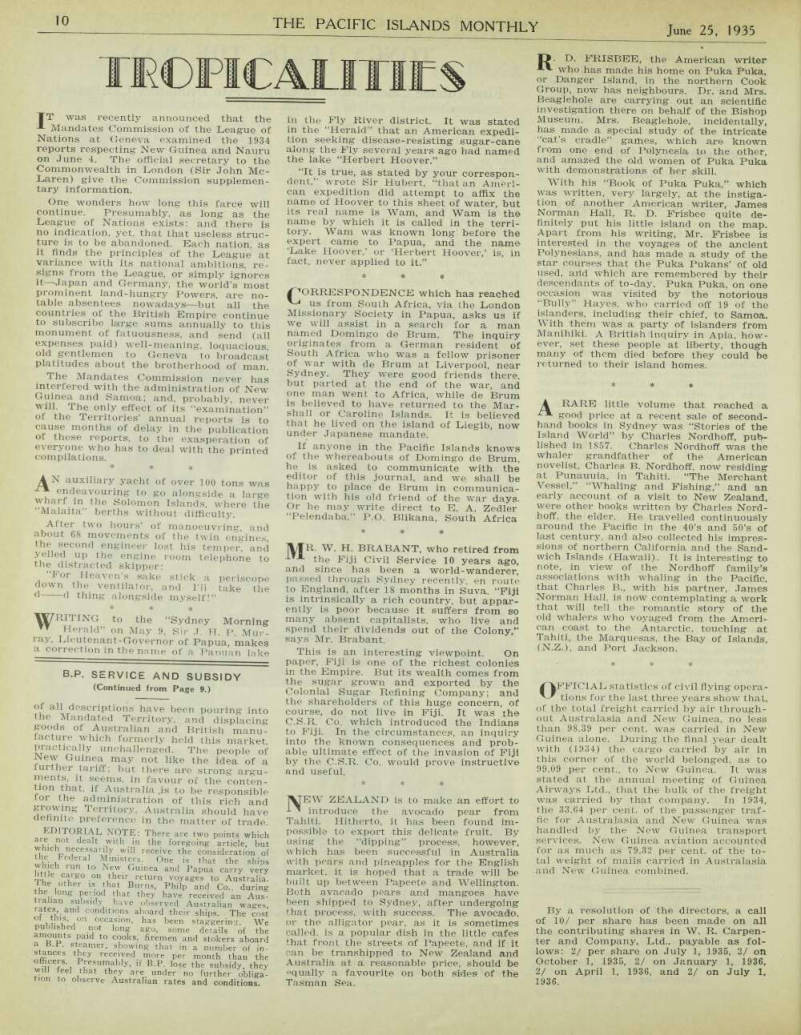
Later there were sports gatherings and feasting, the character of whicn is indicated by the accompanying photographs, which have been kindly supplied by Mr. C. E. Dalton, of Nukualofa, and
Mr. William Finau, of Vavau.
The most remarkable of all the ceremonies is that known as Tubakabaka nava, which is pictured and described on another page of this issue.
At the conclusion of the celebrations Mr. Neill wrote specially to the Premier of Tonga to congratulate him on the nature of the arrangements made and the way in which they had been carried out.
He pointed out that, owing to Tonga's geographical situation and the method of calculating local time, the service held in Tonga was the first Thanksgiving Service held in the British Empire on May 6.
Top Left: Queen Salote Tubou and Consort (Prince Tugi) arriving at the Thanksgiving Service at St.
Paul’s, Nukualofa. Top Right: Tongans engage in a tug-of-war. Centre Left: Tongan women in a ceremonial dance. Centre Right: The British Agent (Mr. J. S. Neill) and Mrs. Neill arriving at the Church. Lower Left: Tongan Ministers saluting the flag as the boom of the big guns announce the hour of noon on May 6. Lower Right: Queen Salote leaving the Church, with Rev. R. Page and Rev. H. A. Favell.
Tropicalities
IT was recently announced that the Mandates Commission of the League of Nations at Geneva examined the 1934 reports respecting New Guinea and Nauru on June 4. The official secretary to the Commonwealth in London (Sir John Mc- Laren) give the Commission supplementary information.
One wonders how long this farce will continue. Presumably, as long as the League of Nations exists: and there is no indication, yet, that that useless structure is to be abandoned. Each nation, as it finds the principles of the League at variance with its national ambitions, resigns from the League, or simply ignores it —Japan and Germany, the world’s most prominent land-hungry Powers, are no table absentees nowadays—but all the countries of the British Empire continue to subscribe large sums annually to this monument of fatuousness, and send (all expenses paid) well-meaning, loquacious, old gentlemen to Geneva to broadcast platitudes about the brotherhood of man.
The Mandates Commission never has interfered with the administration of New Guinea and Samoa; and, probably, never will. The only effect of its “examination” of the Territories’ annual reports is to cause months of delay in the publication of these reports, to the exasperation of everyone who has to deal with the printed compilations. * * * AN auxiliary yacht of over 100 tons was endeavouring to go alongside a large wharf in the Solomon Islands, where the “Malaita” berths without difficulty.
After two hours’ of manoeuvring, and about 68 movements of the twin engines, the second engineer lost his temper, and yelled up the engine room telephone to the distracted skipper: “For Heaven’s sake stick a periscope down the ventilator, and I’ll take the d—d thing alongside myself!” * * * WRITING to the “Sydney Morning Herald” on May 9, Sir J. H. P. Murray, Lieutenant-Governor of Papua, makes a correction in the name of a Papuan lake
in the Fly River district. It was stated in the “Herald” that an American expedition seeking disease-resisting sugar-cane along the Fly several years ago had named the lake “Herbert Hoover.”
“It is true, as stated by your correspon dent,” wrote Sir Hubert, “that an American expedition did attempt to affix the name of Hoover to this sheet of water, but its real name is Warn, and Warn is the name by which it is called in the territory. Warn was known long before the expert came to Papua, and the name ‘Lake Hoover,’ or ‘Herbert Hoover,’ is, in fact, never applied to it.” * * * CORRESPONDENCE which has reached us from South Africa, via the London Missionary Society in Papua, asks us if we will assist in a search for a man named Domingo de Brum. The inquiry originates from a German resident of South Africa who was a fellow prisoner of war with de Brum at Liverpool, near Sydney. They were good friends there, but parted at the end of the war, and one man went to Africa, while de Brum is believed to have returned to the Marshall or Caroline Islands. It is believed that he lived on the island of Liegib, now under Japanese mandate.
If anyone in the Pacific Islands knows of the whereabouts of Domingo de Brum, he is asked to communicate with the editor of this journal, and we shall be happy to place de Brum in communication with his old friend of the war days.
Or he may write direct to E. A. Zedler “Pelendaba,” P.O. Blikana, South Africa * * * MR. W. H. BRABANT, who retired from the Fiji Civil Service 10 years ago, and since has been a world-wanderer, passed through Sydney recently, en route to England, after 18 months in Suva. “Fiji is intrinsically a rich country, but apparently is poor because it suffers from so many absent capitalists, who live and spend their dividends out of the Colony,” says Mr. Brabant.
This is an interesting viewpoint. On paper, Fiji is one of the richest colonies in the Empire. But its wealth comes from the sugar grown and exported by the Colonial Sugar Refining Company; and the shareholders of this huge concern, of course, do not live in Fiji. It was the C.S.R. Co. which introduced the Indians to Fiji. In the circumstances, an inquiry into the known consequences and probable ultimate effect of the invasion of Fiji by the C.S.R. Co. would prove instructive and useful. * * * NEW ZEALAND is to make an effort to introduce the avocado pear from Tahiti. Hitherto, it has been found impossible to export this delicate fruit. By using the “dipping” process, however, which has been successful in Australia with pears and pineapples for the English market, it is hoped that a trade will be built up between Papeete and Wellington.
Both avacado pears and mangoes have been shipped to Sydney, after undergoing that process, with success. The avocado, or the alligator pear, as it is sometimes called, is a popular dish in the little cafes that front the streets of Papeete, and if it can be transhipped to New Zealand and Australia at a reasonable price, should be equally a favourite on both sides of the Tasman Sea.
R. D. FRISBEE, the American writer who has made his home on Puka Puka, or Danger Island, in the northern Cook Group, now has neighbours. Dr. and Mrs.
Beaglehole are carrying out an scientific investigation there on behalf of the Bishop Museum. Mrs. Beaglehole, incidentally, has made a special study of the intricate “cat’s cradle” games, which are known from one end of Polynesia to the other, and amazed the old women of Puka Puka with demonstrations of her skill.
With his “Book of Puka Puka,” which was written, very largely, at the instigation of another American writer, James Norman Hall, R, D. Prisbee quite definitely put his little island on the map.
Apart from his writing, Mr. Prisbee is interested in the voyages of the ancient Polynesians, and has made a study of the star courses that the Puka Pukans’ of old used, and which are remembered by their descendants of to-day. Puka Puka, on one occasion was visited by the notorious “Bully” Hayes, who carried off 19 of the islanders, including their chief, to Samoa.
With them was a party of islanders from Manihiki. A British inquiry in Apia, how ever, set these people at liberty, though many of them died before they could be returned to their island homes. * * * A RARE little volume that reached a good price at a recent sale of second hand books in Sydney was “Stories of the Island World” by Charles Nordhoff, published in 1857. Charles Nordhoff was the whaler grandfather of the American novelist, Charles B. Nordhoff, now residing at Punauuia, in Tahiti. “The Merchant Vessel,” “Whaling and Pishing,” and an early account of a visit to New Zealand, were other books written by Charles Nord hoff, the elder. He travelled continuously around the Pacific in the 40’s and 50’s of last century, and also collected his impressions of northern California and the Sandwich Islands (Hawaii). It is interesting to note, in view of the Nordhoff family’s associations with whaling in the Pacific, that Charles B., with his partner, James Norman Hall, is now contemplating a work that will tell the romantic story of the old whalers who voyaged from the American coast to the Antarctic, touching at Tahiti, the Marquesas, the Bay of Islands, (N.Z.), and Port Jackson. * * * OFFICIAL statistics of civil flying operations for the last three years show that, of the total freight carried by air through out Australasia and New Guinea, no less than 98.39 per cent, was carried in New Guinea alone. During the final year dealt with (1934) the cargo carried by air in this corner of the world belonged, as to 99.09 per cent., to New Guinea. It was stated at the annual meeting of Guinea Airways Ltd., that the bulk of the freight was carried by that company. In 1934, the 33.64 per cent, of the passenger traffic for Australasia and New Guinea was handled by the New Guinea transport services. New Guinea aviation accounted for as much as 79.32 per cent, of the to tal weight of mails carried in Australasia and New Guinea combined.
By a resolution of the directors, a call of 10/ per share has been made on all the contributing shares in W. R. Carpenter and Company, Ltd., payable as follows: 2/ per share on July 1, 1935, 2/ on October 1, 1935, 2/ on January 1, 1936, 2/ on April 1, 1936, and 2/ on July 1, 1936.
Advertisements & other items, p. 12 (1 item)
June 25, 1935
THE PACIFIC ISLANDS MONTHLY
B.P. SERVICE AND SUBSIDY
(Continued from Page 9.)
Murder of R. W. Holmes
Extraordinary Sydney Crime
ISLANDS residents will have a personal interest in the amazing “tattooed arm crime,” now attracting so much attention in Sydney.
Reginald William Holmes, who was murdered in Sydney on June 11, was the well-known boat-builder. His father, William Holmes, established the business, and his son carried it on successfully.
They built many boats for the Islands — particularly pearlers.
The whole case is sub judice, and many details, though well-known among the public, may not be published. The following is merely an outline.
A shark was caught off the coast in April and imprisoned in Coogee Aquarium.
Eight days later it vomited, and among the things disgorged was a human arm, bearing tattoo marks. It was identified as the arm of James Smith, who had disappeared.
Smith had been caretaker of a yacht, the “Pathfinder” which was mysteriously sunk off Sydney early in 1934. Holmes and other men were interested in this yacht. Holmes, subsequently, appears to have paid money to Smith, or his wife.
Smith, in April, 1935, went away to fish, at Cronulla, and never returned. Police, after much investigation, charged a man named Brady with his murder. Brady had often visited Smith aboard the “Pathfinder.”
Holmes, two days later, was noticed out on the harbour in a speedboat, bleeding from a bullet wound in the forehead and behaving insanely. A police boat chased him for three hours, before capturing him —a most extraordinary affair.
Holmes afterwards told the police he had been murderously attacked, and had fled to the harbour. He thought the pursuing police were assassins. Holmes made a statement to the police, and was to have been their chief witness at the inquest, which opened on June 12.
Early in the morning of June 12, Holmes was found in his car, with three bullets through his heart. Police identified certain finger-prints on the car. They commenced a search for a certain man.
The inquest on Smith and the trial of Brady, owing to the difficulty of actually proving Smith’s death —no body has been found—are likely to be prolonged.
Difficulties
Samoan Launch In
From Our Own Correspondent.
Apia, May 11.
THE small motor launch Marstal, belonging to Mr. J. Ah Mu, of Apia, recently broke down, owing to engine trouble, on her way back from Aleipata, on the west coast of Upolu. The little vessel drifted over to Pago Pago, American Samoa, where she was repaired and supplied with gasoline and oil.
On the way back to Apia, the launch broke down again, and had to call in at Leone, American Samoa. After a lengthy delay, the Marstal has at last reached her home port again.
Mr. Walter Kington, who for 40 years was a member of the Fiji Government Printing Office staff, died in Summer Hill, N.S.W., on May 24. He retired from the Civil Service in 1923.
George Chester
Has a “Rest Cure” and Returns
To N.G.
By R. W. Robson
A LONG, lean man, with grizzled hair, a bright blue eye and a ready grin, came in to see me.
“My name is George Chester,” said he.
“Chester!” I repeated, vaguely. “From New Guinea, I think?”
“Not lately,” he said. “I’m just out of gaol.”
Then I remembered. Two years’ penal servitude for causing the death of a native labourer. Chester had been working a small claim somewhere in the Ramu district, when the thing happened.
I examined my visitor with interest. He was a picture of robust health—and I never saw a human being who less resembled a criminal.
“Well,” I said, “if you are a fair product of the prison system, I can name about fifty men in New Guinea who ought to be put in gaol at once!”
He laughed. “I was unfortunate, in one way,” he said. “What happened to me might have happened to any employer of native labour. It is a weakness of the system. I prided myself on being a good employer—and what I did I had to do, in order to maintain reasonable discipline. I had no intention of injuring the native. I was sent away for two years, and I served 16 months.
“But I am really the gainer. I was not put in an ordinary prison—they sent me to an afforestation camp, in the high country, near Tumbarumba. It was a clean and healthy life, and I’ve got every bit of tropical fever out of my system, and I feel as if I’d had a rest cure. I put in 16 months in gaol, and added 8 or 10 years to my life.”
Mr. Chester is going straight back to New Guinea, where he will join his old mate, Mr. Bernard, and resume his search for gold in the Ramu-Purari region. He was one of the pioneers there, and is held in high regard by all the
“old hands.” He has been mining most of his life. Before he went to New Guinea, he was connected with the Laloki copper industry, in Papua.
Mr. Chester spoke with deep feeling of the help and friendship he had received, all through his recent troubles, from a woman who was a complete stranger to him, and whom he has never met—Mrs.
O. Levy, of Melbourne, sister of Captain Bernard McGrath, who was murdered by natives in the Ramu country early in 1934.
Chester and McGrath were friends; and, because of that, Mrs. Levy did everything she could to assist Mr. Chester wrote cheery letters to him in gaol, secured from the Federal authorities permission for him to return to New Guinea, and even offered to supply him with funds, in case he needed money.
“An experience like that gives a man renewed faith in human nature,” said Mr. Chester.
The Salato Sting
MR. F. REAY, of Suva, writes: “Tui Nalovo” seeks a cure for the sting of the Salato leaf.
The following is said to be the cure known in the Solomon Islands, as told to me by Jacob Laukoko, of the Customs Department, Suva: Take the leaf, with stem attached, of a fairly young Via plant, remove the leaf, strip the skin from the stem, and rub the stem on the affected part. It is said to be very painful while it lasts, but should effect a quick and complete cure. Personally, I am glad to say, I have not had to try this cure yet.
The sooner the cure is applied the better, but it may still be effective if applied some weeks later. Perhaps “Tui Nalovo” will decide this point for us.
Mr. and Mrs. C. S. Israel, of Lautoka, Fiji, arrived in Sydney on holidays by the Mariposa on June 17. Mr. Israel is manager of Messrs. Morris, Hedstrom’s branch at Lautoka.
Advertisements & other items, p. 13 (1 item)
Home
STERLING
Guaranteed
LOOKS
BETTER
LONGER
MADE BY
STERLING VARNISH CO.
PAINT
For
Tropical
Sun and Salt-laden Air
SYDNEY, N.S.W.
About Islands People
Mr. N. O. Clappison, of the Titles Office at Rabaul, New Guinea, was married to Miss Margaret Nibloe, of Bitapaka, New Britain, on May 21. They arrived in Sydney on a honeymoon trip to Australia by the Macdhui on June 7.
Mr. N. S. Stuckey, who spent three months prospecting for gold in Fiji, returned to Australia by the Niagara on June 15. Mr, Stuckey found gold in small quantities in various districts and is of the opinion that it is only a matter of time before further rich areas are discovered.
Mr. R. B. Carpenter, son of Mr. W. R.
Carpenter, well-known director of Messrs.
W. R. Carpenter & Co., Ltd., left Sydney for England, via America, by the Monterey on May 29. Owing to the expansion of Messrs. Carpenters’ shipping and trade activities between Europe, Australia and the Pacific Islands, Mr. R. B. Carpenter will establish a branch of the firm in London. It is expected that he will be away from Australia for 18 months.
Mrs. Harold Fenner, of Fiji, who has been in Australia for several months, is at present staying at Ranelagh, Darling Point.
Judge R. T. Gore, of the Central Court, Papua, returned to Port Moresby with his wife early in June, after a holiday visit to Australia.
Mr. and Mrs. G. Klinkmueller, of Western Samoa, returned with their daughter to Apia in May, after a lengthy holiday on the Continent. Mr. Klinkmueller is a well-known solicitor in Samoa.
Mr. Bowen Jones, manager of Guinea Airways, Ltd., at Wau, New Guinea, returned to the Mandated Territory by the Montoro from Sydney on May 25. He came to Australia about two months ago on account of ill-health, but has now completely recovered.
Mr. Thomas Horne, managing director of Messrs. Walter Horne, Ltd., general merchants, of Suva, returned to Fiji by the Monterey on May 29, after several months’ health rest in New South Wales.
Mr. Harry C. King, a well-known resident of Papua, died in hospital at Port Moresby on May 28. Mr. King, who had been in bad health for several months past, is survived by a widow, two daughters, and two sons.
Mr. Max Lees, manager of Messrs. W.
R. Carpenter (Solomon Is.) Co.’s Ulaveo plantation at Kokopo, New Britain, returned to Rabaul, after furlough in Sydney, by the June Macdhui.
Mrs. W. Cannon, who for two months had been staying in Fiji with her daughter, Mrs. J. Morrison, of Ba, arrived back in Australia by the Niagara on June 15.
Mr. and Mrs. White left Apia, Western Samoa, for New Zealand by the Maui Pomare on May 1. Mr. White, who was prominent in Apia sporting circles, has completed his term of office as account ant of the New Zealand Reparation Estates.
Mr. L. W. Vincent, manager of Arawe plantation at Gasmata, New Britain, returned to Rabaul by the Macdhui on June 13.
Mr. R. F. Brownette, of Sydney, who had been in Fiji since March on a holiday and business trip, reached Sydney by the Niagara on June 15. Mr. Brownette remarked on the progress made in Suva, and particularly around Lautoka, since he was there three years ago.
Mr. and Mrs. I. H, Grabowsky left Sydney by the Macdhui on June 13. Mr.
Grabowsky, who is general manager in the Mandated Territory for Guinea Air ways, Ltd., arrived in Sydney in December last. He underwent a serious operation in January, and his left leg was amputated above the ankle. Captain Grabowsky, who will make the round trip on the Macdhui, was very cheery prior to his departure and was looking forward eagerly to meeting his many friends in New Guinea.
Mr. A. Le Breton Mount, a well-known miner and trader of Wau, New Guinea, died in hospital after a grave illness on April 11. He had been in the territory for over 20 years, and before going to the goldfields was a trader and recruiter in the New Britain district.
Hon. H. W. Champion, Government Secretary of Papua, recently arrived in Australia from Port Moresby on long leave. During his absence, Mr. A. J. Bates, Chief Clerk of the Government Secretary’s Department, is acting as Government Secretary.
Mr. F. W. Hempleman, B.A., of Auckland, New Zealand, has been appointed Resident Agent of Atiu Island, in the Southern Cook Group. Accompanied by his wife he will take up his new position almost immediately. Mrs. Hempleman will be the second European woman on the island: Mrs. Savage, wife of the store keeper, has resided there for a number of years.
Mr. D. C. Dyason, a former president of the Australian Gold Producers’ Association, left Sydney for New Guinea by the June Macdhui. He was joined at Brisbane by Mr. J. H. Curie, mining engineer and world-famous author of travel books, and together they proceeded to Lae. They intend to fly over to Bulolo and spend some time inspecting the field. Though Mr.
Curie may not write a special volume on his impressions of New Guinea and the growth of its mining and aerial transport industries, said Mr, Dyason, it is certain that many of his observations will be in corporated in his next book.
Mr. E. Scott, of Viti Levu Gold Syndicate, returned to Melbourne by the Niagara on June 15, after prospecting in Fiji for four months. Mr. Scott, who was one of the original members of the Koroere syndicate (which sold its option to Mr. E. G. Theodore), intends to return to the Colony in July.
Mr. R. E. P. Dwyer, B.Sc.Ag., Economic Botanist in the New Guinea Department of Agriculture, was married at Rabaul to Miss L. Cullen, of Sydney, on May 18.
Mr. G. S. Dyer, a mining expert, who has had considerable experience in America and Asia, arrived in Sydney from San Francisco by the Makura on June 6.
He has been engaged by Guinea Gold, N.L., to report upon its areas in the Lakekamu district, Papua. After a quick trip to Adelaide, South Australia, to consult with the directors of Guinea Gold, Mr. Dyer sailed for Port Moresby by the Macdhui on June 13.
Mr. and Mrs. W. G. Mac Kay, of Nacaugi plantation, Fiji, arrived in Sydney on three months’ furlough by the June Niagara.
Captain S. N. McLean, of Oriomo Explorations Ltd., sailed from Sydney for New Guinea by the June Macdhui. He took two drilling sets with him in order to close bore the company’s Consolidated Claims at Bulolo, as a preliminary to their development. Mr. McLean said that Mr.
J. Dyneley Fell has joined the directorate of Oriomo Explorations Ltd.
Flight-Lieutenant Stuart Campbell will leave Sydney for Papua late in June in a new Short Scion monoplane. The plane has been bought by Oroville Gold Dredging Co. Ltd. for aerial exploration on a gold concession of over 35,000 square miles north of the Gulf of Papua and along Musgrave and Albert Victor mountain ranges. It is to operate from bases on the Fly River.
Hon. I. H. Carruthers, member of the Legislative Council of Western Samoa, was married in Apia Protestant church to Miss Moe Meyer, on May 11.
Mr. William Philip Ragg, of Suva, was married to Miss Mary Turner, of Nasese, Fiji, at the Sacred Heart Cathedral, Suva, on May 8. The couple sailed on a honeymoon voyage to Europe and England by the Aorangi on May 10.
Mr. F. Dillon, of the Adelaide Stock Exchange, returned to Australia on June 13, after a business visit to Fiji in connection with the gold industry.
Dr. C. C. Simson, who has plantation interests in Papua, made one of his periodical visits to that territory by the Macdhui from Sydney on June 13.
Sir Charles Marr, M.P., left Sydney for Fiji by the Aorangi on May 23. After visiting the Tavua goldfield on behalf of Tavua Gold Developments Ltd., of which he is a director, Sir Charles returned to Australia on June 19.
Mr. George Miller, of Messrs. Kerr Brothers, Ltd., Islands merchants, of Sydney, left for Rabaul, New Guinea, by the June Macdhui.
Rev. Brother P. E. Titz, of the Sacred Heart Mission at Yule Island, returned to Papua by the last Macdhui. He has been a missionary in the territory for 12 years and has just completed furlough in his native country, Switzerland.
Mr. and Mrs. J. M. Nicol arrived in Sydney by the Morinda from Vila, New Hebrides on May 27. Mr. Nicol is Condominium Agent at Tanna Island.
Major Graham Kinloch, a prominent resident of Salamaua, New Guinea, arrived in Sydney with his wife by the Macdhui on June 7.
Rev. C. Moir Smith, of the London Mission Society, arrived in Sydney from Papua by the Macdhui in April. After three months’ furlough in N.S.W., he will return with his wife to the L.M.S. station at Urika, Papua.
Mr. Bartle Ryan, Melbourne mining engineer, left Sydney for New Guinea by the Macdhui on June 13. On behalf of Gold Prospecting and Development (N.G.) N.L., he is on his way to the Mandated Territory to test a large alluvial property. The company’s plans are a close secret, but it is understood that Mr. Ryan will leave Kavieng with a party of 12 assistants, and after a launch journey of 100 miles in open sea will land on a small island in the St. Matthias Group. Mr.
Ryan has taken a complete set of boring and shafting equipment with him to test the property.
Mr. W. Teeling, a member of the Governing Council of the Overseas League, returned to Australia recently from Papua and New Guinea. He made a 16-days’ tour of Eastern Papua with the Governor (Sir Hubert Murray), and, in Rabaul, he was the guest of the Administrator (Gene ral McNicoll).
Mr. S. H. Chance, Assistant R.M., Samarai, Papua, who has been holidaying in Cairns (where his wife has been successfully receiving medical treatment for blood poisoning) returned to Port Moresby on the June Macdhui. Mr.
Chance has been appointed Acting R.M., Western Division, with headquarters on Daru Island.
Mr. V. Kenniff, who was a resident of Fiji from 1921 to 1929, writes to us from the Public Works Department in Jerusalem, Palestine, where he now is settled down, and sends regards to old friends.
Mr. Kenniff remarks that he spent some years recently in Cyprus, where he had seen copies of the “Pacific Islands Monthly."
Right Rev. Henry Newton (Bishop of New Guinea), who has announced his intention of retiring from the diocese at the end of the year, is one of the outstanding figures among missionaries serving in the South Seas, says the “Christian World.” His life has been spent almost entirely in the rough. He has never taken a Bishop’s stipend, though he has always more than earned it. It has been his practice to accept £25 a year and board and lodging, and to pay the remainder into the missionary cause, which he has so much at heart. He has tramped thousands of weary miles over the roughest parts of Papua and New Guinea, often barefooted, like the natives, to reach those whom he wished to serve. This for an Oxford graduate who is a scholarship winner, a gold medallist and a mathematician of distinction. Always he has lived humbly the better to carry on his missionary work, yet he is known as a man of strong and courageous spirit.
Mr. Yoneda, one of the directors of the Japanese steamship company, Yamashita Kishen Kaisha, arrived in Noumea recently to investigate the possibilities of expanding trade between his country and New Caledonia. A Japanese geologist who accompanied Mr. Yoneda was much impressed with the mineral resources of New Caledonia and considered that they would play an important part in the future commercial relations between Japan and the French colony.
Mr. John MacGregor, a well-known Sydney, journalist, died at Wollstonecraft.
N.S.W., on May 13. One of his sons, Mr.
Kenneth MacGregor, is a resident of New Guinea.
Mr. I. H. Grabowsky (general manager of Guinea Airways Ltd.), who suffered a severe illness during the year, is now well on the road to recovery. During his temporary absence (it was reported at Guinea Airways’ annual meeting), the burden of management has fallen upon Mr. E. H. Chater, one of the senior pilots, who has acquitted himself with great credit. The whole staff has also given excellent service.
Mr. George Jeffrey, a director and one of the founders of Guinea Gold N.L., returned to Australia after a visit to America by the Monterey on May 20. After a brief stay in Sydney he went on to Adelaide.
Right Rev. Joseph M. Bach, D.D., M.S.C., who recently retired from the Sacred Heart Mission Society after serving for 25 years in the South Seas, left Sydney for Port Moresby by the Macdhui on June 15. Later he will journey on to Yule Island to attend the Golden Jubilee celebrations of the Sacred Heart Mission at Yule Is., which will be held shortly.
Advertisements & other items, pp. 14-16 (3 items)
Ausoline
PURE RICE
STARCH
Always ask for . . .
“CORAL” Brand
100% PURE
CORAL BRAND
RICE STARCH
CORAL STARCH LTD.
Noted for its
QUALITY
and
WHITENESS
Goes Farthest and gives Lasting Finish
WILL NOT
STICK TO
IRON
Obtainable From Leading Island Stores Manufactured by Coral Starch Ltd.
Sydney, N.S.W.
AUSOLINE
Never Known to Fail !
COCKROACH DESTROYER
It Attracts—They Eat It- -They Die
AUSOLINE CO.
314 CROWN STREET, SYDNEY
Established 1919 PRICES: 1lb. 5/-, 3lbs. 10/-. Postage Extra.
Remit Cash with Order.
It’s a Paste
ZEISS FIELD
GLASSES for..
RELIABLE SERVICE UNDER
TROPICAL CONDITIONS
ZEISS IKON CAMERAS
“Range-Finder-Focus” Models give a new meaning to Photography Full particulars regarding the above as well as other Zeiss productions available from The Australian Representatives
E. C. HEYNE & CO.
8-14 Bond Street,
SYDNEY
100 Flinders Street
MELBOURNE
13
THE PACIFIC ISLANDS MONTHLY
June 23, 1933
ABOUT ISLANDS PEOPLE
Homes
BE TAUGHT
TO DANCE
IN
SYDNEY
BY VALMAI RAMSAY, ASSOC. MEMBER
IMPERIAL SOC. TEACHERS OF DANCING
LONDON
SCHOOL OF LONDON
DANCING
333 GEORGE STREET. SYDNEY
TEL: BW5120
LAUNDRY WORK BECOMES PLEASURE
Coleman Blue Porcelain Instant Lighting Iron
The “Coleman” needs no learning. A Native servant can handle it without any trouble.
NO PREHEATING. Just fill it with clean benzine. Open the valve. Apply the match and the No. 4A Coleman Iron glides smoothly and without pucker or wrinkle.
COLEMAN LAMPS & LANTERNS for
Island use. NO EQUAL ANYWHERE.
Use Benzine or Kerosene.
COLEMAN LAMP & STOVE CO.,
TORONTO, CANADA -- 500 KENT STREET, SYDNEY Apply at your Island store for a demonstration or coloured cata-
HUDSON’S
Ready - Cut
HOMES
offer the most practical solution of the problem of erecting a home in districts where skilled labour is difficult to obtain. The framework is cut and prepared ready for erection, all doors and windows are fitted ready for placing in position, and verandah posts, plates, architraves, etc., are prepared ready for fixing in position.
A very efficient plan service is rendered, which makes the work of erection very simple.
We quote to your own or any design.
Send for latest catalogue containing many new designs.
GEORGE HUDSON LTD.
TIMBER MERCHANTS
Bridge Road, Glebe, Sydney
READY CUT HOME DEPT.; 7 CASTLEREAGH STREET, SYDNEY
TUDOR HOTEL
Room and Breakfast, 7/6. Meals a la carte.
Accommodation for 100 guests. One minute from G.P.O.
127 PHILLIP ST. Tel.: BW 2788
Next door to Martin Place
Sydney
HAIR
CUTTING
OUTFIT
Post Free 1 Pair Barber’s Scissors 1 Pair No. 1 Clippers 1 Pair 0000 Fine Trimming Clippers 1 Comb Send for Free Illustrated Catalogue
W. Jno. Baker Ltd
3 HUNTER ST., SYDNEY
ENJOY LIFE
Available in 4oz. & 8 oz.
Bottles Keep bright and energetic with the help of sparkling effervescent Andrews.
Crisp, cooling and thirstquenching it quickly banishes that languid,out of-sorts feeling and induces a sense of wellbeing which adds greatly to the enjoyment of life.
LIVER SALT
INNERCLEAN Intestinal Laxative.
An Aromatic Herb compound Adjuvant for Constipation. Perfected by Prof. Arnold Ehret. 3/6 packet. Send Twopenny stamp for sample.
A. SUMMERBELL
“Wyoming,” Hunter Street, Sydney
New Workers For South
Seas Mission
AT the annual meeting of the South Sea Islands Evangelical Mission in Sydney on May 28, two German missionaries, Sister Elizabeth Schraeder and Sister Anna were present. They came from Friedeushurst and spent five months in Britain learning to speak English.
Dr. Deck, who presided, said the mission was inter-denominational, and had its beginnings among the kanakas in Queens land 50 years ago. Work had been carried on in the Solomon Islands for 30 years.
Thirty white missionaries and more than 300 native teachers worked without pay.
Mr. Alan Neal said that nearly all the work was done by native teachers, who practised extraordinary self-denial.
Queensland
Popular Papuan Bank
Manager Sails For
From Our Own Correspondent.
Pt. Moresby, May 17.
IT was with great regret that Port Moresby residents bade farewell to Mr. and Mrs. A. L. Grant, who left the Territory for Brisbane by the Montoro on May 11. Mr. Grant, for the last two years, has been manager of the local branch of the Bank of New South Wales, and has now been transferred to Proserpine, Queensland.
Respected and liked by all whom he came in contact with, Mr. Grant left with the best wishes of many friends for his future success. Mr. Grant is being relieved by Mr. C K. Lockhart, formerly of Normanton, Queensland, who arrived by the Macdhui on May 9.
Strange Seaplanes
In Northern Solomons
SEVERAL residents of Gizo have reported that they saw mysterious seaplanes flying over Rononga and Vella Islands during March. The information, given both by Europeans and natives, has puzzled the authorities.
Mr. S. J. Masterman, who owned the seaplane which was wrecked by a storm early in the year, has received another machine from Australia. This ’plane, however, had not arrived when the “mystery machines” were sighted in March, and consequently no facilities were available to obtain a closer glimpse of the visitors.
From a Special Correspondent.
Gizo, May 11.
On March 30 a seaplane was observed travelling on the water near Kolombangara. She was seen to rise and disappear in the direction of the north end of Vella La Vella. A month previously a ’plane was sighted by the natives of Java, flying over the same course.
On March 30, when travelling from Vella La Vella to Gizo, his crew called Captain MacEachran’s attention to what he took to be a seaplane.
Around the middle of April the Simbo natives reported that a vessel with grey hull and funnels cruised around the Ganonga and Simbo coasts, anchoring for the night on the end of the reef off the west end of Simbo, and steaming away in a westerly direction at daylight.
On April 19 the natives of Lala, on the south end of Ganonga, saw a ’plane appear from Gizo direction and disappear to westward.
On April 23 the natives of two villages on Kolombangara observed a ’plane flying along the coast toward Vella La Vella.
Native Dance Ground
Opened In Cook Is.
From Our Own Correspondent.
Rarotonga, May 17.
APRIL 29 saw the opening of the new Sports Recreation Ground at Muri.
The work of preparing this field —now far and away the best on the island —has occupied a considerable time and the voluntary labour of many people, acting under the direction of the Muri Sports Association.
Native dances on a big scale for the entertainment of visiting tourists will be held on the ground, which has an ideal setting facing the lagoon. In fact, with its level green grass and fringing border of ironwood trees no more pleasant surroundings could have been devised.
Mr. Sebastian Bach died at his home at Brighton, Victoria, on June 4, aged 64 years. In 1902, he went to Germany to obtain experience in the printing industry and on his return in 1905 was appointed Government Printer of Fiji. He spent 22 years in Suva.
Mr. and Mrs. Orme Denny, accompanied by their three small daughters, sailed from Sydney for Port Moresby, en route to New Guinea, by the May Montoro. Mr.
Denny, who is chief pilot for Guinea Air ways Ltd., had completed three months’ leave in Victoria.
Advertisements & other items, pp. 17-18 (1 item)
A. R. Frost & Co.
V. H. Jones & Rickard
Electrical Engineers
525 ELIZABETH STREET
SYDNEY
Specialists in rewinding and repairing all classes and sizes of electrical machines and equipment.
Special treatment given to work for the tropics.
TELEPHONE: MA 1397
A. R. FROST & CO.
(A. R. FROST, late of E. F. Wilks & Co., Ltd.)
LATEST IN ALL MAKES OF RADIOS,
REFRIGERATORS AND RECORDS
RADIOS from £15-15
REFRIGERATORS from £49-10
Special Care taken in Packing.
Deliveries by Return Mail.
COLUMBIA
PORTABLE
for £4-10-0 Agents for: RADIOLA, S.T.C., AIRZONE, Stromberg-Carlson RADIOS.
Latest COLUMBIA, H.M.V., REGAL, PARLO-
PHONE RECORDS.
A. R. FROST & CO
P9 Her Majesty’s Arcade, Pitt St. Level
Sydney
Telephone, MA 7394 Semi-Automatic Refrigerator
POSITION WANTED
Efficient, Energetic, Well-educated and UNROMANTIC Young Man, age 27 years, Wants Position in Islands. (Leaving Standard Graduate of Melbourne High School.) EXPERIENCE: Has been employed in responsible capacities as: — Storeman and Traveller (hardware, softgoods, and household utilities lines). Marine Diesel Engineer (in charge of engines on 50-ton motor launch). Maintenance Engineer and Electrician (for large Melbourne manufacturing firm).
Plus a knowledge of bookkeeping and office routine.
I am experienced with the climatic and living conditions of the Islands, having spent 12 months in and about Darwin, North. Australia, and am prepared to do anything or go anywhere, provided there is an opportunity to earn and save money.
I am physically fit for any conditions, and am not distressed by intense heat while working.
If this advertisement interests a prospective employer I am prepared to furnish full reference as to character and ability and, if necessary, to arrange a cash bond, I could fill any position as storeman, salesman, launch engineer, electrician, bookkeeper or overseer.
REGINALD MORRIS
C/o P.O. Box 3408 R, Sydney
FAST AUXILIARY KETCHES
AT ONE-THIRD OF SYDNEY PRICES
Offers are invited from anyone wishing to purchase a first-class ocean going keich. There are eight to be selected from, ranging in size from 13 to over 20 tons, at prices from £350 to £1,300, the largest being a new boat still on the slips.
Apply—
V. R. KEPERT, Pearler, DARWIN, N.A.
In Every Home
Makes taking Day
A Pleasant Day
The Famous
WHITE WINGS
SELF-RAISING
FLOUR
Now available throughout
THE PACIFIC ISLANDS
If your Storekeeper does not stock it, please advise
H. L. BUSSELL & Co.
White Wings Mills, Sydney
Oldest Resident In
Western Samoa
Death of Mrs. Luebecke
From Our Own Correspondent
Apia, May 11.
ON May 1, there died in Apia Government Hospital the oldest white woman resident in Western Samoa, Mrs. Elizabeth Luebecke, at the age of 86 years.
Mrs. Luebecke, who could look back to over 42 years of life in Samoa, was born in Holstein, Germany, where she had married a ship’s captain, who later died of fever in Santos, Brazil. She was engaged as housekeeper by a German firm in Samoa in 1893, and worked long years at the firm’s headquarters at Apia. Later, she was engaged in the same capacity by the German Governor of Samoa, Dr. Wilhelm Solf.
After leaving her position, she married the owner and editor of the German-English newspaper in Samoa, Emil Luebecke, who died some years ago. The deceased was active and strong practically up to the time of her death. Owing to an accident a few weeks ago, when she broke her hip bone, Mrs. Luebecke was under treatment at the hospital.
Mr. A. C. Rentoul, resident magistrate at Misima, Eastern Papua, accompanied by Mrs. Rentoul, returned to the Territory in June, after furlough in Australia.
Deckert’S Escape
Saved by Police Boy When Edie Track Collapsed
THE 23-years-old transport contractor, Mr. Fred. Deckert, who has been famous for three years for the manner in which he defies death on the Wau-Edie Creek mule-track, had the closest call of his colourful career a few weeks ago.
Deckert left Edie Creek with a load of timber for Wau. A mile down the road a landslide overwhelmed his lorry, and hurled Deckert down the slope at the side of the road.
The overturned truck, with its heavy load of timber was being slowly forced by the fallen earth towards where Deckert lay, when a native policeman, at the risk of his life, climbed down to Deckert and held him.
A minute later the timber was swept over the incline, and crashed into the valley, a thousand feet below. The police boy clung to Deckert, and managed to pull him out of the way, just as Mr. Baden Wales, of the Cleopatra mine, with a large party of natives, reached the spot.
No sooner had Deckert been hauled to safety than a large part of the mountain side gave way with a roar, and the avalanche plunged into the depths of the canyon.
Deckert was treated at Wau Hospital for minor injuries.
It is intended to report the bravery of the police boy to the authorities.
EDITORIAL NOTE.—The editor of this journal read the foregoing report with considerable feeling.
It is not very long since he travelled with Fred Deckert on his lorry, between Wau and Edie Creek.
The track creeps along the face of frightful precipices; and the editor’s hair literally rose as he gazed over the side of the swaying, bucking lorry into the depths of awful chasms. That country is perpetually soaked by rainstorms, and no one can explain why whole sections of the track, under the weight of the lorry, do not slide away into eternity.
Deckert started this hazardous transportation, with his famous “Bitza” lorry, about three years ago; and how he since has escaped a horrible death in the canyons is one of the mysteries which only a kindly Providence can explain.
A graded road, suitable for motor traffic, has been opened between Wau and Edie Creek. Deckert, nowadays, will find life very boring.
“Fans” Miss Fairbanks At
Pt. Moresby
From Our Own Correspondent.
Pt. Moresby, May 27.
THERE was a little excitement among the “talkie fans” at Port Moresby when it was realised that Douglas Fairbanks and Lady Ashley were passengers on the palatial yacht Caroline, which arrived in Pt. Moresby on May 24.
The Caroline called in for oil supplies, cream, and eggs, and sailed early the next morning, without any of the residents having the opportunity of seeing their beloved film hero in the flesh. The yacht is beautifully fitted out with every conceivable luxury, and was much admired as she sailed out of Pt. Moresby harbour on her way to Thursday Island.
Mrs. Johnson, mother of Mr. R. P.
Johnson, the popular manager of Messrs.
Burns, Philp and Co.’s branch at Faisi, Solomon Islands, arrived in the group by the Malaita recently to spend a few months with her son.
Primage Tax On Territories’
Products
Minister Directs Attention To Preferences Granted By Australia
The following statement on the primage question has been courteously supplied to us by the Hon. T. W. White, Commonwealth Minister for Trade and Customs.
The Minister shows, conclusively, that substantial preference is given by Australia to the products of Papua and New Guinea. But the fact remains that goods from those Territories, although they virtually are part of Australia, are subject to the primage tax of 10 per cent. It is against the imposition of this tax that so many protests have been made.
MY attention has been drawn to certain statements contained in an article published in the Pacific Islands Monthly of 21st May, 1935, under the caption “Primage Anomaly,” which I feel sure cannot be read without leaving in the minds of readers, who may be unacquainted with the actual position, an entirely erroneous impression of the tariff treatment accorded to the products of Papua and New Guinea under the Australian Customs Tariff.
The article, after referring to the proclamations issued in March last, where under imports from Papua and New Guinea were accorded the same reductions in primage duty as similar imports entitled to entry under the British Preferential Tariff proceeds with the following comment: “Britain does not produce desiccated coconut, or coffee, or rubber or a score of similar things; and so such imports from New Guinea or Papua are treated still exactly as if they were the produce of foreign countries.”
In the light of this statement I feel compelled to set out in some detail the position of those three products, when imported from Papua and New Guinea, as compared with similar products imported from other countries.
Desiccated coconut is subject to duties of 2d and 3d per lb respectively under the British Preferential and General Tariffs, plus primage duty of 10 per cent, in both cases. Imports from Papua and New Guinea are admitted free of the ordinary tariff duty, but are subject to the emergency revenue tax of 10 per cent. The only countries which are legally entitled to the British Preferential rate of 2d per lb. on this commodity, viz., the United Kingdom, Canada and New Zealand, do not produce desiccated coconut.
Therefore, the real effect of the Australian tariff legislation is to accord Papua and New Guinea an exclusive preference of 3d per lb. over all other competitors.
The benefit of the preference is clearly reflected in the trade statistics. Papua and New Guinea supply the Commonwealth with 98 per cent, of the total annual imports of £95,000, and have a virtual monopoly of the Australian market.
Raw and kiln-dried coffee is subject to a revenue duty of 4d per lb., plus 10 per cent, primage under both the British Preferential and General Tariffs. Imports from Papua and New Guinea are admitted free of tariff duty, but pay the primage duty of 10 per cent. Coffee grown in the territories is therefore favoured by a preference of 4d per lb. over all other countries. In spite of this assistance, Territorial coffee is not an important factor in the import trade of the Commonwealth,
the Territorial share of the trade being less than £3,000 in a total trade of £100,000 per annum.
Crude rubber is subject to a revenue duty of 2d per lb., plus 10 per cent, pri-
mage under both the British Preferential and General Tariffs. Certain difficulties with rubber users in the Commonwealth who proposed to cease purchasing Papuan rubber if the difficulties were not rectified, necessitated the withdrawal in 1933 of the direct tariff preference accorded at that time on Papuan rubber. Concurrently with the withdrawal of the direct preference, the Commonwealth Government instituted an arrangement whereby the duty of 2d per lb. collected on imports of Papuan rubber is remitted to the Papuan Governjnent and refunded to the Territorial producers as a grant in aid.
The preferential treatment extended to Papua and New Guinea under the tariff legislation of the Commonwealth is not limited to the three products mentioned.
Under the Papua and New Guinea Tariff Preference Act of 1926 as amended by the Act of 1933 exemption from tariff duty (but not primage duty) is accorded to practically all commodities which are of any significance to the Territories.
In addition, encouragement is given to the production and importation into the Commonwealth of cocoa beans, sisal hemp, spices, sago, kapok and a number of other tropical products by the payment of a bounty of varying amounts on such products grown in the Territories and consumed in the Commonwealth.
A survey of all imports from Papua and New Guinea reveals that, with one or two very insignificant exceptions, goods of the kind produced in the Territories are admitted free of duty, except for the emergency revenue primage tax.
The proclamations issued in March extending to Papua and New Guinea the same rates of primage duty as apply to similar goods admitted under the British Preferential Tariff, do not, as your article states, confine the concession to goods of a kind produced in Great Britain. The British Preferential rates also apply to a number of tropical and other products of British colonies. The proclamations ensure that the Territories participate in all reductions in primage duty effected on such colonial products.
Unfortunately, during the numerous adjustments in the various tariff schedules, one or two minor products of the Territories became exposed to higher rates of primage duty than similar products from British colonies. The purpose of the proclamations was to remove these minor anomalies, which although of little practical significance, have been magnified to make it appear that the Territories are not receiving the sympathetic consideration which their close relationship with the Commonwealth entitles them to expect.
It is true that the recent extension to the Territories of the same rates of primage as apply to similar goods admitted under the British Preferential Tariff results in few additional immediate concessions to the Territories. It does, however, remove two minor anomalies to which in dividual traders had drawn attention, and at the same time ensures that any reductions of primage duty which may be effect ed from time to time in the future on products similar to those exported from the territories will apply simultaneously to the Territories.
Advertisements & other items, pp. 19-21 (1 item)
Swallow & Ariell’s
DONALDS
Wt. 4½lbs.
Price. 22/6. Send for Free Catalogue.
WIRE STRAINER
Requires no skill —takes an unlimited length of loose wire—quick and efficient—stretches plain, netted or barb—light, and folds into small compass—stretches at any part of fence or at post—works automatically—used for endless other purposes besides fencing.
PRESSES, for baling Wool, Tobacco, Copra, etc.
CASEMENT STAYS, JACKS, etc.
DONALD PATENTS LTD.
PADDINGTON, SYDNEY
Your Store Can Secure
Swallow & Ariell’s
Popular Assortments
QUEEN’S OWN MIXED BISCUITS:
A delightful assortment of Sweet and Cream Biscuits and Wafers in attractively labelled Tin.
LADIES’ AFTERNOON TEA:
Such favourites as Peter Pan Biscuits, Vanilla Custards, Oyster Cream Wafers, Champagne Fingers (12 varieties in all) comprise this Extra Choice Assortment. Supplied in No. 1 Flat Tins only.
MORNING TEA:
A square Flat Tin containing some of the less Rich varieties of our Sweet Biscuits, including Milk Arrowroot, Osborne, Coffee, Diamond, etc.
SWALLOW & ARIELL LTD.
Buy by Mail at Lowest Sydney Prices
at PALMERS, Sydney
Men’s Ready-to-wear Clothing.
Palmers Amazing Special , 49/6 Men’s Ready-to-wear Suits, latest Two-button model, in the newest Fawn and Brown shades of Briarproof Tweeds. Sizes from 3 to 7. The greatest Suit value in Sydney 49/6 Men’s Black Rubber Reversible Waterproof Coats, two-in-one, can be worn either way.
Navy one side. Raglan shoulders and belted.
Guaranteed. Sizes 3 to 8 21/- Men’s latest Single-breasted Blazer Coats, in All Wool Flannel, Navy, Royal, Maroon, and Green, with newest shades of chevron braids.
Sizes 3 to 7 22/6 Men’s good White Drill Sac Coats, with step or patrol collar. Sizes 34in. to 42in. chest 10/6 Men’s Flannel Sports Trousers, in mid and light Grey shades. Sizes 30 to 40in. waist 12/6 Men’s serviceable Trousers, in strong hardwearing Striped Cotton Tweeds, dark shades.
Sizes 30in. to 46in. waist 12/6 Men s good Cream Cotton Gabardine Trousers.
Sizes 30 to 44in. waist 12/6, 15/6 Men’s Cream Gabardine Trousers, in good All Wool Gabardine. 30 to 44in. waist, 21/-, 25/- Men's Khaki Drill Trousers, with plain bottoms.
Sizes from 30in. to 40in. waist 10/6 Men’s Cotton Cord Trousers, medium weight, Khaki shades, plain bottoms 13/6 Men's Cotton Twist Trousers, medium weight, dark Grey shades. 30 to 46in. waist .. 16/6 Men’s Overalls, bib and brace, in Navy Drill 5/11, 7/6, 10/6 Men’s Overall Trousers, Blue Denim, double seat and knees 9/6 Men’s Blue Drill Combinations 13/6 Men’s “Oshkosh’’ Combinations, in heavyweigh Navy Jean and Khaki Drill . . . . 17/6 Men’s Ready-to-wear Riding Breeches, correctly cut, with strapped knees. In good Cotton Gabardine, Fawn and Olive shades. Sizes 34in. to 38in. waist 25/-, 35/-
Men’s Dependable Mercery.
Palmers
Tailored
To-measure
keep cool Suit
Well Tailored, of dependable light weight, All Wool Tropical Worsted Suitings. 3- Piece Tailored-to-Measure. Honest Value, £4/4/- Send for FREE Patterns and Self-Measure Chart.
Our Mail Order Catalogue brings our Store right to your door.
Kindly add Carriage on all Mail Orders.
Postal Address:
Box 3907TT, G.P.O.,
Sydney, Men’s White Mercerised Tennis Shirts, with turn-down collar and pocket, or open Sports collar, half or long sleeves, 4/11, 5/11, 6/11 Men’s Khaki, Grey and Navy Blue Drill Shirts, with collar and pocket 4/11 Better qualities, with two pockets, 5/11, 6/11 Men’s high-grade Black Mercerised Shirts.
From 3/11 to 5/11 Men’s Striped Oxford or Harvard Work Shirts, with turn-down collar and pocket, good wearers and washers 4/11, 6/11 Men’s high-grade Poplin Golf Shirts, with two soft collars to match, or Coat Style, with collar attached, in a big range of Stripes and Checks 4/11, 5/11, 6/11 Men’s Striped Poplin Pyjamas, new designs, light weights, with roll or ordinary collars, 4/11, 5/11, 6/11, 8/11, 10/6 Men’s Silk and Lisle Socks in Grey, Fawn, and Brown Check and Figured designs, 1/3 to 2/6 Men’s White Sport Socks, all cotton, 1/6 & 1/11 Art Silk 2/6. Wool and Cotton, 2/6 and 2/11 Sizes 9½in. to 12in.
All Wool Socks 2/6, 2/11, 3/6, 4/6 Men’s Fashionable Broadway Ties, 1/-, 1/6, 1/11, 2/6, 2/11, 3/6, 4/6 A Reduction for Three.
Men’s Cotton Athletic Singlets, sleeveless, 1/11, 2/6, 2/11
F J PALMER & SON LTD
TWO STORES
PARK ST also 390 GEORCE ST G.P.O BLOCK Men’s Art Silk Athletic Singlets. 2/11, 3/11 Knee Drawers to match, elastic waist 3/11, 5/11 Men’s Cotton “Speedo’’ Bathing Costumes, halfskirt, all sizes, 6/11. Extra Out Sizes .. 7/6 Men’s Wool Cashmere Bathing Costumes, famous “Speedo” comfortable half-skirt, big variety of colours 14/6
AKUBRA’S FAMOUS HATS.
Famous AKUBRA Hats, in latest shapes and shades, popular 2in. narrow Snap Brim, 17/6 22/6, 30/- Sombreros, 4½in. brim, Fawn shades only, 35/-
Palmers’ Trench Boot!
Sturdy Tan Hide Trench Boot (as illustrated), extra heavy soles, high leg, and buckle top. Sizes 5 to 10, 32/6 Heavy Duty Work Boot, solid leather soles, screwed and slugged. Sizes 5 to 10 13/11, 18/6 Superior quality Tennis Shoes, no back seams, black rubber sole .. 7/11 Crepe Sole, heavy-weight, 8/11, 11/9.
Oose Calf Golf Shoe, waterproof upper, “Nublick” rubber soles. Half-sizes, 5 to 10 .. .. 24/6
Pacific Islands Stamps
BOUGHT AND SOLD
Stamps sent on approval on receipt of reference. Send for free lists and specimen copy “Australian Stamp Journal.”
J. H. SMYTH CO. LTD.
121 a Castlereagh St., Sydney
Lutheran Mission’S ’Plane
From a Special Correspondent.
LAE, May 7 THE Junkers F 13 aeroplane, which was recently sent out by the Neuendettelsau Mission Society, Germany, to the Lutheran Mission at Finschafen, in New Guinea, has been in commission for several months now and is flying perfectly.
The plane, which is stationed at Lae, paid its first visit to the mission on April 17. Finschafen, which is 65 miles north of Salamaua, has no landing-ground. A site was cleared about four miles from the mission station and the plane landed there without mishap.
A large gathering of natives, many of whom were from the interior and had never before seen an aeroplane, were awe struck when the machine landed and the pilot stepped out of the metal cabin.
Capable of carrying five passengers, the Junkers can freight 14 cwt of cargo, in addition to fuel, etc.
Fiji Bug For Australia
A PARASITE insect which destroys lantana will shortly be introduced to Australia from Fiji. An entomologist from the Commonwealth Council for Scientific and Industrial Research is to visit Fiji immediately for the purpose of obtaining specimens of this bug.
Lantana has spread in Queensland and on the north coast of New South Wales to an alarming extent, and large areas are thrown out of productivity. Some time ago, lantana fly was introduced into Queensland, but results had been most disappointing. It now seemed that the only hope was to introduce the bug, which had already proved very successful in Fiji. The bug sucked the green juices from the plant, and gradually brought about its total destruction.
Advertisements & other items, pp. 21-22 (1 item)
Let Ferrodor Paint
DRIVE YOURSELF
during your stay
in Sydney
in a 1934 Model Sedan at 6d per mile. Minimum from 15/ per day.
Write or cable, and we will reserve a car for you. Free Service all over N.S.W., with advantages enjoyed by N.R.M.A. members.
Martin’s Drive Yourself
Service
191 WILLIAM ST., SYDNEY
F 1092
PACIFIC TRADERS!
The Blade of Best Quality, and the Most Profitable to Handle, is:
JEWEL
SAFETY
RAZOR
BLADE
These blades are of the three-holed (Gillette) type. I have made a careful test of all blades, over a long period, while I was trading at Milne Bay, Papua, and the British-made Jewel was far ahead of any other. I now have the Pacific agency for Jewel blades, and strongly recommend them to all traders.
Send P.O.O, for trial gross, post free, 10/- (Australian) or 8/- (sterling). Reduction for quantities. Sample package,
HENRY DEXTER
Iping, Midhurst, Sussex, England
£500,000,000
Wasted Annually
Through Rust!
The Association of Non-corrosive and Anti-corrosive Products has declared war on RUST ! Mr. Robert Hadfield, the leading spirit of the movement declares that the world’s rust and corrosion represents an annual wastage of more than £ 500,000,000 practically one-third of the annual output of iron and steel products.
Let FERRODOR PAINT
(Anti-corrosive and Elastic)
DEFEND YOUR STEEL STRUCTURES
Against the ravages of rust and corrosion caused by the action of moisture-laden atmosphere, chemical fumes, etc.
Obtainable from all Leading Paint Houses and the Sole Agents:
WILLIAM ADAMS e COMPANY
LIMITED
175 CLARENCE STREET
SYDNEY
PUMPMOBIL
Light and Portable
MOTOR PUMP
Complete Plant’s weight, 140 lbs.
Capacity up to 12,000 gallons per hour All heads from 10 to 115 feet Fuel consumption, 2 gallon per hour Pressure 55 lbs. square inch Especially suitable prospecting And all Sluicing Requirements Nelson & Robertson
12 SPRING STREET, SYDNEY
FOR SUPERIOR SERVICE SHOP AT
SYDNEY’S BRIGHTEST BOOKSHOP
WHERE SATISFACTION IS GUARANTEED.
Thousands of books to suit all Literary tastes are attractively displayed on tables of easy access; this enables you to select your books in comfort. An expert staff are ready to give the required assistance.
Our Technical Section is well equipped with books on all subjects—Electrical, Engineering, Carpentry, Building, Plumbing, Radio, etc.. Work handbooks with simple instructions for the Amateur, Advanced Text Books for the Skilled Tradesman.
SPECIAL TECHNICAL JOURNAL SERVICE. SUBSCRIPTIONS TAKEN
FOR ANY JOURNAL IN THE WORLD. PRICE LIST OF ANY SUBJECTS
ON APPLICATION.
Our Mail Order Service is unsurpassed. A trained staff opens the mail and despatches the goods the same day.
N.S.W. BOOKSTALL CO., LTD.
MARKET AND CASTLEREAGH STREETS SYDNEY ’Phone M 4361.
Save time, trouble, temper specify these universally preferred
ROPES, CORDAGES & TWINES
Made by the largest Rope and Cordage manufacturers in Australasia, “Kookooburra” Ropes, Cordages, and Twines are tested to provide that extra endurance, which is only found in “Kookooburra” quality lines.
Specially manufactured for the stresses of tropical conditions.
Other well-known products include Sash Cords, Halters, Plow Reins, Jute and Hemp Seaming Twines.
KOOKOOBURRA
BRAND
A. FORSYTH & Co. Ltd. 339 Kent St.
Cable Address: “Rope,” Sydney
Fight, N.G.
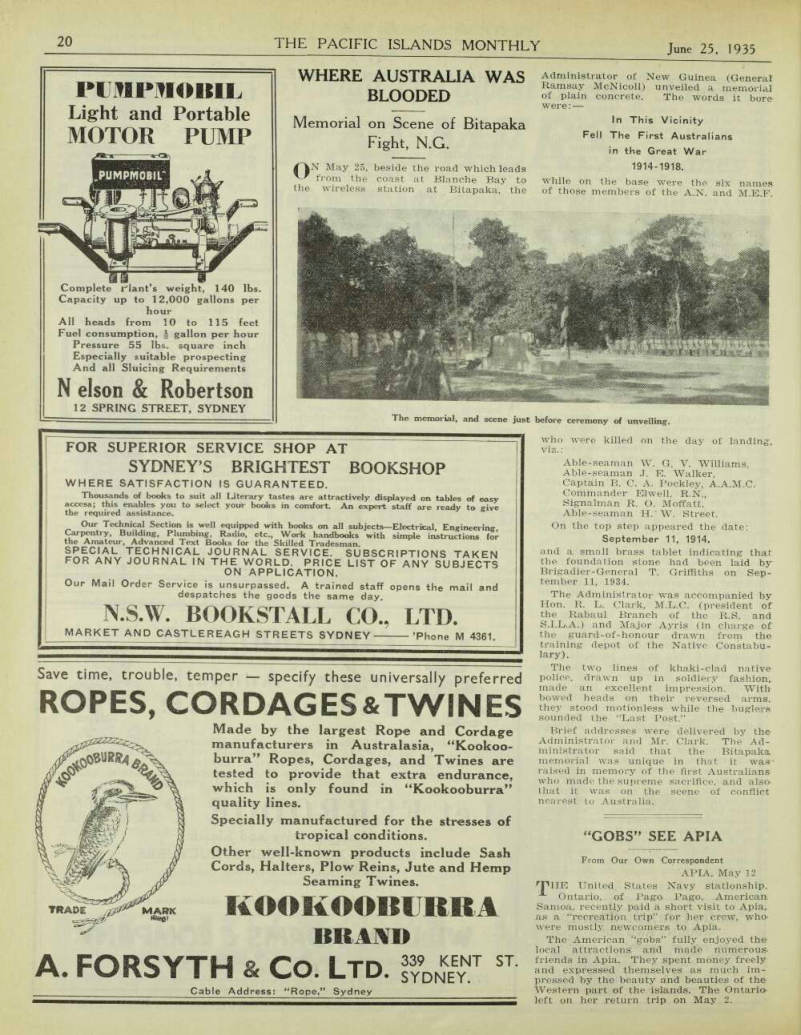
Where Australia Was
Blooded
Memorial on Scene of Bitapaka Fight, N.G.
On May 25, beside the road which leads from the coast at Blanche Bay to the wireless station at Bitapaka, the
Administrator of New Guinea (General Ramsay McNicoll) unveiled a memorial of plain concrete. The words it bore were: In This Vicinity Fell The First Australians in the Great War 1914-1918. while on the base were the six names of those members of the A.N. and M.E.F.
who were killed on the day of landing, viz.: Able-seaman W. G. V. Williams, Able-seaman J. E. Walker, Captain B. C. A. Pockley, A.A.M.C.
Commander Elwell, R.N., Signalman R. O. Moffatt.
Able-seaman H. W. Street.
On the top step appeared the date: September 11, 1914. and a small brass tablet indicating that the foundation stone had been laid by Brigadier-General T. Griffiths on Sep tember 11, 1934.
The Administrator was accompanied by Hon. R. L. Clark, M.L.C. (president of the Rabaul Branch of the R.S. and S.I.L.A.) and Major Ayris (in charge of the guard-of-honour drawn from the training depot of the Native Constabulary).
The two lines of khaki-clad native police, drawn up in soldiery fashion, made an excellent impression. With bowed heads on their reversed arms, they stood motionless while the buglers sounded the “Last Post.”
Brief addresses were delivered by the Administrator and Mr. Clark. The Administrator said that the Bitapaka memorial was unique in that it was raised in memory of the first Australians who made the supreme sacrifice, and also that it was on the scene of conflict nearest to Australia.
The memorial, and scene just before ceremony of unveiling.
“Gobs” See Apia
From Our Own Correspondent
Apia, May 12
THE United States Navy stationship, Ontario, of Pago Pago, American.
Samoa, recently paid a short visit to Apia, as a “recreation trip” for her crew, who were mostly newcomers to Apia.
The American “gobs” fully enjoyed the local attractions and made numerous friends in Apia. They spent money freely and expressed themselves as much impressed by the beauty and beauties of the Western part of the islands. The Ontario left on her return trip on May 2.
First Polish Vessel

Zjawo II. at Samoa
From Our Own Correspondent.
Apia, May 10
THE flag of the young Polish nation waved for the first time at Apia, when the small Polish yacht Zjawo II dropped anchor in Apia harbour recently. The small vessel, which is of only 28-tons register, has been sailed all over the Atlantic, since her owners (Captain Wladyslaw Wagner, and another young countryman of his) left their home port, Gdingen, on the Baltic, in a similar vessel, nearly three years ago.
The 48-ft. yacht has two masts and five sails, but carries no auxiliary engine.
The two young adventurers who are only in their twenties, left Panama and leisurely cruised Southwards, calling in for a short stay at Manihiki in the Cook Islands where they replenished their food and water supply. Thence they crossed over to Apia in 12 days, the whole trip from Balboa to Apia taking 75 days.
After a few days stay in Apia, the Zjawo II left for Pago Pago (American Samoa), but luck, which had favoured the voyagers so far, left them. A few days after their departure, they encountered strong headwinds and were forced to return to Apia with a broken foremast.
At present they are still here trying to repair the damage.
Mr. Wagner has written a booklet in Polish, dealing with his previous adventures. He intends to sail for Fiji, New Caledonia, and Australia, there to sell the Zjawo II. and acquire a somewhat smaller vessel to return to his home country.
Solomon Islands
Council
THE mid-year session of the Solomon Islands Advisory Council was opened at Tulagi on May 7th, His Honour the Resident Commissioner presiding.
The members present were: —Official: The Secretary to the Government (Captain N. S. B. Kidson), Treasurer and Collector of Customs (Mr, F. E. Johnson, I.S.O.), Commissioner of Lands (Mr. S. G. C.
Knibbs). Non-official: The Right Rev. the Bishop of Melanesia, Mr. D. Mackinnon and Mr. J. C. M. Scott.
The President read an address, reviewing events of concern to the Protectorate since the last meeting of the Council, and Mr. Mackinnon replied on behalf of nonofficial members,
Mining Laws
The more important business discussed related to a new Mining Regulation, the question of whether the Agricultural Committee should continue to function after January, 1936, and a draft Agricultural and Live Stock Regulation.
After discussion, it was decided to base Protectorate mining legislation upon the Fiji Ordinance, recently promulgated.
Non-official members strongly represented the need for the Agricultural Committee to continue, and the necessity of having the services of an Entomologist as expert adviser, and to carry on the research work now proceeding. Official members opposed the recommendations, for financial reasons.
The draft of the Agriculture and Live
Stock Regulation, which gives effect to amendments proposed at a previous meeting of the Council, was approved unanimously, and will probably become operative almost immediately.
Assistance To Planters
The question of Government assistance to planters was reverted to; but, owing to experiments with various types of copra driers having proved inconclusive, it was decided to defer definite action until the October session of the Council, when it is
hoped that more information will be available.
Motions by private members included the abolition of hawker’s licences, and permission for recruiting vessels to carry freight to isolated plantations while en route to recruiting places. Both proposals were agreed to.
Radio Communication
The matter of equipping Government district stations with wireless receiving and transmitting installations capable of maintaining communication with Tulagi, was also debated, and it was decided to obtain information relative to a suitable type of set, and the cost involved, for submission to the Council at the next meeting.
Advertisements & other items, pp. 23-24 (1 item)
is Photography’s
The ‘Austral' Auto-Flush Cabinet
The latest in Sanitary Installations for non-sewered areas Approved by the N.S.W. Board of Health.
A Patent Closet that gives you convenience, health, and refinement similar to a w.c. A great advance on anything yet offered.
No water supply required.
Price, £15 (Aust.), F.O.B., Sydney Can be installed by any handy man.
Leaflet on application.
INSULAR LAMPS (Syd.), Ltd.
42 Market St., SYDNEY
Retina
is Photography’s
Latest Thrill
Retina
opens up a New World
of Picture Making:
Retina is that fine high-precision instrument you’ve always wanted, but could not previously afford. And it’s a Kodak product—easy to use—nothing new to learn!
Daylight loading and unloading with 35mm. Kodak Panatomic Film Cassette, for 36 exposures, size 36 x 24mm., using Automatic Exposure Counter.
F/3.5 Xenar Lens assures needlesharp definition for tremendous enlargement. Compur Shutter to 1/300th second, stops fastest action.
Write for folder.
Price £10/10/- (which is the English List Price).
Of all Kodak Dealers throughout the Islands and
KODAK (Australasia) Pty. Ltd.
379 GEORGE STREET, SYDNEY
FOR SALE
Two fine Boats that are extra good buying and carry my personal recommendation
(1) KETCH RIG.
37ft. 6in. x 10ft. 6in. Draught 4ft. 16 h.p. Petter Diesel Engine, metalled bottom. Engine and hull in perfect order.
Wonderful sea boat; built by Hayes; 7 years old ... £700
(2) RAISED DECK AUXILIARY
CRUISER.
34ft. Beautifully built. 16 h.p, Hercules Marine Engine. Good accommodation for four. Large cockpit with fish ice box. Perfect order £800 Apply—
Jack Capell
Boat Builder and Engineer
RUSHCUTTER BAY
SYDNEY
Telephone - - - FM 1442
The Islanders’ Sydney Home . . .
Location BELVEDERE
81 BAYSWATER ROAD, DARLINGHURST
Exclusive.
A fine house with its wealth of pleasant old associations.
The Garden Suites , designed on most modern lines.
Excellent grounds with beautifully kept gardens—and dotted with comfortable garden seats.
Private telephones if desired.
An atmosphere of rest and grateful quietness.
Ideal location.
Near White City Tennis Courts.
Seven minutes to G.P.O.
Close to Shopping Centre.
Trams stop at gates.
BELVEDERE is Controlled and Supervised by Island People for Island People TERMS: From £2/12/6 Weekly.
MR. & MRS. C. WAGER (late of Fiji), Proprietors.
PULVEX
THE SUPERIOR INSECTICIDE POWDER
ACTUALLY KILLS FLEAS, ETC. (IT DOES NOT
MERELY STUPIFY THEM) AND KEEPS THEM
OFF FOR SOME DAYS AFTER TREATMENT For All Skin Diseases of a NON-POISONOUS Parasitic Nature use
NON-IRRITANT KUB-MANGE
The Popular English Remedy
KUR-MANGE IS IN POWDER FORM, READY
FOR USE WHEN MIXED WITH COLD WATER
NON-CARBOLIC . NON-POISONOUS
WILLIAM COOPER & NEPHEWS
(AUST.) LTD.
4 O’CONNELL STREET
SYDNEY
Where You Will Meet Your Friends in Sydney
Dawn Cafe
(Late Silver Slipper) Hot Dinners, Grills, Toasted Sandwiches, etc. 53 ROWE ST. next Hotel Australia Bridge Parties Catered For
“Seth Parker” Sold
From Our Own Correspondent.
Apia, May 17.
THE American four-masted schooner “Seth Parker” is still lying in Pago Pago harbour, American Samoa, though she has been sold to a company in Honolulu, Hawaii. Her former owner, Mr.
Phillips Lord, who is a well-known American radio artist, has left Pago Pago for America, via Hawaii.
The “Seth Parker” came into prominence in February last, when H.M.A.S. Australia, with Prince Henry aboard, raced through a gale to the vessel in answer to an “appeal for help” from Mr. Lord.
Fiji Gold
Description of Tavua Field
THIS is a fascinating spot (says Frank.
A Murphy, in the Melbourne Herald, describing the new Tavua goldfield, in Fiji). It is unlike any goldfield that I have ever seen.
You get into it from the native village of Tavua—you pronounce it Tah-vooa— by a six mile road upon which the Theodore group spent several thousand pounds. Long before you reach the spot you can see the wood and iron huts, white against the black forbidding background of the Kormboya ranges.
These are hills with a vengeance— jagged and slashed with gullies with none of that vivid greenness that softens the tropical landscape in other parts of the island.
The mines are on a minor range at the foot of this barrier. You drive right up to the Emperor. The shaft is on a ridge and the mill, where the ore is crushed, is on a wide ledge below it.
Actually the Emperor is the only show on the field which fits in with the average idea of what a mine should look like. You look away from the mill to the right and there, if you have some body to point it out to you, you behold Loloma.
The claim lies in a basin, and there is nothing spectacular about it. High up above you, dominating the entire field, is Koroere, a great big black pinnacle, with holes blown into its sides. They have been tunnelling there to find the lode which comes in from the Emperor lease next door.
Costellos’ “Jewellery Shop”
On top of Koroere someone has stuck a pole. It was useful to hang to on windy days when you look south into the famous “Jewellery Shop,” the 30 acres which the Costellos reserved for them selves when they sold the Emperor, and Koroere, to the Theodore group.
This is the spot upon which old Bill Borthwick first found the ore which has: led to the opening up of the field.
I heard lots of yarns of how Bill Borthwick came to find Tavua. I think the most credible is the one which he told me himself, as he sat hunched up, in his queer way, at Dan Costello’s hotel in Suva. Bill Borthwick is an old man, over seventy, wealthy now, but just plain old Bill, full of Scottish caution and content to go on looking for gold. He has been doing that for 50 years all over the place.
He is the one prospector in ten thousand who would have recognised the gold possibilities of Tavua, even if he had not been given a hint of them before he went there.
Similar Field.
Some of his fifty years of prospecting were spent in New Zealand on a goldfield, where the ore is almost similar to that in Fiji. There are very few other places in the world where the same type of stuff occurs.
Bill told me how, a few years ago, when things were bad, Pat Costello said to him one day, “How about having a look for that gold out Tavua way?” Pat had heard, many years before, that a man had found colours in a creek not far from the village of Tavua. Borthwick packed his swag, and, with his dish strapped to his back, went to see what he could find.
He washed colours in the creek and kept going up the stream until he came to a spot that he sensed was the source of the gold. He scratched about and got some gold-bearing stone. That convinced him, so he pegged the place out for the Costello brothers.
Not very long after that a small paragraph appeared in one of the Sydney papers saying that Pat Costello had a gold claim at Tavua. E. G. Theodore saw that paragraph. He remembered Pat Costello. They had met once in Suva, while Theodore was on his way to America. The latter wrote to Costello, asking for further information —and that’s how the former Federal Treasurer first came into the business.
Of course, I cannot say what the field is really like, as an investing proposition. All I can tell you is that there is only one show there that can be regarded in any sense as a proven mine, and that is the Emperor.
“Let Ted Do It”
The others are still in the prospecting stage. Some of them very much so.
The country is pegged out for miles, and scores of areas have had practically nothing done to them, bar the sticking in of the pegs.
On June 1 most of the prospecting leases will come up for review by the Government. There is no certainty that the people who are holding them to-day will be given a renewal of their rights.
The Government, which is keeping a very cool, clear head in the matter, will ask pertinent questions regarding the intentions of the holders, will want to know what work has been done and what is going to be done, and where the money is coming from to do it.
It is this necessity to have something to show on June 1 that is causing a big influx of mining experts, miners and others to the fields at the moment.
Although nearly everybody up there will deny it, you can take it from me that up to the present most of the people with areas around Tavua have been letting the Theodore group do all the developing.
The motto of Tavua ought to be, “Let Ted do it.”
Applications for Renewals
SUVA, June 5.
Many applications have been lodged for renewal of prospecting licenses, which expired this week.
The Mining Board will sit next week to make recommendations to the Governor.
In the meantime, holders of licenses will continue in possession.
Cook Islanders
Rewarded
Rarotonga, May 17
AN April 25 a presentation of foodstuffs was made to the various districts which had participated in the work of clearing the roads and waterfront after the recent hurricane. The gifts, contributed by the Administration, the main business-houses and the Union Steamship Co. consisted of cases of meat, sacks of rice, biscuits, etc.
They were handed over to the Arikis for distribution as a mark of gratitude for the co-operation of the natives in the task of reconstruction. That this voluntary labour was forthcoming speaks highly for the good-will which exists between the Administration and the community which it serves.
Advertisements & other items, pp. 25-26 (3 items)
For Nettle Stings
THE Fiji contributor who asks for a cure for nettle stings (Fiji variety) is recommended by a Queensland reader to try full-strength ammonia (NH3).
Mcilrath’S
STOP
Tired nerves are the cause of Headache, Neuritis, Neuralgia, Rheumatism, Lumbago, Sciatica. Get instant relief from all nerve pains with Genuine VINCENT’S A.P.C. as recommended by Doctors, Dentists, Chemists, and Nurses. 12 for 1/6, All Chemists and Stores, or direct from Vincent Chemical Company Limited, Market St., Sydney, Australia
Nerve
Pains
FOR SAFETY’S SAKE, SAY "VINCENT’S"
SEND YOUR GROCERY ORDERS TO
McILRATH’S
YOUR INSURANCE POLICY AGAINST HIGH PRICES
I.X.L. Best Assorted Jams, 24oz. tons (4 doz.) 10/3 doz., 34/- case Castle Fancy Assorted Meats, 16oz. tins (4 doz.) 10/3 doz., 37/- case Rosa Full Cream Condensed Milk, 14oz. tins (4 doz.) 6/3 doz., 24/- case Ideal Unsweetened Milk, 6oz. tins (8 doz.), 2/10½ doz., 20/- case Mixed Crown Soap, unwrapped, 60’s or 72’s ... 22/6 case Arnott’s Sao Biscuits, No. 2 tins 1/6 tin Arnott’s Popso Crackers, No. 2 tin 1/10 tin Pineapple Seeded Hams 1/7 lb.
Kraft Cheese, 8oz. pkts 8½d. pkt. 8/3 doz.
Best Australian Currants, loose 5½. d. lb. 5/- doz. lb.
Best Australian Sultanas, 3lb. tins . . 1/10½ tin, 21/6 doz.
New Season’s Khadrewi Dates, loose . . 4d. lb, 3/9 doz. lbs.
Bisto Gravy Maker, 16oz. tins 1/5 tin, 16/- doz.
Dandy Maize Starch, 14oz. cartons . . 7d. carton, 6/9 doz.
Tasmanian Riced Potatoes, 6lb. tins 1/4 lb.
Rosa Custard Powder, 16oz. tins 1/2 tin, 13/6 doz.
Yoga Tea, Finest Ceylon Blend, 6lb. tins, 12/6 each Mcllrath’s Invalid Port, 26oz. bots. . . 2/6 bot., 29/6 doz.
Prices f.o.b. Sydney.
Export Price Lists available on application.
McILRATH’S LTD.
Export Department 202 Pitt Street
SYDNEY, AUSTRALIA
RHEUMATISM
AND
KIDNEY TROUBLES
DEFINITELY OVERCOME BY “UREX."
the new scientific remedy which cures by removing the cause.
RHEUMATISM, LUMBAGO, SCIATICA, NEU-
RITIS, PAINS IN BACK, JOINTS AND LIMBS,
KIDNEY AND BLADDER TROUBLES and all
kindred complaints will vanish like magic before this wonderful remedy.
Neglect is dangerous and will result in a premature decline of your powers, breakdown, and a shortening of life.
No matter what other remedies you have tried, whether yon are seven years of age or seventy, man or woman, “UREX” will relieve you. It “gets right to the spot,” and stops that pain.
Money back if no relief.
Obtainable only from the manufacturer, price S/S, postage free.
RICHARD’S RELIABLE REMEDIES,
17 Bond Street, Sydney.
EXCEL BATTERIES
15 Months' Guarantee.
The Product With A Reputation.
Prices F.O.B. Sydney (Australian Currency). Packing and Cases No Charge 13 Plate. 100 amp 30/- SPECIAL CYCLE BATTERY 15 Plate. 120 amp 35/- Six (6) Months’ Guarantee 17 Plate. 140 amp 45/- At 25/- EACH.
EXCEL BATTERY COY., 77-79 William St., SYDNEY APPLICATIONS FOR AGENCY INVITED FROM ALL CENTRES
Australia's Choicest Products: Brussels Sprouts White Turnips Sweet Corn Tomato Puree Tomato Sauce Tomato Soup Tutti Fruit Sauce (Worcestershire flavor) Green Peas French Beans Cauliflower Beetroot Spinach Cabbage Carrots Parsnips Celery
Always ..
make sure you have at hand an ample Reserve of these Delicious . .
Garden
Vale
Ready-toserve Vegetables
Languages, Mathematics,
SCIENCES
Correspondence Courses Maintain Your Cultural Connections with Sydney.
Write: HECTOR WILSHIRE, M.A.
(3 Scholarships, 3 Medals)
COACHING SCHOOL
All Examinations, Expert Graduate Staff.
327 GEORGE STREET, SYDNEY
Acquired by W. R. Carpenter
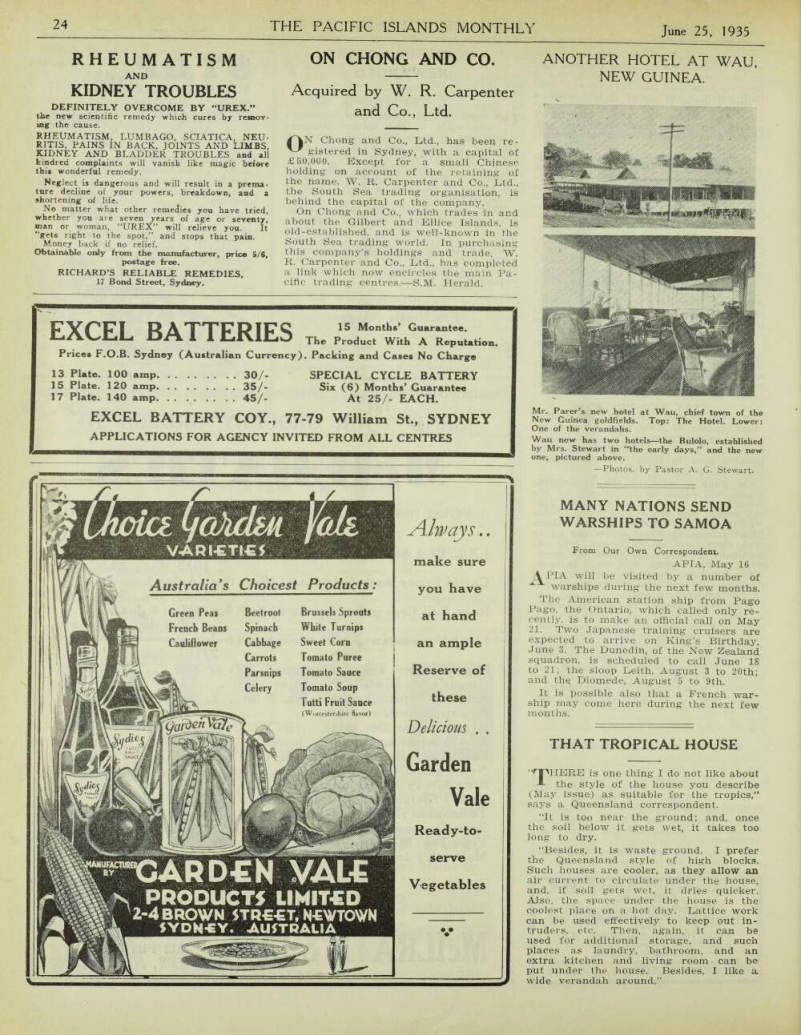
On Chong And Co.
Acquired by W. R. Carpenter and Co., Ltd.
ON Chong and Co., Ltd., has been registered in Sydney, with a capital of £50,000. Except for a small Chinese holding on account of the retaining of the name, W. R. Carpenter and Co., Ltd., the South Sea trading organisation, is behind the capital of the company.
On Chong and Co., which trades in and about the Gilbert and Ellice Islands, is old-established, and is well-known in the South Sea trading world. In purchasing this company’s holdings and trade, W.
R. Carpenter and Co., Ltd., has completed a link which now encircles the main Pacific trading centres.—S.M. Herald.
Another Hotel At Wau,
New Guinea.
Mr. Parer’s new hotel at Wau, chief town of the New Guinea goldfields. Top: The Hotel. Lower: One of the verandahs.
Wau now has two hotels—the Bulolo, established by Mrs. Stewart in “the early days,” and the new one, pictured above. —Photos, by Pastor A. G. Stewart.
Many Nations Send
Warships To Samoa
From Our Own Correspondent,
Apia, May 16
APIA will be visited by a number of warships during the next few months.
The American station ship from Pago Pago, the Ontario, which called only recently, is to make an official call on May 21. Two Japanese training cruisers are expected to arrive on King’s Birthday, June 3. The Dunedin, of the New Zealand squadron, is scheduled to call June 18 to 21; the sloop Leith, August 3 to 20th; and the Diomede, August 5 to 9th.
It is possible also that a French warship may come here during the next few months.
That Tropical House
"THERE is one thing I do not like about the style of the house you describe (May issue) as suitable for the tropics,” says a Queensland correspondent.
“It is too near the ground; and, once the soil below it gets wet, it takes too long to dry.
“Besides, it is waste ground. I prefer the Queensland style of high blocks.
Such houses are cooler, as they allow an air current to circulate under the house, and, if soil gets wet, it dries quicker.
Also, the space under the house is the coolest place on a hot day. Lattice work can be used effectively to keep out in truders, etc. Then, again, it can be used for additional storage, and such places as laundry, bathroom, and an extra kitchen and living room can be put under the house. Besides, I like a wide verandah around.”
5-Tons Schooner
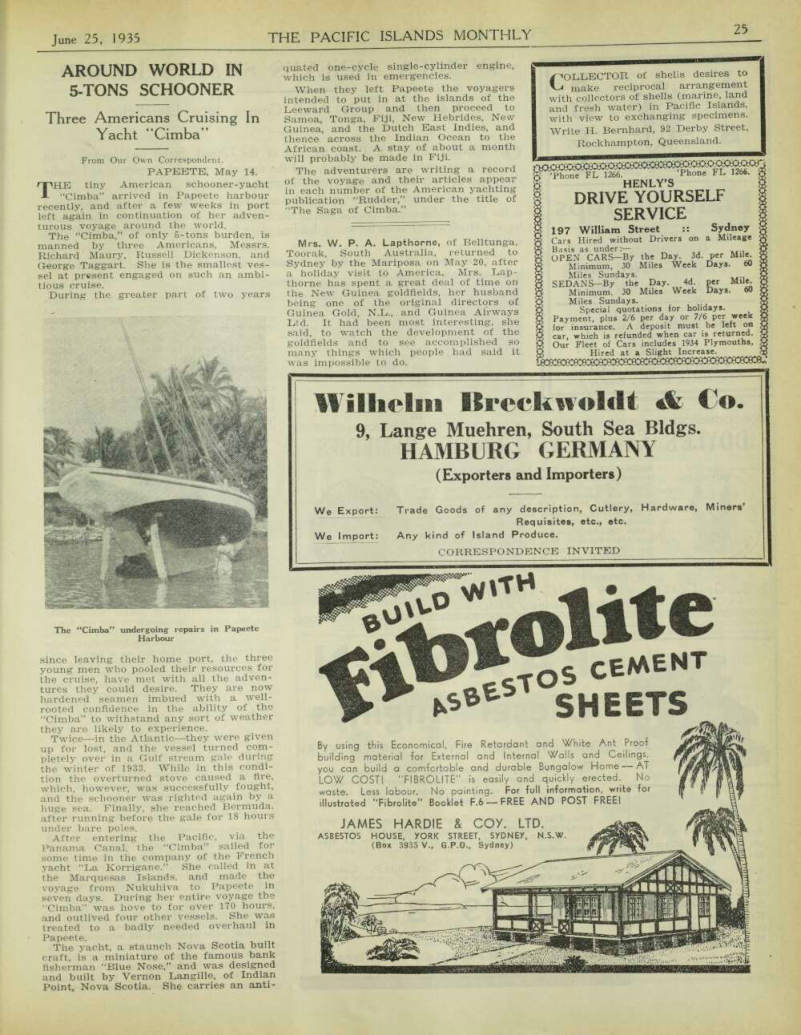
Around World In
Three Americans Cruising In Yacht “Cimba”
From Our Own Correspondent.
Papeete, May 14.
THE tiny American schooner-yacht “Cimba” arrived in Papeete harbour recently, and after a few weeks in port left again in continuation of her adventurous voyage around the world.
The “Cimba,” of only 5-tons burden, is manned by three Americans, Messrs.
Richard Maury, Russell Dickenson, and George Taggart. She is the smallest vessel at present engaged on such an ambitious cruise.
During the greater part of two years
since leaving their home port, the three young men who pooled their resources for the cruise, have met with all the adventures they could desire. They are now hardened seamen imbued with a well rooted confidence in the ability of the “Cimba” to withstand any sort of weather they are likely to experience.
Twice —in the Atlantic —they were given up for lost, and the vessel turned completely over in a Gulf stream gale during the winter of 1933. While in this condition the overturned stove caused a fire, which, however, was successfully fought, and the schooner was righted again by a huge sea. Finally, she reached Bermuda, after running before the gale for 18 hours under bare poles.
After entering the Pacific, via the Panama Canal, the “Cimba” sailed for some time in the company of the French yacht “La Korrigane.” She called in at the Marquesas Islands, and made the voyage from Nukuhiva to Papeete in seven days. During her entire voyage the “Cimba” was hove to for over 170 hours, and outlived four other vessels. She was treated to a badly needed overhaul in Papeete.
The yacht, a staunch Nova Scotia built craft, is a miniature of the famous bank fisherman “Blue Nose,” and was designed and built by Vernon Langille, of Indian Point, Nova Scotia. She carries an anti-
quated one-cycle single-cylinder engine, which is used in emergencies.
When they left Papeete the voyagers intended to put in at the islands of the Leeward Group and then proceed to Samoa, Tonga, Fiji, New Hebrides, New Guinea, and the Dutch East Indies, and thence across the Indian Ocean to the African coast. A stay of about a month will probably be made in Fiji.
The adventurers are writing a record of the voyage and their articles appear in each number of the American yachting publication “Rudder,” under the title of “The Saga of Cimba.”
Mrs. W. P. A. Lapthorne, of Belltunga, Toorak, South Australia, returned to Sydney by the Mariposa on May 20, after a holiday visit to America, Mrs. Lapthorne has spent a great deal of time on the New Guinea goldfields, her husband being one of the original directors of Guinea Gold, N.L., and Guinea Airways Ltd. It had been most interesting, she said, to watch the development of the goldfields and to see accomplished so many things which people had said it was impossible to do.
The “Cimba” undergoing repairs in Papeete Harbour
Advertisements & other items, pp. 27-28 (1 item)
Wilhelm Breckwoldt & Co.
(COLLECTOR of shells desires to a make reciprocal arrangement with collectors of shells (marine, land and fresh water) in Pacific Islands, with view to exchanging specimens.
Write H. Bernhard, 92 Derby Street, Rockhampton, Queensland.
126 ’Phone FL 1266.
HENLY'S
DRIVE YOURSELF
SERVICE
197 William Street :: Sydney Cars Hired without Drivers on a Mileage Basis as under:— OPEN CARS—By the Day. 3d. per Mile.
Minimum, 30 Miles Week Days. 60 Miles Sundays.
SEDANS—By the Day. 4d. per Mile.
Minimum. 30 Miles Week Days. 60 Miles Sundays.
Special quotations for holidays.
Payment, plus 2/6 per day or 7/6 per week for insurance. A deposit must be left on car, which is refunded when car is returned.
Our Fleet of Cars includes 1934 Plymouths, Hired at a Slight Increase.
Wilhelm Breckwoldt & Co.
9, Lange Muehren, South Sea Bldgs.
HAMBURG GERMANY
(Exporters and Importers) We Export: Trade Goods of any description, Cutlery, Hardware, Miners' Requisites, etc., etc.
We Import: Any kind of Island Produce.
CORRESPONDENCE INVITED
By using this Economical, Fire Retardant and White Ant Proof building material tor External and Internal Walls and Ceilings, you can build a comfortable and durable Bungalow Home AT LOW COST! "FIBROLITE" is easily and quickly erected. No waste. Less labour. No painting. For full information, write tor illustrated "Fibrolite" Booklet F. 6 FREE AND POST FREE!
JAMES HARDIE & COY. LTD.
ASBESTOS HOUSE. YORK STREET. SYDNEY, N.S.W.
3935 V., G.P.O.,
Malt & Hops
(SOLID BEER)
MADE FROM THE
FINEST ENGLISH
MALT & HOPS
STOCKED BY:
Burns, Philp & Co., Ltd.,
RABAUL
MAKERS:
Paine & Co., Ltd.,
St. Neots, Hunts., England.
DOYLE’S famous VETERINARY REMEDIES
REDUCINE—Cures Your Lame Horse. Cures him painlessly and you can work him all the time.
Cures Splints, Curbs, Capped Hocks, Sprung Tendons, Bog Spavins, and all Bony and Bursal Enlargements. Price, 12/6 per can. Postage, 1/-.
LARYNGINE.—A sure cure for Coughs, Colds, Strangles, etc. Price, 5/- per can. Postage, 1/-.
SKIN DRESSING.—A certain remedy for Mange and Allied Parasitic Skin Diseases in Horses, Dogs, etc. Price, 7/6 (large), 3/6 (small). Postage, 1/-.
DISTEMPER MIXTURE.—A safe and reliable remedy for Coughs, Colds, Asthma, etc. Price, 2/6. Postage, 9d.
T. G. DOYLE, v.s., 9 KING STREET, RANDWICK, N.S.W.
Write for Free Veterinary Advice and Booklet
Paxman Engines are in use at Rabaul and Thursday Island.
PAXMAN
Diesel Engines
FOR MINE, FACTORY or MARINE WORK
You’ll find the Paxman Diesel most economical to run, especially on intermittent work. Power is available in one minute. Saves time, and expense of raising a head of steam.
The Paxman Diesel Engine is completely selfcontained, automatic in operation, and will run continuously with no more attention than an electric motor.
Recent orders include three units for Metropolitan Water, Sewerage and Drainage Board, and Main Roads Board, Sydney, and for leading Sugar Mills in Queensland.
Sizes available from 6 to 1,200 B.H.P. Land or Marine types.
Sole Agents:
NOYES BROS.
SYDNEY.
(Sydney) LTD.
NEWCASTLE.
BRISBANE
America Annexes Swain’S Island
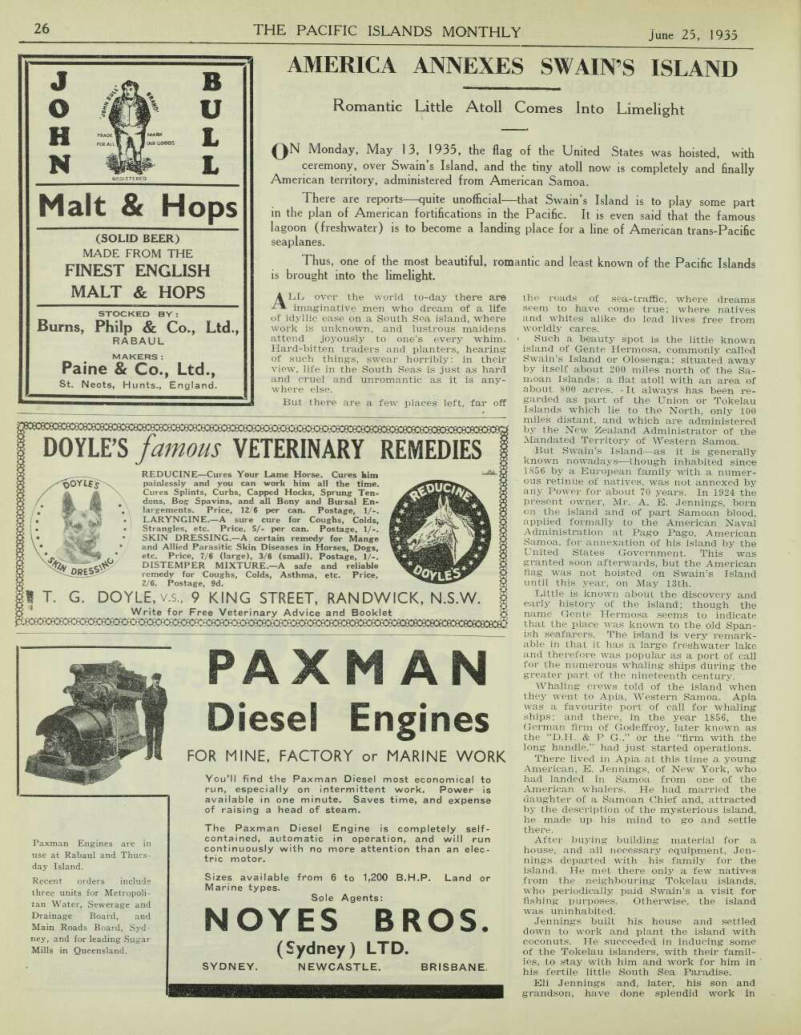
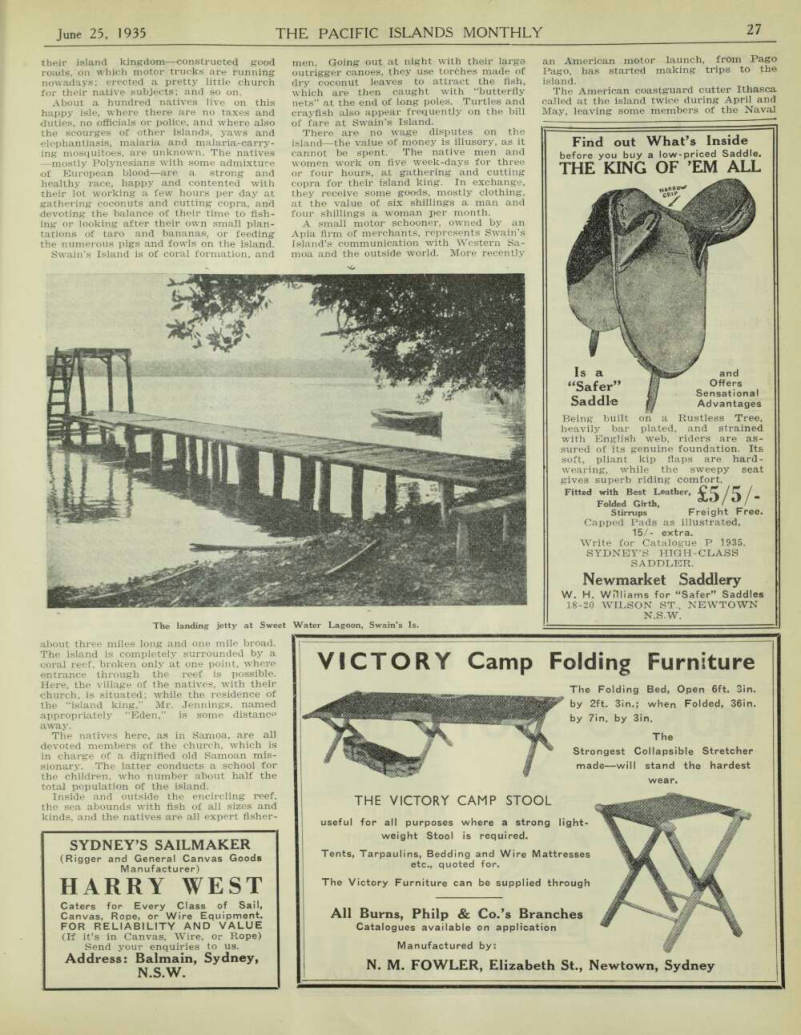
Romantic Little Atoll Comes Into Limelight
ON Monday, May 13, 1935, the flag of the United States was hoisted, with ceremony, over Swain’s Island, and the tiny atoll now is completely and finally American territory, administered from American Samoa.
There are reports—quite unofficial—that Swain’s Island is to play some part in the plan of American fortifications in the Pacific. It is even said that the famous lagoon (freshwater) is to become a landing place for a line of American trans-Pacific seaplanes.
Thus, one of the most beautiful, romantic and least known of the Pacific Islands is brought into the limelight.
ALL over the world to-day there are imaginative men who dream of a life of idyllic ease on a South Sea island, where work is unknown, and lustrous maidens attend joyously to one’s every whim.
Hard-bitten traders and planters, hearing of such things, swear horribly: in their view, life in the South Seas is just as hard and cruel and unromantic as it is any where else.
But there are a few places left, far off
the roads of sea-traffic, where dreams seem to have come true; where natives and whites alike do lead lives free from worldly cares.
Such a beauty spot is the little known island of Gente Hermosa, commonly called Swain’s Island or Olosenga; situated away by itself about 200 miles north of the Samoan Islands; a flat atoll with an area of about 800 acres. It always has been regarded as part of the Union or Tokelau Islands which lie to the North, only 100 miles distant, and which are administered by the New Zealand Administrator of the Mandated Territory of Western Samoa.
But Swain’s Island —as it is generally known nowadays—though inhabited since 1856 by a European family with a numerous retinue of natives, was not annexed by any Power for about 70 years. In 1924 the present owner, Mr. A. E. Jennings, born on the island and of part Samoan blood, applied formally to the American Naval Administration at Pago Pago, American Samoa, for annexation of his island by the United States Government. This was granted soon afterwards, but the American flag was not hoisted on Swain’s Island until this year, on May 13th.
Little is known about the discovery and early history of the island; though the name Gente Hermosa seems to indicate that the place was known to the old Spanish seafarers. The island is very remarkable in that it has a large freshwater lake and therefore was popular as a port of call for the numerous whaling ships during the greater part of the nineteenth century.
Whaling crews told of the island when they went to Apia, Western Samoa. Apia was a favourite port of call for whaling ships; and there, in the year 1856, the German Arm of Godeffroy, later known as the “D.H. & P G.,” or the “firm with the long handle,” had just started operations.
There lived in Apia at this time a young American, E. Jennings, of New York, who had landed in Samoa from one of the American whalers. He had married the daughter of a Samoan Chief and, attracted by the description of the mysterious island, he made up his mind to go and settle there.
After buying building material for a house, and all necessary equipment, Jennings departed with his family for the island. He met there only a few natives from the neighbouring Tokelau islands, who periodically paid Swain’s a visit for fishing purposes. Otherwise, the island was uninhabited.
Jennings built his house and settled down to work and plant the island with coconuts. He succeeded in inducing some of the Tokelau islanders, with their families, to stay with him and work for him in his fertile little South Sea Paradise.
Eli Jennings and, later, his son and grandson, have done splendid work in
their island kingdom—constructed good roads, on which motor trucks are running nowadays; erected a pretty little church for their native subjects; and so on.
About a hundred natives live on this happy isle, where there are no taxes and duties, no officials or police, and where also the scourges of other islands, yaws and elephantiasis, malaria and malaria-carry ing mosquitoes, are unknown. The natives —mostly Polynesians with some admixture of European blood —are a strong and healthy race, happy and contented with their lot working a few hours per day at gathering coconuts and cutting copra, and devoting the balance of their time to fish ing or looking after their own small plantations of taro and bananas, or feeding the numerous pigs and fowls on the island.
Swain’s Island is of coral formation, and
men. Going out at night with their large outrigger canoes, they use torches made of dry coconut leaves to attract the fish, which are then caught with “butterfly nets” at the end of long poles. Turtles and crayfish also appear frequently on the bill of fare at Swain’s Island.
There are no wage disputes on the island—the value of money is illusory, as it cannot be spent. The native men and women work on five week-days for three or four hours, at gathering and cutting copra for their island king. In exchange, they receive some goods, mostly clothing, at the value of six shillings a man and four shillings a woman per month.
A small motor schooner, owned by an Apia firm of merchants, represents Swain’s Island’s communication with Western Samoa and the outside world. More recently
an American motor launch, from Pago Pago, has started making trips to the island.
The American coastguard cutter Ithasca called at the island twice during April and May, leaving some members of the Naval
about three miles long and one mile broad.
The island is completely surrounded by a coral reef, broken only at one point, where entrance through the reef is possible.
Here, the village of the natives, with their church, is situated; while the residence of the “island king,” Mr. Jennings, named appropriately “Eden,” is some distance away.
The natives here, as in Samoa, are all devoted members of the church, which is in charge of a dignified old Samoan missionary. The latter conducts a school for the children, who number about half the total population of the island.
Inside and outside the encircling reef, the sea abounds with fish of all sizes and kinds, and the natives are all expert fisher-
The landing jetty at Sweet Water Lagoon, Swain’s Is.
Commission, to stay for a short visit on Swain’s. There seems to be a possibility that Uncle Sam will buy the island from the present owner, Mr. Jennings, for use as a supply station or health resort.
Advertisements & other items, pp. 29-30 (1 item)
VICTORY Camp Folding Furniture
Find out What’s Inside
before you buy a low-priced Saddle.
THE KING OF ’EM ALL
Is a "Safer" Saddle and Offers Sensational Advantages Being built on a Rustless Tree, heavily bar plated, and strained with English web, riders are sured of its genuine foundation. Its soft, pliant kip flaps are hardwearing, while the sweepy seat gives superb riding comfort.
Fitted with Best Leather, £5/5/- Folded Girth, Stirrups Freight Free.
Capped Pads as illustrated, 15/- extra.
Write for Catalogue P 1935.
SYDNEY’S HIGH-CLASS
SADDLER.
Newmarket Saddlery
W. H. Williams for “Safer" Saddles
18-20 WILSON ST., NEWTOWN
N.S.W.
VICTORY Camp Folding Furniture
The Folding Bed, Open 6ft. 3in. by 2ft. 3in.; when Folded, 36in. by 7in. by 3in.
The Strongest Collapsible Stretcher made—will stand the hardest wear.
THE VICTORY CAMP STOOL
useful for all purposes where a strong lightweight Stool is required.
Tents, Tarpaulins, Bedding and Wire Mattresses etc., quoted for.
The Victory Furniture can be supplied through All Burns, Philp & Co.’s Branches Catalogues available on application Manufactured by: HP N. M. FOWLER, Elizabeth St., Newtown, Sydney
SYDNEY’S SAILMAKER
(Rigger and General Canvas Goods Manufacturer)
HARRY WEST
Caters for Every Class of Sail, Canvas, Rope, or Wire Equipment.
FOR RELIABILITY AND VALUE
(If it’s in Canvas, Wire, or Rope) Send your enquiries to us.
Address: Balmain, Sydney,
N.S.W.
"Every Picture tells a Story.”
BEWARE of Kidney trouble!
Weeks of needless pain and discomfort can be avoided by prompt treatment of the early symptoms and an occasional self-examination is advisable. 1. Do you wake up in the morning with a bad back ? 2. Are your eyelids puffy ? Are there dark swellings under your eyes ?
Are the ankles and hands swollen ? 3. Is the urine cloudy, gravelly or scalding ? 4. Are your limbs shaky and rheumatic, especially in damp weather ?
If you must answer “Yes” to any of these questions, start taking Doan’s Backache Kidney Pills
straight away. This special kidney
tonic can help you as surely as it has helped hundreds of thousands of others.
The “Devil-Pig”
Is It a Myth?
From Our Own Correspondent.
Port Moresby, May 24.
IF it is correct, as was published recently in the Victorian newspapers, that the Dyott expedition hopes to obtain evidence of the existence of the “devil-pig” near the Sepik River, New Guinea, it seems that they are doomed to disappointment.
The fantastic creature has been reported occurring only at the 11,000 ft. summit of Mt. Albert Edward, which is in Papua, not New Guinea.
Its existence was related to Mr. C. A. W.
Monckton, when a Resident Magistrate in Papua in 1906, by a native constable who was temporarily lost on the mountain side while looking for game. The native’s sense of proportion was deranged by his superstitious fear of strange country, by the cold, and by the fact that he was lost.
The fable of the “devil-pig” survived on that slender evidence alone, until the myth was exploded by the Archbold expedition sent to Papua by the American Natural History Museum of New York in February last year. Mr. R. Archbold and party spent three months near the summit of the mountains and did not find any foundation whatever for the tale.
The American scientists attributed the story of the “devil-pig” to the presence on Mount Albert Edward of wild dogs in great numbers. They deduced that the native constable, his imagination already inflamed, saw a wild dog in silhouette on the sky-line, a position which, particularly at high altitudes, has a magnifying effect.
Rev. C. W. Light, Anglican missionary at Boianai, Papua, arrived in Sydney by the Montoro on May 18. Accompanied by his wife, he left shortly afterwards for England.
Hunters
Tahiti Treasure
English Syndicate’s Representative Arrives in Papeete
From Our Own Correspondent.
Papeete, May 12.
A PROMINENT citizen of New Caledonia, Mr. Ley, arrived in Papeete recently by the Cephee, in connection, it is stated, with the treasure-hunting expedition which was in French Oceania last year.
It will be recalled that a party, backed by an influential syndicate of which Mr.
Ley is a member, arrived in Tahiti from England in the early part of 1934. They chartered a local schooner, and sailed off to the Tuamotu archipelago to test out the reliability of the information upon which the expedition was based.
After a month’s absence the explorers returned to Tahiti, apparently in a very sanguine state of mind, and it gradually became known to the local public that the prospects of the syndicate were excellent.
It transpired that a body of hard material—supposed to be the long sought after treasure—had been located by means of drills beneath 18 feet of sand and water in the lagoon of a certain atoll. The explorers stated that the treasure was found in the very place where it was supposed! to be, according to the information pieced together from various sources. More funds and equipment, however, were necessary before the lifting of the loot could be accomplished.
Subsequently the members of the party went their various ways; some to Australia, America, and England, while others remained in Tahiti to take care of the syndicate’s interests while more money was being raised to bring the enterprise to a successful issue.
In due course the usual newspaper articles came to hand—all depicting our adventurous friends as being on the very edge of success, if not the actual owners of some five tons of golden bullion.
Some of the promoters of this treasure scheme appear to have abandoned their colleagues—at any rate, the expected funds have not yet materialised; and it seems likely that Mr. Ley will thus have a deciding voice as to whether the whole enterprise is to be abandoned or not.
Meanwhile all sorts of speculations are rife along the Papeete waterfront as to the outcome of events.
Whippings For Native
Offender In N. Guinea
From Our Own Correspondent.
Rabaul, May 5.
IN the Supreme Court on April 10, the native Niu was convicted of abducting and committing rape on two native women, whom he took from their home in Talasea to a plantation in the Bainings district.
He was sentenced on all charges to 23 years’ imprisonment by Chief Judge Wanliss. As the terms are concurrent, only 12 years’ imprisonment will be served. The native was also sentenced to two whippings of 24 strokes.
As a result of the evidence in this case a charge of rape was laid against a European, and will be heard before the District Court in Rabaul.
Advertisements & other items, pp. 31-32 (1 item)
Suits
Introducing Unrivalled Values in
MURDOCH’S TROPICAL WEAR
with an air of
distinctive
smartness ...
Two-piece “Bantam”
Light-weight worsteds
£3/8/9 To Measure Murdoch’s present the very latest in Summer Suiting fabrics the Bantam weight Tropical Worsteds. Light, comfortable and decidedly smart, in shades of Grey or Fawn Tailored by Murdoch experts, with unlined S.B. coat and trousers.
You’ll like the Bantam weight—it’s a cloth eminently suited to hot conditions, yet very dressy. To your measures from £3/8/9.
Patterns are FREE Fill in and mail the Coupon below —no obligation whatever Desk “C 44,” Murdoch’s Ltd., Box 3875TT, G.P.O., Sydney.
Dear Sirs, Kindly forward me patterns of Bantam weight Suitings.
Name .
Address We pay freight.
Write to Desk “C44”
WHITE CANVAS SHOES
These have genuine welted solid leather soles. Price .. . 15/6
MEN’S LEATHER SHOES
Black and White or Tan and White, solid leather Sports Shoes. Solid leather soles. Price . 19/6
MEN’S SILK SHIRTS
Natural Fugi Silk Shirts, Sports or Tennis Style 8/6
MEN’S ATHLETIC
SINGLETS
Men’s Cream Cotton ladderlock Athletic Singlets. Sizes 34in. to 42in. Price 2/6 Also in all wool. Price . . 4/6
MEN’S TROPICAL
HELMETS
Murdoch’s special showerproof composition Sun Helmets. Best English manufacture. Leather binding and chin strap. White or Khaki Drill. Price .. 19/6
MEN’S PANAMAS
Genuine South American Panamas for men, “Alpine” shape. Price 13/6
MEN’S SPORTS TROUSERS
White Drill Sports Trousers for men 10/6 Also in finely twilled Cream Woollen Gabardine 21/-
MEN’S WHITE COATS
Made with three button fronts, step collar, three pockets. Price .. 8/6 Superior quality at . . 12/6 Also with Patrol collar, buttoned to neck 9/6 and 12/6
MEN’S STRIPED BLAZERS
Excellent quality cloth in a large array of stripes . . . . 32/6
MEN’S SHORTS
Strong White or Khaki Drill, double sewn seams 3/11 Heavier weight .. . 4/11
MEN’S SWIM SUITS
Elastic rib knit all wool Costumes, two-tone or striped top ... 10/6
LADIES’ SWIM SUITS
All wool Costumes for ladies, large range of designs and shades . 18/6
MEN’S DRESSING GOWNS
Art Silk, large range of fancy patterns, 34in. to 40in 14/6 MURROCH’S LTD., George & Park Sts. Sydney
BIRKMYRE'S
WATERPROOF CANVAS
The Original and Best for all purposes where a thoroughly waterproof covering is required.
SAILCLOTHS, DUCKS, &c.
of FLAX, HEMP and COTTON.
FISHING NETS,
LINES & TWINES.
Extensive Stocks carried.
Ensuring prompt despatch.
Gourock Rope-work Export Co.
LIMITED
397 KENT ST., SYDNEY, N.S.W.
Wunderlich Art Metal is the ideal ceiling and walling for Island Homes.
Suitable for every purpose; transports cheaply; easy to erect and decorate; fire-resisting; vermin-proof, and lasts a lifetime. Write for illustrated literature and prices. WUNDER-
LICH, LTD., Box 474 AA, G.P.O.,
SYDNEY.
A. E. Matthews John St., Leichhardt, N.S.W.
A. E.
Matthews
MANUFACTURER
OF THE FAMOUS
“MATTHEWS”
BOOTS
SPECIALISING IN
HEAVY FOOTWEAR
Standard Screwed —Fair Stitch and Machine Sewn.
WHOLESALE ONLY
Enquiries from Traders Solicited Catalogues and Price Lists on application.
We specialise in Island Footwear Trade
MATTHEWS
ST., LEICHHARDT, N.S.W.
Solomon Is. Notes
Gold Industry and Native Labour
From Our Own Correspondent
Tulagi, May 11.
THE outlook for development in the gold industry seems quite hopeful, although no final report on the result of recent expert investigations has been made public locally. Those interested in the copra industry fear that the urgent need for a quick and plentiful supply of labour may induce the gold companies to offer increased wages to natives, who are now beginning to recruit at the new basic wage. This would be a very severe blow to planters, who cannot produce profitably except at the amended basic wage. Natives are now accepting the new wage, but if one vessel once offers better terms, all chance of continued recruiting at the minimum rate is off.
Assistance For Planters Needed
Now that the price of copra has improved a little, the proposed Government assistance for the erection of driers seems to be drifting into the limbo of things forgotten.
It is to be remembered that, even if the improved price remains permanent, plantations have been neglected, and planters have become heavily in debt to trading companies where the firms have not gobbled them up. There is a lot of leeway to make up and planters still need help before they will be out of the woods.
MR. HUGG TO RETURN TO MARU BAY Mr. O. B. Hugg, a very old Solomon Islands resident of Maru Bay, San Cristoval, was expected back by the last steamer. All arrangements had been made for transport from Tulagi to Maru Bay Estate, which, during Mr. Hugh’s absence, had been leased to the Melanesian Mission. But the steamer arrived without Mr. Hugg, to the great disappointment of all his old friends. It is hoped that Mr. Hugg will be aboard the next Malaita.
Accommodation In Tulagi
The problem of accommodation in Tulagi is still acute. Although there are seven licenses to sell alcohol in the port, only one building is provided with accommodation, and no arrangements are made there to cater for travellers.
The business is understood to be for sale, and there have been one or two nibbles, but so far no one has taken the business over.
Mr. Anderson Ill Again
Quite a number of local residents have been receiving attention lately in Tulagi hospital. Shortly after a trip to Sydney for health reasons, Mr.
Anderson, W. R. Carpenter and Co.’s engineer, became ill again. There is no one available to take his place at the engine shop; fortunately Lever’s Gavutu shop is able to do work other than that connected with its own firm, otherwise it would be impossible to get necessary repair work done.
House-Breakers In Russell Group
At Pepesala Estate, in the Russell Group, an ambitious but unsuccessful attempt was made recently to remove the safe from the house during: the absence of the manager. It is very difficult to secure a conviction in such cases, as, for fear of reprisals, no native dare tell anything he knows.
One or two convictions, with a reasonably severe sentence, will have a salutary effect.
Kookoom Sports Meeting
It has generally been assumed in the Solomons, that, owing to the scattered nature of the islands,, and the difficulty of foregathering, any effort to or ganise a sports meeting, except at Tulagi and chiefly from the township’s own population, must meet with failure. However, this pessimistic attitude was proved unjustified when a very successful sports and race meeting was held at Kookoom on the Guadalcanal coast during Easter. While the crowds were not great, “everybody” was there,, and a great time was enjoyed by all.
Devoted Marist Missionary
Rev. Father J. Coicaud, of the Marist Mission at Langa Langa (Malaita), has been compelled to go to Sydney for health reasons. Father Coicaud’s many years of good work in the Solomons have undermined his constitution, but he has dedicated his life to the work. As soon as a holiday South has enabled him to recuperate sufficiently to carry on, he will be back at his task.
“Jock Of The Islands”
Advance copies of Mr. Cromar’s book, “Jock of the Islands,” have been received in Tulagi. Reviews have appeared in the London “Times,” and one or two other papers, and appear distinctly favourable. Apparently the reading public generally, as well as folk with local knowledge and interests, will be greaty interested in the story.
A second volume has been sent to the publishers in England. It should be as interesting as the first volume.
Simbo Native Murdered
Another case of a local native being murdered by a “boy” from another island occurred recently, when a Malaita man, armed with an axe, attacked a Simbo native at Simbo. It is very doubtful if any good can come of allowing the fierce Malaita. men to settle in quiet native villages inhabited by other tribes.
Mr. H. C. Symes’ New Invention
Much interest is being shown in a local invention on which world patents have been secured, and which may create a sensation when it is put on the market. The device, invented by Mr. H. C.
Symes, of Guadalcanal, is a projectile which denickels, cleans, wipes, and leaves a film of oil in the barrel of firearms. The gadget, like most successful inventions, is so simple, that the wonder is someone has not produced it long ago.
A very small charge of a clean explosive fires it. The “bullet” has the usual nose, a faintly marked spiral groove to follow the rifling, a wad impregnated with a special cleansing compound, a drying wad which removes all traces of the cleanser, and finally, a wad impregnated with a special oil, a film of which is left inside the barrel. By the simple process of firing this projectile, in a fraction of a second the weapon is denickelled, cleaned, and oiled, without any pull through, paraphernalia, or loss of time.
For many months now, the Government launch has been out of commission. Recently a full Diesel Gardner engine was installed, and at her trial run she did over seven knots. The launch, which gets a lot of use, will be appreciated now that she is again in satisfactory commission.
The “Evangel,” the schooner owned by the South Sea Evangelical Mission, has been on the slips in Tulagi, being thoroughly overhauled.
Film Damaged—Cameramen
“Mutiny Of The
Bounty”
Film Damaged—Cameramen Return to Tahiti
From Our Own Correspondent.
Papeete, May 11.
A PORTION of the motion picture “Mutiny of the Bounty,” which was recently filmed in Tahiti, was found upon arrival in Hollywood to be seriously damaged. It was discovered that the celluloid had been mutilated and that it was definitely of no use. How the accident occurred is unknown.
In consequence of this mishap—which represents a great loss to the Metro- Goldwyn Company—some of the camera operators returned to Tahiti by the Manganui at the end of April to take this damaged part of the picture over again. In this work they will be assisted by the “Typee” party—which is also working here for Metro-Goldwyn.
Mayor Of Papeete
From Our Own Correspondent.
Papeete, May 14.
THE Municipal election in Papeete on May 5 passed off without undue excitement. Mr. George Bambridge was reelected as Mayor for a further period of six years—a choice which affords universal satisfaction.
Mr. Bambridge succeeded to the office of Mayor upon the death of Dr. Cassiau in 1933, and his leadership has been note worthy for some important developments, particularly in the suburbs of Fariipiti and Patutoa, where wide and well-planned avenues have been constructed, and many new homes have been built. Incidental to these improvements, low-lying areas have been filled in, and one or two badly-congested localities broken up, all of which will prove of benefit from a sanitary point of view.
Municipal revenue in Papeete is raised by means of water rates —which are extremely lenient—market fees and other sources, supplemented by a certain proportion of the import duties on goods entering the Colony. Municipal regulations are subject to the approval of H.E. the Governor of the Colony.
Dr. and Mrs. W. G. Heaslip returned to Papua by the Montoro from Australia on May 25. Dr. Heaslip is medical officer at the Methodist Mission’s hospital at Salamo.
Fiji’S Rice
Remarkable Development Of Indians’ Industry
NOT much more than a decade ago Fiji was dependent upon rice from Burma and other producing countries for her supplies.
To-day Fiji has 10,000 acres under crop, and imports have practically ceased, except for special rice from China for the Chinese residents, writes the Suva cor respondent of the “S.M. Herald.”
Now that the industry has been firmly established, the Government has shut down its mill and the community— Europeans, natives and Indians—is supplied with good rice by over 30 small mills (owned and worked by Indians), many of which are worked by motor power.
The Indian farmers, even those dependent upon sugarcane-growing, generally manage to have an acre or so of growing rice for home consumption.
Advertisements & other items, pp. 33-34 (1 item)
Leica
You’ll Enjoy Your Smoke
with a Pike Bros.
“GUINEA”
PIPE
Made from selected Briar, Pikes range of “Guinea” Pipes will appeal to the smoker who wants “something better” but knows not just what.
The pipe bowls are guaranteed against cracking or burning—so the quality is there. Price 21/- For a decidedly better smoke, try “BOLBEC” English Sliced Plug Tobacco, specially packed.
Price, 2-oz. tin 3/3
PIKES
of Queen Street, Brisbane
For Speedy, Accurate and
Versatile Photography . . . there’s nothing like the
LEICA
Camera
(MODEL 3)
HERE ARE THE REASONS WHY
1. BUILT-IN SHORT BASE RANGE
FINDER gives you perfect focus automatically.
2. FOCAL PLANE SHUTTER with
the greatest range of shutter speeds on any camera —1 second, ½, ¼, ⅛, in addition to all regular speeds between 1/20th and 1/500th second. speed, wide angle lenses, and others. 4.-36 PICTURES from a single roll of cinema film. Sharp negatives.
Enlargements up to any size.
S—SMALL, COMPACT, FITS THE
POCKET, easy and fast to operate. Very inexpensive to maintain.
3.—ELEVEN INTERCHANGEABLE 6.—DOUBLE EXPOSURES are im-
LENSES, including telephoto, possible.
For the above reasons the name LEICA is not merely the name of a modern photographic instrument; it has come to be associated in the photographic world with a new conception of photography, marked by new possibilities of pictorial and optical precision previously unachieved. To-day it forms the basis of a unique photographic process that is extraordinarily universal in its range of application. The process is known as the LEICA PROCESS.
Write NOW, for further particulars to
LEICA PHOTO SERVICE
KYLE HOUSE, 31 MACQUARIE PLACE, SYDNEY
(The only Leica Specialists in Australia)
LEICA SALES
ENLARGING
DEVELOPING
PRINTING
COLOURING
REPRODUCING
POSITIVE PRINTING
SLIDE MAKING
CAMERA REPAIRS
FILM SUPPLIES
FEED for . . .
POULTRY
DAIRY COWS
HORSES and DOGS
We ship throughout the Islands our special feeds for all classes of stock.
These feeds offer stock owners the highest value for cost that is obtainable and can be depended upon to give the best results.
Write for free literature.
THORPES LTD.
Stock & Poultry Feed Manufacturers, 313-317 Sussex St., Sydney
A YACHT TO BE PROUD OF
. AT A PRICE WITHIN REASON
EXPERT BOATBUILDER
AND DESIGNER. . .
ISLAND WORK A
SPECIALITY. . . .
R.M.Y.C. “Hoona” (Vice Com’re Victor Heine) J. ROBINSON, 8 School St., Balmain, N.S.W.
“The
Wentworth"
CHURCH HILL, SYDNEY
Phone: 8W1361
Telegraphic Address: “Mum,” Sydney
Sydney’s Exclusive Residential Hotel
Situated only two minutes from the General Post Office, Railway Station, and leading theatres. All rooms Steam-heated in Winter and Air-cooled in Summer, and equipped with Telephone, and Hot and Cold Water.
Excellent Cuisine.
Tariff: Room and Breakfast, from 10/6 per day; Inclusive from 18/- per day.
For full particulars apply to The Manager
Tahiti Disturbed
Involved Affairs of Chinese Company
TAHITI’S “affair Stavisky,’’ which, following the liquidation of the Kong Ah Company, resulted in an official in quiry into its ramifications, is believed to be responsible for the departure of the Governor, His Excellency Lucien Mon tagne, from Papeete, by the “Cephee” on May 10. A large gathering, including chiefs from Tahiti and Moorea, assembled to say farewell to the Governor.
The situation will be personally ex plained in Paris by the Governor, who, at the same time, will approach the French Government for a loan of 20,000,000 francs for the purpose of carrying out certain urgent public works in French Oceania, M. Henri Sautot, Chief Administrator of Colonies (and recently Resident Com missioner for France in the New Heb rides), is charged with the administration of the colony in the absence of M. Mon tagne.
The failure of the Chinese company for an approximate sum of 12,000,000 francs resulted in a special inquiry in Papeete by an investigator from France. As a result, it is believed, a certain course of action was decided upon. Police Commis
sioner Demay, who is understood to sup port the policy of the Governor, also left for Paris by the same liner.
The Kong Ah Company, which was of mushroom growth, owned its own schoon ers and plantations, and carried on a con siderable import business. Its activities extended to many islands in French Oceania.
This is the second financial collapse of a similar character relating to a Chinese controlled company within recent years in Tahiti. The failure of a Chinese bank in Papeete about three years ago involved considerable loss for local residents.
The Kong Ah trouble has now taken on a political character, and, in consequence feeling is high in Tahiti. There has been constant communication between Papeete and Paris in recent months. Interest was further stimulated by a visit from M. Sim monet, one of the most highly paid jour nalists in Paris, and a well-known writer of detective fiction.
The next development was the firing of a shot by some unknown person at a motor car driven by M. Rougier (nephew of the late Abbe Rougier), a Papeete citi zen who took a prominent part in pressing for the inquiry, and who was believed to be associated with M. Simmonet during his stay in Tahiti. M. Rougier was un injured.
Another resident collapsed on being in terrogated at the inquiry, and is now in hospital.
A French newspaper, published in San Francisco, which commented upon the scandal and its ramifications, is now un derstood to be prohibited in the colony.
Papeete has no local press—apart from the “Journal Officiel.”
Rabaul Notes
From Our Own Correspondent.
Rabaul, May 5.
MRS. HERTZ, well-known to many as Eileen Whiteman, is still an inmate of Namanula Hospital, where she has been receiving treatment for some weeks now. She is making satisfactory progress.
Congratulations are due to Mr. and Mrs. Jack Ahearn, to whom a daughter was born on April 24.
Mr. Tom Ellis, treasurer of the Rabaul Ama teur Turf Club since its inception, was farewelled by the committee of that organisation on April 29, prior to his departure for England, where he expects to spend several months’ holiday. He was the recipient of a very useful gift in apprecia tion of the work he had performed for the club.
Mr. J. J. Virtue, one of the officials of Messrs.
Burns, Philp and Co., is again making an inspec tional tour of the Territory. He arrived by the Montoro and is visiting the outstations. He ex pects to be here for some weeks, and will thoroughly study all matters dealing with New Guinea shipping.
Hon. J. C. Mullaly, M.L.C., returned to the Territory by the Neptuna on April 29, after hav ing spent some weeks in Australia on business.
A popular wedding was celebrated at the Vuna pope Cathedral by Father Ischler on April 17, when Miss Helena von Grabowska was married to Mr. Jack Sherry. Over 50 guests were pre sent at the ceremony. Mr. Reynolds gave the bride away, while Miss Hawnt acted as bridesmaid and Mr. Les. Clark as best man. After the ceremony a wedding breakfast was served at the
Kokopo Hotel.
Archdeacon de Voil has returned from a hur ried trip to Australia, bringing back with him a most charming bride to assist him in his many duties in Rabaul and district. A welcome tea to Mrs. de Voil was organised by the ladies of Rabaul at The Palms on April 29, when Mrs.
McNicoll welcomed the new arrival and wished her every happiness in her new home.
During the Easter holidays a cricket team from New Britain journeyed to Kavieng, where an inter-territorial test match was played, and re sulted in a victory for the visitors by 7 wickets.
The visitors were very loud in their praise of the hospitality received from their Kavieng hosts and hostesses.
How To Select A Launch-Engine
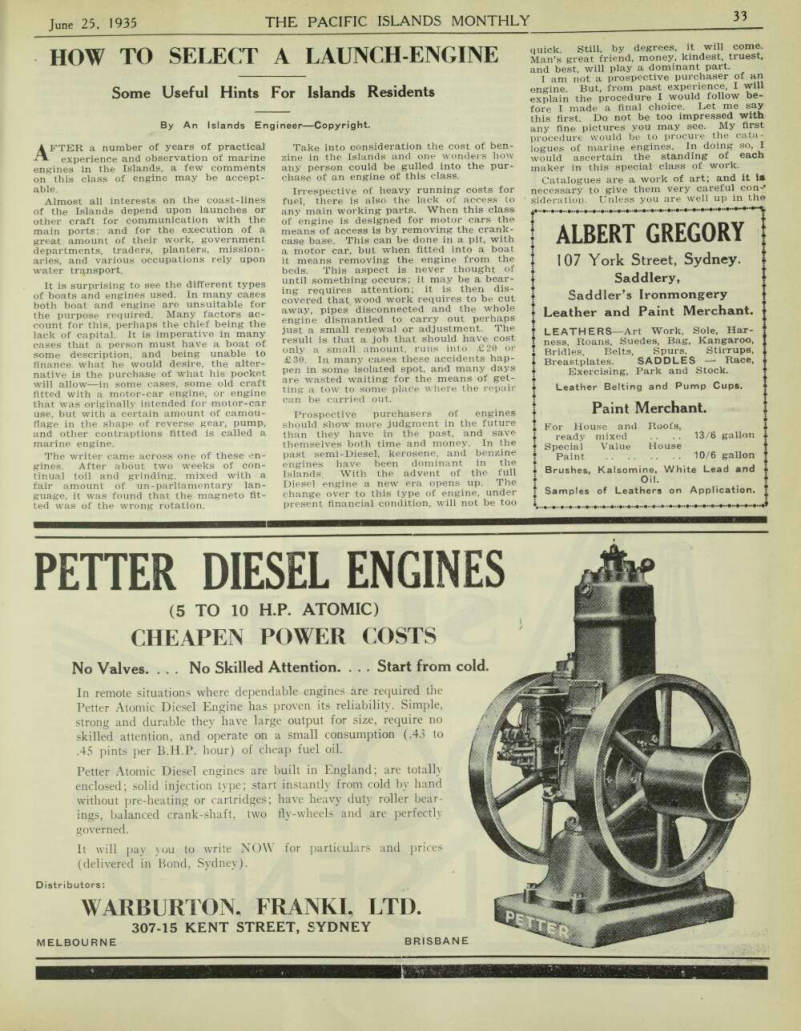
Some Useful Hints For Islands Residents
By An Islands Engineer—Copyright.
AFTER a number of years of practical experience and observation of marine engines in the Islands, a few comments on this class of engine may be acceptable.
Almost all interests on the coast-lines of the Islands depend upon launches or other craft for communication with the main ports; and for the execution of a great amount of their work, government departments, traders, planters, missionaries, and various occupations rely upon water transport.
It is surprising to see the different types of boats and engines used. In many cases both boat and engine are unsuitable for the purpose required. Many factors account for this, perhaps the chief being the lack of capital. It is imperative in many cases that a person must have a boat of some description, and being unable to finance, what he would desire, the alternative is the purchase of what his pocket will allow —in some cases, some old craft fitted with a motor-car engine, or engine that was originally intended for motor-car use, but with a certain amount of camouflage in the shape of reverse gear, pump, and other contraptions fitted is called a marine engine.
The writer came across one of these engines. After about two weeks of continual toil and grinding, mixed with a fair amount of un-parliamentary language, it was found that the magneto fitted was of the wrong rotation.
Take into consideration the cost of benzine in the Islands and one wonders how any person could be gulled into the purchase of an engine of this class.
Irrespective of heavy running costs for fuel, there is also the lack of access to any main working parts. When this class of engine is designed for motor cars the means of access is by removing the crankcase base. This can be done in a pit, with a motor car, but when fitted into a boat it means removing the engine from the beds. This aspect is never thought of until something occurs; it may be a bearing requires attention; it is then discovered that wood work requires to be cut away, pipes disconnected and the whole engine dismantled to carry out perhaps just a small renewal or adjustment. The result is that a job that should have cost only a small amount, runs into £20 or £30. In many cases these accidents happen in some isolated spot, and many days are wasted waiting for the means of get ting a tow to some place where the repair can be carried out.
Prospective purchasers of engines should show more judgment in the future than they have in the past, and save themselves both time and money. In the past semi-Diesel, kerosene, and benzine engines have been dominant in the Islands. With the advent of the full Diesel engine a new era opens up. The change over to this type of engine, under present financial condition, will not be too
quick. Still, by degrees, it will come.
Man’s great friend, money, kindest, truest, and best, will play a dominant part.
I am not a prospective purchaser of an engine. But, from past experience, I will explain the procedure I would follow be fore I made a final choice. Let me say this first. Do not be too impressed with any fine pictures you may see. My first procedure would be to procure the catalogues of marine engines. In doing so, I would ascertain the standing of each maker in this special class of work.
Catalogues are a work of art; and it is necessary to give them very careful consideration. Unless you are well up in the
business, you will find some catalogues and specifications misleading. Take the specifications of different makers with regard to equipment. Some quote for a complete equipment; some make you be lieve they are doing so; others don’t know what they are doing themselves. In all cases, the following information should be procured before coming to a decision.
What did the engine in itself consist of? What length of stern-tube supplied;
size; was it fitted with inside or outside bearings or stuffed box; what material?
Length, diameter and material of tail shaft? Details of propeller? Length of intermediate shaft, diameter and material?
Were couplings and intermediate bearings supplied? What tanks were supplied— material, capacity, and fuel-pipes and fittings supplied? Details of water intake; description of strainer and hull fittings and pipes supplied? Length, size and particulars of exhaust pipe and fittings?
To make comparisons it is necessary that all the above information be available.
Another important asset is the tool box.
With some engines a splendid kit of tools is supplied; with others, you could buy it for two shillings.
Having procured the above information, the first question is the matter of horse power. Remember, the chief factor in the purchase of an engine is, all other things being equal, the cost per horse power.
Any consulting engineer or naval architect makes horse power the deciding factor. Perhaps no subject throughout the engineering world causes more discussion than horse power of engines. You have only to pick up the various catalogues to see the diversity of rated horse power.
In 90 per cent, of cases, internal combustion engines have no rated horse power. If you buy an engine, and the rating is given as 12-60 h.p., you can be pretty certain the normal horse power is 12: the 60 horse power may be attained if you are game to run the engine about 5000 rev.
There is the maker who rates his engine in the catalogue at maximum horse power, but recommends they be run, under working conditions, at a lower horse power.
Then, again, there is the maker whose engine loses power through temperature.
Why these excuses should be made I fail to understand. The maker whose product would appeal to me is the one
who gives you the horse power straight out. If an engine is governed, I presume the setting is to the working horse-power.
This, therefore, becomes the normal horse power of the engine, and, as such should be sold. If the engine is capable of over load, no harm is done by giving this information.
The only sure way of being satisfied regarding horse power is to insist that Lloyd’s or other certificate be supplied with the engine, giving its normal working horse power under normal conditions. If this certificate is procured, and the engine complies with the Board of Trade requirements, the details of the engine construction can be left to the makers. If these precautions are taken, purchasers will not go far wrong and will be assured that the main factor, power, comes up to what is represented.
Regarding consumption of lubricating oil. This should be watched, and a guarantee received.
After horse power, we have to consider reliability. To a very great extent this must be left to reputation. An engine that is suitable for intermittent work and pleasure purposes is not always suitable for hard, constant and rough work.
You have only to study the accounts given in the press, at different times, of yachts, cruisers, and other craft. These craft, by the description given, are floating palaces. So far as the engine is concerned, too much is not said; these boats are the home of the derelict motor-car crock.
To find out the engine suitable for reliable and hard service you require to turn to another class of users, fishermen, launch proprietors, shipping service launches, pilot service, lifeboats, and other services. A study of engines used in these services suggest the engines which will give Islands service.
Simplicity is another factor overlooked
by many makers. It should be remembered that in the Islands hundreds of miles often separate the user from any avenue for repairs; therefore, it is necessary consideration should be given the design of the various working parts, subject to renewal or repairs.
Take, for instance, main bearings, crankpin bearings and other working parts. These should be designed in such a manner that the average person should be able to renew them. Anti-friction metal run into bearings which are a fixture should be avoided. Should an accident occur, it often means the dismantling of the whole engine—an expensive matter. Then, again, the metal used for renewal may not be suitable.
All main bearings and crankpins, also intermediate bearings, should have liners.
These can be carried as spares, and in cases of accident or renewal, the work can be carried out by the average person.
Another bad feature with many engines is the casting of the crankcase and cylinder block in one piece. Should the water jacket become cracked, or the cylinder damaged, it means the renewal of the whole cylinder block and crankcase — a most expensive operation. In some cases, a renewal of this kind would cost more than a new engine. The argument may be used that motor car engines are constructed this way. Motor car engines are not subjected to a continual flow of salt water through the water jacket, and exposure to salt air.
Accessibility is, perhaps, the most important point which requires consideration. Very few people consider this until something occurs. Any engine that lacks access for the examination of the main working parts should never be considered for marine work. Where life is at stake in cases of accident, too much care cannot be exercised, and regular examination of main bearings and working parts should be carried out. Working until some thing occurs is a very bad motto.
The cost of repairs in the Islands is a very heavy item, when it becomes necessary. In a great many cases, from 40 to 60 per cent, of expense in this respect could be saved, if makers took into consideration design and access to meet the situation.
Much more could be written on this subject. The idea of the writer is to point out to the prospective purchaser the necessity of giving consideration to the different points mentions. The makers of the many marine engines on the market may also find food for thought.
This article was prompted through many years’ experience of some very bad engines. There are many first-class engines used in the Islands—some of which could be greatly improved with a little thought.
In conclusion: Service is the chief consideration. This can only be accomplished by reliability, accessibility, and simplicity. Compactness should be studied, and, above all, the maker (or his agent), when asked to give a quotation, should be explicit, giving full details and specifications of what he offers for the price quoted. The average Island purchaser does not ask for either maximum or minimum performances, regarding horse power, fuel, or lubricating oil. What he wants to know is the average which will apply to the work to be accomplished.
Rev. A. J. Thompson, of the New Guinea Mission of Wanigela, Papua, recently arrived in Sydney from Port Moresby with his wife. They sailed from Melbourne for Europe on May 21, and after furlough in England will return to Melanesia for further mission work.
Advertisements & other items, pp. 35-36 (1 item)
Petter Diesel Engines
ALBERT GREGORY
107 York Street, Sydney.
Saddlery,
Saddler’s Ironmongery
Leather and Paint Merchant.
LEATHERS— Art Work, Sole, Harness, Roans, Suedes, Bag, Kangaroo, Bridles, Belts, Spurs, Stirrups, Breastplates. SADDLES Race, Exercising, Park and Stock.
Leather Belting and Pump Cups.
Paint Merchant.
For House and Roofs, ready mixed . . 13/6 gallon Special Value House Paint 10/6 gallon Brushes, Kalsomine, White Lead and Oil.
Samples of Leathers on Application.
PETTER DIESEL ENGINES
(5 TO 10 H.P. ATOMIC)
CHEAPEN POWER COSTS
No Valves. ... No Skilled Attention. . . . Start from cold In remote situations where dependable engines are required the Fetter Atomic Diesel Engine has proven its reliability. Simple, strong and durable they have large output for size, require no skilled attention, and operate on a small consumption (.43 to .45 pints per B.H.P. hour) of cheap fuel oil.
Fetter Atomic Diesel engines are built in England; are totally enclosed; solid injection type; start instantly from cold by hand without pre-heating or cartridges; have heavy duty roller bearings, balanced crank-shaft, two fly-wheels and are perfectly governed.
It will pay you to write NOW for particulars and prices (delivered in Bond, Sydney).
Distributors:
WARBURTON FRANKI, LTD.
MELBOURNE
307-15 KENT STREET, SYDNEY
BRISBANE
Impregno Steel Surface
Hardening Compound
For local hardening by sprinkling the compound on the hot steel part, or for case hardening to a depth of one thirty-second of an inch by treating the object to be casehardened in a molten bath of the compound. Equipment required, an open fire, a steel pot, and a tin of compound.
IMPREGNO Case Hardening Crystals
For muffle case hardening.
IMPREGNO Quenching Oil is an invaluable aid to the satisfactory hardening of gears, tools, etc.
Firms handling Engineers’ Supplies or Hardware are invited to communicate with us with a view to acting as distributors for these lines.
THE . .
Steel Improvement Co.
102 BAY ROAD, NORTH SYDNEY,
N.S.W.
TOOHEYS
PILSENER.
Life on Fanning Island
AFTER spending two years at the cable station on Fanning Island, Mr. C.
Vorraister arrived to visit his family in Sydney by the Aorangi on May 18. Fanning Island, which is included for administrative purposes in the Gilbert and Ellice Islands Colony, is the connecting link of the Pacific cable between Canada and Fiji.
“The island is 10 miles long and five miles wide,” said Mr. Vormister, “and 12 men and five women live at the cable station. Two men and one woman reside
at the other end of the island, and there are also about 100 Gilbert Islanders who cut copra for Fanning Island Ltd., the company which owns most of the land.
“Is is a lonely outpost,” he continued, “but we have plenty of recreation, including day and night tennis, swimming, fishing and occasional shooting at migrating ducks. Bridge is very popular, and the cable station employees play a great deal of auction bridge.
“Fanning Island is visited only four times a year by a vessel which brings supplies, newspapers, and mails,” he said, “but occasionally yachting parties call in at the cable station.”
Mr. A. S. Burton, travelling inspector for Messrs. Tooth and Co. Ltd., returned to Australia during May, after a business visit to New Guinea.
Advertisements & other items, pp. 37-38 (1 item)
Brunton's Flour
PRESCOTT LTP Sussex St Sydney are sole wholesale agents for
PINEAPPLE BACON & HAMS
DAISY BRAND BUTTER
PRESCO BRAND BUTTER
LEA & PERRINS’ SAUCE
“WYRNWAY” BRAND
SHIRTS, PYJAMAS
UNDERWEAR AND TIES
ARE QUALITY PRODUCTS
WEARNES LIMITED
MANUFACTURERS 17 PARKER ST., SYDNEY
PRODUCING UNIFORM GOOD RESULTS SINCE 1868
Brunton's Flour
ALWAYS ASK FOR IT
West’s Wheel
Works
(F. H. Bishop, Proprietor)
60-64 Bay St., Sydney
MANUFACTURERS
OF ALL TYPES OF WHEELS
FOR WAGGONS, CARTS,
TRAILERS, CARS
SUPPLIERS
OF WHEEL PARTS, RIMS,
SPOKES, AXLES, BOXES, etc.
We have the plant and have been established forty years Write for Information and Quotations
ON SALE AT ALL NEWSAGENTS AND BOOKSELLERS
READ THE
B.P. MAGAZINE
WINTER NUMBER
Cable Address: “PIOSPRING” Established 42 Years.
PIONEER SPRING CO. LTD.
McEVOY STREET, ALEXANDRIA, SYDNEY, N.S.W.
Are the leading Springmakers, manufacturing Coil, Volute, and Laminated Springs for all Motor Cars, Trucks, Tractors, all kinds of Locomotives and Rolling Stock.
Write for our Catalogue and Price List We are also Expert Forgers and Blacksmiths.
Bougainville Is.
Twenty-four Years on Bougainville Is.
Marist Missionary’s Experiences Among New Guinea Savages
HAVING completed 24 years of service for the Marist Mission Society at Tarlena station, Bougainville, New Guinea, Rev. Father L. Chaize arrived in Sydney on furlough by the Malaita on May 21.
Accompanied by Father Griswaort, Rev. Chaize went to Bougainville from France in 1911. At Tarlena station they joined Rev. Seiller, who had been working among the natives for the previous 10 years. By perseverance, courage, and boundless faith in their work through the years, the three missionaries have succeeded in converting to Christianity more than 25,000 natives.
Father Chaize has risked his life on many occasions. He gave a vivid account of his experiences when, on the last occasion, he went in search of a tribe which had never seen a white man.
His guide on that expedition was a young native who admitted shyly that he had often eaten human flesh.
“I did not have any firearms, but, instead, carried a walking stick,” Father Chaize said. “As we neared the village, natives armed with spears were lurking in the trees. At any moment I thought
they would pounce upon us, but they allowed us to proceed to their village.
“When the natives found out that I meant no harm, they surrounded me and inquisitively, but with great caution, examined my body. Not having previously seen a white man, they were astounded at my skin. Lifting up my shirt they pinched and probed the skin on my back, chest and arms. Then, for the first time in my life, I shivered in my boots. The chief rushed up to me. felt the fat on my legs and arms, and cried loudly in his native language, ‘Big fat feller.’ With visions of being dumped into the proverbial pot, I honestly thought my last hour had come.
“Finally, when I had given them mirrors, pocket-knives, and matches, they regarded me as a friend, and childishly played for hours with the glinting mirrors. Unmolested, I remained with them for three days, and on my return to the coast the chief provided me with an escort.”
Praising the work of the New Guinea Administration, Rev. Chaize said that field officers were doing splendid work in opening up hostile areas and controlling the natives. Roads were being built, hospitals established, and doctors visited the villages periodically to give injections and treatment. The Government had given the mission every assistance, he added.
Death at Samarai, Papua
Mrs. Martha Aston
From a Special Correspondent.
Samarai, May 7.
THE death occurred in Samarai Hos- Pital on April 30 of Mrs. Martha Aston, at the age of 78. For many years she had been associated with Anglican mission work in the Pacific, and was well-known in Polynesia.
Born in Tasmania, she celebrated her first marriage early in life, and sailed with her husband for New South Wales.
Two days after their arrival on the mainland, her husband died, leaving her a widow in a strange land. A second marriage proved equally tragic; her husband, John Aston, of Stourbridge, Worcester shire, disappeared while crossing the West Australian desert country in 1911.
After the ordination of her youngest son, Rev. C. W. Whonsbon-Aston, she joined him at his first curacy in a Sydney suburb. Later, she accompanied her son when he left Australia for mission work in the Diocese of Polynesia. In Fiji, Mrs.
Aston was held in high respect by residents of Suva and Levuka, where Rev.
Whonsbon-Aston was Vicar.
She was adventurous enough in her 77th year to journey from Fiji with her son to Papua. Since the end of last year she had been assisting him at the mission station at Mukawa, in the North- Eastern Division.
M. Moerenhout
Translation of Pacific Classic To be Task for Australian Scholars
(By Eric Ramsden)
STUDENTS of Pacific history throughout the world will be interested to learn that two Australian scholars have been entrusted with the important task of translating Moerenhout’s “Voyages aux Isles du Grand Ocean.” Though published in Paris almost a century ago, this important work has not, hitherto, been available for students in an English version.
The work is to be undertaken on behalf of the Hakluyt Society.
It is to be hoped that it will be published eventually in one of the cheaper series. Another book long overdue to be re-published in that way is Mariner’s “Tonga.” The latter is only available in the early two-volume editions, and is so inaccessible, except in a library, that many young people of to-day have never turned its fascinating pages.
J. A. Moerenhout was one of the most controversial figures in Pacific history.
In the tense drama played on the Tahitian stage towards the close of the 30’s of last century, he was one of the central figures. Indeed, it would not be exaggeration to suggest that France owes more to him than possibly to any other man that she is in possession of Tahiti to-day.
True, he was supported by the guns of Commodore du Petit Thouars and the might and majesty of King Louis Phillipe. But it was the Belgian, Moerenhout, the first United States Consul, and later Consul for France, who pulled the political strings, who set the stage.
Not a great deal is known of his antecedents. Moerenhout’s life might well form the subject of a memoir by some enterprising student. The part he played in Tahitian history at least entitles him to that distinction.
We know that he came to the Society Islands as a trader, was at Mangareva in 1834, and that two years later look a prominent part in the agitation that followed Queen Pomare’s unfortunate ban against the landing of the French priests, Fathers Laval and Garret. At that time he was Consul for the United States. W T. Pritchard, whose father was the Rev.
George Pritchard, the British Consul, says that Moerenhout’s religious-zeal on behalf of the priests, led to the Belgian being superceded in that office by an American citizen. “He gave his full hearty cooperation and protection to the priests from the first,” says Pritchard (who, of course, was violently anti-French).
When France decided to take up the case of the priests (who, incidentally, had landed at Tautira, on the opposite side of the island, instead of at Papeete, in the ordinary way), the naval officer, du Petit Thouars, appointed Moerenhout to be French Consul. Further trouble arose when the Queen refused to receive him.
“The Queen decided that she had had quite enough of M. Moerenhout,” says Pritchard, “without again receiving him in an official capacity!” The Commodore declared that Moerenhout’s rejection would be equivalent to a declaration of war against the French nation. The Queen surrendered.
Moerenhout, the avowed enemy of poor bullied and harassed Pomare, was instrumental in securing signatures to a petition calling upon the French to intervene, during the absence of the Queen on one of the other islands. Those who signed are said to have been promised 1,000 dollars each. It was France’s golden opportunity.
The Queen was deposed, and a provisional
government established. Moerenhout was rewarded by an officer in the latter as “King’s Commissioner.”
Pritchard also suggests that Moerenhout did all he possibly could to annoy the Queen, “conducting himself most offensively in her presence,” particularly when Pomare, under the impression that Britain might come to her aid, insisted on sailing into Papeete harbour with her own royal flag unfurled.
Tbe Queen subsequently told Thomas Thompson that Moerenhout
“shook his head’’ at her, “threw his hands” before her face, and stared fiercely at her.
“I protested against his conduct and told him that he was a very troublesome man!” she said.
We know, too, that Moerenhout was attacked in his home on one occasion. His wife is believed to have saved his life by throwing herself in front of him. A Spanish negro was executed for the crime—the only prisoner to suffer capital punishment during the Queen’s reign.
Thereafter, Moerenhout seems to have faded out of the picture. French rule was well established by the 40’s, however. It is possible that some of the older residents of Papeete have some knowledge of his later career. Though I was unable, in the time at my disposal while in Tahiti, to give much attention to the history of Moerenhout, I succeeded in finding a number of documents in his handwriting. The papers were all of an official character.
His “Voyages aux Isles du Grand Ocean” appeared in two volumes in Paris in 1837. The book is rare. Collectors seek it these days. Included is a portrait of Tati, the high chief of Papara, who signed the appeal to the French King at Moerenhout’s behest. Tati was the father of Arii-Taimai (whose rare volume of reminiscences is even more keenly sought after nowadays), and the direct ancestor of the numerous Salmon clan.
The most interesting plate, however, is an early view of Papeete waterfront, showing the buildings then in existence.
It is possibly one of Moerenhout’s own sketches. In the short space of less than a century, much data of great historical value has been lost in Papeete. Enthusiastic research by Mr. W. W. Bolton, M.A., has decided several points of importance that, hitherto, were in doubt. Mr. Bolton recently received the thanks of the.
Papeete Municipality for a record which he voluntarily presented to that body. It represented many years of patient endeavour, and careful scholarship.
Advertisements & other items, pp. 39-40 (1 item)
Home Lighting Plants
Specialists in
TWINES and
CORDAGE
Cotton-Hemp Jute Plough Reins Halter’s Sewing Twines Fishing Lines And Sash Cords Enquiries Invited And where Not Represented Agents are Desired Prices on Application Fitzroy St., Marrickville, N.S.W.
CABLE ADDRESS:
“BENTLEYSON," SYDNEY
The most complete range of
HOME LIGHTING PLANTS
ever offered . . .
The “Nevertire” Full Automatic Plant From a small 10-light plant, through a wide range to 7.3 kilowatts or more. Semi-automatic, fullautomatic; direct-coupled or belt-driven; all voltages.
LISTER
Petrol or Diesel
Engine drive.
Here is the lighting plant that THINKS!
The marvellous “OMNISTAT" automatic engine control starts the Lister engine as soon as you switch on more than half-a-dozen lights, which are lit by the battery. The generator continues to supply current until only a few lights are in use. Then the engine stops, ready to restart automatically, as soon as another call is made for current. Simple in action, and absolutely positive. With this plant you can operate an automatic electric refrigerator on a 32 volt system and you need have no worry about the current supply it is always available, automatically.
Write for catalogues and details of prices free of Australian Customs Duty.
DANGAR, GEDYE & CO., LTD
Malloch House, 10-14 Young Street - SYDNEY
GLOBEX
(GLOBE BEEF EXTRACT)
GLOBEX
FOR GOOD BEEF TEA
GLOBEX
FOR SOUPS & GRAVIES
GLOBEX
DELICIOUS SPREAD THINLY ON BREAD
Obtainable from All Island Traders
AUSTRALIA'S CLEARING HOUSE FOR THE PRECIOUS METALS.
BUYERS OF
GOLD
OSMIRIDIUM, PLATINUM, SILVER, &c.
GARRETT & DAVIDSON, LTD.
ASSAYERS, BULLION MERCHANTS, METALLURGISTS,
Bank of N.S.W. Buildings, Regent Street, Sydney
Cable Address: Ropeyard, Sydney.
Scott’s Renown Brand Rope,
Cordage and
Binder
Twine
of Every
Description
MANUFACTURED AT
MASCOT, N.S.W.
By J. Scott Ltd.
Head Office and Store:
163 CLARENCE ST.,
SYDNEY, N.S.W.
Papua And Tobago
Where Birds of Paradise Flourish
A CORRESPONDENT in Tobago sends me a curious little tale that will interest residents of Papua and recall a curious connection between two widely separated parts of the Empire.
Off the coast of this West Indian Island there lies a small island called Little Tobago, which was at one time owned by Sir William Ingram. Ingram sent a man especially to Papua for the purpose of collecting live Birds of Paradise. Sixty were obtained and taken back; but this is so many years ago that very few of your Papuan readers would remember the incident.
The birds were let loose on Little Tobago and formed a large colony there, which flourishes to-day. For their protection, the Government proclaimed the island a bird sanctuary.—G.H.V.
N.G. Public Service
BULLETIN No. 38, issued by the New Guinea Administration at the end of April, gave the following particulars of staff changes in the public service:
Appointments.
L. R. Bultitude, Medical Assistant.
D. C. Joycey, Medical Assistant.
A. A. Bloxham, Acting A.D.O.
Transfers.
J. K. McCarthy, Acting A.D.O., Madang to Wewak.
J. H. Jones, A.D.O., Rabaul to Manus.
G. W. L. Townsend, D.O., Wewak to Rabaul.
K. J. Hickey, Cadet. Ambunti to Rabaul.
A. A. Bloxham, Acting A.D.O., Wewak to Angoram.
A. F. Kyle, Acting A.D.O., Wewak to Angoram.
D. M. Madden, Surveyor, Salamaua to Rabaul.
C. M. O’Brien, Chainman, Salamaua to Rabaul.
N. E. Weldon, Assistant Surveyor, Angoram to Wewak.
Temporary Appointments.
E. F. Kerr, Typiste, District Services Dept.
A. F. Ker, Clerk, District Services Dept.
Miss J. Parer, Nurse Probationer at Wau, Dept, of Public Health.
L. H. Thompson, Carpenter, Public Works Dept.
Police Force Transfers
A. E. Halley, Warrant Officer, Wau to Wewak.
H. J. Stevenson, Warrant Officer, Wewak to Angoram.
T. Walker, Warrant Officer. Wewak to Angoram.
W. E. Allen, Warrant Officer, Rabaul to Wau.
T. W. Upson, Warrant Officer, Manus to Rabaul.
Mrs. W. D. Oakes, wife of Mr. Oakes, Methodist missionary at Piniquidu, New Guinea, is at present staying at Hurlstone Park, N.S.W. She intends to return to New Britain late in June, if she has sufficiently recovered her health.
A Hot Bath
By Rev. Harold Short
KWARUME-TAU, sea-cook, bought a huge crab at our first anchorage. He put it in the saloon bath, which made up in depth what the construction of the ship did not permit in length.
That bath seems an after-thought of the designers. However, it is the first thought of Kwarume-Tau when he needs somewhere to park living purchases.
The ship’s white complement always tub in the evenings. The cook cursed when certain residents travelled. He knew the bath times of everyone.
This trip there were three passengers.
The magistrate and the missionary were dirty enough to demand a splash every morning.
The cook decided that the other, Bill Golightly, the heaviest and jolliest man of the Islands, would never attempt to climb into such a tank.
The crab was bought, with a bit of tobacco, after dinner, and the bath ensured its safety and health for the night.
It was the work of but a few morning moments to transfer it to the bread-tin, while two passengers performed their ablutions. Then the crab was hurriedly replaced in the bath as the dough rose, and the tin was needed for baking.
Soon afterwards, 22-stone-weight of passenger passed the galley. The cook thought that he was merely hiking, and continued to cook.
However, Mr. Golightly entered the bathroom, bolted the door, turned on the hot and cold water, and began to sing.
There was scarcely space to strip, but at last he was bare and balancing over the top. Suddenly he descended, dropping the soap. Simultaneously a yell echoed through the ship. Then Golightly slid on the soap and his feet appeared over the stern end of the tank. A large crab was attached to a big toe.
A sharper cry rose as hot water poured down one leg. A convulsive kick separated the crab from its claw, which remained attached to the squirming toe; and the crab with its other claw extended
like a glad hand, raced down upon Golightly’s defenceless body. It was received so warmly that the language attracted the brown steward, who was a keen student of English.
While the steward was assuring the passengers that there were devils in the bathroom, Golightly, with a strenuous struggle, pulled out the bath-plug with one hand and got an armlock on the crab with the other. It was a smart rescue from drowning and biting.
The bather then renewed his efforts to clamber out. But his body would not bend, and he lay back to conserve sufficient breath to answer the agitated queries from outside.
The engineer now was peering through the sealed porthole, and all hands were hurrying up. They listened excitedly to a running commentary on the scene from the deeply interested engineer; but reception was interfered with badly by the continuous speech of Golightly.
It drowned even the captain’s anxious enquiries from the bridge rail; so he, too, came down. There had never before been a queue at the bathroom. Several were trying to force in the door.
Suggestions were plentiful, but the engineer rushed away, to reappear with numerous tools. Soon he had taken out the port and was manipulating a long bar to turn off the tap.
He was successful but, from sulphurous announcements by Golightly, we gathered that it was cold water which had been stopped. With fine judgment the chief twisted shut the hot tap and, in response to pleadings from the bather, started the cold flowing again.
Then he launched the long iron, with the brainy idea of spanning the top of the bath, and so giving Golightly a bar to rise on. Unfortunately it missed the starboard base and rested suddenly on the victim’s ribs. The missionary retreated rapidly. The engineer then tried to push back the door-bolt with another bar, but a stanchion prevented contact.
Golightly, however, was not idle. He was still hanging on grimly to the crab; but with one foot he managed, at the third attempt, to get the iron rod across the bath. But even this did not help him.
He was no expert on the horizontal bar.
and, also, he was reluctant to part with the crab. Many kicks and scrapings had failed to dislodge the claw from his toe, which looked rather red.
The captain now took a hand by throwing a rope through the port. By a strange circumstance the crab gripped it with its remaining claw and, at the earnest request of Golightly, was drawn outside. It fell on deck and scuttled behind a bollard.
The rope, then, was thrown back to Golightly, with instructions that he hold on and be pulled up.
All hands grabbed the outside length and began to haul. The strain was surprisingly great owing, partly, to the rough edge of the porthole. In perfect unison the pullers bent back twice. Then the rope cut through, tumbling the rescue party in a heap against the bulwarks.
Exclamations of annoyance came from both sides of the bathroom.
This catastrophe took attention from the one inside for several minutes, and while the bruised crowd was reassembling, the bathroom door opened.
A red face and body, partly girded with a towel, appeared.
“Anybody hurt?” Golightly asked, solicitously.
“Help! How did you get out?” exclaimed the captain.
“Oh,” said Golightly, “when you made such a mess of the job I just put the plug back and floated up with the tide.
Where’s that crab?”
“I think you have all there is of it,” said the missionary, looking at Golightly’s toe.
“O yes, my foot!” groaned Golightly, placing that member with the claw at tacnment on the door ledge, and trying to bend down. But it was, obviously, impossible for him to reach his toes.
The cook rushed forward, dexterously disengaged the claw, and was turning away with it.
Golightly stretched his arm and seized the thing. "Thanks,” he said, “but that is mine!”
“No fear!” expostulated Kwarume- Tau. “That hand-belong-crab belong me.
I pay lot of tobacco for all that crab.
I ask him magistrate, this claw mine or not?”
"I never give decisions out of court,” said the R.M., smiling. “Anyway, that point would take a wiser mind than mine to decide.”
Golightly laughed, and tossed the claw into the scuppers. A dark shape scuttled from behind a bollard, grabbed the claw with its other one, then dived sideways through a hawse-hole into the sea.
“Well, that’s a darned wise decision, anyway,” said the super-cargo.
Advertisements & other items, pp. 41-42 (1 item)
Pickles
The High-grade - -
PICKLES
made by The House of Holbrook contain the finest vegetables grown in many countries and prepared in the most hygienic and skilful manner.
HOLBROOKS Sweet or Unsweetened GHER- KINS are the finest imported Gherkins, firm and delicately flavoured. They may be used in the preparation of many dainty and appetising savory novelties, and like all Holbrook products their quality is entirely dependable.
HOLBROOKS Pearl
White ONIONS. These tiny white onions are imported and preserved in sweetened liquor. They are delicious and so elegant for savories.
HOLBROOKS Pickled WALNUTS, Sweet and Unsweetened MIXED
PICKLES and PICCA-
LILLI are all equally fine, and must be tried to be appreciated.
Holbrooks (A/sia.)
Ltd.
WATERLOO, N.S.W.
Some singers sing because they must, The urge to sing is on them thrust— By nature’s gift and culture’s plan They sing sweet songs because they can.
But even such cannot, of course, Sing at their best when ill and hoarse — For clear-toned, soulful song assure By taking Woods’ Great Peppermint Cure.
Precaution against Influenza infection, Woods’ Great Peppermint Cure.
TIMBER, JOINERY,
Etc.
PREPARED BUILDINGS
ready for erection a speciality.
SHIP and BOAT BUILDING
TIMBERS specially catered for
FIBROLITE, PLYWOODS.
GALVANISED IRON.
CELOTEX.
CONSIGNMENTS shipped by
RETURN STEAMERS to the
Islands.
JOHN W. EATON LTD.,
WEST CRESCENT ST.,
NORTH SYDNEY
TELEPHONES: X 5051 (5 lines)
WE ARE SPECIALISTS !
Let us have your confidence, sixty years is our record of supplying the Leading Houses throughout the World in—
FRESH FRUIT VEGETABLES PRODUCE
WEYMARK & SON LTD.
Fruit and Produce Merchants
14-18 STEAMMILL STREET, SYDNEY
Phone: MA 3612 Cable Address: Codes Bentleys. (4 lines) “Weymarkson" Private.
Library
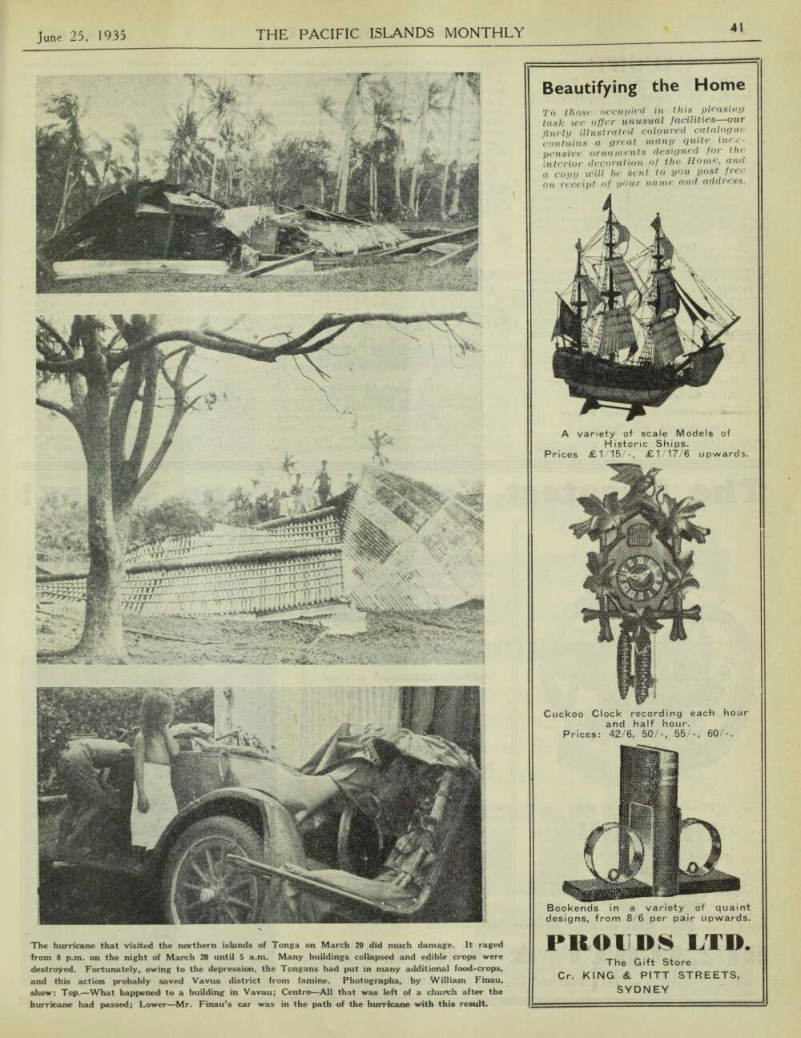
Historical Document
“Pity Poor Fiji” in Mitchell Library
The Mitchell Library in Sydney possesses a Pacific document of great his torical interest —the original draft of "Pity Poor Fiji,” from the pen of Rev.
James Watkin, a pioneer of Wesleyanism in Tonga and New Zealand. Following its publication in England, in a missionary journal, attention was directed towards Fiji in such a way that, eventually, the path was prepared for annexation.
In a covering letter, its former owner, (to whom the manuscript had been given by his father), the Rev. Dr. Edwin J.
Watkin, D.D., says: “The effect of the appeal on the British Wesleyan Church led to John Hunt, James Calvert, and Thomas Williams, early missionaries, going to Fiji. More than any thing else, outside of the work of the missionaries, both English-speaking and Tongan, it contributed to Fiji being to-day part of the British Empire. When Fiji was offered to the British Govern ment, Mr. Gladstone, who was then in power, opposed its acceptance. He held that colonies were a source of weakness to the Empire.”
It was the persistence of Sir William Macarthur, M.P. (says Dr. Watkin), that ultimately led to the annexation of those islands. The information received by Sir William, who was the son of an Irish Wesleyan minister, was based on “the oral and written reports” as to the commercial possibilities of Fiji, from the missionaries. The Rev. James Watkin spent the remainder of his days in Sydney, where he died on May 14, 1886, aged 81. He arrived in Tonga in 1831, travelling via New Zealand in a whaler, to find the Tongans ablaze with the fire of a religious revival. —E.R.
Archdeacon Richard Godfrey, who recently retired from the Melanesian Mission owing to eye trouble, has been appointed curate at St. James’ Church, Sydney. Mr. Godfrey served in New Hebrides for 17 years.
The hurricane that visited the northern islands of Tonga on March 20 did much damage. It raged from 8 p.m. on the night of March 20 until 5 a.m. Many buildings collapsed and edible crops were destroyed. Fortunately, owing to the depression, the Tongans had put in many additional food-crops, and this action probably saved Vavua district from famine. Photographs, by William Finau, show: Top.—What happened to a building in Vavau; Centre—All that was left of a church after the hurricane had passed; Lower —Mr. Finau’s car was in the path of the hurricane with this result.
Advertisements & other items, p. 43 (1 item)
Prouds Ltd.
Beautifying the Home
To those occupied in this pleasing task we offer unusual facilities —our finely illustrated coloured catalogue contains a great many quite inexpensive ornaments designed for the interior decoration of the Home, and a copy will he sent to you post free on receipt of your name and address.
A variety of scale Models of Histone Ships.
Prices £1/15/-, £1/17/6 upwards.
Cuckoo Clock recording each hour and half hour.
Prices: 42/6, 50/-, 55/-, 60/-.
Bookends in a variety of quaint designs, from 8/6 per pair upwards.
PROUDS LTD.
The Gift Store
Cr. KING & PITT STREETS,
SYDNEY
Caught!
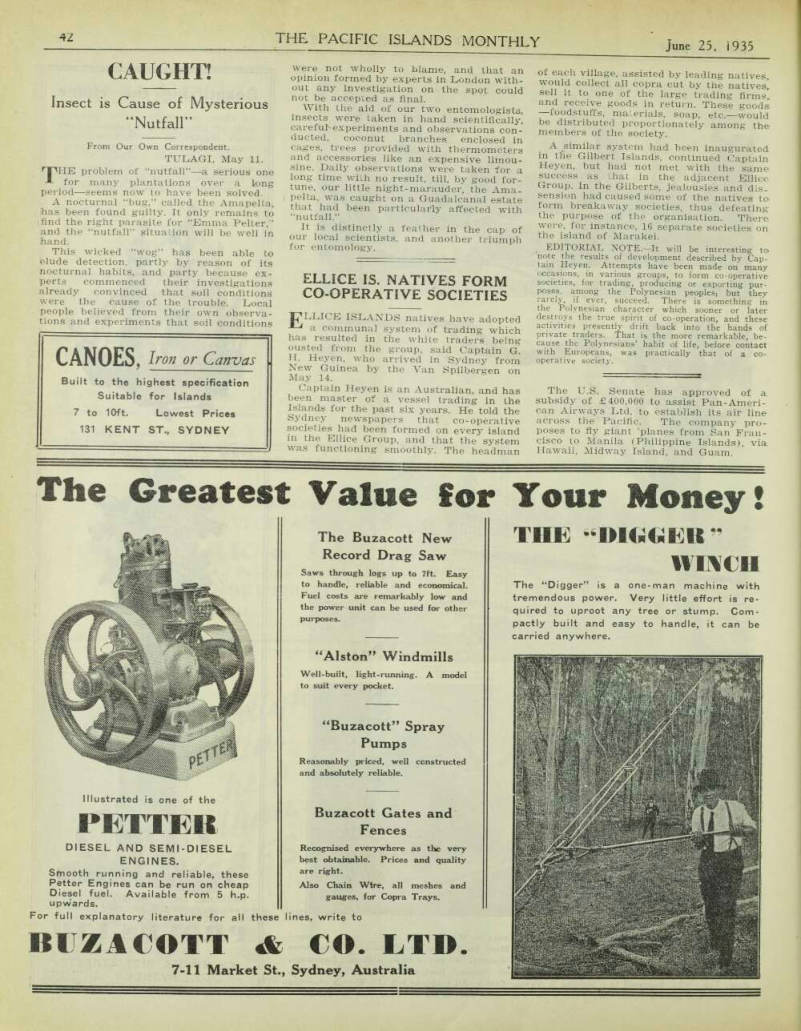
Insect is Cause of Mysterious “Nutfall”
From Our Own Correspondent.
Tulagi, May 11.
THE problem of “nutfall” —a serious one for many plantations over a long period—seems now to have been solved.
A nocturnal “bug,” called the Amapelta, has been found guilty. It only remains to find the right parasite for “Emma Pelter,” and the “nutfall” situation will be well in hand.
This wicked “wog” has been able to elude detection, partly by reason of its nocturnal habits, and party because experts commenced their investigations already convinced that soil conditions were the cause of the trouble. Local people believed from their own observations and experiments that soil conditions
were not wholly to blame, and that an opinion formed by experts in London with out any investigation on the spot could not be accepted as final.
With the aid of our two entomologists, insects were taken in hand scientifically, careful experiments and observations conducted, coconut branches enclosed in cages, trees provided with thermometers and accessories like an expensive limousine. Daily observations were taken for a long time with no result, till, by good fortune, our little night-marauder, the Amapelta, was caught on a Guadalcanal estate that had been particularly affected with “nutfall.”
It is distinctly a feather in the cap of our local scientists, and another triumph for entomology.
Co-Operative Societies
Ellice Is. Natives Form
ELLICE ISLANDS natives have adopted a communal system of trading which has resulted in the white traders being ousted from the group, said Captain G.
H. Heyen, who arrived in Sydney from New Guinea by the Van Spilbergen on May 14, Captain Heyen is an Australian, and has been master of a vessel trading in the Islands for the past six years. He told the Sydney newspapers that co-operative societies had been formed on every island in the Ellice Group, and that the system was functioning smoothly. The headman
of each village, assisted by leading natives, would collect all copra cut by the natives, sell it to one of the large trading firms, and receive goods in return. These goods —foodstuffs, materials, soap, etc. —would be distributed proportionately among the members of the society.
A similar system had been inaugurated in the Gilbert Islands, continued Captain Heyen, but had not met with the same success as that in the adjacent Ellice Group. In the Gilberts, jealousies and dissension had caused some of the natives to form breakaway societies, thus defeating the purpose of the organisation. There were, for instance, 16 separate societies on the island of Marakei.
EDITORIAL NOTE.—It will be interesting to note the results of development described by Captain Heyen. Attempts have been made on many occasions, in various groups, to fornl co-operative societies, for trading, producing or exporting purposes, among the Polynesian peoples, but they rarely, if ever, succeed. There is something in the Polynesian character which sooner or later destroys the true spirit of co-operation, and these activities presently drift back into the hands of private traders. That is the more remarkable, because the Polynesians’ habit of life, before contact with Europeans, was practically that of a cooperative society.
The U.S. Senate has approved of a subsidy of £400,000 to assist Pan-American Airways Ltd. to establish its air line across the Pacific. The company proposes to fly giant ’planes from San Francisco to Manila (Philippine Islands), via Hawaii, Midway Island, and Guam.
Advertisements & other items, p. 44 (1 item)
The Greatest Value for Your Money!
CANOES. Iron or Canvas
Built to the highest specification Suitable for Islands 7 to 10ft. Lowest Prices
131 KENT ST., SYDNEY
The Greatest Value for Your Money!
The Buzacott New
Record Drag Saw
Saws through logs up to 7ft. Easy to handle, reliable and economical.
Fuel costs are remarkably low and the power unit can be used for other purposes.
“Alston” Windmills
Well-built, light-running. A model to suit every pocket.
“Buzacott” Spray
Pumps
Reasonably priced, well constructed and absolutely reliable.
Illustrated is one of the
PETTER
DIESEL AND SEMI-DIESEL
ENGINES.
Smooth running and reliable, these Petter Engines can be run on cheap Diesel fuel. Available from 5 h.p. upwards.
For full explanatory literature for all
Buzacott Gates and
Fences
Recognised everywhere as the very best obtainable. Prices and quality are right.
Also Chain Wire, all meshes and gauges, for Copra Trays. these lines, write to
BUZACOTT & CO. ETD.
7-11 Market St., Sydney, Australia
THE “DIGGER”
WINCH
The “Digger” is a one-man machine with tremendous power. Very little effort is required to uproot any tree or stump. Compactly built and easy to handle, it can be carried anywhere.
Researches
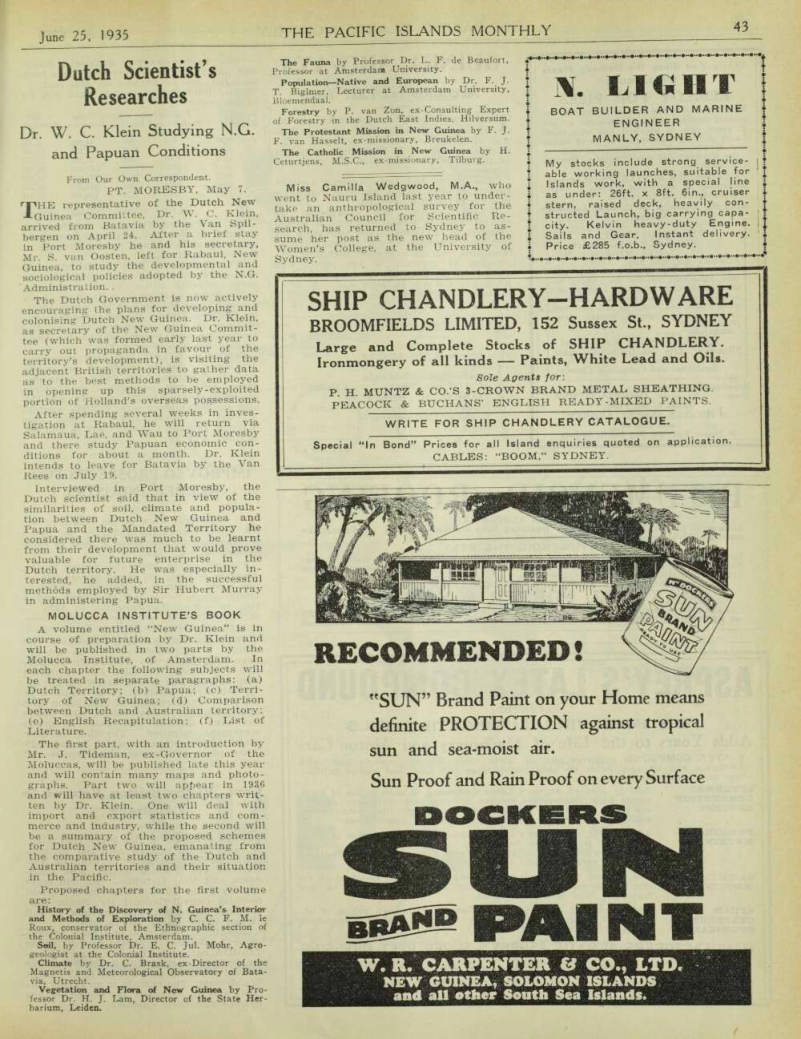
Dutch Scientist’s Researches Dr. W. C. Klein Studying N.G. and Papuan Conditions
From Our Own Correspondent.
Pt. Moresby, May 7.
THE representative of the Dutch New Guinea Committee, Dr. W. C. Klein, arrived from Batavia by the Van Spilbergen on April 24. After a brief stay in Port Moresby he and his secretary, Mr S. van Oosten, left for Rabaul, New Guinea, to study the developmental and sociological policies adopted by the N.G.
Administration.
The Dutch Government is now actively encouraging the plans for developing and colonising Dutch New Guinea. Dr. Klein, as secretary of the New Guinea Committee (which was formed early last year to carry out propaganda in favour of the territory’s development), is visiting the adjacent British territories to gather data as to the best methods to be employed in opening up this sparsely-exploited portion of Holland’s overseas possessions.
After spending several weeks in investigation at Rabaul, he will return via Salamaua, Lae, and Wau to Port Moresby and there study Papuan economic conditions for about a month. Dr. Klein intends to leave for Batavia by the Van Rees on July 19.
Interviewed in Port Moresby, the Dutch scientist said that in view of the similarities of soil, climate and population between Dutch New Guinea and Papua and the Mandated Territory he considered there much to be learnt from their development that would prove valuable for future enterprise in the Dutch territory. He was especially interested, he added, in the successful methods employed by Sir Hubert Murray in administering Papua.
Molucca Institute’S Book
A volume entitled “New Guinea” is in course of preparation by Dr. Klein and will be published in two parts by the Molucca Institute, of Amsterdam. In each chapter the following subjects will be treated in separate paragraphs: (a) Dutch Territory: (b) Papua; (c) Territory of New Guinea; (d) Comparison between Dutch and Australian territory; (e) English Recapitulation; (f) List of Literature.
The first part, with an introduction by Mr. J. Tideman, ex-Governor of the Moluccas, will be published late this year and will contain many maps and photographs. Part two will appear in 1936 and will have at least two chapters written by Dr. Klein. One will deal with import and export statistics and commerce and industry, while the second will be a summary of the proposed schemes for Dutch New Guinea, emanating from the comparative study of the Dutch and Australian territories and their situation in the Pacific.
Proposed chapters for the first volume are: History of the Discovery of N. Guinea’s Interior and Methods of Exploration by C. C. F. M, le Roux, conservator of the Ethnographic section of the Colonial Institute, Amsterdam.
Soil, by Professor Dr. E. C. Jul. Mohr, Agrogeologist at the Colonial Institute.
Climate by Dr. C. Brask, ex-Director of the Magnetis and Meteorological Observatory of Batavia, Utrecht.
Vegetation and Flora of New Guinea by Professor Dr. H. J. Lam, Director of the State Her barium, Leiden.
The Fauna by Professor Dr. L. F. de Beaufort, Professor at Amsterdam University.
Population—Native and European by Dr. F. J.
T. Biglmer, Lecturer at Amsterdam University, Bloemendaal.
Forestry by P. van Zon, ex-Consulting Expert of Forestry in the Dutch East Indies, Hilversum.
The Protestant Mission in New Guinea by F. J.
F. van Hasselt, ex-missionary, Breukelen.
The Catholic Mission in New Guinea by H.
Ceturtjens, M.S.C., ex-missionary, Tilburg.
Miss Camilla Wedgwood, M.A., who went to Nauru Island last year to under take an anthropological survey for the Australian Council for Scientific Research, has returned to Sydney to assume her post as the new head of the Women’s College, at the University of Sydney.
Advertisements & other items, pp. 45-46 (1 item)
Ship Chandlery-Hardware
N. LIGHT
BOAT BUILDER AND MARINE
ENGINEER
MANLY, SYDNEY
My stocks include strong serviceable working launches, suitable for Islands work, with a special line as under; 26ft. x 8ft. 6in., cruiser stern, raised deck, heavily constructed Launch, big carrying capacity. Kelvin heavy-duty Engine.
Sails and Gear. Instant delivery.
Price £285 f.o.b., Sydney.
SHIP CHANDLERY-HARDWARE
BROOMFIELDS LIMITED, 152 Sussex St., SYDNEY
Large and Complete Stocks of SHIP CHANDLERY.
Ironmongery of all kinds Paints, White Lead and Oils.
Sole Agents for: P. H. MUNTZ & CO.’S 3-CROWN BRAND METAL SHEATHING.
PEACOCK & BUCHANS’ ENGLISH READY-MIXED PAINTS.
WRITE FOR SHIP CHANDLERY CATALOGUE.
Special “In Bond” Prices for all Island enquiries quoted on application.
CABLES: “BOOM.” SYDNEY.
RECOMMENDED!
"SUN” Brand Paint on your Home means
definite PROTECTION against tropical
sun and sea-moist air.
Sun Proof and Rain Proof on every Surface
DOCKERS SUN BRAND PAINT
W. R. CARPENTER & CO., LTD
NEW GUINEA, SOLOMON ISLANDS
While You Sleep the Remedy Heals
A WELL-PROVEN
REMEDY FOR PILES
This preparation has been on the market for several months, and it has effected a Cure in every case in which it has been tried.
Cases of Long Standing often Cured within One Month, with one bottle only.
For External Use only—Stainless, Painless and Odourless.
PRICE: 3/6 PER BOTTLE. Posted securely packed for 5/- per bottle. Copies of Testimonials forwarded on request.
Read the Report of an Eminent Analytical Chemist:
THE LABORATORY,
20 and 22 Napoleon Street, Sydney, March 14th, 1933.
ROBERT BRUCE, Esq.
Dear Sir, —The formula of your pile cure submitted to me could have no effect other than beneficial. I gave your sample to a Client who had suffered many years, and before he had used half the bottle he reported himself completely cured.
Faithfully yours,
GROVE JOHNSON, F.C.S. (Lend.)
“Honours,” City and Guilds of London Institute.
Analytical and Consulting Chemist.
Supplies Obtainable from— Robert Bruce Room 7, 2nd Floor,
15 HUNTER STREET, SYDNEY
and also at 14 Upper Bayview St., North Sydnoy
BITUMENOID ROOFING
MADE IN AUSTRALIA
Bitumenpid Roofings, Dampcourses and Insulating Felts are made from the world’s best raw materials. Warranted to stand the most rigid tests.
BITUMENOID THE BEST
Roofing, 1,2, 3-ply; Flooring, Waterproof Materials; Saturated Felt; Resilient Road Jointing; Natural Asphalt Dampcourse; 2 and 3-ply Dampcourse; 1-2lb. Lead-core Dampcourse; Roofing Cement; Asphalt Paints; Roofing Compound.
SAMPLES AND PRICE LISTS ON APPLICATION.
MAXWELL PORTER & SON LTD.
ESTABLISHED 1888. BUILDERS’ SUPPLIES
107 REDFERN ST., REDFERN, SYDNEY, N.S.W. ’Phone M JIS7 Cables: Bitumenoid
ASPREY’S LATEX COMPOUND
(PATENTED)
FOR IMPROVING LUBRICATING OILS
Adds Years to the Life of Machinery and Motor Cars LATEX COMPOUND improves any oil, adds extra oiliness, resists heat and makes the oil last twice as long, saves wear and tear, and halves lubrication and maintenance costs.
INTERNAL Add ½ pint of Asprey’s Latex Compound to each gallon of lubri- COMBUSTION eating oil for motor cars, lorries, tractors and stationary engines, ENGINES and note cooler and sweeter running, lower fuel consumption, greater power, fewer repairs and lower oil consumption.
FARMING Add ½ pint of Asprey’s Latex Compound to each gallon of lubri- MACHINERY eating oil for headers, harvesters, reapers and binders, ploughs, drills, mowers, disc cultivators windmills, separators, chaffcutters, etc., and save time and repair tills SAWMILLING Add ½ Pint of Asprey’s Latex Compound to each gallon of oil for MACHINERY saw spindle bearings and all sawmilling machinery and be free from hot and scored bearings.
STEAM Add ½ pint of Asprey’s Latex Compound to each gallon of oil.
CYLINDER which will result in more horsepower with lessened oil consumption LUBRICATION and general increase in efficiency.
MANUFACTURERS ALSO OF ASPREYS SUPER BELT DRESSING Obtainable from the Trade and from WILLIAM BROOKS & CO., LTD., 35 Pitt Street, Sydney.
Guinea Airways
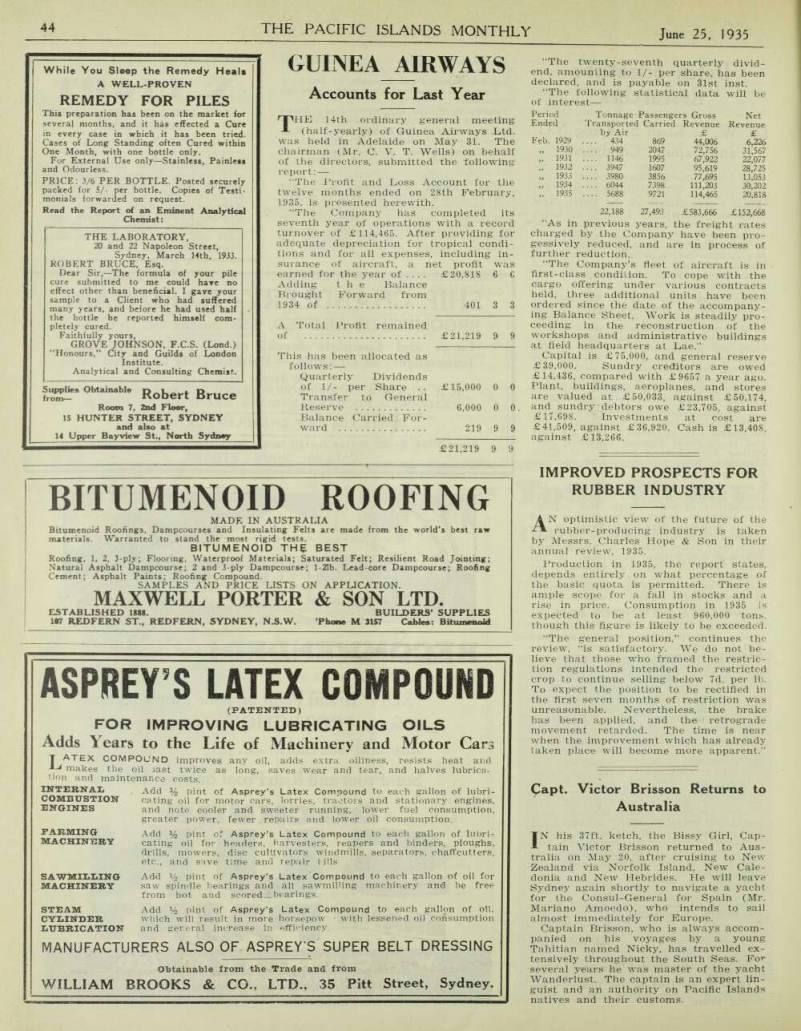
Accounts for Last Year
THE 14th ordinary general meeting (half-yearly) of Guinea Airways Ltd. was held in Adelaide on May 31. The chairman (Mr. C. V. T. Wells) on behalf of the directors, submitted the following report: “The Profit and Loss Account for the twelve months ended on 28th February, 1935, is presented herewith.
“The Company has completed its seventh year of operations with a record turnover of £114,465. After providing for adequate depreciation for tropical conditions and for all expenses, including insurance of aircraft, a net profit was earned for the year of ... . £20,818 6 6 Adding the Balance Brought Forward from 1934 of 401 3 3 A Total Profit remained of £21,219 9 9 This has been allocated as follows: Quarterly Dividends of 1/- per Share .. £15,000 0 0 Transfer to General Reserve 6,000 0 0 Balance Carried For ward 219 9 9 £21,219 9 9
“The twenty-seventh quarterly dividend, amounting to 1/- per share, has been declared, and is payable on 31st inst.
“The following statistical data will be of interest—
“As in previous years, the freight rates charged by the Company have been progessively reduced, and are in process of further reduction.
“The Company’s fleet of aircraft is in first-class condition. To cope with the cargo offering under various contracts held, three additional units have been ordered since the date of the accompany ing Balance Sheet. Work is steadily proceeding in the reconstruction of the workshops and administrative buildings at field headquarters at Lae.”
Capital is £75,000, and general reserve £39,000. Sundry creditors are owed £14,436, compared with £9657 a year ago.
Plant, buildings, aeroplanes, and stores are valued at £50,033, against £50,174, and sundry debtors owe £23,705, against £17,698. Investments at cost are £41,509, against £36,920. Cash is £13,408, against £13,266.
Period Tonnage Passengers Gross Net Ended Transported Carried Revenue Revenue by Air £ £ Feb. 1929 ... 434 869 44,006 6,226 „ 1930 ... 949 2047 72,756 31,567 „ 1931 ... 1146 1995 67,922 22,077 „ 1932 ... 3947 1607 95,619 28,725 „ 1933 ... 3980 3856 77,695 13,053 „ 1934 ... 6044 7398 111,203 30,202 „ 1935 ... 5688 9721 114,465 20,818 22,188 27,493 £ 583,666 £152,668
Improved Prospects For
Rubber Industry
AN optimistic view of the future of the rubber-producing industry is taken by Messrs. Charles Hope & Son in their annual review, 1935.
Production in 1935, the report states, depends entirely on what percentage of the basic quota is permitted. There is ample scope for a fall in stocks and a rise in price. Consumption in 1935 is expected to be at least 960,000 tons, though this figure is likely to be exceeded.
“The general position,” continues the review, “is satisfactory. We do not be lieve that those who framed the restriction regulations intended the restricted crop to continue selling below 7d. per lb.
To expect the position to be rectified in the first seven months of restriction was unreasonable. Nevertheless, the brake has been applied, and the retrograde movement retarded. The time is near when the improvement which has already taken place will become more apparent.”
Capt. Victor Brisson Returns to Australia
Australia
IN his 37ft. ketch, the Bissy Girl, Cap tain Victor Brisson returned to Australia on May 20, after cruising to New Zealand via Norfolk Island, New Caledonia and New Hebrides. He will leave Sydney again shortly to navigate a yacht for the Consul-General for Spain (Mr.
Mariano Amoedo), who intends to sail almost immediately for Europe.
Captain Brisson, who is always accompanied on his voyages by a young Tahitian named Nicky, has travelled extensively throughout the South Seas. For several years he was master of the yacht Wanderlust. The captain is an expert linguist and an authority on Pacific Islands natives and their customs.
Advertisements & other items, pp. 47-48 (1 item)
Shell Motor
Under the hottest conditions Shell Motor Oil keeps engines cool.
Maintaining its body it provides full lubricating value with an ample margin of safety at the highest speeds. Motorists everywhere have proved that
OIL
M. HARPER
MANDOLIAN A ISLAND,
NORTH GELA, B.S.I.
Postal Address: P.O. Box 6, Tulagi, Solomon Islands.
Recruiting Contracts Undertaken.
Auxiliary Vessel ‘Tapari” available for Charter.
Full details of Services from
BURNS PHILP (S.S.) CO., LTD.,
Makambo (S.I.) and Sydney.
To Planters I am a Buyer of
CASTOR OIL SEED
IN ANY QUANTITY.
Send Sample for quote, stating quantity available.
Castor Seed Shellers, any capacity.
Advice and Instructions Regarding Planting, Harvesting, and Packing of Castor Oil Seeds given freely. Selected Seed for Planting available.
C. GRAHAME
4 DALLEY STREET SYDNEY.
COPRA MATS AND MATTING
Send your enquiries to us for Woven Wire Mesh in Rolls or framed for Copra drying, and all Screening purposes, Bird Cages, Sieves and Riddles, Builder’s Gravel Screens, Rat Traps, Door Mats, Garden Arches, Chain Wire Mesh, Crimped Wire Mesh for Window Guards, etc.
SCOTT AND SONS
WIREWORKS: RAILWAY PARADE AND MURRAY STREET, MARRICKVILLE
NORCO CO-OP.
LIMITED
SUSSEX STREET,
SYDNEY
AUSTRALIA’S LEADING MANUFACTURERS AND DISTRIBUTORS OF CHOICEST
BUTTER, BACON, HAMS AND TINNED GOODS
NORCO LUNCH
BRAWN
PORK SAUSAGES
1lb. and ½ lb. Tins.
PIGS’ TONGUES
PIGS' TROTTERS
1lb. Tins Only.
HAM PATE
3oz. and 1½oz. Tins.
IDEAL FOR LUNCHES AND PICNICS
THE LARGEST STOVE...
in the Pacific Islands is installed at the Bulolo Hotel, Wau—and it is a
YOUNGER
YOUNGER Stoves and Ranges are widely used throughout the Pacific Islands, for they embody in their construction everything calling for Efficiency in Working, Economy in fuel consumption and Durability.
Special Stoves for Island requirements with cast-iron ovens.
Write for quotations and catalogue of single and double oven stoves.
G. FLETCHER & SON
50 OXFORD STREET, SYDNEY
Across Primitive New Guinea In 1895
Herr Otto Ehlers’ Ill-fated Expedition From Madang to Pt. Moresby
By Mollie Lett
ONE of the earliest expeditions to cross the south-eastern portion of the island of New Guinea was that led by the once well-known traveller Herr Otto Ehlers, and Herr Piering, which left Freidrich Wilhelmshafen (Madang) in 1895.
The expedition was not a success; but in spite of its failure it was a noteworthy achievement. According to the account of the survivors, Herrs Ehlers and Piering perished from exhaustion and star vation, but from evidence gathered later it was found that both men had been murdered by their carriers and, perhaps, eaten.
Herr Ehlers, accompanied by Herr Piering (an officer of police), set out from Freidrich Wilhelmshafen in August with 43 carriers and one coloured ser-
vant, a Creole. The equipment and stores consisted of eight rifles, two shot guns, tents and trade goods, but no in struments whatever for surveying the country.
On August 14 the party started inland from the Francisco River, near Salamaua, and on the 23rd reached an inland village where they remained for three days.
After leaving the village it does not appear that they saw any signs of native life until they reached the gardens of the Moviavi people, on the Lakekamu River, near the coastline of Papua. There they arrived on October 21, 67 days after the party had begun their overland journey.
Their difficulties can well be imagined.
Rainy weather set in from the beginning of the journey and one of the carriers died at the inland village. With no native pads to follow, the unfortunate men hacked their way through thick jungle, climbed up and down steep mountain sides, and crossed precipitous ravines and swollen rivers. They suffered the torments of leech bites, cold, and fatigue.
Later, to all their discomforts, was added a more grievous enemy, hunger.
They were reduced to eating grass and the leaves of trees, and it does not appear from the report that the leaders had any better fare than the carriers.
As a result, dysentery broke out amongst them and 10 men died.
About the end of September they struck a large tributary of the Lake kamu River (in Papua) and an effort was made to descend it on rafts, which soon capsized. It was then, according to the reports of the carriers, that the already disabled Europeans were drowned.
The 22 survivors travelled down the left bank of the river for nine days.
Then on newly built rafts they drifted down stream for six days until they reached the first coconut trees of the Moviavi people.
The Moviavi natives befriended them and conveyed them to the coast. There they were looked after by a native teacher of the London Missionary Society and the chief of the Toaripi until Mr. Kowaleh, Government Agent for the Mekea district, brought them to Port Moresby.
At Port Moresby they received attention and were returned to Freidrich Wilhelmshafen by the S.S. Merrie England on March 29, 1896.
According to the early reports of the carriers, Herr Ehlers seems to have given much thought to the rescue of his followers and it was mainly owing to his last dying instructions that they reached the coast and escaped with their lives.
But in view of the evidence gathered later on, of the murder of Herrs Ehlers and Piering by their carriers, it seems that these men were fully capable of fending for themselves.
A report of the ill-fated expedition was published about 1896 in the Deutches Kolonialblatt by Landeshauptmann Rudiger.
Miss Lucie Dove Nicholls, only daughter of Mr. and Mrs. H. Warne Nicholls, of Solovi, Nadi, Fiji, was married to Mr. John Cuthbert Potts by the Archdeacon of Suva on April 27. The bride and bridegroom have made their home at Rarawai, Ba.
New Gold Town
Growth of Edie Creek, N.G.
From Our Own Correspondent.
Edie Creek, May 4.
THIS year, 1935—with the opening of the new road from Wau to Edie Creek, the removal of the headquarters of N.G.G. Ltd. from Wau to Edie, and the installation of their new batteries, the proving of “Development’s” lease (Edie Creek Gold Mining Co. N.L.), the com pletion of the cyanide plant and connec tion of hydro-electric power by Day Dawn Ltd. —is the most important year in the history of Edie Creek since its dis covery in 1926.
Edie Creek has grown in the last 12 months from a scattered collection of miner’s camps into an important centre, and a fair-sized commercial and residen tial town is growing around the mines.
That there are opportunities here for men with business acumen and capital to “get in on the ground floor” and grow with the town, is obvious.
The opening of the graded road from Wau to Edie Creek, on April 25, makes a great difference. The country is so moun tainous and broken that we have never been able to flatten out enough of it to make an aerodrome; so our freight had to be left by the planes at Wau, and labour iously carried over 12 miles of donkey track.
Measures Depth Under Ship’s
The Echo Meter
Measures Depth Under Ship’s Keel
A COMPARATIVELY new radio instru ment known as the echometer is proving very useful to Australian ship ping, and should be of great value to navigators in the always dangerous Pacific Islands waters.
The echometer is used for measuring the depth of water under the ship’s keel.
The instrument transmits a signal which strikes the bottom of the sea and is re flected back. The returning signal, re ceived at audio frequency, operates an indicator which is adjusted to show the depth of the water in fathoms.
About twelve months ago the trawler “Alfie Cam” was fitted by Amalgamated Wireless with an echometer, and since that time the trawlers “Beryl II,” “Dur eenbee,” and “Olive Cam,” all of the Cam Line, Sydney, have been similarly equipped. In the trawling fleet the echo meter is in constant use, enabling the vessels to keep consistently to their fish ing grounds. When a trawler is working along the ninety fathoms ledge, off the New South Wales coast, the skipper is aware immediately if he crosses into the adjoining deep water.
Other vessels upon which the echo meter is fitted are the Huddart Parker liner “Wanganella,” trading between Sydney and New Zealand, the Adelaide Company’s “Manoora,” the British Phos phate Commission’s “Triaster,” and the Union Company’s “Rangitira.”
The Tasman Sea is for the most part very deep, but however thick the weather may be, the commander of the “Wan ganella” always knows when he is ap proaching the New South Wales coast by the diminishing depth of the water.
Anyone interested in this equipment should write to Amalgamated Wireless Ltd., Sydney, for details, and mention this article in this journal.
Aboriginal Missionaries’
Work In Papua
PASTOR A. G. STEWART (vice-presi dent of the Seventh Day Adventists’
Australasian Union Conference), returned to Australia by the Montoro on May 18, after inspecting missions in New Guinea and Papua. He said he visited a mission station run by Dick and Jessie Richard son, Australian aborigines, reported the “Sydney Morning Herald” on May 20, and he was astounded at the work they were doing among the natives.
The mission, he said, was on the Vailala River, 200 miles west of Port Moresby.
The aborigines were sent to Papua from the Seventh-Day Adventists’ mission sta tion at Mona Mona, North Queensland, three years ago. They had practically Christianised a previously uncivilised tribe, and had built a church to seat 300
neoole They had quickly learned the language of the natives. Dick Richardson has shown great resourcefulness and initiative, and had cut and worked the wood for the church himself.
Another aboriginal couple had recently sent to a mission 100 miles east of Moresby and they also were report excellent work.
Advertisements & other items, pp. 49-50 (1 item)
Antinea
SAMUEL RUSSELL
ESTATE AND GENERAL AGENT
P.O. Box 64, Papeete, Tahiti
Real Estate. Investments. Estate ment and Administration. Valuations and Reports. Houses and Lands for Lease or Sale Sole Proprietor: TAHITI PERFUMES Cables: Russell, Tahiti (Bentleys Code)
Tie On Gas Mantels
Something Better for your Lamp
FLEXIBO LIGHTING CO.
9-15 KIPPAX STREET :: SYDNEY
Manufacturers of the famous Flexibo Gas Mantle, suitable for all petrol storm-proof lamps, table lamps, tilly lamps, and all hollow wire systems. Flying insects will not break this mantle. Agents wanted—samples to all prospective reputable agents.
W. HOLMES
YACHT AND BOATBUILDER
All Classes of ISLANDS VESSELS a Speciality
Sole Agent “R.N.” DIESEL MARINE ENGINES.
SEND FOR PARTICULARS.
McMAHON’S POINT - - - - - SYDNEY Cable Address: “HOLMAC,” Sydney.
The most effective Treatment for
Dhobie Itch “Toe Rot”
Inflamed Nails Ringworm, etc.
Tropic Skin Complaints are not amenable to treatment with so-called “simple” remedies. Scientific treatment is always necessary to eradicate the trouble completely. The positive remedy for these infections is Antinea Antiseptic Lotion. Antinea is a combination of extremely powerful germicidal oils, many times stronger than carbolic. The first application destroys surface germs; subsequent applications swiftly destroy the germs beneath the skin which are the root of the trouble. Duration of treatment, of course, depends on the severity of the infection, and in all cases it is important to continue using Antinea until the skin heals completely.
Antinea Lotion is obtainable at all branches of Burns, Philp and Co. Ltd., Morris Hedstrom and Co. Ltd. (Suva), A. J. Swann and Co. Ltd. (Suva), Brown and Joske (Suva), Michelmore and Co. (Suva).
Small size 2/6; Triple quantity 5/6
ANTINEA
COMMONWEALTH AND DOMINION AGENCIES LTD.
168 DAY STREET, SYDNEY, N.S.W.
TENNIS
TROPICAL RESTRINGS AND GUT
CONSULT
L. A. WARD
WEST END SPORTS DEPOT.
8 GEORGE ST. WEST SYDNEY
Records
POSTED FREE
SEND FOR LISTS
Australia’s finest Record Shop, specialising in Mail Orders.
Any Records procured and sent same day.
Dozens of clients in the Pacific Islands. We pay freight.
THE TALKERIES
QUEEN VICTORIA BUILDINGS
SYDNEY, AUSTRALIA
“A Thousand Allies
from the nearest ice-works, and yet we always have ice cubes for drinks and all the conveniences of an electric refrigerator.” —Extract from letter from satisfied Island client.
HALLSTROM’S non-electric Refrigerators give efficient refrigeration without trouble. So simple a child can operate it.
Price £49/10/- f.o.b. Sydney. Others from £20. Write for descriptive folder to the manufacturer.
E. HALLSTROM
462 Willoughby Road, Willoughby
SYDNEY
PAY BY CHEQUE
It is safer and provides a permanent record of your expenditure. The opening of a cheque account with the Bank of New South Wales is a simple matter.
It is not necessary to keep a large credit balance, for whenever you have a surplus of five pounds you can place it on Fixed Deposit with the Bank and arrange to have the interest paid in regularly to your cheque account.
Bank of New South Wales
(ESTABLISHED 1817)
The Oldest and Largest Bank in Australasia.
Unkind Comparisons At
N.Z. And Samoa
Unkind Comparisons At Geneva
We have been told that we are much too critical of the New Zealand Government’s muddle in Western Samoa. Very well.
The following is not our comment : it is from the “New Zealand National Review” of May 15. The article is entitled tc Our Mess in Samoa.”
“LORD Lugard, one of Britain’s greatest authorities on colonial administration, has been saying some very unpleasant things at Geneva about New Zealand’s
administration of the mandate over Western Samoa.
“Mon. Palacois, another member of the Permanent Mandates Commission, suggested (somewhat sarcastically) that it would not be out of place for us to compare Western Samoa under our flag with Eastern Samoa under the American flag, and so derive some idea of the best method of handling a proud, educated and aristocratic race like the Samoans.
“Such a comparison would show us in a very bad light. In American Samoa the natives have the fullest measure of selfgovernment, under a paternal and sympathetic naval supervision. In Western Samoa the Samoans have no voice in the raising of taxes or the innumerable laws imposed on them, and the administration has been harsh and dictatorial.
“For every dollar of taxation the American Samoan pays, the benevolent administration spends another two dollars on its wards. While for every pound our Samoan charges are taxed the bulk of it is wasted on an absurdly overloaded staff of European officials from New Zealand, whose work has been described by Messrs.
P. Verschaffelt and A. D. Park as “in no way creditable to New Zealand.” None of the distinguished soldiers we have sent to administer Samoan affairs has had any experience of civil administration, nor shown any aptitude for handling the polite and amiable Samoans with the rudiments of tact and reason; while the gentleman in charge of the Samoan Bureau in Wellington, which actually directs Samoan affairs, was formerly a clerk in the Labour Department.
“No wonder Lord Lugard criticises the qualifications of these officials for the job, and Mr. Ransom’s ‘answer’ to the British expert is very wide of the mark.”
Guinea Gold, N.L.
Activities in Papua
GUINEA GOLD, N.L., the powerful Adelaide Company, which holds substantial interests in New Guinea mining companies, and which is now carrying on important exploratory activities in the Lakekamu district, in Papua, held its annual meeting on March 31. The chairman of directors, Mr. C. V. T. Wells, presided.
Having received £22,867 in dividends on shares in other companies, principally in Bulolo Gold Dredging, Ltd., Guinea Gold, N.L., the balance sheet showed, made a net profit of £21,488 for the year ended February 28, compared with £8175 for the previous year. Dividends of /10½ per share of 2/- each required £21,875, and with £497 brought forward, a balance of £110 was carried forward.
Issued capital is £50,000, with which a reserve stands at £541,573. The reserve has been increased by £149,363, being the increase in the market value of the company’s investment assets on the year.
The chief assets item, shares in other Companies, appeared at market value at £571,656. Cash balances are £6366.
Prospecting and developmental expenses on new leases in Papua and Mandated Territory amounted to £14,607.
The directors reported that Mr. G. S.
Dyer was then on his way from America to Papua, to inspect and report on the companies properties and the work done.
They hoped that the report will enable them to determine a definite course of action for the future.
“Lover Of Justice” Is Trounced!
Letter to the Editor.
PARTICIPATION in disputes with anonymous correspondents is not to my liking, nor do I Generally take notice particularly of either the subject matter or the text of their flights into the realms of literature.
However, in justice to the residents of New Guinea, amongst whom I have lived for thirteen years, I now seek the medium of your valued journal to comment upon certain statements contained in a letter appearing in your issue of March, from “Lover of Justice,” in reply to equally anonymous contributions to your December issue from “Veri” and “Duk-Duk,” on the question of Corporal Punishment of Natives,” and “The Introduction of the Jury System to New Guinea.
I do not desire, or intend in this letter, to enter the field of debate regarding the desirability, practicability, or necessity, for the introduction of the one, nor the elaboration of existing Laws of the Territory, regarding the other, of the subject matters of your correspondents’ contributions.
There are obviously varied opinions regarding both subjects.
I have heard them discussed in many parts of New Guinea and under varied circumstances — generally fairly and reasonably, and with respect for the other fellow’s point of view, and with toleration and moderation.
I have never, however, participated in or listened to any discussion on either subject, where such bias, misrepresentation of fact, unreasoned prejudice or blatant ignorance of the civic qualities of the great bulk of this Territory’s residents have been shown as are demonstrated in certain statements contained in the letter of your correspondent styling himself “Lover of Justice.”
These statements or opinions to which I refer are not arguments against the “Infliction of Corporal Punishment,” or “The Introduction of a Jury System,” but vicious untruths attacking the integrity and decency of those who oppose the views of this self-styled protagonist of justice and the civic qualities of practically the whole community of New Guinea.
Your correspondent expresses the opinion that “if anything will prompt Geneva, Canberra, or the local Administration to tighten up laws for the protection of the native races it will be the perpetual hate now at white heat seeking to legalise barbarity in the Territory.”
During the thirteen years of my residence in this Territory, I have travelled, either officially, or in a private capacity, somewhat extensively within its boundaries. I have met all types and classes of residents, from those of the collar-and-tie brigade to those who live by the sweat of the brow; shoving pens or breaking bush, patrolling littleknown areas, performing the arduous tasks—and they are multiple in number—of extending Administrative control, or the possibly more heart breaking jobs of recruiting labour, seeking gold, preparing virgin tropic bush to wrest a livelihood from Mother Earth, and the hundred and one avocations followed by an enterprising community.
With these residents I have discussed, both in the larger centres —the civilised places—and in the outer reaches—where work is performed and difficulties are met with to be dealt with on the spot
—their many and varied problems, learned much of their difficulties and, I hope, their point of view; but I have yet to meet with this consuming, passionate hatred, seeking to legalise barbarity in the Territory, referred to by your contributor.
The statement is a false one with no vestige of truth to support it. I venture the suggestion that it is not subscribed to by one single responsible resident of New Guinea, by the present or any past Administrator. No responsible official, planter, miner, recruiter, businessman or missionary, knowing New Guinea and the type of resident living there, and his general outlook on matters affecting his own and native welfare, will support this extravagant and untrue opinion expressed by your contributor.
In my opinion, his statement can only be regarded as the product of a jaundiced mind, and a perverted outlook, offering a gratuitous insult to a community whose general ethical and moral out look is, I venture to suggest, of at least as high a standard as his own or that of any other with which “Lover of Justice” may be fortunate enough to find himself associated.
Apparently, so bitterly opposed to the introduction of the jury system to New Guinea is your contributor, that he goes on again to condemn
his fellow-residents in an extravagant and unwarranted tirade which questions the whole moral outlook of the community, at the same time displaying a colossal ignorance of the people to whom he refers.
The following remarks of “Lover of Justice,” can only be regarded as offensive, insulting and grossly untrue—being without foundation in fact— by the vast majority of New Guinea residents: — “The introduction of the jury system would certainly benefit and unjustly protect the whites . . .
It would absolutely rob the native of the protection of law.” “The Jury System would mean the collapse of law in the Territory.” “The work of Police, District Officers, C.L.O., and Judges would be at the mercy of cliques whose ingrained aversion would prejudice and blind them in any case where Black would be against White”! “Twelve jurymen could never be empanelled in this Territory to return a verdict of guilty against a European” !!
These extravaganzas are in keeping with the statement already referred to. They are as untrue and lacking foundation in fact or experience.
It is difficult to visualise the mentality and out look of the writer responsible for them; to imagine just what niche he fills in the general scheme of New Guinea affairs; to understand why he continues to live with this community of barbarians and sadists; most difficult of all to understand when and where in this Territory and amongst which section in particular of its community his experiences have led him to make such sweeping and damning charges, against the com-
mon-sense and honesty, decency and civic pride of the community in general.
Were there a vestige of truth in any one of these sweepmg charges against the residents of New Guinea, then not only would the Government of the Territory rightly stand charged with failure in the Administration of its Mandate, but its residents could justly be described as a pack of blackguards, who should be deprived of all rights
of citizenship.
Fortunately for New Guinea and all concerned, these dirty and scurrilous accusations made behind the doubtful barricade of a nom-de-plume (which belies its name) would never bear the light of even a cursory investigation. Under the circumstances the best advice I can tender to this so-called ‘Lover of Justice” is that he wipes the dust of New Guinea from his feet, and takes a trio preferably to the Sahara Desert, or some equally uninhabited spot, and there, alone with his thoughts and his data, proceeds in “the logical, sane traditional manner to survey the evidence” upon which he tries to convict a community of decent-minded Australians as a pack of barbarians.
I am, etc.,
J. C. Mullaly.
Non-official Member Executive and Legislative Council. President, Planters’ Association.
Nataya Plantation,
via Rabaul, New Guinea. 20/5/’35.
Advertisements & other items, pp. 51-52 (1 item)
Gleniffer
WILL SET
in ANY Weather Available Throughout the Pacific Islands Robert Harper & Co.
LTD.
SYDNEY
HOTEL GRAND CENTRAL
151 CLARENCE STREET, SYDNEY, (opp. G.P.O.)
THE POPULAR “ROOM-ONLY"
TARIFF
is specially designed to meet modem requirements of business and pleasure. It enables patrons to enjoy every advantage of hotel life, at the same time keeping hotel expenses down to a minimum.
SERVICES INCLUDE:
Theatre Booking and Information Bureau.
Travel and Sightseeing Tours arranged.
Up-to-date Barber’s Shop.
Cleaning and Pressing Service.
Garage accommodation nearby at usual rates.
Spacious Dining Room. All meals a la carte.
The HOTEL GRAND CENTRAL Ltd.
151 CLARENCE STREET, SYDNEY (opp. G.P.O.)
Telephone: BW 1531 (3 lines) Box 716 FF, Sydney Radio Cables and Telegrams: “Grancentral,” Sydney
FRASER WEBSTER, Manager.
GLENIFFER
DIESEL ENGINES
INSTAL THE DIESEL THAT HAS BEEN GOING STRONG SINCE 1929, AND HAS PROVED ITSELF IMMUNE FROM ALL DIESEL WEAKNESS.
D.C. Series, 45 to 100 b.h.p., in 3, 4, 6, and 8 cylinder sixes at 700 to 900 r.p.m.
D.B. Series, 24 to 96 b.h.p., in 2, 3, 4, 6, and 8 cylinder sizes, at 1000 r.p.m.
Australian Agents:
H. G. THORNTHWAITE & CO.
KEMBLA BUILDING.
MARGARET STREET, SYDNEY, N.S.W.
TELEGRAMS: “ORTHORN," SYDNEY.
TELEPHONE: B 5240
STANDARD DRUG CO.
FOR ALL YOUR
CHEMICAL AND TOILET
REQUIREMENTS
Island Representative:
W. M. REID, YORK STREET, SYDNEY
Head Office:
572-574 KING STREET, NEWTOWN
L. L. BELL, F.I.O. (Syd.)
OPTICIAN
WINGELLO HOUSE,
ANGEL PLACE :: SYDNEY
Prescriptions for Glasses made up and Despatched by Return Mail.
New Lenses or Frames supplied on receipt of the broken parts.
The best Goggles for Aviators, Motorists, Welders and Mechanics.
“Cash on Delivery Post”: Sydney Prices
Woven Wire for All Industry
COPRA DRYING TRAYS, FLOORS, Etc.
FRUIT DRYING TRAYS, MINING SCREENS
Heavy Mosquito Gauze in Phosphor Bronze and Other Metals Impervious to Salt Sea Air WIRE DOOR MATS AND GENERAL WIRE WORKS
E. WRIGHT & CO. LTD.
Office and Works: 148-152 Cleveland St., Sydney, N.S.W.
Telegraphic Address: “Wrightmake,” Chippendale.
WATERPROOFING
SOLUTION
Specially prepared for treating Tents, Tarpaulins, Cart, Wheat and Haystack Covers, Horse Rugs, Ground Sheets, and Oilskins Free of injurious chemicals & acids, penetrates, binds, and strengthens.
Is flexible and does not stick or rot material.
J. R. CLAY & CO. LTD.,
Agent for Port Moresby and Samarai Sole Distributor for Pacific Islands GEO. RUTHERFORD, 46 Pitt Street, Sydney Manufacturer:
TAYLOR WILLIAMS & HALLIDAY
185-195 New Canterbury Road, Belmore, Sydney
King’S Jubilee
Commemorated at Islands Centres
THROUGHOUT the whole of the Empire on May 6, British people paid tribute with messages of affection and demonstrations of loyalty to the successful 25 years’ reign of His Majesty King George V. The Silver Jubilee was celebrated with fitting ceremony and reverence at all centres in the Pacific over which waves the symbolic British flag.
FIJI’S CELEBRATIONS.—A meeting of the Fiji Legislative Council was convened early in the morning, when addresses were received from the three races in habiting Fiji, for transmission to the King.
The Defence Force turned out for a smart parade, and, led by the Band, marched impressively to Albert Park. In the afternoon Suva Harbour was alive with launches and Fijian canoes, competing in the Jubilee Regatta.
IN NEW GUINEA.—At Rabaul in the presence of members of the Legislative Council and local Returned Soldiers, General McNicoll (Administrator of New Guinea) inspected a detachment of Native Constabulary, which was exceptionally well-drilled. After a general salute, sounded by native buglers, cheers were given for His Majesty. At many other ports and on the goldfields, the occasion was fittingly commemorated.
SOLOMON ISLANDS. —A large number of Europeans and natives witnessed the march past at Tulagi of the Armed Native Constabulary under the command of Capt.
Nelson Turner. The salute was taken by Mr. F. N. Ashley, Resident Commissioner.
At the Residency, prominent residents in cluding members of the Advisory Council and the Bishop of Melanesia were enter tained by the R.C. to dinner. Mr. W. H.
Miller, District Officer at Tulagi, arranged native, dances and entertainments, and a dance for local Europeans was held at his home in the evening.
WESTERN SAMOA.—Beautiful weather favoured the celebration of the Silver Jubilee at Apia. Residents and native chiefs gathered at Apia Court House where Brigadier-General H. E. Hart and Capt. Pairbrother, A.D.C., reviewed the guard of honour, comprising boys from
the Govt, school at Avele. A Royal Salute of 21 shots was fired by the pilot station battery. The Administrator addressed the gathering, giving a review of events during the King’s reign of 25 years.
PAPUA —May 6 was celebrated quietly at Port Moresby and all buildings were beflagged in recognition of the important occasion. His Excellency Sir Hubert Murray (Administrator of Papua) despatched a loyal message of devotion on behalf of British subjects—white and brown—in Papua.
COOK ISLANDS.— Celebrations for the King’s Jubilee were both general and particular. On the night of May 6, Rarotonga was ringed by a chain of bonfires lit on the heights above the six settlements. In Avarua the crescent sweep of the coast was a blazing hoop of fire behind which a torchlight procession of school children moved in glittering and orderly sequence. A large crowd collected on the Union Co.’s wharf and as the Resident Commissioner gave the signal, a volley of rifie-flre whined out into the darkness.
As those on the wharf broke into the National Anthem dozens of fires sprang up simultaneously along the whole length of the waterfront.
Thursday Island. The King’S
Jubilee was observed on Thursday Is. by a whole day’s programme of sports for the children. Social gatherings were held at the Town Hall at which loyal resolutions, moved by the Mayor and supported by Dr. Nimmo on behalf of the Returned Soldiers, were passed.
Jubilee Medal Awards
A special medal, designed by Sir William John, R.A., was struck for issue as a personal souvenir from His Majesty to prominent persons in the Empire. On the obverse side of the medal are the busts of the King and Queen in full court robes, and on the reverse side is the inscription G. surmounted at the crown with May 6, 1910, and May 6, 1935.
The following officials and residents in British territories in the South Seas were awarded a Silver Jubilee medal:— Western Pacific High Commission: Sir A. G.
Murchison Fletcher, K.C.M.G., C.B.E. (High Commissioner), Lady Fletcher, Captain Sir Maxwell H. Maxwell-Anderson, C.B.E., K.C., R.N. (Retd.), (Chief Judicial Commissioner and Acting High Commissioner), Lady Maxwell-Anderson, H.
H. Vaskess (Secretary to W.P. High Commission), Mrs. H. H. Vaskess.
Fiji; His Excellency Sir M. Fletcher (Governor), Lady Fletcher, Hon. A. A. Wright (Acting- Governor), Mrs. A. A. Wright, Capt. A. B. Ackland, A. J. Armstrong, Hon. A. L. Armstrong, E. L. Baker, Hon. T. W. A. Barker (Mayor of Suva), Mrs. T. W. A. Barker, Hon. J. P. Bayly, Hon. P. F. Boyd, Hon. J. Craig, R. Compton, C.B.E., K.C., Lieut.-Colonel the Hon. J. S.
Gamble, Capt. M. Godley, A.D.C., Dr. P. T. Harper, Hon. Sir Maynard Hedstrom, Lady Hedstrom, H. K. Irving, Hon. H. W. Jack, M.B.E., C. W.
T. Johnson, Major Clive B. Joske, M.C., A.D.C., Right Rev. L. S. Kempthorne (Bishop in Polynesia), Hon. Sir Henry Marks, C.B.E., Capt. Sir M. Maxwell-Anderson, Lady Maxwell-Anderson, Rev. R. L. McDonald, Hon. V. W. T. McGusty, Hon. H. C. Moncton, Dr. W. N. A. Paley, Hon.
A. H. B. Pearce, Hon. H. H. Ragg, A. H. Roberts, Hon. J. Russell, M.C., Mrs. J. Russell, Hon. Sir Henry Scott, K.C., Lady Scott, Hon. R. S. Thacker, Hon. J. M. Wilson, Major the Hon. W. E. Willoughby Tottenham, Mrs. W. E. Willoughby Tottenham, Hon. W. Wise, Hon. K. B. Singh, Hon.
M. Mudialiar, Sergeant-Major Indar Singh, Hon.
Ratu Popi Cakobau, Hon. Ratu J. L. V. Sukuna, Hon. Ratu Deve Toganivalu, I.S.O., Ratu Aisea Vasutosa, Solomon Is.: His Honour F. N. Ashley (Resident Commissioner), Mrs. F. N. Ashley, G. E. Clift (Member of Advisory Council), H. B. Hetherington, M.D., C.P. and S. (Senior M.O.), Mrs. H. B.
Hetherington, F. E. Johnson, I.S.O. (Treasurer), N. S. B. Kidson (Govt. Secretary). S. G. C. Knibbs (Commissioner of Lands), D. McKinnon (Member of Advisory Council), A. E. Osborne (Wireless Officer), E. N. Turner (Officer in Charge Native Constabulary), Miss C. Deck (S.S. Evangelical Mission), Edmund Bako (Headman, Ysabel), Timothy Kakaluae (Headman, Malaita), Sergeant- Major Sipolo.
Western Samoa: His Excellency the Administrator, Brigadier-General H. E. Hart, C.B., C.M.G., D.S.O., V.D., Mrs. H. E. Hart, A, C. Turnbull (Secretary to the Administration). Hon. I. H.
Carruthers, M.L.C., Hon. A. R. Cobcroft, M.L.C., Rev. H. S. Perkins (London Missionary Society).
Cook Is.: Judge H. F. Ayson, C.M.G. (Resident Commissioner), Dr. E. P. Ellison (Chief Medical Officer), E. A. Reid (Rarotonga Fruit Co.), J.
McGruther, Makea Tinirau Anki-nui, Makea Karika Takau Ariki.
Gilbert & Ellice Is.: His Honour J. C. Barley (Resident Commissioner), Mrs. J. C. Barley, S. G.
Clarke (Treasurer), Rev. G. H. Eastman (London Missionary Society), F. G. L. Holland, M.B.E. (Education .Superintendent), H. B. Maynard (British Phosphate Co.), Mrs. H. B. Maynard, G.
M. Murdoch (Abemama Is.), Major C. A. Swinbourne, O.B.E. (Senior Administrative Officer), Mrs. C. R. Swinbourne, Morning Star Kaure (Postmaster, Ocean Is.). Noa (Native Magistrate, Tabiteuea Is.), Paulo (Native Magistrate, Nanumea), New Hebrides: His Honour G. A. Joy (British Resident Commissioner), Mrs. G. A. Joy, R. D.
Blandy (Assistant to the Resident Commissioner), E. A. G. Seagoe, M.B.E. (District Agent, Efate).
Tonga: Her Majesty Salote Tubou, D.B.E. (Queen of Tonga), Hon. W. Tugi (Premier), J. S.
Neil (British Agent and Consul), Mrs. J. S. Neil.
Thursday Is.; Right Rev. S. Davies (Bishop of Carpentaria), Alderman Corran (T.I. Mayor), J. D.
McLean (Police Magistrate).
Pitcairn Island: R. E. Christian (Chief Magistrate).
List of recipients of Jubilee medals in New Guinea, Papua, and Norfolk Is. was published in the May issue of the “Pacific Islands Monthly.”
Advertisements & other items, pp. 53-54 (1 item)
Rolls-Razor
UMBRELLAS
Specially made for Tropical Conditions
ONLY BRITISH FRAMES USED
Guaranteed FAST DYED Coverings Strong Canvas-Covered Beach and Garden Umbrellas in Medium and Large Sizes—Brass Fittings Throughout.
“Shelta” Brand Umbrellas
Manufactured by
Phillips and
House 453 Kent Street
SYDNEY
428 Adelaide St.
BRISBANE
Inquiries invited from Pacific Islands Distributors We supply the trade only.
BRITAIN’S PRICELESS CONTRIBUTION TO MAN’S
COMFORT AND HAPPINESS
ROLLS-RAZOR
The Aristocrat of all Safety Razors SOLE AGENTS for Australia and the Islands of the Pacific.
THE ROLLS RAZOR CO. OF AUSTRALIA LTD.
Mendes Chambers, 8a Castlereagh Street, Sydney.
SERVICE.—We have a complete equipment for Repairs in case of accident to your Razor. Blades can be Reset and adjustments made by return mail.
SMART, LIGHT and
STRONG
ITS body strongly made all in one piece, reinforced with nickelled corner guards, Globite Travel Case No. 1858 is smoothfinished like glossy leather, but lighter in weight and lowerpriced.
FORDITE are economy cases . . made with broad grain finish. cheaper than Globite, and F.S. LEATHER BELTS, smart and easily adjusted, are extra durable . . . made in varied designs.
TRADERS are invited to write for full particulars of these lines.
FORD, SHERINGTON, LTD.
Manufacturers (Wholesale only)
KIPPAX STREET ... SYDNEY, N.S.W.
Every schoolchild
has this same weak spot Infection enters through the throat and lungs—this is a child’s Weak Spot. That is why school doctors recom-
mend SCOTT’S EMULSION,
made specially to strengthen
and protect these vital organs.
Children who take
SCOTT’S EMUL-
SION are kept free from coughs and
colds, they
do better at school and do not outgrow their
strength.
But, it must be genuine
SCOTT’S
Emulsion
Established N.H. 1894
Kerr Brothers Limited
ISLAND MERCHANTS & AGENTS
139 Clarence Street
SYDNEY
WANTED
COCOA BEANS—For Australian and Overseas Markets
TROCAS SHELL
BURGOS SHELL for Overseas Markets
SANDALWOOD
Send large or small consignments.
Market quotations sent regularly, on request Merchandise purchased at best prices and original invoices supplied
G.P.O. Box 3838 T
Cable Address:
“CARE SYDNEY"
Tiveri Gold Dredging Co.’S Light Dredge At
Work In Interior Of Papua
Good reports continue to reach Sydney each month of the progress made by the Tiveri Gold Dredging Co., which is operating a light dredge in the interior of Papua.
The accompanying photograph shows the dredge at work in a small clearing in the Papuan jungle, in the Lake-
kamu district. It gives a good indication of the surrounding country, and the difficulties that had to be surmounted in transporting the dredge 100 miles from the coast into a little hole in the interior.
The white patches behind the dredge show the passage it has cut along the creek bed.
This light dredge, which was specially designed for Tiveri Gold Dredging Co. by Mr. J. W. Hinks, a well-known mining engineer, was shipped in portable sections from Sydney to Papua at the end of 1933.
From Port Moresby it was taken along
the coast to the Lakekamu River and then transferred to small boats. The machinery was transported 90 miles up the river and then carried by natives for 10 miles through the low, swampy country to the dredging claim, The pieces were assembled by Mr.
Hinks, and on April 2 of last year the dredge commenced operations. Since then it has maintained satisfactory gold yields. Its two engines are driven by dry gas, obtained from charcoal made in the nearby jungle.
Judicial System In
New Guinea
And a Ministerial “Reply”
THE following appeared in “The Age,"
Melbourne, a couple of months ago: Complaints made by a resident of New Guinea in a letter to “The Age” regard ing the ill-treatment of natives by whites, and the inadequate punishment imposed by the judiciary were put before the Minister in Charge of Territories (Sir G.
Pearce). The Minister made an immediate investigation by radioing to the Administration of New Guinea, and latter made the following statement; — “The Administration is particularly zealous in dealing with the welfare of natives, and takes appropriate action in any case of alleged ill-treatment. I have the fullest confidence in the ability and impartiality of the judiciary of the territory, and the Administration takes every care to ensure the submission to the courts of adequate evidence.”
Referring to a complaint that there was no jury system in the territory, the Minister said that the appointment of jurors would not affect the extent of any sentence, inasmuch as the function of a jury was to decide whether, on the evidence submitted, the accused person was guilty or not guilty. The actual sentence was then determined by the judge in accordance with the provisions of the law of the territory. The institution of the jury system in New Guinea has received consideration from time to time, but it had been decided that in the existing condition of the territory a jury system would not be warranted.
The Minister added that with one exception persons who had been charged during the last four years with the illtreatment of natives in New Guinea were not employed by the Administration.
Captain Kendrick, who recently had been carrying out investigations in the auriferous country near the Brown River, 150 miles from Port Moresby, arrived in Sydney from Papua by the Montoro in May. After consulting with the principals of a syndicate which is interested in the gold prospects of Papua, he will return to the territory at the end of June.
Advertisements & other items, pp. 55-56 (1 item)
Good Tea
a life Saver!
“A cup of good tea is an excellent ‘life-saver' for anyone who suffers from fainting spells.
These convincing words were uttered by Dr.
William Brady, an authority on such matters “Kinkara”, the health tea, is a good tea. All dust and foreign matter are extracted and each packet contains only “super-sorted” specially selected leaves, giving rich, juicy liquors.
“Kinkara” is economical, because it makes more cups to each pound.
Never infuse for more than five minutes.
"Mother’s Choice” Products
“Mother’s Choice products in New South Wales command a ready sale, and the following goods are packed under this well-known brand: This is the new design of all containers of “Mother’s Choice” lines.
BAKING POWDER MIXED CUT PEEL
ESSENCE
CUSTARD POWDER CURRY POWDER SPAGHETTI
JELLY CRYSTALS FRUIT SALINE BAKED BEANS
Try them To-day — Sold throughout “The Islands”
For Tents, Tarpaulins, Horse Rugs, Birkmyre Coats, Sails & Riggings, Rope all sizes stocked write
ALBERT JONES
MAKER.
173 CLARENCE STREET, SYDNEY
Pacific Island Business Catered for
ISLAND SHIPPING
Freight, Forwarding and Customs Service. Import and Export.
B. R. Wheeler
17-19 Bridge St., SYDNEY Correspondence Invited. Tel.: B 5396
Coles
Regalia
Sydney
ALF. H. J. COLES
Established 1920.
Masonic Regalia, Jewels and General Requisites.
Master Masons’ Aprons 42/- and 457- Leather Regalia Cases, 16-inch, from 16/6 P.M. Jewels a Speciality.
Inquiries Solicited Prices Australian Currency
Room 19, Royal Arcade, Sydney
Catalogues sent on Request Competitive Prices
WARD’S famous
Fuel Stoves
Illustrated at left
The “BEACONLIGHT"
Specially Made for Islands.
Cast Iron Throughout. Long Firebox Manufacturers of Double Oven Heavy Duty Ranges. From 3ft. 6in. to 7ft.
Ship Staves and Dover Fuel Stoves
JAMES WARD LTD.,
372 Pitt Street, Sydney
FIVE MINUTES FOII lIELIEF
There is nothing indefinite about “ASPRO.” Its service is QUICK —safe, effective, and definite. It gives you relief in 5 to 10 minutes, and then goes on to dispel or dissolve the cause of the pain, allowing Nature to effect the desired relief. Furthermore, you get no harmful after effects from “ASPRO,” as it is speedily eliminated from the system a few hours after being taken. It neither dopes, deadens nor drugs.
'ASPRO'
DOES NOT HARM THE HEART
Atrocities In New Guinea
Alleged
ALLEGATIONS that two foreign prospectors in the vicinity of the Yuat River (in the goldfields section of New Guinea) have shot and wounded natives and organised intertribal wars, as well as committed other crimes, are being investigated by the Administrator.
Some difficulty is being experienced in gathering authentic evidence from the primitive natives, and the allegations have not yet been proved. Public opinion is roused by the alleged actions of the two men, as it is feared they will endanger the lives of other miners.
Many deaths are said to have been caused among the natives by tribal war fare.
W. G. Lawler's
Luck
How Chance Turned English man’s £20 Tavua Land Investment Into Fortune of £70,000
From Our Own Correspondent.
Suva, May 14.
There arrived in Sydney on May 20 by the Monterey from Suva, a young Englishman, Mr. W. G. Lawler, whose colossal luck puts the lurid stories of fiction writers to shame. Five years ago, he was battling through life in a cold, unsympathetic world. To-day, because he happened to risk £20 on a block of land at Tavua, Fiji, he is worth something like £70,000! Here is his own story, told to our Fiji correspondent before Mr. Lawler stepped on board the liner on his way to Melbourne to collect part of his huge fortune.
MR. W. G. LAWLER is a young man of 37, who hails from England, and whose life has already been filled with a degree of romantic adventure not given to many of us. Son of an official in a London gas company, he studied geology as a hobby. During the war he served with the Seventh Middlesex Regiment, and was so badly poisoned in France that for six months he lay in hospital struggling for life. When he was discharged as unfit, his adventurous spirit led him to join the crew of a sea-going tug engaged in towing barges of munitions from England to Russia.
It was natural, therefore, that he should be attracted by the glamour of the tropics and so he made his way to Fiji in 1923.
“I found it pretty hard to make a living on arriving in Fiji in 1923,” he said, “but I turned my hand at anything that came along. I was the overseer of sugar and coconut plantations, drove the first bus in Fiji, ran a commission agency, etc.
Eventually, I scraped together enough to buy, on extended terms, a small tumbledown hotel at Navua, 20 odd miles by launch from Suva.
“There a company, of which Sir Maynard Hedstrom, of Suva, is a director, is struggling to make a success of dairying in the tropics, and there is only a handful of Europeans in the district, so that the hotel brought very few chips into the pot.
Things were looking rather dismal, and it was very difficult to find the instalments on the hotel and to keep my wife and family in comfort.
“With my previous smattering of geology, I had always kept an eye open for gold, and had fossicked about in search of it in Fiji.
“Towards the end of 1933, I heard that Pat Costello had found gold at Tavua, and a Melbourne group asked me to take out areas for them. Another hotelkeeper of Suva had pegged an area of 400 acres right next to Pat Costello’s block, but did not think anything of it, so sold it to me for £20. I picked out quite a lot of ground for the Melbourne group, which then sent an expert to Fiji to visit the field. Of course, no development work had been done, and there was really nothing that the expert could see, so it is no wonder that his report was unfavourable.
“Then came my slice of luck—the Melbourne group told me that I could keep any of the areas for myself. Well. I had blind confidence in the claim I had bought
for £20, and so, with great difficulty, I scraped together the few pounds necessary to pay some Fijians to put up a bure (native hut of grass and thatch) and to engage a few native boys at 2/- per day to dig for me.
“After a while every dish I washed showed gold, but everybody scoffed at the existence of payable gold in Fiji. Mr.
E. G. Theodore was engaged in testing out his claim alongside mine, and I believed that if he proved his claim, he proved mine at the same time. So I just carried on as best I could.
“About this time I became very hard up and I remember that I offered a third share in my claim on Loloma (Fijian for “gift”) to a prominent silver merchant for £1000. He looked at me pityingly, and said that if ever gold was really found on it in paying quantities he would willingly ‘eat his hat.’
“Mr. Theodore reciprocated my interest in his claim and eventually offered me £1000 for the option to purchase it, the purchase price to be £10,000. However, I stuck out for £10,000 and 10 per cent, in shares in any company formed by Mr.
Theodore to develop the claim.
“Finally, I got my way and Tom Victor came down to inspect the area. He reported that the Loloma was the richest surface proposition he had ever sampled.
So the Loloma Gold Mining Co. was floated in Melbourne with a capital of £150,000 divided into 300,000 shares of 10/- each, of which I got 30,000 fully paid shares.
The shares offered to the public are paid only to 3/-, but apparently the public want them very much as they were quoted on Melbourne Stock Exchange recently at £2. Upon this basis my shares are worth £60,000, which, plus £10,000 in cash, makes £70,000 coming to me from the Loloma claim. Not a bad return on my original investment of £20, although most of it is still on paper.
“Am I going to retire? Not on your life! I am only 37, and I am going to stay in Fiji and watch mining developments, which will be mighty interesting to me, especially at Loloma.”
Boundary Between Dutch and British N
British N. Guinea
A REPORT on the final determination of the boundary between British and Dutch New Guinea is now before the Governments concerned (says the Mel bourne “Herald”) and when approved boundary monuments will be erected on the boundary line on the north coast, and probably on the south coast of New Guinea. No territorial change is involved.
Long ago, by agreement between the two countries, the 141st meridian of longitude was declared to be the boundary.
Hitherto this boundary has existed only on paper. A joint survey party, comprising representatives of the administrations concerned, has been engaged for some time in determining the exact point at which the meridian passes over New Guinea from north to south.
Passengers who travel by Burns, Philp’s motor vessel Merkur now have the benefit of a modern loud speaker system which enables radio music to be heard through out the ship. This equipment has been fitted by Amalgamated Wireless, together with standard wireless telegraph transmitting and receiving apparatus, an automatic alarm signal receiver and direction finding gear
Chief Of Police Leaves
Tahiti On Furlough
From Our Own Correspondent.
Papeete, May 14.
BY the last Cephee for France, Monsieur Demay, Chief of Police, sailed from Papeete for a well-earned holiday in Europe.
For many years M. Demay has filled with distinguished ability and tact the difficult position of Chief of Police in the Colony. He has won the wholehearted respect and esteem, not only of local people, but also of the cosmopolitan population which inhabits Papeete and its environs.
Naturally, many among the latter element are unacquainted with the French language, and the troubles they thus often unwittingly bring upon themselves, have been smpothed out with unfailing courtesy and consideration.
Papeete residents look forward to M.
Demay’s return to the Colony early in 1936. In the meantime the office of Commissiare de Police is being filled by Captain Jacob.
Major Clive Joske, of Suva, was one of those who were honoured on the King’s birthday. He was created an Officer of the Order of the British Empire (O.B.E.).
Advertisements & other items, pp. 57-58 (1 item)
Fitzroy
W. REILINGH
ZUIDLAREN (HOLLAND)
Former Consul of the Netherlands
SALES-MANAGER TO
MESSRS. BOTJE ENSING & CO.
SHIPBUILDERS, ENGINEERS
BOILERMAKERS
LIGHTCRAFT
Before deciding on any Motor or Steamlaunch, Lighter, Barge, Sailing or Tankship, request us to submit plans and prices.
No Costs—No obligations
For—
Fresh Fruit, Vegetables, and Produce
Island residents can rely on the old-established Shipping Providers.
Only Address:
421 Sussex St., SYDNEY
All Orders Promptly Attended Island Representatives: Nelson & Robertson W. M. Reid
FIRST
IN 1868
SPICED, CORNED, ROAST
& BOILED BEEF
AND IN MUTTON
IN 12oz., 1lb., 2lb,, 3lb., 4lb. 5lb., & 6lb. POUND
CANS AND IN TAPERS
FITZROY
SHEEP
TONGUES
CORNED OX TONGUES - BEEF & PORK SAUSAGES
FITZROY
LUNCHEON BEEF ALL BRISKET
THE ORIGINAL PACK IN A CLASS BY ITSELF !
ALSO THE EAMCUS HAMPER MEATS
IN ROUND AND TAPER CANS 12oz. 24oz. & 6lbs PACKED CASES OR CARTONS - SEND FOR PRICE LIST The CENTRAL QUEENSLAND MEAT EXPORT CO. LTD.
LAKES CREEK - ROCKHAMPTON
CABLE ADDRESS:- TOMOANA ROCKHAMPTON.
SEEDS that SUCCEED
Vegetable and Flower Seeds 3d. and 6d. per Packet Spraying Fluids Stocked
George Austen and Co
Seed Merchants 4 Parker Street, SYDNEY Established 1898.
W. M. FORD
Ship, Yacht & Boat Builder
Berry’s Bay, North Sydney
(Established 1870.) BUILDERS of all kinds of Island Craft from Dinghies to Auxiliary Schooners of any tonnage. New and Second-hand Island Craft of various types in stock. New and Second-hand Full Diesel, Crude Oil, Benzine and Kerosene Engines.
Please Send on Your Enquiries.
Head Study of Champion Walvon Admiration, Challenge Winner, Sydney Royal, 1934
The Noted Walvon Kennels
Premier Breeders of Scottish Terriers, Sealyhams, and Wire-haired Fox Terriers.
Puppies available all the year round. Orders direct to Walvon Kennels, 1 Merlin St., Nth.
Sydney, or through Burns Philp & Coy. Ltd., or McIlraths, Ltd.
Use—
Modern Direct Wireless Services
for Your Communications
WITH AUSTRALIA AND OVERSEAS.
DIRECT WIRELESS SERVICES are available for inter-communication between the Islands of the Pacific and for traffic between the Islands and Australia and overseas countries.
Services are now in operation between Papua and Sydney, New Guinea and Sydney, New Caledonia and Sydney, and Fiji and Sydney. Speedy, economical and efficient service to Australia and overseas. Route your traffic “Via the Wireless Service.”
For overseas traffic to Great Britain, North and South America, and all European countries, route your message via the Direct Australian
BEAM WIRELESS SERVICE
LODGE YOUR MESSAGES AT ANY
WIRELESS STATION OR ISLAND POST
OFFICE ROUTED “VIA WIRELESS.”
AMALGAMATED WIRELESS
(A’SIA) LIMITED
April Fools’ Day
How a London Newspaper Did It
A DELIGHTED friend in London sent along a copy of the “Daily Express," of Monday, April 1, 1935. There, on the main news page, was this, under double column headings:
“Fairy Isles Await Rush Of
Settlers.”
“Air Lines Over The Pacific”
“Queen Salote Aids Empire
Plan.”
The article was “By Daily Express Air Correspondent,” and it was as follows: Hundreds of the fairy islands in the Western Pacific may be colonised soon by British settlers.
A conference to discuss a system of trans-ocean airlines which would make this colonisation possible is to take place in New Guinea this month.
The conference will meet under the direction of Guinea Airways, Ltd., a British air transport firm operating on the island with German Junker freight ’planes.
Representatives of the Australian and New Zealand Governments will attend. Queen Salote, of the Tongan Islands, is also supporting the proposal.
Rich In Possibilities
The plan is to operate a regular air freight service starting from New Guinea and linking up Norfolk Island with the Gilbert, Ellice, Solomon, Fiji, and Tonga Islands.
All these islands are rich in vegetable and mineral possibilities. Many have gold deposits.
Only the lack of rapid communication between the islands and the markets of civilisation has prevented their extensive colonisation.
The main islands are visited by steamers sailing only once every five weeks from Sydney. Other islands are even less frequently visited.
It has been estimated that, with the opening of air services, between 200,000 and 300,000 white settlers could at once make their homes in the archipelagos off Australian and the East Indies.
Perishable produce from the islands could be rushed quickly to Australia by air. There it would connect with the air services to Western Australia, Burma and India.
It was, presumably, simply an “April Fools’ Day” spoof, for no-one could be expected to accept seriously anything so
palpably ridiculous.
Still, the “Air Correspondent” made quite a good job of it. That bit about “the fairy islands of the western Pacific”; and the plan for linking up New Guinea by air with Norfolk Island, and Gilbert and Ellice with Tonga, deserve special applause.
The idea of putting “between 200,000 and 300,000 white settlers” into the Archipelagoes off Australia and the East Indies is priceless.
But we cannot understand why the dignified Queen Salote, of Tonga, should have been dragged into the fanciful picture. Probably, that was to maintain “human interest,” which is the God before which all sensation-writers prostrate themselves.
Those Jubilee Medals!
"DIGGER Resident of New Guinea" writes caustically on the subject of the Jubilee Medals. He cannot understand why, in the distribution of this token of appreciation of good citizenship, the “real pioneers’’ and other deserving persons, have been overlooked. Why, he asks, should this thing have been confined to Government servants and official person ages?
“Where are the medals for the mining men, who pioneered the industry which saved the Territory? For the planters, for our intrepid airmen, for our commercial men, for our jungle-breaking prospectors, and for the always-forgot ten missionaries?
“The recipients belong to one class, and one only. The whole things reminds me of days back ‘on the other side,’ when medals came up with the rations, and the Colonel kept a box of spares for distribution among a favoured few.’’
Dr. F. W. Clements, of the School of Public Health and Tropical Medicine at the Sydney University, departed for Papua by the Montoro on May 25. Working in co-operation with the Papuan Adminis tration, he will be engaged in medical research work for three months in the Delta division, north-west of Port Moresby. Dr. Clements will give particular attention to research on tropical ulcers and the treatment of malaria by different drugs.
British Textiles
Comparative Prices in Islands Stores
HENRY DEXTER, formerly trading in Milne Bay, Papua, writes a few words from his new home in Sussex, England, on the subject of Japanese ver sus British textiles, as used in the Islands.
“With regard to the cost of British tex tiles as compared with Japanese: I do not say that a trader could go into Burns Philp, and S.T.C., or other store, and buy blue drills, turkey reds, or similar stuff, of British make, as cheaply as he can buy Japanese.
“But what I do say is this: I could land such goods direct from the mills there on my verandah in Milne Bay, just as cheaply as I could buy Japanese stuff from a middleman.
“That is the whole point. The stuff the small man buys has been through three or four hands, each of whom has made a profit out of it. That, of course, cuts out probably 85 per cent, of the traders. They are not in a position to buy direct; they have to buy from hand to mouth. But what about the other 15 per cent., who are situated as I was?
They are the folks who ought to get directly into touch with the British manufacturers.”
Torres Strait Notes
From Our Own Correspondent.
Thursday Is., June 4.
MISS HAWTHORNE, a Girl Guide Commis sioner, has arrived to organise the Girl Guide movement on the islands of the Torres Strait. She will make a tour of the group on the Melbidir.
The Protector of Aborigines (Mr. McLean) has returned from a long patrol of the east coast ot Cape York Peninsula on the Melbidir, during which he visited the Lockhart River Mission. Dr.
Dowling accompanied him, making a medical in spection at the different centres of native popula tion.
Mr. and Mrs. Charles Woodhead, of Geode Island, have left for furlough in Australia.
Mr. Woods, Government teacher, has returned to his duties on Yorke Island, after furlough in Australia. Mr. and Mrs. Woods have both bene fited by the change of environment. Mr. Ernest Simpson, who was temporarily in charge at Yorke Island, has returned to his home on Thursday Island.
Wednesday Island, a large island a few miles from Thursday Island, has been taken up on a grazing lease by the Port Kennedy Butchering Co. This island has an unattended light for night navigation at Ince Point, which is about 5½ miles from Goode Island lighthouse.
Mr. Eric Corran arrived recently to be present at the celebration of the golden wedding of Alderman and Mrs. Corran, the Mayor and Mayoress of Thursday Island.
Mr. Taylor and Miss Gamble, of the C.M.S.
Mission Station on Groote Eylandt, proceeded South by the Taiping. They will be married in the presence of their relatives in Sydney.
Mr. E. J. Hennessey, Secretary of the Torres Strait Hospital, is at present ill in that insti tution. Latest reports indicate that he will make a rapid recovery. Mr. Massey has temporarily taken charge of the business of the Fresh Food Co., of which Mr. Hennessy is manager, while the latter is in hospital.
Mrs. Sage has arrived at T.L. where her hus band is on the staff of the radio station, Mr. P. Jensen has been appointed by the Aboriginal Department as a relieving teacher for the Torres Strait Native Schools.
A party of seven missionaries have arrived from South, and, after staying here for a few days, proceeded to their work at Midiri and Mibu, on the Fly River, New Guinea.
Extraction Of Coconut
Oil
A RESIDENT of New Zealand writes: The outlook for copra may be made brighter if a process of extraction of oil, which is now in the experimental stage, is carried to success at Thames, New Zealand.
Experiments are being carried on by Mr. John M. Treadaway, of Thames, under the direction of Capt. A. Skudder, who was formerly an Islands trader, in the Tonga group.
The process has not been disclosed. It is claimed that if it is successful, and operated on a large scale, it will save approximately 50 per cent, of production expenses and freight. Practically none of the nut is wasted, except the fibre.
EDITORIAL NOTE: Many people have sought, and are seeking, for such a process. Experiments are going on, at present, in the Solomons. Mr.
Courlander, who sought to patent such a process in San Francisco, three or four years, is in Sydney at the present time.
It is obvious that the method of splitting indi vidual coconuts, extracting the kernel, and pain fully drying same, in sunshine or over fires, and then shipping the copra across the world to he milled, is crude and expensive; but nothing yet has been devised which will more quickly com plete the process of extraction, without injuring the oil. It has to be remembered, also, that the value of the coconut cake in Europe pays the extra cost of shipping copra, instead of oil; and that tropical labour is very cheap.
Advertisements & other items, pp. 59-60 (1 item)
Kelvin Diesel Engines
For Pianos, Organs and
all Musical Instruments
STRINGS AND FITTINGS OF
EVERY DESCRIPTION
Sole Agents for the famous
“SENATOR” ACCORDEONS
“ROYAL” MUSICAL STRINGS
Special Attention to Mail Orders
G. H. NAYLOR
133 Castlereagh Street, Sydney
The
“Caledonia Dover”
A COOKING STOVE guaranteed to give complete satisfaction and now recognised as THE BEST on the market. Suitable for coal, coke or wood fuel.
Illustrated Catalogue on request.
LANE & GIRVAN, LTD.,
BONNY BRIDGE, SCOTLAND.
KELVIN DIESEL ENGINES
BRITISH MADE
“KELVIN DIESEL” engines have been designed and developed in accordance with the “KELVIN” tradition at its best. Simplicity and reliability are the key notes of the design, but nothing is omitted which can in any way contribute to convenience of operation or refinement. Workmanship and materials are the finest obtainable and every detail has been the subject of earnest consideration, based on long experience and marine requirements.
MADE IN EIGHT MODELS. 21 H.P. to 132 H.P.
Also KELVIN RICARDO ENGINES, 8 H.P. to 75 H.P.
Every engine supplied with complete equipment to the last screw required for installation.
Designs and estimates supplied for all kinds of craft.
Distributor for T.W.H. Waterproofing and Hood Dressing Solutions.
Full details from the Australian and South Seas Distributor:
GEO. RUTHERFORD
ENDEAVOUR HOUSE, 46 PITT STREET, SYDNEY
Mrs. N. WALKER-FLYNN.
Late 35 POWELL STREET, COOGEE
COSTUMIERE,
MALAGUNA ROAD, RABAUL
HEMSTITCHING and PICOT EDGING.
Copies of Mab’s Fashions; Roma’s Pictorial Fashions and Home Fashions available. —P.O. Box 116. Tel.: 141.
“BAINOL’’
WHITE ANT PREVENTIVE
BORER EXTERMINATOR
WOOD PRESERVATIVE
The most scientific preparation on the market for the above purposes “BAINOL" is packed in containers to suit any size job, and is sold in quarts, halfgallon, one-gallon and four-gallon tins, and in 45-gallon drums at a reduced rate.
Prices: Quarts 2/11, Gallons 7/11, 4-Gallons £1/6/3, 45 Gallons £13/4/2.
Australian Currency, F.O.B., Sydney Sole Manufacturers:
Bains’ White Ant Exterminator
BW 6462 CO. LTD. LM1025
Established 40 Years, Scottish House, 17-19 Bridge St., Sydney Inquiries Regarding Agency Invited.
When dancing
or at the theatre don’t forget now and then to dab a few drops of "4711” Genuine Eau de Cologne on temples and forehead; it will refresh, invigorate, revive.
Fashion Hints for Islands Women
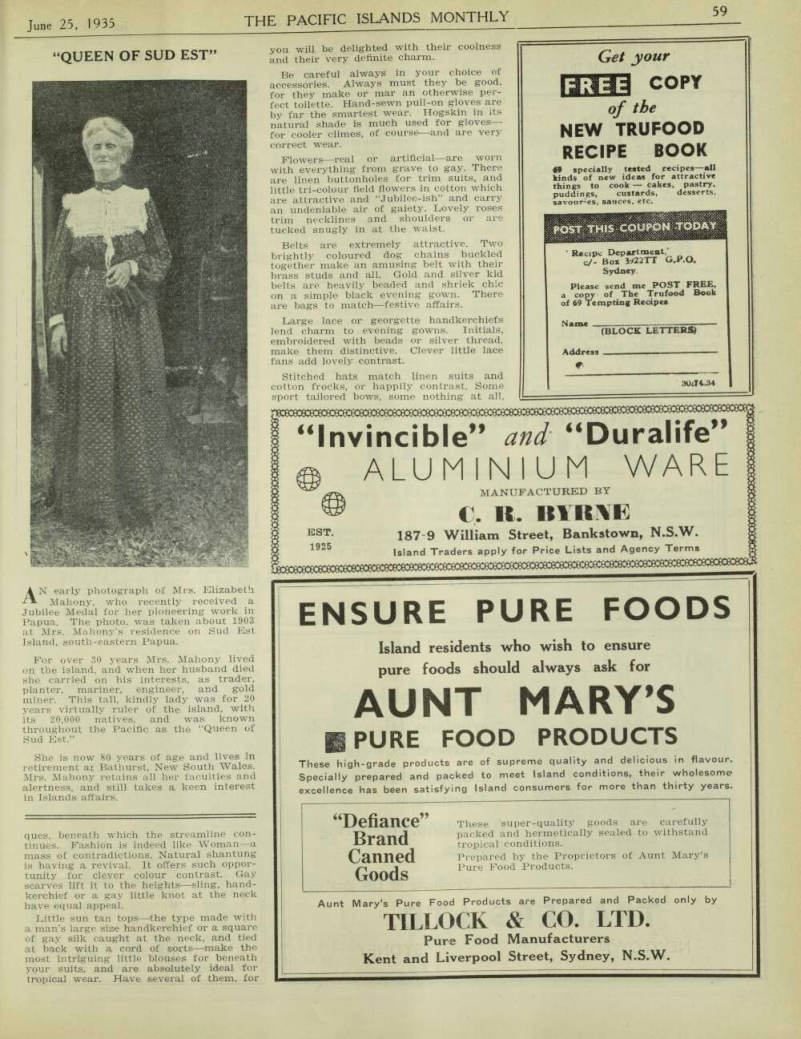
By Therese
MORE gorgeous and varied than ever before are the new materials and colours—greens, golds, scarlets and pale lovely rainbow hues combine to add attraction to beautifully textured materials.
Filmy chiffons, taffetas plain and beflowered— scarlet poppies and heavenly blue morning glories scattered riotously on a primrose ground—shot taffetas, gleaming phosphorescently; others with the pale, soft beauty of a changing moon; diaphanous tulles; dull crepey things that cling lovingly: cottons in fascinating designs and colours that make up beautifully, launder perfectly, and look cool as a sea breeze; all these and more come to gladden the heart of Woman, the darling of the gods.
Colour contrasts reign supreme. Emerald green with scarlet, with gold, with the thick creamy beauty of the magnolia; an emerald scarf or kerchief on a midnight blue gown; dusty pink with prune and so on ad infinitum. Laces, taffetas, chiffons are woven with silver or gold thread that glitters and gleams with the moving light.
For the young and very sweet is the white chiffon gown, silver woven, and shirred from waist to hips, from whence it drifts in ethereal folds to tiny silver slippered feet. There is breathless romance in the full skirted taffeta evening frocks now forcing their way to success. Picturesque and old worldly, there is a charm about them that is irresistible with their full puff sleeves, off-the-shoulder decolletage and entrancingly slim little waists above voluminous skirts.
In direct contrast and shrieking sophistication is the prune streamline gown with low decolletage, one shoulder strap only boasting a diamante clip, the other perfectly plain, and over all with careless abandon swings a dashing cavalier cape, lined with dusty pink— unexpected and delightful.
For the adorably feminine jeune fille there is the little hooded cape (reminiscent of nursery fame) in printed organza, worn over matching bouffant gown that boasts a taffeta petticoat. Flowers wreathe the hair and an exquisite flower bracelet completes an altogether entrancing picture.
Taffeta petticoats for chiffons and laces swish rhythmically to the wearer’s move ment and, if the heart desires, allow a fascinating glimpse of contrasting ruffle at hemline.
The toast of the evening is the devastatingly lovely gown of white satin, with diamante stars scattered wickedly-wink ing over its slim perfection.
Capes of all varieties grace both day and evening wear, and since capes are the dernier cri there must be at least one in your wardrobe. Only those of tall, grace ful proportions dare flaunt the cavalier types. The diminutive figure must choose elbow fitting capes, while the long cape hanging loosely from shoulders gives an incredibly slimming effect to the heavier figure.
Blouses are frivolous and lovely and make our penchant for skirts more understandable than ever. Skirts are delightful —slim, straight, and slightly shorter, they are made with flat centre pleats, slimming panels, slit, and sporting. Their tremendous success gives much scope for the clever individual. And the economy of them! Several blouses of negligible cost, but much ingenuity and attraction to one well-cut skirt, and the dress budget is reduced by half.
The shirtmaker frock is a universal favourite and deserves its popularity, since it can be worn by all types with infinite success. Wear it with one of the new sling scarves—a straight scarf tied lengthwise with knot at neck —caught through your belt which should be in gay contrast to the frock itself.
Cotton frocks are of simple line, with lots of white in the way of collars, bows, etc., to add an enlivening note. It is remarkable how a touch of white will make gay last season’s frock with crisp charm and alter its jaundiced outlook.
There are milkmaid collars, Puritanical ones, and turret-like affairs with square bits cut out here and there, collars pleated and tucked with fluted edges, which offer untold charm to the cotton frock—the love of our lives and a salvation for tropic dwellers.
In the daytime mode slender waists are emphasised by wide belts and flaring bas-
ques, beneath which the streamline continues. Fashion is indeed like Woman —a mass of contradictions. Natural shantung is having a revival. It offers such opportunity for clever colour contrast. Gay scarves lift it to the heights—sling, hand kerchief or a gay little knot at the neck have equal appeal.
Little sun tan tops—the type made with a man’s large size handkerchief or a square of gay silk caught at the neck, and tied at back with a cord of sorts —make the most intriguing little blouses for beneath your suits, and are absolutely ideal for tropical wear. Have several of them, for
you will be delighted with their coolness and their very definite charm.
Be careful always in your choice of accessories. Always must they be good, for they make or mar an otherwise perfect toilette. Hand-sewn pull-on gloves are by far the smartest wear. Hogskin in its natural shade is much used for gloves— for cooler climes, of course —and are very correct wear.
Flowers —real or artificial —are worn with everything from grave to gay. There are linen buttonholes for trim suits, and little tri-colour field flowers in cotton which are attractive and “Jubilee-ish” and carry an undeniable air of gaiety. Lovely roses trim necklines and shoulders or are tucked snugly in at the waist.
Belts are extremely attractive. Two brightly coloured dog chains buckled together make an amusing belt with their brass studs and all. Gold and silver kid belts are heavily beaded and shriek chic on a simple black evening gown. There are bags to match —festive affairs.
Large lace or georgette handkerchiefs lend charm to evening gowns. Initials, embroidered with beads or silver thread, make them distinctive. Clever little lace fans add lovely contrast.
Stitched hats match linen suits and cotton frocks, or happily contrast. Some sport tailored bows, some nothing at all,
but each and every one is piquant and charming. Hats with pique crowns and straw brims are good news for the tropics.
Sailor shapes are to the fore —the small
straight brimmed affairs so smart with the tailleur, or one can wear a large brimmed hat with equal success, if it be of tailored simplicity. Then there is the modish halo, for perfection only, and scarcely suited to pitiless, revealing tropical suns.
Careful coiffures are called for by the new hats —bare foreheads for the sailors; softly curling Hepburn fringes for the picture hat and halo; and always must the hair be dressed high.
Lingerie is enchanting. Adorably and most romantically new are the long sleeved nighties—lovely things, demure and high necked, and with such an expensive air, with smocking at shoulder and necklines.
Attractive wraps cover the nighties. For the boyish tastes there are snappy pyjamas, slim and masculinely feminine, as are the tailored dressing gowns of such verve and dash that go with them.
Japan and the League
After a statutory delay of two years, Japan officially withdrew from the League of Nations on March 27. She definitely intends to maintain possession of the Pacific Islands held by her under mandate, and as long as she conforms to the obligations laid down in the terms of the mandate it is unlikely that the League will attempt to transfer the administration of those islands to another nation.
“Queen Of Sud Est”
AN early photograph of Mrs. Elizabeth Mahony, who recently received a Jubilee Medal for her pioneering work in Papua. The photo, was taken about 1903 at Mrs. Mahony’s residence on Sud Est Island, south-eastern Papua.
For over 30 years Mrs. Mahony lived on the island, and when her husband died she carried on his interests, as trader, planter, mariner, engineer, and gold miner. This tall, kindly lady was for 20 years virtually ruler of the island, with its 20,000 natives, and was known throughout the Pacific as the “Queen of Sud Est.”
She is now 80 years of age and lives in retirement at Bathurst, New South Wales.
Mrs. Mahony retains all her faculties and alertness, and still takes a keen interest in Islands affairs.
Advertisements & other items, pp. 61-62 (1 item)
Aunt Mary’S
Get your
free copy
of the
NEW TRUFOOD
RECIPE BOOK
69 specially tested recipes—all kinds of new ideas for attractive things to cook cakes, pastry, puddings, custards, desserts, savouries, sauces, etc.
POST THIS COUPON TODAY
Recipe Department c/- Box 3922TT G.P.O.
Sydney Please send me POST FREE, a copy of The Trufood Book of 69 Tempting Recipes Name
(BLOCK LETTERS)
Address
“Invincible” and “Duralife”
ALUMNIUM WARE
EST.
1925
MANUFACTURED BY
C. R. BYRNE
187-9 William Street, Bankstown, N.S.W.
Island Traders apply for Price Lists and Agency Terms
ENSURE PURE FOODS
Island residents who wish to ensure pure foods should always ask for
AUNT MARY’S
PURE FOOD PRODUCTS
These high-grade products are of supreme quality and delicious in flavour.
Specially prepared and packed to meet Island conditions, their wholesome excellence has been satisfying Island consumers for more than thirty years.
These super-quality goods are carefully packed and hermetically sealed to withstand tropical conditions.
Prepared by the Proprietors of Aunt Mary’s Pure Food Products.
Aunt Mary’s Pure Food Products are Prepared and Packed only by
TILLOCK & CO. LTD.
Pure Food Manufacturers Kent and Liverpool Street, Sydney, N.S.W.
“Defiance”
Brand Canned Goods
A HOSTEL
For Your Children
Tamarang Hostel, situated on the heights of the Lane Cove River in healthy, open surroundings, is the ideal Sydney home for Islands children.
Sunny rooms, ample playground, good food.
All the care and comfort of home.
House Mother: Mrs. G. Allnutt.
Assistant; Miss E. Allnutt.
Write to:
TAMARANG HOSTEL
Penrose Street, Lane Cove Sydney Telephone: J 6722.
Neptune’s Greatest Gift to Man—
OZO SALT
The word “OZO” means the Sea. OZO SALT is made from Sterilized Sea Water of the Pacific Ocean and dried in vacuum.
“NOTHING PURER ON EARTH.”
Ask for it in the new lilb. Patent Package. Specially designed (for the Island and Eastern Trade) to resist Moisture, Humidity and Water. CAN BE OPENED AND RESEALED WITH THE GREATEST OF EASE. ORDER A PACKET TO-DAY.
Other “OZO” Specialities are: Ozo Health Salt.
Ozo Celery Salt.
“Sea-King” Gravy Salt.
OZO SALT CO.
SYDNEY
ABOVE ALL—
Aeroplane Pure Fruit Jellies Manufactured by Aeroplane High-Grade Custard Powder Aeroplane Junket Crystals Aeroplane Flavouring Essence Products of Distinction
TRADERS LTD.
NEWTOWN SYDNEY
The Lakekamu
Guinea Gold Nearing a Decision on Papuan Goldfield.
A STAFF of eight Europeans and 300 natives, with modern equipment, is at present testing the leases taken up along the Lakekamu River, Central Papua, by Guinea Gold, N.L., a wealthy Adelaide company. Details were given by Mr. C. V. T. Wells, chairman, at the annual meeting on May 31.
The technical staff is led by Mr. Nason- Jones, a notable geologist and prospector, who located the field. The second engineer is Mr. Warrilow, whose energy and exactness have been highly praised.
Mr. G. S. Dyer, a prominent mining engineer, has just arrived from America recently to visit Lakekamu and make a report upon the field; and, on his recommendation, Guinea Gold N.L, probably will decide whether to work the new leases, sell them, form an operating company, or abandon them. Mr. Dyer has had extensive experience in America and Russia, and has done important work for Oroville Dredging Ltd., Lena Goldfields Ltd., and Consolidated Goldfield Ltd.
It is likely that a decision about the Lakekamu field will not be long delayed.
In the period to February 28 last, Guinea Gold N.L. had spent £14,607 on the area, and it was thought that a total expenditure of £30,000 might be necessary for testing and proving.
Death Of Rev. Dr. W. Gunn
REV. DR. WILLIAM GUNN, a veteran medical missionary of the United Free Church of Scotland, died on June 9, at his residence in Bancroft Ave., Roseville, Sydney. He was 82 years of age.
Dr. Gunn was born in 1853, and graduated as Licentiate of the Royal College of Physicians and Surgeons, Edinburgh.
After attending divinity classes, he was, in 1882, appointed by the United Free Church of Scotland, as its first medical missionary at Futuna, in the New Hebrides group, where he went with his wife in the same year.
For 35 years Dr. Gunn carried on his missionary work in Futuna and other islands adjacent to it, paying two visits to Scotland and making frequent trips to Australia in that time. During his term in the New Hebrides, Dr. Gunn translated portions of the Bible and a number of hymns into the native language. He also wrote two books, “The Gospel in Futuna,” and “Heralds of the Dawn,” which told the story of the people and of his work among them. He also edited, printed, and published “The New Hebrides Magazine.” This was largely a record of mission work, but also contained general Islands news for the information of white residents.
Dr. Gunn relinquished his missionary work in 1917, and with his wife and two daughters had resided in Sydney ever since. Mrs. Gunn died some years ago.
Advertisements & other items, p. 62 (1 item)
COLONIC irrigation is one of the best methods
best methods of cleansing the lower bowel, and is recommended by the medical profession.
Treatment is obtainable at
A. E. SUMMERBELL’S ROOMS
Wyoming, Macquarie Street, Sydney
Housekeeping in the Tropics
Conducted by “Dorothea”
NOWHERE, perhaps, is the problem of the child’s health so complex as in the tropics. The climatic conditions make for lassitude, but I have seen many wise—and some unwise—parents who realised the absolute necessity of teaching their little ones the nobility of work, and the futility of idleness.
It is a known fact that a great deal of unrest and unhappiness among young people is due to the fact that they have little liking for work! Most of them regard it as a necessary evil.
It is impossible to attain success in any career without a pride in one’s work, and it will almost always be found that the good worker is usually fairly contented in mind and healthy in body. Leisure hours are enjoyed because they are a contrast —and contrast is necessary to a happy life.
“All work and no play” is a very true adage.
It is quite easy to teach children to get the right feeling about work—and this teaching should begin with the child, and not left until the adolescent stage is reached.
They can be given small tasks, and taught to take pride in them. Do not expect a child to take the interest in work in general that you do yourself. Give them some responsibility at an early age, just one little job which need not involve a lot of work. Even if you only give the child your needlecase, tell her to mind it for you, and keep it in some chosen place, so that when you want a needle she will be able to get it for you.
Quite a number of little responsibilities can be found which will begin the training of the small boy and girl, and you will find that they feel quite important in their own mind.
In encouraging children to have the right ideas about work, parents are giving them something they will value more and more as they grow up and take their own places in the world.
Keeping Fit in the Tropics
Without being a faddist, one must realise the absolute necessity of vital component parts in our dietary if we wish to keep fit.
Nowhere is this so necessary as in the tropics, where it is difficult to obtain fresh foods containing the required vitamins.
Happily, science has, during the last decade, made astounding discoveries, and to those of our readers who are mostly dependent on tinned foods, we will endeavour from time to time to give them substitutes containing the vitamins for both child and adult; and I know of no more palatable, useful and health giving one as “Marmite.”
Marmite has been called “the most marvellous food in the world” —chiefly because Marmite is a pure vegetable extract, the richest known source of vitamin B. The discovery of food vitamins is one of the most important of modern times. In vitamins, the modern physician possesses the most powerful therapeutic weapon in the scientific control of diet ever placed in his hands.
Vitamins are used by nature wherever there is growth, new life, and reproduction.
They are in the germ of seeds, in the yolk of eggs, in milk, in sprouting grains in yeast, the most rapidly reproducing of all vegetation. Each teaspoonful of Marmite
is made from many millions of these tiny yeast cells, Marmite, like milk, is a whole food, containing the rarer nutritive elements for which our bodies hunger. Marmite, this pure vegetable extract, this vitamin concentrate, should be used by every family every day. The principal cause of disease in modern life lies in the absence from our artificial food of just those elements contained in Marmite. Marmite restores those elements; supplements other foods and aids them to deliver all their goodness to the system.
Marmite puts vitality into the nerves and muscles by feeding them; it counteracts acidity, gas and fermentation of the stomach and normalises the action of the bowels.
Altogether apart from its value to health, Marmite is a particularly appetising food.
It makes the most delicious and savoury of all sandwich pastes. A level teaspoonful of Marmite dissolved in a cup of boiling water with a little milk added, is a most refreshing drink of equal benefit to adult and child, athlete and invalid.
Marmite is immensely popular in the kitchen; it raises the value of inexpensive foodstuffs to the standard of the highest, and vastly improves their flavour.
Advertisements & other items, pp. 63-64 (1 item)
Gillespie’S
“ANCHOR”
FLOUR
TRADE
MARK
The Standard of Quality.
MODERN TUBULAR
STEEL FURNITURE
Chromium-plated or Lacquered Finishes Radio Station 2UW, Newlands Steel Furniture Complete Catalogues on Request- Beds Wires Bedding Hospital Furniture Tubular Steel Furniture C10a Chair —Chromium plated Steel.
Complete catalogues on request—Cable Address “NEWLANDBED,” SYDNEY.
NEWLANDS BROTHERS LTD. Riley Street, Sydney, N.S.W.
AUSTRALIA’S LARGEST MANUFACTURERS OF SLEEPING EQUIPMENT, HOSPITAL FURNITURE AND
STEEL DESIGNS.
New Britain Express
Delivery.
GENERAL OVERSEAS AGENTS.
GENERAL CARRIERS, BAGGAGE and
FORWARDING AGENTS
ROYAL MAIL CONTRACTORS
Reliable Cars and Trucks.
We aim to give quick and reliable Service at reasonable costs. P.O. Box 116. 'Phone 141.
W. WALKER-FLYNN, Proprietor, Malaguna Road, Rabaul, T.N.G.
IN CASES OF EMERGENCY YOUR
HOME IS INCOMPLETE WITHOUT A
MEDICINE CABINET. BE PREPARED!
You can purchase the highest quality surgical dressings, pharmaceutical requirements and all chemists sundries at the lowest possible prices direct from
The VICTOR PHARMACEUTICAL
AGENCIES
Phillip House, Phillip St., Sydney.
Orders, inquiries and quotations attended to immediately. Enclose postage for reply.
Address all mail to The Manager, Box 374955, G.P.O., Sydney
THERE’S NO SUBSTITUTE
FOR QUALITY
ARNOTTS SAO BISCUITS are the result of half a century of specialization, they have that light flaky texture —that perfection of quality which makes them delicious with butter, cheese, ham paste or fruit, and exceedingly popular with everyone.
On cold nights try them this way; Butter the SAO Biscuits, grate a little cheese over each, and sprinkle with cayenne pepper—one minute in a hot, dry oven and serve whilst hot.
ARNOTTS
FAMOUS
SAO
BISCUITS
Always ask your Grocer for Arnett's
“THEY ARE BETTER THAN EVER”
Hints for Islands Housekeeping
Monthly Prize, 10/6, to “Bititamboa,”
Tulagi, Solomon Is.
Antidote for Centipede Bites and Sting of Stonefish.—Immerse the part bitten in kerosene. If this is not possible, keep cloths well saturated with kerosene on the punctures, but it is better to immerse the part if possible. I have found this hint invaluable here in the Islands where centipedes are so bad, and its efficiency has been proved both on my own family and our “labour.” One night my son was bitten twice on the wrist by a nine-inch centipede. I at once put his hand and wrist into kerosene, and in less than two hours he was in bed asleep again. Labourers bitten, and treated, have been able to report back for work in a couple of hours. The treatment has proved just as effective with stonefish stings. My husband trod on one and was quite free from pain after having his foot in kerosene for two hours.
We have established a bureau for the exchange of ideas, whereby home makers throughout the Islands can be of mutual help to each other, and for the most helpful hint or recipe each month we offer a prize of 10/6. Address all communications to “Dorothea,” Pacific Islands Monthly, Union House, George Street, Sydney.
It Happened One Day
Prize of 10/6 to “Harriet Belinda,”
Lofung, S.I.
I was in the kitchen and wanted the new colander recently imported.
“You go along store,” I told the cook boy, “and bring this new feller something him come long steamer. Him all the same saucepan, but him nother kind. Him gottim too much hole along him.”
He returned pridefully bearing a “some thing” which had certainly come on the steamer, and answered some of the description, but it was never intended for use in the kitchen.
For the most interesting and unusual item of news concerning Island happen ings, not exceeding 120 words, we will give a monthly prize of 10/6. Address your entries to “Dorothea,” at the “P.I.M.”
Tropical Fare
Pineapple Pudding Boil a minced or grated pine in 1 cup of water for 6 minutes. Melt 1 tablespoon of butter in a saucepan, add 2 tablespoons flour, blend, then add cooked pineapple, ½ cup sugar, 2 egg yolks well beaten, and ½ cup of milk, stirring each ingredient in well as it is added. Lastly, add the 2 egg whites, well whipped. Beat briskly, then pour into a pie dish and bake in the oven like a custard. —“Bititamboa.”
Mrs. G. E. L. Westbrook, of Apia, Samoa, wife of the well-known writer, died at the end of May. She was advanced in years and had suffered from ill-health for a considerable time.
Advertisements & other items, p. 64 (1 item)
Crafts And Hobbies
Correspondence Tuition in Weaving, Spinning, Basketry, Flower-making, Felt and Woollen Toys, etc. Principal: Mrs. G.
Farquharson, Kembla Building, 58 Margaret Street, Sydney, or c/o. Pacific Publications Ltd., Box 3408 R, Sydney.
Little Islanders’ Corner
“DOROTHEA” welcomes many little Islanders to our Corner —and such interesting entries, too, from the Solomons, Papua, the Mandated Territory, and Fiji.
I only wish our Corner had more space in which to publish them. Perhaps, some day, if we are all very good, our Editor may allow us a whole page. Will little Islanders send me their photos; and, when in Sydney, remember “Dorothea” would like to meet you all.
As many of our readers, both old and young, have wished to adopt a “pen name”
I want them to know it is quite permissible, but they must only write or type on ,one side of the paper, and always put their full name and address as well as their pen name.
If any little Islanders are stamp collect ors I have many for exchange from various countries if you just write in and tell me your needs.
Also, will ALL contributors send me the date of their birthdays to enter in our birthday club. NOW PLEASE DON'T
Forget.
A Solomon Is. Fable
Geoff Gaskell, of Tulagi, Wins 5/-
Dear Dorothea, I am 15 years of age and would like very much to become a member of the Children’s Corner.
I live on the Island of Beuna Vista, some 25 miles from Tulagi, on which island my parents, my elder brother, and myself are the only white inhabitants.
Being able to converse with the natives here, in their own language, I am able to find out all their ways, and customs, but in this letter I am going to tell you of a native fable about the bonito.
Long ago in the source of a river on Savo there lived four “Atus” (bonito) two being red and the other two silvery blue.
A certain woman who looked after these fish was the only one who knew of them, and every morning brought them a black-lip shell, which she grated on the rocks, and the powder from the shell was eaten by the fish.
One day, however, the husband of the woman wondered where she went every morning, so followed her, and watched her feed the “Atus.” After she had gone he went and caught a red one and ate it.
When the “Mother” of the “Atus” found this out, she was very annoyed, and floated down stream on a log, followed by the fish, and on reaching the sea she swam off with the fish and became a dugong.
The husband, feeling sorry for his deed, became a shark and also went into the sea.
That is the legend. Now, the descendants of the woman have the power of getting their “devils” to work, and making the woman bring the “Atus” to where they want them, so that they can fish for them. All over the group the natives go to Savo to buy the “devils” from the descendants to make the “Atus” come to their district.
The bait, which is trailed among a shoal of “Atus,” is made of the same kind of shell as the woman was supposed to have fed them on, black lip shell.
It is only the blue “Atus” which bite, and sometimes twenty or more, are caught by one man. A shark and a dugong are often seen amongst the “Atus,” and three times, to my know ledge, natives have gone to Savo to buy “devils,” and each time the “Atus” have come to their individual districts for about four months.
Islands Humour
Walking into one of B.P.’s stores in the Pacific, a youngster said: “Hey, Mister, Dad wants you to send up 20 sheets of that ruffled tin, please.”
“I beg your pardon?”
“Aw, you know, Mister—that consecrated iron.”
Collapse of storekeeper!
Advertisements & other items, pp. 65-66 (1 item)
Use Duxbac
& "ICIL SPECIAL"
WATERPROOF
CARTRIDGES
Heavy loads, high velocity and hard hitting at long range assure clean kills under all conditions.
NEOFLAK
LOADED
A 2¾in. Load
In 2½in. Shells.
Without Excessive Pressure or RecoiL “Neoflak” Powder is the latest and most successful of all shot gun propellants.
Obtainable
Everywhere
At Popular
Prices.
“Conservador”
THE NEW PATENTED AND EXCLUSIVE
FEATURE . . . FOUND ONLY IN
Fairbanks Morse
HOUSEHOLD
REFRIGERATORS
30% to 40% lower operating costs.
Backed by an International Name and 104 Years’ Experience
DISTRIBUTORS WANTED
Write—
Fairbanks Morse Co.
29-33 CLARENCE STREET. SYDNEY. Box 2672EE.
VIRTUS SHIRTS
are obtainable in
Three Sleeve Lengths
Short— eliminating the necessity of wearing armbands or sewing tucks in sleeves.
Medium —the regular average sleeve length.
Long —made extra long in sleeves specially to fit men with very long arms.
Reliable English Woven Shirtings Prices from 10/6—Patterns Posted free. Write to
ERNEST SHAW
135 PITT ST., SYDNEY
TARIFF:
Bed and Breakfast 8/6 per day, £2/10/- weekly
CENTRALLY SITUATED
Euston Hotel
Modern Services Throughout
A. HOBAN, Prop.
Luncheon and Dinner opp. Wynyard Station
FOR
Pedigreed Terriers, Kelpies, Spaniels,
Greyhounds, Bull Terriers, etc.
Write
GEO. F. SMITH
(Judge for Many N.S.W. Dog Societies) Dealer in All Kinds of Live Animals. Zoos Supplied.
777 GEORGE STREET, SYDNEY.
Firearms Repairs. “OUR HANDS MAKE GOOD ARMS”
QUALITY FISHING TACKLE
There is always a wonderful feeling of satisfaction in knowing the Tackle will stand the strain.
Write now for my Fishing Catalogue (200 illustrations) and Firearm Catalogue (500 illustrations).
SIL ROHU [Late A.I.F.] GUNSMITH
Importer of High-grade Firearms and Fishing Tackle Specialist. ’Phone MA 3540 143 ELIZABETH STREET, SYDNEY (near Market Street).
“FISHING TACKLE TO TACKLE FISHING.”
CRAIGNATHAN— Private Hotel,
NEUTRAL BAY
SYDNEY
Situated right at Neutral Bay Wharf 15 minutes from
G.P.O.
IS AN IDEAL RESIDENCE FOR THE ISLAND VISITOR
TO SYDNEY.
Families specially catered for.
Boatsheds Swimming Baths Tennis Billiards (Halvorsen’s).
Spacious Grounds FACING THE PICTURESQUE
HARBOUR.
Full Tariff from 10/- per day.
FULL INFORMATION AS TO TERMS, ETC.
Telegrams: “Craignathan,” Neutral Bay.
ON APPLICATION TO MANAGER.
’Phone: X 2472
Aerial Freight Rates
In N. Guinea
Below 3d. Per Pound
THAT the cost of carrying goods by air between the coast of New Guinea and the goldfield is likely to remain under 3d. per pound, was indicated by the chairman of Guinea Airways Ltd. (Mr, C. V. T. Wells) when he addressed the annual meeting of that company in Adelaide on May 31. It has been calculated that freight would cost from 2d to 3d. per pound, if a road were built between the goldfields and the coast, and goods were transported by motor lorries.
“We have been able to maintain our usual dividends,” said Mr. Wells, “and the profit for the year is a little above the annual average for the Company’s seven years of operating. The tonnage transported was very little short of that for the preceding year, but the reduced freight rates, foreshadowed at our previous annual meeting, have naturally had an effect upon gross earnings.
“We are satisfied that this should be
so, to a reasonable extent. Our Company exists for the two-fold purpose of supplying adequate transport to the gold fields’ community at moderate cost, and of giving you a reasonable return for your capital outlay.
“For the previous year the average freight rate per pound of cargo carried had fallen to 4.12d, and for the year which has just closed it has averaged down to a new low level of 3.36 pence per lb. We have endeavoured to estimate the average freight rate which is likely to be earned by the Company during the current year, and we think that this should result in a charge to the public of below 3d per pound on the average. These rates should still enable us to make a good profit, as there seems to be no indication of a falling off in the quantity of goods requiring transportation by air.
“I have pointed out before that we endeavour to follow a policy of steady reduction of freights, keeping pace with the increased volume of business. We are still following this policy, but, in the opinion of your Board, the point must soon be reached where further appreciable reductions in freight rates will not be possible. Adequate reserves must be maintained and our aircraft kept in the first-class condition we know to be necessary in a tropical climate. Competition has hitherto followed along the natural line of falling prices which accompany a rising turnover.
“One feature worthy of notice is the increase in the passenger traffic, for which we are catering by the importation from England of two well fitted-up tri-motored passenger aeroplanes. One of these has been in service for some months and the other will be arriving shortly.”
Entertains At Rabaul
J. A. Carpenter
From Our Own Correspondent.
Rabaul, May 27.
WHENEVER Mr. J. A. Carpenter, director of W. R. Carpenter and Co., visits Rabaul, he invariably winds up his holiday by staging a sumptuous dinner party, intermingled with gay dancing.
His last visit was no exception, and prior to leaving on the Macdhui, a most successful dinner party was held at “The Palms” on May 23, when General and Mrs. McNicoll were present, as well as heads of various Government departments, and about 50 private residents, including Mr. and Mrs.
B. W. Costello (of Gire Gire), Mr. and Mrs. F. O.
Greenwood and the Hon. J. C. Mullaly, M.L.C., and Mrs. Mullaly.
In the hands of Mr. Mullaly was placed the toast of “Our Host,” and in a few well-chosen words, he expressed the appreciation of those present of the wonderful hospitality shown by Mr. J. A. Carpenter. Occasions such as these, said Mr.
Mullaly, were particularly necessary in this Territory for they brought people together and fostered that “get together” spirit, so essential in new countries.
In reply Mr. J. A. Carpenter thanked his guests for the kind manner in which they had drunk the toast and emphasised the need for greater hospitality throughout the whole world, to overcome many of our present-day problems.
Advertisements & other items, pp. 67-68 (1 item)
Hotel Bulolo
WHERE TO STAY
THE
PAPUA HOTEL
Catering specially for Tourists & Travellers Situated on high ground overlooking both coasts, its Spacious Lounges are always Cool & Comfortable Tariff: Per day 16/-; per week £5/5/-; per month £14; bed and breakfast 10/-; bedroom only 7/6.
Cars meet all steamers.
FIRST-CLASS ACCOMMODATION. SPECIAL DINNER
PARTIES ARRANGED.
Licensee: Papua Hotel, Ltd.
IN PORT MORESBY
HOTEL MORESBY
NEAR THE
WHARF
COMFORTABLE
ACCOMMODATION
ONLY THE BEST
BRANDS OF
WINES, SPIRITS
AND BEERS
IN STOCK
LICENSEE:
Hotel Moresby
Ltd.
COSMOPOLITAN
HOTEL
Samarai
First-class Accommodation for Tourists and Travellers Ball-room; Electric Light; Billiards; Freezing-works; Cold Store. Best brands of Wines, Spirits, Ales.
MODERATE TARIFF
Fishing Trips and Launch Excursions arranged Licensee: E. J. Morrow
TAHITI
AND
French Oceania
RECENTLY PUBLISHED
This book, by Samuel Russell, has just been published. It is a valuable work of reference, insofar as it gives, in relation to Tahiti and French Oceania, complete details of administration, commerce, sport, tourist resorts, industries, excursions, hotels, immigration and land laws, etc.
Yachtsmen and fishermen, who are visiting Tahiti in increasing numbers, will find this a most useful handbook.
It also supplies a fascinating account of life in Tahiti —one of the most delightful places of residence in the world.
Copies from: S. RUSSELL, Papeete, Tahiti.
ANY SYDNEY BOOK STORE.
Pacific Publications Ltd.,
247 George Street, Sydney
Price in Australia (posted): Cloth bound, 6/-; paper-cover, 5/-.
HOTEL BULOLO
WAU, T.N.G.
Picturesquely situated, overlooking the Wau Aerodrome, at the Business centre of the Morobe Goldfields.
FIRST-CLASS CUISINE—30 com-
fortable Bed-rooms—Hot and Cold Showers—Fresh Fruit, Vegetables, and Dairy Produce from the Hotel Gardens.
The Hotel Bulolo is famous for its wide, cool verandah-lounge.
Only the Best Brands of Wines, Spirits, and Beers in stock.
SAMARAI HOTEL
The Rendezvous of the Miners of Eastern Papua.
Comfortable Accommodation for Tourists, Travellers and Residents. Best Brands of Spirits and Wines —Victorian Lager Beers.
FISHING EXCURSIONS ARRANGED
Licensee: Mrs. L. M. SKELLY.
HOTEL RABAUL
COOL AND SPACIOUS LOUNGES COMFORTABLE
ROOMS - DINNER PARTIES SPECIALLY ARRANGED
Excellent Dance Floor and Music.
Under the Personal Management of Mrs. H. Luxmoore
SKIN DISEASES
By the application of his Secret Formula in the treatment of all Skin Diseases, Mr. John J. McHugh, Consulting Chemist. 124 Liverpool St., Sydney, is able to assure sufferers of a complete and speedy recovery.
Letters of gratitude from all parts of the world may be inspected at his rooms. Skin complaints successfully treated include: Tinea, Eczema, Psoriasis, Acne, Germ Under the Nail, Varicose Veins and Ulcers, Ringworm, Pruritis, Dandruff, Rosacea, Infantile Eczema, etc.
Readers are invited to call or write to Mr. McHugh, and he will advise them without obligation.
Consulting Hours: Monday, Wednesday, Thursday, 10 a.m. to 5 p.m.; Tuesday and Friday, 10 a.m. to 9 p.m.; Saturday, 9 a.m. to 12 noon.
JOHN J. McHUGH, Ph.C.
(Member of the Pharmaceutical Society, N.S.W.) Consulting & Pharmaceutical Chemist
1st FLOOR, 124 LIVERPOOL ST.
(opp. Snow’s), SYDNEY 'Phone MA 5028
A CLEAN PLANTATION GUARANTEED
WITH
B.A.C. Weed Killer
Used on Malay States Rubber Plantations; approved by British Malay Rubber Institute F.O.B. Sydney. Sold in 4 gallon tins—2 tins to a case. 4/3 per gallon (Australian Currency). In concentrated form. Agents wanted in every group Particulars from:
LONE HAND SOAP CO.
554 Botany Rd., Alexandria , Sydney , Australia
THE NEW
WINCHESTER
MODEL 65
REPEATING RIFLE
LIGHT
FAST
A BEAUTY
LEVER ACTION 8-SHOT REPEATING RIFLE
In calibres .25/20 and .32, N.R.A.-type pistol-grip stock, 22in. round tapered barrel having ramp front sight base, Lyman gold bead front sight, Rocky Mountain adjustable rear sight. Half magazine only. £9/10/- Weight, about 6½lb.
Freight extra (approx 11lb.) ADAPTED FOR SUPER-SPEED CARTRIDGES, FOR WHICH A HIGH
FORESIGHT IS FITTED
25/20 AND .32 BLACK OR SUPER-SPEED STAYNLESS 25/20 and .32 Centre-fire Super-speed Staynless Cartridges. Per 100 ... 21/- 25/20 and .32 Black Powder Cartridges.
COWLES & DUNN, 71 King St, Sydney ’Phone: M 3388
Cotton And Rice In Fiji
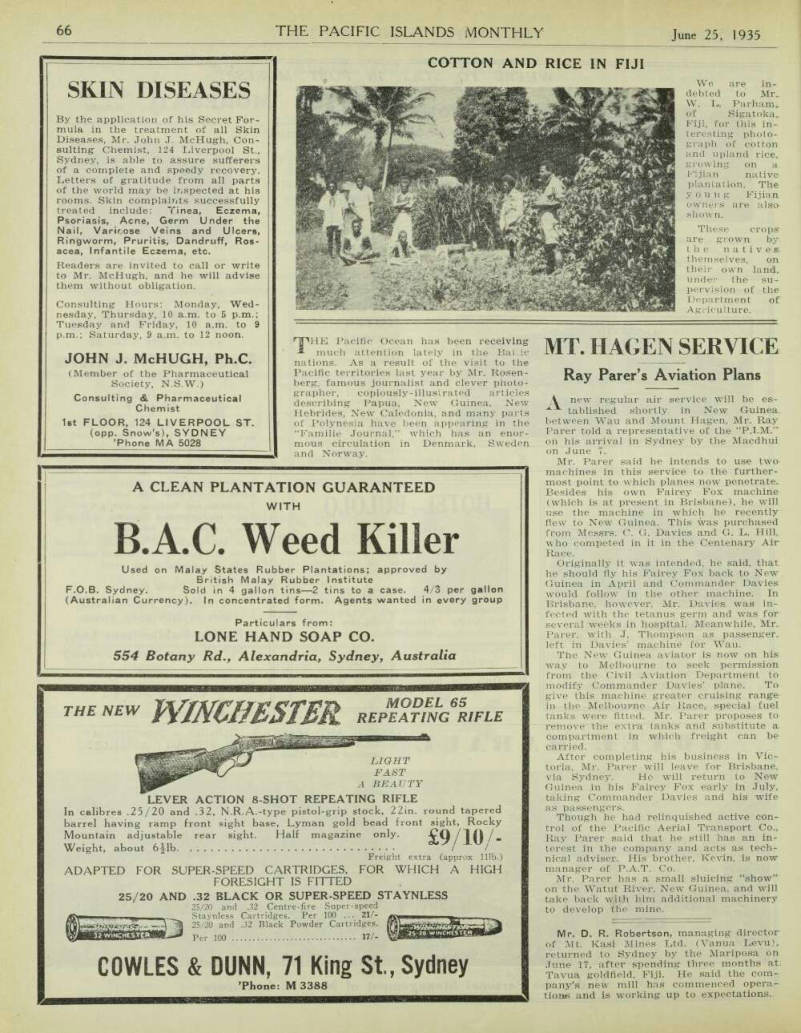
THE Pacific Ocean has been receiving much attention lately in the Baltic nations. As a result of the visit to the Pacific territories last year by Mr. Rosenberg, famous journalist and clever photographer, copiously-illustrated articles describing Papua, New Guinea, New Hebrides, New Caledonia, and many parts of Polynesia have been appearing in the “Familie Journal,” which has an enormous circulation in Denmark, Sweden and Norway.
We are in debted to Mr.
W. L. Parham, of Sigatoka, Fiji, for this interesting photo graph of cotton and upland rice, growing on a Fijian native plantation. The young Fijian owners are also shown.
These crops are grown by the natives themselves, on their own land, under the supervision of the Department of Agriculture.
Mt. Hagen Service
Ray Parer’s Aviation Plans
A new regular air service will be established shortly in New Guinea between Wau and Mount Hagen, Mr. Ray Parer told a representative of the “P.I.M.” on his arrival in Sydney by the Macdhui on June 7.
Mr. Parer said he intends to use two machines in this service to the further most point to which planes now penetrate.
Besides his own Fairey Fox machine (which is at present in Brisbane), he will use the machine in which he recently flew to New Guinea. This was purchased from Messrs. C. G. Davies and G. L. Hill, who competed in it in the Centenary Air Race.
Originally it was intended, he said, that he should fly his Fairey Fox back to New Guinea in April and Commander Davies would follow in the other machine. In Brisbane, however, Mr. Davies was infected with the tetanus germ and was for several weeks in hospital. Meanwhile, Mr.
Parer, with J. Thompson as passenger, left in Davies’ machine for Wau.
The New Guinea aviator is now on his way to Melbourne to seek permission from the Civil Aviation Department to modify Commander Davies’ plane. To give this machine greater cruising range in the Melbourne Air Race, special fuel tanks were fitted. Mr. Parer proposes to remove the extra tanks and substitute a compartment in which freight can be carried.
After completing his business in Victoria, Mr. Parer will leave for Brisbane, via Sydney. He will return to New Guinea in his Fairey Fox early in July, taking Commander Davies and his wife as passengers.
Though he had relinquished active control of the Pacific Aerial Transport Co., Ray Parer said that he still has an interest in the company and acts as technical adviser. His brother, Kevin, is now manager of P.A.T. Co.
Mr. Parer has a small sluicing “show” on the Watut River, New Guinea, and will take back with him additional machinery to develop the mine.
Mr. D. R. Robertson, managing director of Mt. Kasi Mines Ltd. (Vanua Levu), returned to Sydney by the Mariposa on June 17, after spending three months at Tavua goldfield, Fiji. He said the company’s new mill has commenced operations and is working up to expectations.
When The Kanakas
Came
Lone White’s Coolness And Resource
(Contributed.)
LIKE many others, Wally Swindells has left the Durantina (Purari district, Upper Ramu), a disillusioned man. But he appreciated the Government’s wisdom in not allowing prospectors into that area unless they have a good supply of firearms.
After a month’s unsuccessful search along the river, he came to a place which had previously been worked, by Schmidt first and then by Bernard.
When he arrived, not a Kanaka was in sight; they were prosecuting, most probably, their favourite sport—fighting other tribes. On the second day, however, a large party arrived, and Wally engaged 30 to strip 10 ft. of overburden. They worked well, at first, but he noticed that they were getting very cheeky, laughing at him when told to “step on the gas.”
One day, when they had left, one of Swindell’s “monkeys” came to him terribly frightened: “Master, Kanaka ‘ee talk; you fellow no got musket; along night he come killum you altogether; him stealem cargo.”
As Bernard had worked the place with out trouble for two months, Wally did not pay any attention to this.
However, at daybreak, his big Alsatian started to bark furiously. Wally promptly got out of bed and saw the surrounding hills black with Kanakas, all armed with their bows and arrows. The boys were scared stiff, but stuck to their master.
Swindells, though only in the district a few months, went back to the house, hid a revolver in his shirt, and quietly crossed the bridge and, after a long and dangerous palaver, he managed to persuade three of the wildest to come with him to the camp, while the others were shouting defiance and brandishing their bows and arrows.
Back at the house, Wally showed them his firearms and, placing a milk tin at 50 yards, he shot at it several times —a bullseye every time.
The Kanakas, seeing that he not only had rifles but that he could shoot such a small object at a long distance, started to rub him, telling him what a wonderful fellow he was.
Those engaged to work came down the hill at full speed to resume their stripping with great energy. The others went back to their many villages. From that day on Wally never experienced the slightest trouble.
But had he not had plenty of firearms, and displayed courage and the coolness of a veteran, he would have been fricasseed or roasted that day.
Swindells stayed there another six weeks, but gave it up. Four to five dwts. of amalgam does not pay, specially with freight at 8½d per lb., and the ’drome a long day’s march away. He brought his gear to Bill Bernard’s camp, a few miles up river, and departed for Wau, leaving Bernard by himself in the district.
Makea Karika Takau, chief of one of the leading families of Rarotonga, Cook Is., and Mata’afa Salanoa Muliufi, a prominent native leader of Western Samoa, had the honour of O.B.E. conferred upon them by the N.Z. Government on the King’s Birthday, June 3.
Samoans Thrilled by Wild
West Heroes
From Our Own Correspondent.
Apia, May 12.
THE Tivoli Theatre was opened recently at Apia in the presence of the Admin istrator (General Hart), who performed the opening ceremony, and a crowded house. The new “talkies,” which are upto-date and equipped with all modern improvements, prove a great attraction to the Apia public, which heretofore had been badly served in the way of sound entertainment.
American talking films are shown mostly and the Samoans get wildly excited at the sight of the cowboy pictures, giving vent to their feelings with much accompanying noise and shouting. So vociferously did they greet the appearance of one well-known Wild West hero at a recent performance that the management were forced to admonish their over-enthusiastic clients.
Advertisements & other items, pp. 69-70 (1 item)
it Costs
Books, Magazines & Newspapers
TO ANY PART OF THE ISLANDS
BARGAIN OFFER.—We will send half-a-dozen assorted Magazines for 4/- (post free).
We specialise in selecting reading matter for those unable to choose personally. We specialise in Mail Orders. Parcels posted by every boat. Send for our price list and fnH particulars of this unusual service for Island residents. You will find your instructions carried out promptly, carefully, and with intelligence.
McKAY’S BOOKSTALL
ROYAL ARCADE, SYDNEY
Illustrating a 4-cyl. Ruston Marine Engine of 36 B.H.P. with Reverse and Reduction Gears. Made in a representative range of sizes up to 650 B.H.P.
it Costs
Less
to Run a “RUSTON”
Every boat owner expects many years of service from his engine, and Reliability. The installation of a RUSTON Marine Fuel Oil Engine ensures this. Why Hesitate?
SOLE AGENTS FOR AUSTRALIA AND THE ISLANDS
RUSTON & HORNSBY (Australia) Pty. Ltd.
REGISTERED OFFICE: 174-180 KING STREET, MELBOURNE
Cables: HORNSBYS, Melbourne Branches at SYDNEY (642-644 Jones Street); and BRISBANE (Barry Parade) Cables: RUSTHORN, Sydney. Cables: RUSTON-HORNSBY, Brisbane.
Mining Ore Treatment
Machinery
Complete Cyanide Plants Supplied.
Dorr Classifiers.
Dorr Thickeners.
Dorr Agitators.
Oliver Filters.
Merril Crowe Zinc Dust.
Gold Precipitation.
Richardson Mine Fans.
FANS AND AIR HEATERS
For Ventilation, Copra Drying Rooms, etc.
Enquire from
CROSSLE, DUFF AND
MACINTOSH LTD.
52 Bridge Street, SYDNEY.
MINING MACHINERY
WE ARE MAKERS OF ALL CLASSES OF
MINING MACHINERY, STAMPER BATTERIES,
HUNTINGTON MILLS, Etc.
ALSO ALL CLASSES OF
BRICK-MAKING MACHINERY
GENERAL ENGINEERING AND FOUNDRY WORK
High-class SEMI-STEEL MACHINE MOULDED GEARING
UP TO 14 FT. DIA. x 24 IN. FACE
GEORGE FOSTER & SONS LTD
Code: A.B.C. 5th Edition. ST. PETERS, N.S.W. Cable Address: Fosterion, Sydney.
Gold Bullion may feel assured that there are advantages in dealing with a well-established and widely-organised Company.
THE ELECTROLYTIC REFINING & SMELTING COMPANY OF AUSTRALIA LIMITED is equipped to provide those advantages in the highest degree possible combined with faithful service.
Its facilities for receiving and handling bullion are convenient and safe. Its assaying and refining are In the hands of highly qualified technicians. Its markets are world-wide, ensuring the best prices being paid.
For example the Record Price of gold in Australia was established by this Company on 6th March, 1935, when payment was made to its clients at the rate of £9/4/6 net per fine oz.
SELLERS IN NEW GUINEA, NEW ZEALAND, PACIFIC ISLANDS, and elsewhere outside Australia should consign their materials to the Company’s Sydney Office.
PROCEEDS FOR NEW GUINEA AND NEIGHBOURING CENTRES are forwarded by the outgoing mail of the same vessel which brings the bullion except in very unusual circumstances. Prompt settlement is a feature of the Company’s service.
Gold Miners: Instruct your Bankers or your Forwarding Agents to deposit your bullion with:
THE ELECTROLYTIC REFINING & SMELTING CO.
OF AUSTRALIA LIMITED
Melbourne: Works: Sydney; Collins House. Port Kembla, N.S.W. 25 O’Connell Street.
PURCHASERS AND REFINERS OF GOLD, SILVER, COPPER IN ANY FORM BANKERS: —The English, Scottish & Australian Bank Ltd.
Pacific Mining
Reports
From Fiji
Aloha Alluvials N.L.
At a meeting of Melbourne shareholders of Aloha Alluvials N.L., Fiji, on June 7, a report was sub mitted by Mr. R. M. Boyd, who was commissioned to examine certain alluvial areas. Mr. Boyd stated the company’s options and reservations in the Waimanu River region collectively comprised an unbroken tract of territory extending continuously for a distance of 25 miles, starting from the junction of the Waimanu and Rewa rivers, and proceeding along the bed of the Waimanu River to the junction of that river with the Waiturua River.
Owing to the inadequacy of his equipment his sampling was confined to the upper washes. All the samples he took from both areas were from the river banks and adjacent flats. His sampling of the Waimanu River areas produced exceedingly gratifying results, and proved beyond doubt the existence of payable gold in the upper wash over a wide extent of country. In the lower reaches of the Waimanu he obtained fine colours of gold in the shingles wherever sampled. In the case of Waidamu River he only sampled in one place, and obtained fine colours of gold from a nice-looking wash. This was an important factor, because it signified easy recovery by mechanical methods.
All the strata of wash sampled in the upper reaches of the Waimanu River were of a gravelly charac-
ter, and largely consisted of granites, andesites, quartz and basalts. In the lower reaches of both rivers the wash was clean and small. The upper flats of the Waimanu River are described by Mr.
Boyd as adaptable to treatment by hydraulic sluicing, and the lower areas are suitable for bucket dredging. The whole of the Waidamu River areas are suitable for bucket dredging. While emphasising the fact that all the prospecting and sampling carried out was on the surface, in the various water channels, and on the terrace formations, Mr. Boyd is strongly of opinion that a scientific campaign of boring will disclose improved values at depth over extensive areas. In answer to a question asked by a shareholder, Mr.
Boyd said that the company had been given assurances by the Fijian Mining Board in regard to leases.
Viti Levu Gold N.L.
Advice was received early in June by the management of Viti Levu Gold N.L., Fiji, from the leader of the party at Suva, that the prospecting license had been approved for two years from June 6.
Loloma Gold Mines N.L.
The following reports, in respect of the progress of operations at Tavua, have been issued by the management of Loloma Gold Mines N.L. : May 23: No. 1 shaft, at 25ft., assayed 2 oz. a ton over width 6ft. No. 2 shaft, at 30ft.: First 3ft., from hanging wall, 3 oz. 8 dwt. a ton. Next 5ft., 26 oz. 8 dwt. a ton. Hole drilled into footwall at this point, 7 dwt. a ton. No. 3 shaft down 3ft. hanging wall, 11 dwt. a ton. Lode at bottom of shaft now 6ft. wide. Footwall not yet reached. Specimens obtained from bottom of shaft show free gold. No. 4 shaft interrupted by rain.
No. 5 shaft commenced at 10ft. N.W. of No. 3.
At 6ft. from surface assayed 3½ oz. a ton over width 11ft. Adit S. of creek at 45ft. from creek assayed 6 oz. 9 dwt.
May 31: Adit at 50ft. from creek, 8¼ oz. a ton.
Face at 55ft., 4ft. width, 10 oz. a ton. Two ft. formation, hanging wall, 3 dwt. a ton. No. 4 shaft, 10ft. deep, not yet sampled. Encountering water.
No. 1 shaft making water. Installing pump. No. 2 shaft, 38ft. deep, sampled 7ft. across at 34ft. As sayed 34½ oz. a ton. Hole drilled 2½ft. into hanging wall. At 34ft. assayed 12½ dwt. a ton. No. 3 shaft sampled across 7ft. at Assayed 12 dwt. Footwall not yet reached. Shaft being timbered. No. 5 shaft sunk to lift. No further sampling. Preparing site for main shaft. Water supply, pumps, pipe, and tanks installed.
June 10: Bulk sampling of ore from adit, 57ft. to 60ft., 19 oz. per ton; 60ft. to 63ft., 18 oz. per ton; face sample at 63ft. 19 oz. 4 dwt. No. 2 shaft, bulk sampling of ore from bottom at about 38ft., 6 oz. 4 dwt.
June 14: New prospecting license has been issued to Loloma G.M. Cos., covering the whole of the area acquired.
Fiji-Austral Gold Syndicate
Fiji-Austral Gold Syndicate N.L, has engaged Mr. J. Rodda to proceed to Fiji on behalf of the syndicate. Mr. Rodda has had a long experience of prospecting in Fiji, and has certain definite areas to prospect. The syndicate is being formed in Victoria, and the manager, pro tem, is Mr.
J. G. S. Stewart, 31 Queen Street, Melbourne.
Fiji Gold, N.L.
With a nominal capital of £30,000, in 3000 shares of £10 each, Fiji Gold, N.L., has been formed in Victoria. Two thousand shares were subscribed for at £5 each; 400 are to be held under option to the promoters for nine months, or at any time within that period, at par; 400, fully paid, are to he allotted to the vendor, Mr. A. Bowler, and his nominees for obtaining the options in Fiji, and 200 will be held in reserve. The company will acquire free options over three prospecting licences on the Tavua goldfield, Viti Levu. Budd’s area adjoins the Koroere and Loloma. Should the option be exercised, Mr. Budd is to receive £5000 and 10 per cent, in shares in a company formed to work the area. In the event of the option over Mr. Ragg’s area being exercised, he will receive £2000 and 10 per cent, in shares in a new company. Should the option over Gunga Singh’s area be exercised, he will receive £5000 and 5 per cent, in shares in anew company. Mr. H. V. Francis has been engaged to superintend operations on the field and development work. He will work in conjunction with Gold Mines of Fiji. Supervision of both co.’s will be from one base camp. The directors are Messrs. A. Bowler, G. R. Clarke, D. J.
McClelland, D. Reid, and S. Wright-Smith. A local director will be appointed at Suva. Mr. J. D.
Morrison, Bank-place, Melbourne, is the legal manager.
The various areas held by Gold Mines of Fiji, N.L., and Fiji Gold, N.L., are being manned by miners from New Zealand, as the Fijian Govern ment prefers them owing to their special know
ledge of the class of mining there. A suitable truck has been obtained for carriage of plant, also samples from the various blocks to a central assay plant. Development work on all blocks is pro-
gressing satisfactorily.
Rewa Prospecting Syndicate
Representatives of Rewa Prospecting Syndicate N.L., in Fiji, advise that sinking is in progress on a promising ore body, composed of altered andesite, 4 feet in width, which has been traced 100 yards across the area, and shows a definite tail of gold in dish prospects.
Tavua area, June 4: Shaft sunk 17ft. Lode widened to sft., shows definite tail of gold in dish prospects. Acquired 75 p.c. interest in 400 acres on Wainivesi River. Prospecting reveals gold bearing formations, one leader carrying free gold; estimated value 10 dwt.
Loloma West Ltd.
Mr. A. J. Phillips, of Stringer and Phillips Pty.
Ltd., legal manager of Loloma West Ltd., left for Fiji recently. He took with him a mine manager and a party of miners to push on with development of the company’s four areas in Fiji. Mr. Phillips will attend to the consolidation of the company’s interests, and will inspect the properties. Dr.
Loitus Hills is testing the area for Loloma West, and will submit his report shortly to the directors.
Koroere Gold N.L.
Tunnels being driven by Koroere Gold N.L. on the property at Viti Levu, Fiji, have not yet reached the lode channels, which is their objective.
Following is a progress report of operations, received by the management: Nos. 1,2, 3, and 4 tunnels to 105 ft., 40ft., 83ft., and 32ft. respectively.
First three show mixture of formation at various points. Tunnels now sampled give following results —No. 1, from 30 to 90ft., averaged 1.8 dwt; No. 2 tunnel portal, to 35ft., averaged 1 dwt.-; No. 3 tunnel, traces. No. 4 tunnel been in formation from commencement. Averages 1.7 dwt. Tunnels not reached lode channels, toward which they are being driven. Rock drills now working in two tunnels. Have commenced trenching and shaft sinking on Cardigan lease. One shaft on N. end of Cardigan lode, other work on outcrops N. and N.W. Cardigan lode. All work going smoothly.
Nasivi (Fiji) Gold Syndicate
Nasivi (Fiji) Gold Syndicate N.L. has acquired a free option over an additional 1500 acres of alluvial deep lead, contiguous on the south to the present lease, which contains approximately 3000 acres. The total area acquired is on the Clunes main lead, and takes in over four miles in length of alluvial deep lead. The lead has been bored on both the north and south ends by the Mines Department, with satisfactory results. Additional power drilling is being carried out in the central section of the lease to fix the site for the main working shaft. No. 1 bore on this line is bottomed at 130 feet, in 6 feet of wash. It is expected that the boring will be completed in about nine weeks, after which the syndicate proposes to form a working company to develop the property. At Riki Riki, Fiji, the syndicate has applied for 1000 acres. In addition a reward lease has been applied for. Three lodes, respectively 20 feet, 15 feet, and 4 feet in width, are reported to exist on the property, giving values on pan sampling up to 1 oz. a ton. The company’s geologist is optimistic regarding the possibilities of the new field.
Fiji Mining Corporation Ltd.
The directors of Fiji Mining Corporation Ltd. advise that since the fully equipped expedition was despatched to Fiji, Mr. W. J. Nicol, the leader, had been active in the interests of the company.
Some time was spent prospecting in the Momi district, and an option on reasonable terms had been taken over a prospecting licence of 330 acres, known as Faddy’s, whilst a further area was pegged out on behalf of the company in respect of which an application for a prospecting licence was granted by the Mining Board. Prospecting was proceeding on these properties, but payable values had not yet been met. Mr. Nicol had also visited Kandava Island to inspect a property offered, but could not substantiate the values said to exist there. The dredging possibilities of the Sigatoka River were examined, but it was decided not to peg any areas there at present. The main activity of the company was now the area known as prospecting licence No. 214, consisting of 305 acres next to that area o fthe Tavua Options, which adjoined the Emperor mine, at Tavua. An option had been secured up to February 1, 1936, and vigorous prospecting was being carried out. No difficulty was anticipated in obtaining a renewal of this license from the Mining Board. A shaft was being sunk on the property, and results obtained to date were most encouraging. Sampling at 34 feet had disclosed values of 6 dwt. over a width of 6 feet, right across the shaft, with no walls disclosed, which indicated the existence of a large auriferous ore body. Mr. Nicol regarded this development as
hopeful, as values were increasing with depth. Two other areas had been offered to the company, and these would be inspected and reported on by Mr.
Nicol when opportunity offered.
A cablegram received in June stated; Shaft sunk to 38ft. Last 4ft. in sulphides. Assays poor.
Will open out later at 33ft., where values obtained.
Stopped prospecting on Yako area.
Totola Syndicate Ltd.
To investigate gold-bearing prospects in Fiji, Totola Syndicate Ltd. was registered m Sydney in May, with a nominal capital of £3000. Dr. G.
Harris has been engaged to make a report. He arrived in Fiji on May 7, accompanied by Mr. W.
C. Nicholson, a former resident of Fiji, and a competent prospector, to commence investigations.
Dr. Harris reported in June that he had signed a six months’ developmental option on two proper ties at Vannakevu. He said he would proceed immediately to the areas.
East Reefs (Consolidated) N.L,
East Reefs (Consolidated) N.L. has been registered in Victoria with a capital of £40,000, in 4000 shares of £10 each to take over from East Reefs (Bendigo) N.L. its rights and applications for prospecting licences in Fiji. Allotments have been made covering 2000 shares at £3 each, and 1000 fully paid shares have been issued to the vendor company. At the preliminary meeting of share holders the following directors were appointed: Dr.
A. E. Ffrost, Messrs. C. G. Hylton, E. W. Lowe, T. J. Rogers and one local director, Sir Henry Marks, of Suva. The legal manager is E. J. Turner (McKell, Turner Pty. Ltd.), 100 Queen Street, Melbourne.
Mr. T. J. Rogers reported to the new concern his conclusions relative to the areas applied for on behalf of East Reefs (Bendigo) N.L. One pro perty, he stated, showed leaders carrying values worth following, and the rich shoots which occur led him to believe that a lode is in existence close at hand. If so, there is the making of a decent
mine, he concluded. The assays range from 2 to 12 dwt. This is the property on which Mr. T. G.
Barker has already reported.
On Tune 12, Sir Henry Marks (of Suva), solicitor to and a director of East Reefs Consolidated N.L., advised the management that the applications by the company for licenses in Fiji had been rejectech He advised re-application after certain
conditions had been complied with. Mr. T. R.
Rogers sailed from Fiji for Melbourne on June 10 with full information of the conditions.
Aloha Central, G.M.
A cablegram received recently by the acting legal manager of Aloha Central, G.M., N.L., from Mr.
F. M. Gilder, legal manager, who is in Fiji, states that he is forwarding by mail a preliminary report by Dr. Loftus Hill, whose opinion is very favourable. An extract states that the Costello 30-acre block contains an exceptional concentration of gold-bearing lode formation. The lodes are large and persistent over the whole length of the area.
The lodes are of the type which will persist down ward by an appreciable depth. It can be expected that developments will prove a large tonnage of ore reserves.
The latest report from the mine manager at Tavua is as follows: Commenced shaft sinking on May 13. Will xcut lode formation at depth of 25ft. to 30ft. Proposed to sink six shafts, 5ft. x 6ft. No. 1 shaft is chains N. of S.W. corner peg, and 121ft. E. of western boundary. Shafts will be 30ft. apart, and, allowing for length of shaft, will make a total distance of 180ft. of xcutting. Dish prospects been obtained in each shaft.
After samples from the shafts had been assayed this report was issued in Melbourne: No. 1 shaft, depth 21ft., 3 to 8 ft., value 5 dwt. a ton. 8 to 13ft., trace. 15 to 18ft., 48 dwt. Grab sample of dump, 7 dwt. 18ft., 70 dwt. 19ft. along bottom, 7 dwt. 18ft. (specimens of samples of stone show ing pyrites) assayed 26 dwt. a ton. 21ft., 30 dwt.
Lode 6ft. wide. No. 2 shaft, 18in. to a ton. to 4 dwt. a ton. 17 to 20ft., trace. Nos. 3,4, 5, and 6 shafts, average depth 7ft., showing traces to 1 dwt. a ton. No. 1 tunnel to 30ft., trace. No. 2 tunnel to 15ft. Value 1 dwt. a ton. To 20ft., trace; to 30ft., 4 dwt. a ton; 40 to 45ft., trace. Trenches 1,2, and 3, all in lode formation. A few grains
to 12 dwt. Assayed 62 samples. All shew fine gold, from trace upwards.
Aloha Syndicate G.M.
Mr. F. M. Gilder, legal manager of Aloha Syndicate G.M., N.L., writing from Suva, Fiji, on May 20, advises that, with the assistance of the Mining Board and the Survey Departments, he had obtained a complete set of sectional maps which will be available for Mr. E. T. Lewis, who has been engaged by Aloha Alluvials N.L. to list the company’s properties on the Waimanu and Waidamu Rivers, Fiji. Mr. Lewis has left for the Lower Waimanu River to start his work. Mr. Gilder reported that the Mining Board had granted an extension of the prospecting licenses over the pegged out areas held by Aloha Alluvials N.L. on the Wai manu and Waidamu Rivers until May 25, 1937.
Mr. Gilder said he visited the Tavua field on May 17, in company with Dr. Loftus Hills and Mr.
T. Costello. The mine manager (Mr. G. Barker) and party were occupied in prospecting work on what is known as Costello’s 30-acre block of Aloha Central G.M. N.L. A few dish samples were washed from different parts of the area known as the “flat make” and every dish gave a tail of gold, in some cases one to one and a half inches long. Describing the situation of the block, Mr.
Gilder states is abuts on a creek called Lololevu.
The upper salient of the creek is in the 30 acres, and it is proposed to drive a tunnel some hundreds of feet into the hill. Values have been taken from trenches cut in various parts of the hill, and also from the foot of it. Only a few shallow pits have been put down on the lease by the original prospectors, and none was deeper than 10 or 12 feet, and no explosives had been used on the area prior to Aloha Central commencing operations. Samples of lode material taken from this block, and compared with samples taken from the Emperor, in the opinion of Dr. Loftus Hills, disclose no geological difference. From the Emperor mine to the Aloha Central lease is over a rough track which surmounts a hill, followed by a steep descent of about 200 feet, and over this track everything has to be carried by native labour.
From Papua
Papuan Exploration & Development
Papuan Exploration and Development, N.L., has been registered in Sydney, with a nominal capital of £5000, in 500 shares of £10 each. The first place of operations is in the north-eastern district of Papua. First directors: E. D. Aboud, C. W.
Firth, and C. O. Beck.
Misima Central N.L.
Development work carried out by Misima Central N.L., the mine manager reports, discloses huge ore bodies on the properties at Ginisea and Tomiera, Misima Island, Papua. On the Tomiera leases, comprising 118 acres, the lodes are on the same line as those of Misima Gold Reefs N.L. and New Misima Gold Mines Ltd., the latter company having successfully operated and paid big dividends for several years. A lode has been cut by adit 70ft. below the cap, disclosing a width of 38ft., assaying from 2½ to 5½ dwt. of gold a ton. Values should greatly improve at depth as it is the usual characteristic of Misima lodes. On the Ginisea leases, which are situated east of the New Misima Gold Mines Ltd. areas, and comprise an area of 96 acres, the main drive is in 103 feet from the portal of the adit, and is entirely in lode matter.
Crosscuts disclose the width to be 15ft. A large black manganese-stained lode junctions at 60ft., showing values of 5 dwt. 5 grs. of gold a ton. A crosscut W. from No. 1 adit and near the centre of the leases cut a lode 14ft. wide, 6ft. of which is brown rubbly quartz, assaying 5 dwt. 5 grs. of gold a ton, and 8ft. of black manganese lode assaying 14 dwt. 9 grs. of gold a ton. The main lode at Ginisea has been traced for a distance of approximately 1600ft.
Lakekamu Goldfields N.L.
Mr. R. A. Clinton, superintending engineer of Lakekamu Goldfields (Papua) Development N.L., has reported on four additional bores on a section of lease 20 of the Twisty Areas. The bores gave values up to 9.9d a yard (based on gold at £4/5/an oz. stg.) through 40ft. of wash, the average value of the four bores is 5d a yard, and the average depth of wash 38ft. Delay has been occasioned by the breaking down of one of the power drills, but more rapid progress can now be expected. Boring has also commenced on the Tiveri main leases.
Communications with the field have been delayed, owing to the disorganisation of the wireless telephone at the Bulldog aerodrome.
May 29: Bore Line No. 1: Six bores give values up to 8.7d. The average value of these bores is
(Continued on Page 72.)
(Continued from Page 70.)
6.5 and, and the average depth 13 feet. Bore Line No. 2: This bore line is situated 440 yards from line No. 1, three bores giving values up to 7.4 and. The average value of the drill bores is 3.5d, and the average depth 14ft.
Misima United, N.L.
The mine manager of Misima United N.L. reported early in June as follows: Struck reef 3ft. wide in No. 1 xcut at 162ft. Estimate values at 15 dwt. a ton. Adit is in 194ft. in porphyry. Evidently main lodes dips at angle of 60 per cent., south-westerly. No. 2 adit in 92ft., in porphyry.
No. 3 adit in 6ft.; No. 4, 47ft.; No. 5, 6ft. Driven here along lode N.W., starting 900ft. S.E. No. 1, 250ft. Driving here will give 125ft. of backs. No. 1A adit in 30ft. Xcutting new lode. Width of lode 28ft. Face of xcut still in ore. Lode traced for 250ft. Pannings give good results. Total driven, 375ft., not including prospecting tunnels.
Yodda Goldfields Co.
The manager of Yodda Goldfields reports that for March and April 125 oz. 15 dwt. of bullion were produced, upon which the bank advanced £7 an ounce. Both units of Hall’s Creek and Ebei Creek have now been shifted to more payable ground, and as four sluice boxes are now being worked an increased production for the future is predicted.
Four native houses, accommodating 120 natives, and a hospital have been built. Twelve and a half acres have been cleared, cultivated, and planted. The cost of these, in addition to the ordinary working expenses, about £350 a month, has been met from the proceeds of gold won from the mine. As all capital expenditure has now practically ceased future operations should show a profit. The manager suggests the installation of another unit on Yodda Creek, which could be worked for a comparatively small cost, and make the whole field profitable.
New Misima Gold Mines Ltd.
Report from Papua on May 2 by F. W. Cuthbert (managing director), New Misima Gold Mines Ltd., stated: Over 1250 tons ore have been put through mill, yielding 950 tons of sand and 303 of slime for gold bullion of approximate value in Australian currency of £3877/13/3. New bulk receiving store has been erected on trading allotment near the wharf in Bwagaoia harbour. Mine work has been carried on as usual. Main levels have been extended 70ft., rises 58ft., crosscuts 75ft. Repairs to main levels 122ft. Main service double tram line relaid with new rails 300ft. Monthly dividend No. 42 of 1/6 per share has been declared payable.
From New Guinea
Barola Gold Reefs N.L.
Opening up and testing of the lode formation of the area held under option by Barola Gold Reefs N.L. on the Ramu, New Guinea, is now progressing satisfactorily. Some delay was occasioned by heavy rain. A tunnel has been driven 60 feet under the outcrop, and a shaft is being sunk higher up
the hill. It is expected to strike the lode formation at about 30 feet. Dish prospects taken show fine gold. Four samples have been forwarded to Melbourne for assay, also 2 oz. 1 dwt. of gold washed from 12 cubic yards of the alluvial area contained in the lease.
Oriomo Explorations Ltd.
Oriomo Explorations Ltd. reports that contour survey maps and drilling logs confirm information regarding Consolidated areas at Bulolo as old river and recent gravels. Preliminary pitting of old river gravels indicates an average value of 5/10 per cubic yard for an average depth of 33ft.
Available water from the Anamapi Creek, to which the company has power water rights, will provide by race two miles long 1500 cubic feet per minute under 400 ft. head. Preliminary surveys of pastoral areas and contiguous dredging claims indicate prospective continuous dredging area of 1150 acres. Surface prospecting of old river gravels by shallow pitting discloses satisfactory values.
The full issue of 224,922 shares having been allotted, the directors have decided that, after pay ment of the first call, of 6d per share, there will be an extension of two months before further calls, provided for in the original allotment notice, become payable. The prospective work on the Consolidated areas at Bulolo will commence immediately on the arrival there of two drilling plants shipped on June 13.
Sandy Ck. Gold Sluicing Co.
By arrangement with New Guinea Goldfields Ltd., Sandy Creek Gold Sluicing Ltd. (New Guinea), has acquired further water rights which will materially increase the water supply. The company now has a minimum of 12 cub secs, of water more than at the time of its formation.
Upper Watut Gold Alluvials
Upper Watut Gold Alluvials N.L., New Guinea, has completed the purchase of a lease known as Day’s, adjoining its property on the Watut River.
The management reports that this lease contains approximately 4,000,000 cubic yards, and highly favourable reports have been made upon the area.
Portions of the area have been worked by tributers for the oast two years with highly satisfactory results. The managing director (Mr. D. J. McClelland) has completed the designs, plans, and specifications of the race line tunnels and flumes of the company’s hydro-electric power scheme. A contract has been let to a large firm of contractors for the work of construction, which will commence this week. The scheme provides for the diversion: of 78 cusecs of water from the Big Slate Creek, and the conveyance of this volume of water for three miles to the power station. Approximately 1800 h.p. will be generated by the available water power.
Guinea Gold, N.L.
Guinea Gold, N.L., was never in a stronger financial position than it stood to-day, said the chairman, Mr. C. V. T. Wells, at a meeting of share holders* in Adelaide on May 31. The company’s principal asset, he said, was 64,325 fully-paid shares in Bulolo Gold Cos. In the last six years general reserve had mounted from £17,789 to £541,573 —the result, chiefly, of appreciation in the value of the shares held by the company.
Enterprise Of N. Guinea
Directors of Enterprise of New Guinea N.L. report that an hydraulic sluicing plant, recommended by Mr. W. F. McKenzie, hydraulicing engineer, stored in the vicinity of the company’s property at Upper Watut, has been purchased on a favour able cost basis. Arrangements are being made to send over experts to erect the plant on the property at Upper Watut immediately. A large saving has been made through the company being able to purchase the plant locally, as transport costs have been obviated. Intensive prospecting is being carried out on the Oriabanda leases, where Mr. Miller is superintending box-sluicing opera tions, results of which should be available at art early date. To provide capital for the work, 6000 reserved shares are being offered at £3/10/- each.
The representative in New Guinea of Enterprise of New Guinea N.L. advised the directors later that the sluicing work being carried on in connection with the testing of the new areas is proving highly payable. His previous opinion that the ground is of considerable potential value is being definitely confirmed. He is confident the work being continued on these areas will be rewarded with something worth while. The areas are distinct from the Surprise Creek leases.
Bulolo Gold Deposits
A clean-up made on their property by Bulolo Gold Deposits Ltd., shows a recovery of 124 oz. 11dwt. Considerable delay was caused recently through flood damage which has been repaired and work is now on wash of better values.
New Morobe Gold N.L.
Arrangements have been made by New Morobe Gold N.L. for Mr. J. M. Spence to investigate
and report on the Ornapinka property held under option. In a recent report from the Ornapinka mine the testing engineer stated that 20 pits on the lower flats gave values of 2/7 a yard, calculated at the old price of gold. Mr. Spence will also report on anew option secured known as the Yonga option. The representative in New Guinea advises that drilling has been commenced on the Wewak property, held under option for 12 months.
Gold Prospecting & Development
To test thoroughly and prove a reported rich find of 1575 acres in virgin country in New Guinea, Gold Prospecting and Development (New Guinea) N.L., has been formed m Victoria, with a capital of £6000 in £5 shares. Of these, 500 are being offered to the public at £2 a share application and allotment. At the preliminary meeting. Edmund G. Barker, L. E.
Stringer. Alwyn H. Croft, and H. C. Davis were elected directors; and Mr. K. W. Steedman, legal manager.
Ramu (N.G.) Gold Syndicate
The representative in the Mandated Territory of Ramu (New Guinea) Gold Syndicate N.L. advises that the testing by Mr. J. M. Spence of the properties under option is proceeding satisfactorily. The area, which is a large one, and suitable for working by sluicing, has proved gold bearing and payable to date, but bottom has not yet been reached. While testing on behalf of the syndicate is being carried out the vendor is working on the leases, and is making an oz. of gold a day by hand power.
Day Dawn (N.G.), Ltd.
Operations of Day Dawn (New Guinea), Ltd., for the twelve months ended December 31, resulted in a net profit of £12,477. With £20,169 brought in, £32,646 was available, out of which a dividend absorbed £6000, leaving a credit balance of £26,646 to be carried forward. At the close of the year the surplus of liquid assets was £9257.
The Co. crushed 16,809 tons of ore for 9198 ozs. of bullion, which realised £41,351. Considerable delay was experienced in the erection of the cyanide plant, and a further difficulty occurred through shortage of timber, which prevented sufficient being available to work the plant. Arrangements have been completed with New Guinea Goldfields, Ltd., for the use of electric power, which necessitated the erection of transmission lines.
Mandated Gold, N.L.
Expenditure of Mandated Gold N.L., for the period February 15, 1934. to February 28 last, exceeded the revenue by £2777. At that date the surplus of liquid assets was £1123. The company was formed primarily to equip an expedition to prospect portions of the Mandated Territory of New Guinea under the leadership of Mr. T. J.
Shephard, consulting engineer. After arrangements had been made at Salamaua regarding recruiting of native labour and the purchase of equipment, Mr. Shephard was stricken with an attack of malaria, and the expedition was abandoned. Several properties have since been tested, but the company has not yet found a suitable proposition.
Watut Dredging N.L.
At the preliminary meeting in May of shareholders in Watut Dredging N.L., New Guinea, Messrs. J. J. Liston, A. C. Gillespie, L. Rubenstein, and A. R. Dodson were elected directors, and Mr. H. C. Archdall. 422 Collins Street, Melbourne, was appointed legal manager. Nominal capital is £7000, in 700 shares of £10 each, of which 500 shares have been subscribed for at par; 100, fully paid, will be issued to the promoter, and 100 shares will be held under option to the promoter for six months. The company has been formed to acquire from Mr. A. R. Dodson an option which he holds to purchase dredging and sluicing leases on the Lower Watut River, New Guinea. The length of the properties is approximately eleven miles, with a varying width of 15 to 20 chains. The estimated depth of wash is 30 to 40 feet, and the values are estimated at 4/1 a cubic yard. Mr. J. M.
Spence has been retained to examine and report upon the areas. Should his report be favour able prospecting and testing of the property will commence.
Edie Creek G.M. Co.
A geologist’s report on the property of Edie Creek Gold-mining Cos. N.L. states that the main lode had an average thickness of 13ft. over a length of 300 ft. The average grade was probably a little better than sdwt. a ton. The lode consisted of manganese and quartz, with considerable iron. The lode was usually divided into sections, about 2ft. of barren quartz, then 2ft. of quartz and ferruginous material with much manganese, followed by 2ft. of quartz, 3ft. of soft manganese with limonite and good values, then 3ft. of quartz and ferruginous material, and then hard siliceous lode matter and rock to the hanging-wall. It is
suggested that by proper selection of material from the lode a good grade of ore could be treated in the plant of the company, which provides for direct cyanidation only. Several other lodes of similar grade are to be found in the mine, their width being about 3ft.
Golden Terraces (N.G.) Syndicate
The directors of Golden Terraces (New Guinea) Syndicate, N.L., advise that they have acquired an option of purchase over leases known as Lower Edie Alluvials and adjoining the property already held by the company under option. A report on the area by Mr. J. M. Spence, of Wau, New Guinea, states that the leases are situated on the Lower Edie Creek, and within a mile upstream from Bulolo River and the original Guinea Gold properties. Mr. Spence is of the opinion that approximately half the creek running through the “Rockcliffe" lease has been worked, but he has no doubt that it could be worked again with profit.
Upper Sepik Gold Syndicate
Directors of Upper Sepik Gold Syndicate N.L. have secured an option over a property on the Upper Watut River, New Guinea. The lease covers an area of approximately 220 acres. The property has been reported on by Mr. J. M. Spence, who states the lease covers three miles in length of the river, and the flats are pegged to a width of ten chains from the centre of the river. The bottom half of the lease contains several million yards of alluvial. The property of the Bulolo Dredging Cos. Ltd. adjoins the lease on the bottom boundary. Dish tests at several points on the flats along the river proved ground worth 3/- a yard, with gold at £8 an oz. The large Bulwa aerodrome is within 1½ hour walk. No difficulty will be met in putting a good road into the property.
Oil Search, Ltd.
Advice received from New Guinea by Oil Search, Ltd., states that one group is occupied in exploratory work in parts of the Sepik River Valley, never before visited by geologists. The other group is occupied in detailed studies of structures already pointed out. A discovery of importance is the presence of oil at one point, this being the first occurrence ever reported south of the Torricelli Mountains.
New Guinea Goldfields Ltd.
Monthly returns and estimated profits of New Guinea Goldfields Ltd. are compared in the following table: —
Development: Total development, 267 ft., including 92ft. of rising for blocking out ore in Edie veins 1 and 2. Diamond drilling: Bore-hole on Karuka vein completed at 195 ft. Vein was cut at 147 ft. Width, 9ft. 7in., assaying 0.260 z. gold and 3.5oz. silver. Tailings treatment; New plant commenced operations at end of April. Edie Creek mill: Work proceeding satisfactorily.
Bulolo Dredge Production
Production of the four dredges of the Bulolo Gold Dredging, Ltd., for May, compared with that of the previous two periods as follows:
Gold, fine oz. 11,521 10,540 10,377
Value—
Aust. Currency *£102,248 *£93,542 *£92,096* Per cubic yard /26.70 /25.71 /24.83.
Working Profit £73,529 £65,257 £63,882 At £A8/17/6 per fine ounce.
Alluvial— March.
April.
May.
Fine gold, oz. 1470 1308 1525 Fine silver, oz. 1105 1013 1208 Mill- Fine gold, oz 1724 1525 1455 Fine silver, oz. 881 803 776 Estimated Profit- Feb.
March.
April.
Alluvial £6,616 £8,194 £6,871 Mill £10,044 £8,090
March. April. May.
Nos. 1, 2, 3, and 4 dredges— Cubic yards 919,000 892,000 890,000 Bullion, oz 16,601 15,357 15,059
Advertisements & other items, pp. 71-76 (2 items)
Gold Mining
Latest Revised Courses
INTERNATIONAL
CORRESPONDENCE SCHOOLS
140 Elizabeth Street, Sydney Sirs,— Please send me free prospectus showing how I can succeed in the occupation I have marked.
GOLD MINING & METALLURGY
METAL MINING ENGINEERING
PROSPECTING —ASSAYING
MINING-ELECT. SURVEYING
COPPER MINING & METALLURGY
Other New Courses
DIESEL ENG. —WELDING ENG.
AIR CONDITIONING
REFRIGERATION ELEC. ENG
ELECTRICAL ILLUMINATION
INTERNAL COMBUSTION - RADIO
Enquiries cost only a 1d. stamp. Post Now!
Address
STRUCTURAL STEELWORK
DESIGNS BY COMPETENT ENGINEERS
All Classes of Steel Framework and Reinforcement Agents for — EXPANDED METAL FOR CONCRETE AND PLASTER WORK
“PUDLO” FOR WATERPROOFING CEMENT
Send your enquiries to
THE SYDNEY STEEL CO. LTD.
MARRICKVILLE, N.S.W. Cable Address: SYDSTEEL, SYDNEY
MINING PLANT
Portable Batteries, Fixed Batteries, Tube and Ball Mills, Shoes and Dies.
Screens, Copper Plates, Trucks, "Challenge” Ore Feeders, Rock Crushers, Cyanide Tanks, Pipe Lines, Pumps
PROSPECTING PLANT
Casing, Drilling Tools, Engine Rigs, Sampling Gear, Pumps, Wire Ropes, etc.
DREDGING PLANT
Large or Small Designed and Built Agents for HADFIELD’S Manganese Steel Buckets, Tumblers, Gears, Carbon and Alloy Steels
J. B. WALLIS & CO.
CHALLIS HOUSE :: SYDNEY
Don’t lose any
more weights!
This ASCO No. 568 Platform Seale has no small weights, or loose parts to get lost, or come adrift. The new Sliding Poise Beam is quick, accurate, and easy to use. Worth writing for full particulars.
AUSTRALASIAN SCALE CO. LTD.
89-91 QUAY ST., SYDNEY
E. A. MARR
108 MILLER STREET, PYRMONT
Telephone: MW 2296
Mining and General Machinery Merchants
Engineers
5 and 10 Head Mining Batteries, Steam-Driven and Portable Air Compressors—all sizes. Centrifugal and Steam Pumps—Piping from Jin. to 6in. Black or Gal. Pipe and Air Fittings. 400 Tons of Steel Rails, 14lbs. to 100lbs. (New Condition). 200 Tons Steel Girders (all sizes).
Large Stock of Boilers, Suction Gas and Steam Engines, Winches, Pulleys, Rock-Crushers, Petrol and Crude Oil Engines, Elec. Motors, etc.
Write for Quotations for all types of Mining Machinery.
EXPLOSIVES,
WATERS FILTEISS,
MINING MACHINERY
We sell all classes of explosives and accessories, but for the Island trade we specially recommend our RENDROCK EXPLOSIVE, which can be transported by any steamer as general cargo. RENDROCK is not an explosive until it is required to be used, then a few seconds converts it to a high explosive. It is the most economical explosive on the market, our free Bulletin describing same sent on request. We can supply you with a water filter to give germ-free water of any capacity desired; write us, giving particulars of your requirements. Send us your enquiries for all classes of mining machinery. Our “Curvilinear” Concentrating table shipped to all parts of the world, and we now offer McRICHPALS new Gold and Tin Saving Machine.
Suitable for alluvial working, hand and power operated, this machine is something new, and what you have been looking for. Send for descriptive leaflets.
GUTHRIDGE LTD.
10-12 Parramatta Rd., Camperdown, Sydney, N.S.W.
No need to go abroad these days when the ‘‘Kriesler” All - Wave Radio will bring the World into your living room. Paris, London, Berlin, America, are all waiting to entertain you.
Explore the ether listen to Amateur Stations and Ships, your
Radio plea-
sure is more than doubled by this ultra-modern Receiver—the only set sold under the “Make- Good Policy” which guarantees a refund of the whole purchase price if the Set does not outperform any other Receiver in its valve class.
Remember , all Krieslers for the tropics are especially treated to withstand the ravages of tropical climate. —Equipped with Ken-Rad valves, of course!
Kriesler
(A/sia), Ltd.
Pine and Myrtle Streets, Chippendale Sydney, N.S.W.
Sole Distributors for Queensland,
KRIESLER SALES
(Q’LAND) LTD.,
235 EDWARD STREET,
BRISBANE. Q’LAND.
To Pacific Islands
Traders
SAVE MONEY AND BUY YOUR
GOODS DIRECT FROM
MANCHESTER—
Write to us for Quotations, Details, etc.
WE ARE MANUFACTURERS OF
GREY, WHITE AND COLOURED
TEXTILES
Rami materials of every description.
Para Reds.
White and Blue Drills.
Grey and White Calicos.
Super Drill.
Ecru Tussore.
Dyed Poplins.
Woven-striped Poplins.
Table Cloths.
Serviettes.
Sheets.
Pillow Cases.
Quilts.
Bedspreads.
Art Silk Pleoe Goods.
Bath Wraps.
Glass Cloths.
Sweat Rags.
Bias Binding.
Braids, Printed Calicos, Poplins, Woven Coloured Ginghams, etc.
Extract from a letter sent to us by an Islands storekeeper who recently retired:— Milne Bay, Papua. 1.10.34.
“. . .a success due—in a great measure —to the excellent service rendered for so many years by your firm. Yours faithfully,
“H. DEXTER.”
A. WEBB & COMPANY
(Manchester) LTD.
86 GEORGE ST., MANCHESTER
Contractors to H.M. and Foreign Governments.
Bentley’s Code, and ABC Code 4th and sth Editions.
Telegraphic Address: “WASTOCK,” Manchester.
BURNS PHILP
(South Sea) Co. Ltd.
Island Traders & Shipowners Registered Office: Suva, Fiji.
Also Branches at Fiji: Levuka, Lautoka, Labasa, Ba, Sigatoka, Rotuma.
Tonga : Nukualofa, Haapai, Vavau.
Samoa: Apia, Pago Pago (America Samoa).
Solomons: Makambo, Gizo, Faisi.
New Hebrides: Vila.
Gilberts: Tarawa.
Norfolk Is. Nauru. Niue. Wallis Is. Futuna Is.
Code Address: “Burnsouth.”
A.B.C.
Tasteless Condition Powders “Stop Your Dog Scratching”
Price 1/- pkt., post free.
A.B.C. WORM MIXTURE, 2/-
A.B.C. have a remedy for every dog ailment. Any chemist or store stocks A.B.C. Dog Remedies.
A.B.C., 306 Miller St., North Sydney,
N.S.W.
HIGH-GRADE METAL BEDS & CABINETS
Manufactured in Australia by
FORSTER'S BEDSTEADS
LIMITED
An excellent storage cabinet, fitted with adjustable shelves, adaptable to any storage purpose and particularly recommended for hospitals. Can be safely locked against theft, dust, and vermin.
A cheap combination metallic bedstead, manufactured specially for tropical conditions. Made in all sizes, diamond or woven web.
A handsome steel locker.
Made in single units, in rows against the wall, or back to back down centre of room.
Can be installed in any part desired to fit space and needs.
Chairs and Furniture, Wire Mattresses, Ice-chests, Refrigerator Cabinets (Commercial and Household), Ships’ All-metal Berths, Steel Shelving, Steel Office Equipment, Hospital Furniture,
ALSO MANUFACTURERS OF
Porcelain Enamelling, etc.
FORSTER’S BEDSTEADS LIMITED
Mary Ann Street, Ultimo, Sydney, Australia.
Cables: “BEDSTEADS," Sydney. Codes; Bentley’s and Private.
Kork-N-Seal
FOR ALL HOME BOTTLING - THE
LITTLE CAP THAT WILL RE-SEAL
1,000 TIMES
KORK-N-SEAL (Aust.) Ltd.
106 COMMONWEALTH STREET
SYDNEY, AUSTRALIA
FOR HOME USE
Applied Airtight Pressure Proof Hand
ISLANDERS VISITING SYDNEY . . .
Can with confidence place their requirements in my hands.
BRIAN GRIFFIN REAL ESTATE
75 DARLINGHURST ROAD, KING’S CROSS
I have a most comprehensive list of furnished and unfurnished flats and bungalows conveniently situated at prices to suit all.
Letters and telegrams receive immediate attention and accommodation can be ready on your arrival. Telephone: F 3588
BEAU BEN
VETERINARY PREPARATIONS
FOR DOGS AND CATS
BEAU BEN
Beau Ben’s Veterinary Household Remedies are prepared and supervised by a qualified chemist and a Veterinary Surgeon, who has had so many years of practical training that he can fittingly be termed a Specialist and an authority on the dog in health and disease.
Condition Powders 15 1/- Wormelene Syrup (Puppies) 2/- bot.
Wormelene Syrup (Dogs) . . 2/6 bot.
Worm Powders 9/- doz.
Diarrhoea Mixture 3/- bot.
Dermadex Skin Lotion 3/6 bot.
Dermadex Skin Ointment . . 2/6 jar Seafoam 1/6 bot.
Cough Linctus 3/- bot.
Nerve Tonic 3/- bot.
Catalogues Posted on Application—lslands Distributors Invited to Write to: BEAU BEN DOG AND CAT REMEDY COMPANY
3 CATHERINE STREET, LEICHHARDT, N.S.W.
SKAMDIA ENGINES
MARINE & STATIONARY
FULL DIESEL. SEMI DIESEL.
Reliable Efficient Economical Immediate Starting on Crude Oil Low Fuel Consumption Force Feed Circulating Lubrication
TYPES FOR ALL BOATS
Particulars from: NELSON & ROBERTSON
12 Spring Street, Sydney
73
THE PACIEIC ISLANDS MONTHLY
June 25, 1935
From Solomon Is.
Guadalcanal, Ltd.
Several areas had been inspected in the Solomon Islands but none proved satisfactory, the directors of Guadalcanal, Ltd., state in their report for 1934, adding that while a suitable property is being: sought the company is being administered at negligible expense. Expenditure for the year in cluded £253 at Sydney and £118 at Fiji. Afterwriting-off £158 on account of vendors and £108. off plant, the debit balance is increased to £5611,. which is shown in the balance-sheet as a deduction from the paid-up capital of £6000, leaving the; capital item at £388. Cash balances amount to £307.
Edie Creek Notes
From Our Own Correspondent.
Edie Creek, May 14.
At the end of March Miss Jean Anderson went to Salamaua for a change, and Mr. R. Frank lin, the popular licensee of the Edie Creek Hotel, also had business in that sea-port. Early in April they returned together as Mr. and Mrs.
Franklin, and are now our popular “Mine Host and Hostess.” Mr. Alex. Malcolm, of the “Merri Mac tribute,” also had business in Salamaua, and created a local sensation when he returned and introduced Mrs. Malcolm, who, until the 29th, had been Miss Gwen Lutrell, of Melbourne, and had been holidaying at Salamaua as the guest of her uncle, Mr. John Parer.
Miss Joan Kerr, from Wau, has been added to the staff of the Edie Creek store, while Mr. N.
B. Spence and J. Scurry have joined the Edie Creek Hotel.
Mr. Kevin Parer left recently by the Macdhui for a holiday South. He has had a rather strenuous time during the last few months, but now his brother Ray has returned, he is taking a well earned vacation.
Residents of Edie Creek will soon be hearing talking pictures, as Mr. W. W. (“Nobby”) Clarke intends to install a machine at Kaindi. Mr. Clarke is R.W.M. of the local Masonic Lodge.
Mr. E. Allen has been transferred back to Edie Creek as Police Master, after an absence of two years. Mr. H. J. Stevenson, the Warrant Officer at Edie Creek, has now been sent to Wewak, on the north-east coast of the Territory.
Mr. Dave Lyall, who has been in ill health lately, left by the last Montoro for Australia. It is understood that he will later sail for America to take up aviation in the Argentine.
The Merri Creek, which was probably one of the richest streams in the Morobe district, and where the biggest specimen (over 300 ozs.) was found, is now practically worked out. Most of the tailings have been worked over four or five times. Twelve months ago it was support ing about a score of people, but now they have dwindled to ten. Messrs. Bridger, Clarke, Mc- Donald, Lord, Pianti, and Malcolm are on the main stream, and Cresswell and Butler are work ing on its tributary, Stower’s Creek. Mrs. Cress well and Mrs. Malcolm make the total ten. Mr.
Bill Simpson, who has worked continually on the Merri since 1926, departed on April 24, having sold his lease, “Last Chance.” Mr. Peter Pianti is also contemplating leaving shortly.
The Midas, which was slightly richer, though a smaller stream than the Merri, is reduced to one resident, Peter Seaforth, who is working Mr.
O. Hertz’s tribute. Lyall’s Creek, which at its best supported ten miners, is now deserted, Mrs.
Rex having left last month for a tribute on Mr.
Schrater’s Edie Creek lease.
Solomons Earthquake
Gizo, May 11.
THE earthquake, which was reported as having occurred in the Northern Solomons, seemed to originate at the volcano at Java, on the eastern side of Vella La Vella. The shock travelled north-east to south-west, and Jurio, Nyanga, Renard, and Koreovoka suffered considerably. The shock did serious damage to wharves, houses, and vessels pulled up on the shores.
Advertisements & other items, p. 76 (1 item)
74
June 23, 1935
THE PACIFIC ISLANDS, MONTHLY
Mining In Papua
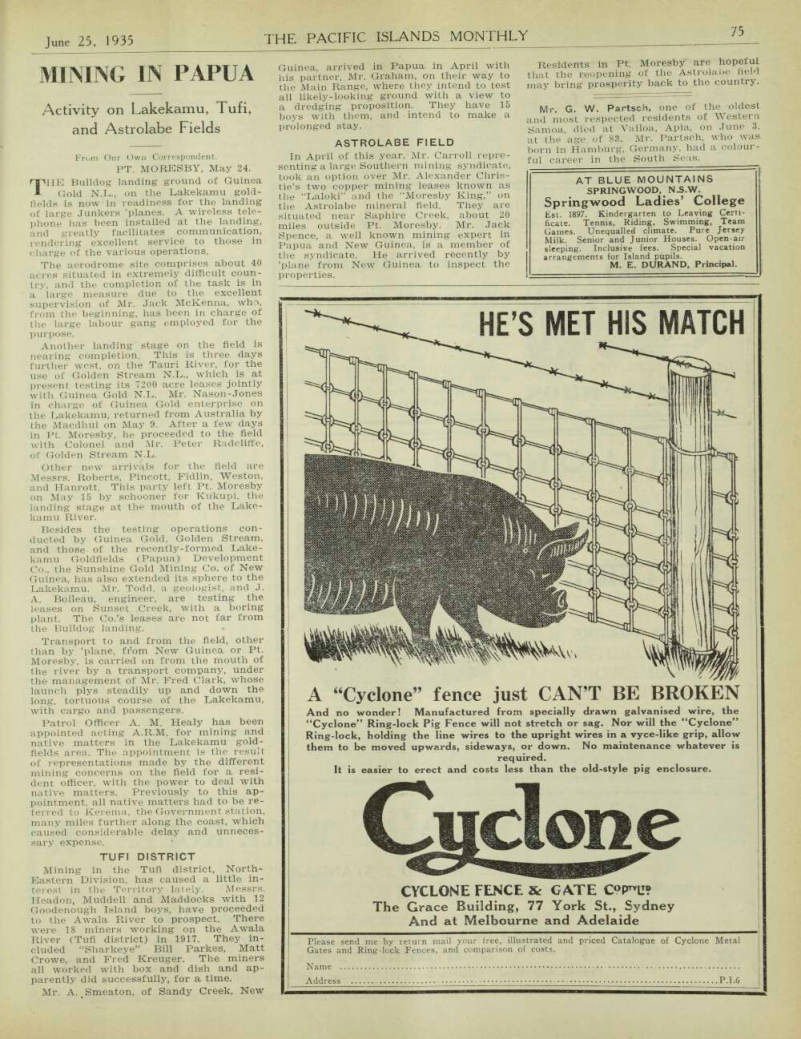
Activity on Lakekamu, Tufi, and Astrolabe Fields
From Our Own Correspondent.
Pt. Moresby, May 24.
THE Bulldog landing ground of Guinea Gold N.L., on the Lakekamu gold fields is now in readiness for the landing of large Junkers ’planes. A wireless telephone has been installed at the landing, and greatly facilitates communication, rendering excellent service to those in charge of the various operations.
The aerodrome site comprises about 40 acres situated in extremely difficult country, and the completion of the task is in a large measure due to the excellent supervision of Mr. Jack McKenna, who, from the beginning, has been in charge of the large labour gang employed for the purpose.
Another landing stage on the field is nearing completion. This is three days further west, on the Tauri River, for the use of Golden Stream N.L., which is at present testing its 7200 acre leases jointly with Guinea Gold N.L. Mr. Nason-Jones in charge of Guinea Gold enterprise on the Lakekamu, returned from Australia by the Macdhui on May 9. After a few days in Pt. Moresby, he proceeded to the field with Colonel and Mr. Peter Radcliffe, of Golden Stream N.L.
Other new arrivals for the field are Messrs. Roberts, Pincott, Fidlin, Weston, and Hanrott. This party left Pt. Moresby on May 15 by schooner for Kukupi, the landing stage at the mouth of the Lakekamu River.
Besides the testing operations conducted by Guinea Gold, Golden Stream, and those of the recently-formed Lake kamu Goldfields (Papua) Development Co., the Sunshine Gold Mining Co. of New Guinea, has also extended its sphere to the Lakekamu. Mr. Todd, a geologist, and J.
A. Boileau, engineer, are testing the leases on Sunset Creek, with a boring plant. The Co.’s leases are not far from the Bulldog landing.
Transport to and from the field, other than by ’plane, from New Guinea or Pt.
Moresby, is carried on from the mouth of the river by a transport company, under the management of Mr. Fred Clark, whose launch plys steadily up and down the long, tortuous course of the Lakekamu, with cargo and passengers.
Patrol Officer A. M. Healy has been appointed acting A.R.M. for mining and native matters in the Lakekamu gold fields area. The appointment is the result of representations made by the different mining concerns on the field for a resident officer, with the power to deal with native matters. Previously to this appointment, all native matters had to be referred to Kerema, the Government station, many miles further along the coast, which caused considerable delay and unnecessary expense.
Tufi District
Mining in the Tufi district, North- Eastern Division, has caused a little in terest in the Territory lately. Messrs.
Headon, Muddell and Maddocks with 12 Goodenough Island boys, have proceeded to the Awala River to prospect. There were 18 miners working on the Awala River (Tufi district) in 1917. They included “Sharkeye” Bill Parkes, Matt Crowe, and Fred Kreuger. The miners all worked with box and dish and apparently did successfully, for a time.
Mr. A. Smeaton, of Sandy Creek, New
Guinea, arrived in Papua in April with his partner, Mr. Graham, on their way to the Main Range, where they intend to test all likely-looking ground with a view to a dredging proposition. They have 15 boys with them, and intend to make a prolonged stay.
Astrolabe Field
In April of this year, Mr. Carroll representing a large Southern mining syndicate, took an option over Mr. Alexander Christie’s two copper mining leases known as the “Laloki” and the “Moresby King,” on the Astrolabe mineral field. They are situated near Saphire Creek, about 20 miles outside Pt. Moresby. Mr. Jack Spence, a well known mining expert in Papua and New Guinea, is a member of the syndicate. He arrived recently by ’plane from New Guinea to inspect the properties.
Residents in Pt. Moresby are hopeful that the reopening of the Astrolabe field may bring prosperity back to the country.
Mr. G. W. Partsch, one of the oldest and most respected residents of Western Samoa, died at Vailoa, Apia, on June 3, at the age of 83. Mr. Partsch, who was born in Hamburg, Germany, had a colour ful career in the South Seas.
Advertisements & other items, p. 77 (1 item)
He’S Met His Match
AT BLUE MOUNTAINS
SPRINGWOOD, N.S.W.
Springwood Ladies’ College
Est. 1897. Kindergarten to Leaving Certificate. Tennis, Riding, Swimming, Team (James. Unequalled climate. Pure Jersey Milk. Senior and Junior Houses. Open-air sleeping. Inclusive fees. Special vacation arrangements for Island pupils.
M. E. DURAND, Principal.
HE’S MET HIS MATCH
A “Cyclone” fence just CAN’T BE BROKEN And no wonder! Manufactured from specially drawn galvanised wire, the “Cyclone” Ring-lock Pig Fence will not stretch or sag. Nor will the “Cyclone”
Ring-lock, holding the line wires to the upright wires in a vyce-like grip, allow them to be moved upwards, sideways, or down. No maintenance whatever is required.
It is easier to erect and costs less than the old-style pig enclosure.
CYCLONE FENCE & GATE Co. Pty Ltd.
The Grace Building, 77 York St., Sydney And at Melbourne and Adelaide Please send me by return mail your free, illustrated and priced Catalogue of Cyclone Metal 1 Gates and Ring-lock Fences, and comparison of costs.
Name Address
Pacific Islands
Association
AT the last meeting of the Executive Committee the Chairman, Mr. R. W.
Robson, regretfully tendered his resignation from that position on account of pressure of business. Dr. C. C. Simson, who has been an enthusiastic worker on the committee from the formation of the Asso-
ciaticn, was unanimously elected chairman, while Mr. Robson accepted the position of vice-chairman.
The new chairman is well-known in Pacific Territories and has extensive interests in Papua.
Mr. A. R. Long, of Numa-Numa, New Guinea, was elected to membership. Mr.
A. le Breton Mount, who has been a member of the Association since its early days, passed away recently.
As a result of the reorganising of the Association’s facilities in Sydney, the arrangement with the Millions Club has been terminated and the Association’s office is now situated at 350 George Street, Sydney, under the control of the secretary.
A letter of congratulation has been sent to one of the Association’s members, Mr.
S. Russell, of Papeete, on his appointment as British Vice-Consul for Tahiti.
Union Co.’S New Offices
At Suva, Fiji
NEW offices of the Union Steam Ship Co. Ltd. at Suva were opened by Mr. N. S. Falla (Managing Director), on May 31, in the presence of the Acting High Commissioner for the Western Pacific (Sir M. Maxwell-Anderson), prominent Government officials, and many Suva business men.
The reinforced concrete building is of modern design and is handsomely fitted and furnished throughout, and is situated in the main portion of the town ship, in Victoria Parade—the main thoroughfare.
In opening the building, Mr. Falla traced the association of the Union Co. with the Colony. The first service from New Zealand to Fiji was in 1881, with the Southern Cross. From that small beginning the firm had made progress in keeping with the development of Fiji.
Mr. Falla said he was on his way to England in connection with the new ship being built there for the fruit trade in the Central Pacific. He was also investigating the possibilities of an air line between Fiji and Auckland.
Captain F. Williams proposed the toast of the “Manager for Fiji,” and Mr. W. E.
Hancock suitably responded, paying tribute to his loyal staff.
Better Outlook In
New Guinea
MR. J. A. CARPENTER, of Messrs. W.
R. Carpenter and Co., Ltd., who returned to Sydney on June 7, from Rabaul, said there was greater business activity in Rabaul. The prospects for the copra market were better, and there was a more optimistic outlook generally.
Mr. Carpenter paid a tribute to the general improvements being carried out in New Guinea by the Administrator (Brigadier-General W. R. McNicoll), who. he said, personally inspected every part of the territory and studied the life and problems of the settlers.
Advertisements & other items, p. 78 (1 item)
Batteries
The Vibrationless Manufactured by
VINCENT BROS.
Marine Engines
Float Chamber Carburettor, Impulse Starter, Brass Tank, and many other features that ensure Economical Running, -and a Lifetime of Service. Five Years Written Guarantee. Write for Leaflet.
F.O.B. Price: h.p. £28/10/- complete „ „ 4 h.p. £42/10/- All Installation Fittings Supplied Counter-balanced Crankshaft, Brass 44 Wentworth Park Rd., Glebe
SYDNEY, N.S.W.
LIFE
FOR LONGER
USE . . .
ERG
BATTERIES
FOR-
CARS, TRUCKS, RADIO,
HOUSELIGHTING,
MARINE WORK,
MOTORCYCLES
If not represented in your district write direct to- ERG BATTERIES LTD, 156 Goulburn St., Sydney, N.S.W.
TO ELECTRICAL ENGINEERS - MANUFACTURERS OF QUALITY BATTERIES
BULLIVANTS WIRE ROPES
“THE WORLD’S STANDARD’’
LARGEST STOCKS IN AUSTRALASIA ... FOR ALL PURPOSES Also Blocks, Hooks, Shackles, Thimbles, Strand, Seizing, Aircraft Cord, etc.
Letters: BULLIVANTS’ AllStraliail Co. Ltd. Telegrams:
331-333 KENT STREET, SYDNEY
Box 1298J, G.P.O.
ass Prompt Attention! Efficient Service!! Complete Satisfaction!!!
"Bullivants Ltd.,"
Sydney. ’’
Market Quotations
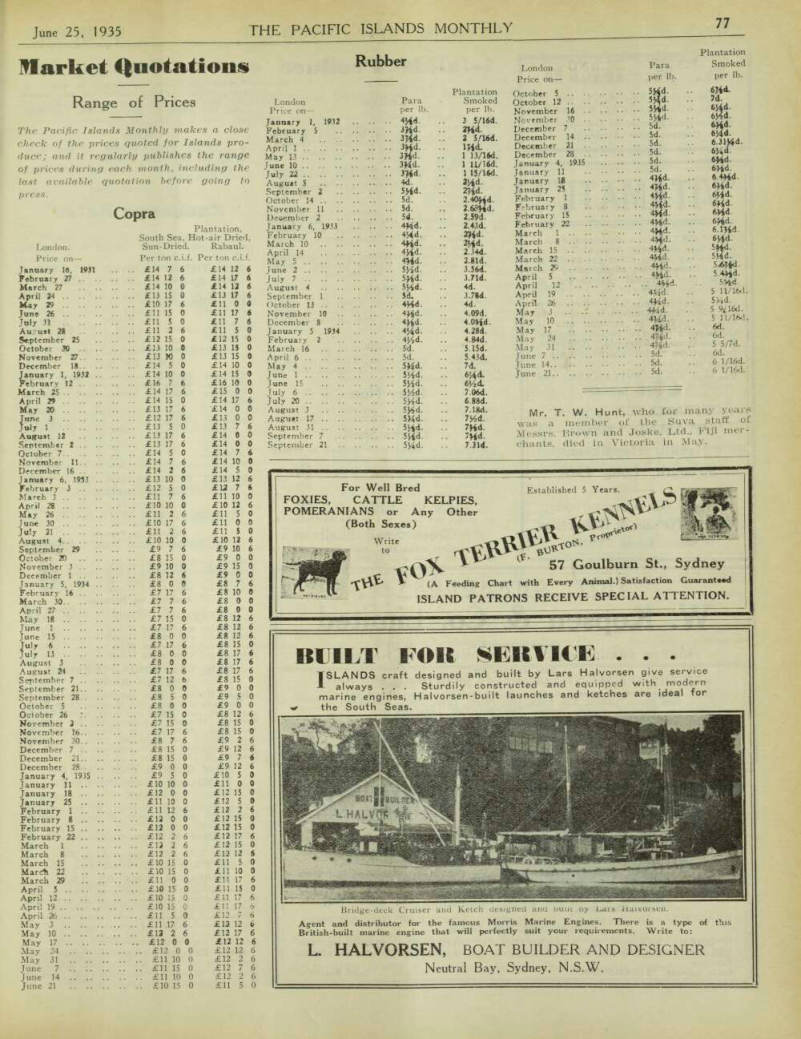
Range of Prices
The Pacific Islands Monthly makes a close check of the prices quoted for Islands produce; and it regularly publishes the range of prices during each month, including the last available quotation before going to press.
Mr. T. W. Hunt, who for many years was a member of the Suva staff of Messrs. Brown and Joske. Ltd.. Fiji merchants, died in Victoria in May.
London Price on— Para per lb. .. .. 5tfd.
Plantation Smoked per lb. 6J*d. .. .. 5Md. 7d. .. 5&1.
November 30 .. .. 5d. 6*4d. 88: .. .. Sd. .. .. Sd. 6 3lWd .. .. 5d. 6Vid January 4, 1935 January 11 .. .. 5d. .. .. 5d. 6Hd. 6Hd.
January 18 January 25 February 1 .. .. 4Hd. 6Mid. 6Hd. 6f*d. 6Hd.
February 15 February 22 March 1 March 8 March 15 March 22 March 29 April 5 April 12 April 19 April 26 May 3 May 10 May 17 May 24 May 31 June 7 .. .. SJd. .. .. 4^d. .. .. 4^d. .. .. 4^d. .. .. 5d. 6H* 6*d. 6.md. 6Vid. 5*&- 5Md- 5<6Hd- 5.4Hd. 5Hd- 5 ll/16d.
Skid. 5 9^16d. 5 1l/16d, 6d. 6d.
S S/7d. 6d.
June 14 June 21 .. .. 5d. .. .. 5d. 6 l/16d. 6 l/16d.
London Price on —
Rubber
Para per lb.
Plantation Smoked per lb.
January 1, 1912 W- 3 S/16d.
February 5 w. 2Wd.
March 4 W- 2 S/16d.
April 1 9N& md.
May 13 1 13/16d.
June 10 1 11/1W.
July 2 2 1 15/I6d.
August 5 4d. d- September 2 5*d. 2Hd.
October 14 Sd.
iSHi
November 11 December 2 5d. 2.59d.
January 6, 1933 4Md. 2.43d.
February 10 4*d. 2Md.
March 10 4Hd.
Md.
April 14 4Vid. 2.34d.
May 5 . 4Hd. 2.81d.
June 2 5tfd. 3.56d.
July 7 SHd. 3.71d.
August 4 5*d. 4d.
September 1 3d. 3.7Bd.
October 13 4Hd. 4d.
November 10 4Hd. 4.09d.
December 8 4fid. 4.0Hd.
January 5 1934 4«4d. 4.28d.
February 2 4/ a d. 4.84d.
March 16 5d. 5.1Sd.
April 6 5d. 5.43d.
May 4 SHd. 7<L June 1 5Hd. 6'A<L June 15 5^d. ty t ± July 6 S'/id- 7 06d.
July 20 SHd. 6,88d.
August 3 5Hd. 7.18d.
August 17 5>4d. 7^d.
August 31 S*d. 7Hd.
September 7 5tfd. 7Hd.
September 21 5tfd. 7.3 Id.
Copra
Plantation, Hot-air Dried, Rabaul. Per ton c.i.f.
South Sea. Sun-Dried. Per ton c.i.f.
London. Price on — January 10, 1931 .. .. £14 7 6 £14 12 6 February 27 . .. .. £14 12 6 £14 17 6 March 27 .. .. .. .. £14 10 0 £14 12 6 April 24 .. .. £13 15 0 £13 17 6 May 29 .. .. £10 17 6 £11 0 0 June 26 .. .. £11 15 0 £11 17 6 July 31 .. .. £11 5 0 £11 7 6 Aurust 22 .. .. £11 2 6 £11 5 0 September 25 .. .. £12 IS 0 £12 15 0 October 30 .. .. £13 10 0 £13 15 0 November 27 .. .. £13 K) 0 £13 IS 0 December 18 .. .. £14 5 0 £14 10 0 January 1, 1932 .. .. £14 10 0 £14 IS 0 February 12 .. . £16 7 6 £16 10 0 March 25 .. .. £14 17 6 £15 0 0 April 29 .. .. £14 15 0 £14 17 6 May 20 .. .. £13 17 6 £14 0 0 June 3 .. .. £12 17 6 £13 0 0 July 1 .. .. £13 5 0 £13 7 6 August 12 .. .. £13 17 6 £14 0 0 .September 2 .. .. £13 17 6 £14 0 0 October 7 .. .. £14 5 0 £14 7 6 November 11 .. .. £14 7 6 £14 10 0 December 16 .. .. £14 2 6 £14 5 0 January 6, 1933 .. .. £13 10 0 £13 12 6 February 3 .. .. £12 5 0 £12 7 6 March 3 .. .. £11 7 6 £11 10 0 April 28 .. .. £10 10 0 £10 12 6 May 26 .. .. £11 2 6 £11 5 0 June 30 .. .. £10 17 6 £11 0 0 July 31 .. .. £11 2 6 £11 5 0 August 4 .. .. £10 10 0 £10 12 6 September 29 ... £9 7 6 £9 10 6 October 20 ... £8 15 0 £9 0 0 November 3 ... £9 10 0 £9 IS 0 December 1 .. .. £8 12 6 £9 0 0 January 5, 1934 .. .. £8 0 0 £8 7 6 February 16 ... £7 17 6 £8 10 0 March 30 ... £7 7 6 £8 0 0 April 27 .. .. £7 7 6 £8 0 0 May 18 ... £7 15 0 £8 12 6 June 1 ... £7 17 6 £8 12 6 June 15 ... £8 0 0 £8 12 6
July 6
... £7 17 6 £8 IS 0 July 13 ... £8 0 0 £8 17 6 August 3 .. .. £8 0 0 £8 17 6 August 24 .. .. £7 17 6 £8 17 6 September 7 ... £7 12 6 £8 15 0 September 21 . . £800 £9 0 0 September 28 ... £8 5 0 £9 5 0 October 5 .. .. £8 0 0 £9 0 0 October 26 .. .. £7 15 0 £8 12 6 November 2 .. ,. £7 15 0 £8 15 0 November 16 ... £7 17 6 £8 IS 0 November 30 ... £8 7 6 £9 2 6 December 7 ... £8 IS 0 £9 12 6 December 21 .. .. £8 IS 0 £9 7 6 December 28 .. .. £9 0 0 £9 12 6 January 4, 1935 ... £9 5 0 £10 5 0 January 11 .. , . £10 10 0 £11 0 0 January 18 .. .. £12 0 0 £12 15 0 January 25 .. .. £11 10 0 £12 5 0 February 1 .. .. £11 12 6 £12 2 6 February 8 .. .. £13 0 0 £12 15 0 February 15 .. .. £12 0 0 £12 15 0 February 22 .. .. £12 2 6 £12 17 6 March 1 .. .. £13 2 6 £12 15 0 March 8 .. .. £12 2 6 £12 12 6 March 15 .. .. £10 15 0 £11 5 0 March 22 .. .. £10 15 0 £11 10 0 March 29 .. .. £11 0 0 £11 17 6 April 5 £10 15 0 £11 15 0 April 12 .. .. £10 15 0 £11 17 6 April 19 ... £10 15 0 £11 17 6 April 26 .. .. £11 5 0 £12 7 6 May 3 .. .. £11 17 6 £12 12 6 May 10 .. .. £12 2 6 £12 17 6 May 17 £12 0 0 £12 12 6 May 24 £12 0 0 £12 12 6 May 31 £11 10 0 £12 2 6 June 7 £11 15 0 £12 7 6 June 14 £11 10 0 £12 2 6 June 21 £10 15 0 £11 5 0
Advertisements & other items, pp. 79-80 (1 item)
Built Fob Service
For Well Bred
CATTLE KELPIES,
FOXIES,
POMERANIANS or Any
(Both Sexes) Write to Established 5 Years. 57 Goulburn St., Sydney (A Feeding Chart with Every Animal.) Satisfaction Guaranteed
ISLAND PATRONS RECEIVE SPEC lAL ATTENTION.
BUILT FOB SERVICE
ISLANDS craft designed and built by Lars Halvorsen give service always . . . Sturdily constructed and equipped with modern marine engines, Halvorsen-built launches and ketches are ideal for the South Seas.
Bridge-deck Cruiser and Ketch designed ana Dunt Dy Kars tiaivorsen.
Agent and distributor for the famous Morris Marine Engines. There is a type of this British-built marine engine that will perfectly suit your requirements. Write to:
L. HALVORSEN, BOAT BUILDER AND DESIGNER
Neutral Bay, Sydney, N.S.W.
W. H. REID
C/o Robert Reid & Co., Ltd.
32-34 YORK STREET, SYDNEY
Wholesale Exporter of Goods of all Classes from Australia
"VITAMATE”!
“VITAMATE” is a delicious South American Beverage, free of Tannin, and owing to its chemical contents (Iron, Copper, and Manganese) ensures the physical well-being of those who partake of it.
Because of its beneficial influence on the Liver and Kidneys it maintains the body free of poisons and is therefore a powerful remedy against Rheumatism, Anaemia, Diabetes, Indigestion, Insomnia and other allied disorders.
See that you get “VITAMATE” and no other brand.
“VITAMATE” is pure.
“VITAMATE” means—
Health, Happiness,
Strength, Long Life.
AUSTRALIAN DISTRIBUTORS:
Messrs. Nelson & Robertson
12 Spring Street, SYDNEY
SHIP CHANDLERY
W. Kopsen & Co. Limited
Manufacturers of PIONEER BRAND ASH OARS AND IMPLEMENT HANDLES.
Sole Agents for: KOPSEN’S SPECIAL YELLOW METAL SHEATHING AND NAILS.
Large -Stocks of Chains, Anchors, Manilla and Wire Ropes, Wood and Iron Blocks, Oakum, Tar, Pitch, Oils, Paints, Leads, Zincs, Varnishes, Shackles, Rigging, Screws, Sheathing, Felt, Lampware, etc.
Special Under Bond Prites for Island trade.
68-70 CLARENCE STREET, SYDNEY
Cables: “Kopsen." :-: ’Phone: BW 1114-5
STEAMSHIPS TRADING COMPANY LIMITED
Port Moresby PAPUA Samarai
Chairman and Managing Director: A. S. FITCH.
Shipowners, Wholesale and Retail Merchants and Traders; Shipping, Customs and Insurance Agents; Copra and Rubber Plantation Owners.
Mail Contractors to Commonwealth and Papuan Governments.
AGENCIES:—At Port Moresby: Coral Sea Insurance Co.; Phoenix Insurance Co.; Delta Sawmills, Ltd.; Acme Bakery Co.; Vacuum Oil Co. Pty., Ltd. At Samarai; Coral Sea Insurance Co.; Delta Sawmills, Ltd.; Bankers and Traders Insurance Co.; National Mutual Life Insurance Co.; Kularo Shipyards; Mamai Plantations.
BRANCHES. —In Papua: Hanuabada, Sivitoi, Aroma, Koki, Hula, Ela Beach, Duga Duga, Yule Island.
SYDNEY: NELSON & ROBERTSON, 12 Spring St.; Melbourne, 396 Flinders Lane; London, E. Whiteaway & Co.. 7 Chiswell Street, Finsbury, London.
Cable Address: “STEAMSHIPS.” Code: Bentley’s.
Islands Produce
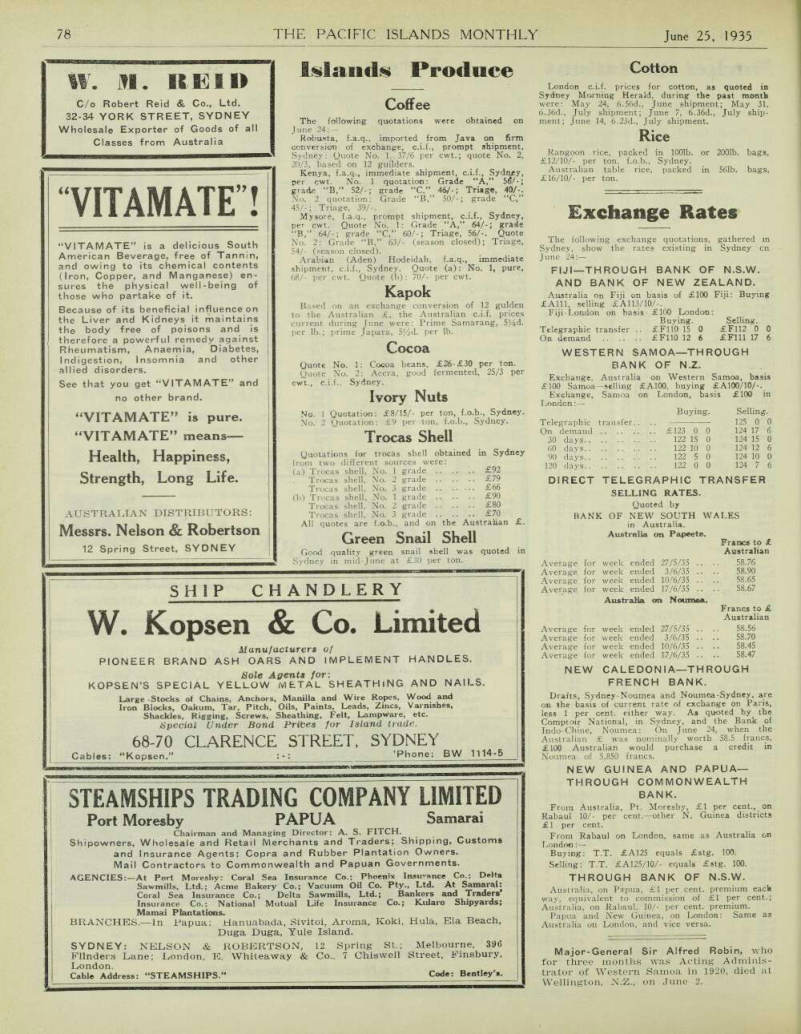
Coffee
The following quotations were obtained on June 24: — Robusta, f.a.q., imported from Java on firm conversion of exchange, c.i.f., prompt shipment, Sydney; Quote No. 1. 37/6 per cwt.; quote No. 2, 20/3, based on 12 guilders.
Kenya, f.a.q., immediate shipment, c.i.f., Sydiyey, per cwt. No. 1 quotation: Grade “A,” 56/-; grade “B,’* 52/-; grade “C,” 46/-; Triage, 40/-.
No. 2 quotation; Grade “B,” 50/-; grade “C,” 45/-; Triage, 39/-.
Mysore, f.a.q., prompt shipment, c.i.f., Sydney, per cwt. Quote No. 1: Grade “A,” 64/-; grade “B,” 64/-; grade “C,” 60/-; Triage, 56/-. Quote No. 2: Grade “B,” 63/- (season closed); Triage, 54/- (season closed).
Arabian (Aden) Hodeidah, f.a.q., immediate shipment, c.i.f., Sydney. Quote (a): No. 1, pure, 68/- per cwt. Quote (b): 70/- per cwt.
Kapok
Based on an exchange conversion of 12 gulden to the Australian £, the Australian c.i.f. prices current during June were; Prime Samarang, S)4d. per lb.; prime japara, 5½d. per lb.
Cocoa
Quote No. 1: Cocoa beans, £26-£30 per ton.
Quote No. 2: Accra, good fermented, 25/3 per cwt., c.i.f., Sydney.
Ivory Nuts
No. 1 Quotation: £8/15/- per ton, f.o.b., Sydney.
No. 2 Quotation: £9 per ton, f.o.b., Sydney.
Trocas Shell
Quotations for trocas shell obtained in Sydney from two different sources were: (a) Trocas shell, No. 1 grade £92 Trocas shell, No. 2 grade £79 Trocas shell, No. 3 grade £66 (b) Trocas shell, No. 1 grade .. .. .. £90 Trocas shell, No. 2 grade £80 Trocas shell, No. 3 grade £70 All quotes are f.o.b., and on the Australian £.
Green Snail Shell
Good quality green snail shell was quoted in Sydney in mid-June at £30 per ton.
Cotton
London c.i.f. prices for cotton, as quoted in Sydney Morning Herald, during the past month were: May 24, 6.56 d., June shipment; May 31, 6.36 d., July shipment; June 7, 6.36 d., July shipment; June 14, 6.23 d., July shipment.
Rice
Rangoon rice, packed in 100lb. or 200lb. bags, £12/10/- per ton, f.o.b., Sydney.
Australian table rice, packed in 56lb. bags, £16/10/- per ton.
Exchange Rates
The following exchange quotations, gathered in Sydney, show the rates existing in Sydney cn June 24:
Fiji—Through Bank Of N.S.W.
And Bank Of New Zealand.
Australia on Fiji on basis of £100 Fiji: Buying £A111, selling £A113/10/-.
Fiji-London on basis £100 London:
Western Samoa—Through
Bank Of N.Z.
Exchange, Australia on Western Samoa, basis £100 Samoa—selling £A100, buying £A100/10/-.
Exchange, Samoa on London, basis £100 in London: —
Direct Telegraphic Transfer
Selling Rates.
Quoted by
Bank Of New South Wales
in Australia.
New Caledonia—Through
French Bank.
Drafts, Sydney-Noumea and Noumea-Sydney, are on the basis of current rate of exchange on Paris, less 1 per cent, either way. As quoted by the Comptoir National, in Sydney, and the Bank of Indo-Chine, Noumea: On June 24, when the Australian £ was nominally worth 58.5 francs, £100 Australian would purchase a credit in Noumea of 5,850 francs.
New Guinea And Papua
Through Commonwealth
Bank.
From Australia, Pt. Moresby, £1 per cent., on Rabaul 10/- per cent.—other N. Guinea districts £1 per cent.
From Rabaul on London, same as Australia on London: — Buying: T.T. £A125 equals £stg. 100.
Selling: T.T. £A125/10/- equals £stg. 100.
Through Bank Of N.S.W.
Australia, on Papua, £1 per cent, premium each way, equivalent to commission of £1 per cent.; Australia, on Rabaul, 10/- per cent, premium.
Papua and New Guinea, on London: Same as Australia on London, and vice versa.
Major-General Sir Alfred Robin, who for three months was Acting Administrator of Western Samoa in 1920, died at Wellington, N.Z., on June 2.
Buying.
Selling.
Telegraphic transfer £F110 15 0 £F112 0 0 On demand £F110 12 6 £F111 17 6
Buying. Selling.
Telegraphic transfer.. .. 125 0 0 On demand £123 0 0 124 17 6 30 days 122 15 0 124 15 0 60 days 122 10 0 124 12 6 90 days 122 5 0 124 10 0 120 days 122 0 0 124 7 6
Average for week ended 27/5/35 .. 58.76 Australia on Papeete.
Francs to £ Australian Average for week ended 3/6/35 .. 58.90 Average for week ended 10/6/35 .. 58.65 Average for week ended 17/6/35 .. 58.67 Average for week ended 27/5/35 .. 58.56 Australia on Noumea.
Francs to £ Australian Average for week ended 3/6/35 .. 58.70 Average for week ended 10/6/35 .. 58.45 Average for week ended 17/6/35 .. 58.47
Shipping: Services in the Pacific
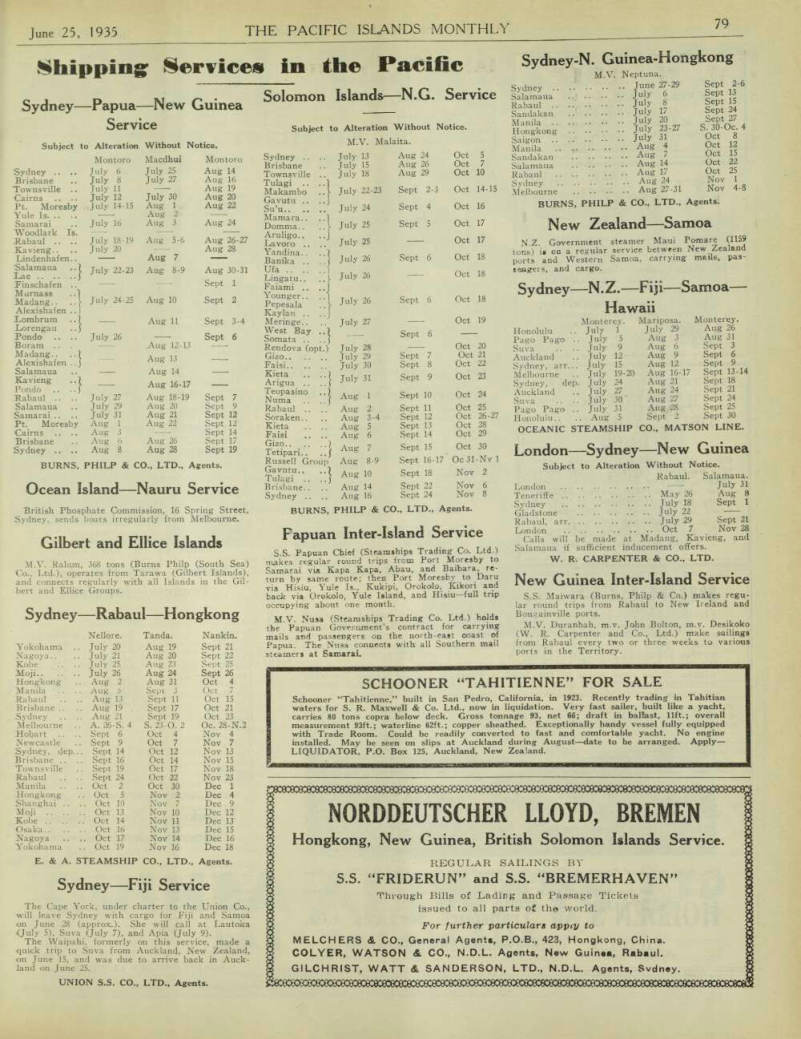
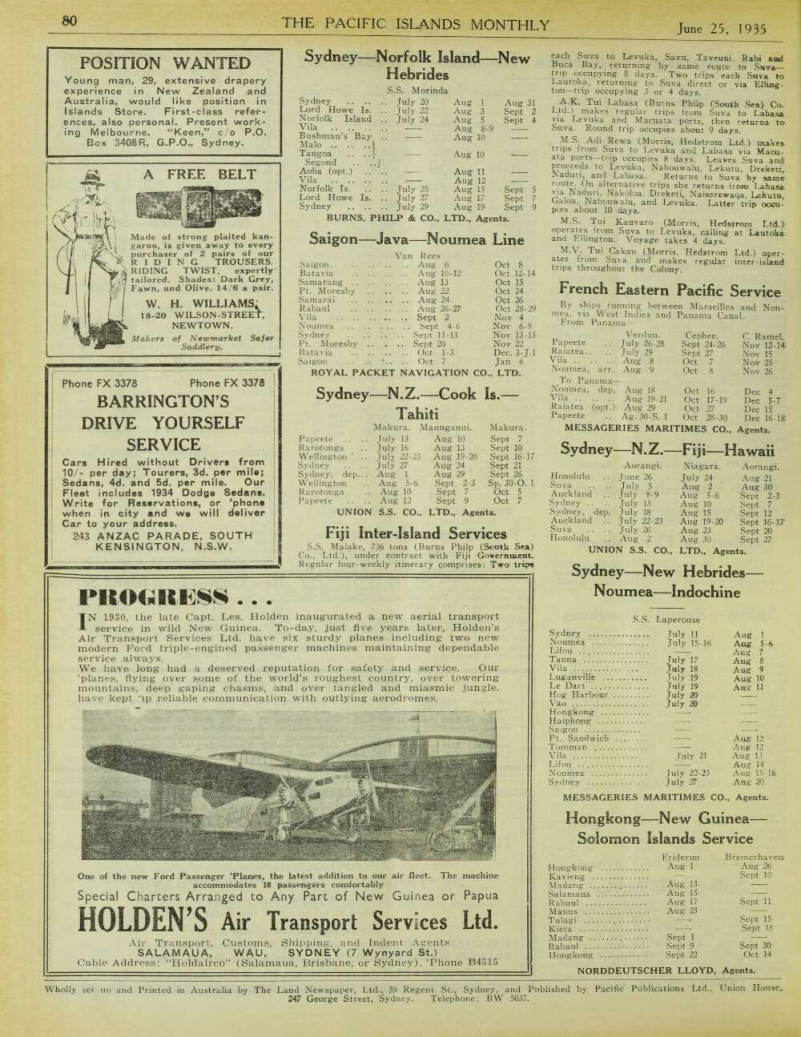
Sydney—Papua—New Guinea Service
Ocean Island—Nauru Service
British Phosphate Commission, 16 Spring Street, Sydney, sends boats irregularly from Melbourne.
Gilbert and Ellice Islands
M.V. Ralum, 368 tons (Burns Philp (South Sea) Co., Ltd.), operates from Tarawa (Gilbert Islands), and connects regularly with all Islands in the Gil bert and Ellice Groups.
Sydney—Rabaul—Hongkong
Sydney—Fiji Service
The Cape York, under charter to the Union Co., will leave Sydney with cargo for Fiji and Samoa on June 28 (approx.). She will call at Lautoka (July 5), Suva (July 7), and Apia (July 9).
The Waipahi, formerly on this service, made a quick trip to Suva from Auckland, New Zealand, on June 15, and was due to arrive back in Auckland on June 25.
Union S.S. Co., Ltd., Agents.
Solomon Islands —N.G. Service
Papuan Inter-Island Service
S.S. Papuan Chief (Steamships Trading Co. Ltd.) makes regular round trips from Port Moresby to Saraarai via Kapa Kapa, Abau, and Baibara, return by same route; then Port Moresby to Daru via Hisiu, Yule Is., Kukipi, Orokolo, Kikori and back via Orokolo, Yule Island, and Hisiu —full trip occupying about one month.
M.V. Nusa (Steamships Trading Co. Ltd.) holds the Papuan Government’s contract for carrying mails and passengers on the north-east coast of Papua. The Nusa connects with all Southern mail steamers at Samarai.
Sydney-N. Guinea-Hongkong
New Zealand —Samoa
N.Z. Government steamer Maui Pomare (1159 tons) is on a regular service between New Zealand ports and Western Samoa, carrying mails, passengers, and cargo.
Sydney—N.Z. —Fiji—Samoa —
Hawaii
London—Sydney—New Guinea
New Guinea Inter-Island Service
S.S. Maiwara (Burns, Philp & Co.) makes regular round trips from Rabaul to New Ireland and Bougainville ports.
M.V. Duranbah, m.v. John Bolton, m.v. Desikoko (W. R. Carpenter and Co., Ltd.) make sailings from Rabaul every two or three weeks to various ports in the Territory.
Subject to Alteration Without Notice.
Montoro Macdhui Montoro Sydney July 6 July 25 Aug 14 Brisbane July 8 July 27 Aug 16 Townsville July 11 Aug 19 Cairns July 12 July 30 Aug 20 Pt. Moresby July 14-15 Aug 1 Aug 22 Yule Is Aug 2 Samarai July 16 Aug 3 Aug 24 Woodlark Is.
Rabaul July 18-19 Aug 5-6 Aug 26-27 Kavieng July 20 Aug 28 Lindenhafen Aug 7 Salamaua Lae July 22-23 Aug 8-9 Aug 30-31 Finschafen Sept 1 Murnass Madang July 24-25 Aug 10 Sept 2 Alexishafen Lombrum Aug 11 Sept 3-4 Lorengau Pondo July 26 Sept 6 Boram Aug 12-13 Madang Alexishafen Aug 13 Salamaua Aug 14 Kavieng Pondo Aug 16-17 Rabaul July 27 Aug 18-19 Sept 7 Salamaua July 29 Aug 20 Sept 9 Samarai July 31 Aug 21 Sept 12 Pt. Moresby Aug 1 Aug 22 Sept 12 Cairns Aug 3 Sept 14 Brisbane Aug 6 Aug 26 Sept 17 Sydney Aug 8 Aug 28 Sept 19
Burns, Philp & Co., Ltd., Agents.
Subject to Alteration Without Notice.
M.V. Malaita.
Sydney July 13 Aug 24 Oct 5 Brisbane July 15 Aug 26 Oct 7 Townsville July 18 Aug 29 Oct 10 Tulagi Makambo July 22-23 Sept 2-3 Oct 14-15 Gavutu Oct 16 Su’u July 24 Sept 4 Mamara Sept 5 Oct 17 Domma July 25 Aruligo Lavoro July 25 Oct 17 Yandina Banika July 26 Sept 6 Oct 18 Ufa Lingatu July 26 Oct 18 Faiami Younger Pepesala July 26 Sept 6 Oct 18 Kaylan Oct 19 Meringe July 27 West Bay Somata Sept 6 Rendova (opt.) July 28 Oct 20 Gizo July 29 Sept 7 Oct 21 Faisi July 30 July 31 Sept 8 Oct 22 Kieta Arigua Sept 9 Oct 23 Teopasino Numa Aug 1 Sept 10 Oct 24 Rabaul Aug 2 Sept 11 Oct 25 Soraken Aug 3-4 Sept 12 Oct 26-27 Kieta Aug 5 Sept 13 Oct 28 Faisi Aug 6 Sept 14 Oct 29 Gizo Tetipari Aug 7 Sept 15 Oct 30 Russell Group Aug 8-9 Sept 16-17 Oc 31 -Nv 1 Gavutu Tulagi Aug 10 Sept 18 Nov 2 Brisbane Aug 14 Sept 22 Nov 6 Sydney Aug 16 Sept 24 Nov 8
Burns, Philp & Co., Ltd., Agents.
M.V. Neptuna.
Sept 2-6 Salamaua July 6 Sept 13 Sept 15 Sandakan Manila Hongkong Saigon Manila July 17 July 23-27 July 31 Aug 4 Sept 24 Sept 27 S. 30-Oc. 4 Oct 8 Oct 12 Sandakan Salamaua Rabaul Sydney Aug 7 Aug 17 Aug 24 Oct 15 Oct 22 Oct 25 Nov 1 Melbourne Aug 27-31 Nov 4-8
Burns, Philp & Co., Ltd., Agents.
Monterey Mariposa Monterey Honolulu July 1 July 29 Aug 26 Pago Pago July 5 Aug 3 Aug 31 Suva July 9 Aug 6 Sept 3 Auckland July 12 Aug 9 Sept 6 Sydney, arr.
July 15 Aug 12 Sept 9 Melbourne July 19-20 Aug 16-17 Sept 13-14 Sydney, dep July 24 Aug 21 Sept 18 Auckland July 27 Aug 24 Sept 21 Suva July 30 Aug 27 Sept 24 Pago Pago July 31 Aug 28 Sept 25 Honolulu Aug 5 Sept 2 Sept 30
Oceanic Steamship Co., Matson Line.
Subject to Alteration Without Notice.
Rabaul. Salamaua.
London July 31 Teneriffe May 26 Aug 8 Sydney July 18 Sept 1 Gladstone July 22 Rabaul, arr July 29 Sept 21 London Oct 7 Nov 28 Calls will be made at Madang, Kavieng, and Salamaua if sufficient inducement offers.
W. R. Carpenter & Co., Ltd.
Nellore.
Tanda.
Nankin.
Yokohama July 20 Aug 19 Sept 21 Nagoya July 21 Aug 20 Sept 22 Kobe July 25 Aug 23 Sept 25 Moji July 26 Aug 24 Sept 26 Hongkong Aug 2 Aug 31 Oct 4 Manila Aug 5 Sepi 3 Oct 7 Rabaul Aug 13 Sept 11 Oct 15 Brisbane Aug 19 Sept 17 Oct 21 Sydney Aug 21 Sept 19 Oct 23 Melbourne A. 26-S. 4 S. 23-0. 2 Oc. 28-N.2 Hohart Sept 6 Oct 4 Nov 4 Newcastle Sept 9 Oct 7 Nov 7 Sydney, dep.
Sept 14 Oct 12 Nov 13 Brisbane Sept 16 Oct 14 Nov 15 Townsville Sept 19 Oct 17 Nov 18 Rabaul Sept 24 Oct 22 Nov 23 Manila Oct 2 Oct 30 Dec 1 Hongkong Oct 5 Nov 2 Dec 4 Shanghai Oct 10 Nov 7 Dec 9 Moji Oct 13 Nov 10 Dec 12 Kobe Oct 14 Nov 11 Dec 13 Osaka Oct 16 Nov 13 Dec 15 Nagoya Oct 17 Nov 14 Dec 16 Yokohama Oct 19 Nov 16 Dec 18 E. & A. STEAMSHIP CO., LTD., Agents.
Sydney—Norfolk Island—New Hebrides
Saigon—Java—Noumea Line
Sydney—N.Z.—Cook Is.— Tahiti
Fiji Inter-!sland Services
S.S. Malake, 736 tons (Burns Philp (South Sea.) Co.. Ltd.), under contract with Fiji Goyernment.
Regular four-weekly itinerary comprises: Two trips
each Suva to Levuka, Savu, Taveuni, Rabt and Buca Bay, returning by same route to Suva— trip occupying 8 days. Two trips each Suva to Lautoka, returning to Suva direct or via Ellington—trip occupying 3 or 4 days.
A.K. Tui Labasa (Burns Philp (South Sea) Cos.
Ltd.) makes regular trips from Suva to Labasa via Levuka and Macuata ports, then returns to Suva. Round trip occupies about 9 days.
M.S. Adi Rewa (Morris, Hedstrom Ltd.) makes trips from Suva to Levuka and Labasa via Macuata ports trip occupies 8 days. Leaves Suva and proceeds to Levuka, Nabouwalu, Lekutu, Dreketi, Nadun, and Labasa. Returns to Suva by same route On alternative trips she returns from Labasa via Nadun, Nakoloa. Dreketi, Naiserewaqa, Lekutu, Galoa, Nabouwalu, and Levuka. Latter trip occupies about 10 days.
M.S. Tui Kauvaro (Morris, Hedstrom Ltd.) operates from Suva to Levuka, calling at Lautoka ana Ellington. Voyage takes 4 days.
M.V. Tui Cakau (Morris, Hedstrom Ltd.) operates from Suva and makes regular inter-island trips throughout the Colony.
French Eastern Pacific Service
By ships running between Marseilles and Noumea, via West Indies and Panama Canal.
From Panama—
Sydney—N.Z.—Fiji—Hawaii
Sydney—New Hebrides— Noumea—Indochine
Hongkong—New Guinea — Solomon Islands Service
S.S. Morinda Sydney Aug 1 Aug 31 Lord Howe Is.
July 22 Aug 3 Sept 2 Norfolk Island Vila July 24 Aug 5 Aug 8-9 Aug 10 Sept 4 Bushman’s Bay Malo Tangoa Segond Aug 10 Aoba (opt.) Vila Aug 11 Aug 12 Aug 15 Norfolk Is.
July 25 Sept 5 Lord Howe Is.
July 27 Aug 17 Sept 7 Sydney July 29 Aug 19 Sept 9
Burns, Philp & Co., Ltd., Agents.
Saigon Van Rees Aug 6 Oct 8 Batavia Oct 12-14 Samarang Oct 15 Pt. Moresby Oct 24 Samarai Oct 26 Rabaul Aug 26-27 Oct 28-29 Vila Nov 4 Noumea Nov 6-8 Sydney Sept 11-13 Nov 13-15 Pt. Moresby Sept 20 Nov 22 Batavia Oct 1-3 Dec. 3-J.l Saigon Oct 7 Jan 6
Royal Packet Navigation Co., Ltd.
Makura. Maunganui.
Makura.
Papeete July 13 Aug 10 Sept 7 Rarotonga July 16 Aug 13 Sept 10 Wellington July 22-23 Aug 19-20 Sept 16-17 Sydney July 27 Aug 24 Sept 21 Sydney, dep.
Aug 1 Aug 29 Sept 26 Wellington Aug 5-6 Sept 2-3 Sp. 30-O. 1 Rarotonga Aug 10 Sept 7 Oct 5 Papeete Aug 12 Sept 9 Oct 7
Union S.S. Co., Ltd., Agents.
Verdun. Cephee. C. Ramel.
Papeete .. July 26-28 Sept 24-26 Nov 12-14 Raiatea.. .. July 29 Sept 27 Nov 15 Vila Aug 8 Oct 7 Nov 25 Noumea, arr. Aug 9 Oct 8 Nov 26 To Panama— Noumea, dep. Aug 18 Oct 16 Dec 4 Vila Aug 19-21 Oct 17-19 Dec 5-7 Raiatea (opt.) Aug 29 Oct 27 Dec 15 Papeete .. Ag. 30-S. 1 Oct 28-30 Dec 16-18:
Messageries Maritimes Co., Agents.
Aorangi.
Niagara.
Aorangi.
Honolulu June 26 July 24 Aug 21 Suva July 5 Aug 2 Aug 30 Auckland July 8-9 Aug 5-6 Sept 2-3 Sydney July 13 Aug 10 Sept 7 Sydney, dep.
July 18 Aug 15 Sept 12 Auckland July 22-23 Aug 19-20 Sept 16-17 Suva July 26 Aug 23 Sept 20 Honolulu Aug 2 Aug 30 Sept 27
Union S.S. Co., Ltd., Agents.
S.S. Laperouse Sydney July 11 Aug 1 Noumea July 15-16 Aag 5-6- Lifou Aug 7 Tanna July 17 Aug 8 Vila July 18 Aug 9 Luganville July 19 Aug 10 Le Dart July 19 Aug 11 Hog Harbour July 20 Vao Hongkong Haiphong Saigon Pt. Sandwich Aug 12 Tomman Aug 12 Vila July 21 Aug 13 Lifou Aug 14 Noumea July 22-23 Aug 15-16 Sydney July 27 Ang 20
Messageries Maritimes Co., Agents.
Friderun Bremerhavem Hongkong Aug 1 Aug 26 Kavieng Sept 10 Madang Salamaua Rabaul Sept 11 Manus Aug 23 Sept 15 Kieta Sept 18 Madang Rabaul Sept 30 Hongkong Sept 22 Oct 14
Norddeutscher Lloyd, Agents.
Advertisements & other items, pp. 81-84 (2 items)
Norddeutscher Lloyd, Bremen
SCHOONER “TAHITIENNE” FOR SALE
Schooner “Tahitienne,” built in San Pedro, California, in 1923. Recently trading in Tahitian waters for S. R. Maxwell & Co. Ltd., now in liquidation. Very fast sailer, built like a yacht, carries 80 tons copra below deck. Gross tonnage 93, net 66; draft in ballast, lift.; overall measurement 93ft.; waterline 62ft.; copper sheathed. Exceptionally handy vessel fully equipped with Trade Room. Could be readily converted to fast and comfortable yacht. No engine installed. May be seen on slips at Auckland during August—date to be arranged. Apply— LIQUIDATOR, P.O. Box 125, Auckland, New Zealand.
Hongkong, New Guinea, British Solomon islands Service.
REGULAR SAILINGS BY
S.S. “FRIDERUN” and S.S. “BREMERHAVEN”
Through Bills of Lading and Passage Tickets issued to all parts of the world.
For further particulars appty to MELCHERS & CO., General Agents, P.O.B., 423, Hongkong, China.
COLYER, WATSON & CO., N.D.L. Agents, New Guinea, Rabaul.
GILCHRIST, WATT & SANDERSON, LTD., N.D.L. Agents, Svdney.
POSITION WANTED
Young man, 29, extensive drapery experience in New Zealand and Australia, would like position in Islands Store. First-class references, also personal. Present working Melbourne. “Keen,” c/o P.O.
Box 3408R, G.P.O., Sydney.
A FREE BELT
Made of strong plaited kangaroo, is given away to every purchaser of 2 pairs of our
RIDING TROUSERS.
RIDING TWIST, expertly tailored. Shades; Dark Grey, Fawn, and Olive. 14/6 a pair.
W. H. WILLIAMS;
18-20 WILSON-STREET,
NEWTOWN.
Makers of Newmarket Safer Saddlery.
Phone FX 3378 Phone FX 3378
BARRINGTON’S
DRIVE YOURSELF
SERVICE
Cars Hired without Drivers from 10/- per day; Tourers, 3d. per mile; Sedans, 4d. and sd. per mile. Our Fleet includes 1934 Dodge Sedans.
Write for Reservations, or 'phone when in city and we will deliver Car to your address.
243 ANZAC PARADE, SOUTH
KENSINGTON, N.S.W.
PROGRESS .. .
IN 1930, the late Capt. Les. Holden inaugurated a new aerial transport service in wild New Guinea. To-day, just five years later, Holden’s Air Transport Services Ltd. have six sturdy planes including two new modern Ford triple-engined passenger machines maintaining dependable service always.
We have long had a deserved reputation for safety and service. Our ’planes, flying over some of the world’s roughest country, over towering mountains, deep gaping chasms, and over tangled and miasmic jungle, have kept up reliable communication with outlying aerodromes.
One of the new Ford Passenger ’Planes, the latest addition to our air fleet. The machine accommodates 10 passengers comfortably Special Charters Arranged to Any Part of New Guinea or Papua
HOLDEN’S Air Transport Services Ltd.
Air Transport, Customs, Shipping, and Indent Agents
SALAMAUA, WAU, SYDNEY (7 Wynyard St.)
Cable Address: “Holdairco” (Salamaua, Brisbane, or Sydney). ’Phone 84515
AERIAL TRANSPORT
PIONEERED AND CARRIES ON
THE NEW GUINEA GOLD INDUSTRY
Centre —One of the Bulolo Dredges under construction in Central New Guinea—three aeroplanes operated by Guinea Airways Ltd. discharging cargo.
Top right—Dairy cattle being loaded into a Guinea Airways plane for transport to the Goldfields.
Lower left —Interior of one of Guinea Airways cargo-carrying aeroplanes.
SAFETY . . . SPEED . . . COMFORT . . . DEPENDABILITY FLIGHT years ago, Central New Guinea was almost unexplored, and practically inaccessible.
To-day, although there are no roads through the dense jungles and precipitous mountains, the Morobe Goldfield, in Central New Guinea, is the seat of a flourishing industry. There are half a dozen growing townships, four huge, modern dredges, two hydro-electric stations, crushing-mills, saw-mills, etc. . . Aerial transport alone made this possible.
Aeroplanes, flying in all weathers on regular timetables, connecting the coastal towns of Lae, Salamaua and Port Moresby with over thirty inland aerodromes and landing-grounds, have carried in thousands of tons of engineering equipment, a large European population, tho usands of native labourers, foodstuffs, livestock, mails, etc.
Guinea Airways Ltd. launched its tinique aerial transport service seven years ago , with one machine and a handful of men. To-day, it operates a fleet of modern aeroplanes, and employs very large European and native staffs.
NEW GUINEA service aeroplanes carry on one of the biggest transport organisations in the world, in one of the world’s most primitive tropical countries; yet no aerial transport system in the world can show a smaller percentage of accidents, or a better record of efficiency
and dependability.
A visit to Central New Guinea, in one of Guinea Airways speedy and comfortable air-liners, is a unique and delightful experience.
Travellers may leave the steamer at Port Moresby, fly across to Morobe (time of journey, 1 hour 45 minutes) and spend nine days in the Goldfield centres before rejoining steamer at Lae for Rabaul. Or, after visiting Rabaul, they may disembark at Salamaua or Lae, spend several days on the Goldfields, and fly to Port Moresby to rejoin the steamer. All information from Pursers on the steamers.
GUINEA AIRWAYS LTD
LAE - SALAMAUA
80
June 23, 1935
THE PACIFIC ISLANDS MONTHLY
Wholly set up and Printed in Australia by The Land Newspaper, Ltd., 59 Regent St., Sydney, and Published by Pacific Publications Ltd., Union House, 247 George Street, Sydney. Telephone: BW 5037.