Pacific
Islands
Monthly
July 19th 1934
6 d
[Registered at the G.P.0O., Sydney, for transmission by post as a newspaper.]
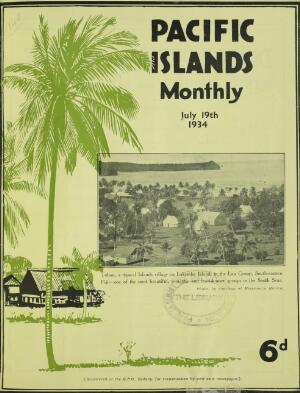
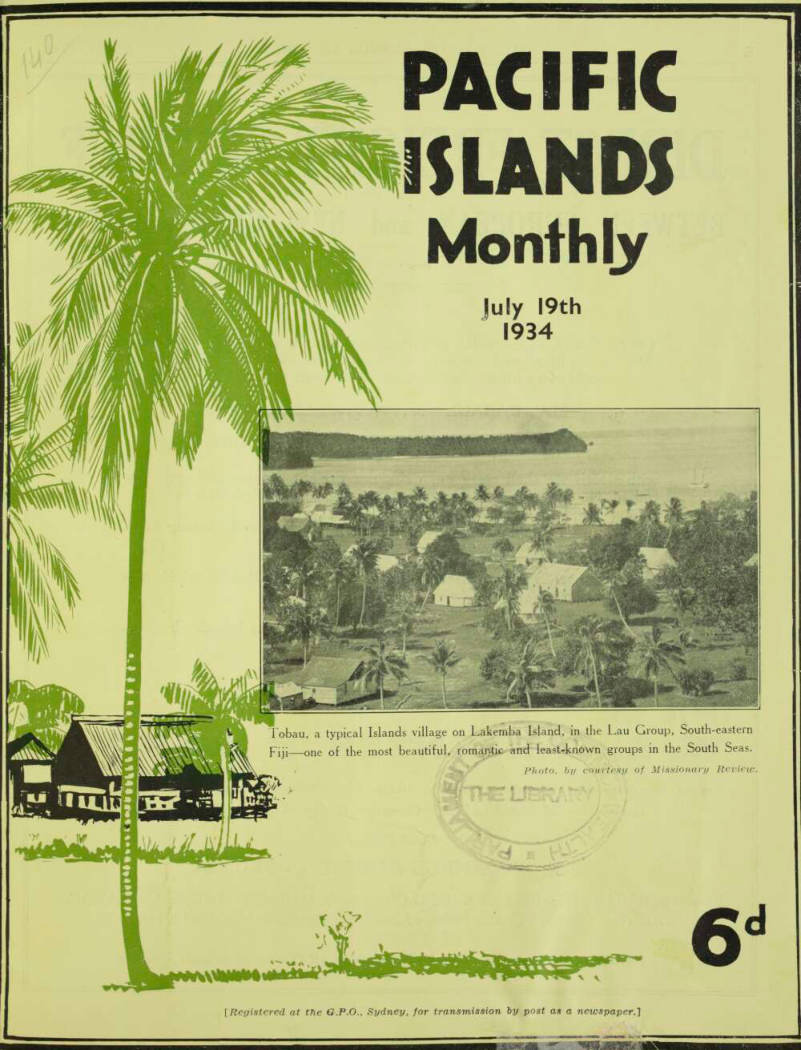
Tobau, a typical Islands village on Lakemba Island, in the Group, South-eastern Fiji —one of the most beautiful, romantic and least-known groups in the South Seas.
Photo, by courtesy of Missionary Review.
Advertisements & other items, p. 2 (1 item)
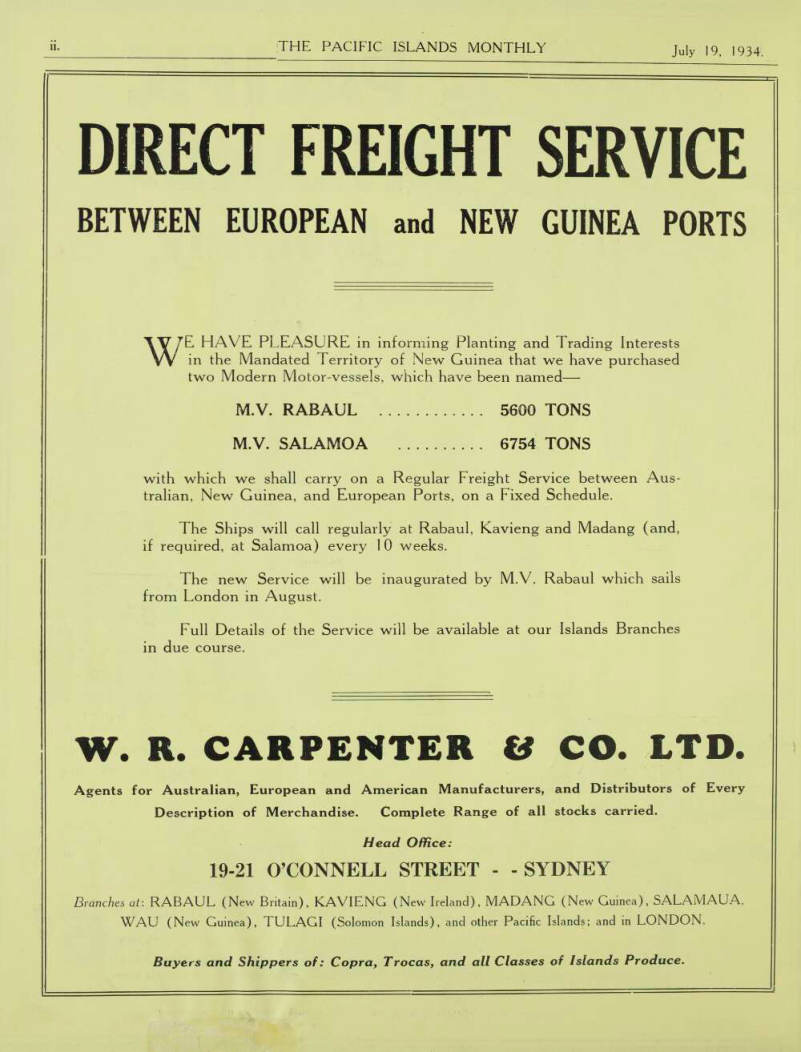
Direct Freight Service
BETWEEN EUROPEAN and NEW GUINEA PORTS
WE HAVE PLEASURE in informing Planting and Trading Interests in the Mandated Territory of New Guinea that we have purchased two Modern Motor-vessels, which have been named—
M.V. RABAUL 5600 TONS
M.V. SALAMOA 6754 TONS
with which we shall carry on a Regular Freight Service between Australian, New Guinea, and European Ports, on a Fixed Schedule.
The Ships will call regularly at Rabaul, Kavieng and Madang (and, if required, at Salamoa) every 10 weeks.
The new Service will be inaugurated by M.V. Rabaul which sails from London in August.
Full Details of the Service will be available at our Islands Branches in due course.
W. R. CARPENTER & CO. LTD.
Agents for Australian, European and American Manufacturers, and Distributors of Every Description of Merchandise. Complete Range of all stocks carried.
Head Office:
19-21 O’CONNELL STREET - - SYDNEY
Branches at: RABAUL (New Britain), KAVIENG (New Ireland), MADANG (New Guinea), SALAMAUA.
WAU (New Guinea), TULAGI (Solomon Islands), and other Pacific Islands; and in LONDON.
Buyers and Shippers of; Copra, Trocas, and all Classes of Islands Produce.
Pacific Islands Travellers
Passengers Per Van Rees Which
Arrived In Sydney From New Guinea.
VILA, AND NOUMEA ON JUNE 20: Mr. Fred.
W. Jackson, Mrs. F. W. Jackson, Master Jackson, Mr. J. R. Preston, Mr. L. S. Downs, Mrs. L. S.
Downs, Mr. H. C. Cardew and child, Miss M. O.
Stewart, Mr. P. Villeval, Mrs. P. Villeval, Mr. J.
Monnier, Master G. P. M. Lavoix, Mr. W. F. F.
Kapenga, Mr. H. Leroux, Mrs. H. Leroux and child.
Passengers Per Malaita Which
Sailed From Sydney For Solomon
ISLANDS AND RABAUL ON JUNE 30:—Mr. G.
Arnold, Mr. J. W. Anderson, Mr. G. Buckley, Mr.
Cameron, Mr. and Mrs. R. H. Chapman, Mr. and Mrs. W. W. Clarke and 3 children, Misses N. and A. Curtin, Miss E. M. Conolly, Miss A. Cameron, Miss E. Common, Rev. Dickie, Miss E. Dixon, Mr. and Mrs. F. B. Gilbert, Rev. Gilbert, Major Hewitt, Mr. and Mrs. K. T. F. Hume, Mr. O. J. Higgins, Mrs. Hosking, Miss M. Hosking, Miss B. Holmes, Mr. T. O. Johnston, Miss B. Jameson, Miss Jer myn, Mr. and Mrs. A. W. Keighley, Mr. and Mrs. J. Keelan, Mrs. I. M. Kebblewhite, Mr. L. M.
Lesser. Miss Z. A. Lesser, Mr. S. G. Masterman, Dr. Macpherson, Mr. and Mrs. C. V. Meller, Mr.
J. Matthews, Mr. S. Mill, Mrs. E. Monckton, Miss M. McLaren, Miss F. McDonald, Mr. J. Rutter, Mr. Riley, Miss R. Read, Captain Scott, Mrs. J. C.
M. Scott and infant, Miss M. Scott, Miss E. L.
Smith, Mr. W. Wood, Mr. M. J. Willmott, Miss Weatherill.
Passengers Per Macdhui Which Ar-
RIVED IN SYDNEY FROM PAPUA AND NEW GUINEA ON JUNE 19;—Mr. E. A. Anderson, Mr. D. C. Bell. Mr. J. W. Bell, Mr. C. G. Bow man, Mr. A. E. Brown, Mr. and Mrs. H. L.
Cameron. Mr. W. M. Cochran, Mr. R. K. Clarke, Mr. and Mrs. A. T. Clarke, Mr. C. Costa. Mr. M.
P. Curtain, Miss K. M. Darcy, Mr. E. D. Demaitre, Mr. W. G. Digby, Mrs. A. E. Dover, Mr. H. L.
Downing, Mr. R. C. Duncan, Mrs. A. Edwards, Mr. J. A. Eilertz, Miss M. R. Grant, Mr. E. G.
Hadley, Mr. A. J. Harris, Major and Mrs. G. A.
Harrison, Mr. J. T. Hooton, Mr. K. K. Horn, Mr. M. P. Jaffrey, Miss V. Jenkins, Mr. J. Jones, Mr. A. G. Leal, Mr. J. Lega, Mr. F. Lloyd, Mr.
A. Lyall, Mr. W. D. Mason, Mr. W. H. Me- Laughlan, Mr. S. W. McNamara, Mr. A. R. Mc- Combe, Mrs. A. Nettleship, Mr. N. C. Paull, Mr.
J. H. Prosser, Mrs. I. Quinn, Mr. J. Richards, Mr. H. Rittlinger, Dr. E. G. Sayers, Dr. R. F.
Shepherdson, Mr, F. J. Smith, Mrs. M. Smith, Mrs. D. P. Stower, Mr. W. T. Traves, Mr. T.
Wainwright, Mr. P. J. Walsh, Mr. E. Weine.
Passengers Per Malaita Which Ar
Rived In Sydney From Solomon
ISLANDS AND RABAUL ON JUNE 24:—Mr. G.
Bryant, Mr. C. R. Bignell, Miss M. Bignell, Mr.
L. H. Corlander, Mr. F. H. Coghlan, Miss Ferguson and infant, Miss K. Fitzgerald, Mr. A.
Goodall, Miss M. Hardie, Miss B. Holmes, Mr. and Mrs. L. Halvorsen, Mr. A. Hunt. Dr. C.
Harrison, Mr. W. James, Miss C. Kilpatrick, Mrs. M. Keeble, Miss I. E. Lee, Mr. A. Ludbrook, Mr. J. Marwick, Miss N. Marwick, Miss N.
Maguire, Miss E. McMillan, Mrs. C. McKerlie, Mrs. H. Marks, Rev. Moore, Mr. and Mrs. C.
Maitland, Mrs. C. Pond-Harris, Mr. A. Palmer, Rev. A. Piper, Mr. S. Roberts, Mr. A. Ray, Mr.
J. Riley, Bishop Raucaz, Mrs. C. A. Rooke, Mr.
J. S. Sandeman, Mr. J. Summers, Mr. R. Upton, Mrs. A. H. Wilson and two children, Miss P.
York.
Passengers Per Morinda Which Ar
Rived In Sydney From New Hebrides.
Norfolk Island And Lord Howe
ISLAND ON JUNE 25:—Miss H. Atkins, Mr. A.
W. H. Austin. Miss A. L. Bailey, Mrs. M. M.
Baldwin, Mr. S. B. Blundell, Miss A. Bell, Mr. C.
Brockhoff, Mr. A. Brocklebank, Mrs. E. Carr, Miss P. Carr, Mr. C. T. Coates, Mr. G. Dark, Miss V. E. Dennison, Mr. E. S. Douglass, Mrs.
G. and Miss M. Fletcher, Mr. N. P. Goodall, Mr.
R. Henderson, Mr. F. G. Hopkins, Mr. and Mrs.
C. H. Tsherwood, Mr. U. Jacchia, Mr. J. W. Jenkins, Miss E. H. Locke, Mr. and Mrs. P. W.
Lovett, Mrs. E. G. Mackey, Mr. and Mrs. A. J.
McIntyre and child, Mrs. L. MacIntyre, Mr. H.
Macdonald, Mr. J. McNamara, Miss A. Noske, Mr. E. Neylor, Miss P. O’Sullivan. Mr. H. E.
Piper, Mrs. A. and Miss G. Rawling, Miss L. Randall, Miss B. J. Russell, Mr. G. W. F. Semark, Mrs. I. Stopp, Mr. T. R. Salisbury, Miss L. Sher ring, Miss D. L. Spring, Miss P. Saunders, Miss A. Thompson, Mr. W. G. Turner, Mr. and Mrs.
G. A. Temple, Miss K. Walsh, Mr. and Mrs. G.
M. Watt, Mr. L. E. Webb, Mr. C. W. Whiting, Mr. F. Whittle.
Passengers Per Macdhui Which De
Parted From Sydney For Papua And
NEW GUINEA ON JUNE 28:—Mr. G. Allen, Mrs. M. B. Allen and infant, Captain Anderson, Mr. C. W. Aston, Mrs. M. Aston, Mr. Baldi, Mr.
A. J. Bates, Mr. J. Bailey, Mrs. Bretag and three children, Miss D. Bailey, Miss M. Bailey, Mr. C.
Cheney, Mr. Clayton, Miss E. Clarke, Miss L.
Caswell, Mr. Conway, Mr. J. H. Cook, Mr. R. E.
Cook, Mr. and Mrs. A. M. Davies, Mr. and Mrs.
Dundas-Smjth, Mr. H. A. de Kantzow, Mrs. W.
Dupain, Miss D. Dupain, Miss M. Duggan, Mr.
B. W. Faithorn, Mr. J. H. Fairhall, Mr. C. R.
Gurney, Mr. L. Gibbons, Mr. Gofton, Mr. Garland, Mrs. S. Goulston, Miss Gillies, Miss Gibson-Craig, Miss Graham, Miss Gartland, Mr. F. Hambridge, Mr. and Mrs. Horan and infant, Mr. and Mrs. R.
J. Hanson, Mr. G. Hogan, Mr. and Mrs. A. R.
Haviland and infant, Mr. Heymanson, Mr. Howard, Mrs. S. Hunter, Miss P. Hunter, Miss A. C.
Ives, Mr. P. J. Janson, Mr. C. Jacobson, Mr. E. F. Johnson, Mr. L. W. Kendall, Mr. Lethbridge, Mr. and Mrs. H. G. McFarlane.
Mrs. Lesmond, Mr. S. J. Moir, Mr. G. Mendham, Mr. T. R. McCulloch, Mr. and Mrs. D. H. McGrana han, Mr. W. McRae, Mrs. M. Miller, Miss E.
Locke, Miss Morton, Mrs. E. R. Oldham, Mr. E.
Petersen, Mr. Paterson, Mr. G. Rawlings, Mrs.
Rosenthal, Miss E. Riley, Miss Rankin, Mr. H. B.
Seale, Mrs. and Mrs. Skelly, Mr. B. Sinclair, Mr.
J. Schneider, Mrs. F. V. Saunders and infant, Mr.
H. Tudor, Mr. G. Thrasher, Mr. Thomas, Mr.
R. B. Thistlewayte, Mr. Turner, Mrs. E. Taylor, Mrs. H. Webb, Dr. and Mrs. Williams, Mrs.
R. M. Youlden and child, Miss Younger.
Passengers Per Monterey, Which
Arrived In Sydney From Suva, Fiji,
ON JUNE 18: —Miss G. Adamson, Mr. A. C.
Adena, Mr. E. F. Barnett, Miss E. M. Davison, Miss L. G. Davison, Mrs. F. V. Dunstan, Mrs.
E. C. Ewins, Mrs. Marion Graham, Miss Jean Harber, Miss V. Herman, Mr. Henry E. Jackson, Mrs. H. E. Jackson, Mr. M. L. Lynch, Mr. H.
L. Lynch, Mr. and Mrs. F. J. Marshall, Mr. B.
O’Brien, Mr. G. F. Palmer, Miss D. Ross, Miss M. Scott, Mr. E. G. Theodore, Mrs. G. N. Vowell, Mr. V. P. Williams, Mr. M. Cameron, Captain H. J. Heidrick, Mr. and Mrs. C. Inchboard, Mr. and Mrs. P. W. Joe, Master D. H. Joe, Misses S. H., E., and A. Joe, Mr. Hugh McRae, Mr.
A. McBride, Mrs. L. M. Stanton-Crouch, Mrs. E.
Harris, Miss E. M. Pateman, Mr. A. Wicks, Mr.
G. Folkard, Mr. S. I. Crookes, Miss K. Mac kavanagh, Mr. R. J. Lemon.
Passengers Per Monterey Which
Sailed From Sydney For Fiji And
American Samoa On June 27:—Mr. Samuel
Bowen, Mrs. Samuel Bowen, Master E. Costello, Miss E. R. Gillies, Miss M. Jones, Mrs. D. Junor, Mr. U. Jacciaha, Mr. G. A. Krefft, Mrs. G. A.
Krefft, Mr. J. Lew, Mrs. B. Lyon-Field, Mr. H.
J. Motley, Mr. C. McMahon, Mrs. C. McMahon,
Mrs. M. B. Moffatt, Mr. W. A. Morris, Mrs.
C. Moss, Mr. H. Payne, Mrs. H. Payne, Mrs. M.
Walters, Miss B. Walters, Miss Edna Walters, Miss F. M. Wilkins, Miss A. Banks, Miss D. Bell, Mrs. A. Berking, Master G. Berking, Master P.
Berking, Miss L. K. Blomfield, Miss M. Brodribh, Miss A. Coxon, Miss D. Ludolph, Mrs. T. Mann, Mr. F. L. Nunn, Mrs. F. L. Nunn, Mrs. A. D.
Robinson, Mrs. E. M. Ward.
Passengers Per Aorangi Which Left
SYDNEY FOR SUVA, FIJI, ON JUNE 21:—Mrs.
N. H. Hunter and two children, Mrs. M. E. Rogers, Miss Rogers, Mrs. R. A. Gale, Mr. T. McCarthy, Captain F. A. Williams, Mrs. F. A. Williams, Mr.
F. C. T. Lord, Mrs. F. C. T. Lord, Master Lord, Mrs. R. M. Wharton, Miss J. C. Barton, Miss M. Sheels, Mrs. L. E. Sheels, Miss M. Wolley, Miss E. L. Nicol, Mr. A. W. Small, Mrs. A. W.
Small and two children, Mr. A. R. Rourke, Mrs.
H. Bosch, Mr. A. McKay, Mr. J. W. A. Pren tice, Mrs. G. Franklin, Mr. E. A. Moore-Jones, Mrs. M. F. Rorke, Mr. W. B. G. King, Mr. J.
Kinsman, Mrs. J. Kinsman, Mr. L. P. Lawton, Mr. J. Sommerville.
Passengers Per Montoro, Which
Arrived In Sydney From Papua And
NEW GUINEA ON JULY 11:—Ahern, Mr. W.; Anderson, Mr. and Mrs. R. T.; Anna Marie, Sister; Broadbank, Mrs. E. F.; Broadbank, Miss E.; Broadbank, Master E.; Batze, Messrs. A. W. and A.; Boyd, Mr. E. E. G.; Booth, Mrs. D. R.; Butler, Mr. A. B.; Brigstocke, Mr. D.; Bieske, Mrs. I. A.; Best, Mrs. M.; Best, Miss N.; Birm ingham, Miss M.; Bellamy, Mrs. F. A.; Clarkson, Mr. and Mrs. P. C.; Campbell, Mrs. M. V.; Charge, Mr. A. D.; Cooper, Mr. R. G.; Campbell, Mr. and Mrs. W. M.; Duffy, Mr. W. J.; Dugan, Mr. R. B. R.; Felix, Mother; Griffeth, Mr. I. L.; Hardiman, Mrs. M. E.; Hollingworth, Mr. and Mrs. A. C.; Henry, Mr. J.; Ives. Mrs. C. M.; Johnson, Miss E.; Joubert, Mrs. M. B.; Jackson, Mr. and Mrs. P. L.; Kilminster, Mr. C. W.; Lewin, Mr. T. B.; Lloyd, Mr. and Mrs. G. A.; Laugher, Mrs. G. and infant; Lees, Mr. J. F.; Lapthorne, Mr. W. P. A.; McNamara, Mr. J. A.; Mateier, Mr. F. W.; Mant, Mr. P. O.; Muddell, Mr. S. G.; Orchard, Miss A.; Parer, Mr. B. D.; Peterson, Mr. A. S.; Proven, Mr. J.; Pratt, Mr.
G. W.; Roebuck, Mr. L. C.; Ramme, Mr. C. R.; Simpson, Mr. A. L.; Smith, Mr. T. W.; Stirton, Mr. and Mrs. N.; Scott, Mr. H. M.; Simson, Mr.
C. C.; Turner, Mr. E. M.; Ursula, Mother; Virtue, Mrs. R. I.; Watson, Mr. G. R.; Wilde, Mr. R. G.; Waugh, Mrs. M. E.; Watkins, Mr.
A. E.
Advertisements & other items, p. 3 (1 item)
Saicon-Batavia-Samarang-Port Moresby—
New Britain Express Delivery.
GENERAL OVERSEAS AGENTS.
GENERAL CARRIERS, BAGGAGE AGENTS,
and FORWARDING AGENTS.
Reliable Cars and Trucks.
We aim to give quick and reliable Service at reasonable costs. P.O. Box 116. Telephone 141.
W. WALKER-FLYNN, Proprietor, Market Street, Rabaul, T.N.G.
SAICON-BATAVIA-SAMARANG-PORT MORESBY—
SAMARAI-RABAUL- PORT VILA- NOUMEA
SYDNEY - PORT MORESBY - BATAVIA - SAIGON
bi-monthly by the V"AN REES”
You will enjoy travelling by this popular, fast and modern steamer of the K.P.M., noted for its comfort, excellent cuisine, and economical fares.
With a fleet of over 130 vessels the K.P.M. Line is in a position to accept cargo for all ports in Netherlands India, and with transhipment at Batavia for Africa.
ROYAL PACKET NAVIGATION CO.
Paketvaart House, 255 George Street, Sydney
Diethelm & Co.. Saigon; E. A. James. Port Moresby: Whitt n Bros.. Samarai; W. R. Carpenter & Co. Ltd., Rabaul; Gubbay Freres, Port Vila; Carlo Leoni. Noumea.
Advertisers
Page Antinea Drug Co. .. 27 Arnold, F 15 Biscuits .. 16 Ashton, Mrs. J. .. 45 Aspro 36 Ausoline Co 26 Bank of N.S.W. .. 40 Bailey, W. M 40 Baker, W. Jno. ..49 Blau, Julius ..23 Broomfields, Ltd. .. 47 Bruce, Robert .. .. 45 Brunton’s Flour .. 21 Budge, James .. .. 36 Bullivants 35 Burns, Philp & Co. 2 Burns Philp (S.S.) B. Magazine... 46 Burnside 23 Buzacott, Ltd 44 Carmichael Bros. . 14 Carpenter, W. R.
Cover ii.
Central Launch .. 50 Chapman & Sherack 24 Chartres 13 Christies, Ltd 13 Coleman Quicklite.. 15 Coral Starch .. 37 Cowles & Dunn .. 33 Dangar, Gedye. Ltd. 29 Dawson & Row .. 53 Delicia Food Co. .. 16 Doans 33 Excelsior Supply .. 28 Fletcher & Sons .. 14 Flynn, Mrs. W. .. 40 Ford, Noel P 43 Ford, W. M 41 For Sale 28 Foster & Sons, Geo. 47 Garrett & Davidson 34
Page Gillespie’s Flour .. 34 Glebe Eng’g 22 Goshen Pt. Hospital 12 Gourock Rope .. .. 18 Grahame, C 31 Gregory A 24 Guinea Airways Cover iii.
Hallstrom, E. 20 Halvorsen, L. 52 Harper, M. 22 Heenzo.. .. .. .. 43 Hislop, Lloyd, Ltd. 39 Holbrooks, Ltd. .. 26 Holden’s Air T. .. 55 “Holmecroft” .. .. 24 Hotel Mansions .. 22
I.C.I.A.N.Z., Ltd. .. 11
Kelvin Engines .. 45 King George Whisky 37 Kopsen & Co. 39 Lane and Girvan .. 22 Lessey’s D.Y.S. .. 10 Lloyds Teas .. .. 49 McIlrath’s, Ltd. .. 17 Marconi School .. 31 Metro. Bus. College 27 Mungo Scott, Ltd... 32
N.D.L 54
Nelson and Robertson .. .. .. 48, 51 New Brit. Express.. 1 Cambridge .. 50 Nolan, Spencer .. 17 Noyes Bros 11 Oldfield 14 Pacific Is. Assocn. 39 Pacific Maps .. .. 55 Pacific Publications, 6, 10, 50
Page Personal 41 Pike Bros. 40 Prescott, Ltd 25 Rabaul Carr’g. Co. 12 Ransomes, Ltd. .. 46 Rasmussen 43 Reid, W. M. 47 Relingh, W. 20 Rohu, Sil 41 Rolls Razor .. .. 34 Royal Packet N. Co. 1 Russell, S. 45
Page Ruston & Hornsby 30 Scott & Bowne .. 35 Selby, H. B. 45 Shell Oil 38 Smith & Gluyas .. 48 Springwood L. Col. 50 Steamships T. Co., Ltd 53 Sterling Varnish Co. 8 “Stillholme” .. .. 19 Swallow and Ariell, Ltd. 18
Page Sydney Marine Agency 18 “Talkeries” .. .. 37 Taubman’s Paints.. 31 Thomas, G. & Co. 48 Thompson’s Engin eering 42 Tillock & Co., Ltd. 19 Titon 12 Toole, J. E. 48 Tooth & Co. .. .. iv.
Tyrrell’s Museum .. 36
Page Vincent Bros. 21 Wallaringa Mansions 52 Walker, F. J. 41 Ward, L. A. 32 West, H. 37 Wills, W. D. & H. O. 32 Wright & Co. 19 Wunderlich, Ltd. .. 20
Contents
Page Pacific Islands Travellers 1 Fourteen Isolated Administrations .. 3 O. F. Nelson’s Appeal 4 Coconut Oil Extraction 5 New Guinea Administratorship .. .. 7 Fijian Rock Inscriptions 8 Tropicalities 10 About Islands People 11 N.G. Air Mail Contracts 12 Matin’s Husbands 13 New Guinea Notes 15 Death of Mrs. Svensen (B.S.I.) .. .. 16 Fiji News 19 Natives’ Criminal Offences 21 Aerial Transport in New Guinea .. 23 Purari-Ramu Area, N.G 24 Miracle of the Hurricane 26
Page What About the Poor Planter? .. .. 29 Whale Oil Developments 30 C’est Le Condominium! 33 “Co-habiting” in Cook Is 34 Marsters Family (Cook Group) .. .. 35 Fund for Review of Larkin Case .. 37 Morris, Hedstrom Ltd.—Annual Report 39 Leahys or Detzner? 41 Fashions for Islands Women .. .. 42 Cocoa-Planting in the Tropics . . .. 45 Tung Oil Cultivation 47 Progress of N.G. Goldfield 49 Islands Gold Mining Notes 50 Market Quotations 52 Exchange Rates 53 Shipping Services in the Pacific . . .. 54 Index to Volume IV 56
Advertisements & other items, p. 4 (1 item)
Burns, Philp & Co. Ltd.
General Merchants
Shipowners
Tourist Agents, Etc:
Buyers of all Classes
of Island Produce
Head Office - 7 Bridge Street, Sydney - Australia Code Address: “BURPHIL”
Regular Steamer Services From Australia to New Guinea, Papua, Solomons, Lord Howe, Norfolk Islands, New Hebrides, Java and Singapore
The Pacific Islands Monthly
The Newspaper-Magazine Of The South Seas
[Registered at G.P.O., Sydney, for transmission by post as a newspaper.]
Published Once Each Month and Circulated in Australia and New Zealand and in the following Pacific Territories and Islands Groups:
Crown Colony of Fiji.
Australian Territory of Papua.
Mandated Territory (Australia) of New Guinea, Bismarck Archipelago, and Northern Solomon Islands.
Mandated Territory (Japan) of Marshall, Caroline and Mariana Islands.
American Territory of Guam.
Mandated Territory of Nauru.
British Crown Colony of Gilbert and Ellice Islands.
French Territory of New Caledonia.
British and French Condominium of New Hebrides.
American Territory of Eastern Samoa.
Mandated Territory (New Zealand) of Samoa.
British Solomon Islands Protectorate.
British Protectorate of Tongan Islands.
New Zealand Territory of Cook Islands.
Australian Territory of Norfolk Island.
French Colony of Oceania (Tahiti, etc.).
American Territory of Hawaiian Islands.
Owned and Produced by Pacific Publications, Ltd Union House, 247 George Street, Sydney.
Telephone Bw 5037
P.O. Box 3408 R
Contributions Articles, Stories, and Photographs dealing with Pacific Islands Subjects are invited, and will be oaid for on publication at usual rates.
Subscription Rates Per Annum, within British Empire, Prepaid Post Free 6/- Per Annum, elsewhere, prepaid, Post Free .. 87- Single Copies 6d,
Editor and Publisher:
R. W. Robson.
Advertisements Advertising rates furnished on application.
Colours, etc. by Arrangement.
Process Blocks made at Advertiser’s expense when required. Screen, 100.
Changes of Advertising Copy should reach this Office by Bth of each month, otherwise previous advertisement may be repeated.
Registered Address for Radiograms and Cables: “PACPUB” Sydney
Agents The following are authorised to receive subscrir tions for “The Pacific Islands Monthly”— Islands Branches of Burns, Philp & Co., Ltd., and Burns, Philp (South Seas) Co., Ltd.
Islands Branches of W. R. Carpenter & Co., Ltd.
All Branches of Morris, Hedstrom & Co., Ltd.
G. Thomas & Co., Rabaul.
Whitten Bros., Ltd., Samarai.
P. Costello, Suva, Fiji.
All Branches and Representatives of W. H. Grove and Sons, Ltd., Auckland.
S. Russell, Papeete, Tahiti.
Cook Islands Trading Co., Rarotonga.
Vol. IV., No. 12.
Sydney, July 19, 1934.
Price 6. Per Copy Prepaid: 6/- p.a.
Fourteen Isolated Administrations!
WE have frequently pointed out, in these columns, the need that exists for some organisation which will provide facilities for an exchange of opinions and experiences between the 14 different Administrations (British, Australian, New Zealand, American, French and Japanese) which control the various Groups and Territories of the Central and South Pacific. At present those 14 Administrations occupy 14 water-tight compartments.
There are numerous cases in which, if the people of an island wish to communi cate officially with the people of another island only a few miles away, they must address themselves to more or less legend ary officials on the other side of the world This is no exaggeration —many instances can be given. Even in Territories under the Union Jack the anomalies persist.
Bougainville, for instance, in the Nor thern Solomons, is part of the New Guinea Mandated Territory, and is re sponsible to Canberra. A man standing on the coast of Bougainville could nearly throw a spear across to Shortland Island,
in the Solomons; but if a Shortland Islander were injured by the Bougain ville spear he would have to make his complaint to London, via Suva, which, in turn, would communicate with Can berra and Rabaul. Certain of the Cook Islands are very close to certain of the islands near Tahiti, But the Cook Islanders may address themselves on matters of inter-island import only to Wellington; whereas the people in the Tahiti Territory make their representa tions through Paris. There is only an imaginary line between Eastern and Wes tern Samoa; but the official views of Western Samoa go to New Zealand, thence perhaps to London and Geneva, while the formal representations of Eastern Samoa must be conveyed to Washington, U.S.A. And so on, ad nauseam. Everyone has recognised that there is a need for some comprehensive organisation to short-circuit all this offi cial foolishness; but no one has yet been able to do anything.
There has developed now a condition which vitally affects the whole of the
South Seas in common, and which could be dealt with perhaps in an effective manner if there were such an organisa tion; and in connection with which we are inclined to say “I told you so.” That condition is the trouble which has fallen upon the copra industry.
Nearly all the Pacific Territories have some industry peculiar to themselves.
There is sugar in Fiji, gold in New Guinea, rubber in Papua, nickel in New Caledonia, and cocoa in Samoa. But throughout the whole of the South Seas there is one industry common to every Island —copra production. Coconuts have been aptly called “the Consols of the East.” One could sail a schooner throughout the length and breadth of the Pacific, and forget all currency exchange problems, if one could only carry the universal and übiquitous coconut in the shape of copra. It is the staple product of the coral islands particularly, and a medium of ready exchange. For 50 years it has been produced by everyone —from the rich international combines which grow coconuts on a carefully organised, scientific basis, in order to pay dividends to shareholders all over the world, right down to the untutored sav
age who husks a few nuts and dries their meat in the sun, in order to exchange his copra for a lap-lap or a stick of tobacco.
On page 52 of this journal will be found a list of prices current for copra since January, 1931, and it will be seen there that this South Seas product has fallen in value within four years in a manner that has disturbed and dislocated the whole of the economic machinery of the Pacific. We need not labour the point. The questions in the mind of everyone interested are: Is there a future for the copra industry? What is to be done about it?
Readers of this journal know what has happened. The copra industry has been affected, of course, by the economic de pression, exactly in the same way as other primary products; but other important factors have operated. The suggestion that there has been vast over-production is offset by the fact that every bit of copra being produced (and the world production for 10 years has increased by over 25 per cent., to about 1,100,000 tons per annum) is being consumed —though at a greatly reduced price. The. really disturbing factor—and it is peculiar to the copra industry—is the discovery of new processes of purification and de odorization, which have allowed manu facturers to use other oils and fats in fields of enterprise where hitherto coco nut oil was the only or principal raw material. To-day, coconut oil definitely is on a competitive basis with such things as Soya bean oil, peanut oil, and whale oil. Hitherto, for a wide variety of uses, coconut oil was unchallenged and supreme.
It is not wise to prophesy—strange things happen in the world markets which govern the prices of primary pro ducts —but there seems to be little doubt that the men engaged in the copra in dustry must face an entirely new set of conditions. There clearly is still an enormous world-wide demand for copra; but it seems just as clear that the market price of copra in the future will be governed by the values of the competing vegetable oils and whale oil. Therefore, that section of the copra industry which has been built up on values of £14 per ton and mere must re-orientate itself. It must undergo a far-reaching financial review and readjustment, so that it can make a profit out of copra at £10 or £12 per ton (sterling, c.i.f., London). Three or four years ago, when copra fell under £15 per ton, South Seas planters declared themselves ruined. But far-reaching changes have taken place since then, and it is now argued that well-ordered planta
tions can carry on comfortably enough at £10 per ton.
At the moment of writing (mid-July) there is an interesting development in progress. The price of first-grade copra has jumped suddenly by about 30/- per ton; but the quotation for smoke-dried and poor class copra is as sick as ever it was. This surely means that if the copra industry is to flourish in the South Seas in the future there must be strict supervision of production and grading, and generous assistance given to planters to enable them to instal first-class and efficient hot-air driers in place of the crazy contraptions and lazy methods which so many of them have employed.
An effort should be made also to instruct natives in the production of good copra and prevent their sending to the market the lamentable rubbish that so often is hawked in Europe and which unques tionably tends to depress the value of South Seas copra generally.
There is another aspect. Not only is it necessary to take united action in the Pacific to police copra production and secure a better grade; but it is also de sirable that the principal countries con cerned wdth coconut growing should see whether it is not possible, by co-operative research and industrial encouragement, to develop new uses for the rich and fragrant product of the coconut palm.
Surely it should be possible to stimulate a far greater world consumption of coco nut oil and coconut-cake.
So much could be done in these direc tions if only some Government, or some institution with an official status, could be induced to take the lead and organise unity of action between a few of these many Administrations interested in Paci fic Territories. They all are waiting and eager for something to be done, but not one of them seems capable of making a move.
The copra industry is not the only in terest they have in common; there are a dozen others. If once unity of action re garding the copra industry were secured, co-operative effort might be possible in many other directions to their consider able mutual profit.
Mr. J. H. Ahearn, New Guinea manager for the Vacuum Oil Company, returned to the Mandated Territory by the Tanda on July 14, after three months’ furlough in Sydney.
Mr. Arthur Dallon, of Papua, died at the Samarai Hospital on June 10, at the age of 65. He had been a resident of Papua for over 30 years and for the last few years had been engaged in trading and fishing.
O. F. Nelson
Banishment Stands: Gaol Sentence Quashed
THE Full Court of New Zealand, on June 29, gave its decision in the ap peal of O. F. Nelson against the sentence of eight months’ imprisonment and ten years’ exile, for sedition, imposed upon him by the High Court of Western Samoa in March.
Each of the four judges gave a lengthy written judgment, which differed considerably one from the other. They were in complete agreement, however, in quashing the sentence so far as it im posed further imprisonment, but in up holding the sentence of ten years’ ban ishment from Samoa.
There Cannot Be Two Rulers
The following, from the judgment of Mr. Justice Herdman, appears to sum up the views of the learned Bench: “It would appear that Nelson is a man of great ability and of excellent private character, but he seems to cherish an in sane belief that he has been specially selected by Providence to champion the cause of his people in a struggle against
The Index of Volume IV. of “Pacific Islands Monthly ’ (Aug. 19 33-July, 1934, inclusive), is published on page 56 of this issue.
the authority of the mandatory, and to take action which he hopes may eventu ally secure Samoa for the Samoans. It is to be regretted that he has failed to recognise how futile such a struggle is.
“If New Zealand ceased to be the mandatory, some other authority would take her place and the successor might not be as ready as New Zealand is to treat disaffection and unlawful behaviour with forbearance and fairness. The sooner that Nelson and his Samoan friends realise that there must be order and obedience to the law in Samoa the better will it be for everyone concerned.
There cannot be two rulers in Samoa, the Administrator and Mr. Nelson. The re presentative of the mandatory and no one else must rule and while he is bound to rule with justice he must also rule with firmness.
“It is evident that strong action was necessary to put an end to dissension and disloyalty, and a previous experience through which appellant passed should have warned him that to recommence disloyal and disaffecting practices would end in prosecution and serious punish ment. Still the punishment of ostracism from his country, from his people, and from his business for ten years is a salu tary one and I think that the ends of justice will be quite well served if the sentence of banishment stands and the sentence of imprisonment with hard labor is cancelled.”
The auxiliary schooner Navanora sank off the main wharf at Rabaul, New Guinea, on the night of July 9, as she was leaving for Kavieng, as a result of the engine ex ploding. Eleven bags of mail were on board, including the Macdhui’s, from Aus tralia. Most of the bags were recovered, however, and although many parcels were damaged, the letters appeared to be in tact.
Oil Extraction
Experiment with Beckman Process in B.S.I.
AN interesting experiment covering the proposed extraction of oil from green coconuts by a chemical process is pro ceeding at a plantation near Cape Marsh, Solomon Islands, under the auspices of the Malayta Company. The experiment has not been successful, but it has given so much promise that it is being pro ceeded with. The process employed Is called the Beckman process.
In the “Pacific Islands Monthly” of June, 1931, there appeared an article headed “Recovery of Coconut Oil —American Chemist Introduces a New Bacterial Process —Claimed to be Much Cheaper and Better Than Crushing.”
It was then explained that Mr. John W.
Beckman, of California, had patented a process under which, by a combination of bacteria and certain chemicals, he claimed that he could quickly and cheaply separate the oil from the undried coco nuts. An apparatus had been constructed in which large quantities of green coco nuts were placed in hoppers, and passed on slowly into chambers where they make contact with a bacteria culture, calcium carbonate, etc. After under going treatment for some five or six days, there was discharged from the apparatus a definite quantity of pure coconut oil, shredded nut and water. It was claimed that both the oil and oil-cake were im mediately marketable.
Nothing further was heard of Mr. Beck man’s discovery for some years.
A few months ago Mr. L. Corlander arrived from America with authority to experiment with the process in this part of the world. He succeeded in interesting the enterprising Malayta Company and the experiment at the Cape Marsh plan tation Was the result.
We have no details of what has been accomplished, but we understand that the small experimental plant established at Cape Marsh has not completely fulfilled what was expected of it. The results of the experiment, however, have justified Mr. Corlander and his associates, and the Malayta Company, in obtaining some further apparatus in Sydney which has been sent to Cape Marsh to enable the experiment to be continued. Mean while, Mr. Corlander has come to Sydney for medical attention, and at present is in hospital.
It will be apparent to practical coconut planters that this system of recovering coconut oil for profit may have some ad vantages over the present system. It is claimed that the cost of treatment in the bacterial plant is no greater than the cost of drying copra. The shipment of copra has three disadvantages under pre sent conditions—namely, its bulkiness, which demands considerable freight space; the cost of sacks; and the fact that even after the copra has been dried it still retains a certain amount of water.
Against those disadvantages may be placed the fact that it is easily and con veniently handled.
The bacterial process, if it were proved commercially practicable, would haye the advantage probably of great saving in freight space (oil being carried instead of bagged copra) but it has the disadvant age that the cost of oil containers would probably be heavy and that it still is necessary to ship the coconut cake to a.
market somewhere if the value of that important by-product of the crushing mills is not to be lost. It is claimed, however, that if this method of treating coconuts were adopted on a large scale it would be possible to fatten cattle from the coconut-cake near the works—in other words, the cattle might be brought to the coconuts instead of the coconuts being sent overseas to the cattle.
The result of the Cape Marsh experi ment will be awaited with interest.
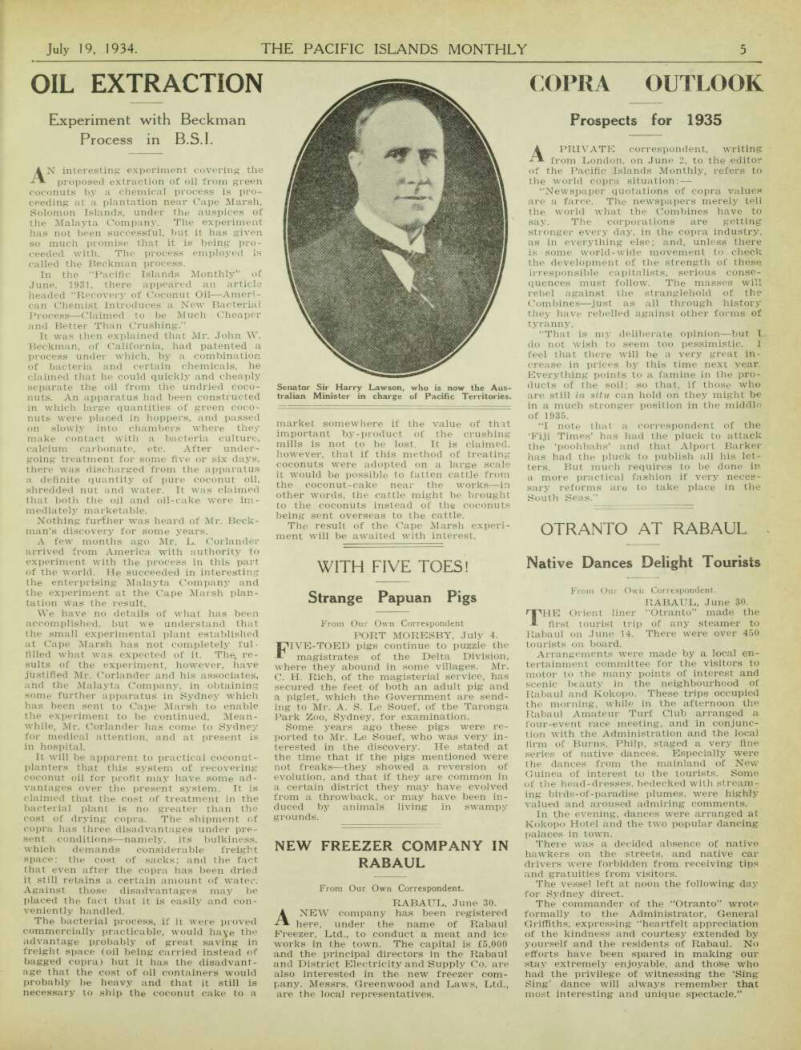
Senator Sir Harry Lawson, who is now the Aus tralian Minister in charge of Pacific Territories.
Strange Papuan Pigs
With Five Toes!
From Our Own Correspondent
Port Moresby, July 4.
FIVE-TOED pigs continue to puzzle the magistrates of the Delta Division, where they abound in some villages. Mr.
C. H. Rich, of the magisterial service, has secured the feet of both an adult pig and a piglet, which the Government are send ing to Mr. A. S. Le Souef, of the Taronga Park Zoo, Sydney, for examination.
Some years ago these pigs were re ported to Mr. Le Souef, who was very in terested in the discovery. He stated at the time that if the pigs mentioned were not freaks—they showed a reversion of evolution, and that if they are common in a certain district they may have evolved from a throwback, or may have been in duced by animals living in swampy grounds.
New Freezer Company In
Rabaul
From Our Own Correspondent.
Rabaul, June 30.
A NEW company has been registered here, under the name of Rabaul Freezer, Ltd., to conduct a meat and ice works in the town. The capital is £5,000 and the principal directors in the Rabaul and District Electricity and Supply Co. are also interested in the new freezer com pany. Messrs. Greenwood and Laws, Ltd., are the local representatives.
Copra Outlook
Prospects for 1935
A PRIVATE correspondent, writing from London, on June 2, to the editor of the Pacific Islands Monthly, refers to the world copra situation: “Newspaper quotations of copra values are a farce. The newspapers merely tell the world what the Combines have to say. The corporations are getting stronger every day, in the copra industry, as in everything else; and, unless there is some world-wide movement to check the development of the strength of these irresponsible capitalists, serious conse quences must follow. The masses will rebel against the stranglehold of the Combines —just as all through history they have rebelled against other forms of tyranny.
“That is my deliberate opinion—but I do not wish to seem too pessimistic. 1 feel that there will be a very great in crease in prices by this time next year.
Everything points to a famine in the pro ducts of the soil; so that, if those who are still in situ can hold on they might be in a much stronger position in the middle of 1935.
“I note that a correspondent of the ‘Fiji Times’ has had the pluck to attack the ‘poohbahs’ and that Alport Barker has had the pluck to publish all his let ters. But much requires to be done in a more practical fashion if very neces sary reforms are to take place in the South Seas.”
Otranto At Rabaul
Native Dances Delight Tourists
From Our Own Correspondent.
Rabaul, June 30.
THE Orient liner “Otranto” made the first tourist trip of any steamer to Rabaul on June 14. There were over 450 tourists on board.
Arrangements were made by a local en tertainment committee for the visitors to motor to the many points of interest and scenic beauty in the neighbourhood of Rabaul and Kokopo. These trips occupied the morning, while in the afternoon the Rabaul Amateur Turf Club arranged a four-event race meeting, and in conjunc tion with the Administration and the local firm of Burns, Philp, staged a very fine series of native dances. Especially were the dances from the mainland of New Guinea of interest to the tourists. Some of the head-dresses, bedecked with stream ing birds-of-paradise plumes, were highly valued and aroused admiring comments.
In the evening, dances were arranged at Kokopo Hotel and the two popular dancing palaces in town.
There was a decided absence of native hawkers on the streets, and native car drivers were forbidden from receiving tips and gratuities from visitors.
The vessel left at noon the following day for Sydney direct.
The commander of the “Otranto” wrote formally to the Administrator, General Griffiths, expressing “heartfelt appreciation of the kindness and courtesy extended by yourself and the residents of Rabaul. No efforts have been spared in making our stay extremely enjoyable, and those who had the privilege of witnessing the ‘Sing Sing’ dance will always remember that most interesting and unique spectacle,”
Plucky N.G. Native
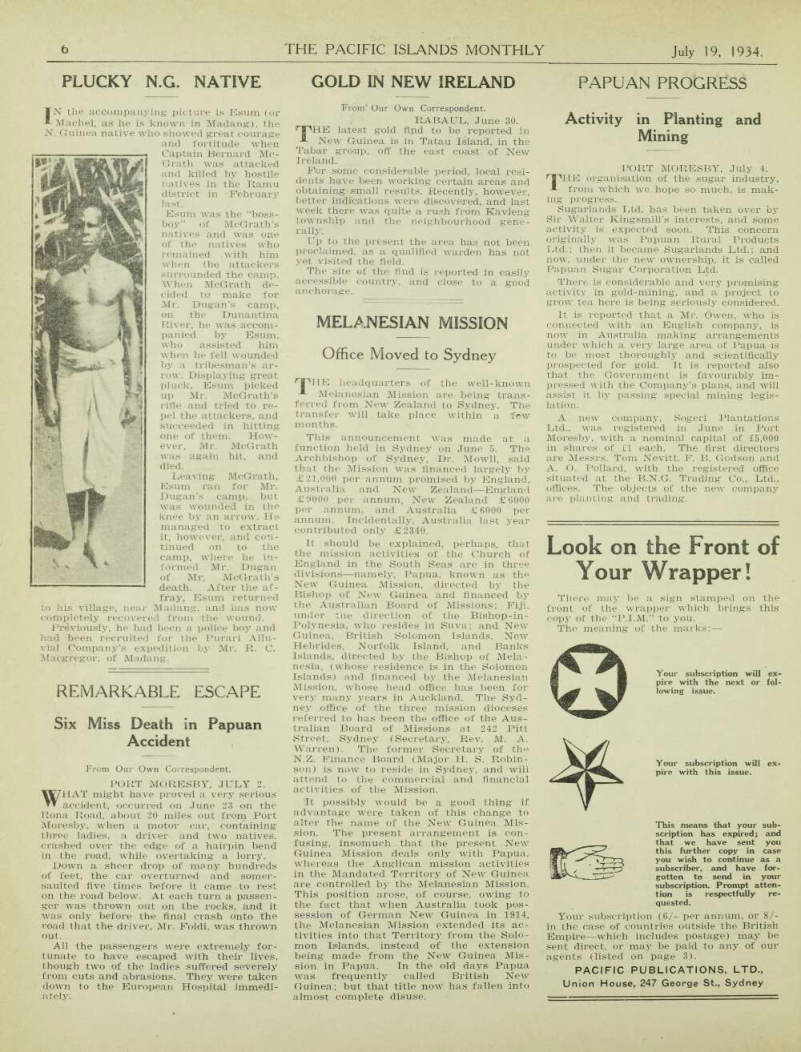
IN the accompanying picture is Esum (or Machel, as he is known in Madang), the N. Guinea native who showed great courage
and fortitude when Captain Bernard Mc- Grath was attacked and killed by hostile natives in the Ramu district in February last.
Esum was the “boss boy” of McGrath’s natives and was one of the natives who remained with him when the attackers surrounded the camp.
When McGrath decided to make for Mr. Dugan’s camp, on the Dunantina River, he was accompanied by Esum, who assisted him when he fell wounded by a tribesman’s arrow. Displaying great pluck, Esum picked up Mr. McGrath’s rifle and tried to repel the attackers, and succeeded in hitting one of them. How ever, Mr. McGrath was again hit, and died.
Leaving McGrath, Esum ran for Mr.
Dugan’s camp, but was wounded in the knee by an arrow. He managed to extract it, however, and continued on to the camp, where he in formed Mr. Dugan of Mr. McGrath’s death. After the affray, Esum returned
to his village, near Madang, and has now completely recovered from the wound.
Previously, he had been a police boy and had been recruited for the Purari Allu vial Company’s expedition by Mr. R. C.
Macgregor, of Madang.
Remarkable Escape
Six Miss Death in Papuan Accident
From Our Own Correspondent.
Port Moresby, July 2.
WHAT might have proved a very serious accident, occurred on June 23 on the Rona Road, about 20 miles out from Port Moresby, when a motor car, containing three ladies, a driver and two natives, crashed over the edge of a hairpin bend in the road, while overtaking a lorry.
Down a sheer drop of many hundreds of feet, the car overturned and somersaulted five times before it came to rest on the road below. At each turn a passenger was thrown out on the rocks, and it was only before the final crash onto the road that the driver, Mr. Foldi, was thrown out.
All the passengers were extremely for tunate to have escaped with their lives, though two of the ladies suffered severely from cuts and abrasions. They were taken down to the European Hospital immediately.
Gold In New Ireland
From Our Own Correspondent.
Rabaul, June 30.
THE latest gold find to be reported in New Guinea is in Tatau Island, in the Tabar group, off the east coast of New Ireland.
For some considerable period, local residents have been working certain areas and obtaining small results. Recently, however, better indications were discovered, and last week there was quite a rush from Kavieng township and the neighbourhood generally.
Up to the present the area has not been proclaimed, as a qualified warden has not yet visited the field.
The site of the find is reported in easily accessible country, and close to a good anchorage.
Melanesian Mission
Office Moved to Sydney
THE headquarters of the well-known Melanesian Mission are being transferred from New Zealand to Sydney. The transfer will take place within a few months.
This announcement was made at a function held in Sydney on June 5. The Archbishop of Sydney, Dr. Mowll, said that the Mission was financed largely by £21,000 per annum promised by England, Australia and New Zealand—England £9000 per annum, New Zealand £6000 per annum, and Australia £6000 per annum. Incidentally, Australia last year contributed only £2340.
It should be explained, perhaps, that the mission activities of the Church of England in the South Seas are in three divisions—namely, Papua, known as the New Guinea Mission, directed by the Bishop of New Guinea and financed by the Australian Board of Missions; Fiji, under the direction of the Bishop-in- Polynesia, who resides in Suva; and New Guinea, British Solomon Islands, New Hebrides, Norfolk Island, and Banks Islands, directed by the Bishop of Melanesia, (whose residence is in the Solomon Islands) and financed by the Melanesian Mission, whose head office has been for very many years in Auckland. The Syd ney office of the three mission dioceses referred to has been the office of the Aus tralian Board of Missions at 242 Pitt Street, Sydney (Secretary, Rev. M. A.
Warren). The former Secretary of the N.Z. Finance Board (Major H. S. Robin son) is now to reside in Sydney, and will attend to the commercial and financial activities of the Mission.
It possibly would be a good thing if advantage were taken of this change to alter the name of the New Guinea Mission. The present arrangement is confusing, insomuch that the present New Guinea Mission deals only with Papua, whereas the Anglican mission activities in the Mandated Territory of New Guinea are controlled by the Melanesian Mission.
This position arose, of course, owing to the fact that when Australia took possession of German New Guinea in 1914, the Melanesian Mission extended its activities into that Territory from the Solo mon Islands, instead of the extension being made from the New Guinea Mission in Papua. In the old days Papua was frequently called British New Guinea; but that title now has fallen into almost complete disuse.
Activity in Planting and
Papuan Progress
Activity in Planting and Mining
Port Moresby, July 4.
THE organisation of the sugar industry, from which we hope so much, is making progress.
Sugarlands Ltd. has been taken over by Sir Walter Kingsmill’s interests, and some activity is expected soon. This concern originally was Papuan Rural Products Ltd.; then it became Sugarlands Ltd.; and now, under the new ownership, it is called Papuan Sugar Corporation Ltd.
There is considerable and very promising activity in gold-mining, and a project to grow tea here is being seriously considered.
It is reported that a Mr. Owen, who is connected with an English company, is now in Australia making arrangements under which a very large area of Papua is to be most thoroughly and scientifically prospected for gold. It is reported also that the Government is favourably impressed with the Company’s plans, and will assist it by passing special mining legislation.
A new company, Sogeri Plantations Ltd., was registered in June in Port Moresby, with a nominal capital of £5,000 in shares of £1 each. The first directors are Messrs. Tom Nevitt. F. B. Godson and A. O. Pollard, with the registered office situated at the B.N.G. Trading Co., Ltd., offices. The objects of the new company are planting and trading.
Advertisements & other items, p. 8 (1 item)
Your Wrapper!
Look on the Front of
There may be a sign stamped on the front of the wrapper which brings this copy of the “P.I.M.” to you.
The meaning of the marks:— Your subscription will expire with the next or following issue.
Your subscription will expire with this issue.
This means that your subscription has expired; and that we have sent you this further copy in case you wish to continue as a subscriber, and have forgotten to send in your subscription. Prompt attention is respectfully requested.
Your subscription (6/- per annum, or 8/in the case of countries outside the British Empire—which includes postage) may be sent direct, or may be paid to any of our agents (listed on page 3).
PACIFIC PUBLICATIONS, LTD.,
Union House, 247 George St., Sydney
Gold
Caught in New Guinea by Private Detective
FOR some time past the Bulolo Gold Dredging Co. Ltd. has suspected that gold thieves were at work on its section, of the New Guinea goldfields. Ten weeks ago Mr. L. V. Waterhouse, of Sydney, technical director of the company, sent a carefully-selected private detective to the goldfields. He was sent secretly, and appeared in Bulolo as an assistant on one of the dredges.
The detective went about his work quietly and efficiently, and apparently he did not take long to uncover the opera tions of the gang.
As a result, it is reported in Sydney that Roland Clay has been sentenced to three months’ imprisonment for having been in possession of 3oz of retorted gold; Thomas Clay, charged with stealing 52oz of amalgam and 59 gold specimens, has been committed for trial; and Joseph Wil liam Trim has been sentenced to two months’ gaol for having been found in possession of 21 gold specimens and for having received 21oz of gold amalgam.
It is believed that the gold-stealing gang worked by bribing native labourers to steal the gold in the course of their work.
It is reported that all traffic in and out of the goldfields is now subject to strict scrutiny by police officials and it is likely that these developments will consider ably reduce the illegal gold traffic, which had attained considerable proportions. It is believed that one gang was sending gold secretly to Hong-kong. Other gold from Morobe, which had not come through proper channels, was recently identified in Sydney.
Inter-Island Ship
SUVA, June 20.
THE Tui Cakau (King of the Reefs), a steel single-screw motor vessel, was successfully launched from the yards of Marlows, Ltd., on June 14, to the order of Messrs. Morris, Hedstrom, Ltd.
A sturdy little vessel, the Tui Cakau will be a valuable addition to Fiji’s inter island fleet when she is commissioned in about two months’ time. The hull was made by Messrs. Harland and Wolff, Ltd., in England, and, after erection, was marked and taken down and shipped in pieces to Suva, where she was re-erected by Marlows. The dimensions of the new vessel are: Length overall, 90 feet; length between perpendiculars, 85 feet; breadth moulded, 19 feet; depth moulded, 8 feet; estimated cargo deadweight, 86 tons on 6ft. 6in. mean draft; estimated loaded speed in smooth water, 8 knots: estimated hold grain capacity, 6400 feet.
The motive power is one 145 b.h.p. “Pet ter” Atomic Diesel, two-stroke cycle, cold-starting, airless injection engine.
The vessel was christened by Lady Hedstrom, wife of Sir Maynard Hed strom, Managing Director of Morris, Hed strom, Ltd.
Brigadier F. B. Heritage who died from appendicitis on July 9, at the comparatively early age of 57, went to New Guinea with the Australian expedition as brigade-major, in 1914. He was the first military governor of New Guinea ap pointed by Australia: and served in that capacity for over a year.
Administratorship Of New Guinea
Brigadier-General McNicoll Confidently Named
THE report that Brigadier-General Mc- Nicoll is to be appointed Administrator of the Mandated Territory of New Guinea in succession to General Griffiths is persistent in the Australian newspapers.
The latest statement, which has a semi official flavour, is that General McNicoil will be appointed Acting Administrator immediately to carry on during the re mainder of General Griffiths’s term and that he then will be appointed officially to the position.
In these circumstances, some details of the career of General McNicoll may be interesting. He is a Bachelor of Arts of Melbourne University and holds the notable decorations of Commander of the Order of the Bath, Commander of the Order of St.
Michael and St. George, the Distinguished Service Order, and the Victorian Decora tion —the three major decorations being awarded for outstanding war service.
Walter Ramsay McNicoll was born in Melbourne on May 27, 1877, and after graduating at the Melbourne University he became a junior teacher in the Vic torian Department of Education in 1892.
He went to the Teachers’ Training College, Melbourne, as a student in 1900; and, sud sequently, in 1905 was appointed a senior master at the Melbourne High School. He secured the important appointment of headmaster of the Geelong High School in 1911. Mr. McNicoll took a keen interest in military training and secured a commis sion; and immediately the war broke out he resigned his position and enlisted in the 7th Battalion, where as Major he was second in command. Shortly afterwards he was promoted Lieutenant-Colonel, and given the 6th Battalion, which he com manded during the famous landing at Anzac Cove on April 25, 1915. For his work as a battalion commander in 1915 he was awarded the D.S.O. He returned to Australia in 1915 and in February, 1916. was given command of the 10th Infantry Brigade as Brigadier-General; and in that capacity he took part in the battles at Messines, Zonnebeke, Passchendaele, and the Hindenburg Line. He was severely wounded at the Battle of Krithia (1915), and as a result of his war injuries he walks with a slight limp.
After the Armistice this distinguished soldier was appointed Director of Educa tion for the A.I.F., and he fulfilled very important duties in that capacity while the Australian troops were awaiting repatria tion. He originated and carried out, with credit and distinction, the Non-Military Employment Scheme, which required of him an enormous amount of detail work.
Back in Australia, Brigadier-General McNicoll returned to his profession and in February, 1921, he inaugurated the Pres byterian Ladies’ College at Goulburn, of which he remained principal until he en tered the Commonwealth Parliament as a country member representing Werriwa electorate in 1931. For 10 years he was a highly respected figure in Goulburn, and took a keen personal interest in public affairs, in music and in Freemasonry.
Brigadier-General McNicoll is a slightly built man, rather above middle height. He has the pale face of the ascetic and scholar and his expression is keen and sharp. He has a charming though reserved manner and attractive social qualities, but he defin itely is the type of man with whom one does not take liberties. He is very thorough in any task he undertakes, and is
quick to grasp the essential features of a position; and his passion for detail perhaps makes him a man who is liable to upset his associates. He is a man who always will be respected; but owing to his natural reserve he is not likely to become a popular figure, in the political sense of the term, He is not a good politician; therefore he probably will be a good administrator, Brigadier-General McNicoll’s appoint ment to the major position in New Guinea probably will be criticised. It will be pointed out that while he is a successful educationalist and has proved himself a fine soldier and military organizer, he has had absolutely no experience in tropical administration, and that the New Guinea job calls for knowledge and experience of that kind in a superlative degree. General McNicoll, however, has outstanding per sonal qualities, and if he is sufficiently broadminded and adaptable, he will live down any illwill he may encounter, and make a success of the Administrator ship. Everything depends on his ability to secure the genuine co-operation of the hard-bitten men of the New Guinea Pub lic Service. That, in any circumstances, in any country, is a difficult thing to do; but it is still more difficult in New Guinea, be-
cause General McNicoll will be called upon to follow a really remarkable man in Gen eral Griffiths, who has succeeded in gaining not only the co-operation of the officials and residents of New Guinea, but also their extreme personal goodwill. In fact, it is not too much to say that the Europeans of New Guinea have learnt to love General Griffiths during the two years he has been a t Namanula.
If General McNicoll is to be appointed, the people who know him well enough to appreciate his outstanding personal qualities will sincerely wish him success and the best of good luck in his new and important job.
General McNicoll in 1905 married Miss Hildur Wedel-Jarlsberg, daughter of Baron Oscar Wedel-Jarlsberg, of Norway; and he has four sons.
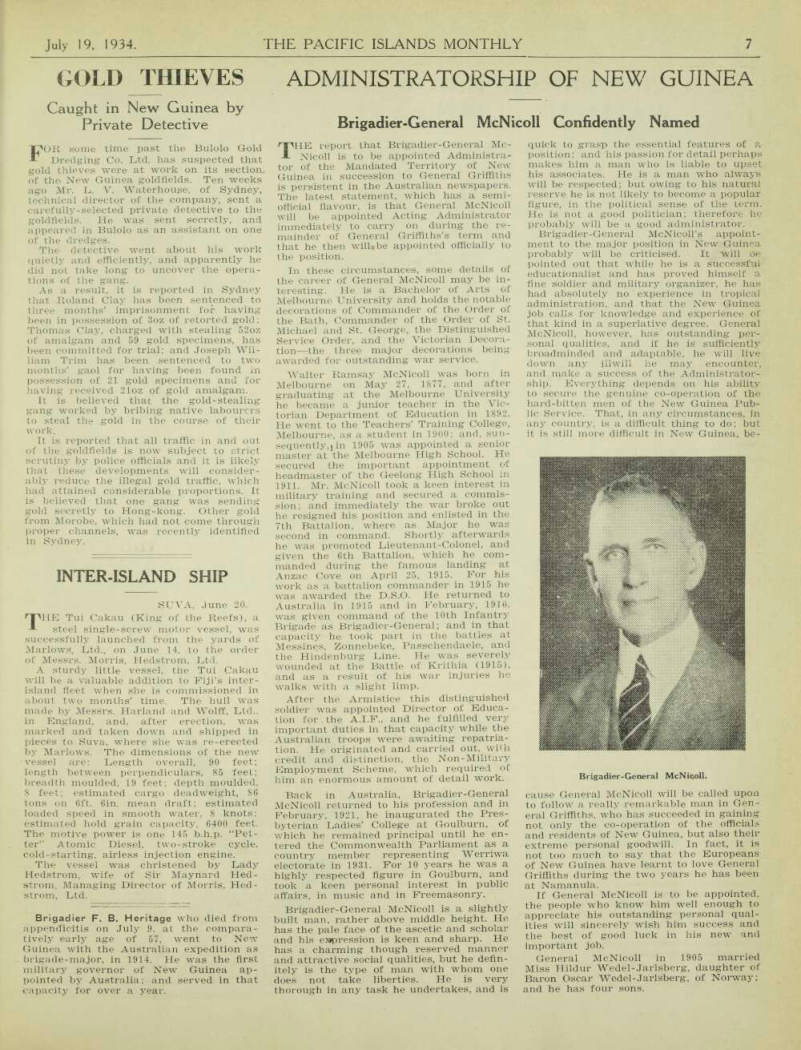
Brigadier-General McNicoil.
Ancient Chinese Characters On
Walls Of Fijian Cave
Were Asiatics There 2000 Years Ago?
WE are indebted to Mr. A. J. Vogan for the material and photographs used in the following article.
Independent inquiry has satisfied us that Mr. Vogan’s discovery is seriously regarded.
Judgment is suspended, so far as the “group figure” is concerned—it may be an accidental arrangement of rocks —but there seems to be no explanation of the carvings in the cave, except that they were placed there by Chinese very many centuries before the Spaniards came into the Pacific.
There is much speculation about the very early history of the Pacific. No one yet has explained the mysterious ruins in the Central Pacific, which jjrove the presence there once of a people of great power and definite culture. Perhaps Mr. Vogan’s dis covery will provide a key to the puzzle.
ABOUT four years ago Mr. A. J. Vogan, P.R.G.S., was in Suva and there he accidentally met an Islands skipper, Cap tain Giblin. Captain Giblin told him that in a remote cave on the Island of Yasawa (the most northerly of the Yasawa Group) there were some strange and apparently ancient inscriptions cut into the rocks.
Mr. Vogan immediately became inter ested and, piloted by Captain Giblin, he visited the Yasawas. He found the cave to be most difficult of access; the ap proaches to it were incredibly rough and broken, and the cave itself was half full of water, the depth of which in places was 30 feet.
Mr. Vogan, however, did succeed in get ting into the cave, where he found some apparently ancient inscriptions cut into the limestone walls, and in a strange text.
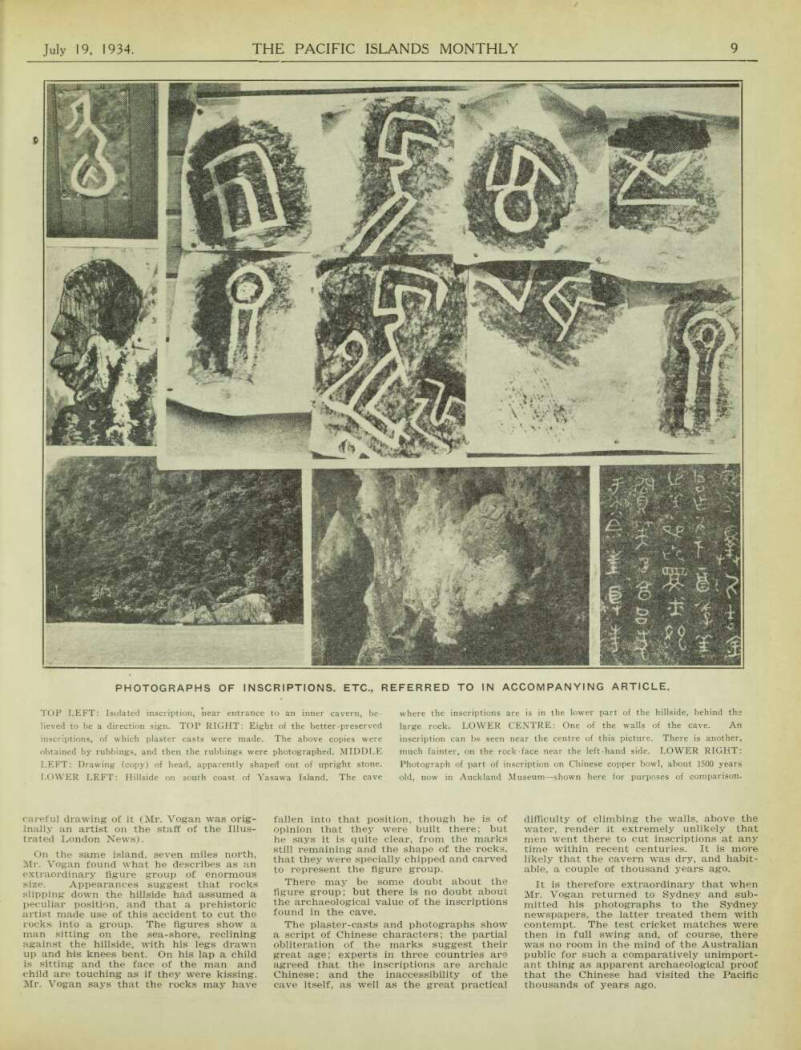
He could see that the cave had been of cathedral-like proportions and that the walls in one place were almost covered with inscriptions, many of which were partly obliterated. Though up to his neck in water he succeeded in getting a photo graph of one isolated inscription—suffi cient light coming in from above to allow the picture to be taken. On his return to Australia he submitted copies of this photograph to certain experts in America, London and Manchester, who agreed that it did resemble Chinese script of over 2000 years ago.
Early in 1934, Mr. Vogan, at his own ex pense, returned to Fiji, chartered a boat in Suva and proceeded to the Yasawas, carry ing with him all equipment necessary for making casts in plaster of the mysterious inscriptions.
In order to be assured of a maximum of light in the gloomy caverns, Mr. Vogan went to the Island in mid-summer. He certainly secured light, but he also made contact with the hurricane season, and as a result of heavy storms he suffered great hardships during his expedition. He found the cave again; and with extraordinary labour, assisted by a gang of Fijians, he succeeded in getting a number of planks and rails into the cave and built a scaf folding which allowed him to reach the isolated and most important inscriptions.
This was work of great difficulty. Some of the Fijians, climbing like cats, had to ascend the walls for a distance of 30 feet in order to fasten the ropes which carried the scaffolding.
With remarkable patience and industry, Mr. Vogan succeeeded in obtaining a num ber of plaster casts and conveying them from the cave to his boat. He made “rub bings” of the inscriptions; and he also traced some of them with white paint and made photographs of them.
Mr. Vogan injured himself in the course of his work, and also contracted a Revere illness, which necessitated urgent medical attention in Suva. However, he did ac complish his purpose and he duly arrived in Sydney, at the end of June, with the plaster casts and photographs, which he immediately placed in the custody of the Nicholson Museum, University of Sydney.
Mr. Vogan found a good friend in Auck land in the person of Mr. G. Archey, cura tor of the famous Auckland Museum, and Mr. Archey gave him most valuable as sistance. Among other things Mr. Archey was able to supply Mr. Vogan with a photograph of an inscription in ancient Chinese script on the bottom of a copper vessel which is known to be 1500 years old. The vessel was looted from a collec tion in China during the Boxer rebellion 30 years ago. This inspection was of great value for purposes of comparison with the script found in Mr. Vogan’s cave.
The new photograph of the inscriptions in the Fijian cave have been submitted to experts in Australia and they appear to be unanimous in their view that the script undoubtedly is ancient Chinese. One well known Sydney savant, a retired medical man, who is noted for his knowledge of ancient and modern Chinese, is of opinion that the script is undoubtedly Chinese, of a period of at least 2000 years ago, and quite possibly dates back to the Hsiu dynasty (2600 B.C.).
Mr. Vogan’s discovery is likely to arouse much interest among people who have
made a study of Pacific prehistoric immi gration. The age and locality of the in scriptions clearly suggest that the Pacific.
Ocean was traversed by Chinese naviga tors before the dawn of the Christian era.
Mr. Vogan says that owing to the extra ordinary difficulties he had in reaching the inscriptions he could get photographs of only a comparatively few of them. But there are many scores of others in other caves—many perfect, but most of them more or less obliterated.
Within the cave also Mr. Vogan found a rock which was carved into the semb lance of a man’s head and in which the ancient sculptor had displayed skill and artistry. It was impossible, owing to the position, to photograph it, but he made a
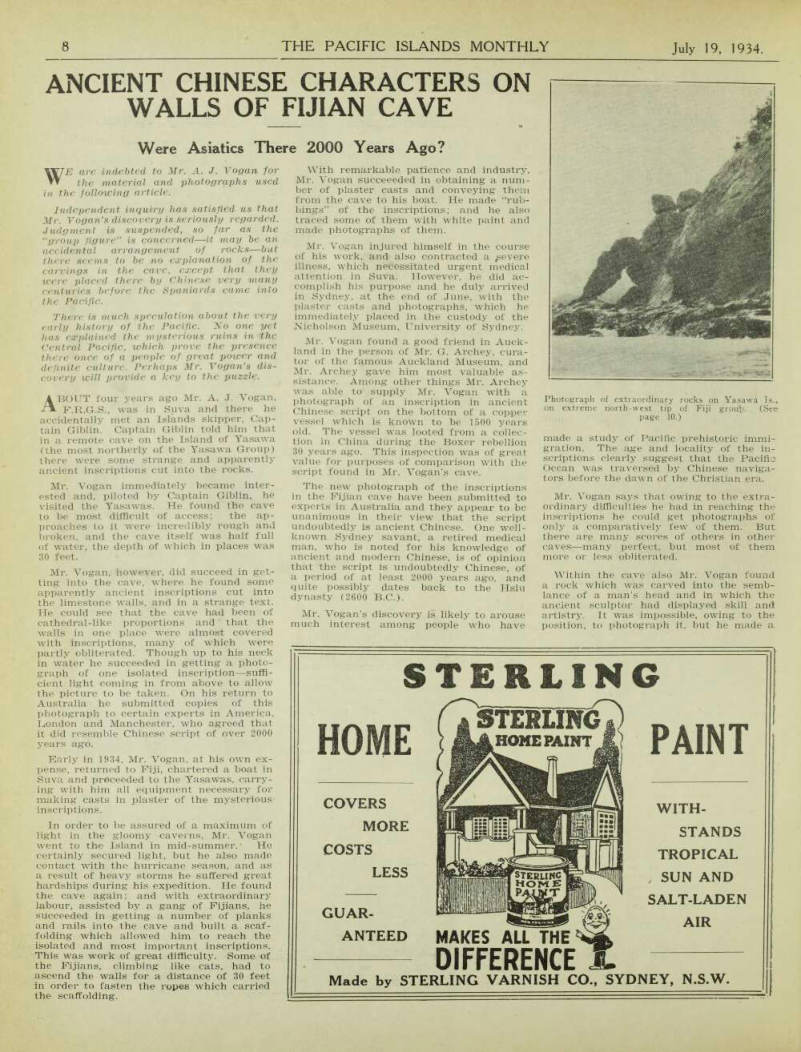
Photograph of extraordinary rocks on Yasawa Is., on extreme north-west tip of Fiji group. (See page 10.)
careful drawing of it (Mr. Vogan was orig inally an artist on the staff of the Illus trated London News).
On the same island, seven miles north, Mr. Vogan found what he describes as an extraordinary figure group of enormous size. Appearances suggest that rocks slipping down the hillside had assumed a peculiar position, and that a prehistoric artist made use of this accident to cut the rocks into a group. The figures show a man sitting on the sea-shore, reclining against the hillside, with his legs drawn up and his knees bent. On his lap a child is sitting and the face of the man and child are touching as if they were kissing.
Mr. Vogan says that the rocks may have
fallen into that position, though he is of opinion that they were built there; but he says it is quite clear, from the marks still remaining and the shape of the rocks, that they were specially chipped and carved to represent the figure group.
There may be some doubt about the figure group; but there is no doubt about the archaeological value of the inscriptions found in the cave.
The plaster-casts and photographs show a script of Chinese characters; the partial obliteration of the marks suggest their great age; experts in three countries are agreed that the inscriptions are archaic Chinese; and the inaccessibility of the cave itself, as well as the great practical
difficulty of climbing the walls, above the water, render it extremely unlikely that men went there to cut inscriptions at any time within recent centuries. It is more likely that the cavern was dry, and habit able, a couple of thousand years ago.
It is therefore extraordinary that when Mr. Vogan returned to Sydney and sub mitted his photographs to the Sydney newspapers, the latter treated them with contempt. The test cricket matches were then in full swing and, of course, there was no room in the mind of the Australian public for such a comparatively unimport ant thing as apparent archaeological proof that the Chinese had visited the Pacific thousands of years ago.
PHOTOGRAPHS OF INSCRIPTIONS. ETC., REFERRED TO IN ACCOMPANYING ARTICLE.
TOP LEFT; Isolated inscription, near entrance to an inner cavern, be lieved to be a direction sign. TOP RIGHT: Eight of the better-preserved inscriptions, of which plaster casts were made. The above copies were obtained by rubbings, and then the rubbings were photographed. MIDDLE LEFT; Drawing (copy) of head, apparently shaped out of upright stone.
LOWER LEFT: Hillside on south coast of Yasawa Island. The cave
where the inscriptions are is in the lower part of the hillside, behind the large rock. LOWER CENTRE: One of the walls of the cave. An inscription can be seen near the centre of this picture. There is another, much fainter, on the rock-face near the left-hand side. LOWER RIGHT: Photograph of part of inscription on Chinese copper bowl, about 1500 years old, now in Auckland Museum —shown here for purposes of comparison.
Advertisements & other items, p. 10 (1 item)
Home
STERLING
COVERS
MORE
COSTS
LESS
GUAR-
ANTEED
MAKES ALL THE
DIFFERENCE
PAINT
WITH-
STANDS
TROPICAL
SUN AND
SALT-LADEN
AIR
Made by STERLING VARNISH CO., SYDNEY, N.S.W.
Tropicalities
AN extraordinary occurrence is reported from Fiji. The military funeral of a young Fijian soldier was interrupted when three bullocks, alarmed by the firing of volleys over the grave, broke out of an adjacent slaughter yard and charged the party. A native saw the animals, and yelled an alarm. Confusion ensued. The mourners rushed for safety. One Fijian had a nar row escape, the horn of a bullock piercing his sulu and ripping it from his waist.
The loss of his sulu made the Fijian’s departure even more hurried.
NOTE from a Norfolk Island resident about “Uncle” Cornish Quintal, who died on February 10: Born on Pitcairn Island in 1841, he came to Norfolk as a barefooted boy of fifteen, in 1856, and spent the greater part of his long life here.
Extraordinarily handsome, of the hawklike profile that oddly persists among the descendants of the Bounty Mutineers and their Tahitian wives, powerful, resolute and capable, Cornelius Quintal played an outstanding part in the life of this island, among both his own people and the over sea settlers as they came in; and his courtesy and charm of manner endeared him to all who met him. Only two Pit cairners remain now—Mrs. Seymour Buf fett and Mr. Parkyn Christian —and when they, too, are gone, the Island will have lost a link with the romantic days of old, that will never come again.
"CAVENDISH” contributes a few words about a common complaint and home ly remedies: “Recently suspecting the onset of a boil, I bandaged the aching limb and, giving the hoe a rest, I went for a walk (Norfolk Island holds many pleasant walks: Fernie Lane and Palm Glen, Buck’s Point Road, would be hard to beat), meeting Islanders and Mainlanders. All showed real old time sincerity in expressing sympathy for my sore arm and liberally proffered the best medical advice.
“The world of to-day may have become a hard soulless proposition, but Norfolk Island obviously has not kept pace in that respect. Here are a few Norfolk remedies for boils. Readers in other Islands may find them applicable: “Shot seems to be most favoured, taken internally; number doubtful. Also: poul tice with linseed or fat bacon; castor oil on flannel; soak with iodine; sulphur and treacle. A mainlander thought a change of climate would be the thing, but he is not quite acclimatised, or has not yet dis covered the soul of Norfolk. I used water.
It is plentiful, and the heat required to ripen a boil should not cost much anywhere —seeing it only takes a shilling’s worth to ripen each case of bananas in Sydney.”
WE hear of an island in the Eastern Pacific where the natives, being short of ordinary currency, buy their “Picture” entertainment by means of live fowls. The idea has much to recommend it from the viewpoint of the native, because he has a very good chance of getting down on the same fowl, or that of someone else, later on, and handing it in at the booking office at the next show of pictures. The showman concerned declares he already has detected a thinning out of birds from their newly constructed wire-netting en closure.
HORTICULTURAL skill already provides residents in the Pacific Islands with most of the vegetables which they are accustomed to eat in temperate climes — such as cabbages, carrots, lettuces, radishes, peas, and so on; but up to date, tropical dwellers have longed in vain for the succu lent cauliflower. Mr. B. C. Green, of the New Guinea Department of Agriculture, however, brings a word of hope from the Trinidad College of Agriculture. He has ascertained that there is a cauliflower— which tastes just like any other cauliflower —which can be grown quite satisfactorily in the tropics. He has seen them and has eaten them in the West Indies, and he says that they are “beauties.” He has taken steps to procure the seed of this attractive vegetable from India; and we predict that if all goes well there will soon be very special reason why New Guinea folk will seek invitation to the Rabaul dinner-table of Mr. and Mrs. Green.
A NEW product of tropical agriculture is the Tonka bean, which, according to Mr. E. C. Green (just returned from the Trinidad College of Agriculture) gives a flavouring quality for tobacco, gin and similar substances. The bean is very much in demand and is profitable to grow, but it is extremely difficult to propagate and takes eight years to come into bearing.
The bean is dried, steeped in rum, and then dried again. It grows wild in Venezuela.
A YEAR or so ago a British naval unit anchored off a Polynesian atoll. A small boat put out from the island and a white man, neatly dressed in white duck, came aboard the cruiser and shook hands with the Commander. To the officers’ ward-room they went. The conversation sparkled, and turned upon incidents of the Great War. Then it was found that both men had seen service at Gallipoli.
“And what were you doing on the Peninsula?” asked the Commander.
“Oh, I was with the Aussies,” replied the Islander. “A lance-jack in the foot sloggers.”
“Good God!” exclaimed the Commander,
“Do you know I have been 20,000 miles through the Pacific, and you are the first ex-service man I have met below the rank of major!”
A CORRESPONDENT in Fiji says: “I note that some of your readers object to the use of the word ‘coon’ as applied to natives. So far as I know, there is no objection to the word, unless from some white person who has gone native. The word ‘nigger’ is quite commonly and openly used, both as a means of descrip tion and as an expression of contempt.”
A CHEERY party sailed out of Sydney Harbour on July 8 in the yacht Gundoa (a converted steam launch, about 15 tons, schooner-rigged) for Lord Howe, Norfolk Island, Noumea, Fiji—and anywhere else in the Pacific where they may be taken by the winds of chance and inclination. The party included Mrs. G. M. Vine, owner of the yacht; Mr. D. R. H. MacCarthy, Cap tain L. Kingdon, of New Zealand, navi gator; and Mr. Cedric Belfrage, film critic of the “Sunday Express,” London, now on a world wander. Mrs. Vine hopes to reach England about August, 1935. Mr. Belfrage probably will leave the party somewhere in the Pacific, with the object of spending a few months in Tahiti and the West Indies.
Papuan Mining Notes
From Our Own Correspondent.
Pt. Moresby, July 4.
Early in June, 11 gold dredging claims and two extended creek claims (alluvial gold) were regis tered with the Warden of the Lakekamu goldfield at Port Moresby. The applicants were Mr. A. E.
Bethune, Mr. C. Duchatel. Mr. J. Nason-Jones, Mr. P. D. Radcliffe—all well-known prospectors of Papua and New Guinea.
Guinea Airways Ltd. continue with the transport of machinery for Yodda Goldfields Ltd. to the Ebei landing ground, ancP it is reported that rapid progress has been made with the installa tions of the machinery on the field.
Good reports continue to come in from the Tiveri Gold Dredging Co., Ltd., and the first con signment _of gold from the field arrived in Port Moresby in June.
Advertisements & other items, p. 12 (2 items)
Drive Yourself
When Visiting Sydney
Send a Wire to
LESSEY’S
Drive Yourself
Box 8, Post Office,
PADDINGTON,
and an up-to-date car will meet you at the boat, which you can hire on very reasonable terms to
DRIVE YOURSELF.
Head Office and Service Station at
RUSH CUTTER’S BAY
(Near Stadium). Tel.: F 3196.
Radio Address: “Lessey’s,” Paddington, Sydney.
Pacific Islands Monthly
Bound and Indexed Files of
FOR SALE
We shall have for sale, if promptly ordered, seven bound files of Volume IV. of “The Pacific Islands Monthly” (August, 1933, to July, 1934, inclusive).
The 12 numbers included in Volume IV. are being indexed, and the Index has been published as part of the issue of July, 1934.
Price of Volume IV., strongly bound and indexed, and posted in August to any address £2/2/-
Early Ordering is Recommended
PACIFIC PUBLICATIONS, LTD.
UNION HOUSE, 247 GEORGE ST., SYDNEY.
Telegrams and Cablegrams: PACPUB, SYDNEY.
About Islands People
Rev. C. W. Whonsbon-Aston, late vicar of Levuka, and recently acting Bishop of Fiji, is going to Papua to take up mis sionary work under Dr. Newton, Bishop of Papua. Mr. Aston has extensive know ledge of missionary work in the Lau group, east of Viti Levu, and he recently refused an offer of a living worth £800 in Singapore to accept the £25 a year in the wilds of New Guinea. He is a small man with a most delightful address; and he always makes fast friends where he goes—wafting a Christian fragrance around him that makes for Peace and Kindness: a very remarkable man, though petite in stature. I understand that his old mother goes with him —he has never married. —A.J.V.
Mr. W. C. Groves, a well-known an thropologist in New Guinea, was recently elected to a fellowship of the Royal Anthropological Institute of Great Britain and Ireland. For the past three years, Mr. Groves has been conducting culture contact investigations in various parts of the Mandated Territory, as a Research Fellow in Social Anthropology of the Aus tralian National Research Council.
Mr. Lars Halvorsen, well-known Sydney boat builder, returned in June from a trip to Papua, New Guinea and the British Solomon Islands. Mr. Halvorsen has built scores of small craft for the Islands, but this was his first visit to those regions.
As a result of his visit, Mr. Halvor sen proposes to design a special craft 50ft. long, fitted with diesel engines, for use in the Solomon Islands. He intends, when his design is completed, to submit it to certain Island residents for their criticism before he builds a vessel on those specifications.
Rev. George H. West, Melanesian mis sionary in the Reef Group of the British Solomon Islands, left New Zealand in June for London, where he will spend his furlough.
Mr. C. H. Hughes, who has been for many years General Manager of the Sydney office of the Union Steamship Co. of New Zealand, Ltd., retired from the com pany at the end of June, owing to ill health. He has been in the service of the company for 55 years. Joining the company in 1879 as junior clerk, he rose to the position of Assistant Manager, be fore being transferred to Fiji. Arriving in Suva in the early nineties, he was agent for the Union Co. for several years and then returned to Dunedin, New Zea land, as Secretary to the company. After brief periods at Hobart and Melbourne, he succeeded the late Mr. David Mills as Sydney Manager. His position will be filled by Mr. A. J. Soutar, who has been manager of the Union Company’s office in Melbourne.
Miss E. E. Muir, of To Hore (near Wel lington), New Zealand, left Sydney in June for the Melanesian Mission at Tor gil, Vanua Lava, in the Banks Group.
She is a certificated teacher and will have Nurse Simpson as her companion at Torgil.
Mr. W. P. A. Lapthorne, a director of Guinea Airways, Ltd., arrived in Sydney by the Montoro on July 11, after a visit to the N.G. goldfields.
Mr. R. O. Mant, one of the pilots en gaged on the aeroplane service of Messrs.
W. R. Carpenter & Co.. Ltd., in New Guinea, is at present in Sydney on Fur louerh.
Mr. G. H. Morgan, who has been on the staff of the Union Steamship Co. of N.Z.
Ltd. for 43 years, will retire at the end of July. For several years Mr. Morgan has been manager of the . trans-Paciflc department. His place will be taken by Mr. F. H. Hamlin, of the Sydney office.
Dr, F. A. Macpherson, who has charge of the Melanesian Mission’s hospital at North Mela, Solomon Islands, returned to Tulagi by the Malaita on June 30.
Mr. W. R. Carpenter, Managing-Direc tor of the Islands firm of Messrs. W. R.
Carpenter and Co., Ltd., who has been in England since December last in con nection with Islands trade and shipping, is on his way back to Australia. He will arrive in Sydney by the Naldera on July 26.
Mr. E. W. P. Chinnery, Government Anthropologist in New Guinea, lectured before the Royal Anthropological Insti ture in London on July 9, describing the natives of the Territory. He said that the Kukukukus, fiercest and bravest of the warrior tribes, were gradually coming under white influence. Mr. Chinnery showed numerous pictures taken in the newly-discovered Ramu and Purari plateaux, illustrating varying types of natives and their unique methods of agri culture, and said that anthropological re search there should be amply repaid in contributions to cultural knowledge. The credit for the discoveries belonged jointly to missionaries, miners and Government officials, especially the Leahy brothers and Messrs. Taylor, Penglase and McCarthy.
Mr. C. R. Bignell, well-known planter of Fulakora, Ysabel Island, British Solo mon Islands, arrived in Sydney on June 24 by the Malaita. Mr. Bignell came to Sydney to seek medical treatment, and on arrival was taken to the Community Hospital, Moore Park, Sydney, suffering
from tropical poisoning. In the middle of June his condition, though not serious, showed little improvement.
Miss A. Thompson, formerly of Eng land, who has been studying theology in New Zealand and undergoing training for her nursing diploma, has now completed her studies. She has been appointed to the Melanesian mission station at Rega, in the New Hebrides.
Advertisements & other items, p. 13 (1 item)
Blackstone
"ICI"
.22 NON-RUSTING
RIM FIRES
Loaded with smokeless powder, which, in combination with a new and powerful non-corrosive priming composition, assures accuracy of performance unsurpassed by any other Rim Fire Cartridges.
An important factor in the use of this newly developed I.C.I. priming composition is that the residues left by the cartridge protect the bore of the rifle against rust, and make cleaning unnecessary.
“I.C.I. Express.’' loaded with an entirely new progressive - burning smokeless powder, give higher velocities with low pressure.
Supplied in: Short, Long and Long Rifle, Solid & Hollow Point
ICI
OBTAINABLE EVERYWHERE
BLACKSTONE
NOYES BROS.
SYDNEY
NEWCASTLE
CRUDE-OIL
POWER is
CHEAPER...
Here is an engine that yields a bigger return in power from the fuel it burns—crude oil. The economical running costs are also due to refinement in design. Simple and robust construction renders it practically free from breakdowns and replacements. Range from 5 B.H.P*
Crude Oil ENGINES
(Sydney) LTD.
LISMORE BRISBANE
A Legal Muddle
B.S.I. Criminal Escapes Part of Punishment
SUVA, July 5.
THE reduction of the sentence imposed on Punuhuru, from five to two years’ imprisonment, for the assault on a Euro pean lady in the Solomons, is the outcome of what appears to be an extraordinary legal muddle. It was found that the native had been convicted of a crime with which he was not charged, and which carried a maximum of two years’ gaol.
The High Commissioner, it can be said, is much perturbed by the development. It was never intended that this native should escape severe punishmnt; and the reduction of his sentence was something that was not contemplated. The law on the subject is quite clear, however.
The High Commissioner is making re presentations to the Colonial Office on the subject of native crime in the Solomons. [EDITORIAL NOTE.—This late message from Suva throws some light upon an extraordinary report from the Solomons, that the native who was guilty of the brutal attack on Mrs. Downs had had his altogether inadequate sentenced re duced to two years. We have received several letters cn the subject, some couched in violent terms. We shall deal with the whole subject in next issue of the P.I.M.] IT is officially announced, following one postponement, that the first official airmail experimental flight to Papua and New Guinea in the monoplane ‘‘Faith in Aus tralia” will commence on July 24. The aeroplane will leave Melbourne that morn ing and will call at Sydney, Brisbane, Rockhampton. Townsville, Port Douglas (near Cairns). Port Moresby (Papua), and Lae (New Guinea).
To Carpenters!
Air Transport Contracts in New Guinea
THE Government contract for air transportation in the goldfields end of New Guinea, which includes the carriage of mails, has been secured for the coming year, commencing August 1, by the aero plane service recently inaugurated by Messrs. W. R. Carpenter and Co. Ltd.
The contract is in two sections—the Wau-Pt. Moresby run, which has been held by Guinea Airways Ltd. (who pioneered it); and the Lae-Salamaua- Wau run, which has been held during the past year by Messrs. Holden’s Air Trans port Services Ltd. Both sections will now be operated by the Carpenter service.
Hitherto the Carpenter service has not been competitive. Two small Moths have carried out transport work for Messrs.
W. R. Carpenter and Co. between Sala maua and Wau. It was not anticipated that the Carpenter machines would com pete with the existing aerial transport services. The announcement that the con tracts had been given to the Carpenter service came as a complete surprise.
It is reported that a new aeroplane— a Dragon Moth, 2-engined ’plane—is ar riving this month in Sydney to the order of Messrs. W. R. Carpenter and Co. Ltd.
Mr. R. O. Mant, who has been flying one of the Carpenter machines in New Guinea, arrived in Sydney on the last Montoro, and it is understood that he will fly the Dragon Moth back to New Guinea and that it will be used on the Government contract work.
Guinea Airways Ltd. have been operat
ing- the Pt. Moresby-Wau service at 1/6 per lb. The distance from Wau to Pt.
Moresby is 200 miles, over a very high range of mountains, and some of the most inhospitable country in the world. On this trip there is loading only one way. The price at which Messrs. Carpenter and Co. have secured the contract is reported to be Hid per lb. It is reported also that the price for the new contract for the Salamaua-Wau run is 2¼d in, and 1 1/8d out.
Interesting developments are likely to fol low the arrival of this new competitor in the New Guinea aerial transport service.
Advertisements & other items, p. 14 (1 item)
A New And Remarkable Hormone Preparation
GOSHEN PRIVATE
HOSPITAL
(Sister E. W. YEAMAN), 37 Gloucester Road, Hurstville, Sydney General and Private Wards. Spacious Grounds. High and Cool Situation.
Moderate Fees.
Rabaul Carrying Co.
GENERAL FORWARDING
AGENTS CUSTOMS AGENTS,
INSURANCE STORAGE.
Transport Work and Forwarding Work of Every Description Undertaken.
Modern Transport Equipment.
Telephones: Radio Address: Rabaul 176 and 135. “Rabcarco.”
E. M. GRANTER, Manager.
A New And Remarkable Hormone Preparation
Real Tonic and Restorative For Island Residents Especially in tropical countries, amazing results have been obtained with this new Hormone Preparation. It confirms the statement of scientists that not only life in the tropics with unfavourable climatic conditions, diseases, and illness, but also the continuous and unavoidable doses of drugs, such as quinine, etc., have a most degenerating influence upon the glandular system, and which can be remedied by a Hormone Preparation only.
Modern research has provided a tonic and restorative in Titon—an extract of various glandular substances and based on latest scientific formula, the Hormone supplied being a most powerful remedy. A new and plentiful supply of Hormone means New Life and Health.
The many reports received for medical purposes from the Islands during past few months are praising Titon in no uncertain words.
Titon Hormone Preparation provides the proper nourishment for the cells and the tissues of the body, the glands are stimulated and the brain and all its mental faculties are revivified. Titon makes you fitter, helps, to resist disease and illness and prevents morbid tendencies with a degree of success that has been denied to other treatments.
It claims to be the real remedy for nervous and physical exhaustion.
The tonic properties of Titon maintain and assist Nature in all her ways. Under this treatment the mental and physical state begins at once to improve and continues to do so.
Titon—a pluri-glandular preparation —is harmless to take, even to delicate constitutions, no fear of injury or enslavement to habit, no reaction in later years, but on the contrary the adjustment of the hormone balance with Titon means a wonderful difference to the future health and comfort.
You, too, may be in need of a tonic. Titon goes to the root of the cause, giving lasting and unequalled results.
Titon Hormone Preparation is sold at 30/- per treatment of 3 courses, or 10/6 per single course (10 days), forwarded post free under plain wrapper and marked “medical preparation.”
It is known as TITON No. 24 for Men. whilst for Women TITON No. 20, with a slightly different formula, is specially prepared.
As a guide to the general public, a 16-page booklet has been prepared, giving details regarding glands, hormone-therapy, and research work of famous scientists such as Professor Steinach, of Vienna, Professor Brown-Sequard, of Paris, and the English Physiologists Professor Bayliss and Starling. This booklet will be posted free to any address.
ORDER YOUR TREATMENT
TO-DAY
or write for booklet direct to
Titon Laboratories
Box 1304 J, G.P.O., SYDNEY, N.S.W.
Communications from the Medical Profession re glandular preparation are specially invited
Matin's Husbands
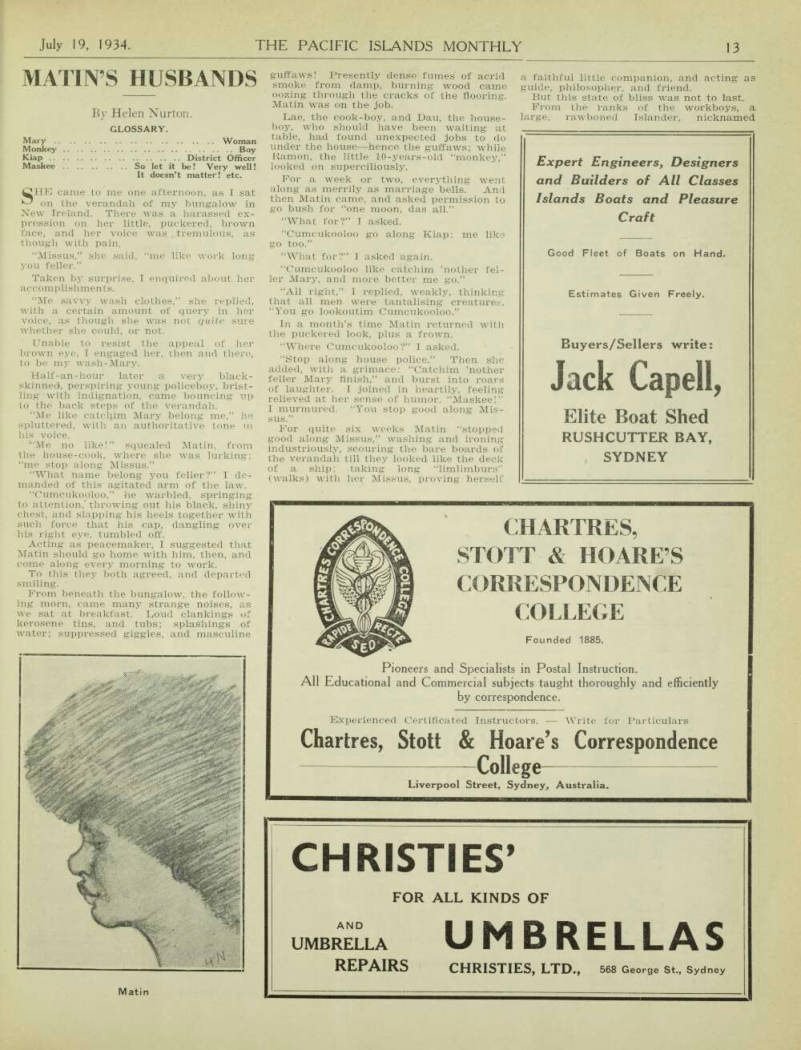
By Helen Nurton.
Glossary.
Mary .. .. Woman Monkey .. .. Boy Kiap .. .. District Officer Maskee So let it be! Very well!
It doesn’t matter! etc.
SHE came to me one afternoon, as I sat on the verandah of my bungalow in New Ireland. There was a harassed expression on her little, puckered, brown face, and her voice was tremulous, as though with pain.
“Missus,” she said, “me like work long you feller.”
Taken by surprise. I enquired about her accomplishments.
“Me savvy wash clothes,” she replied, with a certain amount of query in her voice, as though she was not quite sure whether she could, or not.
Unable to resist the appeal of her brown eye, I engaged her, then and there, to be my wash-Mary.
Half-an-hour later a very black skinned, perspiring young policeboy, brist ling with indignation, came bouncing up to the back steps of the verandah.
“Me like catchim Mary belong me,” he spluttered, with an authoritative tone m his voice.
“Me no like!” squealed Matin, from the house-cook, where she was lurking; “me stop along Missus.”
“What name belong you feller?” I de manded of this agitated arm of the law.
“Cumcukooloo,” he warbled, springing to attention, throwing out his black, shiny chest, and slapping his heels together with such force that his cap, dangling over his right eye, tumbled off.
Acting as peacemaker, I suggested that Matin should go home with him, then, and come along every morning to work.
To this they both agreed, and departed smiling.
From beneath the bungalow, the follow ing morn, came many strange noises, as we sat at breakfast. Loud clankings of kerosene tins, and tubs; splashings of water; suppressed giggles, and masculine
guffaws! Presently dense fumes of acrid smoke from damp, burning wood came oozing through the cracks of the flooring.
Matin was on the job.
Lae, the cook-boy, and Dau, the house boy, who should have been waiting at table, had found unexpected jobs to do under the house—hence the guffaws; while Ramon, the little 10-years-old “monkey," looked on superciliously.
For a week or two, everything went along as merrily as marriage bells. And then Matin came, and asked permission to go bush for “one moon, das all.”
“What for?” I asked.
“Cumcukooloo go along Kiap; me like go too.”
“What for?” I asked again.
“Cumcukooloo like catchim ’nother fel ler Mary, and more better me go.”
“All right,” I replied, weakly, thinking that all men were tantalising creatures.
“You go lookoutim Cumcukooloo.”
In a month’s time Matin returned with the puckered look, plus a frown.
“Where Cumcukooloo?” I asked.
“Stop along house police.” Then she added, with a grimace: “Catchim ’nother feller Mary finish,” and burst into roars of laughter. I joined in heartily, feeling relieved at her sense of humor. “Maskee”
I murmured. “You stop good along Mis sus.”
For quite six weeks Matin “stopped good along Missus,” washing and ironing industriously, scouring the bare boards of the verandah till they looked like the deck of a ship; taking long “limlimburs” (walks) with her Missus, proving herself
a faithful little companion, and acting as guide, philosopher, and friend.
But this state of bliss was not to last.
From the ranks of the workboys, a large, rawboned Islander, nicknamed
Matin
“Tommy,” seemed to linger around the house, cutting grass.
Matin was leaning conspicuously over the verandah rails.
“Matin,” I said, “what name this feller boy he cuttim grass close to along house?”
“Em he like married along me feller,” she simpered.
“You no can,” I snapped, feeling indig nant, “you married plenty time too much now,” knowing that several husbands had preceded Cumcukooloo.
But it was no use. Matin sulked, and the grass around the bungalow began to take on the appearance of an English lawn. So “Tommy” bought her for £2 from her nearest relatives, and they took up residence in a tiny sac-sac house in the married quarters.
Matin was now a lady at large, strolling grandly around the station in a new blouse every day.
About three months later, as I sat, one quiet evening, soliloquizing, and watching the policeboys rattle down to salute the flag, hanging limply from the pole, a meek voice came to me from the dusk: “Missus, Tommy finish time; he go back long place: me like wash clothes belong you feller.”
Turning, I spied Matin’s little puckered face.
“But, Matin,” I said, “you married finish along Tommy. What for you no go one time along him?”
“Me no like,” she pouted. “Long way too much!”
“All right, Matin,” I replied, resignedly, knowing that it would be useless to waste words. “You stop good along Missus” — wondering how long it would last this time.
But in a few weeks’ time, catching sight of Lae, the cook, making eyes at her, I had a sudden inspiration. I would marry him to Matin, and so have peace at last.
“Lae,” I said, going into the house-cook, where, smothered in flour, he was pound ing away at the dough, making bread.
“You like married along Matin?”
“Yes, me like,” he replied, simply, beam ing from ear to ear, and showing a mouthful of large, white teeth, his faithful, doggy eyes shining.
“You like married along Lae?” I asked, dodging under the house, where Matin was busy, ironing clothes.
“Whee-ee-ee!” she whistled, “me no like” —doubling up, and going into spasms of laughter. I departed, crestfallen.
A month later, I asked her again.
“Whee-ee-e,” she whistled, but not so vociferously, and I felt hopeful.
Again I asked, this time with a threat in my voice: “You like married along Lae?”
“Me like,” she replied, with lowered lashes.
“Ah, that good fashion, Matin,” I said, approvingly. “Bimeby you two feller mar ried true; Lae he good feller.”
“Me savvy,” she replied, meekly.
“How much nuf long you?” I asked, knowing that she would have to be bought according to native custom.
“One pound nuf long me,” was the modest reply.
Feeling relieved that I had succeeded in my matchmaking, I ascended to the upper regions of the bungalow. I would have a nice little wedding for them. Frangi panni, and the sweet-scented jasmine trailing over the verandah rails, would decorate Matin’s hair, and ornament her new white blouse, and lap-lap; whilst Lae would have a new pair of white shorts, for which his heart had been longing, and there would be plenty “kai-kai” all round.
Matin went about her work very de murely, and I felt that she was in a chas tened frame of mind.
Next afternoon, as I sat on my veran dah sewing, my little “monkey,” Ramon, came slithering up to have a “chip” with me.
“Missus,” he queried archly, “you sewim up what name something?”
“Me sewim up clothes belong Matin; bimeby ’e married true along Lae.”
A supercilious smile spread over his pointed elf-like features, while his little, heart-shaped ear-rings, cut from a three pennybit, glinted in the sun, as he wisely shook his head.
“Missus, you piccaninny true ’ere,” he smirked. “Matin ’e stop all time along house belong Lae; two feller married long time finish.” (Mistress, your boy will tell you the truth. Matin has been living in Lae’s house for a long time — those two have been married for quite a while.)
Advertisements & other items, pp. 15-16 (1 item)
Jack Capell,
Expert Engineers, Designers and Builders of All Classes Islands Boats and Pleasure Craft Good Fleet of Boats on Hand.
Estimates Given Freely.
Buyers/Sellers write:
Jack Capell,
Elite Boat Shed
RUSHCUTTER BAY,
SYDNEY
CHARTRES,
STOTT & HOARE’S
CORRESPONDENCE
COLLEGE
Founded 1885.
Pioneers and Specialists in Postal Instruction.
All Educational and Commercial subjects taught thoroughly and efficiently by correspondence.
Experienced Certificated Instructors. Write for Particulars Chartres, Stott & Hoare’s Correspondence
College
Liverpool Street, Sydney, Australia.
CHRISTIES’
FOR ALL KINDS OF
UMBRELLA UMBRELLAS
REPAIRS CHRISTIES, LTD., 568 George St., Sydney
GOLFERS!
V. (Sam) RICHARDSON,
Professional Golf Champion of Australia.
FOR CHOICEST GOLF CLUBS,
Steel Shafted Woods, 25/- to 35/-; Steel Shafted Irons, 19/6 to 35/-; Hickory Shafted Woods, IS/-, Irons 13/6; Complete Sets, from 49/6; Golf Bags, 13/6, 16/6, 19/6; Repaint Golf Balls, 9d and 1/each.
Write for fully illustrated Catalogue, Post Free.
W. A. OLDFIELD
LTD.
H
54 Hunter St.,
Sydney
CARMICHAEL BROS.
BOILERMAKERS, ENGINEERS,
AND WELDING CONTRACTORS
Portable Electric Welding Plants Sent Anywhere New and Used Boilers in Stock Mining and Marine Repairs a Speciality.
LOOKES AVENUE, BALMAIN EAST, SYDNEY
Do You Know that the Famous
“YOUNGER”
STOVES AND
RANGES
made with extended Firebox specially for long Wood fuel, are Self-Setting and, provided sufficient Flue Piping is attached, can be used in almost any position?
The No. 7W. “Younger” Range can now be supplied fitted with Legs, as per illustration.
Ask for quotation for this Range, also Illustrated Catalogue and Price List for both Single and Double Oven Stoves.
Younger Stoves are Widely Used Throughout the Pacific Islands.
G. FLETCHER & SON — 50 Oxford Street, Sydney
N.G. Trading Regulations
From Our Own Correspondent.
Rabaul, June 12.
The new Licence Regulations, which have been drawn up as a result of Trad ing Board inquiries, have been promul gated and will come into force on July 1, 1934.
They apply chiefly to matters regarding trading with natives and the various methods which may be adopted by trad ers, the areas in which trading is per mitted, and the scope of the licences.
Licences shall not be issued for places situated within two miles of a boundary of a plantation, or of a business place of any other person holding a trader’s licence.
It is anticipated that this wall affect, to some extent, some of the annual leaseholds now in existence.
New Guinea Notes
From our own correspondent.
Rabaul, June 30.
A NEW tennis court was opened at the New Guinea Club recently by His Honour the Administrator.
Mr. Lionel Pracht, who for some years has been in the East representing the in terests of the N.D.L., has now been ap pointed representative of that company in the Territory of New Guinea.
The Administration is making arrange ments for local native sports to be held at Rabaul on New Year’s Day, when all natives will be able to compete in the pro gramme. Arrangements are also in hand for holding a display of work done in pri mary schools other than European schools, and also an exhibition of native arts and crafts. The exhibition will be held in Rabaul on November 10.
The third session of the Legislative Council of the Territory will be opened on September 24.
Recently the s.s. Duranbah damaged her tail shaft whilst cruising off the mainland coast, and with difficulty made Dogumur anchorage. She was towed into Rabaul by m.v. John Bolton, and repairs were effected quickly on the new slip, at Keravia, near Rabaul.
A number of teas have been held re cently in honour of the approaching mar riage (July 11) of Miss Roma Bryant to the well-known patrol officer of the gold fields area, Mr. Charles Bates.
Letters can now be sent to the goldfields from Rabaul at usual rates, no charge for air-mail service being made. Another pro gressive step by this department is the in auguration of Telegraphic Money Orders.
Amounts, not over £100, can now be radioed between Rabaul and Australia.
Mr. R. A. Laws, of Greenwood and Laws, Ltd., has returned from his holiday in Australia, and will be proceeding to the goldfields by the next Macdhui.
Mr. J. K. Twycross, officer-in-charge of the A.W.A. in this Territory, arrived back from furlough by the Nellore recently, with his wife and family.
Mr. J. Virtue, of B.P.’s head office, is making a tour of inspection of the groups, and is greatly interested in introducing a new type of drier, which has been found most successful in Papua. By means of curing copra in these driers it is estimated that £2 a ton can be obtained above present prices. The initial cost of the driers is said to be in the vicinity of £70 and it has a drying capacity of 20 tons per month.
An improved product seems to be the only salvation for the copra-man these days.
Mr. Gordon Thomas, our local editor and publicist, journeys to the goldfields by the Macdhui on July 10 and plans to visit many of the mining centres—flying to Port Moresby, where he will join the Montoro to return to Rabaul.
With the arrival of the Montoro on July 1 there returned from the Wewak and Aitape, where gold prospecting has been carried out lately with enthusiasm, Messrs.
Vic. Pennefather, E. Granter and D.
Spence. They report a high quality gold but, so far, it has not been discovered in payable quantities.
A number of birds-of-paradise have been brought into Rabaul from the mainland— mostly from the Einschhafen area—and placed in the newly-constructed aviary in the Botanic Gardens. It is hoped that this collection of birds may eventually become one of the main attractions to tourists.
A quiet wedding was celebrated in Ra baul Church of England on June 2, when the Rev. H. Thompson united in marriage Miss Thelma Robins, only daughter of Mrs.
E. P. Holmes and the late Mr. W. G.
Robins, to Mr. Norbert White, son of Mr. and Mrs. J. G. White, of Sydney.
The B.P. Club ball, held on May 25, was one of the most successful balls of the sea son. It was here that Chinese “boy” wait ers were introduced and proved so suc cessful that many residents are seriously contemplating the possibility of employ ing these youths in their homes. Once again Rabaul dancers were pleased to hear the strains of an orchestra, which for so long had been silent. Thanks to Mrs.
Bryan Phibbs, Miss Hannah Rundnagel and Mr. Les. Clark, jazz of the uncanned variety was dispensed. The B.P. Club com mittee is to be congratulated.
Another popular ball, though not so largely attended, was that of the Rabaul Bachelors. It was held in the Regent Theatre and was of a more exclusive na ture. The decorations, consisting of black and white cats on the Soutar pattern, were splendidly carried out, and all enjoyed themselves to the fullest possible extent.
Mr. Jackman and party, making scenic films for Warner Bros., of Hollywood, were through passengers, on the s.s. Van Rees recently. While here Mr. Jackman added to his collection of films which we under stand are to be included in the Warner Bros, library.
Mr. B. B. Perriman, M.L.C., who is
manager in the Territory for Messrs. W. R.
Carpenter & Co., has departed on the s.s.
Tanda for a holiday trip to Australia and the East.
New Samoan Stamps
ACCORDING to a recent issue of the “Australian Stamp Journal,” the Administration of Western Samoa is prepar ing to issue a new pictorial set of stamps.
All the stamps will bear the inscription “Western Samoa,” and will portray typical Samoan scenes.
The values and designs are: ½ d, Samoan girl and kava bowl; 1d, waterfront at Apia; 2d, river scene, Apia; natives and native house; 4d, Samoan canoe and native house; 6d, Vailima (Stevenson’s home and the present residence of the Administrator); 1/-, Stevenson’s tomb; 2/-, Lake Lanuto’o; 3/-, Falefa Falls.
The designs of the 1d, 2d, 4d, 1/-, 2/- and 3/stamps were submitted by Mr. J. Berry, of Wel lington, New Zealand. The ½ d was designed by Mr. L. C. Mitchell, and the 6d by Mr. W. J.
Cooch, both of Wellington. For the remaining denomination, the 2½ d, an amalgamation of designs submitted by Mr. Berry and Mr. Mitchell, has been employed.
The drawings were made from photographs, de picting various Samoan subjects of interest, selected by the Department of External Affairs. The dies and plates will be prepared in England, but it has not yet been decided whether the photogravure or engraving process will be adopted.
Advertisements & other items, pp. 17-18 (1 item)
“Bosca”
COLEMAN INSTANT LIGHTING
Lamps - Lanterns - Irons
A tremendous IMPROVEMENT on anything we have before manufactured.
INSTANT-LITE Table Lamps, with Creme Shade, Automatic Generator, built-in Pump, Patent Air Release Tank.
INSTANT-LITE Irons, with Roto Generator, Porcelain Enamel Bodytwo Hot Points —Bevelled and Cambered Base.
Full Range Instant-lite Coleman Units at the stores of W. R. Carpenter and Co., or write to Coleman Quick-Lite Co., 500 Kent St., Sydney.
“BOSCA”
(Registered)
WORLD-FAMED
SADDLERY
No. 34 (as illustrated) is a high quality “Bosca”
Poley Saddle. Hand-made throughout. Best material and finish.
Price £9 (Saddle Bare) Mounts to Suit 30/- extra.
New illustrated catalogue giving details of “Bosca” specialities in Race, Polo, and Stock Saddles, mailed free.
FRANK ARNOLD
(Sole Manufacturer)
143 CASTLEREAGH STREET, SYDNEY, N.S.W.
Deiicia
Food Products
PURE MALT VINEGAR
TOMATO SAUCE
JELLY CRYSTALS
PURE FLAVOURING
ESSENCE
CHUTNEY
BAKED BEANS with Pork, in Tomato Sauce SPAGHETTI in Tomato Sauce
Delicia Food Products
Co.
DANKS STREET, WATERLOO,
N.S.W.
Delicious Biscuits
in sealed moisture-proof wrappers . . . ideal for afternoon tea, lunch, or supper.
ARNOTT’S
famous
Shredded Wheatmeal Biscuits
a valuable appetising health food;
Popso Cracker Biscuits
the perfect base for savouries;
Spicy Fruit Roll Biscuits
put in the oven for one minute and served with cream or milk make a most delicious sweet.
Anthropological
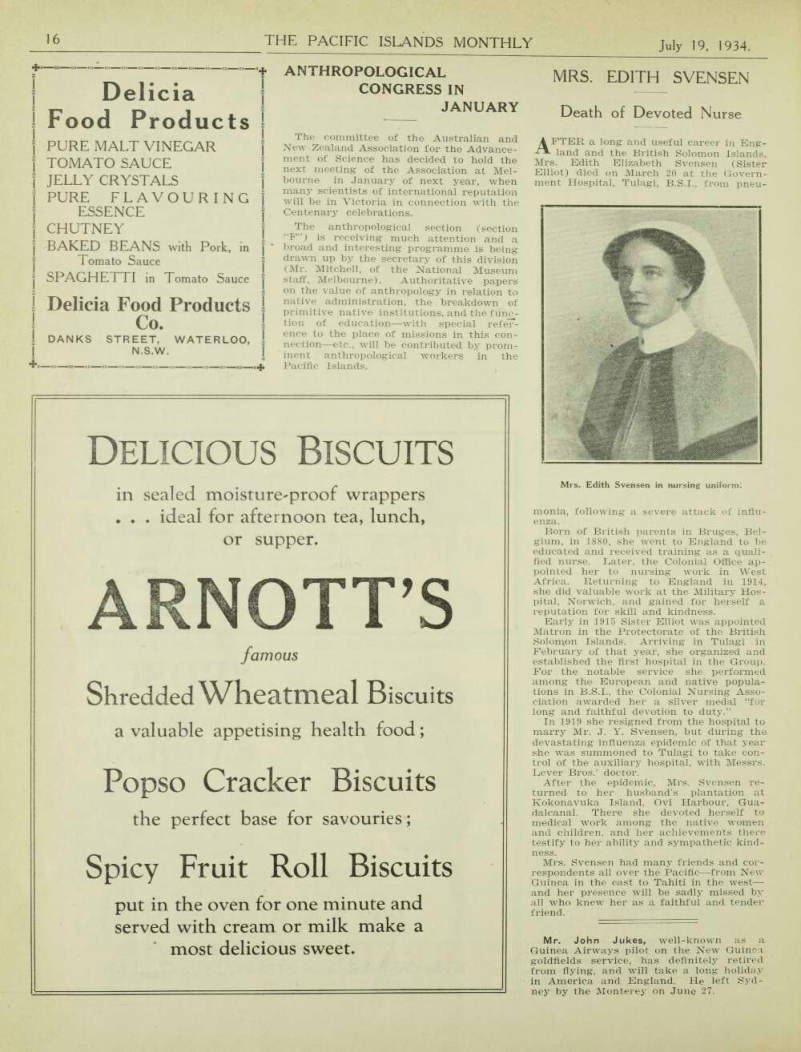
Congress In
January
The committee of the Australian and New Zealand Association for the Advance ment of Science has decided to hold the next meeting of the Association at Mel bourne in January of next year, when many scientists of international reputation will be in Victoria in connection with the Centenary celebrations.
The anthropological section (section “F”) is receiving much attention and a broad and interesting programme is being drawn up by the secretary of this division (Mr. Mitchell, of the National Museum staff, Melbourne). Authoritative papers on the value of anthropology in relation to native administration, the breakdown of primitive native institutions, and the func tion of education —with special refer ence to the place of missions in this con nection—etc., will be contributed by prom inent anthropological workers in the Pacific Islands.
Mrs. Edith Svensen
Death of Devoted Nurse
AFTER a long and useful career in England and the British Solomon Islands, Mrs. Edith Elizabeth Svensen (Sister Elliot) died on March 20 at the Govern ment Hospital, Tulagi, B.S.I., from pneu-
monia, following a severe attack of influ enza.
Born of British parents in Bruges, Bel gium, in 1880, she went to England to he educated and received training as a quali fied nurse. Later, the Colonial Office ap pointed her to nursing work in West Africa. Returning to England in 1914, she did valuable work at the Military Hos pital, Norwich, and gained for herself a reputation for skill and kindness.
Early in 1915 Sister Elliot was appointed Matron in the Protectorate of the British Solomon Islands. Arriving in Tulagi in February of that year, she organized and established the first hospital in the Group.
For the notable service she performed among the European and native popula tions in B.S.I., the Colonial Nursing Association awarded her a silver medal “for long and faithful devotion to duty.”
In 1919 she resigned from the hospital to marry Mr. J. Y. Svensen, but during the devastating influenza epidemic of that year she was summoned to Tulagi to take con trol of the auxiliary hospital, with Messrs.
Lever Bros.’ doctor.
After the epidemic, Mrs. Svensen re turned to her husband’s plantation at Kokonavuka Island, Ovi Harbour, Gua dalcanal. There she devoted herself to medical work among the native women and children, and her achievements there testify to her ability and sympathetic kind ness.
Mrs. Svensen had many friends and cor respondents all over the Pacific —from New Guinea in the east to Tahiti in the west — and her presence will be sadly missed by all who knew her as a faithful and tender friend.
Mr. John Jukes, well-known as a Guinea Airways pilot on the New Guinea goldfields service, has definitely retired from flying, and will take a long holiday in America and England. He left Syd ney by the Monterey on June 27.
Mrs. Edith Svensen in nursing uniform.
Fijian Chief
Death Of Notable
From Our Own Correspondent.
SUVA, June 20.
THE death occurred at Rewa on June 13 of Ratu Joni Mataitini, a high chief of the Province of Rewa, and one of the most highly respected chiefs of the Colony.
Ratu Joni was 70, having been born on April 13, 1865, coming from a long line of hereditary chiefs of Fiji. He had a long career in the Government service, and for a number of years was one of the repre sentatives of his people in the Legislative Council. He started on January 1, 1890, as a clerk to the Chief Medical Officer, at the same time acting as a native medical practitioner. In 1898 he was appointed a native inspector of police, and in 1904 he became Roko Tui Rewa. In 1913 he was transferred back to the Medical Depart ment, and on June 2, 1924, was appointed a native member of the Legislative Coun cil. On November 12 of the same year he was appointed assistant to the Native Lands Commissioner, an important post.
In September. 1926, he became a member of the Council of Chiefs at the same time being appointed a member of the Native Regulation Board. He was reappointed a member of the Legislative Council on January 1, 192§, and returned to the post of Roko Tui Rewa. He resigned on August 31, 1931, and had been living in retirement since. A son, Ratu Etuate Mataitini, who is at present Buli Rewa, survives him.
The funeral, which was attended by the Governor (Sir Murchison Fletcher) and other Government officials, was marked by picturesque native rites, including the presentation of tabua (whales’ teeth) and yaqona roots to the visitors, as well as the ceremonial making and drinking of yaqona (kava). The way to the grave was spread with tapa cloth and mats, and the coffin itself was wrapped in mats and tapa. As is usual with high chiefs, Ratu Joni was accorded military honours. The Rev. R.
L. McDonald, of the Methodist Mission, conducted the funeral service.
Pitcairn—An Inter-Ocean
Post Office
IT is not generally known that Pitcairn Island, famed for 100 years as the romantic and isolated home of the “Bounty” mutineers and their descendants, has became a kind of inter-ocean post office.
Pitcairn is almost exactly half-way be tween New Zealand and the Panama Canal —10 days from New Zealand and 11 days from Panama. It now has become a regular procedure for liners running be tween New Zealand and Europe, via Panama, to call at Pitcairn. The outgoing liners drop a mailbag there, addressed to New Zealand. A couple of days later a liner, coming from Panama, calls at Pit cairn, picks up the mailbag and takes it to New Zealand: and it, in its turn, drops a mailbag which the next liner going the other way picks up and takes back to Europe. In this manner, letters written aboard the ships can be sent back to the countries they have just left, and it is a service much appreciated by passengers.
The liners make only a brief call, lying about a mile from the rocky and forbidding shore, and passengers are seldom, if ever, allowed to land. The Pitcairners come out in a whaleboat, handing up one bag and receiving another. Whenever the weather permits, the Pitcairners send fruit aboard, either for sale to the ship itself, or for transport to the New Zealand market.
Empire Day In Fiji
Nabouwalu, June 2.
EMPIRE DAY was celebrated on May 24 with great enthusiasm. Europeans, and natives from many of the surround ing districts, gathered here, and about 2,000 people were present at the local sports ground early in the morning when Mr.
Nightingale, the District Commissioner, assisted by Inspector Munday, of the Con stabulary, unfurled the flag and addressed the assemblage on “Empire Day and Fiji.”
After the ceremony, the district school’s sports were held. These were followed by a novel “boiling the billy” contest which caused much amusement and excitement and was won by Naivakasiga district. In the afternoon football matches were played, though the games were marred somewhat by rain.
The European community and the lead ing chiefs were entertained in the even ing at a dinner given by Ratu David and his son, Ratu George. After appropriate speeches and toasts the evening was con cluded with a meTce given by local natives, who also rendered some delightful native songs.
Mr. R. Humphries, R.M. at Buna, Papua, accompanied by his wife, returned on the last “Montoro,” after six months holiday down South. Mr. Humphries’ two daughters, Rita and Petty, are at board ing school in Armidale, N.S.W.
Advertisements & other items, pp. 19-20 (1 item)
McILRATH’S ltd.
SPENCER NOLAN
DENTIST
139 ELIZABETH STREET
(2 doors from Market St.)
SYDNEY
’Phone F 3215
SPENCER NOLAN
DENTIST
28 OXFORD STREET
(Over Winns’ Ltd.)
SYDNEY
’Phone F 3215 Cable Address: Fastplate, Sydney
DO YOURSELF A “GOOD TURN”
BY SENDING AN ORDER TO
McILRATH’S ltd.
Best Roller Flour, 50lb 5/- bag, 8/- tin Californian Asparagus Tips, 9½oz. tins . . 1/2½ tin, 13/- doz.
Gartside’s Sweet Corn, 10oz. tins 7d. tin, 6/6 doz.
Granose Biscuits, 31b. tins 3/- tin, 35/- doz.
Capital Malted Wheat Krisps, 16oz pkts., 5½d. pkt., 5/3 doz.
Brandy Sultana Fruit Cake, 3lb. tins .. . 4/6 tin Australian Dutch Cheese, 4lb. balls .. . . 1/3 lb.
Kream Cornflour, 1lb. pkts 7d. pkt., 6/6 doz.
Temple Indian Curry Powder, ¼lb. tins . . 9½d. tin, 9/- doz.
Finest Khadrewi Dates, loose 4½d. lb., 4/- doz. Ib.
Globe Beef Dripping, 2lb. tins 1/3 tin, 14/6 doz.
Selmore Beef Dripping, pats 6d. lb., 5/6 doz.
C. &B. Herrings in Tomato Sauce, Jib. tins, 7d. tin, 6/9 doz.
Royle Rock Oysters, 10oz. tins 1/- tin, 11/6 doz.
Norseland Smoked Sardines, ¼lb. tins ... 5d. tin, 4/9 doz.
Trefavenne Sardines in Oil, ¼lb. tins 8½d. tin, 8/- doz.
All Prices f.o.b. Sydney.
Price Lists available on application.
McILRATHS LTD.
Export Department, 202 Pitt Street, Sydney, Australia.
BIRKMYRE’S
WATERPROOF CANVAS
The Original and Best for all purposes where a thoroughly waterproof covering is required.
SAILCLOTHS, DUCKS, &c.
of FLAX, HEMP and COTTON.
FISHING NETS,
LINES & TWINES.
Extensive Stocks carried.
Ensuring prompt despatch.
THE
Gourock Rope-Work Export Co. Ltd.
397 KENT ST., SYDNEY, N.S.W.
Swallow & Ariell’s
Popular Assortments
QUEEN’S OWN MIXED BISCUITS:
A delightful assortment of Sweet and Cream Biscuits and Wafers in attractively labelled Tin.
LADIES’ AFTERNOON TEA:
Such favourites as Peter Pan Biscuits, Vanilla Custards, Oyster Cream Wafers, Champagne Fingers (12 varieties in all) comprise this Extra Choice Assortment. Supplied in No. 1 Flat Tins only.
MORNING TEA:
A square Flat Tin containing some of the less Rich varieties of our Sweet Biscuits, including Milk Arrowroot, Osborne, Coffee, Diamond, etc.
SWALLOW & ARIELL Ltd.
Islands Plantations
For Sale
WE have received from the owners de tails of various plantations which are for sale in New Guinea, the Solomon Islands, Norfolk Island and Fiji.
The information is on file at this office and is available for inspection by anyone who is interested in the purchase of Islands properties.
This company is not itself interested in the sale of plantation properties. We merely make this information available to possible purchasers as service to our readers. Beyond this we do not act as an intermediary. Persons who are interested in properties for sale, after obtaining the details at this office, should write directly to the owners.
Properties which are for sale include: Solomon Is.: Freehold coconut plantation, of about 140 acres, fully planted, delightfully situated, well-furnished bungalow and plantation buildings; with old-established trading station.
Norfolk Is.: 20 acres of Crown leasehold, nominal rental, rich soil, 3 acres cleared, new cottage, etc.
Also properties in Papua, New Guinea, Fiji, and New Hebrides.
Blackballed!
An Incident in Polynesia
AN incident that is typical of the social difficulties in Polynesia occurred re cently in Rarotonga, in connection with one of the European sports clubs.
A well-known resident, who is a business man, held in high regard, and a quiet, gentlemanly person, was nominated for associate membership of the club. He already was connected with another branch of the club’s sports, and he accepted mem bership without thought of rebuff.
The usual ballot was held, and all those present voted in favour. Then someone who had not been present objected to the method of the ballot, and it finally was declared invalid. Another ballot was ordered. To the astonishment of the can didate’s nominators, he was blackballed.
Someone had pointed out that the candi date was a half-caste —his mother was a Polynesian—and was married to a Poly nesian girl. Colour prejudices were stirred, and the candidate was turned away from the club.
The club committee then had the highly embarrassing duty of going to this quite unsuspecting man, and informing him of what had happened.
Candidate and nominators no doubt acted in perfect innocence and good faith; and fine old British institutions must be maintained; but several people in Raro tonga were very angry that so cruel a slight was gratuitously given to a man for whom they have a high regard.
San Cristoval Estates, B.S.I.
A net loss of £584 was sustained in the year ended June 30, 1933, by the San Cristoval Estates, Ltd., Melbourne, as shown in the accounts now available. The previous statement was for the eighteen months ended June 30, 1932, and showed a net loss of £1210, of which £368 occurred at the copra plantations.
The present report states that the sale of the two copra plantations on the island of San Cristoval has been completed. The profit and loss debit bal ance is £1794.
Dealing with the company’s interest in the Vani koro Timber Co., Pty., Ltd., the directors say that while the affairs of that company have improved considerably, they were greatly concerned in the matter of the mortgage debenture held by the Kauri Timber Co., Ltd., over the assets and under taking of the Vanikoro company.
An agreement was reached whereby the San Cristoval Estates will transfer 15,000 of the £1 shares in the Vanikoro Co. to the Kauri Timber Co., Ltd., in consideration of the latter company re fraining from exercising its powers as a debenture holder. Principal balance-sheet items of the San Cristoval Estates, Ltd., compare as under:—
June 30, 1932. 1933.
Liabilities— £ £ Capital paid up 46,929 .. 47,481 Sundry creditors 1,780 .. 399 Bank overdraft 981 ..
Assets— Plantation leasehold 2,620 ..
Vanikoro Co. share account .. 42,750 .. 42,750 Vanikoro Co. loan account .. 2,750 .. 2,750
Advertisements & other items, p. 20 (1 item)
Sydney Marine Agency
DO YOU WANT BOAT VALUE?
45ft. Ketch with Diesel engine, £600. 64ft. Schooner, £700. 74ft. Schooner, fitted with 70/80 h.p. Semi- Diesel, £1750. 111 ft. Aux. Schooner, with 200 h.p.
Diesel, £3250.
We specialise in Craft of all descriptions.
Enquiries Appreciated.
Sydney Marine Agency
72 PITT STREET, SYDNEY.
Works: Lavender Bay.
Notes From Fiji
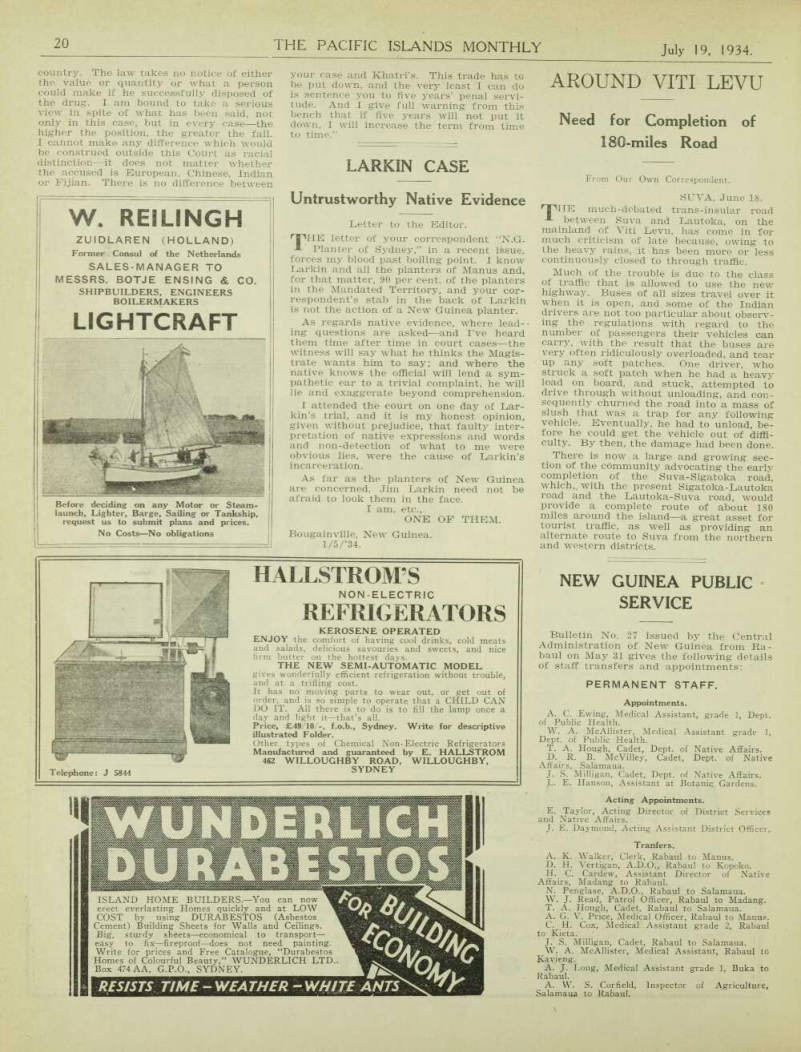
Honoured by the King
SUVA, June 18.
IT was announced by His Excellency the Governor (Sir Murchison Fletcher) on June 4, that the King had conferred knighthood on the Chief Justice, Captain Maxwell Maxwell-Anderson, C.B.E., K.C., R.N. (Retd.).
The Order of Member of the Most Ex cellent Order of the British Empire (Civil Division) was conferred on Mr. N. B.
Casey, Superintendent of Prisons, and Sowani Puamau, First Native Medical Practitioner in the Gilbert and Ellice Colony.
Commenting on the award to His Honour the Chief Justice, the “Fiji Times,” in an editorial, said: “It is interesting to note that many Fijians refer to the Chief Jus tice as the ‘vosa vakandua,’ the man who speaks once. By this they mean that the Court speaks the last word, either yes or no, and that what is said is final. In their manner of expressing things, it indicates the respect with which they regard the Court, and such respect could not be built up in any other way than by strict and impartial administration of the laws of the nation.”
Sunless, Rainy Weather
Fiji, at least that part in the vicinity of Suva, did not live up to its reputation of perpetual sunshine during May. The daily average amount of sunshine during the month was 2.3 hours. For the sixteen days from the 13th to the 29th, the grand total was only 1.1 hours, giving a daily average for the period of 0.07 hours.
The rainfall for May was greatly above the average, totalling 20.92 inches, com pared with an average for 50 years of 10.19 inches. There were 25 wet days in the month and the greatest fall in any one day was 2.99 inches on the 21st. The rainfall for the first five months of the year totals 83.47 inches, 23.02 inches above the average.
Finances
When it was learned, at the end of April, that Fiji’s Customs revenue for the first four months of the year was £17,601 below the estimates, some pessimistic prophecies were heard; but with the close of May, the figures show a remarkable recovery, the revenue for the five months being only £8,019 below the estimates for the period under review—a recovery of £9,582 during May.
Import duties for the five months totalled £108,295 compared with an estimate of £112,084, a decrease of £3,789. The total revenue for the period was £118,358, and the estimate was £126,377.
Five Years For Opium-Smuggli Ng
Close on the heels of the case against L. V. Khatri, who was sentenced to five years’ penal servitude and fined £250, for attempting to import Indian hemp, the Chief Justice (Captain Sir Maxwell Max well-Anderson) had to deal with another drug case at the recent criminal sessions of the Supreme Court. George Keat, a well known local Chinese, who pleaded guilty to a charge of being in possession of six tins of opium, was sentenced to five years’ penal servitude.
The accused was caught in possession of the drug on board the R.M.S. Aorangi, where he collected the parcel containing the opium from a Chinese passenger, Wong Chow, who was charged with at tempting to import opium, but acquitted on the grounds that he had no knowledge of the contents of the parcel, which had been delivered to him in Sydney by an unknown Chinese acting on cabled instruc tions from Keat, who knew that Wong Chow was returning to Fiji.
Sentencing the accused, His Honour said: “George Keat, you have pleaded guilty to this offence, which is a very serious one.
Only eight days before you committed the offence, every publicity, so far as publicity can be given in Fiji, was given to the case against Khatri, yet within a week you had the effrontery to commit this. I worked out very carefully the punishment in Khatri’s case, and I was very tempted to try the effect of seven years in your case.
It is a crime against the law of nations — even that of China —your own original
country. The law takes no notice of either the value or quantity or what a person could make if he successfully disposed of the drug. I am bound to take a serious view in spite of what has been said, nor. only in this case, but in every case—the higher the position, the greater the fall.
I cannot make any difference which would be construed outside this Court as racial distinction —it does not matter whether the accused is European, Chinese, Indian or Fijian. There is no difference between
your case and Khatri’s. This trade has to be put down, and the very least I can do is sentence you to five years’ penal servi tude. And I give full warning from this bench that if five years will not put it down, I will increase the term from time to time.”
Advertisements & other items, pp. 21-22 (1 item)
Aunt Marts
“STILLHOLME”
Convalescent and Rest Home
81 MUSTON ST., MOSMAN
SYDNEY
Sunny Rooms, Verandahs, Harbour Views, Lawns.
Centrally Situated, handy to Trams, Ferries, and City.
Sisters RAINSFORD and HILL Y 1655.
AUNT MARTS
“Defiance” PURE FOOD
PRODUCTS
—are prepared and packed by the proprietors of Aunt Mary’s Pure Food Products.
The finest quality goods are hermetically sealed to withstand tropical heat and give to consumers maximum satisfaction.
Supreme in quality and flavor, these pure food products have been supplied to the people of the Islands for more than thirty years. Specially manufactured and packed to meet Island conditions, they give complete satisfaction to both retailer and consumer.
Prepared and Packed only by—
TILLOCK & CO. LTD.
PURE FOOD MANUFACTURERS
KENT AND LIVERPOOL STREETS,
SYDNEY, N.S.W.
PROPELLER SHAFTS
FOR STRENGTH, RIGIDITY, RESISTANCE TO CORROSION, DURABILITY.
MONEL
Metal The Perfection of Straightness to which Monel Metal Shafting is drawn ensures Dynamic Balance—its remarkable rigidity minimises vibration and whipping.
Monel Metal is also stocked in Sheets, Wire, Flats, Hexagon, Tubes and Woven Wire insect screen. Monel Metal Shafting up to 3 inches diameter on hand.
W. REILINGH
ZUIDLAREN (HOLLAND)
Former Consul of the Netherlands
SALES-MANAGER TO
MESSRS. BOTJE ENSING & CO.
SHIPBUILDERS, ENGINEERS
BOILERMAKERS
LIGHTCRAFT
Before deciding on any Motor or Steamlaunch, Lighter, Barge, Sailing or Tankship, request us to submit plans and prices.
No Costs—No obligations
Telephone: J 5844
HALLSTROMS
NONELECTRIC
REFRIGERATORS
KEROSENE OPERATED
ENJOY the comfort of having cool drinks, cold meats and salads, delicious savouries and sweets, and nice firm butter on the hottest days.
THE NEW SEMI-AUTOMATIC MODEL
gives wonderfully efficient refrigeration without trouble, and at a trifling cost.
It has no moving parts to wear out, or get out of order, and is so simple to operate that a CHILD CAN DO IT. All there is to do is to fill the lamp once a day and light it—that’s all.
Price, £49/10/-, f.o.b., Sydney. Write for descriptive illustrated Folder.
Other types of Chemical Non-Electric Refrigerators Manufactured and guaranteed by E. HALLSTROM
462 WILLOUGHBY ROAD, WILLOUGHBY,
SYDNEY
ISLAND HOME BUILDERS.—You can now
erect everlasting Homes quickly and at LOW COST by using DURABESTOS (Asbestos Cement) Building Sheets for Walls and Ceilings.
Big, sturdy sheets—economical to transporteasy to fix—fireproof—does not need painting.
Write for prices and Free Catalogue, “Durabestos Homes of Colourful Beauty,” WUNDERLICH LTD..
Box 474 AA, G.P.O., SYDNEY.
RESISTS TIME - WEATHER - WHITE ANTS
Larkin Case
Untrustworthy Native Evidence
Letter to the Editor.
THE letter of your correspondent “N.G.
A Planter of Sydney,” in a recent issue, forces my blood past boiling point. I know Larkin and all the planters of Manus and, for that matter, 90 per cent, of the planters in the Mandated Territory, and your cor respondent’s stab in the back of Larkin is not the action of a New Guinea planter.
As regards native evidence, where lead ing questions are asked —and I’ve heard them time after time in court cases—the witness will say what he thinks the Magis trate wants him to say; and where the native knows the official will lend a sym pathetic ear to a trivial complaint, he will lie and exaggerate beyond comprehension.
I attended the court on one day of Lar kin’s trial, and it is my honest opinion, given without prejudice, that faulty inter pretation of native expressions and words and non-detection of what to me were obvious lies, were the cause of Larkin’s incarceration.
As far as the planters of New Guinea are concerned, Jim Larkin need not be afraid to look them in the face.
I am, etc.,
One Of Them.
Bougainville, New Guinea. 1/5/’34.
Around Viti Levu
Need for Completion of 180-miles Road
From Our Own Correspondent.
SUVA, June 18.
T'HE much-debated trans-insular road between Suva and Lautoka, on the mainland of Viti Levu, has come in for much criticism of late because, owing to the heavy rains, it has been more or less continuously closed to through traffic.
Much of the trouble is due to the class of traffic that is allowed to use the new highway. Buses of all sizes travel over it when it is open, and some of the Indian drivers are not too particular about observ ing the regulations with regard to the number of passengers their vehicles can carry, with the result that the buses are very often ridiculously overloaded, and tear up any soft patches. One driver, who struck a soft patch when he had a heavy load on board, and stuck, attempted to drive through without unloading, and con sequently churned the road into a mass of slush that was a trap for any following vehicle. Eventually, he had to unload, be fore he could get the vehicle out of diffi culty. By then, the damage had been done.
There is now a large and growing sec tion of the community advocating the earlv completion of the Suva-Sigatoka road, which,, with the present Sigatoka-Lautoka road and the Lautoka-Suva road, would provide a complete route of about 180 miles around the island—a great asset for tourist traffic, as well as providing an alternate route to Suva from the northern and western districts.
New Guinea Public
Service
Bulletin No. 27 issued by the Central Administration of New Guinea from Ra baul on May 31 gives the following details of staff transfers and appointments:
Permanent Staff.
Appointments.
A. C. Ewing, Medical Assistant, grade 1, Dept, of Public Health.
W. A. McAllister, Medical Assistant grade 1, Dept, of Public Health.
T. A. Hough, Cadet, Dept, of Native Affairs.
D. R. B. McVilley, Cadet, Dept, of Native Affairs, Salamaua.
J. S. Milligan, Cadet, Dept, of Native Affairs.
L. E. Hanson, Assistant at Botanic Gardens.
Acting Appointments.
E. Taylor, Acting Director of District Services and Native Affairs.
J. E. Daymond, Acting Assistant District Officer.
Tranfers, A. K. Walker, Clerk, Rabaul to Manus.
D. H. Vertigan, A.D.O., Rabaul to Kopoko.
H. C. Cardew, Assistant Director of Native Affairs, Madang to Rabaul.
N. Penglase, A.D.O., Rabaul to Salamaua.
W. J. Read, Patrol Officer, Rabaul to Madang.
T. A. Hough, Cadet, Rabaul to Salamaua.
A. G. V. Price, Medical Officer, Rabaul to Manus.
C. H. Cox, Medical Assistant grade 2, Rabaul to Kieta.
J. S. Milligan, Cadet, Rabaul to Salamaua.
W. A. McAllister, Medical Assistant, Rabaul to Kavieng.
A. J. Long, Medical Assistant grade 1, Buka to Rabaul.
A. W. S. Corfield, Inspector of Agriculture, Salamaua to Rabaul.
Natives’ Criminal Offences
How Many Are Due to Misunderstanding?
Letter to the Editor
ALLOW me to endorse the opinions expressed relative to criminal offences committed by natives of Papua and other parts, referred to in your recent issues.
During a number of years I was located close to one of the most Gilbertian jails in the Pacific. This afforded me an op portunity of observing prison life and its effect on the native prisoners, with whom I often conversed.
This jail we will call Bluffingata (the native name). It is a sort of sanitorium.
Here prisoners and their warders fatten and thrive, swim in the local stream, and sing to the ukelele. Relatives and friends see to it that the prisoners want for noth ing in the way of food—pork, fish, chic kens, and cooked delicacies, cakes and tobacco are taken in by the native war ders, who are not infrequently relatives of the prisoners.
It seems a pity that these native priso ners could not be instructed in making some useful commodity, such as hand made coir rope—say, so many yards per diem. This would offset the huge cost of upkeep of the jail. Certainly, the prisoners are part-time employed in planting taro roots, which helps to reduce the food cost.
But to call this “work” is absurd. “Cala boose” means rest, rather than punish ment, to these prisoners.
There is another “jail,” not a thousand miles from Port Moresby, where one may listen to the merry laughter and songs of the rogues who pass the time there. One of them whom I knew acted as a guide, during the daytime, to tourists.
In cases of criminal assault, such as shocked the residents of Papua recently, nothing will curb such tendencies so much as a flogging, administered publicly. This
shames the prisoner in the eyes of his relatives.
Many of the crimes committed by natives arise from wrongful impressions or misunderstandings, often due to their master’s ignorance of the native dialect or customs. It is very often the case that the master has to resort to the very unsatisfactory use of an interpreter.
Otherwise, he endeavours to make himself understood by means of the equally un satisfactory Pidgin English.
I have seen police boys thrashed, in the New Hebrides, for making slight mistakes after having said “Me savee,” when the orders given in “Pidgin” were not pro perly understood by the natives.
On a Crown estate in Samoa, a manager came upon a native worker smoking. The manager flew into a violent rage, and then, in the choicest English, he said: ’’You heliotrope blazes! If I catch you at that again, I’ll knock the life out of you.”
The native continued smoking, and was struck by a stone on the head. He then stood up and asked (in native), “What is the matter?” For this “insolence,” the native was arrested and put in jail. Had the manager only known how to say “Stop that smoking!” in the vernacular, he would have been obeyed. The native did not know English.
Misunderstandings between white men and the primitive native often end in a grudge developing against the white mas ter—unknown to him, of course—fre quently on account of punishment that is perhaps undeserved. Hence “crimes” are committed.
I am, etc.,
Jim Irish.
Apia, Samoa, April 28, 1934.
Dr. Leslie S. Duke, Government Medical Officer at Norfolk Island arrived in Sydney on furlough by the Morinda on June 25.
He returned to Norfolk Island by the July Morinda.
Teams representing- the 1st—19th Battalion (East and South Sydney Regiment) and the rifle clubs of Rabaul engaged in a home and home shooting match on June 23 and 24. It was the first occasion that there had been a sporting fixture between the Territory and Australia.
Advertisements & other items, pp. 23-24 (1 item)
Marine Engines
The "VINCO”
2½ and 4 h.p. Inboard, 3-port 2-cycle Marine Engines Price: 21 H.P. .. £28/-/- Complete 4 H.P. .. £40/10/- Complete
F.O.B. SYDNEY.
All Installation Fittings Supplied.
2½ H.P. 4 H.P.
Height 12 ins. 17 ins.
Weight 60 lbs. 120 lbs.
Bore and Stroke 254$ x 2 y 2 3% x 3% Tank Capacity 1 gal. gals.
For comparison, we submit the following advantages peculiar to the “Vinco”: — 1. No gears to wear, chains to break, or valves to stick. 2. A belli thrust eliminates friction from the push of the propeller. This ball thrust is housed in the flywheel which keeps it free from sand and grit. 3. No rubber hose pump connections to perish and choke the water circulating system.
We use good copper tubing with machined brass fittings. 4. Best quality copper hardened white metal bearings throughout. 5. Float-chamber carburetter —all brass and heavily nickelled. 6. Our unique pump drive enables us to keep the body of the pump close to the cylinder and at the same time retain a long bearing, part of which is hidden by the flywheel. 7. The crankshaft is fitted with balance weights which eliminate all vibration. This prolongs engine life and promotes comfort. 8. High grade magneto directly driven and easily detached. Impulse starter. 9. So perfectly balanced is the drive to the magneto that it will run without being fastened down. This in turn relieves the magneto bearing of all load. 10. Water trap fitted in muffler to prevent water getting into the engine. 11. Large size grease cups fitted to main bearings to ensure perfect lubrication. 12. Drain tap fitted under crankcase. 13. Very strong section Manganese Bronze propeller scientifically designed to afford maximum efficiency and speed. 14. Brass petrol tank.
Our written guarantee for 5 years Protects Purchasers against Risk.
Manufactured by
VINCENT BROS.
Engineers, Founders and Pattern-makers
44 WENTWORTH PARK RD.. GLEBE
SYDNEY, N.S.W.
ASK FOR IT
ESTABLISHED 1868.
M. HARPER
MANDOLIANA ISLAND,
NORTH GELA, B.S.I.
Postal Address: P.O. Box 6, Tulagi, Solomon Islands.
Recruiting Contracts Undertaken.
Auxiliary vessel “Papari” available for Charter.
Full details of Services from
BURNS PHILP (S.S.) CO., LTD.,
Makambo (B.S.I.) and Sydney.
GLEBE
Engineering Works
Cook Street
GLEBE, SYDNEY
Telephone: MW1903 General and structural engineers, blacksmiths, boilermakers, oxy and electric welders.
Specializing in mining machinery, trucks, kipples, conveyors and elevators, water pipes.
Estimates Free of Charge Construction and machines made to any design.
The
“Caledonia Dover”
A COOKING STOVE guaranteed to give complete satisfaction and now recognised as THE BEST on the market. Suitable for coal, coke or wood fuel.
Illustrated Catalogue on request.
LANE & GIRVAN, LTD.,
BONNY BRIDGE, SCOTLAND.
TARIFF:
Single Room and Breakfast from 8/-
HOTEL MANSIONS
SYDNEY’S IDEALLY SITUATED PALATIAL HOTEL
per night.
WEEKLY
from £2/2/
WIRES:
Renowned for Exquisite Cuisine, Perfect Service and Luxurious Appointments.
Make the Mansions your home whilst in Sydney and enjoy Unsurpasse om or at Moderate Cost.
INDIVIDUAL, DOUBLE ROOMS AND FAMILY SUITES
ADDRESS: Bayswater “Mansions,” Sydney.
INCLUSIVE
TARIFF:
Single Room from 12/ per diem.
WEEKLY
from £3/10/- Rd., King’s Cross.
Unilever Combine
Fall in Margarine Profits
THE following comment on Unilever’s activities during last year was circu lated early in June by Messrs. Brown and Joske Ltd., Suva, to members of the Coco nut Planters' Union of Fiji.
“The ‘Economist’ of May 5 surveys the annual reports of the various Unilever Companies. The impression left is that the Combine had done better from the manufacture of soap than margarine. The total sales of Lever Bros, amounted to 2,093,000 tons of soap, representing a turn over of £58½ millions.
“Unilever has suffered from Government interference in various countries, e.g., Germany, where the Government, to assist the farming population, decreed a reduc tion in the Company’s output, accompanied by a request that no factories should be closed or staff reduced. Raw material prices continued to fall and in the oil crushing industry the loss of earnings from this cause was equivalent to over 3 per cent, sterling on the ordinary capital of the two Unilever Companies.
“The greatest difficulty, however, arose from the extremely low prices of butter and lard. Between 1928- and 1933 butter consumption in the U.K. increased from 16.7 lbs. per head of the population to 23.3 lbs., but margarine fell from 13.2 lbs. to 8.4 lbs. The Chairman of one of the Group Companies is said to have attacked the Dominions’ powers of free entry of butter under the Ottawa Agreement and to have suggested that this should be terminated after October, 1935. None of the Chair man’s speeches contained any hint of speedy removal of last year’s difficulties.”
Whale Oil.
The whaling season, just finished, showed a production of 2,355,000 barrels of whale oil. as against 2,477,810 barrels in the previous season. About one million barrels were produced by companies which are wholly and entirely Norwegian. The whole production has not yet been sold.
“Controlled” Areas In
N. Guinea
Described as “Dangerous”
INCENSED at reports criticising the punishment inflicted by D. O. Taylor and his party on natives in the Morobe area, where Capt. Bernard McGrath was killed recently, Mr. Robert Dugan, director of N. G. Alluvials Ltd. (the company for which Mr. McGrath was working) made a strong protest when he reached Rabaul from Salamaua at the end of May. He said that Europeans are constantly carry ing their lives in their hands in areas which are described as “controlled.”
“On the day preceding McGrath’s mur der in Karmunantina,” he said, “I was in a place five hours’ walk away, where I witnessed an inter-tribal fight between several hundreds of natives on opposite ridges, manoeuvouring for a position in open grass country. The rapidity of their movements, the advantage taken of posi tions, and the cutting off of isolated parties of natives was amazingly like the action of trained troops. Every village in this area is practically a fortress, constructed to command all approaches.
“The natives are crafty and experts in all kinds of bush fighting, employing many methods of ambushing. Natives within six hours’ walk of Ramu aero drome are continually fighting. Inter tribal fights are a daily occurence. The Lutheran Mission is doing its utmost to prevent constant warfare, and I freely endorse the action of all concerned.
“I strongly deprecate reports not giving credit to the men who rushed to my res cue and assisted the Administration.
Messrs. Ubank and Peadon forfeited a daily return of £10 at their own mines, and travelled night and day through hos tile country immediately on receipt of the news of McGrath’s death. Mr. Mick Leahy camped on the scene of the murder with 20 of his labourers, while Mr. Dan Leahy walked 60 miles over mountainous country in 32 hours for assistance. I as sisted District Officer Taylor during the whole of the action, and great credit is due to him, and his cadets, Black and Aitchison, and the native police, for the manner in which the situation was hand led.
“The fact that D.O. Taylor, with three white men and 17 native police, within 48 hours of their arrival on the scene, forced the surrender of 500 natives with only 17 fatalities, speaks volumes for their restraint and the tactics he employ ed. Two of the Lutheran Mission native teachers rendered invaluable assistance by interpreting at the time of the surren der.”
Important Public Utility
Aerial Transport In
New Guinea
THE average freight rate charged by Guinea Airways. Ltd., operating on the Morobe Goldfield, New Guinea, fell from 12d per lb. in February, 1928, to 4.12 d per lb. in February, 1934.
Bringing this matter under the notice of shareholders at the general meeting held recently in Adelaide, Mr. C. V.
T. Wells, chairman of directors, said the average rate of the bulk of the cargo was now well below 4d per lb. That applied to the main routes from the coast to the mountain township of Wau, which was the hub of the mining district. It was necessary for obvious reasons to charge higher rates to the outlying districts. That had raised the average rate in the last two years, during which time the radius of the company’s activities had so rapidly lengthened. The directors believed, how ever, that in the current year they could make still further reductions to assist the increasing population to live more cheaply.
With a turnover of well above £100,000, said Mr. Wells, it was found necessary to write off only £3/10/11 as bad debts. That was a tribute to the type of pioneer Aus tralia had permitted to occupy and develop the Mandated Territory.
It had been found necessary to put Fiji Airways Ltd. into liquidation a few months ago, with the result that the £1200 invested in the company by Guinea Airways Ltd., had been written down in the ac counts to the nominal sum of £10.
Apart from the shipping services, Guinea Airways Ltd. was by far the most im portant public utility in New Guinea, and was the means of making available the bulk of the Government revenue from mining royalties. The company had com pleted the carriage of the fourth dredge for Bulolo Gold Oredging Ltd. and recent discoveries indicated that even larger dredging plants might be needed.
Shareholders decided that the remunera tion to be divided between the five direc tors for the ensuing year be £2400, an in crease of £1000.
N.G. Tender
The Federal Government received only one tender for the seaplane which it is proposed to establish in Rabaul for the carriage of passengers and goods by air in New Guinea —particularly in the cen tral and eastern portions of the Mandated
Territory. It is not yet known whether the tender referred to will be accepted.
It is not surprising that aviation in terests took little interest in the Federal Government’s plan. The minimum amount guaranteed by the Federal Government (£1600 per annum) was altogether inadequate for the purpose. The cost of main taining a seaplane or seaplanes in first class order under tropical conditions such as rule in Rabaul is very heavy. The cost of personnel is also heavy—thoroughly competent men must receive remuneration considered adequate according to tropical standarrds.
Fiji’S Mistake
As stated previously, the attempt to establish a seaplane service in Fiji was abandoned at the beginning of this year, after it had cost Guinea Airways Ltd. some £1,200. The same lack of under standing of aerial transport conditions in the tropics was to be seen there, in an altogether inadequate Government subsidy.
The Government of Fiji could well have afforded to have provided a generous sub sidy, so as to enable the sound establish-
ment of a form of transport that will make a world of difference to administrative and residential conditions in the tropical islands of the Pacific.
The withdrawal of Fiji Airways Ltd. will long remain as a reproach to the Govern ment of Fiji. The latter could have taken the long view and shown the way to other Pacific Administrations in making use of aerial transport, and thus have done a great service to the Pacific Territories generally. As it is, the experience of those who tried to establish Fiji Airways Ltd. will discourage other similar enterprises and correspondingly retard the introduc tion of aeroplanes in the Islands.
The use of aeroplane transport on an extensive scale in the Islands is inevitable.
That is as clear to-day to those with any vision, as the ultimate use of radio com munication in the Islands became apparent to those who studied the possibilities of the new method when it was introduced a couple of decades ago. A man with half an eye can see that, with radio and aviation, the potential value of the Pacific Islands —commercial, residential, and mili tary—is enormously increased.
Advertisements & other items, p. 25 (1 item)
Australian Hardwoods
Blue 6, Gold Label Australia House Australia New Zealand. JULIUS BLAU Streep and The Pacific Islands. Sydney.
TO PACIFIC ISLANDS BUILDERS
AND CONTRACTORS
AUSTRALIAN HARDWOODS
For all classes of Buildings and heavy Constructional work, Wharves, Jetties, etc.
Send details and we will quote by radio or return mail, as desired.
Islands Timbers
We shoxdd he glad to have details of any Islands Timbers which might he suitable for sale in Australia.
E. J. BURNSIDE & CO. LTD.
Australia House, Wynyard Square
SYDNEY
Cable address; “GRADATIM,” Sydney.
Thursday Is. Notes
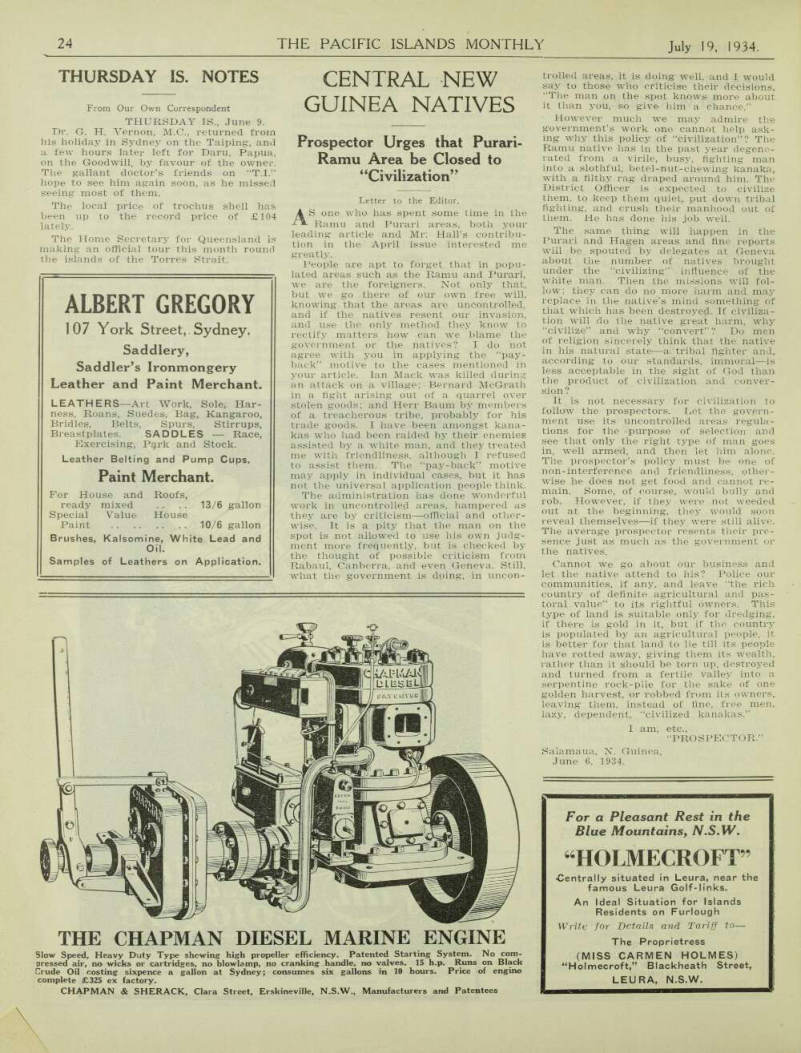
From Our Own Correspondent
Thursday Is., June 9.
Dr. G. H. Vernon, M.C., returned from his holiday in Sydney on the Taiping, and a few hours later left for Daru, Papua, on the Goodwill, by favour of the owner.
The gallant doctor’s friends on “T.I.” hope to see him again soon, as he missed seeing most of them.
The local price of trochus shell has been up to the record price of £104 lately.
The Home Secretary for Queensland is making an official tour this month round the islands of the Torres Strait.
Guinea Natives
Central New
Prospector Urges that Purari- Ramu Area be Closed to “Civilization”
Letter to the Editor.
AS one who has spent some time in the Ramu and Purari areas, both your leading article and Mr; Hall’s contribu tion in the April issue interested me greatly.
People are apt to forget that in popu lated areas such as the Ramu and Purari, we are the foreigners. Not only that, but we go there of our own free will, knowing that the areas are uncontrolled, and if the natives resent our invasion, and use the only method they know to rectify matters how can we blame the government or the natives? I do not agree with you in applying the “pay back” motive to the cases mentioned in your article. Ian Mack was killed during an attack on a village; Bernard McGrath in a fight arising out of a quarrel over stolen goods; and Herr Baum by members of a treacherous tribe, probably for his trade goods. I have been amongst kana kas who had been raided by their enemies assisted by a white man, and they treated me with friendliness, although I refused to assist them. The “pay-back” motive may apply in individual cases, but it has not the universal application people think.
The administration has done wonderful work in uncontrolled areas, hampered as they are by criticism —official and other wise. It is a pity that the man on the spot is not allowed to use his own judg ment more frequently, but is checked by the thought of possible criticism from Rabaul, Canberra, and even Geneva. Still, what the government is doing, in uncon
trolled areas, it is doing well, and I would say to those who criticise their decisions, “The man on the spot knows more about it than you, so give him a chance.”
However much we may admire the government’s work one cannot help ask ing why this policy of “civilization”? The Ramu native has in the past year degene rated from a virile, busy, fighting man into a slothful, betel-nut-chewing kanaka, with a filthy rag draped around him. The District Officer is expected to civilize them, to keep them quiet, put down tribal fighting, and crush their manhood out of them. He has done his job well.
The same thing will happen in the Purari and Hagen areas and fine reports will be spouted by delegates at Geneva, about the number of natives brought under the “civilizing” influence of the white man. Then the missions will fol low; they can do no more harm and may replace in the native’s mind something of that which has been destroyed. If civiliza tion will do the native great harm, why “civilize” and why “convert”? Do men of religion sincerely think that the native in his natural state —a tribal fighter and, according to our standards, immoral —is less acceptable in the sight of God than the product of civilization and conver sion?
It is not necessary for civilization to follow the prospectors. Let the govern ment use its uncontrolled areas regula tions for the purpose of selection and see that only the right type of man goes in, well armed, and then let him alone.
The prospector’s policy must be one of non-interference and friendliness, other wise he does not get food and cannot re main. Some, of course, would bully and rob. However, if they were not weeded out at the beginning, they would soon reveal themselves —if they were still alive.
The average prospector resents their pre sence just as much as the government or the natives.
Cannot we go about our business and let the native attend to his? Police our communities, if any, and leave “the rich country of definite agricultural and pas toral value” to its rightful owners. This type of land is suitable only for dredging, if there is gold in it, but if the country is populated by an agricultural people, it is better for that land to lie till its people have rotted away, giving them its wealth, rather than it should be torn up, destroyed and turned from a fertile valley into a serpentine rock-pile for the sake of one golden harvest, or robbed from its owners, leaving them, instead of fine, free men, lazy, dependent, “civilized kanakas.”
I am, etc.,
“Prospector.”
Salamaua, N. Guinea, June 6, 1934.
Advertisements & other items, p. 26 (2 items)
Albert Gregory
107 York Street,. Sydney.
Saddlery,
Saddler’s Ironmongery
Leather and Paint Merchant, LEATHERS— Art Work, Sole, Harness, Roans, Suedes, Bag, Kangaroo, Bridles, Belts, Spurs, Stirrups, Breastplates. SADDLES Race, Exercising, Park and Stock.
Leather Belting and Pump Cups.
Paint Merchant.
For House and Roofs, ready mixed . . . . 13/6 gallon Special Value House Paint 10/6 gallon Brushes, Kalsomine, White Lead and Oil.
Samples of Leathers on Application.
THE CHAPMAN DIESEL MARINE ENGINE
Slow Speed, Heavy Duty Type shewing high propeller efficiency. Patented Starting System. No compressed air, no wicks or cartridges, no blowlamp, no cranking handle, no valves. 15 h.p. Runs on Black Crude Oil costing sixpence a gallon at Sydney; consumes six gallons in 10 hours. Price of engine complete £325 ex factory.
CHAPMAN & SHERACK, Clara Street, Erskineville, N.S.W., Manufacturers and Patentees
“Holmecroft”
For a Pleasant Rest in the Blue Mountains, N.S.W.
Centrally situated in Leura, near the famous Leura Golf-links.
An Ideal Situation for Islands Residents on Furlough Write for Details and Tariff to — The Proprietress
(MISS CARMEN HOLMES)
“Holmecroft,” Blackheath Street,
LEURA. N.S.W.
In Papua
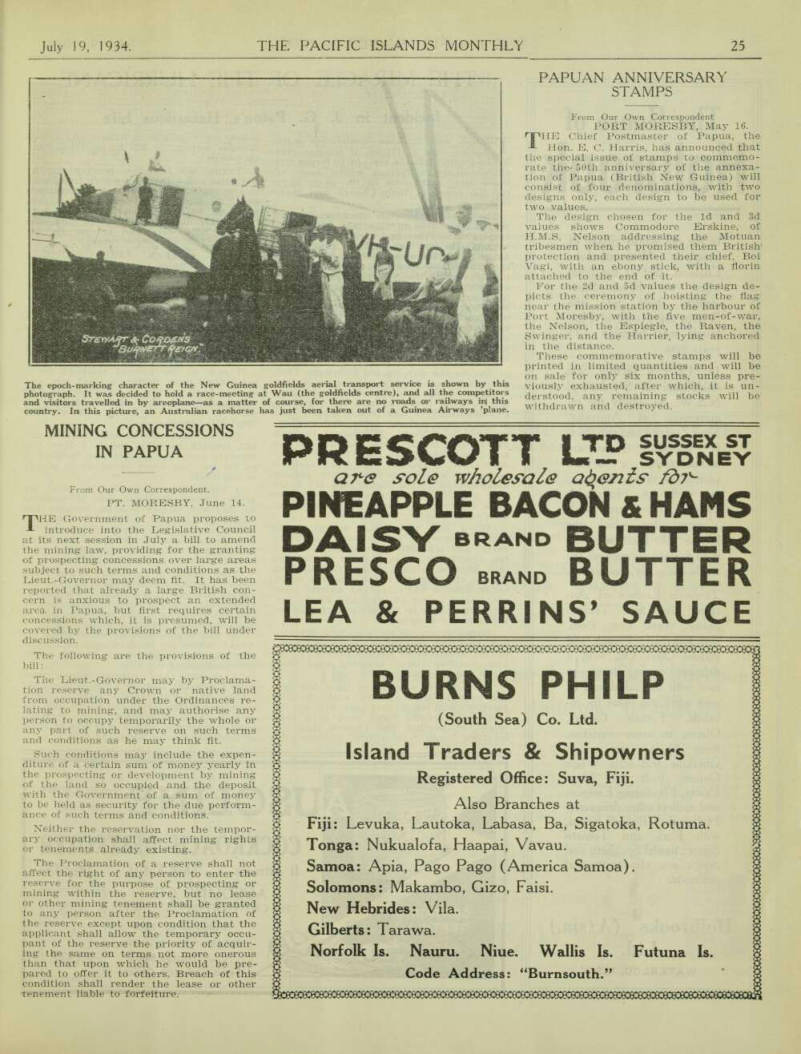
Mining Concessions
From Our Own Correspondent.
Pt. Moresby, June 14.
THE Government of Papua proposes to introduce into the Legislative Council at its next session in July a bill to amend the mining law, providing for the granting of prospecting concessions over large areas subject to such terms and conditions as the Lieut.-Governor may deem fit. It has been reported that already a large British con cern is anxious to prospect an extended area in Papua, but first requires certain concessions which, it is presumed, will be covered by the provisions of the bill under discussion.
The following are the provisions of the bill: The Lieut.-Governor may by Proclama tion reserve any Crown or native land from occupation under the Ordinances re lating to mining, and may authorise any person to occupy temporarily the whole or any part of such reserve on such terms and conditions as he may think fit.
Such conditions may include the expen diture of a certain sum of money yearly in the prospecting or development by mining of the land so occupied and the deposit with the Government of a sum of money to be held as security for the due perform ance of such terms and conditions.
Neither the reservation nor the tempor ary occupation shall affect mining rights or tenements already existing.
The Proclamation of a reserve shall not affect the right of any person to enter the reserve for the purpose of prospecting or mining within the reserve, but no lease or other mining tenement shall be granted to any person after the Proclamation of the reserve except upon condition that the applicant shall allow the temporary occu pant of the reserve the priority of acquir ing the same on terms not more onerous than that upon which he would be pre pared to offer it to others. Breach of this condition shall render the lease or other tenement liable to forfeiture.
The epoch-marking character of the New Guinea goldfields aerial transport service is shown by this photograph. It was decided to hold a race-meeting at Wau (the goldfields centre), and all the competitors and visitors travelled in by areoplane—as a matter of course, for there are no roads or railways in this country. In this picture, an Australian racehorse has just been taken out of a Guinea Airways ’plane.
Papuan Anniversary
Stamps
From Our Own Correspondent
Port Moresby, May 16.
THE Chief Postmaster of Papua, the Hon. E. C. Harris, has announced that the special issue of stamps to commemo rate the 50th anniversary of the annexation of Papua (British New Guinea) will consist of four denominations, with two designs only, each design to be used for two values.
The design chosen for the 1d and 3d values shows Commodore Erskine, of H.M.S. Nelson addressing the Motuan tribesmen when he promised them British protection and presented their chief, Boi Vagi, with an ebony stick, with a florin attached to the end of it.
For the 2d and 5d values the design de picts the ceremony of hoisting the flag near the mission station by the harbour of Port Moresby, with the five men-of-war, the Nelson, the Espiegle, the Raven, the Swinger, and the Harrier, lying anchored in the distance.
These commemorative stamps will be printed in limited quantities and will be on sale for only six months, unless pre viously exhausted, after which, it is un derstood, any remaining stocks will be withdrawn and destroyed.
Advertisements & other items, pp. 27-28 (1 item)
Prescott
are sole wholesale agents for
PINEAPPLE BACON & HAMS
DAISY BRAND BUTTER
FRESCO BRAND BUTTER
LEA & PERRINS’ SAUCE
BURNS PHILP
(South Sea) Co. Ltd.
Island Traders & Shipowners Registered Office: Suva, Fiji.
Also Branches at Fiji : Levuka, Lautoka, Labasa, Ba, Sigatoka, Rotuma.
Tonga: Nukualofa, Haapai, Vavau.
Samoa: Apia, Pago Pago (America Samoa).
Solomons: Makambo, Gizo, Faisi.
New Hebrides: Vila.
Gilberts: Tarawa.
Norfolk Is. Nauru. Niue. Wallis Is. Futuna Is.
Code Address: “Burnsouth.”
The House of
Holbrook
In the old world village of Stourport, Worcestershire, England, just at the point where the River Stour empties itself into the Severn, the House of Holbrook was founded 133 years ago.
In 1919 a factory was established in Sydney, N.S.W., to supply the requirements of Australia, New Zealand and the Pacific Islands. Here are manufactured a wide variety of table delicacies, as well as Holbrook’s Sauces and Pure Malt Vinegar, for which the House of Holbrook has been famous throughout the world for many generations.
There is Essence of Anchovy for fish, Tomato Sauce, made from fresh, ripe tomatoes; French and Italian Olive Oil, with a delicate, creamy taste —so nice with the salad and of such nutritious value for invalids, French Capers, Olives, in many varieties, from Spain; tiny sweet Gherkins and little White Onions, Fish and Meat Pastes, Flavouring Essences and endless other delicacies.
Holbrooks’ Baked Beans, with Pork and Tomato Sauce; tinned Spaghetti and Soups are also tasty and delicious.
Holbrooks (A/sia.)
Ltd.
WATERLOO, N.S.W.
The Miracle Of The Hurricane
Incident in J. G. Paton’s Hazardous Life
THOSE who criticise —sometimes with justice—the activities of missionaries in the Pacific Islands are apt to forget the extraordinary sufferings which some of those men underwent in the early days for the cause of their Church and their God.
The Foreign Mission literature of the period from 1830 to 1890 teems with ex amples of sacrifice and heroism. Here, for example, is just one incident taken ver batim out of the memoirs of the Rev. John G. Paton, who spent the greater part of his life among the New Hebrides savages and who eventually was numbered among the martyrs. On this occasion Mr. Paton had been driven away from his mission on Tanna Island by the natives and he had taken refuge with two other mission aries—a Mr. and Mrs. Mathieson. The natives were on the warpath and search ing for Mr. Paton.
“During the day, on 3rd February, 1862, a company of Miaki’s men came to the Mission House, and forced Mrs. Mathie son to show them through the premises.
Providentially, I had bolted myself that morning into a closet room, and was en grossed in writing. They went through every room in the house and did not see me, concluding I had gone inland. They discharged a musket into our teacher’s house, but afterwards left quietly, greatly disappointed at not finding me. My heart still rose in praise of God for another such deliverance, neither by man nor of man’s planning!
“Worn out with long watching and many fatigues, I lay down that night early, and fell into a deep sleep. About ten o’clock the savages again surrounded the Mission House. My fathful dog Clutha, clinging still to me amid the wreck of all else on earth, sprang quietly upon me, pulled at my clothes, and awoke me showing danger in her eye glancing at me through the shadows.
“I silently awoke Mr. and Mrs. Mathie son, who had also fallen asleep. We com mitted ourselves in hushed prayer to God and watched them, knowing that they could not see us.
“Immediately a glare of light fell into the room! Men passed with flaming torches; and then they set fire to the Church all round, and then to a reed fence connecting the Church and the dwelling-house. In a few minutes the
house, too, would be in flames, and armed savages waiting to kill us on attempting an escape!
“Taking my harmless revolver in the left hand and a little American tomahawk in the right, I pled with Mr. Mathieson to let me out and instantly again to lock the door on himself and wife. He very reluctantly did so, holding me back and saying, ‘Stop here and let us die to gether! You will never return!’
“I said: ‘Be quick! Leave that to God.
In a few minutes our house will be in flames, and then nothing can save us.’
“He did let me out, and locked the door again quickly from the inside; and, while his wife and he prayed and watched for me from within, I ran to the burning reed fence, cut it from top to bottom, and tore it up and threw it back into the flames, so that the fire could not by it be carried to our dwelling-house.
“I saw on the ground shadows, as if something were falling around me, and started back. Seven or eight savages had surrounded me, and raised their great clubs in the air. I heard a shout —‘Kill him! kill him!’
“One savage tried to seize hold of me,, but, leaping from his clutch, I drew the revolver from my pocket and levelled it as for use, my heart going up in prayer to my God.
“I said: ‘Dare to strike me, and my Jehovah God will punish you. He protects us, and will punish you for burning His church, for hatred to His worship and people, and for all your bad conduct. We love you all; and for doing you good only you want to kill us. But our God is here now to protect us and punish you.’
“They yelled in rage, and urged each other to strike the first blow, but the In visible One restrained them. I stood in vulnerable beneath His invisible shield, and succeeded in rolling back the tide of flame from our dwelling-house.
“At this dread moment occurred an in cident, which my readers may explain as they like, but which I trace directly to the interposition of my God.
“A rushing and roaring sound came from the south, like the noise of a mighty engine, or of muttering thunder. Every head was instinctively turned in that di rection, and they knew, from previous hard experience, that it was one of their awful tornadoes of wind and rain.
“Now, mark, the wind bore the flames away from our dwelling-house; had it come in the opposite direction, no power on earth could have saved us from being all consumed ! It made the work of de stroying the Church only that of a few minutes; but it brought with it a heavy and murky cloud, which poured out a perfect torrent of tropical rain. Now, mark again, the flames of the burning Church were thereby cut off from extend ing to and seizing upon the reeds and the bush; and, besides, it had become almost impossible now to set fire to our dwelling house. The stars in their courses were fighting against Sisera!
“The mighty roar of the wind, the black cloud pouring down unceasing torrents, and the whole surroundings, awed those savages into silence. Some began to with draw from the scene, all lowered their weapons of war, and several, terror-stric ken, exclaimed: ‘That is Jehovah’s rain!
Truly, their Jehovah God is fighting for them and helping them. Let us away!’
“A panic seized upon them; they threw away their remaining torches; in a few moments they had all disappeared in the bush: and I was left alone, praising God for His marvellous works.”
Advertisements & other items, p. 28 (1 item)
Cockroach Destroyer
AUSOLINE
It Attracts They Eat It They Die
AUSOLINE CO.
3U CROWN STREET, SYDNEY
Established 1919 PRICES : 1 lb. 5/-, 3 lbs 10/-. Postage Extra Remit Cash with Order
IT’S
A
PASTE
Solomons
Defence of S.D.A. Mission In Solomons
Letter to the Editor YOUR correspondent, “Solomaniac,” is all at sea when he writes of the Seventh Day Adventist natives: All fish and meat are “tabu” with them. Pork and certain kinds of scavenger fish are, to a certain extent, “tabu,” as these are considered unclean feeders.
Let “Solomaniac” prove this for himself by offering them a tin or two of meat and see what they do with it.
His picture of the men loafing in the villages while the women work is too sweeping an assertion. In my experience I have found that the boys have their work, such as cleaning groves and roads, copra-collecting, building, boat-work, etc., plotted out for them by their pastors and leaderman, while their women are on light work, such as keeping their houses and paths clean.
In regard to physique, the S.D.A. natives in this locality compare more than favor ably with the natives of any other mis sion down here, and there is no doubt whatever that, whereas a few years ago, they were a scaly, sore-covered and filthy lot indeed, they are now well set up, clean skinned, clear-eyed, and respectful, with clean white teeth, all brought about by the S.D.A. Mission, by constant atten tion to their welfare, including the aboli tion of betel-nut chewing and smoking.
“Solomaniac’s” accusation of prudery, for inducing the “marys” to use an addi tional garment is debatable. It is a small matter, anyhow—and, like the erring schoolboy who was found stuffing a well known Conservative newspaper in his pants before being interviewed by the headmaster, there may be some thought of protection in the idea.
I must say that I have found S.D.A. natives most punctilious in keeping their bodies and clothing clean, and bar-soap has always been their biggest purchase from traders.
I am etc.,
Sunday.
B.S.I.,
15 May, 1934.
Missionary
Death of Pioneer Missionary
From Our Own Correspondent
Pt. Moresby, May 21.
THE death occurred in England in April of the Rev. J. H. Holmes, a well known and respected member of the Lon don Missionary Society, who retired in 1920 from his station at Urika, in the west of Papua, after 22 years’ service in the Territory. He was affectionately known to all his friends as “Homu.”
Mr. Holmes’ work in the west among the savages of the Delta earned him the re spect of all the pioneers in the district.
Erecting a station in the low swampy flats of the Purari upon which grew coconuts and produce, was a task few men could undertake. His influence among the natives, to whom he taught useful employ ment, is felt to this day.
His early home on Urika was a mar vellous achievement. Built with pit-sawn material, it stood facing the sea, sur rounded by coconut palms, lawns, and decorative shrubs, where before only man grove and nipa palms waved in the thick' slush and mud.
He was the author of three books deal ing with the Islands—“By Canoe to Can nibal Land,” “Way Back in Papua,” and
“In Primitive New Guinea.” The latter volume is very well-known and contains a learned introduction by Professor Had don, the famous anthropologist of Cam bridge University, England.
Died At Sea
Mr. A. A. Burrows, of Manus, N. Guinea
From Our Own Correspondent.
Rabaul, June 11.
THE sad news was received recently by radio from the East that Mr. Alec. A.
Burrows, a well-known planter and trader of the Manus district, passed away while on a holiday trip to the East.
Mr. and Mrs. Alec. Burrows arrived in Rabaul from their home in Manus by the Montoro and departed by the Nankin on May 23. The death is reported as having occurred on May 31, while at sea.
Mr. Burrows was originally attached to the Military Forces during the Occupation (1914-1921), and served for a while as chief clerk in the Central Administration and Lands Office, during the first years of the Civil Administration. For many years he had been associated with Mr. Kramer in planting and trading activities in the Admiralty Group,
Advertisements & other items, p. 29 (1 item)
Antinea
Develop Your Slumbering Talent
COURSES AVAILABLE;
Shorthand Typing Bookkeeping Business Principles Company Secretarial Accountancy Business Correspondence English Journalism Short Story Writing
ANY SUBJECT IN GENERAL
Matriculation Free Lance Journalism Advertising Advertisement Copy Writing Arithmetic
EDUCATION
SEND FOR DETAILS.
WE TEACH WHEREVER MAILS REACH
Metropolitan Business College
(77 Firsts in last two years)
6 DALLEY STREET - - SYDNEY
The Proven Specific for Tropic Skin Infections
ANTINEA Antiseptic LOTION
Why temporise with “home remedies” that can give no more than passing relief? Why experiment with palliatives or temporary measures when ANTINEA Antiseptic Lotion will fix the trouble quickly and surely! Antinea is the one definite treatment for Tropic Skin Infections such as Toe Rot, Dhobie Itch, Ringworm, etc. Doctors strongly recommend Antinea; it penetrates to the root of the trouble—the infection beneath the skin. Antinea is a combination of powerful germicidal oils—many times stronger than car' bolic; thus it destroys the germs completely. Should fresh infection be contracted later, apply Antinea at once; it will prevent the disease from developing past the initial stage.
Antinea Lotion is obtainable at all branches of Burns Philp and Co., Ltd., Morris, Hedstrom and Co., Ltd. (Suva), A. J.
Swann and Co., Ltd. (Suva), Brown and Joske (Suva), Michelmore and Co (Suva), W. R. Carpenter and Co., Ltd.
COMMONWEALTH & DOMINION AGENCIES LTD., 168 DAY ST., SYDNEY, N.S.W.
Small Size, 2/6; Triple Quantity, 5/6
ANTINEA
ANTISEPTIC
LOTION
Mushroom-Growing In
The Tropics
By “Agricola.”
RESIDENTS in the Islands appreciate every touch of variety that can be added to the menu, particularly if the addi tion be something not out of a tin. There are very few Islanders who will despise mushrooms.
A few mushrooms grow spontaneously in the lawns and paddocks, but seldom can be gathered in sufficient quantities to be really useful to the cook; and there is al ways the fear of poisonous fungi being picked in mistake.
The elaborate methods of commercial mushroom growers in France and else where call for more spare time than most planters can afford, and although several people have imported bricks of spawn, there is no record of success. The ivory nut mushroom, an excellent and wholesome variety, frequently can be bought from the villagers in some Pacific Islands, or can be grown by felling and splitting an ivory
palm, leaving it in a convenient position, and letting nature do the rest.
A wonderful bed of mushrooms grew in rather an incredible fashion on a San Cristoval, B.S.I., plantation. A whale was cast ashore, and the enterprising planter boiled it down in approved style and ship ped a sample away, hoping to make up in whale oil his losses on copra. His reward was a debit note, and in disgust he emptied the remainder of the oil on the grass. Not long afterwards the spot was covered with mushrooms, which kept on growing for many months.
However, whales are cumbersome and unwholesome, and are not readily avail able, A simpler method was chanced upon by a plantation manager in the Solomons, who grew a paddock of corn for stock feed. The cobs and husks were thrown in a heap outside the shed, and in a few weeks giant mushrooms sprouted up freely, in the cob-heap. No attention was given, no spawn planted, and the planter con cerned had his doubts about the mush rooms; they seemed too good to be true.
However, many people can testify to the excellence of the mushrooms, and quite a few planters not previously interested in corn are planting it now.
Tonga
“Rainy Days” In
Taxpayers Want Some Relief
Letter to the Editor IN all discussions upon the stability or otherwise of Tongan Government finances, no opportunity is ever allowed to pass, on the part of pro-Government de baters, of referring to the Surplus. This Surplus was accumulated in better times than the present by the simple expedient of budgetting for more revenue than was necessary to cover the expenditure. That is to say, by imposing taxes to bring in more than was being paid out.
When enquirers asked for what purpose the Surplus was being accumulated, re sponsible Government spokesmen replied that it was for a “rainy day.” The natural inference from such a reply was that, if and when such time happened upon the country as to fit the description of a metaphorical “rainy day,” the taxpayers might look to the Government for some relief in the burden of their monetary obligations through recourse to the Sur plus. No such relief has ever been at tempted, although the “rainy day” has turned into a deluge.
Whatever may have been the declared object in setting aside sums of money now amounting to £135,000. the taxpayers have had increased burdens imposed on them during very recent years, and in years in which the prosperity of the country and the individual has suffered a marked de cline. The expenditure of the Government during the last four or five years has been kept up to figures out of all proportion to the taxpayers’ capacity to pay, with the apparent intention of making up any shortage out of the Surplus. Thus apply ing the principle of the “rainy day” not to the relief of the taxpayer, but to the main tenance of what everybody outside the Government recognizes as a very expensive and rather unavailing organization.
I am, etc.,
Theban.
Nukualofa, Tonga, May 31, 1934.
Salamaua District
Curious Discovery In
From Our Own Correspondent.
Rabaul, June 12.
An interesting- discovery has been re ported from the Salamaua district, where Mr. Hall-Best, in entering a large lime stone cave in the vicinity of Mapos village, found many hundreds of native corpses in a wonderful state of preservation, due to the action of the limestone. Most of the bodies were in a sitting position, with chin on hands, and elbows on the knees. It is stated that these caves were at one time the burial grounds of the local natives.
Advertisements & other items, p. 30 (2 items)
Excelsior Supply Co. Ltd.
The most extensive Manufacturers In the British Empire of
RUBBER STAMPS,
INKS, STENCILS,
Marking Devices.
ACME STAMP PADS
We have a big range of Special
FRUIT CASE MARKING SET 3
We also Manufacture or Supply a complete line of
Spraying Machines
for all purposes.
Let us know your requirement# and we will quote you by return. Ask for our Big Catalogue.
Sole Australasian Distributors of the World Famous SHEAFFER FOUNTAIN
PENS and PENCILS.
EXCELSIOR SUPPLY CO. LTD.
Head Office;—160 GEORGE STREET WE3T,
SYDNEY. N.S.W.
For Sale
PLANTATION
In Bainings district of New Britain, Territory of New Guinea, Leasehold of 474 Hectares—2oo Hectares planted with 32,000 coconut palms.
This property is to be sold in order to wind up an Estate. No reasonable offer refused.
Details from ANDREW KELLY, Solicitor. Rabaul, New Guinea.
Poor Old Planter?
What About The
From Our Own Correspondent.
London, May 1.
I NOTICE that firms, here and else where, who deal in tropical produce, have been submitting their customary bal ance sheets to annual meetings of share holders, and that dividends have been paid and that shareholders have given their usual evidence of belief that the businesses have been efficiently and pro fitably conducted.
This is excellent —but what about the poor old planter?
Somehow, to me, it does not seem fair that those who have invested their capi tal in these companies should, in spite of the disastrously low prices of produce, continue to receive their dividends, while the planter, who has invested his capital in a plantation, and who frequently has had to put in the best years of his life in hard work, gets nothing, and sometimes loses all.
Surely, if there is to be a substantial loss in this business of production and distribution, the loss should be borne equally between the distributor and the producer. It is not fair that when world conditions, over which neither party ha? any control, bring about serious losses in an industry, the actual sacrifice should be borne by only one of the parties, namely, the investor-producer. Why should the investor-distributor escape?
The answer may be made that in the good years the producer gets the lion’s share of the benefit; but that certainly is not the case in the tropical industries to
which I am referring. In the good years, these various firms benefit quite as much, if not more, than the producers.
The condition I am referring to is one that is receiving much consideration throughout the whole world at the present time. It all boils down to the threadbare question of why so much of the power should lie with the financial interests at the expense of the producing interests. I suppose the solution will be found pre sently—but a lot of people are becoming very impatient.
I should not be surprised to see an effort made before very long to organise great bodies of tropical producers, such as copra growers, so that they may promote some system of co-operative marketing. There has been effective organisation of the rubber industry. Here ai’e the headings in to-day’s issue of the London “Daily Telegraph”; “World pact to control rubber output— Assuring constant supply at an economic price—Hope of dividends at last for Brit ish investors —Comprehensive scheme to restore prosperity to industry.”
I think the time is coming when some such scheme should be applied to copra and cocoa, at least.
Record Gold Output
From Our Own Correspondent.
Rabaul, June 137
According to the Mining Warden’s re port for the month of April, the amount of gold exported from the Morobe district for that month created a record.
In all there were 26,843 ounces which were valued at £151,866 (Australian cur rency).
The value of the gold which has been exported from the district since July, 1933, to April, 1934, amounts to £1,125,389 (Aus tralian).
Improper Use of Man’s Name
Solomon Is. Affairs
ABOUT last March we received a letter, apparently from a resident of the Solomons, dealing with native crime in the Solomons. The signature on the letter appeared to be that of Mr. F. H. L. Whit lock. The letter was published in good faith in the April number of the “P.I.M.”
Subsequently, we received a communica tion from Mr. F. H. L. Whitlock, of Cape Marsh, Solomon Islands, and as a result of further correspondence we are now satisfied that Mr. Whitlock did not write the article to which we refer; that some unauthorised person used his name; and that the article in question did not neces sarily represent the views of Mr. Whitlock.
The use of another man’s name in these circumstances is a dastardly thing; and we are taking steps to place the whole matter in the hands of the proper authori ties who, we hope, will deal adequately with the offence. In the meantime, we publish this explanation and our apologies to Mr. Whitlock.
While on this, subject, we may say that we have had a letter from a well known resident of Tulagi. B.S.I., Mr. John Ellis, in which Mr. Ellis humorously complains that he is being credited with writing various articles for the “P.I.M.” concerning B.S.I. affairs. We should be glad at any time to publish the opinions of a man so well known as Mr. Ellis; but we must admit sorrowfully that Mr. Ellis has not been among our regular or even occasional contributors, and that the interesting views which have been attributed to him have come from the pens of others.
Advertisements & other items, p. 31 (1 item)
Home Lighting Plants
The most complete range of
ever offered
The “Nevertire” Full Automatic Plant Here is the lighting plant that THINKS!
From a small 10-light plant, through a wide range to 7.3 kilowatts or more. Semi-automatic, fullautomatic; direct-coupled or belt-driven; all voltages.
LISTER
Petrol or Diesel
Engine drive.
The marvellous “OMNISTAT” automatic engine control starts the Lister engine as soon as you switch on more than half-a-dozen lights, which are lit by the battery. The generator continues to supply current until only a few lights are in use. Then the engine stops, ready to restart automatically, as soon as another call is made for current. Simple in action, and absolutely positive. With this plant you can operate an automatic electric refrigerator on a 32 volt system and you need have no worry about the current supply—it is always available, automatically.
Write for catalogues and details of prices free of Australian Customs Duty.
DANGAR, GEDYE & CO., LTD.
Malloch House, 10-14 Young Street - SYDNEY
Whale Oil
Norwegian Group Joins Unilevers
THERE have been interesting developments in connection with the Antarctic whaling industry.
After the world’s markets, between 1927 and 1931, had been flooded with whale oil (the production in 1931 reached the record total of 3,689,631 barrels) the whaling com panies came together in an agreement to restrict production. In 1932 the Nor wegians discontinued operations altogether and the only production that year was made by the fleet of the so-called “Buying Combine” (believed to be dominated by Unilever Ltd.) and it brought 884,298 bar rels into the market. In 1933, whaling generally was resumed and the Norwegians alone produced 1,110,000 barrels.
It is believed that production is con tinuing on this scale and some newspapers are asking whether something cannot be done to prevent the imminent extinction of the whales in the Antarctic —which is now the last refuge of the marine leviathan. Apparently, only international co-operation can prevent the decimation of the whale herds by the Norwegians, who dominate the industry, and little in that direction appears likely.
Meanwhile, there apparently has been a disagreement among the Norwegian whalers. One of the largest of whaling companies—that headed by Lars Christen sen—has made a separate agreement with the Unilever Combine and the latter, it Is understood, has undertaken to buy the group’s total production up to a maximum of 110,000 tons per annum. It is explained that Christensen’s action is due to the re
jection of his proposal that the whole of the whaling fleets should refrain from pro duction in 1935, just as they did in 1932.
The new development apparently means that the present flood of whale oil will continue to pour into the world’s oil mar kets, and may increase in volume. That is bad for the immediate outlook for copra, but if it hastens the inevitable day when the whales will have been exterminated— which cannot be long delayed—it will be a good thing in the end for the growers of vegetable oil seeds.
Driven Out!
British Planters in New Hebrides
CONDITIONS in the New Hebrides are becoming steadily worse and there is little sign of any effort forthcoming from the British authorities to help the British planters in their struggle for a meagre existence.
Residents have watched the British au thorities sit idly by, while French interests have slowly overwhelmed and displaced British interests, until France is virtually in full possession of the Group. British planters have foregone their British na tionality and become French citizens in order to secure the many benefits which French residents enjoy, in comparison with their British neighbours.
We have received numerous letters from British and Australian residents in the Condominium concerning the lamentable state of affairs there. The following is typical:— “After over two years of battling along
with no produce, due to the hurricanes,, plus the sympathy of the British portion of the Condominium, I am now starting to make up a bit of copra. I had a few tons bagged ready when the B.P. steamer, Ma kambo, arrived recently, offering £3/10/per ton —the supercargo said that, really, to allow themselves a margin the price should be £2. Anyway, I did not sell to them, but sold the copra to one of my French neighbours (an opposition trader) at £6 per ton, and he was evidently allow ing himself a fair margin of profit at that.
“As I have not had copra to ship or sell, for the past two years, I have not been greatly interested in prices, taxes, etc., but as far as I understand, the French plant ers in this Group have the advantage over the British planters in every way. Their copra enters France duty free, and in ad dition they receive a bonus of 170 francs per ton on French-grown copra. I believe the copra has to be accompanied by a declaration that it is French.
“Under these conditions it is hard to know how the British planters are going to survive in this Group. In the mean while, the British Condominium authorities sit in Vila twiddling their thumbs, or at tending to their social duties.
“To give France her due, she seems to be the only country with the pluck to' have a crack at the Unilever combine!
“The British Resident Commissioner re cently paid us his first and only official visit in nearly six years, and, judging by results, I will not worry if it is another six years before he again remembers us.
Asked about the French Copra Tax, he said, ‘Oh, they are just trying to do the same kind of thing as we did at Ottawa,’ which left us about as wise as we were before, and that’s not saying much."
Advertisements & other items, p. 32 (1 item)
Ruston - Lister
MARINE DIESEL
ENGINES
and Marine Auxiliaries
SPECIAL FEATURES:
Cold Starting, Compression Ignition, Airless Fuel Injection, Four- Cycle Principle; Low Fuel Consumption Guaranteed.
JIADE IN SIZES UP TO 650-B.H.P.
Illustration shows a Mark 4VQM Four- Cylinder Engine of 70-B.H.P.
Sole Agents for Australia and the Islands:
RUSTON & HORNSBY (Australia) PTY. LIMITED
Registered Office: 174-180 KING STREET, MELBOURNE Cables: "HORNSBYS,” Melbourne.
Branches at SYDNEY, 642 Jones St. (off Broadway), and BRISBANE (Barry Parade).
Uncharted Island
French Captain Claims New Land in Arafura Sea
WRITING to the editor of the “P.I.M.,”
Dr. G. H. Vernon, of Daru, Papua, says it is reported in Thursday Island that a hitherto unknown island has been dis covered in the Arafura Sea, almost due north of Arnhem’s Land, in Northern Australia; and that the island is about to be taken possession of on behalf of the Government of France.
It appears that several months ago a Captain Eric de Bisshop, with a compan ion, M. Tattibouet (both French citizens) sailed from Formosa in a locally built Chinese junk named Fou Po (“Pacifier of Seas”) and that they sailed southwards through the Caroline Islands and event ually reached Darwin.
From Darwin the voyagers made east wards for Thursday Island; but as they met constant east winds, and the junk was not built for beating to windward, they were six weeks on the journey and they were blown far northwards of the usual track.
When Captain de Bisshop arrived in Thursday Island recently he reported the discovery of an uncharted island in the Arafura Sea, approximately 50 miles north-west of Booby Island (Torres Straits) and about 50 miles south by west of Merauke (the chief port in Dutch New Guinea). He said that the island was low and sandy, about six miles in length and that it had one or two trees on it. He took precise bearings, and it is acknowledged that he was competent to do so.
This part of the Arafura Sea is rarely visited, and Captain de Bisshop’s report is accepted as trustworthy. He appears to be a man of good personal character and a competent navigator. Captain de Bisshop gave an interesting lecture before the Thursday Island branch of the Royal Geographical Society. It was made clear that the island he had discovered could not be confounded with Deliverance Island or Kew Inlet, both of which lie eastwards of Merauke.
Captain de Bisshop left Thursday Island on May 26 for the purpose of sur veying the island which he had discov ered and he stated that he would claim the island for the Government of France.
In view of the steps which the Austra lian Government has taken to combat poaching activities in these northern waters, the discovery of this island and the claim for it by another nation become matters of some importance. The Arafura Sea represents part of the waters which have to be patrolled; and if this strange island is owned by another country Aus tralian patrols will not be able to work from it.
In view of the public importance of the subject, details of Dr. Vernon’s letter were sent to the Australian newspapers and
caused an official stir. It was reported from Canberra on June 14 that the Depart ment of External Affairs had ordered that inquiries into the whole matter should be made at once.
The authorities in Brisbane also took a hand. They ascertained that Captain de Bisshop returned to Thursday Island on the 12th instant in tow of a Common wealth launch, having become disabled “while investigating the position of an un charted reef which Captain de Bisshop dis covered in the Arafura Sea.” It was stated that the results of Captain de Bisshop’s investigations were to be forwarded to the Australian navigation authorities.
The B.P. Magazine For
June
The June issue of Australia’s best quarterly, “The B.P. Magazine,” is to hand.
This issue is of unusual interest to Pacific Islands readers. It contains another interesting article by the well-known anthropologist, Dr. Ian Hogbin, entitled “Money and Marriage in the Solomon Islands.” New Guinea is well represented by a page of excellently reproduced photographs, giving glimpses of the New Guinea Goldfields and the varied types of natives who live near that rich area. There is also an informative sketch on the La Perouse Memorial at Botany Bay, N.S.W., which provides a link with that famous French navigator who sailed to Tahiti, Samoa, and the New Hebrides with a scientific research expedition, before the party was wrecked in the Santa Cruz Islands at the end of the eighteenth century.
For those who delight in tales of travel, an article beautifully illustrated by the author, Mr.
E. O. Hoppe, on San Marino —the world’s smallest and most romantic republic—and a description cf
the old-world Island of Cyprus, in the Mediter ranean Sea, are included. A choice selection of short stories, photographs, and general articles complete this perfectly printed and attractive issue of the magazine.
Advertisements & other items, p. 33 (2 items)
giving a long lasting pro-
The MARCONI SCHOOL
OF WIRELESS
Complete Instruction for
RADIO ENGINEERS
RADIO TECHNICIANS
RADIO OPERATORS
RADIO MECHANICS
and SERVICEMEN
Also TALKING PICTURE
OPERATORS.
Combined Home Study and Personal Tuition or Home Study Courses only.
Modern Equipment for Practical Instruction.
Marconi School of
Wireless
97 Clarence Street, SYDNEY Please send me your free illustrated pros-
pectus, “RADIO—THE INDUSTRY OF
THE FUTURE”
Name Address
P.I.M.
Made expressly to keep a lustrous, full gloss finish
against the varying con-
ditions of moist weather exposure, and prevent the decaying ravages of rain and extreme heat by
giving a long lasting pro-
tection to all surfaces.
SUN PROOF
RAIN PROOF
"Stronger than the Weather”
W. R. CARPENTER
& CO. LTD.
New Guinea, Solomon Islands, and all other South Sea Islands.
Castor Oil Seed
To Planters—I am a Buyer
of
IN ANY QUANTITY.
Send Sample for quote, stating quantity available.
Castor Seed Shelters, any capacity.
Advice and Instructions Regarding Planting, Harvesting, and Packing of Castor Oil Seeds given freely. Selected Seed for Planting available.
C. GRAHAME
4 DALLEY STREET SYDNEY.
Industry
Young Trocas
Encouragement of a Useful Industry
IT is reported in Sydney that an interest ing experiment has been carried out in Manus by the New Guinea Planters’ Asso ciation.
Between October, 1933, and January, 1934, about 5000 small trocas shells were laid out on a bare reef. They averaged about two inches in diameter. In April, 1934, some 2000 of the shells were examined, and it was found that they had grown considerably—they varied from 2¼
to 34 inches. This proved that the trocas can be transplanted and grows quickly.
Owing to the temporary eclipse of other Islands commodities, many planters are taking a keen interest in trocas-fishing, and there is a good, profitable market for the shell. Pishing is proceeding vigorously in New Guinea and the Solomons.
It is at this time that the depredations of the Japanese poachers are being seri ously felt. The Japanese not only raided these waters, taking mature shell; they also destroyed great quantities of young shell, with the result that many beds, in and about the Islands named, seem to have been permanently ruined. Australian patrols are being established, to keep the poachers away; but it looks very much like a case of tying the bull-dog to the garage-door after the bandits have re moved the car.
Word Of Warning
New Guinea Administratorship
THE “Canberra Times” of June 29, after referring to a reported move to appoint a member of the House of Represen tatives to the Administratorship of New Guinea, says a few words in season: — “If the Government gives way to this pressure and appoints an untrained and unfitted person to be Administrator of New Guinea, it will be committing a grave crime against Australia’s interests and safety in the Pacific. The appointment of the Administrator of New Guinea is not a matter for personal concern by any inter est. It is purely a matter of selecting an Administrator who is equipped in every way to discharge his office to meet the most exacting requirements of the man date.
“The appointment is one which is bound to have far-reaching effects. It must be remembered that the Permanent Mandates Commission is at present constituted of representatives of countries who have no interest in New Guinea other than the proper discharge of their duties as mem bers of the Mandates Commission. The Mandates Commission might not always be so constituted. For instance, if Germany were to make one of the conditions of her return to the League of Nations, that she be given a seat on the Mandates Commis sion, Australia would have to face very searching and embarrassing questions if the qualifications of Administrators were investigated.
“It is essential that Australia should keep this Administratorship free from the evils of patronage, political pull, army and navy club pressure, and be guided only by the highest motives in all future appoint ments. Only our own political stupidity and personal cupidity can lose New Guinea for us. Both should be banished from connection with this stewardship of ours in New Guinea.”
Papuan Prospecting
Company
From Our Own Correspondent.
Pt. Moresby, June 9.
The Brown Prospecting - Company, re cently registered in Canberra with a nominal capital of 100,000 shares of 2/each, has been registered in Papua as a foreign company.
Mr. A. Edgar Brown, the managing di rector, and a well-known mining expert of Sydney, arrived in Port Moresby in May by the Macdhui from Australia. With him were Mr. W. G. Harvey, Mr. J. Minahan, both practical mining men, who had been in the Territory previously.
The Company proposes to prospect for gold in many parts of the country. Al ready Mr. Minahan has visited the Lake kamu goldfield. Mr. Harvey, it is under stood, has left for the Eastern Division.
Their first objective is to prospect; then funds will be made available later upon the discovery of any suitable propositions worthy of development.
Advertisements & other items, p. 34 (2 items)
advt
CAPSTAN
CIGARETTES
L. A. Ward
TENNIS
TROPICAL RESTRINGS AND GUT
CONSULT
L. A. WARD
WEST END SPORTS DEPOT,
8 GEORGE ST. WEST SYDNEY
C'est Le Condominium!
Poorest Servant —Worst House
Letter to the Editor.
THE housing of public servants in the Condominium of the New Hebrides is at the present time presenting knotty problems to the Administration, and is causing a large amount of dissatisfac tion. There is a shortage of houses owing to an increase in the number of married servants, and Condominium fin ances are too low for the Resident Com missioners to entertain the idea of build ing more houses, or even carrying out anything but the most meagre of repairs to houses now in use.
It is hard to please everybody, and par ticularly is this true in a dual Adminis tration like the New Hebrides Condo minium: nevertheless the recent “redis tribution of houses scheme” that has just come into being is far from equitable.
Under this scheme Condominium officers are to be classed into houses according to salary. Or, in other words, poorest ser vant, worst house.
A case under notice is that of one officer who, under the new scheme, has been allotted a house that for years has been classed as unsuitable for “married quarters,” and has been used as an emer gency lodging whenever there has been a surplus of bachelors. The Administra tion will carry out nothing but what it classes as “essential repairs”—that is, sanitation and repairs to keep the rain out. This officer, therefore, though one of those under the new classification least able to afford it, is faced with the expense of making presentable a house that has for years been neglected.
There are also many other anomalous situations in connection with Condo minium houses.
C’est le Condominium!
I am, etc.,
Efate.
Vila, N. Hebrides, June 18, 1934.
Substitute for Quinine
Malaria Treatment
Substitute for Quinine Discovered
QUININE which is used so frequently in the Tropics, appears to have received its death knell as a cure for malaria in the past year or two. It has been alleged that powerful quinine rings were limiting the supplies of the medicine far below world requirements, and that because of this fact the League of Nations experts set out to find a substitute.
The result of the experts’ efforts is called totaquina, and it has been used successfully in hospitals in Italy, France, Spain, Malaya and elsewhere.
The experts experimented patiently over a long period before they discovered tota quina. In a brief time it has become very popular.
The League warns big industrial en terprises that any activities in new or undeveloped regions may risk failure un less proper account is taken of the danger of an outbreak of malaria.
Many residents in the Australian tropi cal zone have abandoned the use of quinine in favour of plasmoquine and atebrin. Some take the two latter drugs in combination—according to medical pre scription, of course—and with good re sults.
Legal Tangle Over Sopa Sopa
N.G. Expropriated
Property
AT Melbourne on May 24 Mr. Justice Wasley delivered judgment in a case in which Stanley Arthur Webb, a return ed soldier, of Lae, New Guinea, sued the Custodian of Expropriated Properties for damages, the return of £1500, with interest, and rescission of a contract.
Mr. Webb bought a coconut plantation from the Federal Government in 1927. The plantation was one of many in the terri tory taken from the Germans. When tenders for the purchase of the planta tions were invited Mr. Webb offered £10,000 for Sopa Sopa, which was described in official printed papers as being an Island north-west of Manus, the largest island in the Admiralty Group, north of New Guinea. Mr. Webb set out to inspect his new home, but he said he found that Sopa Sopa existed as an island only in the official imagination, Sopa Sopa, in fact, was on the mainland of Manus. He had paid a deposit of £500, and a further £1000 when his tenders were accepted.
Mr. Webb complained that the location of Sopa Sopa had been misrepresented to him. In addition, he said that the islands off the coast of Manus comprised some of the best copra land, but the plantations on the mainland were known to be in fested with pests and unsuitable for copra.
Mr. Justice Wasley began the hearing of Mr. Webb’s claim last year but the final stage was not reached until May.
Mr. Webb won on the issue of misrepre sentation, but he failed on legal grounds.
Mr. Wasley said that the action resolved itself into one based on innocent misrep resentation—the misrepresentation that Sopa Sopa was a separate island, whereas it was part of the mainland. This mis representation had been proved.
Mr. Webb, however, must prove that this misrepresentation was part of the inducement which caused him to enter into the contract, and that there was a complete difference in the thing bargained for and that obtained, so as to constitute failure of consideration. He was not satisfied that Webb had proved either of those things.
Advertisements & other items, p. 35 (1 item)
Doan’S
Don’t Neglect
Your Kidneys
Heed Promptly Kidney and
Bladder Irregularities
If bothered with bladder irregularities; nagging backache and a tired, nervous, depressed feeling due to disordered kidney action or bladder irritation, don’t delay. Users everywhere rely on DOAN’S
BACKACHE KIDNEY
PILLS. Praised for more than 30 years. Recommended the country over. A trial will convince anyone, but remember the name, DOAN’S.
DOAN’S
BACKACHE KIDNEY PILLS.
All-Chemists and Stores.
THE NEW WINCH “SPEED KING”
.22 CAL. AUTOMATIC RIFLE MODEL 63
10 SHOTS
Price, £9/5/-
FREIGHT EXTRA
This NEW WINCHESTER AUTOMATIC RIFLE is the improved successor of the famous Model 03, chambered for the NEW .22 LONG RIFLE SUPER SPEED RIM FIRE CART- RIDGE DEVELOPING 35% HIGHER SPEED, 58% GREATER POWER, LONGER RANGE AND GREATER ACCURACY at Less Cost for Ammunition.
THE NEW WINCHESTER SUPER SPEED RIM FIRE
CARTRIDGES
MORE SPEED Short 2 5 100
GREATER POWER
LONGER RANGE Freight extra.
COWLES & DUNN
Gunsmiths and Fishing Tackle Specialists 71 KING STREET SYDNEY Cable Address: CODUN, SYDNEY. Write for Fishing Tackle Catalogue, Post Free.
N.G. Copra Trade
Official figures for the month of May show that 6,577 tons of copra were exported from New Guinea in the steamers Ash burton, Friderun, Forthbank and Montoro.
The destination of the copra was Italy 2,546 tons, Germany 2,003 tons, France 1,855 tons, and 172 tons to Australia.
“Co-Habiting”
Social Problem in Cook Islands
From Our Own Correspondent
Raratonga, June 5.
IT was mentioned in the March issue of the P.I.M. that three Europeans had been brought before the court at Raratonga for co-habiting. The chief interest, locally at any rate, in this, lies in the revelation that the law on the point, apparently, is no longer to be any respecter of persons, either white or brown.
The ordinary man has some sort of vague feeling that the native ought cer tainly to have much more latitude in af fairs of this kind than the European. He has, too, an inward human sympathy for a white man who honestly falls in love with an Islands girl, and is unable to give his union the legal name of marriage. Yet the ordinary man is not wholly convinced that suppressing the law against the native is the best solution.
At Raratonga the court appears to dis tinguish between the various cases and frequently dismisses charges against couples.
Occasionally, queer unions are broken up —as, for instance, a married man trying to keep a second woman, while neglecting his legal children. Other couples are found to be only partly married—that is, the man has paid a license fee, thinking it sufficed to make his union legal.
On the whole, it is doubtful whether the offenders themselves do not get as much humour out of their court escapades as the native onlookers and, generally speaking, the couples do not get very much upset about things. The court makes a definite point of impressing upon offending couples that they need not get married if they do not want to.
Divorce Laws
Divorce procedure at Raratonga ought not to be overlooked, as it may have a
much closer relationship to the law against co-habiting than what might be imagined.
Legal humbug is minimised; the parties make their statements and, if the position of their marriage affairs is hopeless, the Bench grants a Decree Absolute there and then. The cost to a native amounts to exactly 26/-.
If, therefore, a native elects to get mar ried in preference to paying a guinea fine, it will cost him only 5/- more to get out of it if the marriage proves a fiasco!
The ordinary man, without any special interest as to whether the law is good or bad, might reason things out in this way: What may be the ultimate consequence if the authorities were bluffed into suppress ing the law against the native? The European, having gained this first sub versive step, might take the second step and escape through the loop-hole which he had created in the law. For instance, in the case of a mixed couple appearing before the court, the Bench might be obliged to say to the one party “Guilty” and to the other “Not guilty,” or alternatively, dis miss them both.
The question is a delicate one, hedged about with personalities. Until all the features surrounding the position here reveal themselves it would be premature for a correspondent to “rush in where angels fear to tread.”
Anniversary Day On
Norfolk Is.
Norfolk Is., June 12.
A PUBLIC HOLIDAY was declared on Friday, June 8, when the whole com munity here joined in the celebrations of our Anniversary Day, commemorating the day—78 years ago—when the 194 Pitcairn Islanders landed on Norfolk Island from the “Morayshire.”
As is the custom on the Island, a pageant giving glimpses of life on the “Bounty” had been arranged and early in the morning a squad of “bluejackets” marched into the courtyard and were inspected by the “Admiral” (Mr. C. R.
Christian), the “Captain” (Mr. E. Chris tian) and the “Master” (Mr. C. Christian).
The party then paraded to the Soldiers’
Memorial to place a wreath on the monu ment and after returning to the courtyard flag-pole stood smartly at attention while the Union Jack was unfurled. Later the “guard” was reviewed by the Adminis trator (Captain C. R. Pinney), his wife and Captain Eric Stopp, of the Adminis tration.
The annual cricket match between the Islanders (all bearing the names of the original Pitcairners) and the Mainlanders (not of Pitcairn origin) was played, while the ladies prepared an enormous feast for all the players and spectators. After lunch, served in the shadows of the court yard wall, the teams continued their match, which was won eventually by the Mainlanders.
In the evening Rawson Hall echoed to the merry tune of our orchestra, the happy laughter of the dancers and the lusty singing of the “bluejackets.”
And feo once again Anniversary Day has dawned and vanished into the ages—and reluctantly we have carefully stowed away the picturesque “bluejacket” uni forms and once again settled down to the prosaic business of planting, bean tran sactions, mail steamers and all the other realities so far removed from the glamour and romantic adventurousness of the “Bounty” and Pitcairn incidents.
Advertisements & other items, p. 36 (1 item)
Gold
GILLESPIE’S
“ANCHOR”
FLOUR
TRADE
MARK
The Standard of Quality.
AUSTRALIA’S CLEARING HOUSE FOR THE PRECIOUS METALS.
BUYERS OF
GOLD
OSMIRIDIUM, PLATINUM, SILVER, &c.
GARRETT & DAVIDSON, LTD.
ASSAYERS, BULLION MERCHANTS, METALLURGISTS,
Bank of N.S.W. Buildings, Regent Street, Sydney
BRITAIN’S PRICELESS CONTRIBUTION TO MAN’S
COMFORT AND HAPPINESS
ROLLS-RAZOR
The Aristocrat of all Safety Razors SOLE AGENTS for Australia and the Islands of the Pacific.
THE ROLLS RAZOR CO. OF AUSTRALIA LTD.
Mendes Chambers, 8a Castlereagh Street, Sydney.
SERVICE.—We have a complete equipment for Repairs in case of accident to your Razor. Blades can be Reset and adjustments made by return mail.
The Marsters Family
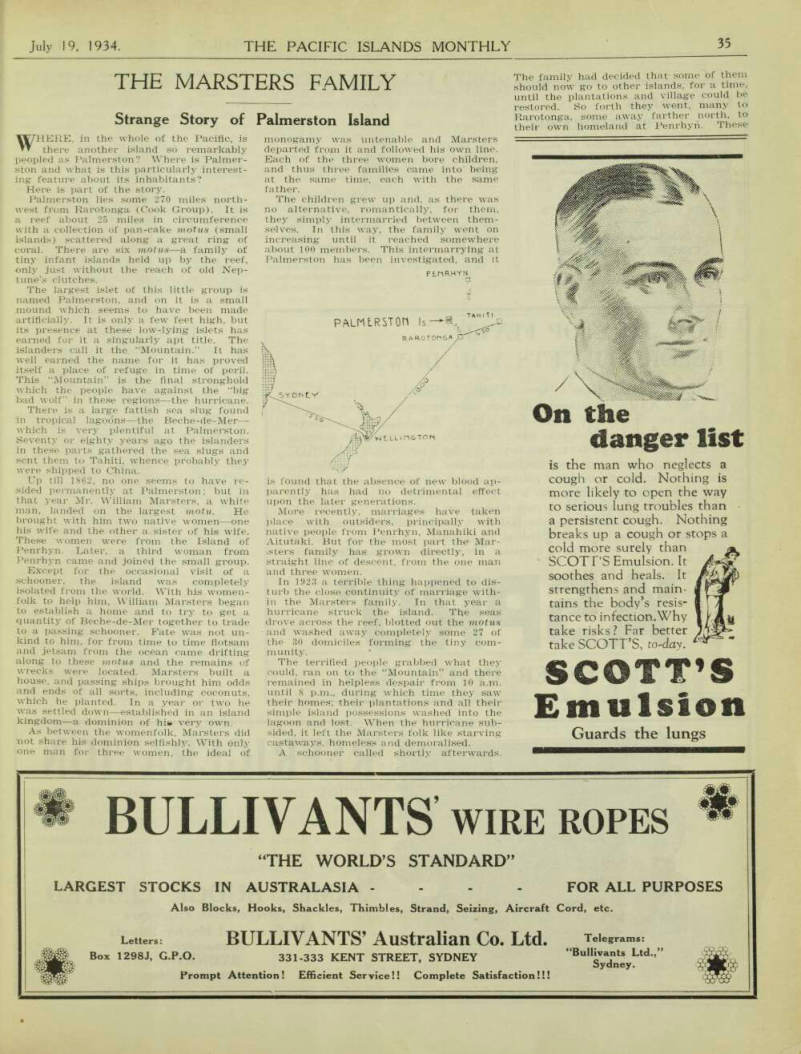
Strange Story of Palmerston Island
WHERE, in the whole of the Pacific, is there another island so remarkably peopled as Palmerston? Where is Palmer ston and what is this particularly interest ing feature about its inhabitants?
Here is part of the story.
Palmerston lies some 270 miles north west from Rarotonga (Cook Group). It is a reef about 25 miles in circumference with a collection of pan-cake motus (small islands) scattered along a great ring of coral. There are six motus —a family of tiny infant islands held up by the reef, only just without the reach of old Nep tune’s clutches.
The largest islet of this little group is named Palmerston, and on it is a small mound which seems to have been made artificially. It is only a few feet high, but its presence at these low-lying islets has earned for it a singularly apt title. The islanders call it the “Mountain.” It has well earned the name for it has proved itself a place of refuge in time of peril.
This “Mountain” is the final stronghold which the people have against the “big bad wolf” in these regions—the hurricane.
There is a large fattish sea slug found in tropical lagoons—the Beche-de-Mer— which is very plentiful at Palmerston.
Seventy or eighty years ago the islanders in these parts gathered the sea slugs and sent them to Tahiti, whence probably they were shipped to China.
Up till 1862, no one seems to have re sided permanently at Palmerston; but in that year Mr. William Marsters, a white man, landed on the largest motu. He brought with him two native women—one his wife and the other a sister of his wife.
These women were from the Island of Penrhyn. Later, a third woman from Penrhyn came and joined the small group.
Except for the occasional visit of a schooner, the island was completely isolated from the world. With his women folk to help him, William Marsters began to establish a home and to try to get a quantity of Beche-de-Mer together to trade to a passing schooner. Fate was not un kind to him, for from time to time flotsam and jetsam from the ocean came drifting along to these motus and the remains of wrecks were located. Marsters built a house, and passing ships brought him odds and ends of all sorts, including coconuts, which he planted. In a year or two he was settled down —established in an island kingdom—a dominion of his very own.
As between the womenfolk, Marsters did not share his dominion selfishly. With only one man for three women, the ideal of
monogamy was untenable and Marsters departed from it and followed his own line.
Each of the three women bore children, and thus three families came into being at the same time, each with the same father.
The children grew up and, as there was no alternative, romantically, for them, they simply intermarried between them selves. In this way, the family went on increasing until it reached somewhere about 100 members. This intermarrying at Palmerston has been investigated, and it
is found that the absence of new blood ap parently has had no detrimental effect upon the later generations.
More recently, marriages have taken place with outsiders, principally with native people from Penrhyn, Manahiki and Aitutaki. But for the most part the Mar sters family has grown directly, in a straight line of descent, from the one man and three women.
In 1923 a terrible thing happened to dis turb the close continuity of marriage with in the Marsters family. In that year a hurricane struck the island. The seas drove across the reef, blotted out the motus and washed away completely some 27 of the 30 domiciles forming the tiny com munity.
The terrified people grabbed what they could, ran on to the “Mountain” and there remained in helpless despair from 10 a.m. until 8 p.m., during which time they saw their homes; their plantations and all their simple island possessions washed into the lagoon and lost. When the hurricane sub sided, it left the Marsters folk like starving castaways, homeless and demoralised.
A schooner called shortly afterwards.
The family had decided that some of them should now go to other islands, for a time, until the plantations and village could be restored. So forth they went, many to Rarotonga, some away farther north, to their own homeland at Penrhyn. These
emigrants did so well that they have re mained at Rarotonga and elsewhere, and to-day there are branches of the Marsters family springing up throughout the Cook group.
There is still another extraordinary thing to be told. Marsters insisted that all the children at Palmerston should be taught to speak English. He forbade the use of the native tongue altogether. Marsters is dead, but his dictum is respected and survives to this day.
Passing ships have given garbled re ports to newspapers regarding the weird English spoken by the Palmerston Islanders. Yet that island speech, with its individualistic euphony, ought rather to have been looked upon as something de lightfully complimentary to the Mother tongue. That the English language taught by Marsters to his children should have survived down the years in the face of
stark isolation, and of that natural strong bias towards the native tongue itself, which the child from its mother, must surely claim our admiration.
The Marsters people have wholly re stored their plantations and rebuilt upon the wreck wrought of the 1923 hurricane.
Palmerston is almost self-supporting. The lagoon abounds with fish, and some of the motus with sea-birds, the eggs of which are relished by the people there.
The whole story of Palmerston is not told here. Palmerston is a place quite off the beaten track. It is a lonely island— possibly the most lonely in the Cook Group. Yet, oddly enough, whenever a schooner announces that it is going to call there, a longing to go back to the family atoll creeps over the soul of a Marsters in Rarotonga or elsewhere, and away he goes, back to the old isolation—back to the king dom of William Marsters.
G. H. Davis.
Advertisements & other items, pp. 37-38 (1 item)
Scott’S
On the
danger list
is the man who neglects a cough or cold. Nothing is more likely to open the way to serious lung troubles than a persistent cough. Nothing breaks up a cough or stops a cold more surely than SCOTT’S Emulsion. It soothes and heals. It strengthens and maintains the body’s resistance to infection. Why take risks ? Far better take SCOTT’S, to-day.
SCOTT’S
Emulsion
Guards the lungs
BULLIVANTS wire ropes
“THE WORLD’S STANDARD”
LARGEST STOCKS IN AUSTRALASIA ... FOR ALL PURPOSES Also Blocks, Hooks, Shackles, Thimbles, Strand, Seizing, Aircraft Cord, etc.
Letters: BULLIVANTS’ Australian Co. Ltd.
Box 1298 J, G.P.O. 331-333 KENT STREET, SYDNEY Prompt Attention! Efficient Service!! Complete Satisfaction!!!
Telegrams: “Bullivants Ltd.,”
Sydney.
OLD ISLANDS
PHOTOGRAPHS
We have a unique collection of several thousands of original photographs of Natives and Scenes in New Guinea, Solomons, Tonga, Fiji, Samoa, New Hebrides, etc., taken during the years 1875 to 1895.
These supply invaluable records of fastdisappearing races.
Full-plate prints, 2/- each, or 12 for 20/-.
Details on application
TYRRELL’S MUSEUM,
281 GEORGE ST., SYDNEY
HOW TO STOP FEVER
BEFORE IT GETS YOU DOWN
"THERE are many forms of fever—Dengue—Malaria—Five Days Fever, etc. All are characterized by high body temperature—thirst—loss of strength, etc. Fever may develop from a chill. A quick, safe and effective method of combating fever is to take “ASPRO” according to the directions on the leaflet in each packet as soon as you develop a temperature. “ASPRO” reduces temperature and fever conditions because, after ingestion in the system, it is anti-pyretic or fever reducing, and is an antiseptic, anti-periodic and anti-fermentative. It is also a powerful germicide. You take no risk with “ASPRO” because it is pure medicine in tablet form. “ASPRO” conforms to the standard of purity laid down by the British Pharmacopoeia (the guiding authority of the Medical Profession). It does not harm the heart and is much preferable to quinine. There are no injurious after-effects.
NIPS FEVER IN THE BUD
REFRIGERATION
“BUDGE” automatic or manually controlled refrigeration and ice making plants, using ammonia in the large and sulphur dioxide in the small units, as illustrated.
Electric or Crude oil engine driven —Supplied to Commonwealth and Island Governments, C.S.R. Coy. and numerous Island clients.
JAMES BUDGE LIMITED
Refrigeration Engineers McEvoy and Harley Streets Alexandria
SYDNEY
ESTABLISHED 1890
Book Review
IN “Australia’s Backyards,” Mr. R. H.
Milford sets out to tell the truth, ex actly as he saw it during his wanderings through the inland districts of Queensland, New South Wales, South Australia and Northern Territory.
Here, for example, are the first words in the book: “The adultresses of Darwin— A sweating, soaking day in December, Many of the living corpses of Darwin in a comatose condition of alcoholism. Blacks, half-castes, pearl-shellers, government offi cials (mentioned in their order of merit) and others —all stagger or lurch unevenly about in the poisoned air, as if each move ment of their bloated, beer-soaked bodies was going to be their ultimate. . .
Chapter 11. opens with these words: “One of the greatest surprises for the husband in certain tropical regions is to find out that his children are his own.”
There is much more similar, indescrib able rubbish. The author attempts to deal with social conditions and politics economic subjects, but merely makes him self ridiculous. The opinions and argu ments of the tap-room look very silly, when transported to the printed page. That such a crudely-written, ill-balanced and badly-spelled manuscript should have achieved the distinction of print does not reflect much credit upon the publisher.
Our copy from the publishers, Macquarie Head Press, Sydney. Price, 7/6.
Case
FUND FOR REVIEW OF THE JAMES LARKIN
Letter to the Editor.
MURDER is the unlawful killing of a human being by another human being with malice aforethought. The absence of malice aforethought reduces the crime to manslaughter.
Malice aforethought refers to the state of mind preceding or co-existing with the act or omission which causes death. It may mean any state of mind from a posi tive intention to kill some particular per son out of hatred or ill-will, down to that state of mind which consists in the mere knowledge that the act will probably cause the death of, or grievous bodily harm to, some person, even although such know ledge may be accompanied by a wish that death or grievous bodily harm may not be caused.
According to your August issue, a China man, while in a rage, attacked his wife and inflicted several wounds, one of which could have proved fatal. The inference to be drawn from the paragraph is that he attacked with intent to kill, or to do grievous bodily harm. Judge Wanliss sen tenced the Chinaman to two years’ im prisonment.
Larkin who very severely caned a native, with no apparent reason to kill, was sen tenced by the same judge to 10 years’ imprisonment.
Such verdicts tend to puzzle the layman.
Does “Justice” depend on the development of septic poisoning; or is there one law for the Chinaman and another for the white-man?
If a parent or a school-teacher severely canes a child there is a possibility of breaking the skin and the wound turning septic—risk, 10 years with hard labor!
Attack on wife and infliction of many wounds, one of which could have been fatal —risk, two years!
Certainly, Justice is blind, and I suppose that is why she cannot observe sometimes whether her balance is true.
I would suggest that her weights and measures, on occasion, require inspection and overhaul. I therefore attach hereto a cheque for £3/3/- as a contribution toward the expense of having the Larkin case re opened.
Mr. Editor, there must be other people who do not understand such verdicts. Is the Judge’s decision final?
I am, etc.,
Waiben.
Thursday Island. 7th June, 1934.
Editorial Note
We have received the £3/3/- and hold same to the credit of the “James Larkin
Review Fund,” the purpose of which will be to secure legal assistance and petition the proper authorities for a review of the verdict and the sentence imposed upon James Larkin.
We hope that other contributions—even if they are only a few shillings—will be sent in. We ourselves are glad to supple ment “Waiben’s” subscription with another of £3/3/-. If sufficient support is received, we shall form a small local committee, and immediately seek to get the machinery of appeal into motion.
We have had many letters dealing with the Larkin case; and they show that those who know James Larkin well are those who most firmly believe that he is no murderer and that he is the victim of a cruel misreading of the law. Here is a chance for them to assist their friend. The “P.I.M.” knows nothing of James Larkin beyond what appears in official records; it simply takes the view that the death of the native was an unfortunate accident and that the verdict of murder, and the consequent sentence of ten years’ hard labor, are indefensible in law and in jus tice. James Larkin committed a crime in brutally flogging an insolent native; but the crime was not murder.
James Larkin Review Fund
“Waiben,” Thursday Is. ... £3 3 0 Pacific Plantations Ltd. . . 3 3 0 Mr. M. P. Curtain, mining engineer of Victoria, returned to Australia by the Macdhui on June 18. Mr. Curtain spent 12 months on the Waria River, between New Guinea and Papua, testing a gold proposition for the Gold Stream Co. of South Australia. The company, after ex haustive tests, turned down the option which it held on the property.
Advertisements & other items, pp. 39-40 (1 item)
Pure Rice Starch
THE WHISKY THEY
ASK FOR AGAIN
SYDNEY’S SAILMAKER
(Rigger and General Canvas Goods Manufacturer)
HARRY WEST
Caters for Every Class of Sail, Canvas, Rope, or Wire Equipment.
FOR RELIABILITY AND VALUE
(If it’s in Canvas, Wire, or Rope) Send your enquiries to us.
Address: BALMAIN, SYDNEY,
N.S.W.
PURE RICE STARCH
Wholly produced iiy n.s w,
CORAL BRAND
RICE STARCH
Net Weight: 3 Ounce*
CORAL STARCH LTD.
ALWAYS ASK FOR
“CORAL BRAND”
100% PURE
Noted for its
QUALITY and WHITENESS
Goes FARTHEST and gives
LASTING FINISH
Will not stick to iron.
CORAL BRAND
may be obtained from Leading Island Stores Manufactured by
CORAL STARCH LTD.
Sydney, N.S.W.
Records Posted Free
SEND FOR LISTS
Australia’s finest Record Shop, specialising in Mail Orders.
Any Records procured and sent same day.
Dozens of clients in the Pacific Islands.
We pay Freight.
THE TALKERIES
QUEEN VICTORIA BUILDINGS
SYDNEY, AUSTRALIA
Who's afraid ... ?
"LUCKY IT
was SHELL"!
With apologies to Andrew Lang and Walt Disney
... That's Pick-Up!
instant shell PICKUP makes this difference
STILL BUCKING-STILL SPLUTTERING •••STILL CHOKING 5J537
Morris, Hedstrom Ltd.
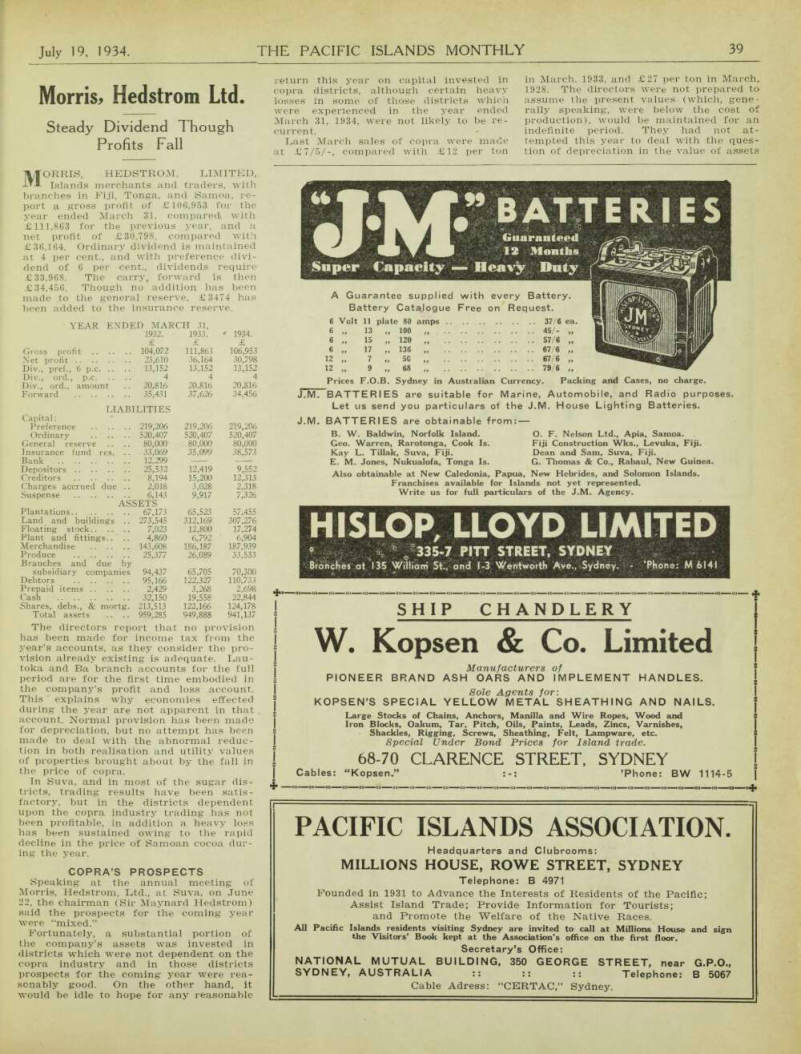
Steady Dividend Though Profits Fall
Morris, hedstrom, limited, Islands merchants and traders, with branches in Fiji, Tonga, and Samoa, re port a gross profit of £106,953 for the year ended March 31, compared with £111,863 for the previous year, and a net profit of £30,798, compared with £36,164. Ordinary dividend is maintained at 4 per cent., and with preference divi dend of 6 per cent., dividends require £33,968. The carry, forward is then £34,456. Though no addition has been made to the general reserve, £3474 has been added to the insurance reserve.
The directors report that no provision has been made for income tax from the year’s accounts, as they consider the pro vision already existing is adequate. Lau toka and Ba branch accounts for the full period are for the first time embodied in the company’s profit and loss account.
This explains why economies effected during the year are not apparent in that account. Normal provision has been made for depreciation, but no attempt has been made to deal with the abnormal reduc tion in both realisation and utility values of properties brought about by the fall in the price of copra.
In Suva, and in most of the sugar dis tricts, trading results have been satis factory, but in the districts dependent upon the copra industry trading has not been profitable, in addition a heavy loss has been sustained owing to the rapid decline in the price of Samoan cocoa dur ing the year.
Copra’S Prospects
Speaking at the annual meeting of Morris, Hedstrom, Ltd., at Suva, on June 22, the chairman (Sir Maynard Hedstrom) said the prospects for the coming year were “mixed.”
Fortunately, a substantial portion of the company’s assets was invested in districts which were not dependent on the copra industry and in those districts prospects for the coming year were rea sonably good. On the other hand, it would be idle to hope for any reasonable
return this year on capital invested in copra districts, although certain heavy losses in some of those districts which were experienced in the year ended March 31, 1934, were not likely to be re current.
Last March sales of copra were made at £7/5/-, compared with £12 per ton
in March, 1933, and £27 per ton in March, 1928. The directors were not prepared to assume the present values (which, gene rally speaking, were below the cost of production), would be maintained for an indefinite period. They had not at tempted this year to deal with the ques tion of depreciation in the value of assets
Year Ended March 31,
1932. 1933. 1934. £ £ £ Gross profit 104,072 111,863 106,953 Net profit 23,610 36,164 30,798 Div., pref., 6 p.c 13,152 13,152 13,152 Div., ord., p.c 4 4 4 Div., ord.. amount 20,816 20,816 20,816 Forward 35,431 37,626 34,456
Liabilities
Capital: Preference 219,206 219,206 219,206 Ordinary 520,407 520,407 520,407 General reserve .. .. 80,000 80,000 80,000 Insurance fund res. .. 33,069 35,099 38,573 Bank 12,299 — —:— Depositors 25,532 12,419 9,552 Creditors 8,194 15,200 12,313 Charges accrued due .. 2,018 3,028 2,318 Suspense 6,143 9,917 7,326
Assets
Plantations 67,173 65,523 57,455 Land and buildings .. 273,545 312,169 307,276 Floating stock 7,023 12,800 17,274 Plant and fittings.. .. 4,860 6,792 6,904 Merchandise 143,608 186,187 187,939 Produce 25,377 26,089 33,533 Branches and due by subsidiary companies 94,437 65,705 70,300 Debtors 95,166 122,327 110,733 Prepaid items 2,429 3,268 2,698 Cash 32,150 19,558 22,844 Shares, debs., & mortg. 213,513 122,166 124,178 Total assets .. .. 959,285 949,888 941,137
in copra districts, but if present condi tions continued for any long period it might become necessary to deal with this question.
It might then be decided to devote the major portion of the reserves of the com pany to the writing-down of the value of assets in districts which were depen dent upon the copra industry. The company’s insurance reserve of £38,573 was intended for protection against marine and hurricane risks of the com pany; fire risks were covered externally.
The value of floating stock had been increased by amounts expended on the purchase and construction of a small steel motorship for use within the Fiji group.
It was now being assembled at Suva.
Advertisements & other items, p. 41 (1 item)
Hi Slop, Lloyd Limited
A Guarantee supplied with every Battery.
Battery Catalogue Free on Request. 6 Volt 11 plate 80 amps 37/6 ea.
Prices F.O.B. Sydney in Australian Currency. Packing and Cases, no charge.
J.M. BATTERIES are suitable for Marine, Automobile, and Radio purposes.
Let us send you particulars of the J.M. House Lighting Batteries.
J.M. BATTERIES are obtainable from: B. W. Baldwin, Norfolk Island. O. F. Nelson Ltd., Apia, Samoa.
Geo. Warren, Rarotonga, Cook Is. Fiji Construction Wks., Levuka, Fiji.
Kay L. Tillak, Suva, Fiji. Dean and Sam, Suva, Fiji.
E. M. Jones, Nukualofa, Tonga Is. G. Thomas & Co., Rabaul, New Guinea.
Also obtainable at New Caledonia, Papua, New Hebrides, and Solomon Islands.
Franchises available for Islands not yet represented.
Write us for full particulars of the J.M. Agency.
HI SLOP, LLOYD LIMITED
335-7 PITT STREET, SYDNEY
Branches at 135 William St., and 1-3 Wentworth Ave„ Sydney. - ’Phone: M 6141
SHIP CHANDLERY
W. Kopsen & Co. Limited
Manufacturers of PIONEER BRAND ASH OARS AND IMPLEMENT HANDLES.
Sole Agents for: KOPSEN’S SPECIAL YELLOW METAL SHEATHING AND NAILS.
Large Stocks of Chains, Anchors, Manilla and Wire Ropes, Wood and Iron Blocks, Oakum, Tar, Pitch, Oils, Paints, Leads, Zincs, Varnishes, Shackles, Rigging, Screws, Sheathing, Felt, Lampware, etc.
Special Under Bond Prices for Island trade.
68-70 CLARENCE STREET, SYDNEY
Cables; “Kopsen.” ’Phone: BW 1114-5
PACIFIC ISLANDS ASSOCIATION.
Headquarters and Clubrooms:
MILLIONS HOUSE, ROWE STREET, SYDNEY
Telephone: B 4971 Founded in 1931 to Advance the Interests of Residents of the Pacific; Assist Island Trade; Provide Information for Tourists; and Promote the Welfare of the Native Races.
All Pacific Islands residents visiting Sydney are invited to call at Millions House and sign the Visitors’ Book kept at the Association’s office on the first floor.
Secretary's Office: NATIONAL MUTUAL BUILDING, 350 GEORGE STREET, near G.P.O., SYDNEY, AUSTRALIA :: :: :: Telephone: B 5067 Cable Adress: “CERTAC,” Sydney.
Superannuation In New
Guinea And Papua
Replying to questions asked by Dr. Wil liam Maloney (Victoria) in the House of Representatives on June 28, Mr, Lyons (Prime Minister) said that a scheme for providing a combined superannuation sys tem for officers in Australia’s Pacific Terri tories is at present under consideration.
Dr. Maloney asked the Prime Minister: 1. Is it a fact that the Dutch shipping company trading between Australia and Java requires its captains and chief engineers to retire with pensions at the age of 45 on account of the unhealthy climate in which they work? 2, If so, will he consider the question of the early re tirement, with pensions, of officers who are employed in Papua, New Guinea and other
unhealthy positions in the Pacific Islands?
Mr. Lyons’ reply was as follows: 1. I have no information on this point. 2. The superannuation ordinances of Papua and New Guinea make provision for the pay ment of retiring allowance on retirement after reaching the age of 54 years and 55 years, respectively. The question of the provision of a combined superannuation scheme for the officers of the external terri tories of the Commonwealth is at present receiving attention. Full consideration of the conditions existing in the several terri tories will be given in determining the age to be prescribed for retirement, with super annuation allowance, under any such scheme that may be adopted.
Handling 4000 Coconuts At
Cook Is. Decline
Handling 4000 Coconuts At Present Prices
From Our Own Correspondent.
Rarotonga, June 15.
ONCE upon a time the Cook Islands grew cotton, and flourished. The Nile dam was built, England took Egyptian cot ton, and our cotton trade vanished in a night.
Pearling flourished. Then the synthetic, or “cultivated” pearl pushed our native pearl out of sight.
Copra became the staple industry—it looked as if nothing could affect it. But whales and soya beans now have under mined the coconut.
The dried product of 130 coconuts is re quired to fill one sack with copra. We count 30 sacks to the ton —roughly 4000 coconuts. London offers us £6/15/- per ton, and we pay for freight, sacks, insur ance, commission, etc. Anyone can have the Cook Islands share of the coconut trade —we are not going to make copra at that price, and lose money.
Half of the copra export tax (£1 per ton) imposed in 1918 was removed last year; and the balance was withdrawn in April last. But this relief is not enough to save the trade.
Our last hope is fruit. The Cook Is.
Administration now is doing everything possible to build up this valuable trade with New Zealand.
Pastor A. H. Piper, General Secretary of Seventh Day Adventist missions, Mr.
J. S. Sandeman, of Victoria, and Dr. C. W, Harrison, arrived in Sydney by the Malaita on June 24. They had been on a tour of inspection of S.D.A. missions in the Solomon Islands. As a result of their investigations a hospital will be built at Malaita, and will be under the charge of Dr. Dorothy Mills Parker.
Advertisements & other items, p. 42 (2 items)
Costumier E,
Mrs. N. WALKER - FLYNN,
Market Street, RABAUL.
HEMSTITCHING and PICOT EDGING.
Copies of Mab’s Fashions; Roma’s Pictorial Fashions and Home Fashions available. — P.O. Box 116. Tel.; 141.
The
“High-
lander"
Shirt
Ideal for wear in tropics, will stand hard wear and native washing. Made from a strong cotton twill, two breast pockets. Assorted designs. In Blue, Brown, or Grey grounds.
Colours fast.
Price 9/6 each Three for 27/6 Ties to Tone, 3/6.
Send your order to Desk PIM.
PIKE BROTHERS Ltd.
in Queen Street, Brisbane
At Tenterfield in 1873 Sixty years ago, when the Bank of New South Wales established its branch at Tenterfield, wheatgrowing was the main occupation in that area.
To-day, Tenterfield serves one of the soundest cattle-raising districts, in New South Wales. The well-watered western portion of the district is devoted mainly to sheep. Recently tobaccogrowing was successfully introduced.
In Tenterfield and throughout Australia and New Zealand the Bank of New South Wales has always provided complete banking services to settlers and has thus made an essential contribution to the development of the natural resources of these countries.
Bank of New South Wales
(ESTABLISHED 1817)
50 with which the Western Australian Bank and The Australian Bank of Commerce Ltd. are amalgamated.
W. D. Bailey
Naval Architect
DESIGNER of SENSIBLE SEAWORTHY
CRUISERS, MOTOR, SAILING, or
AUXILIARY ISLAND TRADING
VESSELS
Over Thirty Years’ Experience—British, American and Australian.
Stock plans of all types and sizes at nominal prices.
Building supervised—Surveys anywhere. Special Plans for Amateur Builders with Free Advice.
Address: Como, N.S.W.; or
7 Barrack Street, Sydney
Leahys Or Detzner?
Who Was Discoverer of Central New Guinea Plateau?
By Sheila Lane.
Breathes there a man with soul so dead, Who never to himself hath said, This is my own, my native land.
DOUBTLESS Papua is only Mollie Lett’s land of adoption; but, nevertheless, the article written by her claiming Captain Detzner as being the first explorer of the Purari-Mt. Hagen district (Central New Guinea) in preference to the expedition of Messrs. Leahy Brothers and J. L. Taylor, last year, is partially, if not wholly ex cused, because of the above quotation.
To New Guinea residents —and indeed to many tourists —the jealousy that exists be tween the Mandated Territory and Papua, especially between the Administrations, is very similar to the friendly rivalry exist ing between Sydney and Melbourne, and I take it that it was this spirit that prompted Mrs. Lett to pen her article, which ap peared in this valuable islands magazine of April issue.
There is a Lutheran Mission now explor ing the possibilities of the Mogai Valley (in fact, the religious “rush” there exceeds the gold “rush”), and this Mission, accord ing to Captain Detzner, hid and fed him during the War years. Mr. Bergmapn, of this Mission, frankly admits that Detzner himself has since repudiated his book on New Guinea travels and has relegated it solely to the fiction class. No longer can it be accepted as authentic history.
This action was taken, following on a protest to the German Geographical Society by the Lutheran Mission, who accused Detzner of using information from the Mission to write his book. The contents of his book were entirely due to his powers of listening while he was temporarily domiciled at the Mission. He himself never saw the things he wrote about.
These Missionaries will tell Mrs. Lett and other staunch Papuans that Captain Detz ner most certainly never ever saw any valley on the Purari headwaters. His travels extended over the Watut country only.
Captain Detzner describes the men of the Purari headwaters as natives with shaved heads, with a patch on top whereon to hang their beads. The native peoples of the Purari headwaters actually build up and strengthen their growth of hair, by packing hair and bark on top, and cover ing the lot with a bark cloth—all the bet ter to withstand a thump on the cranium from a pineapple club, or more correctly one of those evil-looking battle axes that are used in that part of New Guinea be tween the Purari and Mt. Hagen.
During my own four months’ holiday in New Guinea, I was fortunate enough to see and inspect very closely some Kuku kuku “monkeys” which Mr. G. Hemsworth,
of P.A.T., had flown in to be tried for murder. These natives have exactly the style of coiffure described by Detzner. The Kukukukus, though a nomadic tribe, seem to haunt mostly the hills surrounding the Watut district, immediately adjoining the Morobe goldfield.
As to Mt. Joseph, there is no mountain answering to Detzner’s description of it anywhere, from the Ramu to the Purari headwaters.
With photographs, and other evidence of proof, such as aerial surveys, no one can dispute the claims of Messrs. Mick and Dan Leahy, Ken Spinks and J. L. Taylor to be the actual discoverers of this fasci nating new country between the Purari and Mt. Hagen.
No ill-feeling is conveyed herein: it is
merely a matter of giving honor where honor is due.
Papua is proud of Jack Hides, just as the Mandated Territory is proud of Mick Leahy. They are both New Guinea Wizards of the Interior, who have done marvellous work; so why not give credit where credit is due, regardless of Territory.
All Australians should be satisfied and proud that these courageous men are such worthy sons of Australia.
Kathleen Binnie
Personal Notice.
TAKE NOTICE that THE COUNCIL OF THE SHIRE OF WARRINGAH has instituted proceedings against you in the Supreme Court of New South Wales in Equity to sell for rates amounting in 1933 to ten pounds fifteen shillings and sevenpence (£10/15/7) your land Lot 7 in South Creek Road, Dee Why. By Order of the Court the latest day for your entering an appearance, and filing at the office of the Master in Equity, Supreme Court Sydney an address for service, has been fixed at the 18th October, 1934.
Failing appearance the suit may come on to be heard on or after the 30th November, 1934. — E. R. MANN & CO., Solicitors for the Plaintiff, 42 Bridge Street, SYDNEY.
Advertisements & other items, p. 43 (2 items)
Preserved Meats
Repairs. “OUR HANDS MAKE GOOD ARMS.”
THE NEW WONDER RIFLE
Savage .22 Cal.; C.F. HORNET Rifle, bolt action; magazine holds 5 cartridges. Ballistics; 45 grain soft point bullet, velocity 2600 ft. per second, striking energy 675 lbs. Point blank range, 200 yards. Price, £10/10/-; postage extra. Cartridges, 19/- per 100, freight extra.
Reloading tools can be supplied for this calibre.
Write for Catalogue and Booklet “How to Reload Rifle Cartridges.”
SIL ROHU (late A.I.F.),
IMPORTER OF HIGH-GRADE FIREARMS AND FISHING TACKLE SPECIALIST 143 ELIZABETH STREET, SYDNEY (near Market Street).
“FISHING TACKLE TO TACKLE FISHING”
Quality Stands the Test of Time
1870 1934 S.M.P. "War Medal ” BRAND
Preserved Meats
Tins Fitted with Patent Key Opener F. J. WALKER LTD. 33 Macquarie Place, Sydney Sole Agents for: THE SYDNEY MEAT PRESERVING CO., LTD.
W. M. Ford
Ship, Yacht & Boat Builder
Berry’s Bay, North Sydney
(Established 1870.) BUILDERS of all kinds of Island Craft from Dinghies to Auxiliary Schooners of any tonnage. New and Second-hand Island Craft of various types in stock. New and Second-hand Full Diesel, Crude Oil, Benzine and Kerosene Engines.
Please Send on Your Enquiries.
Fashion Hints for Islands Women
(By Therese.)
EVENING clothes are more charming than ever—glamorous and exciting, and breathing sophistication in every line.
Black velvet roses trim the neckline of a mushroom pink evening gown which has as its accompaniment a debonair knee length cape lined with black. Elbow length gloves of black velvet, and shoes of the same dusky hue and fabric, give additional -charm.
We follow the backward trend with our evening gowns, leaving the front quite plain. The bustle is returning to favour.
It takes the form of a huge bow of taf fetas. or ruffles of self material, starting waist high and sometimes ending in a frilling, frothing, frivolous train.
Trains grow in popularity. With even ing gowns featuring this graceful line, ruffled or kilted under-slips are worn— often in contrasting shades. They are the direct and delightful solution to the prob lem of what shall be worn with our trained gowns to avoid the revelation of a large expanse of nether limbs when one lifts one’s train to tread a measure.
There is a definite vogue for lames and brocades, gold, silver, or colored to rival Joseph’s coat, and they undoubtedly make the fortunate possessor an intensely seduc tive siren, while Circe fades into insigni ficance beside the wearer of a jet trimmed model of black with sweeping lines.
Particularly lovely are the blouses, waist or hip length, very low at the back and worn with a skirt of velvet or satin in one’s favourite colour.
Lames and brocades are also used to trim some of the smartest frocks, by way of collars and scarves, and glittering sequin epaulettes add glamour to an otherwise plain frock and lift it to the heights.
“Say it with flowers” is the watchword of the season, and real or artificial you will wear them with everything, and on every occasion possible, if to be in the vanguard of fashion is your ambition.
Coronets of real flowers adorn the locks of the ingfenue, while the older woman risks her throw on a single flower which she wears behind the ear in approved tropi cal style. In either case the result is en rapport.
The floral buckle is a delightful idea for a belt of folded gold tulle. A posy is pinned at the low V decolletage or tucks snugly in at the waist line. We attach a posy to our evening bag or wear a necklet or arm let of our favourite flowers, and the world is ours.
Slim jackets, flared coats, swathed scarves, vie with each other for popularity for smart evening wraps. As the winter loses its icy blast and the swallows fly south again, the collar of fur is discarded \in favour of the scarf of satin, taffetas or georgette in shapes innumerable, and often as not in vivid contrast with the frock beneath.
Remnants of lace, bought in a moment of madness at some sale in the dim dis tant past, may now be unearthed and their
purchase justified, for they make the most charming- scarves and collars.
Tulle continues to be a firm favourite, and whole fairylike frocks are made of this diaphanous gift of the gods. Tres chic is the gown of black velvet whose yoke of double flesh coloured tulle is fin ished high at the neck-line with a ruching of velvet. The result is at once daring and demure.
Afternoon frocks are fresh and feminine.
Crisp organdies and lace ruffles combine to make them so. Tub frocks are more attractive than ever and their variety is infinite.
Charming crease-resisting floral voiles, again make possible our old love, the large and shady garden hat. It is so kind to us, hides our tired lines, and shades us be comingly.
Cottons come to us in gorgeous colour ings and steal our hearts. Banana yellow is the newest shade, and a sports swagger in this shade possesses dash and chic.
Box pleats have been resurrected for tennis frocks and as always are admirably suited for sports clothes. The shirt waist frock, which is so definitely the vogue just now, shows them with success.
Sailor Influence
Barnacle Bill exerts his influence over us. We wear the Barnacle Bill sailor with aplomb. We know it is the last word in chic, and care not one whit for the horn pipe travesty with which the opposite sex greets us on sight, and we join in their hilarious criticisms, believing the cause worth while.
The sailor influence extends to our sports clothes which we trim with em broidered nautical motifs, the approved
sailor collar or anchor buttons, and so on ad infinitum.
Taffeta Hats
Taffeta hats are being hailed with delight.
In all sorts and conditions of weathers they keep their smart crisp air and £rove their worth for all occasions.
Transparent celophane is hailed as fashion’s friend. It is being used to trim provoking little eyeveils and ties into rav ishing little bows under the chin. Plaited strands of coloured celophane makes an attractive belt for afternoon or evening wear, and the same note is repeated as a necklet.
Barbaric jewellery enslaves us. Very few necklets are worn, the high neckline being adorned by a jewelled clip, but we wear bangles of beaten Moroccan silver Avhen and where it is possible to beg, bor row or steal them, and suffer gladly the resultant twinges of conscience.
Lingerie
The newest lingerie is truly devastating.
The nighties have puffed sleeves or sport charming little capes or jackets, and look like sophisticated evening gowns with their graceful, clinging lines. Alencon lace has pride of place for undies, and sleeves and yoke of this lace in rose, beige or ochre, allied to lustrous white satin, are the whim of the moment, to which every feminine heart becomes a willing victim.
A lovely rose silk lounging robe has its softly falling double georgette collar in lighter tonings, and is caught at the side with velvet ribbons to tone. It is com pletely alluring.
The very best undies are cut on the bias and give that delightfully slinky, svelte line we seek so eagerly.
Elaborate coiffures are demanded by the new evening modes, and mean hours of preparation and infinite patience. Tight little curls, soft bunchy ones, plaited or twisted round the head all have their place in the scheme of things.
Stockings for evening are the sheerest of sheer right to the toes, for the dainty little evening sandals are guilty of never a toe. Flesh should be your colour choice, when lacquered toenails will gleam through their sheerness intriguingly.
Beach Clothes
With the coming of warmer weather, beach clothes again demand our attention.
The indications are all in favour of shorts which really are a tremendous success.
You may have them box pleated, looking for all the world like a little school girl skirt. They may be severely tailored with a trim fitting divided skirt to cover them, or the very, very newest, and surely the most delightful idea, wear them with a belted coat that reaches to within about four inches of the knee, and swings open from the waist. A gaily coloured belt is worn and the result is one hundred per cent.
Bathing coats poach on our walking coats, and achieve infinite charm, carried out in a vivid striped towelling. They tie high at the neck, and have capacious pockets which simply shriek “Hold every thing.”
The button-on skirt and hankie top worn with shorts, will be the most popular for beach wear by the courageous. A man’s large handkerchief will answer the purpose or a square of brilliant silk. The square, used cornerwise, forms the top which ties round the waist with a knot at the back, and has its top corner caught round the neck with a narrow strip of the silk. In this you bare your back to the sun and bake to your heart’s content, and the envy of your less courageous friends.
Quaint little beach blouses are decep tively modest, for they are quite devoid of back, while presenting to the front view, a demure little quaker collar, which
leaves one utterly unprepared, and makes doubly obvious the fact that woman is a mass of contradictions.
Advertisements & other items, p. 44 (1 item)
Mining Machinery
Improved Type Gravel Pump.
SEND YOUR ENQUIRIES TO—
of all classes, including—
Dredging and Sluicing Plants
Gravel and Water Pumps Elevators Nozzles Piping and Valves Mining Plants have been supplied to a number of Companies in New Guinea, and we are, therefore, fully conversant with local conditions.
Hydraulic Elevator, with Swivelling Suction Pipe.
THOMPSON’S ENGINEERING & PIPE CO. LTD.
SYDNEY OFFICE
CASTLEMAINE, VICTORIA
Cable Address; “THOMPSONS, CASTLEMAINE.”
KEMBLA BUILDING 58 MARGARET STREET
New Crops Of T.N.G.
Botanist to Study Other Products
PRIOR to taking up duties as economic botanist in the Department of Agriculture, New Guinea, Mr. R. E. P. Dwyer.
B.Sc.Ag., left Sydney by the Nieuw Hol land, on June 25, for a tour of the Dutch East Indies to engage in research work in tropical agriculture.
In the East he will investigate the pos sibilities of coffee, cocoa, kapok, tea, to bacco, and rubber, as alternative crops for the Mandated Territory. By crossbreed ing and inter-pollination of these crops, Mr. Dwyer hopes to develop varieties to suit New Guinea conditions. This work will be carried on at Rabaul under the supervision of Mr. George H. Murray (Di rector of Agriculture). Detailed investiga tions will be undertaken also at the Kera vat demonstration plantation in New Britain.
How To Order Motor Spare
Parts
Hislop, Lloyd, Ltd., the motor spare parts and accessory house, 335 Pitt Street, Sydney, has opened a specialised country and Pacific Islands order department for the benefit of car and truck motor owners residing outside of the city of Sydney.
No. 1 section, including batteries and brake linings, is in the hands of a technical officer of the com pany, who can supply requirements under this heading for all makes of cars and trucks. Hislop, Lloyd, Ltd., guarantee goods sent forward to be correct in every detail. For all cars fitted with internal brakes, this firm supplies linings that are aready cut and drilled, thus fitting - straight on to the band without any alteration. The batteries are the “JM” brand, that have been on this market for nearly ten years, and carry a full guarantee.
Section No. 2 covers all replacement parts and spares, such as pistons, rings, king pins, springs, shackle bolts, bushings, universal points, tie rods, rims, etc. When sending inquiries be sure to specify the make of car and year of manufacture.
The third section of this specialised order business includes motoring accessories and tools.
Make the Best Cough Remedy
and Save Money
Wise folk save money by making their own family cough and influenza remedy with HEENZO. A bottle of HEENZO costs two shillings, and, when added to sweetened water, makes a supply equal in quantity and superior in quality to eight ordinary-sized bottles of the best ready-mixed remedies for coughs, colds, croup, bronchitis, influenza, and whooping cough. Over ONE MILLION Australian citizens annually use HEENZO. Order from your chemist or store now.
Advertisements & other items, p. 45 (1 item)
Safely
REDUCE
ATTAIN CHARMING
PROPORTIONS
WITHOUT RISK.
FORD’S
CORPOREAL
CAPSULES
This is a sure remedy for overweight. Endorsed ingredients act on fatty tissues only.
No special diet or exercises. Scores of testimonials prove its effectiveness. Many women reduced 141 b. in six weeks. Send 10/ for six weeks’ treatment.
Three months’ treatment for 20/-. Sent in plain wrapper.
Post Free.
NOEL P. FORD,
M.P.S. (Syd. Uni.),
CHEMIST,
247 King Street, Newtown
SYDNEY, N.S.W.
WEAK MEN MADE STRONG
and YOUTH REGAINED
MEN who have LOST YOUTHFUL POWERS; whose brains are dulled; whose energy and VITALITY is weakened; whose memory is bad and faulty and feel despondent should take
ALKALINE VITALITY PILLS
Bottles, 6/-
(Send for Circular on Pills and Lost Vitality Treatment) BLOOD, SKIN, NERVE, BLADDER, KIDNEY, AND LIVER COMPLAINTS,
RHEUMATISM, NEURITIS, ASTHMA, SUCCESSFULLY TREATED BY
POST. (MEDICINES POSTED UNDER PLAIN COVER.)
ALL TOILET AND RUBBER GOODS STOCKED
(Send for Price List).
HERR RASMUSSEN (Danish Herbalist)
541 GEORGE ST., SYDNEY, N.S.W.
Malayan Bananas
Vain Search for Market
MALAYA has been seeking a market for its bananas, but with negative results.
Inquiry was first made in Europe.
Hurricanes in the West Indies, and the prevalence of the Panama disease, has dislocated somewhat that source of regu lar supply for the European market. But West Indies bananas get to Europe in 12-16 days—just in time to allow ban anas to arrive in good condition. Trans port from Malaya would occupy about 28 days—making the trade impracticable.
Malaya then examined the Australian market. It was found that Netherlands India has been sending some 14,000 centals per annum to West Australia, under a duty of 8/4 per cental; while Fiji exported about the same quantity (1931- 32) to Eastern Australia, with a duty of 2/6 per cental. Malaya ascertained that this trade is shrinking—the New South Wales and Queensland growers have secured the East Australian market, and the Dutch sales to West Australia are being displaced by locally-grown West Australian bananas.
Malaya thereupon decided that while, like many other tropical countries, it can grow very good bananas, it can find no profitable overseas market for them.
Rev. B. L. Webb, who has been residing on Norfolk Island for several years, has returned to Sydney.
N.G. Moratorium
Extended
THE Custodian of Expropriated Pro perty, Canberra, officially announced at the end of June that the present policy of suspending payments due on New Guinea expropriated properties will be continued until June, 1935, when the posi tion will be reviewed again.
In making the announcement, Mr.
Thomas said that the Federal Govern ment deplored the necessity for the con tinuation of the moratorium, but it will be maintained until some measure of prosperity is restored to tropical agri culture—particularly copra, which vitally concerns the majority of planters on ex propriated plantations.
The continuation of the moratorium was to be expected, as New Guinea planters are hard hit by the low price of copra.
Many planters are finding it difficult even to keep their plantations in an orderly condition, let alone to produce copra at a profitable figure.
Death Of Tinomana Tuoro,
Ariki
From Our Own Correspondent.
Rarotonga, June 15.
Tinomana Tuoro died at Arorangi, Raro tonga, on May 29 after having been Ariki of the Puaikura people for eighteen years.
He was a member of the party of Cook Islands chiefs that visited New Zealand in January last to take part in the Waitangi celebrations. He came back to Rarotonga a sick man and remained for some time an inmate of the local hospital. Realizing ,
the truth, Tinomana returned to his palace at Arorangi, and there quietly prepared himself to meet his renowned ancestor in the shadows —the great Tangiia-nui.
The chief was of an easy-going disposi tion ; an extremely courteous man; an Ariki who ‘supported what he considered to be progressive ideas. In the Islands Council, of which he was a member, he, like many another careful listener to de bate, gave the impression of boredom and disinterestedness. Then he would slowly rise and without emotion of any kind de liver his final word, definitely and with extreme care.
Tinomana’s death brought Island activ ities to a standstill and spontaneous tri butes from throughout the Group and New Zealand. The chief was 57 years of age.
Tino means absolute, and Mana power; hence the name Tinomana.
Matron A. Banks, of the Methodist Hospital at Ba, Fiji, returned to Suva by the Monterey at the end of June, after furlough in N.S.W.
Miss E. West, of the Sydney firm of Messrs. J. H. Smyth Ltd., will leave Sydney on August 3 by the Marama on a tour of Fiji and Tonga.
Bishop Aloysius Raucaz, who has been in charge of the Marist Brothers’ mis sions in the southern portion of the Solomon Islands Group, was taken to the Mater Misercordiae Hospital, Sydney, suffering severely from malaria and com plications, when the Malaita arrived in Sydney on June 24. Bishop Raucaz went to the Pacific Islands from France over 30 years ago.
Mr. H. C, Cardew, Assistant Director of Native Affairs in New Guinea, arrived in Sydney on June 20 by the Van Rees. He is on a holiday visit.
Advertisements & other items, pp. 46-47 (1 item)
Buzacott & Co., Ltd.
ELECTRIC LIGHT
IN YOUR HOME
WHEREVER YOU LIVE
You can enjoy the advant-
ages offered by the
WIND-DRIVEN
GILCO runs without noise and needs no attention. It operates even at low wind velocities. GILCO is governed and may be shut off when desired.
ELECTRIC PLANT
A Proven
Success
Works Without Fuel—Uses the FREE Wind
GILCO generates 32 volts, but is also available for 50 volts and 110 volts. You can use it with any existing petrol-driven plant in a very short time it SAVES ITS OWN
COST.
GILCO harnesses the Free Wind over 24 hours of the day, and generates electricity which is stored for your needs. It is fully guaranteed and as it works without fuel its
ECONOMY IS OBVIOUS.
YOU CAN HAVE
EVERY CONFIDENCE
IN THESE
BUZACOTT LINES
Our reputation has been built on quality and value.
FETTER ENGINES
Crude Oil, Simple, Reliable, and Cheap to Run. Marine and Stationary types. Spare parts stocked.
'ALSTON’ WINDMILLS
Priced to suit every pocket, these famous Windmills are noted for their strength and light running.
‘HARVEY’ PLOUGHS
Include a complete range of implements for all tillage operations. Send for details.
‘BUZACOTT’ SPRAY
PUMPS are reasonably priced, well-constructed and entirely reliable.
BUZACOTT GATES &
FENCES One of our “trump” lines. Recognised everywhere the best procurable.
Prices are right.
BUZACOTT & Co., Ltd.
7-11 Market Street,
SYDNEY,
AUSTRALIA
To Parents Who Live in
the Islands
Solve the problem of your children’s education by sending them to Mrs.
J. Ashton, of Sydney, where they will have every home care and will be able to attend a good School.
Tariff: 1 Guinea per week (laundry included).
Entry Fee: 3 Guineas.
Apply in first place to
MRS. J. ASHTON,
Room 3, 9 Castlereagh St., Sydney
MINING AND ASSAY
MATERIAL
BALANCES, CRUSHERS, FURNACES,
CRUCIBLES, FLUXES, ETC.
LABORATORY AND SCHOOL
REQUISITES
Chemicals, Glassware, and all other Equipment
HOSPITAL AND SURGICAL
REQUIREMENTS
Incubators, Sterilizers, Centrifuges, Microscopes, Microtomes, etc.
Measures, Dispensing Scales, Enamel Ware, Bandages, Cotton Wool, and all Dispensing Material.
Write direct to
H. B. SELBY & CO., LTD.,
BULLETIN PLACE :: SYDNEY
Box 175D, G.P.O.
A WELL-PROVEN
REMEDY FOR PILES
This preparation has been on the market for several months, and it has effected a Cure in every case in which it has been tried. Cases of Long Standing often Cured within One Month, with one bottle only.
For External Use only—Stainless, Painless and Odourless.
PRICE: 5/- PER BOTTLE. Posted, securely packed, for 6/9 per bottle. Copies of Testimonials forwarded on request.
Read the Report of an Eminent Analytical Chemist:
THE LABORATORY,
20 and 22 Napoleon Street, Sydney, March 14th, 1933.
ROBERT BRUCE, Esq.
Dear Sir,—The formula of your pile cure submitted to me could have no effect other than beneficial. I gave your sample to a Client who had suffered many years, and before he had used half the bottle he reported himself completely cured.
Faithfully yours,
GROVE JOHNSON, F.C.S. (Lond.),
Analytical and Consulting Chemist.
Supplies Obtainable from—
ROBERT BRUCE
Room 7, 2nd Floor,
15 Hunter Street, Sydney
and also at
14 UPPER BAYVIEW ST., NORTH SYDNEY.
Cocoa-Planting
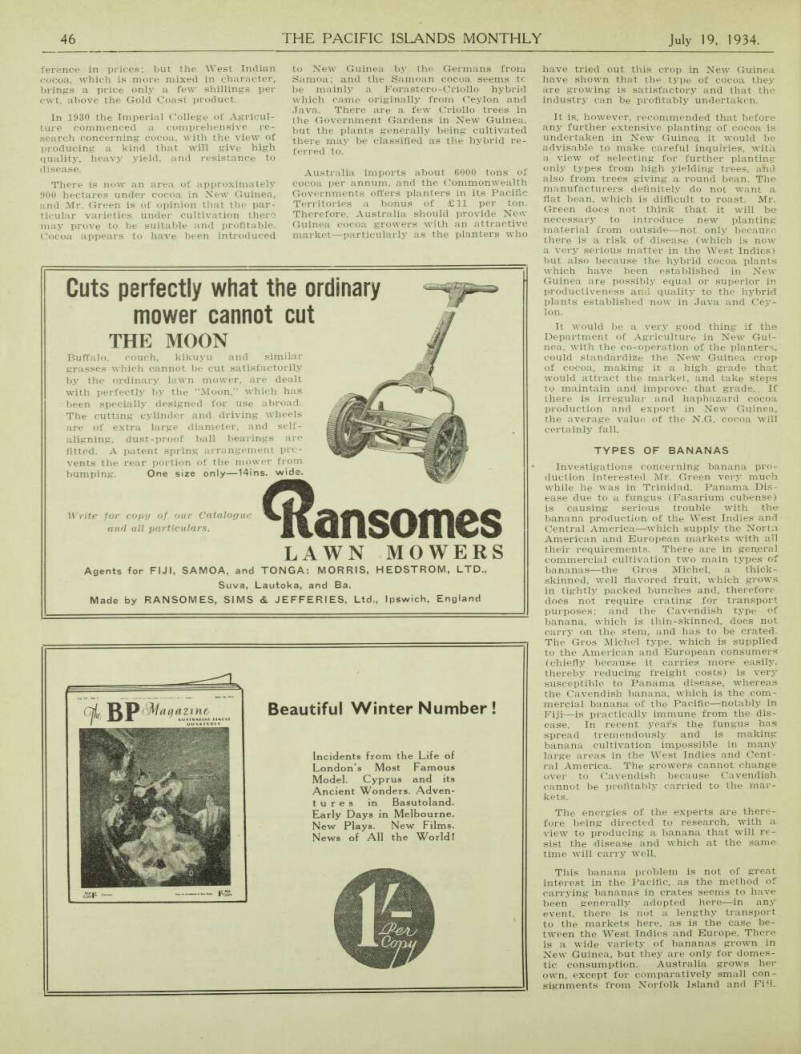
N.G. Official Brings Useful Data From Trinidad
WITH information that is likely to be of value to the planters of New Guinea, Mr. E. C. Green, of the New Guinea Department of Agriculture, has returned to Australia, en route to Rabaul, after eight useful months at the British Imperial College of Tropical Agriculture, Trinidad, West Indies.
In Trinidad, Mr. Green rubbed shoul ders with agricultural experts from all over the world. The Professors of the Tropical College hold chairs of Agricul ture, Economics, Mycology, Entomology, and Chemistry; and the 40 students in residence there comprise men sent by the British Colonial Office to do post-gradu ate and refresher courses; students from the various West Indian Colonies who have won scholarships, and men with Ag riculture degrees from various other recognised Colleges of Agriculture. The College is also a recognised institute for tropical agriculture research, and it is at present devoting its energies particularly to cocoa, sugar cane, bananas, and cotton.
Mr. Green, while gathering all possible knowledge concerning tropical agriculture generally, made a special study of cocoa production and cultivation; and has written a thesis on this subject, in which he has dealt particularly with the possi bilities of cocoa cultivation in New Gui nea. This, of course, will be submitted to his chief (Mr. George Murray, Director of Agriculture in New Guinea), and Mr.
Green hopes that it will assist Mr. Murray in extending a knowledge of cocoa culti vation among New Guinea planters.
Chatting with the Editor of the “Pacific Islands Monthly,” Mr. Green explained that there are two types of cocoa culti vated in the world —Forastero and Criollo.
The former is described as an ordinary cocoa and the latter as a fine cocoa. For astero is the type grown on the Gold Coast of Africa, which produces 260,000 tons per annum, and which represents about 60 per cent, of the world’s supply.
Criollo, on the other hand, whilst the better cocoa, is more susceptible to disease and is greatly influenced by soil and climatic conditions; and hybrid crosses between Forastero and Criollo produce the cocoa crop of Ceylon, Java, and West Indies, and other places. Vene zuela’s cocoa production is largely the Criollo type.
The Criollo bean is large, round, and in cross section white; whereas a typical Forastero bean is small, flat, and purple
in cross section. When the Criollo bean is fermented, cured and dried it is a cin namon color in cross section, and it is not astringent and has a very nice aroma; whereas in the lower grades of Forastero the cured bean in cross section shows a dark walnut color, is slightly astringent, and has little aroma. The Forastero varieties are hardy, whereas the varieties in which the Criollo characteristics pre dominate are not so easily cultivated. The type grown on the Gold Coast is mostly Amelonado, which is at the lower end of the Forastero scale.
The cocoa-growing countries other than the Gold Coast grow cocoas of mixed types, from the lowest kind of Forastero up to the almost pure Criollo variety; and the mixture produces a relatively fine cocoa which commands a slightly higher price than the Gold Coast cocoa.
Venezuela gets the full benefit of the dif
ference in prices; but the West Indian cocoa, which is more mixed in character, brings a price only a few shillings per cwt. above the Gold Coast product.
In 1930 the Imperial College of Agricul ture commenced a comprehensive re search concerning cocoa, with the view of producing a kind that will give high quality, heavy yield, and resistance to disease.
There is now an area of approximately 900 hectares under cocoa in New Guinea, and Mr. Green is of opinion that the par ticular varieties under cultivation there may prove to be suitable and profitable.
Cocoa appears to have been introduced
to New Guinea by the Germans from Samoa; and the Samoan cocoa seems tc be mainly a Forastero-Criollo hybrid which came originally from Ceylon and Java. There are a few Criollo trees in the Government Gardens in New Guinea, but the plants generally being cultivated there may be classified as the hybrid re ferred to.
Australia imports about 6000 tons of cocoa per annum, and the Commonwealth Governments offers planters in its Pacific Territories a bonus of £11 per ton.
Therefore, Australia should provide New Guinea cocoa growers with an attractive market —particularly as the planters who
have tried out this crop in New Guinea have shown that the type of cocoa they are growing is satisfactory and that the industry can be profitably undertaken.
It is, however, recommended that before any further extensive planting of cocoa is undertaken in New Guinea it would be advisable to make careful inquiries, with a view of selecting for further planting only types from high yielding trees, and also from trees giving a round bean. The manufacturers definitely do not want a flat bean, which is difficult to roast. Mr.
Green does not think that it will be necessary to introduce new planting material from outside—not only because there is a risk of disease (which is now a very serious matter in the West Indies) but also because the hybrid cocoa plants which have been established in New Guinea are possibly equal or superior in productiveness and quality to the hybrid plants established now in Java and Cey lon.
It would be a very good thing if the Department of Agriculture in New Gui nea, with the co-operation of the planters, could standardize the New Guinea crop of cocoa, making it a high grade that would attract the market, and take steps to maintain and improve that grade. If there is irregular and haphazard cocoa production and export in New Guinea, the average value of the N.G. cocoa will certainly fall.
Types Of Bananas
Investigations concerning banana pro duction interested Mr. Green very much while he was in Trinidad. Panama Dis ease due to a fungus (Fasarium cubense) is causing serious trouble with the banana production of the West Indies and Central America —which supply the Norta American and European markets with all their requirements. There are in general commercial cultivation two main types of bananas —the Gros Michel, a thick skinned, well flavored fruit, which grows in tightly packed bunches and, therefore does not require crating for transport purposes; and the Cavendish type of banana, which is thin-skinned, does not carry on the stem, and has to be crated.
The Gros Michel type, which is supplied to the American and European consumers (chiefly because it carries more easily, thereby reducing freight costs) is very susceptible to Panama disease, whereas the Cavendish banana, which is the com mercial banana of the Pacific —notably in Fiji—is practically immune from the dis ease. In recent year's the fungus has spread tremendously and is making banana cultivation impossible in many large areas in the West Indies and Cent ral America. The growers cannot change over to Cavendish because Cavendish cannot be profitably carried to the mar kets.
The energies of the experts are there fore being directed to research, with a view to producing a banana that will re sist the disease and which at the same time will carry well.
This banana problem is not of great interest in the Pacific, as the method of carrying bananas in crates seems to have been generally adopted here —in any event, there is not a lengthy transport to the markets here, as is the case be tween the West Indies and Europe. There is a wide variety of bananas grown in New Guinea, but they are only for domes tic consumption. Australia grows her own, except for comparatively small con signments from Norfolk Island and Fill.
Advertisements & other items, pp. 47-48 (1 item)
Huon Pine Boat Planks
SAMUEL RUSSELL
ESTATE AND GENERAL AGENT.
P.O. Box 64, Papeete, Tahiti
Real Estate. Investments. Estate Management and Administration. Valuations and Reports. Houses and Lands for Lease or Sale.
Sole Proprietor: TAHITI PERFUMES Cables: Russell, Tahiti (Bentley’s Code)
KELVIN ENGINES
MARINE & STATIONARY
The Kelvin-Ricardo Kerosene Engine from 7½ h.p. to 75 h.p. Kelvin Full Diesel Engine, Heavy Duty, from 22- 84 hp. Kelvin Full Diesel Engine, Light Type, from 22-24 h.p.
All kinds of New or Second-hand Craft Estimated for. Engine Repairs Carried out.
Catalogues and Full Particulars direct from
G. RUTHERFORD
46 Pitt Street, Sydney
HUON PINE BOAT PLANKS
AND
SPOTTED GUM TIMBERS
The World’s Best and the Cobra Does Not Like Huon Pine.
A. C. FRYER, 110 Miller Street, Pyrmont, Sydney.
Will Gladly Give Full Quotations for Any Sizes.
Cuts perfectly what the ordinary
mower cannot cut
THE MOON
Buffalo, couch, kikuyu and similar grasses which cannot he cut satisfactorily by the ordinary lawn mower, are dealt with perfectly by the “Moon,” which has been specially designed for use abroad.
The cutting cylinder and driving wheels are of extra large diameter, and selfaligning, dust-proof ball bearings are fitted. A patent spring arrangement prevents the rear portion of the mower from bumping. One size only — 14ins. wide.
Write for copy of our Catalogue and all particulars.
Mumsomes
LAWN MOWERS
Agents for FIJI, SAMOA, and TONGA: MORRIS, HEDSTROM, LTD., Suva, Lautoka, and 6a.
Made by RANSOMES, SIMS & JEFFERIES, Ltd., Ipswich, England
Beautiful Winter Number!
Incidents from the Life of London’s Most Famous Model. Cyprus and its Ancient Wonders. Adventures in Basutoland.
Early Days in Melbourne.
New Plays. New Films.
News of All the World!
Cultivation Of Tung Trees
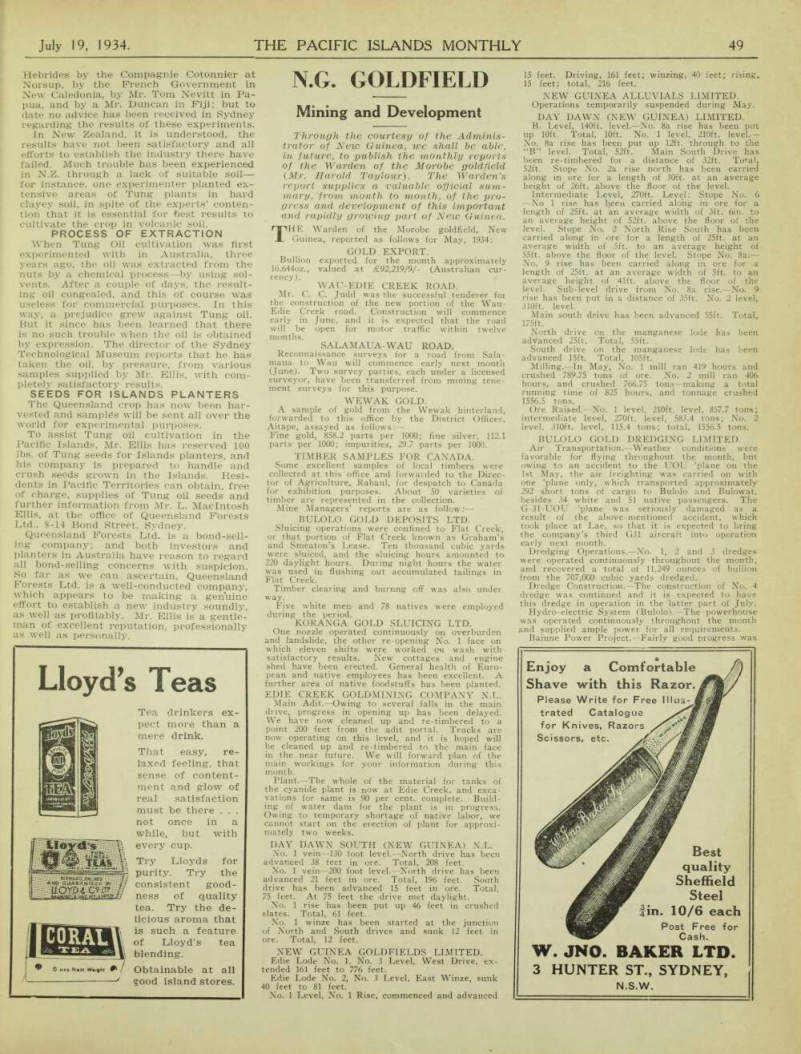
Heavy Demand for Tung Oil Suggests Profitable Alternative Islands Crop
INTEREST in Tung Oil cultivation continues to grow. It is believed that planters in Pacific Territories, which are not too close to the equator, may find in this crop a profitable alternative to such products as coconuts and rubber, which recently have suffered from reduced prices.
For three years this Journal has been gathering up odds and ends about Tung oil cultivation, but without being able to secure anything very authoritative on the subject. Now, however, through the kindness of Mr. L. Macintosh Ellis, B.Sc., F.R.G.S., we are able to supply the following summary of the latest available in formation about Tung Oil cultivation and its market possibilities.
ON previous occasions we have pointed out that there are two well-known varieties of Tung oil — Aleurites Fordii, which grows in the middle regions of China, and the Aleurites Montana, whose home apparently is in and about Cochin- China. The Fordii appears to grow best in sub-tropical and more temperate countries and it is a heavy producer. The Montana is understood to be definitely suited to tropical conditions and is a comparatively poor bearer. Experiments made with Fordii in certain of the hotter tropical islands were not successful. The plant grew vigorously in its early stages, but it was weakly, or failed altogether, when it came to the bearing stage.
We are now informed that there is a third variety, Aleurites Cordata, which is being extensively planted in Russia and Japan.
Mr. L, Macintosh Ellis is the consulting forest-engineer to the Queensland Forests Ltd., which has established a large and apparently flourishing Tung plantation in the Johnstone Valley district, North Queensland. About 8,000 trees have been planted there and 5,000 are now coming into bearing. This company is devoting itself exclusively to the cultivation of the multi-cluster variety of the Fordii plant, which has been established successfully in Florida, U.S.A. Everyone who has investi gated this new North Queensland industry appears to be impressed concerning its condition and possibilities.
The following article is based largely on information supplied by Mr. Ellis, and from similar sources. We cannot ourselves guarantee that it is completely reliable, but we believe that it is; and it is published on the assurance of technicians that what has been done in North Queensland can be done also in the Pacific Territories which are not too close to the equator—particularly Norfolk Island, New Caledonia, Fiji, Samoa, Tonga, Cook Islands, Tahiti and possibly New Hebrides.
There is conflicting evidence concerning the possibilities of the Tung tree in the more northerly islands. We have been told that the Fordii variety does not flourish close to the equator—yet w T e have seen and published photographs showing very healthy specimens of plants grown in New Guinea. One planter, near Kokopo, N.G.. reports that he successfully cultivated the Fordii variety and that the plants were in bearing in two years and harvested in the third year. It is understood that Mr.
G. Murray (Director of Agriculture) has made experiments w r ith Tung oil trees in New Guinea and it would be interesting to know his expert opinion on the possi bilities of the tree in New Guinea.
Uses Of Tung Oil
The Tung oil is the best drying and waterproof oil of vegetable origin known
to science and is an essential constituent of duco, varnishes, enamels, lacquers and paints, almost entirely displacing New Zealand Kauri Gum, which was formerly used in paint manufacturing. Together with the stalks of sugar cane, the oil is used in making artificial and rayon silk.
Having definite anti-corrosive qualities, the oil is most valuable for combating rust erosion in steel and other metals and for proofing aeroplane wings. For these rea sons, and for its use in the manufacture of armaments, Russia has planted 1,200 acres of Aleurites Montana and Aleurites Cordata near the Black Sea and, it is understood, by the end of 1938 she will have 33,000 acres under cultivation.
It has some hundreds of other uses— mostly in the manufacturing of such pro ducts as: linoleum, gaskets, printing and writing inks, shells, cartridges, telephone wire, brake lining, umbrellas, toothpaste tubes, raincoats, fabrics, fertilizers, electric wire, oilcloth, artificial leather, etc. The oil is also used extensively for preserving wood, car upholstery, and paper; for fire proofing many articles; and for lining ships’ tanks, and cosmetic and shaving cream tubes.
Having a certain nutritious value the oil is used in the preparation of medicinal compounds, but its use in this connection
is confined almost wholly to China. It is reported that there is a huge and growing demand for Tung oil, which is now largely supplied from China.
Description Of Trees
The Tung trees grow to about 30 feet in height and have a trunk of nearly eight inches in diameter. The dense foliage branches out in a low, spreading fashion.
The dark green leaves are large and heart shaped, while the flowers are white with pink centres. In the resting period the trees shed their leaves and remain bare for a period.
The fruit, which has a black woody ap pearance, is about the size of a billard ball and hangs from the branches on a slender stem three to four inches in length. When the fruit come into bearing in the third year, the nuts ripen and fall to the ground.
On the ground, the outside husk of the fruit splits open from the base upward, generally into five divisions each contain ing a seed. The seed encloses a creamy coloured kernel covered by a thick wrood like shell,
Cultivation
Cultivation of the Tung oil trees is com paratively simple. Seeds are planted in field nurseries about two inches deep and six inches apart in lines three feet from each other in order to permit open culti vation. Being hardy, the seedling tree is easily handled and can be transplanted into the plantation, care being taken not to injure the roots, as the plant is a tap rooter.
The trees are then planted in open lines, from 160 to 200 trees being planted to the
acre. Tung oil trees in their early stages require only the same attention as other crops—a clean orchard floor, and freedom from weeds —and care should be taken to guard the young trees from straying cattle.
Although the trees bear fruit after the second year, it is not until they mature and have been bearing for about three years that they produce a crop on a profitable commercial basis. The trees reach full bearing in their tenth year, and continue to produce fruit for another 20 years. The oldest trees in Florida, U.S.A., are about 28 years old and are still bearing a full crop.
When the fruit is gathered, husked and the seeds bagged, they are sent to the mill where the oil is extracted by an up-to-date expressing plant. The oil when extracted is a pale neutral colour and in appearance is not unlike eucalyptus oil. In China, however, the extraction is done in very primitive fashion and consequently the extracted oil contains impurities and par ticles of the nut and husk. The Chinese growers adulterate the oil 20 per cent, by the addition of soya bean oil, sesame oil, rape seed oil, poppy seed oil and peanut oil. This process of adulteration gives the oil a light golden colour, and it is then marketed under the name of Chinese wood oil.
Estimated Returns
Based on 160 trees to the acre the esti mated returns from the Queensland planta tion are as follows:
The price of Tung oil during the past ten years has averaged 8.4 d per lb., and in 1923 it rose to 1/10 for a short time before returning to a little under 8½d per lb.—its present price.
World Consumption
Tung oil has assumed a position of such importance in the manufacture of essential commodities that the annual amount of Tung oil used in industry is now over 170,000,000 lb. valued at £30,000,000. The following table shows the annual imports into the various countries which use Tung oil:
The fact that in 1933 only 8000 lbs. of Tung oil out of the 1,250,000 used in Australia were imported from countries within the British Empire, shows how dependent the Empire is on supplies from China.
The Queensland company estimates that it can produce enough oil, when full bearing is reached, to fill the requirements of the Commonwealth and also export a quantity to England where huge supplies are at pre sent being obtained from China.
Experiments In Pacific Is.
In August, 1930, Tung oil seeds ( Fordii) were obtained in Sydney by the Malayta Co. and sent to their branches at Su’u and Yandina (Solomon Islands) for experi mental planting. On the Su’u plantation young plants appeared in the following month and subsequently were transplant ed. They were quite healthy, germinated rapidly, and eventually grew into strong trees. The results at Yandina, however, were not so encouraging. After a brief period of growth the plants withered away; but this was thought to be due to mutila tion of the young plants by land crabs.
Seeds have also been planted in New
Age of Trees Weight of oil in Value per acre in years lbs. per tree at 8d per lb. of oil 4 3.5 £19 5 4.5 £24 6 7.1 £38 7 9.9 £53 8 10.8 £58 9 11.4 £61 10 11.6 £62
Country lb. weight Country lb. weight U.S. America 125,440,000 France ... 4,000,000 Germany ... 14,000,000 Japan .. ... 3,000,000 Great Britain 8,960,000 Denmark ... 1,500,000 Canada 7,000,000 Australia ... 1,250,000 Holland 4,500,000 Sundry .. ... 1,000,000
Hebrides by the Compagnie Cotonnier at Norsup, by the French Government in New Caledonia, by Mr. Tom Nevitt in Pa pua, and by a Mr. Duncan in Fiji; but to date no advice has been received in Sydney regarding the results of these experiments.
In New Zealand, it is understood, the results have not been satisfactory and all efforts to establish the industry there have failed. Much trouble has been experienced in N.Z. through a lack of suitable soil— for instance, one experimenter planted ex tensive areas of Tung plants in hard clayey soil, in spite of the experts’ conten tion that it is essential for best results to cultivate the crop in volcanic soil.
Process Of Extraction
When Tung Oil cultivation was first experimented with in Australia, three years ago, the oil was extracted from the nuts by a chemical process—by using sol vents. After a couple of days, the result ing oil congealed, and this of course was useless for commercial purposes. In this way, a prejudice grew against Tung oil.
But it since has been learned that there is no such trouble when the oil is obtained by expression. The director of the Sydney Technological Museum reports that he has taken the oil. by pressure, from various samples supplied by Mr. Ellis, with com pletely satisfactory results.
Seeds For Islands Planters
The Queensland crop has now been har vested and samples will be sent all over the world for experimental purposes.
To assist Tung oil cultivation in the Pacific Islands, Mr. Ellis has reserved 100 lbs. of Tung seeds for Islands planters, and his company is prepared to handle and crush seeds grown in the Islands. Resi dents in Pacific Territories can obtain, free of charge, supplies of Tung oil seeds and further information from Mr. L. Macintosh Ellis, at the office of Queensland Forests Ltd., 8-14 Bond Street, Sydney.
Queensland Forests Ltd. is a bond-sell ing company; and both investors and planters in Australia have reason to regard all bond-selling concerns with suspicion.
So far as we can ascertain, Queensland Forests Ltd. is a well-conducted company, which appears to be making a genuine effort to establish a new industry soundly, as well as profitably. Mr. Ellis is a gentle man of excellent reputation, professionally as well as personally.
Advertisements & other items, pp. 49-51 (1 item)
Ship Chandlery-Hardware
W. M. REID
C/o Robert Reid & Co., Ltd.
32-34 YORK STREET, SYDNEY
Wholesale Exporter of Goods of all Classes from Australia
MINING MACHINERY
WE ARE MAKERS OF ALL CLASSES OF
MINING MACHINERY, STAMPER BATTERIES,
HUNTINGTON MILLS, Etc.
ALSO ALL CLASSES OF
BRICK-MAKING MACHINERY
GENERAL ENGINEERING AND FOUNDRY WORK
High-class SEMI-STEEL MACHINE MOULDED GEARING
UR TO 14 FT. DIA. x 24 IN. FACE
GEORGE FOSTER & SONS LTD.
Code: A.B.C. 5th Edition. ST. PETERS, N.S.W. Cable Address: Fosterion, Sydney,
SHIP CHANDLERY-HARDWARE
BROOMFIELDS LIMITED, 152 Sussex St„ SYDNEY
Large and Complete Stocks of SHIP CHANDLERY.
Ironmongery of all kinds Paints, White Lead and Oils.
Sole Agents for: P. H. MUNTZ & CO.’S 3-CROWN BRAND METAL SHEATHING.
PEACOCK & BUCHANS’ ENGLISH READY-MIXED PAINTS.
WRITE FOR SHIP CHANDLERY CATALOGUE.
Special “In Bond” Prices for all Island enquiries quoted on application.
CABLES: “BOOM,” SYDNEY.
Skandia FULL DIESEL Engines
MARINE and STATIONARY
Instantaneous starting from cold —no hot bulb—low fuel and oil consumption.
MANUFACTURED IN SLOW AND HIGH SPEED TYPES Full Particulars from the Sole Agents:
NELSON & ROBERTSON
12 Spring Street, Sydney.
Cables: Ivan, Sydney.
ENGINEERING & MINERS’ SUPPLIES
Engineers, Miners, Planters, etc. Get in touch with us for any of the following lines:—“Star” Brand Shovels —the best shovel made; Picks, Mattocks. Handles, Centrifugal Pumps, Petrol Engines, and Engines converted for Charcoal Gas. Belting and Pulleys, etc. Pipes and Valves; Truck Wheels and Trucks: Copra Flues and Screens: Oils for all purposes; Files and all Sundries. Write for Particulars and Prices.
A. B. SMITH & GLUYAS
61-65 Macarthur St., Ultimo, Sydney, N.S.W.
STEEL RAILS & RAILWAY EQUIPMENT
New and Good Second-Hand
RAILS, 14 lbs. to 100 lbs. per yard; also Portable Track, Trucks of all types.
Wheels and Axles, Points and Crossings, Turntables, Locomotives, Bolts and Nuts, Dogspikes, etc. We also carry stocks of New and Used Mining and Industrial Machinery of all descriptions.
Send us your enquiries. Prompt attention.
J. E. TOOLE & COMPANY
Engineering Contractors, Machinery Merchants and Agents
70 Hunter Street, SYDNEY
' Telegrams and Cables: “Tooles,” Sydney.
If you are a planter or trader in New Guinea we can do your buying or selling in a large or small way.
If you reside elsewhere and want something in New Guinea: write to us. If it is obtainable we’ll get it for you.
Our twenty-odd years’ experience in this Territory is the foundation of our business.
G. THOMAS & COMPANY, Rabaul
GENERAL AGENTS STOCK & SHARE BROKERS
Radios: “Gortom, Rabaul.” P.O. Box 9.
Lloyd's Teas
Tea drinkers expect more than a mere drink.
That easy, relaxed feeling, that sense of contentment and glow of real satisfaction must be there . . . not once in a while, but with every cup.
Try Lloyds for purity. Try the consistent goodness of quality tea. Try the delicious aroma that is such a feature of Lloyd’s tea blending.
Obtainable at all good island stores.
N.G. Goldfield
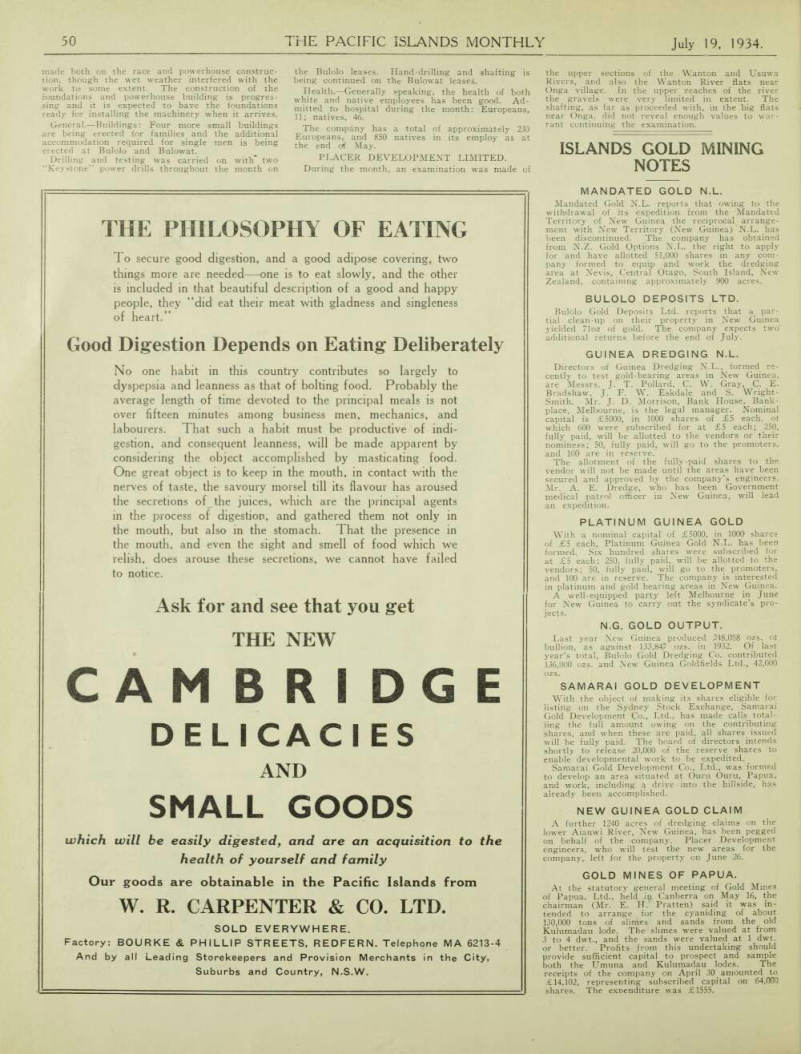
Mining and Development
Through the courtesy of the Adminis trator of New Guinea, we shall be able, in future, to publish the monthly reports of the Warden of the Morobe goldfield {Mr. Harold Taylour). The Warden’s report supplies a valuable official sum mary, from month to month, of the pro gress and development of this important and rapidly growing part of New Guinea.
THE Warden of the Morobe goldfield, New Guinea, reported as follows for May, 1934:
Gold Export.
Bullion exported for the month approximately 16,644oz., valued at £92,219/9/- (Australian currency).
Wau-Edie Creek Road.
Mr. C. C. Judd was the successful tenderer for the construction of the new portion of the Wau- Edie Creek road. Construction will commence early in June, and it is expected that the road will be open for motor traffic within twelve months.
Salamaua-Wau Road.
Reconnaissance surveys for a road from Sala maua to Wau will commence early next month (June). Two survey parties, each under a licensed surveyor, have been transferred from mining tene ment surveys for this purpose.
Wewak Gold.
A sample of gold from the Wewak hinterland, forwarded to this office by the District Officer, Aitape, assayed as follows: — Fine gold, 858.2 parts per 1000; fine silver, 112.1 parts per 1000; impurities, 29.7 parts per 1000.
Timber Samples For Canada.
Some excellent samples of local timbers were collected at this office and forwarded to the Direc tor of Agriculture, Rabaul, for despatch to Canada for exhibition purposes. About 50 varieties of timber are represented in the collection. — Mine Managers’ reports are as follow:
Bulolo Gold Deposits Ltd.
Sluicing operations were confined to Flat Creek, or that portion of Flat Creek known as Graham’s and Smeaton’s Lease. Ten thousand cubic yards were sluiced, and the sluicing hours amounted to 220 daylight hours. During night hours the water was used in flushing out accumulated tailings in Flat Creek.
Timber clearing and burnng off was also under way.
Five white men and 78 natives were employed during the period.
Koranga Gold Sluicing Ltd.
One nozzle operated continuously on overburden and landslide, the other re-opening No. 1 face on which eleven shifts were worked on wash with satisfactory results. New cottages and engine shed have been erected. General health of Euro pean and native employees has been excellent. A further area of native foodstuffs has been planted.
Edie Creek Goldmining Company N.L.
Main Adit. —Owing to several falls in the main drive, progress in opening up has been delayed.
We have now cleaned up and re-timbered to a point 200 feet from the adit portal. Trucks are now operating on this level, and it is hoped will be cleaned up and re-timbered to the main face in the near future. We will forward plan of the main workings for your information during this month.
Plant.--The whole of the material for tanks of the cyanide plant is now at Edie Creek, and exca vations for same is 90 per cent, complete. Build ing of water dam for the plant is in progress.
Owing to temporary shortage of native labor, we cannot start on the erection of plant for approxi mately two weeks.
Day Dawn South (New Guinea) N.L.
No. 1 vein—130 foot level. —North drive has been advanced 38 feet in ore. Total, 208 feet.
No. 1 vein—200 foot level. —North drive has been advanced 21 feet in ore. Total, 196 feet. South drive has been advanced 15 feet in ore. Total, 75 feet. At 75 feet the drive met daylight.
No. 1 rise has been put up 46 feet in crushed slates. Total, 61 feet.
No. 1 winze has been started at the junction of North and South drives and sunk 12 feet in ore. Total, 12 feet.
New Guinea Goldfields Limited.
Edie Lode No. 1. No. 3 Level, West Drive, ex tended 161 feet to 776 feet.
Edie Lode No. 2, No. 3 Level. East Winze, sunk 40 feet to 81 feet.
No. 1 Level, No. 1 Rise, commenced and advanced
15 feet. Driving, 161 feet; winzing, 40 feet; rising, 15 feet; total, 216 feet.
New Guinea Alluvials Limited.
Operations temporarily suspended during May.
Day Dawn (New Guinea) Limited.
B. Level, 140 ft. level. —No. 8a rise has been put up 10ft. Total, 10ft. No. 1 level, 210 ft. level.— No. 8a rise has been put up 12ft. through to the “B” level. Total, 52ft. Main South Drive has been re-timbered for a distance of 32ft. Total, 52ft. Stope No. 2a rise north has been carried along in ore for a length of 30ft. at an average height of 26ft. above the floor of the level.
Intermediate Level, 270 ft. Level: Stope No. 6 —No 1 rise has Ijeen carried along in ore for a length of 25ft. at an average width of 3ft. 6in. to an average height of 52ft. above the floor of the level. Stope No. 2 North Rise South has been carried along in ore for a length of 25ft. at an average width of Sft. to an average height of 55ft. above the floor of the level. Stope No. 8a. — No. 9 rise has been carried along in ore for a length of 25ft. at an average width of Sft. to an average height of 41ft. above the floor of the level. Sub-level drive from No. 8a rise.—No. 9 rise has been put in a distance of 35ft. No. 2 level, 310 ft. level.
Main south drive has been advanced 55ft. Total, 175 ft.
North drive on the manganese lode has been advanced 25ft. Total, 55ft.
South drive on the manganese lode has been advanced 15ft. Total, 105 ft.
Milling.—In May, No. 1 mill ran 419 hours and crushed 789.75 tons of ore. No. 2 mill ran 406 hours, and crushed 766.75 tons—making a total running time of 825 hours, and tonnage crushed 1556.5 tons.
Ore Raised. —No. 1 level, 210 ft. level, 857.7 tons; intermediate level, 270 ft. level, 583.4 tons; No. 2 level, 310 ft. level, 115.4 tons; total. 1556.5 tons.
Bulolo Gold Dredging Limited.
Air Transportation.—Weather conditions were favorable for flying throughout the month, but owing to an accident to the UOU ’plane on the 1st May, the air freighting was carried on with one ’plane only, which transported approximately 292 short tons of cargo to Bulolo and Bulowat, besides 34 white and 51 native passengers. The G-31-UOU ’plane was seriously damaged as a result of the above-mentioned accident, which took place at Lae, so that it is expected to bring the company’s third G31 aircraft into operation early next month.
Dredging Operations.—No. 1, 2 and 3 dredges were operated continuously throughout the month, and recovered a total of 11,249 ounces of bullion from the 707,000 cubic yards dredged.
Dredge Construction. —The construction of No. 4 dredge was continued and it is expected to have this dredge in operation in the latter part of July.
Hydro-electric System (Bulolo). —The powerhouse was operated continuously throughout the month and supplied ample power for all requirements.
Baiune Power Project.—Fairly good progress was
made both on the race and powerhouse construetion, though the wet weather interfered with the work to some extent. The construction of the foundations and powerhouse building is progressing and it is expected to have the foundations ready for installing the machinery when it arrives.
General.—Buildings: Four more small buildings are being erected for families and the additional accommodation required for single men is being erected at Bulolo and Bulowat.
Drilling and testing was carried on with two “Keystone"’ power drills throughout the month on
the Bulolo leases. Hand-drilling and shafting is being continued on the Bulowat leases, Health. Generally speaking, the health of both white and native employees has been good. Ad mitted to hospital during the month: Europeans, 11; natives 46.
The company has a total of approximately 230 Europeans, and 850 natives in its employ as at the end May.
Placer Development Limited.
During the month, an examination was made of
the upper sections of the Wanton and Usuwa Rivers, and also the Wanton River flats near Onga village. In the upper reaches of the river the gravels were very limited in extent. The shafting, as far as proceeded with, in the big flats near Onga, did not reveal enough values to war rant continuing the examination.
Advertisements & other items, pp. 51-52 (1 item)
Enjoy a Comfortable
Shave with this Razor.
Please Write for Free Illustrated Catalogue for Knives, Razors Scissors, etc.
Best quality Sheffield Steel ¾ in. 10/6 each Post Free for Cash.
W. JNO. BAKER LTD.
3 HUNTER ST., SYDNEY,
N.S.W.
THE PHILOSOPHY OF EATING
To secure good digestion, and a good adipose covering, two things more are needed—one is to eat slowly, and the other is included in that beautiful description of a good and happy people, they “did eat their meat with gladness and singleness of heart.”
Good Digestion Depends on Eating Deliberately
No one habit in this country contributes so largely to dyspepsia and leanness as that of bolting food. Probably the average length of time devoted to the principal meals is not over fifteen minutes among business men, mechanics, and labourers. That such a habit must be productive of indigestion, and consequent leanness, will be made apparent by considering the object accomplished by masticating food.
One great object is to keep in the mouth, in contact with the nerves of taste, the savoury morsel till its flavour has aroused the secretions of the juices, which are the principal agents in the process of digestion, and gathered them not only in the mouth, but also in the stomach. That the presence in the mouth, and even the sight and smell of food which we relish, does arouse these secretions, we cannot have failed to notice.
Ask for and see that you get
THE NEW
CAMBRIDGE
DELICACIES
AND
SMALL GOODS
which will be easily digested, and are an acquisition to the health of yourself and family Our goods are obtainable in the Pacific Islands from
W. R. CARPENTER & CO. LTD.
SOLD EVERYWHERE.
Factory: BOURKE & PHILLIP STREETS, REDFERN. Telephone MA 6213-4 And by all Leading Storekeepers and Provision Merchants in the City, Suburbs and Country, N.S.W.
Islands Gold Mining
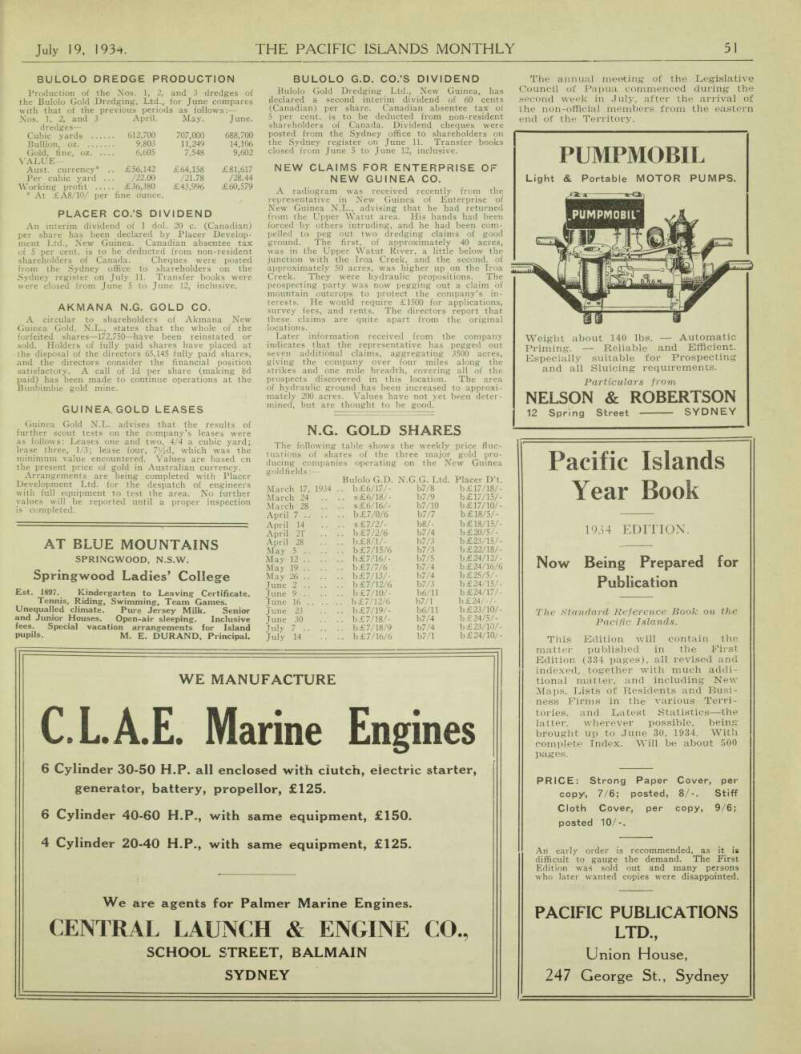
Notes
Mandated Gold N.L.
Mandated Gold N.L. reports that owing to the withdrawal of its expedition from the Mandated Territory of New Guinea the reciprocal arrange ment with New Territory (New Guinea) N.L. has been discontinued. The company has obtained from N.Z. Gold Options N.L. the right to apply for and have allotted 51,000 shares in any com pany formed to equip and work the dredging area at Nevis, Central Otago, South Island, New Zealand, containing approximately 900 acres.
Bulolo Deposits Ltd.
Bulolo Gold Deposits Ltd. reports that a par tial clean-up on their property in New Guinea yielded 71oz of gold. The company expects two additional returns before the end of July.
Guinea Dredging N.L.
Directors of Guinea Dredging N.L., formed re cently to test gold-bearing areas in New Guinea, are Messrs. J. T. Pollard, C. W. Gray, C. E.
Bradshaw, J. F. W. Eskdale and S. Wright- Smith. Mr. J. D. Morrison, Bank House, Bank place, Melbourne, is the legal manager. Nominal capital is £5000, in 1000 shares of £5 each, of which 600 were subscribed for at £5 each; 250, fully paid, will be allotted to the vendors or their nominess; 50, fully paid, will go to the promoters, and 100 are in reserve.
The allotment of the fully-paid shares to the vendor will not be made until the areas have been secured and approved by the company’s engineers.
Mr. A. E. Dredge, who has been Government medical patrol officer in New Guinea, will lead an expedition.
Platinum Guinea Gold
With a nominal capital of £5000, in 1000 shares of £5 each, Platinum Guinea Gold N.L. has been formed. Six hundred shares were subscribed for at £5 each; 250, fully paid, will be allotted to the vendors; 50, fully paid, will go to the promoters, and 100 are in reserve. The company is interested in platinum and gold bearing areas in New Guinea.
A well-equipped party left Melbourne in June for New Guinea to carry out the syndicate’s pro jects.
N.G. Gold Output.
Last year New Guinea produced 248,088 ozs. of bullion, as against 133,847 ozs. in 1932. Of last year’s total, Bulolo Gold Dredging Co. contributed 136.000 ozs. and Aew Guinea Goldfields Ltd., 42,000 ozs.
Samarai Gold Development
With, the object of making its shares eligible for listing on the Sydney Stock Exchange, Samarai Gold Development Co., Ltd., has made calls total ling the full amount owing on the contributing shares, and when these are paid, all shares issued will be fully paid. The board of directors intends shortly to release 20,000 of the reserve shares to enable developmental work to be expedited.
Samarai Gold Development Co., Ltd., was formed to develop an area situated at Ouru Ouru, Papua, and work, including a drive into the hillside, has already been accomplished.
New Guinea Gold Claim
A further 1240 acres of dredging claims on the lower Aiauwi River, New Guinea, has been pegged on behalf of the company. Placer Development engineers, who will test the new areas for the company, left for the property on June 26.
Gold Mines Of Papua.
At the statutory general meeting of Gold Mines of Papua, Ltd., held in Canberra on May 16, the chairman (Mr. E. H. Pratten) said it was in tended to arrange for the cyaniding of about 130.000 tons of slimes and sands from the old Kulumadau lode. The slimes vrere valued at from 3 to 4 dwt., and the sands were valued at 1 dwt. or better. Profits from this undertaking should provide sufficient capital to prospect and sample both the Umuna and Kulumadau lodes. The receipts of the company on April 30 amounted to £14,102, representing subscribed capital on 64,000 shares. The exoenditure was £1555.
Bulolo Dredge Production
Production of the Nos. 1,2, and 3 dredges of the Bulolo Gold Dredging, Ltd., for June compares with that of the previous periods as follows: Nos. 1,2, and 3 April. May. June, dredges— Cubic yards 612,700 707,000 688,700 Bullion, oz 9,803 11,249 14,106 Gold, fine, oz 6,605 7,548 9,602
Value—
Aust. currency* .. £56,142 £64,158 £81,617 Per cubic yard ... /22.00 /21.78 728.44 Working profit £36,380 £43,996 £60,579 * At £A8/10/ per fine Ounce.
Placer Co.’S Dividend
An interim dividend of 1 dol. 20 c. (Canadian) per share has been declared by Placer Develop ment Ltd., New Guinea. Canadian absentee tax of 5 per cent, is to be deducted from non-resident shareholders of Canada. Cheques were posted from the Sydney office to shareholders on the Sydney register on July 11. Transfer books were were closed from June 5 to June 12, inclusive.
Akmana N.G. Gold Co.
A circular to shareholders of Akmana New Guinea Gold, N.L., states that the whole of the forfeited shares —172,750 —have been reinstated or sold. Holders of fully paid shares have placed at the disposal of the directors 65,145 fully paid shares, and the directors consider the financial position satisfactory. A call of Id per share (making Sd paid) has been made to continue operations at the Bimbimbie gold mine.
Guinea,Gold Leases
Guinea Gold N.L. advises that the results of further scout tests on the company’s leases were as follows: Leases one and two, 4/4 a cubic yard; lease three, 1/3; lease four, which was the minimum value encountered. Values are based cn the present price of gold in Australian currency.
Arrangements are being completed with Placer Development Ltd. for the despatch of engineers with full equipment to test the area. No further values will be reported until a proper inspection is completed.
Bulolo G.D. Co.’S Dividend
Bulolo Gold Dredging Ltd., New Guinea, has declared a second interim dividend of 60 cents (Canadian) per share. Canadian absentee tax of 5 per cent, is to be deducted from non-resident shareholders of Canada. Dividend cheques were posted from the Sydney office to shareholders on the Sydney register on June 11. Transfer books closed from June 5 to June 12, inclusive.
New Claims For Enterprise Of
New Guinea Co.
A radiogram was received recently from the representative in New Guinea of Enterprise of New Guinea N.L., advising that he had returned from the Upper Watut area. His hands had been forced by others intruding, and he had been com pelled to peg out two dredging claims of good ground. The first, of approximately 40 acres, was in the Upper Watut River, a little below the junction with the Iroa Creek, and the second, of approximately 50 acres, was higher up on the Iroa Creek. They were hydraulic propositions. The prospecting party was now pegging out a claim of mountain outcrops to protect the company’s in terests. He would require £1500 for applications, survey fees, and rents. The directors report that these claims are quite apart from the original locations.
Later information received from the company indicates that the representative has pegged out seven additional claims, aggregating 3500 acres, giving the company over four miles along the strikes and one mile breadth, covering all of the prospects discovered in this location. The area of hydraulic ground has been increased to approxi mately 200 acres. Values have not yet been deter mined, but are thought to be good.
N.G. Gold Shares
The following table shows the weekly price fluc tuations of shares of the three major gold pro ducing companies operating on the New Guinea goldfields:—
The annual meeting of the Legislative Council of Papua commenced during the second week in July, after the arrival of the non-official members from the eastern end of the Territory.
Bulolo G.D.
N.G.G. Ltd.
Placer D’t.
March 17, 1934 .. b £6/17/ b7/8 b£17/18/- March 24 .. s£6/18/b7/9 b £17/15/- March 28 .. s£6/16/b7/10 b £17/10/- April 7 .. .. b£ 7/0/6 b7/7 b£18/5/- April 14 .. s£7/2/b8/b £18/15/- April 21* .. b £7/2/6 b7/4 b£20/5/- April 28 .. b £8/1/b 7/3 b £23/15/- May S .. .. b £7/15/6 b7/3 b £22/18/- May 12 .. .. b£7/16/b7/5 b £24/12/- May 19 .. .. b £7/7/6 b7/4 b £24/16/6 May 26 .. .. b£7/13/b7/4 b£25/5/- June 2 .. .. b £7/12/6 b7/3 b £24/15/- June 9 .. .. b£7/10/b6/11 b £24/17/- Tune 16 .. .. b£ 7/12/6 b7/1 b£24/-/- June 23 .. b£7/19/b6/11 b £23/10/- June 30 .. b£7/18/b7/4 b£24/5/- July 7 .. .. b £7/18/9 b7/4 b£23/10/- July 14 .. b £7/16/6 b7/1 b £24/10/-
Advertisements & other items, p. 53 (2 items)
Pacific Islands
PUMPMOBIL
Light & Portable MOTOR PUMPS Weight about 140 lbs. Automatic Priming. Reliable and Efficient.
Especially suitable for Prospecting and all Sluicing requirements.
Particulars from
NELSON & ROBERTSON
12 Spring Street SYDNEY
Pacific Islands
Year Book
1934 EDITION.
Now Being Prepared for
Publication
The Standard Reference Book on the Pacific Islands.
This Edition will contain the matter published in the First Edition (334 pages), all revised and indexed, together with much additional matter, and including New Maps, Lists of Residents and Business Firms in the various Territories, and Latest Statistics —the latter. wherever possible, being brought up to June 30, 1934. With complete Index. Will be about 500 pages.
PRICE: Strong Paper Cover, per copy, 7/6; posted, 8/-. Stiff Cloth Cover, per copy, 9/6; posted 10/-.
An early order is recommended, as it is difficult to gauge the demand. The First Edition was sold out and many persons who later wanted copies were disappointed.
PACIFIC PUBLICATIONS
LTD.,
Union House,
247 George St., Sydney
C.LA.E. Marine Engines
AT BLUE MOUNTAINS
SPRINGWOOD, N.S.W.
Springwood Ladies’ College
Est. 1897. Kindergarten to Leaving Certificate.
Tennis, Riding, Swimming, Team Games.
Unequalled climate. Pure Jersey Milk. Senior and Junior Houses. Open-air sleeping. Inclusive fees. Special vacation arrangements for Island Pupils. M. E. DURAND, Principal.
WE MANUFACTURE
C.LA.E. Marine Engines
6 Cylinder 30-50 H.P. all enclosed with clutch, electric starter, generator, battery, propeller, £125. 6 Cylinder 40-60 H.P., with same equipment, £150. 4 Cylinder 20-40 H.P., with same equipment, £125.
We are agents for Palmer Marine Engines.
CENTRAL LAUNCH & ENGINE CO,,
SCHOOL STREET, BALMAIN
SYDNEY
Market Quotations
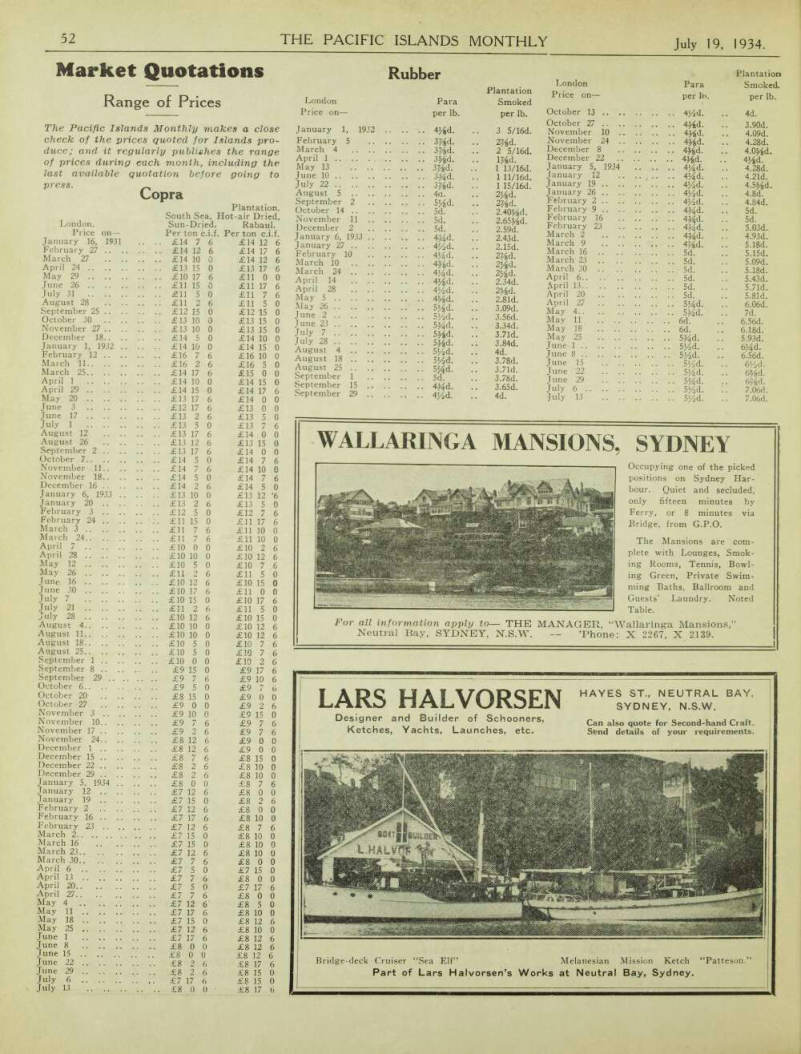
Range of Prices
The Pacific Islands Monthly makes a close check of the prices quoted for Islands pro duce; and it regularly publishes the range of prices during each month, including the last available quotation before going to press.
London Price on—
Rubber
Para per lb.
Plantation Smoked per lb.
January 1, 1932 4J*d. 3 5/16d.
February 5 m d. 2Hd- March 4 3%d. 2 S/16d.
April 1 md.
May 13 .. .. 3%d. 1 13/16d.
June 10 1 ll/16d.
July 22 md. 1 15/16d.
August 5 .. ., 2'Ad.
September 2 SJid. 2Vid.
October 14 .. 2.40^d.
November 11 .. 5d. 2.6S^d.
December 2 Sd. 2.59d.
January 6, 1933 .. 43^d. 2.43d.
January 27 .. .. 4/ 2 d. 2.15d.
February 10 4^d. 2Vsd.
March 10 .. .. 4Hd. 2%d.
March 24 .. 4}4d. 2'Ad.
April 14 ... 4^d. 2.34d.
April 28 ... 4/ 2 d. 2Ad.
May 5 4^ 8 d. 2.81d.
May 26 5%d. 3.09d.
June 2 3.56d.
June 23 3.34d.
July 7 3.7ld.
July 28 5Hd. 3.84d.
August 4 .. .. 4d.
August 18 .. .. 3.78d.
August 25 .. .. 3.71d.
September 1 3.78d.
September 15 .. 3.65d.
September 29 .. 4½d. 4d.
London Price on— Para per lb.
Plantation Smoked. per lb.
October 13 4d.
October 27 3.90d.
November 10 .. .. .. 4^d. 4.09d.
November 24 .. .. 4.28d.
December 8 .. .. 4^d. 4.05id.
December 22 .. .. .. .. 4^d. 4%d.
January 5, 1934 .. .. 4¼d. 4.28d.
January 12 .. .. .. .. 4¼d. 4.21d.
January 19 .. .. 4½ d. 4.55^d.
January 26
.. .. 4½d. 4.8d.
February 2 .. .. 4½d. 4.84d.
February 9 5d.
February 16 .. .. .. .. 4¾d. 5d.
February 23 .. .. 5.03d.
March 2 4.93d.
March 9 .. .. 4Hd. 5.18d.
March 16 .. .. 5d. 5.15d.
March 23 5.09d.
March 30 5d. 5.18d.
April 6 5.43d.
April 13 5.71d.
April 20 .. .. 5d. 5.81d.
April 27 .. .. 5¼d. 6.06d.
May 4 .. 5¾d. 7d.
May 11 . .. 6d. 6.56d.
May 18 6.18d.
May 25 5¾d. 5.93d.
June 1 5½d. 6¼d.
June 8
5½d. 6.56d.
June 15
5½d. 6½d.
June 22 5¼d. 6^d.
June 29 5¼d. 67/sd.
July 6
5½d. 7.06 d.
July 13 5½d. 7.06d.
Copra London. Price on — South Sea, Sun-Dried. Per ton c.i.f.
Plantation, Hot-air Dried, Rabaul. Per ton c.i.f.
January 16, 1931 . .. £14 7 6 £14 12 6 February 27 . .. £14 12 6 £14 17 6 March 27 . .. £14 10 0 £14 12 6 April 24 . .. £13 15 0 £13 17 6 May 29 . .. £10 17 6 £11 0 0 June 26 . .. £11 IS 0 £11 17 6 July 31 . .. £11 5 0 £11 7 6 August 28 . .. £11 2 6 £11 5 0 September 25 . .. £12 15 0 £12 15 0 October 30 . .. £13 10 0 £13 15 0 November 27 . .. £13 10 0 £13 15 0 December 18 . .. £14 5 0 £14 10 0 January 1, 1932 .. .. .. £14 10 0 £14 15 0 February 12 .. £16 7 6 £16 10 0 March 11 . .. £16 2 6 £16 5 0 March 25 .. £14 17 6 £15 0 0 April 1 £14 15 0 April 29 .. £14 15 0 £14 17 6 May 20 .. £13 17 6 £14 0 0 June 3 .. £12 17 6 £13 0 0 June 17 £13 5 0 July 1 .. £13 5 0 £13 7 6 August 12 .. £13 17 6 £14 0 0 August 26 .. £13 12 6 £13 15 0
September 2
.. £13 17 6 £14 0 0 October 7 .. £14 5 0 £14 7 6 November 11 .. £14 7 6 £14 10 0 November 18 .. £14 5 0 £14 7 6 December 16 £14 5 0 January 6, 1933 .. .. .. £13 10 0 £13 12 6 January 20 .. £13 2 6 £13 5 0
February 3
£12 7 6
February 24
£11 15 0 £11 17 6 March 3 £11 10 0 March 24 .. £11 7 6 £11 10 0 April 7 £10 2 6 April 28 .. £10 10 0 £10 12 6 May 12 .. £10 5 0 £10 7 6 May 26 .. £11 2 6 £11 5 0 Jun e 16 .. £10 12 6 £10 15 0 June 30 £11 0 0
July 7
July 21 £10 17 6 £11 5 0
July 28
.. £10 12 6 £10 15 0 August 4 £10 12 6 August 11 .. £10 10 0 £10 12 6 August 18 .. £10 5 0 £10 7 6 August 25 £10 7 6
September 1
.. £10 0 0 £10 2 6 September 8 £9 17 6
September 29
.. £9 7 6 £9 10 6 October 6 £9 7 6 October 20 .. £8 15 0 £9 0 0 October 27 .. £9 0 0 £9 2 6 November 3 £9 15 0 November 10 .. £9 7 6 £9 7 6 November 17 £9 7 6 November 24 .. £8 12 6 £9 0 0 December 1 .. £8 12 6 £9 0 0 December 15 £8 15 0 December 22 £8 10 0 December 29 .. £8 2 6 £8 10 0 January 5, 1934 .. .. .. £8 0 0 £8 7 6
January 12
.. £7 12 6 £8 0 0
January 19
.. £7 15 0 £8 2 6
February 2
.. £7 12 6 £8 0 0 February 16 .. £7 17 6 £8 10 0
February 23
£7 12 6 £8 7 6 March 2 £8 10 0 March 16 .. £7 15 0 £8 10 0 March 23 .. £7 12 6 £8 10 0 March 30 .. £7 7 6 £8 0 0 April 6 .. £7 5 0 £7 IS 0 April 13 .. £7 7 6 £8 0 0 April 20.. £7 5 0 £7 17 6 April 27 £8 0 0 May 4 .. £7 12 6 £8 5 0 May 11 .. £7 17 6 £8 10 0 May 18 £8 12 6
May 25
£7 12 6 £8 10 0 June 1 .. £7 17 6 £8 12 6 June 8 .. £8 0 0 £8 12 6 June 15 £8 12 6 June 22 £8 17 6 June 29 £8 15 0 July 6 £8 15 0 July 13 .. £8 0 0 £8 17 6
Advertisements & other items, p. 54 (1 item)
Lars Halvorsen
WALLARINGA MANSIONS, SYDNEY
mseei Occupying one of the picked positions on Sydney Harbour. Quiet and secluded, only fifteen minutes by Ferry, or 8 minutes via Bridge, from G.P.O.
The Mansions are complete with Lounges, Smoking Rooms, Tennis, Bowling Green, Private Swimming Baths, Ballroom and Guests’ Laundry. Noted Table.
For all information apply to— THE MANAGER, “Wallaringa Mansions,”
Neutral Bay, SYDNEY, N.S.W. ’Phone: X 2267, X 2139.
LARS HALVORSEN
Designer and Builder of Schooners, Ketches, Yachts, Launches, etc.
HAYES ST., NEUTRAL BAY,
SYDNEY, N.S.W.
Can also quote for Second-hand Craft.
Send details of your requirements.
Bridge-deck Cruiser “Sea Elf” Melanesian Mission Ketch “Patteson.”
Part of Lars Halvorsen’s Works at Neutral Bay, Sydney.
Exchange Rates
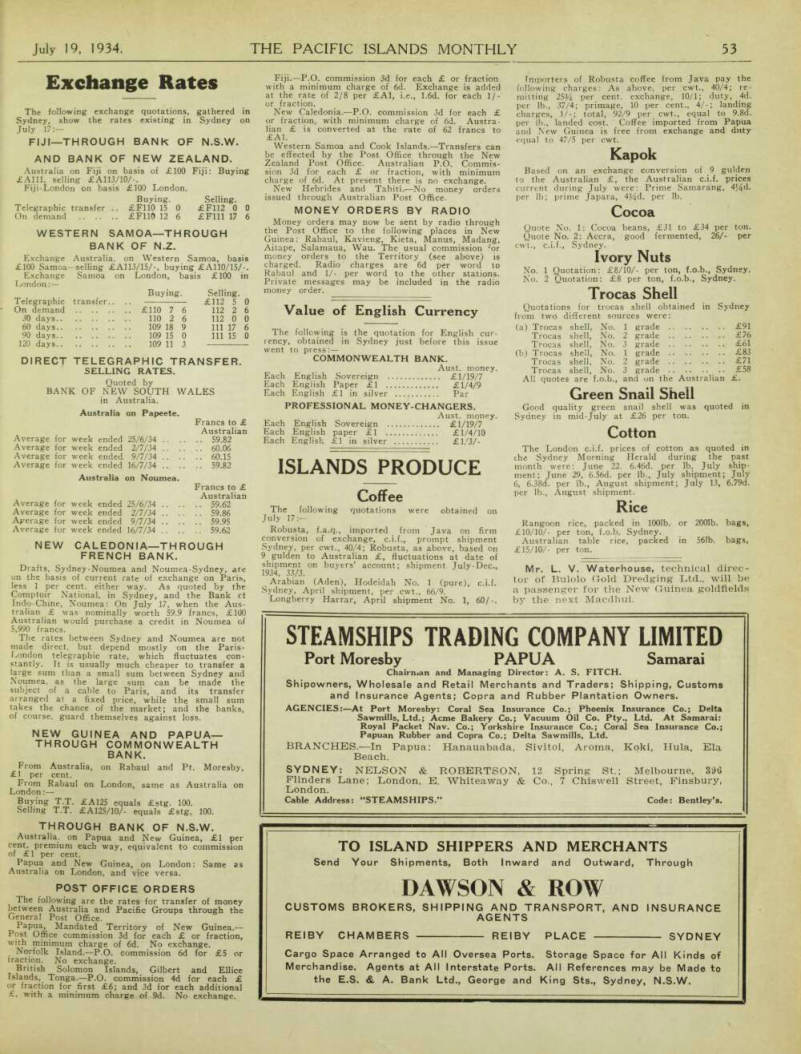
The following exchange quotations, gathered in Sydney, show the rates existing in Sydney on July 17:-
Fiji—Through Bank Of N.S.W.
And Bank Of New Zealand.
Australia on Fiji on basis of £100 Fiji: Buying £A111, selling £A113/10/-.
Fiji-London on basis £100 London.
Western Samoa—Through
Bank Of N.Z.
Exchange Australia, on Western Samoa, basis £100 Samoa—selling £A113/15/-, buying £A110/15/-.
Exchange Samoa on London, basis £100 in London: —
Direct Telegraphic Transfer.
Selling Rates.
Quoted by
Bank Of New South Wales
in Australia.
New Caledonia—Through
French Bank.
Drafts, Sydney-Noumea and Noumea-Sydney, are on the basis of current rate of exchange on Paris, less 1 per cent, either way. As quoted by the Comptoir National, in Sydney, and the Bank ct Indo-Chine, Noumea: On July 17, when the Aus tralian £ was nominally worth 59.9 francs, £100 Australian would purchase a credit in Noumea of 5,990 francs.
The rates between Sydney and Noumea are not made direct, but depend mostly on the Paris- London telegraphic rate, which fluctuates con stantly. It is usually much cheaper to transfer a large sum than a small sum between Sydney and Noumea, as the large sum can be made the subject of a cable to Paris, and its transfer arranged at a fixed price, while the small sum takes the chance of the market; and the banks, of course, guard themselves against loss.
New Guinea And Papua
Through Commonwealth
Bank.
From Australia, on Rabaul and Pt. Moresby, £1 per cent.
From Rabaul on London, same as Australia on London:— Buying T.T. £A125 equals £stg. 100.
Selling T.T. £A125/10/- equals £stg, 100.
Through Bank Of N.S.W.
Australia, on Papua and New Guinea, £1 per cent, premium each way, equivalent to commission of £1 per cent.
Papua and New Guinea, on London: Same as Australia on London, and vice versa.
Post Office Orders
The following are the rates for transfer of money between Australia and Pacific Groups through the General Post Office.
Papua, Mandated Territory of New Guinea.— Post Office commission 3d for each £ or fraction, with minimum charge of 6d. No exchange.
Norfolk Island.—P.O. commission 6d for £5 or fraction. No exchange.
British Solomon Islands, Gilbert and Ellice Islands, Tonga.—P.O. commission 4d for each £ or fraction for first £6; and 3d for each additional £, with a minimum charge of 9d. No exchange.
Fiji.—P.O. commission 3d for each £ or fraction with a minimum charge of 6d. Exchange is added at the rate of 2/8 per £A1, i.e., 1.6 d. for each 1/or fraction.
New Caledonia.—P.O. commission 3d for each £ or fraction, with minimum charge of 6d. Austra lian £ is converted at the rate of 62 francs to £AI.
Western Samoa and Cook Islands.—Transfers can be effected by the Post Office through the New Zealand Post Office. Australian P.O. Commis sion 3d for each £ or fraction, with minimum charge of 6d. At present there is no exchange.
New Hebrides and Tahiti.—No money orders issued through Australian Post Office.
Money Orders By Radio
Money orders may now be sent by radio through the Post Office to the following places in New Guinea: Rabaul, Kavieng, Kieta, Manus, Madang, Aitape, Salamaua, Wau. The usual commission ; or money orders to the Territory (see above) is charged. Radio charges are 6d per word to Rabaul and 1/- per word to the other stations.
Private messages may be included in the radio money order.
Buying. Selling.
Telegraphic transfer .. £F110 15 0 £F112 0 0 On demand £F110 12 6 £F111 17 6
Buying. Selling.
Telegraphic transfer.. .. £112 5 0 On demand £110 7 6 112 2 6 JO days 110 2 6 112 0 0 60 days 109 18 9 111 17 6 90 days 109 15 0 111 15 0 120 days 109 11 3
Australia on Papeete.
Francs to £ Australian Average for week ended 25/6/34 .. .. .. 59.82 Average for week ended 2/7/34 .. .. .. 60.06 Average for week ended 9/7/34 .. .. .. 60.15 Average for week ended 16/7/34 .. .. .. 59.82 Australia on Noumea.
Francs to £ Australian Average for week ended 25/6/34 .. .. .. 59.62 Average for week ended 2/7/34 .. .. .. 59.86 Average for week ended 9/7/34 .. .. .. 59.95 Average for week ended 16/7/34 .. .. .. 59.62
Value of English Currency
The following is the quotation for English cur rency, obtained in Sydney just before this issue went to press:—
Commonwealth Bank.
Aust. money.
Each English Sovereign £1/19/7 Each English Paper £1 £1/4/9 Each English £1 in silver Par
Professional Money-Changers.
Aust. money.
Each English Sovereign £1/19/7 Each English paper £1 £1/4/10 Each English £1 in silver £1/3/-
Islands Produce
Coffee
The following quotations were obtained on July 17; — Robusta, f.a.q., imported from Java on firm conversion of exchange, c.i.f., prompt shipment Sydney, per cwt., 40/4; Robusta, as above, based on 9 gulden to Australian £, fluctuations at date of shipment on buyers’ account; shipment July-Dee., 1934, 33/3.
Arabian (Aden), Hodeidah No. 1 (pure), c.i.f.
Sydney, April shipment, per cwt., 66/9.
Longberry Harrar, April shipment No. 1, 60/-.
Importers of Robusta coffee from Java pay the following charges: As above, per cwt., 40/4; re mitting per cent, exchange, 10/1; duty, 4d. per lb., 37/4; primage, 10 per cent., 4/-; landing charges, 1/-; total, 92/9 per cwt., equal to 9.8 d. per lb., landed cost. Coffee imported from Papua and New Guinea is free from exchange and duty equal to 47/5 per cwt.
Kapok
Based on an exchange conversion of 9 gulden to the Australian £, the Australian c.i.f. prices current during July were: Prime Samarang, 4¼d. per lb; prime Japara, 434 d. per lb.
Cocoa
Quote No. 1: Cocoa beans, £31 to £34 per ton.
Quote No. 2: Accra, good fermented, 26/- per cwt., c.i.f., Sydney.
Ivory Nuts
No. 1 Quotation: £8/10/- per ton, f.o.b., Sydney.
No. 2 Quotation: £8 per ton, f.o.b., Sydney.
Trocas Shell
Quotations for trocas shell obtained in Sydney from two different sources were:
Green Snail Shell
Good quality green snail shell was quoted in Sydney in mid-July at £26 per ton.
Cotton
The London c.i.f. prices of cotton as quoted in the Sydney Morning Herald during the past month were: June 22, 6.46 d. per lb, July ship ment; June 29, 6.56 d. per lb., July shipment; July 6,6.38 d. per lb., August shipment; July 13, 6.79 d. per lb., August shipment.
Rice
Rangoon rice, packed in 100lb. or 200lb. bags, £10/10/- per ton, f.o.b. Sydney.
Australian table rice, packed in 56lb. bags, £15/10/- per ton.
Mr. L. V. Waterhouse, technical direc tor of Bulolo Gold Dredging Ltd., will be a passenger for the New Guinea goldfields by the next Macdhui.
(a) Trocas shell, No. 1 grade £91 Trocas shell, No. 2 grade £76 Trocas shell, No. 3 grade £61 (b) Trocas shell, No. 1 grade £83 Trocas shell, No. 2 grade £71 Trocas shell. No. 3 grade £58 All quotes are f.o.b., and on the Australian £.
Advertisements & other items, p. 55 (1 item)
Steamships Trading Company Limited
Port Moresby PAPUA Samarai
Chairman and Managing Director: A. S. FITCH.
Shipowners, Wholesale and Retail Merchants and Traders; Shipping, Customs and Insurance Agents; Copra and Rubber Plantation Owners.
AGENCIES:—At Port Moresby: Coral Sea Insurance Co.; Phoenix Insurance Co.; Delta Sawmills, Ltd.; Acme Bakery Co.; Vacuum Oil Co. Pty., Ltd. At Samarai: Royal Packet Nav. Co.; Yorkshire Insurance Co.; Coral Sea Insurance Co.; Papuan Rubber and Copra Co.; Delta Sawmills, Ltd.
BRANCHES. —In Papua: Hanauabada, Sivitoi, Aroma, Koki, Hula, Ela Beach.
SYDNEY: NELSON & ROBERTSON, 12 Spring St.; Melbourne, 39G Flinders Lane; London, E. Whiteaway & Co.. 7 Chiswell Street, Finsbury, London.
Cable Address: “STEAMSHIPS.” Code: Bentley’s.
TO ISLAND SHIPPERS AND MERCHANTS
Send Your Shipments, Both Inward and Outward, Through
DAWSON & ROW
CUSTOMS BROKERS, SHIPPING AND TRANSPORT, AND INSURANCE
AGENTS
REIBY CHAMBERS REIBY PLACE SYDNEY
Cargo Space Arranged to All Oversea Ports. Storage Space for All Kinds of Merchandise. Agents at All Interstate Ports. All References may be Made to the E.S. & A. Bank Ltd., George and King Sts., Sydney, N.S.W.
Shipping Services in the Pacific
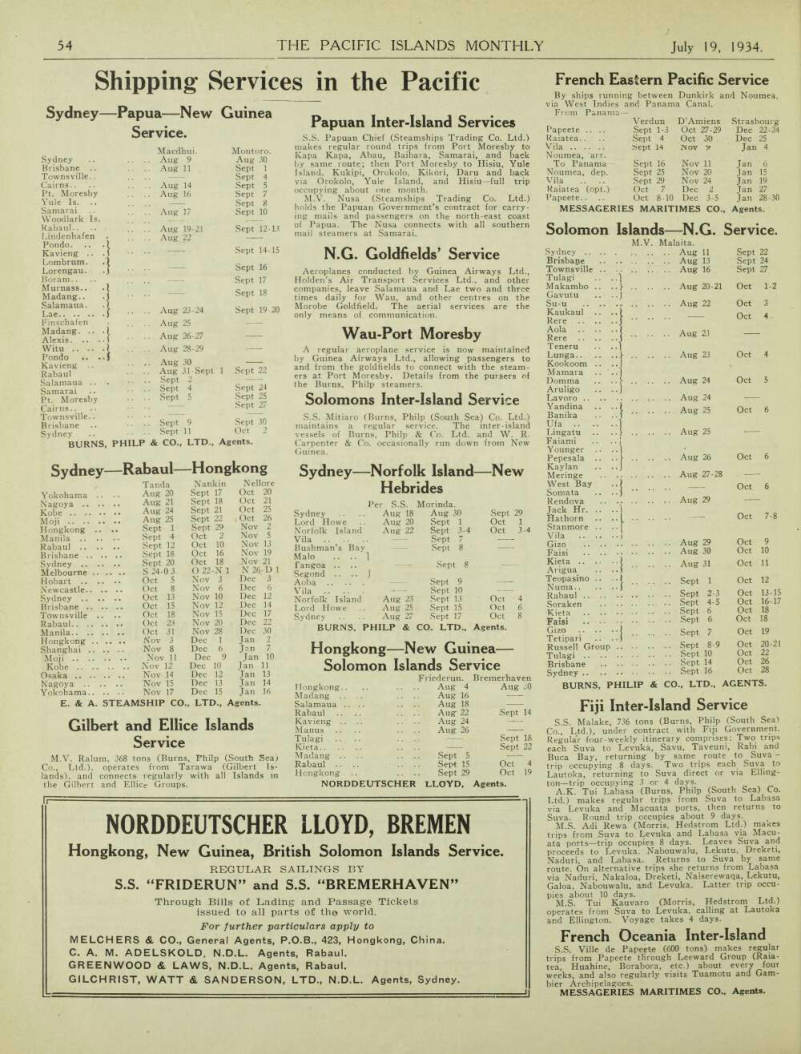
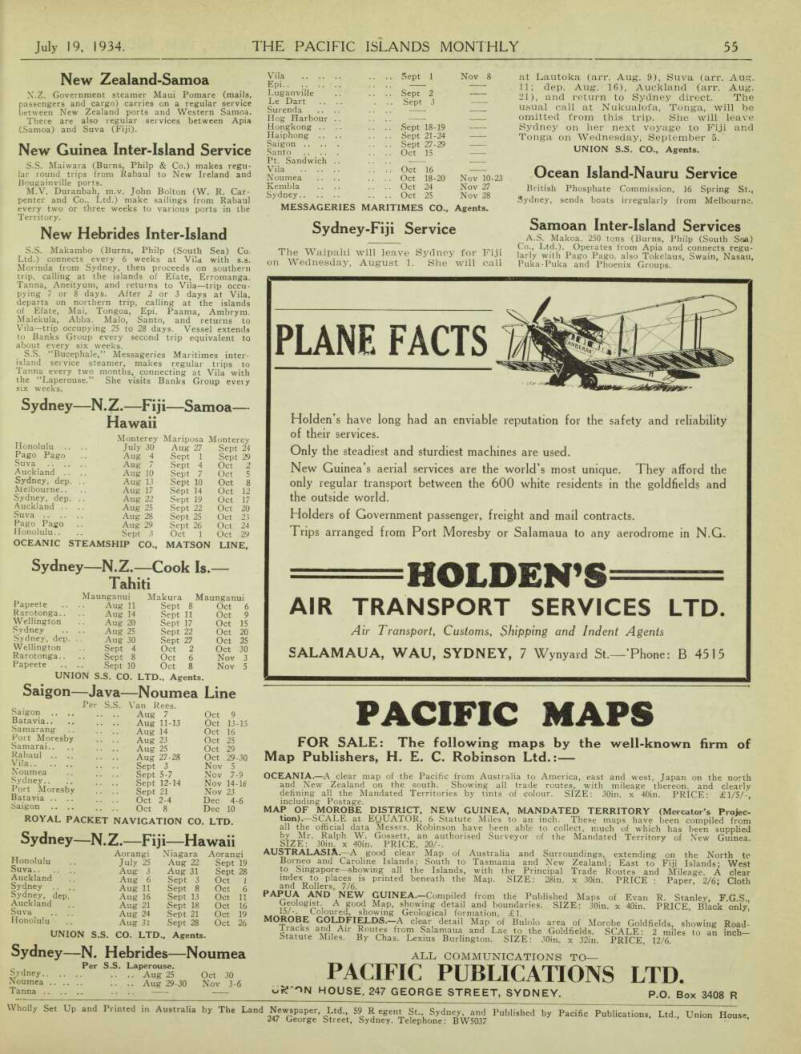
Sydney—Papua—New Guinea Service.
Sydney —Rabaul —Hongkong
Gilbert and Ellice Islands
Service
M.V. Ralum, 368 tons (Burns, Philp (South Sea) Co., Ltd.), operates from Tarawa (Gilbert Is lands), and connects regularly with all Islands in the Gilbert and Ellice Groups.
Papuan Inter-Island Services
S.S. Papuan Chief (Steamships Trading Co. Ltd.) makes regular round trips from Port Moresby to Kapa Kapa, Abau, Baibara, Samarai, and back by same route; then Port Moresby to Hisiu, Yule Island, Kukipi, Orokolo, Kikori, Daru and back via Orokolo, Yule Island, and Hisiu—full trip occupying about one month.
M.V. Nusa (Steamships Trading Co. Ltd.) holds the Papuan Government’s contract for carry ing mails and passengers on the north-east coast of Papua. The Nusa connects with all southern mail steamers at Samarai.
N.G. Goldfields’ Service
Aeroplanes conducted by Guinea Airways Ltd., Holden’s Air Transport Services Ltd., and other companies, leave Salamaua and Lae two and three times daily for Wau, and other centres on the Morobe Goldfield. The aerial services are the only means of communication.
Wau-Port Moresby
A regular aeroplane service is now maintained by Guinea Airways Ltd., allowing passengers to and from the goldfields to connect with the steam ers at Port Moresby. Details from the pursers of the Burns, Philp steamers.
Solomons Inter-Island Service
S.S. Mitiaro (Burns, Philp (South Sea) Co. Ltd.) maintains a regular service. The inter-island vessels of Burns, Philp & Co. Ltd. and W. R.
Carpenter & Co. occasionally run down from New Guinea.
Sydney—Norfolk Island—New
Hebrides
Hongkong—New Guinea — Solomon Islands Service
French Eastern Pacific Service
By ships running between Dunkirk and Noumea, via West Indies and Panama Canal.
From Panama —
Solomon Islands —N.G. Service.
Fiji Inter-Island Service
S.S. Malake, 736 tons (Burns, Philp (South Sea) Co., Ltd.), under contract with Fiji Government.
Regular four-weekly itinerary comprises; Two trips each Suva to Levuka, Savu, Taveuni, Rabi and Buca Bay, returning by same route to Suva trip occupying 8 days. Two trips each Suva to Lautoka, returning to Suva direct or via Elling ton—trip occupying 3 or 4 days.
A.K. Tui Labasa (Burns, Philp (South Sea) Co.
Ltd.) makes regular trips from Suva to Labasa via Levuka and Macuata ports, then returns to Suva. Round trip occupies about 9 days.
M.S. Adi Rewa (Morris, Hedstrom Ltd.) makes trips from Suva to Levuka and Labasa via Macu ata ports—trip occupies 8 days. Leaves Suva and proceeds to Levuka, Nabouwalu, Lekutu, Dreketi, Naduri, and Labasa. Returns to Suva by same route. On alternative trips she returns from Labasa via Naduri, Nakaloa, Dreketi, Naiserewaqa, Lekutu, Galoa, Nabouwalu, and Levuka. Latter trip occu pies about 10 days.
M.S. Tui Kauvaro (Morris, Hedstrom Ltd.) operates from Suva to Levuka, calling at Lautoka and Ellington. Voyage takes 4 days.
French Oceania Inter-Island
S.S. Ville de Papeete (600 tons) makes regular trips from Papeete through Leeward Group (Raia tea, Huahine, Borabora, etc.) about every four weeks, and also regularly visits Tuamotu and Gam bier Archipelagoes.
Messageries Maritimes Co., Agents.
Macdhui.
Montoro.
Sydney Aug 9 Aug 30 Brisbane . .
Aug 11 Sept 1 Townsville.. — Sept 4 Cairns..
Aug 14 Sept 5 Pt. Moresby Aug 16 Sept 7 Yule Is. — Sept 8 Samarai Aug 17 Sept 10 Woodlark Is.
Rabaul Aug 19-21 Sept 12-13 Lindenhafen Aug 22 — Pondo Kavieng Sept 14-15 Lombrum Sept 16 Lorengau — Boram..
Sept 17 Murnass Madang — Sept 18 Salamaua Lae Aug 23-24 Sept 19 20 Finschafen Aug 25 — Madang Alexis.
Aug 26-27 — Witu Aug 28-29 — Pondo Kavieng Rabaul Aug 30 Aug 31-Sept 1 Sept 22 Salamaua Samarai Sept 2 Sept 4 Sept 24 Pt. Moresby Cairns Sept 5 Sept 25 Sept 27 Townsville Brisbane Sept 9 Sept 30 Sydney Sept 11 Oct 2
Burns, Philp & Co., Ltd., Agents.
Tanda Nankin Nellore Yokohama . .. Aug 20 Sept 17 Oct 20 Nagoya . .. Aug 21 Sept 18 Oct 21 Sept 21 Oct 25 Moji .. .. Aug 25 Sept 22 Oct 26 Hongkong . .. Sept 1 Sept 29 Nov 2 Manila . .. Sept 4 Oct 2 Nov 5 Rabaul . .. Sept 12 Oct 10 Nov 13 Brisbane Oct 16 Nov 19 Sydney .. .
Oct 18 Nov 21 Melbourne .. .. .. S 24-03 O 22-N 1 N 26-D 1 Hobart .. .
Nov 3 Dec 3 Newcastle.. .. .. Oct 8 Nov 6 Dec 6 Sydney .. . .. .. Oct 13 Nov 10 Dec 12 Brisbane .. .. .. Oct 15 Nov 12 Dec 14 Townsville . . .. Oct 18 Nov 15 Dec 17 Rabaul.. ..
Oct 23 Nov 20 Dec 22 Manila.. .. .. .. Oct 31 Nov 28 Dec 30 Hongkong ..
Dec 1 Jan 2 Shanghai .. .. .. Nov 8 Dec 6 Jan 7 Moji .. ..
Dec 9 Jan 10 Kobe .. ..
Dec 10 Jan 11 Osaka .. .. .. .. Nov 14 Dec 12 Jan 13 Nagoya .. .. .. Nov 15 Dec 13 Jan 14 Yokohama.. .. .. Nov 17 Dec 15 Jan 16 E. & A. STEAMSHIP CO., LTD., Agents.
Per S.S. Morinda.
Sydney Aug 18 Aug 30 Sept 29 Lord Howe Aug 20 Sept 1 Oct 1 Norfolk Island Aug 22 Sept 3-4 Oct 3-4 Vila .. .. — Sept 7 — Bushman’s Bay Sept 8 — Malo .. ..
Tangoa .. ..
Sept 8 — Segond ..
Aoba Sept 9 — Vila -<— Sept 10 —— Norfolk Island Aug 23 Sept 13 Oct 4 Lord Howe Aug 25 Sept 15 Oct 6 Sydney Aug 27 Sept 17 Oct 8
Burns, Philp & Co. Ltd., Agents.
Friederun.
Bremerhaven Hongkong.. .. .. Aug 4 Aug 30 Madang .. .. .. Aug 16 — Salamaua .. .. .. .. Aug 18 — Rabaul .. .. Aug 22 Sept 14 Kavieng .. .. .. .. Aug 24 — Manus .. .. Aug 26 — Tulagi .. ..
Sept 18 Kieta.. .. ..
Sept 22 Madang .. .. .. Sept 5 — Rabaul .. .. Sept 15 Oct 4 Hongkong .. .. Sept 29 Oct 19
Norddeutscher Lloyd, Agents.
Verdun D’Amiens Strasbourg Papeete .. ..
Sept 1-3 Oct 27-29 Dec 22-24 Kaiatea..
Sept 4 Oct 30 Dec 25 Vila Sept 14 Nov 9 Jan 4 Noumea, arr.
To Panama — Sept 16 Nov 11 Jan 6 Noumea, dep.
Sept 25 Nov 20 Jan 15 Vila .. ..
Sept 29 Nov 24 Jan 19 Raiatea (opt.) Oct 7 Dec 2 Jan 27 Papeete..
Oct 8-10 Dec 3-5 Jan 28-30
Messageries Maritimes Co., Agents.
M.V. Malaita.
Sydney .. .
Sept 22 Brisbane Sept 24 Townsville .
Sept 27 Tulagi Makambo .. .. .. .. Aug 20-21 Oct 1-2 Gavutu ...
Su-u .. . .. Aug 22 Oct 3 Kaukaul ..
Oct 4 Rere .. Aug 23 Rere Teneru Lunga..
Oct 4 Kookoom ..
Mamara Domma Oct 5 Aruligo Lavoro .. .
Yandina Banika .. Aug 25 Oct 6 Ufa .. ..
Lingatu Faiami Younger Oct 6 Pepesala ..
Kaylan ... .. Aug 27-28 Meringe West Bay Oct 6 Somata Rendova .. Aug 29 Jack Hr. ..
Oct 7-8 Hathorn — Stanmore Vila Gizo .. Aug 29 Oct 9 Faisi .. .
Oct 10 Kieta .. .. Aug 31 Oct 11 Arigua Teopasino ..
Numa..
Oct 12 Rabaul .. .. Sept 2-3 Oct 13-15 Soraken Oct 16-17 Kieta Oct 18 Faisi Oct 18 Gizo Oct 19 Tetipan Russell Group .. Sept 8-9 Oct 20-21 Tulagi ..
Oct 22 Brisbane Oct 26 Sydney .. Sept 16 Oct 28
Burns, Philip & Co., Ltd., Agents.
New Zealand-Samoa
N.Z. Government steamer Maui Pomare (mails, passengers and cargo) carries on a regular service between New Zealand ports and Western Samoa.
There are also regular services between Apia (Samoa) and Suva (Fiji).
New Guinea Inter-Island Service
S.S. Maiwara (Burns, Philp & Co.) makes regular round trips from Rabaul to New Ireland and Bougainville ports.
M.V. Duranbah, m.v. John Bolton (W, R. Car penter and Co., Ltd.) make sailings from Rabaul every two or three weeks to various ports in the Territory.
New Hebrides Inter-Island
S.S. Makambo (Burns, Philp (South Sea) Co.
Ltd.) connects every 6 weeks at Vila with s.s.
Morinda from Sydney, then proceeds on southern trip, calling at the islands of Efate, Erromanga, Tanna, Aneityum, and returns to Vila—trip occu pying 7 or 8 days. After 2 or 3 days at Vila, departs on northern trip, calling at the islands of Efate, Mai, Tongoa, Epi, Paama, Ambrym.
Malekula, Abba. Malo, Santo, and returns to Vila—trip occupying 25 to 28 days. Vessel extends to Banks Group every second trip equivalent to about every six weeks.
S.S. “Bucephale,” Messageries Maritimes interisland service steamer, makes regular trips to Tanna every two months, connecting at Vila with the “Laperouse.” She visits Banks Group evety six weeks.
Sydney—N.Z.—Fiji—Samoa—
Hawaii
Sydney—N.Z.—Cook Is.— Tahiti
Saigon—Java—Noumea Line
Sydney—N.Z.— Fiji—Hawaii
Sydney—N. Hebrides —Noumea
Sydney-Fiji Service
The Waipahi will leave Sydney for Fiji on Wednesday, August 1. She will call
at Lautoka (arr. Aug. 9), Suva (arr. Aug. 11; dep. Aug. 16), Auckland (arr, Aug. 21), and return to Sydney direct. The usual call at Nukualofa, Tonga, will be omitted from this trip. She will leave Sydney on her next voyage to Fiji and Tonga on Wednesday, September 5.
UNION S.S. CO., Agents.
Ocean Island-Nauru Service
British Phosphate Commission, 16 Spring St., Sydney, sends boats irregularly from Melbourne.
Samoan Inter-Island Services
A.S. Makoa, 250 tons (Burns, Philp (South Soa) Co., Ltd.). Operates from Apia and connects regu larly with Pago Pago, also Tokelaus, Swain, Nasau, Puka-Puka and Phoenix Groups.
Honolulu .. ..
Monterey Mariposa Monterey July 30 Aug 27 Sept 24 Pago Pago Aug 4 Sept 1 Sept 29 Suva Aug 7 Sept 4 Oct 2 Auckland .. ..
Aug 10 Sept 7 Oct 5 Sydney, dep. ..
Aug 13 Sept 10 Oct 8 Melbourne..
Aug 17 Sept 14 Oct 12 Sydney, dep. ..
Aug 22 Sept 19 Oct 17 Auckland ..
Aug 25 Sept 22 Oct 20 Suva Aug 28 Sept 25 Oct 23 Pago Pago Aug 29 Sept 26 Oct 24 Honolulu..
Sept 3 Oct 1 Oct 29
Oceanic Steamship Co., Matson Line.
Maunganui Makura Maunganui Papeete .. .. Aug 11 Sept 8 Oct 6 Rarotonga.. .. Aug 14 Sept 11 Oct 9 Wellington .. Aug 20 Sept 17 Oct 15 Sydney .. .. Aug 25 Sept 22 Oct 20 Sydney, dep. . Aug 30 Sept 27 Oct 25 Wellington Sept 4 Oct 2 Oct 30 Rarotonga.. .. Sept 8 Oct 6 Nov 3 Papeete .. .. Sept 10 Oct 8 Nov 5
Union S.S. Co. Ltd., Agents.
Saigon .. ..
Per S.S. Van Rees.
Aug 7 Oct 9 Batavia..
Aug 11-13 Oct 13-15 Samarang Aug 14 Oct 16 Port Moresby Aug 23 Oct 25 Samarai..
Aug 25 Oct 29 Rabaul .. ..
Aug 27-28 Oct 29-30 Vila Noumea Sept 3 Sept 5-7 Nov 5 Nov 7-9 Sydney..
Sept 12-14 Nov 14-16 Port Moresby Sept 21 Nov 23 Batavia Oct 2-4 Dec 4-6 Saigon .. ..
Oct 8 Dec 10
Royal Packet Navigation Co. Ltd.
Honolulu Aorangi Niagara Aorangi July 25 Aug 22 Sept 19 Suva Aug 3 Aug 31 Sept 28 Auckland Aug 6 Sept 3 Oct 1 Sydney ..
Aug 11 Sept 8 Oct 6 Sydney, dep.
Aug 16 Sept 13 Oct 11 Auckland Aug 21 Sept 18 Oct 16 Suva ..
Aug 24 Sept 21 Oct 19 Honolulu Aug 31 Sept 28 Oct 26
Union S.S. Co. Ltd., Agents.
Per S.S. Laperouse.
Sydney Aug 25 Oct 30 Noumea Aug 29-30 Nov 3-6 Tanna .. ..
Vila .. .. Sept 1 Nov 8 Epi — — Luganville .. .. Sept 2 — Le Dart .. .. . .. Sept 3 — Surenda .. .. . . . .
Hog Harbour .. — Hongkong .. .. .. Sept 18-19 — Haiphong .. .. .. .. Sept 21-24 — Saigon .. .. Sept 27-29 — Santo .. .. Oct IS — Pt. Sandwich .. .. ..
Vila .. .. Oct 16 Noumea .. .. .. .. Oct 18-20 Nov 10-23 Kembla .. .. .. Oct 24 Nov 27 Sydney .. .. Oct 25 Nov 28
Messageries Maritimes Co., Agents.
Advertisements & other items, pp. 56-57 (2 items)
Norddeutscher Lloyd, Bremen
Hongkong, New Guinea, British Solomon Islands Service.
REGULAR SAILINGS BY
S.S. “FRIDERUN” and S.S. “BREMERHAVEN”
Through Bills of Lading and Passage Tickets issued to all parts of the world.
For further particulars apply to MELCHERS & CO., General Agents, P.O.B., 423, Hongkong, China.
C. A. M. ADELSKOLD. N.D.L. Agents, Rabaul.
GREENWOOD & LAWS, N.D.L. Agents, Rabaul.
GILCHRIST, WATT & SANDERSON, LTD., N.D.L. Agents, Sydney.
PLANE FACTS
Holden’s have long had an enviable reputation for the safety and reliability of their services.
Only the steadiest and sturdiest machines are used.
New Guinea’s aerial services are the world’s most unique. They afford the only regular transport between the 600 white residents in the goldfields and the outside world.
Holders of Government passenger, freight and mail contracts.
Trips arranged from Port Moresby or Salamaua to any aerodrome in N.G.
HOLDEN’S
AIR TRANSPORT SERVICES LTD.
Air Transport , Customs, Shipping and Indent Agents SALAMAUA, WAU, SYDNEY, 7 Wynyard St.—’Phone: B 4515
PACIFIC MAPS
FOR SALE: The following maps by the well-known firm of Map Publishers, H. E. C. Robinson Ltd.:— OCEANIA. —A clear map of the Pacific from Australia to America, east and west, Japan on the north and New Zealand on the south. Showing all trade routes, with mileage thereon, and clearly defining all the Mandated Territories by tints of colour. SIZE: 30in. x 40in. PRICE: £l/5/-, including Postage.
MAP OF MOROBE DISTRICT, NEW GUINEA, MANDATED TERRITORY (Mercator’s Projection). —SCALE at EQUATOR, 6 Statute Miles to an inch. These maps have been compiled from all the official data Messrs. Robinson have been able to collect, much of which has been supplied by Mr. Ralph W. Gossett, an authorised Surveyor of the Mandated Territory of New Guinea.
SIZE: 30in. x 40in. PRICE, 20/-.
AUSTRALASIA.— A good clear Map of Australia and Surroundings, extending on the North to Borneo and Caroline Islands; South to Tasmania and New Zealand; East to Fiji Islands- West to Singapore—showing all the Islands, with the Principal Trade Routes and Mileage A clear mdex to places is printed beneath the Map. SIZE: 28in. x 30in. PRICE : Paper, 2/6: Cloth and Rollers, 7/6.
PAPUA AND NEW GUlNEA.— Compiled from the Published Maps of Evan R. Stanley, F.G S.
Geologist. A good Map, showing detail and boundaries. SIZE: 30in. x 40in. PRICE, Black only. 15/. Coloured, showing Geological formation, £1.
MOROBE GOLDFIELDS.— A clear detail Map of Bulolo area of Morobe Goldfields, showing Road- Tracks and Air Routes from Salamaua and Lae to the Goldfields. SCALE: 2 miles to an inch- Statute Miles. By Chas. Lexius Burlington. SIZE: 30in. x 32in. PRICE, 12/6.
ALL COMMUNICATIONS TO—
PACIFIC PUBLICATIONS LTD.
UNION HOUSE. 247 GEORGE STREET, SYDNEY. P.O. Box 3408 R
55
THE PACIFIC ISLANDS MONTHLY
July 19, 1934.
Wholly Set Up and Printed in Australia by The Land Newspaper, Ltd., 59 R egent St. Sydney, and Published by Pacific Publications, Ltd., Union House 247 George Street, Sydney. Telephone: BW5037
Index to Volume IV.
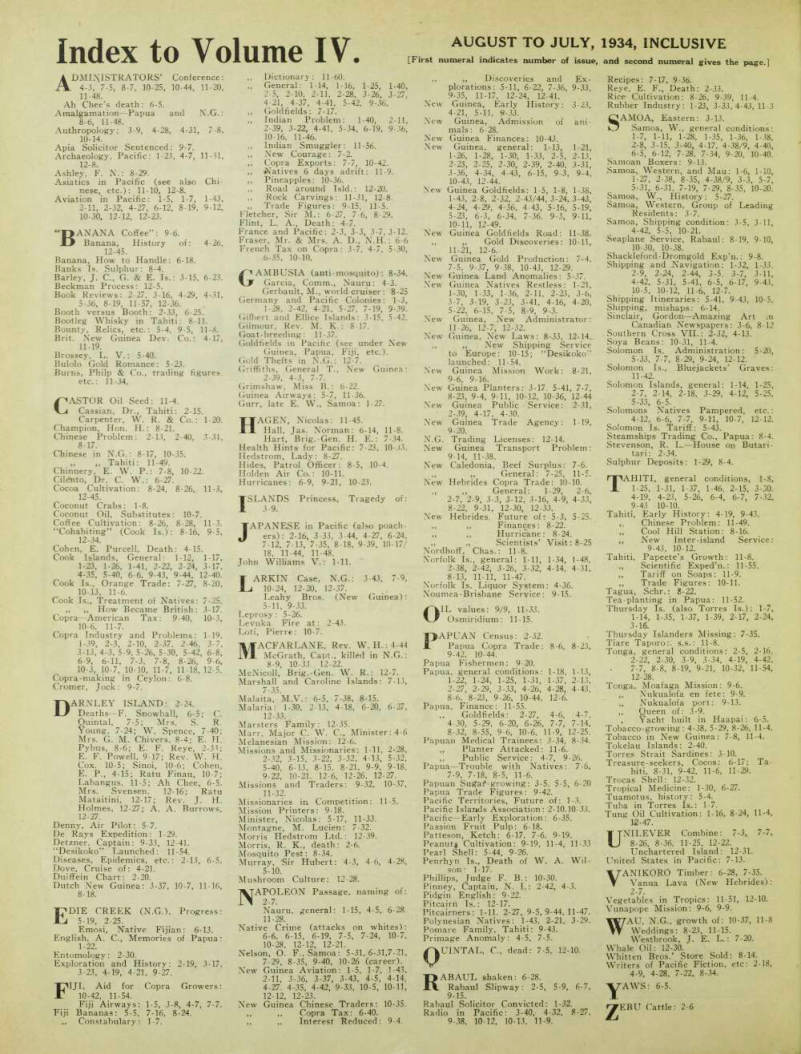
August To July, 1934, Inclusive
[First numeral indicates number of issue, and second numeral gives the page.]
ADMINISTRATORS’ Conference:
4-3, 7-5, 8-7, 10-25, 10-44, 11-20, 11-48.
Ah Chee’s death: 6-5.
Amalgamation—Papua and N.G.: 8-6, 11-48.
Anthropology; 3-9, 4-28, 4-31, 7-8, 10-14.
Apia Solicitor Sentenced: 9-7.
Archaeology, Pacific: 1-23, 4-7, 11-31, 12-8 Ashley, F. N.: 8-29.
Asiatics in Pacific (see also Chi nese, etc.): 11-10, 12-8.
Aviation in Pacific: 1-5, 1-7, 1-43, 2-11, 2-32, 4-27, 6-12, 8-19, 9-12, 10-30, 12-12, 12-23.
“BANANA Coffee”: 9-6.
Banana, History of: 4-26, 12-45.
Banana, How to Handle: 6-18.
Banks Is. Sulphur: 8-4.
Barley, J. C., G. & E. Is.: 3-15, 6-23.
Beckman Process: 12-5.
Book Reviews; 2-27, 3-16, 4-29, 4-31, 5-36, 8-19, 11-57, 12-36.
Booth versus Booth: 2-33, 6-25.
Bootleg Whisky in Tahiti: 8-11.
Bounty, Relics, etc.: 5-4, 9-5, 11-8.
Brit. New Guinea Dev. Co.: 4-17, 11-19.
Brossey, L. V.; 5-40.
Bulolo Gold Romance: 5-23.
Burns, Philp & Co., trading figures, etc.: 11-34.
CASTOR Oil Seed: 11-4.
Cassian, Dr., Tahiti: 2-15.
Carpenter, W. R. & Co.: 1-20.
Champion, Hon. H.: 8-21.
Chinese Problem: 2-13, 2-40, 3-31, 8-17.
Chinese in N.G.: 8-17, 10-35. „ Tahiti: 11-49.
Chinnery, E. W. P.: 7-8, 10-22.
Cihffito, Dr. C. W.: 6-27.
Cocoa Cultivation: 8-24, 8-26, 11-3, 12-45.
Coconut Crabs: 1-8.
Coconut Oil, Substitutes; 10-7.
Coffee Cultivation: 8-26, 8-28, 11-3.
“Cohabiting” (Cook Is.): 8-16, 9-5, 12-34.
Cohen, E. Purcell, Death: 4-15.
Cook Islands, General: 1-12, 1-17, 1-23, 1-26, 1-41, 2-22, 2-24, 3-17, 4-35, 5-40, 6-6, 9-43, 9-44, 12-40.
Cook Is., Orange Trade: 7-27, 8-20, 10-13, 11-6.
Cook Is., Treatment of Natives; 7-25. „ „ How Became British: 3-17.
Copra—American Tax: 9-40, 10-3, 10-6, 11-7.
Copra Industry and Problems: 1-19, 1-39, 2-3, 2-10, 2-37, 2-46, 3-7, 3-13, 4-3, 5-9, 5-26, 5-30, 5-42, 6-8, 6-9, 6-11, 7-3, 7-8, 8-26, 9-6, 10-3, 10-7, 10-10, 11-7, 11-18, 12-5.
Copra-making in Ceylon: 6-8.
Cromer, Jock: 9-7.
Darnley Island: 2-24.
Deaths—F. Snowball, 6-5; C.
Quintal, 7-5; Mrs. S. R.
Young. 7-24; W. Spence, 7-40; Mrs. G. M. Chivers. 8-4; E. H.
Pybus, 8-6; E. F. Reye, 2-33; E. F. Powell. 9-17; Rev. W. H.
Cox. 10-5; Sinoi, 10-6; Cohen, E. P., 4-15; Ratu Finau, 10-7; Labangus, 11-5; Ah Chee, 6-5.
Mrs. Svensen, 12-16; Ratu Mataitini, 12-17; Rev. J. H.
Holmes, 12-27; A. A. Burrows, 12-27.
Denny, Air Pilot: 5-7.
De Rays Expedition: 1-29.
Detzner. Captain: 9-33, 12-41.
“Desikoko” Launched: 11-54.
Diseases, Epidemics, etc.: 2-13, 6-5.
Dove, Cruise of: 4-21.
Duiffein Chart: 2-20.
Dutch New Guinea: 3-37, 10-7, 11-16, 8-18.
EDIE CREEK (N.G.), Progress: 5-19, 2-25.
Emosi, Native Fijian: 6-13.
English, A. C., Memories of Papua: 1-22.
Entomology: 2-30.
Exploration and History: 2-19, 3-17, 3-23, 4-19, 4-21, 9-27.
FIJI, Aid for Copra Growers: 10-42, 11-54.
Fiji Airways: 1-5, 3-8, 4-7, 7-7.
Fiji Bananas: 5-5, 7-16, 8-24. „ Constabulary; 1-7.
„ Dictionary: 11-60. „ General: 1-14, 1-16, 1-25, 1-40, 2-5, 2-10, 2-11, 2-28, 3-26, 3-27, 4-21, 4-37, 4-41, 5-42, 9-36. „ Goldfields: 7-17. „ Indian Problem: 1-40, 2-11, 2-39, 3-22, 4-41, 5-34, 6-19, 9-36, 10-16, 11-46. „ Indian Smuggler: 11-56. „ New Courage: 7-2. „ Copra Exports: 7-7, 10-42. „ Natives 6 days adrift; 11-9. „ Pineapples: 10-36. „ Road around Isld.: 12-20. „ Rock Carvings: 11-31, 12-8. „ Trade Figures: 9-15, 11-5.
Fletcher, Sir M.: 6-27, 7-6, 8-29.
Flint, L. A., Death; 4-7.
France and Pacific: 2-3, 3-3, 3-7,3-12.
Fraser, Mr. & Mrs. A. D., N.H.: 6-6 French Tax on Copra: 3-7, 4-7, 5-30, 6-35, 10-10.
GAMBUSIA (anti - mosquito) ; 8-34.
Garcia, Comm., Nauru: 4-3.
Gerbault, M., world cruiser; 8-25 Germany and Pacific Colonies: 1-3, 1-28, 2-42, 4-21, 5-27, 7-19, 9-39.
Gilbert and Ellice Islands: 3-15, 5-42.
Gilmour, Rev. M. K.: 8-17.
Goat-breeding: 11-37.
Goldfields in Pacific (see under New Guinea, Papua, Fiji, etc.).
Geld Thefts in N.G.: 12-7.
Griffiths, General T., New Guinea; 2-39, 4-3, 7-7.
Grimshaw. Miss B.: 6-22.
Guinea Airways: 5-7, 11-36.
Gurr, late E. W., Samoa: 1-27.
HAGEN, Nicolas: 11-45.
Hall, Jas. Norman; 6-14, 11-8.
Hart, Brig.-Gen. H. E.: 7-34.
Health Hints for Pacific: 7-23, 10-33.
Hedstrom, Lady: 8-27.
Hides, Patrol Officer: 8-5, 10-4.
Holden Air Co.; 10-11.
Hurricanes; 6-9, 9-21, 10-23.
ISLANDS Princess, Tragedy of: 3-9.
JAPANESE in Pacific (also poach ers): 2-16, 3-33, 3-44, 4-27, 6-24, 7-12, 7-13, 7-35, 8-18, 9-39, 10-17/ 18, 11-44, 11-48.
John Williams V.; 1-11.
Larkin Case, N.G.; 3-43, 7-9,
10-24, 12-20, 12-37.
Leahy Bros. (New' Guinea): 5-11, 9-33.
Leprosy: 5-26.
Levuka Fire at; 2-43.
Loti, Pierre: 10-7.
Macfarlane, Rev. W. H.: 4-44
McGrath, Capt., killed in N.G.: 8-9, 10-33. 12-22.
McNicoll, Brig.-Gen. W. R.: 12-7.
Marshall and Caroline Islands: 7-13, 7-35.
Malaita, M.V.: 6-5, 7-38, 8-15.
Malaria: 1-30, 2-13, 4-18, 6-20, 6-27, 12-33.
Marsters Family: 12-35.
Marr, Major C. W. C., Minister: 4-6 Melanesian Mission: 12-6.
Missions and Missionaries: 1-11, 2-28, 2-32, 3-15, 3-22, 3-32, 4-13, 5-32, 5-40, 6-13, 8-15, 8-21. 9-9. 9-18, 9-22, 10-21. 12-6, 12-26, 12-27.
Missions and Traders: 9-32, 10-37, 11-32.
Missionaries in Competition: 11-5.
Mission Printers: 9-18.
Minister, Nicolas: 5-17, 11-33.
Montagne, M. Lucien: 7-32.
Morris Hedstrom Ltd.: 12-39.
Morris, R. K., death: 2-6.
Mosquito Pest: 8-34.
Murray, Sir Hubert: 4-3, 4-6, 4-28, 5-10.
Mushroom Culture; 12-28.
Passage, naming of: Nauru, general: 1-15, 4-5, 6-28 11-28.
Native Crime (attacks on whites): 6-6, 6-15, 6-19, 7-5, 7-24, 10-7, 10-28, 12-12, 12-21.
Nelson, O. F., Samoa: 5-31, 6-31,7-21, 7-29, 8-35, 9-40, 10-26 (career).
New Guinea Aviation; 1-5, 1-7, 1-43, 2-11, 3-36, 3-37, 3-43, 4-5, 4-14, 4-27. 4-35, 4-42, 9-33, 10-5, 10-11, 12-12, 12-23.
New Guinea Chinese Traders: 10-35. „ „ Copra Tax: 6-40. „ „ Interest Reduced: 9-4.
„ „ Discoveries and Explorations: 5-11, 6-22, 7-36, 9-33, 9- 11-17, 12-24, 12-41.
New Guinea, Early History: 3-23, 4-21, 5-11, 9-33.
New Guinea, Admission of ani mals: 6-28.
New Guinea Finances: 10-43.
New Guinea, general: 1-13, 1-21, 1- 1-28, 1-30, 1-33, 2-5 , 2-13, 2- 2-25, 2-30, 2-39, 2-40, 3-31, 3- 4-34, 4-43 , 6-15 , 9-3 , 9-4, 10- 12-44.
New Guinea Goldfields: 1-5, 1-8, 1-38, 1-43, 2-8, 2-32, 2-43/44, 3-24, 3-43, 4- 4-29, 4-36, 4-43 , 5-16, 5-19, 5- 6-3, 6-34, 7-36, 9-3, 9-11, 10- 12-49.
New Guinea Goldfields Road: 11-38. „ „ Gold Discoveries: 10-11, 11-21, 12-6.
New Guinea Gold Production: 7-4. 7- 9-37, 9-38, 10-43, 12-29.
New Guinea Land Anomalies: 5-37.
New Guinea Natives Restless; 1-21, 1- 1-33, 1-36, 2-11, 2-23 , 3-6, 3-7, 3-19, 3-23, 3-41, 4-16, 4-20, 5-22, 6-15, 7-5, 8-9, 9-3.
New Guinea, New Administrator: 11- 12-7, 12-32.
New Guinea, New Laws: 8-33, 12-14. „ „ New Shipping Service to Europe: 10-15; “Desikoko” launched; 11-54.
New Guinea Mission Work: 8-21, 9-6, 9-16.
New Guinea Planters: 3-17. 5-41, 7-7, 8- 9-4, 9-11, 10-12, 10-36, 12-44 New Guinea Public Service; 2-31, 2- 4-17, 4-30.
New Guinea Trade Agency: 1-19, 9- N.G. Trading Licenses: 12-14.
New Guinea Transport Problem: 9-14, 11-38.
New Caledonia, Beef Surplus: 7-6.
General: 7-25, 11-E.
New Hebrides Copra Trade; 10-10. „ „ General: 1-29, 2-6, 2-7, 2-9, 3-3, 3-12, 3-16, 4-9, 4-33, 8-22, 9-31, 12-30, 12-33.
New Hebrides, Future of: 5-3, 5-25. „ „ Finances; 8-22. „ „ Hurricane: 8-24. „ „ Scientists’ Visit: 8-25 Nordhoff, Chas.; 11-8.
Norfolk Is., general: 1-11, 1-34, 1-48, 2-38, 2-42, 3-26, 3-32, 4-14, 4-31, 8-13, 11-11, 11-47.
Norfolk Is. Liquor System: 4-36.
Noumea-Brisbane Service; 9-15.
OIL values: 9/9, 11-33.
Osmiridium: 11-15.
PAPUAN Census: 2-32.
Papua Copra Trade; 8-6, 8-23, 9-42, 10-44.
Papua Fishermen; 9-20.
Papua, general conditions: 1-18, 1-13, 1-22, 1-24, 1-25, 1-31, 1-37, 2-13, 2-27, 2-29, 3-33, 4-26, 4-28, 4-43, 8-6 . 8-23 , 9-26, 10-44, 12-6.
Papua, Finance: 11-55. „ Goldfields: 2-27, 4-6, 4-7. 4-30, 5-29, 6-20, 6-26, 7-7, 7-14, 8-32, 8-55, 9-6, 10-6, 11-9, 12-25.
Papuan Medical Trainees: 3-34, 8-34. „ Planter Attacked: 11-6. „ Public Service: 4-7, 9-26.
Papua—Trouble with Natives: 7-6, 7-9, 7-18, 8-5, 11-6.
Papuan Sugar-growing: 3-5. 5-5, 6-20 Papua Trade Figures; 9-42.
Pacific Territories, Future of: 1-3.
Pacific Islands Association; 2-10,10-33.
Pacific —Early Exploration: 6-35.
Passion Fruit Pulp: 6-18.
Patteson, Ketch: 6-17, 7-6, 9-19.
Peanutg Cultivation: 9-19, 11-4, 11-33 Pearl Shell: 5-44, 9-26.
Penrhyn Is., Death of W. A. Wil son: 1-17.
Phillips, Judge F. B.: 10-30.
Pinney, Captain, N. I.; 2-42, 4-3.
Pidgin English: 9-22.
Pitcairn Is.: 12-17.
Pitcairners: 1-11. 2-27, 9-5,9-44,11-47.
Polynesian Natives: 1-43 . 2-21, 3-29.
Pomare Family, Tahiti: 9-43.
Primage Anomaly: 4-5, 7-5.
QUINTAL, C., dead: 7-5, 12-10.
RABAUL shaken: 6-28.
Rabaul Slipway: 2-5, 5-9, 6-7, 9-15.
Rabaul Solicitor Convicted: 1-32.
Radio in Pacific: 3-40, 4-32, 8-27, 9-38, 10-12, 10-13, 11-9.
Recipes; 7-17, 9-36.
Reye, E. F., Death: 2-33.
Rice Cultivation; 8-26, 9-39, 11-4.
Rubber Industry; 1-23, 3-33, 4-43, 11-3 SAMOA, Eastern: 3-13.
Samoa, W., general conditions: 1-7, 1-11, 1-28, 1-35, 1-36, 1-38, 2-8, 3-15, 3-40, 4-17, 4-38/9, 4-40, 6-5, 6-12, 7-28, 7-34, 9-20, 10-40.
Samoan Boxers: 9-13.
Samoa, Western, and Mau: 1-6, 1-10, 1-27, 2-38, 8-35, 4-38/9, 3-3, 5-7, 5-31, 6-31, 7-19, 7-29, 8-35, 10-20.
Samoa, W., History: 5-27.
Samoa, Western, Group of Leading Residents: 3-7.
Samoa, Shipping condition: 3-5, 3-11, 4-42, 5-5, 10-21.
Seaplane Service, Rabaul: 8-19, 9-10, 10-30, 10-38.
Shackleford-Dromgold Exp’n.; 9-8.
Shipping and Navigation: 1-32, 1-33, 2-9, 2-24, 2-44, 3-5 , 3-7, 3-11, 4-42, 5-31, 5-41, 6-5, 6-17, 9-43, 10-5, 10-12, 11-6, 12-7.
Shipping Itineraries: 5-41, 9-43, 10-5.
Shipping, mishaps: 6-14.
Sinclair, Gordon—Amazing Art ,n Canadian Newspapers; 3-6, 8-12 Southern Cross VII.: 2-32, 4-13.
Soya Beans: 10-31, 11-4.
Solomon Is. Administration: 5-20, 5-33, 7-7, 8-29, 9-24, 12-12.
Solomon Is., Bluejackets’ Graves: 11-42.
Solomon Islands, general: 1-14, 1-25, 2-7, 2-14, 2-18, 3-29, 4-12, 5-25, 5-33, 6-5.
Solomons Natives Pampered, etc.: 4-12, 6-6, 7-7, 9-11, 10-7, 12-12.
Solomon Is. Tariff: 5-43.
Steamships Trading Co., Papua: 8-4.
Stevenson, R. L. —House on Butari tari: 2-34.
Sulphur Deposits: 1-29, 8-4.
TAHITI, general conditions, 1-8, 1-25, 1-31, 1-37, 1-46, 2-15, 3-30. 4-19, 4-23 , 5-26, 6-4, 6-7, 7-32, 9-43 10-10.
Tahiti, Early History: 4-19, 9-43. „ Chinese Problem: 11-49. ,, Cool Hill Station: 8-16. ,, New Inter-island Service: 9-43, 10-12.
Tahiti, Papeete’s Growth: 11-8. ,, Scientific Exped’n.: 11-55. ,, Tariff on Soaps: 11-9. ,, Trade Figures: 10-11.
Tagua, Schr.: 8-22.
Tea-planting in Papua: 11-52.
Thursday Is. (also Torres Is.): 1-7, 1-14, 1-35, 1-37, 1-39, 2-17, 2-24, 3-16.
Thursday Islanders 1 Missing: 7-35.
Tiare Taporo:. s.s.; 11-8.
Tonga, general conditions; 2-5, 2-16, 2-22, 2-30, 3-9, 3-34, 4-19, 4-42, 7-7, 8-8, 8-19, 9-21, 10-32, 11-54, 12-28.
Tonga, Moafaga Mission; 9-6. ,, Nukualofa en fete: 9-9. „ Nukualofa port: 9-13. ,, Queen of: 3-9. „ Yacht built in Haapai: 6-5.
Tobacco-growing: 4-38, 5-29, 8-26, 11-4.
Tobacco in New Guinea; 7-8, 11-4.
Tokelau Islands: 2-40.
Torres Strait Sardines: 3-10.
Treasure-seekers, Cocos: 6-17; Ta hiti, 8-31, 9-42, 11-6, 11-29.
Trocas Shell: 12-32.
Tropical Medicine: 1-30, 6-27.
Tuamotus, history: 5-4.
Tuba in Torres Is.: 1-7.
Tung Oil Cultivation; 1-16, 8-24, 11-4, 12-47.
UNILEVER Combine: 7-3, 7-7, 8-26, 8-36, 11-25, 12-22.
Unchartered Island; 12-31.
United States in Pacific: 7-13.
VANIKORO Timber: 6-28, 7-35.
Vanua Lava (New Hebrides): 2-7.
Vegetables in Tropics: 11-51, 12-10.
Vunapope Mission: 9-6, 9-9.
WAU, N.G., growth of: 10-37, 11-8 Weddings: 8-23, 11-15.
Westbrook, J. E. L.: 7-20.
Whale Oil: 12-30.
Whitten Bros.’ Store Sold: 8-14.
Writers of Pacific Fiction, etc: 2-18, 4-9, 4-28, 7-22, 8-34.
Yaws: 6-5.
Cattle: 2-6
Advertisements & other items, pp. 59-60 (1 item)
Guinea Airways Ltd
Staffed and Equipped to Carry
on One of the Biggest Aerial
Transport Services in the World
One of the four Bulolo dredges,
nearly ready for operation. All
this heavy machinery was carried
in by aeroplanes.
With its giant Three-motored Aeroplanes, and its large staff of Experienced Pilots and Expert Mechanics, Guinea Airways Ltd. carries on the Transport service between the Coast of New Guinea and the Goldfields Centres. There is no other form of Transport in this part of New Guinea—only
Aeroplanes.
In all kinds of weather, irrespective of the seasons, the Aeroplanes of Guinea Airways Ltd.
maintain communication with the Goldfields,
safely carrying mails, passengers, heavy mining
machinery, native labourers, foodstuffs, live-
stock, etc.
31 Aerodromes
BABUAP MARAWASSA
BAPI
BULOLO
BULWA
GABANZIZ
GARINA
JUNI
KAJABIT
KIDJURA
KOKODA*
KABUNA*
LAE
MT. HAGEN
MARILINAN
MENYAMYA
NADZAB
PORT
MORESBY*
PURARI
RAMU
SALAMAUA
SANGAN
SUNSHINE
SURPRISE CK.
UP. WATUT
WAGAU
WAHGI
WAMPIT
WARONA
WAU
ZENAG
In Papua.
GUINEA AIRWAYS LTD
LAE - SALAMAUA
A KB
before dinner
makes him feel
a new man!
HERE is nothing to equal this pure, stimulating, refreshing drink as an appetiser before dinner —and it has a tonic value that keeps you up to the mark both in Winter and Summer. Order a supply to-day, for your own benefit and for home entertainment.
TOOTH'S
IN BOTTLES AND
HALF BOTTLES
K.69.A.
LAGER.