Pacific
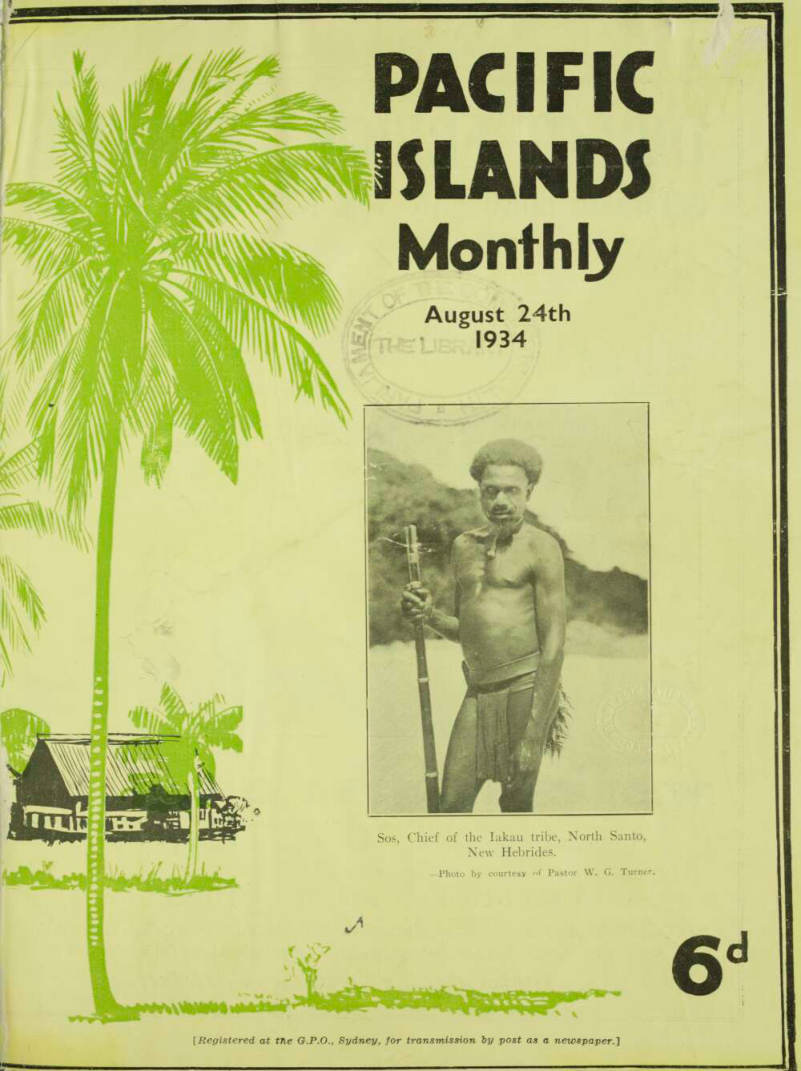
Islands
Monthly
August 24th 1934
6 d
[Registered at the G.P.O., Sydney, for transmission by post as a newspaper.]
Sos, Chief of the Iakau tribe, North Santo, New Hebrides. —Photo by courtesy Pastor W. G. Turner.
Advertisements & other items, p. 2 (1 item)
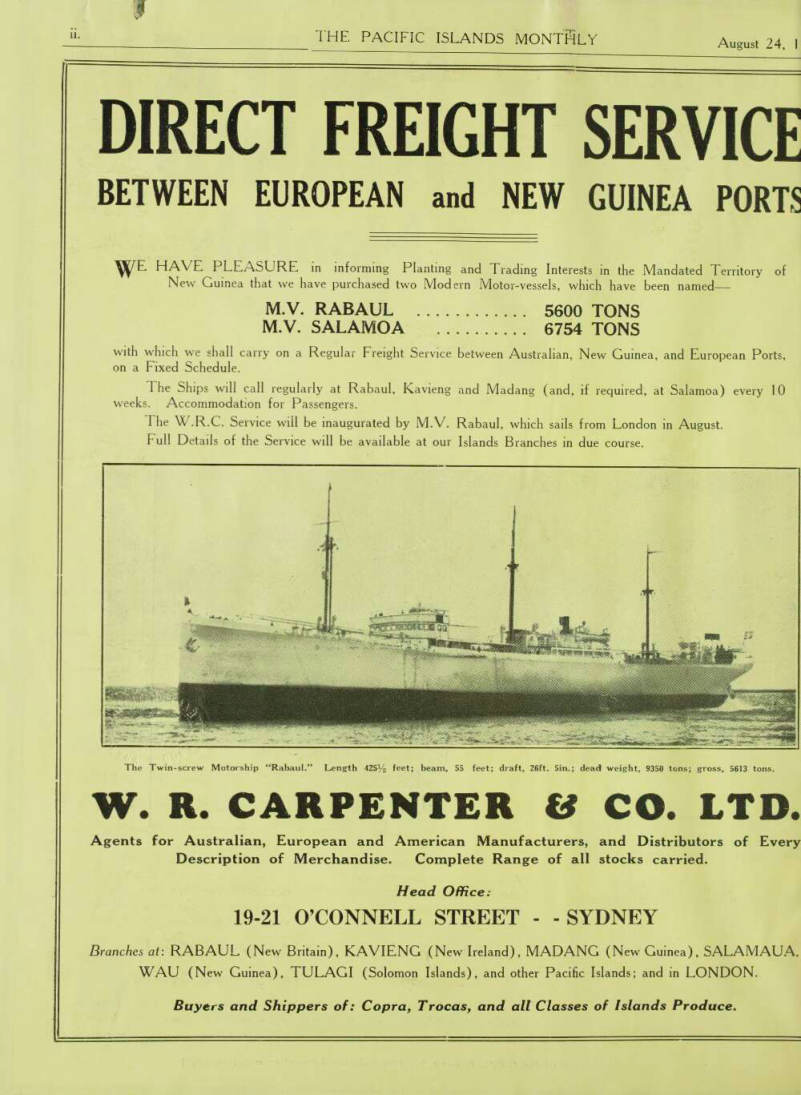
Direct Freight Servic
BETWEEN EUROPEAN and NEW GUINEA PORTS
WE HAVE PLEASURE in informing Planting and Trading Interests in the Mandated Territory of New Guinea that we have purchased two Modern Motor-vessels, which have been named—
M.V. RABAUL 5600 TONS
M.V. SALAMOA 6754 TONS
with which we shall carry on a Regular Freight Service between Australian, New Guinea, and European Ports, on a Fixed Schedule.
The Ships will call regularly at Rabaul, Kavieng and Madang (and, if required, at Salamoa) every 10 weeks. Accommodation for Passengers.
The W.R.C. Service will be inaugurated by M.V. Rabaul, which sails from London in August.
Full Details of the Service will be available at our Islands Branches in due course.
The Twin-screw Motorship “Rabaul.” Length 425% feet; beam, 55 feet; draft, 26ft. Sin,; dead weight, 9350 tons; gross, 5613 tons.
W. R. CARPENTER & CO. LTD.
Agents for Australian, European and American Manufacturers, and Distributors of Every Description of Merchandise. Complete Range of all stocks carried.
Head Office:
19-21 O’CONNELL STREET - - SYDNEY
Branches at: RABAUL (New Britain), KAVIENG (New Ireland), MADANG (New Guinea), SALAMAUA, WAU (New Guinea), TULAGI (Solomon Islands), and other Pacific Islands; and in LONDON.
Buyers and Shippers of: Copra, Trocas, and all Classes of Islands Produce.
Pacific Islands Travellers
Passengers Per Montoro Which Left
Sydney For Papua And New Guinea
ON JULY 18:—Mr. J. Alenthorne, Mr. and Mrs.
C L. Anthony and infant, Mr. and Mrs. R. Andi son, Mr. Atcherley, Mr. A. A. Bloxham, Mr Bow den, Mr L. W. Brand, Mr. and Mrs. Buchanan, Mr. Bell, Mr. J. M. Bourke, Mrs. R. H. Broone, Mrs. D. W. Baskett, Mr. C. H. Cameron, Pilot Clarke, Mr. Crossley, Mr. S. H. Christian, Mr.
L. S. Christian, Mrs. Champion and infant, Mrs.
M. F. Chadderton, Mrs. A. Coomber, Mr. Danielson, Mrs. Dover, Mr. A. E. Emerson, Mr. G. Ful ton, Mr. A. M. Freeman, Mr. O. Farrar, Mrs.
Ferbrache, Miss Ferbrache, Mr. Golding, Mr. and Mrs E. C. Green, Mr. Griffiths, Mr. W. H. Hill, Mr. Holland, Mrs. S. E. Hogan, Miss Halligan, Miss K. Harton, Mr. R. M. Kirkpatrick, Mr. and Mrs. C. Lucas, Mr. J. R. Lewis, Mrs. O. Leek, Mr H Mirow, Mr. and Mrs. Mitchell and two children, Mr. Macreth, Mr. W. D. Mackenzie, Mr. A. Mackav, Mr. J. G. Monteith, Mrs. M. M.
Knight, Mrs. N. Munro, Miss Munro, Miss J. F.
Marshall, Mr. P. E. O’Sullivan, Mr. J. Parker, Mr. Palmer, Mr. T. E. Pike, Mr. T. Prince, Mrs.
A. Pender, Mrs. H. M. Paterson, Mr. E. J. Rigby, Mrs. E. Robinson, Mrs. Ross, Miss T. Rowe, Mr.
H. J. Streeter, Mr. J. F. Sullivan, Mr. G. H.
Shaw, Mr. S. O. Strom, Mr. Skinner, Mr. R. E.
Scott, Mrs. F. R. Sweatman, Mrs. D. Sharp, Mrs. M. E. Sutcliffe, Mrs. M. A. Sutcliffe, Miss Swales, Mr. and Mrs. J. Walstab, Mr. R. J. Win ters, Mr. C. H. White, Mrs. H. S. Wight, Mr.
A. S. Young, Brother Yoachin.
Passengers Per Mortnda Which
Sailed From Sydney For Lord Howe
Island. Norfolk Island. And New
HEBRIDES ON JULY 19:—Mrs. Adamson, Master Adamson, Mrs. Anderson, Miss Anderson, Miss Butler, Miss Bridge, Miss Beveridge, Mr. R. P.
Coy, Mr, W. Chamberlain, Mr. and Mrs. F. Cox, Mr. Chancellor, Mr. W. Clancy, Mrs. A. Carr, Miss H. Cullen, Miss P. Carr, Miss S. Clancy, Mr.
A. T. Daniel, Mr. and Mrs. P. E. Dewey, Miss E.
Dunster, Miss Davies, Dr. C. Earl Davis, Mrs.
F. L. Elder, Mr. H. Farrow, Miss Foules, Mr. P.
Gibbons, Miss M. A. Greenwood, Mr. and Mrs. J. Hawe, Mrs. M. Hankinson, Miss E.
Howes, Miss Hannan, Mr. J. W. Jenkins, Miss B. Judge, Mr. Links, Mr. S. Lawry, Mr. and Mrs. D. Lennox, Mr. T. B. Lewin, Miss Mitchell, Miss L. Malcolm, Miss M. Mussett, Miss J. Mussett, Mr. A. Pym, Mrs. J. Nicol, Dr.
F. G. Roberts, Mr. and Mrs. A. Stewart, Mr. T.
E. Swan, Mr. W. Taylor, Miss E. Sloane, Mr. E.
Vale, Mr. J. Wilson, Mr. J. P. Wilson, Mr. J.
Wheatley, Mrs. F. Wallen, Miss D. Walters, Miss Wallace.
Passengers Per Niagara Which
SAILED FROM SYDNEY FOR SUVA, FIJI, ON JULY 19: —Miss J. Sherwood, Mr. and Mrs. E.
H. Woodby, Mr. F. W. Price, Miss L. Peel, Miss I. Cunningham, Mr. and Mrs. W. P. Chapman, Miss E. Robinson, Miss E. Chapman, Mrs. C. H.
Peel, Mr. C. H. Peel, Mr. W. A. Morris, Mr. H.
O’Neil, Mr. F. C. Exon, Mr. F. P. Taylor, Mr. P.
C. Potter, Mr. J. French, Mr. W. Cox, Mr. F. C.
S. Ray, Mr. F. Ritchie, Mr. J. R. Ure, Mr. J. A.
Wright, Mr. T. B. Potter, Mr. and Mrs. W. F. A.
Mure, Miss B. Brown, Mr. and Mrs. A. L. M.
Benjamin, Mrs. A. M. Cronin, Mr. C. Moran, Mr.
Robert Wong Toy, Miss D. Secomb, Miss B.
Secomb, Mr. and Mrs. W. L. Dunlop, Miss E.
Gilmore.
Passengers Per Mariposa Which
SAILED FROM SYDNEY FOR SUVA, FIJI, ON JULY 25:—Mr. A. B. Bradfield, Mr. W. P. Dun lop, Miss F. Fahey, Miss N. Fahey, Miss A.
Francis, Rev. K. Forster, Mrs. K. Forster, Mr. M.
Hepburn, Mrs. M. Hepburn, Mr. L. C. Hinks, Miss T. Marks, Mr. W. C. Nicholson, Mr. E. J.
Randall, Mr. Clive Sheahan, Mrs. F. M. Sheahan, Mr. C. H. Smith, Mr. H. B. Smith, Mr. E. R.
Snow, Mr. G. W. Slatcher, Mrs. G. W. Slatcher, Miss Jessie Thomas, Mr. and Mrs. H. Vaskess, Master C. Vaskess, Master K. Vaskess, Miss J.
Abbott, Brother R. Davis, Miss A. Evans, Mrs.
K. Alomes-Hutton, Miss M. Lean, Mr. and Mrs.
D. S. McDonald, Master D. J. McDonald, Mr. H.
H, McMahon, Mrs. T. P. Nicholson, Mr. and Mrs. L. Noerr, Mrs. Grace Shar, Mrs. N. Tarte, Miss J. Tarte, Master D. V. Tarte.
Passengers Per Morinda, Which Ar
Rived In Sydney From Lord Howe
Island, Norfolk Island And New
HEBRIDES ON AUGUST 7: -Mrs. W. H. and Master Adamson, Miss J. Bridge, Miss E. M.
Butler, Mr. and Mrs. C. J. Burke and Master D.
Burke, Mr. and Miss Clancy, Mr. R. P. Coy, Mr. and Mrs. F. Cox, Miss H. Cullen, Mr. R. E. Chan cellor, Miss E. Davies, Miss E. Dunster, Mr. N.
Darby, Mrs. F. L. Elder, Miss F. Emerson, Mr.
B. H. Edgar, Mrs. Stan. Fenton, Mrs. R. Ferris and two children, Mr. H. Farrow, Mr. R. P.
Gibbons, Miss M. A. Greenwood, Mr. B. C. Grubb, Mr. and Mrs. J. Hawe, Miss E. Howes, Miss B.
Judge, Mr. G. M. Kirby, Mr. and Mrs. D. Len nox, Mr. R. Links, Archdeacon and Mrs. G. E.
Lamble, Mr. W. S. Lowrey, Mr. J. W. Maund, Miss M. Marshall, Mr. L. G. McCracken, Misses M. and A. Mussett, Miss L. Malcolm, Miss J.
Mitchell, Mr. G. Peacock, Mr. J. A. Pym, Mr. T.
H. Patching, Mr. E. Rushbrooke, Dr. G. G. Rob erts, Miss E. Sloane, Mr. T. E. Swan, Miss A.
Twomey, Mr. W. Taylor, Mrs. E. Taylor, Miss W. M. A. Taylor, Mr. E. S. Vail, Miss D. Walters, Miss V. Wilson, Mr. H. Woolnough, Miss V.
Wallace, Mr. J. A. Wilson, Mr. J. C. J. Wheat ley.
Passengers Per Malaita, Which Ar
Rived In Sydney From Solomon
Islands And New Guinea On August
5: —Mrs. F. Anderson, Mr. G. Arnold, Mr. E.
Bergin, Mr. G. Buckley, Mr. J. Blau, Miss M.
Bartle, Miss J. Binskin, Mr. L. Borgas, Mr. C. R.
Buffett, Miss M. Cormack, Mr. M. A. Conway, Miss E. Conolly, Mrs. C. Cooper, Miss Cooper, Miss E. Clarke, Mr. and Mrs. H. Dean, Mr. A.
Cameron, Miss Cameron, Miss E. Dixon, Mr. A.
Davies, Mr. J. Davis, Mr. W. H. Driver, Mr. A.
Freeman, Miss Freeman, Mr. J. F'arrar, Mr. N.
A. Ferris, Mr. A. Glenn, Mr. and Mrs. F. B. Gil bert, Mrs. Hosking, Miss Hosking, Mrs. F. Hart, Mr. and Mrs. R. Humphries, Mrs. M. Harrison, Dr. and Mrs. H. Hethrington, Mr. and Mrs. A.
Hubbard and infant, Mr. and Mrs. J. Hicks and infant, Miss Z. Jermyn, Mrs. E. Johnson, Mr. and Mrs. J. Keeland, Mrs. 1. Kebblewhite, Mr. and Mrs. E. Keighley, Mr. L. Lesser, Miss Lesser, Mr.
H. Y. Lethbridge, Miss H. Leisbman, Mr. D. Mc- Donald, Mrs. M. Mac Andrew, Miss L. Morris, Mr.
J. McLaren, Dr. C. G. Murray, Miss P. McKen zie, Mr. J. J. Rutter, Mrs. J. Rainford, Mr. W.
Rixon, Capt. W. Scott, Miss Scott, Miss L. Sven sen, Miss E. Smith, Mrs. Tully, Misses V. and E.
Tully, Mr. J. Terry, Mr. W. Webb, Mr. W. R.
Wood, Mr. G. Warren, Mrs. G. Warren, Mr. J. R.
Wad, Mr. A. Wickham.
Passengers Per Macdhui, Which Ar
RIVED IN SYDNEY FROM PAPUA AND NEW GUINEA ON JULY 31:—Miss A. E. Anderson, Mr. W. H. Anderson, Mr. A. E. Austin, Mr. E. B.
Allison, Mr. R. Alke, Mrs. C. Beckett, Mr. W. D.
Brown, Miss D. Bayley, Miss M. Bayley, Mr. J.
Bayley, Mr. G. Breheney, Mr. W. E. Bitton, Mr.
C. D. Brophy, Mr. A. Corrighan, Mr. F. G. Cool, Mr. and Mrs. R. Chapman, Mr. T. D. Collett, Mrs.
M. Campbell. Mr. J. Carson, Mr. J. M. Cruick shank, Mr. S. C. Clark, Mr. E. H. Chater. Mr.
J. H. Cook, Mrs. M. Goulston, Mr. W. C. Groves, Mrs. L. Gluyas, Mr. P. Grose, Mr. B. Gordon, Mr. A. H. Gray, Mr. H. Gboley, Miss M. Gart
lan, Mr. E. A. Guinan, Mr. and Mrs. R. J. Han son, Ur. W. T. Harse, Mr. A.. M. Hiles, Mr. F.
Hambridge, Mr. P. Heymanson, Mr. N. Joses, Mr.
P. J. Jansen, Mr. and Mrs. C. H. Karins, Mr. E.
H. Lake, Mr. B. Here Lacey, Mr. J. H. Lang, Mr.
L. H. Livingston, Mrs. R. Lindholm, Mr. T. R.
McCulloch, Mr. R. J. Martin, Mr. W. McRae, Mr.
S. J. Moir, Mr. W. Meldrum, Mr. I. Morley, Mr. and Mrs. D. J. Murcutt, Miss M. Morton, Mr.
J. Overton, Mr. A. S. Paterson, Mr. D. J. Rees, Mr. G. Richards, Mr. and Mrs. L. H. Ross, Mr. G.
Rawhng, Mrs. M. Rosenthal, Mrs. E. Reed, Miss R. Reed, Mr. W. F. Smith, Mr. S. Elliott Smith, Mr. A. C. Spence, Mr. L. D. Stewart, Mr. A, R.
Simpson, Mr. J. E. Stringer, Mr. J. G. Swanson, Mr. R. J. Shaw, Mr. and Mrs. R. Dundas Smith, Mr. S. Tinnion, Miss J. Washington, Mr. L. G.
Woolcott, Mr. A. Westbrook, Mr. and Mrs. J.
Walshe.
Passengers Per Macdhui Which Left
SYDNEY FOR PAPUA AND NEW GUINEA ON AUGUST 9: —Mr. E. A. Anderson, Mr. and Mrs.
L. Austin, Mr. Baker, Mr. R. G. Burn, Mr. R. A.
Brown. Mr. G. E. Boileau, Mrs. R. W. Brodie, Mrs.
M. Bensley, Miss O. Brown, Miss P. Brown, Miss B. O. BrooKe, Miss M. E. Bishton, Miss B. Bach, Mr. and Mrs. A. Cridland, Mr. H. C. Cardew, Mr. R. P. Cooper. Mr. J. C. Carey, Mrs. V. Comb and child. Miss L. Cray, Miss Chipman, Miss D.
Cooper, Mr. T. M. Dwyer, Mr. C. Dwyer, Master Dwyer, Miss Dwyer, Mrs. W. E. Donnier, Mr. J. A.
Eilertz, Mrs. and Mr. Foldi, Mr. S. J. Fitzgerald, Mr. and Mrs. R. V. Grant and infant, Mrs. C. M.
Grieve, Mr. and Mrs. Holdsworth, Mr. and Mrs. W.
Hardy, Mr. L. Hardaker, Mr. J. W. Hinks, Mr. A. G.
Harris, Mr. F. C. James, Mr. W. J. Knight, Mr.
C. Leake, Mr. A. Lyall, Mr. T. D. Lyon, Mr. R.
Levitus Mr. Lassels, Mrs. E. A. Lee and infant, Mrs. R. A. Laws and infant, Mr. and Mrs. R. C.
B. Moore, Mrs. A. E. Moir, Mr. S. H. Munro, Mr.
A. W. Marshall, Mr. J. W. Mackie, Mr. A. S.
Macdonald, Major E. Murray Jones, Mr. E. C.
Monck, Mr. M. Mateer. Mr. Morton, Miss Mc- Sweeny, Miss B. McGuigan, Mr. D. O’F'arrell, Mr. R. V. Pratt, Dr. E. Pockley, Mr. S. Pope, Mr.
P. P. Perry, Mr. R. W. Robson, Mrs. Rowe and 2 children, Mr. V. G. Smith, Mr. Schirmer, Mr.
A. Surman, Mr. W. PL Samson, Mr. R. Spenceley, Mrs. Spence and 2 infants, Mrs. D. Slower, Misses E. and R. Symonds, Miss D. Spark, Mr. and Mrs.
E. M. Turner. Mrs. J. Turner. Mr. L. H. Thomp son Miss F. L. Uhe, Miss E. Vickery, Miss A.
Vogt, Mr. and Mrs. R. S. Walker, Mr. A. R.
Wa drop. Mr. R. S. Walker, Mr. L. V. Water house, Mr. W. Whitford, Mr. F. E. White, Mr. E.
Weine, Mr. C. Wood, Miss M. Worden, Mr. W.
Zischler. Mr. M. Zimmermann.
Advertisements & other items, p. 3 (1 item)
bi-monthly by the "VAN REES"
New Britain Express Delivery.
GENERAL OVERSEAS AGENTS.
GENERAL CARRIERS, BAGGAGE AGENTS,
and FORWARDING AGENTS.
Reliable Cars and Trucks.
We nim to give quick and reliable Service at reasonable costs. P.O. Box 116. Telephone 141.
W. WALKER FLYNN, Proprietor.
Market Street, Rabaul, T.N.G.
SAIGON-BATAVIA-SAMARANC-PORT MORESBY
SAMARAI-RABAUL- PORT VILA- NOUMEA
SYDNEY - PORT MORESBY - BATAVIA - SAIGON
bi-monthly by the "VAN REES"
You will enjoy travelling by this popular, fast and modern steamer of the K.P.M., noted for its comfort, excellent cuisine, and economical fares.
With a fleet of over 130 vessels the K.P.M. Line is in a position to accept cargo for all ports in Netherlands India, and with transhipment at Batavia for Africa.
ROYAL PACKET NAVIGATION CO.
Paketvaart House, 255 George Street, Sydney
Diethelm & Co., Saigon; E. A. James, Port Moresby; Whitten Bros., Samarai; W. R. Carpenter & Co. Ltd., Rabaul; Gubbay Freres, Port Vila; Carlo Leoni, Noumea.
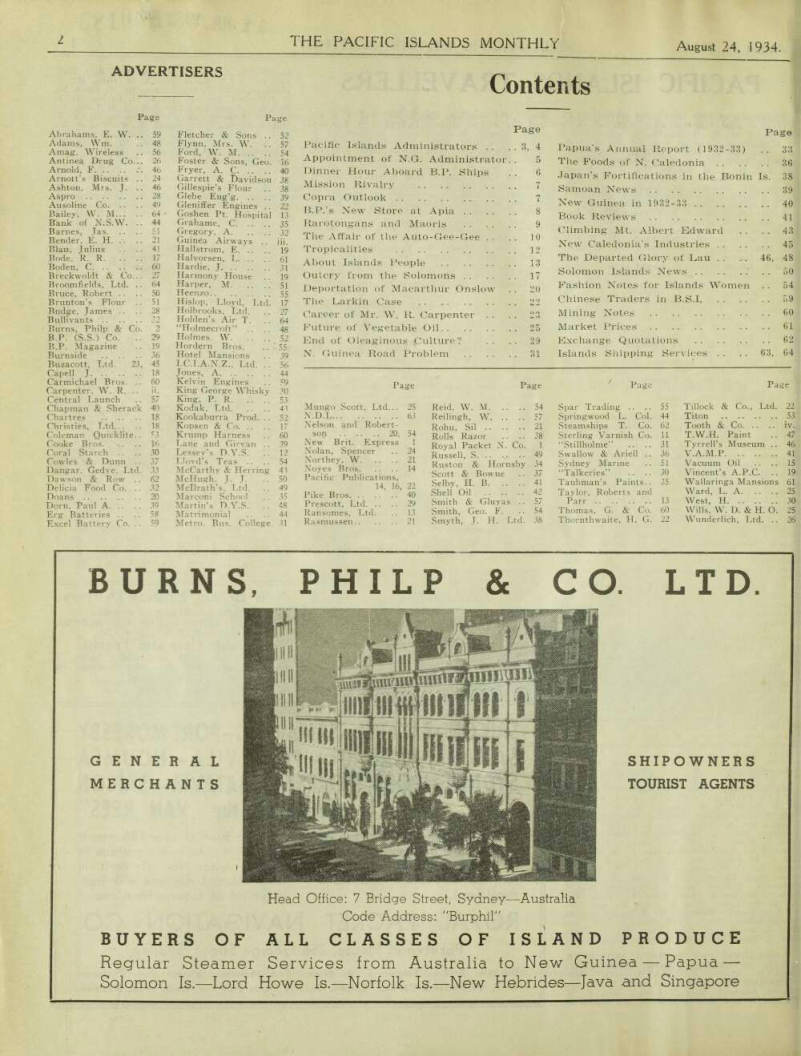
Advertisers
Page Abrahams, E. W. .. 59 Adams, Wm. .. 48 Amag. Wireless .. 56 Antinea Drug Co... 26 Arnold, F. .. 46 Arnott’s Biscuits .. 24 Ashton, Mrs. J. .. 46 Aspro 28 Ausoline Co 49 Bailey, W. M. 64 Bank of N.S.W. .. 44 Barnes, Jas. .. .. 51 Bender, E. H. 21 Blau, Julius 41 Bode, R. R. 17 Boden, C. 60 Breckwoldt & Co... 27 Broomfields, Ltd. .. 64 Bruce, Robert .. .. 50 Brunton’s Flour .. 51 Budge, James .. .. 28 Bullivants 32 Burns, Philp & Co. 2
B.P. (S.S.) Co. ..29
B.P. Magazine .. 19 Burnside 36 Buzacott, Ltd. 23, 45 Capell J. 18 Carmichael Bros. .. 60 Carpenter. W. R. .. ii.
Central Launch .. 57 Chapman & Sherack 40 Chartres 18 Christies, Ltd 18 Coleman Quicklite.. 53 Cooke Bros 16 Coral Starch .. 30 Cowles & Dunn .. 37 Dangar, Gedye. Ltd. 33 Dawson & Row .. 62 Delicia Food Co. .. 32 Doans 20 Dorn, Paul A. 39 Erg Batteries .. .. 58 Excel Battery Co. .. 59
Page Fletcher & Sons .. 52 Flynn, Mrs. W. 57 Ford, W. M. 54 Foster & Sons, Geo. 16 Fryer, A. C. 40 Garrett & Davidson 38 Gillespie’s Flour .. 38 Glebe Eng’g 39 Gleniffer Engines .. 22 Goshen Pt. Hospital 13 Grahame, C. 35 Gregory, A. 32 Guinea Airways .. iii.
Hallstrom, E. 19 Halvorsen, L. 61 Hardie, J. 31 Harmony House .. 19 Harper, M. 51 Heenzo 55 Hislop, Lloyd, Ltd. 17 Holbrooks, Ltd. .. 27 Holden’s Air T. ..64 “Holmecroft” 48 Holmes, W. 52 Hordern Bros. .. 55 Hotel Mansions .. 39
I.C.I.A.N.Z.. Ltd. .. 56
Jones, A. 44 Kelvin Engines .. 59 King George Whisky 30 King, P. R. 53 Kodak. Ltd. 41 Kookaburra Prod. .. 52 Kopsen & Co. 17 Krump Harness .. 60 Lane and Girvan .. 39 Lessey’s D. Y. S. .. 12 Llovd’s Teas .. .. 54 McCarthy & Herring 41 McHugh. J. J. .. 50 McIlrath’s, Ltd. .. 49 Marconi School .. 35 Martin’s D.Y.S. .. 48 Matrimonial .. .. 44 Metro. Bus. College 31
Page Mungo Scott, Ltd... 25
N.D.L 63
Nelson and Robert son 20, 54 New Brit. Express 1 Nolan, Spencer .. 24 Northey, W. 21 Noyes Bros 14 Pacific Publications, 14, 16, 22 Pike Bros. 40 Prescott, Ltd 29 Ransomes. Ltd. .. 13 Rasmussen 21
Page Reid, W. M. 54 Reilingh, W. 57 Rohu, Sil 21 Rolls Razor .. .. 38 Royal Packet N. Co. 1 Russell, S. 49 Ruston & Hornsby 34 Scott & Bowne .. 37 Selby, H. B. 41 Shell Oil 42 Smith & Gluyas .. 57 Smith, Geo. F. .. 54 Smyth, J. H. Ltd. 38
Page Spar Trading .. .. 55 Springwood L. Col. 44 Steamships T. Co. 62 Sterling Varnish Co. 11 “Stillholme” .. .. 31 Swallow & Ariell .. 36 Sydney Marine .. 51 “Talkeries” .. .. 30 Taubman’s Paints.. 35 Taylor, Roberts and Parr 13 Thomas, G. & Co. 60 Thornthwaite, H. G. 22
Page i Tillock & Co., Ltd. 22 Titon 53 Tooth & Co iv.
T.W.H. Paint .. 47 Tyrrell’s Museum .. 46
V.A.M.P. 41
Vacuum Oil .. .. IS Vincent’s A.P.C. .. 19 Wallaringa Mansions 61 Ward, L. A. 25 West, H. 30 Wills, W. D. & H. O. 25 Wunderlich, Ltd. .. 26
Contents
Page Pacific Islands Administrators . . ..3, 4 Appointment of N.G. Administrator.. 5 Dinner Hour Aboard B.P. Ships . . 6 Mission Rivalry 7 Copra Outlook 7 B.P.’s New Store at Apia 8 Rarotongans and Maoris 9 The Affair of the Auto-Gee-Gee . . . . 10 Tropicalities 12 About Islands People 13 Outcry from the Solomons 17 Deportation of Macarthur Onslow .. 20 The Larkin Case 22 Career of Mr. W. R. Carpenter .. .. 23 Future of Vegetable Oil 25 End of Oleaginous Culture? .. .. 29 N. Guinea Road Problem 31
Page Papua’s Annual Report (1932-33) . . 33 The Foods of N. Caledonia 36 Japan’s Fortifications in the Bonin Is. 38 Samoan News 39 New Guinea in 1932-33 40 Book Reviews 41 Climbing Mt. Albert Edward . . . . 43 New Caledonia’s Industries 45 The Departed Glory of Lau . . .. 46, 48 Solomon Islands News 50 Fashion Notes for Islands Women . . 54 Chinese Traders in 8.5.1 59 Mining Notes 60 Market Prices 61 Exchange Quotations 62 Islands Shipping Services .. .. 63, 64
Advertisements & other items, p. 4 (1 item)
Burns, Philp & Co. Ltd.
GENERAL
MERCHANTS
Head Office: 7 Bridge Street, Sydney—Australia Code Address: "Burphil"
BUYERS OF ALL CLASSES OF ISLAND PRODUCE Regular Steamer Services from Australia to New Guinea Papua Solomon Is. —Lord Howe Is.—Norfolk Is.—New Hebrides —Java and Singapore
SHIPOWNERS
TOURIST AGENTS
The Pacific Islands Monthly
The Newspaper-Magazine Of The South Seas
[Registered at G.P.O., Sydney, for transmission by post as a newspaper.] Published Once Each Month and Circulated in Australia and New Zealand and in the following Pacific Territories and Islands Groups:
Crown Colony of Fiji.
Australian Territory of Papua.
Mandated Territory (Australia) of New Guinea, Bismarck Archipelago, and Northern Solomon Islands.
Mandated Territory (Japan) of Marshall, Caroline and Mariana Islands.
French Territory of New Caledonia.
British and French Condominium of New Hebrides.
American Territory of Eastern Samoa.
American Territory of Guam.
Mandated Territory of Nauru.
British Crown Colony of Gilbert and Ellice Islands.
Mandated Territory (New Zealand) of Samoa.
British Solomon Islands Protectorate.
British Protectorate of Tongan Islands.
New Zealand Territory of Cook Islands.
Australian Territory of Norfolk Island.
French Colony of Oceania (Tahiti, etc.).
American Territory of Hawaiian Islands.
Owned and Produced by Pacific Publications Ltd., Union House, 247 George Street, Sydney.
Telephone Bw 5037
P.O. Box 3408 R
Contributions Articles, Stories, and Photographs dealing with Pacific Islands Subjects are invited, and will be oaid for on publication at usual rates.
Subscription Rates Per Annum, within British Empire, Prepaid Post Free 6/- Per Annum, elsewhere, prepaid, Post Free .. 8/- Single Copies 6d.
Editor and Publisher:
R. W. Robson.
Advertisements Advertising rates furnished on application.
Colours, etc. by Arrangement.
Process Blocks made at Advertiser’s expense when required. Screen, 100.
Changes of Advertising Copy should reach this Office by Bth of each month, otherwise previous advertisement may be repeated.
Registered Address for Radiograms and Cables; “PACPUB” Sydney
Agents The following are authorised to receive subscrip tions for “The Pacific Islands Monthly”— Islands Branches of Burns, Philp & Co., Ltd., and Burns, Philp (South Seas) Co., Ltd.
Islands Branches of W. R. Carpenter & Co., Ltd.
All Branches of Morris, Hedstrom & Co., Ltd.
G. Thomas & Co., Rabaul.
Whitten Bros., Ltd., Samarai.
P. Costello, Suva, Fiji.
All Branches and Representatives of W. H. Grove and Sons, Ltd., Auckland.
S. Russell, Papeete, Tahiti.
Cook Islands Trading Co., Rarotonga.
Vol. V, No. 1
Sydney, August 24, 1934.
6d. Per Copy Price Prepaid: 6/- p.a.
Pacific Administrators
COMPLETELY successful administrators of Pacific territories are born: they cannot be shaped to order. The nature of the responsibility placed upon them makes it necessary that they shall be dictators; other considerations make it equally necessary that they shall hide the strong hand of the autocrat in the velvet glove of the diplomat. They must have wide vision, and build for the future according to a pre-conceived and co-ordinated plan, and they must not be deflected from their continuing purpose. Yet ruthlessness will defeat their ends; so they must be men with a broad and tolerant understanding of human nature. They must be naturally austere men; for they live always in that “fierce light that beats upon a throne.” And if they are followers of the flesh-pots, their appetites may be counted against them as weaknesses, and they may not enjoy, as they should, the confidence and respect of the people they govern.
Such men are hard to find. Among a thousand who eagerly seek the privileges and perquisites of administratorship,
there probably is not one who can measure up to the standard required.
It is a remarkable thing, therefore, that the Pacific territories generally have been so well governed. Much more often than not, these regions—French as well as British—have been placed in the care of men of most conspicuous ability, who have given to a difficult, discouraging, and often thankless job a lifetime of devoted effort. Usually, they have been men whose personal influence, no less than their administrative acts, has lifted the prestige of the flag they served, and assisted definitely in the advancement of human progress—often in circumstances where they might have been excused if they had exercised purely negative qualities, and “taken it easy.” No man, who knows the Islands, blames officials who succumb to that insidious “tropicitis.”
Australia, in this respect, has been surprisingly well served surprising, because Australia notoriously is governed by a class of mediocre office-seekers, who are the natural product of a degenerate democracy, and who could not be ex-
pected to display much wisdom in their choice of administrators. Nevertheless, such notable men as Sir William Mac- Gregor, Sir Hubert Murray and General T. Griffiths have governed Pacific territories under the aegis of Australia.
Parenthetically, it is impossible to escape the logical, distressing thought that, if only her vicious political system could be reformed, Australia might have this class of man for her own government, instead of for that of her dependent territories.
A new appointment has been made to the New Guinea administratorship.
Everyone who is jealous of Australia’s fine record in Pacific administration— and, not least of them, the officers of the splendid public service corps which Australia has built up in New Guinea since 1920 —will use his influence to smooth the path of the man who is taking up this difficult job, with its embarrassing Imperial obligations.
Many people have expressed regret that the Federal Government, in making the New Guinea appointment, overlooked the claims of certain outstanding figures of the Papuan service. The Lieutenant-
Governor of Papua, Sir Hubert Murray, stands unchallenged as the greatest Pacific administrator this century yet has produced; and, without doubt, his per sonal influence has done much to train the vision and mould the characters of the men associated with him in that ser vice. There are at least three of them who are regarded as competent to assume the major responsibilities of administra
torship.
Incidentally, the fact that the Ad ministrator of Norfolk Island, Captain Pinney, is a man trained and qualified in the Sir Hubert Murray school, should have carried some weight with Australian newspapers recently, when Norfolk Island affairs were under the limelight.
But the man who attacked Captain Pin ney was given the freedom of certain newspaper offices, and allowed to wag an agitated, irresponsible jaw; and not one word was said by the newspapers in defence of the silent officer who has to carry all the obligations of administra torship, and whose private and public record is without a blemish.
Too much praise cannot be given, in this general review, to the men who have
guided Fiji and Western Samoa through
these recent difficult years. Sir Murchi son Fletcher has had a certain amount of relief in the flourishing condition of the Fiji sugar industry; but the burden he has had to assume, in supervising the public finance of the Solomons, Gilbert and Ellice, Tonga and New Hebrides Groups, since the collapse of the copra market, ccn only be guessed at by we unenvious outsiders. History should have something very flattering to say of this particular High Commissioner.
To the economic worries of the de pression period were added acute poli tical troubles, to provide a really fright ful job for the New Zealand Administra tor of Samoa, General Hart. There were a number of occasions, during the past three years, when a less able and less patient man inevitably and easily would have caused bloodshed in Samoa, em broiled Great Britain with the League of Nations, and discredited New Zealand.
Instead, General Hart has brought Sa moa to a condition of quiescence and com parative content —a thing that seemed impossible a couple of years ago. He not only has done his work in a most praise worth}' manner: he also has done much to wipe out the memory of New Zealand’s blunders in Samoa between 1924 and 1930.
Sorcerers
And the Village Policeman
SORCERY is one of the most difficult problems that have to be tackled by the administrations of primitive races; and in Papua the evil effects of it are still very much in evidence, even after fifty years of white rule.
The native belief in sorcery is very wide-spread, and there is no tribe and no village in the Territory in which it is not practised and feared.
It is the more difficult to suppress be cause there is no organisation binding the sorcerers together. Each magician works by himself, and the Administration is unable to strike at the head of the evil, simply because there is no head.
From its very nature, sorcery cannot be classed as a crime. The things that the sorcerers do are so harmless in them selves that they can seldom be made the basis of any definite charge.
Sir Hubert Murray writes: “The chief difficulty in all cases in which sorcery is an element is in finding out exactly what the sorcerer did.”
The evil seems to lie not so much in the acts of the sorcerers as in the general native belief in their powers. And it is this superstitious belief, rather than sor cery itself, which lies at the root of nearly all the crime committed.in Papua.
In one of his official reports, the Resi dent Magistrate of the Kumusi division wrote of a case in point.
Two natives of his division had been charged with “pretending to exercise sor cery.” They were convicted, served their sentence and were discharged. Shortly afterwards an indignant Village Constable appeared at the Government station.
“You know those two sorcerers you let out of gaol a week ago?-” he asked the magistrate. “Well, when they got back to the village they put magic on the bush pigs. Now the bush pigs have broken into my garden and eaten all my taro.
Look; here is some taro half-eaten.”
“How do you know that these two men put a spell on the bush pigs?” the magis trate asked.
“When they came out of gaol they were angry. They said ‘This village policeman made us go to gaol for three months. Now we will spoil his garden.’ ”
“Did anyone hear them say this?”
“No; but of course they said it. Isn’t it exactly what they would say?”
“Then you have no witnesses?”
“No; but there is the taro, half-eaten.”
Questioned, he admitted that he had not repaired his fence for six months, and that a Papuan fence could not be ex pected to last so long without attention; but he resented the magistrate’s refusal to take action in what, he was convinced, was a clear case of sorcery.
Early Description of Pitcairn Is.
A portion of the log of the famous vessel “Surry,” commanded by Captain Tom Raine, has been purchased by the Sydney Mitchell Library.
Captain Raine visited Pitcairn Island in the “Surry” in 1821. His log of the voyage gave a vivid account of the descendants of the “Bounty” mutineers. Their history, life, customs and appearance were faith fully chronicled by the skipper and the manuscript constitutes a valuable addi tion to South Sea Islands literature.
French Oceania
World Wanderer In
From Our Own Correspondent.
Papeete, June 26.
THE well-known round-the-worldyachtsman, Mr. Alain Gerbault, who is the author of several travel books, ar-
rived in Tahiti on June 5, by way of the Marquesas Islands, and is now living aboard his cutter boat in Papeete harbour.
As Mr. Gerbault abhors publicity and
refuses to grant interviews it is not pos sible to state anything authoritative re garding his trip to Tahiti or his future movements.
Mr. Gerbault’s yacht on a slip in Papeete harbour.
Mr. Alain Gerbault (right), leaving the Papeete Post Office with a French official shortly after his arrival in Tahiti.
Disabled Cargo Vessel
Reaches Papua
From Our Own Correspondent.
Pt. Moresby, July 23.
On July 22, “Sol Afric,” a cargo vessel under charter to Messrs. Andrew Weir and; Co. crawled into the harbour of Pori Moresby for repairs. She had a damaged crankshaft and a cracked cylinder, having struck trouble with her engine out from Sourabaya (Java) on her way to Callao,.
Chili. Mr. George A. Stewart, of Port Moresby, has undertaken the repair of the vessel.
Administrator
New
General McNicoll Appointed to N. Guinea
THE appointment of Brigadier-General McNicoil as Administrator of the Mandated Territory of New Guinea in succession to Brigadier-General Griffiths, who is retiring, was officially announced at the end of July.
General McNicoil intends to leave for Rabaul by the Mataram on August 30.
General Griffiths, according to present arrangements, will leave Rabaul early in September —probably on the 12th.
Details of the career of Brigadier- General McNicoil were published in this journal last month.
Carpenters' Motor
Ships
Inauguration of Service
THE new direct freight service between European and New Guinea ports, planned by Messrs. W. R. Carpenter and Co. Ltd., will be inaugurated this month, and it will be known as the WRC Line.
The motor vessel Rabaul (5600 tons) is leaving London this month for New Guinea, and thence will proceed to Aus tralia. She will call at Rabaul, Kavieng, Madang, and if required at Salamaua, a-nd is due in Sydney in October. She will be followed ten weeks later by the motor vessel Salamaua.
The route to be followed by the ships will be from Sydney, along the Queens land coast to New Guinea, and thence to Batavia, Suez Canal, and Continental ports.
These two newly-purchased Carpenter vessels are manned at present by British crews. It is reported, however, that if they meet unrestricted competition from the German ships which are operating in New Guinea (with their base at Hong- Kong) the British crews will be dispensed with and Chinese crews engaged instead.
The German ships are manned largely by Chinese. We understand that represen tations concerning this have been made to the Commonwealth Government.
Corporal Punishment
For B.S.I. Natives
IT was officially announced in August by the High Commissioner for the Wes tern Pacific (Sir Murchison Fletcher) that legislation will be introduced im mediately to empower courts in the Bri tish Solomon Islands to order floggings in cases where natives are convicted of certain offences against white women.
This development is the result of rep resentations made recently to the British Colonial Office, London, by Sir Murchison Fletcher, on the question of native crime in the Solomons.
Mr. H. S. Reid, a director of Messrs.
Buka Plantations and Trading Co., left Sydney by the Malaita on August 11 on a visit of inspection to the company’s plan tations in Bougainville.
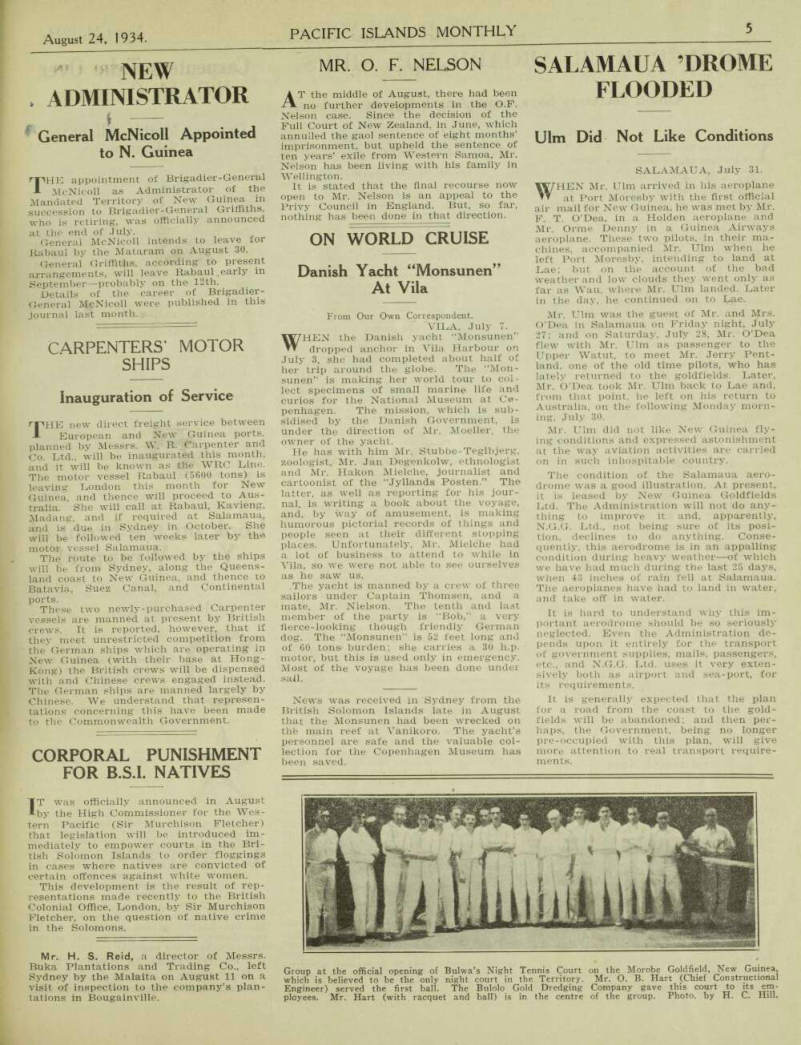
Group at the official opening of Bulwa’s Night Tennis Court on the Morobe Goldfield, New Guinea, which is believed to be the only night court in the Territory. Mr. O. B. Hart (Chief Constructional Engineer) served the first ball. The Bulolo Gold Dredging Company gave this court to its em ployees. Mr. Hart (with racquet and ball) is in the centre of the group. Photo, by H. C. Hill.
Mr. O. F. Nelson
AT the middle of August, there had been no further developments in the O.F.
Nelson case. Since the decision of the Full Court of New Zealand, in June, which annulled the gaol sentence of eight months’ imprisonment, but upheld the sentence of ten years’ exile from Western Samoa, Mr.
Nelson has been living with his family in Wellington.
It is stated that the final recourse now open to Mr. Nelson is an appeal to the Privy Council in England. But, so far, nothing has been done in that direction.
On World Cruise
Danish Yacht “Monsunen”
At Vila
From Our Own Correspondent.
VILA, July 7.
WHEN the Danish yacht “Monsunen” dropped anchor in Vila Harbour on July 3, she had completed about half of her trip around the globe. The “Mon sunen” is making her world tour to col lect specimens of small marine life and curios for the National Museum at Co penhagen. The mission, which is sub sidised by the Danish Government, is under the direction of Mr. Moeller, the owner of the yacht.
He has with him Mr. Stubbe-Teglbjerg, zoologist, Mr. Jan Degenkolw, ethnologist and Mr. Hakon Mielche, journalist and cartoonist of the “Jyllands Posten.” The latter, as well as reporting for his jour nal, is writing a book about the voyage, and, by way of amusement, is making humorous pictorial records of things and people seen at their different stopping places. Unfortunately, Mr. Mielche had a lot of business to attend to while in Vila, so we were not able to see ourselves as he saw us.
The yacht is manned by a crew of three sailors under Captain Thomsen, and a mate, Mr. Nielson. The tenth and last member of the party is “Bob,” a very fierce-looking though friendly German dog. The “Monsunen” is 52 feet long and of 60 tons burden; she carries a 30 h.p. motor, but this is used only in emergency.
Most of the voyage has been done under sail.
News was received in Sydney from the British Solomon Islands late in August that the Monsunen had been wrecked on thfe main reef at Vanikoro. The yacht’s personnel are safe and the valuable col lection for the Copenhagen Museum has been saved.
Salamaua 'Drome
Flooded
Ulm Did Not Like Conditions
Salamaua, July 31.
WHEN Mr. Ulm arrived in his aeroplane at Port Moresby with the first official air mail for New Guinea, he was met by Mr.
F. T. O’Dea, in a Holden aeroplane and Mr. Orme Denny in a Guinea Airways aeroplane. These two pilots, in their ma chines, accompanied Mr. Ulm when he left Port Moresby, intending to land at Lae: but on the account of the bad weather and low clouds they went only as far as Wau, where Mr. Ulm landed. Later in the day, he continued on to Lae.
Mr. Ulm was the guest of Mr. and Mrs.
O’Dea in Salamaua on Friday night, July 27: and on Saturday, July 28, Mr. O’Dea flew with Mr. Ulm as passenger to the Upper Watut, to meet Mr. Jerry Pent land, one of the old time pilots, who has lately returned to the goldfields. Later, Mr. O’Dea took Mr. Ulm back to Lae and, from that point, he left on his return to Australia, on the following Monday morn ing, July 30.
Mr. Ulm did not like New Guinea fly ing conditions and expressed astonishment at the way aviation activities are carried on in such inhospitable country.
The condition of the Salamaua aero drome was a good illustration. At present, it is leased by New Guinea Goldfields Ltd. The Administration will not do any thing to improve it and, apparently, N.G.G. Ltd., not being sure of its posi tion. declines to do anything. Conse quently, this aerodrome is in an appalling condition during heavy weather—of which we have had much during the last 25 days, when 43 inches of rain fell at Salamaua.
The aeroplanes have had to land in water, and take off in water.
It is hard to understand why this im portant aerodrome should be so seriously neglected. Even the Administration de pends upon it entirely for the transport of government supplies, mails, passengers, etc., and N.G.G. Ltd. uses it very exten sively both as airport and sea-port, for its requirements.
It is generally expected that the plan for a road from the coast to the gold fields will be abandoned: and then per haps, the Government, being no longer pre-occupied with this plan, will give more attention to real transport require ments.
Dinner-Hour Aboard B.P. Ships
Union Secretary Says Some Angry Words
Letter to the Editor.
YOUR publication of June 22, 1934 (The Pacific Islands Monthly) contains on Page 10 a most uncalled for and insulting reference to the members of my Associa tion employed on board vessels of the Burns Philp steamers. Of course it is quite obvious that the attack is made in your unqualified ignorance of the true position, and the only grounds for your attack is that you and your ilk are unable to have dinner served at midnight, and that you cannot strut your stuff over this fine body of men who have more guts and more spine than your whole brood.
It may interest you to know that this Association, since 1915, has never caused one day’s delay to a ship owned or con trolled by Burns Philp, Ltd.; even where very serious differences of opinion have arisen, the ships have sailed and con cilatory methods have been used. At no time have we used methods in our disputes that could be called harassing or unfair, and since September 1915, this Union has at all times been able to arrive at amicable agreements with the Management of Burns Philp & Co., in the matter of employment conditions. Any matters not agreed upon have been left to the Conciliation and Arbitration Court for adjustment, and once the Award has been made both sides have observed the letter of that Award.
Your reference to Union Boss, Union tyranny, and the unreasonable dictates of the Trades Hall boss, is so much eye wash and really childish. And further, as stated by you, that you are driven like a lot of cattle by the union conscious stewards to dinner at 6 p.m. is purely bunk, and I should think that your readers would dis count such a ridiculous and childish refer ence to men, who at all times, are most courteous to the travelling public and who go out of their way to try and make the passengers have a pleasant voyage.
I feel more sorry for you than angy, and whoever is responsible for such an article, should at least take a few more lessons in Journalism, otherwise there will never be a hope of him being employed by any decent newspaper.
I am, etc.,
A. H. Moate.
General Secretary, Executive Council of the Federated Ma rine Stewards and Pantrymen’s Association of Australasia.
Trades Hall, Sydney. July 24, 1934.
Editorial Note
We have printed the letter —crude, mis spelled, ungrammatical and abusive — exactly as we received it. Could any better evidence be supplied of the methods and character of the “Trades Hall boss”?
The writer of the article which aroused the union secretary’s ire makes the follow ing necessary comments: — Quite as much credit is due to Burns Philp & Co., Dtd., as to the Association, for the peaceful conditions aboard the Islands ships—the firm has been just as con ciliatory and reasonable in its treatment of staff as the union is admitted to be. But that has nothing to do with the point at issue.
This writer has travelled widely, and he will say that there are no more courteous and efficient stewards anywhere than those
aboard B.P. ships. That, also, has nothing to do with the point at issue.
This writer, who is not accustomed to dining at the hour of 6 p.m. has been driven in to dinner repeatedly aboard B.P. steam ers in the manner described. Also—for this union secretary’s information —he has a lively recollection of seeing a party of Mel bourne tourists trying to induce the B.P. steamer’s kitchen staff to cook some fine fish which had just been caught. The kitchen staff refused, and protected them selves behind some union rule. The fish were thrown overboard —and a few hours later we were served with “fish” that had been carried from Sydney in the freezer.
Furthermore, has this union secretary ever heard of what happens not infre quently to lonely officials and planters who come aboard B.P. steamers in isolated ports at somewhat irregular hours, hoping eagerly to obtain a civilised meal? If not, he is recommended to listen-in, some time, to the frank opinion of those gentlemen concerning union rules.
I see no reason to alter one word of the opinions expressed in the June article. The attack was not on the stewards, individually or collectively, but was directed at a rotten system. The point is that no ship ping comparfy, which has to submit to such conditions, can hope to compete quite suc cessfully against companies not on the Australian register, and whose passengers are not asked to suffer the same incon veniences.
I am delighted to observe that this union secretary, among other things, is a judge of journalism. That must be a great com fort to his more intimate associates.
At the quarterly meeting of the com mittee of the Pacific Islands Association, in July, Mr. E. A. James, proprietor of the Papuan Courier, Port Moresby, and Mr. Raymond J. Sands, chartered accoun tant (Aust.), Sydney, were elected to membership.
Cause Of The Outburst.
The following is the portion of the article in the June issue to which Mr. Moate refers: The very definite warning to the maritime unions, pronounced at the Burns Philp annual meeting by Mr. James Burns, was long overdue. The extent to which the firm is ham pered and harassed by the trade unions, in its effort to give the Islands communities efficient and profitable shipping services, has never been dis closed —and, if it were, it would seem incredible.
The firm, for instance, is trying nowadays to get its share of Pacific tourist business; yet travellers on B.P. ships are driven in to dinner by union conscious stewards at 6 p.m., while tourists on ships not on Australian registry are permitted to take their principal meal at an hour that is much more suitable to the tropics. The B.P. stewards may be just as much victims of union tyranny as their employers; but the spineless refusal of the stewards, and of the constantly troublesome fire men and deck hands, to stand up against the un reasonable dictates of the Trades Hall bosses, in evitably will cost them their jobs. The time must come when the crews of the Island steamers will be recruited from the available Asiatic and native labour, so that the firm may compete on more equal terms with ships registered in other coun tries.
Carpenters Take Over N.G
N.G. Air Contracts Dragon Moth’s Flight to Salamaua
THE New Guinea Government contracts were formally taken over by the Car penter Air Service on August 1. The Carpenter Service fleet at that date con sisted of two small Moths and a Dragon Moth.
The new two-engined De Havilland Dragon Moth arrived in Sydney from England in July and was tested out at Mascot. Mr. R. O. Mant, chief pilot of the Carpenter Service, had intended to leave with the machine for New Guinea on Saturday, July 28, but particularly stormy weather intervened and he did not get away until July 31. Additional oil and petrol tanks were fitted to allow the ’plane to fly safely up the Queens land coast and across New Guinea to Wau. It is intended to use this machine on the Wau-Port Moresby service.
Mr. Mant arrived at Port Moresby on his second day after leaving Sydney; and he landed at Salamaua at 9 a.m. the following day.
Pastor H. L. Tolhurst of Nukualofa, Tonga, and Pastor E. B. Rudge of Suva, Fiji, arrived in Sydney by the Aorangi on August 10. They will attend the annual council meeting of the Seventh Day Ad ventist Conference, which will be held shortly at Wahroonga, N.S.W.
Advertisements & other items, p. 8 (1 item)
Your Wrapper!
Look on the Front of
There may be a sign stamped on the front of the wrapper which brings this copy of the “P.I.M.” to you.
The meaning of the marks: — Your subscription (6/- per annum, or 87in the case of countries outside the Britist Empire—which includes postage) may be sent direct, or may be paid to any of oui agents (listed on page 3).
PACIFIC PUBLICATIONS LTD.,
Union House, 247 George St., Sydney Your subscription will expire with the next or following issue.
Your subscription will expire with this issue.
This means that your subscription has expired; and that we have sent you this further copy in case you wish to continue as a subscriber, and have forgotten to send in your subscription. Prompt attention is respectfully requested.
Mr. Ulm Carries First Air Mail To New Guinea
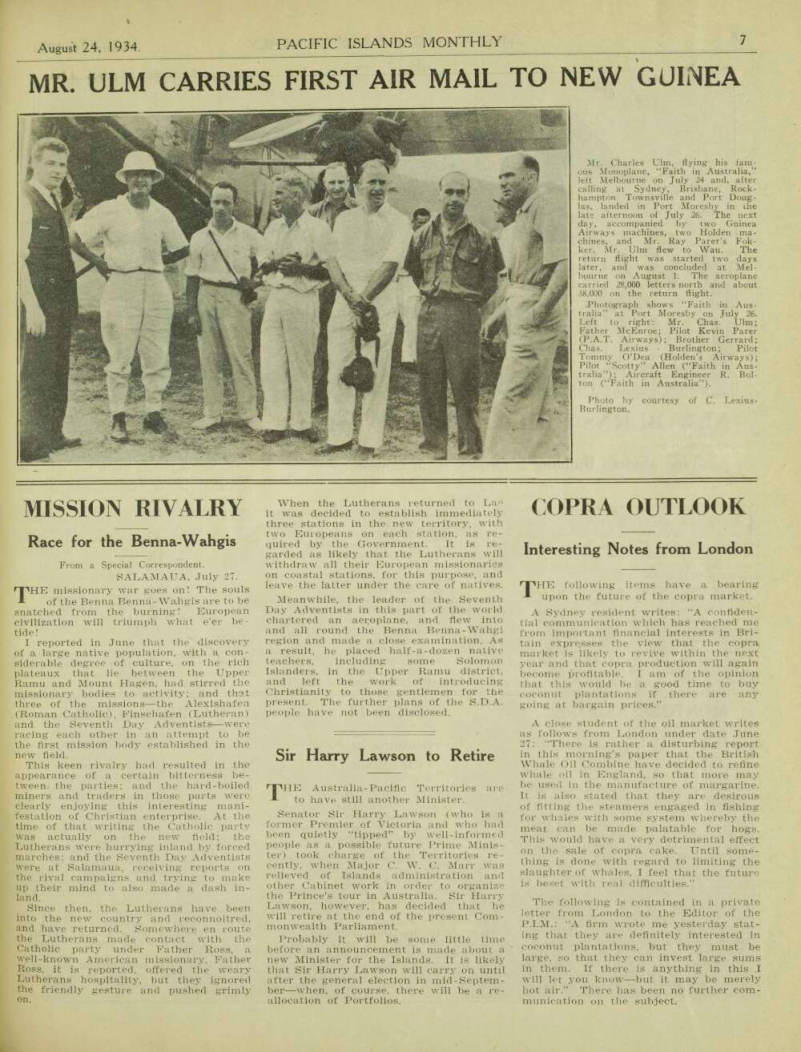
Mr. Charles Ulm, flying his fam ous Monoplane, “Faith in Australia,” left Melbourne on July 24 and, after calling at Sydney, Brisbane, Rock hampton Townsville and Port Doug las, landed in Port Moresby in the late afternoon of July 26. The next day, accompanied by two Guinea Airways machines, two Holden ma chines, and Mr. Ray Parer’s Fok ker, Mr. Ulm flew to Wau. The return flight was started two days later, and was concluded at Mel bourne on August 1. The aeroplane carried 28,000 letters north and about 38,000 on the return flight.
Photograph shows “Faith in Australia” at Port Moresby on July 26.
Left to right; Mr. Chas. Ulm; Father McEnroe; Pilot Kevin Parer (P.A.T. Airways); Brother Gerrard; Chas. Lexius - Burlington; Pilot Tommy O’Dea (Holden’s Airways); Pilot “Scotty” Allen (“Faith in Aus tralia”) ; Aircraft Engineer R. Bol ton (“Faith in Australia”).
Photo by courtesy of C. Lexius- Burlington.
Mission Rivalry
Race for the Benna-Wahgis
From a Special Correspondent.
Salamaua, July 27.
THE missionary war goes on! The souls of the Benna Benna-Wahgis are to be snatched from the burning! European civilization will triumph what e’er be tide!
I reported in June that the discovery of a large native population, with a con siderable degree of culture, on the rich plateaux that lie between the Upper Ramu and Mount Hagen, had stirred the missionary bodies to activity: and that three of the missions—the Alexishafen (Roman Catholic), Finschafen (Lutheran) and the Seventh Day Adventists —were racing each other in ah attempt to be the first mission body established in the new field.
This keen rivalry had resulted in the appearance of a certain bitterness be tween the parties; and the hard-boiled miners and traders in those parts were clearly enjoying this interesting mani festation of Christian enterprise. At the time of that writing the Catholic party was actually on the new field; the Lutherans were hurrying inland by forced marches; and the Seventh Day Adventists were at Salamaua, receiving reports on the rival campaigns and trying to make up their mind to also made a dash in land.
Since then, the Lutherans have been into the new country and reconnoitred, and have returned. Somewhere en route the Lutherans made contact with the Catholic party under Father Ross, a well-known American missionary. Father Ross, it is reported, offered the weary Lutherans hospitality, but they ignored the friendly gesture and pushed grimly on.
When the Lutherans returned to Lar> it was decided to establish immediately three stations in the new territory, with two Europeans on each station, as re quired by the Government. It is re garded as likely that the Lutherans will withdraw all their European missionaries on coastal stations, for this purpose, and leave the latter under the care of natives.
Meanwhile, the leader of the Seventh Day Adventists in this part of the world chartered an aeroplane, and, flew into and all round the Benna Benna-Wahgi region and made a close examination. As a result, he placed half-a-dozen native teachers, including some Solomon Islanders, in the Upper Ramu district, and left the work of introducing Christianity to those gentlemen for the present. The further plans of the S.D.A. people have not been disclosed.
Sir Harry Lawson to Retire
THE Australia-Pacific Territories are to have still another Minister.
Senator Sir Harry Lawson (who is a former Premier of Victoria and who had been quietly “tipped” by well-informed people as a possible future Prime Minis ter) took charge of the Territories re cently, when Major C. W. C. Marr was relieved of Islands administration and other Cabinet work in order to organize the Prince’s tour in Australia. Sir Harry Lawson, however, has decided that he will retire at the end of the present Com monwealth Parliament.
Probably it will be some little time before an announcement is made about a new Minister for the Islands. It is likely that Sir Harry Lawson will carry on until after the general election in mid-Septem ber —when, of course, there will be a re allocation of Portfolios,
Copra Outlook
Interesting Notes from London
THE following items have a bearing upon the future of the copra market.
A Sydney resident writes: “A confiden tial communication which has reached me from important financial interests in Bri tain expresses the view that the copra market is likely to revive within the next year and that copra production will again become profitable. I am of the opinion that this would be a good time to buy coconut plantations if there are any going at bargain prices.”
A close student of the oil market writes as follows from London under date June 27: “There is rather a disturbing report in this morning’s paper that the British Whale Oil Combine have decided to refine whale oil in England, so that more may be used in the manufacture of margarine.
It is also stated that they are desirous of fitting the steamers engaged in fishing for whales with some system whereby the meat can be made palatable for hogs.
This would have a very detrimental effect on the sale of copra cake. Until some thing is done with regard to limiting the slaughter of whales, I feel that the future is beset with real difficulties.”
The following is contained in a private letter from London to the Editor of the P.I.M.: “A firm wrote me yesterday stating that they are definitely interested in coconut plantations, but they must be large, so that they can invest large sums in them. If there is anything in this I will let you know —but it may be merely hot air.” There has been no further com munication on the subject.
New Burns Philp Store In Apia
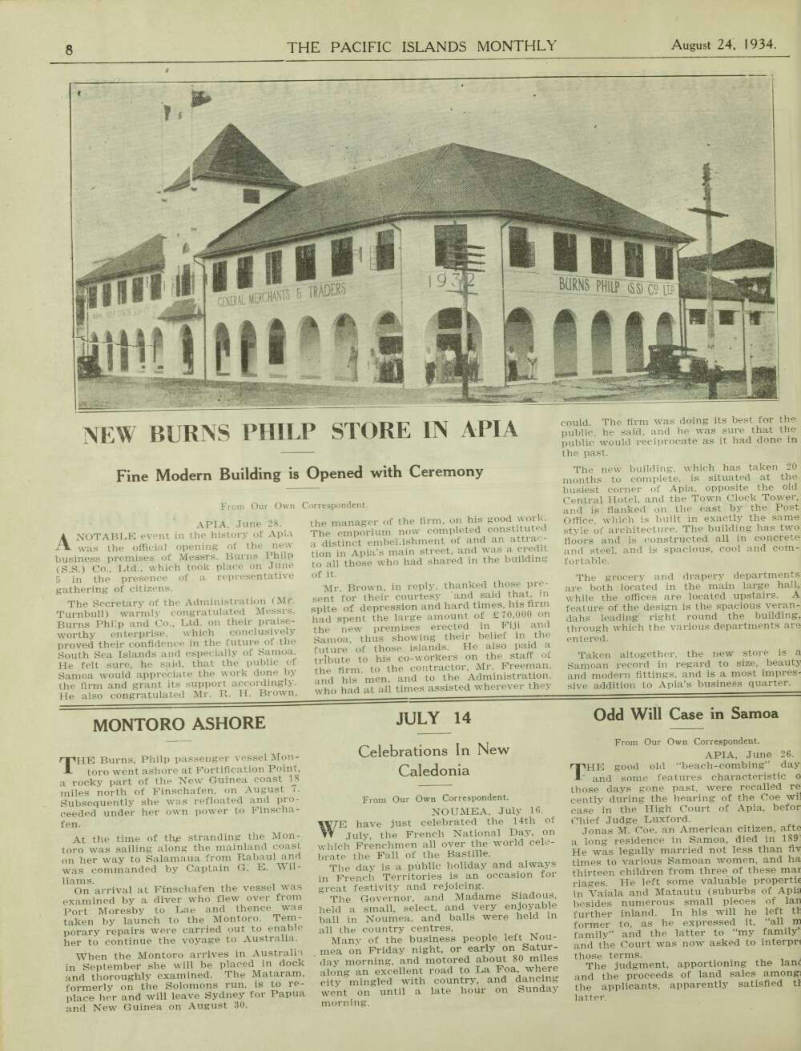
Fine Modern Building is Opened with Ceremony
From Our Own Correspondent.
APIA, June 28.
A NOTABLE event in the history of Apia was the official opening of the new business premises of Messrs. Burns Philp (S.S.) Co., Ltd., which took place on June 5 in the presence of a representative gathering of citizens.
The Secretary of the Administration (Mr.
Turnbull) warmly congratulated Messrs.
Burns Philp and Co., Ltd. on their praiseworthy enterprise, which conclusively proved their confidence in the future of the South Sea Islands and especially of Samoa.
He felt sure, he said, that the public of Samoa would appreciate the work done by the firm and grant its support accordingly.
He also congratulated Mr. R. H. Brown.
the manager of the firm, on his good work.
The emporium now completed constituted a distinct embellishment of and an attrac tion in Apia’s main street, and was a credit to all those who had shared in the buildim, of it.
Mr. Brown, in reply, thanked those pre sent for their courtesy and said that, m suite of depression and hard times, his firm had spent the large amount of £70,000 on the new premises erected in Fiji and Samoa, thus showing their belief in the future of those islands. He also paid a tribute to his co-workers on the staff ot the firm, to the contractor. Mr. Freeman, and his men, and to the Administration, who had at all times assisted wherever they
could. The firm was doing its best for the public, he said, and he was sure that the public would reciprocate as it had done in the past.
The new building, which has taken 20 months to complete, is situated at the busiest corner of Apia, opposite the old Central Hotel, and the Town Clock Tower, and is flanked on the east by the Post Office, which is built in exactly the same style of architecture. The building has two floors and is constructed all in concrete and steel, and is spacious, cool and com fortable.
The grocery and drapery departments are both located in the main large hall, while the offices are located upstairs. A feature of the design is the spacious veran dahs leading right round the building, through which the various departments are entered.
Taken altogether, the new store is a Samoan record in regard to size, beauty and modern fittings, and is a most impres sive addition to Apia’s business quarter.
Montoro Ashore
THE Burns, Philp passenger vessel Mon toro went ashore at Fortification Point, a rocky part of the New Guinea coast 18 miles north of Finschafen, on August 7.
Subsequently she was refloated and pro ceeded under her own power to Finscha fen.
At the time of th£ stranding the Mon toro was sailing along the mainland coast on her way to Salamaua from Rabaul and was commanded by Captain G. E. Wil liams.
On arrival at Finschafen the vessel was examined by a diver who flew over from Port Moresby to Lae and thence was taken by launch to the Montoro. Tem porary repairs were carried out to enable her to continue the voyage to Australia.
When the Montoro arrives in Australia in September she will be placed in dock and thoroughly examined. The Mataram, formerly on the Solomons run, is to re place her and will leave Sydney for Papua and New Guinea on August 30.
July 14
Celebrations In New Caledonia
From Our Own Correspondent.
Noumea, July 16.
WE have just celebrated the 14th of July, the French National Day, on which Frenchmen all over the world cele brate the Fall of the Bastille.
The day is a public holiday and always in French Territories is an occasion for great festivity and rejoicing.
The Governor, and Madame Siadous, held a small, select, and very enjoyable ball in Noumea, and balls were held in all the country centres.
Many of the business people left Nou mea on Friday night, or early on Satur day morning, and motored about 80 miles along an excellent road to La Foa, where city mingled with country, and dancing went on until a late hour on Sunday morning.
Odd Will Case in Samoa
From Our Own Correspondent.
APIA, June 26.
THE good old “beach-combing” day and some features characteristic of those days gone past, were recalled recently during the hearing of the Coe will case in the High Court of Apia, befor Chief Judge Luxford.
Jonas M. Coe, an American citizen, after a long residence in Samoa, died in 1897 He was legally married not less than five times to various Samoan women, and had thirteen children from three of these marriages. He left some valuable property in Vaiala and Matautu (suburbs of Apia) besides numerous small pieces of land further inland. In his will he left the former to, as he expressed it, “all my family” and the latter to “my family’ and the Court was now asked to interpret those terms.
The judgment, apportioning the land and the proceeds of land sales amongst the applicants, apparently satisfied the latter.
Rarotongans And Maoris
Very Cordial Relationship
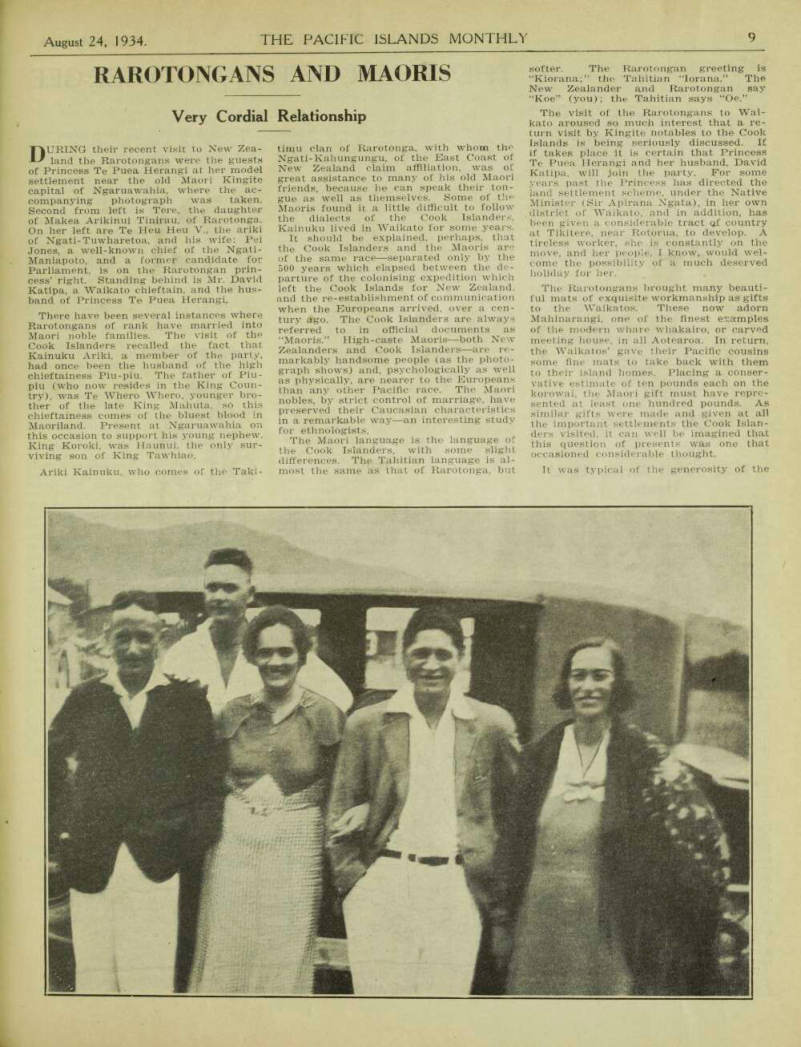
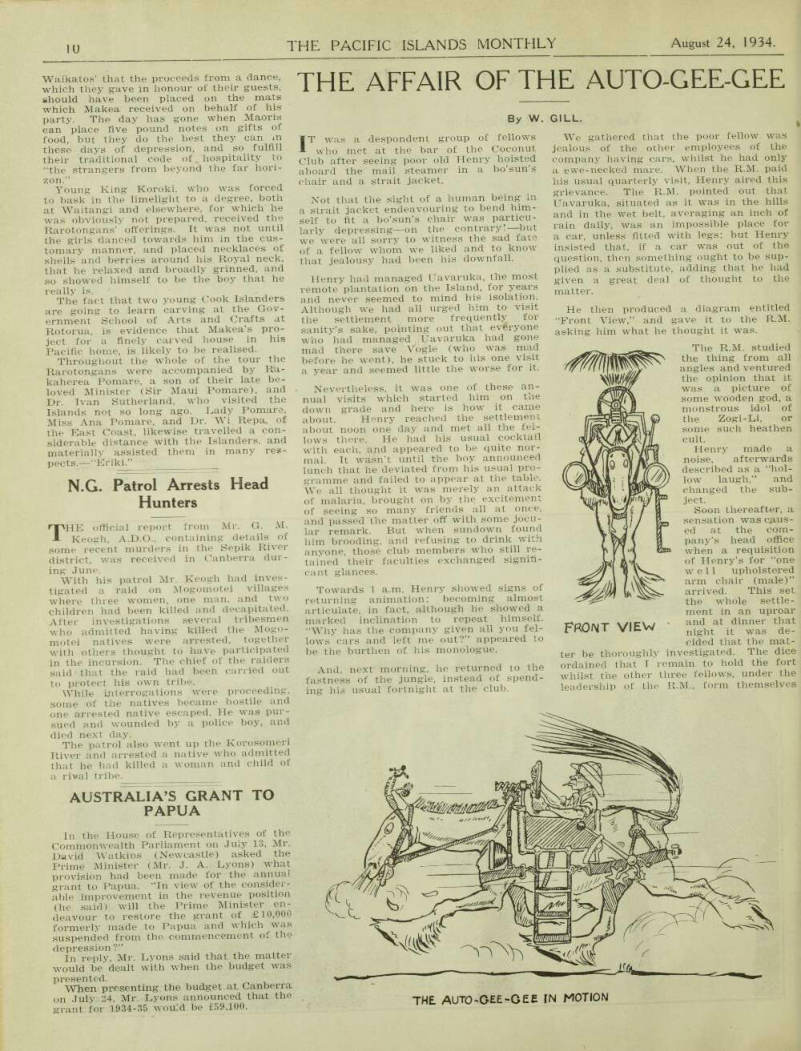
DURING their recent visit to New Zea land the Rarotongans were the guests of Princess Te Puea Herangi at her model settlement near the old Maori Kingite capital of Ngaruawahia, where the ac companying photograph was taken.
Second from left is Tere, the daughter of Makea Arikinui Tinirau, of Rarotonga.
On her left are Te Heu Heu V., the ariki of Ngati-Tuwharetoa, and his wife: Pei Jones, a well-known chief of the Ngati- Maniapoto, and a former candidate for Parliament, is on the Rarotongan prin cess’ right. Standing behind is Mr. David Katipa, a Waikato chieftain, and the hus band of Princess Te Puea Herangi, There have been several instances where Rarotongans of rank have married into Maori noble families. The visit of the Cook Islanders recalled the fact that Kainuku Ariki, a member of the party, had once been the husband of the high chieftainess Piu-piu. The father of Piu piu (who now resides in the King Coun try), was Te Whero Whero, younger bro ther of the late King Mahuta. so this chieftainess comes of the bluest blood in Maoriland. Present at Ngaruawahia on this occasion to support his young nephew.
King Koroki, was Haunui, the only sur viving son of King Tawhiao.
Ariki Kainuku. who comes of the Taki
timu clan of Rarotonga, with whom the Ngati-Kahungungu, of the East Coast of New Zealand claim affiliation, was of great assistance to many of his old Maori friends, because he can speak their ton gue as well as themselves. Some of the Maoris found it a little difficult to follow the dialects of the Cook Islanders.
Kainuku lived in Waikato for some years.
It should be explained, perhaps, that the Cook Islanders and the Maoris are of the same race—separated only by the 500 years which elapsed between the de parture of the colonising expedition which left the Cook Islands for New Zealand, and the re-establishment of communication when the Europeans arrived, over a cen tury ago. The Cook Islanders are always referred to in official documents as “Maoris.” High-caste Maoris —both New Zealanders and Cook Islanders —are re markably handsome people (as the photo graph shows) and, psychologically as well as physically, are nearer to the Europeans than any other Pacific race. The Maori nobles, by strict control of marriage, have preserved their Caucasian characteristics in a remarkable way—an interesting study for ethnologists.
The Maori language is the language of the Cook Islanders, with some slight differences. The Tahitian language is al most the same as that of Rarotonga, but
softer. The Rarotongan greeting is “Kiorana;” the Tahitian “lorana.” The New Zealander and Rarotongan say “Koe” (you); the Tahitian says “Oe.”
The visit of the Rarotongans to Wai kato aroused so much interest that a re turn visit by Kingite notables to the Cook Islands is being seriously discussed. If if takes place it is certain that Princess Te Puea Herangi and her husband, David Katipa, will join the party. For some years past the Princess has directed the land settlement scheme, under the Native Minister (Sir Apirana Ngata), in her own district of Waikato, and in addition, has been given a considerable tract qf country at Tikitere, near Rotorua, to develop. A tireless worker, she is constantly on the move, and her people, I know, would wel come the possibility of a much deserved holiday for her. , The Rarotongans brought many beauti ful mats of exquisite workmanship as gifts to the Waikatos. These now adorn Mahinarangi, one of the finest examples of the modern whare whakairo, or carved meeting house, in all Aotearoa. In return, the Waikatos’ gave their Pacific cousins some fine mats to take back with them to their island homes. Placing a conser vative estimate of ten pounds each on the korowai, the Maori gift must have repre sented at least one hundred pounds. As similar gifts were made and given at all the important settlements the Cook Islan ders visited, it can well be imagined that this question of presents was one that occasioned considerable thought.
It was typical of the generosity of the
Waikatos’ that the proceeds from a dance, which they gave in honour of their guests, should have been placed on the mats which Makea received on behalf of his party. The day has gone when Maoris can place five pound notes on gifts of food, but they do the best they can m these days of depression, and so fulfill their traditional code of hospitality to “the strangers from beyond the far hori zon.”
Young King Koroki, who was forced to bask in the limelight to a degree, both at Waitangi and elsewhere, for which he was obviously not prepared, received the Rarotongans’ offerings. It was not until the girls danced towards him in the cus tomary manner, and placed necklaces of shells and berries around his Royal neck, that he relaxed and broadly grinned, and so showed himself to be the boy that he really is.
The fact that two young Cook Islanders are going to learn carving at the Gov ernment School of Arts and Crafts at Rotorua, is evidence that Makea’s pro ject for a finely carved house in his Pacific home, is likely to be realised.
Throughout the whole of the tour the Rarotongans were accompanied by Ra kaherea Pomare, a son of their late be loved Minister (Sir Maui Pomare), and Dr. Ivan Sutherland, who visited the Islands not so long ago. Uady Pomare, Miss Ana Pomare, and Dr. Wi Repa, of the East Coast, likewise travelled a con siderable distance with the Islanders, and materially assisted them in many res
pects.—“Eriki.”
N.G. Patrol Arrests Head
Hunters
THE official report from Mr. G. M.
Keogh, A.D.O., containing details of some recent murders in the Sepik River district, was received in Canberra dur ing June.
With his patrol Mr. Keogh had inves tigated a raid on Mogomotei villages where three women, one man, and two children had been killed and decapitated.
After investigations several tribesmen who admitted having killed the Mogo motei natives were arrested, together with others thought to have participated in the incursion. The chief of the raiders said that the raid had been carried out to protect his own tribe.
While interrogations were proceeding, some of the natives became hostile and one arrested native escaped. He was pur sued and wounded by a police boy, and died next day.
The patrol also went up the Korosomeri River and arrested a native who admitted that he had killed a woman and child of a rival tribe.
Australia’S Grant To
Papua
In the House of Representatives of the Commonwealth Parliament on July 13, Mr.
David Watkins (Newcastle) asked the Prime Minister (Mr. J. A. Lyons) what provision had been made for the annual grant to Papua. “In view of the consider able improvement in the revenue position (he said) will the Prime Minister endeavour to restore the grant of £10,000 formerly made to Papua and which was suspended from the commencement of the
depression?”
In reply, Mr. Lyons said that the matter would be dealt with when the budget was
presented.
When presenting the budget at Canberra on July 24, Mr. Lyons announced that the grant for 1934-35 would be £59,100.
The Affair Of The Auto-Gee-Gee
By W. Gill.
IT was a despondent group of fellows who met at the bar of the Coconut Club after seeing poor old Henry hoisted aboard the mail steamer in a bo’sun’s chair and a strait jacket.
Not that the sight of a human being in a strait jacket endeavouring to bend him self to fit a bo’sun’s chair was particu larly depressing —on the contrary!—but we were all sorry to witness the sad fate of a fellow whom we liked and to know that jealousy had been his downfall.
Henry had managed Uavaruka, the most remote plantation on the Island, for years and never seemed to mind his isolation.
Although we had all urged him to visit the settlement more frequently for sanity’s sake, pointing out that evferyone who had managed Uavaruka had gone mad there save Vogle (who was mad before he went), he stuck to his one visit a year and seemed little the worse for it.
Nevertheless, it was one of these an nual visits which started him on the down grade and here is how it came about. Henry reached the settlement about noon one day and met all the fel lows there. He had his usual cocktail with each, and appeared to be quite nor mal. It wasn’t until the boy announced lunch that he deviated from his usual pro gramme and failed to appear at the table.
We all thought it was merely an attack of malaria, brought on by the excitement of seeing so many friends all at once, and passed the matter off with some jocu lar remark. But when sundown found him brooding, and refusing to drink with anyone, those club members who still re tained their faculties exchanged signifi cant glances.
Towards 1 a.m. Henry showed signs of returning animation: becoming almost articulate, in fact, although he showed a marked inclination to repeat himself.
“Why has the company given all you fel lows cars and left me out?” appeared to be the burthen of his monologue.
And, next morning, he returned to the fastness of the jungle, instead of spend ing his usual fortnight at the club.
We gathered that the poor fellow was jealous of the other employees of the company having cars, whilst he had only a ewe-necked mare. When the R.M. paid his usual quarterly visit, Henry aired this grievance. The R.M. pointed out that Uavaruka, situated as it was in the hills and in the wet belt, averaging an inch of rain daily, was an impossible place for a car, unless fitted with legs; but Henry insisted that, if a car was out of the question, then something ought to be sup plied as a substitute, adding that he had given a great deal of thought to the matter.
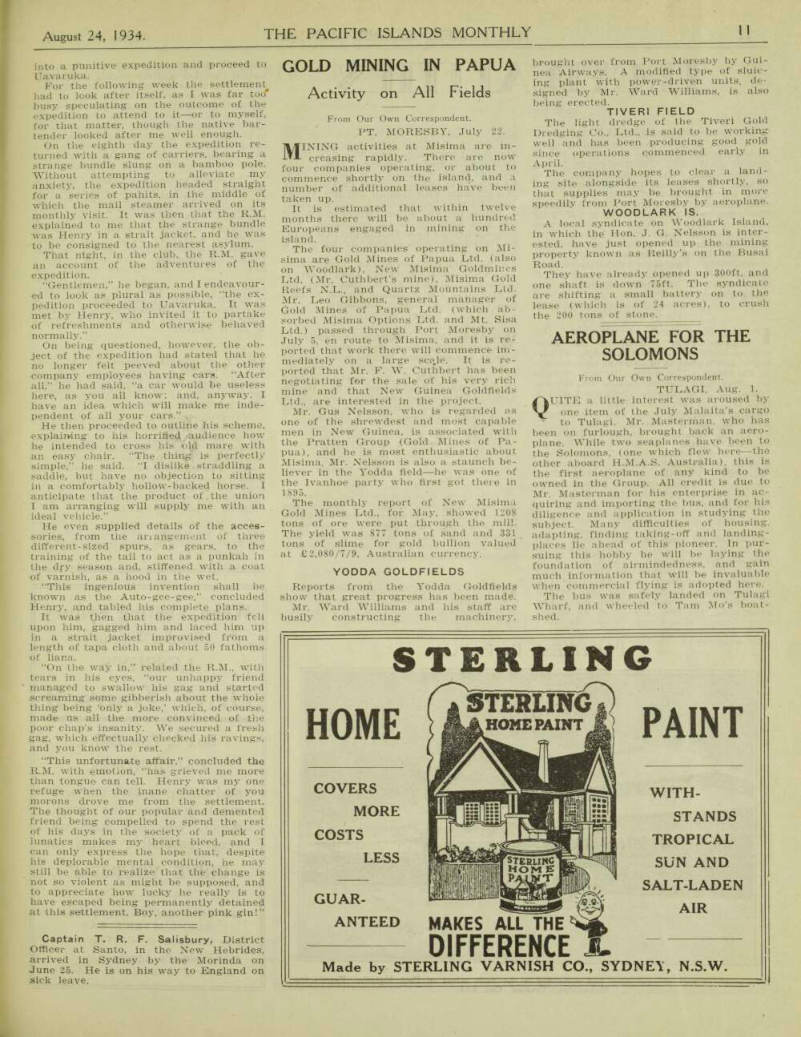
He then produced a diagram entitled “Front View,” and gave it to the R.M. asking him what he thought it was.
The R.M. studied the thing from all angles and ventured the opinion that it was a picture of some wooden god, a monstrous idol of the Zogi-Li, or some such heathen cult.
Henry made a noise, afterwards described as a “hol low laugh,” and changed the sub ject.
Soon thereafter, a sensation was caus ed at the com pany’s head office when a requisition of Henry’s for “one well upholstered arm chair (male)” arrived. This set the whole settle ment in an uproar and at dinner that night it was de cided that the mat
ter be thoroughly investigated. The dice ordained that I remain to hold the fort whilst the other three fellows, under the leadership of the R.M., form themselves
into a punitive expedition and proceed to Uavaruka.
For the following week the settlement had to look after itself, as I was far too busy speculating on the outcome of the expedition to attend to it—or to myself, for that matter, though the native bar tender looked after me well enough.
On the eighth day the expedition re turned with a gang of carriers, bearing a strange bundle slung on a bamboo pole.
Without attempting to alleviate my anxiety, the expedition headed straight for a series of pahits, in the middle of which the mail steamer arrived on its monthly visit. It was then that the R.M. explained to me that the strange bundle was Henry in a strait jacket, and he was to be consigned to the nearest asylum.
That night, in the club, the R.M. gave an account of the adventures of the expedition.
“Gentlemen,” he began, and I endeavour ed to look as plural as possible, “the ex pedition proceeded to Uavaruka. It was met by Henry, who invited it to partake of refreshments and otherwise behaved normally.”
On being questioned, however, the ob ject of the expedition had stated that he no longer felt peeved about the other company employees having cars. “After all,” he had said, “a car would be useless here, as you all know: and, anyway. I have an idea which will make me inde pendent of all your cars.”
He then proceeded to outline his scheme, explaining to his horrified audience how he intended to cross his old mare with an easy chair. “The thiixg is perfectly simple,” he said. “I dislike straddling a saddle, but have no objection to sitting in a comfortably hollow-backed horse. I anticipate that the product of the union I am arranging will supply me with an ideal vehicle.”
He even supplied details of the acces sories, from the arrangement of three different-sized spurs, as gears, to the training of the tail to act as a punkah in the dfy season and, stiffened with a coat of varnish, as a hood in the wet.
“This ingenious invention shall be known as the Auto-gee-gee,” concluded Henry, and tabled his complete plans.
It was then that the expedition fell upon him, gagged him and laced him up in a strait jacket improvised from a length of tapa cloth and about 50 fathoms of liana.
“On the way in,” related the R.M., with tears in his eyes, “our unhappy friend managed to swallow his gag and started screaming some gibberish about the whole thing being ‘only a joke,’ which, of course, made us all the more convinced of the poor chap’s insanity. We secured a fresh S&g, which effectually checked his ravings, and you know the rest.
“This unfortunate affair,” concluded the R.M. with emotion, “has grieved me more than tongue can tell. Henry was my one refuge when the inane chatter of you morons drove me from the settlement.
The thought of our popular and demented friend being compelled to spend the rest of his days in the society of a pack of lunatics makes my heart bleed, and I can only express the hope that, despite his deplorable mental condition, he may still be able to realize that the change is not so violent as might be supposed, and to appreciate how lucky he really is to have escaped being permanently detained at this settlement. Boy, another pink gin!”
Captain T. R. F. Salisbury, District Officer at Santo, in the New Hebrides, arrived in Sydney by the Morinda on June 25. He is on his way to England on sick leave.
Gold Mining In Papua
Activity on All Fields
From Our Own Correspondent.
Pt. Moresby, July 22.
MINING activities at Misima are in creasing rapidly. There are now four companies operating, or about to commence shortly on the island, and a number of additional leases have been taken up.
It is estimated that within twelve months there will be about a hundred Europeans engaged in mining on the island.
The four companies operating on Mi sima are Gold Mines of Papua Ltd. (also on Woodlark), New Misima Goldmines Ltd. (Mr. Cuthbert’s mine), Misima Gold Reefs N.L., and Quartz Mountains Ltd.
Mr. Leo Gibbons, general manager of Gold Mines of Papua Ltd. (which ab sorbed Misima Options Ltd. and Mt. Sisa Ltd.) passed through Port Moresby on July 5, en route to Misima, and it is re ported that work there will commence im mediately on a large sce.le. It is re ported that Mr. F. W. Cuthbert has been negotiating for the sale of his very rich mine and that New Guinea Goldfields Ltd., are interested in the project.
Mr. Gus Nelsson, who is regarded as one of the shrewdest and most capable men in New Guinea, is associated with the Pratten Group (Gold Mines of Pa pua), and he is most enthusiastic about Misima. Mr. Nelsson is also a staunch be liever in the Yodda field —he was one of the Ivanhoe party who first got there in 1895.
The monthly report of New Misima Gold Mines Ltd., for May, showed 1208 tons of ore were put through the mill.
The yield was 877 tons of sand and 331 tons of slime for gold bullion valued at £2,080/7/9, Australian currency.
Yodda Goldfields
Reports from the Yodda Goldfields show that great progress has been made.
Mr. Ward Williams and his staff are busily constructing the machinery,
brought over from Port Moresby by Gui nea Airways. A modified type of sluic ing plant with power-driven units, de signed by Mr. Ward Williams, is also being erected.
Tiveri Field
The light dredge of the Tiveri Gold Dredging Co., Ltd., is said to be working well and has been producing good gold since operations commenced early in April.
The company hopes to clear a land ing site alongside its leases shortly, so that supplies may be brought in more speedily from Port Moresby by aeroplane.
Woodlark Is.
A local syndicate on Woodlark Island, in which the Hon. J. G. Nelsson is inter ested, have just opened up the mining property known as Reilly’s on the Busai Road.
They have already opened up 300 ft. and one shaft is down 75ft. The syndicate are shifting a small battery on to the lease (which is of 24 acres), to crush the 200 tons of stone.
Solomons
Aeroplane For The
From Our Own Correspondent.
Tulagi, Aug. 1.
QUITE a little interest was aroused by one item of the July Malaita’s cargo to Tulagi. Mr. Masterman, who has been on furlough, brought back an aero plane. While two seaplanes have been to the Solomons, (one which flew here—the other aboard H.M.A.S. Australia), this is the first aeroplane of any kind to be owned in the Group. All credit is due to Mr. Masterman for his enterprise in ac quiring and importing the bus, and for his diligence and application in studying the subject. Many difficulties of housing, adapting, finding taking-off and landing places lie ahead of this pioneer. In pur suing this hobby he will be laying the foundation of airmindedness, and gain much information that will be invaluable when commercial flying is adopted here.
The bus was safely landed on Tulagi Wharf, and wheeled to Tam Mo’s boat shed.
Advertisements & other items, p. 13 (1 item)
Home
STERLING
COVERS
MORE
COSTS
LESS
GUAR-
ANTEED
STERLING
A HOME PAINT
MAKES ALL THE
DIFFERENCE
PAINT
WITH-
STANDS
TROPICAL
SUN AND
SALT-LADEN
AIR
Made by STERLING VARNISH CO., SYDNEY, N.S.W.
Tropicalities
THE remarkable achievements of aviation in New Guinea were commented upon with enthusiasm by Mr. S. J. Moir, Presi dent of the Aero Club of New South Wales, on his return from a visit to the Terri tories. He said that the transport work done by aeroplanes in New Guinea was aviation’s greatest commercial achievement.
The great aeroplanes travelled as safely as suburban railway trains and their service now was an accepted thing. This form of transport has allowed the rapid develop ment of the goldfields, where already a considerable European population was settled down with all the amenities of civilisation. He described Bulolo as "a small city with a future.”
IN the June issue of “Oceania,” the anthropological journal of the Aus tralian National Research Council, will be found much that is of interest to residents of Melanesia. The special features include an account of the work done on Manam Island by Miss Camilla Wedgwood during 1933-34; and an interesting account of Fishing Rites (and magic associated there with) at Tabar Islands by Mr. W. C.
Groves. A preliminary account of the work done at Mowehafen, on the South Coast of New Britain, by Mr. J. H. Todd, will ap pear in the September issue of the journal.
“Oceania” is available at 5/- per copy from the office of The Australian National Re search Council, Science House, Gloucester Street, Sydney.
A SLIM and sun-browned young lady, described as Mrs. Margery Campbell, formerly a Sydney stenographer, arrived in Sydney by the Macdhui on July 31 Papua, and was given much prominence in the newspapers because “she had learned in a month in Papua sufficient about the goldmining process to take it up as an occupation." Mrs. Campbell intends stay-
ing two months in Sydney, and then she will return to Papua to “follow again the life of a prospector. She will stay there until she has made a fortune.” Mrs. Camp bell told the newspapers that she had been six months in Papua. She left Port Moresby in a schooner with Captain and Mrs. Brew ster, and travelled 160 miles along the coast of Papua to “Vila Rupu,” where she found ten men working on the goldfields. She immediately set to work and put in a num ber of sluicing boxes, with six boys to a box.
Papuan mining men will be glad to know Mrs. Campbell’s interesting story received so much attention in Sydney that an exodus of charming stenographers to that attrac tive Territory is quite a possibility.
WHALE-CATCHING details published in
London in June show that in the 1932-33 season 28,668 whales were caught the highest recorded total for three years.
The catch in 1930-31 was 42,874. Nearly all these sea-mammals were caught in the Antarctic, but some 4,000 have been taken in Northern Pacific waters. The production of whale oil in barrels is thus shown: 1930 2,787,673 1931 3,686,976 1932 915,852 1933 2,596,778 1934* 2,500,000 *Estimated.
There is still a strong agitation in favour of restricting this trade and saving the whales from extinction, but nothing actu ally is being done. It looks as if the copra growers must suffer in silence from this form of competition until the unfortunate whales are exterminated.
MR. W. C. GROVES, Australian anthro pologist, sounded a note which the newspapers eagerly seized upon, on his re turn from New Guinea recently. He said
that the missionaries who are working among the N.G. natives should have with them “an organiser of joy.” Mr. Groves apparently has devoted much time to in vestigating the true psychological effect of mission operations upon the natives; and his conclusions generally were favourable to the missions. But he insisted that some thing should be done to restore to the natives their joy in life, which has been destroyed by contact with Europeans.
“The people needed new impetus and new interests,” said Mr. Groves, “and these had to be provided by concentration on the young people. To this end a special non- European form of development. a ‘naturized’ educational system should be instituted, having its roots in old culture, in the making of crafts, music, dances, games, and pastimes. We want to see a, new native who knows how to play,” he said. “There is an absence of that robust expression of joy that is a characteristic of primitive man. I admit that primitive man is dead and the missionaries have pro vided a satisfactory substitute, but a spurt of joy is wanted.”
PORT MORESBY natives have in them the makings of profiteers, was the opinion expressed by passengers who re turned to Sydney on the Mooltan recently after a cruise to Papua.
When tourists first went to Papua on cruises, they said, the natives were will ing to be photographed for a few pence Gradually, as each successive influx of tourists eagerly sought to photograph the comely Papuan belles and the picturesque feather-bedecked warriors, the price rose from 1/- to 2/-, and later to 3/-. When the Mooltan trippers arrived the natives declined to pose for less than 5/-.
The indignant passengers refused to pay this exorbitant price, and boycotted the natives until the fees returned to the 1/- level.
Advertisements & other items, p. 14 (2 items)
Progress In Papua
Photograph of part of new store just completed in the main street of Port Moresby, Papua, for Steanships, Trading Co., Ltd
Drive Yourself
When Visiting Sydney
Send a Wire to
LESSEY’S
Drive Yourself
Box 8, Post Office,
PADDINGTON,
and an up-to-date car will meet you at the boat, which you can hire on very reasonable terms to drive yourself.
Head Office and Service Station at
RUSH CUTTER’S BAY
(Near Stadium). Tel.: F 3196.
Radio Address: “Lessey’s” Paddington, Sydney.
About Islands People
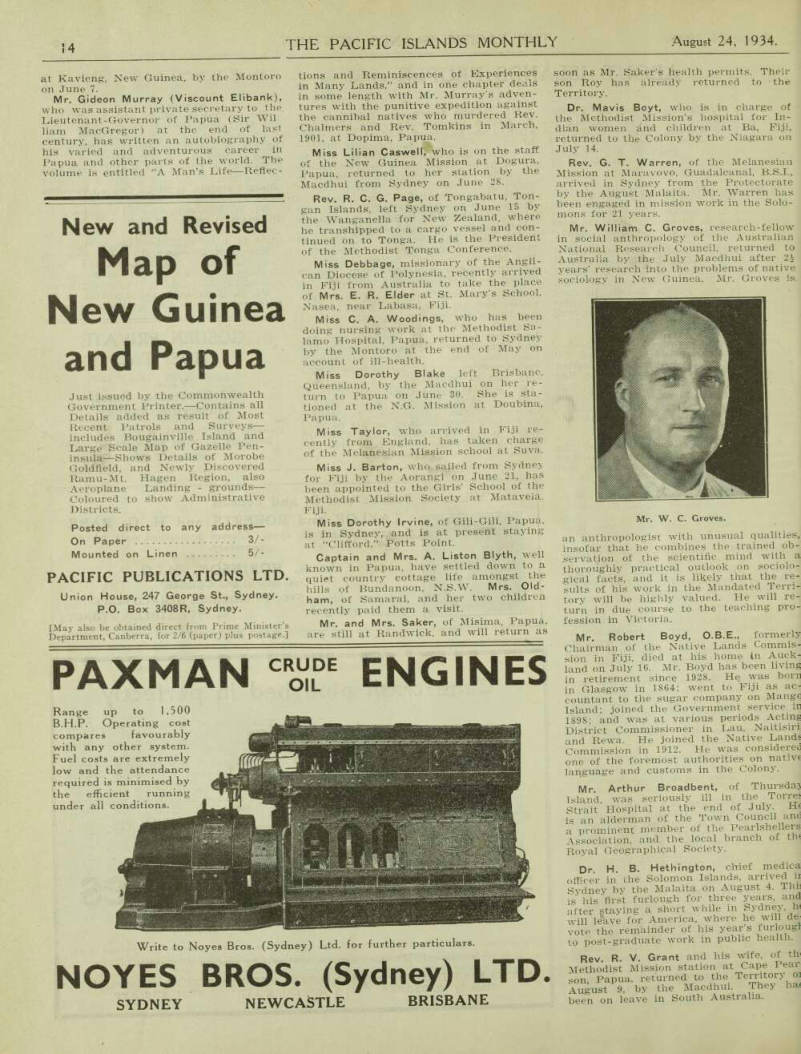
Mr. R. W. Robson, Editor of “Pacific Islands Monthly," left by the last Macdhui for Port Moresby. He will join the “Van Rees” there on August 23, and will visit Samarai (August 25), Rabaul (August 27-28), Port Vila (September 3) and Noumea (September 5-7).
Sister Lucy Willoughby, who is station ed at the New Guinea Mission at Dogura, Papua, is in Australia on extended fur lough owing to ill-health. She proposes to return to Papua at the end of August.
Mr. Robert Alke, of the German firm of Messrs. Breckwoldt and Company, arrived in Sydney from New Guinea by the Macd hui on July 31. He has been travelling throughout the Pacific Islands in con nection with his firm’s business since February last. He returned to Hamburg in August by the Bendigo.
Rev. V. H. Sherwin, of the Melanesian Mission, who has been in England for over a year on leave, arrived in Sydney in August He was accompanied by Rev K. P. Fitzgerald, who will go with him to New Guinea. En route to New Guinea they will call at Siota, British Solomon Islands, the headquarters of the Melane sian Mission.
Sister C. Halligan, of Melbourne, has been accepted by the Australian Board of Missions for work in Papua. She will leave for Port Moresby on August 30.
Mr. and Mrs. Andrew Stewart, Presby terian missionaries of Malo, New Heb rides, who have been spending their fur lough in Australia, returned to New Heb rides in August.
Colonel H. L. Cameron, of New Guinea, arrived in Sydney by the Macdhui on June 19. He is the owner of Djaul Plan tation at Kavieng and is on furlough for the first time in five years.
Rev. A. J. Thompson, and his wife, of the New Guinea Mission at Wanigela, Papua, will leave their station shortly on long furlough. Serious trouble with Mr.
Thompson’s eyesight necessitates imme diate medical attention in Australia.
Mr. Marc T. Greene, the American jour nalist, whose work in Samoa caused some stir there last year, was in Boston, U.S.A., enjoying a summer holiday in June. He intends to remain some little time in U.S.A. before setting forth on his world wanderings again.
Miss Elsie Smith returned to the Indian orphanage conducted by the Methodist Mission at Dilkusha, Fiji, on August 16, after spending her furlough in Victoria.
Mr. J. H. Halligan, of the Prime Minis ter’s Department, Canberra, accompanied Mr. C. T. P. Ulm in his monoplane “Faith in Australia,” on his recent flight to Papua and New Guinea. Leaving Sydney on July 24, they arrived back in Mascot on August T, after landing mails at Port Moresby and Lae.
Mr. Percy W. Faddy, of Sigatoka, Fiji, died at his home at Vunasalu, after a severe attack of dengue fever early in June. Born in Australia in 1880, he went to Fiji in 1903 and for some years was engaged in planting and storekeeping.
From 1923 to 1929 he represented the Western Division in the Legislative Council of Fiji and did much good work for his electorate. He is survived by his wife, Mrs. Ella Faddy.
Mr. Roland Green, a member of the Australian Parliament, during his recent visit to the Far East, made a close study of two subjects of considerable interest to Pacific Islands residents. He investi gated, as far as he could, the possibilities connected with America’s decision to grant independence to the Philippines —a matter that is arousing keen interest in Japan—and he also studied the effect on primary production in Java of Holland’s adherence to the gold standard. Mr.
Green said that the effect of the gold standard on Javanese primary production was lamentable —the native producers, particularly the labourers, being now in almost a poverty-stricken condition.
Miss Beatrice Grimshaw, the well known novelist of the South Seas, is leaving Papua shortly for a lengthy stay in England. With Miss Grimshaw will leave her brother and sister-in-law, Mr. and Mrs. Oswald Grimshaw. Mr. Grim shaw has almost completed his twenty years’ service, and is leaving the Terri tory, not to return.
Mr. P. C. Hubbard, Chief Judicial Com missioner of the Solomon Islands, arrived in Sydney from Tulagi early in August, en route to New Zealand, on six months’ furlough. Until recently Mr. Hubbard was Acting Judge of the New Hebrides Condominium Court, at Vila.
Mr. W. H. Miller, a district officer in the Solomons Administration, arrived in Syd ney on July 30 by the Jervis Bay after furlough in England.
Rev. Frank L. Nunn and his wife, of the Methodist Mission in the Indian dis trict of Lautoka, Fiji, returned to Suva by the Monterey on June 27. They had been in Victoria on furlough.
Rev. W. A. Dickie and Rev. J. N. Gilbert, of England, left Sydney for the Melanesian Mission station at Siota, British Solomon Islands, by the Malaita on June 30.
Mr. W. M. Cochrane, who has charge of the medical section of Messrs. W. R. Car penter and Co., returned to Sydney on June 18, after a visit to the East.
Mrs. S. H. Chance and her two children, Lois and Alister, returned by the Macdhui on June 28, to Samarai, Papua, where her husband is Assistant Resident Magistrate.
Mr. B. Chenoweth, accompanied by his wife, returned to the Methodist mission
at Kavieng, New Guinea, by the Montoro on June 7.
Mr. Gideon Murray (Viscount Elibank), who was assistant private secretary to the Lieutenant-Governor of Papua (Sir William MacGregor) at the end of last century, has written an autobiography of his varied and adventurous career in Papua and other parts of the world. The volume is entitled “A Man’s Life—Reflec
tions and Reminiscences of Experiences in Many Lands,” and in one chapter deals in some length with Mr. Murray’s adven tures with the punitive expedition against the cannibal natives who murdered Rev.
Chalmers and Rev. Tomkins in March, 1901, at Dopima, Papua.
Miss Lilian Caswell, who is on the staff of the New Guinea Mission at Dogura, Papua, returned to her station by the Macdhui from Sydney on June 28.
Rev. R. C. G. Page, of Tongabatu, Ton gan Islands, left Sydney on June 15 by the Wanganella for New Zealand, where he transhipped to a cargo vessel and con tinued on to Tonga. He is the President of the Methodist Tonga Conference.
Miss Debbage, missionary of the Angli can Diocese of Polynesia, recently arrived in Fiji from Australia to take the place of Mrs. E. R. Elder at St. Mary’s School.
Nasea, near Labasa, Fiji.
Miss C. A. Woodings, who has been doing nursing work at the Methodist Sa lamo Hospital, Papua, returned to Sydney by the Montoro at the end of May on account of ill-health.
Miss Dorothy Blake left Brisbane, Queensland, by the Macdhui on her re turn to Papua on June 30. She is sta tioned at the N.G. Mission at Doubina, Papua.
Miss Taylor, who arrived in Fiji re cently from England, has taken charge of the Melanesian Mission school at Suva.
Miss J. Barton, who sailed from Sydney for Fiji by the Aorangi on June 21, has been appointed to the Girls’ School of the Methodist Mission Society at Matavela, Fiji.
Miss Dorothy Irvine, of Gili-Gili, Papua, is in Sydney, and is at present staying at “Clifford,” Potts Point.
Captain and Mrs. A. Liston Blyth, well known in Papua, have settled down to a quiet country cottage life amongst the hills of Bundanoon, N.S.W. Mrs. Old ham, of Samarai, and her two children recently paid them a visit.
Mr, and Mrs. Saker, of Misima, Papua, are still at Randwick, and will return as
soon as Mr. Saker’s health permits. Their son Roy has already returned to the Territory.
Dr. Mavis Boyt, who is in charge of the Methodist Mission’s hospital for In dian women dnd children at Ba, Fiji, returned to the Colony by the Niagara on July 14.
Rev. G. T. Warren, of the Melanesian Mission at Maravovo, Guadalcanal, B.S.I., arrived in Sydney from the Protectorate by the August Malaita. Mr. Warren has been engaged in mission work in the Solo mons for 21 years.
Mr. William C. Groves, research-fellow in social anthropology of the Australian National Research Council, returned to Australia by the July Macdhui after years’ research into the problems of native sociology in New Guinea. Mr. Groves is
an anthropologist with unusual qualities, insofar that he combines the trained ob servation of the scientific mind with a thoroughly practical outlook on sociolo gical facts, and it is lively that the re sults of his work in the Mandated Terri tory will be highly valued. He will re turn in due course to the teaching pro fession in Victoria.
Mr. Robert Boyd, O.B.E., formerly Chairman of the Native Lands Commis sion in Fiji, died at his home in Auck land on July 16. Mr. Boyd has been living in retirement since 1928. He was born in Glasgow in 1864; went to Fiji as ac countant to the sugar company on Mango Island; joined the Government service m 1898; and was at various periods Acting District Commissioner in Lau, Naitisiri and Rewa. He joined the Native Lands Commission in 1912. He was considered one of the foremost authorities on native language and customs in the Colony.
Mr. Arthur Broadbent, of Thursday Island, was seriously ill in the Torres Strait Hospital at the end of July. He is an alderman of the Town Council and a prominent member of the Pearlshellers Association, and the local branch of the Royal Geographical Society.
Dr. H. B. Hethington, chief medical officer in the Solomon Islands, arrived in Sydney by the Malaita on August 4. This is his first furlough for three years, and after staying a short while in Sydney, he will leave for America, where he will de vote the remainder of his year’s furlough to post-graduate work in public health.
Rev. R. V. Grant and his wife, of the Methodist Mission station at Cape Pearson Papua, returned to the Territory on August 9, by the Macdhui. They have been on leave in South Australia.
Mr. W. C. Groves.
Advertisements & other items, pp. 15-18 (1 item)
ansomes
GOSHEN PRIVATE
HOSPITAL
(Sister E. W. TEAMAN), 37 Gloucester Road, Hurstville, Sydney General and Private Wards. Spacious Grounds. High and Cool Situation.
Moderate Fees.
When in Sydney call in and consult TAYLOR and ROBERTS and H. G. PARR concerning your eyes. Glasses prescribed only when necessary.
L. A. ROBINSON, M.I.O.
Optometrist and Optician Note new address: SYDNEY MORNING HERALD BUILDING,
’Phone: 84673 66 PITT STREET, SYDNEY
Cane trash ploughed in perfectly
The “Shugadisc” plough is specially designed for sugar cane growers and others who have to plough in large quantities of surface growth.
The “Shugadisc” is a big plough in every sense. The discs are 30in. or 32in. in diameter, and the beam, disc brackets, wheels, etc., are of massive construction. 2 and 3-furrow sizes. Weight of 3-furrow, 3,800 lbs.
We also supply the T.D.9, which is even stronger and heavier.
ansomes
“SHUGADISC” PLOUGHS
Literature and information on these and our complete range of ploughs arid implements for every requirement tvill he sent on application.
AGENTS FOR FIJI, SAMOA & TONGA: MORRIS, HEDSTROM, LTD.. Suva, Lautoka & Ba Made by; RANSOMES, SIMS & JEFFERIES, LTD., IPSWICH. ENGLAND
New and Revised
Map of
New Guinea
and Papua
Just issued by the Commonwealth Government Printer. —Contains all Details added as result of Most Recent Patrols and Surveys— includes Bougainville Island and Large Scale Map of Gazelle Peninsula-Shows Details of Morobe Goldfield, and Newly Discovered Ramu-Mt. Hagen Region, also Aeroplane Landing - grounds— Coloured to show Administrative Districts, Posted direct to any address — On Paper 3/- Mounted on Linen 5/-
PACIFIC PUBLICATIONS LTD.
Union House, 247 George St., Sydney.
P.O. Box 3408 R, Sydney. [May also be obtained direct from Prime Minister’s Department, Canberra, for 2/6 (paper) plus postage.]
PAXMAN
CRUDE
OIL
ENGINES
Range
B.H.P.
Range up to 1,300 Operating cost compares favourably with any other system.
Fuel costs are extremely low and the attendance required is minimised by the efficient running under all conditions.
Write to Noyes Bros. (Sydney) Ltd. for further particulars.
NOYES BROS. (Sydney) LTD.
SYDNEY NEWCASTLE BRISBANE
Come Right Inside!
SEE WHAT
MOBILOIL
PREVENTS
- IN THE
DIFFERENTIAL
A ruined back-axle assembly— The grade of MOBILOIL the cause, inferior oil. recommended for your back It takes a mighty good gear axle is a sure prevention lubricant to coat gear teeth against disastrous and costly perfectly and resist the enor- breakdown, mous pressures.
Always Say
'Mobiloil for Me'
REG'D
YOUR CAR’S BEST INSURANCE
VACUUM OIL COMPANY PTY. LTD
M49
Pacific Islands
Year Book
1934 EDITION.
Now Being Prepared for
Publication
The Standard Reference Book, on the Pacific Islands.
This Edition will contain the matter published in the First Edition (334 pages), all revised and indexed, together with much additional matter, and including New Maps, Lists of Residents and Business Firms in the various Territories, and Latest Statistics—the latter, wherever possible, being brought up to June 30. 1934. With complete Index. Will be about 500 pages.
PRICE: Strong Paper Cover, per copy, 7/6; posted, 8/-. Stiff Cloth Cover, per copy, 9/6; posted 10/-.
An early order is recommended, as it is difficult to gauge the demand. The First Edition was sold out and many persons who later wanted copies were disappointed.
PACIFIC PUBLICATIONS
LTD.,
Union House,
247 George St., Sydney
MINING MACHINERY
WE ARE MAKERS OF ALL CLASSED OF
MINING MACHINERY, STAMPER BATTERIES,
HUNTINGTON MILLS, Etc.
ALSO ALL CLASSES OF
BRICK-MAKING MACHINERY
GENERAL ENGINEERING AND FOUNDRY WORK
High-class SEMI-STEEL MACHINE MOULDED GEARING
8 UP TO 14 FT. DIA. x 24 IN. FACE
GEORGE FOSTER 6 SONS LTD.
Code: A.B.C. 5th Edition. ST. PETERS, N.S.W. Cable Address: Fosterion, Sydney
Musical Instruments and Accessories
Accordeons. Concertinas, Mouth-Organs Guitars, Ukuleles. Banjos, Mandolines. Violins. Bows, Cases and all Accessories. Black Diamond and Bell Steel Strings for all instruments.
Latest Types Portable Phonographs, also Phonograph Springs.
Wholesale Distributors, also Radio and Electrical Accessories
COOKE BROS. LTD.
477-483 KENT STREET, SYDNEY
CABLES: "OCTAGO.” SYDNEY.
Papua
New Laws In
Encouragement of Mining
From Our Own Correspondent.
Pt. Moresby, July 23.
THE annual meeting of the Legislative Council was opened on July 5. His Excellency. Sir Hubert Murray, K.C.M.G., presided. All official members were present, together with the three non-official mem bers, the Hons. J. G. Nelsson, A. Jewell and A. H. Bunting. The Council sat at inter vals until July 18, when the session con cluded and the Council adjourned in definitely.
His Excellency, at the request of the Governor-General of Australia, invested the Hon. H. W. Champion with the decora tion of C.B.E. “All in the Territory,” re marked Sir Hubert Murray, “fully realise that no decoration has been more deserved throughout the Empire than this one.”
Amendment To Mining Law
The most important measures brought before the Council this session were a Bill to amend the Mining Law (providing for the granting of prospecting concessions over large areas) and a Petroleum Bill.
Both Bills were passed in all stages with out amendment, and assented to after lengthy discussions.
It has been reported that a large British concern is anxious to prospect an extended area in Papua, but first requires certain concessions. These concessions, it is under stood, are covered by the provisions of the Bill.
Petroleum Bill
The Petroleum Bill provides for the con trol of searches for petroleum and helium on any land in the Territory. It is an adaptation of an ordinance prepared by the Commonwealth for the Territory of New Guinea. The Bill provides that any petroleum found in Papua is the property of the King.
A Tariff Bill to simplify classification and
a Bill to amend the Sago Ordinance were passed. The latter is to regulate the cut ting and removal of sago, including kuru kuru grass and other native products, from Crown Lands.
A Bill to amend the White Woman’s Protection Ordinance was also passed. The amendment provides that when a person is indicted of a serious offence against a white woman he may be convicted of cer tain lesser offences established by the evi dence.
Native Labour
Lengthy discussion took place in regard to native labour in the Territory and the question of the desertion of indentured labourers. The question of native labourers being permitted to remain away from their villages for six years instead of four was again referred to by the Commissioner for Native Affairs (Mr. H. J. T. O’Malley).
He informed the Council that he considered four years was quite long enough for natives to remain away from their villages under contract.
£20,000 Loan
Discussions also followed, on the sugges tion of Mr. Nelsson, that the Government should apply for a loan from the Federal Government to undertake necessary public works. “We have tried for many years,” stated Mr. Nelsson, “to do what no other country has ever done, that is, to pay for public works and the development of the country’s resources out of revenue.”
Members of the Council, while agreeing with the wisdom of Mr. Nelsson’s sugges tion, were divided in their opinion as to the advisability of burdening the depleted revenue still further by the cost of loans.
Mr. Nelsson suggested a loan of £20,000 which would cost the Territory about £1,000 a year.
He also drew attention to the unfinished road to the Sogeri district. He stated that this work should have a claim on the Gov ernment’s consideration, as a very large amount of money has been spent there by the settlers on developmental work. Rub ber, coffee and other products which bring in a large amount of revenue to the Terri tory have been planted extensively in the district.
The question of government officers own ing property in the Territory was also raised by Mr. Nelsson. He suggested that any ban to such ownership be lifted or made more elastic.
Filming Tahitian Life
From Our Own Correspondent.
Papeete, July 2.
AT present in Tahiti is Mr. Robert Murnau, brother of F. W. Murnau, who made the famous film “Tabu” in the Society Islands some years ago and was killed shortly afterwards in an automo bile accident in California.
He is here for the purpose of complet ing a second film which had been com menced by his brother. The film will portray various phases of native life in the islands. Mr. Murnau expects to have his work finished in time to return to Hollywood on the s.s. “City of Los An geles,” which is due here on one of her round-the-Pacific cruises on July 8. At Hollywood he will complete the sound effects for his new films as there exists no adequate equipment for this purpose in Tahiti.
Mr. “Bill” Blackley, of Rabaul, has gone to the goldfields, and is now at Salamaua.
He will be missed at Rabaul, for he was the life of many parties and sporting activities during the past eighteen months.
His sister, Miss Dot Blackley, remained in Rabaul.
Chorus From The Solomons
Demands for Reforms—Chinese Traders Over-running the Group
THE Editor of the “Pacific Islands Monthly” has on hand no less than 11 letters from residents of the Solo mon Islands, in which the Administra tion of that Protectorate is sharply cri ticised. Some of the letters are abusive and some are clearly reasoned —but all are biting in character. It is evident that a considerable section of the resi dents of the Solomon Islands are dis satisfied with conditions there, and are more or less unfriendly to the Adminis tration.
We should like to publish these letters because, apparently, they represent genuine grievances; but space considera tions make that impossible. We wish to serve two purposes—namely, to give fair publicity to the views of Pacific Islands residents; and we do not wish to do anything of an irresponsible character which may embarrass Administrators who already have serious problems on their hands.
Therefore, in the following article, we have briefly outlined the points made by our several correspondents, and we bring the criticism under the notice of the High Commisioner of the Western Pacific, in the belief that these matters will have his attention.
Perhaps we may say that we have re ceived information that many matters, more or less directly relating to the Solomons, have been brought formally under the notice of the British Colonial Office by the High Commissioner in re cent months, and it may be expected that certain reforms will follow.
“Anti-Apathy,” under date of July 4, says he had recently procured a verba tim report of the recent sitting of the Council. He had regarded the latter body as semi-moribund and useless; therefore he was agreeably surprised to find that the non-official members had vigorously and eloquently placed before the Administrator a statement of most of the residents’ grievances. Those non official members had not passively accepted everything the Government pro posed—on the contrary, they had stated their case clearly, tersely, and effectively yet with courtesy and restraint. “I am left with the clear impression that the members of the Council are performing their voluntary duties very ably, and with obvious sincerity.” This writer very strongly urges his fellow residents in the Solomons to give active moral and material support to their representatives.
“Stet,” in a lengthy letter, vigorously challenges certain statements made by the Resident Commissioner (Mr. F. N.
Ashley) to the Australian newspapers.
“Stet” says that the natives do not
“willingly” pay their poll tax —on the contrary, non-payers are sent to gaol every year in every district. He criticises sharply the system under which the employer of natives is forced to col lect the tax from the natives, which works out unfairly and anomalously. The natives, he says, benefit nothing from the tax. The Government maintains a numerous and expensive medical per sonnel, but the writer, during his 25 years’ residence in the group, has seen the population dwindle in a tragic manner.
This writer says “the medical attend ance which the natives receive in some of the districts is deplorable and for all useful purposes non-existent.” He gives two striking instances to prove his con tention. One was in the Western District, on the Marovo Lagoon, where people were dying rapidly from a serious and fatal
epidemic, without any medical attention; and the other case was on Savo Island, only 24 miles from Tulagi, where he saw many natives suffering from very bad skin complaints and was informed that they rarely, if ever, saw a medical officer. This writer adds that employers of native labour in the Solomons may depend upon very frequent regular visits from medical officers, who insist upon conditions which sometimes are absurd.
In other words, the indentured labourers get too much medical attention, while their unfortunate brethren in the villages get little or none. Yet the average em ployer looks after his labourers care fully; while the villagers have little or no knowledge of how to resist or treat disease.
“Stet” also challenges Mr. Ashley’s statement “that there is not th 6 slightest danger of the natives injuring any of the white people.” The writer very pointedly reminds Mr. Ashley of several bad cases of attacks by natives on white women, which were tried in Mr. Ashley’s own court.
“Men of the West,” in an open letter
from Gizo, dated July 16, directed to the High Commissioner, spiritedly reminds his Excellency that he visited them three years ago and that they, in response to his invitation, laid before him special
requests for amelioration of their condi tions. They sought relief concerning; 1. Reduction of native wages; 2. Cancellation of tobacco issue to labour; 3. Relief in connection with rents of Native Leases; 4. Restoration of three years’ labour contract; 5. Payment of Native Tax by native labourers.
These things were all designed to re duce planters’ costs, to meet the collapse in the copra industry. From that day to this, not a single item of that relief programme had been granted. The High Commissioner is reminded that meeting he resented the criticism that the British Solomon Islands Administra tion was “unsynrpathetic, callous, and in different.” The writer now, in view of what has happened (or not happened), repeats the criticism. He asks pointedly why Suva repeatedly sends Commission ers, etc., to the Solomons to carry out investigations when Suva inevitably ignores the representations of the planters and traders, and accepts the official point of view ‘‘A penny stamp would achieve the same result at a fraction of the cost.”
This letter continues: “Tulagi is an isolated self-centred colony of officials interested in little save their salaries, pensions, and golf handicaps, and of whom none have any practical knowledge
of Islands affairs, and who have made a tragic mess of governing one of the finest groups in the Pacific. ... It should be a bitter reflection to your Excellency to realise that what the planters fore told at that meeting has, in fact, eventu ated. The present sad state of the group is in a large measure due to the fact that you preferred Tulagi’s academic advice to that of practical men.” The writer continues in most emphatic language and assures the High Commis sioner that unless drastic steps are taken to relieve the situation the European planters and traders must leave the group and Chinese will take their places. This movement, in fact, has become definite during the last three or four years.
The following statements are made by a planter in one of the northern islands: The Administration has allowed land rentals on Crown leases to be reduced or suspended, but it will not allow native rentals to be interfered with in any way.
There is great dissatisfaction with this, because many native rentals were fixed when the price of copra was very high.
The old argument that Chinese traders represent “a check against exploitation of natives by white traders” now does not hold water. The natives who trade are completely sophisticated and know to a penny the value of most things in common use; it is impossible for white men to exploit them. Furthermore, natives are not compelled to use European goods; the natives can be completely self-supporting without using European goods at all. Despite the depression there has been no reduction whatever in the Ad ministration salaries —the officials enjoy completely the conditions they had in the boom years. There is complaint of overstaffing generally. It is contended, for instance, that the maintenance of three full-time customs or boarding officers at Tulagi is absurd. There are two entomologists maintained in the Group—both believed to be investigating a disease peculiar to the Solomon Islands, known as nut-fall. Mr. Lever (the original entomologist) stated the trouble was caused by a peculiarity in B.S.I. soil. The Agricultural Committee would not accept this and brought a special man on loan from Malaya. He reached the same conclusion —that nut fall is caused by a peculiar soil condi tion —but the Committee still refuses that viewpoint, and insists that nut-fall is caused by a beetle or something.
“Old Resident” writes: “Solomon Islands residents are literally praying for the day when the Group may be put under Australian rule. They compare conditions in the Solomon Islands with conditions next door, in New Guinea and Papua, where Australian rule is regarded as efficient and sympathetic, giving every possible encouragement to the people who have settled there to carry out the de velopment of these valuable territories.
“Solomonoo” writes: “We do not want foreign labour, but we certainly do wan. a little more, or, rather, a great deal more, thought and action in the matter of conserving and increasing what labour we have.” This writer states that he visited a mission station recently and saw about 70 native children undergoing religious training. Their physical condi tion was very poor and he is strongly of opinion that the Administration does not do nearly enough to induce these people to mike use of suitable foods. The native population is dwindling in numbers and stamina.
“Ysabel Planter” writes on “the sense lessness of our trying to produce copra
on a native wage of 20/- per month and ample findings, in competition with New Guinea, which has wages of about 6/per month and much poorer findings.” He urges that the whole relationship be tween employers and employed in the Solomon Islands be revised, with a view to giving some sensible concessions to the men who are in danger of being driven off their plantations by conditions oyer which they have no control, and which are being accentuated by Government in difference.
“One of the Pioneers” declares: “The small European traders and settlers are being ruined by the pro-Chinese policy of the Administration.” He says that the individual officials are quite sympathetic, but they take their instructions “from much higher up,” and that “Tulagi shelters behind Fiji, and Fiji behind the Colonial Office.” This writer challenges the viewpoint that it is necessary to maintain Chinese traders in the Solo mons in order to protect the natives from unscrupulous white traders. There may have been cases of callous exploitation in the past, he says, but those conditions certainly do not apply to the present day.
The Administration’s pro-Chinese policy is breaking the hearts of the men who pioneered the Solomons, and who, since the fall in copra, are beginning to trade for a bare livelihood: and unless some thing is done the Protectorate inevitably will pass into the hands of the Chinese.
The attitude of the British planters in the group is “if British pioneer settlers cannot now look to their own flag for protection, then God help the British Empire.”
This writer continues: “Fiji has de creed that Chinese must be given the same facilities to trade as whites and that the few restrictions hitherto im posed must be discontinued. The re sult has been a mad rush by Chinese to obtain trading licences, and they are spreading through the group, establishing stores in the native villages, with stocks financed by Chinese merchants in the main ports. Prior to this, Chinese trad ing establishments were confined to the principal ports of Tulagi and Gizo. . . .
A European cannot compete with Chi nese. The Chinese has a much lower standard of living, and the Chinese apparently has a closer racial affinity with these Melanesian natives. Prices being equal, the Chinaman obviously will get the business every time. . . . Can nothing be done to check this lunatic policy and give the British settlers a chance to live in this corner of the Em pire?”
An article describing a clash between a European trader and a Chinese itiner ant trader in the Solomons is published elsewhere in this issue.
Advertisements & other items, pp. 19-21 (1 item)
Hislop, Lloyd Limited
Super rapacity Heavy Duty
A Guarantee supplied with every Battery.
Battery Catalogue Free on Request. amps 37/6 ea. 45/- „ 57/6 „ 67/6 „ 67/6 „ 79/6 „ Prices F.O.B., Sydney, Australian Currency. All batteries are fully charged ready for installation on arrival. Prompt Shipments Guaranteed.
SPARE PARTS AND MOTOR ACCESSORIES
WRITE FOR PRICES. GET OUR PRICES FIRST. each Alemite Nipples .. 6d.
Battery Terminals 8d Fan Belts, 2/6, 3/6, 4/6 Starter Springs .. 1/9 Tail Light Bulbs.. 6d Head Light Bulbs, 1/- Double Fil. Bulbs, 1/3 Brake Lining ft. 1½ x 3-16 1/11 1½ x 5-32 1/8 1¾ x 5-32 1/11 1¾ x 3-16 2/1 2 x 3-16 2/6 2 x ¼ 3/3 2¼ x 3-16 3/3 Celluloid H’vy 8/- sht.
Cork 1-16 x 12, lid sht.
Cutouts 6-v .. 5/- ea.
Light Adaptors 9d ea.
Feeler Gauges 1/6, 2/6 ea.
Fuses 10d tin Goggles 1/6 pr. each Hydrometers 4/6 Insulation Tape ... 6d Hydraulic Jacks .. 39/- Spark Plugs 4/6 Oil Filters 16/- Piston Ring Com. . 1/- Piston Rings, Oil .. 2/- Crown Wheels, Axles, Valves, King Pins, Radiators, Pistons, Timing Chains, Keen Prices
HISLOP, LLOYD LIMITED
335-7 PITT STREET, SYDNEY
Bronches at 135 William St., and 1-3 Wentworth Ave., Sydney. - 'Phone: M 6141
SHIP CHANDLERY
W. Kopsen & Co. Limited
Manufacturers of PIONEER BRAND ASH OARS AND IMPLEMENT HANDLES.
Sole Agents for ; KOPSEN’S SPECIAL YELLOW METAL SHEATHING AND NAILS.
Large Stocks of Chains, Anchors, Manilla and Wire Ropes, Wood and Iron Blocks, Oakum, Tar, Pitch, Oils, Paints, Leads, Zincs, Varnishes, Shackles, Rigging, Screws, Sheathing, Felt, Lampware, etc.
Special Under Bond Prices for Island trade.
68-70 CLARENCE STREET, SYDNEY
Cables; “Kopsen." ’Phone: BW 1114-5
PIANO PLAYING
I bring under your notice my Scale Models for the study of Piano or Singing. They include every form of scale and more may be learnt by their use in one month than in six months by any other system. NO TEACHER REQUIRED, and a child may use them. In major and minor sets. Any set sent post paid on receipt of money order for ten shillings and sixpence.
Address:
R. RUDLAND BODE.
Organist, Lami Road, Suva, Fiji.
(Forty years’ experience in teaching in England, Australia, and America.)
Expert Engineers , Designers and Builders of All Classes Islands Boats and Pleasure Craft Good Fleet of Boats on Hand.
Estimates Given Freely.
Buyers/Sellers write:
Jack Capell,
Elite Boat Shed
RUSHCUTTER BAY,
SYDNEY
CHRISTIES’
FOR ALL KINDS OF
AND
UMBRELLA
REPAIRS
UMBRELLAS
CHRISTIES, LTD., 568 George St., Sydney
CHARTRES,
STOTT & HO ARE’S
CORRESPONDENCE
COLLEGE
Founded 1885.
Pioneers and Specialists in Postal Instruction.
All Educational and Commercial subjects taught thoroughly and efficiently by correspondence.
Experienced Certificated Instructors. Write for Particulars Chartres, Stott & Hoare’s Correspondence
College
Liverpool Street, Sydney, Australia.
Gramophone Specialists
Band and Orchestral Instruments.
String Fittings and Accessories.
At Lowest Prices.
From the At 55/- Our Special Portable Gramophones at 55/-, plus postage All Latest Records.
Only Address:
177 George St. (N.),
Sydney
Death of Samoan Pioneer
From Our Own Correspondent.
APIA, June 27.
AN old and respected resident of Samoa, Mr. Frederick Ernest Syddall, died suddenly of heart failure at Tuvao Plantation on May 5. Mr. Syddall, who was 72 was a native of Manchester, England, and arrived in Samoa from South America in 1894. He took up land in the Falefa dis trict and for some time was trading for the well-known firm of H. J. Moors.
He owned for many years a store in Apia on the site of the present new Burns, Philp building. A second building and store, which he had erected, he sold out a few years ago to Messrs. C. Bartley and Son, and then took up the lease of Tuvao Plantation from the N.Z.R.E., where he planted cocoa and bananas.
He had been a member of the Land and Titles Commission for ten years, and a member of the Legislative Council for three years. He was a Freemason of 42 years’ standing. The funeral was largely attended by the European residents. He left a widow and six children, of whom the eldest daughter is married to the In spector of Produce, Mr. Newton.
Advertisements & other items, pp. 21-22 (1 item)
Headaches
NERVE PAINS?
Tired nerves are the cause of Headache, Neuritis, Neuralgia.
Get instant relief from all nerve pains with genuine Vincent’s A.P.C. Avoid imitations —they may be injurious. 12 for 1/6; 24 for 2/6 All Chemists and Stores, or direct from Vincent Chemical Co.
Sydney, Australia
FOR SAFETY’S SAKE, SAY “VINCENT’S”
Telephone: J 5844
HALLSTROM’S
NONELECTRIC
REFRIGERATORS
KEROSENE OPERATED
ENJOY the comfort of having cool drinks, cold meats and salads, delicious savouries and sweets, and nice firm butter on the hottest days.
THE NEW SEMI-AUTOMATIC MODEL
gives wonderfully efficient refrigeration without trouble, and at a trifling cost.
It has no moving parts to wear out, or get out of order, and is so simple to operate that a CHILD CAN DO IT. Ail there is to do is to fill the lamp once a day and light it—that’s all.
Price, £49/10/-, f.o.b., Sydney. Write for descriptive illustrated Folder.
Other types of Chemical Non-Electric Refrigerators from £20.
Manufactured and guaranteed by E. HALLSTROM
462 WILLOUGHBY RD., WILLOUGHBY, SYDNEY
Beautiful Winter Number!
Incidents from the Life of London’s Most Famous Model. Cyprus and its Ancient Wonders. Adventur e s in Basutoland.
Early Days in Melbourne.
New Plays. New Films.
News of All the World!
PENTA
Marine Engines 3-90 h.p.
Utility Outboards 3-4 h.p.
Supplied to all Governments Prices Reasonable.
Particulars Nelson & Robertson
SYDNEY
SERIOUS RISKS
are taken in neglecting a simple case of PILES Any person takes serious chances in neglecting an attack of piles.
This ailment has a tendency to become chronic, and there is also danger of ulceration and forming of fistula, both very difficult to cure. The safest remedy for any form of piles, whether itching or protruding, is Doan’s Ointment. In using it there is no detention from daily occupation, and the many cures made by it have made it famous in every corner of the world. It enjoys a greater demand and more enthusiastic popularity that any other pile remedy ever placed on the market. Here is a case: —
A REMARKABLE CURE!
Mr A. H. Francis. 192 Union Street, Erskineville, Sydney, says: "I used Doan’s Ointment for itching and protruding piles, and I am pleased to tell you it completely cured me. Previously I had tried all kinds of ointment, but they me little or no relief. I was suffering terribly when I first applied Doan’s Ointment, and had little hope of it doing me any good, but its soothing and healing effect was noticeable almost at once and by the time I had used one pot I was completely cured, the piles having disappeared entirely. I am a great believer in Doan's Ointment, and consider it the best Pile remedy known."
"Twelve years later, Mr. Francis says:— "I have not been troubled with piles since Doan's Ointment cured me.”
DOAN'S OINTMENT
Sold by all Chemists and Stores, or from the Proprietors, Foster-McClellan Co., Sydney.
Deportation Of Macarthur Onslow
Boomerang Effect of Newspaper Agitation
IN the middle of July a youngish man, named Captain Macarthur Onslow, arrived in Sydney with the astonishing information that he had been thrown out of Norfolk Island because he could not pass a dictation test in German. He said that he had crossed swords with the Island’s Administrator, Captain C. R.
Pinney, and that the latter had im properly used his dictatorial powers to deport him.
Immediately, certain newspapers ‘‘bawled their heads off.” They noisily insisted that this was an outrageous case of interference with the liberty of the subject—a monstrous perversion of British justice—a damnable reflection upon the fair name of democracy, and so forth. They joined their howl with the howl of Macarthur Onslow in de manding the head of Captain Pinney
upon a charger. Even the “Sydney Morning Herald” gave prominence to the statements of Mr. Onslow. It was an extraordinary chorus —but perhaps the magic lay in the name of Macarthur Onslow, which is not quite unknown in Australia.
The newspapers should have known that a man of Captain Finney’s type and reputation would not have taken the drastic action which he did unless there were extremely grave reasons for it.
They might at least have waited to hear the other side of the story, instead of falling under the hypnotism of a Macarthur Onslow.
This particular Macarthur Onslow, however, overplayed his hand. There was such a clamour in the newspapers, that the Prime Minister was compelled to deal with the case on the floor of Parliament and was obliged to make public, under the protection of Parlia mentary privilege, certain matters relat ing to the unfortunate man which, in other circumstances, need not have re ceived publicity. Macarthur Onslow had only himself and his newspaper friends to blame for what happened.
Speaking in the House on July 25, the Prime Minister said that the Nor folk Island Administrator was a man in whom the Government placed the utmost confidence, and he had supplied the following information: ‘‘Mr. Macarthur Onslow arrived at the Island, a recognised dipsomaniac, and he was allowed to land only on condition that his subsequent conduct was satisfactory. . . . Before he was allowed to land his case was dis cussed with the captain of the vessel which conveyed him there, with the manager of Burns, Philp and Co., and with the Government Medical Officer at NI. He was permitted to land on 24th.
April 1933, on sufferance. As a known dipsomaniac, his return ticket was held by the shipping company and, during the time of his stay, he was under the constant supervision of the Medical Offi cer and surveillance by the police.
During his stay his conduct was such, as in the opinion of the Administrator, did not justify his remaining there. He joined with many of the disaffected citizens and, according to the Administra tor, encouraged them. . . . Some exsoldiers, in association with Mr. Macarthur Onslow and others, held a meet ing at which they voiced their dissatis faction in respect to the actions of the Administrator. Mr. Macarthur Onslow encouraging them. At the same meet ing, officials of the then defunct organization, most of whom had held executive positions, did their very best to dissuade the others, but failed.
It was stated that the police visited the premises of Mr. Macarthur Onslow in regard to illicit liquor brewing and had found nothing. That is so. But on that visit Mr. Macarthur Onslow admitted that he had been brewing, and said that the liquor had been stolen.
Mr. Lyons then made a spirited defence of the Administrator and emphasised the difficulties of that gentleman’s position The debate, according to Hansard draped on for about an hour, and cer tain notorious talkers of twaddle took
full advantage of the opportunity, with out saying one word to assist or illuminate the Norfolk Island situation, it was clear, however, that the well-informed opinion of the House was behind Captain Pinney.
Mr. Scullin, leader of the Federal Labor Party, closed the debate with the following admirable summary: “This man was admitted to the Island under surveillance, and in a community in which there is only one police con stable, a very serious situation would be created if a man were allowed to do just as he liked. Of course, it may be only one man’s word against that of another, but I do not think that the man who was deported has denied having brewed liquor on the Island, and that it was stolen from him. He has not denied that he was under the influence of alcohol, and was in an un controllable condition. He has not denied that he created a disturbance in the Church of England, or that he was involved in an assault, convicted, and fined. Everywhere he went he was a nuisance, because of his unfortunate weakness. In the circum stances, the kindest thing that could have been done to him was to send him back to his home. I am not going to join in a tirade against a public servant for carrying out his duty. If the present complaint against the Administrator were supported by other complaints from residents of the Island, I should be among the first to press for the holding of an inquiry; but there is no justification at present for placing this official under suspicion of maladminis tration by instigating an investigation. The very fact that the captain of the vessel which brought the man to the Island held the return half of his ticket is evidence that he could not be relied upon even to do that much for himself. In my opinion, his friends have been badly advised to work up this agitation.”
That was the end of the matter. Mr.
Macarthur Onslow disappeared from the front pages of the newspapers—and is not likely to be heard of again.
Certain charges of “gross dissatisfaction” in Norfolk Island, and directed against the administration of Captain Pinney, were left in the air. The Prime Minister only com mented upon them to the effect that the Norfolk Island people are a little different from an Australian community, and corres pondingly difficult to handle. Mr. Roland Green in the course of a statement in the House, said that a public meeting in Norfolk Island attended by 404 residents described Mr. Macarthur Onslow’s deporta tion as “a gross miscarriage of justice.”
We have no other information on this subject. This is the first time that we have heard that there is dissatisfaction in Nor folk Island with the administration of Captain Pinney. All other reports to date have been definitely in the contrary direction.
Fiji’S Defences
Mounted Troops and Machine Guns
From Our Own Correspondent.
SUVA, July 20.
THE establishment of a mounted troop, in connection with the Fiji Defence Force, has been agreed upon by the Legis lative Council. The troop will comprise 20 or 30 men, volunteers of the right type, and it will be of use in the case of any internal disorders.
The Governor suggested that it would be of use in a case of external aggression, but the “Fiji Times” remarked: “We can not see any possible use to which 20 horsemen could be put in the event of a foreign warship shelling the town, unless it would be for the very practical pur pose of the horses removing their owners as quickly as possible from the danger zone.”
The motion aroused considerable argu ment in Council, and Mr. H. H. Ragg, supported by Mr. J. P. Bayly, moved that machine gun squads be provided for Lau toka and Ba. Both pointed out that the rich northern and western divisions, with their sugar mills, were entirely without protection of any kind, while Suva al ready had a defence force.
His Excellency agreed to accept the
proposal on condition that the Comman dant of the Defence Force, after an inves tigation, was satisfied that there were men available in Lautoka and Ba qualified to have charge of a machine gun section.
Advertisements & other items, p. 23 (2 items)
Syrup Of
PRUNE-SEN
PRUNES
With
SENNA & CASCARA
For Constipation, Purifying the Blood, and all complaints of the Stomach, Liver and Bowels.
Price - - 1/6 Prune-Sen Manufacturing Co., Sydney
R. H. BENDER, M.P.C.
689 ANZAC PARADE, MAROUBRA,
SYDNEY
Agents now being arranged
Repairs. “OUR HANDS MAKE GOOD ARMS."
Don’t Trifle With Doubtful Firearms!
Sil Rohu’s Expert Attention is at Your Service without obligation Send for my Wonderful Firearm Catalogue. 500 Illustrations and Details of the World s Best and Reliable Makers.
“FISHING TACKLE TO TACKLE FISHING”
The same High Standard of Quality is a Feature in my New Fishing Catalogue.
Specialities: Trout, Big Game, and Deep Sea Fishing.
SIL ROHU (late A.I.F.),
IMPORTER OF HIGH-GRADE FIREARMS AND FISHING TACKLE SPECIALIST 143 ELIZABETH STREET, SYDNEY (near Market Street).
WEAK MEN MADE STRONG
and YOUTH REGAINED
MEN who have LOST YOUTHFUL POWERS; whose brains are dulled; whose energy and VITALITY is weakened; whose memory is bad and faulty and feel despondent should take
ALFALINE VITALITY PILLS
Bottles, 6/-
(Send for Circular on Pills and Lost Vitality Treatment) BLOOD, SKIN, NERVE, BLADDER, KIDNEY, AND LIVER COMPLAINTS,
RHEUMATISM, NEURITIS, ASTHMA, SUCCESSFULLY TREATED BY
POST. (MEDICINES POSTED UNDER PLAIN COVER.)
ALL TOILET AND RUBBER GOODS STOCKED
(Send for Price List).
HERR RASMUSSEN (Danish Herbalist)
541 GEORGE ST.. SYDNEY, N.S.W.
W. Northey
Inquiries for all classes of Sails, Canvas, and Genera! Boat Equipment invited
CANVAS GOODS MANUFACTURER
Quotations Free.
Island Trade specially catered for Established over 40 years.
Taylors Wharf, Pyrmont
SYDNEY
The Larkin Case
Public Petition Suggested
Letter to the Editor.
SO much has been written in your valued journal for both sides as re gards the Larkin case that I have been content to sit back and listen to the general discussions before troubling you with my own views. Now is the time when I consider something should-be done of a practical nature, and to this end I make my suggestion.
Your journal has ably placed facts of the case before the public of this Terri tory. There are still strong discussions by both sides on the question; “Was J. J.
Larkin guilty of murder?” And as all previous correspondents on the case claim to be fair minded they will wel come a suggestion to reopen the case and let a commission judge as to the guilt or otherwise of J. J. Larkin and as to whether the sentence was excessive or
justified. Certainly, there is doubt, so let us have fair play. No one, even Lar kin’s most ardent critic, would welcome a miscarriage of justice. Remember, there was no appeal in this case, and there has often been an acquittal after an appeal in British courts.
Therefore, to have this case finalised,, let a petition be circulated in this Ter ritory, praying for the re-opening of the case, and let the case be heard by a com mission and let the verdict of such court or commission be final. The petition should be placed in Rabaul for signatures (it could be placed in the hands of an officer or some other person travelling on one of the boats) and then sent round Territory for further signatures.
Now, Mr. Editor, what about getting the petition going in Rabaul—leave it with your agent and have it sent round.
As this petition is for a re-hearing of the Larkin case, even those government officials whom I have heard denounce- Larkin must welcome a further tribunal whose verdict will end all this con troversy.
Trusting you will give this expression of opinion in your journal.
I am, etc.,
Fairplay.
New Guinea, 10/6/’34.
Editorial Note
An attempt was made privately over a year ago, to induce certain interests in New Guinea, to prepare and support a petition, such as that suggested. The move came to nothing.
It is part of the present plan to seek public support, by petition, in New Guinea and elsewhere, for the plea that the Larkin conviction and sentence be reviewed. Subscriptions to a fund which will provide for the engagement of skilled counsel to handle the matter, are being invited. The fund now stands:
James Larkin Review Fund
“Waiben,” Thursday Is £3 3 0 Pacific Publications Ltd. . . 3 3 0 Owing to one of those typographical accidents that occur even in the best regulated printing offices, it was made to appear in the July issue of this journal that “Pacific Plantations Ltd. had subscribed £3/3/0 to this fund. The line should have read, of course, ‘‘Pacific Publications Ltd., £3/3/0.” It was quite clearly set in this fashion in the beginning and was passed by the Editor; but somewhere between that time and the actual print ing the word “Publications” was altered to Plan tations.” The printers have expressed regret for the error.
An article entitled “Isles of Enchant ment,” by Mrs. Mollie Lett, of Port Moresby, has been accepted by the B.P. magazine, and may be published in the September number. It describes the Tro briand Islands (Eastern Papua).
Advertisements & other items, p. 24 (1 item)
Unopib
Bound and Indexed Files of
Pacific Islands Monthly
FOR SALE
We shall have for sale, if promptly ordered, seven bound files of Volume IV of “The Pacific Islands Monthly” (August, 1933, to July, 1934, inclusive).
The 12 numbers included in Volume IV. have been indexed, and the Index has been published as part of the issue of July, 1934.
Price of Volume IV., strongly bound and indexed, and posted in August to any address £2/2/-
Early Ordering is Recommended
PACIFIC PUBLICATIONS, LTD.
UNION HOUSE, 247 GEORGE ST., SYDNEY.
Telegrams and Cablegrams: PACPUB, SYDNEY.
The Utmost Satisfaction . . .
AUNT
MARY'S
PURE FOOD
PRODUCTS
"DEFIANCE” Brand Canned Goods The proprietors of Aunt Mary’s Pure Food Products also pack Defiance Brand Canned Goods Hygienically prepared and hermetically sealed to withstand tropical heat, they are sure of appreciation.
These branded goods are of the highest quality standard, and are prepared and packed only by Aunt Mary’s Pure Food Products ensure the utmost satisfaction to consumers. For thirty years the high quality and supreme excellence of these goods have been appreciated by Pacific Islanders. Specially manufactured and packed to meet Island conditions.
PURE FOOD
MANUFACTURERS
Kent and Liverpool Streets, SYDNEY, N.S.W.
TILLOCK & CO. LTD.
UNOPIB
DIESEL ENGINES
INSTAL THE DIESEL THAT HAS BEEN GOING SINCE 1929,.AND HAS PROVED ITSELF IMMUNE FROM ALL DiESEL WEAKNE .
D.C. Series, 45 to 160 b.h.p., in 3. 4. 6, and 8 cylinder sizes at 700 to 960 r.p.m.
D.B. Series, 24 to 96 b.h.p., in 2,3, 4,6, and 8 cylinder sizes, at 1000 r.p.m.
Australian Agents:
H. G. THORNTHWAITE & CO.
KEMBLA BUILDING.
MARGARET STREET, SYDNEY, N.S.W.
TELEGRAMS: “ORTHORN,” SYDNEY. TELEPHONE: B 5240
Step By Step: The Remarkable
Career Of "W.R.C."
establishment of the Carpenter
Line of freight-carrying ships between
Australia, New Guinea, and Europe—
which commenced running on a regular
schedule this month—directs attention to
the dynamic personality responsible for this
development—namely, Walter Randolph
Carpenter, known to his intimates as
“W.R.”
MR. W. R. CARPENTER’S achieve ments, in the last 20 years, are astonishing. During and after the war, he put his faith in the copra industry, and copra returned him a fortune. Thus, he established W. R. Carpenter and Co., Ltd., as buyers and shippers of copra; then he he extended his company’s operations to trading, and thence to the ownership and operation of coconut plantations, and the financing of planters: with the result that the company to-day owns stores and plan tations all over New Guinea and the Solo mons, and a number of small vessels with which inter-island communications are maintained. The turn-over of the organi sation is over £1,000,000 annually. The company has huge reserves, and has kept up an 8 per cent, dividend, even in the worst years.
Having done so much, “W.R.” might have rested, and given his leisure to the arts and the flesh-pots. But “W.R.” never rests. The depression came down in 1930,
and most men with big interests buttoned up their pockets, and sought a tall, safe tree in which to roost. But not W. R.
Carpenter. Since 1930 he has — Established a large desiccated coco nut factory in northern New Britain, which has produced an article of such excellent quality that it has captured a profitable market in Australia and New Zealand.
Built a slip-way for moderate-sized ships on the shores of Rabaul Harbour, so that the inter-island steamers need not now come all the way to Australia for repairs and overhaul.
Established a private transport ser vice, with small aeroplanes, for the car riage of his company’s goods between Salamaua and the rapidly-growing centres in the New Guinea goldfields.
Inaugurated a new freight service between New Guinea and Europe with two modern motor-ships.
In all these things, W. R. Carpenter de fied the quidnuncs and backed his own judgment—just as he did in the war years, when, in defiance of all “expert” advice, he bought every ton of copra he could find and shipped it to Europe in every kind of vessel that would float—and reaped an enormous profit.
He is backing his own judgment to-day, in establishing this line of freight-carriers.
Most people see only a sick copra industry, a condition of stagnation among planta tions, and a multitude of ships competing savagely for the available freights. But
“W.R.,” with that uncanny vision of his, discerns something more—probably, he sees this incredibly rich territory of New Guinea being rapidly developed under the stimulus of gold, and building up new in dustries and trade, and providing un limited cargoes. Possibly, too, he has seen something in the copra future that at present is hidden from us by the black clouds of over-supply and calamitous prices. At any rate, the New Guinea pessimists may take some comfort in the fact that one of the shrewdest heads in Pacific merchandising has confidence in the future of the territory, and has backed his opinion with hard cash.
Incidentally, it will be interesting to see how the more or less combined shipping lines react to the advent of the Carpenter Line. At present, all really nice shipping people do not cut the Australian-Europe freight rates. The new freighters presum ably will get the current rate if they can; but, if they cannot, or if the shipping czars try to wield the big stick, we may expect some pretty rate-cutting. A fight is as the breath of life to “W.R.” He may yet gather a laurel-wreath from the primary producers of Australia —with whom, politically, he is much in sympathy.
Although he most definitely is the head of the firm, W. R. Carpenter is by no means alone. At his right hand, at head quarters, is his almost equally well-known brother, J. A. Carpenter. They are an ideal combination. Both are shrewd, far seeing merchants, and tireless workers; and the fieriness and impulsiveness of “W.R.” are nicely balanced by the care fulness and organising ability of “J.A.”
“W.R.” will see the vision and outline the plan; the urbane “J.A.” will give the thing
shape, character, and stability. Each is a warm admirer of the other’s qualities.
In the immediate back-ground, and tak ing a steadily increasing share of control and responsibility, are W. R. Carpenter’s two sons, known to all Islanders as “Wick” and “Ranji”—cool and very com petent young men who can feel out the slightest tremor in the world markets with one hand, while extracting the last deci mal point of brokerage with the other.
The Carpenter link with the Pacific goes much further back than the Carpenter brothers’ pearling activities before the war, and their copra-buying operations since. They are the sons of Captain J.
B. Carpenter, and that famous skipper was responsible, some 40 years ago, for one of the dramatic incidents in Australian- Pacific history.
When Captain Carpenter Made
History.
Messrs. Burns, Philp and Co. owned a packet named the “Costa Rica” —known as “the last of the whalers”—which operated mostly in the Central Pacific and which was commanded by Captain Carpenter.
Every season, she used to go seeking whales, in and about the Molucca Islands (Dutch East Indies). On one trip, she
came upon the remains of a wreck—some apparently unclaimed and not very valu able flotsam, which the skipper took pos session of, and brought away. Next year, when the ship returned to the Moluccas, the Dutch seized the ship, arrested Cap tain Carpenter and threw him into gaol.
The “Costa Rica” was left without any one to take care of her, and she suffered much damage and missed the whaling season.
The incident caused a stir in Sydney, strong protests were made, and eventually Captain Carpenter was released and re turned to Australia. The “Costa Rica” had to be sold where she lay, at a sacri fice price. Messrs. Burns, Philp and Co. then took action against the Dutch au thorities, with a demand for compensation, and the firm was strongly supported by the New South Wales Government. Public feeling was so strong that a large meeting was held in the Sydney Town Hall, The matter was referred to the British Govern ment, and London supported the protests and demands of New South Wales. As a result, both Burns, Philp and Co. and Captain Carpenter were substantially compensated by the Dutch Government for the losses they had suffered.
Later, the Carpenter family settled down in Torres Straits, and established at Thursday Island the well-known pearling firm of J. B. Carpenter and Sons. “W.R.,” in 1908, went to Fiji, as manager of Robert Kadd and Co., Ltd.; and in 1914 he estab lished his present firm.
Step by step, commencing by buying copra, Mr. Carpenter has entered deeply into the whole copra industry. From being a buyer, he became a shipper; then he acquired stores and traded; then he estab lished plantations and produced; then he built a factory and manufactured; next, he entered the transport business —first with inter-island steamers, then with aeroplanes, and now with oversea motor ships.
What is the next step? Is there another world left for him to conquer? It would not surprise this writer a bit of he were next heard of establishing copra-crushing and margarine-making mills in England, and snapping defiant fingers under the nose of the immutable Unilever.
Advertisements & other items, pp. 25-26 (1 item)
-Harvey Implements
“HARVEY”
DISC
CULTIVATOR
with reversible Discs
HARVEY
Reversible
DISC
PLOUGH
FOR EVERY PURPOSE
-HARVEY IMPLEMENTS
Horse-drawn and Tractor-drawn implements of all Descriptions For any conceivable tillage requirement there is a Harvey Implement to make cultivation easier and better.
They will work the hardest ground with ease and so close to trees that hand labor is unnecessary. Whatever the conditions, whatever the job, Harvey Implements do their work to perfection.
For full particulars write to Buzacott & Co. Limited 7-11 MARKET STREET. SYDNEY. ‘ HARVEY” RIDING SPRING-TOOTH
CULTIVATOR
AUSTRALIA. Fitted with Pole or Forecarriage
SPENCER NOLAN
DENTIST
139 ELIZABETH STREET
(2 doors from Market St.)
SYDNEY
’Phone F 3215
SPENCER NOLAN
DENTIST
28 OXFORD STREET
(Over Winns’ Ltd.)
SYDNEY
’Phone F 3215 Cable Address: Fastplate, Sydney
Delicious Biscuits
in sealed moisture-proof wrappers . . . ideal for afternoon tea, lunch, or supper.
ARNOTT’S
famous
Shredded Wheatmeal Biscuits
a valuable appetising health food;
Popso Cracker Biscuits
the perfect base for savouries;
Spicy Fruit Roll Biscuits
put in the oven for one minute and served with cream or milk make a most delicious sweet.
Papuan Notes
From Our Own Correspondent.
Pt. Moresby, July 22.
THE Lieut.-Governor (Sir Hubert Mur ray), accompanied by the Official Sec retary (Hon. H. L. Murray), left Port Moresby on July 19 for Abau, Samarai and Misima, on the “Laurabada.” Other pas sengers included members of the Legisla tive Council, the Hon. A. and Mrs. Jewell, Hons. J. G. Nelsson, A. H. Bunting, and A.
P. Lyons.
The “Laurabada” will return to Port Moresby early in August.
Mrs W. M. Dupain and her eldest daugh ter returned to Port Moresby by the Macdhui on July 5 from Sydney. On the return trip of the Macdhui, Mr. and Mrs.
Dupain and Miss Dupain will leave for Rabaul, where, it is reported, Mr. Dupain will be manager of Burns Philp and Co. for two or three months.
Mr. Stanley Greenland, who returned to the Territory in May from Sydney, where he was undergoing treatment since November last year, is now in good health. He has resumed his duties in the Native Affairs Department as Chief Inspector.
Future Of Vegetable Oil
World Position Summarised by Mr. H. M. Faure
ONE of the most illuminating and in structive summaries on the world’s economic problems that we have read was delivered in Stockholm on June 5; and it is of peculiar interest to our readers that the man who delivered the address was Mr. H. M. F. Faure, of Messrs. Faure Blattman and Co., London (one of the world’s biggest operators in the copra markets), and that the occasion was a congress of the International Association of Seed Crushers.
Space does not permit us to reproduce Mr. Faure’s address in full. He mar shalled an array of facts in an authori tative manner, and showed how the re strictions imposed on international trade caused inevitably a serious dislocation in the world’s supply of gold, which, in turn, caused a further dislocation of world trade, and the developmertt of the mon strosity called “economic nationalism.”
Mr. Faure proceeded: It is not a question of over-production, but of disorganisation caused by undue attempts to obstruct the operation of economic laws. It should not be difficult to visualise what the difference would be in a state of international free trade, from that existing at the present time.
We can confine ourselves for an ex ample to what would be the effect of world free trade in our own line of busi ness. Take the case of the U.S.A. The consumption and production is approxi mately 3½ to 4 million tons of Oils and Fats or, say, the equivalent of 6 to 7 million tons of Oilseeds. The U.S.A. im port ¾-million tons of Oils and export half this quantity—an international movement of something under 1¾-million tons. Under international free trade, prices of vari ous raw materials would be more or less the same. There is no doubt that if American consumers had the world mar kets open to draw upon, they would find that there are many raw materials avail able outside their country which they would prefer to use. Also, there would be times when they could buy abroad to better advantage than in their own country, and in, the same way, American pro ducers would find that in many cases they could dispose of their products slightly more advantageously than in their own country.
I think, therefore, that we can take as a conservative estimate that, provided American production and consumption re mained about the same, the external trade movement under world free trade conditions would amount to at least 2 million tons more imports and 2 million tons more exports, viz., a total movement of 4 million tons more than under pre sent conditions, instead of a reduction of 300,000 to 400,000 tons, which is sure to be the result of the new Processing Tax, of which we shall hear more. The carriage alone of these goods would give employ ment to a vast number of people and, in directly, the international movement of
such quantities of goods would give em ployment to many times that number . . .
Dislocation Of Oil Markets
The principal Government interference which has affected the Oil and Fat posi tion has been: — Firstly, the German control of Oils and Fats, which aimed principally at the protection of the Dairy Farmer, involving the reduction of the Margarine produc tion, which came into force in March, 1933 Secondly, the Dutch control of the Dairy Industry, which came into force in April, 1933.
Thirdly, the French duties on Ground
nuts and Copra other than of French origin, which came into force in August, 1933, and more particularly the introduc tion of a quota system in January last, whereby foreign Copra and Groundnuts may only be imported in a fixed ratio to imports of French Nuts.
Fourthly, the Italian control which came into force on the 14th April, 1934, making imports of Oilseeds subject to licence.
American Processing Tax
Fifthly, the most far-reaching measure of all, the imposition of the Processing Tax on the principal imported Oils and Fats used in the U.S.A., which reluct antly received the signature of President Roosevelt on the 9th May, 1934.
I think we may say without exaggera tion that this Bill is the most extraordin ary piece of legislation which has ever been placed on the Statute Book of any country. For a long time there has been a strong agitation on the part of the
American farming interests demanding the protection of the Butter and Lard pro duction by penalising the manufacture of substitutes. Every few years legislation has been asked for placing prohibitive import duties on the Oils and Fats which constitute the principal faw material of these substitutes.
Up to the time of the present Bill, these proposals have always been squashed on the ground that the raw material it was sought to exclude could not be produced in the U.S.A., and was essential to some of the most important U.S.A. industries, notably the soap trade. This time, how ever, the dairy interests launched their political campaign with such success that, ruthlessly over-riding all reasonable arguments against their demand, they completely carried the day, and the Bill was passed, levying the Processing Tax of 3 cents per lb. to be paid by the first manufacturer in the U.S.A. using the Oils in question.
The reason for making this a process ing or excise duty was that under the Treaty with the Philippine Islands the U.S.A. could not levy an import duty on Philippine products, and as Philippine Coconut Oil and Copra are far and away the most important Vegetable Oils im ported, the promoters of the Bill were naturally most anxious to see this in cluded. They therefore thought of the ingenious way of making the tax a Pro cessing Tax.
Apparently even this was not enough, as it was pointed out to the promoters of the Bill that this, even if technically not an infringement of the Philippine Treaty, would distinctly constitute a breach of faith, and therefore the most extraordinary clause has been added to the Bill that in the case of the tax collected on Philippine products, the whole of the tax is to be placed to a separate account and refunded to the Philippin Government on condition that the Philip pine Government do not in any way sub sidise the Copra producer.
When we see that on the basis of last year’s imports, provided these are main tained, this will mean an annual payment by the U.S.A. to the Philippine Govern ment of a sum of 25 million dollars, or three-quarters of the total Philippine Bud get, I think you will agree that I am not exaggerating when I say that this is a most extraordinary piece of legislation.
Unfortunately, I can lay no claim to being a great student of history, but I am quite prepared to challenge all the history professors in the world to find a precedent where one country, especially at a time when their own Treasury is struggling with a heavy deficit, have, un solicited, adopted the role of fairy godmother by assuming the responsibility for three-quarters of another country’s national budget. This goes to show to
what desperate measures the vested in terests are able to drive legislators in the endeavour to protect their own par ticular industry at no matter what cost to the community, and completely in different to the resulting heavy loss to international trade.
The Philippine Government will be faced with the problem that on the one hand it will be to their interest to do all they can to encourage the export of Copra and Coconut Oil to the U.S.A. but, on the other hand, they will be faced with the terrible threat that on any infringe ment of the non-subsidy condition, they would forfeit the beautiful present promised them by the U.S.A. It will tax all the ingenuity of the Philippine states men to steer a course which will bring them in the maximum amount without risking to lose the whole lot.
World Production.
Oils and Fats have perhaps been one of the worst sufferers from the world depression.
I do not know whether any or you have ever tried to estimate the total world production of Oils and Fats. I have made a good many calculations, and I have come to the conclusion that the total world production of Oils and Fats lies somewhere between 20 and 30 million tons —a commodity, therefore, of the greatest importance to the world.
The most important use for Oils and Fats is, of course, for edible purposes, and if we study the American statistics we find that, for Instance, in the Vear 1931 the quantity of Oil and Fat used for edible purposes amounted to about four and-a-half times the quantity used for soap. The most important edible fat is Butter, the world production of which is probably well in excess of 4 million tons per annum.
The next in importance is Lard, the production of which no doubt very nearly approximates to the Butter pro duction.
The increases in the butter and lard production in the U.S.A., which amounte d to 50 per cent., from 1912 to 1933, can no doubt be taken as a criterion of the increase which has taken place elsewhere in the world.
Substitutes
It is only natural that this huge con sumption of Butter and Lard should have stimulated the producing and perfecting of substitutes for these articles, viz., Mar garine and Compound Lard, which could be produced from other Oils and Fats at a very much lower price than that com manded by Butter and Lard, and that, therefore, we have seen the growing-up and flourishing of the Margarine and Compound Lard industry.
At the same time the continual stimu lus given to the production of Butter
and Lard by nearly every government in the world has led to such an increase in the production of these articles (as borne out by the American figures) that gradu allv the outlet for the substitutes for these articles is being decreased. I think we may say that for the time being the Margarine industry, especially as far as Europe is concerned, has reached its zen ith, although, even if the policy of assist ing the Dairy Farmers and discouraging the manufacture of Butter substitutes should be further intensified, we are a long way off the time that the world could hope to do without very large quan tities of Margarine and Compound Lard.
Whilst the production of Oils and Fats is undoubtedly growing from year to year, and at the same time the consump tion of Margarine and Compound Lard, if not actually diminishing, is certainly not growing at the rate of the raw materials supplied, it is only natural that the price of raw materials must continue to suffer in value.
There are many theories that the fall in price is entirely due to manipulations of Combines. Although I am the last person to wish to hold a brief for any Combine, I am convinced that this reasoning is fallacious and that the drop in prices is entirely due to the disorganisation caused by Government action, whereby produc tion and consumption are continually being prevented from adjusting them selves to their proper level.
Increase In Production
The extraordinary feature is that in many cases the production, instead of diminishing as the price gets lower, has actually increased. This is notably the case, for instance, in Copra. We find that in 1933, when prices were lowest, the shipments were the highest. This is due to the fact that the native producers, having given up the hope of benefiting by holding back supplies, make the biggest effort to produce the maximum quantity so as to try to make up for the fall in prices by bringing in larger supplies.
Thus we find that the nearer we get to cancellation point, the bigger the sup plies. The only thing which seems to stop supplies is when the price gets to the point where the price of the article does not cover the cost of bagging, dry ing and freight.
Once again the study of American statistics is helpful in arriving at our con clusion, for we find that the average stocks of Oils and Fats in the U.S.A. on the 31st December, 1923, 1924, and 1925, amounted to 360,000 tons, whereas the total stocks on the 31st December, 1933, amounted to 1 million tons, viz., nearly three times as much.
I think this illustrates fairly clearly the state in which the Oil and Fat
markets find themselves at the pre sent time, and we now come to the point that we want to examine which are the factors we are likely to reckon with in the future, and how we may benefit by past experience.
Factors In The Future
We all have, no doubt, pretty clear ideas as to what we would wish to be done or as to what we think would be a rational action for the world to take, but in gaug ing- the future, we shall be compelled to face hard facts as we find them, and as we are likely to find them, and not as we would like them to be.
We think, therefore, we must first of all start off with the idea that the policy followed by the various Governments to increase trade barriers by imposing quotas, tariffs, restrictions, etc., will be pursued further, and that, therefore, the free movement of goods will continue to be impeded more and more for some time to come, until the world is ripe for saner methods.
It is impossible for any of us to see a long way ahead, and I propose, therefore, that we try to visualise more or less the conditions which we shall have to reckon with for the balance of the year.
As far as the demand is concerned, we may reckon that there is reason to expect no increase in the demand for Oils and Fats for edible purposes.
The demand for Cake is likely to re main good, as a result of the continual increase in the cattle and hog population, so that the tendency of the Crushers will be to crush more for the purpose of get ting Cake, and that they will always be faced with the difficulty of finding suffi cient outlet for their Oil.
As regards the future of supplies, we have no reason to assume that they will not be plentiful, except perhaps in the case of Linseed Oil, where we have to reckon with a distinct shortage, which cannot be relieved until the next Plate crop. We also still have the bulk of the 1933 Whale Oil catch (which, so far, has not yet been sold) hanging over the mar ket, and as far as the distant future is concerned, we can always reckon on Whale Oil as a potential supply to which we can help ourselves to make up any shortage in Oils and Fats.
Effect Of Cheap Butter
One of the Unilever Chain of Com panies is the Maypole Dairy Co. The chairman at the annual meeting recently reported a substantial fall in profits due entirely to reduced sales of margarine.
He said: “We have had two factors to contend with. On the one hand the abnormally low prices prevailing for butter have affected the sales of our best margarine.
and on the other, the competition of lard which has been retailed at the lowest price for many years, has affected the sales of the cheaper grades of margarine.
Our aggregate tonnage of these three articles has been fully maintained, but the margin of profit has been less, the result being a reduction in our gross profit of £73,000. ‘‘There is no sign of an immediate ad vance in butter prices sufficient materially to help the margarine trade. Quotas in other countries and increased and unre stricted production in New Zealand and Australia have resulted in huge quan tities of butter being shipped to this country at prices which, to put it mildly, cannot possibly be remunerative to the producers. This is a state of affairs which will, no doubt, be rectified in time.”
The German Position
Messrs. Brown and Joske, in July, re
ported to the Fiji Coconut Planters’
Union as follows:— advices are now to hand from London in regard to the new Ordinances problem in Germany in respect of oil seeds. It appears that the import of all oil seed is prohibited, with the sole exception of copra. Why copra has been specially favored is something of a mys tery, but it is believed that it has been exempted for the fact that most of the copra imported into Germany comes from Dutch East Indies, with whicn country Germany has a favorable trade balance.
Germany only imports the better grade of copra, and the new regulations are not likely, therefore, to affect South Sea copra to any extent. In addition, if Ger many is not importing such articles as Ground Nuts, aqd Palm Kernels, there is that extra quantity of these commodities available for other markets to compete with copra.”
Advertisements & other items, pp. 27-30 (1 item)
Mungo Scott Ltd.
EXPORTERS OF
SUPERB FLOUR
FOR
38 YEARS
SUPERB
RELIABILITY
AND PROMPT
SHIPMENT
SUMMER HILL
SYDNEY
AUSTRALIA
CAPSTAN
CIGARETTES
CORK-TIPPED
OR PLAIN
CAPSTAN
NAVY CUT TOBACCO
TENNIS
TROPICAL RESTRINGS AND GUT
CONSULT
L. A. WARD
WEST END SPORTS DEPOT,
8 GEORGE ST. WEST SYDNEY
“TOE ROT”
Spreads Rapidly . . .
temporary remedies
are of little use
Such relief as so-called “simple” remedies may afford can at best be only temporary; they are powerless to check the spread of the trouble.
That is why doctors wholeheartedly approve and recommend Antinea Lotion as the remedy for “Toe Rot” and allied Tropic Skin Infections.
Antinea Lotion is a combination of extremely powerful germicidal oils— many times stronger than carbolic.
The very first application of Antinea arrests the development of the germs and prevents the disease from spreading; further applications night and morning will soon destroy the germs completely and eradicate every trace of infection.
Antinea Lotion is obtainable at all branches of Burns, Philp & Co. Ltd., Morris, Hedstrom & Co. Ltd. (Suva), A. J. Swann and Co.
Ltd. (Suva), Brown and Joske (Suva), Michelmore & Co. (Suva), and W. R. Carpenter & Co, Ltd.
ANTINEA
ANTISEPTIC LOTION
COMMONWEALTH & DOMINION
AGENCIES LTD.
168 Day Street, Sydney, N.S.W.
HOLBROOKS’
TABLE DELICACIES.
WORCESTERSHIRE SAUCE
—enjoys a world-wide reputation.
VAT 2 SAUCE a delicious thick, fruity sauce.
VINEGAR —strong, well matured, and guaranteed Pure Malt.
ESSENCE OF ANCHOVIES—
A fish sauce made from the finest Gorgona Anchovies.
TOMATO SAUCE —made from fresh, ripe tomatoes, FRENCH CAPERS Capucines and Capottes.
SPANISH OLIVES
Varieties: Spanish Queens, Small Queens, Manzanillas, and Stuffed or Sliced ready for Sandwiches.
PURE OLIVE OIL —French or Italian. From the first pressings of selected Olives.
PICKLES
Varieties: Sweet Gherkins, Tiny White Onions, Walnuts, Piccalilli, Mixed and Green Tomato.
FISH AND MEAT PASTES,
in 1 and 3oz. glass jars.
Varieties: Anchovy, Salmon, Ham and Tongue, Veal and Tongue, Chicken and Ham, Turkey and Tongue, Salmon and Shrimp, Bloater.
SOUPS, in Boz., 16oz., ½ gal. and 1 gal. tins.
Varieties: Vegetable, Ox Tail, Mulligatawny, Mock Turtle.
Tomato.
JELLY CRYSTALS— Specially prepared for warm climates.
They set well, and are deliciously flavoured.
HEALTH SALINE —a refreshing health-giving beverage, suitable for hot climates, in ½b. and 1lb. tins.
Holbrooks (A/sia.)
Ltd.
WATERLOO, N.S.W.
Wilheim Breckwoldt & Co.
9 Lange Muhren
HAMBURG, GERMANY
(Exporters and Importers) We export trade goods of any description Cutlery, Hardware, Miners Requisites, etc., etc.
We import any kind of Island Produce.
CORRESPONDENCE INVITED
HOW TO STOP FEVER
BEFORE IT GETS YOU DOWN
THERE are many forms of fever—Dengue—Malaria—Five Days Fever, etc. All are characterized by high body temperature—thirst—loss of strength, etc. Fever may develop from a chill. A quick, safe and effective method of combating fever is to take “ASPRO” according to the directions on the leaflet in each packet as soon as you develop a temperature. “ASPRO” reduces temperature and fever conditions because, after ingestion in the system, it is anti-pyretic or fever reducing, and is an antiseptic, anti-periodic and anti-fermentative. It is also a powerful germicide. You take no risk with “ASPRO” because it is pure medicine in tablet form. “ASPRO” conforms to the standard of purity laid down by the British Pharmacopoeia (the guiding authority of the Medical Profession). It does not harm the heart and is much preferable to quinine. There are no injurious after-effects.
NIPS FEVER IN THE BUD
REFRIGERATION
“BUDGE” automatic or manually controlled refrigeration and ice making plants, using ammonia in the large and sulphur dioxide in the small units, as illustrated.
Electric or Crude oil engine driven —Supplied to Commonwealth and Island Governments, C.S.R. Coy. and numerous Island clients.
JAMES BUDGE LIMITED
Refrigeration Engineers McEvoy and Harley Streets Alexandria
SYDNEY
ESTABLISHED 1890
Ministerial Party at Thursday
Torres Strait Notes
Ministerial Party at Thursday Island
From Our Own Correspondent,
Thursday Island, July 7.
THE Ministerial party have recently left the Island after their tour round the Torres Strait Islands, and have gone down the Gulf of Carpentaria, visiting all the centres of native population before re turning to Brisbane. The party consisted of the Home Secretary for Queensland (the Hon. E. Hanlon), the Under-Secre tary of State (Mr. Gall), the Chief Pro tector of Aboriginals (Mr. Bleakley), Mr.
Hanlon’s brother, and also his private secretary.
At the civic welcome accorded him on Thurday Island, the Hon. E. Hanlon ex pressed himself as being very pleased and satisfied with what he saw on his tour. A catamaran race at Saibai Island, off the New Guinea coast, afforded much amusement and a unique spectacle for the distinguished visitors.
Bishop Stephen Davies, the Anglican Bishop of Carpentaria, is now on a long: episcopal tour, finishing up at Alice Springs in Central Australia. The Rev.
Percy Smith is stationed there.
Wild duck are now plentiful in the swamps at the top of Cape York Penin sula. The frequent shooting parties that go over to the mainland report good sport.
The Chinese junk Fou Po II. has again been in the harbour after losing all her anchors on one of the reefs. Captain de Bischopp (of the French Geographical Society), who is in charge, is a welcome visitor here, and very popular with his stories. He is now proceeding with his. investigations of the counter equatorial currents.
Mr. Charles Ralph Cook has this week, returned to the Lockhart River Mission, taking with him his bride, who was for merly Miss Doris May Turner, of Wani gela, Papua. They were married in the Quetta Memorial Cathedral by the Sub dean, Rev. W. Burvill, in the presence of a large and interested gathering. A short honeymoon was spent on Prince of Wales Island at the C.W.A. cottage.
End Of The Oleaginous Culture ?
Where The Depression Supplies Its Own Compensation
By Robert Dean Frisbie
ROBERT DEAN FRISBIE, a well-known American writer, who is at present living on one of the Cook Islands (Puka Puka ) has sent this article to the Pacific Islands Monthly.
We are glad to publish it because of its literary merit and its delightful humour; but Mr. Frisbie’s quaint and amusing generalisations must not be too widely applied.
The lower price being offered for copra certainly has caused some economic depression throughout the South Seas; but it is bringing about a social regression of the character described by Mr. Frisbie in only a comparatively few of the more isolated islands of Polynesia. In Melanesia (Western Pacific ) there is little change in social conditions —probably because the Melanesians’ manner of life has been little affected by the contact with Europeans.
It is probable that in the Cook Group, French Oceania, Gilbert and Ellice Islands, and New Hebrides, the conditions described, by Mr. Frisbie will apply: but almost all other Territories —particularly Fiji, Samoa, New Guinea, Papua, New Caledonia —have established industries which provide an alternative to copra, and industrial, commercial and social life in those places is going on as usual.
LET the Mau of Samoa be patient. Their white brothers will be glad to leave their silly little island after another profitless decade.
And let those who regret the passing of ancient Polynesian culture take heart, for they may live to see it return: the good of it and the bad of it, long-pig and a pageant of romantic gods, grass-skirts and loincloths, village utilitarianism and tribal wars.
It took a long time to smear a coat of civilisation on the skins of the Pacific Islanders. Up to the present, it has been the pride of the missionaries to exhibit brown sinners in white apostolic robes, of traders to exchange the kerosene light of a better life for mother-of-pearl and copra, of government officials to frown at the concupiscent natives who cohabit without a license.
Now, with copra at £7 a ton, the above mentioned benefactors are losing interest in the islanders. There is no soap on the remote atolls to keep white the apostolic robes —in fact, many of them are falling to pieces; and, with the traders’ kerosene lights extinguished, the governments are finding it difficult to apprehend the cohabiting natives.
In a word, it will not surprise me if missionaries, traders and officials alike politely tell the natives to go to the devil.
The officials, of course, will stick to the natives the longest, and their final departure will be keenly felt; but with governments simulating solvency when they should be declared bankrupt were they private concerns, they cannot be expected to remain permanently on nondividend-paying islands. After the departure of the officials the superficial veneer of civilisation will be washed away very quickly: in a few years the islanders will revert to savagery and the result of over a hundred years of work will disappear completely.
On many of the islands the reversion to ancient —and salutary—customs is evident.
The old men’s pipes are cold; grass-skirts and loin-cloths are taking the places of calico and denim as the last of the family
dresses and trousers are worn to ribbons; the fire-log and the rubbing-stick are returning; pearl-shell hooks are taking the place of steel ones, and ronga’a fishline the place of cotton line. Such luxuries as sugar, tea and bread were dropped from the family menu long ago, and now the coconut-oil lamp flickers dimly beside the empty and chiraneyless kerosene one.
And, because missionaries made clothes the important tenet of their religion, with the last of their frayed garments the natives will shuffle off the last of their Christianity—one cannot go to church in puris naturalibus. Jehovah and Jesus will remain, of course; but they will develop into mythical gods soon to be obscured in a fog of Polynesian superstition. . . . That is, if the price of copra does not improve.
Even with sugar at 6d a pound, a watery bar of soap at 1/6 and tobacco at 16/- a pound, the big trading firms cannot show a profit in their outlying stations, so they are closing them. “You cannot make sun-
beams out of cucumbers,” they say, sapiently, “nor profits out of copra- islands. ...” Needle-witted, those boys!
On Danger Island, the trading station has been closed, and we do not expect that many more vessels will visit the island.
Probably a man-o-war will call once a year to bring us the mail; but, as men-owar do not buy copra or sell gadgets, the people probably will be left to revert to their ancient material and spiritual culture.
The New Zealand Administration cannot be expected to clothe and provision the people gratis, nor can it be expected to subsidise vessels to buy copra at a great loss. And I do not believe that the missionaries will take any interest in islanders who are unable to pave their way to Heaven with silver shillings.
Who is there left to keep the torch of civilisation burning?
The present writer does not believe that the abandonment of the Pacific Islands need be altogether deplorable. Though the transitory stage to savagery will be painful, the natives will adjust themselves to the return of their ancient culture, slip easily into the ancient ways. Cannibalism, idolatry, nakedness will return; but so long as there is no profit in clothing the islanders’ bodies, filling their alimentary canals with corned beef and their souls
with the Gospel, we Europeans, I believe, will make our exit as gracefully as pos sible, without over-much worry about the fate of the Islanders. Our exodus is well under way, right now.
There is only one thing that can keep the Pacific Islanders from turning back to a savagery comparable to that in the days before Captain Cook, and that is an im mediate rise in the copra market.
How true that oleo-margarine civilised the South Seas; that butter-fat will “un civilise” them!
Advertisements & other items, pp. 31-32 (1 item)
Burns Philp
PRESCOTT Ltd Sussex St Sydney are sole wholesale agents for
PINEAPPLE BACON & HAMS
DAISY BRAND BUTTER
FRESCO BRAND BUTTER
LEA & PERRINS’ SAUCE
BURNS PHILP
(South Sea) Co. Ltd.
Island Traders & Shipowners Registered Office: Suva, Fiji.
Also Branches at Fiji: Levuka, Lautoka, Labasa, Ba, Sigatoka, Rotuma.
Tonga: Nukualofa, Haapai, Vavau.
Samoa: Apia, Pago Pago (America Samoa).
Solomons: Makambo, Gizo, Faisi.
New Hebrides: Vila.
Gilberts: Tarawa.
Norfolk Is. Nauru. Niue. Wallis Is. Futuna Is.
Code Address: “Burnsouth.”
THE WHISKY THEY
ASK FOR AGAIN
SYDNEY’S SAILMAKER
(Rigger and General Canvas Goods Manufacturer)
HARRY WEST
Caters for Every Class of Sail, Canvas, Rope, or Wire Equipment.
FOR RELIABILITY AND VALUE
(If it’s in Canvas, Wire, or Rope) Send your enquiries to us.
Address: BALMAIN, SYDNEY,
N.S.W.
PURE RICE STARCH
ALWAYS ASK FOR
“CORAL BRAND”
100% PURE
Noted for its
QUALITY and WHITENESS
Goes FARTHEST and gives
LASTING FINISH
Will not stick to iron,
CORAL BRAND
may be obtained from Leading Island Stores Manufactured by
CORAL STARCH LTD.
Sydney, N.S.W.
Money For Fiji
£289,500 Provided for Works
From Our Own Correspondent.
SUVA, July 25.
HAVING received the approval of the British Colonial Office, the Fiji Go vernment is now raising a loan of £289,500, and is proceeding to carry out the following public works: Government Offices £105,000 Rewa Bridge . . . . 75,000 Suva-Sigatoka Road 75,000 North-west Coastal Road . . 27,000 Contingencies 7,500 Total £289,500 The announcement has been received with general approval by the public, especially residents of Sigatoka, who have been advocating the completion of the road round the island by the joining of Suva and Sigatoka for some considerable time.
These works will mean an exceptionally busy time for the Public Works Depart ment. and will provide a good deal of needed employment.
A team of 20 Fijian football players has been selected to pay a visit to the King dom of Tonga and play a series of test matches with Tongan teams. It was to leave Suva by H.M.S. Diomede on July 30, and return to Suva by the auxiliary schooner Tui Toga.
Season”
The Missing Cook
Incidents of the “Cruising Season”
From Our Own Correspondent.
New Caledonia, July 16.
OUR cruising season, as far as Sydney boats are concerned, seems to have come to an end with the visit of the Wan ganella at the end of June.
The latter made the usual stay of twenty four hours; visits to the various places of interest were arranged for the tourists, and a ball was given in their honour at the Town Hall.
At the hour appointed for sailing, an important member of the culinary staff was missing. It is said that he had partaken of and enjoyed the local hospitality to the full. The distracted agents finally ran him to earth, and the ship was able to leave, but slightly after schedule.
This recalls a rather amusing incident which took place when the Strathnaver, the largest vessel ever to enter the port of Noumea, paid us a visit a few months ago.
A fair sea was running and, when the ladder was lowered and the pilot launch came alongside, the pilot missed his hold and, to the horror of all on board, fell into the shark-infested ocean.
Several modern lifebelts which are elec trically illuminated when they hit the water were thrown to him, but he showed a callous indifference towards these expen sive luxuries, and seemed anxious only to retrieve his new felt hat. It was with a feeling of relief that those watching finally saw him clamber safely up the rope ladder,, none the worse for his short immersion.
The visit of the American tourist ship, the Los Angeles, which is due at the end of this month, will finally close our cruising season.
Papeete
“Cephee” Diverted To
From Our Own Correspondent.
Papeete, June 25.
ON account of the unusually large amount of copra and other cargo (about 4000 tons) awaiting shipment to France on the Papeete wharf, the Messa gerie Company’s steamer “Esperance,” which runs on the regular schedule be tween France and Noumea and returns via Tahiti, has been sent home via the Suez Canal and replaced on this run by the s.s. “Cephee.” The “Cephee” is a mixed passenger and cargo steamer of 18,600 tons and is expected here on June 29. She will make the passage to Mar seilles in about 21 davs, unless diverted to Central American ports.
Advertisements & other items, p. 32 (1 item)
Records Posted Free
SEND FOR LISTS
Australia’s finest Record Shop, specialising in Mail Orders.
Any Records procured and sent same day.
Dozens of clients in the Pacific Islands.
We pay Freight.
THE TALKERIES
QUEEN VICTORIA BUILDINGS
SYDNEY, AUSTRALIA
By Air Or By Road?
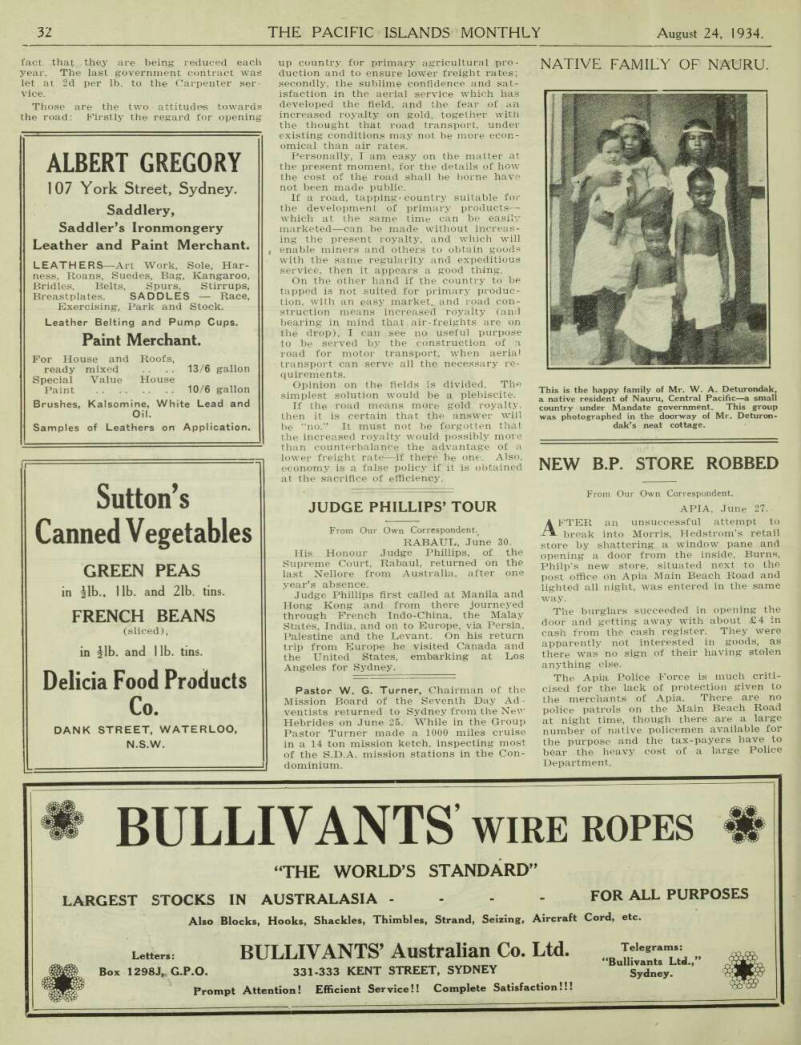
A Problem to be Solved by N.G. Miners
By Gordon Thomas
WAU, July 27.
OCULAR registration is imperative to appreciate fully the true position on the Morobe goldfields. Superlative ex pletives are quite incapable of conveying an idea of the true position in the world's most unique goldfield, where six years ago the pioneers were living under the most strenuous conditions, and where now I glance up from my writing table on the verandah of the Bulolo Hotel at Wau, and catch a glimpse of a merry party sipping cocktails or gimlets—or whatever they may be; while attractive women in pretty gowns form the greater part of the group.
Down the road two or three small children wander; a touring car swings to a standstill before the hotel; while up from the ’drome —that slopes away from the hotel—there come a couple of time tested gold-miners, with two “boys” following them and carrying suit cases. They have arrived “in” from “out,” and to-morrow they are going “up” from “down.” (“In” denotes Wau: “out” refers to the “beach” at Salamaua or Lae, and “up” is Edie Creek or the Kaindi coun try.) The two miners have become accus tomed to this new transportation. In 1927 it took them over a week of hard walking to reach Wau from the beach. To-day it takes them twenty minutes; and the record trip has been made in fourteen minutes! . . .
The Morobe goldfields are the greatest paradox of the present day. A cannibal’s son is seen stepping out of a Fox Moth ’plane; in the most inaccessible jungle the most up-to-date mining machinery is being installed; fresh meat is delivered at the miner’s door in the middle of the mainland of Mandated New Guinea; while primitive natives, who the day before were probably having a desultory tribal fight, crowd around and feel your clothes and touch your hand and gaze astonished at your leather feet.
Such is New Guinea of the present day, as a result of aerial transport.
The Morobe fields simply exude Modernity, Efficiency and Future Possi bilities.
Realising the importance of the prob lem of the proposed new road from the coast to the distributing centre of Wau, I tried to obtain from nearly every indi vidual and every interest with whom I came in contact some expression of opinion.
There were the pros and the cons. The former said: The country will never be properly developed so long as we have no main road to tap the territory lying between the two terminal points—Sala
maua or Lae, and Wau. Such a road will give us lower freight rates and in crease the population. We must look for ward to the future of the Territory. We must have vision and be far-seeing, and make the country accessible for the ag ricultural producer.
On the other hand I heard: The 'planes have been the making of the gold-mining industry, and their service has been effi cient and regular. We can reach local ities in a few minutes now which, even by good roads and motors, will take us
hours. ’Dromes have been laid down allover the fields and the daily services— even to out-of-the-way areas—have brought the isolated miner within touch of civilisation. A road costs money, and the money must be obtained from the miner; this will mean an increased royalty on the gold exported. We don’t want any increase in the royalty. Since 1928 we have been paying 5 per cent, for a road. We are now only having the Wau-Edie Creek road built after six years of increased taxation upon the miner, who already is carrying the rest of the Territory on his shoulders. The maintenance of the Coast road will be great, in order to ensure uninterrupted service to deliver freezer cargo and per ishable goods from the coast to Wau.
And, anyway, it is problematical as to whether road freights will be cheaper than aerial freights, bearing in mind the
fact that they are being reduced each year. The last government contract was let at 2d per lb. to the Carpenter ser vice.
Those are the two attitudes towards the road: Firstly the regard for opening
up country for primary agricultural pro duction and to ensure lower freight rates; secondly, the sublime confidence and sat isfaction in the aerial service which has developed the field, and the fear of an increased royalty on gold, together with the thought that road transport, under existing conditions may not be more econ omical than air rates.
Personally, I am easy on the matter at the present moment, for the details of how the cost of the road shall be borne have not been made public.
If a road, tapping country suitable for the development of primary products— which at the same time can be easily marketed —can be made without increas ing the present royalty, and which will enable miners and others to obtain goods with the same regularity and expeditious service, then it appears a good thing.
On the other hand if the country to be tapped is not suited for primary produc tion, with an easy market,, and road con struction means increased royalty (and bearing in mind that air-freights are on the drop), I can see no useful purpose to be served by the construction of a road for motor transport, when aerial transport can serve all the necessary re quirements.
Opinion on the fields is divided. The simplest solution would be a plebiscite.
If the road means more gold royalty, then it is certain that the answer will be “no.” It must not be forgotten that the increased royalty would possibly more than counterbalance the advantage of a lower freight rate —if there be one. Also, economy is a false policy if it is obtained at the sacrifice of efficiency.
Advertisements & other items, pp. 33-34 (1 item)
Fibrolite
Develop Your Slumbering Talent
Shorthand Typing Bookkeeping Business Principles Company Secretarial
COURSES AVAILABLE:
Accountancy Business Correspondence English Journalism Short Story Writing Matriculation Free Lance Journalism Advertising Advertisement Copy Writing Arithmetic
ANY SUBJECT IN GENERAL EDUCATION
SEND FOR DETAILS.
WE TEACH WHEREVER MAILS REACH
Metropolitan Business College
(77 Firsts in last two years)
6 DALLEY STREET SYDNEY
SEIZE THIS OPPORTUNITY. WRITE FOR DETAILS.
BUILD WITH
Fibrolite
ASBESTOS CEMENT SHEETS
By using this Economical, Fire Retardant and White Ant Proof building material for External and Internal Walls and Ceilings, you can build a comfortable and durable Bungalow Home — AT LOW COST.! Supplied in big, sturdy building sheets in 44 handy stock sizes, "FIBROLITE” is easily and quickly erected. No waste. Less labour. No painting.
For full information, write for illustrated “Fibrolite” Booklet F.6—FREE AND POST FREE!
JAMES HARDIE & COY. LTD.
ASBESTOS HOUSE, YORK ST., SYDNEY, N.S.W.
(Box 3935 V., G.P.O., Sydney)
“STILLHOLME”
Convalescent and Rest Home
81 MUSTON ST., MOSMAN
SYDNEY
Sunny Rooms, Verandahs, Harbour Views, Lawns.
Centrally Situated, handy to Trams, Ferries, and City.
Sisters RAINSFORD and HILL Y 1655.
ALBERT GREGORY
107 York Street, Sydney.
Saddlery,
Saddler’s Ironmongery
Leather and Paint Merchant.
LEATHERS— Art Work, Sole, Harness, Roans, Suedes, Bag-, Kangaroo, Bridles, Belts, Spurs, Stirrups, Breastplates. SADDLES Race, Exercising, Park and Stock.
Leather Belting and Pump Cups.
Paint Merchant.
For House and Roofs, ready mixed . . 13/6 gallon Special Value House Paint 10/6 gallon Brushes, Kalsomine, White Lead and Oil.
Samples of Leathers on Application.
Sutton’s
Canned Vegetables
GREEN PEAS
in 1lb. and 2lb, tins.
FRENCH BEANS
(sliced), in ½ and 1lb. tins.
Delicia Food Products
Co.
DANK STREET, WATERLOO,
N.S.W.
Judge Phillips' Tour
From Our Own Correspondent.
Rabaul, June 30.
His Honour Judge Phillips, of the Supreme Court, Rabaul, returned on the last Nellore from Australia, after one year’s absence.
Judge Phillips first called at Manila and Hong Kong and from there journeyed through French Indo-China, the Malay States, India, and on to Europe, via Persia, Palestine and the Levant. On his return trip from Europe he visited Canada and the United States, embarking at Los Angeles for Sydney.
Pastor W. G. Turner, Chairman of the Mission Board of the Seventh Day Ad ventists returned to Sydney from the New Hebrides on June 25. While in the Group Pastor Turner made a 1000 miles cruise in a 14 ton mission ketch, inspecting most of the S.D.A. mission stations in the Con dominium.
Native Family Of Nauru.
This is the happy family of Mr. W. A. Deturondak, a native resident of Nauru, Centred Pacific—a small country under Mandate government. This group was photographed in the doorway of Mr. Deturon dak’s neat cottage.
New B.P. Store Robbed
From Our Own Correspondent.
APIA, June 27.
AFTER an unsuccessful attempt to break into Morris, Hedstrom’s retail store by shattering a window pane and opening a door from the inside, Burns, Philp’s new store, situated next to the post office on Apia Main Beach Road and lighted all night, was entered in the same way.
The burglars succeeded in opening the door and getting away with about £4 in cash from the cash register. They were apparently not interested in goods, as there was no sign of their having stolen anything else.
The Apia Police Force is much criti cised for the lack of protection given to the merchants of Apia. There are no police patrols on the Main Beach Road at night time, though there are a large number of native policemen available for the purpose and the tax-payers have to bear the heavy cost of a large Police Department.
Advertisements & other items, p. 34 (1 item)
Bullivants Wire Ropes
“THE WORLD’S STANDARD”
LARGEST STOCKS IN AUSTRALASIA ... - FOR ALL PURPOSES Also Blocks, Hooks, Shackles, Thimbles, Strand, Seizing, Aircraft Cord, etc.
Letters: BULLIVANTS’ Australian Co. Ltd.
Box 1298 J, G.P.O. 331-333 KENT STREET, SYDNEY Prompt Attention! Efficient Service!! Complete Satisfaction!!!
Telegrams: ‘Bullivants Ltd.,’
Sydney.
Papua In 1932-33
Belated Report With Very Interesting Features
POINTED references to the action of the Federal Government in reducing the annual grant of £50.000 to Papua to £34,000 are contained in the annual report of the Lieutenant-Governor (Sir Hubert Murray) for the year ended 30th June, 1933. Those references have been given some pro minence in the Australian newspapers but in untimely fashion, as Australia, since the date of the report, has partially re stored the subsidy.
The report is exceedingly interesting—as are all such compilations issued under the hand of Sir Hubert Murray—but its value is destroyed in places owing to the incom prehensible delay by the Canberra authori ties in issuing the report. Many of the matters which the Lieutenant-Governor discusses have been affected by develop ments during the ensuing twelve months.
Sir Hubert Murray (on June 30, 1933) said that expenditure had been reduced to a point which was almost too low for safety. In spite of the good work that was being done by Government officers, it was difficult to see how the administration could be adapted to existing conditions. It was unfortunate that the Government had been forced to reduce the subsidy. Had it remained at £50,000 they should have been able to carry on. But he feared that -with a reduction of both subsidy and revenue, this task may be found too diffi cult. The discovery of a rich gold field or some extensive agricultural development would save the territory, but either to do any good must come quickly.
“I do not suggest that the Government will utterly collapse in Papua,” Sir Hubert Murray goes on, “but it may be necessary to close Government stations and reduce, the number of officers. The situation may be further complicated if the subsidy is not restored by the difficulty of maintaining the existing pensions scheme, to which officers themselves have contributed. I re gret to add that reduction in salary seems to be inevitable, but in this respect we will fare no worse than many other parts of the Empire.
“I cannot believe that the very dark pic ture I have painted can ever be permanent; good times will come again, mines and plantations will be developed and the Gov ernment influence re-established. But its re-establishment may be expensive in more ways than one, and I am certainly of opinion that it would be cheaper to restore the £16,000 which has been taken away than to reconstruct stations and police camps later on. The Commonwealth has always been generous to Papua, and I confess that I feel rather like one of the ‘daughters of the horse-leech’ in pressing for a restoration of the previous very liberal subsidy. I should not do it unless I felt the danger of our position is very real and very pressing.”
The Revenue
The report went on to point out that although the subsidy was reduced by £16,000, the revenue from all sources ex ceeded that of the previous year by nearly £3000. This apparently favorable symptom, however, was completely accounted for by the fact that a new issue of stamps resulted in sales exceeding those for 1931-32 by nearly £4000. Customs receipts were £2115 less, port and wharfage dues £156 less, and lease rents £241 less. It was thus apparent
that the financial depression, now well into its fourth year as far as Papua was con cerned, was at its worst in 1932-33. There was the possibility that 1933-34 may be still worse. There was nothing they could do but hope and be patient, “like the man in the strongroom on Saturday, who knew if he acted calmly he would be alive when the door was opened on Monday.”
Copra—Gold—Rubber
The price of copra continued to fall. The average for the year was about 12/ a ton less than in 1931-32, and less than half it was five years ago. The rate at September, 1933, was £9/12/6 a ton. The total quantity exported in 1932-33 was 9686 tons, com pared with 10,011 tons in 1931-32. This was probably due to a decrease in the quantity of native copra produced, and this, in turn, to the fall in prices.
Gold mining had shown some progress, but the new activities were so far only minor in character. Capital was being ex pended in a small, way, and there was reasonable ground for hoping that one or more of these ventures may develop into something big. The export showed an in crease from 8574 oz. to 15,268 oz.—the highest return for ten years. (The gold mining activity has grown considerably since that report was written.) The report added that the rubber con cessions made by the Commonwealth to Papua were not regarded as part of a policy of protection, but merely as a tem porary measure of finance. If the existing preference of 4d a lb. was adopted as a permanent policy, he saw no reason why his dream of an Australian market sup plied by Papuan rubber should not be realised. There was still a good chance of sugar growing being the saviour of the Territory, as the prospects of raising capi tal for this purpose seemed to be much
brighter then than ever before. There was no lack of enthusiasm on the part of pro moters of companies, and he supposed that by listening to these people only were they buoyed with hope, and at times sure, that sugar growing would actually be under taken shortly.
The New Papua
“The tourist,” says Sir Hubert Murray, "is ready to proclaim Papua as the dwelling place of an interesting native race, adorned with marvellous mops of hair, and addicted to dancing and canoe-racing; whereas we should prefer that the Territory were known as a suitable place for the invest ment of capital.”
“Patrol reports,” he added, “become dull as the Territory is more thoroughly ex plored and brought under control, and there is, nowadays, not much of Papua that is not fairly well known.
“Time was when we could startle our readers with stories of Purari head-hunters or cannibals of Goari Bari, but that time is past. Both head-hunters and cannibals are now mainly occupied in looking for work on coconut plantations. It is true that there are still some lively lads in the more remote districts, but one has to go a long way to find them, and life in most parts of Papua is as safe as anywhere in Australia, and a great deal less interesting."
Black And White Magic
The Lieutenant-Governor says that sorcery in some parts of the territory is gradually dying out, but in other parts it is still very much alive.
“The belief in sorcery,” he says, “will, I suppose, never be extirpated, for one finds it among the most highly civilised nations of Europe; but it may be minimised.
“A case is reported, for instance, from the Turama River district, in the delta
division. A canoe upset in the river, and one of the crew was swept away and drowned before the eyes of the whole vil lage. The death was attributed to sorcery.
It appears that the sorcerer takes up the imprint of the man’s foot in the mud —the whole country is mud in these parts—and throws it into the river. After that the man will surely be drowned! ”
Sir Hubert added that “black magic” was punished with a brief term of imprison ment. “White magic,” practised to secure a plentiful crop of yams was not interfered with. The garden magician, known as towosi, explained Sir Hubert Murray, en sures a good harvest by visiting the gar den, armed with his wand, crooning an in cantation, and throwing portion of the soil behind him on either side (it is essential (that a number of ants should be mingled with the soil). He also takes a number of leaves and blades of grass, and beats them into pieces with his “kailepa,” or magic wand. Then he pushes the “kailepa” stick into the ground, and sways his body to and fro, moving the “kailepa” stick from side to side and up and down. After this the magician goes each day through the garden singing his songs to the growing crops.
Advertisements & other items, p. 35 (1 item)
Home Lighting Plants
BSrt
The most complete range of
The “Nevertire” Full Automatic Plant Here is the lighting plant that THINKS!
ever offered
From a small 10-light plant, through a wide range to 7.3 kilowatts or more. Semi-automatic, fullautomatic ; direct-coupled or belt-driven; all voltages.
LISTER
Petrol or Diesel
Engine drive.
The marvellous “OMNISTAT” automatic engine control starts the Lister engine as soon as you switch on more than half-a-dozen lights, which are lit by the battery. The generator continues to supply current until only a few lights are in use. Then the engine stops, ready to restart automatically, as soon as another call is made for current. Simple in action, and absolutely positive. With this plant you can operate an automatic electric refrigerator on a 32 volt system and you need have no worry about the current supply—it is always available, automatically.
Write for catalogues and details of prices free of Australian Customs Duty.
DANGAR, GEDYE & CO., LTD
Malloch House, 10-14 Young Street - SYDNEY
New Range For Papuan
Riflemen
From Our Own Correspondent.
Pt. Moresby, July 20.
A new rifle range for the armed native constabulary at Konedobu was opened of ficially on July 11 by the Government Sec retary, Hon. H. W. Champion, C.B.E. He opened the range by firing the first shot, after which the police commenced extensive musketry practice.
Long Delay In Installing
Radio For Islands
Long Delay In Installing Essential Services
RECENT references in the “P.I.M.” to the suggestion for wireless sets for use in New Guinea and the Pacific Islands generally on the lines of those so success fully put into operation by the Australian Inland Mission in various isolated parts of Australia, remind one that the Torres Strait Islands and some other isolated northern outposts are still waiting to be linked up in this way.
There would be no difficulty so far as the A.I.M. authorities are concerned; and on the larger islands are Europeans who could handle the sets.
A “mother station” is necessary, how ever, and for this purpose the A.W.A. station at Thursday Island would natur ally seem to be most suitable.
The idea of linking up has been urged during the past three years, and has been received with keen appreciation by the Aboriginal Department, as well as others concerned; but although efforts have been made to induce the Commonwealth authorities to take some action which would assist in initiating the scheme, by coming to an arrangement whereby the “mother station” could be that at T.I., nothing so far seems to have been done.
A Federal representative some time back took up the matter with various Federai departments who might be in terested, such as the Defence Department, but progress is very slow.
Advertisements & other items, p. 36 (1 item)
Ruston-Hornsby
Cold Starting
OIL ENGINES
For Crude and Low Grade Fuels Horizontal and Vertical Types up to
1200- B.H.P.
Low Fuel Consumption Guaran- Illustration shows a Mark 4JP Four-Cylinder Engine of 35-B.H.P. , , Maintained Direct Coupled to Dynamo. teed and IVlcUiiutincu.
Sole Agents for Australia and the Islands:
RUSTON & HORNSBY (Australia) PTY. LIMITED
Registered Office; 174-180 KING STREET, MELBOURNE Cables: “HORNSBYS,” Melbourne.
Branches at SYDNEY, 642 Jones St. (off Broadway), and BRISBANE (Barry Parade).
Preserved Bananas
New Tahitian Industry Is Flourishing
From Our Own Correspondent.
Papeete, July 4.
SUBSTANTIAL shipments of preserved bananas, which are marketed as “Banana confit au naturel,” a name which adequately describes this excellent pro duct, are now being sent from Tahiti to France and England by every Messageries steamer.
Some months ago, when the enterprise had scarcely passed the experimental stage, this new industry was commented upon in these notes as one of considerable promise, as it opened up the possibility of reviving a once flourishing fruit busi ness which was ruined by the shutting out of all Islands fruit from America and the imposition of tremendously high im port duties on foreign fruit in New Zea land. Since then, there has been a pro gressive improvement both in the quality of the produce and in its presentation.
Naturally, the many details of the pro cess for turning bananas into the attrac tive and extremely palatable delicacy now produced are known only to the inventor, who is a locally-born Frenchman named Henri Key. But, without giving away any of his secrets, it may be said that the process is a very simple and natural one which calls for very little more than sun and air properly manipulated. No preser vatives are used, or sugar added to the fruit, and the marketable product, which is sold in packages of 250 grammes, or in bulk, may be classed with the best quality preserved figs or dates, and will keep for an indefinite time in any climate.
It has been reported upon very favour ably as an emergency ration for soldiers, and its cheapness will undoubtedly ensure for it a very wide markeft, as it becomes better known. Already Mr. Rey is finding it necessary to enlarge his plant, and the natives are planting more bananas in anticipation of the future demand.
Attempts have been made to preserve the banana in many countries, particu larly in the West Indies and other coun tries which can absorb only selected bunches of fruit and where there exist no means available for turning the balance of the crop to a profitable account. In such places there is an enormous amount of bananas wasted.
So far, however, such attempts at pre servation have been unsuccessful, and it is, therefore, all the more remarkable that an inventor in a comparatively unimport ant place like Tahiti should have suc ceeded in solving a problem which has had such an amount of money and effort spent upon it elsewhere.
Fiji Indians And Ghee
From Our Own Correspondent.
SUVA, July 25.
A MEASURE which seeks the protec tion of the local dairy industry, and to save the Indian community from im proper impositions, was passed by the Legislative Council, when it unanimously decided to substantially increase the duty on ghee substitutes.
The original motion was to increase the duty to 5d a lb British preferential tariff, and 7½d a lb foreign; but after discussion, an amendment that the rates be fid and 9d, respectively, was carried.
The Comptroller of Customs (Mr. J. M.
Wilson), who moved the motion, said that the duty on ghee made from pure clarified milk fat would remain at the same rate, 2d per lb British and 3d foreign.
Mr. K. B. Singh, who seconded, said that the ghee substitutes being marketed were decidedly injurious to health, and besides, as many of them were made from animal fats, including, he understood, pig fat, they contravened Indian religious beliefs.
His Excellency the Governor pointed out that the motion served a double pur pose, as it was to discourage the use of ghee substitutes and afford some measure of protection to the local dairy industry, which manufactured pure ghee.
Speaking again, Mr. Singh submitted that he did not think that the increase was enough, and he would like to see the duties made 9d and 11d.
Mr. A. Barker proposed an amendment
that the duties be 6d and 9d, and after His Excellency had pointed out that it was not the object of the Government to make the duty a revenue producer, this was agreed to.
Advertisements & other items, p. 37 (2 items)
giving a long lasting pro-
The MARCONI SCHOOL
OF WIRELESS
Complete Instruction for
RADIO ENGINEERS
RADIO TECHNICIANS
RADIO OPERATORS
RADIO MECHANICS
and SERVICEMEN
Also TALKING PICTURE
OPERATORS.
Combined Home Study and Personal Tuition or Home Study Courses only.
Modern Equipment for Practical Instruction.
Marconi School of
Wireless
97 Clarence Street, SYDNEY Please send me your free illustrated pros-
pectus. “RADIO—THE INDUSTRY OF
THE FUTURE”
Name Address
P.I.M
Made expressly to keep a lustrous, full gloss finish
against the varying con-
ditions of moist weather exposure, and prevent the decaying ravages of rain and extreme heat by
giving a long lasting pro-
tection to all surfaces.
SUN PROOF
RAIN PROOF
W. R. CARPENTER
& CO. LTD.
New Guinea, Solomon Islands, and all other South Sea Islands.
Castor Oil Seed
To Planters—I am a Buyer
of
IN ANY QUANTITY.
Send Sample for quote, stating quantity available.
Castor Seed Shellers, any capacity.
Advice and Instructions Regarding Planting, Harvesting, and Packing of Castor Oil Seeds given freely. Selected Seed for Planting available.
C. GRAHAME
4 DALLEY STREET SYDNEY.
The Foods Of New Caledonia
Deer, Fish, Crabs —and Flying Foxes
From Our Own Correspondent,
Bouloupari, July 16.
THE week has commenced with our usual Monday morning deer hunt.
A young man, living on our boundary, who signs himself “Chasseur de cerf,” goes up into the chain of mountains which runs through the island and puts up a mob of deer, with his pack of dogs.
They hunt this mob down the valley into our small paddocks.
The deer leap over the fences—or crash through the wires if they do not see them in time. Our dogs join in the hunt, and, being fresh, quickly gain on their quarry and pull him down by hanging on to the elbow joint. A rifle shot puts an end to the chase.
There is a law governing the chase which seems to be accepted by almost everyone in these parts: If the “chasseur” has not previously hit his quarry the
owner takes the hide and half the meat, which must be cut down properly, like butchers meat.
“Colporteurs” (dealers), who pass in camions, carrying freight to the north of the island and loading produce for the return trip to Noumea buy this deer meat, which is often preferable to beef. A “chasseur” can earn a good living, as the hides also are saleable.
All New Caledonians are very keen on hunting ("la chasse," as they call it), and frequently car-owners set off for a mid night shoot, with the aid of their motor lamps and a powerful torch. Young calves are sometimes shot in this way by inex penenced hunters who are unable to dif ferentiate the red fire of a calf’s eyes from the green light of a cerf’s.
The flying fox season of late has also been attracting the night hunter. We
often watch their lights as they cruise about in the neighbouring paddocks, in specting the neoli trees, whose white blos som brings the flying fox down out of the mountain chain, to feed.
There are two varieties of this animal.
The black strongly-scented variety is not so sought after as a lighter brown kind.
The latter is relished as a thoroughly delectable dish; and once, eating it by mistake, I was under the impression that I was eating jugged hare out of a tin.
Perhaps the glass of good red wine, which is always added to the French meal, en hanced the delusion.
This is certainly a land in which it would be difficult to die of starvation. The sea, always easily accessible, abounds in fish. This is usually speared by the natives and one sees them carrying their long three-pronged assagais as they pass to the sea. The fish inshore are always safe to eat, though several varieties feed ing on the coral reef can give one a very disagreeable and irritable rash.
The rivers running out into the sea have their crabs and oysters, which al ways bring a fair price in the market in Noumea. The natives make an industry of trapping these crabs, catching them in the mud, they hold them behind, and wind long strips of mangrove bark round their claws and feelers, and place them in baskets plaited from coconut leaves.
These baskets are made by splitting the leaf down the centre, and tying the ends together, and then the leaves are laced in and out, with a finishing roll on the bottom; all done in a few minutes.
The popinees (kanaka women) carry these baskets of crab to the road, where they are taken delivery of by the dealers, and make up portion of their return cargo to Noumea.
Tourists For Samoa
From Our Own Correspondent, APIA, June 29.
IT seems that the tourist trade, much neglected in former times in the South Sea Islands, has received a stimulus lately and it is welcome news that several more tourist steamers on South Seas cruises are to make Apia a port of call.
The “Marama” to arrive early in August has been fully booked, and it is intended by the Union Company to send her for a second cruise at the end of August or beginning of September.
The Orient Line sent a representative here recently to find out the possibilities for tourists in Samoa and very probably their tourist steamers will call here in future. As copra, cocoa, and banana prices are still at a low ebb, the money spent by tourists in Samoa is very wel come indeed.
Advertisements & other items, p. 38 (2 items)
Vegetables
"Invaluable!"
Says the Prospector
NO one setting out on prospecting or other expeditions to remote districts can afford to neglect Swallow & Ariell’s Compressed Vegetables. They are light—easy to transport —and of perfect keeping quality.
Their presence in the daily menu supplies all the vitamins of fresh vegetables (since water only is extracted) without the bulk and wasteage. One pound of Compressed Vegetables equals 10 pounds of fresh. One tablet provides sufficient vegetables for six plates of stew, or twelve plates of soup. The men outback swear by them! Ask your storekeeper for
ARIELLS
COMPRESSED
mixed
VEGETABLES
Australian Hardwoods
TO PACIFIC ISLANDS BUILDERS
AND CONTRACTORS
For all classes of Buildings and heavy Constructional work, Wharves, Jetties, etc.
Send details and we will quote by radio or return mail, as desired.
Islands Timbers
We should he glad to have details of any Islands Timbers which might he suitable for sale in Australia.
E. J. BURNSIDE & CO. LTD.
Australia House, Wynyard Square
SYDNEY
Cable address: “GRADATIM,” Sydney.
No Supplies!
American Strike Causes Shortage in Tahiti
From Our Own Correspondent.
Papeete, July 2.
THE dislocation of shipping schedules caused by the general strike on the Pacific Coast of America and (it is stated) by wage disputes in New Zealand between the Union Steam Ship Company and their cooks and stewards, has brought about a temporary shortage of certain essential commodities in Papeete which may well become serious unless the situation is soon alleviated by the arrival of new sup plies.
Potatoes, onions, and certain brands of cigarettes are already unpurchasable. while stocks of such important food items as flour and rice are running very low indeed. Fortunately for the consuming public the price of bread in French Ocea nia is regulated by Government decree, but other articles have already risen very considerably in price. Gasolene, kero sene, and fuel oil are all running short, and are being rationed out by merchants to their regular customers only.
Supplies of these essentials are gene rally brought to Tahiti by the Union Company’s cargo stearpe,rs, or by casual vessels sailing out of San Francisco, but word has been received that the S.S.
Wairuna, the next vessel expected, sailed direct from Vancouver to Tahiti without calling at San Pedro, as she usually does.
The next vessel will therefore be the S.S Hauraki which will bring a cargo of oil, gasolene, etc., from Sari Pedro, provided the strike has been lifted before she sails from Vancouver. In any case, there seems little possibility of a new supply of these articles before the end of July at the earliest. By that time it is safe to predict that many of the local schooners will be forced to lie up for lack of fuel oil and the Papeete garages will be losing money for want of gasolene. Fortunately, the inter-island traffic is now assured to a great extent by the “Ville de Papeete,” a steamer for which there is an abundant supply of coal on hand.
Apart from the inconvenience in the matter of supplies the disorganisation of the regular mail service has already cost local business people a considerable sum in radio messages which would ordinarily be unnecessary.
“Makura” Unable To Carry
Benzine.
One Sydney merchant reported to the newspapers that he received, by radio from Tahiti, urgent requests that benzine should be shipped by the Union S.S. Com pany’s liner Makura, which was scheduled to sail from Sydney for Papeete about July 5. But he was refused permission to ship benzine on the Makura, because she was a British ship, and, according to British Board of Trade regulations, was not permitted to carry benzine out of Australian or New Zealand ports. Yet the same vessel, on many occasions, has un loaded hundreds of cases of benzine from San Francisco at Papeete.
The shortage of necessary commodities was the more acutely felt in Tahiti be cause July 14 (France’s National Day) is always celebrated there with colourful festivities, lasting for a week, and thous ands of Europeans and Polynesians crowd into Papeete from all the adjoining islands.
M.A.S. At Pt. Moresby
7-Tons Yacht Crosses Pacific
From Our Own Correspondent.
Pt. Moresby, July 16.
ON July 4 a small yacht named the M.A.S., flying the Italian flag, dropped anchor unexpectedly in Port Moresby har bour. There was a good deal of astonish ment when it was learnt that she was on a world cruise and had already been on the high seas since August, 1932. The name of the yacht, M.A.S., is made up of the Latin equivalent (memento audere semper ) of “Remember always to dare.”
Manned by Captain Francesco Geraci and Signor Rosario Dominici, the M.A.S. left Naples nearly two years ago. She had called at Tangier and the Canary Islands before she crossed the Atlantic to Trinidad, Venezuela, Colon and the Panama Canal.
From the Canal she sailed the Pacific by way of the Galapagos and the Marquesas, Penrhyn and Manahiki Islands, Samoa and Fiji.
Captain Geraci put into Port Moresby on account of the heavy weather out from Suva, for his route lay direct through Torres Straits to Batavia.
Wholly decked in, the M.A.S. appeared a very small craft indeed in the Port Moresby harbour. Of only seven tons, 32-ft. in length and a 9-ft. beam, with a 3-ft. draught, it seemed inconceivable that she had weathered the storms and hurricanes of the Atlantic and Pacific Oceans. More over, she appeared to have no accommoda tion for her crew, and there was some speculation as to how the Italians had con trived to sleep and cook under these con ditions.
On being questioned as to the virtues and capacity of their small craft, both men most empnatically stated that undoubtedly the M.A.S. was the most uncomfortable boat in the world, and that in rough seas she could very easily capsize.
On July 13, the M.A.S. sailed out of Port Moresby harbour on a strong south-east trade wind and made for Banks Channel of the Torres Strait, for Batavia, Colombo and Aden. From Aden she will continue on through the Red Sea to Suez, and ulti mately Rome, which Captain Geraci hopes to reach by May, 1935.
Advertisements & other items, pp. 39-40 (1 item)
Scott's
The best
strengthmaker For a quick return to health and strength after an illness, you cannot better SCOTT’S Emulsion. It supplies essential nourishment in a readily digestible form.
It rebuilds wasted tissues, restores lost energy and renews resistance to infection.
It guards the lungs.
For young and old, the invalid and the convalescent, insist on genuine
SCOTT'S
Emulsion
For health and strength
THE NEW
WINCHESTER
‘SPEED KING’
.22 CAL. AUTOMATIC RIFLE MODEL 63
10 SHOTS
Price, £9/5/-
FREIGHT EXTRA
This NEW WINCHESTER AUTOMATIC RIFLE is the improved successor of the famous Model 03, chambered for the NEW .22 LONG RIFLE SUPER SPEED RIM FIRE CART- RIDGE DEVELOPING 35% HIGHER SPEED, 58% GREATER POWER, LONGER RANGE AND GREATER ACCURACY ar Less Cost for Ammunition.
THE NEW WINCHESTER SUPER SPEED RIM FIRE
CARTRIDGES
MORE SPEED Short 2/S 100
GREATER POWER Long Rifle . 3/10 \\ LONGER RANGE Freight extra.
COWLES & DUNN
Gunsmiths and Fishing Tackle Specialists 71 KING STREET SYDNEY Cable Address: CODUN, SYDNEY. Write for Fishing Tackle Catalogue, Post Free.
PACIFIC ISLANDS STAMPS
BOUGHT AND SOLD,
Stamps sent on approval on receipt of reference.
Send for free lists and specimen copy, “Australian Stamp Journal.”
J. H. SMYTH LTD.
121 a Castlereagh Street, Sydney
GILLESPIE’S
“ANCHOR”
FLOUR
TRADE
MARK
The Standard of Quality.
BRITAIN’S PRICELESS CONTRIBUTION TO MAN’S
COMFORT AND HAPPINESS
ROLLS-RAZOR
The Aristocrat of all Safety Razors SOLE AGENTS for Australia and the Islands of the Pacific.
THE ROLLS RAZOR CO. OF AUSTRALIA LTD.
Mendes Chambers, 8a Castlereagh Street, Sydney.
SERVICE. —We have a complete equipment for Repairs in case of accident to your Razor. Blades can be Reset and adjustments made by return man.
AUSTRALIA’S CLEARING HOUSE FOR THE PRECIOUS METALS.
BUYERS OF
GOLD
OSMIRIDIUM, PLATINUM, SILVER, &c.
GARRETT & DAVIDSON, LTD.
ASSAYERS, BULLION MERCHANTS, METALLURGISTS,
Bank of N.S.W. Buildings, Regent Street, Sydney
Bonin Islands
Japan’S Fortifications In The
THE Pacific Islands which Japan really has fortified are the Bonin Group, which lie N.N.W. of the Mariannes (Ladrones) and between the latter group and Japan.
The little Bonin Islands, which are situated some 500 miles south-west of Japan, up to the present have attracted little attention. Ships hardly ever anchor near their coasts, as they lie away from the great steamer tracks.
These Islands might have remained in obscurity, if an unexpected event in the struggle for supremacy in the Pacific had not suddenly drawn the world’s attention to them. The Right Rev. S. Heaslett, Bishop of Tokio, to whose diocese the Bonin Islands belong, intended to visit the group in his pastoral capacity. All preparations had been made, when the Japanese authorities informed him that he must abandon the voyage, since he, or any other foreigner, was not allowed to set foot on the islands.
What is the strictly guarded secret of the Bonins? Though the Japanese Go vernment never has given any explana tion to the Bishop, the position is obvi ous. The Islands probably are being for tified as an advanced centre for Japan’s naval and air forces, and therefore are carefully hidden from unauthorised spec tators.
If one takes a chart of these waters and draws a straight line from the Bonins to the Carolines and Mariannes (the strategic importance of which is fully realised by the Japanese) we are shown a flank position of great strength for the navy and an air squadron, which could hardly be broken by foreign battleships, and which provides ( an excellent protec tion against any attacks on the coasts of Japan.
According to the Washington Naval Treaty of 1922, the Japanese Government undertook not to construct further forti fications or defences on these Islands; but many believe that Japan has not car ried this out. It is said that the port of the largest island in the group, Chichi Jima, which can be entered by the biggest steamers, has been transformed into an impregnable base for the navy, and that huge premises for the storage of explo sives and food have been erected. The harbour on the second largest island Port Lloyd, is said to contain a whole squadron of bombing planes. Therefore, one can assume that if the Pacific should become the stage for another World Mar the Bonin Islands will play a very im portant part.
One should not under-estimate the im portance of Japan’s secretly created strategic outposts on these Islands. Fur ther, one should realise the haste with which the powers fighting for a new re partition of the world are concentrating their attention on the Pacific.
Recent statements by the Japanese War Minister, General Araki, when he ad dressed the world in a programme speech, were only too clear. Neither should we forget speeches made during the Pacific Conference held not long ago at Banff in the Canadian Rockies. Count Michisma objected, in sharp terms, to the presence of the North American fleet in the Pacific, and demanded that the Western American States should be opened to Japanese immigration.
Again and again, Japan has claimed “Asia for the Asiatics,” in accordance with the principle of the American Monroe doctrine. But the Anglo-Saxon powers cannot concede this point of view, and, therefore, they prepare for emergencies.
Australia’s northern port, Port Darwin, is being fortified. Singapore is already a great naval base. Hawaii and Singapore are bases of an immense air force. Japan possesses fifteen air squadrons.
Brazil, Peru, and other South American States are ordering cruisers and sub marines, to be built in Japanese ship yards. It is obvious that, in case of war Japan would not deliver these battle ships, which would add another thirty five units to the Japanese war fleet.
Japanese propagandists are spreading pan-Asiastic ideas; the echo is heard all over the Eastern countries from India to the F.M.S. The Far East is not only facing important events, but is already involved in far-reaching transformations.
There is no doubt that neither the Soviet nor the Anglo-Saxon Powers want war. and that Japan would prefer to avoid a decision by arms. But where the destiny of nations is at stake, freewill seems to be tied up by some higher power.
If the avalanche once begins its disas trous rush down the hill, nobody can stop it; the development may contain in itself the eventual catastrophe.
One must not ignore signs. The forti fication of the Bonin Islands, in spite of the Washington Treaty, and their trans formation into a base for the Japanese naval and air forces, seem to have a definite significance. —R.B.
The Montoro took from Port Moresby for Australian ports on July 4 the fol ing Papuan cargo: 1.210 packages rubber; 271 cases desiccated coconut: 971 bags copra: 162 packages sandalwood; 18 bags shell: and 219 bags coffee.
Samoan News
Famous “Adler” Wreck May Be Removed
From Our Own Correspondent.
APIA, June 28.
VARIOUS matters of interest were discussed at a recent meeting of Apia Chamber of Commerce.
In view of the announced visit of the Duke of Gloucester in February next, it is intended to improve and beautify the beach —a very necessary step, as the tourist traffic from New Zealand and Overseas is happily on the increase, and several large tourist steamers are expected during the coming months.
The wreck of the “Adler,” lying in front of the township of Apia on the reef, where the German warship was wrecked in the never-to-be-forgotten hurricane of 1889, is an eyesore, and the Chamber resolved to ask the Administration to remove the wreck.
Increased police protection during the night hours on the Beach Road and in the business quarter of the town was also demanded, as several burglaries have occurred lately.
“Laburnum” Visits Tokelau Is.
The N.Z. sloop “Laburnum” reached Apia on her South Pacific cruise on June 19. She left for the Tokelau Islands, which are administered from Apia, for an official visit of the Administration Secretary (Mr. Turnbull) and the Native Secretary (Mr. McKay). She returned on Monday, June 25.
20 Years Under N.Z.
The occasion of the 20th anniversary of the raising of the British flag over the territory of Western Samoa is to be celebrated this year in a special way by sports competitions and festivities on a large scale. A committee will be elected shortly to make preparations, and collect the necessary funds.
Lepers Leave Apia.
The motor-vessel “Tuitekaneai,” from Fiji, took a number of lepers aboard on June 24, to convey them to the Fijian Leper Settlement of Makogai.
Leprosy seems still to be very prevalent in these islands, and it is believed that a number of lepers are still living among the natives undetected, and so constituting a considerable danger to the people.
Rubber Tapping.
The New Zealand Reparation Estates (which is a Government establishment) encouraged by the rise in the rubber price, have taken up rubber tapping, again at their Aleisa Plantation, where they have about 120,000 Hevea trees available for tapping. About 35 Chinese coolies are employed for this purpose on the plantation.
Morris, Hedstrom Extending?
It is rumoured that Messrs. Morris, Hedstrom, Ltd., intend to erect a modern and up-to-date emporium on the Main Beach Road. In spite of the depression and hard times, there seems indeed to be a lot of confidence in the future of our happy little Islands Territory.
Australians Make Merry.
When three members of the “Jeunesse Doree” of Apia, all three hailing from Australia, had a merry time on the Swed ish steamer “Boren,” lying in Apia Har bour, they felt so happy that they made up their minds to continue the spree on shore.
Unfortunately, the three Australians forgot all about the fact that Samoa, or at least the Western portion of the islands, is still under a draconic prohibition rule.
So when they came on shore with their pockets bulging with some suspicious looking bottles, and, in addition, a few cases of very smokable cigars on which they had paid no duty, a native police man quickly took an interest in them.
The result will be a trial in Apia Court, and, probably, a sobering fine.
Niue Islanders.
The s.s. “Maui Pomare,” on her last trip brought as passengers 45 Niue natives to Apia, some to visit relatives residing in Samoa, and some to look for work here.
Personals.
The Inspector of Police, Mr. Braisby, with Mrs. Braisby, recently left for America and England on a well-deserved holiday trip.
Dr. Ernest Hunt, Chief Medical Officer, left for Fiji by the "Tiafau” and Matson liner. Dr. Hunt has resigned his position and was the recipient of a testimonial by the officials of the Administration at the Central Office before his departure. Dr Monaghan is acting C.M.O.
Mr. A. G. Smyth, former manager for Morris, Hedstrom, Ltd., at Apia, has entered the firm of O. F. Nelson and Co , Ltd., as a director.
Advertisements & other items, pp. 41-42 (1 item)
Hotel Mansions
WANTED TO BUY
POSTAGE STAMPS
Papua, New Guinea, Pacific Islands Used or Unused Any Quantity Books, Pamphlets, Govt. Reports, Photos, etc., British New Guinea and Papua.
PAUL A. DORN
Collector of New Guineana Box 343, Redlands, California, U.S.A.
Offers Solicited Correspondence Invited Reference: R. W. ROBSON, 247 George St.
Sydney.
GLEBE
Engineering Works
Cook Street
GLEBE, SYDNEY
Telephone: MW 1903 General and structural engineers, blacksmiths, boilermakers, oxy and electric welders.
Specializing in mining machinery, trucks, kipples, conveyors and elevators, water pipes.
Estimates Free of Charge Construction and machines made to any design.
The
“Caledonia Dover”
A COOKING STOVE guaranteed to give complete satisfaction and now recognised as THE BEST on the market. Suitable for coal, coke or wood fuel.
Illustrated Catalogue on request.
LANE & GIRVAN, LTD.,
BONNY BRIDGE, SCOTLAND.
TARIFF:
Single Room and Breakfast from 8/per night.
WEEKLY
from £2/2/- WIRES: "Mansions," Sydney.
HOTEL MANSIONS
SYDNEY’S IDEALLY SITUATED PALATIAL HOTEL
INCLUSIVE
TARIFF:
Single Room from 12/ per diem.
Renowned for Exquisite Cuisine, Perfect Service and Luxurious Appointments.
Make the Mansions your home whilst in Sydney and enjoy Unsurpassed Comfort at Moderate Cost.
INDIVIDUAL, DOUBLE ROOMS AND
ADDRESS: Bayswater Rd., King’s Cross.
WEEKLY
from £3/10/-
The
“High-
lander”
Shirt
Ideal for wear in tropics, will stand hard wear and native washing. Made from a strong cotton twill, two breast pockets. Assorted designs. In Blue, Brown, or Grey grounds.
Colours fast.
Price 9/6 each Three for 27/6 Ties to Tone, 3/6.
Send your order to Desk PIM.
PIKE BROTHERS Ltd.
in Queen Street, Brisbane
HUON PINE BOAT PLANKS
AND
SPOTTED GUM TIMBERS
The World's Best and the Cobra Does Not Like Huon Pine.
A. C. FRYER, 110 Miller Street, Pyrmont, Sydney.
Will Gladly Give Full Quotations for Any Sizes.
THE CHAPMAN DIESEL MARINE ENGINE
No com- Crude Oil costing sixpence a gallon at Sydney; consumes six gallons in 10 hours. Price of engine complete £325 ex factory.
CHAPMAN & SHERACK, Clara Street, Erskineville, N.S.W., Manufacturers and Patentees
Clashes With N.G. Natives
Annual Report Describes 1932-33 Conditions
THE annual report of the Administrator of the Mandated Territory of New Guinea for the year ended June 30, 1933, has just been circulated. Like most other government publications, it loses much of its topical interest because over a year has elapsed since the Administrator made his comments on current conditions and recent events; and it has value now mainly as an official record.
A section of the report which should receive wide publicity is that dealing with clashes between whites and natives on the mainland of New Guinea, where Europeans, in the quest for gold, are penetrating ever more deeply into a region hitherto unexplored.
Describing the work of the official patrols, the Administrator refers to the “deadly warfare which is taking place continually between the various villages” and to the “clashes which have arisen out of contact with miners and their laborers” —
events which more than once have led to attacks upon patrols sent by the Adminis tration to adjust the differences. It is re called that in June of 1933 the Assistant District Officer, Mr. Ian Mack, lost his life in an affray at Aiamontena, an uncon trolled native village.
“Early in the year (1932-33) an acute shortage of payable claim-working ground on Edie Creek and the Bulolo River caused some prospectors to seek permission to enter the uncontrolled watersheds of the Watut, Ramu and Purari rivers. Owing to the numbers and hostility of the native inhabitants of these mountainous regions only properly-equipped miners were grant ed permits under the Uncontrolled Areas Ordinance to enter the area. Base camps in charge of experienced officers were, in the interests of natives and Europeans alike, established in the Watut, Ramu (and later the Purari) watersheds, where every effort was made to win the confidence of the wild mountain natives, and develop a friendly understanding between them and the prospectors.
“Early in January, 1933, however, two European prospectors, Messrs. Naylor and Clarius, who had been refused permits to enter the uncontrolled area because they could not fulfil the required conditions, eluded the district officials and crossed the Watut divide into the Papuan watershed of the Tauri River, where they were killed by a number of natives who had pretended to be friendly. Six of their native laborers were killed, but three escaped, one of whom reported the murder to the officials at the post on Surprise Creek (Otibanda).
“Five separate patrols have since visited the area for the purpose of arresting the murderers and establishing control. The first patrol arrived on the scene a few days after the murders had been reported; it was attacked and in the fight that followed some of the attackers it is thought, wounded. The second patrol was in the district for one month without seeing any of the inhabitants, who presumably were sheltering in friendly villages lower down the Tauri River.
“A third patrol to the head of the Tauri River came into collision on 23rd April, 1933, with the people who had attacked the late Messrs. Naylor and Clarius, and after a struggle, in which three men were killed, eight of the suspected murderers were arrested.
“On 25th April, while moving towards Otibanda. this patrol was attacked from ambush by friends of the prisoners. The European officer in charge, together with six police and one native servant, fell seriously wounded, and two of the prisoners were killed, by the first shower of arrows.
The unwounded police rallied and drove off the attackers. Packs were discarded, and the wounded men were carried on litters to Otibanda —a twenty hours’ march.
One of the wounded native constables has since died.
“A fourth patrol went immediately to the scene, but found that the attackers had fled into hiding places. A base camp has been established on the watershed, and patrols will remain in the area until the people are under control.’’
The Customs Tariff (Papua and New Guinea Preference) Bill, 1934, was passed by the Commonwealth Parliament in July. It is a machinery measure, made necessary in connection with the opera tion of the Ottawa Agreement, and it does not alter existing rates of duty.
Book Reviews
(By R. W. Robson)
The Yellow Joss, and other Tales. By Ion L. Idriess.
MR. IDRIESS, at present, is away in remote North-west Australia, among cattle-men, gold seekers, and fever stricken natives. At this moment, if he is true to character, he is squatting down by a camp-fire somewhere, scribbling on a discarded sugar-bag with a bit of lead pencil, preparing material for another of his fascinating books on Australian out door life. Within four years, he has pub lished seven books, all first-class sellers; and here before us is his eighth.
“The Yellow Joss,” etc., is a collection of stories and sketches. Some, already, have been published. They record inci dents noted by Idriess while wandering among the bushmen and natives of Cape York; pearlers and trochus fishers of the Coral Sea; the natives of the Torres Strait islands; and the beachcombers of the Great Barrier Reef. It is real Idriess stuff; the members of his numerous and growing public may buy this book with confidence.
Our copy from Angus and Robertson, Ltd., Sydney. 6/-.
Conflict. By E. V. Timms.
Of all novels, written by an Australian and published in Australia, this is the best I have ever read. It is to be pub lished in London and New York; and one is glad of that, because it deserves to be among the world’s best-sellers.
It is an admirably constructed, quick moving story of the days of Louis XIV.; and it has a plot, somewhat reminiscent of the evergreen “Scarlet Pimpernel,” that holds one enthralled from the first chapter to the last. The reader is trans ported quickly from the Mediterranean of the Corsairs to the colourful, luxurious court of Louis XIV., and thence to the England of the slothful, sensual Charles II. One does not know how much reliance can be placed on Mr. Timms as a historian; but his pictures of life in London and Paris, in those distant days, are most fascinating. It is an exciting story, and in telling it Mr. Timms displays literary ability, subtle craftsmanship, and delight ful humour.
Our copy from Angus and Robertson Ltd., Sydney. 6/-.
Modern Samoa: Its Government and Changing Life. By Felix M. Keesing.
This book is now on the market. A
review says of it: “A fair case is made for the good intention of the Mandated Authorities (New Zealand) that have dealt with Samoa, but there is less to be said for their intelligence in framing laws and regulations suitable for the Samoans.
A new group is springing up in Samoa, a group of two bloods and of two cul tures, and to this group the author as signs great future importance. . . . While ‘Modern Samoa’ is an authoritative, in tensely interesting, impartial study, planned for students and officials con cerned with Samoa and the problems of dependencies, it will also be found invalu able by tourists. There is no other book known to the present reviewer that covers the sociology and economics of Samoa so adequately. It is drawn from a very extensive bibliography and is based on eight months of observation and study in the field by the author and his wife.”
The book is sold for 16/- (sterling).
The Friendly Coconut
From Our Own Correspondent.
New Caledonia, July 16.
IF I were asked what was the most use ful thing on a plantation, I would say the friendly coconut. Apart from its value as copra, it is really splendid food for all domestic animals and pets, and, if the shell is taken off carefully, all kinds of useful articles can be made out of it; after the rough surface is taken down with sandpaper, it rivals ebony in colour and polish. Ash trays, which never burn, bowls for sweets and small flowers, ladles, etc., can be very beautifully made.
One can make splendid paint brushes and scrubbing brushes from the fibre from the nut, and our best garden brooms are
made from the backs of the leaf, which, when torn off, equal whalebone for strength and elasticity.
The authorities seem to realise the value of these trees for it is forbidden to cut down coconut palms on one’s property without first receiving permission from the local gendarme.
Advertisements & other items, pp. 43-44 (1 item)
"The Vamp"
MINING AND ASSAY
MATERIAL
BALANCES, CRUSHERS, FURNACES,
CRUCIBLES, FLUXES, ETC.
LABORATORY AND SCHOOL
REQUISITES
Chemicals, Glassware, and all other Equipment
HOSPITAL AND SURGICAL
REQUIREMENTS
Incubators, Sterilizers, Centrifuges, Microscopes, Microtomes, etc.
Measures, Dispensing Scales, Enamel Ware, Bandages, Cotton Wool, and all Dispensing Material.
Write direct to
H. B. SELBY & CO., LTD.,
BULLETIN PLACE :: SYDNEY
Box 175D, G.P.O.
“HIS MASTER’S VOICE”
The World’s Greatest Entertainer Gives You the Music You Want —When You Want It.
We Stock and Sell all Numbers. Send Your Orders to us.
Prompt Service is our motto, and a satisfied customer our best advertisement.
"THE VAMP"
(Miss Crawford)
Victoria Arcade Music Parlour
(Opp. Hotel Australia), SYDNEY “His Master's Voice” Portables —Records —Needles. We will gladly post you Catalogues on request.
Just a few drops inhaled from the handkerchief will alleviate headache and banish fatigue. Fragrant and refreshing in bath and handbasin too.
FACTORY REPRESENTATIVE FOR AUSTRALIA,
NEW ZEALAND AND PACIFIC ISLANDS:
JULIUS BLAU
AUSTRALIA HOUSE,
CARRINGTON STREET, SYDNEY
Not only in the islands, but all round the world. Shell stands for quality
OIL and SPIRIT
S.1550
Climbing Mount
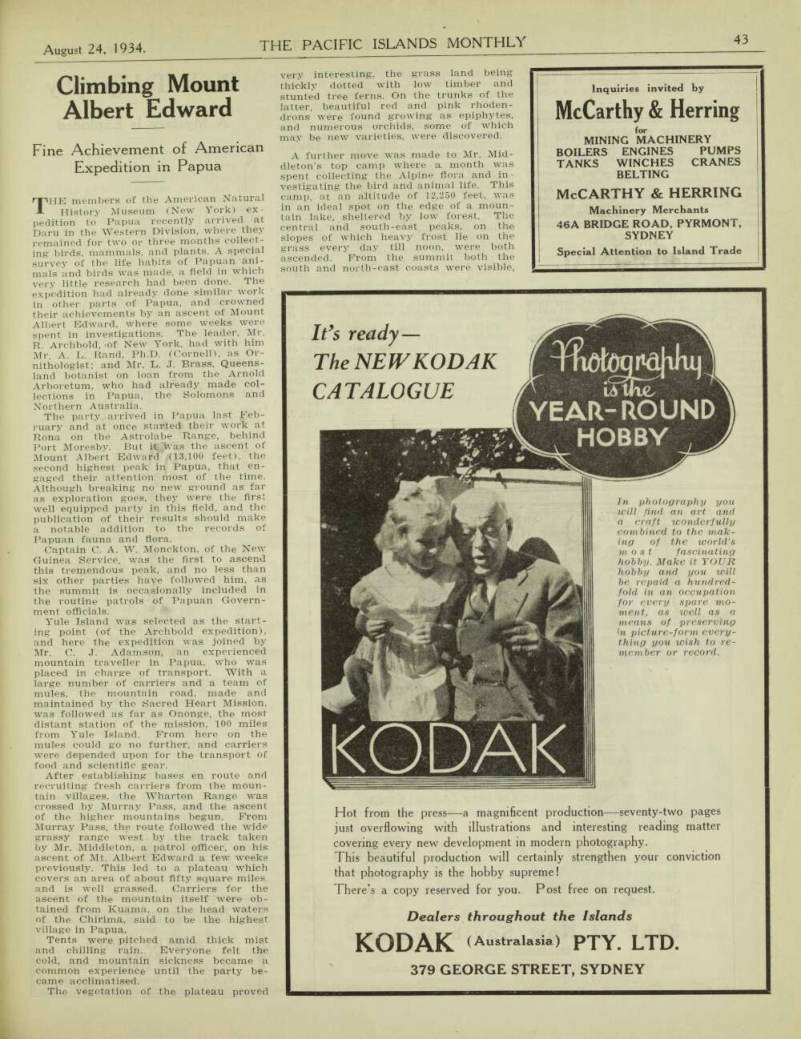
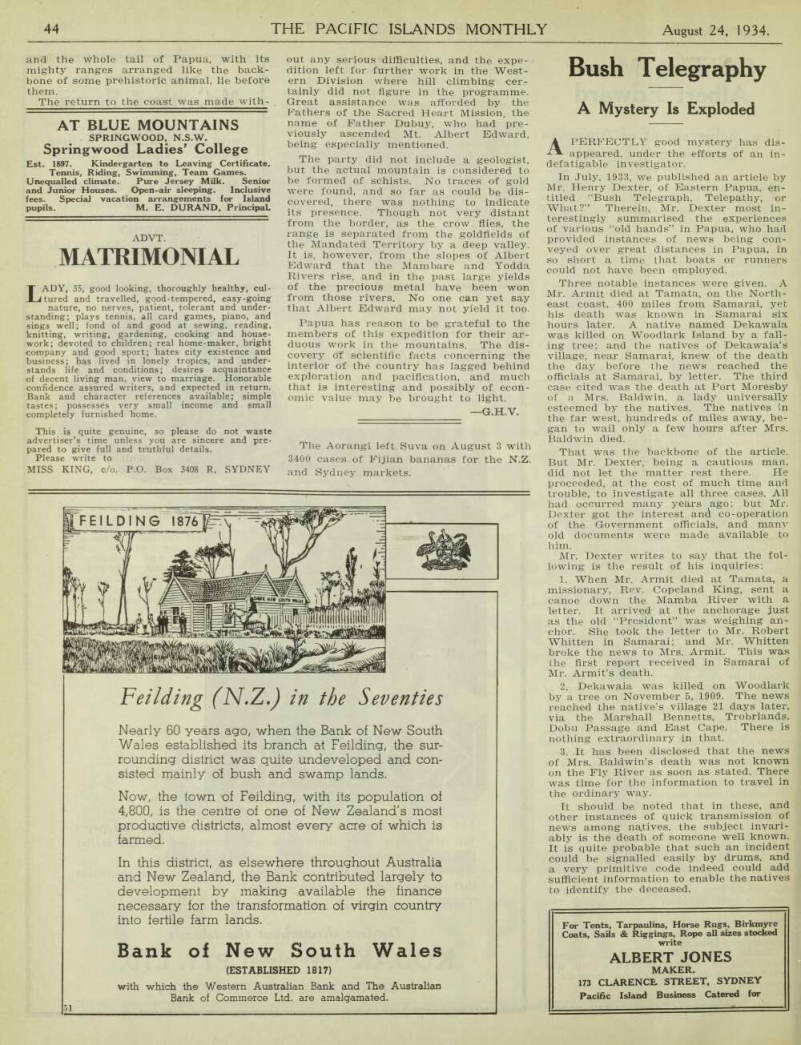
Albert Edward
Fine Achievement of American Expedition in Papua
THE members of the American Natural History Museum (New York) ex pedition to Papua recently arrived at Daru in the Western Division, where they remained for two or three months collect ing birds, mammals, and plants. A special survey of the life habits of Papuan ani mals and birds was made, a field in which very little research had been done. The expedition had already done similar work in other parts of Papua, and crowned their achievements by an ascent of Mount Albert Edward, where some weeks were spent in investigations. The leader, Mr.
R. Archbold, of New York, had with him Mr. A. L. Rand, Ph.D. (Cornell), as Or nithologist; and Mr. L. J. Brass, Queens land botanist on loan from the Arnold Arboretum, who had already made col lections in Papua, the Solomons and Northern Australia.
The party arrived in Papua last Feb ruary and at once started their work at Rona on the Astrolabe Range, behind Port Moresby. But it was the ascent of Mount Albert Edward (13,100 feet), the second highest peak in Papua, that en gaged their attention most of the time.
Although breaking no new ground as far as exploration goes, they were the first well equipped party in this field, and the publication of their results should make a notable addition to the records of Papuan fauna and flora.
Captain C. A. W. Monckton, of the New Guinea Service, was the first to ascend this tremendous peak, and no less than six other parties have followed him, as the summit is occasionally included in the routine patrols of Papuan Govern ment officials.
Yule Island was selected as the start ing point (of the Archbold expedition), and here the expedition was joined by Mr. C. J. Adamson, an experienced mountain traveller in Papua, who was placed in charge of transport. With a large number of carriers and a team of mules, the mountain road, made and maintained by the Sacred Heart Mission, was followed as far as Ononge, the most distant station of the mission, 100 miles from Yule Island. From here on the mules could go no further, and carriers were depended upon for the transport of food and scientific gear.
After establishing bases en route and recruiting fresh carriers from the moun tain villages, the Wharton Range was crossed by Murray Pass, and the ascent of the higher mountains begun. From Murray Pass, the route followed the wide grassy range west by the track taken by Mr. Middleton, a patrol officer, on his ascent of Mt. Albert Edward a few weeks previously. This led to a plateau which covers an area of about fifty square miles and is well grassed. Carriers for the ascent of the mountain itself were ob tained from Kuama, on the head waters of the Chirima, said to be the highest village in Papua.
Tents were pitched amid thick mist and chilling rain. Everyone felt the cold, and mountain sickness became a common experience until the party be came acclimatised.
The vegetation of the plateau proved
very interesting, the grass land being thickly dotted with low timber and stunted tree ferns. On the trunks of the latter, beautiful red and pink rhoden drons were found growing as epiphytes, and numerous orchids, some of which may be new varieties, were discovered.
A further move was made to Mr. Mid dleton’s top camp where a month was spent collecting the Alpine flora and in vestigating the bird and animal life. This camp, at an altitude of 12,250 feet, was in an ideal spot on the edge of a moun tain lake, sheltered by low forest. The central and south-east peaks, on the slopes of which heavy frost lie on the grass every day till noon, were both ascended. From the summit both the south and north-east coasts were visible.
and the whole tail of Papua, with its mighty ranges arranged like the back bone of some prehistoric animal, lie before them.
The return to the coast was made with
out any serious difficulties, and the expe dition left for further work in the West ern Division where hill climbing cer tainly did not figure in the programme.
Great assistance was afforded by the Fathers of the Sacred Heart Mission, the name of Father Dubuy, who had pre viously ascended Mt. Albert Edward, being especially mentioned.
The party did not include a geologist, but the actual mountain is considered to be formed of schists. No traces of gold were found, and so far as could be dis covered, there was nothing to indicate its presence. Though not very distant from the border, as the crow flies, the range is separated from the goldfields of the Mandated Territory by a deep valley.
It is, however, from the slopes of Albert Edward that the Mam bare and Yodda Rivers rise, and in the past large yields of the precious metal have been won from those rivers. No one can yet say that Albert Edward may not yield it too.
Papua has reason to b© grateful to the members of this expedition for their ar duous work in the mountains. The dis covery of scientific facts concerning the interior of the country has lagged behind exploration and pacification, and much that is interesting and possibly of econ omic value may be brought to light.
G.H.V.
The Aorangi left Suva on August 3 with 3400 cases of Fijian bananas for the N.Z. and Sydney markets.
Advertisements & other items, pp. 45-46 (1 item)
McCarthy & Herring
Inquiries invited by
for
MINING MACHINERY
BOILERS ENGINES PUMPS
TANKS WINCHES CRANES
BELTING
McCarthy & herring Machinery Merchants
46A BRIDGE ROAD, PYRMONT,
SYDNEY
Special Attention to Island Trade
It’s ready —
The NEW KODAK
CATALOGUE
In photography you will find an art and a craft wonderfully combined to the making of the world’s most fascinating hobby. Make it YOUR hobby and you will be repaid a hundredfold in an occupation for every spare moment, as well as a means of preserving in picture-form everything you wish to remember or record.
Hot from the press—a magnificent production—seventy-two pages just overflowing with illustrations and interesting reading matter covering every new development in modern photography.
This beautiful production will certainly strengthen your conviction
that photography is the hobby supreme!
There’s a copy reserved for you. Post free on request.
Dealers throughout the Islands
KODAK (Australasia) PXY. LTD.
379 GEORGE STREET, SYDNEY
AT BLUE MOUNTAINS
SPRINGWOOD, N.S.W.
Springwood Ladies’ College
Est. 1897. Kindergarten to Leaving Certificate.
Tennis, Riding, Swimming, Team Games.
Unequalled climate. Pure Jersey Milk. Senior and Junior Houses. Open-air sleeping. Inclusive fees. Special vacation arrangements for Island pupils. M. E. DURAND, Principal.
ADVT.
MATRIMONIAL
LADY, 35, good looking, thoroughly healthy, cultured and travelled, good-tempered, easy-going nature, no nerves, patient, tolerant and understanding; plays tennis, all card games, piano, and sings well; fond of and good at sewing, reading, knitting, writing, gardening, cooking and housework; devoted to children; real home-maker, bright company and good sport; hates city existence and business; has lived in lonely tropics, and understands life and conditions; desires acquaintance of decent living man, view to marriage. Honorable confidence assured writers, and expected in return.
Bank and character references available; simple tastes; possesses very small income and small completely furnished home.
This is quite genuine, so please do not waste advertiser’s time unless you are sincere and prepared to give full and truthful details.
Please write to MISS KING, c/o. P.O. Box 3408 R, SYDNEY
FEILDING 1876
Feilding (N.Z.) in the Seventies Nearly 60 years ago, when the Bank of New South Wales established its branch at Feilding, the surrounding district was quite undeveloped and consisted mainly of bush and swamp lands.
Now, the town of Feilding, with its population of 4,800, is the centre of one of New Zealand's most productive districts, almost every acre of which is farmed.
In this district, as elsewhere throughout Australia and New Zealand, the Bank contributed largely to development by making available the finance necessary for the transformation of virgin country into fertile farm lands.
Bank of New South Wales
(ESTABLISHED 1817)
with which the Western Australian Bank and The Australian Bank of Commerce Ltd. are amalgamated.
Bush Telegraphy
A Mystery Is Exploded
A PERFECTLY good mystery has dis appeared, under the efforts of an in defatigable investigator.
In July, 1933, we published an article by Mr. Henry Dexter, of Eastern Papua, en titled “Bush Telegraph, Telepathy, or What?” Therein, Mr. Dexter most in terestingly summarised the experiences of various “old hands” in Papua, who had provided instances of news being con veyed over great distances in Papua, in so short a time that boats or runners could not have been employed.
Three notable instances were given. A Mr. Armit died at Tamata, on the North east coast, 400 miles from Samarai, yet his death was known in Samarai six hours later. A native named Dekawaia was killed on Woodlark Island by a fall ing tree; and the natives of Dekawaia’s village, near Samarai, knew of the death the day before the news reached the officials at Samarai, by letter. The third case cited was the death at Port Moresby of a Mrs. Baldwin, a lady universally esteemed by the natives. The natives in the far west, hundreds of miles away, be gan to wail only a few hours after Mrs.
Baldwin died.
That was the backbone of the article.
But Mr. Dexter, being a cautious man, did not let the matter rest there. He proceeded, at the cost of much time and trouble, to investigate all three cases. All had occurred many years ago; but Mr.
Dexter got the interest and co-operation of the Government officials, and many old documents were made available to him.
Mr. Dexter writes to say that the fol lowing is the result of his inquiries: 1. When Mr. Armit died at Tamata, a missionary, Rev. Copeland King, sent a canoe down the Mamba River with a letter. It arrived at the anchorage just as the old “President” was weighing an chor. She took the letter to Mr. Robert Whitten in Samarai; and Mr. Whitten broke the news to Mrs. Armit. This was the first report received in Samarai of Mr. Armit’s death. 2. Dekawaia was killed on Woodlark by a tree on November 5, 1909. The news reached the native’s village 21 days later, via the Marshall Bennetts, Trobriands, Dobu Passage and East Cape. There is nothing extraordinary in that. 3. It has been disclosed that the news of Mrs. Baldwin’s death was not known on the Fly River as soon as stated. There was time for the information to travel in the ordinary way.
It should be noted that in these, and other instances of quick transmission of news among natives, the subject invari ably is the death of someone well known.
It is quite probable that such an incident could be signalled easily by drums, and a very primitive code indeed could add sufficient information to enable the natives to identify the deceased.
Advertisements & other items, p. 46 (1 item)
Albert Jones
For Tents, Tarpaulins, Horse Rugs, Birkmyre Coats, Sails & Riggings, Rope all sizes stocked write
MAKER.
173 CLARENCE. STREET, SYDNEY
Pacific Island Business Catered for
New Caledonia’S Industries
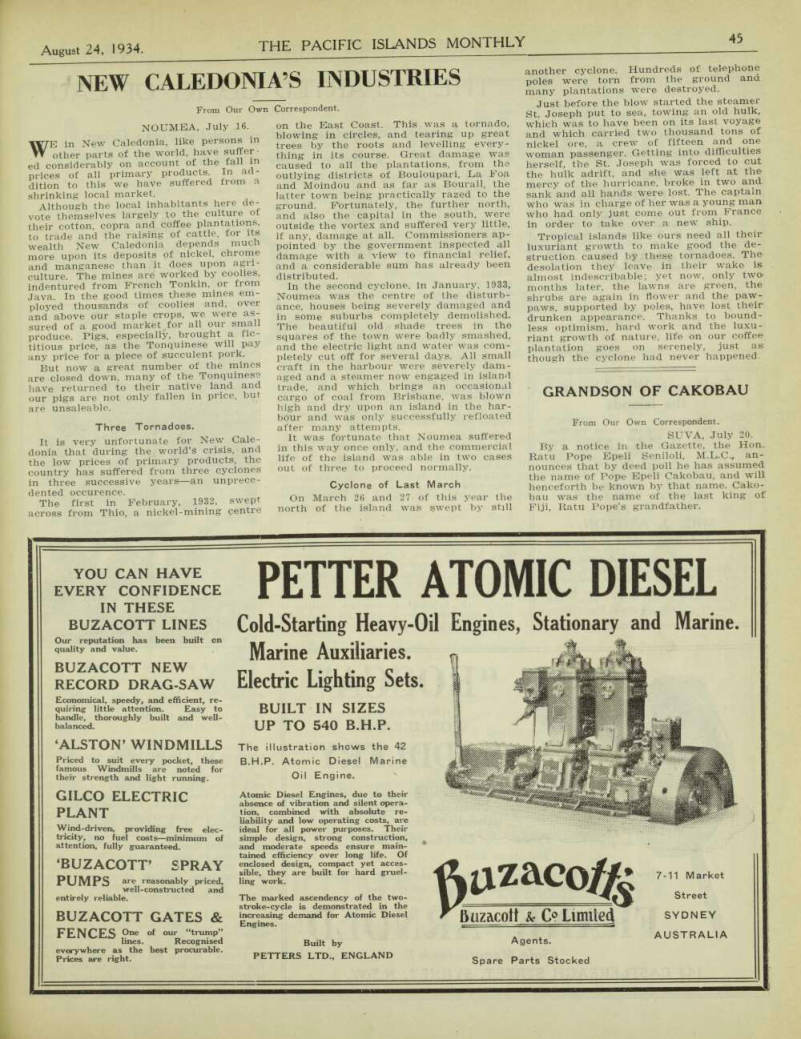
From Our Own Correspondent.
Noumea July 16.
WE in New Caledonia, like persons in other parts of the world, have suffered considerably on account of the fall in prices of all primary products. In addition to this we have suffered from a shrinking local market.
Although the local inhabitants here devote themselves largely to the culture of their cotton, copra and coffee plantations, to trade and the raising of cattle, for its wealth New Caledonia depends much more upon its deposits of nickel, chrome and manganese than it does upon agriculture. The mines are worked by coolies, indentured from French Tonkin, or from Java. In the good times these mines employed thousands of coolies and, over and above our staple crops, we were assured of a good market for all our small produce. Pigs, especially, brought a fictitious price, as the Tonquinese will pay any price for a piece of succulent pork.
But now a great number of the mines are closed down, many of the Tonquinese have returned to their native land and our pigs are not only fallen in price, but are unsaleable.
Three Tornadoes.
It is very unfortunate for New Caledonia that during the world's crisis, and the low prices of primary products, the country has suffered from three cyclones in three successive years — an unprecedented occurence.
The first in February, 1932, swept across from Thio, a nickel-mining centre
on the East Coast. This was a tornado, blowing in circles, and tearing up great trees by the roots and levelling everything in its course. Great damage was caused to all the plantations, from the outlying districts of Bouloupari, La Foa and Moindou and as far as Bourail, the latter town being practically razed to the ground. Fortunately, the further north, and also the capital in the south, were outside the vortex and suffered very little, any, damage at all. Commissioners ap pointed by the government inspected all damage with a view to financial relief, and a considerable sum has already been distributed.
In the second cyclone, in January, 1933, Noumea was the centre of the disturb ance, houses being severely damaged and in some suburbs completely demolished.
The beautiful old shade trees in the squares of the town were badly smashed, and the electric light and water was completely cut off for several days. All small craft in the harbour were severely dam aged and a steamer now engaged in island trade, and which brings an occasional cargo of coal from Brisbane, was blown high and dry upon an island in the har hour and was only successfully refloated after many attempts.
It was fortunate that Noumea suffered in this way once only, and the commercial life of the island was able in two cASES out of three to proceed normally.
Cyclone of Last March On March 26 and 27 of this year the north of the island was swept by still
another cyclone. Hundreds of telephone poles were torn from the ground and many plantations were destroyed.
Just before the blow started the steamer St. Joseph put to sea, towing an old hulk, which was to have been on its last voyage and which carried two thousand tons of nickel ore, a crew of fifteen and one woman passenger. Getting into difficulties herself, the St. Joseph was forced to cut the hulk adrift, and she was left at the mercy of the hurricane, broke in two and sank and all hands were lost. The captain who was in charge of her was a young man who had only just come out from France in order to take over a new ship.
Tropical islands like ours need all their luxuriant growth to make good the de struction caused by these tornadoes. The desolation they leave in their wake is almost indescribable; yet now, only two months later, the lawns are green, the shrubs are again in flower and the paw paws, supported by poles, have lost their drunken appearance. Thanks to bound less optimism, hard work and the luxu riant growth of nature, life on our coffee plantation goes on serenely, just as though the cyclone had never happened.
Grandson Of Cakobau
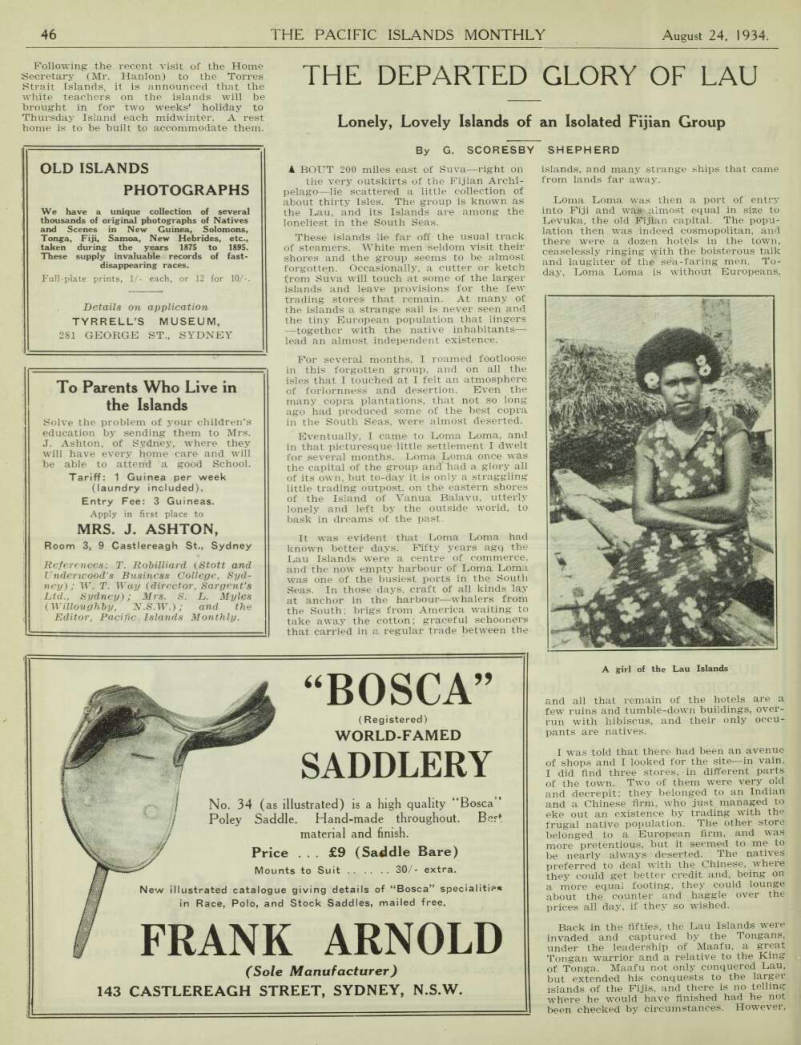
From Our Own Correspondent.
SUVA, July 20.
By a notice in the Gazette, the Hon.
Ratu Pope Epeli Seniloli, M.L.C., announces that by deed poll he has assumed the name of Pope Epeli Cakobau, and will henceforth be known by that name. Cako bau was the name of the last king of Fiji, Ratu Pope’s grandfather.
Following the recent visit of the Home Secretary (Mr. Hanlon) to the Torres Strait Islands, it is announced that the white teachers on the islands will be brought in for two weeks' holiday to Thursday Island each midwinter. A rest home is to be built to accommodate them.
Advertisements & other items, pp. 47-48 (1 item)
Petter Atomic Diesel
YOU CAN HAVE
EVERY CONFIDENCE
IN THESE
BUZACOTT LINES
Our reputation has been built cn quality and value.
BUZACOTT NEW
RECORD DRAG-SAW
Economical, speedy, and efficient, requiring little attention. Easy to handle, thoroughly built and wellbalanced.
‘ALSTON’ WINDMILLS
Priced to suit every pocket, these famous Windmills are noted for their strength and light running.
GILCO ELECTRIC
PLANT
Wind-driven, providing free electricity, no fuel costs —minimum of attention, fully guaranteed.
‘BUZACOTT’ SPRAY
PUMPS are reasonably priced, well-constructed and entirely reliable.
BUZACOTT GATES &
FENCES One of our “trump” lines. Recognised everywhere as the best procurable.
Prices are right.
PETTER ATOMIC DIESEL
Cold-Starting Heavy-Oil Engines, Stationary and Marine.
Marine Auxiliaries.
Electric Lighting Sets.
BUILT IN SIZES
UP TO 540 B.H.P.
The illustration shows the 42 B.H.P. Atomic Diesel Marine Oil Engine.
Atomic Diesel Engines, due to their absence of vibration and silent operation, combined with absolute reliability and low operating costs, are ideal for all power purposes. Their simple design, strong construction, and moderate speeds ensure maintained efficiency over long life. Of enclosed design, compact yet accessible, they are built for hard gruelling work.
The marked ascendency of the twostroke-cycle is demonstrated in the increasing demand for Atomic Diesel Engines.
Built by
PETTERS LTD., ENGLAND
Buzacott & Co Limited
Agents.
Spare Parts Stocked 7-11 Market Street
SYDNEY
AUSTRALIA
OLD ISLANDS
PHOTOGRAPHS
We have a unique collection of several thousands of original photographs of Natives and Scenes in New Guinea, Solomons, Tonga, Fiji, Samoa, New Hebrides, etc., taken during the years 1875 to 1895.
These supply invaluable records of fastdisappearing races.
Full-plate prints, 1/- each, or 12 for 10/-.
Details on application
TYRRELL’S MUSEUM,
281 GEORGE ST., SYDNEY
To Parents Who Live in
the Islands
Solve the problem of your children’s education by sending them to Mrs.
J. Ashton, of Sydney, where they will have every home care and will be able to attend a good School.
Tariff: 1 Guinea per week (laundry included).
Entry Fee; 3 Guineas.
Apply in first place to
MRS. J. ASHTON,
Room 3, 9 Castlereagh St., Sydney References: T. Robilliard (Stott and Underwood’s Business College, Sydney) ; W. T. Way ( director, Sargent’s Ltd., Sydney ); Mrs. 8. L. Myles (Willoughby, N.8.W. ); and the Editor, Pacific Islands Monthly.
“BOSCA"
(Registered)
WORLD-FAMED
SADDLERY
No. 34 (as illustrated) is a high quality “Bosca’
Poley Saddle. Hand-made throughout. Best material and finish.
Price ... £9 (Saddle Bare) Mounts to Suit 30/- extra.
New illustrated catalogue giving details of “Bosca” specialities in Race, Polo, and Stock Saddles, mailed free.
FRANK ARNOLD
(Sole Manufacturer)
143 CASTLEREAGH STREET, SYDNEY, N.S.W.
The Departed Glory Of Lau
Lonely, Lovely Islands of an Isolated Fijian Group
By G. Scoresby Shepherd
ABOUT 200 miles east of Suva —right on the very outskirts of the Fijian Archi pelago—lie scattered a little collection of about thirty Isles. The group is known as the Lau, and its Islands are among the loneliest in the South Seas.
These islands lie far off the usual track of steamers. White men seldom visit their shores and the group seems to be almost forgotten. Occasionally, a cutter or ketch from Suva will touch at some of the larger islands and leave provisions for the few trading stores that remain. At many of the islands a strange sail is never seen and the tiny European population that lingers —together with the native inhabitants — lead an almost independent existence.
For several months, I roamed footloose in this forgotten group, and on all the isles that I touched at I felt an atmosphere of forlornness and desertion. Even the many copra plantations, that not so long ago had produced some of the best copra in the South Seas, were almost deserted.
Eventually, I came to Loma Loma, and in that picturesque little settlement I dwelt for several months. Loma Loma once was the capital of the group and had a glory all of its own, but to-day it is only a straggling little trading outpost, on the eastern shores of the Island of Vanua Balavu, utterly lonely and left by the outside world, to bask in dreams of the past.
It was evident that Loma Loma had known better days. Fifty years ago the Lau Islands were a centre of commerce, and the now empty harbour of Loma Loma was one of the busiest ports in the South Seas. In those days, craft of all kinds lay at anchor in the harbour —whalers from the South; brigs from America waiting to take away the cotton; graceful schooners that carried in a regular trade between the
islands, and many strange ships that came from lands far away, Loma Loma was then a port of entry into Fiji and was almost equal in size to Levuka, the old Fijian capital. The popu lation then was indeed cosmopolitan, and there were a dozen hotels in the town, ceaselessly ringing with the boisterous talk and laughter of the sea -faring men. To day Loma Loma is without Europeans,
and all that remain of the hotels are a few ruins and tumble-down buildings, over run with hibiscus, and their only occu pants are natives.
I was told that there had been an avenue of shops and I looked for the site —in vain.
I did find three stores, in different parts of the town. Two of them were very old and decrepit: they belonged to an Indian and a Chinese firm, who just managed to eke out an existence by trading with the frugal native population. The other store belonged to a European firm, and was more pretentious, but it seemed to me to be nearly always deserted. The natives preferred to deal with the Chinese, where they could get better credit and, being on a more equal footing, they could lounge about the counter and haggle over the prices all day, if they so wished.
Back in the fifties, the Lau Islands were invaded and captured by the Tongans, under the leadership of Maafu, a great Tongan warrior and a relative to the King of Tonga. Maafu not only conquered Lau, but extended his conquests to the larger Islands of the Fijis, and there is no telling where he would have finished had he not been checked by circumstances. However,
A girl of the Lau Islands
he and his followers chose to remain in Lau, and it was at Loma Loma that he made his headquarters. There he reigned supreme as Tui Lau —King of Lau.
Even to-day, in Loma Loma, there is a complete Tongan colony, and they have their own village. In most of the Lau Islands the people are a mixture of Tongan
and Fijian blood —the descendants of the invaders who settled down and inter married with the Fijians. The Tongan strain is particularly noticeable in their features, and in complexion they are light —much lighter than the Fijians. Certainly they are superior, both in intellect and physique.
Among some of the smaller Islands I found that many of the younger natives regarded white men as an object of curiosity and, perhaps, it is because they have so seldom come into contact with Europeans in recent years that they are so unspoiled and have so many charms.
To me they were hospitable to a degree, and showed none of that cock-sureness that is so characteristic of their more sophisticated cousins on the larger Islands.
Near Vanua Balavu is the small but mountainous Island of Munia. It lies only about four miles east and, as seen from Loma Loma, Munia resembles the tur quoise or emerald tropical Isle of fiction, for it is exceedingly beautiful and domi nates the Lau group, towering far above the other low Islands. Its craggy summit rises to 1,000 feet above the sea and, if one can struggle up through the dense growth to the top, a wonderful view is obtained.
As far as the eye can see, tiny islands dot the coral seas, surrounded by reefs, crumbling walls of foam.
The second island of importance in the group is Lakemba. It lies nearly 40 miles south of Vanua Balavu and sometimes, if the day be clear, it can be seen on the horizon as a dull amethyst blur.
Lakemba, too, like Loma Loma, has seen better days. It was on this Island that the first missionaries landed in Fiji and introduced Christianity and, for many years, Lakemba was the headquarters of the Wesleyan Mission to the Fijian and Tongan groups. Now it is but the last outpost; only a solitary missionary re mains, and he leads a very lonely existence.
On Vanua Balavu a missionary was also stationed for many years but now he has
gone and his place will not be taken, ex cept by perhaps a native pastor.
Until several years ago, a little tramp steamer called at a few of the Lau ports monthly for the copra and, often, tourists were in the boat, anxious to get a glimpse of the wonderful Bay of Islands.
This famous little beauty spot lies far to the north of Loma Loma, on the extreme northern point of Vanua Balavu. By land it is very difficult to reach; one has to pass through dense virgin forests and the few tracks have been so neglected that the jungle has for long encroached upon them.
Still, the journey is worth while, for the islands are unimaginably beautiful. They lie scattered in a secluded bay; in numbers they are countless, and of a thousand fantastic shapes. Some of them are mere rocks and pinnacles, rising sheer from the clear, calm waters, while others are larger —miniature Islands —densely clothed with tropical verdure. And they are all in accessible, except to the sea birds which have made them their home.
To-day, there are scarcely a dozen Euro peans and educated half-castes living in the group—and their numbers are gradu ally dwindling. Those who remain are mostly planters, who have leased copra plantations.
The rich soil of the group produces wonderful crops of nuts; but, nowadays, owing to a stagnant market and prices that are down to bedrock, there is little induce ment for the planters to continue the struggle, for in Lau they have no other source of income apart from copra. Suva is far away, and freight is high.
On some of the Islands, cotton was once produced extensively, but that industry has long been dead, and now it is feared that the same fate will overtake copra.
With the passing of this industry the Lau Islands would become even more lonely.
Copra is their last link with “civilisation.”’
A Typical South Sea Island Beach—Loma Loma, Lau Group.
Advertisements & other items, pp. 49-50 (1 item)
Announcement to Merchants
Waterproofing
Solution
is now going to be sold to
the Island Trade
This product has been on the Australian market for the last two years, and has been exceptionally well received.
It is being used for the water-proofing of fabrics of all descriptions, such as: Canvas, Jute, Flax, Duck, Japara, Calico, and Sheeting.
The uses of T.W.H. on these various fabrics are Waterproof Coats, Tarpaulins, Cart Covers, Bowling Green Mats, Tents, Tent Flys, Awning Blinds, Tramway Blinds, Mail Bags, and Letter Carriers’ Bags, Canoes, and for all classes of Canvas and Duck. For Shipping, this solution has proved itself invaluable; Yacht Owners have also found this product excellent for all their Canvas work.
In Australia, we are at present supplying various Government Departments, who have given it exhaustive tests to prove the durability of the proofing and test the colors. We guarantee this product as a waterproofing solution and the colors which are fast.
We have no agents, at present, outside Australia and New Zealand, and should you be interested and desire further information and samples, write us direct, and we will only be too glad to supply you with any information you require.
TAYLOR WILLIAMS & HALLIDAY
180 Elizabeth Street, Sydney, N.S.W.
Branches in All States.
DRIVE YOURSELF
during your stay
in Sydney
in a 1934 Model Sedan at 6d per mile. Minimum from 15/ per day.
Write or cable, and we will reserve a car for you. Free Service all over N.S.W., with advantages enjoyed by N.R.M.A. members.
Martin’s Drive Yourself
Service
191 WILLIAM ST., SYDNEY
F 1092.
For a Pleasant Rest in the Blue Mountains, N.S.W.
“HOLMECROFT”
Centrally situated in Leura, near the famous Leura Golf-links.
An Ideal Situation for Islands Residents on Furlough Write for Details and Tariff to — The Proprietress
(MISS CARMEN HOLMES)
“Holmecroft,” Blackheath Street,
LEURA, N.S.W.
THERE ARE PAINTS AND
PAINTS!
BUT THERE IS ONLY ONE
FERRODOR PAINT
The value of a Paint is not its cost per cwt., or per gallon, not its covering capacity, but its efficiency as a protective coat for the surface to which it is applied. Cheap, inferior Paints cost just as much to apply as good Paint, but the labor cost is repeated within a year or two.
USE THE WORLD’S BEST ANTI-CORROSIVE PAINT
“FERRODOR”
It combines Long Life and great Covering Capacity, with Moderate Price.
It can be Supplied in Paste Form, or Mixed Ready for Use.
Full particulars and color card from
WILLIAM ADAMS & COMPANY
LIMITED
175 CLARENCE STREET, SYDNEY
Bishop’S Death
Rev. Dr. A. Raucaz
AFTER 30 years of devoted mission work in the British Solomon Islands, Rev. Dr. Aloysius Raucaz, S.M., Titular Bishop of Telape, died in hospital in Sydney in July.
Dr. Raucaz arrived in Sydney by the Malaita on June 24, and was taken im mediately to the Mater Misericordiae Hospital, suffering from malarial fever.
His condition became very serious, and he passed away on July 22.
Born in France in February, 1878, he received his early education at Mount Ducon Preparatory school, and, later, studied for the priesthood at Belley and Montbel. In 1902, he was ordained a member of the Marist Order.
Arriving in Sydney early in this cen tury, he was appointed to the Catholic Mission’s headquarters at Visale, in the South Solomon Islands, as the Group was then known. For 17 years he was engaged in valuable missionary work on Malaita, New Georgia, Florida, San Cris toval, Ysabel, and Guadalcanal. On the death of Rev. Dr. J. E. Bertreux in 1920, he was consecrated Bishop of the British Solomon Islands at Hunter’s Hill, Sydney, by Archbishop Cattaneo.
He was an expert mechanic and en gineer, and helped to build the Cate chists’ school, which he founded at Tan garare. The Sacred Heart Cathedral at Visale and the new mission station at Malaita were both built under his direc tion.
Trade
Cook Is. Orange
From Our Own Correspondent.
Rarotonga, July 20.
OUT of 7500 cases of oranges shipped to Auckland from Aitutaki and Man gaia, by the Waikawa in May, only one per cent, of loss from bad fruit resulted.
The whole of the fruit was carried on deck. Market reports indicate that the fruit was well packed, and graded, and arrived in especially good condition.
A second shipment was made in July to Auckland per the Karetu. The quan tity, 25,137 cases, was made up as follows: Oranges, 21,609 (of this about 10,000 were from Rarotonga); bananas, 3216; and tomatoes, 312 cases. The shipment came from the five main islands of the Group.
Again the fruit arrived in excellent con dition. The losses worked out at about five per cent., which is very much better than last year, when some of the mail boat shipments resulted in losses of 40 per cent, from bad fruit.
So far this year some 30,000 cases of Cook Island oranges have been landed on the New Zealand market with less than 5 per cent, wastage.
Records Censored In
Tahiti
From Our Own Correspondent.
Papeete, June 29.
A GOVERNMENT notice of interest to merchants doing business with French Oceania appeared in the “Journal Officiel” of the Colony on May 16. According to this announcement the censorship hitherto
applying- to cinematograph films is now extended to cover the importation, cir culation, reproduction, and sale of vocal phonograph records. Such records must now be passed by the Commission of Censors appointed for the purpose.
It is understood that this measure has become necessary to prevent the dissemi nation of subversive propaganda, for which purpose phonograph records are being used in Europe and elsewhere.
Mrs. Gerald Hogan, wife of Major Hogan, Crown Law Officer of New Guinea, is returning to Rabaul, after a holiday spent with her sister. Mrs. H. W. Thomp son, of “The Firs,” Dundas, Sydney.
Advertisements & other items, pp. 51-52 (1 item)
Mcilrath’S
SAMUEL RUSSELL
ESTATE AND GENERAL AGENT.
P.O. Box 64, Papeete, Tahiti
Real Estate. Investments. Estate Management and Administration. Valuations and Reports. Houses and Lands for Lease or Sale, Sole Proprietor: TAHITI PERFUMES Cables; Russell, Tahiti (Bentley’s Code)
CERTAIN
DEATH
AUSOLINE
Never Known to Fail !
COCKROACH DESTROYER
It Attracts They Eat It They Die
AUSOLINE CO.
3U CROWN STREET, SYDNEY
Established 1919 PRICES : 1 lb. 5/-, 3 lbs 10/-. Postage Extra Remit Cash with Order
IT’S
PASTE
McILRATH’S
THE SYNONYM FOR SERVICE AND YOUR
GUARANTEE OF SATISFACTION
Australian I.A. Sugar, 35-lb. bags 8/- bag Australian I.A. Sugar, 70-lb. bags 14/6 bag Yoga Tea, choice blend, 1-lb 2/- pkt., 2/4 a tin Rosa Pure Coffee, 1-lb. tins 2/3 tin, 25/6 doz.
Rosa Baking Powder, 1-lb. tins 1/6 tin, 17/6 doz.
Nestle’s Pure Cream, 4-oz. tins 4d. tin, 3/9 doz.
Rosa Baked Beans in Sauce, 5-oz. tins ... 4d. tin, 3/9 doz.
Capital Mango Chutney, 11-oz. jars ... lid. jar, 10/9 doz.
Schooner Red Salmon, 2 -lb. tins 9d. tin, 8/6 doz.
Selmore Sockeye Salmon, 2 -lb. tins 1/- tin, 11/6 doz.
Dandy Maize Starch, 1-lb. boxes 7|d. box, 7/3 doz.
Selmore Toilet Paper, 5-oz. rolls 2d. roll, 1/10 doz.
Mcllrath’s Bath Soap, giant cakes 2½d. cake, 2/4 doz.
Emorna Carbolic Soap, giant cakes ... 3½d. cake, 3/3 doz.
Mixed Crown Soap, wrapped, 56’s or 72’s 24/6 case Mixed Crown Soap, unwrapped, 56’s or 72’s 23/6 case All Prices f.o.b. Sydney.
Export Price Lists available on application.
McILRATH’S LTD.
Export Department, 202 Pitt Street, Sydney, Australia.
A WELL-PROVEN
REMEDY FOR PILES
This preparation has been on the market for several months, and it has effected a Cure in every case in which it has been tried. Cases of Long Standing often Cured within One Month, with one bottle only.
For External Use only—Stainless, Painless and Odourless.
PRICE; 5/- PER BOTTLE. Posted, securely packed, for 6/9 per bottle. Copies of Testimonials forwarded on request.
Read the Report of an Eminent Analytical Chemist:
THE LABORATORY,
20 and 22 Napoleon Street, Sydney, March 14th, 1933.
ROBERT BRUCE, Esq.
Dear Sir,—The formula of your pile cure submitted to me could have no effect other than beneficial. I gave your sample to a Client who had suffered many years, and before he had used half the bottle he reported himself completely cured.
Faithfully yours,
GROVE JOHNSON, F.C.S. (Lend.),
Analytical and Consulting Chemist.
Supplies Obtainable from —
ROBERT BRUCE
Room 1, 2nd Floor,
15 Hunter Street, Sydney
and also at
14 UPPER BAYVIEW ST., NORTH SYDNEY.
SKIN DISEASES
Phenomenal Success of Chemist’s Secret Formula
By the use of his new Secret Formula in his various treatments, Mr. McHugh, M.P.S., Ph.C., Consulting Chemist and Skin Specialist, of 124 Liverpool Street, is able to assure pat ients suffering from all types of Skin and Scalp Diseases of a speedy and lasting recovery.
Mr. McHugh has become famous not only throughout Australia, but New Zealand, Pacific Islands, and even U.S.A. and England, for his successful treatment of Skin diseases, hitherto considered hopeless, as letters of gratitude (which may be seen at his rooms) from patients in all parts of the world testify. Here are a few extracts picked at random: — Your treatments have removed my Piles and Pruritis, and my wife after suffering for years from a Varicose Ulcer is most grateful, as it is now completely healed.
Mr. A.W., Macleay River.
I had even consulted Specialists, without result, my complaint being Tinea, but after using your treatment for three months I am pleased to say the complaint has completely vanished.
Mr. L. W., Kensington.
After having suffered from Psoriasis for fifteen years without finding a cure, a fellow traveller in London advised me to write to you. Having used your treatment for three months, the complaint disappeared, and eighteen months have now elapsed, and there has been no recurrence.
Mr. C.C.D.,
Hotel McAlpin, New York City.
Mr. McHugh has helped hundreds of patients, who have written him letters similar to the above, AND HE CAN HELP YOU. If you suffer from any of the following complaints: Eczema, Psoriasis, Germ under Nail, Varicose Veins and Ulcers. Tropical Ringwork (Tinea), Barber’s Rash, Dandruff, Ringworm, Acne, Pruritis, Chilblains, Rosacea, and any other distressing skin diseases, write to (enclosing stamped envelope) or call on Mr. McHugh, and he will be glad to advise you.
Specialist in curing Tropical Ringworm and all Tropical Skin Diseases.
JOHN J. McHUGH, M.P.S., Ph.C., Consulting Chemist and Skin Specialist, Ist Floor, 124 Liverpool Street (opp. Snow’s), Sydney. ’Phone: MA5028. Consulting hours are from Monday to Friday, 10 a.m. to 5 p.m.; Saturday 9 a.m. to 12 noon; Tuesdays and Fridays, 7 p.m. to 9 p.m. Consultations free.
Solomon Islands News
Interest in New Trade Tobacco
From Our Own Correspondent.
TULAGI, August 2.
SETTLERS in the Islands are awaiting with interest a trial shipment of Aus tralian tobacco for ration use and sale to natives, which is now on the market.
Owing to the preferential tariff, this tobacco should land much cheaper than the American brands now in use. Being cheaper, large quantities will probably be sold and used, so that in spite of the lighter duty, the revenue stands quite a chance of a slight increase, owing to in creased importations.
The whole question is—Will the natives take to the Australian tobacco? All plan ters who have tried improvements in the way of diet, and like innovations, know how stubbornly suspicious the native is, and how opposed to anything he is not used to. As a ration the employer qould issue it, but if offered for sale and not found acceptable to the native, its im portation for trade purposes ends.
It is to be hoped that the manufac turers of this tobacco have been success ful in producing an article acceptable to the natives; if so, the community will re ceive it with open arms, and rejoice that more business is going to Australian pro ducers.
An auction room is now in course of erection at Tulagi. Although the com munity is small, several successful auc tion sales have taken place in temporary premises, and it is remarkable how the idea has taken on. The depression, com pelling sellers to realize on any saleable assets, and buyers to seek goods where they can be obtained cheapest, has pos sibly interested the public, where pros perity would have! found folk indifferent.
Combined with the auction market is the Lending Library, of which the auc tioning is an offshoot. This Library is the only one available to the general public. These two enterprises add to the interest of life in our little capital, quite brightening our Saturday afternoons, and a little curiosity is felt as to the nature of Mr. Buchanan’s, next enterprise.
Handy to the auction mart, Stirling’s Hotel has come back to life, the restaur ant and residential section being now under the able management of Mrs. R.
Sims. It is now possible to obtain a real cup of tea, not to mention ice creams, and excellent meals, right in the centre of Chinatown.
Do these new enterprises and the re vival of Stirling’s Hotel —the very name of which suggests the good days—herald the departure of bad times?
A Missing Official.
Some concern was felt, in Shortlands district recently when Mr. Bartlett, the Acting District Officer, failed to return at the appointed time from a trip across Shortland Island, from Koravo, the Go vernment station, to Harapa Estate. Mr.
Seton, of Loping, manager of the Short land Estates, made his way to Harapa, and saw no trace of the launch which was to meet Mr. Bartlett and convey him back to Faisi. Consternation reigned in Faisi, and a launch was about to be des patched to Kieta, to send a wireless to Tulagi, when the wanderers, having got the launch to go, returned.
Death Of Mr. C. E. Minns
At about 3 a.m. on Saturday, May 5th, Mr. C. E. Minns, a settler of over ten years’ standing, passed away in a Chinese hut on Tulagi waterfront. Mr. Minns served with the A.I.F., and, later, while resident in the Solomons, did his bit in the Sinarangs Expedition. He arrived in the Group “with a bump,” as he used to say, when the “Forest Home,” one of the American sailing ships which started the direct overseas export of copra, hit the reef at Pari Pili. It looked for a while as if the ship would remain in the Group, but fortunately she floated off, and when they got to Tulagi, it was Mr. Minns who decided to remain. He had numerous schooner and shore jobs in the decade or so he lived here, having tried trading ashore and afloat, recruiting, freight and plantation management; and in intervals of unemployment he earned what he could at sail making and similar jobs. A red-letter day was that on which he won £2000 in an Australian consultation.
When compelled by ill-health to reside at Tulagi where he could be a hospital outpatient, Mr. Minns with characteristic independence and self-reliance, took up his residence under a humble Chinese roof and eked out a living at boot repairing, tallying, and any odd job that turned up which his bad arm permitted him to
tackle. A week or so before his death Mr. Minns had suffered injury to his arm from a stone thrown by a native. The offender was to have been tried on the day Mr. Minns passed away. No trial was held.
Escape Of Southern Cross.
The Melanesian Mission’s motor ship, “Southern Cross,” at one time, looked like emulating her predecessor, which was wrecked before she ever reached the Solomons. She arrived from a tour of the diocese, and anchored at Tulagi. The south-east weather has lately been very bad, most of the vessels usually anchor ing in Tulagi Harbour having run to shel ter at Ellis Cove. The “Southern Cross,” anchored off Chinatown, began to drag, and the ship was within a few yards of going ashore on the Celestial waterfront.
Perhaps she was envious of the remains of the “Wyalong,” now a romantic skeleton in front of W. R. Carpenter’s store. How ever, the engine started more promptly than ever before in its brief existence, and the vessel got away just in time. She went to Makambo wharf and made fast for the rest of the blow.
Tulagi Hotel Burned
Another fire has taken place in the Solomons. At 12 p.m. on the night of July 27th, Elkington’s Hotel blazed up, and was burnt to the ground. The build ing was a fairly old one, and featured largely in the social life of Tulagi. Tour ists to the Islands will all have recol lection of dances held there every steamer, and planters and traders, par ticularly married men, who have been accustomed to depend on the hotel to stay at steamer time, and during other visits to Tulagi, will greatly miss the place. All old Islanders will remember the late Mr. T. Elkington and his “pub” as a feature of the township. The Hotel was owned by Messrs. Johnson and Ma ther, and was under the able management of Mr. and Mrs. W. K. Fyfe.
For the last year or so, fires have been very prevalent, over a wide area; in a couple of decades in the past, not so many fires have taken place—not since the natives dropped their cheerful habit of burning up trading stations. Settlers wonder whether the present recurrence is a result of a reversion to type on the part of the natives. Fires of the last year or so have included valuable copra driers and sheds, Burns Philp’s quarters at Makambo, and now the hotel.
Cars For Islanders On
Furlough
A modern “drive yourself” car service, using late model Chevrolet sedans, is now available for visitors to Sydney. The proprietor, who is well known in Sydney’s motor trade, is Mr. Martin Justelius and his headquarters are at 191 William Street, Sydney.
By a convenient arrangement with the Sydney N.R.M.A., hirers of the Martin service cars auto matically become members of that association and enjoy full membership privileges.
Cannibalism In New Hebrides
New Hebrides
AS a result of fierce inter-tribal war fare and gross immorality the natives of Malekula, New Hebrides, are a rap idly disappearing race, was the opinion expressed by Pastor W. G. Turner, chair man of the S.D.A. missions, on his return to Sydney from a tour of the Group.
“Only recently,” said Mr. Turner, “seven Malekula natives were killed and eaten by the rival Tinambet tribesmen.”
He said that shortly after the mission party had visited Malekula in a ketch, the Tinambet tribesmen came out of the bush and threatened the life of the S.D.A. mission teacher and his family. The teacher, with some natives from the sta tion, put to sea in a dinghy and remained absent from the station all night. Un able to find him when they surrounded the mission house, the Tinambet men went to Malua Bay and there burnt and des troyed a native village.
On Santo, the largest island of the Group, natives from an adjoining village recently raided a tribe living near Big Bay and after a wild fight were driven off, but not before three Big Bay natives had been killed. This district was wrecked by a tidal wave in March last, which did incalculable damage. The mis sion was destroyed and the plantation of a white man was completely wiped out. So great was the force of the tidal wave that it swept away part of the coastline.
S.D.A. Mission
Trading Company And
In the Federal Parliament at the end of July references were made to the S.D.A. mission and its Sanitorium Health Food Company of Sydney.
Mr. Casey (Assistant-Treasurer) com plained that the Health Food Co. was ob taining unfair advantage over other firms by trading as a religious body. Another member said the company was exempt from Federal, State and land taxation on that account. He alleged that the profits of the
company were expended in missionary work in the Islands and so did not provide work in other industries.
On behalf of the Sanitorium Health Food Co. it was stated that though the firm did not pay certain taxation, the profits were applied to beneficial medical and educa tional work in the South Seas.
Advertisements & other items, pp. 53-54 (2 items)
Clobex
Sydney Marine Agency
Brokers for the Sale or Purchase or Construction of Luggers, Schooners, Ketches, Cruisers, Yachts, Launches, Speed Boats, Engines, Equipment, etc.
Prices range from £100 to £1000.
Send for our Price List.
Sydney Marine Agency
72 PITT STREET, SYDNEY.
Works: Lavender Bay.
CLOBEX
(GLOBE BEEF EXTRACT)
CLOBEX
FOR GOOD BEEF TEA
CLOBEX
FOR SOUPS & GRAVIES
CLOBEX
DELICIOUS SPREAD THINLY ON BREAD
Obtainable in 2oz. jars and in 4 and 8 oz. containers Obtainable from All Island Traders
ASK FOR IT
ESTABLISHED 1868.
For all the needs of Industry
Kookaburra
Products
are outstandingly superior for Welder, Engineer, Garageman and Householder.
Welding Accessories, Rods, Fluxes, etc.
Antifriction White Metals, Surface Hardening, Pipe Joint and Valve Grinding Compounds. Iron Cements, Belt Drivings, etc. etc.
Descriptive Price List on request from
Head Office:
61-65 LANDER ST., REDFERN
Applications invited for Agencies.
W. HOLMES
YACHT AND BOATBUILDER
All Classes of Islands Vessels a Speciality.
Sole Agent “R.N.” DIESEL MARINE ENGINES.
SEND FOR PARTICULARS.
McMAHON’S POINT SYDNEY
Cable Address: “HOLMAC,” Sydney.
Do You Know that the Famous
“YOUNGER”
STOVES AND
RANGES
made with extended Firebox specially for long Wood fuel, are Self-Setting and, provided sufficient Flue Piping is attached, can be used in almost any position?
The No 7W. “Younger” Range can now be supplied fitted with Legs, as per Ask for quotation for this Range, also Illustrated Catalogue and Price List for both Single and Double Oven Stoves.
Younger Stoves are Widely Used Throughout the Pacific Islands.
G. FLETCHER & SON 50 Oxford Street, Sydney
M. Harper
MANDOLIANA ISLAND,
NORTH GELA, B.S.I.
Postal Address: P.O. Box 6, Tulagi, Solomon Islands.
Recruiting Contracts Undertaken.
Auxiliary vessel “Papari” available for Charter.
Full details of Services from
BURNS PHILP (S.S.) CO., LTD.,
Makambo (B.S.I.) and Sydney.
Samoan Mau
Inclined To Demand Full Pardon For Taisi
From Our Own Correspondent.
APIA, July 3.
THE decision in the Nelson appeal case has at last been received here, and has not caused any surprise or excite ment amongst residents. Few, if any, Europeans here have believed that the appeal would be successful, but the con siderable delay in pronouncing the deci sion, which has been explained by the complexity of the legal questions in volved in the case, has been causing a lot of comment.
For a considerable time rumours were afloat amongst the Samoan natives that the appeal would succeed and that Nel son would be allowed to return to Samoa as a free man. The decision, however, un deceived the Mau adherents.
A large faction is now in favour of appealing to the Governor-General (Lord Bledisloe) and asking for a pardon for Nelson. If this were granted the Mau would be willing to meet the Administra tor in a conference and discuss an at tempt to come to a definite settlement regarding all outstanding differences.
This suggestion of the moderates, how ever, is strongly opposed by the “die hards” of the Mau Movement, who seem to be in the majority. At the time of writing, no decision has been reached.
Fiji Dictionary
Completion of Rev. W. A.
Heighway’s Work
From Our Own Correspondent.
SUVA, July 20.
AN article in the “Pacific Islands Monthly” of June, referring to the manuscript of a Fiji dictionary prepared by the late Rev. William Aitken Heigh way, and of which, it was stated, nothing had been heard since the death of Mr.
Heighway some years ago, when it was handed over to the Methodist Mission authorities in Suva, was referred to the Rev. R. L. McDonald, chairman of the Methodist Mission in Fiji, by the Fiji correspondent of this paper. Mr. Mc- Donald made the following statement: “This article is not altogether correct as to its facts. A committee was appoint ed by the Government of Fiji to revise Hazlewood’s dictionary, and, at the re quest of this committee, the Rev, Mr.
Heighway undertook a portion of that task. Other divisions of the work were undertaken by members of the Methodist Mission staff in Fiji. Mr. Heighway was unable to complete his work before his death, and his relatives have handed the documents to the Rev. C. O. Lelean to complete.
“Mr. Lelean just lately retired from work in Fiji, and is resident in Victoria, and we understand that he is now giving time to this work.
“Mr. Lelean was for over 30 years in the Methodist Mission in Fiji, in charge of the large Teachers’ Training Institute at Davuilevu, and, of course, in connection with his heavy duties there, work of such magnitude as the preparation of this dic tionary entailed could not be done in addition to his ordinary missionary duties.
“In the meantime stocks of Hazlewood’s dictionary are available in Fiji, and are adequate for all present needs.”
S.D.A. Conference In Fiji
The annual Fijian Conference of the Aus tralian Seventh Day Adventist Union was held at Nukualau, Fiji, early in July.
Pastor A. G. Stewart, Vice-president of S.D.A. missions, and Mr. R. H. Adair, secre tary of the Australian conference, both of Sydney, attended the meeting. Over 1000 native delegates were present at the con ference, which lasted five days.
Radiomen’s Adventurous Life
Young men who desire to pursue the even tenor of their ways and lead a steady, undisturbed existence should not study for the profession of radio. .
The business of radio operators takes them into far and little-known places. Some have pene trated into the wild inland jungle of New Guinea; others have circled the globe in palatial liners or grimy cargo steamers. The snowy wastes of An tarctica have echoed to the buzzing Morse of intrepid operators with Polar expeditions. In high mountains, on lonely Island outposts, flying in gigantic ’planes across desert, land and sea, are to be found radio-men, maintaining communication with the outside world. Theirs is a life of glamour and adventure.
In 1913, Mr. E. T. Fisk, pioneer of wireless organization in Australia, realised the need tor thoroughly trained wireless operators and mechan ics. To meet the demand for qualified radio technicians, he founded the Marconi School ot Wireless in Sydney, and, since then, over 2,000 students have passed through the school and are scattered all over the world.
Persons interested in any phase of wireless in struction should write to the Marconi School ct Wireless, 97 Clarence Street, Sydney for a tree illustrated brochure entitled “Radio the Industry of the Future.”
The Motor’S Offsiders
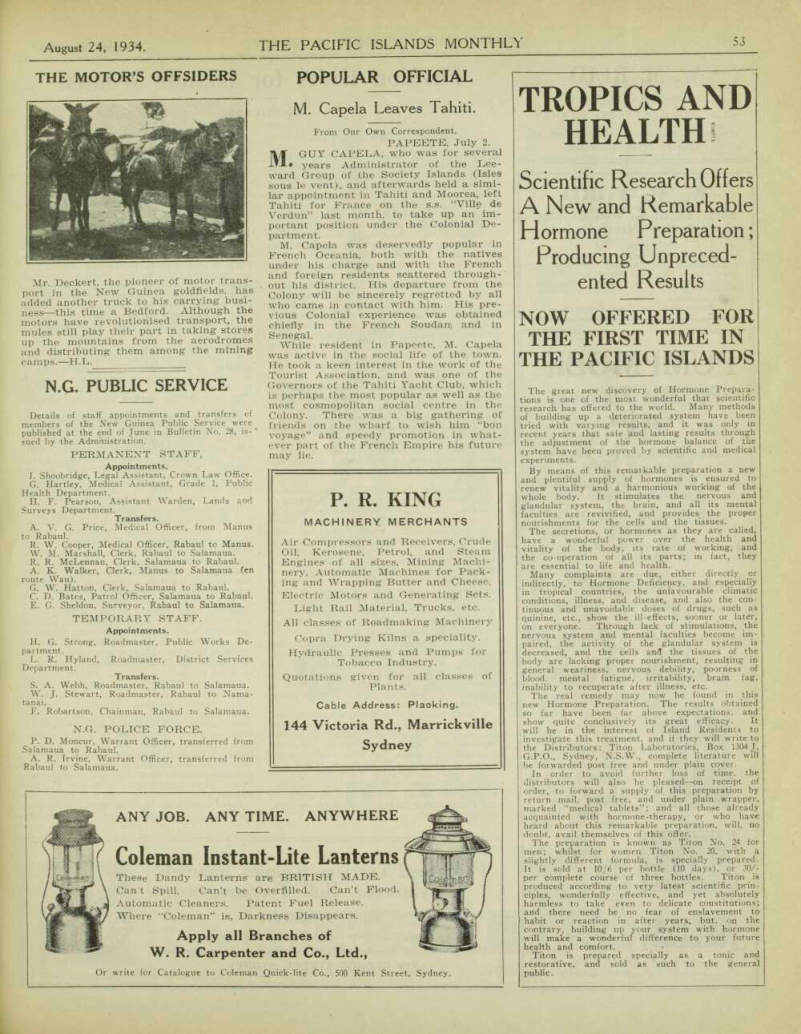
Mr. Deckert, the pioneer of motor trans port in the New Guinea goldfields, has added another truck to his carrying busi ness —this time a Bedford. Although the motors have revolutionised transport, the mules still play their part in taking stores up the mountains from the aerodromes and distributing them among the mining
camps.—H.L.
N.G. Public Service
Details of staff appointments and transfers of members of the New Guinea Public Service were published at the end of June in Bulletin No. 28, is sued by the Administration.
Permanent Staff,
Appointments.
I. Shoobridge, Legal Assistant, Crown Law Office.
G. Hartley, Medical Assistant, Grade 1, Public Health Department.
H. F. Pearson, Assistant Warden, Lands and Surveys Department.
Transfers.
A. V. G. Price, Medical Officer, from Manus to Rabaul.
R. W. Cooper, Medical Officer, Rabaul to Manus.
W. M. Marshall, Clerk, Rabaul to Salamaua.
R. R. McLennan, Clerk, Salamaua to Rabaul.
A. K. Walker, Clerk, Manus to Salamaua (en route Wau).
G. W. Hatton, Clerk, Salamaua to Rabaul.
C. D. Bates, Patrol Officer, Salamaua to Rabaul.
E. G. Sheldon, Surveyor, Rabaul to Salamaua.
Temporary Staff.
Appointments.
H. G. Strong, Roadmaster, Public Works De partment.
L. R. Hyland, Roadmaster, District Services Department.
Transfers.
S. A. Webb, Roadmaster, Rabaul to Salamaua.
W. J. Stewart, Roadmaster, Rabaul to Nama tanai.
F. Robartson, Chainman, Rabaul to Salamaua.
N.G. Police Force.
P. D. Moncur, Warrant Officer, transferred from Salamaua to Rabaul.
A. R. Irvine, Warrant Officer, transferred from Rabaul to Salamaua.
Popular Official
M. Capela Leaves Tahiti.
From Our Own Correspondent.
Papeete, July 2.
M. GUY CAPELA, who was for several years Administrator of the Leeward Group of the Society Islands (Isles sous le vent), and afterwards held a simi lar appointment in Tahiti and Moorea, left Tahiti for France on the s.s. “Ville de Verdun” last month, to take up an im portant position under the Colonial De partment.
M. Capela was deservedly popular in French Oceania, both with the natives under his charge and with the French and foreign residents scattered through out his district. His departure from the Colony will be sincerely regretted by all who came in contact with him. His pre vious Colonial experience was obtained chiefly in the French Soudan, and in Senegal.
While resident in Papeete, M. Capela was active in the social life of the town.
He took a keen interest in the work of the Tourist Association, and was one of the Governors of the Tahiti Yacht Club, which is perhaps the most popular as well as the most cosmopolitan social centre in the Colony. There was a big gathering of friends on the wharf to wish him “bon voyage” and speedy promotion in what ever part of the French Empire his future may lie.
Tropics And
Health!
Scientific Research Offers A New and Remarkable Hormone Preparation; Producing Unpreced ented Results
Now Offered For
The First Time In
The Pacific Islands
The great new discovery of Hormone Prepara tions is one of the most wonderful that scientific research has offered to the world. Many methods of building up a deteriorated system have been tried with varying results, and it was only in recent years that safe and lasting results through the adjustment of the hormone balance of the system have been proved by scientific and medical experiments.
By means of this remarkable preparation a new and plentiful supply of hormones is ensured to renew vitality and a harmonious working of the whole body. It stimulates the nervous and glandular system, the brain, and all its mental faculties are revivified, and provides the proper nourishments for the cells and the tissues.
The secretions, or hormones as they are called, have a wonderful power over the health and vitality of the body, its rate of working, and the co-operation of all its parts; in fact, they are essential to life and health.
Many complaints are due, either directly or indirectly, to Hormone Deficiency, and especially in tropical countries, the unfavourable climatic conditions, illness, and disease, and also the con tinuous and unavoidable doses of drugs, such as quinine, etc., show the ill-effects, sooner or later, on everyone. Through lack of stimulations, the nervous system and mental faculties become im paired, the activity of the glandular system is decreased, and the cells and the tissues of the body are lacking proper nourishment, resulting in general weariness, nervous debility, poorness of blood mental fatigue, irritability, brain fag, inability to recuperate after illness, etc.
The real remedy may now be found in this new Hormone Preparation. The results obtained so far have been far above expectations, and show quite conclusively its great efficacy. It will be in the interest of Island Residents to investigate this treatment, and if they will write to the Distributors: Titon Laboratories, Box 1304 J, G.P.O., Sydney, N.S.W., complete literature will be forwarded post free and under plain cover.
In order to avoid further loss of time, the distributors will also be pleased—on receipt of order, to forward a supply of this preparation by return mail, post free, and under plain wrapper, marked “medical tablets”; and all those already acquainted with hormone-therapy, or who have heard about this remarkable preparation, will, no doubt, avail themselves of this offer.
The preparation is known as Titon No. 24 for men; whilst for women Titon No. 20, with a
slightly different formula, is specially prepared.
It is sold at 10/6 per bottle (10 days), or 30/per complete course of three bottles. Titon is produced according to very latest scientific prin ciples, wonderfully effective, and yet absolutely harmless to take even to delicate constitutions; and there need be no fear of enslavement to habit or reaction in after years, but, on the contrary, building up your system with hormone will make a wonderful difference to your future health and comfort.
Titon is prepared specially as a tonic and restorative, and sold as such to the general public.
Advertisements & other items, p. 55 (1 item)
Coleman Instant-Lite Lanterns
P. R. KING
MACHINERY MERCHANTS
Air Compressors and Receivers, Crude Oil, Kerosene, Petrol, and Steam Engines of all sizes, Mining Machinery, Automatic Machines for Packing and Wrapping Butter and Cheese.
Electric Motors and Generating Sets.
Light Rail Material, Trucks, etc.
All classes of Roadmaking Machinery Copra Drying Kilns a speciality.
Hydraulic Presses and Pumps for Tobacco Industry.
Quotations given for all classes of Plants.
Cable Address: Plaoking.
144 Victoria Rd., Marrickville
Sydney
ANY JOB. ANY TIME. ANYWHERE
Coleman Instant-Lite Lanterns
These Dandy Lanterns are BRITISH MADE.
Can t Spill. Can’t be Overfilled. Can’t Flood.
Automatic Cleaners. Patent Fuel Release.
Where “Coleman” is, Darkness Disappears.
Apply all Branches of
W. R. Carpenter and Co., Ltd.,
Or write for Catalogue to Coleman Quick-lite Co., 500 Kent Street, Sydney.
Fashion Hints for Islands Women
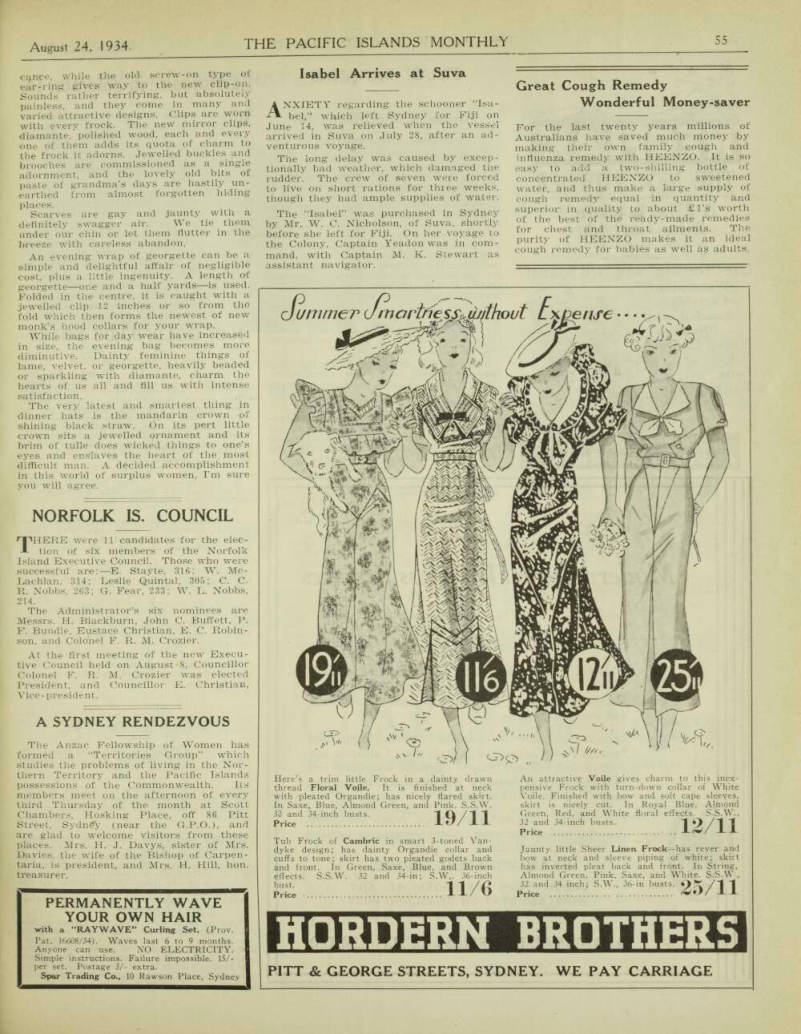
By Therese.
“O woman in her hour of ease, Uncertain, coy and hard to please.”
SURELY the disgruntled meanderings of a mere male, and yet—perhaps the cry of the Couturier as he searches wildly for something different and entirely char ming to present to “My Lady of Fashion.”
“Nothing new under the sun,” ’tis said, so he turns to the Victorian era, and gives us ruffles —ruffles of black net on coloured evening gowns, bustles in many shapes and forms, and demure high necklines achieved in the most subtle way.
The Orient brings inspiration and all the atmosphere of old China is captured in the glorious new printed silks. They come to us, too, as beautiful as a Japa nese garden—brilliant poppies on a black background, exquisite wistaria on a ground of deeper mauve, cherry blossoms, and a thousand breath-takingly lovely designs. The Oriental silhouette is achieved by the Coolie hat, mandarin sleeves on a tunic blouse, and the even ing wrap with kimono sleeves.
Bamboo buttons trim our newest clothes and in fear and trembling since we know not what they mean, we add a button with Chinese characters to our sports frocks and hope against hope that its quaint let tering spells just “chic.”
The Directoire mode presents itself with dashing tricorne, bows thrust under the chin, and capes of every variety for every occasion.
Taffetas are staging a delightful come back, but in a new and supple variety; and from the top of her shining head to the tips of her little toes, Miss Moderne goes taffetas clad. On her curling locks sits a tartan taffetas hat of tremendous chic. Spring is in the air as the golden blonde tucks in her waist a bunch of daf fodils and rustles joyously in a gown of green flaring wide at the hem line. Her more vivid brunette sister pins her faith to a gown of flaming red —a glamorous affair —its petalled train swirling allur ingly like some exotic tropical flower.
Surely a season of beauty!
There is glorious movement about our clothes. They are excitingly and adven turously alive —swishing trains, flying wings, swirling skirts, flung back move ments —not a dull moment. Is it not to be wondered then that we cry with glori ous abandon “Away, dull care”?
A combination of perfect simplicity and elaboration is achieved with a dull angel skin crepe of startling simplicity in cut, embroidered with irridescent sequins, gleaming and glittering with every move ment. A diaphanous frock of black and white tulle, so mistily beautiful that it must have been woven by the goddess “Freya,” is lifted to further heights by tiny rhinestones lightly scattered —a dew spangled cloud.
Beads and sequins appear on almost everything for evening, while sequin scarves and capes add a joyous touch to the plain well-cut frock. Rows of sequins trim our tunics and the gauntlets of our evening gloves. Ice-blue satin is the choice of the very fair maid, who thus clad becomes a Nordic princess. Rock crystals further enhance the illusion.
In these days of frills and yet more frills, the afternoon-cum-evening gown enjoys a well earned popularity. It is a charming little affair, boasting separate frills attached to an underslip which lat ter discarded, leaves the frock the correct length for afternoon wear. A little coatee, long of sleeve, hides the low decolletage, and we saunter forth to afternoon parties with smug self-satisfaction that comes from the knowledge of something achieved.
The tunic dress is one of dual persona lity, too. Silks, linens, cottons, go to the making of this extremely useful garment.
So little material is required for its skirt which may be made on a lining, a further economy which makes constant change possible.
Cool, fresh and summery are the new cotton materials. Charming plaid designs, florals, spots, stripes mean all-day chic and joy for thos£ of limited means. Cot tons once again mean chic for festive hours. Gaily scattered flowered cottons are swathed at the waist, kimono-like with a wide sash of vivid coloured silk to tone, and are successful beyond one’s wildest dreams for evening* wear.
Accessories are more important than ever. Belts are made of almost every thing conceivable —wool, string, straw, furniture webbing, or gold and silver cords are knotted together carelessly and they give a new lease of life to a frock just losing its first freshness. The floral bib is a new and delightful accessory. It is a little jabot-like affair, massed with flowers. The effect is charming over a plain silk frock, and it can be adapted to both day and evening wear with unquali fied success. While pique collarettes, tailored flowers of the same crisp material add freshness to a slim tailored frock, be it wool or silk.
Gloves again claim our attention. They are made of every variety of material with varied success. Blue and white spotted gloves with blouse and a pert little hat of the same shading and design lend an air of difference to a white linen suit, while a brown blouse of organdie does surprising things to the same suit.
Gloves, shoes and hat also match, and the result is delightfully cool and attrac tive. Try it, and you will not be dis appointed.
Bead necklets, in fact necklets of any variety, have almost faded into insignifl
once, while the old screw-on type of ear-ring gives way to the new clip-on.
Sounds rather terrifying, but absolutely painless, and they come in many and varied attractive designs. Clips are worn with every frock. The new mirror clips, diamante, polished wood, each and every one of them adds its quota of charm to the frock it adorns. Jewelled buckles and brooches are commissioned as a single adornment, and the lovely old bits of paste of grandma’s days are hastily un earthed from almost forgotten hiding places.
Scarves are gay and jaunty with a definitely swagger air. We tie them under our chin or let them flutter in the breeze with careless abandon.
An evening wrap of georgette can be a simple and delightful affair of negligible cost, plus a little ingenuity. A length of georgette—one and a half yards—is used.
Folded in the centre, it is caught with a jewelled clip 12 inches or so from the fold which then forms the newest of new monk’s hood collars for your wrap.
While bags for day wear have increased in size, the evening bag becomes more diminutive. Dainty feminine things of lame, velvet, or georgette, heavily beaded or sparkling with diamante, charm the hearts of us all and fill us with intense satisfaction.
The very latest and smartest thing in dinner hats is the mandarin crown of shining black straw. On its pert little crown sits a jewelled ornament and its brim of tulle does wicked things to one’s eyes and enslaves the heart of the most difficult man. A decided accomplishment in this world of surplus women, I’m sure you will agree.
Advertisements & other items, p. 56 (2 items)
Lloyd’s Teas
W. M. REID
C/o Robert Reid & Co., Ltd.
32-34 YORK STREET, SYDNEY
Wholesale Exporter of Goods of all Classes from Australia
W. M. FORD
Ship, Yacht & Boat Builder
Berry’s Bay, North Sydney
(Established 1878.) BUILDERS of all kinds of Island Craft from Dinghies to Auxiliary Schooners of any tonnage. New and Second-hand Island Craft of various types in stock. New and Second-hand Full Diesel, Crude Oil. Benzine and Kerosene Engines.
Please Send on Your Enquiries.
PUMPMOBIL
Portable Pumping
Plant
Equipped with carrying handles.
Total weight 120 lbs. 4½ h.p. Engine, direct coupled to 3 Centrifugal Pump.
All Heads up to 100 Feet, 50lbs. Pressure.
Especially Suitable for Sluicing and Mining.
Nelson & Robertson
12 SPRING STREET, SYDNEY.
Lloyd’s Teas
Tea drinkers expect more than a mere drink.
That easy, relaxed feeling, that sense of contentment and glow of real satisfaction must be there . . . not once in a while, but with every cup.
Try Lloyds for purity. Try the consistent goodness of quality tea. Try the delicious aroma that is such a feature of Lloyd’s tea blending.
Obtainable at all good island stores.
Pedigreed Terriers, Kelpies, Spaniels,
FOR
Greyhounds, Bull Terriers, etc.
Write GEO. F. SMITH
(Judge for Many N.S.W. Dog Societies) Dealer in All Kinds of Live Animals. Zoos Supplied.
777 GEORGE STREET, SYDNEY.
Norfolk Is. Council
THERE were 11 candidates for the election of six members of the Norfolk Island Executive Council. Those who were successful are: —E. Stayte, 316: W. Mc- Lachlan. 314; Leslie Quintal, 305; C. C.
R. Nobbs, 263; G. Fear, 233; W. L. Nobbs, 214.
The Administrator’s six nominees are Messrs. H. Blackburn, John C. Buffett, P.
F. Bundle, Eustace Christian, E. C. Robin son, and Colonel F. R. M. Crozier.
At the first meeting of the new Execu tive Council held on August-8, Councillor Colonel F. R. M. Crozier was elected President, and Councillor E. Christian, Vice-president.
A Sydney Rendezvous
The Anzac Fellowship of Women has formed a “Territories Group” which studies the problems of living in the Nor thern Territory and the Pacific Islands possessions of the Commonwealth. Its members meet on the afternoon of every third Thursday of the month at Scott Chambers, Hosking Place, off 86 Pitt Street, Sydney (near the G.P.O.), and are glad to welcome visitors from these places. Mrs. H. J. Davys, sister of Mrs.
Davies, the wife of the Bishop of Carpen taria, is president, and Mrs. H. Hill, hon. treasurer.
Isabel Arrives at Suva
ANXIETY regarding the schooner “Isa bel,” which left Sydney for Fiji on June 14, was relieved when the vessel arrived in Suva on July 28, after an ad venturous voyage.
The long delay was caused by excep tionally bad weather, which damaged the rudder. The crew of seven were forced to live on short rations for three weeks, though they had ample supplies of water.
The “Isabel” was purchased in Sydney by Mr. W. C. Nicholson, of Suva, shortly before she left for Fiji. On her voyage to the Colony, Captain Yeadonwas in com mand, with Captain M. K. Stewart as assistant navigator.
Wonderful Money-saver
Great Cough Remedy Wonderful Money-saver
For the last twenty years millions of Australians have saved much money by making their own family cough and influenza remedy with HEENZO, It is so easy to add a two-shilling bottle of concentrated HEENZO to sweetened water, and thus make a large supply of cough remedy equal in quantity and superior in quality to about £1’s worth of the best of the ready-made remedies for chest and throat ailments. The purity of HEENZO makes it an ideal cough remedy for babies as well as adults.
Advertisements & other items, pp. 57-58 (2 items)
Hordern Brothers
Summer Smartness without Expense ...
Here’s a trim little Frock in a dainty drawn thread Floral Voile. It is finished at neck with pleated Organdie; has nicely flared skirt.
In Saxe, Blue, Almond Green, and Pink. S.S.W. 32 and 34-inch busts. 19/11 Tub Frock of Cambric in smart 3-toned Vandyke design; has dainty Organdie collar and cuffs to tone; skirt has two pleated godets back and front. In Green, Saxe, Blue, and Brown effects. S.S.W. 32 and 34-in; S.W,. 36-inch Price 11/6 An attractive Voile gives charm to this inexpensive Frock with turn-down collar of White Voile. Finished with bow and soft cape sleeves, skirt is nicely cut. In Royal Blue, Almond Green, Red, and White floral effects. S.S.W., 32 and 34-inch busts.
Price ... 12/ 11 Jaunty little Sheer Linen. Frock— has rever and bow at neck and sleeve piping of white; skirt has inverted pleat back and front. In String, Almond Green, Pink, Saxe, and White. S.S.W , 32 and 34 inch; S.W., 36-in busts.
Price 25/11
HORDERN BROTHERS
PITT & GEORGE STREETS, SYDNEY. WE PAY CARRIAGE
THE NEW POWDER
A 2¾in. Load In A
2½in. Cartridge
Without Excessive Pressure or Jarring of Recoil Use “Duxbac” and “Icil Special”
Waterproof Cartridges Loaded with “Neoflak”
Heavy Loads For Long Range
OBTAINABLE EVERYWHERE
AT POPULAR PRICES
Use-
Modern Direct Wireless Services
for Your Communications With Australia and Overseas.
DIRECT WIRELESS SERVICES are available for inter-communication between the Islands of the Pacific and for traffic between the Islands and Australia and overseas countries.
Services are now in operation between Papua and Sydney, New Guinea and Sydney, New Caledonia and Sydney, and Fiji and Sydney. Speedy, economical and efficient service to Australia and overseas. Route your traffic “Via the Wireless Service.”
For overseas traffic to Great Britain, North and South America, and all European countries, route your message via the Direct Australian
BEAM WIRELESS SERVICE
LODGE YOUR MESSAGES AT ANY
WIRELESS STATION OR ISLAND POST
OFFICE ROUTED “VIA WIRELESS.”
AMALGAMATED WIRELESS (A SIA) LIMITED
Permanently Wave
YOUR OWN HAIR
with a “RAYWAVE” Curling Set. (Prov.
Pat. 16608/34). Waves last 6 to 9 months.
Anyone can use. NO ELECTRICITY.
Simple instructions. Failure impossible. 15/per set. Postage 3/- extra.
Spar Trading Co., 10 Raw son Place, Sydney
Fijian Bananas
Australia Can Make “No Further Concessions”
THE Federal Government has abandoned a proposal which was under consideration in March to grant further concessions on the importation of bananas from Fiji. Under the Ottawa agreement the duty on Fijian bananas was reduced to 2/6 a cental, and this rate has been in operation for some time. Early this year, in response to representation from the Fijian Government, the Federal Minis try agreed to consider further conces sions. It has now been decided that the present duty will be retained.
The next move is up to Fiji—and, prob ably, it will not be long in coming, in the shape of a tariff which will knock corners off Australian goods customarily sold to Fiji.
This latest decision regarding Fiji bananas is made by the Australian politi cians who have one eye on the coming election, and the other on the Australian banana-growers.
Australia howls continually for “over sea markets”; but she never will get worth-while markets while professional politicians are allowed to exercise the functions of national economists.
Earthquake in Solomon Is.
WHAT is described as the worst earth quake in the history of the island occurred at Vanikoro, British Solomon Islands, on July 19.
Tremors commenced at midnight on Monday, July 16, and continued until Saturday, July 20.
All buildings on the island were badly damaged. The Vanikoro Kauri Timber Company suffered severe losses and much property and equipment were destroyed.
Though some of the inhabitants were thrown heavily to the ground, there were no casualities. The natives at the first signs of an upheaval left the foreshores and fled into the bush.
The above particulars were received by radio at the end of July, but no further details have reached Sydney.
N.G. Goldfields Notes
From Our Own Correspondent.
WAU, July 27.
There has been a sensation here by the “clean ing up” of the gold stealers on the Creek, and other mining centres, since Detective Costello’s arrival.
Many well-known citizens are concerned and the “exodus” South of these people has begun. Sev eral deportations have taken place, of persons considered undesirable, and in future those desir ous of entering the Mandated Territory will be subjected to severe examination relative to char acter, financial status, etc.
Mr. Otto Rossitor, of Wau, is still in Brisbane, and at present his sister, Lady Barraclough, is spending some weeks with him.
Mr. Livingstone and his wife went South by last Macdhui, en route for Tanganyika, West Africa.
They will be greatly missed, for they have en deared themselves to all whom they met.
Mr. Hunter Kirke’s new venture of a market garden, orchard, and poultry farm, at Wau, is well on its way and will prove a boon.
Mr. “Nobby” Clarke, his wife and three ador able children arrived back from Sydney during July and will make their home at “The Merri.”
Small daughter Heather says she is hot afraid, now of the “black mens.”
Even though so far removed from the world centres, Day Dawn men, through the courtesy of N.G.G., were able to listen in to the Test Matches.
Miss Thelma Anderson is on her way South, trousseau-collecting, for on her return she will be married to “Young” Dave Lyall, at Wau.
The Hotel at Upper Edie, now being built by the Parers, is nearing completion, and should be open for guests in the near future.
Edie Creek’s Cricket Tea had a great old week end at Salamaua recently, and gave cricket “fans” a treat —although no Don Bradman score eventu ated.
Wending their way South are the “Bob” Bunt ings, bound for Melbourne. A recent visitor to their “Idyllic Isle,” at Duini, stated it was as near to Arcadian bliss as this old world could furnish, and on their isle the Buntings were virtually un crowned King and Queen. Mrs. Bunting was the first white girl baby to be born at Samarai. Mr.
Bunting is a brother of the Hon. Arthur Bunting.
Hats are off to Pilot Mant, who arrived in New Guinea on August 3 at 10 a.m., after making the journey from Mascot, Sydney, in two days, un heralded and unsung, in a new twin-engine Dragon ’plane. Under contract to the Government, the Dragon will join the air-fleet of the New Guinea firm of W. R. Carpenter and Co., to carry mails, passengers and freight.
Advertisements & other items, p. 58 (1 item)
56
August 24, 1934.
THE PACIFIC ISLANDS MONTHL.Y
Wau Remembers Anzac Day
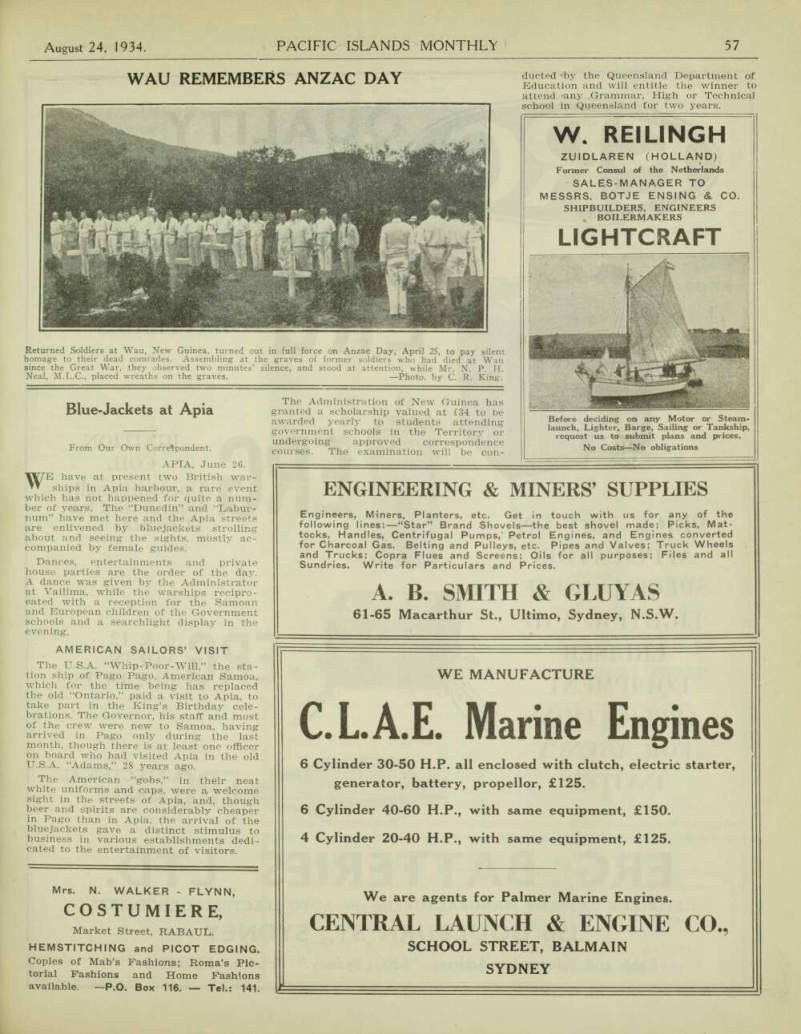
Returned Soldiers at Wau, New Guinea, turned out in full force on Anzac Day, April 25, to pay silent homage to their dead comrades. Assembling at the graves of former soldiers who had died at Wau since the Great War, they observed two minutes’ silence, and stood at attention, while Mr. N. P. H.
Neal, M.L.C., placed wreaths on the graves. Photo, by C. R. King.
Blue-Jackets at Apia
From Our Own Correspondent.
APIA. June 26.
WE have at present two British war ships in Apia harbour, a rare event which has not happened for quite a num ber of years. The “Dunedin” and “Labur num” have met here and the Apia streets are enlivened by bluejackets strolling about and seeing the sights, mostly ac companied by female guides.
Dances, entertainments and private house parties are the order of the day.
A dance was given by the Administrator at Vailima, while the warships recipro cated with a reception for the Samoan and European children of the Government schools and a searchlight display in the evening,
American Sailors’ Visit
The U.S.A. “Whip-Poor-Will,” the sta tion ship of Pago Pago, American Samoa, which for the time being has replaced the old “Ontario,” paid a visit to Apia, to take part in the King’s Birthday cele brations. The Governor, his staff and most of the crew were new to Samoa, having arrived in Pago only during the last month, though there is at least one officer on board who had visited Apia in the old U.S.A. “Adams,” 28 years ago.
The American “gobs,” in their neat white uniforms and caps, were a welcome sight in the streets of Apia, and, though beer and spirits are considerably cheaper in Pago than in Apia, the arrival of the bluejackets gave a distinct stimulus to business in various establishments dedi cated to the entertainment of visitors.
The Administration of New Guinea has granted a scholarship valued at £34 to be awarded yearly to students attending government schools in the Territory or undergoing approved correspondence courses. The examination will be con
ducted by the Queensland Department of Education and will entitle the winner to attend any Grammar, High or Technical school in Queensland for two years.
Advertisements & other items, pp. 59-60 (1 item)
C.L.A.E. Marine Engines
W. REILINGH
ZUIDLAREN (HOLLAND)
Former Consul of the Netherlands
SALES-MANAGER TO
MESSRS. BOTJE ENSING & CO.
SHIPBUILDERS, ENGINEERS
BOILERMAKERS
LIGHTCRAFT
Before deciding on any Motor or Steamlaunch, Lighter, Barge, Sailing or Tankship, request us to submit plans and prices.
No Costs —No obligations
ENGINEERING & MINERS’ SUPPLIES
Engineers, Miners, Planters, etc. Get in touch with us for any of the following lines:—“Star” Brand Shovels —the best shovel made; Picks, Mattocks, Handles, Centrifugal Pumps, Petrol Engines, and Engines converted for Charcoal Gas. Belting and Pulleys, etc. Pipes and Valves; Truck Wheels and Trucks; Copra Flues and Screens: Oils for all purposes; Files and all Sundries. Write for Particulars and Prices.
A. B. SMITH & GLUYAS
61-65 Macarthur St., Ultimo, Sydney, N.S.W.
WE MANUFACTURE
C.L.A.E. Marine Engines
6 Cylinder 30-50 H.P. all enclosed with clutch, electric starter, generator, battery, propeller, £125. 6 Cylinder 40-60 H.P., with same equipment, £150. 4 Cylinder 20-40 H.P., with same equipment, £125.
We are agents for Palmer Marine Engines.
CENTRAL LAUNCH & ENGINE CO.,
SCHOOL STREET, BALMAIN
SYDNEY
Mrs. N. WALKER-FLYNN,
COSTUMIER E,
Market Street, RABAUL.
HEMSTITCHING and PICOT EDGING.
Copies of Mab’s Fashions; Roma’s Pictorial Fashions and Home Fashions available. —P.O, Box 116. Tel.: 141.
PRICE LIST ON
APPLICATION
SPECIAL HOME
LIGHTING AND
CRUISER
EQUIPMENT
APPLICATIONS
FOR AGENCY
INVITED
QUALITY
PRODUCTS
CAR AND RADIO
BATTERIES
IGNITION
COIL
Unconditionally Guaranteed for 12 Months
ERG
6 & 12
VOLTS
CUT-OUTS
ELECTRICAL
SERVICE
ERG BATTERIES LTD.
STORAGE BATTERY MANUFACTURERS and AUTO ELECTRICAL ENGINEERS
156 GOULBURN ST., SYDNEY
Cable and Telegraphic Address: “ERG, Sydney.” ’Phones: FL2618-9
Chinese Traders
Disturbed Conditions in the Solomons
From a Special Correspondent.
TULAGI, August 1.
THE struggle between Europeans and Chinese for the available native trade in this group is becoming acute.
It is a deplorable condition of affairs.
Just at a time when the British planters are forced by the copra slump to turn more to trading than is usual, in order to make a livelihood, the Administration has deemed it wise to offer all possible encouragement and facilities to the Chi nese to engage in trading. The thing, apart from its injustice, is humiliating to the Europeans, and the bitterness which they are displaying towards their Administration is reaching a dangerous point.
Here is an account of what actually happened recently at Ivatu, Guadalcanal.
Mr. H. C. Corry, a planter of 25 years’ residence, owns a copra plantation there, and, as copra is not payable at the moment, he has engaged in trading. He and his wife are making a brave fight of it. Their children are away at school.
Conditions being as they are, Mr. Corry has not been away from the group for years.
On May 19, Mr. Corry was in bed, very ill, with an attack of gastric malaria.
His wife had gone to his store to issue the weekly ration of tobacco to the native labourers. There had been a Chinese trading schooner anchored there for some days. Mr. Corry had frequently warned the Chinese that they were not allowed to land on his property. But, in spite of this, Mrs. Corry found a boat from the Chinese vessel ashore, touting for trade from the local natives. The latter came there on marketing day (every Saturday) to purchase requirements from the native that Mr. Corry has in charge of his store.
Mrs. Corry went to the beach and sent a message to the Chinese that he must withdraw his boat. Half an hour later the boat was still there. She then got one of the crew of Mr. Corry’s launch to take her alongside the Chinese vessel, and quietly and courteously told the China man that this was European property, and he must remove his boat. As she was being rowed back to the beach she was followed by a string of shouted abuse from the Chinaman, which continued while she walked up the beach out of hearing.
The following day, Mrs. Corry reported the incident to the District Officer. A little later, the D.O. called. Mr. Corry was then recovered, and was able to ques tion the boy who took his wife out in the boat. He learned that the language direct ed at her by the Chinaman was of the vilest description and so he requested the D.O. to proceed by summons. He asked the D.O. if it would not be advisable to have several witnesses. The D.O. said that one would be enough. Mr. Corry took the precaution of obtaining a second witness —he could have obtained a dozen if he had wanted them.
The case was heard on June 11. Mrs.
Corry and the boat boy gave evidence.
Mrs. Corry could not understand what the Chinaman said; but the native was able to repeat some of the foul language. The other native witness got stage fright and could only' say “Chinaman talk no good” and would not repeat the words he had heard.
The Chinaman denied even having
shouted at Mrs. Corry, and his crew called as witnesses supported him.
The magistrate said he could not find that bad language had been used; but he found that the Chinaman had shouted at Mrs. Corry, and fined him £2.
The Chinaman produced a roll of notes and, in an insolent manner, slapped four 10/- notes down on the bench in front of the District Officer and said: “No matter, two pounds he nothing.”
It was a ridiculous verdict. If the Chinaman did not use bad language, but merely shouted he had committed no of fence, and should have been acquitted.
It is apparently clear that the wife of a highly respected British planter has been bawled at by a Chinese coolie in front of a crowd of natives. For this con dition of affairs many people in these Islands are blaming a feeble and futile Administration.
Tahiti's Governor On
Tour
From Our Own Correspondent.
Papeete, June 26.
HIS Excellency Governor Montagne left Papeete about two weeks ago on the “Ville de Papeete” for a tour of the Austral and Gambler Groups. He is ex pected to return about July 27. During his absence M. Le Boucher, Secretary General, is in charge of Government affairs.
Centenary Air Race Plans
The Vacuum Oil Co., Sydney, has supplied the following details outlining the Dutch East Indies Government’s plans for assisting competitors in the Centenary Air Race.
Participants in the race, it is stated, will be exempt from all the usual formalities and investi gations by customs and police officers. They will be allowed to land and take off on any D.E.I. aerodrome without obstruction.
Weather reports are to be broadcast at frequent periods from Sourabaya, Batavia, and Koepang for the benefit of the airmen. To enable the competi tors to land and start in the dark, night lights have been installed at the principal flying fields.
At Sourabaya and Batavia aerodromes a doctor will be available to render medical assistance if neces sary. The personnel of the Government air force and the K.N.I.L.M. Air Co. will be present also to give technical assistance to pilots.
B.S.I. Schooner On Reef
The B.S.I. inter-island schooner Maringe, which is owned by the Malayta Co., ran on a reef off the north coast of Ugi, Solomon Islands, early in July.
The schooner in command of Mr. A.
Hogger was transporting native “boys” from Su’u to Makira. Carried off her course by the tide, she ran on the reef in the early hours of morning in the midst of a heavy rain squall and remained fast.
Her engine was salvaged and sent to Tulagi. About ten days later the schooner was refloated with the aid of kedges and arrived in Tulagi under sail.
She was put on a slip at Tulagi and fitted with a new keel. Several timbers on the starboard side were replaced.
Advertisements & other items, p. 61 (1 item)
Excel Batteries
KELVIN ENGINES
MARINE & STATIONARY
The Kelvin-Ricardo Kerosene Engine from 7½ h.p. to 75 h.p. Kelvin Full Diesel Engine, Heavy Duty, from 22- 84 hp. Kelvin Full Diesel Engine, Light Type, from 22-24 h.p.
All kinds of New or Second-hand Craft Estimated for. Engine Repairs Carried out.
Catalogues and Full Particulars direct from
G. RUTHERFORD
46 Pitt Street, Sydney
Have Your GLASSES Modernised with SHELL FRAMES
They are LIGHT. COMFORTABLE, and SECURE.
Send Glasses, Prescription, or even Pieces of Broken Lenses, and receive your New Glasses by Return Mail.
Accuracy Guaranteed Reasonable Prices.
Pacific Islands Clients, when in Sydney, are invited to call and have their Sight Tested by the Latest Scientific Methods, and Glasses brought up-to-date.
E. W. ABRAHAMS, M.I.O.
Optometrist and Optician. ’Phone: BW 72 72. 7 HUNTER STREET, SYDNEY. (Over McCarthy, Chemists)
EXCEL BATTERIES
15 Months’ Guarantee.
The Product With A Reputation.
Prices F.O.B. Sydney (Australian Currency). Packing and Cases No Charge 13 Plate. 100 amp 30/- SPECIAL CYCLE BATTERY 15 Plate. 120 amp 35/- Six (6) Months’ Guarantee 17 Plate. 140 amp 45/- At 25/- EACH.
EXCEL BATTERY COY., 77-79 William St., SYDNEY APPLICATIONS FOR AGENCY INVITED FROM ALL CENTRES
Shipping.
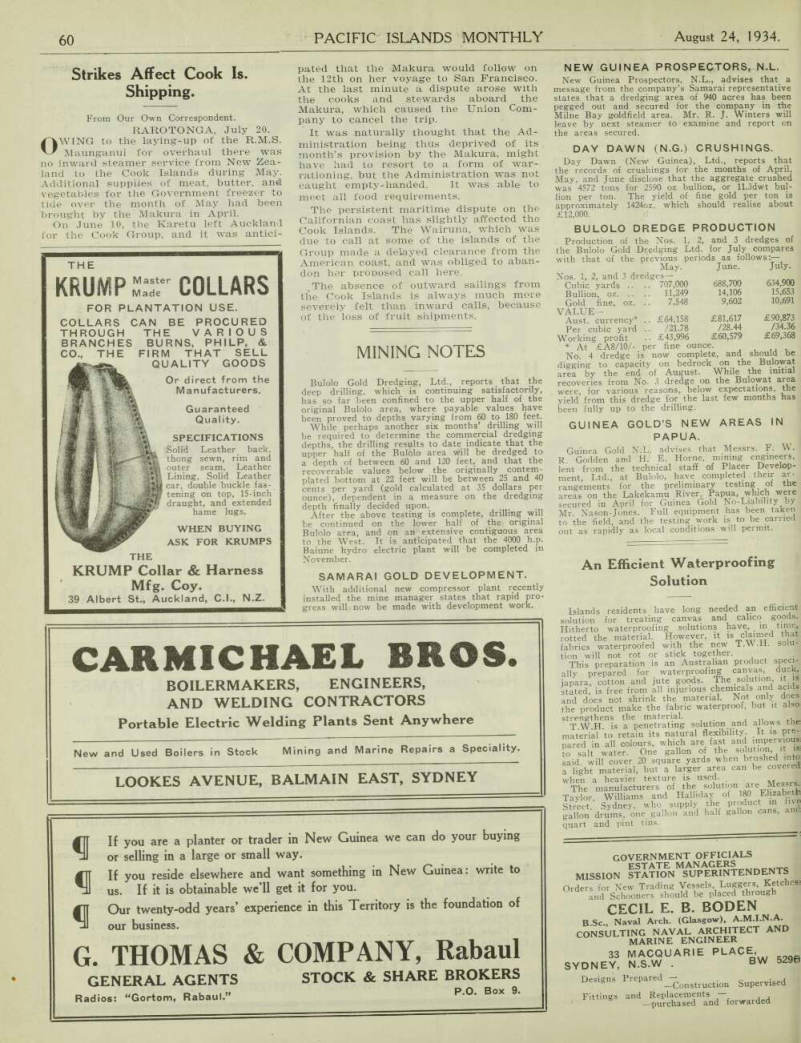
Strikes Affect Cook Is.
From Our Own Correspondent.
Rarotonga, July 20.
OWING to the laying-up of the R.M.S.
Maunganui for overhaul there was no inward steamer service from New Zea land to the Cook Islands during May.
Additional supplies of meat, butter, and vegetables for the Government freezer to tide over the month of May had been brought by the Makura in April.
On June 10, the Karetu left Auckland for the Cook Group, and it was antici
pated that the Makura would follow on the 12th on her voyage to San Francisco.
At the last minute a dispute arose with the cooks and stewards aboard the Makura, which caused the Union Com pany to cancel the trip.
It was naturally thought that the Ad ministration being thus deprived of its month’s provision by the Makura, might have had to resort to a form of war rationing, but the Administration was not caught empty-handed. It was able to meet all food requirements.
The persistent maritime dispute on the Californian coast has slightly affected the Cook Islands. The Wairuna, which was due to call at some of the islands of the Group made a delayed clearance from the American coast, and was obliged to aban don her proposed call here.
The absence of outward sailings from the Cook Islands is always much more severely felt than inward calls, because of the loss of fruit shipments.
Mining Notes
Bulolo Gold Dredging, Ltd., reports that the deep drilling, which is continuing satisfactorily, has so far been confined to the upper half of the original Bulolo area, where payable values have been proved to depths varying from 60 to 180 feet.
While perhaps another six months’ drilling will be required to determine the commercial dredging depths, the drilling results to date indicate that the upper half of the Bulolo area will be dredged to a depth of between 60 and 120 feet, and that the recoverable values below the originally contem plated bottom at 22 feet will be between 25 and 40 cents per yard (gold calculated at 35 dollars per ounce), dependent in a measure on the dredging depth finally decided upon.
After the above testing is complete, drilling will be continued on the lower half of the original Bulolo area, and on an extensive contiguous area to the West. It is anticipated that the 4000 h.p.
Baiune hydro electric plant will be completed in November.
Samarai Gold Development.
With additional new compressor plant recently installed the mine manager states that rapid pro gress will now be made with development work.
New Guinea Prospectors, N.L.
New Guinea Prospectors, N.L., advises that a message from the company’s Samarai representative states that a dredging area of 940 acres has been pegged out and secured for the company in the Milne Bay goldfield area. Mr. R. J. Winters will leave by next steamer to examine and report on the areas secured.
Day Dawn (N.G.) Crushings.
Day Dawn (New Guinea), Ltd., reports that the records of crushings for the months of April, May, and June disclose that the aggregate crushed was 4572 tons for 2590 oz bullion, or ll.Sdwt bul lion per ton. The yield of fine gold per ton is approximately 14240 z. which should realise about £12,000.
Bulolo Dredge Production
Production of the Nos. 1,2, and 3 dredges of the Bulolo Gold Dredging Ltd. for July compares with that of the previous periods as follows: — May. June. July.
Nos. 1,2, and 3 dredges— Cubic yards .. .. 707,000 688,700 634,900 Bullion, oz 11,249 14,106 15,653 Gold fine, oz. .. 7,548 9,602 10,691 Aust. currency* .. £64,158 £81,617 £90,873 Per cubic yard .. /21.78 /28.44 Working profit .. £43,996 £60,579 £69,368 * At £A8/10/- per fine ounce.
No. 4 dredge is now complete, and should be digging to capacity on bedrock on the Bulowat area by the end of August. While the initial recoveries from No. 3 dredge on the Bulowat area were, for various reasons, below expectations, the yield from this dredge for the last few months has been fully up to the drilling.
Guinea Gold’S New Areas In
Papua.
Guinea Gold N.L. advises that Messrs. F. W.
R. Godden and H. E. Horne, mining engineers, lent from the technical staff of Placer Develop ment, Ltd., at Bulolo, have completed their ar rangements for the preliminary testing of the areas on the Lakekamu River Papua, which were secured in April for Guinea Gold No-Liability by Mr Nason-Jones. Full equipment has been taken to the field, and the testing work is to be carried out as rapidly as local conditions will permit.
An Efficient Waterproofing
Solution
Islands residents have long needed an efficient solution for treating canvas and calico goods.
Hitherto waterproofing solutions have, in time, rotted the material. However, it is claimed that fabrics waterproofed with the new T.W.H. solu tion will not rot or stick together.
This preparation is an Australian product speci ally prepared for waterproofing canvas, duck, japara, cotton and jute goods. The solution, it is stated, is free from all injurious chemicals and acids and does not shrink the material. Nol only does, the product make the fabric waterproof, but it also! strengthens the material.
T W.H. is a penetrating solution and allows the. material to retain its natural flexibility. It is pre-. paired in all colours, which are fast and impervious to salt water. One gallon of the solution, it is said, will cover 20 square yards when brushed into a light material, but a larger area can be covered when a heavier texture is used.
The manufacturers of the solution are Messrs.
Taylor, Williams and Halliday of 180 Elizabeth Street, Sydney, who supply the product in five gallon drums, one gallon and half gallon cans, and quart and pint tins.
Advertisements & other items, p. 62 (2 items)
Carmichael Bros.
THE
Krump Master Made Collars
FOR PLANTATION USE.
COLLARS CAN BE PROCURED
THROUGH THE VARIOUS
BRANCHES BURNS, PHILP, &
CO., THE FIRM THAT SELL
QUALITY GOODS
Or direct from the Manufacturers.
Guaranteed Quality.
SPECIFICATIONS
Solid Leather back, thong sewn, rim and outer seam, Leather Lining, Solid Leather car, double buckle fastening on top, IS-inch draught, and extended hame lugs.
WHEN BUYING
ASK FOR KRUMPS
THE
KRUMP Collar & Harness
Mfg. Coy.
39 Albert St., Auckland, C. 1., N.Z.
CARMICHAEL BROS.
BOILERMAKERS, ENGINEERS,
AND WELDING CONTRACTORS
Portable Electric Welding Plants Sent Anywhere New and Used Boilers in Stock Mining and Marine Repairs a Speciality.
LOOKES AVENUE, BALMAIN EAST, SYDNEY
If you are a planter or trader in New Guinea we can do your buying or selling in a large or small way.
If you reside elsewhere and want something in New Guinea: write to us. If it is obtainable we’ll get it for you.
Our twenty-odd years’ experience in this Territory is the foundation of our business.
G. THOMAS & COMPANY, Rabaul
GENERAL AGENTS STOCK & SHARE BROKERS
Radios: “Gortom, Rabaul.”
Cecil E. B. Boden
government officials estate managers
MISSION STATION SUPERINTENDENTS
Orders for New Trading Vessels, Luggers, Ketches and Schooners should be placed through
CECIL E. B. BODEN
B.Sc., Naval Arch. (Glasgow), A.M.I.N.A.
CONSULTING NAVAL ARCHITECT AND
Marine ENGINEER
33 MACQUARIE PLACE,
SYDNEY, N.S.W . BW
Designs Prepared Supervised Fittings and Replacements —purchased and forwarded
Market Quotations
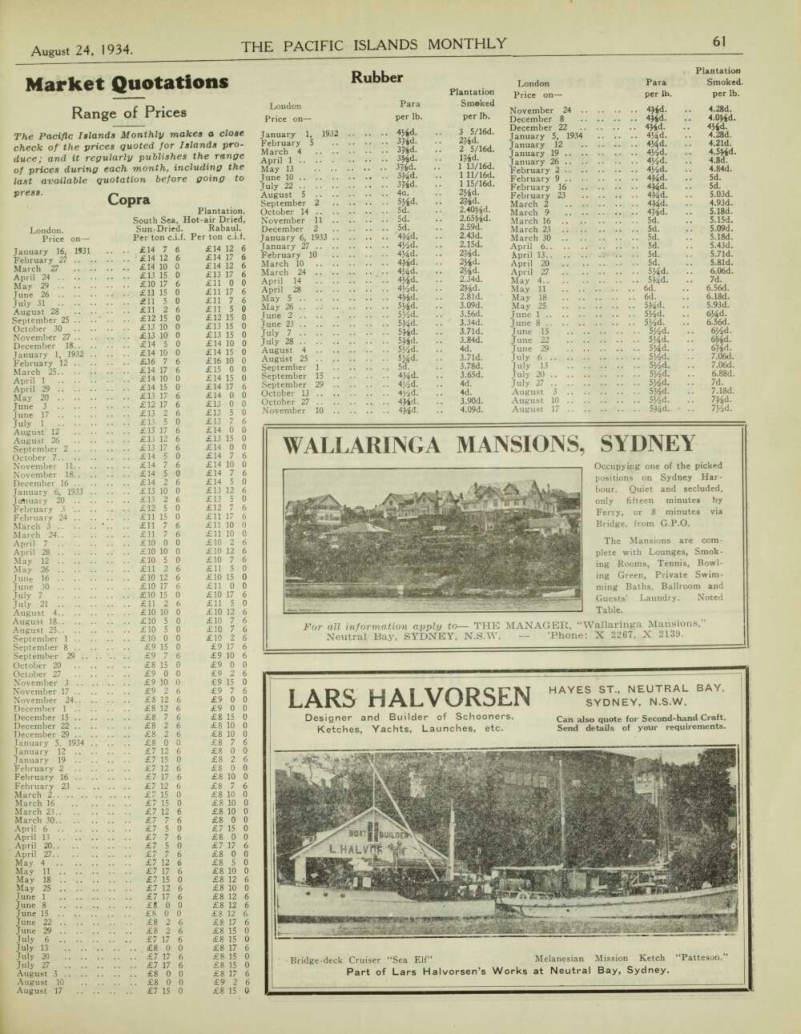
Range of Prices
The Pacific Islands Monthly makes a close check of the prices quoted for Islands pro duce; and it regularly publishes the range of prices during each month, including the last available quotation before going to
press.
London Price on— Para per lb.
Plantation Smoked per lb.
November 24 .. .. .. .. 4*d. . , 4.28d.
December 8 .. .. .. .. 4*d. 4.0Hd.
December 22 .. .. 4Hd. . . 4*d.
January 5, 1934 .. .. 4J4d. . . 4.28d.
January 12 .. .. 4^d. 4.21d.
January 19 .. .. 4/ ? d. « . 4.5^d.
January 26 .. .. 4/ 2 d. . . 4.8d.
February 2 .. .. 4^d. . . 4.84d.
February 9 .. .. 4V*d.
Sd.
February 16 .. .. 4^d. 5d.
February 23 .. .. 4Hd. . . 5.03d.
March 2 .. .. AHd. 4.93d.
March 9 .. .. A7Ad.
S.18d.
March 16 .. .. 5d. 5.15d.
March 23 .. .. 5d. 5.09d.
March 30 .. .. 5d. 5.18d.
April 6 .. .. 5d. 5.43d.
April 13 5.71d.
April 20 S.81d.
April 27 .. .. d. 6.06d.
May 4 .. .. sy 4 d. 7d.
May 11 . .. 6d. 6.56d.
May 18 6.18d.
May 25 . .. .. SH d. 5.93d.
June 1 .. .. 5'Ad. 6'Ad.
June 8 .. .. Sj'ad. 6.56d.
June IS .. .. syd. 6 Ad June 22 .. .. 5'Ad. 6ftd June 29 .. .. 554d. 6^d.
July 6 .. .. sy 2 d. 7.06d.
July 13 .. .. sy 3 d. 7.06d.
July 20 .. .. 5Ad. 6.88d.
July 27 .. .. sy 2 d. 7d.
August 3 .. .. sy 2 d. 7.18d.
August 10 .. .. 5^d.
W- August 17 .. .. 5^d. iy 2 d.
London Price on—
Rubber
Para per lb.
Plantation Smoked per lb.
January 1, 1932 W. 3 S/16d.
February 5 2 7 Ad. 2 5/16d. iHd.
May 13 1 13/16d.
June 10 3«d. 1 ll/16d.
July 22 1 15/16d.
August 5 2%d.
September 2 2j4d.
October 14 2.40Ad.
November 11 5d. 2.65$*d.
December 2 5d. 2.59d.
January 6, 1933 2.43d.
January 27 2.15d.
February 10 4^d. 2 7 Ad.
March 10 4Jid. 2%d.
March 24 2 l Ad.
April 14 .. .. .. 4%d. 2.34d.
April 28 2&d.
May 5 4*id. 2.81d.
May 26 5^d. 3.09d.
June 2 5/ 2 d. 3.56d.
June 23 5tfd. 3.34d.
July 7 5Hd. 3.7ld.
July 28 S^d. 3.84d.
August 4 S&i. 4d.
August 25 r 3.71d.
September 1 3.78d.
September 15 4J*d. 3.65d.
September 29 4'/ 2 d. 4d.
October 13 4d.
October 27 .. .. 4f*d. 3.90d.
November 10 4Hd. 4.09d.
press.
Copra
Plantation, South Sea, Hot-air Dried, London. Price on —
Sun-Dried.
Rabaul Per ton c.i.f.
Per ton c.i.f.
January 16, 1931 .. .. £14 7 6 £14 12 6 February 27 .. .. .. £14 12 6 £14 17 6 March 27 .. .. .. .. £14 10 0 £14 12 6 .. .. £13 15 0 £13 17 6 May 29 .. .. £10 17 6 £11 0 0 June 26 .. .. £11 15 0 £11 17 6 July 31 .. .. £11 5 0 £11 7 6 August 28 .. .. £11 2 6 £11 5 0
September 25 .. ..
.. £12 15 0 £12 15 0 October 30 .. .. £13 10 0 £13 15 0 November 27 .. .. .. £13 10 0 £13 15 0 December 18.. .. .. £14 5 0 £14 10 0 January 1, 1932 .. .. .. £14 10 0 £14 15 0 February 12 .. .. .. .. £16 7 6 £16 10 0 March 25 .. .. £14 17 6 £15 0 0 April 1 .. .. £14 10 0 £14 15 0 April 29 .. .. £14 15 0 £14 17 6 May 20 .. .. £13 17 6 £14 0 0 June 3 .. .. £12 17 6 £13 0 0 June 17 .. .. £13 2 6 £13 5 0
July 1
.. .. £13 5 0 £13 7 6 August 12 .. .. .. .. £13 17 6 £14 0 0 August 26 .. .. .. .. £13 12 6 £13 15 0 September 2 .. .. .. £13 17 6 £14 0 0 October 7 .. .. £14 5 0 £14 7 6 November 11.. .. .. £14 7 6 £14 10 0 November 18 .. .. £14 5 0 £14 7 6 December 16 .. .. £14 2 6 £14 5 0 January 6, 1933 .. .. £13 10 0 £13 12 6 Jaftiuary 20 .. .. £13 2 6 £13 5 0 February 3 .. .. £12 5 0 £12 7 6 February 24 .. .. £11 15 0 £11 17 6 March 3 .. £11 7 6 £11 10 0 March 24 .. .. £11 7 6 £11 10 0 April 7 .. .. £10 0 0 £10 2 6 April 28 .. .. £10 10 0 £10 12 6 May 12 .. .. £10 5 0 £10 7 6 Mav 26 .. .. £11 2 6 £11 5 0 June 16 .. .. £10 12 6 £10 15 0 J une 30 .. .. £10 17 6 £11 0 0
July 7
.. .. £10 15 0 £10 17 6
July 21
.. .. £11 2 6 £11 5 0 August 4 .. .. £10 10 0 £10 12 6 August 18 .. .. £10 5 0 £10 7 6 August 25 .. .. £10 5 0 £10 7 6 September 1 .. .. .. .. £10 0 0 £10 2 6 September 8 .. .. .. .. £9 15 0 £9 17 6 September 29 .. . £9 7 6 £9 10 6 October 20 .. .. ... £8 15 0 £9 0 0 October 27 .. .. £9 0 0 £9 2 6 November 3 .. .. ... £9 10 0 £5 15 0 November 17 .. .. ... £9 2 6 £9 7 6 November 24.. .. ... £8 12 6 £9 0 0 December 1 .. .. .. £8 12 6 £9 0 0 December IS .. .. ... £8 7 6 £8 IS 0 December 22 .. .. ... £8 2 6 £8 10 0 December 29 .. .. ... £8 2 6 £8 10 0 January 5. 1934 .. .. .. £8 0 0 £8 7 6 January 12 .. .. ... £7 12 6 £8 0 0 January 19 .. .. ... £7 15 0 £8 2 6 February 2 .. .. .. .. £7 12 6 £8 0 0 February 16 .. .. ... £7 17 6 £8 10 0 February 23 .. .. £7 12 6 £8 7 6 March 2 £7 15 0 £8 10 0 March 16 .. .. £7 15 0 £8 10 0 March 23 ... £7 12 6 £8 10 0 March 30 ... £7 7 6 £8 0 0 April 6 ... £7 5 0 £7 IS 0 April 13 .. .. £7 7 6 £8 0 0 April 20 ... £7 5 0 £7 17 6 April 27 .. .. £7 7 6 £8 0 0 May 4 ... £7 12 6 £8 5 0 May 11 ... £7 17 6 £8 10 0 May 18 ... £7 15 0 £8 12 6 May 25 ... £7 12 6 £8 10 0 June 1 .. .. £7 17 6 £8 12 6 June 8 ... £8 0 0 £8 12 6 June 15 ... £8 0 0 £8 12 6
June 22
... £8 2 6 £8 17 6 June 29 ... £8 2 6 £8 15 0
July 6
... £7 17 6 £8 15 0 July 13 £8 0 0 £8 17 6 July 20 £7 17 6 £8 15 0 July 27 £7 17 6 £8 15 0 August 3 £8 0 0 £8 17 6 August 10 £8 0 0 £9 2 6 August 17 ... £7 15 0 £8 15 0
Advertisements & other items, p. 63 (1 item)
Lars Halvorsen
WALLARINGA MANSIONS, SYDNEY
Occupying one of the picked positions on Sydney Harbour. Quiet and secluded, only fifteen minutes by Ferry, or 8 minutes via Bridge, from G.P.O.
The Mansions are complete with Lounges, Smoking Rooms, Tennis, Bowling Green, Private Swimming Baths, Ballroom and Guests’ Laundry. Noted Table.
For all information apply to — THE MANAGER, “Wallaringa Mansions, Neutral Bay, SYDNEY, N.S.W. ’Phone: X 2267, X 2139.
LARS HALVORSEN
Designer and Builder of Schooners, Ketches, Yachts, Launches, etc.
HAYES ST., NEUTRAL BAY,
SYDNEY, N.S.W.
Can also quote for Second-hand Craft.
Send details of your requirements.
Bridge-deck Cruiser “Sea Elf” Melanesian Mission Ketch Patteson.
Part of Lars Halvorsen’s Works at Neutral Bay, Sydney.
Exchange Rates
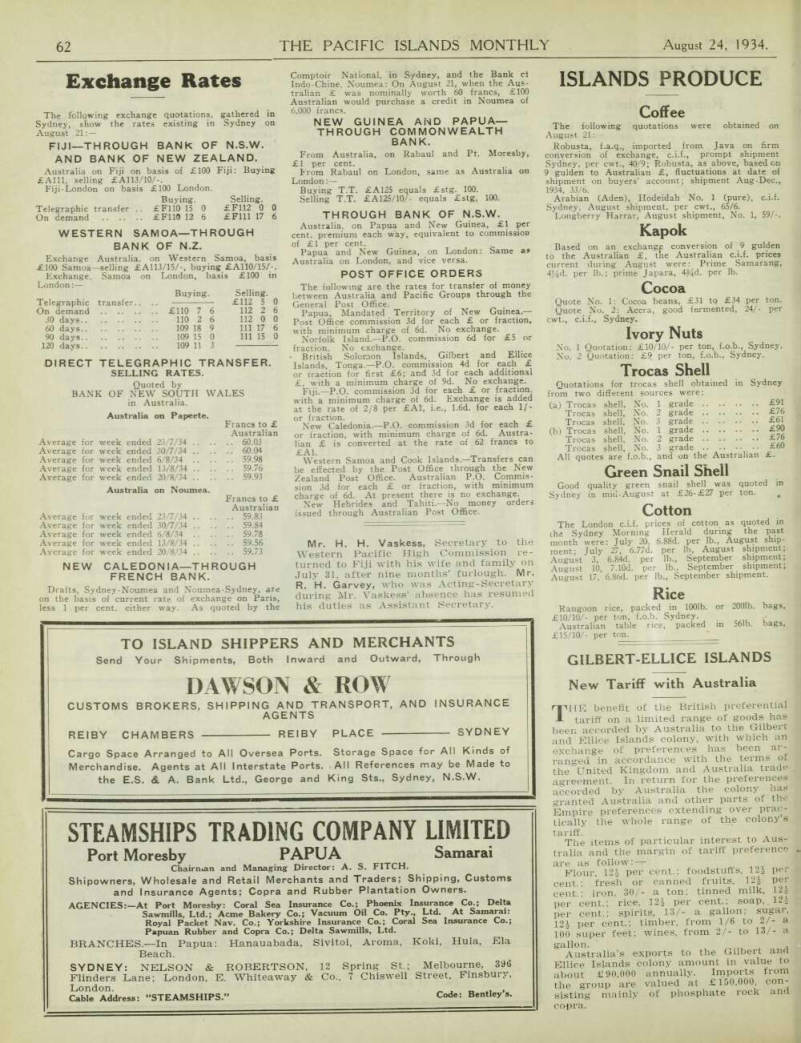
The following exchange quotations, gathered in Sydney, show the rates existing in Sydney on August 21:—
Fiji-Through Bank Of N.S.W.
And Bank Of New Zealand.
Australia on Fiji on basis of £100 Fiji: Buying £A111, selling £A113/10/-.
Fiji-London on basis £100 London.
Western Samoa—Through
Bank Of N.Z.
Exchange Australia, on Western Samoa, basis £100 Samoa—selling £A113/15/-, buying £A110/15/-.
Exchange, Samoa on London, basis £100 in London: —
Direct Telegraphic Transfer.
Selling Rates.
Quoted by
Bank Of New South Wales
in Australia.
New Caledonia—Through
French Bank.
Drafts, Sydney-Noumea and Noumea-Sydney, are on the basis of current rate of exchange on Paris, less 1 per cent, either way. As quoted by the
Comptoir National, in Sydney, and the Bank of Indo-Chine, Noumea: On August 21, when the Aus tralian £ was nominally worth 60 francs, £100 Australian would purchase a credit in Noumea of 6,000 francs.
New Guinea And Papua
Through Commonwealth
Bank.
From Australia, on Rabaul and Pt. Moresby, £1 per cent.
From Rabaul on London, same as Australia on London:— Buying T.T. £A125 equals £stg. 100.
Selling T.T. £A125/10/- equals £stg t 100.
Through Bank Of N.S.W.
Australia, on Papua and New Guinea, £1 per cent, premium each way, equivalent to commission of £1 per cent.
Papua and New Guinea, on London: Same as Australia on London, and vice versa.
Post Office Orders
The following are the rates for transfer of money between Australia and Pacific Groups through the General Post Office. .
Papua, Mandated Territory of New Guinea. — Post Office commission 3d for each £ or fraction, with minimum charge of 6d. No exchange.
Norfolk Island.—P.O. commission 6d for £5 or fraction. No exchange.
British Solomon Islands, Gilbert and Ellice Islands, Tonga.—P.O. commission 4d for each £ or fraction for first £6; and 3d for each additional £, with a minimum charge of 9d. No exchange.
Fiji.—P.O. commission 3d for each £ or fraction, with a minimum charge of 6d. Exchange is added at the rate of 2/8 per £A1, i.e., 1.6 d. for each 1/or fraction.
New Caledonia. —P.O. commission 3d for each £ or traction, with minimum charge of 6d. Austra lian £ is converted at the rate of 62 francs to £A1.
Western Samoa and Cook Islands. —Transfers can be effected by the Post Office through the New Zealand Post Office. Australian P.O. Commis sion 3d for each £ or fraction, with minimum charge of 6d. At present there is no exchange.
New Hebrides and Tahiti.—No money orders issued through Australian Post Office.
Mr. H. H. Vaskess, Secretary to the Western Pacific High Commission re turned to Fiji with his wife and family on July 31, after nine months’ furlough. Mr.
R. H. Garvey, who was Acting-Secretary during Mr. Vaskess’ absence has resumed his duties as Assistant Secretary.
Buying.
Selling.
Telegraphic transfer £F110 15 0 £F112 0 0 On demand £F110 12 6 £F111 17 6
Buying. Selling.
Telegraphic transfer.. .. £112 5 0 On demand £110 7 6 112 2 6 30 days 110 2 6 112 0 0 60 days 109 18 9 111 17 6 90 days 109 15 0 111 15 0 120 days 109 11 3
Australia on Papeete.
Francs to £ Australian Average for week ended 23/7/34 .. .. .. 60.03 Average for week ended 30/7/34 .. .. .. 60.04 Average for week ended 6/8/34 .. .. .. 59.98 Average for week ended 13/8/34 .. .. .. 59.76 Average for week ended 20/8/34 .. .. .. 59.93 Australia on Noumea.
Francs to £ Australian Average for week ended 23/7/34 .. .. .. 59.83 Average for week ended 30/7/34 .. .. 59.84 Average for week ended 6/8/34 .. .. .. 59.78 Average for week ended 13/8/34 .. .. .. 59.56 Average for week ended 20/8/34 .. .. .. 59.73
Islands Produce
Coffee
The following quotations were obtained on August 21: — Robusta, f.a.q., imported from Java on firm conversion of exchange, c.i.f., prompt shipment Sydney, per cwt., 40/9; Robusta, as above, based on 9 gulden to Australian £, fluctuations at date of shipment on buyers’ account; shipment Aug-Dec., 1934, 33/6.
Arabian (Aden), Hodeidah No. 1 (pure), c.i.f.
Sydney. August shipment, per cwt., 65/6.
Longberry Harrar, August shipment, No. 1, 59/-.
Kapok
Based on an exchange conversion of 9 gulden to the Australian £, the Australian c.i.f. prices current during August were: Prime Samarang, 4)4d. per lb.; prime Japara, 4)4d. per lb.
Cocoa
Quote No. 1: Cocoa beans, £31 to £34 per ton.
Quote No. 2: Accra, good fermented, 24/- per Cwt., c.i.f., Sydney.
Ivory Nuts
No. 1 Quotation: £10/10/- per ton, f.o.b., Sydney.
No. 2 Quotation: £9 per ton, f.o.b., Sydney.
Trocas Shell
Quotations for trocas shell obtained in Sydney from two different sources were; (a) Trocas shell, No. 1 grade £91 Trocas shell. No. 2 grade £76 Trocas shell. No. 3 grade £61 (b) Trocas shell, No. 1 grade £90 Trocas shell, No. 2 grade £76 Trocas shell, No. 3 grade £60 All quotes are f.o.b., and on the Australian £.
Green Snail Shell
Good quality green snail shell was quoted in Sydney in mid-August at £26-£27 per ton.
Cotton
The London c.i.f. prices of cotton as quoted in the Sydney Morning Herald during the past month were: July 20, 6.88d. per lb., August ship ment; July 27, 6.77d. per lb, August shipment; August 3, 6.84d. per lb., September shipment; August 10, 7.10d. per lb., September shipment; August 17, 6.86d. per lb., September shipment.
Rice
Rangoon rice, packed in 1001b. or 2001b. bags, £10/10/- per ton, f.o.b. Sydney.
Australian table rice, packed in 561b. bags, £15/10/- per ton.
Gilbert-Ellice Islands
New Tariff with Australia
THE benefit of the British preferential tariff on a limited range of goods has been accorded by Australia to the Gilbert and Ellice Islands colony, with which an exchange of preferences has been ar ranged in accordance with the terms of the United Kingdom and Australia trade agreement. In return for the preferences accorded by Australia the colony has granted Australia and other parts of the Empire preferences extending over prac tically the whole range of the colony’s tariff. .
The items of particular interest to Aus tralia and the margin of tariff preference are as follow; Flour, 124 per cent.; foodstuffs, 12½ per cent.; fresh or canned fruits, 12½ per cent.: iron, 30/- a ton; tinned milk, 12½ per cent.; rice, 12½ per cent.; soap, 12½ per cent.; spirits, 13/- a gallon: sugar, 12½ per cent.; timber, from 1/6 to 2/- a 100 super feet: wines, from 2/- to 13/- a gallon.
Australia’s exports to the Gilbert and Ellice Islands colony amount in value to about £90,000 annually. Imports from the group are valued at £150,000, con sisting mainly of phosphate rock and copra.
Advertisements & other items, p. 64 (1 item)
Steamships Trading Company Limited
TO ISLAND SHIPPERS AND MERCHANTS
Send Your Shipments, Both Inward and Outward, Through
DAWSON & ROW
CUSTOMS BROKERS, SHIPPING AND TRANSPORT, AND INSURANCE
AGENTS
REIBY CHAMBERS REIBY PLACE SYDNEY
Cargo Space Arranged to All Oversea Ports. Storage Space for All Kinds of Merchandise. Agents at All Interstate Ports. All References may be Made to the E.S. & A. Bank Ltd., George and King Sts., Sydney, N.S.W.
STEAMSHIPS TRADING COMPANY LIMITED
Port Moresby PAPUA Samarai
Chairman and Managing Director: A. S. FITCH.
Shipowners, Wholesale and Retail Merchants and Traders; Shipping, Customs and Insurance Agents; Copra and Rubber Plantation Owners.
AGENCIES:—At Port Moresby: Coral Sea Insurance Co.; Phoenix Insurance Co.; Delta Sawmills, Ltd.; Acme Bakery Co.; Vacuum Oil Co. Pty., Ltd. At Samarai: Royal Packet Nav. Co.; Yorkshire Insurance Co.; Coral Sea Insurance Co.; Papuan Rubber and Copra Co.; Delta Sawmills, Ltd.
BRANCHES.—In Papua: Hanauabada, Sivitoi, Aroma, Koki, Hula, Ela Beach.
SYDNEY: NELSON & ROBERTSON, 12 Spring St.; Melbourne, 396 Flinders Lane; London, E. Whiteaway & Co., 7 Chiswell Street, Finsbury, London.
Cable Address: “STEAMSHIPS.” Code: Bentleys.
Shipping Services in the Pacific
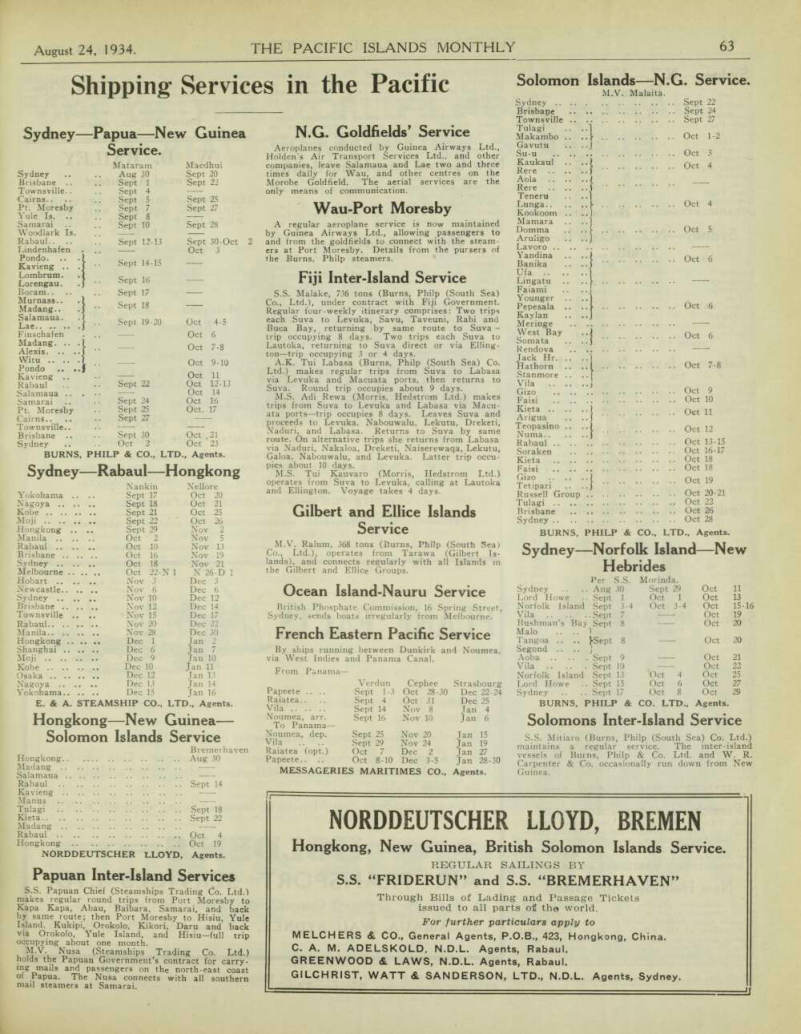
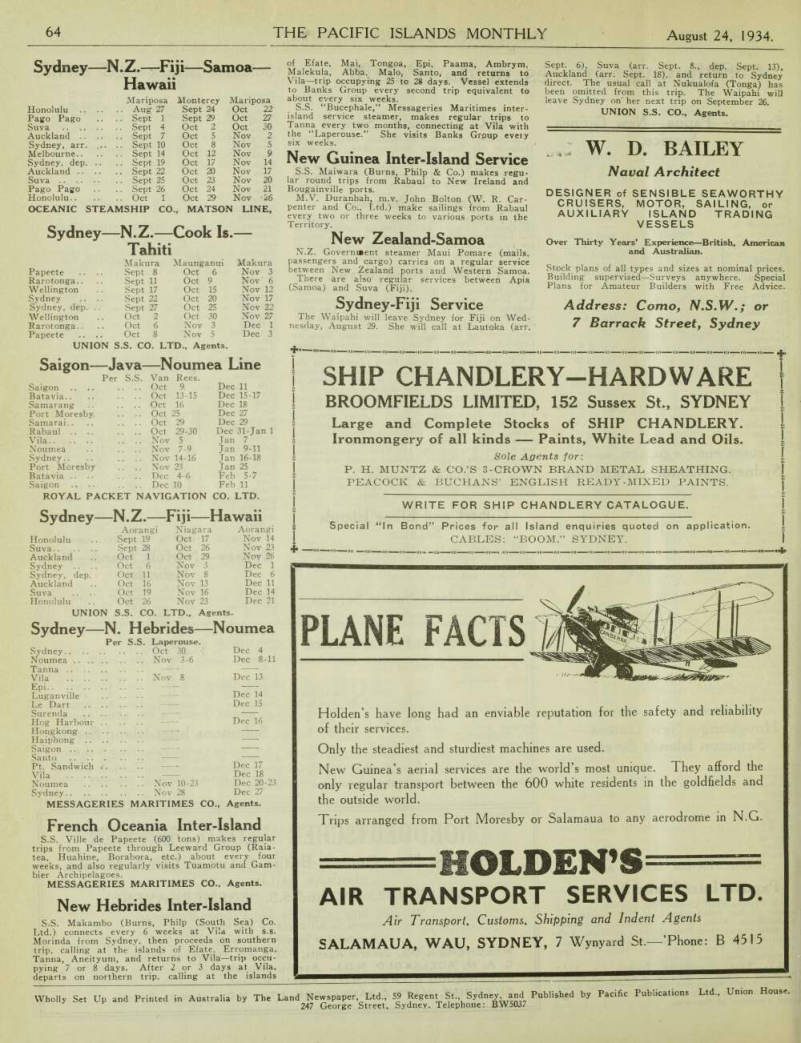
Sydney—Papua—New Guinea Service.
Burns, Philp & Co., Ltd., Agents.
Sydney—Rabaul—Hongkong
Hongkong—New Guinea— Solomon Islands Service
Papuan Inter-Island Services
S.S. Papuan Chief (Steamships Trading Co. Ltd.) makes regular round trips from Port Moresby to Kapa Kapa, Abau, Baibara, Samarai, and back by same route; then Port Moresby to Hisiu, Yule Island, Kukipi, Orokolo, Kikori, Daru and back via Orokolo, Yule Island, and Hisiu—full trip occupying about one month.
M.V. Nusa (Steamships Trading Co. Ltd.) holds the Papuan Government’s contract for carry mails and passengers on the north-east coast of Papua. The Nusa connects with all southern mail steamers at Samarai.
N.G. Goldfields’ Service
Aeroplanes conducted by Guinea Airways Ltd., Holden’s Air Transport Services Ltd., and other companies, leave Salamaua and Lae two and three times daily for Wau, and other centres on the Morobe Goldfield. The aerial services are the only means of communication.
Wau-Port Moresby
A regular aeroplane service is now maintained by Guinea Airways Ltd., allowing passengers to and from the goldfields to connect with the steam ers at Port Moresby. Details from the pursers of the Burns, Philp steamers.
Fiji Inter-Island Service
S.S. Malake, 736 tons (Burns, Philp (South Sea) Co., Ltd.), under contract with Fiji Government.
Regular four-weekly itinerary comprises: Two trips each Suva to Levuka, Savu, Taveuni, Rabi and Buca Bay, returning by same route to Suva trip occupying 8 days. Two trips each Suva to Lautoka, returning to Suva direct or via Elling ton —trip occupying 3 or 4 days.
A.K. Tui Labasa (Burns, Philp (South Sea) Co.
Ltd.) makes regular trips from Suva to Labasa via Levuka and Macuata ports, then returns to Suva. Round trip occupies about 9 days.
M.S. Adi Rewa (Morris, Hedstrom Ltd.) makes trips from Suva to Levuka and Labasa via Macu ata ports—trip occupies 8 days. Leaves Suva and proceeds to Levuka, Nabouwalu, Lekutu, Dreketi, Naduri, and Labasa. Returns to Suva by same route. On alternative trips she returns from Labasa via Naduri, Nakaloa, Dreketi, Naiserewaqa, Lekutu, Galoa, Nabouwalu, and Levuka. Latter trip occu pies about 10 days.
M.S. Tui Kauvaro (Morris, Hedstrom Ltd.) operates from Suva to Levuka, calling at Lautoka and Ellington. Voyage takes 4 days.
Gilbert and Ellice Islands
Service
M.V. Ralum, 368 tons (Burns, Philp (South Sea) Co., Ltd.), operates from Tarawa (Gilbert Is lands), and connects regularly with all Islands in the Gilbert and Ellice Groups.
Ocean Island-Nauru Service
British Phosphate Commission, 16 Spring Street, Sydney, sends boats irregularly from Melbourne.
French Eastern Pacific Service
By ships running between Dunkirk and Noumea, via West Indies and Panama Canal.
From Panama—
Solomon Islands —N.G. Service.
Sydney—Norfolk Island—New Hebrides
Solomons Inter-Island Service
S.S. Mitiaro (Burns, Philp (South Sea) Co. Ltd.) maintains a regular service. The inter-island vessels of Burns, Philp & Co. Ltd. and W. R.
Carpenter & Co. occasionally run down from New Guinea.
Papeete .. ..
Verdun Cephee Strasbourg Sept 1-3 Oct 28-30 Dec 22-24 Raiatea..
Sept 4 Oct 31 Dec 25 Vila Sept 14 Nov 8 Jan 4 Noumea, arr.
To Panama— Sept 16 Nov 10 Jan 6 Noumea, dep.
Sept 25 Nov 20 Jan 15 Vila .. ..
Sept 29 Nov 24 Jan 19 Raiatea (opt.) Oct 7 Dec 2 Jan 27 Papeete..
Oct 8-10 Dec 3-5 Jan 28-30
Messageries Maritimes Co., Agents.
M.V. Malaita.
Sydney .. ..
Brisbane Townsville ..
Tulagi .. .
Makambo .. .
Oct 1-2 Gavutu .. .
Su-u .. ..
Oct 3 Kaukaul .. .
Rere Rere Teneru .. .
Lunga Oct 4 Kookoom .. .
Mamara Domma .. .
Oct 5 Aruligo .. .
Lavoro .. ..
Yandina .. .
Banika .. .
Ufa Lingatu Faiami Younger .. .
Pepesala .. .
Oct 6 Kaylan .. .
Meringe West Bay Somata .. .
Rendova Tack Hr. .. .
Hathorn .. .
Oct 7-8 Stanmore .. .
Vila Oct 9 Faisi .. ..
Kieta Oct 11 Arigua .. .
Teopasino .. .
Numa Oct 12 Rabaul .. ..
Oct 13-15 Soraken Oct 16-17 Kieta .. ..
Oct 18 Faisi .. ..
Gizo Tetipari .. .
Russell Group Oct 20-21 Tulagi .. ..
Brisbane Sydney .. ..
Oct 28
Burns, Philp & Co., Ltd.. Agents.
Per S.S. Morinda.
Sydney .. Aug 30 Sept 29 Oct 11 Lord Howe .. Sept 1 Oct 1 Oct 13 Norfolk Island Sept 3-4 Oct 3-4 Oct 15-16 Vila Sept 7 — Oct 19 Bushman’s Bay Sept 8 — Oct 20 Malo Tangoa .. .. Sept 8 Segond Aoba Sept 9 Oct 20 Oct 21 Vila Sept 10 — Oct 22 Norfolk Island Sept 13 Oct 4 Oct 25 Lord Howe .. Sept 15 Oct 6 Oct 27 Sydney .. .. Sept 17 Oct 8 Oct 29
Burns, Philp & Co. Ltd., Agents.
Mataram Macdhui Sydney Aug 30 Sept 20 Brisbane ..
Sept 1 Sept 22 Townsville..
Sept 4 — Cairns..
Sept 5 Sept 25 Pt. Moresby Sept 7 Sept 27 Yule Is. ..
Sept 8 — Samarai Sept 10 Sept 28 Woodlark Is. — — Rabaul..
Sept 12-13 Sept 30-Oct 2 Lindenhafen Oct 3 Pondo. ..
Kavieng .. .
Sept 14-15 Lombrum.
Sept 16 Lorengau.
Boram..
Sept 17 — Murnass..
Madang..
Sept 18 — Salamaua.
Lae Sept 19-20 Oct 4-5 Finschafen Oct 6 Madang Alexis. — Oct 7-8 Witu Pondo — Oct 9-10 Kavieng .. — Oct 11 Rabaul Sept 22 Oct 12-13 Salamaua .. . — Oct 14 Samarai Sept 24 Oct 16 Pt. Moresby Sept 25 Oct. 17 Cairns..
Sept 27 Townsville.. — — Brisbane ..
Sept 30 Oct. 21 Sydney Oct 2 Oct 23
Nankin Nellore Yokohama ..
Sept 17 Oct 20 Nagoya Sept 18 Oct 21 Kobe Sept 21 Oct 25 Moji Sept 22 Oct 26 Hongkong .. ..
Sept 29 Nov 2 Manila Oct 2 Nov 5 Rabaul Oct 10 Nov 13 Brisbane Oct 16 Nov 19 Svdney Oct 18 Nov 21 Melbourne Oct 22-N 1 N 26 D 1 Hobart Nov 3 Dec 3 Newcastle Nov 6 Dec 6 Sydney Nov 10 Dec 12 Brisbane Nov 12 Dec 14 Townsville .. ..
Nov 15 Dec 17 Rabaul Nov 20 Dec 22 Manila Nov 28 Dec 30 Hongkong Dec 1 Jan 2 Shanghai Dec 6 Jan 7 Moji Dec 9 Jan 10 Kobe Dec 10 Jan 11 Osaka Dec 12 Jan 13 Nagoya Dec 13 Jan 14 Yokohama Dec 15 Jan 16 E. & A. STEAMSHIP CO., LTD., Agents.
Hongkong Bremerhaven Madang Salamaua Rabaul Sept 14 Kavieng Manus Tulagi Kieta Madang Rabaul Hongkong
Norddeutscher Lloyd, Agents.
Sydney— N. Z. —Fiji—Samoa— Hawaii
Sydney—N.Z.—Cook Is.— Tahiti
Saigon—Java—Noumea Line
Sydney—N.Z.—Fiji—Hawaii
Sydney—N. Hebrides —Noumea
French Oceania Inter-Island
S.S. Ville de Papeete (600 ions) makes regular trips from Papeete through Leeward Group (Raia tea, Huahine, Borabora, etc.) about every four weeks, and also regularly visits Tuamotu and Gam bier Archipelagoes.
Messageries Maritimes Co.. Agents.
New Hebrides Inter-Island
S.S. Makambo (Burns, Philp (South Sea) Co.
Ltd.) connects every 6 weeks at Vila with s.s.
Morinda from Sydney, then proceeds on southern trip, calling at the islands of Efate, Erromanga, Tanna, Aneityum, and returns to Vila —trip occu pying 7 or 8 days. After 2 or 3 days at Vila, departs on northern trip, calling at the islands
of Efate, Mai, Tongoa, Epi, Paama, Ambrym, Malekula, Abba, Malo, Santo, and returns to Vila—trip occupying 25 to 28 days. Vessel extends to Banks Group every second trip equivalent to about every six weeks.
S.S. “Bucephale,” Messageries Maritimes interisland service steamer, makes regular trips to Tanna every two months, connecting at Vila with the “Laperouse.” She visits Banks Group every six weeks.
New Guinea Inter-Island Service
S.S. Maiwara (Burns, Philp & Co.) makes regular round trips from Rabaul to New Ireland and Bougainville ports.
M. Duranbah, m.v. John Bolton (W. R. Car penter and Co., Ltd.) make sailings from Rabaul every two or three weeks to various ports in the Territory.
New Zealand-Samoa
N. Government steamer Maui Pomare (mails, passengers and cargo) carries on a regular service between New Zealand ports and Western Samoa.
There are also regular services between Apia (Samoa) and Suva (Fiji).
Sydney-Fiji Service
The Waipahi will leave Sydney for Fiji on Wed nesday, August 29. She will call at Lautoka (arr.
Sept. 6), Suva (arr. Sept. 8., dep. Sept. 13), Auckland (arr. Sept. 18), and return to Sydney direct. The usual call at Nukualofa (Tonga) has been omitted from this trip. The Waipahi will leave Sydney on' her next trip on September 26.
UNION S.S. CO., Agents.
Mariposa Monterey Mariposa Honolulu Aug 27 Sept 24 Oct 22 Pago Pago Sept 1 Sept 29 Oct 27 Suva Oct 2 Oct 30 Auckland .
Oct 5 Nov 2 Sydney, arr .. .. Sept 10 Oct 8 Nov 5 Melbourne..
Oct 12 Nov 9 Sydney, dep Sept 19 Oct 17 Nov 14 Auckland .. .. Sept 22 Oct 20 Nov 17 Suva .. ..
Oct 23 Nov 20 Pago Pago Sept 26 Oct 24 Nov 21 Honolulu.. .. Oct 1 Oct 29 Nov 26
Oceanic Steamship Co., Matson Line,
Makura Maunganui Makura Papeete .. .. Sept 8 Oct 6 Nov 3 Rarotonga.. .. Sept 11 Oct 9 Nov 6 Wellington .. Sept 17 Oct 15 Nov 12 Sydney .. .. Sept 22 Oct 20 Nov 17 Sydney, dep. .. Sept 27 Oct 25 Nov 22 Wellington .. Oct 2 Oct 30 Nov 27 Rarotonga.. .. Oct 6 Nov 3 Dec 1 Papeete .. .. Oct 8 Nov 5 Dec 3
Union S.S. Co. Ltd., Agents.
Saigon .. ..
Per S.S. Van Rees. .. .. Oct 9 Dec 11 Batavia.. .. .. Oct 13-15 Dec 15-17 Samarang Oct 16 Dec 18 Port Moresby Oct 25 Dec 27 Samarai Oct 29 Dec 29 Rabaul Oct 29-30 Dec 31-Jan 1 Vila Nov 5 Jan 7 Noumea Nov 7-9 Jan 9-11 Sydney..
Nov 14-16 Tan 16-18 Port Moresby Nov 23 Tan 25 Batavia Dec 4-6 Feb 5-7 Saigon Dec 10 Feb 11
Royal Packet Navigation
Co. Ltd.
Aorangi Niagara Aorangi Honolulu Sept 19 Oct 17 Nov 14 Suva Sept 28 Oct 26 Nov 23 Auckland .. Oct 1 Oct 29 Nov 26 Syd.ney .. .. Oct 6 Nov 3 Dec 1 Sydney, dep. Oct 11 Nov 8 Dec 6 Auckland .. Oct 16 Nov 13 Dec 11 Suva .. .. Oct 19 Nov 16 Dec 14 Honolulu .. Oct 26 Nov 23 Dec 21
Union S.S. Co. Ltd., Agents.
Per S.S. Laperouse.
Sydney Oct 30 Dec 4 Noumea Nov 3-6 Dec 8-11 Tanna — — Vila Dec 13 Epi — — Luganville — Dec 14 Le Dart — Dec 15 Surenda — Dec 16 Hog Harbour Hongkong — Haiphong — Saigon — Santo — — Pt. Sandwich ..
Dec 17 Vila — Dec 18 Noumea Nov 10-23 Dec 20-23 Sydney Nov 28 Dec 27
Messageries Maritimes Co., Agents.
Advertisements & other items, pp. 65-68 (2 items)
Norddeutscher Lloyd, Bremen
Hongkong, New Guinea, British Solomon Islands Service.
REGULAR SAILINGS BY
S.S. “FRIDERUN” and S.S. “BREMERHAVEN”
Through Bills of Lading and Passage Tickets issued to all parts of the world.
For further particulars apply to MELCHERS & CO., General Agents, P.O.B., 423, Hongkong, China.
C. A. M. ADELSKOLD, N.D.L. Agents, Rabaul.
GREENWOOD & LAWS, N.D.L. Agents, Rabaul.
GILCHRIST, WATT & SANDERSON, LTD., N.D.L. Agents, Sydney.
W. D. BAILEY
Naval Architect
DESIGNER of SENSIBLE SEAWORTHY
CRUISERS, MOTOR, SAILING, or
AUXILIARY ISLAND TRADING
VESSELS
Over Thirty Years’ Experience—British, American and Australian.
Stock plans of all types and sizes at nominal prices.
Building supervised—Surveys anywhere. Special Plans for Amateur Builders with Free Advice.
Address: Como, N.S.W.; or
7 Barrack Street, Sydney
SHIP CHANDLERY-HARDWARE
BROOMFIELDS LIMITED, 152 Sussex St., SYDNEY
Large and Complete Stocks of SHIP CHANDLERY.
Ironmongery of all kinds Paints, White Lead and Oils.
Sole Agents for : P. H. MUNTZ & CO.’S 3-CROWN BRAND METAL SHEATHING.
PEACOCK & BUCHANS’ ENGLISH READY-MIXED PAINTS.
WRITE FOR SHIP CHANDLERY CATALOGUE.
Special “In Bond” Prices for all Island enquiries quoted on application.
CABLES: “BOOM,” SYDNEY.
PLANE FACTS
Holden's have long had an enviable reputation for the safety and reliability of their services.
Only the steadiest and sturdiest machines are used.
New Guinea’s aerial services are the world’s most unique. They afford the only regular transport between the 600 white residents in the goldfields and the outside world.
Trips arranged from Port Moresby or Salamaua to any aerodrome in N.G.
HOLDEN’S
AIR TRANSPORT SERVICES LTD.
Air Transport, Customs, Shipping and Indent Agents SALAMAUA, WAU, SYDNEY, 7 Wynyard St.—’Phone: B 4515
ONE OF THE WORLD’S MOST NOTABLE
AERIAL TRANSPORT SERVICES
At right: The epoch-marking character of the New Guinea goldfields aerial transport service is shown by this photograph. It was decided to hold a racemeeting at Wau (the goldfields centre), and all the competitors and visitors travelled in by aeroplane—as a matter of course, for there are no roads or railways in this country. In this picture, an Australian racehorse has just been taken out of a Guinea Airways ’plane.
Below: One of the four Bulolo dredges, nearly ready for operation. All this heavy machinery was carried in by aeroplanes.
AERIAL Transport made possible the development of the great Gold Industry of New Guinea. The presence of Rich Gold was proved in 1926, but the Problem was Communication. Morobe was guarded by dense jungle and precipitous mountains. A road cannot be built, except at enormous, crippling cost.
Guinea Airways Ltd. launched its unique aerial service seven years ago, with one machine and a handful of men. To-day, it operates a fleet of modern aeroplanes, and employs large European and native staffs. Its machines, running on regular schedules, have carried men, machinery, dredges, building material, foodstuffs, motor-trucks, livestock, over the mountains of New Guinea, without accident and without delay.
31 Aerodromes
BABUAP MARAWASSA
NADZAB
PORT
MORESBY*
PURARI
RAMU
SALAMAUA
SANGAN
SUNSHINE
SURPRISE CK.
UP. WATUT
WAGAU
WAHGI
WAMPIT
WARONA
WAU
ZENAG
* In Papua.
BAPI
BULOLO
BULWA
GABANZIZ
GARINA
JUNI
KAJABIT
KIDJURA
KOKODA*
KABUNA*
LAE
MT. HAGEN
MARILINAN
MENYAMYA
Three years ago, there were less than a dozen landing grounds on the goldfields.
To-day, there are over 30. Prospectors are constantly opening up new country.
New enterprises are being launched. No sooner is a new camp established, than a new landing-ground is cleared, and Guinea Airways machines provide communication.
Travellers may leave the steamer at Port Moresby, fly across to Morobe (time of journey, 1h. 45min.) and spend 9 days in the Goldfield centres before rejoining steamer at Lae for Rabaul.
Or, after visiting Rabaul, they may disembark at Salamaua or Lae, spend several days on the Goldfields, and fly to Pt. Moresby to rejoin the steamer.
All information from Pursers on the Steamers.
GUINEA AIRWAYS Ltd
LAE • SALAMAUA
When you want a long drink . . . and a satisfying one . . . order a glass of Resch's Export Lager. The diamond shaped label is a guarantee that you will obtain a true lager . . rich in malt and hops . . a drink that both quenches your thirst and keeps you fit and well during even the warmest weather
64
August 24, 1934.
THE PACIFIC ISLANDS MONTHLY
Wholly Set Up and Printed in Australia by The Land Newspaper Ltd., 59 Regent St., Sydney, and Published by Pacific Publications Ltd., Union House. 247 George Street, Sydney. Telephone: 8W5037