Pacific
Islands
Monthly
June 22nd 1934
6 d
[Registered at the G.P.O., Sydney, for transmission by post as a newspaper.]
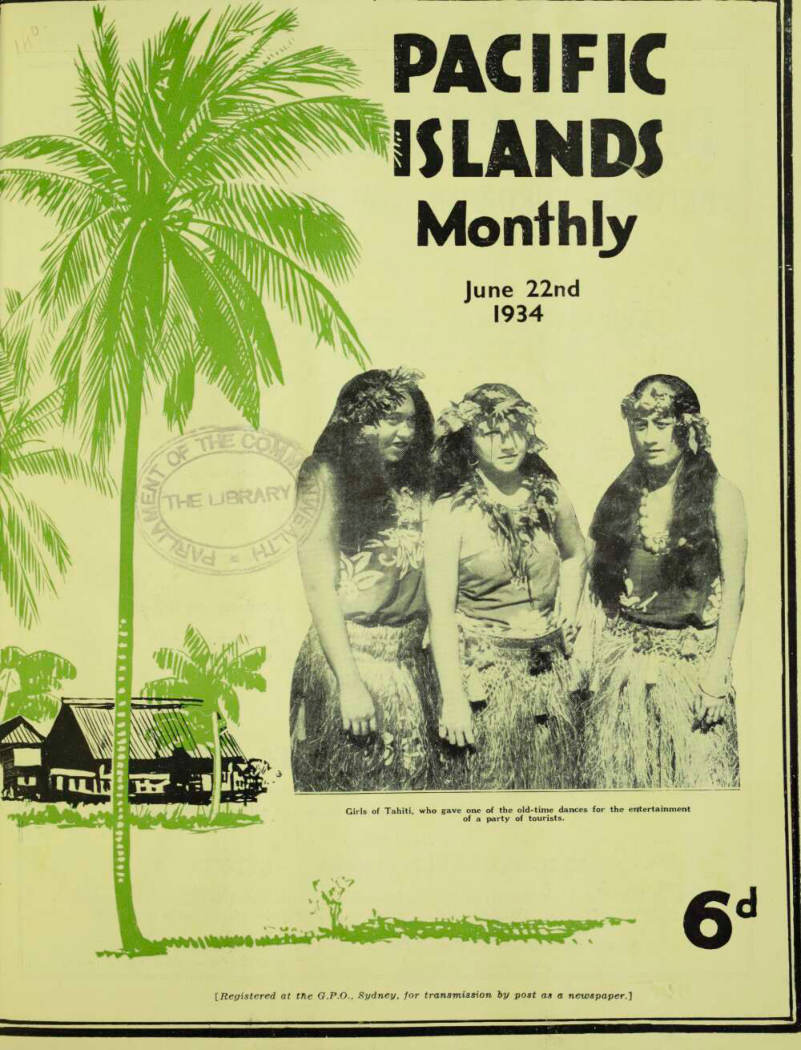
Girls of Tahiti, who gave one of the old-time dances for the entertainment of a party of tourists.
Advertisements & other items, p. 2 (1 item)
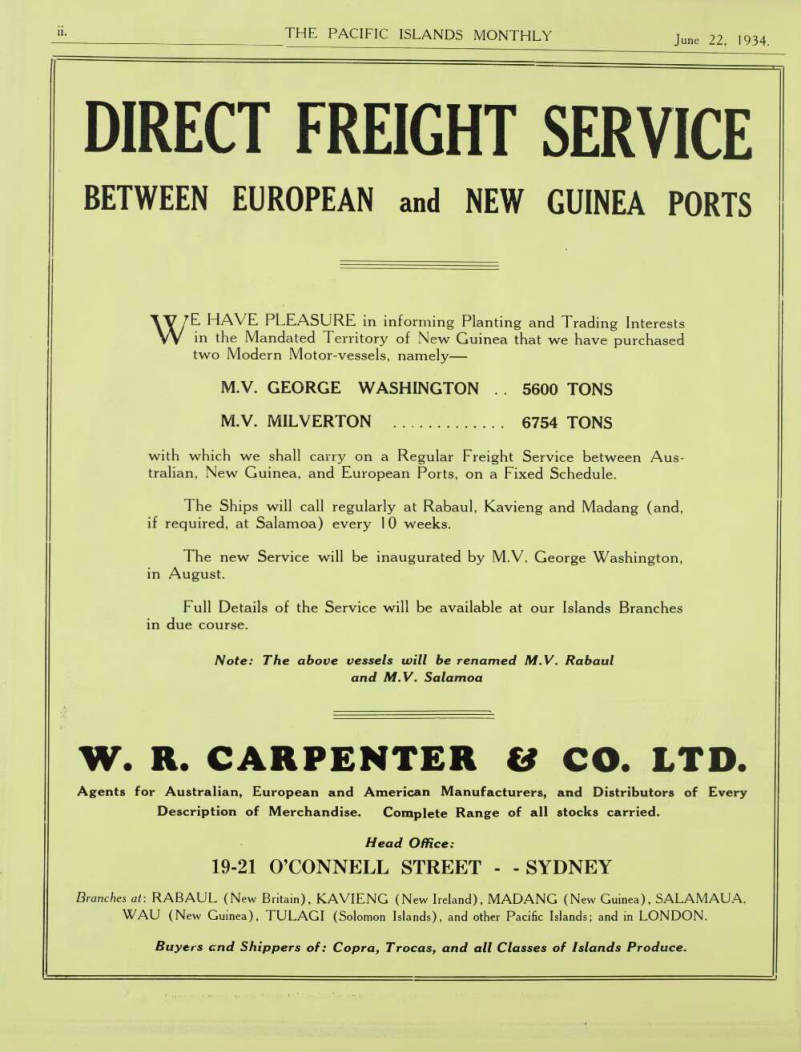
Direct Freight Service
BETWEEN EUROPEAN and NEW GUINEA PORTS
WE HAVE PLEASURE in informing Planting and Trading Interests in the Mandated Territory of New Guinea that we have purchased two Modern Motor-vessels, namely— M.V. GEORGE WASHINGTON . . 5600 TONS
M.V. MILVERTON 6754 TONS
with which we shall carry on a Regular Freight Service between Australian, New Guinea, and European Ports, on a Fixed Schedule.
The Ships will call regularly at Rabaul, Kavieng and Madang (and, if required, at Salamoa) every 10 weeks.
The new Service will be inaugurated by M.V. George Washington, in August.
Full Details of the Service will be available at our Islands Branches in due course.
Note: The above vessels will be renamed M.V. Rabaul and M.V. Salamoa
W. R. CARPENTER & CO. LTD.
Agents for Australian, European and American Manufacturers, and Distributors of Every Description of Merchandise. Complete Range of all stocks carried.
Head Office:
19-21 O’CONNELL STREET - - SYDNEY
Branches at: RABAUL (New Britain), KAVIENG (New Ireland). MADANG (New Guinea), SALAMAUA.
WAU (New Guinea), TULAGI (Solomon Islands), and other Pacific Islands; and in LONDON.
Buyers end Shippers of: Copra, Trocas, and all Classes of Islands Produce.
Pacific Travellers
Passengers Per Macdhui Which Sail
ED FROM SYDNEY FOR PAPUA AND NEW GUINEA ON MAY 17: Messrs. C. A. Baskett, R. Bunting, A. H. Bunting, D. C. Bell, J. W.
Bell, A. E. Brown, C. Burlington, J. Cassidy, A.
Clarkson, E. T. Clay, S. Combe, J. W Costello, S. E. Cruickshank, D. Cahill, W. Dupam, W. Davis, R W Grist, S. A. Greenland, E. Grant, T. Gar rad, J. Heath, J. Halliday, B. C. Hides, Hutton, W. Harvey, L. Halvorsen, D. J. Hindman, Hardy, A. H. de Levil, Lilley, J. Milligan, W. F. Mit chell, A. W. D. Mullens, Murphy, R. B. McVilley, B. Payne, N. Penglase, R. H. D. Phillips, Pixley, S. Ryde, K. C. Robinson, W. J. Read, Capt F. C.
Rennels, W. Simpson, J. Sedgers, W. C. Sparks, H. Trenchard-Smith, F. Tracy, D. Willmott, C.
Warren, R. Whitten, D. Waugh; Mesdames: A. Bowring, A. M. Brook, Blundell and 2 children, Combe and 2 children, Cahill and 2 children, A.
Edwards, A. C. English, Frost, Grist, Greenland, R. Hay, Halvorsen, C. A. Kunson, Murphy, Read, Rennels and child, M. S. Sprodd, Sedgers and 2 children, Stewart, Travis, Tait, Wallace Best, Whitten, Waugh and 3 children; Misses: H. Allsop, M. Bunting, M. Birmingham, C. E. Batey, D. L.
Beale, G. English, H. Hadley, B. E. Hoyles, C.
Kilpatrick, I. Lee, H. M. Purnell, K. M. Rae, V.
Roberts, E. Tracy, Wallace Best, Woodbridge.
Passengers Per Morinda Which Ar
Rived In Sydney From Norfolk Island
AND NEW HEBRIDES ON MAY 14: Mr. C. G.
Adam, Mr. E. M. K. Coates, Mr. A. Dawson, Mr. and Mrs. T. E. Adams, Mr. Barnard, Mrs. Bar nard and 3 children, Mr. J. F. Bowden, Miss E. T.
Corderoy, Miss M. F. Corderoy, Mrs. E. H. Colei son, Mrs. Dailey and 3 children, Mr. Dailey, Messrs.
H. S. and W. C. Edgar, Mr. L. Griffiths, Mrs.
Griffiths, Mr. A. Griffiths, Miss J. Griffiths, Mas ter Griffiths, Mr. W. Hams, Mrs. M. E. Lake and infant, Mrs. A. M. Lawton, Mr. E. C. Lockyar, Mrs. Lockyar, Mr. J. A. Macfarlane, Mr. J. Milner, Mr. R. H. Nobbs. Mr. H. Quintal, Mrs. Quintal and child, Mrs. E. Stock and infant, Miss M. S.
Wills, Mr. and Mrs. E. Wills, Mr. L. M. Addison, Mr. Bennett, Mrs. Bennett, Miss Harvey Brown, Mr. A. Clark, Mr. W. Clark, Dr. P. B. Cohen, Mr. L. Conway, Mr. J. C. Doyle, Mrs. Doyle, Mr.
A. H. Drew, Mrs. V. Flesher, Miss H. Flesher, Mr. A. Gibbons, Miss F. Godbee, Mr. J. Ionn, Mrs. Lane, Mr. F. Leonard, Mr. E. Lord, Mrs.
Lord, Miss A. Lord, Miss M. Lord, Mr. W. H.
McClung, Miss D. Mcßae, Miss M. Martyn, Mr.
L. Mason, Miss S. Meek, Mr. H. Moncneff, Mrs.
W. Nicholls and child, Mr. B. Parker, Mr. P. J. A.
Payten, Mr. L. Pike, Miss M. Pike, Miss C.
Sadler, Miss I. Sadler, Mrs. Rankin, Miss Rankin, Mr. Robbins, Mrs. Robbins and child, Dr. M.
Soiling, Mr. R. Stewart, Mrs. Thew, Miss E.
Thompson, Mr. H. Wilston, Miss L. Wilston, Miss M. Wilston.
Passengers Per Niagara Which Sail
ED FROM SYDNEY FOR SUVA, FIJI, ON MAY 24:—Mr. D. M. Merry, Miss E. Drummond, Professor G. C. Henderson, Mr. S. L.
Abseil, Mrs. S. L. Abseil, Mrs. E. Worth, Mr. G. F. T. Palmer, Mr. E. G. Keyete, Mrs.
E. G. Keyete and two children, Mr. T. N. K.
Karew, Mrs. T. N. K. Karew and child, Mr. and Mrs. R. C. Howell and child, Mr. L. N. Horsfield, Mrs. L. N. Horsfield, Mrs. E. Easton, Miss E.
Wylesmith, Mr. W. A. Ewins, Mrs. W. A. Ewins, Mr. F. J. Butler, Mr. H. F. B. Snowsill, Mrs.
H. F. B. Snowsill and two children, Mr. and Mrs. R. V. Clark, Mr. J. C. Rutter and wife, Mr. and Mrs. W. H. Freeman and two children, Mr. and Mrs. C. F. Gamson and two children, Mr. and Mrs. E. A. Alman and child, Major J. T.
Smith, Mr. E. L. Newman, Mrs. E. L. Newman, Mr. and Mrs. J. C. Trivett and infant, Mr. R. H.
Adair, Pastor A. G. Stewart, Mrs. A. G. Stewart, Miss A. A. Ellis, Mrs. E. P. Ellis. Mr. E. J.
Williamson, Mrs. E. Welsh, Mr. S. J. Beeby, Mr.
J. R Crickett.
Passengers Per Nellore Which Ar
Rived In Sydney From Rabaul, New
GUINEA, ON MAY 23:—Mr. H. Alday, Mrs. H.
Alday, Mr. E. F. Phibbs, Mr. F. W. Mantle, Mr. A. F. Johns, Mrs. B. B. Perriman and child, Mrs. H. Gill, Mrs. W. C. Groves and two children, Mrs. L. O. MacKellar and infant, Mrs. A. A.
Harvey.
Passengers Per Mariposa Which Ar
RIVED IN SYDNEY FROM SUVA, FIJI, ON MAY 21: —Mr. and Mrs. V. Adami, Miss M. Digrit, Mrs. R. D. Fitzgerald, Miss J. Fitzgerald, Mr. and Mrs. J. S. Gray, Miss Betty Gray, Miss S. Smith,
Master Don Gray, Major F. R. Hewitt, Mr. W.
Kent Hughes, Mr. H. Pearce, Miss M. Pearce, Mrs. Swan, Miss M. Swan, Mrs. M. Aston, Mr. and Mrs. W. L. Dunlop, Mr. and Mrs. E. Gluyas, Mr. C. Keam, Mrs. L. Kwai, Masters V., W., and H. Kwai, Miss N. Kwai, Miss J. Leslie, Mr. G.
Lucas, Mr. D. R. McCarthy, Mr. Gock Poy, Miss Lillian Ragg, Rev. Whomsbon-Aston, Mr. W. T.
Wood, Mr. L. A. Dewey.
Pasisengers Per Mariposa Which
SAILED FROM SYDNEY FOR SUVA. FIJI, ON MAY 30: Miss G. E. Adamson, Mr. A. C. Adena, Mrs. A. R. Aspinall, Master R. Aspinall, Mr. E.
F. Barnett, Mr. P. T. W. Black, Mr. A. Bock, Mrs. M. A. Crawford, Miss M. Crawford, Miss L.
G. Davison, Miss E. M. Davison, Mr. and Mrs.
D. H. Dwyer, Mrs. A. Foubister, Miss M. Fou bister, Miss K. Hannan, Miss J. Harber, Mr. J.
M. Hedstrom, Miss V. Herman, Miss G. Hughes, Mr. and Mrs. J. H. Jackson, Mr. D. Junor, Mr.
H. L. Lynch, Mr. M. J. Lynch, Mrs. O. MacGee, Miss B. E. H. MacGee, Mr. B. O’Brien, Miss Hazel Scott, Mr. D. J. Sykes, Mrs. W. L. Tre wenaok, Master B. Trewenack, Mrs. G. W.
Vowell, Mr. V. P. Williams, Mr. C. Andretta, Rev.
Cyril Cato, Mrs. C. Cato, Mr. and Mrs. C. M.
Churchward, Masters S. and H. Churchward.
Misses S. and K. Churchward, Mr. T. Costello, Mrs. H. Lanyan, Mr. C. Holborn, Mr. I. McCon nell, Mr. J. Pinch, Mrs. S. Weatherby, Miss M.
Weatherby, Master S. Weatherby, Mr. H. Wheat ley.
Passengers Per Morinda Which Sail
ED FROM SYDNEY FOR LORD HOWE AND
Norfolk Islands On May 26:—Rev. L.
Ayscough, Mr. Alderton, Mr. A. W. Austin, Mrs.
G. Burns, Mr. and Mrs. R. Browne, Mr. and Mrs.
E. B. Bignold, child and infant, Mr. S. B. Blun dell, Mrs. Bearup, Miss D. Bearup Mr. R. Camp bell, Mr. and Mrs. N. Desmarchelier, Mr. T. Des marchelier, Mr. W. G. Day, Miss W. Dennison, Miss R. Day, Miss R. Dutton, Miss M. Dutton, Mrs. N. Ebsworth, Miss J. Ebsworth, Mrs. R.
Ferris, 2 children and infant, Miss G. Farley, Mr.
A. Hartley, Miss H. D. Hearfield, Mr. A. H.
Jackson, Lt. Com. and Mrs. F. R. James, Mr. T.
Johnston, Miss Jennings, Mr. and Mrs. Lovett, Mr. and Mrs. D. S. Macgregor, Miss M. Mackey, Miss M. Moffatt, Mrs. R. Noble, Mrs. Nicholls, Mr. R. Perrier, Mr. Perdue, Mr. A. Phelan, Miss J. Phelan. Mr. and Mrs. W. Rees, Mr. and Mrs.
Rogers, Mr. J. Russell, Mr. and Mrs. C. T.
Stephens and child Mrs. C. Scott, Mrs. Stevens and child, Miss B. Smith, Miss O. Tyrer, Mr. G.
A. Wyndham, Mr. A. S. Walton, Mr. A. Walker, Mr. G. Walker, Mr. J. Williams, Miss U. Wilson.
Passengers Per Morinda Which Sail
Ed From Sydney For Lord Howe
Island, Norfolk Island. And New Heb
RIDES ON JUNE 7:—Mr. and Mrs. Adams, Mr.
F. Adams, Mrs. Archer, Mr. and Mrs. Anderson,
Miss H. Atkins, Miss A. Bell, Bishop Baddeley, Mr. Booth, Mr. A. Brocklebank, Mrs. Brossey, Mr. Christian, Mrs. Cranston, Mrs. Chapman, Miss Cussons, Miss Chenoweth, Miss Cameron, Mr.
Davidson, Mr. Dark, Mr. Douglass, Miss Emerson, Mrs. M. Fenton, Mr. N. P. Goodall, Mr. R.
Henderson, Mrs. Hawkes, Miss E. Haggarty, Mr. and Mrs. Isherwood, Mr. and Mrs. Jenkins, and two children, Mrs. J. King, Mr. and Mrs. Larney, Mr. Little, Mr. and Mrs. McLeod and infant, Miss Muir, Mr. McNamara, Mr. Maund, Mr. H.
Macdonald, Mr. Mackie, Master Nobbs, Mr. Ney ion, Miss Noske, Miss O’Sullivan, Mr. Phillips, Mrs. Payten, Mrs. Ritson, Miss Ritson, Mrs.
Rowlings, Miss Rowlings, Miss Randle, Mr. Sem ark, Mr. and Mrs. Sander, Mrs. Shillman, Mrs.
Sanders, Miss P. Saunders, Miss Spring, Miss Sherring, Miss Sanders, Miss Thompson, Miss E.
Thompson Mr. and Mrs. Watt, Mr. G. C. Wilson.
Miss K. Walshe.
Passengers Per Montoro Which Ar
RIVED IN SYDNEY FROM PAPUA AND NEW GUINEA ON JUNE IMrs. A. M. Allan, Mr. J.
P. Alenton, Mr. and Mrs. C. O. Anderson, Mr. R.
Anderson, Mrs. E. V. Bell, Mr. R. Bettison, Mrs.
L. M. Bremen, Mrs. L. H. Brodie, Miss C. E.
Beige, Mr. W. H. Bird, Mr. R. Christie, Mr. S. H.
Christian, Mr. A. G. Cairncross, Mr. O. C. Cart wright Mr. G. G. Clark, Mr. R. G. Cox, Mr. E. D.
Eve, Miss J. R. Fourro, Mr. T. Flower, Mr. A. F.
Faigh, Mr. E. F. Griffen, Mr. F. H. Granger, Mr.
C. Hughes, Mrs. E. Hayes, Miss L. Hodge, Mrs.
C. Hoile, Mrs. R. E. Hall, Mr. A. P. Howell, Mr.
G. A. Innes, Mrs. D. Ironmonger, Mrs. E. M.
Lewis, Mrs. D. I. C. Latimer. Mrs. F. E. Lyall, Mr. H. G. L. Morton, Mr. and Mrs. R. Muller, Mr.
A. W. Marshall, Miss L. M. A. Mulligan, Mr. J.
H. Orrell, Mr. F. T. O’Dea, Mr. S. G. Owen, Mrs.
A. Pollard, Miss G. A. Pollard, Miss C. G.
Roberts, Mr. A. G. Shannon, Mr. P. W. Smih, Mr.
B. W. Storey, Mr. G. B. T. Smith, Mr. H. S. T.
Smith, Mr. W. L. Stephenson, Mr. F. O. Turner, Mr. H. Taylor, Mrs. O. Taylor, Mr. and Mrs.
A. Thompson, Mr. F. W. Torringon, Mr. R. W.
Vaughan, Mr. and Mrs. A. K. Whiteman, Miss C. M. Woodings.
Passengers Per Malaita Which De
Parted From Sydney For Solomon
Islands And Rabaul, New Guinea, On
MAY 19:—Rev. Father M. Boch, Mr. R. G. H.
Box, Mr. D. C. Hartam Bayes, Mr. and Mrs.
Cameron, Mr. and Mrs. A. T. Clark, Mr. and Mrs. D. C. Clarkson, Mr. A. Courlander, Miss E.
Dixon, Mr. J. Davis, Miss M. Dobbin, Dr. C. W.
Harrison, Mrs. Heritage, Miss L. Holloway, Miss M. Hardie Mrs. A. W. Johnson, Mr. and Mrs.
D. K. Michellhill, Miss A. McNamara, Miss I. A.
L. Morriss, Miss N. McGuire, Mr. C. Murray, Mr. and Mrs. C. G. Nathan, Mr. J. Pijacum, Pastor A H. Piper, Mrs. C. Pond-Harris, Mr. L.
I. Riley Mrs. T. W. Rooke, Miss J. V. Rainford, Rev. Father P. O’Reilly, Mr. A. R. Small, Brother H. Simmonds, Mr. J. S. Sandeman, Mrs. Nelson Turner, Mr. T. Tellesson, Mr. R. M. Upton, Mr.
W. G. Ure, Miss I. C. Wench, Mr. D. Whitford, Miss P. York.
(Continued on page 53.)
(Continued from page 1)
Passengers Per Montoro Which Left
Sydney For Papua And New Guinea
ON JUNE 6:—Mr. A. E. Anderson, Mr. A. E.
Board, Mr. H. Brudo, Mr. R. Brudo, Mr. W. T.
Barnes, Mr. Barden, Mr. Butler, Mr. Bannigan, Rev. and Mrs. B. Chenoweth, Mr. and Mrs. D. S.
Campbell and 2 children, Mr. P. Collett, Dr. and Mrs. R. W. Cooper, Mr. W. M. Campbell, Mr. W.
Dupain, Mr. S. Furley, Mr. and Mrs. Grabowsky, Mr. and Mrs. C. E. Gunther and infant, Mr. G. E.
Guthrie, Mr. M. R. Hunter, Mr. and Mrs. Holling worth, Mr. and Mrs. W. R. Humphries, Mr. and Mrs. Hannerman, Mrs. M. E. Hardiman, Mrs.
L. F. S. Hore, Mrs. E. M. Hore-Lacy, Mrs. C. J.
Izod, Bro. Jenin, Major G. Kinlock and Mrs.
Kinlock, Mr. L. Lawrie, Mr. Laws, Hon. H. P.
Lyons, Mrs. R. Lindeholm, Miss H. Lamb, Miss Lansley, Miss Lord, Mr. D. McDonald, Mrs. M.
E. Nichol, Mr. C. J. Orr, Mr. G. W. Pratt, Mr.
Phillips, Mr. H. T. Pearson, Mrs. A. V. Price, Mr. T. J. Rideout, Mr. W. Sherman, Mr. A. K.
Smith, Mrs. E. Slater and child, Mr. I. Shoebridge, Dr. C. C. Simson, Mr. J. T. Taylor, Mrs. H.
Taylor and child, Mrs. Tully, Misses E. and V.
Tully, Mr. and Mrs. J. Virtue, Mr. S. A. Webb, Mr. N. G. Wilson, Mr. J. D. Wilkinson, Rev.
Mother Ursula, Sister Ann Denis, Sister Mary Agnes, Sister Mary de Pazzi.
Passengers Per Morinda Which Ar
RIVED IN SYDNEY FROM LORD HOWE AND
Norfolk Islands On June 5:—Rev. L.
Ayscough, Mrs. W. Bearup, Miss D. Bearup, Mr.
W. F. Bell, Miss J. Bell, Miss M. D. Buckland, Mrs. S. Burns, Mr. and Mrs. R. Browne, Mr. C.
H. Baird, Mr. J. Copland, Mr. R. Campbell, Mr.
W. G. Day, Miss G. Day, Misses M. and R.
Dutton, Mr. and Mrs. M. Desmarchelier, Mr. T.
Desmarchelier, Mrs. N. Ebsworth, Miss J.
Ebsworth, Miss G. N. Farley, Mr. and Mrs. D. A.
Ferris, Miss M. Ferris, Mrs. C. E. Gordon and 5 children, Mr. A. Hartley, Miss D. Hearfield, Mr.
W. H. Jackson, L. Com. and Mrs. James, Mr. T.
Johnson, Mrs. T. Lawrie and 3 children, Miss J.
Lawrie, Miss M. Mackey, Miss M. Moffatt, Mr. and Mrs. D. S. McGregor, Mrs. R. Noble, Mr. R.
Perrier, Mr. A. Phelan, Miss J. A. Phelan, Mr.
A. J. Peurdue, Mr. and Mrs. W. Rees, Mr. and Mrs. M. Rogers, Mr. and Mrs. C. Stephens and child, Miss B. Smith, Miss R. M. Robinson, Mr.
K. Robinson, Mrs. M. M. Stevens, Master R. A.
Stevens, Miss O. Tyrer, Mr. G. A. Wyndham, Mr. A. Walker. Mr. G. Walker, Mr. A. S. Walton, Miss M. Wilson.
Advertisements & other items, p. 3 (1 item)
advt
Advertisers
Page Adams, W. & Co. 12 Amag. Wireless .. 18 Antinea Drug Co. .. 13 Arnott’s Biscuits .. 17 Ashton, Mrs. J. .. 56 Aspro 33 Ausoline Co 26 Bank of N.S.W. .. 34 Blau, Julius .. .. 16 Broomfields, Ltd. .. 40 Bruce, Robert .. .. 47 Brunton’s Flour .. 27 Brush, J. 48 Budge, James .. .. 39 Bullivants 15 Burns, Philp & Co. 2 Burns, Philp (S.S.) Co. 29 B.P. Magazine .. 36 Burnside 58 Buzacott, Ltd 46 Capell, J. 21 Carpenter, W. R.
Cover ii.
Central Q’land Meat Co. ..42 Chapman & Sherack 26 Christies, Ltd. .. 15 Coleman Quicklite . 58 Coral Starch .. .. 35 Cowles & Dunn .. 55 Dangar, Gedye, Ltd. 38 Dawson & Row .. 62 Delicia Food Co. .. 25 Doans 47 Dye. A. W. & Co. 20 Ellerker, A. J. .. 13 Fletcher & Sons .. 36 Flynn, Mrs. W. .. 40 Ford, Noel P. 57 Ford, W. M. 52 For Sale 58 Garrett & Davidson 53 Gillespie’s Flour .. 42 Glebe Eng’g 28 Goshen Pt. Hospital 19 Grahame, C. 36
Page Gregory, A. 54 Guinea Airways Cover iii.
Halvorsen, L. 61 Hardie, Jas. & Co. 25 Harper, M. 39 Harringtons .. .. 37 Heenzo 56 Hislop, Lloyd, Ltd. 35 Holbrooks, Ltd. .. 31 Holden’s Air T. .. 64 “Holmecroft” .. .. 27 Holmes, W. 60 Hotel Mansions .. 28
I.C.I.A.N.Z., Ltd. .. 52
I.C.S. .. 55
Kelvin Engines .. 59 King George Whisky 58 Kopsen & Co 44 Lane & Girvan .. 28 Lessey’s D.Y.S. .. 10 Lloyds Teas .. .. 23 Mcllrath’s, Ltd. .. 14 Marconi School .. 58 Matrimonial .. .. 60 Metro. Bus. College 12 Mungo Scott, Ltd. . 21
N.D.L 63
Nelson & Robertson, 34, 60 New Brit. Express 47 Nock & Kirby, Ltd. 56 Nolan, Spencer .. 41 Noyes Bros 64 Oldfield 52 Pacific Is. Assocn. 39 Pacific Publications, 10, 54 Pike Bros 18 Porter, N. C. 45 Prescott, Ltd 29 Rabaul Carr’g. Co. . 44 Ransomes, Ltd. .. 44 Rasmussen .. .. 20 Reid, W. M. 2 Rohu, Sil 49
Page Rolls Razor .. .. 31 Royal Packet N. Co. 1 Russell, S. 20 Ruston & Hornsby 32 Scott & Bowne .. 53 Selby, H. B. 58 Shell Oil 43 Slingsby Trucks .. 60 Smith & Gluyas .. 54 Smythe, J. 37 Springwool L. Col. 26 Steamships T. Co., Ltd 62 Sterling Varnish Co. 11 “Stillholme” .. .. 17 Sunshine Harvesters 30
Page Swallow and Ariell, Ltd 24 Sydney Marine Agency 49 “Talkeries” .. .. 57 Taubman’s Paints .. 23 Thomas, G. & Co. 60 Tillock & Co., Ltd. 41 Titon 56 Toole, J. E. 27 Tooth & Co iv.
Tyrrell’s Museum . 15 Vacuum Oil .. .. 22 Vincent Bros 19 Wallaringa Mansions 61 Wanted to Buy .. 58
Page Ward, Geo. 50 Ward, L. A. 36 Wills, W. D. & H. O. 59
Page
Winlite 51 Witheford, C. E. .. 15 Wunderlich, Ltd. .. 33
Contents
Page Pacific Islands Travellers 1-53 Future of Islands Planting ... 3 Missionaries in Competition ... 5 Fiji’s Trade 5 Mr. O. F. Nelson 5 Papuan Planter Attacked 6 Cook Is. Orange Trade 6 Tahiti Treasure-Seekers 6 Copra Market Developments . . . . 7-8 Papeete’s Growth 8 Historic Guillotine 8 Tropicalities 10 About Islands People 12-13 Dutch New Guinea 16 Exploration in N. Guinea 17 Search for Gold in T.N.G 21 New Guinea Scientists 23 Lever Bros.’ Huge Profit . . . . 25
Page Releigious Stir in Nauru 28 Origin of Pacific Races 31 Burns, Philp’s Annual Reports . . 34 Guinea Airways and Guinea Gold . 36 N.G. Goldfields Road 38 Notes from New Guinea 41 How Kalekona Got His Head . . 42 Japan in the South Seas .. .. 44 Problem of Fiji Indians 46 Chinese in Tahiti 49 Growing Vegetables in the Tropics 51 Fashion Hints for Islands Women 52 Book Reviews 57 Islands Gold Mining Notes . . . . 59 Market Quotations 61 Exchange Rates 62 Shipping Services in the Pacific .. 63-64
Advertisements & other items, p. 4 (1 item)
Burns. Philp & Co, Ltd.
W. M. REID
C/o Robert Reid & Co., Ltd.
32-34 YORK STREET, SYDNEY
Wholesale Exporter of Goods of all Classes from Australia
BURNS. PHILP & CO, LTD.
General Merchants
Shipowners
Tourist Agents, Etc.
Buyers of all Classes
of Island Produce
Head Office - 7 Bridge Street, Sydney - Australia Code Address: “BURPHIL”
Regular Steamer Services From Australia to New Guinea, Papua, Solomons, Lord Howe, Norfolk Islands, New Hebrides, Java and Singapore
The Pacific Islands Monthly
The Newspaper-Magazine Of The South Seas
[Registered at G.P.O., Sydney, for transmission by post as a newspaper.]
Published Once Each Month and Circulated in Australia and New Zealand and in the following Pacific Territories and Islands Groups:
Crown Colony of Fiji.
Australian Territory of Papua.
Mandated Territory (Australia) of New Guinea, Bismarck Archipelago, and Northern Solomon Islands.
Mandated Territory (Japan) of Marshall, Caroline and Mariana Islands.
American Territory of Guam.
Mandated Territory of Nauru.
British Crown Colony of Gilbert and Ellice Islands.
French Territory of New Caledonia.
British and French Condominium of New Hebrides.
American Territory of Eastern Samoa.
Mandated Territory (New Zealand) of Samoa.
British Solomon Islands Protectorate.
British Protectorate of Tongan Islands.
New Zealand Territory of Cook Islands.
Australian Territory of Norfolk Island.
French Colony of Oceania (Tahiti, etc.).
American Territory of Hawaiian Islands.
Owned and Produced by Pacific Publications, Ltd., Union House, 247 George Street, Sydney.
Telephone Bw 5037
P.O. Box 3408 R
Contributions Articles, Stories, and Photographs dealing with Pacific Islands Subjects are invited, and will be oaid for on publication at usual rates.
Subscription Rates Per Annum, within British Empire, Prepaid Post Free 6/- Per Annum, elsewhere, prepaid, Post Free .. 87- Single Copies 6d.
Editor and Publisher:
R. W. Robson.
Advertisements Advertising rates furnished on application.
Colours, etc. by Arrangement.
Process Blocks made at Advertiser’s expense when required. Screen, 100.
Changes of Advertising Copy should reach this Office by Bth of each month, otherwise previous advertisement may be repeated.
Registered Address for Radiograms and Cables: “PACPUB” Sydney Agents The following are authorised to receive subscrip tions for “The Pacific Islands Monthly”— Islands Branches of Burns, Philp & Co., Ltd., and Burns, Philp (South Seas) Co., Ltd.
Islands Branches of W. R. Carpenter & Co., All Branches of Morris, Hedstrom & Co., Ltd.
G. Thomas & Co., Rabaul.
Whitten Bros., Ltd., Samarai.
P. Costello, Suva, Fiji.
All Branches and Representatives of W. H. Grove and Sons, Ltd., Auckland.
S. Russell, Papeete, Tahiti.
Cook Islands Trading Co., Rarotonga.
Mrs. M. Campbell, Cascades, Norfolk Island.
Vol. IV., No. 11.
Sydney, June 22, 1934.
Price 6d. Per Copy Prepaid: 6/- p.a.
The Future Of Islands Planting
THERE is a slight recovery in the price of first-class copra, and on present rates a debt-free coconut planter might make just a bare living. Planters who have borrowed heavily, or who have incurred obligations based on 1925-29 expectations, are in a hopeless position, so long as copra remains under £12 or £14 per ton.
The outlook is not very cheering. The process of economic recovery is being retarded by a growing menace of war, and by the. international evil called “eco nomic nationalism”—the practice of trying to obtain selfish advantages by erecting tariffs and other barriers against the free movement of inter national trade.
That is a general condition. So far as copra is concerned, the position is complicated by a variety of factors. Two of them —the competition of whale oil, and the new American processing tax — are dealt with elsewhere in this issue.
Coconut planters must just hang on.
All the copra produced is being mar keted and consumed —it is, at least,
something to the good that there is no
vast over-production.
Meanwhile, the planter must live. He must provide for present requirements, and for a possibly long period in the immediate future, when copra will re turn little profit. Most plantation-own ers have lost no time. Already one hears of planters, throughout the length and breadth of the South Seas, who are try ing out new crops. Experiments appear to cover almost the whole range of tropi
cal agriculture.
Rubber has been the alternative to copra in Papua; and, under the encour agement of a very definte Australian preference, the Papuan rubber industry has made headway recently, and actually has saved the Territory. There is much talk of over-production of rubber; but the growers need not worry unduly. The demand for rubber is growing steadily throughout the world, and there is no substitute worth mentioning.
Several planters in Papua and New Guinea have been keeping the wolf from the door with coffee and cocoa. Both
commodities are worth attention. Coffee has been regarded as an over-produced crop: but Australian preference guar antees in Australia a steady and profit able, if limited, market for coffee grown in Australian territories. Mr. Loudon, of Port Moresby, is reported to be doing well with his coffee plantation.
A New Guinea planter informs us that he is finding cocoa well worth while.
He is getting £32 per ton for it, in Syd ney. This includes an Australian Com monwealth bonus of £11 per ton, which remains until 1936. He says he regards cocoa as an easy crop to handle; and with good soil he can count on half-a-ton to the acre. His average is about 6 cwt. —and, interplanted with coconuts, cocoa pays well.
The Germans introduced cocoa to Western Samoa as a staple crop, and, during the past few years, since the copra slump, it has saved that rich Territory. The cocoa price fell disas trously several months ago, and there was much alarm in Samoa, but the mar ket has now recovered a little. It is the Australian bonus, however, which makes it of special interest to planters in New Guinea and Papua.
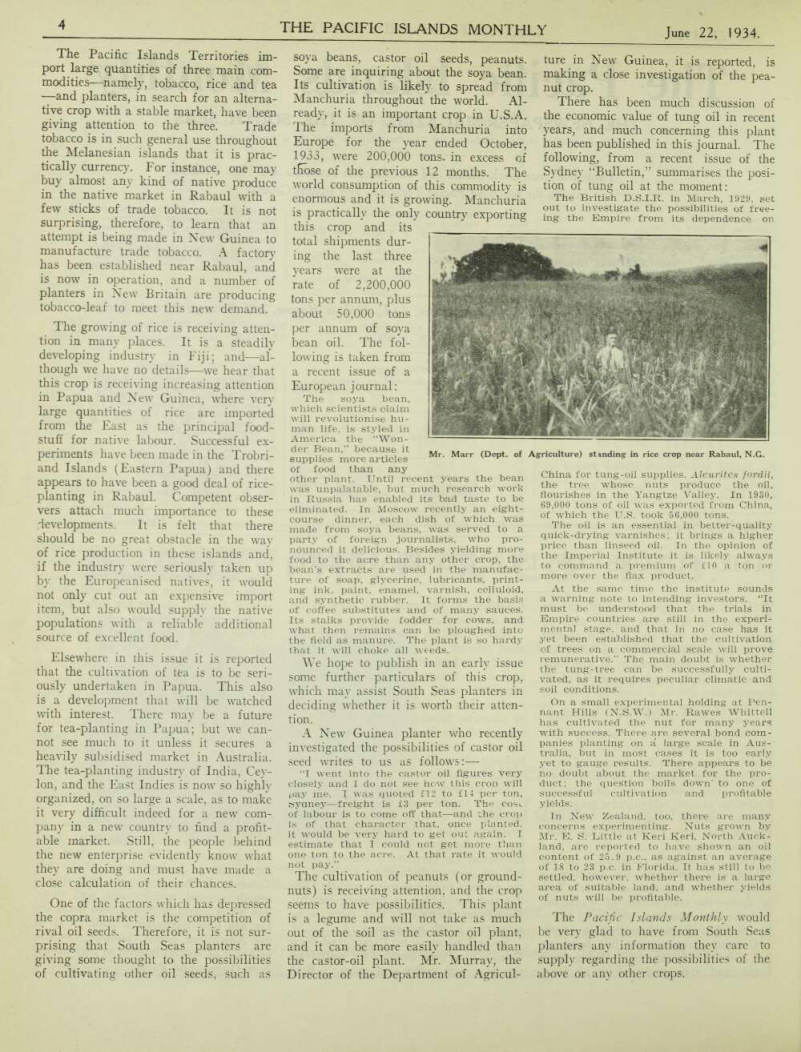
The Pacific Islands Territories im port large quantities of three main com modities—namely, tobacco, rice and tea —and planters, in search for an alterna tive crop with a stable market, have been giving attention to the three. Trade tobacco is in such general use throughout the Melanesian islands that it is prac tically currency. For instance, one may buy almost any kind of native produce in the native market in Rabaul with a few sticks of trade tobacco. It is not surprising, therefore, to learn that an attempt is being made in New Guinea to manufacture trade tobacco. A factory has been established near Rabaul, and is now in operation, and a number of planters in New Britain are producing tobacco-leaf to meet this new demand.
The growing of rice is receiving atten tion in many places. It is a steadily developing industry in Fiji; and —although we have no details —we hear that this crop is receiving increasing attention in Papua and New Guinea, where very large quantities of rice are imported from the East as the principal food stuff for native labour. Successful ex periments have been made in the Trobri and Islands (Eastern Papua) and there appears to have been a good deal of rice planting in Rabaul. Competent obser vers attach much importance to these developments. It is felt that there should be no great obstacle in the way of rice production in these islands and, if the industry were seriously taken up by the Europeanised natives, it would not only cut out an expensive import item, but also would supply the native populations with a reliable additional source of excellent food.
Elsewhere in this issue it is reported that the cultivation of tea is to be seri ously undertaken in Papua. This also is a development that will be watched with interest. There may be a future for tea-planting in Papua; but we can not see much to it unless it secures a heavily subsidised market in Australia.
The tea-planting industry of India, Cey lon, and the East Indies is now so highly organized, on so large a scale, as to make it very difficult indeed for a new com pany in a new country to find a profit able market. Still, the people behind the new enterprise evidently know what they are doing and must have made a close calculation of their chances.
One of the factors which has depressed the copra market is the competition of rival oil seeds. Therefore, it is not sur prising that South Seas planters are giving some thought to the possibilities of cultivating other oil seeds, such as
soya beans, castor oil seeds, peanuts.
Some are inquiring about the soya bean.
Its cultivation is likely to spread from Manchuria throughout the world. Al ready, it is an important crop in U.S.A.
The imports from Manchuria into Europe for the year ended October, 1933, were 200,000 tons, in excess of tEose of the previous 12 months. The world consumption of this commodity is enormous and it is growing. Manchuria is practically the only country exporting
this crop and its total shipments dur ing the last three years were at the rate of 2,200,000 tons per annum, plus about 50,000 tons per annum of soya bean oil. The fol lowing is taken from a recent issue of a
European journal:
The soya bean, which scientists claim will revolutionise hu man life, is styled in America the “Won der Bean,” because it supplies more articles of food than any
other plant. Until recent years the bean was unpalatable, but much research work in Russia has enabled its bad taste to be eliminated. In Moscow recently an eight course dinner, each dish of which was made from soya beans, was served to a party of foreign journalists, who pro nounced it delicious. Besides yielding more food to the acre than any other crop, the bean’s extracts are used in the manufac ture of soap, glycerine, lubricants, print ing ink, paint, enamel, varnish, celluloid, and synthetic rubber. It forms the basis of coffee substitutes and of many sauces.
Its stalks provide fodder for cows, and what then remains can be ploughed into the field as manure. The plant is so hardy that it will choke all weeds.
We hope to publish in an early issue
some further particulars of this crop,
which may assist South Seas planters in deciding whether it is worth their atten
tion.
A New Guinea planter who recently
investigated the possibilities of castor oil
seed writes to us as follows:
“I went into the castor oil figures very closely and I do not see how this crop will pay me. I was quoted £12 to £14 per ton, Sydney —freight is £3 per ton. The cost of labour is to come off that —and the crop is of that character that, once planted, it would be very hard to get out again. I estimate that I could not get more than one ton to the acre. At that rate it would not pay.”
The cultivation of peanuts (or ground
nuts) is receiving attention, and the crop
seems to have possibilities. This plant
is a legume and will not take as much out of the soil as the castor oil plant, and it can be more easily handled than
the castor-oil plant. Mr. Murray, the
Director of the Department of Agricul
ture in New Guinea, it is reported, is making a close investigation of the pea nut crop.
There has been much discussion of the economic value of tung oil in recent years, and much concerning this plant has been published in this journal. The following, from a recent issue of the Sydney “Bulletin,” summarises the posi tion of tung oil at the moment: The British D.S.I.R. in March, 1929, set out to investigate the possibilities of free ing the Empire from its dependence on
China for tung-oil supplies. Aleurites fordii, the tree whose nuts produce the oil, flourishes in the Yangtze Valley. In 1930, 69,000 tons of oil was exported from China, of which the U.S. took 56,000 tons.
The oil is an essential in better-quality quick-drying varnishes; it brings a higher price than linseed oil. In the opinion of the Imperial Institute it is likely always to command a premium of £10 a ton or more over the flax product.
At the same time the institute sounds a warning note to intending investors. “It must be understood that the trials in Empire countries are still in the experi mental stage, and that in no case has it yet been established that the cultivation of trees on a commercial scale will prove remunerative.” The main doubt is whether the tung-tree can be successfully culti vated, as it requires peculiar climatic and soil conditions.
On a small experimental holding at Pen nant Hills (N.S.W.) Mr. Rawes Whittell has cultivated the nut for many years with success. There are several bond com panies planting on a large scale in Aus tralia, but in most cases it is too early yet to gauge results. There appears to be no doubt about the market for the pro duct; the question boils down to one of successful cultivation and profitable yields.
In New Zealand, too, there are many concerns experimenting. Nuts grown by Mr. E. S. Little at Keri Keri, North Auck land, are reported to have shown an oil content of 25.9 p.c., as against an average of 18 to 23 p.c. in Florida. It has still to be settled, however, whether there is a large area of suitable land, and whether yields of nuts will be profitable.
The Pacific Islands Monthly would
be very glad to have from South Seas planters any information they care to
supply regarding the possibilities of the
above or any other crops.
Mr. Marr (Dept, of Agriculture) standing in rice crop near Rabaul, N.G.
Missionaries In
Competition
Deplorable Race for Interior of New Guinea
From our own correspondent.
Salamaua, June 3.
IT is to be hoped that the Administra tion, in the name of humanity and common sense—if the two things are compatible!—will do something to quickly put an end to a situation that is develop ing in this region and that threatens to cast an unpleasant reflection upon the white man’s religion and make our white man’s system of government ridiculous.
In recent months, the hitherto unknown interior of New Guinea —the area that lies north-west of the Morobe goldfield and southwards and south-west of Mad ang—has been disclosed as a magnificent, fertile plateau, densely populated by a fine class of natives who have never seen white men and who, as skilled farmers, have quite an excellent culture of their own. This discovery caused intense in terest among scientific people; and al ready has brought out a plea from men of vision that efforts be made promptly to prevent European penetration of this new region, so that the fine native popu lation may remain unspoiled.
Now we have the sequel. Three mis sionary expeditions, representing three different and mutually antagonistic “Chris tian” Churches, are headed for this new region, and each appears to be trying to get in first.
It has been understood, apparently, that the mission work of the whole area along this north-east coast of New Guinea, from near the Papuan border to the vicinity of Finchshafen, belonged to the Lutherans—the vigorous German Church established here during the German re gime; and it seemed to be recognised that the mission work in the hinterland was the responsibility of the Lutherans. The Lutherans, at any rate, have been slowly pushing up through the Markham and Ramu areas; and they contemplated an eventful penetration of the newly dis covered plateau which lies beyond the Ramu.
But the Lutherans, to their consterna tion, have just learned that a party of representatives of the Roman Catholic Mission of the Holy Ghost (which has its headquarters at Sek, near Madang) have already pushed into the new country from Madang, and established themselves among the inland plainsmen.
The indignant Lutherans regard this as an invasion of their rights and they refuse to take it lying down. So they have des patched a hurriedly-organised but well equipped expedition of three European missionaries and a large number of native adherents, via the Markham Valley, to the new country; and latest news is that the Lutheran expedition is steadily and doggedly making its way on to the central plateau.
There is much jeering speculation here as to what will happen when the two bodies of Christians meet. Will they at tack each other with hymn books; or will they camp at either end of this mighty plateau, and refuse to speak to each other; or will they refer their angry differences to the King of the Benna-Bennas, or the Sultan of the Wahgi, for the arbitrament of those unspoiled potentates?
But the farce is not yet ended! The climax is not yet! It is reported that there has arrived here by the last Macd hui a party of adherents from the Seventh
Day Adventist Church —learned natives in charge of a European—whose destination also is the inland plateau. It is said that the S.D.A. party propose to use aeroplanes.
It is reported, further, however, that as the result of strong representations the new arrivals have agreed to postpone their departure for the Promised Land.
There are about a million natives in those parts of Papua, New Guinea, and the Solomons, which already are in fairly close contact with “civilisation.” Surely there is enough work among those people for all these enterprising missionaries, without their having to make themselves ridiculous in this competitive race to bring the blessings of religion to a people who have managed to live and prosper for hundreds of centuries without any knowledge of the white man’s strange ways!
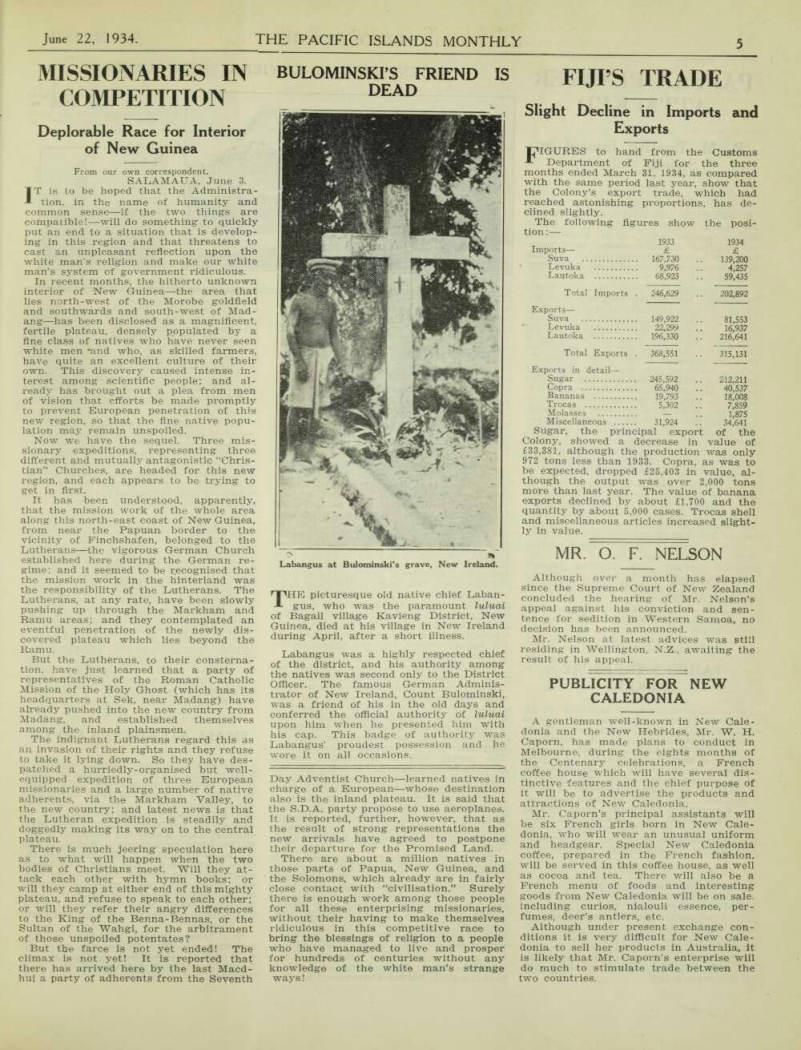
Bulominski’S Friend Is
Dead
THE picturesque old native chief Laban gus, who was the paramount luluai of Bagail village Kavieng District, New Guinea, died at his village in New Ireland during April, after a short illness.
Labangus was a highly respected chief of the district, and his authority among the natives was second only to the District Officer. The famous German Adminis trator of New Ireland, Count Bulominski, was a friend of his in the old days and conferred the official authority of luluai upon him when he presented him with his cap. This badge of authority was Labangus’ proudest possession and he wore it on all occasions.
Labangus at Bulominski’s grave, New Ireland.
Fiji’S Trade
Slight Decline in Imports and Exports
FIGURES to hand from the Customs Department of Fiji for the three months ended March 31, 1934, as compared with the same period last year, show that the Colony’s export trade, which had reached astonishing proportions, has de clined slightly.
The following figures show the posi tion:—
Sugar, the principal export of the Colony, showed a decrease in value of £33,381, although the production was only 972 tons less than 1933. Copra, as was to be expected, dropped £25,403 in value, al though the output was over 2,000 tons more than last year. The value of banana exports declined by about £1,700 and the quantity by about 5,000 cases. Trocas shell and miscellaneous articles increased slight ly in value.
Imports— Suva 1933 £ 167,730 9,976 68,923 1934 £ 139,200 4,257 59,435 Levuka Lautoka Total Imports . 246,629 202,892 Exports— Suva 149,922 22,299 196,330 81,553 16,937 216,641 Levuka Lautoka Total Exports . 368,551 315,131 Exports in detail— Sugar 245,592 65,940 19,793 5,302 212,211 40,537 18,008 7,859 1,875 34,641 Copra Bananas Trocas Molasses Miscellaneous 31,924
Mr. O. F. Nelson
Although over a month has elapsed since the Supreme Court of New Zealand concluded the hearing of Mr. Nelson’s appeal against his conviction and sen tence for sedition in Western Samoa, no decision has been announced.
Mr. Nelson at latest advices was still residing in Wellington, N.Z., awaiting the result of his appeal.
Caledonia
Publicity For New
A gentleman well-known in New Cale donia and the New Hebrides, Mr. W. H.
Caporn, has made plans to conduct in Melbourne, during the eights months of the Centenary celebrations, a French coffee house which will have several dis tinctive features and the chief purpose of it will be to advertise the products and attractions of New Caledonia.
Mr. Caporn’s principal assistants will be six French girls born in New Cale donia, who will wear an unusual uniform and headgear. Special New Caledonia coffee, prepared in the French fashion, will be served in this coffee house, as well as cocoa and tea. There will also be a French menu of foods and interesting goods from New Caledonia will be on sale, including curios, nialouli essence, per fumes, deer’s antlers, etc.
Although under present exchange con ditions it is very difficult for New Cale donia to sell her products in Australia, it is likely that Mr. Caporn’s enterprise will do much to stimulate trade between the two countries.
Papuan Planter
Attacked
R. M. Bunting Injured in Serious Affray
Samarai, May 12.
A SERIOUS and deliberate attack was made recently upon Mr. R. M. Bunt ing, a brother of Mr. A. H. Bunting, an old resident of the territory, by a num ber of natives employed at Ahioma desiccated coconut factory, at Milne Bay, near Samarai.
Mr. Bunting formerly was on Doini Plantation, but, on the resignation of Mr.
W. H. Wright, manager of the factory at Milne Bay, he was appointed to that position. Apparently this appointment did not meet with the approval of some of the native labourers on the estate, and they inaugurated a “go slow” policy.
As a result of this, Mr. Bunting had an argument with a Fergusson Island native named Rumubudi, and finally, it is al leged, he thrashed the native.
On the same evening, when Mr. Bunt ing was leaving work, eleven Fergus son Islanders, including Rumubudi, way laid him and attacked him with sticks, an iron bar, a length of wood with a heavy cog-wheel attached to the end of it, and, in one instance, with an axe.
Mr. Bunting was badly injured and was taken to Samarai Hospital for treatment.
Mr. Bunting’s injuries would have been much more serious had not a native from the Northern Division stood by him and helped him during the attack.
Lately, eleven Fergusson Island natives were arrested and charged with at tempted murder. Mr. Bunting himself has been summoned to answer a charge of assault on Rumubudi, when he leaves Samarai Hospital.
Nine of the natives were sentenced to ten years’ imprisonment, and two to seven years.
Tahiti’S Treasure
Seekers
It is reported that the members of the syndicate, which returned some three months ago to Tahiti from an island in the French Archipelago with a sensational report that they had discovered treasure, are now at work trying to raise the capital necessary to carry out the expensive job of recovering the treasure. The latter is reported to be under several feet of water and sand. The leader of the expedition, Mr. Edwards, a journalist, is at present in New Zealand: Mr. Snowball, the expe dition’s diver is in San Francisco; and Mr. Harold Samson, one of the principal members of the expedition, is in Sydney.
For the half year ended March 31 last, directors of Morris, Hedstrom, Ltd. —an island plantation and trading company with headquarters in Fiji—have declared a dividend at the rate of 2 per cent., pay able on June 30, which will make, with the interim dividend, 4 per cent, for the twelve months to the date mentioned. In 1932 and 1933, the ordinary dividend was on the same scale.
Advertisements & other items, p. 8 (1 item)
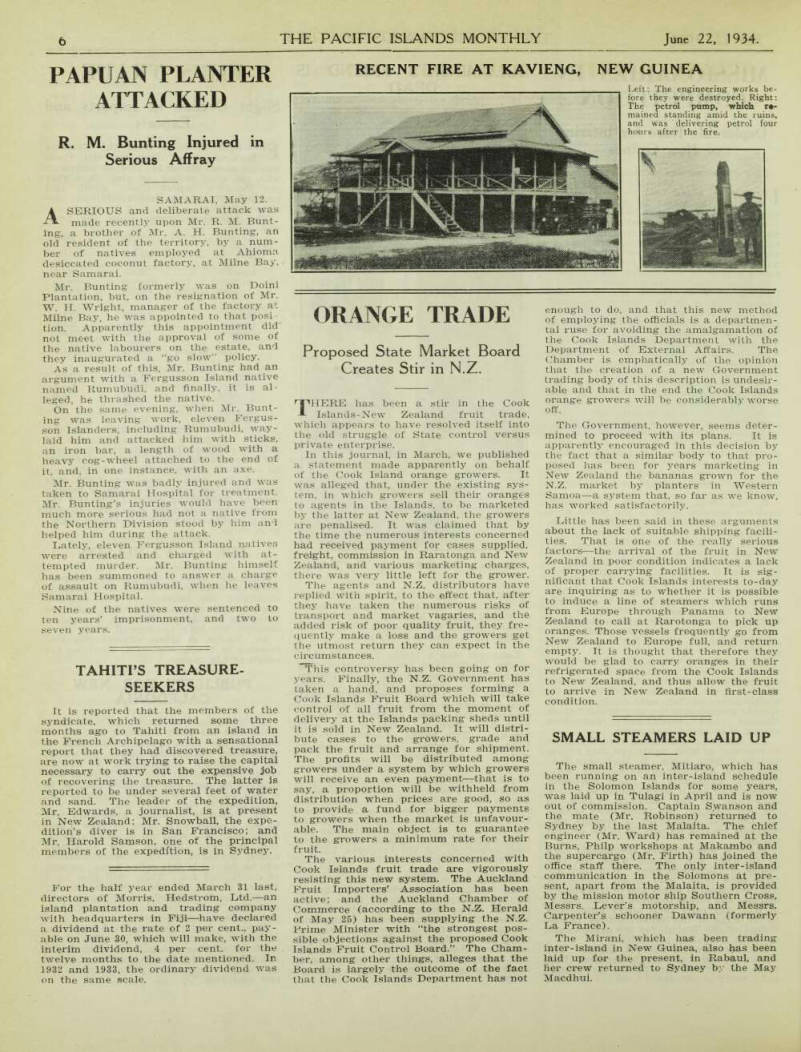
Recent Fire At Kavieng, New Guinea
Left: The engineering works be fore they were destroyed. Right: The petrol pump, which re mained standing amid the ruins, and was delivering petrol four hours after the fire.
Orange Trade
Proposed State Market Board Creates Stir in N.Z.
THERE has been a stir in the Cook Islands-New Zealand fruit trade, which appears to have resolved itself into the old struggle of State control versus private enterprise.
In this journal, in March, we published a statement made apparently on behalf of the Cook Island orange growers. It was alleged that, under the existing sys tem, in which growers sell their oranges to agents in the Islands, to be marketed by the latter at New Zealand, the growers are penalised. It was claimed that by the time the numerous interests concerned had received payment for cases supplied, freight, commission in Raratonga and New Zealand, and various marketing charges, there was very little left for the grower.
The agents and N.Z, distributors have replied with spirit, to the effect that, after they have taken the numerous risks of transport and market vagaries, and the added risk of poor quality fruit, they fre quently make a loss and the growers get the utmost return they can expect in the circumstances.
This controversy has been going on for years. Finally, the N.Z. Government has taken a hand, and proposes forming a Cook Islands Fruit Board which will take control of all fruit from the moment of delivery at the Islands packing sheds until it is sold in New Zealand. It will distri bute cases to the growers, grade and pack the fruit and arrange for shipment.
The profits will be distributed among growers under a system by which growers will receive an even payment —that is to say, a proportion will be withheld from distribution when prices are good, so as to provide a fund for bigger payments to growers when the market is unfavour able. The main object is to guarantee to the growers a minimum rate for their fruit.
The various interests concerned with Cook Islands fruit trade are vigorously resisting this new system. The Auckland Fruit Importers’ Association has been active; and the Auckland Chamber of Commerce (according to the N.Z. Herald of May 25) has been supplying the N.Z.
Prime Minister with “the strongest pos sible objections against the proposed Cook Islands Fruit Control Board.” The Cham ber, among other things, alleges that the Board is largely the outcome of the fact that the Cook Islands Department has not
enough to do, and that this new method of employing the officials is a departmen tal ruse for avoiding the amalgamation of the Cook Islands Department with the Department of External Affairs. The Chamber is emphatically of the opinion that the creation of a new Government trading body of this description is undesir able and that in the end the Cook Islands orange growers will be considerably worse off.
The Government, however, seems deter mined to proceed with its plans. It is apparently encouraged in this decision by the fact that a similar body to that pro posed has been for years marketing in New Zealand the bananas grown for the N.Z. market by planters in Western Samoa —a system that, so far as we know, has worked satisfactorily.
Little has been said in these arguments about the lack of suitable shipping facili ties. That is one of the really serious factors —the arrival of the fruit in New Zealand in poor condition indicates a lack of proper carrying facilities. It is sig nificant that Cook Islands interests to-day are inquiring as to whether it is possible to induce a line of steamers which runs from Europe through Panama to New Zealand to call at Rarotonga to pick up oranges. Those vessels frequently go from New Zealand to Europe full, and return empty. It is thought that therefore they would be glad to carry oranges in their refrigerated space from the Cook Islands to New Zealand, and thus allow the fruit to arrive in New Zealand in first-class condition.
Small Steamers Laid Up
The small steamer, Mitiaro, which has been running - on an inter-island schedule in the Solomon Islands for some years, was laid up in Tulagi in April and is now out of commission. Captain Swanson and the mate (Mr. Robinson) returned to Sydney by the last Malaita. The chief engineer (Mr. Ward) has remained at the Burns, Philp workshops at Makambo and the supercargo (Mr. Firth) has joined the office staff there. The only inter-island communication in the Solomons at pre sent, apart from the Malaita, is provided by the mission motor ship Southern Cross, Messrs. Lever’s motorship, and Messrs.
Carpenter’s schooner Dawann (formerly La France).
The Mirani, which has been trading inter-island in New Guinea, also has been laid up for the present, in Rabaul, and her crew returned to Sydney by the May Macdhui.
Copra Slump
F.M.S. Committee to Study Malayan Position
IT may interest coconut planters in the Australian section of the South Seas to know that the Editor of the “Pacific Islands Monthly,” after consultations with various Sydney merchants who handle copra, wrote formally to the Common wealth Government urging that, in view of the latter’s substantial interests in coco nut plantations in Papua and New Guinea, something should be done in the direction of clarifying the outlook of the industry.
It was urged upon the responsible Minister that the copra industry at the present time is being affected by the fol lowing definite factors: Dislocation of the world’s markets by the general depression; Overproduction; The employment of new scientific pro cesses whereby other oils are purified and deordorized so that they may be used as substitutes for coconut oil; The domination of the European mar ket by the Unilever Combine, which is now so powerful that it can virtually dictate its own price to growers and shippers; The decision of the United States Government to impose a processing tax of from 3 to 5 cents per pound on all coconut oil used in the United States (thus tending to throw a large propor tion of the Pacific copra which usually is consumed in U.S.A., on to the Euro pean market).
A certain amount of data was sent to the Commonwealth Government in support of our suggestion that an expert committee be appointed to examine the whole position of the South Seas copra industry. It was pointed out that, in view of the world-wide character of the factors affecting the industry, it was desirable to secure co operation with other copra producing countries in consideration of the position, and in taking any remedial measures that might be necessary.
We have received from the Federal Department concerned a formal intima tion that the whole position is being offi cially examined.
In the meantime it is interesting to note that other British Governments have taken action along the lines which have been suggested to the Australian Gov ernment.
F.M.S. Decision
The Agricultural Advisory Committee of the Department of Agriculture, Straits Settlements and Federated Malay States, which met at Kuala Lumpur on March 14, resolved: “The Advisory Committee of the Depart ment of Agriculture desires to draw the attention of the various Malayan Govern ments to the present precarious position of the coconut industry and that of other oil crops in this country.
“It considers that the outlook for these industries is extremely grave and it sug gests that, especially in view of the large areas cultivated under these crops by small-holders, the matter must be one of serious concern to the Government.
“The Committee suggests for the con sideration of the Malayan Governments that a useful purpose would be served if His Excellency would appoint a Commis sion to make full enquiry into the circum
stances of the coconut and other vegetable oil producing industries in Malaya with a view to reporting thereon to the Malayan Governments.
The Freight Burden
“The Committee desires to add that it has had represented to it that, apart from the general disabilities under which these industries are labouring owing to the world economic situation, the copra indus try is in particular suffering from un favourable discrimination by shipping com panies in the matter of freight.
“It suggests that, in the interests of the industry in general and of small-holders in particular, the position in this respect may be such as to call for special action if this is feasible.”
Inquiry Authorised
Shortly afterwards, according to the Malayan Agricultural Journal of May, 1934, the High Commissioner for the Federated Malay States appointed a com mittee representing the Department of Agriculture, the State of Perak, the Director of Co-operation of the various States, the State of Johore, and various rubber estates, “to investigate and report on the present economic condition of the coconut and other vegetable oil producing industries in Malaya, and to make recom mendations.”
U.S.A. Copra Tax
Latest Development in Washington
IN last issue, we said that the United States Government proposed to place a special tax of 3 cents per pound on coconut oil; that this probably would shut Philippines copra out of U.S.A. and divert it on to the European market; and that in consequence, the outlook for copra was very black indeed.
Since then, there have been interesting developments, which are set out in the following report from Messrs. Faure Blattman and Cos., London, dated April 16: “Once again America has provided the most sensational developments. Whilst on the on© hand Mr. Roosevelt is still seeking for powers to vary existing tariff rates for the purpose of fostering Ameri can exports by arranging reciprocal tariff concessions with other countries, the Senate has adopted a bill imposing a pro cessing tax of 3 cents per lb. on all the principal imported vegetable oils and oils made from imported seeds, including palm oil and coconut oil.
“The bill provides, however, that in the case of Philippine coconut oil, the revenue will be returned to the Philippines Trea sury, which would no doubt mean in effect that the Philippine Government would utilise these remittances to subsidise copra and coconut oil exports to the U.S.A.
This would enable them to continue as hitherto.
“As the amount of tax exceeds the pre sent value of coconut oil, we might, if the total tax is handed over to the ship pers in the form of a subsidy, find the anomalous position that it may pay the Philippines copra and coconut oil expor ter to give away his oil and copra to the U.S.A. consumer, and even pay something into the bargain, so as to enable him to obtain the export subsidy.
“The bill, as adopted by the Senate, now has to go to the Joint Committee of
the two Houses, and if passed, would then become law, unless vetoed by the Presi dent. As the underlying principle of this bill is diametrically opposed to Mr. Roose velt’s policy of reducing tariffs for the purpose of fostering international trade, it is quite possible that he will finally veto it, but it is also possible that, even in that case, Congress in its present mood might over-ride this veto.
“It is a little difficult to see how the American farming industry, for whose benefit the bill has been composed, will derive any benefit from it, and it will cer tainly mean a further nail in the coffin oi international trade.
“Markets for the principal oils and oil seeds have again experienced a further severe slump during the month under review, especially copra, groundnuts and palm oil. At the time of writing, however, the slump has come to a stop. There has been a slight improvement in prices. It remains to be seen whether this is only a “flash in the pan’’ or the beginning of a more pronounced movement. So far, we must say that we can see nothing in the situation to warrant the expectation of any material change in the position in the near future.
“Until we know whether the new Ameri can taxes will definitely become law, all markets must remain in a most uncertain state. Up to now, the passing of the bill by the Senate has not seriously affected markets, which must be mainly attri buted to the fact that the whole situation is so involved that the trade has not yet been able to visualise in which way they would be affected by the passing or the vetoing of the bill. It is still too early to say in which way the European markets will be affected.”
Two Cents Philippines Preference
an “Empty Gesture”
Early in June, as the position remained obscure, and continued uncertainty was affecting- copra trade in the Australian zone, we suggested to the Prime Minister’s Department, Canberra, that it w r ould be a matter of much public convenience if an inquiry were made in U.S.A. through the Department of Commerce.
On June 12, the Secretary of the Prime Minister’s Department, Canberra, very kindly supplied us with the following: — “Information has been received that the trade (vegetable oils industry) estimates that the new tax will double the price of two-thirds of all the oil fats used by American soapmakers. The Bureau of Raw Materials American Vegetable Oils Industry has made the following comment on the situation: — “ ‘Congress has retained the tax of 3 cents per lb. on Philippines coconut oil and on various oils presumed to be in competition with Philippines coconut oil.
“ ‘Congress has unexpectedly placed a tax of 5 cents per lb. on coconut oil from sources other than the Philippines; and it claims, in consequence, that the copra producers in the Philippines are receiving a preference of 2 cents per lb. in the American market.
“ ‘The only result of this preferential treatment will be the embarrassment of the copra crushers in the United States, as it will prevent them from purchasing copra from sources outside the Philip pines. The tax in the manner arranged will not help the Philippines copra grow ers, as palm kernel oil carries the same tax as Philippines coconut oil—namely, 3 cents per lb—and palm kernel oil will fill the gap.
(Continued overleaf.)
“ ‘The importation of coconut oil, after the imposition of 3 cents tax, will be so small compared with the total output of the Philippines that the 2 cents preferen tial treatment in favour of the Philip pines oil is an empty gesture’.”
The Prime Minister’s Department states also that a section of the new American Act reads as follows: “Upon exportation to any foreign coun try of any article with respect to the pro cessing of which the tax has been paid, the exporter shall be entitled to a refund of the amount of such tax. Upon giving a bond, any person is entitled, without payment of the tax, to process for such exportation.”
Reports also have been received by the Prime Minister’s Department to the effect that Canadian soap manufacturers have been drawing heavy supplies of tallow and other ingredients from the United States; and that the prospective condi tions in consequence may develop in favour of copra exported from the Aus tralian zone in the Pacific.
We learn, from other sources, that the whole of the processing tax on Philippine copra, which on the old basis of import would amount to about 25,000,000 dollars per annum (£5,000,000) will be returned by U.S.A. to the Philippines, on condition that the latter government will not use it to in any way subsidise producers of copra, coconut oil, or allied products.
Our London advices are that the new American Act is regarded as “a most extraordinary piece of legislation.” The Philippines Government naturally will do everything possible to assist copra exports to U.5.A.—25,000,000 dollars is equal to three-quarters of the Philippines’ total annual expenditure!—but if the Govern ment does anything at all to encourage the growers there in a practical way, it may be regarded as subsidising the growers, and thus lose this magnificent bequest from Uncle Sam.
It seems to be assumed in the sum maries received by the Prime Minister’s Department that the United States will continue to consume coconut oil in various forms in quantities much the same as hitherto. We cannot agree with that view.
The effect of the tax definitely is to add enormously to the cost of every commodity in which coconut oil is used; and it is therefore inevitable that the United States manufacturers will turn away al together from the oils which are taxed and will make use of substitutes which are free from taxation —such as cotton seed oil and soya bean oil, of which very large quantities are produced now in the United States.
“Tiare Taporo” At Sea
Again
Papeete, May 20.
Messrs. A. B. Donald Ltd.’s Cook Island schooner “Tiare Taporo” arrived here in February from Hakahanga, with a full load of copra. Owing to extensive repairs, the ship has been laid up here for about 10 weeks, and she will be quite a new schooner when she now proceeds to Raro tonga. Captain Viggo Rasmussen ex pressed the thought that he might get sea sick when he puts to sea again after this long stay ashore!
Passengers are Captain Dashwood, the novelist, and Mr. Ulfsby, Messrs. Donald’s local representative in Rakahanga.
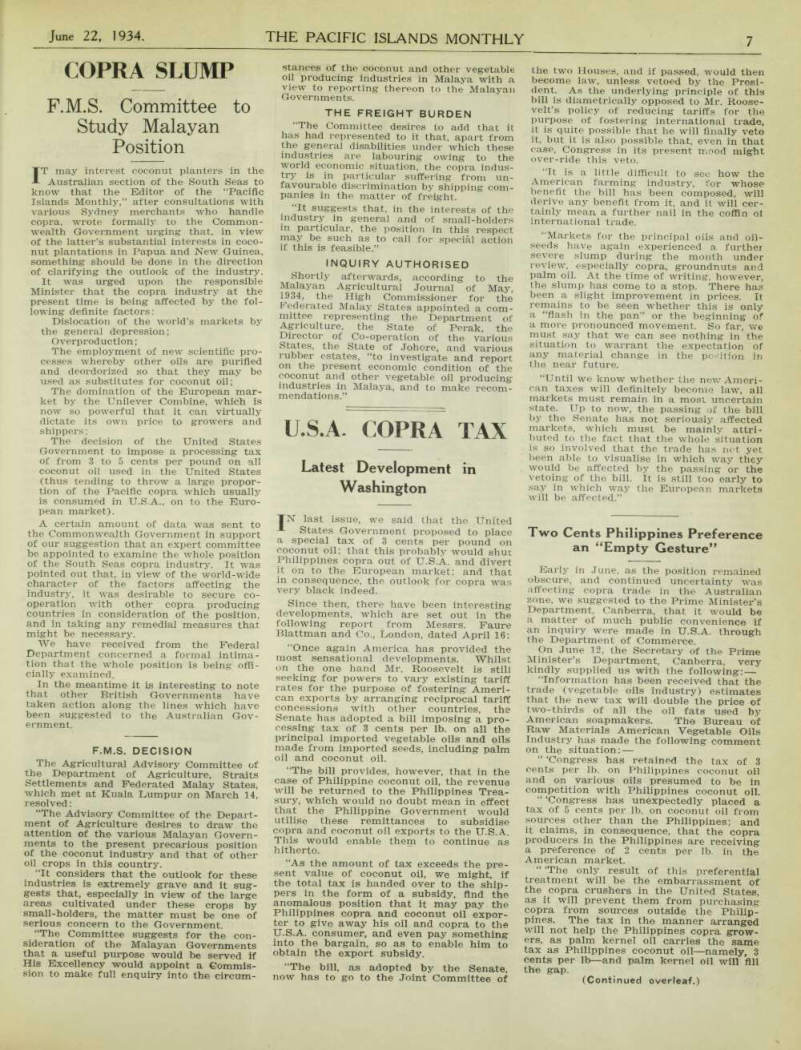
Historic Guillotine
This guillotine, it is said, is the same machine that was used in behead Louis XVI., in Paris, on January 21, 1793. Many years afterwards, it was sent out to New Caledonia, where on necessary occasions, it served its grisly purpose. Some four years ago, it was shipped across to New Hebrides and was used, in Port Vila, for the execution of certain Asiatic labourers who had been found guilty of violent crimes against the French popu lation. It was returned immediately to New Caledonia, and, when this photograph was taken, it was standing behind the prison buildings on the notorious He de Nou, all ready for business.
There are still a few convicts (“lifers”) on the He de Nou, which is opposite Noumea; but the once great convict establishment is now prac tically unused.
Story Of The Bounty
Three Books and a Film
From Our Own Correspondent.
Papeete, May 17.
AMONG the passengers who left Tahiti for America on the Maunganui was Mr. James Norman Hall, the famous, novelist, who was wrecked a few months ago on Crescent Island on his return voyage from Pitcairn.
Mr. Hall, in collaboration with his friend, Charles Nordhoff, has just finished the third and last of the three books on the Bounty episode. Two of them, “Mu tiny,” and “Men Against the Sea,” have already been published, and the third, which describes the mutineers’ life on Pit cairn, will be out soon. Mr. Hall intends to take a few months’ holiday in America and Europe before returning to Tahiti.
His residence in Arue has been rented in the meantime to Lady Hadfield.
Well authenticated news has been re ceived from America that the Metro- Goldwyn-Mayer Corporation will shortly be sending a company to Tahiti to film Messrs. Hall and Nordhoff’s story of the Bounty mutineers.
Papeete's Growth
A New Suburb
From Our Own Correspondent.
Papeete, May 17.
IN spite of the business depression pre vailing throughout French Oceania, some important improvements are now being carried out by the Papeete Muni cipality.
The old Contributions building, a wooden structure in the last stages of de cay, has been torn down, and the officials given temporary accommodation in the hitherto vacant premises adjoining the Commissariat of Police. It is understood that new offices are to be constructed, later on, at a more convenient site near the wharf. In the meantime the old site, which consists of nearly a whole block situated between the Governor’s palace and the sea front, is rapidly being transferred into a small park which will be greatly appreciated by the townspeople and prove an extra attraction from a tour ist standpoint. As the site is already shaded by some fine old trees, all that now remains to be done to turn it into a really beautiful garden is a little levelling and the planting of flowering shrubs; this is now being proceeded with.
Another development which will be of permanent benefit to Papeete is the laying out of the new suburb known as Farepiti.
This is situated near the eastern limit of the town, upon land formerly worked as a sugar plantation by the Brander family, which was divided into lots some years ago and sold. The site is high, and com mands a fine view of the Moorea peaks in the distance.
Here, the Municipality has laid out a wide avenue of about a kilometre in length, with a line of flowering trees down the centre, to separate the two directions of traffic. The cross avenues, which are narrower, are also to be planted immedi ately with suitable flowering trees of a smaller kind. Quite a number of new residences have been built in Farepiti during the last year or two.
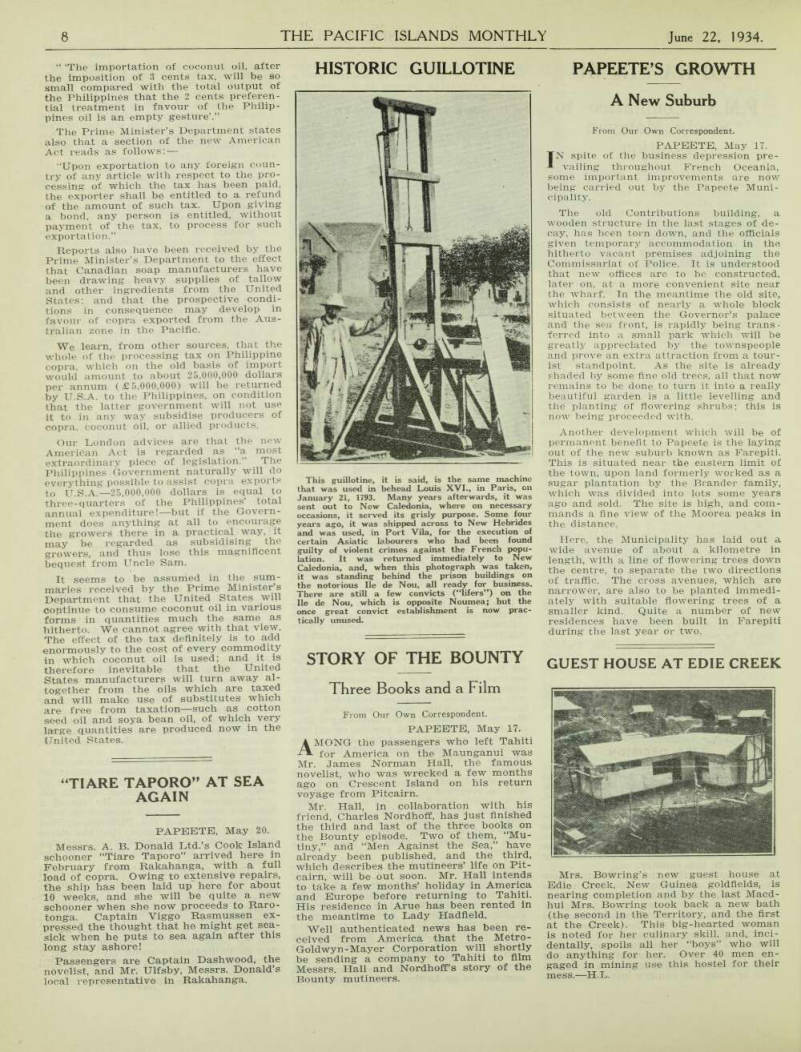
Guest House At Edie Creek
Mrs. Bowring’s new guest house at Edie Creek, New Guinea goldfields, is nearing completion and by the last Macd hui Mrs. Bowring took back a new bath (the second in the Territory, and the first at the Creek). This big-hearted woman is noted for her culinary skill, and, inci dentally, spoils all her “boys” who will do anything for her. Over 40 men en gaged in mining use this hostel for their
mess.-
H.L.
Yodda Goldfield
New Company Active in Papua
From Our Own Correspondent
Port Moresby, May 16.
EARLY in May a new company, Yodda Goldfields Ltd., was registered as a foreign company in Port Moresby, with a nominal capital of £25,000, in shares of 5/- each, of which £12,500 was offered to the public in Sydney recently and over subscribed. Mr. Ward Williams, the well known American mining engineer, who has been prospecting in Papua for some years past, has been appointed managing direc tor. Other directors are the Hon. T. G.
Murray, M.L.A., of Sydney, and his brother (Mr. Walter Murray), a mining engineer in Australia.
The object of the company is to work the gold mining leases on the Yodda (Northern Division of Papua), which were taken up and prospected by Mr. Ward Williams two years ago.
A modified type of sluicing plant with power-driven units—designed by Mr. Ward Williams—is arriving in Papua on May 25.
It will be transported immediately to the field by Guinea Airways Ltd. and landed on the new drome, Ebei, recently con structed by Mr. Williams, not far from his camp on the Yodda.
A small radio telephone set has been installed by the company on the field, to enable them to keep in touch with Port Moresby and Australia. It has been regis tered with the P.M.G.’s Department, Aus tralia, and is now known as the Yodda Goldfields Station. The public may trans mit messages at a cost of 2d a word from Port Moresby.
The Yodda valley was first examined as far back as 1897 and 1898, when parties of miners extended their operations up the Mambare in the North-eastern Divi sion. But it was not until the well-known miners, Matt Crowe, MacClelland, and Walker, made an expedition to the Yodda in 1900 that the field became known. It was officially proclaimed a goldfield the next year. By the end of 1901, 150 miners were working in the creeks and gullies and one reads that the total output of the Yodda (and the Gira) in that year was estimated at 15,000 ounces.
French Tariff On Soaps
From Our Own Correspondent.
Papeete, May 17.
The “Journal Officiel” of the Colony for May 1 contains details of the new tariff on foreign soap, vegetable and animal oils and fats, and similar substances des tined for use in local manufactures which come into competition with French goods.
There is a general increase in the duties applicable to all imports which come under the above categories, while the amount payable on foreign laundry soap has been increased from 6 francs per 100 kilos to 75 francs per 100 kilos. Presumably, the new scale of duties is intended to benefit the local soap factories, of which there are several in Tahiti. Already, the retail sell ing price of New Zealand soap has ad vanced by about 10 per cent.
An interim dividend of 6d per share (equal to 10 per cent per annum) for the quarter ended March 31 was declared payable by Messrs. Holden’s Air Trans port Co. on June 4. The transfer books of the Company were closed from June 2 to June 4 inclusive.
Six Days Adrift
Fijians Without Food or Water
Suva, May 5.
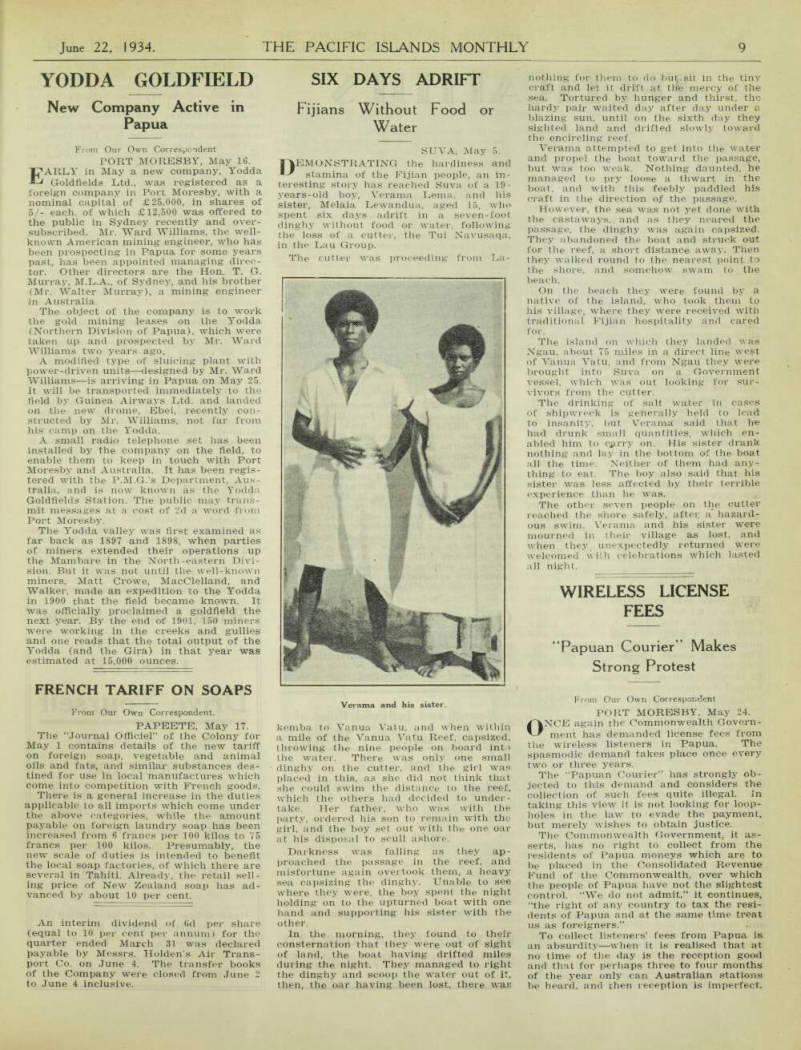
DEMONSTRATING the hardiness and stamina of the Fijian people, an in teresting story has reached Suva of a 19years-old boy, Verama Lema, and his sister, Melaia Lewandua, aged 15, who spent six days adrift in a seven-foot dinghy without food or water, following the loss of a cutter, the Tui Navusaqa, in the Lau Group.
The cutter was proceeding from La-
kemba to Vanua Vatu, and when within a mile of the Vanua Vatu Reef, capsized, throwing the nine people on board into the water. There was only one small dinghy on the cutter, and the girl was placed in this, as she did not think that she could swim the distance to the reef, which the others had decided to under take. Her father, who was with the party, ordered his son to remain with the girl, and the boy set out with the one oar at his disposal to scull ashore.
Darkness was falling as they ap proached the passage in the reef, and misfortune again overtook them, a heavy sea capsizing the dinghy. Unable to see where they were, the boy spent the night holding on to the upturned boat with one hand and supporting his sister with the other.
In the morning, they found to their consternation that they w r ere out of sight of land, the boat having drifted miles during the night. They managed to right the dinghy and scoop the water out of it, then, the oar having been lost, there was
nothing for them to do in the tiny craft and let it drift at the mercy of the sea. Tortured by hunger and thirst, the hardy pair waited day after day under a blazing sun, until on the sixth day they sighted land and drifted slowly toward the encircling reef.
Verama attempted to get into the water and propel the boat toward the passage, but was too weak. Nothing daunted, he managed to pry loose a thwart in the boat, and with this feebly paddled his craft in the direction of the passage.
However, the sea was not yet done with the castaways,, and as they neared the passage, the dinghy was again capsized.
They abandoned the boat and struck out for the reef, a short distance away. Then they walked round to the nearest point to the shore, and somehow swam to the beach.
On the beach they were found by a native of the island, who took them to his village, where they were received with traditional Fijian hospitality and cared for.
The island on which they landed w r as Ngau, about 75 miles in a direct line west of Vanua Vatu, and from Ngau they were brought into Suva on a Government vessel, which was out looking for sur vivors from the cutter.
The drinking of salt water in cases of shipwreck is generally held to lead to insanity, but Verama said that he had drunk small quantities, which en abled him to on. His sister drank nothing and lay in the bottom of the boat all the time. Neither of them had any thing to eat. The boy also said that his sister was less affected by their terrible experience than he was.
The other seven people on the cutter reached the shore safely, after a hazard ous swim. Verama and his sister were mourned in their village as lost, and when they unexpectedly returned were welcomed with celebrations which lasted all night.
Verama and his sister.
Strong Protest
Wireless License
Fees
“Papuan Courier’ Makes Strong Protest
From Our Own Correspondent
Port Moresby, May 24.
ONCE again the Commonwealth Govern ment has demanded license fees from the wireless listeners in Papua. The spasmodic demand takes place once every two or three years.
The “Papuan Courier” has strongly ob jected to this demand and considers the collection of such fees quite illegal, in taking this view it is not looking for loop holes in the law to evade the payment, but merely wishes to obtain justice.
The Commonwealth Government, it as serts, has no right to collect from the residents of Papua moneys which are to be placed in the Consolidated Revenue Fund of the Commonwealth, over which the people of Papua have not the slightest control. “We do not admit,” it continues, “the right of any country to tax the resi dents of Papua and at the same time treat us as foreigners.”
To collect listeners’ fees from Papua is an absurdity—when it is realised that at no time of the day is the reception good and that for perhaps three to four months of the year only can Australian stations be heard, and then reception is imperfect.
Tropicalities
THE very definite warning to the maritime unions, pronounced at the Burns Philp annual meeting by Mr. James Burns, was long overdue. The extent to which the firm is hampered and harassed by the trade unions, in its effort to give the Islands communities efficient and profitable shipping services, has never been disclosed—and, if it were, it would seem incredible. The firm, for instance, is try ing nowadays to get its share of Pacific tourist business: yet travellers on B.P. ships are driven in to dinner by union conscious stewards at 6 p.m., while tour ists on ships not on Australian registry are permitted to take their principal meal at an hour that is much more suitable to the tropics. The B.P. stewards may be just as much victims of union tyranny as their employers; but the spineless refusal of the stewards, and of the constantly troublesome firemen and deck hands, to stand up against the unreasonable dic tates of the Trades Hall bosses, inevitably will cost them their jobs. The time must come when the crews of the Island steam ers will be recruited from the available Asiatic and native labour, so that the firm may compete on more equal terms with ships registered in other countries.
So far, B.P. directors have been very loyal to the country which pays them a sub stantial subsidy for maintaining Islands services, and have employed all-Austra lian crews on Australian conditions. We are inclined now to think that the firm’s directors are coming to the view that it would be cheaper for the firm to break away from the harassing Navigation Act of Australia, and engage labour in the most favourable market—even if that policy meant the loss eventually of the Australian subsidy.
WE have said repeatedly that we hold no brief for Messrs. Burns Philp and Co. Ltd. On the other hand, we never have been a party to indiscriminate and unjustified attacks on the “Big Firm.’’
This is an occasion when fittingly one may say a few good words about “B.P.”
In another column, we publish the firm’s annual statement of account, which shows that the firm is weathering the economic storm in satisfactory fashion. We would ask Pacific Islands residents to try and imagine what economic conditions in the Pacific would be like just now, if “B.P.” had had insufficient reserves to call upon in this period of crisis. Planters gener ally are having a thin time of it; but, with the help of the big companies, they are holding on, and, if world values re cover, and the grip of Unilever is not fatal, they will get back to solvency again presently. If it had not been for the wise management which built up large re serves for Burns Philp and Co., Ltd., W.
R. Carpenter and Co., Ltd., and Morris Hedstrom Ltd. in the good years, 90 per cent, of Pacific planters to-day would be in bankruptcy. As it is, the Islanders are not suffering any kind of general dis aster. The big firms are financing them as far as is practicable; are purchasing and marketing their products, frequently at a loss, merely in order to keep the industrial wheels turning; and unques tionably will stand by the honest and in dustrious producer until the tide turns again. There may be some altruism in it: but it certainly is sound business; If
the big firms are necessary to the plant ers in the bad times, the planters are just as necessary to the firms when times are good.
THE interesting suggestion that Indians should be introduced into the British Solomon Islands, which was published recently, does not meet with the approval of a Fiji correspondent.
“Do not, under any consideration (he says) allow semi-educated Indians to settle in the Solomons, or elsewhere for that matter, as there will always be trouble with their demands for equal status. The high caste, semi-educated Indian coolies and their descendants here in Fiji ought to be shipped back to India and made stay there. A Christian Indian is a pest and an agitator, and cannot be trusted. However, if Indians must be brought into B.S.I., let the authorities import the peasant-farmer class as they do not seem to interest them selves in politics, and as a whole are a very contented community.”
A GROUP of New Guinea residents, call ing themselves the New Guinea Cen tenary Flight Syndicate, have entered an aeroplane in the big air race from London to Melbourne in October next. The famous New Guinea airman, Mr. Raymond J.
Parer, has been nominated as the pilot, with Mr. Godfrey Ellard Heinsword as his assistant. It has not been decided yet what type and make of machine will be flown.
“The best of luck to our plucky aviator, Ray Parer, in this world’s greatest air race,” writes a correspondent from Lae, New Guinea. “All New Guinea will watch his progress with eager eyes and lively hopes. If nothing else, the entry will focus inquisitive attention on the Territory and our marvellous air services.”
ONE hundred years of struggle for the freedom of subject and backward races are described in enthralling fashion in a book published in 1933 by Sir John Harris, entitled “A Century of Emancipation.” It opens with a description of the work of Wilberforce in destroying the ghastly
slave systems of the northern hemisphere, and deals in a striking way with the aftermath of slavery; the attacks led by enlightened men against such things as Congo atrocities: and examines the pre sent-day survivals of slavery as found in Abyssinia, Arabia, and the Far East.
The book has particular interest for us because the gifted author, referring to the humanitarianism which has dominated British colonial policy for 100 years, pays a tribute to great British administrators like Cromer, Lugard, Macaulay, Hubert Murray, George Grey, and General Gor don.” It is gratifying to find Australia’s notable Papuan administrator, Sir Hubert Murray, bracketed with some of the great est names in modern British history.
THE prospectus of the Austral Diving A and Pearling Company Ltd., which has been registered in Australia with an authorised capital of £5000, with the object of acquiring a new diving apparatus, includes among its directors Mr. W. H.
Carpenter, of Thursday Island. It is in tended to equip a suitable pearling fleet and to engage in the business of pearl fishing. It is stated that “the invention is a new type of diving dress which will revolutionise diving practice.” It is stated that the dress enables the diver to remain submerged for far greater periods and at greater depths: and that he may after wards return immediately to the surface, without delay or harmful effect. The managing director is Captain James B.
Arthur, well-known in the Torres Straits pearling industry.
THE “Pacific Islands Monthly” is pub lished mainly for two reasons: Firstly, to give service to residents in the South Seas and ventilate their grievances, real or imaginative; and, secondly, to provide a comprehensive summary of news relat ing to all the Islands of the Pacific, not only for the benefit of readers in the
(Continued overleaf)
South Seas, but also for subscribers all over the world.
Therefore it is gratifying to know that the “P.I.M.” serves its purpose in keeping the outside world in touch with events and developments in the Pacific Islands.
Mr. Gordon Bryan, of London, writing to us recently, said; “I should like to express my very great appreciation of the read ableness and very unusual interest of your paper. I have no experience of the South Seas as a resident, but only as a passing tourist. I spent nine months in New Zealand and made the round trip by the Tofua, as well as visiting Fiji on the way to New Zealand, and Java, etc., on the re turn voyage. Even such short acquaint ance makes further news of all the Islands most welcome. I shall keep up my sub scription indefinitely, as I find other people who have never been to the South Seas are also very interested in the journal.”
THE allegation that funds of the Aus tralian National Research Council were missing as a result of the muddle in the affairs of the late Professor Chapman of Sydney University caused a rumour that field activities in New Guinea, Papua, Arnheim Land, Central Australia, and elsewhere might have to be seriously cur tailed. Until further investigations have been made, no authoritative statement has been issued, but it is believed that it will be possible to continue the field work without serious interruption. • • • THE annual farce has been carried out at Geneva. The Mandates Commission of the semi-moribund League of Nations has been examining the reports of the Administrators of the Mandated Terri tories of New Guinea and Western Samoa.
Representatives of the Mandatories have travelled comfortably to Geneva at the expense of the countries holding the man dates, and have answered a whole series of questions about conditions in the re spective Territories. A press cablegram from Geneva gives the interesting news that Mr. J. G. McLaren (Secretary to the Australian High Commissioner) and Mr.
E. W. P. Chinnery (head of the Depart ment of Native Affairs in New Guinea) have been subjected to the usual interro gation and have acquitted themselves creditably.
It is all very delightful—-but how absurd!
One would suppose that the League of Nations is carefully guarding the welfare of native peoples, who are constantly men aced by their white overlords. Yet adjoin ing New Guinea on the west is Papua; and just across an imaginary line on the east are the Solomon Islands; and Papua is ruled by Australia, while the Solomon Islands are the special care of the British Colonial Office; and if any experienced re sident of the Pacific Islands can prove that the natives of the Mandated Territory of New Guinea are any better governed or protected than the natives of Papua or the Solomons (who know not Geneva) the editor of this journal will gladly buy him a large quart pot of foaming ale.
With elegant fingers to a scornful nose, Japan has expressed her polite opinion of the League of Nations, and is administer ing her Mandated Territories (Marshall and Caroline Islands) exactly as she pleases. It would be interesting to know, therefore, whether Japan is still ad hering to the formalities of the Mandates System, and undergoing at Geneva the same silly cross-examination in regard to the Marshall and Caroline Islands.
Advertisements & other items, p. 12 (1 item)
Drive Yourself
When Visiting Sydney
Send a Wire to
LESSEY’S
Drive Yourself
Box 8, Post Office,
PADDINGTON,
and an up-to-date car will meet you at the boat, which you can hire on very reasonable terms to
DRIVE YOURSELF.
Head Office and Service Station at
RUSH CUTTER’S BAY
(Near Stadium). Tel.: F 3196.
Radio Address: “Lessey’s,” Paddington, Sydney.
Bound and Indexed Files of
Pacific Islands Monthly
FOR SALE
We shall have for sale, if promptly ordered, seven bound flies of Volume IV. of “The Pacific Islands Monthly” (August, 1933, to July, 1934, inclusive).
The 12 numbers included in Volume IV. are being indexed, and the Index will be published as part of the issue of Julv, 1934.
Price of Volume IV., strongly bound and indexed, and posted in August to any address £2/2/-
Early Ordering is Recommended
PACIFIC PUBLICATIONS, LTD.
UNION HOUSE, 247 GEORGE ST., SYDNEY.
Telegrams and Cablegrams: PACPUB, SYDNEY.
Wooing Tourists
Hotels for Norfolk and Lord Howe Islands
NOW that primary producers in the Pacific Islands are suffering severely from the prevailing low prices offered for their products, an attempt is being made to develop the tourist traffic.
So far as the islands of Norfolk and Lord Howe are concerned the position is being investigated by the Australian au thorities. The New South Wales Gov ernment has proposed to erect a large boarding house on Lord Howe Island, ap parently directed and run by public ser vants and an attempt is to be made to attract many more tourists to the island.
The Lord Howe Islanders, however, are up in arms against the proposal. They do
not wish to have their beautiful island spoiled by hordes of tourists; and they certainly object to having an organization of government employees forced upon them. The boarding-house, according to the plan, is to be built with the Islanders’ own accumulated savings from the palm seed industry, and the islanders are con vinced that if that should be done their savings will be lost. No one has any con fidence these days in the ability of public servants to conduct any kind of trading business.
In the case of Norfolk Island, it is re ported that “several persons have applied for a hotel license and it is understood that a group is prepared to erect a build ing to meet the increasing tourist traffic.”
For a long time residents of Norfolk Island have been making a living from the pro duction of bananas and beans; but the bottom appears to have fallen out of both markets and a number of plantations have been abandoned.
Motorists on a
Historic Spot
The Automobile Club of New Guinea, on its first run out from Rabaul, on the Kokopo Road, visited the his toric spot, on the Bita paka Road, where the first Australian was killed in the Great War.
Top: Mrs. Coote cuts the ribbon and in augurates the Club’s run.
Lower: The line of cars on the Bitapaka Road.
Advertisements & other items, p. 13 (1 item)
Home
STERLING
COVERS
MORE
COSTS
LESS
GUAR-
ANTEED
STERLING
HOME PAINT
MAKES ALL THE
DIFFERENCE
PAINT
WITH-
STANDS
TROPICAL
SUN AND
SALT-LADEN
AIR
Made by STERLING VARNISH CO., SYDNEY, N.S.W.
About Islands People
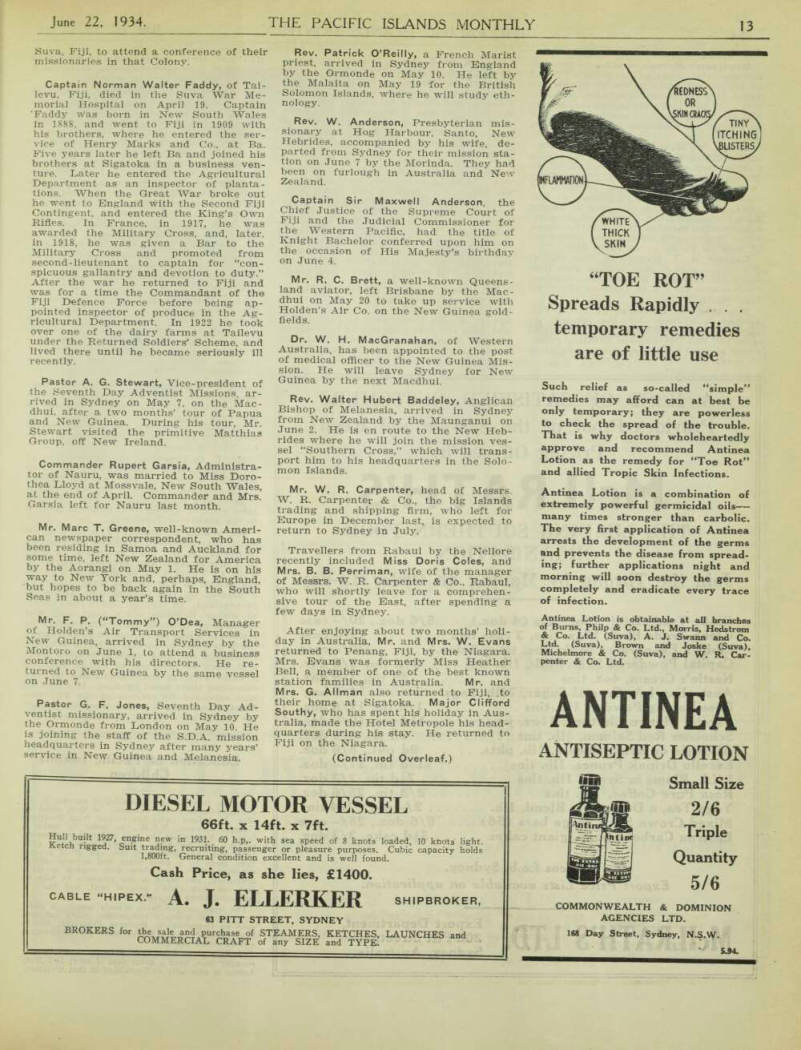
Mr. J. M. Hedstrom, son of Sir May nard Hedstrom, of Suva, Fiji, left Sydney by the Mariposa for Fiji on May 30. Mr.
Hedstrom was admitted as a barrister of the Victorian Supreme Court shortly be fore he left for Fiji. He had a distinguish ed career at the Melbourne University, where he won the Debating Cup and gained prominence in the sports of hockey and boxing, for which he was awarded a Blue.
Rev. C. M. Churchward, with his wife and family, returned to Fiji on the Mari posa on May 30. He is stationed at the Methodist Church, Levuka, but has been in Australia since last August, on sick leave.
Mr. Desmond Dickson, a young resident of Ouyen, Victoria, has been selected by Mr. Alfred Guthman to accompany him to New Guinea shortly in his eight-tons yacht, Pacific Moon. They will study native tribes and their customs on behalf of the National Museum of Paris, France.
Rev. A. C. Cato, M.A., accompanied by his wife, arrived in Sydney from Mel bourne by the Mariposa on May 28, en route to Fiji. He is on his way to the Methodist Teachers’ College at Davuilevu, Fiji.
Captain O. C. Dowling, of the United States Navy Department, who was recent ly appointed Governor of American Samoa, arrived at Pago Pago in April by the Monterey. Captain G. B. Landenberger, who was the former Governor, has return ed to the United States, for duty at the U.S. Navy Yard, Philadelphia.
Nurse H. M. Purnell, of the Methodist Mission hospital at Salamo, Papua, re turned by the Macdhui on May 17. She had been on furlough in Victoria, where she took a special course of infant welfare which will aid her in her work in Papua.
Miss Dorothy Beale, who is a certifi cated nurse, left Sydney by the Macdhui during May for the Methodist Mission’s
Stewart Hospital at Vunairima, New Britain, Mr. E. F. Griffin, who has been on an extended visit to New Guinea inspecting gold-mining areas in the Territory, ar rived in Sydney by the Montoro on May Mr. David Alexander Aiken, Managing Director of the Union Steam Ship Co., of New Zealand, died at Wellington, N.Z., on May 22. He joined the staff as office boy in 1883 and during his 50 years of service with the Company he rose to the position of General Manager and finally Managing Director, Mr. Aiken was highly respected and beloved by all the Union Company’s staff, both on shore and sea. He has been succeeded by Mr. N. Falla, of New Zealand, who was, until recently, Manager of the Federal Steamship Line in New Zealand.
Mr. A. Wilson, of Edinburgh, Scotland, arrived in Sydney in May by the Cormorin on his way to the Presbyterian native evangelist training school at Tangoa, in the New Hebrides.
Right Rev. Leonard S. Kempthorne, of Suva, Fiji, Bishop of Polynesia, arrived in Sydney by the Wanganella from New Zealand on May 13. He is en route to Nauru and Ocean Island and, later, will visit the Gilbert and Ellice Islands and Samoa, on H.M.S. Diomede of the New Zealand Navy. The Bishop expects to re turn to Fiji in July.
Captain E. J. C. Stopp, Collector of Customs, Norfolk Island, returned to Nor folk in May after spending his furlough in the New Hebrides. On his return he said that efforts are now being made to stimulate the tourist and commercial trade between New Hebrides and Norfolk Island.
Mr. Herbert Paul St. Julian, I.S.O., died at Neutral Bay, Sydney, on May 19. Mr.
St. Julian went to Fiji from Sydney in 1883 and entered the Fiji Civil Service as a clerk in the Levuka Post Office. Later, he was transferred to Suva and, in 1901, he was appointed Colonial Postmaster of Fiji and held that position until he retired in 1925. For his long and estimable ser vice to the Colony he was decorated with the Imperial Service Order in 1924. From 1913 to 1924 he was a member of the Fiji Legislative Council. He is survived by his wife, eight daughters—two of whom are now living in Suva —and two sons—Mr.
Charles St. Julian, of Suva, and Mr. Fred.
St. Julian, of Canada.
Mr. and Mrs. Stanley Greenland arrived by the Macdhui in Port Moresby on May 25. Mr. Greenland has been away from Papua on sick leave in Sydney, where he has been under treatment since November last year.
Mr. D. Ferris, of the S.D.A. Mission at Ambrym, New Hebrides, arrived in Sydney recently from the New Hebrides via Lord Howe Island, where his family reside.
Mr. B. W. Storey, who has been in charge of the Government schooners at Rabaul for some years, has resigned from the position and returned to Australia in order to seek expert medical attention.
Mr. Storey was held in high regard by the Administration of New Guinea and was personally popular in the Territory.
Pastor A. G. Stewart, Vice-president of the Seventh Day Adventist Union, and Mr. R. Adair, of the S.D.A. Missions, left Sydney by the Niagara on May 24 for
Suva, Fiji, to attend a conference of their missionaries in that Colony.
Captain Norman Walter Faddy, of Tai levu, Fiji, died in the Suva War Me morial Hospital on April 19. Captain Faddy was born in New South Wales in 1888, and went to Fiji in 1909 with his brothers, where he entered the ser vice of Henry Marks and Co., at Ba.
Five years later he left Ba and joined his brothers at Sigatoka in a business ven ture. Later he entered the Agricultural Department as an inspector of planta tions. When the Great War broke out he went to England with the Second Fiji Contingent, and entered the King’s Own Rifles. In France, in 1917, he was awarded the Military Cross, and, later, in 1918, he was given a Bar to the Military Cross and promoted from second-lieutenant to captain for “con spicuous gallantry and devotion to duty.”
After the war he returned to Fiji and was for a time the Commandant of the Fiji Defence Force before being ap pointed inspector of produce in the Ag ricultural Department. In 1922 he took over one of the dairy farms at Tailevu under the Returned Soldiers’ Scheme, and lived there until he became seriously ill recently.
Pastor A. G. Stewart, Vice-president of the Seventh Day Adventist Missions, ar rived in Sydney on May 7, on the Mac dhui, after a two months’ tour of Papua and New Guinea. During his tour, Mr.
Stewart visited the primitive Matthias Group, off New Ireland.
Commander Rupert Garsia, Administra tor of Nauru, was married to Miss Doro thea Lloyd at Mossvale, New South Wales, at the end of April. Commander and Mrs.
Garsia left for Nauru last month.
Mr. Marc T. Greene, well-known Ameri can newspaper correspondent, who has been residing in Samoa and Auckland for some time, left New Zealand for America by the Aorangi on May 1. He is on his way to New York and, perhaps, England, but hopes to be back again in the South Seas in about a year’s time.
Mr. F. P. (“Tommy”) O’Dea, Manager of Holden’s Air Transport Services in New Guinea, arrived in Sydney by the Montoro on June 1, to attend a business conference with his directors. He re turned to New Guinea by the same vessel on June 7.
Pastor G. F. Jones, Seventh Day Ad ventist missionary, arrived in Sydney by the Ormonde from London on May 10 He is joining the staff of the S.D.A. mission headquarters in Sydney after many years’ service in New Guinea and Melanesia.
Rev. Patrick O’Reilly, a French Marist priest, arrived in Sydney from England by the Ormonde on May 10. He left by the Malaita on May 19 for the British Solomon Islands, where he will study eth nology.
Rev. W. Anderson, Presbyterian mis sionary at Hog Harbour, Santo, New Hebrides, accompanied by his wife, de parted from Sydney for their mission sta tion on June 7 by the Morinda. They had been on furlough in Australia and New Zealand.
Captain Sir Maxwell Anderson, the Chief Justice of the Supreme Court of Fiji and the Judicial Commissioner for the Western Pacific, had the title of Knight Bachelor conferred upon him on the occasion of His Majesty’s birthday on June 4.
Mr. R. C. Brett, a well-known Queens land aviator, left Brisbane by the Mac dhui on May 20 to take up service with Holden’s Air Co. on the New Guinea gold fields.
Dr. W. H. MacGranahan, of Western Australia, has been appointed to the post of medical officer to the New Guinea Mis sion. He will leave Sydney for New Guinea by the next Macdhui.
Rev. Walter Hubert Baddeley, Anglican Bishop of Melanesia, arrived in Sydney from New Zealand by the Maunganui on June 2. He is en route to the New Heb rides where he will join the mission ves sel “Southern Cross,” which will trans port him to his headquarters in the Solomon Islands.
Mr. W. R. Carpenter, head of Messrs.
W. R. Carpenter & Co., the big Islands trading and shipping firm, who left for Europe in December last, is expected to return to Sydney in July, Travellers from Rabaul by the Nellore recently included Miss Doris Coles, and Mrs. B. B. Perriman, wife of the manager of Messrs. W. R. Carpenter & Co., Rabaul, who will shortly leave for a comprehen sive tour of the East, after spending a few days in Sydney, After enjoying about two months’ holi day in Australia, Mr. and Mrs. W. Evans returned to Penang, Fiji, by the Niagara.
Mrs. Evans was formerly Miss Heather Bell, a member of one of the best known station families in Australia. Mr. and Mrs. G. Allman also returned to Fiji, to their home at Sigatoka. Major Clifford Southy, who has spent his holiday in Aus tralia, made the Hotel Metropole his head quarters during his stay. He returned to Fiji on the Niagara.
(Continued Overleaf.)
Mr. Robert Murnau, brother of the film director who produced the picture “Tabu” in Tahiti, and who was shortly afterwards killed in an automobile accident in California, is now in Tahiti in connection with the affairs of his late brother. He has taken up his residence in the Punaavia district.
Messrs. W. W. Crocker, W. F. Leib, Parrott, and Mrs. Bernard W. Ford, prominent Californians, returned to the States on the Maunganui in May after a month’s stay in Tahiti. While there they occupied the residence of Dr. W. J. Williams, at Mataeia, where they not only took up fishing with enthusiasm but entered wholeheartedly into the social activities of the island.
Some of the party at any rate intend returning to Tahiti at an early date.
Captain H. T. Hammond, who was at one time a pilot in New Guinea with Holden’s Air Transport Services, has rejoined the Vacuum Oil Co. as aviation officer for New South Wales.
Mr. John W. Dewhirst, of Suva, Fiji, arrived in Sydney by the Niagara on May 19. Mr. Dewhirst recently retired from the Fiji Government Printing Office, where he had been a compositor for over 25 years.
Hon. A. W. Seymour, Colonial Secretary of Fiji, left Suva for England by the Aorangi on May 4, on ten months’ fur lough. At a meeting of the Executive Council held shortly before his departure, Mr. Seymour was invested with the Order of C.M.G., which had been conferred upon him by the King. Mr. A. A. Wright will act as Colonial Secretary during Mr. Sey mour’s absence.
Brother Richard, of the Marist Brothers Order, died at Suva, Fiji, on April 30, at the age of 75. Born in New Zealand, he entered the Marist Brothers Order in Syd ney at an early age, and in 1905 was ap pointed to the Marist School at Suva.
Some years later he was transferred to Cawaci, on Ovalau Island, and remained there for nine years before returning to Suva. He was an ardent, clever teacher and was well loved by his former pupils.
Mr. Robert Craig, an old Islands pioneer who was well-known in Fiji and New Zea land, died in Auckland recently at the age of 83. Mr. Craig went to Fiji in 1877 and built the first shipyard at Levuka, for Messrs. Henderson and Macfarlane Ltd.
Later, he was engaged in helping to con struct the then small town of Suva, which
had just been selected as the European capital of the Group, following the cession of Fiji to Great Britain in 1874.
Professor G. C. Henderson, Emeritus Professor of History at the Adelaide Uni versity, left Australia by the Niagara in May for Fiji, where he intends to con tinue his research work in connection with Fijian history. Professor Henderson is a well-known authority on matters re lating to Fiji and its early history. He is the author of the “Journal of Thomas Williams of Fiji” in two volumes, and his “Fiji and the Fijians” is a valuable work of reference pertaining to the history and development of the Colony.
Rev. H, Harris, of Wellington, New Zea land, who has been appointed Vicar of the Anglican Church of Suva, arrived in Suva on May 4. He was instituted as Vicar at the Pro-Cathedral on May 8 by Rev. C. W. Whonsbon-Aston, the Bishop’s Commissary.
Lady Murray, wife of the Governor of Papua, returned by the Laurabada to Port Moresby, on May 18 from Samarai, where she had been the guest of Mrs. A. H.
Bunting while His Excellency, Sir Hu bert Murray, was visiting the Government stations of the Eastern and Northern Divisions.
Mr. I. H. Grabowsky, the General Man ager in New Guinea for Messrs. Guinea Airways Ltd., who has been on furlough in Australia for some time, during which he successfully underwent a course of medical treatment, returned to New Guinea with his wife on June 6.
Mr. E. C. Green, of the Department of Agriculture, New Guinea, who has been spending a term at the Imperial College of Tropical Agriculture in the West Indies, is returning to Australia shortly. After a brief stay in Sydney he intends returning to the Mandated Territory.
Mr. Walter L. Hunt, of Fiji, died at the Suva War Memorial Hospital on May 30, at the age of 58. Born in Ceylon, he went to Fiji via Australia in 1883. Later he went to Victoria to be educated and on his return to Fiji he was apprenticed as a planter on the Penang and Koronivia plantations. In 1897, he joined the Coloni al Sugar Refining Co.’s staff and was overseer at Lautoka for a time, before he took over Esivo plantation at Nadi. During the War years he served with the Artillery Section of the A.I.F. on the Western front and when he returned to Fiji he took up a dairy farm in the Tailevu district and remained there until he died. His funeral was attended by officers of the Fiji De fence force and a volley was fired over his grave by a firing squad.
Advertisements & other items, pp. 14-16 (1 item)
Metropolitan School of Journalism
JOURNALISM AND SHORT STORY WRITING
Pleasure and Profit Combined. Certain Money Makers.
LET US HELP YOU.
Prepare Attractive Manuscripts. £43 Paid for One Short Story. Inquiries Welcomed.
Metropolitan School of Journalism
(Special Department, Metropolitan Business College Ltd.) CHIEF-OF-STAFF: D. J. SHEARMAN, B.A., B.Sc., Dip.Ed (Syd. Uni.) “Wentworth Building” 6 Dailey Street SYDNEY
THERE ARE PAINTS AND
PAINTS!
BUT THERE IS ONLY ONE
FERRODOR PAINT
The value of a Paint is not its cost per cwt., or per gallon, not its covering capacity, but its efficiency as a protective coat for the surface to which it is applied. Cheap, inferior Paints cost just as much to apply as good Paint, but the labor cost is repeated within a year or two.
USE THE WORLD’S BEST ANTI-CORROSIVE PAINT
“FERRODOR”
It combines Long Life and great Covering Capacity, with Moderate Price.
It can be Supplied in Paste Form, or Mixed Ready for Use.
Full particulars and color card from
WILLIAM ADAMS & COMPANY
LIMITED
175 CLARENCE STREET, SYDNEY
“TOE ROT”
Spreads Rapidly . . .
temporary remedies
are of little use
Such relief as so-called “simple” remedies may afford can at best be only temporary; they are powerless to check the spread of the trouble.
That is why doctors wholeheartedly approve and recommend Antinea Lotion as the remedy for “Toe Rot” and allied Tropic Skin Infections.
Antinea Lotion is a combination of extremely powerful germicidal oils many times stronger than carbolic.
The very first application of Antinea arrests the development of the germs and prevents the disease from spreading; further applications night and morning will soon destroy the germs completely and eradicate every trace of infection.
Antinea Lotion is obtainable at all branches of Bums, Philp & Co. Ltd., Morris, Hedstrom & Co. Ltd. (Suva), A. J. Svrann and Co.
Ltd. (Suva), Brown and Joske (Suva), Mxchelmore & Co, (Suva), and W. R. Carpenter & Co. Ltd.
ANTINEA
ANTISEPTIC LOTION
COMMONWEALTH & DOMINION
AGENCIES LTD.
Small Size
2/6
Triple
Quantity
5/6 168 Day Street, Sydney, N.S.W. 5.94.
DIESEL MOTOR VESSEL
66ft. x 14ft. x 7ft.
Cash Price, as she lies, £1400.
CABLE “HIPEX* A. J. ELLERKER shipbroker,
63 PITT STREET, SYDNEY
BROKERS for the sale and purchase of STEAMERS, KETCHES, LAUNCHES and COMMERCIAL CRAFT of any SIZE and TYPE.
A HOST OF SATISFIED CUSTOMERS
Provides Proof of the Service and Keen
Pricing Offered by
McILRATH’S
THE LEADING SOUTHERN FOOD
ORGANISATION
Join the Throng by Mailing an Order To-day Globe Trade Beef, 12oz. tins (4 doz.) . . . 5/6 doz., 20/—case Globe Trade Beef, 12oz. tins, 3 case lots 19/—case Libby’s Evaporated Milk, 6oz. tins (8 doz.) 20/—case Capital Powdered Skim Milk, 1lb. tins . . . . 9½d tin, 9/3 doz, Nestle’s Cream, 4oz. tins 4d tin, 3/9 doz.
Australian I.A. Crystal Sugar, 70lb. bags 14/6 bag Rose Baking Powder, 1lb. tins 1/6 tin, 17/6 doz.
Capital Mango Chutney, 11oz. jars lid jar, 10/9 doz.
Schooner Red Salmon, ½lb. tins 9d tin, 8/6 doz.
Allowrie or Kraft Cheese, ½lb. pkts 9d pkt., 8/6 doz.
Excello Dripak Prunes, 1lb. tins 11½d tin, 11/—doz.
I.X.L. Plums in Syrup, 1lb. tins 7½d tin, 7/3 doz.
Rosa Pure Coffee, 1lb. tins 2/3 tin, 25/6 doz.
Yoga Tea, a Delectable Blend, 1lb 2/ pkt., 2/4 tin Mixed Crown Soap, large bars (56) ... 6/6 doz., 25/—case Emorna Carbolic Soap, giant cakes 3gd cake, 3/3 doz.
Prices f.o.b. Sydney.
Export Price Lists available on application.
McILRATH’S LTD.
Education of Pacific Islands
Children
Having in mind the difficulties of parents in the Pacific Islands in the education of their children, Mrs. J. Ashton (who has retired from Stratford College, Lawson, N.S.W., in order to make a home in Sydney for her own children) is prepared to take into her home a limited number of girls (and their brothers up to the age of 10 years).
Send them to a good State and private school, supervise and assist them with regard to their homework, and make it her pleasure to help to find out each child’s natural bent, and have it developed along the right lines.
The large modern State schools supply, in addi tion to the ordinary curriculum, extra subjects such as Dressmaking, Business Principles, Short hand, Typing, Home Management and Languages, without extra charge.
Children away from their parents, especially the younger ones, need a great deal of care; and Mrs.
Ashton is especially well qualified in that direction.
A Wedding At Port Moresby.
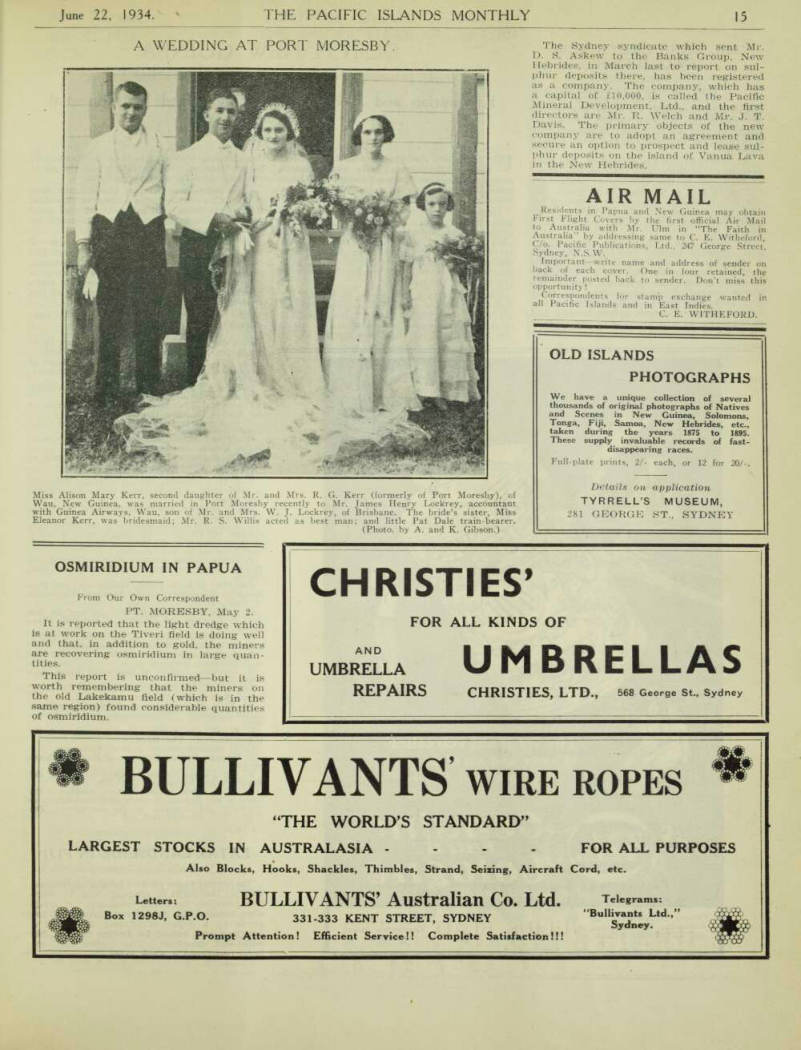
Miss Alison Mary Kerr, second daughter of Mr. and Mrs. R. G. Kerr (formerly of Port Moresby), of Wau, New Guinea, was married in Port Moresby recently to Mr. James Henry Lockrey, accountant with Guinea Airways, Wau, son of Mr. and Mrs. W. J. Lockrey, of Brisbane. The bride’s sister, Miss Eleanor Kerr, was bridesmaid; Mr. R. S. Willis acted as best man; and little Pat Dale train-bearer. (Photo, by A. and K. Gibson.)
Osmiridium In Papua
From Our Own Correspondent
Pt. Moresby, May 2.
It is reported that the light dredge which is at work on the Tiveri field is doing well and that, in addition to gold, the miners are recovering osmiridium in large quan tities.
This report is unconfirmed—but it is worth remembering that the miners on the old Lakekamu field (which is in the same region) found considerable quantities of osmiridium.
The Sydney syndicate which sent Mr.
D. S. Askew to the Banks Group, New Hebrides, in March last to report on sul phur deposits there, has been registered as a company. The company, which has a capital of £10,000, is called the Pacific Mineral Development, Ltd., and the first directors are Mr. R. Welch and Mr. J. T.
Davis. The primary objects of the new company are to adopt an agreement and secure an option to prospect and lease sul phur deposits on the island of Vanua Lava in the New Hebrides.
Air Mail
Residents in Papua and New Guinea may obtain First Flight Covers by the first official Air Mail to Australia with Mr. Ulm in “The Faith in Australia” by addressing same to C. E. Witheford, C/o. Pacific Publications, Ltd., 247 George Street, Sydney, N.S.W.
Important write name and address of sender on back of each cover. One in four retained, the remainder posted back to sender. Don’t miss this opportunity!
Correspondents for stamp exchange wanted in all Pacific Islands and in East Indies.
C. E. Witheford.
Advertisements & other items, p. 17 (1 item)
Christies’
OLD ISLANDS
PHOTOGRAPHS
We have a unique collection of several thousands of original photographs of Natives and Scenes in New Guinea, Solomons, Tonga, Fiji, Samoa, New Hebrides, etc., taken during the years 1875 to 1895.
These supply invaluable records of fastdisappearing races.
Full-plate prints, 2/- each, or 12 for 20/-.
Details on application
TYRRELL’S MUSEUM,
281 GEORGE ST., SYDNEY
CHRISTIES’
FOR ALL KINDS OF
UMBRELLA UMBRELLAS
REPAIRS CHRISTIES, LTD., 668 George St., Sydney
BULLIVANTS' wire ropes
“THE WORLD’S STANDARD”
LARGEST STOCKS IN AUSTRALASIA ... FOR ALL PURPOSES Also Blocks, Hooks, Shackles, Thimbles, Strand, Seizing, Aircraft Cord, etc.
Letter.: BULLIVANTS’ Australian Co. Ltd.
Box 1298 J, G.P.O. 331-333 KENT STREET, SYDNEY Prompt Attention! Efficient Service!! Complete Satisfaction!!!
Telegrams: "‘Bullivants Ltd.,"
Sydney.
Mr. Zane Grey’S New
Sword Fish
From Our Own Correspondent.
Papeete, May 17.
MR. ZANE GREY, big game angler, left Tahiti for America by the S.S. Maun ganui on her last trip and is expected to return again in time for the next fishing season.
Mr. Grey, before his departure, had been spending a considerable time on the island of Tetiaroa in the vicinity of which the fishing is said to be remarkably good. He did not, however, succeed in breaking his own world record, made in Tahiti some years ago, but nevertheless enjoyed good sport.
Mr. Grey was enthusiastic over a large fish which he hooked and lost. This was a rare kind of swordfish, known to the native fishermen but not yet scientifically classed—a swordfish with its bill on the lower instead of the upper jaw. Mr. Grey will assuredly not be satisfied till h e has one of these monsters safely landed and is thus able to add another to his already long list of piscatorial triumphs.
Dutch New Guinea
Exploration and Development Being Urged by Influential Group
UP till now, the Dutch section of New Guinea (which is more than twelve times as large as Holland itself) has been considerably less developed than other parts of the Dutch Indies, Recently a group of prominent Dutch men have become interested, and have decided that Holland has a great national task to fulfil in this part of her overseas territories. They have formed the “New Guinea Committee,” which aims at pro paganda in favour of the development of Dutch New Guinea.
The committee proposes to study the means available to develop New Guinea, to bring this region under the attention of as many people as possible, to make the results of investigations known to the
authorities, and to promote a systematic exploration of the population and the agri cultural and forest possibilities.
The committee wishes these investiga tions to be carried out, whenever possible, in co-operation with prospecting and min ing operations that are being planned by private companies.
In this way the natural resources of the country may be developed, and the the country, as well as its inhabitants, raised to a higher economic level, accord ing to the best traditions which have marked the method of government of the Dutch Indies.
The members of the New Guinea Com mittee are: D. Fock, State Minister (former Governor-Gene ral of the Dutch Indies), The Hague, president.
Ch. J. I. M. Welter, president of the Board of Employers in the D.E.I., The Hague, vice-president.
P. M. van Bosse, mining engineer, director of the East Borneo Co., The Hague.
J. van den Broek, mining engineer, director of the Billiton Co., The Hague.
G. H. Crone, president of the Chamber of Com merce, Amsterdam.
Mr. J. A. Dunlop, director of the Netherlands- Indian Commercial Bank, Amsterdam.
W. A. Engelbrecht, president of the Chamber of Commerce, Rotterdam.
L. J. M. Feber, M.P., The Hague.
Prof. H. I. Grondijs, mining engineer, Professor of Mineralogy at the Technical University of Delft, The Hague.
Dr. E. Heldring, director of the Royal Steamboat Co., Amsterdam.
A. C. H. Horstmann, director of the Netherlands Colonial Oil Company, The Hague (who is acting as representative of the three oil companies, which have interests in New Guinea).
P. Hovig, mining engineer (former Chief of the Mining Office of the Dutch-East-Indies). The Hague.
Prof. Dr. J. A. A. Mekel, mining engineer, Pro fessor of Mineralogy at the Technical University of Delft, Delft.
P. J. Jansen, mining engineer (advisor for the firm of Erdmann and Sielcken, at Batavia), Was senaar.
M. C. Koning, director of the Steamship Navi gation Company, “Nederland,” Amsterdam.
A. A. Pauw, director of the Nederl Handel Mij, of Amsterdam, Haarlem.
A. Plesman, director of the Royal Dutch Air lines, The Hague.
Jhr, H. K. B. Rendorp, director of the Royal Dutch East Indian Air-lines, Amsterdam.
W. Ruys Bzn, director of the Steamship Navi gation Company, “Rotterdamsche Lloyd,” Rotter dam.
L, H. W. van Sandick (former member of the Indian Council), The Hague.
C. J. Snijders, retired general, Hilversum.
J. Tideman (former Governor of Molucca), Ams terdam.
N. van Zalinge (former president-director of the Royal Packet Navigation Co.), The Hague.
Dr. W. C. Klein, mining engineer, member of the board of the Molucca Institute at Amsterdam (also secretary and treasurer of the committee), The Hague, van Alkemadelaan 328.
Fatal Landslide In Fiji
Torrential rains on the Island of Ovalau, Fiji, on the night of Monday, May 21, were the heaviest in living memory. A land slide covered the road for a distance of 100 yards by a depth of 12 feet, destroyed a dwelling and buried an Indian farmer, his wife and daughter. The bodies had not been, recovered a week later.
Advertisements & other items, p. 18 (1 item)
JULIUS BLAU Carrington Street,
Exploration In New Guinea
By R. W. Robson.
A NEW map of the Territories of New Guinea and Papua has just been issued by the Prime Minister’s Department, Can berra. I have before me, also, a similar map issued by the same authority in 1928. A comparison between the two gives a remarkable revelation of what has been accomplished by the Common wealth and by private enterprise in ex ploration of these two great Territories within the last few years.
The 1928 map shows, in the interior ot New Guinea, to the extent of about one third in Papua and two-thirds in the Mandated Territory, a huge blank space, marked simply “unexplored.” The Sepik and Ramu river systems, and the chain of mountains which parallel the northern coast of New Guinea are outlined; but from the mountains southwards, right across the Papuan border and down to the headwaters of the lesser Papuan riv ers, the extent of the geographers’ know ledge of six years ago is shown simply by a blank. In the 1934 map, this un known inland area is much shrunken.
It was always assumed that this huge inland area was broken, mountainous, jungle-clad and practically impenetrable.
Until very recent times, no white man had been into the country—except Cap tain Detzner. That German officer escaped into the interior from the vicinity of Finschafen, when the Great War broke out, and he was at large there for some years. He claimed to have penetrated this mysterious interior, in a vain at tempt to get across to Dutch New Guinea —but his descriptions of the interesting people and country which he saw were not taken seriously. We now know that they were almost literally correct.
Some ten years ago, mining interests began to open up the Morobe goldfield, which was then represented by the east ern end of this unexplored territory. For some years mining and prospecting were confined largely to the Morobe area; but, since 1931-2, gold seeking expeditions, following the trail of the precious metal, have pushed out from Morobe towards the west and north-west, penetrating ever more deeply into hitherto unknown coun try.
Many explorations have been carried out by private expeditions, assisted and complemented by the vigorous enterprise of the Administrations of New Guinea and Papua. Government patrols, going in westward from Morobe, southwards from Madang, and northwestwards from the Kerema and Kikori districts, in Papua, have mapped much new country during the last five years.
One of the most important of those ex
peditions was carried out last year, when Assistant District Officer Taylor, of the New Guinea service, and Messrs. Mick and Dan Leahy, representing a goldseeking syndicate, marched out from Morobe, around the Kratke Range and, assisted by aeroplanes, penetrated about 100 miles to the north-west, right to the summit of Mt. Hagen (13,120 ft.). The report they made on their return, after several months’ absence, was astonishing.
Instead of rough, broken mountains and gloomy jungles, they discovered a beautiful and fertile tableland, varying in altitude from 3000 to 5000 ft., with an equable climate, magnificent park-like valleys, clear, sparkling rivers, and inhabited by an attractive people, with a comparatively high degree of culture. These people apparently are skilled agriculturists—photographs taken by Messrs. Taylor and Leahy show large areas of land
carefully irrigated and planted, laid out on a rectangular plan and disclosing luxuriant growth. Moreover, these people for the most part do not crowd into vil lages—they are real farmers, living on their farms which are scattered thickly over this attractive country. The region is now called the Benna Benna-Wahgi plateau.
Turning, now, to the 1934 map, we see the result of all this activity in explora tion. A large part of the eastern portion of the region, previously marked “unex plored,” now carries names; but the west ern and larger part (which lies between Mt. Hagen and the river systems of the Fly and the Sepik—that is, along the boundary between the British and Dutch Territories) is still unexplored and, on the map, is a blank.
The new features which have been added to the map, apparently as a result of the Taylor-Leahy expedition, disclose a mighty and hitherto unknown river system, which drains the plateau referred to. The river system is divided really into three main tributaries —the Purari, the Kornigunu and the Wahgi. The map
shows these rivers flowing southwards into a blank (unexplored territory); but there is no doubt now that they are part of the headwaters of the mighty Purari River, which somehow finds its way through the mountains (along the border between Papua and New Guinea) and which eventually reaches the Gulf of Papua 170 miles north-west of Port Moresby.
The discovery of this, huge river sys
tern, and its identification as part of the Purari River, is one of the most interest ing developments connected with the very recent explorations in central New Guinea. The farthest west point reached by the Taylor-Leahy expedition was Mount Hagen; and, from the slopes of this great mountain, the young Austra lians, looking westward (over what the map shows still to be 150 miles of un controlled and unexplored country) could see a further series of rolling tablelands, park-like in character and apparently densely inhabited by a farming popula tion. This assumption was confirmed a few days later, when they viewed the country from an aeroplane which, in ac cordance with a pre-arranged plan, flew out to them 200 miles from the Morobe goldfield with supplies. They used the aeroplane to make a short flight west ward from Mount Hagen, and their photo graphs show more cultivated country and, apparently, a continuation of the native farm-house style of settlement.
Recently, the work of exploration has been aided enormously by the aeroplanes which now maintain the Morobe gold field transport services particularly Guinea Airways Ltd. and Holden’s Air Transport Co. When an expedition is planned into this unknown country the patrol leaders usually arrange that on a certain day they will clear a landing ground and make smoke signals; and on that day an aeroplane, in charge of one of the intrepid Australian pilots who have made these services world-famous, goes out and looks for them with supplies, mails, etc. In this way the work of ex ploring and mapping this country has
made extraordinary progress in the last two or three years-.
It is interesting to note that Central New Guinea—and this applies to Dutch as well as British territory—is now one of the very few remaining bits of the earth’s surface that is entirely unex plored; and gratifying to think that so much of this important exploratory work is being carried out by Australia.
Advertisements & other items, pp. 19-20 (1 item)
Arnott's
HEALTH!!
RICH in precious vitamins and proteins, they are made from the whole grain of rich sun-ripened wheat, transformed after careful selection into a perfect health food, delicious for breakfast, for afternoon tea or supper. Beneficial, sustaining and a wonderful aid to digestion.
Try them with butter, cheese, jam or honey.
ARNOTT'S
FAMOUS
SHREDDED
WHEATMEAL
BISCUITS
ALWAYS ASK FOR ARNOTT’S
AND BE SURE YOU GET THEM
“STILLHOLME”
Convalescent and Rest Home
81 MUSTON ST., MOSMAN
SYDNEY
Sunny Rooms, Verandahs, Harbour Views, Lawns.
Centrally Situated, handy to Trams, Ferries, and City.
Sisters RAINSFORD and HILL Y 1655.
The
“High-
lander”
Shirt
Ideal for wear in tropics, will stand hard wear and native washing. Made from a strong cotton twill, two breast pockets. Assorted designs. In Blue, Brown, or Grey grounds.
Colours fast.
Price 9/6 each Three for 27/6 Ties to Tone, 3 6.
Send your order to Desk PIM.
PIKE BROTHERS Ltd.
in Queen Street, Brisbane
Use —
Modern Direct Wireless Services
for Your Communications With Australia and Overseas.
DIRECT WIRELESS SERVICES are available for inter-communication between the Islands of the Pacific and for traffic between the Islands and Australia and overseas countries.
Services are now in operation between Papua and Sydney, New Guinea and Sydney, New Caledonia and Sydney, and Fiji and Sydney. Speedy, economical and efficient service to Australia and overseas. Route your traffic “Via the Wireless Service.”
For overseas traffic to Great Britain, North and South America, and all European countries, route your message via the Direct Australian
BEAM WIRELESS SERVICE
LODGE YOUR MESSAGES AT ANY
WIRELESS STATION OR ISLAND POST
OFFICE ROUTED “VIA WIRELESS.”
AMALGAMATED WIRELESS (A SIA) LIMITED
Indignant Murderers
Social Standards In a Papuan Gaol
From our own correspondent.
Pt. Moresby, May 1.
EXUBERANT Abau prisoners, under going sentences for murder at Ba dili, Port Moresby, made an attempt to brighten the monotony of the gaol rou tine last week.
Resenting bitterly that their prestige as murderers was not sufficiently recog nised, by either the Government or the warders, they proceeded to show them the error of their judgment by defying the head gaoler, the European policeman, and a number of warders and policemen. They were prepared to “take on” any further forces that the Government could produce, if their attitude towards them did not change.
They said that to be locked up in a cell, like a horse, or a cow, was an in dignity an Abau could not possibly en dure any longer, and they resented the idea strongly.
Their exuberance was short-lived; handcuffs and detention are apt to dam pen the most rebellious decisions.
However, they are now serving their sentences in western gaols, where, no doubt, their social status receives no af fronts. Rather, will they have to look to their laurels. To rub shoulders with head-hunting prisoners from the Fly River is no mean advantage, and should top the scale of their ambition, and com pensate them for all former indignities.
Planters’ Troubles
Referring to the Islands operations of foreign-owned shipping lines, the secretary of Ruravai Plantations, Solomon Islands (Mr. L. W. Tulloh), in an article in Mel bourne “Argus” on May 24, says:— “Primary producers in Australia consider they have been hard hit, but at least they have sympathetic Governments to appeal to and receive assistance from. In the Pacific Islands, and I refer now more par ticularly to the Solomon group, planters have been ruined through the low price of copra. Wheat is low in price certainly, but fancy having to grow, gather, husk, cure, bag, and ship 2,500 coconuts in the form of copra for a return of £3/10/- or less, and under a Government Administra tion which evinces no practical sympathy in the form of reduced taxation or adminis trative expenses or financial assistance.
“To such struggling and brave-hearted pioneer settlers the advent of foreign competition has meant much. Quite apart from providing another channel by which to dispose of or sell copra, etc., a shipping service has been provided to Europe and the East. Then, too, such items as rice and sugar are available at much more favourable prices than from Australia. A 100lb. bag of considered better sugar costs less than 70lb. from Australia, free of duty.
Other goods are also procurable more favourably. This gives settlers an oppor tunity of saving on operative expenses, a help much needed.”
Advertisements & other items, pp. 21-22 (2 items)
B.N.G. Co.
Half-Million Papuan Co. In Stormy Waters
SOME of the difficulties of the British New Guinea Development Co. Ltd. and of its subsidiary, British New Guinea Trading Co. Ltd., are indicated in the accounts of the former, which were pub lished in London last October. It is a tragic story of muddling and bad luck.
The Development Company was incor porated in London in July, 1922, to carry on plantations in Papua, and about £500,000 was subscribed in ordinary shares. Subsequently, there were adjust ments and more capital was obtained by the issue of first mortgage debenture stock, with the result that the latest bal ance sheet shows £478,000 of ordinary and £130,000 of debenture capital.
The Co. acquired a dozen plantations, and proceeded to grow copra and rubber.
Someone persuaded the London directors that it would be a good thing if the plan tations could buy their stores at cost, so they invested some £76,000 of the parent Co.’s money in the B.N.G. Trading Co.
Ltd., which opened stores all over Papua, entered into competition with the other trading concerns, and supplied the B.N.G. plantations.
Just before the depression came, the shareholders received a little in the way of dividends; but, in Australia, the Co. became a by-word for extravagance. The Papuan staffs seemed to live luxuriously, not to say magnificently; and, long before the slide in prices began, the critics, not ing the enormous over-capitalisation, the lavish overhead, and the waste of money, prophesied a financial crash. Adding one letter to the initials of the name, they called it the “BUNG” company.
When the slump came, the Co. very soon found itself in serious financial dif ficulties. Both the trading operations and the sale of copra and rubber showed a loss; and it was then that the £150,000 of debenture stock, carrying 7 per cent., hung like a millstone around the neck of the Co. The Co. eventually went to the debenture stockholders and obtained some relief, but it was arranged that portion of the stock should be redeemed. The direc tors had a pretty problem—their earnings were not enough even to pay debenture interest. It was decided therefore to sell the trading company, and apply the pro ceeds to the redemption of the debentures.
Accordingly, the stores and trading equipment were sold about the middle of 1933 to Messrs. Burns, Philp and Co.; but the terms of the sale have not been published, and the winding-up is still go ing on. There is nothing to show what proportion of the £129,000 of debenture capital in existence on 31st January, 1933, is likely to be retired as a result of the sale —in other words, how much of the £76,000 invested in the Trading Co. will be recovered.
Meanwhile, the Development Co. is still carrying on its plantations which (ac cording to the figures issued) were as fol lows on January 31, 1933:
In the year ended January, 1933, the Company made a planting loss of £115.
In addition, it had to finance debenture interest amounting to £5277, and a loss of £8285 brought forward from the pre vious year. It met the situation by tak ing £10,000 out of its reserves, and carrying forward a loss of £3678.
If the Trading Co. is no longer in operation, and the plantations are being economically managed, the Development Co.’s plantation operations should show a profit; but it will take a large profit to pay a dividend worth noticing on half a million pounds of capital.
Balance-sheet figures follow:
The figures show that the Company is struggling in deep financial waters. The items showing £28,630 owing to the Trad ing Co., and the practically negligible reserves, are not cheering. The statement of assets, in the circumstances now existing, is merely “bookkeeping.”
There are three directors in London, and each apparently draws £15 per month. The London office and staff costs £1786 per annum. These items are in line with the spirit of magnificence which formerly distinguished this Company’s operations in Papua. There can be no need for such an expenditure in London.
Plantation.
RUBBER.
Acres in Acreage, bearing.
Production for year lbs., 1932. lbs., 1931 Doa .. 727 278 94,053 77,077 Itikinuniu .. 1872 850 479,400 395,950 Tawarare .. 266 213 106,200 104,858 Ogamobu.. .. 995 214 105,675 85,520 3860 1555 785,328 663,405 Aroa .. 4996
COPRA.
1073 (tons) 272 (tons) 448 Baubauguina .. 2883 822 303 249 Buna.. .. 500 160 70 62 Gaclaisu .. .. 2250 725 251 247 Obu .. .. .. 2100 572 201 302 Otomata .. 2700 458 220 226 Paili .. .. .. 2380 629 122 221 Waigani .. .. 3251 1353 487 411 21,060 5792 1,926 2,166
LIABILITIES.
957,062 ord. shares, 10/- £478,531 7 per cent, debenture stock 129,240 Reserve—Capital 5,001 ,, Fire insurance 2,960 Exchange suspense 4,561 Subsidiary Co.'s account 28,630 Sundry creditors, etc., London 3,069 „ „ Papua 958 Native wages accrued, not paid 4,058 Bank overdraft, London 1,849
ASSETS.
Lands and property 550,057 Town properties, buildings, plants .. 8,528 Ships’ property 2,899 Live stock 3,659 Stocks and stores 2,660 Shares in subsidiary Co. and investments, £77,730, less reserve 71,232 Plantation produce in transit 5,820
EXPENDITURE.
Coconut plantations £19,901 14,907 Sundry expenses 601 Directors’ fees 537 London office rent and salaries 1,786 Total operating expenditure 38,214 Interest on debentures 5,277 Total expenditure £43,491
REVENUE.
Sale of copra £18,523 „ „ rubber 19,019 Sundry receipts 556 Total revenue £38,098
A business of this character should be managed on the spot—certainly, from no farther away than Australia. Part of the copra and all the rubber is sold in Aus tralia. The Trading Co., before it went west, probably did its London buying through a broker or agent. Much of its stock was bought in Australia. In the circumstances, the London directors and office are mostly ornamental.
It is a typical example of an English Company which has been trying to carry on an oversea producing and trading busi ness according to the old traditions, and which in consequence has got itself into a mess.
Marine Engines
The “VINCO”
2½ and 4 h.p. Inboard, 3-port 2-cycle Marine Engines Price: 2½ H.P. .. £28/-/- Complete 4 H.P. . . £40/10/- Complete
F.O.B. SYDNEY.
All Installation Fittings Supplied.
2½ H.P. 4 H.P.
Height 12 ins. 17 ins.
Weight 60 lbs. 120 lbs.
Bore and Stroke 2x 2 1 / 2 V/i x y/ 2 Tank Capacity 1 gal. 2 1 / 2 gals.
For comparison, we submit the following advantages peculiar to the “Vinco”: — 1. No gears to wear, chains to break, or valves to stick, 2. A ball thrust eliminates friction from the push of the propeller. This ball thrust is housed in the flywheel which keeps it free from sand and grit. 3. No rubber hose pump connections to perish and choke the water circulating system.
We use good copper tubing with machined brass fittings. 4. Best quality copper hardened white metal bearings throughout. 5. Float-chamber carburetter —all brass and heavily nickelled. 6. Our unique pump drive enables us to keep the body of the pump close to the cylinder and at the same time retain a long bearing, part of which is hidden by the flywheel. 7. The crankshaft is fitted with balance weights which eliminate all vibration. This prolongs engine life and promotes comfort. 8. High grade magneto directly driven and easily detached. Impulse starter. 9 So perfectly balanced is the drive to the magneto that it will run without being fastened down. This in turn relieves the magneto bearing of all load. 10. Water trap fitted in muffler to prevent water getting into the engine. 11. Large size grease cups fitted to main bearings to ensure perfect lubrication. 12. Drain tap fitted under crankcase. 13. Very strong section Manganese Bronze propeller scientifically designed to afford maximum efficiency and speed. 14. Brass petrol tank.
Our written guarantee for 5 years Protects Purchasers against Risk.
Manufactured by
VINCENT BROS.
Engineers, Founders and Pattern-makers
44 WENTWORTH PARK RD., GLEBE
SYDNEY. N.S.W.
GOSHEN PRIVATE
HOSPITAL
(Sister E. W. YEAMAN), 37 Gloucester Road, Hurstville, Sydney General and Private Wards. Spacious Grounds. High and Cool Situation.
Moderate Fees.
A. W. DYE
and Company
ASSAYERS, ANALYSTS,
METALLURGISTS
Buyers of Gold , Silver , Platinum , etc.
T. & G. BUILDING,
ELIZABETH STREET,
SYDNEY, N.S.W.
Established 1914.
Bankers: Commercial Bank of Australia, Ltd.
SAMUEL RUSSELL
ESTATE AND GENERAL AGENT.
P.O. Box 64, Papeete, Tahiti
Real Estate. Investments. Estate Management and Administration. Valuations and Reports. Houses and Lands for Lease or Sale.
Sole Proprietor: TAHITI PERFUMES Cables: Russell, Tahiti (Bentley’s Code)
WEAK MEN MADE STRONG
and YOUTH REGAINED
MEN who have LOST YOUTHFUL POWERS; whose brains are dulled; whose energy and VITALITY is weakened; whose memory is bad and faulty and feel despondent should take
ALFALINE VITALITY PILLS
Bottles, 6/-
(Send for Circular on Pills and Lost Vitality Treatment) BLOOD, SKIN, NERVE, BLADDER, KIDNEY, AND LIVER COMPLAINTS,
RHEUMATISM, NEURITIS, ASTHMA, SUCCESSFULLY TREATED BY
POST. (MEDICINES POSTED UNDER PLAIN COVER.)
ALL TOILET AND RUBBER GOODS STOCKED
(Send for Price List).
HERR RASMUSSEN (Danish Herbalist)
541 GEORGE ST., SYDNEY, N.S.W.
“No. 4, Bulolo”
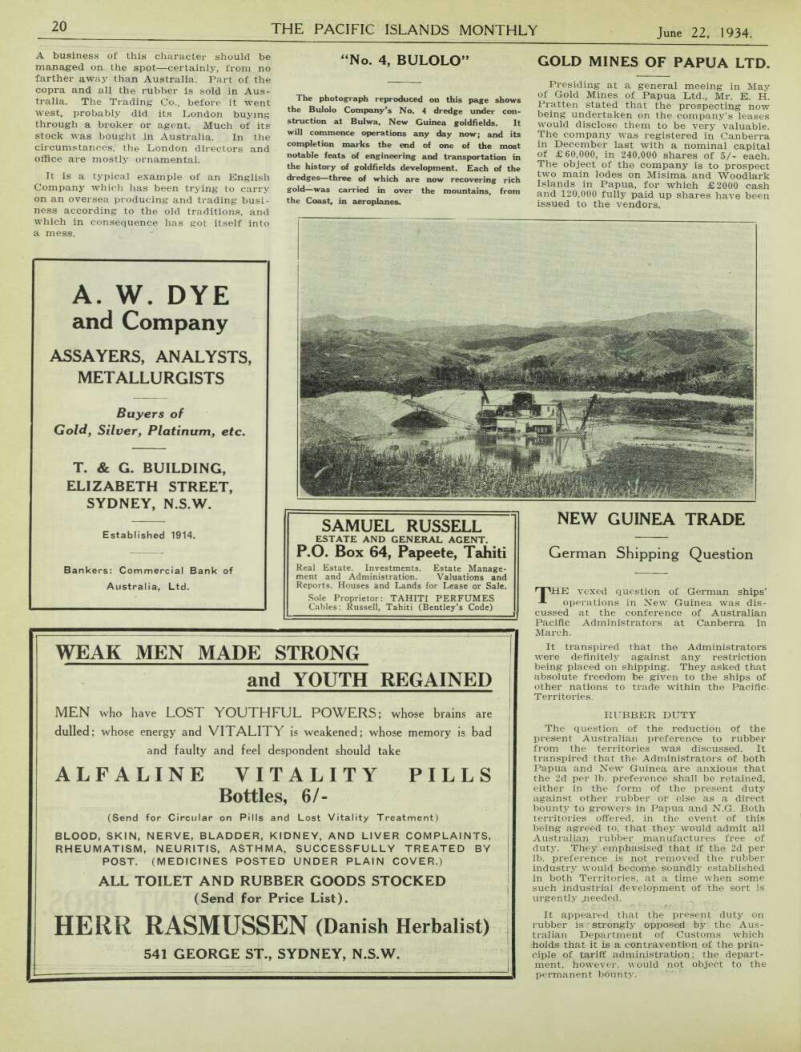
The photograph reproduced on this page shows the Bulolo Company’s No. 4 dredge under con struction at Bulwa, New Guinea goldfields. It will commence operations any day now; and its completion marks the end of one of the most notable feats of engineering and transportation in the history of goldfields development. Each of the dredges—three of which are now recovering rich gold—was carried in over the mountains, from the Coast, in aeroplanes.
Gold Mines Of Papua Ltd.
Presiding at a general meeing in May of Gold Mines of Papua Ltd., Mr. E. H.
Pratten stated that the prospecting now being undertaken on the company’s leases would disclose them to be very valuable.
The company was registered in Canberra in December last with a nominal capital of £ 60,000, in 240,000 shares of 5/- each.
The object of the company is to prospect two main lodes on Misima and Woodlark Islands in Papua, for which £2000 cash and 120,000 fully paid up shares have been issued to the vendors.
German Shipping Question
New Guinea Trade
THE vexed question of German ships’ operations in New Guinea was dis cussed at the conference of Australian Pacific Administrators at Canberra in March.
It transpired that the Administrators were definitely against any restriction being placed on shipping. They asked that absolute freedom be given to the ships of other nations to trade within the Pacific- Territories.
Rubber Duty
The question of the reduction of the present Australian preference to rubber from the territories was discussed. It transpired that the Administrators of both Papua and New Guinea are anxious that the 2d per lb. preference shall be retained, either in the form of the present duty against other rubber or else as a direct bounty to growers in Papua and N.G. Both territories offered, in the event of this being agreed to, that they would admit all Australian rubber manufactures free of duty. They emphasised that if the 2d per lb. preference is not removed the rubber industry would become soundly established in both Territories, at a time when some such industrial development of the sort is urgently .needed.
It appeared that the present duty on rubber is strongly opposed by the Aus tralian Department of Customs which holds that it is a contravention of the prin ciple of tariff administration; the depart ment, however, would not object to the permanent bounty.
New Guinea
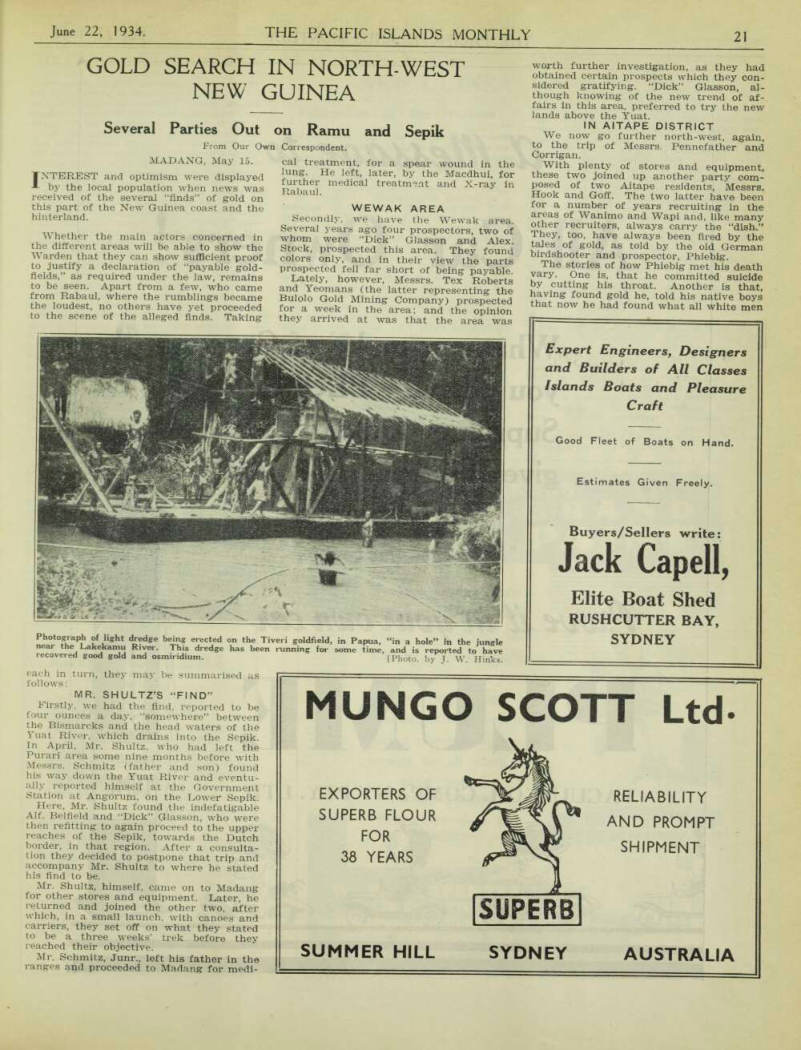

Gold Search In North-West
Several Parties Out on Ramu and Sepik
From Our Own Correspondent.
Madang, May 15.
INTEREST and optimism were displayed by the local population when news was received of the several “finds” of gold on this part of the New Guinea coast and the hinterland.
Whether the main actors concerned in the different areas will be able to show the Warden that they can show sufficient proof to justify a declaration of “payable gold fields,” as required under the law, remains to be seen. Apart from a few, who came from Rabaul, where the rumblings became the loudest, no others have yet proceeded to the scene of the alleged finds. Taking
each in turn, they may be summarised as follows:
Mr. Shultz’S “Find”
Firstly, we had the find, reported to be four ounces a day, “somewhere” between the Bismarcks and the head waters of the Yuat River, which drains into the Sepik.
In April, Mr. Shultz, who had left the Purari area some nine months before with Messrs. Schmitz (father and son) found his way down the Yuat River and eventu ally reported himself at the Government Station at Angorum, on the Lower Sepik.
Here, Mr. Shultz found the indefatigable Alf. Belfield and “Dick” Glasson, who were then refitting to again proceed to the upper reaches of the Sepik, towards the Dutch border, in that region. After a consulta tion they decided to postpone that trip and accompany Mr. Shultz to where he stated his find to be.
Mr. Shultz, himself, came on to Madang for other stores and equipment. Later, he returned and joined the other two, after which, in a small launch, with canoes and carriers, they set off on what they stated to be a three weeks’ trek before they reached their objective.
Mr. Schmitz, Junr., left his father in the ranges and proceeded to Madang for medi
cal treatment, for a spear wound in the lung. He left, later, by the Macdhui, for further medical treatment and X-ray in Rabaul.
Wewak Area
Secondly, we have the Wewak area.
Several years ago four prospectors, two of whom were “Dick” Glasson and Alex.
Stock, prospected this area. They found colors only, and in their view the parts prospected fell far short of being payable.
Lately, however, Messrs. Tex Roberts and Yeomans (the latter representing the Bulolo Gold Mining Company) prospected for a week in the area; and the opinion they arrived at was that the area was
worth further investigation, as they had obtained certain prospects which they con sidered gratifying. “Dick” Glasson, al though knowing of the new trend of af fairs in this area, preferred to try the new lands above the Yuat.
In Aitape District
We now go further north-west, again, to the trip of Messrs. Pennefather and Corrigan.
With plenty of stores and equipment, these two joined up another party com posed of two Aitape residents, Messrs.
Hook and Goff. The two latter have been for a number of years recruiting in the areas of Wanimo and Wapi and, like many other recruiters, always carry the “dish.”
They, too, have always been fired by the tales of gold, as told by the old German birdshooter and prospector, Phiebig.
The stories of how Phiebig met his death vary. One is, that he committed suicide by cutting his throat. Another is that, having found gold he, told his native boys that now he had found what all white men
Photograph of light dredge being erected on the Tiveri goldfield, in Papua, “in a hole” in the jungle near the Lakekamu River. This dredge has been running for some time, and is reported to have recovered good gold and osmiridium. [Photo, by J. W. Minks.
seek, the country would soon be full of white men. The natives, not wishing this, killed him before he could divulge his find.
However, it still remains to be shown that gold exists in these parts. The nature of the country shows oil. There are “oil deoms” —and it is yet to be proved to what extent, if any, gold and oil go together.
The two recruiters, in their wanderings and independent prospecting journeys into the ranges, have shown results worth in vestigating, and it is with that intention that the others have joined up. A report from them is awaited with interest.
Mr. Pennefather was District Officer at Aitape many years ago, before he resigned to settle down as a planter, and he knows its country and people well. He also knew the late Phiebig, and had many of the latter’s exploits and findings directly from that person himself.
Inquirer From Europe
Then there arrived, by last Macdhui, another geologist from Europe, in the per son of Mr. Gallet. He, later, proceeded by schooner to the same area, and intends crossing into Dutch Territory. He is new to this country and has been sent out by a European Company, for a short period, to prospect certain areas. He is alone on his mission, having only natives to assist and accompany him.
Kunai Valley Co.
A prospecting company known as the Kunai Valley Exploration Company, whose representatives comprise Messrs. Cruick shanks, Forrester and Cook, after fitting out, and with some thirty carriers, have left for the Ramu and Bismarcks.
Yuat Alluvial Co.
The Yuat Alluvial Co., under the man agership of Mr. Turnbull, have almost completed their work on the Yuat River.
They certainly have not used the com pany’s money without result, as far as work goes. An extensive and thorough test was made in the areas under con sideration and quite a lot of ground covered, the results of which are not yet known.
Much money and labour have been and are being expended this year on seeking gold in many new areas, and we sincerely hope that good results will attend the ef forts of the dauntless few who follow up the quest.
Advertisements & other items, pp. 23-25 (1 item)
advt
Expert Engineers, Designers and Builders of All Classes Islands Boats and Pleasure Craft Good Fleet of Boats on Hand.
Estimates Given Freely.
Buyers/Sellers write:
Jack Capell,
Elite Boat Shed
RUSHCUTTER BAY,
SYDNEY
advt
A Message to
All Car Owners
Whatever make of Car you drive, PLUME’S Supreme Quality will give the best all-round Performance.
Prove it in your own car
PLUME
VACUUM OIL COMPANY PTY. LTD.
Lloyd’s Teas
Tea drinkers expect more than a mere drink.
That easy, relaxed feeling, that sense of contentment and glow of real satisfaction must be there . . . not once in a while, but with every cup.
Try Lloyds for purity. Try the consistent goodness of quality tea. Try the delicious aroma that is such a feature of Lloyd’s tea blending.
Obtainable at all good island stores.
Scientists In
New Guinea
Education of the Natives
THERE are few men in the Pacific who are better able to describe the interest, fascination and romance of the Islands than Mr. J. H. L. Waterhouse, scientist and educationalist.
Mr. Waterhouse spent some time recent ly in primitive Bougainville Island as a collector of botanical specimens for Kew Gardens ( London) and the University of Yale, U.S.A. Then that very wise New Guinea Administrator, Brigadier-General Griffiths, requiring a man of unusual qualifications to take charge of an in teresting experiment in the education of natives, selected Mr. Waterhouse for the position—literally picked him out of the centre of gloomy Bougainville.
The following article originally was part of a private letter written by Mr. Water house to the editor. We make no apology for publishing it.
WHERE have I been since we parted on Teop beach, almost two years ago?
After two or three days spent in renew ing old friendships, both white and brown, I headed south again for Kieta, in the Ad ministration auxiliary schooner “Posei don,” spending a night en route at ever hospitable Numanuma. From Kieta, thanks again to Captain Waugh, D.O., I continued on in “Poseidon” along that haunting
Bougainville coast for about 60 miles, to lonely Buin.
Then came the 40 miles’ hike into Siwai, through mile after mile of level jungle country, as wonderful as any that I’ve seen in my Pacific wanderings. The track is such an excellent one that it comes somewhat as a surprise to find great un bridged rivers, like the Miwo and Mopiai, 40 to 50 yards wide. When, as was the case on this occasion, they are in flood, the fording of them is no joke.
There is no time now to give details of my collecting work there for Kew and Yale. But time passed very quickly in that remarkable country of big drums and dolmens and canarium cults and crema tions.
One day last year an armed native con stable arrived at my base. He had come across the great central range of moun tains from Kieta, with an urgent message from the D.O. Briefly, it was a radio’d offer from the Administrator in Rabaul of a position in the Native Educational work, a reply to which had to be despatched next day.
You will be able to realise a little, per haps, of the tantalising position I was in.
An offer of service of just the kind that appealed to me, and yet my work for the two great English and American institu tions not complete. To make a long story short, I accepted the position and then fol lowed a fortnight such as I never wish to have again—radio’d and written explana tions; hurried securing of certain speci mens: quick drying and packing of speci mens; writing up of field notes and then arrangements for a swarm of carriers to
get those same specimens and all my gear to the coast, 40 miles away.
Now, transport between Buin Police Post and Kieta is sometimes very easily arranged, and sometimes more or less of a nightmare. The tramp to the coast was accomplished with but a few minor mis haps and I was fortunate to have a mate for the trip in the person of a very game Manchester gentleman, of 75 years of age!
Just how we managed the 40 miles in two days with all the bother incidental to a long string of carriers I hardly know; but on arrival at the coast we could neither see nor hear anything of any craft bound for Kieta.
Finally, thanks to His Lordship the Bishop of the Northern Solomons, we got a passage on the mission schooner “Rap hael.” It was typical of the genial Dr.
Wade —though he had a crowded little ves sel, with seven Sisters returning from a Retreat —he not only made room for us, but gave up his own bed to my sep tuagenarian companion.
I shall never forget that night’s trip along the South Bougainville coast. Away inland loomed the dark, mysterious heights df the Crown Prince Range, from which, as the night wore on, came puffs of serena. The good Bishop and I were
camped on the forward deck of his little craft —I in old “Mindini,” my “deck-chair of a thousand tales” —and we talked far on into the night. Aft, the little painting of Raphael looked down on the seven Sis ters, grouped in a little semi-circle in their deck-chairs.
We reached Kieta late in the day, after a very nice little farewell lunch that Dr.
Wade conjured up for us.
A few days later “Maiwara” landed me in Rabaul with such a pile of specimens and gear as I never wish to see again.
That was Saturday. On Monday morning I was right in harness.
I wish I had time to give you a proper description of this delightful spot (Nodup) on the shores of St. George’s Channel across which we look to Duke of York Islands and the long, ever fascinating and still little known (so far as this part is concerned) New Ireland.
I have about 80 boys drawn from the villages clustering at the foot of Kabiu (“The Mother”) and almost along to the “North Daughter.”
Then, each day at 3.45 p.m., the police car rattles in to land me at the Native Constabulary Depot in Rabaul, where I have, from 4 till 5 each afternoon, as in teresting a class as will be found In the
wide Pacific. In it are red-skinned Manus lads, contrasting with jet black comrades in arms from Bougainville, and boys from New Ireland, in the east, to the great Sepik in the west —about 125 all told. Their ability varies nearly as much as they themselves, but all are keen to learn Eng lish. Naturally the lessons are very ele mentary—perhaps later the scheme will be developed.
Quite a new development is the Night School. For some months, now, I have had a class of adults, two nights a week, here at Nodup (over 100 on the roll), and it is interesting to see once again the variety of students. Amongst the keenest are several men of over middle age—along side young indentured labourers from Rabaul; luluais and tultuls; catechists and mission teachers and ex-mission workers —representatives of all three missions.
I need hardly say that in all these educa tional jobs the very cordial and sym pathetic backing of General Griffiths means a great deal. In fact, personally, I could not carry on, otherwise, for the strain, after my 26 years of Pacific wandering is very heavy.
There are times when I long for a typist and stenographer. For instance, I have two letters in front of me as I scribble this —one a cheery, provocative effusion from our mutual friend—the other from Coultas who, with his plucky little wife, is still doing great work for the American Museum of National History (New York).
From Rambutyo, away up in the Ad miralty Group (Manus) Coultas writes: “We hope to push on and get to the Her mits and Ninigos before the end of the month (April). Our plans call for a re turn to Rabaul about the first of June, but I don’t know yet whether we shall be able to make it. I was fortunate in being able to get out to the little island of Nauna in between spells of bad weather; and still more fortunate in being able to get off, as the weather changed, and I just missed being marooned. On Nauna I found some very good material and so feel that the extreme discomfort of the trip and the island as a whole was quite worth while.
Mrs. Coultas and I . . . have both been well until recently when we acquired some rather light fevers, which is unusual for us, but seems to be better health than most of the inhabitants of this group enjoy. In fact, this area seems to be fever-ridden.”
Thanks to General Griffiths, I was able to see a good deal of Professor Thurnwald when he was here en route to Buin. That eminent scientist and his gifted wife are like the Coultas couple, “out on the bor der” in the cause of science. The last letter I had from Dr. Thurnwald was writ ten from a Government Rest House in the South Bougainville jungle.
Advertisements & other items, pp. 25-26 (1 item)
Brand Paint
DOCKERS
SUN
Made expressly to keep a lustrous, full gloss finish
against the varying con-
ditions of moist weather exposure, and prevent the decaying ravages of rain and extreme heat by
giving a long lasting pro-
tection to all surfaces.
SUN PROOF
RAIN PROOF
"Stronger than the Weather”
W. R. CARPENTER
& Co. Ltd.
New Guinea, Solomon Islands, and all other South Sea Islands.
SWALLOW &ARIELL
LIMITED
Port Melbourne Australia
Manufacturers since 1854 of HIGH QUALITY
SHIP and CABIN BISCUITS
CABIN
(including Small Cabin)
PACIFIC CABIN
CABIN CRACKERS
BREAKFAST BISCUITS
NAVY and PILOT BREAD
(PACKED EXPRESSLY FOR EXPORT IN TINS UP TO 50lbs).
Paint For Islands Boats
Of considerable interest to Pacific Islands resi dents who own launches, fishing boats, ketches, etc., is the announcement in this issue of Mr.
George Ward’s anti-fouling paint, “Hullcote.”
Too often, boat-owners in the Pacific find their craft attacked by borers; or that objectionable marine growths, worms, and shell-life, become attached to the bottom of their boats. In course of time, these parasitical growths eat away and rot the plankings of even the most sturdily con structed vessel. Therefore, the announcement that Mr. Ward’s “Hullcote” paint is anti-fouling, and is a preventive against borers, weeds, marine growth, worms, shell-life, etc., is opportune.
The paint has been subjected to most rigorous tests and the results are claimed to have been remarkably satisfactory. Hundreds of unsolicited testimonials attest to the ability of the paint to withstand tropical heat, and prevent borers from attacking Wooden piers and landings. Further par ticulars and supplies of “Hullcote” anti-fouling paint may be obtained from the manufacturer, Mr.
George Ward, Birmingham Street, Alexandria,
New South Wales.
Lever Bros. Profit: £6,200,000
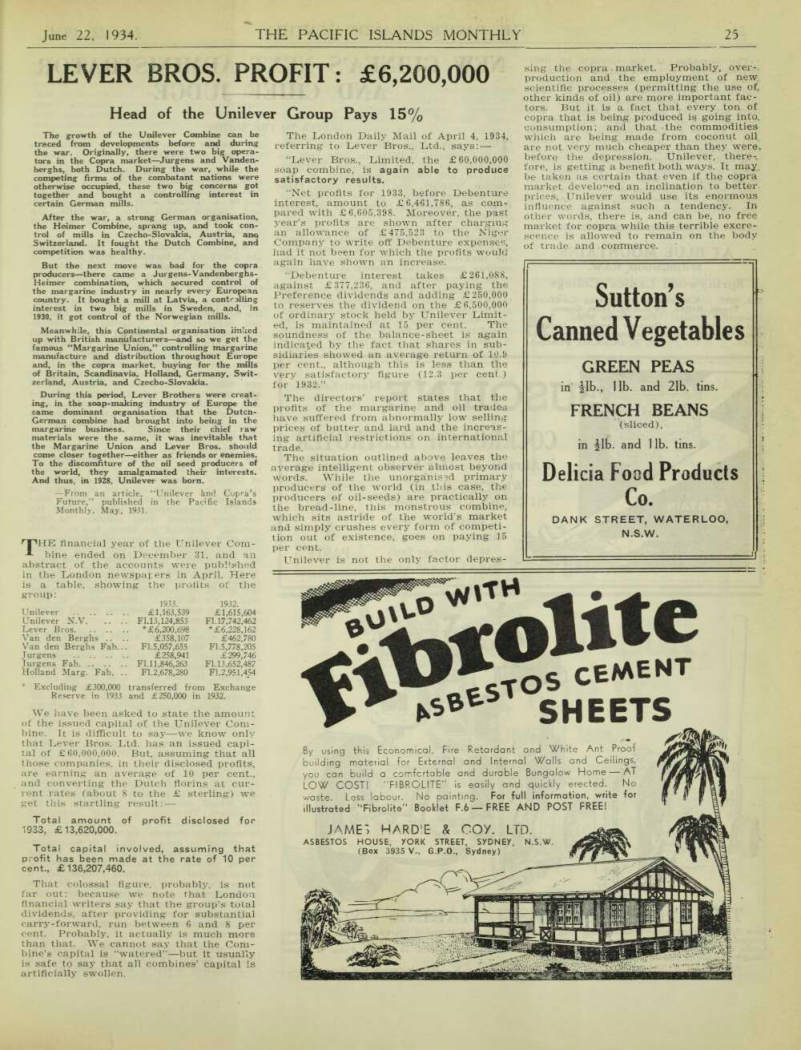
Head of the Unilever Group Pays 15%
The growth of the Unilever Combine can be traced from developments before and during the war. Originally, there were two big opera tors in the Copra market—Jurgens and Vanden berghs, both Dutch. During the war, while the competing firms of the combatant nations were otherwise occupied, these two big concerns got together and bought a controlling interest in certain German mills.
After the war, a strong German organisation, the Heimer Combine, sprang up, and took con trol of mills in Czecho-Slovakia, Austria, ana Switzerland. It fought the Dutch Combine, and competition was healthy.
But the next move was bad for the copra producers—there came a Jurgens-Vandenberghs- Heimer combination, which secured control of the margarine industry in nearly every European country. It bought a mill at Latvia, a controlling interest in two big mills in Sweden, and, in 1930, it got control of the Norwegian mills.
Meanwhile, this Continental organisation linked up with British manufacturers—and so we get the famous “Margarine Union,” controlling margarine manufacture and distribution throughout Europe and, in the copra market, buying for the mills of Britain, Scandinavia, Holland, Germany, Swit zerland, Austria, and Czecho-Slovakia, During this period, Lever Brothers were creat ing, in the soap-making industry of Europe the same dominant organisation that the Dutcn- German combine had brought into being in the margarine business. Since their chief raw materials were the same, it was inevitable that the Margarine Union and Lever Bros, should come closer together—either as friends or enemies.
To the discomfiture of the oil seed producers of the world, they amalgamated their interests.
And thus, in 1928, Unilever was born. —From an article, “Unilever knd Copra’s Future,” published in the Pacific Islands Monthly, May, 1931.
THE financial year of the Unilever Combine ended on December 31. and an abstract of the accounts were published in the London newspapers in April. Here is a table, showing the profits of the group:
We have been asked to state the amount of the issued capital of the Unilever Com bine. It is difficult to say—we know only that Lever Bros. Ltd. has an issued capi tal of £60,000,000. But, assuming that all those companies, in their disclosed profits, are earning an average of 10 per cent., and converting the Dutch florins at cur rent rates (about 8 to the £ sterling) we get this startling result; Total amount of profit disclosed for 1933, £13,620,000.
Total capital involved, assuming that profit has been made at the rate of 10 per cent., £136,207,460.
That colossal figure, probably, is not far out: because we note that London financial writers say that the group’s total dividends, after providing for substantial carry-forward, run between 6 and 8 per cent. Probably, it actually is much more than that. We cannot say that the Com bine’s capital is “watered” —but it usually is safe to say that all combines’ capital is artificially swollen.
The London Daily Mail of April 4, 1934, referring to Lever Bros., Ltd., says: “Lever Bros., Limited, the £60,000,000 soap combine, is again able to produce satisfactory results.
“Net profits for 1933, before Debenture interest, amount to £6,461,786, as com-* pared with £6,605,398. Moreover, the past year’s profits are shown after charging an allowance of £475,523 to the Niger Company to write off Debenture expenses, had it not been for which the profits would again have shown an increase.
“Debenture interest takes £261,088, against £377,236, and after paying the Preference dividends and adding £250,000 to reserves the dividend on the £6,500,000 of ordinary stock held by Unilever Limit ed, is maintained at 15 per cent. The soundness of the balance-sheet is again indicated by the fact that shares in sub sidiaries showed an average return of 10.9 per cent., although this is less than the very satisfactory figure (12.3 per cent.)
for' 1932.”
The directors’ report states that the profits of the margarine and oil trades have suffered from abnormally low selling prices of butter and lard and the increas ing artificial restrictions on international trade.
The situation outlined above leaves the average intelligent observer almost beyond words. While the unorganised primary producers of the world (in this case, the producers of oil-seeds) are practically on the bread-line, this monstrous combine, which sits astride of the world’s market and simply crushes every form of competi tion out of existence, goes on paying 15 per cent.
Unilever is not the only factor depres
sing the copra market. Probably, overproduction and the employment of new scientific processes (permitting the use of other kinds of oil) are more important fac tors. But it is a fact that every ton of copra that is being produced is going into consumption; and that the commodities which are being made from coconut oil are not very much cheaper than they were, before the depression. Unilever, there fore, is getting a benefit both ways. It may be taken as certain that even if the copra market developed an inclination to better prices, Unilever would use its enormous influence against such a tendency. In other words, there is, and can be, no free market for copra while this terrible excre scence is allowed to remain on the body of trade and commerce.
1933. 1932.
Unilever £1,163,539 £1,615,604 Unilever N.V. .. .
Fl.13,124,853 FI. 17,742,462 Lever Bros *£6,200,698 *£6,228,162 Van den Berghs .. £358,107 £462,780 Van den Berghs Fab..
FI.5,057,655 FI.5,778,205 Jurgens £258,941 £299,746 Jurgens Fab Fl.l 1,846,263 FI. 13,652,487 Holland Marg. Fab. .
FI.2,678,280 FI. 2,951,454 * Excluding £300,000 transferred from Exchange Reserve in 1933 and £250,000 in 1932.
The combine is big enough to defy governments. It is not called upon to do much defying in the old world, however; European governments seldom, if ever, interfere with monopolies, no matter how they may prey upon the masses. The governments of the younger world some times go out on the warpath after trusts and combines. But Unilever, for some reason, has been left strictly alone. The New Guinea Planters’ Association formally asked the Commonwealth Government to make inquiries about Unilever and the effect of its operations on the copra mar ket, but the government, with delicacy and deliberation, sidestepped the issue.
Advertisements & other items, pp. 27-28 (1 item)
Canned Vegetables
Sutton’s
GREEN PEAS
in ½lb., 1lb. and 2lb. tins.
FRENCH BEANS
(sliced), in ½lb. and 1lb. tins.
Delicia Food Products
Co.
DANK STREET, WATERLOO,
N.S.W.
By using this Economical, Fire Retardant and White Ant Proof building material tor External and Internal Walls and Ceilings, you can build a comfortable and durable Bungalow Home —AT LOW COST! "FIBROLITE" is easily and quickly erected. No waste. Less labour. No painting. For full information, write for illustrated "Fibrolite" Booklet F.6—FREE AND POST FREE!
JAMES HARDIE & COY. LTD.
ASBESTOS HOUSE, YORK STREET. SYDNEY, N.S.W.
(Box 3935 V., G.P.O., Sydney)
AT BLUE MOUNTAINS
SPRINGWOOD, N.S.W.
Springwood Ladies’ College
Est. 1897. Kindergarten to Leaving Certificate.
Tennis, Riding, Swimming, Team Games.
Unequalled climate. Pure Jersey Milk. Senior and Junior Houses. Open-air sleeping. Inclusive fees. Special vacation arrangements for Island pupils. M. E. DURAND, Principal.
AUSOLINE
COCKROACH DESTROYER
It Attracts They Eat It They Die
AUSOLINE CO.
3U CROWN STREET, SYDNEY
Established 1919 PRICES: 1lb. 5/-, 3 lbs. 10/-. Postage Extra Remit Cash with Order
IT’S
A
PASTE
THE CHAPMAN DIESEL MARINE ENGINE
Slow Speed, Heavy Duty Type shewing high propeller efficiency. Patented Staring System. No compressed air, no wicks or cartridges, no blowlamp, no cranking handle, no valves. 15 h.p. Runs on Black Crude Oil costing sixpence a gallon at Sydney; consumes six gallons in 10 hours. Price of engine complete £325 ex factory.
CHAPMAN & SHERACK, Clara Street, Erskineville, N.S.W., Manufacturers and Patentees
New Guinea’S Next Administrator
And Chief Judge
Letter To The Editor
THE approaching retirement of Brigadier-General Griffiths in July, 1934, as Administrator of the Mandated Territory and the not distant retirement of Mr.
Justice Wanliss, the Chief Judge, raise the anxious question of the selection of trained and suitable persons to fill these important positions.
Both gentlemen have worthily acquitted themselves of their high offices, and carry with them the esteem of all interested in the progress of the Territory. The ab sorbing question at present is: Who are to be their successors?
It is useless to bemoan now the mis takes and blunders of incompetent officials in the past, whose only claim to the posi tions they occupy is war service or the friendship of politicians. But to the folly of the past would be added the guilt of
the present if we ignore the sad lessons the past has taught us.
The position of Administrator is no easy task. Harmonising the different elements and interests in the Territory to-day re quires a trained and competent official, and, unfortunately for Australia, an abundance of suitable persons are not available to select from.
With the opening up of the Goldfields the Territory is becoming more important every year, and problems quite foreign lo a home government present themselves constantly for solution.
Australia made a wise choice in select ing Sir Hubert Murray for Papua. Though not experienced in Colonial administra tion, Sir Hubert possessed a trained and well-informed mind, while his professional experience as one of New South Wales’ most eminent lawyers placed him in a position of easily adapting himself to the difficulties of Papua. The result of his administration reflects great credit not only on himself but on Australia. Can another Sir Hubert Murray be found in Australia now to direct the destinies of the Mandated Territory?
Educated people, both in and out of the Territory, have always lamented the fact that an Administrator and a number of officers trained in Colonial Administra tion in the British colonies of Africa or India were not invited here under con tract for a number of years, when the Territory passed from military to civil control. England, we know, has an abun dance of such men; their contributions on different phases of African and Indian life demonstrate their fitness for the posts, which unfortunately have, in far too many cases, been taken in this part of the world by incompetent and untrained men. No doubt a combination of pat riotic and monetary motives would attract suitable persons.
Such a suggestion would be objected to by those who prefer personal interest to public gain; but it must be remembered, in the words of Edmund Burke, that as “a great Empire and little minds go ill together,” so likewise a flourishing and prosperous Colony directed by a puny in tellect is an impossibility. If Australia lacks trained men, why not import them for its responsible positions?
The wild guesses of people, expressed through the southern press, whose only claim to pronounce on our affairs has been a trip on an Island steamer, are really amusing. Judging by the names sub mitted for the position of Administrator one would conclude the destinies of the Mandated Territory are less important than a settlement in the North-west of Australia. Names have already been mentioned of persons likely to be consid ered when a choice must be made, but of course no one here thinks that a respon sible Federal Government would for a moment consider such claims. Yet the mere mention of such names shows the lamentable ignorance displayed by some people concerning the Mandated Terri tory, and what is required for its de velopment.
The position of Chief Judge, which will become vacant in the near future, is a consideration scarcely less important than
that of Administrator. Is there one in the Territory to-day trained and com petent for the high position? The tradi tion of the British Bar is one of the Em pire’s greatest glories. While unscrupu lous and corrupt men have sometimes been found, unfortunately, among poli ticians, no one has ever suggested that the British Judiciary has been even faintly polluted. The greatest care and watchfulness on the part of Bar Councils have largely been responsible for the se lection of only suitable gentlemen for the Judiciary, and the greatest stress has been laid on choosing only lawyers whose experience at the Bar has demonstrated their fitness for the Bench.
His Honour Mr. Justice Wanliss has upheld, during his long and honourable term of office, the best traditions of the British Bar. Firm, just and courteous, His Honour has, in spite of the little mis placed criticism directed against a few of fiis judgments by a clique not versed in law, won the esteem and admiration of all parties.
Residents who regard the Territory as their true home sincerely hope that poli tical interest and personal gain will be relegated entirely to the background and that only the claims of trained and quali fied persons will be considered when the necessity arises of making the two ap pointments on which depend so largely the peace and progress of the Territory.
I am, etc.,
A Long Resident Of N.G.
Rabaul, 14/5/’34.
Editorial Note
We agree with much of what our cor respondent says: but we do not agree that it is impossible or even difficult to find suitable men in Australia for these high administrative posts. Sir Hubert Murray, General Griffiths, and Mr. Justice Wanliss were all selected in Australia.
But, in the last two or three years, some very dreadful appointments to important administrative positions have been made by Australian politicians, giving good grounds to the fear that some chin-wag ging time-server or worn-out military officer, or jobless politician, will be pushed into the Islands posts. Not only have the two positions in New Guinea to be filled: it is understood that Sir Hubert Murray also proposes retirement from the Lieutenant-Governorship of Papua at an early date.
The hope is entertained in Canberra that both General Griffiths and Sir Hubert Murray will remain on duty for another year 4 or two at least. But, if the posi tions are to be filled, it is likely that the Lyons Government will try to fill them be fore it faces the uncertainties of an im minent general election.
It is a thousand pities that everyone concerned does not turn, as a matter of course, to the rank and file of the Terri tory’s services, in the search for the new administrative heads. Men, to be fit for such high offices, must be born, of course, with certain qualities; but other essen tial qualifications are acquired by prac tical experience. Where could there be a better training and testing-ground for such men than in the Territories them selves? If there are not now, in the service of each Territory, men who can be seriously considered for appointment to the chief posts, then there is something
very much wrong with the system of se lection and training.
Names of men who have been suggested recently for the New Guinea Administra torship are Brigadier-General McNicoll, M.P.; Major-General Sir Thomas Glas gow; Brigadier-General C. H. Brand; Major the Hon. C. W. Marr; and Dr. C. W.
Cilento. Not one of those appointments would be well received. The three gen erals may have excellent military qualifi cations and records; but the New Guinea post does not call in any degree for mili tary knowledge or experience, and it is not apparent that they have any other special claims. Major Marr has had a valuable experience of military life and business and departmental administration, he knows the Islands, and he is dowered with an attractive personality; but his selection would be regarded as an out and-out political appointment, and he would in consequence be greatly handi capped in following the discipline-loving, hard-working, simple-living General Grif fiths. Dr. Cilento is highly-respected as a man and as a scientist; but New Guinea opinion seems to be very strongly op posed to any of the suggested appoint ments.
If one could take the five gentlemen named, and boil them down into one man, probably we might have something near the ideal Administrator for which New Guinea is calling. It is not easy to find the right man. Let us, at least, hope that he is not sought for in dusty, initiative destroying byways of the departmental bureaucracies, nor in the ear-biting, whis pering galleries of Parliament House.
Secret Expedition to New Guinea
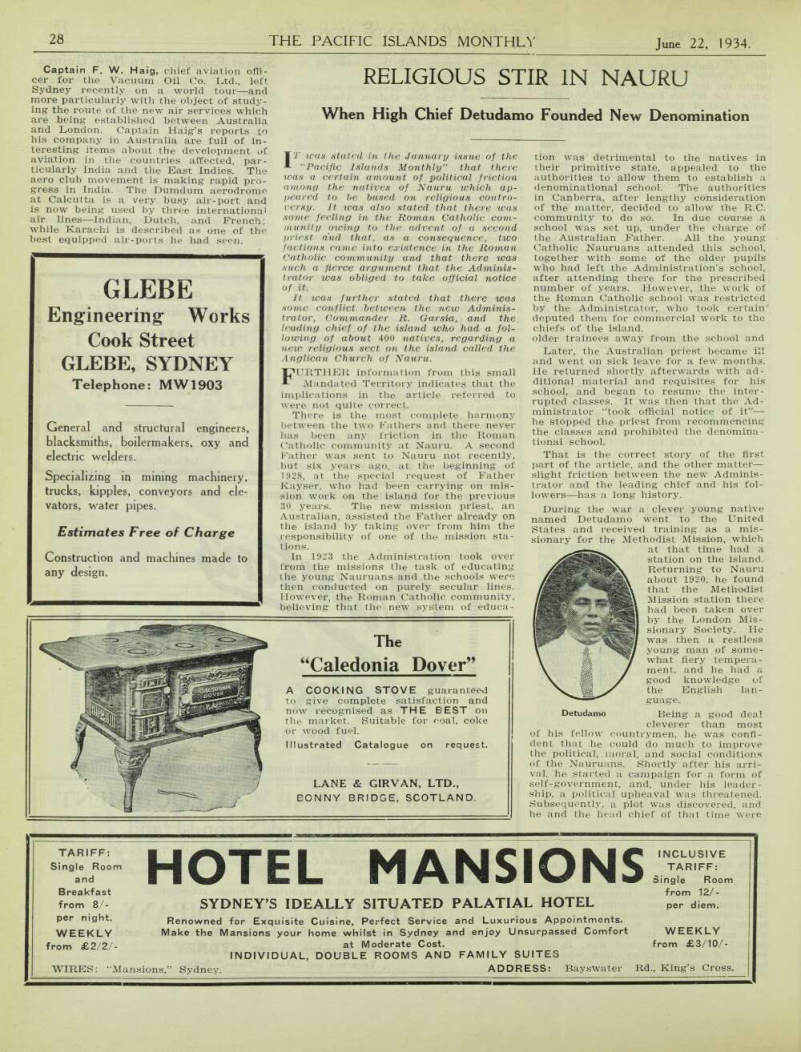
A party of goldmining engineers and scientists is secretly preparing in Syd ney (says the “Sydney Morning Herald” of April 27) for an 18 months’ expedition of exploration into the heart of New Guinea.
Negotiations are proceeding for the purchase of a schooner now lying in Sydney Harbour, in which the party, it is understood, proposes to penetrate far up the Fly River. Elaborate prepara tions, it is stated, will be made before the party leaves Sydney towards the end of next month.
In addition to exploring for gold, an thropological and other scientific work will be carried out. The party will bs» led by a scientist-engineer with a wide knowledge of New Guinea.
Captain F. W. Haig, chief aviation offi cer for the Vacuum Oil Co. Ltd., left Sydney recently on a world tour —and more particularly with the object of study ing the route of the new air services which are being established between Australia and London. Captain Haig’s reports to his company in Australia are full of in teresting items about the development of aviation in the countries affected, par ticularly India and the East Indies. The aero club movement is making rapid pro gress in India. The Dumdum aerodrome at Calcutta is a very busy air-port and is now being used by three international air lines—lndian, Dutch, and French: while Karachi is described as one of the best equipped air-ports he had seen.
Advertisements & other items, pp. 29-30 (1 item)
Flour
For a Pleasant Rest in the Blue Mountains, N.S.W,
“HOLMECROFT”
Centrally situated in Leura, near the famous Leura Golf-links.
An Ideal Situation for Islands Residents on Furlough Write for Details and Tariff to — The Proprietress
(MISS CARMEN HOLMES)
“Holmecroft,” Blackheath Street,
LEURA, N.S.W.
Flour
ASK FOR IT
ESTABLISHED 1868.
STEEL RAILS & RAILWAY EQUIPMENT
New and Good Second-Hand
RAILS, 14 lbs. to 100 lbs. per yard; also Portable Track, Trucks of all types.
Wheels and Axles, Points and Crossings, Turntables, Locomotives, Bolts and Nuts, Dogspikes, etc. We also carry stocks of New and Used Mining and Industrial Machinery of all descriptions.
Send us your enquiries. Prompt attention.
J. E. TOOLE & COMPANY
Engineering Contractors, Machinery Merchants and Agents
70 Hunter Street, SYDNEY
Telegrams and Cables: “Tooles,” Sydney.
GLEBE
Engineering Works
Cook Street
GLEBE, SYDNEY
Telephone: MW1903 General and structural engineers, blacksmiths, boilermakers, oxy and electric welders.
Specializing in mining machinery, trucks, kipples, conveyors and elevators, water pipes.
Estimates Free of Charge Construction and machines made to any design.
The
“Caledonia Dover”
A COOKING STOVE guaranteed to give complete satisfaction and now recognised as THE BEST on the market. Suitable for coal, coke or wood fuel.
Illustrated Catalogue on request.
LANE & GIRVAN, LTD.,
BONNY BRIDGE, SCOTLAND.
TARIFF;
Single Room and Breakfast from 8/per night.
WEEKLY
from £2/2/-
HOTEL MANSIONS
SYDNEY’S IDEALLY SITUATED PALATIAL HOTEL
Renowned for Exquisite Cuisine, Perfect Service and Luxurious Appointments.
Make the Mansions your home whilst in Sydney and enjoy Unsurpassed Comfort at Moderate Cost.
INDIVIDUAL, DOUBLE ROOMS AND FAMILY SUITES
INCLUSIVE
TARIFF:
Single Room from 12/per diem.
WEEKLY
from £3/10/- WIRES: “Mansions,” Sydney ADDRESS: Bayswater Rd., King’s Cross,
Religious Stir In Nauru
When High Chief Detudamo Founded New Denomination
IT was stated in the January issue of the "Pacific Islands Monthly” that there was a certain amount of political friction among the natives of Nauru which ap peared to be based on religious contro versy. It was also stated that there was some feeling in the Roman Catholic com munity owing to the advent of a second priest and that, as a consequence, two factions came into existence in the Roman Catholic community and that there was such a fierce argument that the Adminis trator was obliged to take official notice of it.
It was further stated that there was some conflict between the new Adminis trator, Commander R. Garsia, and the leading chief of the islatid who had a fol lowing of about 400 natives, regarding a new religious sect on the island called the Anglican Church of Nauru.
FURTHER information from this small Mandated Territory indicates that the implications in the article referred to were not quite correct.
There is the most complete harmony between the two Fathers and there never has been any friction in the Roman Catholic community at Nauru. A second Father was sent to Nauru not recently, but six years ago, at the beginning of 1928, at the special request of Father Kayser, who had been carrying on mis sion work on the island for the previous 30 years. The new mission priest, an Australian, assisted the Father already on the island by taking over from him the responsibility of one of the mission sta tions.
In 1923 the Administration took over from the missions the task of educating the young Nauruans and the schools were then conducted on purely secular lines.
However, the Roman Catholic community, believing that the new system of educa
tion was detrimental to the natives in their primitive state, appealed to the authorities to allow them to establish a denominational school. The authorities in Canberra, after lengthy consideration of the matter, decided to allow the R.C. community to do so. In due course a school was set up, under the charge of the Australian Father. All the young Catholic Nauruans attended this school, together with some of the older pupils who had left the Administration’s school, after attending there for the prescribed number of years. However, the work of the Roman Catholic school was restricted by the Administrator, who took certain deputed them for commercial work to the chiefs of the island. older trainees away from the school and Later, the Australian priest became ill and went on sick leave for a few months.
He returned shortly afterwards with ad ditional material and requisites for his school, and began to resume the inter rupted classes. It was then that the Ad ministrator “took official notice of it”— he stopped the priest from recommencing the classes and prohibited the denomina tional school.
That is the correct story of the first part of the article, and the other matter — slight friction between the new Adminis trator and the leading chief and his fol lowers—has a long history.
During the war a clever young native named Detudamo went to the United States and received training as a mis sionary for the Methodist Mission, which
at that time had a station on the island.
Returning to Nauru about 1920, he found that the Methodist Mission station there had been taken over by the London Mis sionary Society. He was then a restless young man of some what fiery tempera ment, and he had a good knowledge of the English lan guage.
Being a good deal cleverer than most
of his fellow countrymen, he was confi dent that he could do much to improve the political, moral, and social conditions of the Nauruans. Shortly after his arri val, he started a campaign for a form of self-government, and, under his leader ship, a political upheaval was threatened.
Subsequently, a plot was discovered, and he and the head chief of that time were
Detudamo
sentenced by the Administrator to two years’ imprisonment. Eight of his asso ciates were also sentenced to imprison ment for six months.
Later on, when a new Administrator arrived, an amnesty was granted to poli tical prisoners and Detudamo was re leased. Later still, he was elected head of his district and entered the Adminis tration as head clerk. Rising rapidly, he became Postmaster and, in 1931, the Ad ministrator appointed him head chief of the island and finally he was given the title of Superintendent of Native Affairs of Nauru. At this period his followers al ways referred to him as “Our Admini strator,” and he was virtually the ruler of the island.
Soma time later, under the indulgent eye of the Administrator, and with the help of an Anglican Archdeacon who was on the island for a time, he set up a religi ous body known as the Anglican Church of Nauru, and proposed to bring an Ang lican minister to the island. Money was then collected to build a dwelling house and a church. The site for the church was selected, material ordered and plans were afoot for the erection of the build ings.
It perhaps should be explained that the new Anglican Church of Nauru was really a breakaway from the London Missionary Society, and thus the L.M.S. community was divided into two factions. These two separate bodies quarrelled, and a fierce argument took place between them.
It was at this stage that the then Ad ministrator (Mr. Newman) stepped in and cancelled the whole scheme for the estab lishment of the new religious body and its plans for the buildings.
While this new sect had been permitted to come slowly into existence it did not have official approval. The Commonwealth Government, as the responsible authority, is opposed, as a matter of policy, to the creation of an institution such as the Anglican Church of Nauru.
When the present Administrator (Com mander Garsia) took charge in January, 1933 he was faced With this very thorny problem and appears to have handled it with tact, but also with firmness. Ap parently, he has tried to find the solution of the problem by refusing to grant facili ties for the future existence of the Angli can Church of Nauru. Naturally, this official attitude is resented by Detudamo and his followers.
Presumably, the official policy is the same in Nauru as in similar territories— namely, that a multiplicity of churches is undesirable. In Nauru, no doubt, it is felt that the spiritual needs of the small native population can be adequately serv ed by the two great missionary bodies operating there on behalf of the two bran ches of the Christian Church—the Roman Catholic Church and the London Mission ary Society.
Mr. J. A. Jukes, who is one of Guinea Airways, Ltd., pilots at Wau, New Gui nea, arrived in Sydney by the Macdhui on May 7 on four months’ furlough.
The yacht “White Shadow,” owned by Mr. T. Wessel, of the Danish Yacht Club, and under charter to a party of young Americans, consisting of Henry Whitney, Philip S. Carr, and others, arrived in Port Moresby on March 28 from Tahiti and the Cook Islands. It left again for Thursday Island and Java on April 3, en route for Singapore, Colombo, and the Mediterran ean.
Cocos Isle
On the Track of the Pirates’
Treasure
THE romantic square-shaped island of A Cocos, six miles long, and lying 600 miles south-west of Panama, has for many years lured the adventurous treasure hunter. Another expedition has just sailed for that place.
Densely covered by tropical growth, from its 2,000-feet peaks to the water’s edge, and only six degrees north of the equator, its stupefying heat makes any lengthy stay there an ordeal not to be endured by the weakly or listless, while the bewildering equatorial currents and uncharted rocks have rendered the island forbidden to the casual voyager.
Rain squalls follow one another in rapid succession, leaving the toiling treasure seeker clothed in constant moisture.
History reveals that in the year 1821, while Peru was striving for her eventual liberation from Spain, bullion valued at £7,000,000 in gold plate, money, and silver was removed by the Spaniards from the Fort of Callao.
It was placed aboard the Bristol brig Mary Dier, a fast-sailing merchantman, but while the final boat-load from ashore
was being shipped the crew overpowered the guards, cut the cables, and, “clapping on” all canvas, headed for the open Pacific.
The Mary Dier made for Cocos Isle, where the twice-stolen treasure was buried.
Four days later the Mary Dier was captured by a Spanish frigate, and all but three of the crew were killed.
These were spared to disclose the whereabouts of the plunder. One died under flogging, while the other two slipped overboard during the night and swam to an American whaler near by.
When about to grasp the whaler’s lines, one of the men was grabbed by a shark, leaving only Thomson, the former mate of the Mary Dier.
Some years later, when dying in a Lon don hospital, he disclosed a chart made from memory, which has helped to lead the several expeditions of the past seventy years.
Captain Bonito, the Portugese pirate, is alleged also to have chosen Cocos Isle for the safe keeping of the fruits of his illicit trade, worth £3,000,000 and hidden in various places; and there is also said to be £2,500,000 worth of treasure which was the proceeds of the sacking of Mexico City, hidden near Wafer Bay, The last expedition was equipped with electric indicators, which were damaged during bad weather, on the passage to Cocos.
Advertisements & other items, pp. 31-32 (1 item)
Burns, Philp
PRESCOTT Ltd
are sole wholesale agents for
PINEAPPLE BACON & HAMS
DAISY BRAND BUTTER
FRESCO BRAND BUTTER
LEA & PERRINS’ SAUCE
BURNS, PHILP
(South Sea) Co. Ltd.
Island Traders & Shipowners Registered Office: Suva, Fiji.
Also Branches at Fiji: Levuka, Lautoka, Labasa, Ba, Sigatoka, Rotuma.
Tonga: Nukualofa, Haapai, Vavau.
Samoa: Apia, Pago Pago (America Samoa).
Solomons: Makambo, Gizo, Faisi.
New Hebrides: Vila.
Gilberts: Tarawa.
Norfolk Is. Nauru. Niue. Wallis Is. Futuna Is.
Code Address: “Burnsouth.”
SUN-KING
Straddle Disc
Harrow
Cultivates between rows of cotton, maize, etc. Discs 20in. Gangs reversible for in-throw or out-throw. £13/-/-
SATELLITE No. 10
Strawberry and Tobacco
Harrow Cultivates tobacco, strawberry, and similar crops closely and thoroughly without disturbing the plants. £3/15/-
SUNROW
Visible Seed Planter
Sows peanut, maize, pea, broom, bean sorghum, etc. With seed and fertiliser hoppers, as illustrated £8/5/-
SATELLITE No. 88
One-Horse Hoe
SUNSHINE
Plantation
Implements
Work well and last long
Sunshine plantation implements have given satis-
factory service for many years. They work well and last long because of their quality, dependability, and service. There is no better
value anywhere!
SUNDIAL
2 h.p. Hopper-cooled Petrol Engine
SUNGRADE
Stump-Jump Reversible
Disc
Plough
Breaks hard ground and is adjustable to all conditions on hillsides or flats.
Discs 26in., light draught, easy to
operate. £21/10/-
SUNGRUBBER
with Automatic Lift
A favourite on the sugar fields. Made for heavy work. £3/2/6 Catalogue shows other styles and prices.
Well built, dependable, 4-cycle engine for all-round stationary work at low running cost. Throttle governed, ignition by high tension magneto, ample cooling water capacity.
Simple, safe, and easy to operate. £33/-/-
SUNBUSTER
Drill Plough
For making drills, furrows, or drains. Opens up drills to any depth from 6 to 12 inches.
Mouldboards have perfectly flush edge—no pushing of soil. £7/5/-
NOTE!
All prices are in Australian currency for delivery on boat at Melbourne. Remittance by sight draft, under bank letter of credit, preferably through Bank of New South Wales, Melbourne.
Illustrated descriptive literature with prices, on all plantation implements, will be sent gratis.
Write for it—we particularly welcome opportunities to be of service to you.
H. V. McKay Massey Harris
Pty., Ltd.,
Sunshine Harvester Works
Sunshine W. 20, Victoria, Australia
N.S.W. Branch: 27-39 Broadway,
Sydney
Works to a depth of 17 inches without disturbing the surface much. Tynes interchange to any position. Frame enormously strong. £44/-/- Ratooning Attachment, £14/-/extra.
SUNNIE
Light Set Disc Plough
Discs 23in. in diameter, adjustable to all workable angles, have ample clearance, cuts 7 or 9 inch furrows, 2 fur. size with light wheels and axles. £21/10/-
SUNGLINT
Single Furrow Plough
Specially suitable for deep cultivation on plantations. Equipped with gauge wheel and circular swivel coulter. £8/15/-
The Origin Of Pacific Races.
Significance of Rock Carvings Found in Fiji by Mr. Vogan.
AN interesting controversy has been proceeding in the “Fiji Times” between our old friend, Mr. A. J. Vogan—who de scribes himself as “an archaeological in vestigator and a humble collector of fast disappearing facts”—and Professor Mac millan Brown, of New Zealand, who is one of the few scientists of any standing to-day who has given serious attention during the last 20 or 30 years to the early history of the Pacific.
The Pacific Islands are inhabited by two distinct races of people, the Polynesians and the Melanesians; and, curiously enough, the line which divides them is also the line which divides the fixed time of the civilised world. In other words, if one takes the 180th degree of longitude (which represents the place where, ac cording to Greenwich calculations, the old day ends and the new day commences) one will find that the Polynesian peoples live to the eastward of the line and the Melanesian peoples to the westward.
Along the line one will find a mingling of the two tropical types, which has pro duced a race that usually is described as Micronesian. The Fijians, who quite clearly represent a mingling of the Poly nesians and Melanesians, live right on the 180th degree. Further north, about the Gilbert and Ellice Groups, slightly to the westward of 180 degrees, one finds large communities of Micronesians.
It is perfectly clear that, during thous ands of years, there have been successive waves of migration from Southern Asia into the Pacific, each in turn spreading slowly across the Pacific Islands. The people who are now the Polynesians were among the first-comers and they appar ently are of Aryan descent. Their pre dominating racial characteristics, while showing a slight admixture of Asiatic and African blood, indicate a Caucasian rela tionship, and racially they are nearer to the Pacific newcomers (the Europeans) than almost any other indigenous people east of Suez. After their arrival in the Islands there came successive waves of migrants whose racial character was dominated by African and Asiatic blood, and thus we get the Melanesians in a wide variety of types, seen particularly in the more westerly islands. In Papua and New Guinea, for instance, the anthropolo gist can point out a dozen different racial types—which, incidentally, makes it very difficult to insist on the use of any generic term such as “Melanesian.”
It is clear that the impact of these suc cessive waves of migration was felt sharply in the more westerly islands close to Asia—such as New Guinea and the Solomons—but that the waves exhausted themselves as they ran eastwards, and petered out in the vicinity of the 180th degree of longitude; so the peoples to the eastwards were able to preserve a more sharply defined racial type—and these are the Polynesians. Any intelligent man travelling about in Tonga, Samoa, Cook Islands, Hawaii, Tahiti and the Maori dis tricts of New Zealand will find people of very similar characteristics and speaking languages that are closely akin. But in the islands of the western Pacific—Fiji, New Caledonia, New Hebrides, Solomons, and New Guinea —he will find an indefin ite variety of types classified generally as Melanesians, but which clearly do not belong to any one racial group, and whose multiplicity of tongues have little relationship one to another.
There is a good deal of evidence that there existed in the Pacific, apparently before the advent of the Polynesians, a great and mysterious civilisation. There are ruins scattered about the central islands which suggest the early presence there of a people with knowlege and power far greater than anything which the well-cultured Polynesians appear ever to have possessed. It is supposed that the early waves of Polynesian migration over whelmed and wiped out that ancient civilisation—but it. is all supposition. All we have now is the existence of mighty ruins.
Therefore, archaeological investigation in the Pacific is very desirable; and the activities of men like Professor Macmillan Brown and Mr. Vogan should be encour aged in every way. But the controversy which has been proceeding between those two gentlemen in Fiji impresses one as being somewhat feeble and fatuous. Act ually, they agree more than they disagree.
It appears that Mr. Vogan, some four years ago, discovered in a cave in the Yasawa Islands (fn the northern part of the Fiji Group) certain inscriptions cut into solid rock. He made photographs of them—but with difficulty, standing up to his neck in water—and some people to whom he has referred those pictures said they appeared to be ancient Chinese char acters. This year, Mr. Vogan, with praiseworthy enterprise and devotion to
the cause of science, returned at his own cost to the Fijian cave and there built platforms by which he was able to reach the inscriptions and take plaster casts thereof. He has returned to Australia with those casts.
In addition, Mr. Vogan, on his visit, made further discoveries, which he has thus described to the “Fiji Times’’: “At the extreme north of Yasawa Island I also found the most wonderful figure yet discovered in the Pacific. It is that of a man sitting down with a baby on his knee. The child is kissing the man, and its dimpled cheek and arm round the neck of the latter'is in perfect art. The group is about fifty feet high. I also found a splendid head in tke same cave as the inscriptions. It is about eight feet high In both cases a suitably shaped rock has assisted the artist, or perhaps suggested the idea to him. In both cases the carv ing is very good, but very old. There are carved figures in stone in various parts of Fiji, which indicate that the race respon sible was permanently and widely distri buted here —that is as permanent as any thing can be in a tropical land.’’
Professor Macmillan Brown, interviewed in Christchurch, New Zealand, expressed interest in Mr. Vogan’s inscriptions; but said he was doubtful whether they were of the age suggested (namely, some 2,000 years). He also said that, in his opinion, the Chinese never achieved anything as navigators and he would be very sur prised to learn that they had succeeded in voyaging over so great a distance as that represented between China and Fiji.
The point appears to this non-scientiflc observer to be of considerable interest, but not of sufficient importance to squabble about. Let any man, with imag
ination and knowledge of history, study a map of the Pacific, showing Australia and the eastern half of Asia. Let him remem ber that, during the past 3,000 or 4,000 years, great empires rose and fell in eastern and south-eastern Asia; and that there were successive waves of migration, pushing south-eastwards into the Pacific, via Indo-China and the East Indies.
While admitting that the Chinese people themselves were no navigators, it must be apparent that in the course of the ages people from south-eastern Asia —particularly peoples of the Malayan type—would voyage eastwards and southwards into the unknown Pacific, seeking new lands and new trade. It was, perhaps, an off shoot from those Asiatic civilisations which penetrated the Central Pacific and established there the empires which were responsible for the now puzzling ruins.
It may be taken as certain that expedi tions based on Asia got as far as Fiji, and it is quite conceivable that it was some such body of adventurers which placed the carvings on Mr. Vogan’s Fijian island.
But it still has to be proved that the inscriptions and works of art found by Mr. Vogan are definitely of Chinese origin.
That is not going to be easy. There are thousands of rock inscriptions all over the world which bear a more or less slight resemblance to some kind of systematised writing; but it is impossible to say that they are of that particular writing until their meaning has been ascertained.
This, however, is clear. If Chinese navigators were responsible for the in scriptions, they evidently were only an isolated party. There is not anywhere any other evidence that the Chinese in vaded or migrated to the central and south Pacific in sufficient numbers to found settlements. With all respect to Mr. Vogan, there are no Chinese charac
teristics among the Polynesians. One must journey westwards through the Pacific many thousands of miles —in fact, right into the central and western parts of New Guinea—before one begins to no tice the racial characteristics of the Chinese among the indigenous people.
That bears out Professor Macmillan Brown’s contention that the early Chinese were not navigators.
It is a great pity that more people of scientific inclinations do not take an interest in the early history of the Pacific.
There is a fascinating story waiting there, to be unearthed and pieced together. As Mr. Vogan has pointed out, the evidence available to the scientific student is very limited in quantity—and what there is of
it is rapidly disappearing.
R.W.R.
Advertisements & other items, p. 33 (1 item)
Rolls - Razor
HOLBROOKS’
TABLE DELICACIES.
WORCESTERSHIRE SAUCE
—enjoys a world-wide reputation.
VAT 2 SAUCE a delicious thick, fruity sauce.
VlNEGAR —strong, well matured, and guaranteed Pure Malt.
ESSENCE OF ANCHOVIES—
A fish sauce made from the finest Gorgona Anchovies.
TOMATO SAUCE— made from fresh, ripe tomatoes.
FRENCH CAPERS Capucines and Capottes.
SPANISH OLIVES
Varieties: Spanish Queens, Small Queens, Manzanillas, and Stuffed or Sliced ready for Sandwiches.
PURE OLIVE OlL —French or Italian. From the first pressings of selected Olives.
PICKLES
Varieties: Sweet Gherkins, Tiny White Onions, Walnuts, Piccalilli, Mixed and Green Tomato.
FISH AND MEAT PASTES,
in 1½oz. and 3oz. glass jars.
Varieties: Anchovy, Salmon, Ham and Tongue, Veal and Tongue, Chicken and Ham, Turkey and Tongue, Salmon and Shrimp, Bloater.
SOUPS, in 8oz., 16oz., ½ gal. and 1 gal. tins.
Varieties: Vegetable, Ox Tail, Mulligatawny, Mock Turtle, Tomato.
JELLY CRYSTALS —Specially prepared for warm climates.
They set well, and are deliciously flavoured.
HEALTH SALINE —a refreshing health-giving beverage, suitable for hot climates, in ½lb. and 1lb. tins.
Holbrooks (A/sia.)
Ltd.
WATERLOO, N.S.W.
BRITAIN’S PRICELESS CONTRIBUTION TO MAN’S
COMFORT AND HAPPINESS
ROLLS - RAZOR
The Aristocrat of all Safety Razors SOLE AGENTS for Australia and the Islands of the Pacific.
THE ROLLS RAZOR CO. OF AUSTRALIA LTD.
Mendes Chambers, 8a Castlereagh Street, Sydney.
SERVICE.—We have a complete equipment for Repairs in case of accident to your Razor. Blades can be Reset and adjustments made by return mail.
L.M.S. And Mission Trading
An error appears to have been made by Mr. E. W. Harrison, of Samarai, Eastern Papua, in a letter which we published in the May issue. Mr. Harrison, in making a protest against missionary trading, said: “For some years past, the London Missionary Society, one of the wealthiest and best endowed missions in the world, in the person of its representative at Kwato, Samarai, has openly conducted trading operations, to the detriment of the legitimate traders . . . .”
We are informed by the secretary of the L.M.S. that the Society has no con nection whatever with the Kwato Mis sion. There originally was some connec tion, but it ended 16 years ago. More over, the policy of the L.M.S. is definitely against participation in trading opera tions which in any way may affect the interests of the legitimate trader.
Advertisements & other items, p. 34 (1 item)
Machinery
Excavating & Dredging
The Range includes: Alluvial Mining Dredges; Suction, Dipper and Placer Dredges; Gravel Pumps; Tower Excavators; Draglines; Shovels; Dragshovels; Skimmers; Cranes; Grabs; Oil Locomotives, &c., &c.
“AN EXCAVATOR FOR EVERY EXCAVATING JOB”
Sole Distributors for Australia and the Islands:
RUSTON & HORNSBY
(AUSTRALIA) PTY. LTD.
Registered Office: 174-180 KING ST., MELBOURNE
Cables: "HORNSBYS," MELBOURNE
Branches at SYDNEY 642 Jones St. (off Broadway) and BRISBANE (Barry Parade)
Cables: "RUSTHORN,” SYDNEY
Cables: "RUSTON HORNSBY," BRISBANE
Nicolas Minster
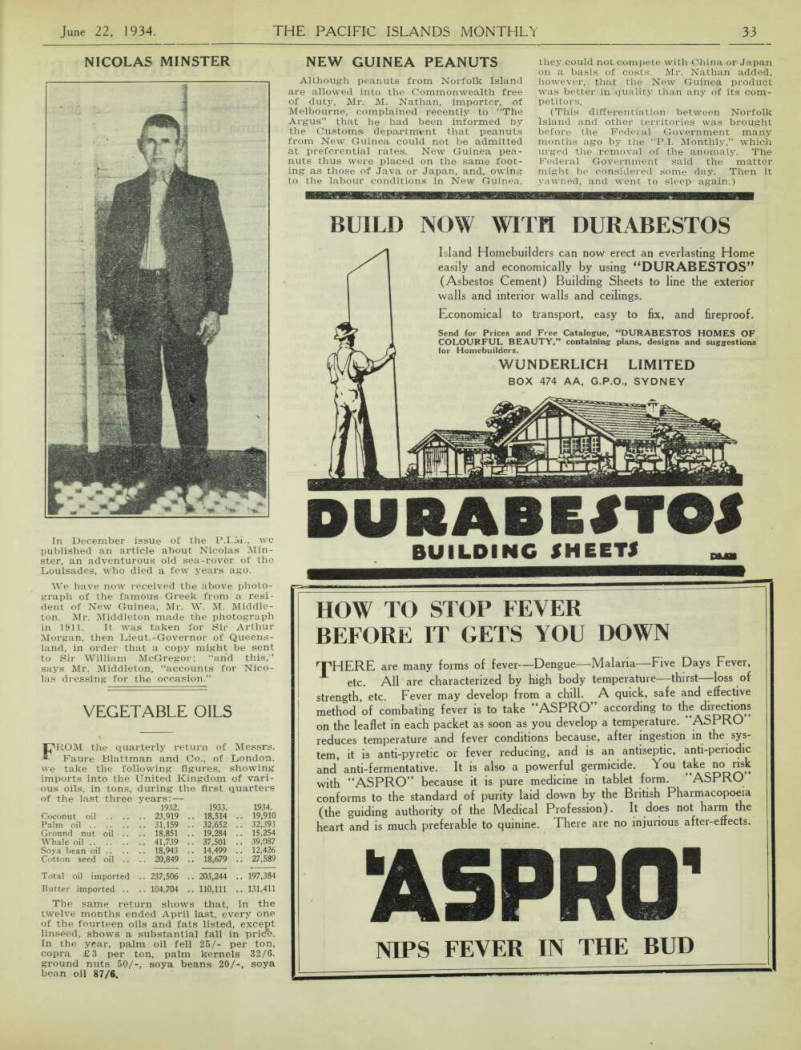
In December issue of the P.I.M., we published an article about Nicolas Min ster, an adventurous old sea-rover of the Louisades, who died a few years ago.
We have now received the above photo graph of the famous Greek from a resi dent of New Guinea, Mr. W. M. Middle ton. Mr. Middleton made the photograph in 1911. It was taken for Sir Arthur Morgan, then Lieut.-Governor of Queens land, in order that a copy might be sent to Sir William McGregor; “and this,” says Mr. Middleton, “accounts for Nico las dressing for the occasion.”
Vegetable Oils
FROM the quarterly return of Messrs.
Faure Blattman and Co., of London, we take the following figures, showing imports into the United Kingdom of vari ous oils, in tons, during the first quarters of the last three years:
The same return shows that, in the twelve months ended April last, every one of the fourteen oils and fats listed, except linseed, shows a substantial fall in price.
In the year, palm oil fell 25/- per ton, copra £3 per ton, palm kernels 32/6. ground nuts 50/-, soya beans 20/-, soya bean oil 87/6.
1932. 1933. 1934.
Coconut oil .. 23,919 . ,. 18,514 . . 19,910 Palm oil .. 31,159 . . 32,652 . . 32,393 Ground nut oil 18,851 . . 19,284 . . 15,254 Whale oil 41,739 . . 37,501 . . 39,087 Soya bean oil .. 18,943 . . 14,499 . . 12,426 Cotton seed oil .. .. 20,849 . ,. 18,679 . . 27,589 Total oil imported .. 237,506 . . 203,244 . . 197,384 Butter imported .. , .. 104,704 . ,. 110,111 . . 131,411
New Guinea Peanuts
Although peanuts from Norfolk Island are allowed into the Commonwealth free of duty, Mr. M. Nathan, importer, of Melbourne, complained recently to “The Argus” that he had been informed by the Customs department that peanuts from New Guinea could not be admitted at preferential rates. New Guinea pea nuts thus were placed on the same foot ing as those of Java or Japan, and, owing to the labour conditions in New Guinea,
they could not compete with China or Japan on a basis of costs. Mr. Nathan added, however, that the New Guinea product was better in quality than any of its com petitors, (This differentiation between Norfolk Island and other territories was brought before the Federal Government many months ago by the “P.I. Monthly,” which urged the removal of the anomaly. The Federal Government said the matter might be considered some day. Then it yawned, and went to sleep again.)
Miss Clapcott, of Ba, Fiji, departed from Sydney by the Monowai on May 25 for New Zealand, en route to Fiji.
“Our legs are vanishing,” declares a scientist. We think the kindest thing to do would be to send him a ticket for a non-stop variety show.
Advertisements & other items, pp. 35-36 (1 item)
'Aspro'
BUILD NOW WITH DURABESTOS
Island Homebuilders can now erect an everlasting Home easily and economically by using “DURABESTOS” (Asbestos Cement) Building Sheets to line the exterior walls and interior walls and ceilings.
Economical to transport, easy to fix, and fireproof.
Send for Prices and Free Catalogue, “DURABESTOS HOMES OF COLOURFUL BEAUTY," containing plans, designs and suggestions for Homebuilders.
WUNDERLICH LIMITED
BOX 474 AA, G.P.O., SYDNEY
DURABESTOS
BUILDING SHEET!
HOW TO STOP FEVER
BEFORE IT GETS YOU DOWN
THERE are many forms of fever—Dengue—Malaria—Five Days Fever, etc. All are characterized by high body temperature—thirst—loss of strength, etc. Fever may develop from a chill. A quick, safe and effective method of combating fever is to take “ASPRO” according to the directions on the leaflet in each packet as soon as you develop a temperature. ASPRO reduces temperature and fever conditions because, after ingestion in the system, it is anti-pyretic or fever reducing, and is an antiseptic, anti-periodic and’anti-fermentative. It is also a powerful germicide. You take no risk with “ASPRO” because it is pure medicine in tablet form. ASPRO conforms to the standard of purity laid down by the British Pharmacopoeia (the guiding authority of the Medical Profession). It does not harm the heart and is much preferable to quinine. There are no injurious after-effects.
'ASPRO'
NIPS FEVER IN THE BUD
PUMPMOBIL
Light & Portable MOTOR PUMPS.
Weight about 140 lbs. Automatic Priming. Reliable and Efficient.
Especially suitable for Prospecting and all Sluicing requirements.
Particulars from
NELSON & ROBERTSON
12 Spring Street
SYDNEY
Feilding (N.Z.) the Seventies
Nearly 60 years ago, when the Bank of New South Wales established its branch at Feilding, the surrounding district was quite undeveloped and consisted mainly of bush and swamp lands.
Now, the town of Feilding, with its population of 4,800, is the centre of one of New Zealand’s most productive districts, almost every acre of which is farmed.
In this district, as elsewhere throughout Australia and New Zealand, the Bank contributed largely to development by making available the finance necessary for the transformation of virgin country into fertile farm lands.
Bank of New South Wales
(ESTABLISHED 1817)
with which the Western Australian Bank and The Australian Bank of Commerce Ltd. are amalgamated.
Burns, Philp Islands Barometer
Annual Summary of Accounts—Outlook for Copra—Significant Warning to Maritime Unions.
TO an extent that is seen in few other parts of the world, the fortunes of the Pacific territories are affected by the condition of two or three big trading firms. Therefore, the balance-sheets of the biggest firm of all (Messrs. Burns, Phiip and Co., Ltd., which were pub lished in May) are of more than usual interest.
In spite of the vicissitudes being sup ported at present by the Islands’ chief industry (copra production), the firm’s operations and activities are being carried on profitably; which is another way of saying that the great reserve of financial strength of Burns Phiip and Co., Ltd — the result of many years of sound trading, shrewd management and financial cau tion—is not only carrying the big organi sation smoothly over the rough patch, but also is helping the Islands communi ties to bear their heavy burden. Figures like those which follow indicate that per sons with important interests in the Is lands need not fret urtduly. The bad time will pass.
It should be explained, perhaps, that Burns Phiip and Co. Ltd. trade in New Guinea, Papua and the East Indies, as well as in all Eastern Australian ports
and in New Zealand; while Burns Philp (South Seas) Ltd. operate in Solomons..
Norfolk Is., New Hebrides. Fiji, Tonga.
Eastern and Western Samoa, Niue, Nauru and Gilbert and Ellice Islands.
Burns, Philp & Co. Ltd.
The directors state in their report that further improvement was gained in the Australian section of the company’s merchandise business, sales show ing again an appreciable increase in volume. Earn ings from the shipping services were also main tained in spite of the ever-increasing foreign com petition. Trading in Papua and the Mandated Territory was seriously affected throughout the year by a steadily falling market for copra, de scending to an unprecedented low level that now renders the handling of that article unremunera tive. The directors consider that the prospects for any immediate appreciable recovery in this market are not bright.
Burns, Philp (South Sea) Co. Ltd.
The directors in their report state that on copra purchased from clients the company made an ac : tual loss. Part of the company’s earnings is from investments and ventures. Restriction of purchases by clients to essential requirements considerably lessened trading profits and shipping revenue.
As to the market for copra, the directors add, the value of the commodity is now below the cost of production, and reasonable maintenance of plan tations and trading stations. As the world’s supply would seem to have been maintained, a return to profitable prices seems largely to depend upon an improvement in the world economic condition and reduced or controlled production of substitutes for coconut oil. The outlook at present is not promis ing.
Warning To Trade Unions.
The chairman of directors, Mr. James Burns, in his annual address to share holders, on May 15, supplied an interesting and very useful summary of econo
Year ended March 31. 1932. 1933. 1934.
Net profits £ £ £ 202,407 208,531 203,257 Div., 10 p.c 150,000 150,000 150,000 To reserve Special depreciation 50,000 25,000 25,000 Copra plantation — 25,000 25,000 To staff bonus fund .. — 20,000 Carried forward .. .. 36,295 24,826 28,083 Expenses, etc .. .. 392,760 429,579 427,786 Depreciation, etc. 105,747 74,400 104,542 Gross profits
Liabilities—
700,915 712,511 735,586 Capital paid up .. .. 1,500,000 1,500,000 1,500,000 Reserve fund 875,000 925,000 950,000 Insurance reserve, etc. 485,802 496,688 516,418 Cash credits ... 63,169 40,828 36,167 Bills and foreign drafts 83 275 400 Open liabilities ..
Assets—
Merchandise, copra, 1,529,043 1,575,466 1,474,924 advances 658,583 744,950 707,867 Cash in hand Property, shipping and 129,882 143,757 123,046 shares 2,934,548 2,993,444 3,060,818 Sundry debtors .. .. 891,380 825,932 739,261
13 months, Year Year ended ended ended Jan. 31, Jan. 31, 1933.
Jan. 31, 1932. 1934.
Gross profit £ £ £ 169,182 158,121 147,699 Net profit 56.595 52,188 38,058 Dividend, p.c 5¾ 6¼ 5 Amount of dividend .. 46,875 46,875 37,500 To reserve 10,000 1,230 5,000 1,543 Carried forward 2,101
Liabilities—
Capital 750,000 750,000 750,000 Reserve Fund 85,000 95,000 100,000 Creditors 41,753 58,539 98,489
Assets—
Cash 36,200 34,976 31,663 Properties and shipping 481,008 486,612 559,397 Merchandise 212,981 238,208 195,371 Debtors 204,668 197,161 201,657
mic arid industrial conditions in the Pacific: “While our shipping services have been greatly hampered by foreign competition, we have on the whole managed to carry on fairly well during the 12 months under review,” he said.
“If it had not been for competition from foreign lines we would probably have ex panded the services. We consider that with the difficulties we have to contend with, such as the high rate of wages and overtime we have to pay our crews in comparison with foreign vessels and the onerous conditions in the Navigation Act it is wiser for us to be conservative than to buy new vessels. We have fewer ships to-day than we had 20 years ago.
“In these small Island vessels it is diffi cult to comply with the demands of not only the Navigation Act, but also the ship ping unions. We are put in the position of either tying up our ships and letting foreigners take our trade, or endeavouring to run them by conciliatory methods.
“Unless the shipping unions show a more reasonable attitude in reference to working Australian ships that are run in competition with foreigners, I doubt whether it will be very long before it will be impossible to run these vessels unless they are so heavily subsidised that the Government will hesitate to pay away so much of the taxpayers’ money to keep Australian crews employed,” Mr, Burns continued. “Owing to Papua and the Mandated Territory having been declared exempt under the Navigation Act, we can at any moment change over from Australian crews, and man our vessels with South Sea Islanders, Chinese, or Malays, similar to most shipping com panies running overseas to the East from Australia, but we do not want to do this when we can possibly carry on as we are.”
Slump In Copra.
Mr. Burns said that trade had been much brighter during the last 12 months than, during the previous year or two.
The company’s figures had not reflected this improvement, however, owing to the precarious state of the copra market. If values would go back to £12 or £14 per ton, which was a mediocre price in com parison with the average value of copra for the last 10 or 15 years, the company would do well. Islands depending on the export of copra were to-day practically insolvent, as the net value they were re ceiving for the commodity was not suffi cient to pay for the cost of production.
The foreign outlook was uncertain. Ger many and France had put restrictions on the import of copra, and the United States had placed a duty on all oils produced from copra, palm kernels, etc., as well as on whale oil. It was suggested that a special depreciation of £25,000 be allowed on the company’s copra plantations, prob ably for the next year or two. The com pany had sustained losses in copra trade on account of the persistent fall in the value of the commodity. These low prices continued, with very little likelihood of improvement. Several years ago the price of copra had been £25 to £30 per ton.
During the last month smoke-dried copra had fallen to about £6/10 per ton. At a certain period there had been no market for this quality of copra at all, and until quite recently at least half the copra pur chased by the company in the South Seas had been smoke-dried. On its plantations the company had lately been erecting hot air driers to improve the quality of the copra produced.
Mr. Burns said that the position of copra
was somewhat similar to that of rubber during the last few years. In the case of rubber, however, one could leave the trees alone, and not much harm was done, bud in copra plantations, if the labour was taken off and they were neglected, the nuts fell to the ground and started sprout ing, and tropical vegetation soon grew, so that it was not long before the property went back almost to its original state.
Therefore, it was important to carry on in the hope that the market would im urove.
Fiji Indian Sentenced to Five Years
Five Years
An Indian, Lalubhai Velabh Khatri, was sentenced to five years’ imprisonment, and fined £250, by the Chief Justice at the Fiji Supreme Court on April 26, for at tempting to import a quantity of Indian hemp, valued locally at £2000.
Custom officers found the drug in pack ages, which were supposed to contain Indian cinema films.
Advertisements & other items, pp. 37-38 (2 items)
35
THE PACIFIC ISLANDS MONTHL.Y
June 22. 1934.
Pure Rice Starch
it
"J.M." BATTERIES
Guaranteed 12 Months
Super Capacity — Heavy Duty
A Guarantee supplied with every Battery.
Battery Catalogue Free on Request. 6 Volt 11 plate 80 amps 37/6 ea.
Prices F.O.B. Sydney in Australian Currency. Packing and Cases, no charge.
J.M. BATTERIES are suitable for Marine, Automobile, and Radio purposes.
Let us send you particulars of the J.M. House Lighting Batteries.
J.M. BATTERIES are obtainable from: B. W. Baldwin, Norfolk Island. O. F. Nelson Ltd., Apia, Samoa.
Geo. Warren, Rarotonga, Cook Is. Fiji Construction Wks., Levuka, Fiji.
Kay L. Tillak, Suva, Fiji. Dean and Sam, Suva, Fiji.
E. M. Jones, Nukualofa, Tonga Is. G. Thomas & Co., Rabaul, New Guinea.
Also obtainable at New Caledonia, Papua, New Hebrides, and Solomon Islands.
Franchises available for Islands not yet represented.
Write us for full partilculars of the J.M. Agency.
HISLOP, LLOYD LIMITED
335-7 PITT STREET. SYDNEY
Branches at 135 William St., and 1-3 Wentworth Ave., Sydney. - ’Phone: M 6141
PURE RICE STARCH
ALWAYS ASK FOR
“CORAL BRAND”
100% PURE
Noted for its
QUALITY and WHITENESS
Goes FARTHEST and gives
LASTING FINISH
Will not stick to iron.
CORAL BRAND
may be obtained from Leading Island Stores Manufactured by
CORAL STARCH LTD.
Sydney, N.S.W.
TENNIS
TROPICAL RESTRINGS AND GUT
CONSULT
L. A. WARD
WEST END SPORTS DEPOT,
8 GEORGE ST. WEST SYDNEY
To Planters—I am a Buyer of
CASTOR OIL SEED
IN ANY QUANTITY.
Send Sample for quote, stating quantity available.
Castor Seed Shellers, any capacity.
Advice and Instructions Regarding Planting, Harvesting, and Packing of Castor Oil Seeds given freely. Selected Seed for Planting available.
Note change of Address:
C. GRAHAME
4 DALLEY STREET SYDNEY.
Do You Know that the Famous
"YOUNGER”
STOVES AND
RANGES
made with extended Firebox specially for long Wood fuel, are Self-Setting and, provided sufficient Flue Piping is attached, can be used in almost any position?
The No. 7W. “Younger” Range can now be supplied fitted with Legs, as per illustration, for quotation for this Range, also Illustrated Catalogue and Price List for both Single Double Oven Stoves.
G. FLETCHER & SON 50 Oxford Street, Sydney Younger Stoves are Widely Used Throughout the Pacific Islands.
Beautiful Winter Number!
Incidents from the Life of London’s Most Famous Model. Cyprus and its Ancient Wonders. Adventures in Basutoland.
Early Days in Melbourne.
New Plays. New Films.
News of All the World!
Guinea Airways And Guinea Gold
Well-Managed Companies Pay Good Dividends
THE growth and development of Guinea Airways Ltd. —the premier aerial transport concern in New Guinea, and one of che most efficient and successful avia tion companies in the world—are told in the following figures. Although the com pany operates only in New Guinea, its headquarters and chief shareholders are in Adelaide:
The company began operations early in 1928, and it has been very lucky. It
never has had a really bad accident (of which there must have been considerable risk in the beginning) ; it has been under the direction of far-seeing and capable men; and it has had an exceedingly loyal and efficient staff. It has issued £75,000 out of its authorised capital of £100,000; and its total profits, during the six years since it started, are £131,850. It has been able to pay a steady 20 per cent, divi dend; and it has built up a reserve of £33,000, equal to nearly half of its issued capital. Here are assets and lia bilities, over the last three years:
The directors—Messrs. C. V. T Wells (chairman), W. P. A. Lapthorne, A. A.
Scarfe, George Jeffrey, and L. V. Water house —in their report, say: “Freight rates charged by the company have been progressively reduced every year, and are in process of further reduc tion. At the same time, the passenger and tonnage statistics reveal that con tinuance of the service with efficiency is of such importance to the whole terri tory that the Directors consider it is es sential to maintain adequate reserves.”
The twelfth half-yearly meeting of the shareholders of Guinea Airways Ltd., on May 17, was presided over by Mr. C. V.
T. Wells. Mr. Wells said there had been a substantial decrease in the price ratio for the conveyance of goods, the average price a pound being reduced from 1/- in February, 1928, to 4.12 d. He emphasised need for a sound reserve. It was satisfactory to note a large increase in the passenger traffic, which had been nearly doubled. The total distance trav elled on pay flights exceeded 1,500,000 air miles.
Messrs. George Jeffrey and A. A. Scarfe were re-elected directors unopposed.
Year Ended Tons Passengers Gross February Trans.
Carried.
Revenue Profit. 1929 .. .. 434 869 44,006 6,226 1930 .. .. 949 2047 72,756 31,567 1931 .. .. 1146 1995 67,922 22,077 1932 .. .. 3947 1607 95,619 28,725 1933 .. .. 3980 3856 77,695 13,053 1934 .. .. 6044 7398 111,203 30,202
Liabilities— 1932. £ February, 1933. £ 1934. £ Capital issued . ... 75,000 75,000 75,000 Sundry creditors . ... 14,405 12,720 9,658 General reserve . ... 20,000 18,000 33,000 Assets— Buildings, aeroplanes, etc. 64,915 59,807 50,174 Sundry debtors, etc. ... 24,464 18,570 17,697 Cash 26,437 13,625 Investments 36,920
Holdings
Guinea Gold N.L.
Huge Increase in Value of Holdings
ANOTHER Adelaide company of the same group, and with substantially the same directorate, Guinea Gold, N.L., also held its annual meeting on May 17.
It holds shares in the Bulolo and allied concerns; and it, also, is a very rich and profitable company.
Its accounts show that during the year, from its share holdings, it received £8527; and this, with sundry earnings, and £6071 brought forward, made £14,246 available for distribution. The holders of each £1 worth of shares (the total issued capital is £50,000 in 2/shares) received a dividend of 5/6, which is equal to 27½ per cent.
In the balance-sheet shares in other companies are shown at £420,424. Total assets, valued at £443,223, include also cash £20,733, and balance receivable for the sale of the Guinea Gold North leases £1759. Capital is £50,000 (now in 2/shares), and general reserve £392,210.
The most startling item in this com pany’s annual accounts is “shares in other companies,” the value of which in
twelve months has increased from £177,583 to £420,424 —an increase of £242,284. This is the result of the growth in the market value of this company’s share holdings in other companies, and is the direct outcome of the recent gold boom. Stated in plain language, this means that if the company sold out its holdings at current market values, every holder of 10 shares, worth nominally £1, would receive about £8—more than half of which has been created by the gold boom of recent months. “Guinea Gold” was a happy title!
The Company also undertakes consid erable investigation work, and its pros pecting expeditions are constantly at work. At present, it has an expedition under Mr. P. Nason-Jones out on the upper waters of one of the tributaries of the Lakekamu (near Mt. Lawson, on the border of New Guinea and Papua), where some thousands of acres have been peg ged and where there are very attractive indications of payable gold.
Mr. Nason-Jones anticipates shortly pegging additional claims, possibly suit able for dredging. A map and prelimin ary report will come forward by the next mail, and Mr. Nason-Jones is returning to the claims shortly to investigate the north-west of the area previously recon noitred. He states he is confident richer areas can be secured there. With the programme now on hand he affiirms that work is only at the beginning, and there fore he is unable to visit Adelaide for some time. In view of this information the directors have decided not to await the report by mail, but to secure as soon as possible the services of the best avail able mining engineers to inspect the areas and submit a full and independent report.
Goat Breeding
Possibilities in Pacific Islands
FIFTEEN pure-bred Saanen goats were shipped from Sydney to New Zealand by the Monowai on May 25 (says “Sydney Morning Herald”) to be sent to the Cook Islands by the New Zealand Government.
The goats were shipped by Mr. W. M.
Reid, of York-street, Sydney, on his own behalf and for the New South Wales Goat Farm at Yennora, between Fairfield and Guildford.
Trade in these goats is increasing, as they are replacing cows in many of the Pacific Islands, where the growth of vege tation is such that cows do not thrive.
Saanen goats have already been sent to New Guinea, Tahiti, the Solomon Islands, Norfolk Island, and Lord Howe Island. All of the Saanen goats in New South Wales have been bred from stud stock imported by the Government for the Nyngan Experi ment Farm, which was sold last March.
England and Canada are the only countries in the northern hemisphere from which these goats may be freely exported to the
islands. Switzerland cannot export because of the prevalence of a disease among the herds, and Malta has placed an embargo on their export.
The goats are hardy, of a raky build, never showing much condition, but they grow tall, averaging about eight hands.
They are immune from tuberculosis and from most other complaints except foot and mouth disease. Their milk is of especial value to children and to persons suffering from tuberculosis. The goats consigned to Cook Islands were between seven and nine months old. A mature goat in the Sydney market brings from £6 to £8.
EDITORIAL NOTE. —Inquiry shows that there are in Australia only a limited number of these goats available for export. Persons interested should get into communication with Mr. W. M.
Reid, 32 York Street, Sydney.
Pastor A. H. Piper, General Secretary of S.D.A. missions, Dr. C. W. Harrison, Superintendent of the Sydney Sanitarium, and Mr. Sandeman, manager of the Mel bourne branch of the Sanitarium Health Food Co., left Sydney for the Solomon Islands on May 19 by the Malaita. They are on official business in connection with the Seventh Day Adventist missions in that Group.
N. Guinea Goldfields Ltd.
At the annual meeting in Sydney of New Guinea Gold Fields Ltd. the chairman of directors (Mr. F. Hambridge) said the company could look with satisfaction at the result of the year’s work.
Difficulties had been encountered, both in the min ing and metallurgical sides, but these had been overcome. He estimated the value of the amount of gold waiting to be obtained by the company as £1,152,000 in Australian currency, estimating the value of gold at £7/10/- per oz.
Replying to a shareholder, Mr. Hambridge said he could not state the period the company would require to realise that amount, as that would depend on the plant installed to deal with the ore.
The plant on the field was quite satisfactory in the opinion of the directors. Regarding the use of hydro-electric power on the mines, negotiations were proceeding with the Bulolo company with a view to providing electric power to the company at a reasonable cost.
Mrs. T. Price, of Sydney, left by the Montoro for New Guinea on June 7. She was joined by her husband, Dr. Alex.
Price, of the Public Health Department, at Rabaul, and together they made the round trip on the Montoro to Rabaul again, where they will be stationed for some time.
Advertisements & other items, p. 39 (1 item)
Harringtons Ltd.
PHOTOGRAPHY
IN THE ISLANDS
Harrington’s offer the most varied range of photographic goods with specialisation in British-made lines.
All classes of Island and Tourist requirements specially catered for.
As illustrated, the new Ensign Selfix —of improved design - sturdily constructed. For 2¼ x3¼ in. roll films, price, f/7.7 lens, £2/18/6; f/6.3, £3/17/6; f/4.5, £5.
HARRINGTONS LTD.
386 GEORGE STREET, SYDNEY
Branches in all States.
PACIFIC ISLANDS STAMPS
BOUGHT AND SOLD.
Stamps sent on approval on receipt of reference.
Send for free lists and specimen copy, “Australian Stamp Journal.”
J. H. SMYTH LTD.
121 a Castlereagh Street, Sydney
Guinea Goldfields Road
The Problem Of The New
THE New Guinea Administration is seeking a solution of what it regards as the difficult problem of providing the Morobe goldfields with an adequate trans portation system.
May we suggest that the Administration is giving itself unnecessary embarrass ment? There now is no major problem of transportation. It actually has been solved. If the Administration can keep this thing in proper focus, it will find that only minor problems affecting communication and transport, remain for attention: and they can be dealt with without serious embarrassment to anyone.
THE establishment of the Morobe gold industry commenced in 1926-1927, when it had been proved that enormously rich values were there; but it provided the interests concerned with one of the pret tiest problems in transportation in the history of goldfields development.
The gold was found along the Bulolo River and its tributaries, Edie Creek.
Koranga Creek, etc. The Bulolo River at this point lies among the high mountains, some 4,000 feet above sea level and dis tant about 40 miles inland from the coast of New Guinea (Huon Gulf). The coun try between the Bulolo River and the coast is probably as broken and difficult of penetration as any in the world. It took trains of native carriers a week to climb from Salamaua, the only sheltered port on Huon Gulf, up to Wau, through the broken gorges and dense jungle.
At the beginning a road was proposed and considered. Even a railway was dis cussed. But neither the gold companies
nor the Administration would face the obviously enormous cost of constructing a trafficable highway through a region that was mostly standing on end, that involved terrific grades, and that was subject to phenomenally heavy rainfalls, during which whole mountain-sides were liable to slip into the valleys.
The long-sighted Bulolo Company re fused to wait and dither about with road schemes. Co-operating with interests which had founded Guinea Airways, Ltd., it purchased aeroplanes and established an efficient air transport service. A num ber of enterprising young Australians also went to this primitive land, and com menced to carry freight and passengers between the coast and the goldfield.
At first, this system of transport was regarded as risky and speculative, but it was accepted by all parties concerned as the only means of getting men, foodstuffs, building materials and machinery on to the field and recovering the rich gold that was there. Literally within a few months
it was proved that aerial transport was practicable. The great monoplanes of Guinea Airways, Ltd., and the Bulolo Company carried in the heavy dredges required for the Bulolo claims—some of the pieces weighed no less than 3J tons.
The percentage of accidents, even in those early days, was remarkably low.
Certainly, at the beginning, the cost of this form of transport was high, with the result that everything required for the maintenance of life and work on this youngest of all goldfields was phenome nally costly. But even then it was recog nised that the rapidity and efficiency of the new transport system did much to compensate for the heavy cost. Where previously the fastest gangs of native carriers occupied five or six days in struggling through the mountains from the coast to Wau, with small parcels of goods, which received a rough handling, the aeroplanes brought in huge, heavy consignments in 30 or 40 minutes, and with a minimum of handling and shaking.
THE transport problem was solved.
Guinea Airways, Ltd., Holden’s Air Transport Co., and two or three smaller transport organisations settled down to constant flying on regular schedules. The goldfield was brought into profitable pro duction two or three years sooner than would have been possible if it had had to wait for a road or railway.
The prospectors’ camps became settle ments, with an aeroplane landing ground beside each; the settlements became vil lages: and to-day there are already five little towns in the goldfields area of New Guinea —Salamaua and Lae on the coast, ports of call for the steamers; and Wau, Bulolo and Edie Creek “up on top,” each the active centre of three separate fields of mining enterprise.
West and north-west of those places to-day, stretched out over 100 miles of
hitherto unknown country, are a large number of prospectors’ camps and small mining settlements, each with its aero plane landing ground and each promising to become a new mining town.
All this development has been carried out under aeroplane transport. The machines fly daily, almost hourly, be tween over 30 aerodromes, scattered over 10,000 square miles of territory; and although there are only a few miles of road on the goldfield itself, radiating from Wau, and the region is incredibly broken and rough, there is, nevertheless, not another gold mining field in the world where inter-communication is so quick and transport so rapid and efficient.
As the aerial transport system devel oped and settlement and freight grew in volume, freight rates were reduced. In the beginning the industry was under the frightful handicap of paying 1s. per lb. for aerial transport. But within two or three years the rate was cut to ribbons; and to-day the aeroplane interests can maintain efficient services and make a respectable profit on a rate around 3d. per lb.
'THREE years ago the Administration saw that the transport problem was solved. With a deep sigh of thankfulness it folded its hands and, until recently, has taken little mpre than an academic inte rest in the subject of a road. But the matter has now been revived.
Two arguments have been forced upon the Government. The first is that high cost of transport makes it impossible for the low-value propositions on the Morobe goldfield to be profitably worked and that this is liable to limit the value of the field and shorten its life. The other argu ment has its base in the belief that, on the rich, fertile, well watered tablelands in the interior of New Guinea, north westwards of the Morobe goldfield, there is room and opportunity for the estab lishment of new primary industries. The country is believed to be gold-bearing; and is held to be capable also of produc ing all kinds of tropical and sub-tropical crops, and immense quantities of valu able timber. The history of all countries with rich lands shows that, where gold has been discovered and worked on a pay able basis, a tremendous impetus has been given to the permanent establishment of rich pastoral and agricultural industries.
There are many people who believe that history may follow the same course in New Guinea.
For these reasons, the construction of
a trafflcable road from the coast to the goldfield has been strongly urged, irre spective of what the cost may be. This road, it has been contended, would per mit the carriage of freight from the port to the goldfield at £6 or £7 per ton and would also provide a highway for the developmental enterprises which should follow the gold industry and open up the magnificent interior of New Guinea, which lies at the back of the goldfield, to new pastoral and agricultural industries.
The Administrator of New Guinea, who is a forceful man of wide vision, has been impressed with these arguments and is inclined to say, “The road must be built!”
AT first glance, reasoned arguments appear to be on his side. But care ful investigation and thought suggest that figures and facts based on the actual records of aeroplane transport over the last five years may justify an important modification of the reading plan.
The later proposition, flatly stated, is that it would be in the best interests of all concerned —the aeroplane companies, the gold companies, the Administration, and the future of New Guinea—if the reading enterprise were confined to the rich interior of New Guinea: and com munication between the interior and the coast, over a belt of country so broken, and impenetrable that it almost beggars description, were carried on by trunk lines of aeroplanes, which already have demonstrated their efficiency and proved that, provided sufficient traffic is avail able, they are more economical than any other method of carriage.
It is estimated that a road from the coast to Wau, capable of carrying regular
heavy motor traffic, would cost £300,000.
Some estimates have been as low as £l00,000. That is palpably absurd. Anyone who knows anything of costs in New Guinea, and is acquainted with the char acter of the country, must put the con struction price at a quarter-million, at least.
The Administrator probably would pro pose to double the gold royalty for three or four years, to provide the road’s capi tal cost. But what of maintenance? To keep that road up to the required trafflc able standard, in all weathers, would re quire at least £25,000 per annum. Where is that to come from? Presumably, from a special tax on the goldfields community, either by making the larger royalty a permanent charge, or by imposing new Customs taxes, NOW, consider the cost of road transport. A very sturdy truck would be needed, capable of carrying at least 2 tons up those necessarily steep grades. It would cost at Salamaua, fully equipped, at
least £500. Its life, under the conditions indicated, would not much exceed three years of regular use. Interest and depre ciation charges therefore probably would require at least £170 per annum.
Operating cost of trucks would be high.
Six or seven miles to the gallon would be the best mileage; petrol would cost 1s. 6d. or 1s. 7d. per gallon. Actual experience has shown that such a truck, in such con ditions, would consume 1 gallon of lubri cating oil every 200 miles, and would require a new set of tyres and tubes (£40) every 8,000 miles. Annual charges to be debited against each truck there fore would include: Depreciation, inte rest, insurance, registration, fuel, oil, tyres, repairs, maintenance, cleaning, driver’s wages, and native helpers’ wages.
Here is a calculation that is worth fol lowing out. It is assumed that the road, following the grade around the mountains, is 75 miles long; and that it would take a truck a full working week to load two tons at Salamaua, cilmb to the goldfield, deliver, the load, provide for delays, and return to Salamaua and deliver any back loading (which would be negligible).
The distance run would be at least 150 miles.
Those costs are most conservatively stated: yet they show that, assuming the truck gets a full load of 2 tons, and pro viding nothing for profit, or interest on capital invested, the freight rate for the trip could not be less than £9/10/- per ton, or nearly 2d per lb. To provide against small loads, various contingencies (risk of accident, etc.), and make a profit, a motor truck owner in that country could not afford to charge less than 2½d per lb—and even that would not be a safe rate.
It is estimated that the normal freight requirements of the Morobe goldfield as now established are about 6000 tons per annum. It would cost at least £25,000 per annum to maintain the road properly.
That maintenance cost must be loaded on to the goldfields community—in other words, the goldfields people must be taxed
£25,000 per annum on 6000 tons of freight (or a little less than ½d per lb) to pay for road upkeep. This would make the total freight cost per road 3d per lb, which is about the present cost of aeroplane trans port.
And the foregoing calculations, frankly, are made by an optimist. A qualified accountant, drawing estimates upon a sound actuarial basis, and with a practical knowledge of the country probably would get a road freight rate of 7d or 8d per lb.
We have examined one set of estimates made by an engineer who has been prac tising on the Morobe goldfield for some years, and who has an intimate knowledge of motor-trucks and freighting; and he gets a road freight rate of 10d per lb.
IN view of these figures, would it not be desirable for the New Guinea authori ties to turn away from the Salamaua-Wau road plan for a moment and consider aero plane possibilities. It is true that roads are necessary for the proper development of the rich interior behind the goldfield.
But the country between the coast and the goldfield is economically useless. The only object in building a road through it would be to provide communication between the goldfield and the coast.
Is it not possible to depend for this communication and transport entirely ifpon the aeroplanes, which have most convincingly demonstrated their effi ciency? It has been shown, also, that as freightage increases, the aeroplanes can reduce their freight rates. Already the latter are down to a figure equal to what must be the cost of road freightage even under the happiest conditions. Is it not possible for the Administration to make an arrangement with the aerial transport companies under which, in return for a monopoly of the freights between the coast and the goldfields, the latter will guaran tee a regular freight rate of 3d per lb or less? It is quite apparent that, if the Administration, instead of incurring this heavy expenditure on a road, could offer a corresponding financial inducement to the companies, the freight rate might come down to 2d per lb, or less.
THERE is nothing fantastic in this suggestion. One can find an illustration and argument within a few miles of Sydney. Westward of Sydney lies a rich coastal- plain which ends abruptly at the Nepean River. Beyond that river for 50 or 60 miles there is a belt of country (the Blue Mountains) that is indescribably wild and broken and which, for very many years, provided the New South Wales Government with an insoluble problem of communication and transport. How could it connect the coastal region with the rich, central plain? Eventually, at terrific cost, a road and a railway were built through this economically useless region to tap the rich plains at Bathurst and beyond.
There is every probability that if
aeroplane transport had been possible then, as it is to-day, the State would not have incurred the enormous cost of put ting a road and railway through the Blue Mountains. It is still the most expensive bit of railway haulage in the State. A trunk line of large aeroplanes running be tween Sydney and Bathurst (there pos sibly connecting with feeder roads) would have provided for all transport require ments at a greatly reduced cost.
The problem with which the Adminis trator is confronted in the goldfields region of New Guinea is quite comparable with the problem which confronted the N.S.W.
Government when it tried to make contact with the inland plains a century ago.
The Administration, before it commits itself to the road plan, would be very wise to examine carefully the aeroplane possi bilities in the manner indicated, and ask itself whether it would not be wiser to take advantage of the transport facilities already provided and successfully operated, and devote its available funds to the read ing of the interior where minor reading is quite practicable—and, in view of the richness of the country, very desirable.
It is probable that the Administration would find that the aerial transport com panies are as eager as anyone to reduce the transport levy on the goldfields.
IT should not be necessary to remind the Administration that every country in the world to-day is paying substantial sums by way of subsidising and encourag ing the establishment of regular lines of aeroplanes for carrying freights and pas sengers.
A new era has come in transportation, and its possibilities are beyond computa tion. The macadam road, giving a hard surface for horse-drawn vehicles, was cheaper than the unformed track; the rail way, providing a smooth track for machine transport, superseded the maca dam road; the sea, because it gave machine transport comparative freedom of movement, provided better and cheaper transport than the fixed railway; the con crete road, because it gave comparative mobility to the motor truck, proved to be cheaper and more convenient than the railway. But now comes the aeroplane which, because it can float in the free air and has 100 per cent, mobility, possesses transportation merits far beyond those of road vehicles, railways, motor trucks, or steamships, and which therefore is des tined to supersede them all.
New Guinea is the newest country. It is fitting that it should demonstrate to the world the efficiency and economy of the newest form of transport—aeroplanes.
Driver’s wages and maintenance . £8 10 0 Native helper’s wages, etc 1 0 0 Petrol and oil 2 10 0 Depreciation, interest, insurance, registration (weekly proportion) 4 0 0 Tyres (weekly proportion) 1 0 0 Proportion of repairs and maintenance .. 2 0 0 Total of fixed operating costs £19 0 0
Advertisements & other items, pp. 40-42 (1 item)
Home Lighting Plants
The most complete range of
ever offered
The “Nevertire” Full Automatic Plant Here is the lighting plant that THINKS!
From a small 10-light plant, through a wide range to 7.3 kilowatts or more. Semi-automatic, fullautomatic; direct-coupled or belt-driven; all voltages.
LISTER
Petrol or Diesel
Engine drive.
The marvellous “OMNISTAT” automatic engine control starts the Lister engine as soon as you switch on more than half-a-dozen lights, which are lit by the battery. The generator continues to supply current until only a few lights are in use. Then the engine stops, ready to restart automatically, as soon as another call is made for current. Simple in action, and absolutely positive. With this plant you can operate an automatic electric refrigerator on a 32 volt system and you need have no worry about the current supply—it is always available, automatically.
Write for catalogues and details of prices free of Australian Customs Duty.
DANGAR, GEDYE & CO., LTD.
Malloch House, 10-14 Young Street - SYDNEY
M. HARPER,
MANDOLIANA ISLAND,
NORTH GELA, B.S.I.
Postal Address: P.O. Box 6, Tulagi, Solomon Islands.
Recruiting Contracts Undertaken.
Auxiliary vessel “Papari” available for Charter.
Full details of Services from
BURNS PHILP (S.S.) CO., LTD.,
Makambo (B.S.I.) and Sydney.
PACIFIC ISLANDS ASSOCIATION.
Headquarters and Clubrooms:
MILLIONS HOUSE, ROWE STREET, SYDNEY
Telephone: B 4971 Founded in 1931 to Advance the Interests of Residents of the Pacific; Assist Island Trade; Provide Information for Tourists; and Promote the Welfare of the Native Races.
All Pacific Islands residents visiting Sydney are invited to call at Millions House and sign the Visitors’ Book kept at the Association’s office on the first floor.
Secretary’s Office: NATIONAL MUTUAL BUILDING, 350 GEORGE STREET, near G.P.0., SYDNEY, AUSTRALIA :: :: :: Telephone: B 5067 Cable Adress: “CERTAC,” Sydney.
REFRIGERATION
“BUDGE” automatic or manually controlled refrigeration and ice making plants, using ammonia in the large and sulphur dioxide in the small units, as illustrated.
Electric or Crude oil engine driven —Supplied to Commonwealth and Island Governments, C.S.R. Coy. and numerous Island clients.
JAMES BUDGE LIMITED
Refrigeration Engineers
McEvoy and Harley Streets Alexandria
SYDNEY
ESTABLISHED 1890
Mrs. N. WALKER - FLYNN,
COSTUMIER E,
Market Street, RABAUL.
HEMSTITCHING and PICOT EDGING.
Copies of Mab’s Fashions; Roma’s Pictorial Fashions and Home Fashions available. —P.O. Box 116. Tel.: 141.
SHIP CHANDLERY-HARDWARE
BROOMFIELDS LIMITED, 152 Sussex St. SYDNEY
Large and Complete Stocks of SHIP CHANDLERY.
Ironmongery of all kinds Paints, White Lead and Oils.
Sole Agents for : P. H. MUNTZ & CO.’S 3-CROWN BRAND METAL SHEATHING.
PEACOCK & BUCHANS’ ENGLISH READY-MIXED PAINTS.
WRITE FOR SHIP CHANDLERY CATALOGUE.
Special “In Bond” Prices for all Island enquiries quoted on application.
CABLES: “BOOM,” SYDNEY.
Lovely Woman.
WHENEVER wives and mothers meet, They talk of things to drink and eat.
The price of this, the price of that, The price of someone else’s hat.
Why stockings ladder, dresses crease.
Removing stains and spots of grease.
Why little Willy bites his thumb, The flaming rash on baby’s turn.
And sometimes they describe with pride The details of their own inside, And talk for hours and hours ( ahemV) Of what the doctor said to them. * * * No wonder when the poet sings He likens them to flowers and things.
A girl in Chicago shot a man to make him stop telling her he loved her. An even more effective method, in such cases, is to marry the fellow.
N. Guinea Notes
Flag Saluted Daily in Rabaul
From Our Own Correspondent Rabaul, May 30.
Rabaul now has a Central Square, re plete with flag-staff, and the colours are saluted every day at sunset by the native police guard. “Retreat” is sounded by native buglers, and the whole ceremony is a fitting illustration of that amount of ceremonial so essential in a black country.
Historic Tunnel Gone.
The Ratavul Tunnel, an historic spot during the first days of the war here, is now no more, and the road leading to the North Coast passes through what might very aptly be called “Griffiths’ Cutting”; for it was the result of General Griffith’s instructions that the tunnel was cut away.
It was ever a dangerous portion of the road, on account of the falling debris after earth tremors.
Combating Pests.
The Department of Agriculture has ar ranged for the transfer of some of the sexava parasites, which have now become firmly established in the Manus district, to the New Hanover district where the sexava pest is doing considerable damage.
The only district not affected by this pest in the Territory is that of Buka and Bou gainville. These areas have now been closed against the importation of any plants from any other parts of the Ter ritory, except with the permission of the Chief Quarantine Officer.
Gold in Aitape Region.
Latest reports from the Wewak district, where gold was reported to have been found, state that prospectors are recover ing from a quarter to half-an-ounce per day. This is not considered payable.
Several of the prospectors have proceeded up the Yuat River in search of better areas. The Yuat is a tributary of the Sepik.
Popular Administrator.
Rumour is again busy appointing our present Administrator’s successor. It Is with the greatest regret we learned that General Griffiths is desirous of being re lieved before his term is completed, and his term is completed, and his departure, before June, 1935, is going to make a marked difference to the Territory. With out a doubt this is an exceedingly im portant period of the country’s existence, and, with the departure of one who has accomplished so much, and has proved his ability in getting down to fundamen tals, and the advent of a new and pos sibly inexperienced man, is a dangerous step for the territory. Everyone here hopes that it may be found possible for General Griffiths to remain at his post— at least, until the end of this year.
Personal Notes.
Miss H. E. Bray, who has been on the staff of the Rabaul branch of Messrs.
Burns, Philp and Co., for a number of years, was married on May 15th to Mr.
W. F. Gill, B.P. Inspector for New Guinea and Papua.
Miss Ivy Pearce, who recently arrived from Sydney, was married to Mr. F. C.
Dewey, of the local B.P. staff, on May 9th.
The ceremony was performed by the Rev.
Father Madigan at the Catholic Church, Rabaul.
The annual vestry meeting of the Church of England elected the following
officers: Vicar’s Warden, Mr. J. S. Sym ington; People’s Wardens, Messrs. F. O.
Greenwood and P. O. Moody; Secretary and Treasurer (pro-tem), Mr. C. D.
Meares; Councillors, Messrs. R. Youlden, C. J. Gascoigne, Ryan, J. L. Street, T.
Ellis, C. Normoyle, B. G. Challis, and Mesdames Symington and Ryan.
A memorial service was held in the Methodist Church, Rabaul, on Sundav evening, May 13, in memory of Rev. W.
H. Cox, who recently died in Sydney.
Rev. F. G. Lewis surveyed in retrospect the very excellent work performed by Mr.
Cox during his thirty-odd years in New Guinea, during which time he occupied for many years the position of Chairman of the New Britain District. Rev. F. G.
Lewis has been appointed chairman to succeed the late Rev. W. H. Cox.
Sister Auguste Hertzer, New Guinea’s pioneer nursing sister, who arrived in the Territory in 1891, died recently at her home at Palaupai, near Raluana, New Britain. The “Schwester,” who previous to her coming to New Guinea had spent some years in Africa as a German gov ernment nurse, of the Rothes Kreuz order, was seventy-nine years of age and had done great work in the pioneering days. She was one of the medical staff who planned the Rabaul town site and submitted schemes for the draining of the immense swamp which existed here in the early days. Prior to that, she was stationed at Madang and Finschafen.
Mrs. H. A. Luxmoore, who for a number of years has been manageress at the Palms Restaurant, has now taken over the management of the Rabaul Hotel. Mrs. Gallagher has been ap pointed manageress of the Palms. Mr.
Stephenson, previously at the Hotel, we understand, intends leaving for South in the near future.
Mrs. B. B. Perriman, after numerous farewell parties tendered her by her
many friends, departed on the ss Nel lore on May 15. Mr. Perriman, M L.C will leave for Australia by a later vessel, and the two then expect to make an ex tensive tour of the East, before returning to their home in Rabaul.
Mr. A. R. McComb, of the Civil Avia tion branch of the Commonwealth De fence Department, is visiting the Terri tory on official business. Mr. M. B. Allen of the same department, we understand! will be stationed in New Guinea as a Dis trict Superintendent of the Civil Avia tion branch. This will be a great saving of time in dealing with business relating to aerial matters, as at present all busi ness must be referred to Melbourne or Canberra.
Advertisements & other items, p. 43 (1 item)
Aunt
SPENCER NOLAN
DENTIST
139 ELIZABETH STREET
(2 doors from Market St.)
SYDNEY
'Phone F 3215
SPENCER NOLAN
DENTIST
28 OXFORD STREET
(Over Winns’ Ltd.)
SYDNEY
’Phone F 3215 Cable Address: Fastplate, Sydney
AUNT
MARY'S
PURE FOOD
PRODUCTS
For more than thirty years these quality food products have been supplied to the people of the Islands.
Specially manufactured and packed to meet Island conditions they can be relied on to give positive satisfaction.
"DEFIANCE”
Brand
Canned Goods
These high-grade canned goods are prepared and packed by the proprietors of Aunt Mary’s Pure Food Products. Hermetically sealed to withstand tropical heat, they are sure of consumer appreciation.
The Proprietors of these branded foods keep faith with their clients and consumers by packing only the finest quality goods.
Prepared and packed only by
TILLOCK & CO. LTD.
Pure Food Manufacturers
KENT and LIVERPOOL STREETS, SYDNEY, N.S.W
Central Pacific Cruise
The Union Company’s vessel Marama will leave Sydney on August 2 for an ocean cruise of the Central Pacific. She will call at Auckland, Suva, Levuka, Apia, Vavau and Nukualofa before returning to Sydney via Auckland.
How Kalekona Got His Head
Bluejackets’ Lonely Graves on Mandoliana Is., B.S.I.
AN opportunity for a spirited man of the Navy to do a good deed is pointed out to us by a correspondent in the Solomon Islands — Mr. M. Harper, now a trader and recruiter on Mandoliana Island, and for merly in the Australian Navy. It is a matter of marking a lonely grave in the group before the spot is forgotten and overgrown. Here is the story.
One day in 1880, the small British warship H.M.S. Sandfly was cruising off the coast of Florida (Gela) in the British Solomon Islands, and Lieutenant-Com mander Bower, with four men, was per mitted to land on a little island off the coast of Florida, named Mandoliana. All seemed quiet and safe, and the naval men left their arms in the boat and wandered about ashore. Some of them bathed, while the officer made sketches.
Directly opposite on the mainland was a village, the chief of which was an in teresting old scoundrel named Kalekona.
Missionaries had been in contact with him on a number of occasions and, when he felt it was to his advantage, he was an ardent Christian. On this particular day Kalekona was in a rage because someone had stolen some of his personal property and he declared that nothing but a head — it did not matter whose head—would com fort him. These savages were head hunters, and it was their custom to take the head of any tribesman incautious enough to come within their reach.
On this occasion, they felt that a head of some kind was an urgent necessity, otherwise Kalekona might make a nuis ance of himself, and the villagers made a hurried search. It was then that they noticed that men from the cruising war
ship had landed on Mandoliana. A party of the natives paddled across to the island, crept through the bush and surprised the five men sitting together under a large tree. They attacked the defenceless Eng lishmen without any warning.
The white men put up the best fight they could, but they were unarmed and helpless. Three men were killed imme diately and one escaped into the bush. The officer, Lieutenant - Commander Bower, fought off the savages for a few moments but, finding himself completely surrounded, he climbed the tree —evidently in the hope that he would be able to signal to the ship. The howling natives gathered under the tree and, while some engaged in the ghastly business of slicing the heads off the dead sailors, others fired shots at Bower from the crude muskets with which they were armed. The young officer was killed and fell out of the tree and was promptly beheaded.
Kalekona got his head.
The sailor who got away managed to swim across to the mainland and, after some miraculous escapes, he found his way through the bush to the village of Kongo, where he was given the protection of Tam bukoro, who was a rival of Kalekona. The sailor was eventually rescued by the whites and thus the grisly story of the murders became known.
Some months later, H.M.S. Cormorant was sent to the Islands to inflict punish ment for the massacre. The mission vessel “Southern Cross’’ was there at the same time with Bishop Selwyn aboard; and the Bishop assisted the warship’s Commander, Captain Bruce, in securing the murderers.
A parley took place between the Euro peans and Kalekona, and eventually Kale kona handed over various property that had been looted from the Sandfly's boat.
Lieutenant Bower’s skull (which had been kept in Kalekona’s village) and Kalekona’s own son Vuria, who was suspected of being one of the murderers. Eventually, six of the seven natives who were con cerned in the murders were publicly executed; one escaped into the bush and was never caught.
The remains of the unfortunate officer and three seamen were buried underneath the tree in which Lieutenant Bower was shot, and in course of time the incident was forgotten.
But, in recent years, the island was taken over and occupied by Mr. Harper, himself an old Navy man, and he went to considerable pains to verify the details of the incident and identify the place. An old chief, Alu, who has since died, showed him the spot and the tree. The tree was still standing in 1927, but it now has fallen and has been burned.
Mr. Harper, writing to us, makes the generous offer that if the Navy authorities will supply him with the correct names and dates he himself will provide a con crete block which he would place over the long forgotten graves and on which he would have inscribed the brief particulars of the tragedy outlined above.
The steamer Forthbank from Sydney left Port Moresby on May 2 for Samarai, Rabaul and Eastern ports, after loading 4260 tons of copra for Europe.
Advertisements & other items, p. 44 (1 item)
Gillespie’S
“ANCHOR”
FLOUR
TRADE
MARK
The Standard of Quality.
STILL
BEST IN
1933
SPICED, CORNED. ROAST
& BOILED BEEF
AND IN MUTTON
IN 12 or* 11b, 2 U>, Slk. 41b„
ROUND
CANS AND IN TAPEBS
FITZROY
SHEEP
TONGUES
BEEP CXPORD fAM BRIDLE & PORK SAUSAGES
FITZROY
IWBSW
THE ORIGINAL PACK IN A CLASS BY ITSELF '
ALSO TUt EAMOUS
HAMPER MEATS
IN ROUND AND TAPER CANS 12oz. 24oz. & 6lbs.
SPECIALLY PACKED FOR THE ISLAND TRADE
SEND FOP PRICELIST - NO EXTPA CHARGE The CENTRAL QUEENSLAND MEAT EXPORT CO. LTD.
LAKES CREEK - ROCKHAMPTON
CABLE ADDRESS:- TOMOANA ROCKHAMPTON.
The Long Designs Of Japan In
The South Seas
Fortifications in the Marshall Group
THAT Japan is doing a great deal in fortifying certain islands in the Marshall and Caroline Groups (now held under Mandate by Japan) is stated in a private letter to the editor of this journal by an experienced British skipper who has been cruising in and about the Central Pacific for the last 25 years.
In our February issue we published extracts from a letter written in November, 1933, by a man who had recently travelled through the Marshall and Caroline Islands, and who declared that nowhere did he see any indication of fortifications. He said that the story that Japan was building naval bases there was false; and he also described as a fabrication the statement that an American, with some unexplained official connection, was slain somewhere in the Carolines, and that the Japanese authorities blamed bandits for the crime.
The British skipper declares that this is nonsense. Any visitor to those islands is not allowed to see any more than the commercial activities of the Japanese and
the progress they are making in improv ing the islands. Natives are not permitted to utter one word against the Japanese and all foreigners are closely watched, The principal naval activities are taking place on the islands of Wotje and Eniwe tok, and no foreigner has an opportunity of visiting those places. (Wotje is a large atoll near the centre of the Marshall Group, almost due north of Jaluit, on the 170th degree of longitude, and 9 degrees south latitude. Eniwetok, or Brown Atoll, is the most north-westernly of the Marshall Group and is about 400 miles north of Ponape; its longitude is approximately 163 degrees and its latitude about 12 degrees south).
Our correspondent gives us a report provided by a friend of his who was actu ally present in the Marshall Islands about 17 years ago, when they were occupied by the Japanese, on an occasion when a Japanese Naval Governor addressing an assemblage of natives warned them that “these islands now belong to Japan and
will belong to Japan so long as Japan exists.”
Our correspondent says emphatically that the report about the murder of the American was not “moonshine.” The inci dent did not occur recently, but about 14 years ago. He was suspected and watched by the Japanese and eventually he was seized, and he died mysteriously at Yap.
The Japanese took his diary and other papers and these proved that he was an American intelligence officer.
Our correspondent concludes in this emphatic manner: “One gets sick of the cheap mouthings of people who get only a surface glance when passing through these islands. Anyone who knows the Central Pacific has no doubt of the long designs of Japan in the South Seas. And anyone who has had any dealings with the Japanese under their own flag knows that they despise all white races.”
Editorial Note
Any man with a knowledge of the history of the last 100 years, and carrying a map of the Pacific in his mind, would be a fool indeed if he could not see that the ultimate aim of the Japanese is the domination of the Pacific. The struggle must come —this is as certain as the sunrise. Be cause North America, part of southern Asia, Aus tralia and practically the whole of the South Pacific Territories are in Anglo-Saxon hands, it is inevitable that the ultimate struggle for the domination of the Pacific will be between Japan, on the one hand, and the Anglo-Saxon nations (Great Britain and the United States) on the other. That could be seen 20 or 30 years ago by people with clear vision and some understanding of the great natural laws which govern human affairs. But observers saw with equal clarity that the struggle was not imminent.
The Japanese are a very clever people, who can take the long view. They knew—and still know— that, situated as they are now, they have little chance against the Anglo-Saxon nations. If they are to enter such a struggle with any prospect of success, they must have unlimited reserves of men, foodstuffs, and raw materials. And so, 20 years ago, the wise statesmen of Japan turned towards the mainland of Asia.
Little by little, they are taking possession of China. Already, they hold Korea and dominate Manchuria, and have penetrated deeply into Mon golia. They have snapped their fingers at the League of Nations in regard to the Mandated Islands and Manchuria. There is not the slightest doubt that within 50 years—probably a much lesser period—they will have complete control of China; and then, with those colossal reserves of men and materials at their back door, they will turn in the opposite direction, and face their potential enemies in the Pacific.
Sometime before next century dawns, the struggle between the European and Asiatic races for the domination of the Pacific will have taken place; and nothing that human ingenuity and altriusm can devise —neither Leagues of Nations nor Christian brotherhood nor international al liances —can prevent this thing. Japan is not ready yet, nor is she likely to be for a decade or two. so that her preparations in the Mandated Islands and elsewhere in the Pacific are not yet on a serious scale. But only a fool would deny that her plans are already made, or that already she has a record of every island and every rock in the North and Central Pacific.
The American yacht Yankee, command ed by Captain Irving Johnson, departed from Suva, Fiji, on May 16 for the New Hebrides in continuation of her voyage around the world.
Advertisements & other items, p. 46 (2 items)
easier cutting
SHIP CHANDLERY
W. Kopsen & Co. Limited
PIONEER BRAND ASH OARS AND IMPLEMENT HANDLES.
Sole Agents for: KOPSEN’S SPECIAL YELLOW METAL SHEATHING AND NAILS.
Large Stocks of Chains, Anchors, Manilla and Wire Ropes, Wood and Iron Blocks, Oakum, Tar, Pitch, Oils, Paints, Leads, Zincs, Varnishes, Shackles, Rigging, Screws, Sheathing, Felt, Lampware, etc.
Special Under Bond Prices for Island trade.
68-70 CLARENCE STREET, SYDNEY
Cables: "Kopsen.” ’Phone: BW 1114-6
THE
‘LEO”
easier cutting
and
better lawns
IN the design of Ransomes’ Lawn Mowers particular attention has been given to all points which affect the effort required to propel the machine and the smoothness ot the cutting. As a result, the machines are exceptionally easy to operate and leave the lawn with a perfect finish.
ansomes
LAWN MOWERS
Write for full particulars of this machine and copy of our complete catalogue of hand, horse, petrol, electric and tractor mowers for all conditions.
RANSOMES, SIMS & JEFFERIES
Ipswich LIMITED England
THE “LEO”
A modern side-wheel mower fitted with ball bearings. The wheels are of extra large diameter and are provided with overtyres to prevent dirt and grass cuttings entering the bearings, 10-in., 12-in., and 14-in. sizes.
Agents for Fiji, Samoa, and Tonga;
MORRIS, HEDSTROM, LTD.,
Suva, Lautoka, and Ba.
Rabaul Carrying Co.
GENERAL FORWARDING
AGENTS CUSTOMS AGENTS,
INSURANCE STORAGE.
Transport Work and Forwarding: Work of Every Description Undertaken.
Modern Transport Equipment.
Telephones: Radio Address: Rabaul 176 and 135. “Rabcarco."
E. M. GRANTER, Manager.
Noumean Citizen Honored
Nicolas Hagen
To mark the passing of 25 years of his membership of the Noumea Chamber of Commerce, M. Nicolas Hagen, well known ship-owner and merchant of New Caledonia, was presented with a handsome medal as a token of appreciation from his fellow-members on April 19.
In an address prior to the presentation of the medal, M. Cane traced the history of the Hagen family and its close connec tion with the commercial and economic development of New Caledonia and other Pacific Territories. His father, said M.
Cane, went out to Noumea from France in 1876 and soon established himself as a trader and for some time was engaged in transporting troops in his vessel from France to the Colony. In 1903 his son Nicolas came out to the Colony and car ried on his father’s business. Soon he had extended his operations to New Hebrides, Loyalty Islands, Santa Cruz and other of the southern Solomon Islands. Later, he bought from an Australian syndicate some important trading and land interests in Banks Islands and he became very popu lar in this Group, where he is affectionate ly known as “Tiby.” “To us, his fellow members of the Chamber,” said M. Cane, “he has become known as a highly es teemed citizen and a business man of high integrity.”
M. Cane then presented M. Hagen with a gold medal inscribed: “To Nicolas Hagen, member of the Chamber of Commerce of Noumea, 1909-1934.”
M. Hagen responded, thanking his col leagues for the token which, he said, symbolised for him the friendship and co operation of the members of the Chamber during his 25 years of membership. We all work, he said, for the good and pros perity of our community and for the renown of France in the Pacific.
Among those present at the gathering were; His Excellency the Governor, M.
Siadous, M. Reynaud, the General Secre tary of the Chamber of Commerce, Lt.- Colonel Chaveyron, M. Ratzel, M. Catalan and M. Mourot, members of the Council of the Chamber of Commerce, M. Rordorf, President of the Council, M. Pierre Jean nin, assistant to the Mayor, and the Direc tors of the Bank of Indo Chine and Messa geries Maritimes Company.
Hydrographic
Work Needed In
N.G. And Papua
From Our Own Correspondent
Rabaul, May 21.
Rear-Admiral H. J. Feakes, Who
was a recent passenger on the s.s.
Nellore from the East, expressed his sur prise that the Australian government had not undertaken hydrographic work in the waters surrounding the Mandated Terri tory and Papua.
Such work was essential, he asserted, for the progress of commercial shipping.
No survey work had been carried out in New Guinea waters—of any extent —since the German survey ships were at work before the War.
If up-to-date charts were made, stated Admiral Feakes, it would be a wonderful help to the mercantile ships navigating these waters from Australia to the East.
Only recently considerable delay was caused one of the Eastern lines at Samarai.
Advertisements & other items, p. 47 (1 item)
Powerplus
DAMPRUF FIREZI
VULCANIZER
PATCHES
University Chemists subjected “Dampruf Firezi” to a series of exhaustive tests and every claim was proved and substantiated.
In the most humid parts of the Mackay District, North Queensland, under actual working conditions, “Dampruf Firezi ”
Patches withstood the most gruelling tests that could be imposed.
Use “Dampruf Firezi” and eliminate anxiety.
New! Different! Revolutionary!
Secret “Powerplus” dipping process produces a Patch absolutely impervious to moisture. 100% perfect job now assured.
Ignite at the touch of a lighted match . . . no worry ... no failures ... no spoilt material. Try “Dampruf Firezi” on your next repair and note the difference!
TINS OF 6 PATCHES .. .. 1/6 PER TIN TINS OF 12 PATCHES .. .. 2/6 PER TIN
POWERPLUS VULCANIZER COMPLETE
WITH 6 DAMPROOF PATCHES, 5/- EACH
“POWERPLUS”
GASKET CEMENT
Ready for immediate use.
Quick, certain. 2oz. bottle with brush, 1/- each. ½ pint tins, 2/- each.
“POWERPLUS”
RADIATOR
CEMENT POWDER
Will instantly stop leaks and save a costly engine.
Large Tins .. 2/9 each Small Tins .. 1/- each
“POWERPLUS”
BLACK HOOD
DRESSING
Dries in 10 minutes, will not chip or crack. 15oz. TINS, 3/- ea.
½ PINT TINS, 2/- ea.
All “Powerplus” Products obtainable from all branches of W. R. Carpenter & Co., Ltd., or Burns, Philp, Ltd., or we will gladly send C.O.D. freight free any article required.
GARAGE PROPRIETORS AND
STOREKEEPERS
Liberal Discounts from these prices are obtainable. Trade enquiries invited.
“POWERPLUS”
TUBE REPAIR
OUTFITS
For big punctures or blowouts. Complete with Cement, Scissors.
Rubber and Roughener Large Outfit, .. 5/- Medium Outfit .. 3/6 Makers of Powerplus Products
NORMAN C. PORTER
AND CO. LTD.
324 Cleveland Street, Sydney Address all Mail: Box 8, P.O. Surry Hills, Sydney
POWERPLUS
Indian Problem In
Fiji
Abuse and Epithets Will Not Provide Solution
BECAUSE, in recent issues, we published letters written by Fiji Indians, in which the latter gentlemen defended their rights to residence in Fiji, we have re ceived abusive communications from resi dents of Fiji. We are told that the “Pacific Islands Monthly’’ “seems to have got the Governor’s disease!” We are told also that “any more Indian publicity will spoil the well-earned reputation for fair dealing which your paper has won.”
One writer says that one of our Indian correspondents “is typical of the rising generation of cheeky swine we have to deal with—by publishing his letter you have made him the happiest mongrel in Fiji.”
Such communications get us nowhere — and they indicate a condition of mind among Fiji residents which certainly. does not assist in the solution of one of the most delicate problems in the South Seas.
The frank opinion of the “Pacific Islands Monthly” is that when the British authori ties, in conjunction with the sugar in terests, brought the Indian people to Fiji and allowed them to settle there they com mitted one of the worst racial sins in the history of South Seas colonisation. It is inevitable that this established Asiatic population will overwhelm and push out the indigenous Fijians—just as the Chinese are pushing the Tahitians out of Tahiti and the Japanese are overwhelming the native Hawaiians.
It was to be expected that a rich country
like Fiji should be colonised by overseas people. But the ideal arrangement would have been colonisation by Europeans, who would have protected the fundamental rights of the Fijians to their own country.
The native Fijians are of a type which does not provide suitable labour for developmental enterprises and therefore probably it would have been necessary to bring in Asiatic labourers. Labourers under such conditions have been taken by the French into New Caledonia and the New Hebrides —but under a strict system of indenture by which permanent settle ment is forbidden. That was the system followed in Fiji in the beginning—the Indians were brought in under indenture and sent away again at the end of their term.
The crime was committed when per manent Indian settlement was permitted in Fiji. The mistake is recognised now— but it is too late. There is in Fiji a per manent Indian settlement of about 80,000 people which is rapidly increasing. The great bulk of these people are quiet, harm less toilers of the soil; but a growing pro portion are demanding political and social equality with the whites. That agitation is going to grow—and Heaven alone knows where the Fiji authorities will look for the ultimate solution of the problem. If some thing is not done it is as certain as the sunrise that these Asiatic people will naturally take possession of the entire country.
It is no use calling the Indians “cheeky swine and mongrels.’’ There is no remedy for the mistake that has been made in oppressing or imposing injustices upon individual Indians or upon the Fiji Indians as a class. They live under the British flag as British citizens, and are fully en titled to the freedom and privileges which that flag confers. They are not themselves
responsible for the racial problem.
These, no doubt, are the considerations which weigh with the present Governor of Fiji, who is a man of broad vision, faced with a most difficult racial situation, for which he is no more responsible person ally than are the Indians themselves. Fiji residents will get nowhere by simply abus ing the Governor and the Indians.
New Guinea Public
Service
Alterations in the staff of the New Guinea Ad ministration were gazetted in Bulletin No. 26 issued by the Central Administration at the end of April: Permanent Staff—Appointments.
A. V. G. Price, Medical Officer, Dept, of Public Health.
G. V. M. Turner, Acting Crown Law Officer.
E. Taylor, Acting Superintendent of Police.
Transfers.
M. S. Edwards, Cadet, from Salamaua to Kieta.
E. Taylor, District Officer, from Salamaua to Rabaul.
D. McCarthy, Cadet, from Salamaua to Sepik District.
A. K. Walker, Clerk, from Kieta to Rabaul.
C. W. G. Fox, Surveyor, Rabaul to Salamaua.
D. G. Sinclair, Assistant Surveyor, Rabaul to Salamaua.
A. W. S. Corfield, Inspector and Instructor Dept, of Agriculture, Rabaul to Salamaua.
Temporary Staff—Appointments.
G. W. Stanley, Inspector and Instructor Dept, of
Agriculture, Madang.
Papuan Exports
From Our Own Correspondent.
Pt. Moresby, May 10.
The Macdhui arrived in Port Moresby from New Guinea and Samarai on May 1 and sailed the same evening for Australian ports. Her cargo from Port Moresby included; 1034 packages of rubber, 754 cases of desiccated coconut, 221 bags of copra, 35 bags of coffee, 302 packets of sandalwood.
Advertisements & other items, p. 48 (1 item)
Electric Light?
“GILCO” generates 32 volts but is also available for 50 and 110 volts. It can be used with any existing petrol-driven plant and in a very short time . . .
SAVES ITS OWN COST
The Wind Costs You Nothing
WHY NOT USE IT TO PROVIDE YOU WITH
Electric Light?
The GILCO
WIND DRIVEN ELECTRIC PLANT
Works without Fuel and is a
Proven Success
It runs without noise and attention and operates even at low wind velocities. GILCO harnesses the free wind over 24 hours of the day and generates electricity which is stored for your needs. As it works without fuel its economy is obvious. “GILCO” is governed and may be shut off when desired. It is fully guaranteed.
Further details sent post free, with pleasure.
BUZACOTT & CO., LTD.
7-11 Market Street
SYDNEY
AUSTRALIA
FURTHER
“BUZACOTT”
LINES OF
DEPENDABLE VALUE
“BUZACOTT” ENGINES are
a marvel of efficiency and are noted for their low operating costs and long life.
“BUZACOTT” PUMPS pro-
vide the means for ensuring your water supplies with the greatest economy. All sizes and types available,
“BUZACOTT” PUMPER— an
ideal Windmill Auxiliary—fits any mill pump.
“BUZACOTT” GATES AND
FENCING —known far and wide for their durability.
CHAIN WIRE— All meshes and gauges for Copra Trays.
“PETTER" CRUDE OIL
ENGINES —Marine and Stationary. Simple, reliable, and cheap to run. Spare parts stocked.
“ALSTON” WINDMILLS —
Prices recently reduced. These famous Windmills are now within tjie reach of every one.
Last Of The Pitcairners
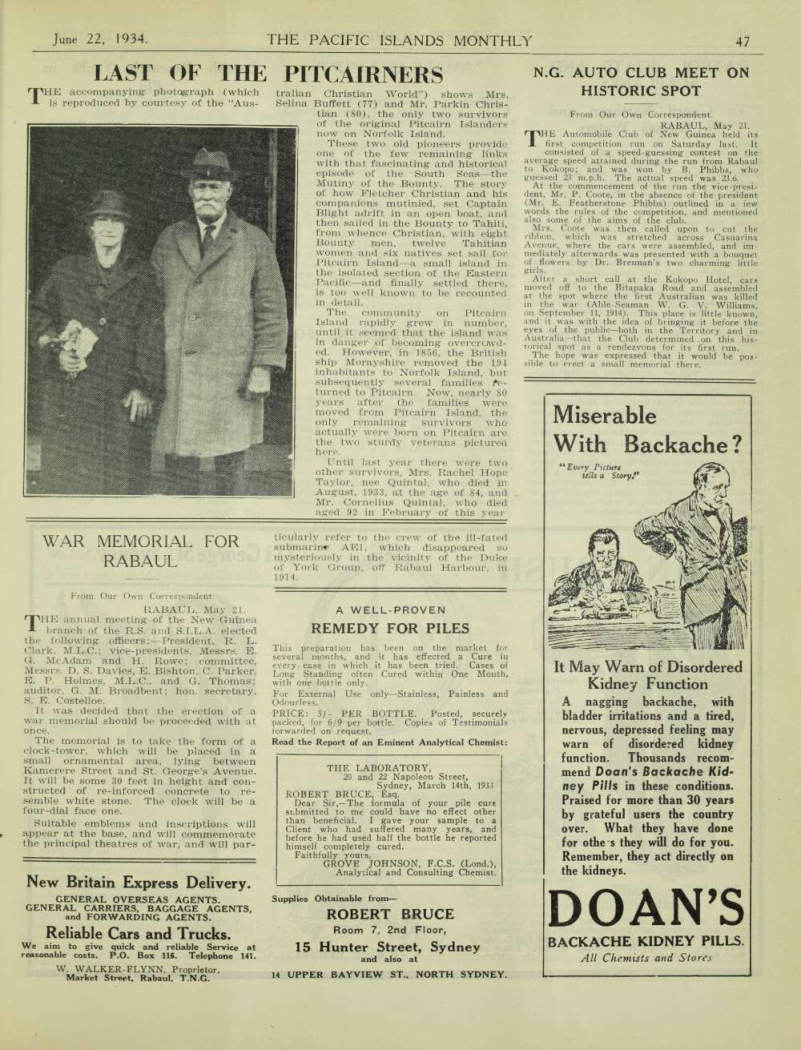
THE accompanying photograph (which is reproduced by courtesy of the “Aus-
tralian Christian World”) shows Mrs.
Selina Buffett (77) and Mr. Parkin Chris
tian (80), the only two survivors of the original Pitcairn Islanders now on Norfolk Island.
These two old pioneers provide one of the few remaining links with that fascinating and historical episode of the South Seas —the Mutiny of the Bounty. The story of how Fletcher Christian and his companions mutinied, set Captain Blight adrift in an open boat, and then sailed in the Bounty to Tahiti, from whence Christian, with eight Bounty men, twelve Tahitian women and six natives set sail for Pitcairn Island—a small island in the isolated section of the Eastern Pacific —and finally settled there, is too well known to be recounted in detail.
The community on Pitcairn Island rapidly grew in number, until it seemed that the island was in danger of becoming overcrowd ed. However, in 1856, the British ship Morayshire removed the 194 inhabitants to Norfolk Island, but subsequently several families returned to Pitcairn. Now, nearly 80 years after the families were moved from Pitcairn Island, the only remaining survivors who actually were born on Pitcairn are the two sturdy veterans pictured here.
Until last year there were two other survivors, Mrs. Rachel Hope Taylor, nee Quintal, who died in August, 1933, at the age of 84, and Mr. Cornelius Quintal, who died aged 92 in February of this year
War Memorial For
Rabaul
From Our Own Correspondent
Rabaul, May 21.
THE annual meeting of the New Guinea branch of the R.S. and S.I.L.A. elected the following officers;- —President, R. L.
Clark. M.L.C.; vice-presidents, Messrs. E.
G. McAdam and H. Rowe; committee, Messrs. D. S. Davies, E. Bishton, C. Parker, E. P. Holmes, M.L.C., and G. Thomas; auditor. G. M. Broadbent; hon. secretary, S. E. Costelloe.
It was decided that the erection of a war memorial should be proceeded with at once.
The memorial is to take the form of a clock-tower, which will be placed in a small ornamental area, lying between Kamerere Street and St. George’s Avenue.
It will be some 30 feet in height and con structed of re-inforced concrete to re semble white stone. The clock will be a four-dial face one.
Suitable emblems and inscriptions will appear at the base, and will commemorate the principal theatres of war, and will par
ticularly refer to the crew of the ill-fated submarine AEI, which disappeared so mysteriously in the vicinity of the Duke of York Group, off Rabaul Harbour, in 1914.
N.G. Auto Club Meet On
Historic Spot
From Our Own Correspondent.
Rabaul, May 21.
THE Automobile Club of New Guinea held its first competition run on Saturday last. It consisted of a speed-guessing contest on the average speed attained during the run from Rabaul to Kokopo; and was won by B. Phibbs, who guessed 23 m.p.h. The actual speed was 23.6.
At the commencement of the run the vice-presi dent, Mr. P. Coote, in the absence of the president (Mr. E. Featherstone Phibbs) outlined in a few words the rules of the competition, and mentioned also some of the aims of the club.
Mrs. Coote was then called upon to cut the ribbon, which was stretched across Casuarina Avenue, where the cars were assembled, and im mediately afterwards was presented with a bouquet of flowers by Dr. Brennan’s two charming little girls.
After a short call at the Kokopo Hotel, cars moved off to the Bitapaka Road and assembled at the spot where the first Australian was killed in the war (Able-Seaman W. G. V. Williams, on September 11, 1914). This place is little known, and it was with the idea of bringing it before the eyes of the public—both in the Territory and in Australia —that the Club determined on this his torical spot as a rendezvous for its first run.
The hope was expressed that it would be pos sible to erect a small memorial there.
Advertisements & other items, p. 49 (2 items)
Doan’S
Miserable
With Backache?
"Every Picture tells a Story"
It May Warn of Disordered
Kidney Function
A nagging backache, with bladder irritations and a tired, nervous, depressed feeling may warn of disordered kidney function. Thousands recommend Doan’s Backache Kidney Pills in these conditions.
Praised for more than 30 years by grateful users the country over. What they have done for othe s they will do for you.
Remember, they act directly on the kidneys.
DOAN’S
BACKACHE KIDNEY PILLS.
All Chemists and Stores
New Britain Express Delivery.
A WELL-PROVEN
REMEDY FOR PILES
This preparation has been on the market for several months, and it has effected a Cure in every case in which it has been tried. Cases of Long Standing often Cured within One Month, with one bottle only.
For External Use only—Stainless, Painless and Odourless.
PRICE: 5/- PER BOTTLE. Posted, securely packed, for 6/9 per bottle. Copies of Testimonials forwarded on request.
Read the Report of an Eminent Analytical Chemist;
THE LABORATORY,
20 and 22 Napoleon Street, Sydney, March 14th, 1933
ROBERT BRUCE, Esq.
Dear Sir,—The formula of your pile cure submitted to me could have no effect other than beneficial. I gave your sample to a Client who had suffered many years, and before he had used half the bottle he reported himself completely cured.
Faithfully yours,
GROVE JOHNSON, F.C.S. (Lend.),
Analytical and Consulting Chemist.
Supplies Obtainable from—
ROBERT BRUCE
Room 1, 2nd Floor,
15 Hunter Street, Sydney
and also at
14 UPPER BAYVIEW ST., NORTH SYDNEY.
New Britain Express Delivery.
GENERAL OVERSEAS AGENTS.
GENERAL CARRIERS, BAGGAGE AGENTS,
and FORWARDING AGENTS.
Reliable Cars and Trucks.
We aim to give quick and reliable Service at reasonable costs. P.O. Box 116. Telephone 141.
W. WALKER-FLYNN, Proprietor, Market Street, Rabaul. T.N.G.
Seaplanes
Patrol Boats And
To Guard Northern and N. Guinea Waters
IT is officially announced that the Commonwealth Government will provide three fast patrol boats and two seaplanes for the North Australian and New Guinea waters, to be used in an attempt to put an end to illegal fishing and the illicit drug traffic in these waters. A boat and sea plane will be stationed at Rabaul and Thursday Island and the third launch at Darwin.
The launches, it is understood, will be built at Cockatoo Island Dockyards, New South Wales, and will cost approximately £5000 each. They will be equipped with three oil-burning engines and will have a long cruising range and be fitted with wireless. The size of the launches will be 43 feet in length, though the boat to be stationed at Darwin may be larger, in order to patrol the Timor-Darwin section of the air mail route from London.
The patrol boats at Rabaul and Thurs day Island will be controlled by the Aus tralian Department of Customs, while at Darwin the vessel will be under the joint control of the Department of Defence and the Department of the Interior. The Royal Australian Air Force will control and supply the personnel for the two seaplanes.
A Moth aeroplane of the R.A.A.F. is now being fitted with seaplane floats and will go to Darwin shortly to co-operate with H.M.A.S. Moresby in coastal survey work.
The ’plane will assist in the preparation of naval charts of the more remote parts of the northern coastline, where operations by land parties would be difficult.
“Amalgamation”
THE question of amalgamating some of the administrative machinery of Papua and New Guinea was discussed at the re cent conference of Australian Pacific Administrators, but nothing of a concrete nature was agreed upon. The discussion served rather to emphasise constitutional difficulties in the way of amalgamation.
It was agreed, however, that each Terri tory should send to the others a kind of intelligence report setting out whatever was likely to be of common interest re garding present policy, contemplated changes, new forms of development, etc.
The Administrators generally appear to be against the idea of a single territorial service; but presumably a system will be evolved almost immediately under which each Administrator will accept officers from other Territories subject to the con sent of all the Administrators concerned.
Fijian Footballers For
Tonga
Suva, May 10.
The Tongan Sports Club, which controls the Rugby Union football code in Tonga, has invited a team of Fijian Rugby Union footballers to visit Nukualofa in August.
Three test matches and a number of minor games will be played. A sum of £50 has been donated by the Tongans to defray the expenses of the Fiji team.
Fiji’s team will leave Suva for Nukua lofa on one of the New Zealand warships and will return by the Tongan Govern ment’s despatch vessel Hifofua.
Fiji
Danish Research Yacht in Fiji
Suva, May 15.
AN interesting visitor to our port at the present time is the Danish research yacht Monsunen, which is making an 18 months’ scientific and research cruise of the world. She is a sturdy vessel, origin ally built in France, and is fitted with a semi-diesel auxiliary engine.
The owner of the vessel, Mr. Alex Moel ler, is the leader of the expedition. Mr.
Jan Degenkolw, ethnologist, Mr. Stubbe- Teglbjerg, zoologist, and Mr. Hakon Mielche, a newspaperman and photo grapher of Denmark, are also members of the party.
Already they have gathered much data and collected many specimens and to the casual visitor the yacht seems to be a floating museum. Shell specimens and swordfish from the Galapagos Islands, totem poles from Panama, native curios from Bora Bora and Tahiti, and mats from Western Samoa are stacked on deck and in the saloons, while several Galapagos tortoises toddle slowly up and down the deck.
The Monsunen left Denmark in October, 1933, and sailed for the Galapagos Islands via the Panama Canal. After a short while there collecting specimens, the party sailed to the Marquesas, the Tuamotus, Papeete, and Bora Bora, and arrived in Suva on May 12. From Fiji the vessel will visit New Caledonia, New Hebrides, the Solo mons, and New Guinea, and then return to Denmark via the Dutch East Indies and Ceylon.
Advertisements & other items, p. 50 (1 item)
John Brush
Specialists in Harness,
Saddlery,
Leather Coats & Riding Wear
“THE OVERLAND”
Made to prevent the horse from rubbing Bridle off. is built on a Galvanised Steel-plated Tree, and has forged Steel Stirrup Bars and Copper-plated Tacks, which will stand tropical conditions. The Seat is of oiled Kip Leather and Flaps of Bullock Hide. Super Quality. Fitted as illustrated £7/10/-.
371 George St., Sydney. N.S.W.
432 QUEEN St., BRISBANE, Queensland
The “Bonser”
Stock Whip
20/-, posted free.
Write for Our 56 Page Catalogue.
The Super
“STATION
POLEY”
Built on similar lines to the Homestead. Is a Saddle also recommended by us for Island use. Black wax sewn with best fittings as illustrated. £7/10/-.
Riding Bridles
“THE STOCKMAN”
A Popular Bridle. %in 10/6 12/6 %in 12/6 14/6 lin 14/6 16/6
Tahiti
Chinese Soon Will Be Masters In
Bitter Summary of Position by French Writer
The manner in which Asiatic communities are becoming established in the Pacific territories is most alarming. All nations have permitted these racial crimes —particularly America in Hawaii, Britain in Fiji, and France in Tahiti.
The following is practically a literal translation of an article, “La Colonisation en Oceanic,” by M. E. Tambrun, which ap peared in “L'Africain” (a well-known French journal), of December 24, 1933.
The writer, in describing what has hap pened and is happening in Tahiti, does not mince his words.
AFTER 1842, when Tahiti was voluntarily given to France, and France promised that the Tahitians would be French citizens on an equality with the French, the natives enjoyed under the naval Government of this period an era of true prosperity.
The soldiers of the garrisons of infantry and artillery, and the sailors of the fleet —even the police—settled in the country, and many of them founded a family.
Many of the old families now prominent in Tahiti sprang from this source. The merchant sailors and many casual travel lers, caught by the charm of the place, stayed there and did likewise. The French colony established itself, little by little, in this blessed land, where the prejudice of colour did not exist.
Encouragement was given to agricul ture. The Agricultural Fund, up till 1910, made advances to the white planters and to the needy, making advances against the results of the harvest. This was notably the case with cotton. Long term loans were granted to colonists desirous of building up or widening their activi ties. Prosperity reigned, and everyone was happy.
Chinese, brought over as agricultural labourers, did the work. The public ser vants, few in number as yet, were a sup portable burden on the State.
Then the representatives of the Minis ter for the Colonies decided to alter all this. They commenced by displacing colonists who had already proved their merit and who occupied posts of trust: Cadoureau (Chief of Postal Services), Largarde (Chief of Customs and Contri butions). There were others admitted as subordinates, who were replaced by people from home, and who, on arrival in Tahiti, regarded themselves as in a conquered country.
They closed the door on French coloni sation by demanding from some of the soldiers who remained (the garrison hav ing been done away with) and who wished to settle in the country, either a certain amount of capital, or else the production of employment. Then they opened wide the door to the Chinese, without asking of them a like guarantee.
To-day, the Chinese in French Oceania number more than 4000, and they are the masters of the country. They settled in as small artisans (harness-makers, car riage-makers, farriers, wheelwrights, shoe-makers, market-gardeners, etc.), and from this nucleus they have spread through the Tahiti districts and even over
the archipelagoes, where they have taken the places of the poverty-stricken “co operatives,” and the small white traders.
Actually, there is not one island of French Oceania which has not its Chinese traders. Navigation is in their hands to the extent of 90 per cent.; trade to the extent of 95 per cent. One former Presi dent of the Chamber of Commerce of Tahiti now serves as intermediary between some big Chinese houses and an important firm in Marseilles.
After having seized the lands and the daughters of the needy ones (when they didn’t actually seize their wives!) the Chinese fixed their regard on the white girls and women, and from these unions we get a half-caste community, of which the less said the better.
How many among the women of Euro pean birth would not be embarrassed to tell of the source of this pretty shawl, or that pretty crepe-de-chine frock? How ever, the young girls are to be excused, a little. The Administration has turned back the stream of French colonisation, and has turned on to the full the stream of Chinese immigration, and these women have no other alternatives than those of spinsterhood or a Chinese husband. But, as the Chinese is nearly always married already in his own country there is for him only one goal—to accumulate as much money as he can in Oceania, and to return to China, very often abandoning a wife and children in Tahiti.
The Asiatics are frugal and industrious, and under good laws they would have helped to advance the fortunes of the country. In place of this, a decree of 1930 puts them in the ranks of French citizenship, stipulating that “all the chil dren of foreigners born in the country will have French rights when 21 years of age, if they have not expressed a wish to keep the nationality of their parents.”
As no Chinese has any interest in keep ing his nationality, and as, on the contrary, he has had all the advantages—whilst still a Chinese at heart —of being treated on the same equal footing as the French, we can be certain that the young Chinese will take full advantage of this. In a certain number of years, we shall have a Chinese Mayor at Papeete. Even the presidents and members of the Chambers of Commerce and Agriculture will like wise be Chinese—the yellow electors being in the majority.
In French Oceania, the Chinese are per mitted to buy land—some possess many hundreds of hectares—whilst in China the French have not the right of acquir ing even a foot of land. The French settlers ask why one does not apply the same treatment to the Chinese in Oceania as the Chinese do to the French in China?
In France, the Chinese, swallowed up in the mass, is assimilated; but in Tahiti he remains Chinese, under the benevolent eye of the government which, in the per son of Governor Rivet, has even authorised the opening of a Chinese school! They have their postal service, their courts, their doctors, chemists, judges, and even their own service of registration. They are a State within the State, and never appeal to the French courts to settle their differences.
They have an official in each important locality, who performs marriages, regis ters births, deaths, etc. This is accepted by everyone—they perform their func tions, so to speak, in broad daylight. The government alone seems to ignore all this.
The shrewd Chinese are affable and even obsequious with the powers that be, at whose discretion they are taxable. New import taxes do not frighten them; they study immediately to find means of turn ing the law, and using it, at a pinch, for baksheesh.
There is no record of a Tahiti Chinese having sold out his business to another Chinese—no entry of this kind appears in the registers of the French Adminis tration.
Some Chinese merchants carry on their business in the name of a compatriot who already has departed to China, without intention of returning; or of one already dead in China. Have we not seen, in an office rented by one Chinese, a trading certificate in another’s name, and mer chandise in the name of a third? It sometimes happens that the certificate of the manufacturer of vanilla is lodged in the name of a fourth.
Slowly, but surely, the Asiatics are tak ing possession of this delightful country.
Yet the insurance companies do not ask any higher premiums of those of us who live in Tahiti; and the cost of living in Tahiti is very much less than in France.
Advertisements & other items, pp. 51-52 (1 item)
Sil Rohu (Late A.I.F.),
SYDNEY MARINE
AGENCY
Can Supply All You Need in— Luggers, Schooners, Ketches, Cruisers, Yachts, Launches, Speedboats, Engines, and Equipment, etc.
ENQUIRIES APPRECIATED.
SYDNEY MARINE AGENCY
72 PITT ST., SYDNEY
Works: Lavender Bay Tel. 8W6493. After Hours, FU 8209.
“OUR HANDS MAKE GOOD ARMS.
Repairs.
QUALITY.
You get that feeling of satisfaction when you purchase your SHOOTING & FISHING WANTS from the Firm that has a REPUTATION FOR QUALITY GOODS AND SERVICE.
The Greatest Variety of Shooting & Fishing Tackle in Australia.
WRITE FOR CATALOGUES.
SIL ROHU (late A.I.F.),
’PHONE MA 3540
IMPORTER OF HIGH-GRADE FIREARMS AND FISHING TACKLE SPECIALIST 143 ELIZABETH STREET, SYDNEY (near Market Street).
“FISHING TACKLE TO TACKLE FISHING”
HULLCOTE
COPPER ANTI-FOULING PAINT
A preventive against marine growth, weeds, shell life, worms, &c.
SOLD BY ALL LEADING MARINE STORES
This from the President of the N.S.W. Motor Boat Association and Commodore of the George’s River Motor Boat Club: Since I painted my boat with Hullcote about nine months ago, I have been keenly interested in the result, especially after past experience with so-called anti-fouling paints, I have been more than satisfied—in fact, astonished —as there is yet no sign whatever of fouling. I wish it all the success that it deserves.
W. GRADY, Senr.
November 27, 1933.
This from George Prior, the wellknown boat builder and scull maker, Jewfish Point, George’s River: November 26, 1933.
The launch Doreen was painted on my slip with Hullcote ten months ago, and being very dubious of any new anti-fouling paints, I have taken particular notice, and frequently examined it when calling at my bowser, and am agreeably surprised. It is all and more than it is claimed to be.
GEORGE PRIOR,
Jewfish Point, Oatley, N.S.W.
Prom A. Pilgrim, boat shed proprietor, Sandringham ’(Phone; LW 3166): — October 23, 1933.
When you induced me to try your “Hullcote” last April, I can assure you I was very sceptical as to its merits, for I have used almost every brand on the market for the past 20 years.
On the 3rd May, I painted a piece of 3 by 1 pine, the same as I use yearly on my juvenile bath enclosure. I placed it under my jetty and nailed it to a pier, and on removing it today, I find not the smallest particle of growth or sign of borers, and, rub as I may, I cannot remove the paint, which is still a good green color.
These battens always have been useless before the bathing season closes, and, by the appearance of this sample, which has been down nearly 6 months, and shows no sign of deterioration, it appears that I can use the same timber indefinitely.
I also painted a launch on the same day as the battens, which I sold shortly afterwards. The purchaser called on me last week to find out what paint I used, as he wanted a supply for other boats which he owns.
He showed me his boat, which appears as though it was recently painted. It was for this man I ordered the quart and 2 pints which you delivered to me to-day.
Please send me two more quart cans.
Mr. Ward, I shall never think it is a trouble to show anyone the paint, or answer a ’phone call on the subject.
Sincerely yours,
A. PILGRIM.
Mr. George Brereton writes: Fowler Road, Como, October 16, 1933.
Please send me two pint tins of your “Hullcote.”
I may say that when your traveller talked me into trying this paint I took his enthusiasm with the proverbial grain of salt, but, with the exception of an English product, for which I paid 12/6 per quart, “Hullcote” stands alone, and, in my estimation, is far superior to any on the market, even the English brand.
I want th|s order for two friends of mine.
Thanking you, Yours faithfully,
GEORGE BRERETON.
COLOURS: Green and Red only.
As ingredients include four (4) distinct kinds of Copper also Verdigris, Mercury,
GEORGE WARD
MANUFACTURER
BIRMINGHAM STREET, ALEXANDRIA, SYDNEY N.S.W.
Office: LW 3413. Factory: Mascot 856
Growing Vegetables In The Tropics
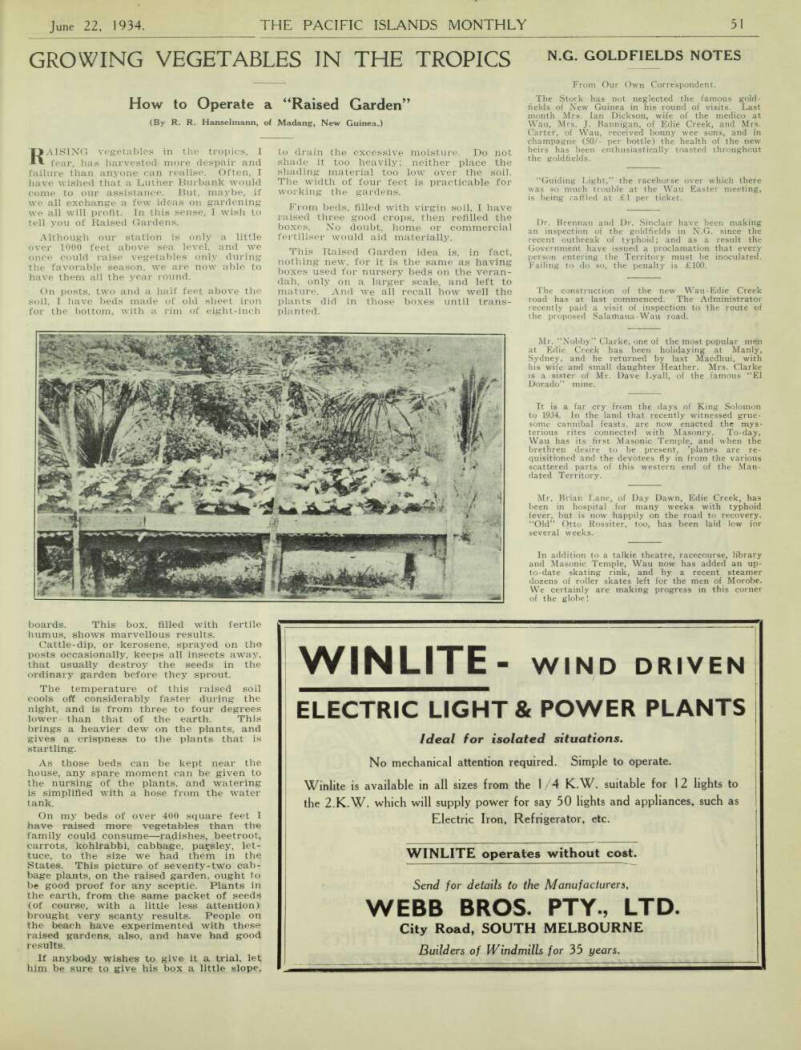
How to Operate a “Raised Garden”
(By R. R. Hanselmann, of Madang, New Guinea.)
RAISING vegetables in the tropics, I fear, has harvested more despair and failure than anyone can realise. Often, I have wished that a Luther Burbank would come to our assistance. But, maybe, if we all exchange a few ideas on gardening we all will profit. In this sense, I wish to tell you of Raised Gardens.
Although our station is only a little over 1000 feet above sea level, and we once could raise vegetables only during the favorable season, we are now able to have them all the year round.
On posts, two and a half feet above the soil, I have beds made of old sheet iron for the bottom, with a rim of eight-inch
boards. This box, filled with fertile humus, shows marvellous results.
Cattle-dip, or kerosene, sprayed on the posts occasionally, keeps all insects away, that usually destroy the seeds in the ordinary garden before they sprout.
The temperature of this raised soil cools off considerably faster during the night, and is from three to four degrees lower than that of the earth. This brings a heavier dew on the plants, and gives a crispness to the plants that is startling.
As those beds can be kept near the house, any spare moment can be given to the nursing of the plants, and watering is simplified with a hose from the water tank.
On my beds of over 400 square feet I have raised more vegetables than the family could consume—radishes, beetroot, carrots, kohlrabbi, cabbage, parsley, lettuce, to the size we had them in the States. This picture of seventy-two cab bage plants, on the raised garden, ought to be good proof for any sceptic. Plants in the earth, from the same packet of seeds (of course, with a little less attention) brought very scanty results. People on the beach have experimented with these raised gardens, also, and have had good results.
If anybody wishes to give it a trial, let him be sure to give his box a little slope,
to drain the excessive moisture. Do not shade it too heavily; neither place the shading material too low over the soil.
The width of four feet is practicable for working the gardens.
From beds, filled with virgin soil, I have raised three good crops, then refilled the boxes. No doubt, home or commercial fertiliser would aid materially.
This Raised Garden idea is, in fact, nothing new, for it is the same as having boxes used for nursery beds on the veran dah, only on a larger scale, and left to mature. And we all recall how well the plants did in those boxes until trans planted.
N.G. Goldfields Notes
From Our Own Correspondent.
The Stork has not neglected the famous gold fields of New Guinea in his round of visits. Last month Mrs. Ian Dickson, wife of the medico at Wau, Mrs. J. Bannigan, of Edie Creek, and Mrs.
Carter, of Wau, received bonny wee sons, and in champagne (50/- per bottle) the health of the new heirs has been enthusiastically toasted throughout the goldfields.
“Guiding Light,” the racehorse over which there was so much trouble at the Wau Easter meeting, is being raffled at £1 per ticket.
Dr. Brennan and Dr. Sinclair have been making an inspection of the goldfields in N.G. since the recent outbreak of typhoid; and as a result the Government have issued a proclamation that every person entering the Territory must be inoculated.
Failing to do so, the penalty is £100.
The construction of the new Wau-Edie Creek road has at last commenced. The Administrator recently paid a visit of inspection to the route of the proposed Salarhaua-Wau road.
Mr. “Nobby” Clarke, one of the most popular men at Edie Creek has been holidaying at Manly, Sydney, and he returned by last Macdhui, with his wife and small daughter Heather. Mrs. Clarke is a sister of Mr. Dave Lyall, of the famous “El Dorado” mine.
It is a far cry from the days of King Solomon to 1934. In the land that recently witnessed grue some cannibal feasts, are now enacted the mys terious rites connected with Masonry. To-day, Wau has its first Masonic Temple, and when the brethren desire to be present, 'planes are re quisitioned and the devotees fly in from the various scattered parts of this western end of the Man dated Territory.
Mr. Brian Lane, of Day Dawn, Edie Creek, has been in hospital for many weeks with typhoid fever, but is now happily on the road to recovery.
“Old” Otto Rossiter, too, has been laid low for several weeks.
In addition to a talkie theatre, racecourse, library and Masonic Temple, Wau now has added an up to-date skating rink, and by a recent steamer dozens of roller skates left for the men of Morobe.
We certainly are making progress in this corner of the globe!
Advertisements & other items, p. 53 (1 item)
Winlite- Wind Driven
ELECTRIC LIGHT & POWER PLANTS
Ideal for isolated situations.
No mechanical attention required. Simple to operate.
Winlite is available in all sizes from the 1/4 K.W. suitable for 12 lights to the 2.K.W. which will supply power for say 30 lights and appliances, such as Electric Iron, Refrigerator, etc.
WINLITE operates without cost.
Send for details to the Manufacturers ,
WEBB BROS. PTY., LTD.
City Road, SOUTH MELBOURNE
Builders of Windmills for 35 years.
Tea-Planting In Papua
Mr. W. H. Wright, of Samarai, Papua, who started the desiccated coconut enter prise in Papua and New Guinea, and who is at present visiting Sydney, has decided to plant tea in Papua, and has in view a big area of country suitable for his enter prise (says “Sydney Morning Herald” of June 6).
Mr. Wright said that the Lieutenant- Governor of Papua (Sir Hubert Murray) had expressed full confidence in the under taking, and had promised support. .Sir Hubert Murray had written to the Federal Government, and recommended preferen tial treatment of Papuan-grown tea.
Mr. Wright will return to Papua shortly, and clearing operations and nurseries will be started. Mr. Wright has had experience of tea-planting in Ceylon. He is satisfied that the chosen district is ideal for his enterprise, and compares with some of the best tea-growing districts of Ceylon.
Fashion Hints for Islands Women
(By Therese.)
Pastel shades are definitely IT for afternoon gowns and accessories, etc.
Blues, the newest of which is sabrina—a duck egg blue— are first favorite, with a misty pink following closely on their heels.
The latter looks charming with coat and shoes of red, which give it just the ne cessary touch of excitement.
This is essentially a season of en sembles and, while the modified swagger coat is still in the swim, it gives pride of place to the hip length coatee for both day and evening.
The very newest and surely the most economical idea in coatees, is that with softly falling cascade collar on a Magyar design, hip length, fastening with link buttons, and with sleeves tapering to slimness at the wrist. When bright lights call, it turns its back on sober moments and presents a decolletage outlined by the .cascade drapery at the back. An intri guing idea, and one you should imme diately hasten to copy.
Capes still hold their popularity. Little shoulder ones or cape collars adorn our sleeveless washing frocks, and, apart from their undoubted attractiveness, are a re freshing change from the coat.
Sports frocks are smartly simple in design. Plastons and jabots add a touch of chic that is distinctive with a difference.
Pert little bows appear at the waist and neck line, and button trimmed tabs, through which we thread scarves that bid fair to rival Joseph’s coat, are heaven sent. Indeed, the ways to express one’s individuality are innumerable this season.
The tunic frock still finds favor, and evolved in stripes cut diagonally, is the last word in chic. The tunics may be three-quarter length, with its accompany ing skirt carried out in the predominating shade of the stripes.
Talking of stripes, your wardrobe simply must boast a shirt frock. It is a very necessary adjunct, and useful beyond measure. Golfing, cruising, shopping, it somehow has the happy knack of always appearing correct, whatever the occasion —an enviable state of affairs, no doubt.
Taffeta is becoming popular for after noons, and is worn either for coats or
frocks. It springs into being as a fas cinating addition to a plain silk frock, in the shape of a belt with huge bow in tartan, and lifts it to the heights of fashion.
In place of the squarish look our shoul ders once wore, we hastily rush to obey the “Slope Arms” edict —fashion’s latest whim. A shoulder yoke extending well down the arms with the sleeves set in midway between shoulder and elbow, is an exceedingly popular way of showing our approval of this peremptory order.
You may now cease to worry about that severe high neck line. Make two or three organdie roses and put them across the front, just where the chin will touch when looking down. This is a really attractive idea, with a definitely appealing and feminine touch.
Cotton evening frocks continue to de light us, and are presented to us in or gandie, pin spot muslin, linen and even piques. The latter looks unbelievably delightful—crisp, clean, and cool, a much to-be-desired trinity, A pin spot muslin frock in red and white, with wide sash of red velvet, is charming.
Printed field flower crepe de chenes are a delight to the eye, and when worn with an accompanying cape, the collar of which is formed entirely of hand made flowers of the same design and colouring, it looks young and dewy as the morning.
“Twinkle, twinkle, little star”—and each mortal with heavenly aspirations scintil lates accordingly per medium of sequins, rhinestones, opalescent beads—in fact, anything that glitters in any shade or shape our wayward fancy desires.
An old-world air of charm is the por tion of the woman whose happy choice for evening falls on an organza frock of the palest shade of pink, with stripes of self. Its bodice boasts a cross-over fichu, reminiscent of grandma’s days, and is held in place by a cluster of Dorothy Per kins roses, or their counterpart—a mode both youthful and flattering in the ex treme.
Shoulder straps of hand-made flowers adorn our frocks for festive hours. One shoulder of a black georgette gown is befrilled, while the second is replaced by camelias, pink and white alternately. This is particularly attractive, and well worthy of emulation.
Large fans of ostrich feathers add a luxurious touch to an evening ensemble.
A gold lame gown worn by a lass, slim and graceful as a young tree, has a fur ther touch of glamour and romance added to it by a green feather fan —something to dream about, surely!
No wardrobe is complete without a windswept garment of some sort, and be the garments frivolous or practical, the mode is delightful. In the day times fullness is whipped to the front, as if by
a strong breeze. It is of tremendous chic and extends to coat collars, revers, and such like, where it adds a touch of gaiety and zest.
For evening frocks, however, the swept back movement is sought, and in many instances ends in a train which one can (or cannot, as the case may be) manipu late with graceful sweep, and outward assurance, despite inward qualms as to one’s total inability in that direction.
Evening gives a choice of two silhouettes —that lovely mermaid-like one moulded to the figure and flaring out in fish tails; and the statuesque classical type. It is for you to choose which silhouette suits your type. If you are of the slender, lazy, appealing type, your choice will most certainly be the former, while if you carry your head high and look the whole world in the face with well disciplined reserve and slightly supercilious disdain, classical lines are yours to do with what you will.
Belts are with us in every variety. The daintiest affair for evening is of silver cord, doubled-twisted with a brilliant button attached to one end for the fasten ing.
Striped furnishing webbing with an S metal fastening is ideal for sports and morning frocks, while knitted or crocheted belts hold their own and are wondrously simple. Make one in a three-ply wool, double and knit a straight length inches deep, and the required length in moss stitch. Use coarse needles and when complete sew on wooden rings to form a buckle. You will be surprised and de lighted with the result, and will make it in many shades.
Advertisements & other items, p. 54 (1 item)
Use “ Duxbac ”
GOLFERS!
V. (Sam) RICHARDSON,
Professional Golf Champion of Australia.
FOR CHOICEST GOLF CLUBS.
Steel Shafted Woods, 25/- to 35/-; Steel Shafted Irons, 19/6 to 35/-; Hickory Shafted Woods, 15/-, Irons 13/6; Complete Sets, from 49/6; Golf Bags, 13/6, 16/6, 19/6; Repaint Golf Balls, 9d and 1/each.
Write for fully illustrated Catalogue, Post Free.
W. A. OLDFIELD
LTD.
54 Hunter St.,
Sydney
Use “ Duxbac ”
& “ Icil Special”
Loaded li I/** The New and With llltiUr LAH Better Powder li Ozs. of Shot in a 2§" Cartridge There are no “lost” birds when “Duxbac” or “Icil Special” are used and no water-spoiled cartridges, for both these brands are effectively waterproofed, making them impervious to moisture or even immersion in water itself.
Obtainable Every where—At Popular Prices
W. M. FORD
Ship, Yacht & Boat Builder
Berry’s Bay, North Sydney
(Established 1570.) BUILDERS of all kinds of Island Craft from Dinghies to Auxiliary Schooners of any tonnage. New and Second-hand Island Craft of various types in stock. New and Second-hand Full Diesel, Crude Oil, Benzine and Kerosene Engines.
Please Send on Your Enquiries.
tions: Mainly Money
Some Pacific Observa tions: Mainly Money and Exchange
By M. W. von Bemewitz.
POSSIBLY readers of the “Pacific Islands Monthly” know all concerning what I am about to write. But this is how it is between Sydney and Pago Pago: Australian silver is accepted in New Zealand, but the exchange is 6d on the pound note. New Zealand notes are filthy bits of rag, but worth having.
New Zealand now has its own silver coins, as follows: Half-crown (this should not have been revived), with the Dominion coat-of-arms on the reverse to the King’s bust; florin, with kiwi, the tailless and wingless bird prodding the ground; shil ling, with Maori warrior with spear couchant; sixpence, with the melodious tui or parson bird; and threepence, with a pair of crossed Maori clubs, facetiously described by someone as two legs of mut ton.
However, the designs are characteristic of the country. They “ring” true. So that they will not become current in Australia, the banks will collect and return them to New Zealand.
As in Australia, the price of sugar in New Zealand is too high. Within recent weeks it has been reduced and then raised.
Some discussion has been running in “The New Zealand Free Lance” (Welling ton) on the carriage of bananas —should they be on the stalk or in crates?
Fiji also has its new coinage, and neither Australian nor New Zealand silver is ac cepted unless exchange, at the rate of 2/6 on the pound is paid. The Post Office will not take it at all. The Fiji coins are: Florin, with coat-of-arms on reverse to King’s bust; shilling, with native sailing canoe; and sixpence, with turtle. There isn’t any threepence, the English coin with the acorns and oak leaves being current.
The penny is of nickel and has a hole in the centre.
Oranges are being packed on the wharf at Suva, for New Zealand. Bananas ap pear to be scarce, but pineapples are fairly plentiful.
Burns, Philp and Company are making changes in their big Suva warehouse.
A sign of Fiji mining development is a window in a large chemist’s shop in Suva dressed with chemicals, a balance, clay and graphite crucibles.
Samoan (Pago Pago) exchange is four dollars for the Australian pound, the American rate.
Copra at such a low price must be dis heartening to the owners of the extensive plantation on Niaufou Island, Tonga Group. The coconut palms grow from the sea to the rim of the crater. Large nuts are the rule here.
Advertisements & other items, pp. 55-56 (1 item)
Gold
Jim’s so
different!
Father’s delighted. Mother’s proud. Jim hasn’t missed a day this term and is top of the class. What’s the reason?
Just SCOTT'S —just a regular daily spoonful of genuine SCOTT’S Emulsion, restores health and strength to mind and body. It builds bone.
Puts on weight. Give your child SCOTT’S Emulsion. He will eat better, sleep better and do better work.
SCOTT'S
Emulsion
Nourishes — Strengthens
AUSTRALIA’S CLEARING HOUSE FOR THE PRECIOUS METALS.
BUYERS OF
GOLD
OSMIRIDIUM, PLATINUM, SILVER, &c.
GARRETT & DAVIDSON, LTD.
ASSAYERS, BULLION MERCHANTS, METALLURGISTS,
Bank of N.S.W. Buildings, Regent Street, Sydney
ALBERT GREGORY
107 York Street, Sydney.
Saddlery,
Saddler’s Ironmongery
Leather and Paint Merchant.
LEATHERS— Art Work, Sole, Harness, Roans, Suedes, Bag - , Kangaroo, Bridles, Belts, Spurs, Stirrups, Breastplates. SADDLES Race, Exercising, Park and Stock.
Leather Belting and Pump Cups.
Paint Merchant.
For House and Roofs, ready mixed . . .. 13/6 gallon Special Value House Paint 10/6 gallon Brushes, Kalsomine, White Lead and Oil.
Samples of Leathers on Application.
New and Revised
Map of
New Guinea
and Papua
Just issued by the Commonwealth Government Printer. —Contains all Details added as result of Most Recent Patrols and Surveys— includes Bougainville Island and Large Scale Map of Gazelle Peninsula —Shows Details of Morobe Goldfield, and Newly Discovered Ramu-Mt. Hagen Region, also Aeroplane Landing - Coloured to show Administrative Districts.
Posted direct to any address— On Paper 3/- Mounted on Linen 5/-
PACIFIC PUBLICATIONS LTD.
Union House, 247 George St., Sydney.
P.O. Box 3408 R, Sydney. [May also be obtained direct from Prime Minister’s Department, Canberra, for 2/6 (paper) plus postage.]
New Guinea Vessel
“Desikoko" is Launched
THE second of the two wooden vessels of 200 tons, built at Jervis Bay, N.S.W., for the inter-island trade by Messrs. W. R. Carpenter and Co., Ltd., was launched in Currembene Creek, Jervis Bay, at the end of May, and was loaded with timber, ready to be towed to Sydney, where engines will be installed.
There was a heavy fresh in the creek, and as the vessel was being towed out into Jervis Bay, she grounded on a sand bank, and remained fast. She remained there for several days, but eventually was towed off undamaged and arrived in Syd ney on June 10.
The vessel is called the “Desikoko” (presumably as a compliment to Desi koko Ltd., which handles the product of W. R. Carpenter’s desiccated coconut factory at Pondo, New Guinea) and she is now being equipped with diesel engines and will sail shortly for New Guinea witn a cargo of timber. She is 120 feet in length and is constructed of Australian hardwood.
It is a coincidence that the Desikoko’s sister ship, the John Bolton, almost exactly a year before, was involved in a collision in Sydney Harbour, just after she had been equipped with engines and was undergoing the usual trials. The John Bolton is now engaged in the New Guinea inter-island trade.
Fiji Copra Tax Removed
Early in May, the Executive Council of Fiji decided, subject to the consent of the Legislative Council, to remove Ihe Port and Customs Service tax on all copra ex ported from the Colony. It also decided to abolish the contribution of 1/6 per ton, which is levied on all copra exported, to finance the operations of the Fiji Coconut Committee. The total amount of relief is equal to about 3/- per ton.
The local market immediately reacted to this development and the local price was raised by 5/- per ton.
Tongan Notes
Nukualofa, May 10.
Although there is over £143,000 accu mulated surplus lying to the credit of this little kingdom, not one penny has yet been spent for the relief here of people suffering from the depression.
The Government, still pursuing its re trenchment policy, has retired the cap tain, engineer and other men formerly
employed on the Government’s motor ves sel Hifofua, and the vessel has been put out of commission.
There is agitation for more retrench ments. It is said that one European could administer the Treasury, Customs and Post Office: and that Tongan officials could administer the Police, Audit, and Agriculture Departments. It is pointed out that £50 per annum is paid to one officer to act as editor of a Tongan news paper, and that there never has been any such newspaper.
A New Zealand man is coming to take the place of the late Mr. W. Angus, who for many years was Government engineer.
A well-known resident of Nukualofa, Mr. Cowley, is on his way back to Tonga and is expected some time in May.
Several Europeans have died here in recent months. The last to pass on was Mr. J. Clements, who has died in Auck land, where he had gone in order to have an urgent operation performed.
Motor Cars In Papua
According to the latest figures gathered in Australia, there are 194 motor cars and trucks in use in Papua, and the owners of the vehicles do not have to pay any registration fee or tax on them. The Papuan motorist’s only contribution to the Government is 10s a year for a driving licence.
The argument against taxation is that there are few good motor roads in Papua, In the vicinity of Port Moresby there is only one road of any length fit for motor traffic. This road extends 25 miles inland to the Rouna Palls.
Cook Is. Notes
Rarotonga, May 12.
Reducing The Mosquitoes
By the last Maunganui from New Zealand, Judge Ayson, the Commissioner resident at the Cook Group, brought initial supplies of Gambusia for release in the swamp areas about the island of Rarotonga. The Gambusia is a hardy little fish which eats mosquito larvae, and its introduction has worked wonders in reducing the mosquito pest in other tropical islands.
Radio And Paris Riots
A native at one of the Pacific Islands, while listening-in on his radio at an American broad cast, was so terrified at the description given of the recent Paris riots that, overcome with fear, he rushed out into the night and obtained the ser vices of a companion to go in and switch the thing off.
Healthy Mangaia
Figures recently compiled show that Mangaia is the healthiest island in the Group. For the year ended March 31, 1934, there were only three deaths of children below the age of 15, and all of these were actually under one year.
Advertisements & other items, p. 56 (1 item)
A. B. Smith & Gluyas
ENGINEERING & MINERS’ SUPPLIES
Engineers, Miners, Planters, etc. Get in touch with us for any of the following lines:—“Star” Brand Shovels—the best shovel made; Picks, Mattocks, Handles, Centrifugal Pumps, Petrol Engines, and Engines converted for Charcoal Gas. Belting and Pulleys, etc. Pipes and Valves; Truck Wheels and Trucks; Copra Flues and Screens; Oils for all purposes; Files and all Sundries. Write for Particulars and Prices.
61-65 Macarthur St., Ultimo, Sydney, N.S.W.
Scientists
Large Expedition for East Polynesia
From Our Own Correspondent
Papeete, Apl. 9.
ANOTHER expedition has been organ ised by the Bernice P. Bishop Museum, of Honolulu, to continue the studies of Ethnology and Natural His tory commenced a few years ago in the Tuamotu Archipelago and other little known parts of Eastern Polynesia.
The expedition is provided with two ships and is expected to arrive in Tahiti in May.
The principal purpose of the expedi tion is to record data concerning the native people, flora, and the land fauna which are rapidly becoming rarer. Ob servations on geology, marine zoology, and oceanography will also be made.
The scientific staff of the expedition includes Dr. Peter Buck, Kenneth P.
Emory, and J. Frank Stimson, ethnolo gists; Professor Harold St. John and Raymond Fosberg, botanists; Dr. C. Mon tague Cooke, Jr., and Donald Anderson, malacologists; and G. le Bronnec and E.
C. Zimmerman, entomologists. Dr. C.
Montague Cooke, Jr., has been appointed leader of the expedition.
Expedition in Tuamotus
From Our Own Correspondent.
Papeete, May 17.
THE scientific expedition sent out by the Bernie Bishop Museum of Honolulu (which is referred to elsewhere in this issue) arrived in Papeete on May 6, and, after a few days’ delay, necessary to take in supplies, etc., left again for the Tuamotu Archipelago and Mangareva on May 11.
Dr. Cook, the leader of the expedition, expects to return with his party to Papeete about the middle of August, after which they will make the return voyage to Honolulu via the Leeward Group.
The vessel used by the expedition is a typical Japanese sampan, now known as the “Islander,” of which there are a great number engaged in the fishing in dustry in the Hawaiian Islands. The high prow usually seen on this class of vessel has been removed and a large deck house erected to afford accommodation for the party.
The “Islander” is about 85 feet in length and is equipped with a 200 horse-power Atlas Diesel engine, which is capable of pushing her along at the rate of 15 miles an hour if necessary: her ordinary speed, however, is round about eight miles.
The small cutter boat “Tiare Tahiti” will act as an auxiliary, to move the scientists from one island to another, as their work demands.
It is reported that the meat works, which it is proposed to establish on the shores of the Gulf of Carpenteria, near the mouth of the Norman River, with the sup port and the assistance of the Queensland Government, will cater not only for the European trade, but will also supply meat to the Far East and Pacific Islands mar kets. The new company is called Superior Preserving Company Pty. Ltd., of Bris bane, and it is calculated that for a start it will treat 8,000 cattle per season.
Papuan Revenue
Receipts Decrease by £6000
From Our Own Correspondent
Port Moresby, May 24.
THE Treasury statements of the Terri tory of Papua for the nine months ended March 31 show the total revenue for the Territory to be £86,699, as com pared with £92,821 for the corresponding period of the previous financial year. This represents a falling off in revenue of £6122.
The principal decrease was in the sale of stamps and from Government planta tions. A saving of £7882 was shown in the expenditure. The credit balance is now £707, as compared with £325 at the close of the December quarter.
Customs Revenue.
The following figures show the revenue for March received by the Customs De partment at Port Moresby and Daru:
Port Moresby— £ s d Import duties 1536 17 8 Primage duties 371 2 6 Export duties 1 17 0 Shipping and other fees 0 17 5 Total £1910 14 7 Daru— £ s d Import duties 5 3 6 Primage duties 43 1 £9 6 7
For Pacific Is. Sportsmen
It is a truism that sport recognises no class, color, or boundary, and the Pacific Islands are no exception.
Wherever one may find a group of Europeans in any of the ten thousand scattered islands, there also one will find ample facilities for sport. When in need of sporting goods and material, Pacific Islands sportsmen cannot do better than com municate with the Sydney firm of W. A. Oldfield Ltd. At this well-known sports store the cricket material sold is produced under the personal supervision of Mr. W. A. Oldfield, the famous international wicketkeeper—now touring England with the 1934 Australian Test Team. For golfers, the firm has engaged the professional golf cham pion, Mr. V. Richardson, under whose tuition Pacific Islands golfers, when in Sydney can learn some finer points of golf which may considerably reduce their handicap. The store also has a large range of racquets and tennis goods. An illustrated catalogue, showing the latest cricket, golf and tennis equipment, may be obtained by writing direct to Messrs. Oldfield & Co.
A course of lectures in tropical hygiene and sanitation has been instituted at the Sydney University by the School of Pub lic Health and Tropical Medicine. The lectures, which are free, commenced on June 6, and were attended by a large class of missionaries, nurses, and other persons who anticipate residing in the tropics. The classes will be held three times each week until August 10.
Advertisements & other items, pp. 57-58 (1 item)
International Correspondence
mi
That all jobs now call for
EXPERT KNOWLEDGE !
TO IGNORE THIS FACT IS
INVITING UNEMPLOYMENT
Do not flirt with DISASTER when you can acquire so easily, through the I C.S.,
THE TRAINING YOU MUST HAVE !
FOR YOUR OWN SAKS WRITE FOR THE FREE
ADVICE WE CAN GIVE YOU
THE I.C.S. ILLUSTRATION METHOD
MAKES HOME STUDY PRACTICAL
International Correspondence
Schools (Australasia) Ltd.
140 ELIZABETH STREET. SYDNEY
Sirs, —Please send me a free prospectus showing how I can succeed in the occupation I have marked.
Accountant (Inst Ex) Secretarial (Inst Ex) Com. Illustrator, Fashion Draining.
Cari’tures & Ctoons Poster Drawing, Journalism, Short Story Writing, Show Card Writer, Salesmon (any branch) Advert'r (any branch) Business M’gement, General Bookkeeper, Station Bookkeeper, Retail Management, Business Letters, General Education, Matriculation, Leaving Certificate, Intermediate, Nurses’ Entrance Examination, Shorthand-Typing, Dressmaking, Aeroplane Engin’r, Aeroplane Rigger.
Aero. Designing, Motor Engineer, Diesel Engineer, Motor Mech. Exam.
Electrical Engineer Elec. Mech. Exam.
EL Wiremen’s Ex., Radio Engineering.
Radio Servicing, Radio ( Talkies) Building Contractor, Concrete Engin’r, Structural Eng’r, Draughtsmanship (name which branch) Shire Engineer.
Shire Overseer’s Examination, Mechanical Engin’r, Steam Certificates, Chemistry (Analy'l) (There are over 4,000,000 IX.S. Students, over 100,000 of these being in Australasia).
ENQUIRIES COST NOTHING—POST NOW
Name Age Occupation Address P.M
WINCHESTER “SPEED KING”
.22 CAL. AUTOMATIC RIFLE MODEL 63
10 SHOTS
Price, £9/5/-
FREIGHT EXTRA
This NEW WINCHESTER AUTOMATIC RIFLE is the improved successor of the famous Model 03, chambered for the NEW .22 LONG RIFLE SUPER SPEED RIM FIRE CART- RIDGE DEVELOPING 35% HIGHER SPEED, 58% GREATER POWER, LONGER RANGE AND GREATER ACCURACY at Less Cost for Ammunition.
THE NEW WINCHESTER SUPER SPEED RIM FIRE
CARTRIDGES
MORE SPEED Short 2/S 100
GREATER POWER Rifle Vm"
LONGER RANGE Freight extra.
COWLES & DUNN
Gunsmiths and Fishing Tackle 71 KING STREET SYDNEY Cable Address: CODUN, SYDNEY. Write for Fishing Tackle Catalogue, Post Free.
THE NEW
TITON
GLAND TONIC
Hormone Preparation—Scientific Discovery— Harmless to take, yet wonderfully effective, giving lasting and unequalled results.
The real tonic for those living under tropical conditions, proved by the many testimonials received from the Pacific Islands.
“Run Down,” nervous debility, mental and physical weariness indicate Gland Deficiency.
TITON restores the Gland System, stimulates the Brain Cells and removes the cause of many complaints. Gland Activity means New Life and Health. Take TITON and “feel yourself” again and be able to enjoy Life.
Write for free 16-page booklet. Communications from the medical profession specially invited.
TITON 24 for Men TITON 20 for Women 10/6 per course (10 days), or 30/- per treatment (3 courses), post free direct from
TITON Laboratories,
Box 1304 J, G.P.O., Sydney
Johnson
Outboard
Motors...
THE Johnson Outboard Motor can be attached to or detached from any boat in a few minutes. Each motor is sturdy, dependable and economical to operate. There is no need to fear underwater obstruction, the whole motor tilts up automatically should any underwater parts strike the bottom or an obstruction, making navigation in shallow. out of the way, spots practical and easy. Also, the motor may be manually tilted, raising the propeller above the bottom of the boat so that the craft can be run up on the beach without difficulty or damage. Nock & Kirby’s always carry a complete stock of spare parts.
Write or call for a FREE copy of our illustrated catalogue of Johnson Motors.
MODEL 0.B.65, H.P.
Sydney Price ... £37/10/- Ex Bond £21
MODEL A. 65, 4 H.P.
Sydney Price ... £62/10/- Ex Bond £39
MODEL K. 65, 8/9 H.P.
Sydney Price £75 Ex Bond £45
Nock & Kirby Ltd.
Postal Address:
BOX 68CC, G.P.O., SYDNEY
“Indian Hemp”
Hindu Smuggler in Fiji Gets Five Years
Suva, May 25.
PLEADING guilty to a charge of attempting to import Indian hemp (gunja) in contravention of Section 34 of the Drugs and Poisons Ordinance 1926, Lalubhai Velabh Khatri, a well-known Indian businessman of Suva, was sen tenced to five years’ penal servitude and fined £250 by the Chief Justice (Captain M. H. Maxwell-Anderson) at a special sitting of the Central Criminal Court.
Sentencing the accused, His Honour said, “Khatri, you stand convicted on your own confession of a very serious crime, not only against the law of Fiji, but against the law of the nations. It has been necessary for all civilized nations to combine to pass legislation ensuring that the traffic in drugs be put down with an iron hand.
“It is the first case of its kind in Fiji, and you have heard the Attorney-General say that you are liable to ten years’ im prisonment, and a fine, in addition, of £1000. It is difficult to fix the punishment, but I have a slight guide in a case in England, in which the accused was merely found in England with a bill of lading concerning a shipment of drugs from France to Japan in his possession.
He was merely the holder of the bill of lading, and had no intention of importing the drugs into England; yet he was sen tenced to three years’ imprisonment and ordered to pay the costs of the prosecu tion amounting to £700 or £800. On an appeal being made, three judges unani mously agreed that the sentence was not a day too severe.
“Yours is a much more serious case,” continued His Honour. “I give full credit to the plea that you fell to temptation* but the whole idea of a heavy punish ment is to prevent the traffic in drugs, and I feel that I would not be doing my duty to Fiji and the world if I did not impose a severe sentence. The very least I can do is sentence you to five years’ penal servitude and fine you £250. I think a person who traffics in drugs is a danger to the community, and I shall take steps, if the law permits, to recommend that you be deported back to India at the end of your sentence.”
Counsel for the accused, Mr. A. D. Patel, said that Khatri was a partner in the Pacific Theatre Company, which had been going steadily down, and he got deeply into debt. Certain parties interested in the illicit trade had approached him and
offered him a liberal commission to im port the hemp, and accused had fallen to temptation. He had no previous convic tions.
The Attorney-General, Mr. R. S. Thac ker, drew His Honour’s attention to the fact that the offence was made worse by an attempt to bribe a Customs officer.
The evidence showed that of 19 pack ages consigned to Khatri from India, and supposed to contain Indian cinema films and advertising matter, ten contained In dian hemp. Accused went to the Post Office shortly before closing time to clear the packages, but the Customs Depart ment having received certain information, an official instructed him to come back in the morning. That evening the accused went to the home of the official, Mr. A.
F. Ward, and told him that he wished to get the films through in a hurry, so that he could screen them before another theatre screened Indian pictures. “If you will deliver the parcels to me in the morning without opening them. I will give you £50,” Khatri is alleged to have said.
Mrs. Ward, who was in an adjoining room, corroborated the evidence of her husband regarding this statement. The packages were later opened in the pres ence of Khatri and the police, and ac cused was arrested.
A Customs officer stated in Court that Indian hemp sells at from £2/10/- to £3 an ounce locally, and on that basis the shipment which Khatri attempted to bring in would be worth from £1500 to £2000 in Fiji.
Papua’S Governor On
Tour
From Our Own Correspondent
Pt. Moresby, May 22.
THE Lieutenant-Governor, Sir Hubert Murray, accompanied by the Official Secretary and the Government Secretary, returned to Port Moresby on the Laura bada on May 1 from Daru. During his trip His Excellency inspected all govern ment stations in the West and held sit tings of the Central Court, where cases were awaiting trial.
On May 7 His Excellency, accompanied by the Official Secretary and Mr. Justice Gore, left Port Moresby for Samarai, and the N.E. coast, returning on May 18 after inspecting all stations in the North and Eastern Divisions.
The Orient liner Otranto left Sydney on June 7 for Rabaul, New Guinea, with 450 tourists. Arriving on June 14, the party made excursions to the surrounding dis tricts of Rabaul and departed for Sydney the following day.
Cost of One
8 Bottles of Cough Remedy for Cost of One
Cough remedies, if bought ready-mixed, cost a lot of money, but the following recipe gives you eight bottles for the cost of one. To sweetened water add a two shilling bottle of concentrated HEENZO, thus making a supply equal to about £1’s worth of the best remedies money can buy for banishing coughs, colds, croup, bron chitis, whooping cough, and influenza HEENZO is delightful to take, and won derfully good for both adults and children.
Advertisements & other items, p. 58 (1 item)
the Islands
To Parents Who Live in
Solve the problem of your children’s education by sending - them to Mrs.
J. Ashton, of Sydney, where they will have every home care and will be able to attend a good School.
Tariff: 1 Guinea per week (laundry included).
Entry Fee: 3 Guineas.
Apply in first place to
MRS. J. ASHTON,
Room 3, 9 Castlereagh St.. Sydney
Books Worth Reading
(By R. W. Robson.)
“Three Goats on a Bender,” by Winifred Birkitt.
Australian writers as a rule are mucn happier with a humorous rather than a dramatic theme. While most humorous Australian writers can maintain life and vigour right to the end of their books the majority of dramatic authors produce a plot that is unconvincing and a narrative that, in most cases, is feeble. The sur prising thing, therefore, is that Australian publishers do not turn out more humorous novels.
Winifred Birkitt with her first novel steps right into the front rank of Aus tralian humorous writers. The scene of the story is laid in Sydney and Camden — mostly in a century-old house near the latter town. The plot is quite ingenious and exciting, the characters are human and convincing and the action is quick moving and skilfully devised. But the outstanding quality of the book is its de licious humour. One can get a chuckle out of every page. Some of the charac ters so cleverly presented are people whom we meet every day. Frequently in the past, we thought we wanted to laugh at them: Winifred Birkitt turns the in clination into actuality. The title seems a little fantastic, until one is half-way through the book. Then one recognises that it is one of the neatest jokes of all.
Our copy from the publishers, Angus & Robertson Ltd., price 6/- per copy.
The Fighting Cameliers, by Frank Reid.
Who among us does not become wearied of imaginative romances? Who, after a course of fiction, has not called upon the High Gods for something real, with flesh and blood and the bite of actual adventure in it? Well, here is the answer—the un embellished narrative of an Australian Digger who went through the war as a Camelier in Egypt and Palestine, and who whether fighting or spelling, wounded or thirsty, or just plain lousy, never lost his sense of observation or his Australian gift of humour. Nearly a score of years have passed since the war occurred—yet as one reads Mr. Reid’s book those incidents and terrors and excitements seem but of yes terday.
The book is packed with colourful inci dent and lively description from cover to cover; but its value lies in its presentation of the real character of the Australian soldier —that careless, devil-may-care, grumbling villain who drove Tommy offi cers to madness, but who proved himself the best guerilla fighter in the war and the bravest thing that ever donned a mili tary uniform. The Fighting Cameliers is just the plain narrative of a Digger—but you will sit up most of the night reading it.
Our copy from the publishers, Angus & Robert son Ltd., price 6/- per copy.
“Blood in the Mists,” by J. Halpin.
This reviewer has read most of the war books; and, for graphic and moving de scription of the stark realities and beast liness of war, he ranks this book with “All Quiet on the Western Front,” The author, Sergeant J. Halpin, as a young Australian volunteer, reached Egypt in 1917, was knocked unconscious in action in Pales tine in 1918, and was picked up by the Turks—but officially reported “Killed in Action” by the British. Then he spent a
year in Turkish prisons: and his book is concerned mostly with his frightful ex periences, under those conditions. The Turks treated common soldiers worse than we treat animals—they were starved, thrown into insanitary hovels, robbed of their clothing and forced to labour. These printable things were bad enough: this writer not only presents horrors familiar to us, but also describes, in terrible detail, the bestiality and the filth of the prison compounds—stories of which the mere reading arouses the inclination to vomit, but which give a correct enough picture of Turkish life.
Sergeant Halpin speaks with affection of the Germans. Again and again, the British soldiers, starving and diseased and filthy, were helped by the men of the Fatherland, who gave willingly of their own slender stores of food, drugs and clothing. The Germans viewed with dis gust the conditions in the Turkish prisons, but had no control over the prisoners of their allies. If they had, there would have been a few thousand more British men alive to-day—for the Turkish prisons kill ed great numbers.
There are two delightfully humorous incidents described in the book.
It was just after a battle, in which New Zealand “Mounteds” had distinguished themselves. A group of wounded Maoris, who had shown splendid dash and cour age, were resting near the Australians. A fussy little English officer rode up and, pointing to the swarthy New Zealanders, wanted to know why “those prisoners there” were not under guard.
The amazed Australians said, “But those are Maoris, sir!”
The officer apparently had not ever heard of Maoris. “They are Turkish hill men,” he insisted.
The Australians referred him to their Colonel; and the incident ended with the Australian officer dashing into his tent, his shoulders shaking with mirth, and the Englishman galloping furiously away.
Several Australian prisoners lay in a Turkish hospital. One day, General Liman von Sanders arrived with his staff, and began to pin Iron Crosses on all the
wounded Turkish soldiers. Presently, he passed from the last of the Turkish beds and, quite innocently, with an Iron Cross ready, approached Browning, a hardboiled Australian camelier.
Browning, conscious of the devilish glee of his silently watching comrades, lost his head. “Go away—don’t you put that bloody thing on me!” he shouted. “Damn it —I’m an Australian!”
Von Sanders, who could speak no Eng lish, paused in astonishment; and one of his agitated staff explained that these were British soldiers. Then the General smiled, put his Iron Cross away, and shook hands with the Australians.
They said afterwards that they valued the handshake of the gallant von Sanders more than fifty Iron Crosses.
Our copy from the publishers, Macquarie Head Press, Sydney, price 6/-.
Advertisements & other items, pp. 59-60 (1 item)
Safely
REDUCE
ATTAIN CHARMING
PROPORTIONS
WITHOUT RISK.
FORD’S
CORPOREAL
CAPSULES
This is a sure remedy for overweight. Endorsed ingredients act on fatty tissues only.
No special diet or exercises. Scores of testimonials prove its effectiveness. Many women reduced 141 b. in six weeks. Send 10/ for six weeks' treatment.
Three months’ treatment for 20/-. Sent in plain wrapper.
Post Free,
NOEL P. FORD,
M.P.S. (Syd. Uni.),
CHEMIST,
247 King Street, Newtown
SYDNEY, N.S.W.
RECORDS POSTAGE PAID by us
A boon to Gramophone users in the Islands Every Record available, and sent same day as ordered. Safe delivery ensured. Send for lists.
Sufficient stocks of the following are kept in reserve for prospective clients
MONEY BACK GUARANTEES
Terms: Cash less 5% with order , or sent V.P.P., freight paid by us.
THE TALKERIES
Mail Order Record Specialists. Q.V. Bdgs., SYDNEY.
The MARCONI SCHOOL
OF WIRELESS
Complete Instruction for
RADIO ENGINEERS
RADIO TECHNICIANS
RADIO OPERATORS
RADIO MECHANICS
and SERVICEMEN
Also TALKING PICTURE
OPERATORS.
Combined Home Study and Personal Tuition or Home Study Courses only.
Modern Equipment for Practical Instruction.
Marconi School of
Wireless
97 Clarence Street, SYDNEY Please send me your free illustrated pros-
pectus, “RADIO—THE INDUSTRY OF
THE FUTURE”
Name .
Address
P.I.M
MINING AND ASSAY
MATERIAL
BALANCES, CRUSHERS, FURNACES,
CRUCIBLES, FLUXES, ETC.
LABORATORY AND SCHOOL
REQUISITES
Chemicals, Glassware, and all other Equipment
HOSPITAL AND SURGICAL
REQUIREMENTS
Incubators, Sterilizers, Centrifuges, Microscopes, Microtomes, etc.
Measures, Dispensing Scales, Enamel Ware, Bandages, Cotton Wool, and all Dispensing Material.
Write direct to
H. B. SELBY & CO., LTD.,
BULLETIN PLACE :: SYDNEY
Box 1 73D, G.P.O.
Premature Publicity
Expedition To New
Guinea
WITH generous publicity, the Sydney newspapers, early in May, gave prominence to an expedition, said to be controlled by the Purari River, N.G., Alluvial Gold Syndicate, which was to leave Sydney in June and proceed to the interior of New Guinea and Papua. The objects of the expedition, it was stated, were to prospect for gold and make scien tific researches and anthropological obser vations.
It was reported that Captain A. J. Ken drick, a South African engineer-scientist, had purchased the schooner Isabel, owned by Messrs. C. Sullivan, Ltd., and had re named her the “Voortrekker” (Dutch for “’Pioneer”). The published plans of the party showed that they intended to go to the D’Entrecasteaux Islands (Eastern Papua), then to Port Moresby, and on up the Kikori River; and then the party would land from the vessel and penetrate into the interior. Later, the expedition proposed to prospect for gold around the foothills of the Sir Arthur Gordon Range (6000 ft.), which is in the north of the Delta Division, Papua.
A company was formed to exploit the leases which the expedition hoped to take up, and on the directorate were several well-known Sydney business men. Shares in the company were offered for sale to the public, but, it is understood, the re sponse was not up to expectations.
At present, in mid-June, the prepara tions are still no further advanced. Al though it was publicly announced that the schooner Isabel had been purchased by the company, enquiries made by the “Pacific Islands Monthly” show that this is not correct. The Isabel is still owned by Messrs. Sullivan, Ltd., and sailed for Fiji on June 14, with a cargo from her owners. It is rumored that there has been friction among the promoters and officials of the “expedition.”
Advertisements & other items, p. 60 (1 item)
Lighting Lanterns
For Immediate Sale
Trading store in Milne Bay, Papua.
Established 1925. Present owner retiring. Goldbuyer’s license attached.
In normal times, 180 tons of copra is purchased annually. “Freelight” electric light plant, glass cases, gold scales, furniture, cutlery, beds and bedding, “Florence” and “Primus” stoves, fire-proof safe.
Main building 50' x 36'; smoke house, boy’s house, poultry house, boat house and dinghies. Specially recommended to a married man— preferably one with a knowledge of alluvial gold mining.
Apply to—
HENRY DEXTER,
Milne Bay, near Samarai, Papua
TO PACIFIC ISLANDS BUILDERS
AND CONTRACTORS
AUSTRALIAN HARDWOODS
For all classes of Buildings and heavy Constructional work, Wharves, Jetties, etc.
Send details and we will quote by radio or return mail, as desired.
Islands Timbers
We should he glad to have details of any Islands Timbers which might he suitable for sale in Australia.
E. J. BURNSIDE & CO. LTD.
Australia House, Wynyard Square
SYDNEY
Cable address: “GRADATIM,” Sydney.
THE WHIS KY THEY
ASK FOR AGAIN
WANTED TO BUY
In South Seas or in East Indies Two to 5 acres, in picturesque locality, on sand beach, with smooth water suitable for keeping launch, with or without house.
Might consider 40-50 acre coconut plantation if cheap.
Send fullest particulars to
H. W. KINNEY,
4-3 Nogi-machi, Dairen, Manchuria.
ADMIRAL BYRD’S ANTARCTIC
EXPEDITION USES
Coleman Instant
Lighting Lanterns
Coleman large size Instant Lite Lantern has no compeer. It just hands out BRILLIANCE— Steady, Clear, and Insistent—at ½ d per hour.
Coleman Junior Instant Lite Lantern, with one Mantle. Roto Generator positive, non-spilling fount and Patent Fuel Release Tank. Bums at V4d per hour, and is a Real Darkness Chaser.
Full range Instant Lite Coleman units at the stores of W. R. CARPENTER & CO., Or write for Catalogue to COLEMAN QUICK-LITE CO., 500 Kent St., Sydney
Islands Gold-Minging
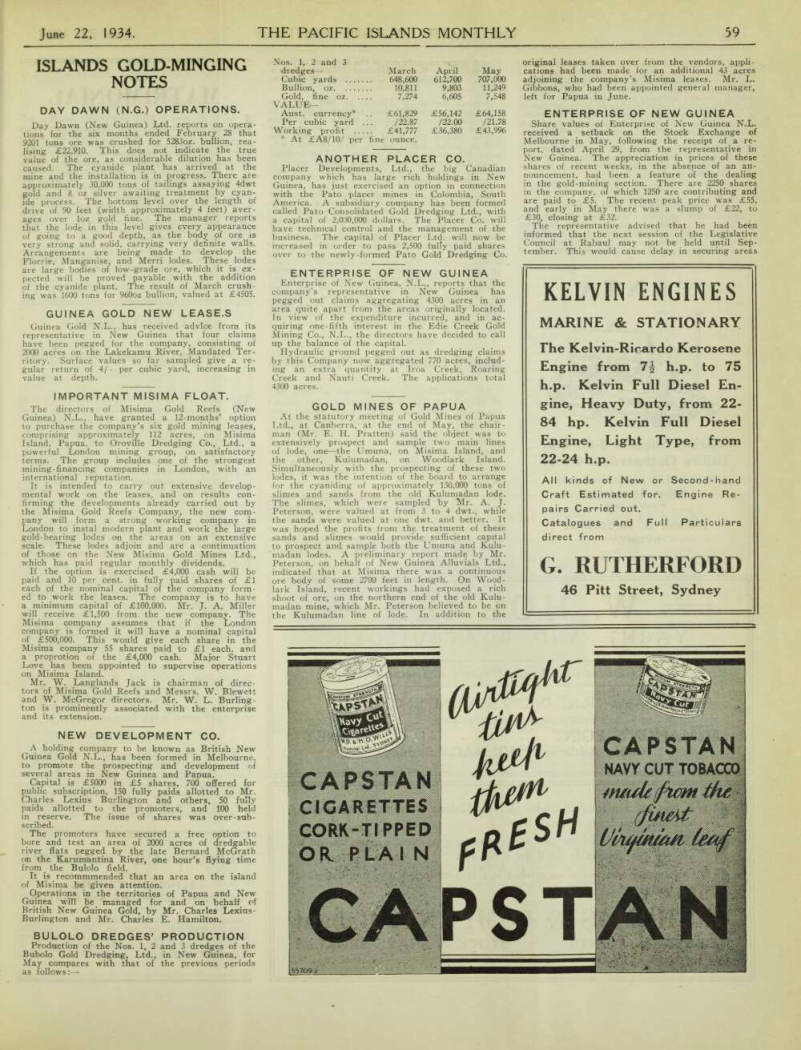
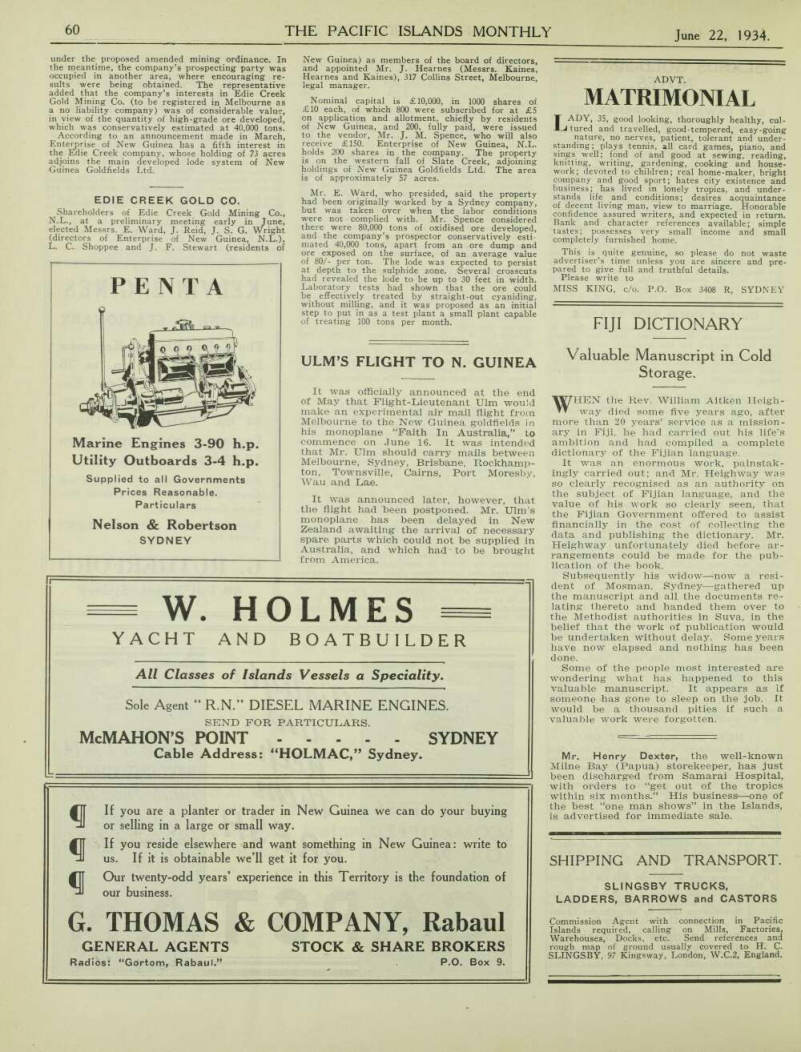
Notes
Day Dawn (N.G.) Operations.
Day Dawn (New Guinea) Ltd. reports on opera tions for the six months ended February 28 that 9201 tons ore was crushed for 5283oz. bullion, realising £22,910. This does not indicate the true value of the ore, as considerable dilution has been caused. The cyanide plant has arrived at the mine and the installation is in progress. There are approximately 30,000 tons of tailings assaying 4dwt gold and 8 oz silver awaiting treatment by cyan ide process. The bottom level over the length of drive of 90 feet (width approximately 4 feet) aver ages over loz gold fine. The manager reports that the lode in this level gives every appearance of going to a good depth, as the body of ore is very strong and solid, carrying very definite walls.
Arrangements are being made to develop the Florrie, Manganise, and Merri lodes. These lodes are large bodies of low-grade ore, which it is ex pected will be proved payable with the addition of the cyanide plant. The result of March crush ing was 1600 tons for 9600 z bullion, valued at £4505.
Guinea Gold New Leases
Guinea Gold N.L., has received advice from its representative in New Guinea that four claims have been pegged for the company, consisting of 2000 acres on the Lakekamu River, Mandated Ter ritory. Surface values so far sampled give a re gular return of 4/ - per cubic yard, increasing in value at depth.
Important Misima Float.
The directors of Misima Gold Reefs (New Guinea) N.L., have granted a 12-months’ option to purchase the company’s six gold mining leases, comprising approximately 112 acres, on Misima Island. Papua, to Oroyille Dredging Co., Ltd., a powerful London mining group, on satisfactory terms. The group includes one of the strongest mining-financing companies in London, with an international reputation.
It is intended to carry out extensive develop mental work on the leases, and on results con firming the developments already carried out by the Misima Gold Reefs Company, the new com pany will form a strong working company in London to instal modern plant and work the large gold-bearing lodes on the areas on an extensive scale. These lodes adjoin and are a continuation of those on the New Misima Gold Mines Ltd., which has paid regular monthly dividends.
If the option is exercised £4,000 cash will be paid and 10 per cent, in fully paid shares of £1 each of the nominal capital of the company form ed to work the leases. The company is to have a minimum capital of £100,000. Mr. J. A. Miller will receive £1,500 from the new company. The Misima company assumes that if the London company is formed it will have a nominal capital of £500,000. This would give each share in the Misima company 55 shares paid to £1 each, and a proprotion of the £4,000 cash. Major Stuart Love has been appointed to supervise operations on Misima Island.
Mr. W. Langlands Jack is chairman of direc tors of Misima Gold Reefs and Messrs. W. Blewett and W. McGregor directors. Mr. W. L. Burling ton is prominently associated with the enterprise and its extension.
New Development Co.
A holding company to be known as British New Guinea Gold N.L., has been formed in Melbourne, to promote the prospecting and development of several areas in New Guinea and Papua.
Capital is £5000 in £5 shares, 700 offered for public subscription, 150 fully paids allotted to Mr.
Charles Lexius Burlington and others, 50 fully paids allotted to the promoters, and 100 held in reserve. The issue of shares was over-sub scribed.
The promoters have secured a free option to bore and test an area of 2000 acres of dredgable river flats pegged by the late Bernard McGrath on the Karumantina River, one hour’s flying time from the Bulolo field.
It is recommmended that an area on the island of Misima be given attention.
Operations in the territories of Papua and New Guinea will be managed for and on behalf of British New Guinea Gold, by Mr. Charles Lexius - Burlington and Mr. Charles E. Hamilton.
Bulolo Dredges’ Production
Production of the Nos. 1, 2 and 3 dredges of the Bubolo Gold Dredging, Ltd., in New Guinea, for May compares with that of the previous periods as follows:
Another Placer Co.
Placer Developments, Ltd., the big Canadian company which has large rich holdings in New Guinea, has just exercised an option in connection with the Pato placer mines in Colombia, South America. A subsidiary company has been formed called Pato Consolidated Gold Dredging Ltd., with a capital of 2,000,000 dollars. The Placer Co. will have technical control and the management of the business. The capital of Placer Ltd. will now be increased in order to pass 2,500 fully paid shares over to the newly-formed Pato Gold Dredging Co.
Enterprise Of New Guinea
Enterprise of New Guinea, N.L., reports that the company’s representative in New Guinea has pegged out claims aggregating 4300 acres in an area quite apart from the areas originally located.
In view of the expenditure incurred, and in ac quiring one-fifth interest in the Edie Creek Gold Mining Co., N.L., the directors have decided to call up the balance of the capital.
Hydraulic ground pegged out as dredging claims by this Company now aggregated 770 acres, includ ing an extra quantity at Iroa Creek, Roaring Creek and Nauti Creek. The applications total 4300 acres.
Gold Mines Of Papua
At the statutory meeting of Gold Mines of Papua Ltd., at Canberra, at the end of May, the chair man (Mr. E. H. Pratten) said the object was to extensively prospect and sample two main lines of lode, one —the Umuna, on Misima Island, and the other, Kulumadan, on Woodlark Island.
Simultaneously with the prospecting of these two lodes, it was the intention of the board to arrange for the cyaniding of approximately 130,000 tons of slimes and sands from the old Kulumadan lode.
The slimes, which were sampled by Mr. A. J.
Peterson, were valued at from 3 to 4 dwt., while the sands were valued at one dwt. and better. It was hoped the profits from the treatment of these sands and slimes would provide sufficient capital to prospect and sample both the Umuna and Kulu madan lodes. A preliminary report made by Mr.
Peterson, on behalf of New Guinea Alluvials Ltd., indicated that at Misima there was a continuous ore body of some 2700 feet in length. On Wood lark Island, recent workings had exposed a rich shoot of ore, on the northern end of the old Kulu madan mine, which Mr. Peterson believed to be on the Kulumadan line of lode. In addition to the
original leases taken over from the vendors, appli cations had been made for an additional 43 acres adjoining the company’s Misima leases. Mr. L.
Gibbons, who had been appointed general manager, left for Papua in June,
Enterprise Of New Guinea
Share values of Enterprise of New Guinea N.L. received a setback on the Stock Exchange of Melbourne in May, following the receipt of a re port, dated April 29, from the representative in New Guinea. The appreciation in prices of these shares of recent weeks, in the absence of an an nouncement, had been a feature of the dealing m the gold-mining section. There are 2250 shares in th e company of which 1250 are contributing and are paid to £5. The recent peak price was £55, and early in May there was a slump of £22, to closing at £32.
The representative advised that he had been informed that the next session of the Legislative Council at Rabau may not be held until Sep tember. This would cause delay m securing areas
Nos. 1, 2 and 3 dredges— March April May Cubic yards 648,600 612,700 707,000 Bullion, oz 10,811 9,803 11,249 Gold, fine oz 7,274 6,605 7,548
Value—
Aust. currency* .. £61,829 £56,142 £64,158 Per cubic yard ... /22.87 /22.00 /21.78 Working profit £41,777 £36,380 £43,996 * At £A8/10/ per fine ounce.
under the proposed amended mining ordinance. In the meantime, the company’s prospecting party was occupied in another area, where encouraging re sults were being obtained. The representative added that the company’s interests in Edie Creek Gold Mining Co. (to be registered in Melbourne as a no liability company) was of considerable value, in view of the quantity of high-grade ore developed, which was conservatively estimated at 40,000 tons.
According to an announcement made in March, Enterprise of New Guinea has a fifth interest in the Edie Creek company, whose holding of 73 acres adjoins the main developed lode system of New Guinea Goldfields Ltd.
Advertisements & other items, p. 61 (1 item)
Capstan
KELVIN ENGINES
MARINE & STATIONARY
The Kelvin-Ricardo Kerosene Engine from 7½ h.p. to 75 h.p. Kelvin Full Diesel Engine, Heavy Duty, from 22- 84 hp. Kelvin Full Diesel Engine, Light Type, from 22-24 h.p.
All kinds of New or Second-hand Craft Estimated for. Engine Repairs Carried out.
Catalogues and Full Particulars direct from
G. RUTHERFORD
46 Pitt Street, Sydney
CAPSTAN
NAVY CUT TOBACCO
CAPSTAN
CIGARETTES
CORK-TIPPED
OR PLAIN
Edie Creek Gold Co.
Shareholders of Edie Creek Gold Mining Co., N.L., at a preliminary meeting early in June, elected Messrs. E. Ward, J. Reid, J. S. G. Wright (directors of Enterprise of New Guinea, N.L.), L. C. Shoppee and J. F. Stewart (residents of
New Guinea) as members of the board of directors, and appointed Mr. J. Hearnes (Messrs. Kaines, Hearnes and Kaines), 317 Collins Street, Melbourne, legal manager.
Nominal capital is £10,000, in 1000 shares of £10 each, of which 800 were subscribed for at £5 on application and allotment, chiefly by residents of New Guinea, and 200, fully paid, were issued to the vendor, Mr. J. M. Spence, who will also receive £150. Enterprise of New Guinea, N.L. holds 200 shares in the company. The property is on the western fall of Slate Creek, adjoining holdings of New Guinea Goldfields Ltd. The area is of approximately 57 acres.
Mr. E. Ward, who presided, said the property had been originally worked by a Sydney company, but was taken over when the labor conditions were not complied with. Mr. Spence considered there were 80,000 tons of oxidised ore developed, and the company’s prospector conservatively esti mated 40,000 tons, apart from an ore dump and ore exposed on the surface, of an average value of 80/- per ton. The lode was expected to persist at depth to the sulphide zone. Several crosscuts had revealed the lode to be up to 30 feet in width.
Laboratory tests had shown that the ore could be effectively treated by straight-out cyaniding, without milling, and it was proposed as an initial step to put in as a test plant a small plant capable of treating 100 tons per month.
Ulm’S Flight To N. Guinea
It was officially announced at the end of May that Flight-Lieutenant Ulm would make an experimental air mail flight from Melbourne to the New Guinea goldfields in his monoplane “Faith In Australia,” to commence on June 16. It was intended that Mr. Ulm should carry mails between Melbourne, Sydney, Brisbane, Rockhamp ton, Townsville, Cairns, Port Moresby, Wau and Lae.
It was announced later, however, that the flight had been postponed, Mr. Ulm’s monoplane has been delayed in New Zealand awaiting the arrival of necessary spare parts which could not be supplied in Australia, and which had to be brought from America,
Fiji Dictionary
Valuable Manuscript in Cold Storage.
WHEN the Rev. William Aitken Heigh way died some five years ago, after more than 20 years’ service as a mission ary in Fiji, he had carried out his life's ambition and had compiled a complete dictionary of the Fijian language.
It was an enormous work, painstak ingly carried out; and Mr. Heighway was so clearly recognised as an authority on the subject of Fijian language, and the value of his work so clearly seen, that the Fijian Government offered to assist financially in the cost of collecting the data and publishing the dictionary. Mr.
Heighway unfortunately died before ar rangements could be made for the pub lication of the book.
Subsequently his widow—now a resi dent of Mosman, Sydney—gathered up the manuscript and all the documents re lating thereto and handed them over to the Methodist authorities in Suva, in the belief that the work of publication would be undertaken without delay. Some years have now elapsed and nothing has been done.
Some of the people most interested are wondering what has happened to this valuable manuscript. It appears as if someone has gone to sleep on the job. It would be a thousand pities if such a valuable work were forgotten.
Mr. Henry Dexter, the well-known Milne Bay (Papua) storekeeper, has just been discharged from Samarai Hospital, with orders to “get out of the tropics within six months.” His business —one of the best “one man shows” in the Islands, is advertised for immediate sale.
Advertisements & other items, p. 62 (3 items)
Matrimonial
ADVT.
LADY, 35, good looking, thoroughly healthy, cultured and travelled, good-tempered, easy-going nature, no nerves, patient, tolerant and understanding; plays tennis, all card games, piano, and sings well; fond of and good at sewing, reading, knitting, writing, gardening, cooking and housework; devoted to children; real home-maker, bright company and good sport; hates city existence and business; has lived in lonely tropics, and understands life and conditions; desires acquaintance of decent living man, view to marriage. Honorable confidence assured writers, and expected in return.
Bank and character references available; simple tastes; possesses very small income and small completely furnished home.
This is quite genuine, so please do not waste advertiser’s time unless you are sincere and prepared to give full and truthful details.
Please write to MISS KING, c/o. P.O. Box 3408 R, SYDNEY
W. Holmes
PEN T A
Marine Engines 3-90 h.p.
Utility Outboards 3-4 h.p.
Supplied to all Governments Prices Reasonable.
Particulars Nelson & Robertson
SYDNEY
W. HOLMES
YACHT AND BOATBUILDER
All Classes of Islands Vessels a Speciality.
Sole Agent “ R.N.” DIESEL MARINE ENGINES.
SEND FOR PARTICULARS.
McMAHON’S POINT SYDNEY
Cable Address: “HOLMAC,” Sydney.
If you are a planter or trader in New Guinea we can do your buying or selling in a large or small way.
If you reside elsewhere and want something in New Guinea: write to us. If it is obtainable we’ll get it for you.
Our twenty-odd years’ experience in this Territory is the foundation of our business.
G. THOMAS & COMPANY, Rabaul
GENERAL AGENTS STOCK & SHARE BROKERS
Radios: “Gortom, Rabaul.” P.O, Box 9.
Shipping And Transport.
SLINGSBY TRUCKS,
LADDERS, BARROWS and CASTORS
Commission Agent with connection in Pacific Islands required, calling on Mills, Factories, Warehouses, Docks, etc. Send references and rough map of ground usually covered to H. C.
SLINGSBY, 97 Kingsway, London, W.C.2, England.
Market Quotations
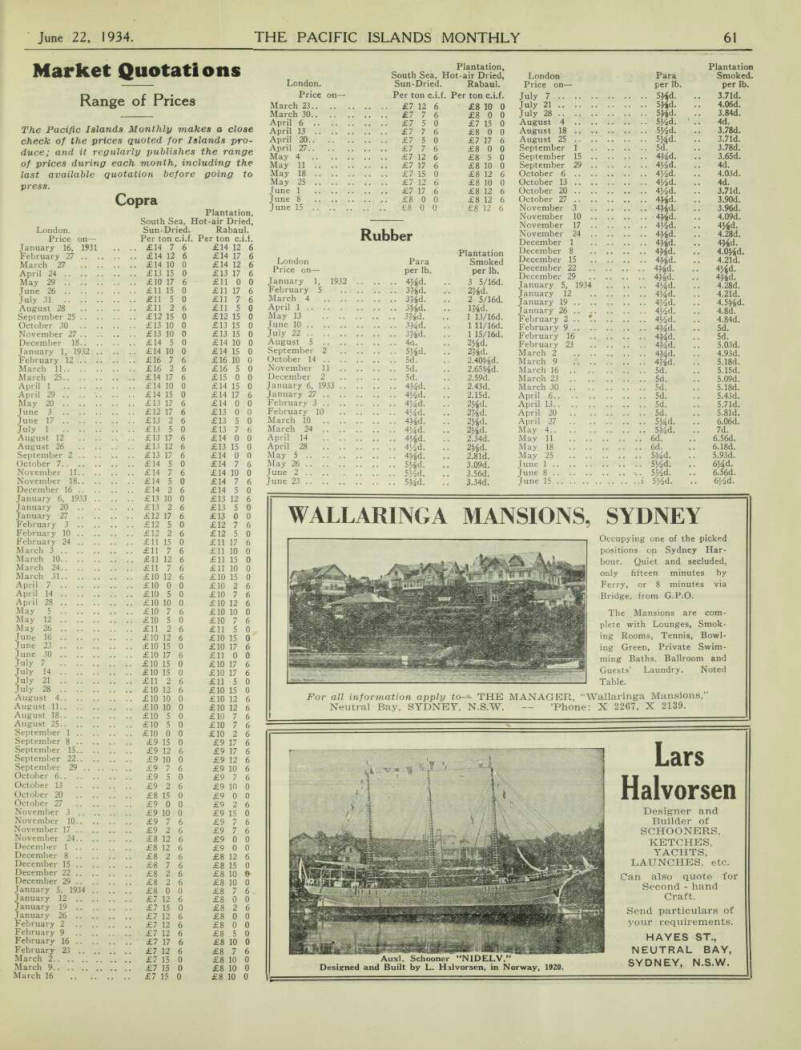
Range of Prices
The Pacific Islands Monthly makes a close check of the prices quoted for Islands pro duce; and it regularly publishes the range of prices during each month, including the last available quotation before going to press.
South Sea,
Plantation,
Hot-air Dried, London.
Sun-Dried, Rabaul.
Price on— Per ton c.i.f.
Per ton c.i.f.
March 23 . .. £7 12 6 £8 10 0 March 30 . .. £7 7 6 £8 0 0 April 6 . .. £7 5 0 £7 15 0 April 13 . .. £7 7 6 £8 0 0 April 20 . .. £7 5 0 £7 17 6 April 27 . .. £7 7 6 £8 0 0 May 4 . .. £7 12 6 £8 5 0 May 11 . .. £7 17 6 £8 10 0 May 18 . .. £7 15 0 £8 12 6 May 25 . .. £7 12 6 £8 10 0 June 1 . .. £7 17 6 £8 12 6 June 8 0 0 £8 12 6 June 15 . .. £8 0 0 £8 12 6
London Para Plantation Smoked.
Price on — per lb. per lb.
July 7 .. .. 5j*d. 3.71d.
July 21 .. .. 5^d. 4.06d.
July 28 .. .. 5Hd. 3.84d.
August 4 .. .. 5%d. 4d.
August 18 .. .. sy 2 d. 3.78d.
August 25 :: ir 3.71d.
September 1 .. .. 3.78d.
September 15 .. .. .. .. 4J4d. 3.6Sd.
September 29 .. .. .. .. 4^d. 4d.
October 6 .. .. V/ 2 d. 4.03d.
October 13 .. .. 4/ a d. 4d.
October 20 .. .. 4'Ad. 3.71d.
October 27 .. .. 4^d. 3.90d.
November 3 .. .. .. .. 4Hd. 3.96d.
November 10 .. .. .. 4^d. 4.09d.
November 17 .. .. .. .. 4Ad. 4J|d.
November 24 .. .. .. .. 4Hd. 4.28d.
December 1 .. .. .. .. 4^d. 4Hd.
December 8 .. .. .. .. 4^d. 4.0yd.
December 15 .. .. .. .. 4Hd. 4.21d.
December 22 .. .. .. .. 4Hd. 4y & d.
December 29 .. .. .. .. 4y & d. 4Hd.
January 5, 1934 .. .. 4J4d. 4.28d.
January 12 .. .. .. .. 4'/ 4 d. 4.21d.
January 19 .. .. 4 l Ad. 4.5^d.
January 26 .. .. 4Ad. 4.8d.
February 2 .. .. .. 4/ 2 d. 4.84d.
February 9 .. .. 4^d. 5d.
February 16 .. .. .. .. 4Hd. 5d.
February 23 .. .. .. .. 43^d. 5.03d.
March 2 .. .. 4yd. .. .. 47/ld. 4.93d.
March 9 S.18d.
March 16 .. .. 5d. 5.15d.
March 23 .. .. 5d. 5.09d.
March 30 .. .. 5d. 5.18d.
April 6 .. .. 5d. 5.43d.
April 13 .. .. Sd. 5.71d.
April 20 .. .. 5d. 5.81d.
April 27 .. .. sy 4 d. 6.06d.
May 4 .. .. 5Hd. 7d.
May 11 6.56d.
May 18 . .. 6d. 6.18d.
May 25 . .. 5Hd. 5.93d.
June 1 . .. sy 2 d. 6.56d.
June 8 5½ d.
June 15 5½ d. 6½d.
Copra
South Sea, Plantation, Hot-air Dried, London.
Sun-Dried.
Rabaul.
Price on — Per ton c.i.f.
Per ton c.i.f.
January 16, 1931 .. .. £14 7 6 £14 12 6 February 27 .. .. .. .. £14 12 6 £14 17 6 March 27 .. .. .. .. £14 10 0 £14 12 6 April 24 .. .. £13 15 0 £13 17 6 May 29 .. .. £10 17 6 £11 0 0 June 26 .. .. £11 15 0 £11 17 6 July 31 .. .. £11 5 0 £11 7 6 August 28 .. .. .. .. £11 2 0 £11 5 0 September 25 .. .. .. .. £12 15 0 £12 15 0 October 30 .. .. .. .. £13 10 0 £13 15 0 November 27 .. .. ., .. £13 10 0 £13 15 0 December 18.. .. .. .. £14 5 0 £14 10 0 January 1, 1932 .. .. .. £14 10 0 £14 15 0 February 12 .. .. .. .. £16 7 6 £16 10 0 March 11 .. .. £16 2 6 £16 5 0 March 25 .. .. £14 17 6 £15 0 0 April 1 .. .. £14 10 0 £14 15 0 April 29 .. .. .. .. .. £14 15 0 £14 17 6 May 20 .. .. £13 17 6 £14 0 0 June 3 .. .. £12 17 6 £13 0 0 June 17 .. .. £13 2 6 £13 5 0 July 1 .. .. £13 5 0 £13 7 6 August 12 .. .. .. .. £13 17 6 £14 0 0 August 26 .. .. .. .. £13 12 6 £13 15 0 September 2 .. .. .. .. £13 17 6 £14 0 0 October 7 .. .. £14 5 0 £14 7 6 November 11.. .. .. £14 7 6 £14 10 0 November 18.. .. .. .. £14 5 0 £14 7 6 December 16 .. .. .. .. £14 2 6 £14 5 0 January 6, 1933 .. .. .. £13 10 0 £13 12 6 January 20 .. .. .. £13 2 6 £13 5 0 January 27 .. .. .. .. £12 17 6 £13 0 0 February 3 .. .. .. .. £12 5 0 £12 7 6 February 10 .. .. .. .. £12 2 6 £12 5 0 February 24 .. .. .. .. £11 15 0 £11 17 6 March 3 .. .. £11 7 6 £11 10 0 March 10 6 £11 15 0 March 24 .. .. £11 7 6 £11 10 0 March 31 .. .. £10 12 6 £10 15 0 April 7 .. .. £10 0 0 £10 2 6 April 14 .. .. £10 5 0 £10 7 6 April 28 .. .. £10 10 0 £10 12 6 May 5 .. .. £10 7 6 £10 10 0 May 12 .. .. £10 5 0 £10 7 6 May 26 .. .. £11 2 6 £11 5 0 June 16 .. .. £10 12 6 £10 15 0 June 23 .. .. £10 15 0 £10 17 6 June 30 .. .. £10 17 6 £11 0 0 July 7 .. .. £10 15 0 £10 17 6 July 14 0 £10 17 6 July 21 .. .. £11 2 6 £11 5 0 July 28 6 £10 15 0 August 4 .. .. £10 10 0 £10 12 6 August 11 .. .. £10 10 0 £10 12 6 August 18 0 £10 7 6 August 25 .. .. £10 5 0 £10 7 6 September 1 .. .. .. £10 0 0 £10 2 6 September 8 .. .. .. .. £9 15 0 £9 17 6 September 15.. .. ... £9 12 6 £9 17 6 September 22.. .. .. .. £9 10 0 £9 12 6 September 29 .. .. ... £9 7 6 £9 10 6 October 6 .. .. £9 5 0 £9 7 6 October 13 .. .. .. .. £9 2 6 £9 10 0 October 20 .. .. .. .. £8 15 0 £9 0 0 October 27 .. .. .. .. £9 0 0 £9 2 6 November 3 .. .. ... £9 10 0 0 November 10.. .. .. £9 7 6 £9 7 6 November 17 .. .. .. £9 2 6 £9 7 6 November 24.. .. .. .. £8 12 6 £9 0 0 December 1 .. ... £8 12 6 £9 0 0 December 8 .. .. .. .. £8 2 6 £8 12 6 December 15 .. .. .. .. £8 7 6 £8 15 0 December 22 .. .. .. .. £8 2 6 £8 10 0 December 29 .. .. .. £8 2 6 £8 10 0 January 5, 1934 .. .. .. £8 0 0 £8 7 6 January 12 .. .. ... £7 12 6 £8 0 0 January 19 .. .. 0 £8 2 6 January 26 .. .. .. .. £7 12 6 £8 0 0
February 2 .. ..
6 £8 0 0 February 9 .. .. £7 12 6 £8 5 0 February 16 .. .. 6 £8 10 0
February 23 .. ..
.. .. £7 12 6 £8 7 6 March 2 0 £8 10 0 March 9 ... £7 15 0 £8 10 0 March 16 .. .. £7 15 0 £8 10 0
London
Rubber
Para Plantation Smoked Price on— per lb. per lb.
January 1, 1932 February 5 4^d. 3 5/16d. md. 2Vid.
March 4 .. .. md. 2 5/16d.
April 1 md.
V/kd.
May 13 .. .. md. 1 13/16d.
June 10 md. 1 ll/16d.
July 22 md. 1 15/16d.
August 5 .. .. 2^d.
September 2 md. 2m.
October 14 .. 5d. 2.405/id.
November 11 .. 5d. 2.65^d.
December 2 5d. 2.59d.
January 6, 1933 .. 4¾d. 2.43d.
January 27 .. .. 4½d. 2.15d.
February 3 .. .. md. 2^d.
February 10 4¼d. 2V*d.
March 10 .. .. md. 2%d.
March 24 .. 4¼d. md- April 14 ... md. 2.34d.
April 28 ... 4½d. 2m.
May 5 2.81d.
May 26 md. 3.09d.
June 2 5½ d. 3.56d.
June 23 5¾d. 3.34d.
Advertisements & other items, p. 63 (1 item)
Halvorsen
WALLARINGA MANSIONS, SYDNEY
Occupying one of the picked positions on Sydney Harbour. Quiet and secluded, only fifteen minutes by Ferry, or 8 minutes via Bridge, from G.P.O.
The Mansions are complete with Lounges, Smoking Rooms, Tennis, Bowling Green, Private Swimming Baths, Ballroom and Guests’ Laundry, Noted Table.
For all information apply to— THE MANAGER, “Wallaringa Mansions,”
Neutral Bay, SYDNEY, N.S.W. ’Phone: X 2267, X 2139.
Auxl. Schooner “NIDELV,”
Designed and Built by L. Halvorsen, in Norway, 1920.
Lars
Halvorsen
Designer and Builder of
SCHOONERS,
KETCHES,
YACHTS,
LAUNCHES, etc.
Can also quote for Second - band Craft.
Send particulars of your requirements.
HAYES ST.,
NEUTRAL BAY,
SYDNEY, N.S.W.
Exchange Rates
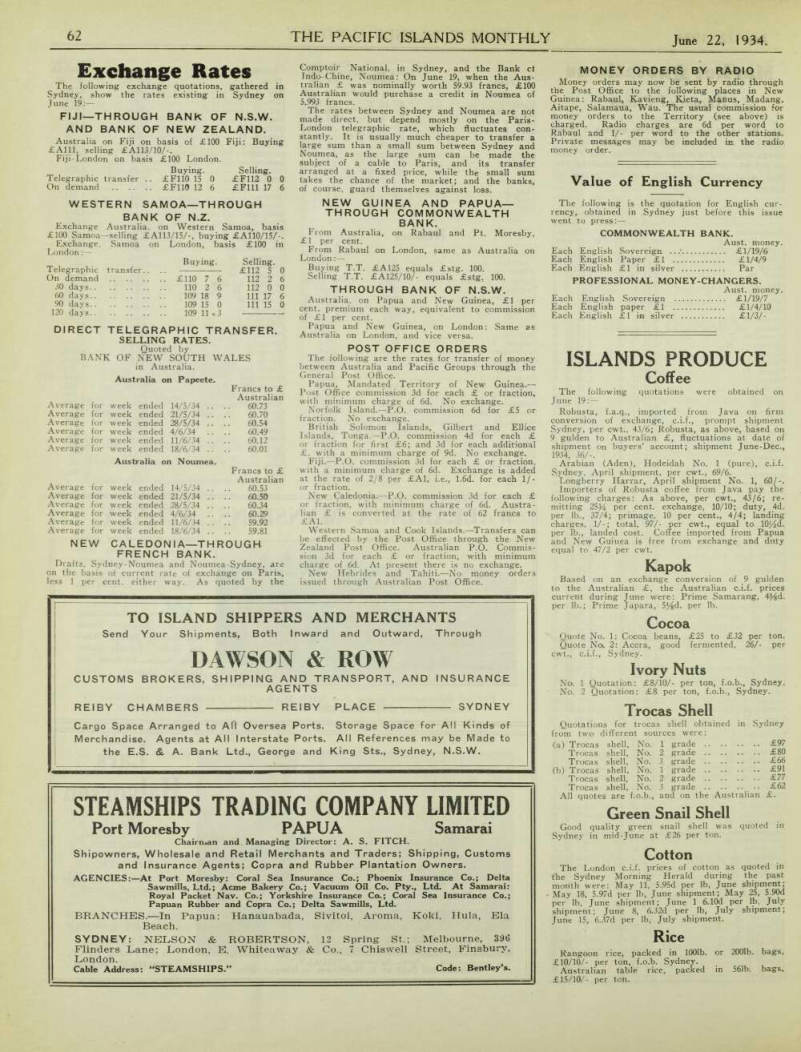
The following exchange quotations, gathered in Sydney, show the rates existing in Sydney on June 19: —
Fiji—Through Bank Of N.S.W.
And Bank Of New Zealand.
Australia on Fiji on basis of £100 Fiji: Buying £A111, selling £A113/10/-.
Fiji-London on basis £100 London.
Western Samoa—Through
Bank Of N.Z.
Exchange Australia, on Western Samoa, basis £100 Samoa —selling £A113/15/-, buying £A110/15/-.
Exchange, Samoa on London, basis £100 in London;—
Direct Telegraphic Transfer.
Selling Rates.
Quoted by
Bank Of New South Wales
in Australia.
Australia on Papeete.
New Caledonia—Through
French Bank.
Drafts, Sydney-Noumea and Noumea-Sydney, are on the basis of current rate of exchange on Paris, less 1 per cent, either way. As quoted by the
Comptoir National, in Sydney, and the Bank cf Indo-Chine, Noumea: On June 19, when the Aus tralian £ was nominally worth 59.93 francs, £100 Australian would purchase a credit in Noumea of 5,993 francs.
The rates between Sydney and Noumea are not made direct, but depend mostly on the Paris- London telegraphic rate, which fluctuates con stantly. It is usually much cheaper to transfer a large sum than a small sum between Sydney and Noumea, as the large sum can be made the subject of a cable to Paris, and its transfer arranged at a fixed price, while the small sura takes the chance of the market; and the banks, of course, guard themselves against loss.
New Guinea And Papua
Through Commonwealth
Bank.
From Australia, on Rabaul and Pt. Moresby, £1 per cent.
From Rabaul on London, same as Australia on London: — Buying T.T. £A125 equals £stg. 100.
Selling T.T. £A125/10/- equals £stg, 100.
Through Bank Of N.S.W.
Australia, on Papua and New Guinea, £1 per cent, premium each way, equivalent to commission of £1 per cent.
Papua and New Guinea, on London: Same as Australia on London, and vice versa.
Post Office Orders
The following are the rates for transfer of money between Australia and Pacific Groups through the General Post Office.
Papua, Mandated Territory of New Guinea.— Post Office commission 3d for each £ or fraction, with minimum charge of 6d. No exchange.
Norfolk Island.—P.O. commission 6d for £5 or fraction. No exchange.
British Solomon Islands, Gilbert and Ellice Islands, Tonga.—P.O. commission 4d for each £ or fraction for first £6; and 3d for each additional £, with a minimum charge of 9d. No exchange, Fiji.—P.O. commission 3d for each £ or fraction, with a minimum charge of 6d. Exchange is added at the rate of 2/8 per £A1, i.e., 1.6 d. for each 1/or fraction.
New Caledonia. —P.O. commission 3d for each £ or fraction, with minimum charge of 6d. Austra lian £ is converted at the rate of 62 francs to £AI.
Western Samoa and Cook Islands. —Transfers can be effected by the Post Office through the New Zealand Post Office. Australian P.O. Commis sion 3d for each £ or fraction, with minimum charge of 6d. At present there is no exchange.
New Hebrides and Tahiti.—No money orders issued through Australian Post Office.
Money Orders By Radio
Money orders may now be sent by radio through the Post Office to the following places in New Guinea: Rabaul, Kavieng, Kieta, Manus, Madang, Aitape, Salamaua, Wau. The usual commission for money orders to the Territory (see above) is charged. Radio charges are 6d per word to Rabaul and 1/- per word to the other stations.
Private messages may be included in the radio money order.
Telegraphic transfer .
Buying.
Selling. £F110 15 0 £F112 0 0 On demand £F110 12 6 £F111 17 6
Buying. Selling.
Telegraphic transfer.. .. £112 5 0 On demand £110 7 6 112 2 6 30 days 110 2 6 112 0 0 60 days 109 18 9 111 17 6 90 days 109 15 0 111 15 0 120 days 109 11.3
Average for week ended 14/5/34 .. 60.73 Francs to £ Australian Average for week ended 21/5/34 .. 60.70 Average for week ended 28/5/34 .. 60.54 Average for week ended 4/6/34 .. 60.49 Average for week ended 11/6/34 .. 60.12 Average for week ended 18/6/34 .. 60.01 Average for week ended 14/5/34 .. 60.53 Australia on Noumea.
Francs to £ Australian Average for week ended 21/5/34 .. 60.50 Average for week ended 28/5/34 .. 60.34 Average for week ended 4/6/34 .. 60.29 Average for week ended 11/6/34 .. 59.92 Average for week ended 18/6/34 .. 59.81
Value of English Currency
The following is the quotation for English cur rency, obtained in Sydney just before this issue went to press:—
Commonwealth Bank.
Aust. money, Each English Sovereign .. £1/19/6 Each English Paper £1 £1/4/9 Each English £1 in silver
Professional Money-Changers.
Aust. money.
Each English Sovereign £1/19/7 Each English paper £1 £1/4/10 Each English £1 in silver £1/3/-
Islands Produce
Coffee
The following quotations were obtained on June 19: — Robusta, f.a.q., imported from Java on firm conversion of exchange, c.i.f., prompt shipment Sydney, per cwt., 43/6; Robusta, as above, based on 9 gulden to Australian £, fluctuations at date of shipment on buyers’ account; shipment June-Dee., 1934, 36/-.
Arabian (Aden), Hodeidah No. 1 (pure), c.i.f.
Sydney, April shipment, per cwt., 69/6.
Longberry Harrar, April shipment No. 1, 60/-.
Importers of Robusta coffee from Java pay the following charges: As above, per cwt., 43/6; re mitting pet cent, exchange, 10/10; duty, 4d. per lb., 37/4; primage, 10 per cent., 4/4; landing charges, 1/-; total, 97/- per cwt., equal to 10½d. per lb., landed cost. Coffee imported from Papua and New Guinea is free from exchange and duty equal to 47/2 per cwt.
Kapok
Based on an exchange conversion of 9 gulden to the Australian £, the Australian c.i.f. prices current during June were: Prime Samarang, 4 5/8d. per lb.; Prime Japara, sysd. per lb.
Cocoa
Quote No. 1: Cocoa beans, £25 to £32 per ton.
Quote No. 2; Accra, good fermented, 26/- per cwt., c.i.f., Sydney.
Ivory Nuts
No. 1 Quotation: £8/10/- per ton, f.o.b., Sydney.
No. 2 Quotation: £8 per ton, f.o.b., Sydney.
Trocas Shell
Quotations for trocas shell obtained in Sydney from two different sources were: (a) Trocas shell, No. 1 grade £97 Trocas shell, No. 2 grade £80 Trocas shell, No. 3. grade £66 (b) Trocas shell. No. 1 grade £91 Trocas shell, No. 2 grade £77 Trocas shell, No. 3 grade £62 All quotes are f.o.b., and on the Australian £.
Green Snail Shell
Good quality green snail shell was quoted in Sydney in mid-June at £26 per ton.
Cotton
The London c.i.f. prices of cotton as quoted in the Sydney Morning Herald during the past month were: May 11, 5.95 d per lb, June shipment; May 18, 5.97 d per lb, June shipment; May 25, 5.90 d per lb, June shipment; June 1 6.10 d per lb, July shipment; June 8,6.32 d per lb, July shipment; June 15, 6.37 d per lb, July shipment.
Rice
Rangoon rice, packed in 1001 b. or 2001 b. bags, £10/10/- per ton, f.o.b. Sydney.
Australian table rice, packed in 561 b. bags, £15/10/- per ton.
Advertisements & other items, p. 64 (1 item)
Steamships Trading Company Limited
TO ISLAND SHIPPERS AND MERCHANTS
Send Your Shipments, Both Inward and Outward, Through
DAWSON & ROW
CUSTOMS BROKERS, SHIPPING AND TRANSPORT, AND INSURANCE
AGENTS
REIBY CHAMBERS REIBY PLACE SYDNEY
Cargo Space Arranged to All Oversea Ports. Storage Space for All Kinds of Merchandise. Agents at All Interstate Ports. All References may be Made to the E.S. & A. Bank Ltd., George and King Sts., Sydney, N.S.W.
STEAMSHIPS TRADING COMPANY LIMITED
Port Moresby PAPUA Samarai
Chairnian and Managing Director: A. S. FITCH.
Shipowners, Wholesale and Retail Merchants and Traders; Shipping, Customs and Insurance Agents; Copra and Rubber Plantation Owners.
AGENCIES:—At Port Moresby: Coral Sea Insurance Co.; Phoenix Insurance Co.; Delta Sawmills, Ltd.; Acme Bakery Co,; Vacuum Oil Co. Pty., Ltd. At Samarai; Royal Packet Nav. Co.; Yorkshire Insurance Co.; Coral Sea Insurance Co.; Papuan Rubber and Copra Co.; Delta Sawmills, Ltd.
BRANCHES.—In Papua: Hanauabada, Sivitoi, Aroma, Koki, Hula, Ela Beach.
SYDNEY: NELSON & ROBERTSON, 12 Spring St.; Melbourne, 396 Flinders Lane; London, E. Whiteaway & Co., 7 Chiswell Street, Finsbury, London.
Cable Address: “STEAMSHIPS.” Code: Bentley’s.
Shipping Services in the Pacific
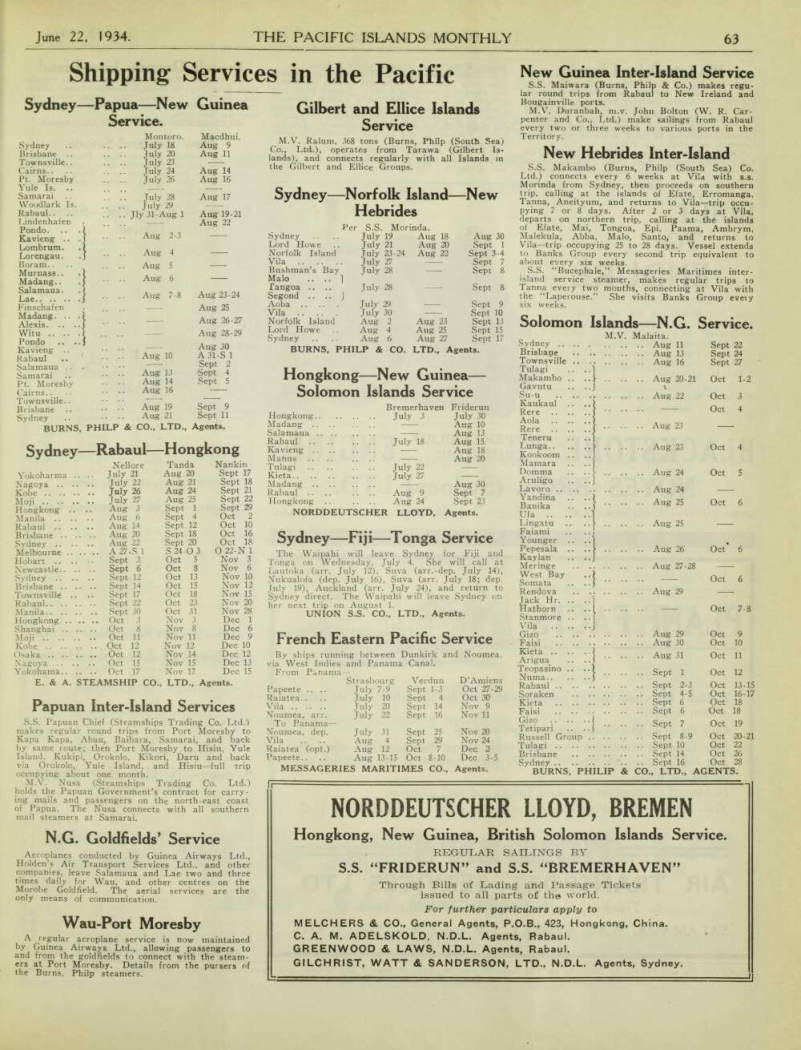
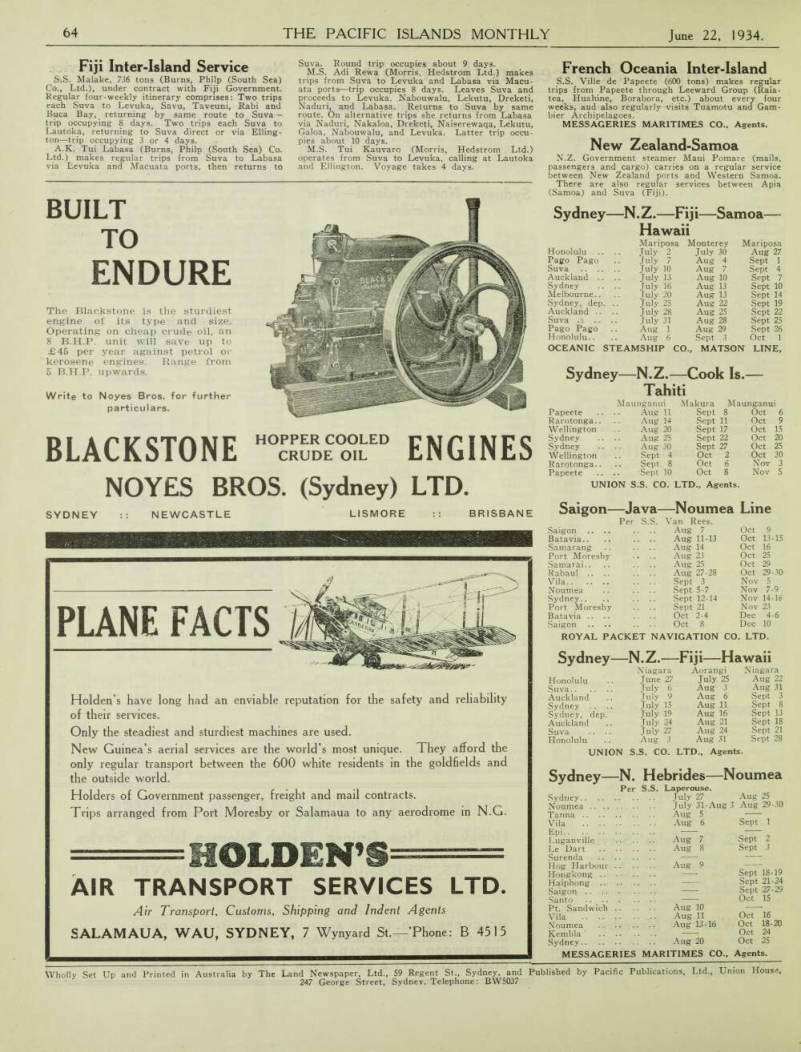
Sydney—Papua—New Guinea Service.
Sydney—Rabaul —Hongkong
Papuan Inter-Island Services
S.S. Papuan Chief (Steamships Trading Co. Ltd.) makes regular round trips from Port Moresby to Kapa Kapa, Abau, Baibara, Samarai, and back by same route; then Port Moresby to Hisiu, Yule Island, Kukipi, Orokolo, Kikori, Daru and back via Orokolo, Yule Island, and Hisiu—full trip occupying about one month.
M.V. Nusa (Steamships Trading Co. Ltd.) holds the Papuan Government’s contract for carry ing mails and passengers on the north-east coast of Papua. The Nusa connects with all southern mail steamers at Samarai.
N.G. Goldfields’ Service
Aeroplanes conducted by Guinea Airways Ltd., Holden’s Air Transport Services Ltd., and other companies, leave Salamaua and Lae two and three times daily for Wau, and other centres on the Morobe Goldfield. The aerial services are the only means of communication.
Wau-Port Moresby
A regular aeroplane service is now maintained by Guinea Airways Ltd., allowing passengers to and from the goldfields to connect with the steam ers at Port Moresby. Details from the pursers of the Burns, Philp steamers.
Gilbert and Ellice Islands Service M.V. Ralum, 368 tons (Burns, Philp (South Sea) Co., Ltd.), operates from Tarawa (Gilbert Is lands), and connects regularly with all Islands in the Gilbert and Ellice Groups.
Sydney—Norfolk Island —New Hebrides
Hongkong—New Guinea— Solomon Islands Service
Sydney—Fiji—Tonga Service
The Waipahi will leave Sydney for Fiji and Tonga on Wednesday, July 4. She will call at Lautoka (arr. July 12), Suva (arr.-dep. July 14), Nukualofa (dep. July 16), Suva (arr. July 18; dep.
July 19), Auckland (arr. July 24), and return to Sydney direct. The Waipahi will leave Sydney on her next trip on August 1.
Union S.S. Co., Ltd., Agents.
French Eastern Pacific Service
New Guinea Inter-Island Service
S.S. Maiwara (Burns, Philp & Co.) makes regular round trips from Rabaul to New Ireland and Bougainville ports.
M.V. Duranbah, m.v. John Bolton (W. R. Car penter and Co., Ltd.) make sailings from Rabaul every two or three weeks to various ports in the Territory.
New Hebrides Inter-Island
S.S. Makambo (Burns, Philp (South Sea) Co.
Ltd.) connects every 6 weeks at Vila with s.s.
Morinda from Sydney, then proceeds on southern trip, calling at the islands of Efate, Erromanga, Tanna, Aneityum, and returns to Vila—trip occu pying 7 or 8 days. After 2 or 3 days at Vila, departs on northern trip, calling at the islands of Efate, Mai, Tongoa, Epi, Paama, Ambrym, Malekula, Abba, Malo, Santo, and returns to Vila—trip occupying 25 to 28 days. Vessel extends to Banks Group every second trip equivalent to about every six weeks.
S.S. “Bucephale,” Messageries Maritimes interisland service steamer, makes regular trips to Tanna every two months, connecting at Vila with the “Laperouse.” She visits Banks Group evety six weeks.
Solomon Islands—N.G. Service.
Montoro.
Macdhui.
Sydney .. .. July 18 Aug 9 Brisbane .. .. July 20 Aug 11 Townsville.. .. .. July 23 — Cairns.. .. .. July 24 Aug 14 Pt. Moresby .. .. July 26 Aug 16 Vule Is. .. — Samarai .. .. July 28 Aug 17 Woodlark Is. .. .. July 29 — Rabaul.
Lindenhafen .. .. Jly 31-Aug 1 Aug 19-21 Aug 22 Pondo.
Kavieng .. . .. .. Aug 2-3 Lombrum. .. .. Aug 4 Lorengau.
Boram.. .. .. Aug 5 — Murnass..
Madang.. .. .. Aug 6 Salamaua. .
Lae .. .. Aug 7-8 Aug 23-24 Finschafen Aug 25 Madang. ..
Alexis Aug 26-27 Witu Aug 28-29 Pondo .. ..
Kavieng ..
Rabaul .. .. Aug 10 Aug 30 A 31-S 1 Salamaua ..
Sept 2 Samarai .. .. Aug 13 Sept 4 Pt. Moresby Aug 14 Sept 5 Cairns.. .. .. Aug 16 — Townsville..
Brisbane .. .. Aug 19 Sept 9 Sydney .. .. Aug 21 Sept 11
Burns, Philp & Co., Ltd., Agents.
Nellore Tanda Nankin Yokoharma .. .. July 21 Aug 20 Sept 17 Nagoya .. .. .. July 22 Aug 21 Sept 18 Kobe .. ..
Aug 24 Sept 21 Moji .. .. .. .. July 27 Aug 25 Sept 22 Hongkong . . .. Aug 3 Sept 1 Sept 29 Manila .. .
Sept 4 Oct 2 Rabaul .. .
Sept 12 Oct 10 Brisbane ..
Sept 18 Oct 16 Sydney .. .
Sept 20 Oct 18 Melbourne .. ... A 27-S 1 S 24-0 3 0 22-N 1 Hobart ..
Oct 5 Nov 3 Newcastle..
Oct 8 Nov 6 Sydney .. .
Oct 13 Nov 10 Brisbane ..
Oct 15 Nov 12 Townsville . . .. Sept 17 Oct 18 Nov 15 Rabaul.. .. .. .. Sept 22 Oct 23 Nov 20 Manila.. ..
Oct 31 Nov 28 Hongkong .. .. .. Oct 3 Nov 3 Dec 1 Shanghai .. .. .. Oct 8 Nov 8 Dec 6 Moji .. .. .. .. Oct 11 Nov 11 Dec 9 Kobe .. .. .. .. Oct 12 Nov 12 Dec 10 Osaka .. .. .. .. Oct 12 Nov 14 Dec 12 Nagoya .. .. .. Oct 15 Nov 15 Dec 13 Yokohama.. .. .. Oct 17 Nov 17 Dec 15 E. & A.
Steamship Co., Ltd., Agents.
Per S.S. Morinda.
Sydney Tuly 19 Aug 18 Aug 30 Lord Howe July 21 Aug 20 Sept 1 Norfolk Island Tuly 23-24 Aug 22 Sept 3-4 Vila July 27 — Sept 7 Bushman’s Bay Malo .. ..
Tangoa .. ..
Segond .. ..
July 28 — Sept 8 July 28 — Sept 8 Aoba July 29 — Sept 9 Vila July 30 — Sept 10 Norfolk Island Aug 2 Aug 23 Sept 13 Lord Howe Aug 4 Aug 25 Sept IS Sydney Aug 6 Aug 27 Sept 17
Burns, Philp & Co. Ltd., Agents.
Bremerhaven Friderun Hongkong..
July 30 Madang .. .
Aug 10 Salamaua ..
Aug 13 Rabaul .. .. July 18 Aug 15 Kavieng .. . — Aug 18 Manus .. ..
Aug 20 Tulagi .. .. July 22 — Kieta July 27 — Madang .. .
Aug 30 Rabaul .. .. Aug 9 Sept 7 Hongkong .. .. .. Aug 24 Sept 23
Norddeutscher Lloyd, Agents.
By ships running between Dunkirk and Noumea, via West Indies and Panama Canal.
From Panama— Strasbourg Verdun D’Amiens Papeete .. ..
July 7-9 Sept 1-3 Oct 27-29 Raiatea..
July 10 Sept 4 Oct 30 Vila
July 20
Sept 14 Nov 9 Noumea, arr.
To Panama— July 22 Sept 16 Nov 11 Noumea, dep.
July 31 Sept 25 Nov 20 Vila ..
Aug 4 Sept 29 Nov 24 Raiatea (opt.) Aug 12 Oct 7 Dec 2 Papeete..
Aug 13-15 Oct 8-10 Dec 3-5
Messageries Maritimes Co., Agents.
M.V. Malaita.
Sydney Sept 22 Brisbane .. .
Sept 24 Townsville .. .
Sept 27 Tulagi .. ..
Makambo .. ..
Oct 1-2 Gavutu .. ..
Su-u .. Aug 22 Oct Oct 3 Kaukaul .. ..
Rere 4 Aola .. Aug 23 Rere Teneru .. ..
Lunga Oct 4 Kookoom ..
Mamara Domma .. ..
Oct 5 Aruligo .. ..
Lavoro Yandina .. ..
Banika Oct 6 Ufa Lingatu ..
Faiami .. . .
Younger .. .
Pepesala .. .. .. Aug 26 Oct 6 Kaylan .. ..
Meringe Aug 27-28 West Bay ..
Oct 5 Somata .. ..
Rendova Aug 29 Jack Hr Hathorn .. ..
Oct 7-8 Stanmore .. ..
Vila Gizo Oct 9 Faisi Oct 10 Kieta
Arigua .. .
.. Aug 31 Oct 11 Teopasino ..
Numa .. Sept 1 Oct 12 Rabaul Oct 13-15 Soraken .. ..
Oct 16-17 Kieta Oct 18 Faisi Oct 18 Gizo .. Sept 7 Oct 19 Tetipari .. ..
Russell Group .. .. Sept 8-9 Oct 20-21 Tulagi Oct 22 Brisbane .. ..
Oct 26 Sydney Oct 28
Burns, Philip & Co., Ltd., Agents.
Fiji Inter-Island Service S.S. Malake, 736 tons (Burns, Philp (South Sea) Go., Ltd,), under contract with Fiji Government.
Regular four-weekly itinerary comprises: Two trips each Suva to Levuka, Savu, Taveuni, Rabi and Buca Bay, returning by same route to Suva trip occupying 8 days. Two trips each Suva to Lautoka, returning to Suva direct or via Ellington—trip occupying 3 or 4 days.
A.K. Tui Labasa (Burns, Philp (South Sea) Co.
Ltd.) makes regular trips from Suva to Labasa via Levuka and Macuata ports, then returns to
Suva. Round trip occupies about 9 days.
M.S. Adi Rewa (Morris. Hedstrom Ltd.) makes trips from Suva to Levuka and Labasa via Macu ata ports—trip occupies 8 days. Leaves Suva and proceeds to Levuka, Nabouwalu, Lekutu, Dreketi, Naduri, and Labasa. Returns to Suva by same route. On alternative trips she returns from Labasa via Naduri, Nakaloa, Dreketi, Naiserewaqa, Lekutu, Galoa, Nabouwalu, and Levuka. Latter trip occu pies about 10 days.
M.S. Tui Kauvaro (Morris, Hedstrom Ltd.) operates from Suva to Levuka, calling at Lautoka and Ellington. Voyage takes 4 days.
French Oceania Inter-Island
S.S. Ville de Papeete (600 tons) makes regular trips from Papeete through Leeward Group (Raia tea, Huahine, Borabora, etc.) about every four weeks, and also regularly visits Tuamotu and Gam bier Archipelagoes.
Messageries Maritimes Co., Agents.
New Zealand-Samoa
N.Z. Government steamer Maui Pomare (mails, passengers and cargo) carries on a regular service between New Zealand ports and Western Samoa.
There are also regular services between Apia (Samoa) and Suva (Fiji).
Sydney—N. Z.—Fiji—Samoa—
Hawaii
Sydney—N.Z.—Cook Is.— Tahiti
Saigon—Java—Noumea Line
Sydney—N. Z.—Fiji—Hawaii
Sydney—N. Hebrides —Noumea
Mariposa Monterey Mariposa Honolulu July 2 July 30 Aug 27 Pago Pago July 7 Aug 4 Sept 1 Suva July 10 Aug 7 Sept 4 Auckland .. ..
July 13 Aug 10 Sept 7 Sydney .. ..
July 16 Aug 13 Sept 10 Melbourne..
July 20 Aug 13 Sept 14 Sydney, dep. ..
July 25 Aug 22 Sept 19 Auckland ..
July 28 Aug 25 Sept 22 Suva .. ..
July 31 Aug 28 Sept 25 Pago Pago Aug 1 Aug 29 Sept 26 Honolulu..
Aug 6 Sept 3 Oct 1
Oceanic Steamship Co., Matson Line,
Maunganui Makura Maunganui Papeete Aug 11 Sept 8 Oct 6 Rarotonga..
Aug 14 Sept 11 Oct 9 Wellington Aug 20 Sept 17 Oct 15 Sydney Aug 25 Sept 22 Oct 20 Sydney Aug 30 Sept 27 Oct 25 Wellington .. Sept 4 Oct 2 Oct 30 Rarotonga.. .. Sept 8 Oct 6 Nov 3 Papeete .. Sept 10 Oct 8 Nov 5
Union S.S. Co. Ltd., Agents.
Per S.S. Van Rees.
Saigon .. ..
Aug 7 Oct 9 Batavia..
Aug 11-13 Oct 13-15 Samarang Aug 14 Oct 16 Port Moresby Aug 23 Oct 25 Samarai..
Aug 25 Oct 29 Rabaul .. ..
Aug 27-28 Oct 29-30 Vila Sept 3 Nov 5 Noumea Sept 5-7 Nov 7-9 Sydney..
Sept 12-14 Nov 14-16 Port Moresby Sept 21 Nov 23 Batavia ..
Oct 2-4 Dec 4-6 Saigon .. ..
Oct 8 Dec 10
Royal Packet Navigation Co. Ltd.
Niagara Aorangi Niagara Honolulu June 27 July 25 Aug 22 Suva July 6 Aug 3 Aug 31 Auckland July 9 Aug 6 Sept 3 Sydney July 15 Aug 11 Sept 8 Sydney, dep.
July 19 Aug 16 Sept 13 Auckland July 24 Aug 21 Sept 18 Suva ..
July 27 Aug 24 Sept 21 Honolulu Aug 3 Aug 31 Sept 28
Union S.S. Co. Ltd., Agents.
Per S.S. Laperouse.
Sydney July 27 Aug 25 Noumea July 31-Aug 3 Aug 29-30 Tanna — Vila Sept 1 — Luganville Aug 7 Sept 2 Le Dart Sept 3 Surenda Hog Harbour ..
Aug 9 — Hongkong — Sept 18-19 Haiphong — Sept 21-24 Saigon — Sept 27-29 Santo — Oct 15 Pt. Sandwich ..
Aug 10 — Vila Oct 16 Noumea Aug 13-16 Oct 18-20 Kembla — Oct 24 Sydney Aug 20 Oct 25
Messageries Maritimes Co., Agents.
Advertisements & other items, pp. 65-68 (2 items)
Norddeutscher Lloyd, Bremen
Hongkong, New Guinea, British Solomon Islands Service.
REGULAR SAILINGS BY
S.S. “FRIDERUN” and S.S. “BREMERHAVEN”
Through Bills of Lading and Passage Tickets issued to all parts of the world.
For further particulars apply to MELCHERS & CO., General Agents, P.O.B., 423, Hongkong, China.
C. A. M. ADELSKOLD, N.D.L. Agents, Rabaul.
GREENWOOD & LAWS, N.D.L. Agents, Rabaul.
GILCHRIST, WATT & SANDERSON, LTD., N.D.L. Agents, Sydney.
BUILT
TO
ENDURE
The Blackstone is the sturdiest engine of its type and size.
Operating on cheap crude oil, an 8 B.H.P. unit will save up to £45 per year against petrol or kerosene engines. Range from 5 B.H.P. upwards.
Write to Noyes Bros, for further particulars.
BLACKSTONE CRUDE OIL ENGINES
NOYES BROS. (Sydney) LTD.
SYDNEY NEWCASTLE LISMORE BRISBANE
PLANE FACTS
Holden’s have long had an enviable reputation for the safety and reliability of their services.
Only the steadiest and sturdiest machines are used.
New Guinea’s aerial services are the world’s most unique. They afford the only regular transport between the 600 white residents in the goldfields and the outside world.
Holders of Government passenger, freight and mail contracts.
Trips arranged from Port Moresby or Salamaua to any aerodrome in N.G.
HOLDEN’S
AIR TRANSPORT SERVICES LTD.
Air Transport, Customs, Shipping and Indent Agents SALAMAUA, WAU, SYDNEY, 7 Wynyaid St.—’Phone: B 4515
Staffed and Equipped to Carry
on One of the Biggest Aerial
Transport Services in the World
One of the four Bulolo dredges ,
nearly ready for operation. All
this heavy machinery was carried
in by aeroplanes.
With its giant Three-motored Aeroplanes, and its large staff of Experienced Pilots and Expert Mechanics, Guinea Airways Ltd. carries on the Transport service between the Coast of New Guinea and the Goldfields Centres. There is no other form of Transport in this part of New Guinea—only
Aeroplanes.
In all kinds of weather, irrespective of the seasons, the Aeroplanes of Guinea Airways Ltd.
maintain communication with the Goldfields,
safely carrying mails, passengers, heavy mining
machinery, native labourers, foodstuffs, live-
stock, etc.
31 Aerodromes
BABUAP MARAWASSA
BAPI
BULOLO
BULWA
GABANZIZ
GARINA
JUNI
KAJABIT
KIDJURA
KOKODA*
KABUNA*
LAE
MT. HAGEN
MARILINAN
MENYAMYA
* In Papua.
NADZAB
PORT
MORESBY*
PURARI
RAMU
SALAMAUA
SANGAN
SUNSHINE
SURPRISE CK.
UP. WATUT
WAGAU
WAHGI
WAMPIT
WAU
ZENAG
WARONA
GUINEA AIRWAYS LTD
LAE - SALAMAUA
long bottle!
PILSENER
When two long thirsts equal one "What's yours?”
"Resch's Pilsener,”
"So’s mine.”
When you ask for Pilsener insist on the long bottle.
RESCH'S
64
June 22, 1934.
THE PACIFIC ISLANDS MONTHLY
Wholly Set Up and Printed in Australia by The Land Newspaper, Ltd., 59 Regent St., Sydney, and Published by Pacific Publications, Ltd., Union House, 247 George Street, Sydney. Telephone: 8W5037