Pacific
Islands
Monthly
January 22nd, 1934
[Registered at the G.P.O., Syd for transmission by post as a newspaper.]
6 d
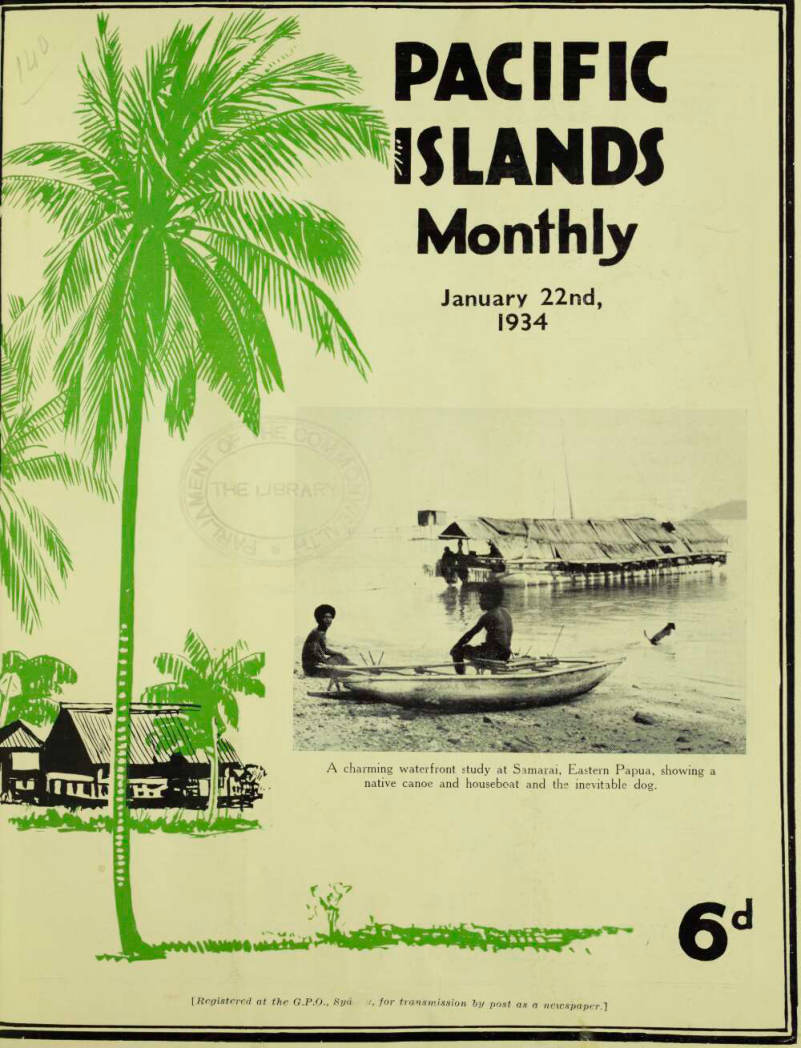
A charming waterfront study at Samarai, Eastern Papua, showing a native canoe and houseboat and the inevitable dog.
Advertisements & other items, p. 2 (1 item)
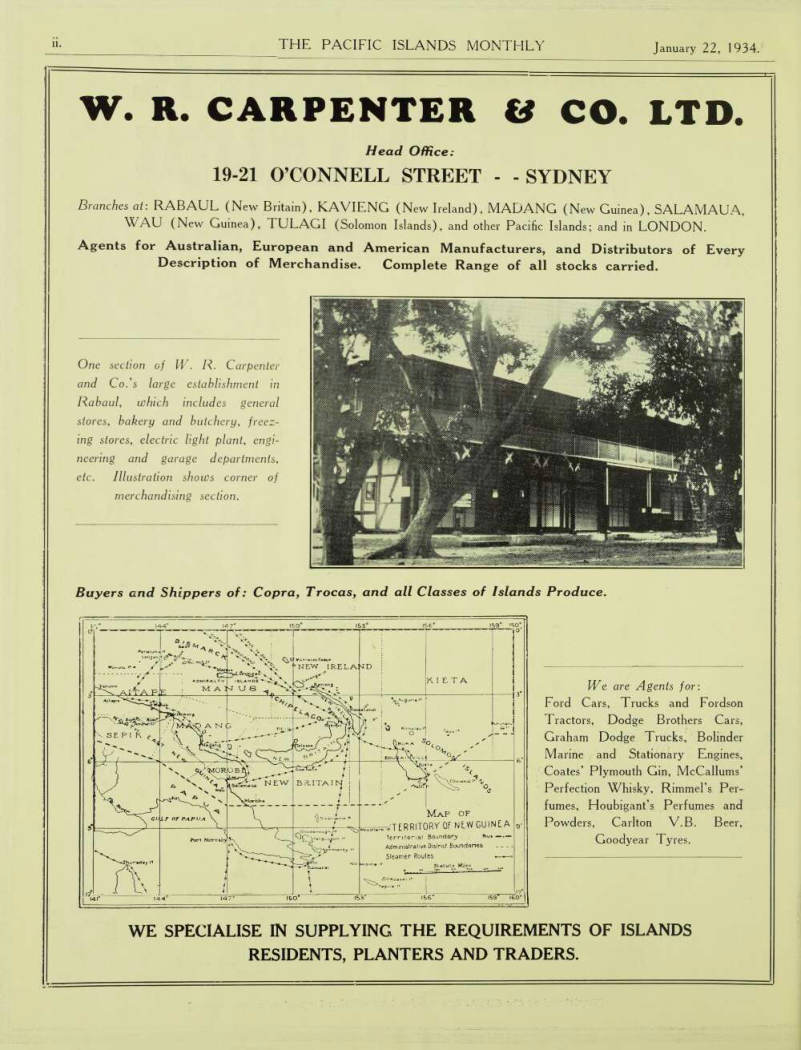
W. R. Carpenter & Co. Ltd.
Head Office:
19-21 O’CONNELL STREET - - SYDNEY
Branches at: RABAUL (New Britain), KAVIENG (New Ireland), MADANG (New Guinea), SALAMAUA, WAU (New Guinea), TULAGI (Solomon Islands), and other Pacific Islands; and in LONDON.
Agents for Australian, European and American Manufacturers, and Distributors of Every Description of Merchandise. Complete Range of all stocks carried.
One section of W. R. Carpenter and Co.'s large establishment in Rabaul, which includes general stores, bakery and butchery, freezing stores, electric light plant, engineering and garage departments, etc. Illustration shows corner of merchandising section.
Buyers and Shippers of: Copra, Trocas, and all Classes of Islands Produce.
We are Agents for: Ford Cars, Trucks and Fordson Tractors, Dodge Brothers Cars, Graham Dodge Trucks, Bolinder Marine and Stationary Engines, Coates’ Plymouth Gin, McCallums’
Perfection Whisky, Rimmel’s Perfumes, Houbigant’s Perfumes and Powders, Carlton V.B, Beer, Goodyear Tyres.
WE SPECIALISE IN SUPPLYING THE REQUIREMENTS OF ISLANDS
RESIDENTS, PLANTERS AND TRADERS.
Pacific Islands Travellers
Passengers Per Aorangi Which
SAILED FROM SYDNEY FOR SUVA, FIJI, ON JANUARY 4: —Mr. and Mrs. Thacker, Miss D.
Thacker, Alaster D. Thacker, Mr. A. S. Burton, Miss M. Bassett, Miss E. J. Bassett, Miss J.
Peterson, Mr. E. Butler, Mr. A. S. Farebrother, Miss AI. Nichols, Mr. W. AI. Bamford, Mrs.
W. M. Bamford, Miss S. Marr, Miss K. Allingham, Miss M. Winning, Mrs. L. J. Chapman, Master J. Chapman, Miss E. Chapman, Mrs.
J. L. Scott, Miss P. E. Scott, Mr. J. Walker, Mr. A. E. Noerr, Mr. and Mrs. J. O. Christmas, Master R. Wonkar, Mrs. H. Wonkar.
Passengers Per Monterey, Which
Sailed From Sydney For Fiji And
AMERICAN SAMOA:—Mr. T. S. Crawford, Mr.
A. Danman, Mr. and Mrs. O. Danman, Mr. L.
Danman, Mr. B. Davis, Mr. and Mrs. M. B.
Dabscheck, Dr. Findley, Dr. and Mrs. J. P.
Fogarty, Mr. Frankel, Miss K. Higgins, Mr. R.
H. N. Leleu, Mr. B. H. Marks, Miss I. Mac- Kenzie, Miss M. A. Mercer, Miss W. Nash, Mrs. C. R. Parish, Miss S. Parish, Mr. R. J.
Parish, Miss E. Roche, Mr. J. Roche, Mr. and Mrs. D. Rosenberg, Mr. and Mrs. W. Sharpe, Dr. and Mrs. H. C. Whittle, Mr. H. P. Wills allen, Father P. M. A. Boussit, Father G.
Griffon, Father A. Merten, Miss AI. M. Rial, Mr. G. F. Sidery.
Passengers Per Mariposa Which
Sailed From Sydney For Fiji And
EASTERN SAMOA ON DECEMBER 16: Mr. W.
Atkins, Miss R. Barnett, Mr. R. Basche, Miss M.
Bell, Mrs. A. Boynton, Miss J. Boynton, Mrs. E.
Chadwick, Mr. P. Cody, Mr. W. DeBerg, Mrs. W.
Douglass, Miss L. Elliott, Mr. S. Ellis, Miss M.
Gloster, Mr. E. Gorman, Mr. Harden, Miss B.
Hardy, Miss J. Hardy, Miss F. Healy, Sister I.
Hindmarsh, Mr, T. Horne, Mr. T. Hughes, Master Hutchinson, Mrs. A. Hutchinson, Miss B. Hut chinson, Miss Hutton, Miss J. Hutton, Mr. G.
Hyman, Miss E. Kellett, Mrs. E. Lonsdale, Miss N. Lonsdale, Mrs. C. MacLeod, Miss H. Mac- Leod, Miss N. Alaggs, Dr. J. Mahon, Mr. R. Marsden, Mrs. P. McIntosh, Master P. McIntosh, Mr.
W. McKie, Mr. G. Mitchell, Mrs. H. Alossop, Miss M. Mossop, Mrs. C. Nichols, Miss M. Orr, Mr. C. Powell, Miss L. Preston, Mr. H. Purton, Mr. C. Reid, Mr. C. Richard, Mr. J. Russell, Sir Henry M. Scott, Dr. William and Mrs. Sloss, Miss T. Sloss, Miss U. Sloss, Mr. W. Sloss, Mr. and Mrs. V. Smith, Mr. R. Smith, Mr. B. Smith, Miss I. Smith, Mr. and Mrs. W. Spry, Master H.
Spry, Mrs. H. Spry, Master M. Spry, Miss P.
Stevenson, Mrs. L. Streiff, Mrs. H. Vale, Sister E.
Walker, Mrs. H. Walsh, Mr. and Mrs. R. Watson, Mrs. V. Wood, Mr. J. Wren, Mrs. F. Austin, Miss K. Burke, Miss F. Field, Miss T. Larking, Miss G. Miedecke, Master G. Miedecke, Mr. M. Moti ram, Mr. C. Rule, Mrs. J. Rule, Master H. Spiers, Mr. F. Stevens, Miss A. Walker, Miss B. War burton, Mr. K. Taylor, Miss A. C. Woods.
Passengers Per Monterey Which
Arrived In Sydney From Eastern
SAMOA AND FIJI ON JANUARY 1: Mr. W.
Atkins, Mr. R. Basche, Miss N. Bell, Miss J.
Brown, Mr. P. Cody, Mr. O. Colahan, Mr. W.
DeBerg, Miss J. de Renzy, Mr. and Mrs. J. Evans Miss M. Gloster, Mr. E. Gorman, Mr. G. Gray, Mr. C. Harden, Miss F. Healy, Mr. W. Higgs, Sister I. Hindmarsh, Mr. T. Hughes, Mrs. A.
Hutchinson, Miss B. Hutchinson, Master W. Hut chinson, Miss J. Hutton, Miss V. Hutton, Mr. G.
Hyman, Miss E. Kellett, Mrs. E. Lonsdale, Miss N. Lonsdale, Miss N. Maggs, Mrs. E. McIntosh, Master P. McIntosh, Dr. J. Mahon, Miss L.
Nicholls, Mrs. C. Nichols, Mr. H. G. Purton, Miss M. Rennison, Mr. R. Smith, Mrs. P. Stevenson, Mr. E. G. Theodore, Mrs. H. Vale, Mr. R. Watson, Mrs. R. Watson, Mrs. V. Wood, Mr. J. Wren, Miss K. Burke, Miss E. Field, Mr. A. H. Green, Mrs. M. Keam, Master I. Keam, Miss T. Larking, Mr. R. Law, Mr. T. Moir, Mrs. E. Morgan, Mr.
R. Ramsamuj, Mr. E. Riddell, Mr. and Mrs. J Rule, Mr. D. Schulze, Mr. S. Singh, Mr. W.
Stevens, Mr. C. Sunderland and wife, Master J.
Sunderland, Miss L. Sunderland, Miss V. Sunder land, Mr, Keith A. Taylor.
Passengers Per Nellore From Syd
NEY FOR RABAUL, NEW GUINEA, ON DE- CEMBER 16: —Mr. H. O. McGuigan, Mrs. W.
Roberts, Mr. I. V. Courttedge, Miss J. B. Carter Mr. and Mrs. B. Baker, Miss S. Crouch, Mr. L Chen, Miss G. Hogan, Mr. E. F. Phibbs.
Passengers Per Macdhui Which
Sailed From Sydney For Papua And
NEW GUINEA ON JANUARY 11:- Mr. and Mrs. R. H. Day, Mr. and Mrs. C. A. Rigby, Mr.
and Mrs. M. C. W. Rich, Mr. and Mrs. G. Griffith, Mr. and Mrs. J. S. Symmington, Mesdames H. C.
Balfour, J. Buddon, G. R. Courtney, K. Gunn, E. A. Hood, W. H. Stayte, Sister M. Adelfia, Sister M. Clematia, Sister M. Hermangard, Sister M. Philemon, Misses J. Craig, H. Compton, B. D.
Meares, J. Parer, G. Stayte, Messrs. H. Atkinson, W. R. Ball, Brother M. Brenninger, Brother B.
Bockenkotter, F. C. Barron, G. Bliss, D. A. F.
Brigstocke, E. W. P. Chinnery, A. C. Christian, S. H. Carol, E. A. Cox, J. Dickson, Father P.
Dietrichs, Father L. M. Desjardins, F. Deckert, T. A. Fox, J. R. Fox, C. A. Graham, R. H. J.
Gall, E. Grant, M. Gibson, A. K. Grabowsky, J.
G. Hutchinson, J. W. Hinks, Father W. Herber mann, G. W. Harris, E. C. Hensley, J. Irwin, W.
J. Jay, Father R. Jurgons, R. H. James, H.
Kennedy, H. W. Kirke, J. B. P. Keane, F. J.
Lesmond, C. D. Lega, Leahy, W. H. Mayo, V. R.
Murray, P. W. Mirovitch, H. C. Marshall, L. B.
Alolony, S. G. Owen, R. P. O’Sullivan, Paterson, H. T. Ramsay, F. W. Reid, E. J. Randall, J.
Swanson, R. Shepherdson, R. Sprodd, B. Smith, E.
Spence, N. Smith, H. H. Turner, Torrington, H. L. Thornycroft, W. T. Thomas, L. V. Wilde, W. P. Wiltshire, F. J. White, Brother J. Wies chen, D. A. Yarrell.
Passengers Per Mataram Which
Arrived In Sydney From Solomon
ISLANDS ON JANUARY 15:-Mr. L. Alty, Miss E. Baldwin, Miss M. Baldwin, Miss N. Bucking ham, Miss E. Butt, Mrs. H. E. Clark, Mrs. M.
Clarkson, Miss M. Edmiston, Mr. G. W. Eves, Miss K. Fitzgerald. Miss B. Holmes, Miss K.
Idriess, Miss H. Humphries, Mr. and Mrs. A.
Kummerle, Col. W. J. McElhinny, Miss R. Morgan, Miss D. E. Morris, Miss J. Prell, Mr. and Mrs. H. Scotow, Miss V. Waites, Miss B. Whitehouse, Miss L. Cummings, Miss A. Fahey, Rev.
Father M. Boch, Mr. W. J. Craig, Mrs. J. L.
Sayers and two children, Mr. H. Frost, Mr. D. C.
Hartam-Bayes, Mr. W. Beadley, Capt. R. Bray, Mr. M. Chick, Mr. J. Ellis, Mr. and Mrs. O.
Hug, Mr. W. Johnson, Miss L. McRae, Mr. M.
Mongan, Mr. J. O’Connor, Mrs. M. Olsen, Mr. H.
Patterson, Mrs. E. Scott and infant, Mrs. M. I.
Smith, Miss D. Lee.
Passengers Per Morinda Which Ar
Rived In Sydney From New Hebrides
And Norfolk Island On January 15:—
Mr. W. Anderson, Mrs. AI. Bowie, Mrs. I E Faithfull and infant, Miss M. A. U. Hurse, Mr.
J. Lukin, M. and Madame Mazoyer, Masters R. and P. Mazoyer, Mr. and Mrs. C. Ross, Mrs. R. L.
Smith, Mr. R. Watson, Miss I. Brigden, Miss F.
Creighton, Miss D. V. Coutts, Miss E. Duhig, Miss J. M. Evans, Miss M. F. Flannery, Miss E.
Fairhall, Mr. B. A. Hannaford, Mr. and Mrs. L.
Holloway and child. Miss A. M. Hynes, Mr. W.
T. Hyder, Mr. T. C. James, Mr. and Mrs. W. T.
Lewis, Miss L. M. Lawry, Sir Hubert Murray, Lady M. B. B. Murray, Miss A. L. Preston, Mr.
J. Regan, Miss V. Rogers, Mr. A. C. Terry, Miss N. Watkins, Miss M. Wilds, Mr. Barsden, Mr.
R. A. Baxter, Miss Brady, Mr. E. T. Buckley, Mr. and Mrs. Butler, Miss and Master Butler, Mr. S.
E. Butler, Miss Childs, Miss Cole, Mr. R. C.
Cook, Mrs. and Miss Court, Mr. W. Craddock, Mr. and Mrs. J. E. Creer, Mr. and Mrs. J. N.
Creer and infant, Mr. A. B. Dege, Miss W.
Docksey, Miss Egan, Mr. R. Egan, Miss O. Fair hall, Mr. N. Forrester, Miss T. Hall, Mr. and Mrs. C. K. Hambly, Master C. Hambly, Mr. C.
Hampson, Mr. W. A. Harrington, Miss M. Hud son, Mr. and Mrs. N. A. Jenkyn, Miss Kelso, Mr.
R. Kirby, Mr. Mackenzie, Miss P. Marr, Misses M. and T. McNiven. Miss J. Miller. Mr. R. H.
Oakes, Mr. O. F. Pattison, Miss O. Reilly, Mr. and Mrs. Richards, Miss Rickets, Miss D. Ridley, Miss K. Riordan, Miss D. Rose, Mrs. R. Saint, Miss M. E. Shirlock, Mr. E. J. Sinclair, Misses A. and V. Smith, Mr. S. Stott, Mr. and Mrs. A.
R. Taylor, Miss O. Thompson, Mr. E. Troughton, Mr. and Mrs. G. Watson, Mr. J. Wilson, Miss P.
White.
Passengers Per Macdhui Which Ar
RIVED IN SYDNEY FROM PAPUA AND NEW GUINEA ON DECEMBER 26: Mr. C. O. Ander son, Brother J. Angers, Mr. K. C. Armstrong, Mrs. G. A. Aumuller, Mr. R. D. Bertie, Mrs.
A. O Bignold, Mr N. I. Blue, Mr. and Mrs. G Bowen-Jones, Mr. L. Brennand, Mr. G. Capstick, Mrs. E. Champion, Mr. and Mrs. J. Comb, Miss E. J. Common, Mr. and Mrs. C. H. Cox, Mr. R.
Cranston, Mr. R. W. Crouch, Miss M. Cunningham, Mrs. A. J. Deland, Mr. W. J. Doran, Mrs.
A. M. Dover, Mr. A. Duncan, Mr. and Mrs. J.
Fowler, Father A. Fradeth, Mr. F. W. Griffin, Mr. and Mrs. L. E. Hansen, Mr. A. R. Hall, Mr. A. S. Hicks, Mr. and Mrs. F. K. Huthnance.
Mrs. A. Hyams, Sister M. Ignace, Brother E.
Janin, Miss L. E. Job, Mr. and Mrs. M. Kraut, Mr. D. M. Lawler, Mr. J. G. Lawton, Mr. J. J.
Lennon, Mr. and Mrs. L. A. Lister, Mr. and Mrs. A. Lohmann, Mr. A. R. M. Long, Mr. and Mrs. G. A. Louden, Mrs. M. J. Macandrew, Mr.
P. Harcovitch, Mr. S. McCann, Mr. R. McKenzie, Mr. G. H. McLaren, Mr. F. T. Moates, Mr. and Mrs. H. L. Niall, Miss F. Nicholson, Mr. J.
W. Nicholson, Miss E. Oldham, Mr. G. Parrott, Mrs. K. Pollard, Mr. L. Pourteau, Mr. J. R.
Rigby, Mrs. L. M. Robinson, Mr. H. T. Robson, Mrs. M. E. Ross, Mrs. J. T. Sedgers, Mr. A. M.
Shannon, Mr. D. G. Sinclair, Mr. and Mrs. S. E.
Smith, Mrs. L. Taylor, Rev. F. O. Theile, Mr.
W. Toner, Mrs. A. Twycross, Miss R. Waldon, Miss M. White, Miss D. E. White, Mr. G. King cote.
Passengers Per Morinda Which Ar
RIVED IN SYDNEY FROM LORD HOWE AND
Norfolk Islands On December 25:-
Miss E. M. Carter, Mr. J. C. Hosea, Mr. I. H.
Marks, Mrs. W. E. Peacock and two children, Mr. L. Taylor, Mr. R. L. Wills, Miss A. Archer, Miss K. Bennett, Mr., Mrs, and Miss Chant, Miss D. May, Miss C. Clement, Mr. and Mrs.
G. Henderson, Miss McTavish, Mrs. and Miss Gregg, Mrs. and Miss Jeans, Mr. E. W. Lawler, Miss D. Aloston, Miss D. Pearce, Miss D. Red mond, Miss H. Thompson, Miss W. T. Turner, Mr. A. G. White. (Continued on next page.)
Passengers Per Morinda Which
Sailed From Sydney For Lord Howe
And Norfolk Islands On December 28:
Messrs. Barsden, T. Bairstow, W. R. Brown, A.
H. Brown, W. H. Craddock, C. K. Hambly, Rev.
Codd, Casey, Dr. A. G. Clark, Dignam, L. Davies, J. Dickson, Donnison, R. Egan, N. Forrester, C.
C. Hambly, Hannaford, W. T. Hyder, C. Hamp son, W. A. Harrington, R. Kirby, Links, Mac kenzie, McLachlan, Oakes, O. F. Patison, Pog more, Sinclair, S. Stott, A. W. Taylor, A. R.
Taylor, Whitham Doddam; Mesdames Codd, Dig nam, M. Davies, Donnison, Gordon and infant, C.
C. Hambly, M. Locksmith, McLachlan, Oakes, S.
Rankin, A. R. Taylor, Taylor; Misses I. Bloom field, L. Brady, Bowden, Brindacombe, Bryant, N. Cale, Childs, Cootts, Duhig, Debenham, Dock sey, Donnison, M. Frost, V. Gifford, Hudson, T.
Hall, K. Hall, A. Kelson, Love, D. Louittit, R.
Louttit, N. May, R. May, McLachlan, McLachlan, M, Mackey, J. Miller, M. Ricketts, Ridley, G.
Scott, Styles, Stephens, N. Smith, M. Sherlock, V. Smith, A. Smith, Woodhill, P. White, E.
Woods.
Passengers Per Mataram Which
Sailed From Sydney For Solomon
ISLANDS ON DECEMBER 16: Messrs. L. Alty, C. F. Bengough, C. R. Bignell, D. M. Barlow, L.
M. Cummings, G. W. Eves, A. Kummerle, Capt.
Kidson, McElhinney, Ramsay, J. S. Speirs, H.
Scotow, Master D. Scott; Mesdames M. Clarkson, H. E. Clark, R. Clarke, M. L. Hicks and infant, Kummerle, Kidson, McStewart, E. Reed, Scotow; Misses N. Buckingham, E. Butt, E. Baldwin, M.
Baldwin. B. Blake, Darker, M. Edmiston, A.
Fahey, E. Field, T. Coulter, Humphries, M. Hart, Idriess, D. E. Morris, R. Morgan, Osborne, J.
Prell, Sister M. Pezzaioli, Ryan, J. Stevens, M.
Waites, Whitehouse, E. Williams.
Advertisements & other items, p. 3 (1 item)
Royal Packet Sydney
Regular Bi-monthly Freight and Passenger Service by the fast and modern K.P.M. Steamer VAN REES as under:
SAIGON
BATAVIA
SAMARANG
PORT MORESBY
SAMARAI
RABAUL
PORT VILA
Saloon & Intermediate class passengers carried in comfortable and airy cabins.
Cargo for Africa accepted for transhipment at Batavia.
NOUMEA
ROYAL PACKET Sydney
PORT MORESBY
NAVIGATION CO. BATAVIA
255 GEORGE STREET, SYDNEY. SAIGON
The B.N.G. Trading Coy., Ltd., Port Moresby; Steamship Trading Co., Samarai- W R Carpenter & Co., Ltd., Rabaul; Gubbay Freres, Port Vila; Carlo Leoni, Noumea : Diethelm & Co., Saigon.
Contents
Page Paralysis of Upper Morobe .. .. 3,4 M.V. Malaita 5 Attacks on White Women .. .. 6,7 Copra-Making in Ceylon 8 Copra Market Crashes 9,10 New Uses for Copra ll Emosi—Famous Samoan Warrior .. 13 Native Policy in N.G. 15-17 How to Handle Bananas 18 Tinai Valley Gold 20
Page New Guinea News 21 Discoveries in N.G 22 Japanese Poachers in N.G 24 Papuan Goldfields 26 Tropical Hygiene 27 About Islands People 29,30 Prosecution of Samoan Mau . . 31,32 Islands Produce 33 New Guinea Gold 34 Tropicalities 35
Advertisers
Page Antinea Drug Co. .. 19 Arnott’s Biscuits .. 27 Bank of N.S.W. .. 16 Bergers Paints .. 40 Broomfields, Ltd. .. 18 Bruce, Robert .. 22, 32 Brunton’s Flour .. 26 Burns, Philp & Co. 2 Burns, Philp (S.S.) Co 15 B.P. Magazine .. 32 Buzacott, Ltd 35 Carpenter, W. R.
Cover ii.
Central Q’land Meat Co 17 Chartres, Stott & Hoare 20 Dangar, Gedye, Ltd. 25 Delicia Food Co. .. 14
Page Excelsior Supply Co. 14 Exito Co 40 Fletcher & Sons .. 32 Ford, W. M 12 Flynn, Mrs. W. .. 11 Garrett & Davidson 23 Gillespie’s Flour .. 20 Goshen Pt. Hospital 10 Grahame, C 36 Gregory, A 33 Guinea Airways Cover iii.
Halvorsen, L 37 Harper, M 37 Holbrooks, Ltd. .. 26 Holden’s Air Trans port 40
I.C.I.A.N.Z., Ltd. .. 11
Joyce Biscuits .. .. 15 Kodak Pty., Ltd. .. 10
Page Kopsen & Co 22 Lane & Girvan .. 23 Leddicott School .. 29 Lessey’s D.Y.S. .. 9 McIlrath’s, Ltd. .. 29 McIntyre 36 Metro. Bus. College 34
N.D.L 39
Nelson & Robertson 8, 38 New Brit. Express 10 Nolan, Spencer .. 34 Noyes Bros 9 Pacific Is. Ass’n. .. 27 Paton, Burns .. .. 24 Pike Bros 8 Prescott, Ltd 18 Rabaul Carr’g. C 0... 32 Rohu, Sil 24 Royal Packet N. Co. 1
Page Russell, S 31 Ruston & Hornsby Pty 33 Steamships T. Co., Ltd 38 Sunshine Harvester. 30 Swallow and Ariell, Ltd 13 Talty, J. P 28 Taubman’s Paints .. 21 Thompson Eng. Co. 31 Thomas, G. & Co. 28 Tillock & Co., Ltd. 30 Tooth & Co iv.
Wallaringa Mansions 37 Wills, W. D. &H. O. 36 Wright & Co 34 Wunderlich, Ltd. .. 12
Advertisements & other items, p. 4 (2 items)
Pacific Islands Travellers
2
January 22, 1934.
THE PACIFIC ISLANDS MONTHLY
Pacific Islands Travellers (Continued from page 1.)
Burns, Philp & Co. Ltd.
Head Office - 7 Bridge Street, Sydney - Australia Code Address: “BURPHIL”
General Merchants,
Shipowners,
Tourist Agents, Etc.
Buyers of all Classes
of Island Produce
Regular Steamer Services From Australia to New Guinea, Papua, Solomons, Lord Howe, Norfolk Islands, New Hebrides, Java and Singapore
The Pacific Islands Monthly
The Newspaper-Magazine Of The South Seas
[Registered at G.P.O., Sydney, for transmission by post as a newspaper.]
Published Once Each Month and Circulated in Australia and New Zealand and in the following Pacific Territories and Islands Groups:
Crown Colony of Fiji.
Australian Territory of Papua.
Mandated Territory (Australia) of New Guinea, Bismarck Archipelago, and Northern Solomon Islands.
Mandated Territory (Japan) of Marshall, Caroline and Mariana Islands.
American Territory of Guam.
Mandated Territory of Nauru.
British Crown Colony of Gilbert and Ellice Islands.
French Territory of New Caledonia.
British and French Condominium of New Hebrides.
American Territory of Eastern Samoa.
Mandated Territory (New Zealand) of Samoa.
British Solomon Islands Protectorate.
British Protectorate of Tongan Islands.
New Zealand Territory of Cook Islands.
Australian Territory of Norfolk Island.
French Colony of Oceania (Tahiti, etc.).
American Territory of Hawaiian Islands.
Owned and Produced by Pacific Publications, Ltd., Union House, 247 George Street, Sydney.
Telephone Bw 5037
P.O. Box 3408 R
Editor and Publisher:
R. W. Robson.
Registered Address for Radiograms and Cables: “PACPUB” Sydney
Contributions Articles, Stories, and Photographs dealing with Pacific Islands Subjects are invited, and will be paid for on publication at usual rates.
Subscription Rates Per Annum, within British Empire, Prepaid Post Free 6/.
Per Annum, elsewhere, prepaid, Post Free .. 8/- Single Copies
Advertisements Advertising rates furnished on application.
Colours, etc. by Arrangement.
Process Blocks made at Advertiser’s expense when required. Screen, 100.
Changes of Advertising Copy should reach this Office by 8th of each month, otherwise previous advertisement may be repeated.
Agents The following are authorised to receive subscrip tions for “The Pacific Islands Monthly”— Islands Branches of Burns, Philp & Co., Ltd., and Burns, Philp (South Seas) Co., Ltd.
Islands Branches of W. R, Carpenter & Co., Ltd.
All Branches of Morris, Hedstrom & Co., Ltd.
J. H. MacGregor Dowsett, Rabaul.
Whitten Bros., Ltd., Port Moresby and Satnarai.
P. Costello, Suva, Fiji.
All Branches and Representatives of W. H. Grove and Sons, Ltd., Auckland.
S. Russell, Papeete, Tahiti.
Cook Islands Trading Co., Rarotonga.
Mrs. M. Campbell, Cascades, Norfolk Island.
Vol. IV. No. 6.
Sydney, January 22, 1934.
Price 6d. Per Copy Prepaid: 6/- p.a.
The Paralysis Of Upper Morobe
From the point of view of the New Guinea Administration, and equally from Australia’s point of view, the posi tion on the New Guinea goldfield (Morobe) is not satisfactory.
At one end of the field, gold is being produced at an ever-increasing rate, and under such good conditions that most people concerned are liable to overlook the unsatisfactory state of affairs at the other end of the field. The subject calls for attention by the Governmental author ities; and it is in the interests of everyone that the thing be forced to an early issue.
Gold, at the present time, is exception ally valuable. Any country producing gold in large quantities to-day is placing itself definitely in a position of advan tage, in relation to the economic develop ments which are attending the breaking up of the depression. In a couple of years, gold may not be so valuable. There fore, it is of importance that, if there is rich gold in New Guinea, it should be brought into the world’s market at the earliest possible moment.
Morobe goldfield is roughly in two sec tions the upper section, held mostly by New Guinea Goldfields, Ltd., which is a reefing proposition; and the lower section,
held generally by the Bulolo (or Ameri can group), which is recovering gold by dredging. The story of the energy and enterprise which brought the Bulolo sec tion of the goldfield into rich production so quickly and efficiently has been told many times and needs no repetition here.
We are concerned at the moment as all friends of New Guinea are concerned with the comparative paralysis which has fallen upon the upper section of the field, controlled by New Guinea Goldfields, Ltd.
After the first flurry of discovery and pegging, from 1927 to 1929, New Guinea Goldfields, Ltd., was formed under the aegis of Mining Trust, Ltd., and it took over practically the whole of the leases between Edie Creek and the Bulolo block, issuing to the lessees the shares of the Company in payment for their interests.
Eventually, the total of its issued capital reached the colossal figure of £5,250,000, by far the greater portion of which is represented by shares issued for the pur chase of leases. The original plan may have been sound enough it apparently was proposed that the interests at the back of the Mining Trust, known vari ously as “Urquhart” and Russo-Asiatic Company, should find whatever cash was necessary to develop this goldfield on a
large scale. But the depression, and events attending the depression, very seri ously cramped the activity of Russo- Asiatic, with the result that from 1930 onwards New Guinea Goldfields, Ltd., has not engaged in large scale developmental operations on Morobe but, on the con trary, has merely scratched around this enormously valuable territory. It has engaged in a certain amount of sluicing; it has permitted various tributers to take out large quantities of gold on the usual basis; and it has erected one or two toy mills.
The position of N.G. Goldfields, Ltd., is perfectly plain, of course. The shares of this five and a quarter millions Company are valued by a somewhat hesitant Stock Exchange to-day at around 7/-, and they have been down to half that. To carry out worth-while developmental operations, and bring out gold from these rich leases sufficient to pay an attractive dividend on £5,250,000, will involve an additional capi tal expenditure running into hundreds of thousands of pounds. Where is such additional capital to come from? If there is to be another issue of ordinary capital, it is most unlikely that the new share holders will permit the new issue to merge with the old issues of shares, now valued at 7/-. The present shareholders, on the other hand, seem opposed to a recon struction and are most unwilling to permit new preference issues. And so the stale
mate goes on, with a growing suspicion that there is, somewhere or other, a policy of freezing out the little shareholders in order to prepare the way for reconstruction and a new issue of capital.
But the general and casual observer, who is anxious for the progress and prosperity of the Territory, is not concerned with the internal troubles and dissensions of New Guinea Goldfields, Ltd. All he is anxious for is that this industry shall be developed quickly, before the present high and favourable value of gold shall shrink.
The rights of private property must be respected, of course; but that is not to say that the Mining Trust, Ltd., shall have the right to squat indefinitely upon a slice of country that ought now to be returning great wealth and benefits to New Guinea and to Australia.
New Guinea Goldfields, Ltd., has been apparently muddling about for the better part of four years with this presumably rich proposition, keeping out other interests which might have done something, and apparently unable itself to finance the large-scale operations that are necessary.
It appears to be trying to finance developmental activities either wholly or in part from gold won on the field — clearly, a feeble and futile plan. Meanwhile, its shareholders are without dividends and the New Guinea Administration without the revenues it has a right to expect.
Unless something is done to end this stalemate, New Guinea Goldfields will miss its chance. By the time it reaches production on a scale commensurate with its capital, gold will have fallen in price and production will not be worth while, considering the cost of transport.
That brings into further consideration the question of a road from the coast into
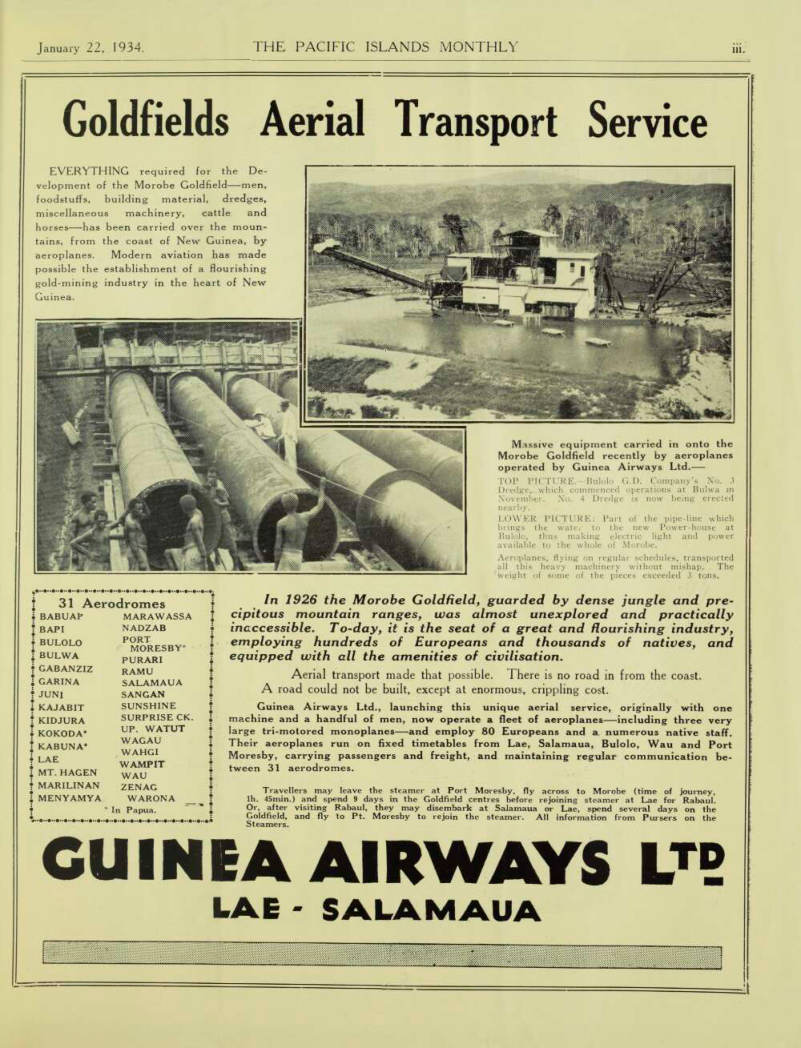
the goldfield. Three years ago the proposal to build a road was a very live question. But while various interests concerned were arguing, the Bulolo group solved the problem by establishing their very efficient and dependable air transport services. They have already carried in by aeroplane all their heavy equipment; and unless there are big and hitherto unforeseen developments (such as the discovery of new values at deep levels) they can now complete all their future operations with aerial transport alone.
But what of New Guinea Goldfields?
This is a reefing and not a dredging area, and if there is to be worth-while production, much heavy equipment has yet to be carried in on to this section of the field. Is this to be done by means of aeroplanes or by means of a road? The present high price of gold will permit the use of either means of transport. But if there is to be much more delay and the price of gold should fall, it is clear that many of the N.G.G. leases, which now could bear a heavy impost on account of transport, may become quite unprofitable to work. And this, from the N.G. Administration viewpoint, would be a calamity- Surely it is time that some action was taken, on behalf of both the N.G. Administration and the Company’s own share holders, to put an end to the present position. Above all, some attempt should be made to ascertain whether the present position is due merely to directorial feeble ness and incapacity; or to events arising out of the unforeseen depression; or whether it is due to a deep-seated plan for creating conditions favourable to a reconstruction, in which the interests of the weaker shareholders may suffer.
Personal
Sir Hurbert Murray, Lt.-Governor of Papua, returned to Sydney from a holiday visit to Norfolk Island on January 15, accompanied by Lady Murray. He will leave for Papua on January 31, and is expected to return to Australia to at tend the Canberra Conference in March.
Mr. R. A. Lever, who is returning to the Solomons, and Mr. J. K. Brownless, of the Colonial Service, also bound for the Solomons, arrived from London by the Ormonde during the week.
Mr. E. W. P. Chinnery, Director of Native Affairs and District Services in New Guinea, concluded his long leave in Australia this month, and is returning to the Territory.
Mr. L. A. Lister, the secretary of Hold en’s Air Transport Services, Ltd., who returned from New Guinea by the M.V.
“Macdhui,” is enthusiastic about the prospects of his company. Its fleet of aircraft is in excellent condition.
Mr. Leo Austen, A.R.M., of the Papuan Public Service, who has been stationed in the Trobriant Group for two years, arrived in Sydney in December on long leave, which will be spent in Australia.
Fiji Cutter Ashore
The 30-ton auxiliary cutter Variance, owned by Mr. Sidney Smith, of Navodo, Natewa Bay, Vanua Levu, Fiji, went ashore on the reef at the island of Nairai.
She was en route from Natewa Bay to Suva at the time.
While the Mataram was in the Solomons recently, Mr. E. C. Johnston, plantation overseer, of Yondini, had his arm shattered during blasting operations. He was brought aboard the steamer to Dr.
R. Thompson, and the ship’s surgeon, with the assistance of a passenger who had some knowledge of anaesthetics, amputated Mr. Johnson’s forearm. Mr.
Johnson was later taken to the Hospital at Tulagi, where, on last account, he was making satisfactory progress.
Mr. Herbert W. Champion, Government Secretary, Territory of Papua, was award ed a C.B.E. (Civil Division) by the King in the New Year Honours List. Mr.
Champion, a New Zealander, born at Kaiapoi in 1880, was educated at Canterbury College (N.Z.), and has been Government secretary in Papua since 1916. A senior member of the Executive and Legislative Councils, and formerly Treasurer, Mr. Champion has administered the Government on eleven occasions between 1916 and 1932, during the frequent absences of the Lieutenant- Governor, Sir Hubert Murray.
Tahiti’S “Crime
Wave”
Foreigner Tries a Little “Chicago Business”
From Our Own Correspondent.
Papeete, Dec. 18.
CONCERNING the reports of thefts and “hold-ups” in Tahiti, sent to the P.I.M. by private correspondents, which have been previously commented upon in these notes as being sensational and misleading, we have been asked to give publicity to the following account of an incident, not without its amusing side, which occurred in the Paea district a little ago.
A young American couple were taking supper one moonlight evening on the verandah of their bungalow. The meal concluded, the lady repaired to her bed room to discover that all the drawers, lockers, and closets had been opened and the mattresses pulled away from the beds.
At first, it was thought that some friend was playing a practical joke, but when two pocket books were found to be missing, containing personal papers, passports, and letters of credit, as well as a certain amount of cash, the seriousness of the affair became apparent. Evidently, the burglar was someone familiar with the habits of the house, who had found no difficulty in doing his work at one end of the building while the meal was in progress at the other; and the police, who were immediately informed of the occur rence, were inclined to attribute the robbery to some escaped native prisoners, who were still at large, and who, it was certain, had been responsible for some thefts of food, etc., of a less serious nature.
Nothing more happened until three days afterwards, when our American friend received through the post a blackmailing letter couched in the best style of the Chicago crook, as expounded in sensational crime movies and detective stories.
And, so that there could be no mistake about the matter, the half of a club membership card from one of the stolen pocket-books was enclosed.
The writer, who used the French language, demanded a sum of 25,000 francs, which he estimated as half the negotiable value of the letter of credit, as his price for returning the papers. If this was satisfactory to the victim, he was to make a sign of the cross in the dust of the roadway near his house, and deliver the sum demanded, done up in a small pack age of 1000-franc notes on the Bank of France, to a party who would present himself the next evening, and who would identify himself by showing the other half of the club membership card. The letter then went on to say that should these instructions be followed the papers would be returned by post within a few days, and was signed “Your evil Spirit.”
The police were duly informed of this latest development and soon afterwards apprehended a Czecko-Slovakian, who had acquired a shady reputation before his arrival in Tahiti, and who latterly had the Americans’ maid-servant as his paramour, and was living with that lady in a house not very far distant. None of the stolen papers were discovered in his possession, but sufficient incriminating evidence was found to convict him of the theft. He is now serving a two years’ sentence, at the expiration of which he probably will be deported.
Let us hope that this will be the last of Tahiti’s so-called “crime wave.”
Yacht Built In Haapai
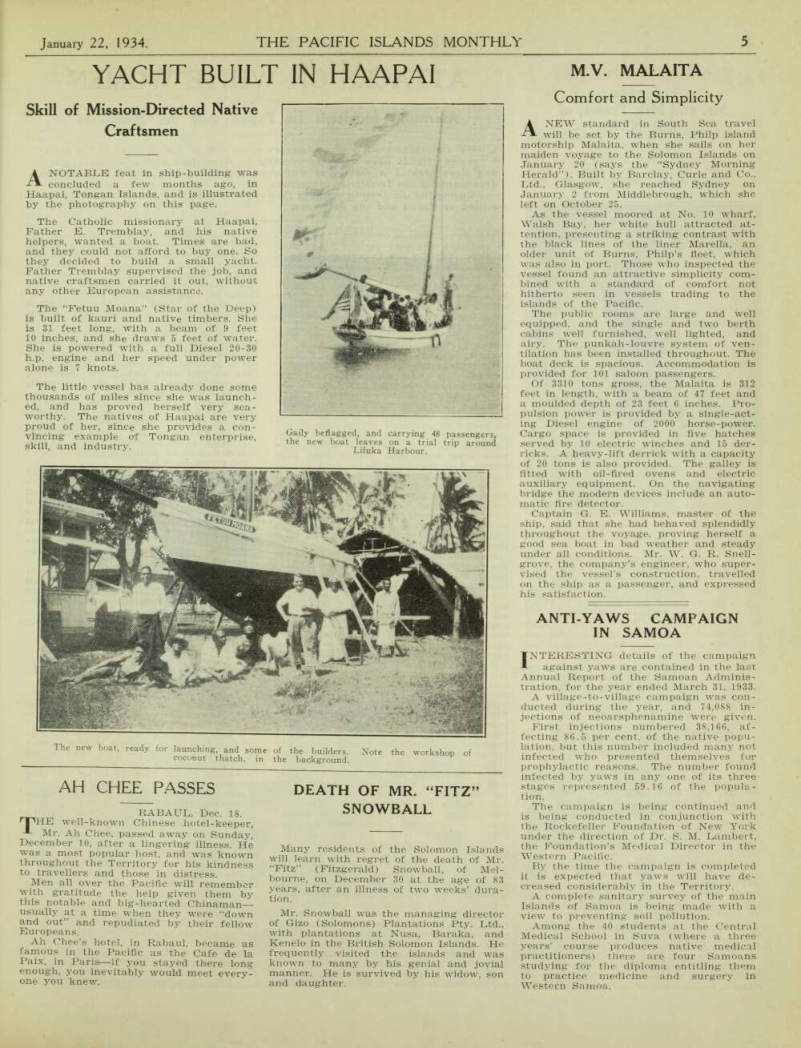
Skill of Mission-Directed Native Craftsmen
A NOTABLE feat in ship-building was concluded a few months ago, in Haapai, Tongan Islands, and is illustrated by the photography on this page.
The Catholic missionary at Haapai, Father E. Tremblay, and his native helpers, wanted a boat. Times are bad, and they could not afford to buy one. So they decided to build a small yacht.
Father Tremblay supervised the job, and native craftsmen carried it out, without any other European assistance.
The “Fetuu Moana” (Star of the Deep) is built of kauri and native timbers. She is 31 feet long, with a beam of 9 feet 10 inches, and she draws 5 feet of water.
She is powered with a full Diesel 20-30 h.p. engine and her speed under power alone is 7 knots.
The little vessel has already done some thousands of miles since she was launch ed, and has proved herself very sea worthy. The natives of Haapai are very proud of her, since she provides a con vincing example of Tongan enterprise, skill, and industry.
The new boat, ready for launching and some of the builders. Note the workshop of coconut thatch, in the background.
Gaily beflagged, and carrying 48 passengers, the new boat leaves on a trial trip around Lifuka Harbour.
Ah Chee Passes
Rabaul, Dec. 18.
THE well-known Chinese hotel-keeper, Mr. Ah Chee, passed away on Sunday, December 10, after a lingering illness. He was a most popular host, and was known throughout the Territory for his kindness to travellers and those in distress.
Men all over the Pacific will remember with gratitude the help given them by this notable and big-hearted Chinaman— usually at a time when they were “down and out” and repudiated by their fellow Europeans.
Ah Chee’s hotel, in Rabaul, became as famous in the Pacific as the Cafe de la Paix, in Paris—if you stayed there long enough, you inevitably would meet every one you knew.
Snowball
Death Of Mr. “Fitz”
Many residents of the Solomon Islands will learn with regret of the death of Mr.
“Fitz” (Fitzgerald) Snowball, of Mel bourne, on December 30 at the age of 83 years, after an illness of two weeks’ dura tion.
Mr. Snowball was the managing director of Gizo (Solomons) Plantations Pty. Ltd., with plantations at Nusa, Baraka, and Kenelo in the British Solomon Islands. He frequently visited the islands and was known to many by his genial and jovial manner. He is survived by his widow, son and daughter.
M.V. Malaita
Comfort and Simplicity
A NEW standard in South Sea travel will be set by the Burns, Philp island motorship Malaita, when she sails on her maiden voyage to the Solomon Islands on January 20 (says the “Sydney Morning Herald”). Built by Barclay, Curie and Co., Ltd., Glasgow, she reached Sydney on January 2 from Middlebrough, which she left on October 25.
As the vessel moored at No. 10 wharf, Walsh Bay, her white hull attracted at tention, presenting a striking contrast with the black lines of the liner Marella, an older unit of Burns, Philp’s fleet, which was also in port. Those who inspected the vessel found an attractive simplicity com bined with a standard of comfort not hitherto seen in vessels trading to the islands of the Pacific.
The public rooms are large and well equipped, and the single and two berth cabins well furnished, well lighted, and airy. The punkah-louvre system of ven tilation has been installed throughout. The boat deck is spacious. Accommodation is provided for 101 saloon passengers.
Of 3310 tons gross, the Malaita is 312 feet in length, with a beam of 47 feet and a moulded depth of 23 feet 6 inches. Pro pulsion power is provided by a single-act ing Diesel engine of 2000 horse-power.
Cargo space is provided in five hatches served by 10 electric winches and 15 der ricks. A heavy-lift derrick with a capacity of 20 tons is also provided. The galley is fitted with oil-fired ovens and electric auxiliary equipment. On the navigating bridge the modern devices include an auto matic fire detector.
Captain G. E. Williams, master of the ship, said that she had behaved splendidly throughout the voyage, proving herself a good sea boat in bad weather and steady under all conditions. Mr. W. G. R. Snell grove, the company’s engineer, who super vised the vessel’s construction, travelled on the ship as a passenger, and expressed his satisfaction.
Anti-Yaws Campaign
In Samoa
INTERESTING details of the campaign against yaws are contained in the last Annual Report of the Samoan Adminis tration, for the year ended March 31, 1933.
A village-to-village campaign was con ducted during the year, and 74,088 in jections of neoarsphenamine were given.
First injections numbered 38,166, af fecting 86.5 per cent, of the native popu lation, but this number included many not infected who presented themselves for prophylactic reasons. The number found infected by yaws in any one of its three stages represented 59.16 of the popula tion.
The campaign is being continued and is being conducted in conjunction with the Rockefeller Foundation of New York under the direction of Dr. S. M. Lambert, the Foundation’s Medical Director in the Western Pacific.
By the time the campaign is completed it is expected that yaws will have de creased considerably in the Territory.
A complete sanitary survey of the main Islands of Samoa is being made with a view to preventing soil pollution.
Among the 40 students at the Central Medical School in Suva (where a three years’ course produces native medical practitioners) there are four Samoans studying for the diploma entitling them to practice medicine and surgery in Western Samoa.
Epi, N.H.
Island Pioneers
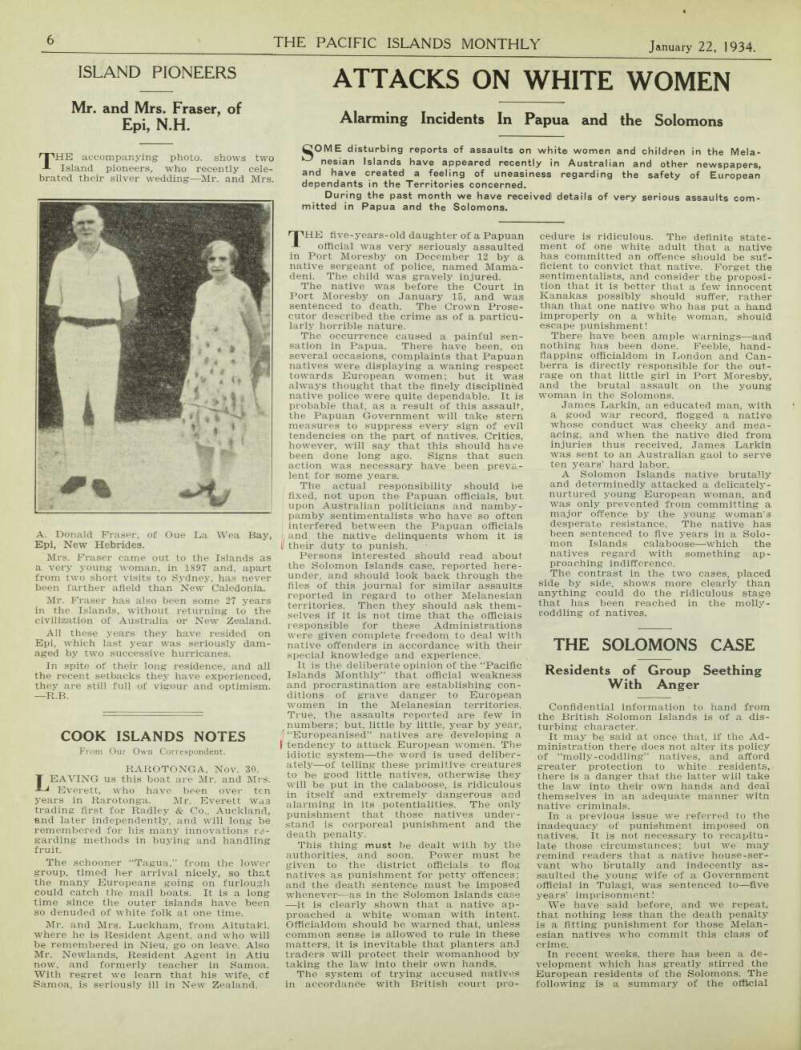
Mr. and Mrs. Fraser, of Epi, N.H.
T’HE accompanying photo, shows two Island pioneers, who recently cele brated their silver wedding—Mr. and Mrs.
A. Donald Fraser, of Oue La Wea Bay, Epi, New Hebrides.
Mrs. Fraser came out to the Islands as a very young woman, in 1897 and, apart from two short visits to Sydney, has never been farther afield than New Caledonia.
Mr. Fraser has also been some 27 years in the Islands, without returning to the civilization of Australia or New Zealand.
All these years they have resided on Epi, which last year was seriously dam aged by two successive hurricanes.
In spite of their long residence, and all the recent setbacks they have experienced, they are still full of vigour and optimism. —R.B.
Cook Islands Notes
From Our Own Correspondent.
Rarotonga, Nov. 30.
LEAVING us this boat are Mr. and Mrs.
Everett, who have been over ten years in Rarotonga. Mr. Everett was trading first for Radley & Co., Auckland, and later independently, and will long be remembered for his many innovations re garding methods in buying and handling fruit.
The schooner “Tagua,” from the lower group, timed her arrival nicely, so that the many Europeans going on furlough could catch the mail boats. It is a long time since the outer islands have been so denuded of white folk at one time.
Mr. and Mrs. Luckham, from Aitutaki, where he is Resident Agent, and who will be remembered in Nieu, go on leave. Also Mr. Newlands, Resident Agent in Atiu now, and formerly teacher in Samoa.
With regret we learn that his wife, of Samoa, is seriously ill in New Zealand.
Attacks On White Women
Alarming Incidents In Papua and the Solomons
disturbing reports of assaults on white women and children in the Mela nesian Islands have appeared recently in Australian and other newspapers, and have created a feeling of uneasiness regarding the safety of European dependants in the Territories concerned.
During the past month we have received details of very serious assaults com mitted in Papua and the Solomons.
THE five-years-old daughter of a Papuan official was very seriously assaulted in Port Moresby on December 12 by a native sergeant of police, named Mama deni. The child was gravely injured.
The native was before the Court in Port Moresby on January 15, and was sentenced to death. The Crown Prose cutor described the crime as of a particu larly horrible nature.
The occurrence caused a painful sen sation in Papua. There have been, on several occasions, complaints that Papuan natives were displaying a waning respect towards European women; but it was always thought that the finely disciplined native police were quite dependable. It is probable that, as a result of this assault, the Papuan Government will take stern measures to suppress every sign of evil tendencies on the part of natives. Critics, however, will say that this should have been done long ago. Signs that such action was necessary have been preva lent for some years.
The actual responsibility should be fixed, not upon the Papuan officials, but upon Australian politicians and namby pamby sentimentalists who have so often interfered between the Papuan officials and the native delinquents whom it is if their duty to punish.
Persons interested should read about the Solomon Islands case, reported here under, and should look back through the files of this journal for similar assaults reported in regard to other Melanesian territories. Then they should ask them selves if it is not time that the officials responsible for these Administrations were given complete freedom to deal with native offenders in accordance with their special knowledge and experience.
It is the deliberate opinion of the “Pacific Islands Monthly” that official weakness and procrastination are establishing con ditions of grave danger to European women in the Melanesian territories.
True, the assaults reported are few in numbers; but, little by little, year by year, "Europeanised” natives are developing a tendency to attack European women. The idiotic system—the word is used deliber ately—of telling these primitive creatures to be good little natives, otherwise they will be put in the calaboose, is ridiculous in itself and extremely dangerous and alarming in its potentialities. The only punishment that those natives under stand is corporeal punishment and the death penalty.
This thing must be dealt with by the authorities, and soon. Power must be given to the district officials to flog natives as punishment for petty offences; and the death sentence must be imposed whenever —as in the Solomon Islands case —it is clearly shown that a native ap proached a white woman with intent.
Officialdom should be warned that, unless common sense is allowed to rule in these matters, it is inevitable that planters and traders will protect their womanhood by taking the law into their own hands.
The system of trying accused natives in accordance with British court pro
cedure is ridiculous. The definite state ment of one white adult that a native has committed an offence should be suf ficient to convict that native. Forget the sentimentalists, and consider the proposi tion that it is better that a few innocent Kanakas possibly should suffer, rather than that one native who has put a hand improperly on a white woman, should escape punishment!
There have been ample warnings—and nothing has been done. Feeble, hand flapping officialdom in London and Can berra is directly responsible for the out rage on that little girl in Port Moresby, and the brutal assault on the young woman in the Solomons.
James Larkin, an educated man, with a good war record, flogged a native whose conduct was cheeky and men acing, and when the native died from injuries thus received, James Larkin was sent to an Australian gaol to serve ten years’ hard labor.
A Solomon Islands native brutally and determinedly attacked a delicately nurtured young European woman, and was only prevented from committing a major offence by the young woman’s desperate resistance. The native has been sentenced to five years in a Solo mon Islands calaboose —which the natives regard with something ap proaching indifference.
The contrast in the two cases, placed side by side, shows more clearly than anything could do the ridiculous stage that has been reached in the molly coddling of natives.
The Solomons Case
Residents of Group Seething With Anger
Confidential information to hand from the British Solomon Islands is of a dis turbing character.
It may be said at once that, if the Ad ministration there does not alter its policy of “molly-coddling” natives, and afford greater protection to white residents, there is a danger that the latter will take the law into their own hands and deal themselves in an adequate manner with native criminals.
In a previous issue we referred to the inadequacy of punishment imposed on natives. It is not necessary to recapitu late those circumstances; but we may remind readers that a native house-ser vant who brutally and indecently as saulted the young wife of a Government official in Tulagi, was sentenced to—five years’ imprisonment!
We have said before, and we repeat, that nothing less than the death penalty is a fitting punishment for those Melan esian natives who commit this class of crime.
In recent weeks, there has been a de velopment which has greatly stirred the European residents of the Solomons. The following is a summary of the official
evidence given at the subsequent trial of the native concerned.
On September 26, 1933, the young wife of a plantation-owner was walking from the back verandah of her bungalow to the kitchen. A cook “boy” a Solomon islands native —suddenly sprang behind her, pulled her down on to her back and tore her underclothes. He lay on top of her and acted as if he were in a frenzy.
The terrified young woman fought the native with great courage. Her body was bruised and her hands and wrists lacerated. The struggle continued for some time; and then the foiled brute relaxed and the young woman fought him off and got on to her feet. He seized her again but she managed to break away and ran out into the plantation, with the boy in pursuit of her, Then the boy gave up the chase, went to the water-front, took a canoe and paddled over to a small island. The plantation owner was sent for and as soon as he returned he sent laborers over to the island to bring the boy back.
The boy came back armed with a copra-knife which he had taken from a copra-cutter. When the planter went down to the wharf the boy met him in a threatening attitude, with the knife raised above his head and defying the planter to come near him. The planter ordered his laborers to take the knife from him; and, after a fierce struggle, this was done.
The native was placed under arrest, and was tried before the District Officer at Gizo, on October 2. He convicted himself, on his own evidence.
The case was then held up, from October until November 29, when the Court sat again and sentenced the boy to five years’ imprisonment. It was generally understood that the delay occurred because the Officials concerned had referred the case to Suva, so that permission might be obtained to impose a sentence including flogging. If so, the officials were disappointed, because the sentence does not include flogging.
The boy spent two months in the Gizo calaboose, where, judging by his appearance, he came to no harm. His demeanor
in the Court on November 29 was cocky and self-assured.
The young wife concerned is a woman of delicate upbringing and is the daughter titled residents of Australia. She is held in the highest respect and esteem in the Solomons. As a result of her dreadful experience, she had to remain for some time in bed, suffering from shock, and since has had to be sent away from the Solomon islands to Australia, in the hope that she may be restored to normal health.
It is difficult to discuss this matter in calm language. The sentence of five years' gaol imposed on the boy is not sufficient punishment, even to fit the crime of threatening his master with a copra knife. To suggest that it is adequate punishment for the ghastly assault upon the planter’s wife is to suggest something that is utterly ridiculous, It is hard to accept the fact that the responsible officials in the Solomon Islands, or the equally responsible High Commissioner for the Pacific at Suva, have permitted such a state of affairs.
There is no circumstance that we know of which has been brought forward to mitigate the native’s crime. He has been let off practically without punishment. A period the calaboose, even with hard labor is no punishment to the average kanaka.
If punishment that has been imposed represents the limit of the law which the officials concerned are pemitted to administer, then it is obviously a foolish and dangerous law, and the officials should say so, and tell the residents that they are seeking a better law, and thus give the white women of the Group some reassurance of safety, In the last mail from the Solomon Islands we received letters from five dif ferent residents of that Group, each re ferring to the case described above, and each criticising the law and the Administration in very strong language. It is clear that the Solomon Islands Adminis tration is held now in detestation and contempt by the residents; and it is not surprising to know that a concerted move is being made to place certain strong re presentations before the Colonial Office authorities in London.
Ancient Artifacts From Papua
In the photographs below, for which we are indebted to Mr. F. C. Rennels, of Samarai, Papua, there are shown two remarkable Papuan or New Guinea curios. On the left, resting on a piece of uncut obsidian, is the only obsidian battle-axe known. It has never been publicly displayed. Par ticulars are: Length, 2ft. 2in.; length of blade, 5in.; thickness of blade, breadth, 7in.
The second photograph shows a Papuan native using a stone axe. These are rarely seen, since the steel tomahawk has been introduced.
Arrive
Ancient Gods
Mysterious Events on Papeete Waterfront
From Our Own Correspondent.
Papeete, Dec. 18.
THE local schooner “Valencia,” wrecked over a year ago on the outer reef of Raivavae Island, as reported in these notes at the time, was brought safely into Papeete harbour last week by Mr. Steve Higgins, and, after unloading a cargo of miscellaneous produce and live-stock from the Austral group, proceeded to the ship yard for further repairs.
The “Valencia’s” engine was success fully salvaged some months ago, and a complete new bottom was put bit by bit on the vessel as she lay on the reef at Raivavae; a risky job demanding much skill and patience. As the “Denise,” the new name she has been given for luck, the vessel will soon take her place again amongst the fleet of schooners plying throughout French Oceania.
Among other articles of interest brought away from Raivavae by the “Valencia were two large stone idols of great an tiquity, one of which weighs about six tons. These have been presented to the Colony by the Raivave people, and are now housed in the ethnological museum at Papeete.
Coincidently with the landing of these ancient relics, some curious phenomena took place in Papeete. People lounging about the waterfront that same evening were startled to observe flames bursting at intervals from the still waters of the lagoon in front of the Protestant Church.
A crowd was quickly on the scene, in spite of the lateness of the hour, and some wild and wonderful theories went the rounds to account for these unaccustomed happenings. Many, especially those be longing to a certain religious sect, thought that the last day had arrived, according to prophecy, and looked upon these strange manifestations as the prelude to a violent eruption which would devastate the island. But the explanation most popular with the natives was that the ancient gods were angry at the desecra tion of their temples and the removal of the effigies from their resting places.
Some of the older men, good Church goers but heathens still at heart, walked sorrowfully away to their homes.
Meanwhile, the unaccountable poppings and illuminations went on, and the crowd increased to such an extent that the police had to take charge.
Finally, a bold young man paddled out in a canoe, took a dive overboard, and re-appeared with a bottle, whose evil contents so overcame him that he was hard put to it to regain his canoe.
Later, examination proved that the bottle contained a mixture of flour and phosphorus, which had probably been prepared for killing cockroaches on board one of the local schooners, and then thrown into the harbour, where the de composition of the mass brought about a chemical change and gave rise to the manifestations which caused so much excitement.
After an interval of 14 years since the last event of this kind, a Samoan woman has given birth to triplets, all boys and in splendid health. The Government has awarded the family the usual bounty, given in “Glaxo.”
Copra-Making In
Ceylon
Comparison With New Guinea Methods
INTERESTING impressions of the planting industry in Ceylon were attained in a recent visit to that Colony by a well known New Guinea planter, Mr. D. B.
Hore-Lacy, of Garua, Talasea district, New Britain. Mr. Hore-Lacy, accompanied hy his wife, returned to Sydney early in January, and they will spend a few months in Australia before proceeding to New Guinea.
Mr. Hore-Lacy kindly supplied us with the following notes about planting in Ceylon.
The writer visited Ceylon in order to see at first hand the method em ployed in drying copra, and the conditions generally. Although the time available was limited, a certain amount of inter esting information was obtained, and in this respect acknowledgment and thanks are due to the Ceylon Director of Agri culture (Dr. Youngman), and to several private planters.
The climate is milder than that of New Guinea, and only on the high country tea-estates does the rainfall approach 150 inches. The low and middle country rainfall varies from 60in. to 100in. Some cocoa estates round Kandy have no wind breaks; except for a few days of south west in the monsoon, strong winds do not appear to knock the trees about, as they do in New Guinea. Also, copra drying kilns often have a semi-exposed front; this would never be possible in the S.E. trades or N.W. monsoon of N.G.
The coconuts are mostly situated in the flat low country—all the western sea shore and for some miles inland being absolutely flat paddy-land, interspersed with coconuts. The cocoa and rubber es tates are in the mid-country, round Kan dy, at elevations of 1000-2000 feet, and here it is fairly hilly. Up higher, are the tea estates: but wherever one goes there are first-class roads, well graded, if a trifle tortuous, and in most of the cent ral and western parts of the Island there is very little land not under cultivation with some crop.
The soil, nearly everywhere, appears to be a red loam or laterite, the same color right through, and no black top soil; it is this latter in New Guinea which probably accounts for the extra lush weed and grass growth—the grass-cut ting bill in not nearly as severe in Cey lon.
On the steep slopes of the tea estates, erosion is checked by an elaborate sys tem of drains, which control or ease up the flow of water, and by the tea bushes themselves, which touch. Indigofera endecaphyllum is not used much as it chokes the bushes and harbours snakes and leeches. In any case, the subsoil ap pears to be much the same as the top.
Most of the coconut estates are native owned. All nuts are picked before they dry off, andl are left in the field in heaps, until they start to change colour. This picking costs about 6/- per ton, and the whole cost of production of copra on es tates visited was given as about £4/14/- (Australian) per ton; in some cases rail freight amounted to another £1.
Driers are all extremely simply con structed, from locally made bricks or wattle and daub—i.e., puddled clay—
plastered on to a rough bamboo frame work. The nuts are husked and brought into the driers, where they are broken in halves next day and spread out in the sun on a barbecue or cement platform, in front of the drier. At night, they go into the drier, where they stay three or four days, being turned once a day, until they come out of the shell and are completely dry.
A slow fire is made underneath from the resultant shells, and this is all that is necessary—there being no pipes or fire boxes, etc., and no moving parts to get out of order. In wet weather they go straight into the kiln.
This work is done on contract.
The copra thus obtained is drier than the average New Guinea copra, and has a higher oil content. Its surface is not always pure white, but it has a good, clean dry break. It is afterwards classed and sacked, still in the half nuts. It goes about 20-25 bags to the ton. It fetches as a rule 30/- to £2 per ton more than the New Guinea copra; yet many New Guinea hot-air driers cost treble those of Ceylon.
Second-hand rice bags are often used, and, in any case, new bags cost about 3d or 4d.
No dry nuts are ever seen on the palms or lying about the plantation.
Most of the estate labour employed is Tamil, from Southern India. The Ceylon Labour Commission, whose head office is in Trinchinopoly, control all immigration.
They handle about 100,000 coolies in a normal year, and watch over all recruit ing, quarantine, etc., and safeguard the interests of the natives generally.
The Tamil country of India, being arid, these natives are glad to get away to the Ceylon estates, where the ordinary coolie ceives about 10d. (Aus.) a day. With this, he buys all his own food and re quirements, and has a bit left over; his wife and children over school age work also. The cost of getting a coolie on to the estate is generally about 36/- (Aus.), and the Ceylon Commission repatriates him.
The population of the Tamil country is about 7,000,000, out of which about 600,000 are normally employed in Ceylon.
Mr. N. H. M. Bowden, the Chief Com missioner, was a R.M. in Papua 23 years ago.
The coolie lines or boy houses are mostly long brick or adobe buildings, sub divided into rooms for each family; they sleep on the floor, which is generally manure, and like it. The estate provides a school and teacher for the small child ren, which is subsidised by the Commis sioner, if the general proficiency is over 85 per cent.
Tamil coolies take well to machinery, and in a large tea factory costing £12,000 or more, they are capable of handling and looking after all the machinery, some being paid up to about £6 (Aus.) per month.
Although any coolie can leave after giv ing a month’s notice, on an estate where they are well handled this does not cause much inconvenience, and there are always plenty more to be obtained. Also, they prefer Ceylon to their own dry country; but, in any case, the coolie takes far more kindly to estate work than the average Kanaka. Moreover, there are skilled workers amongst them, such as tea makers, engineers, bricklayers, stone masons, etc., and a gang can be expected to do any such work as roadmaking, levelling, draining, or manuring, without the manager having to wear out his boots, and his patience, in supervision. New Guinea natives are very touchy on the subject of manure, and generally con sider it vulgar to handle at all.
Transport is mainly by bullock cart and rail; and, in some parts of lowlands, by canal. Very few motor lorries were seen.
Nearly all parts of the island have their country clubs. On Club Day, one afternoon a week, everybody rolls up and has a good game of tennis or bridge.
Most people have a car of sorts, and it is possible with the excellent roads everywhere to get about and see other planters, or to get into Kandy or Neur alya, for a game of golf occasionally.
Fires in the evening are the rule up coun try, and over 3000 feet they are needed.
Since tea restriction has become effec tive, the price of tea has risen to a pay able basis, and things are now looking up in the industry, although 25 per cent, of the crop is not marketed.
No more land can be alienated for planting purposes in Ceylon.
The Botanical Gardens at Peradeniya and Hakgala have to be seen to be be lieved. They must be as near perfect of their kind as can be.
The main impression one gets in Cey lon is that the natives are agriculturally minded, and the European managers of the estates are all extremely keen, and know their jobs. Every bit of soil is put to its full use, and it is possible to live one’s life and enjoy it, instead of merely existing, as one does in many parts of New Guinea,
German Missionaries For New Guinea
New Guinea
their way to the Sacred Heart Mission near Rabaul (New Guinea), three Roman Catholic fathers, two brothers, and three sisters, in charge of Father Hebermann, arrived in Australia by the steamer Oder. They all come from West phalia, in Germany, and will spend from 10 to 15 years at Rabaul.
Advertisements & other items, p. 10 (1 item)
Pumpmobil
KHAKI SHIRTS
in Bush, Tennis and Uniform Style.
Poplins, Taffetas, Zephyrs, Oxfords, Twills and Flannels, in various khaki shades. Also all other Tropical necessities
PIKE
BROTHERS LIMITED
Queen Street, BRISBANE
PUMPMOBIL
Light & Portable MOTOR PUMPS.
Weight about 140 lbs. Automatic Priming. Reliable and Efficient.
Especially suitable for Prospecting and all Sluicing requirements.
Particulars from
NELSON & ROBERTSON
12 Spring Street SYDNEY
Copra Market Crashes
Sales at £7/12/6 (London) Cause Dismay Among Merchants
THE copra position at the moment of this writing (January 12) is by far the worst in the history of the industry.
The official price at the beginning of this week was £8 per ton, c.i.f., London; but a Burns, Philp cargo was sold in Europe yesterday (January 11) at £7/12/6. It is expected in well-informed circles that the price will come to £7 per ton, c.i.f., London.
For months, the price has been falling.
Every grower and most merchants in terested have tried to maintain a spirit of optimism. “The price is unprece dented,” they kept on saying, from week to week; “it cannot nossibly fall any lower. The position is absurd. There must soon commence a recovery in prices.
Don’t sell at these ridiculous figures— hang on to your copra.”
It seemed sound advice; but develop ments during the past two or three weeks, and a perusal of information gathered from various parts of the world, have brought all interests concerned face to face with startling realities.
Here is a paragraph from the well known American magazine “Soap,” dated November, 1933, which has been circu lated in Sydney during the past few days: The production of coconut oil this year has already broken the record of the past ten years.
Copra receipts of Manila and Cebu (Philippines) for the first ten months of 1933 have far ex ceeded even the heavy production for the full year of 1928. Thus far this year, copra receipts have been 410,000 tons, which will probably mean a 500,000 ton total for 1953. Last year the total was 284,000 tons, and in 1928, it was 389,000 tons.
As a consequence of the copra situation, the sup ply of coconut oil is abundant, and prices are low. In fact, coconut oil is close to being the lowest-priced vegetable oil available to-day. To the average soapmaker, it presents a golden op portunity, if he will but take advantage of it.
That there has been some rather heavy “smart”
buying over the past few weeks is quite gene rally known. It has been done quietly without disturbing the market, but nevertheless a large tonnage has been taken.
A Sydney merchant, who probably has the shrewdest and longest vision of any regarding the copra market, gave it as his opinion, three months ago, when copra was at £9/12/6, that the London price would fall to £7 per ton and that the next two years would be the blackest ever known in the history of the indus try.
His reasons were threefold. First, there is economic nationalism —the marked tendency all over the world for nations to erect barriers and shut out the products of other nations. This very seriously affected the European copra market. Then there is the great and growing practice of using such com modities as purified and deodorized whale oil, soya bean oil, pea-nut oil, in place of the formerly indispensable coconut oil.
There also has been a great over-produc tion of whale oil and soya bean oil.
Finally, the condition of the copra mar ket during the past two years has been prejudiced by enormous over-production.
Coconut planters generally have tried to counteract the heavy fall in price per ton by practically doubling their output of copra; and, to-day, as the paragraph from “Soap” indicates, the over-produc tion is terrific.
Still another factor which has seriously affected copra, according to very late ad vices from London, is huge world-wide production of cheap butter, which has rapidly taken the place of margarine.
Economic nationalism is taking new forms. Cablegrams from London this week make reference to some mysterious new “monetary policy” just introduced by Hitler, thus preventing the sale of coco nut oil to Germany.
The coconut planters in the Pacific Islands must now face the facts —and the facts are of a disquieting character.
Many people, reasonably well-informed, had anticipated some slight recovery of the copra market before the end of 1934.
On present appearances there is not much to be hoped for in this direction. There should be a price recovery—but it may be a recovery from something around £7/10/- per ton up to £10 or £11 per ton, and the latter price in any event is calamitous.
What is going to happen to the coconut planters during the next year or two? We have discussed the matter with important Sydney interests concerned with copra production and we find a unanimity of view that the coconut planters generally must be told that for a year, at least, they will be lucky if they can sell enough copra to buy bare necessities.
The position, of course, is causing the Big Firms the greatest anxiety. They recognise that in the great majority of cases there is a kind of expectation that they shall provide sustenance for the planters whom they have already fin anced during the past two or three troublous years. But the view is held strongly by them that they cannot be ex pected to carry the planters any longer under the present calamitous conditions; and some among them are definitely in favor of suspending their South Seas buying and trading operations altogether for a time. It is a fact that during the past week a proposition along these lines was seriously discussed among certain Big Firms interested; but it was finally agreed that, while there was every econ omic and financial justification for such a move, a decision to suspend entirely their buying of copra would impose hard ships throughout the South Seas amount ing to absolute cruelty. In many of the groups the product of the coconut is the only medium of exchange.
No official decision was reached; but South Sea planters may find within the next few weeks that a number of trad
ing firms are prepared to purchase only an absolute minimum of copra. The latter are prepared to do this, for the present, and take the risk of the sick and falling market, in order that planters generally may have something with which to provide themselves with the necessities of life.
It is recognised that these conditions will mean the dispersal of native labor forces on very many plantations, and that a proportion of the smaller plantations will return to the bush. But there is nothing else to be done, according to the view of the future taken by the merchants.
The position of the big trading firms with financial interests deeply involved in plantations is not a comfortable one, and they could not be blamed if, in some cases, they gave all their thought and energy to protecting their own interests while they left the planter, who is in occupation of the property, to shift for himself. However, our information indicates that that policy is not likely to be followed.
“We are not going to desert the planter, even if he is already greatly in our debt,” said a prominent member of Messrs. Burns,
Philp and Co. “But the planter must recog nise that for the present he is really up against it. He must realise that he is, like us, face to face with a position in which copra for the present is literally unsaleable, and that that position is likely to continue for a long time to come, The wise planter will face the position resolutely. He will not attempt to hold an expensive labor line together. Instead he will get rid of all the labor he can spare, as quickly as possible; he will reduce his living expenses to an absolute minimum, and try to make his plantation provide as much as possible of necessary foodstuffs for himself and his household; and he will, with the aid of his few house boys and personal servants, cut only a sufficient quantity of copra to buy the things that absolutely must be bought.”
The foregoing is the position, so far as it can be ascertained in Sydney to-day by the “Pacific Islands Monthly.” We have said, in the recent past, that copra could not fall much further in price and that the market must soon recover, and we were accused of unjustified optimism.
We must now acknowledge that copra has fallen to a new and almost incredible level; and we feel that we would not be
treating our readers fairly if we failed to present the pessimistic aspect that is out lined above. At the moment there does not seem to be a single ray of hope for the coconut planter; but we still refuse to believe that so serious a state of affairs can continue for “a couple of years.”
At the same time We think that every planter engaged in coconut production would be wise to take the gloomy view and prepare himself for a kind of siege.
It seems impossible to line up coconut producers throughout the world so as to control and limit production, and thus bring prices back to a reasonable level, as was done in the rubber industry. But if the price remains under £10 per ton for any length of time, it is obvious that production must shrink, and the same re sult be achieved.
The main trouble in connection with this industry is that the average coco nut-grower produces quite blindly. In connection with practically every other industry in the world, it is possible to make some reliable forecast of produc tion and thus anticipate prices and regu late output accordingly. In the case of coconut growers—who include so many natives who are scattered so widely throughout the tropics and who are com pletely unorganised—it is impossible to get any reliable indication of production.
We must just hope that this calamitous price of less than £8 per ton will put an end to the ridiculous over-production of the past two or three years. But, obvi ously, that influence will work slowly and the result of it may not be seen for an embarrassingly long time.
A Fiji Summary
The Fiji Coconut Planters’ Union, un der date December 28, reported: “We shall all be glad to say good-bye to the year 1933. It has been to all coco nut planters a year of disappointment after disappointment, as can be noted from the fact that copra prices were 75 per cent higher at this time last year than they are to-day.
“As for the New Year, we think that whilst we have seen the worst, the chances are that low prices will continue to prevail during 1934. Once the whale catch is disposed of in Europe, we think it probable that some slight advances will be recorded. We take the view that the present low prices of copra and whale oil will have the effect of reducing the quantity of ground nuts, soya beans and other annual crops which will be planted in 1934. The reduction of these crops must inevitably be reflected in higher prices for copra.”
Advertisements & other items, pp. 11-12 (1 item)
Superheterodynes
When Visiting Sydney
Send a Wire to
LESSEY’S
Drive Yourself
Box 8, Post Office,
PADDINGTON,
and an up-to-date car will meet you at the boat, which you can hire on very reasonable terms to
DRIVE YOURSELF.
Head Office and Service Station at
RUSH CUTTER’S BAY
(Near Stadium). Tel.: F 3196.
Radio Address: “Lessey’s,” Paddington, Sydney.
Stromberg-Carlsen
SUPERHETERODYNES
Inquiries relating to these famous Superheterodynes should be sent to Noyes Bros. (Sydney), Ltd., who will be pleased to supply illustrated folders and full details of their range of Broadcast Receivers, including the new Battery Operated Receivers 403 & 704. Full stocks of every class of radio component parts carried.
NOYES BROS. {Sydney} Ltd.
Wholesale Distributors 115 Clarence Street, SYDNEY. Showrooms: 78 Clarence Street, SYDNEY. ’Phone: B 7581 (10 lines) 11 WATT STREET, NEWCASTLE. ELIZABETH STREET, BRISBANE.
SPEED
IS NOTHING
TO THE PRECISION
Kodak
Here’s your camera for exciting pictures of fast outdoor action . . . interior snapshots by daylight or artificial light. Lens is f/2 anastigmat; its shutter, a Compur, with speeds to 1/300.
Kodak Pupille is a supero moaci of precise construction. Has precisioncut spiral lens mount, built -in depth-of-focus scale and periscopic range finder.
Kodak Pupille fits your pocket han dily and gives you 16 1 3/16 x 1 9/16 in exposures on a roll of No. V127 (vest pocket) Kodak Verichrome Film —exposures of such keen definition that they make striking enlargements.
Kodak Pupille, with case, range finder, two color filters, cable release and camera foot, complete. Price, £20.
Also with f/3.5 lens. Price, £17/10/- 379 George Street, Sydney.
WRITE FOR FOLDER ,
OF ALL KODAK DEALERS, AND
KODAK (Australasia) PTY LTD.
New Britain Express Delivery.
GENERAL OVERSEAS AGENTS.
GENERAL CARRIERS, BAGGAGE AGENTS,
and FORWARDING AGENTS.
Reliable Cars and Trucks.
We aim to give quick and reliable Service at reasonable costs. P.O. Box 116. Telephone 14L W. WALKER-FLYNN, Proprietor, Market Street, Rabaul, T.N.G.
GOSHEN PRIVATE
HOSPITAL
(Sister E, W. YEAMAN),
37 Gloucester Road,
Hurstville, Sydney
General and Private Wards. Spacious Grounds. High and Cool Situation.
Moderate Fees.
New Uses For
Copra
Has Coconut Oil Any Lubricating Value?
ALL over the world, there is an in quiry going on, seeking new uses for copra. The following item, published in a number of newspapers recently, again raises the question of whether coconut oil may not be used for lubrication pur poses, or as a fuel for engines. If whale oil is a lubricant, why not coconut oil?
A Japanese scientist claims to have dis covered a process of manufacturing lub ricating oil from whale oil at an an nounced cost of about 1.50 dollars a gal lon at current exchange, according to a report to the United States Department of Commerce from the Assistant Trade Commissioner at Tokyo.
The scientist claims that the lubricating oil thus obtained gives better lubri cation, from a smaller quantity, than mineral oil. He also says that the flash point is higher, and the freezing point lower than in the case of mineral oils.
The report suggested that a new— rather a revived —use for whale oil which would consume a consequential volume of that commodity might be expected to improve the economic condition of the whale and copra oil industries.
But it is not as simple as that. Whale oil is now being produced and sold by the Scandinavians at less than cost, simply as a means of keeping their fleets and equipment together. On the slightest encouragement, they will vastly increase their production. The copra-growers should hope that they do so, as that will bring closer the inevitable day when the Antarctic whales (the last of the great whale herds of the world) will be wiped out, and this cruel and unnatural whale oil industry will collapse.
Use As Stock Fodder
The following is an extract from an interesting and thoughtful letter written recently by a well-known planter in New Guinea: “There is one aspect relative to the ‘rapidly expiring’ copra industry, that I have seen no reference to. So far, our prices have been regulated by the demand for the oil extracted from the copra and the by-products, used as fodder, are rele gated to comparative obscurity.
“During periods of drought in Aus tralia, I have noticed various brands of patent sheep and cattle fodder sold, at prices making the average planter’s mouth water. I am under the impression that these patent foods largely consist of vegetable matter with the greater part, if not all, the oil extracted.
“If this is the case, could not copra, with the oil, be made into a far more nutritious food and compare favorably in price with the other and yet give us a better return than at present obtain able by catering solely for human re quirements? A further attraction is that the manufacturing of the copra into this
fodder (if practicable) would be done In Australia and mean the absorption of some of the present unemployed.
“The above is simply a suggestion. I have not the data to enable careful com parisons or calculations of cost being made. I think, however, that under ex isting conditions, every effort should be made to look for a market not controlled by the Combine.”
Suggestions
Fiji Planters Ask For Suggestions
A CIRCULAR in December from the managing-agents (Messrs. Brown and Joske, Ltd.) to the members of the Coco nut Planters’ Union of Fiji contains an interesting paragraph: “As will have been noted from reports in the ‘Fiji Times,’ a Committee has been set up to advance suggestions as to the best method of assisting the copra indus try. The chairman of the committee, the Acting Director of Agriculture, has invited the C.P. Union to submit suggestions. The Directors, in their turn, extend an invita tion to all members of the Union to advise them of their views. ‘The problem is one which concerns all
coconut planters, and it is to be hoped that members of this Union will be able to put forward some practical suggestions. As we would point out, it is no use members grumbling that nothing is being done to help them, if they in their turn do not trouble to let anyone know what they think can—or should —be done.”
It is probable that planters in the South Seas, outside of Fiji, have some ideas worth communicating, about this very im portant subject of the future of the copra industry. If so, they should write to Messrs. Brown and Joske, of Suva, Fiji; and there is no doubt that their letters would receive careful consideration.
London
Interesting Notes From London
A FORMER resident of the South Seas, now in London, writes most interest ingly, under date November 10, 1933: “In the markets which interest your readers, the Unilever crowd still rule the roost. Many threats are made, but the soap-cum-margarine monopoly just smile.
They aim to make the copra-grower simply
work for them, and the ramp is practically complete. But there will be an exposure presently “I hope the South Seas planters will be careful about signing up any copra con tracts in future, because there is a definite feeling that the prices will advance. Un less the planters in out-of-the-way places keep their cargoes free, they may not benefit by such increase.
“Your correspondent ‘Raubaulite,’ in your August issue, is certainly on the right track. It has always been a mystery to me as to why the benevolent Government at Canberra allowed the trading companies to get such a stranglehold on the back bone of the territory. In any case, either the Bank of New South Wales or the Commonwealth Bank must carry the trad ing concern for the finance; so why not make one bite out of it, and take over the whole liability from the Co.’s? If the Government give the required guarantees to the Bank—and, when all is said and done, the Government DO own the planta tions—then the planter becomes a free man and able to buy and sell where he likes. ‘Rabaulite’ is very definite when he states, ‘Then the planter could buy from any merchant or store,’ meaning that, just now, he is not permitted that freedom.
“There is a movement on foot here in England to assist the cocoa farmer; and, if report is correct, there is a good future for the Accra grower. The basis of the movement is co-operation. The native producer has guaranteed to work with the organizers of the International Cocoa Cor poration, a syndicate formed for the pur pose of handling cocoa on a commission basis, and advancing an equivalent in value of what the African Lever Com bine pay outright. To-day, the local price, i.e., Accra, has advanced 20/- in sympathy; and, so as to have no surplus, the pro moters of the scheme have found an out let for the cocoa butter, whilst the powder will be returned to the soil as fertilizer.
“This is the direct result of a scheme started by a friend of mine in Accra eight years ago, but he was unable to carry it
through owing to lack of financial backing.
Now, certain non-combine firms are inter ested, and finance up to £5,000,000 is avail able.
“The same thing could be done for copra.”
Advertisements & other items, p. 13 (2 items)
“Neoflak”
A New &
Better Powder
1¼ ozs. Shot
in a 2½ in.
Cartridge
with freedom from excessive pressure or recoil.
Use “Duxbac” & “ICIL SPECIAL”
Waterproof Cartridges
These are loaded with “Neoflak,” assuring long range with high velocity and hard hitting.
There are no “lost” birds when “Duxbac” or “Icil Special” are used and no water-spoiled cartridges, for both these brands are effectively waterproofed, making them impervious to moisture or even immersion in water itself.
Obtainable Everywhere at Popular Prices Imperial Chemical Industries of Australia and N.Z., Ltd. 277 Clarence Street, Sydney. 380 Collins Street, Melbourne.
British Made—A Product of the Famous "Nobel” Factories.
Mrs. N. Walker - Flynn,
COSTUMIERE,
Market Street, RABAUL
HEMSTITCHING and PICOT EDGING.
Copies of Mab’s Fashions; Roma’s Pictorial Fashions and Home Fashions available. —P.O. Box 116. Tel.: 141.
Seaplanes For New
Guinea
TWO seaplanes for the use of the Ad ministration in New Guinea are being purchased by the Commonwealth Government, and tenders for their supply have been called.
The machines are intended to replace the Government steamer Franklin, which was very expensive to maintain, and was recently sold. It is proposed that they should be capacious enough to transport several persons, but it is not expected that machines large enough to carry police parties will be needed.
The Australian Civil Aviation Depart ment is co-operating with the Prime Minister’s Department in the preparation of tender forms, and tenderers have been informed of the distances that the machines will be required to cover, and asked to quote their terms on a mileage basis. It is hoped that the tender form will be adopted as a standard for the supply of other machines that might later be needed for Papua and the Northern Territory.
The new machines will greatly facili tate administrative work in New Guinea, and will be available for any emergency which might arise. Whether they will be used on regular patrol work among the pearling grounds has yet to be deter mined.
The Matson liner “Lurline,” which left San Francisco during January on a cruise of the Pacific, will call at Samoa and Fiji before arriving in Sydney on February 15. Four days later she will leave for New Guinea and the Dutch East Indies.
Samoan Produce
Extraordinary Quotation for Cocoa
From Our Own Correspondent.
Tapia, Dec. 3.
THE serious situation which confronts Samoan producers, caused by the fall in copra and cocoa prices, has become intensified since last writing.
The copra price has reached a new low record, with under £8 per ton in London.
The copra buyers have stopped buying in all outside districts, apart from the west coast of Upolu, where 11/- per ton are paid to natives (1/8 cent per lb). Savaii and South and East Upolu trading stations, of which about 25 per cent, have been closed recently, are kept on with traders acting only as caretakers at a nominal remuneration.
The European cocoa planter is in a bad position, trying to struggle on against mounting difficulties. Most of the plan tations have sent half to three-quarters of their labour staffs away; many coolies are on half wage, or temporarily working for their food. Still the outlook is des perate; if the buyers persist in offering prices of £12/5/- per ton for first-grade cocoa. News has reached Apia that in America some lots of Samoan cocoa have realised 8½ and 9½ cents per lb; that in Germany a good demand exists for Samoan cocoa, a price of £60 per ton (English currency) being mentioned. Tfiis latter report, however, is unconfirmed.
The cocoa buyers cannot be blamed if they want to retrieve former losses on cocoa. On the other hand, it is very risky for the merchant to bring the producer to the verge of ruin as the merchant stands to lose everything by such a policy. In their courageous struggle for existence, the planters still hope for a turn of the wheel of fortune.
Large parcels of cocoa have been shipped lately to San Francisco and New York by the “Waihemo” (81 tons).
The only “silver lining” in the black clouds on the economic heaven seems to be bananas, for which in January 5/- per case is offered. By the last “Waihemo” 10 bunches of bananas were despatched to Vancouver for experimental purposes, to find out how bananas would carry from Apia to Vancouver.
Negotiations pending with the Union S.S. Co. and aiming to make Apia a port of call for the Royal Mail Steamers on the run Auckland-Fiji-Honolulu-Vancou ver, are followed with keen interest by the producers of Samoa.
Under present circumstances it seems to be of paramount importance to secure new outlets for the ever-increasing banana industry of Samoa.
EDITORIAL NOTE.—It is difficult to under stand how the merchants arrive at this quo tation of £12/5/- per ton for cocoa beans, to which our correspondent again refers. The Syd ney quotation has never gone below £25 to £30 per ton (Australian currency).
Advertisements & other items, p. 14 (2 items)
Durabestos
BUILD NOW WITH DURABESTOS
Island Homebuilders can now erect an everlasting Home easily and economically by using “DURABESTOS” (Asbestos Cement) Building Sheets to line the exterior walls and interior walls and ceilings.
Economical to transport, easy to fix, and fireproof.
Send for Prices and Free Catalogue, “DURABESTOS HOMES OF COLOURFUL BEAUTY,” containing plans, designs and suggestions for Homebuilders.
WUNDERLICH LIMITED
BOX 474 AA, G.P.O., SYDNEY
DURABESTOS
BUILDING SHEETS
Inquiries.
W. M. FORD
SHIP, YACHT, AND BOAT BUILDER,
BERRY’S BAY, NORTH SYDNEY
(Established 1870.) BUILDERS of all kinds of Islands Craft from Dinghies to Auxiliary Schooners of any tonnage.
New and Second-hand Islands Craft of various types in stock.
PLEASE SEND ON YOUR
INQUIRIES.
Emosi
Famous Old-time Warrior Who Became Notable Christian
By “Cognitur.”
THE recent death of Emosi, an old Samoan, in the native village of Raki Raki, Ra, Fiji, where he had lived for many years with the Fijian wife who predeceased him, brought to a close a life full of interesting and picturesque adven tures.
When he was only a lad, in Samoa, 60 or 70 years ago, a friendly visiting party of Tongans were returning to their coun try in a large ocean-going (war) canoe.
Practically the whole of the Samoan vil lagers were out to bid farewell to their departing guests. Emosi was very inti mate with the young members of the Tongan party, so he and one other Samoan youth detached themselves from the crowd on the beach, and followed the Tongans to their boat, wading waist-high in the water.
The Tongans were all aboard. With eyes a little misty, the two Samoan lads extended their hands in adieu, when, to their bewiliderment, powerful arms jerked them both aboard. There they found themselves held firmly. “Be not anxious about these two,” they heard the Tongans call to those ashore as the vessel, with sail up, slowly gathered speed to sea; “they will be well taken care of in Tonga.”
Realising now that the incident was by no means a joke, the two lads begged that they be allowed to swim ashore. The Tongans were unheeding, but assured them of a grand time in Tonga, in return for the courtesy and entertainment re ceived in Samoa.
To thwart attempts to leap overboard while land was in sight, the two lads were comfortably kept down hatch, with their friendly captors singing or relating the splendour of Tonga, to help ease their youthful sorrows. The following day they were freed aboard, but Samoa had disappeared from sight. Emosi never saw his native country again.
He was a muscular lad, and he grew up in Tonga to be a man of great strength and courage. The life there was con genial, and he found little time for sor row.
When the famed Tongan chief, Maafu, invaded Fiji with large fighting forces, Emosi was one of his leading warriors.
Their exploits in Fiji, so very interesting, do not find space here.
Emosi’s character may best be judged by the following incident. On the way over to Fiji, Maafu—a man demanding obedience—was in an unfavourable mood.
“That man there!” he bawled out, point ing to Emosi, “Come here!” With no attempt at moving, Emosi retorted, “Maa fu, when you need me, call me by name!”
Those about the deck were astounded, but no one more than Maafu himself.
“Have you no fear of me?” thundered the Tongan war lord, incredulously. “We are both humans. What has one human to fear of another?” came the reply.
Great and discerning warrior that he was, Maafu recognised the fearlessness of the man, devoid of mere insolence. With a change of temper, though still loud of voice, Maafu commented: “Emosi, you are a courageous Samoan, a man after my own heart! Were it not for that, you would be fed to the sharks this very day!”
Long after, when Maafu had somewhat cooled down from his warring activities in Fiji, Emosi joined an expedition of Bauans, sent by the great Fijian monarch Cakobau to punish a tribe up in the Nor thern interior, who had massacred a small party of Bau natives.
Toward dusk, off the Ra coast, a sharp squall drove the last canoe, in which were Emosi and his Fijian companions, onto a reef. Finding themselves precariously situated, they swam for shore. The next day, the Fijian members rejoined the main punitive forces, but Emosi elected to re main in the chief village of the Ra coast.
Perhaps the reason was not uncon nected with a young belle, Merani by name, whom he later married. From that marriage there was a daughter, now the wife of the present Tui (king) Neviti Levu, of the new generation.
It was in that village, shortly after the maritime mishap, that Emosi was present on the last occasion on which human flesh was consumed in that part of the coast.
While in the old Tui’s dwelling one even ing a basket of alleged “delicacy” was brought by natives from a nearby island, Malake, as their offering to their Ra (paramount chief). The Tui had recently embraced Christianity—but why let this
baked human thigh be wastefully dis carded? So he “fell to,” after Emosi had politely declined to join him. Emosi avers that as far as odour was concerned, the offering was disgustingly pork-like in its roasted spiciness.
Some time later, when his marital ven ture had perhaps lost its glamour, Emosi again felt the urge to further adventure.
At Levuka, then the Fiji capital, he em barked on a schooner specialising in the hazardous trade of recruiting savage labour from the coastal villages of the Solomon Islands. After many months of this recruiting of wild labour in the broadest term, and only after he had narrowly missed being killed by Solo monese—who valued him more as food than for his standing as a recruiter—he decided to rejoin his wife.
Then a sugar mill was erected a few miles from the village. There, during crushing seasons, he found prosaic em ployment, sewing and repairing tarpau lins for the company’s sugar punts.
Though a quiet village life was his lot, he could not reconcile himself to inac tivity. When he was not employed at the mill, he was to be found at his large plantation of food-stuff, which, for its very size, was a source of wonderment to
the Fijians for such solitary indefatigable energy and enterprise were rare. This activity he maintained right on into his old age.
Having become an ardent Wesleyan after his return from the Solomons, and speaking the Ra dialect fluently, he was soon made the deacon, which duties called for his attention on Sundays.
On week days, he was either toiling at the mill or at his plantation.
As was the practice with the Wesleyan faith, the deacons were sent out to out lying villages, other than their own, to preach on Sundays. Thus Emosi, once the powerful fighting warrior, became the peaceful toiler for Christ, trudging enthusiastically from four to seven miles each Sunday morning to preach the gospel of peace and goodwill to his Fijian congre
sations -
A few years ago Emosi was visited and urged by relatives from his own country —they having found him at long last—to return to the home of his childhood and his race. But he bade them, a little regretfully to return without him as he must fulfil his mission in Ra to his last day. And so it eventuated. His was an unpretentious, yet a very noble life.
Advertisements & other items, pp. 15-16 (1 item)
Swallow &Ariell
LIMITED
Port Melbourne Australia
Manufacturers since 1834 of HIGH QUALITY
SHIP and CABIN BISCUITS
CABIN
(including Small Cabin)
PACIFIC CABIN
CABIN CRACKERS
BREAKFAST BISCUITS
NAVY and PILOT BREAD
(PACKED EXPRESSLY FOR EXPORT IN TINS UP TO 50lbs).
Delicia
Food Products
PURE MALT VINEGAR
TOMATO SAUCE
JELLY CRYSTALS
PURE FLAVOURING
ESSENCE
CHUTNEY
BAKED BEANS with Pork, in Tomato Sauce SPAGHETTI in Tomato Sauce
Delicia Food Products
Co.
DANKS STREET, WATERLOO,
N.S.W.
EXCELSIOR SUPPLY CO. LTD,
The most extensive Manufacturers in the British Empire of
RUBBER STAMPS,
INKS, STENCILS,
Marking Devices.
ACME STAMP PADS
We have a big range of Special
FRUIT CASE MARKING SET 3
We also Manufacture or Supply a complete line of
Spraying Machines
for ail purposes.
Let us know your requirements end we will quote you by return. Ask for our Big Catalogue.
Sole Australasian Distributors of the World Famous SHEAFFER FOUNTAIN
PENS and PENCILS.
EXCELSIOR SUPPLY CO. LTD
Head Office:—l60 GEORGE STREET WEST,
SYDNEY, N.S.W.
Castaways In
Oceania
How Schooner “Pro Patna”
Was Wrecked
From Our Own Correspondent.
Papeete, Dec. 15.
T'HE captain, crew, and passengers from the “Pro Patria,” one of the local schooners which was wrecked on the atoll of Timoe in September, as previously re ported, have now arrived safely at Pa peete, with the exception of one young man, named Hart, who was unfortunately drowned in attempting to board the cut ter-boat which carried the castaways from Timoe to Mangareva.
Hart, who was acting as cabin-boy aboard, and was a member of the well known family of that name in Raiatea, was unable to swim—a most unusual thing in a boy born in these islands.
It seems that the outrigger of the canoe broke in half, owing to a heavy sea, and precipitated everybody into the water.
Hart sank immediately, and, although the native sailors dived after him at once, they failed to locate him. Either he was seized by a shark, or carried out of reach by the strong current which was running at the time.
This misfortune naturally cast a gloom over the party, and spoiled what would otherwise have been anything but an en tirely unpleasant experience.
From the account given by the novelist, Mr. James Norman Hall, who was a pas senger, it seems that the “Pro Patria” left Pitcairn Island in weather which con tinued to be stormy and overcast for four days, during which it was impossible for the captain to take a sight. With night fall on the fourth day, therefore, the engine was shut off and the vessel put under shortened sail, and on a course which it was considered would keep her well away from danger.
The night was an extremely dark one, with rain, and the passengers were awakened by the shock and thrown from their bunks by the heeling over of the schooner as she hit the reef of Timoe, otherwise known as Crescent Island. As water was fast rushing in and nothing could be done with the engine, the people aboard set about getting ashore.
Fortunately, it was found possible to get one of the boats launched on the lee side of the schooner, and the whole party was safely landed. The following day most of the ship’s provisions were suc cessfully taken ashore, temporary shelters were made from coconut leaves and some sails from the schooner, and the party settled down to wait for a change of weather in order to make the crossing of about 25 miles to Mangareva, which they finally did.
Timoe has plenty of coconuts, and the sea thereabouts teems with fish, so that, apart from the unpleasantness of being tumbled unceremoniously out of bed, and getting ashore on an unknown island in the middle of a very bad night, the party were not called upon to endure any par ticular hardship. We have seldom seen Mr. Hall looking better than he was on his return to Papeete.
Native Policy
In New Guinea
Former Police Officer is Critical
Letter to the Editor.
SINCE I left New Guinea in 1929 I have been reading, in your excellent jour nal, first-hand complaints submitted by honourable pioneering men of the planter and miner types against the nigger-pan dering by the Administration.
When I left Rabaul, after completing two years’ service in the New Guinea police, the white residents were seething with dissatisfaction against the adminis tration’s policy which led up to the native rising in Rabaul on January 2, 1929. I witnessed numerous cases of lop-sided administration, insofar as handling of natives was concerned. From my ex perience there and in a couple of other black countries, and supported by infor mation supplied by correspondents in Portuguese East Africa and Congo. Beige, I have no hesitation in openly saying— and I do advertise the fact far and wide, both by pen and mouth—that the Man dated Territory of New Guinea suffers one of the worst governments operating in the lands of primitive peoples to-day.
First and foremost, I am moved to say something on the strange system of jus tice that obtains in the territory—a jus tice where no jury functions and where an omnipotent judge metes out punish ment to white men as, I believe, does no other judge in any part of the British Empire. Amazing sentences—excessive in the cases of Europeans: sympathetic and nominal in the cases of natives who slay Europeans—call for immediate ac tion, not mere letters to the press.
Contrast the sentences imposed on the murderers of Scott and Edmonds on the one hand and the excessive punishment meted out to Larkin for allegedly causing the death of a native. In both the cases of Scott and Edmonds the evidence given at the trials proves beyond all doubt that these unfortunate men were wilfully mur dered by natives. Scott, a one-armed man, was flayed to death with a large knife by a refractory “coon” whom he had occasion to chastise. A nominal sen tence of five years for the “coon” makes one feel inclined to resort to lynch-law in Rabaul —more so, as the coon is now back in his native village, a free man, after having enjoyed a stay in Rabaul jail, known to the prisoners as a good home. Edmonds’s murderer was only re quired to serve eighteen months in Rabaul jail for wilfully slaying Edmonds in his bed, asleep.
Now, consider the Larkin case. Here we have an educated, law-abiding planter, who served as a distinguished officer in the Air Force during the war, trying to make headway as a settler in undeveloped New Guinea. We find that government officials have been carrying on a policy not unlike that of labour agitators. We know of a case where a certain govern ment official entered upon a planter’s estate, lined his labourers, practically pleaded for complaints, definitely lowered the planter’s prestige in the eyes of pri mitive men who respect the law, “Might is Right,” and then the exasperated plan ter thrashes the impudent official, and is fined £40 in consequence.
Each and every one of us knows many cases of government action decidedly con ducive to the shattering of discipline among native labourers in New Guinea.
We have observed the drift from a state of perfect native labour discipline in 1922
to an accelerated condition of wholesale native disorders.
Larkin, suffering from the physical and perhaps mental effects of malaria fever, sees his authority flouted by one of his labourers, who knows full well the ad ministrative policy. He is attacked and injured by the “coon.” He directs that the refractory native be severely beaten with a cane. Some days later the “coon” dies from gangrene, alleged to have been caused indirectly by the caning, and as a consequence Larkin is found guilty of murder and sentenced to ten years im prisonment—an enormity!
Sabine, a European persecuted by the Administration for several years, has at last fallen into the talons of the Rabaul Central Court where he has been sen tenced to severe terms of imprisonment for a breach of some petty New Guinea laws.
Tyler, a respectable young man, was induced to enter the New Guinea police by believing rosy untruths about the con ditions obtaining there. He soon fell into disfavour with Rabaul higher officials, who dismissed him. The Administration did not even furnish him with a return passage to Australia, but left him in Rabaul stranded, workless, and penni less. The circumstances in which he ulti mately found himself apparently brought him to allegedly rob a Chinese gaming house. Rabaul justice found him guilty and sentenced him to five years! The Director of Education (Queensland) was one of the persons who took up the cud gels on behalf of Tyler and eventually, I understand, the absurd sentence was quashed by the Federal Government. I knew Tyler and was fully acquainted with the inner truths of his sufferings at the hands of Rabaul injustice.
Examine the peculiar state of affairs on outstations, where the District Officer is often prosecutor, magistrate, and head gaoler combined. Any European who dares complain about his policy towards natives is certainly in a vulnerable posi tion for the arrows of revenge which that autocrat can fire at him for a hundred and one petty reasons connected with native labour regulations, etc. And there are cases in the history of New Guinea
where District Officers have persecuted men with the aid of the offices conferred upon them to gratify their personal spite.
The prisons of New Guinea were ab surd. Rabaul prison under the Wisdom- Page regime, was openly referred to by the prisoners as “a good home.” They scoffed at the threat of a term in jail.
Insolence to employers and petty thefts were of daily occurrence in Rabaul and, as the natives began to realise that the Government officials were apparently in sympathy with their acts, they became more persistent, until the climax was reached with the native rising in Rabaul,
2/1/’29. Reformative conditions did, however, obtain in some of the outstation prisons of the Territory, but this was only due to the individual action of the District Officers or Policemasters in charge of the institutions. I understand that under the control of Brigadier-General Griffiths, the present Administrator, the prison system throughout the Territory has been much improved.
I will recall the murder of four white men—Bruce, Marlay, Collins, and Page— which was committed by savages in 1926.
Some natives, after a most comic trial, were found guilty of the crime and sentenced to death. Death sentence was altered to fifteen years’ I.H.L. From my intimate knowledge, I can say that only two of the prisoners were transferred to Salamoa prison in 1929. Is it true that, according to a Rabaul jailer, all others have escaped and no effort is being made to recapture them? An independent publie inquiry on this point would perhaps reveal another surprise for the people.
Sir Thomas Henley in “New Guinea— Australia’s Pacific Mandate,” mentions some truths on native prisons there and sounded a warning which, if taken, may have saved the expense, annoyance, and disgrace of the Native Rising of 1929. Sir Thomas wrote in 1928 in his book: “The majority of the natives know that caning is illegal, and, having no public conscience, they have nothing to fear.
They rather rejoice at being sent to ‘Kalabus’ (gaol) where they are well fed, housed, play football and do very little work. These boys belong to the stone age, and a sharp cut with a cane to instil fear into them for wrongdoings would do more good than imprisonment under pre-
sent conditions. The blackman only obeys and respects the master he fears. No sane overseer or planter would ixi these days flog his boys; he would be injuring himself; he wants their help and aims at keeping them straight and in good health as he does with a useful horse. A little corporeal punishment administered at the time of the offence or by order of the district officer, would, however, be a kind ness to the offender and act as a deter rent to greater crime.
“Some authorities make the paltry ex cuse that the blame lies with the League of Nations; I do not believe such sickly, sentimental twaddle. The Japanese do not conjure up any such bogeys or read into their mandate of the Caroline Islands such interference.”
From 1927-1929 I noticed a steep decline in native police discipline in Rabaul.
When I commenced duty in that town in 1927 the discipline and general efficiency of the policeboys was, under Sub-inspec tor A. A. Cobban, very good. On my re turning to Rabaul, after fifteen months’ service at Salamoa, I noticed that Rabaul native police had practically no discipline, had been directed to spy on white war rant-officers, and seemed to be incapable of overcoming the increasing number of night robberies in the town. Sub-inspec tor Cobban had resigned in 1928, and then the command of the Rabaul police was handed to two officials whose methods of handling natives are too well known by old residents of New Guinea to re quire description here.
Sergeant Topali, a policeboy, whom I had had reason to recommend for dis missal at Salamoa in 1928, after he had been fined by the District Officer for a
serious breach of discipline, was N.C.O.
I/C. night police patrols. One night, when I was on duty as Warrant-officer I/C night patrols, Topali wilfully absented himself from duty. The following day I charged him with being “absent from duty”; he boldly admitted his guilt to the inspector, who merely admonished him!
A month later, the native rising broke out at Rabaul—a rising in which all the native police of the town participated— and Topali was found guilty of conspiracy as one of the leaders in the mutiny, and sentenced to three years’ imprisonment.
It may interest the public to know that only a few months before, several police recruits had been sentenced to six months’ jail for being “absent from duty” though actually they were merely off their beat— an offence committed through lack of training.
It will be clear that the native police had reached a state of indiscipline and total disrespect for Europeans by Janu ary, 1929. Such a state of affairs was con ducive to the mutiny of 1929 —an inevit able affair. The Royal Commission of 1929, unfortunately, did not take certain evidence from white residents, bearing on administration. Two weeks before the rising a certain high official was seen at midnight in a Rabaul street, drunk, with his clothes falling off, and being led home by a policeboy.
The high officials, who are round pegs in square holes, were permitted to re main in their offices after the rising. Since the mutiny, they have doubled the Euro pean police strength. They are not able to handle native police with native N.C.Os. The extra expense incurred is something like £2,600 per annum in salar ies alone, not to mention cost of passages, uniforms, etc. Seven white police with a cadre of efficient N.C.Os. could effectively police Rabaul in 1927, under Sub-Inspector Cobban, at a much less cost than that of to-day.
Taxpayers of Australia contribute some thing like £30,000 per annum as a subsidy towards native education and administra tion. Schools have been established at Rabaul and at other centres. Selected “coons” are sent to Australia for a free course of higher education, which should be quite sufficient to qualify them as good agitators when they return to their tribes men in New Guinea. Not only are the taxpayers of Australia compelled to con tribute to this scheme, but each employer of native labour in New Guinea must pay a tax, termed “Education Tax,” at the rate of six shillings per annum in respect of each native employed by him. If the Australian subsidy is not spent directly on native education I maintain it is used indirectly by way of officials’ salaries.
A word may be said of the mission in fluence throughout the Territory. Their meddling with native tribal affairs and their apparent hostility to European com mercial enterprise would tend to mark them as pests rather than benefactors to the territory. Under the umbrella of re ligion they have trespassed on the com mercial sphere. Their many plantations are evidence of this. The Dutch Govern ment forbids Christian missionaries to land on Bali Island, and I understand that a very strong hand is kept on their activi ties throughout Dutch East Indies. In 1901 the United States Government found that all was not religion with the mis sionaries in the Philippine Islands, and took steps to remove them. In New Guinea they thrive and prosper.
Under strong German rule, natives were freely caned for offences: to-day they are “humbugged” (that is what the natives say themselves) by imprisonment. They prefer and respect the former treatment, as something firm and manly. The only excuse that the Australian administra
tion seems to make for this state of affairs is that the League of Nations may be offended if it ruled otherwise. If this is so, why should thousands of pounds of Australian taxpayers’ money be expended on the Mandate? Why are France and Japan not concerned about the League of Nations in the handling of their Man dates? There is not the least doubt that the administration shelters too much un der the skirts of the League of Nations.
When indiscreet galoots can wander on to a planter’s estate, upset the discipline of his labour and deliver a lasting blow to the little prestige he may have develop ed; and when prisoners regard the jails as “good fella kitchens” where they are well treated; it is ripe time that a united effort was made to effect reforms.
I am, etc.,
J.B. Stratton,
Ex-W.O. of Police.
Chatham, Eng. 24/6/’33.
EDITORIAL NOTE.—We have published Mr.
Stratton’s letter because it represents a good deal of what is being said abroad about the New Guinea Administration; and we want the oppor tunity of bringing this into the open and saying in so many words that the position in New Guinea, as it is now, is exaggerated and misrepre sented. There is “nigger-pandering” in New Guinea, but the evil now is not nearly so bad as it was, and it is rapidly decreasing.
Australia took over a difficult and delicate ad ministration with untried and inexperienced men, who did not understand these Melanesian natives.
Scores of inexperienced planters also entered the Territory. Therefore, it was most necessary that the natives be protected against stupidity and brutality; but there is no doubt that the authori ties, in creating safeguards, went to ridiculous extremes. Experience showed that some of the men placed in authority over districts were tem peramentally unsuited for their jobs. Most of them have disappeared, though some are hanging on.
But in these recent years the spirit and morale of the New Guinea public service have improved very much. To-day, it may be said in a general way that the officials are men of splendid calibre, although some of the laws they work under need revision. We agree entirely with our corres pondent on the subject of administering corporeal punishment; and we suggest that the power to administer chastisement to “coons,” in the only way that “coons” understand, can now be placed safely in the hands of the District Officers. We hope soon to see this reform introduced. There is still a serious lack of discipline in the labour lines in some parts of the Territory; but the trouble is being steadily reduced, and may be left to the present Administrator. It is a kind of trouble that may be easily exaggerated in importance.
We are quite at one with Mr. Stratton in his references to the excessive punishment inflicted upon Europeans convicted of assaulting natives; and w e are still hoping that something may be done to reduce the cruel sentence of ten years’ imprisonment which James Larkin is now serving.
Advertisements & other items, pp. 17-18 (1 item)
Burns, Philp
Recommended by the
Mothercraft Association
of Queensland
Made from the whole wheat, Joyce Wheatmeal Biscuits are deliciously crisp and tender, with a richer flavour than all ordinary varieties.
They’re ideal for light meals.
JOYCE
WHEATMEAL
BISCUITS
Write to P.O. Box 31, Camperdown, N.S.W., if unobtainable locally.
FPL 12
BURNS, PHILP
(South Sea) Co. Ltd.
Island Traders & Shipowners Registered Office: Suva, Fiji.
Also Branches at Fiji: Levuka, Lautoka, Labasa, Ba, Sigatoka, Rotumah.
Tonga: Nukualofa, Haapai, Vavau.
Samoa: Apia, Pago Pago (America Samoa).
Solomons: Makambo, Gizo, Faisi.
New Hebrides: Vila.
Gilberts: Tarawa.
Norfolk Island. Nauru. Niue.
Code Address: “Burnsouth.”
Carry a Letter of Credit
The simplest and safest way to finance a trip to any part of Australia or to any place abroad is to carry a Bank of New South Wales’ Letter of Credit.
This method eliminates the risk of theft that is always present when large sums in cash are carried on the person.
The Bank issues with each Letter of Credit a letter of introduction, which bears the traveller’s signature, and provides identification.
There is an agent of the Bank of New South Wales wherever the facilities of civilization are available.
Bank of New South Wales
(ESTABLISHED 1817)
with which the Western Australian Bank and The Australian Bank of Commerce Ltd. are amalgamated. 29
Preference In New
Guinea
THE Administrator of New Guinea recently gave instructions to the Stores Purchase and Supply Board that when placing orders for stores for the Adminis tration priority be given firstly to sup plies from within the Territory; secondly, to supplies from Australia; thirdly to supplies from other parts of the Empire.
“If supplies can be obtained from with in the Territory, and they are suitable for our requirements, although perhaps they have not the polish or finish of imported articles, they should be given priority if the cost is not materially in excess of that for which they can be landed from outside the Territory.
“Next in priority come supplies from Australia, which should be accepted if cost landed here is not materially in ex cess of that for which they can be landed here from other countries.”
England
Cocos Treasure
Another Expedition Leaves England
ARMED with hope, the public school spirit, metal diviners, and a little more hope, 14 men and a cabin boy are setting sail from England on a voyage calculated —if it succeeds —to make the treasure ships of Drake look like a church collection on a fine Sunday in Aberdeen!
For the Golden Quest (says the London Daily Express) is nothing less than the treasure of Cocos Island, estimated vari ously as worth 10, 12, and 15 million pounds. After all, what is a couple of million—when it hasn’t yet been found?
Buried in the jungle-fringed rock of that lonely island, washed by the long combers of the Pacific some 500 miles south-west of Panama, lies bullion, twice stolen during the liberation of Peru.
Captain Bonito, the Portuguese pirate, “banked” some three millions in the same place. And, for good measure, a baga telle of 2½ millions from the sacking of Mexico City was also checked in the cloak-room of Cocos Island. So says tra dition.
Undeterred by the fact that a score of expeditions—in one of which Sir Malcolm Campbell took part—have returned empty handed from digging and blasting in the soil baked hard by the equatorial sun, Captain A. Max Stanton and Mr. G.
Cocknell, of Coventry, will lead their merry men, and Master Leslie Green, of Appledore, the cabin boy, aboard the 50-ton motor schooner Romance. Other members of the expedition are Messrs. C.
G. Hodson, engineer; C. G. Sinsbury, shipwright; and R. R. G. Scantlebury, navigator.
For the last three months Romance — “what’s in a name?”—has been under going repairs at Messrs. Peter Hancock’s yard, Pembroke Dock. She is now a trim
little craft fitted with a copper bottom to withstand the corrosion of tropic seas.
The expedition will, it is planned, be away for two years, and a complete sur vey will be made of the island home of the fabulous treasure.
While previous expeditions have taken electrical devices to trace the resting place of the treasure, or charts marking with a cross the place where the cache was not found, the present company is taking Mr. G. C. Barwood and two other metal diviners to tell their comrades where to dig.
For New Hebrides
New Mission Ketch
Skimming gracefully over the waters of the harbour with all sails set, the large mission ketch Patteson underwent trials on January 3 (said the “Sydney Morning Herald”). The Rev. M. A. War ren, who has supervised the construction of the sailing vessel for the Australian Board of Missions for use in Melanesia, said he was delighted with the appearance and performance of the ketch.
The Patteson was built at Neutral Bay at the yards of Mr. Lars Halvorsen, and she sailed on January 15 for the New Hebrides, where she will be used for mission purposes.
She is fully rigged, and is fitted with a 30 horse-power Fairbanks-Morse-Diesel engine, which will enable her to maintain an average speed of eight knots, and to attain a maximum of about 12 knots. The main cabin, situated in the centre of the ketch, is 10 feet long, and has a width of 13 feet. Quarters are provided for the crew forward, and there is a hold aft for passengers’ luggage and stores. The engine-room is fitted with fuel and air tanks, and contains a dynamo and acces sory engine in addition to the main equip ment. Electric lighting is installed, and a small searchlight will be carried.
Advertisements & other items, p. 19 (1 item)
Hamper Meats
FIRST
IN 1866
STILL
BEST IN
1933
SPICED, CORNED. ROAST
& BOILED BEEF
AND IN MUTTON
IN 12oz, 1lb, 2lb, 3lb. 4lb., 5lb., & 6lb ROUND
CANS AND IN TAPERS
FITZROY
SHEEP
TONGUES
BEEF, OXFORD, CAMBRIDGE & PORK SAUSAGES
ALSO THE FAMOUS
HAMPER MEATS
IN ROUND AND TAPER CANS 12oz. 24oz. & 6lbs.
SPECIALLY PACKED FOR THE ISLAND TRADE
SEND FOP PRICE LIST - NO EXTRA CHARGE FOR ASSORTMENT the CENTRAL QUEENSLAND MEAT EXPORT CO. LTD.
LAKES CREEK - ROCKHAMPTON
CABLE ADDRESS:- TOMOANA ROCKHAMPTON.
How To Handle Bananas
THE following article on the handling of bananas, by Mr. M. W. von Bernewitz, appeared recently in the “Sydney Morning Herald."
It is not surprising that the method of handling bananas for the Australian mar ket stirred Mr. von Bernewitz to protest.
The fruit is shockingly treated; and, as it finally reaches the consumer in the big cities, it is unattractive and flavourless.
The attempt to introduce Fiji bananas to the Australian market has been more or less murdered by cunning Australian taxation. The tariff barrier was partly removed, following the Ottawa Agreement; but the Fiji importers met a full barrage of sales tax, primage, income tax, etc., and their profits just faded away. In conse quence the Australian people, though they prefer Islands bananas, are still com pelled to eat the unpleasant product of Northern New South Wales.
AFTER noting loose bananas in all stages of ripeness in many fruit shop windows, I was surprised recently to see “hands” of sugar bananas displayed.
This reminded me of the practice in Australia, Fiji, and New Zealand of hand ling bananas cut from the stalk, instead of handling the whole bunch. Why is this done? Why go to the labour and expense of cutting each banana or “finger” off the stalk and hand, packing them in crates, which are not cheap, and unpacking, plac ing, and ripening them in shop windows?
Surely this is an expensive system?
Besides, shop windows are hardly the place for ripening bananas. I have yet to buy bananas that have that soft feel and mel low flavour, after passing through the process mentioned.
I have questioned several persons re garding the matter, but their answers are
not convincing. One answer is that the bananas are graded by this means; but cannot this be done by cutting them off the stalk in a shop as required? Another answer is that bunches cannot be handled as such, there being wastage through breakage of fruit. Let me tell how bana nas are handled in the United States, up to 30 million bunches in a good year.
Bananas consumed in the United States come from Hawaii, West Indies, and Cen tral America. The first named yields but a fraction of the last. I travelled on one steamer that had 5000 Hawaiian bunches on deck. They were wrapped in rice straw, and leaves of the banana tree.
The United Fruit Company, whose head quarters are at Boston, Massachusetts, and whose banana ramifications include Cen tral America, West Indies, United States, England, and Europe; refrigerator ships; railways, and accessories, handled 230 million bunches during a period of 10 years. From the banana plantation to the consumer the fruit is kept on the stalk.
Bunches, always cut green, are carried from the trees to tramways on the shoul ders of natives or on mule-back, then to railways on flat cars, the bananas lying on and covered with leaves. Transfer is next made to box-cars, the bunches packed with leaves. When trains arrive at the steam ers lying at Central American and West Indies ports, they are loaded either by short conveyors operating between the trains and ships, or by hand. In the holds experienced labourers stow each size of bunch separately, and on the butt of the stalk in tiers. Here, ventilation and atten tion to temperature is necessary.
On arrival at the United States, three southern ports are equipped with unload ing machines, which are really canvas ele
vators. At eastern ports all unloading is done by hand. The bananas are placed in railroad cars, and distributed over the country. During each of these movements the fruit is carefully inspected. No fruit is dumped or destroyed unless it is unfit to eat.
On arrival at certain interior distribution points, the banana agent trucks the bunches on hay or straw to the ripening rooms. The bunches are hung from ceil ing hooks by the opposite end to which they grow, which also is the way they are hung in shops, the butt downward. Ven tilation and temperature must be attended to in the ripening rooms. Some banana agents use ethylene oxide gas to hasten the process of ripening. Finally, the bana nas are ready for the retail trade. So, from the plantation to the shop the bunch has been handled intact, with perhaps one or two bananas broken off, by native and by common labour.
With regard to the ripening process, this is a vital phenomenon resulting from the changes taking place within the cells of the banana—the starch in the green fruit is gradually converted into sugar. During this process, one of respiration, bananas absorb oxygen and exude carbon dioxide.
They should not be severed from the stalk or the “hand” that holds the “fingers,” be cause until fully ripe, the fruit is prac tically a living organism drawing susten ance from the stalk, with sap flowing and tissues changing, and heat is generated within the fruit in the ripening process.
Bananas so ripened develop a high qual ity of colour, firmness, flavour and food value requisite in the matured product.
How much nicer is it to have the bananas one selects in a shop cut off the stalk by a specially designed knife, which does not tear the skin and expose the pulp, than to have them probably indifferently ripened and picked out from a window.
I have not seen the methods employed near Murwillumbah, north-eastern New South Wales, or near Gympie, Queensland, but know that the bananas are cut from their stalks and shipped in cases.
If anyone is interested in handling bana nas by the stalk, or in bananas generally, I commend The Story of the Banana, an excellent 60-page brochure, published free by the United Fruit Company mentioned.
Canada
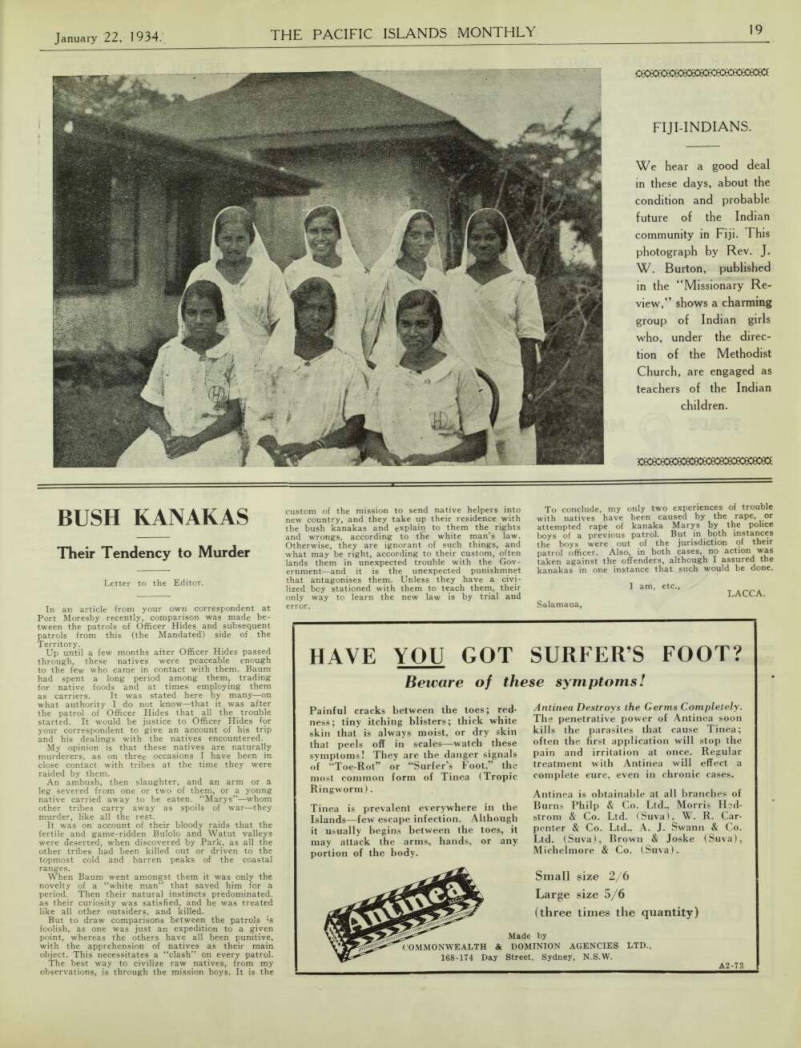
Passion Fruit Pulp In
THE Australian Department of Com merce has received advice from the Australian Trade Commissioner in Canada that the question of the sulphur dioxide content of passion fruit juice has been raised by the Canadian Department of Health.
The maximum strength of sulphur dioxide permitted in the Dominion is 1 part in 10,000 parts of beverage, whereas analysis has disclosed up to 2.85 parts.
It has been pointed out to the Depart ment that passion fruit juice is usually imported from Australia into Canada in the form of syrup requiring dilution with water to the extent of three or four to one. Therefore, as consumed by the pub lic, the beverage would comply with the Regulations. But the Canadian authorities say that the syrup or juice, as imported, must comply with the stipulation regard ing maximum content as set forth in the Regulations.
Exporters of this commodity are there fore advised to see that any future ship ments of passion fruit juice sent to Canada comply with these requirements.
Fiji-Indians.
We hear a good deal in these days, about the condition and probable future of the Indian community in Fiji. This photograph by Rev. J.
W. Burton, published in the “Missionary Re view," shows a charming group of Indian girls who, under the direc tion of the Methodist Church, are engaged as teachers of the Indian children.
Advertisements & other items, p. 20 (1 item)
Prescott Ltd
SHIP CHANDLERY-HARDWARE
BROOMFIELDS LIMITED, 152 Sussex St., SYDNEY
Large and Complete Stocks of SHIP CHANDLERY.
Ironmongery of all kinds Paints, White Lead and Oils.
Sole Agents for: P. H. MUNTZ & CO.’S 3-CROWN BRAND METAL SHEATHING.
PEACOCK & BUCHANS’ ENGLISH READY-MIXED PAINTS.
WRITE FOR SHIP CHANDLERY CATALOGUE.
Special “In Bond” Prices for all Island enquiries quoted on application.
CABLES: “BOOM,” SYDNEY.
PRESCOTT LTD
SUSSEX ST
SYDNEY
PINEAPPLE BACON & HAMS
DAISY BRAND BUTTER
FRESCO BRAND BUTTER
LEA & PERRINS’ SAUCE
ANN CAIRD’S MARMALADE.
Bush Kanakas
Their Tendency to Murder
Letter to the Editor.
In an article from your own correspondent at Port Moresby recently, comparison was made be tween the patrols of Officer Hides and subsequent patrols from this (the Mandated) side of the Territory.
Up until a few months after Officer Hides passed through, these natives were peaceable enough to the few who came in contact with them. Baum had spent a long period among them, trading for native foods and at times employing them as carriers. It was stated here by many—on what authority I do not know—that it was after the patrol of Officer Hides that all the trouble started. It would be justice to Officer Hides for your correspondent to give an account of his trip and his dealings with the natives encountered.
My opinion is that these natives are naturally murderers, as on three occasions I have been in close contact with tribes at the time they were raided by them.
An ambush, then slaughter, and an arm or a leg severed from one or two of them, or a young native carried away to be eaten. “Marys”—whom other tribes carry away as spoils of war —they murder, like all the rest.
It was on account of their bloody raids that the fertile and game-ridden Bulolo and Watut valleys were deserted, when discovered by Park, as all the other tribes had been killed out or driven to the topmost cold and barren peaks of the coastal ranges.
When Baum went amongst them it was only the novelty of a “white man” that saved him for a period. Then their natural instincts predominated, as their curiosity was satisfied, and he was treated like all other outsiders, and killed.
But to draw comparisons between the patrols is foolish, as one was just an expedition to a given point, whereas the others have all been punitive, with the apprehension of natives as their main object. This necessitates a “clash” on every patrol.
The best way to civilize raw natives, from my observations, is through the mission boys. It is the
custom of the mission to send native helpers into new country, and they take up their residence with the bush kanakas and explain to them the rights and wrongs, according to the white man’s law.
Otherwise, they are ignorant of such things, and what may be right, according to their custom, often lands them in unexpected trouble with the Gov ernment —and it is the unexpected punishmnet that antagonises them. Unless they have a civi lized boy stationed with them to teach them, their only way to learn the new law is by trial and error.
To conclude, my only two experiences of trouble with natives have been caused by the rape, or attempted rape of kanaka Marys by the police boys of a previous patrol. But in both instances the boys were out of the jurisdiction of their patrol officer. Also, in both cases, no action was taken against the offenders, although I assured the kanakas in one instance that such would be done.
I am, etc.,
Lacca.
Salamaua,
Advertisements & other items, p. 21 (1 item)
Have You Got Surfers Foot?
Beware of these symptoms!
Painful cracks between the toes; redness; tiny itching blisters; thick white skin that is always moist, or dry skin that peels off in scales —watch these symptoms! They are the danger signals of “Toe-Rot” or “Surfer’s Foot.” the most common form of Tinea (Tropic Ringworm).
Tinea is prevalent everywhere in the Islands—few escape infection. Although it usually begins between the toes, it may attack the arms, hands, or any portion of the body.
Antinea Destroys the Germs Completely.
The penetrative power of Antinea soon kills the parasites that cause Tinea; often the first application will stop the pain and irritation at once. Regular treatment with Antinea will effect a complete cure, even in chronic cases.
Antinea is obtainable at all branches of Burns Philp & Co. Ltd., Morris Hedstrom & Co. Ltd. (Suva), W. R. Carpenter & Co. Ltd.. A. J. Swann & Co.
Ltd. (Suva), Brown & Joske (Suva), Michelmore & Co. (Suva).
COMMONWEALTH &
168-174 Day Small size 2/6
Large size 5/6
(three times the quantity)
Made by
DOMINION AGENCIES LTD.,
Street, Sydney, N.S.W.
A 2-73
Sugar Industry Would
Help Papua
On arrival in Sydney from Thursday Is., the Lieutenant-Governor of Papua, Sir Hubert Murray told the newspapers that sugar-cane growing would mean much to Papua. Although there had been difficulty in obtaining capital for the industry, he believed it would eventually “put the country on its feet.” There were many things in favor of sugar-cane growing in Papua, and the labour would be cheaper than in some of the other cane-growing countries with which Papua might com pete.
Sir Hubert Murray is now on three months’ leave, and is visiting his daughter, Mrs. Pinney, the wife of the administrator of Norfolk Island.
Malaria
Important Conference In Singapore
A CONFERENCE of importance to resi dents of the Pacific Territories will be held in Singapore in March, when there will be a meeting of medical experts from all parts of the world to exchange views on the subject of malaria.
The conference has been called by the League of Nations. It is expected that Australia and her Territories will have two representatives. One, it is expected, will be Dr. Cilento, who has made a special study of tropical hygiene, and the other will be one of the medical staff in New Guinea, who will be nominated by the New Guinea Administration.
The methods of treating and preventing malaria have made enormous advances during the past twenty years, and there are those who believe the time is ap proaching when this scourge of the tropics, which renders so large a propor tion of the earth’s surface dangerous to natives and uninhabitable permanently by Europeans, will be definitely controlled.
Much has been achieved by the ceaseless war upon the anopheles mosquito and the eradication of his breeding places: and much more by the discovery of better prophylaxis. Even within the last three or four years we have seen the use of quinine, as a prophylactic, partly sup planted by plasmoquine; and in the last twelve months many people in the Terri tories are putting their faith in the latest discovery, atebrin, which is claimed to be better than plasmoquine.
Book, 1932
Pacific Islands Year
OUR supplies of the above compilation are completely sold out, and we are not able to fill any further orders.
Those requiring copies are advised that Messrs. Sifton & Co., Ltd., 67 St. James Street, London, SWI, still had, in September, a few copies on hand; but early application is necessary.
The next edition will be published in 1934.
Pacific Publications Ltd.
A Reply To “M.M.”
("Ode to a Strawberry Box ” P.I.M, 22/11/’33.) Oh! heartless and unfeeling! Thou Who laugh at mal-de-mer. As one of “them”
I say “It isn’t done!”
I read your lines appreciatively, What time my steward, swaying, said the thing for me Was pickled on-i-on!
I read and, reading, thought “This gentle soul Lacked, as I lack myself, complete con trol Of little Mary.”
But no. Indecent Scribe! YOU never knew The peristaltic turn that quickens to A ship’s vagary.
YOUR nose enjoyed no fatty galley odour!
YOUR cabin knew not Worcester sauce, nor soda, Nor eke Pot. Brom.!
For here’s a paradox— ’Tis only they who HAVEN’T been right through it Can tell the truth about it. (I eschew it!) And certes your gentle Muse would quite taboo it Just coming from A Strawberry Box!
“Nux Vom.”
Tinai Valley
Hopes For Rich Gold
THERE have been interesting developments lately in connection with Tinai Valley gold prospects. Tinai Valley is a high plateau in the far interior of Cen tral Papua, close up under Mount Chap man, and very close to the New Guinea- Papua border.
A long time ago, it is reported, rich gold was discovered there, but the natives were so hostile and the place so isolated and inhospitable that it was only re cently that steps were taken to prove and develop the prospects.
A few months ago, as already reported in this journal, a company was formed to investigate Tinai Valley; and a party was despatched from Sydney in October, with instructions that they were to spend a month on the field, and then, unless prospects definitely justified a further stay, they were to return to civilisation.
Up to the middle of December, they had not been heard of, although more than a month had elapsed, and it was then as sumed that they were “on gold,” and were remaining. An aeroplane landing ground has been established within a compara tively short distance of Tinai Valley, and, if there is good gold there, the place can be worked by aeroplanes.
Meanwhile, there was an interesting development. Somehow or other, the word got around that the Tinai Valley gold is rich and that it is doubtful whether the Valley is in Papua or New Guinea, Consequently, a little syndicate was formed to take the necessary steps to peg the ground and register in New Guinea, irrespective of whether registra tion had been already effected in Papua.
The authorities got wind of the scheme, however, and acted promptly, with the result that it has been announced that, until the boundary line has been exactly fixed, the first registration of Tinai Val ley shall be effective legally, whether made in New Guinea or Papua.
Advertisements & other items, p. 22 (2 items)
Gillespie's
“ANCHOR”
FLOUR
TRADE
MARK
The Standard of Quality.
College
CHARTRES,
STOTT & HOARE’S
CORRESPONDENCE
COLLEGE
Founded 1885.
Pioneers and Specialists in Postal Instruction.
All Educational and Commercial subjects taught thoroughly and efficiently by correspondence.
Experienced Certificated Instructors. — Write for particulars Chartres, Stott & Hoare’s Correspondence
College
Liverpool Street, Sydney, Australia.
New Guinea Notes
From Our Own Correspondent.
Rabaul, Dec. 18.
IT is officially reported that a European school will be opened at Kavieng about March, 1934.
Mrs. J. MacGregor Dowsett and two children have arrived from Australia, after an extended holiday there. They have joined Mr. Dowsett, who has taken up his residence on a property in the vicinity of the Keravat Demonstration Plantation. He has sold out his business in Rabaul.
The Parents and Citizens’ Association of Rabaul recently arranged for the film ing of “Father’s Son” at the local picture theatre. The proceeds were earmarked for the purchase of prizes for the school children.
Some Prices!
The assessed value of copra for export purposes was £4/13/1 for the month of November.
Rice was recently purchased by the Administration by tender at £8/8/9 per ton c.i.f. and e, Rabaul; preserved meat at 4/4½ per doz.; and benzine at 16/4 per case, less 2½ per cent, discount.
Weddings.
The wedding of Miss Gladys Mary Field, of Ferny Grove, Brisbane, to Mr. Ronald Harrison Forsyth, of Balgowlah, Sydney, was celebrated at St. George’s Church, Rabaul, on November 15. After the cere mony a reception was held at the resi dence of Mr. and Mrs. J. L. Froggatt.
The Bishton-Maunsell wedding was a notable local affair. Miss Irene Maun sell, of Brisbane, was married to Mr.
Edward Bishton, of the A.W.A. staff at Rabaul, at St. Francis Xavier, by Rev.
Father Madigan, on November 14, at 7 p.m. Miss Marjorie Thomas acted as bridesmaid, and Mr. Len Coleman was best man. A sumptuous wedding break fast was held at the Palms Restaurant after the ceremony, when Mrs. H. Dodd (sister of the bride) acted as hostess.
Native Entertainment.
An exceptionally good “sing-sing” was held at Nodup recently in the vicinity of the Native School, where Mr. J. H. L.
Waterhouse, F.R.G.S., is in charge. A number of Europeans attended, including the Administrator, who inspected the school-children and had a conference with the local chiefs.
An Ancient Ring.
The wedding of Miss Helen McTurk Stevens, of Sydney, and Mr. Ronald N.
Wayne, of the Methodist Mission staff, was celebrated at Vunairima on Novem ber 18. The service was carried out by the Rev. J. H. Margetts. The bride wore the wedding ring of one of her ancestors which was over 200 years old.
Rabaul Airways.
Mr. Charles Gatenby, the pilot-mechanic who accompanied the ’plane VH-UNY on its trip up from Sydney with Pilot Dun can, has returned south for the purpose of selecting another ’plane for service with the Rabaul Airways Syndicate. This craft, we understand, will be brought up by steamer,
Tennis Champions.
A tennis dance was held at the Rabaul Hotel on November 23 when the Adminis trator’s Cups and other trophies were presented. The presentations were made by Mrs. Townsend, the wife of Mr Orton Townsend, O.B. E., M.L.C., the Administration Treasurer. The ladies’ singles
championship was won by Miss Burston, and the gentlemen’s by Mr. Abraham, who is the best all-round sportsman in the district, despite his approach to the middle-age period. Runners-up were Mrs.
Anderson and Mr. Garth Walker. The men’s doubles handicap was won by Messrs. Cunningham and Blanden, and the ladies’ doubles by Misses P. Bryant and Refshauge. The mixed doubles tropfiy was collected by Mrs. Thornthwaite and Mr. O. Townsend.
Renovations.
The painters are hard at work in Rabaul now. Administration buildings are being renovated and given a new coat of paint —not before it was badly needed. The Legislative Council has taken on quite a resplendent appearance—all in readiness for the February session when great things are expected to be done.
Popular Padre.
Rev. T. J. Gibson, who has been our Church of England Padre for some time, left on the s.s. Van Rees on November 28 for Tasmania. He was a very popular Padre and will be missed by his many friends. Rev. H. Thompson, recently stationed in Papua, has arrived for his relief.
There was a quiet wedding celebrated at St. George’s Church on November 22, when Miss Edith Eileen Rogers was mar ried to Mr. Garth Walker, of the Central Administration staff. Miss Rogers arrived by the Nankin from South. The recep tion was held at the home of Mr. and Mrs. E. Britten and the happy couple spent their honeymoon at Toma.
Night Bowling.
Bowling enthusiasts have held a meet ing recently and it was decided that steps should be taken to complete the rinks already laid down and suggestions were made to enable night bowling to be car ried on. Mr. T. Ellis, of the Lands De partment, is the enthusiastic leader in this particular recreation.
Sepik Recruits.
Mr. C. C. Judd, formerly with the Melanesia Company and later with Messrs. Burns, Philp & Co., has recently made a recruiting trip to the Sepik River district where he had good luck in ob taining a fine line of labourers. It is his intention to operate on the goldfields with his line of “boys.”
New Sepik Station.
A new government station is being started on the Sepik River, some forty miles from the mouth. This will do away with the old Marieberg station. The name of the new site is Angoram, and was used during the German days as a depot.
Seeking Murderers.
A. D. O. Robinson, who returned from furlough recently, has been despatched to the Nakanai area where a patrol is work ing in order to apprehend some elusive murderers of beach natives.
Gold Exports,
The amount of bullion exported from the goldfields for the month of October amounted to 22,943 oz., and was valued at £123,383 (Australian currency).
Advertisements & other items, p. 23 (1 item)
Dockers
SUN BRAND PAINT
Made expressly to keep a lustrous, full gloss finish
against the varying con-
ditions of moist weather exposure, and prevent the decaying ravages of rain and extreme heat by
giving a long lasting pro-
tection to all surfaces.
SUN PROOF
RAIN PROOF
“Stronger than the Weather”
W. R. CARPENTER
& CO. LTD.
New Guinea, Solomon Islands, and all other South Sea Islands.
Discoveries In New Guinea
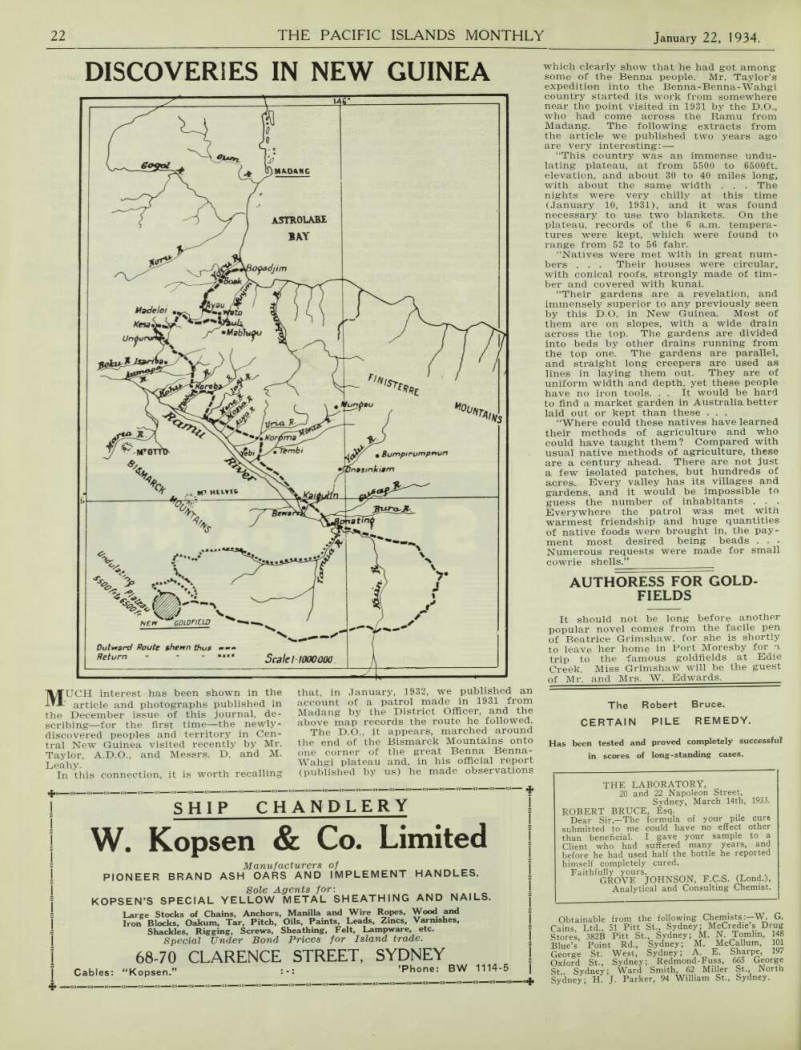
MUCH interest has been shown in the article and photographs published in the December issue of this journal, de scribing—for the first time —the newly discovered peoples and territory in Cen tral New Guinea visited recently by Mr.
Taylor, A.D.O., and Messrs. D. and M.
Leahy.
In this connection, it is worth recalling
that, in January, 1932, we published an account of a patrol made in 1931 from Madang by the District Officer, and the above map records the route he followed.
The D. O., it appears, marched around the end of the Bismarck Mountains onto one corner of the great Benna Benna- Wahgi plateau and, in his official report (published by us) he made observations
which clearly show that he had got among some of the Benna people. Mr. Taylor’s expedition into the Benna-Benna-Wahgi country started its work from somewhere near the point visited in 1931 by the D. O., who had come across the Ramu from Madang. The following extracts from the article we published two years ago are very interesting: “This country was an immense undu lating plateau, at from 5500 to 6500 ft. elevation, and about 30 to 40 miles long, with about the same width . . . The nights were very chilly at this time (January 10, 1931), and it was found necessary to use two blankets. On the plateau, records of the 6 a.m. tempera tures were kept, which were found to range from 52 to 56 fahr.
“Natives were met with in great num bers . . . Their houses were circular, with conical roofs, strongly made of tim ber and covered with kunai.
“Their gardens are a revelation, and immensely superior to any previously seen by this D.O. in New Guinea. Most of them are on slopes, with a wide drain across the top. The gardens are divided into beds by other drains running from the top one. The gardens are parallel, and straight long creepers are used as lines in laying them out. They are of uniform width and depth, yet these people have no iron tools. . . It would be hard to find a market garden in Australia better laid out or kept than these . . .
“Where could these natives have learned their methods of agriculture and who could have taught them? Compared with usual native methods of agriculture, these are a century ahead. There are not just a few isolated patches, but hundreds of acres. Every valley has its villages and gardens, and it would be impossible to guess the number of inhabitants . . .
Everywhere the patrol was met with warmest friendship and huge quantities of native foods were brought in, the pay ment most desired being beads . . - Numerous requests were made for small cowrie shells.”
Authoress For Gold
Fields
It should not be long before another popular novel comes from the facile pen of Beatrice Grimshaw, for she is shortly to leave her home in Port Moresby for a trip to the famous goldfields at Edie Creek. Miss Grimshaw will be the guest of Mr. and Mrs. W. Edwards.
Advertisements & other items, p. 24 (2 items)
The Robert Bruce.
CERTAIN PILE REMEDY.
Has been tested and proved completely successful in scores of long-standing cases.
THE LABORATORY,
20 and 22 Napoleon Street, Sydney, March 14th, 1933.
ROBERT BRUCE, Esq.
Dear Sir,—The formula of your pile curt submitted to me could have no effect other than beneficial. I gave your sample to a Client who had suffered many years, and before he had used half the bottle he reported himself completely cured.
Faithfully yours,
GROVE JOHNSON, F.C.S. (Lond.),
Analytical and Consulting Chemist.
Obtainable from the following Chemists:—W. G.
Cains, Ltd., 51 Pitt St., Sydney; McCredie s Drug Stores, 382B Pitt St., Sydney; M. N. Tomlin. 148 Blue’s Point Rd., Sydney; M. McCallum, 101 George St. West, Sydney; A. E. Sharpe, 197 Oxford St., Sydney; Redmond-Fuss, 665 George St Sydney; Ward Smith, 62 Miller St., North Sydney; H. J. Parker, 94 William St., Sydney.
W. Kopsen & Co. Limited
SHIP CHANDLERY
Manufacturers of PIONEER BRAND ASH OARS AND IMPLEMENT HANDLES.
Sole Agents for : KOPSEN’S SPECIAL YELLOW METAL SHEATHING AND NAILS.
Large Stocks of Chains, Anchors, Manilla and Wire Ropes, Wood and Iron Blocks, Oakum, Tar, Pitch, Oils, Paints, Leads, Zincs, Varnishes, Shackles, Rigging, Screws, Sheathing, Felt, Lampware, etc.
Special Under Bond Prices for Island trade.
68-70 CLARENCE STREET, SYDNEY
Cables: “Kopsen.” ’Phone: BW 1114-5
Personal Notes From
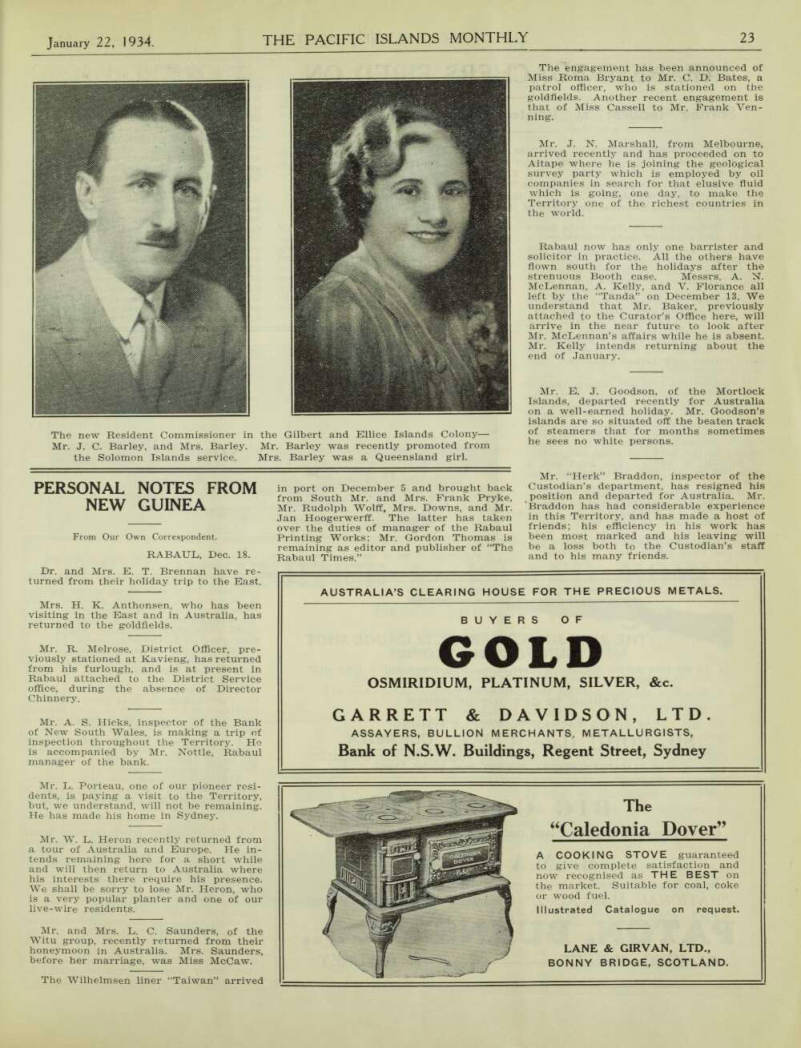
New Guinea
From Our Own Correspondent.
Rabaul, Dec. 18.
Dr. and Mrs. E. T. Brennan have re turned from their holiday trip to the East.
Mrs. H. K. Anthonsen, who has been visiting in the East and in Australia, has returned to the goldfields.
Mr. R. Melrose, District Officer, pre viously stationed at Kavieng, has returned from his furlough, and is at present in Rabaul attached to the District Service office, during the absence of Director Chinnery.
Mr. A. S. Hicks, inspector of the Bank of New South Wales, is making a trip of inspection throughout the Territory. He is accompanied by Mr. Nottle, Rabaul manager of the bank.
Mr. L. Porteau, one of our pioneer resi dents, is paying a visit to the Territory, but, we understand, will not be remaining.
He has made his home in Sydney.
Mr. W. L. Heron recently returned from a tour of Australia and Europe. He in tends remaining here for a short while and will then return to Australia where his interests there require his presence.
We shall be sorry to lose Mr. Heron, who is a very popular planter and one of our live-wire residents.
Mr. and Mrs. L. C. Saunders, of the Witu group, recently returned from their honeymoon in Australia. Mrs, Saunders, before her marriage, was Miss McCaw, The Wilhelmsen liner “Taiwan” arrived
in port on December 5 and brought back from South Mr. and Mrs. Frank Pryke, Mr. Rudolph Wolff, Mrs. Downs, and Mr.
Jan Hoogerwerff. The latter has taken over the duties of manager of the Rabaul Printing Works; Mr. Gordon Thomas is remaining as editor and publisher of “The Rabaul Times.”
The engagement has been announced of Miss Roma Bryant to Mr. C. D. Bates, a patrol officer, who is stationed on the goldfields. Another recent engagement is that of Miss Cassell to Mr. Frank Ven ning.
Mr. J. N. Marshall, from Melbourne, arrived recently and has proceeded on to Aitape where he is joining the geological survey party which is employed by oil companies in search for that elusive fluid which is going, one day, to make the Territory one of the richest countries in the world.
Rabaul now has only one barrister and solicitor in practice. All the others have flown south for the holidays after the strenuous Booth case. Messrs. A. N.
McLennan, A. Kelly, and V. Florance all left by the “Tanda” on December 13. We understand that Mr. Baker, previously attached to the Curator’s Office here, will arrive in the near future to look after Mr. McLennan’s affairs while he is absent.
Mr. Kelly intends returning about the end of January.
Mr. E. J. Goodson, of the Mortlock Islands, departed recently for Australia on a well-earned holiday. Mr. Goodson’s islands are so situated off the beaten track of steamers that for months sometimes he sees no white persons.
Mr. “Herk” Braddon, inspector of the Custodian’s department, has resigned his position and departed for Australia. Mr.
Braddon has had considerable experience in this Territory, and has made a host of friends; his efficiency in his work has been most marked and his leaving will be a loss both to the Custodian’s staff and to his many friends.
The new Resident Commissioner in the Gilbert and Ellice Islands Colony— Mr. J. C. Barley, and Mrs. Barley. Mr. Barley was recently promoted from the Solomon Islands service, Mrs. Barley was a Queensland girl.
Advertisements & other items, p. 25 (1 item)
Gold
AUSTRALIA’S CLEARING HOUSE FOR THE PRECIOUS METALS.
BUYERS OF
OSMIRIDIUM, PLATINUM, SILVER, &c.
GARRETT & DAVIDSON, LTD.
ASSAYERS, BULLION MERCHANTS, METALLURGISTS,
Bank of N.S.W. Buildings, Regent Street, Sydney
The
“Caledonia Dover”
A COOKING STOVE guaranteed to give complete satisfaction and now recognised as THE BEST on the market. Suitable for coal, coke or wood fuel.
Illustrated Catalogue on request.
LANE & GIRVAN, LTD.,
BONNY BRIDGE, SCOTLAND.
Japanese Poachers Fired On
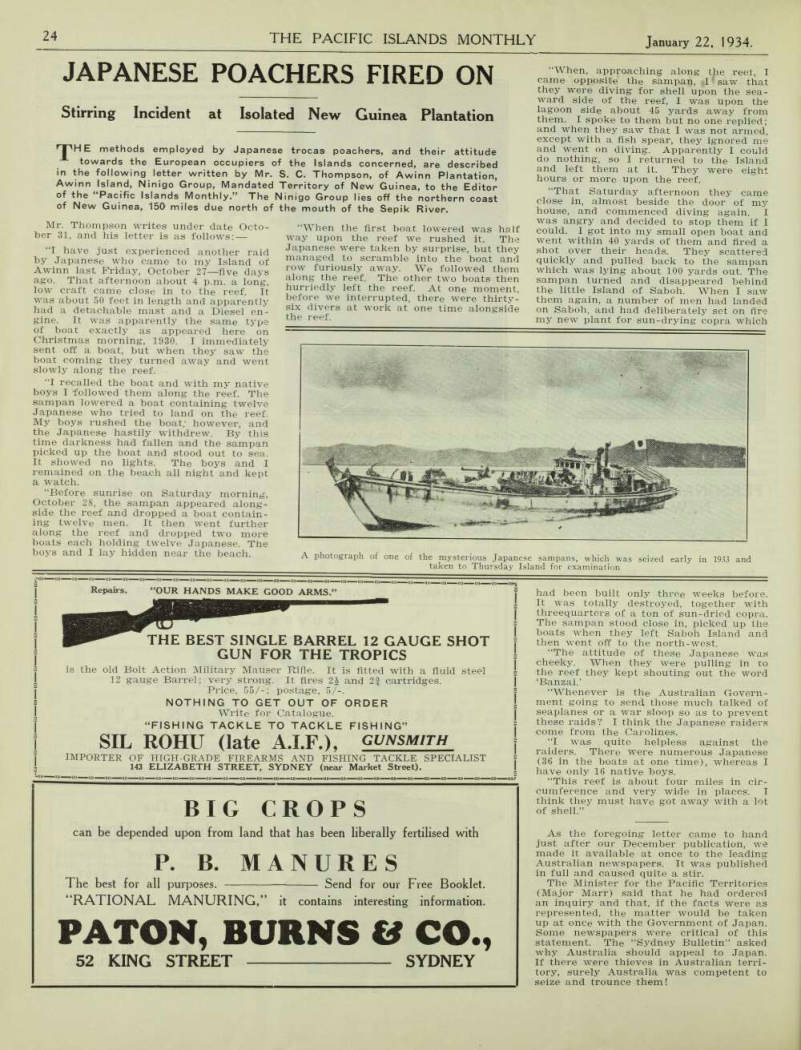
Stirring Incident at Isolated New Guinea Plantation
THE methods employed by Japanese trocas poachers, and their attitude towards the European occupiers of the Islands concerned, are described in the following letter written by Mr. S. C. Thompson, of Awinn Plantation, Awinn Island, Ninigo Group, Mandated Territory of New Guinea, to the Editor of the “Pacific Islands Monthly.” The Ninigo Group lies off the northern coast of New Guinea, 150 miles due north of the mouth of the Sepik River.
Mr. Thompson writes under date Octo ber 31, and his letter is as follows; “I have just experienced another raid by Japanese who came to my Island of Awinn last Friday, October 27 —five days ago. That afternoon about 4 p.m. a long, low craft came close in to the reef. It was about 50 feet in length and apparently had a detachable mast and a Diesel en gine. It was apparently the same type of boat exactly as appeared here on Christmas morning, 1930. I immediately sent off a boat, but when they saw the boat coming they turned away and went slowly along the reef.
“I recalled the boat and with my native boys I followed them along the reef. The sampan lowered a boat containing twelve Japanese who tried to land on the reef.
My boys rushed the boat; however, and the Japanese hastily withdrew. By this time darkness had fallen and the sampan picked up the boat and stood out to sea.
It showed no lights. The boys and I remained on the beach all night and kept a watch.
“Before sunrise on Saturday morning, October 28, the sampan appeared along side the reef and dropped a boat contain ing twelve men. It then went further along the reef and dropped two more boats each holding twelve Japanese. The boys and I lay hidden near the beach.
“When the first boat lowered was half way upon the reef we rushed it. The Japanese were taken by surprise, but they managed to scramble into the boat and row furiously away. We followed them along the reef. The other two boats then hurriedly left the reef. At one moment, before we interrupted, there were thirty six divers at work at one time alongside the reef.
“When, approaching along the reel, I came opposite the sampan, I saw that they were diving for shell upon the sea ward side of the reef, I was upon the lagoon side about 45 yards away from them. I spoke to them but no one replied; and when they saw that I was not armed, except with a fish spear, they ignored me and went on diving. Apparently I could do nothing, so I returned to the Island and left them at it. They were eight hours or more upon the reef.
“That Saturday afternoon they came close in, almost beside the door of my house, and commenced diving again. I was angry and decided to stop them if I could. I got into my small open boat and went within 40 yards of them and fired a shot over their heads. They scattered quickly and pulled back to the sampan which was lying about 100 yards out. The sampan turned and disappeared behind the little Island of Saboh. When I saw them again, a number of men had landed on Saboh, and had deliberately set on fire my new plant for sun-drying copra which
had been built only three weeks before.
It was totally destroyed, together with threequarters of a ton of sun-dried copra.
The sampan stood close in, picked up the boats when they left Saboh Island and then went oft to the north-west.
“The attitude of these Japanese was cheeky. When they were pulling in to the reef they kept shouting out the word ‘Banzai.’
“Whenever is the Australian Govern ment going to send those much talked of seaplanes or a war sloop so as to prevent these raids? I think the Japanese raiders come from the Carolines.
“I was quite helpless against the raiders. There were numerous Japanese (36 in the boats at one time), whereas I have only 16 native boys.
“This reef is about four miles in cir cumference and very wide in places. I think they must have got away with a lot of shell.”
As the foregoing letter came to hand just after our December publication, we made it available at once to the leading Australian newspapers. It was published in full and caused quite a stir.
The Minister for the Pacific Territories (Major Marr) said that he had ordered an inquiry and that, if the facts were as represented, the matter would be taken up at once with the Government of Japan.
Some newspapers were critical of this statement. The “Sydney Bulletin” asked why Australia should appeal to Japan.
If there were thieves in Australian terri tory, surely Australia was competent to seize and trounce them!
A photograph of one of the mysterious Japanese sampans, which was seized early in 1933 and taken to Thursday Island for examination.
Advertisements & other items, p. 26 (1 item)
Paton, Burns & Co.,
Repairs.
OUR HANDS MAKE GOOD ARMS.
THE BEST SINGLE BARREL 12 GAUGE SHOT
GUN FOR THE TROPICS
is the old Bolt Action Military Mauser Rifle. It is fitted with a fluid steel 12 gauge Barrel; very strong. It fires 2½ and 2¾ cartridges.
Price, 55/-; postage, 5/-.
NOTHING TO GET OUT OF ORDER
Write for Catalogue.
“FISHING TACKLE TO TACKLE FISHING”
SIL ROHU (late A.I.F.),
IMPORTER OF HIGH-GRADE FIREARMS AND FISHING TACKLE SPECIALIST 143 ELIZABETH STREET, SYDNEY (near Market Street).
BIG CROPS
can be depended upon from land that has been liberally fertilised with
P. B. MANURES
The best for all purposes. Send for our Free Booklet.
“RATIONAL MANURING,” it contains interesting information.
PATON, BURNS & CO.,
52 KING STREET SYDNEY
Booth V. Booth
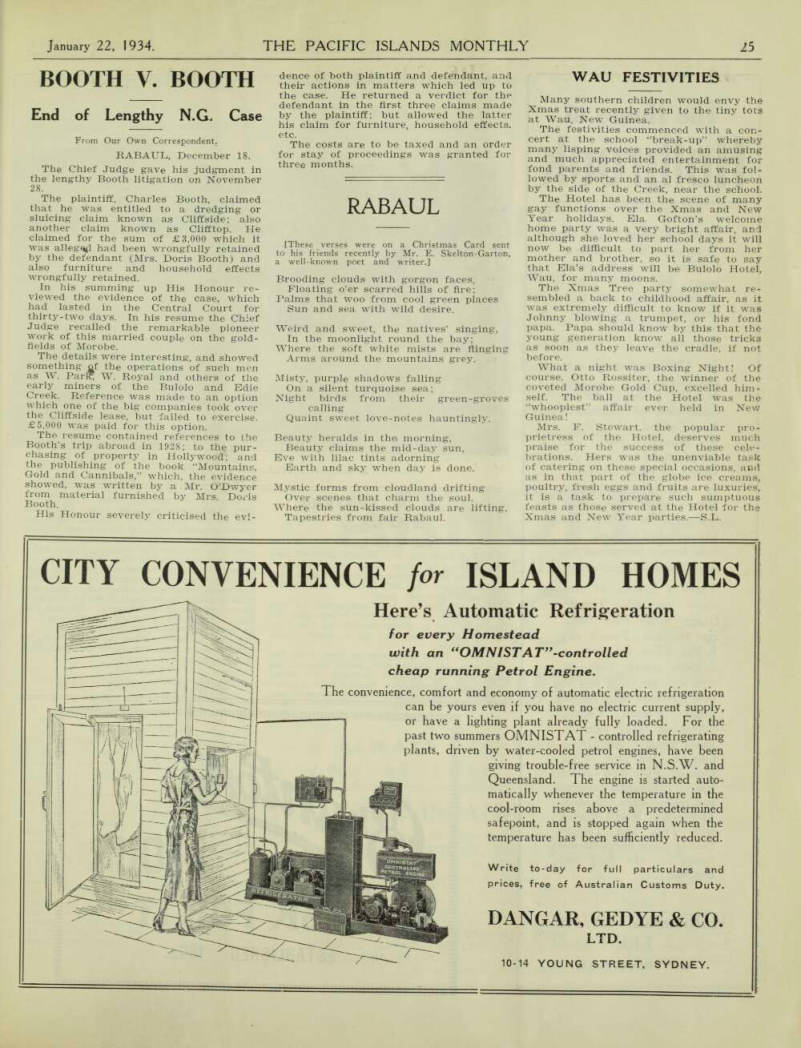
End of Lengthy N.G. Case
From Our Own Correspondent.
RABAUL, December 18.
The Chief Judge gave his judgment in the lengthy Booth litigation on November 28.
The plaintiff, Charles Booth, claimed that he was entitled to a dredging or sluicing claim known as Cliff side; also another claim known as Clifftop. He claimed for the sum of £3,000 which it was allege had been wrongfully retained by the defendant (Mrs. Doris Booth) and also furniture and household effects wrongfully retained.
In his summing up His Honour re viewed the evidence of the case, which had lasted in the Central Court for thirty-two days. In his resume the Chief Judge recalled the remarkable pioneer work of this married couple on the gold fields of Morobe.
The details were interesting, and showed something of the operations of such men as W. Park, W. Royal and others of the early miners of the Bulolo and Edie Creek. Reference was made to an option which one of the big companies took over the Cliffside lease, but failed to exercise. £5,000 was paid for this option.
The resume contained references to the Booth’s trip abroad in 1928; to the pur chasing of property in Hollywood: and the publishing of the book “Mountains, Gold and Cannibals,” which, the evidence showed, was written by a Mr. O’Dwyer from material furnished by Mrs. Doris Booth.
His Honour severely criticised the evl
dence of both plaintiff and defendant, and their actions in matters which led up to the case. He returned a verdict for the defendant in the first three claims made by the plaintiff; but allowed the latter his claim for furniture, household effects, etc.
The costs are to be taxed and an order for stay of proceedings was granted for three months.
Rabaul
[These verses were on a Christmas Card sent to his friends recently by Mr. E. Skelton-Garton, a well-known poet and writer.] Brooding clouds with gorgon faces, Floating o’er scarred hills of fire; Palms that woo from cool green places Sun and sea with wild desire.
Weird and sweet, the natives’ singing, In the moonlight round the bay; Where the soft white mists are flinging Arms around the mountains grey.
Misty, purple shadows falling On a silent turquoise sea; Night birds from their green-groves calling Quaint sweet love-notes hauntingly.
Beauty heralds in the morning, Beauty claims the mid-day sun, Eve with lilac tints adorning Earth and sky when day is done.
Mystic forms from cloudland drifting Over scenes that charm the soul, Where the sun-kissed clouds are lifting, Tapestries from fair Rabaul.
Wau Festivities
Many southern children would envy the Xmas treat recently given to the tiny tots at Wau, New Guinea.
The festivities commenced with a con cert at the school “break-up” whereby many lisping voices provided an amusing and much appreciated entertainment for fond parents and friends. This was fol lowed by sports and an al fresco luncheon by the side of the Creek, near the school.
The Hotel has been the scene of many gay functions over the Xmas and New Year holidays. Ela Gofton’s welcome home party was a very bright affair, and although she loved her school days it will now be difficult to part her from her mother and brother, so it is safe to say that Ela’s address will be Bulolo Hotel, Wau, for many moons.
The Xmas Tree party somewhat re sembled a back to childhood affair, as it was extremely difficult to know if it was Johnny blowing a trumpet, or his fond papa. Papa should know by this that the young generation know all those tricks as soon as they leave the cradle, if not before.
What a night was Boxing Night! Of course, Otto Rossiter, the winner of the coveted Morobe Gold Cup, excelled him self. The ball at the Hotel was the “whoopiest” affair ever held in New Guinea!
Mrs. F. Stewart, the popular pro prietress of the Hotel, deserves much praise for the success of these cele brations. Hers was the unenviable task of catering on these special occasions, and as in that part of the globe ice creams, poultry, fresh eggs and fruits are luxuries, it is a task to prepare such sumptuous feasts as those served at the Hotel for the Xmas and New Year parties.—S.L.
Advertisements & other items, pp. 27-28 (1 item)
City Convenience For Island Homes
Here’s Automatic Refrigeration
for every Homestead with an “OMNISTAT”-controlled cheap running Petrol Engine .
The convenience, comfort and economy of automatic electric refrigeration can be yours even if you have no electric current supply, or have a lighting plant already fully loaded. For the past two summers OMNISTAT - controlled refrigerating plants, driven by water-cooled petrol engines, have been giving trouble-free service in N.S.W. and Queensland. The engine is started automatically whenever the temperature in the cool-room rises above a predetermined safepoint, and is stopped again when the temperature has been sufficiently reduced.
Write to-day for full particulars and prices, free of Australian Customs Duty.
HANGAR, GEDYE & CO.
LTD.
10-14 YOUNG STREET. SYDNEY.
The House of
Holbrook
In the old world village of Stourport, Worcestershire, England, just at the point where the River Stour empties itself into the Severn, the House of Holbrook was founded 133 years ago.
In 1919 a factory was established in Sydney, N.S.W., to supply the requirements of Australia, New Zealand and the Pacific Islands. Here are manufactured a wide variety of table delicacies, as well as Holbrook’s Sauces and Pure Malt Vinegar, for which the House of Holbrook has been famous throughout the world for many generations.
There is Essence of Anchovy for fish, Tomato Sauce, made from fresh, ripe tomatoes; French and Italian Olive Oil, with a delicate, creamy taste —so nice with the salad and of such nutritious value for invalids, French Capers, Olives, in many varieties, from Spain; tiny sweet Gherkins and little White Onions, Fish and Meat Pastes, Flavouring Essences and endless other delicacies.
Holbrooks’ Baked Beans, with Pork and Tomato Sauce; tinned Spaghetti and Soups are also tasty and delicious.
Holbrooks (A/sia.)
Ltd.
WATERLOO, N.S.W.
Gold In Eastern
Papua
Letter to the Editor.
THE article by Mr. Henry Dexter, appearing in your issue of November, says that the reports of finds of gold and platinum on the old Gibarra Goldfields, in Papua, are not true.
As Mr. Dexter has not gone to the trouble to crpss Milne Bay to see this for himself, but is going mostly on the talk of others, he does not know much about it, first hand.
I have been prospecting this area for the last 4½ years, and have opened up the old Samarai Gold Development mine, which has since been floated into a com nany. At present. I have several ore
bodies opened up, in width from 6in. to 50ft., and carrying gold from sdwts. to 5oz. to the ton. These are not only my own estimates but also from assays taken by independent mining enquiries and taken to Sydney for assay. These lodes are now ready for the installation of machinery to go ahead and become pay ing concerns. They are certainly not for the small syndicate, but for companies with a fairly large capital, which are pre pared to put in machinery. Ground has been tested for platinum, and found to go sdwts. to the cubic yard.
If Mr. Dexter wishes to verify this, let him take a trip across Milne Bay and take samples for himself.
Gibarra,
I am, etc.,
Louis Garden.
Milne Bay, Papua, 22/12/’33.
A Marine Village In Papua.
—Photo, by courtesy of “Missionary Review.”
Advertisements & other items, p. 28 (1 item)
Flour
ASK FOR IT
ESTABLISHED 1868.
Tropical Hygiene
Dr. Cilento Takes Charge of New Branch
THE Australian Federal Minister for Health, Major C. W. C. Marr, is also Minister in charge of the Island Terri tories; and he has combined his duties most advantageously in the creation of a new organisation, to be known as the Tropical Hygiene Branch.
Its purpose, as its name denotes, is to co-ordinate all the different activities in connection with medical research and preventive medicine which are proceeding within that part of the tropics governed by Australia. At the present moment, scientists and medical men are working for the limitation and elimination of disease in the Northern Territory, Papua, New Guinea, Nauru, Northern Queens land, and Norfolk Island. Some of their problems are peculiar to those localities; others —such as the incidence and preven tion of malaria —are common to all places north of the Tropic of Capricorn.
With the development of aviation a new responsibility has been thrown upon the Commonwealth Department of Health.
Formerly, ships coming from disease stricken countries were at sea long enough to allow the disease to develop before they reached Australian (or New Guinea) ports, thus making the work of medical inspection fairly easy. But the space devouring aeroplane stops all that —a machine may be in Australia twenty-four hours after leaving Malaya. What is entirely a new organisation has had to be created, therefore, to deal with this new danger to public health. This becomes part of the new Sub-Departmental or ganisation referred to.
A man who is very well known as a scientist and highly skilled in tropical medicine, Dr. Cilento, has been appointed to take charge of the new Tropical Hygiene Branch, under the immediate direction of the Chief Medical Officer and the Minister for Public Health. Dr.
Cilento will be the liaison officer between the medical men in the different tropical territories, in their war against disease.
Well Done, Pacific
Islanders!
Letter to the Editor.
I HAVE before me the 56th annual report of the Royal Shipwreck Relief and Humane Society of N.S.W. for the year to 30th June, 1933.
The total amount from steamship col lections received was £284/9/7, and of this amount a total of £108/13/5 came from the four island ships of Burns Philp —Montoro, Macdhui, Mataram and Morinda.
Since the island people comprise tne greatest percentage of the passenger lists, it will be pleasant news for them to learn that the small amount taken from race game winnings, daily runs and deck sports in general provided from the shil lings they have placed in those games has been the means of providing the Ship wreck Society named with two-fifths of its revenue received from shipping for those twelve months.
I am, etc.,
W. Wilding.
2nd Officer, s.s. Montoro.
Visit to Solomons Cancelled
THE Governor of Fiji and High Com missioner of the Western Pacific (Sir Murchison Fletcher) announced at the end of December that he will not be able to pay his proposed visit to the British Solomons owing to transport dif ficulties. He will, however, visit Welling
ton (N.Z.) and then Sydney, and prob ably Canberra, calling upon the two Governors-Generals, with whom he pro poses to discuss trade with Fiji, includ ing the entry of bananas into Australia, and exchange difficulties.
When His Excellency returns to Suva, a special meeting of the Legislative Council will discuss matters raised by his visits.
Advertisements & other items, p. 29 (1 item)
Arnotiis
DELICIOUS!!
THE crisp, tempting quality of
ARNOTT’S FAMOUS SAO
BISCUITS is the result of 64 years of specialisation. They stand unrivalled in quality and excellence. For lunch or supper they are delicious with butter and cheese, fresh and stewed fruit, ham paste, or savouries.
ARNOTIiS
FAMOUS
SAO
BISCUITS
ALWAYS ASK FOR ARNOTT’S
AND BE SURE YOU GET THEM
PACIFIC ISLANDS ASSOCIATION.
Headquarters and Clubrooms:
MILLIONS HOUSE, ROWE STREET, SYDNEY
Telephone: B 4971 Founded in 1931 to Advance the Interests of Residents of the Pacific; Assist Island Trade; Provide Information for Tourists; and Promote the Welfare of the Native Races.
All Pacific Islands residents visiting Sydney are invited to call at Millions House and sign the Visitors’ Book kept at the Association’s office on the first floor.
Secretary’s Office: NATIONAL MUTUAL BUILDING, 350 GEORGE STREET, near G.P.O., SYDNEY, AUSTRALIA :: :: :; Telephone: B 5067 Cable Adress: “CERTAC,” Sydney.
Import Restrictions On
Animals In N.G.
From Our Own Correspondent.
Rabaul, Dec. 18.
AN official announcement recently published is that all classes of animals are admitted to the Territory of New Guinea with the exception of parrots, Alsatian dogs, rabbits, and cattle, horses, asses, and mules from places other than Great Britain, Iceland, Australia, New Zealand, Canada, and the United States.
All animals must undergo an inspection on arrival before being landed in the Ter ritory, and must be accompanied by a cer tificate of health from the port at which they embarked.
“She”
When ships were first described as “she”
There were no steamers on the sea.
Yet modern ships, you must agree, Ooze modern femininity.
They’re shorter rigged than used to be, And faster, too; why they’ll take three Ports in a day quite easily.
And further, they all smoke, you see; And use more paint than clothes. Ah, me!
To own one is a luxury.
It’s right that ships should still be “she”.
—G.W.R.
Rabaul Shaken
Minor Damage Done
From Our Own Correspondent.
RABAUL, December 18. on Wednesday morning, De cember 13, Rabaul was visited by a severe earth tremor. The time of the shock was 12.15 a.m.
Considerable damage was done in cer tain sections of the town to tanks, crockery and cement piles. No one was injured, though a number of women were suffering later from shock as the result of nerve-strain.
The first tremor was of an up-and down nature; and was followed later by spasmodic shakes from various direc tions. Landslides occurred on the vari ous main roads and a small tidal wave was reported from Nodup.
A peculiar characteristic of these tremors was the fact that no rain had previously fallen, as is usual before such phenomena.
Torres St. Sardine
Industry
WITH heaquarters on the Island of Douar, in Torres Straits, an Austra lian company has established a factory for exporting sardines to Java and to islands in the Dutch East Indies.
Mr. H. B. Fletcher, a representative of the Murray Island Fisheries, arrived in Melbourne from London in the steamer Moreton Bay in December on his way to Queensland. He told reporters that the sardine industry could be greatly extended.
Huge shoals of sardines, he said, were driven into shallow water by sharks, where they were netted by Torres Straits island ers in huge quantities. They were then treated with brine, sun-dried, and sold at from £20 to £30 a ton.
W. R. Carpenter & Co. (Sol. Is.),
Ltd.
For the year ended 31st October, 1933, W. R.
Carpenter and Co. (Solomon Islands) Ltd. real ised £12,105 net profit, or £2313 less than for 1931-32. On the ordinary shares, which are held by W. R. Carpenter and Co., Ltd., dividend is reduced by 2 per cent, to 4 per cent., and takes £4480. Dividend on the 8 per cent, cumulative preference participating shares, less statutory de duction of 22½ per cent., absorbs £6200; to replacements and renewals reserve £1000 is added, and with £5736 brought in, £6162 is carried for ward. Capital paid up is £212,000. The balance sheet shows replacements and renewals reserve at £7000. In the assets, mortgages, sundry debtors, branch balances, shipping property and investments are grouped, and appear at £235,600, compared with £241,364 a year earlier.
Nauru Friction
Political and Religious
THERE has been a certain amount of political friction in Nauru lately, which appears to have had its base in religious controversy.
The Roman Catholic authorities, in their wisdom, recently sent a second priest to Nauru, to establish and conduct a school there. For some reasons, the Roman Catholic community there seemed to take this as a reflection upon the priest already on the Island, and there was such a fierce argument between the two fac tions that the Administrator was obliged to take official notice of it.
Then there was some slight dispute between the new Administrator, Com mander Garcia, and the leading chief of the Island. The native Nauruans are Polynesians of an advanced culture, and under their very modern chief they have displayed an almost aggressive inclina tion for self-government. It is the policy of British administrators everywhere to encourage native races to govern them selves, but they are not expected, in this connection, to display an aggressive or dictatorial attitude towards their British advisers. The chief decided, among other things, that the Nauruans should have a church of their own, and he duly estab lished the Nauruan Church, and it was matters arising out of this development which made it necessary for the Adminis trator to take a very firm attitude.
New Guinea Public
Service
Acting Appointments J. I. Merrylees, Acting District Officer, Grade 2.
H. L. R. Niall, Acting Assistant District Officer.
T ransfers J. I. Merrylees, A.D.O., from Rabaul to Kieta.
E. C. McDonald, A.D.0., from Rabaul to Kokopo.
L. J. Bell, Medical Assistant, from Kavieng to Rabaul.
J. Bell, Carpenter, from Buka Passage to Rabaul.
Temporary Staff Appointments R. M. Anderson, Assistant Teacher.
P. J. O’Meara, Clerk.
N. S. Duncan, Agricultural Inspector and Instructor.
H. Grabowska, Typiste.
F. Cook, Carpenter.
Police Force Transfers W. H. Bedser, Warrant Officer, 2nd Class, from Kokopo to Rabaul.
Vanikoro Timber Co.
Active
After a period of dull business, the re sult of the depression, the timber company which procures and exports the magni ficent kauri timber on the island of Vani koro, Santa Cruz Group, British Solomon Islands, has entered upon a new period of activity. No milling is done in the Group —the logs are taken from the forests and sent in irregular shipments to Sydney, where they are milled. A cargo of kauri logs arrived in Sydney early in January.
Five Europeans went to Vanikoro by a recent steamer to augment the white staff there.
Advertisements & other items, p. 30 (1 item)
G. Thomas & Company, Rabaul
SPECIAL SADDLES
FOR
ISLAND USE.
Made on Galvanised Tree, Copper Tacks and Rivets, Best Selected Leather, All-Brass Fittings.
No. 1. STOCK or PARK SADDLES,
with Mounts .. £5 10 0
No. 2. STATION STOCK SADDLE,
with Mounts, 4in.
Pads £7 0 0 No. 7. The Famous NEVERTIRE
STOCK SADDLE, with
Mounts and Surcingle, Sin.
Capped Knee Pads, Pigskin Seat. Complete . . £8 8 0 We Pay Freight.
Send for General Catalogue.
J. P. TALTY,
6 Cunningham St., Sydney
If you are a planter or trader in New Guinea we can do your buying or selling in a large or small way.
If you reside elsewhere and want something in New Guinea: write to us. If it is obtainable we’ll get it for you.
Our twenty-odd years’ experience in this Territory is the foundation of our business.
G. THOMAS & COMPANY, Rabaul
GENERAL AGENTS STOCK & SHARE BROKERS
Radios: “Gortom, Rabaul.” P O. Box 9.
About Islands People
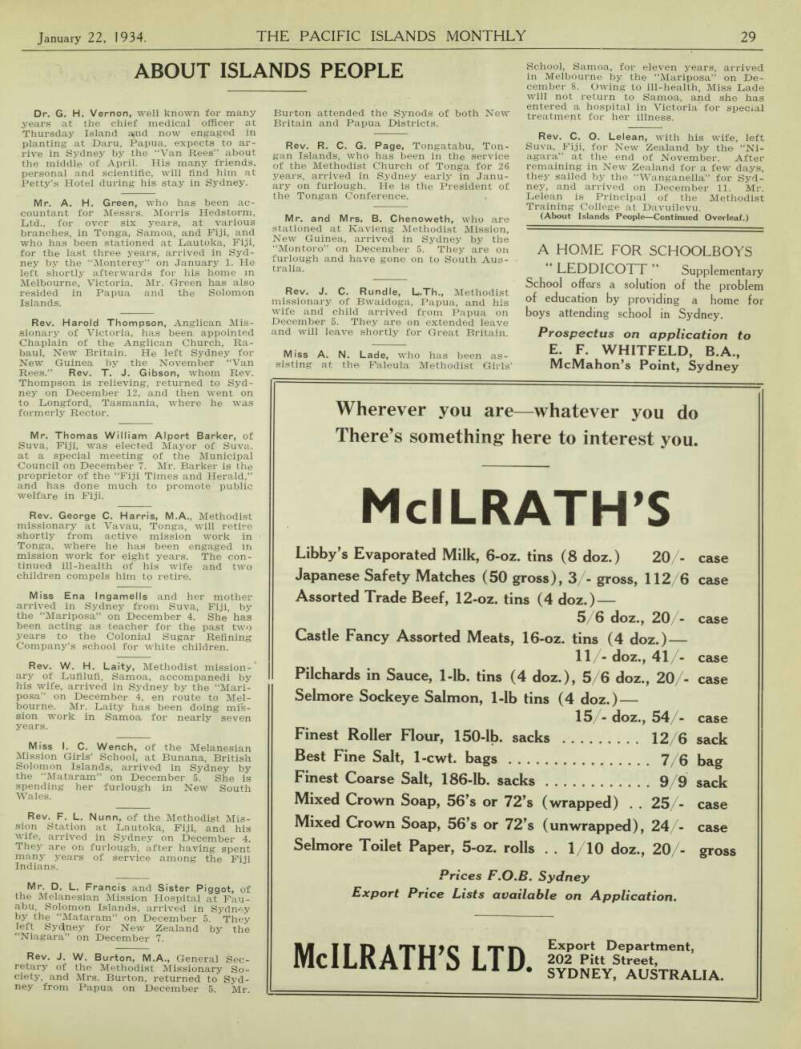
Dr. G. H. Vernon, well known for many years at the chief medical officer at Thursday Island and now engaged in planting at Daru, Papua, expects to ar rive in Sydney by the “Van Rees” about the middle of April. His many friends, personal and scientific, will find him at Petty’s Hotel during his stay in Sydney.
Mr. A. H. Green, who has been ac countant for Messrs. Morris Hedstorm, Ltd., for over six years, at various branches, in Tonga, Samoa, and Fiji, and who has been stationed at Lautoka, Fiji, for the last three years, arrived in Syd ney by the “Monterey” on January 1. He left shortly afterwards for his home in Melbourne, Victoria. Mr. Green has also resided in Papua and the Solomon Islands.
Rev. Harold Thompson, Anglican Mis sionary of Victoria, has been appointed Chaplain of the Anglican Church, Ra baul, New Britain. He left Sydney for New Guinea by the November “Van Rees.” Rev. T. J. Gibson, whom Rev.
Thompson is relieving, returned to Syd ney on December 12, and then went on to Longford, Tasmania, where he was formerly Rector.
Mr. Thomas William Alport Barker, of Suva, Fiji, was elected Mayor of Suva, at a special meeting of the Municipal Council on December 7. Mr. Barker is the proprietor of the “Fiji Times and Herald,” and has done much to promote public welfare in Fiji.
Rev. George C. Harris, M.A., Methodist missionary at Vavau, Tonga, will retire shortly from active mission work in Tonga, where he has been engaged in mission work for eight years. The con tinued ill-health of his wife and two children compels him to retire.
Miss Ena Ingamells and her mother arrived in Sydney from Suva, Fiji, by the “Mariposa” on December 4. She has been acting as teacher for the past two years to the Colonial Sugar Refining Company’s school for white children.
Rev. W. H. Laity, Methodist missionary of Lufilufi, Samoa, accompanedi by his wife, arrived in Sydney by the “Mari posa” on December 4, en route to Mel bourne. Mr. Laity has been doing mis sion work in Samoa for nearly seven years.
Miss I. C. Wench, of the Melanesian Mission Girls’ School, at Bunana, British Solomon Islands, arrived in Sydney by the “Mataram” on December 5. She is spending her furlough in New South Wales.
Rev. F. L. Nunn, of the Methodist Mis sion Station at Lautoka, Fiji, and his wife, arrived in Sydney on December 4.
They are on furlough, after having spent many years of service among the Fiji Indians.
Mr. D. L. Francis and Sister Piggot, of the Melanesian Mission Hospital at Fau abu, Solomon Islands, arrived in Sydney by the “Mataram” on December 5. They left Sydney for New Zealand by the “Niagara” on December 7.
Rev. J. W. Burton, M.A., General Sec retary of the Methodist Missionary So ciety, and Mrs. Burton, returned to Syd ney from Papua on December 5. Mr.
Burton attended the Synods of both New Britain and Papua Districts.
Rev. R. C. G. Page, Tongatabu, Ton gan Islands, who has been in the service of the Methodist Church of Tonga for 26 years, arrived in Sydney early in Janu ary on furlough. He is the President of the Tongan Conference.
Mr. and Mrs. B. Chenoweth, who are stationed at Kavieng Methodist Mission, New Guinea, arrived in Sydney by the “Montoro” on December 5. They are on furlough and have gone on to South Aus tralia.
Rev. J. C. Rundle, L-Th., Methodist missionary of Bwaidoga, Papua, and his wife and child arrived from Papua on December 5. They are on extended leave and will leave shortly for Great Britain.
Miss A. N. Lade, who has been as sisting at the Faleula Methodist Girls’
School, Samoa, for eleven years, arrived in Melbourne by the “Mariposa” on De cember 8. Owing to ill-health, Miss Lade will not return to Samoa, and she has entered a hospital in Victoria for special treatment for her illness.
Rev. C. O. Lelean, with his wife, left Suva, Fiji, for New Zealand by the “Ni agara” at the end of November. After remaining in New Zealand for a few days, they sailed by the “Wanganella” for Syd ney, and arrived on December 11. Mr.
Lelean is Principal of the Methodist Training College at Davuilevu. (About Islands People—Continued Overleaf.)
Miss D. M. Lucas, of the Fijian sec tion of the Methodist Mission Society, arived in Sydney by the “Niagara” on December 2. After a completion of her furlough she will return to Levuka.
Mrs. C. M. Churchward, accompanied by her family, arrived in Sydney in De cember by the “Mariposa.” She is the wife of Rev. Churchward, of Levuka, who has been in Sydney on furlough for the past few months.
Miss Olive Russell, Methodist mission ary worker among the Indians in Fiji, ar rived in Sydney during December. She is spending her furlough with friends in Victoria.
Rev. W. L. I. Linggood, of the Metho dist mission station, Raluana, New Gui nea, arrived by the December “Montoro.”
He has gone on to Melbourne, where Mrs. Linggood is spending her holidays.
Mr. B. W. Storey, of Rabaul, N.G., re turned to the Territory in January, after furlough in Sydney.
Mr. H. Selwood, of the Tongan civil ser vice, returned to Nukualofa in January, after long leave spent in Queensland.
Rev. F. Otto Theile, Field-Director of the Lutheran Mission, New Guinea, re turned to Queensland after a visit of in spection to the mission stations under his direction. This was his fourth visit to New Guinea and he told the newspapers, on his arrival in Brisbane, that astonish ing progress in the work of the mission has been made since his last visit.
Mr. P. Williams, son of Canon Williams, of New Zealand, left Auckland recently for the New Hebrides. He will assist at the Melanesian Mission Boys’ School at Vureas, Banks Island.
Miss Phoebe Brokenshire, Methodist missionary of the Fijian section, Mata velo, Fiji, returned to Victoria during December. She has been a teacher at the mission station for 22 years.
Rev. James Elkin has been appointed to take charge of the Chair of Anthropology at the University of Sydney. Professor Elkin was formerly rector of Morpeth,
N.SW. He has specialised in anthro pology and has been lecturer in that sub ject at the University during the past year.
Mr. R. S. Thacker, who has been ap pointed Attorney-General for Fiji, sailed on January 4 for Suva by the Aorangi.
He was accompanied by Mrs. Thacker and his family. He had been stationed, for some years, in the West Indies.
Mr. F. C. T. Lord, Fiji inspector for the Colonial Sugar Refining Company, Ltd., now resident in Sydney, has received the honour of O.B.E. Mr. Lord visited Canada on behalf of his company at the time of the Ottawa Conference, and has since visited London, when a committee, act ing with the World Economic Conference, considered the sugar position.
Miss D. McArthur, of Mosman Public School, Sydney, has been appointed to Norfolk Island where she will take up duty after the vacation, relieving Miss F.
Leamon, who has been at Norfolk for the past two years.
Captain John McCulloch has been ap pointed Acting Resident Agent at Aitu taki, Cook Islands, during the absence of the Resident Agent on six months’ fur lough. Captain McCulloch was formerly a member of the Cook Islands service.
Advertisements & other items, pp. 31-32 (1 item)
Mcilrath’S
A HOME FOR SCHOOLBOYS
"LEDDICOTT" Supplementary School offers a solution of the problem of education by providing a home for boys attending school in Sydney.
Prospectus on application to
E. F. WHITFELD, B.A.,
McMahon’s Point, Sydney
Wherever you are—whatever you do There’s something here to interest you.
McILRATH’S
Libby's Evaporated Milk, 6-oz. tins (8 doz.) 20/- case Japanese Safety Matches (50 gross), 3/- gross, 112/6 case Assorted Trade Beef, 12-oz. tins (4 doz.) 5/6 doz., 20/- case Castle Fancy Assorted Meats, 16-oz. tins (4 doz.) 11/-doz., 41/- case Pilchards in Sauce, 1-lb. tins (4 doz.), 5/6 doz., 20/- case Selmore Sock eye Salmon, 1-lb tins (4 doz.) 15/- doz., 54/- case Finest Roller Flour, 150-lb. sacks 12/6 sack Best Fine Salt, 1-cwt. bags 7/6 bag Finest Coarse Salt, 186-lb. sacks 9/9 sack Mixed Crown Soap, 56’s or 72’s (wrapped) . . 25/- case Mixed Crown Soap, 56’s or 72's (unwrapped), 24/- case Selmore Toilet Paper, 5-oz. rolls . . 1/10 doz., 20/- gross Prices F.O.B. Sydney Export Price Lists available on Application.
McILRATH’S LTD.
Export Department, 202 Pitt Street,
SYDNEY, AUSTRALIA.
“SUNSHINE IMPLEMENTS” for the
Island Planter
Sunshine Implements are in popular use on the plantations of Queensland.
Write for a General Catalogue (free) and Prices, to— H. V. McKay Massey Harris Pty. Ltd.
SUNSHINE HARVESTER WORKS
Sunshine, near Melbourne, Australia.
Still Supreme!
After thirty years’ trading with the Islands, Aunt Mary’s Pure Food Products are still supreme. Highest quality goods, specially manufactured and packed to meet Island conditions.
AUNT
MARY'S
PURE FOOD
PRODUCTS
“Defiance” Brand Canned Goods
These Pure Pood Products are packed by the proprietors of Aunt Mary’s Pure Food Products. Hermetically sealed and specially prepared to withstand tropical heat, thus ensuring satisfaction to consumers.
Only goods of the highest standard are packed under these brands, thus the Proprietors keep faith with their clients and consumers.
Aunt Mary’s Pure Food Products and “Defiance” Brand Canned Goods are prepared and packed only by
TILLOCK & CO., LTD., manufacturers.
Kent and Liverpool Streets, SYDNEY, N.S.W.
Samoan Notes
(From Our Own Correspondent.)
Apia, Dec. 4.
A TRAGIC occurrence was the discovery of the body of a 5-years old boy, Ras mus Zeus Fabmius, son of a well-known merchant, of Apia, who had been acci dentally killed by the fall of some iron boat davits, which had crushed his head and chest. General sympathy was ex tended to his bereaved parents, and the funeral was largely attended by all classes of the population.
The Samoan Administration has remit ted the sum of £35 to the Makogai leper settlement for the purpose of providing Christmas cheer for the lepers. The money had been collected amongst local residents.
The month of February, 1934, should, by all indications, be a busy month for the inhabitants of Samoa. Not less than eight large oversea vessels are expected in Apia during the month —the German cruiser “Karlsruhe” (for a seven days’ visit), three tourist boats (“Los Angeles,”
“Franconia,” and “Stella Polaris”), the banana steamer “Maui Pomare,” the s.s.
“Carisso,” and a Union vessel.
The German Concordia Club held a suc cessful entertainment in the form of a musical evening and dance in its club rooms on December 2.
Personal.
Mr. Schaaffhausen, officer-in-charge of Public Works Department, returned by last “Maui Pomare” from furlough spent in New Zealand.
Mr. Lofley, formerly of the Health De partment, and an official of the Samoan Administration for the last 13 years, will not return to Samoa, having received an appointment in New Zealand.
Mr. P. N. Williams and family left by last “Maui Pomare” for a holiday in New Zealand. On the same boat travelled Mr.
Rutherford, the popular head of Samoa’s Education Department, with his family, who will spend the festive season in New Zealand.
Prosecution Of Samoan Mau
Trial of Mr. Nelson Still Proceeding in Mid-January
As ai result of the rapid action by the Administration of the Mandated Territory of W. Samoa to break up the Mau, by proving it to be a seditious organisation, a series of trials has taken place and a number of Mau leaders have been severely punished. Others have been acquitted.
The trial of the principal leader, Mr. O. F. Nelson, is still proceeding, and, on present appearances it is likely to last for some time.
The initial raids were made by the police on November 15. By the middle of December two separate groups of Mau leaders had been tried on various charges; but the third (that of Mr. Nelson) had to be adjourned over the holiday season.
THE two groups of Mau leaders who have been already tried were mem bers of committees which travelled around the islands of Upolu and Savaii respectively, in order to collect sub scriptions for the Mau, appoint Mau offi cials and generally organise Mau activi ties in the country districts.
At the trials of the two groups the proceedings were lengthy. The accused men admitted the charges against them, but their defence was a denial that the Mau was a seditious organisation; and most of the evidence called was directed to the proof or denial of this allegation.
Interesting documents were read in Court, showing that an organisation was actually in course of being formed, set ting up a separate form of government in opposition to the existing Administration.
In his summing-up of the first case,
Chief Judge Luxford gave a historical sketch and retrospect of Samoan folklore and history. He pointed to an important statement by one of the accused Mau leaders, Autagavaia, who had pro nounced: “That the Samoans will remain dissatisfied so long as a European Gov ernment was here.” The Mau clearly op posed and aimed to upset the existing and legal Government of the country, and therefore logically was seditious.
His Honor, furthermore, pointed to the fact, that, while under the old Samoan Government, Europeans had been pur chasing large areas of land for a few guns and ammunition required by the Samoans to fight each other, with the coming of European Government this practice had been stopped and land acquired in an il legal way had been returned to the natives. Under German Government, the
High Chiefs of Samoa had agreed to abolish the Kingship of Samoa forever, and in 1908-09, war between the factions of Tumua and Pule, and a rebellion against the German Government of that day, was averted only by a narrow mar gin.
The following Samoans were convicted and sentenced to terms of imprisonment: In the first case: Autagavaia, 12 months; Su, Tamaseu, Molio’o, Leutele, Une, Le leua, and Solia, six months.
In the second case: Tuala Tulo and Maulolo Sa, fined 20/each, in default 21 days’ imprisonment; Fagaloa and Tau’ili’ili, six months’ im prisonment.
Fili’alo and Fiu discharged for want of conclusive evidence against them.
Mr. O. F. Nelson
Mr. O. F. Nelson was arrested at his home on November 21, and was formally charged with having identified himself with the seditious organisation known as the Mau, and with having been in con stant communication with high officials of that body between August 18 and No vember 16, 1983.
On the evidence of Dr. Dawson, Mr.
Nelson’s medical adviser, who stated that
his client was suffering from a septic throat, and loss of sleep, and that a ner vous breakdown was possible, Nelson was admitted to bail in himself of £200,
and two sureties of £100 each, on condition that he was to have no direct or indirect communication with anyone connected with the Mau.
The case was remanded several times.
An application by Mr. Klinkmueller, act ing for Mr. Nelson, for the appointment of four assessors in the case, was refused, on evidence being produced that it was impossible to empanel an unbiassed jury in Samoa.
The trial finally commenced at the High Court in Apia on December 18.
The Crown Prosecutor, Mr. McCarthy, in his opening address, gave a valuable summary of the history of the Mau and of its more recent activities.
Mr. McCarthy stated that evidence would be produced to show that after the proposal for a conference between the Administrator and the Mau had broken down, about the end of Septem ber last, the committee of the Mau settled down in Vaimoso, apparently
waiting until they got a reconciliation, or until something happened. The police had secret and exact information of what went on at Vaimoso, and it was reported to them that the Mau proposed to set up in Samoa a government of its own.
This may have been merely talk, but the police kept a strict watch. Presently, two Malaga parties (Committees) left Vaimoso, one to go around Upolu and one around Savaii, and it was alleged that the definite purpose of those parties was to create an organisation to carry on a new government. It was then that the police acted. The Vaimoso office was searched and also Mr. Nelson’s house, and much allegedly incriminating evi dence was secured. The two Malaga par ties were arrested, and the members of them were tried and in some cases con victed, as stated elsewhere.
The first three days of the trial of Mr.
Nelson were devoted to the Crown Prose cutor’s opening address, and the evidence of Inspector Braisby, head of the Samoan police, who gave lengthy evidence con cerning the watch that was kept over the Mau, the search of the offices of the Mau and of Mr. Nelson, and the documents seized at the latter places.
At the beginning of the fourth day’s proceedings there was an unexpected de velopment.
Mr. Klinkmueller, addressing the Judge, said that ever since the beginning of the case there had been a difference of opinion between himself and his client concerning the actual conduct of the de fence, They had not been able to come to a settlement regarding it, and, con sequently Mr. Klinkmueller desired to withdraw. The points at issue had no thing to do with the merits of the case, and his firm would still be associated with it in an advisory capacity.
The Judge gave the necessary permis sion for counsel to withdraw, and Mr. Nelson then conducted his own de fence. Mr. Pleasants, Mr. Klinkmueller’s partner, sat beside Mr. Nelson in Court in order to advise him on legal matters.
In order that Mr. Nelson might famili arise himself with various documents the Court was adjourned until Wednesday, December 27.
On resumption, Mr. Nelson undertook the cross-examination of Inspector Braisby, which lasted during December 27, 28, and 29.
The Court resumed again on January 2, and Mr. Nelson continued his lengthy cross-examination of the Inspector con cerning the political history of Samoa.
When the Court adjourned at the end of that week, the cross-examination had only reached “Black Saturday” (29/12/1929).
Apparently, at the end of the second week in January, the cross-examination of witnesses for the prosecution by Mr.
Nelson was still proceeding, and there appeared to be every prospect of the trial extending over many weeks.
Advertisements & other items, pp. 33-34 (1 item)
Mining Machinery
SAMUEL RUSSELL
ESTATE AND GENERAL AGENT.
P.O. Box 64, Papeete, Tahiti
Real Estate. Investments. Estate Management and Administration. Valuations and Reports. Houses and Lands for Lease or Sale.
Sole Proprietor: TAHITI PERFUMES Cables: Russell, Tahiti (Bentley’s Code)
MINING MACHINERY
Improved Type Gravel Pump.
SEND YOUR ENQUIRIES TO—
of all classes, including—
Dredging and Sluicing Plants
Gravel and Water Pumps Elevators Nozzles Piping and Valves Mining Plants have been supplied to a number of Companies in New Guinea, and we are, therefore, fully conversant with local conditions.
Hydraulic Elevator, with Swivelling Suction Pipe.
THOMPSON’S ENGINEERING & PIPE CO. LTD.
CASTLEMAINE, VICTORIA
Cable Address: “THOMPSONS, CASTLEMAINE.”
SYDNEY OFFICE KEMBLA BUILDING 58 MARGARET STREET
A CERTAIN
REMEDY FOR PILES
This preparation has been on the market for several months, and it has effected a Cure in every case in which it has been tried. Cases of Long Standing generally Cured within One Month, with one bottle only.
For External Use only Transparent and Stainless. Painless and Odourless. Hygienic and Healing.
NO INCURABLE CASE FOUND YET. Should
there be one, Money will be Refunded in Full.
PRICE: 5/- PER BOTTLE. Posted, securely packed, for 6/6 per bottle. Copies of Testimonials forwarded on request.
ROBERT BRUCE
Room 7, 2nd Floor,
15 Hunter Street, Sydney
Introducing
THE
“FLETCHER” STOVE
Made with Extended Firebox for Long Wood Fuel.
This Stove has been specially constructed for persons requiring a good, strong article at a very moderate price.
We will be pleased to forward a copy of Illustrated Leaflet, Post Free, upon receipt of your name and address.
G. FLETCHER & SON 50 Oxford Street, SYDNEY Also, Makers of the “Younger” Stoves and Ranges Buy an Australian Stove, and thus be sure of getting service or spare parts promptly .
Summer Number Now
Available
Stories, articles and beautiful camera studies tell of Australian life. Absorbing articles on overseas features are contributed by well-known travellers.
Magnificent Coloured Cover by
John Banks
Obtainable at all Bookstalls and Newsagents, or from
Burns, Philp & Co. Ltd.
Rabaul Carrying Co.
GENERAL FORWARDING
AGENTS CUSTOMS AGENTS,
INSURANCE STORAGE.
Transport Work and Forwarding Work of Every Description Undertaken.
Modern Transport Equipment.
Telephones: Radio Address: Rabaul 176 and 135. “Rabcarco.”
E. M. GRANTER, Manager.
Islands Produce
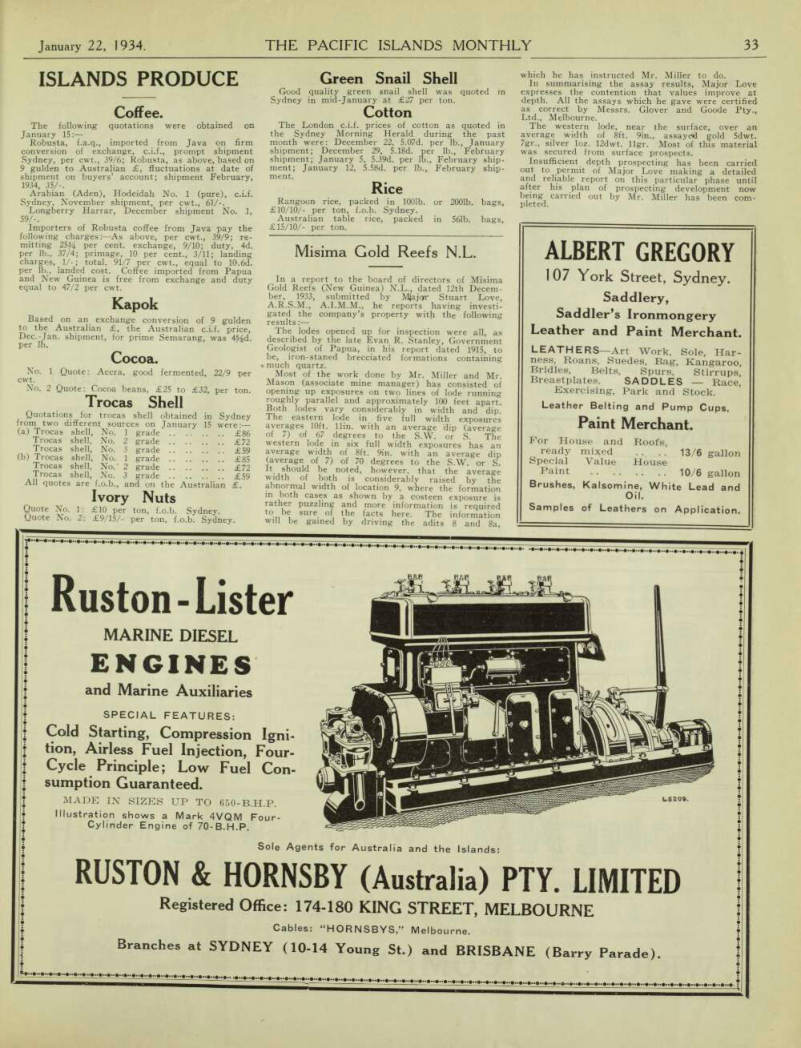
Coffee.
The following quotations were obtained on January 15: — Robusta, f.a.q., imported from Java on firm conversion of exchange, c.i.f., prompt shipment Sydney, per cwt., 39/6; Robusta, as above, based on 9 gulden to Australian £, fluctuations at date of shipment on buyers’ account; shipment February, 1934, 35/-.
Arabian (Aden), Hodeidah No. 1 (pure), c.i.f.
Sydney, November shipment, per cwt., 61/-.
Longberry Harrar, December shipment No. 1, 59/-.
Importers of Robusta coffee from Java pay the following chargesAs above, per cwt., 39/9; re mitting 25¾ per cent, exchange, 9/10; duty, 4d. per lb., 37/4; primage, 10 per cent., 3/11; landing charges, 1/-; total, 91/7 per cwt., equal to 10.6 d. per lb., landed cost. Coffee imported from Papua and New Guinea is free from exchange and duty equal to 47/2 per cwt.
Kapok
Based on an exchange conversion of 9 gulden to the Australian £, the Australian c.i.f. price, Dec.-Jan. shipment, for prime Semarang, was 4 5/8d.. per lb.
Cocoa.
No. 1 Quote: Accra, good fermented, 22/9 per cwt.
No. 2 Quote: Cocoa beans, £25 to £32, per ton.
Trocas Shell
Quotations for trocas shell obtained in Sydney from two different sources on January 15 were:— (a) Trocas shell, No. 1 grade £86 Trocas shell, No. 2 grade £72 x Trocas shell, No. 3 grade £59 (b) Trocas shell, No. 1 grade £85 Trocas shell, No. 2 grade £72 Trocas shell, No. 3 grade £59 All quotes are f.o.b., and on the Australian £.
Ivory Nuts
Quote No. 1: £10 per ton, f.o.b. Sydney.
Quote No. 2: £9/15/- per ton, f.o.b. Sydney.
Green Snail Shell
Good quality green snail shell was quoted in Sydney in mid-January at £27 per ton.
Cotton
The London c.i.f. prices of cotton as quoted in the Sydney Morning Herald during the past month were: December 22, 5.07 d. per lb., January shipment; December 29, 5.18 d. per lb., February shipment; January 5,5.39 d. per lb., February ship ment; January 12, 5.58 d. per lb., February ship ment.
Rice
Rangoon rice, packed in 1001 b. or 2001 b. bags, £10/10/- per ton, f.o.b. Sydney.
Australian table rice, packed in 561b. bags, £15/10/- per ton.
Misima Gold Reefs N.L.
In a report to the board of directors of Misima Gold Reefs (New Guinea) N.L., dated 12th Decem ber, 1933, submitted by Major Stuart Love, A.R.S.M., A.I.M.M., he reports having investigated the company’s property with the following results:— The lodes opened up for inspection were all, as described by the late Evan R. Stanley, Government Geologist of Papua, in his report dated 1915, to be, iron-staned brecciated formations containing much quartz.
Most of the work done by Mr. Miller and Mr.
Mason (associate mine manager) has consisted of opening up exposures on two lines of lode running roughly parallel and approximately 100 feet apart.
Both lodes vary considerably in width and dip.
The eastern lode in five full width exposures averages 10ft. 11in. with an average dip (average of 7) of 67 degrees to the S.W. or S. The western lode in six full width exposures has an average width of 8ft. 9in. with an average dip (average of 7) of 70 degrees to the S.W. or S.
It should be noted, however, that the average width of both is considerably raised by the abnormal width of location 9, where the formation in both cases as shown by a costeen exposure is rather puzzling and more information is required to be sure of the facts here. The information will be gained by driving the adits 8 and 8a,
which he has instructed Mr. Miller to do.
In summarising the assay results, Major Love expresses the contention that values improve at depth. All the assays which he gave were certified as correct by Messrs. Glover and Goode Pty., Ltd., Melbourne.
The western lode, near the surface, over an average width of 8ft. 9in., assayed gold 5dwt. 7gr., silver 1oz. 12dwt. 11gr. Most of this material was secured from surface prospects.
Insufficient depth prospecting has been carried out to permit of Major Love making a detailed and reliable report on this particular phase until after his plan of prospecting development now being carried out by Mr. Miller has been com pleted.
Advertisements & other items, p. 35 (1 item)
Ruston-Lister
ALBERT GREGORY
107 York Street, Sydney.
Saddlery,
Saddler’s Ironmongery
Leather and Paint Merchant.
LEATHERS— Art Work, Sole, Harness, Roans, Suedes, Bag, Kangaroo, Bridles, Belts, Spurs, Stirrups, Breastplates. SADDLES Race, Exercising, Park and Stock.
Leather Belting and Pump Cups.
Paint Merchant.
For House and Roofs, ready mixed . . . . 13/6 gallon Special Value House Paint 10/6 gallon Brushes, Kalsomine, White Lead and Oil.
Samples of Leathers on Application.
Ruston-Lister
MARINE DIESEL
ENGINES
and Marine Auxiliaries
SPECIAL FEATURES:
Cold Starting, Compression Ignition, Airless Fuel Injection, Four- Cycle Principle; Low Fuel Consumption Guaranteed.
MADE IN SIZES UP TO 650-B.H.P.
Illustration shows a Mark 4VQM Four- Cylinder Engine of 70-B.H.P.
Sole Agents for Australia and the Islands:
RUSTON & HORNSBY (Australia) PTY. LIMITED
Registered Office: 174-180 KING STREET, MELBOURNE Cables: “HORNSBYS,” Melbourne.
Branches at SYDNEY (10-14 Young St.) and BRISBANE (Barry Parade).
Mrs. Alan Innes Returns
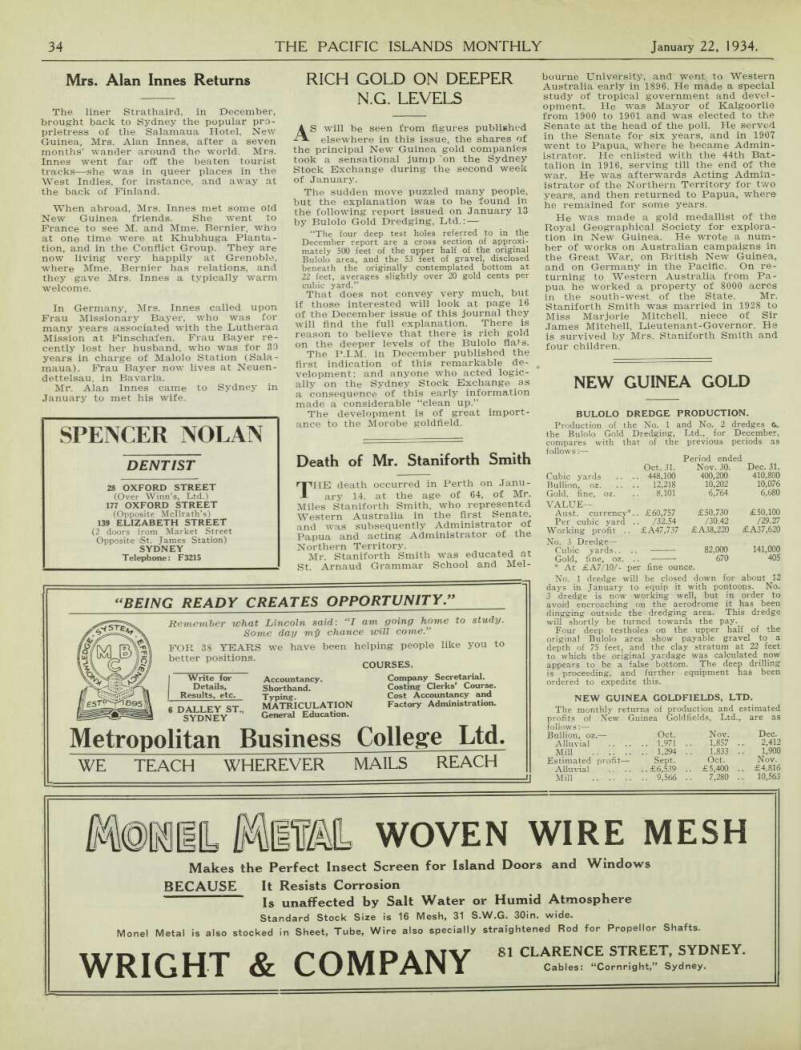
The liner Strathaird, in December, brought back to Sydney the popular pro prietress of the Salamaua Hotel, New Guinea, Mrs. Alan Innes, after a seven months’ wander around the world. Mrs.
Innes went far off the beaten tourist tracks —she was in queer places in the West Indies, for instance, and away at the back of Finland.
When abroad, Mrs. Innes met some old New Guinea friends. She went to France to see M. and Mme. Bernier, who at one time were at Khubhuga Planta tion, and in the Conflict Group. They are now living very happily at Grenoble, where Mme. Bernier has relations, and they gave Mrs. Innes a typically warm welcome.
In Germany, Mrs. Innes called upon Frau Missionary Bayer, who was for many years associated with the Lutheran Mission at Finschafen. Frau Bayer re cently lost her husband, who was for 39 years in charge of Malolo Station (Sala maua). Frau Bayer now lives at Neuen dettelsau, in Bavaria.
Mr. Alan Innes came to Sydney in January to met his wife.
Rich Gold On Deeper
N.G. Levels
AS will be seen from figures published elsewhere in this issue, the shares of the principal New Guinea gold companies took a sensational jump on the Sydney Stock Exchange during the second week of January.
The sudden move puzzled many people, but the explanation was to be found in the following report issued on January 13 by Bulolo Gold Dredging, Ltd.: “The four deep test holes referred to in the December report are a cross section of approxi mately 500 feet of the upper half of the original Bulolo area, and the 53 feet of gravel, disclosed beneath the originally contemplated bottom at 22 feet, averages slightly over 20 gold cents per cubic yard.”
That does not convey very much, but if those interested will look at page 16 of the December issue of this journal they will find the full explanation. There is reason to believe that there is rich gold on the deeper levels of the Bulolo flats.
The P.I.M. in December published the first indication of this remarkable de velopment; and anyone who acted logic ally on the Sydney Stock Exchange as a consequence of this early information made a considerable “clean up.”
The development is of great import ance to the Morobe goldfield.
Death of Mr. Staniforth Smith
THE death occurred in Perth on Janu ary 14, at the age of 64, of Mr.
Miles Staniforth Smith, who represented Western Australia in the first Senate, and was subsequently Administrator of Papua and acting Administrator of the Northern Territory.
Mr. Staniforth Smith was educated at St. Arnaud Grammar School and Mel
bourne University, and went to Western Australia early in 1896. He made a special study of tropical government and devel opment. He was Mayor of Kalgoorlie from 1900 to 1901 and was elected to the Senate at the head of the poll. He served in the Senate for six years, and in 1907 went to Papua, where he became Admin istrator. He enlisted with the 44th Bat talion in 1916, serving till the end of the war. He was afterwards Acting Admin istrator of the Northern Territory for two years, and then returned to Papua, where he remained for some years.
He was made a gold medallist of the Royal Geographical Society for explora tion in New Guinea. He wrote a num ber of works on Australian campaigns in the Great War, on British New Guinea, and on Germany in the Pacific. On re turning to Western Australia from Pa pua he worked a property of 8000 acres in the south-west of the State. Mr.
Staniforth Smith was married in 1928 to Miss Marjorie Mitchell, niece of Sir James Mitchell, Lieutenant-Governor. He is survived by Mrs. Staniforth Smith and four children.
New Guinea Gold
Bulolo Dredge Production.
Production of the No. 1 and No. 2 dredges. the Bulolo Gold Dredging, Ltd., for December, compares with that of the previous periods as follows:
No. 1 dredge will be closed down for about 12 days in January to equip it with pontoons. No. 3 dredge is now working well, but in order to avoid encroaching on the aerodrome it has been dingging outside the dredging area. This dredge will shortly be turned towards the pay.
Four deep testholes on the upper half of the original Bulolo area show payable gravel to a depth of 75 feet, and the clay stratum at 22 feet to which the original yardage was calculated now appears to be a false bottom. The deep drilling is proceeding, and further equipment has been ordered to expedite this.
New Guinea Goldfields, Ltd.
The monthly returns of production and estimated profits of New Guinea Goldfields, Ltd., are as follows:—
Period ended Oct. 31. Nov. 30.
Dec. 31.
Cubic yards .. .. 448,100 400,200 410,800 Bullion, oz 12,218 10,202 10,076 Gold, fine, oz. 8,101 6,764 6,680
Value—
Aust. currency*.. £60,757 £50,730 £50,100 Per cubic yard .. 732.54 730.42 729.27 Working profit .. £A47,737 £A38,220 £A37,620 No. 3 Dredge— Cubic yards.. .. 82,000 141,000 Gold, fine, oz. .. 670 405 * At £A7/10/- per fine ounce.
Bullion, oz. — Oct.
Nov.
Dec.
Alluvial .. 1,971 . 1,857 . 2,412 Mill .. 1,294 . 1,833 . 1,900 Estimated profit— Sept.
Oct.
Nov.
Alluvial .. .. ..£6,539 . . £5,400 . . £4,816 Mill .. 9,566 . 7,280 . . 10,563
Advertisements & other items, p. 36 (1 item)
Woven Wire Mesh
SPENCER NOLAN
DENTIST
28 OXFORD STREET
(Over Winn’s, Ltd.)
177 OXFORD STREET
(Opposite McIlrath’s)
139 ELIZABETH STREET
(2 doors from Market Street Opposite St. James Station)
SYDNEY
Telephone: F 3215
“BEING READY CREATES OPPORTUNITY."
Remember what Lincoln said ; “I am going home to study.
Some day my chance will come”
FOR 38 YEARS we have been helping people like you to better positions.
COURSES.
Write for Details, Results, etc.
6 DALLEY ST.,
SYDNEY
Accountancy.
Shorthand.
Typing.
MATRICULATION
General Education.
Company Secretarial.
Costing Clerks’ Course.
Cost Accountancy and Factory Administration.
Metropolitan Business College Ltd.
WE TEACH WHEREVER MAILS REACH
pifite
WOVEN WIRE MESH
Makes the Perfect Insect Screen for Island Doors and Windows BECAUSE It Resists Corrosion Is unaffected by Salt Water or Humid Atmosphere Standard Stock Size is 16 Mesh, 31 S.W.G. 30in. wide.
Monel Metal is also stocked in Sheet, Tube, Wire also specially straightened Rod for Propeller Shafts.
WRIGHT & COMPANY
81 CLARENCE STREET, SYDNEY.
Cables: “Cornright,” Sydney.
Tropicalities
THE P.I.M. cordially acknowledges and reciprocates many good wishes for the New Year. Some were conventional; some were not. We were amused by this one: — “Sincere good wishes for a happy Xmas.
Here in Rarotonga it will be: A flower behind the ear—a cold fowl in one hand —a lump of taro in the other—shuffling around with the mob—an Islands Christmas!"
THE system under which the Administration arbitrarily appoints a village headman, who is often an ex-police boy, is criticised in an article in the “Melbourne Herald" by Mr. Ian Hogbin, an anthropologist, who recently spent several months in the Solomons. Mr. Hogbin contends that the present system makes for and unrest; and proceeds:- "The most effective method of dealing with the problem appears to me to establish councils of senior men in each district, with a man who has some idea of the principles of British law as a sort of chairman. For this purpose a good ex-police boy would be admirable. The council could deal with all offences and be empowered to adjust many matters without special reference to the district officer. Serious crimes would, of course, have to come before this official, but the council could be allowed to make a recommendation This need not necessarily be followed, but if not then an explanation ought to be given. The chairman, with his knowledge of English, would make an effective go-between for the council and the district officer.
In areas where I have had personal experience I am sure that it would be possible to bring this scheme into operation,
I have also discussed it with one or two officials who are of the opinion that it would be effective. The scheme naturally presupposes that the district officers are trained in anthropology and are familiar with the customs of the area which they have to administer.”
A RESIDENT of Tahiti in a confidential note to the Editor says that journals comments on the new French copra tax caused a good deal of outspoken comment by French residents of that part of the Pacific. The French point of view is that we have forgotten some of the rather outrageous taxes placed upon French produce by British Dominions.
There was, for instance, the tax of 4/or 5/- per case imposed by the New Zea land Government on oranges from Tahiti, thus killing a very healthy trade and depriving New Zealand consumers of an excellent supply of good fruit which had been coming in to the Dominion in the depth of winter. This, of course, was done by New Zealand to protect the Cook Islands orange trade; but the manner in which it was regarded bv the French growers can be as easily imagined as described. The tax, in its incidence and character, was no worse than the French copra tax.
Our correspondent goes on: “In the financial column of the weekly edition of the ‘London Times' of at least twelve months ago, there appeared an analysis of the balance sheet of Unilever, which showed the colossal profit of over £5,000,000 made in 1931. The comment was made that although the depression deepened during 1932 the profits increased by one million pounds during the previous
year. To everyone but the dividend takers this must smell to high heaven, and would have been a fitting subject to deal with in the P.I.M. It is monstrous that the octopus should fatten in times like these on the misery and losses of the toilers in the South Seas.”
AN interesting relic is in the possession of Mr. E. G. Seagoe, of Vila, New Hebrides. Many years ago a native, working in a yam garden near Port Reso lution, Tanna, dug up a bronze medal, which is one and six-tenths of an inch in diameter and is inscribed as follows. On one side is a head of George III, and around the margin the words: “George III., King of Great Britain, France, and Ireland, &c.” On the other side are shown two ships, one sailing before the wind and one with sails furled. Around the margin are the words: “Resolution and Adventure.” Below the ships is the in scription: “Sailed from England March MDCCLXXII.” The medal was sold about 1886 by the native to Captain Champion, a well known Frenchman then resident in New Hebrides (but now deceased), who was on a recruiting cruise to Tanna.
About 1908, Captain Champion sold the medal to Mr. Seagoe.
It is recorded in Captain Cook’s voyages that at various places in the New Heb rides and New Caledonia he distributed medals to natives, and this apparently is one of them. There is another of them (which was found at Balaba, north New Caledonia) in the Mission Museum at Saint Louis, New Caledonia. There is a silver replica of the medal in the Sydney Museum, but not a bronze one. It has been suggested that Mr. Seagoe’s medal should be acquired for the Mitchell Lib rary in Sydney. If anyone is interested he should communicate with Mr. Seagoe direct.
Advertisements & other items, p. 37 (1 item)
Machinery Productions of High Merit
To sell only products of such high merit and value that the simple truth will be their always been the policy of BUZACOTT & CO., LTD. The name of “BUZACOTT” goods at a reasonable price. best recommendation, has is a guarantee of quality "Buzacott" Engines are noted for low operating costs, absolute efficiency and dependability.
"Buzacott” Pumps ensure an adequate and economical water supply. All sizes and types available.
“Buzacott” Pumper —an ideal Windmill Auxiliary that fits any mill pump.
“Buzacott” Gates and Fencing. Easy to erect, and most durable. A host of different types available.
Petter Crude Oil Engines, Marine and Stationary types. Reliable, simple, and cheap to run. Spare parts stocked.
Alston Windmills. Recent reductions in price for these famous Windmills bring them within everyone’s reach.
Electric Light from the Wind. The “Gilco” lighting plant gives you free Electricity at a low initial cost.
We shall be glad to send you, post free, and without obligation, full particulars of any lines in which you are interested.
7-11 MARKET STREET, SYDNEY, A’LIA.
Accident
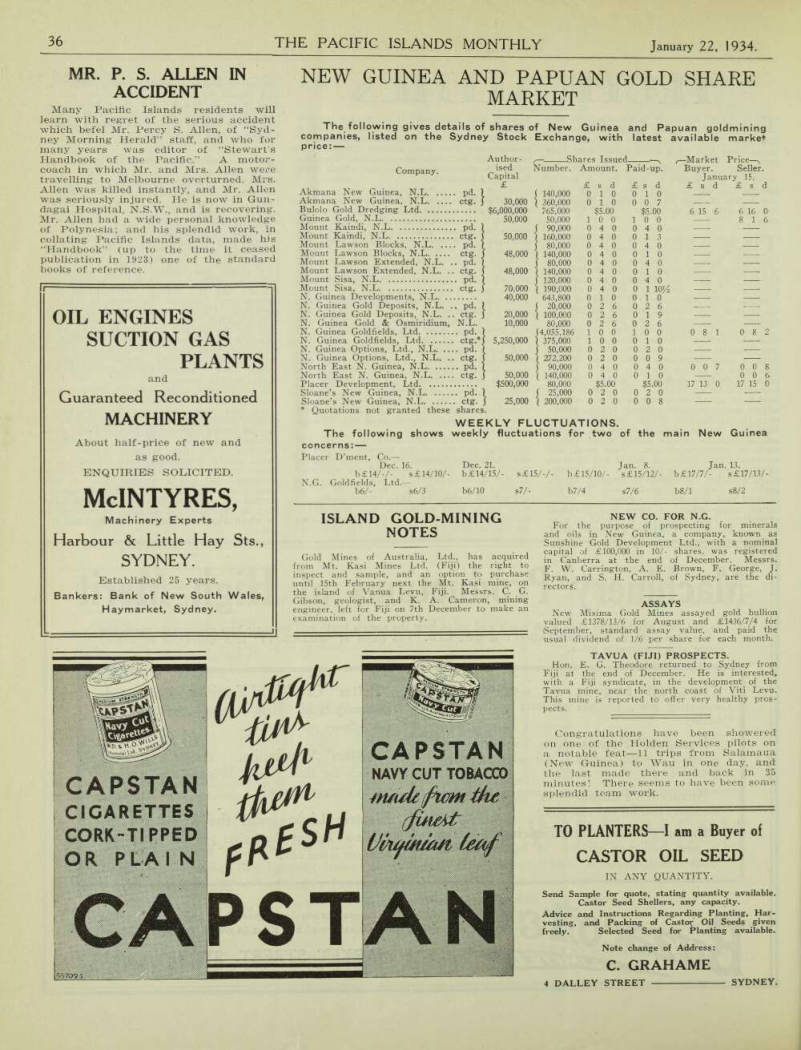
Mr. P. S. Allen In
Many Pacific Islands residents will learn with regret of the serious accident which befel Mr. Percy S. Allen, of “Syd ney Morning Herald” staff, and who for many years was editor of “Stewart’s Handbook of the Pacific.” A motor coach in which Mr. and Mrs. Allen were travelling to Melbourne overturned. Mrs.
Allen was killed instantly, and Mr. Allen was seriously injured. He is now in Gun dagai Hospital, N.S.W., and is recovering.
Mr. Allen had a wide personal knowledge of Polynesia; and his splendid work, in collating Pacific Islands data, made his “Handbook” (up to the time it ceased publication in 1923) one of the standard books of reference.
New Guinea And Papuan Gold Share
Market
The following gives details of shares of New Guinea and Papuan goldmining companies, listed on the Sydney Stock Exchange, with latest available market price:
Weekly Fluctuations.
The following shows weekly fluctuations for two of the main New Guinea concerns:
Author- .— Shares Issued.
Market Price
Company.
ised Number.
Capital Amount. Paid-up, Buyer. Seller January 15. £ £ s d £ s d £ s d £ s d Akmana New Guinea, N.L . pd. 140,000 0 1 0 0 1 0 Akmana New Guinea, N.L ctg. 30,000 360,000 0 1 0 0 0 7 Bulolo Gold Dredging Ltd $6,000,000 50,000 765,000 50,000 90,000 $5.00 $5.00 6 15 6 6 16 8 1 6 n 1 0 0 4 0 0 1 0 0 0 0 6 Mount Kaindi, N.L Pd 0 4 0 0 8 1 6 Mount Kaindi, N.L ctg. 50,000 160,000 0 4 0 0 1 3 Mount Lawson Blocks, N.L. ... . pd. 80,000 0 4 0 0 4 0 Mount Lawson Blocks, N.L ctg. 48,000 140,000 0 4 0 0 1 0 Mount Lawson Extended, N.L. . . pd. 80,000 0 4 0 0 4 0 Mount Lawson Extended, N.L. . ctg. 48,000 140,000 0 4 0 0 1 0 120,000 190 000 0 4 0 0 4 0 Mount Sisa NT. ctg. 70,000 40,000 0 4 0 0 i iniz N. Guinea Developments, N.L. .. 643,800 0 1 0 0 1 0 N. Guinea Gold Deposits, N.L. . . pd. 20,000 0 2 6 0 2 6 N. Guinea Gold Deposits, N.L. .. . ctg. 20,000 100,000 0 2 6 0 1 9 — — N. Guinea Gold & Osmiridium, N.L. 10,000 80,000 0 2 6 0 2 6 N. Guinea Goldfields, Ltd pd. 4,055,186 375,000 1 0 0 1 0 1 0 0 8 1 0 8 2 N. Guinea Goldfields, Ltd Ctg. * 5,250,000 1 0 0 0 0 N. Guinea Options, Ltd., N.L. .., pd. 50,000 0 2 0 0 2 0 — — N. Guinea Options, Ltd., N.L. ., ctg. 50,000 272,200 0 2 0 0 0 9 — North East N. Guinea, N.L pd. 90,000 0 4 0 0 4 0 0 0 7 0 0 8 North East N. Guinea, N.L ctg. 50,000 140,000 0 4 0 0 1 0 — 0 0 6 Placer Development, Ltd $500,000 80,000 25,000 $5.00 $5.00 17 13 0 17 15 0 Sloane’s New Guinea, N.L . pd. 0 2 0 0 2 0 Sloane’s New Guinea, N.L . ctg. 25,000 200,000 0 2 0 0 0 8 — — * Quotations not granted these shares.
Placer D’ment, Co. — Dec. 16. b£14/-/- s £14/10/■ Dec. 21. b £14/15/s£15/-/b £15/10/- Jan. 8. s £15/12/- Jan, 13. b£l 7/7/- s £17/13/- N.G. Goldfields, Ltd.— b6/- s6/3 b6/10 s 7/b7/4 s7/6 b8/l s8/2
Island Gold-Mining
Notes
Gold Mines of Australia, Ltd., has acquired from Mt. Kasi Mines Ltd. (Fiji) the right to inspect and sample, and an option to purchase until 15th February next the Mt. Kasi mine, on the island of Vanua Levu, Fiji. Messrs. C. G.
Gibson, geologist, and K. A. Cameron, mining engineer, left for Fiji on 7th December to make an examination of the property.
New Co. For N.G.
For the purpose of prospecting for minerals and oils in New Guinea, a company, known as Sunshine Gold Development Ltd., with a nominal capital of £100,000 in 10/- shares, was registered in Canberra at the end of December. Messrs.
F. W. Carrington, A. E. Brown, F. George, J.
Ryan, and S. H. Carroll, of Sydney, are the di rectors.
Assays
New Misima Gold Mines assayed gold bullion valued £1378/13/6 for August and £1436/7/4 for September, standard assay value, and paid the usual dividend of 1/6 per share for each month.
Tavua (Fiji) Prospects.
Hon. E. G. Theodore returned to Sydney from Fiji at the end of December. He is interested, with a Fiji syndicate, in the development of the Tavua mine, near the north coast of Viti Levu.
This mine is reported to offer very healthy pros pects.
Congratulations have been showered on one of the Holden Services pilots on a notable feat —11 trips from Salamaua (New Guinea) to Wau in one day, and the last made there and back in 35 minutes! There seems to have been some splendid team work.
Advertisements & other items, p. 38 (2 items)
McIntyres,
OIL ENGINES
SUCTION GAS
PLANTS
and Guaranteed Reconditioned
MACHINERY
About half-price of new and as good.
ENQUIRIES SOLICITED.
McIntyres,
Machinery Experts Harbour & Little Hay Sts.,
SYDNEY.
Established 25 years.
Bankers: Bank of New South Wales, Haymarket, Sydney.
Capstan
CIGARETTES
CORK-TIPPED
OR PLAIN
CAPSTAN
NAVY CUT TOBACCO
TO PLANTERS —I am a Buyer of
CASTOR OIL SEED
IN ANY QUANTITY.
Send Sample for quote, stating quantity available.
Castor Seed Shellers, any capacity.
Advice and Instructions Regarding Planting, Harvesting, and Packing of Castor Oil Seeds given freely. Selected Seed for Planting available.
Note change of Address:
C. GRAHAME
4 DALLEY STREET SYDNEY.
Market Quotations
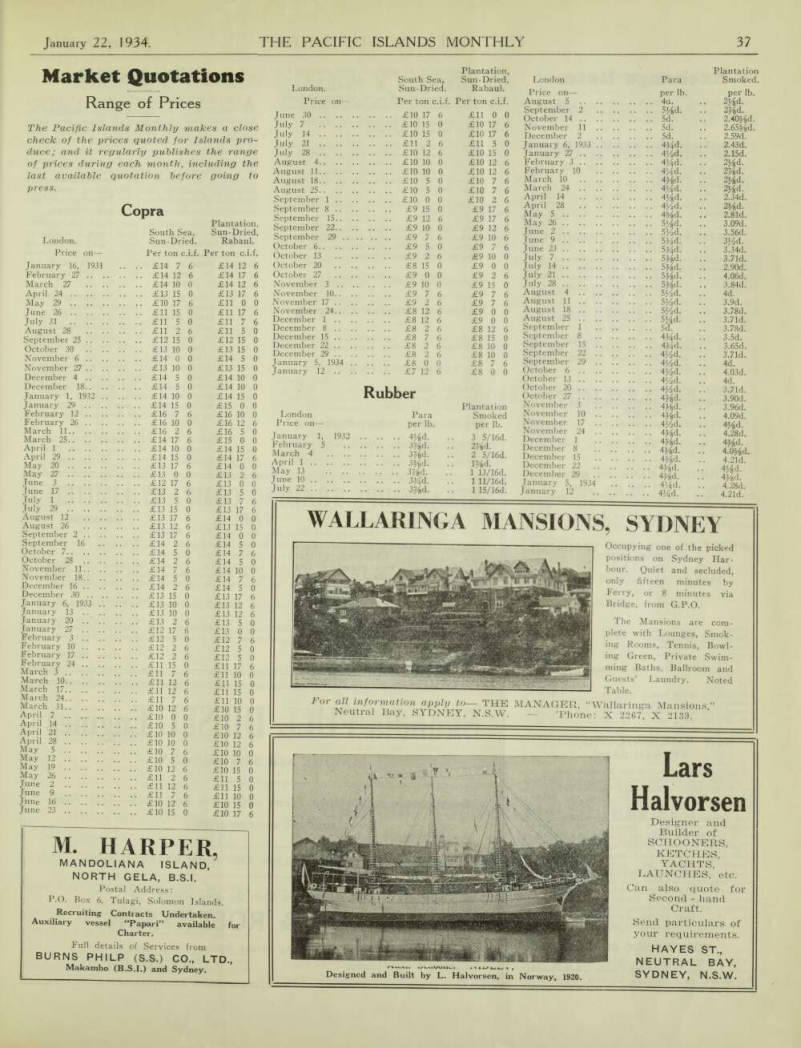
Range of Prices
The Pacific Islands Monthly makes a close check of the prices quoted for Islands pro duce; and it regularly publishes the range of prices during each month, including the last available quotation before going to press.
Plantation, South Sea, Sun-Dried, London.
Sun-Dried.
Rabaul.
Price on — Per ton c.i.f.
Per ton c.i.f.
June 30 . .. £10 17 6 £11 0 0 July 7 . .. £10 15 0 £10 17 6 July 14 . .. £10 15 0 £10 17 6 July 21 . .. £11 2 6 £11 5 0 July 28 . .. £10 12 6 £10 15 0 August 4 . .. £10 10 0 £10 12 6 August 11 . .. £10 10 0 £10 12 6 August 18 . .. £10 5 0 £10 7 6 August 25 . .. £10 5 0 £10 7 6 September 1 . .. £10 0 0 £10 2 6 September 8 . .. £9 IS 0 £9 17 6 September 15 . .. £9 12 6 £9 17 6 September 22 . .. £9 10 0 £9 12 6 September 29 . .. £9 7 6 £9 10 6 October 6 . .. £9 5 0 £9 7 6 October 13 . .. £9 2 6 £9 10 0 October 20 . .. £8 IS 0 £9 0 0 October 27 . .. £9 0 0 £9 2 6 November 3 . .. £9 10 0 £9 15 0 November 10 . .. £9 7 6 £9 7 6 November 17 , £9 2 6 £9 7 6 November 24 . .. £8 12 6 £9 0 0 December 1 . .. £8 12 6 £9 0 0 December 8 . .. £8 2 6 £8 12 6 December 15 . .. £8 7 6 £8 15 0 December 22 .. £8 2 6 £8 10 0 December 29 , £8 2 6 £8 10 0 January 5. 1934 .. .. .. £8 0 0 £8 7 6
January 12
.. £7 12 6 £8 0 0
Plantation London Para Smoked.
Price on— per lb. per lb.
August 5 .. 4a. 2^d. 2^d.
September 2 .. .. .. .. S^d.
October 14 .. .. 5d. 2.40Hd. .. .. 5d. 2.65Hd. 2.59d.
December 2 .. .. 5d.
January 6, 1933 .. .. .. .. 4^d. 2.43d.
January 27 .. .. 4^d. 2.15d.
February 3 .. .. 4'Ad. 2%d.
February 10 .. .. .. .. 4'A± 27Ad.
March 10 .. .. 4Hd. 2'Ad.
March 24 .. .. 4Ad. 2y & d.
April 14 .. .. 4%d. 2.34d.
April 28 .. .. 4y 2 d. 2Hd.
May 5 .. .. 4V s d. 2.81d.
May 26 .. .. sy*d. 3.09d.
June 2 3.56d.
June 9 .. .. 5^d. sy 2 d.
June 23 .. .. 5*4d. 3.3 4d.
July 7 .. .. 5Hd. 3.71d.
July 14 2.90d.
July 21 .. .. 5Hd. 4.06d.
July 28
.. .. 5}id. 3.84d.
August 4 .. .. sy 2 d. 4d.
August 11 .. .. sy 2 d. 3.9d.
August 18 .. .. sy 2 d. 3.78d.
August 25 .. .. 5'Ad. 3.7ld.
September 1 .. .. 5a! 3.78d.
September 8 .. .. 3.5d.
September IS .. .. .. 4Ad. 3.65d.
September 22 .. .. .. .. 4 l / 2 d. 3.71d.
September 29 .. .. .. .. 4 l / 2 d. 4d.
October 6 .. .. 4/ 2 d. 4.03d.
October 13 4d.
October 20 .. .. 4y 2 d. 3.71d.
October 27 3.90d.
November 3 .. ,. 3.96d.
November 10 .. .. .. .. 4^d. 4.09d.
November 17 .. .. 4J^d.
November 24 .. .. 4.28d.
December 1 4^d.
December 8 .. ..
December 15 ... .. .. 4Hd. 4.0^d. 4.21d December 22 ...
December 29 January 5, 1934 • • .. 4^d. 4'Ad. 4y 8 d. 4.28d January 12 .. .. , .. .. 4 l Ad." 4.21d.
London.
Copra
South Sea, Sun-Dried.
Plantation, Sun-Dried, Rabaul.
Price on— Per ton c.i.f.
Per ton c.i.f.
January 16, 1931 .. .. £14 7 6 £14 12 6 February 27 .. .. .. .. £14 12 6 £14 17 6 March 27 ... .. .. £14 10 0 £14 12 6 April 24 .. .. £13 IS 0 £13 17 6 May 29 .. .. £10 17 6 £11 0 0 June 26 .. .. £11 IS 0 £11 17 6 July 31 .. .. £11 5 0 £11 7 6 August 28 .. .. .. .. £11 2 6 £11 5 0 September 25 .. .. .. .. £12 IS 0 £12 IS 0 October 30 .. .. £13 10 0 £13 15 0 November 6 .. .. .. .. £14 0 0 £14 5 0 November 27 .. .. .. .. £13 10 0 £13 15 0 December 4 .. .. .. .. £14 5 0 £14 10 0 December 18.. .. .. .. £14 5 0 £14 10 0 January 1, 1932 .. .. .. £14 10 0 £14 15 0 January 29 .. .. .. .. £14 15 0 £15 0 0 February 12 .. .. .. .. £16 7 6 £16 10 0 February 26 .. .. .. £16 10 0 £16 12 6 March 11 .. .. £16 2 6 £16 5 0 March 25 .. .. £14 17 6 £15 0 0 April 1 .. .. £14 10 0 £14 15 0 April 29 .. .. £14 IS 0 £14 17 6 May 20 .. .. £13 17 6 £14 0 0 May 27 .. .. £13 0 0 £13 2 6 June 3 .. .. £12 17 6 £13 0 0
June 17
.. .. £13 2 6 £13 5 0
July 1
.. .. £13 5 0 £13 7 6 July 29 .. .. £13 15 0 £13 17 6 August 12 .. .. .. .. £13 17 6 £14 0 0 August 26 .. .. £13 15 0 September 2 .. .. .. .. £13 17 6 £14 0 0 September 16 .. .. £14 2 6 £14 5 0 October 7 £14 7 6 October 28 .. .. .. .. £14 2 6 £14 5 0 November 11.. .. .. .. £14 7 6 £14 10 0 November 18.. .. .. .. £14 5 0 £14 7 6 December 16 .. .. .. £14 2 6 £14 5 0 December 30 .. .. .. .. £13 IS 0 £13 17 6 January 6, 1933 ..
January 13 .. .. .. .. £13 10 0 £13 12 6 £13 12 6 January 20 ... .. .. £13 2 6 £13 5 0 January 27 .. ., £13 0 0 February 3 .. .. £12 7 6
February 10 .. ..
£12 5 0
February 17 .. ..
£12 5 0 February 24 .. ., .. .. £11 15 0 £11 17 6 March 3 .. .. £11 7 6 £11 10 0 March 10 £11 15 0 March 17 £11 15 0 March 24 £11 10 0 March 31 .. .. £10 12 6 £10 IS 0 April 7 £10 2 6 April 14 .. .. £10 5 0 £10 7 6 April 21 .. .. £10 10 0 £10 12 6 April 28 .. .. £10 10 0 £10 12 6 May 5 £10 10 0 May 12 £10 7 6 May 19 £10 15 0
May 26
.. .. £11 2 6 £11 5 0 June 2 .. .. £11 12 6 £11 15 0
June 9
£11 10 0 Jun e 16 £10 IS 0 June 23 .. .. £10 15 0 £10 17 6
Rubber
Plantation London Para Smoked Price on— per lb. per lb.
January 1, 1932 .. 3 S/16d.
February 5 .. 2^d.
March 4 3Jid. .. 2 S/16d.
April 1 .. V^d.
May 13 .. 1 13/16d.
J une 10 344d. .. 1 ll/16d.
July 22 .. 1 15/16d.
Advertisements & other items, p. 39 (1 item)
Halvorsen
WALLARINGA MANSIONS, SYDNEY
Occupying one of the picked positions on Sydney Harbour. Quiet and secluded, only fifteen minutes by Ferry, or 8 minutes via Bridge, from G.P.O.
The Mansions are complete with Lounges, Smoking Rooms, Tennis, Bowling Green, Private Swimming Baths, Ballroom and Guests’ Laundry. Noted Table.
For all information apply to— THE MANAGER, “Wallaringa Mansions, Neutral Bay, SYDNEY, N.S.W. ’Phone: X 2267, X 2139.
Designed and Built by L. Halvorsen, in Norway, 1920.
Lars
Halvorsen
Designer and Builder of
SCHOONERS,
KETCHES,
YACHTS,
LAUNCHES, etc.
Can also quote for Second - hand Craft.
Send particulars of your requirements.
HAYES ST.,
NEUTRAL BAY,
SYDNEY, N.S.W.
M. HARPER,
MAN DOLI AN A ISLAND,
NORTH GELA, B.S.I.
Postal Address: P.O. Box 6, Tulagi, Solomon Islands.
Recruiting Contracts Undertaken.
Auxiliary vessel “Papari” available for Charter.
Full details of Services from
BURNS PHILP (S.S.) CO., LTD.,
Makambo (B.S.I.) and Sydney.
Exchange Rates
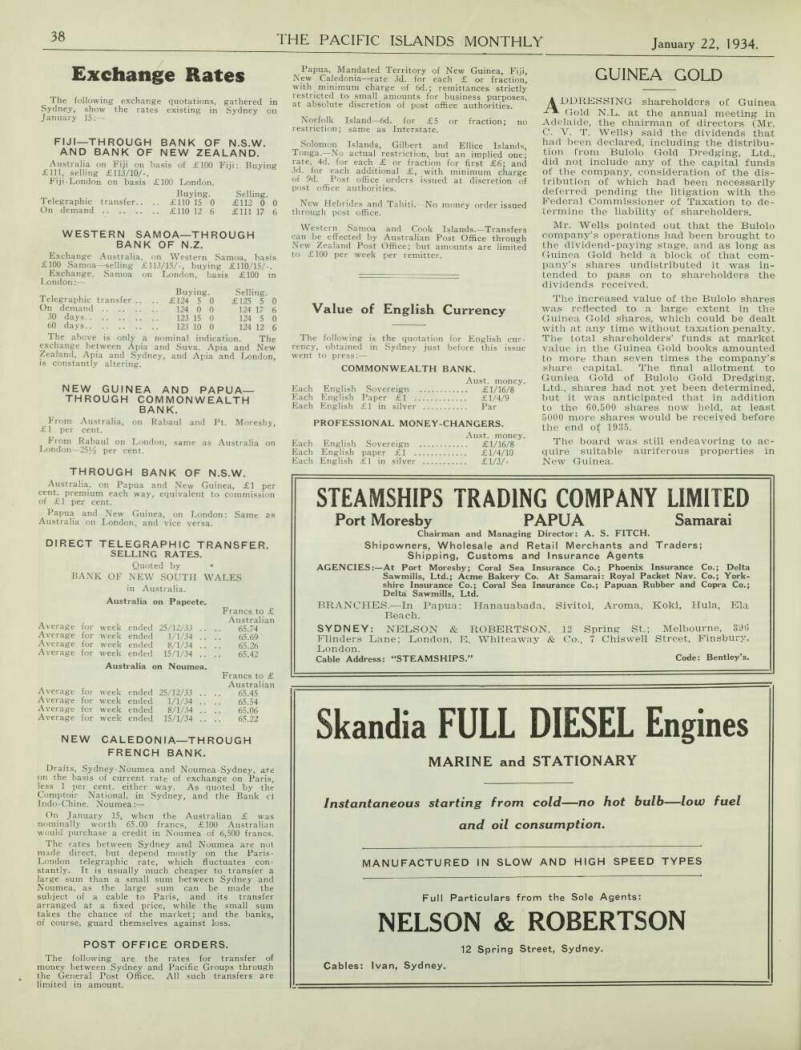
The following exchange quotations, gathered in Sydney, show the rates existing in Sydney on January 15:—
Fiji—Through Bank Of N.S.W.
And Bank Of New Zealand.
Australia on Fiji on basis of £100 Fiji: Buying £111, selling £113/10/-.
Fiji-London on basis £100 London.
Western Samoa—Through
Bank Of N.Z.
Exchange Australia, on Western Samoa, basis £100 Samoa—selling £113/15/-, buying £110/15/-.
Exchange, Samoa on London, basis £100 in London:—
The above is only a nominal indication. The exchange between Apia and Suva. Apia and New Zealand, Apia and Sydney, and Apia and London, is constantly altering.
New Guinea And Papua
Through Commonwealth
Bank.
From Australia, on Rabaul and Pt. Moresby, £1 per cent.
From Rabaul on London, same as Australia on London—25½ per cent.
Through Bank Of N.S.W.
Australia, on Papua and New Guinea, £1 per cent, premium each way, equivalent to commission of £1 per cent.
Papua and New Guinea, on London: Same as Australia on London, and vice versa.
Direct Telegraphic Transfer.
Selling Rates.
Quoted by
Bank Of New South Wales
in Australia.
New Caledonia—Through
French Bank.
Drafts, Sydney-Noumea and Noumea-Sydney, are on the basis of current rate of exchange on Paris, less 1 per cent, either way. As quoted by the Comptoir National, in Sydney, and the Bank of Indo-Chine, Noumea:— On January 15, when the Australian £ was nominally worth 65.G0 francs, £100 Australian would purchase a credit in Noumea of 6,500 francs.
The rates between Sydney and Noumea are not made direct, but depend mostly on the Paris- London telegraphic rate, which fluctuates con stantly. It is usually much cheaper to transfer a large sum than a small sum between Sydney and Noumea, as the large sum can be made the subject of a cable to Paris, and its transfer arranged at a fixed price, while the small sum takes the chance of the market; and the banks, of course, guard themselves against loss.
Post Office Orders.
The following are the rates for transfer of money between Sydney and Pacific Groups through the General Post Office. All such transfers are limited in amount.
Papua, Mandated Territory of New Guinea, Fiji, New Caledonia—rate 3d. for each £ or fraction, with minimum charge of 6d.; remittances strictly restricted to small amounts for business purposes, at absolute discretion of post office authorities.
Norfolk Island—6d. for £5 or fraction; no restriction; same as Interstate.
Solomon Islands, Gilbert and Ellice Islands, Tonga.—No actual restriction, but an implied one; rate, 4d. for each £ or fraction for first £6; and 3d. for each additional £, with minimum charge of 9d. Post office orders issued at discretion of post office authorities.
New Hebrides and Tahiti. —No money order issued through post office.
Western Samoa and Cook Islands.—Transfers can be effected by Australian Post Office through New Zealand Post Office; but amounts are limited to £100 per week per remitter.
Telegraphic transfer..
Buying.
Selling.
.. £110 15 0 £112 0 0 On demand .. £110 12 6 £111 17 6
Telegraphic transfer..
Buying. .. £124 5 0 Selling. £125 5 0 On demand 124 0 0 124 17 6
30 days
123 15 0 124 5 0 60 days 124 12 6
Australia on Papeete.
Francs to £ Average Australian for week ended 25/12/33 .. 65.74 Average Australian for week ended 1/1/34 .. 65.69 Average Australian for week ended 8/1/34 .. 65.26 Average Australian for week ended 15/1/34 .. 65.42 Australia on Noumea.
Francs to £ Average Australian for week ended 25/12/33 .. 65.45 Australian Average Australian for week ended 1/1/34 .. 65.54 Average Australian for week ended 8/1/34 .. 65.06 Average Australian for week ended 15/1/34 .. 65.22
Value of English Currency
The following is the quotation for English cur rency, obtained in Sydney just before this issue went to press:—
Commonwealth Bank.
Professional Money-Changers.
Aust. money.
Each English Sovereign £1/16/8 Each English Paper £1 £1/4/9 Each English £1 in silver Par
Aust. money.
Each English Sovereign £1/16/8 Each English paper £1 £1/4/10 Each English £1 in silver £1/3/-
Guinea Gold
A DDRESSING shareholders of Guinea Gold N.L. at the annual meeting in Adelaide, the chairman of directors (Mr.
C. V. T. Wells) said the dividends that had been declared, including the distribu tion from Bulolo Gold Dredging, Ltd., did not include any of the capital funds of the company, consideration of the dis tribution of which had been necessarily deferred pending the litigation with the Federal Commissioner of Taxation to de termine the liability of shareholders, Mr. Wells pointed out that the Bulolo company’s operations had been brought to the dividend-paying stage, and as long as Guinea Gold held a block of that com pany’s shares undistributed it was in tended to pass on to shareholders the dividends received.
The increased value of the Bulolo shares was reflected to a large extent in the Guinea Gold shares, which could be dealt with at any time without taxation penalty.
The total shareholders’ funds at market value in the Guinea Gold books amounted to more than seven times the company’s share capital. The final allotment to Guniea Gold of Bulolo Gold Dredging, Ltd., shares had not yet been determined, but it was anticipated that in addition to the 60,500 shares now held, at least 5000 more shares would be receiyed before the end of 1935.
The board was still endeavoring to ac quire suitable auriferous properties in New Guinea.
Advertisements & other items, p. 40 (1 item)
Skandia FULL DIESEL Engines
STEAMSHIPS TRADING COMPANY LIMITED
Port Moresby PAPUA Samarai
Chairman and Managing Director: A. S. FITCH.
Shipowners, Wholesale and Retail Merchants and Traders; Shipping, Customs and Insurance Agents AGENCIES:—At Port Moresby; Coral Sea Insurance Co.; Phoenix Insurance Co.; Delta Sawmills, Ltd.; Acme Bakery Co. At Samarai: Royal Packet Nav. Co.; Yorkshire Insurance Co.; Coral Sea Insurance Co.; Papuan Rubber and Copra Co.; Delta Sawmills, Ltd, BRANCHES.—In Papua: Hanauabada, Sivitoi, Aroma, Koki, Hula, Ela Beach.
SYDNEY: NELSON & ROBERTSON, 12 Spring St.; Melbourne, 39G Flinders Lane; London, E. Whiteaway & Co., 7 Chiswell Street, Finsbury, London.
Cable Address: “STEAMSHIPS.” Code: Bentley’s.
Skandia FULL DIESEL Engines
MARINE and STATIONARY
Instantaneous starting from cold—no hot bulb—low fuel and oil consumption.
MANUFACTURED IN SLOW AND HIGH SPEED TYPES Full Particulars from the Sole Agents:
NELSON & ROBERTSON
12 Spring Street, Sydney.
Cables: Ivan, Sydney.
Shipping Services in the Pacific
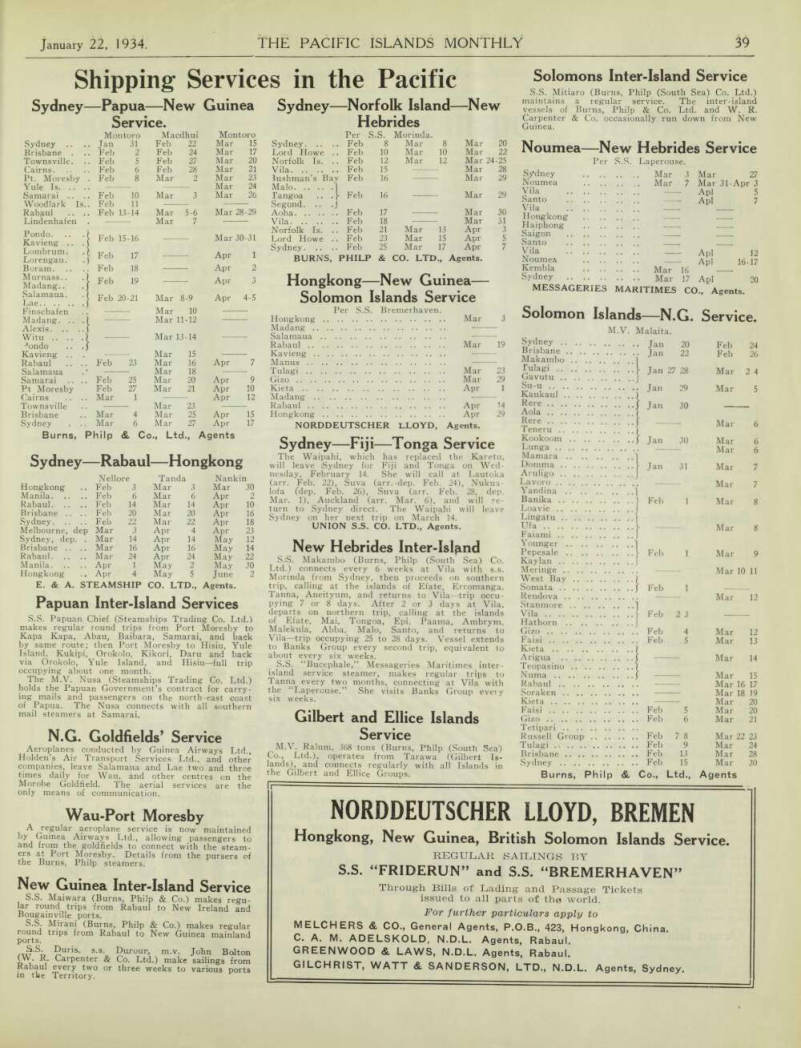
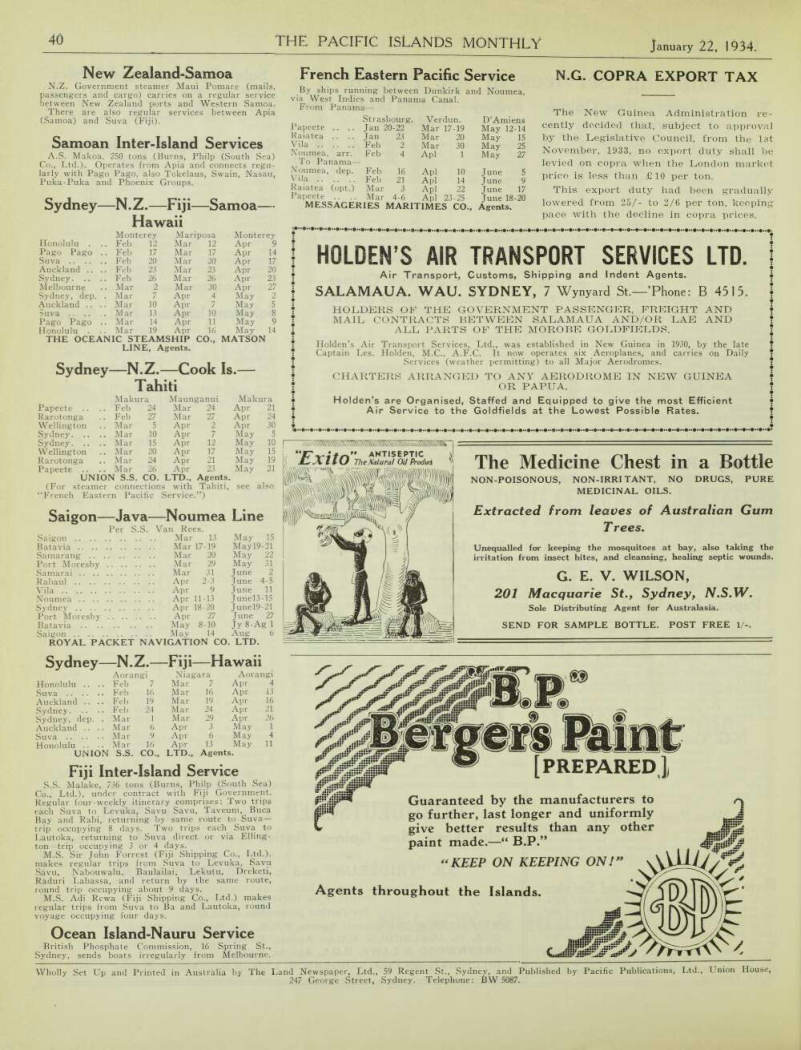
Sydney—Papua—New Guinea Service.
Sydney—Rabaul—Hongkong
Papuan Inter-Island Services
S.S. Papuan Chief (Steamships Trading Co. Ltd.) makes regular round trips from Port Moresby to Kapa Kapa, Abau, Baibara, Samarai, and back by same route; then Port Moresby to Hisiu, Yule Island, Kukipi, Orokolo, Kikori, Daru and back via Orokolo, Yule Island, and Hisiu—full trip occupying about one month.
The M.V. Nusa (Steamships Trading Co. Ltd.) holds the Papuan Government’s contract for carry ing mails and passengers on the north-east coast of Papua. The Nusa connects with all southern mail steamers at Samarai.
N.G. Goldfields’ Service
Aeroplanes conducted by Guinea Airways Ltd., Holden’s Air Transport Services Ltd., and other companies, leave Salamaua and Lae two and three times daily for Wau, and other centres on the Morobe Goldfield, The aerial services are the only means of communication.
Wau-Port Moresby
A regular aeroplane service is now maintained by Guinea Airways Ltd., allowing passengers to and from the goldfields to connect with the steam ers at Port Moresby. Details from the pursers of the Burns, Philp steamers.
New Guinea Inter-Island Service
S.S. Maiwara (Burns, Philp & Co.) makes regular round trips from Rabaul to New Ireland and Bougainville ports.
S.S. Mirani (Burns, Philp & Co.) makes regular round trips from Rabaul to New Guinea mainland ports.
S.S. Duris, s.s. Durour, m.v. John Bolton (W. R. Carpenter & Co. Ltd.) make sailings from Rabaul every two or three weeks to various ports in the Territory.
Sydney—Norfolk Island —New Hebrides
Sydney—Fiji—Tonga Service
The Waipahi, which has replaced the Karetu, will leave Sydney for Fiji and Tonga on Wed nesday, February 14. She will call at Lautoka (arr. Feb. 22), Suva (arr.-dep. Feb. 24), Nukua lofa (dep. Feb. 26), Suva (arr. Feb. 28, dep.
Mar. 1), Auckland (arr. Mar. 6), and will re turn to Sydney direct. The Waipahi will leave Sydney on her next trip on March 14.
Union S.S. Co. Ltd., Agents.
New Hebrides Inter-Island
S.S. Makambo (Burns, Philp (South Sea) Co.
Ltd.) connects every 6 weeks at Vila with s.s.
Morinda from Sydney, then proceeds on southern trip, calling at the islands of Efate, Erromanga.
Tanna, Aneityum, and returns to Vila —trip occu pying 7 or 8 days. After 2 or 3 days at Vila, departs on northern trip, calling at the islands of Efate, Mai, Tongoa, Epi, Paama, Ambrym.
Malekula, Abba, Malo, Santo, and returns to Vila—trip occupying 25 to 28 days. Vessel extends to Banks Group every second trip, equivalent to about every six weeks.
S.S. “Bucephale,” Messageries Maritimes interisland service steamer, makes regular trips to Tanna every two months, connecting at Vila with the “Laperouse.” She visits Banks Group evei y six weeks.
Gilbert and Ellice Islands
Service
M.V. Ralum, 368 tons (Burns, Philp (South Sea) Co., Ltd.), operates from Tarawa (Gilbert Is lands), and connects regularly with all Islands in the Gilbert and Ellice Groups.
Solomons Inter-Island Service
S.S. Mitiaro (Burns, Philp (South Sea) Co. Ltd.) maintains a regular service. The inter-island vessels of Burns, Philp & Co. Ltd. and W. R.
Carpenter & Co. occasionally run down from New Guinea.
Noumea—New Hebrides Service
Solomon Islands—N.G. Service.
Montoro Macdhui Montoro Sydney ..
Jan 31 Feb 22 Mar 15 Brisbane .
Feb 2 Feb 24 Mar 17 Townsville.
Feb 5 Feb 27 Mar 20 Cairns Feb 6 Feb 28 Mar 21 Pt. Moresby .
Feb 8 Mar 2 Mar 23 Yule Is Mar 24 Samarai .. ..
Feb 10 Mar 3 Mar 26 Woodlark Is..
Feb 11 Rabaul Feb 13-14 Mar 5-6 Mar 28-29 Lindenhafen Mar 7 Pondo. ..
Feb 15-16 TVTo,- in. 11 Kavieng Lombrum.
Feb 17 Apr 1 Lorengau Boram Feb 18 Apr 2 Murnass.. .1 Feb 19 Apr 3
Madang..
Salamaua.
Lae Feb 20-21 Mar 8-9 Apr 4-5 Finschafen Mar 10 Madang. ..
Mar 11 -12 Alexis 1 Witu ) Mar 13 -14 Pondo Kavieng Mar 15 Rabaul .. ..
Feb 23 Mar 16 Apr 7 Salamaua Mar 18 Samarai ..
Feb 25 Mar 20 Apr 9 Pt Moresby Feb 27 Mar 21 Apr 10 Cairns ..
Mar 1 Apr 12 Townsville Mar 23 Brisbane Mar 4 Mar 25 Apr 15
Sydney . ..
Mar 6 Mar 27 Apr 17 Burns, Philp & Co., Ltd., Agents
Sydney. ..
Lord Howe Norfolk Is.
Vila Bushman’s Bay Malo Tangoa .. .
Segond. .. .
Aoba Vila Norfolk Is.
Lord Howe Sydney. ..
Burns, Philp & Co. Ltd., Agents.
Per S.S. Morinda. . . Feb 8 .. Feb 10 . . Feb 12 Mar Mar Mar 8 10 12 Mar Mar Mar 24 Mat- Mar Mar Mar Mar Apr Apr Apr 20 22 -25 28 29 29 30 51 3 5 7 Feb Feb Feb Feb Feb Feb 16 16 17 18 21 23 25 & Mar 13 Mar 15 Mar 17
Hongkong—New Guinea —
Solomon Islands Service
Per S.S. Bremerhaven.
Hongkong Mar Madang 3 Salamaua Rabaul .. ..
Kavieng Mar 19 Manus Tulagi . . . .
Gizo Mar Mar 23 29 1 Kieta .. ..
Madang
Apr
Rabaul Hongkong
Norddeutscher Lloyd, Agents.
Apr 14 29
Per S.S. Laperouse.
Sydney .. .. . Mar 3 Mar 27 Noumea Mar 7 Mar 31-Aor 3 Vila .. ..
Apl 5 Santo Apl 7 Vila - Hongkong Haiphong .. Saigon Santo Vila Apl 12 Noumea .. .. .. - Apl 16-17 Kembla .. .. Mar 16 Sydney • • • • Mar 17 Apl 20
Messageries Maritimes Co., Agents.
M.V. Malaita.
Sydney .. ..
Jan Jan Jan 20 Feb 24 Brisbane .. .
Makambo ..
Fulagi .. ..
Gavutu .. .. 1 22 27 28 r cd Feb Mar 26 2 4 Su-u Jan 29 c Kaukaul Rere Jan 30 Mar 5 Aola Rere Teneru Kookoom Lunga Jan 30 Mar Mar Mar Mar Mar 6 6 6 7 7 Mamara Domma Aruligo Lavoro .. .. .. ..
Jan 31 Yandina .. .
Banika Feb 1 Mar 8 Loavie Lingatu Ufa Mar 8 Faiami Younger Pepesale Feb 1 Mar 9 Kavlan Mar 10 11 West Bay Somata Feb Feb 1 Rendova Stanmore Vila 2 3 4 5 Mar 12 Hathorn Gizo Faisi Kieta Arigua Teopasino Numa Feb Feb Mar Mar Mar 12 13 14 Rabanl Mnr 1A 17 Soraken .. ..
Kieta Faisi Gizo Tetipari .. ..
Mar 18 Mar Mar Mar 19 20 20 21 Feb Feb 5 6 Russell Group Tulagi .. .. .
Brisbane .. ..
Sydney .. ..
Feb Feb Feb Feb 7 8 9 13 15 Mar 22 Mar Mar Mar 23 24 28 30 Burns, Philp & Co., Ltd., Agents
Nellore Tanda Nankin Hongkong Feb 3 Mar 3 Mar 30 Manila Feb 6 Mar 6 Apr 2 Rabaul Feb 14 Mar 14 Apr 10 Brisbane Feb 20 Mar 20
Apr
16 Sydney Feb 22 Mar 22 Apr 18 Melbourne, dep Mar 3 Apr 4 Apr 23 Sydney, dep.
Mar 14 Apr 14 May 12 Brisbane Mar 16 Apr 16 May 14 Rabaul Mar 24 Apr 24
May
22 Manila Apr 1 May 2 May 30 Hongkong Apr 4 May 5 June 2 E. & A. STEAMSHIP CO. LTD., Agents.
New Zealand-Samoa
N.Z. Government steamer Maui Pomare (mails, passengers and cargo) carries on a regular service between New Zealand ports and Western Samoa.
There are also regular services between Apia (Samoa) and Suva (Fiji).
Samoan Inter-Island Services
A.S. Makoa, 250 tons (Burns, Philp (South Sea) Co., Ltd.). Operates from Apia and connects regu larly with Pago Pago, also Tokelaus, Swain, Nasau, Puka-Puka and Phoenix Groups.
Sydney—N.Z.—Fiji—Samoa—
Hawaii
Sydney—N.Z.—Cook Is.— Tahiti
Saigon—Java—Noumea Line
Sydney—N.Z.—Fiji—Hawaii
Fiji Inter-Island Service
S.S. Malake, 736 tons (Burns, Philp (South Sea) Co., Ltd.), under contract with Fiji Government.
Regular four-weekly itinerary comprises: Two trips each Suva to Levuka, Savu Savu, Taveum, Buca Bay and Rabi, returning by same route to Suva — trip occupying 8 days. Two trips each Suva to Lautoka, returning to Suva direct or via Elling ton —trip occupying 3 or 4 days.
M.S. Sir John Forrest (Fiji Shipping Co., Ltd.), makes regular trips from Suva to Levuka, Savu Savu, Nabouwalu, Baulailai, Lekutu, Dreketi, Raduri Labassa, and return by the same route, round trip occupying about 9 days.
M.S. Adi Rewa (Fiji Shipping Co., Ltd.) makes regular trips from Suva to Ba and Lautoka, round voyage occupying four days.
Ocean Island-Nauru Service
British Phosphate Commission, 16 Spring St., Sydney, sends boats irregularly from Melbourne.
French Eastern Pacific Service
By ships running between Dunkirk and Noumea, via West Indies and Panama Canal.
From Panama—
Monterey Mariposa Monterey Honolulu . . . Feb 12 Mar 12 Apr 9 Pago Pago . . Feb 17 Mar 17 Apr 14 Suva . Feb 20 Mar 20 Apr 17 Auckland .. . . Feb 23 Mar 23 Apr 20 Sydney. .. . . Feb 26 Mar 26 Apr 23 Melbourne . Mar 2 Mar 30 Apr 27 Sydney, dep. . Mar 7 Apr 4 May 2 Auckland .. . . Mar 10 Apr 7 May 5 Suva . Mar 13
Apr
10 May 8 Pago Pago . . Mar 14 Apr 11 May 9 Honolulu . . . Mar 19 Apr 16 May 14 THE OCEANIC STEAMSHIP CO., MATSON LINE, Agents.
Makura Maunganui Makura Papeete .. ..Feb 24 Mar 24 Apr 21 Rarotonga .. Feb 27 Mar 27 Apr 24 Wellington .. Mar 5 Apr 2 Apr 30 Sydney Mar 10 Apr 7 May 5 Sydney Mar 15 Apr 12 May 10 Wellington .. Mar 20 Apr 17 May 15 Rarotonga .. Mar 24 Apr 21 May 19 Papeete .. .. Mar 26 Apr 23 May 21
Union S.S. Co. Ltd., Agents.
(For steamer connections with Tahiti, see also “French Eastern Pacific Service.”)
Per S .S. Van Rees.
Saigon . .. Mar 13 May 15 Batavia . .. Mar 17-19 May 19 -21 Samarang . .. Mar 20 May 22 Port Moresby . .. Mar 29 May 31 Samarai . .. Mar 31 June 2 Rabaul . .. Apr 2-3 June 1 1-5 Vila . .. Apr 9 June 11 Noumea . .. Apr 11-13 Junel3- •15 Sydney . .. Apr 18-20 Junel9- 21 Port Moresby Apr 27 June 27 Batavia May 8-10 Jy 8-Ag 1 Saigon Aug 6
Royal Packet Navigation Co . Ltd.
Aorangi Niagara Aorangi Honolulu .. .. Feb 7 Mar 7 Apr 4 Suva Feb 16 Mar 16 Apr 13 Auckland .. .. Feb 19 Mar 19 Apr 16 Sydney Feb 24 Mar 24 Apr 21 Sydney, dep. . Mar 1 Mar 29 Apr 26 Auckland .. .. Mar 6 Apr 3 May 1 Suva Mar 9 Apr 6 May 4 Honolulu .. •. Mar 16 Apr 13 May 11
Union S.S. Co., Ltd., Agents.
Papeete .. ..
Strasbourg.
Verdun.
D’Amiens Tan 20-22 Mar 17-19 May 12-14 Raiatea .. ..
Jan 23 Mar 20
May
15 Vila Feb 2 Mar 30 May 25 Noumea, arr.
Feb 4 Apl 1 May 27 To Panama—
Noumea, dep.
Feb 16 Apl 10 June 5 Vila Feb 21 Apl 14 June 9 Raiatea (opt.) Mar 3
Apl
22 June 17 Papeete ..
Mar 4-6 Apl 23-25 Tune 18-20
Messageries Maritimes Co., Agents.
Advertisements & other items, p. 41 (1 item)
Norddeutscher Lloyd, Bremen
Hongkong, New Guinea, British Solomon Islands Service.
REGULAR SAILINGS BY
S.S. “FRIDERUN” and S.S. “BREMERHAVEN”
Through Bills of Lading and Passage Tickets issued to all parts of the world.
For further particulars apply to MELCHERS & CO., General Agents, P.O.B., 423, Hongkong, China.
C. A. M. ADELSKOLD, N.D.L. Agents, Rabaul.
GREENWOOD & LAWS, N.D.L. Agents, Rabaul.
GILCHRIST, WATT & SANDERSON, LTD., N.D.L. Agents, Sydney.
N.G. Copra Export Tax
The New Guinea Administration re cently decided that, subject to approval by the Legislative Council, from the Ist November, 1933, no export duty shall be levied on copra when the London market price is less than £10 per ton.
This export duty had been gradually lowered from 25/- to 2/6 per ton, keeping pace with the decline in copra prices.
Advertisements & other items, pp. 42-44 (2 items)
40
January 22, 1934.
THE PACIFIC ISLANDS MONTHLY
Wholly Set Up and Printed in Australia by The Land Newspaper, Ltd., 59 Regent St., Sydney, and Published by Pacific Publications, Ltd., Union House, 247 George Street, Sydney. Telephone: BW 5087.
[Prepared],
HOLDEN’S AIR TRANSPORT SERVICES LTD.
Air Transport, Customs, Shipping and Indent Agents.
SALAMAUA. WAU. SYDNEY, 7 Wynyard St—’Phone: B 4313.
HOLDERS OP 1 THE GOVERNMENT PASSENGER, FREIGHT AND MAIL CONTRACTS BETWEEN SALAMAUA AND/OR LAE AND
ALL PARTS OF THE MOROBE GOLDFIELDS.
Holden’s Air Transport Services, Ltd., was established in New Guinea in 1930, by the late Captain Les. Holden, M.C., A.F.C. It now operates six Aeroplanes, and carries on Daily Services (weather permitting) to all Major Aerodromes.
CHARTERS ARRANGED TO ANY AERODROME IN NEW GUINEA
OR PAPUA.
Holden’s are Organised, Staffed and Equipped to give the most Efficient Air Service to the Goldfields at the Lowest Possible Rates.
The Medicine Chest in a Bottle
NON-POISONOUS, NON-IRRITANT, NO DRUGS, PURE
MEDICINAL OILS.
Extracted from leaves of Australian Gum
T rees.
Unequalled for keeping the mosquitoes at bay, also taking the irritation from insect bites, and cleansing, healing septic wounds.
G. E. V. WILSON,
201 Macquarie St., Sydney, N.S.W.
Sole Distributing Agent for Australasia.
SEND FOR SAMPLE BOTTLE. POST FREE 1/-.
[PREPARED],
Guaranteed by the manufacturers to go further, last longer and uniformly give better results than any other paint made. —“ B.P.”
“KEEP ON KEEPING ON!”
Agents throughout the Islands.
Goldfields Aerial Transport Service
EVERYTHING required for the Development of the Morobe Goldfield men, foodstuffs, building material, dredges, miscellaneous machinery, cattle and horses has been carried over the mountains, from the coast of New Guinea, by aeroplanes. Modern aviation has made possible the establishment of a flourishing gold-mining industry in the heart of New Guinea.
Massive equipment carried in onto the Morobe Goldfield recently by aeroplanes operated by Guinea Airways Ltd.— TOP PICTURE.—BuIoIo G.D. Company’s No. 3 Dredge r . which commenced operations at Bulwa in November. No. 4 Dredge is now being erected nearby.
LOWER PICTURE: Part of the pipe-line which brings the water to the new Power-house at Bulolo, thus making electric light and power available to the whole of Morobe.
Aeroplanes, flying on regular schedules, transported all this heavy machinery without mishap. The weight of some of the pieces exceeded 3 tons.
In 1926 the Morobe Goldfield, guarded by dense jungle and precipitous mountain ranges, was almost unexplored and practically inaccessible. To-day, it is the seat of a great and flourishing industry, employing hundreds of Europeans and thousands of natives, and equipped with all the amenities of civilisation.
Aerial transport made that possible. There is no road in from the coast.
A road could not be built, except at enormous, crippling cost.
Guinea Airways Ltd., launching this unique aerial service, originally with one machine and a handful of men, now operate a fleet of aeroplanes—including three very large tri-molored monoplanes—and employ 80 Europeans and a numerous native staff.
Their aeroplanes run on fixed timetables from Lae, Salamaua, Bulolo, Wau and Port Moresby, carrying passengers and freight, and maintaining regular communication between 31 aerodromes.
Travellers may leave the steamer at Port Moresby, fly across to Morobe (time of journey, 1h. 45min.) and spend 9 days in the Goldfield centres before rejoining steamer at Lae for Rabaul.
Or, after visiting Rabaul, they may disembark at Salamaua or Lae, spend several days on the Goldfield, and fly to Pt, Moresby to rejoin the steamer. All information from Pursers on the Steamers.
GUINEA AIRWAYS Ltd
LAE - SALAMAUA
When l\vo long thirsts equal one
long bottle!
"What's yours?”
"Resch’s Pilsener,”
"So’s mine,”
When you ask for Pilsener insist on the long bottle.
RESCH'S
PILSENER
P 10 27