Pacific
Islands
Monthly
February 20th 1984
6 d
[Registered at the G.P.O., Sydney, for transmission by post as a newspaper.]
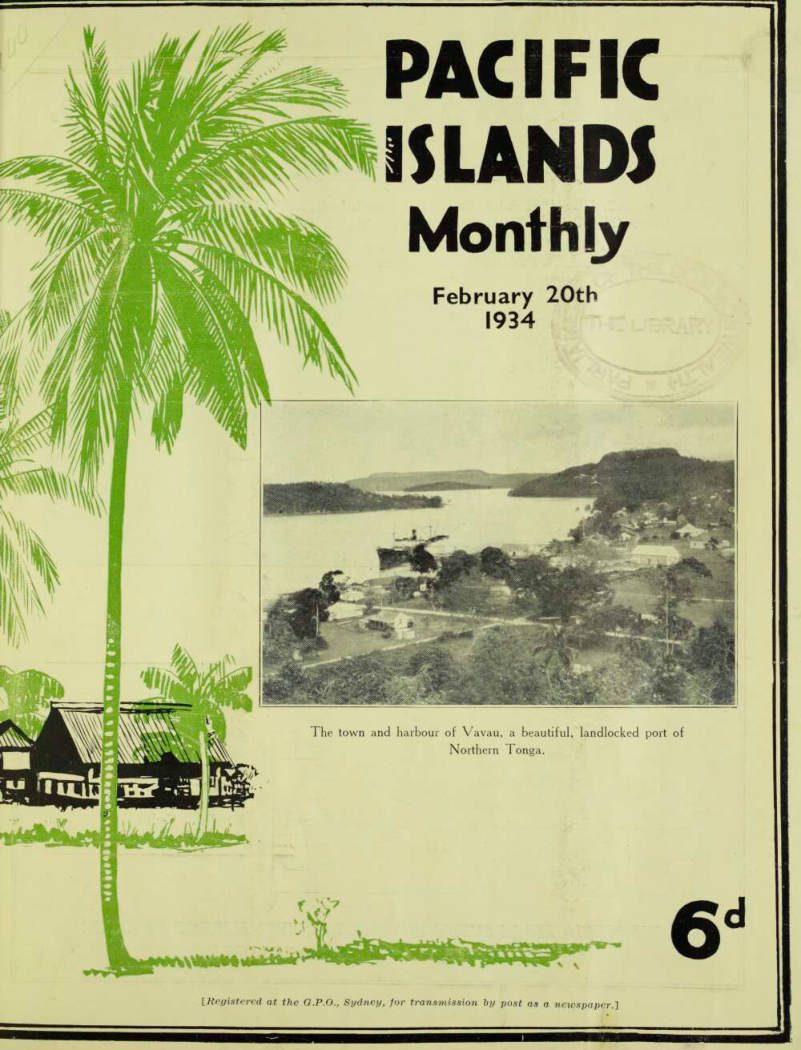
The town and harbour of Vavau, a beautiful, landlocked port of Northern Tonga.
Advertisements & other items, p. 2 (1 item)
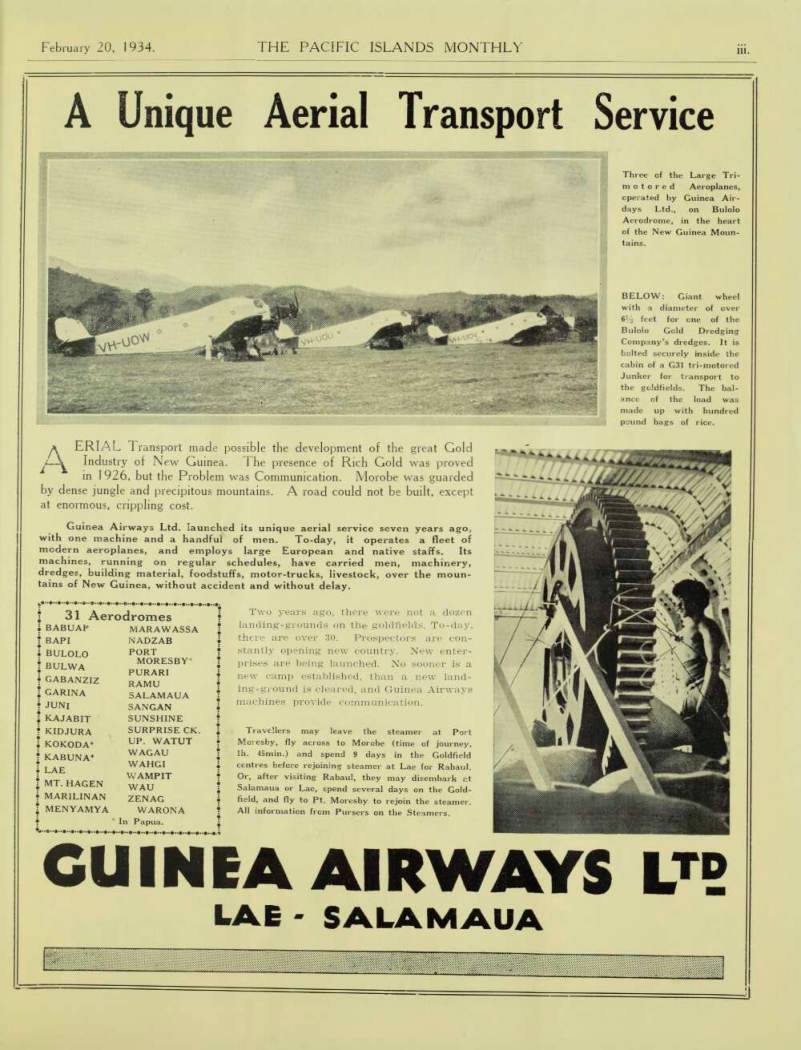
W. R. Carpenter & Co. Ltd.
Head Office:
19-21 O’CONNELL STREET - - SYDNEY
Branches at: RABAUL (New Britain), KAVIENG (New Ireland), MADANG (New Guinea), SALAMAUA, WAU (New Guinea), TULAGI (Solomon Islands), and other Pacific Islands; and in LONDON.
Agents for Australian, European and American Manufacturers, and Distributors of Every Description of Merchandise. Complete Range of all stocks carried.
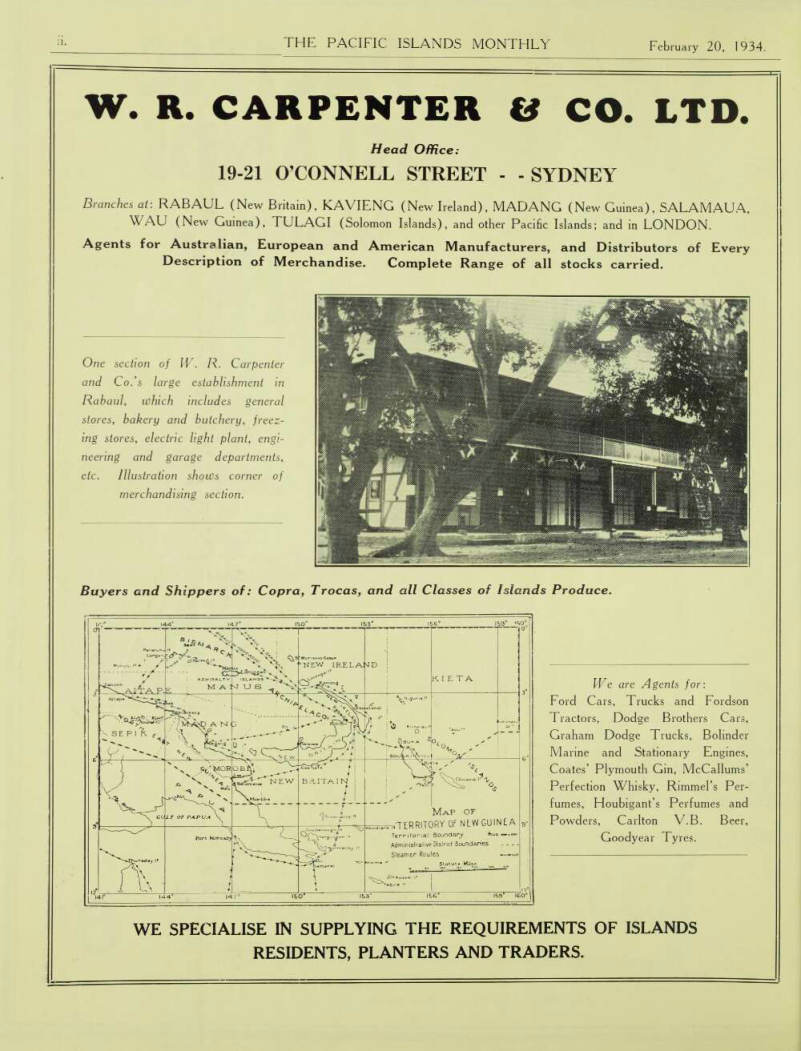
One section of W. R. Carpenter and Co.’s large establishment in Rabaul, which includes general stores, bakery and butchery, freezing stores, electric light plant, engineering and garage departments, etc. Illustration shows corner of merchandising section.
Buyers and Shippers of: Copra, Trocas, and all Classes of Islands Produce.
We are Agents for: Ford Cars, Trucks and Fordson Tractors, Dodge Brothers Cars, Graham Dodge Trucks, Bolinder Marine and Stationary Engines, Coates’ Plymouth Gin, McCallums’
Perfection Whisky, Rimmel’s Perfumes, Houbigant’s Perfumes and Powders, Carlton V.B. Beer, Goodyear Tyres.
WE SPECIALISE IN SUPPLYING THE REQUIREMENTS OF ISLANDS
RESIDENTS, PLANTERS AND TRADERS.
Pacific Islands Travellers
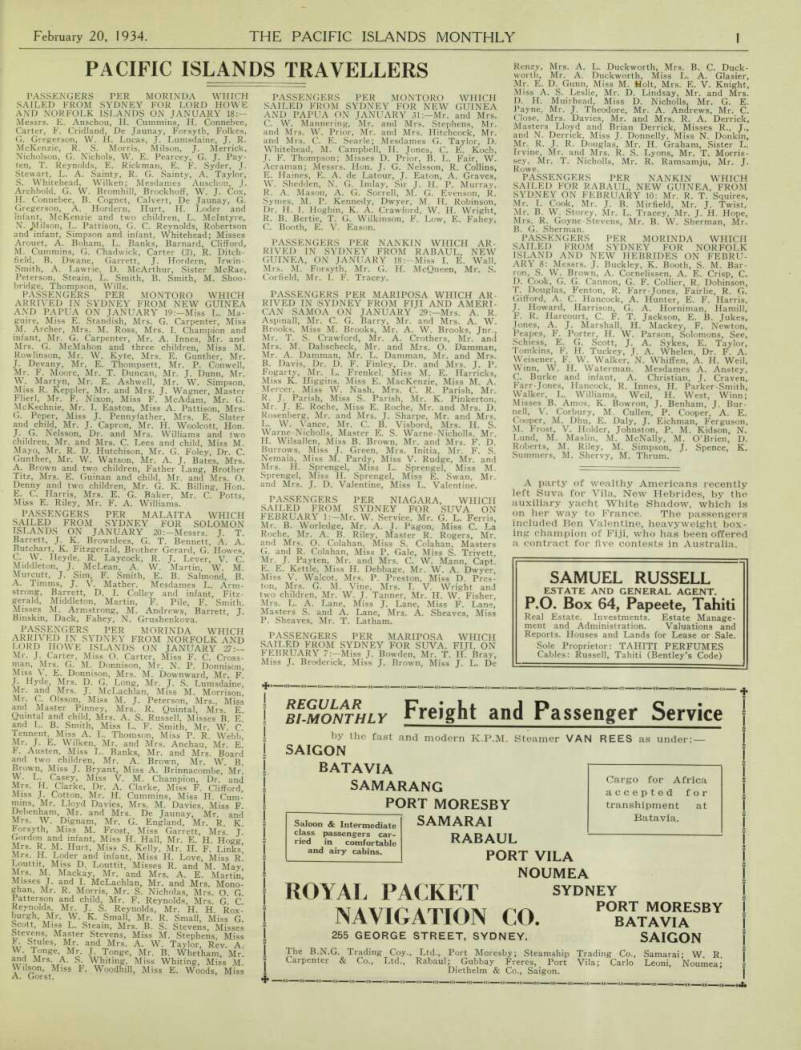
Passengers Per Morinda Which
Sailed From Sydney For Lord Howe
And Norfolk Islands On January 18:-
Messrs. E. Anschou, H. Cummins, H. Connebee, Carter, F. Cridland, De Jaunay, Forsyth, Folkes, G. Gregerson, W. H. Lucas, J. Lumsdaine, J. R.
McKenzie, R. S. Morris, Milson, J. Merrick, Nicholson, G. Nichols, W. E. Pearcey, G. J. Pay ten, T. Reynolds, E. Rickman, E. F. Syder, J.
Stewart, L. A. Sainty, R. G. Sainty, A. Taylor, S. Whitehead, Wilken; Mesdames Anschou, J.
Archbold, G. W. Bromhill, Brockhoff, W. J. Cox, H. Connebee, B. Cognet, Calvert, De Jaunay, G.
Gregerson, A. Hordern, Hurt, H. Loder and infant, McKenzie and two children, L. McIntyre, N. Wilson, L. Pattison, G. C. Reynolds, Robertson and infant, Simpson and infant, Whitehead; Misses Arouet, A. Boham, L. Banks, Barnard, Clifford, M. Cummins, G. Chadwick, Carter (2), R. Ditch field, B. Dwane, Garrett, J. Hordern, Irwin- Smith, A. Lawrie, D. McArthur, Sister McRae, Peterson, Steain, L. Smith, B. Smith, M. Shoo bridge, Thompson, Wills.
Passengers Per Montoro Which
Arrived In Sydney From New Guinea
AND PAPUA ON JANUARY 19;-Miss L. Ma guire, Miss E. Standish, Mrs. G. Carpenter, Miss M. Archer, Mrs. M. Ross, Mrs. I. Champion and infant, Mr. G. Carpenter, Mr. A. Innes, Mr, and Mrs. G. McMahon and three children, Miss M.
Rowlinson, Mr. W. Kyte, Mrs. E. Gunther, Mr.
J. Devany, Mr. E. Thompsett, Mr. P. Conwell, Mr. F. Moore, Mr. T. Duncan, Mr. J. Dunn, Mr.
W. Martyn, Mr. E. Ashwell, Mr. W. Simpson, Miss R. Keppler, Mr. and Mrs. J. Wagner, Master Flierl, Mr. F. Nixon, Miss F. McAdam, Mr. G.
McKechnie, Mr. I. Easton, Miss A. Pattison, Mrs.
G. Peper, Miss J. Pennyfather, Mrs. E. Slater and child, Mr. J. Capron, Mr. H. Woolcott, Hon.
J. G. Nelsson, Dr. and Mrs. Williams and two children, Mr. and Mrs. C. Lees and child, Miss M.
Mayo, Mr. R. D. Hutchison, Mr. G. Foley, Dr. C.
Gunther, Mr. W. Watson, Mr. A. J. Bates, Mrs.
A. Brown and two children, Father Lang, Brother Titz, Mrs. E, Guinan and child, Mr, and Mrs. O.
Denny and two children, Mr. G. K. Billing, Hon.
E. C. Harris, Mrs. E. G. Baker, Mr. C. Potts, Miss E. Riley, Mr. F. A. Williams.
Passengers Per Malaita Which
Sailed From Sydney For Solomon
Islands On January 20:-Messrs. J. T.
Barrett, J. K. Brownlees, G. T. Bennett, A. A.
Butchart, K. Fitzgerald, Brother Gerard, G. Howes, C. W. Heyde, R. Laycock, R. J. Lever, V. C.
Middleton, J. McLean, A. W. Martin, W. M.
Murcutt, J. Sim, F. Smith, E. B. Salmond, B.
A. Timms, J. V. Mather. Mesdames L. Arm strong, Barrett, D. I. Colley and infant, Fitz gerald, Middleton, Martin, F. Pile, F. Smith.
Misses M. Armstrong, M. Andrews, Barrett, J.
Binskin, Dack, Fahey, N. Grushenkova.
Passengers Per Morinda Which
Arrived In Sydney From Norfolk And
Lord Howe Islands On January 27
Mr. J. Carter, Miss O. Carter, Miss F. C. Cross man, Mrs. G. M. Donnison, Mr. N. P. Donnison, Miss V. E. Donnison, Mrs. M. Downward, Mr. F.
J. Hyde, Mrs. D. G. Long, Mr. J. S. Lumsdaine, Mr. and Mrs. J. McLachlan, Miss M. Morrison, Mr. C. Olsson, Miss M. J. Peterson, Mrs., Miss and Master Pinney, Mrs. R. Quintal, Mrs. E.
Quintal and child, Mrs. A. S. Russell, Misses B. E. and L. B. Smith, Miss L. F. Smith, Mr. W C Tennent, Miss A. L. Thomson, Miss P. R. Webb, Mr. J. E. Wilken, Mr. and Mrs. Anchau, Mr. E.
F. Austen, Miss L. Banks, Mr. and Mrs. Board and two children, Mr. A. Brown, Mr. W. B.
Brown, Miss J. Bryant, Miss A. Brinnacombe, Mr.
W. L. Casey, Miss V. M. Champion, Dr. and Mrs. H. Clarke, Dr. A. Clarke, Miss F. Clifford, Miss J. Cotton, Mr. H. Cummins, Miss H. Cum mins, Mr. Lloyd Davies, Mrs. M. Davies, Miss F.
Debenham, Mr. and Mrs. De Jaunay, Mr. and Mrs. W. Dignam, Mr. G. England, Mr. R. K. horsyth, Miss M. Frost, Miss Garrett, Mrs. J.
Gordon and infant, Miss H. Hall, Mr. E. H. Hogg, Mrs. R. M. Hurt, Miss S. Kelly, Mr. H. F. Links, Mrs. H. Loder and infant, Miss H. Love, Miss R.
Louttit, Miss D. Louttit, Misses R. and M. May, Mrs. M. Mackay, Mr. and Mrs. A. E. Martin, Misses J. and I. McLachlan, Mr. and Mrs. Mono ghan, Mr. R. Morris, Mr. S. Nicholas, Mrs. O. G.
Patterson and child, Mr. F. Reynolds, Mrs. G. C.
Reynolds, Mr. J. S. Reynolds, Mr. H. H. Rox burgh, Mr. W. K. Small, Mr. R. Small, Miss G.
Scott, Miss L. Steain, Mrs. B. S. Stevens, Misses Stevens, Master Stevens, Miss M. Stephens, Miss F. Stules, Mr. and Mrs. A. W. Taylor, Rev. A.
W. Tonge Mr. J. Tonge, Mr. B. Whetham, Mr. and Mrs. A. S. Whiting, Miss Whiting, Miss M.
Wilson, Miss F. Woodhill, Miss E. Woods, Miss A. Gorst.
Passengers Per Montoro Which
Sailed From Sydney For New Guinea
AND PAPUA ON JANUARY 31:-Mr. and Mrs.
C. W. Mannering, Mr. and Mrs. Stephens, Mr. and Mrs. W. Prior, Mr. and Mrs. Hitchcock, Mr. and Mrs. C. E. Searle; Mesdames G. Taylor, D.
Whitehead, M. Campbell, H. Jones, C. E. Koch, J. F. Thompson; Misses D. Prior, B. L. Fair, W.
Acraman; Messrs. Hon, J. G. Nelsson, R. Collins, E. Haines, E. A. de Latour, J. Eaton, A. Graves, W. Shedden, N. G. Imlay, Sir J. H. P. Murray, R. A. Mason, A. G. Sorrell, M. G. Evenson, R.
Symes, M. P. Kennedy, Dwyer, M. H. Robinson, Dr. H. I. Hogbin, K. A. Crawford, W. H. Wright, R. B. Bertie, T. G. Wilkinson, F. Low, E. Fahey, C. Booth, E. V. Eason.
Passengers Per Nankin Which Ar
Rived In Sydney From Rabaul, New
GUINEA, ON JANUARY 18:-Miss I. E. Wall, Mrs. M. Forsyth, Mr. G. H. McQueen, Mr. S.
Corfield, Mr. I. F. Tracey.
Passengers Per Mariposa Which Ar
RIVED IN SYDNEY FROM FIJI AND AMERI CAN SAMOA ON JANUARY 29:-Mrs. A. R.
Aspinall, Mr. C. G. Barry, Mr. and Mrs. A. W.
Brooks, Miss M. Brooks, Mr, A. W. Brooks, Jnr., Mr. T. S. Crawford, Mr. A. Crothers, Mr. and Mrs. M. Dabscheck, Mr. and Mrs. O. Damman, Mr. A. Damman, Mr. L. Damman, Mr. and Mrs.
B. Davis, Dr. D. F. Finley, Dr. and Mrs. J. P.
Fogarty, Mr. L. Frenkel, Miss M. E. Harricks, Miss K. Higgins, Miss E. MacKenzie, Miss M. A.
Mercer, Miss W. Nash, Mrs. C. R. Parish, Mr.
R. J. Parish, Miss S. Parish, Mr. K. Pinkerton, Mr. J. E. Roche, Miss E. Roche, Mr. and Mrs. D.
Rosenberg, Mr. and Mrs. J. Sharpe, Mr. and Mrs.
L. W. Vance, Mr. C. B. Visbord, Mrs. H. S.
Warne-Nicholls, Master E. S. Warne-Nicholls, Mr.
H. Wilsallen, Miss B. Brown, Mr. and Mrs. F. D.
Burrows, Miss J. Green, Mrs. Initia, Mr. F. S.
Nemaia, Miss M. Pardy, Miss V. Rudge, Mr. and Mrs. H. Sprengel, Miss L. Sprengel, Miss M.
Sprengel, Miss H. Sprengel, Miss E. Swan, Mr. and Mrs. J. D. Valentine, Miss L. Valentine.
Passengers Per Niagara, Which
Sailed From Sydney For Suva On
FEBRUARY 1: —Mr. W. Service, Mr. G. L. Ferris, Mr. B. Worledge, Mr. A. J. Pagon, Miss C. La Roche, Mr. A. B. Riley, Master R. Rogers, Mr. and Mrs. O. Colahan, Miss S. Colahan, Masters G. and R. Colahan, Miss P. Gale, Miss S. Trivett, Mr. J. Payten, Mr. and Mrs. C. W. Mann, Capt.
E. E. Kettle, Miss H. Debbage, Mr. W. A. Dwyer, Miss V. Walcot, Mrs. P. Preston, Miss D. Pres ton, Mrs. G. M. Vine, Mrs. I. V. Wright and two children, Mr. W. J. Tanner, Mr. H. W. Fisher, Mrs. L. A. Lane, Miss J. Lane, Miss F. Lane, Masters S. and A. Lane, Mrs. A. Sheaves, Miss P. Sheaves. Mr. T. Latham.
Passengers Per Mariposa Which
SAILED FROM SYDNEY FOR SUVA, FIJI, ON FEBRUARY 7: —Miss J. Bowden, Mr. T. H. Bray, Miss J. Broderick, Miss J. Brown, Miss J. L. De
Renzy, Mrs. A. L. Duckworth, Mrs. B. C. Duck worth, Mr. A. Duckworth, Miss L. A. Glasier, Mr. E. D. Gunn, Miss M. Holt, Mrs. E. V. Knight, Miss A. S. Leslie, Mr. D. Lindsay, Mr. and Mrs.
D. H. Muirhead, Miss D. Nicholls, Mr. G. E.
Payne, Mr. J. Theodore, Mr. A. Andrews, Mr. C.
Close, Mrs. Davies, Mr. and Mrs. R. A. Derrick, Masters Lloyd and Brian Derrick, Misses R., J., and N. Derrick, Miss J. Donnelly, Miss N. Donkin, Mr. R. J. R. Douglas, Mr. H. Graham, Sister L.
Irvine, Mr. and Mrs. R. S. Lyons, Mr. T. Morris sey, Mr. T. Nicholls, Mr. R, Ramsamju, Mr. J.
Rowe.
Passengers Per Nankin Which
Sailed For Rabaul, New Guinea, From
SYDNEY ON FEBRUARY 10: Mr. R. T. Squires, Mr. I. Cook, Mr. J. B. Mirfield, Mr. J. Twist, Mr. B. W. Storey, Mr. L. Tracey, Mr. J. H. Hope, Mrs. R. Goyne-Stevens, Mr. B. W. Sherman, Mr.
B. G. Sherman.
Passengers Per Morinda Which
Sailed From Sydney For Norfolk
Island And New Hebrides On Febru
ARY 8: Messrs. J. Buckley, K. Booth, S. M. Bar ron, S. W. Brown, A, Cornelissen, A. E. Crisp, C.
D. Cook, G. G. Cannon, G. F. Collier, R. Dobinson, T. Douglas, Fenton, R. Farr-Jones, Fairlie, R. G.
Gifford, A. C. Hancock, A. Hunter, E. F. Harris, J. Howard, Harrison, G. A. Horniman, Hamill, F. R. Harcourt, C. F. T. Jackson, E. B. Jukes, Jones, A. J. Marshall, H. Mackey, F. Newton, Peapes, F. Porter, H. W. Parson, Solomons, See, Schiess, E. G. Scott, J. A. Sykes, E. Taylor, Tomkins, F, H. Tuckey, J. A. Whelen, Dr. F. A.
Weisener, F. W. Walker, N. Whiffen, A. H. Weil, Winn, W. H. Waterman. Mesdames A. Anstey, C. Burke and infant, A. Christian, J. Craven, Farr-Jones, Hancock, R. Innes, H. Parker-Smith, Walker, L. Williams, Weil, H. West, Winn; Misses B. Amos, K. Bowron, J. Benham, J. Bur nell, V. Corbury, M. Cullen, P. Cooper, A. E.
Cooper, M. Dhu, E. Daly, J. Eichman, Ferguson, M. Frost, V. Holder, Johnston, P. M. Kidson, N.
Lund, M. Maslin, M. McNally, M. O’Brien, D.
Roberts, M. Riley, M. Simpson, J. Spence, K.
Summers, M. Shervy, M. Thrum.
A party of wealthy Americans recently left Suva for Vila, New Hebrides, by the auxiliary yacht White Shadow, which is on her way to France. The passengers included Ben Valentine, heavyweight box ing champion of Fiji, who has been offered a contract for five contests in Australia.
Advertisements & other items, p. 3 (1 item)
m-monthly Freight and Passenger Service
SAMUEL RUSSELL
ESTATE AND GENERAL AGENT.
P.O. Box 64, Papeete, Tahiti
Real Estate. Investments. Estate Management and Administration. Valuations and Reports. Houses and Lands for Lease or Sale.
Sole Proprietor: TAHITI PERFUMES Cables: Russell, Tahiti (Bentley’s Code)
m-monthly Freight and Passenger Service
by the fast and modern K.P.M. Steamer VAN REES as under:
SAIGON
BATAVIA
SAMARANG
PORT MORESBY
SAMARAI
Saloon & Intermediate class passengers carried in comfortable and airy cabins.
RABAUL
PORT VILA
Cargo for Africa accepted for transhipment at Batavia.
ROYAL PACKET
NAVIGATION CO.
255 GEORGE STREET, SYDNEY. SAIGON
The B.N.G. Trading Coy., Ltd., Port Moresby; Steamship Trading Co., Samarai; W R Carpenter & Co. Ltd.
NOUMEA
SYDNEY
PORT MORESBY
BATAVIA
Rabaul; Gubbay Freres, Port Diethelm & Co., Saigon.
Vila; Carlo Leoni, Noumea;
Fiji’S New Coins
Sir. M. Hedstrom Arrives With Full Set
Interesting details of the new Fiji coinage, which was introduced on January 1 in that colony, were given to the news papers by Sir Maynard Hedstrom, of Fiji, who arrived in Australia in February, after a year spent mostly in Europe. A complete set of the new coins were pre sented to His Majesty the King. An other special set was given to Sir May nard, who attended to some of the work of the new issue, while in London.
Fiji’s Governor, Sir Murchison Fletcher, approved of the design, which was then carried out by Mr. R, Metcalf at the Royal Mint, London, and the coins shipped to Suva, late in 1933. This will put an end to the smuggling of British silver out of Fiji which, owing to the ad vantages given by the present exchange rates, had attained embarrassing propor tions.
An attempt has been made, said Sir Maynard, to provide for peculiar local conditions. The Fiji natives usually carry coins in their mouths. For this reason they did not like the English cop per coins—they called the penny ‘‘loa loa,” or black penny. So, to encourage the natives to carry the coins in another way, and to help the circulation of small money among the Fijians and the Indians—which should help to reduce the cost of living— the new penny and halfpenny are of light nickel, with holes through them, so that they may be carried on strings, as in India and Africa.
Contents
Page Fiji’s New Coins , 2 Copra Production and Unilever Ltd. 3,4,7 Administrators’ Conference ... 5 Territories and Primage 5 New Slipway Opened 6 Fiji’s Governor in Australia ... 6 Fiji Airways Ltd. 7 Solomon Is. Grievances 7 London Market Prices 8 End of Mandates System 12 Japan in the Marshalls 13 Papuan Gold 14 U.S.A. in the Pacific 15 Australian Tariffs and Fiji Bananas 16 Useful Islands Recipes 17
Page Germany and the Mau 19 Mr. O. F. Nelson Replies 21 Medical Hints for Islands Residents 23 Fiji Indians 24 New Fruit Laws in Cook Is 27 Samoan Produce 28 Mau Cases in Samoa 29 Islands Produce Prices 31 Conditions in French Oceania .. .. 32 Fashions for Islands Women .. .. 33 New Goldfield in N. Guinea .. .. 36 N.G. and Papuan Gold Sharemarket 36 Market Quotations 37 Exchange Quotations 33 Shipping Services in the Pacific .. 39,40
Advertisers
Page Adams, W. & Co. .. 33 Amalg. Wireless .. 10 Antinea Drug Co. .. 18 Arnott’s Biscuits .. 27 Bank of N.S.W. .. 16 Bergers Paints .. 40 Broomfields, Ltd. .. 18 Bruce, Robert .. 22, 36 Brunton’s Flour .. 26 Burns, Philp & Co. 2 Burns, Philp (S.S.) Co. 14 B.P. Magazine 31 Buzacott, Ltd.. .. 35 Carpenter, W. R.
Cover ii.
Central Q’land Meat Co 17 Chapman & Sherack 34
Page Chartres, Stott & Hoare 20 Dangar, Gedye, Ltd. 25 Delicia Food Co. .. 16 Exito Co 38 Fletcher & Sons .. 36 Ford, W. M 33 For Sale, Cruiser .. 9 Flynn, Mrs. W. .. 14 Garrett & Davidson 23 Gillespie’s Flour 20 Goshen Pt. Hospital 28 Grahame, C 28 18 Cover iii.
Halvorsen, L 37 Hardie, Jas. & Co. 29 Harper, M 23 Holbrooks, Ltd. .. 26
Page Holmes, W 19
I.C.I.A.N.Z., Ltd. .. 11
Joyce Biscuits .. .. 14 Kopsen & Co 28 Lane & Girvan .. 23 Lessey’s D.Y.S. .. 9 McIlrath’s, Ltd. .. 13 Metro. Bus. College 32
N.D.L 39
Nelson & Robertson 24, 38 New Brit. Express 10 Nolan, Spencer .. 22 Noyes Bros 9 Pacific Is, Ass’n. .. 28 Paton, Burns .. .. 24 Pike Bros 8 Prescott, Ltd 11 Rabaul Carr’g. Co... 32
Page Ransomes, Ltd. .. 19 Rohu, Sil 24 Royal Packet N. Co. 1 Russell, S 1 Steamships T. Co., Ltd 40 ‘Stillholme” .. .. 8 Sunshine Harvester 30 Swallow and Ariell, Ltd 12 Taubman’s Paints .. 21 Thomas, G. & Co... 27 Pillock & Co., Ltd. 22 Tooth & Co iv.
Vacuum Oil 30 Wallaringa Mansions 37 Wanted, plantation . 9 Wills, WD & H. O. 34 Wunderlich, Ltd. 8, 31
Advertisements & other items, p. 4 (1 item)
Burns, Philp & Co. Ltd.
Head Office - 7 Bridge Street, Sydney - Australia Code Address: “BURPHIL”
General Merchants,
Shipowners,
Tourist Agents, Etc.
Buyers of all Classes
of Island Produce
Regular Steamer Services From Australia to New Guinea, Papua, Solomons, Lord Howe, Norfolk Islands, New Hebrides, Java and Singapore
The Pacific Islands Monthly
The Newspaper-Magazine Of The South Seas
[Registered at G.P.O., Sydney, for transmission by post as a newspaper.]
Published Once Each Month and Circulated in Australia and New Zealand and in the following Pacific Territories and Islands Groups:
Crown Colony of Fiji.
Australian Territory of Papua.
Mandated Territory (Australia) of New Guinea, Bismarck Archipelago, and Northern Solomon Islands.
Mandated Territory (Japan) of Marshall, Caroline and Mariana Islands.
American Territory of Guam.
Mandated Territory of Nauru.
British Crown Colony of Gilbert and Ellice Islands.
French Territory of New Caledonia.
British and French Condominium of New Hebrides.
American Territory of Eastern Samoa.
Mandated Territory (New Zealand) of Samoa.
British Solomon Islands Protectorate.
British Protectorate of Tongan Islands.
New Zealand Territory of Cook Islands.
Australian Territory of Norfolk Island.
French Colony of Oceania (Tahiti, etc.).
American Territory of Hawaiian Islands.
Owned and Produced by Pacific Publications, Ltd., Union House, 247 George Street, Sydney.
Telephone Bw 5037
P.O. Box 3408 R
Contributions Articles, Stories, and Photographs dealing with Pacific Islands Subjects are invited, and will be paid for on publication at usual rates.
Subscription Rates
Per Annum, within British Empire, Prepaid Post Free 6/- Per Annum, elsewhere, prepaid, Post Free .. 8/- Single Copies 6d.
Editor and Publisher:
R. W. Robson.
Advertisements Advertising rates furnished on application.
Colours, etc. by Arrangement.
Process Blocks made at Advertiser’s expense when required. Screen, 100.
Changes of Advertising Copy should reach this Office by Bth of each month, otherwise previous advertisement may be repeated.
Registered Address for Radiograms and Cables: “PACPUB” Sydney Agents The following are authorised to receive subscrip tions for “The Pacific Islands Monthly”— Islands Branches of Burns, Philp & Co., Ltd., and Burns, Philp (South Seas) Co., Ltd.
Islands Branches of W. R. Carpenter & Co., Ltd.
All Branches of Morris, Hedstrom & Co., Ltd.
J. H. MacGregor Dowsett, Rabaul.
Whitten Bros., Ltd., Port Moresby and Samarai.
P. Costello, Suva, Fiji.
All Branches and Representatives of W. H. Grove and Sons, Ltd., Auckland.
S. Russell, Papeete, Tahiti.
Cook Islands Trading Co., Rarotonga.
Mrs. M. Campbell, Cascades, Norfolk Island.
Vol. IV. No. 7.
Sydney, February 20, 1934.
Price 6d. Per Copy {Price Prepaid: 6/- p.a.
Copra Production and Unilever Combine
With the collapse in the copra market, the immediate outlook for coconut planting in the South Seas is very black indeed. It is a time when planters, de pendent in the past on copra, must give serious consideration to their condition.
The market is controlled by two great factors — First, over-production; second, the dominance of the Unilever combine.
Is it possible to secure, throughout the ranks of coconut-growers in the world, a sufficient measure of co-operation to per mit the producers to deal in some way with those two evils?
At first glance, it does not seem prac ticable. There are in the world six great groups of copra producers—namely, Africa, Ceylon, Malaya and Dutch East Indies, Phillipines, South and Central Pacific, and West Indies.
It may be noted that, in the last year (1930) for which complete figures are available, exports of copra from these various areas, in thousands of tons, were:
In each of these areas, again, there are two or three classes of producers the big planters, who conduct their plantations in a scientific manner; the small producers, white and coloured, whose production is partly efficient and partly haphazard; and, finally, the natives, whose methods are entirely primitive. Looking at those facts, one may say at once that it appears im possible to organise the producers them selves so as to control the world markets, as has been done in the case of tea, tin, etc., in recent years.
But each of the regions referred to is under the control of ordered government, and it is just possible that, if the various Administrations concerned could be brought together, a plan could be evolved under which the export of copra from the various Territories could be regulated. It
is a tremendous thing to envisage; but it appears now that an attempt at something of the sort is the only alternative to the collapse of the coconut-planting industry, as it has developed during the past quarter century.
If there were a free market there would be no need for special action. The evil of over-production would cure itself. The great economic law of supply and demand would operate as it has operated in past ages. Over-production would cause a fall in prices; production consequently would be reduced; buyers would begin to com pete one against the other for available supplies; and prices would rise again to a point which at least would permit the producer to live.
But there is no free market. In this post-War era, natural economic laws have been defied and broken. A world-wide system of growing complexity and vicious ness usually taking the form of aggres sive tariffs and Government subsidies has interfered in an extraordinary and grow ing degree with the law of supply and demand. The evil has been aggravated by the growth of trusts and combines, which clearly manipulate world markets, and direct the ebb and flow of money and merchandise, to suit their own purposes.
We know that low copra prices are
Africa— Philippines 171 Zanzibar 18 West Indies 16 Tanganyika 7 Pacific— Mozambique ... 17 New Guinea ... 64 East Indies— Fiji 24 Malaya 192 Solomons 24 D. E. Indies 370 Tonga 14 Borneo 9 Samoa 12 Ceylon 91 Papua 12
partly the result of over-production. But owing to the manipulation of the market by the Unilever combine we do not know the extent of that over-production; and consequently it becomes apparent that we cannot leave the ordinary law of supply and demand to cure the evils.
That brings us to consideration of another phase of the problem. Even if there could be concerted action among the Governments of Britain, France, Hol land, Japan and the United States to limit production, would not the benefits to the industry thus created be seized by the Unilever combine at the expense of the growers? We know that it is impossible for any single Government to control Unilever, which sits astride the margarine and soap industries in half a dozen Euro pean countries and defies any single Ad ministration; but would it be possible for half a dozen Governments, acting in unison, to deal with Unilever? We doubt it. The world of commerce and finance to-day is dominated by great trusts and combines, and as a general rule they snap their fingers at all Governments.
So, following out the argument as it affects the copra industry, we find our selves face to face with one of the great problems which now is troubling the whole civilised world namely, the domi nation of finance and trade by inter national financiers. If we are to free the copra industry entirely from the evils which now depress it, it is clear that we must go right back to Unilever. As that, apparently, is impossible the alternative is clear we must either abandon hope, or turn around and see what can be done in a more limited sphere. All that we can say in this connection, therefore, is that it is desirable that Administrations con cerned should consult together and seek the largest possible measure of inter national co-operation in order to save the industry. The alternative is at least the partial ruin of an industry involving hun dreds of thousands of primary producers and millions of capital.
Some people argue that the Unilever combine is not necessarily vicious that it may operate benevolently organising the market for the growers on the one side, and, by mass production and scientific methods, reducing prices to the con sumers on the other. All we can say is that no combine dominated by the need of making profits can possibly be other than vicious in the long run, and that this particular combine has operated to the detriment of the planting industry through out the world for several years. It has not only crushed out all competition in its particular field; but it also is largely re sponsible for the introduction of methods under which such commodities as whale oil, soya bean oil, etc., are deodorized and purified, so that these things may be used as substitutes for coconut oil. In ordinary circumstances such scientific discoveries are utilised for the benefit of consumers in particular and humanity in general. But this has not happened in the case of the Unilever combine. The commodities it manufactures and distributes throughout the world—soap, margarine, etc. have not been perceptibly reduced in price, and thus contributed to a lower cost of living;
but cheaper production has provided in creased dividends for the Unilever group of companies, even during the period of depression.
When first we discussed this position, three years ago, we pointed out that Unilever would defy governments. The great combine, through its groups of mills, was astride Great Britain, France, Ger many, Sweden, Czecho-Slovakia, Austria and Italy we named its several units in those countries. In such circumstances it seems impossible to control the operations of the organisation by Government action.
But to-day, under the imperative necessity of dealing with the deplorable condition of the coconut growing industry through out the world, it is just possible that con certed action by the nations concerned could do something to free the world’s copra markets from the grip of the octupus.
If the copra industry is left in its pre sent condition enormous losses, in the shape of ruined planters and plantations, will be incurred in the Territories con trolled by the following countries: Great Britain in her Colonies and Dependencies in Africa, Ceylon, Malaya, South Seas, West Indies.
Australia—through her Territories in Papua and New Guinea.
New Zealand through her Territories in Samoa and Cook Islands.
France through her Territories in Africa, Cochin China and the South Seas.
United States—through her Territories in Hawaii and Phillipines.
Holland—through her Territories in Dutch East Indies.
Japan—through her Territories in Caro line and Marshall Islands.
As it happens, there shortly will take place in Australia a Conference of Aus tralian Pacific Administrators. It is be lieved that Sir Murchison Fletcher, High Commissioner for the Western Pacific, will be in Australia at the same time. Here is an opportunity to bring up for discus sion the general or world aspect of the copra industry, and submit something for the consideration of the other nations concerned.
There is an opportunity, also, of initiat ing a research movement in regard to alternative uses for coconut oil. Hitherto this commodity has been used mostly for food, cleansing and toilet purposes. But there is little doubt that it has a lubricat ing value; and also it is of value as a fuel.
It is a common practice in certain places to use coconut oil or well-dried copra as an illuminant it burns with a clear white light. It was announced recently that a Japanese chemist had succeeded in adapt ing whale oil for lubricating purposes. If that can be done with whale oil, it surely can be done with coconut oil. This writer is under the impression that there is in use somewhere possibly in Africa—an engine called the Robey engine, which is run on vegetable oil. Is it not a reason able proposition that, since coconut oil is being displaced from its old uses by other commodities, as a result of scientific re search, we should seek by the same means to adapt coconut oil for use as a motor fuel, for which there is a world-wide and increasing demand? The chemist and the
laboratory expert, by applying new pro cesses to the rivals of coconut oil, have caused a vast disturbance of the copra industry. Would it not be poetic justice if the same expert chemist were to dis cover methods by which coconut oil could be used for engines and machinery?
Here then is a chance for Australia to give the world a lead in a matter of vital importance to tropical producers gener ally. There is need for control of coconut production; for consideration of the posi tion created by the Unilever combine; and there is most urgent need for well-directed research, so as to find new uses for coco nut oil.
New Guinea Gold
£840,000 Produced In Morobe By Two Companies In 1933
have been supplied from an unofficial source with figures showing the production of gold on the Morobe gold field by the two major companies during the year ended 31st December, 1933.
During that period the Bulolo Gold Dredging Company, according to its monthly reports published in the “Sydney Morning Herald,” treated 5,880,000 cubic yards, from which it recovered 136,000 ozs. of bullion gold, which was worth in Australian currency £683,000. According to the company’s own figures this gold gave a profit for the year of £501,000 (Australian).
New Guinea Goldfields, Ltd., during the same period, produced 27,000 ozs. of allu vial bullion and 15,000 ozs. of milled bul lion —the former of which was worth in Australian currency £74,000 and the lat ter £83,000, or a total of £157,000 for the year.
This gave a production for the year, from the two companies alone, of £846,000.
It is probable that during the current year the Bulolo Company will show a,n even better return, as it will have all its four dredges in full operation. But even on the figures for 1933 an unofficial esti mate shows that that Company is making an average profit of 1/8 per cubic yard.
450 Miles Of Sea
Sickness!
Rabaul Lads’ Love of Cricket
AN Australian Eleven, or Sixteen, is not the only team in this Continent that travels many miles across water, all for the love of the leather and willow.
On the night of December 22, seventeen Rabaul lads boarded the M.V. Drina (80 tons) and proceeded on a 450 miles jour ney to Salamaua, arriving at that port on Christmas morning.
It was an excellent trip—except for the last 17 hours, when it commenced to rain and the wind blew lustily. With leaking bulk-heads, the Drina bravely ploughed her way through the high seas, while the 17 cricketers huddled together, half of them desperately sea-sick and the other half aggressively cheerful.
The main object of the visit was to meet and defeat the Wau Cricket Team.
Let it be whispered that after such suf fering, Rabaul was defeated by an in nings and 151 runs.
It is marvellous what an Australian will do for his much beloved god, Sport.—S.L.
Administration
Important Conference in Canberra
THE following is the Agenda prepared for the Conference of Australian- Pacific Administrators, to be held in Can berra during the second week in March.
The Conference represents a most import ant development in the history of Pacific Administration.
It will be attended by General Griffiths (New Guinea), Sir Hubert Murray (Pa pua), Captain Pinney (Norfolk Island), and Commander Garsia (Nauru).
Administration Amalgamation of Territories.
Co-operation between the Administrations of the Territories.
Co-ordination of Policy in relation to the Terri tories.
Economic development.
Determination of the boundary between Papua and New Guinea.
Public Service Creation of Commonwealth Territorial Service.
Superannuation.
Interchange of officers.
Conditions of employment.
Commerce and Trade Regulation of shipping in and in relation to the Territories.
Subsidised shipping services.
Preferential Tariff in favour of Australian goods.
Measures to be taken to promote trade in Aus tralian goods within the Territories.
Marketing assistance for produce of the Terri tories.
Measures to be taken to promote trade in Aus tralia in the produce of the Territories, including preference for Territorial goods in the Australian tariff.
Health Co-ordination of activities relating to public health.
Interchange of medical officers.
Interchange of technical information.
Campaign against Leprosy.
Campaign against Tuberculosis.
Research.
Natives Use of natives in services of Administration.
Steps to be taken to advance the social conditions of the natives, including improvement of health and economic development.
Economic relations between natives and non natives with special reference to native labour.
Taxation of natives and provision of services directed to their moral and material improvement.
Whipping of natives and capital punishment.
Native Co-operative Societies.
Native administration and powers of Chiefs.
Agriculture Promotion of agricultural activities, including encouragement of new industries and crops.
Advice of technical advisers to be available to all Territories.
Native agriculture.
Legislation relating to the control of import and export of plants and agricultural products.
Mining Mining activities in proximity to Papuan and New Guinea boundary.
Policy in relation to encouragement to be given in connection with opening up of new areas.
Forestry Afforestation.
Exploitation of timber resources.
Functions of Commonwealth Inspector-General of Forests in relation to the Territories.
Land Land settlement, including method of making land available to settlers.
Acquisition of land from natives.
Grant of freehold titles.
Education Native education.
Training of native medical assistants.
Training of natives in Australia.
Denominational schools.
Facilities for education of white children, includ ing grant of scholarships.
Religious Missions Co-operation with Administration.
Educational activities.
Medical activities.
Spheres of influence.
Subsidies.
Finance Assistance from the Commonwealth Government.
Local coinage.
Interest reduction.
General Wireless broadcasting.
Portable wireless sets —use by Patrol Officers.
Study of Anthropology.
Encouragement of tourist traffic.
Dead At 92
Cornelius Quintal, Pitcairner
THE death has occurred on Norfolk Island, at the age of 92, of Cornelius Quintal, who was a direct descendant of one of the “Bounty” mutineers, who settled on Pitcairn Island, 150 years ago.
He was born on June 17, 1841, and was generally known as “Uncle Cornish.”
Of the 194 Pitcairners who were brought from Pitcairn Island to Norfolk Island by the “Morayshire,” in 1856, only two now survive—Mrs. Selina Buffet, aged 77; and Mr. Packin Christian, aged 80. Mrs. Rachael Taylor (nee Quintal) died last August, aged 84; and Mr. Cor nelius Quintal, on February 10.
Pay Primage
N.G. and Papua Must Pay Primage
SOME time ago the Island Trade Section of the Sydney Chamber of Commerce, on the suggestion of Mr. R. W. Robson, directed the attention of the Federal Min ister for Trade and Customs to an ap parent anomaly, which lay in the fact that while the products of Norfolk Island were allowed to enter the Commonwealth free of all Customs and allied duties, the products of Papua and New Guinea were subject to primage. The argument was submitted that as Papua and New Guinea were just as much a part of Australia as is Norfolk Island, it was only fair that Australian producers in the former Ter ritories should have the same assistance and privileges.
The Minister duly replied that the posi tion of the two large Territories is dif ferent from that of the small Territory because, under the Norfolk Island Act of 1913, it is provided that duties of Customs shall not be charged on imports from Norfolk Island. He also said that he had received many requests for relief from primage duty and that the tax is a revenue impost and exemptions are necessarily subject to considerations of Government finance. The position of Papua and New Guinea would receive at tention when the question of further ex emptions is being considered.
EDITORIAL NOTE. —This is typical of the man ner in which bureaucracy evades direct issues and shelters itself behind rules and regulations.
Why, in the name of common-sense, should the products of Papua and New Guinea be taxed with primage while the products of Norfolk Island are free? Why should they be taxed at all? Why should there be any distinction made between the products of Papua and of the Northern Territory, which for administration purposes and from the point of view of Government authority are exactly equal in their relationship to Canberra? It seems that the Commonwealth Government, like the un fortunate Spanish maiden of the rude old song, seeks safety by having one invariable answer to all propositions, namely, “No, Sir —No!”
Unlawful Killing
N.G. Miner Gets Two Years' Gaol
From Our Own Correspondent
Rabaul, Feb. 4.
GEORGE CHESTER, a prospector who has been working on the Lower Dunantina River, in the Purari district —one of the most isolated areas in the Morobe goldfields—came before Chief Judge Wan liss on January 17, charged with unlaw fully killing a native. Accused pleaded not guilty.
The evidence was that of an incident which might happen at almost any mining camp in the Territory. The assault took place at the end of the day. Koluve, the deceased native, was controlling the water that was running into the box, when the daily wash-up was taking place; he al lowed too much water to flow, with the result that gold and concentrates were washed into the tail-race, and much was lost. The accused, incensed at the boy’s action, according to the evidence, lost his temper, and assaulted the boy, who sub sequently died that same afternoon. Medi cal evidence showed that the cause of death was a ruptured spleen.
His Honour said that brutality was not the way to enforce discipline; and this kind of thing not only led to loss of life, but also to unfortunate difficulties with fellow miners. “I know,” continued His Honour, ‘‘the conditions under which you have to work there, alone; wretched food, no so ciety of any kind; troubles with labour very often, I suppose, sickness and ma laria. These things get on the mind and affect a man’s disposition, and make him do things he could not think of doing under other circumstances, and I am go ing to take all these facts into considera tion in your case.”
The accused was sentenced to two years’ imprisonment, with hard labour.
Bulolo Dredges
Production of the Nos. 1,2, and 3 dredges of the Bulolo Gold Dredging, Ltd. (New Guinea) for January compares with that of the previous periods as follows: —
No. 1 dredge was closed down for 12 days for equipping with pontoons.
The deep drilling on the original Bulolo area has increased the width of payable deep gravel to 1600 feet. The average depth of payable values across that width appears to be about 60 feet, and the lower gravels average about 30 cents with gold at 35 dollars per ounce. Drilling will now be con tinued upstream and then downstream to discover the extent of these lower gravels.
New Guinea Goldfields, Ltd.
The monthly returns of production and estimated profits of New Guinea Goldfields, Ltd., are as follows
Development: Location 3, west drive on No. 3 level advanced 55ft. in ore averaging 24.9dwt. gold and 20.50 z. silver, over width 28 inches.
Period ended.
Nov. 30.
No. 1 and 2 dredges— Dec. 31 Jan. 31.
Cubic yards 400,200 410,800 380,000 Bullion, oz 10,202 10,076 10,304 Gold fine oz. . 6,764 6,680 6,832
Value-
Aust. Currency . *£50,730 *£50,100 t £58,072 Per cubic yard /30.42 /29.27 /36.67 Working Profit .. £A38,220 £A37,620 £A45,458 No. 3 dredge— Cubic yards 82,000 141,000 251,200 Gold, fine oz. . 670 405 1,621 * At £A7/10/ per fine ounce, t At £A8/107 per fine ounce.
Bullion, oz. — Nov.
Dec.
Jan.
Alluvial 1,857 2,412 1,644 Mill 1,833 1,900 1,941 Estimated profit— Oct.
Nov.
Dec.
Alluvial £5,400 .. £4,816 .. £7,200 Mill 7,280 .. 10,563 .. 11,500
New Slipway Opened
Important Event in N.G.
From Our Own Correspondent
Rabaul, Jan. 31.
THE new slipway at Karavia, opposite Rabaul, erected by Carpenter’s Slipway, Ltd., was opened by his Honour the Administrator on January 18, when the s.s. Duranbah was slipped before a repre sentative crowd of residents.
The operation was carried out without a hitch. Much credit is due to Mr. Hay, the contractor, for the work he has put into this undertaking.
Toasts were drunk and speeches made by Mr. B. B. Merriman, M.L.C., manager for Messrs. W. R. Carpenter & Co., and replies were given by His Honour the Administra tor. Regrets were expressed that Mr. Mir fleld, who had taken such a keen interest and practical part in the erection of the slip, was forced to be absent in Sydney.
It was the intention of the “Southern Cross VII.” to be the first vessel to be placed on the slip; but owing to some difficulties regarding insurance, it had to be deferred.
The overhauling of the “Duranbah” be ing completed a few days after the open ing" of the slip, the mission vessel was placed on the slip, surveyed and taken off again successfully. At present, one of the Lever Company’s boats from the British Solomons is at anchor, awaiting an op portunity to be slipped.
The erection of the slipway is without doubt a forward step in the Territory, and will prove a great boon to owners of small steamers, who can now overhaul here ves sels which otherwise would have to go to an Australian port—usually Sydney.
Governor Of Fiji In
Australia
THE Governor of Fiji and High Commissioner for the Western Pacific, Sir A. G. Murchison Fletcher, arrived in Syd ney by the Monowai from New Zealand on February 17.
It is believed that His Excellency will enter into discussions with the Federal Government concerning trade relations be tween Australia and Fiji, which are in a bad way. Sir Murchison pointed out to Sydney reporters, in a mild reference to the subject, that the balance of the trade at present is overwhelmingly in favour of Australia.
No official intimation has been given, but it is hoped that the Governor will be in Canberra, or somewhere near at hand, when the Conference of Australian Pacific Administrators is held in March.
A farewell dinner was given to Mr. R.
F. Whitten, at the Papua Hotel, on Jan uary 17, on the night of his departure from Port Moresby for Samarai. Mr.
Whitten had sold his business interests in the town, and his many friends gathered to bid him farewell. Mr. Justice Gore presided, and three dozen men made up the party, which was probably the most representative gathering in Port Moresby for many years. The toast of the evening, “Our Guest,” was proposed by the Hon. H. W. Champion, C.B.E. (Acting-Lieut.-Governor), Mr. R. F.
Whitten has been a resident in the Terri tory for 40 years. He arrived in 1894, and his late brother, Hon William Whit ten, arrived still earlier, on August 22, 1885, when he accompanied the first Special Commissioner (Sir Peter Scratch
ley) to the then Protectorate. Whitten Bros, is a firm that has been established here from the beginning; and the early progress of the Territory was in a large measure assisted by its operations.
Cheap Beef!
New Calendonia’s Trouble
"IF copra is over-produced and correspondingly valueless, what can we say about beef in New Caledonia?” said a Syd ney man who arrived recently from the French colony.
“Good freshly-killed beef is selling in Noumea at 1d per lb. Pastoralists cannot get more than 20/- to 25/- per head for their beasts. There are large herds of cattle in New Caledonia, where the indus try has been built up over many years, but it is practically impossible under present conditions to find any market at all for canned beef or the other products of the industry. It is apparent that if some out let is not found soon this very valuable pastoral industry of New Caledonia will disappear.”
A fair amount of Australian capital is invested in meat-canning works and pas toral properties in New Caledonia.
Bad Weather
Mission Ketch Delayed By
The ketch “Patterson,” built recently by Mr. Lars Halvorsen for mission work in the New Hebrides, after satisfactory trials, left Sydney Harbour for the New Hebrides on January 19, with a crew of four; but she reappeared on January 29 at Jervis Bay, on the South Coast of New South Wales, having been driven back by rough seas and contrary winds. The crew immediately made preparations to resume the voyage.
The run of bad luck continued after the ketch returned to Sydney on January 31.
She left Sydney for New Hebrides again on Feb. 3. When about 40 miles north-east of Middleton Reef, on Feb. 8, the rudder stock carried away; and the vessel ar rived in Newcastle on Feb. 13, after sailing 600 miles with an improvised rudder con sisting of a batten hanging astern, and a couple of small paddles at the side. The seas were generally very rough, but the ketch proved a splendid sea-boat. She came on from Newcastle to Sydney, where she will be repaired at Mr. Lars Halvor sen’s yards.
Affray in Central Papua
WE have received from our Port Moresby Correspondent a full ac count of the recent affray in Central Papua, to which reference is made on page 18.
It is quite clear that the basic cause of the trouble is the lack of sufficient patrol officers, due to economies which have been forced upon the Papuan Adminis tration. Patrol Officer Cowley could not be in two places at once; and the clash with the Kagave people appears to have been the result of sending native police into dangerous country without a white man in charge.
A subsequent investigation has resulted in two of the native police concerned being placed on trial for murdering four Kagave natives.
We shall publish a full account of the incident, and subsequent developments, in our March issue.
New Guinea Notes
From Our Own Correspondent
Rabaul, Feb. 4.
A MOVEMENT is on foot for the forma tion of an Automobile Club of New Guinea. Already two preliminary meetings have been held and a general meeting is called for February 15. It is hoped that this organisation will be able to work in with the Administration for good roads and to protect the interests of the motorists in the Territory.
Successful experiments have been made by Mr. H. J. Washington, of Kabaira plan tation, in planting cocoa between the lines of his coconuts; after the roots had pene trated beneath the shallow-feeding coconut roots the trees showed great improvement and Mr. Washington expects to obtain good crops from these trees.
Other successful experiments have been made by the A.W.A. radio station at Ra baul with wireless telephony. Conversa tions were held recently with the m.v.
Macdhui, while she was at Kavieng and also during her run to Kieta and Buka.
The reception was excellent. The set used was the short-wave portable one, which has a pedal attachment for generating the power. The tests were made on a wave length of 44 metres.
His Lordship the Bishop of Melanesia entertained a number of local residents to tea on the Southern Cross VII. while the vessel was in port, and the visitors had an opportunity of making an inspection of a most comfortable and commodious craft.
Capt. J. Scott, previously first officer on the Southern Cross VI., is in charge of the vessel.
Mr. and Mrs. Vandercook, of New York, who are visiting these parts in the inter ests of the National Geographic Magazine, have left for the Solomons, where they expect to remain some months. If possible, they will make for the New Hebrides from the Solomons, but as steamer connections are not good that way, they probably will be compelled to return here and proceed on to Manila and from there to U.S.A.
The death occurred on Thursday, Jan uary 18, at Namanula, of Mr. Kevin Hew son Rollison, one of the clerical staff of Messrs. W. R. Carpenter. Deceased was a married man, and came from Adelaide. The funeral service, held at St. George’s Church, was well attended by many friends who paid a last tribute to a popular man.
15 Natives Arrested
Papuan Officer’s Feat
From Our Own Correspondent.
Port Moresby, Feb. 4.
Patrol Officer J. Hides, who in 1931 crossed and recrossed New Guinea with only six police and 10 carriers, arrived at Port Moresby on Saturday evening with 15 natives accused of murder, whom he brought overland from Loloipa Val ley, near Kumimaipa Valley, which is 250 miles from Port Moresby.
Since December 1, with an escort of only eight native police, he has searched for and arrested the natives, believed to have been concerned in two murders and a massacre. Patrol Officer Hides arrested all the tribesmen without shooting a native, though a policeman was killed and Hides himself was nearly killed.
Solomon Islands
Grievances
NUMEROUS letters to hand from the Solomon Islands by the Malaiti mail (November 15), indicate an increasingly disturbed condition of public opinion in that Group. Space at this late hour pre vents odr stating the people’s grievances in detail. The following is a summary: As a result of the new preferential tariff in operation in the Solomons, the officials have introduced a system which causes much exasperating delay in securing de livery of goods. Traders, particularly, are being caused great inconvenience, and they are the more bitter because it ap pears that goods addressed to Govern ment officials are cleared with a minimum of delay.
It is stated that the Administration proposes to stop trochus fishing for six months —although, in spite of steady fish ing, shell is no scarcer now than it was ten years ago. The cessation of trochus fishing would give many traders the coup-de-grace.
Despite the depression among Euro peans a number of additional trading boat licenses have been granted to Chinese, and it is reported that additional store licenses are to be issued to them.
Public feeling concerning this matter is very high.
Although it was understood that a pro mise had been made in Suva that native wages in the Solomons would be reduced to the level of the adjoining territories, nothing has been done up to the end of January.
It is reported that the Resident Com missioner, Mr. F. N. Ashley, has arrived in Sydney by the Malaita to formally dis cuss Solomon Islands affairs with the High Commissioner for the Western Pacific, Sir Murchison Fletcher. There appear to be many matters for discussion.
General Griffiths
From a Special Correspondent.
Rabaul Jan. 24.
IT is reported here, but quite unofficially, that the present Administrator of the Territory, General T. Griffiths, will not return to the Territory after his visit to Australia, to attend the Administrators’
Conference at Canberra, in March.
The change—if the report is true—is not viewed with any favour here. General Griffiths always was held in great esteem; and his good reputation has been strengthened tremendously since he took up duty here eighteen months ago. He is regarded as the ideal Administrator— firm, just and wise—and the popular view is that if the Federal Government wishes this Territory to go along as happily in the future as it has done in the recent past, it should try to induce the General to remain at Namanula.
Reciprocity With Tonga
As a result of developments following the Ottawa Agreement a reciprocal tariff has been arranged between Australia and the Government of Tonga, under which the products of Australia imported into Tonga will be given preference over those of any non-British country. Australia exports annually about £25,000 worth of goods to Tonga—mostly preserved meats, biscuits, beer, spirits, timber, hardware, and drapery.
Light Dredge In Papua
From Our Own Correspondent.
Port Moresby, Feb. 2.
The new light dredge, described in the November issue of the P.I.M., specially built for the Tiveri Gold Mining Co., was delivered in Port Moresby by the “Mac dhui” on November 30, and has since been landed at its destination on the Lakekamu River. It is anticipated that the dredge will be at work by the end of March.
Conduct Of Papuan
Students
THERE is likely to be some stir concern ing the conduct in Sydney of the Motuan youths, who were sent down from Papua a few months ago to undergo at the Sydney University a special course of training in the work of medical assistants.
The young natives have been provided with accommodation at the Quarantine Station, near Manly, and it is alleged that some of them have spent a portion of their leisure time in the company of young European girls. Nothing of an improper character is alleged, as far as we know, but the fact of the association itself is held in sharp distaste by various people with a knowledge of social conditions in the Melanesian Islands; and there is very strong resentment concerning the latitude which has been allowed the Papuan stu dents.
We do not know who is responsible for the supervision of the lads while they are in Sydney; but whoever it is is likely soon to be under very sharp cross-fire from a section of the Sydney press, which is in teresting itself in the matter.
Fiji Airways
Doubt About Future of Service
THE directors of Fiji Airways, Ltd., whose head office is in Adelaide, in a memorandum to shareholders dated Janu ary 27, report that the ten months’ opera tions of the Company have been disappoint ing and that they have been trying to secure better support from both the Gov ernment and public of Fiji. They say frankly that they have not been encour aged by a conference which they have had recently with a member of the Legislative Council of Fiji, and therefore they are disinclined to continue their contractual obligations after March, 1934.
The Directors say that recently they received a letter from Fiji expressing the view that it might be as well to abandon the enterprise there, “but if the Directors wish to be magnanimous and look to the future it would be to the interests of Fiji undoubtedly if you put a couple of larger planes into service and continued opera tions in the Colony. . . . but I personally think it will be many years before Fiji is air-minded enough to support a decent air service.”
The position is to be considered at an early meeting of shareholders.
It will be a matter for great regret if Fiji Airways, Ltd., and the Fiji Govern ment cannot between them inaugurate an aerial transport service within this Colony.
Such services are certain to come in all of the Island Groups within the next decade or two; and it would be a good thing for Pacific Administrations generally if the rich and influential Fiji Government could pioneer this development.
Unilever
A Challenge To
N.G. Planters’ Appeal to Australia
- From Our Own Correspondent.
Rabaul, Feb. 4.
THE Executive Committee of the Planters’ Association of New Guinea has started a movement for the investigation of the “ramifications” of Unilever, Ltd.
The following extract, from “The Rabaul Times,” explains the situation: The following is the resolution passed by the committee at the January (1934) meeting and forwarded to the Prime Min ister of Australia for transmission to the British Government: “That this Association, through the Ad ministrator, requests the Commonwealth Government to make representation to the British Government, through the Higii Commissioner for Australia, London, to institute an inquiry into the ramifications of the Unilever Company and its sub sidiary companies with a view to regu lating and, if necessary, restricting the profits of the Unilever Combine within reasonable limits. We suggest at the same time, that the co-operation of other Governments concerned should be sought.
This action is requested in view of the control exercised by the Unilever Com pany .and its Associated Companies over the world’s vegetable oil products, which is directly instrumental in maintaining the price of these products below cost of production. Further, that copies of re presentations made be forwarded to recognised producers’ associations in all copra-producing countries, requesting them to make similar representations to their respective Governments.”
In the covering letter to the Australian Prime Minister, the Committe said — “After mature consideration the mem bers of this organisation deemed it de sirable that, in order to save the exten sively established coconut industry of the various tropical countries of the world, there should be some international en deavour made to rationalise the effect of a world combine on the market price of copra.
“Although the Territory of New Guinea produces a very small proportion of the world’s copra, we understand that these Islands market more copra than any other British group or country in the South Sea Islands, which is the greatest producing section in the world, for that reason it may be appropriate for the request to emanate from this Association.”
EDITORIAL NOTE. —The foregoing report, which reached us on the eve of going to press, is of first-rate importance. It will be most inter esting to observe the manner in which the request of the Planters’ Association is dealt with by the Australian and British Governmental authorities.
The subject, by a curious coincidence, is dealt with in detail in our article on pages 3 and 4 of this issue—which was actually in type before we knew of the action taken by the N.G. Planters’
Association.
Fiji Copra Exports
Final figures of exports of copra from Fiji for 1933 show that 11,761 tons were shipped from Suva, and 10,836 tons from Levuka. The total quantity exported was 22,599 tons, as against 15,076 tons in 1932.
The average declared value per ton in 1933 was £8/13/3, as against £11/5/10 in 1932.
Charming Couple
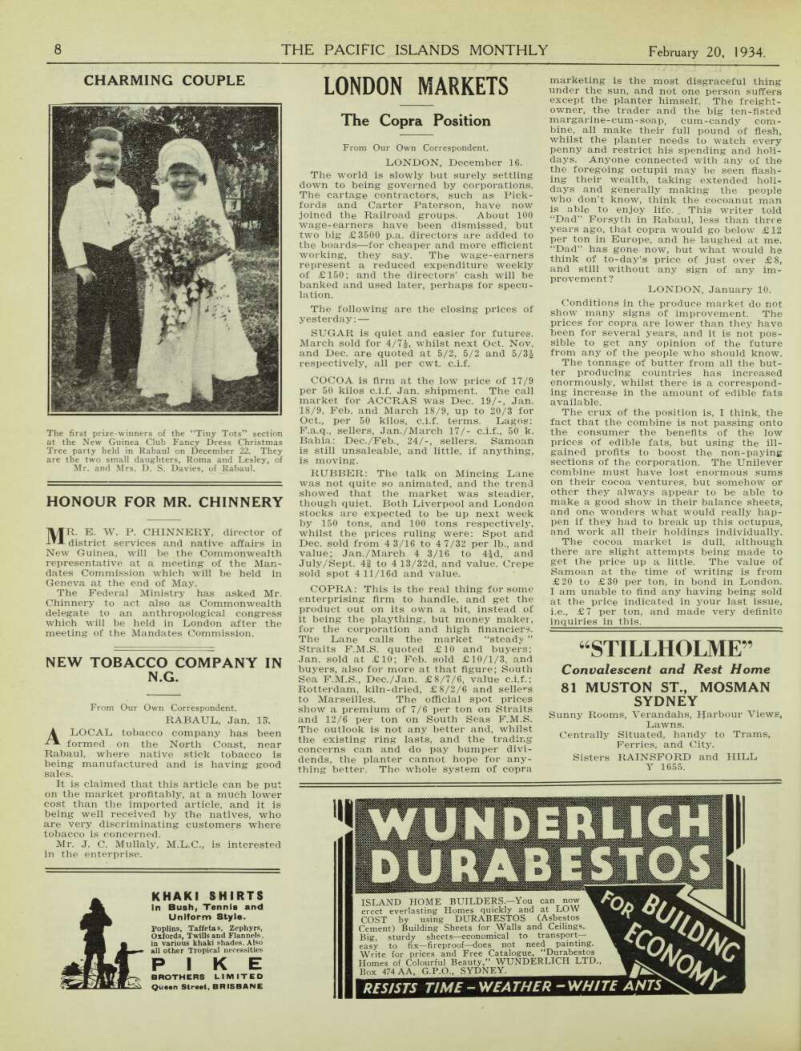
The first prize-winners of the “Tiny Tots” section at the New Guinea Club Fancy Dress Christmas Tree party held in Rabaul on December 22. They are the two small daughters, Roma and Lesley, of Mr. and Mrs. D. S. Davies, of Rabaul.
Honour For Mr. Chinnery
MR. E. W. P. CHINNERY, director of district services and native affairs in New Guinea, will be the Commonwealth representative at a meeting of the Man dates Commission which will be held in Geneva at the end of May.
The Federal Ministry has asked Mr.
Chinnery to act also as Commonwealth delegate to an anthropological congress which will be held in London after the meeting of the Mandates Commission.
New Tobacco Company In
N.G.
From Our Own Correspondent.
Rabaul, Jan. 15.
A LOCAL tobacco company has been formed on the North Coast, near Rabaul, where native stick tobacco is being manufactured and is having good sales.
It is claimed that this article can be put on the market profitably, at a much lower cost than the imported article, and it is being well received by the natives, who are very discriminating customers where tobacco is concerned.
Mr. J. C. Mullaly, M.L.C., is interested in the enterprise.
London Markets
The Copra Position
From Our Own Correspondent.
LONDON, December 16.
The world is slowly but surely settling down to being governed by corporations.
The cartage contractors, such as Pick fords and Carter Paterson, have now joined the Railroad groups. About 100 wage-earners have been dismissed, but two big £3500 p.a. directors are added to the boards—for cheaper and more efficient working, they say. The wage-earners represent a reduced expenditure weekly of £150; and the directors’ cash will be banked and used later, perhaps for specu lation.
The following are the closing prices of yesterday: SUGAR is quiet and easier for futures.
March sold for 4/7½, whilst next Oct. Nov. and Dec. are quoted at 5/2, 5/2 and 5/3½ respectively, all per cwt. c.i.f.
COCOA is firm at the low price of 17/9 per 50 kilos c.i.f. Jan. shipment. The call market for ACCRAS was Dec. 19/-, Jan. 18/9, Feb. and March 18/9, up to 20/3 for Oct., per 50 kilos, c.i.f. terms. Lagos: F.a.q., sellers, Jan./March 17/- c.i.f., 50 k.
Bahia: Dec./Feb., 24/-, sellers. Samoan is still unsaleable, and little, if anything, is moving.
RUBBER; The talk on Mincing Lane was not quite so animated, and the trend showed that the market was steadier, though quiet. Both Liverpool and London stocks are expected to be up next week by 150 tons, and 100 tons respectively, whilst the prices ruling were: Spot and Dec, sold from 4 3/16 to 4 7/32 per lb., and value; Jan./March 4 3/16 to and July/Sept. 4g to 4 13/32d, and value. Crepe sold spot 4 11/16d and value.
COPRA: This is the real thing for some enterprising firm to handle, and get the product out on its own a bit, instead of it being the plaything, but money maker, for the corporation and high financiers.
The Lane calls the market “steady ”
Straits F.M.S. quoted £10 and buyers; Jan. sold at £10; Feb. sold £10/1/3, and buyers, also for more at that figure; South Sea F.M.S., Dec./Jan. £8/7/6, value c.i.f.; Rotterdam, kiln-dried, £ 8/2/6 and sellers to Marseilles. The official spot prices show a premium of 7/6 per ton on Straits and 12/6 per ton on South Seas F.M.S.
The outlook is not any better and, whilst the existing ring lasts, and the trading concerns can and do pay bumper divi dends, the planter cannot hope for any thing better. The whole system of copra
marketing is the most disgraceful thing under the sun, and not one person suffers except the planter himself. The freight owner, the trader and the big ten-fisted margarine-cum-soap, cum-candy com bine, all make their full pound of flesh, whilst the planter needs to watch every penny and restrict his spending and holi days. Anyone connected with any of the the foregoing octupii may be seen flash ing their wealth, taking extended holi days and generally making the people who don’t know, think the cocoanut man is able to enjoy life. This writer told “Dad” Forsyth in Rabaul, less than three years ago, that copra would go below £12 per ton in Europe, and he laughed at me.
“Dad” has gone now, but what would he think of to-day’s price of just over £8, and still without any sign of any im provement?
LONDON, January 10.
Conditions in the produce market do not show many signs of improvement. The prices for copra are lower than they have been for several years, and it is not pos sible to get any opinion of the future from any of the people who should know.
The tonnage of butter from all the but ter producing countries has increased enormously, whilst there is a correspond ing increase in the amount of edible fats available.
The crux of the position is, I think, the fact that the combine is not passing onto the consumer the benefits of the low prices of edible fats, but using the ill gained profits to boost the non-paying sections of the corporation. The Unilever combine must have lost enormous sums on their cocoa ventures, but somehow or other they always appear to be able to make a good show in their balance sheets, and one wonders what would really hap pen if they had to break up this octupus, and work all their holdings individually.
The cocoa market is dull, although there are slight attempts being made to get the price up a little. The value of Samoan at the time of writing is from £20 to £30 per ton, in bond in London.
I am unable to find any having being sold at the price indicated in your last issue, i.e., £7 per ton, and made very definite inquiries in this.
Advertisements & other items, p. 10 (2 items)
Wunderlich
“STILLHOLME”
Convalescent and Rest Home
81 MUSTON ST., MOSMAN
SYDNEY
Sunny Rooms, Verandahs, Harbour Views, Lawns.
Centrally Situated, handy to Trams, Ferries, and City.
Sisters RAINSFORD and HILL Y 1655.
WUNDERLICH
ISLAND HOME BUILDERS.—You can now
erect everlasting Homes quickly and at LOW COST by using DURABESTOS (Asbestos Cement) Building Sheets for Walls and Ceilings.
Big, sturdy sheets —economical to transporteasy to fix—fireproof—does not need painting Write for prices and Free Catalogue, “Durabestos Homes of Colourful Beauty,” WUNDERLICH LTD
Box 474 AA, G.P.O., SYDNEY.
Resists time -weather - white ants
Pike
KHAKI SHIRTS
in Bush, Tennis and Uniform Style.
Poplins, Taffetas, Zephyrs, Oxfords, Twills and Flannels, in various khaki shades. Also all other Tropical necessities
PIKE
BROTHERS LIMITED
Queen Street, BRISBANE
The Larkin Case
Letter to the Editor.
AS one who approves of much that ap pears in the editorial columns of the P.I.M., I write to say that I think you are in error in urging that James Larkin was over-punished for bringing about the death of a native in New Guinea.
If you make inquiries among the official records you will find that Larkin was in trouble on possibly half a dozen previous occasions, owing to assaults on natives.
I believe that there was one occasion when he very narrowly escaped a severe sentence at the hands of a responsible D.O. I am quite in accord with the argument that discipline must be maintained among natives, and that injustice must be resisted at all costs, but I think you will find if you make due inquiry, that James Larkin’s record was not a credit able one, and that such record fully jus tified the severe sentence imposed upon him for the particular offence of which he was convicted.
The P.I.M. is too good and useful a journal to be allowed to go so seriously astray in this matter of the Larkin case.
I am, etc.,
N.G. Planter.
Sydney, 10th Feb., 1934.
Moresby
Native Executed
Sequel to Assault in Port Moresby
A BOUT 500 natives of both sexes and a small number of Europeans assembled on the hillside near the gaol on the morn ing of January 29 to witness the execu tion of the native sergeant, Stephen, for a grave assault on a European child aged five.
The gallows was erected on the lower portion of the hill, but only the steps were visible, the remainder being screened by hessian. An armed native police guard was stationed around the hill and the flat, but there was no disturbance.
Stephen died immediately. For 15 years he was a member of the native armed constabulary.
Tour Of Pacific
Liner with 235 Travellers in E. Polynesia
From Our Own Correspondent.
PAPEETE, January 25.
THE Matson liner “City of Los Angeles” (12,642 tons), arrived in Papeete on January 22, by way of the Marquesas Islands, with 235 tourists on a cruise round the Pacific, and left for Rarotonga on January 24.
The shore entertainments were in the hands of the Societe Commerciale de l'Oceanie, and included an excursion round the main part of Tahiti; a native feast at the village of Pueu; performances by male and female dancing troupes; and a fire-walking ceremony, A flotilla of decorated canoes escorted the “City of Los Angeles” into the har bour, and at the dock her passengers were received with fragrant wreaths and songs of welcome, which drew enthusiastic en cores and were replied to by the ship’s musicians, who had been practising the Tahitian national song of appreciation all the way from the Marquesas.
An open air “Bal Publique,” favoured with fine weather, was organised on the Place du Marechal Joffre, where the visitors were received by the Comite des Fetes, and its President, Mr. Geo. Barn bridge, Mayor of Papeete. His Excel lency Governor Montagne was present at the ball, which carried on till daylight.
The “City of Los Angeles” is expected to return to Tahiti in June next, on a similar tour.
At Rarotonga
RAROTONGA, January 27.
On January 26, the tourist ship “City of Los Angeles” spent a day here, and the passengers greatly enjoyed themselves.
Trucks and cars met them at the wharf, and conveyed them round the island to Muri, a beautiful beach and good lagoon, with islets on the reef, in easy reach of swimming or canoeing enthusiasts. Native
dancing went on almost continuously and, in the afternoon, a play, based on an epi sode in Maori history, was enacted. On all sides this was acclaimed as excellent, and the costumes particularly admired, many being bought right off the backs of the performers. Money seemed plentiful and circulated freely.
Islands
Hurricane In Cook
IT was reported in Sydney on February 3, by a radiogram through Suva, that a hurricane had struck the Cook Group, but no serious damage was reported. The disturbance was then moving south-east.
Advertisements & other items, p. 11 (2 items)
Drive Yourself
FOR SALE AT
SACRIFICE
BEAUTIFUL CRUISER
Built for service and comfort. Perfect running condition. Length, 44.3 feet; beam, 11.6 feet; draft, 3 feet. Powered by two 25-30 h.p. “Aster” petrol engines.
Developing 9 knots. 3 keels, bottom heavily coppered.
An ideal yacht for a family or for intra- Island service.
For full particulars, communicate to: A. C. GAERTNER & SON, 16 Hunter Street, Sydney; or SOCIETE CHIMIQUE DU CHROME, Noumea, New Caledonia; or cable address “CHIMIQUE” NOUMEA.
PLANTATION WANTED
Wanted to purchase, a desirable ISLAND PLANTATION, south of Lat. 15S. preferred, must be cheap. Reply with fullest particulars to H. L. S. HAVYATT, Solicitor, Dalton House, 115 Pitt St., Sydney.
When Visiting Sydney
Send a Wire to
LESSEY’S
Drive Yourself
Box 8, Post Office,
PADDINGTON,
and an up-to-date car will meet you at the boat, which you can hire on very reasonable terms to
DRIVE YOURSELF.
Head Office and Service Station at
RUSHCUTTER’S BAY
(Near Stadium). Tel.: F 3196.
Radio Address: “Lessey’s,” Paddington, Sydney.
Stromberg'Carlson
SUPERHETERODYNES
Inquiries relating to these famous Superheterodynes should be sent to Noyes Bros. (Sydney), Ltd., who will be pleased to supply illustrated folders and full details of their range of Broadcast Receivers, including the new Battery Operated Receivers 403 & 704. Full stocks of every class of radio component parts carried.
NOYES BROS.
Wholesale Distributors 115 Clarence Street, SYDNEY. Showrooms: 78 Clarence Street, SYDNEY. ’Phone: B 7581 (10 lines) 11 WATT STREET, NEWCASTLE. ELIZABETH STREET, BRISBANE.
Teopicalities
AN authentic story of the recent Christmas race meeting at Wau, T.N.G., was included in the “Montoro’s” mailbag. Mr.
Otto Rossiter, owner of “Harmony,” the winner of the coveted Morobe Gold Cup, radioed Sydney for a jockey. The jockey arrived a few days before the race, and was very enthusiastic about the success of his mount, on such an auspicious occa sion. He plied the trainer with many questions as to the condition of the horse.
“What have you been feeding the ‘nag’ on?” he queried.
The trainer replied, nonchalantly, in true New Guinea style: “Well, after we walked him in from Salamaua he nearly died, but we fed him up on oats. Before long, Wau was full of horses and oats be came scarce, so we have been feeding him for the last few weeks on dry native biscuits.”
Dry native biscuits! The jockey, being an Australian, made adequate comment with a very fervent “Gawd Struth!”—S.L.
A NUKUALOFA correspondent on a meteorological note: —The Govern ment of Tonga has an accumulated sur plus of about £135,000. When this was being accumulated by the taxpayers it was stated to be “for a rainy day.” The rainy day has struck Tonga with a ven geance, but the Government and its ser vants are the only people with umbrellas!
QUITE a number of persons have called at the office of the “Pacific Islands Monthly” in recent weeks and enquired about the possibility of purchasing planta tions in the Islands at bargain prices. It appears that there are surprisingly many people with some money saved, and a dream of a sun-drenched existence in a beautiful, tax-free Islands home. There are indica tions, also, that as soon as world economic conditions improve, providing a definite market for Pacific Islands products, there will be many men and much money de finitely seeking permanent investments in the Pacific Territories. However, even at the present time there appears to be a mar ket for any discouraged Islands planters who wish to sell out at a sacrifice.
THE following advertisement was pub lished recently in a Pacific Islands newspaper: “If you want house boys, cook boys, — wash boys, labourers, etc., apply to Curiosity Shop — —.' The address “Curiosity Shop” caught the attention of an Islands resident, and he writes bitterly: “Having met with some marked curiosities in the past in the matter of native servants, I am wonder ing if this advertisement is being subtle, or is merely guilty of unconscious humour.”
WHEN the Commonwealth Government invited tenders for the supply of two seaplanes for the use of the New Guinea Administration, two private aviation companies offered to provide the New Guinea Administration with an efficient air service in New Guinea, without sub sidy. They asked only that they should be guaranteed 10,000 miles of air travel — 2000 miles less than was specified in the Government’s tender forms.
The Federal Government, however, re jected the offers and suggested that if the companies concerned were interested they should submit a tender which would be considered along with the others for the supply of the machines.
There is speculation as to whether the New Guinea Administration will attempt to establish a fully equipped air base for seaplanes in Rabaul —obviously an expen sive and difficult undertaking—or whether, for purposes of repairs and maintenance, the Administration will link up with the well-equipped aviation establishments at Lae and Salamaua, at the other end of the Territory.
A LONDON correspondent, on a Sa moan matter: “Your correspondent, Mr. M. T. Greene, on the Sea Transport in Samoa, although late in the day, has brought attention to a very important matter, and one which calls for immediate attention. If the Apia authorities refused permission for the boat named, to use the port, unless it conformed to the British rules, there would be very little trouble in the matter.
I can sympathise with anyone who has had to make that trip, as I have had to do it on no less than six occasions—at one time in the “Tiapan,” when we were under nearly the whole way.”
N.G. Public Service
Appointments—Perm. Staff.
J. D. Marshall, Clerk.
F. G. Palfreyman, Clerk, E. T. Fulton, Clerk.
A. M. Eglinton, Storeman.
H. G. B. Nolan, Medical Assistant.
N. L. White, Clerk.
C. C. Marr, Agricultural Inspector and Instructor.
N. S. Duncan, Inspector and Instructor.
Acting Appointments.
A. Nurton, Acting Assistant District Officer.
W. E. Sansom, Acting Assistant District Officer.
M. J. P. A. Pitt, Acting Assistant District Officer.
Transfers.
E. C. McDonald, Assistant District Officer, Ra baul to Namatanai.
W. E. Sansom, Patrol Officer, Salamaua to Rabaul.
C. F. Warde, Patrol Officer, Rabaul to Kieta.
G. F. Hammond, Clerk, Rabaul to Kieta.
J. Davidson, Teacher, Salamaua to Rabaul.
E. A. Holland, Medical Officer, Rabaul to Kavieng.
N. V. McKenna, Medical Officer, Kavieng to Salamaua.
L. J. Bell, Medical Assistant, Rabaul to Kavieng.
Temporary Appointments.
W. A. Washington, Assistant, Botanic Gardens.
A. McLeod, Clerk.
Police Force Transfer.
S. Reilly, Warrant Officer, Rabaul to Salamaua.
Advertisements & other items, p. 12 (2 items)
Modern Direct Wireless Services
Use-
for Your Communications With Australia and Overseas.
DIRECT WIRELESS SERVICES are available for inter-communication between the Islands of the Pacific and for traffic between the Islands and Australia and overseas countries.
Services are now in operation between Papua and Sydney, New Guinea and Sydney, New Caledonia and Sydney, and Fiji and Sydney. Speedy, economical and efficient service to Australia and overseas. Route your traffic “Via the Wireless Service.”
For overseas traffic to Great Britain, North and Soujh America, and all European countries, route your message via the Direct Australian
BEAM WIRELESS SERVICE
LODGE YOUR MESSAGES AT ANY
WIRELESS STATION OR ISLAND POST
OFFICE ROUTED “VIA WIRELESS.”
AMALGAMATED WIRELESS (A'SIA) LIMITED
New Britain Express Delivery.
GENERAL OVERSEAS AGENTS.
GENERAL CARRIERS, BAGGAGE AGENTS,
and FORWARDING AGENTS.
Reliable Cars and Trucks.
We aim to give quick and reliable Service at reasonable costs. P.O. Box 116. Telephone 141.
W. WALKER-FLYNN, Proprietor, Market Street, Rabaul, T.N.G.
About Islands People
Mrs. Finney, wife of the Administrator of Norfolk Island and daughter of Sir Hubert Murray (Lieut.-Governor of Papua) is making the Hotel Metropole her headquarters during her three months’ holiday in Sydney. At present she is at Mossvale, to be near her daughter Maura who is a boarder at the Dominician Con vent. Son Peter is at Riverview.
The two sons of Dr. and Mrs. Giblin, of Papua, have returned to Mowbray House, Chatswood, to resume their schooling.
Eldest son Victor was Dux of the school last year, besides carrying off the Science, Latin and Greek prizes.
Mr. Peter Miravitch, of Billyard Avenue, Wahroonga, who paid a hurried visit South from Edie Creek, N.G., on account of his wife’s illness, returned by the last ship. His son, Erik, who is at the Con servatorium, is said to be following in the footsteps of his famous cousin, Benno Mosievitch.
John, Henk and Lew Pronk, from Java, arrived by the “Nieuw Holland” to re sume their studies at “Shore”; also Ian Coote and Bill Wright, from Port Moresby.
Mr. Hunter Kirke, M.C., who has been down on three months’ furlough from Ki andi, Edie Creek, returned last month. It seemed as if every former “cobber” of the 19th Battalion was at the ship to wave a cheery farewell to this popular Digger.
Mr. Morton Westbrook, whose dad is one of the big men in the Customs in N.S.W., sends a “cheerio” from Pondo.
Morton has quite recovered from his re cent illness, which necessitated a “holi day” in the hospital at Rabaul. By the way, Morton’s brother is the famous “escapologist,” who has been creating such a furore with star turns at the Hoyt Theatres.
Mr. and Mrs. Allen Innes, of Salamaua, T.N.G., left Sydney early in February to spend a holiday in Melbourne and Tas mania. They intend to return to Sala maua late in March. Mrs. Innes, before she left Sydney, was making a collection of interesting Islands material for two Englishwomen whose guest she was while abroad, namely, Lady Millais, of “Whare horne,” Kent, and Mrs. Talbot Cadow, of “Edenfleld Manor,” Carlisle. Both ladies —probably as a result of Mrs. Innes’ pic turesque stories of life in the South Seas —have displayed a very keen interest in the Pacific Islands.
Mr. N. Hagen, the well-known mer chant of Noumea, New Caledonia, passed through Sydney in January on his way home after eight months spent abroad, mostly in Paris.
Mr. W. C. Groves, who has for some time been located on Tabar Island, New Ireland district, has left his island home and is now in Rabaul. Mr. Groves has been studying sociological conditions amongst the natives of New Ireland for the National Council of Research under a Rockefeller endowment, and has col lected very interesting data, and prepared exhaustive proposals regarding the future education system which he claims would best be applied in certain districts in the Territory. Prior to this work he was attached to the Administration Educa tional Department in 1922.
Mrs. Morris McCullagh, of Fiji, is ex pected in Sydney at the end of the month, and will spend some of her holidays with her sister, Sheila McDonald, the well known artist.
Mr. and Mrs. I. H. Grabowsky have spent many anxious moments since leav ing their home at Lae, New Guinea, where Mr. Grabowsky is one of the chief execu tives of New Guinea Airways. On ar rival in Sydney a Macquarie Street specialist told “Grabs” it would be neces sary to amputate one of his legs. But he sought further advice, and, it is pleas ing to learn that the trouble is now being successfully cured by a Melbourne specialist.
Mr. and Mrs. R. A. Laws have received many congratulatory messages; for just recently the stork paid them a visit in Rabaul, and left them an attractive baby girl, Mr. Laws is a partner in the well known Rabaul trading firm of Greenwood & Laws —which, by the way, has arranged to open a branch at Wau.
Mr. E. C. Green, of the Department of Agriculture, New Guinea Administration, is at present undergoing a special course at the Imperial College of Tropical Agri culture in Trinidad, British West Indies.
He expects to return to Australia about July of this year.
Mr. Roland Green, M.P., who was in jured rather severely in an accident dur ing the Christmas holidays, is now mak ing good progress, after a long spell in hospital. Mr. Green has very many friends in Papua and New Guinea, who were dis tressed to learn of the painful accident which befell him.
Mr. T. G. Murray, M.L.C., who has become well-known in Sydney as an in vestor, returned recently from the United States, and reported that he had made contact with influential people who were interested in gold mining in New Guinea.
They proposed to send four geologists to make investigations in Northern Aus tralia, and it is presumed that these gen tlemen will also take a look at New Gui nea and Papua before returning home.
Miss Dove Nicholls, of Fiji, who was a passenger by the Monterey, is on a four weeks’ holiday to Melbourne. For some time she was the teacher at a native school at Ba, Fiji, and for five months she has had charge of another school that has been opened by the Colonial Sugar
Refining Company. The eight children at the school are all half-castes. Miss Nich olls finds them intelligent and eager. Miss Nicholls, who is the daughter of Mr. and Mrs. H. Warne Nicholls, of Solovi Nadi, has just announced her engagement to Mr. John C. Potts, who is stationed in Fiji as a chemist with the Colonial Sugar Refining Company.
Mr. A. J. Vogan, a well-known traveller in the Pacific, has left Sydney for Fiji, where he intends to make further investi gations concerning some ancient rock carvings which he discovered in one of the northern islands of the group.
Dr. and Mme. De La Rue, a distinguish ed French scientist and his wife, arrived in Sydney last week en route to New Cale donia. The interesting native axes with heads of jade in the Paris Museum, from New Caledonia, have inspired them to seek further specimens. They also will visit the New Hebrides, the doctor to study the habits of South Seas volcanoes and Madame, who is a naturalist of distinction, to collect plants and insects. They have pursued their researches in many parts of the world.
Rev. W. H. Cox, of New Guinea, has been very ill. Immediately after his ar rival in Sydney from New Britain in December last he was taken to hospital and was under observation for some time, in the hope of avoiding a serious operation.
Ultimately, however, the operation had to be performed, which was of an extensive character, and for some days his condition was critical. However, owing to the un remitting attention of surgeon and nurses, Mr. Cox has considerably improved, and his many friends hope that he will soon be in normal health again. It has been announced that it will be impossible for him to return to New Britain, where he has performed yeoman service for the Methodist Church, Mr. A. H. Weil, Seventh Day Adventist missionary of Port Resolution, on the volcanic island of Tanna, New Hebrides, returned to his station by the Morinda on February 8. He has been on furlough in New South Wales.
Mr. and Mrs. R. A. Derrick, Methodist missionaries at Davuilevu, Fiji, returned to Suva by the Mariposa on January 7. Mr.
Derrick is in charge of the Boys’ High School at Davuilevu.
Mrs. E. G. Sayers, wife of Dr. Sayers, Gizo, British Solomon Islands, arrived in Sydney with her two children during January en route to New Zealand. Dr.
Sayers is a missionary in the service of the Methodist Church of New Zealand and has also left the Solomons for New Zea land. The family will return to Gizo in April next.
Miss M. A. Hurse, of the Melanesian Mission, who has just retired after com pleting 32 years of work at the school for native girls at Torgil, Banks Island, left Sydney for New Zealand on January 19.
She intends to reside in Christchurch.
Mr. Reginald Robert Higgins, of Fiji, died in Suva after a short illness on Janu ary 7. Pie was 49 years of age and had been a popular officer in the Fiji Public Service for over 20 years. Born in Mil dura, Victoria, he went to Fiji in 1909 in the service of the Vacuum Oil Co., but joined the Fiji Customs Department the following year. After holding various posi tions in the Customs and Telegraph De partments, he was appointed Accountant and Cashier in the Government Savings Bank in 1928 and held this position until he died. He is survived by his wife and eight children.
Rev. G. J. Flatten, Methodist missionary in New Britain, and his wife arrived in
Sydney recently by the Tanda. He has re tired after six years of service at Nama tanai and has returned to New South Wales to enable his children to study at a Sydney school.
Rev. A. A. Butchart, of the Melanesian Mission, left Sydney for the Solomon Islands by the Malaita on January 20, after six months’ furlough. He is doing mis sion work at Gaua, Banks Island.
Mr. D. C. Hartam-Bayes, of the Solomon Islands, has been on a visit to Melbourne and Tasmania. He will return to the Islands in April, Mr. A. B. Thomas, manager of Messrs.
Sturt Ogilvie, Ltd., died from heart failure at Suva. Mr. Thomas was born at Nairn, South Australia, and went to Fiji in 1908.
He leaves a widow and a young daughter.
Miss Beatrice Grimshaw returned to Port Moresby by ’plane on January 18, after a six weeks’ visit to the New Guinea Goldfields, where she called in at Salamaua, Lae, Wau, and other centres of the district. It is rumored Miss Grim shaw is writing a new novel in which the New Guinea Goldfield is to be taken as a setting.
Advertisements & other items, pp. 13-14 (1 item)
PRESCOTT Sydney
are sole wholesale adenis fbi^
PINEAPPLE BACON S HANS
DAISY BRAND BUTTER
PRESCO BRAND BUTTER
LEA & PERRINS’ SAUCE
ANN CAIRD’S MARMALADE.
SWALLOW & ARIELL
LIMITED
Port Melbourne Australia
Manufacturers since 1854 of HIGH QUALITY
SHIP and CABIN BISCUITS
CABIN
(including Small Cabin)
PACIFIC CABIN
CABIN CRACKERS
BREAKFAST BISCUITS
NAVY and PILOT BREAD
(PACKED EXPRESSLY FOR EXPORT IN TINS UP TO 50lbs).
System
End Of Mandate
Japan Clears the Air
UNDER no circumstances would the Marshall and Caroline Islands, in the Central Pacific, held by Japan under Mandate from the League of Nations, be given up again to the League of Nations said the Foreign Minister of Japan (M.
Hirota) in a public statement on Febru ary 9.
M. Hirota claimed that the Allies prom ised the Islands to Japan by secret treaty signed during the world war, and the ulti mat esession was made in mandate form merely to circumvent the opposition of President Wilson, That means, con cluded the Minister, that the right of control of these tactically important naval bases is founded on what might be con sidered a permanent mandate which is in no way dependent on the League of Nations.
The unequivocal statement on behalf of Japan settles the future, not only of the Marshall and Caroline groups, but also of New Guinea and the Bismarck Archi pelago, the Northern Solomons, Western Samoa and Nauru, all of which are held by the British Empire under similar man dates. If Japan is to be permitted to hold those Central Pacific groups (and there is no doubt that she will be “per mitted”), the British will be entitled equally to permanent possession of New Guinea, Samoa, etc.
The development was confidently fore told in this journal two years ago. The League of Nations is moribund, and the Mandates system is virtually dead. But it is interesting to fix the date of the commencement of the new phase—Febru ary 9, 1934.
Presumably, however, the farce of re porting to Geneva, and sending delegates there to answer a whole series of more or less silly questions about the conduct of the Mandatories, will continue for some time yet.
Asiatics
Europeans Let In
Invasion of Pacific Islands
manner in which the Pacific Islands have been invaded by Asiatic peoples, as a result of the “civilisation” introduced by Europeans, was described interestingly in a recent lecture in Mel bourne by Rev. A. W. Amos, secretary of the Methodist Foreign Mission Society.
After telling of the discovery of the Islands by early seafarers, such as Cap tain Cook and Dutch and French sailors, Mr. Amos said that, following in the wake of the navigators came the traders, and then followed the introduction of new economic systems.
Speaking of Hawaii, he said that to-day there were 20,427 natives, but these were outnumbered by Chinese, of whom there were 25,212, in addition to 137,407 Japan ese.
In Samoa the invasion had resulted in the presence in that island to-day of 939 Chinese. In the mandated territory of New Guinea we had 1238 Chinese and 50 Japanese. To-day in Fiji there were nearly 100,000 natives, 1503 Chinese, 100 Japanese and 80,000 Indians. There was scarcely a European storekeeper left in Fiji.
Japan In The Marshalls
Truth About “Fortifications” Story
VERY little information is available nowadays about conditions in the Marshall and Caroline Islands. Prior to 1914 these groups were in close trading contact tenth Australia, but after the war they were taken over by Japan under Mandate from the League of Nations.
Since then, reports have been mostly to the effect that the Islands are being for tified by Japan and maintained as a close preserve for Japan’s shipping and trading interests.
The following extracts from a letter written in November, 1933, by a well known resident of the Central Pacific, have con siderable interest: THERE are two routes from Japan to the Marshalls, the Eastern and the Western traversed alternately, month about, by the N.T.K. steamers. By the Eastern route Saipan is the first point of call, and by the Western, Paloa. The re maining islands called at on the outward or homeward run, as the case may be, are the same by either route. I went to Japan by the Western route, and returned by the Eastern.
Saipan is an elevated island of coral formation, doubtless pushed up by some convulsion of the Pacific bed in bygone ages. Opposite, about fifteen or twenty miles distant, is another island of similar formation. Extensive areas of land on these Islands, which were formerly but little or even quite uncultivated have been converted into profitable sugar-cane and banana plantations by the Japanese. Copra really appears to be of a secondary con sideration there nowadays. I understand that the Japanese population is over 20,000.
I did not go ashore at Saipan, but was, of course, free to do so.
Now for a few remarks concerning Palao, the seat of Government in the Japanese South Sea Mandates, which I visited on the way to Japan. It is a pre cipitous, hilly island, apparently of coral formation like Saipan, but very different in appearance. Areas of land suitable for the cultivation of sugar-cane, etc., do not ap pear to be extensive. There is a small land-locked harbour adjacent to the town ship, but rather too small to be of much account. The main road of the little town ship is very well kept, and in the residen tial section is bordered with flowering shrubs, back of which are neat, substantial dwellings, of a type suitable for the tropics.
The Government offices are fine, large and airy, all that could be desired for such a place. The township is provided with many of the conveniences of modern civili sation, such as electric light, radio, ice making plant, motor cars, etc. —not many motor cars, to be sure, but some. To the writer, the whole aspect of the place was charming.
Should Germans, who formerly resided in this section of the South Sea Islands, re-visit Palao, or for that matter any of the principal islands in the Marshalls or Carolines, I think that they would be greatly surprised at the progress made since that fateful 1914; but at the same time I also think racial prejudice and wounded self-esteem would be apt to pre vent all but a few giving the present re gime due credit for the same.
Along what lines has there been pro
gress? Well, in educational facilities, hos pital treatment, road-making, harbour im provements, town improvements, plantation developments, the encouragement of native arts, etc. No unprejudiced person, with knowledge of past and present conditions in these Mandates, can truthfully deny that considerable progress, such as I have stated, has been made under the present regime, and that the Islanders have bene fited thereby materially. Incidentally, Japanese may have benefited also, but not at the cost of the Islanders.
Now, why do I relate all this? I will tell you. Regardless of likes or dislikes, now as ever, I believe that fair play is bonnie play; and that attitude appears to be sadly lacking in some quarters nowa days. I have before me an article entitled “Manchuria, Where East Meets West,”
which appeared in “McCall’s” early this year. The following - assertion occurs in the article: “Remember this: The Japs, have had a Mandate over six hundred Pacific Islands since the war. The Man date provides that they must not fortify the islands. But everybody knows that they have built naval bases at all the im portant points.”
Now, is this assertion concerning Japanese activities in the Islands true? It is not. Having visited all the important points recently, as already stated in this letter, I can positively assert that it is false.
Again, in a recent number of the “New Outlook,” a well known American maga zine, a similar statement occurs in an article entitled “Our Next War For Peace,” if I remember correctly. The statement is very similar to the one already quoted, but with a little addition. It is asserted that recently an American, with some un explained official connection, was slain at some island somewhere in the Carolines, and that the Japanese authorities blamed bandits for the crime.
I can say without any hesitation that I believe this to be a fabrication. The Islanders are great gossipers, and had any
thing of the sort occurred, I would most certainly have heard something about it.
And on the face of it, it does not bear the impress of truth. Consider it —an un named man, on an unnamed island, slain by non-existent South Sea ban dits! Why not give the names, if true? And, if false, why not supply a fictitious name for the imaginary person slain by the non-existent bandits? Be cause it would enable the authorities, or any local resident, to disprove the whole story too easily.
Now you may begin to think that I am
strongly pro-Japanese. Well, I am not, in the general sense of the expression. That is, if bias is implied. I simply believe in truth and justice for anyone, regardless of nationality, and I do detest false and mali cious statements concerning friend or foe.
Numerous statements similar to those referred to would seem to indicate that pro paganda is at work, and for no good pur pose. When one reads articles reflecting upon Japanese activities in Manchuria, and in the course of such sees some reference, which one knows to be absolutely untrue, concerning Japanese doings in the South Sea Mandates, one is apt to doubt the veracity of all such articles. One does not wonder so much at Pontius Pilate asking long ago, “What is truth?”
Although it may not exactly coincide with what you may have heard about the Mandates over a decade ago, I have writ ten the truth in this letter. Believe me, no great Powers can hope to justly deprive Japan of the Mandates on the ground if inefficiency, mismanagement, or a disre gard of the terms of the Mandates.
Advertisements & other items, pp. 15-16 (1 item)
Mcilrath’S
Send a trial order to
and judge for yourself
Libby’s Evaporated Milk, 6-oz. tins (8 doz.) ... 20/- case Rosa Full Cream Condensed Milk ... 7/3 doz., 27/- case Capital Powdered Skim Milk, 1-lb. tins . 9/3 doz., 26/3 case Schooner Red Salmon, tins 8/6 doz., 60/- case Brunswick Sardines, ¼-lb. tins 4½d. tin, 4/- doz.
Finest Roller Flour, 50 lb 5/3 bag, 8/3 tin Australian 1A Crystal Sugar, 35-lb. bags 8/- bag Australian 1A Crystal Sugar, 70-lb. bags 14/6 bag “Rosa” Peaches in Syrup, 30-oz. tins . . . tin, 8/3 doz.
“Rosa” Pears in Syrup, 30-oz. tins 9d. tin, 8/9 doz.
Capital Floor Polish, 1-lb. tins 11d. tin, 10/6 doz.
Emorna Carbolic Soap, giant cakes ... cake, 3/3 doz.
Flybane Liquid Insecticide, 1-gal. tins 9/6 tin Prices F.O.B. Sydney Export Price Lists Available on Application,
McILRATH’S LTD.
Export Department, 202 Pitt Street,
SYDNEY, AUSTRALIA.
WITH DRINKS
Serve these dainty Creamy Crackers made by Joyce. They’re lightly baked , . . prepared especially for the Tropics. You get them in hygienic sealed tins which preserve all their crisp freshness.
Joyce Creamy Crackers are ideal for afternoon tea and for serving with all drinks. They’re delicious, too, with salads.
JOYCE
CREAMY CRACKERS
Write to P.O. Box 31, Camperdown, N.S.W., if unobtainable locally.
FPL-13
BURNS, PHILP
(South Sea) Co. Ltd.
Island Traders & Shipowners Registered Office: Suva, Fiji.
Also Branches at Fiji: Levuka, Lautoka, Labasa, Ba, Sigatoka, Rotumah.
Tonga: Nukualofa, Haapai, Vavau.
Samoa: Apia, Pago Pago (America Samoa).
Solomons: Makambo, Gizo, Faisi.
New Hebrides: Vila.
Gilberts: Tarawa.
Norfolk Island. Nauru. Niue.
Code Address: “Burnsouth.”
Spelling Reform For
Fijian Language
WHEN the missionaries first printed books in Fijian, they had some difficulty in spelling the sounds of the lan guage.
At the last meeting of the Legislative Council in Fiji (says Sydney Morning Herald) a proposal by the Government to spell the Fijian words as pronounced met with opposition from the Secretary of Native Affairs. However, the Government has now issued a notice in the Gazette that, in future, all words in official docu ments published in Fijian and normally read outside the colony, will be spelled as in the official maps.
In future, therefore, B will read MB, C will be TH, D will be ND, G will be NG, and Q will be NGG. Nadi, for instance, is pronounced Nandi, and it will be spelt in the latter form in future.
Gold In Eastern
Papua
Move to Develop Misima and Woodlark
AT long last, after lengthy “company promoting,” and much investigation, a definite move has been made to develop the gold industry in Misima and Woodlark, two large islands off the east coast of Papua. There is good gold in Eastern Papua, but the place, unfortunately, has been infested for years with “wild cat” promoters.
The Misima property includes the old Mount Sisa leases, which are right along side Mr. Cuthbert’s famous money-spinner (New Misima Co.). Mount Sisa was a good concern, but badly muddled (to put it mildly) and eventually it sold out to Misima Options Ltd. The latter had no sooner become active than Mt. Sisa ap peared on the scene again, and sustained its claim that it still had an interest in the development of the proposition. Finally, the two companies compounded, and went on together, in some way that is not clear.
Then the powerful Pratten interests came into the picture, and authority was given for a very strict investigation by New Guinea Alluvials Ltd. The result was the formation and registration in January of Gold Mines of Papua Ltd., which repre sents a combination of the interests of the Pratten group, Mount Sisa, Misima Options and N.G. Alluvials.
The following appeared in the news papers on January 20: — GOLD MINES OF PAPUA LTD. has been re gistered in Canberra for the purpose of extensively prospecting two lines of lode, the Umuna on Misima Island and the Kulumadau on Woodlark Island. Operations on the Umuna lode on Misima Island will cover the extension of the lode beyond the holdings of the New Misima Company, which has operated for some years and has developed large reserves. A preliminary report by Mr. A. J.
Peterson, who investigated the property on behalf of New Guinea Alluvials Ltd., indicates continuous ore body 2700 feet in length. Operations will be confined to exploration along the line of lode with a view to proving quantities and values. If results are satisfactory steps will be taken to finance development and equipment on a large scale.
On Woodlark Island recent workings have ex posed a rich shoot of ore on the northern end of the old Kulumadau mine, and Mr. Peterson, in his report, expresses his belief that the exposure is on the Kulumadau line of lode. His sampling gave an average of 15dwt for a width of 30ft. This exposure will be developed and a small treatment plant installed. Simultaneously with this work the 130.000 tons of sands and slimes from the old Kulu madau mine will be cyanided. Mr. Peterson’s sampling shows that the slimes are worth from 3 to 4 dwt per ton, and the sands Idwt or better.
At present gold prices these values show profits.
The nominal capital of the company is £60,000, divided into 240,000 shares of 5/ each, of which fully paid shares to the value of £30,000, plus £2000 cash, will be paid for mining interests on Misima and Woodlark Islands and reports and technical advice. Sixty thousand contributory shares of 5/ each have been issued net, while the balance, 60.000 shares, are under option to be subscribed for at par.
Advertisements & other items, p. 16 (1 item)
Costumier E,
Mrs. N. WALKER - FLYNN,
Market Street, RABAUL.
HEMSTITCHING and PICOT EDGING.
Copies of Mab’s Fashions; Roma’s Pictorial Fashions and Home Fashions available. — P.O. Box 116. Tel.; 141.
U.S.A. In The Pacific
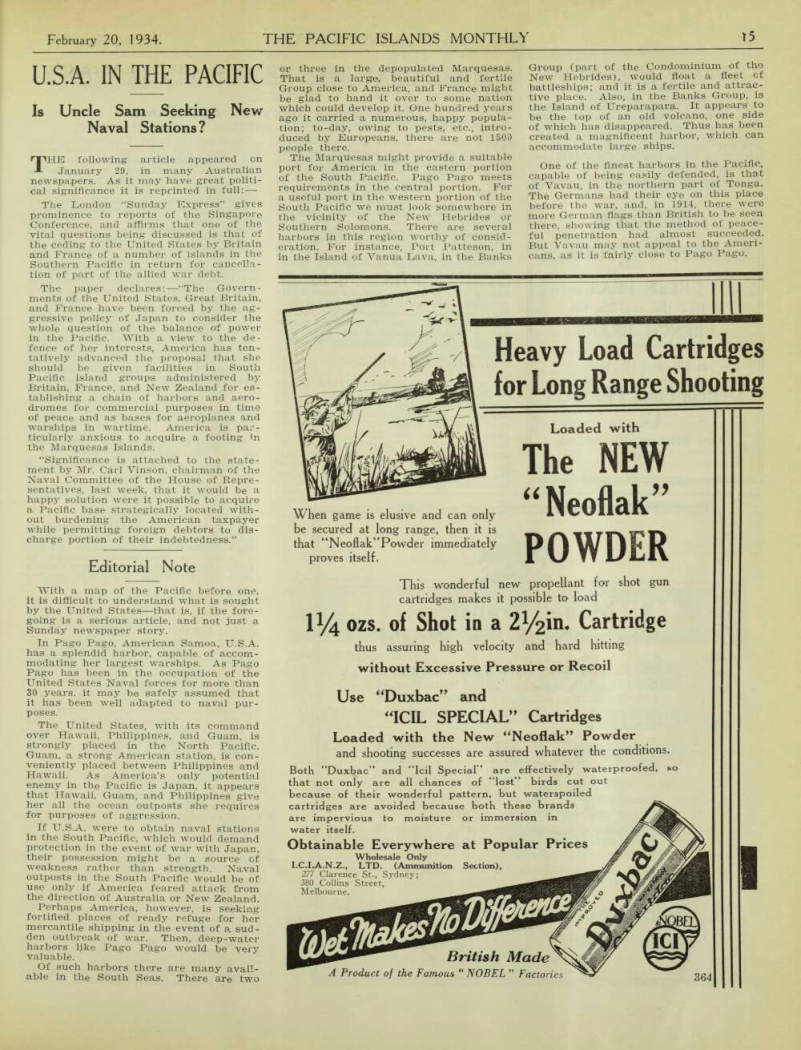
Is Uncle Sam Seeking New Naval Stations?
THE following article appeared on January 29, in many Australian newspapers. As it may have great politi cal significance it is reprinted in full: The London “Sunday Express” gives prominence to reports of the Singapore Conference, and affirms that one of the vital questions being discussed is that of the ceding to the United States by Britain and France of a number of islands in the Southern Pacific in return for cancella tion of part of the allied war debt.
The paper declares:—“The Govern ments of the United States, Great Britain, and France have been forced by the ag gressive policy of Japan to consider the whole question of the balance of power in the Pacific. With a view to the de fence of her interests, America has ten tatively advanced the proposal that she should be given facilities in South Pacific island groups administered by Britain, Prance, and New Zealand for es tablishing a chain of harbors and aero dromes for commercial purposes in time of peace and as bases for aeroplanes and warships in wartime. America is par ticularly anxious to acquire a footing in the Marquesas Islands.
“Significance is attached to the state ment by Mr. Carl Vinson, chairman of the Naval Committee of the House of Repre sentatives, last week, that it would be a happy solution were it possible to acquire a Pacific base strategically located with out burdening the American taxpayer while permitting foreign debtors to dis charge portion of their indebtedness.”
Editorial Note
With a map of the Pacific before one, it is difficult to understand what is sought by the United States —that is, if the fore going is a serious article, and not just a Sunday newspaper story.
In Pago Pago, American Samoa, U.S.A. has a splendid harbor, capable of accom modating her largest warships. As Pago Pago has been in the occupation of the United States Naval forces for more than 30 years, it may be safely assumed that it has been well adapted to naval pur poses.
The United States, with its command over Hawaii, Philippines, and Guam, is strongly placed in the North Pacific.
Guam, a strong American station, is con veniently placed between Philippines and Hawaii. As America’s only potential enemy in the Pacific is Japan, it appears that Hawaii, Guam, and Philippines give her all the ocean outposts she requires for purposes of aggression.
If U.S.A. were to obtain naval stations in the South Pacific, which would demand protection in the event of war with Japan, their possession might be a source of weakness rather than strength. Naval outposts in the South Pacific would be of use only if America feared attack from the direction of Australia or New Zealand.
Perhaps America, however, is seeking fortified places of ready refuge for her mercantile shipping in the event of a sud den outbreak of war. Then, deep-water harbors like Pago Pago would be very valuable.
Of such harbors there are many avail able in the South Seas. There are two
or three in the depopulated Marquesas.
That is a large, beautiful and fertile Group close to America, and France might be glad to hand it over to some nation which could develop it. One hundred years ago it carried a numerous, happy population; to-day, owing to pests, etc., introduced by Europeans, there are not 1500 people there.
The Marquesas might provide a suitable port for America in the eastern portion of the South Pacific. Pago Pago meets requirements in the central portion. For a useful port in the western portion of the South Pacific we must look somewhere in the vicinity of the New Hebrides or Southern Solomons. There are several harbors in this region worthy of consideration. For instance, Port Patteson, in in the Island of Vanua Lava, in the Banks
Group (part of the Condominium of the New Hebrides), would float a fleet ct battleships; and it is a fertile and attrac tive place. Also, in the Banks Group, is the Island of Ureparapara. It appears to be the top of an old volcano, one side of which has disappeared. Thus has been created a magnificent harbor, which can accommodate large ships.
One of the finest harbors in the Pacific, capable of being easily defended, is that of Vavau, in the northern part of Tonga, The Germans had their eye on this place before the war, and, in 1914, there were more German flags than British to be seen there, showing that the method of peace ful penetration had almost succeeded, But Vavau may not appeal to the Amen cans, as it is fairly close to Pago Pago.
Advertisements & other items, p. 17 (1 item)
“Neoflak”
Heavy Load Cartridges
for Long Range Shooting
When game is elusive and can only be secured at long range, then it is that “Neoflak”Powder immediately proves itself.
Loaded with
The NEW
“Neoflak”
POWDER
This wonderful new propellant for shot gun cartridges makes it possible to load 1¼ ozs. of Shot in a 2½in. Cartridge thus assuring high velocity and hard hitting without Excessive Pressure or Recoil Use “Duxbac” and “ICIL SPECIAL” Cartridges Loaded with the New “Neoflak” Powder and shooting successes are assured whatever the conditions.
Both “Duxbac” and “Icil Special” are effectively waterproofed, so that not only are all chances of “lost” birds cut out because of their wonderful pattern, but waterspoiled cartridges are avoided because both these brands are impervious to moisture or immersion in water itself.
Obtainable Everywhere at Popular Prices Wholesale Only I.C.I.A.N.Z., LTD. (Ammunition Section), 277 Clarence St., Sydney; 380 Collins Street Melbourne.
British Made A Product of the Famous “ NOBEL ” Factories 364
British Warship In
Pacific
The British flagship on the China Sta tion, H.M.S. Suffolk, will make a cruise among the islands of the central Pacific during March and April, Her itinerary has not yet been published. She is ex pected to leave Darwin for Papua and New Guinea ports about March 1.
Australia’S Mad-Headed Fiscal Policy
Extraordinary Story of Fiji Bananas
THE deplorable history of trade relations between Fiji and Australia, and the more recent chapter of thgt history which is concerned tenth Fiji bana nas, are cogently dealt with in an article by Mr. C. B. Joske, of Suva, presi dent of the Fiji Bananas-growers 1 Associa tion, which was published in the “Sydney Morning Herald 11 on January 30. The shameful story needs no comment.
It is not too much to say that the Aus tralian fiscal policy seems to be under the control of lunatics. The Australian manu facturing industries are riddled with un employment, yet Australia, by the mad headed use of tariffs, and an inability to see that trade must be reciprocal, is hav ing the doors to market after market slammed in her face. Fiji is only one of half a dozen instances which have been quoted in Australian newspapers in recent weeks.
Mr. Joske's letter follows: — IN recent issues of your journal I note references to the action taken by cer tain countries by way of retaliation for the imposition of prohibitive tariffs on their products by Australia, e.g., Belgium (sheet glass v. meat) and China (peanuts v. flour). Even little Fiji, whose white popu lation is largely Australian, is contemplat ing the same type of action in defence of the right of entry of her bananas to the Australian market.
These are the facts. The Ottawa Agree ment gave Fiji the right to send 40,000 centals of bananas to Sydney and Mel bourne at a duty of 2/6 per cental (one case contains about 80lb.). This represented a share of about 3 per cent, of the total Australian consumption of bananas.
The essence of Ottawa was fair com petition and no discrimination—in other words, Fiji bananas were to compete on equal terms with Australian, once the tariff barrier was passed. Instead, we find that the banana concession has been emasculated by the levying of taxes on Fijian bananas which are not levied on Australian bananas. In addition, certain Queensland interests have done their best to prevent the fruit agents from handling Fiji bananas by withholding from such agents supplies of Queensland fruits.
A pretty commentary on the good faith of Australia, and one which will be noted with interest by those British agriculturists who are at this moment being asked to sacrifice themselves “in the spirit of Ottawa” to help Australian meat, butter, etc.! It is worth remembering that re strictions on the importation of meat into the United Kingdom may be imposed after June, 1934.
The taxes which have been levied speci ally on Fiji bananas are as follow; — Primage: 10 per cent, of the net value of our bananas f.o.b. Suva.
Sales Tax: 5 per cent, of the gross selling price.
Special Income Tax: 10d in the £ of the gross selling price.
Quarantine inspection: 4d per case.
The import duty agreed at Ottawa is equivalent to 2/ per case; the taxes listed above —imposed on Fiji bananas and not on Australian bananas —approximate to another 3/6 per case. Is that fair Ottawa competition? Rather too “body-line,” I suggest.
In order to bring this ingenuous treat ment before the notice of the people of Australia I have suggested to the Govern ment of Fiji that some drastic action must be taken to diminish Australia’s share of Fiji trade. In 1933 Australia bought from Fiji £43,000, but Fiji bought from Australia £380,000. Details of 1933 are not yet avail able, but in 1932 the imports from Australia included: —Beer £6200, cordage and rope £4215, confectionery £2894, drugs £6366, flour and flour by-products £53,229, milk £2615, tea £8977, cigarettes £18,690, a total of £103,186. In all the above items Aus tralia has keen competitors in New Zealand, Canada, and England.
The quality of the manufactures from these countries is at least as good as those from Australia —there is no great differ ence in prices. Even a Queenslander would agree there is no great hardship involved in drinking New Zealand beer, smoking an English cigarette, or eating a Canadian loaf.
The obvious line of action for Fiji is, therefore, to select such items as Australian beer, cigarettes and flour for special taxa tion to such an extent that these products of Australian manufacture will be replaced by the manufactures of New Zealand, Canada, or the United Kingdom—and to continue such special taxation until we get an Ottawa deal from Australia.
May I —brought up and educated in Aus tralia, with Australian interests and con nections —warn those Australians con cerned in the Fiji market that such action is under very serious consideration in Fiji?
Advertisements & other items, p. 18 (1 item)
Canned Vegetables
Sutton’s
GREEN PEAS
in ½lb., 1lb. and 2lb. tins.
FRENCH BEANS
(sliced), in ½lb. and 1lb. tins.
Delicia Food Products
Co.
DANK STREET, WATERLOO,
N.S.W.
Money Transfers
Throughout the World
The Bank of New South Wales makes complete facilities available for the transaction of banking business throughout Australasia and between Australia and all other parts of the world.
The Bank establishes commercial credits by mail or by cable. It issues drafts and makes money transfers by letter or telegraph. It negotiates and collects Bills of Exchange and issues, for the convenience of travellers, Letters of Credit available all over the world.
Exchange quotations direct on all countries are issued daily and trained officers of the Bank are always available to advise customers on matters relating to overseas money transactions.
Bank of New South Wales
(ESTABLISHED 1817)
with which the Western Australian Bank and The Australian Bank of Commerce Ltd, are amalgamated. 67
For Those Who “Kill A Tin”
Some Useful Recipes for Islands Residents
A BRISBANE lady writes : — In answer to your correspondent's plea for simple recipes for Islands residents, who must depend largely on “tins” I am enclosing a few well-tried and very easy ones which may he of use to your readers.
Having lived under somewhat similar conditions as those mentioned in the letter —worse if anything, as we did not even have “the usual native vegetables”—I can readily sympathise with the request.
After the first or second supervision, the cook-boy of average intelligence will rise to the occasion, and he quite equal to the recipes.
Canape.
This recipe is delightful with any cold meat (tinned or fresh), poultry, ham, or boiled bacon.
Place a slice of boiled beef or Camp Pie, or slice of Fitzroy Luncheon Beef, on plate, then one or two crisp lettuce leaves, a slice of pineapple, then a thick slice seasoned tomato.
Lastly place on top half a hard-boiled egg, cut lengthwise and coat with thick mayonnaise sauce.
Garnish with parsley and serve as cold as possible.
Mayonnaise Sauce.
Dissolve 1 heaped dessertspoon butter in a saucepan, add 1 tablespoon flour and stir well.
Add ½ pint milk and stir over fire till it boils three minutes. Add salt, 1 teaspoon mixed mus tard, and yolk of egg in the order given. Lastly add one-third cup vinegar gradually. A little sugar may be added if liked. Allow to cool.
Indian Rarebit.
2 cups tinned corn. 2 teaspoon chopped onion. 1 cup grated cheese, or ½ tin Rex cheese. 2 tablespoons butter. 1 teaspoon salt. 1 pinch spice.
Melt butter in saucepan. Add onion and cook for three minutes without allowing to brown. Then add corn and simmer for ten minutes. Remove from fire and stir in the cheese till melted. Serve on buttered toast.
Devilled Kidneys.
1 tin devilled kidneys, 2 onions, 1 tablespoon butter, 1 tablespoon flour, ½ teaspoon mustard (mixed) ½ teaspoon curry powder.
Melt butter in saucepan; peel and slice onions and brown in the butter. Remove kidneys from gravy, cut in halves, place in piedish. Thicken the gravy from the kidneys after adding sufficient water to make half a pint of liquid. Add onions and the ½ teaspoon mixed mustard and simmer slowly for 15 minutes. Pour gravy over kidneys.
Sprinkle over with bread crumbs and bake in moderate oven for twenty minutes.
Aberdeen Sausage
1 tin camp pie (1-lb), ½ lb bacon (minced), 1 egg, 1 tablespoon minced onion, 2 cups white breadcrumbs 2 teaspoons parsley, Pepper, salt, and nutmeg, 1 teaspoon Holbrooks sauce.
Mash Camp Pie with minced bacon and mix well with breadcrumbs, sauce and seasoning. Add well-beaten egg and mix thoroughly. Dip cloth in boiling water, wring dry, flour well and roll up sausage. Tie cloth at each end and boil for two hours. When cooked, cover while hot with crisp breadcrumbs and serve cold.
If required hot, serve with gravy made with Gravox or any gravy extract, to which has been added 1 teaspoon of tomato sauce, ½ teaspoon Marmite and ½ teaspoon Holbrooks sauce.
Spaghetti With Tomatoes.
Grease a shallow casserole or pie dish, and line with sliced tomato. Pour over it the contents of a tin of spaghetti. Place a layer of sliced cooked potato on top and sprinkle thickly with breadcrumbs and a little finely grated cheese. Put a few pieces of butter on top and bake in a steady oven till a light brown. Serve very hot.
Tongue Au Gratin.
1 tin sheep or ox tongue, ½ teaspoon minced parsley, 1½ tablespoon butter, ½ cup breadcrumbs, 1 teaspoon capers, 1 tablespoon minced onion.
Cut tongue into thin slices. Mix together pars ley, capers, and onion, and sprinkle the mixture over the tongue arranged in a well-buttered pie dish. Sprinkle with 1 tablespoon breadcrumbs, then cover with sliced tomato and another layer of tongue and so on till the dish is filled. Add season ing to taste, and one tablespoon hot water to which a little Marmite has been added. Cover with remainder of breadcrumbs. Dab with butter and brown well in oven.
EVANDALE TRIFLE (Simple and Delicious).
Cut 2 slices of bread ½ an inch thick into small squares. Place in a glass dish, squeeze the juice of 1 orange over it and half the grated rind if liked. Pour over 1 pint of boiled custard made with yolks only. When the pudding is cold, beat the whites of the eggs to a stiff froth, gradually adding a little apricot jam to colour and taste.
Pile high on top of pudding. This pudding is even more delicious when sponge cake is substi tuted for bread and a layer of banana added before pouring on the custard.
Angels Food.
2 cups milk (skim will do), ¼ cup sugar, 2 eggs, Juice of 1 lemon, or essence of lemon, 2 dessertspoon powdered gelatine.
Place the milk, sugar, well-beaten yolks of eggs and essence into the saucepan. Let all just come to the boil, remove from fire and allow to cool.
Then stir in the gelatine which has been dissolved m a little hot water. When cold stir in the stiffly beaten whites of eggs and put in a wet aluminium mould to set. Turn on a glass dish and serve with vanilla custard or tinned cream (to which has been added vanilla and sugar to flavour), or fruit.
To cool without ice, place the mould in a dish
of water which contains 1 handful of salt to the pint and a piece of washing soda the size of a walnut.
Pineapple Lemonade.
1 pineapple, 1 lb sugar, 5 lemons, 3 pints water.
Carefully peel and grate pineapple. Pour over it the strained juice of lemons. Boil sugar and 1 pint of the water together for ten minutes. Stir syrup into the fruit juices and add remainder of water. Strain through fine muslin, chill, and when serving, add a cherry to each glass.
Development at Tavua
Fiji’S Gold
From a Special Correspondent.
TAVUA, (Fiji), Feb. 1.
DEVELOPMENT work is still going on at the Tavua goldfield, in Northern Fiji.
The ground has been proved at a depth of 50 feet, and assays taken from that depth have given over 3oz. to the ton. It has been proved that the lode is over 40 feet wide in many places, and extends for a considerable distance.
Mr. E. G. Theodore was the first to bring Australian capital into this field, and he has the best wishes of Fiji resi dents for his success. He was in early, and naturally secured some valuable pro perties. There are some other very pro mising leases, I understand, which have been opened up lately and which only re quire more capital to permit thorough in vestigation.
It is hoped here that people with some experience and sufficient capital will take an interest in this goldfield, as the pros pects are too good to be “mucked up” by inexperienced people. Emphatically, we do not want the “go-getter” type of pro moter here. But there is a good future for the genuine man, who can get in well at this early stage.
At a meeting of the Levuka Municipal Council, Fiji, held on December 5, Mr.
R. W. Robinson was re-elected Mayor of Levuka. Rev. R. H. Green was elected a Councillor of the Municipality.
Advertisements & other items, pp. 19-20 (1 item)
mznwaramis
FIRST
IN 1868
STILL
BEST IN
1933
SPICED, CORNED. ROAST
a BOILED BEEF
AND IN MUTTON
IN 120z,11b,21b,3t1k.41b.. sfc,C'6Jb ROUND
CANS AND IN TAPERS
FITZROY
SHEEP
TONGUES
Bm OXEOPD. CAMBRIDGE & PORK SALISACES
FITZROY
V*SSLm
THE ORIGINAL PACK IN A CLASS BY ITSELF /
ALSO THE EAMOUS
HAMPER MEATS
IN ROUND AND TAPER CANS 240*. 6 6 lbs.
SPECIALLY PACKED FOR THE ISLAND TRADE
FOP Pff/CF UST - NO EXTRAOiAPGF
Du CENTRAL QUEENSLAND MEAT EXPORT CO. LTD.
LAKES CREEK - ROCKHAMPTON
CABLE address:- TUMOANA ROCKHAMPTON.
ALBERT GREGORY
107 York Street, Sydney.
Saddlery,
Saddler’s Ironmongery
Leather and Paint Merchant, LEATHERS —Art Work, Sole, Harness, Roans, Suedes, Bag, Kangaroo, Bridles, Belts, Spurs, Stirrups, Breastplates. SADDLES Race, Exercising, Park and Stock.
Leather Belting and Pump Cups.
Paint Merchant.
For House and Roofs, ready mixed .. .. 13/6 gallon Special Value House Paint 10/6 gallon Brushes, Kalsomine, White Lead and Oil.
Samples of Leathers on Application.
SHIP CHANDLERY-HARDWARE
EROOMFIELDS LIMITED, 152 Sussex St, SYDNEY
Large and Complete Stocks of SHIP CHANDLERY.
Ironmongery of all kinds Paints, White Lead and Oils.
Sole Agents for: P. H. MUNTZ & CO.’S 3-CROWN BRAND METAL SHEATHING.
PEACOCK & BUCHANS’ ENGLISH READY-MIXED PAINTS.
WRITE FOR SHIP CHANDLERY CATALOGUE.
Special “In Bond” Prices for all Island enquiries quoted on application.
CABLES: “BOOM,” SYDNEY.
MH CRA
ITCHING
WHITE
SKIN
Obtainable at all branches of Burns Philp & Co. Ltd., Morris Hedstrom & Co. Ltd. (Suva), W. R. Carpenter & Co. Ltd., A. J. Swann & Co. Ltd. (Suva),, Brown & Joske (Suva), Michelmore & Co. (Suva).
DON’T NEGLECT
SURFER’S FOOT!
As soon as you see cracks between the toes; tiny itching blisters; sodden white skin —apply Antinea at once! For these signs mean that the Tinea (“Surfer’s Foot”) germ is burrowing into your skin, and it will spread rapidly unless checked.
Antinea is a definite cure for Surfer’s Foot and all other forms of ringworm. This powerful remedy penetrates to the root of the trouble and destroys the germs, so that a really complete cure is effected.
Small size 2/6
Large size
(triple quantity) 5/6
Made by
COMMONWEALTH & DOMINION AGENCIES LTD.,
168-174 Day Street, Sydney, N.S.W.
A 3-73
Affray in Central Papua.
Police Carriers
Attacked
A FIGHT occurred between natives of the Kunimaipa Valley and Papuan native police under Patrol Officer Cecil Cowley, who recently went through Kuni maipa to protect a mining party in Tinai Valley, which is on the Papuan-New Guinea border, close to Mt. Chapman.
Tinai was reached satisfactorily, and the carriers, returning home, were put under the charge of a native police sergeant. Four of them left the main body to take a short cut, and were attacked by natives of the Kivena tribe. Two of them were killed. The sergeant chased the attackers and killed four.
When the party reached Kagave, people there killed a pig and gave it to the police patrol. While all were standing talking, a young policeman is said to have fired a rifle in the air. The other police then fired also, allegedly in the air. The sergeant, thinking the patrol was being attacked, shot a man who came to the door of the house to see what had happened. The villagers remained calm. A full investigation is being made.
Pests In B.S.I.
Same Remedial Measures
MR. R. A. LEVER, a well-known entomologist of the British Solomon Islands arrived in Sydney recently, after leave in England, and left for Tulagi by the Malaita on January 19.
Mr. Lever’s chief investigations in the two and a half years he already has spent in the Solomons concerned ravages upon coconut palms, thought to have been due to insect pests. But it has now been found that the trouble was caused by insufficient manuring and cultivation, and several companies intend to apply manurial treatment to their estates.
Trouble caused by the horn fly, a cattle pest, introduced into Northern Queensland from New Guinea some ten years ago, and which has now spread to the Solomons, has also attracted Mr. Lever’s at tention. The ravages of this pest are responsible for serious loss of condition among cattle in the Solomons. One hundred fertilised females of a parasitic wasp were liberated recently by Mr. Lever to prey upon the fly, and he proposes later to liberate supplies of the hybrid wasp— a cross between an Australian and an East Indian wasp—recently evolved by Dr Tillyard in Canberra, numbers of which have been already released in Queensland.
Returned-soldier
Concessions to N.G.
Returned-soldier Planters
Letter to the Editor.
An article appeared in your December issue stating that the two large trading firms in New Guinea had arranged to waive interest to planters from October to March, when the London price of copra averaged under £10 per ton.
It stated that this was an equivalent to a gift of at least £20,000 to the planters, mostly returned soldiers.
From figures available, I would estimate that the saving to actual returned soldier planters would be less than half this amount.
While it is not policy “to look a gift horse in the mouth,” this gesture to returned soldier planters is not before its time. The Government has been giving purchasers of expropriated properties a moratorium for the last 3½ years, and this must have helped those firms considerably, in reducing the majority of returned soldier overdrafts.
Also, those firms to-day are collecting from the tied returned-soldier planter almost the same profit margin on copra at £8 London as they were at £14 per ton, London, which would compensate considerably for foregoing the interest, which in some cases they probably would never get, as their only security, as far as the expropriated properties are concerned, is an equity that disappeared three years ago.
The firms are greatly responsible for the position of returned soldier debtors to-day, through their boom financing, and it is very probable that they will be compelled to make still further concessions to them, before the depression lifts from the industry.
I am, etc.
W. M. Middleton.
“Kulili,” Madang, T.N.G.
Germany And The Mau
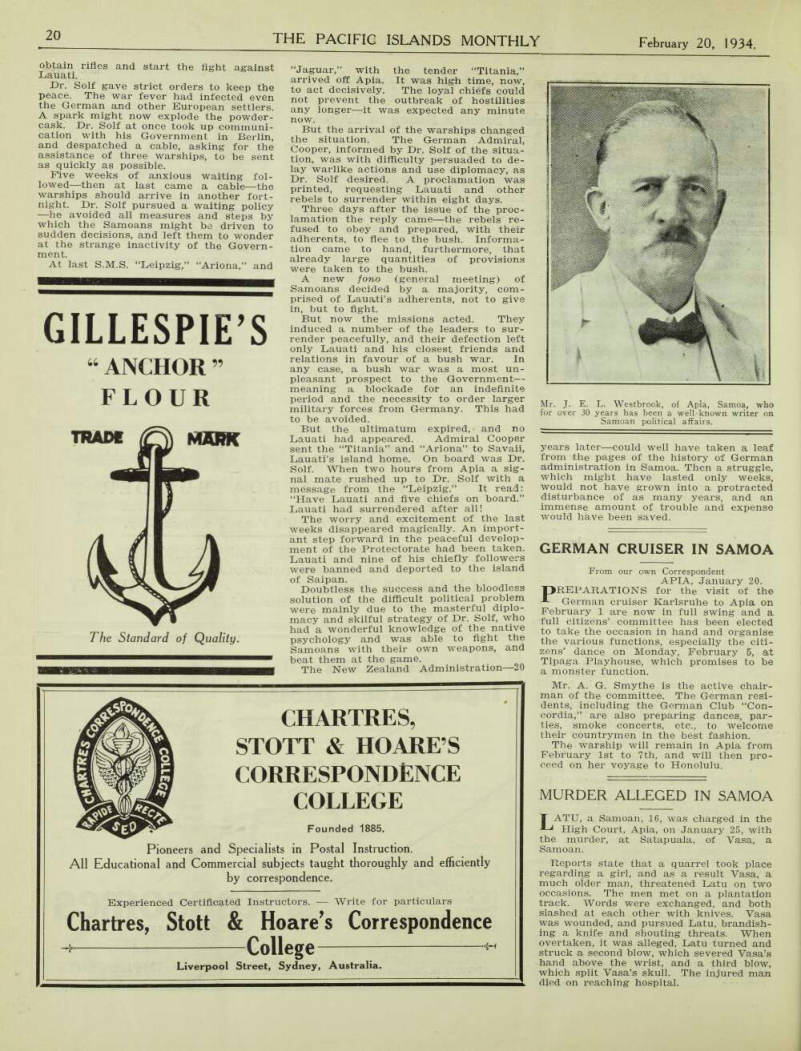
How Shrewd Dr. Solf Avoided Samoan Rising in 1908
From Our Samoan Correspondent.
CONSIDERING the recent startling events in Samoa and the strong action the New Zealand Administration has undertaken against the “Mau” Move ment, reminiscences of Dr. Solf, the first German Governor of Samoa, and later a member of the German Cabinet, which were recently published in the German press, are of special interest.
Dr. Solf, under the heading of “Thun derstorm over Samoa,” relates the facts of the attempted uprising of the high chief Lemati in 1908, and the means by which this uprising was successfully sup pressed, with the help of the German Navy.
It was during a severe illness of the “grand old man of Samoa — Mataafa, the highest chief, respected and obeyed by all the Samoan factions. As he was ex pected to die hourly, the question of his successor was ventilated, and all the fac tions had their candidates ready to pre sent to the Imperial German Government.
The real rulers of the Samoan people were the Association of Chief Spokesmen—the Fumua and Pule, the king-makers, who at the same time were also responsible for and guilty of continuous unrest and fighting in the country. Dr. Solf had tried to abolish their rulership, but this revolutionary change could hardly be brought about by a stroke of the pen.
The leading representative of Pule, the “highest spokesman chief” (tulafale), Lauati, in the name of the Pule and Fumua, promised his support and finan cial assistance to the various candidates for kingship. Addressing the masses of the Samoans—politically indifferent and ignorant—in vigorous speeches, he at tacked the payment of a poll tax to the Imperial Government as lowering tne Samoans’ self-respect and aiming to have young Samoans do coolies’ work, like Chinamen . . .
Lauati, by his eloquence and his high standing, reached his aim—a large ma jority of Samoans supported him. In a grand and impressive meeting the de mands of the Samoans were to be formu lated and presented to the Governor, Dr.
Solf. Nothing was known about Lauati’s intentions after his demands were re fused. Apparently the future did not worry him. He would have resisted an order to go home to Savaii—his own island—and perhaps open revolt would have followed.
Dr. Solf, aware of the dangers of the situation, now took action. The demon stration meeting was forbidden, the natives prohibited from visiting Apia, the capital and seat of Government.
These measures seemed to invite Lauati to come out into the open. With two large parties, Lauati came to Apia, at the same time sending agents all over the islands to induce people to disobedience, and recruiting adherents for the “pat motu-Samoans” Movement the first Samoan “Mau.”
Dr. Solf went himself to Savaii, Lauati’s tribal seat, where his power and influence were paramount. Dr, Solf had no mili tary and police force at his disposal, and could not hope to force developments.
Diplomacy was the watchword of the hour! So Dr. Solf made a speech on the common (malae) to the assembled
Samoans, trying to bring them back to reason and to effect a peaceful settlement of the pending conflict. He summoned Lauati to appear before him.
But Lauati, to demonstrate his power, mobilised all Savaii, and arrived this time with a force of 25 large boats. Solf wrote —“I have invited only yourself, and shall see only yourself.”
Lauati replied—“My men have come with me, to say a last ‘tofa’ (farewell) to me, in case I shall be deported or hanged” . . .
Alarming reports came to hand. Black painted Samoans were approaching Apia with war-knives and in war-like mood.
They could have pillaged Apia within a few hours. Lauati was reported to have gathered his warriors at Vasusu, at the very gates of Apia.
Dr. Solf hastened to fetch Mataafa, just recovered from his illness, and took him in his carriage to Vasusu, accom panied only by his A.D.C. and an inter preter, to see Lauati. Not a minute was
to be lost, to save the dangerous situation.
At Vasusu, Lauati came out to welcome the Governor, who ignored his out stretched hand.
“The Samoans spoil everything,” said Lauati.
“No,” Dr. Solf replied, “It is you who are spoiling the Samoans.”
At the Vasusu meeting-house scenes of dramatic force were enacted. A debate of extraordinary intensity occurred be tween two adversaries of surpassing elo quence—Dr. Solf and Lauati. Both ad dressed the meeting, and Lauati’s speech —according to Dr. Solf —was a master piece of colourful and flowery Samoan rhetoric and diplomacy.
The scene ended in conciliation all round —between Dr. Solf, Mataafa, and Lauati, the latter promising obedience, if he would be pardoned. To all outward appearances the game was won.
But the same day a new report reached Dr. Solf. The chiefs of the Tumua party had asked the Imperial Government for rifles—to capture Lauati and chase off his men. Dr. Solf, refusing their request, was relieved to find that a strong opposi tion against Lauati had arisen among the Samoans.
Lauati had not gone to Savaii, but to Manovno, the island allied to him. The news reaching Apia grew alarming. The Tumua Party had taken the war path; its warriors were on the way to Apia to
obtain rifles and start the fight against Lauati.
Dr. Solf gave strict orders to keep the peace. The war fever had infected even the German and other European settlers.
A spark might now explode the powder cask. Dr. Solf at once took up communi cation with his Government in Berlin, and despatched a cable, asking for the assistance of three warships, to be sent as quickly as possible.
Five weeks of anxious waiting fol lowed—then at last came a cable—the warships should arrive in another fort night. Dr. Solf pursued a waiting policy —he avoided all measures and steps by which the Samoans might be driven to sudden decisions, and left them to wonder at the strange inactivity of the Govern ment.
At last S.M.S. “Leipzig,” “Ariona,” and
“Jaguar,” with the tender “Titania,” arrived off Apia. It was high time, now, to act decisively. The loyal chiefs could not prevent the outbreak of hostilities any longer—it was expected any minute now.
But the arrival of the warships changed the situation. The German Admiral, Cooper, informed by Dr. Solf of the situa tion, was with difficulty persuaded to de lay warlike actions and use diplomacy, as Dr. Solf desired. A proclamation was printed, requesting Lauati and other rebels to surrender within eight days.
Three days after the issue of the proc lamation the reply came—the rebels re fused to obey and prepared, with their adherents, to flee to the bush. Informa tion came to hand, furthermore, that already large quantities of provisions were taken to the bush.
A new fono (general meeting) of Samoans decided by a majority, com prised of Lauati’s adherents, not to give in, but to fight.
But now the missions acted. They induced a number of the leaders to sur render peacefully, and their defection left only Lauati and his closest friends and relations in favour of a bush war. In any case, a bush war was a most un pleasant prospect to the Government — meaning a blockade for an indefinite period and the necessity to order larger military forces from Germany. This had to be avoided.
But the ultimatum expired, and no Lauati had appeared. Admiral Cooper sent the “Titania” and “Ariona” to Savaii, Lauati’s island home. On board was Dr.
Solf. When two hours from Apia a sig nal mate rushed up to Dr. Solf with a message from the “Leipzig.” It read: “Have Lauati and five chiefs on board.”
Lauati had surrendered after all!
The worry and excitement of the last weeks disappeared magically. An import ant step forward in the peaceful develop ment of the Protectorate had been taken.
Lauati and nine of his chiefly followers were banned and deported to the island of Saipan.
Doubtless the success and the bloodless solution of the difficult political problem were mainly due to the masterful diplo macy and skilful strategy of Dr. Solf, who had a wonderful knowledge of the native psychology and was able to fight the Samoans with their own weapons, and beat them at the game.
The New Zealand Administration —20
years later—could well have taken a leaf from the pages of the history of German administration in Samoa. Then a struggle, which might have lasted only weeks, would not have grown into a protracted disturbance of as many years, and an immense amount of trouble and expense would have been saved.
Mr. J. E. L. Westbrook, of Apia, Samoa, who for over 30 years has been a well-known writer on Samoan political affairs.
Advertisements & other items, pp. 21-22 (1 item)
Ransomes
W. HOLMES
YACHT AND BOATBUILDER
All Classes of Islands Vessels a Speciality.
Sole Agent “R.N.” DIESEL MARINE ENGINES.
SEND FOR PARTICULARS.
McMAHON’S POINT SYDNEY
Cable Address: “HOLMAC,” Sydney.
The popular
light steel plough
“THE VICTORY”
Combines maximum strength with minimum weight and draught. Turns a furrow up to 6ins. deep by 10ins. wide.
Weight, 851bs.
We also supply numerous other types of ploughs and implements meeting all requirements, as well as lawn mowers, aerodrome equipment,, steam engines, boilers, etc.
Illustrated Catalogues and all information on application.
Agents for: Fiji, Samoa, and Tonga:
MORRIS, HEDSTROM, LTD.,
Suva, Lautoka, and Ba.
RANSOMES, SIMS & JEFFERIES,
LTD.,
IPSWICH. :: ENGLAND
Ransomes
PLOUGHS
and
IMPLEMENTS
GILLESPIE’S
“ANCHOR”
FLOUR
TRADE
MARK
The Standard of Quality.
CHARTRES,
STOTT & HOARE’S
CORRESPONDENCE
COLLEGE
Founded 1885.
Pioneers and Specialists in Postal Instruction.
All Educational and Commercial subjects taught thoroughly and efficiently by correspondence.
Experienced Certificated Instructors. Write for particulars Chartres, Stott & Hoare’s Correspondence
College
Liverpool Street, Sydney, Australia.
German Cruiser In Samoa
From our own Correspondent APIA, January 20.
PREPARATIONS for the visit of the German cruiser Karlsruhe to Apia on February 1 are now in full swing and a full citizens’ committee has been elected to take the occasion in hand and organise the various functions, especially the citi zens’ dance on Monday, February 5, at Tipaga Playhouse, which promises to be a monster function.
Mr. A. G. Smythe is the active chair man of the committee. The German resi dents, including the German Club “Con cordia,” are also preparing dances, par ties, smoke concerts, etc., to welcome their countrymen in the best fashion.
The warship will remain in Apia from February Ist to 7th, and will then pro ceed on her voyage to Honolulu.
Murder Alleged In Samoa
LATU, a Samoan, 16, was charged in the High Court, Apia, on January 25, with the murder, at Satapuala, of Vasa, a Samoan.
Reports state that a quarrel took place regarding a girl, and as a result Vasa, a much older man, threatened Latu on two occasions. The men met on a plantation track. Words were exchanged, and both slashed at each other with knives. Vasa was wounded, and pursued Latu, brandish ing a knife and shouting threats. When overtaken, it was alleged, Latu turned and struck a second blow, which severed Vasa’s hand above the wrist, and a third blow, which split Vasa’s skull. The injured man died on reaching hospital.
Mr. O. F. Nelson In Reply
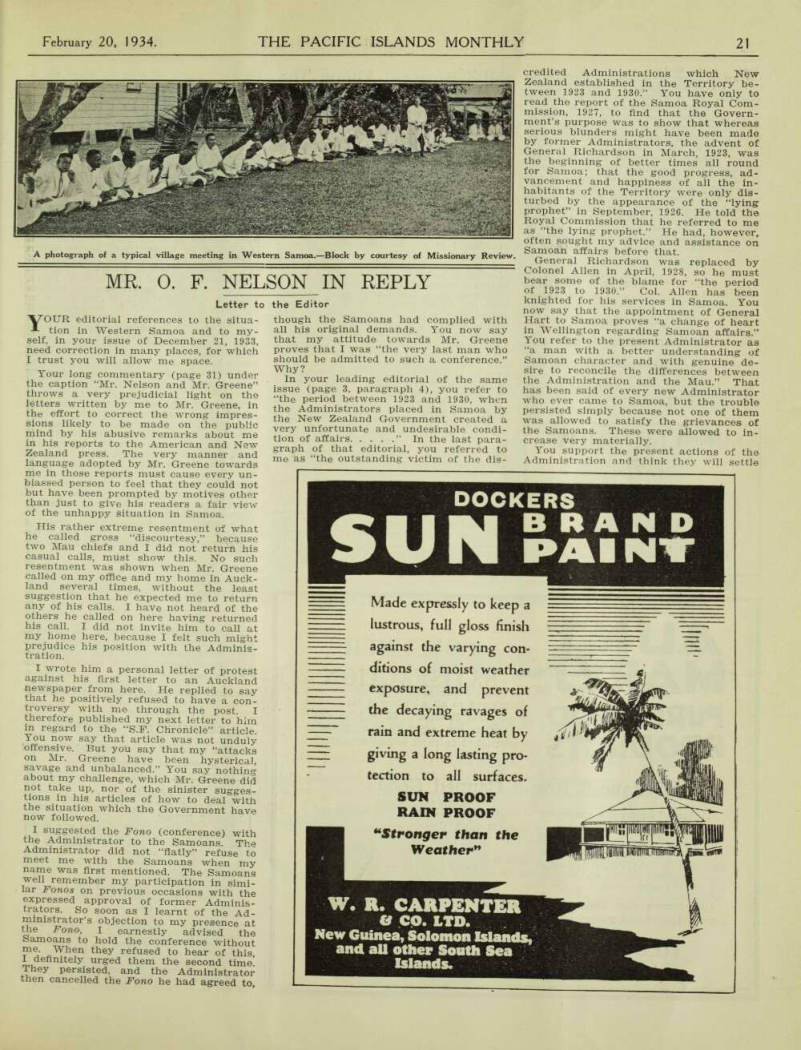
Letter to the Editor
YOUR editorial references to the situation in Western Samoa and to my self, in your issue of December 21, 1933, need correction in many places, for which I trust you will allow me space.
Your long commentary (page 31) under the caption “Mr. Nelson and Mr. Greene” throws a very prejudicial light on the letters written by me to Mr. Greene, in the effort to correct the wrong impres sions likely to be made on the public mind by his abusive remarks about me in his reports to the American and New Zealand press. The very manner and language adopted by Mr. Greene towards me in those reports must cause every un biassed person to feel that they could not but have been prompted by motives other than just to give his readers a fair view of the unhappy situation in Samoa.
His rather extreme resentment of what he called gross “discourtesy,” because two Mau chiefs and I did not return his casual calls, must show this. No such resentment was shown when Mr. Greene called on my office and my home in Auck land several times, without the least suggestion that he expected me to return any of his calls. I have not heard of the others he called on here having returned his call. I did not invite him to call at my home here, because I felt such might prejudice his position with the Adminis tration.
I wrote him a personal letter of protest against his first letter to an Auckland newspaper from here. He replied to say that he positively refused to have a con troversy with me through the post. I therefore published my next letter to him in regard to the “S.P. Chronicle” article.
You now say that article was not unduly offensive. But you say that my “attacks on Mr. Greene have been hysterical, savage and unbalanced.” You say nothing about my challenge, which Mr. Greene did not take up, nor of the sinister sugges tions in his articles of how to deal with the situation which the Government have now followed.
I suggested the Fono (conference) with the Administrator to the Samoans. The Administrator did not “flatly” refuse to meet me with the Samoans when my name was first mentioned. The Samoans well remember my participation in simi lar Fonos on previous occasions with the expressed approval of former Adminis trators. So soon as I learnt of the Ad ministrator’s objection to my presence at the Fono, I earnestly advised the Samoans to hold the conference without me. When they refused to hear of this, I definitely urged them the second time.
They persisted, and the Administrator then cancelled the Fono he had agreed to,
though the Samoans had complied with all his original demands. You now say that my attitude towards Mr. Greene proves that I was “the very last man who should be admitted to such a conference.”
Why?
In your leading editorial of the same issue (page 3, paragraph 4), you refer to “the period between 1923 and 1930, when the Administrators placed in Samoa by the New Zealand Government created a very unfortunate and undesirable condition of affairs ” In the last paragraph of that editorial, you referred to me as “the outstanding victim of the dis-
credited Administrations which New Zealand established in the Territory be tween 1923 and 1930.” You have only to read the report of the Samoa Royal Com mission, 1927, to find that the Govern ment’s purpose was to show that whereas serious blunders might have been made by former Administrators, the advent of General Richardson in March, 1923, was the beginning of better times all round for Samoa; that the good progress, ad vancement and happiness of all the in habitants of the Territory were only dis turbed by the appearance of the “lying prophet” in September, 1926. He told the Royal Commission that he referred to me as “the lying prophet.” He had, however, often sought my advice and assistance on Samoan affairs before that.
General Richardson was replaced by Colonel Allen in April, 1928, so he must bear some of the blame for “the period of 1923 to 1930,” Col. Allen has been knighted for his services in Samoa. You now say that the appointment of General Hart to Samoa proves “a change of heart in Wellington regarding Samoan affairs.”
You refer to the present Administrator as “a man with a better understanding of Samoan character and with genuine de sire to reconcile the differences between the Administration and the Mau.” That has been said of every new Administrator who ever came to Samoa, but the trouble persisted simply because not one of them was allowed to satisfy the grievances of the Samoans. These were allowed to in crease very materially.
You support the present actions of the Administration and think they will settle
A photograph of a typical village meeting in Western Samoa.—Block by courtesy of Missionary Review.
the trouble and break up the Mau. That is not consistent with your previous sug gestions that nothing will bring a per manent settlement about except a round table conference on equal status. That is what the Samoans have been asking for since my return from exile. The Mau will not break up otherwise.
You express the “hope that the New Zealand Government, in the case of Mr.
Nelson, and for the sake of British pres tige in the South Seas, will be generous” as “it can afford to be.” I have never pleaded for generosity for the Samoans or myself, and expect none. All we have asked for, and still ask for, is common justice. When that will be allowed by the Mandatory is the main question.
I am, etc.,
O. F. Nelson (Taisi).
“Tuaefu,”
Samoa. 19/l/’34., Mr. Newrich (touring in his new car): “Where are we now?”
Chauffeur: “Half-way between Paris and Marseilles, sir.”
Mr. Newrich: “Don’t bother me with niggling little details. What country are we in?”
Advertisements & other items, pp. 23-24 (1 item)
Paint
DOCKERS
SUN
BRAND
PAINT
Made expressly to keep a lustrous, full gloss finish
against the varying con-
ditions of moist weather exposure, and prevent the decaying ravages of rain and extreme heat by
giving a long lasting pro-
tection to all surfaces.
SUN PROOF
RAIN PROOF
“Stronger than the Weather”
W. R. CARPENTER
& CO. LTD.
New Guinea, Solomon Islands, and all other South Sea Islands.
SPENCER NOLAN
DENTIST
28 OXFORD STREET
(Over Winn’s, Ltd.)
177 OXFORD STREET
(Opposite Mcllrath’s)
139 ELIZABETH STREET
(2 doors from Market Street Opposite St. James Station)
SYDNEY
Telephone; F 3215
AUNT
MARY'S
PURE FOOD
PRODUCTS
CONSUMER
SATISFACTION
is assured to all who buy Aunt Mary’s Pure Food Products. These high quality goods are specially manufactured and packed to meet Island conditions.
“Defiance” Brand Canned Goods
“Defiance” Brand is a guarantee of satisfaction. Hermetically Sealed and specially prepared to withstand tropical heat, these goods are packed hy the proprietors of Aunt Mary’s Pure Food Products.
The Proprietors of these branded foods keep faith with their clients and consumers by packing only the highest quality goods.
Aunt Mary’s Pure Food Products and “Defiance” Brand Canned Goods are prepared and packed only by
TILLOCK & CO. LTD.
Kent and Liverpool Streets, SYDNEY, N.S.W.
Islands
Silly Stories About the Islands Old-time Trader Speaks His Mind
Letter to the Editor.
I OFTEN wonder if the old-time writers drew on their imagination as the modern ones do. If any writings dealing with present-day conditions in Papua, and the Mandated Territory, survive, what sort of impressions will they give to the grandchildren of this generation, of con ditions here in 1934?
At a conservative estimate, 85 per cent, of what is published will not bear a mo ment’s investigation. Recently, the authoress of a much-read book, dealing with the early days on Edie Creek, ad mitted that a lot of it was fiction. The word used by her was “romance.”
The outstanding example was the article that appeared in the “Toronto Star,” over the signature of Gordon Sin clair, extracts from which you published in your October number. The vapourings of this absurd youth are too silly to dwell on, except to say that far from being “slave driven,” the natives of N.G. are being “coddled.” I recently travelled with an official of that Territory. He told me that he had to carry out the policy laid down. He had his own idea how it would develop. His picture of what, in his opinion, that would be in five years’ time was far from attractive.
Then, with regard to this small corner of Papua, we have, during the past 18 months, read that “nine out of ten busi ness men coming into this district would be knocked on the head in 24 hours.” We also read of a “sacred valley;” of a party saved by the medical skill of one of its members; of “hostile natives;” of a small party of natives banking 200 (or was it 300?) ounces of gold a week (an odd
hundred ounces of gold is, after all, a trifle while we are at it); of “platinum as big as maize seeds.”
Now, let me clear up a few of those statements, as far as I can. Business men have moved in and out of the dis tricts for many years—one (Jimmy In man) for 32 years. I can give the names of many who have earned a crust in it during the past 20 years. Not one of these men has been molested.
There is no “sacred valley” nor “hostile natives.” The man who wrote this was never out of touch with a store; in fact, had his party walked a little further they would have come to two plantations that were started 20 years ago. Alluvial gold is worked by the natives, having taken the place of copra, but the suggestion of 200 ounces a week is absurd. The best I’ve known, during a number of years, as a licensed gold buyer, was four natives winning a half-ounce a week. There is, however, a fair outlook for reef gold, and platinum will be heard of later. It exists over a very large area.
In your November number we read: “Ere I last left Samarai, I saw a fine house being built which was designed and contracted for, and carried out in every detail —electric light, and garden design, etc. —by brown men.”
The politician, like the rest of us, reads his batch of daily papers. One of them recently advocated that the natives should be represented on the Council. We can safely assume that the mover has never visited the country, or the suggestion would never have been made. But the above is the kind of thing that he reads. It causes him to form an abso lutely wrong impression of the native.
The house was not designed by a native; it was not contracted for by a native; the regulations alone would not permit of a native installing the electric light; the natives neither designed the garden, nor did they do the work.
I am, etc.,
H. Dexter.
Milne Bay, Papua, 4/1/’34.
Motorist’s well-trained wife (to motorist, who has fallen asleep at the wheel): “I don’t mean to dictate to you, George, but isn’t that telegraph-post coming at us awfully fast?”
Advertisements & other items, p. 24 (1 item)
The Robert Bruce.
CERTAIN PILE REMEDY.
Has been tested and proved completely successful in scores of long-standing cases.
THE LABORATORY,
20 and 22 Napoleon Street, Sydney, March 14th, 1933.
ROBERT BRUCE, Esq.
Dear Sir,—The formula of your pile cure submitted to me could have no effect other than beneficial. I gave your sample to a Client who had suffered many years, and before he had used half the bottle he reported himself completely cured.
Faithfully yours,
GROVE JOHNSON, F.C.S. (Lond.),
Analytical and Consulting Chemist.
Obtainable from the following Chemists:—W. G.
Cains, Ltd., 51 Pitt St., Sydney; McCredie’s Drug Stores, 3828 Pitt St., Sydney; M. N. Tomlin, 148 Blue’s Point Rd., Sydney; M. McCallum, 101 George St. West, Sydney; A. E. Sharpe, 197 Oxford St., Sydney; Redmond-Fuss, 665 George St., Sydney; Ward Smith, 62 Miller St., North Sydney; H. J. Parker, 94 William St., Sydney.
Looking After Ourselves In
The Tropics
Some Hints on Health Matters by a Tropical Medico
LIKE the bush folk of Australia’s “Never Never,” old residents of the Islands have to turn their hands to many a job that would floor their city cousins. Among others, amateur doctoring, often per formed with a surprising amount of ability and skill, claims a leading place.
The following tips on minor health matters are drawn from the experience of a qualified tropical medical practitioner, in the hope that they may prove of ser vice to some isolated settlers in the Pacific.
Care Of The Feet.
Foot troubles are very common in the tropics and many of them may be traced to the widespread habit of going about barefoot on occasions. Native servants leave the germs of infection about the floors and round the house, and their masters pick them up; fortunately they are fairly easily kept in check.
Moisture between the toes offers a con genial situation for the infection to grow and spread, and an itchy and widespread eruption results; the skin becomes sodden and peels off, till finally a condition re sembling eczema is produced. Any remedy that contains strong or caustic drugs should be avoided—thus iodine is better shunned unless past experience has shown that it does not over-stimulate.
No matter how we classify these foot troubles, be it ringworm, tinea, dhobie itch, eczema, etc., a simple measure ap pears to alleviate them all. Fill a wash basin with warm water and pour in a very few drops of lysol, so as to make a mild, soapy solution; then leave the feet in it for ten minutes or so. The writer has his basin of lysol placed under the breakfast table on such occasions as a dose seems necessary, and endures his footbath during the consumption of the bacon and eggs. A week or so of this treatment, applied twice daily, gives an immunity for months, and further treat ment appears to be required only at increasing intervals. The important thing to remember is not to make the lysol too strong. Excess of zeal in this respect may cause increased inflammation of the feet and a postponement of cure.
Care Of The Ears.
In temperate climates the ears may be left to look after themselves, but in the tropics occasional attention to the ear passages, especially during the rainy season, may prevent a common and very painful infection by germs.
The waxy secretion in the passage per mits of the rapid growth of septic germs which appear to be always looking for a chance to “get one in” during the hot weather. Minute but painful abscesses or boils result, and the patient suffers a good deal. The first sign is often an itchi ness of the ear passage, and the prompt application of an antiseptic may stop the trouble at once.
The best drug to use is peroxide of hydrogen, but this keeps so badly in the tropics that it is usually reported missing by evaporation when most needed. One quarter tabloid of corrosive sublimate, dissolved in a quarter pint of methylated spirit, is equally good and always to hand, and regular use, say, once a fortnight, or if the slightest sign of itching appears, will save an immense amount of suffer ing—how much, only those who have let the disease get fully established can tell.
Both ear passages should be attended
to, for infection often occurs on on© side after the other. Once the preliminary stage is missed, there is not much hope of avoiding abscess formation, so get in early and guard your ears from infection just as you would preserve your teeth from decay.
Care Of The Eyes.
A superficial inflammation of the eye ball is common, resulting in mucus in the eye and interference with vision.
Argyrol dropped in is of great value, in combating this complaint, which is usually traced to glare or errors of refraction in the eye (want of glasses, or unsuitable ones). The man who is fond of his gun will find a great improvement in his sight by the use of Argyrol, which is not a patent drug, and is obtainable from any chemist or doctor.
Care Of The Teeth.
Dentists do not arrive with every boat in the Islands; what teeth Nature leaves us with in this age of rapid dental decay have to be more carefully preserved by our own efforts than is the case in Aus tralia, where professional attendance is immediately obtainable.
Anyone who has learnt the advantage of a soft toothbrush made of badger’s hair will never readily return to the hard bristly variety in general use. A soft toothbrush cleans more effectively, be cause it can be used vigorously without fear of tearing the gums.
Most people have ideas of their own in the selection of a dentifrice, but the one used by the writer, varied occasionally by a powder, has definitely warded off threatened pyorrhoea. This is a prepara
tion containing iodine, made by a well known firm of chemists in Sydney at the instance of the members of the British Medical Association: I do not know of any other on the market which controls germs so effectively. The editor of the P.I.M. will disclose the name of this den tifrice to any inquirers.
Incidentally, a broken tooth may cause an amount of suffering, pain, and nervous distress out of all proportion to so slight a cause. I have known such an accident reduce a strong man to a state of drivell ing madness in a few hours from the inability to eat, smoke, or speak without pain that resulted. The use of a file against the raw edge calmed him down in five minutes, but not before his tongue and gums had become badly swollen. This is a tip worth knowing, if out on patrol or away from skilled help.
Malaria.
We might end this elemenary talk by saying that the treatment of malaria is always the subject of research among doctors, and that nowadays quinine, which is so objectionable to many people, has rivals which are just as reliable, and pleasanter to take. If you live in a malarious district write to your nearest doctor and ask him to send you the latest proved remedies with instructions. You may find your attacks become less fre quent, and at any rate easier to bear.
Advertisements & other items, p. 25 (1 item)
Gold
M. HARPER,
MANDOLIANA ISLAND,
NORTH GELA, B.S.I.
Postal Address: P.O. Box 6, Tulagi, Solomon Islands.
Recruiting Contracts Undertaken.
Auxiliary vessel “Papari” available for Charter.
Full details of Services frdm
BURNS PHILP (S.S.) CO., LTD.,
Makambo (B.S.I.) and Sydney.
AUSTRALIA’S CLEARING HOUSE FOR THE PRECIOUS METALS.
BUYERS OF
GOLD
OSMIRIDIUM, PLATINUM, SILVER, &c.
GARRETT & DAVIDSON, LTD.
ASSAYERS, BULLION MERCHANTS, METALLURGISTS,
Bank of N.S.W. Buildings, Regent Street, Sydney
The
“Caledonia Dover”
A COOKING STOVE guaranteed to give complete satisfaction and now recognised as THE BEST on the market. Suitable for coal, coke or wood fuel.
Illustrated Catalogue on request.
LANE & GIRVAN, LTD.,
BONNY BRIDGE, SCOTLAND.
Young
Death Of Mrs. S. R.
From Our Own Correspondent.
Rabaul, Jan. 31.
MANY sincere expressions of sympathy were received by Mr. S. R.
Young, the well-known and esteemed pro prietor of the Kokopo Hotel, about 12 miles from Rabaul, when it was an nounced that his wife had died from that dreaded scourge, blackwater fever, after an illness of only 12 hours.
Mrs. Young’s gay personality and ready helping-hand will be sadly missed in Rabaul. She had been resident here for 10 years and was highly esteemed.
Fiji Indians
“A Problem and a Curse”
[The writer of the following “Letter to the Editor” is a little extreme in his views, and disrespectful of authority; but he knows Fiji in timately, and he deals trenchantly with a prob lem of growing seriousness. There is a strong feeling in some quarters that the Fiji Govern ment is giving too much attention to Indian clamour, and not enough to the needs of the native Fijians.] YOUR article in the November issue about the Indian problem in Fiji is only too true.
The Governor does not seem to have the power either to protect the native Fijian, or assist British enterprise in Fiji.
The Indian is pampered and spoon-fed both by Governor and Council. The Indian is assisted in every way, whether he breaks the law or preaches sedition. His crimes are overlooked in many cases. Cor ruption is rampant.
The Indian is becoming arrogant. He defies anyone, and he considers the Euro pean as an interloper. Moreover, the time is not far distant when serious trouble will take place. The only people the European can now depend upon are the half-castes and the Fijian natives, both of whom the Governor and Council seem to look upon as people of no consequence.
The native Fijian has been betrayed by the British Government. When Fiji was ceded to Queen Victoria, as a Protectorate, Queen Vcitoria handed the lands back to the Fijian natives. Now her descendants, through their representives, are betray ing the Fijians into the hands of a race which was brought to Fiji as coolie labor in the caneflelds.
The natives of Fiji are taxed more than the Indians, and they are jailed and fined for the least thing. They are treated as foreigners in their own native land.
The Wesleyan Mission blows its trum pets about what it has done and is doing:
now, at the present time, the Wesleyans have a good opportunity to bestir them selves and declare for Fiji for the Fijian.
But they lie low—their troubles about Fijian rights! Where is the British jus tice to be found—certainly not in Fiji at present!
According to the Governor’s doctrine, Fiji is not the place for the descendants of those early British pioneers of the Colony, who braved all in a hostile country to pave the way for British offi cials and their crowd of Indian coolies.
The descendants of these same pioneers are being calmly told by Sir Murchison Fletcher that there is no room for their children in Fiji, and they must look else where for work!
The Indians in Fiji are a problem and a curse. Australia and New Zealand are wise in preventing them from coming in.
They breed like rabbits, and Fiji in a few years cannot and will not be able to support them. India does not want them back. Where will they go?
I am, etc..
John Bull.
R.M.S. Aorangi, 16/12/’33.
Insolent Natives
N.G. Goldfields Cases
THERE has been a certain amount of murmuring among residents of the goldfields area in New Guinea owing to what is described as the growing insol ence and unreliability of native labourers.
We are informed that in the Wau dis trict, within the past three or four months, there have been at least half a dozen cases—none of very serious charac ter —of assaults on European women by natives. If this is a fact, it indicates a condition of affairs that most urgently requires the attention of the authorities.
The whole question of the punishment of native servants demands revision. Owing to the stupidity and ponderousness of the law which governs industrial relations in New Guinea, boys escape far too easily from punishment for these offences.
By way of contrast, we may mention the case of Mr. George Chester, who had occasion recently to report to the authori ties that one of his native labourers had died while he was on the job, out in the Morobe district. There was evidence that the boy had been injured by his master, who did not deny that he had been obliged to punish him severely. As a result of the incident, the Administra tion sent a magistrate out into the wilds to investigate the matter and it is re ported that Mr. Chester has been taken to Rabaul on a charge of murder.
We know nothing about the merits of the case; and we cannot say positively that the report is correct. We can only hope that we are not going to have a re petition of the Larkin case, which still stands to the discredit of the Territory.
But we do say most emphatically that the whole basis of the law as applied in these cases is wrong and ridiculous. In our view, it is a much more serious thing that white women resident in New Guinea should be menaced by insolent “coons” than that a carrier or labourer should be injured by an employer upon whom de volves the responsibility for maintaining discipline. It would be a better thing for the future of New Guinea if the Adminis tration were less concerned with the be haviour of whites towards blacks, and gave more attention to the behaviour of blacks towards whites.
Advertisements & other items, p. 26 (1 item)
Paton, Burns & Co.,
PUMPMOBIL
Light & Portable MOTOR PUMPS.
PUMPMOBIL
Weight about 140 lbs. Automatic Priming. Reliable and Efficient.
Especially suitable for Prospecting and all Sluicing requirements.
Particulars from
NELSON & ROBERTSON
12 Spring Street SYDNEY
Firearm Repairs.
SIL ROHU,
(late A.I.F.) 143 Elizabeth Street, SYDNEY
“OUR HANDS MAKE GOOD ARMS.”
“FISHING TACKLE TO TACKLE FISHING”
Highest Quality Cutty Hunk Lines, Reels, Rods, Traces, Hooks, etc., for BIG GAME FISHING.
Automatic Strikers, Wobblers & Feather Lures, and Glendon Stewart Spoons.
Write for Catalogue.
Gunsmith, Importer of High-grade
Firearms
and Fishing Tackle Specialist
(Near Market St.)
BIG CROPS
can be depended upon from land that has been liberally fertilised with
P. B. MANURES
The best for all purposes. Send for our Free Booklet.
“RATIONAL MANURING,” it contains interesting information.
PATON, BURNS & CO.,
52 KING STREET SYDNEY
"Treat Natives Right”
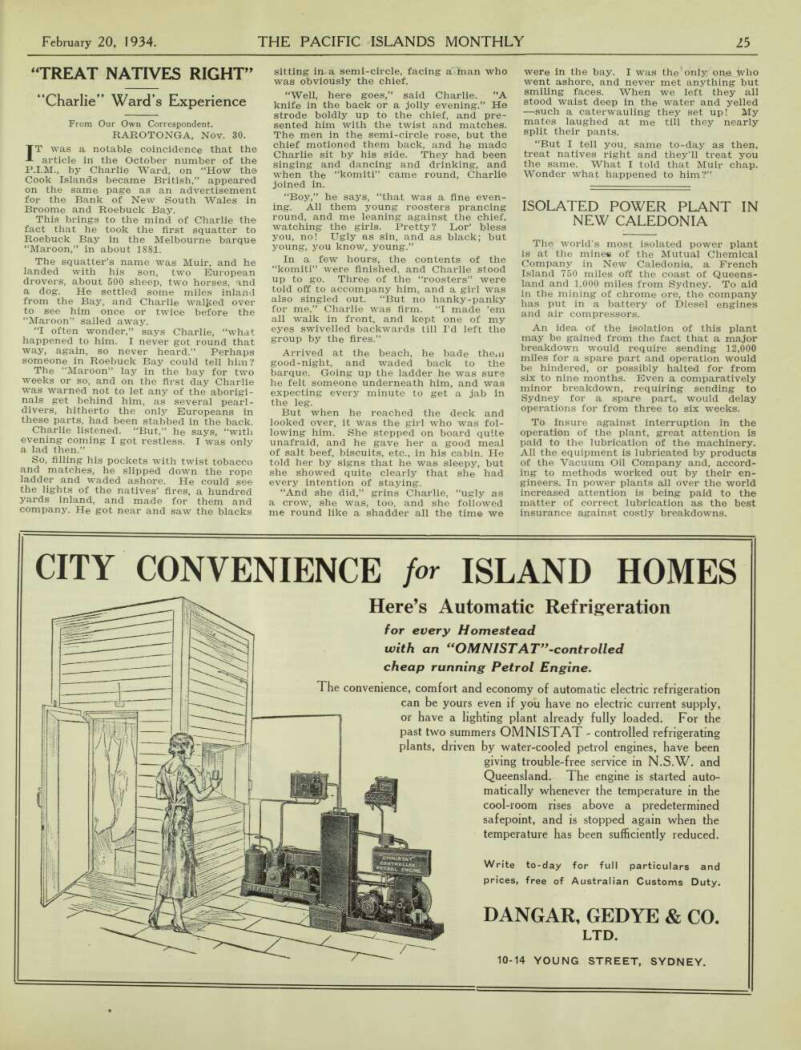
"Charlie" Ward's Experience
From Our Own Correspondent.
Rarotonga, Nov. 30.
IT was a notable coincidence that the article in the October number of the P.I.M., by Charlie Ward, on “How the Cook Islands became British,” appeared on the same page as an advertisement for the Bank of New South Wales in Broome and Roebuck Bay.
This brings to the mind of Charlie the fact that he took the first squatter to Roebuck Bay in the Melbourne barque “Maroon,” in about 1881.
The squatter’s name was Muir, and he landed with his son, two European drovers, about 500 sheep, two horses, and a dog. He settled some miles inland from the Bay, and Charlie walked over to see him once or twice before the “Maroon” sailed away.
“I often wonder,” says Charlie, “what happened to him. I never got round that way, again, so never heard.” Perhaps someone in Roebuck Bay could tell him?
The “Maroon” lay in the bay for two weeks or so, and on the first day Charlie was warned not to let any of the aborigi nals get behind him, as several pearl divers, hitherto the only Europeans in these parts, had been stabbed in the back.
Charlie listened. “But,” he says, “with evening coming I got restless. I was only a lad then.”
So, filling his pockets with twist tobacco and matches, he slipped down the rope ladder and waded ashore. He could see the lights of the natives’ fires, a hundred yards inland, and made for them and company. He got near and saw the blacks
Sitting in a semi-circle, facing a man who was obviously the chief.
“Well, here goes,” said Charlie. “A knife in the back or a jolly evening." He strode boldly up to the chief, and presented him with the twist and matches.
The men in the semi-circle rose, but the chief motioned them back, and he made Charlie sit by his side. They had been singing and dancing and drinking, and when the “komiti” came round, Charlie joined in.
"Boy," he says, "that was a fine evening. All them young roosters prancing round, and me leaning against the chief, watching the girls. Pretty? Lor’ bless you ’ no! Ugly as sin, and as black; but young, you know, young.”
In a few hours, the contents of the "komiti" were finished and Charlie stood up to go. Three of the "roosters" were told off to accompany him, and a girl was also singled out. But no hanky-panky for me," Charlie was firm. "I made ’em walk in front, and kept one of my eyes swivelled backwards till I’d left the group by the fires.”
Arrived at the beach, he bade them good-night, and waded back to the barque. Going up the ladder he was sure he felt someone underneath him, and was expecting every minute to get a jab in the leg.
But when he reached the deck and looked over, it was the girl who was following him. She stepped on board quite unafraid, and he gave her a good meal beef, biscuits, etc., in his cabin. He told her by signs that he was sleepy, but she showed quite clearly that she had every intention of staying.
“And she did,” grins Charlie, “ugly as a crow, she was, too, and she followed me round like a shadder all the time we
were in the bay, I was the only one who went ashore, and never met anything but smiling faces. When we left they all stood waist deep in the water and yelled —such a caterwauling they set up! My mates laughed at me till they nearly split their pants.
“But I tell you, same to-day as then, treat natives right and they’ll treat you the same. What I told that Muir chap.
Wonder what happened to him?”
Isolated Power Plant In
New Caledonia
The world’s most isolated power plant is at the mines of the Mutual Chemical Company in New Caledonia, a French Island 750 miles off the coast of Queens land and 1,000 miles from Sydney. To aid in the mining of chrome ore, the company has put in a battery of Diesel engines and air compressors.
An idea of the isolation of this plant may be gained from the fact that a major breakdown would require sending 12,000 miles for a spare part and operation would be hindered, or possibly halted for from six to nine months. Even a comparatively minor breakdown, requiring sending to Sydney for a spare part, would delay operations for from three to six weeks.
To insure against interruption in the operation of the plant, great attention is paid to the lubrication of the machinery.
All the equipment is lubricated by products of the Vacuum Oil Company and, accord ing to methods worked out by their en gineers. In power plants all over the world increased attention is being paid to the matter of correct lubrication as the best insurance against costly breakdowns.
Advertisements & other items, pp. 27-28 (1 item)
City Convenience Island Homes
Here’s Automatic Refrigeration
for every Homestead with an “OMNISTAT”-controlled cheap running Petrol Engine .
The convenience, comfort and economy of automatic electric refrigeration can be yours even if you have no electric current supply, or have a lighting plant already fully loaded. For the past two summers OMNISTAT - controlled refrigerating plants, driven by water-cooled petrol engines, have been giving trouble-free service in N.S.W. and Queensland. The engine is started automatically whenever the temperature in the cool-room rises above a predetermined safepoint, and is stopped again when the temperature has been sufficiently reduced.
Write to-day for full particulars and prices, free of Australian Customs Duty.
DANGAR, GEDYE & CO.
LTD.
10-14 YOUNG STREET, SYDNEY.
HOLBROOKS’
TABLE DELICACIES.
WORCESTERSHIRE SAUCE
—enjoys a world-wide reputation.
VAT 2 SAUCE a delicious thick, fruity sauce.
VlNEGAR —strong, well matured, and guaranteed Pure Malt.
ESSENCE OF ANCHOVIES—
A fish sauce made from the finest Gorgona Anchovies.
TOMATO SAUCE —made from fresh, ripe tomatoes.
FRENCH CAPERS Capucines and Capottes.
SPANISH OLIVES
Varieties: Spanish Queens, Small Queens, Manzanillas, and Stuffed or Sliced ready for Sandwiches.
PURE OLIVE OlL— French or Italian. From the first pressings of selected Olives.
PICKLES
Varieties: Sweet Gherkins, Tiny White Onions, Walnuts, Piccalilli, Mixed and Green Tomato.
FISH AND MEAT PASTES,
in 1½oz. and 3oz. glass jars.
Varieties: Anchovy, Salmon, Ham and Tongue, Veal and Tongue, Chicken and Ham, Turkey and Tongue, Salmon and Shrimp, Bloater.
SOUPS, in 8oz., 16oz., ½ gal. and 1 gal. tins.
Varieties: Vegetable, Ox Tail, Mulligatawny, Mock Turtle, Tomato.
JELLY CRYSTALS— Specially prepared for warm climates.
They set well, and are deliciously flavoured.
HEALTH SALINE— a refreshing health-giving beverage, suitable for hot climates, in and 1 lb. tins.
Holbrooks (A/sia.)
Ltd.
WATERLOO, N.S.W.
Personal Notes From
New Guinea
From Our Own Correspondent.
Rabaul, Jan. 26.
Mrs. Grace Lansley, until recently the proprietress of the Pacific Hotel in Rabaul, was married on December 18 to Mr. T.
Evans, of the Public Health Department, Miss Ruth Hagan, sister of the bride, acted as bridesmaid, and Mr. C. Wood as best man. The affair was only a quiet one, and shortly after the ceremony the happy couple journeyed to Toma for their honeymoon. Miss Hagan has taken over the management of the hotel.
Mrs. J. K. Twycross, wife of our popu lar Amalgamated Wireless manager, has journeyed South on holidays and has taken her three children with her. Mr.
Twycross expects to follow, in the course of the next month or so.
Dr. E. T. Brennan, Director of Public Health, has returned from his leave, which was spent in the East. Dr. Hosking, who was relieving as P.M.O. during the Direc tor’s absence, will attend the Malaria Conference at Singapore in April and May.
Mr. J. R. Rigby, the A.D.O., stationed at Namatanai, has proceeded on leave and has been relieved by Mr. E. C. McDonald.
A son was born to Mr. and Mrs. W.
L. MacGowan on Christmas Eve.
The many friends of Mr. Armer Hamil ton, our one-time Bank of New South Wales manager, are pleased to know that he is fully recovered from his illness con tracted in this Territory, and that he is now attached to the Northern district, New South Wales, inspection branch.
Mr. and Mrs. J. W. Vandercook, who have been travelling through Papua in the interests of the National Geographical Magazine, have arrived in Rabaul and intend proceeding to the British Solomon Islands from here. Both of them are very interesting people and have travelled ex tensively in out-of-the-way places. Mr.
Vandercook is a well-known author and journalist, and his wife is a successful New York sculptor.
On Saturday afternoon, December 16, the wedding took place at St. Francis Xavier’s Church, Rabaul, of Miss Rita Donoghue, of Cairns, and Mr. M. Walsh, of the New Guinea Club. Mrs. W. H.
Wilson acted as matron-of-honour, and Mr. G. H. Murray as best man. The wed ding breakfast was held at the Wunawu tung Hotel.
Mrs. T. Parer, of Melbourne, passed through Rabaul recently, and has joined her husband at the Wau.
Captain Meldrum, of the B.P. Inter- Island steamer “Maiwara” has returned from leave and has again taken over com mand. Mr. P. Anderson, who was in charge of the “Maiwara” during Captain Meldrum’s absence, has been transferred to the “Mirani” as chief officer.
Mr. Cyril Parer, of Wau, was married on December 21 to Miss Fogarty, of Cam berwell, Victoria. The couple will live at the Wau.
Commander Webb, our Harbour Master in Rabaul, has returned from his visit to England, and has taken over his duties again.
Mr. and Mrs. B. Baker have arrived in Rabaul. Mr. Baker is looking after the interests of Mr. A. N. McLennan, solicitor, during his absence on leave. Mr. Baker was previously attached to the Titles Office as Registrar, during the absence of Mr. J. L. Street.
Mr. Ralph Follows, of Kavieng, was married on December 16 to Miss Ceilia Hillier.
Mr. G. Boediker, of Hong Kong, who is a member of the firm of that name, has recently returned to the East, after hav ing made an extensive tour of this Terri tory. Mr. H. Schmidt, representative of the Hong Kong firm of Messrs. Melchers and Co., has also been making a business trip through New Guinea and returned to Hong Kong by the Friderun recently. The Hong Kong houses are out to capture the trade of this Territory, which many people affirm will not be a difficult matter owing to the favourable prices which the eastern firms are able to give the consumers of New Guinea. It would be well for the Australian firms not to ignore altogether this commercial penetration from the East.
Advertisements & other items, p. 28 (1 item)
Flour
ASK FOR IT
ESTABLISHED 1868.
Better Oranges
New Laws Cause Stir In Cook Is.
From Our Own Correspondent.
Rarotonga, Dec. 11.
AS a result of the visit to the Cook Islands in July and August past, of Mr. Smith, the Secretary of the Cook Islands Department at Wellington, the Fifth Amendment to the Fruit Regula tions of 1928 has made its appearance.
Presumably tired of the complaints re ceived from interested parties, to wit, the fruit speculators mostly, on the inferiority of the Cook Islands oranges, Mr. Smith immediately after his arrival set about interviewing European planters, and hold ing settlement meetings with native growers, that he might learn what was needed to make an improvement. These regulations are the outcome.
The native growers, looking at the low prices which they have habitually ob tained for their oranges for many years past, and which they rightly attribute to the dumping of Australian oranges, per mitted by the New Zealand Government, more than to the inferiority of their fruit, were by no means unanimous about in curring further expenses in growing fruit, which it may be safely said does not bring them a profit, on the average, of one shilling per case in Rarotonga.
In this respect it might be mentioned that the restriction of imports from Aus tralia during our orange season of 1938 did result in a slightly better average price of round 1/6 per case. But consider the agitation of the fruit speculators to have this embargo removed, in which they succeeded.
Whether they like it or not, the Cook Island growers are to be dragooned into improvement, and if one can judge by appearances at the roadside, a number have already begun to follow the new law, as trees pruned and whitewashed are be coming noticeable. But how far inland is this work being carried on?
Amendment No. 5 is in the right direc tion; contains nothing that an intelligent citrus grower would not of his own voli tion do, and should result in a cleaner and better looking fruit if followed out pro perly. It will be years before the native owners can be persuaded or forced to cut down all diseased or infected trees; thin all clumps of citrus trees; prune all dead wood; cut down trees to a desirable height; cultivate under all trees; and to treat, disinfect, and otherwise deal with all trees as may be ordered by the Direc tor of Agriculture.
If the owners do not carry out the work, the Director can carry it out at the expense of the owner. The recovery of the expenses will present difficulty in a great many cases. Remember Samoa!
Further, with a view to lessening the fruit fly nuisance, all fallen citrus fruit, mangoes, and avocado pears, are to be gathered weekly, and buried or burnt. As they will not burn they must be buried deep, to be effective in fly destruction.
Also, guavas and rose apples are declared noxious weeds. It appears as if the planters will be so busy cutting, spray ing, burning, burying, and digging out guava and rose apple bushes that they will have no time to plant food or any thing else.
The Amendment bears evidence of hav ing been got out in a hurry, and no doubt will be further amended.
One or two of the regulations make one wonder whether the property belongs to
the owners in fee simple, or to the Government.
For instance, No. 7 makes it unlawful “for any owner to tether animals of any kind to any citrus tree.” Presumably, any one other than the owner can do so and commit no breach of the regulation; and it must be understood that by the defini tion it is the owner of the land, not the owner of the horse, who shall fall into
trouble. Trespassing and tethering horses on other people’s land are among the greatest annoyances land holders suffer from here; the horses being tethered after dark and removed at daybreak. The signs are obvious, but the ownership of the horse is not. This regulation should have the words “any person” substituted for “any owner.”
But apart from this, to fine a man for
tethering his own animal to his own tree on his own land is going a bit far in the direction of expropriation of ownership rights. Further, to force a man to cut a good healthy tree —for remember diseased and infected trees are dealt with sepa rately—to some height selected by the Director of Agriculture, for no reason that is given in the regulations (the actual wording being “to cut down any citrus tree to such a height as may be directed by the notice”) seems to be wrong some where.
To sum up, the Regulations are in the right direction, but the mouthful is too
big to chew at once. Fortunately our Director of Agriculture is helpful, and will, we hope, use a mixture of enthu siasm tempered with common sense, to make these regulations work harmoni ously and beneficially, without too much Court prosecution, of which the island has more than its share at all times.
We have had packing sheds here for a few years, resulting in a multiplication of officials and extra charges. We have better packing, admittedly, but of the same old fruit, with no better prices to the growers. Our dread is that these new regulations will result similarly.
The fruit business appears to be en tirely at the disposal of the fruit specula tors in Auckland, Wellington, and Christ church. However, these regulations, which we believe are honest in intention, seem to be the first that have not had their source in their scheming brains, and are for our benefit, not theirs.
Advertisements & other items, pp. 29-30 (1 item)
Shredded
HEALTH!!
RICH in precious vitamins and proteins, they are made from the whole grain of rich sun-ripened wheat, transformed after careful selection into a perfect health food, delicious for breakfast, for afternoon tea or supper. Beneficial, sustaining and a wonderful aid to digestion.
Try them with butter, cheese, jam or honey.
ARNOTTS
FAMOUS
SHREDDED
WHEATMEAL
BISCUITS
ALWAYS ASK FOR ARNOTT’S
AND BE SURE YOU GET THEM
If you are a planter or trader in New Guinea we can do your buying or selling in a large or small way.
If you reside elsewhere and want something in New Guinea: write to us. If it is obtainable we’ll get it for you.
Our twenty-odd years’ experience in this Territory is the foundation of our business.
G. THOMAS & COMPANY, Rabaul
GENERAL AGENTS STOCK & SHARE BROKERS
Radios: “Gortom, Rabaul.” p.O. Box 9.
TO PLANTERS —I am a Buyer of
CASTOR OIL SEED
IN ANY QUANTITY.
Send Sample for quote, stating quantity available.
Castor Seed Shelters, any capacity.
Advice and Instructions Regarding Planting, Harvesting, and Packing of Castor Oil Seeds given freely. Selected Seed for Planting available.
Note change of Address:
C. GRAHAME
4 DALLEY STREET SYDNEY.
GOSHEN PRIVATE
HOSPITAL
(Sister E. W. YEAMAN), 37 Gloucester Road, Hurstville, Sydney General and Private Wards. Spacious Grounds. High and Cool Situation.
Moderate Fees.
SHIP CHANDLERY
W. Kopsen & Co. Limited
Manufacturers of PIONEER BRAND ASH OARS AND IMPLEMENT HANDLES.
Sole Agents for: KOPSEN’S SPECIAL YELLOW METAL SHEATHING AND NAILS.
Large Stocks of Chains, Anchors, Manilla and Wire Ropes, Wood and Iron Blocks, Oakum, Tar, Pitch, Oils, Paints, Leads, Zincs, Varnishes, Shackles, Rigging, Screws, Sheathing, Felt, Lampware, etc.
Special Under Bond Prices for Island trade.
68-70 CLARENCE STREET, SYDNEY
Cables: “Kopsen.” ’Phone: BW 1114-5
PACIFIC ISLANDS ASSOCIATION.
Headquarters and Clubrooms:
MILLIONS HOUSE, ROWE STREET, SYDNEY
Telephone: B 4971 Founded in 1931 to Advance the Interests of Residents of the Pacific; Assist Island Trade; Provide Information for Tourists; and Promote the Welfare of the Native Races.
All Pacific Islands residents visiting Sydney are invited to call at Millions House and sign the Visitors’ Book kept at the Association’s office on the first floor.
Secretary’s Office: NATIONAL MUTUAL BUILDING, 350 GEORGE STREET, near G.P.0., SYDNEY, AUSTRALIA :: :: :: Telephone: B 5067 Cable Adress: “CERTAC,” Sydney.
Goldfield
Progress On New Guinea
It is reported that Wau, chief town of the New Guinea goldfield, is to have a second hotel. A license has been granted to Mr. John Parer, formerly of Melbourne, who is an uncle of the well-known air man, Ray Parer.
Mr. A. F. Parer was recently granted a license for Edie Creek, and it is reported that he is building a hotel there.
It is likely that there will be consider able developments in the Edie Creek area at an early date. A contract for the con struction of a full width road, over the 14 miles between Wau and Edie Creek, has been let and, on last advices, con struction work was to commence imme diately. The new road will not follow the old track and will, of course, be better graded.
Samoan Producers
Facing a Lean Season
From our own Correspondent APIA, January 17.
NO change for the better can be reported in the economic situation of Samoa since last report.
The N.Z. Government has shown little sympathy and no inclination to give some active assistance to the hard-pressed pri mary producer of Samoa. A planters’ meeting a few days ago decided to ap proach again the N.Z. Government, through Mr. Goetz, the President, at pre sent on a N.Z. vacation, and appeal for assistance to the plantation industry, threatened with complete ruin. The pros pects of success are not very bright.
Cocoa is still at £12/5/- a ton and/or an advance of £10 per ton on consignments.
Copra has reached a new low level with £7/12/6 per ton on the London market.
Samoans refuse to cut at the present rate of ¼ cent per lb., while Europeans are effectively prevented from doing so by the low price, which does not even cover the actual cash expenses required for cut ting.
The only bright spot on the dark Samoan horizon is bananas. But the monthly quota of about 7,000 cases is in sufficient to give the industry a satis factory outlet. The day after the “Maui Pomare” had left with a full cargo, appli cations for 10,000 cases were received. A steamer with twice the capacity of the “Maui” could easily be filled. The quality of the fruit is very high indeed and favourably commented upon by the N.Z. buyers. The outlook for a new market in Vancouver is not considered encouraging.
A large number of trading stations are being closed all over the group. Em ployees are being dismissed and retrench ment is the order of the day. The num ber of unemployed is steadily growing among Europeans and, in the circum stances, it is a bit difficult to maintain a cheerful attitude.
Question of World Parity
Samoan Cocoa
The Sydney manager of Messrs. O. F. Nelson and Co., Ltd., writes as follows: — Regarding your editorial note, in the January issue of the P.I.M. about price of Samoan cocoa, the following is the latest report on the London market for Samoan cocoa, as given by the Bank of New Zealand: — As a result of a conference between a number of holders of Samoa cocoa in London, it was decided to hold an auction sale on the 14th November. 3,694 bags were catalogued and, al though the response from the manufacturers was small, the knowledge that the cocoa was to be sold practically without reserve stimulated com petition among dealers and 3,047 cwt. were dis posed of. The following prices were realised:— Fine Bold Wash 35/- to 40/6 Good to Fine Wash 24/- to 30/- Native Wash 22/- to 29/- Second Size 19/- to 21/6 Small and Shelly 15/- to 18/- You will readily conceive from the above infor mation that, after taking into consideration freight, charges, etc., in transit and in London, the price being given by merchants in Samoa is quite con ceivable. In addition, the prospects of the future are not encouraging.
The Mau Cases In Samoa
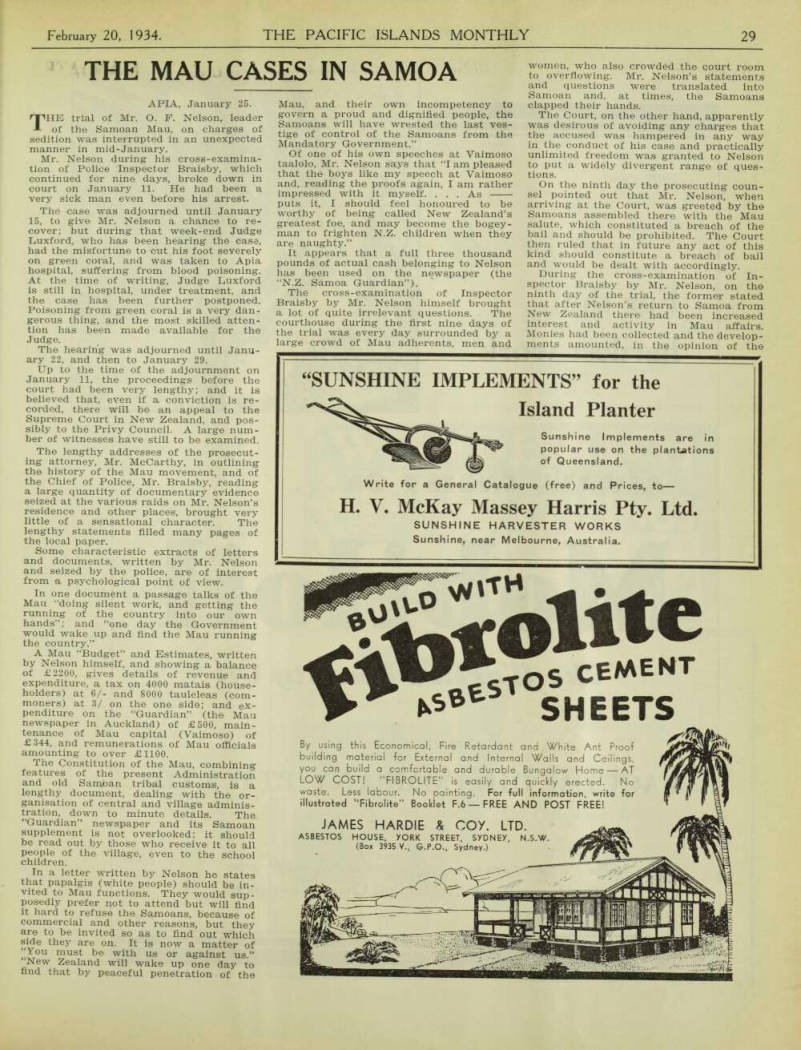
APIA, January 25, THE trial of Mr. O. F. Nelson, leader of the Samoan Mau, on charges of sedition was interrupted in an unexpected manner in mid-January.
Mr. Nelson during his cross-examina tion of Police Inspector Braisby, which continued for nine days, broke down in court on January 11. He had been a very sick man even before his arrest.
The case was adjourned until January 15, to give Mr. Nelson a chance to re cover; but during that week-end Judge Luxford, who has been hearing the case, had the misfortune to cut his foot severely on green coral, and was taken to Apia hospital, suffering from blood poisoning.
At the time of writing, Judge Luxford is still in hospital, under treatment, and the case has been further postponed.
Poisoning from green coral is a very dan gerous thing, and the most skilled atten tion has been made available for the Judge.
The hearing was adjourned until Janu ary 22, and then to January 29.
Up to the time of the adjournment on January 11, the proceedings before the court had been very lengthy; and it is believed that, even if a conviction is re corded, there will be an appeal to the Supreme Court in New Zealand, and pos sibly to the Privy Council. A large num ber of witnesses have still to be examined.
The lengthy addresses of the prosecut ing attorney, Mr. McCarthy, in outlining the history of the Mau movement, and of the Chief of Police, Mr. Braisby, reading a large quantity of documentary evidence seized at the various raids on Mr, Nelson’s residence and other places, brought very little of a sensational character. The lengthy statements filled many pages of the local paper.
Some characteristic extracts of letters and documents, written by Mr. Nelson and seized by the police, are of interest from a psychological point of view.
In one document a passage talks of the Mau “doing silent work, and getting the running of the country into our own hands”; and “one day the Government would wake up and find the Mau running the country.”
A Mau “Budget” and Estimates, written by Nelson himself, and showing a balance of £2200, gives details of revenue and expenditure, a tax on 4000 matais (house holders) at 6/- and 8000 tauleleas (com moners) at 3/ on the one side; and ex penditure on the “Guardian” (the Mau newspaper in Auckland) of £500, maintenance of Mau capital (Vaimoso) of £344, and remunerations of Mau officials amounting to over £1100.
The Constitution of the Mau, combining features of the present Administration and old Sampan tribal customs, is a lengthy document, dealing with the or ganisation of central and village adminis tration, down to minute details. The “Guardian” newspaper and its Samoan supplement is not overlooked; it should be read out by those who receive it to all people of the village, even to the school children.
In a letter written by Nelson he states that papalgis (white people) should be in vited to Mau functions. They would sup posedly prefer not to attend but will find it hard to refuse the Samoans, because of commercial and other reasons, but they are to be invited so as to find out which side they are on. It is now a matter of “You must be with us or against us.”
New Zealand will wake up one day to find that by peaceful penetration of the
Mau, and their own incompetency to govern a proud and dignified people, the Samoans will have wrested the last ves tige of control of the Samoans from the Mandatory Government.”
Of one of his own speeches at Vaimoso taalolo, Mr. Nelson says that “I am pleased that the boys like my speech at Vaimoso and, reading the proofs again, I am rather impressed with it myself. . . . As puts it, I should feel honoured to be worthy of being called New Zealand’s greatest foe, and may become the bogey man to frighten N.Z. children when they are naughty.”
It appears that a full three thousand pounds of actual cash belonging to Nelson has been used on the newspaper (the ‘‘N.Z. Samoa Guardian”), The cross-examination of Inspector Braisby by Mr. Nelson himself brought a lot of quite irrelevant questions. The courthouse during the first nine days of the trial was every day surrounded by a large crowd of Mau adherents, men and
women, who also crowded the court room to overflowing. Mr. Nelson’s statements and questions were translated into Samoan and, at times, the Samoans clapped their hands.
The Court, on the other hand, apparently was desirous of avoiding any charges that the accused was hampered in any way in the conduct of his case and practically unlimited freedom was granted to Nelson to put a widely divergent range of ques tions.
On the ninth day the prosecuting coun sel pointed out that Mr. Nelson, when arriving at the Court, was greeted by the Samoans assembled there with the Mau salute, which constituted a breach of the bail and should be prohibited. The Court then ruled that in future any act of this kind should constitute a breach of bail and would be dealt with accordingly.
During the cross-examination of In spector Braisby by Mr. Nelson, on the ninth day of the trial, the former stated that after Nelson’s return to Samoa from New Zealand there had been increased interest and activity in Mau affairs.
Monies had been collected and the develop ments amounted, in the opinion of the
Inspector, to rebellion. As proof of his contention, he pointed to the nature of certain documents seized at Nelson’s residence.
A heated interchange of questions and replies then took place.
NELSON: Do you suggest that those activities were organised and prompted by me?
BRAISBY: I believe that you were a party to them.
NELSON: Then I would also have been a party to rebellion?
BRAISBY: If those activities had re sulted in an open rebellion, and you were associated with them, you would have been.
A discussion then took place between Mr. Nelson and Inspector Braisby regard ing the effects of Nelson’s deportation on Mau activities. The dramatic interchange apparently proved too great a strain on Mr. Nelson’s nerves. He was noticeably unwell, and the Court had to be adjourned.
Dr. Dawson was called and stated that the trial had proved too great a strain on defendant’s health and that complete rest for a few days was imperative to restore it.
The Judge then granted counsel’s re quest to adjourn the case until January 15. It was later adjourned to January 29 owing to the illness of Judge Luxford,
Sudden Death Of Mau Secretary
Mata’Uha.
As a considerable shock to the Mau came the sudden demise of the Mau secre tary Mata’uha Kalauna. The deceased suffered from jaundice and his condition became serious, probably owing to some negligence on his part, acting against the advice of Dr. Dawson.
Absurd rumours at once were spread amongst the Samoans—one that the de ceased gentleman had confessed to being a traitor to the Mau, in the service of the Administration, and that he had poisoned himself in consequence.
Previous to his death, it was reported that Mata’uha was to be one of the star witnesses for Mr. Nelson in his trial.
Suppression Of The Mau
Newspaper.
By special announcement, based on the “Samoa Publication Order 1933,” the Ad ministrator has declared the “N.Z. Samoa Guardian” to be a seditious newspaper.
This prevents the receipt in Samoa of the paper, and anyone receiving it is liable to punishment.
It is probable that the prohibition was caused by a violent attack on the High Court of Samoa by the paper in its issue of December 15, 1933.
Mau Does Not Want Europeans.
During the trial of several Samoan chiefs for Mau activities, which was re ported in an earlier issue of the P.I.M. one of the accused, Autagavara, was asked by prosecuting counsel, Mr. McCarthy, what the term “Manua o Samoa" meant.
The reply was that it meant that the Samoans want Samoa for the Samoans, and no Europeans.
Mr. MCCARTHY: Do you mean, there fore, that the Samoans want the Euro peans to leave Samoa and leave the Samoans to run the country?—Yes.
Mr. MCCARTHY: The Mau will be dis satisfied until they get this point?—Yes.
Advice has been received from London that Constable and Co., the publishers, have decided to publish, in 1934, a cheap edition, priced at 7/6, of Mr. Ivan Cham pion’s well-known book, “Across New Guinea, from the Fly to the Sepek.”
Advertisements & other items, pp. 31-32 (1 item)
Island Planter
“SUNSHINE IMPLEMENTS” for the
Sunshine Implements are in popular use on the plantations of Queensland.
Write for a General Catalogue (free) and Prices, to— H. V. McKay Massey Harris Pty. Ltd.
SUNSHINE HARVESTER WORKS
Sunshine, near Melbourne, Australia.
Build with Fibrolite Asbestos Cement SHEETS By using this Economical, Fire Retardant and White Ant Proof building material for External and Internal Walls and Ceilings, you can build a comfortable and durable Bungalow Home —AT LOW COST! "FIBROLITE" is easily and quickly erected. No waste. Less labour. No painting. For full information, write for illustrated "Fibrolite" Booklet F. 6 FREE AND POST FREE!
JAMES HARDIE & COY. LTD.
ASBESTOS HOUSE. YORK STREET, SYDNEY. N.S.W.
(Box 3935 V., G.P.O., Sydney.)
For the hardest work
ALWAYS INSIST ON...
Mobiloil
The World's Quality Oil marketed by
VACUUM OIL COMPANY PTY. LTD.
For the correct grades of oil for your engine and for other parts of your car see the Mobiloil Chart at any garage.
M 46
Islands Produce
Coffee
The following quotations were obtained on February 15: — Robusta, f.a.q., imported from Java on firm conversion of exchange, c.i.f., prompt shipment Sydney, per cwt., 43/7; Robusta, as above, based on 9 gulden to Australian £, fluctuations at date of shipment on buyers’ account; shipment February, 1934, 36/6.
Arabian (Aden), Hodeidah No. 1 (pure), c.i.f.
Sydney, November shipment, per cwt., 63/-.
Longberry Harrar, December shipment No. 1, 61/-.
Importers of Robusta coffee from Java pay the following charges:—As above, per cwt., 43/7; re mitting 25)4 P er cent, exchange, 10/10; duty, 4d. per lb., 37/4; primage, 10 per cent., 4/4; landing charges, 1/-; total, 97/1 per cwt., equal to per lb., landed cost. Coffee imported from Papua and New Guinea is free from exchange and duty equal to 47/2 per cwt.
Kapok
Based on an exchange conversion of 9 gulden to the Australian £, the Australian c.i.f. prices current in mid-February were; —Prime Samarang, 4 13-16 d. per lb; Prime Japara, 5%d. per lb.
Cocoa
No. 1 Quote: Accra, good fermented, 22/9 per cwt.
No. 2 Quote: Cocoa beans, £25 to £32, per ton.
Trocas Shell
Quotations for trocas shell obtained i» Sydney from two different sources on February 15 were: — (a) Trocas shell, No. 1 grade £82 Trocas shell, No. 2 grade £78 Trocas shell, No. 3 grade £56 (b) Trocas shell, No. 1 grade £85 Trocas shell, No. 2 grade £72 Trocas shell, No. 3 grade £58 All quotes are f.o.b., and on the Australian £.
Ivory Nuts
Quote No. 1: £6/5/- per ton, f.o.b., Sydney.
Quote No. 2: £10-£11 per ton, f.o.b., Sydney.
Green Snail Shell
Good quality green snail shell was quoted in Sydney in mid-February at £25-£26 per ton.
Cotton
London c.i.f. prices of cotton as quoted in the Sydney Morning Herald during the past month were; January 19, 5.81 d. per lb., February shipment; January 26, 5.81 d. per lb., February shipment; February 2,6.1 d. per lb., March ship ment; February 9,6.44 d. per lb., March shipment.
Rice
Rangoon rice, packed in 100lb. or 200lb. bags, £10/10/- per ton, f.o.b. Sydney.
Australian table rice, packed in 56lb. bags, £15/10/- per ton.
Advertisements & other items, p. 33 (1 item)
Ceilings
Wunderlich Art Metal
Wunderlich Art Metal is the ideal ceiling and walling for Island Homes.
Suitable for every purpose; transports cheaply; easy to erect and decorate; fire-resisting; vermin-proof, and lasts a lifetime. Write for illustrated literature and prices. WUNDER-
LICH, LTD., Box 474 AA, G.P.O.,
SYDNEY.
Summer Number Now Available Stories, articles and beautiful camera studies tell of Australian life. Absorbing articles on overseas features are contributed by well-known travellers.
Magnificent Coloured Cover by
John Banks
Obtainable at all Bookstalls and Newsagents, or from
Burns, Philp & Co. Ltd.
Conditions In French Oceania
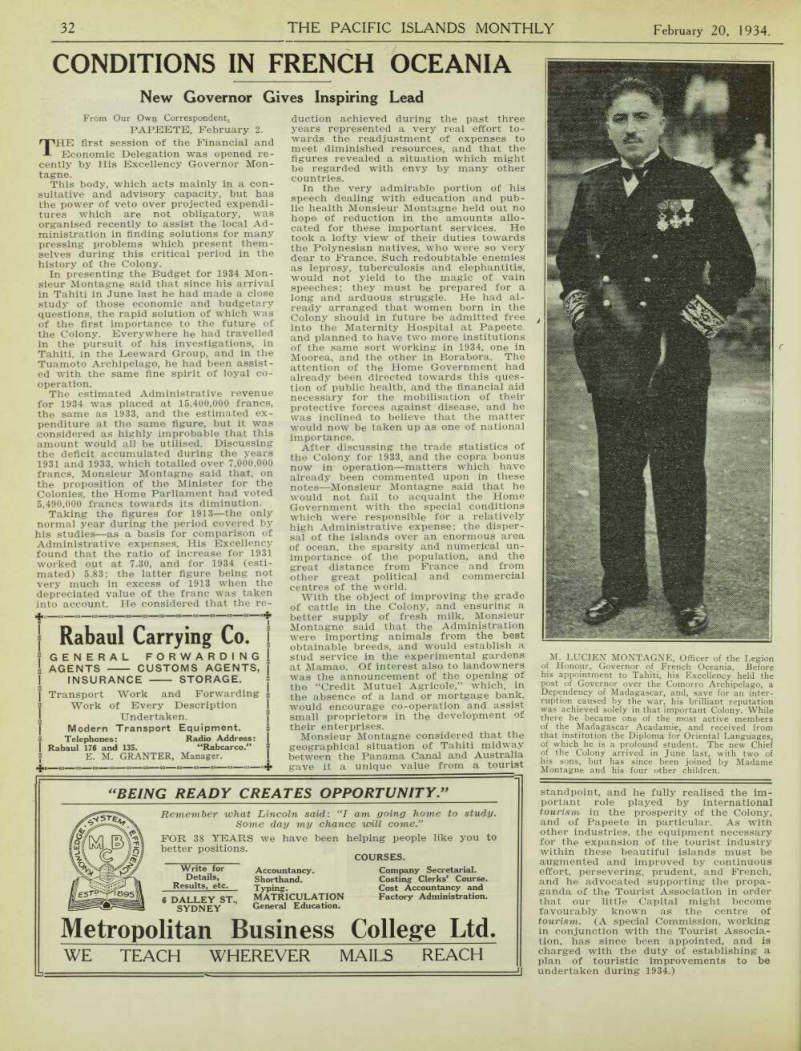
New Governor Gives Inspiring Lead
From Our Own Correspondent, PAPEETE, February 2.
THE first session of the Financial and Economic Delegation was opened re cently by His Excellency Governor Mon tagne.
This body, which acts mainly in a con sultative and advisory capacity, but has the power of veto over projected expendi tures which are not obligatory, was organised recently to assist the local Ad ministration in finding solutions for many pressing problems which present them selves during this critical period in the history of the Colony.
In presenting the Budget for 1934 Mon sieur Montagne said that since his arrival in Tahiti in June last he had made a close study of those economic and budgetary questions, the rapid solution of which was of the first importance to the future of the Colony. Everywhere he had travelled in the pursuit of his investigations, in Tahiti, in the Leeward Group, and in the Tuamoto Archipelago, he had been assist ed with the same fine spirit of loyal co operation.
The estimated Administrative revenue for 1934 was placed at 15,400,000 francs, the same as 1933, and the estimated ex penditure at the same figure, but it was considered as highly improbable that this amount would all be utilised. Discussing the deficit accumulated during the years 1931 and 1933, which totalled over 7,000,000 francs, Monsieur Montagne said that, on the proposition of the Minister for the Colonies, the Home Parliament had voted 5,490,000 francs towards its diminution.
Taking the figures for 1913 —the only normal year during the period covered by his studies —as a basis for comparison of Administrative expenses, His Excellency found that the ratio of increase for 1931 worked out at 7.30, and for 1934 (esti mated) 5.83; the latter figure being not very much in excess of 1913 when the depreciated value of the franc was taken into account. He considered that the re
duction achieved during the past three years represented a very real effort to wards the readjustment of expenses to meet diminished resources, and that the figures revealed a situation which might be regarded with envy by many other countries.
In the very admirable portion of his speech dealing with education and pub lic health Monsieur Montagne held out no hope of reduction in the amounts allo cated for these important services. He took a lofty view of their duties towards the Polynesian natives, who were so very dear to France. Such redoubtable enemies as leprosy, tuberculosis and elephantitis, would not yield to the magic of vain speeches; they must be prepared for a long and arduous struggle. He had al ready arranged that women born in the Colony should in future be admitted free into the Maternity Hospital at Papeete, and planned to have two more institutions of the same sort working in 1934, one in Moorea, and the other in Borabora. The attention of the Home Government had already been directed towards this ques tion of public health, and the financial aid necessary for the mobilisation of their protective forces against disease, and he was inclined to believe that the matter would now be taken up as one of national importance.
After discussing the trade statistics of the Colony for 1933, and the copra bonus now in operation—matters which have already been commented upon in these notes —Monsieur Montagne said that he would not fail to acquaint the Home Government with the special conditions which were responsible for a relatively high Administrative expense; the disper sal of the islands over an enormous area of ocean, the sparsity and numerical un importance of the population, and the great distance from France and from other great political and commercial centres of the world.
With the object of improving the grade of cattle in the Colony, and ensuring a better supply of fresh milk, Monsieur Montagne said that the Administration were importing animals from the best obtainable breeds, and would establish a stud service in the experimental gardens at Mamao. Of interest also to landowners was the announcement of the opening of the “Credit Mutuel Agricole,” which, in the absence of a land or mortgage bank, would encourage co-operation and assist small proprietors in the development of their enterprises.
Monsieur Montagne considered that the geographical situation of Tahiti midway between the Panama Canal and Australia gave it a unique value from a tourist
standpoint, and he fully realised the im portant role played by international tourism in the prosperity of the Colony, and of Papeete in particular. As with other industries, the equipment necessary for the expansion of the tourist industry within these beautiful islands must be augmented and improved by continuous effort, persevering, prudent, and French, and he advocated supporting the propa ganda of the Tourist Association in order that our little Capital might become favourably known as the centre of tourism. (A special Commission, working in conjunction with the Tourist Associa tion, has since been appointed, and is charged with the duty of establishing a plan of touristic improvements to be undertaken during 1934.)
M. LUCIEN MONTAGNE, Officer of the Legion of Honour, Governor of French Oceania. Before his appointment to Tahiti, his Excellency held the post of Governor over the Comorro Archipelago, a Dependency of Madagascar, and, save for an inter ruption caused by the war, his brilliant reputation was achieved solely in that important Colony. While there he became one of the most active members of the Madagascar Acadamie, and received from that institution the Diploma for Oriental Languages, of which he is a profound student. The new Chief of the Colony arrived in June last, with two of his sons, but has since been joined by Madame Montagne and his four other children.
Advertisements & other items, p. 34 (1 item)
Metropolitan Business College Ltd.
Rabaul Carrying Co.
GENERAL FORWARDING
AGENTS CUSTOMS AGENTS,
INSURANCE STORAGE.
Transport Work and Forwarding Work of Every Description Undertaken.
Modern Transport Equipment.
Telephones: Radio Address: Rabaul 176 and 135. “Rabcarco.”
E. M. GRANTER, Manager.
“BEING READY CREATES OPPORTUNITY.”
Remember what Lincoln said : “I am going home to study.
Some day my chance will come”
FOR 38 YEARS we have been helping- people like you to better positions.
COURSES.
Write for Details, Results, etc.
6 DALLEY ST.,
SYDNEY
Accountancy.
Shorthand.
Typing.
MATRICULATION
General Education.
Company Secretarial.
Costing Clerks’ Course.
Cost Accountancy and Factory Administration.
Metropolitan Business College Ltd.
WE TEACH WHEREVER MAILS REACH
Fashion Notes for Island Women
By Therese.
THE vogue for less clothes is world wide. Even the sterner sex follows it with reckless abandon. As there is no field of masculine attire that woman has not invaded, the “Roland” for her “Oliver” is the “Male Mannequin Parade,” in which athletic brother Bill struts in clothes that bid fair to outrival even Joseph’s coat.
On Continental beaches men sport scar let shirts, and brown slacks, their berets matching their vivid shirts.
Woman in the meantime cultivates for day wear the plainly cut, little trimmed frock in quiet shades. She gets her splash of color from her accessories, so to these she gives minute attention.
A frock of soft grey voile or silk boasts cuffs and huge bow of polka dots in con trasting shades —extremely attractive and very unusual.
The trouser-dress is the newest mode in ideal sporting garments. Its bodice is like that of an ordinary frock, while the trouser portion is a cleverly cut widely flared divided skirt. With it are worn Roman sandals and—no stockings, please!
The economical trend for evening is the skirt of satin, since with it can be worn such a variety of the most fascin ating little blouses and coatees. The scope for expressing your individuality in this direction is tremendous. Lace, geor gette, ninon, all offer wonderful possi bilities.
When you want to wear this “rock of salvation” skirt for more formal occa sions, clip on a blouse of the same ma terial, add a belt or sash, and you can face even your dearest enemy with the calm indifference borne of confidence. For special party occasions, nothing could be more alluring than fine black net over a black taffeta slip. Flounces of billowing net start from the knees and a white rose is worn at the corsage. All very new and exceedingly youthful.
For the full floating skirt of a geor gette evening gown—a skirt that looks like a drifting cloud —the newest of new pantaloons are worn of the same material.
In that beautiful buttercup yellow shade it would be an inspiration for an “Ode to Perfection.”
The newest evening handkerchiefs, for display, of course, are of georgette or chiffon, bordered with little designs in gold beads. They are very easily made, too, 18 to 24 inches square. For those of you who tremble to attempt a design, dot a bead here and there over the handker chief. The effect is delightful, and equally effective. For a very tiny sum you can get half an ounce of crystal beads in any desired shade.
Hand-made wristlets of beads and flowers are fashion’s latest whim. Make a long strand of beads the length you re quire; fold it into four equal lengths and attach it to a tiny velvet gardenia. At tach a press fastener so that it fits tightly to the wrist and, hey, presto! a few min utes’ work and the attractive little wrist let is yours.
“My mother bids me bind my hair,” and daughters rush to do mother’s bidding, for the Alice in Wonderland bands of gold, silver, and tortoiseshell are distinctly fascinating.
For the woman who has not shorn her locks, there is the halo plait—so soft, fem inine, and very smart just now. If you have been wearing clusters of curls, you must proceed to forget them, for the hair is much shorter this season. It clings to
your head in soft waves and breaks into a sudden curl at the end of the wave. The new style of hairdressing makes you look younger and slimmer, too, so should prove popular in every way.
Hats are still the reckless wisps that call for the perfect coiffure, and it mat ters not what shape they are, so long as they suit your individuality. The sporting girl buys the inexpensive pique hat worn by the cricketers and folds it to the shape she requires, and for her ingenuity she is rewarded with success beyond measure.
Remember that whatever the occasion, your hat must be discreetly trimmed. A tiny feather, a jaunty bow, a brilliant clip, or the plainest of bands at the cor rect angle, spell all the difference between success and failure —and not a wandering hair of you will be considered outside the pale.
A Slumber Cap
Crochet this slumber cap to preserve your wave, and you need have no further fears.
In making a cap for preserving the wave in sleep it is better to err on the large side than the small, as a tight fit will drag the waves out of position. Crochet cotton is an ideal medium for working, and for this cap one ball is required in any shade, with a crochet hook, No. 4½.
This cap is commenced at the centre crown, the rose being part of the cap and not attached after wards, a much more satisfactory and practical idea for sleeping wear. The ear-points should be lengthened according to personal requirements, and the cap should be tried on after about 3in. has been worked. To alter the size the number of chain stitches should be increased or decreased. This cap measures 20in. round the widest part.
For the rose:—9 ch. form into ring, 24 d.c. into ring, 1 d.c. into first d.c., 7 ch., 1 d.c. into every 3rd d.c. round (making 8 loops). Into each loop work 1 d.c., 6 tr., 1 d.c., round this work 8 ch. and 1 d.c. into the vertical st. on the back of work between each petal. Into each loop work 1 d.c.;
8 tr., 1 d.c.; round this row work 11 ch. for loops, into each loop work 1 d.c., 10 tr., 1 d.c., round this work 10 ch. for loops. Into first loop work 1 picot (8 ch., insert hook into sth ch. from hook, draw thread through that and the loop on the hook to form picot, 4 ch.), 1 d.c. into third ch. of loop. *- 1 picot, miss 3 ch., 1 d.c. into next ch., 1 picot, 1 d.c. into third ch. of next loop, repeat from * all round (16 picots). Work 3 more rows, working over ch. after picot. 11 ch., 1 d.c. into ch. after picot all round, into each loop work 1 d.c., 12 tr., 1 d.c. (16 petals), s.s. to the third tr. of first petal, * 1 picot, miss 6 tr., 1 d.c. into next tr., 1 picot, 1 d.c. into third tr. of next petal, repeat from * all round. 34 more rows, working 1 d.c. over eh, after picot.
Right Ear-pieces.—lst row: Turn, work 1 picot, miss 1 picot of previous row, 1 d.c. over ch. before next picot. Work 6 picots more; when working next picot omit the 4 ch. and join to cap with quad tr. 2nd row. —Turn, 1 picot, miss 1 picot of pre vious row, 1 d.c. over ch. after next picot, 5 more picots; when working next picot omit the 4 ch. and join with quad tr.
Repeat first and second rows, making 1 picot less each row until there is only 1 picot, finish off.
Leave 7 clear picots for back of cap. Join thread on ch. before next picot, work left ear piece to correspond with right. 9 ch., 1 d.c. into each space all round, working into point at ear pieces, 1 d.c., 11 tr., 1 d.c. into each loop, finish off. Sew piece of ribbon on each side.
Abbreviations.—Ch., chain; st., stitch; d.c., double crochet; tr., treble; quad tr., quadruple treble (thread over hook 4 times); s.s., slip stitch.
Advertisements & other items, p. 35 (1 item)
Ferrodor Paint
W. M. FORD
SHIP, YACHT, AND BOAT BUILDER,
BERRY’S BAY, NORTH SYDNEY
(Established 1870.) BUILDERS of all kinds of Islands Craft from Dinghies to Auxiliary Schooners of any tonnage.
New and Second-hand Islands Craft of various types in stock.
PLEASE SEND ON YOUR
INQUIRIES.
Natural Steel Grey
Ferrodor Paint
(Now Manufactured in Australia) Is the Ideal Paint for Steel Structures of all descriptions , and for Galvanised Iron Roofs , etc.
IT IS ELASTIC so that expansion and contraction of metals caused by atmospheric changes leave it quite unaffected.
IT IS ANTI-CORROSIVE being physically incapable of absorbing more Oxygen from the atmosphere.
IT IS NON-POISONOUS making it safe in handling and for use on roofs where water is used for domestic purposes.
Used extensively by N.S.W. Government Railways and Public Works Department. Hawkesbury, Nepean, and Clarence River Railway Bridges, now painted with Ferrodor.
WILLIAM ADAMS & COMPANY
LIMITED
175 CLARENCE STREET,
SYDNEY.
Other colours Branches in all States. Suitable for obtainable. Iron and Wood.
New Guinea Cricket
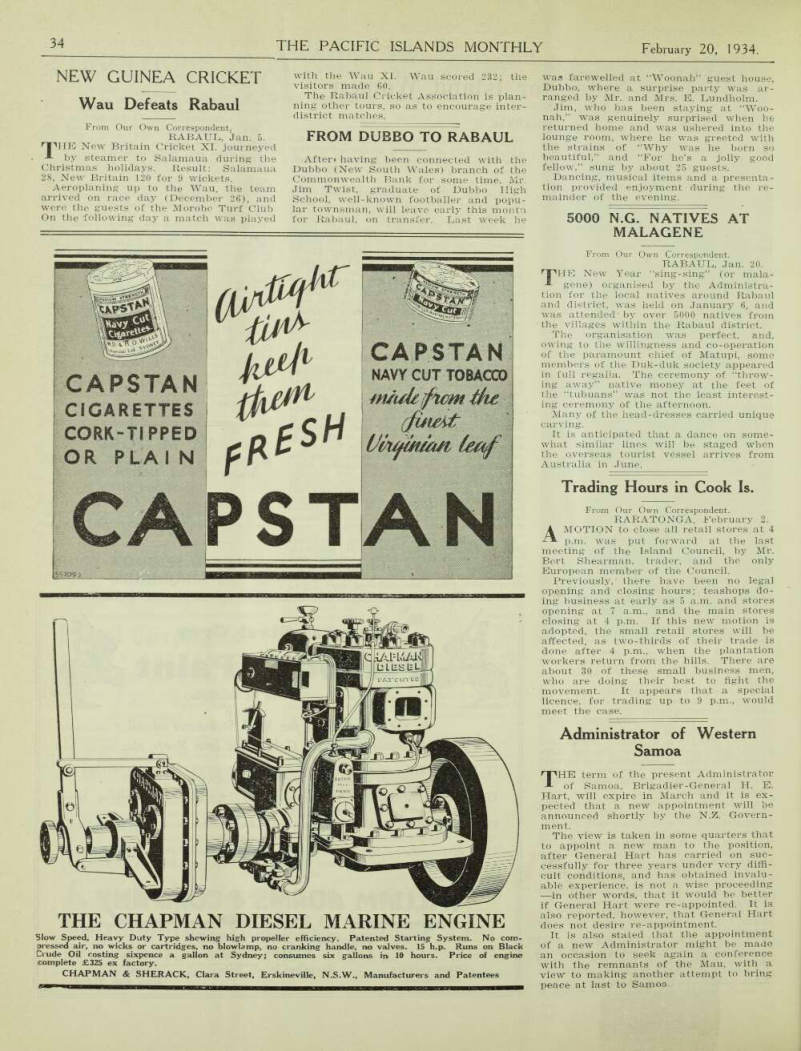
Wau Defeats Rabaul
From Our Own Correspondent.
Rabaul, Jan. 5.
New Britain Cricket XI. journeyed by steamer to Salamaua during the Christmas holidays. Result: Salamaua 28, New Britain 120 for 9 wickets.
Aeroplaning up to the Wau, the team arrived on race day (December 26), and were the guests of the Morobe Turf Club On the following day a match was played
with the Wau XI. Wau scored 232; the visitors made 60.
The Rabaul Cricket Association is plan ning other tours, so as to encourage inter district matches.
From Dubbo To Rabaul
After having been connected with the Dubbo (New South Wales) branch of the Commonwealth Bank for some time, Mr.
Jim Twist, graduate of Dubbo High School, well-known footballer and popu lar townsman, will leave early this month for Rabaul, on transfer. Last week he
was farewelled at “Woonah” guest house, Dubbo, where a surprise party was ar ranged by Mr. and Mrs. E. Lundholm.
Jim, who has been staying at “Woo nah,” was genuinely surprised when he returned home and was ushered into the lounge room, where he was greeted with the strains of “Why was he born so beautiful,” and “For he’s a jolly good fellow,” sung by about 25 guests.
Dancing, musical items and a presenta tion provided enjoyment during the re mainder of the evening.
5000 N.G. Natives At
Malagene
From Our Own Correspondent.
Rabaul, Jan. 20.
THE New Year “sing-sing” (or malagene) organised by the Administra tion for the local natives around Rabaul and district, was held on January 6, and was attended by over 5000 natives from the villages within the Rabaul district.
The organisation was perfect, and, owing to the willingness and co-operation of the paramount chief of Matupi, some members of the Duk-duk society appeared in full regalia. The ceremony of “throw ing away” native money at the feet of the “tubuans” was not the least interest ing ceremony of the afternoon.
Many of the head-dresses carried unique carving.
It is anticipated that a dance on some what similar lines will be staged when the overseas tourist vessel arrives from Australia in June.
Trading Hours in Cook Is.
From Our Own Correspondent.
RARATONGA, February 2.
A MOTION to close all retail stores at 4 p.m. was put forward at the last meeting of the Island Council, by Mr.
Bert Shearman, trader, and the only European member of the Council.
Previously, there have been no legal opening and closing hours; teashops do ing business at early as 5 a.m. and stores opening at 7 a.m., and the main stores closing at 4 p.m. If this new motion is adopted, the small retail stores will be affected, as two-thirds of their trade is done after 4 p.m., when the plantation workers return from the hills. There are about 30 of these small business men, who are doing their best to fight the movement. It appears that a special licence, for trading up to 9 p.m., would meet the case.
Administrator of Western
Samoa
THE term of the present Administrator of Samoa, Brigadier-General H. E.
Hart, will expire in March and it is ex pected that a new appointment will he announced shortly by the N.Z. Govern ment.
The view is taken in some quarters that to appoint a new man to the position, after General Hart has carried on suc cessfully for three years under very diffi cult conditions, and has obtained invalu able experience, is not a wise proceeding —in other words, that it would be better if General Hart were re-appointed. It is also reported, however, that General Hart does not desire re-appointment.
It is also stated that the appointment of a new Administrator might be made an occasion to seek again a conference with the remnants of the Mau, with a view to making another attempt to bring peace at last to Samoa.
Advertisements & other items, p. 36 (1 item)
Capstan
CIGARETTES
CORK-TIPPED
OR PLA I N
CAPSTAN
NAVY CUT TOBACCO
THE CHAPMAN DIESEL MARINE ENGINE
Slow Speed, Heavy Duty Type shewing high propeller efficiency. Patented Starting System. No compressed air, no wicks or cartridges, no blowlamp, no cranking handle, no valves. 15 h.p. Runs on Black Crude Oil costing sixpence a gallon at Sydney; consumes six gallons in 10 hours. Price of engine complete £325 ex factory.
CHAPMAN & SHERACK, Clara Street, Erskineville, N.S.W., Manufacturers and Patentees
Davuilevu Training
College.
The retirement of the Rev. C. O. Lelean as principal of the Davuilevu training college, Fiji, and the appointment of the Rev. A. G. Adamson, of Victoria, to suc ceed him, and of the Rev. A. C. Cato, of Victoria, as director of educational train ing at the institution, were announced on February 7 at the annual board meeting of the Australian Methodist Missionary So ciety.
Mr. Adamson is at present in Fiji. The board placed oh record its sense of the great loss to the Fiji district by Mr. Le lean’s retirement. For 33 years Mr. Lelean had served the Church in Fiji faithfully and with conspicuous ability. As principal of the college for 20 years he had rendered his greatest service, and he had influenced profoundly the present generation in Fiji.
He had done much translation and revi sion work which would serve the Fijian church for generations.
Vanikoro Timber
South African Ships Provide Australian Connection
THE kauri timber industry on the Island of Vanikoro, in the southern Solomons, has taken a new lease of life; and cargoes of undressed logs are now being regularly shipped to Melbourne and Sydney, where they are milled and mar keted. Formerly, the logs were milled in Vanikoro, but the new Australian duty on sawn timber caused a reorganisation of the Vanikoro enterprise, which has grown considerably in recent months. The Vanikoro industry is carried on by a
branch of the principal firm handling kauri in New Zealand.
There has been an interesting shipping arrangement, under which a regular con nection is now maintained between Vani koro and Australian ports. The large 9,000 tons steamers of the South African (Millars’) line—the Erica, Dalia, and Aloe —are now calling regularly at Vani koro on their round trip from South Africa to Singapore and Far Eastern ports.
Instead of returning along the same track, they come south-east to the Solomons and pass southward of Australia, after delivering their timber cargoes in Aus tralian ports. They also carry a limited number of passengers, and are reported to be very comfortable steamers. Travel lers may book for the round trip—that is to say, from Australian ports to South African ports, thence to Indian and Far Eastern ports, thence south-eastward through the East Indies and Pacific Islands to Vanikoro, thence to Sydney or Melbourne. Two new vessels are being built for this line, which will provide a more frequent service.
Two Islanders Missing
THURSDAY IS., January 14.
Three weeks ago two old South Sea Islanders, Willy Ambrym and Charlie Mallicole, who had been permitted to re side at Port Lihou, and had been visiting Thursday Island for Christmas, left for their home in a sailing dinghy. It was ascertained that they had not reached home. They were last seen on the morn ing of December 27, making their way in squally weather through a boat passage at the Prince of Wales Island. It seems certain that they have been lost, for an intense search of surrounding localities has revealed no trace of the missing men.
Both were formerly engaged in sugar growing and pearling work.
Rabaul
German Journalist In
Arrives from Japanese Islands
From Our Own Correspondent.
Rabaul, Jan. 15.
Herr Herbert Rittlinger Ar-
rived in Rabaul on December 16 by the small Japanese vessel “Heiyei Maru” which occasionally makes a run to Rabaul, from the Japanese Mandated Territory.
Mr. Rittlinger is a German journalist, as well as being a Rover Scout, and is well-known in Germany for his accounts of his trip, made through Kurdistan in a collapsible boat. He represents several German newspapers and journals, and is making his way round the world, gather ing material for another book.
In the Japanese Mandated Islands, Mr.
Rittlinger experienced some difficulties with regard to being able to take photo graphs for his journals, and during his stay there, he states, he was at all times subjected to strict surveillance.
Mr. Rittlinger was somewhat reserved in his remarks regarding his treatment at the hands of the Japanese in the Marshall and Caroline Islands, but it was not diffi cult to perceive that his impressions of the country were prejudiced on account of the reception accorded him.
Regarding the journey from Ponape to New Guinea, Mr. Rittlinger stated that the vessel called only at Greenwich Island and from thence sailed direct to Kavieng.
During the voyage there was no indica tion that any contact was made with the Japanese poacher vessels, which have been reported so often in these waters.
Stores were landed at Greenwich Island, and only a short stay made there.
Advertisements & other items, p. 37 (1 item)
Reliability!
If you require a reliable, cheap running and simple engine investigate the
WORLD - FAMED
Sizes from 6 to 500 H.P.
FETTER
Crude Oil
MARINE ENGINES
Slow speed, giving highrpropulsive efficiency. Extremely simple to handle; easy starting; low fuel and oil consumption; accessible; no valves or valve gear; no petrol required on board (fire risk eliminated) ; Highest-grade Workmanship. Guaranteed for reliable service by 38 years’ experience in oil-engine manufacture. Spares stocked in Sydney.
Also FETTER CRUDE OIL STATIONARY ENGINE, up to 540-h.p.
BUZACOTT & CO. LTD. 7-11 Market St.. Sydney
New Goldfield In New
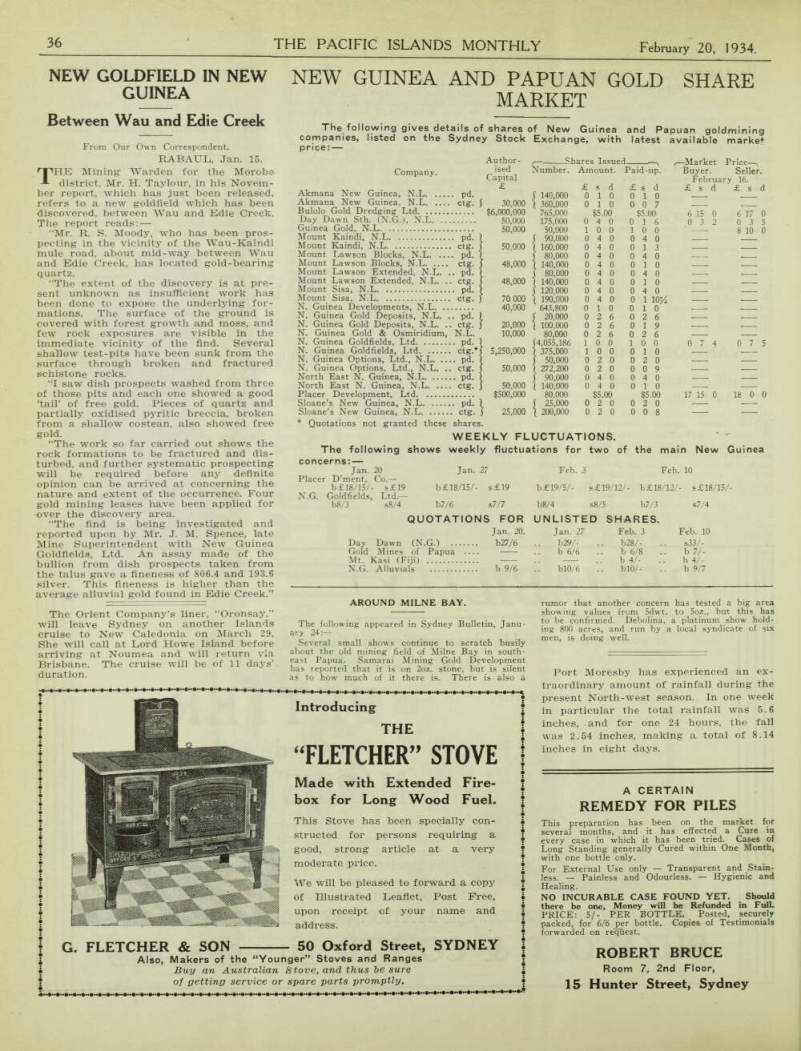
Guinea
Between Wau and Edie Creek
From Our Own Correspondent.
Rabaul. Jan. 15.
THE Mining Warden for the Morobe district, Mr. H. Taylour, in his Novem ber report, which has just been released, refers to a new goldfield which has been discovered, between Wau and Edie Creek, The report reads: “Mr. R. S. Moody, who has been pros pecting in the vicinity of the Wau-Kaindi mule road, about mid-way between Wau and Edie Creek, has located gold-bearing quartz.
“The extent of the discovery is at pre sent unknown as insufficient work has been done to expose the underlying for mations. The surface of the ground is covered with forest growth and moss, and few rock exposures are visible in the immediate vicinity of the find. Several shallow test-pits have been sunk from the surface through broken and fractured schistone rocks.
“I saw dish prospects washed from three of those pits and each one showed a good ‘tail’ of free gold. Pieces of quartz and partially oxidised pyritic breccia, broken from a shallow costean, also showed free gold.
“The work so far carried out shows the rock formations to be fractured and dis turbed, and further systematic prospecting will be required before any definite opinion can be arrived at concerning the nature and extent of the occurrence. Four gold mining leases have been applied for over the discovery area.
“The find is being investigated and reported upon by Mr. J. M. Spence, late Mine Superintendent with New Guinea Goldfields, Ltd. An assay made of the bullion from dish prospects taken from the talus gave a fineness of 806.4 and 193.6 silver. This fineness is higher than the average alluvial gold found in Edie Creek.”
The Orient Company’s liner, “Oronsay,” will leave Sydney on another Islands cruise to New Caledonia on March 29.
She will call at Lord Howe Island before arriving at Noumea and will return via Brisbane. The cruise will be of 11 days’, duration.
Market
New Guinea And Papuan Gold Share
The following gives details of shares of New Guinea and Papuan goldmining companies, listed on the Sydney Stock Exchange, with latest available marke* price:
Weekly Fluctuations.
The following shows weekly fluctuations for two of the main New Guinea concerns:—
Quotations For Unlisted Shares.
Author- Shares Issued Market Price
Company.
ised Number.
Amount.
Paid-up.
Buyer.
Seller.
Capital February 16.
Akmana New Guinea, N.L pd. £ 140,000 £ s d 0 1 0 £ s d 0 1 0 £ s d £ s d Aktnana New Guinea, N.L ctg. 30,000 360,000 0 1 0 0 0 7 Bulolo Gold Dredging Ltd $6,000,000 765,000 $5.00 $5.00 6 15 0 6 17 0 Day Dawn Sth. (N.G.), N.L. .. 50,000 175,000 0 4 0 0 1 6 0 3 2 0 3 5 Guinea Gold, N.L 50,000 1 0 0 1 0 0 8 10 0 Mount Kaindi, N.L Pd. 90,000 0 4 0 1 0 0 0 4 0 8 10 0 Mount Kaindi, N.L ctg. 50 000 160,000 0 4 0 0 1 3 Mount Lawson Blocks, N.L. ... Pd. 80,000 0 4 0 0 4 0 Mount Lawson Blocks, N.L ctg. 48,000 140,000 0 4 0 0 1 0 Mount Lawson Extended, N.L. pd. 80,000 0 4 0 0 4 0 Mount Lawson Extended, N.L. . ctg. 48,000 140,000 0 4 0 0 1 0 Mount Sisa, N.L pd. • pd. 1 120,000 0 4 0 0 4 0 Mount Sisa, N.L ctg. 70 000 190,000 0 4 0 0 N. Guinea Developments, N.L. .. 40,000 643,800 0 1 0 0 1 10½ 1 0 N. Guinea Gold Deposits, N.L. . Pd. 20,000 0 2 6 0 2 6 N. Guinea Gold Deposits, N.L. . ctg. 20,000 100,000 0 2 6 0 1 9 N. Guinea Gold & Osmiridium, N.L. 10,000 80,000 0 2 6 0 2 6 N. Guinea Goldfields, Ltd pd. 4,055,186 1 0 0 1 0 0 0 7 4 0 7 5 N. Guinea Goldfields, Ltd ctg.* 5,250,000 375,000 1 0 0 0 1 0 N. Guinea Options, Ltd., N.L. .. pd. 50,000 0 2 0 0 2 0 N. Guinea Options, Ltd., N.L. . ctg. 50,000 272,200 0 2 0 0 0 9 North East N. Guinea, N.L .. pd. 90,000 0 4 0 0 4 0 North East N. Guinea, N.L ctg. 50,000 140,000 0 4 0 0 1 0 Placer Development, Ltd $500,000 80,000 $5.00 $5.00 17 15 0 18 0 0 Sloane’s New Guinea, N.L pd. 25,000 0 2 0 0 2 0 — — Sloane’s New Guinea, N.L ctg. 25,000 200,000 0 2 0 0 0 8 — — * Quotations not granted these shares.
Jan. 20 Jan. 27 Feb. 3 Feb. 10 Placer D’ment, Co.— b£ 18/15/- s£19 b £18/15/- s£19 b£19/5/- s £19/12/b£ 18/12/- s £18/15/- N.G. Goldfields, Ltd.— b8/3 s8/4 b7/6 s7/7 b8/4 s8/5 b7/3 s7/4
Jan. 20. Jan. 27 Feb. 3 Feb. 10 Day Dawn (N.G.) b27/6 .. b29/- .. b28/- .. s33/- Gold Mines of Papua .. b 6/6 .. b 6/8 .. b 7/- Mt. Kasi (Fiji) .. .. b 4/- .. b 4/- N.G. Alluvials b 9/6 .. b10/6 .. b10/- .. b 9/7
Around Milne Bay.
The following appeared in Sydney Bulletin, Janu ary 24; Several small shows continue to scratch busily about the old mining field of Milne Bay in south east Papua. Samarai Mining Gold Development has reported that it is on 2oz. stone, but is silent as to how much of it there is. There is also a
rumor that another concern has tested a big area showing values from 5dwt. to 50z., but this has to be confirmed. Debolina, a platinum show hold ing 800 acres, and run by a local syndicate of six men, is doing well.
Port Moresby has experienced an ex traordinary amount of rainfall during the present North-west season. In one week in particular the total rainfall was 5.6 inches, and for one 24 hours, the fall was 2.54 inches, making a total of 8.14 inches in eight days.
Advertisements & other items, p. 38 (1 item)
“Fletcher” Stove
Introducing
THE
Made with Extended Fire-
box for Long Wood Fuel.
This Stove has been specially constructed for persons requiring a good, strong article at a very moderate price.
We will be pleased to forward a copy of Illustrated Leaflet, Post Free, upon receipt of your name and address.
G. FLETCHER & SON 50 Oxford Street, SYDNEY Also, Makers of the “Younger” Stoves and Ranges Buy an Australian 8 tove, and thus he sure of getting service or spare parts promptly .
A CERTAIN
REMEDY FOR PILES
This preparation has been on the market for several months, and it has effected a Cure in every case in which it has been tried. Cases of Long Standing generally Cured within One Month, with one bottle only.
For External Use only Transparent and Stainless. Painless and Odourless. Hygienic and Healing.
NO INCURABLE CASE FOUND YET. Should
there be one, Money will be Refunded in Full.
PRICE: 5/- PER BOTTLE. Posted, securely packed, for 6/6 per bottle. Copies of Testimonials forwarded on request.
ROBERT BRUCE
Room 7, 2nd Floor,
15 Hunter Street, Sydney
Market Quotations
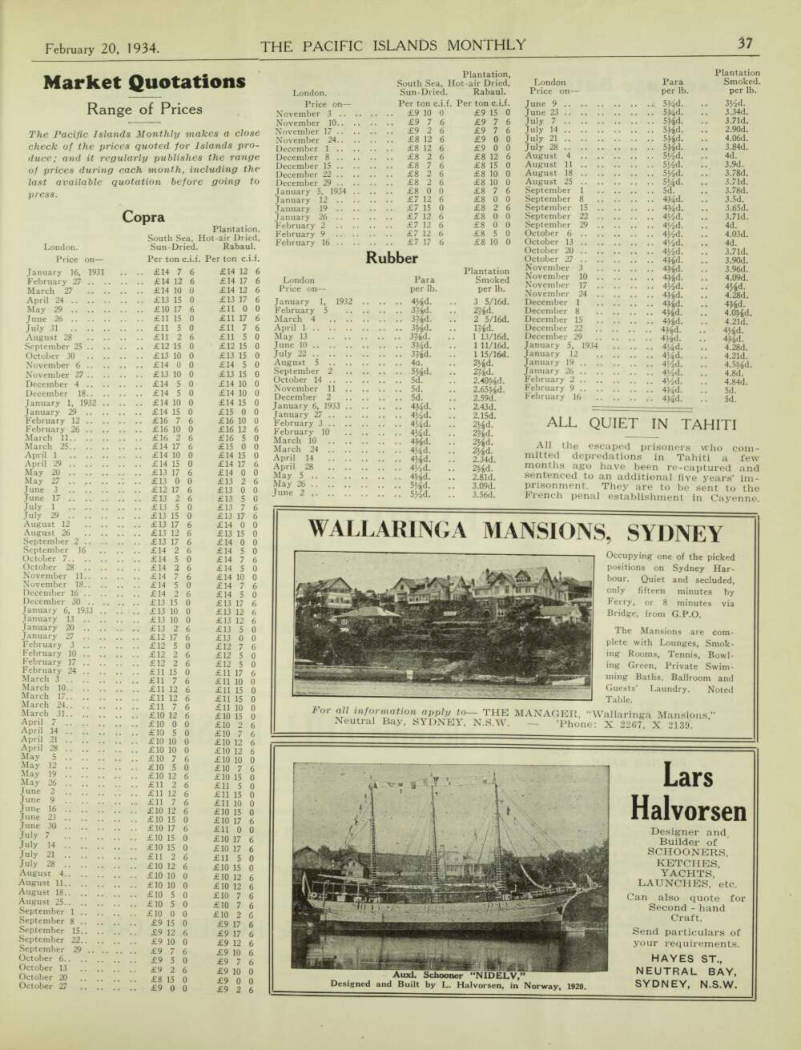
Range of Prices
The Pacific Islands Monthly makes a close check of the prices quoted for Islands pro duce; and it regularly publishes the range of prices during each month, including the last available quotation before going to press.
London Para Plantation Smoked.
Price on — per lb. per lb.
June 9 .. .. 5Hd. . 3yd.
June 23 .. .. 5yd. 3.34d.
July 7 .. .. 5Hd. 3.71d.
July 14 2.90d.
July 21 .. .. 5yd. 4.06d.
July 28 .. .. syd. 3.84d.
August 4 .. .. syd. 4d.
August 11 .. .. 5/ 2 d. 3.9d.
August 18 .. .. sy 2 d. 3.78d.
August 25 .. .. 5Md. 3.71d.
September 1 .. .. .. .. 5<L 3.78d.
September 8 .. .. .. .. 4*4d. 3.5d.
September 15 .. .. .. .. 4Md. 3.65d.
September 22 .. ., .. .. 4/ 2 d. 3.71d.
September 29 .. .. .. .. 4y 2 d. 4d.
October 6 .. .. 4^d. 4.03d.
October 13 .. .. 4yd. 4d.
October 20 .. .. 4'/ 2 d. 3.71d.
October 27 3.90d.
November 3 .. .. 3.96d.
November 10 .. .. .. 4Hd. 4.09d.
November 17 .. .. .. .. 4y 2 d. 4yd.
November 24 .. .. 4.28d.
December 1 .. .. .. .. 4Vsd. 4}id.
December 8 .. .. 4Hd. 4md.
December 15 .. .. 4.21d.
December 22 .. .. .. .. 4Hd. 4^d.
December 29 .. ..
January 5, 1934 .. .. 4Hd. .. .. 4%d. .. .. md. 4yd. 4.28d.
January 12 .. .. 4.21d.
January 19 4.5^d.
January 26 4.8d.
February 2 4.84d.
February 9 Sd.
February 16 ... .. .. 4^d. 5d.
South Sea, Plantation, Hot-air Dried, London.
Sun-Dried, Rabaul.
Price on — Per ton c.i.f. Per ton c.i.f.
November 3 .. . £9 10 0 £9 IS 0 November 10.. . ... £9 7 6 £9 7 6 November 17 .. ... £9 2 6 £9 7 6 November 24.. . .. .. £8 12 6 £9 0 0 December 1 .. .. .. £8 12 6 £9 0 0 December 8 .. . ... £8 2 6 £8 12 6 December 15 .. . ... £8 7 6 £8 15 0 December 22 .. ... £8 2 6 £8 10 0 December 29 .. . ... £8 2 6 £8 10 0 January 5, 1934 . ... £8 0 0 £8 7 6 January 12 .. . ... £7 12 6 £8 0 0 January 19 .. . ... £7 15 0 £8 2 6 January 26 .. .. ... £7 12 6 £8 0 0 February 2 .. .. .. .. £7 12 6 £8 0 0 February 9 .. .. ... £7 12 6 £8 5 0 February 16 .. . ... £7 17 6 £8 10 0 London
Rubber
Para Plantation Smoked Price on — per lb. per lb.
January 1, 1932 4*d. 3 5/16d.
February 5 3Hd. .. 2^d.
March 4 .. .. 3Hd. 2 5/16d.
April 1 3Hd. .. VAd.
May 13 .. .. 3Hd. 1 13/16d.
June 10 3V 4 d. 1 ll/16d.
July 22 3**d. 1 15/16d.
August 5 .. .. .. 2%d.
September 2 5%d. .. 27Ad.
October 14 .. .. 2.40^d.
November 11 ..
Sd. 2.65^d.
December 2 5d. 2.59cL January 6, 1933 .. 4Md. 2.43d.
January 27 .. .. 4}4d. 2,15d.
February 3 .. .. 4'Ad. • • 2j^d.
February 10 VAd. .. 2?Ad.
March 10 .. .. 4^d. 2%d.
March 24 .. ., 4j4d. .. 2'Ad.
April 14 .. .. 4^d. 2.34d.
April 28 ... 4J/ 2 d. . - 2Ad.
May 5 4^d. 2.81d.
May 26 sy s d. 3.09d.
June 2 sy 2 d. 3.56d.
London.
Copra
South Sea, Sun-Dried.
Plantation, Hot-air Dried, Rabaul.
Price on — Per ton c.i.f Per ton c.i.f.
January 16, 1931 .. .. £14 7 6 £14 12 6
February 27 ..
.. .. £14 12 6 £14 17 6 March 27 ... .. £14 10 0 £14 12 6 April 24 .. .. £13 15 0 £13 17 6 May 29 .. .. £10 17 6 £11 0 0 June 26 .. .. £11 15 0 £11 17 6 July 31 .. .. £11 5 0 £11 7 6 August 28 .. .. .. .. £11 2 6 £11 5 0
September 25 ..
.. .. £12 IS 0 £12 IS 0 October 30 .. .. £13 10 0 £13 15 0 November 6 .. .. .. .. £14 0 0 £14 5 0 November 27 .. .. .. .. £13 10 0 £13 IS 0 December 4 .. .. .. .. £14 5 0 £14 10 0 December 18.. .. .. .. £14 5 0 £14 10 0 January 1, 1932 .. .. .. £14 10 0 £14 IS 0 January 29 .. .. .. £14 15 0 £15 0 0 February 12 .. .. .. .. £16 7 6 £16 10 0 February 26 .. .. .. .. £16 10 0 £16 12 6 March 11 .. .. £16 2 6 £16 5 0 March 25 .. .. £14 17 6 £15 0 0 April 1 .. .. £14 10 0 £14 15 0 April 29 .. .. £14 15 0 £14 17 6 May 20 .. .. £13 17 6 £14 0 0 May 27 .. .. £13 0 0 £13 2 6 June 3 .. .. £12 17 6 £13 0 0 June 17 .. .. £13 2 6 £13 5 0 July 1 .. .. £13 5 0 £13 7 6 July 29 .. .. £13 15 0 £13 17 6 August 12 .. .. £13 17 6 £14 0 0 August 26 .. .. .. .. £13 12 6 £13 IS 0 September 2 .. .. .. .. £13 17 6 £14 0 0 September 16 .. .. £14 2 6 £14 5 0 October 7 .. .. £14 5 0 £14 7 6 October 28 .. .. .. .. £14 2 6 £14 5 0 November 11.. .. .. .. £14 7 6 £14 10 0 November 18.. .. .. .. £14 5 0 £14 7 6 December 16 .. .. .. .. £14 2 6 £14 5 0 December 30 .. .. .. .. £13 15 0 £13 17 6 January 6, 1933 .. .. .. £13 10 0 £13 12 6 January 13 .. .. .. .. £13 10 0 £13 12 6 January 20 .. .. .. £13 2 6 £13 5 0 January 27 .. .. £13 0 0 February 3 .. .. .. .. £12 5 0 £12 7 6 February 10 .. .. .. £12 2 6 £12 5 0
February 17 .. ..
.. .. £12 2 6 £12 5 0
February 24 .. .
.. .. £11 15 0 £11 17 6 March 3 £11 10 0 March 10 £11 15 0 March 17 £11 15 0 March 24 £11 10 0 March 31 £10 15 0 April 7 £10 2 6 April 14 £10 7 6 April 21 .. .. £10 10 0 £10 12 6 April 28 .. .. £10 10 0 £10 12 6
May 5
.. .. £10 7 6 £10 10 0 May 12 .. .. £10 5 0 £10 7 6 May 19 .. .. £10 12 6 £10 15 0
May 26
.. .. £11 2 6 £11 5 0 June 2 £11 15 0 June 9 .. . £11 10 0 Jun e 16 £10 15 0 June 23 .. .. £10 15 0 £10 17 6 June 30 £11 0 0 July 7 £10 17 6 July 14 £10 17 6 July 21 £11 5 0 July 28 £10 15 0 August 4 .. .. £10 10 0 £10 12 6 August 11 • • .. £10 10 0 £10 12 6 August 18 £10 7 6 August 25 £10 7 6
September 1 .. ..
£10 2 6
September 8 .. .
£9 17 6 September 15.. .. £9 17 6 September 22.. ., £9 12 6
September 29 .. ..
£9 10 6 October 6 £9 7 6 October 13 .. .. £9 10 0 October 20 ... .. .. £8 IS 0 £9 0 0 October 27 .. .. .. .. £9 0 0 £9 2 6
All Quiet In Tahiti
All the escaped prisoners who com mitted depredations in Tahiti a few months ago have been re-captured and sentenced to an additional five years’ im prisonment. They are to be sent to the French penal establishment in Cayenne.
Advertisements & other items, p. 39 (1 item)
Halvorsen
WALLARINGA MANSIONS, SYDNEY
Occupying one of the picked positions on Sydney Harbour. Quiet and secluded, only fifteen minutes by Ferry, or 8 minutes via Bridge, from G.P.O.
The Mansions are complete with Lounges, Smoking Rooms, Tennis, Bowling Green, Private Swimming Baths, Ballroom and Guests’ Laundry. Noted Table.
For all information apply to — THE Neutral Bay, SYDNEY, N.S.W.
MANAGER, “Wallaringa Mansions,” ’Phone: X 2267, X 2139.
Auxl. Schooner “NIDELV,"
Designed and Built by L, Halvorsen, in Norway, 1920.
Lars
Halvorsen
Designer and Builder of
SCHOONERS,
KETCHES,
YACHTS,
LAUNCHES, etc.
Can also quote for Second - hand Craft.
Send particulars of your requirements.
HAYES ST.,
NEUTRAL BAY,
SYDNEY, N.S.W.
Exchange Rates
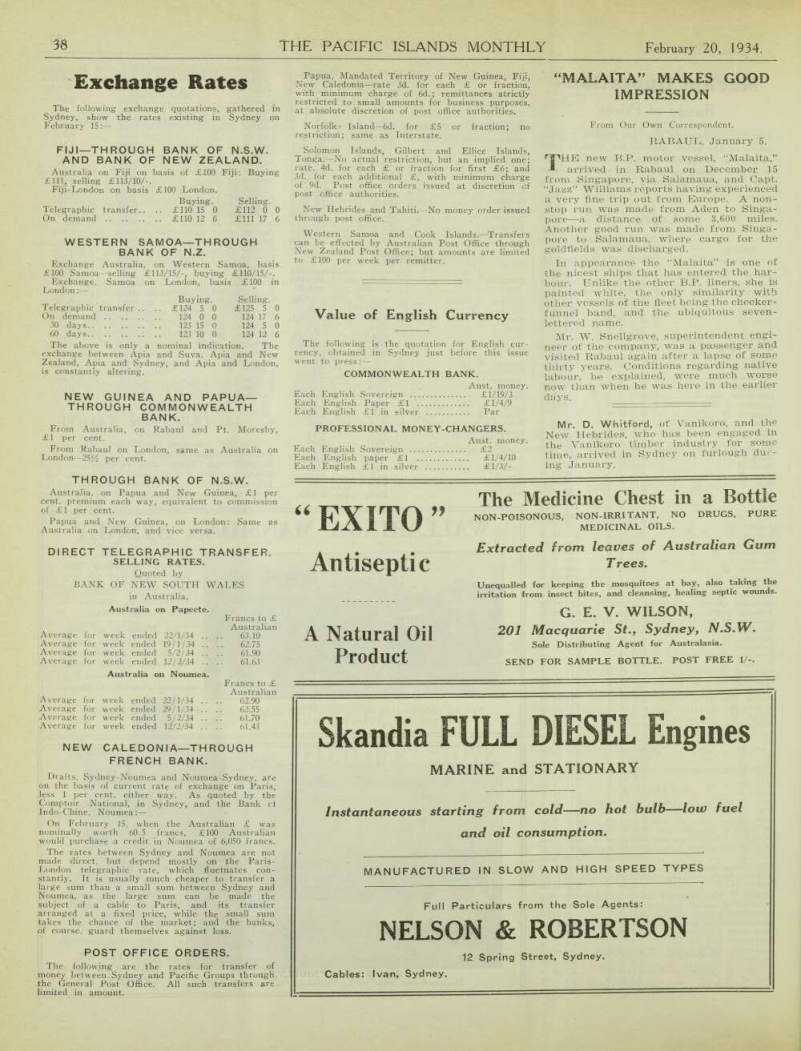
The following exchange quotations, gathered in Sydney, show the rates existing in Sydney on February 15: —
Fiji—Through Bank Of N.S.W.
And Bank Of New Zealand.
Australia on Fiji on basis of £100 Fiji: Buying £111, selling £113/10/-.
Fiji-London on basis £100 London.
Western Samoa—Through
Bank Of N.Z.
Exchange Australia, on Western Samoa, basis £100 Samoa—selling £113/15/-, buying £110/15/-.
Exchange, Samoa on London, basis £100 in London:—
The above is only a nominal indication. The exchange between Apia and Suva, Apia and New Zealand, Apia and Sydney, and Apia and London, is constantly altering.
New Guinea And Papua
Through Commonwealth
Bank.
From Australia, on Rabaul and Pt. Moresby, £1 per cent.
From Rabaul on London, same as Australia on London—25½ per cent.
Through Bank Of N.S.W.
Australia, on Papua and New Guinea, £1 per cent, premium each way, equivalent to commission of £1 per cent.
Papua and New Guinea, on London; Same as Australia on London, and vice versa.
Direct Telegraphic Transfer.
Selling Rates.
Quoted by
Bank Of New South Wales
in Australia.
New Caledonia—Through
French Bank.
Drafts, Sydney-Noumea and Noumea-Sydney, are on the basis of current rate of exchange on Paris, less 1 per cent, either way. As quoted by the Comptoir National, in Sydney, and the Bank ct Indo-Chine, Noumea;— On February 15, when the Australian £ was nominally worth 60.5 francs, £100 Australian would purchase a credit in Noumea of 6,050 francs.
The rates between Sydney and Noumea are not made direct, but depend mostly on the Paris - London telegraphic rate, which fluctuates con stantly. It is usually much cheaper to transfer a large sum than a small sum between Sydney and Noumea, as the large sum can be made the subject of a cable to Paris, and its transfer arranged at a fixed price, while the small sum takes the chance of the market; and the banks, of course, guard themselves against loss.
Post Office Orders.
The following are the rates for transfer of money between Sydney and Pacific Groups through the General Post Office. All such transfers are limited in amount.
Papua, Mandated Territory of New Guinea, Fiji, New Caledonia—rate 3d. for each £ or fraction, with minimum charge of 6d.; remittances strictly restricted to small amounts for business purposes, at absolute discretion of post office authorities.
Norfolk’ Island —6d. for £5 or fraction; no restriction; same as Interstate.
Solomon Islands, Gilbert and Ellice Islands, Tonga.—No actual restriction, but an implied one; rate, 4d. for each £ or fraction for first £6; and 3d. for each additional £, with minimum charge of 9d. Post office orders issued at discretion of post office authorities.
New Hebrides and Tahiti. —No money order issued through post office.
Western Samoa and Cook Islands.—Transfers can be effected by Australian Post Office through New Zealand Post Office; but amounts are limited to £lOO per week per remitter.
Buying. Selling.
Telegraphic transfer.. .. £110 15 0 £112 0 0 On demand £110 12 6 £111 17 6
Buying. Selling.
Telegraphic transfer.. .. £124 5 0 £125 5 0 On demand 124 0 0 124 17 6 30 days 123 15 0 124 5 0 60 days 123 10 0 124 12 6
Average for week ended 22/1/34 .. 63.10 Australia on Papeete.
Francs to £ Australian Average for week ended 19/1/34 .. 62.75 Average for week ended 5/2/34 .. 61.90 Average for week ended 12/2/34 .. 61.63 Average for week ended 22/1/34 ..62.90 Australia on Noumea.
Francs to £ Australian Average for week ended 29/1/34 .. 62.55 Average for week ended 5/2/34 .. 61.70 Average for week ended 12/2/34 .. 61.43
Value of English Currency
The following is the quotation for English cur rency, obtained in Sydney just before this issue went to press:—
Commonwealth Bank.
Each English Sovereign £1/19/3 Each English Paper £1 £1/4/9 Each English £1 in silver Par Aust. money.
Professional Money-Changers.
Each English Sovereign £2 Each English paper £1 £1/4/10 Each English £1 in silver £1/3/- Aust. money.
Impression
“Malaita” Makes Good
From Our Own Correspondent.
RABAUL, January 5.
THE new B.P. motor vessel, “Malaita,” arrived in Rabaul on December 15 from Singapore, via Salamaua, and Capt.
“Jazz” Williams reports having experienced a very fine trip out from Europe. A non stop run was made from Aden to Singa pore—a distance of some 3,600 miles.
Another good run was made from Singa pore to Salamaua, where cargo for the goldfields was discharged.
In appearance the “Malaita” is one of the nicest ships that has entered the har bour. Unlike the other B.P. liners, she is painted white, the only similarity with other vessels of the fleet being the checker funnel band, and the übiquitous seven lettered name.
Mr. W. Snellgrove, superintendent engi neer of the company, was a passenger and visited Rabaul again after a lapse of some thirty years. Conditions regarding native labour, he explained, were much worse now than when he was here in the earlier days.
Mr. D. Whitford, of Vanikoro, and the New Hebrides, who has been engaged in the Vanikoro timber industry for some time, arrived in Sydney on furlough dur ing January.
Advertisements & other items, p. 40 (1 item)
Skandia FULL DIESEL Engines
“EXITO”
Antiseptic
A Natural Oil
Product
The Medicine Chest in a Bottle
NON-POISONOUS, NON-IRRITANT, NO DRUGS, PURE
MEDICINAL OILS.
Extracted from leaves of Australian Gum Trees.
Unequalled for keeping the mosquitoes at bay, also taking the irritation from insect bites, and cleansing, healing septic wounds.
G. E. V. WILSON,
201 Macquarie St., Sydney, N.S.W.
Sole Distributing Agent for Australasia.
SEND FOR SAMPLE BOTTLE. POST FREE 1/-.
Skandia FULL DIESEL Engines
MARINE and STATIONARY
Instantaneous starting from cold—no hot bulb—low fuel and oil consumption.
MANUFACTURED IN SLOW AND HIGH SPEED TYPES Full Particulars from the Sole Agents:
NELSON & ROBERTSON
12 Spring Street, Sydney.
Cables: Ivan, Sydney.
Shipping Services in the Pacific
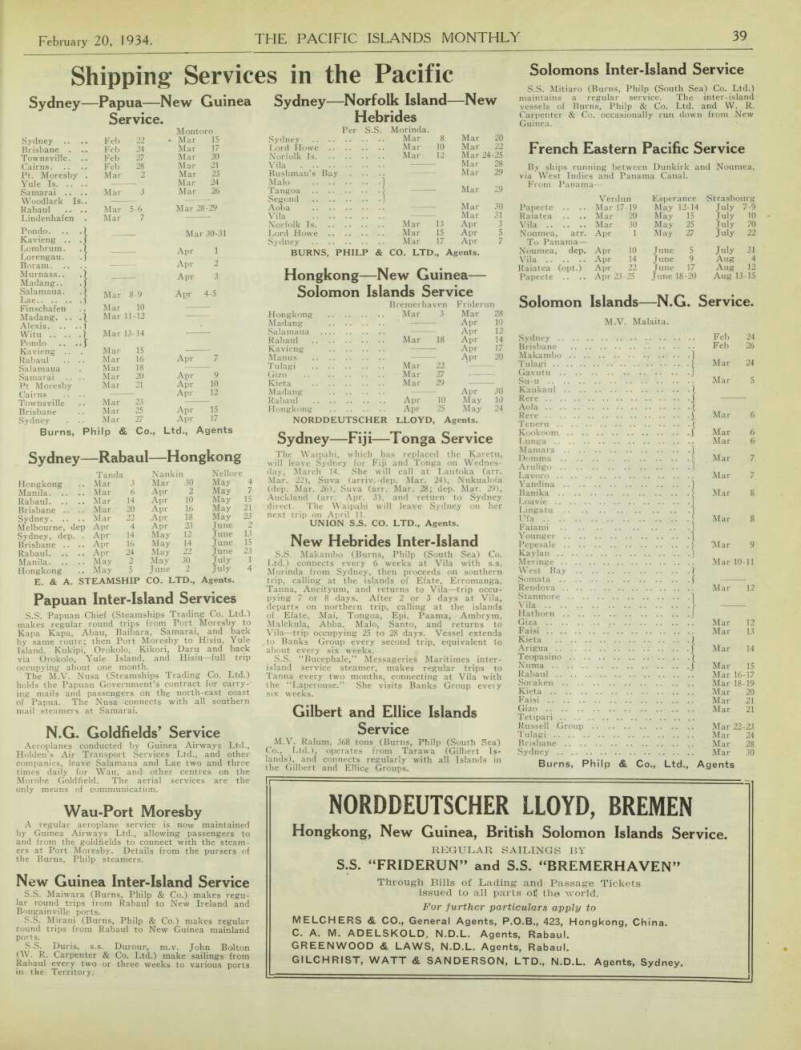
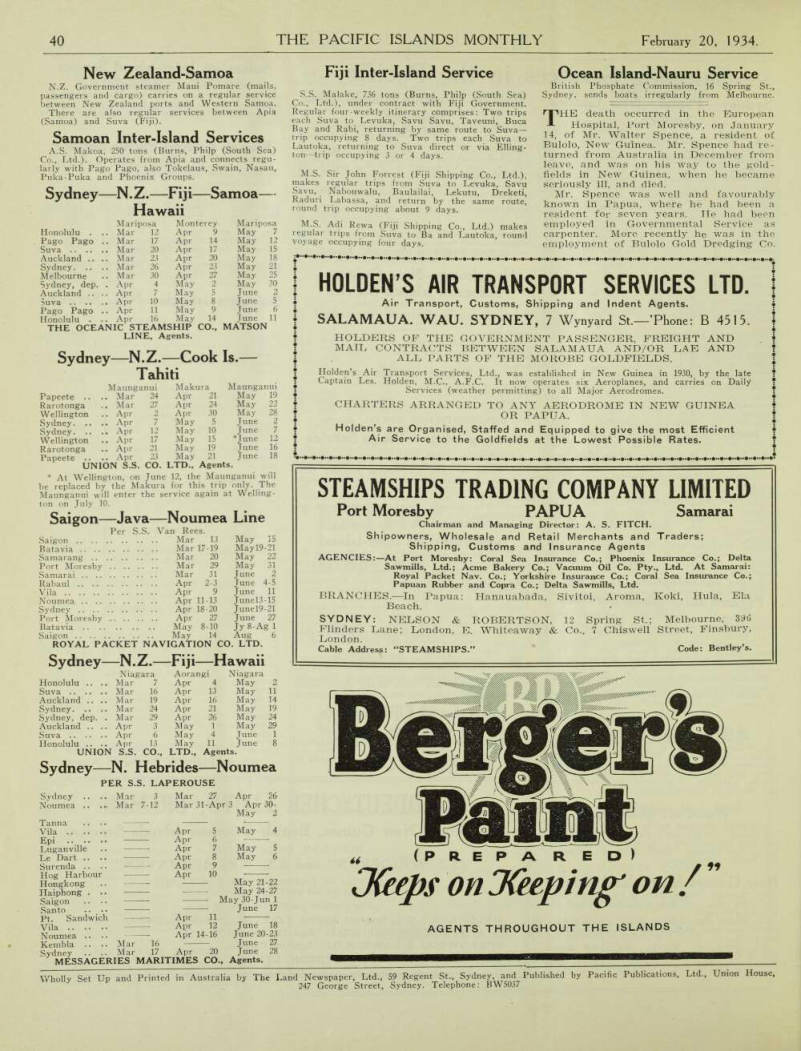
Sydney—Papua—New Guinea Sydney—Norfolk Island—New
Service.
Sydney—Rabaul—Hongkong
Papuan Inter-Island Services
S.S. Papuan Chief (Steamships Trading Co. Ltd.) makes regular round trips from Port Moresby to Kapa Kapa, Abau, Baibara, Samarai, and back by same route; then Port Moresby to Hisiu, Yule Island, Kukipi, Orokolo, Kikori, Daru and back via Orokolo, Yule Island, and Hisiu —full trip occupying about one month.
The M.V. Nusa (Steamships Trading Co. Ltd.) holds the Papuan Government’s contract for carry ing mails and passengers on the north-east coast of Papua. The Nusa connects with all southern mail steamers at Samarai,
N.G. Goldfields’ Service
Aeroplanes conducted by Guinea Airways Ltd., Holden’s Air Transport Services Ltd., and other companies, leave Salamaua and Lae two and three times daily for Wau, and other centres on the Morobe Goldfield. The aerial services are the only means of communication.
Wau-Port Moresby
A regular aeroplane service is now maintained by Guinea Airways Ltd., allowing passengers to and from the goldfields to connect with the steam ers at Port Moresby. Details from the pursers of the Burns, Philp steamers.
New Guinea Inter-Island Service
S.S. Maiwara (Burns, Philp & Co.) makes regular round trips from Rabaul to New Ireland and Bougainville ports.
S.S. Mirani (Burns, Philp & Co.) makes regular round trips from Rabaul to New Guinea mainland ports.
S.S. Duris, s.s. Durour, m.v. John Bolton (W. R. Carpenter & Co. Ltd.) make sailings from Rabaul every two or three weeks to various ports in the Territory.
Hebrides
Hongkong—New Guinea— Solomon Islands Service
Sydney—Fiji—Tonga Service
The Waipahi, which has replaced the Karetu, will leave Sydney for Fiji and Tonga on Wednes day, March 14. She will call at Lautoka (arr.
Mar. 22), Suva (arriv.-dep. Mar. 24), Nukualofa (dep. Mar. 26), Suva (arr. Mar. 28; dep. Mar. 29), Auckland (arr. Apr. 3), and return to Sydney direct. The Waipahi will leave Sydney on her next trip on April 11.
Union S.S. Co. Ltd., Agents.
New Hebrides Inter-Island
S.S. Makambo (Burns, Philp (South Sea) Co.
Ltd.) connects every 6 weeks at Vila with s.s.
Morinda from Sydney, then proceeds on southern trip, calling at the islands of Efate, Erromanga, Tanna, Aneityum, and returns to Vila —trip occu pying 7 or 8 days. After 2 or 3 days at Vila, departs on northern trip, calling at the islands of Efate, Mai, Tongoa, Epi, Paama, Ambrym, Malekula, Abba, Malo, Santo, and returns to Vila —trip occupying 25 to 28 days. Vessel extends to Banks Group every second trip, equivalent to about every six weeks.
S.S. “Bucephale,” Messageries Maritimes interisland service steamer, makes regular trips to Tanna every two months, connecting at Vila with the “Laperouse.” She visits Banks Group evety six weeks.
Gilbert and Ellice Islands
Service
M.V. Ralum, 368 tons (Burns, Philp (South Sea) Co., Ltd.), operates from Tarawa (Gilbert Is lands), and connects regularly with all Islands in the Gilbert and Ellice Groups.
Solomons Inter-Island Service
S.S. Mitiaro (Burns, Philp (South Sea) Co. Ltd.) maintains a regular service. The inter-island vessels of Burns, Philp & Co. Ltd. and W. R.
Carpenter & Co. occasionally run down from New Guinea.
French Eastern Pacific Service
By ships running between Dunkirk and Noumea, via West Indies and Panama Canal.
From Panama —
Solomon Islands —N.G. Service.
Montoro Sydney Feb 22 Mar 15 Brisbane . .
Feb 24 Mar 17 Townsville.
Feb 27 Mar 20 Cairns.
Feb 28 Mar 21 Pt. Moresby Mar 2 Mar 23 Yule Is. .. .
Mar 24 Samarai .. .
Mar 3 Mar 26 Woodlark Is.
Rabaul .. .
Mar 5-6 Mar 28-29 Lindenhafen Mar 7 Pondo.
Kavieng Lombrum.
Apr 1 Lorengau.
Boram.
Apr 2 Murnass..
Madang..
Apr 3 Salamaua.
Mar 8-9
Apr
4-5 Lae Finschafen Mar 10 Madang. ..
Mar 11 -12 Alexis Witu Mar 13-14 Pondo .. .
Kavieng .. .
Mar 15 Apr Rabaul ..
Mar 16 7 Salamaua Mar 18
Apr
Samarai ... ..
Mar 20 9 Pt Moresby Cairns ..
Mar 21 Apr 10 Apr 12 Townsville Mar 23 15 Brisbane Mar 25
Apr
Sydney . ..
Mar 27 Apr 17 Burns, Philp & Co., Ltd., Agents
Tanda Nankin Nellore Hongkong Mar 3 Mar 30 May 4 Manila Mar 6 Apr 2 May 7 Rabaul Mar 14 Apr 10 May 15 Brisbane .. ..
Mar 20 Apr 16 May 21 Sydney Mar 22 Apr 18 May 23 Melbourne, dep Apr 4 Apr 23 June 2 Sydney, dep. .
Apr 14 May 12 June 13 Brisbane .. ..
Apr 16 May 14 June 15 Rabaul Apr 24 May 22 Tune 23 Manila May 2 May 30 July 1 Hongkong May 5 June 2 July 4 E. & A. STEAMSHIP CO. LTD., Agents.
Per S.S. Morinda.
Sydney Mar 8 Mar 20 Lord Howe Mar 10 Mar 22 Norfolk Is Mar 12 Mar 24-25 Vila Mar 28 Bushman s Bay Mar 29 Malo Tangoa Mar 29 Segond Aoba Mar 30 Vila Mar 31 Norfolk Is Mar 13 Apr 3 Lord Howe Mar 15 Apr 5 Sydney Mar 17 Apr 7
Burns, Philp & Co. Ltd., Agents.
Bremerhaven Friderun Hongkong Mar 3 Mar 28 Madang Apr 10 Salamaua Apr 12 Rabaul Mar 18 Apr 14 Kavieng Apr 17 Manus — Apr 20 Tulagi Mar 22 Gizo ..
Mar 27 Kieta Mar 29 Madang Apr 30 Rabaul Apr 10 May 10 Hongkong Apr 25 May 24
Norddeutscher Lloyd, Agents.
Verdun Esperance Strasbourg Papeete .. .. Mar 17-19 May 12-14 July 7-9 Raiatea .. .. Mar 20 May IS July 10 Vila Mar 30 May 25 July 20 Noumea, arr. Apr 1 May 27 July 22 To Panama — Noumea, dep. Apr 10 June 5 July 31 Vila Apr 14 June 9 Aug 4 Raiatea (opt.) Apr 22 June 17 Aug 12 Papeete .. .. Apr 23-25 June 18-20 Aug 13-15
M.V. Malaita.
Feb 24 Feb 26 Makambo Tulagi Mar 24 Gavutu Mar 5 Kaukaul Rere Aola Rere Mar 6 Teneru Kookoom Mar 6 Mar 6 Domma Mar 7 Aruligo Mar 7 Yandina Banika Mar 8 Lingatu Ufa Mar 8 Faiami Younger Pepesale Mar 9 Kaylan Meringe Mar 10-11 West Bay Somata Rendova Mar 12 Stanmore Vila Hathorn Giza Mar 12 Faisi Mar 13 Kieta Arigua Mar 14 Teopasino Numa Mar IS Rabaul Mar 16-17 Soraken Mar 18-19 Kieta Mar 20 Faisi Mar 21 Gizo Mar 21 Tetipari Russell Group Mar 22-23 Tulagi Mar 24 Brisbane Mar 28 Sydney 30 Burns, Philp & Co., Ltd. Agents
New Zealand-Samoa
N.Z. Government steamer Maui Pomare (mails, passengers and cargo) carries on a regular service between New Zealand ports and Western Samoa.
There are also regular services between Apia (Samoa) and Suva (Fiji).
Samoan Inter-Island Services
A.S. Makoa, 250 tons (Burns, Philp (South Sea) Co., Ltd.). Operates from Apia and connects regu larly with Pago Pago, also Tokelaus, Swain, Nasau, Puka-Puka and Phoenix Groups.
Sydney—N.Z.—Fiji—Samoa—
Hawaii
Sydney—N.Z.—Cook Is. — Tahiti
Saigon—Java—Noumea Line
Sydney—N.Z.—Fiji—Hawaii
Sydney—N. Hebrides —Noumea
Per S.S. Laperouse
Fiji Inter-Island Service
S.S. Malake, 736 tons (Burns, Philp (South Sea) Co., Ltd.), under contract with Fiji Government.
Regular four-weekly itinerary comprises: Two trips each Suva to Levuka, Savu Savu, Taveuni, Buca Bay and Rabi, returning by same route to Suva — trip occupying 8 days. Two trips each Suva to Lautoka, returning to Suva direct or via Elling ton —trip occupying 3 or 4 days.
M.S. Sir John Forrest (Fiji Shipping Co., Ltd.), makes regular trips from Suva to Levuka, Savu Savu, Nabouwalu, Baulailai, Lekutu, Dreketi, Raduri Labassa, and return by the same route, round trip occupying about 9 days.
M.S. Adi Rewa (Fiji Shipping Co., Ltd.) makes regular trips from Suva to Ba and Lautoka, round voyage occupying four days.
Ocean Island-Nauru Service
British Phosphate Commission, 16 Spring St., Sydney, sends boats irregularly from Melbourne.
THE death occurred in the European Hospital, Port Moresby, on January 14, of Mr. Walter Spence, a resident of Bulolo, New Guinea. Mr. Spence had re turned from Australia in December from leave, and was on his way to the gold fields in New Guinea, when he became seriously ill, and died.
Mr. Spence was well and favourably known in Papua, where he had been a resident for seven years. He had been employed in Governmental Service as carpenter. More recently he was in the employment of Bulolo Gold Dredging Co.
Mariposa Monterey
Mariposa
Honolulu . ..
Mar 12 Apr 9 May 7 Pago Pago ..
Mar 17 Apr 14 May 12 Suva Mar 20 Apr 17 May 15 Auckland .. ..
Mar 23
Apr
20 May 18 Sydney Mar 26 Apr 23 May 21 Melbourne Mar 30 Apr 27 May 25 Sydney, dep. .
Apr 4 May 2 May 30 Auckland .. ..
Apr 7 May 5 June 2 Suva Apr 10 May 8 June 5 Pago Pago ..
Apr 11 May 9 June 6 Honolulu . ..
Apr 16 May 14 June 11
The Oceanic Steamship Co., Matson
LINE, Agents.
Maunganui Makura Maunganui Papeete .. .. Mar 24 Apr 21 May 19 Rarotonga .. Mar 27 Apr 24 May 22 Wellington .. Apr 2 Apr 30 May 28 Sydney. .. .. Apr 7 May 5 June 2 Sydney. .. .. Apr 12 May 10 June 7 Wellington .. Apr 17 May 15 *June 12 Rarotonga .. Apr 21 May 19 June 16 Paneete .. .. Apr 23 May 21 June 18
Union S.S. Co. Ltd., Agents,
* At Wellington, on Tune 12, the Maunganui will be replaced by the Makura for this trip only. The Maunganui will enter the service again at Wellington on July 10.
Per S. S. Van Rees.
Saigon Batavia . .. Mar 13 May 15 . .. Mar 17-19 May 19- 21 Samarang . .. Mar 20 May 22 Port Moresby . .. Mar 29 May 31 Samarai . .. Mar 31 June 2 Rabaul . .. Apr 2-3 June 1 1-5 Vila June 11 Noumea . .. Apr 11-13 Junel3 •15 Sydney Junel9 •21 Port Moresby Apr 27 June 27 Batavia Jy 8-Ag 1 Saigon Aug 6
Royal Packet Navigation Co. Ltd.
Niagara Aorangi Niagara Honolulu .. .. Mar 7 Apr 4 May 2 Suva Mar 16 Apr 13 May 11 Auckland .. .. Mar 19 Apr 16 May 14 Sydney Mar 24 Apr 21 May 19 Sydney, dep. . Mar 29 Apr 26 May 24 Auckland .. .. Apr 3 May 1 May 29 Suva Apr 6 May 4 June 1 Honolulu .. .. Apr 13 May 11 June 8
Union S.S. Co., Ltd., Agents.
Sydney . . . .
Mar 3 Mar 27 Apr 26 Noumea .. ..
Mar 7-12 Mar 31-Apr 3 Apr 30- May 2 Tanna .. ..
Vila Apr Apr Apr 5 May 4 5 Luganville 7 May S Le Dart .. . .
Apr g May 6 Surenda Apr 9 Hog Harbour Apr 10 May 21-22 May 24-27 Hongkong Haiphong . ..
Saigon ..
May 30-Jun 1 June 17 Santo Pt. Sandwich Apr 11 11 June 18 June 20-23 June 27 Vila Apr 12 Noumea ..
A nr 1 d - Kembla ..
Mar 16 Svdney .. ..
Mar 17 Apr 20 June 28
Messageries Maritimes Co., Agents.
Advertisements & other items, pp. 41-44 (2 items)
Norddeutscher Lloyd, Bremen
Hongkong, New Guinea, British Solomon Islands Service.
REGULAR SAILINGS BY
S.S. “FRIDERUN” and S.S. “BREMERHAVEN”
Through Bills of Lading and Passage Tickets issued to all parts of the world.
For further particulars apply to MELCHERS & CO., General Agents, P.O.B., 423, Hongkong, China.
C. A. M. ADELSKOLD. N.D.L. Agents, Rabaul.
GREENWOOD & LAWS, N.D.L. Agents, Rabaul.
GILCHRIST, WATT & SANDERSON, LTD., N.D.L. Agents, Sydney.
HOLDEN’S AIR TRANSPORT SERVICES LTD.
Air Transport, Customs, Shipping and Indent Agents.
SALAMAUA. WAU. SYDNEY, 7 Wynyard St—’Phone: B 4315.
HOLDERS OF THE GOVERNMENT PASSENGER, FREIGHT AND MAIL CONTRACTS BETWEEN SALAMAUA AND/OR LAE AND
ALL PARTS OF THE MOROBE GOLDFIELDS.
Holden’s Air Transport Services, Ltd., was established in New Guinea in 1930, by the late Captain Les. Holden, M.C., A.F.C. It now operates six Aeroplanes, and carries on Daily Services (weather permitting) to all Major Aerodromes.
CHARTERS ARRANGED TO ANY AERODROME IN NEW GUINEA
OR PAPUA.
Holden’s are Organised, Staffed and Equipped to give the most Efficient Air Service to the Goldfields at the Lowest Possible Rates.
STEAMSHIPS TRADING COMPANY LIMITED
Port Moresby PAPUA Samarai
Chairman and Managing Director: A, S. FITCH.
Shipowners, Wholesale and Retail Merchants and Traders; Shipping, Customs and Insurance Agents AGENCIES:—At Port Moresby: Cored Sea Insurance Co.; Phoenix Insurance Co.; Delta Sawmills, Ltd.; Acme Bakery Co.; Vacuum Oil Co. Pty., Ltd. At Samarai: Royal Packet Nav. Co,; Yorkshire Insurance Co.; Coral Sea Insurance Co.; Papuan Rubber and Copra Co.; Delta Sawmills, Ltd.
BRANCHES.—In Papua: Hanauabada, Sivitoi, Aroma, Koki, Hula, Ela Beach, SYDNEY: NELSON & ROBERTSON, 12 Spring St.; Melbourne, 39G Flinders Lane; London, E. Whiteaway & Co., 7 Chiswell Street, Finsbury, London.
Cable Address: “STEAMSHIPS.” Code: Bentley's.
(PREPARED)
Keeps on Keeping' on .
AGENTS THROUGHOUT THE ISLANDS
A Unique Aerial Transport Service
Three of the Large Trimotored Aeroplanes, operated by Guinea Airdays Ltd., on Bulolo Aerodrome, in the heart of the New Guinea Mountains.
BELOW: Giant wheel with a diameter of over feet for one of the Bulolo Gold Dredging Company’s dredges. It is bolted securely inside the cabin of a G31 tri-motored Junker for transport to the goldfields. The balance of the load was made up with hundred pound bags of rice.
AERIAL Transport made possible the development of the great Gold Industry of New Guinea. The presence of Rich Gold was proved in 1926, but the Problem was Communication. Morobe was guarded by dense jungle and precipitous mountains. A road could not be built, except at enormous, crippling cost.
Guinea Airways Ltd. launched its unique aerial service seven years ago, with one machine and a handful of men. To-day, it operates a fleet of modern aeroplanes, and employs large European and native staffs. Its machines, running on regular schedules, have carried men, machinery, dredges, building material, foodstuffs, motor-trucks, livestock, over the mountains of New Guinea, without accident and without delay.
31 Aerodromes
BABUAP
BAPI
BULOLO
BULWA
GABANZIZ
GARINA
JUNI
KAJABIT
KIDJURA
KOKODA*
KABUNA*
LAE
MT. HAGEN
MARILINAN
MENYAMYA
MARAWASSA
NADZAB
PORT
MORESBY*
PURARI
RAMU
SALAMAUA
SANGAN
SUNSHINE
SURPRISE CK.
UP. WATUT
WAGAU
WAHGI
WAMPIT
WAU
ZENAG
WARONA
In Papua.
Two years ago, there were not a dozen landing-grounds on the goldfields. To-day, there are over 30. Prospectors are constantly opening new country. New enterprises are being launched. No sooner is a new camp established, than a new landing-ground is cleared, and Guinea Airways machines provide communication.
Travellers may leave the steamer at Port Moresby, fly across to Morobe (time of journey, Ih. 45min.) and spend 9 days in the Goldfield centres before rejoining steamer at Lae for Rabaul.
Or, after visiting Rabaul, they may disembark at Salamaua or Lae, spend several days on the Goldfield, and fly to Pt. Moresby to rejoin the steamer.
All information from Pursers on the Steamers.
GUINEA AIRWAYS
LAE - SALAMAUA
A KB
before dinner
makes him feel
a new man!
HERE is nothing to equal this pure, stimulating, refreshing drink as an appetiser before dinner —and it has a tonic value that keeps you up to the mark both in Winter and Summer. Order a supply to-day, for your own benefit and for home entertainment.
TOOTHS
IN BOTTLES AND
HALF BOTTLES
K.69.A.
LAGER.
40
February 20, 1934.
THE PACIFIC ISLANDS MONTHLY
Wholly Set Up and Printed in Australia by The Land Newspaper, Ltd., 59 Regent St., Sydney, and Published by Pacific Publications, Ltd., Union House, 247 George Street, Sydney. Telephone: 8W5037