Pacific
Islands
Monthly
December 21st, 1983
6 d
[Registered at the G.P.O., Sydney, for transmission by post as a newspaper.]
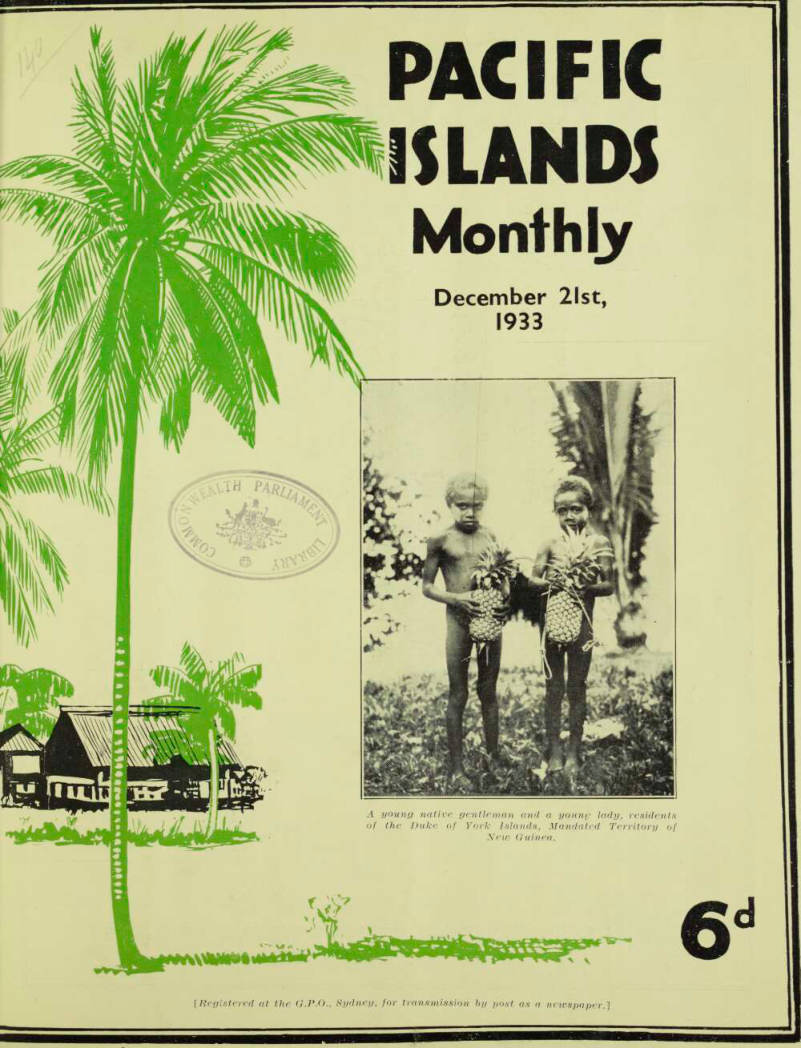
A young native gentleman and a young lady, residents of the Duke of York Islands, Mandated Territory of New Guinea.
Advertisements & other items, p. 2 (1 item)
W. R. Carpenter & Co. Ltd.
Head Office:
19-21 O’CONNELL STREET - - SYDNEY
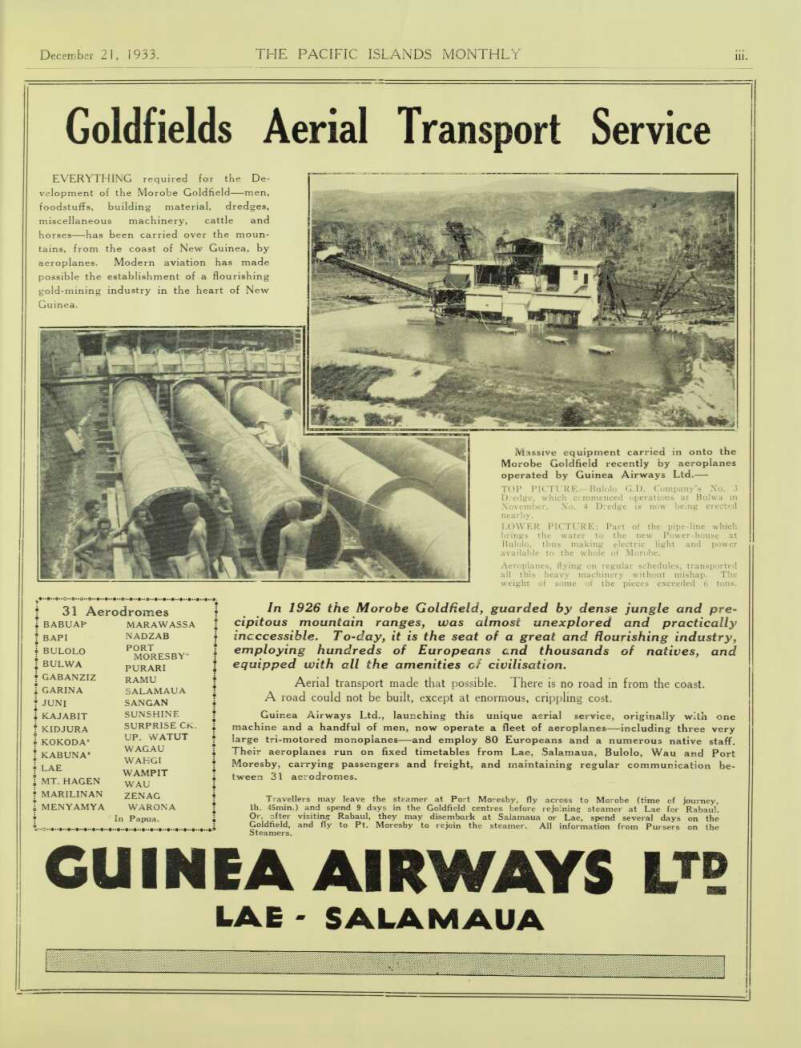
Branches at: RABAUL (New Britain), KAVIENG (New Ireland). MADANG (New Guinea), SALAMAUA, WAU (New Guinea), TULAGI (Solomon Islands), and other Pacific Islands; and in LONDON.
Agents for Australian, European and American Manufacturers, and Distributors of Every Description of Merchandise. Complete Range of all stocks carried.
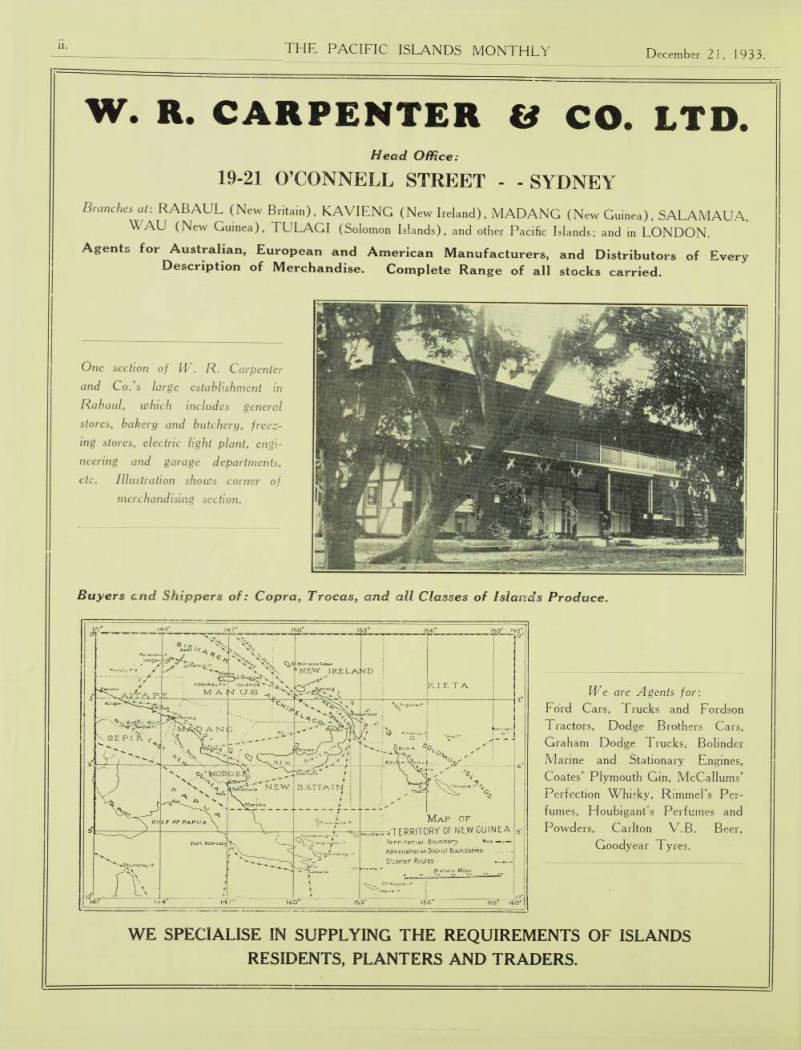
One section of W. R. Carpenter and Co.'s large establishment in Rahaul, which includes general stores, bakery and butchery, freezing stores, electric light plant, engineering and garage departments, etc. Illustration shows corner of merchandising section.
Buyers end Shippers of: Copra, Trocas, and all Classes of Islands Produce.
We are Agents for: Ford Cars, Trucks and Fordson Tractors, Dodge Brothers Cars, Graham Dodge Trucks, Bolinder Marine and Stationary Engines, Coates’ Plymouth Gin, McCallums’
Perfection Whisky, Rimmel’s Perfumes, Houbigant’s Perfumes and Powders, Carlton V.B. Beer, Goodyear Tyres.
WE SPECIALISE IN SUPPLYING THE REQUIREMENTS OF ISLANDS
RESIDENTS, PLANTERS AND TRADERS.
Pacific Islands Travellers
Passengers Per “Macdhui” Which
Sailed From Sydney For Papua And
New Guinea On November 23:-Mr. And
Mrs. L. A. Lister, Mr. and Mrs. A. J. Peadon, Mr. and Mrs. L. C. Saunders, Mesdames B.
Heath, V. P. Hides, E. Drayson, B. B. Perriman, J. C. Kennedy, Rev. Mother M. Felix and Party, Misses D. Parkin, B. Pender, M. C. Cain, B.
Breier, Master D. Murray, Messrs. G. McLaren, Jnr., T. W. Smith, E. D. Robinson, S. H.
Yeomans, Father Teutonberg, Rev. Father P.
Caluccia, S. Reilly, B. C. Whitehead, W. Cash, L. Porteau, Shelton O’Reilly, C. McDonald, A.
Lamont, Eidler, L. P. Brennand, A. M. Shannon, J, Lennon, P. Deutcher, W. H. Taylour, A. Joiner, Rev. J. Naurer, Rev. G. Hofmann, R. Melrose, H. Wells, R. K. Grant, H. Balfour, L. W. Hockey, L. Spindler, A. Coleman, C. W. Kirke, N. H.
Izod, M. J. A. Pitt, J. V. Marshall, A. H. Koch, A. V. Wood, J. Bassett, R. Bott, B. Marshall, A. S. Boot, J. Ashwell, A. Robertson, P. Connolly, J. Poland, D. J. Lewis, Mr. and Mrs. P. H. Rash.
Passengers Per “Taiwan” Which
Sailed From Sydney For Rabaul, New
Guinea, On November 27:—Mr. R. Wolff,
Mr. J. Hoogerwerff, Mr. F. Pryke, Mrs. F.
Pryke, Mrs. L. S. Downs, Master Gilmore.
Passengers Per Montoro Which Ar
RIVED IN SYDNEY FROM PAPUA AND NEW GUINEA ON DECEMBER 6:—Mr. and Mrs. L.
Austin, Mr. C. B. Austin, Mrs. A. M. Allison, Mr. G. Aikinis, Miss C. Baker, Mr. and Mrs. J.
W. Burton, Mr. H. B. Brown, Mr. and Mrs. W.
H. Cox, Mrs. M. Blisten, Mr. and Mrs. B. Cheno with, Mr. R. F. Collins, Mr. B. W. Crookshanks, Mr. N. F. Davies, Mr. E. A. deLautour, Mr. W.
J. Duffy, Mr. S. W. Dye, Mr. B. W. Faithorn, Mr. T. Fairey, Mr. H. W. Forrester, Miss E.
Fitzgerald, Mr. W. E. Goff, Mr. E. E. Gibb, Mr.
R. G. Garrett, Mr. C. Gatenby, Mr. A. H. Gauld, Mrs. A. Herbert, Mr. E. W. Haynes, Mrs. Hardy and child, Mr. G. P. Hardy, Mr. A. J. Jowes, Mr. G. R. Johnson, Mr. J. L. Johnson, Mrs. L.
Kunson, Miss E. A. Knight, Miss M. E. Kiely, Miss D. Kroger, Mr. T. Kent, Mr. K. C. Geoffrey, Mrs. D. W. Lyons and child, Mr. H. O. C. Little child, Mr. S. G. Love, Misses W. and D.
Lofts, Mr. L. I. Linggood, Mrs. E. M. Laird, Mr, and Mrs. S. C. Morris and family, Miss C. E.
Martin, Mr. F. Mason, Mr. L. Maxwell, Mr. D. M.
Mitchell, Mr. G. Miller, Mr. J. Maher and two daughters, Miss L. Maguire, Mr. J. V. Mather, Miss S. M. F. McCarey, Mr. J. McDougall, Mr.
J. McLeod, Mrs. I. D. McLaughlan, Mr. E. F.
Phibbs, Mr. E. J. Peel, Mr. R. Rankin, Mr. and Mrs. J. C. Rundle and family, Mr. J. Read, Mr.
C. A. Rigby, Mr. and Mrs. G. A. Stewart and family, Mr. J. W. Moir Smith and child, Mr. J. H.
Smith, Mr. and Mrs. Saker, Mr. R. A. G. Saker, Mr. R. L. Smith, Mr. C. L. Struthers, Mr. A. E.
Sullivan, Mrs. Simpson and child, Miss E. Stan dish, Mrs. E. M. Turner, Master R. E. Tait, Miss P. A. Vale, Mr. and Mrs. A. D. Williams and family, Mr. and Mrs. R. Walshe, Mr. and Mrs.
W. H. Wright, Mr. T. H. P. Webb, Mr. H.
Waters, Mr. B. K. Woodman, Mr. P. Walther, Mrs. F. Wright, Mr. and Mrs. W. H. Whitby.
Passengers Per Mataram Which Ar
Rived In Sydney From Solomon
ISLANDS ON DECEMBER 5:—Mr. E. B. Salmond, Miss B. Holmes, Miss K. Fitzgerald, Mr. and Mrs. C. A. Mitchell, Mr. A. M. Turnbull, Miss N. Vaughan, Miss P. Hawley, Mr. and Mrs. J.
Woodroffe, Mr. and Mrs. D. Waugh, Mr. C. Fyfe, Mrs. E. Lillie, Mr. T. H. Newall, Miss A. C.
Campbell, Mr. J. Jones, Dr. H. I. Hogbin, Mr.
L. A. Walker, Mr. and Mrs. F. R. Isom, Miss I. C. Wench, Miss E. Piggot, Mr. D. L. Francis, Sister Mary Sylvia, Miss D. B. Read, Mrs. D.
Lotze, Mr. J. Sim, Mr. E. Roberts, Mr. and Mrs.
F. E. Johnson, Mrs. G. G. Hewitt, Mrs. E. M.
Ferris, Mr. W. J. Nuzum, Mr. and Mrs. R. E.
Ziegler, Mr. W. M. Maguire, Mr. A. F. J. White, Mr. V. Middleton.
Passengers Per Morinda Which
Sailed From Sydney For Lord Howe
And Norfolk Islands On Decem
BER 5;—Mr. and Mrs. L. Board, Mr. and Mrs. G. Henderson, Mr. and Mrs. H. S. Clissold, Mesdames W. Little, Coulter, S. J. Chant, J.
King, G. Saunderson G. Milne, F. N. Jeans, A.
Germaine, K. Parr, Macindoe, Misses M. Pinnev, H. Thompson, A. Archer, Clement, O. M. Chant, D. Redmond, D. Moston, J. Duncan, L. Jeans, M.
T. Turner, D. May, Dr. L. Parr, Messrs. L. W.
Chant A. G. White, T. J. Warr, A. J. Petford, E. W. Lawler.
Passengers Per Morinda Which Ar
Rived In Sydney From New Hebrides,
Norfolk And Lord Howe Islands On
DECEMBER 2:—Mr. H. Arnott, Miss M. Beggs, Miss A. B. Dilloway, Mr. J. Lukin, Mr. E. Gollan, Mrs. B. Hilder, Mr. and Mrs. R. N. Larney, Rev.
B. R. Nottage, Miss O. Roache, Mrs. E. G.
Seagoe, Mr. and Mrs. F. E. Wallace, Mrs. and Miss Nicol, Mrs. Suggate, Mrs. Feun, Mrs. W. M.
Andrews, Mr. W. M. Brown, Miss H. Christian, Mr. Everett, Miss H. L. C. Mackenzie, Mrs. E.
Martin and child, Miss Carmichael, Mr. and Mrs.
R. Millikin, Mr. W. Moy, Mrs. L. Sargood, Miss W. M. Smith, Miss H. Stephens, Mrs. E. J. Stopp and two children, Miss H. Andrews, Miss E. M.
Ball Miss M. Bennett, Mrs. A. Bolton, Mrs. and Miss Brodziak, Mr. F. Brown, Mr. J. Brown, Miss N. Broughton, Mr. and Mrs. A. J. Campbell, Mr. and Mrs. K. J. Chapman, Miss Clemones, Miss White, Mr. C. Collins, Mr. F. Conroy, Miss M.
Cox, Mr. J. H. Cragg, Miss Crawford, Mrs. A.
Crisp, Mr. A. Crisp, Miss C. Davis, Miss C.
Dunster, Miss M. Ellis, Miss J. Ewart, Miss T.
Farlow, Miss P. Fenerty, Miss E. Flynn, Miss I.
George, Miss I. Grainger, Miss I. Haul, Mrs. and Miss Hinks, Miss E. Innes, Miss K. Kirkland, Miss H. Lindfield, Mr. C. Marks, Mr. H. McGrath, Miss F. McLeod, Mr. J. Milne, Mrs. E. Molloy, Mr. F. J. Murray and child, Mr. C. O’Brien, Mr.
R. Paillas, Miss E. Potts, Messrs. W. Roberts and P. Callachor, Mr. H. Robin, Mr. A. Robinson, Mr.
E. P. Rowe, Mrs. E. P. Rowe, Miss A. Stanley, Miss D. Street, Misses D. and C. Todd, Mr. L. A.
Treglown, Miss E. F. Wallace, Miss W. Whitmore, Miss M. Williams, Mr. and Mrs. R. W. Wilson.
Passengers Per Nellore Which Ar
Rived In Sydney From Rabaul, New
GUINEA, ON NOVEMBER 22: Miss S. Crouch, Mr. J. Hope, Mr. W. Korn, Mrs. W. Korn, Mr.
R. Honey, Mr. G. Mirfield, Mr. G. McLaren Mrs. H. P. Saunders, Master Saunders, Mr. A. W.
Butcher, Mr. B. W. Storey, Dr. R. Cooper, Mrs.
R. Cooper and infant, Mr. P. Crouch.
Passengers Per Mariposa Which Ar
RIVED IN SYDNEY FROM SUVA, FIJI, ON DECEMBER 4; Mr. J. Dowling, Master D.
Dowling, Mrs. E. Edwards, Mr. L. A. Gibson, Mr. A. A. Hart, Mrs. A. A. Hart, Miss B. Hill, Miss M. Hunt, Mrs. H. Lanyon, Mr. R. Leleu, Mr. M. Minter, Mrs. M. Minter, Mrs. C. W.
Pinkerton, Miss F. Pinkerton, Mrs. W. J. Sul livan, Mr. W. J. Sullivan, Brother Alphonsus, Mrs. E. Brownell-Montgomery, Mr. C. A. Cameron, Mrs. C. A. Cameron, Mrs. C. M. Church ward, Misses Marjorie, K., and C. Church ward, Master M. Churchward, Master S. Church ward, Capt. G. V. Donovan, Mr. G. P. Dono van, Master P. Donovan, Master Bob Donovan, Mr. R. J. Douglas, Miss M. Goodman, Mrs. E.
T. Hart, Mr. P. F. Hockings, Mr. F. J. Horner, Mrs. F. J. Horner, Miss O. Horner, Miss M. J.
Lade, Miss A. N. Lade, Rev. F. W. H. Laity, Mrs. F. W. Laity, Miss M. J. Laity, Mr. E.
McGowan, Rev. F. L. Nunn, Mrs. F. L. Nunn,
Master F. Nunn, Mr. G. P. Pinkerton, Mrs. M.
Reynolds, Miss M. Reynolds, Mr. G. Ross, Mrs.
G. Ross, Miss F. Ross, Master R. Ross, Miss O. Russell, Mrs. A. J. Rutledge, Master D. Rut ledge, Mrs. V. Tarte, Miss D. Tarte, Miss J.
Tarte, Mrs. M. Weatherby, Miss M. Weatherby, Master S. Weatherby, Mr. Yuen Chung Fat.
Passengers Per Niagara Which Sail
ED FROM SYDNEY FOR SUVA, FIJI, ON DECEMBER 7: Mr. C. Gibson, Mrs. C. Gibson, Mr. K. Cameron, Mrs. K. Cameron, Mr. W. Lin ton, Mrs. W. Linton, Mr. C. R. Corlis, Master E.
Nicholls, Master R. W. L. Trewinack, Master B.
W. Young, Miss B. Fenner, Mr. A. McMullen, Mrs. T. Curry, Colonel B. Cameron, Mr, S.
Nixon, Mr. B. Christophers, Mr. J. J. M. Clark, Master M. de C. Howell, Mr. J. H. Harricks, Mr.
L. McLennan, Miss J. F. Grahame, Miss H. F.
Grahame, Mr. W. G. Robinson, Mrs. W. Robinson, Mr. R. G. Dunn, Mr. H. Craigie, Sister Yvonne Mangard, Sister E. T. Kelly, Sister B. McCann, Mr. B. T. Griffiths, Mrs. B. T. Griffiths.
Passengers Per Morinda Which Ar
Rived In Sydney From Norfolk Island
And Lord Howe Island On December
13: Mrs. K. Aboud, Miss E. Boydell, Miss M.
Geddes, Mr. and Mrs. J. D. Jones, Mrs. H. L.
Kelly, Miss F. Leamon, Mrs. E. A. McCoy, Mr.
C. S. Nichols, Mrs. G. Rankin, Master J. Rossi ter, Mr. and Mrs. M. Swan, Mr. C. Thompson, Mr. J. Gordon, Mr. P. Bailey, Mr. H. V. Dangar, Mrs. J. E. Evans, Mrs. N. Fenton, Mr. and Mrs.
N. Frew, Mr. and Mrs. A. E. Lee, Mrs. W.
Little, Miss H. Moore, Mrs. Murray and child, Dr. L. Parr, Mr. G. K. Redmond, Mr. W. Taylor, Mr. T. E. Taylor, Mr. T. Warr, Mr. and Mrs.
C. W. Wedgwood, Mrs. H. West.
Passengers Per Montoro Which
Sailed From Sydney For Papua And
NEW GUINEA ON DECEMBER 13: Master D.
M. Anderson, Mr. A. J. Bretag, Rev. Father W.
Barrow, Messrs. J. W. Barker, A. Briggs, R.
Burn, C. J. Burch, Masters Brigg and D. Coote, Messrs. F. A. Clarke, Chapman, G. Christie, Dugan, T. Flower, Capt. A. S. Fitch, Messrs. E.
Finn, W. H. Fleming, Masters W., J., E. and D.
Frame, R. Gore, E. Giblin, D. Giblin, Healy, Dr.
E. A. Holland, Messrs. Heseltine, F. Hambridge, Master R. Henderson, Messrs. Jones, D. Joycey, Jamieson, Koenke, A. C. Meldrum, C. L. May field, Dr. A. May, Master D. McDonald, G. A.
Marshall, Masters C. and D. Maclean, Mr.
Mitchell, Master I. Macdonald, Messrs. Maher, J. Mathieson, L. Norris, Nibloe, W. J. Pattison, C. H. Penrose, W. M. Provan, J. C. Renfrew, G.
Russell, Ryan, Master C. Sefton, Messrs. P. E.
Sutcliffe, W. Spence, J. Shaw, Simmonds, Thom son, J. R. J. Tull, Master D. Washington, G. K.
Whittaker, Capt. C. J. R. Webb, Messrs. R. P.
Whale, Winter; Mesdames A. M. Allan, Bannon, Bell, Dugan, Flower, Holland, Heseltine, H. Hun ter, Melrose and child, Marshall, Miller, J. Parer, W. M. Provan, Spence, Spence, Upson and infant, E. C. Villiers and two children, Whittaker and infant; Misses M. Archer, E. Bock, G. Brewster, E. Byrne, Cann, Duchatel, Fitzgerald, Fogarty, E. Gofton, P. Holland, J. Holland, I. Kroening, M. Matthews, B. Mitchell, B. J. Mead, Maher, Maher, E. Potter, Rundnagel, N. Sefton, Wilson, J. F. Watt.
Advertisements & other items, p. 3 (1 item)
Freight and Passenger Service
REGULAR
BI-MONTHLY
by the fast and modern K.P.M. Steamer VAN REES as under:
SAIGON
BATAVIA
SAMARANG
PORT MORESBY
SAMARAI
RABAUL
PORT VILA
Saloon & Intermediate class passengers carried in comfortable and airy cabins.
Cargo for Africa accepted for transhipment at Batavia.
NOUMEA
ROYAL PACKET SYDNEY
NAVIGATION CO.
255 GEORGE STREET, SYDNEY. SAIGON
The B.N.G. Trading Coy., Ltd., Port Moresby; Steamship Trading Co., Samarai; W. R.
Carpenter & Co., Ltd., Rabaul; Gubbay Freres, Port Vila; Carlo Leoni, Noumea; Diethelm & Co., Saigon.
Advertisers
Page Adams, W. & Co. .. 21 Amal. Wireless ... 41 Antinea Drug Co. . 34 Arnott’s Biscuits .. 35 Bank of N.S.W. . 20 Barraclough, H. A. 21 Bergers Paints ... 37 Broomfields, Ltd. .. 28 Bruce, Robert , 26,42 Brunton’s Flour .. 30 Burns, Philp & Co. 2 Burns, Philp (S.S.) Co 19 B.P. Magazine ... 32 Buzacott, Ltd 15 Carpenter, W. R.
Cover ii Central Q’land Meai Co 13 Chartres, Stott 8 Hoare 24 Dangar, Gedye, Ltd. 39 Delicia Food Co. .. IS Dowsett, J. H. M. 38 Excelsior Supply Co. 18 Exito Co 34 Fletcher & Sons .. 36 Ford, W. M 40 Flynn, Mrs. VV. . 37 Garrett & Davidson 32 Gillespie’s Flour .. 24 Goshen Pt. Hospital 43 Grahame, C 33 Gregory, A 14 Guinea Airways Cover iii Halvorsen, L 45 Hardie, Jas. & Co. 9 Harper, M 45
Holbrooks, Ltd. .. 30
Page Holden’s Air Trans port 48 Holmes, W 22
I.C.I.A.N.Z., Ltd. . 14
Joyce Biscuits 19 Kopsen & Co 26 Lane & Girvan ... 40 Leddicott School . 21 Lessey’s D.Y.S. ... 8 McIlrath’s, Ltd. .. 27 McIntyre 44 Metro. Bus. College 38
N.D.L 47
Nelson & Robertson 29,40 New Brit. Express 25 Newington College . 31 Noyes Bros 16 Pacific Is. Ass’n. . 22 Paton, Burns 15 Prescott, Ltd 10 Rabaul Carr’g. Co.. 32 Rohu, Sil 33 Royal Packet N. Co. 1 Russell, S 14 Springwood College. 8 Steamships T. Co., Ltd 46 Sullivan, C 23 Swallow and Ariell.
Ltd 17 Talty, T. S 42 Taubman’s Paints . 25 Thomas, G., & Co. 44 Tillock & Co., Ltd. 43 Tooth & Co iv Vacuum Oil Co. ... 28 Wallaringa Mansions 45 Wills, W. D. & H. O. 36 Wunderlich, Ltd. 16,38
Contents
Page Pacific Islands Travellers 1 Samoan Mau Suppressed 3,4 “Intrigue” in New Ireland 5 The Double Event 6 Samoan Administration and Mau ... 7 Copra Market 9 Sir Hubert Murray 10 Discoveries in N. Guinea 11-15 Bulolo Co.’s Annual Report 16 Nicolas Minister of Papua 17-19 B.S.I. Council Meeting 20,21 Training N.G. Natives 22 Romance of Bulolo Figures 23,24 New Guinea News 24 Solomon Is. Steamer Service 25 Tahiti Leper Colony 26
Page Germany in Samoa 27,29 French Copra Tax 30 Mr. Nelson and Mr. Greene 31 Norfolk Is. Notes 33 Indian Agitators in Fiji 34 Fashions for Islands Women 35 Book Reviews 36 Land-Holding Anomalies in N.G. .. 37,38 Relief for N.G. Planters 41 Future of Fiji 42 New B.S.I. Tariff 43 N.G. and Papuan Gold Sharemarket . 44 Market Quotations 45 Exchange Rates 46 Shipping Services in the Pacific .. 47,48
Advertisements & other items, p. 4 (1 item)
Burns, Philp & Co. Ltd.
NOW ON SALE
HANDBOOK OF NEW GUINEA, PAPUA, SOLOMON ISLANDS & NORFOLK ISLAND, containing Complete Details and Latest Statistical Information about those Territories, and also Lists of Business Firms and European Residents, Maps, etc.
PRICE 2/9, from any of the Islands Stores, or from
PACIFIC PUBLICATIONS LTD.
UNION HOUSE, 247 GEORGE ST.
SYDNEY AUSTRALIA
BURNS, PHILP & CO. LTD.
Head Office - 7 Bridge Street, Sydney - Australia Code Address: “BURPHIL”
General Merchants,
Shipowners,
Tourist Agents, Etc.
Buyers of all Classes
of Island Produce
Regular Steamer Services From Australia to New Guinea, Papua, Solomons, Lord Howe, Norfolk Islands, New Hebrides, Java and Singapore
The Pacific Islands Monthly
The Newspaper-Magazine Of The South Seas
[Registered at G.P.O., Sydney, for transmission by post as a newspaper.]
Published Once Each Month and Circulated in Australia and New Zealand and in the following Pacific Territories and Islands Groups:
Crown Colony of Fiji.
Australian Territory of Papua.
Mandated Territory (Australia) of New Guinea, Bismarck Archipelago, and Northern Solomon Islands.
Mandated Territory (Japan) of Marshall, Caroline and Mariana Islands.
American Territory of Guam.
Mandated Territory of Nauru.
British Crown Colony of Gilbert and Ellice Islands.
French Territory of New Caledonia.
British and French Condominium of New Hebrides.
American Territory of Eastern Samoa.
Mandated Territory (New Zealand) of Samoa.
British Solomon Islands Protectorate.
British Protectorate of Tongan Islands.
New Zealand Territory of Cook Islands.
Australian Territory of Norfolk Island.
French Colony of Oceania (Tahiti, etc.).
American Territory of Hawaiian Islands.
Owned and Produced by Pacific Publications, Ltd., Union House, 247 George Street, Sydney.
Telephone Bw 5037
P.O. Box 3408 R
Contributions Articles, Stories, and Photographs dealing with Pacific Islands Subjects are invited, and will be paid for on publication at usual rates.
Subscription Rates
Per Annum, within British Empire, Prepaid Post Free 6/- Per Annum, elsewhere, prepaid, Post Free .. 87- Single Copies 6d.
Editor and Publisher:
R. W. Robson.
Advertisements Advertising rates furnished on application.
Colours, etc. by Arrangement.
Process Blocks made at Advertiser’s expense when required. Screen, 100.
Changes of Advertising Copy should reach this Office by 8th of each month, otherwise previous advertisement may be repeated.
Registered Address for Radiograms and Cables: “PACPUB” Sydney Agents The following are authorised to receive subscrip tions for “The Pacific Islands Monthly”— Islands Branches of Burns, Philp & Co., Ltd., and Burns, Philp (South Seas) Co., Ltd.
Islands Branches of W. R. Carpenter & Co., Ltd.
All Branches of Morris, Hedstrom & Co., Ltd.
J. H. MacGregor Dowsett, Rabaul.
Whitten Bros., Ltd., Port Moresby and Samarai.
P. Costello, Suva, Fiji.
All Branches and Representatives of W. H. Grove and Sons, Ltd., Auckland.
S. Russell, Papeete, Tahiti.
Cook Islands Trading Co., Rarotonga.
Mrs. M. Campbell, Cascades, Norfolk Island.
Vol. V. No. 5.
Sydney, December 21, 1933.
Price 6d. Per Copy. Prepaid: 6/- p.a.
Suppression Of Samoan Mau
DURING the past few weeks another chapter has been added to the chequered history of Western Samoa. The heavy hand of the Administration—which is the New Zealand Government acting under mandatory authority from the League of Nations—has fallen upon the Mau; and, on present appearances, finis has been written to that nationalistic or ganisation of Samoan natives, which came into being seven years ago.
Mr. O. F. Nelson and a number of leading native chiefs of the Mau organisa tion (the fragmentary news radiograms do not indicate the exact number) have been arrested on charges of sedition, &c., and a number have been convicted and sen tenced to punishment which, in some cases, is imprisonment.
The move against the Mau and the Mau leaders has not been attended by disorder or even by any serious excitation of public opinion. That is very signifi cant. A year ago, such a development unquestionably would have been resisted
by force, and publicists outside of Samoa and New Zealand would have been mostly, and aggressively, against the Ad ministration. But much has happened during the last twelve months to swing the sympathies of well-informed people in support of the Administration and against the Mau.
In the period between 1923 and 1930, the Administrators placed in Samoa by the New Zealand Government created a very unfortunate and undesirable condi tion of affairs. They supplied the spirited Samoa people with innumerable causes for dissatisfaction, and passive resistance of authority; and the New Zealand authorities retaliated in swashbuckling fashion by attempting to crush the angry and vociferous natives, and by summarily removing their leaders from the Territory.
Mr. O. F. Nelson, the acknowledged leader of the Mau—the talented son of a Scandinavian officer and a Samoan chief tainess—was banished for five years. He spent most of that period in Auckland,
directing a ceaseless, bitter propaganda against the N.Z. Administration in Samoa. The savagery that informed his campaign alienated the sympathy of many people; but the genuine grievances of the Samoan people were recognised by lovers of liberty all over the world, and Mr.
Nelson, in consequence, received a remark able amount of support and encourage ment.
In 1930, there seemed to be a change of heart in Wellington regarding Samoan affairs; and the N.Z. Government sent to Apia, in the person of Brigadier-General
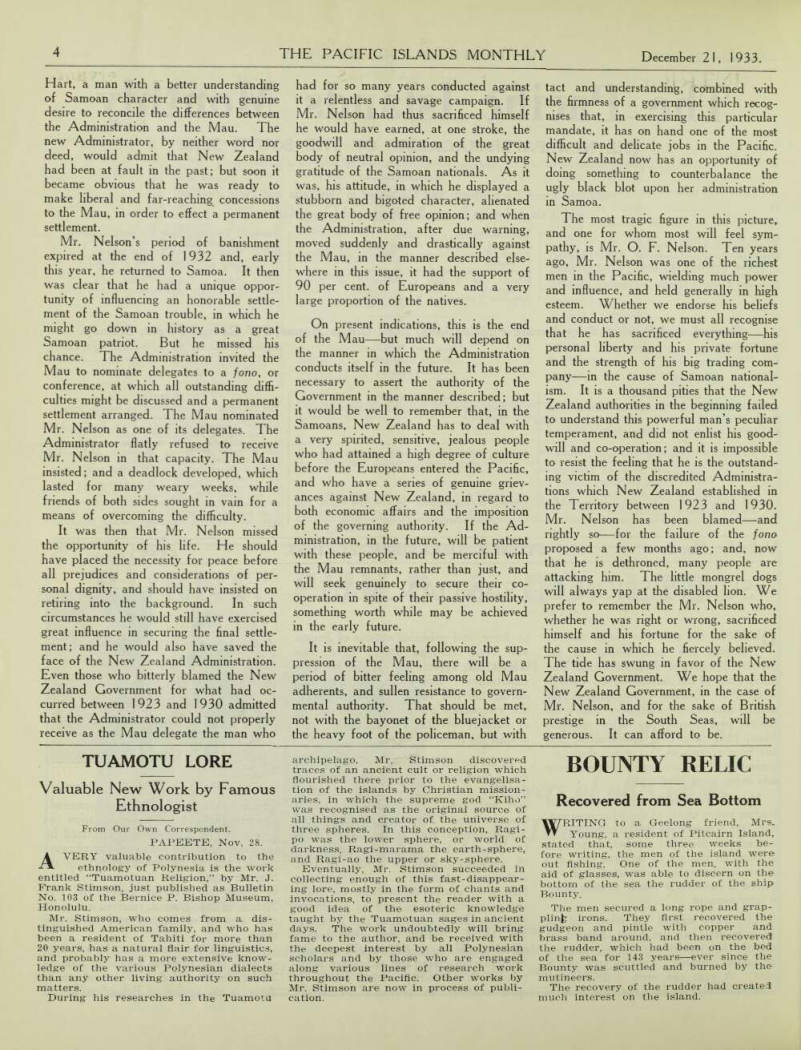
Mr. O. F. Nelson.
General Hart.
Hart, a man with a better understanding of Samoan character and with genuine desire to reconcile the differences between the Administration and the Mau. The new Administrator, by neither word nor deed, would admit that New Zealand had been at fault in the past; but soon it became obvious that he was ready to make liberal and far-reaching concessions to the Mau, in order to effect a permanent settlement.
Mr. Nelson’s period of banishment expired at the end of 1932 and, early this year, he returned to Samoa. It then was clear that he had a unique oppor tunity of influencing an honorable settle ment of the Samoan trouble, in which he might go down in history as a great Samoan patriot. But he missed his chance. The Administration invited the Mau to nominate delegates to a fono, or conference, at which all outstanding diffi culties might be discussed and a permanent settlement arranged. The Mau nominated Mr, Nelson as one of its delegates. The Administrator flatly refused to receive Mr. Nelson in that capacity. The Mau insisted; and a deadlock developed, which lasted for many weary weeks, while friends of both sides sought in vain for a means of overcoming the difficulty.
It was then that Mr. Nelson missed the opportunity of his life. He should have placed the necessity for peace before all prejudices and considerations of per sonal dignity, and should have insisted on retiring into the background. In such circumstances he would still have exercised great influence in securing the final settle ment; and he would also have saved the face of the New Zealand Administration.
Even those who bitterly blamed the New Zealand Government for what had oc curred between 1923 and 1930 admitted that the Administrator could not properly receive as the Mau delegate the man who
had for so many years conducted against it a relentless and savage campaign. If Mr. Nelson had thus sacrificed himself he would have earned, at one stroke, the goodwill and admiration of the great body of neutral opinion, and the undying gratitude of the Samoan nationals. As it was, his attitude, in which he displayed a stubborn and bigoted character, alienated the great body of free opinion; and when the Administration, after due warning, moved suddenly and drastically against the Mau, in the manner described else where in this issue, it had the support of 90 per cent, of Europeans and a very large proportion of the natives.
On present indications, this is the end of the Mau—but much will depend on the manner in which the Administration conducts itself in the future. It has been necessary to assert the authority of the Government in the manner described; but it would be well to remember that, in the Samoans, New Zealand has to deal with a very spirited, sensitive, jealous people who had attained a high degree of culture before the Europeans entered the Pacific, and who have a series of genuine griev ances against New Zealand, in regard to both economic affairs and the imposition of the governing authority. If the Ad ministration, in the future, will be patient with these people, and be merciful with the Mau remnants, rather than just, and will seek genuinely to secure their co operation in spite of their passive hostility, something worth while may be achieved in the early future.
It is inevitable that, following the sup pression of the Mau, there will be a period of bitter feeling among old Mau adherents, and sullen resistance to govern mental authority. That should be met, not with the bayonet of the bluejacket or the heavy foot of the policeman, but with
tact and understanding, combined with the firmness of a government which recog nises that, in exercising this particular mandate, it has on hand one of the most difficult and delicate jobs in the Pacific.
New Zealand now has an opportunity of doing something to counterbalance the ugly black blot upon her administration in Samoa.
The most tragic figure in this picture, and one for whom most will feel sym pathy, is Mr. O. F. Nelson. Ten years ago, Mr. Nelson was one of the richest men in the Pacific, wielding much power and influence, and held generally in high esteem. Whether we endorse his beliefs and conduct or not, we must all recognise that he has sacrificed everything—his personal liberty and his private fortune and the strength of his big trading com pany—in the cause of Samoan national ism. It is a thousand pities that the New Zealand authorities in the beginning failed to understand this powerful man’s peculiar temperament, and did not enlist his good will and co-operation; and it is impossible to resist the feeling that he is the outstand ing victim of the discredited Administra tions which New Zealand established in the Territory between 1923 and 1930.
Mr. Nelson has been blamed—and rightly so—for the failure of the fono proposed a few months ago; and, now that he is dethroned, many people are attacking him. The little mongrel dogs will always yap at the disabled lion. We prefer to remember the Mr. Nelson who, whether he was right or wrong, sacrificed himself and his fortune for the sake of the cause in which he fiercely believed.
The tide has swung in favor of the New Zealand Government. We hope that the New Zealand Government, in the case of Mr. Nelson, and for the sake of British prestige in the South Seas, will be generous. It can afford to be.
Ethnologist
Tuamotu Lore
Valuable New Work by Famous Ethnologist
From Our Own Correspondent.
Papeete, Nov. 28.
AVERY valuable contribution to the ethnology of Polynesia is the work entitled “Tuamotuan Religion,” by Mr. J.
Frank Stimson, just published as Bulletin No. 103 of the Bernice P. Bishop Museum, Honolulu.
Mr. Stimson, who comes from a dis tinguished American family, and who has been a resident of Tahiti for more than 20 years, has a natural flair for linguistics, and probably has a more extensive know ledge of the various Polynesian dialects than any other living authority on such matters.
During his researches in the Tuamotu
archipelago, Mr. Stimson discovered traces of an ancient cult or religion which flourished there prior to the evangelisa tion of the islands by Christian mission aries, in which the supreme god “Kiho” was recognised as the original source of all things and creator of the universe of three spheres. In this conception, Ragi po was the lower sphere, or world of darkness, Ragi-marama the earth-sphere, and Ragi-ao the upper or sky-sphere.
Eventually, Mr. Stimson succeeded in collecting enough of this fast-disappear ing lore, mostly in the form of chants and invocations, to present the reader with a good idea of the esoteric knowledge taught by the Tuamotuan sages in ancient days. The work undoubtedly will bring fame to the author, and be received with the deepest interest by all Polynesian scholars and by those who are engaged along various lines of research work throughout the Pacific. Other works by Mr. Stimson are now in process of publi cation.
Bounty Relic
Recovered from Sea Bottom
WRITING to a Geelong friend, Mrs.
Young, a resident of Pitcairn Island, stated that, some three weeks be fore writing, the men of the island were out fishing. One of the men, with the aid of glasses, was able to discern on the bottom of the sea the rudder of the ship Bounty.
The men secured a long rope and grap pling irons. They first recovered the gudgeon and pintle with copper and brass band around, and then recovered the rudder, which had been on the bed of the sea for 143 years—ever since the Bounty was scuttled and burned by the mutineers.
The recovery of the rudder had created much interest on the island.
"Intrigue” In
New Ireland
Ridiculous Story In London Newspaper.
ONE of the queerest things about over seas newspapers is their apparent inability to torite soberly and truthfully about the Pacific Islands. Whether it is the result of the romantic atmosphere with which the South Seas have always been invested, or whether it is simply flat footed sensation-mongering, the fact re mains that scarcely a month passes without some London or American news paper publishing amazing and ridiculous stories about the South Seas, WE had occasion in the October issue to deal with a modern Munchausen— a Canadian journalist who had painted such extraordinary pictures of conditions in Papua and New Guinea that he aroused the ire of the Australian Parliament, Now we have another of the same kind.
Here is a story which appeared in the London “Sunday Dispatch,” and which was cabled to the Sydney “Daily Tele graph” and published in that newspaper on December 4: “The ‘Sunday Dispatch’ publishes a yarn that Mr. J. H. Thomas is faced, as Secretary of the Dominion, with another Irish trouble, he having to give close at tention to a serious situation in New Ire land—one of the islands of the New Guinea group.
“Self-government is being demanded, it is stated, and organised violence is threatened if it is not conceded, with the result that the Australian authorities are seeking British advice.
“The Dispatch refers to fears of a rising of natives, many of whom are cannibal istic, causing the whites to demand firm action to remove the danger of massacre.
“An ex-planter, who has lived long in New Ireland, told the ‘Dispatch’ that the trouble is due to weak local administra tion. Natives, he said, assaulted whites, and received ridiculously inadequate sen tences. The authorities must, it is con tended, act swiftly and drastically, especially in view of the natives’ gift for pol itical intrigue.”
The Sydney “Daily Telegraph” was wise enough to refer the thing to Major C. W.
C. Marr, who dismissed it with the curt remark “All moonshine.”
The report is not worthy of further comment. We reprint it in its entirety so that residents of the South Seas may have the benefit of a good laugh. We particu larly commend to them the bit about “pol itical intrigue.”
We suppose this sort of thing will go on so long as yellow journalists are per mitted to strut the earth, without their very necessary coating of tar and fea thers.
New Guinea Ships
Cautious replies by Ministers to a series of questions fired in by Senator Dunn about shipping, etc., indicate that the Federal Government now has under con sideration the whole subject of British versus foreign shipping in New Guinea and Papua.
An Unprofitable Shipment
Fijian Bananas
COMMENTING on a shipment of ap proximately 1000 cases of Fijian ban anas, which reached Sydney on 30th Nov ember, a prominent banana merchant said that the consignment consisted largely of over-ripe fruit. A loss would be experienced by the growers, except on those lines which arrived green. It had cost 25/- a case to land the fruit here, but the over-ripe bananas were realising only 18/-. The Fijian shipment was not competing in any serious way with Australian-grown bananas.
Papuan Public Servants
Benefit
From Our Own Correspondent.
Port Moresby, Nov. 24.
AN announcement has been made by the Administration that the ten per cent, deduction from Public Service salaries has been restored, as a result of the res toration of the £6000, formerly deducted by the Commonwealth Government from its annual grant to Papua. Owing to the depression, the Papuan subsidy was re duced to £34,000, but it has now been restored to £40,000.
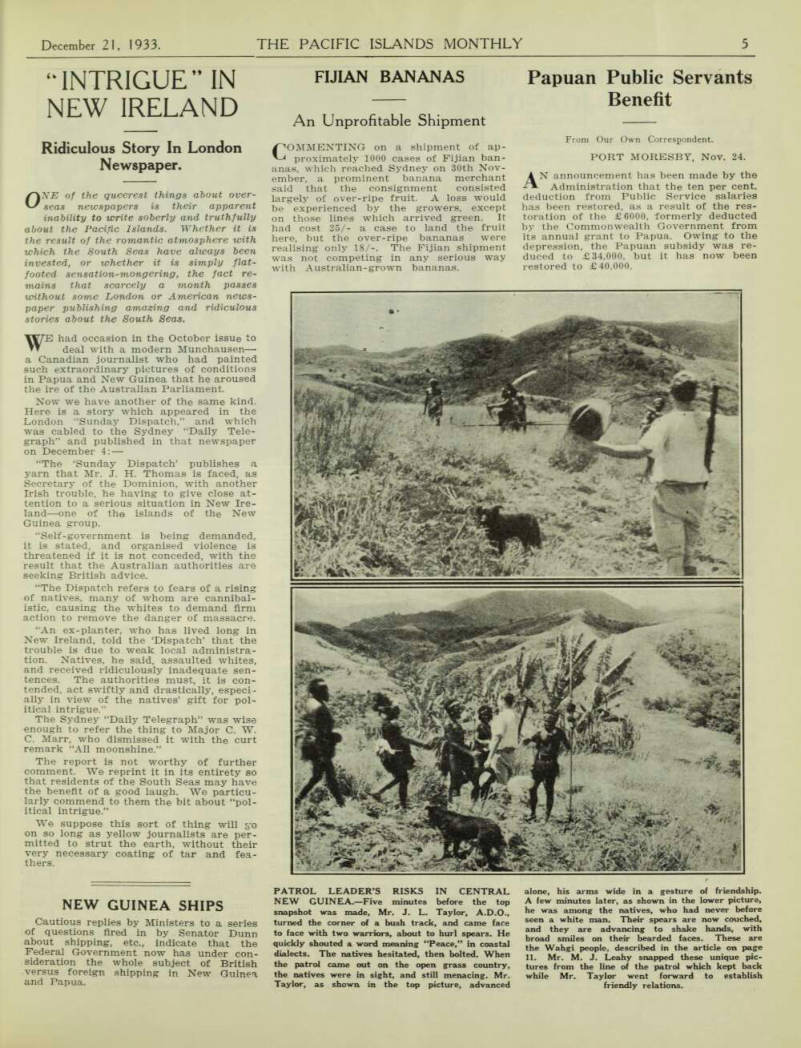
Patrol Leader’S Risks In Central
NEW GUINEA.—Five minutes before the top snapshot was made, Mr. J. L. Taylor, A.D.O., turned the corner of a bush track, and came face to face with two warriors, about to hurl spears. He quickly shouted a word meaning “Peace,” in coastal dialects. The natives hesitated, then bolted. When the patrol came out on the open grass country, the natives were in sight, and still menacing. Mr.
Taylor, as shown in the top picture, advanced
alone, his arms wide in a gesture of friendship.
A few minutes later, as shown in the lower picture, he was among the natives, who had never before seen a white man. Their spears are now couched, and they are advancing to shake hands, with broad smiles on their bearded faces. These are the Wahgi people, described in the article on page 11. Mr. M. J. Leahy snapped these unique pic tures from the line of the patrol which kept back while Mr. Taylor went forward to establish friendly relations.
The Double Event
By Rev. Harold Short
LEPEI loved himself; then the graceful brown girl, Geno; then his new canoe, carved dangerously thin, and his dog.
The craft could not respond, Geno would not, and when his dog did, by jump ing on the upturned bottom of the boat, Lepei lifted up his voice and whooped.
The dog fled. Life lacked resilience for Lepei.
He blatantly challenged everything of similar sail area afloat to race his canoe.
Only Raula responded to that, and adzed his dug-out to the marrow.
Raula was another devotee whose wor ship got little more notice from Geno than came from wooden gods. However, when he told her of the contest she thrill ed him and shocked the rest by announc ing that she would marry the winner.
One could not believe that the idea emanated from sporting instinct in a Papuan; it probably came from a maga zine story interpreted by a Mission teacher.
Yarns about taking down white men gave pride of place in the village to dis cussion of the race and its prize. Bets were made in arm-shells, ramis, pigs and wives.
On the night before the contest argu ments languished later than usual. The beach fires died down before the people sauntered to their huts over the sea.
The last two to rise moved off well behind the others.
“Sedira,” said one, the fattest man of the village, “why do people want to go fast? There is plenty of time to get any where.”
“Yes,” said his pal, a small thin man with bandy legs; “I don’t like to see people running. It is better to rest. Let us sit here.”
He sat on an upturned canoe covered with coconut fronds. The fat man re clined beside him and, simultaneously, there was a quick crack of timber.
The thin man pushed back the dying palms to get a more even seat, and then realised that they were sitting on Lepei’s racing canoe!
“You broke it,” he said simply to his fat friend, “but I won’t say anything.
Now we can have a good sleep; we won’t have to get up early to see the race.”
The two lurched away in the gloom. * * * Lepei rose before the sun and went to launch his canoe. He saw the scattered branches: then an eastern gleam revealed the crack. As Lepei glared the canoe moved! It turned oyer and a pig, Raula’s pet, arose grunting from the furrowed sand.
In a few seconds Lepei was paddling another canoe toward Raula’s marine residence. Everyone there was asleep— until Lepei entered. Raula was not. Ex cited voices opined that he had run into the grass with someone.
Lepei slid down the steps and paddled to the hut of Geno. She was absent. No one knew where she was. Lepei shouted that he did, as he furiously sculled to the beach.
He saw Raula’s canoe, keel up, and made a running jump. His feet went through its bottom and his head hit the sand. Raula was revealed with the stare of the rudely awakened, as the wreck heeled over.
Incredibly quickly, he was on top of the tangled Lepei and strange wild words mingled with shouts from over the sea.
Canoes sped beachwards and before Le pei’s feet were free a jabbering circle en couraged the wrestlers.
When the village constable arrived — buckling his official belt above his big bare stomach—bloody brown noses, gog gling eyes, wide shouting mouths, and waving arms surrounded him. Shrieked recriminations and denials flashed and clashed until the social structure of Keru hula village seemed destroyed beyond re pair.
From the heart of the hubbub two bandy legs balanced on Raula’s boat; dramati cally uplifted arms and a squeaky voice surprised the crowd into silence.
Raula’s garden canoe, containing a very fat man, was coming ashore. The occu pant, seeing the platform manner of the bandy man, assumed —possibly wrongly— that his pal was going to give evidence against him.
The fat man stood in the canoe and broke the sudden stillness by shouting: “He’s a liar! He sat down first and cracked it!”
That sentence seemed to reveal all — just as a ripe breadfruit shot from a tree and hit Lepei on the head. He turned so angrily toward Bandy that the bow legs swung round and began to whirl at a splendid speed along the eastern beach.
Lepei started in pursuit.
The fat man thought that the move ment was toward him, and smashed the outrigger in a wild jump ashore. He dis entangled himself and began a rolling but rapid run westward. Raula, eager for anyone’s gore, rushed after him.
An ancient enthusiasm reclaimed a people bored by canoe races, and modern prohibition of man-hunts.
Hundreds of eyes pivoted rapidly right and left to miss none of this glorious
double event. The quaint style of two contestants was forgotten in the tragic in tensity of the four. The beach stretched far, but soon the runners were out of sight.
Partisans were dividing to follow their particular fancies when a new excitement descended.
From among Passiflora drapings on a breadfruit tree slid a laughing girl and a slim youth. Both had grass-seeds in their hair.
One was Geno, the fictitious prize of the abandoned aquatic race and the real starter of the two land handicaps, I always thought she intended to marry that slim chap, although Papuans their amours so thoroughly; but I had hoped that she was one of the few Papuans learning to play the game When the four bruised runners tottered home they expressed, differently but very emphatically, the same disappointment in Geno. Their common standard for the conduct of women drew them into a fel lowship as deep as their animosity to Geno and her slim spouse, both of which continue even until now.
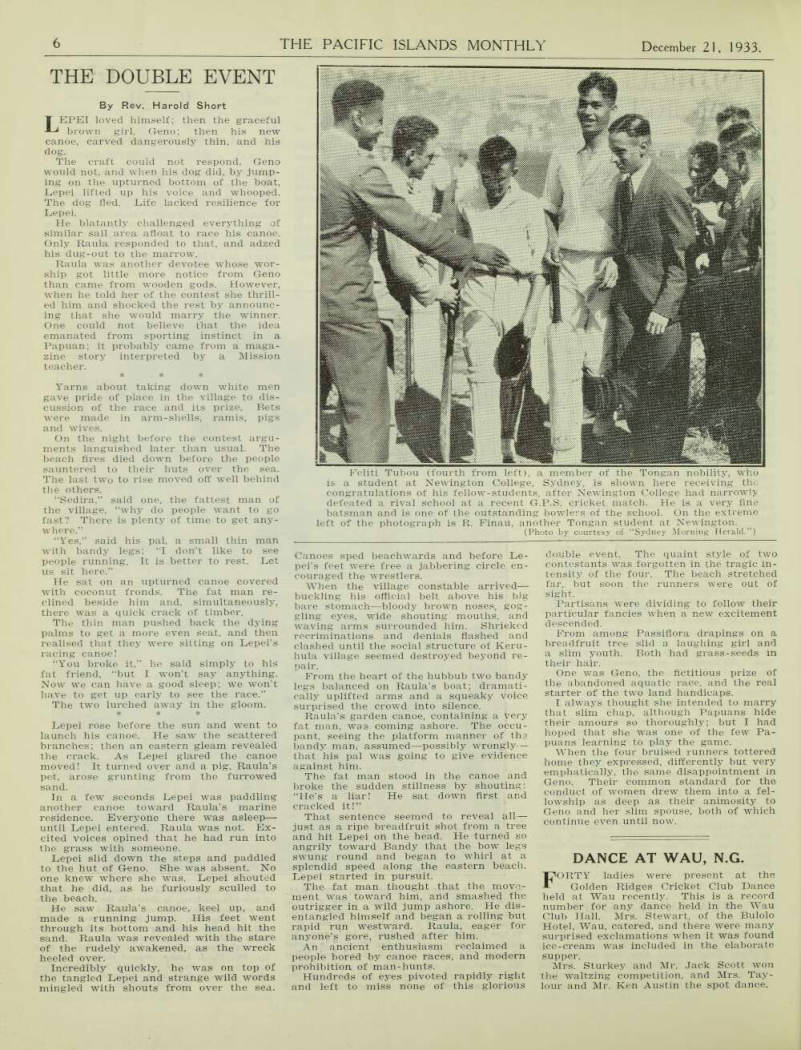
Feliti Tubou (fourth from left), a member of the Tongan nobility, who is a student at Newington College, Sydney, is shown here receiving the congratulations of his fellow-students, after Newington College had narrowly defeated a rival school at a recent G.P.S. cricket match. He is a very fine batsman and is one of the outstanding bowlers of the school. On the extreme left of the photograph is R. Finau, another Tongan student at Newington. (Photo by courtesy of “Sydney Morning Herald.”)
Dance At Wau, N.G.
Forty ladies were present at the Golden Ridges Cricket Club Dance held at Wau recently. This is a record number for any dance held in the Wau Club Hall. Mrs. Stewart, of the Bulolo Hotel, Wau, catered, and there were many surprised exclamations when it was found ice-cream was included in the elaborate supper.
Mrs. Sturkey and Mr. Jack Scott won the waltzing competition, and Mrs. Tay lour and Mr. Ken Austin the spot dance.
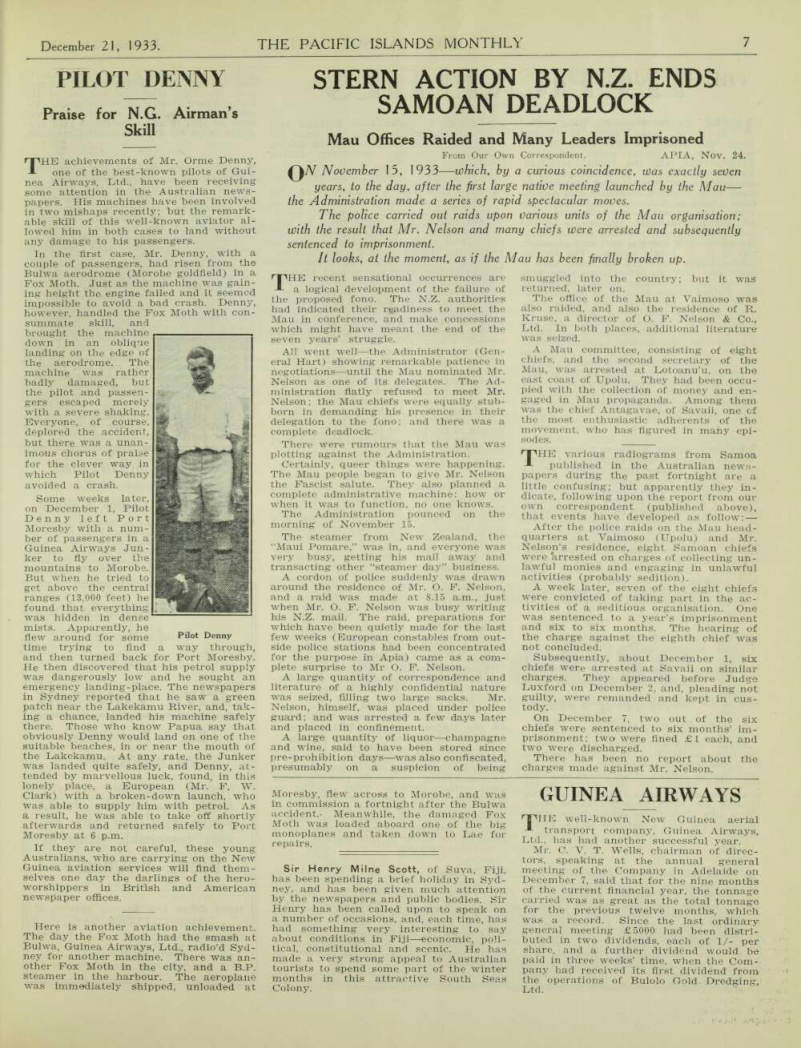
Pilot Denny
Praise for N.G. Airman’s Skill
THE achievements of Mr. Orme Denny, one of the best-known pilots of Gui nea Airways, Ltd., have been receiving some attention in the Australian news papers. His machines have been involved in two mishaps recently; but the remark able skill of this well-known aviator al lowed him in both cases to land without any damage to his passengers.
In the first case, Mr. Denny, with a couple of passengers, had risen from the Bulwa aerodrome (Morobe goldfield) in a Fox Moth. Just as the machine was gain ing height the engine failed and it seemed impossible to avoid a bad crash. Denny, however, handled the Fox Moth with con summate skill, and
brought the machine down in an oblique landing on the edge of the aerodrome. The machine was rather badly damaged, but the pilot and passen gers escaped merely with a severe shaking.
Everyone, of course, deplored the accident, but there was a unan imous chorus of praise for the clever way in which Pilot Denny avoided a crash.
Some weeks later, on December 1, Pilot Denny left Port Moresby with a num ber of passengers in a Guinea Airways Jun ker to fly over the mountains to Morobe.
But when he tried to get above the central ranges (13,000 feet) he found that everything was hidden in dense mists. Apparently, he flew around for some
time trying to find a way through, and then turned back for Port Moresby.
He then discovered that his petrol supply was dangerously low and he sought an emergency landing-place. The newspapers in Sydney reported that he saw a green patch near the Lakekamu River, and, tak ing a chance, landed his machine safely there. Those who know Papua say that obviously Denny would land on one of the suitable beaches, in or near the mouth of the Lakekamu. At any rate, the Junker was landed quite safely, and Denny, at tended by marvellous luck, found, in this lonely place, a European (Mr. F. W.
Clark) with a broken-down launch, who was able to supply him with petrol. As a result, he was able to take off shortly afterwards and returned safely to Port Moresby at 6 p.m.
If they are not careful, these young Australians, who are carrying on the New Guinea aviation services will find them selves one day the darlings of the hero worshippers in British and American newspaper offices.
Here is another aviation achievement.
The day the Fox Moth had the smash at Bulwa, Guinea Airways, Ltd., radio’d Syd ney for another machine. There was an other Fox Moth in the city, and a B.P. steamer in the harbour. The aeroplane was immediately shipped, unloaded at
Moresby, flew across to Morobe, and was in commission a fortnight after the Bulwa accident. Meanwhile, the damaged Fox Moth was loaded aboard one of the big monoplanes and taken down to Lae for repairs.
Sir Henry Milne Scott, of Suva, Fiji, has been spending a brief holiday in Syd ney, and has been given much attention by the newspapers and public bodies. Sir Henry has been called upon to speak on a number of occasions, and, each time, has had something very interesting to say about conditions in Fiji—economic, poli tical, constitutional and scenic. He has made a very strong appeal to Australian tourists to spend some part of the winter months in this attractive South Seas Colony.
Pilot Denny
Stern Action By N.Z. Ends
Samoan Deadlock
Mau Offices Raided and Many Leaders Imprisoned
From Our Own Correspondent. APIA, Nov. 24.
ON November 13, 1933— which, by a curious coincidence, was exactly seven years, to the day, after the first large native meeting launched by the Mau— the Administration made a series of rapid spectacular moves.
The police carried out raids upon various units of the Mau organisation; with the result that Mr. Nelson and many chiefs were arrested and subsequently sentenced to imprisonment.
It looks, at the moment, as if the Mau has been finally broken up.
THE recent sensational occurrences are a logical development of the failure of the proposed fono. The N.Z. authorities had indicated their readiness to meet the Mau in conference, and make concessions which might have meant the end of the seven years’ struggle.
All went well —the Administrator (Gen eral Hart) showing remarkable patience in negotiations—until the Mau nominated Mr.
Nelson as one of its delegates. The Ad ministration flatly refused to meet Mr.
Nelson; the Mau chiefs were equally stub born in demanding his presence in their delegation to the fono; and there was a complete deadlock.
There were rumours that the Mau was plotting against the Administration.
Certainly, queer things were happening.
The Mau people began to give Mr. Nelson the Fascist salute. They also planned a complete administrative machine: how or when it was to function, no one knows.
The Administration pounced on the morning of November 15.
The steamer from New Zealand, the “Maui Pomare,” was in, and everyone was very busy, getting his mail away and transacting other “steamer day” business.
A cordon of police suddenly was drawn around the residence of Mr. O. F. Nelson, and a raid was made at 8.15 a.m., just when Mr. O. F. Nelson was busy writing his N.Z. mail. The raid, preparations for which have been quietly made for the last few weeks (European constables from out side police stations had been concentrated for the purpose in Apia) came as a com plete surprise to Mr O. F. Nelson.
A large quantity of correspondence and literature of a highly confidential nature was seized, filling two large sacks. Mr.
Nelson, himself, was placed under police guard; and was arrested a few days later and placed in confinement.
A large quantity of liquor—champagne and wine, said to have been stored since pre-prohibition days—was also confiscated, presumably on a suspicion of being
smuggled into the country; but it was returned, later on.
The office of the Mau at Vaimoso was also raided, and also the residence of R.
Kruse, a director of O. F. Nelson & Co., Ltd. In both places, additional literature was seized.
A Mau committee, consisting of eight chiefs, and the second secretary of the Mau, was arrested at Lotoanu’u, on the east coast of Upolu. They had been occu pied with the collection of money and en gaged in Mau propaganda. Among them was the chief Antagavae, of Savaii, one of the most enthusiastic adherents of the movement, who has figured in many epi sodes.
THE various radiograms from Samoa published in the Australian news papers during the past fortnight are a little confusing: but apparently they in dicate, following upon the report from our own correspondent (published above), that events have developed as follow: After the police raids on the Mau head quarters at Vaimoso (Upolu) and Mr.
Nelson’s residence, eight Samoan chiefs were arrested on charges of collecting un lawful monies and engaging in unlawful activities (probably sedition).
A week later, seven of the eight chiefs were convicted of taking part in the ac tivities of a seditious organisation. One was sentenced to a year’s imprisonment and six to six months. The hearing of the charge against the eighth chief was not concluded.
Subsequently, about December 1, six chiefs were arrested at Savaii on similar charges. They appeared before Judge Luxford on December 2, and, pleading not guilty, were remanded and kept in cus tody.
On December 7, two out of the six chiefs were sentenced to six months’ im prisonment: two were fined £1 each, and two were discharged.
There has been no report about the charges made against Mr. Nelson.
Guinea Airways
THE well-known New Guinea aerial transport company, Guinea Airways, Ltd., has had another successful year.
Mr. C. V. T. Wells, chairman of direc tors, speaking at the annual general meeting of the Company in Adelaide on December 7, said that for the nine months of the current financial year, the tonnage carried was as great as the total tonnage for the previous twelve months, which was a record. Since the last ordinary general meeting £5000 had been distributed in two dividends, each of 1/- per share, and a further dividend would be paid in three weeks’ time, when the Com pany had received its first dividend from the operations of Bulolo Gold Dredging, Ltd.
Tropicalities
THERE are no blessings being called down in these days in Tahiti upon the name of President Roose velt. Ten or twelve years ago, when France was off the gold standard, Tahiti became a favorite place of residence, and there were established there large colonies of British and Ameri cans. Life in Tahiti in those days was very cheap, as well as very pleasant. But all that has changed. France is on the gold standard, and Britain and America are off it. Life there is still very pleasant, but it is no longer cheap. The British colony began to break up more than a year ago; but the Americans were able to hold on comfortably enough so long as the United States dollar held its relation ship to gold. In the last few weeks, how ever, the American dollar is further off gold than is the pound sterling, and the effect on the American colony at Tahiti has been very depressing. A few have made tentative arrangements to get away to the U.S.A., and others are making plans.
It seems likely that so long as the present exchange position continues—which is so long as France remains on the gold standard—the Tahitian tourist traffic will suffer considerably, * * * MY first voyage to sea as a boy was to the Islands (writes Captain E. C. Vel lenoweth, of Mauke, Cook Island). Since then, I have been many times to the Islands, from the Solomons to Tahiti, as sailor, officer, and Master. I have also spent over eight years as Resident Agent in the Cook Islands, under the New Zealand Government; and I consider three parts of the books written on Island life should not be published—or, if published they should be marked in large print as “Fiction.” Some years ago I read “Life and Laughter in the Solomon Islands,” and I thought it one of the best Island books I had read, and I still think so. * * * THE Fijian trade statement for the nine months ended 30th September last shows the same old Fijian story—a huge excess of exports over imports.
Here is the comparative table for the period: Nine months ended Imports. Exports. £ £ 30th Sept., 1932 589,036 1,075,425 „ 1933 778,350 1,188,710 Sugar, copra and bananas are about the same as in 1932; but the movement in trocas shell is interesting. In 1932, 221 tons, worth £9,929, were exported. This year, the export for the period is 295 tons, but the value is shown at £15,783.
If only the value of copra would move along like that, there would be a silver lining to the 1933 Christmas in the South Seas. * * * A REQUEST made in 1931 to the High Commissioner for the Western Paci fic, when he was making a tour of the Ellice Islands, has had results. Native deputations asked that certain of those beautiful islands should be made more accessible to small ships by the blasting of boat-passages through the encircling coral reefs. During 1931-32, work was begun. Four Ellice Islanders were train ed to direct blasting operations, and boat passages have now been opened into the
lagoons of the islands of Vaitupu and Nui. The work of boring the holes for the charges, and of removing the debris, was carried out by voluntary native labour. * * * A FEW New Guinea planters, faced with the ruinous price of copra, have been able to keep the wolf at bay with cocoa.
At the end of 1932 there were in New Guinea some 2,000 acres planted with cocoa, and about 750 acres were bearing.
Practically the whole of this cocoa enter prise was on the mainland of New Britain.
The yield last year represented 92 tons; and as the price of cocoa held up very well until recent months, and there is a Commonwealth bounty of £11 per ton on its production, some of the New Guinea planters were able to gather in a consid erable supplementary income. Even in recent weeks New Guinea cocoa-bean producers have been obtaining £37 per ton for their product in Sydney—to which, of course, has to be added the bounty. A good many planters are seeking an alter native crop in coffee, but cocoa seems to hold its place more confidently in the world market, and should be worth the consideration of most planters. Western Samoa is the biggest producer of cocoa in that part of the Pacific that lies south of the equator. * * * AUSTRALIAN newspapers have been giving much space lately to a new device introduced by Amalgamated Wire less, Ltd., for use in New Guinea and other remote places where transmission by radio often is urgently necessary, but difficult to arrange, owing to lack of mo tive power. A.W.A. has now produced a gadget something like a bicycle; but, where the wheels should be, there is sim ply a device for driving a generator which, in its turn, provides the necessary power for transmitting radio messages over any thing up to 400 miles. A “coon” sits on the bicycle frame and pedals for dear life; and the operator is then able to maintain two-way working with a coastal station — so long as the “coon” keeps on pedalling!
The new equipment is easily carried and will be of great value to patrols and pros pecting parties in remote places. * * * A DEPARTMENTAL manager in one of the Sydney stores, which makes a speciality of supplying Islands orders, is held in high esteem throughout the South Pacific because of the trouble he takes to attend to all the requests of his numerous correspondents, no matter how fantastic some of them may be. They ask him for everything, from needles to anchors. “I think that Ramage would parcel up and forward a wife if I asked him,’ said a grateful Solomon Islands planter, in a letter to the editor of this journal. * * * THE people in the more fortunate is lands of New Guinea and Papua learn with surprise that the Samoan Government is still imposing an export tax of 20/- per ton on copra; although copra at £8/12/6, c.i.f., London, does not pay the cost of production and transport.
The export duty on copra has been prac tically abandoned in all the islands of the Western Pacific. Still, one supposes that the Samoan Administrator must get revenue from somewhere —he has not got
a flourishing sugar industry like that of Fiji, to tax, nor can he depend on rich gold royalties, after the manner of the lucky Administrator of New Guinea. In cidentally, it looks as if Fiji, also, will soon be able to add substantial gold roy alties to its already substantial revenues. * * * LARGE pestles and mortars, of an ancient type, dug up in New Guinea, are one of the mysteries of the Territory.
Assistant District Officer, J. L. Taylor, in an address to the Anthropological Soci ety of New South Wales, on November 30, mentioned the discovery of those strange things, when describing his re cent patrol beyond the Ramu. Mr. E. W.
P. Chinnery, Director of District Ser vices in New Guinea, in a recent lecture in Melbourne, said: “Altogether beyond the bounds of accurate explanation are the large pestles and mortars found 20 feet below the surface on the goldfields, but the deduction may be not unfairly drawn that they are relics of a forgotten people, who delved here for gold in these inhospitable, jungle-clad mountains, even as the white man is doing to-day. Bits of pottery are dug up here and there of a type not remotely resembling anything produced by the natives to-day, and bearing a strong and utterly mysterious affinity with ancient Greece. Head hunt ing and cannibalism are still not entirely extinguished, and sorcery still kills its victims swiftly and unerringly.”
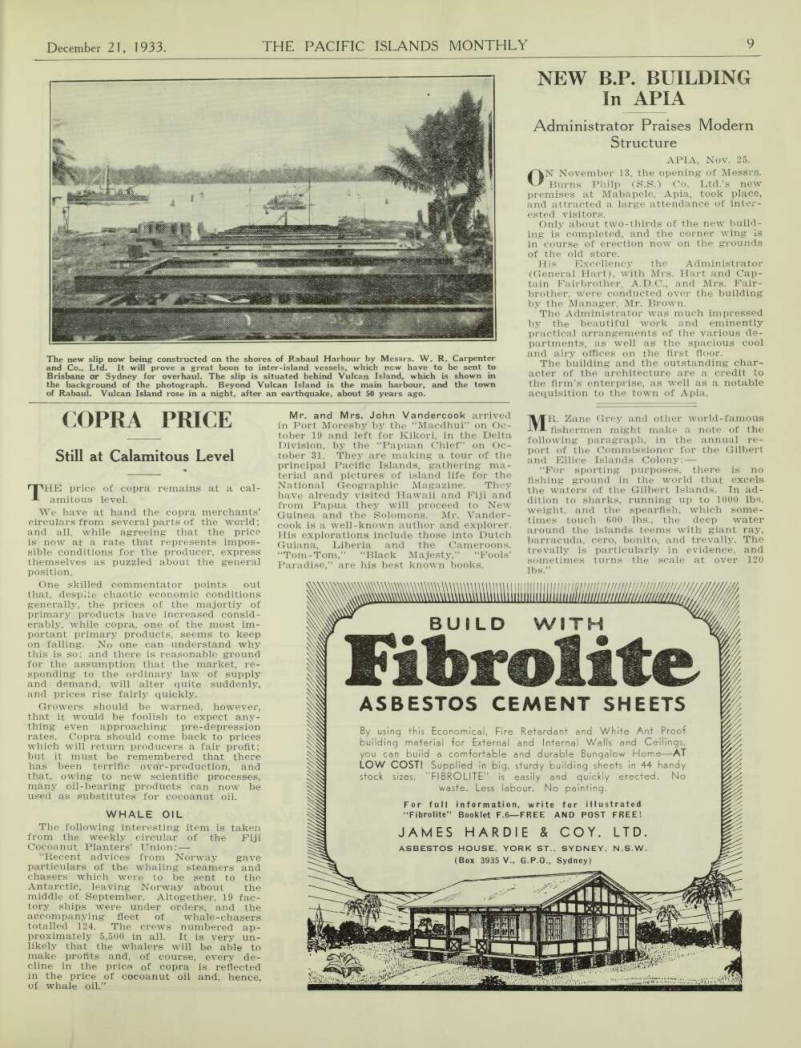
The new slip now being constructed on the shores of Rabaul Harbour by Messrs. W. R. Carpenter and Co., Ltd. It will prove a great boon to inter-island vessels, which now have to be sent to Brisbane or Sydney for overhaul. The slip is situated behind Vulcan Island, which is shown in the background of the photograph. Beyond Vulcan Island is the main harbour, and the town of Rabaul. Vulcan Island rose in a night, after an earthquake, about 50 years ago.
Advertisements & other items, p. 10 (1 item)
Drive Yourself
AT BLUE MOUNTAINS
SPRINGWOOD, N.S.W.
Springwood Ladies’ College
Est. 1897. Kindergarten to Leaving Certificate.
Tennis, Riding, Swimming, Team Games.
Unequalled climate. Pure Jersey Milk. Senior and Junior Houses. Open-air sleeping. Inclusive fees. Special vacation arrangements for Island pupils. M. E. DURAND, Principal.
When Visiting Sydney
Send a Wire to
LESSEY’S
Drive Yourself
Box 8, Post Office,
PADDINGTON,
and an up-to-date car will meet you at the boat, which you can hire on very reasonable terms to
DRIVE YOURSELF.
Head Office and Service Station at
RUSHCUTTER’S BAY
(Near Stadium). Tel.: F 3196.
Radio Address; “Lessey’s,” Paddington, Sydney.
Copra Price
Still at Calamitous Level
THE price of copra remains at a calamitous level.
We have at hand the copra merchants’ circulars from several parts of the world; and all, while agreeing that the price is now at a rate that represents impos sible conditions for the producer, express themselves as puzzled about the general position.
One skilled commentator points out that, despite chaotic economic conditions generally, the prices of the majortiy of primary products have increased consid erably, while copra, one of the most im portant primary products, seems to keep on falling. No one can understand why this is so; and there is reasonable ground for the assumption that the market, re sponding to the ordinary law of supply and demand, will alter quite suddenly, and prices rise fairly quickly.
Growers should be warned, however, that it would be foolish to expect any thing even approaching pre-depression rates. Copra should come back to prices which will return producers a fair profit; but it must be remembered that there has been terrific over-production, and that, owing to new scientific processes, many oil-bearing products can now be used as substitutes for cocoanut oil.
Whale Oil
The following interesting item is taken from the weekly circular of the Fiji Cocoanut Planters’ Union: “Recent advices from Norway gave particulars of the whaling steamers and chasers which were to be sent to the Antarctic, leaving Norway about the middle of September. Altogether, 19 fac tory ships were under orders, and the accompanying fleet of whale-chasers totalled 124. The crews numbered ap proximately 5,500 in all. It is very un likely that the whalers will be able to make profits and, of course, every de cline in the price of copra is reflected in the price of cocoanut oil and, hence, of whale oil.”
Mr. and Mrs. John Vandercook arrived in Port Moresby by the “Macdhui” on Oc tober 19 and left for Kikori, in the Delta Division, by the “Papuan Chief” on Oc tober 31. They are making a tour of the principal Pacific Islands, gathering ma terial and pictures of island life for the National Geographic Magazine. They have already visited Hawaii and Fiji and from Papua they will proceed to New Guinea and the Solomons. Mr. Vander cook is a well-known author and explorer.
His explorations include those into Dutch Guiana, Liberia and the Cameroons.
“Tom-Tom,” “Black Majesty,” “Fools’
Paradise,” are his best known books.
New B.P. Building
In Apia
Administrator Praises Modern Structure
Apia, Nov. 25.
ON November 13, the opening of Messrs.
Burns Philp (S.S.) Co. Ltd.’s new premises at Mabapele, Apia, took place, and attracted a large attendance of inter ested visitors.
Only about two-thirds of the new build ing is completed, and the corner wing is in course of erection now on the grounds of the old store.
His Excellency the Administrator (General Hart), with Mrs. Hart and Cap tain Fairbrother, A.D.C., and Mrs. Fair brother, were conducted over the building by the Manager, Mr. Brown.
The Administrator was much impressed by the beautiful work and eminently practical arrangements of the various de partments, as well as the spacious cool and airy offices on the first floor.
The building and the outstanding char acter of the architecture are a credit to the firm’s enterprise, as well as a notable acquisition to the town of Apia.
MR. Zane Grey and other world-famous fishermen might make a note of the following paragraph, in the annual re port of the Commissioner for the Gilbert and Ellice Islands Colony: “For sporting purposes, there is no fishing ground in the world that excels the waters of the Gilbert Islands. In ad dition to sharks, running up to 1000 lbs. weight, and the spearfish, which some times touch 600 lbs., the deep water around the islands teems with giant ray, barracuda, cero, bonito, and trevally. The trevally is particularly in evidence, and sometimes turns the scale at over 120 lbs.”
Advertisements & other items, p. 11 (1 item)
Fibrolite
BUILD WITH
ASBESTOS CEMENT SHEETS
By using this Economical, Fire Retardant and White Ant Proof building material for External and Internal Walls and Ceilings, you can build a comfortable and durable Bungalow Home—AT LOW COST! Supplied in big, sturdy building sheets in 44 handy stock sizes, "FIBROLITE" is easily and quickly erected. No waste. Less labour. No painting.
For full information, write for illustrated “Fibrolite” Booklet F.6—FREE AND POST FREE!
JAMES HARDIE & COY. LTD.
ASBESTOS HOUSE, YORK ST., SYDNEY. N.S.W.
(Box 3935 V., G.P.O., Sydney)
Sir Hubert Murray
Completion of 23 Years of Distinguished Service
ON November 30, Sir Hubert Murray, K.C.M.G., completed 25 years’ ser vice as Lieutenant-Governor of the Ter ritory of Papua.
Having been Chief Justice of the Terri tory since September, 1904, Sir Hubert (then Mr. Justice Murray) assumed the powers of Acting Administrator on April 9, 1907; and on November 30, 1908, he was formally commissioned by the Common wealth Government as Australia’s first colonial Lieutenant-Governor.
In Sir Hubert Murray, Australia pos sesses a Colonial Administrator whose ability, vision, scrupulous integrity, and rigid adherence to a high code and a splendid ideal has given him a world wide reputation. In the whole history of colonial development there have been few men comparable with him, for length of service or for the conspicuous success with which that service has been ren dered.
In his well-ordered government of the primitive Papuan, and his scientific paci fication of the Territory, his method has been that of association and collabora tion; his steady policy that of pacification of all the tribes in the heart of the Ter ritory; his fixed principle, the well-being and development of the natives entrusted to his care.
During the quarter century of Sir Hu bert Murray’s administration, the Terri tory has been brought under European control. The native population, spread over 90,000 square miles of mountainous and extremely difficult country, has been brought to recognise and to appreciate law, order and peaceful living. Education has been widely spread among them; they have absorbed a considerable idea of mod ern agricultural methods; and in the set tlements near the Government Headquar ters they act efficiently as clerks, over seers, artisans, and medical assistants.
The whole period of the Murray admin istration has been characterised by pro gress. By the method of association and collaboration, to use Sir Hubert Murray’s own words, an administration “tries to preserve the individuality of the natives and to associate them with their rulers in industrial progress and the advance of civilisation generally.”
Personal
CAPTAIN A. S. FITCH, managing director of Papuan Steamships Co., Ltd., returned to Port Moresby by the Decem ber Montoro, after many busy weeks in Sydney, Melbourne and Canberra. * * * MR. H. O. McGUIGAN, of the wireless staff at Rabaul, New Guinea, re turned by the Nellore, after having spent his furlough in Melbourne, where his relatives reside. * * * MR. F. R. ISOM, manager of the Melanesian Mission’s printing works in Solomon Islands, accompanied by Mrs.
Isom, arrived in Sydney by the last “Mataram” on four months’ furlough.
Mr. Isom, who has been over twenty years in the Solomons, has earned a wide repu tation for the high quality of his Mission printing work. Apart from the skilled help of his wife, he is dependent for assis tance on Solomon Islands natives, whom he trains himself.
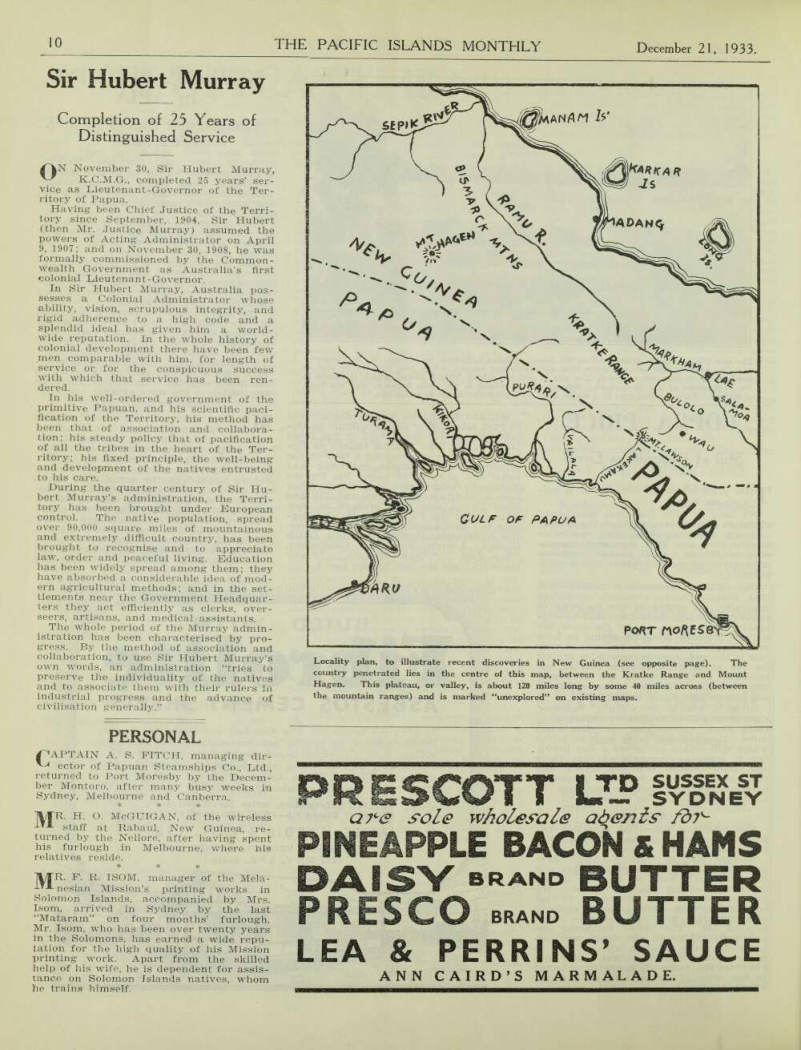
Locality plan, to illustrate recent discoveries in New Guinea (see opposite page). The country penetrated lies in the centre of this map, between the Kratke Range and Mount Hagen. This plateau, or valley, is about 120 miles long by some 40 miles across (between the mountain ranges) and is marked “unexplored” on existing maps.
Advertisements & other items, p. 12 (1 item)
PRESCOTT Ltd Sussex St Sydney
are sole wholesale agents for
PINEAPPLE BACON & HAMS
DAISY BRAND BUTTER
FRESCO BRAND BUTTER
LEA & PERRINS’ SAUCE
ANN CAIRD’S MARMALADE.
Discoveries In New Guinea
Centre of Main Island is Rich, Temperate Densely Populated Plateau
ONE of the most interesting geographical and ethnographical discoveries of recent years has been recorded recently in New Guinea; but has been announced with such modesty by the New Guinea Administration that neither the newspapers nor the general public have awakened yet to its importance.
Put in briefest fashion, the discovery amounts to this: In the hitherto unexplored centre of the great island of New Guinea, where it was assumed that there was simply a continuation of the precipitous mountains and miasmic jungles of the coastal districts, a large plateau of great fertility has been found. It is a wide expanse of rolling uplands, enjoying a temperate climate, and densely populated by a race, or races, or skilled agriculturists, whose existence was hitherto only vaguely suspected.
IT may be remembered that, in the Commonwealth Parliament a few weeks ago, the Minister in charge of Islands Territories, Major Marr, announced that Administration officials definitely had proved the existence of between 200,000 and 300,000 “new” inhabitants, in the hitherto unknown region in the centre of New Guinea, westward of the Morobe Goldfield. To the “Pacific Islands Monthly” has been accorded the privilege of publishing the first authentic account of this new country.
From Australia’s point of view, the dis covery has two important aspects. First, this is a rich country of definite agricul tural and pastoral value; second, the people are not primitive savages, but ap pear to be of a type superior to the bush “kanakas,” with a definite culture of their own.
Another important fact has been estab lished. Westward of this new country, there is another great region of similar character, lying between Mount Hagen and the Dutch border. It has not yet been penetrated by Europeans; but glimpses from lofty Mount Hagen (12,500 feet) and from an aeroplane which recently made a quick reconnaisance, show wide, rich up lands which have been developed agricul turally, and which apparently also carry a dense native population.
The first exploration of this new coun try (which, for convenience, is called the Benna Benna-Wahgi region) was carried out between March and July, of this year, by two expeditions, which joined and operated together for their mutual assist ance. One was under the direction of the New Guinea Administration, and was led by Assistant District Officer J. L. Taylor.
The other was fitted out by gold-mining interests, and was led by Messrs. M. J. and D. J. Leahy, two young Australians whose exploration work in New Guinea already has made them famous. Mr. Tay lor’s job was exploration, pure and simple; the Messrs. Leahy, of course, were prospecting for gold. Mr. Taylor was ac companied by Mr. Spinks, a surveyor.
Mr. Taylor and the Leahy Brothers ar rived in Sydney in November, having come directly out of the new country, and they were induced to give a lecture, illus trated with their own photographs and films, before the Anthropological Society of New South Wales. It was one of the most fascinating stories ever told to that learned body. Newspaper reporters were present: yet the explorers’ story was dis missed in a few words. None recognised that they were being told about one of
the last remaining bits of the unexplored world.
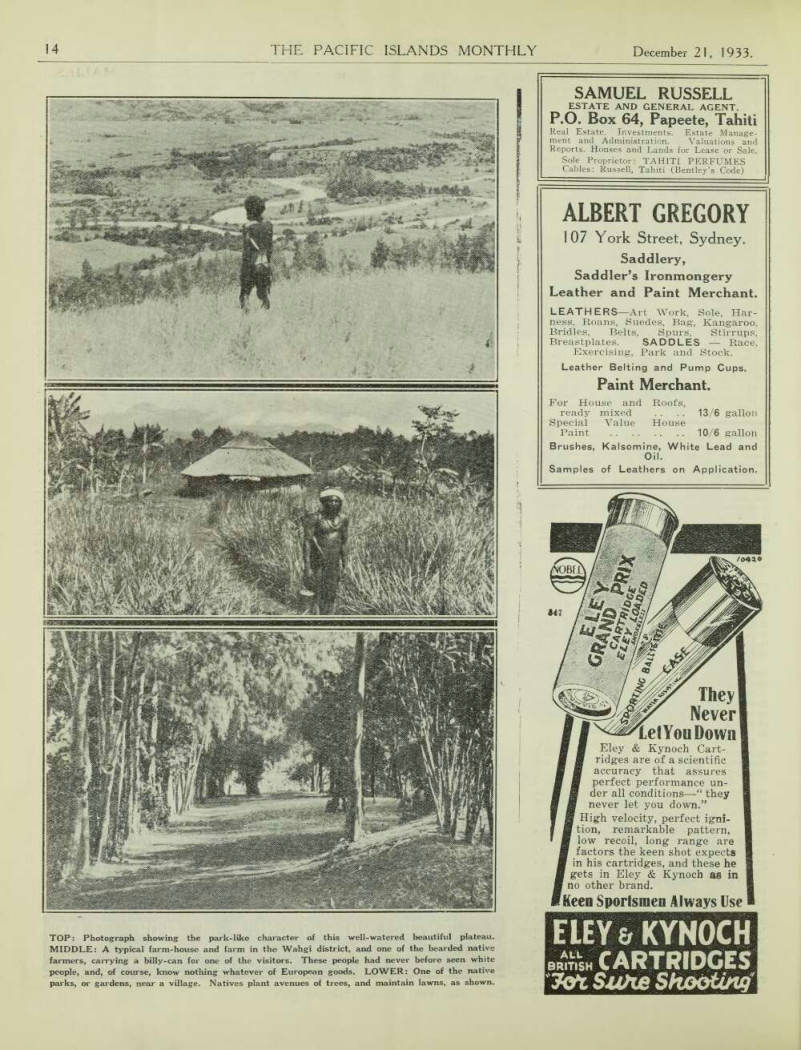
Hereunder is presented a report of the lecture referred to, which gives the main facts. We particularly refer readers, however, to the photographs reproduced herewith. They describe, far more graphi cally than words, the new types of natives discovered: the extraordinary skill of their agriculture; and the beauty of their park-like country. We are indebted to Mr. Taylor and the Messrs. Leahy, for permission to publish these unique and very valuable pictures.
Now, look at outline map on opposite page. The Benna Benna-Wahgi region lies in the centre —between the Bismarck Mountains and the Ramu River, on the north, and the Papuan border, on the
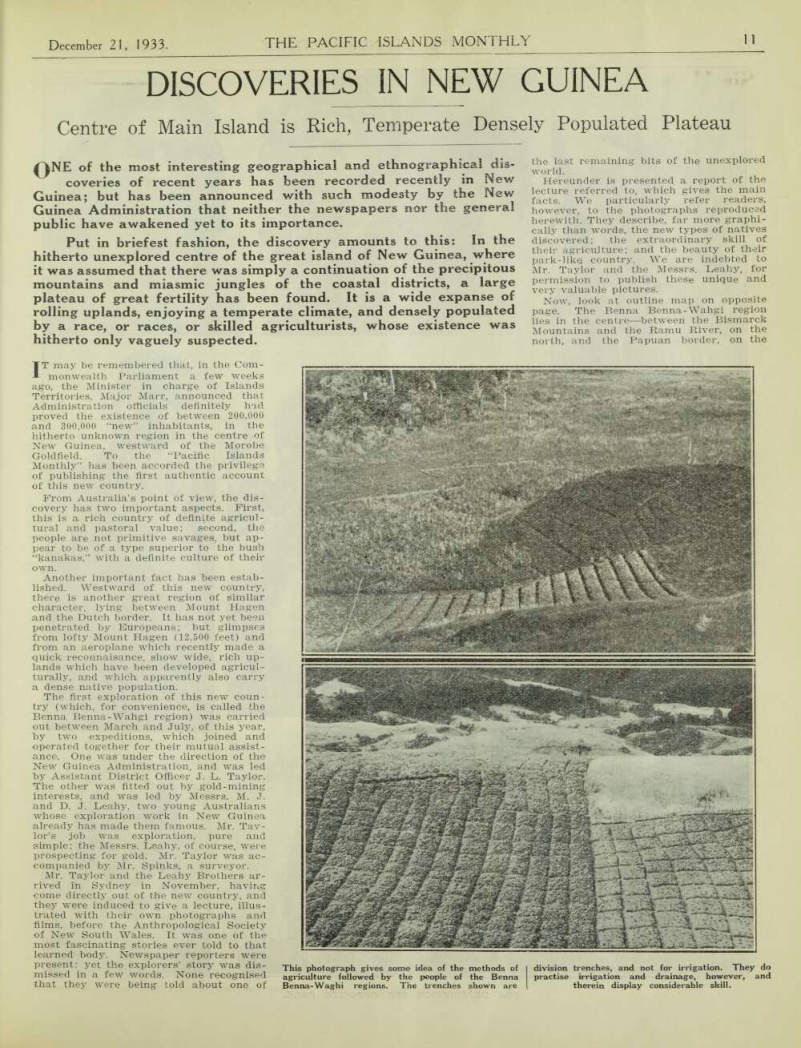
This photograph gives some idea of the methods of agriculture followed by the people of the Benna Benna-Waghi regions. The trenches shown are
division trenches, and not for irrigation. They do practise irrigation and drainage, however, and therein display considerable skill.
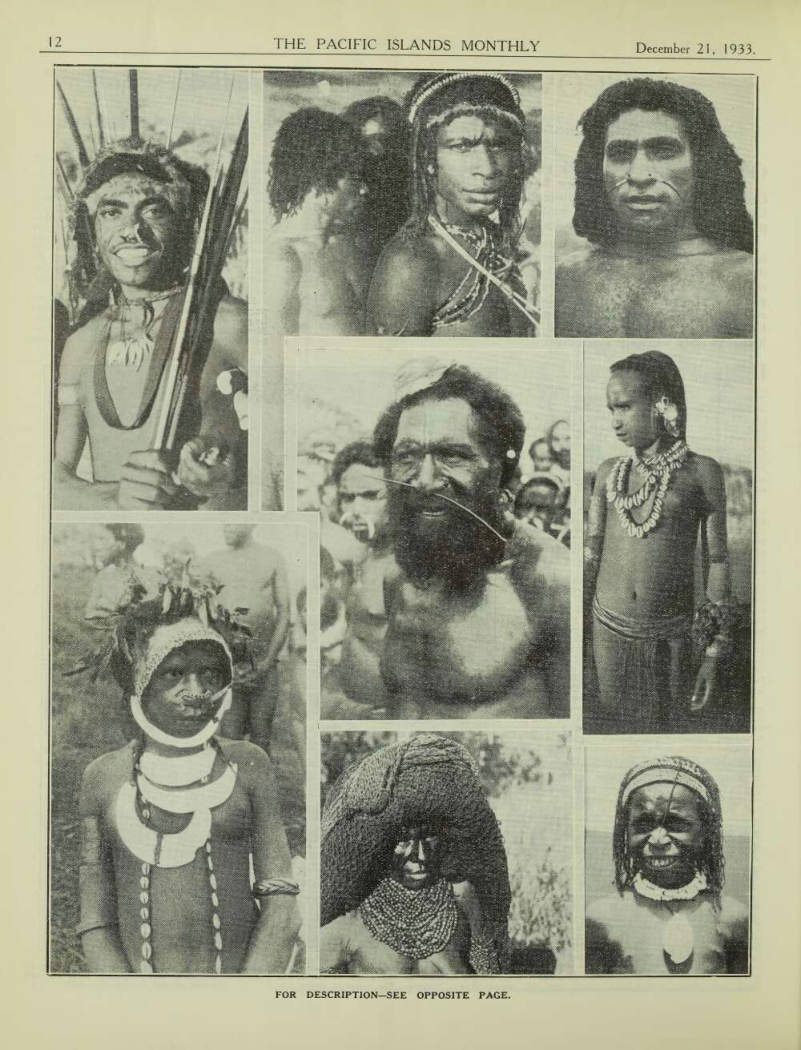
For Description—See Opposite Page.
south; and it extends from the head waters of the Markham River, and the Purari, in the east, across to Mount Hagen, in the west.
The combined parties, making a line of about 100, assembled in March at Benna Benna, near the Purari River, where there was a landing ground for aeroplanes. On March 27, 1933, the leaders were taken for a flight over the country to the west ward by Pilot O’Dea in a Holden aero plane, and so got a general idea of its features. They noted everywhere an abundance of native foodstuffs, which solved one of their main problems.
Magnificent Natural Park The expedition left next day, and marched slowly for 70 miles through a region of open grass valleys, with a very extensive river system—“probably that of the Purari, one of the largest rivers in.
New Guinea, which eventually flows southward into Papua, and empties into the Gulf of Papua.” It is worth noting that even very recent maps fail to show the Purari extending beyond the northern boundary of Papua.
The principal valley, as they worked northwestward from Benna Benna, was that of the Wahgi. It was some 5000 feet above sea-level, 60 miles long and 20 to 30 miles across. High, timbered ranges, on either side, rose to 14,000 feet, and
On the opposite page is a selection from the explorers’ photographs of the people of the Benna Benna and Wahgi districts, clearly showing the interesting types met with. The Benna Benna generally are clean-shaven—the Wahgi bearded.
Some of the faces are strikingly Phoenician in character; others show the Papuan, or negroid influence. The eagerness for personal adornment is demonstrated. Wealth, on these distant uplands, is measured by sea-shells. “Cowrie are shillings— the crescent-shaped shell ornaments are sovereigns.”
formed the boundaries of this magnificent natural park.
“When first seen, this great valley seemed illimitable, with an endless, tor tuous stream the Waghi flowing through its great grass plains and high terraces. Here and there park-like plan tations of casuarina dotted the pale-green landscape, and made a beautiful setting beneath the towering, timbered ranges of the mighty Bismarcks.
“The valley has a temperate climate, the temperature varying between 52 and 75 degrees Fahr.”
Seventy miles north-west of Benna Benna, the party prepared a landing ground and a Guinea Airways aeroplane came out to them, with Mr. Grabowsky as pilot.
In mid-April, the party pushed on for another 25 miles, to where the head waters of the Wahgi divided, and the country changed.
“A wide expanse of rolling downs ap peared before us. These downs, grass covered and volcanic in origin, extend for some 20 miles westerly, to the base of a high mountain block, apparently Mt.
Hagen. To the north and south the coun try falls away quickly to the Yuat Valley (a tributary of the Sepik) on one hand: and the Nebyer (a head water of the Purari) on the other.”
A base camp was established ten miles east of Mt. Hagen; a landing-ground for aeroplanes was cleared; and exploration work, which is the subject of a detailed official report, was carried out during May, June, July and August, Mt. Hagen was climbed, and a glimpse obtained of a great, unknown plateau to the west ward.
Mr. M. Leahy estimated that there were 300,000 natives living in the region be tween the Purari and Mt. Hagen. Mr.
Taylor thought they would number “over 200,000.” Both agreed that there was an even greater population westward of Mt.
Hagen.
Two Great Tribes.
“The people of the area from Benna Benna to Mt. Hagen appear to be of two great and distinct tribes,” said Mr. Tay lor, in the course of his lecture, “though mid-way between those places there is a noticeable merging of the two peoples.
The first may be called the Benna Benna, their correct tribal name being as yet un known, and are a very numerous people who live in villages of from 20 to 100 small circular houses.
“They are a handsome race, well-built and of medium height, with a highly de veloped sense of decoration. They delight in ornamenting themselves with leaves and flowers. They are clean-shaven.
“Generally, their excellent sweet potato gardens and their cultivation of corn, sugar and cucumbers, their eagerness to get seeds of any kind, connote them to be agriculturists of a high order, for New Guinea.
“The bow and arrow is the principal weapon, and war would appear to be more or less continuous, though more general in the dry than in the wet seasons.
The Wahgis—Farmers.
“The second, who may be called the Wahgi people, are also very numerous, but live in small farm-houses, oblong in shape, and quite separate from one an other. There are no villages. They are not as good agriculturists as the Benna Benna people, but make extremely well designed gardens, which are laid out in squares, with mathematical precision.
One sees the gardens in all stages of growth, from the reddish brown of the new-tilled earth to the bright green of the sweet potato plant at maturity; whilst the country, for miles, bears the imprints of ancient gardens, showing how inten sively the native race has cultivated the area throughout successive generations.
“The Wahgi people are well-built, good looking; some reach 5 ft. 9 ins., and are nearly all bearded. Their weapon is the spear; and it would appear that though war plays a prominent part in their life, it is not quite so general as with the Benna Benna. This, of course, is open to correction.
“With only one exception the patrol was received without hostility. Weapons were seldom seen, and we were regarded in awe, as something ghostly or super natural.”
“The exception was near the Wahgi landing-ground. Here the people, pro bably one of the finest types in New Guinea, and who, by their uniformity of stature and fine physique, look as if they had been bred eugenically, met us with spears raised in an attempt to prevent us entering their country. After some par leying, the spears were put down and friendly relations established.
“For New Guinea, the density of the population of the area between Benna Benna and Mt. Hagen is remarkable. It is impossible to give a reliable estimate at this juncture, but it was noticed that wherever the patrol had occasion to halt along the track for as long as 30 minutes, not less than 1,000 natives gathered round us.
“Both tribes are probably of non- Melanesian origin, but more work must be done among these people before that can be stated definitely.
Evidence of Culture.
“A noticeable feature of the Mt. Hagen area are beautiful, park-like enclosures, planted with ornamental trees and shrubs, which surround a well-kept lawn of fine grass. These enclosures are used in connection with the ceremonial life of the people.
“Another is the high degree of art and skill with which stone axes are made.
The battle axes are particularly fine, being made of grey or blue stone of fine texture and highly polished. Where these
TOP: Photograph showing the park-like character of this well-watered beautiful plateau.
MIDDLE: A typical farm-house and farm in the Wahgi district, and one of the bearded native farmers, carrying a billy-can for one of the visitors. These people had never before seen white people, and, of course, know nothing whatever of European goods. LOWER: One of the native parks, or gardens, near a village. Natives plant avenues of trees, and maintain lawns, as shown.
axes exist, steel had never penetrated, it not being required, and I had the greatest difficulty to induce natives to accept steel tomahawks and steel knives in payment for food.
Geographical Features.
“In May and June two trips were made down the Yuat headwaters, and a point about 30 miles distant from the base camp and only 1,100 ft. above sea-level was reached. The mountain Jagagorn, 9,400 ft., was climbed, and the summit reached for the purpose of observing the sur rounding country. Several thousand na tives were seen, though the population diminished rapidly towards the lower altitudes.
“In July, Mt. Hagen was climbed, and the summit reached at 12,500 ft. above sea level. Several small lakes were ob served at the summit, and the flora con sisted of mosses, lichens, alpine grasses and flowers characteristic of high alti tudes in New Guinea.
“The lowest temperature decorded dur ing two nights spent on the summit was 33 degrees Fahr. In August, a journey was also made about 30 miles south of the base camp, to Papuan territory, and much new ground and many new natives were visited.
“It is reasonably certain that the Wahgi, and all the rivers running south from the Bismarcks, eventually join the Purari, the great Papuan river which enters the sea in the Gulf of Papua; and it is definitely established that the main range, which was hitherto believed to be a backbone of high, forest-clad, unin habited mountains, is a cartographic myth, and in its place we have beautiful
grass uplands which will, I think, prove to be the best and most important part of New Guinea of the future.”
In reply to questions, Mr. Taylor said that these native peoples were compara tively free from disease, and there ap peared to be no fever. They were not chewers of betel nut —note the flash of white teeth in the smiling faces in the photographs. There were practically no animals in the region, except countless domestic pigs. He thought some canni balism was practised by the bow-and arrow (Benna Benna) people, but not by the spear (Wahgi) people. It was a coun try admirably suited to European agri culture —if there was any room for Euro peans: it was very thickly settled now.
The work of the patrol was made easier by the co-operation of the aeroplanes, which maintained regular communication with the base camp.
Advertisements & other items, pp. 15-16 (1 item)
Fitzroy
SPICED, CORNED, ROAST IN 12oz., 1lb, 2 lb, 3lb,4lb. FITZROY & BOILED BEEF s lt, 6' 61b ROUND SHEEP AND IN MUTTON CANS AND IX TAPERS TONGUES
EttP OXFORD. CAMBRIDGE 3 PORK SAUSAGES
THE ORIGINAL PACK IN A CLASS BY ITSELF!
Cured & matured in cold pickle from a recipe a century old
ALSO THE FAMOUS
HAMPER MEATS
IN ROUND AND TAPER CANS 120z.240*. 6 6 lbs.
SPECIALLY PACKED FOR THE ISLAND TRADE
SENT FOP PRICE LIST - NO EXTRA FOP ASSORTMENT The CENTRAL QUEENSLAND MEAT EXPORT CO. LTD.
LAKES CREEK - ROCKHAMPTON
CABLE ADDRESS:- TOMOANA ROCKHAMPTON.
SAMUEL RUSSELL
ESTATE AND GENERAL AGENT.
P.O. Box 64, Papeete, Tahiti
Real Estate. Investments. Estate Management and Administration. Valuations and Reports. Houses and Lands for Lease or Sale.
Sole Proprietor: TAHITI PERFUMES Cables: Russell, Tahiti (Bentley’s Code)
ALBERT GREGORY
107 York Street, Sydney.
Saddlery,
Saddler’s Ironmongery
Leather and Paint Merchant.
LEATHERS —Art Work, Sole, Harness, Roans, Suedes, Bag , Kangaroo, Bridles, Belts, Spurs, Stirrups, Breastplates. SADDLES Race, Exercising, Park and Stock.
Leather Belting and Pump Cups.
Paint Merchant.
For House and Roofs, ready mixed . . . . 13/6 gallon Special Value House Paint 10/6 gallon Brushes, Kalsomine, White Lead and Oil.
Samples of Leathers on Application. &
They
Never
let You Down
Eley & Kynoch Cartridges are of a scientific accuracy that assures perfect performance under all conditions—“they never let you down.”
High velocity, perfect ignition, remarkable pattern, low recoil, long range are factors the keen shot expects in his cartridges, and these he gets in Eley & Kynoch as in no other brand.
Keen Sportsmen Always Use
Removing Anomalies.
Papua and New Guinea Products.
T'HE Minister for Customs in the Com monwealth Government tabled a re solution in the Federal Parliament, to remove certain anomalies which had been created in adjusting the Customs tariff to comply with the Ottawa agreement.
To bring certain products of Papua and New Guinea into line with preferential duties accorded British non self-govern ing colonies, a number of specified pro ducts will now be admitted free of duty.
The items are:—Areca nuts, cocoa beans and shell, massoi oil, unground dry gin ger, sago and tapioca, unground spices and vanilla beans.
The Minister said that later he would aiove for the addition of certain dry gums to the list of free goods.
Advertisements & other items, p. 17 (1 item)
Machinery Productions of High Merit
BIG CROPS
can be depended upon from land that has been liberally fertilised with
P. B. MANURES
The best for all purposes. Send for our Free Booklet.
“RATIONAL MANURING,” it contains interesting information.
PATON, BURNS & CO.,
52 KING STREET SYDNEY
Machinery Productions of High Merit
To sell only products of such high merit and value that the simple truth will be their best recommendation, has always been the policy of BUZACOTT & CO., LTD. The name of “BUZACOTT” is a guarantee of quality goods at a reasonable price.
“Buzacott” Engines are noted for low operating costs, absolute efficiency and dependability.
“Buzacott” Pumps ensure an adequate and economical water supply. All sizes and types available.
“Buzacott” Pumper an ideal Windmill Auxiliary that fits any mill pump.
“Buzacott” Gates and Fencing. Easy to erect, and most durable. A host of different types available.
“Better” Crude Oil Engines, Marine and Stationary types. Reliable, simple, and cheap to run. Spare parts stocked.
“Alston” Windmills. Recent reductions in price for these famous Windmills bring them within everyone’s reach.
Electric Light from the Wind. The “Gilco” lighting plant gives you free Electricity at a low initial cost.
Buzacott & Co.
We shall be glad to send you, post free, and without obligation, full particulars of any lines in which you are interested.
7-11 MARKET STREET, SYDNEY, A’LIA.
Bulolo Gold
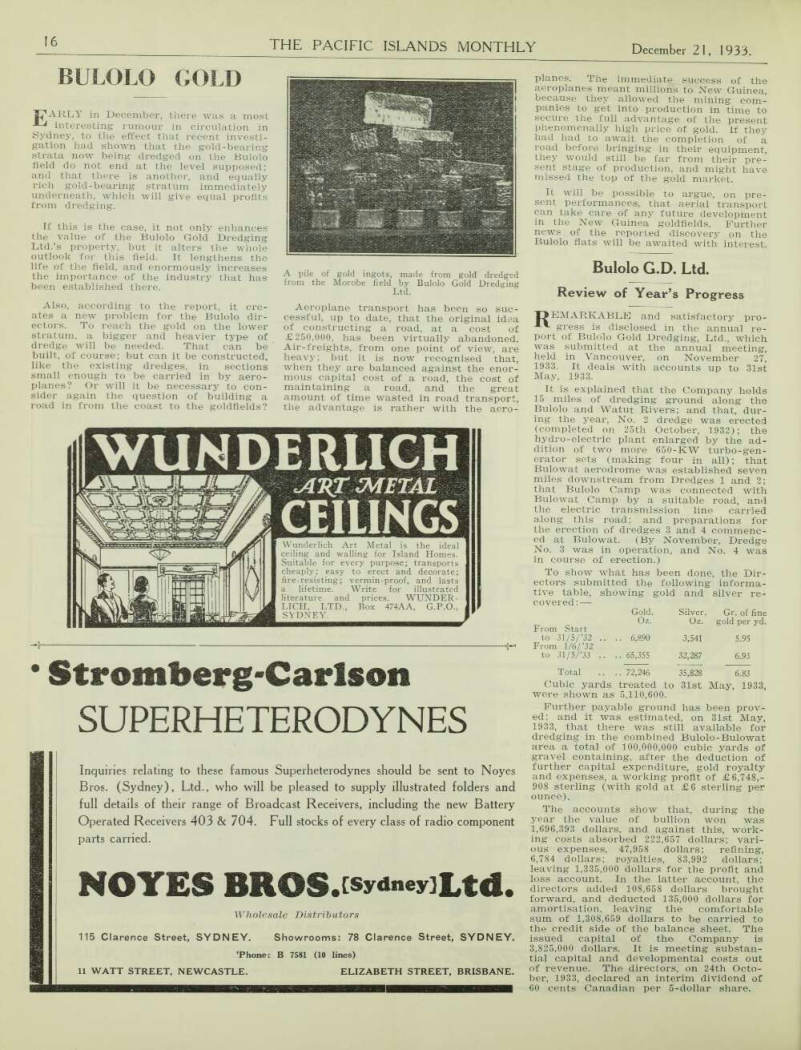
Early in December, there was a most interesting rumour in circulation in Sydney, to the effect that recent investi gation had shown that the gold-bearing strata now being dredged on the Bulolo field do not end at the level supposed; and that there is another, and equally rich gold-bearing stratum immediately underneath, which will give equal profits from dredging.
If this is the case, it not only enhances the value of the Bulolo Gold Dredging Ltd.’s property, but it alters the whole outlook for this field. It lengthens the life of the field, and enormously increases the importance of the industry that has been established there.
Also, according to the report, it cre ates a new problem for the Bulolo dir ectors. To reach the gold on the lower stratum, a bigger and heavier type of dredge will be needed. That can be built, of course; but can it be constructed, like the existing dredges, in sections small enough to be carried in by aero planes? Or will it be necessary to con sider again the question of building a road in from the coast to the goldfields?
Aeroplane transport has been so suc cessful, up to date, that the original idea of constructing a road, at a cost of £250,000, has been virtually abandoned, Air-freights, from one point of view, are heavy; but it is now recognised that, when they are balanced against the enor mous capital cost of a road, the cost of maintaining a road, and the great amount of time wasted in road transport, the advantage is rather with the aero
planes. The immediate success of the aeroplanes meant millions to New Guinea, because they allowed the mining com panies to get into production in time to secure the full advantage of the present phenomenally high price of gold. If they had had to await the completion of a road before bringing in their equipment, they would still be far from their pre sent stage of production, and might have missed the top of the gold market.
It will be possible to argue, on pre sent performances, that aerial transport can take care of any future development in the New Guinea goldfields. Further news of the reported discovery on the Bulolo flats will be awaited with interest.
A pile of gold ingots, made from gold dredged from the Morobe field by Bulolo Gold Dredging Ltd.
Bulolo G.D. Ltd.
Review of Year’s Progress
REMARKABLE and satisfactory progress is disclosed in the annual report of Bulolo Gold Dredging, Ltd., which was submitted at the annual meeting, held in Vancouver, on November 27, 1933. It deals with accounts up to 31st May, 1933.
It is explained that the Company holds 15 miles of dredging ground along the Bulolo and Watut Rivers; and that, dur ing the year, No. 2 dredge was erected (completed on 25th October, 1932); the hydro-electric plant enlarged by the ad dition of two more 650-KW turbo-gen erator sets (making four in all); that Bulowat aerodrome was established seven miles downstream from Dredges 1 and 2; that Bulolo Camp was connected with Bulowat Camp by a suitable road, and the electric transmission line carried along this road; and preparations for the erection of dredges 3 and 4 commenc ed at Bulowat. (By November, Dredge No. 3 was in operation, and No. 4 was in course of erection.) To show what has been done, the Dir ectors submitted the following informa tive table, showing gold and silver re covered: —
Cubic yards treated to 31st May, 1933, were shown as 5,110,600.
Further payable ground has been prov ed; and it was estimated, on 31st May, 1933, that there was still available for dredging in the combined Bulolo-Bulowat area a total of 100,000,000 cubic yards of gravel containing, after the deduction of further capital expenditure, gold royalty and expenses, a working profit of £6,748,- 908 sterling (with gold at £6 sterling per ounce).
The accounts show that, during the year the value of bullion won was 1,696,393 dollars, and against this, work ing costs absorbed 222,657 dollars; vari ous expenses, 47,958 dollars; refining, 6,784 dollars; royalties, 83,992 dollars; leaving 1,335,000 dollars for the profit and loss account. In the latter account, the directors added 108,658 dollars brought forward, and deducted 135,000 dollars for amortisation, leaving the comfortable sum of 1,308,659 dollars to be carried to the credit side of the balance sheet. The issued capital of the Company is 3,825,000 dollars. It is meeting substan tial capital and developmental costs out of revenue. The directors, on 24th Octo ber, 1933, declared an interim dividend of 60 cents Canadian per 5-dollar share.
Gold.
Silver.
Gr. of fine Oz.
Oz. gold per yd.
From Start to 31/5/’32 ..
From 1/6/’32 .. 6,890 3,541 5.95 to 31/5/’33 .. .. 65,355 32,287 6.93 Total .. 72,246 35,828 6.83
Advertisements & other items, p. 18 (1 item)
Stromberg-Carlson
Wunderlich Art Metal is the ideal ceiling and walling for Island Homes.
Suitable for every purpose; transports cheaply; easy to erect and decorate; fire-resisting; vermin-proof, and lasts a lifetime. Write for illustrated literature and prices. WUNDER-
LICH, LTD., Box 474 AA, G.P.O.,
SYDNEY.
Stromberg-Carlson
SUPERHETERODYNES
Inquiries relating to these famous Superheterodynes should be sent to Noyes Bros. (Sydney), Ltd., who will be pleased to supply illustrated folders and full details of their range of Broadcast Receivers, including the new Battery Operated Receivers 403 & 704. Full stocks of every class of radio component parts carried.
NOYES BROS.tsydnerfLtd.
Wholesale Distributors 115 Clarence Street, SYDNEY. Showrooms: 78 Clarence Street, SYDNEY. ’Phone: B 7581 (10 lines) 11 WATT STREET, NEWCASTLE. ELIZABETH STREET, BRISBANE.
Nicolas Minister
Tales about a Famous Old Sea-Rover of The Louisades
TRADING to-day in Papua has none of the glamour and romance of the old wild days of 50 and 60 years ago.
In those early years, a wide open, if dangerous field was offered to the intrepid adventurers who sailed the shores of this little-known island in search of a fortune.
The whole of New Guinea, from one end to the other, including the archipelagoes of islands trailing off the south-east coast, was over-run by fierce fighting tribes who involved themselves in ceaseless warfare and savagery. Any newcomer was re garded as an enemy and deserving of death.
To-day, with security, the romance of trading has gone. Trading is now con ducted on definite lines, with scheduled prices, which the natives fully understand.
Whether a trader lives in an inaccessible district or not makes little difference: the native demands a set price or goes else where. His time is his own and distances to him are no object. He treats the trader with scant courtesy and cheats him on every possible occasion.
Romance implies adventure, and adven ture insecurity. The only insecurity to-day, for the traders, is the uncertainty of making a living. The falling market and the heavy costs of freight and pro duction are the main points of his con sideration, and to these are added the drab monotony of his existence, loneliness and isolation.
How different were the conditions in the “good old days”!
Of the many traders who ventured to this unknown land between 1874 and 1886, almost the only one who survived was Nicolas Minister. Nearly all met death at the hands of the savages.
The renowned Nicolas was by far the most picturesque personality of those times. He carried on his trading, while Captain Fryer, Webb, Miller, Craig and other well-known men were murdered.
He was a handsome man, “with pleas ing, resolute features and finely sparkling eyes,” who is said to have been more feared by the natives of the Louisades than “all the men-of-war in the British Navy.” A Greek by birth, born at Latmos in 1850, he commenced, at a very early age, a career concerning which, if only the stores told of him were true, “he might well have been a lineal descendant of the Lambro immortalised in Don Juan.”
At the age of eleven, Nicolas was shipwrecked off the Italian coast, and was the sole survivor of a crew of fourteen. Ever afterwards, he led an adventurous sea faring life, which eventually led him to the north coast of Queensland and the islands of New Guinea.
While on the Queensland coast Nicolas had many wild experiences with abori ginals. while fishing for pearl shell, beche de mer, in Torres Strait: and it was mainly owing to his knowledge of natives, that the Queensland Government retained him as boatswain in their schooner “Pearl,” under Captain Pennyfather, and his assistance was sought in capturing and punishing the “blacks.” He believed in rough justice in dealing with a crude people, though he was feared by both the natives of Northern Australia and New Guinea, yet he retained their undoubted respect. “Taubada Nicolas” (Big Chief
Nicolas) he was called in the Louisades.
Nicolas Minister was attracted to the Louisades in 1882 by the beche de mer fishing, which was being carried on by a few traders and Chinamen, who sailed there in their cutters and junks, from Cooktown and from China. The native labour traffic for the Queensland planta tions was then also in full swing, and the rumours of those days associated Nicolas rather too closely with “black birding’’ scandals.
That the scandals were serious, was proved by a Royal Commission in 1885 which, sitting in Queensland, found that of the 648 recruits obtained in New Guinea and the adjacent islands, in 1884, all were “seduced on board under false pretences.”
Beche de mer and pearl shell fishing paid well, and so did recruiting, and
Nicolas established numerous depots, scattered about the islands—at Panniet, Brooker, Joannet, Sud Est and Rossel, and he spent his time between these, Port Moresby and Queensland, in his cutter “Dulama,” sailing from one to another, collecting and distributing his trade. He did well; but his expenses were heavy, and though his one wish was to make a fortune and return to his home country, Greece, his wish was never fulfilled.
There are many tales told of Nicolas’s daring in these islands, and of his du plicity in dealing with the treacherous, wily little inhabitants. Always on the alert to secure his head, either as a trophy, or to fulfil their duty to a superstitious belief, the natives gave him no peace.
But he took no chances. At night, in variably, he barricaded himself securely in his cutter, and in the morning, slipping the hatch back suddenly, he swept the deck with his sabre, making sure that no native waited for him with a toma hawk.
The Brooker Islanders, notorious for their treachery, were determined in their efforts to secure him, and in 1884 they nearly succeeded. One late afternoon, making the island, Nicolas sailed too close inshore and grounded. Immediately
canoes filled with natives shot out and surrounded the cutter. Nicolas was jostled overboard, but clung to the gun wale. A native slashed at his fingers, and he sank, and was given up as drowned.
The looting then began. Howling and yelling, the natives wrenched at the trade, and, in the excitement of dividing the spoil, they gave no thought to Nicolas.
He was hiding under the stern, clinging to the rudder, and biding his time.
Suddenly, with a terrible cry, Nicolas appeared over the side, and sprang on board. The terrified natives, thinking it was his spirit, dived overboard and swam in a panic to the shore. Next morning, the pigs of the ringleaders were shot, their canoes destroyed, and their houses burnt to the ground.
Nicolas declared openly that “When ever and wherever he got the opportunity he would put a bullet through their bodies.” The Brooker Islanders left him in peace ever afterwards. Nicolas’s repu tation grew, as time went on, and he was held in great respect by all the neigh bouring islanders.
Shortly after the event at Brooker, while Nicolas was passing Pannasseea, the gate of the Louisades, two larger sail
ing canoes, manned by fifteen fierce war riors, bore down upon the “Dulama.”
With matted curls streaming in the gale, they rushed their canoes alongside. But, as they were boarding her, the Greek’s pale, wan face appeared over the cabin hatch. With a frightened shriek of “Ho!
Towpatta Nicolas!” (Big Chief Nicolas!) they drifted astern and turned swiftly back. They had mistaken his cutter for another.
A good tale is told of Nicolas Minister, which is declared to be true. Minister was delayed at Thursday Island, waiting for a schooner to take him across to New Guinea, when a French warship dropped anchor in the harbour. Hearing that the French were looking for a competent guide to the islands, Nicolas presented himself and offered his services.
They were in search, they told him, of a refugee from justice, a man named Nicolas Minister, a Greek and a trader in the Louisades. Nicolas undertook to act as their guide; and he sailed forth in state for his islands. The naval officers gained nothing but his pleasant com panionship—which they were sorry to lose —but Nicolas, on the other hand, did well.
Apart from the generous pay he received as pilot, his reputation soared sky-high amongst the islanders. For, circling through the Louisades, he touched at all his trading sites, where he threatened the natives with destruction if they did not accede to his demands. Who, in future, would have dared to disobey the owner of such a powerful warship!
Though Nicolas managed to evade the treachery of the natives, such was not the case with other traders of his time.
Massacre followed massacre in 1884-5-6, and, in consequence, there was consterna tion in Australia.
Some asserted that those traders had got only their desserts; but Theodore Bevan, the well-known explorer and trader, who was in New Guinea at the time, took up the matter on behalf of the traders. In consequence of his writings, he was interviewed by Admiral Tryon, of H.M.S. Nelson, in Sydney, and he sug gested measures by which the islands might be rid of the vendetta, and recom mended Captain Fryer (who was then alive), and Nicolas Minister “as having the requisite knowledge and experience to help, if these measures were carried out.”
It was not until after the revolting murder of Captain Craig, three white men, and a Malay, in September, 1886, at Joannet Islands, that measures were taken, and Mr. Bevan’s recommendation adopted; for we read that in 1887, Special Commissioner, John Douglas, commis sioned Nicolas Minister to accompany a punitive expedition consisting of an As sistant Resident Magistrate and 45 na tives of other islands, to deal out justice to the murderers.
Justice was carried out. It was effect ive, but crude, and it did not commend itself to the high ethics of the Special Commissioner; The expedition was se verely censored. Nicolas hunted down the murderers mercilessly, in their own fastnesses, and dealt out destruction; but thereafter “the murders of unoffending Europeans went out of fashion, as one of the fine arts of the natives of the Louisades.”
This was perhaps a fitting climax to Nicolas Minister’s reign in the Louisades of New Guinea.
In writing of these murders one natur ally has only the white man’s point of view. Perhaps, if all the circumstances were known, it might appear that the na tives had some justification—that some times white lives were taken to pay for those lost on Queensland plantations.
But, mostly, no reason beyond a love of bloodshed or a desire for plunder was found.
Conditions changed, from then on, in New Guinea. In September, 1889, a Gov ernment was formed with Sir William MacGregor as the first Administrator; and 1889 saw the beginning of Sir Wil liam MacGregor’s long series of explora tions, and the discovery of gold in the Louisades. Miners poured into the coun try from Cooktown, and the islands were opened up rapidly.
Under these new conditions, Nicolas Minister still carried on his trading, and his pearl shell and beche de mer fishing.
He did not make his fortune, neither did he see the land of his birth. One can imagine how, as the years drifted by peacefully, and the country became more and more settled, Nicolas sighed for the wild old days, when he was a law unto himself and a terror in the land.
On January 18, 1915, Minister died at the age of 65, at Teavi, in the Trobriand Islands, on his last trading station, after an illness of three weeks. He was the last of the sea rovers.
Times have changed so completely in New Guinea (Papua) to-day that Nicolas Minister, and the massacres of his time, 1884-6, are now almost forgotten. In the Louisades, where once savagery and bloodshed prevailed, law and order are completely established.
Mollie Lett.
Advertisements & other items, pp. 19-20 (1 item)
Swallow & Ariell’s
Popular Assortments
QUEEN’S OWN MIXED BISCUITS:
A delightful assortment of Sweet and Cream Biscuits and Wafers in attractively labelled Tin.
LADIES’ AFTERNOON TEA:
Such favourites as Peter Pan Biscuits, Vanilla Custards, Oyster Cream Wafers, Champagne Fingers (12 varieties in all) comprise this Extra Choice Assortment. Supplied in No. 1 Flat Tins only.
MORNING TEA:
A square Flat Tin containing some of the less Rich varieties of our Sweet Biscuits, including Milk Arrowroot, Osborne, Coffee, Diamond, etc.
SWALLOW & ARIELL Ltd.
Sutton’s
Canned Vegetables
GREEN PEAS
in ½lb., 1lb. and 2lb. tins.
FRENCH BEANS
(sliced), in ½lb. and 1lb. tins.
Delicia Food Products
Co.
DANK STREET, WATERLOO,
N.S.W.
EXCELSIOR SUPPLY CO. LTD.
The meit extensive Manufacturers in the British Empire of
RUBBER STAMPS.
INKS. STENCILS.
Marking Devices.
ACME STAMP PADS
We have a big ranee of Special
FRUIT CASE MARKING SETS
We also Manufacture or Supply a complete line of
Spraying Machines
for all purposes.
Let us know your requirements and we will quote you by return. Ask for our Bic Catalogue.
Sole Australasian Distributors of the World Famous SHEAFFER FOUNTAIN
PENS and PENCILS.
EXCELSIOR SUPPLY CO. LTD
Head Office: —160 GEORGE STREET WEST.
SYDNEY. N.S.W.
Testing Their Jurisdiction
N.G. District Courts
From Our Own Correspondent.
Rabaul, Nov. 14.
A CASE which has caused considerable interest in the Territory is that in which the jurisdiction of the District Court, Rabaul, was tested. The action arose out of a charge under the Com monwealth Air Navigation Act.
Counsel for the defence (Mr. R. Ollerenshaw) contended that offences under the Air Navigation Act could not be tried before the District Court, as the Regula tions are legislation of the Commonwealth and therefore only courts vested with Federal jurisdiction were capable of try ing such cases. A further contention was that the only laws in the Territory were the Ordinances of the Territory and that an Act, before becoming law, must be proclaimed; also that the Air Navigation Act is not one of the laws included in the schedule of laws for adoption in the Territory.
The Crown Law Officer (Mr. Gerald Hogan, M.L.C.), in showing cause, pointed out that Australia had been granted a Mandate over the former German posses sion and was given authority in that Mandate to administer the Territory as an integral part of the Commonwealth, which permitted the Commonwealth to apply the laws of the Commonwealth to the Territory, subject to such local modi fications as circumstances might require.
In his summing-up, His Honour the Chief Judge ruled that the Air Navigation Regulations are in force here, and that the Territory courts have jurisdiction in the case of Commonwealth Acts applied to the Territory or expressed to extend here; also that District Courts have juris diction to hear and determine offences against the Commonwealth Acts or Regu lations which extend to the Territory, and which are punishable on summary con viction.
More Transport
Progress At Edie
Creek
New Hotel, Electric Light, More Transport
RAPID strides have been made in the introduction of new public utilities to Edie Creek goldfields settlement during the last three months.
The old store at Kaindi, first owned by Mr. Eric O’Connor, later taken over by Mr. Pianti and now owned and managed by Mr. H. D. McGilvery, ex-New Guinea Airways pilot, has been enlarged to three times its former size of about 12ft. wide by 24ft. long. Last month the new store was officially opened, a dance being held to celebrate the occasion. There were ten ladies present and about 50 men, so danc ing partners were scarce, but the Spirit of Fun presided and all enjoyed them selves. The store has introduced elec tric light to Edie Creek.
Mr. Bob Franklin and Mr. Fonce Parer have just completed negotiations for the erection of a hotel at the Creek. This, too, will be situated at the Central Camp, Ka indi. Building has commenced; and, with this in view, two other men are starting in opposition to Mr. Dechert’s lorry service from Wau to Edie Creek, One is Mr.
McIntyre, ex-P.A.T. mechanic, who has two being dismantled, the best parts to be assembled in one lorry. The other man to brave the perilous track is Mr. A. Grabowsky, of Bulolo, brother of Mr. I. H. Grabowsky, of the execu tive staff of New Guinea Airways.
Competition is so keen that Mr. Fred Dechert is at present in Sydney, arranging for the transport of his very latest model Morris truck to Wau early in January.
This truck is so designed that the wind screen is in a line with the front of the radiator, the engine of the truck being underneath the seat, thus giving more space for carrying cargo.
Commander W. Abbie has a line of “boys” busy building a billiard saloon; and Mrs. Alice Bowring and Mrs. Tuckey have recently opened a Mess at Kaindi, where meals can now be obtained at any hour of the day. Previously, casual visi
tors to the Creek had to depend upon the hospitality of the local residents for food and shelter.
If there were a suitable site among those towering mountains for an aero drome, Edie Creek would go ahead in leaps and bounds. But as the surround ing country, for many miles, is just a series of mountains and gullies, aerial transport is out of the question. Not long ago, one of the Aerial Transport Companies considered inaugurating a gyroscopic aerial service from Wau to the Creek, but it was decided that, even when using this type of machine, there would be difficulties in taking off in such country, although landing would be safe.
Advertisements & other items, p. 21 (1 item)
Burns, Philp
Specially prepared
for the tropics.
Lightly baked, and packed in air-tight sealed tins, JOYCE BISCUITS reach you crisp and fresh. Here’s a dainty assortment—Selected Afternoon Tea. It includes cream-filled and other biscuits in the most popular flavours. Ask also for JOYCE Milk Arrowroot, Wheat meal, Cream Crackers, Marie and Gem.
JOYCE BISCUITS
Write to P.O. Box 31, Camperdown, N.S.W., if unobtainable locally.
FPL 11.
BURNS, PHILP
(South Sea) Co. Ltd.
Island Traders & Shipowners Registered Office: Suva, Fiji.
Also Branches at Fiji: Levuka, Lautoka, Labasa, Ba, Sigatoka, Rotumah.
Tonga : Nukualofa, Haapai, Vavau.
Samoa: Apia, Pago Pago (America Samoa).
Solomons: Makambo, Gizo, Faisi.
New Hebrides: Vila.
Gilberts: Tarawa.
Norfolk Island. Nauru. Niue.
Code Address: “Burnsouth.”
Outspoken Criticism Of
Administration
Non-Official Members of Solomons Council Demand Reforms
Tulagi, Nov. 15.
MEMBERS of the British Solomon Islands Advisory Council are ap pointed for periods of three years, and the first session of the fifth series was held at Tulagi on October 25 and 26.
The following were present: Official members: His Honour the Resi dent Commissioner (Mr. F. N. Ashley), President: the Chief Magistrate and Legal Adviser (Mr. P. C. Hubbard) ; the Trea surer (Mr. F. E. Johnson, I.S.O.); the Acting Secretary to the Government (Mr. S.
G. Masterman).
Non-official members: Right Rev. H.
W. Baddeley (Bishop of Melanesia); Mr.
D. Mackinnon, Mr. G. E. Clift, and Major F. R. Hewitt, M.C.
The President, after administering the oath to members, briefly addressed the Council, and concluded by reading the following radiogram, which had just been received from the High Commissioner for the Western Pacific, Suva: “Please express my greetings to newly appointed Council, with an assur ance of my close personal interest in the welfare of the Solomon Islands. The disastrous fall in price of copra is a matter of gravest concern, but it is dif
cult to devise any scheme to meet the situation. I shall be grateful for Coun cil’s advice in this and all other matters affecting the interests of the Group, and I assure them that their representations will receive my earnest and sympathetic consideration. I sincerely hope that profit and advantage may accrue to the Protectorate through their delibera tions.”
Members subscribed to a message in reply to his Excellency, and the President having vacated the chair, the Council re solved itself into committee to consider the Estimates for the year 1934-35, which formed the only Government item on the agenda.
Finance.
On resuming the formal sitting, the Es timates were first disposed of.
The Treasurer was complimented on his budgetary proposals to meet forecasted expenditure.
Non-official members individually ac knowledged that items appeared to have been as closely pruned as was consistent with the maintenance of the existing es tablishment and public service commit ments. They, however, took the oppor tunity to point out that the Administra
tion was proceeding on its normal course regardless of the calamitous state of the planting industry, which had now reached so desperate a stage that many of the smaller estates had already closed down, and even the larger companies were seriously considering taking that step if the market for the staple product did not soon show signs of revival.
Government Criticised.
The non-official members, in a gene ral criticism, declared that the Govern ment remained aloof, and deaf to all warnings. It withheld assistance with in its power to give without incurring sacrifice or hardship, and apparently in tended to continue its amazingly myopic policy of inaction until the commercial structure of the Protectorate crashed about its ears.
So far, they declared, no attempt to as sist the foundering industry had been made. On the contrary, vexatious, bur densome and unjust exactions, to which attention had been called over and over again, were continued, and all protests ignored in a manner that appeared to in dicate a complete lack of understanding of the desperate conditions prevailing in the Protectorate, and the need to amelior ate these conditions at a period when every shilling counted with the planter and trader as never before.
The Tobacco Duty It was again urged that the “extraor dinarily high” duty on tobacco (a com modity that to some extent fulfils the function of currency in the islands), be reduced or, alternatively, that tobacco be eliminated from the scale of compulsory issues to labourers. (Two ounces of to bacco to each labourer per week forms part of the compulsory ration, and the im port duty practically doubles the cost to the employer.) Payment of Native Taxes.
Attention was again drawn to the in equitable system under which employers are compelled to pay the tax of every labourer he employs, notwithstanding that the rate of wages paid in the Pro tectorate is on a most generous scale, being at least double the amount paid to native labourers in the adjoining terri tory of New Guinea.
It was claimed that the Administration, although repeatedly challenged, has never attempted to justify this unfair levy upon Europeans for what is specifically de scribed as a “native” tax. A tax upon natives, it was argued, should manifestly be paid by natives, and not by the over burdened European, who, in addition to many others, has to contribute a head tax —that relic of very early pioneering days when it constituted the sole means of revenue. It is now camouflaged, said non-official members, under the more eu phonious term “Residential Tax,” which, however, does not alter its objectionable and retrogressive character.
Other Means of Relief.
Further recommendations stressed by the non-official members included the re duction of the export tax on copra to one shilling per ton: the suspension of land rentals during the period of extreme economic depression; and the permanent adjustment of the inequitable difference between rentals of Crown and native leaseholds —a difference that has already resulted in the abandonment of a number of leaseholds, the rentals of which had been fixed arbitrarily many years ago.
Time has proved those rates to be un economically high, and if they were per sisted in, the outcome must be inevit ably the surrender of all areas to which they apply.
The Copra Industry It was contended that a new era has
dawned for the copra industry, and it was contended that all phases of Administra tive and commercial functions must sooner or later go into the melting pot and be re cast and readjusted to the changed econ omic conditions; among alterations that must be made is the arbitrary minimum wage to labourers.
Native Passes Edict Two other main items on the agenda gave rise to adverse criticism by non official members of the Council.
One was the Regulation making it com pulsory for natives to obtain passes (for which they had to pay one shilling each) if they wished to travel from one district to another, but within the confines of the Protectorate. This was called a re strictive measure, a direct and quite un necessary interference with the liberty of the subject, and futile because it could not possible be generally enforced, thus bringing the law into contempt. Members expressed astonishment that so unjust and irksome a Regulation should have re ceived the approval of the High Com missioner.
“Wave of Crime”
What was described as a “wave of crime” in the Protectorate was the theme on which members based strong repre sentations for the incorporation of cor poral punishment in sentences imposed upon malefactors found guilty of crimes accompanied by violence or likely to lead to violence, particularly offences against white women. These offences have been committeed at intervals over a period of years, and, recently, determined and atrocious assaults have been perpetrated.
Offences of this nature, it was pointed out, were not confined to the lonely, iso lated places in the Protectorate, but even at Tulagi, the headquarters of Govern ment and of the police establishment, it had proved impossible to give adequate protection. As one member put it: “You will continue to fail in affording that pro tection until impractical idealism gives place to cold reason and stern justice, and the punishment is made to fit the crime.”
A sentence of simple imprisonment, it was claimed, was no deterrent, as was proved by the frequency with which it was found that accused natives had pre vious convictions for similar offences re corded against them. Within the last year, an amazing series of burglaries had been committed in various parts of the Group. Large quantities of spirituous liquors had been stolen at one centre, and drunken orgies had taken place which might easily have led to murder being committed. The death of one native was attributed to alcoholic poisoning.
The sentences imposed by the magis trate, who doubtless took into account the fact that the accused were for the most part old offenders, were not unduly severe, but nevertheless they were sub sequently reduced by higher legal au thority—an act of misplaced clemency that to the natives was an indication of weakness, and served to encourage them in their defiance of the law.
The ineptitude of the authorities, it was declared, as expressed in inadequate sen tences and lack of understanding of native psychology, led European residents to openly state their intention to take dras tic measures for the protection of their lives and property, should the occasion arise.
The Government was urged by the three members, who spoke to the issue before the Council, to instruct the Courts to exercise their powers under the penal code to the fullest extent in certain cases of crime, and if those powers debarred flogging—the only effective deterrent— authority must be obtained, if unconsti tutional acts were to be safeguarded
against. At present, the Administration appeared to be under the stigma of de ferring action until someone was killed.
His Honour, the President, undertook to bring the matter to the notice of the High Commissioner without delay.
Advertisements & other items, p. 22 (1 item)
Feliding (N.Z.)in the Seventies
Feilding 1876
Nearly 60 years ago, when the Bank of New South Wales established its branch at Feilding, the surrounding district was quite undeveloped and consisted mainly of bush and swamp lands.
Now, the town of Feilding, with its population of 4,800, is the centre of one of New Zealand's most productive districts, almost every acre of which is farmed.
In this district, as elsewhere throughout Australia and New Zealand, the Bank contributed largely to development by making available the finance necessary for the transformation of virgin country into fertile farm lands.
Bank of New South Wales
(ESTABLISHED 1817)
with which the Western Australian Bank and The Australian Bank of Commerce Ltd. are amalgamated.
Not Forfeited
Argument About N.G. Gold Claim
From Our Own Correspondent.
Rabaul, Nov. 14.
AN appeal case came before Chief Judge Wanliss recently from the War den’s Court at Wau.
The appellant was New Guinea Allu vials, Ltd., the holder of a sluicing claim.
The respondent, Hyde, was a holder of a miner’s right.
In spite of reminders from the Warden, the appellant company had not paid rent on the claim at July 12, when it had be come due on December 31st. On July, 14, the appellant paid to the Warden a sum equivalent to the rental due, plus a penalty as laid down in the Ordinance.
A receipt was issued by the Warden’s office and marked “without prejudice.”
On July 11, the respondent, Hyde, made application to the Warden for the claim which, he stated, had become liable to forfeiture.
At the Warden’s Court, Wau, on August 10, the plaint was heard and the Warden declared that the claim was for feited, stating the rent had been received “without prejudice” and that any default, in compliance with the conditions prior to the commencement of the action for forfeiture, could not be remedied by any action to correct default after an action had been commenced.
The reasons for the appeal were that, prior to the date of August 11, the Ad ministrator had waived forfeiture of the claim for non-payment of rent, and also that the Warden’s Court had no jurisdic tion to declare the claim forfeited for non payment of rent.
In giving his judgment, His Honour stated that the language of Regulation (57 was far from clear. Subsection 3 enacts that if default is made in the payment of rent the claim shall be forfeited — taken by itself that would mean that the claimholder’s interest ceased unless the rent was paid on or before December 31.
But two provisions modified this meaning.
One provided that, within ninety days after the rent became due, forfeiture might be avoided by the payment of the rent, plus certain sums in addition. That proviso meant that for that period the claim was forfeited, but not forfeitable, and that by compliance with its terms the claimholder might render the claim non-forfeitable. The second proviso stated that after a lapse of ninety days the Administrator may waive such for feiture upon the payment of the rent, to gether with such sum by way of penalty as he thinks fit to impose.
The result, concluded His Honour, was that it rested with the Administrator — not with the Warden —to declare dredging claims forfeited for non-payment of rent.
The appeal was allowed.
Advertisements & other items, p. 23 (1 item)
Ferrodor Paint
A HOME FOR SCHOOLBOYS
“LEDDICOTT" Supplementary School offers a solution of the problem of education by providing a home for boys attending school in Sydney.
Prospectus on application to
E. F. WHITFELD, B.A.,
McMahon’s Point, Sydney
GOOD PAINT COSTS
. . . NOTHING !
Because it saves its cost in the enhanced life of the things it protects!
ON THE OTHER HAND—
Inferior Paint is expensive because of the constantly-recurring cost of application, and even then does not give efficient protection.
FERRODOR PAINT
(ELASTIC AND ANTI-CORROSIVE)
is the world’s highest standard for the protection of iron and
steel structures.
“Ferrodor” combines extraordinary lasting qualities, with handsome appearance, great covering capacity, and reasonable price.
Used by N.S.W. Government Railways on all bridges, Colonial Sugar Refining Co. on Island Mills, &c., &c.
Full particulars from: William Adams & Company Limited
175 CLARENCE ST., SYDNEY.
Technical Training Of
Natives
Experiments in New Guinea
IN schools all over the world it is found that a very clever teacher, who has gained honours in a particular subject, somehow or other cannot impart his knowledge to his pupils in such a manner as to render the subject simple to learn.
He knows his subject thoroughly, but cannot convey his data in sufficiently lucid terms. When examinations come along and the pupils fail, parents blame the teacher. It is the tragedy of the teach ing world.
And so it is with the training of raw “boys” in New Guinea. Europeans are apt to forget that they are talking to a “boy” whose life, up to the time he has been recruited, has probably been a monotonous routine of digging the family vegetable patch, and planting the Kaukau and yams, making bows, arrows, and axes, or decorating his body.
The training of the “boys,” particu larly for housework, is a slow, tedious task requiring great patience. Lessons have to commence in the very rudiment ary stages; a “boy” must be treated as a child and not expected to grasp his sub ject in a day, as some white men think they should, especially when they know little of “pidgin English.”
It frequently happens that a new native boils sox, shirts, trousers and ties in the one pot at the same time, and then com pletes the job by scorching them all when he attempts to iron the ruined clothes.
One “boy,” when told to serve soup, endeavoured to balance it on a dinner plate, and was very upset when he found “soup ’e no stop.”
Another case is known of a “boy” who was told to fill a saucepan of water and “put ’im along fire,” which he promptly carried out to the letter, much to the dis gust of his white “missus,” as it was but five minutes before “kai” time. This woman could not convey to the “boy” ex actly what she meant. If she had told the “boy” to “put ’im saucepan of water along stove along fire,” she would not have been distressed unnecessarily.
That these natives can be trained to execute tasks intelligently and efficiently is clearly shown by the following ex amples.
In the Department of the Chief of Police, Rabaul, a local “boy” is being taught to use the typewriter and is prov ing an excellent pupil, with great possi bilities.
At Wau, Mr. Alan McCay, a dentist, has a Kuku-Kuku “monkey,” whom he is training as a dental assistant. The Kuku- Kukus are the famous nomad cannibal tribe, slayers of more than one white man.
Mr. McCay’s little “monkey” has exceeded all expectations—and does not display any cannibalistic tendencies when meeting Mr.
McCay’s patients. Many offers have been made for this “monkey” but the dentist refuses to part with his “find.”' Mr. Ray Parer, of Pacific Airways Transport, is training a “boy” to become a pilot. This native can safely control an aeroplane in the air, but he has yet to learn the art of taking off and land ing.
It would seem that most natives’ intelli gence depends upon the intelligence of their “mastas.”—S.L.
Mr. H. lan Hogbin, who has been en gaged in anthropological research in the Solomon Islands for a year, returned to Sydney by the last “Mataram.” Prob ably, he will go on next year to New Gui nea, for further anthropological work.
Romance Of The Crude
Oil Diesel Engine
IN 1911 Mr. Ivan Nelson, senior partner of Messrs. Nelson & Robertson, Sydney, read in a London paper of a craft having arrived in London with an engine burning crude oil instead of the usual benzine.
Mr. Nelson’s firm, having very extensive Island connections, had had trouble with the benzine engines, both in obtaining supplies of benzine and in getting spare parts for such complicated engines.
He therefore made investigations and found that the vessel referred to had an engine made by the Skandia Works; and he ordered a 15 h.p. Skandia engine to be installed in a cutter for his own use.
This was the first introduction of a semi-diesel engine on the Australian market.
The Skandia semi-Diesel crude-oil-burning en gines have since been sold in all parts of the South Seas and, with first-class material and the best of workmanship, they have gained a position second to none in the engine world.
Many hundreds of Skandia engines are now working in every part of the South Seas, and even the first engine imported into Australia, in 1912, is still at work and has had practically no repairs. Since then, the Semi-Diesel engines have been made by various makers and the work has progressed and improvements have been made at such a rate that finally a Full-Diesel model has been put on the market.
The Skandia Works, being a conservative firm, have taken a long time to perfect a Full-Diesel engine, as they wanted to give themselves years of experiments before putting a Full-Diesel on the market.
Messrs. Nelson & Robertson advise us that the Skandia people are now ready to receive orders and wish to point out the following advantages: These engines are of the most up-to-date design and have special features and advantages. For instance, no special valves are required for the admission of air and for the exhaust, the fuel being injected direct into the cylinder. They are simple in every detail, and have not the compli cated valves, etc., of other Full-Diesel engines.
The fuel consumption is very low, equalling 0.38 pints per horse-power per hour. The lubrication is up-to-date, the cylinder, bearing and all prin cipal parts being lubricated by forced-feed lubri cator. The lubricating oil is circulated through a strainer, without any loss whatsoever, conse quently the consumption of the lubricant is very low. The fuel pump is a very simple design with out any packed joints, and the camshaft is running in S.K.F. ball-bearings. The reversing gear is fitted with bevel-gear drive for the same speed ahead and astern, and the whole unit is wholly encased and gear running in oil. The launching parts are of the highest grade phosphor bronze, and are unaffected by tropical waters.**
Advertisements & other items, p. 24 (1 item)
W. Holmes
YACHT AND BOATBUILDER
All Classes of Islands Vessels a Speciality.
Sole Agent “R.N.” DIESEL MARINE ENGINES.
SEND FOR PARTICULARS.
McMAHON’S POINT SYDNEY
Cable Address: “HOLMAC,” Sydney.
SHIP CHANDLERY-HARDWARE
BROOMFIELDS LIMITED, 152 Sussex St., SYDNEY
Large and Complete Stocks of SHIP CHANDLERY.
Ironmongery of all kinds Paints, White Lead and Oils.
Sole Agents for : P. H. MUNTZ & CO.’S 3-CROWN BRAND METAL SHEATHING.
PEACOCK & BUCHANS’ ENGLISH READY-MIXED PAINTS.
WRITE FOR SHIP CHANDLERY CATALOGUE.
Special “In Bond” Prices for all Island enquiries quoted on application.
CABLES: “BOOM,” SYDNEY.
PACIFIC ISLANDS ASSOCIATION.
Headquarters and Clubrooms:
MILLIONS HOUSE, ROWE STREET, SYDNEY
Telephone: B 4971 Founded in 1931 to Advance the Interests of Residents of the Pacific; Assist Island Trade; Provide Information for Tourists; and Promote the Welfare of the Native Races.
All Pacific Islands residents visiting Sydney are invited to call at Millions House and sign the Visitors’ Book kept at the Association’s office on the first floor.
Secretary’s Office: NATIONAL MUTUAL BUILDING, 350 GEORGE STREET, near G.P.O., SYDNEY, AUSTRALIA :: :: :: Telephone: B 5067 Cable Adress: “CERTAC,” Sydney.
How Aeroplanes and Dredges Were Introduced
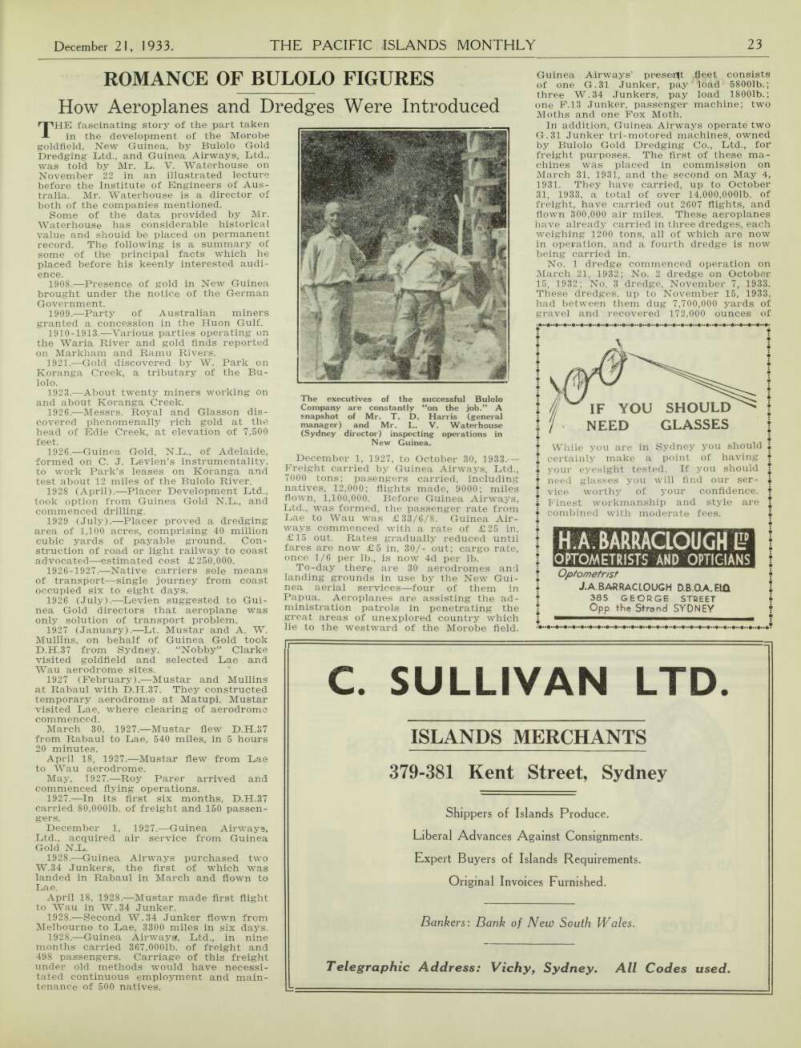
Romance Of Bulolo Figures
THE fascinating story of the part taken in the development of the Morobe goldfield, New Guinea, by Bulolo Gold Dredging Ltd., and Guinea Airways, Ltd., was told by Mr. L. V. Waterhouse on November 22 in an illustrated lecture before the Institute of Engineers of Australia. Mr. Waterhouse is a director of both of the companies mentioned.
Some of the data provided by Mr.
Waterhouse has considerable historical value and should be placed on permanent record. The following is a summary of some of the principal facts which he placed before his keenly interested audience. 1908. —Presence of gold in New Guinea brought under the notice of the German Government. 1909. —Party of Australian miners granted a concession in the Huon Gulf. 1910-1913. —Various parties operating on the Waria River and gold finds reported on Markham and Ramu Rivers. 1921. —Gold discovered by W. Park on Koranga Creek, a tributary of the Bulolo. 1923. —About twenty miners working on and about Koranga Creek. 1926. —Messrs. Royal and Glasson discovered phenomenally rich gold at the head of Edie Creek, at elevation of 7,500 feet. 1926.—Guinea Gold, N.L., of Adelaide, formed on C. J. Levien’s instrumentality, to work Park’s leases on Koranga and test about 12 miles of the Bulolo River. 1928 (April).—Placer Development Ltd., took option from Guinea Gold N.L., and commenced drilling. 1929 (July).—Placer proved a dredging area of 1,100 acres, comprising 40 million cubic yards of payable ground. Construction of road or light railway to coast advocated —estimated cost £250,000. 1926-1927. —Native carriers sole means of transport—single journey from coast occupied six to eight days. 1926 (July).—Levien suggested to Guinea Gold directors that aeroplane was only solution of transport problem. 1927 (January).—Lt. Mustar and A. W.
Mullins, on behalf of Guinea Gold took D.H.37 from Sydney. “Nobby” Clarke visited goldfield and selected Lae and Wau aerodrome sites. 1927 (February).—Mustar and Mullins at Rabaul with D.H.37. They constructed temporary aerodrome at Matupi. Mustar visited Lae, where clearing of aerodrome commenced.
March 30, 1927.—Mustar flew D.H.37 from Rabaul to Lae, 540 miles, in 5 hours 20 minutes.
April 18, 1927. —Mustar flew from Lae to Wau aerodrome.
May, 1927. —Ray Parer arrived and commenced flying operations. 1927. —In its first six months, D.H.37 carried 80,0001b. of freight and 150 passengers.
December 1, 1927. —Guinea Airways.
Ltd., acquired air service from Guinea Gold N.L. 1928. —Guinea Airways purchased two W. 34 Junkers, the first of which was landed in Rabaul in March and flown to Lae.
April 18, 1928. —Mustar made first flight to Wau in W. 34 Junker. 1928. —Second W. 34 Junker flown from Melbourne to Lae, 3300 miles in six days. 1928. —Guinea Airways, Ltd., in nine months carried 367,0001b. of freight and 498 passengers. Carriage of this freight under old methods would have necessitated continuous employment and maintenance of 500 natives.
December 1, 1927, to October 30, 1933.
Freight carried by Guinea Airways, Ltd., 7000 tons: pasengers carried, including natives, 12,000; flights made, 9000; miles flown, 1,100,000. Before Guinea Airways, Ltd., was formed, the passenger rate from Lae to Wau was £33/6/8. Guinea Airways commenced with a rate of £25 in, £l5 out. Rates gradually reduced until fares are now £5 in, 30/- out; cargo rate, once 1/6 per lb., is now 4d per lb.
To-day there are 30 aerodromes and landing grounds in use by the New Guinea aerial services—four of them in Papua. Aeroplanes are assisting the administration patrols in penetrating the great areas of unexplored country which lie to the westward of the Morobe field.
Guinea Airways’ present fleet consists of one G. 31 Junker, pay load 58001b.; three W. 34 Junkers, pay load 18001b.; one F. 13 Junker, passenger machine; two Moths and one Fox Moth.
In addition, Guinea Airways operate two G. 31 Junker tri-motored machines, owned by Bulolo Gold Dredging Co., Ltd., for freight purposes. The first of these machines was placed in commission on March 31, 1931, and the second on May 4, 1931. They have carried, up to October 31, 1933, a total of over 14,000,0001b. of freight, have carried out 2607 flights, and flown 300,000 air miles. These aeroplanes have already carried in three dredges, each weighing 1200 tons, all of which are now in operation, and a fourth dredge is now being carried in.
No. 1 dredge commenced operation on March 21, 1932; No. 2 dredge on October 15, 1932; No. 3 dredge, November 7, 1933.
These dredges, up to November 15, 1933, had between them dug 7,700,000 yards of gravel and recovered 172,000 ounces of
The executives of the successful Bulolo Company are constantly “on the job.” A snapshot of Mr. T. D. Harris (general manager) and Mr. L. V. Waterhouse (Sydney director) inspecting operations in New Guinea.
bullion, worth about £900,000, Australian currency.
The staff of Bulolo Gold Dredging Ltd. on October 31, 1933, included 220 Euro peans. Guinea Airways’ staff on the same date comprised 55 Europeans, including seven pilots and twenty mechanics and ground engineers.
During the last six years the two com panies represented by Mr. Waterhouse have established aerodromes at Lae, Bu lolo and various other places; have in troduced and operated a large fleet of large aeroplanes: have built at Lae a wharf, railway, loading cranes, etc.; have trans ported to Bulolo and erected three large dredges and constructed innumerable buildings, roads, bridges, etc., in connec tion therewith; have installed a hydroelectric plant of 3000 h.p.; have cut and
transported a million feet of timber for fluming, etc.; and have established minor transport services on the goldfield and at Lae, operated in connection with the aerial services. This has all been accom plished without any serious accident, mis hap, or delay.
Associated with Mr. Waterhouse during his lecture was Mr. H. G. Carter, con sulting electrical engineer, who superin tended the erection of the hydro-electric power plant at Bulolo. Mr. Carter, in a supplementary lecture, gave very inter esting particulars of the special prob lems met with in carrying out this work and how they were surmounted.
Advertisements & other items, pp. 25-26 (1 item)
C. Sullivan Ltd.
IF YOU SHOULD
NEED GLASSES
While you are in Sydney you should certainly make a point of having your eyesight tested. If you should need glasses you will find our service worthy of your confidence.
Finest workmanship and style are combined with moderate fees.
Optometrist
J.A.BARRACLOUGH D.B.O.A.F.I.Q.
385 GEORGE STREET
Opp. the Strand SYDNEY
C. SULLIVAN LTD.
ISLANDS MERCHANTS
379-381 Kent Street, Sydney
Shippers of Islands Produce.
Liberal Advances Against Consignments.
Expert Buyers of Islands Requirements.
Original Invoices Furnished.
Bankers : Bank of New South Wales.
Telegraphic Address: Vichy , Sydney. All Codes used.
GILLESPIE’S
"ANCHOR"
FLOUR
TRADE
MARK
The Standard of Quality.
CHARTRES,
STOTT & HOARE'S
CORRESPONDENCE
COLLEGE
Founded 1885.
Pioneers and Specialists in Postal Instruction.
All Educational and Commercial subjects taught thoroughly and efficiently by correspondence.
Experienced Certificated Instructors. Write for particulars Chartres, Stott & Hoare’s Correspondence
College
Liverpool Street, Sydney, Australia.
Epidemic of Weddings
New Guinea Notes
From Our Own Correspondent.
Rabaul, Nov. 14.
WEDDINGS seem to be popular in Rabaul at the present time.
On Monday, November 6, Miss Mary Elinor Walcott, only daughter of Mr. P.
E. Walcott, one-time Public Service Com missioner in Brisbane, was married to Mr. William James Livingstone, of the New Guinea Police staff. The ceremony was performed by the Rev. T. J. Gibson at St. George’s Church. After the cere mony the wedding breakfast was held at the residence of Mr. and Mrs. R. W.
Crouch. The happy couple left that even ing for South by the Macdhui.
The wedding is being celebrated this evening at the Roman Catholic Church by Rev. Father Madigan of Miss Maunsell, a sister of Mrs. Dodd, and Mr. E. Bishton, a well-known and popular member of the Amalgamated Wireless staff, stationed at Rabaul.
To-morrow the marriage of Miss Field, of the Namanula Hospital staff, and Mr.
“Dick” Forsyth, of Messrs. J. L. Peadon’s, will be celebrated.
And there are rumours of others in the near future.
Gold Exports.
Gold exports from the Fields show a decrease for the month of September.
The amount exported was 19,645 oz., valued at £100,475. This decrease is not causing those in the know any con cern, as it is stated that there are large quantities on the field awaiting ship ment.
School For Kavieng.
Arrangements have been made by the Administrator for the opening of a Euro pean school at Kavieng early in the new year. It is understood that for the time being a temporary school-house will be supplied by the residents, but that as soon as the new estimates are through a proper school-building will be erected.
Personal.
Mrs. Perriman, wife of Mr. B. B. Perri man, M.L.C., is making a quick journey to Sydney for the purpose of bringing back her son from school, for the Christmas holidays.
Mr. Philpots, who has been managing B.P.’s interests at Madang for some months past, has now been transferred to Kavieng.
A rifle shooting club is being formed here, and there is every indication that there will be some keen competition be tween the various teams, consisting of B.P., W.R.C., Commonwealth Bank, and the Police.
The baseball season has closed. Ad ministration team are the winners this season with 14 points. Commerce and Metropolitans tie for second place with 8 points each. It is anticipated that a Rabaul cricket XI. will journey to Wau for the Christmas festivities there.
Fatal Seaplane Crash.
The Coroner announced his finding in the air-crash inquest yesterday when he returned a verdict of misadventure. Mrs.
Mirfield died, so it was stated, as a result of a fracture at the base of the skull. Mr.
G. Mirfield, who was a passenger in the seaplane which crashed on October 15 near Kokopo, is a passenger proceeding to Sydney by the Nellore. He goes South for medical treatment.
Measles Killed.
Owing to the vigilance of the Assistant- Director of Public Health, Dr. Champion Hosking, there have been no further cases of measles which were brought into the Territory by a passenger on the Macdhui, All contacts were quarantined at Nama nula; the Administrator placing his resi dence at the disposal of the quarantined passengers. Mrs. C. I. H. Campbell, Mr. and Mrs. Moore), Mrs. Max Lees and several others were amongst the contacts.
Mr. “Ted” Hawnt, our telephone expert, has returned from the East after a holi day in China and Japan.
Mr. and Mrs. R. A. Laws are spending some time up in the goldfields.
B.P. Magazine and Its Beautiful
Pictures
A NEW standard of photographic excellence is attained in the December issue of the B.P.
Magazine which is just to hand. This at tractive high-class quarterly has now been in existence for five years and it is a credit alike to the publishers and to Australian typography.
Every issue introduces something new and pleas ing; and in that under notice there is a very generous collection of articles, story and travel sketches —all conforming to a high literary and editorial standard.
It is, however, in the reproduction of scenic photographs that the B.P. Magazine is notable —there is, in fact, nothing now in Australia to compare with it. In the issue under notice there is a particularly fine series of photographs of scenery and native life in New Guinea and Papua, and another series illustrating the charms of a holiday on the north Queensland coast.
In the beginning the B.P. Magazine had a general appeal. It retains that appeal—extends it, in fact —but the editors seem how to spec ialise in travel material. No one, even the least imaginative among us, could look through this delightful collection of travel stories and exotic pictures without feeling the urge to climb aboard the first outgoing steamer and make personal acquaintance with shining seas and smiling natives.
B.S.L Service
How Many Trips Per Annum?
Letter to the Editor.
THE writer yelept “Frequency,” and Mr.
Musgrave, in your September issue, appear only to have proved that the pre sent service is a one-way service, and that they are mainly concerned with its continuance in order that they may re ceive ten mails a year, instead of the eight, contended by many folk to be all that are necessary.
Mr. Musgrave is only quibbling when he goes back twelve years, to old Planters’
Association days, to dig up the old fight we had for an improved service. Nobody knows better than he, nor complained more loudly than he, of the irregular and inadequate service then existing. It was no unusual thing for the steamer to be days behind her schedule, for cargo to be shut out, or for consignees to be in a con stant state of anxiety at the possibility of having their produce left behind.
Followed the two-steamer service men tioned by “Frequency.” But it must be remembered that these vessels were much smaller than the Mataram, and that only one of them confined itself to the British Solomons, while the other was shared with the Mandated Territory. Rabaul shippers so often monopolised all the space in the latter vessel that the three weekly service became, so far as B.S.I. shippers were concerned, a myth. So there was not so much shipping knocking about in those days as “Frequency” would have us believe. And it is well to remem ber that at that time a number of plant ers and traders were consigning produce to Sydney, instead of as now, selling loc ally for direct shipment overseas.
It was, in fact, the latter factor that finally eased the pressure on the Sydney service. When Australia had lost its grip on the copra trade the Australian politic ians woke up and said we needed brighter and bigger ships and more of them to cope with the vanished traffic, and so we got the Mataram and the present exces sive service. Incidentally, one doubts whether the Mataram is in the habit of leaving the Group in the plethoric state mentioned by “Frequency,” because, af ter all, the forward-looking Burns Philp are only replacing her with a vessel of about the same tonnage.
As for the time-wasting that “Fre quency” makes so merry about, it should be sufficiently obvious that it is not prac ticable for folks with a business of any size, whether it be of a Commercial, Planting, or Mission nature, to meet only every alternate steamer. We were able to do so in the three-weekly service days.
To do so to-day would entail a wait of ten or eleven weeks for supplies—which is too long.
Copra is not a seasonal product, that has to be rushed overseas to catch a mar ket. It is capable of being stored for a reasonable period without marked loss.
That being so, and the trade at present being of so one-sided a nature, it seems natural to suggest that all that is neces
sary to bring about a more rational state of affairs is a readjustment of tonnage.
It can safely be assumed that a service of eight trips a year will fully meet all the present needs of the Solomons. Oc casionally it may be necessary to divert a freighter to lift accumulations from the principal district exporting to Australia, which is a different proposition to in creasing the number of trips of an expen sive passenger steamer. Alternatively, it may be a better plan to dovetail our ser vice in with that of an adjacent Group, and thus iron out the inequality of the present B.S.I. service. Burns Philp may safely be left to work out the details.— I am, etc.,
Leslie F. Gill.
Gizo, B.S.I., 24/10/33.
New Hebrides
British Flag In
Letter to the Editor.
WITH reference to the article entitled “Australia asked to help British in New Hebrides,” by R. Carlton Bruce, I should like to bring to your notice that in 1932, H.M.S. Veronica called at Hog Harbour, New Hebrides; and that in July and August, 1933, Vila was visited by H.M.S. Dunedin, showing the broad pen nant of the Commodore commanding the New Zealand station. The Condominium was visited also by H.M.S. Laburnum.
Auckland, 1/12/1933.
L. Priestley.
Personal Notes From
Samoa.
From Our Own Correspondent.
Apia, Nov. 25.
Mr. C. McKay, late at Government Head Office, has been appointed Secretary of Native Affairs.
Mr. and Mrs. G. Ross and family, a well known trader of Faga, Savaii, left Samoa by the “Mariposa” for Melbourne. Other passengers by the same boat were the Rev. and Mrs. Darby, of the Methodist Mission, Samoa.
The former Native Secretary, Mr. Mc- Bride, and his wife, left by last “Maui Pomare” for New Zeaiand. Mr. Dofley has severed his connection with the Health Department and returns to New Zealand with his family. Mr. T. Railey and family left by the “Maui Pomare” for an extended holiday in New Zealand.
Mr. Glover, of Apia Observatory, and his mother, Mrs. Glover, left by the “Ar denvohr,” for New Guinea, and other
parts.
On A World Cruise
From Our Own Correspondent.
TAHITI, October 10.
The yacht “White Shadow,” owned by Mr. T. Wessel, of the Danish Yacht Club, and now under charter to Mr. Henry Whitney and party, left Tahiti on October 3 for an extended trip round the world.
The first stop will probably be in the Northern Cook Islands, after which the yacht will proceed to Fiji, Java, Singa pore, Colombo, and thence to the Medi terranean. The yacht is to be turned over to her owner at Cannes.
Advertisements & other items, p. 27 (2 items)
giving a long lasting pro-
Made expressly to keep a lustrous, full gloss finish
against the varying con-
ditions of moist weather exposure, and prevent the decaying ravages of rain and extreme heat by
giving a long lasting pro-
tection to all surfaces.
SUN PROOF
RAIN PROOF
*Stronger than the Weather ”
W. R. CARPENTER
O CO. LTD.
New Guinea, Solomon Islands, and all other South Sea
New Britain Express Delivery.
GENERAL OVERSEAS AGENTS.
GENERAL CARRIERS, BAGGAGE AGENTS,
and FORWARDING AGENTS.
Reliable Cars and Trucks.
We aim to give quick and reliable Service at reasonable costs. P.O. Box 116. Telephone 141, W. WALKER-FLYNN, Proprietor, Market Street, Rabaul, T.N.G.
Model Leper Settlement
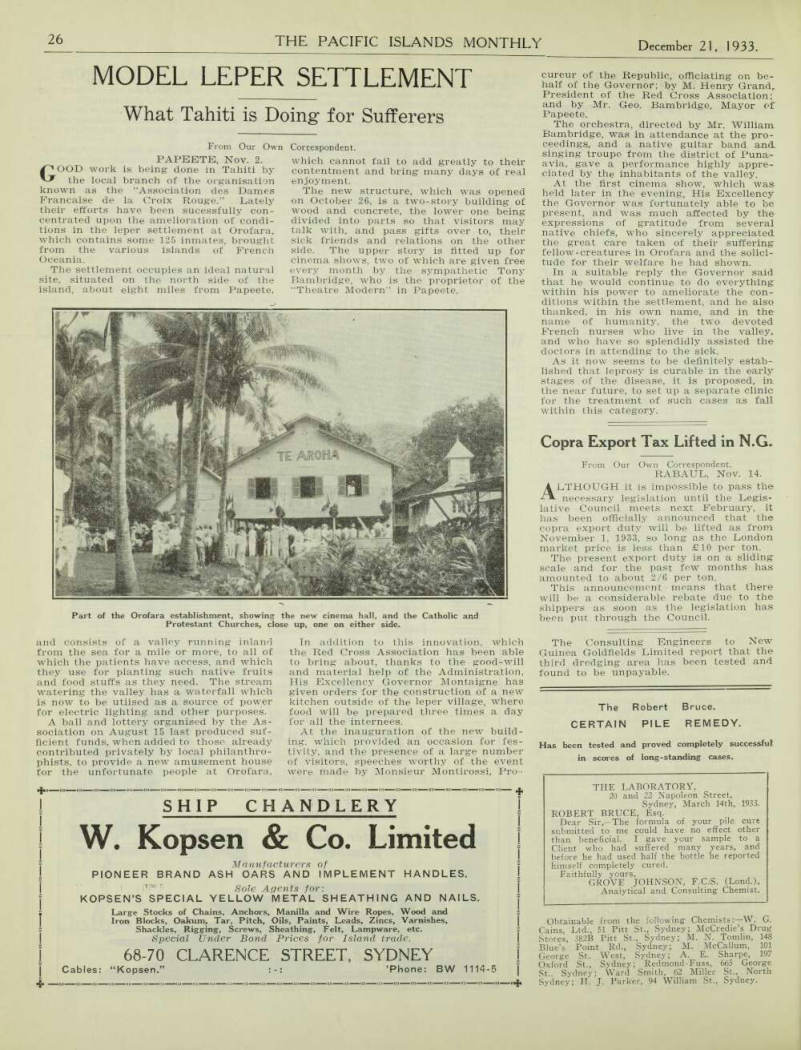
What Tahiti is Doing for Sufferers
From Our Own Correspondent.
Papeete, Nov. 2.
OOD work is being done in Tahiti by the local branch of the organisation known as the “Association des Dames Francaise de la Croix Rouge.’’ Lately their efforts have been sucessfully concentrated upon the amelioration of conditions in the leper settlement at Orofara, which contains some 125 inmates, brought from the various islands of French Oceania.
The settlement occupies an ideal natural site, situated on the north side of the island, about eight miles from Papeete,
and consists of a valley running inland from the sea for a mile or more, to all of which the patients have access, and which they use for planting such native fruits and food stuffs as they need. The stream watering the valley has a waterfall which is now to be utiised as a source of power for electric lighting and other purposes.
A ball and lottery organised by the As sociation on August 15 last produced suf ficient funds, when added to those already contributed privately by local philanthro phists, to provide a new amusement house for the unfortunate people at Orofara,
which cannot fail to add greatly to their contentment and bring many days of real enjoyment, The new structure, which was opened on October 26, is a two-story building of wood and concrete, the lower one being divided into parts so that visitors may talk with, and pass gifts over to, their sick friends and relations on the other side. The upper story is fitted up for cinema shows, two of which are given free every month by the sympathetic Tony Bambridge, who is the proprietor of the “Theatre Modern’’ in Papeete.
In addition to this innovation, which the Red Cross Association has been able to bring about, thanks to the good-will and material help of the Administration, His Excellency Governor Montaigne has given orders for the construction of a new kitchen outside of the leper village, where food will be prepared three times a day for all the internees, At the inauguration of the new build ing, which provided an occasion for fes tivity, and the presence of a large number of visitors, speeches worthy of the event were made by Monsieur Montirossi, Pro
cureur of the Republic, officiating on be half of the Governor; by M. Henry Grand, President of the Red Cross Association; and by Mr. Geo. Bambridge, Mayor of Papeete.
The orchestra, directed by Mr, William Bambridge, was in attendance at the pro ceedings, and a native guitar band and. singing troupe from the district of Puna avia, gave a performance highly appre ciated by the inhabitants of the valley.
At the first cinema show, which was held later in the evening, His Excellency the Governor was fortunately able to be present, and was much affected by the expressions of gratitude from several native chiefs, who sincerely appreciated, the great care taken of their suffering fellow-creatures in Orofara and the solici tude for their welfare he had shown.
In a suitable reply the Governor said that he would continue to do everything within his power to ameliorate the con ditions within the settlement, and he also thanked, in his own name, and in the name of humanity, the two devoted French nurses who live in the valley, and who have so splendidly assisted the doctors in attending to the sick.
As it now seems to be definitely estab lished that leprosy is curable in the early stages of the disease, it is proposed, in the near future, to set up a separate clinic for the treatment of such cases as fall within this category.
Part of the Orofara establishment, showing the new cinema hall, and the Catholic and Protestant Churches, close up, one on either side.
Copra Export Tax Lifted in N.G.
From Our Own Correspondent.
Rabaul, Nov. 14.
ALTHOUGH it is impossible to pass the necessary legislation until the Legis lative Council meets next February, it has been officially announced that the copra export duty will be lifted as from November 1, 1933, so long as the London market price is less than £10 per ton.
The present export duty is on a sliding scale and for the past few months has amounted to about 2/6 per ton.
This announcement means that there will be a considerable rebate due to the shippers as soon as the legislation has been put through the Council.
The Consulting Engineers to New Guinea Goldfields Limited report that the third dredging area has been tested and found to be unpayable.
Advertisements & other items, p. 28 (2 items)
The Robert Bruce.
CERTAIN PILE REMEDY.
Has been tested and proved completely successful in scores of long-standing cases.
THE LABORATORY,
20 and 22 Napoleon Street, Sydney, March 14th, 1933.
ROBERT BRUCE, Esq.
Dear Sir,—The formula of your pile cure submitted to me could have no effect other than beneficial. I gave your sample to a Client who had suffered many years, and before he had used half the bottle he reported himself completely cured.
Faithfully yours,
GROVE JOHNSON, F.CjS. (Lend.).
Analytical and Consulting Chemist.
Obtainable from the following Chemists;—W. G.
Cains, Ltd., 51 Pitt St., Sydney; McCredie’s Drug Stores, 382B Pitt St., Sydney; M. N. Tomlin, 148 Blue’s Point Rd., Sydney; M. McCallum, 101 George St. West, Sydney; A. E. Sharpe, 197 Oxford St., Sydney; Redmond-Fuss, 665 George St., Sydney; Ward Smith, 62 Miller St., North Sydney; H. J. Parker, 94 William St., Sydney.
W. Kopsen & Co. Limited
SHIP CHANDLERY
Manufacturers of PIONEER BRAND ASH OARS AND IMPLEMENT HANDLES.
Sole Agents for: KOPSEN’S SPECIAL YELLOW METAL SHEATHING AND NAILS.
Large Stocks of Chains, Anchors, Manilla and Wire Ropes, Wood and Iron Blocks, Oakum, Tar, Pitch, Oils, Paints, Leads, Zincs, Varnishes, Shackles, Rigging, Screws, Sheathing, Felt, Lampware, etc.
Special Under Bond Prices for Island trade.
68-70 CLARENCE STREET, SYDNEY
Cables: “Kopsen.” ’Phone: BW 1114-5
Germany In Samoa
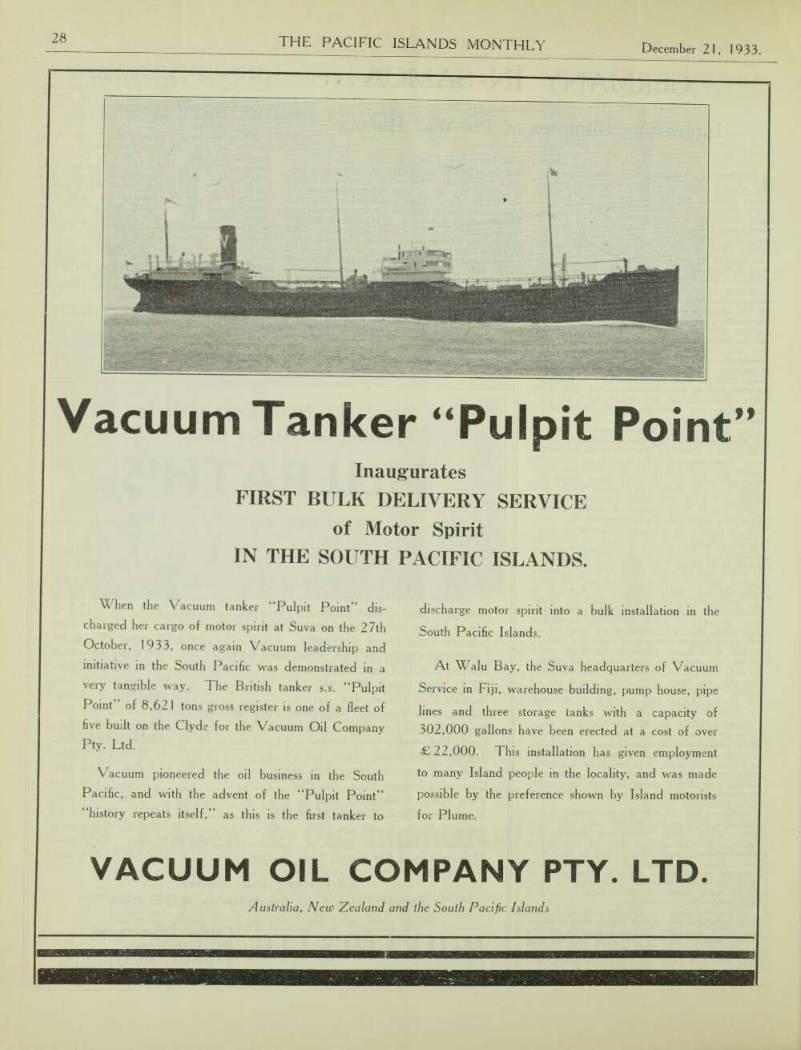
Interesting Glimpses of Pre-War History
UNDER the heading of “The German Peril” many a reader has in the past been primed up to be aware of a cer tain something, which darkens the sky, and which at a given moment may swoop down on him, devour him, destroy what ever he created, and blight his life for ever. The world in general, ever since the ending of the last Century, has slowly, and I may say scientifically, been made to fear “The Enemy of Civilisation.”
When New Guinea and, later, Samoa, were put under the German flag, this part of the globe went hysterical with fear and forebodings of what was going to happen to the British colonies. Those groups were considered the jumping-off places for the invasion of Australia and New Zealand. Everybody, also the writer, re members well those “true” stores, that were told in the Press, and in the pubs, of all sorts of happenings, when Germans were met, where the sabre was rattled and the air filled with bombastic speeches.
The commercial world readily picked up the trend of the public opinion, and, wherever a German trading-post or busi ness was established, where a German vessel showed her nose, a powerful pro paganda was let off. No deal could be more crooked than that made with one of them! And talk about all those naval bases, which had been and would be es tablished all over these Islands!
Just lately, the same kind of propa ganda appears to be spread, or rather, attempts at that are appearing; and I think it is only fair, just and opportune, to point out to your readers how unwar ranted, unfair, and incorrect the old pro paganda has been, so that to-day all of us, who are making our living in these islands —or, rather, attempting to do so — may be able to keep on living in peace and with that friendliness to each other which behoves members of the white races, who have realised in their own selves the terrible sufferings and unde served hardships which a catastrophe, like the one past may bring down on us again. Right now, we must look out for our racial safety and we can do so only by looking to each other.
Having lived in Samoa for just one third of a century, having held a respon sible position with the German Adminis tration, and being an independent planter and business-man of these days, I believe I am entitled to a fair hearing, while as suring you that I am giving you only such happenings which I know to be facts, and facts only.
Before 1900, during the tri-partite Gov ernment of Samoa, the air and the land were filled with jealousies, strife and fights. Because every one of the three Governments wanted Samoa, it was na tural that the owners of the place, the natives, were used to play the part of their so-called friends, resulting in pro gress and development being retarded and held off altogether.
From the day the German Government was established, equal trade-rights were accorded, not only to the nationals of the three Powers, but to everyone who was in Samoa, and who came later! Everybody was allowed to settle, acquire land, en gage in work or business, and not the slightest differentiation was ever imposed.
Letter to the Editor.
German goods paid the same import du ties as British, and other goods. To-day I may safely state that this treatment re sulted in the British residents of German Samoa handing the officer in command of the occupying troops, before they landed in August, 1914, a petition signed by them all, to the effect that, as the German Gov ernment and the Germans in Samoa had treated them well, they respectfully asked that the same treatment be accorded them from then on. Surely this was not “cant.” It was the natural result of a “fair deal” received.
And what about those military and naval bases, which were said to exist?
The occupying forces found, I think, 60 old Mauser carbines with 40 rounds of ammunition each, no soldiers at all; and, in place of a naval station, a heap of coal on the Apia Beach, in Matautu! During
all those 14 years of German regime over Samoa, there were always one or two members of the Governor’s Council ap pointed from the British residents, and as a natural result, the language at their meetings was mostly that of these two representatives.
Some of your readers may ask, what about B.P. in the Caroline Islands. The answer is easy. The right to trade had been granted to that old German firm, which had been established there for a number of years when Burns Philp’s ship of-trade put in an appearance. And what happened after? When the matter was considered, B.P. were allowed in. And when this same firm applied for a trading licence in Samoa it was granted (I think it was in 1912, when I happened to have the honour to be the Collector of Customs and Taxes for Samoa) and they have been established in Samoa ever since.
Just one more happening to show the feelings of the members of all those foreign residents in Samoa before the War. When several of the native con stabulary ran amok in February, 1914, and killed several German planters, all whites united with the German residents and officials in search-parties for miles in the bush and, when finally those boys were
shot down in a pig-pen miles away from Apia, they were there to also face the deadly bullets which those troopers fired in their defence. Surely, there is a very certain reason for that!
You say nothing against other white nations, who send their ships to take your cargoes, whose nationals settle and marry in your country—so-called neu trals during the War, who lost neither lives nor treasure. But you do attempt to run down us Germans. Why? Is it because there are 66 millions of us— which some day may be very useful to fall back on, indeed! And don’t you think and also agree that there is more honour and respect due us for having stood off twenty nations for over four years, than those twenty can claim for having downed us in the end?
Why this scare, at all? Have we not given proof a-plenty that, under the Ger man flag, absolute freedom and liberty have been granted, allowed and issued, and never anything like a conquest even contemplated ?
When talking about Japan, you coolly admit their right to expand, that their country is too small; but when we want to settle in other lands you stand up and shout from the housetops: “Beware of these —!”
Have you forgotten that we are of one blood? Have you forgotten that this was the first time in history that we fought each other? And have you never heard that even the propagators and instigators of this War in your camp have realised to-day that it all was a terrible mistake?
If you have not, ask those men who fought in the front trenches, and not those who only filled sandbags and — gasbags!
I gladly join hands with Major Schnockel in appealing to the readers of your valuable monthly to let bygones be forgotten, forgotten altogether. We all have arrived on a new plane of thinking.
Our necessities to-day are vastly different from those of years ago!
I am, etc.
R. P. Berking.
Samoa, Nov. 21, ’33.
Advertisements & other items, pp. 29-30 (1 item)
Mcilrath’S
Start the New Year well by Sending an Order to . . .
Ideal Unsweetened Milk, 6oz. tins (8 doz.) 3/6 doz., 21/- case Nestle’s Condensed Milk, Full Cream (4 doz.) ... 7/9 doz., 28/- case Australian I.A. Sugar, 70lb. bags 14/6 bag Finest Roller Flour, 30lb 3/3 bag, 8/3 tin Australian Trade Beef, 12oz. tins (4 doz.) 3/6 doz., 20/- case St. George Assorted Meats, 14oz. tins (4 doz.) ... 16/6 doz., 60/- case Australian Rice, Finest Dressed, 36lb. bags 9/3 bag Mixed Crown Soap, Unwrapped, 36’s or 72’s 23/- case Selmore Toilet Paper, 3oz. rolls 1/10 doz., 20/- gross Californian Asparagus Tips, tins (4 doz.) ... 13/- doz., 44/- case Rosa or I.X.L. Pears, 30oz. tins 10d. tin, 9/9 doz.
I.X.L. Fruit Salad, 16oz. tins lid. tin, 10/6 doz.
Nestle’s Pure Cream, 4oz. tins tin, 4/3 doz.
Garden Vale Assorted Vegetables, 16oz. tins 8/- doz.
Rosa Best Western Honey, 2lb. tins 1/2½ tin, 14/- doz.
Eno’s Fruit Salts, large bottles 3/9 bot., 43/6 doz.
Selmore Fruit Saline, 16oz. tins 1/3 tin, 14/6 doz.
Norfolk Tasmanian Hops, 1lb. pkts 1/2 pkt., 13/6 doz.
Cornwell’s Extract Malt, 2lb. tins 2/- tin, 23/6 doz.
Pure Mocha Coffee, 1lb. tins 2/10 tin, 32/6 doz.
Yoga Tea, Choice Ceylon Blend, 1lb 1/10 pkt., 2/2 tin Sparklet Bulbs, quart size “C” 3/10 doz., 43/- gross Rumford’s Bag Blue, knobs 10½d. doz., 10/- gross Flybane Liquid Fly Spray, 16oz. bottles 1/2 bot., 13/6 doz.
All Prices F.O.B. Sydney.
Export Price Lists available on Application.
McILRATH’S LTD.
Export Department, 202 Pitt Street,
SYDNEY, AUSTRALIA.
Vacuum Tanker “Pulpit Point"
Inaugurates
FIRST BULK DELIVERY SERVICE
of Motor Spirit
IN THE SOUTH PACIFIC ISLANDS.
When the Vacuum tanker “Pulpit Point” discharged her cargo of motor spirit at Suva on the 27th October, 1933, once again Vacuum leadership and initiative in the South Pacific was demonstrated in a very tangible way. The British tanker s.s. “Pulpit Point of 8,621 tons gross register is one of a fleet of five built on the Clyde for the Vacuum Oil Company Pty. Ltd.
Vacuum pioneered the oil business in the South Pacific, and with the advent of the “Pulpit Point”
“history repeats itself,” as this is the first tanker to discharge motor spirit into a bulk installation in the South Pacific Islands.
At Walu Bay, the Suva headquarters of Vacuum Service in Fiji, warehouse building, pump house, pipe lines and three storage tanks with a capacity of 302,000 gallons have been erected at a cost of over £22,000. This installation has given employment to many Island people in the locality, and was made possible by the preference shown by Island motorists for Plume.
VACUUM OIL COMPANY PTY. LTD.
Australia, New Zealand and the South Pacific Islands
Samoan Planters
Prices at Low Level
From Our Own Correspondent.
Apia, Nov. 25.
THE only silver lining in the black clouds hanging over Samoa is the increase in the banana price from 3/- to 4/- per case, which came into force for the November “Maui Pomare.” A fur ther rise under the new banana contract for 1934 to 5/- per case, is announced for the January, 1934, boat.
The cocoa auction in London, at which 3000 bags of Samoan cocoa were offered for sale, to test the market, brought prices ranging from £32 to £43 per ton, which should net the planters about £30 to £35 on the beach. So far, however, the Apia firms have not raised the cocoa price to anything like this figure, and at time of writing the rate of £12/5/- per ton is still mentioned, at which figure it is impos sible to pick and cure cocoa. The fate of many planters still hangs in the balance.
The copra price, which in outside dis tricts had been dropped to 1-8 cent, per lb. (11/3 per ton), was raised again to ½ cent (22/3 per ton), owing to the Admin istration taking 10/- off the copra export duty of 30/- per ton.
Interesting Experiment by
Samoan Tobacco
Interesting Experiment by District Priest
From Our Own Correspondent.
Apia, Nov. 25.
THE Catholic district priest at Leau va’a, 10 miles west of Apia, has conducted an interesting experiment as to the possibilities of tobacco growing in Samoa.
Leauva’a is a large Samoan village, founded by the former German Adminis trator, to settle a number of Samoan nat ives from Savaii, who had become home less after the eruption of the volcano in the Matautu district of Savaii. These people have taken up tobacco growing to a large extent at their new place of resi dence, for their own needs, and also for sale to other native consumers, and their tobacco has a good reputation all over the islands.
This fact, and the drop in copra and cocoa prices, and the precarious position of a large number of European settlers in Samoa, caused the Rev. Father Haller, of Leauva’a to try an experiment into the possibilities of tobacco cultivation for European consumption, and especially for cigarette tobacco. He ordered three kinds of tobacco seeds from a German tobacco experimental station, viz., Turkish (cigar ette), Samsoun Havana (cigar), and Vir ginia (pipe) tobacco.
These seeds he planted out, carefully observing the detailed instructions, and a few months ago he had his first tobacco crop, which he fermented, dried and cured in the best possible way. From the vari ous leaves he manufactured a large quan tity of cigarettes, using the pure tobacco (fine cut for cigarettes), as well as blend ing the various kinds together.
These sample cigarettes Father Haller then sent out to a large number of Euro pean residents, requesting them to express their opinion on the taste and aroma of the cigarettes. Most of the people asked were quite enthusiastic regarding the possibility of replacing the large quanti ties of tobacco and cigarettes imported into Samoa by a much cheaper and equal ly good home-made brand.
Father Haller is now prepared to dis tribute tobacco seed from his plants to all who are interested. The cultivation should be exclusively for home consump
tion and on small 10 to 12-acre planta tions, which a man could work with his family. There is hardly any possibility of outside markets for cigarette tobacco being procured.
Father Haller deserves the sincere thanks of the community and all possible support for the self-denying way in which he has worked for the common good of the people of Samoa.
Tinai Valley Gold
Another Papuan Venture
From Our Own Correspondent.
Pt. Moresby, Nov. 8.
MORE than usual interest is centred around mining in Papua lately, ow ing chiefly to renewed activity as Misi ma Island and the opening of the Tinai Valley, on the eastern slopes of Mt. Law son (on the border between Papua and New Guinea).
In September, the Tinai Valley Gold Dredging Co., Ltd., was registered in Syd ney with a nominal capital of 30,000 shares of 10/-, 20,000 of which were offered for public subscription and 10,000 go to vendors. These were over-subscribed in four days and the Company is starting preliminary operations immediately.
Mr. Cameron, a mining engineer, and an assistant, are arriving by the “Mon toro" on November 10, and aerial trans port has been arranged between Port Moresby and Garina, in New Guinea, from whence the party travels overland across the Papuan border to the Tinai Valley.
Natives and cargo are being transported to the valley, where Mr. Cameron and his assistant intend to test the area taken up by the Company.
Mr. J. A. Miller, representing Misima Gold Reefs. N.L., which was floated re cently in Melbourne, is in Misima with Major Stuart Love.
Mr. Miller is engaged on the prelim inary work and Major Love is examin ing and reporting on the property. The Company has a nominal capital of £4,500, £3,000 contributing, which was subscribe;! to examine the leases. These leases con sist of 24 acres each on the island of Misima. They were reported upon favor ably by Mr. F. Mason, a mining engineer.
Mr. J. E. Crocker, of Collins Street, Mel bourne, is legal manager of the new com pany.
Advertisements & other items, pp. 31-32 (1 item)
Skandia FULL DIESEL Engines
MARINE and STATIONARY
Instantaneous starting from cold —no hot bulb—low fuel and oil consumption .
MANUFACTURED IN SLOW AND HIGH SPEED TYPES Full Particulars from the Sole Agents:
NELSON & ROBERTSON
12 Spring Street, Sydney.
Cables: Ivan, Sydney.
HOLBROOKS’
TABLE DELICACIES.
WORCESTERSHIRE SAUCE
—enjoys a world-wide reputation.
VAT 2 SAUCE a delicious, thick, fruity sauce.
VINEGAR — strong, well matured, and guaranteed Pure Malt.
ESSENCE OF ANCHOVIES—
A fish sauce made from the finest Gorgona Anchovies.
TOMATO SAUCE —made from fresh, ripe tomatoes, FRENCH CAPERS Capucines and Capottes.
SPANISH OLIVES
Varieties; Spanish Queens, Small Queens, Manzanillas, and Stuffed or Sliced ready for Sandwiches.
PURE OLIVE OlL —French or Italian. From the first pressings of selected Olives.
PICKLES
Varieties: Sweet Gherkins, Tiny White Onions, Walnuts, Piccalilli, Mixed and Green Tomato.
FISH and MEAT PASTES,
in 1 and 3oz. glass jars.
Varieties: Anchovy, Salmon, Ham and Tongue, Veal and Tongue, Chicken and Ham, Turkey and Tongue, Salmon and Shrimp, Bloater.
SOUPS, in 8oz., 16oz., ½ gal. and 1 gal. tins.
Varieties: Vegetable, Ox Tail, Mulligatawny, Mock Turtle, Tomato.
JELLY CRYSTALS— Specially prepared for warm climates. They set well, and are deliciously flavoured.
HEALTH SALINE— a refreshing health-giving beverage, suitable for hot climates, in and 1lb. tins.
Holbrooks (A/sia.)
Ltd.
WATERLOO, N.S.W.
French Copra Tax
Tahiti Presents Another Point of View
From Our Own Correspondent.
Papeete, Nov. 28.
Some resentment has been aroused in Tahiti over the editorial article on the copra situation, which appeared in the September issue of the P.I.M.—especially that part of it which deals with the tax recently imposed upon foreign copra by the French Government. The criticism is held to be unnecessarily harsh and un friendly in tone.
It has been pointed out that the primary object of the tax, which applies to other oil-bearing products as well as to copra, is not to produce revenue for the French Government but to create a fund from which a bonus will be paid to planters in French Territories, to help them over the present hard times, and thus encourage further planting with a view to becoming less dependent upon foreign sources of supply in the future.
Perhaps, for the cogent reasons given by the Editor in the article referred to, the tax may fail in its purpose. Never theless, there is much to be said in its favour, from the French standpoint.
The people of Tahiti and other islands of the Society Group have good reason to feel chagrined when they recollect the manner in which a flourishing fruit in dustry was abruptly strangled by the im position of a terrific import duty against their products in New Zealand some years ago, and the complete exclusion of island fruit from America.
The fruit business between this Colony and New Zealand was formerly of suf ficient importance to warrant the Union Steamship Company sending a special in termediate steamer to Tahiti once a month; and as all the cases needed for packing came from New Zealand in the form of shooks, the trade was a reciprocal one of benefit to both sides. Only a very little fruit now goes to New Zealand, and that at Christmas time, when the price there is sufficiently high to stand the im port duty and leave something over, W e are informed, also, that sample shipments of preserved fruit from Ta hiti, which should be classed with figs,
dates, etc., and which do not compete with any similar lines produced through out the British possessions in the Pacific or elsewhere, have had this tremendously high duty applied to them in New Zea land; and that, so far, the representations which have been made have not been suc cessful in removing it, or having it re duced to a reasonable basis.
Locally manufactured perfumes and toilet articles are also held up in Austra lia, New Zealand and other Pacific Ter ritories by prohibitive duties. Thus, busi ness in these lines is just as impossible as in the case of fresh and preserved fruits; though we know quite well that all these things would be welcome to the people in those places if they were per mitted to get them at reasonable prices.
Evidently, there is more than one side to this tariff question.
Obviously, the present copra situation, which is of world-wide importance, is one for discussion and negotiation between the British and French home Govern ments. But it seems to us that in mat ters of more local concern, an organisa tion like the Pacific Islands Association might assist all the islands very materially by making a close study of the commer cial relationships between the various groups, and then endeavouring to bring about a reciprocal adjustment of customs duties in respect to non-competitive lines.
There is a vast difference in principle be tween the prohibitive tariff walls existing at present, and a protective duty.
Popular Judge
From Our Own Correspondent.
Apia, Nov. 25.
JUDGE McCarthy, who was to leave Samoa by “Maui Pomare” in Nov ember, to occupy a judicial position in New Zealand, had to cancel his trip at a moment’s notice, owing to the political developments, as his local knowledge will be needed at the coming political trials.
The Judge and his family had been guests of honour at numerous social fare well functions lately, at which general re gret was expressed over the impending loss to Apia social life. As further proof of the popularity of the Judge, a petition had been presented to the Administrator, requesting that Mr. McCarthy’s services should be retained. The petition was signed by over 100 residents.
Advertisements & other items, p. 32 (1 item)
Ask for it
ESTABLISHED 1868.
Mr. Greene
Mr. Nelson And
Sidelight on Man Leader’s Character
DETAILS of the newspaper squabble between Mr. O. F. Nelson, of Western Samoa, and Mr. Marc T. Greene, the American journalist, who recently visited that Territory, do not throw a very flat tering light upon the character of Mr.
Nelson and his advisers. The practice of replying to criticism by screaming abuse at one’s critics may be very satisfactory to the screamer —in the heat of the moment, at any rate—but it certainly does not help to advance one’s cause in any where reasoned argument will ultimately decide the issue.
Mr. Greene went to Samoa and appears to have investigated the paramount poli tical question there with thoroughness and without prejudice. His sympathies, both before his visit and afterwards, were clearly with the nationalistic ambitions of the Samoans. He felt, as all friends of Samoa must feel, that the Samoans were entitled, not only to justice, but to some thing more than justice, on account of the cruel maladministration which Samoa suffered between 1922 and 1930 at the hands of certain swashbuckling gentle men from New Zealand.
Mr. Greene, a trained observer of events in many countries, came to the correct conclusion that the New Zealand Govern ment now realises its errors and is ready to make substantial concessions to the Mau, with a view to securing a permanent settlement of the native troubles. He found, however, that one of the main obstacles in the way of a satisfactory settlement is the character of Mr. Nelson.
He said in newspaper articles that Mr.
Nelson, owing to his temperament and his bitter prejudices, would not be a suitable representative of the Mau in the pending negotiations with the New Zealand Administrator; and he therefore supported the Administrator in his refusal to negotiate with the Mau so long as the Mau insisted on Mr. Nelson being one of its delegates.
Mr. Greene in an article on this subject in a San Francisco newspaper was quite outspoken about Mr. Nelson. The picture he drew of Mr. Nelson was not exactly flattering; but neither was it unduly offensive. Possibly Mr. Greene was in error, when describing the personality and history of Mr. Nelson, in not giving emphasis to the fact that Mr. Nelson is an ardently patriotic Samoan, and that he has undertaken and suffered tremen dous sacrifices, in both his personal liberty and his private fortune, in advo cating the cause of the Mau.
In due course the “San Francisco Chronicle” of September 17, 1933, came to the hands of Mr. Nelson; and the lat ter, both by direct post and through the “Samoan Herald,” directed a perfect tirade of abuse at Mr. Greene, who was still in Samoa. Mr. Nelson charged Mr, Greene with all sorts of things; but the only matter worthy of notice is his state ment that Mr. Greene called on Mr.
Nelson in Auckland and tried to borrow from him a sum of 200 dollars. The in ference, of course, was that, as Mr.
Greene failed to obtain this sum from Mr. Nelson, he deliberately used his posi tion as a journalist to vilify Mr. Nelson.
But in Mr. Nelson’s own newspaper, “The New Zealand Samoan Guardian,” of
November 17, there is a statement which puts an entirely different complexion upon the matter. It is stated there that Mr. Greene went to the office of Mr.
Nelson in Auckland, explained that owing to exchange difficulties he (Mr.
Greene) had not received money due to him from certain investments that he has in public utilities in America, and asked Mr. Nelson to lend him 200 dollars on the basis of such securities. That, on the face of it, was not at all an improper proposal; but the subsequent insinuation that Mr. Greene was simply trying to extract a little easy money from a sup posedly rich man eager to obtain pub licity, is most unworthy and improper.
Other information to our hand shows that this incident of the 200 dollars occurred two years ago, and not recently: and that Mr. Greene did not ask for a loan, in the manner suggested, but instead asked Mr. Nelson if he could, recommend a broker, who would handle the small matter for him. Mr. Nelson has magnified a trivial incident into something of major importance.
In a general way, it may be said that Mr. Nelson’s attacks on Mr. Greene have been hysterical, savage, and unbalanced; and (what is more important) they sup port to a remarkable degree the very reasons which have been advanced by Mr. Greene and others to show that Mr.
Nelson would not be a fit person to repre sent the Samoan Mau in the proposed conference with the Administrator. In fact, the man who would write such let ters as Mr. Nelson has written to Mr.
Greene, and about Mr. Greene, is the very last man who should be admitted to such a conference.
Mr. Greene at present is in New Zealand and we understand that he may shortly visit Sydney. It must be admit ted that he is a challenging and provoca tive writer —just the type who would be likely to arouse the ire of a temperamen tal man like Mr. Nelson—but on the whole he appears to have summed up the Samoan situation fairly and justly.
During July, August, and September of 1933, 9,647cwt. of pearlshell, valued at £63,241, were exported from Australia, as compared with 4,915cwt., with a value of £33,575 for the corresponding period last year.
Trading Schooner
Wrecked
Novelist N. Hall Cast Away in Oceania
From Our Own Correspondent.
Papeete, Nov. 2.
NEWS has been received in Tahiti that the local trading schooner “Pro Patria,’’ which left Papeete for Pitcairn Island nearly three months ago, is now a total wreck on the island of Timoe, a small uninhabited atoll south-east of Mangareva, and that the passengers and crew are all safe.
Further details regarding the wreck are lacking, but it is surmised that the schooner went ashore during a severe storm known to occur some time in Sep tember.
As stated in recent notes, Mr. Norman Hall, the novelist, was a passenger on the “Pro Patria,” and there were also some other Americans and two French ladies aboard.
The non-appearance of the vessel caused considerable anxiety in Papeete, so that the Administration despatched the training schooner “Zeelee” to search the Tuamotus for news, with the abovemen tioned result. The castaways were taken to Hao Island by the Zeelee, and now await the steamer “Ville de Papeete,” for final transportation to Papeete. They are expected here about November 14. It is stated that the value of the “Pro Patria” and her cargo of trading goods is cov ered by insurance.
EDITORIAL NOTE: Mr. Hall recently col laborated with Mr. Nordhoff in the successful new novel “Mutiny,” in which is retold the fascinating tale of the Bounty mutiny. This was the first of a trilogy planned by the distinguished American writers. The second book will describe Bligh’s historic voyage in the open boat; and the third will break entirely new ground by telling of what happened on Pitcairn in the first decade after the Bounty was cast away—an almost in credible story of cruelty and lust. Mr. Hall was on his way to Pitcairn, in connection with the latter book, when the “Pro Patria” was wrecked.
Advertisements & other items, p. 33 (1 item)
Newington College
STANMORE, SYDNEY
Day and Boarding School for Boys.
Offers all the advantages of a Great Public School, with unrivalled facilities for Boarders, of any age.
Splendidly situated, with a fine health record. Magnificent playing fields of 20 acres (3 ovals), tennis courts, swimming pool, gymnasium.
Write for Prospectus and all particulars as to Bursaries, Scholarships and other matters to — P. R. Le COUTEUR, M.A. (Melb. et Oxon.), Headmaster
Sir Hubert Murray
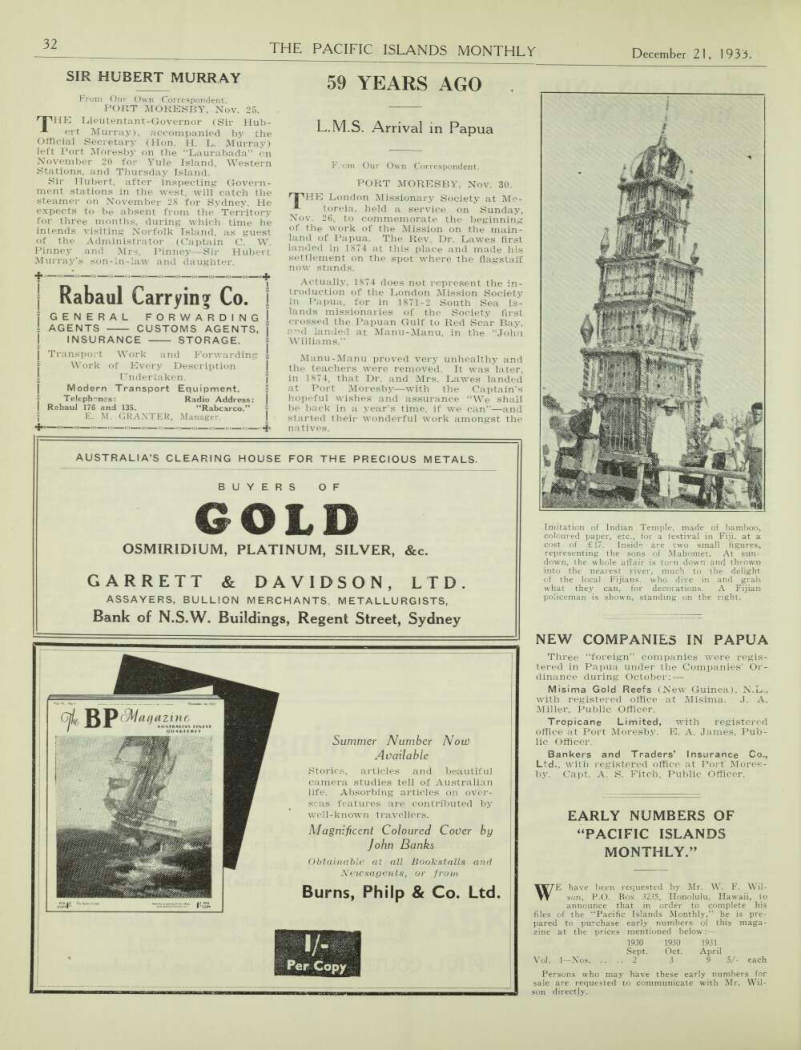
From Our Own Correspondent.
Port Moresby, Nov. 25.
THE Lieutentant-Governor (Sir Hub ert Murray), accompanied by the Official Secretary (Hon. H. L. Murray) left Port Moresby on the “Laurabada” on November 20 for Yule Island, Western Stations, and Thursday Island.
Sir Hubert, after inspecting Govern ment stations in the west, will catch the steamer on November 28 for Sydney. He expects to be absent from the Territory for three months, during which time he intends visiting Norfolk Island, as guest of the Administrator (Captain C. W.
Pinney and Mrs. Pinney—Sir Hubert Murray’s son-in-law and daughter.
L.M.S. Arrival in Papua
59 Years Ago
From Our Own Correspondent.
Port Moresby, Nov. 30.
THE London Missionary Society at Metoreia, held a service on Sunday, Nov. 26, to commemorate the beginning of the work of the Mission on the main land of Papua. The Rev. Dr. Dawes first landed in 1874 at this place and made his settlement on the spot where the flagstaff now stands.
Actually, 1874 does not represent the in troduction of the London Mission Society in Papua, for in 1871-2 South Sea Is lands missionaries of the Society first crossed the Papuan Gulf to Red Scar Bay. landed at Manu-Manu, in the “John Williams.”
Manu-Manu proved very unhealthy and the teachers were removed. It was later, in 1874, that Dr. and Mrs. Lawes landed at Port Moresby—with the Captain’s hopeful wishes and assurance “We shall be back in a year’s time, if we can”—and started their wonderful work amongst the natives.
Imitation of Indian Temple, made of bamboo, coloured paper, etc., for a festival in Fiji, at a cost of £17. Inside are two small figures, representing the sons of Mahomet. At sun down, the whole affair is torn down and thrown into the nearest river, much to the delight of the local Fijians, who dive in and grab what they can, for decorations. A Fijian policeman is shown, standing on the right.
New Companies In Papua
Three “foreign” companies were regis tered in Papua under the Companies’ Or dinance during October: Misima Gold Reefs (New Guinea), N.L., with registered office at Misima. J. A.
Miller, Public Officer.
Tropicane Limited, with registered office at Port Moresby. E. A. James, Pub lic Officer.
Bankers and Traders’ Insurance Co., Ltd., with registered office at Port Mores by. Capt. A. S. Fitch, Public Officer.
Monthly.”
Early Numbers Of
“Pacific Islands
WE have been requested by Mr. W. F. Wil son, P.O. Box 3235, Honolulu, Hawaii, lo announce that in order to complete his files of the “Pacific Islands Monthly,’’ he is pre pared to purchase early numbers of this maga zine at the prices mentioned below: — 1930 1930 1931 Sept. Oct. April Vol. I—Nos 2 3 9 5/- each Persons who may have these early numbers for sale are requested to communicate with Mr. Wil son directly.
Advertisements & other items, p. 34 (1 item)
Gold
Rabaul Carrying Co.
GENERAL FORWARDING
AGENTS CUSTOMS AGENTS,
INSURANCE STORAGE.
Transport Work and Forwarding: Work of Every Description Undertaken.
Modern Transport Equipment.
Telephones: Radio Address: Rabaul 176 and 135. “Rabcarco.”
E. M. GRAXTER, Manager.
AUSTRALIA'S CLEARING HOUSE FOR THE PRECIOUS METALS,
BUYERS OF
GOLD
OSMIRIDIUM, PLATINUM, SILVER, &c.
GARRETT & DAVIDSON, LTD.
ASSAYERS, BULLION MERCHANTS. METALLURGISTS,
Bank of N.S.W. Buildings, Regent Street, Sydney
Summer Number Now Available Stories, articles and beautiful camera studies tell of Australian life. Absorbing articles on overseas features are contributed by well-known travellers.
Magnificent Coloured Cover by
John Banks
Obtainable at all Bookstalls and Newsagents, or from
Burns, Philp & Co. Ltd.
“Soft City Strangers”
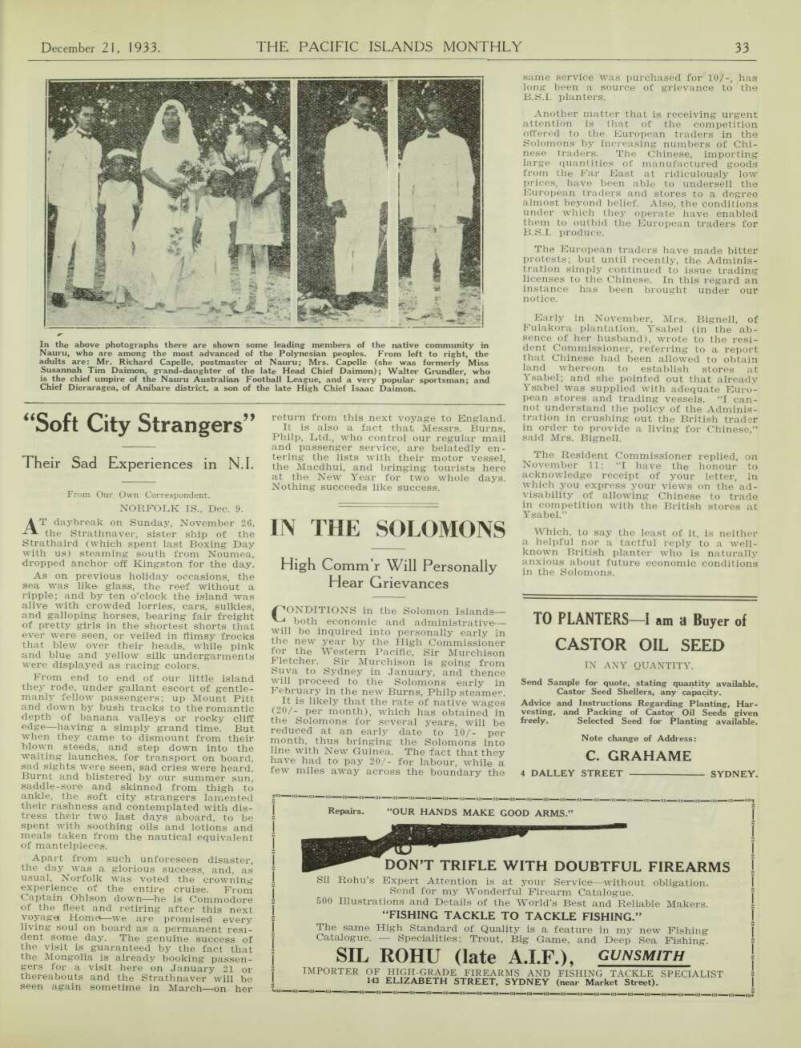
Their Sad Experiences in N.I.
From Our Own Correspondent.
Norfolk Is., Dec. 9.
AT daybreak on Sunday, November 26, the Strathnaver, sister ship of the Strathaird (which spent last Boxing Day with us) steaming south from Noumea, dropped anchor off Kingston for the day.
As on previous holiday occasions, the sea was like glass, the reef without a ripple; and by ten o’clock the island was alive with crowded lorries, cars, sulkies, and galloping horses, bearing fair freight of pretty girls in the shortest shorts that ever were seen, or veiled in flimsy frocks that blew over their heads, while pink and blue and yellow silk undergarments were displayed as racing colors.
From end to end of our little island they rode, under gallant escort of gentle manly fellow passengers; up Mount Pitt and down by bush tracks to the romantic depth of banana valleys or rocky cliff edge—having a simply grand time. But when they came to dismount from their blown steeds, and step down into the waiting launches, for transport on board, sad sights were seen, sad cries were heard.
Burnt and blistered by our summer sun, saddle-sore and skinned from thigh to ankle, the soft city strangers lamented their rashness and contemplated with dis tress their two last days aboard, to be spent with soothing oils and lotions and meals taken from the nautical equivalent of mantelpieces.
Apart from such unforeseen disaster, the day was a glorious success, and, as usual, Norfolk was voted the crowning experience of the entire cruise. From Captain Ohlson down—he is Commodore of the fleet and retiring after this next voyage! Hornet—we are promised every living soul on board as a permanent resi dent some day. The genuine success of the visit is guaranteed by the fact that the Mongolia is already booking passen gers for a visit here on January 21 or thereabouts and the Strathnaver will be seen again sometime in March—on her
return from this next voyage to England.
It is also a fact that Messrs. Burns, Philp, Ltd., who control our regular mail and passenger service, are belatedly en tering the lists with their motor vessel, the Macdhui, and bringing tourists here at the New Year for two whole days.
Nothing succeeds like success.
In the above photographs there are shown some leading members of the native community in Nauru, who are among the most advanced of the Polynesian peoples. From left to right, the adults are: Mr. Richard Capelle, postmaster of Nauru; Mrs. Capelle (she was formerly Miss Susannah Tim Daimon, grand-daughter of the late Head Chief Daimon); Walter Grundler, who is the chief umpire of the Nauru Australian Football League, and a very popular sportsman; and Chief Dieraragea, of Anibare district, a son of the late High Chief Isaac Daimon.
In The Solomons
High Comm’r Will Personally Hear Grievances
CONDITIONS in the Solomon Islands— both economic and administrative— will be inquired into personally early in the new year by the High Commissioner for the Western Pacific, Sir Murchison Fletcher. Sir Murchison is going from Suva to Sydney in January, and thence will proceed to the Solomons early in February in the new Burns, Philp steamer.
It is likely that the rate of native wages (20/- per month), which has obtained in the Solomons for several years, will be reduced at an early date to 10/- per month, thus bringing the Solomons into line with New Guinea. The fact that they have had to pay 20/- for labour, while a few miles away across the boundary the
same service was purchased for 10/-, has long been a source of grievance to the B.S.I. planters.
Another matter that is receiving urgent attention is that of the competition offered to the European traders in the Solomons by increasing numbers of Chi nese traders. The Chinese, importing large quantities of manufactured goods from the Far East at ridiculously low prices, have been able to undersell the European traders and stores to a degree almost beyond belief. Also, the conditions under which they operate have enabled them to outbid the European traders for B.S.I. produce.
The European traders have made bitter protests; but until recently, the Adminis tration simply continued to issue trading licenses to the Chinese. In this regard an instance has been brought under our notice.
Early in November, Mrs. Bignell, of Fulakora plantation, Ysabel (in the ab sence of her husband), wrote to the resi dent Commissioner, referring to a report that Chinese had been allowed to obtain land whereon to establish stores at Ysabel; and she pointed out that already Ysabel was supplied with adequate Euro pean stores and trading vessels. “I can not understand the policy of the Adminis tration in crushing out the British trader in order to provide a living for Chinese,” said Mrs. Bignell, The Resident Commissioner replied, on November 11: “I have the honour to acknowledge receipt of your letter, in which you express your views on the advisability of allowing Chinese to trade in competition with the British stores at Ysabel.”
Which, to say the least of it, is neither a helpful nor a tactful reply to a well known British planter who is naturally anxious about future economic conditions in the Solomons.
Advertisements & other items, pp. 35-36 (1 item)
Sil Rohu (Late A.I.F.),
TO PLANTERS —I am a Buyer of
CASTOR OIL SEED
IN ANY QUANTITY.
Send Sample for quote, stating quantity available.
Castor Seed Shelters, any capacity.
Advice and Instructions Regarding Planting, Harvesting, and Packing of Castor Oil Seeds given freely. Selected Seed for Planting available.
Note change of Address:
C. GRAHAME
4 DALLEY STREET SYDNEY.
Repairs. “OUR HANDS MAKE GOOD ARMS.”
DON’T TRIFLE WITH DOUBTFUL FIREARMS
Sil Rohu’s Expert Attention is at your Service—without obligation.
Send for my Wonderful Firearm Catalogue. 500 Illustrations and Details of the World’s Best and Reliable Makers.
“FISHING TACKLE TO TACKLE FISHING.”
The same High Standard of Quality is a feature in my new Pishing Catalogue. — Specialities: Trout, Big Game, and Deep Sea Fishing.
SIL ROHU (late A.I.F.),
IMPORTER OF HIGH-GRADE FIREARMS AND FISHING TACKLE SPECIALIST 143 ELIZABETH STREET, SYDNEY (near Market Street).
LOOK AT YOUR TOES!
Painful cracks between the toes; tiny itching blisters; thick white skin that is always moist or dry skin that becomes scaly—watch for these symptoms ! They are danger signals of “Toe-Rot,” the most common form of Tinea, or Tropic Ringworm. Cure this highly contagious disease with Antinea at once, before the germ spreads over the body!
A Queensland resident writes: “I had toe-rot for over 10 years, and tried a number of remedies. Some checked it for a time, but it came again. Antinea, however, cured it, and I have not had a return of the trouble. . . .
Antinea is the only thing that will stop toe-rot ."
Antinea penetrates to the root of the trouble and destroys the germs; often, the first application will stop pain and irritation. Regular treatment will effect a complete cure, even in long-standing cases. Other forms of skin disease also yield to Antinea —Dry Eczema, Dhobie Itch, Ringworm, Psoriasis, etc.
Large size (triple quantity) 5/6
Obtainable from all branches of Burns, Philp & Co., Ltd.; Morris Hedstrom & Co., Ltd. (Suva); W, R. Carpenter & Co., Ltd.; A. S.
Swann & Co., Ltd. (Suva); Brown & Joske (Suva); Michelmore & Co. (Suva).
Manufactured by
COMMONWEALTH & DOMINION
AGENCIES LTD.,
168-174 Day Street, Sydney, N.S.W.
Antinea Cures
PERMANENTLY.
Small size 2/6
Al-93
Indian Agitators
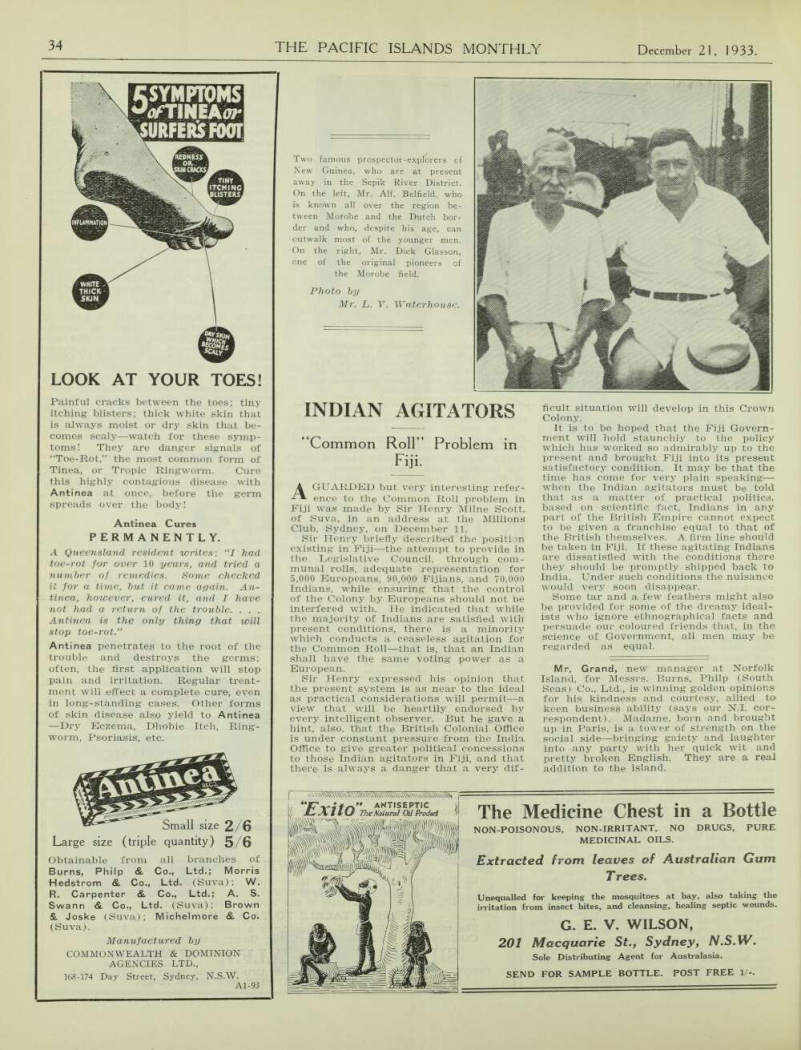
“Common Roll” Problem in Fiji.
GUARDED but very interesting reference to the Common Roll problem in Fiji was made by Sir Henry Milne Scott, of Suva, in an address at the Millions Club, Sydney, on December 11.
Sir Henry briefly described the position existing in Fiji—the attempt to provide in the Legislative Council, through com munal rolls, adequate representation for 5,000 Europeans, 90,000 Fijians, and 70,000 Indians, while ensuring that the control of the Colony by Europeans should not be interfered with. He indicated that while the majority of Indians are satisfied with present conditions, there is a minority which conducts a ceaseless agitation for the Common Roll —that is, that an Indian shall have the same voting power as a European.
Sir Henry expressed his opinion that the present system is as near to the ideal as practical considerations will permit—a view that will be heartily endorsed by every intelligent observer. But he gave a hint, also, that the British Colonial Office is under constant pressure from the India Office to give greater political concessions to those Indian agitators in Fiji, and that there is always a danger that a very dif
ficult situation will develop in this Crown Colony.
It is to be hoped that the Fiji Govern ment will hold staunchly to the policy which has worked so admirably up to the present and brought Fiji into its present satisfactory condition. It may be that the time has come for very plain speaking— when the Indian agitators must be told that as a matter of practical politics, based on scientific fact, Indians in any part of the British Empire cannot expect to be given a franchise equal to that of the British themselves. A firm line should be taken in Fiji. If these agitating Indians are dissatisfied with the conditions there they should be promptly shipped back to India. Under such conditions the nuisance would very soon disappear.
Some tar and a few feathers might also be provided for some of the dreamy ideal ists who ignore ethnographical facts and persuade our coloured friends that, in the science of Government, all men may be regarded as equal.
Mr. Grand, new manager at Norfolk Island, for Messrs. Burns, Philp (South Seas) Co., Ltd., is winning golden opinions for his kindness and courtesy, allied to keen business ability (says our N.I. cor respondent). Madame, born and brought up in Paris, is a tower of strength on the social side —bringing gaiety and laughter into any party with her quick wit and pretty broken English, They are a real addition to the island.
Two famous prospector-explorers of New Guinea, who are at present away in the Sepik River District.
On the left, Mr. Alf. Belfield, who is known all over the region be tween Morobe and the Dutch bor der and who, despite his age, can outwalk most of the younger men.
On the right, Mr. Dick Glasson, one of the original pioneers of the Morobe field.
Photo by Mr. L. V. Waterhouse.
Advertisements & other items, p. 36 (1 item)
The Medicine Chest in a Bottle
NON-POISONOUS, NON-IRRITANT, NO DRUGS, PURE
MEDICINAL OILS.
Extracted from leaves of Australian Gum
T rees.
Unequalled for keeping the mosquitoes at bay, also taking the irritation from insect bites, and cleansing, heading septic wounds.
G. E. V. WILSON,
201 Macquarie St., Sydney, N.S.W.
Sole Distributing Agent for Australasia.
SEND FOR SAMPLE BOTTLE. POST FREE 1/-.
Fashion Notes For Island Women
“CONFIDENCE,” says the French philosopher, “brings more to conver sation than wit itself can bring.” How often do we face the world with calm, almost contemptuous indifference, secure in the knowledge that our clothes are just right for the occasion.
Going here, going there, makes the “little frock” an absolute necessity, and nothing could be better for this type of frock than “wartyne silk,” first cousin to our old friend, sponge cloth. It has so many things in its favour —economy, splendid wearing qualities, and, joy! it requires no special care in laundering.
A frock of beige or string colour made on tailored lines is the personification of chic, when trimmed with buttons and buckle of tortoiseshell, which is of such negligible cost in the Islands. Brown shoes, gloves and bag complete the per fection of the ensemble.
Nowhere is the dinner frock such a ne cessity as in the tropics. It can be so charming, with its low square neck, full, short sleeves, and softly falling skirt that our wardrobe should boast at least two of these in washing materials of any de sign. The materials are so varied, too, that scope for individuality is unlimited.
King Neptune’s influence thrills us. The fish-tail silhouette is new. One feels and looks like a mermaid, with the skirt hug ging the knees, then spreading itself in graceful flow to the hem line.
Who, indeed, would fail to succumb to a white satin evening gown made on these lines, dotted here and there with gold sequins or embroidered with spots of gold thread? A gold shoe and the tiniest of gold lame or sequinned cocktail-caps, and the world is ours!
With the new silhouette, lingerie has become even more important, and the very newest is cut on the cross. Since petticoats are to be slim, the six gore has achieved great success and is a uni versal favourite. Nightgowns have the appearance of modified evening gowns, and boast tiny sleeves or added epaulettes.
Coffee, or Paris, lace is added to tea rose pink and Nile green in either georg ette or crepe-de-chine, and the most de lectable undies are the result.
Bare legs have come to stay in the realms of sport. Since to wear stockings for tennis is to be conspicuously over dressed, how sad it is that so few can boast “good complexioned” legs. An over seas manufacturing chemist has produced a new paste which has the effect of magic on leg blemishes, and gives the appear ance of stockings of dull silk. Unfor tunately it is not procurable in Australia —as yet.
For the beach, too, stockings are de mode, and Roman sandals are madly sought after by the modern flapper, who lacquers her toenails to match her finger nails —a vivid scarlet.
Bathing costumes (or what there is of them) are the last word in daring. Some consist of brassiere tops and shorts, the more modest being merely backless. Long lines of cars roll incessantly towards the beaches, piled with young things clad in shorts and slacks. Slacks for beach wear are becoming increasingly popular, and are the mode for young and old alike.
They are seen in many and varied colour
ings, and in some instances are a de cided improvement.
Beach dresses with low-cut backs are putting pyjamas well in the background, and are both useful and attractive, a particularly delightful one being of green diagonal striped cotton with plain green belt and shoulder straps. A green and white coolie hat of shiny straw and white sandals fill the wearer with intense satis faction. Try it for your next swimming carnival. You’ll be an instantaneous success.
Mr. Hubert Sturzenhofecker, and the Misses H. Reiner and Ruth Schnabel, of Mavaria, arrived in Sydney in the Mosel on their way to New Guinea, where they are to take up posts as teachers at the Lutheran Mission Settlement on the Mi kin River. They will remain at the settle ment for about 10 years.
Light Horsemen for N.I.
From Our Own Correspondent.
Norfolk Is., Dec. 9.
THERE is a proposal, through the columns of our little weekly paper, to form a local troop of Light Horse —to be richly accoutred and lavishly paid and captained —we believe by Mr. J. A. Mac arthur-Onslow, at the present resident here, and a member of a well-known Australian family.
Seeing that the island is only seven miles long by five wide, and that the able bodied youth, upholstered and equipped according to individual fancy, already spends about a third of its waking hours ranging the roads on horseback, it is dif ficult to see what would be gained by mustering them expensively in a body and manoeuvring and deploying about the island en masse. They would be poor defence against any enemy attack from the sea, and the hard-up community at large is speculating as to what financial resources would be called upon to pro vide arms, equipment, and uniform.
Advertisements & other items, p. 37 (1 item)
Arnotts
FAMOUS
POPSO CRACKER
BISCUITS
Crisp and delicious and made to break into three fingers of ideal size and shape, the perfect base for savoury items.
Always ask for Arnotts
Books Worth Reading
I know an Island — a Romance of the South Seas, by Julian Hillas; published in London.
This is a first-class novel, with a South Seas setting and a plot on conventional lines. The young Englishman of good family goes to the Pacific in search of adventure, expecting to find there the things that are always expected in these circumstances. He meets, of course, the highly-educated half-caste Polynesian girl, loves her passionately and —because he is trained in the public school tradi tion—insists upon marrying her, and thereby involves himself in the usual social tangle. It is not a subtle plot; but action is quick and lively, dialogue is bright and clever, and the story presents in convincing fashion the atmosphere of Islands life.
The notable feature of the book is the manner in which the author deals with the half-caste problem and the relation ship between European men and Poly
nesian women. The subject is discussed in great detail, but we are brought no nearer to a solution of the problem. The characters of the typical South Seas trader. schooner captain, Catholic priest, Nonconformist missionary and immoral planter are mercilessly limned. Julian Hillas (Captain Julian Dashwood) lived for a considerable time on Rakahanga, in the Cook Islands, and his local color is true. Much of the action takes place on Tongareva—which is Rarotonga thinly disguised—and those of us who know that charming place will recognise many of the scenes and characters.
It is one of the few really worth while novels based on Pacific Islands life.
In Wild New Britain—the story of Ben jamin Danks, pioneer missionary, Rev. Benjamin Danks, one of the pioneer missionaries of the Methodist Church, in the Pacific, went to the Duke of York Islands (Bismarck Archipelago) with a number of Fijian teachers in 1878; and from that point he spread the influ ence of his Church all over the north-east
corner of New Britain. His earliest efforts were directed to the tribes which lived around Blanche Bay, and Mr. Banks, often accompanied by his devoted and heroic wife, and battling constantly against virulent fevers and heart-break ing discomfort, travelled on foot many times over the districts where Rabaul and Kokopo now stand. He carried on his work in various islands of the Pacific, but his main effort was directed towards New Britain, and, in the course of his long lifetime, he saw a great change take place in the character and disposition of the native people. He saw inter-tribal fight ing stop, cannibalism discontinued, the Germans come and go, and the final establishment of the Australian authority.
His great physical strength and indomit able spirit enabled him to overcome in credible difficulties, particularly in the early days of the Mission in New Britain.
He had many clashes with savage tribes men and equally dangerous white traders, but he came through unscathed and died in his bed early in 1921, greatly honored.
His diary has been carefully edited by his son-in-law, Rev. Wallace Deane, and this interesting book is the result. It is not only an inspiring contribution to the literature of the Pacific Missions—of which we have a great mass—but it is also a very valuable addition to the early history of the Bismarck Archipelago, and, as a book of reference, it should be In every library. It would have been more useful, however, if it had carried a map or two, and an index.
Our copy from Angus and Robertson, Ltd., Sydney. Price 6/-.
The Game Darrells, by Leslie Haylen.
Everywhere throughout the Pacific Islands one meets people who love the Australians and Australian social life, but jeer constantly at Australian politics and conditions incidental thereto. Such people will read this book with delight. It is simply the story of the rise, fall, and rise again of a typical Australian family.
They have a sheep station; then they are driven to a backblocks farm; they move on to live in a country town; and then the head of the family successfully enters politics and they live in Sydney. The story is commonplace, but the manner of its presentation introduces us to a new Australian writer of outstanding ability.
It is a quick-moving tale which scintil lates with humour, satire, and cynicism.
We read about ourselves; and led by this clever, cunning author we find ourselves laughing immoderately at ourselves and our funny politicians. There has been a flood of new Australian books by new Australian authors lately. This is one of the best of them. Some parts of it de serve to take a permanent place in Aus tralian literature.
Our copy from Macquarie Head Press, Sydney. Price 6/-.
Mrs. G. H. Davis, wife of the postmaster at Rarotonga, Cook Islands, arrived in Sydney during the month. Mr, Davis will visit Sydney, on long leave, early next year. * * * Captain C. R. Pinney, Administrator of Norfolk Island, accompanied by his family, and by Sir Hubert Murray (who has gone to N.I. on holiday) will arrive in Sydney at the end of January. * * * Rev. W. H. MacFarlane, who recently retired from Torres Straits after 17 years’ mission work there, has taken up secretarial duties at the Island office of the Australian Board of Missions. Mr.
MacFarlane’s new duties include a good deal of travelling.
Advertisements & other items, p. 38 (1 item)
“Younger”
Do You Know that the Famous
STOVES AND
RANGES
made with extended Firebox specially for long Wood fuel, are Self-Setting and, provided sufficient Flue Piping is attached, can be used in almost any position?
The No. 7W. “Younger” Range can now be supplied fitted with Legs, as per illustration.
Ask for quotation for this Range, also Illustrated Catalogue and Price List for both Single and Double Oven Stoves.
Younger Stoves are Widely Used Throughout the Pacific Islands.
G. FLETCHER & SON 50 Oxford Street, SYDNEY
CAPSTAN
CIGARETTES
CORK-TIPPED
OR PLAIN
CAPSTAN
NAVY CUT TOBACCO
New Guinea
Land-Holding Anomalies In
Plea For Early Re-appraisement and Encouragement of New Settlers
Written specially for “Pacific Islands Monthly” by “Investor,”
I HAVE just returned from a visit to the Mandated Territory, where I had been instructed to seek suitable land for de velopment. My experiences have been in teresting to a degree, and I have be come entirely convinced that, whilst on the one hand there is an exceptional op portunity for profitable investment in primary products in the Territory, on the other, drastic alterations in the present system of land holding are badly needed.
The richness of the land in the Terri tory from an agricultural standpoint is obvious. With this richness, accompanied by abundant rainfall and moderately effi cient native labour, there is ample scope for investment.
But much of the most desirable free hold land is held by men with little or no capital or as dummies for vested inter ests. On approaching the present holders —they will never become owners—one is met with a rabid desire to sell at exorbit ant prices.
The conditions governing the sale of properties are set out in the Treaty of Peace Regulations (46-59) which state that the Custodian of Expropriated Pro perties (in whom all lands under the Mandates are vested) shall not sell to any purchaser other than to: (1) A person who is an Australian soldier or who is a natural-born British subject. (2) A Company registered in Australia, in which at least two-thirds of the shares, issued by the Company, are held by natural-born British sub jects. (3) A Company registered in any part of the Empire in which at least two-thirds of the shares issued are held by natural-born British sub jects.
The properties were sold by tender and duly allotted. The terms of purchase to Returned Soldiers were extremely liberal; 5 per cent, on deposit, 10 per cent, in one month after acceptance of tender, the balance spread over 80 quarterly pay ments. The terms to Companies were 5 per cent, deposit, 10 per cent, on accept ance, 15 per cent, before possession was given, and the balance spread over 10 years with interest at the rate of 6½ per cent, on balance.
So far, so good. As far as can be as certained, little or no enquiry as to the purchaser’s ability to pay were made and the position to-day is not satisfactory.
Of the developed properties, about 98 per cent, were coconut plantations, and, as copra was then bringing from £25 to £35 per ton, with cost of production ranging from £6 to £16 per ton, everybody had money to burn; and many of the “or
iginals” did burn it. Pianos, which rusted in six months; radios, which blasted the ears with static; motor cars with petrol at 3/9 per gallon and a 40 per cent, freight rate from Sydney. Beer at 35/per case and spirits at 15/- per bottle, accounted for much of the profit which should have been set aside against the purchaser’s commitments.
With the depression, hard times came; copra dropped, with other primary pro ducts, to £10-£12 per ton, and less. The settlers obtained a Moratorium of pay ments to the Custodian, but have had to pay interest to the “firms” on monies ad vanced. The majority of the planters are well in debt to the “firms,” who are now practically in possession, with liens on the properties which will never be lifted if prices do not come back and stay back.
Many of these properties are huge do mains, with a fringe of coconut trees, the vast majority of which the Germans planted before the occupation. An en quiry from official sources as to the num ber of acres planted since the occupa tion disclosed a pitiful fraction of the whole. The extent of some of the areas held covers thousands of acres and, in some cases, not a single improvement has been effected.
I have the particulars of one property offered and will quote from the figures given, which were checked, and show a lively desire to make a “pot” and get out with “an unearned increment,” which our single-tax friends so often refer us to: Area tendered for in 1920 —13,000 hect ares (Ha equals 2½ acres).
Actual area by measurement, 22,000 Ha.
Planted on possession, 4000 Ha.
Number Ha. now planted (after eight years) 4127—that is, only 300 acres im provement in eight years.
Purchase price, 2/6 per hectare.
The holder has sold 6,000 hectares at £1 per hectare, all of which was paid to one of the firms “off the loan.” This man has to sell all his copra to the “firm,” purchase all his goods from the “firm,” and, in effect, is a tied man without the capacity, the ability, the desire or the hope of ever doing anything to bring the balance of the land into development of any kind. He is holding (without pay ment during the Moratorium) 10,010 hect ares or 20,525 acres of rich land which should be available for other people who have the desire, the capital, and the ability to develop the area.
This case is typical of many—so many that surely the time has come for the appointment of a Court of re-appraise ment consisting, say, of an experienced administration official, a member of the Planters’ Association, and a representa tive of the Federal Government, who would have all the facts placed before them and the holder should be called on to show cause why the original contract should not be varied. The facts would be (say), “You have 10,000 hectares of land, 1000 under cultivation; you have in eight years planted 10 hectares in coco nuts. You have taken off so many tons of copra. You owe £3,000, which you have borrowed on the security of the coconut trees on the property you have not paid for. The purchase price of the property was £3,000; you have £150.
The Court wants to know: “1. What are your intentions as to de veloping the 9,000 virgin hectares un touched for the eight years you have been on the place?
“2. What resources have you to carry out the development?
“3. Why have you only planted 17 hect ares in eight years?”
In many cases such as this the answers to 1 and 2 would be that he would like to do a lot of things, but has not the money.
In reply to 3 he would probably blame (a) the price of copra, (b) the prices charged by the firms for his goods (high, of course, but carrying the risk of the unsecured creditor), (c) the Government, (d) the lazy native. But he would be silenced if his personal spendings were set out.
The court should then give: (a) full credit for the monies paid: (b) full credit for the improvements made; a reasonable area of virgin land for development in
conformity with the holder’s ability to pay for, take a first mortgage over the place and give the firm a second mortgage as security for their loans; the balance open for sale to new purchasers on easy terms and include the same provision in the contract which was contained in some of the grants made by the German Government, that unless the property was properly taken in hand, cultivated, and properly used, the property would revert to the Crown.
Under this scheme, the settler would be relieved of huge amounts of interest on capital which he will never be able to pay, notwithstanding the tolerant attitude of the Custodian and the Federal Government. He would have a virgin area within his means, and would be freed from the domination of any “firm” and, in many cases, would be able to borrow from the Bank to develop on the security of the mortgage. The firms would have a regularised registerable second mortgage where now they have nothing more than a lien which unofficially the Custodian recognises, but which on test would not be enforceable and would probably be frowned on by the
Government of Australia as against public policy. As it is now the Banks, naturally, will not advance on virgin country oh which no title exists.
The Government and the people of Aus tralia would be advantaged tremendously, as undoubtedly the residues of virgin land would be eagerly taken up by land hungry young men in Australia who ballot on every Crown Land sale and never get a chance; and populating the Islands with new blood would give the Territory the boost it badly needs.
A judicious policy of advances for de velopment in coffee, cocoa, ginger, rice and other tropical products would give a greater return in national wealth than subsidising with relief work, and the dole, young men whose morale is being weak ened day by day instead of being made self-reliant pioneers, who, with ordinary application, would be comfortably off in a few years.
The dummy would be exposed and the real holders, would be forced to develop or surrender. Every settler, planter and official can tell who the dummies are, but nothing is done to shake this incubus off.
The policy of the Government has been that no more land shall be freehold, but held on leases. The Ordinances regard ing leases are very vague especially in respect to re-appraisement. From en quiries made, it is evident that a trap exists for the unwary leaseholders. Jones and Smith, taking up separate leasehold ings can get very different treatment, if Jones puts his back into it and spends money in development, he will be faced with re-appraisement on a vastly dif ferent basis than Smith, who just slouches along and makes a living. There is no equity in making the producer pay heavily and letting the loafer off easily.
It is not to be inferred that the Ad ministration have done this; but there is no protection visible to prevent it being done. In other words, the position in this
respect needs clarifying, as does the free hold position. There should be, in brief, security of holding where there is de velopment and none where there is not.
The position in respect to land tenure is intimately connected with the freight position. The freights and charges are a source of permanent grousing by all who seek to do business in the Territory; but with many thousands locked up in “ad vances” to planters, the firms must pro tect themselves. They are aware that they have an unregisterable mortgage, and, if the Custodian came down on the settler or planter, their “equity” would be value less and the protection is shown in the freight rates.
The vexed question of “native rights” has been largely settled by the common sense and resolute action of the present minister, Major Marr, and to him, the new Council, and the Administration thesq suggestions, outlined herein, are commended. The Territory offers wonder ful possibilities for the establishment of primary production, and every effort should be made to encourage this de velopment, not by harshly treating those who took their courage in their hands in the early days after the war, but by re viewing the position with justice and equity to all concerned. Development is lagging and must be quickened, else we will have no right to hold what we rightly took and what represents probably ail that Australia won, in a material sense, from the war.
Advertisements & other items, pp. 39-40 (1 item)
[Prepared ]
Guaranteed by the manufacturers to go further, last longer and uniformly give better results than any other paint made. —“ B.P.”
“KEEP ON KEEPING ON!”
Agents throughout the Islands.
Mrs. N. WALKER - FLYNN,
COSTUMIER E,
Market Street, RABAUL.
HEMSTITCHING and PICOT EDGING.
Copies of Mab’s Fashions; Roma’s Pictorial Fashions and Home Fashions available. —P.O. Box 116. Tel.: 141.
J. H. MacGregor Dowsett
RABAUL, NEW GUINEA,
for
RELIABLE CARS, SERVICE & DRIVERS.
Gramophones and Latest Records.
Musical Instruments and Sundries.
Cameras and Photographic Goods.
Developing, Printing, Enlarging & Framing.
Recruiter, Mining & General Agent,
BUILDER AND CONTRACTOR.
Agent for The Australian Provincial Assurance Assoc. Ltd. Sub-agent for The Central Assurance Co. Ltd.
Outstation Orders Promptly Executed.
Sample Rooms:
MALAGUNA ROAD, RABAUL
’Phone: Rabaul 149.
ISLAND HOME BUILDERS.—You can now
erect everlasting Homes quickly and at LOW COST by using DURABESTOS (Asbestos Cement) Building Sheets for Walls and Ceilings.
Big, sturdy sheets —economical to transporteasy to fix —fireproof—does not need painting.
Write for prices and Free Catalogue, “Durabestos Homes of Colourful Beauty,” WUNDERLICH LTD.,
Box 474 AA, G.P.0., SYDNEY.
RESISTS TIME - WEATHER - WHITE ANTS
“BEING READY CREATES OPPORTUNITY ”
Remember what Lincoln said: “I am going home to study.
Some day my chance will come.”
FOR 38 YEARS we have been helping people like you to better positions.
COURSES.
Accountancy.
Shorthand.
Typing.
6 DALLEY ST., MATRICULATION
SYDNEY General Education.
Write for Details, Results, etc.
Company Secretarial.
Costing Clerks’ Course.
Cost Accountancy and Factory Administration.
Metropolitan Business College Ltd.
WE TEACH WHEREVER MAILS REACH
New Guinea Public
Service
The following changes have been notified in the Public Service of New Guinea:—
Permanent Staff Appointments.
J. Hepburn, Cadet, District Service.
I. W. Morley, Inspector of Mines and Machinery.
W. E. Sellen, Health Inspector.
Transfers.
A. H. Ross, Patrol Officer, Kavieng to Salamaua.
H. E. Woodman, Assistant District Officer, Rabaul to Kavieng.
A. A. Roberts, Patrol Officer, Rabaul to Sala maua.
A. K. Walker, Clerk, Rabaul to Salamaua.
F. W. Mantle, Assistant District Officer, Madang to Gasmata.
H. L. R. Niall, Patrol Officer, Talasea to Rabaul.
J. L. Taylor, Assistant District Officer, Salamaua to Rabaul.
A. F. Kyle, Patrol Officer, Salamaua to Rabaul.
F. E. Cattell, Medical Assistant, Rabaul to Kieta.
A. E. Wilkinson, Medical Assistant, Rabaul to Gasmata.
G. D. Broome, Medical Officer, Kavieng to Rabaul.
N. F. McKenna, Medical Officer, Salamaua to Kavieng.
J. Morris, Medical Assistant, Gasmata to Sala maua.
R. M. MacKinnon, Nurse, Rabaul to Kavieng.
C. W. Thomas, Medical Assistant, Rabaul to Salamaua.
B. A. Sinclair, Medical Officer, Rabaul to Sala maua.
G. K. Whittaker, Medical Assistant, Salamaua to Rabaul.
E. P. Hitchcock, Medical Assistant, Salamaua to Rabaul.
L. Bell, Medical Assistant, Kavieng to Rabaul.
Temporary Employees—Appointments.
V. Weatherall, Typiste.
J. McLaren, Nurse.
J. Hill, Roadmaster (New Ireland District).
Transfers.
V. Weatherall, Typiste, Rabaul to Salamaua.
J. D. Powell, Foreman Carpenter, Salamaua to Rabaul.
Police Force.
A. E. Halley, appointed Warrant Officer.
A. S. Kellock, Warrant Officer, transferred from Rabaul to Kokopo.
Missionary Work
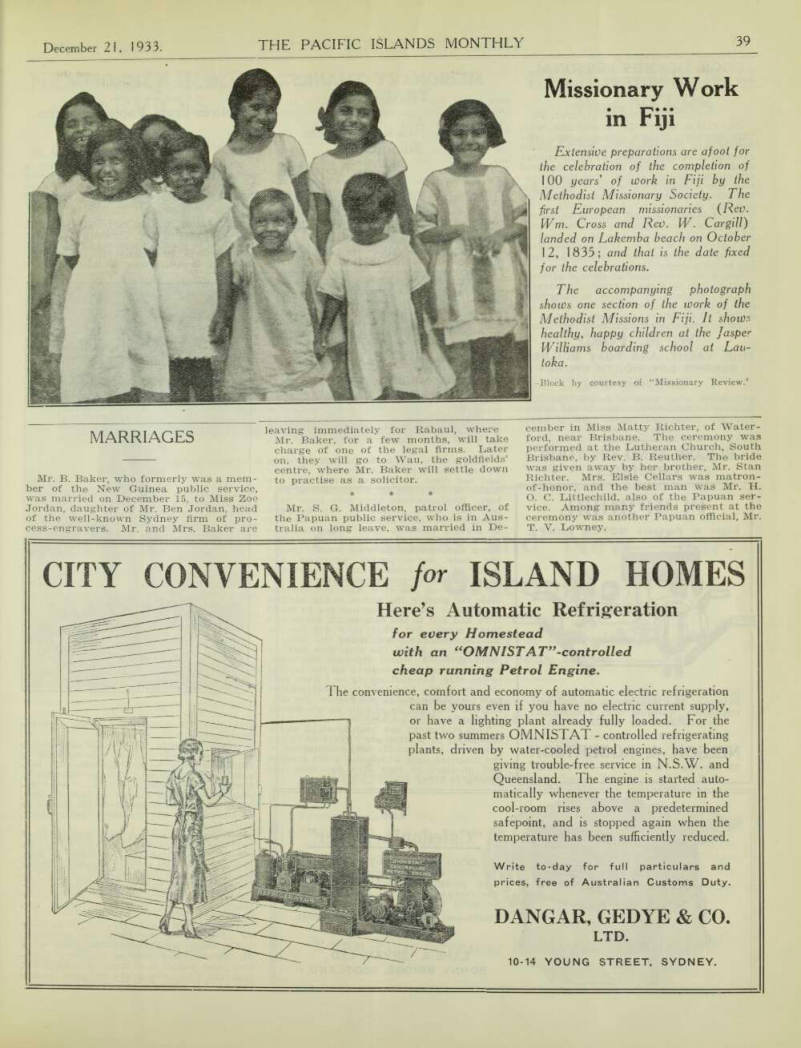
in Fiji
Extensive preparations are afoot for the celebration of the completion of 100 years' of work in Fiji by the Methodist Missionary Society. The first European missionaries (Rev.
Wm. Cross and Rev. W. Cargill) landed on Lakemba beach on October 12, 1833; and that is the date fixed for the celebrations.
The accompanying photograph shows one section of the work of the Methodist Missions in Fiji. It shows healthy , happy children at the Jasper Williams boarding school at Lauloka.
-Block by courtesy of “Missionary Review.’
Marriages
Mr. B. Baker, who formerly was a mem ber of the New Guinea public service, was married on December 15, to Miss Zoe Jordan, daughter of Mr. Ben Jordan, head of the well-known Sydney firm of pro cess-engravers. Mr. and Mrs. Baker are
leaving immediately for Rabaul, where Mr. Baker, for a few months, will take charge of one of the legal firms. Later on, they will go to Wau, the goldfields’ centre, where Mr. Baker will settle down to practise as a solicitor. * * * Mr. S. G. Middleton, patrol officer, of the Papuan public service, who is in Australia on long leave, was married in De
cember in Miss Matty Richter, of Water ford, near Brisbane. The ceremony was performed at the Lutheran Church, South Brisbane, by Rev. B. Reuther. The bride was given away by her brother, Mr. Stan Richter. Mrs. Elsie Cellars was matron of-honor, and the best man was Mr, H.
O. C. Littlechild, also of the Papuan service. Among many friends present at the ceremony was another Papuan official, Mr.
T. V. Lowney.
Advertisements & other items, p. 41 (1 item)
City Convenience For Island Homes
Here’s Automatic Refrigeration
for every Homestead with an “OMNISTAT”-controlled cheap running Petrol Engine.
The convenience, comfort and economy of automatic electric refrigeration can be yours even if you have no electric current supply, or have a lighting plant already fully loaded. For the past two summers OMNISTAT - controlled refrigerating plants, driven by water-cooled petrol engines, have been giving trouble-free service in N.S.W. and Queensland. The engine is started automatically whenever the temperature in the cool-room rises above a predetermined safepoint, and is stopped again when the temperature has been sufficiently reduced.
Write to-day for full particulars and prices, free of Australian Customs Duty.
DANGAR, GEDYE & CO.
LTD.
10-14 YOUNG STREET. SYDNEY.
Notes
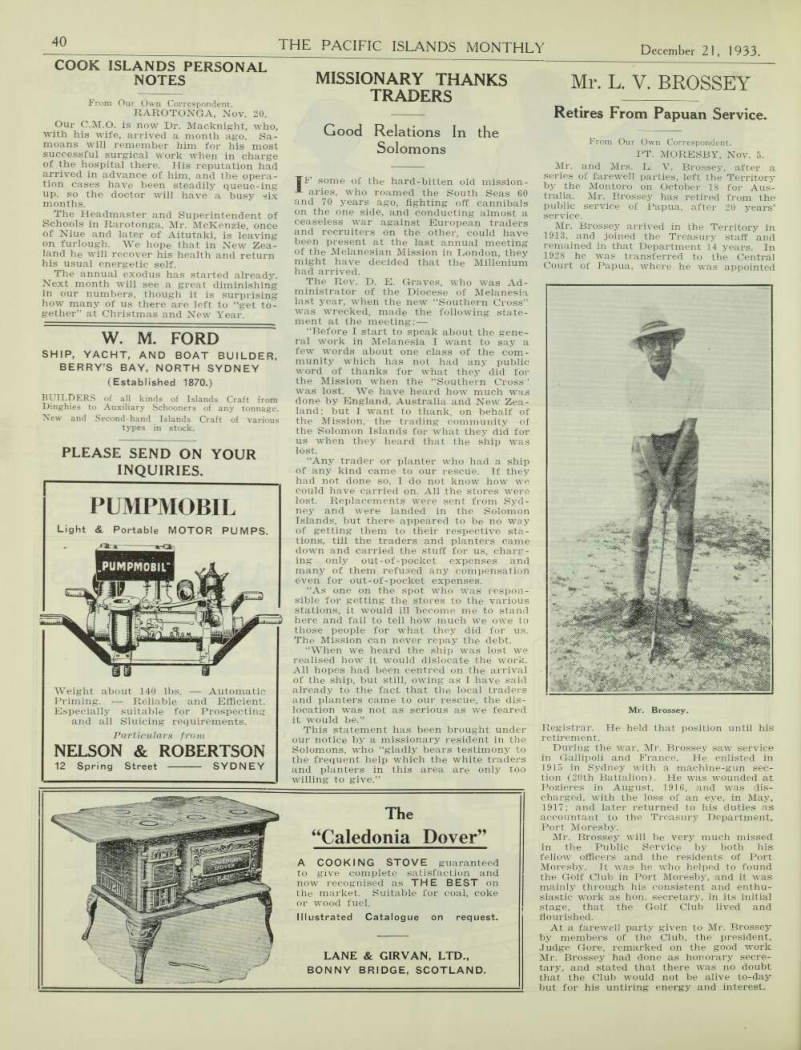
Cook Islands Personal
From Our Own Correspondent.
Rarotonga, Nov. 20.
Our C.M.O. is now Dr. Macknight, who, with his wife, arrived a month ago. Sa moans will remember him for his most successful surgical work when in charge of the hospital there. His reputation had arrived in advance of him, and the opera tion cases have been steadily queue-ing up, so the doctor will have a busy six months.
The Headmaster and Superintendent of Schools in Rarotonga, Mr. McKenzie, once of Niue and later of Aitutaki, is leaving on furlough. We hope that in New Zea land he will recover his health and return his usual energetic self.
The annual exodus has started already.
Next month will see a great diminishing in our numbers, though it is surprising how many of us there are left to “get to gether” at Christmas and New Year.
Missionary Thanks
Traders
Good Relations In the Solomons
IF some of the hard-bitten old missionaries, who roamed the South Seas 60 and 70 years ago, fighting off cannibals on the one side, and conducting almost a ceaseless war against European traders and recruiters on the other, could have been present at the last annual meeting of the Melanesian Mission in London, they might have decided that the Millenium had arrived.
The Rev. D. E. Graves, who was Ad ministrator of the Diocese of Melanesia last year, the new “Southern Cross” was wrecked, made the following state ment at the meeting: “Before I start to speak about the gene ral work in Melanesia I want to say a few words about one class of the com munity which has not had any public word of thanks for what they did for the Mission when the “Southern Cross ’ was lost. We have heard how much was done by England, Australia and New Zea land; but I want to thank, on behalf of the Mission, the trading community of the Solomon Islands for what they did for us when they heard that the ship was lost.
“Any trader or planter who had a ship of any kind came to our rescue. If they had not done so, I do not know how we could have carried on. All the stores were lost. Replacements were sent from Syd ney and were landed in the Solomon Islands, but there appeared to be no way of getting them to their respective sta tions, till the traders and planters came down and carried the stuff for us, charg ing only out-of-pocket expenses and many of them refused any compensation even for out-of-pocket expenses.
“As one on the spot who was respon sible for getting the stores to the various stations, it would ill become me to stand here and fail to tell how much we owe to those people for what they did for us.
The Mission can never repay the debt.
“When we heard the ship was lost we realised how it would dislocate the work.
All hopes had been centred on the arrival of the ship, but still, owing as I have said already to the fact that the local traders and planters came to our rescue, the dis location was not as serious as we feared it would be.”
This statement has been brought under our notice by a missionary resident in the Solomons, who “gladly bears testimony to the frequent help which the white traders and planters in this area are only too willing to give.”
Mr. L. V. Brossey
Retires From Papuan Service.
From Our Own Correspondent.
Pt. Moresby, Nov. 5.
Mr. and Mrs. L. V. Brossey, after a series of farewell parties, left the Territory by the Montoro on October 18 for Aus tralia. Mr. Brossey has retired from the public service of Papua, after 20 years’ service.
Mr. Brossey arrived in the Territory in 1913, and joined the Treasury staff and remained in that Department 14 years. In 1928 he was transferred to the Central Court of Papua, where he was appointed
Registrar. He held that position until his retirement.
During the war, Mr. Brossey saw service in Gallipoli and France. He enlisted in 1915 in Sydney with a machine-gun sec tion (20th Battalion). He was wounded at Pozieres in August, 1916, and was dis charged, with the loss of an eye, in May, 1917; and later returned to his duties as accountant to the Treasury Department, Port Moresby.
Mr. Brossey will be very much missed in the Public Service by both his fellow officers and the residents of Port Moresby. It he who helped to found the Golf Club in Port Moresby, and it was mainly through his consistent and enthu siastic work as hon. secretary, in its initial stage, that the Golf Club lived and flourished.
At a farewell party given to Mr. Brossey by members of the Club, the president.
Judge Gore, remarked on the good work Mr. Brossey had done as honorary secre tary, and stated that there was no doubt that the Club would not be alive to-day but for his untiring energy and interest.
Mr. Brossey.
Advertisements & other items, p. 42 (1 item)
Pumpmobil
W. M. FORD
SHIP, YACHT, AND BOAT BUILDER.
BERRY’S BAY, NORTH SYDNEY
BUILDERS of all kinds of Islands Craft from Dinghies to Auxiliary Schooners of any tonnage.
New and Second-hand Islands Craft of various
PLEASE SEND ON YOUR
INQUIRIES.
Light & Portable MOTOR PUMPS.
Weight about 140 lbs. Automatic Priming. Reliable and Efficient.
Especially suitable for Prospecting and all Sluicing requirements.
Particulars from
NELSON & ROBERTSON
(Established 1870.) types in stock.
PUMPMOBIL
12 Spring Street
SYDNEY
The
“Caledonia Dover”
A COOKING STOVE guaranteed to give complete satisfaction and now recognised as THE BEST on the market. Suitable for coal, coke or wood fuel.
Illustrated Catalogue on request.
LANE & GIRVAN, LTD.,
BONNY BRIDGE, SCOTLAND.
New And Quicker
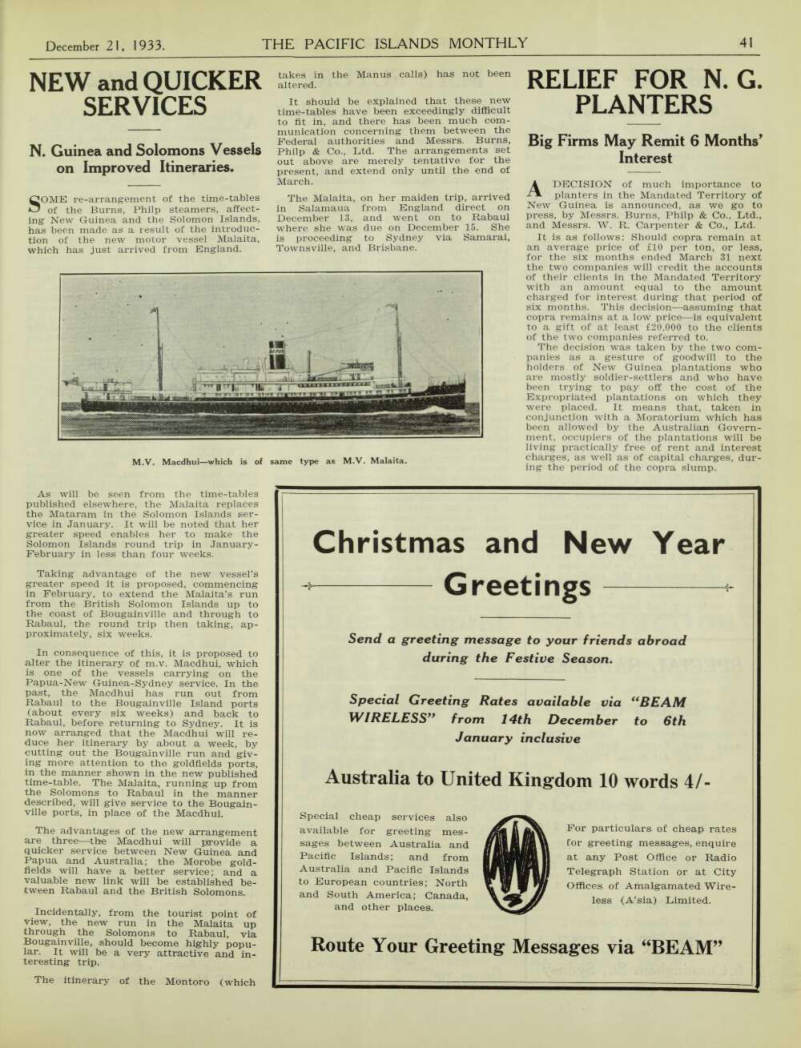
Services
N. Guinea and Solomons Vessels on Improved Itineraries.
SOME re-arrangement of the time-tables of the Burns, Philp steamers, affect ing New Guinea and the Solomon Islands, has been made as a result of the introduc tion of the new motor vessel Malaita, which has just arrived from England.
As will be seen from the time-tables published elsewhere, the Malaita replaces the Mataram in the Solomon Islands ser vice in January. It will be noted that her greater speed enables her to make the Solomon Islands round trip in January- February in less than four weeks.
Taking advantage of the new vessel’s greater speed it is proposed, commencing in February, to extend the Malaita’s run from the British Solomon Islands up to the coast of Bougainville and through to Rabaul, the round trip then taking, ap proximately, six weeks.
In consequence of this, it is proposed to alter the itinerary of m.v. Macdhui, which is one of the vessels carrying on the Papua-New Guinea-Sydney service. In the past, the Macdhui has run out from Rabaul to the Bougainville Island ports (about every six weeks) and back to Rabaul, before returning to Sydney. It is now arranged that the Macdhui will re duce her itinerary by about a week, by cutting out the Bougainville run and giv ing more attention to the goldfields ports, in the manner shown in the new published time-table. The Malaita, running up from the Solomons to Rabaul in the manner described, will give service to the Bougain ville ports, in place of the Macdhui, The advantages of the new arrangement are three—the Macdhui will provide a quicker service between New Guinea and Papua and Australia; the Morobe gold fields will have a better service; and a valuable new link will be established be tween Rabaul and the British Solomons.
Incidentally, from the tourist point of view, the new run in the Malaita up through the Solomons to Rabaul, via Bougainville, should become highly popu lar. It will be a very attractive and in teresting trip.
The itinerary of the Montoro (which
takes in the Manus calls) has not been altered.
It should be explained that these new time-tables have been exceedingly difficult to fit in, and there has been much com munication concerning them between the Federal authorities and Messrs. Burns, Philp & Co., Ltd. The arrangements set out above are merely tentative for the present, and extend only until the end of March.
The Malaita, on her maiden trip, arrived in Salamaua from England direct on December 13, and went on to Rabaul where she was due on December 15. She is proceeding to Sydney via Samarai, Townsville, and Brisbane.
M.V. Macdhui—which is of same type as M.V. Malaita.
Relief For N. G.
Planters
Big Firms May Remit 6 Months' Interest
A DECISION of much importance to planters in the Mandated Territory of New Guinea is announced, as we go to press, by Messrs. Burns, Philp & Co., Ltd., and Messrs. W. R. Carpenter & Co., Ltd.
It is as follows: Should copra remain at an average price of £10 per ton, or less, for the six months ended March 31 next the two companies will credit the accounts of their clients in the Mandated Territory with an amount equal to the amount charged for interest during that period of six months. This decision—assuming that copra remains at a low price—is equivaleht to a gift of at least £20,000 to the clients of the two companies referred to.
The decision was taken by the two com panies as a gesture of goodwill to the holders of New Guinea plantations who are mostly soldier-settlers and who have been trying to pay off the cost of the Expropriated plantations on which they were placed. It means that, taken in conjunction with a Moratorium which has been allowed by the Australian Govern ment, occupiers of the plantations will be living practically free of rent and interest charges, as well as of capital charges, dur ing the period of the copra slump.
Advertisements & other items, p. 43 (1 item)
Greetings
Christmas and New Year
Send a greeting message to your friends abroad during the Festive Season.
Special Greeting Rates available via “BEAM WIRELESS" from 14th December to 6th
January inclusive
Australia to United Kingdom 10 words 4/-
Route Your Greeting Messages via “BEAM”
Greetings
Special cheap services also available for greeting messages between Australia and Pacific Islands; and from Australia and Pacific Islands to European countries; North and South America; Canada, For particulars of cheap rates Cor greeting messages, enquire at any Post Office or Radio Telegraph Station or at City Offices of Amalgamated Wireless (A’sia) Limited. and other places.
£750 for British Navy
G. And E. Gift
THE Government of the Gilbert and Ellice Islands offered £750 recently as its contribution towards the cost of the defence services of the Empire.
The offer has been gratefully accepted by the British Government, and the High Commissioner for the Western Pacific (Sir Murchison Fletcher) has been asked to convey sincere appreciation to the colony.
The Resident Commissioner’s report for the year 1931-32, just to hand, shows a deficit on the Colony’s finances (rev enue £49,110; expenditure, £53,946) of £4836. This was the first deficit record ed for many years. The surplus usually is anything from £10,000 to £20,000.
The accumulated surplus, from 1925-26 to 1930-31 was nearly £70,000. The Col ony’s statement of assets and liabilities shows no public debt, and an excess of assets totalling £111,364. The main sources of revenue are customs duties, native taxes and licenses. There is £90,000 lying on fixed deposit.
Short-lived Adventure
A PARTY of adventurers, whose plans included hunting and film photo graphy, and whose proposed venue in cluded the South Sea Islands, left London in October in the topsail schooner “Myonie B. Kirby” (73 tons), but they did not get very far. The little ship was dismasted off Brest, was taken in tow for Falmouth, but broke away; and a lifeboat rescued the crew and took them to the Scilly Islands, where they were clothed and fed.
Apparently the vessel, which was a 50 years’ old veteran of the Arctic regions, was lost. Mr. Bryce Gibson and Herr Karl Berkke were the leaders of the party, and they had planned a voyage of five years. It actually lasted five hours.
Fiji’S Future
“All the Eggs in One Basket”
Letter to the Editor.
WITH reference to my letter which was published in your October issue, un der the heading of “Scope for Development in Fiji,” I notice with some surprise the contribution was not published in its en tirety.
No comparison was intended, nor at tempt made to compare the Fiji Adminis tration with that of Australia at the pre sent day. But most certainly an effort was made to contrast the methods em ployed in Fiji in developing a new country with this of Australia in the early or pioneering days, and I can see no rea son to alter my assertion that Crown Colony methods, as carried out in Fiji, do not appeal to the average Australian.
Also, I have reason to believe I am by no means alone in this view.
With regard to the “taxation burden, in Fiji being negligible,’” I would, with all deference to you, point to the old saying, “One must live with a man to really know him.” This is very applicable in the present contention.
As a matter of fact, at the moment Fiji has all her eggs in one basket—viz., Sugar —as both the copra and banana industries are moribund, if not actually dead.
Should the Colonial Sugar Co. happen to cease operating, this Colony would sinK like a stone.
This must be apparent to the authori ties; yet, as previously pointed out, no attempt is made to encourage other prim ary industries, of which there are several suitable for the climate.
From the tenor of the note under re view, it would appear, the contention is that, because Fiji is in a sound financial position, extravagant and wasteful ad ministration is justified.
With regard to the financial aspect of the Colony, it may be said that, according to reports, there was a surplus of revenue of about £18,000 on last year’s operations. But a casual perusal of the pub lished figures reveals that over £12,000 of this amount was saved by starving the Public Works Department, thus pre venting necessary maintenance work being carried out. This may be con sidered good finance, but it does not re quire much intelligence to imagine what this may mean in the way of future out lay for the maintenance of public build ings, roads, bridges, etc.
The reason why European or white settlers are not “pouring into the Colony” is not far to seek, as it is purely owing to the peculiar land policy, which prac tically means the locking up of the land.
Leaseholds only are available, and the rent and tenure are such, that at the expiration of the full term of the lease, the holding, with all improvements, run ning perhaps into four figures, is to be handed over to the Fijians, who own the land, free, gratis, and for nothing. Is it likely, under these alluring conditions, practical European farmers would make Fiji their home?
I am quite at one with you, Mr. Editor, as to the deplorable and unsatisfactory condition of present day politics in Aus tralia, which, to my mind, has been wholly and solely brought about by the introduction of payment of members; one adult one vote; and a pernicious sys tem of party government. Besides it is very doubtful whether Federation was an unmixed blessing.
I am, etc.,
Richd. B. Howard.
Navua, Fiji. 11/11/’33.
Influences Affecting
Copra Prices
AFTER spending several months in Europe Mr. C. Winand, who formerly owned Matandeduk Plantation, in Nama tanai, New Guinea, has returned to Aus tralia. He has gone to live in the Northern Rivers district of New South Wales, and does not plan an early return to the Islands.
Mr. Winand, while abroad, made a per sonal inquiry into the copra position, and is not favourably impressed by the out look. The buying of copra in the European zone is now virtually in the hands of one organisation; and the price is governed by the fact that recent scientific processes now allow various other commodities— whale oil, ground nuts, soya beans, etc. — to compete with copra. He thinks the copra price must come back presently to a more reasonable rate; but it is obvious that in future it must be aligned to a considerable extent with the prices of the other oil-bearing commodities referred to.
Rockefeller Campaign in
Health Work
Rockefeller Campaign in Cooks
From Our Own Correspondent.
Rarotonga, Nov. 20.
A WELL advanced stage of the Rocke feller Foundation work at Raro tonga was reached some months ago, and material and plant were transferred to the Island of Aitutaki. Good weather conditions and keenness on the part of the native people to assist with the work resulted in the installations at that island being all finished by October last.
On October 20, the schooner “Tagua” sailed from Rarotonga with material and equipment for landing at Mangaia, where the sanitation work will be continued during the hurricane season.
Upon the resumption of the schooner service in March or April next, the work will be transferred either to Mauke or Atiu.
On leave from his duties as Government medical officer at Rabaul, Dr. R. W.
Cooper, arrived in Melbourne in Novem ber by the steamer Nellore. After gradu ating at Melbourne University Dr. Cooper became administrator of quarantine and health work at Rabaul, and he also prac tised on the gold fields of the Morobe dis trict. Diseases, he said, were gradually being wiped out there, and the tropics were becoming less unhealthy than for merly.
Advertisements & other items, p. 44 (2 items)
J. P. Talty,
SPECIAL SADDLES
FOR
ISLAND USE.
Made on Galvanised Tree, Copper Tacks and Rivets, Best Selected Leather, All-Brass Fittings.
No. 1. STOCK or PARK SADDLES,
with Mounts £5 10 0
No. 2, STATION STOCK SADDLE,
with Mounts, 4in.
Pads £7 0 0 No. 7. The Famous NEVERTIRE
STOCK SADDLE, with
Mounts and Surcingle, Sin.
Capped Knee Pads, Pigskin Seat. Complete . . £8 8 0 We Pay Freight.
Send for General Catalogue.
J. P. TALTY,
6 Cunningham St., Sydney
15 Hunter Street, Sydney
A CERTAIN
REMEDY FOR PILES
This preparation has been on the market for several months, and it has effected a Cure in every case in which it has been tried. Cases of Long Standing generally Cured within One Month, with one bottle only.
For External Use only Transparent and Stainless. Painless and Odourless. Hygienic and Healing.
NO INCURABLE CASE FOUND YET. Should
there be one. Money will be Refunded in Full.
PRICE: 5/- PER BOTTLE. Posted, securely packed, for 6/6 per bottle. Copies of Testimonials forwarded on request.
ROBERT BRUCE
Room 7, 2nd Floor,
15 Hunter Street, Sydney
Islanders’ Needs
A Melbourne newspaper, “The Star," finds a “human interest story " in the fact that the average Islands resident has to depend on the steamers for most of his everyday requirements.
THE ships engaged in the island trade carry many strange items of mer chandise and the companies that control them receive what, to the man in the street, are extraordinary requests, touched at times with unwitting humor.
To the office of one Melbourne firm there came recently an old boot. It mystified the shipping officials until the “covering” letter changed what seemed to be a prac tical joke into an urgent order.
An island dweller suffered from corns.
Efforts to purchase new boots, which would give comfort had failed, and in a last attempt to retain the ease which the old pair provided, the customer parted with one of them, sending it to the com pany with the request, ‘Please match and return in your next ship.”
Those engaged in the island trade are used to surprises, but one of them re ceived a shock some time ago when he opened an order for a gaol door.
That order might well have shattered any romantic illusions he cherished about the islands and their inhabitants, but, business being business, the order was filled promptly.
Bills of lading for island-going ships specify innumerable items, practical and personal, which, although bought un thinkingly in a metropolitan community, become strange when they are cargo for a ship.
These include face powder, tinned but ter, spirits, bon-bons, soap, boiled sweets, gramophones, cigarettes, and furniture.
Some orders are more intimate than others and the petty vexations of life are glimpsed in the order of one customer who sent his glasses to have a lens re paired, and another who had exhausted his supply of brilliantine —even in the islands hair is well groomed.
The medical officer in charge of one group of islands awaits the shipment of phials of calf lymph. Natives and Euro peans alike must be vaccinated against disease.
This order is filled through the Com monwealth Serum Laboratories, and the precious consignment will shortly be taken on board an island steamer at Vic toria Docks.
Customers in the islands do not con fine themselves to orders for goods. Ship ping company officials are often advisers on serious problems. Parents on one island, having decided to send their child ren away from home, sought information on the most suitable schools to which they might be sent.
One of the most unusual requests re ceived recently was from a farmer who asked to be informed of a firm which rigged sailing vessels.
He wanted fittings for a hay stacker of
his own design, and sought second-hand tackle with which to construct it.
It is all commerce, but the circum stances of it must arouse sympathetic understanding in people who enjoy from habit the privileges of city life; privileges which to these islanders form the chief source of interest and pleasure.
Mr. Mirfield Making Recovery
Mr. Graham Mirfield, Who Was
badly injured in the seaplane smash near Rabaul, New Guinea, in October, was brought down to Sydney in the No vember Macdhui for special attention. It was at first feared that his injuries would have permanently incapacitated him; but, on last report, as a result of a complete rest, Mr. Mirfield is making a very satis factory recovery. An official enquiry into the seaplane accident has been made and the matter will be dealt with officially in due course. Mr. Mirfield is staying with Mr. Campbell Smith, at Waratah Street, Chatswood, Sydney.
Cook Islanders For
New Zealand
From Our Own Correspondent.
Rarotonga, Nov. 28.
Preparations are going ahead for the visit of the chiefs of this island to New Zealand, where they will be entertained by many of the tribes and will also be present at the celebrations connected with the Waitangi Treaty.
Accompanying them will be a troup of dancers and singers, and a string band, The whole party will number about thirty, most of whom have never left the group before, and never would have done so if the New Zealand Government had not “footed the bill.”
B.S.I. Duties
Doubled on Goods of Foreign Origin
A RADIOGRAM received in Sydney on December 16 announced that the Solomon Islands Administration has doubled the import duties on all goods of foreign origin as from December 13.
The B.S.I. tariff, as published officially in 1932, had a fairly limited list of goods carrying around per cent, ad valorem, with special rates on luxury lines; and a long list of articles which entered free.
We understand that a considerable propor tion of the articles on the free list will now have to pay duty, when they are of non-British origin.
In a normal year, B.S.I. imports goods worth £250,000, the origin of which is about as follows:—Australia, £95,000; Burma (rice), £17,000; India, £15,000; Britain, £30,000; United States, £40,000.
The new rates, therefore, will affect mostly U.S.A. goods, and also a large and grow ing trade which has developed recently with China and Japan.
Details should be available by next mail.
Mr, F. E. Johnson, Treasurer of the Solomon Islands Administration, arrived in Sydney by the December “Mataram,” and will spend five months’ leave in Aus tralia.
Advertisements & other items, p. 45 (2 items)
Aunt
Mary’s Pure Food Products ensure the utmost satisfaction to consumers. For thirty years the high quality and supreme excellence of these goods have been appreciated by Pacific Islanders. Specially manufactured and packed to meet Island conditions.
The Utmost Satisfaction
MARY'S
PURE FOOD
PRODUCTS
“Defiance” Brand Canned Goods The proprietors of Aunt Mary’s Pure Food Products also pack “Defiance”
Brand Canned Goods.
Hygienically prepared and hermetically sealed to withstand tropical heat, they are sure of appreciation.
These branded goods are of the highest quality standard, and are prepared and packed only by TILLOCK & CO., LTD., Pure Food Manufacturers Kent and Liverpool Streets, SYDNEY, N.S.W.
Hospital
GOSHEN PRIVATE
(Sister E. W. TEAMAN), 37 Gloucester Road, Hurstville, Sydney General and Private Wards. Spacious Grounds. High and Cool Situation.
Moderate Fees.
Pearl Shell
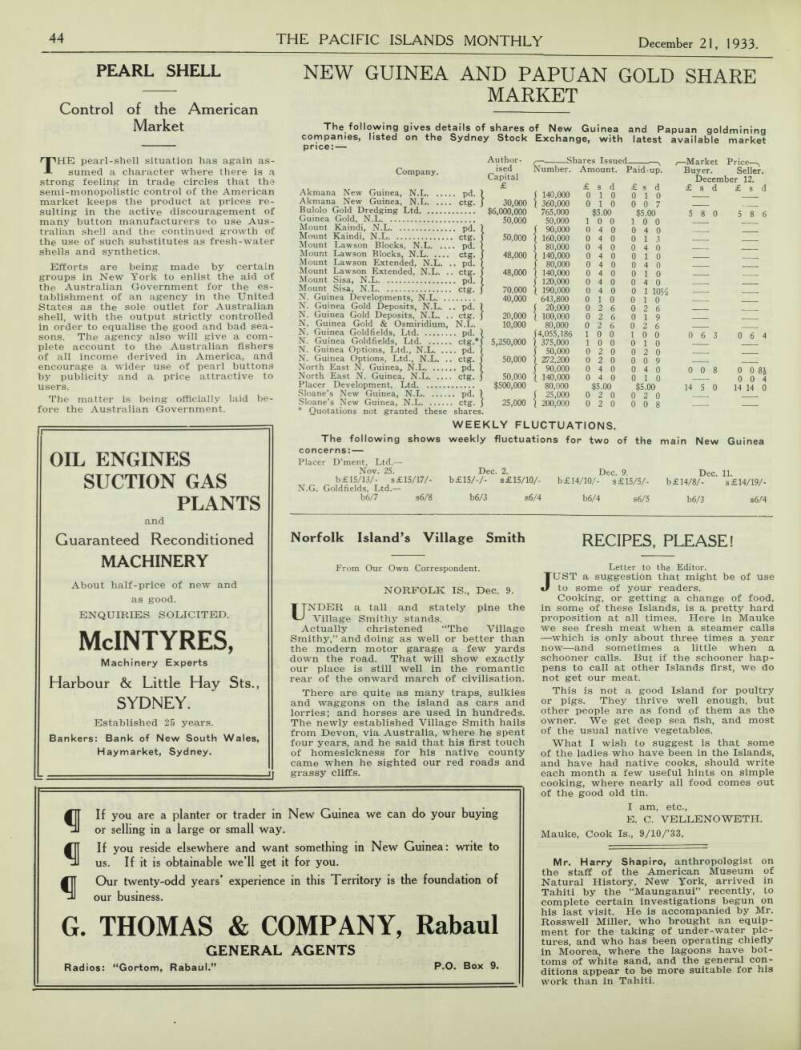
Control of the American Market
THE pearl-shell situation has again as sumed a character where there is a strong feeling in trade circles that the semi-monopolistic control of the American market keeps the product at prices re sulting in the active discouragement of many button manufacturers to use Aus tralian shell and the continued growth of the use of such substitutes as fresh-water shells and synthetics.
Efforts are being made by certain groups in New York to enlist the aid of the Australian Government for the es tablishment of an agency in the United States as the sole outlet for Australian shell, with the output strictly controlled in order to equalise the good and bad sea sons. The agency also will give a com plete account to the Australian fishers of all income derived in America, and encourage a wider use of pearl buttons by publicity and a price attractive to users.
The matter is being officially laid be fore the Australian Government.
Market
New Guinea And Papuan Gold Share
The following gives details of shares of New Guinea and Papuan goldmining companies, listed on the Sydney Stock Exchange, with latest available market price:
Weekly Fluctuations.
The following shows weekly fluctuations for two of the main New Guinea concerns:
Author- Shares Issued Market Price Buyer.
Seller.
Company.
ised Number.
Amount.
Paid-up. capital December 12.
Akmana New Guinea, N.L. ... . pd. £ 140,000 £ s d 0 1 0 £ s d 0 1 0 £ s d £ s d Akmana New Guinea, N.L. ... ctg. 30,000 360,000 0 1 0 0 0 7 Bulolo Gold Dredging Ltd $6,000,000 765,000 $5.00 $5.00 5 8 0 5 8 6 Guinea Gold, N.L 50,000 50,000 1 0 0 1 0 0 Mount Kaindi, N.L . pd.
Mount Kaindi, N.L . ctg.
Mount Lawson Blocks, N.L. ... . pd. 50,000 90,000 160,000 0 0 4 4 0 0 0 0 4 1 0 3 — — 80,000 0 4 0 0 4 0 Mount Lawson Blocks, N.L ctg. 48,000 140,000 0 4 0 0 1 0 Mount Lawson Extended, N.L. . pd. 80,000 0 4 0 0 4 0 Mount Lawson Extended, N.L. . ctg. 48,000 140,000 0 4 0 0 1 0 Mount Sisa, N.L . pd. 120,000 0 4 0 0 4 0 Mount Sisa, N.L ctg. . 70,000 190,000 0 4 0 0 1 10½ N. Guinea Developments, N.L. .. 40,000 643,800 0 1 0 0 1 0 N. Guinea Gold Deposits, N.L. , pd. ■ pd. 1 20,000 0 2 6 0 2 6 N. Guinea Gold Deposits, N.L. . ctg. 20,000 I 100,000 0 2 6 0 1 9 N. Guinea Gold & Osmiridium, N.L. 10,000 80,000 0 2 6 0 2 6 N. Guinea Goldfields, Ltd .. pd. 4,055,186 1 0 0 1 0 0 0 6 3 0 6 4 N. Guinea Goldfields, Ltd . ctg. 5,250,000 375,000 1 0 0 0 1 0 N. Guinea Options, Ltd., N.L. .. .. pd. 50,000 0 2 0 0 2 0 N. Guinea Options, Ltd., N.L. . ctg. 50,000 272,200 0 2 0 0 0 9 North East N. Guinea, N.L .. pd. 90,000 0 4 0 0 4 0 0 0 8 0 0 8½ North East N. Guinea, N.L. ctg. 50,000 140,000 0 4 0 0 1 0 0 0 4 Placer Development, Ltd. $500,000 80,000 25,000 $5.00 $5.00 14 5 0 14 14 0 Sloane’s New Guinea, N.L . pd. 0 2 0 $5.00 0 2 0 Sloane’s New Guinea, N.L . ctg. 25,000 200,000 0 2 0 0 0 8 * Quotations not granted these shares.
Placer D’ment, Ltd. — Nov. 25. Dec. 2. Dec. 9. Dec. 11. b£15/13/- s£ 15/17/- b£15/-/- s£15/10/- b£14/10/- s£15/5/- b£14/8/- s£14/19/- N.G. Goldfields, Ltd.— b6/7 s6/8 b6/3 s6/4 b6/4 s6/5 b6/3 s6/4
Norfolk Island’s Village Smith
From Our Own Correspondent.
Norfolk Is., Dec. 9.
UNDER a tall and stately pine the Village Smithy stands.
Actually christened “The Village Smithy,” and doing as well or better than the modern motor garage a few yards down the road. That will show exactly our place is still well in the romantic rear of the onward march of civilisation.
There are quite as many traps, sulkies and waggons on the island as cars and lorries; and horses are used in hundreds.
The newly established Village Smith hails from Devon, via Australia, where he spent four years, and he said that his first touch of homesickness for his native county came when he sighted our red roads and grassy cliffs.
Recipes, Please!
Letter to the Editor.
JUST a suggestion that might be of use to some of your readers.
Cooking, or getting a change of food, in some of these Islands, is a pretty hard proposition at all times. Here in Mauke we see fresh meat when a steamer calls —which is only about three times a year now—and sometimes a little when a schooner calls. But if the schooner hap pens to call at other Islands first, we do not get our meat.
This is not a good Island for poultry or pigs. They thrive well enough, but other people are as fond of them as the owner. We get deep sea fish, and most of the usual native vegetables.
What I wish to suggest is that some of the ladies who have been in the Islands, and have had native cooks, should write each month a few useful hints on simple cooking, where nearly all food comes out of the good old tin.
I am, etc.,
E. C. Vellenoweth.
Mauke, Cook Is., 9/10/’33.
Mr. Harry Shapiro, anthropologist on the staff of the American Museum of Natural History, New York, arrived in Tahiti by the “Maunganui” recently, to complete certain investigations begun on his last visit. He is accompanied by Mr.
Rosswell Miller, who brought an equip ment for the taking of under-water pic tures, and who has been operating chiefly in Moorea, where the lagoons have bot toms of white sand, and the general con ditions appear to be more suitable for his work than in Tahiti,
Advertisements & other items, p. 46 (1 item)
McIntyres,
OIL ENGINES
SUCTION GAS
PLANTS
and Guaranteed Reconditioned
MACHINERY
About half-price of new and as good.
ENQUIRIES SOLICITED.
McIntyres,
Machinery Experts Harbour & Little Hay Sts.,
SYDNEY.
Established 25 years.
Bankers: Bank of New South Wales, Haymarket, Sydney.
If you are a planter or trader in New Guinea we can do your buying or selling in a large or small way.
If you reside elsewhere and want something in New Guinea: write to us. If it is obtainable we’ll get it for you.
Our twenty-odd years’ experience in this Territory is the foundation of our business.
G. THOMAS & COMPANY, Rabaul
GENERAL AGENTS
Radios: “Gortom, Rabaul." P.O. Box 9.
Market Quotations
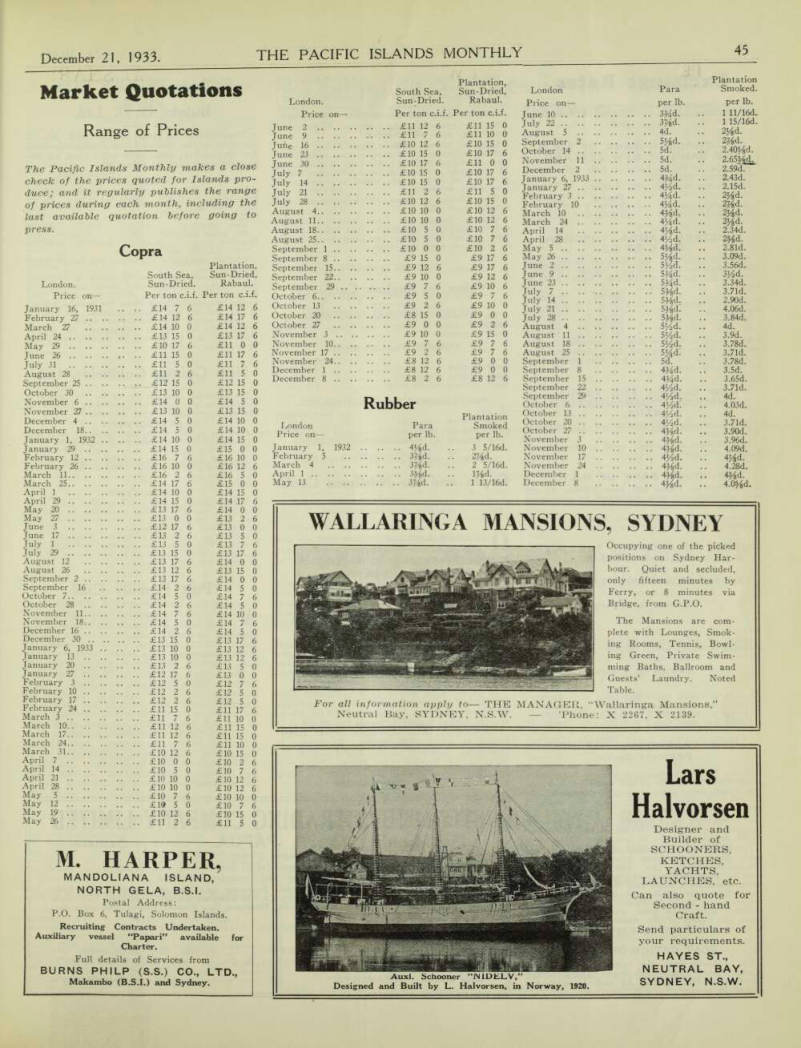
Range of Prices
The Pacific Islands Monthly makes a close check of the prices quoted for Islands pro duce; and it regularly publishes the range of prices during each month, including the last available quotation before going to press.
London.
Copra
South Sea, Sun-Dried.
Plantation, Sun-Dried, Rabaul.
Price on — Per ton c.i.f.
Per ton c.i.f.
January 16, 1931 .. .. £14 7 6 £14 12 6 February 27 .. .. .. .. £14 12 6 £14 17 6 March 27 .. .. £14 10 0 £14 12 6 April 24 .. .. £13 15 0 £13 17 6 May 29 .. .. £10 17 6 £11 0 0 June 26 ,. .. £11 15 0 £11 17 6 July 31 .. .. £11 5 0 £11 7 6 August 28 .. .. .. .. £11 2 6 £11 5 0 September 25 .. .. .. .. £12 15 0 £12 15 0 October 30 .. .. .. .. £13 10 0 £13 15 0 November 6 .. .. .. £14 0 0 £14 5 0 November 27 .. .. .. .. £13 10 0 £13 15 0 December 4 .. .. .. £14 5 0 £14 10 0 December 18.. .. .. £14 5 0 £14 10 0 January 1, 1932 .. .. .. £14 10 0 £14 15 0 January 29 .. .. .. .. £14 15 0 £15 0 0 February 12 .. .. .. .. £16 7 6 £16 10 0 February 26 .. .. .. .. £16 10 0 £16 12 6 March 11 .. .. £16 2 6 £16 5 0 March 25 .. .. £14 17 6 £15 0 0 April 1 .. .. £14 10 0 £14 15 0 April 29 .. .. £14 15 0 £14 17 6 May 20 .. .. £13 17 6 £14 0 0 May 27 .. .. £13 0 0 £13 2 6 June 3 .. .. £12 17 6 £13 0 0 June 17 .. .. .. .. .. £13 2 6 £13 5 0 July 1 .. .. £13 5 0 £13 7 6
July 29
.. .. £13 15 0 £13 17 6 August 12 .. .. .. .. £13 17 6 £14 0 0 August 26 .. .. .. .. £13 12 6 £13 15 0 September 2 .. .. .. .. £13 17 6 £14 0 0 September 16 .. .. £14 2 6 £14 5 0 October 7 .. .. £14 5 0 £14 7 6 October 28 .. .. .. .. £14 2 6 £14 5 0 November 11.. .. .. £14 7 6 £14 10 0 November 18.. .. .. .. £14 5 0 £14 7 6 December 16 .. .. .. .. £14 2 6 £14 5 0 December 30 .. .. .. .. £13 15 0 £13 17 6 January 6, 1933 .. .. .. £13 10 0 £13 12 6 January 13 .. .. £13 10 0 £13 12 6 January 20 .. .. .. .. £13 2 6 £13 5 0 January 27 .. .. .. .. £12 17 6 £13 0 0 February 3 .. .. .. .. £12 5 0 £12 7 6
February 10 .. ..
.. .. £12 2 6 £12 5 0
February 17 .. ..
.. .. £12 2 6 £12 5 0
February 24 .. ..
.. .. £11 15 0 £11 17 6 March 3 .. .. £11 7 6 £11 10 0 March 10 £11 12 6 £11 15 0 March 17 £11 12 6 £11 15 0 March 24 .. .. £11 7 6 £11 10 0 March 31 £10 12 6 £10 15 0 April 7 .. .. £10 0 0 £10 2 6 April 14 .. .. £10 5 0 £10 7 6 April 21 £10 10 0 £10 12 6 April 28 .. .. £10 10 0 £10 12 6
May 5
£10 7 6 £10 10 0 May 12 .. .. £19 5 0 £10 7 6 May 19 £10 12 6 £10 15 0 May 26 .. .. £11 2 6 £11 5 0
Plantation London Para Smoked.
Price on — per lb. per lb.
June 10 .. .. 3¾d. 1 11/16d.
July 22 .. .. 3Hd. 1 15/16d.
August S .. .. 4d. • 2%d.
September 2 .. .. .. .. 5*/ 8 d. . 2^d.
October 14 .. .. 5d. 2.40^d.
November 11 .. .. .. 5d. 2.65^ December 2 .. .. .. .. Sd. 2.59d.
January 6, 1933 .. .. .. .. 4Hd. 2.43d.
January 27 .. .. 4}4d. 2.1Sd.
February 3 .. .. 4'Ad. . 2>*d.
February 10 .. .. .. .. 4'Ad. • 2Hd.
March 10 .. .. 4Hd. ■ 2%d.
March 24 .. .. 4'Ad. • 2/ 8 d.
April 14 .. .. 4%d. 2.34d.
April 28 .. .. 4'/ 2 d. . 2^d.
May 5 .. .. 45/ 8 d. 2.81d.
May 26 .. .. 5^d. 3.09d.
June 2 .. .. Sjld. 3.56d.
June 9 .. .. 5*4d. . sy a d.
June 23 .. .. sy 4 d. 3.34d.
July 7 .. .. 5^d. 3.71d.
July 14 .. .. Stfd. 2.90d.
July 21 .. .. 5Hd. 4.06d.
July 28 .. .. 5^d. 3.84d, August 4 .. .. 5/ 2 d. 4d.
August 11 .. .. sy a d. 3.9d.
August 18 .. .. sy a d. 3.78d.
August 25 .. .. s'Ad: 3.71d.
September 1 .. .. .. .. Sob 3.78d.
September 8 .. .. .. .. 4Hd. 3.5d.
September 15 .. .. .. 4Hd. 3.65d.
September 22 .. .. .. .. 4'Ad. 3.71d.
September 29 .. .. .. 4%d. 4d.
October 6 .. .. 4^d; 4.03d.
October 13 .. .. 4y a d. 4d.
October 20 .. .. 4y a d. 3.71d.
October 27 .. .. 4Hd. 3.90d.
November 3 .. .. .. .. 4^d. 3.96d.
November 10 .. .. .. 4Vsd. 4.09d, November 17 .. .. .. .. 4 l / a d. 4&d.
November 24 .. .. .. .. 4ttd. 4.28d.
December 1 .. .. 4Hd. . 4Hd.
December 8 .. .. 4Hd. 4.0#d.
South Sea, Plantation, Sun-Dried, London.
Sun-Dried.
Rabaul.
Price on — Per ton c.i.f.
Per ton c.i.f.
June 2 . .. £11 12 6 £11 15 0 June 9 . .. £11 7 6 £11 10 0 June 16 . .. £10 12 6 £10 15 0 June 23 . .. £10 15 0 £10 17 6 June 30 . .. £10 17 6 £11 0 0 July 7 . .. £10 15 0 £10 17 6 July 14 . .. £10 15 0 £10 17 6 July 21 . .. £11 2 6 £11 5 0 July 28 . .. £10 12 6 £10 15 0 August 4 . .. £10 10 0 £10 12 6 August 11 . .. £10 10 0 £10 12 6 August 18 . .. £10 5 0 £10 7 6 August 25 . .. £10 5 0 £10 7 6 September 1 . .. £10 0 0 £10 2 6 September 8 . .. £9 15 0 £9 17 6 September 15 . .. £9 12 6 £9 17 6 September 22 . .. £9 10 0 £9 12 6 September 29 .. .. , .. .. £9 7 6 £9 10 6 October 6 . .. £9 5 0 £9 7 6 October 13 . .. £9 2 6 £9 10 0 October 20 . .. £8 15 0 £9 0 0 October 27 . .. £9 0 0 £9 2 6 November 3 . .. £9 10 0 £9 15 0 November 10 . .. £9 7 6 £9 7 6 November 17 . .. £9 2 6 £9 7 6 November 24 . .. £8 12 6 £9 0 0 December 1 . .. £8 12 6 £9 0 0 December 8 . .. £8 2 6 £8 12 6
Rubber
Plantation London Para Smoked Price on — per lb. per lb.
January 1, 1932 February 5 4^d. 3 S/16d. *m. .. 2m.
March 4 .. .. 37/gd. 2 5/16d.
April 1 3^d. im.
May 13 .. .. 3m. . 1 13/16d.
Advertisements & other items, p. 47 (1 item)
Halvorsen
WALLARINGA MANSIONS, SYDNEY
Occupying one of the picked positions on Sydney Harbour. Quiet and secluded, only fifteen minutes by Ferry, or 8 minutes via Bridge, from G.P.O.
The Mansions are complete with Lounges, Smoking Rooms, Tennis, Bowling Green, Private Swimming Baths, Ballroom and Guests’ Laundry. Noted Table.
For all information apply to — THE MANAGER, “Wallaringa Mansions,”
Neutral Bay, SYDNEY, N.S.W. ’Phone: X 2267, X 2139.
Auxl. Schooner "NIDELY,"
Designed and Built by L. Halvorsen, in Norway, 1920.
Lars
Halvorsen
Designer and Builder of
SCHOONERS,
KETCHES,
YACHTS,
LAUNCHES, etc.
Can also quote for Second - hand Craft.
Send particulars of your requirements.
HAYES ST.,
NEUTRAL BAY,
SYDNEY, N.S.W.
M. HARPER,
MANDOLIANA ISLAND,
NORTH GELA, B.S.I.
Postal Address: P.O. Box 6, Tulagi, Solomon Islands.
Recruiting Contracts Undertaken.
Auxiliary vessel “Papari” available for Charter.
Full details of Services from
BURNS PHILP (S.S.) CO., LTD.,
Makambo (B.S.I.) and Sydney.
Exchange Rates
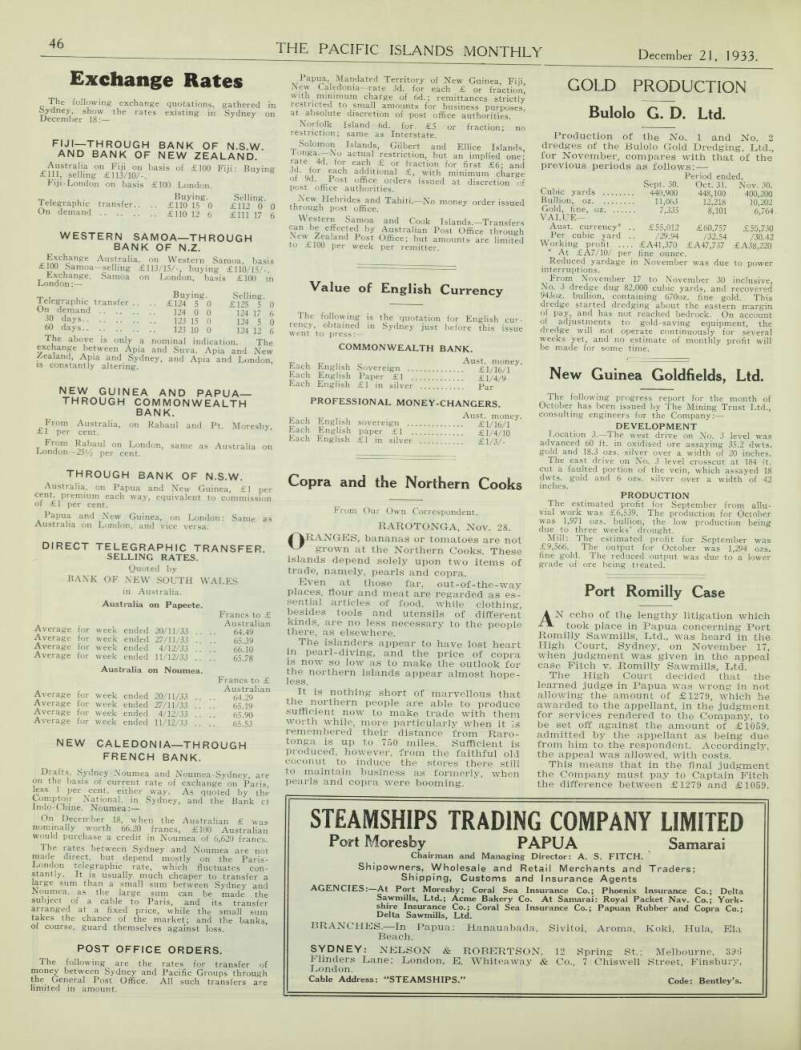
The following exchange quotations, gathered in Sydney, show the rates existing in Sydney on December 18:
Fiji—Through Bank Of N.S.W
And Bank Of New Zealand.
Australia on Fiji on basis of £100 Fiji: Buying £111, selling £113/10/-.
Fiji-London on basis £100 London.
Western Samoa—Through
Bank Of N.Z.
Exchange Australia, on Western Samoa, basis Samoa—selling £113/15/-, buying £110/15/-.
Exchange, Samoa on London, basis £100 in London: —
The above is only a nominal indication. The exchange between Apia and Suva, Apia and New Zealand, Apia and Sydney, and Apia and London, is constantly altering.
New Guinea And Papua—
Through Commonwealth
Bank.
From Australia, on Rabaul and Pt. Moresby £1 per cent.
From Rabaul on London, same as Australia on London— per cent.
Through Bank Of N.S.W.
Australia, on Papua and New Guinea, £1 per cent, premium each way, equivalent to commission of £1 per cent.
Papua and New Guinea, on London: Same as Australia on London, and vice versa.
Direct Telegraphic Transfer.
Selling Rates.
Quoted by
Bank Of New South Wales
in Australia.
New Caledonia— Through
French Bank.
Drafts, Sydney-Noumea and Noumea-Sydney, are
on the basis of current rate of exchange on Paris less 1 per cent, either way. As quoted by the Compton- National, in Sydney, and the Bank cf Indo-Chine, Noumea:— On December 18, when the Australian £ was nominally worth 66.20 francs, £100 Australian would purchase a credit in Noumea of 6,620 francs.
The rates between Sydney and Noumea are not made direct, but depend mostly on the Paris- London telegraphic rate, which fluctuates con stantly. It is usually much cheaper to transfer a large sum than a small sum between Sydney and Noumea, as the large sum can be made the subject of a cable to Paris, and its transfer arranged at a fixed price, while the small sum takes the chance of the market; and the banks, of course, guard themselves against loss.
Post Office Orders.
The following are the rates for transfer of money between Sydney and Pacific Groups through the General Post Office. All such transfers are limited in amount.
Papua Mandated Territory of New Guinea, Fiji, New Caledonia—rate 3d. for each £ or fraction, with minimum charge of 6d.; remittances strictly restricted to small amounts for business purposes, at absolute discretion of post office authorities.
Norfolk Island—6d. for £5 or fraction: no restriction; same as Interstate.
Solomon Islands, Gilbert and Ellice Islands, longa No actual restriction, but an implied one; rate 4d. for each £ or fraction for first £6; and 3d. for each additional £, with minimum charge of 9d. Post office orders issued at discretion of post office authorities.
New Hebrides and Tahiti.—No money order issued through post office.
Western Samoa and Cook Islands.—Transfers can be effected by Australian Post Office through New Zealand Post Office: but amounts are limited to £100 per week per remitter.
Buying. Selling.
Telegraphic transfer.. .. £110 15 0 £112 0 0 On demand £110 12 6 £111 17 6
Buying. Selling.
Telegraphic transfer.. .. £124 5 0 £125 5 0 On demand 124 0 0 124 17 6 30 days 123 15 0 124 5 0 60 days 123 10 0 124 12 6
Australia on Papeete.
Francs to £ Average for week ended 20/11/33 .. .. 64.49 Australian Average for week ended 27/11/33 .. 65.39 Average for week ended 4/12/33 .. 66.10 Average for week ended 11/12/33 .. 65.78 Australia on Noumea.
Francs to £ Average for week ended 20/11/33 .. 64.29 Average for week ended 27/11/33 .. 65.19 Average for week ended 4/12/33 .. 65.90 Australian Average for week ended 11/12/33 .. , 65.53
Value of English Currency
The following is the quotation for English cur rency , obtained in Sydney just before this issue went to press:—
Commonwealth
Bank.
Each English Sovereign Each English Paper £1 Aust. money.
Each English £1 in silver Par
Professional Money-Changers.
Each English sovereign Aust. money.
Each English paper £1 £1/4/10 Each English £1 in silver
Copra and the Northern Cooks
From Our Own Correspondent.
Rarotonga, Nov. 28.
Oranges, bananas or tomatoes are not grown at the Northern Cooks. These islands depend solely upon two items of trade, namely, pearls and copra.
Even at those far, out-of-the-way places, flour and meat are regarded as es sential articles of food, while clothing, besides tools and utensils of different kinds, are no less necessary to the people there, as elsewhere.
The islanders appear to have lost heart in pearl-diving, and the price of copra is now so low as to make the outlook for the northern islands appear almost hope less.
It is nothing short of marvellous that the northern people are able to produce sufficient now to make trade with them worth while, more particularly when it is remembered their distance from Raro tonga is up to 750 miles. Sufficient is produced, however, from the faithful old coconut to induce the stores there still to maintain business as formerly, when pearls and copra were booming.
Gold Production
Bulolo G. D. Ltd.
Production of the No. 1 and No. 2 dredges of the Bulolo Gold Dredging, Ltd., for November, compares with that of the previous periods as follows:
Reduced yardage in November was due to power interruptions.
From November 17 to November 30 inclusive, No. 3 dredge dug 82,000 cubic yards, and recovered 9430 z. bullion, containing 6700 z. fine gold. This dredge started dredging about the eastern margin of pay, and has not reached bedrock. On account of adjustments to gold-saving equipment, the dredge will not operate continuously for several weeks yet, and no estimate of monthly profit will be made for some time.
Period ended, Sept. 30. Oct. 31. Nov. 30.
Cubic yards 440,900 448,100 400,200 Bullion, oz 11,063 12,218 10,202 Gold, fine, oz 7,335 8,101 6,764
Value—
Aust. currency* .. £55,012 £60,757 £50,730 Per cubic yard .. /29.94 /32.S4 /30.42 Working profit ... £A41,370 £A47,737 £A38,220 * At £A7/10/ per fine ounce.
New Guinea Goldfields, Ltd.
The following progress report for the month of October has been issued by The Mining Trust Ltd., consulting engineers for the Company:—
Development
Location 3. —The west drive on No. 3 level was advanced 60 ft. in oxidised ore assaying 35.2 dwts. gold and 18.3 ozs. silver over a width of 20 inches.
The east drive on No. 3 level crosscut at 184 ft. cut a faulted portion of the vein, which assayed 18 dwts. gold and 6 ozs. silver over a width of 42 inches.
Production
The estimated profit for September from allu vial work was £6,539. The production for October was 1,971 ozs. bullion, the low production being due to three weeks’ drought.
Mill: The estimated profit for September was £9,566. The output for October was 1,294 ozs. fine gold. The reduced output was due to a lower grade of ore being treated.
Port Romilly Case
AN echo of the lengthy litigation which took place in Papua concerning Port Romilly Sawmills, Ltd., was heard in the High Court, Sydney, on November 17, when judgment was given in the appeal case Pitch v. Romilly Sawmills, Ltd.
The High Court decided that the learned judge in Papua was wrong in not allowing the amount of £1279, which he awarded to the appellant, in the judgment for services rendered to the Company, to be set off against the amount of £1059. admitted by the appellant as being due from him to the respondent. Accordingly, the appeal was allowed, with costs.
This means that in the final judgment the Company must pay to Captain Fitch the difference between £1279 and £1059.
Advertisements & other items, p. 48 (1 item)
Steamships Trading Company Limited
Port Moresby PAPUA Samarai
Chairman and Managing Director: A. S. FITCH.
Shipowners, Wholesale and Retail Merchants and Traders; Shipping, Customs and Insurance Agents AGENCIES:—At Port Moresby; Coral Sea Insurance Co.; Phoenix Insurance Co.; Delta Sawmills, Ltd.; Acme Bakery Co. At Samarai: Royal Packet Nav. Co.; Yorkshire Insurance Co.; Coral Sea Insurance Co.; Papuan Rubber and Copra Co.; Delta Sawmills, Ltd.
BRANCHES.—In Papua: Hanauabada, Sivitoi, Aroma, Koki, Hula, Ela Beach.
SYDNEY: NELSON & ROBERTSON, 12 Spring - St.; Melbourne, 39G Flinders Lane; London, E. Whiteaway & Co., 7 Chiswell Street, Finsbury, London.
Cable Address: “STEAMSHIPS.” Code: Bentley’s.
Shipping Services in the Pacific
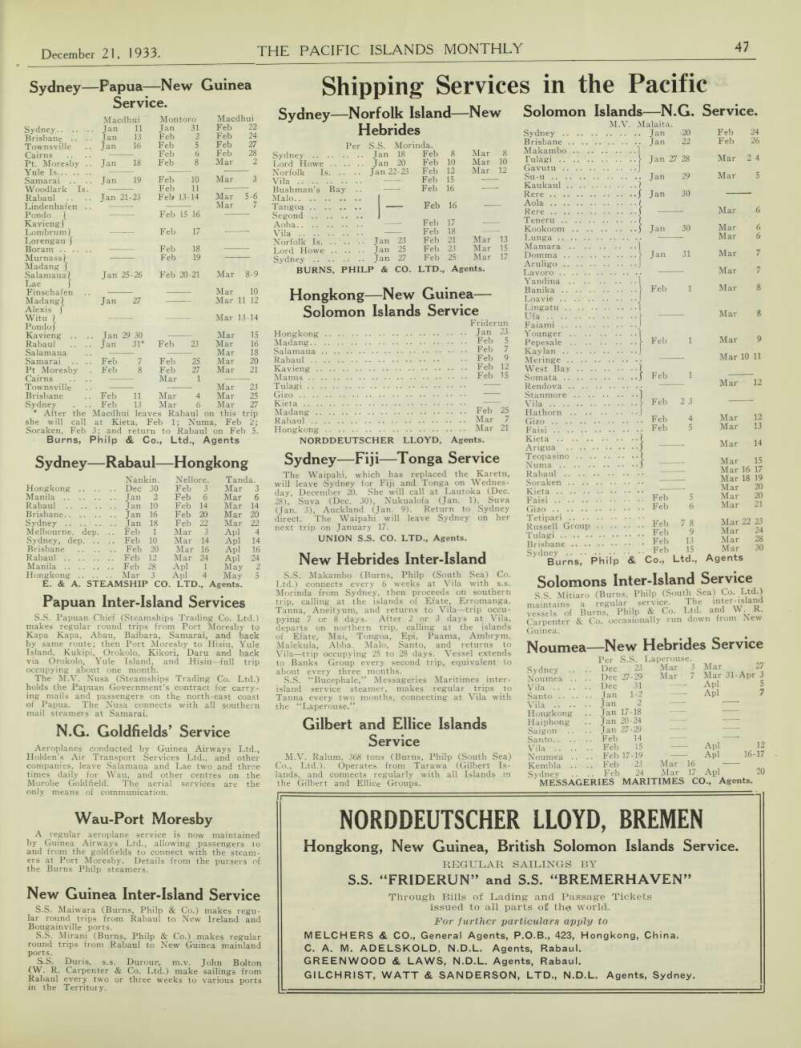
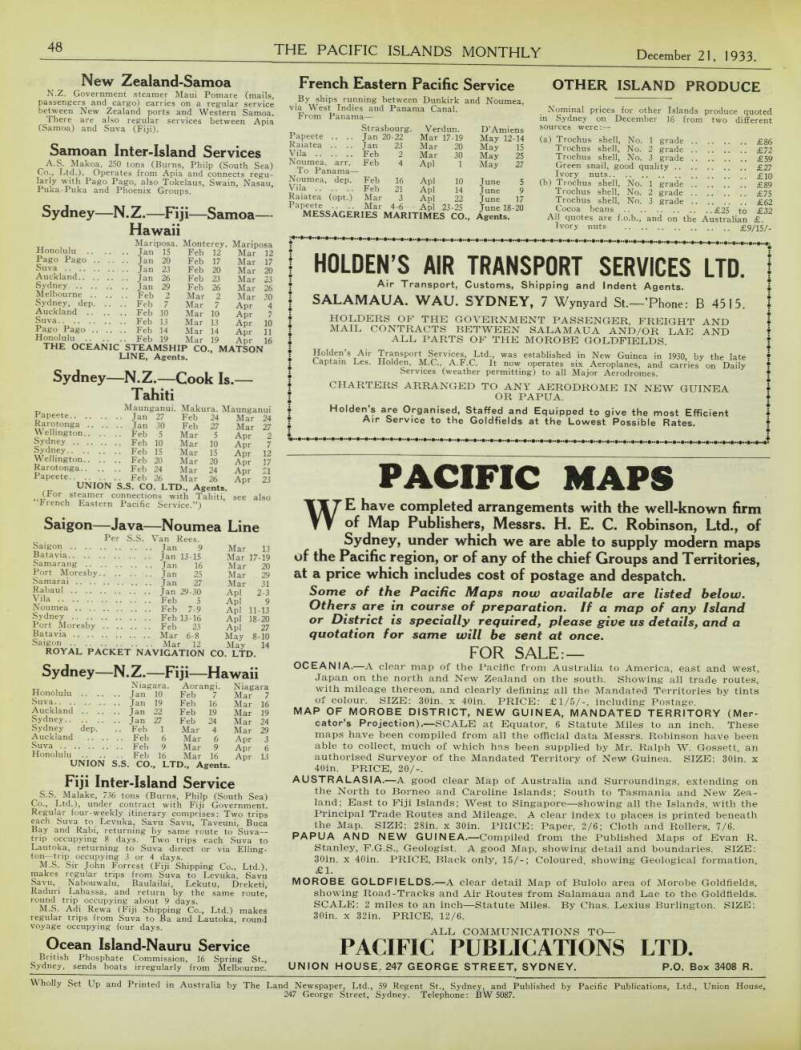
Sydney—Papua —New Guinea Service.
Sydney—Rabaul—Hongkong
Papuan Inter-Island Services
S.S. Papuan Chief (Steamships Trading Co. Ltd.) makes regular round trips from Port Moresby to Kapa Kapa, Abau, Baibara, Samarai, and back by same route; then Port Moresby to Hisiu, Yule Island, Kukipi, Orokolo, Kikori, Daru and back via Orokolo, Yule Island, and Hisiu—full trip occupying about one month.
The M.V. Nusa (Steamships Trading Co. Ltd.) holds the Papuan Government’s contract for carry ing mails and passengers on the north-east coast of Papua. The Nusa connects with all southern mail steamers at Samarai.
N.G. Goldfields’ Service
Aeroplanes conducted by Guinea Airways Ltd., Holden’s Air Transport Services Ltd., and other companies, leave Salamaua and Lae two and three times daily for Wau, and other centres on the Morobe Goldfield. The aerial services are the only means of communication.
Wau-Port Moresby
A regular aeroplane service is now maintained by Guinea Airways Ltd., allowing passengers to and from the goldfields to connect with the steam ers at Port Moresby. Details from the pursers of the Burns Philp steamers.
New Guinea Inter-Island Service
S.S. Maiwara (Burns, Philp & Co.) makes regular round trips from Rabaul to New Ireland and Bougainville ports.
S.S. Mirani (Burns, Philp & Co.) makes regular round trips from Rabaul to New Guinea mainland ports.
S.S. Duris, s.s. Durour, m.v. John Bolton (W. R. Carpenter & Co. Ltd.) make sailings from Rabaul every two or three weeks to various ports in the Territory.
Sydney—Norfolk Island —New Hebrides
Hongkong—New Guinea — Solomon Islands Service
Sydney—Fiji—Tonga Service
The Waipahi, which has replaced the Karetu, will leave 'Sydney for Fiji and Tonga on Wednes day, December 20. She will call at Lautoka (Dec. 28), Suva (Dec. 30), Nukualofa (Jan. 1), Suva (Jan. 3), Auckland (Jan. 9). Return to Sydney direct. The Waipahi will leave Sydney on her next trip on January 17.
Union S.S. Co. Ltd., Agents.
New Hebrides Inter-Island
S.S. Makambo (Burns, Philp (South Sea) Co.
Ltd.) connects every 6 weeks at Vila with s.s.
Morinda from Sydney, then proceeds on southern trip, calling at the islands of Efate, Erromanga, Tanna, Aneityum, and returns to Vila—trip occu pying 7 or 8 days. After 2 or 3 days at Vila, departs on northern trip, calling at the islands of Efate, Mai, Tongoa, Epi, Paama, Ambrym.
Malekula, Abba. Malo, Santo, and returns to Vila—trip occupying 25 to 28 days. Vessel extends to Banks Group every second trip, equivalent to about every three months.
S.S. “Bucephale,” Messageries Maritimes interisland service steamer, makes regular trips to Tanna every two months, connecting at Vila with the “Laperouse.”
Gilbert and Ellice Islands
Service
M.V. Ralum, 368 tons (Burns, Philp (South Sea) Co., Ltd.). Operates from Tarawa (Gilbert Is lands, and connects regularly with all Islands :n the Gilbert and Ellice Groups.
Solomon Islands—N.G. Service.
Solomons Inter-Island Service
S.S. Mitiaro (Burns, Philp (South Sea) Co. Ltd.) maintains a regular service. The inter-island vessels of Burns, Philp & Co. Ltd. and W. R.
Carpenter & Co. occasionally run down from Mew Guinea.
Noumea —New Hebrides Service
Macdhui Montoro Macdhui Sydney.. .. . Jan 11 Jan 31 Feb 22 Brisbane .. . Jan 13 Feb 2 Feb 24 Townsville . Jan 16 Feb 5 Feb 27 Cairns Feb 6 Feb 28 Pt. Moresby . Jan 18 Feb 8 Mar 2 Samarai .. . Jan 19 Feb 10 Mar 3 Woodlark Is Feb 11 Rabaul . Jan 21-23 Feb 13- 14 Mar 5-6 Lindenhafen Mar 7 Pondo Feb 15 16
Kavieng
Lombrum
Feb 17 Lorengau Boram Feb 18
Murnass
Feb 19 Madang Salamaua Jan 25-26 Feb 20-21 Mar 8-9 Lae Finschafen Mar 10
Madang
Jan 27 Mar 11 12 Alexis Witu —.
Mar 13 -14 Pondo Kavieng .. ,. Jan 29 30 Mar 15 Rabaul .. .
Jan 31* Feb 23 Mar 16 Salamaua Mar 18 Samarai .. .
Feb 7 Feb 25 Mar 20 Pt Moresby . Feb 8 Feb 27 Mar 21 Cairns .. .
Mar 1 Townsville Mar 23 Brisbane Feb 11 Mar 4 Mar 25 Sydney . . . Feb 13 Mar 6 Mar 27 * After the Macdhui leaves Rabaul on this trip she will call at Kieta, Feb 1: Numa, Feb 2; Soraken, Feb 3; and return to Rabaul on Feb 5.
Burns, Philp & Co., Ltd., Agents
Nankin.
Nellore.
Tanda.
Hongkong .. .. 30 Feb 3 Mar 3 Manila 2 Feb 6 Mar 6 Rabaul .. Jan 10 Feb 14 Mar 14 Brisbane .. Jan 16 Feb 20 Mar 20 Sydney .. Jan 18 Feb 22 Mar 22 Melbourne, dep. . . Feb 1 Mar 3 Apl 4
Sydney, dep. .. ,
,. Feb 10 Mar 14 Apl 14 Brisbane .. Feb 20 Mar 16 Apl 16 Rabaul . Feb 12 Mar 24 Apl 24 Manila . Feb 28 Apl 1 May 2 Hongkong Mar 3 Apl 4 May 5 E. & A. STEAMSHIP CO. LTD., Agents.
Per S.S. Morinda.
Sydney Jan 18 Feb 8 Mar 8 Lord Howe Jan 20 Feb 10 Mar 10 Norfolk Is Jan 22-23 Feb 12 Mar 12 Vila — Feb 15 Bushman’s Bay .. — Feb 16 Malo Tangoa — Feb 16 Segond Aoba — Feb 17 Vila — Feb 18 Norfolk Is Jan 23 Feb 21 Mar 13 Lord Howe Jan 25 Feb 23 Mar 15 Sydney Jan 27 Feb 25 Mar 17
Burns, Philp & Co. Ltd., Agents.
Hongkong Friderun .. .. Jan 23 .. .. Feb 5 .. .. Feb 7 .. Feb 9 Kavieng .. .. Feb 12 Tulagi Gizo Madang .. .. Feb 25 Rabaul Hongkong .. .. Mar 21
Norddeutscher Lloyd, Agents.
Sydney .. ..
Brisbane .. ..
Makambo .. .
Tulagi Gavutu .. ..
Su-u Kaukaul .. ..
Rere Aola Rere Teneru Kookoom .. .
Lunga M.V. Malaita.
Jan 20 Jan 22 Jan 27 28 Jan 29 Feb Feb Mar Mar 24 26 2 4 5 Mar Mar Mar 6 Jan 30 6 5 Mamara .. ..
Domma .. ..
Aruligo .. ..
Lavoro Yandina .. ..
Banika .. ..
Jan 31 Mar Mar Mar 7 7 Feb 1 8 Loavie Ufa Mar 8 Pepesale Feb 1 Mar 9 Kaylan Meringe West Bay Somata Mar 10 11 Feb 1 Rendova Stanmore Vila Mar 12 Feb 2 3 Hathorn Gizo . Feb 4 Mar 12 Faisi . Feb 5 Mar 13 Kieta Arigua ,
Teopasino
Mar Mar 14 15 Rabaul Mar 16 17 Soraken .. ..
Mar 18 19 Mar 20 . Feb 5 Mar 20 . Feb 6 Mar 21 Russell Group . Feb . Feb 7 8 9 Mar 22 23 Mar 24 13 Mar 28 . Feb 15 Mar 30 Burns, Philp & Co., Ltd., Agents
Sydney ..
Noumea ..
Vila . ..
Per S.S. Laperouse. .. Dec 23 Mar 3 .. Dec 27-29 Mar 7 .. Dec 31 Mar 27 Mar 31-Apr 3 Apl 5 .. Jan 1-2 — Apl 7 ..Jan 2 — — Hongkong Haiphong Saigon ..
Santo.. .. Jan 17-18 .. Jan 20-24 .. Jan 27-29 .. Feb 14 Vila . . .. .. Feb 15 — Apl 12 Noumea .. .. Feb 17-19 Apl 16- Kembla .. .. Feb 23 Mar 16 Sydney .. .. Feb 24 Mar 17 Apl
Messageries Mar1Times Co., Agents.
17 20
New Zealand-Samoa
N.Z. Government steamer Maui Pomare (mails, passengers and cargo) carries on a regular service between New Zealand ports and Western Samoa.
There are also regular services between Apia (Samoa) and Suva (Fiji).
Samoan Inter-Island Services
A.S. Makoa, 250 tons (Burns, Philp (South Sea) Co., Ltd.). Operates from Apia and connects regu larly with Pago Pago, also Tokelaus, Swain, Nasau, Puka-Puka and Phoenix Groups.
Sydney—N.Z.—Fiji—Samoa—
Hawaii
Sydney—N.Z.—Cook Is.— Tahiti
Saigon—Java—Noumea Line
Sydney—N.Z.—Fiji—Hawaii
Fiji Inter-Island Service
S.S. Malake, 736 tons (Burns, Philp (South Sea) Co., Ltd.), under contract with Fiji Government.
Regular four-weekly itinerary comprises: Two trips each Suva to Levuka, Savu Savu, Taveuni, Buca Bay and Rabi, returning by same route to Suva — trip occupying 8 days. Two trips each Suva to Lautoka, returning to Suva direct or via Elling ton—trip, occupying 3 or 4 days.
M.S. Sir John Forrest (Fiji Shipping Co., Ltd.), makes regular trips from Suva to Levuka, Savu Savu, Nabouwalu, Baulailai, Lekutu, Dreketi, Raduri Labassa, and return by the same route, round trip occupying about 9 days.
M.S. Adi Rewa (Fiji Shipping Co., Ltd.) makes regular trips from Suva to Ba and Lautoka, round voyage occupying four days.
Ocean Island-Nauru Service
British Phosphate Commission, 16 Spring St., Sydney, sends boats irregularly from Melbourne.
French Eastern Pacific Service
By ships running between Dunkirk and Noumea, via West Indies and Panama Canal.
From Panama—
Other Island Produce
Nominal prices for other Islands produce quoted in Sydney on December 16 from two different sources were:—
Mariposa. Monterey. Mariposa Honolulu .. .. Jan 15 Feb 12 Mar 12
Pago Pago .. ..
20 Feb 17 Mar 17 Suva 23 Feb 20 Mar 20 Auckland 26 Feb 23 Mar 23 Sydney 29 Feb 26 Mar 26 Melbourne .. .. .. Feb 2 Mar 2 Mar 30
Sydney, dep. ..
.. Feb 7 Mar 7 Apr 4 Auckland .. .. Feb 10 Mar 10 Apr 7 Suva 13 Mar 13 Apr 10 Pago Pago .. .. .. Feb 14 Mar 14 Apr 11 Honolulu .. 19 Mar 19 Aor 16
The Oceanic Steamship Co., Matson
LINE, Agents.
Papeete .. ..
Strasbourg.
Verdun.
D’Amiens Jan 20-22 Mar 17 -19 May 12-14 Raiatea .. ..
Jan 23 Mar 20 May 15 Vila Feb 2 Mar 30 May 25 Noumea, arr.
To Panama— Feb 4 Apl 1 May 27 Noumea, dep.
Feb 16 Apl 10 June 5 Vila Feb 21 Apl 14 June 9 Raiatea (opt.) Mar 3 Apl 22 June 17 Papeete .. ..
Mar 4-6 Aol 23-25 June 18-20
Messageries Maritimes Co., Agents.
(a) Trochus shell, No. 1 grade ..
Trochus shell, No. 2 grade ..
Trochus shell. No. 3 grade ..
Green snail, good quality .. ..
Ivory nuts.. (b) Trochus shell, No. 1 grade ..
Trochus shell, No. 2 grade ..
Trochus shell. No. 3 grade ..
Cocoa beans .. £25 to £32 All quotes are f.o.b.. and on the Australian £.
Ivory nuts
Maunganui. Makura. Maunganui Papeete Jan 27 Feb 24 Mar 24 Rarotonga Jan 30 Feb 27 Mar 27 Wellington Feb 5 Mar 5 Apr 2 Sydney Feb 10 Mar 10 Apr 7 Feb 15 Mar 15 Apr 12 Wellington Feb 20 Mar 20 Apr 17 Rarotonga Feb 24 Mar 24 Apr 11 Papeete. .. .. Feb 26 Mar 26 Apr 23
Union S.S. Co. Ltd., Agents.
(For steamer connections with Tahiti, see also French Eastern Pacific Service.”)
Per S.S. Van Rees.
Saigon Mar 13 Batavia Mar 17-19 Samarang Mar 20 Port Moresby Mar 29 Samarai Mar 31 Rabaul Apl 2-3 Vila Apl 9 Noumea Apl 11-13 Sydney Apl 18-20 Port Moresby Apl 27 Batavia May 8-10 Saigon May 14
Royal Packet Navigation Co. Ltd.
Niagara. Aorangi. Niagara Honolulu Jan 10 Feb 7 Mar 7 Suva. Jan 19 Feb 16 Mar 16 Auckland Jan 22 Feb 19 Mar 19 Sydney Jan 27 Feb 24 Mar 24 Sydney dep. .. Feb 1 Mar 4 Mar 29 Auckland Feb 6 Mar 6 Apr 3 Suva Feb 9 Mar 9 Apr 6 Honolulu Feb 16 Mar 16 Apr 13
Union S.S. Co., Ltd., Agents.
Advertisements & other items, pp. 49-52 (3 items)
Norddeutscher Lloyd, Bremen
Hongkong, New Guinea, British Solomon Islands Service.
REGULAR SAILINGS BY
S.S. “FRIDERUN” and S.S. “BREMERHAVEN”
Through Bills of Lading and Passage Tickets issued to all parts of the world.
For further particulars apply to MELCHERS & CO., General Agents, P.O.B., 423, Hongkong, China.
C. A. M. ADELSKOLD. N.D.L, Agents, Rabaul.
GREENWOOD & LAWS, N.D.L. Agents, Rabaul.
GILCHRIST, WATT & SANDERSON, LTD., N.D.L. Agents, Sydney.
HOLDEN’S AIR TRANSPORT SERVICES LTD.
Air Transport, Customs, Shipping and Indent Agents.
SALAMAUA. WAU. SYDNEY, 7 Wynyard St.—’Phone: B 4515.
HOLDERS OF THE GOVERNMENT PASSENGER, FREIGHT AND MAIL CONTRACTS BETWEEN SALAMAUA AND/OR LAE AND
ALL PARTS OF THE MOROBE GOLDFIELDS
Holden s Air Transport Services, Ltd., was established in New Guinea in 1930, by the late Captain Les. Holden, M.C., A.F.C. It now operates six Aeroplanes, and carries on Dailv Services (weather permitting) to all Major Aerodromes.
CHARTERS ARRANGED TO ANY AERODROME IN NEW GUINEA
OR PAPUA.
Holden’s are Organised, Staffed and Equipped to give the most Efficient Air Service to the Goldfields at the Lowest Possible Rates.
PACIFIC MAPS
WE have completed arrangements with the well-known firm of Map Publishers, Messrs. H. E. C. Robinson, Ltd., of Sydney, under which we are able to supply modern maps of the Pacific region, or of any of the chief Groups and Territories, at a price which includes cost of postage and despatch.
Some of the Pacific Maps now available are listed below.
Others are in course of preparation. If a map of any Island or District is specially required, please give us details, and a quotation for same will be sent at once.
FOR SALE:
OCEANIA. —A clear map of the Pacific from Australia to America, east and west, Japan on the north and New Zealand on the south. Showing all trade routes, with mileage thereon, and clearly defining all the Mandated Territories by tints of colour. SIZE: 30in. x 40in. PRICE: £1/5/-, including Postage.
MAP OF MOROBE DISTRICT, NEW GUINEA, MANDATED TERRITORY (Mercator’s Projection). —SCALE at Equator, 6 Statute Miles to an inch. These maps have been compiled from all the official data Messrs. Robinson have been able to collect, much of which has been supplied by Mr. Ralph W. Gossett, an authorised Surveyor of the Mandated Territory of Newi Guinea, SIZE: 30in. x
40in. PRICE, 20/-.
AUSTRALASIA. —A good clear Map of Australia and Surroundings, extending on the North to Borneo and Caroline Islands; South to Tasmania and New Zealand; East to Fiji Islands; West to Singapore—showing all the Islands, with the Principal Trade Routes and Mileage. A clear index to places is printed beneath the Map. SIZE: 28in. x 30in. PRICE; Paper, 2/6; Cloth and Rollers, 7/6.
PAPUA AND NEW GUlNEA. —Compiled from the Published Maps of Evan R.
Stanley, F.G.S., Geologist. A good Map, showing detail and boundaries. SIZE: 30in. x 40in. PRICE, Black only, 15/-; Coloured, showing Geological formation, £l.
MOROBE GOLDFIELDS. —A clear detail Map of Bulolo area of Morobe Goldfields, showing Road-Tracks and Air Routes from Salamaua and Lae to the Goldfields.
SCALE: 2 miles to an inch—Statute Miles. By Chas. Lexius Burlington. SIZE: 30in. x 32in. PRICE, 12/6.
ALL COMMUNICATIONS TO—
PACIFIC PUBLICATIONS LTD.
UNION HOUSE, 247 GEORGE STREET, SYDNEY. P.O. Box 3408 R.
Goldfields Aerial Transport Service
EVERYTHING required for the Development of the Morobe Goldfield men,
foodstuffs, building material, dredges,
miscellaneous machinery, cattle and horses has been carried over the mountains, from the coast of New Guinea, by aeroplanes. Modern aviation has made possible the establishment of a flourishing gold-mining industry in the heart of New Guinea.
31 Aerodromes
BABUAP
BAPI
BULOLO
BULWA
GABANZIZ
GARINA
JUNI
KAJABIT
KIDJURA
KOKODA*
KABUNA*
LAE
MT. HAGEN
MARILINAN
MENYAMYA
MARAWASSA
NADZAB
PORT
MORESBY*
PURARI
RAMU
SALAMAUA
SANGAN
SUNSHINE
SURPRISE CK.
UP. WATUT
WAGAU
WAHGI
WAMPIT
WAU
ZENAG
WARONA
In Papua.
Massive equipment carried in onto the
Morobe Goldfield recently by aeroplanes
operated by Guinea Airways Ltd.
TOP PICTURE. —Bulolo G.D. Company’s No. 3 Dredge, which commenced operations at Bulwa in November. No. 4 Dredge is now being erected nearby.
LOWER PICTURE: Part of the pipe-line which brings the water to the new Power-house at Bulolo, thus making electric light and power available to the whole of Morobe.
Aeroplanes, flying on regular schedules, transported all this heavy machinery without mishap. The weight of some of the pieces exceeded 6 tons.
In 1926 the Morobe Goldfield, guarded by dense jungle and precipitous mountain ranges, was almost unexplored and practically inaccessible. To-day, it is the seat of a great and flourishing industry, employing hundreds of Europeans and thousands of natives, and equipped with all the amenities cf civilisation.
Aerial transport made that possible. There is no road in from the coast.
A road could not be built, except at enormous, crippling cost.
Guinea Airways Ltd., launching this unique aerial service, originally with one machine and a handful of men, now operate a fleet of aeroplanes—including three very large tri-molored monoplanes—and employ 80 Europeans and a numerous native staff.
Their aeroplanes run on fixed timetables from Lae, Salamaua, Bulolo, Wau and Port Moresby, carrying passengers and freight, and maintaining regular communication between 31 aerodromes.
Travellers may leave the steamer at Port Moresby, fly across to Morobe (time of journey, Ih. 45min.) and spend 9 days in the Goldfield centres before rejoining steamer at Lae for Rabaul.
Or, after visiting Rabaul, they may disembark at Salamaua or Lae, spend several days on the Goldfield, and fly to Pt. Moresby to rejoin the steamer. All information from Pursers on the Steamers.
GUINEA AIRWAYS LTD
LAE - SALAMAUA
The game is well worth the winning when a glass of this satisfying Pilsener awaits the players!
There’s an old-world flavour of malt and hops in
every glass—that’s why it
has proved so popular.
RESCHS
PILSENER
48
December 21, 1933.
THE PACIFIC ISLANDS MONTHLY
Wholly Set Up and Printed in Australia by The Land Newspaper, Ltd., 59 Regent St., Sydney, and Published by Pacific Publications, Ltd., Union House, 247 George Street, Sydney. Telephone: BW 5087.
Iii
THE PACIFIC ISLAiNDS MONTHLY
December 21, 1933.