Pacific
Islands
Monthly
November 22Nd,
1933
6 d
[Registered at G.P.O., Sydney, for transmission by post as a newspaper.]
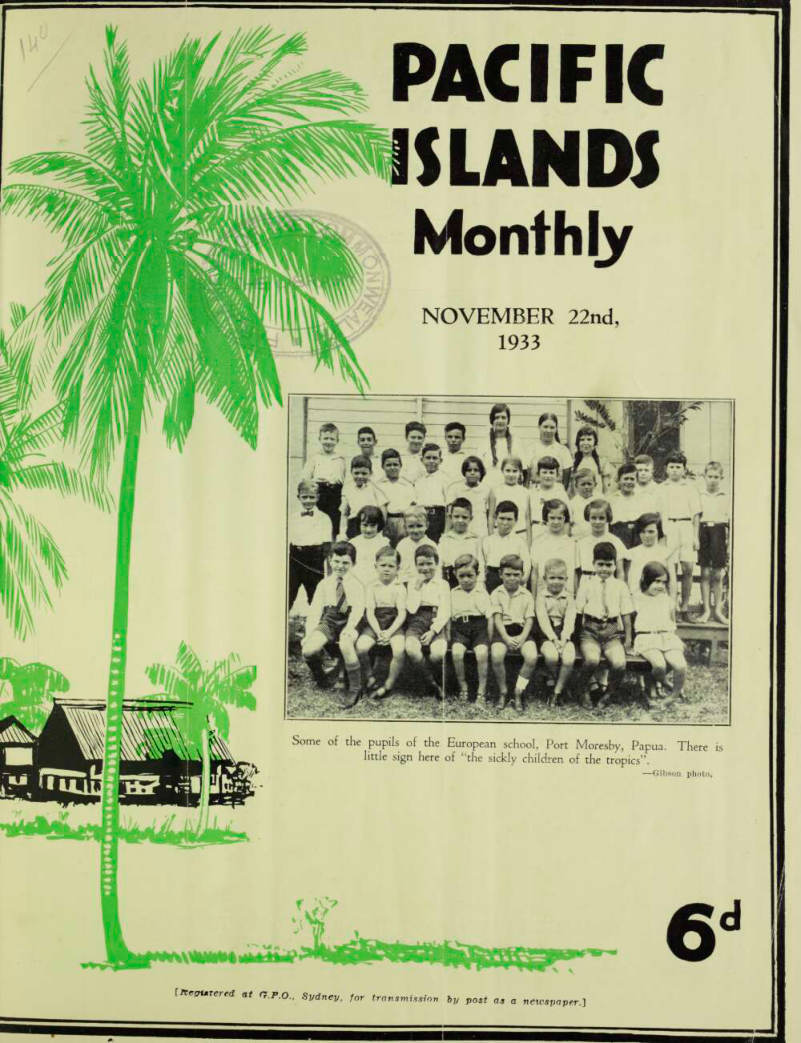
Some of the pupils of the European school, Port Moresby, Papua. There is little sign here of “the sickly children of the tropics”. —Gibson photo.
Advertisements & other items, p. 2 (1 item)
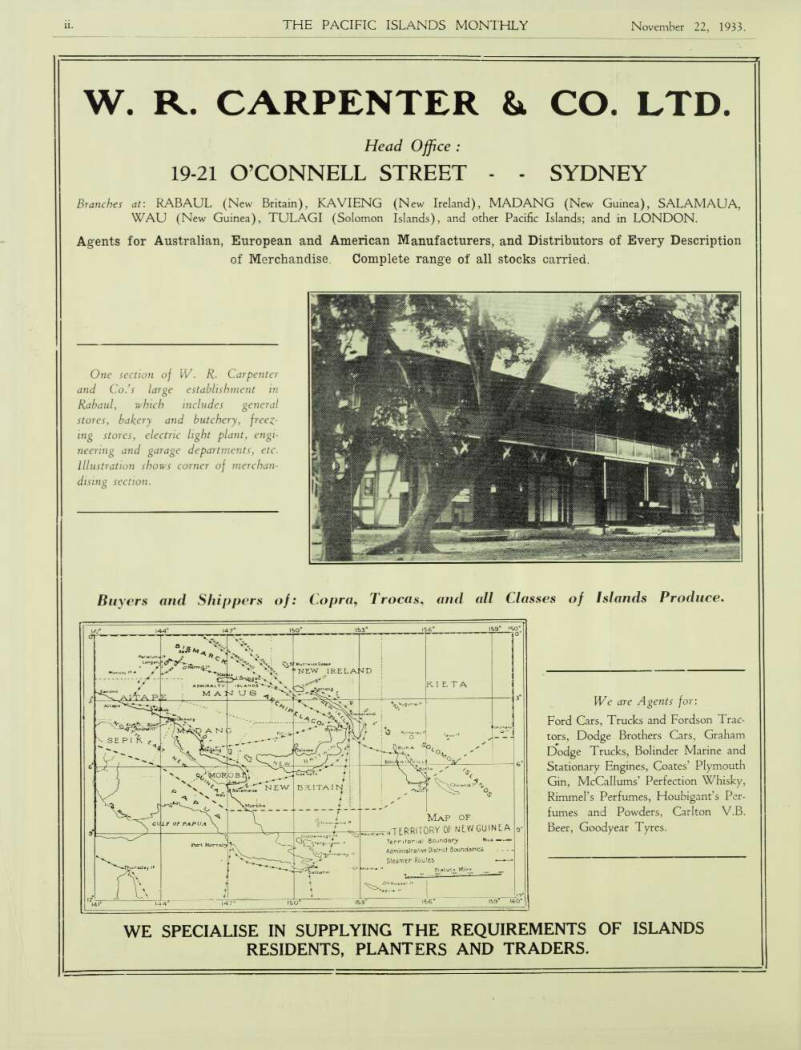
W. R. Carpenter & Co. Ltd.
Head Office :
19-21 O’CONNELL STREET - - SYDNEY
Branches at: RABAUL (New Britain), KAVIENG (New Ireland), MADANG (New Guinea), SALAMAUA, WAU (New Guinea), TULAGI (Solomon Islands), and other Pacific Islands; and in LONDON.
Agents for Australian, European and American Manufacturers, and Distributors of Every Description of Merchandise. Complete range of all stocks carried.
One section of W. R. Carpenter and Co.’s large establishment in Rabaul, which includes general stores, bakery and butchery, freezing stores, electric light plant, engineering and garage departments, etc.
Illustration shows corner of merchandising section.
Buyers and Shippers of: Copra , Trocas , and all Classes of Islands Produce .
We are Agents for : Ford Cars, Trucks and Fordson Tractors, Dodge Brothers Cars, Graham Dodge Trucks, Bolinder Marine and Rimmel’s Perfumes, Houbigant’s Perfumes and Powders, Carlton V.B.
Beer, Goodyear Tyres.
WE SPECIALISE IN SUPPLYING THE REQUIREMENTS OF ISLANDS
RESIDENTS, PLANTERS AND TRADERS.
Stationary Engines, Coates’ Plymouth Gin, McCallums’ Perfection Whisky,
Pacific Islands Travellers
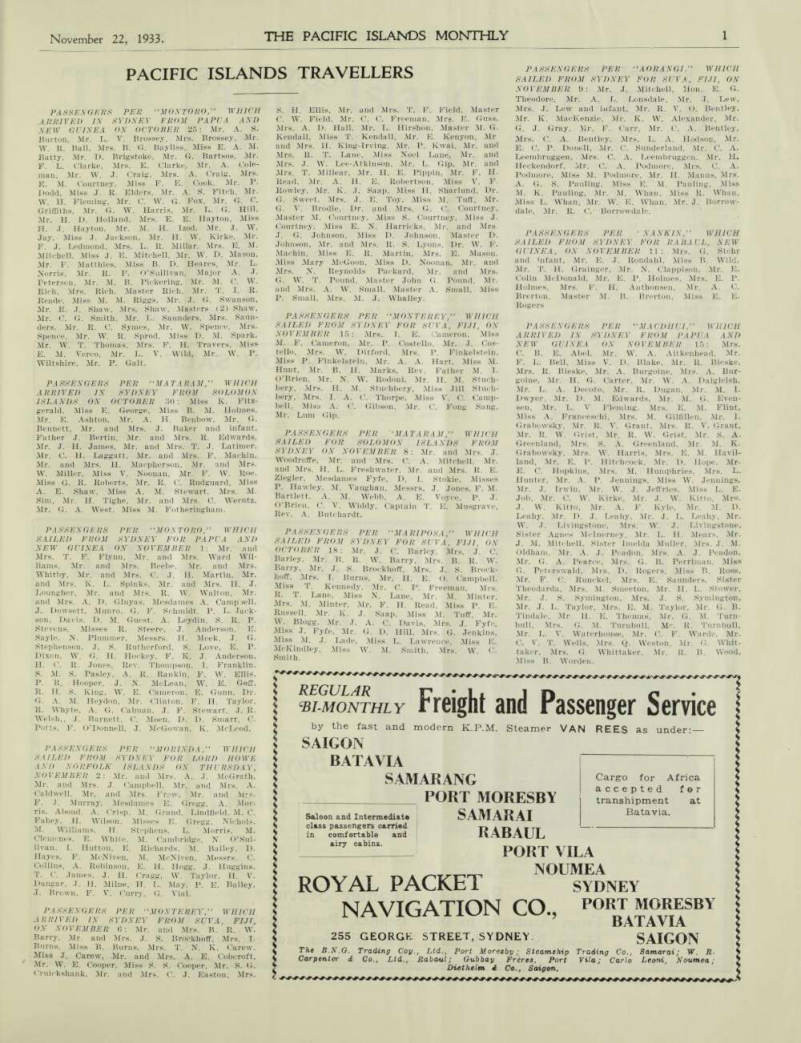
Passengers Per “Montoro,” Which
Arrived In Sydney From Papua And
NEW GUINEA ON OCTOBER 25: Mr. A. S.
Burton, Mr. L. V. Brossey, Mrs. Brossey, Mr.
W. R. Ball, Mrs. B. G. Bayliss, Miss E. A. M.
Batty, Mr. D. Brigstoke, Mr. G. Bartsos, Mr.
F. L. Clarke, Mrs. E. Clarke, Mr. A. Cole man, Mr. W. J. Craig, Mrs. A. Craig, Mrs.
E. M. Courtney, Miss F. E. Cook, Mr. P- Dodd, Miss J. R. Elders, Mr. A. S. Pitch, Mr.
W. H. Fleming, Mr. C. W. G. Fox, Mr. G. C.
Griffiths, Mr. G. W. Harris, Mr. L. G. Hill, Mr. H. D. Holland, Mrs. E. E. Hayton, Miss H. J. Hayton, Mr. M. H. Izod, Mr. J. W.
Jay, Miss J. Jackson, Mr. H. W. Kirke, Mr.
F. J. Ledmond, Mrs. L. R. Millar, Mrs. E. M.
Mitchell, Miss J. E. Mitchell, Mr. W. D. Mason, Mr. F. Matthies, Miss B. D. Heares, Mr. L.
Norris, Mr. R. P. O’Sullivan, Major A. J.
Peterson, Mr. M. B. Pickering, Mr. M. C. W.
Rich, Mrs. Rich, Master Rich, Mr. T. I. R.
Reade, Miss M. M. Riggs, Mr. J. G. Swanson, Mr. R. J. Shaw, Mrs. Shaw, Masters (2) Shaw, Mr. C. G. Smith, Mr. L. Saunders, Mrs. Saunders, Mr. R. C. Symes, Mr. W. Spence, Mrs.
Spence, Mr. W. R. Sprod, Miss D. M. Spark, Mr. W. T. Thomas, Mrs. F. H. Travers, Miss E. M. Verco, Mr. L. V. Wild, Mr. W. P.
Wiltshire, Mr. P. Galt.
Passengers Per “Mataram," Which
Arrived In Sydney From Solomon
ISLANDS ON OCTOBER 30; Miss K. Fitz gerald, Miss E. George, Miss B. M. Holmes, Mr. E. Ashton, Mr. A. H. Benbow, Mr. G.
Bennett, Mr. and Mrs. J. Baker and infant, Father J. Berlin, Mr. and Mrs. R. Edwards, Mr. J. H. James, Mr. and Mrs. T. J. Latimer, Mr. C. H. Laggatt, Mr. and Mrs. F. Machin, Mr. and Mrs. H. Macpherson, Mr. and Mrs.
W. Miller, Miss V. Noonan, Mr. F. W. Roe, Miss G. R. Roberts, Mr. R. C. Rudguard, Miss A. E. Shaw, Miss A. M. Stewart, Mrs. M.
Sim, Mr. H. Tighe, Mr. and Mrs. G. Werntz, Mr. G. A. West, Miss M. Fotheringham.
Passengers Per “Montoro,” Which
Sailed From Sydney For Papua And
NEW GUINEA ON NOVEMBER 1: Mr. and Mrs. T. F. Flynn, Mr. and Mrs. Ward Williams, Mr. and Mrs. Beebe, Mr. and Mrs.
Whitby, Mr. and Mrs. C. J. H. Martin, Mr. and Mrs. K. L. Spinks, Mr. and Mrs. H. J.
Loungher, Mr. and Mrs. R. W. Walton, Mr. and Mrs. A. D. Gluyas, Mesdames A. Campaell, J. Dowsett, Munro, G. F. Schmidt. P. L. Jack son, Davis, D. M. Guest, A. Leydin, S. R. P.
Stevens, Misses R. Steere, J. Anderson, E.
Sayle, N. Plummer, Messrs. H. Meek, J. G.
Stephenson, J. S. Rutherford, S. Love, E. P.
Dixon, W. G. H. Hockey, F. K. J. Anderson, H. C. R. Jones, Rev. Thompson, I. Franklin, S. M. S. Pasley, A. R. Rankin, F. W. Ellis, P. R. Hooper, J. N. McLean, W. E. Goff, R. H. S. King, W. E. Cameron, E. Gunn, Dr.
G. A. M. Heydon, Mr. Clinton, F. H. Taylor, R. Whyte, A. G. Caiman, J. F. Stewart, J. R.
Welsh, J. Barnett, C. Moen, D. D. Smart, C.
Potts, F. O’Donnell, J. McGowan, K. McLeod.
Passengers Per “Morinda,” Which
Sailed From Sydney For Lord Howe
And Norfolk Islands On Thursday,
NOVEMBER 2: Mr. and Mrs. A. J. McGrath, Mr. and Mrs. J. Campbell, Mr. and Mrs. A.
Caldwell, Mr. and Mrs. Frew, Mr. and Mrs.
F. J. Murray, Mesdames E. Gregg, A. Mor ris, Aboud, A. Crisp, M. Grand, Lindfield, M. C.
Fahey, H. Wilson, Misses E. Gregg, Nichols, M. Williams, H. Stephens, L. Morris, M.
Clemenes, E. White, M. Cambridge, N. O’Sullivan, I. Hutton, E. Richards, M. Bailey, D.
Hayes, P. McNiven, M. McNiven, Messrs. C.
Collins, A. Robinson, E. H. Hogg, J. Huggins, T. C. James, J. H. Cragg, W. Taylor, H. V.
Dangar, J. H. Milne, H. L. May, P. E. Bailey, J. Brown, F. V. Curry, G. Vial.
Passengers Per “Monterey,” Which
Arrived In Sydney From Suva, Fiji,
ON NOVEMBER 6; Mr. and Mrs. B. R. W.
Barry, Mr. and Mrs. J. S. Brockhoff, Mrs. I.
Burns, Miss B. Burns, Mrs. T. N. K. Carew, Miss J. Carew, Mr. and Mrs. A. E. Cobcroft, Mr. W. E. Cooper, Miss S. S. Cooper, Mr. S. G.
Cruickshank, Mr. and Mrs. C. J. Easton, Mrs.
S. H. Ellis, Mr. and Mrs. T. F. Field, Master C. W. Field, Mr. C. C. Freeman, Mrs. E. Guss, Mrs. A. D. Hall, Mr. L. Hirshon, Master M. G.
Kendall, Miss T. Kendall, Mr. E. Kenyon, Mr and Mrs. H. King-Irving, Mr. P. Kwai, Mr. and Mrs. R. T. Lane, Miss Noel Lane, Mr. and Mrs. J. W. Lee-Atkinson, Mr. L. Gip, Mr. and Mrs. T. Millear, Mr. H. E. Pippin, Mr. F. H.
Read, Mr. A. H. E. Robertson, Miss V. F Rowley, Mr. K. J. Saap, Miss H. Sharlund, Dr.
G. Sweet, Mrs. J. E. Toy, Miss M. Tuff, Mr.
G. V. Brodie, Dr. and Mrs. G. C. Courtney, Master M. Courtney, Miss S. Courtney, Miss J.
Courtney, Miss E. N. Harricks, Mr. and Mrs.
J. G. Johnson, Miss D. Johnson, Master D.
Johnson, Mr. and Mrs. R. S. Lyons, Dr. W. F.
Machin, Miss E. R. Martin, Mrs. E. Mason, Miss Mary McGoon, Miss D. Noonan, Mr. and Mrs. N. Reynolds Packard, Mr. and Mrs.
G. W. T. Pound, Master John G. Pound, Mr. and Mrs. A. W. Small, Master A. Small, Miss P. Small, Mrs. M. J. Whalley.
Passengers Per “Monterey” Which
SAILED FROM SYDNEY FOR SUVA, FIJI, ON NOVEMBER 15: Mrs. I. E. Cameron, Miss M. F. Cameron, Mr. P. Costello, Mr. J. Costello, Mrs. W. Ditford, Mrs. P. Finkelstein, Miss P. Finkelstein, Mr. A. A. Hart, Miss M.
Hunt, Mr. B. H. Marks, Rev. Father M. I.
O’Brien, Mr. N. W. Rodoni, Mr. H. M. Stuchbery, Mrs. H. M. Stuchbery, Miss Jill Stuch bery, Mrs. I. A. C. Thorpe, Miss V. C. Campbell, Miss A. C. Gibson, Mr. C. Fong Sang, Mr. Lum Gip.
Passengers Per "Mataram,” Which
Sailed For Solomon Islands From
SYDNEY ON NOVEMBER 8; Mr. and Mrs. J.
Woodroffe, Mr. and Mrs. C. A. Mitchell, Mr. and Mrs. H. L. Freshwater, Mr. and Mrs. R. E.
Ziegler, Mesdames Fyfe, D. I. Stokie, Misses P. Hawley, M. Vaughan, Messrs. J. Jones, F. M.
Bartlett, A. M. Webb, A. E. Voyce, P. J.
O’Brien, C. V. Widdy, Captain T. E. Musgrave, Rev. A. Butchardt.
Passengers Per “Mariposa.” Which
SAILED FROM SYDNEY FOR SUVA, FIJI. ON OCTOBER 18: Mr. J. C. Barley, Mrs. J. C.
Barley, Mr. B. R. W. Barry, Mrs. B. R. W.
Barry, Mr. J. S. Brockhoff, Mrs. J. S. Brockhoff, Mrs. I. Burns, Mr. H. E. O. Campbell, Miss T. Kennedy, Mr. C. P. Freeman, Mrs.
R. T. Lane, Miss N. Lane, Mr. M. Minter, Mrs. M. Minter, Mr. F. H. Read, Miss P. E.
Russell, Mr. K. J. Saap, Miss M. Tuff, Mr.
W. Blogg, Mr. J. A. C. Davis, Mrs. J. Fyfe, Miss J. Fyfe, Mr. G. D. Hill, Mrs. G. Jenkins, Miss M. J. Lade, Miss L. Lawrence, Miss E.
McKindley, Miss W. M. Smith, Mrs. W. C.
Smith.
Passengers Per “Aorangi,” Which
SAILED FROM SYDNEY FOR SUVA, FIJI, ON NOVEMBER 9: Mr. J. Mitchell, Hon. E. G.
Theodore, Mr. A. L. Lonsdale, Mr. J. Lew, Mrs. J. Lew and infant, Mr. R. V. O. Bentley, Mr. K. MacKenzie, Mr. K. W. Alexander, Mr.
G. J. Gray, Mr. F. Carr, Mr. C. A. Bentley, Mrs. C. A. Bentley, Mrs. L. A. Hodson, Mr.
E. C. P. Dobell, Mr. C. Sunderland, Mr. C. A, Leembruggen, Mrs. C. A. Leembruggen, Mr. H.
Heckendorf, Mr. C. A. Podinore, Mrs. C. A.
Podmore, Miss M. Podinore, Mr. H. Manns, Mrs.
A. G. S. Pauling, Miss E. M. Pauling, Miss M. K. Pauling, Mr. M. Whan, Miss K. Whan, Miss L. Whan, Mr. W. E. Whan, Mr. J. Borrowdale, Mr. R. C. Borrowdale.
Passengers Per "Nankin,'’ Which
Sailed From Sydney For Rabaul, New
GUINEA, ON NOVEMBER 11 : Mrs. G. Stehr and infant, Mr. E. J. Rondahl, Miss B. Wild, Mr. T. H. Grainger, Mr. N. Clappison, Mr. E.
Colin McDonald, Mr. E. P, Holmes. Mrs. E. P.
Holmes, Mrs. F. H. Anthonsen, Mr. A. C.
Brerton, Master M. B. Brerton, Miss E. E.
Rogers
Passengers Per “Macdhui,” Which
Arrived In Sydney From Papua And
New Guinea On November 15: Mrs.
C. B. E. Abel, Mr. W. A. Aitkenhead, Mr, F. L. Bell, Miss V. D. Blake, Mr. R. Bieske, Mrs. R. Bieske, Mr. A. Burgoine, Mrs. A. Bur golne, Mr. H. G. Carter, Mr. W. A. Dalgleish, Mr. L. A. Decoto, Mr. R. Dugan, Mr. M. I.
Dwyer, Mr. D. M. Edwards, Mr. M. G. Evensen, Mr. L. V Fleming, Mrs. E. M. Flint, Miss A. Franceschi, Mrs. M. Giltillen, Mr. I.
Grabowsky, Mr. R. V. Grant, Mrs. R. V. Grant, Mr. R. W. Grist, Mr. R. W. Grist. Mr. S. A.
Greenland, Mrs. S. A. Greenland, Mr. M. K.
Grabowsky, Mrs. W. Harris, Mrs. E. M. Havil land, Mr. E. P. Hitchcock, Mr. D. Hope, Mr.
E. C. Hopkins, Mrs. M. Humphries, Mrs. L.
Hunter, Mr. A. P. Jennings, Miss W. Jennings, Mr. J. Irwin, Mr. W. J. Jeffries, Miss L. E.
Job, Mr. C. W. Kirke, Mr. J. W. Kitto, Mrs.
J. W. Kitto, Mr. A. F. Kyle, Mr. M. D.
Leahy, Mr. D. J. Leahy, Mr. J. L. Leahy, Mr.
W. J. Livingstone, Mrs. W. J. Livingstone, Sister Agnes McInerney, Mr. L. H. Mears, Mr.
J. M. Mitchell, Sister Imelda Muller, Mrs. J. M.
Oldham, Mr. A. J. Peadon. Mrs. A. J. Peadon, Mr. G. A. Pearce, Mrs. G. B. Perriman, Miss G. Peterswald, Mrs. D. Rogers, Miss B. Ross, Mr. F. C. Runckel, Mrs. E. Saunders, Sister Theodarda, Mrs. M. Smeeton, Mr. H. L. Stower, Mr. J. S. Symington, Mrs. J. S. Symington, Mr. J. L. Taylor, Mrs. E. M. Taylor, Mr. G. B.
Tindale, Mr H. E. Thomas, Mr. G. M. Turn bull, Mrs. G. M. Turnbull, Mr. R. Turnbull, Mr. L. V. Waterhouse, Mr. C. F. Warde, Mr.
O. V. T. Wells, Mrs. Q. Weston, Mr. G. Whittaker, Mrs. G. Whittaker, Mr. R. B. Wood, Miss B. Worden.
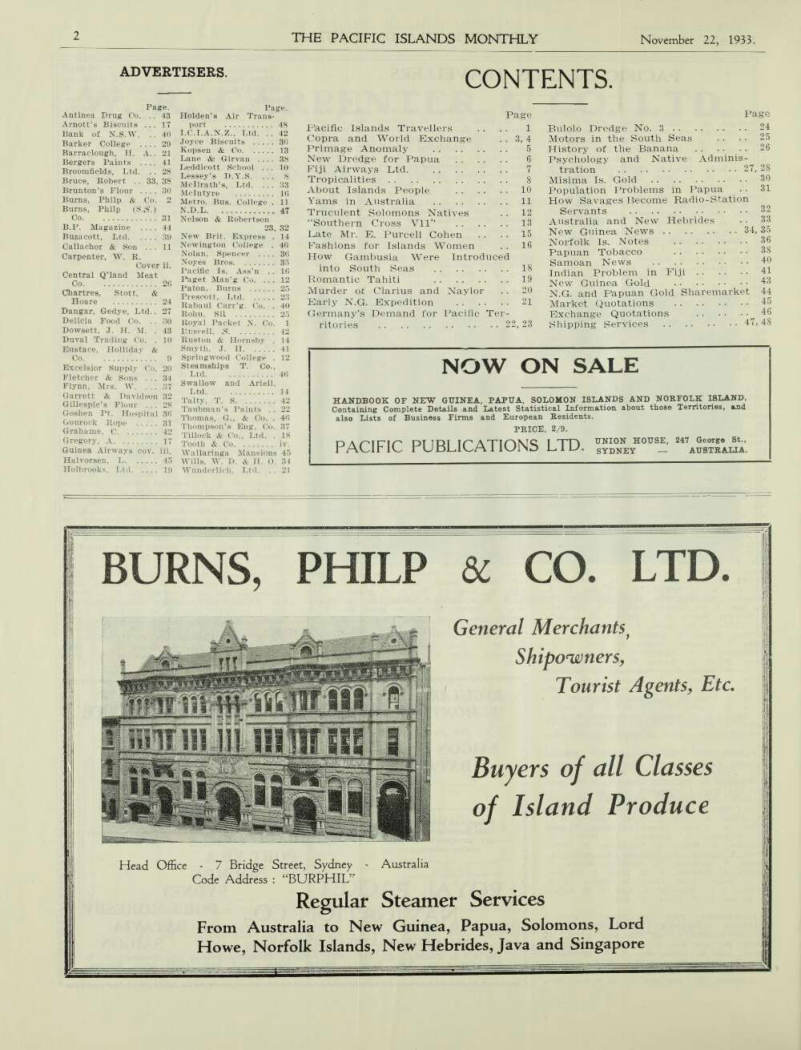
Advertisers.
Page.
Antinea Drug Co. .. 43 Arnott’s Biscuits ... 17 Bank of N.S.W. .. 40 Barker College ... 29 Barraclough, H. A.. 21 Bergers Paints 41 Broomfields, Ltd. . . 28 Bruce, Robert .. 33, 38 Brunton’s Flour ... 30 Burns, Philp & Co. 2 Burns, Philp (S.S.) Co 31 B.P. Magazine ... 44 Buzacott, Ltd 39 Callachor & Son ... 11 Carpenter, W. R.
Cover ii.
Central Q'land Meat Co 26 Chartres, Stott, & Hoare 24 Dangar, Gedye, Ltd.. 27 Delicia Food Co. .. 30 Dowsett, J. H. M. . 43 Duval Trading Co. . 10 Eustace, Holliday & Co 9 Excelsior Supply Co. 20 Fletcher & Sons ... 34 Flynn, Mrs. W. ... 37 Garrett & Davidson 32 Gillespie’s Flour ... 28 Goshen Pt. Hospital 36 Gourock Rope 31 Grahame, C 42 Gregory, A 17 Guinea Airways cov. iii.
Halvorsen, L 45 Holbrooks. Ltd 19
Page.
Holden’s Air Trans port 48
I.C.I.A.N.Z., Ltd. .. 42
Joyce Biscuits 36 Kopsen & Co 13 Lane & Girvan ... 38 Leddicott School ... 10 Lessey’s D.Y.S. ... 8 McIlrath’s, Ltd. ... 33 McIntyre 16 Metro. Bus. College . 11
N.D.L 47
Nelson & Robertson 23. 32 New Brit. Express . 14 Newington College . 46 Nolan, Spencer ... 36 Noyes Bros 35 Pacific Is. Ass’n .. 16 Paget Man'g Co. ... 12 Paton, Burns 25 Prescott. Ltd 23 Rabaul Carr’g. Co. . 40 Rohu, Sil 25 Royal Packet N. Co. 1 Russell, .S. 42 Ruston & Hornsby . 14 Smyth, J. H 41 Springwood College . 12 Steamships T. Co., Ltd 46 Swallow and Ariell, Ltd 14 Talty, T. S. 42 Taubman’s Paints . . 22 Thomas, G., & Co. . 46 Thompson’s Eng. Co. 37 Tillock & Co., Ltd. . 18 Tooth & Co iv.
Wallaringa Mansions 45 Wills, W. D. & H. O. 34 Wunderlich, Ltd. . . 21
Contents.
Page Pacific Islands Travellers . . . . 1 Copra and World Exchange .. 3, 4 Primage Anomaly 5 New Dredge for Papua 6 Fiji Airways Ltd, 7 Tropicalities 8 About Islands People 10 Yams in Australia 11 Truculent Solomons Natives .. 12 “Southern Cross VII” 13 Late Mr. E. Purcell Cohen .. .. 15 Fashions for Islands Women . . 16 How Gambusia Were Introduced into South Seas 18 Romantic Tahiti 19 Murder ot Clarius and Naylor .. 20 Early N.G. Expedition 21 Germany’s Demand for Pacific Ter ritories 22, 23
Page Bulolo Dredge No. 3 24 Motors in the South Seas .. .. 25 History of the Banana 26 Psychology and Native Adminis tration 27,28 Misima Is. Gold 30 Population Problems in Papua .. 31 How Savages Become Radio-Station Servants 32 Australia and New Hebrides .. 33 New Guinea News 34,35 Norfolk Is. Notes 36 Papuan Tobacco 38 Samoan News 40 Indian Problem in Fiji 44 New Guinea Gold 43 N.G. and Papuan Gold Sharemarket 44 Market Quotations 45 Exchange Quotations 46 Shipping Services 47, 48
Advertisements & other items, p. 4 (1 item)
Burns, Philp & Co. Ltd.
NOW ON SALE
HANDBOOK OF NEW GUINEA, PAPUA, SOLOMON ISLANDS AND NORFOLK ISLAND, Containing Complete Details and Latest Statistical Information about those Territories, and also Lists of Business Firms and European Residents.
PRICE, 2/9.
PACIFIC PUBLICATIONS LTD.
BURNS, PHILP & CO. LTD.
General Merchants,
Shipowners,
Tourist Agents, Etc.
Buyers of all Classes
of Island Produce
Head Office - 7 Bridge Street, Sydney » Australia Code Address : “BURPHIL”
Regular Steamer Services From Australia to New Guinea, Papua, Solomons, Lord Howe, Norfolk Islands, New Hebrides, Java and Singapore
The Pacific Islands Monthly
THE NEWSPAPER - MAGAZINE OF THE SOUTH SEAS [Registered at G.P.O., Sydney, for transmission by post as a newspaper.]
Published Once Each Month and Circulated in Australia and New Zealand and in the following Pacific Territories and Island Groups:
Crown Colony of Fiji.
Australian Territory of Papua.
Mandated Territory (Australia) of New Guinea, Bismarck Archipelago, and Northern Solomon Islands.
Mandated Territory (Japan) of Marshall, Caro line and Mariana Islands.
American Territory of Guam.
Mandated Territory of Nauru.
British Crown Colony of Gilbert and Ellice Islands.
French Territory of New Caledonia.
British and French Condominium of New Hebrides.
American Territory of Eastern Samoa.
Mandated Territory (New Zealand) of Samoa.
British Solomon Islands Protectorate.
British Protectorate of Tongan Islands.
New Zealand Territory of Cook Islands.
Australian Territory of Norfolk Island.
French Colony of Oceania (Tahiti, etc.) American Territory of Hawaiian Islands.
Owned and Produced by Pacific Publications Ltd., Union House, 247 George Street, Sydney
Telephone Bw 5Q37
P.O. Box 3408 K
Editor and Publither:
R. W. Robson.
Registered Address for Radiograms and Cables: "PACPUB” Sydney
Contributions
Articles, Stories and Photographs dealing with Baclflc Islands Subjects are invited, and will t>e paid for on publication at usual rates.
Subscription Rates
Per Annum, within Postal Convention Territories. Prepaid, Post Free 6/- Per Annum elsewhere. Prepaid, Post Free 8/- Single Copies
Advertisements
Advertising rates furnished on application.
Colours, etc. by Arrangement Process Blocks made at Advertiser’s expense when required. Screen, 100.
Changes of Advertising Copy should reach this Office by 8th of each month, otherwise previous advertisement may be repeated.
Agents
The following are authorised to receive sub scriptions for The Pacific Islands Monthly — Islands Branches of Burns, Philp & Co., Ltd.. and Burns, Philp (South Seas) Co., Ltd.
Islands Branches of W. R. Carpenter & Co., Ltd.
All Branches of Morris, Hedstrom & Co., Ltd.
J. H. MacGregor Dowsett, Rabaul.
Whitten Bros., Ltd., Port Moresby & Samarai.
All Branches and Representatives of W. H.
Grove & Sons, Ltd., Auckland.
S. Russell, Papeete, Tahiti.
Cook Islands Trading Co., Rarotonga.
Mrs. M. Campbell. Cascades, Norfolk Island.
Vol. IV. No. 4.
Sydney, November 22, 1933.
Price [ 6d. Per Copy.
Prepaid: 6/- p.a.
Copra And World Exchange
THE enquiries we have received re cently from persons interested in the production of copra in the South Seas indicate much confusion of mind over the present situation, and great perturbation concerning the future of the industry. The temperamental pessi mists see no hope whatever and pre dict blue ruin for all coconut planters; while even the cheeriest optimist is simply folding his hands and preparing himself for the worst. It certainly can be said that, at the moment of this writing (11/11/1933), the outlook is very black indeed, unembellished by a single ray of definite hope.
But we refuse to believe that this black curtain will remain much longer drawn across our vision; or that there is nothing of an encouraging charac ter immediately behind it and just out of our sight. It is desirable at this stage that the present condition and future of the copra industry be con sidered, not in terms of the industry itself, but as part of a world-wide problem which is rapidly moving to wards determination, in one form or another.
It can be said in general terms that the price of copra has been affected by one large factor and a number of
smaller factors; and that if the large factor were once removed, the smaller influences would not have such a seri ous effect upon the industry as to bring about its ruin. To put the proposition in plainer language, we should say that, if once the world could recover its economic balance, so that commodity prices could be restored to their proper and natural levels, the other things which are affecting the copra market— such as the Unilever monopoly and the competition of other oil-bearing pro ducts—could be attacked and dealt with, and the average South Sea planter per mitted to live and carry on.
So far as world economic conditions are concerned, events are moving now very rapidly towards a show-down. It is impossible, within the scope of this short article, to discuss the whole com plex subject of world economics. But we see no reason to alter the opinion, that we have expressed on numerous occasions during the past two years, that the main cause of the present trouble was the complete disruption of the international credit system caused by the mal-distribution of gold; and the primary cause of that was the post war settlement of war-debts and the in sistence of the United States that the
other nations’ debts to her should be paid in gold. The tremendous accumu lation in the United States —and subse quently in France —of the world’s gold (“frozen credit”), naturally threw the international trading system entirely out of gear and created a condition of eco nomic chaos —chaos that was inevitable from the day when the nations’ short sighted politicians signed the multi plicity of treaties and agreements that followed Versailles.
Ever since 1929, when it was discov ered that, while America held two thirds of the world’s gold currency, the other nations still owed colossal sums to America which they were quite un able to pay (for the simple reason that America would not take their goods, and they had nothing else left to pay with) the world has been a Bedlam of economic confusion and noise. For four years the politicians of all the nations have been running around in circles, screaming foolishly and wringing their futile hands, while academic theorists and revolutionary charlatans have been adding much to the useless clamor, but doing nothing of practical value.
But, slowly and gradually, out of all the din and foolishness, there has emerged a recognition of the truth; and in the last twelve months the world has applied itself more or less to the task of devising some machinery for the movement of international credit, which
might even temporarily take the place of the paralysed gold system and per mit more freedom in international trade.
In other words, there must be a stable exchange. The world now knows what it wants; but it is fearfully impeded in a general way by the existence of an apparently indestructible system of in ternational tariffs, and by the blunder ing economic policy of the United States.
An economic conference such as Britain tried to promote in June last might have secured stabilisation of in ternational exchange and have gone some way to solving the tariff problem; but little progress could be made in this direction, while a nation of 130,000,000 people insisted, and still in sists, on chasing fantastic economic formulae and ignoring the welfare of all other nations. If the United States had only been induced to see the fundamen tal truth behind the world’s economic troubles and acted accordingly, the world by now would have been well on the road back to normality. As it is, the United States is still commanded by academic theorists and is still strug gling with strange alternatives; and all the other nations in the world are more or less standing by, helplessly awaiting the result of American experiments.
That result cannot be much longer postponed. No one has dared to say that the American experiment must fail, but the conviction, without doubt, is growing stronger in the minds of the world’s shrewdest observers that America must soon abandon her strange gods and seek the normal path back to economic sanity. Whether it will come with a resounding crash of America’s economic structure —of which there clearly is the gravest danger—or whether there will be a frank repudia tion of the N.R.A. and all that it stands for, remains to be seen. But this is cer tain: the change is coming very soon.
The American method of going out into the world market and paying for gold a considerably higher price than other countries were prepared to pay seemed at first to confuse the minds of the world’s observers. But it was soon seen that it was merely another and simpler method of depreciating the
American exchange on the markets of the world. To-day, the American dol lar is quoted at 5.13 to the English pound sterling, as compared with par (on a normal gold basis) of 4.86. It looks as if the dollar, expressed in terms of sterling, will become much cheaper still. Let us suppose that it goes to 5.20 to the pound sterling. The pound sterling, as everyone knows, is off the gold standard to the extent of about 20 per cent. The dollar at 5.20 is 7 per cent, under sterling at par—in other words, the dollar at 5.20 is nearly 30 per cent, off the gold standard. Proof of that is seen in the fact that one may receive about 17/- for the Australian £ in New York; and Australian cur rency is 45 per cent, under gold standard par. (On Nov. 17, the dollar exchange was 5.44 to fl sterling—nearly 33-1/3 per cent, under gold parity.—Ed.).
Now all this is palpably absurd. The exchange value of a country’s currency does not fall away below the gold standard unless that country publicly acknowledges its inability to pay its overseas obligations in gold. The United States has an enormous accumulation of gold and can pay its overseas debts in gold until further orders. What it is doing is this: in order to escape the consequences of its financial and fiscal folly in past years—which consequences are taking the shape of severe internal depression— the great Republic is jug gling with the international exchange system in an endeavour to raise the levels of its own commodity prices in terms of dollars. The thing is ridiculous and scientifically unsound, and it must fail.
Meanwhile, what has all this got to do with copra? A very great deal. Copra cannot recover its value as a com modity until all the nations have re stored a workable system of inter national trading, so that gold will have less value, and commodities will be cor repondingly valuable. After four years of depression and muddling, the world is ready to make re-adjustments and stabilise its exchanges, so as to put an end to many of the evils from which all nations now suffer. But the mad headed floundering of America, in its attempt to escape the operation of fun
damental economic law, is, more or less, paralysing the efforts of all the other nations. The world’s producers must just stand by helplessly, and wait for the American experiment to either suc ceed or fail, so that the way may be cleared for a general settlement.
A few weeks ago the British ex change was considerably under the American, with the result that British exporters were enjoying an advantage on the world’s markets. To-day, owing to America’s manipulation of exchange in the manner indicated, the position is reversed. It is inconceivable that Britain will allow this position to con tinue. Britain is properly, and scientific ally, “off gold.” America is not. The British will either await the crash of the American experiment; or some sort of exchange war will develop. Mean while, the position of France, still hold ing stubbornly to the gold standard, but with an internal deficit of something like £40,000,000, is extremely delicate. It seems as if she, also, must abandon the gold standard —not because of any at tempt to evade economic law, but be cause of the operation of economic law —and, if she does, international finance will become even more complicated.
That is why we urge the copra growers, as one important section of primary producers, not to lose heart. At the moment, nearly all primary pro ducers face an entirely blank wall — there seems to be no future. But, as we have tried to explain, the world position is so deplorably bad, and is being maintained in such frank de fiance of economic law, that there soon must come a denouement. It may come in the shape of a terrific crash in America; or through a sudden recogni tion of the paramount soundness of sterling; or as the result of war sud denly developing. But that it will come, is absolutely certain —and, in the new prospect that thus will be opened up, the primary producers of the world will discover reason for hope and reassur ance. No one wants to see a general crash in America, as that would affect the whole world. But we do hope for quick developments there. The dollar, at the moment, is the key to the im mediate future.
Co-Ordination.
Four Australian Tropical Administrators To Confer In Canberra.
IMPORTANT problems concerning the administration c.f New Guinea, Papua, Nauru and Norfolk Island will be discussed by the administrators of the four territories and represen tatives of the Commonwealth Govern ment at a conference to be held at Canberra at the end of February.
This conference, which has been arranged by the Minister for Pacific Territories (Mr. Marr), will be the first ever held between the four adminis
trations. The Prime Minister will also attend. The four administrators con cerned are: Sir Hubert Murray (Papua).
Brigadier-General Griffiths (New Guinea).
Captain Pinney (Norfolk Island).
Commander Garcia (Nauru).
Among the main questions to be dis cussed are steps to co-ordinate the laws of Papua and New Guinea, with special regard to health and mining laws.
Norfolk Island does not present any serious problems beyond ordinary routine matters of administration, but the conference is expected to devote much time to the problem of the con trol and eradication of leprosy in Nauru.
The Canberra department supervis ing the territories should reap great benefit from the discussions, and it is hoped that the interchange of suggestions between the administrators will result in even better control of the areas than has been the case in the past.
The boundary question between Papua and New Guinea will be dis cussed. At present the boundary is not properly defined, and difficulties between the two administrations ha\e been accentuated by the fact that the laws and ordinances of the territories have marked differences. Gold seekers are the principal sufferers. Papua has adopted the Queensland mining laws for its use, while New Guinea works under an entirely different set of min ing laws, based on the best features of similar acts in operation in Australia.
Seaplane Crash Near
Rabaul.
Mrs. Graham Mirfield Killed.
From Our Own Correspondent.
Rabaul, Nov. 3.
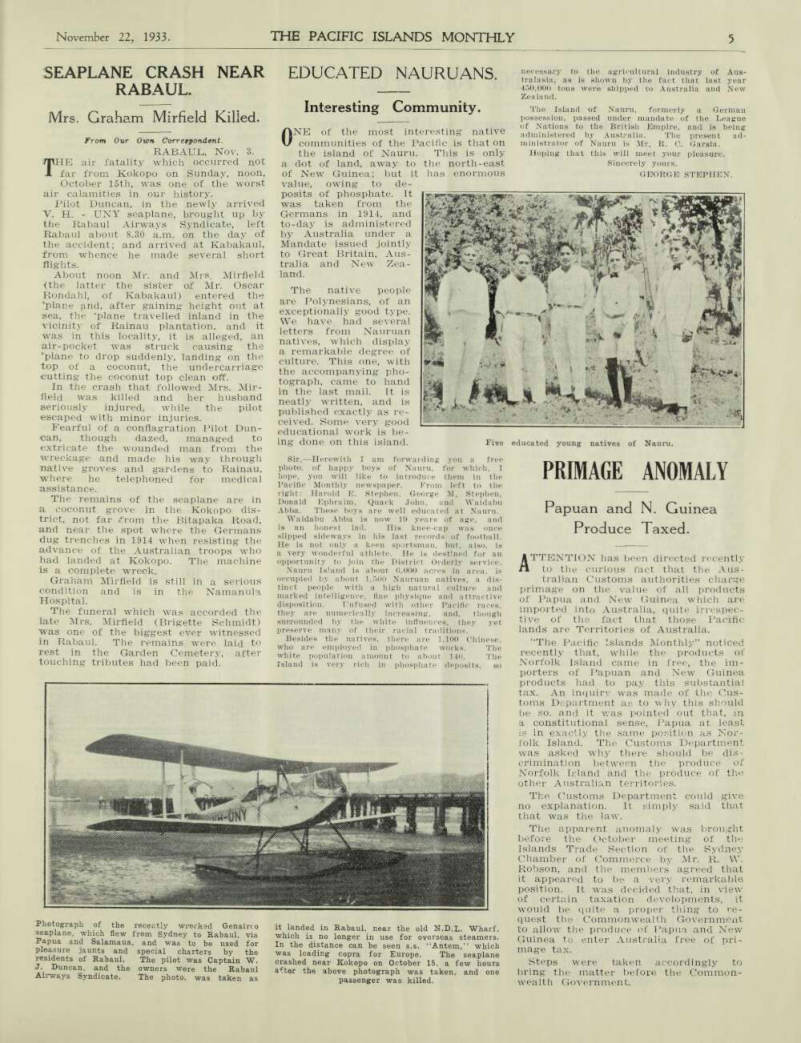
THE air fatality which occurred not far from Kokopo on Sunday, noon, October 15th, was one of the worst air calamities in our history.
Pilot Duncan, in the newly arrived V, H. - UNY seaplane, brought up by the Rabaul Airways Syndicate, left Rabaul about 8.30 a.m. on the day of the accident: and arrived at Kabakaul, from whence he made several short flights.
About noon Mr. and Mrs. Mirfield (the latter the sister of Mr. Oscar Rondahl, of Kabakaul) entered the ’plane and, after gaining height out at sea, the ’plane travelled inland in the vicinity of Rainau plantation, and it was in this locality, it is alleged, an air-pocket was struck causing the ’plane to drop suddenly, landing on the top of a coconut, the undercarriage cutting the coconut top clean off.
In the crash that followed Mrs. Mirfield was killed and her husband seriously injured, while the pilot escaped with minor injuries.
Fearful of a conflagration Pilot Duncan, though dazed, managed to extricate the wounded man from the wreckage and made his way through native groves and gardens to Rainau, where he telephoned for medical assistance.
The remains of the seaplane are in a coconut grove in the Kokopo district, not far from the Bitapaka Road, and near the spot where the Germans dug trenches in 1914 when resisting the advance of the Australian troops who had landed at Kokopo. The machine is a complete wreck.
Graham Mirfield is still in a serious condition and is in the Namanula Hospital.
The funeral which was accorded the late Mrs. Mirfield (Brigette Schmidt) was one of the biggest ever witnessed in Rabaul. The remains were laid to rest in the Garden Cemetery, after touching tributes had been paid.
Photograph of the recently wrecked Genairco seaplane, which flew from Sydney to Rabaul, via Papua and Salamaua, and was to be used for pleasure jaunts and special charters by the residents of Rabaul. The pilot was Captain W.
J. Duncan, and the owners were the Rabaul Airways Syndicate. The photo, was taken as
it landed in Rabaul, near the old N.D.L. Wharf, which is no longer in use for overseas steamers.
In the distance can be seen s.s. "Antem,” which was loading copra for Europe. The seaplane crashed near Kokopo on October 15, a few hours after the above photograph was taken, and one passenger was killed.
Interesting Community.
Educated Nauruans.
ONE of the most interesting native communities of the Pacific is that on the island of Nauru. This is only a dot of land, away to the north-east of New Guinea: but it has enormous
value, owing to de posits of phosphate. It was taken from the Germans in 1914, and to-day is administered by Australia under a Mandate issued jointly to Great Britain, Aus tralia and New Zea land.
The native people are Polynesians, of an exceptionally good type.
We have had several letters from Nauruan natives, which display a remarkable degree of culture. This one, with the accompanying pho tograph, came to hand in the last mail. It is neatly written, and is published exactly as re ceived. Some very good educational work is be ing done on this island.
Sir, —Herewith I am forwarding you a free photo, of happy boys of Nauru, for which, I hope, you will like to introduce them in the Pacific Monthly newspaper. From left to the right: Harold E. Stephen, George M. Stephen, Donald Ephraim, Quack John, and Waidabu Abba. These boys are well educated at Nauru.
Waidabu Abba is now 19 years of age, and is an honest lad. His knee-cap was once slipped sideways in his last records of football.
He is not only a keen sportsman, but, also, is a very wonderful athlete. He is destined for an opportunity to join the District Orderly service.
Nauru Island is about (6,000 acres in area, is occupied by about 1,500 Nauruan natives, a distinct people with a high natural culture and marked intelligence, fine physique and attractive disposition. Unfused with other Pacific races, they are numerically increasing, and, though surrounded by the white influences, they yet preserve many of their racial traditions.
Besides the natives, there are 1,100 Chinese, who are employed in phosphate works. The white population amount to about 140. The Island is very rich in phosphate deposits, so
necessary to the agricultural industry of Aus tralasia, as is shown by the fact that last year 450,000 tons were shipped to Australia and New Zealand.
The Island of Nauru, formerly a German possession, passed under mandate of the League of Nations to the British Empire, and is being administered by Australia. The present ad ministrator of Nauru is Mr. R. O. Garsia.
Hoping that this will meet your pleasure.
Sincerely yours,
George Stephen.
Five educated young natives of Nauru.
Primage Anomaly
Papuan and N. Guinea Produce Taxed.
ATTENTION has been directed recently to the curious fact that the Aus tralian Customs authorities charge primage on the value of all products of Papua and New Guinea which are imported into Australia, quite irrespective of the fact that those Pacific lands are Territories of Australia.
“The Pacific Islands Monthly” noticed recently that, while the products of Norfolk Island came in free, the im porters of Papuan and New Guinea products had to pay this substantial tax. An inquiry was made of the Cus toms Department as to why this should be so, and it was pointed out that, in a constitutional sense, Papua at least is in exactly the same position as Nor folk Island. The Customs Department was asked why there should be discrimination between the produce of Norfolk Island and the produce of the other Australian territories.
The Customs Department could give no explanation. It simply said that that was the law.
The apparent anomaly was brought before the October meeting of the Islands Trade Section of the Sydney Chamber of Commerce by Mr. R. W.
Robson, and the members agreed that it appeared to be a very remarkable position. It was decided that, in view of certain taxation developments, it would be quite a proper thing to re quest the Commonwealth Government to allow the produce of Papua and New Guinea to enter Australia free of pri mage tax.
Steps were taken accordingly to bring the matter before the Common wealth Government.
New Gold Dredge For Papua.
May Solve Problems of Transport and Motive Power.
THE despatch to Papua of a small
dredge by the November “Mac
dhui” has unusual interest for two
reasons. It represents an interesting
development of engineering; and it
quite possibly may open a new era
in the history of Papua.
PAPUA, so far, has not received much benefit from the recent re vival of the gold industry. Nearly all the worth-while gold found in the Pacific Islands in the last few years has come from the New Guinea main land, on the side of the main range opposite to Papua. Yet there must be large quantities o.f gold in Papua, on the southern side of the central ranges.
It was found and worked in payable quantities in Papua before the dawn of the present century—and it can be found again.
Papua, like New Guinea, is at the present time being carefully searched by gold prospectors. Over a year ago, a party made interesting discoveries on the upper waters of the Lakekamu River which enters the Gulf of Papua 100 miles to the westward of Port Moresby. As a result of that, there was formed the Tiveri Gold Dredging Company Limited, the directors of which are Messrs. T. L. Sefton, planter of Port Moresby; A. L. Clarke, Sydney; and J. W. Hinks, Sydney. This com pany displayed a most commendable spirit of enterprise and, receiving the good-will and co-operation of the Administration, decided to undertake an interesting experiment in the recovery of gold by dredging.
To Mr. Hinks was entrusted the work of providing a dredge of a kind never before seen south of the equator —a dredge that could be transported by native carriers into otherwise in accessible country. Mr. Hinks took his problem to Messrs. Poole and Steel Ltd., of Balmain, Sydney, who have been making all kinds of dredges for over 30 years. He received the full co operation of the experienced firm, and Messrs. Poole and Steel Ltd., eventually designed for Mr. Hinks a small dredge, of which no part exceeded 5 cwt. in dead-weight.
This was an extraordinarily diffi cult task, as will be obvious to any engineer or draughtsman; but eventually the plans were approved and the work of construction commenced in July last. By the first week in November the job was complete, and the dredge was assembled and tested in Messrs. Poole & Steel’s yards.
Its appearance was impressive.
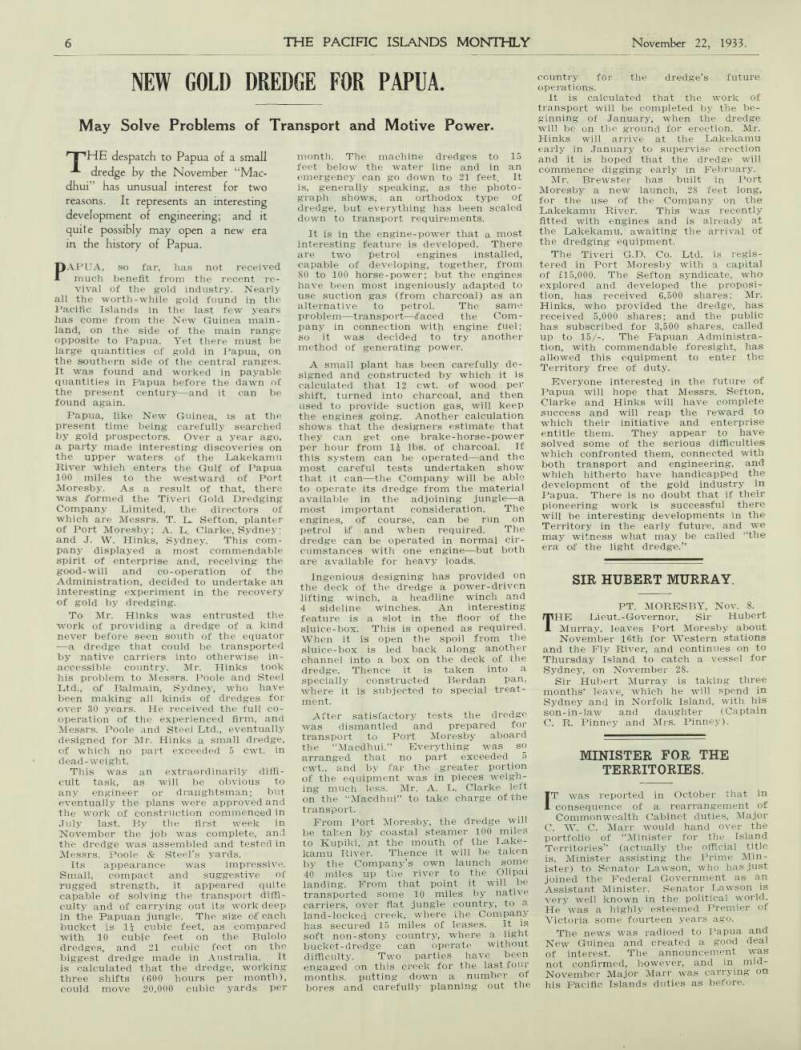
Small, compact and suggestive of rugged strength, it appeared quite capable of solving the transport diffi culty and of carrying out its work deep in the Papuan jungle. The size of each bucket is 1½ cubic feet, as compared with 10 cubic feet on the Bulolo dredges, and 21 cubic feet on the biggest dredge made in Australia. It is calculated that the dredge, working three shifts (600 hours per month), could move 20,000 cubic yards per
month. The machine dredges to 15 feet below the water line and in an emergency can go down to 21 feet. It is, generally speaking, as the photo graph shows, an orthodox type of dredge, but everything has been scaled down to transport requirements.
It is in the engine-power that a most interesting feature is developed. There are two petrol engines installed, capable of developing, together, from 80 to 100 horse-power; but the engines have been most ingeniously adapted to use suction gas (from charcoal) as an alternative to petrol. The same problem—transport—(faced the Com pany in connection with engine fuel; so it was decided to try another method of generating power.
A small plant has been carefully de signed and constructed by which it is calculated that 12 cwt. of wood per shift, turned into charcoal, and then used to provide suction gas, will keep the engines going. Another calculation shows that the designers estimate that they can get one brake-horse-power per hour from 1 1/8 lbs. of charcoal. If this system can be operated—and the most careful tests undertaken show that it can —the Company will be able to operate its dredge from the material available in the adjoining jungle —a most important consideration. The engines, of course, can be run on petrol If and when required. The dredge can be operated in normal cir cumstances with one engine—but both are available for heavy loads.
Ingenious designing has provided on the deck of the dredge a power-driven lifting winch, a headline winch and 4 sideline winches. An interesting feature is a slot in the floor of the sluice-box. This is opened as required.
When it is open the spoil from the sluice-box is led back along another channel into a box on the deck of the dredge. Thence it is taken into a specially constructed Berdan pan, where it is subjected to special treat ment.
After satisfactory tests the dredge was dismantled and prepared for transport to Port Moresby aboard the “Macdhui.” Everything was so arranged that no part exceeded 5 cwt., and by far the greater portion of the equipment was in pieces weigh ing much less. Mr. A. L. Clarke left on the “Macdhui” to take charge of the transport.
From Port Moresby, the dredge will be taken by coastal steamer 100 miles to Kupiki, .at the mouth of the Lake kamu River. Thence it will be taken by the Company’s own launch some 40 miles up the river to the Olipai landing. From that point it will be transported some 10 miles by native carriers, over flat jungle country, to a land-locked creek, where the Company has secured 15 miles of leases. It is soft non-stony country, where a light bucket-dredge can operate without difficulty. Two parties have been engaged on this creek for the last four months, putting down a number of bores and carefully planning out the
country for the dredge’s future operations.
It is calculated that the work of transport will be completed by the be ginning of January, when the dredge will be on the ground for erection. Mr.
Hinks will arrive at the Lakekamu early in January to supervise erection and it is hoped that the dredge will commence digging early in February.
Mr. Brewster has built in Port Moresby a new launch, 28 feet long, for the use of the Company on the Lakekamu River. This was recently fitted with engines and is already at the Lakekamu, awaiting the arrival of the dredging equipment.
The Tiveri G.D. Co. Ltd. is regis tered in Port Moresby with a capital of £15,000. The Sefton syndicate, who explored and developed the proposi tion, has received 6,500 shares; Mr.
Hinks, who provided the dredge, has received 5,000 shares; and the public has subscribed for 3,500 shares, called up to 15/-. The Papuan Administration, with commendable foresight, has allowed this equipment to enter the Territory free of duty.
Everyone interested in the future of Papua will hope that Messrs. Sefton, Clarke and Hinks will have complete success and will reap the reward to which their initiative and enterprise entitle them. They appear to have solved some of the serious difficulties which confronted them, connected with both transport and engineering, and which hitherto have handicapped the development of the gold industry in Papua. There is no doubt that if their pioneering work is successful there will be interesting developments in the Territory in the early future, and we may witness what may be called “the era of the light dredge.”
Sir Hubert Murray.
Pt. Moresby, Nov. 8.
THE Lieut.-Governor, Sir Hubert Murray, leaves Port Moresby about November 16th for Western stations and the Fly River, and continues on to Thursday Island to catch a vessel for Sydney, on November 28.
Sir Hubert Murray is taking three months’ leave, which he will spend in Sydney and in Norfolk Island, with his son-in-law and daughter (Captain C. R. Pinney and Mrs. Pinney).
Minister For The
Territories.
IT was reported in October that in consequence of a rearrangement of Commonwealth Cabinet duties, Major C. W. C. Marr would hand over the portfolio of “Minister for the Island Territories” (actually the official title is, Minister assisting the Prime Min ister) to Senator Lawson, who has just joined the Federal Government as an Assistant Minister. Senator Lawson is very well known in the political world.
He was a highly esteemed Premier of Victoria some fourteen years ago.
The news was radioed to Papua and New Guinea and created a good deal of interest. The announcement was not confirmed, however, and in mid- November Major Marr was carrying on his Pacific Islands duties as before.
French Copra Tax
Action In Australia.
THE depressing effect which the new French tax on copra is having on coconut planting industry in the South Seas was considered at a meet ing of the Island Trade Section of the Sydney Chamber of Commerce held in October. Mr. W. R. Carpenter, chair man, presided, and there was a fair attendance.
Mr. Pelletier, in the course of a dis cussion, said that he thought it would be very difficult to persuade the French Government to alter its decision—but he thought that if Australia could suggest mutual tariff concessions, something might be done.
The chairman pointed out that while there was an Australian tariff against French goods there was no such diffi culty in the case of the Mandated Ter ritory of New Guinea, and certain other territories. Where those terri tories imposed tariffs the duties were imposed for revenue purposes and quite irrespective of the country of origin. France received in New Guinea, for instance, the same treat ment as Britain or any other country.
It was decided to bring the whole matter before the Australian Minister for Commerce (Mr. Stewart), and a sub-committee was appointed to pre pare a detailed statement of the posi tion for presentation to the Minister.
Died On The Job.
Sudden Death of a Well-known
A.R.M.
From Our Own Correspondent.
Pt. Moresby, Nov. 8.
ALL residents of Papua were shocked to hear of the sudden death at Abau, a Government station to the east of Port Moresby, of Mr. Leopold Aclin Flint, Assistant Resident Magis trate in the Eastern Division of Papua. The cause of death was un known no medical assistance being available, but it is suspected that Mr.
Elint died from the effects of black water fever.
The late Mr. L. A. Flint was only 45 years of age. He joined the Papuan Public Service as a patrol officer in August, 1915 and spent his whole ser vice in the Magisterial Department. At the time of his death, Mr. Flint was a first-grade Assistant Resident Magistrate, in charge of the Abau dis trict, which position he had held for six years. He was very popular in the service and throughout the territory he was respected as a good resident, a first-class officer and good friend. He is survived by a widow and small son.
10 Per Cent. “Cut.”
Pt. Moresby, Nov. 8.
THE Papuan Government has decided that a ten per cent, deduction from salaries of the Public Services shall take effect from November 1st, 1933.
The measure was enforced on receipt of the announcement of the reduction of £6,000 from the Commonwealth Grant for the territory.
The “Leper Stones”
Of Fiji.
[Letter to the Editor ] Under “Archaeological Theories” in your issue of August, you give an inter esting article about an “Ancient Stone”.
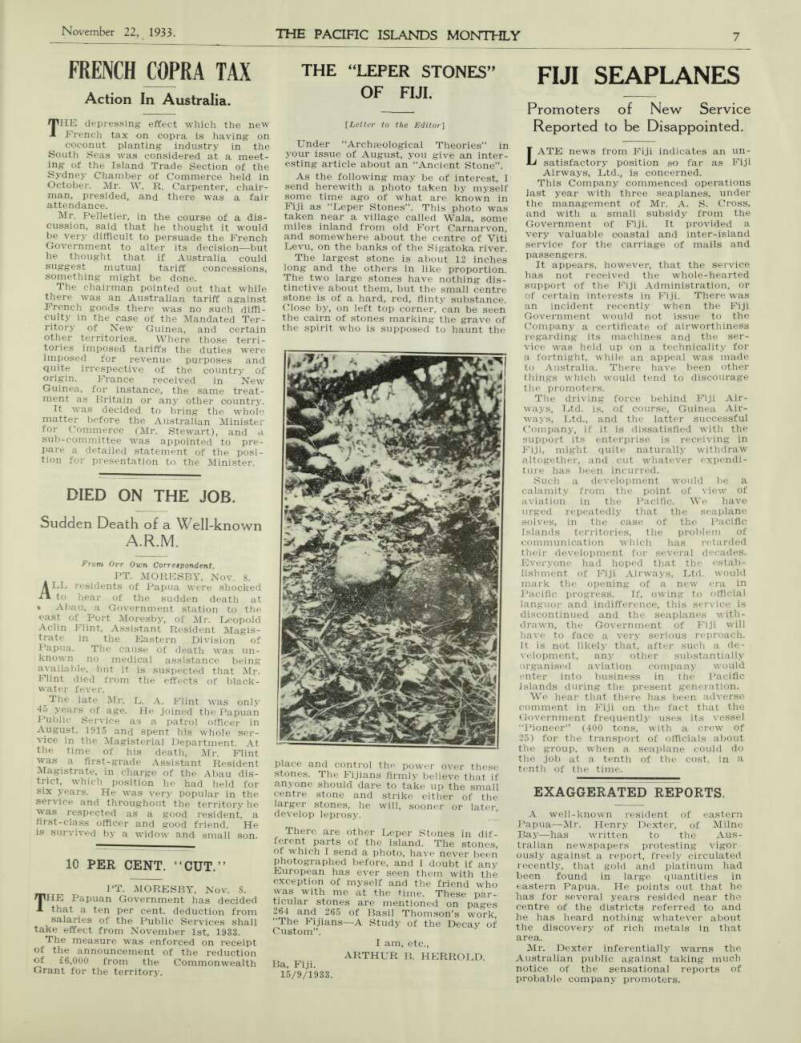
As the following may be of interest, I send herewith a photo taken by myself some time ago of what are known in Fiji as “Leper Stones”. This photo was taken near a village called Wala, some miles inland from old Fort Carnarvon, and somewhere about the centre of Viti Levu, on the banks of the Sigatoka river.
The largest stone is about 12 inches long and the others in like proportion.
The two large stones have nothing dis tinctive about them, but the small centre stone is of a hard, red, flinty substance.
Close by, on left top corner, can be seen the cairn of stones marking the grave of the spirit who is supposed to haunt the
place and control the power over these stones. The Fijians firmly believe that if anyone should dare to take up the small centre stone and strike either of the larger stones, he will, sooner or later,
develop leprosy.
There are other Leper Stones in dif ferent parts of the island. The stones, of which I send a photo, have never been photographed before, and I doubt if any European has ever seen them with the exception of myself and the friend who was with me at the time. These par ticular stones are mentioned on pages 264 and 265 of Basil Thomson’s work, “The Fijians—A Study of the Decay of Custom”.
I am, etc.,
Arthur B. Herrold.
Ba, Fiji. 15/9/1933.
Fiji Seaplanes
Promoters of New Service Reported to be Disappointed.
LATE news from Fiji indicates an un satisfactory position so far as Fiji Airways, Ltd., is concerned.
This Company commenced operations last year with three seaplanes, under the management of Mr. A. S. Cross, and with a small subsidy from the Government of Fiji. It provided a very valuable coastal and inter-island service for the carriage of mails and passengers.
It appears, however, that the service has not received the whole-hearted support of the Fiji Administration, or of certain interests in Fiji. There was an incident recently when the Fiji Government would not issue to the Company a certificate of airworthiness regarding its machines and the ser vice was held up on a technicality for a fortnight, while an appeal was made to Australia. There have been other things which would tend to discourage the promoters.
The driving force behind Fiji Air ways, Ltd. is, of course, Guinea Air ways, Ltd., and the latter successful Company, if it is dissatisfied with the support its enterprise is receiving in Fiji, might quite naturally withdraw altogether, and cut whatever expendi ture has been incurred.
Such a development would be a calamity from the point of view of aviation in the Pacific. We have urged repeatedly that the seaplane solves, in the case of the Pacific Islands territories, the problem of communication which has retarded their development for several decades.
Everyone had hoped that the estab lishment of Fiji Airways, Ltd. would mark the opening of a new era in Pacific progress. If, owing to official languor and indifference, this service is discontinued and the seaplanes with drawn, the Government of Fiji will have to face a very serious reproach.
It is not likely that, after such a de velopment, any other substantially organised aviation company would enter into business in the Pacific Islands during the present generation.
We hear that there has been adverse comment in Fiji on the fact that the Government frequently uses its vessel “Pioneer” (400 tons, with a crew of 25) for the transport of officials about the group, when a seaplane could do the job at a tenth of the cost, in a tenth of the time.
Exaggerated Reports.
A well-known resident of eastern Papua—Mr. Henry Dexter, of Milne Bay—has written to the Aus tralian newspapers protesting vigorously against a report, freely circulated recently, that gold and platinum had been found in large quantities in eastern Papua. He points out that he has for several years resided near the centre of the districts referred to and he has heard nothing whatever about the discovery of rich metals in that area.
Mr. Dexter inferentially warns the Australian public against taking much notice of the sensational reports of probable company promoters.
Tropicalities
THE League of Nations has asked the Commonwealth Government if it has any evidence to show that radio, talkies and phonographs have had “a dangerous criminal influence on the na tives of New Guinea”; and the N.G. ad ministration, presumably, is now mak ing the usual painstaking enquiry and preparing its usual conscientious re port. The League of Nations need not distress itself, so far as New Guinea is concerned. The Administration officials there always have been careful to cen sor the cinema programmes designed for native entertainment. The natives are not permitted to see the pro grammes intended for Europeans; but in Rabaul a programme compiled speci ally for “coons” is put on every Thurs day night. This writer, sitting among a congregation of excited kanakas, wit nessed one. It consisted of a film show ing a sports gathering in the Scottish Highlands: another, illustrating the manufacture of traction engines; and two long films —one at the beginning and one at the end of the programme— describing trout fishing in New Zealand, obviously supplied by the New Zealand Tourist Department. There was not a kiss in the whole programme and, ex cept for some Scottish step dancing las sies with short kilts and bony knees, there was not even a glimpse of a “white fella Mary,” likely to give the kanakas a wrong impression. It was the most fiercely censored programme this writer has ever seen. But the “coons” had no complaints—they chewed betel-nut without cessation, and cheered lustily whenever a trout was caught. * * * ONE day recently the Solomon Islands steamer landed on the wharf at Makambo a partly encased oil engine, addressed to Mr. Tommy Elk ington. It was intended for driving a launch and, in its bright paint and glit tering brass, it was an impressive ob ject. The popular Tommy, attended by two or three friends and a few natives, gloated over it. Then they pulled the packing off it and, just to see every thing was there, they spun the fly wheel. Instantly, with a clatter and a roar, the engine came to life and func tioned furiously. The natives, with howls of terror, fled along the wharf and loudly declared that their master had taken delivery of a case full of devils. The agitated white men ran around the bellowing engine and wrung their hands. They certainly had started the thing—but they had not the fog giest notion of how to stop it. However, the problem was solved by the engine stopping itself. It afterwards appeared that the engine had been tested, thoroughly and conscientiously, just be fore being shipped, and a small amount of petrol had remained in the tank. The engine stopped as soon as the petrol was exhausted. Mr. Elkington’s friends insisted that their nerves had had a very severe shock, and they each had to be bribed into silence with four long, cool drinks. * * * THE problem of securing transport in Tonga, since the shrinkage in pro duction caused the cancellation of the regular steamer services, becomes ever more acute. We have just learned that Dr. Courtney, lately District Medical Officer at Haapai, who has been
appointed to a similar position in Nauru, has had to arrange transport for himself, his wife and their three children, from Haapai to Suva, in a native cutter of only 20 tons. The Tongan Government’s small despatch boat which has been used in an emergency, is now laid up in definitely with a broken tail-shaft, and the smaller ports of Tonga in conse quence are entirely isolated. Pre sumably, these most awkward condi tions will remain until commodity prices recover and the Pacific Terri tories pass out of the depression. * * * A VALUED contributor sends this paragraph from an American journal: Meatless, waterless, loveless, and clothesless. That’s to be the rule or rules in a new Garden of Eden to be set up on a tropical South Sea island, and Professor Juan Amon-Wilkins, of Brooklyn, is booked to sail away in a few days to pave the way for a colony of twenty or thirty recruits, who are said to have been following the precepts of the cult in New Jersey.
Water will be replaced by fruit juices, soap will be on the prohibited list, hair must be permitted to grow, clothes will be discouraged, and romance entirely forbidden. Those who obey the laws “may live for centuries.”
“Why,” asks our contributor, point edly, “should they want to live?”
THE B.S.I. Government offices, Messrs.
Carpenters’ store, Messrs. Burns, Philp’s store, and Messrs. Lever Bros, offices are each situated on small islands, a few miles apart, in Tulagi Harbour, British Solomon Islands. The manager of Lever Bros, decided, one Monday morning recently, to do some business with other firms, and pro ceeded to the Burns, Philp establish ment. He found store and office closed.
Mystified at this, he re-embarked and chugged across to the Carpenter store, to find all closed there, also.
Still mystified, and becoming annoyed, he proceeded to the Government station. Post-office, Treasury, Lands Office —all were closed, and the place seemed dead. By this time, the manager was bristling with indigna tion, and decided to return home.
Rounding a corner, he met the Gov ernment Entomologist.
“Why is everything closed up over here?” he demanded. “We are all working on Gavutu.”
“It’s a Bank holiday,” answered the entomologist.
“But there are no Banks here,” roared the manager.
“Christ is not here, but we still keep Christmas!’’ retorted the insect expert, and passed on, leaving the manager speechless. * * * A WOMAN left Sydney a year ago on a Japanese steamer, on a holiday trip to Japan. The steamer some how managed to hit Yap, one of the Yap Islands, in the Caroline group, and left her bones on the coral reef. The ship’s company were rescued and hospitably treated. The Australian woman returned to Sydney the other day, and was met by a reporter. The reporter ran shrieking to his office, and
this was the kind of rubbish subse quently published: “She was one of the first white people seen by the inhabit ants ... The natives were very friendly and fed the passengers on coconuts and bananas.” Yap, as a matter of fact, has been an important centre of the Northern Pacific cable system for many decades, and a European staff has been maintained there. At the present time, there are some 300 Japanese on the little cluster that comprises Yap, as well as a dozen Europeans, and the natives are among the most sophisticated in the Japanese Mandated Territory.
THAT industrious delver among things archaeological, Mr. A. J. Vogan, in forms us that an ancient inscription found by him in a cave in the Fiji Is lands about 1930, has now been pro nounced by Professor Sadler, of the University of Sydney, and by American experts, to be Chinese script of a period of 2,000 years ago. Mr. Vogan holds the view that Chinese navigators were the first to find their way from the Northern regions into the South Pacific, and in this he is well supported by other scien tific opinion. H. G. Wells, in his “Out line of History,” accepts this theory,, and quotes Mr. Vogan as one of his authorities. * * * EVIDENCE of the remarkable service which the Mission organisations continue to give the Pacific Islands natives is again to hand in a series of eight books and pamphlets, well printed and neatly bound, which has been pro duced at the Melanesian Mission Press, Maravovo Uagoon, Guadalcanar, British Solomon Islands. This notable Islands printing house is under the direction of Mr. F. R. Isom, and work of a remark ably high typographical standard is done there. Practically the whole of the book lets are printed in the languages and dialects of the Solomons.
Advertisements & other items, p. 10 (1 item)
Drive Yourself
When Visiting Sydney
Send a Wire to
LESSEY’S
DRIVE YOURSELF
Box 8, Post Office,
PADDINGTON,
and an up-to-date car will meet you at the boat, which you can hire on very reasonable terms to
DRIVE YOURSELF.
Head Office and Service Station at
RUSH CUTTER’S BAY
(Near Stadium). Tel.: F 3196.
Radio Address: “Lessey’s,” Paddington, Sydney.
Orange Blossoms In
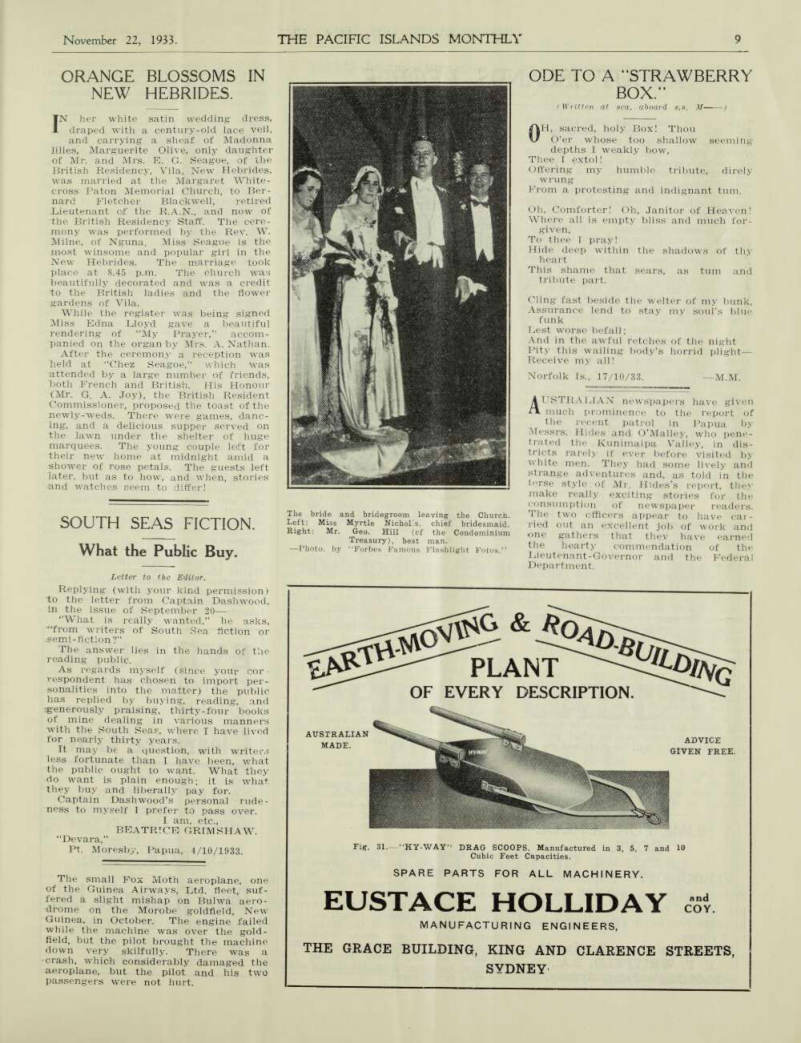
New Hebrides.
IN her white satin wedding dress, draped with a century-old lace veil, and carrying a sheaf of Madonna lilies, Marguerite Olive, only daughter of Mr. and Mrs. E. G. Seagoe, of the British Residency, Vila, New Hebrides, was married at the Margaret White cross Paton Memorial Church, to Ber nard Fletcher Blackwell, retired Lieutenant of the R.A.N., and now of the British Residency Staff. The cere mony was performed by the Rev. W.
Milne, of Nguna. Miss Seagoe is the most winsome and popular girl in the New Hebrides. The marriage took place at 8.45 p.m. The church was beautifully decorated and was a credit to the British ladies and the flower gardens of Vila.
While the register was being signed Miss Edna Lloyd gave a beautiful rendering of “My Prayer,” accom panied on the organ by Mrs. A. Nathan.
After the ceremony a reception was held at “Chez Seagoe,” which was attended by a large number of friends, both French and British. His Honour (Mr. G. A. Joy), the British Resident Commissioner, proposed the toast of the newly-weds. There were games, danc ing, and a delicious supper served on the lawn under the shelter of huge marquees. The young couple left for their new home at midnight amid a shower of rose petals. The guests left later, but as to how, and when, stories and watches seem to differ!
South Seas Fiction.
What the Public Buy.
Letter to the Editor, Replying (with your kind permission) to the letter from Captain Dashwood, in the issue of September 20— “What is really wanted,” he asks, '“from writers of South Sea fiction or semi-fiction?”
The answer lies in the hands of the reading public.
As regards myself (since your cor respondent has chosen to import per sonalities into the matter) the public has replied by buying, reading, and generously praising, thirty-four books of mine dealing in various manners with the South Seas, where I have lived for nearly thirty years.
It may be a question, with writers less fortunate than I have been, what the public ought to want. What they do want is plain enough; it is what, they buy and liberally pay for.
Captain Dashwood’s personal rude ness to myself I prefer to pass over.
I am, etc.,
Beatrice Grimshaw.
“Devara,”
Pt. Moresby, Papua, 4/10/1933.
The small Pox Moth aeroplane, one of the Guinea Airways, Ltd. fleet, suf fered a slight mishap on Bulwa aero drome on the Morobe goldfield, New Guinea, in October. The engine failed while the machine was over the gold field, but the pilot brought the machine down very skilfully. There was a crash, which considerably damaged the aeroplane, but the pilot and his two passengers were not hurt.
The bride and bridegroom leaving the Church.
Left: Miss Myrtle Nicholls, chief bridesmaid.
Right: Mr. Geo. Hill (of the Condominium Treasury), best man. —Photo. by “Forbes Famous Flashlight Fotos.”
Ode To A “Strawberry
Box.”
(Written at sea, aboard s.s. M—)
OH, sacred, holy Box! Thou O’er whose too shallow seeming depths I weakly bow, Thee I extol!
Offering my humble tribute, direly wrung From a protesting and indignant turn.
Oh, Comforter! Oh, Janitor of Heaven!
Where all is empty bliss and much for given, To thee I pray!
Hide deep within the shadows of thy heart This shame that sears, as turn and tribute part.
Cling fast beside the welter of my bunk, Assurance lend to stay my soul’s blue funk Best worse befall; And in the awful retches of the night Pity this wailing body’s horrid plight— Receive my all!
Norfolk Is., 17/10/33.
M.M.
AUSTRALIAN newspapers have given much prominence to the report of the recent patrol in Papua by Messrs. Hides and O’Malley, who pene trated the Kunimaipa Valley, in dis tricts rarely if ever before visited by white men. They had some lively and strange adventures and, as told in the terse style of Mr. Hides’s report, they make really exciting stories for the consumption of newspaper readers.
The two officers appear to have car ried out an excellent job of work and one gathers that thev have earned the hearty commendation of the Lieutenant-Governor and the Federal Department.
Advertisements & other items, p. 11 (1 item)
Eustace Holliday And Coy.
PLANT
OF EVERY DESCRIPTION.
AUSTRALIAN
MADE.
ADVICE
GIVEN FREE.
Fig. 31.—“ HY-WAY” DRAG SCOOPS, Manufactured in 3. 5. 7 and 10 Cubic Feet Capacities.
SPARE PARTS FOR ALL MACHINERY.
EUSTACE HOLLIDAY and COY.
MANUFACTURING ENGINEERS,
THE GRACE BUILDING, KING AND CLARENCE STREETS,
SYDNEY
About Islands People.
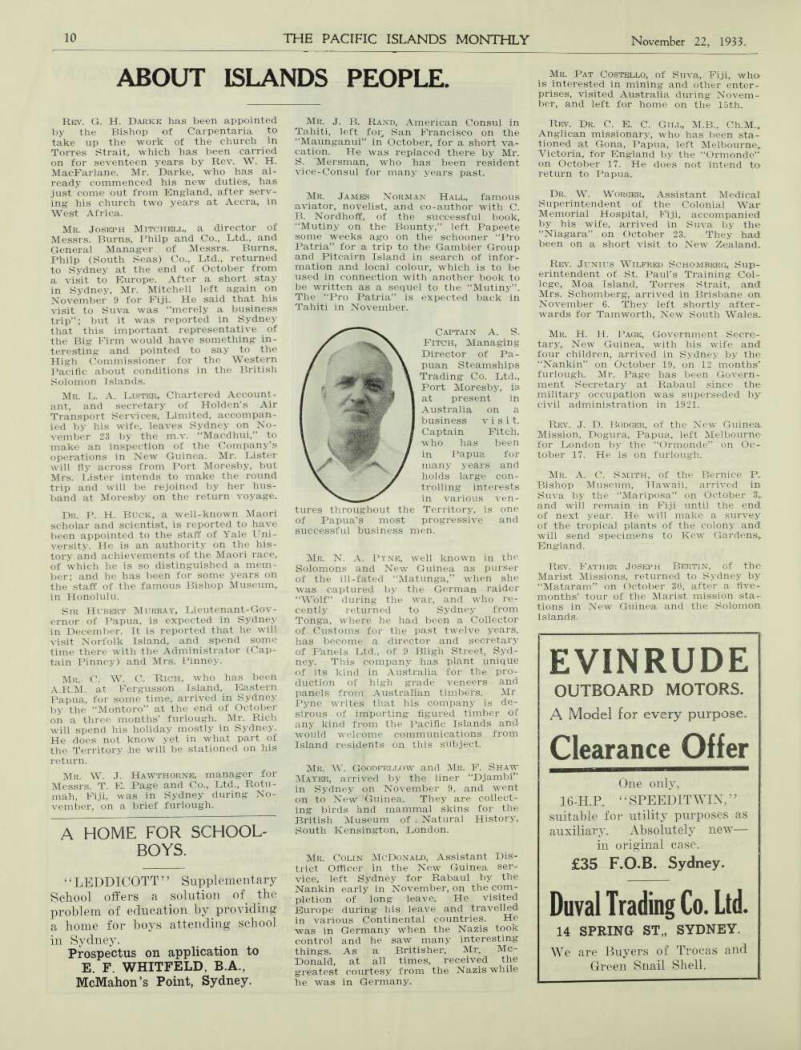
Rev. G. H. Darke has been appointed by the Bishop of Carpentaria to take up the work of the church in Torres Strait, which has been carried on for seventeen years by Rev. W. H.
MacFarlane. Mr. Darke, who has al ready commenced his new duties, has just come out from England, after serv ing his church two years at Accra, in West Africa.
Mr. Joseph Mitchell, a director of Messrs. Burns, Philp and Co., Ltd., and General Manager of Messrs. Burns, Philp (South Seas) Co., Ltd., returned to Sydney at the end of October from a visit to Europe. After a short stay in Sydney, Mr. Mitchell left again on November 9 for Fiji. He said that his visit to Suva was “merely a business trip”; but it was reported in Sydney that this important representative of the Big Firm would have something in teresting and pointed to say to the High Commissioner for the Western Pacific about conditions in the British Solomon Islands.
Mr. L. A. Lister, Chartered Account ant, and secretary of Holden’s Air Transport Services, Limited, accompan ied by his wife, leaves Sydney on No vember 23 by the m.v. “Macdhui,” to make an inspection of the Company’s operations in New Guinea. Mr. Lister will fly across from Port Moresby, but Mrs. Lister intends to make the round trip and will be rejoined by her hus band at Moresby on the return voyage.
Dr. P. H. Buck, a well-known Maori scholar and scientist, is reported to have been appointed to the staff of Yale Uni versity. He is an authority on the his tory and achievements of the Maori race, of which he is so distinguished a mem ber; and he has been for some years on the staff of the famous Bishop Museum, in Honolulu.
Sir Hubert Murray, Lieutenant-Gov ernor of Papua, is expected in Sydney in December. It is reported that he will visit Norfolk Island, and spend some time there with the Administrator (Cap tain Pinney) and Mrs. Pinney.
Mr. C. W. C. Rich, who has been A.R.M. at Fergusson Island, Eastern Papua, for some time, arrived in Sydney by the “Montoro” at the end of October on a three months’ furlough. Mr. Rich will spend his holiday mostly in Sydney.
He does not know yet in what part of the Territory he will be stationed on his return.
Mr. W. J. Hawthorne, manager for Messrs. T. E. Page and Co., Ltd., Rotu mah, Fiji, was in Sydney during No vember, on a brief furlough.
Mr. J. B. Rand, American Consul in Tahiti, left for, San Francisco on the “Maunganui” in October, for a short va cation. He was replaced there by Mr.
S. Mersman, who has been resident vice-Consul for many years past.
Mr. James Norman Hall, famous aviator, novelist, and co-author with C.
B. Nordhoff, of the successful book, “Mutiny on the Bounty,” left Papeete some weeks ago on the schooner “Pro Patria” for a trip to the Gambier Group and Pitcairn Island in search of infor mation and local colour, which is to be used in connection with another book to be written as a sequel to the “Mutiny”.
The “Pro Patria” is expected back in Tahiti in November.
Mr. N. A. Pyne, well known in the Solomons and New Guinea as purser of the ill-fated “Matunga,” when she was captured by the German raider “Wolf” during the war, and who re cently returned to Sydney from Tonga, where he had been a Collector of Customs for the past twelve years, has become a director and secretary of Panels Ltd., of 9 Bligh Street, Syd ney. This company has plant unique of its kind in Australia for the pro duction of high grade veneers and panels from Australian timbers. Mr Pyne writes that his company is de sirous of importing figured timber of any kind from the Pacific Islands and would welcome communications from Island residents on this subject.
Mr. W. Goodfellow and Mr. F. Shaw Mater, arrived by the liner “Djambi” in Sydney on November 9, and went on to New Guinea. They are collect ing birds and mammal skins for the British Museum of Natural History, South Kensington, London.
Mr. Colin McDonald, Assistant Dis trict Officer in the New Guinea ser vice, left Sydney for Rabaul by the Nankin early in November, on the com pletion of long leave. He visited Europe during his leave and travelled in various Continental countries. He was in Germany when the Nazis took control and he saw many interesting things. As a Britisher, Mr. Mc- Donald, at all times, received the greatest courtesy from the Nazis while he was in Germany.
Mr. Pat Costello, of Suva, Fiji, who is interested in mining and other enter prises, visited Australia during Novem ber, and left for home on the 15th.
Rev. Dr. C. E. C. Gill, M.B., Ch.M., Anglican missionary, who has been sta tioned at Gona, Papua, left Melbourne, Victoria, for England by the “Ormonde” on October 17. He does not intend to return to Papua.
Dr. W. Worger, Assistant Medical Superintendent of the Colonial War Memorial Hospital, Fiji, accompanied by his wife, arrived in Suva by the “Niagara” on October 23. They had been on a short visit to New Zealand.
Rev. Junius Wilfred Schomberg, Sup erintendent of St. Paul’s Training Col lege, Moa Island, Torres Strait, and Mrs. Schomberg, arrived in Brisbane on November 6. They left shortly after wards for Tamworth, New South Wales.
Mr. H. H. Page, Government Secre tary, New Guinea, with his wife and four children, arrived in Sydney by the “Nankin” on October 19, on 12 months' furlough. Mr. Page has been Govern ment Secretary at Rabaul since the military occupation was superseded by civil administration in 1921.
Rev. J. D. Bodger, of the New Guinea Mission, Dogura, Papua, left Melbourne for London by the “Ormonde” on Oc tober 17. He is on furlough.
Mr. A. C, Smith, of the Bernice P.
Bishop Museum, Hawaii, arrived in Suva by the “Mariposa” on October 3, and will remain in Fiji until the end of next year. He will make a survey of the tropical plants of the colony and will send specimens to Kew Gardens, England.
Rev. Father Joseph Bertin, of the Marist Missions, returned to Sydney by “Mataram” on October 30, after a five months’ tour of the Marist mission sta tions in New Guinea and the Solomon Islands.
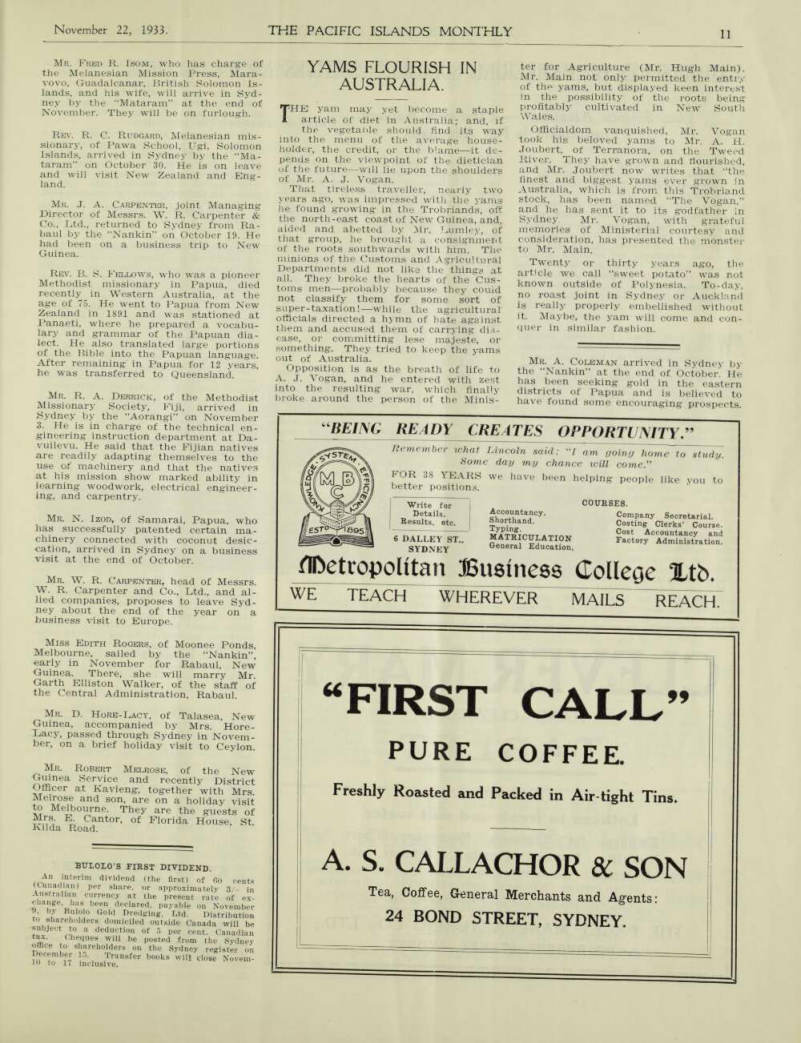
tures throughout the Territory, is one of Papua’s most progressive and successful business men.
Captain A. S.
Fitch, Managing Director of Pa puan Steamships Trading Co. Ltd., Port Moresby, is at present in Australia on a business visit.
Captain Pitch, who has been in Papua for many years and holds large con trolling interests in various ven-
Mr. Fred R. Isom, who has charge of the Melanesian Mission Press, Mara vovo, Guadalcanar, British Solomon Is lands, and his wife, will arrive in Syd ney by the “Mataram” at the end of November. They will be on furlough.
Rev. R. C. Rudgard, Melanesian mis sionary, of Pawa School, Ugi, Solomon Islands, arrived in Sydney by the “Ma taram” on October 30. He is on leave and will visit New Zealand and Eng land.
Mr. J. A. Carpenter, joint Managing Director of Messrs. W. R. Carpenter & Co., Ltd., returned to Sydney from Ra baul by the “Nankin” on October 19. He had been on a business trip to New Guinea.
Rev. B. S. Fellows, who was a pioneer Methodist missionary in Papua, died recently in Western Australia, at the age of 75. He went to Papua from New Zealand in 1891 and was stationed at Panaeti, where he prepared a vocabu lary and grammar of the Papuan dia lect. He also translated large portions of the Bible into the Papuan language.
After remaining in Papua for 12 years, he was transferred to Queensland.
Mr. R. A. Derrick, of the Methodist Missionary Society, Fiji, arrived in Sydney by the “Aorangi” on November 3. He is in charge of the technical en gineering instruction department at Da vuilevu. He said that the Fijian natives are readily adapting themselves to the use of machinery and that the natives at his mission show marked ability in learning woodwork, electrical engineer ing, and carpentry.
Mr. N. Izod, of Samarai, Papua, who has successfully patented certain ma chinery connected with coconut desic cation, arrived in Sydney on a business visit at the end of October.
Mr. W. R. Carpenter, head of Messrs.
W. R. Carpenter and Co., Ltd., and al lied companies, proposes to leave Syd ney about the end of the year on a business visit to Europe.
Miss Edith Rogers, of Moonee Ponds, Melbourne, sailed by the “Nankin”, early in November for Rabaul, New Guinea. There, she will marry Mr.
Garth Elliston Walker, of the staff of the Central Administration, Rabaul.
Mr. D. Hore-Lacy, of Talasea, New Guinea, accompanied by Mrs. Hore- Lacy, passed through Sydney in Novem ber, on a brief holiday visit to Ceylon.
Mr. Robert Melrose, of the New Guinea Service and recently District Officer at Kavieng, together with Mrs.
Melrose and son, are on a holiday visit to Melbourne. They are the guests of Mrs. E. Cantor, of Florida House, St.
Kilda Road.
Advertisements & other items, p. 12 (1 item)
Evinrude
OUTBOARD MOTORS.
A Model for every purpose.
Clearance Offer
One only,
16-H.P. "SPEEDIT WIN,"
suitable for utility purposes as auxiliary. Absolutely new — in original case. £35 F.O.B. Sydney.
Duval Trading Co. Ltd.
14 SPRING ST„ SYDNEY.
We are Buyers of Trocas and Green Snail Shell.
A HOME FOR SCHOOL-
BOYS.
"LEDDICOTT" Supplementary School offers a solution of the problem of education by providing a home for boys attending school in Sydney.
Prospectus on application to
E. F. WHITFELD, B.A.,
McMahon’s Point, Sydney.
Bulolo’S First Dividend.
An interim dividend (the first) of 60 cents (Canadian) per share, or approximately 3/- in Australian currency at the present rate of ex change has been declared, payable on November 9, by Bulolo Gold Dredging. Ltd. Distribution to shareholders domiciled outside Canada will be subject to a deduction of 5 per cent, Canadian tax. Cheques will be posted from the Sydney office to shareholders on the Sydney register on December lo Transfer books will close Novem to 17 inclusive.
Australia.
Yams Flourish In
THE yam may yet become a staple article of diet in Australia; and, if the vegetable should find its way into the menu of the average house holder, the credit, or the blame—it de pends on the viewpoint of the dietician of the future —will lie upon the shoulders of Mr. A. J. Vogan.
That tireless traveller, nearly two years ago, was impressed with the yams he found growing in the Trobriands, off the north-east coast of New Guinea, and, aided and abetted by Mr. Lumley, of that group, he brought a consignment of the roots southwards with him. The minions of the Customs and Agricultural Departments did not like the things at all. They broke the hearts of the Cus toms men—probably because they could not classify them for some sort of super-taxation!—while the agricultural officials directed a hymn of hate against them and accused them of carrying dis ease, or committing lese majeste, or something. They tried to keep the yams out of Australia.
Opposition is as the breath of life to A. J. Vogan, and he entered with zest into the resulting war, which finally broke around the person of the Minis
ter for Agriculture (Mr. Hugh Main), Mr. Main not only permitted the entry of the yams, but displayed keen interest in the possibility of the roots being profitably cultivated in New South Wales.
Officialdom vanquished, Mr. Vogan took his beloved yams to Mr. A. H.
Joubert, of Terranora, on the Tweed River. They have grown and flourished, and Mr. Joubert now writes that “the finest and biggest yams ever grown in Australia, which is from this Trobriand stock, has been named “The Vogan,” and he has sent it to its godfather in Sydney. Mr. Vogan, with grateful memories of Ministerial courtesy and consideration, has presented the monster to Mr. Main.
Twenty or thirty years ago, the article we call “sweet potato” was not known outside of Polynesia. To-day, no roast joint in Sydney or Auckland is really properly embellished without it. Maybe, the yam will come and con quer in similar fashion.
Mr. A. Coleman arrived in Sydney by the “Nankin” at the end of October. He has been seeking gold in the eastern districts of Papua and is believed to have found some encouraging prospects.
Advertisements & other items, p. 13 (1 item)
“First Call”
“BEING READY CREATES OPPORTUNITY."
Remember what Lincoln said: “i am going home to study.
Some day my chance will come .”
FOR 38 YEARS we have been helping people like you to better positions.
Write for Details, Results, etc.
6 DALLEY ST..
SYDNEY
Accountancy.
Shorthand.
Typing,
MATRICULATION
General Education.
COURSES.
Company Secretarial.
Costing Clerks’ Course.
Cost Accountancy and Factory Administration.
Metropolitan Business College Ltd.
WE TEACH WHEREVER MAILS REACH.
“FIRST CALL”
PURE COFFEE.
Freshly Roasted and Packed in Air tight Tins.
A. S. CALLACHOR & SON
Tea, Coffee, General Merchants and Agents;
24 BOND STREET, SYDNEY.
Bad Results Of Pampering Solomons Natives
Four Serious Assaults. Labourers Insolent.
Punishment Is Not Adequate.
THERE is something seriously wrong in the British Solomon Islands, in the relationship between Europeans and natives.
There has been evidence of this for some time ; but we have hesitated to publish an alarmist view of conditions that may be capable of a less sensational explanation. However, in the last mail from the Solomons, we received no less than six different communications on the same subject—the growing insolence of the natives, and the growing frequency of their attacks on European women.
The position, as it has been presented to us, is summarised hereunder.
"WHY does your excellent journal make no mention of assaults upon white women in the Solomons?’ writes a planter. “To my knowledge four have taken place in this group during the past year. The only way this menace can be stamped out is by the use of the lash.
“A native recently assaulted a white resident’s wife at Tulagi, the seat of Government. He received five years’ imprisonment. Imprisonment is nothing to them—physical pain is the only thing they understand.
“Three months later, on September 26 my own wife was brutally assaulted, with criminal intent, by a native.”
Another correspondent, commenting on the Tulagi assault, says that it was a particularly bad case. The young wife was lying on a bed with her baby, and the native suddenly attacked her violently, was beaten off only after a sharp struggle, and renewed his attack.
We are informed that a few weeks ago, the drier on Lever Bros.’ plantation at Banika, Cape Marsh (Russell
Group) was burned. Certain natives were charged. One native practically admitted that he had poured kerosene upon the green copra and set fire to it.
This native was acquitted. The same native then charged the manager, Mr.
Hay, with assault. It appeared that, during the fire, there was some argu ment and the manager applied his boot, not too gently, to the native’s hindquarters. We have not heard the out come of his charge of assault; but it is a fact that, just before the last mail left the Solomons, another of Lever Bros.’ driers, that at Lunga (Guadal canal was burned down. It is not to be expected that Lever Bros.’ managers are going to sit down quietly under this kind of thing.
Here are extracts from a letter from a B.S.I. trader: “I caught my houseboy talking back at my wife, and, as the case clearly called for it, I issued summary justice on the spot by tanning his backside, as I would do with my own child. The boy complained to the Administration officer and I received an official letter which said, inter alia: ‘The native has no wish to prosecute, but has appealed to me with a view to putting a stop to these assaults. I am considering the suspension of his contracts and taking proceedings on his behalf.’
“Another resident’s wife had cause to make a boy do his work over several times. Then, when it was not properly done, owing to laziness or carelessness, she sharply scolded the native. The boy complained to the native labour official, and she received a letter that the native was ‘unduly harassed,’ and that proceedings would be taken if it
occurred again.”
Next to hand is a surprisingly out
spoken letter from a professional man, who knows the Solomons well, and is held there in high esteem. He is en tirely in accord with the view that commonsense and firmness must be shown in administering justice to the natives. He proceeds: “But some of the ‘small fella officials’ are very jealous of anything which would impinge on their petty little prerogatives. To the ordinary on looker —who is unfortunately the man who has to foot the bill —the cost of these stupid blunders is considerable.
“I have known a D.O. spend two days in hearing a simple adultery case, with which legally he had no right to in terfere, and which a slight caning would have settled for ever. We have all heard of the important Government official who travelled hundreds of miles to fine a trader a pound for some technical offence, only to find that the trader hadn’t a bean to pay up with.
The trip cost several hundreds of pounds. We could multiply such in stances, in which highly paid officials, in expensively-run Government ves sels, are sent from one end of the Protectorate to the other at a cost running into hundreds of pounds, to do some petty little persecuting stunt which would be better left undone.
“Most of the residents of the Pro tectorate —white and black —will most heartily subscribe to the opinions ex pressed in your paper by 'Planter and Trader’ concerning the Native Passes Regulation, and to your comments thereon. It is so silly that the natives themselves make a joke of the matter, and apparently intend to test this stupid and quite unjustifiable attempt to make serfs of them. Such a thing could not be suggested m any other place but Tulagi—except, of course, in cases of epidemics or conflict.’’
From another letter: “Some very stupid things are being done here, and are resented by Europeans and natives alike. Concerning the latest freak, the Native Passes Regulation, the natives themselves are holding meetings of protest. They point out, for instance, that if a sick man on the Island of Mono wants to go to hospital at Bilua, he must go first to Faisi, over 30 miles of bad sea, to pay 1/- for a pass! We hear that the members of the Advisory Council were not consulted and can suggest no reason fir this latest regu lation.”
The foregoing is all written from one point of view— which is not that ot the Administration. There may be an other side. Our correspondents all ask very urgently that “something be done.”
We do not think that anything fur ther is necessary at this stage. It is reported from Suva that the High Commissioner of the Western Pacific probably will examine the whole position in relation to the Solomons fit an early date. It is as well that prompt
action is being taken, because it is evi dent that the feelings of residents in the group are becoming so warm that a “boil-over” is threatened.
It is as well to remember, however, that the Europeans in this group, owing to the economic depression, are not in a kindly mood at present and are natu rally antagonistic to all men in “shel tered jobs”; and that the present Resi dent Commissioner has been confronted with peculiar difficulties. There was a distressing development in the mis sion field, which reacted very badly in the relationship between Europeans and natives. The R.C. has not been well treated regarding personnel, and a whole series of troubles, culminating in the Filose incident, did not make it any easier to carry out an effective native policy. Finally, it is to be re membered that the Solomons Protec torate is one of those isolated com munities where human spites and jealousies flourish, and bad temper's are often made worse by a bad climate.
Preparations are afoot to send a troupe of 20 Cook Island dancers and singers from Rarotonga to take part in the great Maori carnival, to be held at Waitangi, N.Z., early next year.
Advertisements & other items, p. 14 (1 item)
Clever Mary
HAND - CLEANSING
TABLET
(Anti-septic).
Lathers In fresh and salt water Excellent for Engineers, Mechanics, Miners, Motorists, Painters, Plumbers, Printers, etc.
KILLS GERMS; NON-IRRITANT AND NON-POISONOUS.
USED BY DOCTORS, NURSES AND LEADING HOSPITALS.
Clip this Coupon and send for Free Sample to
THE PAGET MANUFACTURING CO., LTD.,
109 REGENT STREET, SYDNEY.
AT BLUE MOUNTAINS.
SPRINGWOOD, N.S.W.
Springwood Ladies’ College.
Est. 1897. Kindergarten to Leaving Certificate.
Tennis. Riding, Swimming. Team Games.
Unequalled climate. Pure Jersey milk. Semor and Junior Houses. Open-air sleeping. Inclusive fees. Special vacation arrangements for Island pupils. M. E. DURAND, Principal.
New Melanesian Mission Ship.
Arrives in Solomons.
THE new Melanesian Mission schooner, Southern Cross VII, which is now due in the Solomons, at the headquarters of the Mission, was dedicated by the Bishop of Liver pool in an impressive ceremony at Lancashire, England, on September 12.
She sailed for the Solomon Islands via
Torres Strait on September 17, and is expected at Tulagi, B.S.I., on November 20.
The Southern Cross was con structed by Messrs. Cammell Laird & Co., London, under the supervision of Messrs. Flannery, Baggallay, and John son Ltd., marine architects to the Melanesian Mission. She replaces
Southern Cross VI, which was wrecked in a storm off the coast of Aneityum, New Hebrides, on November 2, 1932, while on her maiden voyage.
She is a twin-screw motor vessel, with single funnel and two pole masts, and is built of steel and wood. The total length is 110 feet and breadth 28
feet. The propelling machinery con sists of two Gardner Diesel engines, which are started and reversed by com pressed air.
Extending about two-thirds of the length of the ship is a large deck house, which contains a saloon, two cabins for the use of the Bishop of Melanesia, four state-rooms, a well stocked dispensary, mail room and galley. All cabins, etc., are fitted out in polished mahogany and are provided with modern fittings and conveniences.
Electric light is supplied by a motor generator; and modern radio equip ment has been installed which, together with the latest sounding machines,
searchlights and other navigation de vices, make the Southern Cross one of the most up-to-date vessels afloat.
The commander of the new schooner is Captain Reginald Bray, and the chief engineer is Mr. C. W. R. Suisted, of New Zealand.
Sir Hubert Murray, on November 30, will complete twenty-five years as Lieutenant-Governor of the Territory of Papua. He is generally regarded as the most successful of the present-day Ad ministrators in the Pacific.
This new missionary ship, the “Southern Cross VII.," which has just ar
rived at headquarters in
the Solomons, is destined to become a familiar sight among the Pacific Islands, during the next few years. She is the seventh vessel, all named Southern Cross," put into the service by the Melanesian Mission since it commenced operations in the South Seas many
decades ago. The new
motor ship is described in the accompanying article.
Marriage.
Samson—Gordon-Smith.—At St.
Stephen’s Church, Bellevue Hill, Syd ney, N.S.W., on October 9, 1933, A. J.
Samson, of the New Guinea Public Ser vice, to Mrs. F. B. Gordon-Smith, of North Bondi.
Advertisements & other items, p. 15 (2 items)
(Continued from page 12.)
W. Kopsen & Co. Limited
SHIP CHANDLERY.
Manufacturers of PIONEER BRAND ASH OARS AND IMPLEMENT HANDLES.
Sole Agents for: KOPSEN’S SPECIAL YELLOW METAL SHEATHING AND NAILS.
Large Stocks of Chains, Anchors. Manilla and Wire Ropes, Wood and Iron Blocks, Oakum, Tar, Pitch, Oils, Paints, Leads, Zincs, Varnishes Shackles, Rigging, Screws, Sheathing, Felt, Lampware, etc.
Special Under Bond Prices for Island trade.
68-70 CLARENCE STREET, SYDNEY.
Cables: “Kopsen.” 'Phone: BW 1114-5.
Sharks And Cheese.
N.I. Plans. — Two New Industries.
From Our Own Correspondent.
Norfolk Is., Nov. 7.
WE are hoping for the establishment of two new industries, both of supreme interest and importance to the island.
The first is the equipping of a first rate plant for shark-fishing, with two buildings to be erected —one on Phillip Island and the other at Cascades —for dealing with all products and consign ing to China.
There is Chinese money behind this enterprise and it seems a really sound proposition. The sharks —of which the seas are always full, but which are prevented by the encircling reef from approaching too close —will presum ably be caught on hand lines from powerful launches, and the industry will provide payable employment for our splendid island fishermen.
It is possible also that the salting and canning of more domestic fish for the Australian markets may be pro vided for in erecting these special plants. We hear rumours that trawlers operating along the mainland coasts have entirely fished out the waters along New South Wales.
Our second proposition concerns the erection of a dairy factory, to make our own butter and cheese and save the island something like £2,000 per annum which at present goes overseas.
There are various small dairy herds already established and many house holds milk their one or two cows; in the opinion of Mr. Carroll, a dairy expert from Victoria, who recently visited us and addressed an organised meeting of farmers, a factory is per fectly practicable and should be most successful. As time goes on, we may even cure our own bacon, there being already a good class of bacon pig on the island and one man, at least, pro ducing on his own premises, bacon and hams that challenge comparison with anything that is imported.
Lae-Pt. Moresby Regular Air
Operated Without
Mishap.
Lae-Pt. Moresby Regular Air Service.
THE special air mail trip, Port Moresby to Lae, via the goldfields— or, alternately, Lae to Port Moresby —is being freely used by visitors to New Guinea.
This regular service was established nearly two years ago by Guinea Air ways, Ltd. The big three-motored monoplanes leave Salamaua or Lae on the north-east New Guinea coast, fly up to the goldfield at Wau or Bulolo, and then fly over the great central range (13,000 feet) to Port Moresby. The trip usually takes about 1 hour 45 minutes.
A traveller going to New Guinea may now leave the steamer at Port Moresby, spend some time in Papua, fly over the central range by this ser vice to the goldfield and then, some time later, pick up the same steamer at Lae or Salamaua, and go on to Rabaul and other parts of the Territory. In similar fashion the traveller may go by steamer to Rabaul and Salamaua and leave the vessel there, spend some time on the goldfields, and then fly over the Territories to Port Moresby, and pick up the same steamer for Australia.
When the service was first obtained, there were some fears as to its safety.
It is no mean feat in aviation to climb over those great mountains in all weathers on a regular schedule. The service, however, has been carried out regularly, without mishap, for nearly two years now —not only by Guinea Airways but also by the other two aviation companies operating in this region. It is one of the finest records in the history of aviation.
Old French Cruiser Goes
Home.
From Our Own Correspondent.
Tahiti, Oct. 10.
The French warship “Aldebaran,” which has been stationed here for some months, left Papeete on September 23 for Fiji and New Caledonia, from whence it is understood that she will re turn to France and be replaced here later on by a larger and more modern vessel.
It is also stated that Commander Le Pelletier, who is the inventor of a range finder for night work, as well as of a new submarine detecting device, is to be promoted to the command of one of the new cruisers of the Tourville type. The popularity of the officers and men in Papeete was such that a very large crowd assembled to witness the “Alde baran’s” departure.
Advertisements & other items, p. 16 (2 items)
Swallow & Ariell
IVA BISCUIT
a marvellous combination of Lightness, Crispness and Richness.
Excellent for Savoury purposes.
QUEEN’S OWN MIXED BISCUITS
An assortment of Cream and other Sweet Biscuits and Wafers in attractively labelled tin.
PLUM PUDDINGS
in hermetically sealed tins Cooked ready for Use.
RICH, LIGHT, SPICY.
Made and Packed expressly for Export by
SWALLOW & ARIELL
LIMITED
PORT MELBOURNE, AUSTRALIA.
New Britain Express Delivery.
GENERAL OVERSEAS AGENTS,
GENERAL CARRIERS. BAGGAGE AGENTS,
and FORWARDING AGENTS.
Reliable Cars and Trucks.
We aim to give quick and reliable Service at reasonable costs. P.O. Box 116. Telephone: 141.
W. WALKER - FLYNN, Proprietor, Market Street, Rabaul, T.N.G.
Mr. E. Purcell Cohen
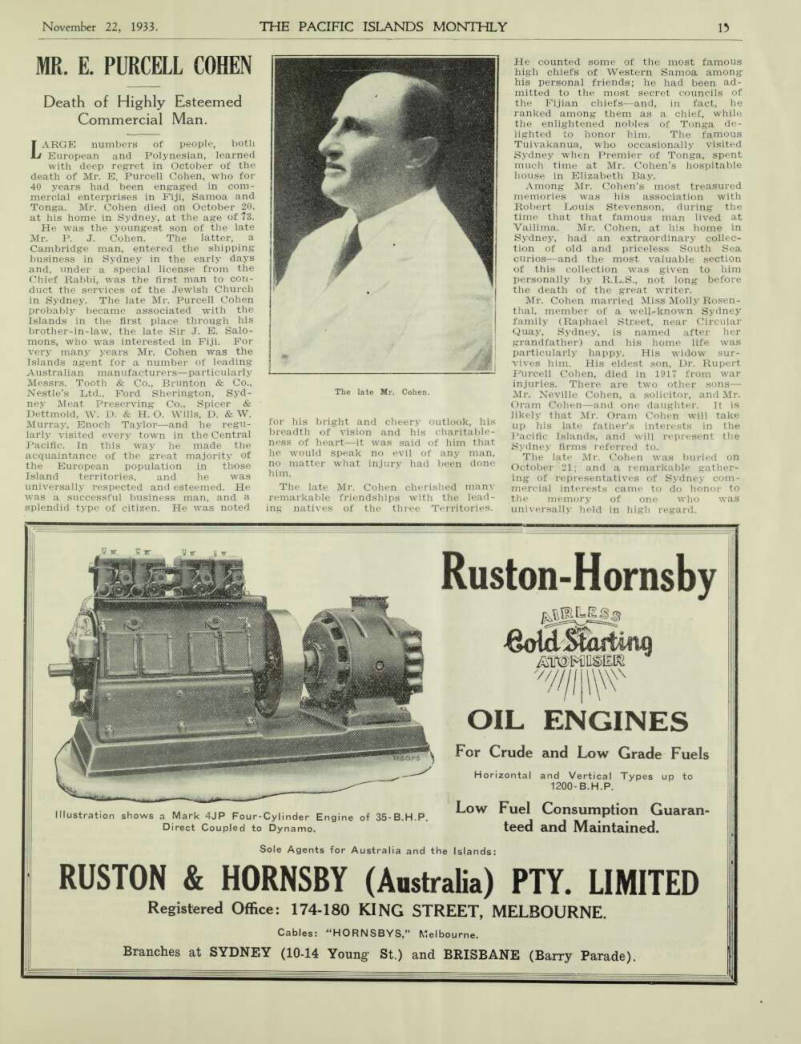
Death of Highly Esteemed Commercial Man.
LARGE numbers of people, both European and Polynesian, learned with deep regret in October of the death of Mr, E. Purcell Cohen, who for 40 years had been engaged in com mercial enterprises in Fiji, Samoa and Tonga. Mr. Cohen died on October 20, at his home in Sydney, at the age of 73.
He was the youngest son of the late Mr. P. J. Cohen. The latter, a Cambridge man, entered the shipping business in Sydney in the early days and, under a special license from the Chief Rabbi, was the first man to con duct the services of the Jewish Church in Sydney. The late Mr. Purcell Cohen probably became associated with the Islands in the first place through his brother-in-law, the late Sir J. E. Salo mons, who was interested in Fiji. For very many years Mr. Cohen was the Islands agent for a number of leading Australian manufacturers —particularly Messrs. Tooth & Co., Brunton & Co., Nestle’s Ltd., Ford Sherington, Syd ney Meat Preserving Co., Spicer & Dettmold, W. D. & H. O. Wills, D. & W.
Murray, Enoch Taylor—and he regu larly visited every town in the Central Pacific. In this way he made the acquaintance of the great majority of the European population in those Island territories, and he was universally respected and esteemed. He was a successful business man, and a splendid type of citizen. He was noted
for his bright and cheery outlook, his breadth of vision and his charitable ness of heart —it was said of him that he would speak no evil of any man, no matter what injury had been done him.
The late Mr. Cohen cherished many remarkable friendships with the lead ing natives of the three Territories.
He counted some of the most famous high chiefs of Western Samoa among his personal friends; he had been ad mitted to the most secret councils of the Fijian chiefs —and, in fact, he ranked among them as a chief, while the enlightened nobles of Tonga delighted to honor him. The famous Tuivakanua, who occasionally visited Sydney when Premier of Tonga, spent much time at Mr. Cohen’s hospitable house in Elizabeth Bay.
Among Mr. Cohen’s most treasured memories was his association with Robert Louis Stevenson, during the time that that famous man lived at Vailima. Mr. Cohen, at his home in Sydney, had an extraordinary collec tion of old and priceless South Sea curios—and the most valuable section of this collection was given to him personally by R.L.S., not long before the death of the great writer.
Mr. Cohen married Miss Molly Rosen thal, member of a well-known Sydney family (Raphael Street, near Circular Quay, Sydney, is named after her grandfather) and his home life was particularly happy. His widow sur vives him. His eldest son, Dr. Rupert Purcell Cohen, died in 1917 from war injuries. There are two other sons — Mr. Neville Cohen, a solicitor, and Mr.
Oram Cohen —and one daughter. It is likely that Mr. Oram Cohen will take up his late father’s interests in the Pacific Islands, and will represent the Sydney firms referred to.
The late Mr. Cohen was buried on October 21; and a remarkable gather ing of representatives of Sydney com mercial interests came to do honor to the memory of one who was universally held in high regard.
The late Mr. Cohen.
Advertisements & other items, p. 17 (1 item)
Ruston-Hornsby
Illustration shows a Mark 4JP Four-Cylinder Engine of 35-B.H.P.
Direct Coupled to Dynamo.
OIL ENGINES
For Crude and Low Grade Fuels Horizontal and Vertical Types up to
1200- B.H.P.
Low Fuel Consumption Guaranteed and Maintained.
Sole Agents for Australia and the Islands:
RUSTON & HORNSBY (Australia) PTY. LIMITED
Registered Office: 174-180 KING STREET, MELBOURNE.
Cables: “HORNSBYS," Melbourne.
Branches at SYDNEY (10-14 Young- St.) and BRISBANE (Barry Parade).
Fashion Hints For Islands’ Women.
(By "Therese”.)
SIMPLICITY is still rampant; but in spite of depression we do not wear sackcloth and ashes. However, we do wear cottons —cottons, with no trimmings, that are sheer, lovely simplicity in themselves. All those simple innocent looking things which went with the blushes, simpers and downcast eyes of our Victorian ancestors now dance the merriest jig through life, combined with the most perfect modernistic make-up.
The greatest percentage of chic is confined in the little cape or coatee of organdie or linen which accompanies the evening or everyday frock and is well deserving of its popularity. There are many interesting versions of it. A white organdie coatee, huge of shoulder sleeves and tight of bodice, is perfec tion itself when worn over a slim fitting evening frock of flat green crepe. Another venture into the realms of smartness takes the form of an adorable little jacket of pique. It
is boxed and swagger and definitely desirable.
Monkey fur has again come into its own, and gives an air of extreme sophistication to a svelte afternoon or evening gown. It really is ideal for trimming, even for the tropics, giving as it does that lovely fringe-like effect which is alluring and so very expensive-looking.
Grey is a delightful colour for evening, from that soft misty shade to the steel grey of a lacquered satin. It does not show signs of wear nearly so quickly as you’d imagine. With leaf green shoes and sash, mist grey is particularly attractive and the en semble is completed by earrings and necklet of the same green.
At a ball, recently, easily quite the smartest frock was of silver grey satin slim to the hips, flaring well out towards the hem, and with a bodice that showed the new extended shoulders. Worn by a lass with a delicate air, the addition of an exquisite posy of the palest of pink sweet peas and violets completed a perfect picture.
The steel-grey lacquered satin, of course, needs no adornment, and on a figure slim and graceful as a young birch tree is like a sheath of armour, and makes of the wearer a modern Jeanne D’arc.
Beads are tremendously important this season and should be worn to match or contrast with every frock our wardrobe can boast. They are of in finite variety and such infinitesimal cost that it is possible to have dozens of attractive necklets with earrings to match. Slave bangles, too, come in for their share of attention and from the broad jungle to the narrower type, of chromium or composition, they add charm to the ensemble.
Smart effects are achieved with rings of metal and glass. On many of the new frocks they have replaced buttons and buckles for scarves, belt and neckline treatments. The tiny cape of a simple evening frock is given distinction by its fastening at the neck of two large rings of mother-of-pearl.
A chromium circle holds in place the fashionable swathed neckline of an afternoon frock, and so on —their uses are legion.
Sometimes dreams come true, and this can be said of the flowered de signs in both chiffon and cotton. They
make possible the delightful picture
hat we so love to wear for festive occasions.
Gloves, strangely enough, do not lose
their attractiveness on their flights to the realms of eccentricity. Figured and
spotted exaggerated gauntlets on the
glove of plain white cotton are the dernier cri, as are the complete gloves of flimsier materials —lace, nets and spotted muslins. The addition of a stiffened lace gauntlet to a short kid glove for evening adds distinction with a difference. Spotted gloves, hat and scarf in any gay colour lift the most ordinary of white frocks from mediocrity to something worth while.
A Crocheted Gauntlet.
Here is a crocheted gauntlet which is easily made, and a wonderful success.
Any colour scheme may be chosen.
The materials required are half a ball each of fawn and black stranded crochet cotton, a crochet hook (No. 15), and a pair of fawn fabric gloves.
Cut off the gloves just below the wrists and buttonhole-stitch the cut edges with black cotton.
Commence at the inside seam of the glove, in the black cotton, work a row of d.c. into the button-hole stitch, count the d.c., and make the same number in the second glove.
The rows are now worked backwards and for wards, leaving the edge open. With the fawn cotton work d.c. into every st. Then, with the black cotton work d.c. into every st.
With the fawn cotton work 4 ch. to turn, 3 of which form the first t. ; this occurs through out, miss 1 d.c., 1 t. in next d.c., 1 ch., miss 1, 1 t. in next all along the row.
Now work 3 rows of d.c., 1 row in black, 1 row in fawn, and 1 row in black. In the fawn cotton work 11 rows of pattern.
Ist row: 4 ch.. 1 t. into same st.. * 3 ch.. miss 2 d.c., 1 d.c. into next 3 ch., miss 2, 4 t. into the next d.c.. with 1 ch. between each t. : repeat from * along the row, ending with 2 tr.. with 1 ch. between each. 2nd row: 3 t. into the hole of 1 ch., * 3 ch.. 3 t. into each of 3 holes of 1 ch., repeat from * ending with 3 t. 3rd row: 4 ch.. 1 t., 1 ch., 1 t. into first st., * 3 ch.. 1 d.c. into hole of 3 ch. of last row, 3 ch., 4 t., 1 ch. between each t. into the sth t. of block of 9 t. ; repeat from * all along. 4th row: 3 t. in each of 2 holes of 1 ch., continue from * in 2nd row, but ending with 6 t. sth row; 4 t., with 1 ch. between each t. into the 2nd t.. continue like the 3rd row. 6th row: 3 t.. in each of 3 holes of 1 ch., 3 ch. ; repeat to end of row.
This ends the inc. ; work 2 more pattern rows, twice more, ending the rows with 3 ch., 1 d.c., and beginning the rows with 4 ch.
Then finish with Ist row of the pattern.
In the black cotton, beginning at the wrist, 1 t. into every st. all round with 3 t. into 1 st. at each corner.
With the fawn cotton, 1 d.c. in every st., 3 d.c. into one st. at the corners.
In the black cotton. 1 t. into every st. and 3 t. into one st. at the corners.
Press the whole of the crochet on the wrong side with a hot iron.
Knuckle-Dusters Tabu.
From Our Own Correspondent.
Rabaul, Nov. 3.
A NEW regulation has been published, which is an additional clause to the Regulations under the Native Ad ministration Ordinance, 1921-1927.
It is now an offence for any native to have in his custody or possession, without lawful excuse, any knuckle duster, or other article of a similar nature.
Under the same regulation it is an offence to carry, without lawful excuse, any razor or razor blade.
The penalty is a fine of £5 or im prisonment for six months, or both.
Advertisements & other items, p. 18 (1 item)
Mcintyres,
OIL ENGINES
SUCTION GAS PLANTS
and Guaranteed Reconditioned
MACHINERY.
About half-price of new and as good.
ENQUIRIES SOLICITED.
McINTYRES,
Machinery Experts, Harbour & Little Hay Sts.,
SYDNEY.
Established 25 years.
Bankers: Bank of New South Wales, Haymarket, Sydney.
PACIFIC ISLANDS ASSOCIATION.
Headquarters and Clubrooms:
MILLIONS HOUSE, ROWE STREET, SYDNEY
Telephone: 84971.
Founded in 1931 to Advance the Interests of Residents of the Pacific; Assist Island Trade; Provide Information for Tourists; and Promote the Welfare of the Native Races.
All Pacific Islands residents visiting Sydney are invited to call at Millions Hnuse and sign the visitors’ book kept at the Association’s office on the first floor.
Secretary’s Office: NATIONAL MUTUAL BUILDING, 350 GEORGE STREET, near G.P.O., SYDNEY, AUSTRALIA. :: :: :: Telephone: B 5067.
Cable Address: “CERTAC,” Sydney.
Customs!
Back To His Old
Samoan Natives’ Answer to Depression.
The case of Western Samoa, described hereunder by our correspondent, affords a striking example of how the worldwide fall in commodity prices has affected commercial structures in the remotest places and is destroying , among native communities, standards of living which have been built up as the result of a century's contact with Europeans.
Samoa, in the past, depended on three main products copra, cocoa and bananas. Copra, in two years, has fallen from £14 to less than £9 per ton, London; cocoa has fallen from £50 to £7/10/per ton; and the banana market is desperately restricted. The Samoan natives depend on copra and bananas. At the present prices they refuse to produce.
Apia, Nov. 3.
FOR nearly one hundred years, the white man has tried his best to convince the Samoan that he should buy certain luxuries from the trading stations and has induced him to cut the maximum quantity of copra to pay for these luxuries. Now, all at once, the labour of the last 100 years seems to be wiped out.
The native is going back to the old customs and ways of living of his ancestors, before the white man’s advent.
No more tinned meat and salmon for him—there are plenty of pigs, fowls, and fish available. No more soap—he uses la’u fisoa leaves instead for washing clothes! Salt is replaced by sea water, sugar by sugar cane, kerosene by coconut shell fire or coconut oil. And the weaving of the tapa cloth is re vived all over the islands—the Samoans dispense with the cotton lava-lavas of the white man.
The missions, schools, the motor taxis and ’buses, the motor boats and the cinema—all are suffering from the lack of money. And last, and not least, here is the administration faced with the loss of most of its revenue.
B.N.G. Co.’S Accounts.
British New Guinea Development Co., Ltd., which holds 24,920 acres in Papua, mostly on 99 years’ lease, dating from 1910, has made available its accounts for the year ended January 31, 1933, which show a loss of £115. To this is wadded debenture interest £5277, and loss brought in £286. Allowing for transfer of £10,000 from reserve, there is a debit balance of £3678 to carry forward. As provided for in the trust deed, £10,000 of debenture stock was redeemed by June 30, 1933. The output of copra was 1926 tons, comparing with 2166 tons for 1931-32. Owing to the smaller yield, cost was higher and production resulted in a loss of 14/3 per ton, against 8/11 per ton for the previous year.
Rubber production increased from 663,4051 b. to 785,3281 b. Net sale price fell from 6.32 d. to 5.81 d. per lb. f.o.b., and cost was reduced from 5.55 d. to 4.55 d. Values are in Australian cur rency.
N.G. Patrol Officers.
NOTICE of a new system of promo tion, particularly affecting patrol officers, was given recently by the Administrator of New Guinea.
A Board has been appointed to con sider all future promotions to Assist ant District Officer and District Officer.
As a general principle, a minimum period of ten years as a cadet or patrol officer shall be served by an officer be fore being promoted to the office of As sistant District Officer and this prin ciple will only be departed from when exceptional merit of an officer so war rants. Officers will be required to hold a certificate of proficiency as disclosed by examination in law, administration, and such other subject matter as the Administrator may determine.
All patrol officers were notified that the public service regulations were be ing amended to provide that patrol of ficers may not be advanced in salary beyond £426 per annum, until they have successfully negotiated a preliminary examination in law and administration, which will be held from time to time.
Advertisements & other items, p. 19 (1 item)
Arnott’S
ALBERT GREGORY,
107 York Street, Sydney.
Saddlery,
Saddler’s Ironmongery,
Leather and Paint Merchant.
LEATHERS—Art Work, Sole, Harness, Roans, Suedes, Bag-, Kangaroo, Bridles, Belts, Spurs, Stirrups, Breastplates. SADDLES Race, Exercising, Park and Stock.
Leather Belting and Pump Cups.
Paint Merchant.
For House and Roofs, ready mixed .. .. 13/6 gallon Special Value House Paint 10/6 gallon Brushes, Kalsomine, White Lead and Oil.
Samples of Leathers on Application
ARNOTT’S
FAMOUS
POPSO CRACKER
BISCUITS
Crisp and delicious and made to break into three fingers of ideal size and shape, the perfect base for savoury items.
Always ask for
ARNOTTS
South Seas
How Gambusia Were Introduced Into
Larvae-Eating Fish Check Mosquito Breeding.
A YOUNG official of Sydney City Coun cil (Mr. W. O. Vogwell, F.I.S.E., M.R.
San. I., Chief Health Inspector) has performed a service of great value to all the people of the South Seas. He has carried out his work so quietly and un ostentatiously that very few realise what has been done. Posterity, however, will do honour to the name of Health Inspec tor Vogwell.
Mr. Vogwell was on a holiday trip abroad in 1926 and he inquired about modern methods of guarding the public’s health. It was then that he heard about a small larvae-eating fish, Gambusia affinis. It appears that this fish had come under notice in the West Indies, owing to its habit of eating the larvae of mos quitoes. It was a voracious little crea ture, living in fresh water and attack ing all other living things in the water, such as insects and other small fish.
Mr. Vogwell learned that the Govern ments of Italy and Spain had recently brought over a consignment of Gam busia from the West Indies, with a view to propagating the fish in the ponds and swamps of their respective countries, to check the mosquito pest. He learned that the Italian consignment died, but the fish were satisfactorily established in Spain, and a quantity were then sent to Italy.
Thereupon Mr. Vogwell went to Italy and continued his investigations. He learned that the result of the liberation of the fish in the mosquito infested swamps of Italy had been very marked.
Italian officials were kind and helpful, as a result of which Mr. Vogwell, at his own expense, had a container con
structed, wherein he placed a consider able consignment of the Italian Gam busia. Mr. Vogwell took his container aboard the mail steamer at Naples and gave the fish his personal care during the voyage to Sydney.
The fish were liberated in a pond in the Sydney Botanical Gardens, where they flourished. Within a few years there were millions of the savage little creatures available, and they were liber ated all over the Sydney district, where they had a marvellous effect in clearing stagnant and semi-stagnant water of mosquito larvae. It was found that they were very hardy, were propagated easily, and could live and flourish in water of extreme stagnancy even in mud puddles. They were liberated, for in stance, in the high, square, water-pres sure tanks which may be seen above many big buildings in Sydney, and which previously were breeding-grounds for mosquitoes. The Gambusia has lived for years, now, in some of these tanks and, of course, the mosquito larvae has been destroyed therein.
The Gambusia was widely distributed from Sydney and the establishment of the fish in stagnant water all over the Commonwealth is now a recognised duty of the various health authorities.
One day, early in 1930, Health In spector H. O. Plummer, of the New Guinea Department of Public Health, called on Mr. Vogwell in Sydney and became interested in Gambusia. As a result of this, Mr. Vogwell and Mr.
Plummer introduced the fish to Rabaul.
The first consignment arrived there in March, 1930, and it was successfully pro
pagated in a pond in the Rabaul Botani cal Gardens. The Territory’s Health De partment quickly perceived the value of Gambusia, with the result that, in the succeeding three years, the fish has been distributed over much of the Mandated Territory and has had a most satisfac tory effect in checking the breeding of mosquito larvae. Gambusia was liberated, for instance, in the Lakunai swamp, near Rabaul, and undoubtedly cleaned that breeding ground of the Anapholes.
The Chief Health Officer reported in 1931 that the fish showed a decided pre ference for the Anapholes larvae. The effect of Gambusia in checking malaria among natives in New Ireland has been truly remarkable.
The New Guinea health authorities sent a consignment of Gambusia to Papua and there, again, the fish has been propagated and distributed with satisfactory results.
It is interesting to note that the 12 youths who have been sent to the Syd ney University for special training for public health work in Papua have been introduced to Gambusia. They are being shown how to care for and propagate the fish, and its distribution in Papua will be part of the duties which the young Papuans will undertake upon their return.
A consignment of Gambusia was sent from Sydney to Suva, and it is under stood that in Fiji also this useful crea ture is being made use of to an increas ing degree in combatting the mosquito pest.
It is, however, as a factor in the war against the Anapholes (the carrier of malaria) that Gambusia will be most valuable; and it is likely that in the years to come the name of Mr. Vogwell, who brought Gambusia to the South Seas, will be praised in all those Pacific Territories where malaria in the past has taken so heavy a toll of native and European life.
Government health officers are not given to rhapsodies in their official re ports; but it can be said that the Chief Health Officer of New Guinea, in his re ports for 1931 and 1932, has permitted a note of enthusiasm to creep into his re ferences to Gambusia, and his descrip tion of how the distribution of the vora cious little fish is helping in the great work against malaria. (An article in the “P.I.M.” of January, 1933, containing quotations from the official medical reports, showed that the use of Gambusia had had extraordinary results in reducing the incidence of malaria among New Guinea natives).
Early Numbers Of P.I.M.
The publishers of the Pacific Islands Monthly are unable to supply early num bers of the journal to the New York Public Library, which is desirous of holding- a complete file.
The Director of the Library has now asked us to announce that he would be very glad to receive from any of our readers copies of any of the issues of the “P.I.M.” from No. 1, Volume 1, up to, and including, No. 1, Volume 3. The Director says: “The courtesy will be ap preciated if readers who no longer need their copies of these issues will present them to the Library.”
Anyone with early copies to dispose of should communicate directly with the Director, New York Public Library, sth Avenue and 42nd Street, New York City,
U.S.A.
Advertisements & other items, p. 20 (1 item)
Aunt
QUALITY PRODUCTS
Packed to meet Island Conditions.
MARY'S
PURE FOOD
PRODUCTS
For thirty years the proprietors of Aunt Mary’s Pure Food Products have manufactured the highest quality goods and packed them to meet the special conditions of the Pacific Islands.
Aunt Mary’s Pure Food Products and “Defiance” Brand Canned Goods are prepared and packed only by
“Defiance”
Brand
Canned
Goods
These high - grade Canned Goods are specially prepared and hermetically sealed to withstand tropical heat, thus ensuring to consumers the fullest satisfaction.
TILLOCK & CO., LTD., manufacturers.
Kent and Liverpool Streets, SYDNEY, N.S.W.
Engagement.
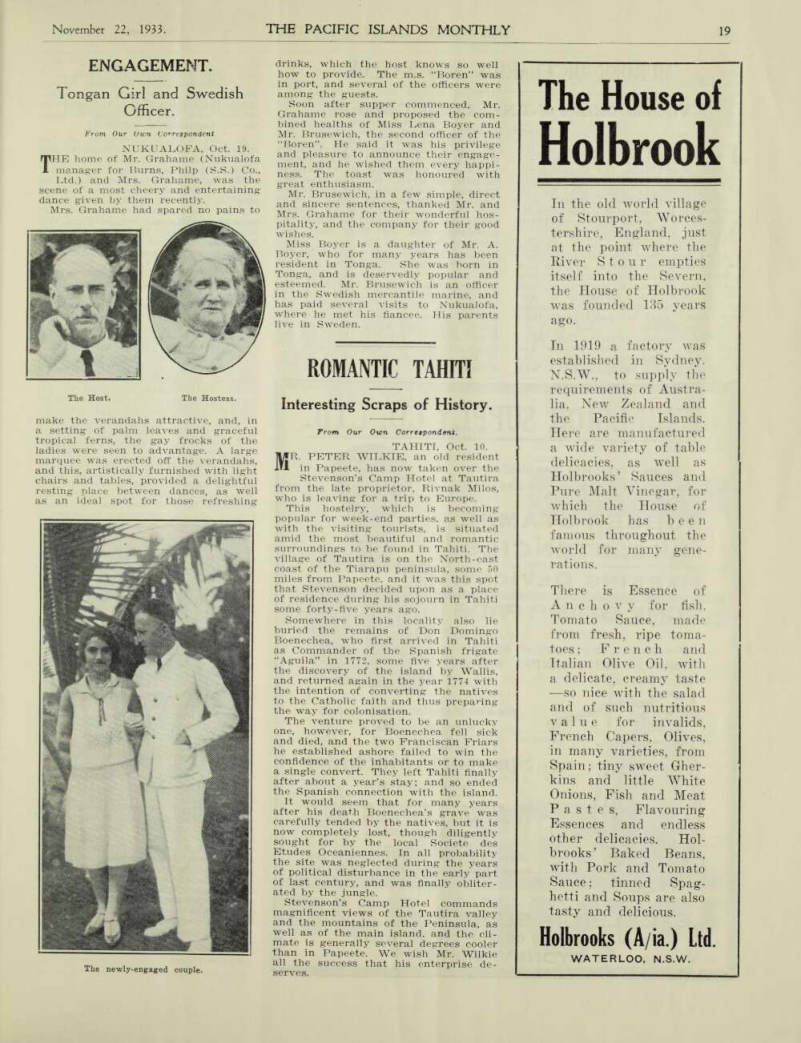
Tongan Girl and Swedish Officer.
From Our Own Correspondent
Nukualofa, Oct. 19.
THE home of Mr. Grahame (Nukualofa manager for Burns, Philp (S.S.) Co., Ltd.) and Mrs. Grahame, was the scene of a most cheery and entertaining dance given by them recently.
Mrs. Grahame had spared no pains to
make the verandahs attractive, and, in a setting of palm leaves and graceful tropical ferns, the gay frocks of the ladies were seen to advantage. A large marquee was erected off the verandahs, and this, artistically furnished with light chairs and tables, provided a delightful resting place between dances, as well as an ideal spot for those refreshing
drinks, which the host knows so well how to provide. The m.s. “Boren” was in port, and several of the officers were among the guests.
Soon after supper commenced, Mr.
Grahame rose and proposed the com bined healths of Miss Lena Boyer and Mr. Brusewich, the second officer of the “Boren”. He said it was his privilege and pleasure to announce their engage ment, and he wished them every happi ness. The toast was honoured with great enthusiasm, Mr. Brusewich, in a few simple, direct and sincere sentences, thanked Mr. and Mrs. Grahame for their wonderful hos pitality, and the company for their good wishes.
Miss Boyer is a daughter of Mr. A.
Boyer, who for many years has been resident in Tonga. She was born in Tonga, and is deservedly popular and esteemed. Mr. Brusewich is an officer in the Swedish mercantile marine, and has paid several visits to Nukualofa, where he met his fiancee. His parents live in Sweden.
The Host.
The Hostess.
The newly-engaged couple.
Romantic Tahiti
Interesting Scraps of History.
From Our Own Correspondent.
Tahiti. Oct. 10.
MR. PETER WILKIE, an old resident in Papeete, has now taken over the Stevenson’s Camp Hotel at Tautira from the late proprietor, Rivnak Milos, who is leaving for a trip to Europe.
This hostelry, which is becoming popular for week-end parties, as well as with the visiting tourists, is situated amid the most beautiful and romantic surroundings to be found in Tahiti. The village of Tautira is on the North-east coast of the Tiarapu peninsula, some 50 miles from Papeete, and it was this spot that Stevenson decided upon as a place of residence during his sojourn in Tahiti some forty-five years ago.
Somewhere in this locality also lie buried the remains of Don Domingo Boenechea, who first arrived in Tahiti as Commander of the Spanish frigate “Aguila” in 1772, some five years after the discovery of the island by Wallis, and returned again in the year 1774 with the intention of converting the natives to the Catholic faith and thus preparing the way for colonisation.
The venture proved to be an unlucky one, however, for Boenechea fell sick and died, and the two Franciscan Friars he established ashore failed to win the confidence of the inhabitants or to make a single convert. They left Tahiti finally after about a year’s stay; and so ended the Spanish connection with the island.
It would seem that for many years after his death Boenechea’s grave was carefully tended by the natives, but it is now completely lost, though diligently sought for by the local Societe des Etudes Oceaniennes. In all probability the site was neglected during the years of political disturbance in the early part of last century, and was finally obliter ated by the jungle.
Stevenson’s Camp Hotel commands magnificent views of the Tautira valley and the mountains of the Peninsula, as well as of the main island, and the cli mate is generally several degrees cooler than in Papeete. We wish Mr. Wilkie all the success that his enterprise de serves.
Advertisements & other items, p. 21 (1 item)
Holbrook
The House of
In the old world village of Stourport, Worcestershire, England, just at the point where the River Stour empties itself into the Severn, the House of Holbrook was founded 135 years ago.
In 1919 a factory was established in Sydney.
N.S.W., to supply the requirements of Australia, New Zealand and the Pacific Islands.
Here are manufactured a wide variety of table delicacies, as well as Holbrooks ’ Sauces and Pure Malt Vinegar, for which the House of Holbrook has been famous throughout the world for many generations.
There is Essence of Anchovy for fish.
Tomato Sauce, made from fresh, ripe tomatoes ; French and Italian Olive Oil, with a delicate, creamy taste —so nice with the salad and of such nutritious value for invalids, French Capers, Olives, in many varieties, from Spain; tiny sweet Gherkins and little White Onions, Fish and Meat
Pastes, Flavouring
Essences and endless other delicacies. Holbrooks’ Baked Beans, with Pork and Tomato
Sauce; tinned Spag-
hetti and Soups are also tasty and delicious.
Holbrooks (A/ia.) Ltd.
WATERLOO, N.S.W.
Murder Of Claries And Naylor
Vigorous Defence of T.N.G. Officials Concerned.
[Letter to the Editor ]
THE section of the article in the August “P.I.M.”, dealing with the murder of Clarius and Naylor in the Upper Watut-Langimar area, is so full of misstatements that, but for its underhand attack on officials, who have done and are still doing splendid work there, it would have evoked little but mirth from the local miners.
The thought that some of your readers may credit the statements made in this pernicious article, and the fact that the mention of my name in it may lead some to connect me with it, lead me to take this opportunity to dis sociate myself from the sentiments expressed, and to point out their malicious nature.
Your correspondent states that “Isen bert and Bryan” took Naylor and Clarius’ carrier, who escaped, to the Otibanda Post. Bryan was not with
me. He did not come to the Post till later in the day. As to Bryan’s sup posed offer to organise a rescue party “within two hours,” it would have been impossible for him to have gathered a sufficiently strong party within twentyfour hours, so widely are the miners scattered; and the party so gathered certainly would not have been well equipped.
That this idea was “refused by the officials’’ seems quite likely, if there had been an official on the Post able to make such a refusal when Mr. Bryan arrived. But the official in charge of the matter, Mr. A. D. O. Penglase, had left by ’plane for Salamaua to collect stores and police at about 8 a.m., an hour after I reported the murder.
Your correspondent states that he left in the afternoon, but this is just to insinuate delay, and to make the rest
of his “charges” seem plausible. The only person to whom the offer could have been made was a Patrol Officer, who had no authority in the matter.
Hence the statement that the offer was refused with “are you trying to teach me my business,” is ridiculous.
As one with a knowledge of the natives concerned I was amused to find your correspondent hinting that “what appeared to be a man tied to a stake” could have been either Naylor or Clarius. This was probably a “Sing sing” in progress. Susuma, one of the carriers who escaped, and who is at present working for me, confirms this when he says that the two unfortunate men were killed in the first attack.
The idea of a party leaving by moon light for a place three or four days away, to prevent “telegraphing” of movements ahead, shows that if your correspondent lacks verity he at least possesses a high degree of imagination.
His maliciousness reaches its height when he makes the charge that the report of the party, which went in to the scene of the murder, is false; and to cloak this under the guise of ques tions to police boys certainly shows the code of the author to be on a low plane. Both Susuma and Wali, the in terpreter for the party (who also works for me) verify the fact that, when an attempt was made to ambush the party by two bands of natives (“they never saw the natives”) on the return trip, three were shot and one wounded.
The statement that the ten pris oners taken later “advised them (Nay lor and Clarius) not to proceed further into the Langemark,” is directly con tradicted by the very native, whom your correspondent quotes to substan tiate it.
Susuma says that five natives car ried for Naylor and Clarius on the day before they were murdered, and some followed behind. When they camped for the night at the head of a river, these natives and those following slept at a nearby village. In the morning, when the miners moved on, many natives followed and murdered them at the first opportunity. Susuma says that he actually saw some of the five who carried amongst the attackers.
Is it possible that these natives could have advised the white men not to proceed further? Rather did they carry them further from the Post, so that they could murder them more securely!
“Five Innocent Kanakas!” All the miners to whom I have spoken were surprised to hear that there were any “innocent kanakas” in this area. Of the five innocents in Salamaua, one is reported to be the actual man who hit one of the miners on the head with a club, and another to have been present.
To quote your correspondent—“ Much more could be said, the publication of which will serve no useful purpose.”
Suffice it to say that the general opinion of the Upper Watut miners is that the article in question have been written by one with little knowledge of the facts, and a desire to revenge himself on officials at present absent from the Territory, have evidently carried out their duty to his discomfort.
I am, etc.,
F. Isenbert.
Surprise Creek, Upper Watut, N.G., 10/10/33.
Advertisements & other items, p. 22 (1 item)
Excelsior Supply Co. Ltd.
The most extensive Manufacturers in the British Empire of
RUBBER STAMPS,
INKS, STENCILS,
Marking Devices.
ACME STAMP PADS
We have a big range of Special
FRUIT CASE MARKING SETS
We alto Manufacture or Supply a complete line of
Spraying Machines
for ail purposes.
Let us know your requirements and we will quote you by return. Ask for our Big Catalogue.
Sole Australasian Distributors of the World Famous SHEAFFER FOUNTAIN
PENS and PENCILS.
EXCELSIOR SUPPLY CO. LTD.
Head Office:—160 GEORGE STREET WEST,
SYDNEY. N.S.W.
Cruise Of Dove
Tragic Expedition Which Found Madang.
AN interesting little item of the for gotten history of New Guinea came under our notice recently, when we received from Mr. Arthur Peck, of Mel bourne, a copy of a pamphlet entitled, “Expedition to New Guinea in 1878 in the Schooner Dove.”
It was a tragic affair. There had been interesting rumours of gold discoveries in New Guinea and a little group of Melbourne men, after holding a series of meetings, decided in July, 1878, to purchase the topsail schooner “Dove” and go to New Guinea in search of the elusive metal.
The expedition left Melbourne on August 3, 1878, under command of the late Captain A. R. Rennie, with Captain James Bull as mate. The members of the expedition numbered 15. All are now dead, except Mr. Arthur Peck, now aged 79; Captain Bull, who is aged 84, and is a resident of Bairnsdale, Victoria; and Mr. Robertson, now a resident of Ormis ton, near Brisbane.
The "Dove” had a pleasant and pros perous voyage up the east coast of Aus tralia and the expedition commenced its search on the north-east coast of New Guinea, near Astrolabe Bay. It was well received by the natives and the men spent a couple of pleasant weeks ashore at various points. It was found, how ever, that there was no chance of find ing gold in the flat lands around Astro labe Bay, and that it was practically impossible to get through the broken country, swamps and dense vegetation that lay between the coast and the mountains, where it was supposed that gold might be discovered.
In the course of their investigations, the adventurers found the narrow en trance into the deep, beautiful, well shel tered harbour of Madang; and it is just possible that when they entered this haven on September 10, 1878, they were the actual discoverers of Madang har bour. Certainly, there was no trace of anything of the kind on Captain Rennie’s charts.
Still seeking gold-bearing country, the expedition left Madang harbour and sailed slowly westward. Then things went seriously wrong. Members of the party began to sicken with fever; while the ship, as it drew near the Sepik estu ary, met an entirely different class of natives, very arrogant and treacherous.
More men went down with fever—it is now quite apparent that the whole party were well bitten by the Anopheles when ashore at Astrolabe Bay—and there were one or two collisons with the natives. At one place, westward of the Sepik, the schooner one night was over run suddenly by savages, and there was a sharp, critical fight. By great good luck, a couple of old miners in the party had prepared dynamite bombs for just such an emergency as this, and these were thrown over among the clustering canoes with such deadly and terrific effect that the whole of the attacking army left uninjured incontinently fled.
After that the “Dove,” still making slowly westward, kept well out to sea and conditions became appallingly bad.
Several more of the party went down with fever and some died. They ran out of fresh food and fresh water. The ship began to leak and it was discovered that
her bottom was riddled with tropical worms.
The whole company became so weak and ill that they could not properly sail the ship or work the pumps. It is clear from the Captain’s diary that he only kept the ship afloat, day after day, by ruthlessly driving the fainting, fever stricken men to the pumps.
They tried to sail back east, but the winds were against it. The Captain had run westward beyond the region for which he held charts; and so he decided to try to make the Dutch East Indies is land of Amboyna by guesswork. They eventually got in sight of their goal, but for several days they were either be calmed or retarded by contrary winds.
Finally, when they were literally “in extremis,” they were picked up by a Scottish barque, “Sir Lancelot,” whose captain treated them very kindly. The “Dove,” already half-sunken, was set on fire and abandoned and the sick and un happy company were taken on to Yoko hama. Several had died on the “Dove,” and one or two others succumbed on the rescuing barque.
The others were sent back eventually from Japan to Melbourne, as distressed sailors.
Fiji’S Trade.
Australia s Favoured Position.
ACCORDING to the Blue Book of Fiji, 1932, the total value of imports of merchandise into that colony for the year ended December 31, 1932, amounted to £857,346, whilst exports totalled £1,604,296.
Australia was the largest exporter of goods to Fiji, with £317,046, followed by the United Kingdom £250,748, New Zea land £100,255, Italy £29,814, USA £25,937, Canada £25,675, and Netherlands East Indies £22,633.
As Australia received from Fiji goods to the value of only £15,730, the balance of trade in the Commonwealth’s favour for the year 1932 was £302,316. The United Kingdom was Fiji’s best cus tomer with imports to the value of £842,000, followed by Canada with £530,270, and New Zealand £134,900.
The principal items of export from Australia to Fiji in 1932 were flour, £18,989, sharps and pollard £34,240, hard ware £24,956, tobacco (manufactured), £18,690, sugar-making machinery £12,513.
Fiji’s exports to Australia, amounting to £15,730, were chiefly comprised of the following;—Molasses £8,346, beans £3,232, hides £1,600, coconuts £970, bananas £425, gum £540.
Advertisements & other items, p. 23 (1 item)
Durabestos
ECONOMY!
Depleted pockets need not mean neglected eyesight. While in Sydney you should avail yourself of our Optical Service. A scientific service, finest workmanship and style, at fees well within the means of all.
H.A. BARRACLOUGH Ltd
BUILD NOW WITH DURABESTOS
Island Homebuilders can now erect an everlasting Home easily and economically by using "DURABESTOS” (Asbestos Cement) Building Sheets to line the exterior walls and interior walls and ceilings.
Economical to transport, easy to fix, and fireproof.
Send for Prices and Free Catalogue “DURABESTOS HOMES OF COLOURFUL BEAUTY" containing plans, designs and suggestions for Homebuilders.
WUNDERLICH LIMITED
BOX 474 AA, G.P.O., SYDNEY.
DURABESTOS
BUILDING SHEETS
Germany’S Demand For Return Of Her
Colonies
By R. W. Robson.
In August issue there was an article by Major Paul Schnoeckel, of Berlin, in which the Major very ably, and in moderate language, presented the case for the return of Germany's colonies.
We published the article without comment. We agree with much of what Major Schnoeckel has written; but we join issue with him, most definitely, on the question of Germany's responsibility for the war.
Major Schnoeckel's letter to its was published in certain German maga zines; and, therefore, we have sent him by post the following reply.
THIS question of the return to Germany of the Colonies which she lost in the War, is certain to become prominent soon in international politics.
Therefore, it is a matter of personal interest to residents in the Pacific Territories, and readers of “The Pacific Islands Monthly.” Therefore, as I wish to write on this matter with fairness in “The Pacific Islands Monthly,” I feel that I should try to make my personal viewpoint as clear to you, as possible.
When war broke out, in 1914, I was a young journalist, keenly interested in international affairs. I clearly remember the “Agadir Incident,” and other similar occurrences; and it is no exaggeration to say that the sabre-rattling of the German Kaiser repeatedly sent a tremor through a Europe that emphatically did not want war. War came; and within a week it was clear that there was only one nation completely equipped and ready for war, and that nation was Ger many. The logic of that fact alone should be sufficient to prove that the final word, as to whether or not there was to be a great war, lay with Ger many.
Before the war, I met Germans fre quently, and I had many German friends, among civilians. I found no war spirit among the German civilians I knew; but among the German official classes, and particularly among the men of the German Navy, there was a fierce long ing for war, and a tenseness and rest lessness that were very disturbing and significant. When war came, I did not enlist, owing to an accident with print ing machinery which rendered my right hand semi-useless; and I spent the war years as an editor of war news, and
a close student of all war literature.
Nothing I saw then, or since, has altered my early conviction that Germany wanted war, prepared for war and, finally, sought war. Germany must take the responsibility for the war and, therefore, the punishment.
But the punishment must be fair— not cruel and vindictive. The “settle ment” made at Versailles was not only vindictive, it was, from the point of view of anyone who looked to the future economic condition of the world, sheer lunacy. It wade inevitable the economic cataclysm of 1930-33, and it laid a foundation for an incalculable amount of international and political trouble. To-day, we are reaping the harvest of what we sowed in 1919 at Versailles —and I fear that, even yet, the harvest is far from being fully gathered.
Although we hold Germany guilty of the will-to-war, and prescribe punish ment accordingly, we cannot indulge in a campaign of hate against Germany.
Demagogues and professional politicians have screamed at Germany—our most famous war-leader promised to “hang the Kaiser!”—but no man with a know ledge of world history and human nature would be carried away by that kind of sentiment. The German nation bour geoned as a World Power just a century too late to get possession of territories in other Continents, in the way that had been done by Britain and France, Russia, Holland and Spain. At the be ginning of this century, Germany ap peared as anew, vigorous Power, magnificently equipped to lead and direct and colonise —and she found every empty land already under the flags of other European nations. So the war-spirit grew and developed in Germany. That is in accord with human nature —and with five thousand years of history!
Germany fought—and was defeated; and in her defeat she was terribly punished, because in going to war she threw away her most marvellous op portunity of penetrating and conquer ing the world by the methods of peace.
In the two decades prior to 1914, Ger man influence spread over the world in an extraordinary fashion. The Anglo- Saxon nations, in particular, were being “Germanised.” We did not like it very much, naturally, but the penetrative force of German “kultur” was well nigh irresistible. To-day, in these Anglo-Saxon countries, a new generation is coming to maturity which knows nothing whatever of the Germans or of the old German institutions. And I think that that is a pity. We do not know very much of this new Germany, which is expressed in the Nazi spirit; but in the old, pre-war Germany there was very much that we Anglo-Saxons ad mired and loved.
Apart altogether from any question of abstract justice, self-interest should see to it that Germany is not per manently crippled, in an economic sense. The Versailles settlement made of Germany a virtual slave, and the other nations in consequence lost the valuable mass of German trade. The other nations, in their eagerness to punish Germany, practically wiped Germany off the map as a factor m international trade —and then they wondered what hit them! They were just as stupid as the United States, which made the world pay its war debts in gold; and then, sitting on top of its accumulated mass of world credit won dered why American citizens should be come so seriously involved in the De
pression. Our politicians seem in capable of gripping the simple, fundamental fact that a nation’s external trade, to remain healthy, must be evenly balanced, in and out. The use of much gold, to adjust a one-way trade bal ance, is a sign that there is something wrong, which inevitably will cause suf fering; and, as U.S.A. discovered to its bitter cost, it does not matter whether the gold is coming in or going out.
It is hard to see what the future holds. The world outlook changes, almost from month to month. Out of this rapidly-forming spirit of aggressive nationalism, there must come new in ternational alignments and, possibly, much bargaining. I can visualise, at no distant date, the ghastly creations of Versailles being torn to pieces, and re formed more in accordance with the elements of justice, and with an under standing of international economics.
History holds many examples of col lective madness; but there is nothing to compare with the post-war “settle ments of international debts.”
When that inevitable revision of treaties and debt settlements is under taken, Germany will seek to influence public opinion—more particularly in British countries —and the merits of the Versailles treaties, and the respec tive war-guilt of the nations, will be much discussed. When that time comes, I think that British opinion will be kindly disposed towards Germany, and inclined towards some measure of a return of German colonies.
So far, so good—we are broad minded and altruistic! But what will happen when we come to the next stage—namely, the selection of the colonies to be returned to Germany?
Then, I fear, the less beautiful side of human nature will appear. We shall have the usual dog-fight,—every nation for itself,
Australian Point Of View
Letter to the Editor.
I SHALL be glad if you will allow me space in your interesting publication to reply to Major Paul Schnoeckel’s appeal to Australians to assist Ger mans in getting back their possessions in New Guinea, taken from them at the beginning of the war.
In 1878, six years before the Glad stone and Lord Derby Administration consented to Germany taking posses sion of portion of New Guinea, seven teen of us purchased the 47-ton schooner “Dove.” sailing in her to pros pect for gold in New Guinea. We explored all round Astrolabe Gulf, it being what is now known as Madang Har bour; no doubt being the first of a very few white men who had sailed through that narrow entrance.
Then, on the completion of the war.
I went to Java in the “Van Cloon.”
Among the passengers were thirty Ger mans, who had been planters in New Guinea; these were being returned to Germany. From the behaviour of the majority, I should be sorry to hear they had been allowed to again enter New Guinea.
Major Schnoeckel says Germans did not begin the war. Then for what reason did she raise such a huge army and build such a great fleet, and why were their naval men always praying for "Der Tag?”
Germany failed because they were economically unprepared for a long war, making the great mistake of thinking the war would be over in a few months.
We Australians will never consent to
this nation getting back portion of New Guinea.
Who destroyed men by gas, by sink ing the “Lusitania,” by shooting men in boats after they had abandoned their ships? Who murdered Nurse Cavell and Captain Cadell? Who are guilty of this atrocious behaviour to Jews?
No, we do not want the Germans as neighbours.
I am, etc..
Arthur Peck.
Melbourne, 24/9/1933.
Advertisements & other items, p. 24 (1 item)
Dockers
Made expressly to keep a lustrous, full gloss finish
against the varying con-
ditions of moist weather exposure, and prevent the decaying ravages of rain and extreme heat by
giving a long lasting pro-
tection to all surfaces.
SUN PROOF
RAIN PROOF
"Stronger than the Weather”
W. R. CARPENTER
& CO. LTD.
New Guinea, Solomon Islands, and all other South Sea Islands.
Little Crime In
Tahiti
Exaggerated Reports Resented.
From Our Own Correspondent.
Tahiti, Oct. 10.
MANY people in Tahiti have taken ex ception to an article sent by a special correspondent, which ap peared in the August number of the “Monthly” under the heading “Tahitian Robbers”. They are anxious to remove the impression conveyed by the writer that Tahiti is becoming an unsafe place for the foreigner to live in, and that his belongings are liable to be stolen at any time.
Unfortunately, there is some truth in the account given of the depredations committed by a party of escaped prisoners, but these were merely inci dents which happen in any country under similar circumstances, and do not merit the importance given to them in the article referred to. The more serious of the thefts which occurred at about, that time have since been traced to cer tain foreigners who are now, happily, in gaol, or have been deported.
Unlocked Houses.
In spite of reports to the contrary, most Tahitian homes continue unclosed, night and day, as they have always been, and their contents in the way of furniture and other effects remain un molested. Of course, if people are so foolish as to provide temptation by leaving loose cash lying about, they must not be surprised if it should one day be missing—as it would assuredly be in any other country.
“Coconut Wireless.”
Everybody who is familiar with native life, especially in Tahiti, knows what the
“coconut radio” can do to the simplest rumour when once it gets started. The native thirst for “parau api” (news) is so insatiable that exaggeration is inevit able.
Thus, an incident like an early morn ing wrangle between two females, one the outraged wife and the other the temporary amour of her husband, oc curring in any outside village, will have attained the importance of an attempted murder when the tidings reach Papeete.
The story, meanwhile, has been detailed with gusto by the passengers on five or six competing ’buses, and swallowed with glee by the gossips at every stop ping place.
We suspect that many of the stories of so-called “hold-ups” were not gathered from authentic sources but were the outcome of the process of magnification illustrated above.
It is true that many foreigners have left Tahiti of late, owing to the diffi culties brought about by the fall in the exchange rate of the English pound and the American dollar. But we have yet to learn of anyone leaving the Colony for reasons mentioned by this special correspondent.
We may conjecture that this gentle man is perhaps one of those unfortunate persons who has been lured to the is lands by the accounts of unscrupulous writers anent the extreme cheapness of living in Tahiti, and that he is now in a disgruntled humour.
Advertisements & other items, p. 25 (1 item)
Fresco Brand Butter
PUMPMOBIL
Light & Portable MOTOR PUMPS.
Weight about 140 lbs. Automatic Priming. Reliable and Efficient.
Especially suitable for Prospecting and all Sluicing requirements.
Particulars frorr.
NELSON & ROBERTSON
12 Spring Street
SYDNEY.
PRESCOTT Ltd Sussex St Sydney are sole wholesale agents for
PINEAPPLE BACON & HAMS
DAISY BRAND BUTTER
FRESCO BRAND BUTTER
LEA & PERRINS’ SAUCE
ANN CAIRD’S MARMALADE.
Third Dredge Now Operating In New Guinea
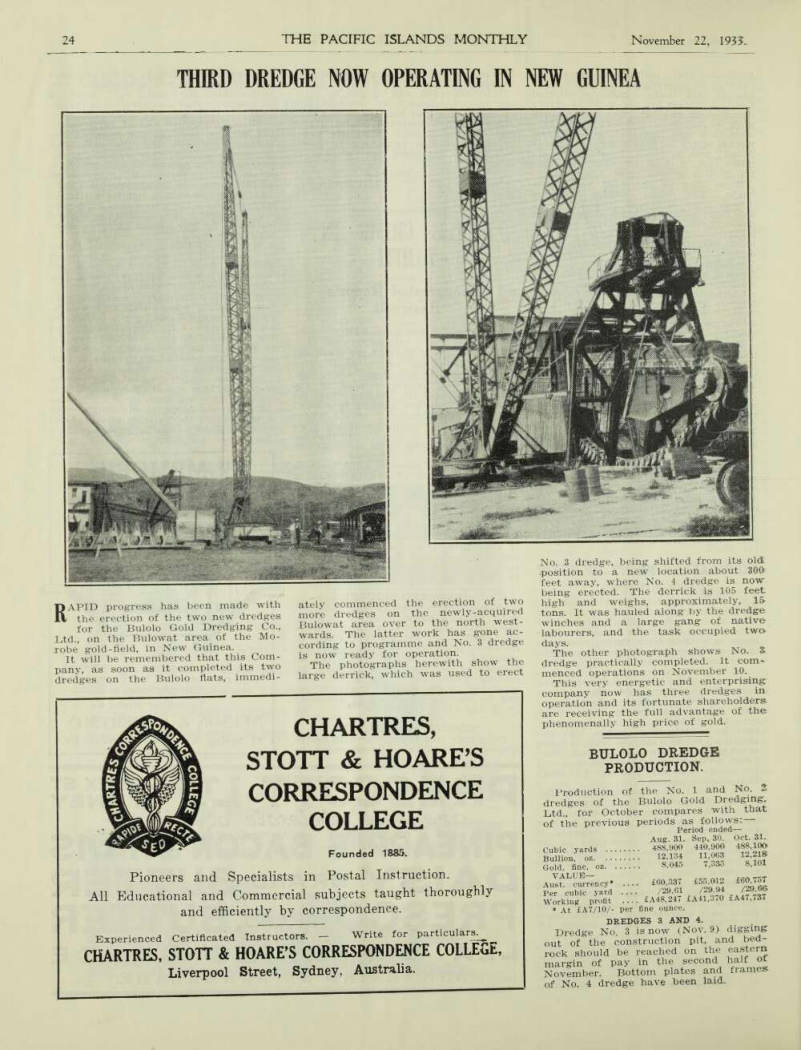
RAPID progress has been made with the erection of the two new dredges for the Bulolo Gold Dredging Co., Ltd., on the Bulowat area of the Mo robe gold-field, in New Guinea.
It will be remembered that this Com pany, as soon as it completed its two dredges on the Bulolo flats, immedi
ately commenced the erection of two more dredges on the newly-acquired Bulowat area over to the north west wards. The latter work has gone ac cording to programme and No. 3 dredge is now ready for operation.
The photographs herewith show the large derrick, which was used to erect
No. 3 dredge, being shifted from its old position to a new location about 300 feet away, where No. 4 dredge is now being erected. The derrick is 105 feet high and weighs, approximately, 15 tons. It was hauled along by the dredge winches and a large gang of native labourers, and the task occupied two days.
The other photograph shows No. 3 dredge practically completed. It commenced operations on November 10.
This very energetic and enterprising company now has three dredges in. operation and its fortunate shareholders are receiving the full advantage of the phenomenally high price of gold.
Production.
Bulolo Dredge
Production of the No. 1 and No. 2. dredges of the Bulolo Gold Dredging Ltd., for October compares with that of the previous periods as follows: Period ended — Aug. 31. Sep. 30. Oct. 31.
Cubic yards 488,900 440,900 488,100 Bullion oz. 12,134 11,063 12,218 Gold, fine, oz 8,045 7,335 8,101 Aust. currency* £60,337 £55,012 Per cubic yard ...» /29.61 /29.94 /29.6 G Working profit £A48,247 £A41,370 £A47,737 £60,757 * At £A7/10/- per fine ounce,
Dredges 3 And 4.
Dredge No. 3 is now (Nov. 9) digging out of the construction pit, and bed rock should be reached on the eastern margin of pay in the second half of November. Bottom plates and frames of No. 4 dredge have been laid.
Advertisements & other items, p. 26 (1 item)
Chartres,
STOTT & HOARE’S
CORRESPONDENCE
COLLEGE
Founded 1885.
Pioneers and Specialists in Postal Instruction.
All Educational and Commercial subjects taught thoroughly and efficiently by correspondence.
Experienced Certificated Instructors. Write for particulars.
CHARTRES, STOTT & HOARE’S CORRESPONDENCE COLLEGE,
Liverpool Street, Sydney, Australia.
“Merry Christmas,
Salamaua!”
“Queensland calling, Salamaua!”
Little city on the isthmus; Someone on the Maranoa Wishes you A Merry Christmas, Pass the rhyme—it might be better — At this festive, kindly season Cavilling about one letter Would seem neither rhyme nor reason.
Village pig is off the menu, Gone, they tell me, out of fashion; Have you yet forgotten when you Starved or “kai’d” an iron ration?
“Something nothing” was a fiver, Neither here nor there were twenty, When the 6 a.m. reviver Often was champagne in plenty.
What was mangrove swamp in those days Now, I hear, flaunts fruit and flowers; Rumour says you gather nosegays Under orange-blossom showers; That you grow sweet, scented wattles Where was formerly stagnation Since you’ve filled the swamp with bottles Emptied by our generation.
When the Kila hills are blushing As tho’ stirred by wanton fancies, And your little town is flushing ’Neath the sunset’s ardent glances, When like some dark ocean flowing O’er the sky Night’s tide comes creep ing, Think of those who did the sowing Of the harvest you are reaping.
Hostile natives, hunger, fever, Death, they faced and left behind them; Nature ne’er was known to leave her Gifts where coward souls could find them; Honour them, you folk who’re sitting At your ease as Christmas passes; Pledge them in a manner fitting, Turning down some empty glasses.
Morobe.
Queenland, 15/10/1933.
Ocean Cruises.
A Plea for Samarai.
THUS far, practically all the tourist ships which have cruised from Australian ports to Papua have called at Port Moresby. In conse quence, strong protests have been made to the shipping companies concerned.
It has been urged that, if the tourists wish to see a typical South Seas Island, there is nothing more beautiful and interesting than Samarai, at the eastern end of Papua; whereas Port Moresby, while the administrative centre, is not exactly typical of the Pacific Islands.
As a result, it is rumoured that the itinerary of some of the ocean cruises is to be changed and that Samarai will be included. Colour was given to the report by the fact that the E. and A. liner Nankin, when coming south at the end of October, lay for a whole day at Samarai, and it was believed that the officers were gathering data as to whether it was a practicable port for the luxury liners Strathaird and Strathnaver.
Motors In The South Seas
Remarkable Transformation In Last Twenty Years.
ON October 27 the s.s. “Pulpit Point,” one of the Vacuum Oil Company’s tankers, discharged the first bulk cargo into the company’s bulk installation at Suva —which, incidentally, is the first bulk petrol depot to be operated in the South Pacific Islands.
The installation has been built on newly reclaimed land at Walu Bay, and, in addition to warehouse buildings, pump house and pipe lines, will consist of three storage tanks, with a total capacity of 302,000 gallons. Plume motor spirit will be destributed by tank waggon in Suva and the surrounding district, and a drum-filling plant has been installed for supplying bulk petrol to outlying districts in Fiji, and to Samoa.
All the material for this installation has been supplied from England, Aus tralia. or local sources, and the con struction has been carried out entirely by local contractors and labour.
With the completion of this bulk in stallation the total expenditure on the South Pacific Island warehouses and plant of the Vacuum Oil Company Pty., Ltd., is estimated at more than £35,000.
Twenty years ago, the problem of providing handy supplies of motor spirit, kerosene and lubricating oils in such a vast territory as the Pacific Islands was a matter which required much enterprise and foresight. In those days, the market for these pro ducts was much smaller than it is to day, and communications were very difficult. To-day the company has branches or agencies at every import ant Island centre in the South Pacific,
The average tourist visitor to the South Seas is usually impressed by the large number of motor cars in use and, besides these, there is a big demand for petroleum products for launches, auxiliary vessels, tractors which are used on the sugar and other planta tions, and, of recent years, a very con siderable demand for aerial services.
Not only can the Islands boast of modern motoring conveniences, service stations, and kerbside pumps, but in Suva, Fiji, there are Punjabi traffic police on duty at three points in the town all day. Noumea also has its Gendarmes on traffic duty.
Of recent years many of the hard ships of Island life in the South Seas, for both the white man and the native, have been removed. A good example of this is shown in the numerous electric and kerosene refrigerator plants which may be found installed in almost every town and plantation. The former provide for the distribution of Austra lian and New Zealand frozen meat, and the latter enable the residents to keep their liquid refreshments at a suitable temperature.
Petroleum products, in one form or another, assist in every development in the Islands, and the Vacuum Oil Com pany claims to be the pioneer company in this vast region.
Leaving Sydney on December 23, the Orient Company’s vessel Orama will visit Noumea and return to Sydney on January 1, 1934.
Advertisements & other items, p. 27 (1 item)
Paton, Burns & Co.,
Repairs.
OUR HANDS MAKE GOOD ARMS’
DON’T TRIFLE WITH DOUBTFUL FIREARMS
Sil Rohu’s Expert Attention is at your Service —without obligation.
Send for my Wonderful Firearm Catalogue. 500 Illustrations and Details of the World’s Best and Reliable Makers.
“FISHING TACKLE TO TACKLE FISHING.”
The same High Standard of Quality is a feature in my new Pishing Catalogue. Specialities: Trout, Big Game, and Deep Sea Fishing.
SIL ROHU (late A.I.F.), GUNSMITH
IMPORTER OF HIGH-GRADE FIREARMS AND FISHING TACKLE SPECIALISTS, 143 ELIZABETH STREET, SYDNEY (Near Market Street).
BIG CROPS
can be depended upon from land that has been liberally fertilised with
P. B. MANURES,
The best for all purposes. Send for our Free Booklet, “RATIONAL MANURING,” it contains interesting information.
PATON, BURNS & CO.,
52 KING STREET SYDNEY.
The Banana
Interesting History of Staple Pacific Food.
Written for “The Pacific Islands Monthly” by Mr. Charles Reed, of Apia, Western Samoa.
THE banana was unknown in the days “when father was a boy.” The first banana was imported into England in December of 1878. Shortly after wards, the fruit began to arrive regu larly in England and Europe, from the Canary Islands. The fruit, however, was then seen only in the expensive shops in the West End of London.
Probably on account of its slippery skin, which funny people slip on, the banana began to find its way into the comic music hall songs, of those days, and thus was well advertised.
A British shipping firm altered the idea that the banana was merely a luxury for the rich by landing huge shipments in London, from the West Indies. These were known as the new “Jamaica Banana.” The fruit soon afterwards was sold in the streets at one penny each. It was found both agreeable and nourishing, and became very popular.
The banana is said to have been found originally in the Eastern tropics.
Its congener, the plaintain, was dis covered by the early voyagers to the Pacific, growing wild on several South Sea Islands. To-day, there are grown nearly 150 varieties of the banana.
The banana is found in most tropical and sub-tropical countries. Even in England, bananas of the Dwarf Caven dish variety have ripened quite good bunches of fruit, under glass.
Much as wheat, maize, millet and rice form the staples of many coun
tries, so the banana, together with taro and breadfruit, forms a stple vegetable food of the people of the Pacific Is lands. It is eaten ripe, baked, or boiled green, or in the form of “poi,” or pre served as “masi”. It may also be de hydrated or sun-dried, in the form of “Fig Bananas”. In this form, bananas keep for months. There is perhaps no other product that gives so great a re turn for a given area of land, as does the banana.
The sight of a ripe banana, fully a half-yard in length, is one that may be commonly seen in some of the islands.
It is the fruit of a plantain and, in Samoa, this variety is called, “Fa-i pipio”. Other plantains (usually called “bananas”) bear bunches of fruits much the same length as the well known commercial banana, but about four times the size in thickness.
One interesting kind, the “Pata,” thrives along the sandy belts of the sea coast. This fruit is triangular in shape, and of good quality.
An attractive form of indigenous plantain, in Samoa, is one that bears its fruit upright instead of pendulous.
This is the Soa’a and is notable for its bright orange-coloured fruit.
There are some twenty-five varieties of bananas and plantains (apart from the wild species) which are inedible, growing on most of the larger (or vol canic) islands in the South Seas. Usu ally, one variety only—the Pata —is suitable for the smaller, sandy, coral islands.
Many nourishing foods are prepared in the South Seas, from a combination of bananas, arrowroot and coconut cream. Here are some of them.
Banana Recipes.
Take six ripe bananas; peel and cut into half-inch lengths. Pour some boil ing water over the fruit (to keep its
colour); the bulk of the water may then be poured off again. Over the fruit, thus prepared, a boiled custard may be poured and the dish set to cool.
Very little sugar is needed. Vanilla or lemon essence to taste may be added.
In place of custard, in the South Seas, the ripe fruit is cut and boiled for three or four minutes (as above). A tablespoonful of arrowroot (dry) is then sifted in. After a couple minutes of cooking, the expressed cream from an ordinary coconut is strained through a piece of muslin and added. This dish now requires no further cooking and but very little sweetening.
Baked Banana “Joy” Custard.
Cut some ripe bananas into short lengths. Cover these with the expressed cream of coconut and sweeten to taste.
Cover with a piece of buttered paper, and bake till nicely browned. Set to cool and serve with any kind of fruit, or plain.
Banana South Sea “Poi”.
Peel some ripe bananas and cut into slices. Pour over these some boiling water to set the colour, and pour off again. Have ready the expressed cream from a grated coconut. Add this to the fruit, and then pulp together. Add a little sugar to taste —some add a squeeze of lemon. Serve in glasses, with biscuits.
Banana “Duff”.
Add one teaspoon of baking powder to one pound of flour. Mix with the expressed coconut cream to form an or dinary dough. Fold in some small, cut lengths of ripe bananas; shape like a turnover, and bake or boil.
Grants For Papua.
Request to Australia.
“I UNDERSTAND that the Prime Minister has received a wireless message asking for the restoration of the Papuan grant, as promised to the people of Papua by a previous Minister for Home and Territories,” said Mr. Wat kins, in the Federal Parliament on Oc tober 18.
“This grant was reduced from £50,000 to £34,000; but, in view of the hard ships being experienced by many planters, it should be restored. Will the Government take steps to ensure that the residents of the Territory of Papua are treated at least as liberally as those residing in territory held under man date for other nations?”
The Minister (Major Marr) replied as follows; “The grant to Papua was re duced from £40,000 to £34,000 by the present Government, the reduction from £50,000 to £40,000 having been made by a previous government. The present Gov ernment recognizes the position of the people of Papua, and is giving considera tion to the problem which confronts them, and to the suggestion that the grant should be restored to the original amount. In addtion to the grant of £34,000 last year, a grant was also made in regard to the production of rubber.
That grant has been renewed, the cur rent estimates showing an amount of £30,000 set aside for this purpose, al though, as the duty on rubber has been reduced from 4d. to 2d. per lb., the amount may need to be reduced.
Advertisements & other items, p. 28 (1 item)
Fitzroy Luncheon Beef All Brisket
FIRST
IN 1868
SPICED, CORNED, ROAST
& BOILED BEEF
AND IN MUTTON
IN 12oz., 1lb., 2 lb., 3lb., 4lb., 5lb., & 6lb. ROUND
CANS AND IN TAPERS
FITZROY
SHEEP
TONGUES
BEEF, OXFORD, CAMBRIDGE & PORK SAUSAGES
FITZROY LUNCHEON BEEF ALL BRISKET
THE ORIGINAL. PACK IN A CLASS BY ITSELF!
Cured & matured in cold pickle from a recipe a century old
ALSO THE FAMOUS
HAMPER MEATS
IN ROUND AND TAPER CANS 12oz. 24oz. & 6 lbs.
SPECIALLY PACKED FOR THE ISLAND TRADE
SEND FOP PRICE LIST - NO EXTRA FOR ASSORTMENT The CENTRAL QUEENSLAND MEAT EXPORT CO. LTD.
LAKES CREEK - ROCKHAMPTON
CABLE ADDRESS:- TOMOANA ROCKHAMPTON.
Sensation-mongers.
Japan In The Pacific.
A Little Sane Reasoning to Offset Sensation-mongers.
A NEW angle on the questions involved in the balance of power in the Pa cific, and the future plans of Japan, is presented by Mr. M. H. Ellis, in a short book outlining the defence position of Australia. While he admits the weak nesses of Imperial defence, he seeks to place actual facts in their true perspec tive and divested of sensationalism.
On the naval side he points out that Japan, which is the bugbear of the alarmists, is still in such a position that she could not attack Australia without, at the same time, fighting the whole British Empire, America and France, since any attack south of the equator or any breach of the Four-Power Treaty of 1922, which forbade the fortification of the Japanese mandate, would undoubt edly involve her in hostilities with the Great Powers mentioned. Furthermore, unless she could secure herself against attack by Russia and China, she could not afford to risk aggression so far from her bases. He outlines her foreign policy and shows that developments which the more sensational press has recently ad vertised as something new—such as the use of Bonin as a naval depot—took place initially as much as ten years ago.
In the event of actual war, he says, Britain could outbuild Japan six to one, and he instances the fact that in a single war year she completed eight capital battleships—nearly equal to the whole of Japan’s existing capital-ship navy; while he seeks to prove that,
without an enormous excess of cruiser strength, Japan could not defend her own trade routes, much less menace those of Britain.
Further, he points out that sea trans port, which would be vital to Japan in any war, does not exist in sufficient quantities for her uses. She has only 19 mercantile ships over 10,000 tons — the largest is 17,000 tons. To carry a force of 100,000 to invade Australia, to gether with requisite arms, she would need the whole of her mercantile marine, and, if she used it, she could not feed herself.
At the same time, the author does not cloak the alarming position in which the British and Australian navies may find themselves after 1936, unless a specific future programme of capital and cruiser shipbuilding is formulated, and unless the menace involved in the development of new German types of far-range light battleships is countered and guarded against.
The book presents Australia’s defence needs and the Pacific situation in their right perspective without cloaking weaknesses, but, at the same time, with out panic-mongering. It contains a wealth of official facts and figures woven into a readable and entertaining text. (Our copy from the Endeavour Press, Sydney; Is. 6d.) The P. & O. liner Mongolia will leave Sydney with a party of tourists for Noumea, New Caledonia, on January 13, 1934. The return voyage will be made via Norfolk Island and Lord Howe Island.
“Phenomenal!”
Efficiency of N.G. Aerial Services.
AN eminent international engineer who visited New Guinea last year has illustrated the efficiency of the aerial services in a letter to the Aus tralian controller of civil aviation (Captain Johnson).
“My outstanding impression,” says the engineer, “is one of amazement at the efficiency and adequacy of the ser vices, completely overshadowing any analagous accomplishment I have seen or known in any other part of the world.
“Freedom from accidents to passen gers and from either loss or damage to goods in transit is phenomenal. I understand that to date no passenger has been injured, although the entire white population of the region has gone in by ’plane, and most of them are frequent users of the ’plane service.
“An official having knowledge of the details regarding the thousands of tons cf freight carried from the seaboard by ’plane told me that the aggregate loss plus damage suffered thereby was considerably less than that from the mere transfer from ship to dockside at the ports—and this official was not connected with the air companies in any way.”
The steamer Alynbank (5,151 tons), while proceeding to Wellington from Suva early in November, broke her tail shaft, and returned to Suva for re pairs. It was estimated that it would take a fortnight to effect repairs.
Advertisements & other items, p. 29 (1 item)
City Convenience For Island Homes
Here's Automatic Refrigeration
for every Homestead with an “OMNISTAT”-controlled
running Petrol Engine.
The convenience, comfort and economy of automatic electric refrigeration can be yours even if you have no electric current supply, or have a lighting plant already fully loaded. For the past two summers OMNISTAT - controlled refrigerating plants, driven by water-cooled petrol engines, have been giving trouble-free service in N.S.W. and Queensland. The engine is started automatically whenever the temperature in the cool-room rises above a predetermined safepoint, and is stopped again when the temperature has been sufficiently reduced.
Write to-day for full particulars and orices, free of Australian Customs Duty.
DANGAR, GEDYE & CO.
LTD.
10-14 YOUNG STREET, SYDNEY.
Charge Of Libel.
Tahiti Resident and Islands Book.
From Our Own Correspondent.
Tahiti, Oct. 10.
IT may be of interest to literary men, and to publishers in particular, to learn that the author of the recent book “Islands Under the Wind,” Mr.
Hasholt Davis, and his publishers, the Longmans Green Co., are being sued for libel by Mr. John R. Farnham, of Pa peete and Moorea, on account of certain statements made about him in that book.
Suit is being brought locally against Mr. Davis for 100,000 francs damages, and the hearing, which was set for Sep tember 29, has been postponed on plea of defendant’s counsel until November 3, 1933. The proceedings against the publishers are being prosecuted by Mr.
Farnham’s attorneys in the United States.
Administration.
Psychology In Relation To Native
By Arthur J. Vogan, F.R.G.S.
“Only when genius is married to science can the highest results be produced.” —Herbert Spencer.
IT is seldom that a great and wise man receives in his life-time the general acclamation of appreciation that has been accorded to Sir J. H. P. Murray.
The uniquely splendid success of His Excellency’s rule in polyglot Papua, has not only done much to remove the stain upon careless Australia’s escutcheon, over the horrible happenings to her de fenceless aboriginal populations of the red ’eighties, but it has shown the world what can be done with the mentally childish and primitive peoples, whom the more advanced nations have grabbed to their bosoms in greedy race for com mercial supremacy The Murray regime is now quoted by writers in both hemispheres, and the only cloud in the picture is the question: “Who can wear the mantle when the Chief lays it down?”
Like a Shakespeare, a Darwin, a Luther, or a Mussolini, the mise-en scene created by a particular kind of genius who arrives, as if sent, to in augurate a new stage in the upward trend of human affairs, will be an ex tremely difficult one to sustain; and no mere strong-jawed, political pet of an ephemeral democratic government will fit the throne where creative intellect once sat.
Yet, knowing this, how few nave asked themselves: “What was the secret of Sir Hubert’s great success?” I am old enough to remember the renaissance ot German commercial burgeoning, after a long period of political suppression, and I can recall a similar question being asked in England. Germany’s rapid advance as regards her secondary in dustries was under exact, and scientific direction, and the manufacturers of my natal-land had to awaken from the tor per of placid, non-competitive, rule-of thumb methods, and reach around for what was available of systematic and formulated knowledge. The Lieut- Governor has done exactly this for Papua—exactly what the manufacturer was forced to do by foreign competition and up-to-date exigencies.
This recognition of the educational and control value of Anthropology and Archaeology, at a long last, comes grate fully to those who have devoted a life time to studies not yet quite “under
standed of the people.” Instead of using a “Black-police” force, as in Queens land, to settle the Native Question by exterminating the native subjects of the Crown, Sir Hubert consulted his well filled library, and that brave and skilful government-anthropologist, Mr. F. E Williams —learning to avoid what might needlessly irritate the potential citizens of a new and educated community— added to the Kingdom’s moral and com mercial strength.
Those who have studied Rarey’s, or Sample’s methods of horse-training (“breaking” is the slovenly and stupid method of ignorant folk:) know what a delight to ride such steeds was. No bit required (as in Roman days), no shy ing, no bad-temper, and no tricks! The scientific treatment of our dark-skinned brethren —whose forebears we now know were ours, also, in great measure —is just that which Christian folks long ago recognised was best —hence missionary endeavour! But knowledge, instead of guess-work and emotional enthusiasms, is rendering the work of cultivating the virgin-soil of so called savagedom more in accordance with our increased ac quaintance with the laws of mental con ditions.
Anthropology, and in particular that branch of science known as pre-his toric archaeology, as the great Fallaize points out, is a study of recent growth.
A hundred years ago the discoveries at Kent’s Cavern, Torquay, began to raise doubts, in thinking minds, whether the orthodox view of the space of Man’s sojourn upon earth (five thousand years
Pacific Curios.
Wanted To Purchase.
The Editor of the “Pacific Islands Monthly” has been asked by Overseas Museums for Introductions to Sellers of Old Specimens of Pacific Islands Native Arts and Crafts, for Museum Use.
It is emphasised that no Spears, Bows and Arrows, or “Junk” of any description will be considered only first-class pieces of undoubted authenticity.
An English Museum asks particularly to be “put in touch with any old traders who might wish to realise on genuine old Curios collected in the South Seas.”
Write, in first place, to
The Editor,
“Pacific Islands Monthly,”
P.O. Box 3408 R, Sydney,
giving full details.
Letters will be sorted out and, where desirable, sent to the Museums in terested, and the latter will be asked to write direct to the persons concerned.
or so!) was beyond question. And about the time when Darwin’s “Origin of Species” (1859) appeared—on that aus picious day when the writer of this article was also “published” to an un grateful world—a change from the static to a dynamic view of the problems of human origins, and human capacities made possible a humane, and scientific method in their study. We now are able, through scientific writers, to recog nise that Mind is one aspect of that unique kind of activity which we call Life.
Perhaps there is no bodily activity that is not in some degree “thrilled with mind” —as one author ably puts it.
There are times when the bodily activity is more in evidence than mental, and other times the mind rules supreme.
Civilisation is nothing more or less than the rule of the Mind-body obtaining: taking the place of the Body-mind.
Whatever lowers preponderating in fluence of the Mind-body over the Body mind is “a cowardly and traitorous suc cumbing” (as John Wesley puts it) to that animalism which our forebears overcame painfully, leaving us “heirs of progress” to protect the dear-won vic tory. ‘‘It is one of the delights of Natural History” (wrote Professor Arthur Thom son in his entrancing “Minds of Ani mals”) to follow the growing freedom of the mind through all the “spires of form,’ from worm to man.” The Mind did not suddenly appear, as a bolt from the blue, in Man —or in some special breed of man. Evolutionists (and who is not one to-day?) regard all becoming as a process in which each stage emerges naturally out of its antecedent stage, without intrusion or impulses, or forces from without.
Except in overwhelming self-conceit, is Man so very much advanced above the Animal Kingdom, whence he compara tively recently emerged, or rather strayed. The eel had electricity before him, the fire-fly still beats him with an artificial light which is cold; the silk worm was before him in its special line.
The wasp made paper before Man was dreamed of; even the dandelion knew all about parachutes, millions of years Spiders sailed on silken aeroplanes be fore the Cus-Cus, or his cousins, de termined to change into a tail-less crea ture that was content to play golf or bridge whilst others provided it with food. Caddis-worms made nets ere history began; and termites built huge houses; “water-boatmen” used oars, and beavers built dams ere our time to ap pear had arrived.
Civilisation after civilisation has arisen to grow mushroom-shaped and top-heavy with Knowledge which was not Wisdom, and Power that was not Righteous Rule; and the crashing downfall due in most cases because the few blessed with “Mind-body” neglected to strengthen the supports of the structure by bringing in to the civilised centre the half-animal mass of the populations.
Ere I last left Samarai, I saw a fine house being built which was designed, and contracted for, and carried out in every detail —electric-light and garden design, etc. —by brown-men, trained in that most admirable of ail Mission sta tions that I have yet visited personally, that of Kwato—over which that wonderful woman, Miss Phyllis Abel, daughter of the great Missionary of that name, has control. These artificers are sons of “Fathers of war-proof,” as dear old Bill put it, who the ‘‘mere savages” of disgustful Pacific travellers
a few years ago. We need only turn to the pages of Miss Dorothy George’s “London Life in the Eighteenth Cen tury,” or have visited the old Inquisition torture-chambers of Holland, to understand that the “savage” brown man and the pseudo-civilised white-man are (as Kipling remarked) uncommonly alike in Body-mind until some Murray genius puts us in the way of acquir ing Mind-body and the control of our “Animalisms” inherited from the com mon ancestors of both.
Advertisements & other items, p. 30 (1 item)
Gillespie’S
"ANCHOR”
FLOUR
TRADE
MARK
The Standard of Quality.
SHIP CHANDLERY - HARDWARE
BROOMFIELDS LIMITED, 152 Sussex St., SYDNEY.
Large and Complete Stocks of SHIP CHANDLERY.
Ironmongery of all kinds. Paints, White Lead and Oils.
Sole Agents for P. H MUNTZ & CO.’S 3-CROWN BRAND METAL SHEATHING.
PEACOCK & BUCHANS’ ENGLISH READY - MIXED PAINTS.
WRITE FOR SHIP CHANDLERY CATALOGUE.
Special “In Bond” Prices for all Island enquiries quoted on application,
CABLES: “BOOM,” SYDNEY.
N.G. Public Service.
The following alterations in the New Guinea Public Service have been notified:
Permanent Staff.
Promotions.
E. C. McDonald, D. H, Vertigan, and K. C. McMullen, Patrol Officers, to be Assistant District Officers.
R. F. Armstrong, Medical Assistant, Grade 2, to be Medical Assistant, Grade 3.
A. H. Ross and A. F, Kyle, to be Acting Assistant District Officers.
Transfers.
E. W. Oakley, District Officer, from Rabaul to Manus.
R. M. Farlow, Patrol Officer, from Rabaul to Kokopo.
L. C. Corfe, Senior Clerk, from Rabaul to Kokopo.
J. W. Smith, Clerk, from Rabaul to Madang.
R. C. Chugg, Medical Assistant, from Madang to Rabaul.
C. W. Lambert, Medical Assistant, from Rabaul to Madang.
R. F. Armstrong, Medical Assistant, from Rabaul to Talasea.
R. C. Chugg, Medical Assistant, from Rabaul to Kokopo.
Temporary Employees.
Appointments.
J. A. Tomkinson, to be Agriculture Assistant (Keravat).
B. W. Storey, to be Schooner Engi neer.
Gold Industry.
Review Of N. Guinea
A Valuable Book.
A work of value to the historian, which will also be found indispensable by anyone who requires a practical knowledge of the present condition of the New Guinea goldfields, is “The De velopment of Gold Mining in Morobe, New Guinea,” by Harold Taylour and I. W. Morley. Mr. Taylour is the well known Mining Warden on Morobe field, and Mr. Morley is also a well-known engineer.
The book has been very carefully compiled, and it embraces the follow ing sections: history of the discovery and production of gold in Morobe, New Guinea; the geography and geology of the field, including topography, rain fall, climate, communications, timber, rock types, glacial and alluvial de posits; outline of legislation affecting the field up to the end of 1932; de scription of labour available; descrip tion of mining practices employed on the various sections of the field and by the various companies; indication of the motive power and classes of transportation available; and an out line of the present status of the gold industry in New Guinea.
In addition, there are included in the book a large number of valuable photographs, a bibliography which gives an indication of the available literature dealing with the field, and the most complete and detailed map cf the Morobe goldfield which we have yet seen.
Our copy of this book, which no man interested in the New Guinea gold in dustry can afford to be without, was obtained from the publishers, the Australian Institute of Mining and Metallurgy, and is a reprint of papers supplied to the Institute by the authors named above.
Advertisements & other items, p. 31 (1 item)
Barker College, Hornsby
(Established 1890.)
DAY AND BOARDING SCHOOL FOR BOYS.
Chairman of Council; Mr. Justice BOYCE.
KINDERGARTEN TO LEAVING CERTIFICATE HONOURS.
620 ft. above sea level; 13 miles from G.P.O., Sydney.
Own cows, poultry and vegetables.
War Memorial Oval; 20 acres of ground.
Gymnasium. : Tennis Courts. : Equipped with “Talkies.”
Swimming Baths ready February.
Classrooms centrally heated in winter.
Illustrated Prospectus on application to
W. S. LESLIE, M.A.
Headmaster.
Travel By ?
Officials On Leave.
What Steamers May They Travel By ?
THERE was more than met the eye be hind this question, asked in the Aus tralian Parliament by Senator Dunn (Lang Labour) on October 19: “Will the Minister take steps to stop the practice of Federal Government ser vants employed in Papua and the Man dated Territory returning to Australia on leave in foreign sea-going vessels, while Australian vessels, manned with white crews, are in commission and operating under mail grants from the Federal Government?”
The Minister (Sir George Pearce) re plied: “It is considered that where fares are paid wholly by officers there is no justification for limiting their choice of means of transport. The matter is, how ever, being brought to the notice of the two administrations for consideration in connection with assistance granted to
officers towards the cost of fares when proceeding on recreation leave of ab sence.”
Editorial Note.
The question, of course, was inspired by one of the maritime labour unions; and it may interest the Senator to know that the main reason why officials from Rabaul travel by the E. and A. Line to Australia, instead of by Burns Philp steamers, is a condition imposed by trade unionism.
Officials in the tropics are accustomed to dining in comfort after seven o’clock —the nearer the meal to 8 p.m. the cooler and pleasanter it is. On the E. and A. Line, passengers are served with dinner at the civilised hour to which they are accustomed. On the Burns Philp steamers, where Australian trade union conditions are imposed on a help less directorate, passengers are driven in to dinner at 6 p.m.; and if they linger in the smoke-room for even ten minutes —-which they are very prone to do at that ungodly hour —an irate steward comes and bashes a gong at them.
This writer travelled recently on the well-found and comfortable “Macdhui,” and the foregoing was his experience. He heard a score of fellow-travellers declare that they would always travel E. and A. where they could, because of this trade-union tyranny regarding meal times. The stewards, for the most part, were excellent, well-trained men, who acknowledged the absurdity of the sys tem; but they were victims of it, just as much as the passengers.
The Burns Philp Company does every thing in its power to provide a comfort able transport service; but it cannot control trade unions. That is left to the loud-mouthed demagogues, of the type who destroyed the Commonwealth Line of steamers, and ask silly questions in Parliament.
The French sloop Aldebaran arrived in Suva, Fiji, from Papeete, Tahiti, via Wallis Island on October 13. The sloop sailed for New Caledonia on October 17, and arrived in Sydney on November 10.
Promising Field.
Misima’S Gold.
Pratten Interests Enter Promising Field.
THERE have been interesting developments in connection with gold mining operations on Misima Island, Eastern Papua.
Some two years ago, a company called Misima Options, Limited, was formed to take over certain leases on Misima Island from Mount Sisa, Limited. The latter company was believed to hold very good country, but it had come through a period of financial stress and storm, and was not popular among in vestors. Misima Options, Ltd., met the full blast of the depression, and was not able to carry out its original plan. It subscribed some £8,000 or £9,000, however, with which it did a good deal of testing. Being unable to take over its options, it made a working agreement with Mount Sisa, Ltd., under which the two concerns jointly investigated and to an extent worked the leases. About four small lots of gold were recovered in recent months.
It became apparent, this year, that the two companies, either separately or jointly, had not the funds to work these leases in the only way in which they could be made profitable—that is, on a large scale. It was also apparent that, properly handled, this might become a very valuable property.
Negotiations took place, as a result of which it has been announced that the joint interests of Misima Options, Ltd., and Mount Sisa, Ltd., are to be taken over immediately by a newly registered concern, Umuna Lodes No Liability. The latter is making ar rangements for the thorough testing of the leases by New Guinea Alluvial Gold, Ltd., which is to employ diamond-drill ing methods, and spend some £10,000 on the job. The announcement of the fact that Umuna Lodes is practically a Pratten concern has caused a marked rush for shares in the new company; and it looks as if Misima Options and Mount Sisa shareholders, whose pros pects a few months ago were definitely blue, will tasts a sweet profit after all.
The Pratten interests have made a very thorough investigation in Misima Island, and are reported to be satisfied that there is substantial gold in the leases under notice. As soon as this is proved, Umuna Lodes is to turn the con cern over to a new company with big capital.
There are two other mining concerns now located on Misima the company operated by Messrs. Cuthbert and Wil kinson, which continues to produce very profitably, and a new organisation called Misima Gold Reefs N.L., which has been fully subscribed. The field has had rather more than its share of wild cats, but the gold is there, and the advent of the Pratten group may mean the establishment of a valuable industry on Misima.
Misima Gold Reefs (New Guinea) N.L., has been fully subscribed. The directors are Messrs. W. Langlands Jack (chairman), W. McGregor, P.
Day, W. Blewett, and Dr. C. Fyffe.
Mr. J. A. Miller is reported to have gone to Misima Island to equip the camp and prepare for the Company’s engineer (Mr. Stuart Love).
Advertisements & other items, p. 32 (1 item)
Flour
Delicia
Food Products
PURE MALT VINEGAR
TOMATO SAUCE
JELLY CRYSTALS
PURE FLAVOURING
ESSENCE
CHUTNEY
BAKED BEANS with Pork, in Tomato Sauce SPAGHETTI in Tomato Sauce.
Delicia Food Products Co.
DANKS ST., WATERLOO,
N.S.W.
Flour
ESTABLISHED 1868.
Anthropologist.
Population Problems.
Useful Book By Official Anthropologist.
A valuable contribution to the study of the welfare of the native races of the Pacific has come to hand in a new book by Mr. F. E. Williams, M.A., who is well known as the official anthropologist of the Papuan Administration.
Sir Hubert Murray (Lieutenant- Governor of Papua) has gained an en viable world-wide reputation as a successful tropical Administrator; and Sir Hubert is the first to ascribe his success to the admirable service he has always received from his responsible officials. From no member of his expert staff has he received greater help than from Mr. Williams, who has brought to his study of the native peoples a broad sympathy and deep understanding, as well as exact scientific knowledge. The value of anthropological knowledge is very clearly recognised in these days of Administrators in control of primitive peoples; and in no part of the world has this scientific data been more suc cessfully applied than in Papua.
Much of the credit of this must go to the careful, painstaking and scholarly work of Mr. Williams.
The book referred to is entitled “Population and Education in Papua” and consists of two lengthy papers prepared by Mr. Williams in connec tion with his work—“ The Depopula tion of the Suau District” and “Prac tical Education: The Reform of Native Horticulture.”
Mr. Williams, in the first section, deals with special problems that he has found in the decrease of popula tion in the eastern end of Papua, in a comparatively small district at the south-eastern tip of the mainland. Mr.
Williams has very carefully investi gated a score of probable and possible causes of depopulation, both physical and psychological; and, arguing from the particular to the general, he has submitted a number of useful and in teresting theories dealing with ques tions affecting the native population generally. It is safe to say that no person concerned with native problems in this part of the world, be he admin istrator or scientist, can afford to be without Mr. Williams’s book.
The subject of providing food for the native community is necessarily closely linked with that of population in creases or decreases; and Mr. Williams advances some very valuable data and theories concerning the manner in which age-old practices in horticul ture have been modified by contact with European civilisation. Mr. Wil liams takes the view that it is desir able that new methods of horticulture be introduced among the native peoples, to take the place of practices which have been superseded. But, as an experienced anthropologist, who recognises how difficult it is to alter the habits of these primitive peoples without destroying communal virility, the author advances his theories and arguments very cautiously. His idea of inaugurating a special system of im parting horticultural knowledge to the Papuan is extremely interesting and may be studied with advantage by
everyone interested in Pacific adminis tration.
The book is beautifully printed and bound, and is a creditable product of the Government Printing Office, Port Moresby, from which our copy was re ceived.
The White Man’S
“Paper.”
And the Village Constable.
THE faith of the savage Papuan in a piece of the White Man’s “Paper” is only equalled by the naive way in which he presents unsigned or stolen cheques for payment at a bank. His credulity would command sympathy were it not for the invariable roguery underneath.
Some time ago, a recruiter visited a remote village, up the Fly River, and was met on arrival by the village con stable, who appeared to have some important business to transact with the new-comer.
From his pouch he produced a mysterious wad, wrapped in a piece of rag. This was unfolded, to display more and more rag, till finally a dirty bit of paper was disclosed and handed over.
“Two bag flour and twelve tins meat,” quoth the village constable.
"Nothing doing!” was the answer.
“What for? I give you piece of paper.”
“Too right, you did! Take it to Woodlark!”
The document was a five-years old order from a miner down at the other end of the Territory, authorising the delivery of the goods to his boy. The slip had been stolen, and, quite pos sibly had changed hands for a trifle many times before it reached the Fly, To the Papuan mind, “once an order, always an order” may be a fixed idea: but it was rudely shaken, that day, and village constables up the Fly may fight shy in future of buying “Papers” from returned labourers.
Invalids.
N.I. For Tourists And
From Our Own Correspondent.
Norfolk Is., Nov. 7.
EFFORTS are being made by the local Tourist Bureau to stress the fact overseas that Norfolk Island is almost ideal for invalids and convalescents; and in this connection it is worthy to note that, in addition to our other medical and hospital facilities, we now have a fully qualified masseuse and medical electrician who for four recent years practised at Rotorua (N.Z.) at the Government Bath House and the King George Fifth Hospital, for the relief of rheumatism, nervous disorders, frac tures, etc.
Less fortunate islands, situated in the Pacific, will also envy Norfolk its com plete freedom from snakes, mosquitoes and other pests that threaten health and
Advertisements & other items, p. 33 (1 item)
Burns, Philp
BIRKMYRE’S
WATERPROOF CANVAS.
The Original and Best for all purposes' where a thoroughly waterproof covering is required.
SAILCLOTHS, DUCKS, ETC.,
of FLAX, HBMP AND COTTON.
FISHING NETS,
LINES & TWINES.
Extensive Stocks carried, Ensuring prompt despatch.
THE
GOUROCK £ CO. LTD.
397 KENT ST., SYDNEY, N.S.W.
BURNS, PHILP
(South Sea) Co. Ltd.
Island Traders 8C Shipowners Registered Office: Suva, Fiji.
Also Branches at Fiji. Levuka, Lautoka, Labasa, Ba, Sigatoka, Rotumah.
Tonga: Nukualofa, Haapai, Vavau.
Samoa: Apia, Pago Pago (American Samoa).
Solomons: Makambo, Gizo, Faisi.
New Hebrides: Vila.
Gilberts: Tarawa.
Norfolk Island. Nauru. Niue.
Code Address: 4 "Burnsouth."
Radio-Station Servants
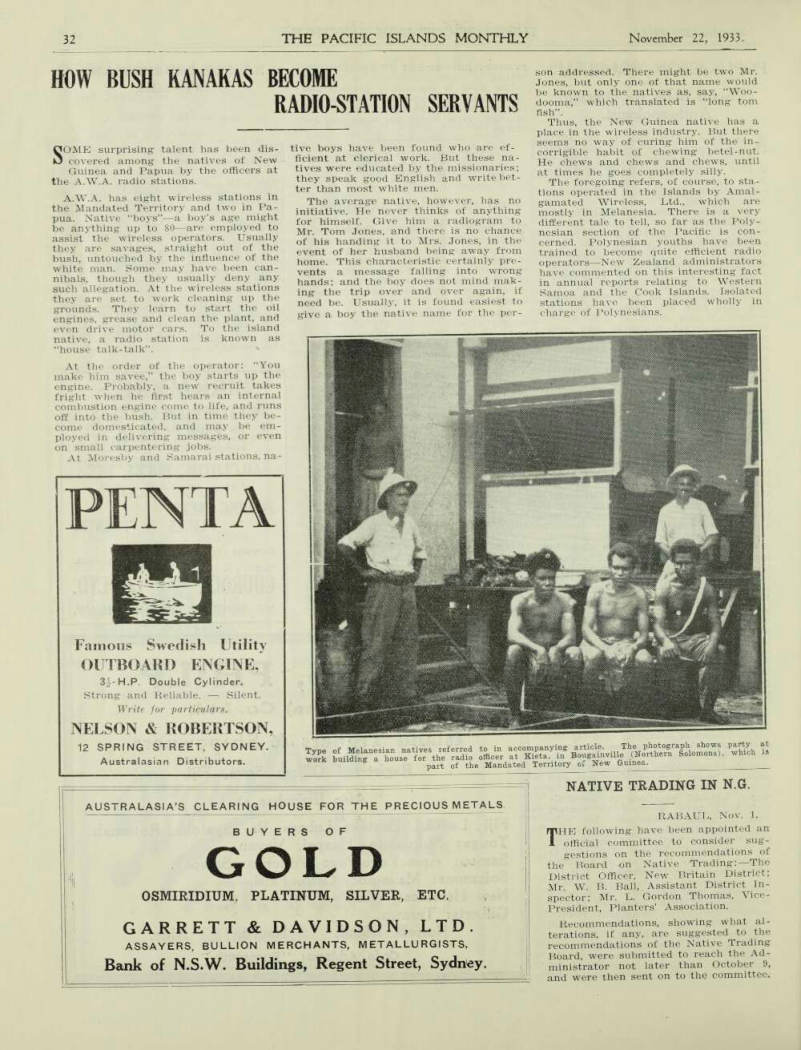
How Bush Kanakas Become
SOME surprising talent has been dis covered among the natives of New Guinea and Papua by the officers at the A.W.A. radio stations.
A.W.A. has eight wireless stations in the Mandated Territory and two in Pa pua. Native “boys”—a boy’s age might be anything up to 80 —are employed to assist the wireless operators. Usually they are savages, straight out of the bush, untouched by the influence of the white man. Some may have been can nibals, though they usually deny any such allegation. At the wireless stations they are set to work cleaning up the grounds. They learn to start the oil engines, grease and clean the plant, and even drive motor cars. To the island native, a radio station is known as “house talk-talk”.
At the order of the operator: “You make him savee,” the boy starts up the engine. Probably, a new recruit takes fright when he first hears an internal combustion engine come to life, and runs off into the bush. But in time they be come domesticated, and may be em ployed in delivering messages, or even on small carpentering jobs.
At Moresby and Samarai stations, na
tive boys have been found who are ef ficient at clerical work. But these na tives were educated by the missionaries; they speak good English and write bet ter than most white men.
The average native, however, has no initiative. He never thinks of anything for himself. Give him a radiogram to Mr. Tom Jones, and there is no chance of his handing it to Mrs. Jones, in the event of her husband being away from home. This characteristic certainly pre vents a message falling into wrong hands; and the boy does not mind mak ing the trip over and over again, if need be. Usually, it is found easiest to give a boy the native name for the per
son addressed. There might be two Mr.
Jones, but only one of that name would be known to the natives as, say, “Woo dooma,” which translated is “long tom fish”.
Thus, the New Guinea native has a place in the wireless industry. But there seems no way of curing him of the in corrigible habit of chewing betel-nut.
He chews and chews and chews, until at times he goes completely silly.
The foregoing refers, of course, to sta tions operated in the Islands by Amal gamated Wireless, Ltd., which are mostly in Melanesia. There is a very different tale to tell, so far as the Poly nesian section of the Pacific is con cerned. Polynesian youths have been trained to become quite efficient radio operators—New Zealand administrators have commented on this interesting fact in annual reports relating to Western Samoa and the Cook Islands. Isolated stations have been placed wholly in charge of Polynesians.
Type of Melanesian natives referred ot in accompanying article. The photograph shows party at work building a house for the radio officer at Kieta, in Bougainvillw (Nothern Solomons), which is part of the Mandated Territory of New Guinea.
Native Trading In N.G.
Rabaul, Nov. 1.
THE following have been appointed an official committee to consider sug gestions on the recommendations of the Board on Native Trading-:—The District Officer, New Britain District; Mr. W. B. Ball, Assistant District In spector; Mr. L. Gordon Thomas, Vice- President, Planters’ Association.
Recommendations, showing what alterations, if any, are suggested to the recommendations of the Native Trading Board, were submitted to reach the Ad ministrator not later than October 9, and were then sent on to the committee.
Advertisements & other items, p. 34 (1 item)
Penta
Famous Swedish Utility
OUTBOARD ENGINE,
Double Cylinder.
Strong and Reliable. Silent.
Write for 'particulars.
NELSON & ROBERTSON,
12 SPRING STREET, SYDNEY.
Australasian Distributors.
AUSTRALASIA’S CLEARING HOUSE FOR THE PRECIOUS METALS
BUYERS OF
GOLD
OSMIRIDIUM. PLATINUM, SILVER, ETC.
GARRETT & DAVIDSON, LTD.
ASSAYERS, BULLION MERCHANTS, METALLURGISTS,
Bank of N.S.W. Buildings, Regent Street, Sydney.
New Hebrides.
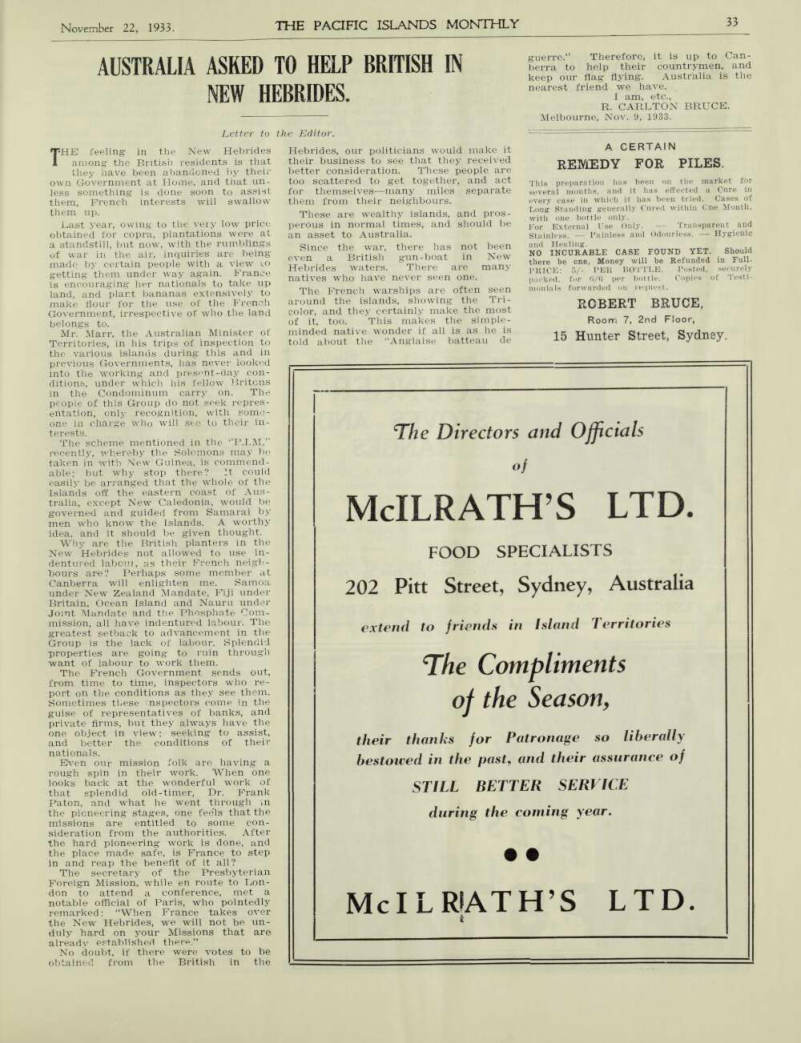
Australia Asked To Help British In
Letter to the Editor.
THE feeling in the New Hebrides among the British residents is that they have been abandoned by their own Government at Home, and that un less something is done soon to assist them, French interests will swallow them up.
East year, owing to the very low price obtained for copra, plantations were at a standstill, but now, with the rumblings of war in the air, inquiries are being made by certain people with a view 10 getting them under way again. France is encouraging her nationals to take up land, and plant bananas extensively to make flour for the use of the French Government, irrespective of who the land belongs to.
Mr. Marr, the Australian Minister of Territories, in his trips of inspection to the various islands during this and in previous Governments, has never looked into the working and present-day con ditions, under which his fellow Britons in the Condominum carry on. The people of this Group do not seek repres entation, only recognition, with some one in charge who will see to their in terests.
The scheme mentioned in the “P.I.M.” recently, whereby the Solomons may be taken in with New Guinea, is commend able; but why stop there? It could easily be arranged that the whole of the Islands off the eastern coast of Aus tralia, except New Caledonia, would be governed and guided from Samarai by men who know the Islands. A worthy idea, and it should be given thought.
Why are the British planters in the New Hebrides not allowed to use in dentured labour, as their French neigh bours are? Perhaps some member at Canberra will enlighten me. Samoa under New Zealand Mandate, Fiji under Britain, Ocean Island and Nauru under Joint Mandate and the Phosphate Com mission, all have indentured labour. The greatest setback to advancement in the Group is the lack of labour. Splendid properties are going to ruin through want of labour to work them.
The French Government sends out, from time to time, inspectors who re port on the conditions as they see them.
Sometimes these inspectors come in the guise of representatives of banks, and private firms, but they always have the one object in view: seeking to assist, and better the conditions of their nationals.
Even our mission folk are having a rough spin in their work. When one looks back at the wonderful work of that splendid old-timer, Dr. Frank Paton, and what he went through in the pioneering stages, one feels that the missions are entitled to some con sideration from the authorities. After the hard pioneering work is done, and the place made safe, is France to step in and reap the benefit of it all?
The secretary of the Presbyterian Foreign Mission, while en route to Lon don to attend a conference, met a notable official of Paris, who pointedly remarked: “When France takes over the New Hebrides, we will not be un duly hard on your Missions that are already established there.”
No doubt, if there were votes to be obtained from the British in the
Hebrides, our politicians would make it their business to see that they received better consideration. These people are too scattered to get together, and act for themselves—many miles separate them from their neighbours.
These are wealthy islands, and pros perous in normal times, and should be an asset to Australia.
Since the war, there has not been even a British gun-boat in New Hebrides waters. There are many natives who have never seen one.
The French warships are often seen around the islands, showing the Tri color, and they certainly make the most of it, too. This makes the simple minded native wonder if all is as he is told about the “Anglaise batteau de
guerre.” Therefore, it is up to Can berra to help their countrymen, and keep our flag flying. Australia is the nearest friend we have, I am, etc.,
R. Carlton Bruce.
Melbourne, Nov. 9, 1933.
Advertisements & other items, p. 35 (1 item)
The Compliments
A CERTAIN
REMEDY FOR PILES.
This preparation has been on the market for several months, and it has effected a Cure in every case in which it has been tried. Cases of Long Standing generally Cured within Cue Month, with one bottle only.
For External Use Only. Transparent and Stainless. Painless and Odourless. Hygienic and Healing.
NO INCURABLE CASE FOUND YET. Should
there be one, Money will be Refunded in Full.
PRICE: 5/- PER BOTTLE. Posted, securely packed, for 6/6 per bottle. Copies of Testimonials forwarded on request.
ROBERT BRUCE,
Room 7, 2nd Floor,
15 Hunter Street, Sydney.
The Directors and Officials of
McILRATH’S LTD.
FOOD SPECIALISTS
202 Pitt Street, Sydney, Australia extend to friends in Island Territories
The Compliments
of the Season,
their thanks for Patronage so liberally bestowed in the past , and their assurance of
STILL BETTER SERVICE
during the coming year.
McILRATH’S LTD.
New Guinea Notes.
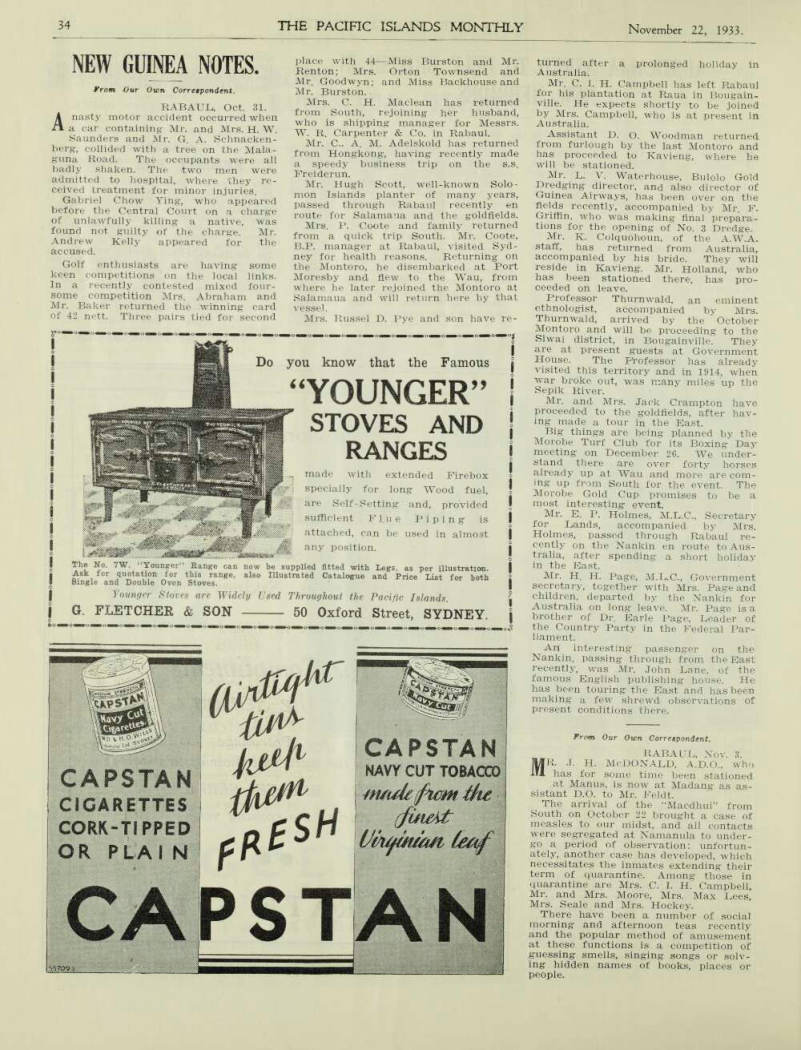
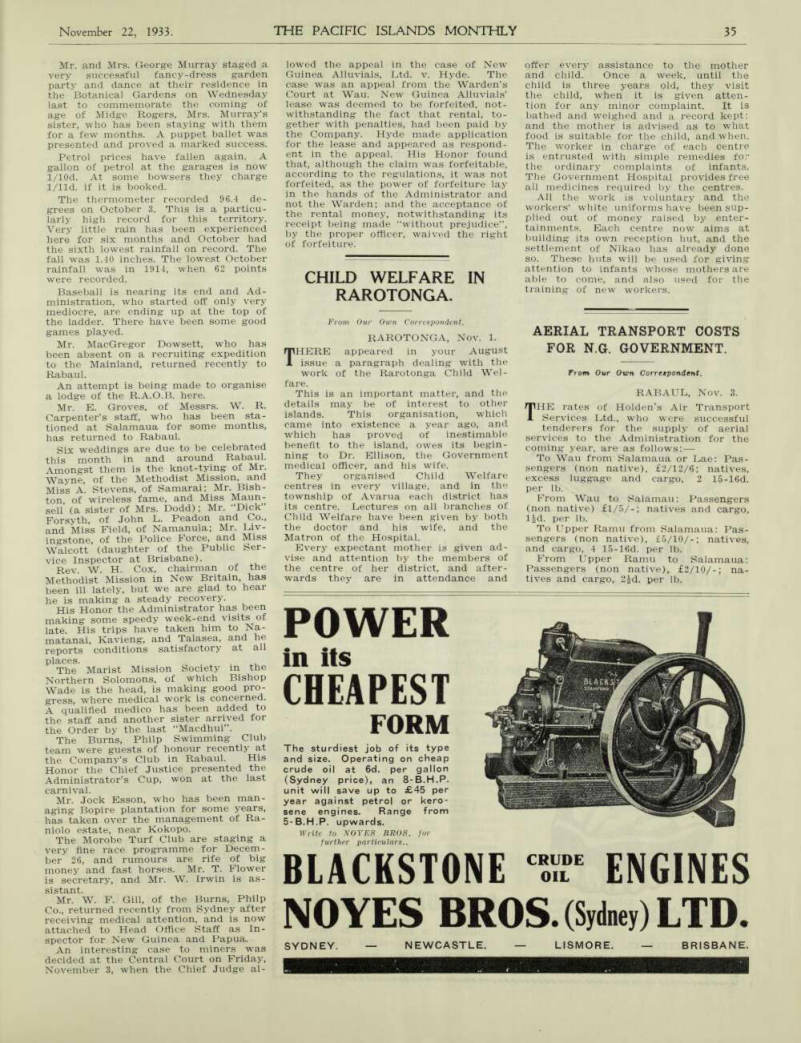
From Our Own Correspondent.
Rabaul, Oct. 31.
A nasty motor accident occurred when a car containing Mr. and Mrs. H. W.
Saunders and Mr. G. A. Schnacken berg, collided with a tree on the Mala guna Road. The occupants were all badly shaken. The two men were admitted to hospital, where they re ceived treatment for minor injuries.
Gabriel Chow Ying, who appeared before the Central Court on a charge of unlawfully killing a native, was found not guilty of the charge. Mr.
Andrew Kelly appeared for the accused.
Golf enthusiasts are having some keen competitions on the local links.
In a recently contested mixed four some competition Mrs, Abraham and Mr. Baker returned the winning card of 42 nett. Three pairs tied for second
place with 44 —Miss Burston and Mr.
Renton; Mrs. Orton Townsend and Mr. Goodwyn; and Miss Backhouse and Mr, Burston.
Mrs. C. H. Maclean has returned from South, rejoining her husband, who is shipping manager for Messrs.
W. R. Carpenter & Co. in Rabaul.
Mr. C.. A. M. Adelskold has returned from Hongkong, having recently made a speedy business trip on the s.s.
Freiderun.
Mr. Hugh Scott, well-known Solo mon Islands planter of many years, passed through Rabaul recently en route for Salamaua and the goldfields.
Mrs. P. Coote and family returned from a quick trip South. Mr. Coote, B.P. manager at Rabaul, visited Syd ney for health reasons. Returning on the Montoro, he disembarked at Port Moresby and flew to the Wau, from where he later rejoined the Montoro at Salamaua and will return here by that vessel.
Mrs. Russel D. Pye and son have re
turned after a prolonged holiday in Australia.
Mr. C. I. H. Campbell has left Rabaul for his plantation at Raua in Bougainville. He expects shortly to be joined by Mrs. Campbell, who is at present in Australia.
Assistant D. O. Woodman returned from furlough by the last Montoro and has proceeded to Kavieng, where he will be stationed.
Mr. L. V. Waterhouse, Bulolo Gold Dredging director, and also director of Guinea Airways, has been over on the fields recently, accompanied by Mr. F.
Griffin, who was making final prepara tions for the opening of No. 3 Dredge.
Mr. K. Colquohoun, of the A.W.A. staff, has returned from Australia, accompanied by his bride. They will reside in Kavieng. Mr. Holland, who has been stationed there, has pro ceeded on leave.
Professor Thurnwald, an eminent ethnologist, accompanied by Mrs.
Thurnwald, arrived by the October Montoro and will be proceeding to the Siwai district, in Bougainville. They are at present guests at Government House. The Professor has already visited this territory and in 1914, when war broke out, was many miles up the Sepik River.
Mr. and Mrs. Jack Crampton have proceeded to the goldfields, after hav ing made a tour in the East.
Big things are being planned by the Morobe Turf Club for its Boxing Day meeting on December 26. We under stand there are over forty horses already up at Wau and more are com ing up from South for the event. The Morobe Gold Cup promises to be a most interesting event.
Mr. E. P. Holmes, M.L.C., Secretary for Lands, accompanied by Mrs.
Holmes, passed through Rabaul re cently on the Nankin en route to Aus tralia, after spending a short holiday in the East.
Mr. H. H. Page, M.L.C., Government secretary, together with Mrs. Page and children, departed by the Nankin for Australia on long leave. Mr. Page is a brother of Dr. Earle Page, Leader of the Country Party in the Federal Par liament.
Am interesting passenger on the Nankin, passing through from the East recently, was Mr. John Lane, of the famous English publishing house. He has been touring the East and has been making a few shrewd observations of present conditions there.
From Our Own Correspondent.
Rabaul, Nov. 3.
MR. J. H. McDonald, A.D.O., who has for some time been stationed at Manus, is now at Madang as as sistant D.O. to Mr. Feldt.
The arrival of the “Macdhui” from South on October 22 brought a case of measles to our midst, and all contacts were segregated at Namanula to under go a period of observation: unfortun ately, another case has developed, which necessitates the inmates extending their term of quarantine. Among those in quarantine are Mrs. C. I. H. Campbell, Mr. and Mrs. Moore, Mrs. Max Lees, Mrs. Seale and Mrs. Hockey.
There have been a number of social morning and afternoon teas recently and the popular method of amusement at these functions is a competition of guessing smells, singing songs or solv ing hidden names of books, places or people.
Mr. and Mrs. George Murray staged a very successful fancy-dress garden party and dance at their residence in the Botanical Gardens on Wednesday last to commemorate the coming of age of Midge Rogers, Mrs. Murray’s sister, who has been staying with them for a few months. A puppet ballet was presented and proved a marked success.
Petrol prices have fallen again. A gallon of petrol at the garages is now 1/10d. At some bowsers they charge 1/11d. if it is booked.
The thermometer recorded 96.4 de grees on October 3. This is a particu larly high record for this territory.
Very little rain has been experienced here for six months and October had the sixth lowest rainfall on record. The fall was 1.40 inches. The lowest October rainfall was in 1914, when 62 points were recorded.
Baseball is nearing its end and Ad ministration, who started off only very mediocre, are ending up at the top of the ladder. There have been some good games played.
Mr. MacGregor Dowsett, who has been absent on a recruiting expedition to the Mainland, returned recently to Rabaul.
An attempt is being made to organise a lodge of the R.A.O.B. here.
Mr. E. Groves, of Messrs. W. R.
Carpenter’s staff, who has been sta tioned at Salamaua for some months, has returned to Rabaul.
Six weddings are due to be celebrated this month in and around Rabaul.
Amongst them is the knot-tying of Mr.
Wayne, of the Methodist Mission, and Miss A. Stevens, of Samarai; Mr. Bish ton, of wireless fame, and Miss Maun sell (a sister of Mrs. Dodd); Mr. “Dick”
Forsyth, of John L. Peadon and Co., and Miss Field, of Namanula; Mr. Liv ingstone, of the Police Force, and Miss Walcott (daughter of the Public Ser vice Inspector at Brisbane).
Rev. W. H. Cox, chairman of the Methodist Mission in New Britain, has been ill lately, but we are glad to hear he is making a steady recovery.
His Honor the Administrator has been making some speedy week-end visits of late. His trips have taken him to Na matanai, Kavieng, and Talasea, and he reports conditions satisfactory at all places.
The Marist Mission Society in the Northern Solomons, of which Bishop Wade is the head, is making good pro gress, where medical work is concerned.
A qualified medico has been added to the staff and another sister arrived for the Order by the last “Macdhui”.
The Burns, Philp Swimming Club team were guests of honour recently at the Company’s Club in Rabaul. His Honor the Chief Justice presented the Administrator’s Cup, won at the last carnival.
Mr. Jock Esson, who has been man aging Bopire plantation for some years, has taken over the management of Ra niolo estate, near Kokopo.
The Morobe Turf Club are staging a very fine race programme for Decem ber 26, and rumours are rife of big money and fast horses. Mr. T. Flower is secretary, and Mr. W. Irwin is as sistant.
Mr. W. F. Gill, of the Burns, Philp Co., returned recently from Sydney after receiving medical attention, and is now attached to Head Office Staff as In spector for New Guinea and Papua.
An interesting case to miners was decided at the Central Court on Friday, November 3, when the Chief Judge al
lowed the appeal in the case of New Guinea Alluvials, Ltd. v. Hyde. The case was an appeal from the Warden’s Court at Wau. New Guinea Alluvials’ lease was deemed to be forfeited, not withstanding the fact that rental, to gether with penalties, had been paid by the Company. Hyde made application for the lease and appeared as respond ent in the appeal. His Honor found that, although the claim was forfeitable, according to the regulations, it was not forfeited, as the power of forfeiture lay in the hands of the Administrator and not the Warden; and the acceptance of the rental money, notwithstanding its receipt being made “without prejudice”, by the proper officer, waived the right of forfeiture.
Advertisements & other items, p. 36 (1 item)
“Younger”
Do you know that the Famous
STOVES AND
RANGES
made with extended Firebox specially for long- Wood fuel, are Self-Setting and, provided sufficient Flue Piping is attached, can be used in almost any position.
The No. 7W. “Younger” Range can now be supplied fitted with Legs, as per illustration.
Ask for quotation for this range, also Illustrated Catalogue and Price List for both Single and Double Oven Stoves.
Younger Stoves are Widely Used Throughout the Pacific Islands.
G. FLETCHER & SON 50 Oxford Street, SYDNEY.
CAPSTAN
CIGARETTES
CORK-TIPPED
OR PLAIN
CAPSTAN
NAVY CUT TOBACCO
Child Welfare In
Rarotonga.
From Our Own Correspondent.
Rarotonga, Nov. 1.
THERE appeared in your August issue a paragraph dealing with the work of the Rarotonga Child Wel fare.
This is an important matter, and the details may be of interest to other islands. This organisation, which came into existence a year ago, and which has proved of inestimable benefit to the island, owes its begin ning to Dr. Ellison, the Government medical officer, and his wife.
They organised Child Welfare centres in every village, and in the township of Avarua each district has its centre. Lectures on all branches of Child Welfare have been given by both the doctor and his wife, and the Matron of the Hospital.
Every expectant mother is given ad vise and attention by the members of the centre of her district, and after wards they are in attendance and
offer every assistance to the mother and child. Once a week, until the child is three years old, they visit the child, when it is given atten tion for any minor complaint. It is bathed and weighed and a record kept: and the mother is advised as to what food is suitable for the child, and when.
The worker in charge of each centre is entrusted with simple remedies for the ordinary complaints of infants.
The Government Hospital provides free all medicines required by the centres.
All the work is voluntary and the workers’ white uniforms have been sup plied out of money raised by enter tainments. Each centre now aims at building its own reception hut, and the settlement of Nikao has already done so. These huts will be used for giving attention to infants whose mothers are able to come, and also used for the training of new workers.
For N.G. Government,
Aerial Transport Costs
From Our Own Correspondent.
Rabaul, Nov. 3.
THE rates of Holden’s Air Transport Services Ltd., who were successful tenderers for the supply of aerial services to the Administration for the coming year, are as follows; To Wau from Salamaua or Lae: Pas sengers (non native), £2/12/6; natives, excess luggage and cargo, 2 15-16 d. per lb.
From Wau to Salamau: Passengers (non native) £1/5/-; natives and cargo, 1½d. per lb.
To Upper Ramu from Salamaua: Pas sengers (non native), £5/10/-; natives, and cargo, 4 15-16 d. per lb.
From Upper Ramu to Salamaua: Passengers (non native), £2/10/-; na tives and cargo, 2½d. per lb.
Advertisements & other items, p. 37 (1 item)
Cheapest
POWER
in its
FORM
The sturdiest job of its type and size. Operating on cheap crude oil at 6d. per gallon (Sydney price), an 8-B.H.P. unit will save up to £45 per year against petrol or kerosene engines. Range from 5-B.H.P. upwards.
Write to NOYES BROS, for further particulars..
BLACKSTONE Crude Oil ENGINES
NOYES BROS. (Sydney) LTD.
SYDNEY. NEWCASTLE. LISMORE. BRISBANE.
Seeking Gold In New
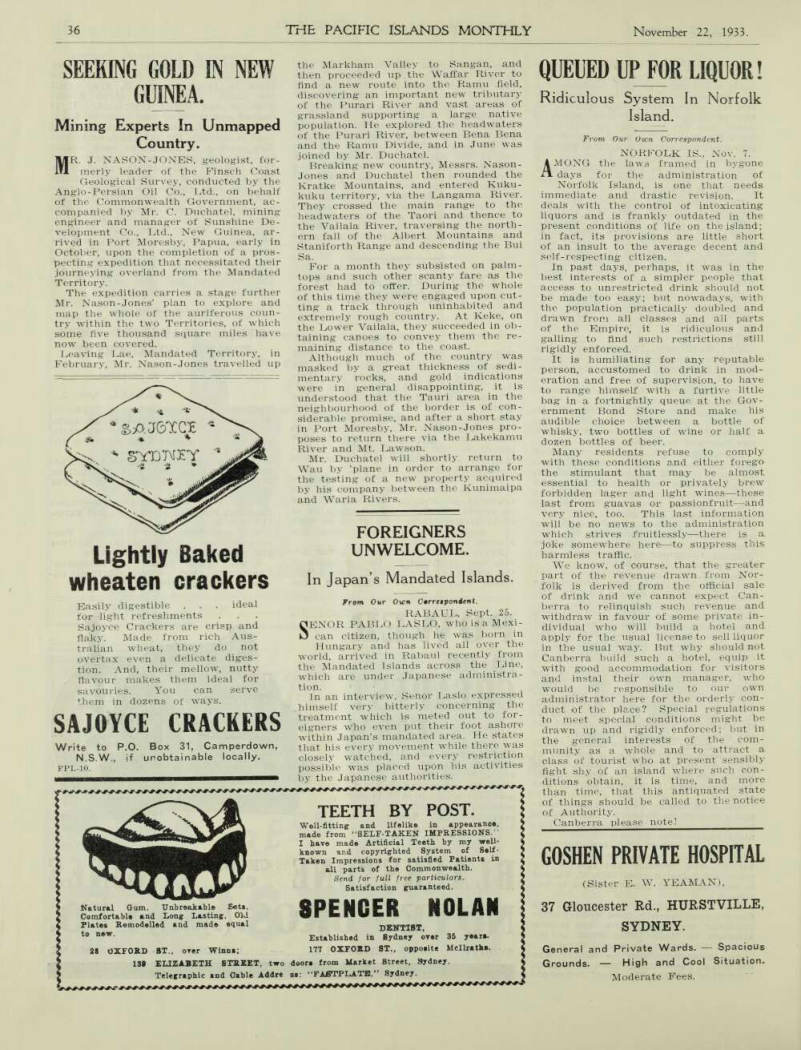
Guinea.
Mining Experts In Unmapped Country.
MR. J. NASON-JONES, geologist, for merly leader of the Finsch Coast Geological Survey, conducted by the Anglo-Persian Oil Co., Ltd., on behalf of the Commonwealth Government, ac companied by Mr. C. Duchatel, mining engineer and manager of Sunshine De velopment Co., Ltd., New Guinea, ar rived in Port Moresby, Papua, early in October, upon the completion of a pros pecting expedition that necessitated their journeying overland from the Mandated Territory.
The expedition carries a stage further Mr. Nason-Jones’ plan to explore and map the whole of the auriferous coun try within the two Territories, of which some five thousand square miles have now been covered.
Leaving Lae, Mandated Territory, in February, Mr. Nason-Jones travelled up
the Markham Valley to Sangan, and then proceeded up the Waffar River to find a new route into the Ramu field, discovering an important new tributary of the Purari River and vast areas of grassland supporting a large native population. He explored the headwaters of the Purari River, between Bena Bena and the Ramu Divide, and in June was joined by Mr. Duchatel.
Breaking new country, Messrs. Nason- Jones and Duchatel then rounded the Kratke Mountains, and entered Kuku kuku territory, via the Langama River.
They crossed the main range to the headwaters of the Taori and thence to the Vailala River, traversing the north ern fall of the Albert Mountains and Staniforth Range and descending the Bui Sa.
For a month they subsisted on palm tops and such other scanty fare as the forest had to offer. During the whole of this time they were engaged upon cut ting a track through uninhabited and extremely rough country. At Keke, on the Lower Vailala, they succeeded in ob taining canoes to convey them the re maining distance to the coast.
Although much of the country was masked by a great thickness of sedi mentary rocks, and gold indications were in general disappointing, it is understood that the Tauri area in the neighbourhood of the border is of con siderable promise, and after a short stay in Port Moresby, Mr. Nason-Jones pro poses to return there via the Lakekamu River and Mt. Lawson.
Mr. Duchatel will shortly return to Wau by ’plane in order to arrange for the testing of a new property acquired by his company between the Kunimaipa and Waria Rivers.
Unwelcome.
Foreigners
In Japan’s Mandated Islands.
From Our Own Correspondent.
Rabaul, Sept. 25.
SENOR PABLO LASLO, who is a Mexi can citizen, though he was born in Hungary and has lived all over the world, arrived in Rabaul recently from the Mandated Islands across the Line, which are under Japanese administra tion.
In an interview, Senor Laslo expressed himself very bitterly concerning the treatment which is meted out to for eigners who even put their foot ashore within Japan’s mandated area. He states that his every movement while there was closely watched, and every restriction possible was placed upon his activities by the Japanese authorities.
Queued Up For Liquor!
Ridiculous System In Norfolk Island.
From Our Own Correspondent.
Norfolk Is., Nov. 7.
AMONG the laws framed in bygone days for the administration of Norfolk Island, is one that needs immediate and drastic revision. It deals with the control of intoxicating liquors and is frankly outdated in the present conditions of life on the island; in fact, its provisions are little short of an insult to the average decent and self-respecting citizen.
In past days, perhaps, it was in the best interests of a simpler people that access to unrestricted drink should not be made too easy; but nowadays, with the population practically doubled and drawn from all classes and all parts of the Empire, it is ridiculous and galling to find such restrictions still rigidly enforced.
It is humiliating for any reputable person, accustomed to drink in mod eration and free of supervision, to have to range himself with a furtive little bag in a fortnightly queue at the Gov ernment Bond Store and make his audible choice between a bottle of whisky, two bottles of wine or half a dozen bottles of beer.
Many residents refuse to comply with these conditions and either forego the stimulant that may be almost essential to health or privately brew forbidden lager and light wines—these last from guavas or passionfruit—and very nice, too. This last information will be no news to the administration which strives fruitlessly—there is a joke somewhere here —to suppress this, harmless traffic.
We know, of course, that the greater part of the revenue drawn from Nor folk is derived from the official sale of drink and we cannot expect Can berra to relinquish such revenue and withdraw in favour of some private in dividual who will build a hotel and apply for the usual license to sell liquor in the usual way. But why should not Canberra build such a hotel, equip it with good accommodation for visitors and instal their own manager, who would be responsible to our own administrator here for the orderly con duct of the place? Special regulations to meet special conditions might be drawn up and rigidly enforced; but in the general interests of the com munity as a whole and to attract a class of tourist who at present sensibly fight shy of an island where such con ditions obtain, it is time, and more than time, that this antiquated state of things should be called to the notice of Authority.
Canberra please note!
Advertisements & other items, p. 38 (2 items)
Lightly Baked
wheaten crackers
Easily digestible . . . ideal for light refreshments Sajoyce Crackers are crisp and flaky. Made from rich Australian wheat, they do not overtax even a delicate digestion. And, their mellow, nutty flavour makes them ideal for savouries. You can serve them in dozens of ways.
SAJOYCE CRACKERS
Write to P.O. Box 31, Camperdown, N.S.W., if unobtainable locally.
FPL-10.
Natural Gum, Unbreakable Sets, Comfortable and Long Lasting, Old Plates Remodelled and made equal to new.
TEETH BY POST.
Well-fitting and lifelike in appearance,
made from “SELF-TAKEN IMPRESSIONS.
I have made Artificial Teeth by my wellknown and copyrighted System of Self- Taken Impressions for satisfied Patients in all parts of the Commonwealth.
Send for full free particulars.
Satisfaction guaranteed.
SPENCER NOLAN
DENTIST,
Established in Sydney over 36 yeara. 28 OXFORD ST., over Winne; 177 OXFORD ST., opposite Mcllratha. 189 ELIZABETH STREET, two doore from Market Street, Sydney.
Telegraphic and Cable Address: “FASTPLATE,” Sydney.
Goshen Private Hospital
(Sister E. W. TEAMAN),
37 Gloucester Rd., HURSTVILLE,
SYDNEY.
General and Private Wards. Spacious Grounds. High and Cool Situation.
Moderate Fees.
Papua Answered.
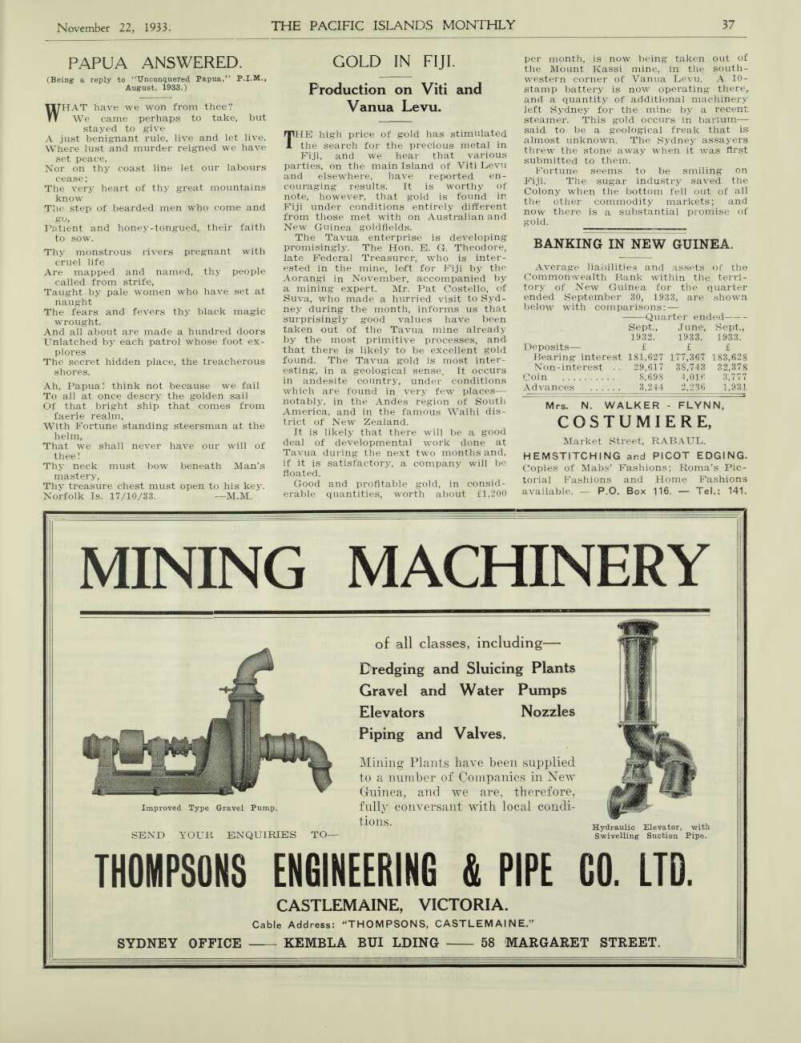
(Being a reply to “Unconquered Papua,’’
August, 1933.)
WHAT have we won from thee?
We came perhaps to take, but stayed to give A just benignant rule, live and let live.
Where lust and murder reigned we have set peace, Nor on thy coast line let our labours cease; The very heart of thy great mountains know The step of bearded men who come and go, Patient and honey-tongued, their faith to sow.
Thy monstrous rivers pregnant with cruel life Are mapped and named, thy people called from strife, Taught by pale women who have set at naught The fears and fevers thy black magic wrought.
And all about are made a hundred doors Unlatched by each patrol whose foot ex plores The secret hidden place, the treacherous shores.
Ah, Papua! think not because we fail To all at once descry the golden sail Of that bright ship that comes from faerie realm, With Fortune standing steersman at the helm, That we shall never have our will of thee!
Thy neck must bow beneath Man’s mastery, Thy treasure chest must open to his key.
Norfolk Is. 17/10/33. —M.M.
Gold In Fiji.
Production on Viti and Vanua Levu.
THE high price of gold has stimulated the search for the precious metal in Fiji, and we hear that various parties, on the main Island of Viti Levu and elsewhere, have reported en couraging results. It is worthy of note, however, that gold is found in Fiji under conditions entirely different from those met with on Australian and New Guinea goldfields.
The Tavua enterprise is developing promisingly. The Hon. E. G. Theodore, late Federal Treasurer, who is inter ested in the mine, left for Fiji by the Aorangi in November, accompanied by a mining expert. Mr. Pat Costello, of Suva, who made a hurried visit to Syd ney during the month, informs us that surprisingly good values have been taken out of the Tavua mine already by the most primitive processes, and that there is likely to be excellent gold found. The Tavua gold is most inter esting, in a geological sense. It occurs in andesite country, under conditions which are found in very few places— notably, in the Andes region of South America, and in the famous Waihi dis trict of New Zealand.
It is likely that there will be a good deal of developmental work done at Tavua during the next two months and, if it is satisfactory, a company will be floated.
Good and profitable gold, in consid erable quantities, worth about £1,200
per month, is now being taken out of the Mount Kassi mine, in the south western corner of Vanua Levu. A 10stamp battery is now operating there, and a quantity of additional machinery left Sydney for the mine by a recent steamer. This gold occurs in barium — said to be a geological freak that is almost unknown. The Sydney assayers threw the stone away when it was first submitted to them.
Fortune seems to be smiling on Fiji. The sugar industry saved the Colony when the bottom fell out of all the other commodity markets; and now there is a substantial promise of gold.
Banking In New Guinea.
Average liabilities and assets of the Commonwealth Bank within the terri tory of New Guinea for the quarter ended September 30, 1933, are shown below with comparisons: —
Quarter ended Sept., 1932. £ June, 1933. £ Sept., 1933. £ Deposits— Bearing- interest 181,627 177,367 183,628 Non-interest 29,617 38,743 32,378 Coin 8,698 4,016 3,777 Advances 3,244 2.236 1,931
Advertisements & other items, p. 39 (1 item)
Mining Machinery
Mrs. N. WALKER - FLYNN,
COSTUMIER E,
Market Street, RABAUL.
HEMSTITCHING and PICOT EDGING.
Copies of Mabs’ Fashions; Roma’s Pictorial Fashions and Home Fashions available. — P.O. Box 116. — Tel.: 141,
MINING MACHINERY
Improved Type Gravel Pump.
SEND YOUR ENQUIRIES TO-
of all classes, including—
Dredging and Sluicing Plants
Gravel and Water Pumps Elevators Nozzles Piping and Valves.
Mining Plants have been supplied to a number of Companies in New Guinea, and we are, therefore, fully conversant with local conditions.
Hydraulic Elevator, with Swivelling Suction Pipe.
THOMPSONS ENGINEERING & PIPE CO. LTD.
CASTLEMAINE, VICTORIA.
Cable Address: “THOMPSONS, CASTLEMAINE.”
SYDNEY OFFICE KEMBLA BUI LDING 58 MARGARET STREET.
Papuan Tobacco
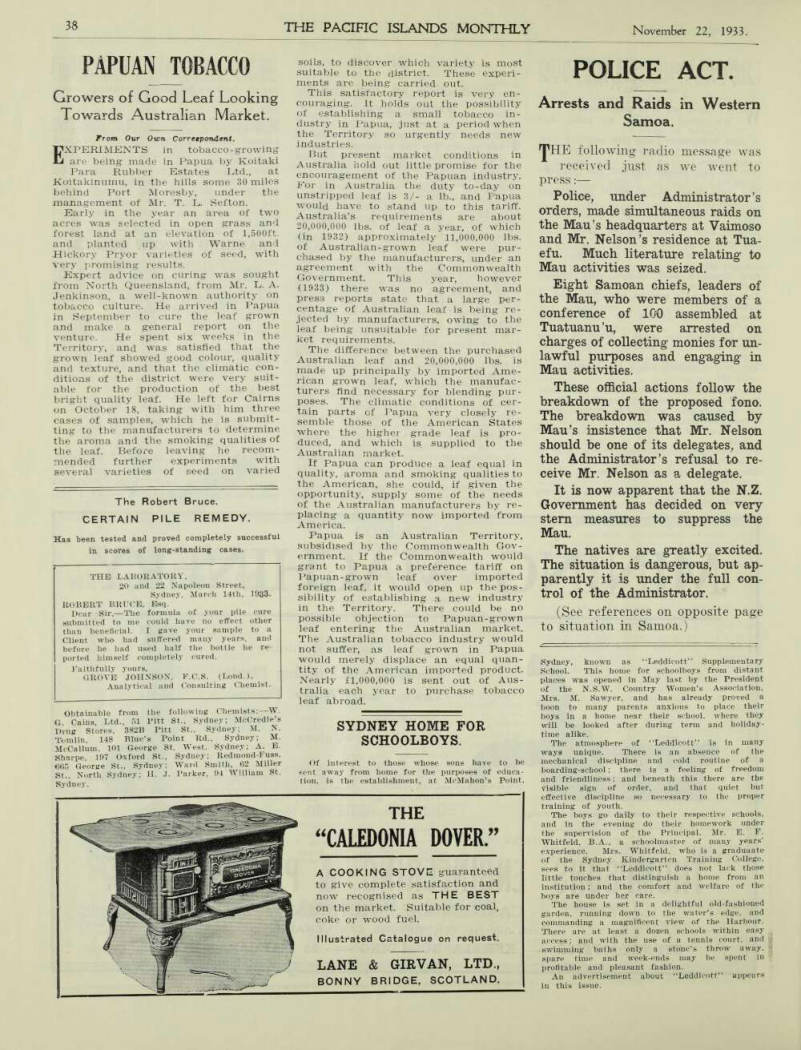
Growers of Good Leaf Looking Towards Australian Market.
From Our Own Correspondent.
Experiments in tobacco-growing are being made in Papua by Koitaki Para Rubber Estates Ltd., at Koltakinumu, in the hills some 30 miles behind Port Moresby, under the management of Mr. T. L. Sefton.
Early in the year an area of two acres was selected in open grass and forest land at an elevation of 1,500 ft. and planted up with Warne and Hickory Pryor varieties of seed, with very promising results.
Expert advice on curing was sought from North Queensland, from Mr. L. A.
Jenkinson, a well-known authority on tobacco culture. He arrived in Papua in September to cure the leaf grown and make a general report on the venture. He spent six weeks in the Territory, and was satisfied that the grown leaf showed good colour, quality and texture, and that the climatic con ditions of the district were very suit able for the production of the best bright quality leaf. He left for Cairns on October 18, taking with him three cases of samples, which he is submit ting to the manufacturers to determine the aroma and the smoking qualities of the leaf. Before leaving he recom mended further experiments with several varieties of seed on varied
soils, to discover which variety is most suitable to the district. These experi ments are being carried out.
This satisfactory report is very en couraging. It holds out the possibility of establishing a small tobacco in dustry in Papua, just at a period when the Territory so urgently needs new industries.
But present market conditions in Australia hold out little promise for the encouragement of the Papuan industry.
For in Australia the duty to-day on unstripped leaf is 3/- a lb., and Papua would have to stand up to this tariff.
Australia’s requirements are about 20,000,000 lbs. of leaf a year, of which (in 1932) approximately 11,000,000 lbs. of Australian-grown leaf were pur chased by the manufacturers, under an agreement with the Commonwealth Government. This year, however (1933) there was no agreement, and press reports state that a large per centage of Australian leaf is being re jected by manufacturers, owing to the leaf being unsuitable for present mar ket requirements.
The difference between the purchased Australian leaf and 20,000,000 lbs. is made up principally by imported Ame rican grown leaf, which the manufac turers find necessary for blending pur poses. The climatic conditions of cer tain parts of Papua very closely re semble those of the American States where the higher grade leaf is pro duced, and which is supplied to the Australian market.
If Papua can produce a leaf equal in quality, aroma and smoking qualities to the American, she could, if given the opportunity, supply some of the needs of the Australian manufacturers by re placing a quantity now imported from America.
Papua is an Australian Territory, subsidised by the Commonwealth Gov ernment. If the Commonwealth would grant to Papua a preference tariff on Papuan-grown leaf over imported foreign leaf, it would open up the pos sibility of establishing a new industry in the Territory. There could be no possible objection to Papuan-grown leaf entering the Australian market.
The Australian tobacco industry would not suffer, as leaf grown in Papua would merely displace an equal quan tity of the American imported product.
Nearly £1,000,000 is sent out of Aus tralia each year to purchase tobacco leaf abroad.
Schoolboys.
Sydney Home For
Of interest to those whose sons have to be sent away from home for the purposes of educa tion, is the establishment, at McMahon’s Point,
Sydney, known as “Leddicott” Supplementary School. This home for schoolboys from distant places was opened in May last by the President of the N.S.W. Country Women’s Association, Mrs. M. Sawyer, and has already proved a boon to many parents anxious to place their boys in a home near their school, where they will be looked after during term and holiday time alike.
The atmosphere of “Leddicott” is in many ways unique. There is an absence of the mechanical discipline and cold routine of a boarding-school; there is a feeling of freedom and friendliness; and beneath this there are the visible sign of order, and that quiet but effective discipline so necessary to the proper training of youth.
The boys go daily to their respective schools, and in the evening do their homework under the supervision of the Principal. Mr. E. F.
Whitfeld, B.A., a schoolmaster of many years’ experience. Mrs. Whitfeld, who is a graduaate of the Sydney Kindergarten Training College, sees to it that “Leddicott” does not lack those little touches that distinguish a home from an institution; and the comfort and welfare of the boys are under her care.
The house is set in a delightful old-fashioned garden, running down to the water’s edge, and commanding a magnificent view of the Harbour.
There are at least a dozen schools within easy access; and with the use of a tennis court, and swimming baths only a stone’s throw away, spare time and week-ends may be spent in profitable and pleasant fashion.
An advertisement about “Leddicott” appears in this issue.
Police Act.
Arrests and Raids in Western Samoa.
THE following radio message was received just as we went to press:— Police, under Administrator’s orders, made simultaneous raids on the Man’s headquarters at Vaimoso and Mr. Nelson’s residence at Tua efu. Much literature relating to Mau activities was seized.
Eight Samoan chiefs, leaders of the Mau, who were members of a conference of 100 assembled at Tuatuanu’u, were arrested on charges of collecting monies for un lawful purposes and engaging in Mau activities.
These official actions follow the breakdown of the proposed fono.
The breakdown was caused by Man’s insistence that Mr. Nelson should be one of its delegates, and the Administrator’s refusal to re ceive Mr. Nelson as a delegate.
It is now apparent that the N.Z.
Government has decided on very stern measures to suppress the Mau.
The natives are greatly excited.
The situation is dangerous, but ap parently it is under the full con trol of the Administrator. (See references on opposite page to situation in Samoa.)
Advertisements & other items, p. 40 (1 item)
“Caledonia Dover.”
The Robert Bruce.
CERTAIN PILE REMEDY.
Has been tested and proved completely successful in scores of long-standing cases.
THE LABORATORY,
20 and 22 Napoleon Street, Sydney, March 14th, 1933.
ROBERT BRUCE, Esq.
Dear Sir, —The formula of your pile cure submitted to me could have no effect other than beneficial. I gave your sample to a Client who had suffered many years, and before he had used half the bottle he reported himself completely cured.
Faithfully yours,
GROVE JOHNSON, F.C.S. (Lond.),
Analytical and Consulting Chemist.
Obtainable from the following Chemists: —W.
G. Cains, Ltd., 51 Pitt St.. Sydney; McCredie’s Drug Stores, 382B Pitt St.. Sydney: M. N.
Tomlin, 148 Blue’s Point Rd., Sydney; M.
McCallum. 101 George St. West, Sydney; A. E.
Sharpe, 197 Oxford St., Sydney; Redmond-Fuss. 665 George St., Sydney: Ward Smith, 62 Miller St., North Sydney; H. J. Parker, 94 William St.
Sydney.
THE
“CALEDONIA DOVER.”
A COOKING STOVE guaranteed to give complete satisfaction and now recognised as THE BEST on the market. Suitable for coal, coke or wood fuel.
Illustrated Catalogue on request.
LANE & GIRVAN, LTD.,
BONNY BRIDGE, SCOTLAND.
An Acrimonious
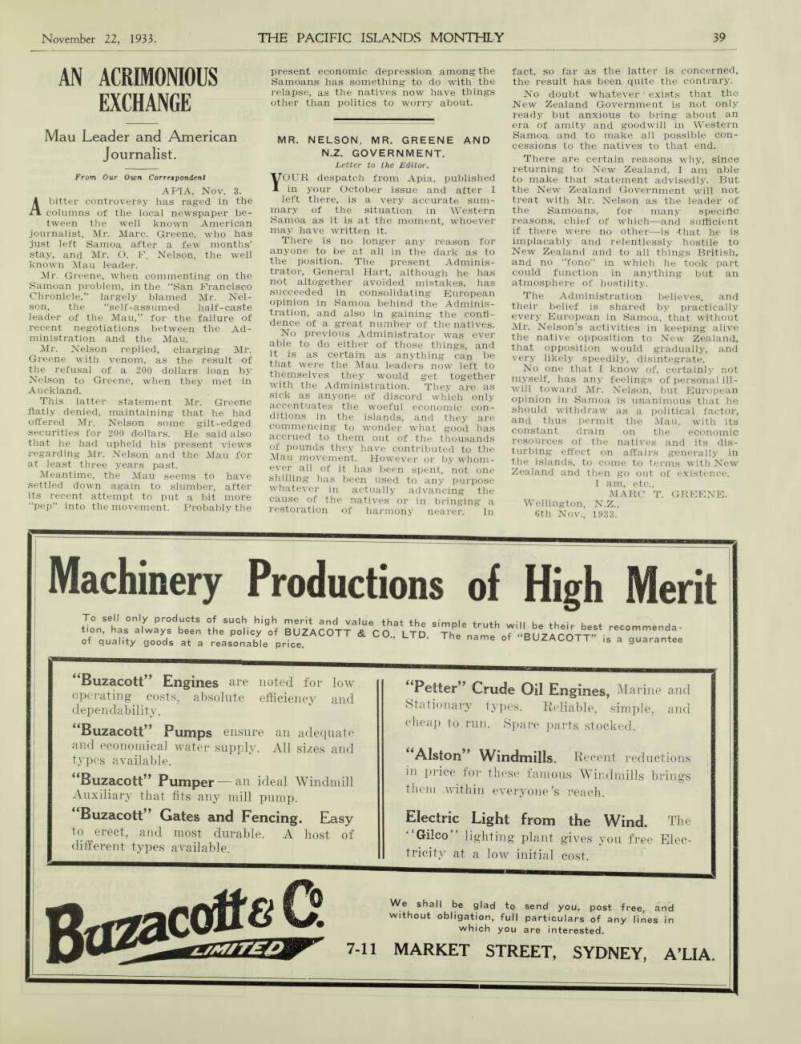
Exchange
Mau Leader and American Journalist.
From Our Own Correspondent
Apia, Nov. 3.
A bitter controversy has raged in the columns of the local newspaper be tween the well known American journalist, Mr. Marc. Greene, who has just left Samoa after a few months’ stay, and Mr. O. F. Nelson, the well known Mau leader.
Mr. Greene, when commenting on the Samoan problem, in the “San Francisco Chronicle,” largely blamed Mr. Nel son, the “self-assumed half-caste leader of the Mau,” for the failure of recent negotiations between the Ad ministration and the Mau.
Mr. Nelson replied, charging Mr.
Greene with venom, as the result of the refusal of a 200 dollars loan by Nelson to Greene, when they met in Auckland.
This latter statement Mr. Greene flatly denied, maintaining that he had offered Mr. Nelson some gilt-edged securities for 200 dollars. He said also that he had upheld his present views regarding Mr. Nelson and the Mau for at least three years past.
Meantime, the Mau seems to have settled down again to slumber, after its recent attempt to put a bit more “pep” into the movement. Probably the
present economic depression among the Samoans has something to do with the relapse, as the natives now have things other than politics to worry about.
Mr. Nelson, Mr. Greene And
N.Z. Government.
Letter to the Editor, YOUR despatch from Apia, published in your October issue and after I left there, is a very accurate sum mary of the situation in Western Samoa as it is at the moment, whoever may have written it.
There is no longer any reason for anyone to be at all in the dark as to the position. The present Adminis trator, General Hart, although he has not altogether avoided mistakes, has succeeded in consolidating European opinion in Samoa behind the Adminis tration, and also in gaining the confi dence of a great number of the natives.
No previous Administrator was ever able to do either of those things, and it is as certain as anything can be that were the Mau leaders now left to themselves they would get together with the Administration. They are as sick as anyone of discord which only accentuates the woeful economic con ditions in the islands, and they are commencing to wonder what good has accrued to them out of the thousands of pounds they have contributed to the Mau movement. However or by whom ever all of it has been spent, not one shilling has been used to any purpose whatever in actually advancing the cause of the natives or in bringing a restoration of harmony nearer. In
fact, so far as the latter is concerned, the result has been quite the contrary.
No doubt whatever exists that the New Zealand Government is not only ready but anxious to bring about an era of amity and goodwill in Western Samoa and to make all possible con cessions to the natives to that end.
There are certain reasons why, since returning to New Zealand, I am able to make that statement advisedly. But the New Zealand Government will not treat with Mr. Nelson as the leader of the Samoans, for many specific reasons, chief of which—and sufficient if there were no other—is that he is implacably and relentlessly hostile to New Zealand and to all things British, and no “fono” in which he took part could function in anything but an atmosphere of hostility.
The Administration believes, and their belief is shared by practically every European in Samoa, that without Mr. Nelson’s activities in keeping alive the native opposition to New Zealand, that opposition would gradually, and very likely speedily, disintegrate.
No one that I know of, certainly not myself, has any feelings of personal ill will toward Mr. Nelson, but European opinion in Samoa is unanimous that he should withdraw as a political factor, and thus permit the Mau, with its constant drain on the economic resources of the natives and its dis turbing effect on affairs generally in the islands, to come to terms with New Zealand and then go out of existence.
I am, etc.,
Marc T. Greene.
Wellington, N.Z., 6th Nov., 1933.
Advertisements & other items, p. 41 (1 item)
Machinery Productions of High Merit
To sell only products of such high merit and value that the simple truth will be their best recommendation, has always been the policy of BUZACOTT & CO., LTD The name of “BUZACOTT" is a guarantee of quality goods at a reasonable price.
“Buzacott” Engines are noted for low operating costs, absolute efficiency and dependability.
“Buzacott” Pumps ensure an adequate and economical water supply. All sizes and types available.
“Buzacott” Pumper an ideal Windmill Auxiliary that fits any mill pump.
Buzacott” Gates and Fencing. Easy to erect, and most durable. A host of different types available.
Buzacott & Co. Limited "Petter” Crude Oil Engines, Marine and Stationary types. Reliable, simple, and cheap to run. Spare parts stocked.
“Alston” Windmills. Recent reductions in price for these famous Windmills brings them within everyone’s reach.
Electric Light from the Wind. The "Gilco" lighting plant gives you free Electricity at a low initial cost.
We shall be glad to send you, post free, and without obligation, full particulars of any lines in which you are interested.
7-11 MARKET STREET, SYDNEY, A’LIA.
Farewell And Welcome
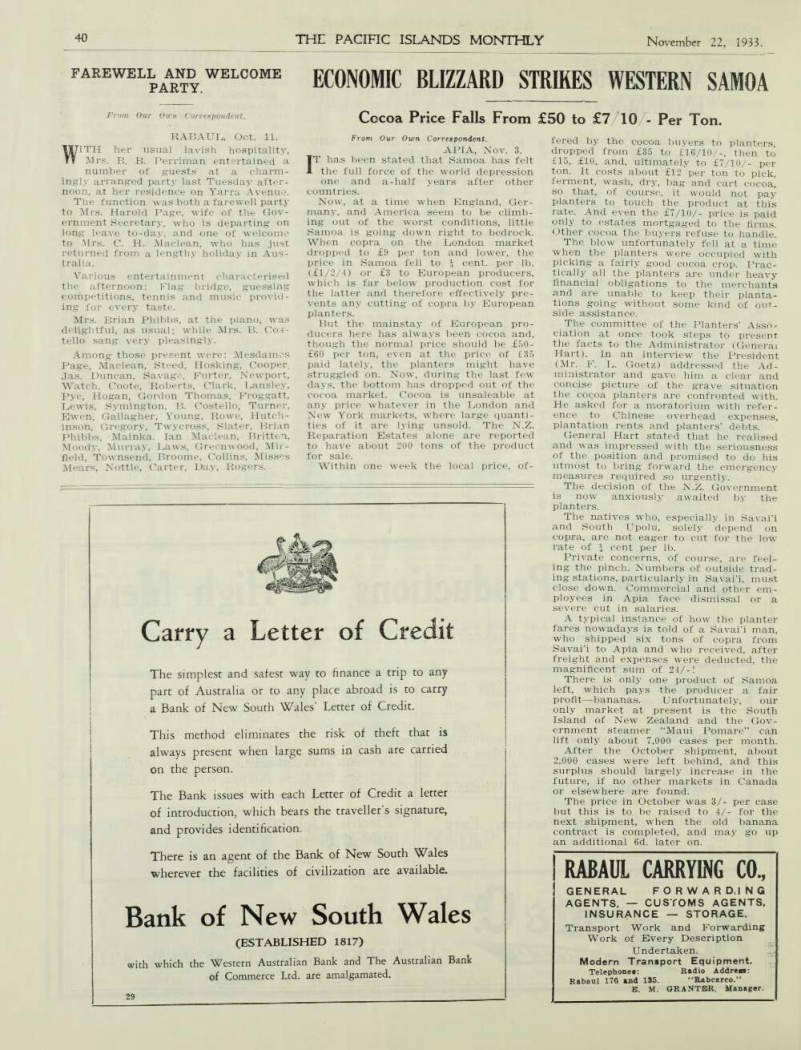
Party.
From Our Own Correspondent.
Rabaul, Oct. 11.
WITH her usual lavish hospitality, Mrs. B. B. Perriman entertained a number of guests at a charm ingly arranged party last Tuesday after noon, at her residence on Yarra Avenue.
The function was both a farewell party to Mrs. Harold Page, wife of the Gov ernment Secretary, who is departing on long leave to-day, and one of welcome to Mrs. C. H. Maclean, who has just returned from a lengthy holiday in Aus tralia.
Various entertainment characterised the afternoon; Flag bridge, guessing competitions, tennis and music provid ing for every taste.
Mrs. Brian Phibbs, at the piano, was delightful, as usual; while Mrs. B. Cos tello sang very pleasingly.
Among those present were; Mesdamos Page, Maclean, Steed, Hosking, Cooper, Jas. Duncan, Savage, Furter, Newport, Watch, Coote, Roberts, Clark, Lansley, Pye, Hogan, Gordon Thomas, Froggatt, Lewis, Symington, B. Costello, Turner, Ewen, Gallagher, Young, Rowe, Hutchinson, Gregory, Twycross, Slater, Brian Phibbs, Mainka, Ian Maclean, Britten, Moody, Murray, Laws, Greenwood, Mir fleld, Townsend, Broome, Collins, Misses Mears, Nottle, Carter, Day, Rogers.
Economic Blizzard Strikes Western Samoa
Cocoa Price Falls From £50 to £7/10/- Per Ton.
From Our Own Correspondent.
Apia, Nov. 3.
IT has been stated that Samoa has felt the full force of the world depression one and a-half years after other countries.
Now, at a time when England, Ger many, and America seem to be climb ing out of the worst conditions, little Samoa is going down right to bedrock.
When copra on the London market dropped to £9 per ton and lower, the price in Samoa fell to ¼ cent, per lb. (£1/2/4) or £3 to European producers, which is far below production cost for the latter and therefore effectively pre vents any cutting of copra by European planters.
But the mainstay of European pro ducers here has always been cocoa and, though the normal price should be £50- £60 per ton, even at the price of £35 paid lately, the planters might have struggled on. Now, during the last few days, the bottom has dropped out of the cocoa market. Cocoa is unsaleable at any price whatever in the London and New York markets, where large quanti ties of it are lying unsold. The N.Z.
Reparation Estates alone are reported to have about 200 tons of the product for sale.
Within one week the local price, of
fered by the cocoa buyers to planters, dropped from £35 to £16/10/-, then to £15, £10, and, ultimately to £7/10/- per ton. It costs about £12 per ton to pick, ferment, wash, dry, bag and cart cocoa, so that, of course, it would not pay planters to touch the product at this rate. And even the £7/10/- price is paid only to estates mortgaged to the firms.
Other cocoa the buyers refuse to handle.
The blow unfortunately fell at a time when the planters were occupied with picking a fairly good cocoa crop. Prac tically all the planters are under heavy financial obligations to the merchants and are unable to keep their planta tions going without some kind of out side assistance.
The committee of the Planters’ Asso ciation at once took steps to present the facts to the Administrator (General Hart). In an interview the President (Mr. F. L. Goetz) addressed the Ad ministrator and gave him a clear and concise picture of the grave situation the cocoa planters are confronted with.
He asked for a moratorium with refer ence to Chinese overhead expenses, plantation rents and planters’ debts.
General Hart stated that he realised and was impressed with the seriousness of the position and promised to do his utmost to bring forward the emergency measures required so urgently.
The decision of the N.Z. Government is now anxiously awaited by the planters.
The natives who, especially in Savai’i and South Upolu, solely depend on copra, are not eager to cut for the low rate of ¼ cent per lb.
Private concerns, of course, are feel ing the pinch. Numbers of outside trad ing stations, particularly in Savai’i, must close down. Commercial and other employees in Apia face dismissal or a severe cut in salaries.
A typical instance of how the planter fares nowadays is told of a Savai’i man, who shipped six tons of copra from Savai’i to Apia and who received, after freight and expenses were deducted, the magnificent sum of 24/-!
There is only one product of Samoa left, which pays the producer a fair profit—bananas. Unfortunately, our only market at present is the South Island of New Zealand and the Gov ernment steamer “Maui Pomare” can lift only about 7,000 cases per month.
After the October shipment, about 2,000 cases were left behind, and this surplus should largely increase in the future, if no other markets in Canada or elsewhere are found.
The price in October was 3/- per case but this is to be raised to 4/- for the next shipment, when the old banana contract is completed, and may go up an additional 6d. later on.
Advertisements & other items, p. 42 (1 item)
Bank of New South Wales
Carry a Letter of Credit
The simplest and safest way to finance a trip to any part of Australia or to any place abroad is to carry a Bank of New South Wales’ Letter of Credit.
This method eliminates the risk of theft that is always present when large sums in cash are carried on the person.
The Bank issues with each Letter of Credit a letter of introduction, which bears the traveller’s signature, and provides identification.
There is an agent of the Bank of New South Wales wherever the facilities of civilization are available.
Bank of New South Wales
(ESTABLISHED 1817)
with which the Western Australian Bank and The Australian Bank of Commerce Ltd. are amalgamated. 29
RABAUL CARRYING CO.,
GENERAL FORWARD, ING
AGENTS, CUSTOMS AGENTS,
INSURANCE STORAGE.
Transport Work and Forwarding Work of Every Description Undertaken.
Modern Transport Equipment.
Telephones: Radio Address: Rabaul 176 and 135. “Rabcarco.”
E. M. GRANTER, Manager.
Indian Problem In Fiji.
Commercial Man’s Pessimistic Summary.
A commercial manager who has been spending a brief furlough in Aus tralia has given us an exceedingly dismal account of the condition of Fiji, so far as the Indian problem is con cerned.
Our friend says, in so many words, that the settlement of Indians in this rich Colony has virtually ruined it as a home for British people, although Fiji has a climate and soil comparable to Central Queensland, where there is a virile and growing white population.
Our informant —a young Australian given to shrewd observation —also expresses the opinion that it will be only a comparatively short time before the Indians drive the native Fijians out of Fiji and entirely possess their country. He expresses the view, in no unmeasured terms, that the British, in introducing the Indians to Fiji, have betrayed the Fijian people.
The Indians were brought into Fiji as peasant laborers for the sugar mills.
In no other way could the sugar pro ducers solve the labor problem, be cause the Fijians, like most South Sea Islanders, will not hire themselves out as laborers. At first, the Indians came in under an indenture system and were regularly returned to India at the expiry of their period of service. Little by little, however, the system broke down until there was finally sub stituted for it the present system, whereunder small areas of land are made available to Indian peasant proprietors, who are under an obliga tion to grow and supply cane to the sugar mills and provide other labor as required.
This system has worked admirably.
It has solved the sugar mills’ imme diate problems and it has established in Fiji a numerous class of peasant farmers, who form a base on which a large trading system has been built.
But, in recent years, a large section of the Indians have refused to remain peasant farmers. It appears that numbers of them leave the land as soon as they have saved £50 or £100, and go into trade. Their system of trading is unique. Half a dozen band together in a little company, pool their cash resources, and devote themselves to trading in one particular line, in which they seek a very small profit.
Under some sort of unwritten under standing, these little Indian trading groups appear to divide up among themselves all the different lines which are mostly handled by one general store, each group taking the line which, apparently, it can most con veniently handle; and the inevitable result is that the general store is driven out of business. We are in formed, that owing to the low standard of living of the Indian population, the Indians’ extreme industry, and the low rate of profit they seek, it is now diffi cult for the general trading business to be conducted in Fiji with more than a gross profit of 10 per cent.
The Indians, in the past few years, have invaded every section of Fijian trade and industry. A large part of the native trading is in their hands. They supply the European population with
most of its fresh food. They control the motor transport services to the extent of nearly 100 per cent. They carry on a large and increasing pro portion of the retail distributing trade in the manner already described.
They provide a large and increasing proportion of the artisan labor. Very many of the domestic servants em ployed by Europeans in Fiji now are Indians. The Fijian-born section of the Indian population is being educated and as a result the Indians are in clined to invade the professions and more highly skilled trades. In so many words, “there is no future for Euro peans in Fiji.”
The next stage in the history of Indian settlement in Fiji is likely to be a demand for a share in the govern ment of the Colony. So far, the Indian demand for a Common Roll, and all that that connotes, has been success fully resisted; but with the growing in fluence and power of the Indian popu lation the position may be altered.
The foregoing summary of the position in this rich Colony is very pessimistic: and may have been exaggerated. But it is a fact that there has been little growth in European commercial business in Fiji during the past ten years, apart from the expan sion in sugar growing; and it is a further fact that at least one large European trading concern is being liquidated.
In a general sense it seems to us that if there is to be any future Euro pean expansion in Fiji there must be some limitation of Indian activity and enterprise. So far, there has been no announcement by the British Colonial Office of any particular policy regard ing the Indians in Fiji. If there is to be no interference with present condi tions, the Indians will dominate Fiji within twenty years. On the other hand, if there is to be a policy designed to check Indian expansion in Fiji, and
give Europeans a chance, there are bound to be serious political disturb ances there. The Indians always re sent racial discrimination, as has been proved in other parts of the Empire.
Rare N.G. Birds.
For Sydney Zoo.
CARPENTERS are busy at Taronga Park Zoo constructing a number of new cages for the accommodation of a collection of brightly-hued tropical birds, which are being sent to Sydney next month (says Sydney “Sun” of No vember 1).
The work of collecting the birds has been placed in the hands of Mr. Bruce Brown, secretary of the Zoo, who left for New Guinea several weeks ago to superintend operations there. Assisted by the Administrator of the Mandated Territory, together with the mission sta tions in the north of New Guinea, Mr.
Brown hopes to capture species of birds as yet unseen in many of the leading zoos of the world. Among the birds which he hopes to include in the collec tion are rare specimens of birds of para dise, tropical pigeons, starlings and par rots.
Specially prepared crates, designed with a view to giving the birds the ut most protection and comfort on the voy age back, have already been shipped from Sydney, and it is expected that Mr.
Brown will have completed his collection in time to return by the "Montoro” in the middle of December.
The hunting ground of Mr. Brown is the wild jungle along the north coast of New Guinea, an area said to be par ticularly rich in bird life.
Advertisements & other items, p. 43 (1 item)
Pacific Islands Stamps
Bought and Sold.
STAMPS sent on approval on receipt of reference.
Send for free lists and specimen copy,
“AUSTRALIAN STAMP JOURNAL.”
J. H. SMYTH, LTD..
121 a CASTLEREAGH STREET, SYDNEY,
(PREPARED)
"Keeps on Keeping on!"
Sold by : Agents throughout the Islands.
New Tariff For Fiji.
How Deficit Was Caused and How Provided For.
THE October session of the Fiji Legislative Council was opened on October 13 by the Governor, Sir Murchison Fletcher. In his opening address, His Excellency stressed the fact that although Fiji, in common with almost every country, has felt the effects of the economic depression, the Colony financially is fundamentally sound.
Dealing with the Budget proposals, he said that the original estimates for 1933 had now been revised and instead of a surplus of £9,000 as anticipated, the surplus would be only £700. This is due mainly to the fixation of the Fiji £1 at 11 per cent, under £1 sterling, thus necessitating an addi tional expenditure of £14,000 to cover exchange charges. The estimated deficit for the year 1934 is £23,847.
Such a large deficit will be caused by the low price of copra and the decline in the sugar output owing to excessive rain at planting time. To offset the deficit, last year’s surplus of £19,000 will be used and the balance will be taken from the Reserve Fund.
As a result of tne concessions granted by Fiji to the Empire, under the Ottawa Agreement, the Colony is losing over £3,000 a year in revenue and it is thought advisable to readjust the Colony’s tariff. Instead of the pre sent ad valorem basis for calculating duty, it is proposed to impose specific duties wherever practicable.
The Colony’s health, said the Governor, has been exceptionally good during the present year. To Dr. S. M.
Lambert, of the Rockefeller Foundation Institute, is due the praise for the excellent results of the soil sanitation campaign, which is decreasing the prevalence of hookworm, typhoid fever and dysentery in Fiji.
Fiji’S New Coins.
Canoe and Turtle In Designs.
FIJI is to have her own coinage, and the new coins will be put into cir culation at a very early date. They are now being minted in London.
The designs on the reverse are; 2/-, the Fiji coat of arms; 1/-, canoe; 6d., turtle; 1d. and ½d., nickel coins with holes in the centre. There will be no threepenny piece in the new coinage.
The silver content of the silver coins will be precisely that of United King dom coins.
Fiji, hitherto, has had her own bank notes but, for coins, she has, like New Zealand, used the silver and copper currency of Great Britain.
Goldfields.
Free Air-Mail To N.G.
AMENDED postal regulations, issued in a recent Government Gazette, al low letters and postcards to be de livered to Wau and Goldfields post of fices without the extra air mail charge being made.
Other amendments now provide an air mail service to the goldfields, via Port Moresby; utilising the air mail services operating in Australia; as well as the service from Karachi to Europe and the services operating in the United States of America.
Letters previously transmitted to goldfields post offices required 2½d. postage for every ounce; the rate is now 2d.; and if transmitted via Port Mores by, 3½d. per ounce.
S.S. “Waipahi” Replaces the
Sydney-Fiji-Tonga
Auckland.
S.S. “Waipahi” Replaces the “Karetu.”
A further alteration in the shipping services of the Central Pacific was announced in Sydney by the Union Steamship Co., Ltd., early in Novem ber. The cargo vessel “Karetu” has been replaced in the Sydney-Fiji- Tonga service by the “Waipahi,” which was withdrawn from the service in June last. On arrival in Auckland on November 7, the “Karetu” was with drawn and laid up for an indefinite period. The “Waipahi” left Sydney on the first trip of her new schedule on November 22.
This alteration was effected after representations had been made to the Union Company by Fiji shippers, who requested that the “Waipahi” should again enter the service and carry their banana shipments to Auckland during the hotter months of the year. The action of the Union Company, in com plying with their requests, was much appreciated by the banana shippers
and, in consequence, they have con sented to an increase in the freight of 1/- per case for the December ship ment. The increase in freight will off set some of the heavy expenses in curred by the company in laying up the “Karetu” and recommissioning the “Waipahi.”
The new schedule of the “Waipahi” is published in our shipping columns.
Lighting Plant Prices.
In onr October issue, In an advertisement for Dangar, Gedye & Co.’s Nevertire Electric Light ing Plants, some slight confusion may have been caused through the omission of a line referring to the price. The fully automatic plants adver tised are available from £165, but the plants advertised at prices from £103 are the wellknown semi-automatic type, which are corres pondingly efficient but slightly different in re gard to automatic controls and starting arrange ments.
Advertisements & other items, p. 44 (3 items)
Proof
TO PLANTERS - I am a Buyer of
CASTOR OIL SEED
IN ANY QUANTITY.
Send Sample for quote, stating quantity available.
Castor Seed Shellers, any capacity.
Advice and Instructions Regarding Planting, Harvesting and Packing of Castor Oil Seeds given freely.
Selected Seed for Planting available.
C. GRAHAME
17 BOND STREET SYDNEY.
WATER
PROOF
The shooter need no longer be concerned about the risk of waterspoiled cartridges, for with the Improved “Duxbac”
WET MAKES NO DIFFERENCE
“DUXBAC” Cartridges are now waterproofed by a new scientific process that makes them impervious to moisture, being water-proofed after loading and securely sealed against damp or wet.
Obtainable all Dealers.
Special Saddles
FOR
ISLAND USE.
Made on Galvanised Tree, Copper Tacks and Rivets, Best Selected Leather, All-Brass Fittings.
No. 1. STOCK or PARK SADDLES,
with Mounts . . £5 10 0
No. 2. STATION STOCK SADDLE,
with Mounts, 4in.
Pads . , .. . . £7 0 0 No, 7. The Famous NBVERTIRE
STOCK SADDLE, with
Mounts and Surcingle, Sin.
Capped Knee Pads, Pigskin Seat. Complete . . £8 8 0 We Pay Freight, Send for General Catalogue.
J. P. TALTY,
6 Cunningham St., Sydney.
Samuel Russell,
ESTATE AND GENERAL AGENT,
P.O. Box 64, Papeete, Tahiti.
Real Estate. Investments. Estate management and administration. Valuations and Reports Houses and Lands for Lease or Sale.
Sole Proprietor: TAHITI PBRFUMBS.
Cables: Russell, Tahiti (Bentley’s Code).
N. Guinea Gold!
Forecast of Important Developments.
A well-known Australian financial man, who during the last eight years has kept his discerning ear to the ground in New Guinea, to his great profit, is of the opinion that the de velopment which has taken place in the gold industry in that Territory in the past is nothing to the development that may be expected there in future.
“The mainland of New Guinea, north, west and south of the present Morobe goldfield, is now being quietly, patiently and very systematically examined,’’ he said to the Editor of the “P.I.M.” “It may be of interest, also, for you to know that some powerful international groups are represented in this examination.
“The gold is there in quantities varying from very rich to payable. The Morobe goldfield which has been opened up represents only a part of the wealth available for exploitation.
The people who are on the job now are carrying out their work with scientific thoroughness. Large tracts of country already have been inspected and mostly rejected. The search is nar rowing to a smaller area and it is prac tically certain that rich new fields will be opened up in New Guinea at no distant date.
“It may be that New Guinea will yet be proved as one of the world’s richest goldfields—and that is saying a good deal.”
Papua’S £6,000
Relief In The Territory.
From Our Own Correspondent
Pt. Moresby. Nov. 8.
THE announcement that the Federal Government has decided to restore the Australian grant to Papua to £40,000, thus making an additional £6,000 of revenue available, has been received here with much relief.
When it appeared as if the grant for the current year would remain at £34,000, the outlook was depressing in the extreme. It was impossible to re duce administrative costs any more, without doing serious damage to the economic structure of this Territory, and it was not possible to wring any more revenue out of a people already impoverished by the calamitous fall in the value of primary products and the withdrawal of half of the rubber bonus.
The position, even now, is by no means easy. But we should be able to carry on and hope for better times.
Without this £6,000, there would have been something approaching a general bankruptcy and a very serious depre ciation of Australian assets in Papua.
The first reduction of the Common wealth Grant of £50,000 came in 1929.
It was reduced then to £42,000. A fur ther reduction occurred in 1931, to £40,000, and in 1932 a still further re duction to £34,000. Concurrently with the reductions, in the Grant, the total of exports and imports dropped badly
and total revenue fell from 1928-9 to 1931-2 from £150,251 to £130,115. Thus the Papuan Administration had to carry on in 1932-3 a greater amount of work than in 1928-9, on account of its increased activity, with less revenue.
This was done by means of the most rigid economy and, when economy had been stretched to its utmost limits, by the deferment of almost necessary expenditure till such time as the financial position should improve.
In spite of these precautions, and in spite of the slight help given by the new issue of postage stamps and the imposition of a primage tax of 4 per cent, on all imports, which was all that the industry of the country could bear, revenue for 1932-3 fell again to £128,762.
Rubber-growers Lose Half
Bonus.
From Our Own Correspondent.
Pt. Moresby, Nov. 8.
THE rubber-planters of Papua re ceived with dismay in October the news of the reduction in the customs duty into Australia on raw rubber of 2d. per lb.
The announcement came without warning. In March of this year an arrangement was made by which the rubber-planters of Papua were to be assisted on the Australian market to the extent of 4d. per lb. There had been a conference in Melbourne be tween representatives of the Papuan rubber-growers and representatives of Australian rubber manufacturers. The Australian Government, under pres sure, decided to impose a 4d. a lb. duty on Papuan rubber, as on foreign rubber, which would remove the manufacturers’ difficulties with the Customs authorities, without creating a new one for the Government.
The amount collected in duty on the 4d. per lb. basis, it was decided, would be returned to Papuan growers through the Government as a grant-in-aid.
This new alteration means that if there is the slightest fall in the price of rubber, the planters will find them selves in the same critical position they were in early this year.
Captain Vellenoweth, well known in the Central Pacific as the resident agent of the New Zealand Government at Mauke in the Cook Group, recently de veloped serious blood poisoning as the result of a slight scratch on his foot, from the coral reef. Fortunately, the schooner Tagua had just arrived at Mauke en route to other Islands and the skipper, recognising the urgency of the case, immediately returned to Rara tonga so that Captain Vellenoweth might have skilled medical treatment.
At latest report the patient was mak ing satisfactory progress.
An indication of the rapid progress and settlement of the Morobe goldfield in New Guinea is contained in the fact that the community there has now established a racing club and it is pro posed to hold a race meeting at Wau at Christmas time. Messrs. W. R. Car penter and Co., Ltd., have presented the new race club with a valuable silver cup which will be the prize to be com peted for in the principal race.
Advertisements & other items, p. 45 (1 item)
Surfer’S Foot!
J. H. MacGregor Dowsett
RABAUL, NEW GUINEA,
for
RELIABLE CARS, SERVICE & DRIVERS.
Gramophones and Latest Records.
Musical Instruments and Sundries.
Cameras and Photographic Goods.
Developing, Printing, Enlarging & Framing.
Recruiter. Mining &. General Agent,
BUILDER AND CONTRACTOR.
Agent for The Australian Provincial Aseurance Assoc. Ltd. Sub-Agent for The Central Assurance Co. Ltd.
OutttaUon Orders Promptly Executed.
Sample Rooms:
MALAGUNA ROAD, RABAUL
'Phone: Rabaul 149.
REDNESS
ITCHING
WHITE
THICK
SKIN
Obtainable at all branches of Burns Philp & Co. Ltd., Morris Hedstrom & Co. Ltd. (Suva), W. R. Carpenter & Co. Ltd., A. J. Swann & Co. Ltd. (Suva), Brown & Joske (Suva).
DON’T NEGLECT
SURFER’S FOOT!
As soon as you see cracks between the toes; tiny itching blisters; sodden white skin—apply Antinea at once! For these signs mean that the Tinea (“Surfer’s Foot”) germ is burrowing into your skin, and it will spread rapidly unless checked.
Antinea is a definite cure for Surfer’s Foot and all other forms of ringworm. This powerful remedy penetrates to the root of the trouble and destroys the germs, so that a really complete cure is effected.
Small size 2/6
Large size
(triple quantity) 5/6
Made by
COMMONWEALTH & DOMINION AGENCIES LTD.,
168-174 Day Street, Sydney, N.S.W.
A3-73
Scientist.
A Famous Cleric And
Rev. W. H. Macfarlane.
A warm welcome was given to Rev.
W. H. MacFarlane when he arrived in Sydney early in November, via New Guinea, after completing seven teen years’ work in the Torres Strait Islands, in the service of the Church of England.
Many fine tributes have been paid to Mr. MacFarlane, not only as a missionary among the native peoples, but also as a scientist and a good citizen. The original selection of Mr.
MacFarlane for this work was a par ticularly happy one, as he is possessed of a nature and temperament which give him a quick understanding of the native mind and a broad, tolerant sym pathy in regard to the problems of both natives and Europeans. He also possesses the seeing eye and the scientific mind; so that he has written and lectured most interestingly con cerning his strange experiences in the Torres Strait Islands, while his contri butions to scientific literature have been accepted as extremely valuable He is essentially a “man’s man,” and has been the friend and confidant of practically every resident of the Strait. In the circumstances, it is not surprising to know that he supplied Mr.
Idriess with much of the remarkable data that the author made such effec tive use of in “The Drums of Mer.”
Mr. MacFarlane will take charge of a church in Victoria for a time, while his five growing children gain some of the advantages of city education; but it is inevitable that this unusually gifted man will sooner or later be moved back to the tropical work in which he has been so successful. Mr.
MacFarlane is still quite a young man and those with inner knowledge say that he is likely to rise to high places in the service of his Church.
The Tahiti trading schooner “Pro Patria,” which left in August with Mr.
Norman Hall (author) and party to visit eastern Oceania and Pitcairn Island, was totally wrecked on Timoe, an uninhabited atoll southward of Mangareva.
The French sloop “Zelee" made a search, when the schooner disappeared, and found the castaways, all sate, and transported them to Hao Island.
Sharemarket
New Guinea And Papuan Gold
The following gives details of shares of New Guinea and Papuan goldmining companies, listed on the Sydney Stock Exchange, with latest available market price:
Weekly Fluctuations.
The following shows weekly fluctuations for two of the main New Guinea concerns: —
Author- Shares Issued Market Price Company. ised Number.
Amount.
Paid up.
Buyer.
Seller.
Capital.
November 18. £ £ s. d. £ s. d. £ s. d. £ s. d.
Akmana New Guinea. N.L pd. 30,000 140,000 0 1 0 0 1 0 — — Akmana New Guinea, N.I ctg. $ 6,000,000 360,000 0 1 0 0 0 7 — — Bulolo Gold Dredging Ltd. . . . . 765,000 $5.00 $5.00 5 12 0 5 13 0 50,000 50,000 1 0 0 1 0 0 — — Mount Kaindi, N.L Pd. 50,000 90,000 0 4 0 0 4 0 — 0 0 11 Mount Kaindi, N.L ctg. 160,000 0 4 0 0 1 3 — — Mount Lawson Blocks. N.L. pd. pd. ) 48,000 80,000 0 4 0 0 4 0 — — Mount Lawson Blocks, N.L. ctg.
ctg. f
140,000 0 4 0 0 1 0 — — Mount Lawson Extended, N.L. . pd. 48,000 80,000 0 4 0 0 4 0 — — Mount Lawson Extended, N.L. . ctg. 140,000 0 4 0 0 1 0 — — Mount Sisa, N.L pd. 120,000 0 4 0 0 4 u — — Mount Sisa, N.L ctg. 70,000 190,000 0 4 0 0 1 10½ — — N. Guinea Developments. N.L. 40,000 20,000 643,800 0 1 0 0 1 0 — — N. Guinea Gold Deposits, N.L. Pd. 20,000 0 2 6 0 2 6 — — N. Guinea Gold Deposits. N.L. ctg. 100,000 0 2 6 0 1 9 — — N. Guinea Gold & Osmiridium, N.L. 10,000 80,000 0 2 6 0 2 6 — — N. Guinea Goldfields, Ltd pd. 5,250,000 4,055,186 1 0 0 1 0 0 0 6 5 0 6 6 N. Guinea Goldfields. Ltd ctg. 375,000 1 0 0 0 1 0 — — N. Guinea Options, Ltd., N.L. . . Pd. 50,000 50,000 0 2 0 0 2 0 — — N. Guinea Options, Ltd., N.L. . ctg. 272,200 0 2 0 0 0 9 — — 0 9 North East N. Guinea. N.L. . , pd.
North East N. Guinea. N.L. .. ctg. 50,000 90,000 140,000 0 0 4 4 0 0 0 0 4 1 0 C 0 1 11 0 2 0 0 Placer Development. Ltd $500,000 80,000 $5.00 $5.00 15 15 0 16 0 0 Sloane's New Guinea, N.L pd. 25,000 0 0 0 0 2 0 — — Sloane’s New Guinea, N.L ctg. 25,000 200,000 0 2 0 0 0 8 — — • Quotation not granted these shares.
Placer D’ment, Ltd. — Oct. 21.
Oct. 28.
Nov. 4.
Nov. 11. £13/10/- s £13/15/b £13/19/- s £14/1/b £14/8/- s £14/9/b £14/8/- s £14/10/- N.G. Goldfields, Ltd.— b 6/7 s 6/8 b 7/2 s 7/3 b 7/4 s 7/5 b 7/1 s 7/3
Papuan Prospecting.
A writer in Sydney “Bulletin” is caustic: Many Australians were hit badly in the Mt. Lawson and other Papuan mining- fiascos. Now comes news of other more or less valuable discoveries on the Papuan mainland, this time at the south-eastern extremity of the big island. The new Eldorado is said to lie between Milne Bay and Mullins Har bour, two inlets on the opposite sides of the peninsula and about 30 miles apart. Several syndicates and cos. have been rooting in this comparatively small area, but so far they have got little out of it but material for pros pectuses. Glowing accounts of a valley full of golden nuggets and platinum lumps as big as grains of maize have been broadcast. Actually, small plat inum patches, too low in value to re ward the cheap labour of box-sluicing, have been found. Two cos. on the old Gibara field, at Milne Bay, report that they have located large ore-bodies, but the value of these remains to be proved.
The country was turned over by capable prospectors 40 years ago, when the Milne Bay field was a payable proposition. Desultory prospecting in land from both sides of the peninsula has since been carried out, but without conspicuous success.
Dr. Kempthorne, Bishop of Polynesia, has been lately on a visit to Tahiti, where he held several English services in the Papeete Protestant Church. He was accompanied by Mrs. Kempthoffie.
He returned to New Zealand by the “Makura” in November and went on immediately to his headquarters in Fiji.
Advertisements & other items, p. 46 (1 item)
cfc BP :
STORIES, articles and wonderful pictures tell of Australian life, travel and adventure, as well as overseas features of remarkable interest. Each cover, in colour, a masterpiece.
Readers and advertisers, alike, value The B.P. Magazine," Obtainable at all newsagents and booksellers.
Market Quotations
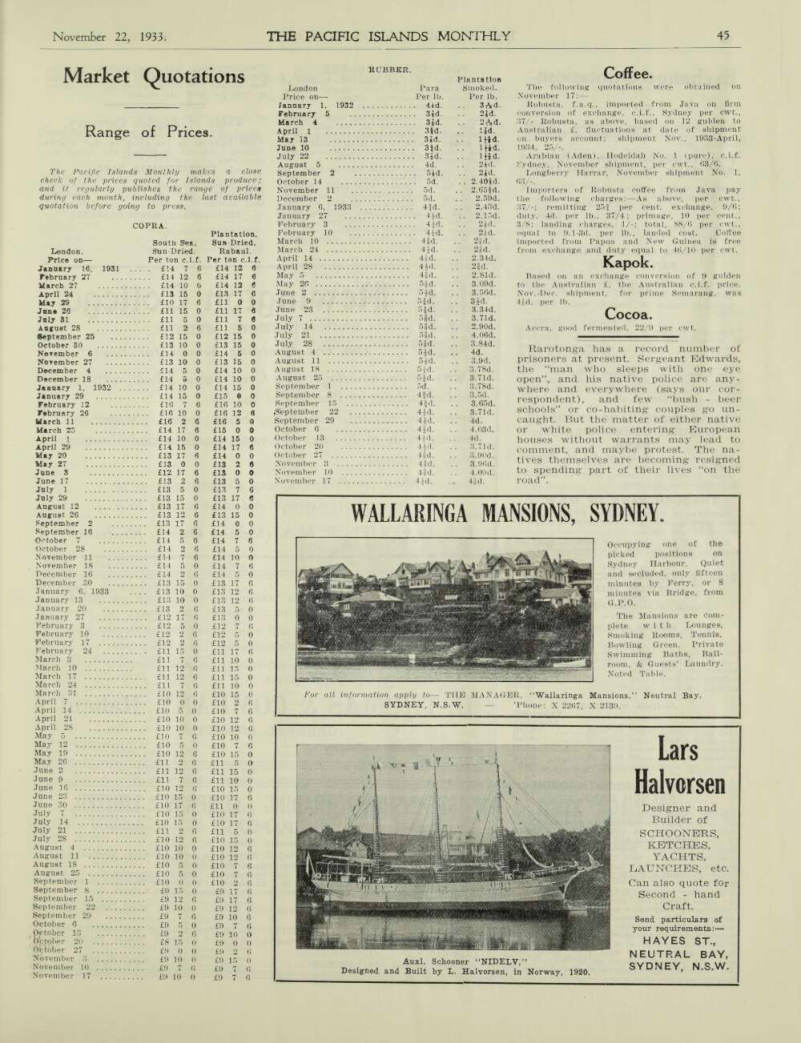
Range of Prices.
The Pacific Islands Monthly makes a close check of the prices quoted for Islands produce; and it regularly publishes the range of prices during each month, including the last available quotation before going to press.
Coffee.
The following quotations were obtained on November 17:— Robusta, f.a.q., imported from Java on firm conversion of exchange, c.i.f.. Sydney per cwt., 37/- Robusta, as above, based on 12 gulden to Australian £, fluctuations at date of shipment on buyers account: shipment Nov., 1933-April, 1934, 25/-.
Arabian (Aden), Hodeidah No. 1 (pure), c.i.f.
Sydney, November shipment, per cwt., 63/6.
Longberry Harrar, November shipment No. 1, 63/-.
Importers of Robusta coffee from Java pay the following charges:—As above, per cwt., 37/-: remitting 25¾ per cent, exchange, 9/6; duty, 4d. per lb., 37/4; primage, 10 per cent., 3/8; landing charges, 1/-; total, 88/6 per cwt., equal to 9.1-3 d. per lb., landed cost. Coffee imported from Papua and New Guinea is free from exchange and duty equal to 46/10 per cwt.
Kapok.
Based on an exchange conversion of 9 gulden to the Australian f, the Australian c.i.f. price, Nov.-Dec. shipment, for prime Semarang, was 4id. per lb.
Cocoa.
Accra, good fermented. 22/9 per cwt.
Rarotonga has a record number of prisoners at present. Sergeant Edwards, the “man who sleeps with one eye open”, and his native police are any where and everywhere (says our cor respondent), and few “bush - beer schools” or co-habiting couples go un caught. But the matter of either native or white police entering European houses without warrants may lead to comment, and maybe protest. The na tives themselves are becoming resigned to spending part of their lives “on the road”.
Copra.
South Sea, Plantation.
Sun Dried.
London.
Sun-Dried.
Rabaul.
Price on— Per ton c.i.f.
Per ton c.i.f.
Jannary 16, 1931 6 £14 12 6 February 27 .. . £14 12 6 £14 17 6 March 27 £14 10 0 £14 12 6 April 24 0 £13 17 6 May 29 6 £11 0 0 Jana 26 0 £11 17 6 July 81 0 £11 7 6 August 28 6 £11 6 0 September 25 . . . . 0 £12 15 0 October 80 £13 10 0 £13 15 0 November 6 £14 0 0 £14 5 0 November 27 £13 10 0 £13 15 0 December 4 £14 5 0 £14 10 0 December 18 £14 5 0 £14 10 0 January 1, 1932 . . £14 10 0 £14 15 0 January 29 0 £15 e 0 February 12 . . . . £16 7 6 £16 10 0 February 26 .. . . 0 £16 12 6 March 11 6 £16 5 0 March 25 £14 17 6 £15 0 0 April 1 £14 10 0 £14 15 0 April 29 0 £14 17 6 May 20 £13 17 6 £14 0 0 May 27 £13 0 0 £13 2 6 June 3 £12 17 6 £13 0 0 June 17 £13 2 6 £13 5 0 July 1 £13 5 0 £13 7 6 July 29 £13 15 0 £13 17 6 August 12 £13 17 6 £14 0 0 August 26 £13 12 6 £13 15 0 September 2 £13 17 G £14 0 0 September 16 ... £14 2 6 £14 5 0 October 7 £14 5 0 £14 7 6 October 28 £14 2 6 £14 5 0 November 11 £14 7 6 £14 10 0 November 18 ... £14 5 0 £14 7 6 December 16 ... £14 2 6 £14 5 0 December 30 ... £13 15 0 £13 17 6 January 6, 1933 £13 10 0 £13 12 6 January 13 £13 10 0 £13 12 6 January 20 £13 2 6 £13 5 0 January 27 £12 17 6 £13 0 0 February 3 £12 5 0 £12 7 G February 10 £12 2 6 £12 5 0 February 17 £12 2 6 £12 5 0 February 24 £11 15 0 £11 17 6 March 3 £11 7 6 £11 10 0 March 10 £11 12 6 £11 15 0 March 17 6 £11 15 0 March 24 £11 7 6 £11 10 0 March 31 6 £10 15 0 April 7 0 £10 2 6 April 14 0 £10 7 6 April 21 0 £10 12 6 April 28 0 £10 12 G May 5 6 £10 10 0 May 12 0 £10 7 6 May 19 6 £10 15 0 May 26 6 £11 5 0 June 2 6 £11 15 0 June 9 6 £11 10 0 June 16 6 £10 15 0 June 23 0 £10 17 6 June 30 6 £11 0 0 July 7 0 £10 17 G July 14 0 £10 17 6 July 21 6 £11 5 0 July 28 6 £10 15 0 August 4 £10 10 0 £10 12 6 August 11 £10 10 0 £10 12 G August 18 £10 5 0 £10 7 6 August 25 £10 5 0 £10 7 6 September 1 0 £10 2 6 September 8 0 £9 17 G September 15 £9 12 6 £9 17 6 September 22 £9 10 0 £9 12 6 September 29 £97 6 £9 10 6 October 6 £95 0 £9 7 6
October 13
6 £9 10 0 October 20 £8 15 0 £9 0 0 G
(ifciober 27
0 £9 2 November 3 0 £9 15 0 November 10 6 £9 7 (* November 17 £9 10 0 £9 7 6
London
Rubber.
Para Plantation Smoked.
Price on— Per lb.
Per lb.
January 1. 1932 4*d. 3Ad.
February 5 3Jd. .. 2id.
March 4 3Jd. .. 2Ad.
April I 3|d. .. l|d.
May 13 3{d.
U»d.
June 10 3}d. 133d.
July 22 3Jd. 1 33 d.
August 5 4d. 23d.
September 2 2Jd.
October 14 ... 5d. .. 2.403d.
November 11 5d. .. 2.65|d.
December 2 . . 2.59d.
January 6, 1933 4}d. . . 2.43d.
January 27 .. . . 43d. .. 2.13d.
February 3 ... 4id. .. 23d.
February 10 4id. .. 23d.
March 10 43d. .. 23d.
March 24 4Jd. .. 2Jd.
April 14 43d. .. 2.34d.
April 28 4Jd. . . 2gd.
May 5 4gd. .. 2.81d.
May 20 .. 3.09d.
June 2 53d. .. 3.5Gd.
June 9 . . 33d.
June 23 5id. 3.34d.
July 7 5fd. 3.71d.
July 14 53d. .. 2.90d.
July 21 5«d. .. 4.06d.
July 28 58d. . . 3.84d.
August 4 53d. 4d.
August 11 53d. .. 3.9d.
August 18 53d. 3.78d.
August 25 5}d. 3.71d.
September 1 5d. .. 3.78d.
September 8 4}d. .. 3.5d. . . 3.65d.
September 22 43d. .. 3.71d.
September 29 4id. .. 4d.
October 6 43d. .. 4.03d.
October 13 4d.
October 20 43d. .. 3.71d.
October 27 43d. 3L90d.
November 3 S.90d.
November 10 43d. 4.09d.
November 17 41d. .- 43d.
Advertisements & other items, p. 47 (1 item)
Advt
Auxl. Schooner “NIDELV,”
Designed and Built by L. Halvorsen, in Norway, 1920.
Lars
Halvorsen
Designer and Builder of
SCHOONERS,
KETCHES,
YACHTS,
LAUNCHES, etc.
Can also quote for Second - hand Craft.
Send particulars of your requirements:—
HAYES ST.,
NEUTRAL BAY,
SYDNEY, N.S.W.
Exchange Quotations
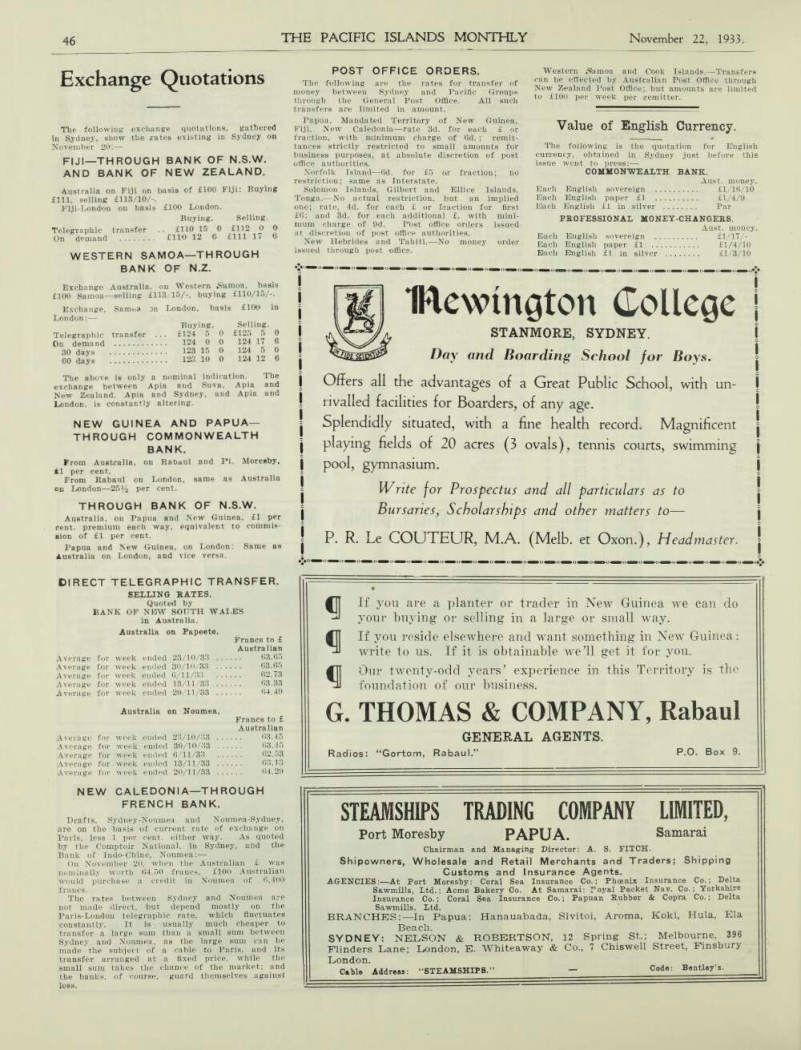
The following exchange quotations, gathered in Sydney, show the rates existing in Sydney on November 20: —
Fiji—Through Bank Of N.S.W.
And Bank Of New Zealand.
Australia on Fiji on basis of £100 Fiji: Buying fill, selling £113/10/-.
Fiji-London on basis £100 London.
Western Samoa—Through
Bank Of N.Z.
Exchange Australia, on Western .Stemoa, basis £100 Samoa —selling £113/15/-, buying £110/15/-.
Exchange, Samoa on London, basis £100 in London: —
The above is only a nominal indication. The exchange between Apia and Suva, Apia and New Zealand, Apia and Sydney, and Apia and London, is constantly altering.
New Guinea And Papua
Through Commonwealth
Bank.
Prom Australia, on Rabaul and Pt. Moresby, £1 per cent.
From Rabaul on London, same as Australia on London —25½ per cent.
Through Bank Of N.S.W.
Australia, on Papua and New Guinea, £1 per cent, premium each way, equivalent to commis sion of £1 per cent.
Papua and New Guinea, on London: Same as Australia on London, and vice versa.
Direct Telegraphic Transfer.
Selling Rates.
Quoted by
Bank Of New South Wales
in Australia.
New Caledonia—Through
French Bank.
Drafts, Sydney-Noumea and Noumea-Sydney, are on the basis of current rate of exchange on Paris, less 1 per cent, either way. As quoted by the Comptoir National, in Sydney, and the Bank of Indo-Chine, Noumea: — On November 20, when the Australian £ was nominally worth 64.50 francs, £100 Australian would purchase a credit in Noumea of 6,400 francs.
The rates between Sydney and Noumea are not made direct, but depend mostly on the Paris-London telegraphic rate, which fluctuates constantly. It is usually much cheaper to transfer a large sum than a small sum between Sydney and Noumea, as the large sum can be made the subject of a cable to Paris, and its transfer arranged at a fixed price, while the small sum takes the chance of the market; and the banks, of course, guard themselves against loss.
Post Office Orders.
The following are the rates for transfer of money between Sydney and Pacific Groups through the General Post Office. All such transfers are limited in amount.
Papua, Mandated Territory of New Guinea, Fiji, New Caledonia—rate 3d. for each £ or fraction, with minimum charge of 6d. ; remit tances strictly restricted to small amounts for business purposes, at absolute discretion of post office authorities.
Norfolk Island—6d. for £5 or fraction; no restriction; same as Interstate.
Solomon Islands, Gilbert and Ellice Islands, Tonga.—No actual restriction, but an implied one; rate, 4d. for each £ or fraction for first £6; and 3d. for each additional f, with mini mum charge of 9d. Post office orders issued at discretion of post office authorities.
New Hebrides and Tahiti.—No money order issued through post office.
Western Samoa and Cook Islands. —Transfers can be effected by Australian Post Office through New Zealand Post Office; but amounts are limited to £100 per week per remitter.
Buying.
Selling, Telegraphic transfer .. £110 15 0 £112 0 0 On demand £110 12 6 fill 17 6
Buying. Selling.
Telegraphic transfer . . . £124 5 0 £125 5 0 On demand 124 0 0 124 17 6 30 days 123 15 0 1 24 5 0 60 days 123 10 0 124 12 6
Australia on Papeete.
Francs to £ Australian Average for week ended 23/10/33 63.6".
Average for week ended 30/10/33 63.65 Average for week ended 6/11/33 62.73 Average for week ended 13/11/33 63.33 Average for week ended 20/11/33 64.49 Australia on Noumea.
Francs to £ Australian Average for week ended 23/10/33 63.45 Average for week ended 30/10/33 63.45 Average for week ended 6/11/33 62.53 Average for week ended 13/11/33 63.13 Average for week ended 20/11/33 64.29
Value of English Currency.
The following is the quotation for English currency, obtained in Sydney just before this issue went to press:—
Commonwealth Bank.
Aust. money.
Each English sovereign £1/16/10 Each English paper £1 £1/4/9 Each English £1 in silver Par
Professional Money-Changers.
Aust. money.
Each English sovereign £1/17/- Each English paper £1 £1/4/10 Each English £1 in silver £1/3/10
Advertisements & other items, p. 48 (1 item)
Newington College
STANMORE, SYDNEY.
Day and Boarding School for Boys .
Offers all the advantages of a Great Public School, with unrivalled facilities for Boarders, of any age.
Splendidly situated, with a fine health record. Magnificent playing fields of 20 acres (3 ovals), tennis courts, swimming
pool, gymnasium.
Write for Prospectus and all particulars as to Bursaries, Scholarships and other matters to — P. R. Le COUTEUR, M.A. (Melb. et Oxon.), Headmaster.
If you are a planter or trader in New Guinea we can do your buying or selling in a large or small way.
If you reside elsewhere and want something in New Guinea: write to us. If it is obtainable we’ll get it for you.
Our twenty-odd years’ experience in this Territory is the foundation of our business.
G. THOMAS & COMPANY, Rabaul
Radios: “Gortom, Rabaul.”
GENERAL AGENTS.
P.O. Box 9.
STEAMSHIPS TRADING COMPANY LIMITED,
Port Moresby PAPUA. Samarai
Chairman and Managing Director: A. S. FITCH.
Shipowners, Wholesale and Retail Merchants and Traders; Shipping Customs and Insurance Agents.
AGENCIES:—At Port Moresby: Coral Sea Insurance Co.; Phoenix Insurance Co.; Delta Sawmills, Ltd.; Acme Bakery Go. At Samarai: royal Packet Nav. Co.; Yorkshire Insurance Co.; Coral Sea Insurance Co.; Papuan Rubber & Copra Co.; Delta Sawmills, Ltd.
BRANCHES:—In Papua: Hanauabada, Sivitoi, Aroma, Koki, Hula, Ela Beach.
SYDNEY: NELSON & ROBERTSON, 12 Spring St.; Melbourne, 396 Flinders Lane; London, E. Whiteaway & Co., 7 Chiswell Street, Finsbury London.
Cable Address: “STEAMSHIPS.” Code: Bentley’s.
Sydney—Rabaul—Hongkong.
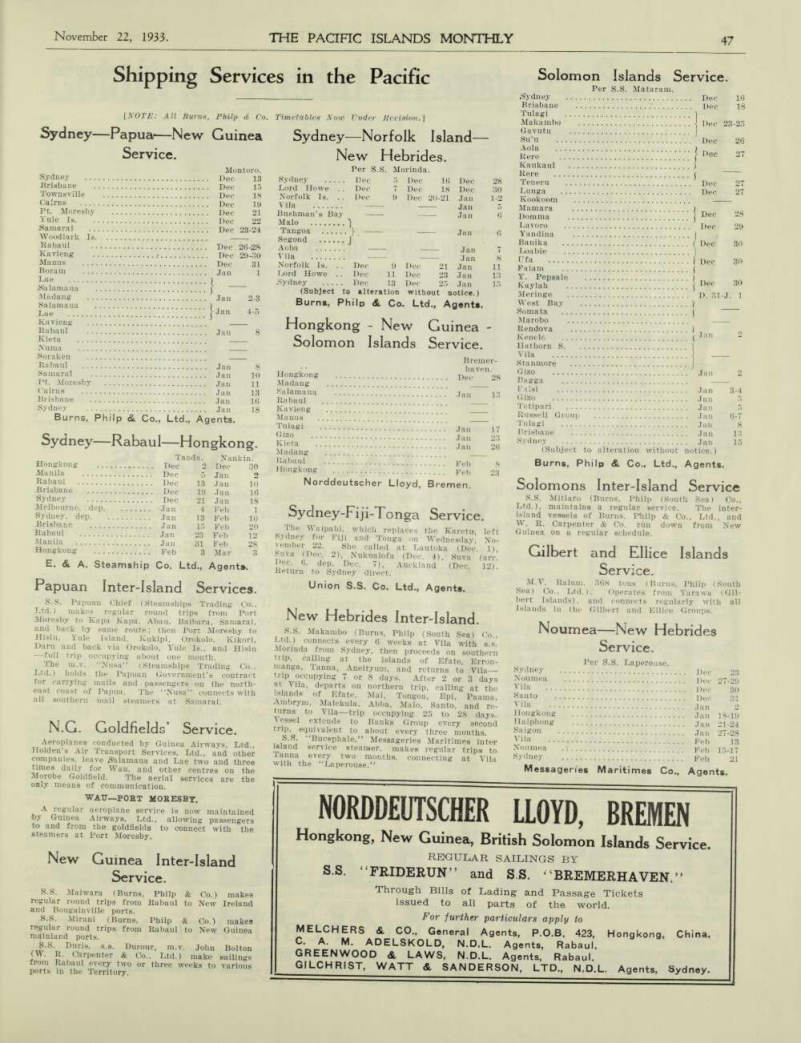
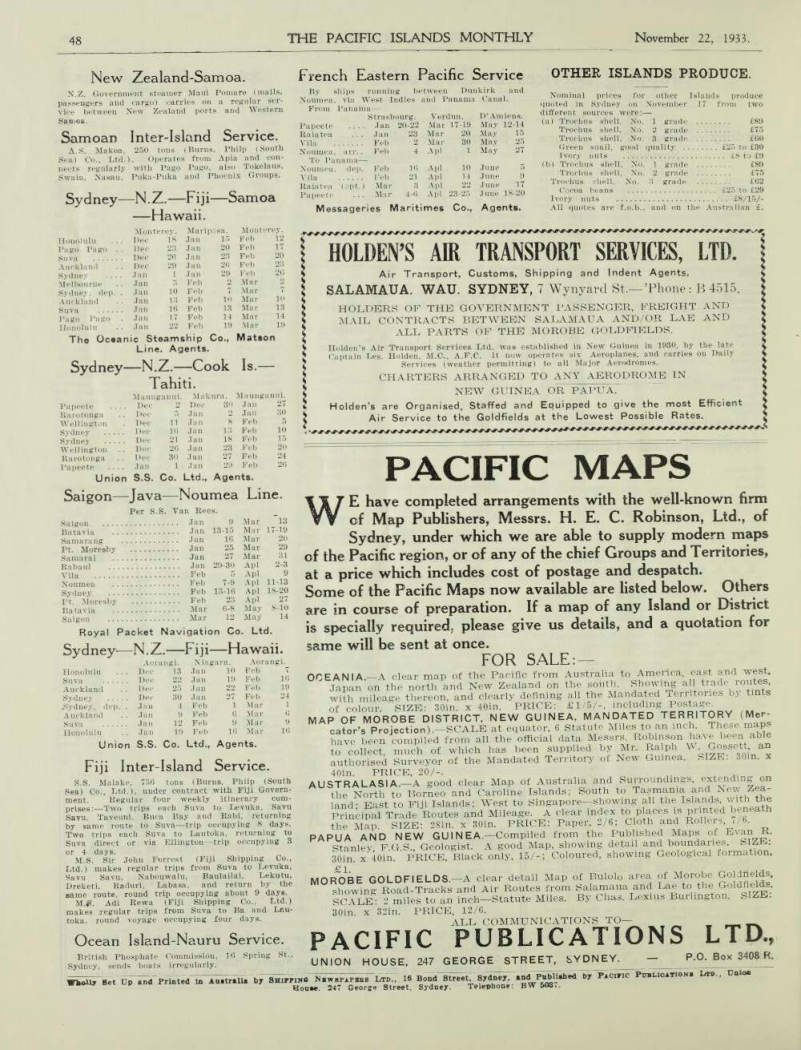
Shipping Services in the Pacific
[NOTE; All Burns, Philp & Co. Timetables Now Under Revision,]
Sydney—Papua—New Guinea Service.
Sydney—Norfolk Island — New Hebrides.
Sydney—Rabaul—Hongkong.
Papuan Inter-Island Services.
S.S. Papuan Chief (Steamships Trading Co., Ltd.) makes regular round trips from Port Moresby to Kapa Kapa, Abau, Baibara, Saraarai, and back by same route; then Port Moresby to Hisiu, Yule Island, Kukipi. Orokolo, Kikori, Dam and back via Orokolo, Yule Is., and Hisiu —full trip occupying about one mouth.
The m.v. “Nusa” (Steamships Trading Co., Ltd.) holds the Papuan Government’s contract for carrying mails and passengers on the north east coast of Papua. The “Nusa” connects with all southern mail steamers at Samarai.
N.G. Goldfields’ Service.
Aeroplanes conducted by Guinea Airways, Ltd., Holden’s Air Transport Services, Ltd., and other companies, leave Salamaua and Lae two and three times daily for Wau, and other centres on the Morobe Goldfield. The aerial services are the only means of communication.
Wau—Port Moresby,
A regular aeroplane service is now maintained toy Guinea Airways, Ltd., allowing passengers to and from the goldfields to connect with the steamers at Port Moresby.
New Guinea Inter-Island
Service.
S.S. Maiwara (Burns, Philp & Co.) makes regular round trips from Rabaul to New Ireland and Bougainville ports.
S.S. Mirani (Burns, Philp & Co.) makes regular round trips from Rabaul to New Guinea mainland ports.
S.S. Duris, s.s. Durour, m.v. John Bolton (W. R. Carpenter & Co., Ltd.) make sailings from Rabaul every two or three weeks to various ports in the Territory.
Hongkong - New Guinea - Solomon Islands Service.
Sydney-Fiji-Tonga Service.
The Waipahi, which replaces the Karetir, left Sydney for Fiji and Tonga on Wednesday, No vember 22. She called at Lautoka (Dec. 1) Suva (Dec. 2), Nukualofa (Dec. 4), Suva (arr.
Dec. 6. dep. Dec. 7), Auckland (Dec. 12) Return to Sydney direct.
Union S.S. Co. Ltd., Agents.
New Hebrides Inter-Island.
S.S. Makambo (Bums, Philp (South Sea) Co., Dtd.) connects every 6 weeks at Vila with s.s.
Morinda from Sydney, then proceeds on southern tnp, calling at the islands of Efate, Erron manga, Tanna, Aneityum, and returns to Vila— trip occupying 7 or 8 days. After 2 or 3 days at Vila, departs on northern trip, calling at the islands of Efate. Mai. Tongoa, Epi, Paama, Ambrym, Malekula. Abba, Malo, Santo, and re turns to Vila—trip occupying 25 to 28 days.
V essel extends to Banks Group every second trip, equivalent to about every three months.
S.S. “Bucephale.” Messageries Maritimes inter island service steamer, makes regular trips to Tanna every two months, connecting at Vila with the “Laperouse.”
Solomon Islands Service.
Solomons Inter-Island Service
S.S. Mitiaro (Burns. Philp (South Sea) Co., Ltd.), maintains a regular service. The inter island vessels of Burns, Philp & Co., Ltd., and W. R. Carpenter & Co. run down from New Guinea on a regular schedule.
Gilbert and Ellice Islands
Service.
M.V. Ralum. 368 tons (Burns, Philp (South Sea) Co., Ltd.). Operates from Tarawa (Gil bert Islands), and connects regularly with all Islands in the Gilbert and Ellice Groups.
Noumea—New Hebrides
Service.
Sydney Montoro.
Brisbane Townsville Cairns Pt. Moresby Yule Is Samarai Woodlark Is Rabaul Kavieng Manus Boram Lae l Salamaua Madang Salamaua Lae > Jan 4-5 Kavieng Rabaul Kieta Numa Soraken Rabaul Samarai Pt. Moresby Cairns Brisbane Sydney
Burns, Philp & Co., Ltd., Agents.
Tanda.
Nankin.
Hongkong Dec 2 Dec 30 Manila Dec 5 Jan 2 Rabaul Dec 13 Jan 10 Brisbane Dec 19 Jan 16 Sydney Dec 21 Jan 18 Melbourne, dep Jan 4 Feb 1 Sydney, dep Jan 13 Feb 10 Brisbane Jan 15 Feb 20 Rabaul Jan 23 Feb 12 Manila Jan 31 Feb 28 Hongkong Feb 3 Mar 3 E. & A. Steamship Co. Ltd., Agents.
Per S.S. Morinda.
Sydney 5 Dec 16 Dee 28 Lord Howe Dec 7 Dec 18 Dec 30 Norfolk Is. .. Dec 9 Dec 20-21 Jan 1-2 Nila . .
Jan 5 Bushman's Bay Jan 6 Malo Tangoa Jan 6 Segond ...
Aoha T — Vila Norfolk Is. .. Dec 9 Dec 21 Jan 11 Lord Howe .. Dec 11 Dec 23 Jan 13 .Sydney .. Dec 13 Dec 25 Jan 16 (Subject to alteration without notice.) Burns, Philp & Co. . Ltd., Agents.
Hongkong Madang Bremerhaven.
Salamaua Rabaul Kavieng Manus Tulagi Rizo Jan 23 Kieta Inn Madang Rabaul Hongkong Norddeutscher Lloyd, Bremen.
Per S.S. Mataram.
Sydney Dec Dec 16 18 Brisbane Tulagi Makambo Dec 23-2o Gavutu Su’u Dec 26 Aola Rere J Dec 27 Kaukaul Rere — Teneru 27 Lunga Dec 27 Kook com Mamara Domma Dec 28 Lavoro Dec 29 Yandina Banika 30 Loabie Ufa i Dec 30 Faiam Y. Pepsale Kaylab Dec 30 Meringe n si- .r i West Bav Somata Marobo Rendova Kenelo Hathorn S Inn 2 Vila Stanmore Gizo Jan 2 Bagga Faisi Jan Jan Jan J a n 3-4 5 Gizo Tetipari 5 Russell Group . . ., 6-7 Tulagi g Brisbane j au 13 15 Sydney Jan (Subject to alteration without notice.) Burns, Philp & Co.. Ltd., Agents
Sydney Per S.S. Laperouse.
OO Noumea — O 27.90 Vila — t -j Santo ..., OH 31 Vila Hongkong 18-19 Haiphong j 21-24 97.98 Saigon Jl Vila Feb it i -*-o Noumea .; Feb lo 15-17 oi Sydney
Messagenes Maritimes Co., Agents.
New Zealand-Samoa.
N.Z. Government steamer Maui Pomare (mails, passengers and cargo) carries on a regular ser vice between New Zealand ports and Western Samoa.
Samoan Inter-Island Service.
A.S. Makoa. 250 tons (Burns. Philp (South Sea) Co., Ltd.). Operates from Apia and con nects regularly with Pago Pago, also Tokelaus, Swain, Nasau, Puka-Puka and Phoenix Groups.
Sydney—N. Z. —Fiji—Samoa
—Hawaii.
The Oceanic Steamship Co., Matson Line. Agents.
Sydney—N.Z.—Cook Is. — Tahiti.
Union S.S. Co. Ltd., Agents.
Saigon—Java —Noumea Line.
Sydney*—N. Z.—F i j i—Hawaii.
Union S.S. Co. Ltd., Agents.
Fiji Inter-Island Service.
S.S. Malake, 736 tons (Burns, Philp (South Sea) Co., Ltd.), under contract with Fiji Govern ment. Regular four weekly itinerary com prises:—Two trips each Suva to Levuka, Savu Savu, Taveuni, Buca Bay and Rabi, returning by same route to Suva—trip occupying 8 days.
Two trips each Suva to Lautoka, returning to Suva direct or via Ellington—trip occupying 3 or 4 days.
M.S. Sir John Forrest (Fiji Shipping Co., Ltd.) makes regular trips from Suva to Levuka, Savu Savu, Nabouwalu, Baulailai, Lekutu, Dreketi, Raduri, Labasa, and return by the same route, round trip occupying about 9 days.
M.S. Adi Rewa (Fiji Shipping Co., Ltd.) makes regular trips from Suva to Ba and Lautoka, round voyage occupying four days.
Ocean Island-Nauru Service.
British Phosphate Commission, 16 Spring St., Sydney, sends boats irregularly.
french Eastern Pacific Service
By ships running between Dunkirk and Noumea, via West Indies and Panama Canal.
From Panama
Monterey.
Mariposa.
Monterey.
Honolulu Dec 18 Jan 15 Feb 12 Pago Pago . .
Dec 2.3 Jan 20 Feb 17 Suva Dec 26 Jan 23 Feb 20 Auckland Dec 29 Jan 26 Feb 23 Sydney ...
Jan 1 Jan 29 Feb 26 Melbourne Jan 3 Feb 2 Mar 2 Sydney, dep. .
Jan 10 Feb 7 Mar 7 Auckland Jan 13 Feb 10 Mar 10 Suva Jan 16 Feb 13 Mar 13 Pago Pago .
Jan 17 Feb 14 Mar 14 Honolulu Jan 21* Feb 19 Mar 19
Maungunui Makura.
Maunganui.
Papeete .. Dec 2 Dec 30 Jan 27 Rarotonga .. Dec 0 Jan 2 Jan 30 Wellington Dec 11 Jan 8 Feb 5 Sydney .. Dec 10 Jan 13 Feb 10 Sydney .. Dec 21 Jan 18 Feb 15 Wellington .. Dec 26 Jan 23 Feb 2o Rarotonga . . Dec 30 Jan 27 Feb 24 Papeete .. Jan 1 Jan 29 Feb 26
Per S.S. Van Rees.
Saigon Jan 9 Mar 13 Batavia 13-13 Mar 17-19 Samarang 16 Mar 20 Pt. Moresby 25 Mar 29 Samarai 27 Mar 31 Rabaul Jan 29-30 Apl 2-3 Vila Feb 5 Apl 9 Noumea Feb 7-9 Apl 11-13 Sydney Feb 13-16 Apl 18-20 Pt. Moresby Feb 23 Apl 27 Batavia Mar 6-8 May 8-10 Saigon 12 May 14 Royal Packet Navigation Co. Ltd.
Aoiangi.
Niagara.
Aorangi.
Honolulu Dec 13 Jan 10 Feb 7 Suva Dec 22 Jan 19 Feb 16 Auckland Dec 95 Jan 22 Feb 19 Sydney Dec 30 Jan 27 Feb 24
.Sidney, dep. .
Jan 4 Feb 1 Mar 1 Auckland Jan !l Feb 6 Mar 6 Suva Jan 12 Feb !t Mar 9 Honolulu Jan 19 Feb 16 Mar 16
Strasbourg. Verdun. D’Amiens.
Papeete Jan 20-22 Mar 17-19 May 12-14 Raiatea . . . Jan 23 Mar 20 May 15 Vila Feb 2 Mar 30 May 23 Noumea, arr.. Feb 4 Apl 1 May 27 To Panama— Noumea, dep. Feb 16 Apl 10 June 5 Vila Feb 21 Apl 14 June 9 Raiatea (opt.) Mar 3 Apl 22 June 17 Papeete .. . Mar 4-6 Apl 23-25 June 18-20
Messageries Maritimes Co., Agents.
Advertisements & other items, p. 49 (1 item)
Norddeutscher Lloyd, Bremen
Hongkong, New Guinea, British Solomon Islands Service. regular sailings by
S.S. “FRIDERUN” and S.S. “BREMERHAVEN. ”
Through Bills of Lading and Passage Tickets issued to all parts of the world.
For further particulars apply to WELCH ERS & CO., General Agents, P. 0.8. 423, Hongkong, C. A. M. ADELSKOLD, N.D.L. Agents, Rabaul.
GREENWOOD & LAWS, N.D.L. Agents, Rabaul.
GILCHRIST, WATT & SANDERSON, LTD., N.D.L. Agents, China.
Sydney.
Other Islands Produce.
Nominal prices for other Islands produce quoted in Sydney on November 17 from two different sources were;— (a) Trochus shell, No. 1 grade £89 Trochus shell, No. 2 grade £75 Trochus shell. No. 3 grade £60 Green snail, good quality £25 to £30 Ivory nuts £8 to £9 (b) Trochus shell. No. 1 grade £89 Trochus shell, No. 2 grade £75 Trochus shell, No. 3 grade £62 Cocoa beans £25 to £29 Ivory nuts £8/15/- All quotes are f.o.b., and on the Australian f.
Advertisements & other items, pp. 50-52 (2 items)
48
November 22, 1933.
THE PACIFIC ISLANDS MONTHLY
Wholly Set Up and Printed In Australia by Shipping Newspapers Ltd., 16 Bond Street, Sydney and Published by Pacific Publications Ltd, Union House. 247 George Street. Sydney. Telephone. BW 5037.
Pacific Maps
HOLDEN’S AIR TRANSPORT SERVICES, LTD.
Air Transport, Customs, Shipping and Indent Agents, SALAMAUA. WAU. SYDNEY, 7 Wynyard St.— ’Phone: B 4515.
HOLDERS OF THE GOVERNMENT PASSENGER, FREIGHT AND MAIL CONTRACTS BETWEEN SALAMAUA AND/OR LAE AND
ALL PARTS OF THE MOROBE GOLDFIELDS.
Holden’s Air Transport Services Ltd. was established in New Guinea in 1930, by the late Captain Les. Holden, M.C., A.F.C. It now operates six Aeroplanes, and carries on Daily Services (weather permitting) to all Major Aerodromes.
CHARTERS ARRANGED TO ANY AERODROME IN
NEW GUINEA OR PAPUA.
Holden’s are Organised, Staffed and Equipped to give the most Efficient Air Service to the Goldfields at the Lowest Possible Rates.
PACIFIC MAPS
WE have completed arrangements with the well-known firm of Map Publishers, Messrs. H. E. C. Robinson, Ltd., of Sydney, under which we are able to supply modem maps of the Pacific region, or of any of the chief Groups and Territories, at a price which includes cost of postage and despatch.
Some of the Pacific Maps now available are listed below. Others are in course of preparation. If a map of any Island or District is specially required, please give us details, and a quotation for same will be sent at once.
FOR SALE:
OCEANIA.—A clear map of the Pacific from Australia to America, east and west, Japan on the north and New Zealand on the south. Showing all trade routes with mileage thereon, and clearly defining all the Mandated Territories by tints of colour. SIZE: 30in. x 40in. PRICE: £1/5/-. including Postage.
MAP OF MOROBE DISTRICT, NEW GUINEA. MANDATED TERRITORY (Mercator’s Projection).— SCALE at equator, 6 Statute Miles to an inch. These maps have been compiled from all the official data Messrs Robinson have been able to collect much of which has been supplied by Mr. Ralph W Gossett, an authorised Surveyor of the Mandated Territory of New Guinea, SIZE: 30m. x
40in. PRICE, 20/-.
AUSTRALASIA. —A good clear Map of Australia and Surroundings, extending on the North to Borneo and Caroline Islands; South to Tasmania and New Zealand; East to Fiji Islands; West to Singapore—showing all the Is!ands .withJffie Principal Trade Routes and Mileage. A clear index to places is printed beneath the Map. SIZE: 28in. x 30in. PRICE: Paper, 2/6; Cloth and Rollers, 7/6.
PAPUA AND NEW GUINEA.—Compiled from the Published Maps of Evan R.
Stanley F.G.S., Geologist. A good Map, showing detail and boundaries. SIZE: 30in. x 40in. PRICE, Black only, 15/-; Coloured, showing Geological formation, £ 1 MOROBE GOLDFIELDS.—A clear detail Map of Bulolo area of Morobe Goldfields, showing Road-Tracks and Air Routes from Salamaua and Lae to the Goldfields.
SCALE: 2 miles to an inch—Statute Miles. By Chas. Lexms Burlington. SIZE. 30in. x 32in. PRICE, 12/6.
ALL COMMUNICATIONS TO—
PACIFIC PUBLICATIONS LTD.,
UNION HOUSE, 247 GEORGE STREET, SYDNEY. P.O. Box 3408 R.
Goldfields Aerial Transport Service
Three of the Large Tri - motored Aeroplanes, operated by Guinea Airways Ltd., on Bulolo Aerodrome, in the heart of the New Guinea Mountains.
SIX years ago, the Morobe Goldfield, in the Interior of New Guinea, was almost inaccessible.
The country is so mountainous and broken that roads cannot be built, except at enormous cost. Transport was by native carriers, travelling 5 or 6 miles per day.
Then came Aeroplanes. The trip from the coast to the goldfield took under 30 minutes, instead of Bto 10 days. Aeroplanes carried in engineers and artisans, native labourers and foodstuffs, dredges, motor trucks, building material, hydro-electric machinery.
To-day, the Morobe goldfield is the seat of a great, growing and flourishing industry, winning much new wealth for the Territory, and giving employment to hundreds of Europeans.
Guinea Airways Ltd., launching this unique aerial service, originally with one machine and a handful of men, now operate a fleet of aeroplanes— including three very large tri-motored monoplanes—and employ 80 Europeans and a numerous native staff. Their aeroplanes run on fixed timetables from Lae, Salamaua, Bulolo, Wau and Port Moresby, carrying passengers and freight, and maintaining regular communication between 26 aerodromes.
New parties of Prospectors are constantly opening np new country, pushing steadily into the almost unknown interior. They make camp, and clear an aerodrome; and, within a few days, Guinea Airways’ planes are arriving Avith supplies. This pioneering work goes on ceaselessly. Guinea Airways, with their unique experience, skilled personnel and modern equipment, are ready and waiting to operate wherever they are needed.
GUINEA AIRWAYS LTD
LAE - SALAMAUA
You men need a bottle of KB at dusk ... there’s stimulation in every glass!