Pacific

Islands
Monthly
October 24Th,
1933
6 d
[Registered at G.P.O., Sydney, for transmission by post as a newspaper.]
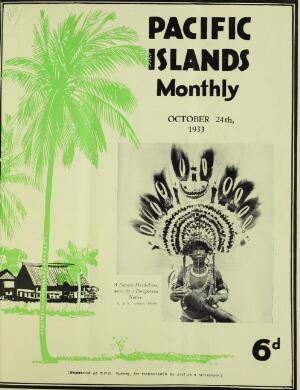
A Papuan Head-dress, worn by a Poroporena Native.
A. & K. Gibson, Photo.
Advertisements & other items, p. 2 (1 item)
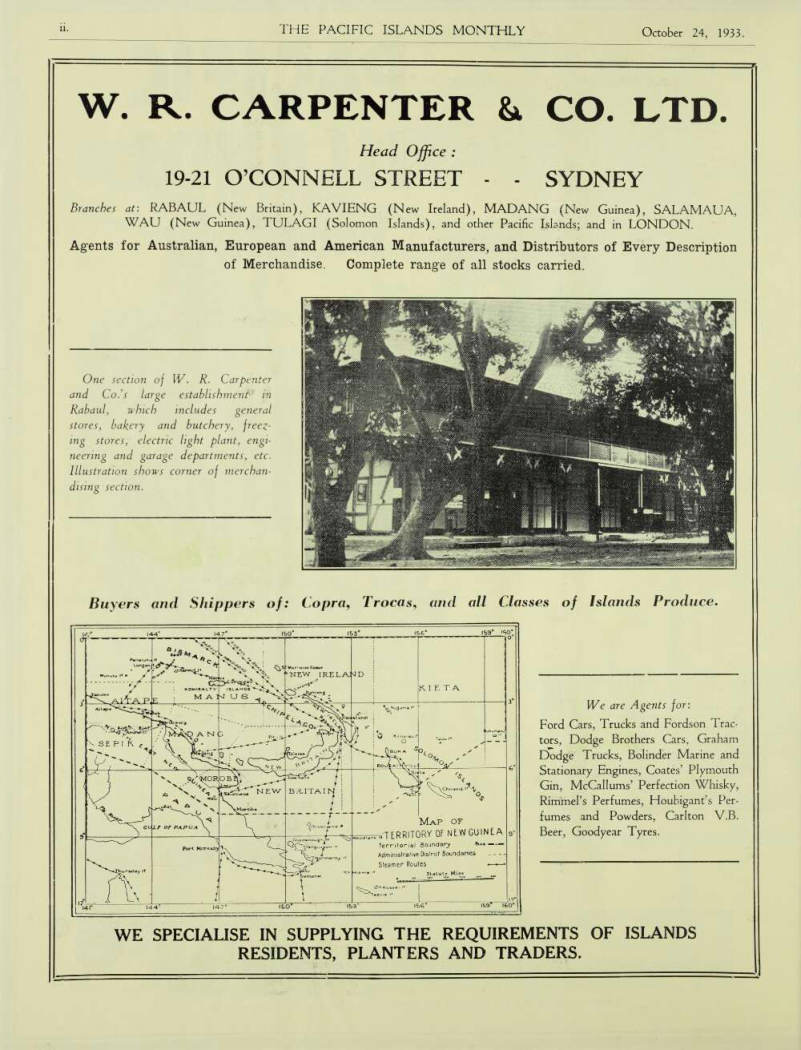
W. R. Carpenter & Co. Ltd.
Head Office :
19-21 O’CONNELL STREET - - SYDNEY
Branches at: RABAUL (New Britain), KAVIENG (New Ireland), MADANG (New Guinea), SALAMAUA, WAU (New Guinea), TULAGI (Solomon Islands), and other Pacific Islands; and in LONDON.
Agents for Australian, European and American Manufacturers, and Distributors of Every Description of Merchandise. Complete range of all stocks carried.
One section of W. R. Carpenter and Co’s large establishment in Rabaul, which includes general stores, bakery and butchery, freezing stores, electric light plant, engineering and garage departments, etc.
Illustration shows corner of merchandising section.
Buyers and Shippers of: Copra , Trocas , and all Classes of Islands Produce.
We are Agents for: Ford Cars, Trucks and Fordson Tractors, Dodge Brothers Cars, Graham Dodge Trucks, Bolinder Marine and Stationary Engines, Coates’ Plymouth Gin, McCallums’ Perfection Whisky, Rimmel’s Perfumes, Houbigant’s Perfumes and Powders, Carlton V.B.
Beer, Goodyear Tyres.
WE SPECIALISE IN SUPPLYING THE REQUIREMENTS OF ISLANDS
RESIDENTS, PLANTERS AND TRADERS.
Pacific Islands Travellers
Passengers Arrived Per “Mata-
Ram" From Solomon Islands On Sep-
TEMBER 23: Mr. and Mrs. Robertson, Miss E.
O'Dea, Miss M. Auger, Mr. E. Monckton, Mr. and Mrs. H. Barham, Mr. and Mrs. J. C. Barley, Mr. P. J. O’Brien, Miss M. E. Archer, Miss L. P. Borsdoff, Miss K. Fitzgerald. Miss J.
Gifford, Mr. and Mrs. O. Foster, Miss B. M.
Holmes, Mr. and Mrs. J. L. Heyworth, Mr.
D. M. Terry, Miss E. West, Mr. F. Green, Mrs. F. G. Middenway, Mr. A. C. Ball, Mrs.
A. C. Ball, Mr. R. Walmsley, Mrs. C. P.
Younger, Miss L. M. Atkinson, Miss C. M.
Cleaver, Mr. A. S. Arnold, Mrs. I. M. Barker, Mr. C. R. Bignell, Mr. J. McLeod Bolton, Mr. and Mrs. S. G. Caulton, Miss C. M. Deck, Mr.
G. Fulton, Mr. H. Gage, Mr. C. A. Gage, Mr.
A. W. Gage, Mrs. E. Hicks, Mr. and Mrs.
W. C. Hynam, Mr. A. Jones, Mr. S. G.
Knibbs, Mr. R. C. Laycock. Mr. and Mrs. A.
Osborne, Mr. E. V. Patterson, Mr. J. Stark Spiers, Mr. A. Young, Mr. C. V. Widdy, Mr.
J. A. Johnstone.
Passexgers Per “Morinda,” Sailed
ON SEPTEMBER 23 FOR LORD HOWE AND NORFOLK ISLANDS : Mr. and Mrs. T. Wilson, Mr. and Mrs. S. Glisson, Mesdames L. B.
Morgan, J. E. Evans, C. H. Denny, R. Barrell, Misses M. Cook, Harlaud, V. Young, E. and L.
Thurston, G. M. Owen, L. Donaldson, I. Hes ford, E. Dobbie, D. Barrell, Messrs. Edwards, T. P. Brown, H. Bowen, J. Payten, A. K.
Campbell, C. K. Probert, P. Denny, L. Lee, W. and H. Robinson, H. R., Smith, J. and C.
Rankin, C. E. McCay, S. E. Saxton, F. R.
Breading, H. Mackenzie, G. Green, H. L. Piper, A. R. Hawson, J. A. Mackillop, F. C. Mac killop, Dr. Richards.
Passengers Per “Montoro,” Which
Sailed On September 21 For Papua
AND NEW GUINEAs Mr. and Mrs. J. Hinds, Mr. and Mrs. Max Kraut, Mr. and Mrs. E. C. M.
Helton, Mr. and Mrs. C. A. Altria, Mr. and Mrs. T. K. Colquhoun, Professor and Mrs. Thurn wald, Mesdames F. E. Neal, E. Clifford, A. E.
Dover, F. Everall, R. D. Pye, Maclean, Hay ton, Misses F. Cooke, A. M. Thompson, E. M.
Verco, M. M. Riggs, Lievering, A. I. Walker, P. A. Vale, Hayton, Sister M. Felicitia, Sister M. Cecilia, Messrs. P. Avery, K. Walker, O.
Moon, D. James, E. T. Short, A. Spence, A. W.
Sassall, Ducher, H. M. Scott, H. E. Woodman, A. Roberts, E. P. Fahey, H. Waters, A. R.
Caircross, I. L. Griffith, H. R. Halliday, J.
Macdonald, H. H. Rowe, Strugnell, G. F. Ham mond, J. A. Miller.
Passexgers Per "Monterey,” Which
SAILED FROM SYDNEY FOR SUVA, FIJI, ON SEPTEMBER 20: Miss G. Corr, Mr. S. G.
Cruickshank, Mr. E. V. Dixon, Mrs. E. V.
Dixon, Mr. T. A. Edmeades, Miss F. Grant, Mrs. G. Mead, Mrs. E. Murphy, Mrs. G. Nathan, Mr. S. Nichol, Mr. R. L. Parker, Miss Lucy Parker, Mrs. C. E. Price, Miss A. M. Price, Mr. Ben T. Smith, Mrs. Ben T. Smith, Mrs.
E. Statham, Mr. G. A. Stronach, Mrs. G. A.
Stronach, Mr. A. G. Smyth, Mrs. A. G. Smyth, Mrs. Hugh Trumble, Miss V. Trumble, Miss E.
Johnson, Sister Mary Joachim, Mrs. E. Mason, Mr. W. M. Mutton, Mr. H. A. Ragg, Mrs. H. A.
Ragg, Miss T. M. Ragg, Mr. A. A. Ragg, Mrs.
A. A. Ragg, Mr. E. J. Stott.
Passengers Per “Mataram" Which
Sailed From Sydney For Solomon
ISLANDS ON SEPTEMBER 30; Mr. and Mrs.
C. Werntz, Misses V. Noonan, A. Shaw, C. E.
Waite, V. M. Sullivan, I. George, A. Stewart, M. Fotheringham, V. Thompson, Rev. L. L.
Oldham, Messrs. C. L. Dawe, H. C. Leggatt, H. Tighe, W. Clark, E. McLeod, M. Harper, F. H. Rhoades, E. Ashton, R. H. Benbow, G.
Bennett.
Passengers Per “Mariposa,” Which
Arrived In Sydney From Fiji On
OCTOBER 9: Mrs. D. Allen, Mr. Earl Born held, Mr. J. R. Brogan, Mrs. W. P. Brownell, Mr. W. G. Clarke, Miss G. Corr, Mr. J. Costello, Mr. E. V. Dixon, Mrs. E. V. Dixon, Miss Una Donovan, Mr. J. S. Dunstan, Mr. A.
Edmeades, Mrs. M. E. Jeffries, Mrs. Laura Mac- Mahon, Mr. Will S. Marshall, Mrs. Will S.
Marshall, Mrs. G. V. Mead, Mr. W. Mitchell, Mrs. E. Murphy, Mr. S. Nichols, Mr. R. L.
Parker, Miss Lucy Parker, Miss A. M. Price, Miss C. E. Price, Mrs. M. Rowe, Madame Geo.
G. Stoicesco, Mr. E. I. Stott, Mr. G. A.
Stouach, Mrs. G. A. Stonach, Mr. R. G. Dunn, Mrs. Hugh Trumble, Miss Violet Trumble, Mr.
L. K. Gahagan, Mr. R. McNamara, Miss Mar jorie McPhee, Miss Muriel McPhee, Miss Elsie Murdoch, Mr. W. G. Robinson, Miss Marjorie Tate, Mr. J. W. Vandercock, Mrs. J. W. Vandercock, Mr. C. O. Taylor, Mrs. C. O. Taylor, Miss E. Taylor, Mr. R. G. Kendall, Mrs. R. G.
Kendall, Master M. Kendall, Mr. W. Cooper, Miss W. Cooper.
Passengers Per “Morinda,” Which
Arrived From New Hebrides And Nor-
FOLK ISLAND ON OCTOBER 3: Mrs. M. M.
Abagail, Miss D. Cussons, Mr. A. Edwards, Mr.
C. W. F. Hickling, Mr. G. B. Hickling, Mr.
J. Hockling, Mrs. M. Locksmith, Mr. S. Saxton, Mrs. F. M. Symonds, Miss A. Shoosmith, Miss M. Stewart, Mrs. R. Barrell, Miss D. Barrell, Mr. H. Bowen, Mr. F. R. Breading, Miss M.
Cook, Mrs. C. H. Denny, Mr. P. Denny, Mr. and Mrs. A. Glisson, Mr. J. Harland, Miss I.
Hesford, Mrs. Lee. Mr. H. Mackenzie, Mr. G.
Green, Mr. F. C. Mackillop, Mr. C. K. Probert, Mr. J. Rankin, Mr. C. Rankin, Dr. R. W.
Richards, Mrs. I. Simpson, Mr. H. R. Smith, Mr. and Mrs. T. Wilson.
Passengers Per “Morinda," Which
Sailed From Sydxey For New
Hebrides, Via Lord Howe And Nor-
FOLK ISLAXDS ON OCTOBER 5: Bishop and Mrs. Kirkby, Mr. and Mrs. L. Petrie, Mr. and Mrs. J. Rees, Mr. and Mrs. W. J. Murphy, Mr. and Mrs. J. Hobson, Mr. and Mrs. A. R.
Ware, Mr. and Mrs. H. L. Windsor, Mr. and Mrs. T. P. J. Gray, Mr. and Mrs. J. P. Jones, Mr. and Mrs. C. W. Wedgwood, Mr. and Mrs.
W. E. Palme, Mesdames H. Hayward, J. Gay, Stowell, J. Grant, M. M. Benson, N. Crowe, Misses Z. Davis, A. Campbell, C. Douglas, I.
Baker, R. Trevitt, Kelly, McCarthy, M. and D.
Morgan, Goodman, Morgan, E. and K. Dillon, M. Bunworth, K. Fegau, L. Nelleship, S. Meek, D. McKimm, N. Broughton, F. H. Jones, N.
Gettens, O. Yabsley, E. Waller, M. Brownlow, F. Ramsay, H. McKimm, G. W. Wilson, Neave, Crowe, G. McNamara, H. Lewis, South, Grant, A. Olsson, Father Kelledy, Dr. C. Walker, Messrs. C. I. Quintal, Crosby-Brown, M. Gold stein, C. J. O’Brien, J. A. Purcell, J. McKimm, P. J. Carroll, R. Walker, W. Farrow, L. H.
Stowell, M. Shelley, E. G. Fahey, South, E.
Olding.
Passengers Per “Macdhui,” Which
LEFT SYDNEY ON OCTOBER 12 FOR PAPUA AND NEW GUINEA : Rev. and Mrs. J. W.
Burton, Mr. and Mrs. A. C. Burgoine, Mr. and Mrs. C. Champion, Mr. and Mrs. J. W. Kitto,
Dr. and Mrs. B. A. Sinclair, Mr. and Mrs.
B. E. Weston, Mr. and Mrs. J. A. Vandercook, Mr. and Mrs. R. Sargeant, Mr. and Mrs. C. W.
Thomas, Mr. and Mrs. W. Leydin, Mesdames E. M. Olsson, S. Gilhllan, D. Rogers, C. I. H.
Campbell, V. Bramming, B. Moon, E. E. Lees, M. Helbig, M. F. Bilston, Sister G. McCrea, J. Hockey, Misses M. Hastie, D. Turner, V. M.
Warrall, G. G. Thomas, F. J. Pearce, B. Morris, M. Cunningham, R. Mackinnon, J. Evenett, E. Hart, Messrs. H. E. Thomas, B. Heath, G. T. McMahon, H. G. Carter, Father J. Hoeve kamp, L. A. Carr, E. Muller, L. Farmer, M.
Halsey, Hon. G. Nelsson, H. B. Brown, Dr.
W. T. Harse, R. Moon, E. P. Lee, Rev. M. S.
Helbig, Pastor R. H. Tutty, The Rt. Rev.
Bishop H. Newton, R. Joyner, J. H. Hepburn, N. Weston, C. F. Dewey, J. McLeod, J. Currie, F. H. G. Simcocks, E. A. Beattie, G. Kingvote, F. J. Bannigan, F. Cook, C. F. Cowley, Capt. E. Mustar.
Passengers Per “Niagara,” Which
SAILED FROM SYDNEY FOR SUVA, FIJI, ON OCTOBER 12: Mr. C. A. Fletcher, Mr. G. W.
Lee-Atkinson, Mrs. G. W. Lee-Atkinson, Mr.
F. W. Gardner, Mr. E. Grahame, Mr. E.
Kenyon, Mr. J. A. Conroy, Mrs. J. A. Conroy, Mr. E. D. Terry, Miss S. A. Major, Mrs. O.
Major, Miss A. Rennison, Mrs. M. W. R. Kerr, Miss D. Kerr, Master D. Kerr, Mr. J. Collings, Miss M. E. E. Dobell., Mr. R. B. Lattrell, Mr.
E. Drummond, Mr. W. Morris, Mr. W. R. Morris, Mr. M. T. Foster.
Passengers Per “Tanda,” Which Left
Sydney For Rabaul, New Guinea, On
OCTOBER 14: Mr. V. A. Pratt, Mrs. Z. E.
Fenton, Mr. C. T. Drane, Mr. J. L. Street, Mrs.
J. L. Street and two children, Mr. E. Haynes, Mrs. E. Haynes, Mrs. Gilmore and two children.
Miss I. Maunsell.
Advertisements & other items, p. 3 (1 item)
advt
AT BLUE MOUNTAINS
SPRINGWOOD. N.S.W.
Springwood Ladies’ College.
Est. 1897. Kindergarten to Leaving Certificate.
Tennis, Riding, Swimming, Team Games.
Unequalled climate. Pure Jersey milk. Senior and Junior Houses. Open-air sleeping. Inclusive fees. Special vacation arrangements for Island pupils. M. E. DURAND, Principal.
New Britain Express Delivery.
GENERAL OVERSEAS AGENTS,
GENERAL CARRIERS. BAGGAGE AGENTS,
and FORWARDING AGENTS.
Reliable Cars and Trucks.
We aim to give quick and reliable Service at reasonable costs. P.O. Box 116. Telephone: 141.
W. WALKER - FLYNN, Proprietor, Market Street, Rabaul, T.N.G.
advt
Goshen Pt. Hospital 32
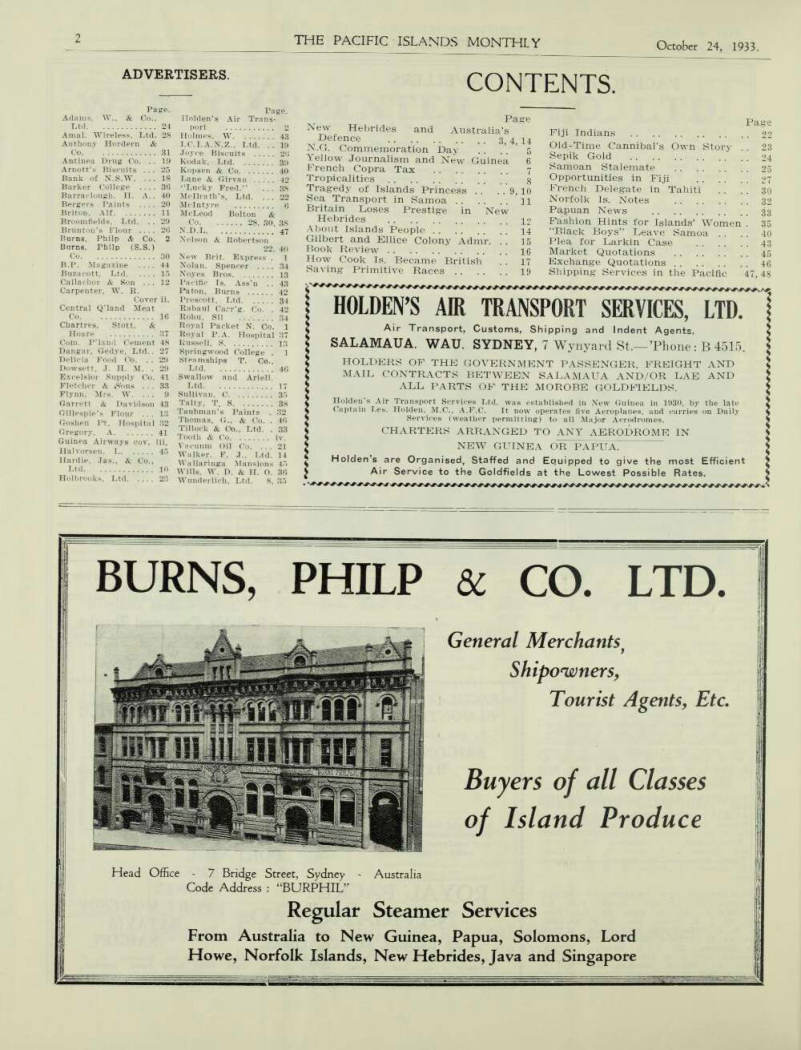
Advertisers.
Page.
Adams, W., & Co., Ltd 24 Amal. Wireless, Ltd. 28 Anthony Hordern & Co. 31 Antinea Drug Co. .. 19 Arnott’s Biscuits ... 25 Bank of N.S.W. ... 18 Barker College 36 Barraclough, H. A.. 40 Bergers Paints ... 20 Briton, Alf 11 Broomfields, Ltd. .. 29 Brunton’s Flour ... 26 Burns, Philp & Co. 2 Burns, Philp (S.S.) Co 30 B.P. Magazine ... 44 Buzacott, Ltd 15 Callachor & Son ... 12 Carpenter, W. E.
Cover ii.
Central Q'land Meat Co 16 Chartres, Stott, & Hoare 37 Com. P’laml Cement 48 Dangar, Gedye, Ltd.. 27 Delicia Food Co. . . 29 Dowsett, J. H. M. . 29 Excelsior Supply Co. 41 Fletcher & Sons ... 33 Flynn, Mrs. W. ... 9 Garrett & Davidson 43 Gillespie’s Flour ... 13
Goshen Pt. Hospital 32
Gregory, A. 41 Guinea Airways cov. iii.
Halvorsen, L 45 Hardie, Jas., & Co., Ltd 10 Holbrooks, Ltd 23
Page.
Holden’s Air Trans port 2 Holmes, W 43
I.C.I.A.N.Z., Ltd. . . 19
Joyce Biscuits 2f!
Kodak, Ltd 39 Kopsen & Co 40 Lane & Girvan 42 “Lucky Fred.” ... 38 McIlrath’s, Ltd. ... 22 Mclntyre G McLeod Bolton & Co 28, 30, 38
N.D.L 47
Nelson & Robertson 22, 40 New Brit. Express . 1 Nolan, Spencer ... 34 Noyes Bros 13 Pacific Is. Ass’n . . 43 Paton, Burns 42 Prescott, Ltd 34 Rabaul Carr’g. Co. . 42 Rohu, Sil 34 Royal Packet N. Co. 1 Royal P.A. Hospital 37 Russell, S 13 Springwood College . 1 Steamships T. Co., Ltd 46 Swallow and Ariell.
Ltd 17 Sullivan. C 35 Talty, T. S 38 Taubman’s Paints . 32 Tillock & Co., Ltd . 33
Tooth & Co. 21
Vacuum Oil Co. 21 Walker, F J., Ltd . 14 Wallaringa Mansions 45 Wills, W. D. & H. O. 36 Wunderlich, Ltd. 8, 35
Contents.
Page New Hebrides and Australia’s Defence 3, 4, 14 N.G. Commemoration Day . . 5 Yellow Journalism and New Guinea 6 French Copra Tax 7 Tropicalities 8 Tragedy of Islands Princess . . . . 9, 10 Sea Transport in Samoa 11 Britain Loses Prestige in New Hebrides 12 About Islands People 14 Gilbert and Ellice Colony Admr, . . 15 Book Review 16 How Cook Is. Became British . . 17 Saving Primitive Races 19
Page Fiji Indians 22 Old-Time Cannibal’s Own Story 23 Sepik Gold 24 Samoan Stalemate 25 Opportunities in Fiji 27 French Delegate in Tahiti . . . . 30 Norfolk Is. Notes 32 Papuan News 33 Fashion Hints for Islands’ Women . 35 “Black Boys” Leave Samoa .. . . 40 Plea for Larkin Case 43 Market Quotations 45 Exchange Quotations 46 Shipping Services in the Pacific 47, 48
Advertisements & other items, p. 4 (1 item)
Burns, Philp & Co. Ltd.
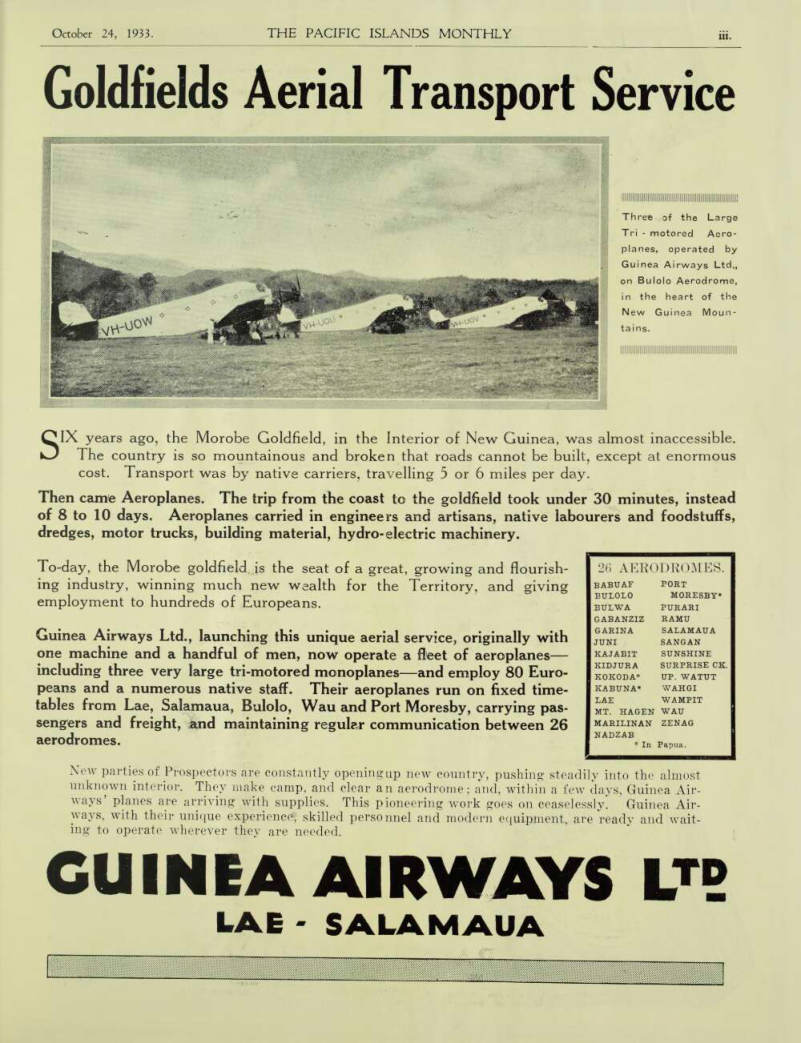
HOLDEN’S AIR TRANSPORT SERVICES, LTD.
Air Transport, Customs, Shipping and Indent Agents, SALAMAUA. WAU. SYDNEY, 7 Wynyard St.— ’Phone: B 4515.
HOLDERS OF THE GOVERNMENT PASSENGER, FREIGHT AND MAIL CONTRACTS BETWEEN SALAMAUA AND/OR LAE AND
ALL PARTS OF THE MOROBE GOLDFIELDS.
Holden’s Air Transport Services Ltd. was established in New Guinea in 1930, by the late Captain Les. Holden, M.C., A.F.C. It now operates five Aeroplanes, and carries on Daily Services (weather permitting) to all Major Aerodromes.
CHARTERS ARRANGED TO ANY AERODROME IN
NEW GUINEA OR PAPUA.
Holden’s are Organised, Staffed and Equipped to give the most Efficient Air Service to the Goldfields at the Lowest Possible Rates.
BURNS, PHILP & CO. LTD.
General Merchants,
Shipowners,
Tourist Agents, Etc.
Buyers of all Classes
of Island Produce
Head Office - 7 Bridge Street, Sydney - Australia Code Address : “BURPHIL”
Regular Steamer Services From Australia to New Guinea, Papua, Solomons, Lord Howe, Norfolk Islands, New Hebrides, Java and Singapore
The Pacific Islands Monthly
THE NEWSPAPER - MAGAZINE OF THE SOUTH SEAS [Registered at G.P.O., Sydney, for transmission by post as a newspaper.]
Published Once Each Month and Circulated in Australia and New Zealand and in the following Pacific Territories and Island Groups:
Crown Colony of Fiji.
Australian Territory of Papua.
Mandated Territory (Australia) of New Guinea, Bismarck Archipelago, and Northern Solo mon Islands.
Mandated Territory (Japan) of Marshall, Caro line and Mariana Islands.
American Territory of Guam.
Mandated Territory of Nauru.
British Crown Colony of Gilbert and Ellice Islands.
French Territory of New Caledonia.
British and French Condominium of New Hebrides.
American Territory of Eastern Samoa.
Mandated Territory (New Zealand) of Samoa.
British Solomon Islands Protectorate.
British Protectorate of Tongan Islands.
New Zealand Territory of Cook Islands.
Australian Territory of Norfolk Island.
French Colony of Oceania (Tahiti, etc.) American Territory of Hawaiian Islands.
Owned and Produced by Pacific Publications Ltd., Union House, 247 George Street, Sydney
Telephone Bw 5037
P.O. Box 3408 R
Contributions
Articles, Stories and Photographs dealing with Pacific Islands Subjects are invited, and will be paid for on publication at usual rates.
Subscription Rates
Per Annum, within Postal Convention Territories, Prepaid, Post Free 6/- Per Annum elsewhere, Prepaid, Post Free 8/- Single Copies 6d.
Editor and Publisher :
R. W. Robson.
Advertisements
Advertising rates furnished on application.
Colours, etc. by Arrangement Process Blocks made at Advertiser’s expense when required. Screen, 100.
Changes of Advertising Copy should reach this Office by Bth of each month, otherwise previous advertisement may be repeated.
Registered Address for Radiograms and Cables; “PACPUB" Sydney
Agents
The following are authorised to receive sub scriptions for The Pacific Islands Monthly — Islands Branches of Burns, Philp & Co., Ltd., and Burns, Philp (South Seas) Co., Ltd.
Islands Branches of W. R. Carpenter & Co., Ltd.
All Branches of Morris, Hedstrom & Co., Ltd.
J. H. MacGregor Dowsett, Rabaul.
Whitten Bros., Ltd., Port Moresby & Samarai.
All Branches and Representatives of W. H.
Grove & Sons, Ltd., Auckland.
S. Russell, Papeete, Tahiti.
Cook Islands Trading Co., Rarotonga.
Mrs. M. Campbell. Cascades, Norfolk Island.
Vol. IV. No. 3.
Sydney, October 24, 1933.
Price [ Per Copy ‘ rritc 1 Prepaid: 0/- p.a.
Defence
New Hebrides And Australia’S
IF some of the Australian news papers which conduct an ever lasting search for scandals, wherewith to destroy institutions and shake governments to their foundations, would turn their eager noses towards the Condominium of New Hebrides, they would find plenty of material. The present condition of the New Hebrides is a scandal which reflects discredit upon both Australia and Great Britain.
The position of New Hebrides is well known to those few who take any interest in extra-Australian politics. It was set forth, very clearly, in a long article which was published in this journal, in January, 1932. As a result of that article, we received letters from people in various parts of the
world, expressing amazement at the indifference of the British Imperial authorities towards what is going on, and urging that some action be taken. But in Australia—which nation is more seriously affected by the New Hebrides developments than any other —mo one, except officials of the Presbyterian mission organisation, displayed the slightest interest.
For half a century prior to 1887, the New Hebrides group was a No man’s-land, where the only recog nised law was the law of the heavy fist. The British were first into the group, as traders, recruiters and planters, but they were soon fol lowed by the French who, operating from New Caledonia, also acquired important interests. A Joint Naval Commission (British and French
naval officers) established a semb lance of government in 1887; resi dent commissioners, French and British, were appointed soon after 1900; and the present Government —a quite unique and interesting thing, in which two independent countries, Britain and France, are jointly responsible for a "Condominium" —was formed in 1907.
There is nothing of a scandalous nature about the Condominium.
The Administration officials, both British and French, have carried out their duties with propriety and efficiency during the last 25 years.
The Condominium can be criticised on two grounds—it is ridiculously costly, and it is probably the most slow-moving piece of administrative machinery on earth. Upon the
Joint Court, for instance, devolves the responsibility of making sur veys of land and granting titles.
Although it is 25 years since the Condominium was established, land titles have been granted only in respect of the small island of Efate.
So far as the rest of the Territory is concerned, there are no in defeasible titles; and therefore no real security for the establishment of plantations or industries.
The French, for their part, have carried on the development of the New Hebrides with vigour and industry. Paris has taken a direct interest in the establishment of planters, and there have been monetary grants and subsidies to French nationals, representing a large sum. France also has assisted her settlers by allowing them to bring indentured plantation labourers from Tonkin, so that planters had not to depend on the unsatisfactory and unreliable local labour. Whenever the group has suffered from hurricanes—and New Hebrides is well within the hurri cane belt —prompt monetary aid from the French Government has re-established the French planters.
Now look at the other side of the picture. There has been no monetary assistance given to the British settlers, in any shape or form —no subsidies, and no en couragement. When the British planters sought permission to in dent labourers, so that they might at least be on equal terms with their French neighbours—surely a most reasonable request—official dom frowned. When the request was persisted in, and it was pointed out that, if it were refused, British settlement in the New Hebrides must fail, a Commission of Inquiry was set up. It is believed that it recommended that relief be given the British settlers; but nothing was done, and its report never was published.
The New Hebrides group was pioneered, on behalf of Australia, by Sir James Burns, founder of Burns, Philp and Company. He and his companies acquired very large holdings of land there; and, when the Condominium was estab lished, he handed over the whole of this land, as a free gift, to the young Commonwealth of Australia.
The latter, of course, was expected
to prove its land titles before the Joint Court. No one seems to have any reliable record of what occurred, but it was clearly under stood at the time that Australia was to encourage the settlement of British people in the group, and the shipping company was to provide transport and communications.
It was an excellent arrangement, from Australia’s point of view. If anyone wants to know why, let him look at the map. Lying right along the north-east coast of Australia, distant from 750 to 1,500 miles, is a continuous chain of large islands —Papua and New Guinea, Solo mons, New Hebrides, New Cale donia, and Norfolk Island. The eastern portion of Australia is the part that requires defence; the forces against which Australia must be defended will come from the Pacific, if from anywhere; and this chain of Islands territories, there fore, is of vital importance to Aus tralian defence. If that factor was considered important in 1905, when Australia’s interest in the New Hebrides was under review, how much more important is it to-day?
The whole of that long defensive chain of Islands is British, except New Caledonia and part of New Hebrides, which is French. Britain is not concerned with New Cale donia, and Australia is hot likely ever to have to defend herself from the French. For the latter reason, there may be some who will say that it does not matter very much whether New Hebrides is under French or British control. But it matters very much. The time inevitably is coming when the possibilities of aeroplanes and sub marines will bulk largely in plans for Australia’s defence; and it is therefore vital that Britain should retain every vestige of control she now has in the barrier of Pacific Islands which now afford Australia a natural protection. Some of the finest harbours in the Pacific are in New Hebrides, Whatever arrangement was made between Britain, Australia and the pioneering shipning company, for the settlement and protection of New Hebrides, was not carried out.
At first, under the encouragement of the Commonwealth Government, some 60 or 70 British planters went
to New Hebrides, mostly from Aus tralia, and took up land. Within a few years, politicians who hated the British Empire, and who turned pale and sick at the very thought of Asiatic labour, got control of the Commonwealth Government; and the British settlers in New Heb rides were ignored and forgotten.
The war came, with its intense national preoccupations, and it was natural that nothing was done for New Hebrides. But, in the 15 years that have elapsed since the war— which has included a period of abundant money for administrative and developmental purposes—the claims of British settlers in the group have been deliberately and determinedly passed by. They have had no assistance from Britain and no encouragement from Australia; and, had it not been for the organisation maintained by Messrs.
Burns, Philp & Co., the group would have been lost altogether.
Why? No one knows. All that is known is that Australia still has substantial territorial interests in New Hebrides, which she has seemed desperately anxious to for get; and it is suspected that the super-sensitiveness of Australian Labour politicians concerning in dentured Asiatic labour was the reason why British settlers in the New Hebrides were refused the aid they so urgently required. The fact that the trade of the Western Pacific should belong naturally to Australia, and should have justified the maintenance of the New Hebrides connection, seemed not to weigh with the politicians.
When the Condominium was established, there were more French than British in the Group, but the difference was not very great.
To-day, there are barely 200 British, and over 1,000 French.
Scores of British planters have sold out to the French; others have obtained French nationality. Can anyone blame them? The French, despite the difficulty of obtaining land titles, have steadily extended their plantations, being helped by a sympathetic and alert govern ment. The British, through the in difference of the governments con cerned, are steadily losing all their landed interests —although they formerly had most excellent claims
(Continued on page 14.)
to permanent titles, made available by the patriotic action of Sir James Burns.
It is incredible that Australia, in view of her anxieties relating to defence, should permit her interests in New Hebrides to go by default.
Surely, someone will start an agitation for an examination of the whole position, so that at least a helping hand can be extended to the remnant of British planters re maining in the Condominium.
Someone, as a first step, should insist on the exhumation and con sideration of the New Hebrides Commission’s report; and, as a second step, should remind Aus tralia of the value of New Hebrides in a plan of defence. Finally, Aus tralia’s politicians —who to-day are running around shrieking excitedly about the menace in the Pacific should be asked whether they are satisfied to leave wholly to France the responsibility of guarding this important section of Australia’s defences.
Alligators
Planter Menaced By
And Administration Seizes Only Gun.
[Letter to the Editor ] I WAS interested in a paragraph in a recent issue about alligators by Miss Bignell, of Bogotu Island.
My own experience may be of interest.
For the last 13 years we have been pestered by alligators, and it is a com mon sight to see half a dozen of them having a sun bath on the banks of a river adjoining our boundary.
Some months ago, our watch dog was carried away and one heifer and two fully grown cows had their hindquarters torn off. The alligator appeared to be about 20 feet long.
Six natives have been carried away in broad daylight, since we arrived on this Island in 1920.
One morning I hung a sugar-bag, which had contained a piece of fresh meat, some distance from the beach.
During the night, an alligator came and swallowed the bag, as well as various ducks of mine. Some days later, the natives killed an alligator that was after their pigs. It happened to be the alligator, that had swallowed the sugar bag, as it was found in its stomach.
Just recently, the Administration’s tax-gatherer came along, and demanded payment of a tax for every gun we had. Times are hard, so we refused to pay the tax. Consequently, our gun was confiscated. Now, we are at the mercy of these horrible reptiles. We cannot protect ourselves, let alone the natives, as we used to do.
I am, etc.,
(Mrs.) Edith Svensen.
Kokomuruki I.,
B.S.I., 10/8/33.
Various “Inspections.”
Papuan Sugar.
From Our Own Correspondent.
Pt. Moresby, Sept. 26.
DEVELOPMENTS in the sugar in dustry of Papua appears to be making some progress.
Senator Sir Walter Kingsmill has been in Papua since September 5, visit ing Wanigela in Collingwood Bay in the North Eastern Division for the Papuan Sugar Corporation Ltd., in which he is interested.
The Corporation bought up Wanigela this year from Sugar Lands Ltd., previously acquired from Papuan Rural Products Ltd.—a concern which died some time ago, before starting development.
Mr. G. MacDonald, of Tropicane Ltd., is also visiting the territory and is at present inspecting Sinapi, in the East, an area of 15,000 acres, which has been granted to his company by the Gov ernment.
The Nevitt Brothers, who went to London some time ago in the interests of the Sangara sugar plan, also of Papua, are still abroad. It is believed that the steady improvement in economic conditions throughout the Empire will assist them materially in obtaining British capital for Sangara,
N.G. Remembers.
September 12 Commemorated.
From Our Own Correspondent.
Rabaul, Sept. 25.
TUESDAY, September 12, was Com memoration Day for the Territory of New Guinea. It is the day set aside to commemorate the landing—19 years ago—of the Australian troops at Kaba kaul, near Rabaul, from whence they
journeyed through the bush and rough track towards Bitapaka, where their ob jective was the high-powered German wireless plant. The men killed on this occasion were the first Australians to lose their lives in the Great War.
September 12 is a public holiday in the Territory and on this anniversary a pilgrimage was organised by the Re turned Sailors and Soldiers’ Imperial League of Australia in Rabaul. A num ber of returned soldiers foregathered with their comrades, armed themselves with wreaths and marched silently through the beautifully-laid out Botanic Gardens to God’s Acre —a quiet spot where lie the remains of those who fell of Australia’s first expeditionary force to land on enemy shores in the Great War.
The pilgrimage was one of remem brance, and here in this quietness the pilgrims laid their wreaths of frangi panni, bougainvillea, coralita and jas mine upon the graves of the fallen. Here the pilgrims stood awhile in silence after laying on the wreaths and then their voices were raised in the singing of Kip ling’s grand old “Recessional”: “Lord God of Hosts, be with us yet, Lest we forget—lest we forget!”
Rev. T. J. Gibson, of the Church of England, gave a very stirring address, which was most appropriate for the oc casion.
The Administrator was present at the ceremony, as well as the Chief Judge and various other heads of government de partments. Mr. R. L. Clark, M.L.C., pre sident of the R.S. & S.I.L.A., was in charge of the proceedings and was as sisted by Secretary S. E. Costelloe and Mr. C. Parker; while various public bodies were represented.
It is the intention, we believe, to make this anniversary, in future years, an out standing and memorable occasion.
Isolated Samoa.
Now No Regular Service With Australia or U.S.A.
From Our Own Correspondent.
APIA, Sept. 24.
APART from the Union Company’s cargo steamers calling at Apia on their way from Australia to Van couver, there is no regular and direct steamer connection at present with
Auckland, Australia or the U.S.A. This is in striking contrast with pre-war times, when Apia enjoyed one monthly steamer from Australia and one from Auckland.
Attempts are being made to get the present unfortunate situation remedied.
Recently, Apia was out of sugar, rice and flour for a fortnight. A deputation from the Chamber of Commerce waited on the Administrator and urged the necessity of reducing the present high harbour dues, in order to induce the Union Company’s mail steamers of the Auckland-Suva-Honolulu-Van couver service to make Apia a port of call.
The Administrator promised his sup port and favorable consideration of the representations.
Suggestions were also made to use windjammers, many of which are laid up in the harbours of the world, for the transport of our copra at cheap rates, which may benefit the unfor tunate copra producers somewhat, by a saving in freight. So far, however, no steps have been taken in this direction.
With reduced harbour dues, it may be possible to have the Matson boats call at Apia. It is understood that the high dues caused the failure of the recent negotiations with the Matson Line.
At the recent Levuka Municipal Election, Mr. J. A. Sword, 101 votes, and Mr. H. E. Houghton, 76 votes, were returned for the next term. The other candidate, Mr. R. W. Vollmer, polled 49 votes.
The P. and O. liner, “Strathnaver” (22,000 tons) will leave Sydney on November 17 for a tourist cruise to Noumea, New Caledonia. On the re turn voyage the liner will call at Nor folk Island and Lord Howe Island.
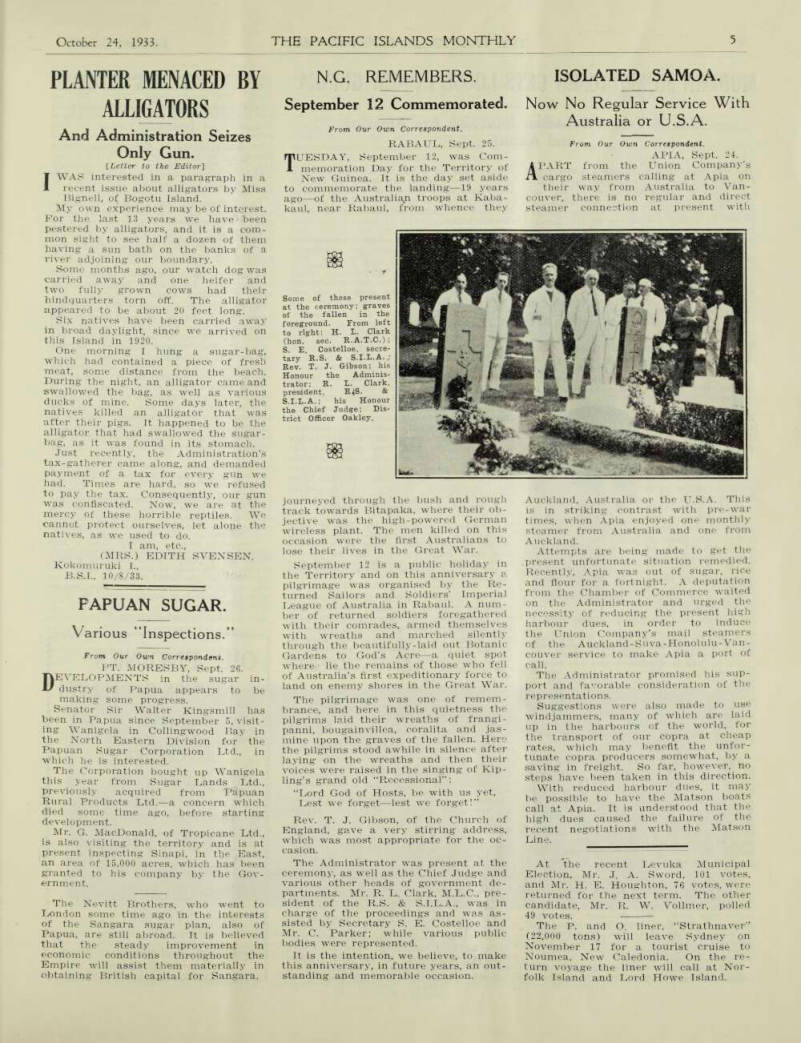
Some of those present at the ceremony; graves of the fallen in the foreground. From left to right: H. L. Clark (hon. sec. R.A.T.C.); S. E. Costelloe, secre
tary R.S. & S.I.L.A.;
Rev. T. J. Gibson; his Honour the Adminis trator; R. L. Clark, president, R.S & S.I.L.A.; his Honour the Chief Judge; Dis trict Officer Oakley.
Modern Munchausen Gets Loose In New Guinea.
Lies of Yellow Canadian Journalist Are Amazing and Amusing.
NOT long ago, a strong protest was made in the Commonwealth Parliament concerning a series of articles which had been published in the “Toronto Star,’' a Canadian news paper, in which conditions in the Terri tories of Papua and New Guinea had been grossly misrepresented.
We now have received copies of the articles referred to; and seldom have we read more priceless examples of irresponsible yellow journalism. They profess to describe the new gold in dustry in New Guinea, and conditions incidental thereto; but they may be more truthfully described as a tissue of ridiculous lies.
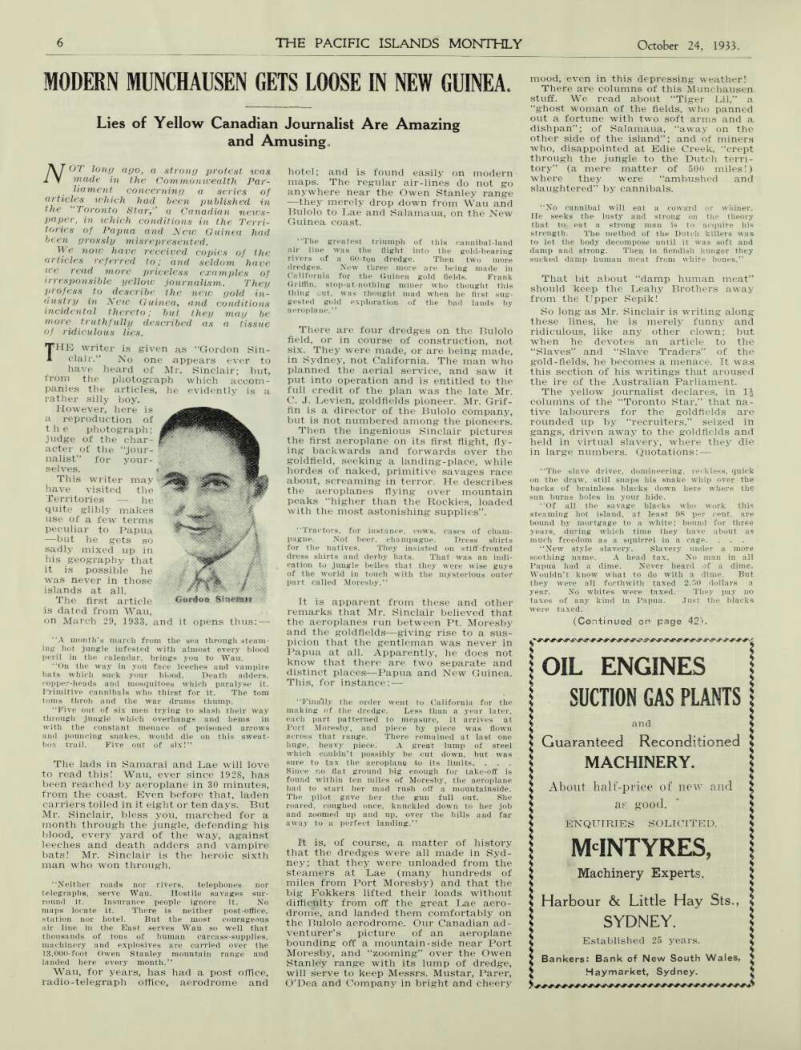
THE writer is given as “Gordon Sin clair.” No one appears ever to have heard of Mr. Sinclair; but, from the photograph which accom panies the articles, he evidently is a rather silly boy.
However, here is a reproduction of the photograph; judge of the char acter of the “jour nalist” for your selves.
This writer may have visited the Territories he quite glibly makes use of a few terms peculiar to Papua —but he gets so sadly mixed up in his geography that it is possible he was never in those islands at all.
The first article is dated from Wau,
on March 29, 1933, and it opens thus: “A month’s march from the sea through steam ing hot jungle infested with almost every blood peril in the calendar, brings you to Wau.
“On the way in you face leeches and vampire bats which suck your blood. Death adders, copper-heads and mosquitoes which paralyse it.
Primitive cannibals who thirst for it. The tom toms throb and the war drums thump.
“Five out of six men trying to slash their way through jungle which overhangs and hems in with the constant menace of poisoned arrows and pouncing snakes, would die on this sweat box trail. Five out of six!”
The lads in Samarai and Lae will love to read this! Wau, ever since 1928, has been reached by aeroplane in 30 minutes, from the coast. Even before that, laden carriers toiled in it eight or ten days. But Mr. Sinclair, bless you, marched for a month through the jungle, defending his blood, every yard of the way, against leeches and death adders and vampire bats! Mr. Sinclair is the heroic sixth man who won through.
“Neither roads nor rivers, telephones nor telegraphs, serve Wau. Hostile savages sur round it. Insurance people ignore it. No maps locate it. There is neither post-office, station nor hotel. But the most courageous air line in the East serves Wau so well that thousands of tons of human carcass-supplies, machinery and explosives are carried over the 13,000-foot Owen Stanley mountain range and landed here every month.”
Wau, for years, has had a post office,
radio-telegraph office, aerodrome and
hotel; and is found easily on modern maps. The regular air-lines do not go anywhere near the Owen Stanley range —they merely drop down from Wau and Bulolo to Lae and Salamaua, on the New Guinea coast.
“The greatest triumph of this cannibal-land air line was the flight into the gold-bearing rivers of a 60-ton dredge. Then two more dredges. Now three more are being made in California for the Guinea gold fields. Frank Griffin, stop-at-nothing miner who thought this thing out, was thought mad when he first sug gested gold exploration of the bad lands by aeroplane.”
There are four dredges on the Bulolo field, or in course of construction, not six. They were made, or are being made, in Sydney, not California. The man who planned the aerial service, and saw it put into operation and is entitled to the full credit of the plan was the late Mr.
C. J. Levien, goldfields pioneer. Mr. Grif fin is a director of the Bulolo company, but is not numbered among the pioneers.
Then the ingenious Sinclair pictures the first aeroplane on its first flight, fly ing backwards and forwards over the goldfield, seeking a landing-place, while hordes of naked, primitive savages race about, screaming in terror. He describes the aeroplanes flying over mountain peaks “higher than the Rockies, loaded with the most astonishing supplies”.
“Tractors, for instance, cows, cases of cham pagne. Not beer, champagne. Dress shirts for the natives. They insisted on stiff-fronted dress shirts and derby hats. That was an indi cation to jungle belles that they were wise guys of the world in touch with the mysterious outer part called Moresby.”
It is apparent from these and other remarks that Mr. Sinclair believed that the aeroplanes run between Pt. Moresby and the goldfields—giving rise to a sus picion that the gentleman was never in Papua at all. Apparently, he does not know that there are two separate and distinct places—Papua and New Guinea.
This, for instance: “Finally the order went to California for the making of the dredge. Less than a year later, each part patterned to measure, it arrives at Port Moresby, and piece by piece was flown across that range. There remained at last one huge, heavy piece. A great lump of steel which couldn’t possibly be cut down, but was sure to tax the aeroplane to its limits. . . .
Since no flat ground big enough for take-off is found within ten miles of Moresby, the aeroplane had to start her mad rush off a mountainside.
The pilot gave her the gun full out. She roared, coughed once, knuckled down to her job and zoomed up and up, over the hills and far away to a perfect landing.”
It is, of course, a matter of history that the dredges were all made in Syd ney; that they were unloaded from the steamers at Lae (many hundreds of miles from Port Moresby) and that the big Fokkers lifted their loads without difficulty from off the great Lae aero drome, and landed them comfortably on the Bulolo aerodrome. Our Canadian ad venturer’s picture of an aeroplane bounding off a mountain-side near Port Moresby, and “zooming” over the Owen Stanley range with its lump of dredge, will serve to keep Messrs. Mustar, Parer, O’Dea and Company in bright and cheery
mood, even in this depressing weather!
There are columns of this Munchausen stuff. We read about “Tiger Lil,” a “ghost woman of the fields, who panned out a fortune with two soft arms and a dishpan”; of Salamaua, “away on the other side of the island”; and of miners who, disappointed at Edie Creek, “crept through the jungle to the Dutch terri tory” (a mere matter of 500 miles!) where they were “ambushed and slaughtered” by cannibals.
“No cannibal will eat a coward or whiner.
He seeks the lusty and strong on the theory that to eat a strong man is to acquire his strength. The method of the Dutch killers was to let the body decompose until it was soft and damp and strong. Then in fiendish hunger they sucked damp human meat from white bones.”
That bit about “damp human meat” should keep the Leahy Brothers away from the Upper Sepik!
So long as Mr. Sinclair is writing along these lines, he is merely funny and ridiculous, like any other clown; but when he devotes an article to the “Slaves” and “Slave Traders” of the gold-fields, he becomes a menace. It was this section of his writings that aroused the ire of the Australian Parliament.
The yellow journalist declares, in 1½ columns of the “Toronto Star,” that na tive labourers for the goldfields are rounded up by “recruiters,” seized in gangs, driven away to the goldfields and held in virtual slavery, where they die in large numbers. Quotations: “The slave driver, domineering, reckless, quick on the draw, still snaps his snake whip over the backs of brainless blacks down here where the sun burns holes in your hide.
“Of all the savage blacks who work this steaming hot island, at least 98 per cent, are bound by mortgage to a white; bound for three years, during which time they have about as much freedom as a squirrel in a cage. ...
“New style slavery. Slavery under a more soothing name. A head tax. No man in all Papua had a dime. Never heard of a dime.
Wouldn’t know what to do with a dime. But they were all forthwith taxed 2.50 dollars a year. No whites were taxed. They pay no taxes of any kind in Papua. Just the blacks were taxed.
(Continued on page 42).
Gordon Sinemir
“To get poll tax money the blacks had to work. Not to get it meant going to gaol.
Even that wasn’t a bad idea. Lots went to gaol and rather enjoyed it. But the recruiters, playing on the vanity and greed of chiefs, offered these hooper-doopers tobacco, hatchets, knives, coloured beads, mirrors and other trade junk for 50 to 100 boys, and the traffic in brown bodies was on.
“These savage blacks have and show deep affection for their sons, and no more pitiable sight has ever been witnessed than a recruiter driving away the young manhood of a town while mothers scream and weep in an agony of sorrow.”
Anyone who knows New Guinea knows that this is all imaginative and exag gerated rubbish; and that there is no part of the world where the welfare of indentured native labourers is more jeal ously guarded than in Australia’s Pacific territories. Many of Australia’s adminis trative troubles are due to the coddling and spoon feeding of the natives. That an irresponsible youth should be allowed to present such a picture to a section of the Canadian people is only another ex ample of the political and social dangers that lie in yellow journalism.
Incidentally, this article on “Slavery” also suggests that Mr. Sinclair was never
in the territories at all. He writes it as from "Port Moresby, Papua, March 22,” and refers frequently to “recruiting” in Papua; yet there is comparatively little recruiting in Papua, and probably not one Papuan native has been taken to the New Guinea goldfields. The goldfields labourers have been recruited mostly from the north-east New Guinea dis tricts, and from New Britain,
Advertisements & other items, p. 8 (1 item)
Mcintyres,
OIL ENGINES
SUCTION GAS PLANTS
and Guaranteed Reconditioned
MACHINERY.
About half-price of new and as good,
ENQUIRIES SOLICITED.
McINTYRES,
Machinery Experts, Harbour & Little Hay Sts.,
SYDNEY.
Established 25 years.
Bankers: Bank of New South Wales, Haymarket, Sydney.
French Tax On Copra
How New System May Be Operated.
From Our Own Correspondent.
Papeete, Sept. 7.
IT has been officially announced that the bonus scheme for the benefit of coconut planters in French Territories, which has been under consideration for some time past, and previously com mented upon in these notes, has now received the sanction of the French Government, and has come into imme diate operation.
France imports annually something like 200,000 tons of copra, of which approximately one-sixth is produced in the various French Possessions. The basis of the present scheme is the im position of an import duty of 175 francs per ton on the foreign grown article, the funds so obtained to be distributed among the French producers.
It is estimated that the sum avail able for distribution in this Colony will work out at round about 300 francs per ton of copra—a very welcome addition, indeed, to the inadequate price at pre sent paid.
Already, in Marseilles, there is a dif ference in price of about 30/- per ton in favour of French copra, so that it appears evident that the importers there do not intend to carry the burden of this new import duty, but wili penalise the foreign producer to that extent.
NOTE.—On the basis of the present exchange, £1 Australian is equal to about 60 francs.
Perhaps, sufficient foreign copra to provide a bonus fund will be sent to Marseilles, even under the disadvant age of a heavy import duty, so long as the market continues to be so re markably sluggish in America and else where. But it appears reasonable to presume that, if there were only a slight improvement in the general out look, the buyers in Marseilles would
find it difficult, if not impossible, to obtain foreign cargoes at anything less than the market rates prevailing else where. The duty would then have to be paid by the importer, or be removed entirely to enable him to compete successfully abroad with soap and other manufactured articles. However, it is hoped that some solution of this diffi culty will be worked out when the time comes.
The scheme is intended to benefit the actual producers of copra, and not the merchant who buys it for shipment, but the practical details of distribu tion have not yet been worked out.
Obviously, there will be many diffi culties to be overcome in the applica tion of this idea over the widely scat tered archipelagoes of French Oceania, where copra is produced in very small lots by innumerable small landowners, and collected by Chinese traders or occasional schooners. Efficient control under such conditions appears to be impossible without an unjustifiably large expenditure.
Perhaps, the only solution of this problem—if the bonus is to be paid direct to the producer—is a system of co-operative marketing. But, un fortunately, efforts along this line in the past have generally met with fail ure, chiefly on account of the average Polynesian native’s inability to with stand temptation when entrusted with the handling of funds belonging to others.
Several prominent men, whose views are worthy of consideration, believe that the only feasible method of deal ing with the proposition is to pay the bonus to the exporter. They claim that competition between buyers—which is always particularly fierce in Tahiti — would raise the local price of copra to the extent of the bonus, and thus achieve the Government’s object of benefiting the producer, without a ruinous administrative expense. No doubt, there is a good deal to be said for this view.
In the meantime, the local Chamber of Agriculture and the Chamber of Commerce are working with the Administration with the object of ar riving at a suitable plan of action.
Pinnace.
Ran Away With
N.G. Plantation Labourers.
From Our Own Correspondent.
Rabaul, Sept. 30.
WORD has been received from Kavieng that fifteen Aitape labourers from the Teripax plantation, in the Tabar group, stole the plantation 5-tons pin nace and left with the idea of reaching Rabaul.
There was only a small quantity of fuel on board the vessel, and none of the "boys” had any knowledge of how to work the engine. There was no main sail, and only three oars.
They drifted from September 5 until 9, when they eventually landed at T’solue in the New Hanover group and were rescued by Mr. E. R. Miller.
The natives assert they had had no thing to eat or drink during the period they were at sea, and they travelled about 100 miles, mostly by using the oars.
Legal action is being taken.
Guinea.
New Ship For New
AUSTRALIAN timber is being used in the construction of a new motorship for the Island trade of W. R. Car penter and Co., Ltd. It is being built at the yards of A. W. Settree and Co., Huskisson, Jervis Bay, southern New South Wales. The vessel is a sister ship to the John Bolton, which was completed early in the year at the same yards and which is now in commission in New Guinea.
Much of the timber for the new ship, which will be completed in April, has been gathered within a few miles of the shipyard. The vessel will be of about 250 tons gross, with a length of 125 feet, a beam of 24 feet, and a draught of 9 feet 6 inches. She will be equipped with a British Diesel engine of 200 horse-power.
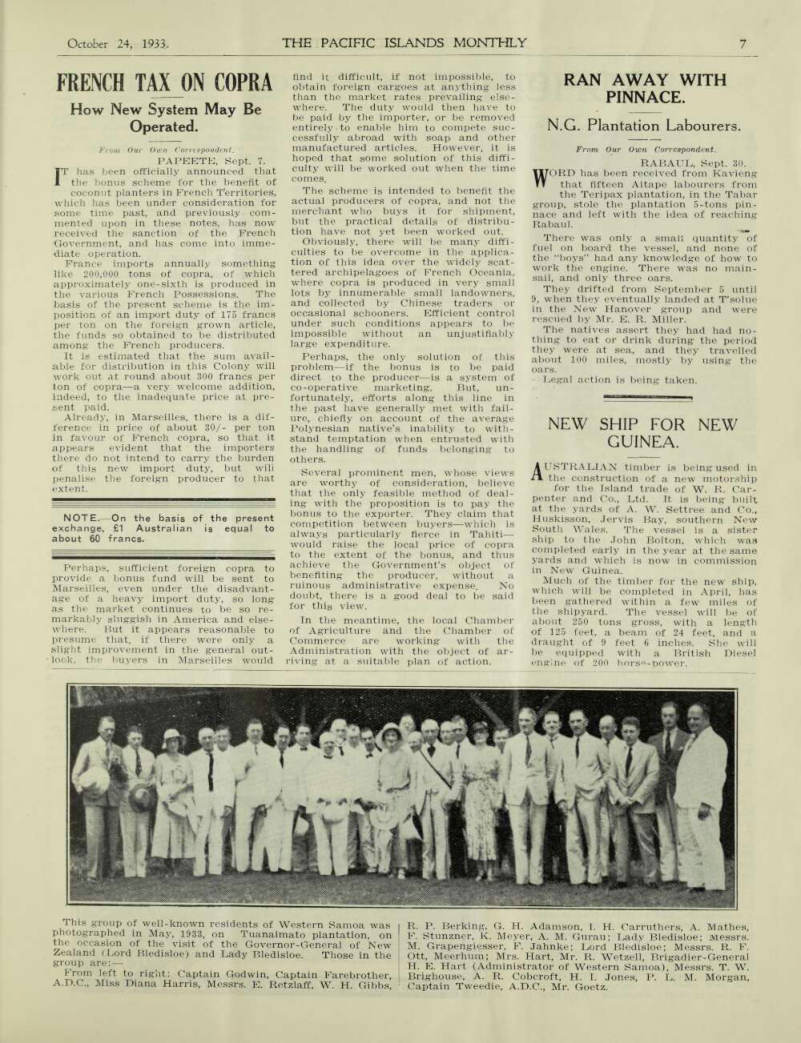
This group of well-known residents of Western Samoa was photographed in May, 1933, on Tuanaimato plantation, on the occasion of the visit of the Governor-General of New Zealand (Lord Bledisloe) and Lady Bledisloe. Those in the group are:- From left to right: Captain Godwin, Captain Farebrother, A.D.C., Miss Diana Harris, Messrs. E. Retzlaff, W. H. Gibbs,
R. P. Berking, G. H. Adamson, I. H. Carruthers, A. Mathes, F. Stunzner, K. Meyer, A. M. Gurau; Lady Bledisloe; Messrs.
M. Grapengiesser, F. Jahnke; Lord Bledisloe; Messrs. R. F.
Ott, Meerhum; Mrs. Hart, Mr. R. Wetzell, Brigadier-General H. E. Hart (Administrator of Western Samoa), Messrs. T. W.
Brighouse, A. R. Cobcroft, H. I. Jones, P. L. M. Morgan, Captain Tweedie, A.D.C., Mr. Goetz.
Tropicalities
A VERY well-known South Seas trader —Mr. Henry Dexter, of Milne Bay, Papua, and formerly of Malaya—is talking of retiring soon, and returning to his boyhood home in England. He is 68 but, if he approaches his father’s record —the old gentleman died recently, aged 92—he will have many years to spend yachting on the Solent. Mr. Dexter, with “authors’ ” and tourists’ ridiculous stories of Islands’ life fresh in his memory, writes humorously of his im pending visit to Sydney.
“It might be a good idea if I were to pose, appropriately dressed, as a kind of Trader Horn,” he says. “How about a long, pointed beard, two 6-guns, big scrub knife in belt, bottle showing out of pocket? I am sure I could draw on my imagination sufficiently to stir an audience—they wouldn’t be interested in the true story of our humdrum existence here.”
But Mr. Dexter has had his adventures, like other old-timers. There was, for example, a notable occurrence on the Brown River in 1910, when Mr. Dexter went off the end of a bamboo raft into a swirling current —the reason for his haste being a 20-feet crocodile, which was hospitably mounting the raft at the other end. * * * ANEW GUINEA district officer has reported to the Administration concerning the use of shell-money (strings of shells) among the natives.
It appears that this form of currency is used freely—it was estimated that there was £250,000 worth of shell currency in the Kokopo district, near Rabaul. It is not used for trading between the Europeans and natives. There, trading is carried on mainly with shillings (“marks”, in Pidgin) and trade tobacco. Sticks of black, sticky tobacco are practically the only currency recognised in the native market in Rabaul.
The idea of supplying the natives of New Guinea with a very cheap metal coinage, to take the place of the strings of shells, has been considered many times, but nothing has come of it. Like “the colonel’s lady and Judy O’Grady,” the New Guinea native and the highest product of British or American civilisation have the same feeling of staunch conservatism under their skins, when it comes to any interference with their customary tokens of value. * * * THE following tribute to Papuan patrol officers appeared in a Melbourne newspaper recently: “What the white patrol officer supported by eight trained natives wearing official shirts and sulus, but otherwise naked, has done for Papua can also be done among our Australian aboriginals.
Papua is now safe to whites and this has been brought about by the tact, kindness, firmness and sympathetic treatment to Papuan tribes by the white patrol officer knowing his job. He has the instincts of a gentleman with unruly tribes; he sifts the causes of troubles, arrests the culprits to bring them before a magistrate, and explains that murder, fighting, cannibalism and the killing of children at birth are not permissible under the white man’s code. This is done through native interpreters, as the patrol penetrates the hinterland. A patrol of this nature by a gentleman supported by our own aboriginal police could work wonders in North Australia. With power
given to a patrol officer to arrest whites and bring them to justice for the abuse of native women, then the aboriginal problem would be almost solved.” * * * A CORRESPONDENT in Tanna, New Hebrides, vouches for this one: A native couple quarrelled violently concerning a lady with lime-washed hair. They agreed upon a divorce, and settled down in houses about one hundred yards apart.
Soon afterwards, the lady was discovered, back again, in her husband’s house.
Our inquisitive friend wanted to know why she had abandoned the status of a divorcee.
She explained that “Harry” had called several times at her house; and finally urged that it was “more better she come back —plenty too many fleas in her house!” * ° * WE do not wish to cast aspersions on innocent people; but we fear that some residents of the goldfields districts of New Guinea have “taking ways.” We have received recently, from subscribers in Salamaua, Wau and thereabouts, some half-dozen different complaints about non-receipt of current issues of the P.I.M. All wrapped copies, before being posted in Sydney, are checked over with our mailing lists; and this fact, and the further fact that complaints of non-receipt come only from the N.G. goldfield districts, naturally create the obvious suspicion. We are gratified to know that the P.I.M. is in keen demand; but we beg the gentlemen who lack the property-sense to remember that every time they “pinch” a news paper, we have to deal with an irate subscriber. * ° * THE average person will tell you that it is impossible for a European— particularly a European woman —to remain many years in the tropics without a break: but a well-known woman, Mrs. Edith Svensen, of Koromuruki Island, in the British Solomon Islands, gives notable proof to the contrary.
Mrs. Svensen and her husband have lived continuously on isolated Koro muruki since 1920 —60 miles from the nearest post-office—and they appear well and happy. Mrs. Svensen writes to the Editor in whimsical vein.
“The world seems to have moved very fast since 1920,” she says; “and it is hard to follow fashion developments
from the newspapers. I try hard to visualise modern women, with their beach pyjamas, and cigarettes and cocktail parties. There seems to be also a keen demand for equality with men. Some of those who want equality should have an experience of life on this island —I do not think the idea would last long!
"I am afraid I must be completely cut of date —I have not seen an aeroplane, nor have I heard the talkies, and I have only read about radio.”
Swift Transport.
But a Long Way Round From Sydney to Suva.
EARLY in August Mr. J. E. W.
Dunstan, then in Sydney, received urgent advice that his father was lying very dangerously ill in the War Memorial Hospital in Suva, Fiji. He and his sister, Mrs. Doreen M. Alien, at once sought means of conveyance to Suva.
They had just missed the ordinary mail steamers, and there was no further vessel for a couple of weeks.
But they were advised by the Matson Line agents that a Swedish cargo steamer, the Boren, was due to sail the following day, August 8, from Port Pirie, South Australia, to Levuka direct, to load copra for Messrs. Morris Hedstrom, and the Matson people assisted them to get a passage on the Boren, provided they could reach Port Pirie in time.
Then events moved swiftly. A well known airman, Major de Havilland, agreed to take them to South Australia, and they left Sydney on August 7, and made a fast flight. But dusk overtook them, and the aeroplane made a forced landing in a paddock about 100 miles from anywhere. There were exciting incidents before they secured a car, and made a final dash of 100 miles by road. They caught the Boren, whose departure had been specially delayed to meet their convenience.
On arrival at Levuka, the two passengers were met by Mr. St. G. Ryder, manager for Messrs. Morris Hedstrom Ltd. at that port, and they were taken at once to one of Fiji Airways sea planes, which was waiting for them.
They landed in Suva before 10 a.m.
Customs and Police Departments were most helpful in administering pass port regulations, etc., so that the travellers should not be unduly delayed.
Their luggage was delivered to them in Suva the following day by the interisland steamer Sir John Forrest.
Advertisements & other items, p. 10 (1 item)
Durabestos
WUNDERLICH
ISLAND HOME BUILDERS. You can now
erect everlasting Homes quickly and at LOW COST by using DURABESTOS (Asbestos Cement) Building Sheets fov Walls and Ceilings. Big, sturdy sheets —economical to transport—easy to fix—fireproof —does not need painting. Write for prices and Free Catalogue, “Durabestos Homes of Colourful Beauty.”
WUNDERLICH LTD., Box 474 AA, G.P.O., SYDNEY.
RESISTS TIME - WEATHER - WHITE ANTS
The Tragedy Of An Islands Princess
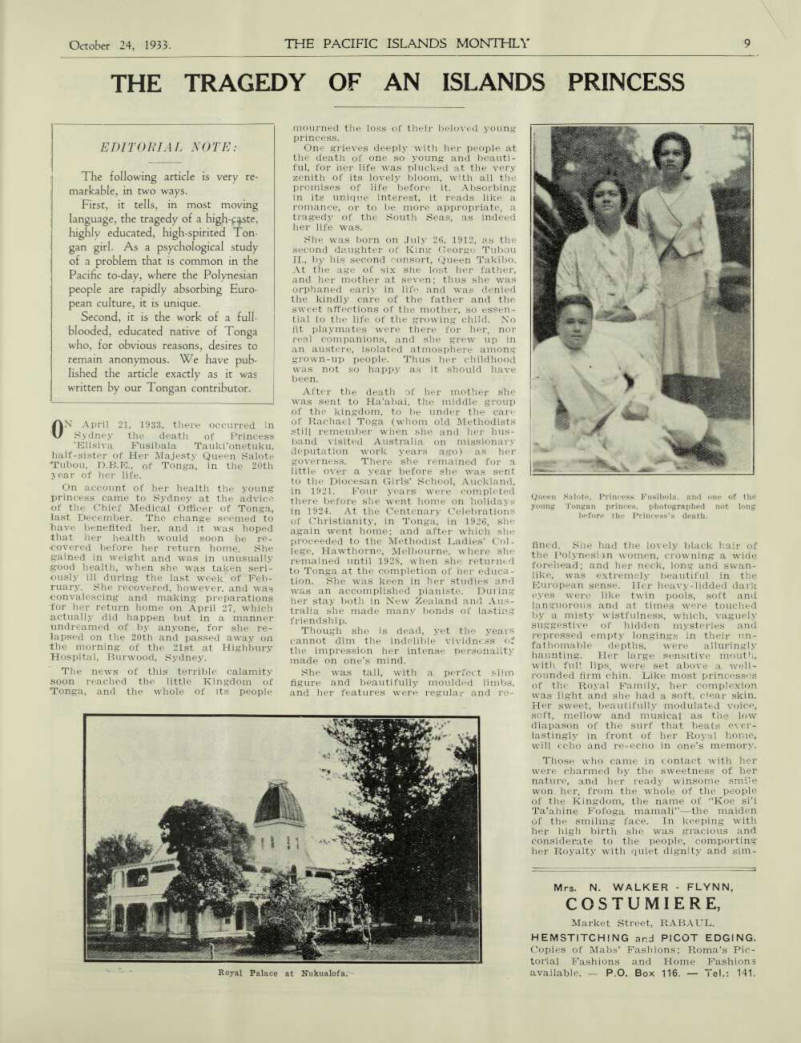
ON April 21, 1933, there occurred in Sydney the death of Princess ’Elisiva Fusibala Tauki’onetuku, half-sister of Her Majesty Queen Salote Tubou, D.B.E., of Tonga, in the 20th year of her life.
On account of her health the young princess came to Sydney at the advice of the Chief Medical Officer of Tonga, last December. The change seemed to have benefited her, and it was hoped that her health would soon be re covered before her return home. She gained in weight and was in unusually good health, when she was taken seri ously ill during the last week of Feb ruary. She recovered, however, and was convalescing and making preparations for her return home on April 27, which actually did happen but in a manner undreamed of by anyone, for she re lapsed on the 20th and passed away on the morning of the 21st at Highbury Hospital, Burwood, Sydney.
The news of this terrible calamity soon reached the little Kingdom of Tonga, and the whole of its people
mourned the loss of their beloved young princess.
One grieves deeply with her people at the death of one so young and beauti ful, for her life was plucked at the very zenith of its lovely bloom, with all the promises of life before it. Absorbing in its unique interest, it reads like a romance, or to be more appropriate, a tragedy of the South Seas, as indeed her life was.
She was born on July 26, 1912, as the second daughter of King George Tubou II., by his second consort, Queen Takibo.
At the age of six she lost her father, and her mother at seven; thus she was orphaned early in life and was denied the kindly care of the father and the sweet affections of the mother, so essen tial to the life of the growing child. No fit playmates were there for her, nor real companions, and she grew up in an austere, isolated atmosphere among grown-up people. Thus her childhood was not so happy as it should have been.
After the death of her mother she was sent to Ha’abai, the middle group of the kingdom, to be under the care of Rachael Toga (whom old Methodists still remember when she and her hus band visited Australia on missionary deputation work years ago) as her governess. There she remained for a little over a year before she was sent to the Diocesan Girls’ School, Auckland, in 1921. Four years were completed there before she went home on holidays in 1924. At the Centenary Celebrations of Christianity, in Tonga, in 1926, she again went home; and after which she proceeded to the Methodist Ladies’ Col lege, Hawthorne, Melbourne, where she remained until 1928, when she returned to Tonga at the completion of her educa tion. She was keen in her studies and was an accomplished pianiste. During her stay both in New Zealand and Aus tralia she made many bonds of lasting friendship.
Though she is dead, yet the years cannot dim the indelible vividness of the impression her intense personality made on one’s mind.
She was tall, with a perfect slim figure and beautifully moulded limbs, and her features were regular and re-
fined. She had the lovely black hair of the Polynesian women, crowning a wide forehead; and her neck, long and swan like, was extremely beautiful in the European sense. Her heavy-lidded dark eyes were like twin pools, soft and languorous and at times were touched by a misty wistfulness, which, vaguely suggestive of hidden mysteries and repressed empty longings in their un fathomable depths, were alluringly haunting. Her large sensitive mouth, with full lips, were set above a well rounded firm chin. Like most princesses of the Royal Family, her complexion was light and she had a soft, clear skin.
Her sweet, beautifully modulated voice, soft, mellow and musical as the low diapason of the surf that beats ever lastingly in front of her Royal home, will echo and re-echo in one’s memory.
Those who came in contact with her were charmed by the sweetness of her nature, and her ready winsome smile won her, from the whole of the people of the Kingdom, the name of “Koe si’i Ta’ahine Fofoga mamali” —the maiden of the smiling face. In keeping with her high birth she was gracious and considerate to the people, comporting her Royalty with quiet dignity and sim
Queen Salote, Princess Fusibola, and one of the young Tongan princes, photographed not long before the Princess’s death.
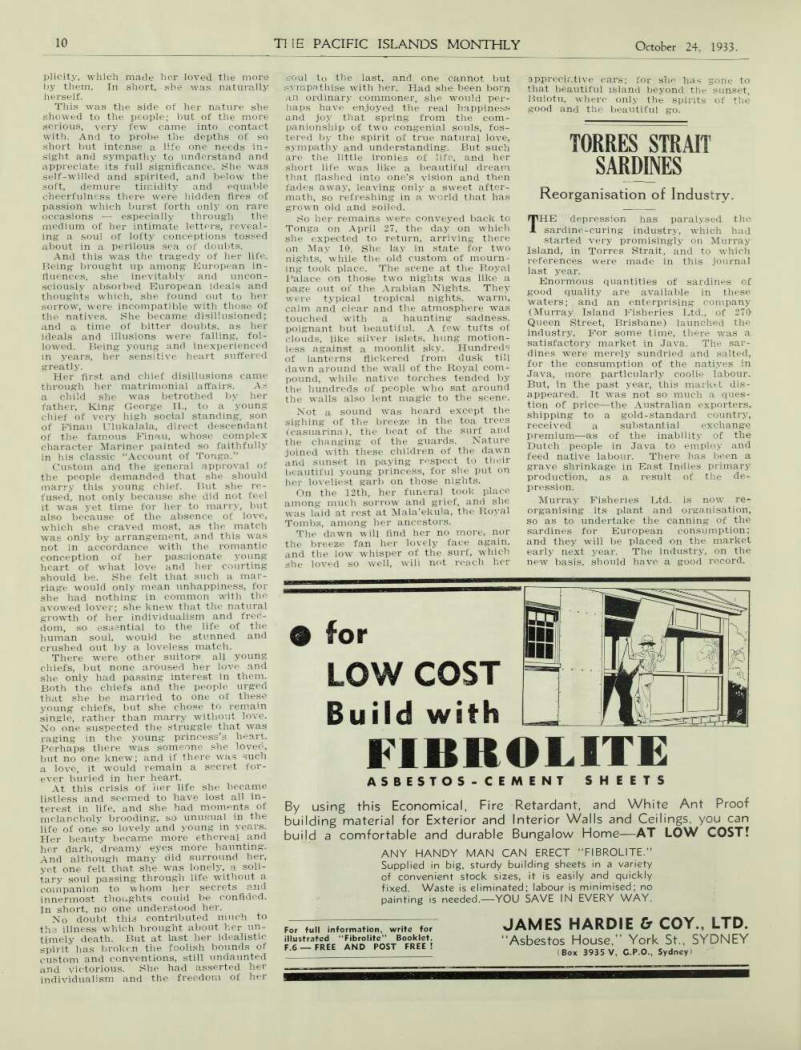
Royal Palace at Nukualofa.
plicity, which made her loved the more by them. In short, she was naturally herself.
This was the side of her nature she showed to the people; but of the more serious, very few came into contact with. And to probe the depths of so short but intense a life one needs in sight and sympathy to understand and appreciate its full significance. She was self-willed and spirited, and below the soft, demure timidity and equable cheerfulness there were hidden fires of passion which burst forth only on rare occasions especially through the medium of her intimate letters, reveal ing a soul of lofty conceptions tossed about in a perilous sea of doubts.
And this was the tragedy of her life.
Being brought up among European in fluences, she inevitably and uncon sciously absorbed European ideals and thoughts which, she found out to her sorrow, were incompatible with those of the natives. She became disillusioned; and a time of bitter doubts, as her ideals and illusions were falling, fol lowed. Being young and inexperienced in years, her sensitive heart suffered greatly.
Her first and chief disillusions came through her matrimonial affairs. As a child she was betrothed by her father, King George II., to a young chief of very high social standing, son of Finau Ulukalala, direct descendant of the famous Finau, whose complex character Mariner painted so faithfully in his classic “Account of Tonga.”
Custom and the general approval of the people demanded that she should marry this young chief. But she re fused, not only because she did not feel it was yet time for her to marry, but also because of the absence of love, which she craved most, as the match was only by arrangement, and this was not in accordance with the romantic conception of her passionate young heart of what love and her courting should be. She felt that such a mar riage would only mean unhappiness, for she had nothing in common with the avowed lover; she knew that the natural growth of her individualism and free dom, so essential to the life of the human soul, would be stunned and crushed out by a loveless match.
There were other suitors, all young chiefs, but none aroused her love and she only had passing interest in them.
Both the chiefs and the people urged that she be married to one of these young chiefs, but she chose to remain single, rather than marry without love.
No one suspected the struggle that was raging in the young princess’s heart.
Perhaps there was someone she loved, but no one knew; and if there was such a love, it would remain a secret for ever buried in her heart.
At this crisis of her life she became listless and seemed to have lost all in terest in life, and she bad moments of melancholy brooding, so unusual in the life of one so lovely and young in years.
Her beauty became more ethereal and her dark, dreamy eyes more haunting.
And although many did surround her, yet one felt that she was lonely, a soli tary soul passing through life without a companion to whom her secrets and innermost thoughts could be confided.
In short, no one understood her.
No doubt this contributed much to the illness which brought about her un timely death. But at last her idealistic spirit has the foolish bounds of custom and conventions, still undaunted and victorious. She had asserted her individualism and the freedom of her
soul to the last, and one cannot but sympathise with her. Had she been born an ordinary commoner, she would per haps have enjoyed the real happiness and joy that spring froxn the com panionship of two congenial souls, fos tered by the spirit of true natural love, sympathy and understanding. But such are the little ironies of life, and her short life was like a beautiful dream that flashed into one’s vision and then fades away, leaving only a sweet after math, so refreshing in a world that has grown old and soiled.
So her remains were conveyed back to Tonga on April 27, the day on which she expected to return, arriving there on May 10. She lay in state for two nights, while the old custom of mourn ing took place. The scene at the Royal Palace on those two nights was like a page out of the Arabian Nights. They were typical tropical nights, warm, calm and clear and the atmosphere was touched with a haunting sadness, poignant but beautiful. A few tufts of clouds, like silver islets, hung motion less against a moonlit sky. Hundreds of lanterns flickered from dusk till dawn around the wall of the Royal com pound, while native torches tended by the hundreds of people who sat around the walls also lent magic to the scene.
Not a sound was heard except the sighing of the breeze in the toa trees (casuarina), the beat of the surf and the changing of the guards. Nature joined with these children of the dawn and sunset in paying respect to their beautiful young princess, for she put on her loveliest garb on those nights.
On the 12th, her funeral took place among much sorrow and grief, and she was laid at rest at Mala’ekula, the Royal Tombs, among her ancestors.
The dawn will find her no more, nor the breeze fan her lovely face again, and the low whisper of the surf, which she loved so well, will not reach her
appreciative ears; for she has gone to that beautiful island beyond the sunset, Bulotu, where only the spirits of the good and the beautiful go.
Editorial Note:
The following article is very re markable, in two ways.
First, it tells, in most moving
language, the tragedy of a high-caste,
highly educated, high-spirited Ton
gan girl. As a psychological study
of a problem that is common in the Pacific to-day, where the Polynesian people are rapidly absorbing Euro pean culture, it is unique.
Second, it is the work of a full blooded, educated native of Tonga who, for obvious reasons, desires to remain anonymous. We have pub lished the article exactly as it was written by our Tongan contributor.
Advertisements & other items, p. 11 (1 item)
Mrs. N. Walker - Flynn,
COSTUMIERE,
Market Street, RABAUL.
HEMSTITCHING and PICOT EDGING.
Copies of Mabs’ Fashions; Roma’s Pictorial Fashions and Home Fashions available. P.O. Box 116. Tel.: 141.
Sardines
Torres Strait
Reorganisation of Industry.
THE depression has paralysed the sardine-curing industry, which had started very promisingly on Murray Island, in Torres Strait, and to which references were made in this journal last year.
Enormous quantities of sardines of good quality are available in these waters; and an enterprising company (Murray Island Fisheries Ltd., of 270 Queen Street, Brisbane) launched the industry. For some time, there was a satisfactory market in Java. The sar dines were merely sundried and salted, for the consumption of the natives in Java, more particularly coolie labour.
But, in the past year, this market dis appeared. It was not so much a ques tion of price—the Australian exporters, shipping to a gold-standard country, received a substantial exchange premium—as of the inability of the Dutch people in Java to employ and feed native labour. There has been a grave shrinkage in East Indies primary production, as a result of the de pression.
Murray Fisheries Ltd. is now re organising its plant and organisation, so as to undertake the canning of the sardines for European consumption; and they will be placed on the market early next year. The industry, on the new basis, should have a good record.
Advertisements & other items, p. 12 (1 item)
Fibrolite
for
LOW COST
Build with
FIBROLITE
ASBESTOS-CEMENT SHEETS
By using this Economical, Fire Retardant, and White Ant Proof building material for Exterior and Interior Walls and Ceilings, you can build a comfortable and durable Bungalow Home— AT LOW COST!
ANY HANDY MAN CAN ERECT “FIBROLITE.”
Supplied in big, sturdy building sheets in a variety of convenient stock sizes, it is easily and quickly fixed. Waste is eliminated; labour is minimised; no painting is needed.—YOU SAVE IN EVERY WAY.
For full information, write for illustrated “Fibrolite” Booklet,
F. 6 —FREE AND POST FREE!
JAMES HARDIE & COY., LTD.
“Asbestos House,” York St., SYDNEY Box 3935 V, G.P.O., Sydney)
Sea Transport In
Samoa.
Charge That Inter-Island Voyagers Take Undue Risks.
By Marc T. Greene.
THERE is a tradition, and a well founded one, that human life at sea is safer under the British flag than under any ether. Though an American by nationality, I subscribe whole heartedly to this tradition, and when ever or wherever I find it disregarded I make such protest as may be.
The substantial foundation of this tradition is the soundness and the comprehensiveness of the British Board of Trade regulations, and these have been the standard of the world for a hundred years and more. Yet here in Western Samoa they are being violated, and the British tradition of safety at sea disregarded, to an extent that I have never found in any port under the British flag.
The trip from here to Pago Pago,
though less than a hundred miles in distance, can be and frequently is a very strenuous one. It is made in the teeth of the trade wind, and the sea between the islands of Upolu and Tutuila is often rough. Yet, with the single exception of the Burns, Philp boat “Makoa,” the craft making it are hardly larger than launches. As such they are able enough, but even in ordinary weather the discomfort of the people compelled to make the trip just about passes description. In weather outside the ordinary their safety is often in question. This is especially so in the case of a small launch flying the American flag, and owned in Pago Pago. This craft often leaves Apia laden almost to the gunwales.
Another case requiring attention is a boat operated by a Chinese-Samoan named Ah Mu, which runs from an Upolu village across to one on Savaii.
The worst sea tragedy to happen here since the gale of 1889 was the over turning of a former boat operated by this person, and the drowning of thirty people, including a New Zealand official. Yet the Administration is per mitting this man to run a small craft
on the same route. The other day when, as it chanced, I was among the twenty passengers overcrowding the little craft (which draws but thirty inches of water and is flat-bottomed) the engine “backfired” after coughing, spluttering and snarling its way along for a couple of hours like a stubborn camel. The engine immediately blazed up, and since the craft was without a fire extinguisher or any other means of fighting a fire, even a common pail, we all had an exceedingly narrow escape. Nor had the boat either a tender, life-raft or anything but a few life-preservers. Yet the Administration has licensed it to carry twenty passengers in unprotected water.
It is such instances as these that go far to justify the Samoans in their distrust and dislike of New Zealand rule, One hears from natives and Europeans alike the accusation that the minor officials are merely “holding down their chairs and drawing their salaries.”
There are exceptions, of course, but it appears to be time the New Zealand regime “snapped out of it,” as it would not inadequately be summed up in America.
Advertisements & other items, p. 13 (1 item)
This Amazing Book!
ALFRED J. BRITON,
Australasia’s Leading Physical Director, Founder of “Health & Physical Culture.”
MORE STARTLING PROOF!
‘I have completed the first course, and I am amazed. I have gained eight pounds in weight and 2½ inches around chest.’’
K. H. FOULIS, T., Fij
80,000 PEOPLE HAVE READ
THIS AMAZING BOOK!
PAST the 80,000 mark, and still going strong! If you would lead something that would stir your very vitals — if you would learn something the like of which you had never even dreamed! Then send for this book and read how YOU can charge your body full of vitality, add five inches to your chest, acquire the power of battering rams in your arms, and develop a neck and legs like pillars! It’s all here in this very book explained in detail, and you’ll agree, like thousands of others have, that it’s the most amazing book you have ever seen.
WATCH THEM TURN AROUND!
Notice how every woman prefers the fellow who carries himself with head up. Notice how the broad-shouldered man always gets their eye.
They want a dependable he-man, when they make their choice —one who can protect them. AND YOU CAN BE THAT MAN. Remember, I do not only promise it, I GUARANTEE IT. Now, don’t put it off a minute. Get going to new happiness, and real manhood, to-day!
“I am very pleased with your course, and I feel wonderfully fit—in fact, I’ve never felt better in my THIS month, to every reader of this paper who is interested—here's my offer: To
YOURS FREE IF YOU SEND NOW!
Dept. S.L 107 PITT ST., SYDNEY, N.S.W life. All my friends are talking about my wonderful physique.
I thank you again from the bottom of my heart for what your system has done for me.”
J. MORRISON, S.,
Scotland.
What Is the Secret?
For a limited time you may get this wonder book free, if you act quickly. Its message and its many illustrations will amaze you.
It contains matter of vital information that you should know about at once. Rip the coupon out and post TO-DAY.
ALFRED J. BRITON,
to Acquire It,” I am going to give ONE FREE ISSUE providing you make application at once! This book has been the cause of changing the lives of thousands of men. I have received countless thousands of wonderful letters and photographs of actual transformation of men who never thought they could acquire strength and development!
Make me PROVE these assertions to you by sending for your copy this minute, not to-morrow, you may be too late, but to-day—NOW! Are you ready? Let’s go. 500 FREE BOOKS - IF YOU SEND NOW!
ALFRED J. BRITON,
Dept. S.L., 107 Pitt St., Sydney, N.S.W.
Dear Sir,—Please send me, absolutely FREE, a copy of your latest book, “The Secrets of Muscular Strength—and How to Acquire It.”
Don’t send one penny—it’s FREE.
NAME
FULL ADDRESS
23/10/33
Where Britain Is Losing Prestige
France Taking Possession of New Hebrides, at Australia’s Front Door.
Written for the “Pacific Islands Monthly,” by a New Hebrides Planter.
ALTHOUGH this last hurricane (April 7/8, 1933) was of longer duration, the velocity of the wind was not so great as that of February 23, 1932, when every building on this place was flat tened and smashed. On this occasion some of the new buildings stood up, so at least we had a shelter, but after the 1932 “blow” we had not even that. Of course all the thatched-roof buildings again went west, including our tempor ary dwelling house.
Just before midnight on April 7, the house started to rock dangerously, so my wife and I decided to rush for the New Kitchen building, where we sheltered until daylight, and when we looked out the house was flat. I then got to work with the labour, putting more sand bags on the verandahs of the new store build ing, which fortunately stood up and in which we are now domiciled.
This last hurricane, coming as it did, before we, or the coconut palms, had had time to recover from the ravages of the previous one, has had the effect of making us wonder how we can carry on, with no hope of assistance in any shape or form.
We, who are under the British flag in this group, have given up hope of any governmental assistance in any way, as has been meted out to our French neighbours, so it is just a case of try ing to hang on until things grow again.
There has been a lot written lately about the administration of different groups of islands; but if New Hebrides is a fair sample of British administra tion, then the sooner the islands are handed over to some European Power which might take an interest in the development and settlement of them, the better for all concerned.
To maintain a staff of officials in the New Hebrides must cost the admit
tedly impoverished Exchequer of Great Britain quite a tidy sum. For all the assistance they give to the few British settlers left in this group, that sum could quite easily be saved and spent on a more worthy cause. However, it is plain to see that Britain is not interested in the development of this group, otherwise she would not sit idly by and see this rich territory drift slowly, but surely, into the complete control of the French.
But what about Australia and her numerous politicians? Are they too busy inside, petty quarrelling and job seeking, to heed the knocking at the front door of their richest coastline?
Surely they are not blind to the evi dence of recent happenings and must know that some Asiatics will find an outlet for their teeming millions ere long. Yet Australians seem content to squabble away inside, among their groups of politicians. They may have tacked up their windows, but they seem content to leave their doors wide open to any burglar that happens along.
As far as the Commonwealth land claims in this group go, I could not do better than refer to the splendid article printed in the “P.I.M.” of 26/1/32, which is accurate and to the point, and should have the effect of waking up some one in authority to the fact that such a place as New Hebrides does exist, and that it is too near Australia’s front door to be ignored.
Britain is certainly losing prestige and ground by misadministration in this group, as is proven by the migration of British residents. The disabilities under which British residents suffer are many —in fact, so many, that in most cases where they have been able to sell out to French interests, they have done so,
and got out. This, in itself, speaks vol umes against British Administration in this group.
If a job is worth doing at all, surely it is worth doing well.
New System In N. Ireland.
Native Copra.
From Our Own Correspondent. -
Kavieng, Sept. 20.
THE German steamer “Friedrun” lifted about 600 bags of native copra, shipped for the natives by Mr. T.
Gordon as their agent.
Since Mr. Gordon started acting as agent for the natives, very little copra has been bought by plantation owners or traders on the east coast. It seems strange that Messrs. Burns, Philp and W. R. Carpenter are allowing the “Friedrun” to have practically a ship ping monopoly of the trade copra on the east coast. Probably they prefer to leave their planters and traders to eventually win back the native trade rathejr than foster the Agency system, with its disadvantages.
Advertisements & other items, p. 14 (1 item)
Norfolk Island Trade.
IMPORTS.
From From Aust.
N.Z, August, 1932 £2,329 £78£ August, 1933 £3,226 Nil
EXPORTS.
August, 1932 £1,498 £441 August, 1933 .. £587 Nil
Pacific Curios.
Wanted To Purchase.
The Editor of the “Pacific Islands Monthly” has been asked by Overseas Museums for Introductions to Sellers of Old Specimens of Pacific Islands Native Arts and Crafts, for Museum Use.
It is emphasised that no Spears, Bows and Arrows, or “Junk” of any description will be considered only first-class pieces, of undoubted authenticity.
An English Museum asks particularly to be “put in touch with any old traders who might wish to realise on genuine old Curios collected in the South Seas.”
Write, in first place, to
The Editor,
“Pacific Islands Monthly,’"
P.O. Box 3408 R, Sydney,
giving full details.
Letters will be sorted out and, where desirable, sent to the Museums in terested, and the latter will be asked to write direct to the persons concerned.
Advertisements & other items, p. 14 (1 item)
“First Call”
PURE COFFEE.
Freshly Roasted and Packed in Air tight Tins.
A. S. CALLACHOR & SON
Tea, Coffee, General Merchants and Agents:
24 BOND STREET, SYDNEY.
Samoa.
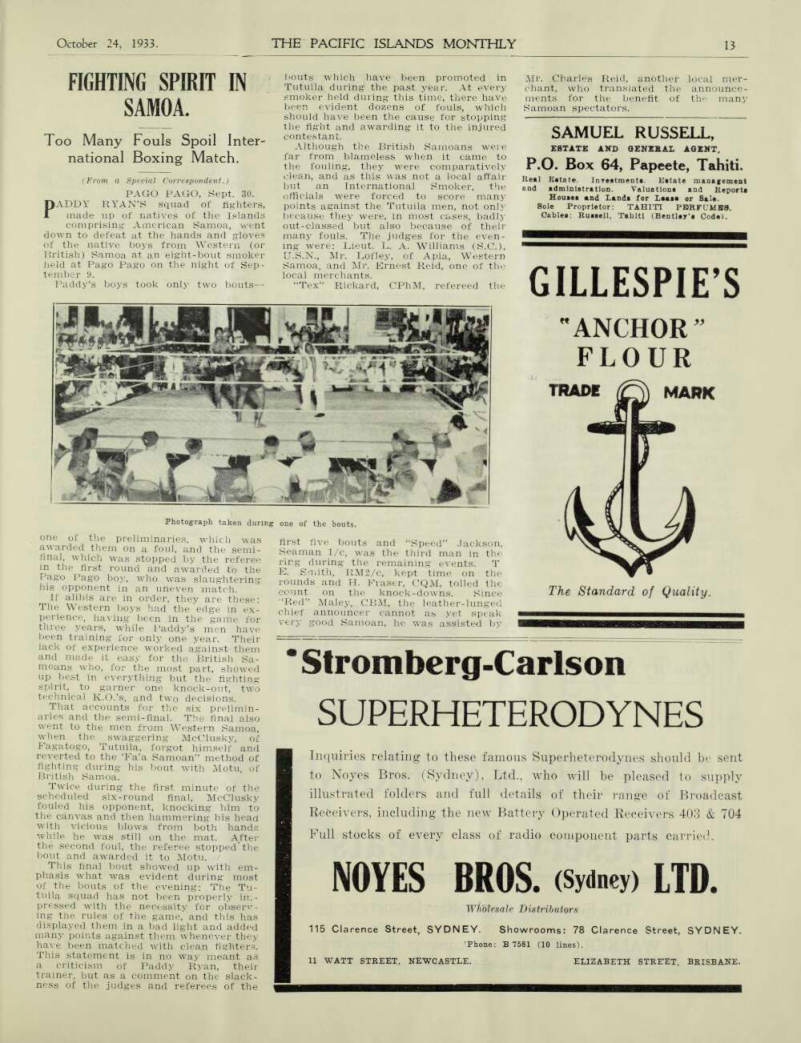
Fighting Spirit In
Too Many Fouls Spoil Inter national Boxing Match.
(From a Special Correspondent.)
Pago Pago, Sept. 30.
PADDY RYAN’S squad of fighters, made up of natives of the Islands comprising American Samoa, went down to defeat at the hands and gloves of the native boys from Western (or British) Samoa at an eight-bout smoker held at Pago Pago on the night of Sep tember 9.
Paddy’s boys took only two bouts —
one of the preliminaries, which was awarded them on a foul, and the semi final, which was stopped by the referee in the first round and awarded to the Pago Pago boy, who was slaughtering his opponent in an uneven match.
If alibis are in order, they are these: The Western boys had the edge in experience, having been in the game for three years, while Paddy’s men have been training for only one year. Their lack of experience worked against them and made it easy for the British Sa moans who, for the most part, showed up best in everything but the fighting spirit, to garner one knock-out, two technical K.O.’s, and two decisions.
That accounts for the six prelimin aries and the semi-final. The final also went to the men from Western Samoa, when the swaggering McClusky, of Fagatogo, Tutuila, forgot himself and reverted to the ‘Fa’a Samoan” method of fighting during his bout with Motu, of British Samoa.
Twice during the first minute of the scheduled six-round final, McClusky fouled his opponent, knocking him to the canvas and then hammering his head with vicious blows from both hands while he was still on the mat. After the second foul, the referee stopped the bout and awarded it to Motu.
This final bout showed up with em phasis what was evident during most of the bouts of the evening: The Tu tuila squad has not been properly im pressed with the necessity for observ ing the rules of the game, and this has displayed them in a bad light and added many points against them whenever they have been matched with clean fighters.
This statement is in no way meant as a criticism of Paddy Ryan, their trainer, but as a comment on the slack ness of the judges and referees of the
bouts which have been promoted in Tutuila during the past year. At every smoker held during this time, there have been evident dozens of fouls, which should have been the cause for stopping the fight and awarding it to the injured contestant.
Although the British Samoans were far from blameless when it came to the fouling, they were comparatively clean, and as this was not a local affair but an International Smoker, the officials were forced to score many points against the Tutuila men, not only because they were, in most cases, badly out-classed but also because of their many fouls. The judges for the even ing were: Lieut. L. A. Williams (S.C.), U.S.N., Mr. Lofley, of Apia, Western Samoa, and Mr. Ernest Reid, one of the local merchants.
“Tex” Rickard, CPhM, refereed the
five bouts and “Speed" Jackson, Seaman 1/c, was the third man in the ring during the remaining events. T E. Smith, RM2/c, kept time on the rounds and H. Fraser CQM tolled the count on the knock-downs. Since "Red'’ Maley, CBM, the leather-lunged chief announcer cannot as yet speak good Samoan, he was assisted by
Mr. Charles Reid, another local mer chant, who translated the announce ments for the benefit of the many Samoan spectators.
Photograph taken during one of the bouts.
Advertisements & other items, pp. 15-16 (1 item)
Gillespie’S
SAMUEL RUSSELL,
ESTATE AND GENERAL AGENT,
P.O. Box 64, Papeete, Tahiti.
Real Estate. Investments. Estate management and administration. Valuations and Reports Houses and Lands for Lease or Sale.
Sole Proprietor: TAHITI PERFUMES.
Cables; Russell, Tahiti (Rentier's Code).
GILLESPIE’S
"ANCHOR”
FLOUR
TRADE
MARK
The Standard of Quality.
Stromberg-Carlson
SUPERHETERODYNES
Inquiries relating to these famous Superheterodynes should be sent to Noyes Bros. (Sydney), Ltd., who will be pleased to supply illustrated folders and full details of their range of Broadcast Receivers, including the new Battery Operated Receivers 403 & 704 Full stocks of every class of radio component parts carried.
NOYES BROS. (Sydney) LTD.
Wholesale Distributors 115 Clarence Street, SYDNEY. Showrooms: 78 Clarence Street, SYDNEY. ’Phone: B 7581 (10 lines). 11 WATT STREET, NEWCASTLE. ELIZABETH STREET, BRISBANE.
1870 1933 Quality Stands the Test of Time
S.M.P. “War Medal” BRAND
Preserved Meats
Tins Fitted with Patent Key Opener.
F. J. WALKER LTD., 33 Macquarie Place, Sydney.
Sole Agents for: THE SYDNEY MEAT PRESERVING CO. LTD.
About Islands People.
Brother Macarius, a member of the Marist Order of Missionaries in Fiji, who had resided in Fiji for nearly 35 years, died in Suva on September 4 after a long illness. Born in France in 1866, he went to Australia and received his training at the Marist Brothers’
College, Sydney. He went to Apia, Samoa, as a teacher, and later was transferred to New Zealand. In 1899, he was appointed teacher at the Marist Brothers’ School at Naililili, Fiji, and was for some time at Cawaci, and, later, at the Marist Brothers’ Indian School, Suva.
Mr. Percy Thomas, one of Fiji’s early pioneers, died at the Colonial War Memorial Hospital, Suva, on September 22 at the age of 70. He came to Levuka, Fiji, from Tasmania in 1871, and later managed his father’s cattle station at Nanuku. He entered the service of the Union Steam Ship Co., Ltd., and was employed on the “Tofua,” which, at that time, maintained com munication with Tonga and Samoa. He retired from the Union Steam Ship Co. last year owing to illness.
Dr. H. W. Jack, M.B.E., D.Sc., B.A., of the Department of Agriculture, Malaya, has been appointed Director of Agriculture of the Colony of Fiji. He will arrive in Fiji about June, 1934. Mr.
A C. Barnes, who formerly occupied that position, has been transferred to Jamaica, Mr. R. S. Thacker, Chief Justice of St. Vincent. Windward Is., British West Indies, has been appointed Attorney- General of Fiji, and will arrive in Suva during December next. The former Attorney-General, Mr. C. G. Howell, has
been transferred to the Federated Malay States.
Rev. J. W. Burton, general secretary of the Methodist Missionary Society of Australia, left Sydney by the “Macdhui’ for New Guinea and Papua on October 12. He is on a visit of inspection to the Society’s mission stations in both
Territories.
Miss L. Lawrence, missionary worker among the Indians in Fiji, who is in Sydney on sick leave, has sufficiently recovered to return to duty. She will leave Sydney for her station at Nausori, Fiji, about the end of October.
Mr. T. B. Strong, formerly Director of Education in New Zealand, arrived in Suva, Fiji, on an official visit on Sep tember 22. He will inspect the pupils of the Suva Grammar School and the Levuka Public School, and also examine the work of all New Zealand teachers in the Colony.
Mrs. T. Davidson, of Suva, Fiji, who was an old and highly respected resi dent of the Colony, died on September 16, at the age of 83. Mrs. Davidson came to Fiji as housekeeper to Sir G.
W. Des Voeux, Governor of Fiji, from 1870 to 1884, and had many interesting experiences in the early days of the Colony.
Mr. P. F. Boyd, Postmaster-General of Fiji, returned to the Colony on Sep tember 28 by the “Monowai.” He had been on furlough in England.
Right Rev. W. H. Baddeley, D.S.O., M.C., M.A., Bishop of Melanesia, re turned to the Solomon Islands by the “Mataram” on September 30.
Mr. J. E. A. Bye, accompanied by his wife, arrived in Suva, Fiji, from Eng land, on September 26. He has been appointed District Commissioner at Labasa.
Mrs. W. Linggood, Methodist missionary in New Britain, arrived in Melbourne by the “Tanda” on September 25. She is on furlough.
Mr. P. C. T. Lord, Inspector of the Colonial Sugar Refining Co. in Fiji, ar rived in Sydney by the “Monowai” on October 7. He is on a holiday visit.
Messrs. J. B. Donald and H. Hemas, members of the New Zealand firm of A.
B. Donald, Ltd., who had been in Tahiti on one of their periodical tours of in spection, returned to New Zealand in September on the s.s. “Hauraki,” via the Cook Islands.
Mr. A. G. Smyth, who was recently in Australia with Mrs. Smyth, on furlough, has resigned his position as manager of Messrs. Morris, Hedstrom, Ltd., in Apia, Samoa. He has been succeeded by Mr.
G. S. Chisholm, lately of Levuka.
Hon. E. G. Theodore, formerly Federal Treasurer in Australia, will return to Fiji to look after his interests in the goldfield at Tavua, on the north coast.
He has secured on behalf of his syndi cate an adjoining property.
Mons. Salel, Assistant Governor of the Condominium of New Hebrides, ar rived in Sydney from Europe by the “Eridan” on October 12. He returned to the New Hebrides by the “La perouse” on October 19.
Advertisements & other items, p. 16 (1 item)
14
October 24, 1933.
THE PACIFIC ISLANDS MONTHLY
New Hebrides and Australia’s Defence. (Continued from page 6.)
Colony
Gilbert And Ellice
Mr. J. C. Barley Is New Resident Commissioner.
MR. J. C. BARLEY, who has been First District Officer in the Solomon Is lands Administration for some years, and who recently acted for a year as Resident Commissioner there, has been appointed to the position of Resident Commissioner of the Gilbert and Ellice Is. Colony, and already has departed for the Colony’s headquarters at Ocean Island.
Mr. and Mrs. Barley were on furlough in Australia when they received notice of the appointment, with the request that they proceed to Ocean Island as quickly as possible. They caught the “Mariposa” from Sydney to Suva on Oc tober 18, and then went on from Fiji to Ocean Island by the Gilbert and Ellice Is. Administration’s yacht “Nimanoa,” which met them at Suva.
Mr. Barley entered the service of the High Commission of the Western Pacific as a cadet, as soon as he left Oxford in 1911. He went to the Solomon Islands shortly afterwards and —except for 18 months when he was seconded for ser vice in Fiji—he has been in the Solomon Islands ever since, a period of 21 years.
Mr. Barley, therefore, is very well known throughout the Central Pacific and is highly esteemed by officials and resi dents alike.
Mr. Barley was married only four months ago to a Queensland girl. Mrs.
Barley will have an opportunity, such as falls to the lot of few young women, of
making close acquaintance with some of the less known and most interesting groups in the Pacific.
Mr. Grimble For West Indies.
Mr. A. F. Grimble, M.A., F.R.A.I., who had been Resident Commissioner in the Gilbert and Ellice Is. Colony for several years, has been appointed Administrator of St. Vincent, in the West Indies, which is part of the Windward Islands Admin istration. Mr. Grimble went first to the Gilbert and Ellice Is. as a cadet in 1914, after graduating from Cambridge Uni versity, and he has a very creditable record of service in the Central Pacific.
His health, however, has been very un satisfactory in recent years, and it was finally decided to transfer him to a ter ritory with a less trying climate. He sailed from London directly for the West Indies some time ago.
Fatal Accident In Samoa.
From Our Own Correspondent.
APIA, Sept. 26.
A fatal accident took place on Sep tember 12th at the N.Z.R.E. plantation drier at Tuanaimato.
The son of the manager (Mr. R. Olt), L. R. Olt, 21, when working at the drier, went near a box of blasting powder kept for plantation use in a small room attached to the drier. The powder, through an unknown cause, suddenly exploded, and the unfortunate youth was severely burnt by the flames. Though sent to Apia hospital for immediate treatment, the severe burns extending over the face and body of the young man, proved fatal.
Another fatal accident occurred at
Faleula village, when a native Samoan, Yoane, returning from a pigeon hunt ing trip, placed his .22 rifle inside the house, and omitted to remove the cartridge. His 8-years-old son, lifting the rifle to take it to his father, touched the trigger, and the cartridge exploded.
The bullet struck the father in the breast, piercing the lungs and causing almost immediate death.
Rival Creeds.
[Letter to the Editor ] On one island here in the Solomons there are no less than four represen tatives of religions vying with each other for the salvation of the heathen; and in some instances, “hymns of hate,” do not adequately describe the relationship between them.
The other day a representative of one denomination visited one of another, and was greeted on the door step with the words: ‘You’re a fool!” ‘‘Thank you!’’ said the visitor, graciously. ‘‘You come here, poaching on our preserves and trying to take away our converts! ”
“Oh, no, I don’t,” said the visitor.
“You’re a liar!” shouted the inhos pitable one.
Upon which the visitor strategetically retired, without the loss of a man.
Just what the “converted heathen” thinks of the whole sorry business would probably be best illustrated if they started in to eat each other.
I am, etc.,
Tulagi, 4/8/33.
Nemo.
Advertisements & other items, p. 17 (1 item)
Marine Engines
RELIABILITY!
If you require a reliable, cheap running and simple engine investigate the
WORLD - FAMED
Sizes from 6 to 500 H.P.
PETTER
Crude Oil
Marine Engines
Slow speed, giving high-propulsive efficiency.
Extremely simple to handle; easy starting; low fuel and oil consumption; accessible; no valves or valve gear; no petrol required on board (fire risk eliminated) ; Highest-grade Workmanship. Guaranteed for reliable service by 38 years’ experience in oilengine manufacture. Spares stocked in Sydney.
Also FETTER CRUDE OIL STATIONARY ENGINE, up to 340-h.p.
BUZACOTT & CO. LTD. 7-11 Market Street, Sydney
Drums Of Mer.
Idriess’s New Book About Torres Islands.
ION IDRIESS, whose extraordinary faculty for clothing historical fact with the delightful trappings of romance has established a new school of Australian literature, gives us a new book, “The Drums of Mer.”
The book introduces us to the Torres Strait Islands —a fascinating part of Australia whose existence hitherto was not suspected by one in a thousand.
Between Cape York and the coast of New Guinea, there are scores of coral line and volcanic islands, very beauti ful, fertile and fruitful; and here, for a thousand years, there flourished a race of splendid savages, with a kind of civilisation of their own. They were mighty sailors and fighters; they were craftsmen of extraordinary skill, as was shown in their houses and weapons, and their huge sailing-canoes; and they were successful agriculturists.
They were not ordinary savages.
Some of their chiefs and high-priests were men of remarkable personality and ability. Life on those rich islands was easy, and so the islanders, having much leisure between fighting and voyaging, developed priestcraft, secret societies and tribal ceremonies of a very striking character. Some of their practices were extremely horrible; but they certainly did commend an efficient social order, and produce magnificent fighting men.
Torres Islanders were not affected by the European migration until com paratively recent times. The first ships lost in Australian waters, 300 and 400 years ago, were cast away in Torres Strait; and it is well-known that many Portuguese, Spanish, Dutch and Eng lish relics have been found there, and that some of the islanders display European characteristics, the result of
lost sailors having intermarried with the tribes. Yet, until late in last cen tury, life went on in the big islands of Mer (Murray) and Eroob (Warnley), Tutu (Warrior) and Ugar (Stephens) as it had done for a thousand years.
Magnificent chieftains held sway; grim conquerors led well-drilled legions to the subjection of neighbouring tribes; head-hunting proceeded in a spirit of relentless savagery; gangs of painted priests swept into the villages at mid night, to seize and carry off a selected number of screaming virgins to indescribable sacrifices. Then came the European seekers of pearl-shell, in in creasing numbers; and the Christian missionaries; and in a decade or two the Torres islanders’ institutions had gone, for ever. They became peace able, harmless beach-dwellers, and regular church-goers. The terrifying “drums of Mer,” which once summoned the priestly orders and eager initiates to portentous conference or cruel rite, were heard no more.
That is the story that Mr. Idriess tells, in his inimitable fashion the magnificence of the Torres Islanders’ exploits; the cunning and cleverness of their dreaded priesthood, and the horror and cruelty of their human sacrifices; their fear and hatred of the whites; and, finally, the collapse of their social structure. Mr. Idriess, in the telling of his story, displays sheer genius. There is something here for the scientist, the historian, the geographer, the beauty-lover and the student of the occult. And, withal, it is a rattling good tale. The author presents to us a white youth and a white girl, cast away among the fascinating savages, and, through their adventures and love-story, we are in troduced to a marvellous little world of colour and romance, which existed until quite recently right beside Aus tralia’s front door. A very large pro portion of the material that is woven so cleverly into the story is historically and scientifically correct.
It is one of Mr. Idriess’s best books, incidentally, how does he do it?
Within about two years, we have had five or six books from his tireless pen; and in craftsmanship and literary quality, each one seems to be better than its predecessor. “Drums of Mer” is not only a story, it is an in valuable addition to the historical records of the Pacific Islands, and the work of its compilation must have been immense! There is a notable foreword by the Rev. W. H. MacFarlane, who has done famous work as a mis sionary in the Torres Islands, and as a student of their conditions and his tory. (“DRUMS OF MER,” by Ion L. Idriess. 6/-.
Our copy from Angus & Robertson, Ltd.)
Stayed Half An Hour!
How Tourist Ship Visited Tanna.
From Our Own Correspondent.
Tanna, N.H., Sept. 2.
EXCITEMENT was manifest on the is land as the time drew near for the arrival of the tourist steamer “Oron say” in August. It was the only topic of conversation amongst the natives for days beforehand and nearly every man made tracks for Whitesands and Thurs day and Friday, to be there to see the “big fellow steamer” on Saturday morn ing, August 12. The weather did not seem to be too favourable, and as she came along the coast about 9 a.m., when the wind and weather should have been on their best behaviour, they elected to be the reverse, and so when the ship dropped anchor the Commander said that he had decided not to allow any pas sengers to land and that he was leaving in half an hour. It was a big disappoint ment; as everyone had gathered to do honour to the visitors and at least give them the freedom of the island for the remainder of the day.
We certainly anticipated seeing tracks of our visitors from the beach to the vol cano, but even this was denied us. We hope that next time a tourist steamer pays us a visit that she will be attended with better luck than on this occasion.
At least, luck enough to allow the visi tors to set foot ashore and inspect the volcano and surroundings at close quar ters instead of only viewing the smoke, coming from the crater, from the deck of the ship.
One of our launches was slightly damaged by the “Oronsay’s” propeller as she made her departure.
Copra’S Low Price.
Copra remains at a very low price. The last visiting steamer paid £5/5/- per ton in bags and since then the market has again weakened. The cheery philan thropic traders still pay £5 per ton in bulk to the natives and keep on smiling.
New Trader Near Lenakel.
A French trader has gone so far as to have a grass house erected about twelve miles from Lenakel, along the North Coast, leaving a native in charge of affairs with a few bags of rice. Later his representative arrived and seemingly settled down to business.
Missionaries.
Our successor to Doctor Legros-Didier has not arrived yet; neither has the Re sident Catholic Missionary. The former is expected next month but the latter, although house and chapel are com pleted, seems not to have definitely fixed any date for his arrival.
Advertisements & other items, p. 18 (1 item)
Hamper Meats
SPICED, CORNED.ROAST IN 12oz., 1lb., 2lb., 3lb., 4lb.,.. FITZROY & BOILED BEEF 5lb, & 6lb ROUND SHEEP AND IN MUTTON CANS AND IN TAPERS — TONGUES
BEEF, OXFORD, CAMBRIDGE & PORK SAUSAGES
FITZROY LUNCHEON BEEF ALL BRISKET
THE ORIGINAL PACK !H A CLASS BY ITSELF!
Cured & matured in cold pickle from a recipe a century old
ALSO THE EAMOUS
HAMPER MEATS
IN ROUND AND TAPER CANS 12oz. 24oz. & 6lbs.
SPECIALLY PACKED FOR THE ISLAND TRADE
SEND FOP PRICE LIST - NO EXTPA CHARGE FOR ASSORTMENT The CENTRAL QUEENSLAND MEAT EXPORT CO. LTD.
LAKES CREEK - ROCKHAMPTON
CABLE ADDRESS:- TOMOANA ROCKHAMPTON.
How Cook Islands Became British
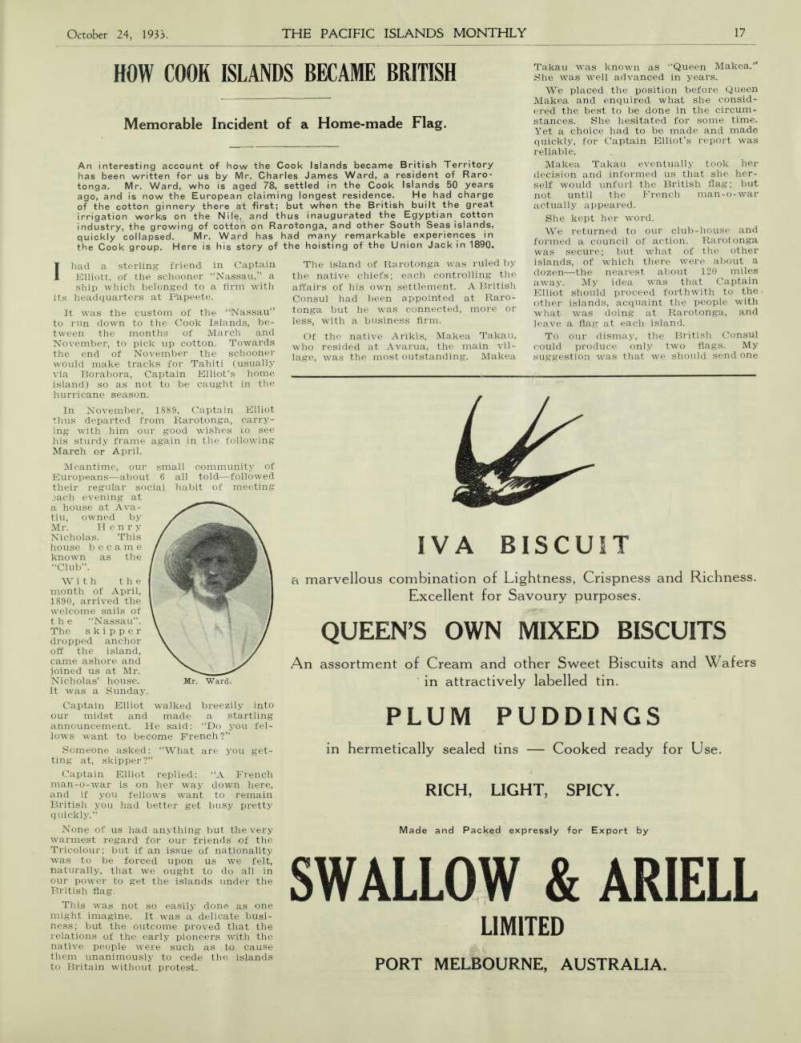
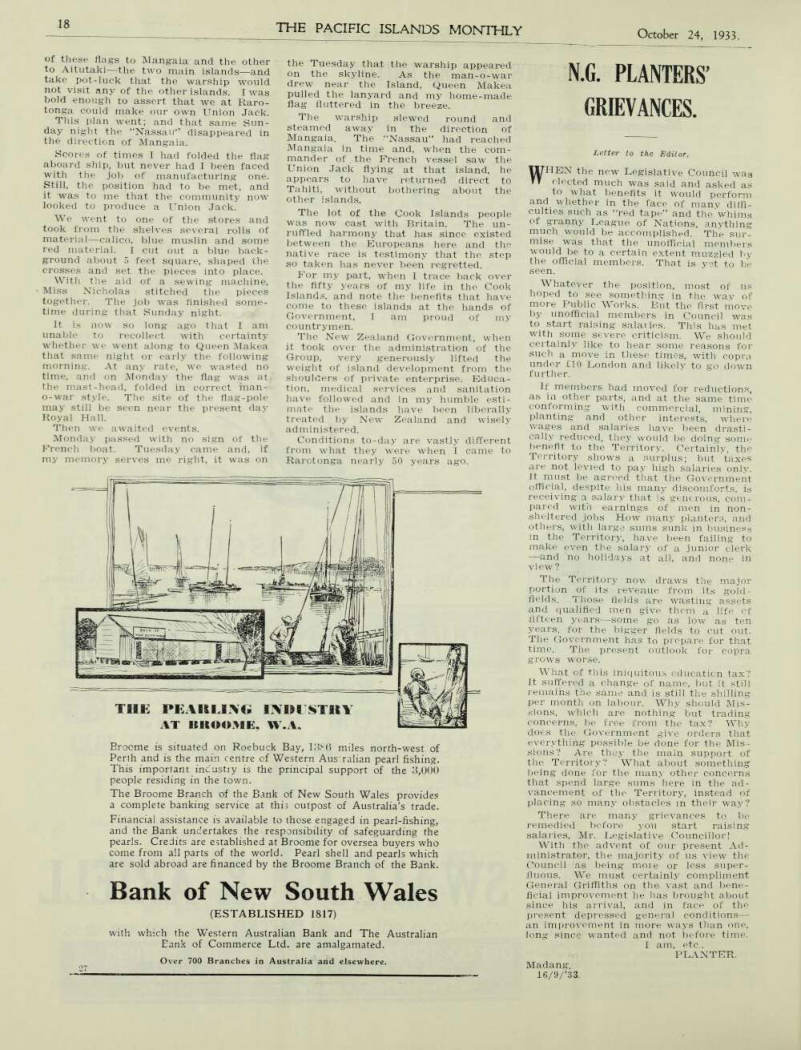
Memorable Incident of a Home-made Flag.
An interesting account of how the Cook Islands became British Territory has been written for us by Mr. Charles James Ward, a resident of Raro tonga. Mr. Ward, who is aged 78, settled in the Cook Islands 50 years ago, and is now the European claiming longest residence. He had charge of the cotton ginnery there at first; but when the British built the great irrigation works on the Nile, and thus inaugurated the Egyptian cotton industry, the growing of cotton on Rarotonga, and other South Seas islands, quickly collapsed. Mr. Ward has had many remarkable experiences in the Cook group. Here is his story of the hoisting of the Union Jack in 1890.
I had a sterling friend in Captain Elliott, of the schooner “Nassau,” a ship which belonged to a firm with its headquarters at Papeete.
It was the custom of the “Nassau” to run down to the Cook Islands, be tween the months of March and November, to pick up cotton. Towards the end of November the schooner would make tracks for Tahiti (usually via Borabora, Captain Elliot’s home island) so as not to be caught in the hurricane season.
In November, 1889, Captain Elliot thus departed from Rarotonga, carry ing with him our good wishes to see his sturdy frame again in the following March or April.
Meantime, our small community of Europeans—about 6 all told—followed their regular social habit of meeting
each evening at a house at Ava tiu, owned by Mr. Henry Nicholas. This house became known as the “Club”.
With the month of April, 1890, arrived the welcome sails of the “Nassau”.
The skipper dropped anchor off the island, came ashore and joined us at Mr.
Nicholas’ house.
It was a Sunday.
Captain Elliot walked breezily into our midst and made a startling announcement. He said: “Do you fel lows want to become French?”
Someone asked: “What are you get ting at, skipper?”
Captain Elliot replied: “A French man-o-war is on her way down here, and if you fellows want to remain British you had better get busy pretty quickly.”
None of us had anything but the very warmest regard for our friends of the Tricolour: but if an issue of nationality was to be forced upon us we felt, naturally, that we ought to do all in our power to get the islands under the British flag.
This was not so easily done as one might imagine. It was a delicate busi ness; but the outcome proved that the relations of the early pioneers with the native people were such as to cause them unanimously to cede the islands to Britain without protest.
The island of Rarotonga was ruled by the native chiefs; each controlling the affairs of his own settlement. A British Consul had been appointed at Raro tonga but he was connected, more or less, with a business firm.
Of the native Arikis, Makea Takau, who resided at Avarua, the main vil lage, was the most outstanding. Makea
Takau was known as “Queen Makea.”
She was well advanced in years.
We placed the position before Queen Makea and enquired what she consid ered the best to be done in the circum stances. She hesitated for some time.
Yet a choice had to be made and made quickly, for Captain Elliot’s report was reliable.
Makea Takau eventually took her decision and informed us that she her self would unfurl the British flag; but not until the French man-o-war actually appeared.
She kept her word.
We returned to our club-house and formed a council of action. Rarotonga was secure; but what of the other islands, of which there were about a dozen —the nearest about 120 miles away. My idea was that Captain Elliot should proceed forthwith to the other islands, acquaint the people with what was doing at Rarotonga, and leave a flag at each island.
To our dismay, the British Consul could produce only two flags. My suggestion was that we should send one
Mr. Ward.
of these flags to Mangaia and the other to Aitutaki—the two main islands—and take pot-luck that the warship would not visit any of the other islands. I was bold enough to assert that we at Raro tonga could make our own Union Jack.
This plan went; and that same Sun day night the “Nassau’’ disappeared in the direction of Mangaia.
Scores of times I had folded the flag aboard ship, but never had I been faced with the job of manufacturing one.
Still, the position had to be met, and it was to me that the community now looked to produce a Union Jack.
We went to one of the stores and took from the shelves several rolls of material—calico, blue muslin and some red material. I cut out a blue back ground about 5 feet square, shaped the crosses and set the pieces into place.
With the aid of a sewing machine, Miss Nicholas stitched the pieces together. The job was finished some time during that Sunday night.
It is now so long ago that I am unable to recollect with certainty whether we went along to Queen Makea that same night or early the following morning. At any rate, we wasted no time, and on Monday the flag was at the mast-head, folded in correct mano-war style. The site of the flag-pole may still be seen near the present day Royal Hall.
Then we awaited events.
Monday passed with no sign of the French boat. Tuesday came and, if my memory serves me right, it was on
the Tuesday that the warship appeared on the skyline. As the man-o-war drew near the Island, Queen Makea pulled the lanyard and my home-made flag fluttered in the breeze.
The warship slewed round and steamed away in the direction of Mangaia. The “Nassau” had reached Mangaia in time and, when the com mander of the French vessel saw the Union Jack flying at that island, he appears to have returned direct to Tahiti, without bothering about the other islands.
The lot of the Cook Islands people was now cast with Britain. The un ruffled harmony that has since existed between the Europeans here and the native race is testimony that the step so taken has never been regretted.
For my part, when I trace back over the fifty years of my life in the Cook Islands, and note the benefits that have come to these islands at the hands of Government, I am proud of my countrymen.
The New Zealand Government, when it took over the administration of the Group, very generously lifted the weight of island development from the shoulders of private enterprise. Educa tion, medical services and sanitation have followed and in my humble esti mate the islands have been liberally treated by New Zealand and wisely administered.
Conditions to-day are vastly different from what they were when I came to Rarotonga nearly 50 years ago.
Advertisements & other items, pp. 19-20 (1 item)
Swallow & Ariell
IVA BISCUIT
a marvellous combination of Lightness, Crispness and Richness.
Excellent for Savoury purposes.
QUEEN’S OWN MIXED BISCUITS
An assortment of Cream and other Sweet Biscuits and Wafers in attractively labelled tin.
PLUM PUDDINGS
in hermetically sealed tins Cooked ready for Use.
RICH, LIGHT, SPICY.
Made and Packed expressly for Export by
SWALLOW & ARIELL
LIMITED
PORT MELBOURNE, AUSTRALIA.
THE PEARLING INDUSTRY
AT BROOM, W.A.
Broome is situated on Roebuck Bay, 1386 miles north-west of Perth and is the main centre of Western Australian pearl fishing.
This important industry is the principal support of the 3,000 people residing in the town.
The Broome Branch of the Bank of New South Wales provides a complete banking service at this outpost of Australia's trade.
Financial assistance is available to those engaged in pearl-fishing, and the Bank undertakes the responsibility of safeguarding the pearls. Credits are established at Broome for oversea buyers who come from all parts of the world. Pearl shell and pearls which are sold abroad are financed by the Broome Branch of the Bank.
Bank of New South Wales
(ESTABLISHED 1817)
with which the W'estern Australian Bank and The Australian Bank of Commerce Ltd. are amalgamated.
Over 700 Branches in Australia and elsewhere.
N.G. Planters’
Grievances.
Letter to the Editor.
WHEN the new Legislative Council was elected much was said and asked as to what benefits it would perform and whether in the face of many diffi culties such as “red tape” and the whims of granny League of Nations, anything much would be accomplished. The sur mise was that the unofficial members would be to a certain extent muzzled by the official members. That is vet to be seen.
Whatever the position, most of us hoped to see something in the way of more Public Works. But the first move by unofficial members in Council was to start raising salaries. This has met with some severe criticism. We should certainly like to hear some reasons for such a move in these times, with copra under £10 London and likely to go down further.
If members had moved for reductions, as in other parts, and at the same time conforming with commercial, mining, planting and other interests, where wages and salaries have been drasti cally reduced, they would be doing some benefit to the Territory. Certainly, the Territory shows a surplus; but taxes are not levied to pay high salaries only.
It must be agreed that the Government official, despite his many discomforts, is receiving a salary that is generous, com pared with earnings of men in non sheltered jobs. How many planters, and others, with large sums sunk in business in the Territory, have been failing to make even the salary of a junior clerk —and no holidays at all, and none in view?
The Territory now draws the major portion of its revenue from its gold fields. Those fields are wasting assets and qualified men give them a life of fifteen years—some go as low as ten years, for the bigger fields to cut out.
The Government has to prepare for that time. The present outlook for copra grows worse.
What of this iniquitous education tax?
It suffered a change of name, but it still remains the same and is still the shilling per month on labour. Why should Mis sions, which are nothing but trading concerns, be free from the tax? Why does the Government give orders that everything possible be done for the Mis sions? Are they the main support of the Territory? What about something being done for the many other concerns that spend large sums here in the ad vancement of the Territory, instead of placing so many obstacles in their way?
There are many grievances to be remedied before you start raising salaries, Mr. Legislative Councillor!
With the advent of our present Ad ministrator, the majority of us view the Council as being more or less super fluous. We must certainly compliment General Griffiths on the vast and bene ficial improvement he has brought about since his arrival, and in face of the present depressed general conditions — an improvement in more ways than one, long- since wanted and not before time.
I am, etc..
Planter.
Madang, 16/9/’33.
Problem Of Saving Primitive Races
Lessons Derived From Study of Culture-Contact In New Ireland.
TO anyone who is interested in prob lems of native administration in the Pacific —more particularly in the Aus tralian territories and the other parts of Melanesia —and the part that may be played by anthropological investigations and research in the solution of those problems and in native affairs generally, a careful perusal of the recent “Report on Field-work in New Ireland” of Mr.
William C. Groves, is heartily recom mended.
A copy of this work, in reprint form has just been received by the writer; it was published originally in “Oceania” for March of this year. The author spent a period of about 10 months, during 1932- 33, in the village of Fisoa and its en virons, his purpose being to study the results observable in the social organisa tion and native culture to-day of the im pact upon native life of European and other modifying influences and agencies.
The research work was not motivated by a purely academic interest. For, as the concluding section of the report shows, certain very practical recom mendations are made, based on the con clusions arrived at by the author. The data upon which these conclusions are based, as well as the method upon which the research work proceeded, are pre sented in summarized form, in the first portion of the report. Full acknowledge ment is made to residents and officials for help received.
STARTING with the assumption that the interests of the natives and those of European settlers are not incon sistent, and that in the all-embracing problem of reconciling these two sets of interests some form of native “educa tion” must play a large part, the report points out that — “The ultimate aim of the research pro posed under the Fellowship was to ar rive at some scientifically-established conclusions as to the place, nature and scope of education, conceived as an in strument of social adjustment, amongst the native people concerned. It was hoped that, as a result of such research, it might be possible to establish prin ciples valid in their relation to the par ticular group being studied, that might be found to have wider application in such territories and amongst such people as are represented in Melanesia to-day.
Discussing the problem of cultural re conciliation in general, the report pro ceeds: “Native institutions and primitive society imperatively demand preserva tion, while European commercial and in dustrial enterprises equally imperatively demand protection. While the native on his part has willingly adopted European ideas and materials, modifying his for mer culture-pattern to accord with the introduced ideas to such an extent that he has now become largely dependent for his livelihood on the existence of European enterprises and for his social stability on European governments and religious institutions, the European, on his part, finds economic development quite impossible except through the will ing agency of the native. Such, in bare skeleton, is a summary of the position to-day.”
WITH regard to the response of native people to the approach of the an thropologist (referred to as “the ethnographer”), the author points out how, with increasing use of the native vernacular (and he, perhaps too mod estly, disclaims any but a fragmentary knowledge of the language of Fisoa) “one finds oneself becoming more and more en rapport with the people, attun ing one's mind to their mental key, learning to appreciate something of the nature of the native and his outlook, and to understand the functioning and inter relation of the various aspects of his culture; in short, to see the way of his life.”
“The writer believes,” the report pro ceeds, “that the association of a Euro pean with ethnographic work amongst such people gives him a unique position in their minds, and one that, by the circumscribed nature of the work of each, is not possible to the government district official (associated in the native’s mind with courts and tax-gathering) or to the missionary.” Such a unique rela tion of understanding that begets mutual confidence, the author claims, is possible without any show of sentimentality on the part of the European concerned. It is certainly not inconsistent, with the maintenance of personal dignity and so called “white man’s prestige.”
The practical suggestion that arises from this fact is that any new social or educational enterprise to be instituted amongst such native people—whether vocational, craftwork, agricultural or or dinary schooling—can be fully successful only when its European agents (teachers, doctors, agriculture instructors, and such) have the necessary training in the principles of anthropology; that is, when the enterprise is placed under anthropo logical direction or subject in its early stages to anthropological guidance.
TO the ordinary man, the most interest ing section of the publication is that devoted to an outline of the history and effects of European cultural infiltration.
This section was built up by means of case-histories, lives and experiences of individual natives representing the old culture and the new.
Such types are met with as “bearded Balasam,” a friendly old fellow who once —long, long ago —ventured as far afield as Sydney, an event which he remembers vividly and which gave him facility in the use of such English touches as “Yu like some beer, Charley?”
“Cases” are given, too, of “disillu sioned” young adult males of the village, the group that is reacting most notice ably to the culture contact. “These have all grown to manhood under the in fluence of European contact. They ap pear to be living through a period of dis quiet, which expresses itself here in an attitude of patient questioning, there is one of complete inertia and fatalism—a ‘maski!’, shoulder-shrugging attitude that is not pleasing to meet.”
DISCUSSING the third group studied, the young folk, Mr. Groves remarks that “These children have been brought into contact from their earliest years with a form of life that is, in all its essentials, alien to the old primitive life. It is these children who present to the educationist (as to the practical an thropologist in native administration) his big problem; for soon it will be too late.”
“These children know little of, and care less for, things of yesterday; they look forward with characteristic childish faith and exuberance to to-morrow.
Theirs is the future: ours the moulding of that future.”
There follows, then—and this is to the scientific mind the most valuable part of the report—a detailed outline .of the nature of the changes that have come about in the primitive culture since the beginning of European contact. One learns, for instance, of the complete breakdown of the old clan system, of the restrictive nature of the law of exogamy (marriage outside one’s own clan), of the fight that is being waged by the na tives themselves for the survival of the primitive religion represented by mala gan; that sorcery is no longer, except clandestinely, practised; that the former system of inducting youths into full citi zenship—a ceremony associated with malagan procedure—no longer operates.
“And so,” says the author, in sum mary, “the account might be continued through every aspect of the former cul ture, revealing ultimately a society divided in its allegiance to the things of the past, and quite uncertain of —nor much caring about—the future; a so ciety sick and dispirited; a society which, accustomed as it is to being buf feted about by various agencies, is pre pared in a spirit of fatalistic resigna tion, uncomplainingly to follow any path pointed out; uncomplainingly, but with no impulse of interest —only complete apathy.”
And, as the writer explains in a foot note, he does not belong to the school of anthropologists that expresses academic resentment at the disappearance of the primitive. Such an attitude is merely beating the air. He sees and knows that the primitive is even now disappearing and doomed. His concern, as a human being as well as an anthropologist, is what is to be done to ensure the re moulding, on lines that are acceptable to and in the ultimate interest of the new native, of his future —to ensure his eco nomic security, social stability, and re ligious satisfaction; and, if possible, his personal happiness.
Unlike so many anthropologists, Mr.
Groves takes a most reasonable view of the place of the missionary enterprise in such culture - contact communities, though one gathers that there is room for criticism of an attitude of aggressive proselysization that threatens to destroy the malagan without any idea of what the function of malagan is in the society.
SECTION 3 is given over to “Conclu sions and Recommendations.” In view of the imminent breakdown of the old clan system and the irksome nature in the society of to-day of certain of the old tabus and restrictions, a radical ulti mate re-organisation of the basis of the social organisation is suggested.
“The inevitable must be realised and accepted. We must turn the faces of the young people towards a new era; train and prepare them to fit into a new cul tural background which they themselves, by a process of education, will have helped to evolve. New wants, new faiths, new allegiances, new interests, an en tirely new outlook —these and these alone will set the feet of future generations along the road that leads to that in dividual happiness that is essential now adays to social welfare and progress.”
What is required for the attainment of this worthy end is an entirely new or ganisation, one that the natives will look upon, by their participation in its work, as their own, belonging to and existing for them.
The report continues, “It is not enough to leave the rising generation of natives alone with pious hopes that all will be well, that these things will right them selves; not enough to talk airily of “peasant proprietorship” and such shib boleths, to attempt to develop new economic interests and social pursuits against the stone walls of European op
position, missionary single-mindedness and smug official satisfaction. Such words are only catch-phrases; such halfhearted attempts at development merely palliatives; sops to European self esteem, salves to the official conscience.”
Such a new enterprise as that referred to would be, in essence, “educational”, but “not the education of popular con ception, of books and schools and black boards and such impedimenta; but edu cation in its widest possible connotation, as the instrument set up by society for its own preservation; as the machinery of social adjustment. This broad inter pretation of the function of education dismisses at the outset the wholly er roneous view that the educational ma chinery necessary for the special task of social adjustment in primitive communi ties is the same as that of European society.
“In the planning of the new suggested educational enterprise, the necessity is pointed out of giving full recognition to the basic fact that the natives are essen tially villagers; the village is the organ ised unit of the society; upon the wel fare and stability of the village depends the welfare, the very life of the people as a race. It is there, in the village, that the ethos finds expression. And it is there, in the village itself and in relation to its activities, that all rightly-conceived edu cational efforts must operate; towards the enrichment of village life and the ad justment of the culture to changing con ditions due to contact, educational policy must be directed.”
A MORE detailed idea of the nature of such an enterprise is given, as well as a suggestion that an inexpensive experiment on the lines indicated be tried out in New Ireland.
“The fact must be stressed,” says the author, “that to proceed to ‘educate’ such recently primitive, culture - contact natives with the popular idea that the school as we Europeans know it is the sole or right educational medium or piece of machinery, is not only a disastrously wrong method of approach to the very delicate problem; it is, in the light of the experience of thoughtful people in the past, tragic and burlesque.”
These terms, strong enough, are not too strong to give full expression to the writer’s attitude in this connection. “It makes education as a social force appear unscientific and ridiculous; it is largely responsible for that air of tolerant scorn that' has in the past frequently been the public attitude to a conscientious teacher working among natives.”
OF the need for selection of suitable Europeans for engagement in such work, the author speaks wisely. “In such an enterprise,” we read, “none but broad-visioned, chivalrously - minded European should find any part. What is required is a combination of the zeal and faith of the missionary with the re sources and freedom of action that the individual missionary, by the specifically religious nature of his work and the limitation of his funds, cannot possibly enjoy.
If only because, for the first time in the Pacific, there are enunciated in its pages, the basic principles upon which native education should function in such a background, and because it gives pro minence to the basic idea of concentrat ing educational effort on the village life of the natives, the report is worthy of serious consideration by every native ad ministration in the Western Pacific that is concerned with the problem of the ad justment of a primitive society to the changes introduced by the impact upon it of alien influences.
Advertisements & other items, pp. 21-24 (1 item)
Have You Got Surfer’S Foot?
Beware of these symptoms!
Painful cracks between the toes; redness; tiny itching blisters; thick white skin that is always moist, or dry skin that peels off in scales—watch these symptoms! They are the danger signals of “Toe-Rot” or “Surfer’s Foot.” the most common form of Tinea (Tropic Ringworm).
Tinea is prevalent everywhere in the Islands —few escape infection. Although it usually begins between the toes, it may attack the arms, hands, or any portion of the body.
Antinea Destroys the Germs Completely.
The penetrative power of Antinea soon kills the parasites that cause Tinea; often the first application will stop the pain and irritation at once. Regular treatment with Antinea will effect a complete cure, even in long-standing cases.
Antinea is obtainable at all branches of Burns Philp & Co. Ltd., Morris Hedstrom & Co. Ltd. (Suva), W. R. Carpenter & Co. Ltd., A. J. Swann & Co.
Ltd. (Suva), Brown & Joske (Suva)
OM MON WEALTH &
168-174 Day
Small size 2/6
Large size 5/6
(three times the quantity)
Made by
DOMINION AGENCIES LTD.,
Street, Sydney, N.S.W.
A 2-73
B.P.
Berger's Paint
[PREPARED]
Guaranteed by the manufacturers to go further, last longer and uniformly give better results than any other paint made. —“ B.P.”
"KEEP ON KEEPING ON!"
Agents throughout the Islands.
"Now fades the
glimmerinq landscape on the sight"
. . . . and as the shadows deepen, lamps filled with Laurel dispel the tropic darkness ... In thousands of homes where wicks are trimmed.
Laurel is famous for its soft white eyecomforting radiance ... Try Laurel in your lamp and enjoy its better light.
VACUUM OIL COMPANY Pty. Ltd.
PUMPMOBIL
Light & Portable MOTOR PUMPS Weight about 140 lbs. Automatic Priming. Reliable and Efficient.
Especially suitable for Prospecting and all Sluicing requirements.
Particulars Iron
NELSON & ROBERTSON,
12 Spring Street SYDNEY.
McILRATH’S
CHRISTMAS GOODS
have not yet arrived but when your Xmas order reaches us our Store will be “filled to bursting” with New Season’s Xmas fare of infinite variety and unexcelled quality. Send an order to-day and ensure a happy Xmas.
Australian I.A. Crystal Sugar, 70lb. bags 14/9 bag Finest Roller Flour, 50lb 5/6 bag, 8/6 tin Rosa Self-Raising Flour, 2lb. pkts 6d. pkt., 5/9 doz.
Finest ‘‘Sunraysed” Sultanas 6d. lb., 5/9 doz.
Finest “Sunraysed” Lexias 5½d. lb., 5/3 doz.
Arnott’s Plum Puddings, 2lb. tins .. .. 3/- tin, 35/- doz.
Swallow & Ariell's Plum Puddings, 2lb. tins 3/3 tin, 37/6 doz.
Rosa or I.X.L. Apricots in Syrup, 30oz. tins 9½d. tin, 9/3 doz.
LX.L. Gooseberries in Syrup, 30oz. tins .. 11d. tin, 10/9 doz.
Lusco Dripak Prunes, 11½d. tin, 11/- doz.
Nestle’s Pure Cream, 4oz, tins .. .. tin, 4/3 doz.
Rosa Custard Powder, 1lb. tins . . .. 1/2 tin, 13/6 doz.
Crystallised Ginger, loose 8½d. lb.
Preserved Ginger in Syrup, 1lb. jars .. 1/5 jar, 16/6 doz.
Finest Khadrewi Dates, loose 4½d. lb. 4/- doz.
New Season’s Turkish Figs, Pressed .. 1/3 lb., Xmas Party Crackers, 1 doz. boxes .. 1/9 to 5/6 box Rosa Jelly Crystals, pint pkts 4½d. pkt., 4/- doz.
S. &A. Fruit Mihcement, 12oz. jars .. 1/5½ jar, 17/- doz.
Capital Lemon Syrup Crystals, pkts. .. pkt., 7/3 doz.
Pioneer Ginger Beer Powders, pkts. .. 6d. pkt., 5/9 doz.
Schweppe’s Lemon Juice Cordial, 26oz. bots. 1/3 bot., 14/6 doz.
Hardy’s Y.O. Dry Sherry, 26oz. bots. .. 2/8 bot., 31/- doz.
Hardy ’s Champion Reserve Claret, 26oz. bots 2/6 bot., 29/- doz.
ALL PRICES F.O.B. SYDNEY.
Our Service Department will do all your Xmas Shopping for you.
McILRATH’S Ltd.
Indian Agitators.
Demand For Common Roll in Fiji.
SOME fears that the Government of Fiji may be inclined to accede in some degree to the ceaseless and insistent demand of the Indian population for “equal status with Europeans” is ex pressed in a letter which we have re ceived from a well-known resident of Viti Levu.
The position in Fiji, as is well-known, is that the Indian population is now nearly equal in numbers to the Fijians; that the Indians are allowed special rep resentatives (elected on a special roll) in the Legislative Council of Fiji and generally in connection with the Admin istration; and that the Indians —or rather a small section of them —carry on a constant agitation for what is called the “common roll,” which means that the Indians want the same voting power in Fiji as the Europeans.
There are a score of reasons—ethno graphical, social and political— why
equal status cannot be granted to the Indian population in any country where there is an Indian and a European popu lation; and it may be taken as quite de finite that the principle that has been established in other countries by the British Colonial Office will not be de parted from in Fiji.
All over the world, in East and South Africa, in Malaya, and wherever there is an immigrant Indian population, as well as in India itself, the British Administra tion seeks to give the fullest possible representation in governmental affairs, as well as strict justice, to the Indian people. But for obvious reasons, it is quite impossible to give the “common roll” to the Indians —and educated high caste Indians are the first to recognise the fact. The trouble comes, not from the mass of Indians, who are quite sat isfied with their treatment, but from semi-educated Hindus who appear to make themselves a nuisance, both to Europeans and to their own countrymen.
Our Fiji correspondent says: “The granting of the ‘common roll’ to the Fiji Indians would be the end of Fiji and a tragedy for the Europeans domi ciled here. The majority of the Indian working class in Fiji are quite happy and satisfied with their lot in life —it is the few half-educated agitators who are stirring up trouble. Many of the latter already are unbearable in their manner and behaviour now, so picture our lot if labourers could boast of equal status.
“At a recent Ram Lila here (a Ram Lila is an annual Indian festival that lasts a week or more), the following notice was posted up in English and Hindustani. No doubt the writer of the notice considers that he is an educated man and is a strong advocate for equal status.”
Notice.
This notice issued by RAM LILA members- So every body ought to see RAM LILA, with; satisfaction. But he should pay gratest atten tion to following objection otherwise he should sent to gail at once also proceeding action against by RAM LILA members. (1) Do not enter in boundry before taking: their shoes out. (2) Likor or other drink stiff without cava. (3) Any sort of religious talk also lecktures. (4) At using quarrel, fighting. (5) Badly song or shame ful music. (6) Eating selling with any kind of flesh. (7) Searching to heart some lady. (8) Enter on women group or looking with; badly sight. (9) Take permission if something used to sell. (10) Robbery or trying to do. (11) Stop this motor-cars where members ad vantage. (12) Do not sing music without permission. (13) Motor-cars should be drive slowly. (Signed) Manager RAM LIDA.
New Guinea Missions.
Property To Be Restored.
THE Federal Government has decided to advise the Administrator of New Guinea that it has no objection to the repeal of the German mission ordinance 1926.
The ordinance provides that property held in New Guinea by German Missions on January 10, 1920, would be vested in the Administrator, who would by order vest such property in boards of trustees.
The missions concerned are: —Marist Mission Society, Ltd., Catholic Mission Society of the Sacred Heart, Catholic Mission Society of the Holy Ghost, the Renish Mission Society, the Lebenzell Mission.
The repeal of the ordinance means that the property will be reinvested in the missions.
Old-Time Cannibal Tells His Story
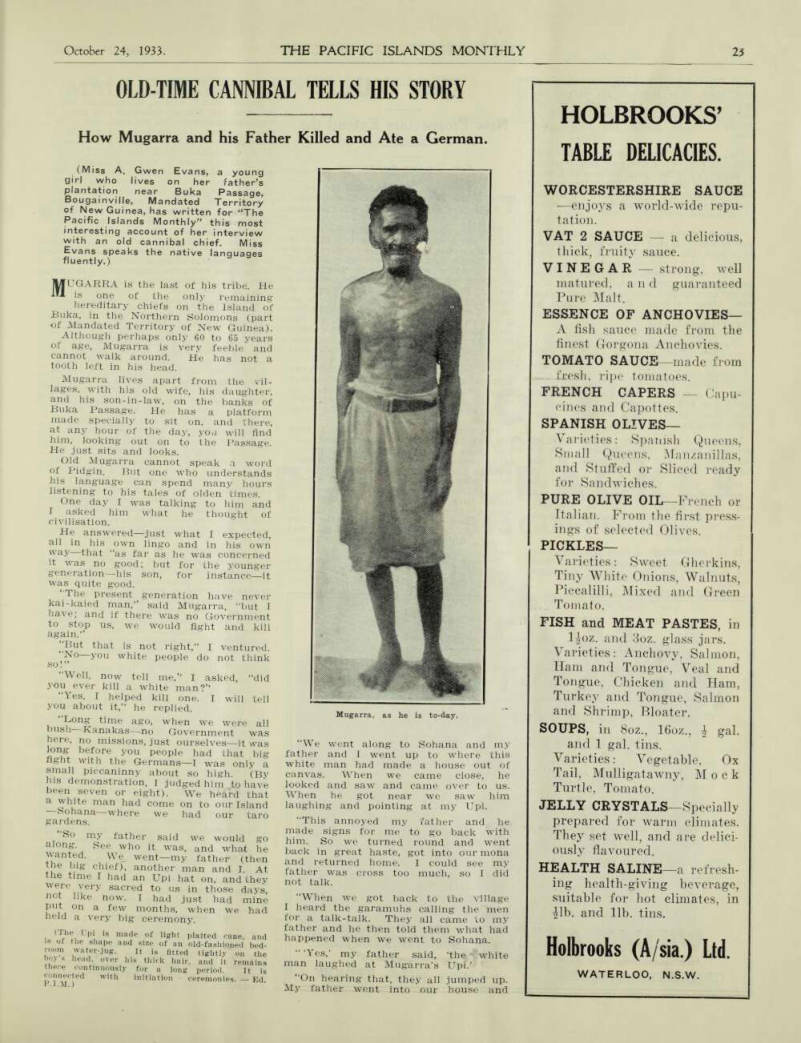
How Mugarra and his Father Killed and Ate a German.
(Miss A. Gwen Evans, a young girl who lives on her father’s plantation near Buka Passage,
Bougainville, Mandated Territory
of New Guinea, has written for “The Pacific Islands Monthly’’ this most interesting account of her interview with an old cannibal chief. Miss Evans speaks the native languages
fluently.)
MUGARRA is the last of his tribe. He is one of the only remaining hereditary chiefs on the Island of Buka, in the Northern Solomons (part of Mandated Territory of New Guinea).
Although perhaps only 60 to 65 years of age, Mugarra is very feeble and cannot walk around. He has not a tooth left in his head.
Mugarra lives apart from the vil lages, with his old wife, his daughter, and his son-in-law, on the banks of Buka Passage. He has a platform made specially to sit on, and there, at any hour of the day, you will find him, looking out on to the Passage.
He just sits and looks.
Old Mugarra cannot speak a word of Pidgin. But one who understands his language can spend many hours listening to his tales of olden times.
One day I was talking to him and I asked him what he thought of civilisation.
He answered—just what I expected, all in his lingo and in his own that “as far as he was concerned it was no good; but for the younger generation—his son, for instance—it was quite good.
“The present generation have never kai-kaied man,’’ said Mugarra, “but I have; and if there was no Government to stop us, we would fight and kill again.’’ ‘‘But that is not right,” I ventured.
“No—you white people do not think so!”
“Well, now tell me,” I asked, “did you ever kill a white man?”
“Yes, I helped kill one. I will tell you about it,” he replied, “Long time ago, when we were all bush Kanakas—no Government was here, no missions, just ourselves—it was long before you people had that big fight with the Germans—I was only a small piccaninny about so high. (By his demonstration, I judged him to have been seven or eight). We heard that a white man had come on to our Island —Sohana— where we had our taro gardens.
So my father said we would go along. See who it was, and what he wanted. We went—my father (then the big chief), another man and I. At the time I had an Upi hat on, and they were very sacred to us in those days, not like now. I had just had mine put on a few months, when we had held a very big ceremony. (The Upi is made of light plaited cane, and is of the shape and size of an old-fashioned bed room water-jug. It is fitted tightly on the boy's head, over his thick hair, and it remains there continuously for a long period. It is connected with initiation ceremonies. — Ed.
P.I.M.)
“We went along to Sohana and my father and I went up to where this white man had made a house out of canvas. When we came close, he looked and saw and came over to us.
When he got near we saw him laughing and pointing at my Upi.
“This annoyed my father and he made signs for me to go back with him. So we turned round and went back in great haste, got into our mona and returned home. I could see my father was cross too much, so I did not talk.
“When we got back to the village I heard the garamuhs calling the men for a talk-talk. They all came to my father and he then told them what had happened when we went to Sohana.
“ ‘Yes,’ my father said, ‘the white man laughed at Mugarra’s Upi.’
“On hearing that, they all jumped up.
My father went into our house and
Mugarra, as he is to-day.
came out with spears and an old stone axe, the other natives all doing the same. The chief then beckoned me along with him and off we went up to ‘Sohana’ again, where the white man was.
“My father went up to him and chopped him with his axe and I threw a spear at him, just like my father had shown me to do. While my father was cutting the white man with the axe, he said, ‘No more will you laugh at Mugarra’s Upi!’
“Later, we kai-kaied him, and that was when I tasted white man for the first and last time.
“This master we killed was a Ger man and he came out here and was going to try and sell axes and knives and other things to us. But he laughed at my Upi hat, so we killed and kai-kaied him.
“No more white masters came for a long time after, and we used to fight with all the Kanakas from Seleo (Bougainville) and we always kai kaied them. Then the Kiaps (District Officers) came and the missions, so we could not kill any more. You came a long time after. We were no more bush-Kanakas,” he added.
Mugarra at one time owned most of the land around Buka Passage. It all belonged in the first place to his father.
“Now, when I die, if my son be comes the chief, he will not be like me,” said Mugarra; “he is civilised.
But I think old times were the best, when we could do as we liked and kill as we liked.”
It is interesting to note that Sohana, where this massacre took place, is now the seat of the Government in Buka Passage.
Advertisements & other items, pp. 25-26 (1 item)
Holbrooks (A/sia.) Ltd.
HOLBROOKS’
TABLE DELICACIES.
WORCESTERSHIRE SAUCE
—enjoys a world-wide reputation.
VAT 2 SAUCE a delicious, thick, fruity sauce.
VINEGAR strong, well matured, and guaranteed Pure Malt.
ESSENCE OF ANCHOVIES—
A fish sauce made from the finest Gorgona Anchovies.
TOMATO SAUCE—made from fresh, ripe tomatoes.
FRENCH CAPERS Capu-
cines and Capottes.
SPANISH OLIVES—
Varieties: Spanish Queens, Small Queens, Manzanillas, and Stuffed or Sliced ready for Sandwiches.
PURE OLIVE OlL—French or Italian. From the first pressings of selected Olives.
PICKLES—
Varieties: Sweet Gherkins, Tiny White Onions, Walnuts, Piccalilli, Mixed and Green Tomato.
FISH and MEAT PASTES, in
1½oz. and 3oz. glass jars.
Varieties: Anchovy, Salmon, Ham and Tongue, Veal and Tongue, Chicken and Ham, Turkey and Tongue, Salmon and Shrimp, Bloater.
SOUPS, in 8oz., 16oz., ½ gal. and 1 gal. tins.
Varieties; Vegetable, Ox Tail, Mulligatawny, Mock Turtle, Tomato.
JELLY CRYSTALS —Specially prepared for warm climates.
They set well, and are deliciously flavoured.
HEALTH SALINE—a refreshing health-giving beverage, suitable for hot climates, in ½lb. and 1lb. tins.
Holbrooks (A/sia.) Ltd.
WATERLOO, N.S.W.
EFFICIENT
PAINTING
Means True Economy
GOOD PAINT COSTS NOTHING!
Because it saves its cost in the enhanced wear of the thing's it protects.
Insures your buildings against rust and decay, just as you insure them against fire.
Paint should not be judged by the price per cwt., or the covering capacity—but by its LASTING QUALITIES!
IT IS FALSE ECONOMY TO USE CHEAP PAINT, which lasts perhaps two years, when a paint slightly more expensive in the first cost may remain effectively protective for seven years.
Ferrodor Paint Combines Extraordinary Lasting Qualities with good Covering Capacity and Reasonable P^ice.
Available from all Leading Paint Stores or the Sole Agents :
WILLIAM ADAMS & COMPANY
LIMITED
175 CLARENCE STREET SYDNEY.
Sepik Gold.
New Prospectors Extend the Search.
From Our Own Correspondent.
Madang, Sept. 16.
THE Sepik River region of New Guinea has again attracted new men and new capital.
This time, and for the first time, some thing more extensive than the dish is ben attempted. The people concerned in the matter, however, have picked upon the worst time of the year for the trans portation of their mining gear. This period, in common with these parts, is known as the “dry season”. With no rain of any consequence and nothing but a hot sun to parch everything, all the watersheds become almost dry, the small streams feeding the main depending only on seepage, underground channels and springs.
The company is known as the Yuat Alluvial and gets its name from the river Yuat, which is the third tributary on the left bank of the Sepik River, with its confluence about eighty miles from the sea.
The Yuat runs many miles back, first through low, undulating scrub and sak sak (sago palm) country into the moun tains that also form part of the water shed of the lower portions of the Ramu River. Its higher reaches are not navig able owing to many obstacles, as fallen trees, bars and boulders. In the “wet season” it is regarded as one of the Sepik’s fastest streams and carries down with it floating logs and debris that make it difficult and dangerous to nego tiate.
Prospectors who have tried out its headwaters have always got specimens of good colour; but, apart from just
prospecting- with a dish, have not at tempted any other means.
In 1931, Mr. S. Green, in company with the late Mr. Exton, followed out one of its fountain heads to its end, and over the mountain ranges towards the Bis marcks, eventually crossing the Ramu, west of Madang. This trip proved valu able to them, and it was the latter’s in tention to return later to certain parts to further prospect. To provide capital to equip himself with the necessary labour and gear he, whilst recruiting, was un fortunately killed in Aitape, at the hands of seemingly quiet and peaceful natives.
The benefits then, if any, of this long and tedious trek were lost.
Of late, however, Messrs. Leahy Bros., in the interests of the New Guinea Gold fields, Ltd., have been prospecting in and about the same areas, with a certain amount of success.
The new company now operating have as their manager, Mr. Turnbull, a geolo gist and mining engineer, and three as sistants. The plant consists of a full kit of boring tools, a considerable quan tity of stores, and a 36-foot launch for transport work. Owing to the low state of the water in the river, only about 30 miles is at present navigable. From there to their objective is a long, tedious journey, which has to be accomplished by canoe travel against a current which, at the present time, is about a knot.
The transport of heavy gear and stores in canoes is a very difficult undertaking.
Every care and constant attention has to be exercised. In some places rapids are met with and an upturned canoe may mean a loss of gear and stores that take time and money to replace, to say nothing of the inconvenience. Swarms of fever mosquitoes breed and live on the lower reaches but diminish and be come more bearable in the mountain areas.
The company have the best wishes of all and we hope that the honour may lie with them to show their predecessors that, at least, one part of the Sepik does possess gold on a working profit.
That indefatigable prospector, Alf Bel field, is again venturing to the reaches of the Upper Sepik, towards the border lines. For the past six years he has travelled and prospected over thousands of square miles of Sepik country, some times and sometimes not finding colour; but not up to the present has he discovered anything that to his way of thinking would be called payable.
On this trip he is accompanied by Mr.
“Dick” Glasson, one of the “Big Six,” of the Edie Creek days, and Commander Wauchope. They intend to further try out some more of the small streams and feeders that lie right at the head of the river. Before reaching this coun try some 500 miles of the Sepik have to be negotiated. This is done by a small launch. The party then make a base and secure their vessel safely and the rest is accomplished by canoe or foot to where ever their fancies turn them.
Thousands of pounds and many months of labour under a hot tropic sun, in fever-stricken areas, have been spent so far in a fruitless search of Sepik gold of a payable nature. All hope that the day is not far distant when at least some of the pioneers and investors on this quest will be suitably rewarded.
Lady Murray, wife of the Administra tor of Papua, left the Territory for Syd ney by the “Macdhui” on September 28 and will spend some months in Sydney before leaving for a short visit to South Australia.
Mau Defies General Hart
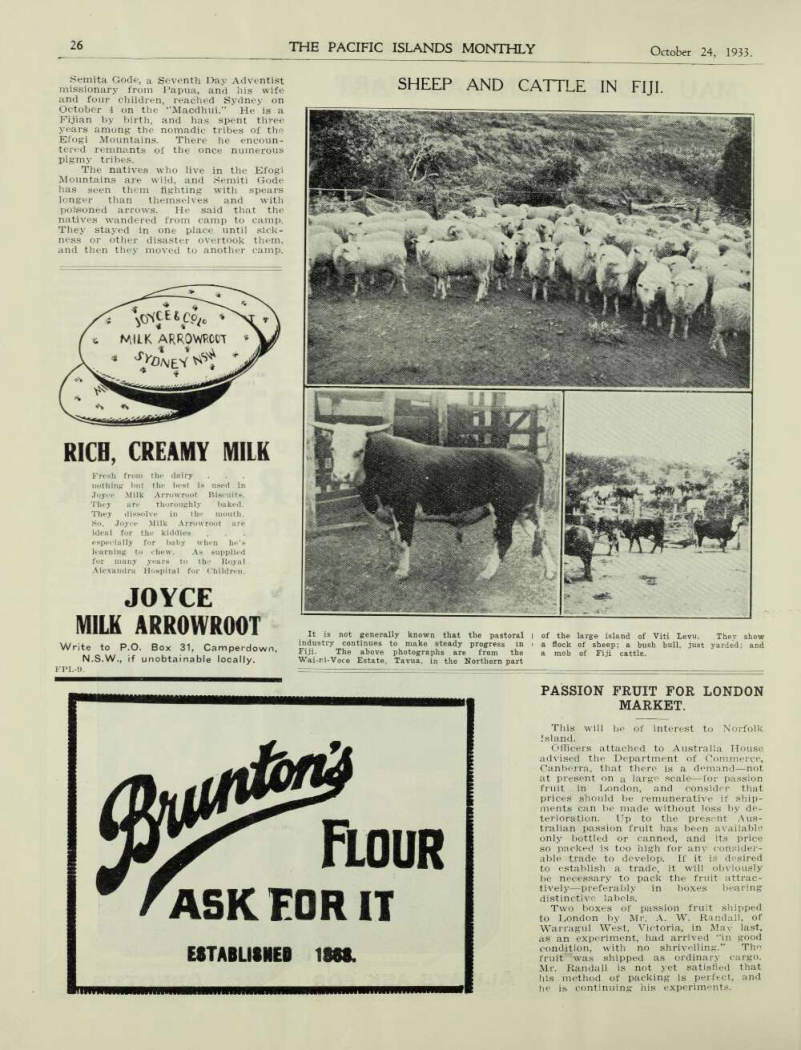
Stalemate Continues In Samoa.
(From a Special Correspondent.)
APIA, Sept. 26.
SINCE the end of August, all negotia tions between the “Mau” and the Administrator, General Hart, have been broken off owing to the stubborn insistence of the “Mau” leaders that Mr.
O. F. Nelson shall be one of their dele gates and the main speaker of their delegation at the proposed Fono with the Administrator.
The “Mau” leaders themselves have stated that Mr. Nelson has twice ad vised them to accede to the Administra tor’s wish and exclude him from the Fono. Unfortunately, Mr. Nelson has not thought it necessary to make a straightforward declaration that he does not want to participate as a “Mau” spokesman and delegate. Doubtless such a declaration, issued by him, would have impressed the “Mau" with his sincerity of purpose and opened the way to a settlement; while his half-hearted “ad vice” has stressed the impression that he alone is the stumbling block and main obstacle to a final solution of the Samoan “Seven Years’ War.”
General Hart, after the break in the negotiations with the “Mau,” had clearly stated his intention to enforce the existing laws and regulations in future, especially in regard to meetings of the “Mau” organisations, in the so called “disturbed” areas and districts.
In open defiance of General Hart’s announcement, the “Mau” district of Atua invited the “Mau” adherents to a “Taa lolo,” or native dance of honour, to be held in the village of Vaimoso, which is situated in a “disturbed" and prohibited district, on September 13, in honour of Mr. O. F. Nelson. This was to be the first of a number of “taa lolo’s” for the same purpose, to be held in Upolu and Savaii.
A number of representative Europeans received invitations to attend the feast at Vaimoso. Most of them wisely re frained from attending a function to all purposes anti-Administration and purely political. A few thousand natives were present and there were the usual speeches. At the feast following the dance, over 200 pigs were distributed.
It was highly significant, that on this occasion the orator of the old capital of Atua addressed Mr. O. F. Nelson with the old king’s title of “Tupu’a”. Doubt less this move was well thought out and intended. Though Mr. Nelson and the Mau organ, published in New Zealand, always claim that the former is of royal descent on his mother’s side, coming from one of the highest ranging chief families in Savaii, this claim does not correspond to fact, as Mr. Nelson’s mother came from one of the numerous small chief families of comparatively small genealogical importance. In any case, Mr. Nelson has not the slightest right to take a title like “Tupu’a”, re served from the oldest times to a few families, like Malietoa and Mataafa.
In view of the Administrator’s clear de finition of the present attitude of the Ad ministration towards violations of the law, the police would have been justified
in dispersing the meeting at Vaimoso and arresting the leaders. General Hart has refrained from taking this step, but undoubtedly the situation looks serious and there may be important develop ments.
The unfortunate inclination to push Mr. Nelson to the foreground and press his personal claims on the Administra tion, effectively prevents any negotia tions at present. There is no doubt that Mr. Nelson and the Mau, through them attitude, have alienated the support of the Man’s few remaining European sym pathisers. It is considered unfortunate that one man, at a time when Samoa is suffering severely from the low prices of produce, insufficient communications
with the outside world and all kinds of economic difficulties, should bar the way to a reconciliation between Administra tion and natives and thereby keep the former from putting into force measures planned for the economic relief of the native population.
Apart from the few leaders of the “Mau” aligned on the side of Mr. Nel son, and apparently determined to sup port him for reasons of their own, the mass of “Mau” adherents is fast losing interest in the useless struggle, which has caused them only suffering and losses.
The demands of the “Mau” submitted to the Administrator as a basis for negotiations, the so-called “9 points,” too lengthy to be given here, read some thing like the terms of peace, imposed by a victorious nation on a conquered enemy. The sooner the “Mau” realises that such demands are impossible of realisation, and the sooner they acknow ledge that Mr. Nelson cannot help them in any way and has to be eliminated from the picture, to make a termination of the impasse possible, the better it will be for the good of Samoa.
Semita Gode, a Seventh Day Adventist missionary from Papua, and his wife and four children, reached Sydney on October 4 on the “Macdhui." He is a Fijian by birth, and has spent three years among the nomadic tribes of the Efogi Mountains. There he encoun tered remnants of the once numerous pigmy tribes.
The natives who live in the Efogi Mountains are wild, and Semiti Gode has seen them fighting with spears longer than themselves and with poisoned arrows. He said that the natives wandered from camp to camp.
They stayed in one place until sick ness or other disaster overtook them, and then they moved to another camp.
Advertisements & other items, pp. 27-28 (1 item)
Popso Cracker
ARNOTT’S
FAMOUS
BISCUITS
Crisp and delicious and made to break into three fingers of ideal size and shape, the perfect base for savoury items.
Always ask for Arnott's
MILK ARROWROOT
RICH, CREAMY MILK
Fresh from the dairy nothing but the best is used In Joyce Milk Arrowroot Biscuits.
They are thoroughly baked.
They dissolve in the mouth.
So, Joyce Milk Arrowroot are ideal for the kiddies especially for baby when he’s learning to chew. As supplied for many years to the Royal Alexandra Hospital for Children.
JOYCE
MILK ARROWROOT
Write to P.O. Box 31, Camperdown,
N.S.W., if unobtainable locally.
FPL-9.
Sheep And Cattle In Fiji.
of the large island of Viti Levu. They show a flock of sheep; a bush hull, just yarded; and a mob of Fiji cattle.
It is not generally known that the pastoral industry continues to make steady progress in Fiji. The above photographs are from the Wai-ni-Voce Estate, Tavua, in the Northern part
Passion Fruit For London
Market.
This will be of interest to Norfolk Island.
Officers attached to Australia House advised the Department of Commerce, Canberra, that there is a demand —not at present on a large scale —for passion fruit in London, and consider that prices should be remunerative if ship ments can be made without loss by de terioration. Up to the present Aus tralian passion fruit has been available only bottled or canned, and its price so packed is too high for any consider able trade to develop. If it is desired to establish a trade, it will obviously be necessary to pack the fruit attrac tively—preferably in boxes bearing distinctive labels.
Two boxes of passion fruit shipped to London by Mr. A. W. Randall, of Warragul West, Victoria, in May last, as an experiment, had arrived “in good condition, with no shrivelling." The fruit was shipped as ordinary cargo.
Mr. Randall is not yet satisfied that his method of packing is perfect, and he is continuing his experiments.
Scope For Development In Fiji
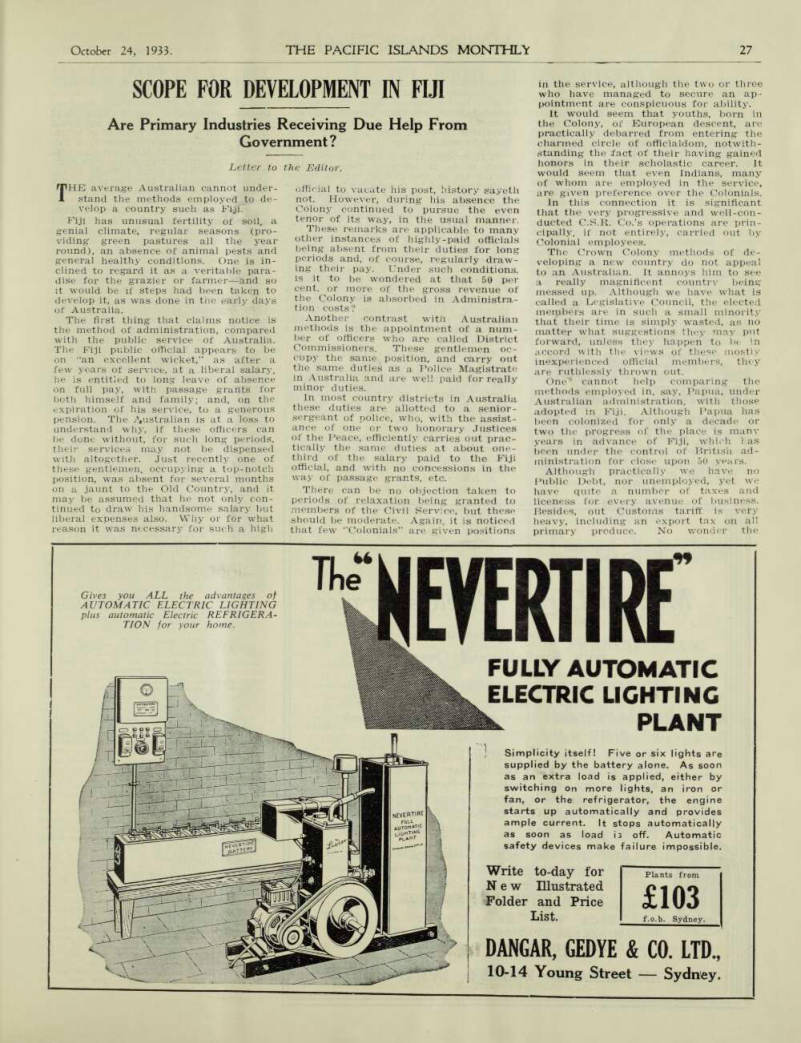
Are Primary Industries Receiving Due Help From Government?
Letter to the Editor.
THE average Australian cannot under stand the methods employed to de velop a country such as Fiji.
Fiji has unusual fertility of soil, a genial climate, regular seasons (pro viding green pastures all the year round), an absence of animal pests and general healthy conditions. One is in clined to regard it as a veritable para dise for the grazier or farmer—and so it would be if steps had been taken to develop it, as was done in the early days of Australia.
The first thing that claims notice is the method of administration, compared with the public service of Australia.
The Fiji public official appears to be on “an excellent wicket,” as after a few years of service, at a liberal salary, he is entitled to long leave of absence on full pay, with passage grants for both himself and family; and, on the expiration of his service, to a generous pension. The Australian is at a loss to understand why, if these officers can be done without, for such long periods, their services may not be dispensed with altogether. Just recently one of these gentlemen, occupying a top-notch position, was absent for several months on a jaunt to the Old Country, and it may be assumed that he not only con tinued to draw his handsome salary but liberal expenses also. Why or for what reason it was necessary for such a high
official to vacate his post, history sayeth not. However, during his absence the Colony continued to pursue the even tenor of its way, in the usual manner.
These remarks are applicable to many other instances of highly-paid officials being absent from their duties for long periods and, of course, regularly draw ing their pay. Under such conditions, is it to be wondered at that 50 per cent, or more of the gross revenue of the Colony is absorbed in Administra tion costs?
Another contrast with Australian methods is the appointment of a num ber of officers who are called District Commissioners. These gentlemen oc cupy the same position, and carry out the same duties as a Police Magistrate in Australia and are well paid for really minor duties.
In most country districts in Australia these duties are allotted to a senior sergeant of police, who, with the assist ance of one or two honorary Justices of the Peace, efficiently carries out prac tically the same duties at about one third of the salary paid to the Fiji official, and with no concessions in the way of passage grants, etc.
There can be no objection taken to periods of relaxation being granted to members of the Civil Service, but these should be moderate. Again, it is noticed that few “Colonials” are given positions
in the service, although the two or three who have managed to secure an ap pointment are conspicuous for ability.
It would seem that youths, born in the Colony, of European descent, are practically debarred from entering the charmed circle of officialdom, notwith standing the fact of their having gained honors in their scholastic career. It would seem that even Indians, many of whom are employed in the service, are given preference over the Colonials.
In this connection it is significant that the very progressive and well-con ducted C.S.R. Co.’s operations are prin cipally, if not entirely, carried out by Colonial employees.
The Crown Colony methods of de veloping a new country do not appeal to an Australian. It annoys him to see a really magnificent country being messed up. Although we have what is called a Legislative Council, the elected members are in such a small minority that their time is simply wasted, as no matter what suggestions they may put forward, unless they happen to he in accord with the views of these mostly inexperienced official members, they are ruthlessly thrown out.
One cannot help comparing the methods employed in, say, Papua, under Australian administration, with those adopted in Fiji. Although Papua has been colonized for only a decade or two the progress of the place is many years in advance of Fiji, which las been under the control of British ad ministration for close upon 50 years.
Although practically we have no Public Debt, nor unemployed, yet we have quite a number of taxes and liceness for every avenue of business.
Besides, out Customs tariff is very heavy, including an export tax on all primary produce. No wonder the
Colony was recently described as a country of taxes and licenses.
Although it is universally acknow ledged that the future progress and welfare of the Colony are wholly de pendent upon primary products, no at tempt is being made to foster the minor industries, or make any effort to intro duce crops, which promise profitable exploitation. The only bright spot in this direction is an experimental farm, established a few years since, originally to try out different varieties of cotton, but which has of late taken up the work of trying out other varieties of produce.
The work carried out on this farm is most creditable to those engaged in conducting operations (by the same token, Colonials). Also, a deal of credit is due to the entomologists attached to the Department of Agriculture, who have done and are still doing excellent work.
Unfortunately, we have no European settlers engaged in agriculture of this
description and it is hopeless to expect the Indians to take advantage of the lesson to be learned from the experi mental farm, as they persistently re fuse to be taught, but adhere to the primitive methods they are used to in their homeland.
It is evident that a huge blunder has been made in allowing these Indians to remain in the Colony, unless under indenture, and to occupy lands on their own account. However, this question has already been ably dealt with in an article which appeared in a recent issue of the “P.I.M.”
Just recently it was reported that the Government proposes to take con trol of the affairs of our two Municipal Councils —Suva and Levuka. So far, no reason has been given for this move, but it is thought by some to be the thin edge of the wedge, foreshadowing the granting of the “common rule” to the Indians. No doubt the aldermen and taxpayers will have something to say on the matter.
The commercial life of the Colony ap pears to be in the hands of a few affluent men, spoken of locally as ‘‘The Big Four.” These gentlemen seem to control prices of nearly all commodities and are interested in any industry started which shows a likelihood of profit.
The insatiable love of the Indians for litigation on the slightest pretext, no matter at what cost, is a source of much profit to the legal profession in Fiji.
A few years ago a dairying scheme was evolved and sponsored by the
Government for the benefit of returned soldiers and sailors. After much bungling and a waste of money, which an Aus tralian school-boy would have been ashamed of, the industry was got going.
But as soon as it gave promise of bring ing in a little gain, others jumped into the game; and, it is said, were assisted by the Government to do so. As a re sult, we now have three different lots of people engaged in the business. One company, which happens to own a fairly large area of land, started a butter fac tory, and offered its land to settlers, agreeing at the same time to take their cream at a stated price, which it is understood was 11d. per lb. of butter fat. Although most of the land is occu pied by Indians, there are some five or six Europeans who entered into the scheme. It is said these people have had a somewhat rude awakening as all sorts of expenses are charged against their returns, such as manufacturing costs, selling commission, storage, freight, etc. This brings the nett pro ceeds to the supplier to about 8d. per lb. of butter fat, out of which he has to pay rent of the holding, labour costs, utensils, etc., and, as he has to find his own cattle and dwelling, there is little left for living expenses. The company is understood to be making a profit.
The only other butter factory operat ing in the group is run on co-operative lines, and from the statement issued for last year, which ended on June 30 last, this concern was able to pay their suppliers an average of 1/- per lb. for butter fat. This is something like 4d. per lb. more than the proprietary con cern.
The general opinion is held that until Fiji makes some effort to induce Europeans to settle in the Colony these conditions will prevail, and probably end disastrously. It is also thought that the British Colonial Office cannot be aware of the conditions here, otherwise some steps would be taken to remedy matters.
I am, etc.,
Richard B. Howard,
Navua, Fiji, 26/9/1933.
EDITORIAL NOTE.— Statistics relating to Fiji trade and production, in comparison with other countries, do not support Mr. Howard’s general contention. Fiji is one of the most prosperous countries in the world to-day. Its trade balance is large and growing; and, compared with other countries devoted to primary production, its taxation burden is negligible.
Anyone who has seen Australia struggling under its appalling load of administrative costs, will not appreciate Mr. Howard’s argument.
Seven full-blown Parliaments: hundreds of over paid. useless, professional politicians; overstaffed departments, which are duplicated and multiplied to the point of absurdity; and hordes of bureaucratic officials, interfering with private enterprise and individual freedom at every point of communal life—that is not an exaggerated picture of Australian administration to-day. For reasons of both efficiency and economy, we ven ture to say that Australia gladly would throw its present costly administrative machinery over board. and adopt the British Colonial Office organisation, if it were only possible.
Australian administration in Papua and New Guinea, under the direction in each case of one strong man, is a model for the world. Aus tralian administration in Australia, being domin ated by our so-called “democratic governments,” is discouraging private enterprise at every point.
But we are entirely at one with Mr. Howard on the subject of the non-settlement of Fiji by Europeans. This group is just sufficiently far south to be a white man’s country. It has an equable climate, a fertile soil, plenty of cheap land and labour, low taxation, and—with due deference to our correspondent—efficient adminis tration. White settlers and new capital should be pouring into this Colony. The fact that they are not has been to us, for two years, a mystery.
Advertisements & other items, pp. 29-30 (1 item)
Dangar, Cedve 4 Co. Ltd.,
Gives you ALL the advantages of
AUTOMATIC ELECTRIC LIGHTING
plus automatic Electric REFRIGERA- TION for your home.
FULLY AUTOMATIC
ELECTRIC LIGHTING
PLANT
Simplicity itself! Five or six lights are supplied by the battery alone. As soon as an extra load is applied, either by switching on more lights, an iron or fan, or the refrigerator, the engine starts up automatically and provides ample current. It stops automatically as soon as load is off. Automatic safety devices make failure impossible.
Write to-day for
New Illustrated Folder and Price
List.
Plants from £103 f.o.b. Sydney.
DANGAR, CEDVE 4 CO. LTD.,
10-14 Young Street — Sydney.
Use—
Modern Direct IVServices
for Your Communications with Australia and Overseas.
DIRECT WIRELESS SERVICES are available for inter-communication between the Islands of the Pacific and for traffic between the Islands and Australia and overseas countries.
Services are now in operation between Papua and Sydney, New Guinea and Sydney, New Caledonia and Sydney, and Fiji and Sydney. Speedy, economical and efficient service to Australia and overseas. Route your traffic “Via the Wireless Service. ”
For overseas traffic to Great Britain, North and South America, and all countries, route your message via the Direct Australian
BEAM WIRELESS SERVICE.
LODGE YOUR MESSAGES AT ANY
WIRELESS STATION OR ISLAND POST
OFFICE ROUTED “VIA WIRELESS."
AMALGAMATED WIRELESS (A’SIA) LIMITED.
March Past On Ysabel
B.S.I. Plea for “Strong” Men.
(From a Special Correspondent.) How Sultan after Sultan with his pomp Abode his hour or two and went his way.
THE quotation from Omar has an aptness pertaining to the “March past of the D.O’s.” at the Govern ment station on Ysabel, B.S.I.P, Mr. and Mrs. W. H. Miller, who have been here for the short period of five months, are off to England in October; and it remains to be seen who is next on the list.
Since 1918, we have had a remarkable succession of District Officers, begin ning with Mr. and Mrs. N. S. Heffer man, who put in the longest term—e.g., five years. After his transfer to Santa Cruz, we followed on with Messrs. H.
Macquarie, S. G. Masterman, Capt. Mid denway, P. Hubbard, E. D. Davies, J.
Studd, Capt. R. B. Hill, F. W. Fowler, L. Wright, F. B. Filose, S. G, Master man (again), and lastly, up to date, W. H. Miller.
In other districts, the D.O’s. have re mained on their stations, except dur ing furlough, for periods of 10 and 12 years, without transfer.
All these changes are not doing the natives of Ysabel any good. Each new man has different ideas regarding administration, discipline, etc., and the constant change of tactics is bewilder ing to the native mind. As each new man takes over, the chiefs of the vil lages bring along “trial” cases, to see which way the cat will jump and then base their behaviour accordingly for the rest of his short regime.
Ysabel is a big district, and it takes many months for a D.O. to become con versant with the whole island; and as no administrator can work up an interest in a place when he feels he is merely temporary, little is done.
Villages are neglected, and the sanitation system is a disgrace. Roads, which are most necessary on this open rock-bound coast, are negligible; a few native tracks now serve between villages.
The natives are becoming cheeky and indolent, and too apathetic to cook their copra or earn an honest penny. After the Filose affair, they boast that “They savvy sack” the “new Government,” if they don’t approve of him.
It will need a man with strong physical and moral courage to face the state of things here, and reinstate the power of the white man and, inci dentally, the Government, in the minds of the Ysabel natives.
Practical Economics.
Jones, on his way to catch his morn ing train, called in at the grocer’s shop.
“I see somebody has broken your win dow,” he said to the proprietor! “I’ll bet you five shillings you couldn’t get an other pane of glass like that under two pounds.”
The grocer smiled.
“Well, you’ve lost,” he said. “I only paid thirty shillings for that.”
“Oh, is that so?” said Jones, taking a piece of paper from his pocket. “Then I may as well pay you now. It was my son who broke that window, and you sent me in a bill for three pounds.”
The White Man’S “Castes.”
An Open Letter Addressed to Mr. Marc T. Greene.
I have read your most interesting and instructive articles in the “P.I.M.” (Aug., 1933) and agree with a lot you say.
The Samoans are a noble race, and deserve sympathy and tolerance to a marked degree; but, Bo, I don’t exactly get your meaning when you state they have been exploited, contaminated and debased by white usurpers.
Your remarks concerning the white woman (many our own country women) in the Tropics has also given me cause for mild protest, but as you state you are “exceedingly touchy” I do not intend to upset your equanimity.
My own wife (from Yonkers, Ann.) has not lost her femininity and her charms and can still be favourably compared with any “cullud pusson.” So also can our numerous feminine neighbours.
Notwithstanding excessive tropical humidity and the arduous duties associated with the feeding of a hungry husband and family, she can still go about her duties singing “The Star Spangled Banner’’ and “Amurica, how I loves ye.”
From your letter, I guess you more or less advocate the mixing of the coloured and white races. Honestly Marc., do you really and truly advo cate this policy? Or is it “sour grapes," or propaganda?
Always remember, there is much controversy and strife in our own glorious country through the thought lessness of our predecessors. We have the colour question to deal with there, and what strife and hate there is in the Southern States. We, or rather our forefathers, exploited the noble red man and I have heard it whispered that certain of our own countrymen, even to-day, are endeavouring to stir up strife in British India.
I am about to publish my first book the knowledge gathered during four teen years’ residence in the Tropics.
It deals much with the “crackpot” religions emanating from America— our glorious homeland—their effect upon the indigenous Pacific native.
Also, chapters are devoted to criticism of journalists who reside in the Pacific for a few days and depart to write articles or books on topics they do not understand.
You might do some of our country men a good turn by advocating that half-caste children should not be brought into this wicked world to be
treated with contempt, and exploited by pure-bred natives and Europeans alike. Did you hear that one of our own countrymen—a religious teacher—has just been sent out of this Group?
Make further inquiries, Bo; for he tried “sympathy, tolerance and love,” as advocated by “Na Vodre,” but the fool picked the wrong sex for the experiment.
Yours till Niagara Falls,
Haroun C. Sulphonal
Formerly of New York.
B.S.I., 12/9/33.
Advertisements & other items, p. 31 (1 item)
Canned Vegetables
J. H. MacGregor Dbwsett
RABAUL, NEW GUINEA,
for
RELIABLE CARS, SERVICE & DRIVERS.
Gramophones and Latest Records.
Musical Instruments and Sundries.
Cameras and Photographic Goods.
Developing, Printing, Enlarging & Framing.
Recruiter. Mining & General Agent,
BUILDER AND CONTRACTOR.
Agent for The Australian Provincial Assurance Assoc. Ltd. Sub-Agent for The Central Assurance Co. Ltd.
Outstation Orders Promptly Executed.
Sample Rooms;
MALAGUNA ROAD, RABAUL
’Phone; Rabaul 149.
Sutton’s
Canned Vegetables
GREEN PEAS,
in ½lb., 1lb. and 2lb. tins.
FRENCH BEANS
(sliced), in ½lb. and 1lb. tins.
Delicia Food Products Co.
DANK STREET, WATERLOO,
N.S.W.
SHIP CHANDLERY - HARDWARE
BROOMFIELDS LIMITED, 152 Sussex St., SYDNEY.
Large and Complete Stocks of SHIP CHANDLERY.
Ironmongery of all kinds. Paints, White Lead and Oils.
Sole Agents for P. H. MUNTZ & CO.’S 3-CROWN BRAND METAL SHEATHING.
PEACOCK & BUCHANS’ ENGLISH READY - MIXED PAINTS.
WRITE FOR SHIP CHANDLERY CATALOGUE.
Special “In Bond” Prices for all Island enquiries quoted on application.
CABLES: “BOOM,” SYDNEY.
Paris Delegate Visits French Oceania
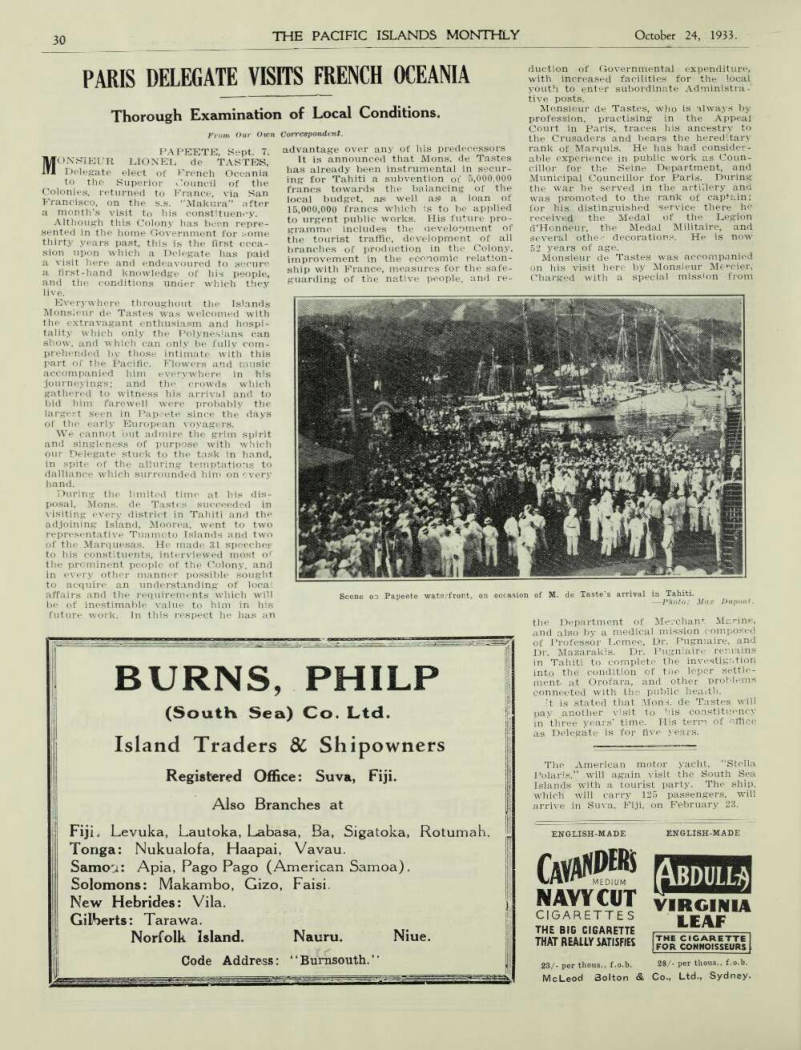
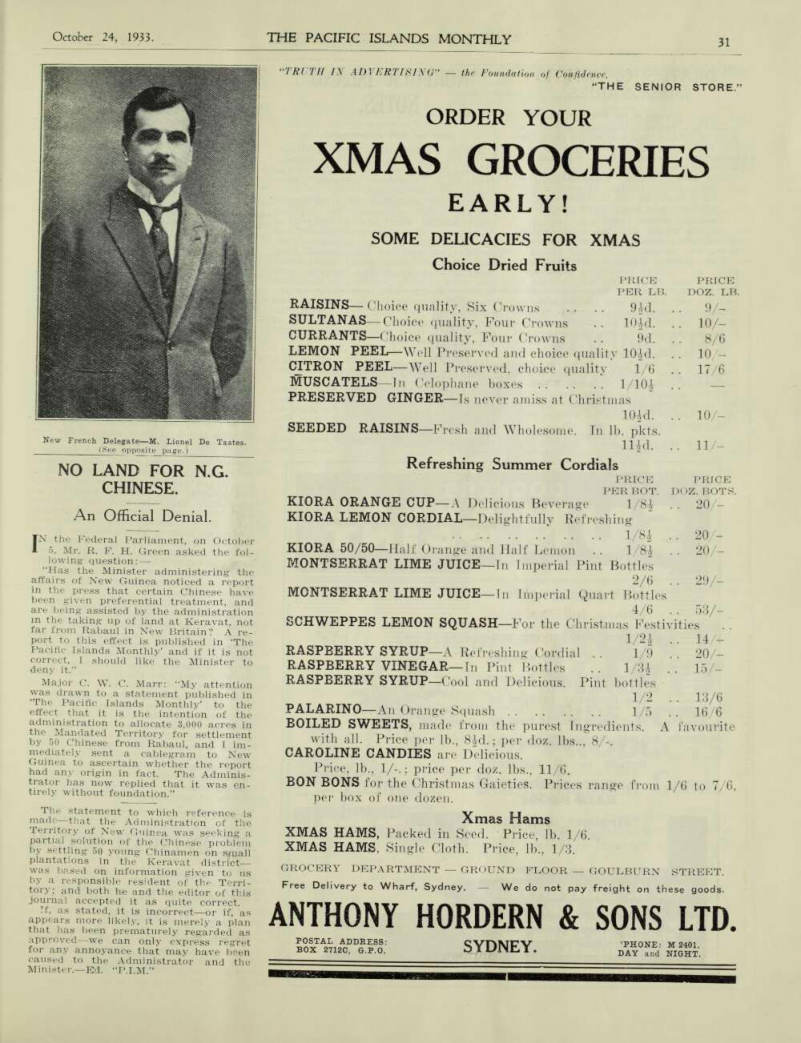
Thorough Examination of Local Conditions.
From Our Own Correspondent.
Papeete, Sept. 7.
Monsieur Lionel de Tastes, Delegate elect of French Oceania to the Superior Council of the Colonies, returned to France, via San Francisco, on the s.s. “Makura” after a month’s visit to his constituency.
Although this Colony has been repre sented in the home Government for some thirty years past, this is the first occa sion upon which a Delegate has paid a visit here and endeavoured to secure a first-hand knowledge of his people, and the conditions under which they live.
Everywhere throughout the Islands Monsieur de Tastes was welcomed with the extravagant enthusiasm and hospi tality which only the Polynesians can show, and which can only be fully com prehended by those intimate with this part of the Pacific. Flowers and music accompanied him everywhere in his journeyings; and the crowds which gathered to witness his arrival and to bid him farewell were probably the largest seen in Papeete since the days of the early European voyagers.
We cannot but admire the grim spirit and singleness of purpose with which our Delegate stuck to the task in hand, in spite of the alluring temptations to dalliance which surrounded him on every hand.
During the limited time at his dis posal, Mons. de Tastes succeeded in visiting every district in Tahiti and the adjoining Island, Moorea, went to two representative Tuamoto Islands and two of the Marquesas. He made 31 speeches to his constituents, interviewed most of the prominent people of the Colony, and in every other manner possible sought to acquire an understanding of local affairs and the requirements which will be of inestimable value to him in his future work. In this respect he has an
advantage over any of his predecessors It is announced that Mons. de Tastes has already been instrumental in secur ing for Tahiti a subvention of 5,000,000 francs towards the balancing of the local budget, as well as a loan of 15,000,000 francs which is to be applied to urgent public works. His future pro gramme includes the development of the tourist traffic, development of all branches of production in the Colony, improvement in the economic relation ship with France, measures for the safe guarding of the native people, and re
duction of Governmental expenditure, with increased facilities for the local youth to enter subordinate Administra tive posts.
Monsieur de Tastes, who is always by profession, practising in the Appeal Court in Paris, traces his ancestry to the Crusaders and bears the hereditary rank of Marquis. He has had consider able experience in public work as Coun cillor for the Seine Department, and Municipal Councillor for Paris. During the war he served in the artillery and was promoted to the rank of captain; for his distinguished service there he received the Medal of the Legion d’Honneur, the Medal Militaire, and several decorations. He is now 52 years of age.
Monsieur de Tastes was accompanied on his visit here by Monsieur Mercier, Charged with a special mission from
the Department of Merchant Marine, and also by a medical mission composed of Professor Lemee, Dr. Pugmaire, and Dr. Mazarakis. Dr. Pugniaire remains in Tahiti to complete the investigation into the condition of the leper settlement at Orofara, and other problems connected with the public health.
It is stated that Mons. de Tastes will pay another visit to his constituency in three years’ time. His term of office as Delegate is for five years.
The American motor yacht, “Stella Polaris,” will again visit the South Sea Islands with a tourist party. The ship, which will carry 125 passengers, will arrive in Suva, Fiji, on February 23.
Scene on Papeete waterfront, on occasion of M. de Taste’s arrival in Tahiti. — Photo: Max Dupont.
New French Delegate—M. Lionel De Tastes. (See opposite page.)
Advertisements & other items, p. 32 (1 item)
Burns, Philp
(South Sea) Co. Ltd.
Island Traders 8C Shipowners Registered Office: Suva, Fiji.
Also Branches at Fiji. Levuka, Lautoka, Labasa, Ba, Sigatoka, Rotumah.
Tonga: Nukualofa, Haapai, Vavau.
Samoa; Apia, Pago Pago (American Samoa).
Solomons: Makambo, Gizo, Faisi.
New Hebrides: Vila.
Gilberts: Tarawa.
Norfolk Island. Nauru. Niue.
Code Address: "Burnsouth."
Chinese.
No Land For N.G.
An Official Denial.
IN the Federal Parliament, on October 5, Mr. R. F. H. Green asked the fol lowing- question: “Has the Minister administering the affairs of New Guinea noticed a report in the press that certain Chinese have been given preferential treatment, and are being assisted by the administration in the taking up of land at Keravat, not far from Rabaul in New Britain? A re port to this effect is published in ‘The Pacific Islands Monthly’ and if it is not correct, I should like the Minister to deny it.”
Major C. W. C. Marr: “My attention was drawn to a statement published in ‘The Pacific Islands Monthly’ to the effect that it is the intention of the administration to allocate 3,000 acres in the Mandated Territory for settlement by 50 Chinese from Rabaul, and I im mediately sent a cablegram to New Guinea to ascertain whether the report had any origin in fact. The Adminis trator has now replied that it was en tirely without foundation.”
The statement to which reference is made that the Administration of the Territory of New Guinea was seeking a partial solution of the Chinese problem by settling 50 young Chinamen on small plantations in the Keravat district— was based on information given to us by a responsible resident of the Terri tory; and both he and the editor of this journal accepted it as quite correct.
If, as stated, it is incorrect—or if, as appears more likely, it is merely a plan that has been prematurely regarded as approved—we can only express regret for any annoyance that may have been caused to the Administrator and the Minister. —Ed. “P.I.M.”
Advertisements & other items, p. 33 (1 item)
Xmas Groceries
'TRUTH IN ADVERTISING" the Foundation of Confidence.
“THE SENIOR STORE."
ORDER YOUR
XMAS GROCERIES
EARLY!
SOME DELICACIES FOR XMAS
Choice Dried Fruits
PRICE
PER LB.
RAISINS— quality, Six Crowns .. . . 9½d.
SULTANAS— Choice quality, Four Crowns . . 10½d.
CURRANTS—Choice quality, Pour Crowns . . 9d.
LEMON PEEL—Well Preserved and choice quality 10½d.
CITRON PEEL—Well Preserved, choice quality 1/6 MUSCATELS—In Celophane boxes 1/10½ PRESERVED GINGER—Is never amiss at Christmas 10½d.
SEEDED RAISINS—Fresh and Wholesome. In lb. pkts. 11½d.
PRICE
DOZ. LB.
9/- 10/- 8/6 10 - 17/6 10/- 11/- Refreshing Summer Cordials
PRICE PRICE
PER BOT. DOZ. ROTS.
1/8½ . . 20/- KIORA ORANGE CUP—A Delicious Beverage KIORA LEMON CORDlAL—Delightfully Refreshing . .. 1/8½ .. 20/- KIORA 50/50 —Half Orange and Half Lemon . . 1/8½ . . 20/- MONTSERRAT LIME JUICE—In Imperial Pint Bottles 2/6 .. 29/- MONTSERRAT LIME JUICE—In Imperial Quart Bottles 4/6 .. 53/- SCHWEPPES LEMON SQUASH—F or the Christmas Festivities 1/2½ .. 14/4- RASPBERRY SYRUP—A Refreshing Cordial . . 1/9 . . 20/- RASPBERRY VINEGAR—In Pint Bottles .. 1/3½ .. 15/- RASPBERRY SYRUP—CooI and Delicious. Pint bottles 1/2 .. 13/6 PALARINO—An Orange Squash 1/5 . . 16/6 BOILED SWEETS, made from the purest Ingredients. A favourite with all. Price per lb., 8½d.; per doz. lbs.., 8/-.
CAROLINE CANDIES are Delicious, Price, lb., 1/-.; price per doz. lbs., 11/6.
BON BONS for the Christmas Gaieties. Prices range from 1/6 to 7/6, per box of one dozen.
Xmas Hams XMAS HAMS, Packed in Seed. Price, lb. 1/6.
XMAS HAMS. Single Cloth. Price, lb., 1/3.
GROCERY DEPARTMENT GROUND FLOOR GOULBURN STREET.
Free Delivery to Wharf, Sydney. We do not pay freight on these goods.
ANTHONY HORDERN & SONS LTD.
POSTAL ADDRESS:
BOX 2712 C, G.P.O.
SYDNEY.
’PHONE: M 2401,
DAY and NIGHT.
Missionaries.
Deaths Of White
Letter to the Editor.
In the “Sydney Morning Herald” of 12th of July, I was amazed to read that the Bishop of Melanesia, speaking at a Rotarian luncheon, was reported to have stated in his address: “Many white missionaries had been killed in the diocese, chiefly as a result of the misdeeds of white traders, who had visited the Islands shortly before them.”
As the report has not been contra dicted one presumes that such a state ment was made.
The British Solomon Islands com prise a large part of the Melanesian Diocese and, apart from Mr, Daniels, of the S.S.E. Mission, who was killed twenty odd years ago on Malaita, an island on which there were few if any traders at the time, no missionary has been murdered here for fifty years, at least.
It is, indeed, pitiable that many mis sionaries in order to give the im pression that they lead hard and dangerous lives, feel it is necessary to traduce traders who have done more for civilisation and the British Empire in the Pacific than any or all the mis sion organisations. I am, etc.,
Southern Cross.
Tulagi, B.S.I., Sept. 11, 1933.
Norfolk Island
Notes.
From Our Own Correspondent.
LIFE on Norfolk drifts by on a stream of gentle, agreeable monotony, broken only by the arrival of the five-weekly steamer bringing mail, stores and new settlers.
With the exception of Government officials, store employees, the depleted cable station staff and a handful of “gentlemen of independent means,” till the men resident on the island irrespective of caste or race—spend long, slow days on their small plantations, weeding bananas, hoeing between end less rows of early potatoes or Canadian Wonder beans, and returning at re freshing intervals to their pretty little houses for tea and cake with the capable wives who, in the majority of cases, run their homes and gardens without assistance “The Garden of Eden, rediscovered,” said a visitor to me the other day, “with the amenities of civilisation and the snake well in hand.”
At this particular season of the year, too, the sea winds die and the ocean lies sleeping and unruffled for days on end, beneath the strengthening sun. The “whaley birds” (more scientifically classified as sooty puffins or some such
name) are here again and laying their eggs in countless thousands on Phillip Island, the bare, bright rock standing out to sea that once was the bold southern promontory of our little isle; before some unrecorded convulsion sank the connecting range and left us only Mount Pitt from which to survey the far horizon.
Actually, of course, Norfolk itself — any small island for that matter —is only the ultimate summit of some sub merged continent; but that is a surpris ing reflection which only strikes one now and again when standing breathless against the flagstaff that marks the very highest point. The whales, whose an nual visit the sooty puffins herald, are here too, idling on the surface close inshore or rolling round the island like giant porpoises. Once upon a time they represented the richest harvest of the year, but now that vegetable and mineral oils have displaced fish oils upon the market, whales only interest us as a picturesque diversion upon the blue and empty sea.
Discouraging Petty Crime.
Our local malefactors —and we have them in their modest way—are learning nowadays that the day of judgment in evitably dawns, however long delayed.
For some happy years, petty crime flourished unchecked and unpunished while the injured parties swallowed their wrongs and held their tongues for fear worse might befall them.
But times are changed and among a list of minor delinquents—all dealt with in their degree—one law-breaker who has defied apprehension for an incred ible period, has recently received an exemplary sentence that has left us, as a community, gasping and respect ful. Every official now within the administration is obviously out to do his job “without fear or favour, affec tion or ill-will,” as the administrator’s oath of office has it, and the sooner we settle down to recognise the fact and behave ourselves accordingly, the better for us.
From Windsor To Norfolk.
Among other settlers recently ar rived is one of particular interest, especially to the English resident upon the island. He is Mr. A. W. Mitchell, who for twenty years was Superinten dent of Works for the King in Windsor Great Park. Within the confines of this park—covering many miles in ex tent and almost in sight of London the mightiest city in the world—neither electric standards nor gas mains are allowed— by decree of His Majesty.
Wood stoves cook the food of the many households, oil lamps light them to bed.
Mr Mitchell is accompanied by his wife and a young son and they may be joined later by other members of the family at present resident in Canada.
Advertisements & other items, p. 34 (1 item)
Goshen Private Hospital
Made expressly to keep a lustrous, full gloss finish
against the varying con-
ditions of moist weather exposure, and prevent the decaying ravages of rain and extreme heat by
giving a long lasting pro-
tection to all surfaces.
SUN PROOF
RAIN PROOF
"Stronger than the Weather”
W. R. CARPENTER
& CO. LTD.
New Guinea, Solomon Islands, and all other South Sea Islands.
GOSHEN PRIVATE HOSPITAL
(Sister E. W. YEAMAN),
37 Gloucester Rd., HURSTVILLE,
SYDNEY.
General and Private Wards. Spacious Grounds. High and Cool Situation.
Moderate Fees.
Rubber-Growers Are
Relieved.
Tobacco Prospects In Papua.
From Our Own Correspondent.
Pt. Moresby, Sept. 27.
THE price of rubber continues to rise —as do the spirits of the rubber planters in Papua. One can hardly recognise them as the harassed beings of early March.
Already they are congratulating themselves heartily upon their past wisdom and foresight in planting rubber and not coconuts!
Coconuts, they tell you wisely, never had a hope from the beginning.
The price of copra shows a dismal figure. There seems no possibility of the industry paying its way; no relief for the planters, unless the Government takes a hand, or some enterprising scientist discovers a method of con verting copra into, say, synthetic rubber.
We hear so much of rubber and copra that people can be forgiven for think ing that they are the only products of Papua.
But coffee has been grown success fully in the hills behind Port Moresby for some time, as well as in the Northern Division of Papua—a Robusta variety of excellent quality.
Three desiccated coconut factories have been carrying on steadily for several years in the Eastern as well as in the Central Division—two not far from Samarai and another in the Hisiu district, west of Port Moresby.
Since April, 1933, 933 bags of coffee of 70 lbs. weight and 4,947 cases of desiccated coconut have been shipped from Port Moresby.
News that Java coffee is being dumped into Australia at a very low price is disturbing our industry. Java coffee, up to August 18th, was being sold in Sydney at £36 a ton; in January it was £47, and in November, 1932, Robusta imported from Java on firm conversion of exchange c.i.f. Sydney was £59. To-day it is reported to be as low as £26. Robusta coffee from Papua has been fetching 10½d. per lb. in Melbourne.
New areas have recently been acquired in the Logeri district for coffee planting, for coffee has been offering opportunities to investors in the territory.
Papua and New Guinea coffee enter Australia free of duty and exchange.
There has been a revival of the old time trade in sandalwood on the Cen toral Division of the Territory, inland from the coast. The price offered is good, and even though sandalwood is hard to find to-day it appears to be worth the trouble of finding.
Experiments in tobacco planting con tinue. The Government is interested and helpful. Tobacco growing is not new to Papua; a great deal of time, money and effort was invested in the industry in the past, and 22 years ago there were areas under cultivation.
One reads in the annual reports for 1911 and 1912 that the cultivation of tobacco had commenced on a commer cial scale, and that a company (British New Guinea Development Co.) had planted about 20 acres on the Laloki
River and harvested 14 to 15 tons of good-looking cigar tobacco. By 1912 some very marketable cigars and tobacco had been made in their factory in Port Moresby. The enterprise failed owing to “inexpert selection of soil in which to grow crops.”
Mr. Ramsay Grimshaw, brother of Miss Beatrice Grimshaw, the famous novelist of the South Seas, is busily engaged in the production of tobacco on his plantation on the Laloki, 15 miles outside Port Moresby, as is also Mr.
Tom Sefton, for Koitaki Rubber Estates, further inland, in the hills, be yond Roua.
Expert advice has been sought from Queensland, so there is every prospect that tobacco will yet take a definite place among the products of Papua.
Flood Of Japanese Goods
In B.S.I.
A well-known Solomon Islands trader, Mr. R. C. Laycock, who arrived in Sydney on September 23, said that cheap Japanese and Chinese goods were ousting British products. At present there was a general duty of 12½ per cent, on imports, but many residents were agitating for a preferential tariff.
Planters were facing ruin, because of the low prices for copra, said Mr. Lay cock.
Mr. E. V. Patterson, a trader at Gavutu also said that Japanese and Chinese goods were selling at very low prices. He had been offered khaki shorts, made in China, at 9/- a dozen, and matches bearing a Japanese brand at 2/3 a gross of boxes.
Advertisements & other items, p. 35 (1 item)
Still Supreme!
Do you know that the Famous
“YOUNGER”
STOVES AND
RANGES
made with extended Firebox specially for long Wood fuel, are Self-Setting and, provided sufficient Flue Piping is attached, can be used in almost any position.
The No. 7W. “younger” Range can now be supplied fitted with Legs, as per illustration.
Ask for quotation for this range, also Illustrated Catalogue and Price List for both Single and Double Oven Stoves.
Younger Stoves are Widely Used Throughout the Pacific Islands.
G. FLETCHER & SON
50 Oxford Street, SYDNEY.
Still Supreme!
After thirty years’ trading with the Islands, Aunt Mary’s Pure Food Products are still supreme.
Highest quality goods, specially manufactured and packed to meet Island conditions.
AUNT
MARY'S
PURE FOOD
PRODUCTS
"Defiance” Brand Canned Goods
These Pure Food Products are packed by the proprietors of Aunt Mary’s Pure Pood Products. Hermetically sealed and specially prepared to withstand tropical heat, thus ensuring satisfaction to consumers.
Only goods of the highest standard are packed under these brands, thus the Proprietors keep faith with their clients and consumers.
Aunt Mary’s Pure Food Products and “Defiance” Brand Canned Goods are prepared and packed only by TILLOCK & CO., LTD., pure food manufacturers.
Kent and Liverpool Streets, SYDNEY, N.S.W,
“Tongans And Europeans”—An Implication
Unwarranted
Letter to the Editor.
Sir, —In your issue of September “One of the Whites” manifests his re sentment against certain statements appearing in the concert programme of the Tongan College Choir which re cently visited Australia.
The letter-press of that programme was supplied by the Rev. A. H. Wood, M.A.b.D., Principal of the College, and appeared under his name. It was my task to arrange the form of the souvenir programme and, as I read your correspondent’s letter, I felt I must have slipped in some way to allow such an implication to appear; I therefore turned up the programme and found
that the context put an entirely dif ferent light on the matter.
Certainly the words appear—“ The task of Christian education is still the responsibility of the Methodist Church”; but immediately before that sentence is another which reads as follows: ‘The contrast between Tonga before 1926 and a few years afterwards was startling; in fact, there has been a tendency to see too much in that sudden change and to overlook the need for building up sound religion and morality.” It is obvious that Mr. Wood was not referring to “educational facilities,” as your correspondent
suggests, but to the building up of sound religion and morality on a Christian basis.
I am sure that “One of the Whites” had no desire to be unfair, but it is unfortunate that he wrote so heatedly before he had read coolly the whole paragraph.
In regard to the implication con tained in the sentence, “Tongans have not only to learn more of the deep truths by which a nation lives, but also to be guarded from the unwhole some influence of unscrupulous whites,” surely your correspondent must have an over-sensitive mind to read such an implication into a simple straight forward statement. Mr. Wood is not suggesting that all the whites are un scrupulous or that any large propor tion of them are. I suppose if will be freely admitted that there are some whose influence is unwholesome. Per sonally I should be richer by several pounds if all the whites in Tonga had repaid their debts, but I am not suggesting that a failure to repay loans is characteristic of the white popula tion there. I sometimes go to the theatre and see a notice on the stair way “Beware of pickpockets,” but I have never felt it necessary to write in indignation to the papers and to resent the possible implication that I was one of those against whom others had to be warned.
Mr. Wood may desire to reply him self, but Tonga is far distant and I write on behalf of the Society which is said to have published “vague and un deserved slanders,”
I assure your correspondent that nothing could be further from our desire; for our charter demands that we should be the friends of all and the enemies of none.
I am, etc.,
John W. Burton
General Secretary, Methodist Missionary Society of Aus tralasia.
Sydney, 26/9/33.
At Sydney University.
Papuan Medical
Trainees.
From Our Own Correspondent
Pt. Moresby, Sept. 30.
Dr. Walter M. Strong, Chief
Medical Officer of the Territory, left Port Moresby by the “Macdhui” on September 28, in charge of 12 native medical trainees who go to the Sydney University for a 12 months’ course in the elements of medicine, to fit them out as Native Medical Assistants for the Medi cal Department of Papua.
Dr. Strong will be away from the Ter ritory for four or five months. He in tends to stay in Sydney and supervise the studies of the natives.
The party of young Papuans arrived in Sydney on October 4 and attracted con siderable attention. Later, the students were welcomed at the School of Tropical Medicine, University of Sydney, by Major C. W. C. Marr, Minister in Charge of Islands Territories. The object and purpose of this interesting experiment were described in an article in this journal in July.
Advertisements & other items, p. 36 (1 item)
Fresco Brand Butter
PRESCOTT LTD SUSSEX ST SYDNEY
are sole wholesale agents for
PINEAPPLE BACON & HAMS
DAISY BRAND BUTTER
FRESCO BRAND BUTTER
LEA & PERRINS’ SAUCE
& Most other Super-Quality lines of the Trade
Repair.
‘OUR HANDS MAKE GOOD ARMS’
DON’T TRIFLE WITH DOUBTFUL FIREARMS
Sil Rohu’s Expert Attention is at your Service —without obligation.
Send for my Wonderful Firearm Catalogue. 500 Illustrations and Details of the World’s Best and Reliable Makers
“FISHING TACKLE TO TACKLE FISHING.”
The same High Standard of Quality is a feature in my new Pishing Catalogue. Specialities: Trout, Big Game, and Deep Sea Fishing.
SIL ROHU (late A.I.F.), GUNSMITH
IMPORTER OF HIGH-GRADE FIREARMS AND FISHING TACKLE SPECIALIST, 143 ELIZABETH STREET, SYDNEY (Near Market Street).
Natural Gum, Unbreakable Sets.
Comfortable and Long Lasting, Old Plates Remodelled and made equal to now. 28 OXFORD ST., over Winns;
TEETH BY POST.
Well-fitting and lifelike in appearance,
made from “SELF-TAKEN IMPRESSIONS."
I have made Artificial Teeth by my wellknown and copyrighted System of Self- Taken Impressions for satisfied Patients in all parts of the Commonwealth.
Send for full free particulars.
Satisfaction guaranteed.
SPENCER NOLAN
DENTIST,
Established in Sydney over 35 years. 177 OXFORD ST., opposite McIlraths. 139 ELIZABETH STREET, two doors from Market Street, Sydney.
Telegraphic and Cable Address: “FASTPLATE,” Sydney.
Fashion Hints For Islands’ Women.
(By “Therese”.)
IN the spring the feminine fancy lightly turns to thoughts of clothes—and such clothes! Frocks lovely beyond belief, with the fragrant beauty and colour of an old world garden! So becoming are they, that even the most plain among us becomes attractive under the softening influence of things beautiful.
The new anticrease voiles bring loud cheers from the tropics. They have the additional virtue of being fadeless and their hues rival those of the rainbow.
There are blues, pinks, and amethysts for the flawless blonde, while the greens and deeper shades of rose and glowing yellows make the brunette a delight to the eye. Buttercup yellow, that lovely sunshine shade, is first favourite, and attractive little frocks and short coats appear in it for both day and evening wear.
Even a soft, misty grey is touched up with it, for no colour is allowed to be cold and “Let’s Be Gay” is spring’s decree.
Collars are a feature of the new season’s clothes, and whether they be double, single, flower-petalled, or plain, we hail them with delight. Bows, too, play an important part. Large cat’s
whiskers bows, little bows, floppy, squashy or tailored ones, we use them all and their success is complete.
Our old love, the square neck, promises to return to us. It is youthful and need never be hard in these days of twisted scarves and feminine bows. We aim for the square look about our shoulders, too, and this is attained with the new cartridge pleats or shoulder tucks.
Assuredly, for any aquatic carnival the smartest beach wear is the ensemble, in cluding shorts and wrap skirt, buttoned half way down the centre. The blouse to which the shorts and skirt button is a little high-necked affair, and is worn with a flaring artist’s bow. Slacks share equal popularity, but are successful only for the slim, boyish figure.
Nothing cheers us up so much these days as a jacket, especially the swish back or swagger variety. They can be made in any material that suits your re quirements. Little shoulder capes and frills solve the problem of sleeves and makes them ideal tropical wear. Loose and flowing, they have a definitely swag ger air, which earns for them their name.
Checks are worn with plain and plain
with checks, and even the little polka dot in cambric or tobralco is popular.
Although there is not much change in the evening silhouette, with its slim, straight lines, with width at the hem for comfort, there is a variety of decollettes.
High in front, low in the back, or both front and back both demurely high, with discreet slit down the back to show the teeniest glimpse of velvety skin. Some have sleeves, some none, some sport epu lette but all are charming. Stripes and checks become increasingly popular for evening wear and on the tall girl are delightful.
For day wear, hundkerchiefs play an important role. Striped or checked ones are tied through your belt or stuck in the skirt pocket of your sports clothes and give a very jaunty air.
Concerning Hats.
No matter how grimly utilitarian your wardrobe may be, there is always the occasion when for the soul’s salvation, you let yourself dream of extravagances until eventually you succumb—a hat, let us say, a lovely model in pale pink baku straw, with soft crown of the palest pink feathers tipped with a deeper shade of rose. Thoroughly impractical when one considers pitiless tropical suns, but so tempting with its complete beauty that the still small voice of conscience is al most unheard.
However, there are hats that combine beauty and utility, too, and the wise woman makes these her choice. They vary in size from the jaunty little pull on to the cartwheel variety, and are very attractive. You can have dozens of the little, inexpensive washing hats with their perky bows of ribbon or organdie popping up unexpectedly at all angles.
It’s all in the way you wear your hat, too, which makes or mars the perfection of your ensemble. Tilted well forward over one eye is the fashionable angle of the moment. It is very becoming and is chic personified!
A Jaunty Little Hat.
Crocheted in Silk.
This novel little hat, with its jaunty brim and bandeau fitting over the hair at the back, has three oval-shaped open ings in the crown to reveal the wavy hair beneath, and is most attractive to wear. It looks equally well worked in white, or in colours. The whole hat is worked in simple treble crochet, and the three sides of the crown are joined by a crochet triangle at the top. The tiny brim should be wired at the edge to make it set well.
Materials required: 1 ounce 2-ply crochet silk, a metal crochet hook, size about 12. The trebles are worked at a tension to produce about 12 stitches to 2 inches in width.
Make 111 ch. for the bottom of the crown, and join with a sl.-st. Into this ring work 6 rounds of tr., working st, into st. Then work 37 tr. Tur. No on these 37 tr. work back wards and forwards.
Ist row: Decrease 1 tr. every 7th tr. 2nd. 3rd and 4th rows: Decrease 1 tr. every 6th tr. sth row: Decrease 1 tr, every sth tr. 6th, 7th and Bth rows; Decrease 1 tr, every 6th tr. 9th row: Decrease 1 tr. every sth tr. 10th row: Decrease 1 tr. every other tr.
Break off silk and work two other points in exactly the same way, starting with 37 tr. on the original circle.
To make the triangle at top of hat, wind silk 6 times round two fingers, and into this ring work 36 d. cr. Join with a sl.-st. Then work * 8 d. cr. into ring. 4 d. cr. into top of point.
Repeat from * 3 times, thus joining the three points and the triangle together.
The Brim.—The brim is also worked in tr.
Make 132 ch., and join into a ring with a sl.-st. (Continued over leaf.)
ist round: Crochet 2 tr. into every 9th ch., and 1 tr. into other ch. 2nd and 3rd rounds: Work 2 tr. into every sth st. 4th round: D. cr. into every st. of last round. sth round: D. cr. into every st. of last round, working over a brim wire.
To make up:—Sew the brim on the edge of the crown in front, to come down over the right eye, and slope it up towards the back, so that at centre-back it is sewn on to the last row before the beginning of the three points.
The Cunard tourist liner, “Fran conia,” is expected to arrive in Fiji on February 17 next year in the course of a world cruise.
The Matson liner, “Lurline,” carrying
a party of American tourists will arrive in Suva, Fiji, on February 7, 1934.
Advertisements & other items, p. 37 (1 item)
Copra Sacks
WUNDERLICH
ART METAL
CEILINGS
Wunderlich Art Metal is the ideal ceiling: and walling for Island Homes.
Suitable for every purpose; transports cheaply; easy to erect and decorate; fire-resisting; vermin-proof, and lasts a lifetime. Write for illustrated literature and prices. WUNDERLICH LTD..
Box 474 AA, G.P.O., SYDNEY.
COPRA SACKS
We carry Stocks of these, also other Island lines such as
Salmon, Swedish Safety Matches,
Etc.
WRITE FOR QUOTATIONS.
C. SULLIVAN LTD.
379-381 KENT STREET, SYDNEY.
Postal Address: Cable Address: Box 1861 K, G.P.O., Sydney. “Vichy,” Sydney.
New Guinea Notes
From Our Own Correapondent.
Rabaul, Sept. 14.
THE Kokopo Cup race meeting was held on Commemoration Day (Tues day, September 12th) at the Kini gunan racecourse. There was a fair attendance, and some good racing. The Cup race was won by Mr. Vic. Penne father’s Viola, ridden by Mr. Robin son. Viola won from Enchant by a length and a half, with the newly imported Guiding Light four lengths behind. The time was 1.32 1/5.
19 Years Afterwards.
An impressive ceremony was held in the cemetery at the Botanical Gardens on Tuesday morning last in com
memoration of the landing of the Australian troops at Kabakaul.
A pilgrimage, organised by the R.S. & S.I.L.A. branch here, of whom Mr. R. L. Clark, M.L.C., is president, was made through the Botanical Gardens; the members carrying wreaths which were later placed upon the graves of the soldiers and sailors who fell at the landing and also those who succumbed to the tropical life here.
The Administrator and his staff were present, representing government de partments, while other local public bodies and commercial houses were represented.
A touching address was rendered by Rev. T. J. Gibson, after the singing of Kipling’s “Recessional.” The ceremony was brought to a close by the singing of the National Anthem.
Pilot Duncan At Lae.
The Genairco seaplane which left Sydney about a month ago with Pilot Duncan and Mechanic Gettenby is now at Lae, having been forced down some twenty miles south of the Papuan bor der, and from there was towed by the Administration schooner “Wanderer” to Salamaua and eventually to Lae, where repairs will be effected. We understand that no serious damage was done to the ’plane, and that the engine functioned admirably and is undamaged.
Costly Litigation.
The Booth v. Booth litigation case is still only part heard in the Central Court here. Mr. Chas. Booth, the plaintiff, has finished his evidence and Mrs. Booth (the defendant) is now giv ing her evidence. This case will be one of, the most costly affairs in the legal world here.
Influenza.
The influenza epidemic which for a while attained serious proportions in the Kavieng district, has now been controlled through the energies of the Medical Department. Forty deaths were reported from Musau Island.
Most of them, it is alleged, were the result of influenza.
After 20 Years In Samoa.
Some twenty-odd natives arrived in Rabaul last week by the “Nairnbank” from Samoa, where many of them have been working for the past twenty years. Their repatriation —in many ways—presents a problem as to how they will settle down in their villages after having lived all these , years amongst the Samoans.
Tennis Champions.
From Our Own Corretpondent
Rabaul, Sept. 25.
FOR the third year the Rabaul Tennis Club won the associated clubs’ com petition with a score of thirty points; Treasury came next with twenty-eight points: followed by Bank of N.S.W., Ma tupi, Roberts, B.P. Club, N.G. Club, Ad ministration and W.R.C. Club. The Pre miership Pennant was presented to the captain of the team, Mr. G. Walker, by the Administrator, on Saturday, Septem ber 16. A match played on the same afternoon between the Rabaul Tennis Club and The Rest resulted in a win for the latter team.
Baseball is becoming a favourite sport again this season; and there have been some good games. “Hitter” Hawnt has been the first batsman to hit a home run this season. Present positions of teams are: Administration 8, Commerce 6, Metropolitan 4.
Car Thieves Sentenced.
The Malay, Hassan Lehmann, and the half-caste Andrew Jacob, have both been sentenced to terms aggregating four years’ imprisonment with hard labour.
These two offenders were remanded from the District Court on fourteen separate charges of stealing. The thefts in the majority of cases were pilfering from standing motor cars.
Central Court Sessions.
The Criminal Sessions of the Central Court were held from September 11 to 15 when some 31 cases were dealt with; the majority of them being native cases and all pleading guilty assisted in speeding up the work. Several murder cases came before His Honour the Chief Judge, some of a most atrocious character. Death sentences were passed in all cases of murder.
Petrol Prices Reduced.
Local petrol prices dropped another penny per gallon on September 20, thus making the price from the oil companies to the retailers 1/7½d. Some of the garages immediately passed on this drop, with the result that consumers were charged 1/11 per gallon; other garages, making the excuse that the odd penny would be a distressful item in the mat ter of making change, still cling to the old selling price of 2/- per gallon.
Cadet Black Wounded.
A report has been received, from un official circles, that Cadet Black, who was accompanying prospectors in the Tauri River country (Morobe district), sustained a slight flesh wound as the result of a native firing an arrow at him.
It would appear, from the information
available, that one of the prospector’s carriers left the main body of the party and was murdered and it was when ar resting the murderer that Mr. Black re ceived the wound. This was one of many prospecting parties that have gone in recently to new country under the pro tection of Administration patrols.
N.G.-Dutch Boundary Surveyed.
Mr. A. C. Chauncey has returned from the Dutch border where, together with the Dutch authorities, he has made a survey of the international boundary be
tween the Dutch territory and our own.
It is understood that Mr. Chauncey has collected some very valuable data which he will publish at a later date.
Rabaul Airways ’Plane.
The Genairco seaplane, piloted by Mr.
W. Duncan, has still not yet arrived here. The latest word we have received is that the machine is undergoing repairs at Lae. The engine, we hear, has done excellent work throughout the trip; the delay has been caused only by smaller repairs to the floats, etc.
Advertisements & other items, pp. 38-39 (1 item)
advt
Barker College, Hornsby
(Established 1890.)
DAY AND BOARDING SCHOOL FOR BOYS.
Chairman of Council: Mr. Justice BOYCE.
KINDERGARTEN TO LEAVING CERTIFICATE HONOURS.
620 ft. above sea level; 13 miles from G.P.O., Sydney.
Own cows, poultry and vegetables.
War Memorial Oval; 20 acres of ground.
Gymnasium. : Tennis Courts. : Equipped with “Talkies.”
Swimming Baths ready February.
Classrooms centrally heated in winter.
Illustrated Prospectus on application to
W. S. LESLIE, M.A.
Headmaster.
advt
CHARTRES,
STOTT & HOARE’S
CORRESPONDENCE
COLLEGE
Founded 1885.
Pioneers and Specialists in Postal Instruction.
All Educational and Commercial subjects taught thoroughly and efficiently by correspondence.
Experienced Certificated Instructors. Write for particulars,
CHARTRES. STOTT & HOARE’S CORRESPONDENCE COLLEGE,
Liverpool Street, Sydney, Australia.
Amazing Woman Wins Fortunes in Big Lottery
Mme. Zella's Clients have shared £5000’s, £1000’s, £100’s, £50’s, £40's, £30’s, £20’s, £5’s
She’S An Astrologer.
Madame Zella, an Astrologer of world-wide experience, is winning almost unbelieveable sums of money for her clients in the N.S.W.
State Lottery. Week after week this amaz ing woman wins so many prizes that hun dreds of her clients win big cash with her help.
Her first Syndicates, famous in Australia as the “Science of the Stars” Syndicates, were formed for the 112th drawing of the N.S.W. State Lottery. Success was Immediate. In that Lottery she won many prizes for her clients, but these early successes were as nothing compared with what soon followed. In the short time since then her clients have shared in £5,000’s, £1,000's, £100’s, £50’s, £40’s, £30’s, £20’s, £10's, £5's.
That’s why you should get a share in Madame Zella’s Syndicates, for you can be sure, judging by her past performances, that she will win so
many prizes (big and small) in every Lottery that you will have a wonderful chance of win ning Lottery Cash of some kind.
£1,715 For 2/-.
By joining Madame Zella’s Syndicates you will receive a one-seventh share in a ticket in the first available drawing of the N.S.W. State Lottery—-a share which may win £715 in hard cash for you. In addition to that, Madame Zella will send you two tickets in the Second “Lucky Stars’’ Art Union, in which the first prize is valued at £1,000; and she will send you, also, one of her famous character horoscopes.
Character Horoscopes.
By knowing the exact date of your birth (day, month and year), Madame Zella can calculate the position the stars occupied at that time, and thus tell you what influences they may exert in your life. In the character reading she sends you she will give you all kinds of interesting information and advice, which may assist you in various phases of your life.
Just Do This.
To get your one-seventh share in a ticket in the next available N.S.W. State Lottery, your two tickets in the Second “Lucky Stars’’ Art Union, and your character Horoscope, just cut out this article and send it with a postal note for 2/-, and an envelope stamped (please don’t forget this) and bearing your name and address, and a sheet of paper showing the exact date of your birth (day, month and year) to Madame Zella, Dept. X, Box 4246 Y, G.P.O., Sydney.
Week after week Madame Zella is winning big cash for her clients in the N.S.W. State Lottery.
New Guinea Cup.
Rabaul In Festive Mood.
From Our Own Correspondent.
RABAUL, September 25.
THE September race meeting of the Eabaul Amateur Turf Club was held on Saturday last, and was undoubtedly the best race gathering that has been seen in the Territory.
Record attendance was reported from the ticket collectors at the gate.
Not only was the meeting a financial success; it was also a social success. Frockings of the ladies were modish, and lent charm to the natural beauty of Lakunai course. New improve ments had been made to the track, the construc tion of buildings, the planting of flower beds, and the erection of garden seats.
The New Guinea Cup, which was the main event of the meeting, created a great deal of interest. The entries were:—Gaberdine (Mr.
G. Ellis’), ridden by Mr, Costello. 11.13; Enchant (Messirs. Erwen and Allan’s), ridden by Mr.
Allan. 11.1; Guiding Light (Mr. T. Thomas’), ridden by Mr. Robinson, 10.10; Virgil (Mr. C. A.
M. Adelskold’s), ridden by Mr. Coe, 10.7; Snipe (Mrs. D. Lyal’s), ridden by Mr. Smith, 10.5; Viola (Mr. V. B. Pennefather’s), ridden by Mr.
Mullaly, 10.0 (but carried 6½ lb. overweight).
The race is over a distance of nine furlongs, and was won by Mr. T. Thomas’ Guiding Light, which is a new importation into the Territory, having run only once before at the Kokopo Commemoration Day Races. Virgil came second and Enchant third. Gaberdine, one of the favourites, had a bad start, and never re covered. The time was a record for the course, being 2.2 1/5. Previous record time was held by Gaberdine, of 2.4.
After the race his Honour the Administrator presented the Cup and trophies to the owner and the rider, congratulating them both on the excellent performance of the horse.
Immediately after this presentation there .oc curred another gesture of appreciation towards Mr. Fisher, who for so many meetings had rendered invaluable assistance at the tote. Mr.
Fisher, as president R. L. Clark remarked, was about to leave the Territory, and the Club wished to present to him a small token of their gratitude. A smoker’s outfit constituted that token, and was greatly appreciated by Mr.
Fisher.
After the races the town was in festive mood. Special dinners were arranged at The Palms and The Rabaul Hotel, and a special racing picture was screened at the Regent Theatre. A dance was held at The Palms after the race dinner.
Mr. McKay has been appointed Sec retary of Native Affairs, Apia, Samoa.
His place at the Central Office will be taken by Mr. Quinn, who in turn is re placed at the Treasury by Mr. Murphy, of the Native Department.
Mr. A. Schaaffhausen, officer in charge of Public Works, Samoa, left by the “Maui Pomare” with his wife for a well earned holiday in New Zealand.
Advertisements & other items, pp. 40-41 (1 item)
bring Lottery
(Abdulla)
Imperial
Preference
cigarettes
ENGLISH-MADE
CIGARETTES,
23/- per Thousand f.o.b.
McLeod Bolton & Co, Ltd, 249 George Street, Sydney.
Here’s YOUR
Chance to
bring Lottery
Luck into your
Home!
Win with
Lucky Fred!
4 FIRST PRIZES
£5000's, £300's, £100's, £50's.
FRED WINS EVERY WEK FOR HIS SYNDICATES!
LUCKY FRED, who has no rival for luck in the N.S.W, State Lottery, has won FOUR FIRST PRIZES, and has won two of them recently, in the 148th and 152nd Lotteries.
For a great number of Lotteries now Fred has not once missed winning £100, as well as £50’s, £40’s, £30’s, £20’s, and hundreds of £10’s and £5’s
prizes.
Between 200 and 300 clients collect Lottery cash in every Lottery, and it is only a matter of a short time before Lucky Fred will announce his fifth win of £5000.
LUCKY FRED’S CHARM OWNERS HAVE
WON OVER £65,000.
Otcners of Lucky Fred’s Charms have won over £65,000; but the big wins which Charmholders have, when they purchase tickets themselves, are never included in Fred’s total winnings.
Last June Mr, Claussen won £25,000. Early in March Mr. A. Bonnette, of Box 2883, G.P.O., Sydney, won the first prize of £6,000 in the wellknown Southern Consultation, and Mr. T. Wild, of 946 Old South Head Road, Rose Bay, won the second prize of £1,000 in the 121st State Lottery, Fred puts down his own amazing luck to his lucky Charm, and it is proving just as lucky for other clients who own one.
Lucky Fred’s Charm can change your luck, too!
SPECIAL OFFER.
All the people who shared Fred’s four first prizes had only one share each, so to give you a still greater chance, Lucky Fred offers you FOUR ONE-FIFTH SHARES in different tickets in the next State Lottery to be drawn for 5/6.
This gives you more chances than when you own one whole ticket.
LUCKY FRED'S SAME DAY SERVICE.
Lucky Fred has proved his same-day
service by paying £5000 in the 148th Lottery and £5000 in the 152nd Lottery to his shareholders an hour after the Lottery was drawn.
Fred writes and tells you at once if your share wins a prize, so if you have not a result slip handy, you always know if you have won a prize
in Lucky Fred’s Syndicates.
Change your Lottery Luck before
Christmas, and enjoy yourself with a
big win. Money won “is the sweetest money of all.”
WHAT YOU CAN WIN:
For each Fifth Share you have in a Lottery Ticket with Lucky Fred you receive a fifth of any amount that ticket Wins. That means, if Fred wins £5,000 with your ticket number you receive £1,000, or one-fifth of any of the other 813 prizes it might win.
GOOD LUCK COUPON.
A Charm and Share for .. 2/6 A Fifth Share for 1/6 Or 4 FIFTH SHARES FOR . . 5/6 How to Send in Simply clip out this Coupon, and if you would like a Lucky Charm, as well as a Fifth Share, send a Postal Note for 2/6; but for a Fifth Share only, send a Postal Note for 1/0; for four Fifth Shares in different tickets a Postal Note for 5/6, and please do not forget to enclose a stamped envelope bearing your own name and address.
Lucky Fred’s Syndicates are guaranteed, and are the luckiest Syndicates you can join.
Results prove this! So, while you feel lucky, send to Fred!
You know the address:—
LUCKY FRED.
Desk IM, Box 3903TT., G.P.O., Sydney.
SPECIAL SADDLES
FOR
ISLAND USE.
Made on Galvanised Tree, Copper Tacks and Rivets, Best Selected Leather, All-Brass Fittings.
No. 1. STOCK or PARK SADDLES,
with Mounts . . £5 10 0
No. 2. STATION STOCK SADDLE,
with Mounts, 4in.
Pads £7 0 0 No. 7. The Famous NEVERTIRE
STOCK SADDLE, with
Mounts and Surcingle, Sin.
Capped Knee Pads, Pigskin Seat. Complete . . £8 8 0 We Pay Freight, Send for General Catalogue.
J. P. TALTY,
6 Cunningham St., Sydney.
NEW KODAKS
THE MAGIC OF MOVIES MADE BY YOURSELF Think of the thrill of capturing for ever the events of to-day in living motion! Kodak has made this miracle as simple as regular snapshots. (Illustrated Below) — CINE- KODAK BB JUNIOR. Light, compact, with numerous modern developments. Will give you 16 mm. movies of highest quality from the very first, f/3.5 —Price £15- Then there’s the new CINE-KODAK EIGHT (8 mm), an entirely new idea, which reduces still further the cost of movie making.
Full details on request. (Above)
SHOP-SOILED
"SPECIALS” AT
REDUCED
PRICES.
BOOKLET FREE
Post the coupon for your copy of the New Booklet—‘‘The Newest Eight.” 379 GEORGE STREET, SYDNEY, AND ALL STATES.
Value Of Radio In Pacific.
THE visit of Mr. W. G. Clarke to Fiji in connection with the wireless ser vices of Amalgamated Wireless Ltd. recalls the utility of radio communica tions across the rugged country in the interior of Viti Levu, the principal island in the Fiji Group.
Hurricanes are one of the bugbears of life in Fiji, frequently sweeping the country from end to end. In 1930 the telegraph line running from Suva to
Lautoka, over a distance of 150 miles, was blown down for a considerable por tion of its length. This line passes through rugged country, with moun tains rising in places to a height of over 4,000 feet. To repair the broken wires and re-erect the telegraph poles would have been costly work.
The resources of A.W.A. were such that at the request of the Legislative Council modern wireless transmitting and receiving equipment was quickly transported to and installed at Lautoka.
Three days after the storm communi cation with Suva was again established.
This service was found both efficient and expeditious, and shortly afterwards the Government decided not to re-erect the landlines. Instead, an arrangement was made with Amalgamated Wireless to carry on communication by radio be tween the two towns. That arrange ment has been operative for three years and seems likely to continue indefinitely.
The wireless services of Amal gamated Wireless on the Australian mainland are frequently called into operation following upon breakdowns of the landline.
In 1928 the submarine cable connect ing Thursday Island with Cape York was broken and for over two months all the telegraphic traffic was carried by the wireless stations of A.W.A.
Similar breakages in the landlines occur also in the far North-West of Australia between Broome and Wynd ham. Here the A.W.A. stations at Dar win, Wyndham and Broome are brought into action to avoid delays in normal telegraphic traffic. On occasions the A.W.A. wireless stations have main tained communication between Hobart and Melbourne.
“Black” Boys Leave
Samoa.
Plantations Now Worked by Polynesians.
From Our Own Correspondent.
APIA, Sept. 26.
BY the m.s. “Nairnbank” on August 30, 22 Solomon Islanders were repat riated to their homes, after having worked on the former German coconut plantations for 20 to 28 years.
Most of the “boys” were married to Samoan women in the “fa’a Samoa” fashion, and their progeny numbered about 50. One boy is stated to have left eight children.
A large crowd of Samoans assembled at the wharf, when the boys left and there were touching scenes of farewell, and wailing and crying of women and children.
There are now only about 50 “black boys” left in Samoa, where in the old pre-war times there were hundreds and even thousands from Buka, Bougainville, Maleu-ba and other Solomon Islands, working for the old D.H. and P.G., which firm had its own recruiting vessels run ning between Samoa and New Guinea.
Most of the large plantations of the firm have been planted and worked by Solo mon Islands labour.
At present the Reparation Estates are worked by Samoan labour, which, with the present low prices of copra, is offer ing cheaply and in sufficient quantity.
Samoan Planters’
Troubles.
From Our Own Correspondent APIA, Sept. 26.
The further fall in the copra price tends to make things unbearable for the unfortunate copra producers. The natives are still cutting large quanti ties of copra, as they need money for the approaching yearly church collec tions.
Prospects seem a bit brighter for cocoa, as, according to Press reports, large quantities of cocoa have been sold recently in the American market and there are only normal stocks of Samoan cocoa on hand at present.
With economic recovery in U.S.A. and Europe, the demand for cocoa and chocolate is bound to increase. Further more, buying for Xmas trade should start now and prices should go up in consequence. One report says that Hitler, the man of the hour in Ger many, intends to make cocoa the national drink in Germany and the cocoa planters of Samoa will applaud his good intention heartily.
Large quantities of produce were ex ported from Samoa by various steamers during the last four weeks. The motor ship “Nairnbank” took 1,173 tons of copra and 16 tons of cocoa (B.P.’s and N.Z.R.E.), the steamer “Boren” took 760 tons of copra (M.H., Ltd.), and ; N.Z.
R.E.), the motor ship “Carriso” took 1,100 tons of copra and 100 tons of cocoa beans (Nelson’s, BP.’s, M.H., Ltd.), for the American and Continental markets.
Advertisements & other items, p. 42 (1 item)
W. Kopsen & Co. Limited
Have Your Eyes Seen to
When You Visit Sydney.
While you’re in Sydney you should avail yourself of the opportunity to have your eyesight carefully tested.
Our Optical treatment is a service perfected by attention to detail, enabling us to offer glasses of accurate workmanship and distinctive appearance, at most reasonable fees.
H.A.BARRACLOUGH Ltd
OPTOMETRISTS AND OPTICIANS
Optometrist
J.A.BARRACLOUGH D.B.O.A.F.I.Q.
385 GEORGE STREET
Opp. the Strand SYDNEY
SHIP CHANDLERY.
W. Kopsen & Co. Limited
Manufacturers of PIONEER BRAND ASH OARS AND IMPLEMENT HANDLES.
Sole Agents for: KOPSEN’S SPECIAL YELLOW METAL SHEATHING AND NAILS.
Large Stocks of Chains. Anchors, Manilla and Wire Ropes, Wood and Iron Blocks. Oakum, Tar. Pitch. Oils, Paints, Leads, Zincs, Varnishes, Shackles. Rigging, Screws, Sheathing, Felt, Lampware, etc.
Special Under Bond Prices for Island trade.
68-70 CLARENCE STREET, SYDNEY.
Cables: “Kopsen.” ’Phone: BW 1114-5.
A LINING and an
INSULATING
MATERIAL in
ONE.
Samples and particulars from Nelson & Robertson 12 Spring Street,
SYDNEY.
N.G. Personal Notes.
From Our Own Correspondent.
Rabaul, Sept. 25.
Mr. and Mrs. W. L. Stephenson have arrived to take over the management of the Rabaul Hotel from Mr. and Mrs. Croaker. The latter have already proceeded south on account of health reasons.
Miss A. Richardson, of Buka, where she is so well-known for her work amongst the natives in the matter of health welfare, has returned from Aus tralia and is accompanied by two more medical helpers. Misses Morrow and Menzies. We understand that it is the intention of Bishop Wade to develop considerably the medical side of the Mission’s work in this district, and with that idea in view he has acquired additional properties in the vicinity of Buka Passage.
Mr. and Mrs. Clive D. Meares ar rived in Rabaul by the steamer “Tanda” recently, after having made an extensive tour of the East. Mr. Meares is attached to District Services branch of the Administration.
District Officer Oakley has returned to the Territory after a short leave south and has taken over duty at Manus.
Mr. R. G. Thomas, accountant of the local branch of the Commonwealth Bank, is leaving us shortly. His relief, Mr. J. R. Walker, who for some time was attached to the Broken Hill branch, has arrived here.
Monsignor Lorks, of Aitape, is away at present, on a visit to Rome.
Mrs. Andrew Kelly, the wife of the well-known Rabaul solicitor, has left for south by the “Tanda.” She will proceed by the “Mariposa” to America for a short trip, and will be accom panied by her mother. Mr. Kelly ex pects to join his wife in Sydney towards the end of the year.
Native Runs Amok.
From Our Own Correspondent.
Kavieng, Sept. 20.
Mr. C. McKellar’s pinnace arrived here on September 5, after a rough trip from Tabar Islands, with the body of a native, Kumo, who had died on the way into hospital, as the result of a gunshot wound in the leg.
Kumo ran amok in the village of La tau, attacked his wife with a large knife and inflicted terrible wounds, which caused her death.
Fearing further attacks, an atempt was made by Mr. W. C. Groves (an anthropologist at present at Tabar) and several natives, to capture and disarm him; but he attacked the party and while endeavouring to slash another boy (na tive) was shot in the leg by another native.
First aid was rendered by Mr. Groves, and the maniac was then sent by pinnace to Kavieng but died en route.
The New Guinea Administration pro poses to erect an aviary at Rabaul, New Britain, during next year. The authori ties consider that since the species of bird life in the Territory are so rare and varied, the Rabaul aviary will be come an added attraction for world tourists wishing to visit New Guinea.
Talkie Installation.
Boys’ College Instals
BARKER COLLEGE, Hornsby, Syd ney, which claims to be Australia’s first school to install talking picture equipment, has celebrated its second anniversary of the installation.
The talkies have proved to be of great value and to have mate rially assisted the students in their geographical studies, as well as im proving their general knowledge. Care fully chosen films are screened every Saturday night so as not to upset the regular routine work of the students during the week. Films depicting life in almost every country in the world have been shown. In addition, films on various sports, newsreels, cartoons, and specially selected features are screened.
It is anticipated that other leading colleges throughout Australia will fol low the example of Barker College.
Advertisements & other items, pp. 43-44 (1 item)
Excelsior Supply Co. Ltd.
ALBERT GREGORY,
107 York Street, Sydney.
Saddlery,
Saddler’s Iromongery,
Leather and Paint Merchant.
LEATHERS— Art Work, Sole, Harness, Roans, Suedes, Bag, Kangaroo, Bridles, Belts, Spurs, Stirrups, Breastplates. SADDLES Race, Exercising, Park and Stock.
Leather Belting and Pump Cups.
Paint Merchant.
For House and Roofs, ready mixed . . . . 13/6 gallon Special Value House Paint 10/6 gallon Brushes, Kalsomine, White Lead and Oil.
Samples of Leathers on Application
EXCELSIOR SUPPLY CO. LTD.
The most extensive Manufacturers in the British Hmpire of
RUBBER STAMPS,
INKS, STENCILS.
Marking Devices.
ACME STAMP PADS
We have a big range of Special
FRUIT CASE MARKING SETS
We also Manufacture or Supply a complete line of
Spraying Machines
for all purposes.
Let us know your requirements and we will quote you by return. Ask for eur Big Catalogue.
Sole Australasian Distributors of the World Famous SHEAFFER FOUNTAIN
PENS and PENCILS.
EXCELSIOR SUPPLY CO. LTD
Head Office:—160 GEORGE STREET WE5T.
SYDNEY. N.S.W.
RABAUL CARRYING CO.,
GENERAL FORWARDING
AGENTS, CUSTOMS AGENTS,
INSURANCE STORAGE.
Transport Work and Forwarding Work of Every Description Undertaken.
Modern Transport Equipment.
Telephones: Radio Address: Rabaul 176 and 135. “Rabcarco.”
E. M. GRANTER. Manager.
BIG CROPS
can be depended upon from land that has been liberally fertilised with
P. B. MANURES,
The best for all purposes. Send for our Free Booklet, “RATIONAL MANURING,” it contains interesting information.
PATON, BURNS & CO.,
52 KING STREET SYDNEY.
THE
“CALEDONIA DOVER.”
A COOKING STOVE guaranteed to give complete satisfaction and now recognised as THE BEST on the market. Suitable for coal, coke or wood fuel.
Illustrated Catalogue on request.
LANE & GIRVAN, LTD.,
BONNY BRIDGE, SCOTLAND.
Rabaul.
Fatal Crash Near
Aviation Co.’s Bad Start.
AFTER all his trouble in taking his Genairco seaplane to Rabaul, New Guinea, with a view to establishing a regular aerial service out of that port, Captain W. J. Duncan crashed soon after his arrival, wrecking his machine and killing one of his passengers.
On Sunday afternoon, October 15, Captain Duncan was flying in the vicinity of Kokopo (on Blanche Bay, opposite to Rabaul) with two passen gers, Mr. and Mrs. Graham Mirfield.
The seaplane crashed near Kokopo, and Mrs. Mirfield was killed instantly, Mr.
Mirfield was seriously injured, and Captain Duncan was slightly hurt.
Mrs. Mirfield was formerly Miss Betty Schmidt, and was connected with the well-known Rondahl family. She was popular in Rabaul.
Captain Duncan left Sydney on August 12 to fly in his machine to Rabaul; but was held up for some weeks in Huon Gulf (North-east New Guinea) owing to mechanical diffi culties.
Electrical Outfit for Plantations
THREE things have been added in recent years to the equipment of the modern household, which have done much towards making life in the South- Sea Islands more comfortable, and more agreeable to European women. They are lighting systems, refrigeration, and communication by radio. These ensure the residents of the Islands a well lit residence during the coolest part of the 24 hours; fresh food and cool drinks; and the absence of that deadly isolation which formerly made life in the Islands either an adventure or the fore taste of Tophet—according to the indi vidual temperament.
So far as radio is concerned, the manufacturers of home receiving sets have not yet quite overcome the diffi culties in the way of guaranteeing nightly reception in all parts of the Pacific, but they are well on the way.
Radio, however, using Morse, already has given every little Islands com munity a telegraph office at its front door.
In the past, lighting and refrigeration have been usually supplied, on the islands plantation or trading station, by independent sets of equipment; but a new development, which is being intro duced to readers of this journal by Messrs. Dangar, Gedye and Co., Ltd., of Sydney, provides an installation of apparently reliable character which will supply the homestead with electric light, power for various kinds of electrical appliances, and refrigeration —all off the same installation.
Apparently this firm set out to design an installation that would supply the average Australian station homestead with all necessary electrical con veniences, while keeping the equipment in compact form and at a reasonable price. The equipment, which is called the “Nevertire” Automatic Plant, appears to meet the requirements of the average station homestead —and therefore will interest the average Pacific planter or trader.
It is officially described as “A series of semi-automatic and fully automatic home electric lighting plants designed for installation where no public elec tricity supply exists. These machines are known as the ‘Nevertire’ line and come in various sizes running from 10 lights to over 60 lights according to individual requirements. The larger plants, of course, provide all the necessary power for running refriger ators in addition to lighting and, through the employment of an in genious patented device known as the Omnistat, five or six lights are sup plied by the battery alone. As soon as ah extra load is applied, either by switching on more lights, an iron or fan, or the refrigerator, the engine starts up automatically and provides ample current. It stops automatically as soon as load is off. Automatic safety devices make failure impossible.
This method of operation means that no expensive heavy battery is required, merely a small one to carry the initial five or six lights.”
One of the difficulties connected with small electrical lighting plants installed in isolated places has been that of regulating the power between the generator or the storage battery and the globes. There was much variation which, sooner or later, led to serious depreciation of the plant. Under the automatic system that has been devised this trouble is apparently eliminated.
Advertisements & other items, p. 44 (1 item)
42
October 24, 1933.
THE PACIFIC ISLANDS MONTHLY
Baron Munchausen in New Guinea. (Continued from page 6)
Larkin Case: Plea For Review.
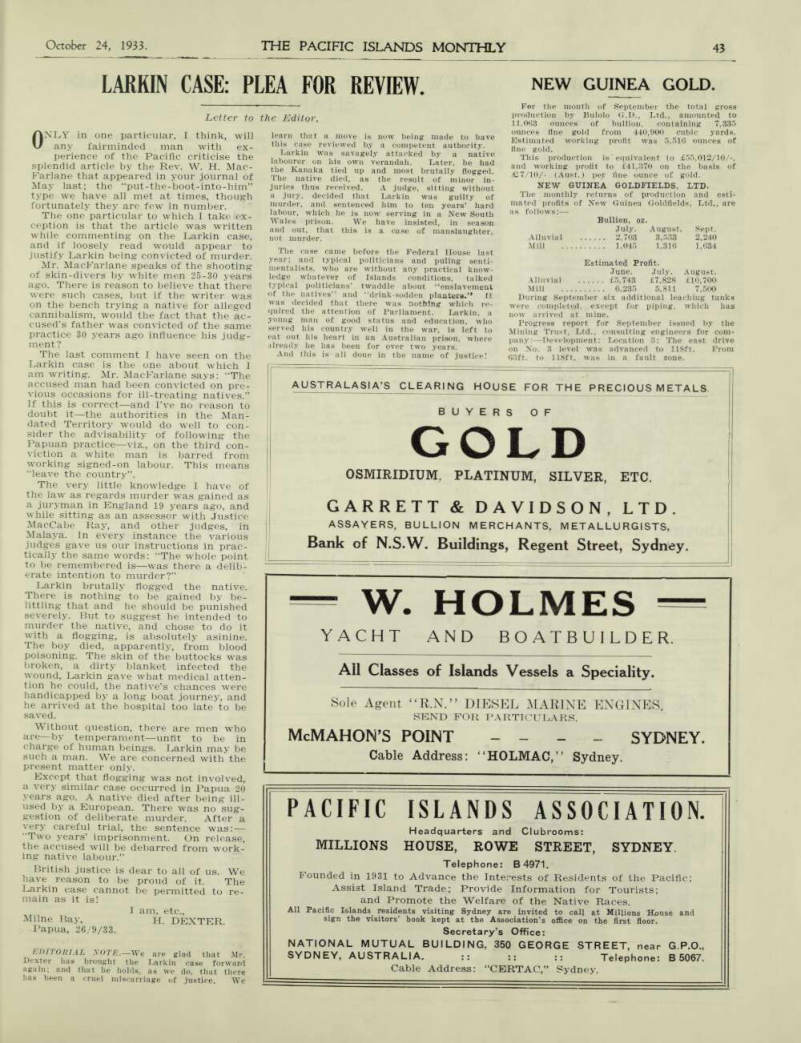
Letter to the Editor.
ONLY in one particular, I think, will any fairminded man with ex perience of the Pacific criticise the splendid article by the Rev. W. H. Mac- Farlane that appeared in your journal of May last; the “put-the-boot-into-him” type we have all met at times, though fortunately they are few in number.
The one particular to which I take ex ception is that the article was written while commenting on the Larkin case, and if loosely read would appear to justify Larkin being convicted of murder.
Mr. MacFarlane speaks of the shooting of skin-divers by white men 25-30 years ago. There is reason to believe that there were such cases, but if the writer was on the bench trying a native for alleged cannibalism, would the fact that the ac cused’s father was convicted of the same practice 30 years ago influence his judg ment?
The last comment I have seen on the Larkin case is the one about which I am writing. Mr. MacFarlane says: “The accused man had been convicted on pre vious occasions for ill-treating natives.”
If this is correct —and I’ve no reason to doubt it —the authorities in the Man dated Territory would do well to con sider the advisability of following the Papuan practice—viz., on the third con viction a white man is barred from working signed-on labour. This means “leave the country”.
The very little knowledge I have of the law as regards murder was gained as a juryman in England 19 years ago, and while sitting as an assessor with Justice MacCabe Ray, and other judges, in Malaya. In every instance the various judges gave us our instructions in prac tically the same words: “The whole point to be remembered is—was there a delib erate intention to murder?”
Larkin brutally flogged the native.
There is nothing to be gained by be littling that and he should be punished severely. But to suggest he intended to murder the native, and chose to do it with a flogging, is absolutely asinine.
The boy died, apparently, from blood poisoning. The skin of the buttocks was broken, a dirty blanket infected the wound, Larkin gave what medical atten tion he could, the native’s chances were handicapped by a long boat journey, and he arrived at the hospital too late to be saved.
Without question, there are men who are—by temperament—unfit to be in charge of human beings. Larkin may be such a man. We are concerned with the present matter only.
Except that flogging was not involved, a very similar case occurred in Papua 20 years ago. A native died after being ill used by a European. There was no sug gestion of deliberate murder. After a very careful trial, the sentence was: “Two years’ imprisonment. On release, the accused will be debarred from work ing native labour.”
British justice is dear to all of us. We have reason to be proud of it. The Larkin case cannot be permitted to re main as it is!
I am, etc.,
H. Dexter.
Milne Bay, Papua, 26/9/33.
EDITORIAL NOTE.— We are glad that Mr.
Dexter has brought the Larkin case forward again; and that he holds, as we do, that there has been a cruel miscarriage of justice. We
learn that a move is now being made to have this case reviewed by a competent authority.
Larkin was savagely attacked by a native labourer on his own verandah. Later, he had the Kanaka tied up and most brutally flogged.
The native died, as the result of minor in juries thus received. A judge, sitting without a jury, decided that Larkin was guilty of murder, and sentenced him to ten years’ hard labour, which he is now serving in a New South Wales prison. We have insisted, in season and out, that this is a case of manslaughter, not murder.
The case came before the Federal House last year; and typical politicians and puling senti mentalists, who are without any practical know ledge whatever of Islands conditions, talked typical politicians’ twaddle about “enslavement of the natives” and “drink-sodden planters." It was decided that there was nothing which re quired the attention of Parliament. Larkin, a young man of good status and education, who served his country well in the war, is left to eat out his heart in an Australian prison, where already he has been for over two years.
And this is all done in the name of justice!
New Guinea Gold.
For the month of September the total gross production by Bulolo G.D., Ltd., amounted to 11,063 ounces of bullion, containing 7,335 ounces fine gold from 440,900 cubic yards.
Estimated working profit was 5,516 ounces of fine gold.
This production is' equivalent to £55,012/10/-, and working profit to £41,370 on the basis of £7/10/- (Aust.) per fine ounce of gold.
New Guinea Goldfields. Ltd.
The monthly returns of production and esti mated profits of New Guinea Goldfields, Ltd., are as follows:
During September six additional leaching tanks were completed, except for piping, which has now arrived at mine.
Progress report for September issued by the Mining Trust, Ltd., consulting engineers for com pany:—Development: Location 3: The east drive on No. 3 level was advanced to 118 ft. From G3ft. to 118 ft. was in a fault zone.
Bullion, oz.
July. August. Sept.
Alluvial 2,703 3,533 2,240 Mill 1,045 1,310 1,034 Estimated Profit.
June. July. August.
Alluvial £5,743 £7,828 £10,700 Mill 6,235 5,811 7,500
Advertisements & other items, p. 45 (1 item)
Gold
AUSTRALASIA’S CLEARING HOUSE FOR THE PRECIOUS METALS
BUYERS OF
OSMIRIDIUM. PLATINUM, SILVER, ETC.
GARRETT & DAVIDSON, LTD.
ASSAYERS, BULLION MERCHANTS, METALLURGISTS,
Bank of N.S.W. Buildings, Regent Street, Sydney.
W. HOLMES
YACHT AND BOATBUILDER.
All Classes of Islands Vessels a Speciality.
Sole Agent “R.N.” DIESEL MARINE ENGINES.
SEND FOR PARTICULARS.
McMAHON’S POINT - - SYDNEY.
Cable Address: “HOLMAC,” Sydney.
PACIFIC ISLANDS ASSOCIATION.
Headquarters and Clubrooms:
MILLIONS HOUSE, ROWE STREET, SYDNEY
Telephone: 84971.
Founded in 1931 to Advance the Interests of Residents of the Pacific; Assist Island Trade; Provide Information for Tourists; and Promote the Welfare of the Native Races.
All Pacific Islands residents visiting Sydney are invited to call at Millions House and sign the visitors’ book kept at the Association’s office on the first floor.
Secretary’s Office: NATIONAL MUTUAL BUILDING, 350 GEORGE STREET, near G.P.O., SYDNEY, AUSTRALIA. :: :: Telephone: B 5067.
Cable Address: “CERTAC,” Sydney.
Mysterious Ships.
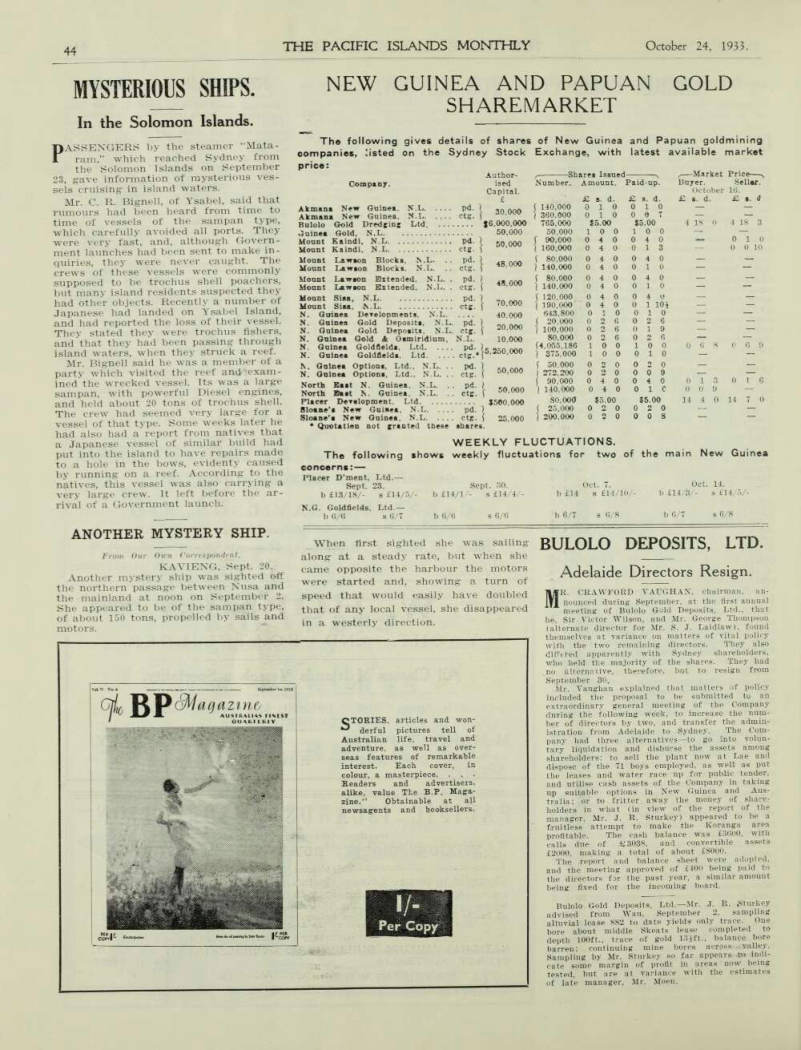
In the Solomon Islands.
PASSENGERS by the steamer “Mata ram,” which reached Sydney from the Solomon Islands on September 23, gave information of mysterious ves sels cruising in island waters.
Mr. C. R. Bignell, of Ysabel, said that rumours had been heard from time to time of vessels of the sampan type, which carefully avoided all ports. They were very fast, and, although Govern ment launches had been sent to make in quiries, they were never caught. The crews of these vessels were commonly supposed to be trochus shell poachers, but many island residents suspected they had other objects. Recently a number of Japanese had landed on Ysabel Island, and had reported the loss of their vessel.
They stated they were trochus fishers, and that they had been passing through island waters, when they struck a reef.
Mr. Bignell said he was a member of a party which visited the reef and examined the wrecked vessel. Its was a large sampan, with powerful Diesel engines, and held about 20 tons of trochus shell.
The crew had seemed very large for a vessel of that type. Some weeks later he had also had a report from natives that a Japanese vessel of similar build had put into the island to have repairs made to a hole in the bows, evidenty caused by running on a reef. According to the natives, this vessel was also carrying a very large crew. It left before the ar rival of a Government launch.
Another Mystery Ship.
From Our Own Correspondent.
Kavieng, Sept. 20.
Another mystery ship was sighted off the northern passage between Nusa and the mainland at noon on September 2.
She appeared to be of the sampan type, of about 150 tons, propelled by sails and motors.
When first sighted she was sailing along at a steady rate, but when she came opposite the harbour the motors were started and, showing a turn of speed that would easily have doubled that of any local vessel, she disappeared in a westerly direction.
New Guinea And Papuan Gold
Sharemarket
The following gives details of shares of New Guinea and Papuan goldmining companies, listed on the Sydney Stock Exchange, with latest available market price:
Weekly Fluctuations.
The following shows weekly fluctuations for two of the main New Guinea concerns:— Placer D’ment, Ltd. —
Author- Shares Issued Market Price Company. ised Number.
Amount.
Paid-up.
Buyer.
Seller.
Capital.
October 16. £ £ s. d. £ s. d. £ s. d. £ s. d Akmani New Guinea. N.L pd. 30,000 140,000 0 1 0 0 1 0 — — Akmana New Guinea, N.L ctg. 360,000 0 1 0 0 0 7 — — Bulolo Gold Dredging Ltd. ... . 6,000,000 765,000 $5.00 $5.00 4 18 0 4 18 3 50,000 50,000 1 0 0 1 0 0 — Mount Kaindi, N.L Pd. 50,000 90,000 0 4 0 0 4 0 — 0 1 0 Mount Kaindi, N.L ctg. 160,000 0 4 0 0 1 3 — 0 0 10 Mount Lawton Blocks, N.L. pd. 48,000 80,000 0 4 0 0 4 0 — — Mount Lawaon Blocks. N.L. .. ctg. 140,000 0 4 0 0 1 0 — — Mount Lawton Extended, N.L. . pd. 48,000 80,000 0 4 0 0 4 0 — — Mount Lawson Extended, N.L. . ctg. 140,000 0 4 0 0 1 0 — — Mount Sisa, N.L. pd.
Mount Sisa, N. L. ctg. 70,000 120,000 0 4 0 0 4 0 — — 190,000 0 4 0 0 1 10½ — — N. Guinea Derelopments, N.L. 40,000 643,800 0 1 0 0 1 0 — — N. Guinea Gold Deposits, N.L. pd. 20,000 20,000 0 0 6 0 2 6 — — N. Guinea Gold Deposits, N.L. ctg. ctg. 100,000 0 o 6 0 1 9 — — N. Guinea Gold & Osmiridium, N.L. 10.000 5,250,000 80,000 0 2 6 0 2 6 — — N. Guinea Goldfields. Ltd pd. 4,055,186 1 0 0 1 0 0 0 6 $ 0 6 9 N. Guinea Goldfields. Ltd ctg.* 375,000 1 0 0 0 1 0 — — N. Guinea Options. Ltd., N.L. .. pd. 50,000 50,000 0 2 0 0 2 0 — — N. Guinea Options, Ltd., N.L. . . ctg. 272,200 0 o 0 0 0 9 — 3 9 0 — North East N. Guinea. N.L. . , pd.
North Bast N. Guinea. N.L. . . ctg. 50,000 90,000 140,000 0 0 4 4 0 0 0 0 4 1 0 C 0 0 1 0 1 6 Placer Development, Ltd $500,000 80,000 $5.00 $5.00 14 4 0 14 7 0 Sloane's New Guinea, N.L pd. 25,000 0 2 0 0 2 0 — — Sloane’t New Guinea, N.L ctg. 25,000 200,000 0 o 0 0 0 8 — — * Quotation not granted these shares.
Sept. 23. Sept. 30. Oct. 7. Oct. 14. b £13/18/- s £14/5/- b £14/1/- s £14/4/- b £14 s £14/10/- b £14/3/- s £14/5/- N.G. Goldfields, Ltd.— b 6/6 s 6/7 b 6/6 s 6/6 b 6/7 s 6/8 b 0/7 s 6/8
Bulolo Deposits, Ltd.
Adelaide Directors Resign.
MR. CRAWFORD VAUGHAN, chairman, an nounced during September, at the first annual meeting of Bulolo Gold Deposits, Ltd., that he, Sir Victor Wilson, and Mr. George Thompson (alternate director for Mr. S. J. Laidlaw), found themselves at variance on matters of vital policy with the two remaining directors. They also differed apparently with Sydney shareholders, who held the majority of the shares. They had no alternative, therefore, but to resign from September 30.
Mr. Vaughan explained that matters of policy included the proposal to be submitted to an extraordinary general meeting of the Company during the following week, to increase the num ber of directors by two, and transfer the admin istration from Adelaide to Sydney. The Com pany had three alternatives—to go into volun tary liquidation and disburse the assets among shareholders; to sell the plant now at Lae and dispose of the 71 boys employed, as well as put the leases and water race up for public tender, and utilise cash assets of the Company in taking up suitable options in New Guinea and Aus tralia ; or to fritter away the money of share holders in what (in view of the report of the manager. Mr. J. R. Sturkey) appeared to be a fruitless attempt to make the Koranga area profitable. The cash balance was £3600, with calls due of £3038, and convertible assets £2000, making a total of about £8000.
The report and balance sheet were adopted, and the meeting approved of £400 being paid to the directors for the past year, a similar amount being fixed for the incoming board.
Bulolo Gold Deposits, Ltd.—Mr. J. R. Sturkey advised from Wau, September 2, sampling alluvial lease 882 to date yields only trace. One bore about middle Skeats lease completed to depth 100 ft., trace of gold 13½ft., balance bore barren: continuing mine bores across valley.
Sampling by Mr. Sturkey so far appears to indicate some margin of profit in areas now being tested, but are at variance with the estimates of late manager, Mr. Moen.
Advertisements & other items, p. 46 (1 item)
STORIES, articles and won-
STORIES, articles and wonderful pictures tell of Australian life, travel and adventure, as well as overseas features of remarkable interest. Each cover, in colour, a masterpiece. . . .
Readers and advertisers, alike, value The B.P. Magazine." Obtainable at all newsagents and booksellers.
Market Quotations
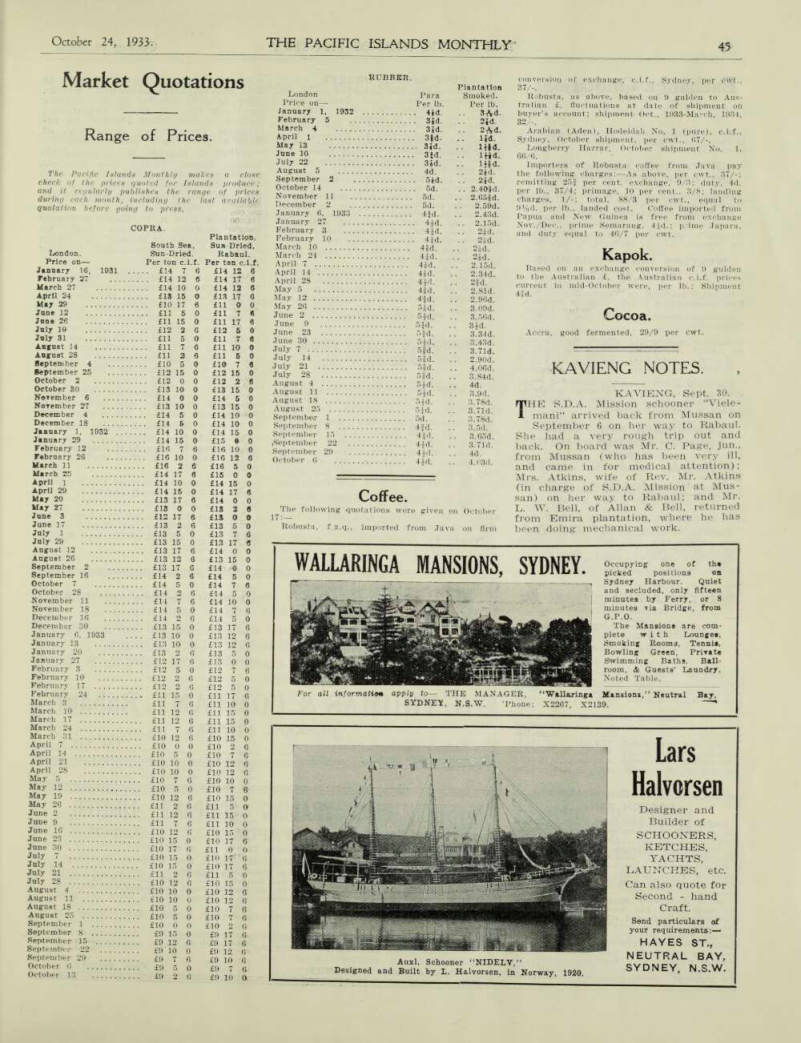
Range of Prices.
The Pacific Islands Monthly makes a close check of the prices quoted for Islands produce; and it regularly publishes the range of prices during each month, including the last available quotation before going to press.
Coffee.
The following quotations were given on October 17:— Robusta, f a.q., imported from Java on firm
conversion of exchange, c.i.f., Svdney, per cwt., 37/-.
Rohusta, as above, based on 9 gulden to Aus tralian £, fluctuations at date of shipment on buyer’s account; shipment Oct., 1933-March, 1934, 32/-.
Arabian (Aden), Hodeidah No. 1 (pure), c.i.f., Sydney, October shipment, per cwt., 67/-.
Longberry Harrar, October shipment No. 1, 66/6.
Importers of Robusta coffee from Java pay the following charges:—As above, per cwt.. 37/-; remitting 25¾ per cent, exchange, 9/3; duty. 4d. per lb., 37/4; primage, 10 per cent., 3/8; landing charges, 1/-; total, 88/3 per cwt., equal to 9 1/3 d. per lb., landed cost. Coffee imported from Papua and New Guinea is free from exchange Nov./Dec., prime Semarang. 4¾d.; prime Japara, and duty equal to 46/7 per cwt.
Kapok.
Based on an exchange conversion of 9 gulden to the Australian £. the Australian c.i.f. prices current in mid-October were, per lb.: Shipment 4§d.
Cocoa.
Accra, good fermented, 29/9 per cwt.
Rubber.
Plantation London Para Smoked.
Price on— Per lb.
Per lb.
January 1, 1932 4jd. 3Ad.
February 5 2{d.
March 4 2Ad.
April 1 lid.
May 13 Uld.
June 10 liid.
July 22 .. IHd.
August 5 2id.
September 2 5id. .. 2}d.
October 14 . . 2.403d.
November 11 5d. .. 2.053d.
December 2 5d. .. 2.59d.
January 0, 1933 4Jd. .. 2.43d.
January 27 . . .. .. 2.15d.
February 3 ... 4Jd. .. 2|d.
February 10 4id. .. 2Jd.
March io .. 2Jd.
March 24 4id. .. 2id.
April 7 .. 2.15d.
April 14 . . 2.34d.
April 28 .. 2|d.
May 5 .. 2.81d.
May 12 2.90d.
May 20 .. 3.09d.
June 2 .. 3.50d.
June 9 5 id. . . 3id.
June 23 5}d. .. 3.34d.
June 30 5*d. .. 3.43d.
July 7 53d. 3.71d.
July 14 53d. .. 2.90d.
July 21 53d. .. 4.00d.
July 28 5fd. .. 3.84d.
August 4 .. 4d.
August 11 .. 3.9d.
August 18 5*d. .. 3.78d.
August 25 5id. 3.71d.
September 1 5d. 3.78d.
September 8 4}d. .. 3.54.
September 15 ... 4id. .. 3.054.
September 22 .. 3.71d.
September 29 4 id. 4d.
October 6 ••• 4 id. .. 4.03d.
London.
Price on— January 16, 1031
Copra.
South Sea, Stm-Dried, Per ton c.I.f. £14 7 6 Plantation, Sun-Dried, Rabaul.
Per ton c.I.f. £14 12 6 February 127 ... £14 12 6 £14 17 6 £14 12 6 £13 17 6 £11 0 0 £11 7 « £11 17 0 £12 6 0 £11 7 0 £11 10 0 £11 B 0 March 27 £14 10 0 April 24 £13 15 0 May 29 £10 17 6 Jnne 12 £11 5 0 Jana 26 £11 15 0 July 10 £12 2 6 July 81 £11 5 0 August 14 £11 7 6 August 28 £11 2 6 September 4 .. , . £10 5 0 £10 7 6 September 25 . . .. £12 15 0 £12 15 0 £12 2 6 October 2 £12 0 0 October SO £13 10 0 £13 15 0 £14 5 0 £13 15 0 £14 10 0 £14 10 0 £14 16 0 £15 9 0 £16 10 0 £16 12 0 £16 5 0 £16 0 0 £14 15 0 £14 17 6 £14 0 0 £13 2 6 £13 0 0 £13 5 0 £13 7 6 £13 17 6 £14 0 0 £13 15 0 £14 0 0 £14 5 0 £14 7 6 £14 5 0 £14 10 0 £14 7 6 £14 5 0 November 6 £14 0 0 November 27 £13 10 0 December 4 £14 5 0 December 18 £14 5 0 January 1, 1932 . .
January 29 £14 10 0 £14 15 0 February 12 ... £16 7 6 February 26 ... £16 10 0
March li
£16 2 6 March 25 £14 17 6 April 1 £14 10 0 April 29 £14 15 o May 20 £13 17 6 May 27 £13 0 0 June 3 £12 17 6 June 17 July 1 £13 5 0 July 29 ... £13 15 0 August 12 £13 17 6 August 26 £13 12 6 September 2 ... £13 17 G September 16 ... ... £14 2 6 October 7 £14 5 o October 28 ... . £14 2 6 November 11 £14 7 6 November 18 £14 5 0 December 16 £14 2 6 December 30 ... £13 15 0 £13 17 6 £13 12 6 £13 12 6 £13 5 0 £13 0 0 £12 7 6 £12 5 0 £12 5 0 £11 17 6 £11 10 0 £11 15 0 £11 15 0 £11 10 0 £10 15 0 £10 2 6 January 6, 1933 January 13 £13 10 0 January 20 . £13 2 6 January 27 . £12 17 6 February 3 £12 5 0 February 10 ... £12 2 6 February 17 £12 2 6 February 24 • . fn 15 o March 3 £11 7 6 March 10 March 17 £11 12 G March 24 March 31 April 7 April 14 £10 7 6 £10 12 6 £10 12 G £10 10 0 £10 7 6 ■Pin ip; n April 21 April 28 £10 10 0 May 5 May 12 May 19 May 26 tiv lO U n Jane 2 ill o u
-Pi 1 A
June 9
Xxx X«J U
£11 10 0 •Pin I s ; n June 16 June 23 IXU X • f u £10 17 6 ■P 11 n n June 30 July 7 XXX u u •Pin it n July 14
Xi" Xi \J
£10 17 6 ■Pi 1 n July 21 July 28 XXX o u £10 15 0 £10 12 6 £10 12 6 £10 7 6 £10 7 6 £10 2 6 ■PQ 17 ft August 4 August 11 August 18 August 25 September 1 September 8 September 15 . £9 12 6 Xo XI l> £9 17 6 £9 12 6 £9 10 6 September 22 ... £9 10 0 September 29 .. .. £9 7 6 October 6 October 13 £9 10 0
Kavieng Notes.
Kavieng. Sept. 30.
THE S.D.A. Mission schooner “Viele mani” arrived back from Mussan on September 6 on her way to Rabaul.
She had a very rough trip out and back. On board was Mr. C. Page, jun., from Mussan (who has been very ill, and came in for medical attention); Mrs. Atkins, wife of Rev. Mr. Atkins (in charge of S.D.A. Mission at Mus san) on her way to Rabaul; and Mr.
L. W. Bell, of Allan & Bell, returned from Emira plantation, where he has been doing mechanical work.
Advertisements & other items, p. 47 (1 item)
advgt
Auxl. Schooner “NIDELY,”
Designed and Built by L. Halvorsen, in Norway, 1920.
Lars
Halvorsen
Designer and Builder of
SCHOONERS,
KETCHES,
YACHTS,
LAUNCHES, etc.
Can also quote for Second - hand Craft.
Send particulars of your requirements:—
HAYES ST.,
NEUTRAL BAY,
SYDNEY. N.S.W.
Exchange Quotations
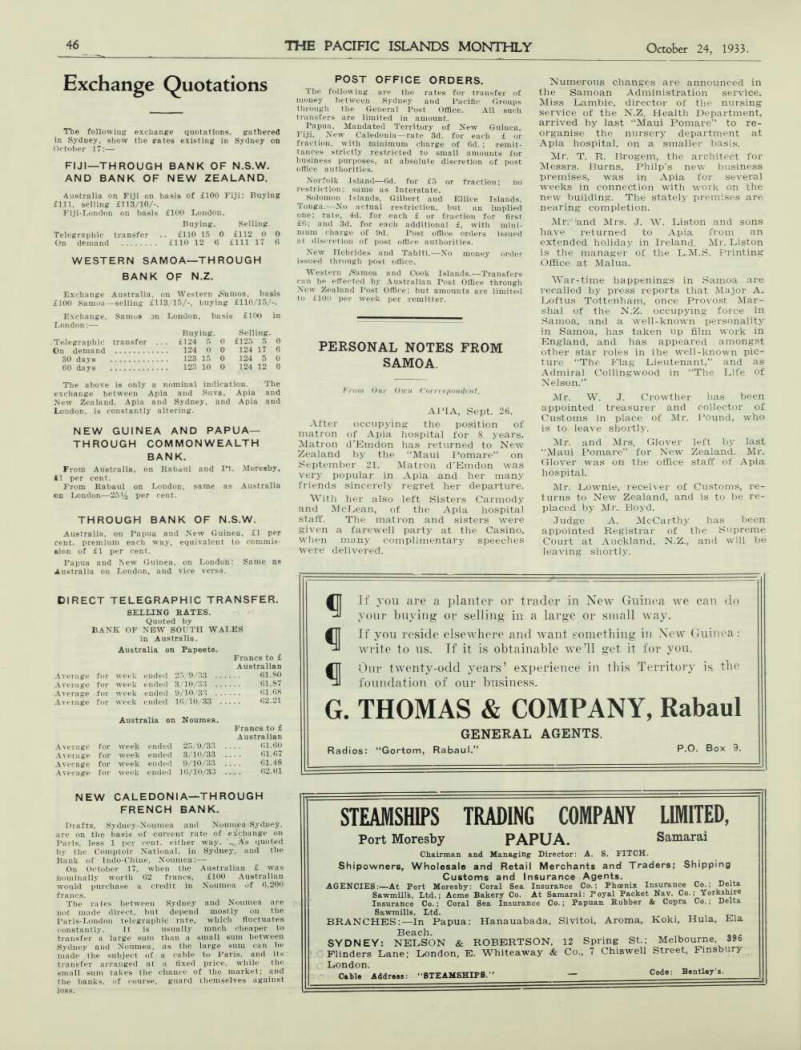
The following exchange quotations, gathered in Sydney, show the rates existing in Sydney on October 17:—
Fiji—Through Bank Of N.S.W.
And Bank Of New Zealand.
Australia on Fiji on basis of £100 Fiji: Buying £111. selling £113/10/-.
Fiji-London on basis £100 London.
Western Samoa—Through
Bank Of N.Z.
Exchange Australia, on Western samoa, basis £100 Samoa—selling £113/15/-, buying £110/15/-.
Exchange, Samos on London, basis £100 in London: —
The above is only a nominal indication. The exchange between Apia and Suva, Apia and New Zealand, Apia and Sydney, and Apia and London, is constantly altering.
New Guinea And Papua
Through Commonwealth
Bank.
From Australia, on Rabaul and Pt. Moresby, £1 per cent.
From Rabaul on London, same as Australia on London — 25½ per cent.
Through Bank Of N.S.W.
Australia, on Papua and New Guinea, £1 per cent, premium each way, equivalent to commis sion of £1 per cent.
Papua and New Guinea, on London: Same as Australia on London, and vice versa.
Direct Telegraphic Transfer.
Selling Rates.
Quoted by
Bank Of New South Wales
in Australia.
Australia on Papeete.
New Caledonia—Through
French Bank.
Drafts, Sydney-Noumea and Noumea-Syduey, are on the basis of current rate of exchange on Paris, less 1 per cent, either way. quoted by the Comptoir National, in Sydney, and the Bank of Indo-Chine, Noumea: — On October 17, when the Australian £ was nominally worth 62 francs, £100 Australian would purchase a credit in Noumea of 6,200 francs.
The rates between Sydney and Noumea are not made direct, but depend mostly on the Paris-London telegraphic rate, which fluctuates constantly. It is usually much cheaper to transfer a large sum than a small sum between Sydney and Noumea, as the large sum can be made the subject of a cable to Paris, and its transfer arranged at a fixed price, while the small sum takes the chance of the market; and the banks, of course, guard themselves against loss.
Post Office Orders.
The following are the rates for transfer of money between Sydney and Pacific Groups through the General Post Office. All such transfers are limited in amount.
Papua, Mandated Territory of New Guinea, Fiji, New Caledonia —rate 3d. for each f or fraction, with minimum charge of 6d. ; remit tances strictly restricted to small amounts for business purposes, at absolute discretion of post office authorities.
Norfolk Island —6d. for £5 or fraction; no restriction; same as Interstate, Solomon Islands, Gilbert and Ellice Islands, Tonga.—No actual restriction, but an implied one; rate, 4d. for each £ or fraction for first £6; and 3d. for each additional £, with minimum charge of 9d. Post office orders issued at discretion of post office authorities.
New Hebrides and Tahiti,—No money order issued through post office.
Western Samoa and Cook Islands.—Transfers can be effected by Australian Post Office through New Zealand Post Office; but amounts are limited to £100 per week per remitter.
Buying. Selling, Telegraphic transfer .. £110 15 0 £112 0 0 On demand £110 12 6 £111 17 6
Buying. Selling.
Telegraphic transfer . .. £124 5 0 £125 5 0 On demand 124 0 0 124 17 6 30 days 123 15 0 124 5 0 60 days 123 10 0 124 12 6
Average for week ended 25/9/33 .. 61.80 Francs to £ Australian Average for week ended 3/10/33 .. 61.87 Average for week ended 9/10/33 . . 61.68 Average for week ended 16/10/33 . 62.21 Average for week ended 25/9/33 61.60 Australia on Noumea.
Francs to £ Australian Average for week ended 3/10/33 61.67 Average for week ended 9/10/33 61.48 Average for week ended 16/10/33 62.01
Personal Notes From
Samoa
From Our Own Correspondent.
APIA, Sept. 26.
After occupying the position of matron of Apia hospital for 8 years, Matron d’Emdon has returned to New Zealand by the “Maui Pomare” on September 21. Matron d’Emdon was very popular in Apia and her many friends sincerely regret her departure.
With her also left Sisters Carmody and McLean, of the Apia hospital staff. The matron and sisters were given a farewell party at the Casino, when many complimentary speeches were delivered.
Numerous changes are announced in the Samoan Administration service.
Miss Lambie, director of the nursing service of the N.Z. Health Department, arrived by last “Maui Pomare” to re organise the nursery department at Apia hospital, on a smaller basis.
Mr. T. R. Brogem, the architect for Messrs. Burns, Philp’s new business premises, was in Apia for several weeks in connection with work on the new building. The stately premises are nearing completion.
Mr. and Mrs. J. W. Liston and sons have returned to Apia from an extended holiday in Ireland. Mr. Liston is the manager of the L.M.S. Printing Office at Malua.
War-time happenings in Samoa are recalled by press reports that Major A.
Loftus Tottenham, once Provost Mar shal of the N.Z. occupying force in Samoa, and a well-known personality in Samoa, has taken up film work in England, and has appeared amongst other star roles in the well-known pic ture “The Flag Lieutenant,” and as Admiral Collingwood in “The Life of Nelson.”
Mr. W. J. Crowther has been appointed treasurer and collector of Customs in place of Mr. Pound, who is to leave shortly.
Mr. and Mrs. Glover left by last “Maui Pomare” for New Zealand. Mr.
Glover was on the office staff of Apia hospital.
Mr. Lownie, receiver of Customs, re turns to New Zealand, and is to be re placed by Mr. Boyd.
Judge A. McCarthy has been appointed Registrar of the Supreme Court at Auckland, N.Z., and will be leaving shortly.
Advertisements & other items, p. 48 (1 item)
G. Thomas & Company, Rabaul
If you are a planter or trader in New Guinea we can do your buying or selling in a large or small way.
If you reside elsewhere and want something in New Guinea: write to us. If it is obtainable we’ll get it for you.
Our twenty-odd years’ experience in this Territory is the foundation of our business.
G. THOMAS & COMPANY, Rabaul
GENERAL AGENTS.
Radios: “Gortom, Rabaul.” P.O. Box 9.
STEAMSHIPS TRADING COMPANY LIMITED,
Port Moresby PAPUA. Samarai
Chairman and Managing Director: A. S. FITCH.
Shipowners, Wholesale and Retail Merchants and Traders; Shipping Customs and Insurance Agents.
AGENCIES:—At Port Moresby: Coral Sea Insurance Co.; Phoenix Insurance Co.; Delta Sawmills, Ltd.; Acme Bakery Co. At Samarai: royal Packet Nav. Co.; Yorkshire Insurance Co.; Coral Sea Insurance Co.; Papuan Rubber & Copra Co.; Delta Sawmills, Ltd.
BRANCHES:—In Papua: Hanauabada, Sivitoi, Aroma, Koki, Hula, Lla SYDNEY: NELSON & ROBERTSON, 12 Spring St.; Melbourne 396 Flinders Lane; London, E. Whiteaway & Co., 7 Chiswell Street, Finsbury London.
Cable Address: “STEAMSHIPS.” Code: Bentleys.
Shipping Services in the Pacific
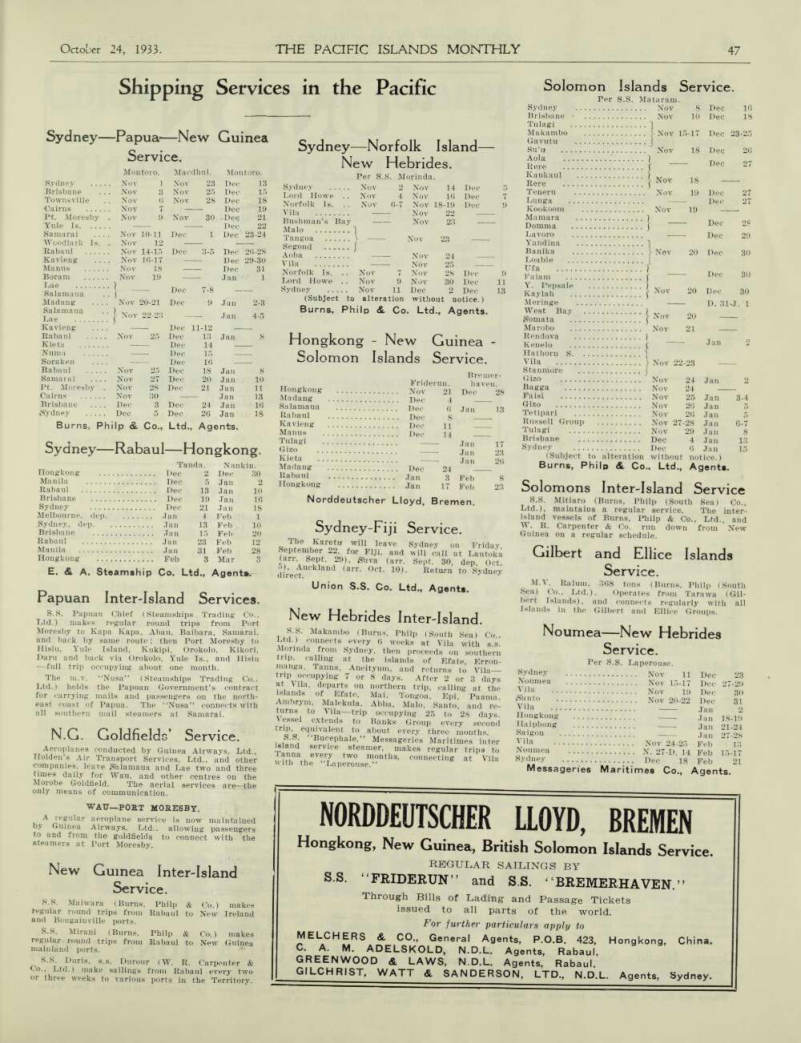
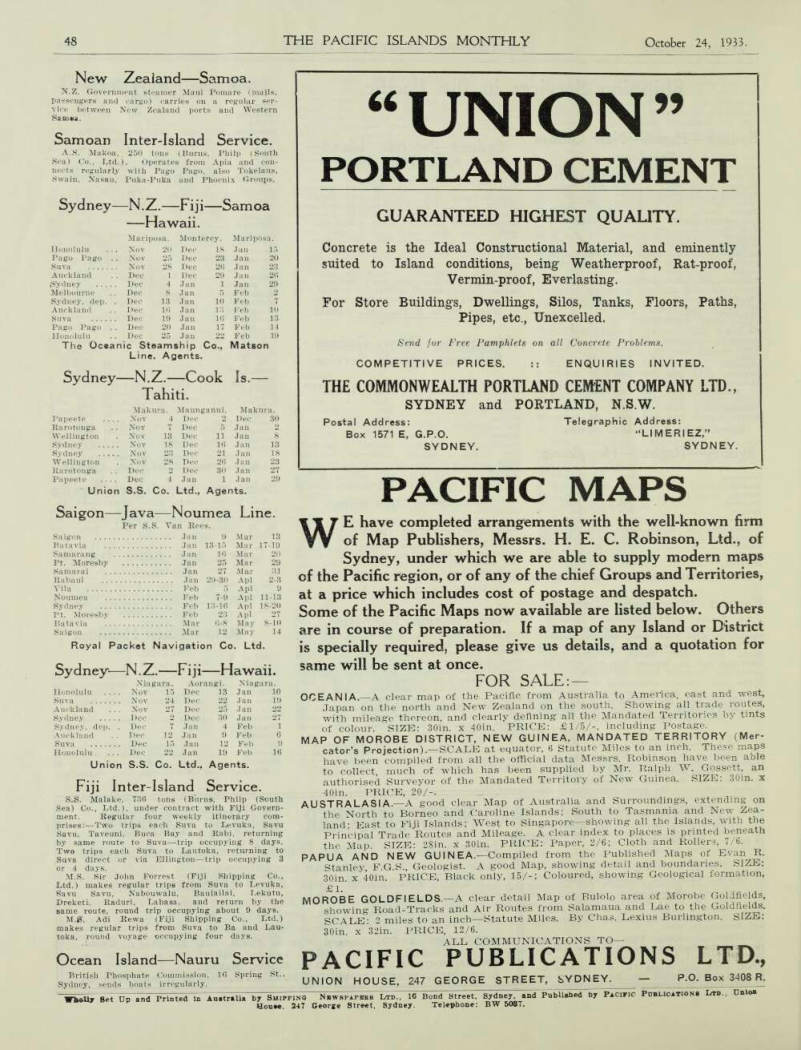
Sydney—Papua—New Guinea Service.
Sydney—Rabaul—Hongkong.
Papuan Inter-Island Services.
S.S. Papuan Chief (Steamships Trading Co., Ltd.) makes regular round trips from Port Moresby to Kapa Kapa, Abau, Baibara, Samarai, and back by same route; then Port Moresby to Hisiu, Yule Island, Kukipi, Orokolo, Kikori, Darn and back via Orokolo, Yule Is., and Hisiu —full trip occupying about one month.
The m.v. “Nusa” (Steamships Trading Co., Ltd.) holds the Papuan Government’s contract for carrying mails and passengers on the north east coast of Papua. The “Nusa” connects with all southern mail steamers at Samarai.
N.G. Goldfields’ Service.
Aeroplanes conducted by Guinea Airways, Ltd., Holden’s Air Transport Services, Ltd., and other companies, leave Salamaua and Lae two and three times daily for Wau, and other centres on the Morobe Goldfield. The aerial services are—the only means of communication.
Wau—Poet Moresby.
A regular aeroplane service is now maintained by Guinea Airways, Ltd., allowing passengers to and from the goldfields to connect with the steamers at Port Moresby.
New Guinea Inter-Island
Service.
S.S. Maiwara (Burns. Philp & Co.) makes regular round trips from Rabaul to New Ireland and Bougainville ports.
S.S. Mirani (Burns, Philp & Co.) makes regular round trips from Rabaul to New Guinea mainland ports.
S.S. Duris. s.s. Durour (W. R. Carpenter & Co., Ltd.) make sailings from Rabaul every two or three weeks to various ports in the Territory.
Sydney—Norfolk Island— New Hebrides.
Hongkong - New Guinea - Solomon Islands Service.
Sydney-Fiji Service.
The Karetu will leave Sydney on Friday.
Sep ember 22 for Fiji, and will call at Lautoka (an Sept. 29), Shiva (arr. Sept. 30, dep. Oct. 5), Auckland (arr. Oct. 10). Return to Sydney direct.
Union S.S. Cos. Ltd., Agents.
New Hebrides Inter-Island.
S.S. Makambo (Burns, Philp (South Sea) Cos., Ltd.) connects every 6 weeks at Vila with s.s.
Morinda from Sydney, then proceeds on southern trip, calling at the islands of Efate. Erron manga, Tanna, Aneityum, and returns to Vila tnp occupying 7 or 8 days. After 2 or 3 days at Vila, departs on northern trip, calling at the islands of Efate, Mai. Tongoa, Epi, Paama, Ambrym, Malekula, Abba, Malo, Santo, and returns to Vila—trip occupying 25 to 28 days.
Vessel extends to Banks Group every second trip equivalent to about every three months.
S.S. "Bucephale,” Messageries Maritimes inter island service steamer, makes regular trips to Tanna every two months, connecting at Vila with the “Laperouse.”
Solomon Islands Service.
Solomons Inter-Island Service
S.S. Mitiaro (Burns, Philp (South Sea) Co., Ltd.), maintains a regular service. The inter island vessels of Burns, Philp & Co., Ltd., and W. R. Carpenter & Co. run down from New Guinea on a regular schedule.
Gilbert and Ellice Islands
Service.
M.V. Ralum, 368 tons (Burns, Philp (South Sea) Co.. Ltd.). Operates from Tarawa (Gil bert Islands), and connects regularly with all Islands in the Gilbert and Ellice Groups.
Noumea—New Hebrides
Service.
Per S.S. Morinda.
Sydney Nov 2 Nov 14 Dec- 5 Lord Howe Nov 4 Nov 16 Dec 7 Norfolk Is.
Nov 0-7 Nov 18-19 Dec 9 Vilfi Nov 22 Bushman’s Bay Nov 23 Malo Nov 23 Segond Aoba Nov 24 Vila Nov 25 Norfolk Is.
Nov 7 Nov 28 Dec 9 Lord Howe Nov 9 Nov 30 Dec 11 Sydney Nov 11 Dec 2 Dec 13 (Subject to alteration without notice.) Burns, Philp & Co. Ltd., Agents.
Hongkong Friderun.
Bremerhaven.
Dec 28 Madang Salamaua Jan 13 Rabaul Kavieng Manus Tulagi Gizo Jan 17 Kieta Jan 23 Jan 26 Madang Rabaul Feb 8 Hongkong Jan 17 Feb 23 Norddeutscher Lloyd, Bremen.
Per S.S. Mataram.
Sydney Nov 8 Dec 16 Dec 18 Brisbane Nov 10 Tulagi Makambo Nov 15-17 Dec 23-25 Gavutu Su’u Nov 18 Dec 26 Dec 27 Aola Rere Kaukaul Rere Nov 18 Teneru Nov 19 Dec 27 Dec 27 Lunga Kookoom Nov 19 Mamara DEc 28 Domma Lavoro Dec 29 Dec 30 Dec 30 Yandina Banika Loabie Ufa Faiam Nov 20 Y. Pepsale Kaylah Nov 20 Dec 30 Meringe D. 31-J. 1 West Bay Somata Marobo Nov 20 Nov 21 Rendova Kenelo Hathorn S Jan 2 Vila Stanmore Nov 22 -23 Gizo Bagga Nov 24 Nov 24 Jan 2 Faisi Gizo Tetipari Russell Group Tulagi Brisbane Sydney (Subject to alteration without notice.) Burns, Philp & Co., Ltd., Agents.
Nov 25 Nov 26 Nov 26 Nov 27 Nov 29 Dec 4 Dec 6 Jan 3-4 Jan 5 Jan 5 Jan 6-7 Jan 8 Jan 13 Jan 15
Per S.S. Laperouse.
Sydney
OQ
Noumea
Upc
(.0
Vila
I)e< Dl k
Santo
ov Q 1
Vila
t e<? ol o
Hongkong
Jan 1 o i o
Haiphong
•I a n Ol Ol
Saigon
Z1 -Z-T 21-2H
Vila
•1 (ill
Noumea
r rll 15-17 Of
Sydney
r tju V/vK Messageries Maritimes Co., Agents.
Montoro.
Macdhui.
Montoro.
Sydney Nov ] Nov 23 Dec- 13 Brisbane Nov 3 Nov 23 Dec 15 Townsville Nov G Nov 28 Dec 18 Nov Nov Dec Dee 19 21 Pt. Moresby . 9 Nov 30 Tnlp Is Dec Dec 22 Samarai ...
Nov 10-11 Dec 1 23-24 Woodlark Is. .
Nov 12 Rabaul Nov 14-13 Dec 3-5 Dec 26-28 Kavieng .. ..
Nov 16-17 Dec 29-30 Nov Nov 18 19 31 I Boram Jan Lae Salamaua Dec 7-8 Madang ...
Nov 20-21 Dec 9 Jan 2-3 Salamaua Lae
Nov 22-23
— Jan 4-3 Kavieng ...
Dec 11-12 Rabaul Nov 25 Dec 13 Jan 8 Kieta Dec Dec Dec 14 15 16 Numa Soraken ...
Rabaul Nov 23 Dec 18 Jan Jan 8 Samarai ...
Nov 27 Dec 20 10 Pt. Moresby .
Nov 28 Dec 21 Jan 11 Cairns Nov 30 Jan 13 Brisbane ...
Dec 3 Dec 24 Jan 16 Sydney rj Dec Ltd. 26 Jan 18 Burns, Philp & Co., , Agents.
Tanda.
Nankin Hongkong Dec 2 Dec 30 Manila Dec 5 Jan 2 Rabaul . Dec 13 Jan 10 Brisbane . Dec 19 Jan 16 Sydney Dec 21 Jan 18 Melbourne, dep Jan 4 Feb 1 .Sydney, dep Jan 13 Feb 10 Brisbane 13 Feb 20 Rabaul Jan 23 Feb 12 Manila Jan 31 Feb 28 Hongkong Feb 3 Mar 3 E. & A. Steamship Co. Ltd., Agents.
New Zealand—Samoa.
N.Z. Government steamer Maui Pomare (malls, passengers and cargo) carries on a regular ser vice between New Zealand ports and Western Sam«a.
Samoan Inter-Island Service.
A.S. Makoa, 250 tons (Burns, Philp (South Sea) Co., Ltd.). Operates from Apia and con nects regularly with Pago Pago, also Tokelaus, Swain, Nasau, Puka-Puka and Phoenix Groups.
Sydney—N.Z.—Fiji—Samoa
—Hawaii.
Sydney—N.Z.—Cook Is.— Tahiti.
Saigon—Java—Noumea Line.
Sydney-—N.Z.—Fiji—Hawaii.
Fiji Inter-Island Service.
S.S. Malake, 736 tons (Burns, Philp (South Sea) Co., Ltd.), under contract with Fiji Govern ment. Regular four weekly itinerary com prises:—Two trips each Suva to Levuka, Savu Savu, Taveuni, Buca Bay and Rabi, returning by same route to Suva—trip occupying 8 days.
Two trips each Suva to Lautoka, returning to Suva direct or via Ellington—trip occupying 3 or 4 days.
M.S. Sir John Forrest (Fiji Shipping Co., Ltd.) makes regular trips from Suva to Levuka, Savu Savu, Nabouwalu, Baulailai, Lekutu, Dreketi, Raduri, Labasa, and return by the same route, round trip occupying about 9 days.
M.s. Adi Rewa (Fiji Shipping Co., Ltd.) makes regular trips from Suva to Ba and Lau toka, round voyage occupying four days.
Ocean Island—Nauru Service
British Phosphate Commission, 16 Spring St., Sydney, sends boats irregularly.
Mariposa.
Monterey.
Mariposa.
Honolulu Nov 20 Dec- 18 Jan 15 Pago Pago ..
Nov 2-', Dec 23 Jan 20 Suva Nov 28 Dec 26 Jan 23 Auckland Dec 1 Dec 29 Jan 26 Sydney Dec 4 Jan 1 Jan 29 Melbourne Dec S Jan 5 Feb o Sydney, dep. .
Dec 13 Jan 10 Feb 7 Auckland Dec 16 Jan 13 Feb 10 Suva Dec 19 Jan 10 Feb 13 Pago Pago . .
Dec 20 Jan IT Feb 14 Honolulu Dec 25 Jan 2° Feb 19 The Oceanic Steamship Co., Matson
Line. Agents.
Makura.
Maunganui.
Makura.
Papeete ...
Nov 4 Dec o Dec 30 Rarotonga Nov 7 Dec 5 Jan 2 Wellington Nov 13 Dec 11 Jan 8 Sydney Nov IS Dec 16 Jan 13 Sydney Nov 23 Dec 21 Jan is Wellington Nov 28 Dec 26 Jan 23 Rarotonga Dec 2 Dec 30 Jan 27 Papeete ...
Dec 4 Jan 1 Jan 29 Union S.S. Co. Ltd., Agents.
Per S. S. Van Rees. 9 Mar 13 Batavia Jan 13-15 Mar 17-19 Samarang Jan 16 Mar 20 Pt. Moresby Jan 25 Mar 29 Samarai 27 Mar 31 Rabaul Jan 29-30 Apl Apl Apl Apl Apl May May . Lti 2-3 Vila Feb 5 9 Noumea Feb 7-9 11-13 Sydney Feb 13-16 18-20 Pt. Moresby Feb 23 27 Batavia Mar 6-8 8-10 Saigon Afar 12 14 Royal Packet Navigation Co. Ltd.
Niagara.
Aorangi.
Niagara. a.
Honolulu ...
Nov 13 Dec 13 Jan 10 Suva Nov 24 Dec 20 Jan 19 Auckland Nov 27 Dec 23 Jan 22 Sydney Dec 2 Dec 30 Jan 27 Sydney, dep. .
Dec 7 Jan 4 Feb 1 Auckland Dec 12 Jan 9 Feb 6 Suva Dec 15 Jan 12 Feb 9 Honolulu Dec 22 Jan 19 Feb 16 Union S.S. Co. Ltd., Agents.
Advertisements & other items, pp. 49-52 (2 items)
Norddeutscher Lloyd, Bremen
Hongkong, New Guinea, British Solomon Islands Service.
REGULAR SAILINGS BY
S.S. “FRIDERUN” and S.S. ‘‘BREMERHAVEN. ”
Through Bills of Lading and Passage Tickets issued to all parts of the. world.
For further particulars apply to M E LC HERS & CO., General Agents, P.O.B. 423, Hongkong, C. A. M. ADELSKOLD, N.D.L. Agents, Rabaul.
GREENWOOD & LAWS, N.D.L. Agents, Rabaul.
GILCHRIST, WATT & SANDERSON, LTD., N.D.L. Agents, China.
Sydney.
“UNION”
PORTLAND CEMENT
GUARANTEED HIGHEST QUALITY.
Concrete is the Ideal Constructional Material, and eminently suited to Island conditions, being Weatherproof, Rat-proof, Vermin-proof, Everlasting.
For Store Buildings, Dwellings, Silos, Tanks, Floors, Paths, Pipes, etc., Unexcelled.
Send for Free Pamphlets on all Concrete Problems.
COMPETITIVE PRICES. :: ENQUIRIES INVITED.
THE COMMONWEALTH PORTLAND CEMENT COMPANY LTD.,
SYDNEY and PORTLAND, N.S.W.
Postal Address: Telegraphic Address:
Box 1571 E, G.P.O. “LIMERIEZ”
SYDNEY. SYDNEY.
PACIFIC MAPS
WE have completed arrangements with the well-known firm of Map Publishers, Messrs. H. E. C. Robinson, Ltd., of Sydney, under which we are able to supply modem maps of the Pacific region, or of any of the chief Groups and Territories, at a price which includes cost of postage and despatch.
Some of the Pacific Maps now available are listed below. Others are in course of preparation. If a map of any Island or District is specially required, please give us details, and a quotation for
same will be sent at once.
FOR SALE:
OCEANIA. —A clear map of the Pacific from Australia to America, east and west, Japan on the north and New Zealand on the south. Showing all trade routes, with mileage thereon, and clearly defining all the Mandated Territories by tints of colour. SIZE; 30in. x 40in. PRICE: £1/5/-, including Postage.
MAP OF MOROBE DISTRICT, NEW GUINEA, MANDATED TERRITORY (Mercator’s Projection). —SCALE at equator, 6 Statute Miles to an inch. These maps have been compiled from all the official data Messrs. Robinson have been able to collect, much of which has been supplied by Mr. Ralph W. Gossett, an authorised Surveyor of the Mandated Territory of New Guinea. SIZE: 30in. x
40in. PRICE, 20/-.
AUSTRALASIA.— A good clear Map of Australia and Surroundings, extending on the North to Borneo and Caroline Islands; South to Tasmania and New Zealand- East to Fiji Islands; West to Singapore—showing all the Islands, with the Principal Trade Routes and Mileage. A clear index to places is printed beneath the Map. SIZE: 28in. x 30in. PRICE: Paper, 2/6; Cloth and Rollers, 7/6.
PAPUA AND NEW GUINEA— Compiled from the Published Maps of Evan R.
Stanley F.G.S., Geologist. A good Map, showing detail and boundaries. SIZE: 30in, x 40in, PRICE, Black only, 15/-; Coloured, showing Geological formation, £ 1.
MOROBE GOLDFIELDS. —A clear detail Map of Bulolo area of Morobe Goldfields, showing Road-Tracks and Air Routes from Salamaua and Lae to the Goldfields.
SCALE: 2 miles to an inch—Statute Miles. By Chas. Lexius Burlington. SIZE: 30in. x 32in. PRICE, 12/6.
ALL COMMUNICATIONS TO—
PACIFIC PUBLICATIONS LTD.,
UNION HOUSE, 247 GEORGE STREET, SYDNEY. P.O. Box 3408 R.
Goldfields Aerial Transport Service
Three of the Large Tri - motored Aeroplanes, operated by
Guinea Airways Ltd.,
on Bulolo Aerodrome, in the heart of the New Guinea Mountains.
SIX years ago, the Morobe Goldfield, in the Interior of New Guinea, was almost inaccessible.
The country is so mountainous and broken that roads cannot be built, except at enormous cost. Transport was by native carriers, travelling 3 or 6 miles per day.
Then came Aeroplanes. The trip from the coast to the goldfield took under 30 minutes, instead of Bto 10 days. Aeroplanes carried in engineers and artisans, native labourers and foodstuffs, dredges, motor trucks, building material, hydro-electric machinery.
To-day, the Morobe goldfield is the seat of a great, growing and flourishing industry, winning much new wealth for the Territory, and giving
employment to hundreds of Europeans.
Guinea Airways Ltd., launching this unique aerial service, originally with one machine and a handful of men, now operate a fleet of aeroplanes— including three very large tri-motored monoplanes—and employ 80 Europeans and a numerous native staff. Their aeroplanes run on fixed timetables from Lae, Salamaua, Bulolo, Wau and Port Moresby, carrying passengers and freight, and maintaining regular communication between 26
aerodromes.
New parties of Prospectors are constantly opening up new country, pushing steadily into the almost unknown interior. They make camp, and clear an aerodrome; and, within a few days, Guinea Airways’ planes are arriving with supplies. This pioneering work goes on ceaselessly. Guinea Airways, with their unique experience, skilled personnel and modern equipment, are ready and waiting to operate wherever they are needed.
GUINEA AIRWAYS Ltd.
26 AERODROMES.
BABUAF
BULOLO
BULWA
GABANZIZ
GARINA
JUNI
KAJABIT
KIDJURA
KOKODA*
KABUNA*
LAE
MT, HAGEN
MARILINAN
NADZAB
* In Papua.
PORT
MORESBY*
PURARI
RAMU
SALAMAUA
SANGAN
SUNSHINE
SURPRISE CK.
UP. WATUT
WAHGI
WAMPIT
WAU
ZENAG
LAE • SALAMAUA
48
October 24, 1933.
THE PACIFIC ISLANDS MONTHLY
Wholly Set Up and Printed In Australia by Shipping Newspapers Ltd., 16 Bond Street, Sydney, and Published by Pacific Publications Ltd., Union House, 247 George Street, Sydney. Telephone: BW 5037.