Advertisements & other items, pp. 1-2 (2 items)
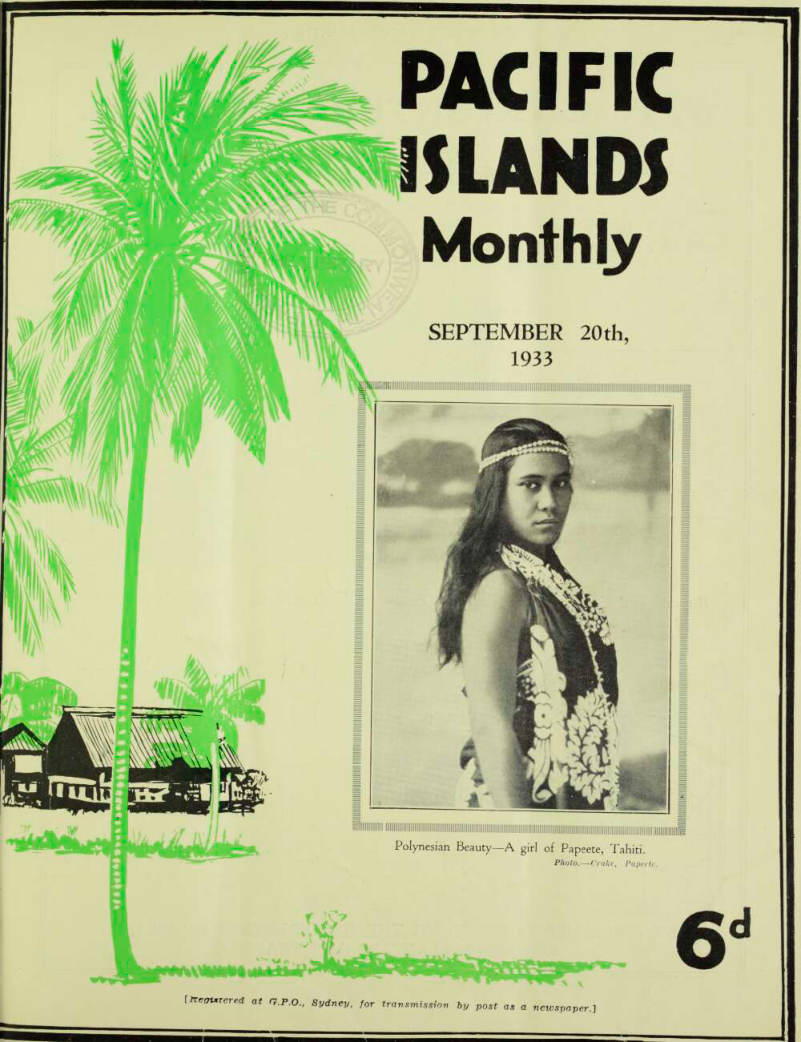
Pacific
ISLANDS
Monthly
SEPTEMBER 20th,
1933
6 d
[Registered at G.P.O., Sydney, for transmission by post as a newspaper.]
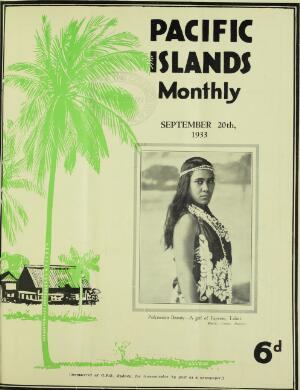
Polynesian Beauty—A girl of Papeete, Tahiti.
Photo. — Crake, Papeete.
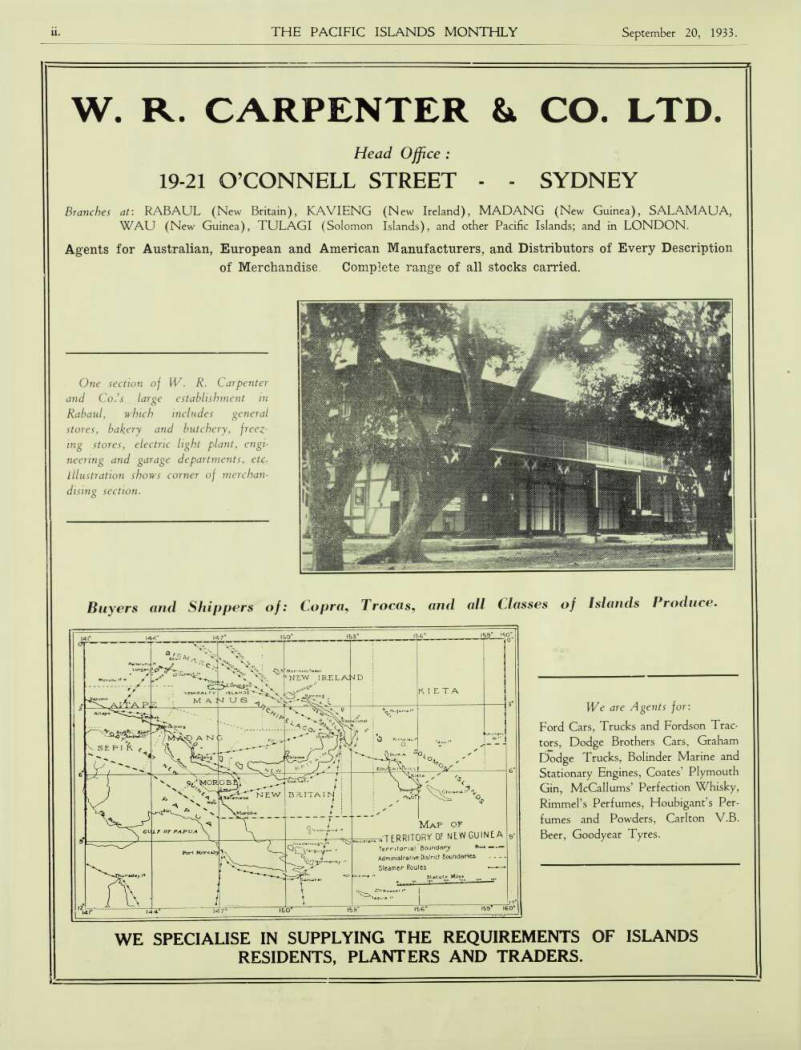
W. R. Carpenter & Co. Ltd.
Head Office :
19-21 O’CONNELL STREET - SYDNEY
Branches at: RABAUL (New Britain), KAVIENG (New Ireland), MADANG (New Guinea), SALAMAUA, WAU (New Guinea), TULAGI (Solomon Islands), and other Pacific Islands; and in LONDON.
Agents for Australian, European and American Manufacturers, and Distributors of Every Description of Merchandise. Complete range of all stocks carried.
One section of W. R. Carpenter and Co.’s large establishment in Rabaul, which includes general stores, bakery and butchery, freez ing stores, electric light plant, engi neering and garage departments, etc.
Illustration shows corner of merchan dising section.
Buyers and Shippers of: Copra , Trocas, and all Classes of Islands Produce.
We are Agents for: Ford Cars, Trucks and Fordson Trac tors, Dodge Brothers Cars, Graham Dodge Trucks, Bolinder Marine and Stationary Engines, Coates’ Plymouth Gin, McCallums’ Perfection Whisky, Rimmel’s Perfumes, Houbigant’s Per fumes and Powders, Carlton V.B.
Beer, Goodyear Tyres.
WE SPECIALISE IN SUPPLYING THE REQUIREMENTS OF ISLANDS
RESIDENTS, PLANTERS AND TRADERS.
Pacific Islands Travellers
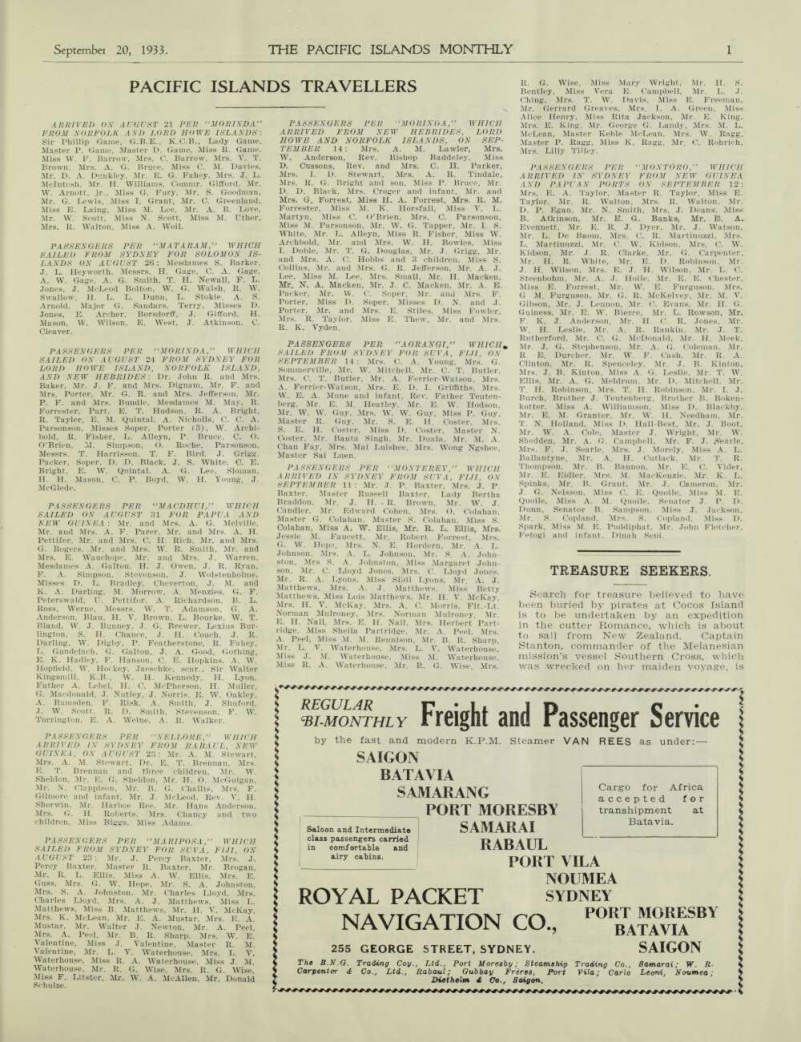
Arrived On August 21 Per "Morinda”
FROM NORFOLK AND LORD HOWE ISLANDS : Sir Phillip Game, G.B.E., K.C.B., Lady Game, Master P. Game, Master D. Game, Miss R. Game, Miss W. F. Barrow, Mrs. C. Barrow, Mrs. V. T.
Brown, Mrs. A. G. Bruce, Miss C. M. Davies, Mr. D. A. Dunkley, Mr. E. G. Fahey, Mrs. J. L.
McIntosh, Mr. H. Williams, Commr. Gifford, Mr.
W. Arnott, jr., Miss G. Fury, Mr. S. Goodman, Mr. G. Lewis, Miss I. Grant, Mr. C. Greenland, Miss E. Laing, Miss M. Lee, Mr. A. R. Love, Mr. W. Scott, Miss N. Scott, Miss M. Uther, Mrs. R. Walton, Miss A. Weil.
Passengers Per “Mataram,” Which
Sailed From Sydney For Solomon Is-
LANDS ON AUGUST 26: Mesdames S. Barker, J. L. Heyworth, Messrs. H. Gage, C. A. Gage, A. W. Gage, A. G. Smith, T. H. Newall, F. L.
Jones, J. McLeod Bolton, W. G. Walsh, R. W.
Swallow. H. L. L. Dunn, L. Stokie, A. S.
Arnold, Major G. Sandars, Terry, Misses D.
Jones, E. Archer, Borsdorff, J. Gifford, H.
Mason, W. Wilson, E. West, J. Atkinson, C.
Cleaver.
Passengers Per “Morinda," Which
SAILED ON AUGUST 24 FROM SYDNEY FOR
Lord Howe Island, Norfolk Island,
AND NEW HEBRIDES : Dr. John R. and Mrs.
Baker, Mr. J. F. and Mrs. Dignam, Mr. F. and Mrs. Porter, Mr. G. R. and Mrs. Jefferson, Mr.
P. F. and Mrs. Bundle, Mesdames M. May, R.
Forrester, Part, E. T. Hudson, R. A. Bright, R. Tayler, E. M. Quintal, A. Nicholls, C. C. A.
Parsonson, Misses Soper, Porter (3), W. Archi bold, R. Fisher. L. Alleyn, P. Bruce, C. O.
O’Brien, M. Simpson, O. Roche, Parsonson, Messrs. T. Harrisson, T. F. Bird. J. Grigg, Packer, Soper, D. D. Black, J. S. White, C. E.
Bright, E. W. Quintal, A. G. Lee. Sloman.
H. H. Mason, C. P. Boyd, W. H. Young, J.
McGlede.
Passengers Per “Macdhui,” Which
SAILED ON AUGUST 31 FOR PAPUA AND NEW GUINEA : Mr. and Mrs. A. G. Melville, Mr. and Mrs. A. F. Parer, Mr. and Mrs. A. H.
Pettifer, Mr. and Mrs. C. H. Rich, Mr. and Mrs.
G. Rogers, Mr. and Mrs. W. R. Smith, Mr. and Mrs. E. Wauchope, Mr. and Mrs. J. Warren, Mesdames A. Galton, H. J. Owen, J. R. Ryan, F. A. Simpson, Stevenson, J. Wolstenholme, Misses D. L. Bradley, Cheverton, J. M. and K. A. Darling, M. Morrow, A. Menzies, G. F.
Peterswald, U. Pettifer, A. Richardson, B. L.
Ross, Werne, Messrs. W. T. Adamson, G. A.
Anderson, Blau, H. V. Brown, L. Bourke, W. T.
Bland, W. J. Bunney, J. G. Brewer, Lexius Bur lington, S. H. Chance, J. H. Couch, J. R.
Darling, W. Digby, P. Featherstone, R. Fahey, L. Gundelach, G. Galton, J. A. Good, Gothing, E. K. Hadley, F. Hanson, C. E. Hopkins. A. W.
Hopfleld, W. Hockey, Jaeschke, senr., Sir Walter Kingsmill, K. R., W. H. Kennedy, H. Lyon, Father A. Lebel, H. C. McPherson, H. Muller, G. Macdonald, J. Nutley, J. Norris, E. W. Oakley, A. Ramsden, F. Risk, A. Smith, J. Shuford, J. W. Scott, R. D. Smith, Stevenson, F. W.
Torrington, E. A. Weine, A. R. Walker.
Passengers Per “Nellore," Which
Arrived In Sydney From Rabaul, New
GUINEA, ON AUGUST 23: Mr. A. M. Stewart, Mrs. A. M. Stewart, Dr. E. T. Brennan. Mrs.
E. T. Brennan and three children, Mr. W.
Sheldon, Mr. E. G. Sheldon, Mr. H. O. McGuigan, Mr. N. Clappison, Mr. B. G. Challis, Mrs. F.
Gilmore and infant, Mr. J. McLeod, Rev. V. H.
Sherwin, Mr. Harboe Ree, Mr. Hans Anderson, Mrs. G. H. Roberts. Mrs. Chancy and two children, Miss Biggs, Miss Adams.
Passengers Per “Mariposa," Which
SAILED FROM SYDNEY FOR SUVA, FIJI, ON AUGUST 23: Mr. J. Percy Baxter, Mrs. J.
Percy Baxter, Master R. Baxter, Mr. Brogan, Mr. R. L. Ellis, Miss A. W. Ellis, Mrs. E.
Guss, Mrs. G. W. Hope, Mr. S. A. Johnston, Mrs. S. A. Johnston, Mr. Charles Lloyd, Mrs.
Charles Lloyd, Mrs. A. J. Matthews, Miss L.
Matthews, Miss B. Matthews, Mr. H. V. McKay, Mrs. K. McLean, Mr. E. A. Mustar, Mrs. E. A.
Mustar, Mr. Walter J. Newton, Mr. A. Peel, Mrs. A. Peel, Mr. B. R. Sharp, Mrs. W. E.
Valentine, Miss J. Valentine, Master R. M.
Valentine, Mr. L. V. Waterhouse, Mrs. L. V.
Waterhouse, Miss R. A. Waterhouse, Miss J. M.
Waterhouse, Mr. R. G. Wise, Mrs. R. G. Wise, Miss F. Litster, Mr. W. A. McAllen, Mr. Donald Schulze.
Passengers Per ‘"Morinda,” Which
Arrived From New Hebrides, Lord
Howe And Norfolk Islands, On Sep
TEMBER 14: Mrs. A. M. Lawler, Mrs.
W. Anderson, Rev. Bishop Baddeley, Miss D. Cussons, Rev. and Mrs. C. H. Parker, Mrs. I. D. Stewart, Mrs. A. R. Tindale, Mrs. R. G. Bright and son, Miss P. Bruce, Mr.
D. D. Black, Mrs. Croger and infant, Mr. and Mrs. G. Forrest, Miss H. A. Forrest, Mrs. R. M.
Forrester, Miss M. K. Horsfall, Miss V. L.
Martyn, Miss C. O’Brien, Mrs. C. Parsonson, Miss M. Parsonson, Mr. W. G. Tapper, Mr. I. S.
White, Mr. L. Alleyn, Miss R. Fisher, Miss W.
Archbold, Mr. and Mrs. W. H. Bowles, Miss I. Doble, Mr. T. G. Douglas, Mr. J. Grigg, Mr. and Mrs. A. C. Hobbs and 3 children, Miss S.
Collins, Mr. and Mrs. G. R. Jefferson, Mr. A. J.
Lee, Miss M. Lee, Mrs. Small, Mr. H. Macken, Mr. N. A. Macken, Mr. J. C. Macken, Mr. A. E.
Packer, Mr. W. C. Soper, Mr. and Mrs. F.
Porter, Miss D. Soper, Misses D. N. and J.
Porter, Mr. and Mrs. E. Stiles, Miss Fowler, Mrs. R. Taylor, Miss E. Thew, Mr. and Mrs.
R. K. Vyden.
Passengers Per “Aorangi,” Which *
SAILED FROM SYDNEY FOR SUVA, FIJI, ON SEPTEMBER 14: Mrs. C. A. Young, Mrs. G.
Sommerville, Mr. W. Mitchell, Mr. C. T. Butler, Mrs. C. T. Butler, Mr. A. Ferrier-Watson, Mrs.
A. Ferrier-Watson, Mrs. E. D. I. Griffiths, Mrs.
W. E. A. Mune and infant, Rev. Father Teuten berg, Mr. E. M. Heatley, Mr. E. W. Hodson, Mr. W. W. Guy, Mrs. W. W. Guy, Miss P. Guy, Master R. Guy, Mr. S. E. H. Coster, Mrs.
S. E. H. Coster, Miss D. Coster, Master N.
Coster, Mr. Banta Singh, Mr. Duala, Mr. M. A.
Chan Fay, Mrs. Mai Luishee, Mrs. Wong Ngshee, Master Sai Luen.
Passengers Per “Monterey,” Which
ARRIVED IN SYDNEY FROM SUVA, FIJI, ON SEPTEMBER 11 : Mr. J. P. Baxter, Mrs. J. P.
Baxter, Master Russell Baxter, Lady Bertha Braddon, Mr. J. H. .R. Brown, Mr. W. J.
Candler, Mr. Edward Cohen, Mrs. O. Colahan, Master G. Colahan, Master S. Colahan, Miss S.
Colahan, Miss A. W. Ellis, Mr. R. L. Ellis, Mrs.
Jessie M. Faucett, Mr. Robert Forrest, Mrs.
G. W. Hope, Mrs. N. E. Hordern, Mr. A. L.
Johnson, Mrs. A. L. Johnson, Mr. S. A. Johnston, Mrs S. A. Johnston, Miss Margaret John son, Mr. C. Lloyd Jones, Mrs. C. Lloyd Jones, Mr. R. A. Lyons, Miss Sibil Lyons, Mr. A. J.
Matthews, Mrs. A. J. Matthews, Miss Betty Matthews, Miss Lois Matthews, Mr. H. V. McKay, Mrs. H. V. McKay, Mrs. A. C. Morris, Flt.-Lt.
Norman Mulroney, Mrs. Norman Mulroney. Mr.
E. H. Nail, Mrs. E. H. Nail, Mrs. Herbert Part ridge, Miss Sheila Partridge, Mr. A. Peel, Mrs.
A. Peel, Miss M. M. Reunison, Mr. B. R. Sharp, Mr. L. V. Waterhouse, Mrs. L. V. Waterhouse, Miss J. M. Waterhouse, Miss M. Waterhouse, Miss R. A. Waterhouse, Mr. R. G. Wise, Mrs.
R. G. Wise, Miss Mary Wright, Mr. H. S.
Bentley, Miss Vera E. Campbell, Mr. L. J.
Ching, Mrs. T. W. Davis, Miss E. Freeman, Mr. Gerrard Greaves, Mrs. I. A. Green, Miss Alice Henry, Miss Rita Jackson, Mr. E. King, Mrs. E. King, Mr. George G. Landy, Mrs. M. L.
McLean, Master Keble McLean, Mrs. W. Ragg, Master P. Ragg, Miss K, Ragg, Mr. C. Rohrich, Mrs. Lilly Tilley.
Passengers Per "Montoro," Which
Arrived In Sydney From New Guinea
AND PAPUAN PORTS ON SEPTEMBER 12 : Mrs. B. A. Taylor, Master R. Taylor, Miss E.
Taylor, Mr. R. Walton, Mrs. R. Walton, Mr.
D. P. Egan, Mr. N. Smith, Mrs. J. Deans, Miss B. Atkinson, Mr. E. G. Banks, Mr. E. A.
Evennett, Mr. E. R. J. Dyer, Mr. J. Watson, Mr. L. De Baom, Mrs. C. R. Martinuzzi, Mrs.
L. Martinuzzi, Mr. C. W. Kidson, Mrs. C. W.
Kidson, Mr. J. R. Clarke, Mr. G. Carpenter, Mr. H. R. White, Mr. E. D. Robinson, Mr.
J. H. Wilson, Mrs. E. J. H. Wilson, Mr. L. C.
Steenbohm, Mr. A. J. Hoile, Mr. E. E. Chester, Miss E. Forrest, Mr. W. E. Furguson, Mrs.
G M. Furguson, Mr. G. R. McKelvey, Mr. M. V.
Gibson, Mr. J. Lennon, Mr. O. Evans, Mr. H. G.
Guiness, Mr. E. W. Bierre, Mr. L. Rowson, Mr.
F. K. J. Anderson, Mr. H. C. R. Jones, Mr.
W. H. Leslie, Mr. A. R. Rankin, Mr. J. T.
Rutherford, Mr. C. G. McDonald, Mr. H. Meek, Mr. J. G. Stephenson, Mr. A. G. Coleman, Mr.
R E. Durcher, Mr. W. F. Cash, Mr. R. A.
Clinton, Mr. R. Spenceley, Mr. J. B. Kinton, Mrs. J. B. Kinton, Miss A. G. Leslie, Mr. T. W.
Ellis, Mr. A. G. Meldrum, Mr. D. Mitchell, Mr.
T. H. Robinson, Mrs. T. H. Robinson, Mr. I. J.
Burch, Brother J. Teutenberg, Brother B. Boken kotter, Miss A. Williamson, Miss D. Blackby, Mr. E. M. Granter, Mr. W. H. Needham, Mr.
T. N. Holland, Miss D. Hall-Best, Mr. J. Boot, Mr. W. A. Cole, Master J. Wright, Mr. W.
Shedden, Mr. A. G. Campbell, Mr. F. J. Searle, Mrs. F. J. Searle, Mrs. J. Merely, Miss A. L.
Ballantyne, Mr. A. H. Cutlack, Mr. T. R.
Thompson, Mr. B. Bannon, Mr. E. C. Vider, Mr. E. Eidler, Mrs. M. Mackenzie, Mr. K. L.
Spinks, Mr. B. Grant, Mr. J. Cameron, Mr.
J. G. Nelsson, Miss C. E. Quoile, Miss M. E.
Quoile, Miss A. M. Quoile, Senator J. P. D.
Dunn, Senator B. Sampson, Miss J. Jackson, Mr. S. Copland. Mrs. S. Copland, Miss D.
Spark, Miss M. E. Puddiphat, Mr. John Fletcher, Fetogi and infant, Dinah Seni.
Treasure Seekers.
Search for treasure believed to have been buried by pirates at Cocos Island is to be undertaken by an expedition in the cutter Romance, which is about to sail from New Zealand. Captain Stanton, commander of the Melanesian mission’s vessel Southern Cross, which was wrecked on her maiden voyage, is
Advertisements & other items, p. 3 (1 item)
REGULAR BI-MONTHLY Freight and Passenger Service
by the fast and modern K.P.M. Steamer VAN REES as under:
SAIGON
BATAVIA
SAMARANG
PORT MORESBY
SAMARAI
RABAUL
Saloon and Intermediate class passengers carried in comfortable and airy cabins.
Cargo for Africa accepted for transhipment at Batavia.
ROYAL PACKET
NAVIGATION CO.,
PORT VILA
NOUMEA
SYDNEY
PORT MORESBY
BATAVIA
255 GEORGE STREET, SYDNEY.
SAIGON
The B.N.G. Trading Coy., Ltd., Port Moresby; Steamship Trading Co., Samarai; W. R.
Carpenter & Co., Ltd., Rabaul; Gubbay Freres, Port Vila; Carlo Leoni, Noumea; Diethelm & Co., Saigon.
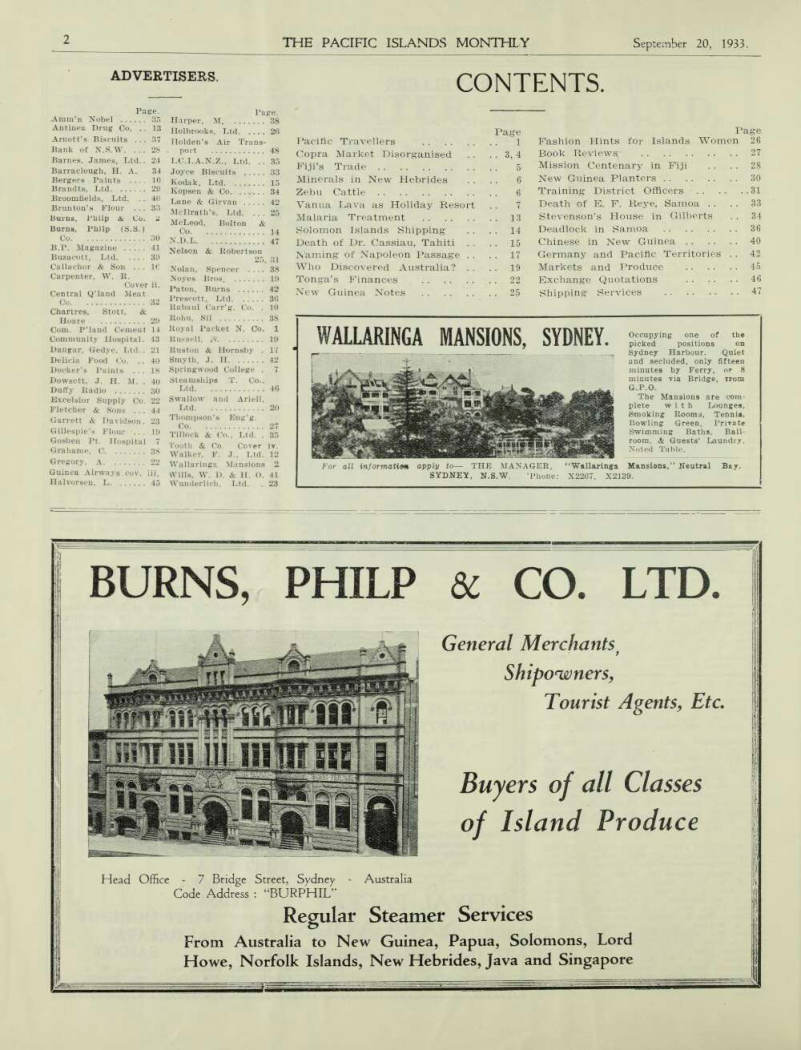
Advertisers.
Page.
Amm’n Nobel 35 Antinea Drug Co. .. 13 Arnott’s Biscuits ... 37 Bank of N.S.W. ... 28 Barnes, James, Ltd.. 24 Barraclough, H. A. 34 Bergers Paints 10 Brandts, Ltd 29 Broomfields, Ltd. .. 40 Brunton’s Flour ... 33 Burns, Philp & Co. 2 Burns, Philp (S.S.) Co 30 B.P. Magazine 41 Buzacott, Ltd 39 Callachor & Son ... 1C Carpenter, W. E.
Cover ii- Central Q'land Meat Chartres, Stott. & Hoare 29 Com. P’land Cement 14 Community Hospital. 43 Dangar, Gedye, Ltd.. 21 Delicia Food Co. .. 40 Docker’s Paints ... 18 Dowsett, J. H. M. . 40 Duffy Radio 30 Excelsior Supply Co. 22 Fletcher & Sons ... 44 Garrett & Davidson. 23 Gillespie’s Flour ... 19 Goshen Pt. Hospital 7 Grahame, C 38 Gregory, A 22 Guinea Airways cov. iii.
Halvorsen, L. 45
Page.
Harper, M 38 Holbrooks, Ltd 26 Holden’s Air Trans port 48
I.C.I.A.N.Z., Ltd. .. 33
Joyce Biscuits 33 Kodak, Ltd 15 Kopsen & Co 34 Lane & Girvan 42 McIlrath . Ltd ... 25 McLeod, Bolton & Co 14
N.D.L. 47
Nelson & Robertson 25, 31 Nolan, Spencer ... 38 Noyes Bros. 19 Paton, Burns 42 Prescott LM 30 Rabaul Carr'g. Co. 10 Rohu, Sil 38 Royal Packet N. Co. 1 Russell, S. 19 Ruston & Hornsby. 17 Smyth, J. H 42 Springwood College . 7 Steamships T. Co., Ltd. 46 Swallow and Ariell, Ltd 20 Thompson's Eng’g.
Co. 27 Tillock & Co., Ltd. . 35 Tooth & Co. Cover iv.
Walker, F. J., Ltd. 12 Wallaringa Mansions 2 Wills, W. D. & H. O. 41 Wunderlich. Ltd. . 23
Contents.
Page Pacific Travellers 1 Copra Market Disorganised . . . . 3, 4 Fiji’s Trade . . 5 Minerals in New Hebrides . . . . 6 Zebu Cattle 6 Vanua Lava as Holiday Resort .. 7 Malaria Treatment 13 Solomon Islands Shipping . . . . 14 Death of Dr. Cassiau, Tahiti .. . . 15 Naming of Napoleon Passage . . . . 17 Who Discovered Australia? . . . . 19 Tonga’s Finances 22 New Guinea Notes 25
Page Fashion Hints for Islands Women 26 Book Reviews 27 Mission Centenary in Fiji . . .. 28 New Guinea Planters 30 Training District Officers 31 Death of E. F. Reye, Samoa . . .. 33 Stevenson’s House in Gilberts . . 34 Deadlock in Samoa 36 Chinese in New Guinea 40 Germany and Pacific Territories .. 42 Markets and Produce 45 Exchange Quotations 46 Shipping Services 47
Advertisements & other items, p. 4 (1 item)
advt
BURNS, PHILP & CO. LTD.
General Merchants
Shipowners,
Tourist Agents, Etc.
Buyers of all Classes
of Island Produce
Head Office - 7 Bridge Street, Sydney - Australia Code Address : “BURPHIL"
Regular Steamer Services From Australia to New Guinea, Papua, Solomons, Lord Howe, Norfolk Islands, New Hebrides, Java and Singapore
The Pacific Islands Monthly
THE NEWSPAPER - MAGAZINE OF THE SOUTH SEAS [Registered at G.P.O., Sydney, for transmission by post as a newspaper.]
Published Once Each Month and Circulated in Australia and New Zealand and in the following Pacific Territories and Island Groups:
Crown Colony of Fiji.
Australian Territory of Papua.
Mandated Territory (Australia) of New Guinea, Bismarck Archipelago, and Northern Solo mon Islands.
Mandated Territory (Japan) of Marshall, Caro line and Mariana Islands.
American Territory of Guam.
Mandated Territory of Nauru.
British Crown Colony of Gilbert and Ellice Islands.
French Territory of New Caledonia.
British and French Condominium of New Hebrides.
American Territory of Eastern Samoa.
Mandated Territory (New Zealand) of Samoa.
British Solomon Islands Protectorate.
British Protectorate of Tongan Islands New Zealand Territory of Cook Islands.
Australian Territory of Norfolk Island.
French Colony of Oceania (Tahiti, etc.) American Territory of Hawaiian Islands.
Owned and Produced by ‘Pacific Publications Ltd., Union House, 247 George Street, Sydney
Telephone Bw 5037
P.O. Box 3408 R
Editor and Publisher:
R. W. Robson.
Registered Address for Radiograms and Cables: “PACPUB” Sydney
Contributions
Articles, Stories and Photographs dealing with Pacific Islands Subjects are invited, and will be paid for on publication at usual rates.
Subscription Rates
Per Annum, within Postal Convention Territories, Prepaid, Post Free 6/- Per Annum elsewhere, Prepaid, Post Free 8/- Single Copies 6d.
Advertisements
Advertising rates furnished on application.
Colours, etc. by Arrangement Process Blocks made at Advertiser’s expense when required. Screen, 100.
Changes of Advertising Copy should reach this Office by 8th of each month, otherwise previous advertisement may be repented.
Agcnts
The following are authorised to receive sub scriptions for The Pacific Islands Monthly — Islands Branches of Burns, Philp & Co., Ltd., and Burns, Philp (South Seas) Co., Ltd.
Islands Branches of W. R. Carpenter & Co., Ltd.
All Branches of Morris, Hedstrom & Co., Ltd.
J. H. MacGregor Dowsett, Rabaul.
Whitten Bros., Ltd., Port Moresby & Samarai.
All Branches and Representatives of W. H.
Grove & Sons, Ltd., Auckland.
S. Russell, Papeete, Tahiti.
Cook Islands Trading Co., Rarotonga.
Mrs. M. Campbell. Cascades, Norfolk Island.
Vol. IV. No. 2.
Sydney, September 20, 1933.
Price {6d. Per Copy.
Prepaid 6/- p.s.
New French Tax Disorganises Copra Market
COPRA, during the last four weeks, has fallen in value to levels never before recorded, and the con dition of the market now can only be described as calamitous. The table of figures published on page 45, compiled from the London quo tations printed in “The Sydney Morning Herald” every Monday, shows what has happened since January, 1931—two or three collapses to about £10 per ton, with corresponding recoveries to about £14, and then, since mid-August, a startling fail.
The London price, since March last, had been dragging around £10/10/- per ton (sterling), which returned a bare margin of profit to growers. Writing last month, we said that the position was the worst in the history of the industry; but that coconut growers might at least take comfort in the fact that the market had reached “absolute bot
tom”—and that, as the position could not be worse, it might con ceivably get better. But it is worse.
A new, unexpected factor has come into the situation; the price has fallen still further, to around £9 per ton, and the position of the copra producer now is tragic indeed.
The new factor is the aggressive nationalism of France. The French Government quite suddenly has im posed an import duty of about 35/per ton on all copra entering that country, with the result that the European market has been com pletely disorganised and partially paralysed. We have very few de tails of this new development. On two or three occasions, a few months ago, our Tahiti correspon dent said that the French Govern ment was contemplating some action of the sort, with a view to giving a special preference, or pay ing a special bonus, to producers of
copra in French territories; but no one appeared to think that such a step was seriously contemplated, and no notice was taken.
About the second week in Au gust, the European market became more seriously disorganised, and it was announced that there was prac tically no sale at all for smoke cured copra. Then came a bald statement of a dozen words, simply saying that the new French tax had paralysed the Marseilles market, to which is sent most of the smoked copra from the South Seas. That is about all that is known at the moment of writing; but it is pos sible to outline fairly clearly what has happened. Our unfortunate copra-growers have been caught in the seething whirplool of inter national hates and jealousies.
France, in pursuance of her savagely retaliatory fiscal policy, has determined to employ against
the British Empire the weapon that is given to her in the fact that about one-fifth of the world’s copra pro duction is marketed in Marseilles.
France remains on the gold standard; Great Britain’s currency is some 20 per cent, under gold; the currencies of Australia and New Zealand are 25 per cent, and of Fiji 10 per cent, under sterling, and 45 per cent, and 30 per cent, respec tively under gold. That, obviously, has given British Empire copra growers a corresponding exchange advantage over French planters.
France is the leader of the gold bloc, and is deeply resentful of the exchange premium enjoyed by British exporters—in fact, if one thing more than another wrecked the World Economic Conference, and plunged the world into this disastrous era of aggressive nation alism, it was the determination of the French financiers to protect and maintain the gold standard, at all costs. France, in pursuance of her fiscal policy, is extremely sensitive on the matter of tariffs; and, if she resented Britain’s abandonment of free-trade and of the gold standard, she resented even more the British Imperial sentiment to which ex pression was given at Ottawa.
Therefore, this copra duty, while disconcerting in the extreme, is logical enough from the French man’s point of view, and should not have been unexpected.
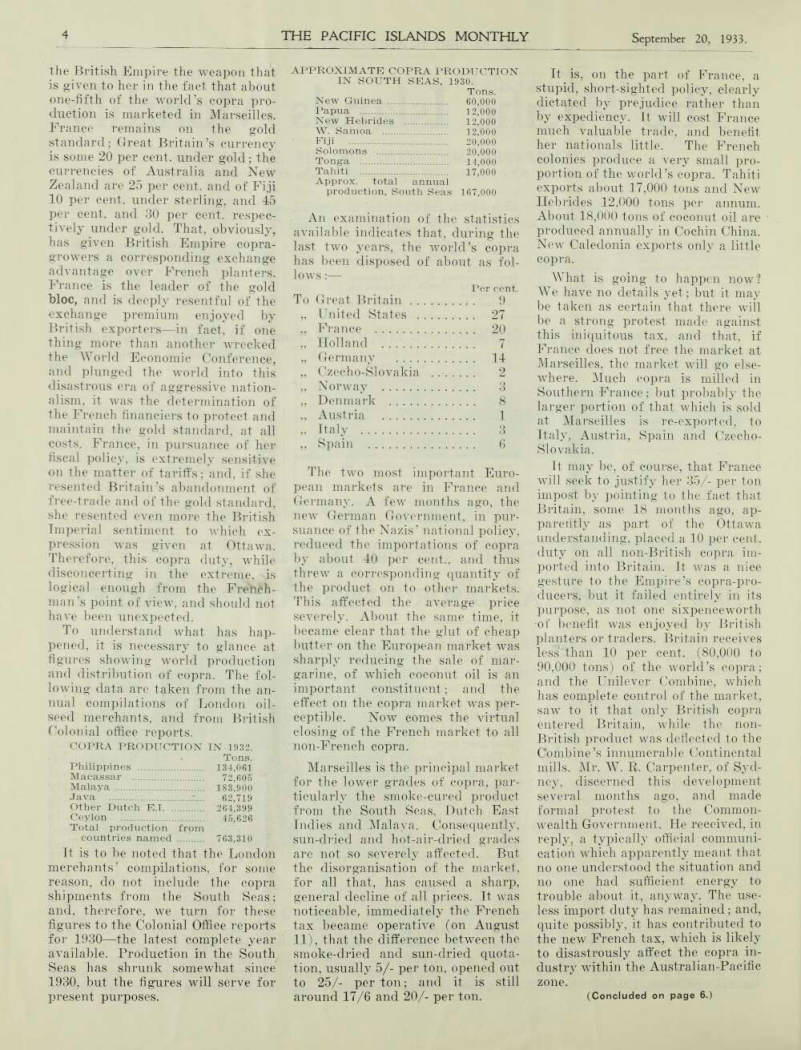
To understand what has hap pened, it is necessary to glance at figures showing world production and distribution of copra. The fol lowing data are taken from the an nual compilations of London oil seed merchants, and from British Colonial office reports.
Copra Production In 1932.
It is to be noted that the London merchants’ compilations, for some reason, do not include the copra shipments from the South Seas; and, therefore, we turn for these figures to the Colonial Office reports for 1930—the latest complete year available. Production in the South Seas has shrunk somewhat since 1930, but the figures will serve for present purposes.
Approximate Copra Production
In South Seas, 1930.
An examination of the statistics available indicates that, during the last two years, the world’s copra has been disposed of about as fol lows :
The two most important Euro pean markets are in France and Germany. A few months ago, the new German Government, in pur suance of the Nazis’ national policy, reduced the importations of copra by about 40 per cent., and thus threw a corresponding quantity of the product on to other markets.
This affected the average price severely. About the same time, it became clear that the glut of cheap butter on the European market was sharply reducing the sale of mar garine, of which coconut oil is an important constituent; and the effect on the copra market was per ceptible. Now comes the virtual closing of the French market to all non-French copra.
Marseilles is the principal market for the lower grades of copra, par ticularly the smoke-cured product from the South Seas, Dutch East Indies and Malaya. Consequently, sun-dried and hot-air-dried grades are not so severely affected. But the disorganisation of the market, for all that, has caused a sharp, general decline of all prices. It was noticeable, immediately the French tax became operative (on August 11), that the difference between the smoke-dried and sun-dried quota tion, usually 5/- per ton, opened out to 25/- per ton; and it is still around 17/6 and 20/- per ton.
It is, on the part of France, a stupid, short-sighted policy, clearly dictated by prejudice rather than by expediency. It will cost France much valuable trade, and benefit her nationals little. The French colonies produce a very small pro portion of the world’s copra. Tahiti exports about 17,000 tons and New Hebrides 12,000 tons per annum.
About 18,000 tons of coconut oil are produced annually in Cochin China.
New Caledonia exports only a little copra.
What is going to happen now?
We have no details yet; but it may be taken as certain that there will be a strong protest made against this iniquitous tax, and that, if France does not free the market at Marseilles, the market will go else where. Much copra is milled in Southern France; but probably the larger portion of that which is sold at Marseilles is re-exported, to Italy, Austria, Spain and Czecho slovakia.
It may be, of course, that France will seek to justify her 35/- per ton impost by pointing to the fact that Britain, some 18 months ago, ap parently as part of the Ottawa understanding, placed a 10 per cent, duty on all non-British copra im ported into Britain. It was a nice gesture to the Empire’s copra-pro ducers, but it failed entirely in its purpose, as not one sixpenceworth of benefit was enjoyed by British planters or traders. Britain receives less than 10 per cent. (80,000 to 90,000 tons) of the world’s copra; and the Unilever Combine, which has complete control of the market, saw to it that only British copra entered Britain, while the non- British product was deflected to the Combine’s innumerable Continental mills. Mr. W. R. Carpenter, of Syd ney, discerned this development several months ago, and made formal protest to the Common wealth Government. He received, in reply, a typically official communi cation which apparently meant that no one understood the situation and no one had sufficient energy to trouble about it, anyway. The use less import duty has remained; and, quite possibly, it has contributed to the new French tax, which is likely to disastrously affect the copra in dustry within the Australian-Pacific zone.
(Concluded on page 6.)
Tons.
Philippines 134,061 Macassar 72,605 Malaya 183,900 Java 62,719 Other Dutch EJ 264,399 Ceylon 45,626 Total production from countries named 763,310
Tons.
New Guinea 60,000 Papua 12,000 New Hebrides 12,000 W. Samoa 12,000 20,000 Solomons 20,000 Tonga 14,000 Tahiti 17,000 Approx. total annual production, South Seas 167,000
To Great Britain 9 Per cent. ,, United States ... 27 ,, France 20 ,, Holland 7 ,, Germany 14 ,, Czechoslovakia 2 ,, Norway 3 ,, Denmark 8 ,, Austria 1 ,, Italy 3 ,, Spain 6
A section of copra-producers who probably will be hard hit are the Dutch. Much copra from the East Indies goes to Marseilles. The British producers at least have the exchange premium as a set-off against the new tax; but the Dutch, who so far have adhered steadily to the gold standard, have no such protection.
It is to be hoped that Australian copra interests will lose no time in dealing with the position in a broad, general way. Clearly, it is one that calls for the attention of the British Government. It may be that if the useless British import duty were re moved, France would make a simi lar concession. Or, if not, it might be wise to remove the British tax, anyway, and give the copra indus try a chance to re-establish, in Lon don, the market and distributing centre which the French are likely to drive away from Marseilles.
Whatever is done should be done quickly. With the latest disorgan isation of the market, the South Sea copra-growers face a very black horizon. They all were hanging on, very courageously, in the belief that the position could not get worse.
Now, it definitely is worse.
Fiji’S Wealth.
Export Trade Figures Increased Again.
THE famous “rich uncle in Fiji” is becoming something more than a phantasy.
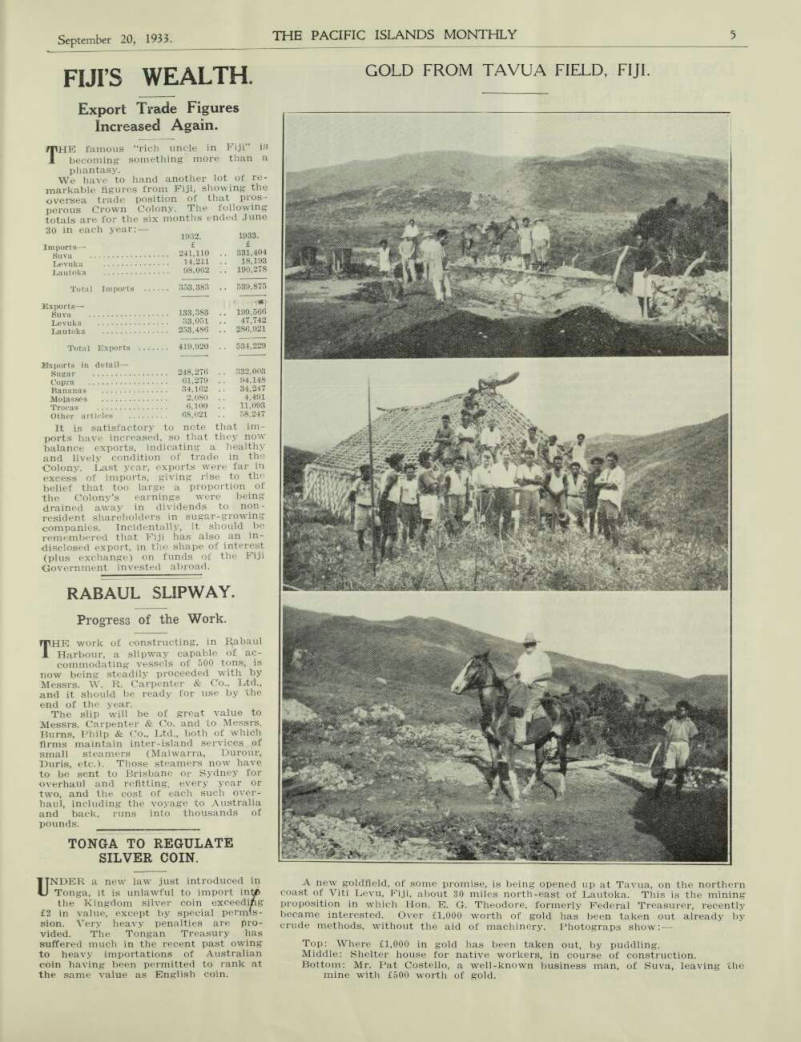
We have to hand another lot of remarkable figures from Fiji, showing the oversea trade position of that prosperous Crown Colony. The following totals are for the six months ended June 30 in each year;
It is satisfactory to note that imports have increased, so that they now balance exports, indicating a healthy and lively condition of trade in the Colony. Last year, exports were far in excess of imports, giving rise to the belief that too large a proportion of the Colony’s earnings were being drained away in dividends to nonresident shareholders in sugar-growing companies. Incidentally, it should be remembered that Fiji has also an in disclosed export, in the shape of interest (plus exchange) on funds of the Fiji Government invested abroad.
Imports— 1932. £ Suva ... 241,110 . . 331,404 1933. £ Levuka 14,211 . 18,193 Lautoka 98,062 . . 190,278 Total Imports . . . ... 353,383 . . 539,875 Exports— Suva . .. 133,383 . . 199,566 Levuka Lautoka ... 33,051 . 47,742 Lautoka . .. 253,486 . . 286,921 Total Exports ... . .. 419,920 , . 534,229 Exports in detail — Sugar ... 248,276 . . 332,003 Copra 61.279 . 94,148 Bananas . . . 34,162 . 34,247 Molasses 2,080 . 4,491 Trocas 6,100 . 11,093 Other articles 68,021 . 58,247
Rabaul Slipway.
Progress of the Work.
THE work of constructing, in Rabaul Harbour, a slipway capable of ac commodating vessels of 500 tons, is now being steadily proceeded with by Messrs. W. R. Carpenter & Co., Ltd,, and it should be ready for use by the end of the year.
The slip will be of great value to Messrs. Carpenter & Co. and to Messrs.
Burns, Philp & Co., Ltd., both of which firms maintain inter-island services of small steamers (Maiwarra, Durour, Duris, etc.). Those steamers now have to be sent to Brisbane or Sydney for overhaul and refitting, every year or two, and the cost of each such over haul, including the voyage to Australia and back, runs into thousands of pounds.
Tonga To Regulate
Silver Coin.
UNDER a new law just introduced in Tonga, it is unlawful to import into the Kingdom silver coin exceeding £2 in value, except by special permis sion. Very heavy penalties are pro vided. The Tongan Treasury has suffered much in the recent past owing to heavy importations of Australian coin having been permitted to rank at the same value as English coin.
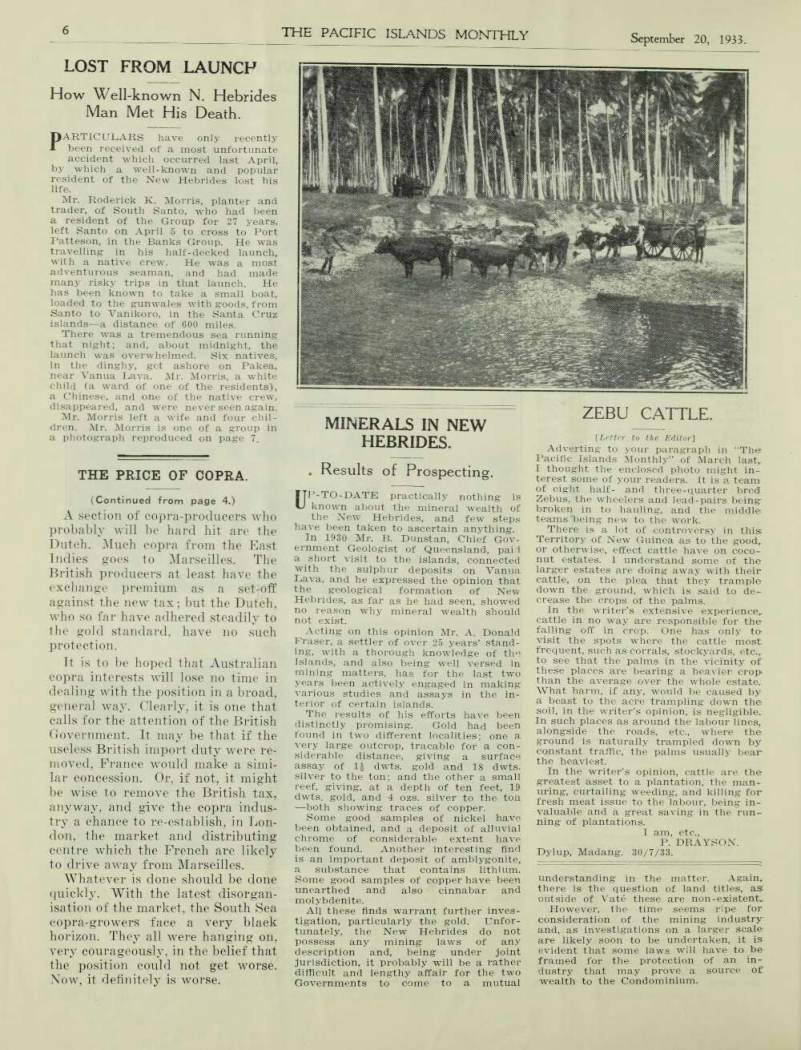
Gold From Tavua Field, Fiji.
A new goldfield, of some promise, is being opened up at Tavua, on the northern coast of Viti Leva, Fiji, about 30 miles north-east of Lautoka. This is the mining proposition in which Hon. E. G. Theodore, formerly Federal Treasurer, recently became interested. Over £1,000 worth of gold has been taken out already by crude methods, without the aid of machinery. Photograps show:- Top: Where £1,000 in gold has been taken out, by puddling.
Middle: Shelter house for native workers, in course of construction.
Bottom: Mr. Pat Costello, a well-known business man, of Suva, leaving the mine with £500 worth of gold.
How Well-known N. Hebrides
Lost From Launch
How Well-known N. Hebrides Man Met His Death.
PARTICULARS have only recently been received of a most unfortunate accident which occurred last April, by which a well-known and popular resident of the New Hebrides lost his life.
Mr. Roderick K. Morris, planter and trader, of South Santo, who had been a resident of the Group for 27 years, left Santo on April 5 to cross to Port Patteson, in the Banks Group. He was travelling in his half-decked launch, with a native crew. He was a most adventurous seaman, and had made many risky trips in that launch. He has been known to take a small boat, loaded to the gunwales with goods, from Santo to Vanikoro, in the Santa Cruz islands—a distance of 600 miles.
There was a tremendous sea running that night; and, about midnight, the launch was overwhelmed. Six natives, in the dinghy, got ashore on Pakea, near Vanua Lava. Mr. Morris, a white child (a ward of one of the residents), a Chinese, and one of the native crew, disappeared, and were never seen again.
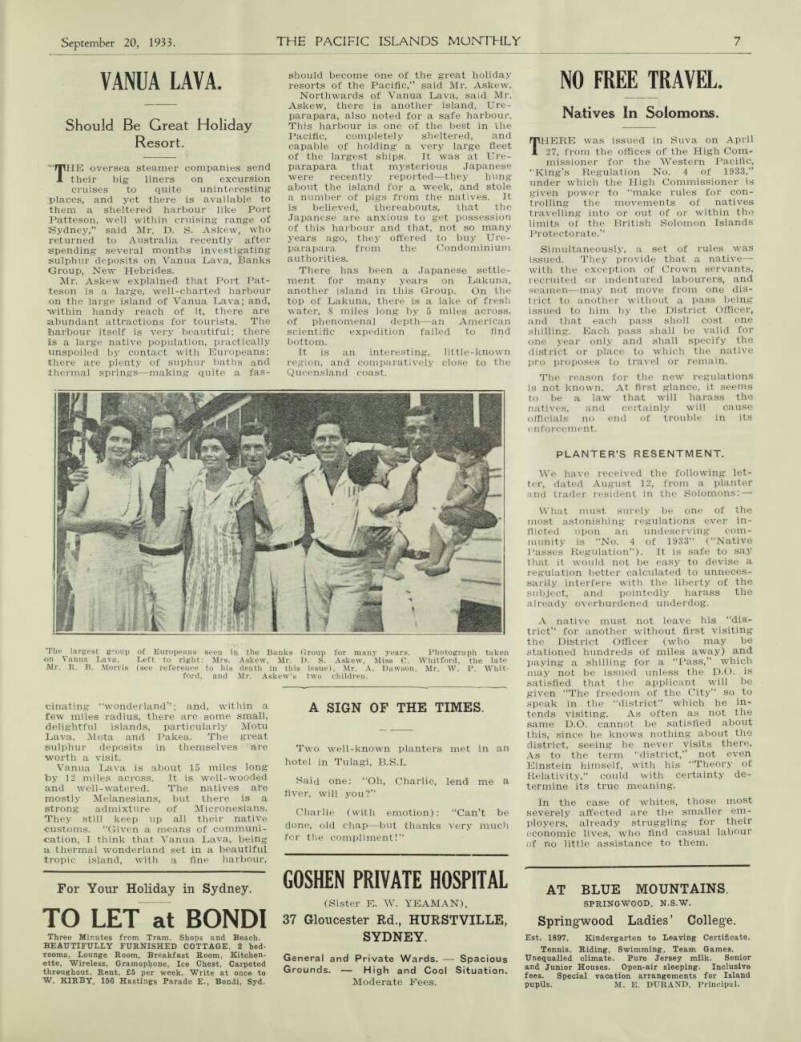
Mr, Morris left a wife and four chil dren. Mr. Morris is one of a group in a photograph reproduced on page 7.
Hebrides.
Minerals In New
Results of Prospecting.
UP-TO-DATE practically nothing is known about the mineral wealth of the New Hebrides, and few steps have been taken to ascertain anything.
In 1930 Mr. B. Dunstan, Chief Gov ernment Geologist of Queensland, paid a short visit to the islands, connected with the sulphur deposits on Yanua Lava, and he expressed the opinion that the geological formation of New Hebrides, as far as he had seen, showed no reason why mineral wealth should not exist.
Acting on this opinion Mr. A. Donald Fraser, a settler of over 25 years’ stand ing, with a thorough knowledge of the Islands, and also being well versed in mining matters, has for the last two years been actively engaged in making various studies and assays in the in terior of certain islands.
The results of his efforts have been distinctly promising. Gold had been found in two different localities; one a very large outcrop, tracable for a con siderable distance, giving a surface assay of 1½ dwts. gold and 18 dwts. silver to the ton; and the other a small reef, giving, at a depth of ten feet, 19 dwts. gold, and 4 ozs. silver to the ton —both showing traces of copper.
Some good samples of nickel have been obtained, and a deposit of alluvial chrome of considerable extent have been found. Another interesting find is an important deposit of amblygonite, a substance that contains lithium.
Some good samples of copper have been unearthed and also cinnabar and molybdenite.
All these finds warrant further inves tigation, particularly the gold. Unfor tunately, the New Hebrides do not possess any mining laws of any description and, being under joint jurisdiction, it probably will be a rather difficult and lengthy affair for the two Governments to come to a mutual
understanding- in the matter. Again, there is the question of land titles, as outside of Vate these are non-existent.
However, the time seems ripe for consideration of the mining industry and, as investigations on a larger scale are likely soon to be undertaken, it is evident that some laws will have to be framed for the protection of an in dustry that may prove a source of wealth to the Condominium.
Zebu Cattle.
[Letter to the Editor ] Adverting to your paragraph in “The Pacific Islands Monthly” of March last,.
I thought the enclosed photo might in terest some of your readers. It is a team of eight half- and three-quarter bred Zebus, the wheelers and lead-pairs being broken in to hauling, and the middle, teams being new to the work.
There is a lot of controversy in this: Territory of New Guinea as to the good, or otherwise, effect cattle have on coco nut estates. I understand some of the larger estates are doing away with their cattle, on the plea that they trample down the ground, which is said to de crease the crops of the palms.
In the writer’s extensive experience,, cattle in no way are responsible for the falling off in crop. One has only to visit the spots where the cattle most frequent, such as corrals, stockyards, etc., to see that the palms in the vicinity of these places are bearing a heavier crop than the average over the whole estate.
What harm, if any, would be caused by a beast to the acre trampling down the soil, in the writer’s opinion, is negligible.
In such places as around the labour lines, alongside the roads, etc., where the ground is naturally trampled down by constant traffic, the palms usually bear the heaviest.
In the writer’s opinion, cattle are the greatest asset to a plantation, the man uring, curtailing weeding, and killing for fresh meat issue to the labour, being in valuable and a great saving in the run ning of plantations.
I am, etc.,
P. Drayson.
Dylup, Madang. 30/7/33.
Advertisements & other items, p. 8 (1 item)
6
September 20, 1933.
THE PACIFIC ISLANDS MONTHLY
THE PRICE OF COPRA.
(Continued from page 4.)
Vanua Lava.
Should Be Great Holiday Resort.
THE oversea steamer companies send their big liners on excursion cruises to quite uninteresting places, and yet there is available to them a sheltered harbour like Port Patteson, well within cruising range of Sydney,” said Mr. D. S. Askew, who returned to Australia recently after spending several months investigating sulphur deposits on Yanua Lava, Banks Group, New Hebrides.
Mr. Askew explained that Port Pat teson is a large, well-charted harbour on the large island of Vanua Lava; and, within handy reach of it, there are abundant attractions for tourists. The harbour itself is very beautiful; there is a large native population, practically unspoiled by contact with Europeans: there are plenty of suphur baths and thermal springs—making quite a fas-
cinating “wonderland”; and, within a few miles radius, there are some small, delightful islands, particularly Motu Lava, Mota and Pakea. The great sulphur deposits in themselves are worth a visit.
Vanua Lava is about 15 miles long by 12 miles across. It is well-wooded and well-watered. The natives are mostly Melanesians, but there is a strong admixture of Micronesians.
They still keep up all their native customs. “Given a means of communication, I think that Vanua Lava, being a thermal wonderland set in a beautiful tropic island, with a fine harbour,
should become one of the great holiday resorts of the Pacific,” said Mr. Askew, Northwards of Vanua Lava, said Mr.
Askew, there is another island, Ure parapara, also noted for a safe harbour.
This harbour is one of the best in the Pacific, completely sheltered, and capable of holding a very large fleet of the largest ships. It was at Ure parapara that mysterious Japanese were recently reported—they hung about the island for a week, and stole a number of pigs from the natives. It is believed, thereabouts, that the Japanese are anxious to get possession of this harbour and that, not so many years ago, they offered to buy Ure parapara from the Condominium authorities.
There has been a Japanese settle ment for many years on Lakuna, another island in this Group. On the top of Lakuna, there is a lake of fresh water, 8 miles long by 5 miles across, of phenomenal depth—an American scientific expedition failed to find bottom.
It is an interesting, little-known region, and comparatively close to the Queensland coast.
The largest group of Europeans seen in the Banks Group for many years. Photograph taken on Vanua Lava. Left to right: Mrs. Askew, Mr. D. S. Askew, Miss C. Whitford, the late Mr. R. B. Morris (see reference to his death in this issue), Mr. A. Dawson, Mr. W. P. Whit ford, and Mr. Askew’s two children.
A Sign Of The Times,
Two well-known planters met in an hotel in Tulagi, B.S.I.
Said one: ."Oh, Charlie, lend me a fiver, will you?"
Charlie (with emotion): “Can’t be done, old chap—but thanks very much for the compliment!”
No Free Travel.
Natives In Solomons.
THERE was issued in Suva on April 27, from the offices of the High Com missioner for the Western Pacific, ‘King’s Regulation No. 4 of 1933,” under which the High Commissioner is given power to ‘‘make rules for con trolling the movements of natives travelling into or out of or within the limits of the British Solomon Islands Protectorate.”
Simultaneously, a set of rules was issued. They provide that a native — with the exception of Crown servants, recruited or indentured labourers, and seamen —may not move from one dis trict to another without a pass being issued to him by the District Officer, and that each pass shall cost one shilling. Each pass shall be valid for one year only and shall specify the district or place to which the native pro proposes to travel or remain.
The reason for the new regulations is not known. At first glance, it seems to be a law that will harass the natives, and certainly will cause officials no end of trouble in its enforcement.
Planter’S Resentment.
We have received the following let ter, dated August 12, from a planter and trader resident in the Solomons: — What must surely be one of the most astonishing regulations ever in flicted upon an undeserving com munity is ‘‘No. 4 of 1933” (‘‘Native Passes Regulation”). It is safe to say that it would not be easy to devise a regulation better calculated to unneces sarily interfere with the liberty of the subject, and pointedly harass the already overburdened underdog.
A native must not leave his “dis trict” for another without first visiting the District Officer (who may be stationed hundreds of miles away) and paying a shilling for a “Pass,” which may not be issued unless the D.O. is satisfied that the applicant will be given “The freedom of the City” so to speak in the “district” which he in tends visiting. As often as not the same D.O. cannot be satisfied about this, since he knows nothing about the district, seeing he never visits there.
As to the term “district,” not even Einstein himself, with his “Theory of Relativity,” could with certainty de termine its true meaning.
In the case of whites, those most severely affected are the smaller em ployers, already struggling for their economic lives, who find casual labour of no little assistance to them.
Advertisements & other items, p. 9 (1 item)
To Let At Bondi
GOSHEN PRIVATE HOSPITAL
(Sister E. W. YEAMAN),
37 Gloucester Rd., HURSTVILLE,
SYDNEY.
General and Private Wards. Spacious Grounds. High and Cool Situation.
Moderate Fees.
For Your Holiday in Sydney.
TO LET at BONDI
Three Minutes from Tram, Shops and Beach.
BEAUTIFULLY FURNISHED COTTAGE, 2 bed-
rooms, Lounge Room, Breakfast Room, Kitchenette, Wireless, Gramophone, Ice Chest. Carpeted throughout. Rent, £5 per week. Write at once to W. KIRBY, 156 Hastings Parade E., Bondi, Syd.
AT BLUE MOUNTAINS.
SPRINGWOOD, N.S.W.
Springwood Ladies’ College.
Est. 1897. Kindergarten to Leaving Certificate.
Tennis, Hiding, Swimming, Team Games.
Unequalled climate. Pure Jersey milk. Senior and Junior Houses. Open-air sleeping. Inclusive fees. Special vacation arrangements for Island pupils. M. E. DURAND, Principal.
Troficalities
A SERVICE that is provided by the N.S. Wales Department of Educa tion, and that is most gratefully availed of by numerous parents throughout the Pacific Islands, is that known as the “Blackfriars Correspond ence Course,” by which children in isolated places are given a primary school education. The papers are most cleverly designed, the lessons are done under the supervision of parents or missionaries, and the work of correcting and advising is carried out very efficiently in Sydney by Mr. Finnegan and a large staff of experts, who take a keen personal interest in the indi vidual pupils—who number over 6,000 A man who recently brought his four children to school in Sydney, after several years’ residence in Tonga, was surprised and delighted to find that they were able to go straight into the classes suitable to their respective ages.
They had never previously attended a school: all their education had been given by the “Blackfriars Course.” The Department makes no charge for the service: it is provided for backblocks children in New South Wales, and there is no reason why it should not be extended to the children of isolated Islanders. Consequently, the name of the Department has been blessed by many people in the Pacific Territories where there is no school available. * * * MEMORIES of a lively, but now almost forgotten war incident of 1917 were revived in Sydney in September, when Mr. N. A. Pyne, just returned from Tonga, met Captain Donaldson, of the B.P. steamer Marella.
Sixteen years ago, Captain Donaldson was master of the Burns Philp steamer Matunga, and Mr. Pyne was purser; and one unhappy day, near Rabaul, they encountered the German minelayer Wolf. That was the end of the Matunga’s freedom. The Germans made prisoners of the 80 people on the Matunga, and took the steamer to the Dutch East Indies, where they sank her. The Wolf sank other British ships, and thus accumulated aboard about 400 wretched prisoners. They were not treated inhumanly: but their quarters were frightfully cramped, and the food was beyond description.
When the Wolf finally landed her miserable human cargo at Kiel, in Ger many, some of the prisoners had been aboard her for a year. The Matunga’s company were sent to various prison camps in Germany, and remained there until a fortnight after the armistice. In such circumstances, men get to know each other very well; and the captain and purser of the lamented Matunga had some queer experiences together.
Subsequently, Mr. Pyne went away into another sphere, and the two did not meet again for many years, until the other day in Sydney. * * * THE trade of the little Kingdom of Tonga, as a result of the depression, has shrunk to alarming proportions, with the result that regular shipping operations have been practically dis
continued. The Union Company with drew the Tofua some time ago, and put the freighter Waipahi on a regular schedule. Then the calls at Vavau and Haapai were cut out; produce for those ports was simply dumped out at Nukualofa, where it took its chance of getting casual transport northwards., Such things as butter and onions were not thereby improved. Now, owing to there being insufficient traffic, the Waipahi’s Tonga call has been can celled altogether, and Tonga is quite isolated. The post of collector at Haapai has been abolished; , and Nukualofa and Vavau are now the only ports of entry—when there are any ships to enter! What a contrast to the conditions of 20 years ago, when all these Central Pacific groups were con nected with Sydney and Auckland by regular and frequently-calling steamers, with excellent passenger accommoda tion. The other day, a man who wanted to get away from Northern Tonga had to cross by launch to Suva, over hundreds of miles of open sea. * * * SEVEN good men and true were appointed to the Legislative Council of New Guinea the other day, and automatically became entitled to write after their names the pregnant letters “M.L.C.” A number of their friends thereupon—and quite naturally addressed them as “The Honourable John Planter, M.L.C.”—and it certainly looked impressive on an envelope. But now it has been noticed that in all official communications the newly honoured one is simply “Mr. John Planter, M.L.C.” Therefore, it would appear that for some reason, with which we are not familiar, the Coun cillors of New Guinea are not entitled to “Honourable.” We have not heard that the Councillors concerned are wearing sackcloth or casting ashes upon their plebeian heads; but certain pertinacious residents of Rabaul now want to know why Papua’s Legislative Councillors should all be “Honourables,” while their opposite numbers in New Guinea are plain “Mr.” . . . This inter- Territory jealousy grows apace. We should not be surprised to learn, one day soon, that aeroplanes from New Guinea are dropping bombs on Port Moresby. * * * TRAVELLERS on Island steamers will be interested in a recent address on “Seasickness” by Professor Mac curdy, lecturer in psychopathology at Cambridge. The Professor said that persons need not be sick.
“The main thing,” he said, “is to let your self go with the motion of the ship. Don’t watch the horizon. Try to think it is the ship that is heaving, and not the world.”
The Professor added that vomiting in sea sickness and air sickness resulted from in accurate and persistent attempts to maintain equilibrium.
We are sure that the news will be gratefully received in many Pacific centres. So far as we ourselves are concerned, we find that the trouble is that it is not the ship or the world that is heaving, but us.
THE ‘P.I.M.’ is too good a journal to be printing apologies in reply to official bluff,” writes an indignant resident of Papua. He refers to our recent battle with our good friend Mr.
Harris, wherein the head of the Papuan postal service repudiated with vigour and bitterness our mild suggestion that copies of the “P.I.M.” occasionally went astray in Territory mailbags.
Our correspondent declares we were right; and he gives quite a list of posted articles which, in recent times, have been mis-sorted into his mailbag.
We think we had better not pur sue the matter, beyond mixing our metaphors to say that honour is satisfied; that we have no wish to cross swords again with Mr. Harris; and that sleeping dogs had better be left asleep. * * * A querulous note is to hand from a resident of Port Moresby concerning a certain contributor to this journal.
The attack is_a little difficult to reply to. Our contributor’s record as a scientist and observer is challenged— possibly on sound grounds. But no good purpose can be served by the publication of stinging reflections upon people who, no matter how irritating they may be, are well-meaning and harmless. Good-humoured criticism and comment in the public interest is always welcome: but attacks on people —more particularly on defenceless pub lic servants —usually go down south, where lives the w.p.b.
“Faa-Samoa.”
Rights of Children of Old-Time Unions.
From Our Own Correspondent,
Apia, Aug. 28.
A Court case concerning a land claim, which- was recently heard at the High Court of Samoa, disclosed some strange history and throws inter esting sidelights on the life of Old Samoa.
The Public Trustee representing the estate of the late Joseph Collins, of Mali’e, brought action against a number of descendants of Collins.
The evidence showed that Collins, who died intestate in 1920, had in the old times, before civilised government was established in Samoa, in the ’sixties, ’seventies and ’eighties of last century, lived with numerous Samoan women in “Faa- Samoa” marriages, not legalised by proper church blessings, and had had numerous children by all of them. The action was brought to determine his next of kin, and those entitled to his inheritance.
The case is of importance, as for the first time in Samoan history the right of inheritance of children of “Faa- Samoa” marriages is being inquired into.
The m.s. “Nairnbank” departed from Suva for Europe via Levuka, Tonga and Western Samoa on August 16. Nearly 800 tons of copra were shipped by the vessel.
Progress At Edie Creek,
T.N.G.
THE Edie Creek Progress Association was formed in March last, the first meeting being called by Mr. A.
Parer.
Its policy is to help the Administra tion and the community in general.
The membership is over 100. It is hoped that Wau and Salamaua will form pro gress associations and that every six month or so delegates will meet and discuss things of general interest.
His Honor, the Administrator, has granted the association an extraordin ary member for the Legislative Coun cil, when matters affecting mining and the new Native Labour Ordinance are being discussed.
The association has arranged to send two prospectors (J. Lewis and J. Lorenz) out into the back country, seeking new ground. Prospecting is only a “side issue” of the association’s activities; any member who wishes to benefit in any find has to pay £5/5/-. The mem bership fee of the association is 10/6.
The officials are; J. L, Lewis (presi dent), C. Ramm (vice-president), A. F.
Parer (secretary), A. Graham (treas urer) ; committee, H. Wales, L. Simp son, G. Pianta. D. Smith, A. J. Bretay, W. C. Abbie, W. J. Simpson, G. Ballemy.
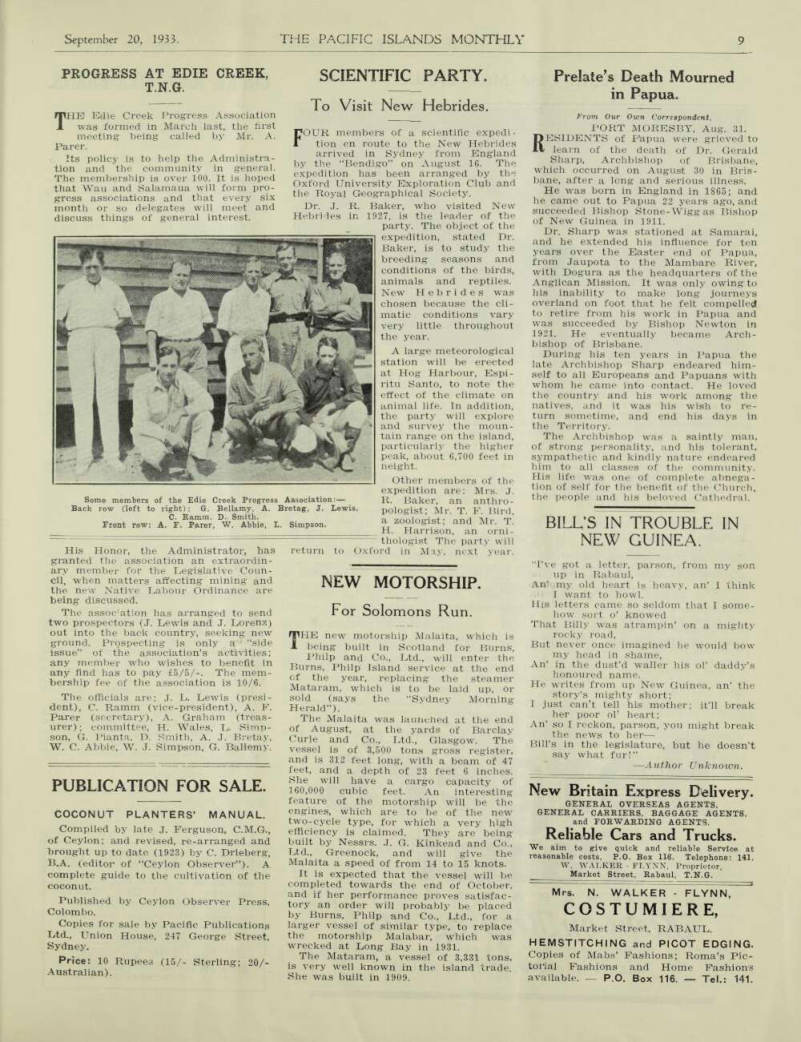
Some members of the Edie Creek Progress Association: — Back row (left to right): G. Bellamy, A. Bretag, J. Lewis, C. Ramm. D. Smith.
Front row: A. F. Parer, W. Abbie, L. Simpson.
Publication For Sale.
Coconut Planters’ Manual.
Compiled by late J. Ferguson, C.M.G., of Ceylon; and revised, re-arranged and brought up to date (1923) by C. Drieberg, B.A. (editor of “Ceylon Observer”). A complete guide to the cultivation of the coconut.
Published by Ceylon Observer Press, Colombo.
Copies for sale by Pacific Publications Ltd., Union House, 247 George Street, Sydney.
Price: 10 Rupees (15/- Sterling; 20/- Australian).
Scientific Party.
To Visit New Hebrides.
FOUR members of a scientific expedi tion en route to the New Hebrides arrived in Sydney from England by the “Bendigo” on August 16. The expedition has been arranged by the Oxford University Exploration Club and the Royal Geographical Society.
Dr. J. R. Baker, who visited New Hebrides in 1927, is the leader of the party. The object of the
expedition, stated Dr.
Baker, is to study the breeding seasons and conditions of the birds, animals and reptiles.
New Hebrides was chosen because the cli matic conditions vary very little throughout the year.
A large meteorological station will be erected at Hog Harbour, Espi ritu Santo, to note the effect of the climate on animal life. In addition, the party will explore and survey the moun tain range on the island, particularly the higher peak, about 6,700 feet in neight.
Other members of the expedition are: Mrs. J.
R. Baker, an anthro pologist; Mr. T. F. Bird, a zoologist: and Mr. T.
H. Harrison, an orni thologist The party will
return to Oxford in May, next year.
New Motorship.
For Solomons Run.
THE new motorship Malaita, which is being built in Scotland for Burns, Philp and Co., Ltd., will enter the Burns, Philp Island service at the end of the year, replacing the steamer Mataram, which is to be laid up, or sold (says the “Sydney Morning Herald”).
The Malaita was launched at the end of August, at the yards of Barclay Curie and Co., Ltd., Glasgow. The vessel is of 3,500 tons gross register, and is 312 feet long, with a beam of 47 feet, and a depth of 23 feet 6 inches.
She will have a cargo capacity of 160,000 cubic feet. An interesting feature of the motorship will be the engines, which are to be of the new two-cycle type, for which a very high efficiency is claimed. They are being built by Nessrs. J. G. Kinkead and Co., Ltd., Greenock, and will give the Malaita a speed of from 14 to 15 knots.
It is expected that the vessel will be completed towards the end of October, and if her performance proves satisfac tory an order will probably be placed by Burns, Philp and Co., Ltd., for a larger vessel of similar type, to replace the motorship Malabar, which was wrecked at Long Bay in 1931.
The Mataram, a vessel of 3,331 tons, is very well known in the island trade.
She was built in 1909.
in Papua.
Prelate’s Death Mourned in Papua.
From Our Own Correspondent.
Port Moresby, Aug. 31.
RESIDENTS of Papua were grieved to learn of the death of Dr. Gerald Sharp, Archbishop of Brisbane, which occurred on August 30 in Bris bane, after a long and serious illness.
He was born in England in 1865; and he came out to Papua 22 years ago, and succeeded Bishop Stone-Wiggas Bishop of New Guinea in 1911.
Dr. Sharp was stationed at Samarai, and he extended his influence for ten years over the Easter end of Papua, from Jaupota to the Mambare River, with Dogura as the headquarters of the Anglican Mission. It was only owing to his inability to make long journeys overland on foot that he felt compelled to retire from his work in Papua and was succeeded by Bishop Newton in 1921. He eventually became Arch bishop of Brisbane.
During his ten years in Papua the late Archbishop Sharp endeared him self to all Europeans and Papuans with whom he came into contact. He loved the country and his work among the natives, and it was his wish to re turn sometime, and end his days in the Territory.
The Archbishop was a saintly man, of strong personality, and his tolerant, sympathetic and kindly nature endeared him to all classes of the community.
His life was one of complete abnega tion of self for the benefit of the Church, the people and his beloved Cathedral.
Bill’S In Trouble In
New Guinea.
‘Tve got a letter, parson, from my son up in Rabaul, An’ my old heart is heavy, an’ I think I want to howl.
His letters came so seldom that I some how sort o’ knowed That Billy was atrampin’ on a mighty rocky road, But never once imagined he would bow my head in shame, An’ in the dust’d waller his ol’ daddy’s honoured name.
He writes from up New Guinea, an’ the story’s mighty short; I just can’t tell his mother; it’ll break her poor ol’ heart; An’ so I reckon, parson, you might break the news to her— Bill’s in the legislature, but he doesn’t say what fur!” —Author Unknoum.
Advertisements & other items, p. 11 (1 item)
New Britain Express Delivery.
GENERAL OVERSEAS AGENTS,
GENERAL CARRIERS. BAGGAGE AGENTS,
and FORWARDING AGENTS.
Reliable Cars and Trucks.
We aim to give quick and reliable Service at reasonable costs, P.O. Box 116. Telephone: 141.
W. WALKER - FLYNN, Proprietor, Market Street, Rabaul, T.N.G.
Mrs. N. WALKER - FLYNN,
COSTUMIERE,
Market Street, RABAUL.
HEMSTITCHING and PICOT EDGING.
Copies of Mabs’ Fashions; Roma’s Pictorial Fashions and Home Fashions available. P.O. Box 116. Tel.: 141.
Where Ulm May Land.
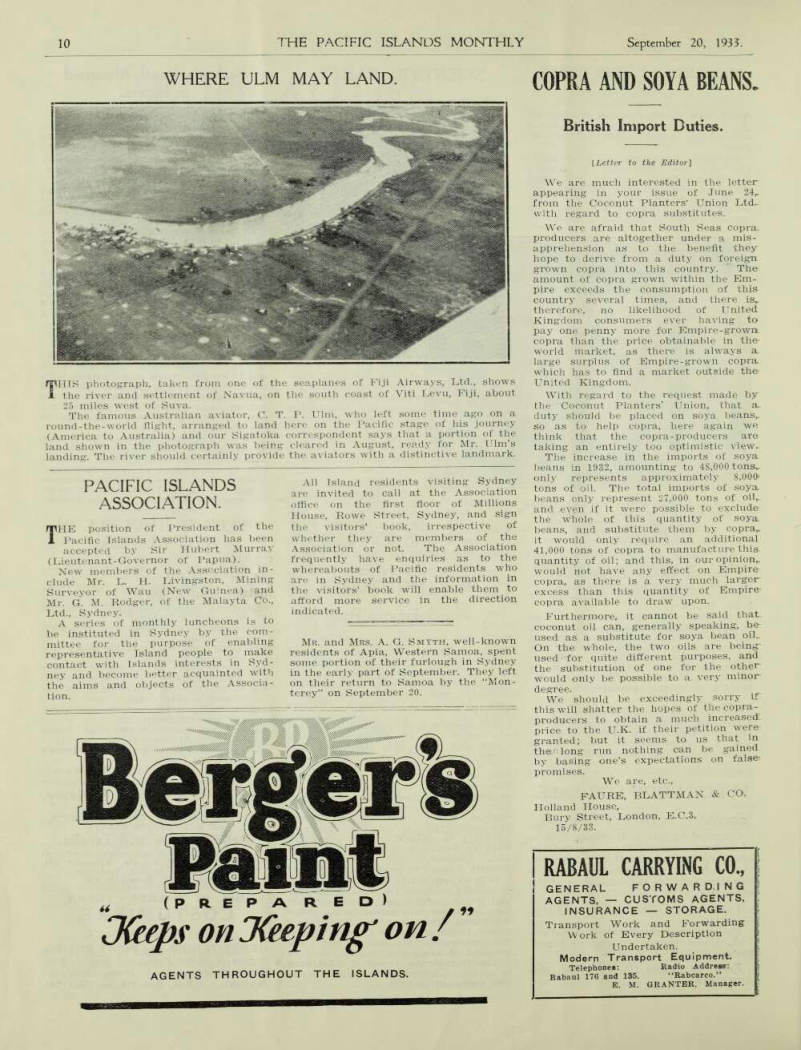
THIS photograph, taken from one of the seaplanes of Fiji Airways, Ltd., shows the river and settlement of Navua, on the south coast of Viti Levu, Fiji, about 25 miles west of Suva.
The famous Australian aviator, C. T. P. Ulm, who left some time ago on a round-the-world flight, arranged to land here on the Pacific stage of his journey (America to Australia) and our Sigatoka correspondent says that a portion of the land shown in the photograph was being cleared in August, ready for Mr. Ulm’s landing. The river should certainly provide the aviators with a distinctive landmark.
Pacific Islands
Association.
THE position of President of the Pacific Islands Association has been accepted by Sir Hubert Murray (Lieutenant-Governor of Papua).
New members of the Association in clude Mr. L. H. Livingston, Mining Surveyor of Wau (New Guinea) and Mr. G. M. Rodger, of the Malayta Co., Ltd., Sydney.
A series of monthly luncheons is to be instituted in Sydney by the com mittee for the purpose of enabling representative Island people to make contact with Islands interests in Syd ney and become better acquainted with the aims and objects of the Associa tion.
All Island residents visiting Sydney are invited to call at the Association office on the first floor of Millions House, Rowe Street, Sydney, and sign the visitors’ book, irrespective of whether they are members of the Association or not. The Association frequently have enquiries as to the whereabouts of Pacific residents who are in Sydney and the information in the visitors’ book will enable them to afford more service in the direction indicated.
Mr. and Mrs. A. G. Smyth, well-known residents of Apia, Western Samoa, spent some portion of their furlough in Sydney in the early part of September. They left on their return to Samoa by the “Mon terey” on September 20.
Copra And Soya Beans.
British Import Duties.
[Letter to the Editor] We are much interested in the letter appearing in your issue of June 24,. from the Coconut Planters’ Union Ltd. with regard to copra substitutes.
We are afraid that South Seas copra, producers are altogether under a mis apprehension as to the benefit they hope to derive from a duty on foreign grown copra into this country. The amount of copra grown within the Em pire exceeds the consumption of this country several times, and there is, therefore, no likelihood of United Kingdom consumers ever having to pay one penny more for Empire-grown copra than the price obtainable in the world market, as there is always a large surplus of Empire-grown copra which has to find a market outside the United Kingdom.
With regard to the request made by the Coconut Planters’ Union, that a duty should be placed on soya beans, so as to help copra, here again we think that the copra-producers are taking an entirely too optimistic view.
The increase in the imports of soya beans in 1932, amounting to 48,000 tons, only represents approximately 8,000 tons of oil. The total imports of soya beans only represent 27,000 tons of oil, and even if it were possible to exclude the whole of this quantity of soya beans, and substitute them by copra, it would only require an additional 41,000 tons of copra to manufacture this quantity of oil; and this, in our opinion, would not have any effect on Empire copra, as there is a very much larger excess than this quantity of Empire copra available to draw upon.
Furthermore, it cannot be said that coconut oil can, generally speaking, be used as a substitute for soya bean oil.
On the whole, the two oils are being used for quite different purposes, and the substitution of one for the other would only be possible to a very minor degree.
We should be exceedingly sorry if this will shatter the hopes of the copra producers to obtain a much increased price to the U.K. if their petition were granted; but it seems to us that in the long run nothing can be gained by basing one’s expectations on false promises.
We are, etc.,
Faure, Blattman & Co.
Holland House, Bury Street, London, E.C.3, 15/8/33.
Advertisements & other items, p. 12 (2 items)
Berger's Paint
(PREPARED)
"Keeps on Keeping on!"
AGENTS THROUGHOUT THE ISLANDS.
Rabaul Carrying Co.,
GENERAL FORWARDING
AGENTS, CUSTOMS AGENTS,
INSURANCE STORAGE.
Transport Work and Forwarding Work of Every Description Undertaken.
Modern Transport Equipment.
Telephones; Radio Address: Rabaul 176 and 135. “Rabcarco.”
E. M. GRANTER, Manager.
First Indian J.P.
Fiji Governor Fulfils Promise.
A NOTABLE event in the history of Fiji took place at Government House, Suva, on August 23, when, with fitting ceremony, His Excellency the Governor, Sir Murchison Fletcher, swore in Mr. M. Mudalier as first Indian Jus tice of the Peace. The Hon. Munisamy Mudalier is the Indian member in the Legislative Council for the Northern and Western division of the Colony.
This appointment is the fulfilment of one of the two promises made by the Governor to the Indian community about a year ago. The other promise was that Indians would be appointed as assessors of the Supreme Court.
In performing the ceremony, Sir Mur chison Fletcher thanked Mr. Mudalier for the useful work which he has done on behalf of the Indian community and re marked that he was the first Indian to attain the high honour of Justice of the Peace for Fiji.
Replying to His Excellency, Mr. Muda lier said he appreciated the honour that bad been bestowed upon him and would do his best to justify the confidence reposed in him.
Those present at the ceremony in cluded, Mr. A. W. Seymour, Colonial Secretary; Mr. A. A. Wright, Secretary for Native Affairs; Dr. V. W. McGusty, Secretary for Indian Affairs; Sir Henry Scott, Dr. I. H. Beattie, members of the Executive Council and a large gathering of Indian citizens.
Official Aeroplane.
For N.G. Judges and Doctors.
WE understand that arrangements are being made by General Griffiths (Administrator of the Territory of New Guinea) with the Commonwealth Government for the regular use of a seaplane (or seaplanes), which will have its headquarters in Rabaul. Tenders are being called for the service.
The aeroplane will be available for patrol work; but it will be used mostly by the Administration for the quick conveyance of officials to different parts of the Territory. Among other things, it is proposed to establish a Circuit Court in New Guinea, and the ’plane will be used to carry the Judge or Judges to different points, as required.
This probably will prove a consider able saving to the Administration, as under present conditions much expense is frequently involved in bringing the parties to legal action and large num bers of witnesses from outlying parts of the Territory to Rabaul. It is hoped now to cease bringing the Mountain to Mahomet, and take Mahomet to the Mountain—a much more simple pro cedure.
The aeroplane will also be very valu able for use in conection with the medical services. A doctor will be able to visit outlying parts and perform his necessary duties within one or two days, instead of one or two weeks, which are necessary under present conditions.
Punishment.
Unruly Natives.
Need For Corporal Punishment.
WE continue to receive letters which suggest that all is not well in the relationship between the Solomons Islands Administration and the natives.
There seems to be, among non-official Europeans, a belief that natives are being treated according to principles that are entirely unsound.
A correspondent asks us to give pub licity to natives’ attitude towards white women. He says that, fairly recently, a native house-boy attacked the young wife of an official. There was a “frightful” struggle, and she beat him off; but he attacked her again, and again she beat him off. This young woman suffered severely from shock and, after hospital treatment, was sent to Australia.
In another case, a native “peeping Tom” was caught in the act.
The first boy was sentenced to five years’ imprisonment, and the second to six months. Our correspondent says that such punishment is simply ridiculous. “Calaboose” has no terror whatever for these primitive natives Flogging is the only possible punish ment that will serve as a deterrent;
but that "old-womanish and dangerous ignorance in high official quarters” has forbidden corporal chastisement.
We give the statement for what it is worth. But if there is any truth in this communication, it certainly appears as if the B.S.I. authorities are playing with fire. Nothing could be worse than the threat against white women.
It appears as if the problem in the Solomons is developing simultaneously with the same problem in New Guinea where a whole series of “incidents” is forcing the too squeamish Australian authorities to realise that there can be no satisfactory discipline maintained unless District Officers have the right to order corporal punishment.
Mr. S. H. Chance, an assistant Resi dent Magistrate in the service of the Papuan Administration, returned to the Territory by the September “Macdhui,” after six months’ furlough. While he was in Australia, Mr. Chance had the mis fortune to fall and severely fracture his left arm. He has made a good recovery, but he will spend the rest of his life with a considerable quantity of gold wire holding together the bones of his arm— the result of ingenious surgery. Mr.
Chance thought he would be stationed in the Samarai District, in the immediate future.
Advertisements & other items, p. 13 (1 item)
Pacific Maps
WE have completed arrangements with the well-known firm of Map Publishers, Messrs. H. E. C. Robinson, Ltd., of Sydney, under which we are able to supply modern maps of the Pacific region, or of any of the chief Groups and Territories, at a price which includes cost of postage and despatch.
Some of the Pacific Maps now available are listed below. Others are in course of preparation. If a map of any Island or District is specially required, please give us details, and a quotation for same will be sent at once.
FOR SALE:
OCEANIA. —A clear map of the Pacific from Australia to America, east and west, Japan on the north and New Zealand on the south. Showing all trade routes, with mileage thereon, and clearly defining all the Mandated Territories by tints of colour. SIZE; 30in. x 40in. PRICE: £1/5/-, including Postage.
MAP OF MOROBE DISTRICT, NEW GUINEA. MANDATED TERRITORY (Mercator’s Projection). —SCALE at equator, 6 Statute Miles to an inch. These maps have been compiled from all the official data Messrs. Robinson have been able to collect, much of which has been supplied by Mr. Ralph W. Gossett, an authorised Surveyor of the Mandated Territory of New Guinea. SIZE- 30in x
40in, PRICE, 20/-.
AUSTRALASIA. —A good clear Map of Australia and Surroundings, extending on the North to Borneo and Caroline Islands; South to Tasmania and New Zealand; East to Fiji Islands; West to Singapore—showing all the Islands, with the Principal Trade Routes and Mileage. A clear index to places is printed beneath the Map. SIZE: 28in. x 30in. PRICE: Paper, 2/6; Cloth and Rollers, 7/6.
PAPUA AND NEW GUINEA.— Compiled from the Published Maps of Evan R.
Stanley, F.G.S., Geologist. A good Map, showing detail and boundaries. SIZE: 30im x 40in, PRICE, Black only, 15/-; Coloured, showing Geological formation, MOROBE GOLDFIELDS.— A clear detail Map of Bulolo area of Morobe Goldfields, showing Road-Tracks and Air Routes from Salamaua and Lae to the Goldfields SCALE; 2 miles to an inch—Statute Miles. By Chas. Lexius Burlington SIZE- 30in. x 32in. PRICE, 12/6.
ALL COMMUNICATIONS TO—
PACIFIC PUBLICATIONS LTD.,
UNION HOUSE, 247 GEORGE STREET, SYDNEY. P.O. Box 3408 R.
About Islands People.
Councillor R. W. Robinson was elected Mayor of Levuka on August 10, vice Councillor G. S. Chisholm, whose resig nation was received with regret. Mr.
Chisholm is now manager for Messrs.
Morris, Hedstrom, Ltd., at Apia, Samoa.
Mrs. G. S. Chisholm, who left Levuka about August 20 to join her husband at Apia, was entertained at a public func tion held in Levuka Town Hall. Levuka can ill afford to lose citizens of Mr. and Mrs. Chisholm’s calibre (says our cor respondent). During their term of office as Mayor and Mayoress they rendered appreciated service to the community.
Their departure is regretted by all resi dents in the old capital of Fiji Mr. J. Trotter, manager at Levuka for Burns, Philp (South Sea) Co., Ltd., left for New Zealand and Australia during September on vacation.
Mr. and Mrs. L. V. Brossey will leave Papua in October. Mr. Brossey has been granted leave until Decembr, 1934, when he will retire, after 20 years in the Public Service of Papua, Mr. Brossey is the Registrar of the Central Court, and, in accepting his resignation, the Executive Council expressed regret and all mem bers joined in wishing both Mr. and Mrs.
Brossey all prosperity in the future.
Mr. F. Headon, agricultural instructor in the Northern Division of Papua, will retire from the Public Service next December, and will take seven months’ leave. The Executive Council has expressed regret at his resignation and tendered its best washes.
Mr. L. V. Waterhouse, director of Fiji Airways. Limited, accompanied by Mrs. Waterhouse and their three
daughters, left Sydney for Suva, Fiji, by the “Mariposa” on August 23. Mr.
Waterhouse is also a director of Bulolo Gold Dredging Company and Guinea Airways, Ltd.
Dr. C. E. MacPherson, of the Gilbert and Ellice Islands Medical Service, arrived in Fiji on August 3 by H.M.S.
“Laburnum,” en route to America. He has been granted a fellowship by the Rockefeller Foundation Society and will attend an American university for ten months.
Miss H. Broughton, of the Melanesian Mission at Rega, New Hebrides, died early in August after a severe attack of blackwater fever.
Dr. E. T. Brennan, director-general of Public Health and chief quarantine officer at Rabaul, New Guinea, arrived in Sydney by the “Nellore” on August 23. Dr. Brennan, who is accompanied by Mrs. Brennan, is on four months’ furlough.
Mr. R. W. Dalton, British Trade Com missioner in Australia, left Sydney for New Caledonia by the “Grama” on September 2. His mission was to appoint a British Consul at Noumea to fill the vacancy caused by the recent death of the former Consul, Mr. T. Johnston.
Rev. C. M. Churchward, M.A., of the Methodist Mission station at Levuka, Fiji, arrived in Sydney on August 14 by the “Mariposa”. He intends undergoing an operation before he returns to Fiji.
Rev. Harold Chambers is now temporarily stationed at Levuka.
Rev. and Mrs. R. J. Sandells, Church of Christ missionaries at Banmatmat, New Hebrides, are at present on furlough in Western Australia.
Mr. W. G. Clarke,, coastal radio super intendent of Messrs. Amalgamated Wireless, Ltd., left Sydney for Suva, Fiji, by the “Karetu” on August 26.
He will inspect the company’s wireless stations in the Colony and return to Sydney early in October.
Right Rev. W. H. Baddeley, Bishop of Melanesia, arrived in Sydney by the “Morinda” from the New Hebrides on September 11. He left for an interstate tour on September 13, and will return to Sydney on September 23 to embark for the Solomon Islands.
Miss V. M. Worrall and Miss G.
Thomas have been appointed by the Methodist Missionary Society to under take mission work in Papua. Miss Worrall will teach at the girls’ school, Kiriwina, and Miss Thomas will leave Sydney shortly for the Girls’ High School, Salamo.
Mr. Gaius Robert Anderson, of Fiji, died at Suva on August 8. He was born in Fiji in August, 1870, and, after working for Messrs. Brown and Joske, joined the staff of the Suva Colonial Hospital in 1900. He was appointed chief warden at the mental asylum in 1905, and until his retirement last year was head attendant. His burial was given masonic and military honours.
Mr. F. E. Williams, Government An thropologist of Papua, with his wife and son, sailed from Adelaide for London on August 21. Mr. Williams has secured a Rockefeller Fellowship, entitling him to spend twelve months in Europe in study. He will visit Oxford and Cam bridge and return via America, Mr. J. V. (“Josh”) Addis, a former well-known resident of Fiji, died in Auckland, New Zealand, on August 14, at the age of 61. Mr Addis was born in Victoria and arrived in Fiji in 1886.
Several years later he joined the staff of the sugar mill at Koronovia, Rewa district. When this mill ceased opera tions he was transferred to the C.S.R. mill at Nausori, being promoted to second engineer, a position which he held until retiring in 1931. A wide reader and keen student of international affairs, he will be mourned by many who knew him as a true and lovable friend.
Mr. A. A. Thomson, inspector of Fijian schools, died on board H.M.C.S. “Pioneer" en route to the Lau group on August 14.
A New Zealander by birth, he went to Fiji in 1923 and was appointed head master of the school at Kadavu. Later, he was transferred to Rewa, and in 1930 was made inspector of Fijian schools. He had made a special study of Fijian language and customs Mr. K. Allsop, of Hamilton, New South Wales, left Sydney for Rabaul by the “Montoro” on August 9. Arriving in Rabaul, he took up the duties of accountant and chairman’s assistant of the New Britain section of the Metho dist Missionary Society. His predecessor was Mr. E. W. Pearce, of Malakuna, who retired recently from active mission work.
Mr. William Shiress, who held a high executive position in Burns, Philp (South Seas), Ltd., and was well known and highly esteemed throughout the Islands, died suddenly at his home in Mosman, Sydney, on August 30. He was only 46 years old, and leaves a widow and one daughter. Mr. Shiress joined the big firm in Thursday Island when only 14, and was manager of the island agencies department when he died. He held the Diploma of Economics of Sydney University.
Advertisements & other items, p. 14 (1 item)
Preserved Meats
1870 1933 Quality Stands the Test of Time
S-M.P. ‘ War Medal’ BRAND
Tins Fitted with Patent Key Opener.
F. J. WALKER LTD., 33 Macquarie Place, Sydney.
Solo Agents for: THE SYDNEY MEAT PRESERVING CO. LTD.
Malaria
Rabaul Says a Good Word for New Treatment.
A NEW method of combating malaria has been employed in the Mandated Territory of New Guinea during the past year and, we understand, with sat isfactory results.
Sufferers from malaria undergo a treatment extending over five days with Atebrin tablets. In the case of subter tian malaria, the Atebrin is administered with Plasmoquine Simplex.
The new preparation is made by the well-known firm of Bayers, and people who have undergone treatment in Ra baul report that they have been en tirely free of attacks of malaria. The treatment has no ill-effects, but the persons who have undergone it show for a time a peculiar yellow appearance of the skin, as if they were suffering from jaundice. The treatment is said to be effective until the person concerned is bitten again by the anopheles mosquito, when another attack may de velop, and a further treatment be necessary. A number of Territory resi dents have made a practice of under going this treatment before going south on furlough, and have thus been able to enjoy their holiday without having to suffer recurrent attacks of fever.
The medicine and treatment are not ex pensive.
It is interesting to note the steady progress that is being made in the treatment of malaria. A few years ago, the only treatment known to be of any value was the administration of quinine and, as is well known, the free use of quinine is liable to have bad effects.
Then, some three years ago. the drug known as Plasmoquine came into favour.
It was held to be better than quinine, particularly in preventing attacks of malaria, but it was far from being the perfect prophylactic. Now comes Ate brin, which is held to be a further ad vance by medical science in the cease less campaign of making the equatorial tropics safe for Europeans.
At this rate of progress the time is not far distant when the skilled medical man will be able to say that he has definitely got his foot on the neck of the malaria bug.
Papua Alarmed.
Port Moresby, Sept. 1.
THERE are serious times ahead for the coconut planters in Papua. Their position has not been an enviable one up to date, but they were certainly hoping for better times—not this death blow after 30 years of struggle.
The local copra buyers' in Port Moresby have been informed that there is practically no market at present for smoked copra and that none of the last shipment sent to European ports has been sold.
The difference in prices between smoked and sun-dried copra has been about 10/- per ton, but if the slump continues it will naturally increase and the planters of Papua will receive a price for the copra which will not be worth considering.
The remedy will be to produce only sun-dried copra, wherever it is possible to do so. (We understand that on September 16 Messrs.
Burns. Philp, sold smoked copra in London at slightly over £8 per ton — an absolute low record. — Ed. P.I.M.)
Plantations For
Young Chinese.
New Guinea Experiment.
AN interesting experiment which may provide a solution, or partial solu tion, of the Chinese problem in New Guinea has been arranged by the new Administrator of the Territory Brigadier - General Grif fith. The Government has set aside an area of 3,000 acres in the Bainings District, at the back of the Kerawat Experimental Plantation, Which is being split up into fifty-acre blocks, and it is proposed to settle a selected number of Chinese planters on this land.
Each Chinese settler will be given direct assistance by the Administra tion. He will be provided with a house, seeds, and various other material and will be encouraged to grow any suitable crop, barring coconuts.
There are now some 1,200 Chinese in New Guinea and their numbers are steadily increasing. In recent years they have become a serious competitor of European traders and shopkeepers, and there has been a certain agitation against them on that account. The attempt to settle young Chinese on the land in the fashion proposed is a very wise one, and if it is successful, there is no doubt that the Chinese planters will give economic strength to the Ter ritory.
The experiment of settling Indian peasant farmers in Fiji, where they have devoted their energies to the growing of sugar cane, has been a marked success, with the result that the Crown Colony of Fiji has weathered the economic storm of recent years in a remarkable fashion.
The outcome of General Griffiths’ ex periment in New Guinea will be watched with keen interest.
“Mariposa” Quarantined
Influenza Outbreak.
“Mariposa” Quarantined at Suva.
WHEN the Matson Company’s liner “Mariposa,” arrived in Suva on August 29, en route to America from Sydney and Auckland, several through passengers and members of the crew were found to be suffering from in fluenza, with pneumonic symptoms. The vessel was immediately quarantined and the 28 passengers for Suva were not al lowed to land at that port but were transferred to Makuluva, the quarantine station.
As most of the quarantined party were tourists on the round trip they remained on Makuluva until the “Monterey” ar rived from Pago Pago on September 5 and embarked on her for their home ports. The few local residents, who had returned on the quarantined vessel, were kept on Makuluva until the medical of ficers were satisfied that there was no danger of an outbreak in Fiji.
Pneumonic influenza, even in mild form, would have a serious effect on the native population.
Advertisements & other items, p. 15 (1 item)
Look At Your Toes!
Painful cracks between the toes; tiny itching blisters; thick white skin that is always moist or dry skin that becomes scaly—watch for these symptoms! They are danger signals of “Toe-Rot,” the most common form of Tinea, or Tropic Ringworm. Cure this highly contagious disease with Antinea at once, before the germ spreads over the body!
Antinea Cures
PERMANENTLY.
A Queensland resident writes : “I had toe-rot for over 10 years, and tried a number of remedies. Some checked it for a time , but it came again.
Antinea, however, cured it, and I have not had a return of the trouble. . . . Antinea is the only thing that will stop toe-rot."
Antinea penetrates to the root of the trouble and destroys the germs; often, the first application will stop pain and irritation. Regular treatment will effect a complete cure, even in long-standing cases. Other forms of skin disease also yield to Antinea — Dry Eczema, Dhobie Itch, Ringworm, Psoriasis, etc.
Small size 2/6.
Large size (triple quantity) 5/6
Obtainable from all branches of Burns, Philp & Co., Ltd.; Morris Hedstrom & Co., Ltd. (Suva); W.
R. Carpenter & Co.. Ltd.; A. S.
Swann & Co., Ltd. (Suva); Brown & Joske (Suva).
Manufactured by
COMMONWEALTH & DOMINION
AGENCIES LTD.,
168-174 Day Street, Sydney, N.S.W.
A1-93
Solomons Is. Service.
Letter to the Editor, The editorial comment expressing astonishment on receiving a letter com plaining of a too-frequent steamer ser vice to the British Solomons finds a responsive echo from Circular Quay to Faisi.
The “growing feeling of protest against the frequency of the Sydney- Solomons steamship service” is growing only in the fevered imagination of the correspondent who perpetrated the ill considered, uninformed and unwar ranted letter that appeared in your issue of May. He apparently harbours the extraordinary delusion that Burns, Philp & Co. are conducting a one-way traffic. It is true that inward cargoes are comparatively small —they could not be otherwise with purchasing power
reduced to the barest minimum—but the fact that the “Mataram” invariably clears from Tulagi with holds full to the hatches, and usually a deck cargo as well, is ample testimony that the present service is no more than adequate for the business of the Group.
Further, the accelerated, service is not costing the Commonwealth or Protectorate Governments a penny more than when trips were less frequent. On the contrary, both countries benefit by the increased employment made available to the ship's crew, wharf labourers and the scores of others concerned in despatching and receiving cargo.
The statement by your correspondent that the service is more frequent now than in more prosperous times is inaccurate. For a considerable period the Solomons were served by two steamers giving an average of two trips every six weeks.
If anyone permits his time to be wasted and business dislocated by “in cessant dancing attendance on steamers” it is because he is fond of dancing (or of cold beer). Surely those who have an opportunity of connecting with the “Mataram” at intervals of 5½ weeks, but find that the hustle and bustle of doing so tends to induce a condition of nervous prostration, might curb their dancing proclivities and meet the steamer on alternate trips (as scores of planters and traders at small out-ports do of necessity) without pre cluding other members of the com munity from taking advantage of the most frequent service the shipowners can give.
I am, etc.,
Frequency.
Tulagi, B.S.I., 17/7/33.
A Planter's Views.
Sir, —Mr. L. P. Gill must surely be mistaken when he says “there is a growing feeling of protest” at the frequency of the mail steamers. There is, on the contrary, a general feeling of contentment with the present service.
Would your correspondent’s views be the same were he not a bachelor? Has the advent of a regular 2-monthly ser vice by the “Bremerhaven” anything to do with forming his opinion? Was he not one of the members of the Planters’ Association some years ago who “barracked” loudly for an im proved service?
On the argument of national economy, he must be aware that the mail subsidy covers a standard specified service for the postal requirements of the Group, below which the shipping company may not go. But they un doubtedly can, if it suits their purpose and interests, increase the efficiency of their services.
That beneficient monopoly Messrs.
Burns, Philp and Co., would not run more steamers than are necessary un less it paid them to do so. Granted that the inward cargoes are meagre, the outward cargoes are extremely satisfactory, and that, presumably is why we enjoy an enhanced service.
I am, etc.,
A. W. Musgrave.
Ranonga, B.S.I., 20/7/33.
When The Law Is An Ass.
This might be entitled “The Law, the Devil, and an Ass.”
A young English missionary was lately prosecuted here in the Solomons on charges of unlawfully using the cane on a number of his young gentlemen parishioners—such punishment having been suggested to him by his native teachers as fitting chastisement for the old, but ever popular pastime of philandering with the village belles.
But the law was shocked and set its hounds upon the trail. One of them was a native district head-man who was present in court, with a number of witnesses for the prosecution.
On each of three charges, the “culprit” was fined ten shillings— though ten other charges were dis missed on the victims admitting acquiescence as an alternative to being banned from the Church.
It is safe to say that the cost of the whole foolish business to the public purse was not less than £100. Hence the ass!
“Solomonoo.”
Advertisements & other items, p. 16 (1 item)
Portland Cement
MINIMUM ORDER 51bs. Price (Australian Currency), 6/3 per lb. F.O.B. Sydney.
ISLAND DISTRIBUTORS;
McLEOD, BOLTON & CO., LTD , 249 George Street, SYDNEY.
“UNION ”
PORTLAND CEMENT
GUARANTEED HIGHEST QUALITY.
Concrete is the Ideal Constructional Material, and eminently suited to Island conditions, being Weatherproof, Rat-proof, Vermin-proof, Everlasting.
For Store Buildings, Dwellings, Silos, Tanks, Floors, Paths, Pipes, etc., Unexcelled.
Send for Free Pamphlets on all Concrete Problems.
COMPETITIVE PRICES. :: ENQUIRIES INVITED.
THE COMMONWEALTH PORTLAND CEMENT COMPANY LTD.,
SYDNEY and PORTLAND, N.S.W.
Postal Address:
Box 1571 E, G.P.O.
SYDNEY.
Telegraphic Address:
“LIMERIEZ”
SYDNEY.
Death Of Loved And Respected Frenchman.
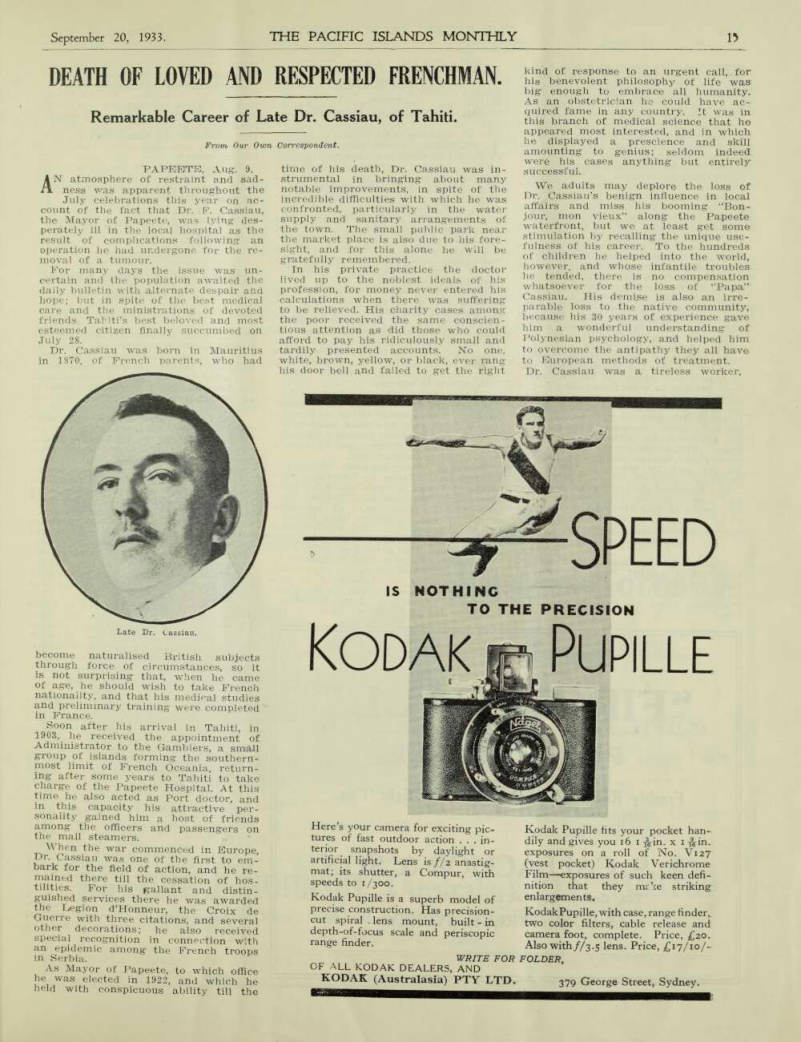
Remarkable Career of Late Dr. Cassiau, of Tahiti.
From Our Own Correspondent.
Papeete, Aug. 9.
AN atmosphere of restraint and sad ness was apparent throughout the July celebrations this year on account of the fact that Dr. F. Cassiau, the Mayor of Papeete, was lying desperately ill in the local hospital as the result of complications following an operation he had undergone for the removal of a tumour.
For many days the issue was uncertain and the population awaited the daily bulletin with alternate despair and hope; but in spite of the best medical care and the ministrations of devoted friends Tahiti’s best beloved and most esteemed citizen finally succumbed on July 28.
Dr. Cassiau was born in Mauritius in 1870, of French parents, who had
become naturalised British subjects through force of circumstances, so it is not surprising that, when he came of age, he should wish to take French nationality, and that his medical studies and preliminary training were completed in France.
Soon after his arrival in Tahiti, in 1903, he received the appointment of Administrator to the Gambiers, a small group of islands forming the southern most limit of French Oceania, return ing after some years to Tahiti to take charge of the Papeete Hospital. At this time he also acted as Port doctor, and in this capacity his attractive personality gained him a host of friends among the officers and passengers on the mail steamers.
When the war commenced in Europe, Dr. Cassiau was one of the first to embark for the field of action, and he re mained there till the cessation of hostilities. For his gallant and distinguished services there he was awarded the Legion d’Honneur, the Croix de Guerre with three citations, and several other decorations; he also received special recognition in connection with an epidemic among the French troops in Serbia.
As Mayor of Papeete, to which office he was elected in 1922, and which he held with conspicuous ability till the
time of his death, Dr. Cassiau was in strumental in bringing about many notable improvements, in spite of the incredible difficulties with which he was confronted, particularly in the water supply and sanitary arrangements of the town. The small public park near the market place is also due to his foresight, and for this alone he will be gratefully remembered.
In his private practice the doctor lived up to the noblest ideals of his profession, for money never entered his calculations when there was suffering to be relieved. His charity cases among the poor received the same conscientious attention as did those who could afford to pay his ridiculously small and tardily presented accounts. No one, white, brown, yellow, or black, ever rang his door bell and failed to get the right
kind of response to an urgent call, for his benevolent philosophy of life was big enough to embrace all humanity.
As an obstetrician he could have acquired fame in any country. It was in this branch of medical science that he appeared most interested, and in which he displayed a prescience and skill amounting to genius; seldom indeed were his cases anything but entirely successful.
We adults may deplore the loss of Dr. Cassiau’s benign influence in local affairs and miss his booming “Bon jour, mon vieux” along the Papeete waterfront, but we at least get some stimulation by recalling the unique use fulness of his career. To the hundreds of children he helped into the world, however, and whose infantile troubles he tended, there is no compensation whatsoever for the loss of “Papa”
Cassiau. His demise is also an irreparable loss to the native community, because his 30 years of experience gave him a wonderful understanding of Polynesian psychology, and helped him to overcome the antipathy they all have to European methods of treatment.
Dr, Cassiau was a tireless worker,
Late Dr. Cassiau.
whose day often began at 5 a.m. with a tour of inspection in the market place.
Yet in spite of the demands made upon him by his civil and professional duties, he found time to be the Consul for Czechoslovakia, president of the “Caisse Agricole” for four years, and president of the “Ligue des droits de l’homme.”
He was also an ardent Freemason and a Past Master of Lodge Veritas, one of the very few English-speaking lodges under the jurisdiction of the Grande Loge de France. His library of books on Polynesian ethnology, on which sub ject he was a noted scholar, is an ex tremely valuable one, likewise his col lection of stamps, for he was also an enthusiastic philatelist.
Space will not permit of more than a very sketchy outline of Dr. Cassiau’s career and attainments; but it is hoped that some day a much abler pen may do justice to this truly remarkable man.
Such types are rare, indeed, and, when they pass on, especially in the Pacific Islands, they take a big slice of the old life along with them and leave a gap which can never be filled.
The interment took place with mili tary honours on July 29 at the Paurani cemetery, where the greatest concourse of people ever present at such an event bore witness to a universal esteem and affection. Unfortunately, His Excellency Governor Montague was absent in the Leeward Group at the time and so could not be present. Speeches were made at the graveside by Monsieur de Monti- Rossi (Procureur of the French Re public), Mr. George Bambridge (Deputy Mayor) and by some of the native chiefs.
The deceased doctor leaves a widow, and also a son by a former marriage.
The latter is now studying medicine m Paris, and is expected to return later to take up his father’s practice.
The American yacht, “Astrild” arrived at Suva on August 22 on a cruise of the South Seas. The yacht, which is owned by Mr. E. P. Huffman, of San Francisco, came via Papeete and Pago Pago.
Advertisements & other items, p. 17 (1 item)
Speed
IS NOTHING
TO THE PRECISION
Kodak
Here’s your camera for exciting pictures of fast outdoor action ... interior snapshots by daylight or artificial light. Lens is f/2 anastigmat; its shutter, a Compur, with speeds to I/300.
Kodak Pupille is a superb model of precise construction. Has precisioncut spiral . lens mount, built-in depth-of-focus scale and periscopic range finder.
WRITE FOR
OF ALL KODAK DEALERS, AND
KODAK (Australasia) PTY LTD.
Kodak Pupille fits your pocket handily and gives you 16 1 3/16 in. x 1 exposures on a roll of No. V 127 (vest pocket) Kodak Verichrome Film—exposures of such keen definition that they make striking enlargements, Kodak Pupille, with case, range finder,, two color filters, cable release and camera foot, complete. Price, £20.
Also with f/3.5 lens. Price, £17/10/-
WRITE FOR FOLDER,
379 George Street, Sydney.
Tongans And The
Europeans.
An Implication Resented.
Letter to the Editor, A NUMBER of residents of Tonga have had the opportunity of reading the concert programme of the Tongan Choir —described therein as “The Tongan Methodist College Boys’
Choir” —which recently visited Aus tralia and New Zealand.
It is a fair presumption that this programme was read by at least hundreds of people in these countries, whose knowledge of Tonga is of the sketchiest, and who, in consequence, would accept as the literal truth the statements contained in it.
Under the heading “Character of the People,” it is stated that “The task of Christian Education is still the re sponsibility of the Methodist Church.
Just what this statement is intended to convey is known only to its author, but the implication to the ordinary reader is that the Methodist Church is the only body here providing Christian educa tion, which is untrue.
Educational facilities are provided by the Government of Tonga, the Anglican Mission, the Roman Catholic Mission, the Seventh Day Adventist Mission, the Latter Day Saints Mission, the Old Free Church of Tonga, and by one or two small private schools.
However, the statement which has caused deep offence to European resi dents of Tonga is contained in the same paragraph, and reads: “Tongans have not only to learn more of the deep truths by which a nation lives, but also to be guarded from the unwholesome influence of unscrupulous whites.”
It is a pity that a body professing the high ideals of the Methodist Missionary Society cannot carry on its work with out descending to statements of this nature, which are a slight on the whole European population of the Kingdom.
There is probably no race in the
Pacific better protected by its laws from any form of exploitation or un wholesome influence on the part of foreign or European residents —were such residents so inclined. Actually, the European population of Tonga is a remarkably decent-living one, and it is not competent for any person to pub lish vague and undeserved slanders of this nature.
To anyone knowing the Church his tory of Tonga for the past ten years, the Tongan might be forgiven for say ing “Save me from my friends.”
I am, etc.,
One Of The Whites.
Nukualofa, 13/7/33.
How Captain Irvine Caught
a Poacher.
Letter to the Editor.
IN all your articles on the Japanese “poachers” it is strange that no mention has been made of “our” poacher. Indeed, in your June issue, you state that so far only one of them has been caught, the “Dai Koku Maru” at Thursday Island. This is not correct.
About two years ago, shortly after these poachers first appeared, the s.s.
“Durour,” of W. R. Carpenter & Co., Captain Irvine in charge, captured a poacher in flagrante delicto.
The “Durour,” on its usual copra collecting trip, rounded the island of Maty and there was the poacher, with several boats down, industriously fish ing. It made an attempt to get away, but would have had to leave its boats with crew behind, so it stayed. It was boarded and put under arrest! The “Durour” escorted it to Aitape, the nearest District Office, but A.D.O.
Mantle would have nothing to do with it, because it was caught outside his district.
The gallant captain decided to bring it to Manus, which he did. He made several charges against the poacher and then returned to the Western Islands to complete his copra-collecting.
He returned about a week later and the Court tvas held at Lorungau, Manus.
The details I do not remember, but the poacher was fined. I heard that Cap tain Irvine went out to the boat to nail a writ to the mast, but there was no mast—at least, it was collapsed. On behalf of W. R. Carpenter & Co., several hundred pounds were claimed.
The poacher was about 50 feet long, had a powerful engine and about 22 Japanese as crew. Part of the engine was kept ashore, to prevent escape.
The boat was anchored here for some weeks and, judging from the photo graph you published of the “Dai Koku Maru,” it might be the same boat.
Eventually, it was ordered to Rabaul, where it duly arrived. I understood that the Administration were embar rassed to know what to do with it; but the poacher solved the problem by quietly slipping away one night.
It was interesting to read recently or the Japanese treatment of Russian poachers caught in Japanese waters.
Were not the boats confiscated and the crews gaoled?
I am, etc.,
N. L. Whiteley.
Manus, T.N.G.. 23/7/33.
Advertisements & other items, p. 18 (1 item)
“First Call”
PURE COFFEE.
Freshly Roasted and Packed in Air-tight Tins.
A. S. CALLACHOR & SON
Tea, Coffee, General Merchants and Agents:
24 BOND STREET, SYDNEY.
Napoleon Passage.
How Did This Place In Torres Strait Gets Its Name?
(By Philip R. Firth, of Jervis Bay Island, Torres Strait.)
THE latest book on Australian history, Steven’s “New Light on the Dis covery of Australia,” is causing, and will cause, considerable thought for the student, in mapping out De Prado’s track during his passage through Torres Strait, from the description of islands given in the manuscript.
No one has yet discovered who named Thursday Island. Cook, Bligh, Flinders, and many others have been mentioned; but a search of documents gives no satisfaction, and the mystery remains unsolved.
Situated between Jervis and Banks Islands are two chartered passages, Napoleon Passage and Bligh Channel, both running, east to west, and running parallel, Jervis Reef separating them.
Bligh’s Channel —or, as Bligh himself named it, Bligh Strait—was named in 1792, during the visit of the “Provi dence” and “Assistant.”
But who named “Napoleon Passage”?
It first appeared on charts in 1859. The French Geographical Society (Paris) denies that Dumont D’Urville, who was there in June, 1840, passed through Napoleon Passage, and maintains that he sailed to Timor via the Bligh Chan nel. They even sent a chart, copied from D’Urville’s own papers, showing this to be the case.
Logan Jack, in Volume I of “North most Australia,” suggests that it was probably named after a British steamer, “Napoleon III,” which was in the Torres Strait in 1856. As this steamer passed through the Prince of Wales Channel, this suggestion can be ruled out. Napoleon Passage is nearly fifty miles northwards of Prince of Wales Channel.
The only feasible suggestion seems to be that of D’Urville. His log is as follows:—At 8 o’clock in the morning Two Brothers Island served as a guide to steer for Bligh’s way out; then we discovered the high tops of Banks, Mul grave and Jervis Islands. At three o’clock in the evening we left behind us Passage Island, and anchored under cover of a (Jervis) reef.”
Strange to say, on the chart he shows his anchorage on the windward side of the reef, in full force of a S.E. trade wind. That in itself is unnatural be cause, in anchoring on the windward side, he was liable to wreck his boat on the reef, should his anchors give way.
Incidentally, he did break an anchor at this position.
He then goes on to give a description of the Jervis Island natives, winds, cur rents, and here he observed smoke columns from Jervis Island. Yet all this time he is anchored nearer Banks Island, a bigger, and at that time a more populous island than Jervis.
“On the 12th, at six o’clock in the morning, we were under sails. Boats marked out the way. Soon we began to penetrate into a narrow channel, edged in the two sides by reefs.”
That is certainly not a description of Bligh Island.
Firstly, the two sides of Bligh Chan nel are not reefs. The north side is; but south are Banks and Mulgrave Islands. As you come to North Island, there is a small reef, and that is all, excepting various sandbanks. secondly, why did he have boats out mark his way, considering he was working on a ground already marked out by Bligh in 1792. Flinders’ “Voyage to Terra Australis” was published in 1814. D’Urville left France over twenty years later. He mentions Bligh’s islands, named Warrior, Two Brothers, Jervis and many others. If he did pass through Bligh Channel, why did he not say so, as he makes use of Bligh’s other place names?
Napoleon Passage is very narrow, it is edged in by two big reefs, and it is very hard to penetrate. Very few use the passage, and only those very experienced in the reefs of Torres Strait. One is the captain (Mortensen) of the Government patrol ketch “Mel bidir.” At the western end stands Hamelin Boulders, named after Captain Hamelin of the “Naturaliste,” a French discovery ship.
Napoleon III was born in 1808 and died in 1873. D'Urville was there in June, 1840, and died in 1842. It thus seems highly probably that it was this famous French navigator who gave this intricate passage the name "Napoleon" and names the boulders "Hamelin" after a fellow countryman.
Perhaps it may be that some readers of the “Pacific Island Monthly” have information bearing upon this subject, which would do something to remove the uncertainty.
Advertisements & other items, p. 19 (1 item)
Ruston-Hornsby
Starting
lustration shows a Mark 4JP Four-Cylinder Engine of 35-B.H.P.
Direct Coupled to Dynamo.
OIL ENGINES
For Crude and Low Grade Fuels Horizontal and Vertical Types up to
1200-B.H.P.
Low Fuel Consumption Guaranteed and Maintained.
Sole Agents for Australia and the Islands:
RUSTON & HORNSBY (Australia) PTY. LIMITED
Registered Office: 174-180 KING STREET, MELBOURNE.
Cables: “HORNSBYS,” Melbourne.
Branches at SYDNEY (10-14 Young St.) and BRISBANE (Barry Parade).
The Silence of Berande.
B.S.I. Gold.
THERE is a singular absence of authentic news about the result of the investigation of gold prospects on the north coast of Guadalcanal, near Berande.
It will be remembered that a botanist, searching in the remoter ranges, in that part of the Solomons, found startling indications of rich gold. A syndicate of Solomons Islands planters and traders was formed; the well-known Pratten interests in Sydney were approached; an engineer of high repute, Mr. Pen man, took an expedition to Guadalcanal, to investigate; and thereafter a black silence descended.
It has been variously reported that "the show was a washout”; that rich dredging-ground was found along the lower valleys; and that “there is some thing doing, but it is being kept very quiet.” The absence of any develop mental operation suggests either a complete disappointment, or something very rich. Moderate values would mean prompt activity, so as to take early advantage of the present extraordinary value of gold (about £7/8/- per ounce in Australian currency) which may not hold indefinitely.
“Fools, Liars And Degenerates.”
[Letter to the Editor from Julian Hillas, author of South Seas novels (Captain.
R. Julian Dashwood, O.M.V.), of Rakahanga, Cook Islands.]
Permit me, as the author of a recent South Sea novel, to lift my pen in the face of your editorial hurricane of last February.
Here on Rakahanga, mail reaches us approximately every three or four months, consequently, I have only just seen the issue referred to, and which, incidentally, also contains the “cri du coeur” of Author Frisbie, whose own book, “Puka Puka” is not altogether im mune from those exaggerations which he finds so objectionable in the work of others.
I have spent over three years in the Cook Group, and while no one is more genuinely in sympathy with the real life of the Islands than myself, I am neither hysterical nor hypocritical about it. Neither am I specially foolish, unduly mendacious nor notably degenerate.
Nevertheless, I endorse —with certain reservations —the main attitude taken by those authors whom you and Mr. Frisbie have seen fit to attack. Principal of these reservations is Trader Tom Richards’ “White Man, Brown Woman.”
What Mr. Frisbie says about this book and its author is perfectly true, particu larly his remarks on Manihiki, an island which I happen to know personally.
I notice that while you give promin
ence to the Rev. William Raton’s opinion of “Deep Water and Shoal,” you ap parently disregard the obvious fact that as a leading figure in the International Missionary Society, he could hardly be expected to clap the author on the back.
Mr. W. A. Robinson and I were the fel low-guests of a Rarotongan planter in 1929, and he did not then strike me as a young man likely to draw a very long bow; and, although I am unacquainted with the places mentioned in your edi torial, his views on those which I do know were peculiarly fresh and invigor ating.
But to continue. In his article, “The South Sea Myth,” Critic Frisbie derides the suggestion that on one of the quieter islands a European can live on ten dol lars a month —about £3 at present ex change. Nonsense! Mr. Frisbie, who formerly posed as “an epicurean beach comber . . . without a thought for the white man’s code of ethics.” (I quote from his own book), should know better.
On any island of the Cook Group an adaptable man, handy with tools and moderate in all his appetites, could live on £3 a month and suffer no hardship.
I know, because I have done it on less.
But I will add that he would require official permission to make the attempt, as well as some knowledge of local con ditions.
Heap calumny and abuse on the living by all means, but spare the dead. They are defenceless. Frederick O’Brien’s books may occasionally read like serial menus of strange dishes, but he knew his subject; and it is doubtful if Robert Dean Frisbie will ever achieve anything like as faithful an island atmosphere as O’Brien effected in “White Shadows”.
And when he would belittle the late Robert Keble’s “Numerous Treasure” — probably the soundest psychological study of a modern Polynesian girl’s mentality—he shows the littleness of a very little man.
Which brings us to the question of what is really wanted from writers of South Sea fiction or semi-fiction? Is it the soul-solacing prose of Stevenson or —and God forbid! —the sentimental sim perings of Miss Beatrice Grimshaw?
Should not a book be a mirror reflecting the character, thoughts, actions and set tings of fictitious people, composite pic tures built on a thorough, first-hand knowledge of the Islands and the various types found therein?
Naturally, an author sees things from his own point of view and writes ac cordingly; he will either be pro or anti native, deplore the work of missionaries or laud it to the skies, condemn or com mend Administration according to his temperament, preference and experience.
And, in reading his book, let us remem ber that a penny has two sides and that it is pretty well impossible to see both of them at once.
But that is no excuse for sensational flights of fancy. None whatsoever. No matter in what direction his tastes lie, the writer of South Sea stories can al ways lay his hand on a vast mountain of ebullient but quite authentic material.
It is there in sufficient quantity to sat isfy anyone. If you or your contributor doubt this, I am willing to supply—gratis —a series of articles dealing with the Cook Islands which will, I think, sub stantiate my claim.
Advertisements & other items, p. 20 (1 item)
giving a long lasting pro-
Made expressly to keep a lustrous, full gloss finish
against the varying con-
ditions of moist weather exposure, and prevent the decaying ravages of rain and extreme heat by
giving a long lasting pro-
tection to all surfaces.
SUN PROOF
RAIN PROOF
"Stronger than the Weather”
W. R. CARPENTER
& CO. LTD.
New Guinea, Solomon Islands, and all other South Sea Islands.
Who Discovered Australia?
Was There Portuguese Landing on Northern Shores Before Dutch and Spaniards Came In 1606?
Written for "The Pacific Islands Monthly" by Philip R. Firth, of Jervis Island, Torres Strait, who is a well-known historian and investigator.
ASK any person who discovered America, and nearly all, without hesitation, will reply “Christopher Columbus.”
Then ask a similar question as to who discovered Australia—and varied will be the answer.
It is a generally accepted fact that the Dutch and Spanish claim discoveries in March and September respectively, of 1606. Both of these alleged dis coveries were in the vicinity of Cape York Peninsula.
In 1512 Dr. Abreu, a Portuguese, dis covered the Spice Islands, and claimed them on behalf of his King, as Portu guese territory. Shortly afterwards, the Portuguese established trading stations throughout the Moluccas, sending their ships to trade with the natives on adjoining islands. Chief among these stations was Ternate.
There is on record the account of a voyage undertaken in 1525, which has been studied by historians, but apparently passed over as doubtful.
The school books dealing with the all-absorbing topic, history, or even books which the general public have access to, contain any reference to this voyage. But one always finds mention of Marco Polo, Bartholomew Diaz, and Vasco da Gama, as a lead up to Jansz and Torres.
Of Gomez de Sequeira we read nothing, and it is doubtful if many have heard of him.
Two statements were made by people of undoubted integrity. The first was a Portuguese writer named Castanheda (Major’s “Early Voyages to Australia,’’ page 35), who states that a Portuguese ship was fitted out at Ternate, to trade with the people of the Celebes; and, on its return voyage it was driven by storms and currents no less than 300 leagues out of her course, into an open sea, between the Spice Islands and the Strait of Magellan. Many times they gave themselves up for lost, and the ship was severely damaged. At last they reached an island 30 leagues in circumference, on which they landed and remained four months. The in habitants had long hair, and wore beards, and were of a tawny colour.
They left Ternate in July, 1525, and arrived back in port on the 20th January, 1526, after an absence of nearly seven months.
The next statement is that made by the Jesuit Maffei. It is very similar to that of Castanheda; but he adds the captain’s name, which was Gomez de Sequeira, and says that the captain named the island or islands he discovered after himself.
So much for the condensed reports of the two authors. Anyone wishing to read them in full may find the trans lations in Major’s “Early Voyages to Australia.’’
The open sea referred to must have lain S.E. of the Celebes, as it was situated between the Spice Islands and Strait of Magellan. A line taken 300
leagues from the Celebes, brings us to the eastern boundary of the Arafura Sea, The inference to be drawn from the reports is that Sequeira attempted to trade with the southern portion of the Celebes; otherwise, if he had sailed west from Ternate to Celebes, he would have been driven back to one of the Spice Islands. Instead of that, he found himself in an open sea, travelling east wards.
The island, according to this reason ing, should be found somewhere in this locality, and of about the circumference stated. The inhabitants had long black hair and beards. There can be no doubt, surely, that this is a fair descrip tion of the Australian aboriginal, as all early Australian explorers have re marked on these two characteristics.
The Papuans have short curly hair.
It would not be amiss, here, to re member the incident of Bass and Flin ders and the scissors, which occurred during their voyage in the “Tom Thumb,” and which probably saved them from discomfiture.
There is on record, however, Gastal di’s map, published in Venice in 1554, which clearly shows the islands of Gomez de Sequeira in 8 deg, latitude South, and about 134 deg. longitude East. This is empty ocean, between Australia and Dutch New Guinea.
It must be remembered, however, it was at this time the Courts of Spain and Portugal were at the climax of their animosity towards one another, regarding the line of demarcation in
the Eastern Hemisphere—the Spice Islands being the prize in dispute.
The natural conjecture would be that both nations would place whatever dis coveries they made on that side of the imaginary line in which their own sphere lay. There would have been no territorial gain in falsifying a latitude.
The famous French geographer, Mons Barbie-du Bocage, is of the opinion that the island of Sequiera was the Prince of Wales Island, in the Torres Strait.
R. H. Major, a great historian, does not agree. He thinks it was Tobi, or Lord North’s Island (North of New Guinea).
Collingridge, yet another authority, disagrees with this latter opinion on several important counts, chief among which are that Tobi Island is only 60 leagues from the Spice Islands, and that it is not, correctly speaking, situated in between the Celebes and the Strait of Magellan. In dealing with Bocage s opinion, Collingridge states that Prince of Wales Island is more than 300 leagues from the Celebes.
Collingridge himself does not make
any definite assertion; but thinks it is more likely to have been one of the Wessel Islands off N.E. Arnhem Land, Northern Territory.
Collingridge’s theory certainly sounds more reasonable than those of Major and du Bocage.
Gastaldi’s map shows the Sequeira Islands in the longitude of Northern Territory of Australia. That is approximately 300 leagues from the Celebes, and is peopled by Australian aboriginals. The “open sea’’ would be the Arafura Sea. Du Barros, the most famous of all Portuguese historians, in his translation, states “they were driven into an open sea, with not a single island in sight, and constantly towards the east.”
Looking at our modern maps, it seems rather an impossibility to travel 300 leagues east of the Celebes without sighting an island.
In dealing with the very vexed ques tion of the discovery of Australia, all claims, however pretentious, should be well perused.
There seems to be no doubt that the ship left the Moluccas; and that it pro ceeded to the Celebes, and was then blown by a contrary wind hundreds of miles east of its course. Prom the de scription, it is apparent that the people encountered were Australian natives.
Taking into consideration the fact that the Portuguese were a trading nation, it seems highly probable that, as they sent their ships east and west from the Spice Islands for trade, they also sent them in search of Terra Aus tralis —but in secrecy, owing to the jealousy existing between the two nations.
In view of the statements and opinions of Bocage and Collingridge (although they both differ) it appears as if Australia was discovered many years before the arrival of the Dutch at Cape Keer-Weer.
Every year, old manuscripts are being refound in archives, and new data being presented, which may one day settle definitely the priority claim to the dis covery of Australia.
Apparently, the laurels still rest with the Dutch and Spaniards, as the state ments of the Jesuit Maffei and Castan heda are too vague a description of a voyage to Australian waters to satisfy the governing bodies of historical geography.
Yet Jode and Wytfliet’s maps of 1593 and 1597 respectively both show New Guinea as separated from Australia.
Therefore, it seems highly probable that the northern coastline of Australia was visited many years before the Dutch and Spaniards arrived there.
Advertisements & other items, pp. 21-22 (1 item)
Gillespie’S
SAMUEL RUSSELL,
ESTATE AND GENERAL AGENT,
P.O. Box 64, Papeete, Tahiti.
Real Estate. Investments. Estate management and administration. Valuations and Reports Houses and Lands for Lease or Sale.
Sole Proprietor: TAHITI PERFUMES.
Cables; Russell, Tahiti (Bentley’s Code).
GILLESPIE’S
"ANCHOR”
FLOUR
TRADE MARK
The Standard of Quality.
Stromberg-Carlson
SUPERHETERODYNES
Inquiries relating to these famous Superheterodynes should be sent to Noyes Bros. (Sydney), Ltd., who will be pleased to supply illustrated folders and full details of their range of Broadcast Receivers, including the new Battery Operated Receivers 403 & 704 Full stocks of every class of radio component parts carried.
NOYES BROS. (Sydney) LTD.
Wholesale Distributors 115 Clarence Street, SYDNEY. Showrooms: 78 Clarence Street, SYDNEY. ’Phone: B 7581 (10 lines). 11 WATT STREET, NEWCASTLE. ELIZABETH STREET, BRISBANE.
Swallow & Ariell’s
Popular Assortments
QUEEN’S OWN MIXED BISCUITS;
A delightful assortment of Sweet and Cream Biscuits and Wafers in attractively labelled Tin.
LADIES’ AFTERNOON TEA;
Such favourites as Peter Pan Biscuits, Vanilla Custards, Oyster Cream Wafers, Champagne Fingers (12 varieties in all) comprise this Extra Choice Assortment. Supplied in No. 1 Flat Tins only.
MORNING TEA;
A square Flat Tin containing some of the less Rich varieties of our Sweet Biscuits, including Milk Arrowroot, Osborne, Coffee, Diamond, etc.
SWALLOW & ARIELL Ltd., Port Melbourne, Australia
The Duiffien Chart.
The following appeared in the “Sydney Morning Herald” of September 2: Professor G. C. Henderson, in a letter from London to Mr. Ifould (Mitchell Library), says— ‘‘Dr. Wieder has recently found a chart drawn by Roossengin on board the Duifflen, of her discovery of the western coast of York Peninsula, in 1606. He has given me a copy, with permission to use it as I wish. It is my intention to send it out on loan to your trustees for exhibition in the Mitchell Library.
It is the first authentic record of the discovery of any part of Australia by a white man. Some months before Torres went through the straits, and every place he visited is clearly marked on the chart.”
“This,” said Mr. Ifould, “is an ex ceedingly important discovery. Owing to the absence of any direct record of the Duiffien’s voyage, geographers have frequently questioned whether she ever did more than sail along the south coast of New Guinea —that is, whether those on board really had the first sight of any part of Australia. This chart answers that question, which has been a matter of controversy among geo graphers for more than a century. The Mitchell Library will obtain from Dr.
Wieder a facsimile reproduction of the chart in colour.”
Dr. Wieder is probably the most dis tinguished authority in the world on early maps, and is editor of “Monumenta Cartographica.” It is understood that he will collaborate with Professor Hen derson in a joint work on the Tasman voyages, and intends visiting Australia, probably within twelve months after Professor Henderson returns.
Palatial Yacht.
Baron Empain’s Cruise In The Pacific.
From Our Own Correspondent.
Papeete, Aug. 9.
THE popularity of Tahiti as a stopping place for voyaging yachtsmen was demonstrated when the “Heliopolis,” a palatial, oil-burning pleasure cruiser of 600 tons, came into Papeete on July 19 — just too late for the festivities —unfortunately for her passengers.
The “Heliopolis” is owned by Baron Empain, who is by birth a Belgian subject and well-known in all the capi tals of Europe, but is especially noted for the lavish entertainments given at the Chateau de Bouffemount, near Paris, which is one of his Continental resi dences.
Baron Empain inherited his title, as well as a half-share in a fortune of two billions of francs, from his father, who was also known as General Empain, and who died some five years ago. The old Baron was closely associated with the late King Leopold in the early days of the Congo Free State, and it was there that he accumulated most of his wealth, in various enterprises, and subsequently became one of the principal shareholders in the rich mineral deposits of the Ka tanga district.
The Baron joined the “Heliopolis” in Mexico and proceeded to Tahiti by way of the Marquesas Islands. Here the ves sel remained for four days while the party, which numbered sixteen, toured the island, and made the most of such
diversions as could be found at the tail end of the July Fete; they were also entertained aboard the N.Z. warship “Veronica,” which was in port at the time.
After taking aboard 850 drums of fuel oil, which had been awaiting her for some time, the “Heliopolis” proceeded to Moorea, where the party were enter tained by Mr. T. Wessells —who has leased Lord Hasting’s establishment in Oponohu Bay—and thence continued on her way to the Leeward Group, Fiji, and the Far East.
It is understood that Baron Empain will disembark in Singapore, and the yacht will then take the shortest route to Southampton, England, where she is due to arrive in the early part of September.
The estimated cost of this flying trip around the world is 3,000,000 francs.
As shore-going equipment, the “Heli opolis” carries a Criscraft boat, capable of 45 miles per hour, and another launch fitted with a 450 horse-power engine, which can clip along in smooth water at 70 miles per hour; this latter was let down to give the natives a treat in Oponohu Bay.
The captain, officers, crew and dining room staff are English.
After a short experiment with a talkie installation, the proprietor of Rarotonga picture theatre has decided to augment his installation with new equipment from the United States and to carry out im provements generally in connection with his premises. Mr. Browne, the proprie tor, on numerous occasion, in fact, on every occasion of the visit of a warship, throws his house open, free to all the rating, and with his orchestra of stringed instruments, gives a lively evening’s en tertainment for the bluejackets.
Loading Storm-tossed Ships.
Polynesian Grit.
Courage and Patience Shown in Loading Storm-tossed Ships.
From Our Own Correspondent
Rarotonga, Aug. 12.
WHETHER the storm-god Tangaroa has in some way been offended, we cannot say; but the unusual series of bad loading conditions for ships call ing at the Cook Group continues. Mail boats, warships, cargo vessels and schooners, each in turn, have met with dismal weather conditions at their anchorages off the reefs at the different islands.
On July 25 the s.s. “Waikawa”, from the American coast, called at Rarotonga and loaded tomatoes for the Auckland market. She proceeded to Atiu, where it is understood the reef conditions pre vented her from landing portion of her cargo. Then, again, at Aitutaki, she was forced from one loading position to another by the rough seas. It is reported that several boats were badly damaged.
After persevering for two or three days, the “Waikawa” eventually lifted the whole of the cargo of oranges offering.
The magnificent efforts made by the native inhabitants of the Islands to get their fruit aboard a vessel in rough weather seem somehow to escape the notice of South Sea writers. The cool courage, patient labour and muscle power that is placed behind this work of loading crates of fruit, day and night, into a vessel heaving madly at her anchorage require an almost arrogant contempt for the power of the sea.
Advertisements & other items, pp. 23-24 (1 item)
Fully Automatic
Gives you ALL the advantages of
AUTOMATIC ELECTRIC LIGHTING
plus automatic Electric REFRIGERA- TION for your home.
FULLY AUTOMATIC
ELECTRIC LIGHTING
PLANT
Simplicity itself! Five or six lights are supplied by the battery alone. As soon as an extra load is applied, either by switching on more lights, an iron or fan, or the refrigerator, the engine starts up automatically and provides ample current. It stops automatically as soon as load is off. Automatic safety devices make failure impossible.
Write to-day for
New Illustrated
Folder and Price List.
Plants from £103 f.o.b. Sydney.
DANGAR, GEDYE & CO. LTD.,
10-14 Young Street — Sydney.
ALBERT GREGORY,
107 York Street, Sydney.
Saddlery,
Saddler’s Iromongery,
Leather and Paint Merchant.
LEATHERS— Art Work, Sole, Harness, Roans, Suedes, Bag, Kangaroo, Bridles, Belts, Spurs, Stirrups, Breastplates. SADDLES Race, Exercising, Park and Stock.
Leather Belting and Pump Cups.
Paint Merchant.
For House and Roofs, ready mixed . . 13/6 gallon Special Value House Paint 10/6 gallon Brushes, Kalsomine, White Lead and Oil.
Samples of Leathers on Application
EXCELSIOR SUPPLY CO. LTD
The most extensive Manufacturers in the British Empire of
RUBBER STAMPS.
INKS, STENCILS.
Marking Devices.
ACME STAMP PADS
We have a big range of Special
FRUIT CASE MARKING SETS
We also Manufacture or Supply a complete line of
Spraying Machines
for all purposes.
Let us know your requirements and we will quote you by return. Ask for our Big Catalogue.
Sole Australasian Distributors of the World Famous SHEAFFER FOUNTAIN
PENS and PENCILS.
EXCELSIOR SUPPLY CO. LTD.
Head Office:—160 GEORGE STREET WEST,
SYDNEY. N.S.W.
Banished For Seven
Years.
Offence Against Native Child.
Rarotonga, Aug. 12.
A EUROPEAN, resident at Rarotonga practically all his life, was recently brought before the High Court here before His Honor, Justice Ayson, on a charge concerned with an offence against a very young native girl.
The jury found the man guilty and the Judge, after reserving judgment, sentenced the man to imprisonment for two years and to banishment from the Cook Islands for a total period of seven years.
The case is mentioned here for the reason that, while offenders against the native people in one way and another may “get away with it,” the authorities here have the power of administer a form of punishment calculated to rid the islands of moral degenerates whose pre sence in the South Seas has been re ferred to on more than one occasion in the columns of “The Pacific Islands Monthly”.
Tonga’S Finance,
How The Little Kingdom Is Meeting the Depression.
THE published annual statement of the Treasurer of Tonga for the year ended June 30, 1933, shows that the kingdom has weathered the economic blizzard very well.
The little country has had a heap of financial trouble to deal with. Here, for instance, is how its revenue returns went:
In these circumstances, as was to be expected, expenditure got substantially ahead of receipts; but there has been some mighty cutting of governmental services, and for 1932-33 the total ex penditure was only £63,599, as compared with revenue of £60,179.
There has been considerable trouble with exchange, as a result of the £ hav ing different values in Britain, Australia, New Zealand and Fiji; and it was re ported about the end of 1932 that the Tongan Treasury had been rather badly mauled. Just how it was all squared up is not disclosed in the printed accounts; but the careful Treasurer of Tonga ob viously is keeping a close watch on this very tricky aspect of extra-territorial finance.
Tonga, unlike more “advanced” coun tries, has a substantial surplus of assets over liabilities, which is expressed in a cash deposit outside of the kingdom. Be fore the depression, it was something like £160,000; but it is now down to £135,000. Taking 1928-9 revenue (£96,887) as normal, the Tongan Treasurer in the four complete years since then, has col lected £100,000 less than he might have expected. Yet his cash deposits have shrunk by only some £25,000—cuts in expenditure have provided for the balance.
Taxes Customs.
Native.
Other.
Total. 1928-9 ... 41,171 11,780 37,936 96,887 1929-30 ... 41,902 11,919 35,764 89,585- 1930-1 ... 28,026 11,677 30,959 70,662: 1931-2 ... 20,496 9,491 27,237 57,224 1932-3 ... 22,625 11,200 26,354 60,179
Condition Of Northern
Cook Islands.
From Our Own Correspondent.
Rarotonga, Aug-. 12.
MAIL advices from the Northern Cooks report everything very satisfactory and the islanders living under sur prisingly clean and sanitary conditions,, particularly at Pukapuka. The native villages at that island are reported to be extremely well kept.
Little rain has fallen at Pukapuka and Penrhyn during the last two months, but the northern people declare there is no anxiety felt on this account.
To fill the vacancy caused recently by the death of Mr. Wilson, late Resident Agent at Penrhyn, the appointment of Mr. P. Woonton to the position is under stood to have been arranged, in the meantime. Mr. Woonton is a permanent resident at Penrhyn and is a very popular man, being well-known to all Cook Islanders, as well as in Papeete and the more important islands in the Society Group.
About a year ago the Resident Agent at Manihiki (Cook Group) died and, in accordance with the best traditions, the position, for the time being, has been handed over to a son of the deceased man, Mr. Abela Williams
Damn Canberra!
“Rabaul Times” Is Outspoken on Territory's Vital Problem.
NATIVE labourers in the Mandated Territory of New Guinea, to an in creasing degree, are getting out of hand.
Frequently, in this journal, in sober and reasoned language, we have stated the position. No one has taken any notice. So, once more, we summarise the problem.
New Guinea natives understand only one form of discipline—the discipline that is supported, wherever necessary, by prompt corporal punishment. Em ployers are not allowed to cane their “boys”; even a smack on the ear, with the open hand, means that “white fella marster” can be taken by his triumphant servant to the “house kiap,’’ where the “kiap” (district officer) is bound by law to impose a punishment on the employer.
If the employer keeps within the letter of the law, and hales his disobedient servant before the D.O., the most the latter can do is to order a term of im prisonment; and the calaboose has no terrors whatever for the now sophisti cated New Guinea kanaka. Naturally, the native labourers have come to regard employers, kiaps, and “guv-ment” with a measure of cheery contempt. Dis cipline is more and more difficult to enforce along the plantation labour lines.
That is bad enough. But, behind it all, there is something more ugly and sinister— and that is the threat against the safety of white women in the Terri tory. Nothing can be gained by going into details, but it can be said, plainly and definitely, that several “incidents” in the past couple of years have shown a tendency on the part of native house servants and plantation labourers to make attacks on white women. These offenders have been punished severely, but that does not remove the evil, or the threat it represents. The fault lies in the system under which these natives are permitted to misunderstand the relationship between white and, black, and to become cheeky and insolent in their attitude towards their European masters. One would almost suppose, in deed, that they had read in “Hansard” the speeches of certain bumble-footed Lang-ites in the Commonwealth Parlia ment during the last full-dress debate on New Guinea!
The fault lies in the system, and blame for the continuance of the system goes wholly to the Australian Federal Government. Planters, district officers and N.G. Administration have sought for reform of the system; departmental officials have approved, but Minister after Minister, afraid that some loud mouthed demagogue will bawl about "slavery in New Guinea,” has subverted his better judgment to the expediency
of vote-catching.
Nothing has been done, and the posi tion goes steadily from bad to worse.
Outspoken Newspaper.
Finally, the Territory newspaper, the "Rabaul Times,” has lost all patience, and editorially has cursed the pro crastinating politicians of Canberra. On July 28, after warmly praising the work of the Administration, the newspaper says:— In one respect—and a very important
respect—the Administration has failed.
The responsibility of this failure, however, cannot be placed entirely at the door of the local authorities, who have been forced to sit, with tied hands, while superior legislators at Canberra have ordered the tune while the Territory has had to pay the piper.
The price which we are called upon to pay is the present unsatisfactory relationship which exists between the White and the Black; between the white employer and the native employee throughout a greater portion of the Territory. More especially is this unsatisfactory attitude remarked in those areas where the natives have reached a higher state of evolution.
From many quarters of the Territory come reports of disobedience and lack of discipline amongst indentured labourers, as well as the free native.
Cases of this nature appearing in the Courts of Justice are on the increase.
The methods employed by the natives, in order to show the advances made by them in their evolution, are becoming more serious as the years go by; until one stops to wonder to how serious a
state these methods may be allowed to go.
Flagrant disobedience, dumb in solence, open mutiny and violence can not be allowed to continue, and it is the Administration’s responsibility to make an end of these methods adopted by the natives for the purpose of em phasising their acceptance of our civilised methods, Such breaches of discipline and downright disrespect of the white man must be met with such strong disciplinary measures that they will be understood by the native as being a corrective.
The most suitable measure to be adopted by the Administration is for magistrates, in outlying districts of the Territory, to have the power of summarily delivering corporal punishment, in the form of canings, to natives found guilty of breaches of discipline. the
introduction of such corrective would,
without a doubt, act as an immediate deterrent to the concerted acts of violence, open disrespect and "go slow" policies which ware being carried out by so many natives at the present time.
The suggestion has been made that
such a measure would never be ap proved by the authorities at Canberra, The very name Canberra has become far too much of a bogey in this Terri tory. It savours too much of the “Big Policeman” who is used by the nurse to frighten a child into submission.
The sooner Canberra and the people of Australia, who put the men in power at Canberra, realise that this Territory has reached the stage when it knows what it wants and has, at the head of affairs, a man capable of appreciating what is best for this Territory, the better it will be for all concerned.
It is ludicrous that Australian poli ticians, whose seats depend on a grazing or “cocky-farming” community in Vic toria, New South Wales, or where you please, should get up in the House and veto vital legislation affecting this Territory, from fear that their con stituents in the Woop-Woops of Aus tralia will not approve of the actions of their parliamentary representatives.
What do these constituents know of our wants or conditions in New Guinea?
How would they like vital points of policy regarding wheat or wool to be discussed by New Guinea residents whose interests are copra and gold?
We have our own problems to solve.
The delegating to magistrates of power to inflict canings will solve one of our biggest problems. Let our own legis lators now get busy before it is too late.
Mr. N. A. Pyne has retired from the post of Collector at Haapai after 12 years’ service under the Government of Tonga. Owing to the depression, the position at Haapai has been abolished, and Nukualofa and Vavau are now the only ports of entry in the Protectorate.
Mr. Pyne, with his wife and four child ren, has settled down in Sydney for the present.
Advertisements & other items, pp. 25-26 (1 item)
Durabestos
AUSTRALASIA’S CLEARING HOUSE FOR THE PRECIOUS METALS buyers of
GOLD
OSMIRIDIUM, PLATINUM, SILVER, ETC,
GARRETT & DAVIDSON, LTD
assayers, bullion merchants, metallurgists, Bank of N.S.W. Buildings, Regent Street, Sydney.
BUILD NOW WITH DURABESTOS
Island Homebuilders can now erect an everlasting Home easily and economically by using DURABESTOS (Asbestos Cement) Building Sheets to line the exterior walls and interior walls and ceilings.
Economical to transport, easy to fix, and fireproof.
WUNDERLICH LIMITED
BOX 474 AA, G.P.O., SYDNEY.
DURABESTOS
BUILDING SHEETS
JAMES BARNES LIMITED
2 Botany Street, Waterloo, Sydney
(ESTABLISHED 1881)
MANUFACTURERS OF
“Globe” & “Victory” Brands
OF
SHEEP’S TONGUES OX TONGUES SAUSAGES
PRESERVED MEATS BEEF EXTRACT DRIPPING
Also “Castle” Brand, which is specially packed for use by the White Population.
Globe Beef Extract is invaluable to Young and Old.
Tested Recipes on the packet 4oz. and 8oz. sizes.
Historic Darnley
Island.
From Our Own Correspondent.
Thursday Is., Aug. 2.
VISITORS to Darnley Island, Torres Strait, now notice a great change in “layout.”
New roads have been made, portions of the hills overlooking the bays being blasted away to enable this to be done; and a good deal of drainage work has been carried out by the Teacher (Mr.
Mclntosh Murray). This should help to overcome the fever trouble which afflicts the island periodically.
The Government Teacher’s latest innovation is the installation of fresh water shower baths, enclosures being provided for men and women. The water is fed by pipes from a natural spring. A good deal of planting of flowering shrubs, etc., is also being done, and a good many of the villagers are beautifying their homes in this way, Darnley is one of the most interesting of the eastern group of islands. It is of volcanic origin, and was named by Bligh when he passed through, although the flag was actually hoisted on Darn ley by the captains of the “Hormuzeer” and the “Chesterfield” after a massacre of some of the ships’ company and passengers in 1793.
The island at one time carried a population of about a thousand; the number dwindled to about 200, but has been steadily building up again during the last few decades. It is remote from tourists and visitors, although the steamer passage from Thursday Island to Port Moresby is right alongside.
In the old days, headhunting was a favorite practice of the inhabitants, and great baskets full of skulls occupied a special zogo-house. It was Darnley
Islanders who, in their great fighting canoes, attacked Bligh, a few days be fore the affray at Warrior Island. Quite a number of old wrecks are clustered round about, and at various times old Spanish relics have been discovered.
Polynesia.
Schooners.
What They Mean In Lonely Polynesia.
From Our Own Correspondent.
Rarotonga, Aug. 12.
THE two well-known schooners of the Cook Group have each made trips re cently to the far northern islands — Manihiki, Rakahanga and Penrhyn. They have now turned their attention to the islands of the Lower Group, their wel come sails appearing at first one island, then another. The two mail-boats arrive at Rarotonga on the 12th and 14th Au gust respectively, and both schooners are expected to return to Rarotonga to connect with them.
The sight of a schooner is something very fine, to the eyes of an inhabitant of the islands.
The natives detect the tip of the mast when it is but a flickering speck on the distant rim of foggy blue. Immediately, the spell of isolation is broken. New faces are seen. There are the home comings and again there are those mak ing ready to depart, surrounded with mats, fruits and, in some instances, farm-yard stock.
In a few hours, the skipper raises his voice; sailors spring about the ship; and the visit is over. A canoe or two linger about the departing schooner, perhaps an empty bottle or a discarded meat tin is thrown overboard. The sails creep slowly up the masts, unfurl themselves and merge their whiteness with the white hull, speeding the ship merrily on her way to the next island.
Cause Of Copra Fire.
From Our Own Correspondent
Rarotonga, Aug. 12.
A SMALL fire occurred here a few days ago amongst some sacks of copra stored in a shed. Fortunately, there was no serious loss.
The cause was probably a sack or two of copra becoming saturated with water during loading operations across a bad reef from one of the islands, to the schooner. The wet sacks possibly found their way into the centre of the stack in the shed and later developed sufficient heat to cause spontaneous combustion.
By good fortune the outbreak occurred during the daytime.
Papeete, Aug. 28.
INFORMATION received in Tahiti from the s.s. “Recherche,” a Messagerie Company vessel which left this port for France on July 23, states that a fire broke out in No. 2 hold in a cargo ot copra from the New Hebrides or the So ciety Group.
Luckily the Marquesas Islands were not very far distant at the time and the steamer was able to reach the harbour of Taiohae, in Nukuhiva, and discharge the damaged produce amounting to about 100 tons, before the fire had be come really dangerous.
Mons. Louis Bouchet, late Governor of Tahiti, and Madame Bouchet, were pas sengers aboard the vessel, en route to France.
New Guinea Notes.
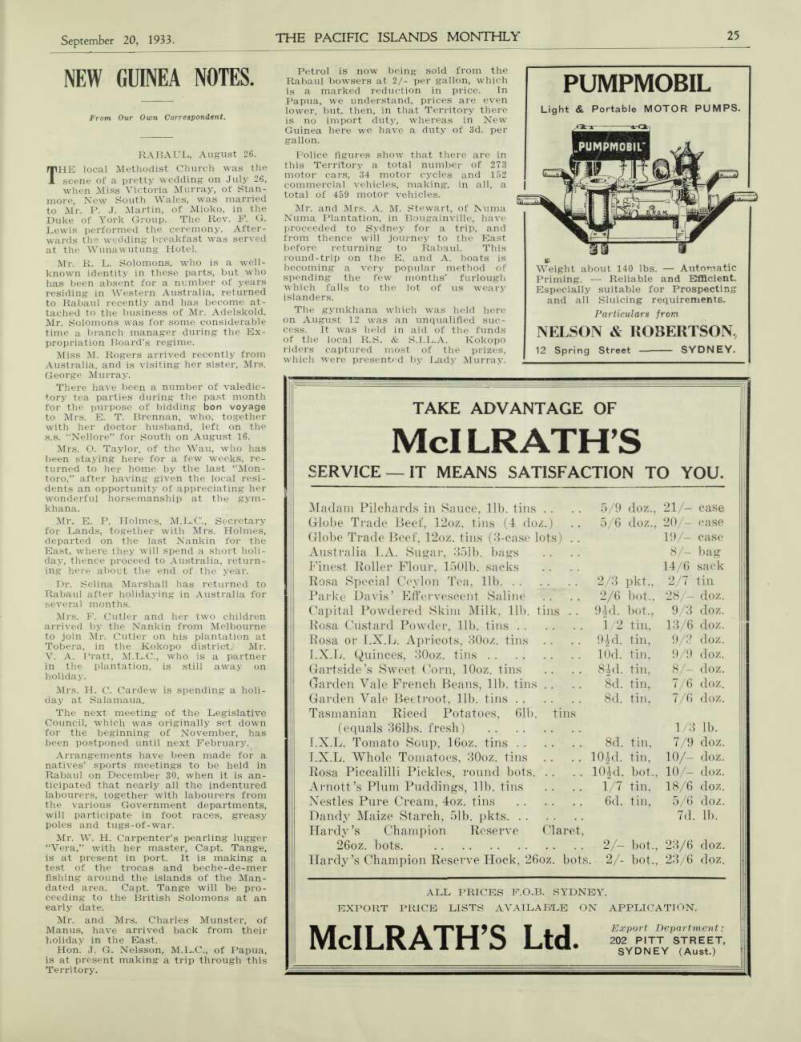
From Our Own Correspondent.
RABAUL, August 26.
THE local Methodist Church was the scene of a pretty wedding on July 26, when Miss Victoria Murray, of Stan more, New South Wales, was married to Mr. P. J. Martin, of Mioko, in the Duke of York Group. The Rev. F. G.
Lewis performed the ceremony. After wards the wedding breakfast was served at the Wunawutung Hotel.
Mr. R. L. Solomons, who is a well known identity in these parts, but who has been absent for a number of years residing in Western Australia, returned to Rabaul recently and has become at tached to the business of Mr. Adelskold, Mr. Solomons was for some considerable time a branch manager during the Ex propriation Board’s regime.
Miss M. Rogers arrived recently from Australia, and is visiting her sister, Mrs.
George Murray.
There have been a number of valedic tory tea parties during the past month for the purpose of bidding bon voyage to Mrs. E. T. Brennan, who, together with her doctor husband, left on the s.s. “Nellore” for South on August 16.
Mrs. O. Taylor, of the Wau, who has been staying here for a few weeks, re turned to her home by the last “Mon toro,” after having given the local resi dents an opportunity of appreciating her wonderful horsemanship at the gym khana.
Mr. E. P, Holmes, M.L.C., Secretary for Lands, together with Mrs. Holmes, departed on the last Nankin for the East, where they will spend a short holi day, thence proceed to Australia, return ing here about the end of the year.
Dr. Selina Marshall has returned to Rabaul after holidaying in Australia for several months.
Mrs. F. Cutler and her two children arrived by the Nankin from Melbourne to join Mr. Cutler on his plantation at Tobera, in the Kokopo district. Mr.
V. A. Pratt, M.L.C., who is a partner in the plantation, is still away on holiday.
Mrs. H. C. Cardew is spending a holi day at Salamaua.
The next meeting of the Legislative Council, which was originally set down for the beginning of November, has been postponed until next February.
Arrangements have been made for a natives' sports meetings to be held in Rabaul on December 30, when it is an ticipated that nearly all the indentured labourers, together with labourers from the various Government departments, will participate in foot races, greasy poles and tugs-of-war.
Mr. W. H. Carpenter’s pearling lugger “Vera,” with her master, Capt. Tange, is at present in port. It is making a test of the trocas and beche-de-mer fishing around the islands of the Man dated area. Capt. Tange will be pro ceeding to the British Solomons at an early date.
Mr. and Mrs. Charles Munster, of Manus, have arrived back from their holiday in the East.
Hon. J. G. Nelsson, M.L.C., of Papua, is at present making a trip through this Territory.
Petrol is now being sold from the Rabaul bowsers at 2/- per gallon, which is a marked reduction in price. In Papua, we understand, prices are even lower, but, then, in that Territory there is no import duty, whereas in New Guinea here we have a duty of 3d. per gallon.
Police figures show that there are in this Territory a total number of 273 motor cars, 34 motor cycles and 152 commercial vehicles, making, in all, a total of 459 motor vehicles.
Mr. and Mrs. A. M. Stewart, of Numa Numa Plantation, in Bougainville, have proceeded to Sydney for a trip, and from thence will journey to the East before returning to Rabaul. This round-trip on the E. and A. boats is becoming a very popular method of spending the few months’ furlough which falls to the lot of us weary islanders.
The gymkhana which was held here on August 12 was an unqualified suc cess. It was held in aid of the funds of the local R.S. & S.I.L.A. Kokopo riders captured most of the prizes, which were presented by Lady Murray.
Advertisements & other items, pp. 27-28 (1 item)
Mcilrath’S
PUMPMOBIL
Light & Portable MOTOR PUMPS.
Weight about 140 lbs. Automatic Priming. Reliable and Efficient.
Especially suitable for Prospecting and all Sluicing requirements.
Particulars from
NELSON & ROBERTSON,
12 Spring Street SYDNEY.
TAKE ADVANTAGE OF
McILRATH’S
SERVICE —IT MEANS SATISFACTION TO YOU.
Madam Pilchards in Sauce, 1lb. tins .. .. 5/9 doz., 21/- case Globe Trade Beef, 12oz. tins (4 doz.) .. 5/6 doz., 20/- case Globe Trade Beef, 12oz. tins (3-case lots) . . 19/- case Australia I,A. Sugar, 35lb. bags .. . . 8/- bag Finest Roller Flour, 150lb. sacks .. . . 14/6 sack Rosa Special Ceylon Tea, 1lb 2/3 pkt., 2/7 tin Parke Davis’ Effervescent Saline . . . . 2/6 bot., 28/- doz.
Capital Powdered Skim Milk, 1lb. tins . . 94d. bot., 9/3 doz.
Rosa Custard Powder, lib. tins 1/2 tin, 13/6 doz.
Rosa or I.X.L. Apricots, 30oz. tins . . . . 9½d. tin, 9/3 doz.
I.X.L. Quinces, 30oz. tins 10d. tin, 9/9 doz.
Gartside’s Sweet Corn, 10oz. tins .. .. 8½d. tin, 8/- doz.
Garden Vale French Beans, 1lb. tins . . .. 8d. tin, 7/6 doz.
Garden Vale Beetroot, 1lb. tins 8d. tin, 7/6 doz.
Tasmanian Riced Potatoes, 6lb. tins (equals 361bs. fresh) 1/3 lb.
I.X.L. Tomato Soup, 16oz. tins . . ... 8d. tin, 7/9 doz.
I.X.L. Whole Tomatoes, 30oz. tins . . . . 10½d. tin, 10/- doz.
Rosa Piccalilli Pickles, round bots 10½d. bot., 10/- doz.
Arnott’s Plum Puddings, 1lb. tins . . . . 1/7 tin, 18/6 doz.
Nestles Pure Cream, 4oz. tins 6d. tin, 5/6 doz.
Dandy Maize Starch, 5lb. pkts 7d. lb.
Hardy’s Champion Reserve Claret, 260 z. bots. 2/- bot., 23/6 doz.
Hardy’s Champion Reserve Hock, 260 z. bots. 2/- bot., 23/6 doz.
ALL PRICES F.O.B. SYDNEY.
EXPORT PRICE LISTS AVAILABLE ON APPLICATION.
McILRATH’S Ltd.
Export Department:
202 PITT STREET,
SYDNEY (Aust.)
The House of
Holbrook
In the old world village of Stourport, Worcestershire, England, just at the point where the River Stour empties itself into the Severn, the House of Holbrook was founded 135 years ago.
In 1919 a factory was established in Sydney.
N.S.W., to supply the requirements of Australia, New Zealand and the Pacific Islands.
Here are manufactured a wide variety of table delicacies, as well as Holbrooks’ Sauces and Pure Malt Vinegar, for which the House of Holbrook has been famous throughout the world for many generations.
There is Essence of Anchovy for fish, Tomato Sauce, made from fresh, ripe tomatoes ; French and Italian Olive Oil, with a delicate, creamy taste —so nice with the salad and of such nutritious value for invalids, French Capers, Olives, in many varieties, from Spain; tiny sweet Gherkins and little White Onions, Fish and Meat Pastes, Flavouring Essences and endless other delicacies. Holbrooks’ Baked Beans, with Pork and Tomato Sauce; tinned Spaghetti and Soups are also tasty and delicious.
Holbrooks (A/sia.) Ltd.
WATERLOO, N.S.W.
Fashion Hints For Islands Women.
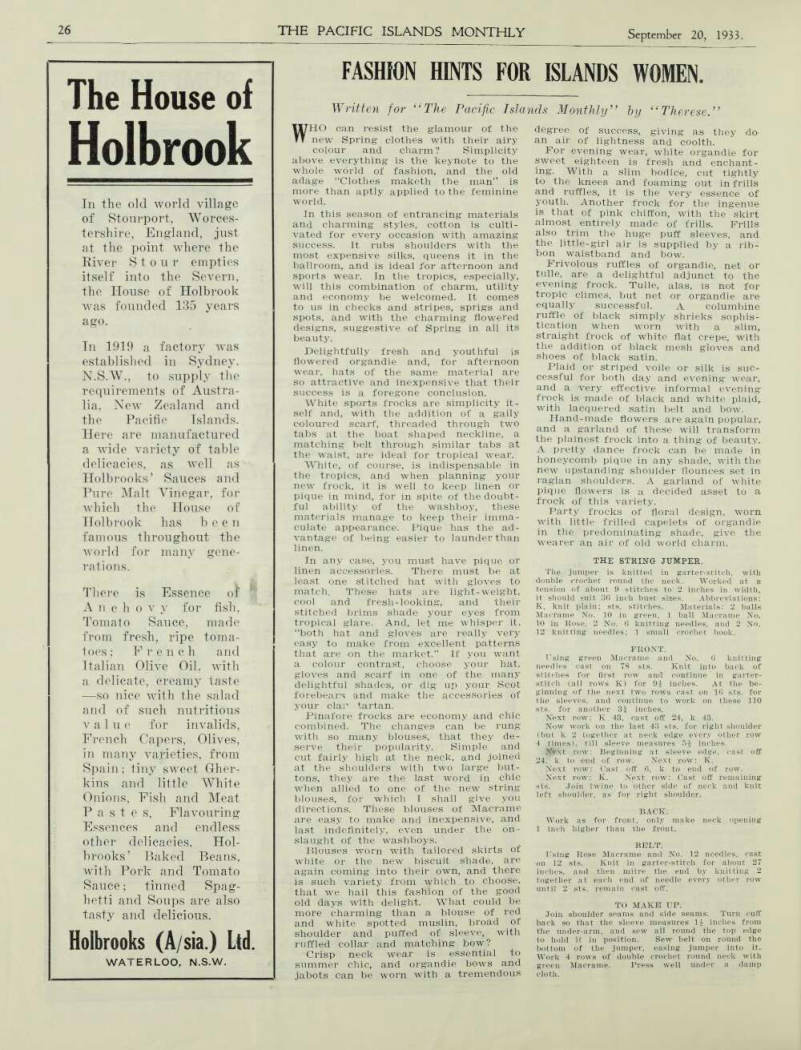
Written for “The Pacific Islands Monthly” hy “Therese.”
WHO can resist the glamour of the new Spring clothes with their airy colour and charm? Simplicity above everything is the keynote to the whole world of fashion, and the old adage “Clothes maketh the man” is more than aptly applied to the feminine world.
In this season of entrancing materials and charming styles, cotton is culti vated for every occasion with amazing success. It rubs shoulders with the most expensive silks, queens it in the ballroom, and is ideal for afternoon and sports wear. In the tropics, especially, will this combination of charm, utility and economy be welcomed. It comes to us in checks and stripes, sprigs and spots, and with the charming flowered designs, suggestive of Spring in all its beauty.
Delightfully fresh and youthful is flowered organdie and, for afternoon wear, hats of the same material are so attractive and inexpensive that their success is a foregone conclusion.
White sports frocks are simplicity it self and, with the addition of a gaily coloured scarf, threaded through two tabs at the boat shaped neckline, a matching belt through similar tabs at the waist, are ideal for tropical wear.
White, of course, is indispensable in the tropics, and when planning your new frock, it is well to keep linen or pique in mind, for in spite of the doubt ful ability of the washboy, these materials manage to keep their imma culate appearance. Pique has the ad vantage of being easier to launder than linen.
In any case, you must have pique or linen accessories. There must be at least one stitched hat with gloves to match. These hats are light-weight, cool and fresh-looking, and their stitched brims shade your eyes from tropical glare. And, let me whisper it, “both hat and gloves are really very easy to make from excellent patterns that are on the market.” If you want a colour contrast, choose your hat, gloves and scarf in one of the many delightful shades, or dig up your Scot forebears and make the accessories of your clar tartan.
Pinafore frocks are economy and chic combined. The changes can be rung with so many blouses, that they de serve their popularity. Simple and cut fairly high at the neck, and joined at the shoulders with two large but tons, they are the last word in chic when allied to one of the new string blouses, for which I shall give you directions. These blouses of Macrame are easy to make and inexpensive, and last indefinitely, even under the on slaught of the washboys.
Blouses worn with tailored skirts of white or the new biscuit shade, are again coming into their own, and there is such variety from which to choose, that we hail this fashion of the good old days with delight. What could be more charming than a blouse of red and white spotted muslin, broad of shoulder and puffed of sleeve, with ruffled collar and matching bow?
Crisp neck wear is essential to summer chic, and organdie bows and jabots can be worn with a tremendous
degree of success, giving as they do an air of lightness and coolth.
For evening wear, white organdie for sweet eighteen is fresh and enchant ing. With a slim bodice, cut tightly to the knees and foaming out in frills and ruffles, it is the very essence of youth. Another frock for the ingenue is that of pink chiffon, with the skirt almost entirely made of frills. Frills also trim the huge puff sleeves, and the little-girl air is supplied by a rib bon waistband and bow.
Frivolous ruffles of organdie, net or tulle, are a delightful adjunct to the evening frock. Tulle, alas, is not for tropic climes, but net or organdie are equally successful. A columbine ruffle of black simply shrieks sophis tication when worn with a slim,, straight frock of white flat crepe, with the addition of black mesh gloves and shoes of black satin.
Plaid or striped voile or silk is suc cessful for both day and evening wear, and a very effective informal evening frock is made of black and white plaid, with lacquered satin belt and bow.
Hand-made flowers are again popular, and a garland of these will transform the plainest frock into a thing of beauty.
A pretty dance frock can be made in honeycomb pique in any shade, with the new upstanding shoulder flounces set in raglan shoulders. A garland of white pique flowers is a decided asset to a frock of this variety.
Party frocks of floral design, worn with little frilled capelets of organdie in the predominating shade, give the wearer an air of old world charm.
The String Jumper.
The jumper is knitted in garter-stitch, with double crochet round the neck. Worked at a tension of about 9 stitches to 2 inches in width, it should suit 36 inch bust sizes. Abbreviations: K, knit plain; sts, stitches. Materials: 2 balls Macrame No. 10 in green, 1 ball Macrame No. 10 in Rose, 2 No. 6 knitting needles, and 2 No. 12 knitting needles; 1 small crochet hook.
Front.
Using green Macrame and No. 6 knitting needles cast on 78 sts. knit into hack of stitches for first row and continue in garter stitch (all rows K) for inches. At the be ginning of the next two rows cast on 16 sts. for the sleeves, and continue to work on these 110 sts. for another 3f Inches.
Next row: K 43, cast off 24, k 43.
Now work on the last 43 sts. for right shoulder (but k 2 together at neck edge every other row 4 times), till sleeve measures 5½ inches.
Next row: Beginning at sleeve edge, cast off 24, k to end of row. Next row: K.
Next tow: Cast off 6, k to end of row.
Next row: K. Next row: Cast off remaining sts. Join twine to other side of neck and knit left shoulder, as for right shoulder.
Back.
Work as for front, only make neck opening 1 inch higher than the front.
Belt.
Using Rose Macrame and No. 12 needles, cast on 12 sts. Knit in garter-stitch for about 27 inches, and then mitre the end by knitting 2 together at each end of needle every other row until 2 sts. remain cast off.
To Make Up.
Join shoulder seams and side seams. Turn cuff back so that the sleeve measures li inches from the under-arm, and sew all round the top edge to hold it in position. Sew- belt on round the bottom of the jumper, easing jumper into it.
Work 4 rows of double crochet round neck with green Macrame. Press well under a damp cloth.
“Mutiny” and The “Bounty.”
Two Good Books.
By R.W.R.
I AM rarely guilty of recommending books to the attention of Islands readers —my experience is that they are fairly skilful in selecting their own reading matter. But two volumes have just come along, and I want to say that they are both worthy of Islanders’ notice.
The first is “Mutiny”—a new story of the “Bounty” by Charles Nordhoff and James Norman Hall, two gifted Ameri can writers who now live in Tahiti.
Some three years ago I wrote that there was need for a worthwhile book on the “Bounty Mutiny”—and I complained that no writer had done justice to the most dramatic event in all the colourful history of the South Seas.
“Mutiny” is the book that was called for. It is written in the form of a novel; but it will live for ever as a reference book, because the authors, while giving us a fascinating story, have been careful to preserve the historical accuracy of the strange events they describe, and also they have provided, as a delightful background, a faithful picture of life and romance in Tahiti 150 years ago. These two men have a fine literary style; and, from that angle as well, their book can be most heartily commended.
So much putrid rubbish has been served up recently by writers of alleged “stories of the South Seas” that one is inclined, after reading “Mutiny,” to propose a vote of thanks to Nordhoff
and Hall, on behalf of libelled and de fenceless Polynesia.
The story of the “Bounty” will never be written better, or more accurately, or more painstakingly.
“Tropic Equations.”
In “Tropic Equations,” by Don Gordon, we have a creation of a different colour. Don Gordon is the pen-name of a well-known resident of New Guinea, and “Tropic Equations” is a quick-moving story of life, love and laughter in that colourful and interest ing Territory. It is a conventional story of faithless wives and jealous—and equally faithless—husbands; but it builds up into quite a stirring romance, in which this new novelist displays con siderable technical skill, and a gift of lively description. There is a most ingenious plot, with an unexpected de nouement; and it is linked up with native intrigues and tribal sorcery in a way that discloses, on the part of the author, an unusual knowledge of native psychology.
We predict that those who know New Guinea will turn the pages of “Tropic Equations’ in a kind of fascinated horror; there is faithfulness, amount ing almost to cruelty, in the portrayal of some of the characters. Here and there, when describing conditions of life in New Guinea, Don Gordon has stamped with very disrespectful feet upon the toes of officials and institu tions. His comments and criticism, in general, are clever, shrewd, and pene trating, and all are directed to the ulti mate good of the Territory. But the book is not a sermon or a leading article. It is “a darned good yarn,” flavoured spicily, and generally with
good humour. Australia and the big world will read it with pleasure; but when New Guinea peruses it her feel ings may be rather like those of a very dignified matron, who quite unexpectedly finds herself standing naked in front of a mirror.
“TROPIC EQUATIONS,’’ by Don Gordon. Our copy (6/-) from the publishers, the Macquarie Press, Sydney.
Prospectors on Upper Purari.
Gold In Papua.
From Our Own Correspondent.
Port Moresby, August 31.
THE American mining engineer, Mr.
Ward Williams, who has been caus ing interest by his operations on the Yodda field, has just returned from an expedition up to the head waters of the Purari River. He will leave the Terri tory by the “Montoro” for Sydney on September 5, on a short holiday.
Mr. Ward Williams was accompanied up the Purari by Patrol Officer Cowley and Mr. Moates, his assistant.
The Purari River has been attracting much attention since the discovery of gold in its headwaters, which are rumoured to be near or over the boundary between the Mandated Terri tory and Papua.
Under regulations published in the “Government Gazette of August 2, a new goldfield was declared, to be known as the Purari Goldfield.
By another regulation of the same date the boundaries of the old Lake kamu Goldfield were extended.
Advertisements & other items, p. 29 (1 item)
Mining Machinery
Improved Type Gravel Pump.
SEND YOUR ENQUIRIES TO—
of all classes, including—
Dredging and Sluicing Plants
Gravel and Water Pumps Elevators Nozzles Piping and Valves.
Mining Plants have been supplied to a number of Companies in New Guinea, and we are, therefore, fully conversant with local conditions.
Hydraulic Elevator, with Swivelling Suction Pipe.
THOMPSONS ENGINEERING & PIPE GO. LTD.
CASTLEMAINE, VICTORIA.
Cable Address; “THOMPSONS, CASTLEMAINE.”
SYDNEY OFFICE KEMBLA BUILDING 58 MARGARET STREET.
100 Years Of Mission Work In Fiji
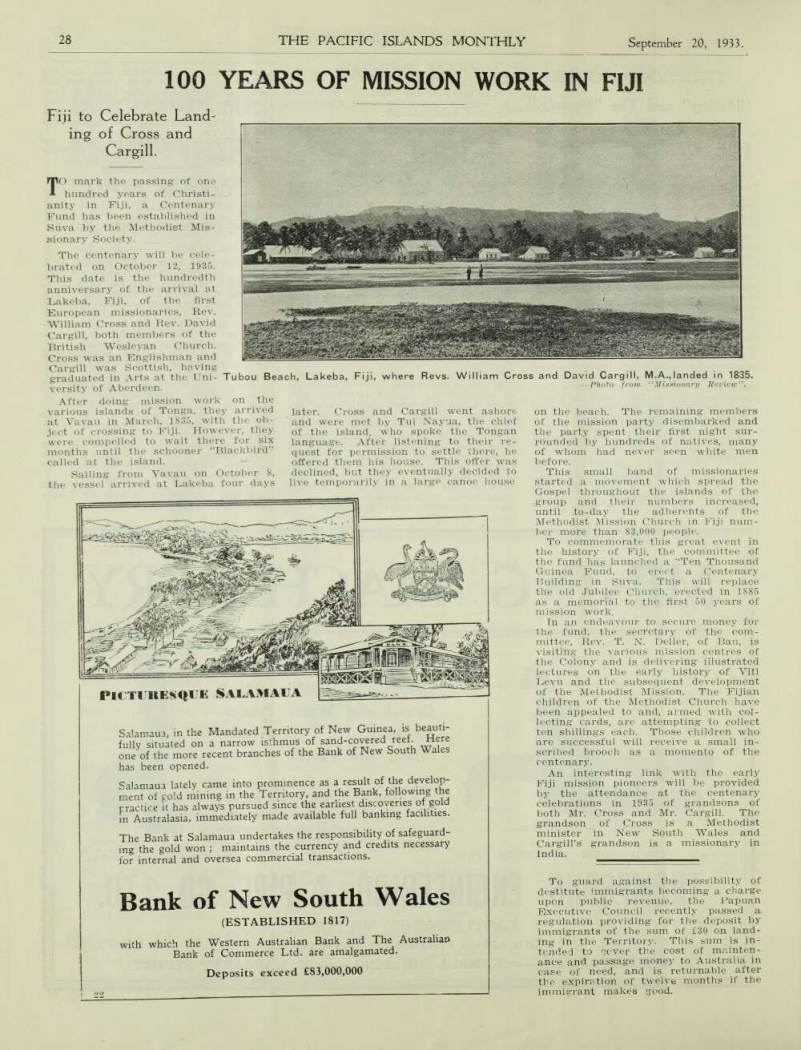
Fiji to Celebrate Land ing of Cross and Cargill.
TO mark the passing of one hundred years of Christi anity in Fiji, a Centenary Fund has been established in Suva by the Methodist Mis sionary Society.
The centenary will be cele brated on October 12, 1935.
This date is the hundredth anniversary of the arrival at Lakeba, Fiji, of the first European missionaries, Rev.
William Cross and Rev. David Cargill, both members of the British Wesleyan Church.
Cross was an Englishman and Cargill was Scottish, having graduated in Arts at the Uni versity of Aberdeen.
After doing mission work on the various islands of Tonga, they arrived at Vavau in March, 1835, with the ob ject of crossing to Fiji. However, they were compelled to wait there for six months until the schooner “Blackbird” called at the island.
Sailing from Vavau on October 8, the vessel arrived at Lakeba four days
later. Cross and Cargill went ashore and were met by Tui Nayua, the chief of the island, who spoke the Tongan language. After listening to their re quest for permission to settle there, he offered them his house. This offer was declined, but they eventually decided to live temporarily in a large canoe house
on the beach. The remaining members of the mission party disembarked and the party spent their first night sur rounded by hundreds of natives, many of whom had never seen white men before.
This small band of missionaries started a movement which spread the Gospel throughout the islands of the group and their numbers increased, until to-day the adherents of the Methodist Mission Church in Fiji num ber more than 83,000 people.
To commemorate this great event in the history of Fiji, the committee of the fund has launched a “Ten Thousand Guinea Fund, to erect a Centenary Building in Suva. This will replace the old Jubilee Church, erected in 1885 as a memorial to the first 50 years of mission work.
In an endeavour to secure money for the fund, the secretary of the com mittee, Rev. T. N. Deller, of Bau, is visiting the various mission centres of the Colony and is delivering illustrated lectures on the early history of Viti Levu and the subsequent development of the Methodist Mission. The Fijian children of the Methodist Church have been appealed to and, armed with col lecting cards, are attempting to collect ten shillings each. Those children who are successful will receive a small in scribed brooch as a momento of the centenary.
An interesting link with the early Fiji mission pioneers will be provided by the attendance at the centenary celebrations in 1935 of grandsons of both Mr. Cross and Mr. Cargill. The grandson of Cross is a Methodist minister in New South Wales and Cargill’s grandson is a missionary in India.
To guard against the possibility of destitute immigrants becoming a charge upon public revenue, the Papuan Executive Council recently passed a regulation providing for the deposit by immigrants of the sum of £30 on landing in the Territory. This sum is in tended to cover the cost of mainten ance and passage money to Australia in case of need, and is returnable after the expiration of twelve months if the immigrant makes good.
Tubou Beach, Lakeba, Fiji, where Revs. William Cross and David Cargill, M.A.,landed in 1835. —Photo from “Missionary Review”.
Advertisements & other items, p. 30 (1 item)
Bank of New South Wales
PICTURESQUE SALAMAL
Salamaua, in the Mandated Territory of New Guinea, is beautifully situated on a narrow isthmus of sand-covered reef. Here one of the more recent branches of the Bank of New South Wales has been opened.
Salamaua lately came into prominence as a result of the development of gold mining in the Territory, and the Bank, following the practice it has always pursued since the earliest discoveries of gold in Australasia, immediately made available full banking facilities.
The Bank at Salamaua undertakes the responsibility of safeguarding the gold won ; maintains the currency and credits necessary for internal and oversea commercial transactions.
Bank of New South Wales
(ESTABLISHED 1817)
with which the Western Australian Bank and The Australian Bank of Commerce Ltd. are amalgamated.
Deposits exceed £83,000,000 22
Gordon Thomas Is
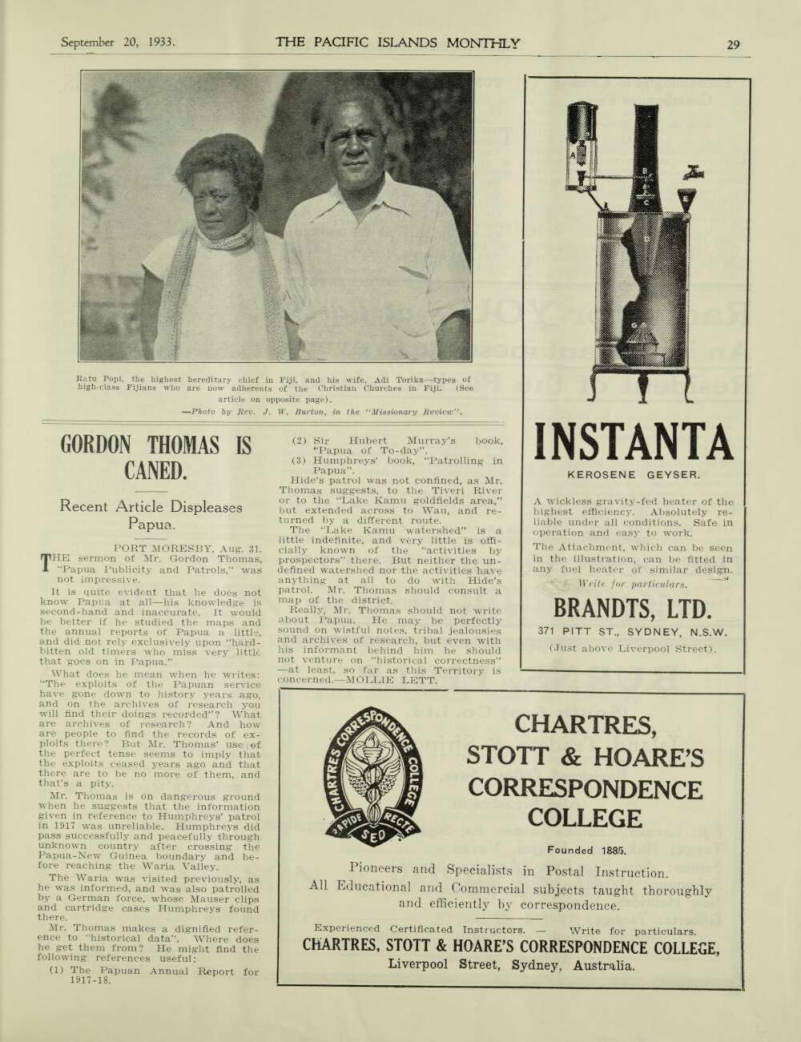
Caned.
Recent Article Displeases Papua.
Port Moresby, Aug. 31.
THE sermon of Mr. Gordon Thomas, “Papua Publicity and Patrols,” was not impressive.
It is quite evident that he does not know Papua at all —his knowledge is second-hand and inaccurate. It would be better if he studied the maps and the annual reports of Papua a little, and did not rely exclusively upon “hard bitten old timers who miss very little that goes on in Papua.”
What does he mean when he writes: “The exploits of the Papuan service have gone down to history years ago, and on the archives of research you will find their doings recorded”? What are archives of research? And how are people to find the records of ex ploits there? But Mr. Thomas’ use of the perfect tense seems to imply that the exploits ceased years ago and that there are to be no more of them, and that’s a pity, Mr. Thomas is on dangerous ground when he suggests that the information given in reference to Humphreys’ patrol in 1917 was unreliable. Humphreys did pass successfully and peacefully through unknown country after crossing the Papua-New Guinea boundary and be fore reaching the Waria Valley.
The Waria was visited previously, as he was informed, and was also patrolled by a German force, whose Mauser clips and cartridge cases Humphreys found there.
Mr. Thomas makes a dignified refer ence to “historical data”. Where does he get them from? He might find the following references useful; (1) The Papuan Annual Report for 1917-18.
(2) Sir Hubert Murray’s book, “Papua of To-day”. (3) Humphreys’ book, “Patrolling in Papua”.
Hide’s patrol was not confined, as Mr.
Thomas suggests, to the Tiveri River or to the “Lake Kamu goldfields area,” but extended across to Wau, and re turned by a different route.
The “Lake Kamu watershed” is a little indefinite, and very little is offi cially known of the “activities by prospectors” there. But neither the un defined watershed nor the activities have anything at all to do with Hide’s patrol. Mr. Thomas should consult a map of the district.
Really, Mr. Thomas should not write about Papua. He may be perfectly sound on wistful notes, tribal jealousies and archives of research, but even with his informant behind him he should not venture on “historical correctness” —at least, so far as this Territory is concerned. —MOLLIE LETT.
Ratu Popi, the highest hereditary chief in Fiji, and his wife, Adi Torika —types of high-class Fijians who are now adherents of the Christian Churches in Fiji. (See article on opposite page). —Photo by Rev. J. W. Burton, in the “Missionary Review".
Advertisements & other items, p. 31 (1 item)
Instanta
KEROSENE GEYSER.
A wickless gravity-fed heater of the highest efficiency. Absolutely reliable under all conditions. Safe in operation and easy to work.
The Attachment, which can be seen in the illustration, can be fitted in any fuel heater of similar design.
Write for particulars.
BRANDTS, LTD.
371 PITT ST., SYDNEY, N.S.W.
(Just above Liverpool Street).
CHARTRES,
STOTT & HOARE’S
CORRESPONDENCE
COLLEGE
Founded 1885.
Pioneers and Specialists in Postal Instruction.
All Educational and Commercial subjects taught thoroughly and efficiently by correspondence.
Experienced Certificated Instructors. Write for particulars.
CHARTRES, STOTT & HOARE’S CORRESPONDENCE COLLEGE,
Liverpool Street, Sydney, Australia.
Grasshopper Pests.
Entomologist to Combat Grasshopper Pests.
From Our Own Correspondent.
RABAUL, August 26.
AN entomologist, Mr. Bernard O’Connor, was an arrival by the last “Montoro,” and proceeded on to the Manus district, where much damage has been done at times by the sexava (coco nut grasshopper).
This work of exterminating the pest was previously carried on by Mr. Cald well. Mr. O’Connor is a graduate of Sydney University.
The Department of Agriculture is doing all in its power to combat the ravages occasioned by the ’hoppers.
Tongan Public Officers
Specially Taxed.
THE Government of Tonga has just brought into operation an Act to levy a special tax upon the salaries of all persons in the Tongan public service.
The rate of taxation is as follows: On the first £300 per annum of salary, £2½ per cent.
On the next £200 per annum of salary, £5 per cent.
On the remainder of the salary, £7½ per cent.
Tax is deducted from salary pay ments each month.
New Guinea Planters.
Annual Conference.
From Our Own Correspondent.
RABAUL, August 25.
THE annual conference of the Planters’
Association of New Guinea was opened on August 14 by the presi dent, Mr. J. C. Mullaly, M.L.C., in the private lounge of the Pacific Hotel in Rabaul.
In welcoming the delegates from all parts of the Territory, Mr. Mullaly ex pressed pleasure at seeing such a repre sentative gathering of planters, and hoped that the sessions would have satisfactory results. He praised the co-operative spirit which had existed throughout the year.
Delegates from outlying districts in cluded Mr. W. E. Gross, M.L.C., the president of the Kavieng district branch of the association, as well as Colonel Cameron and Mr. F. V. Saunders, all of Kavieng. The Kieta district repre sentative was Mr. F. P. Archer, of Buka; while the Rabaul representa tives were Messrs. Rowe, Washington and Renton. Madang was represented by Mr. Gordon Thomas, and Manus district by Mr. C. I. H. Campbell, who is a past general secretary of the as sociation.
Many questions of import to the planting community were discussed, in cluding the draft copy of the new Native Labour Ordinance, which is to be brought into force after the sitting of the next Legislative Council; the native trading Board of Inquiry, in con nection with which the conference was unanimous that the two-mile restric tion limit should be maintained; the matter of placing any restriction on shipping facilities now existent in the Territory; the formation of a Chamber of Commerce; the branding of cattle; trespass laws, trocas poaching, and the matter of mission trading.
On the Saturday morning the dele gates were received by the Adminis trator as a deputation, and the more important questions freely discussed with His Honour, who listened sympathetically to the spokesmen.
On Saturday afternoon the final busi ness of the election of officers took place, when Mr. Mullaly was unani mously re-elected president for the forthcoming year. Mr. Gordon Thomas was elected vice-president, and the new Executive Committee consisted of Messrs. V. A. Pratt, M.L.C., J. Duncan and P. J. Martin. Mr. E. F. Bishton was elected auditor.
Popular Magistrate.
From Our Own Correspondent.
Port Moresby, Aug’. 31.
THE Papuan Public Service suffers a real loss in the retirement of Mr.
B. M. Bastard.
Mr. Bastard has been for more than twenty years in the Magisterial Deport ment, and in addition to being an efficient and painstaking official, he has made very many friends by his tact and helpfulness. Mr. Bastard is at present enjoying twelve months’ leave, at the end of which he will retire on a pension.
Both Mr. and Mrs. Bastard carry with them the sincere good wishes of the many friends that they have made in Papua.
Advertisements & other items, p. 32 (1 item)
Burns, Philp
Radio for YOU— at Last!
An important message to every
Resident of the Pacific Islands
Reception of Radio Signals in the Tropics, owing to atmospheric conditions and moisture-laden air, has been anything but satisfactory up to the present.
The DUFFY RADIO CO., LTD., have been experimenting for some considerable time on complete Short Wave Receivers and Components specially designed to overcome all problems in these areas, with the result that a range of short wave sets is now available which, without the slightest doubt, will bring satisfactory radio reception in
the iS-opics.
It is unnecessary for the owner of a DUFFY SHORT WAVE SET to have any technical knowledge whatever, as the efficiency and ease of control in tuning, combined with the very explicit detailed instructions supplied, make success certain and simple.
The DUFFY SHORT WAVE SETS are not highpriced, but their value to Island listeners could hardly be estimated.
WRITE NOW FOR FULL PARTICULARS AND A FREE COPY OF “SHORT WAVE NEWS” IT’S TOO GOOD TO MISS.
THE DUFFY RADIO CO. LTD.
The only manufacturers in Australia specialising in Short Wave Sets and Components.
BURNS, PHILP
(South Sea) Co. Ltd.
Island Traders & Shipowners Registered Office: Suva, Fiji.
Also Branches at Fiji: Levuka, Lautoka, Labasa, Ba, Sigatoka, Rotumah.
Tonga: Nukualofa, Haapai, Vavau.
Samoa: Apia, Pago Pago (American Samoa).
Solomons: Makambo, Gizo, Faisi.
New Hebrides: Vila.
Gilberts : Tarawa.
Norfolk Island. Nauru. Niue.
Code Address: “Burnsouth. ’'
Training D.O’S.
A Few Remarks About Prestige.
Letter to the Editor from a well-known planter and returned soldier, resident in New Guinea.
"FAIR COMMENT,” probably with unconscious candour, has corroborated my statement about the inexperi ence of D.O.’s and A.D.O.’s. He freely admits, almost boasts, that cadets dur ing their first two years’ service act as patrol officers.
Patrol officers, for the purpose of tax collecting, automatically become A.D.O.’s and carry out plantation in spections, “nominally for experience”— “Pair Comment’s” own words. Then he marvels that responsible planters complain of having to supply that ex perience at the cost of demoralised labour gangs. I thank “F.C.” for his lucid, yet subtle, explanation and trust the honest fellow is not transferred to the Sepik for his exposure of typical Government economy.
Have you, Mr. Editor, space for a ramble in the “Fair Comment” manner’
Thank you!
Of the multitude of jobs performed by D.O.’s and listed by “F.C.,” one was omitted—that of writing reports; I saw one such from an A.D.O. It stated; “I examined the body and found it in a discrepant and emancipated condition and in an advanced state of purification.’'’
As regards surveying, a D.O. inspected land I was buying. He arrived with a
prismatic compass and asked if I could work same, as he could not.
As regards law, an A.D.O. recently in one afternoon tried two cases: (1) For an armed assault on a white man, a native was sentenced to one month’s calaboose; (2) For swearing at another native, one native was sentenced to two months.
I do not think that ex-offlcers of the navy, army and air force with years of Island experience, whom I had in view as suitable officials, would have been guilty of any of above.
“Fair Comment” glories in the fact that 33-1/3 per cent, (his own figures) of cadet expense is wasted, and pro claims a victory for the System. This is not considered success in private en terprise. Rumour hath it impending “resignations” will swell the wastage to 50 per cent. (Loud cheers!—Success still greater!) “F.C.” cites Larkin and Burke. Had the officials been stronger—i.e., the natives been kept in hand —neither man would have found it necessary to take the law into his own hands, and Larkin —a sick man, in a very isolated posi tion —would not have been attacked on his own verandah. Neither man is to blame; nor are the natives any more than unruly children, provided with weak and incompetent teachers. The psychology of the Kanaka demands strength in a leader, as it was in the days of all-powerful chiefs, who punished disobedience with death. And so it is to-day. In most cases, the natives are only a few years removed from that time and cannibalism.
It is tragic that with notable excep tions the weakest men in the Islands to-day are the D.O.’s and A.D.O.’s, who
should be our leaders. It is a very significant fact that the worst massacre in recent years, when four white men were killed and several wounded, was caused by the conduct of a Government patrol through that (Nakanai) area.
Then years ago on plantations the boys worked cheerily with great outbursts of sing-singing and chi-iking. Now they botch their jobs in a sullen, brooding silence.
An old paramount chief who served under both Governments, and has closely observed the change, told me the English (the word Australian is un known outside of the towns) could never have beaten the Germans except by a trick— “German, he strong too much” — remark pregnant with the feel ing of the Kanaka to-day. Just imagine returned soldier pioneers being forced to form a Protection Association. Shades of Bulaminski!
Recently, conditions have improved immensely, to the satisfaction of all parties and all colours, and it is to be hoped the effort has not been made too late to raise this Territory to the verit able paradise it should be for both black and white.
I am, etc.,
“Malolo.”
New Ireland, August 24, 1933.
The “Karetu” left Suva, Fiji, for New Zealand on August 11 and carried 4,976 cases of bananas and 410 tons of general cargo for Auckland. About 26 tons of general cargo were also car ried for Sydney.
Advertisements & other items, p. 33 (1 item)
Nelson And Robertson
ISLAND MERCHANTS
[Established, 1895.]
Copra, Cocoa, Trocas Shell and other Island produce sold on commission. All classes of Merchandise purchased and original invoices supplied. gents for SKANDIA CRUDE OIL ENGINES. Marine and Stationary, powers from 5-h.p. up.
PENTA ENGINES, Inboard and Outboard, as used by the Royal Australian Navy.
PUMPMOBIL, the only portable pumping plant manufactured, light in weight and reliable. Suitable for mining work.
UPSON WALL BOARD, in both Plain and Tile pattern, strong and light.
Non-conductor of heat and cold. British manufacture, Also New Guinea, Papuan and Samoan representatives for the famous
CHALLENGER KEROSENE BATH HEATER.
Communicate with
NELSON & ROBERTSON
12 SPRING STREET
SYDNEY, AUSTRALIA
Telegraphic Address: “IVAN SYDNEY.’
Papuan Census.
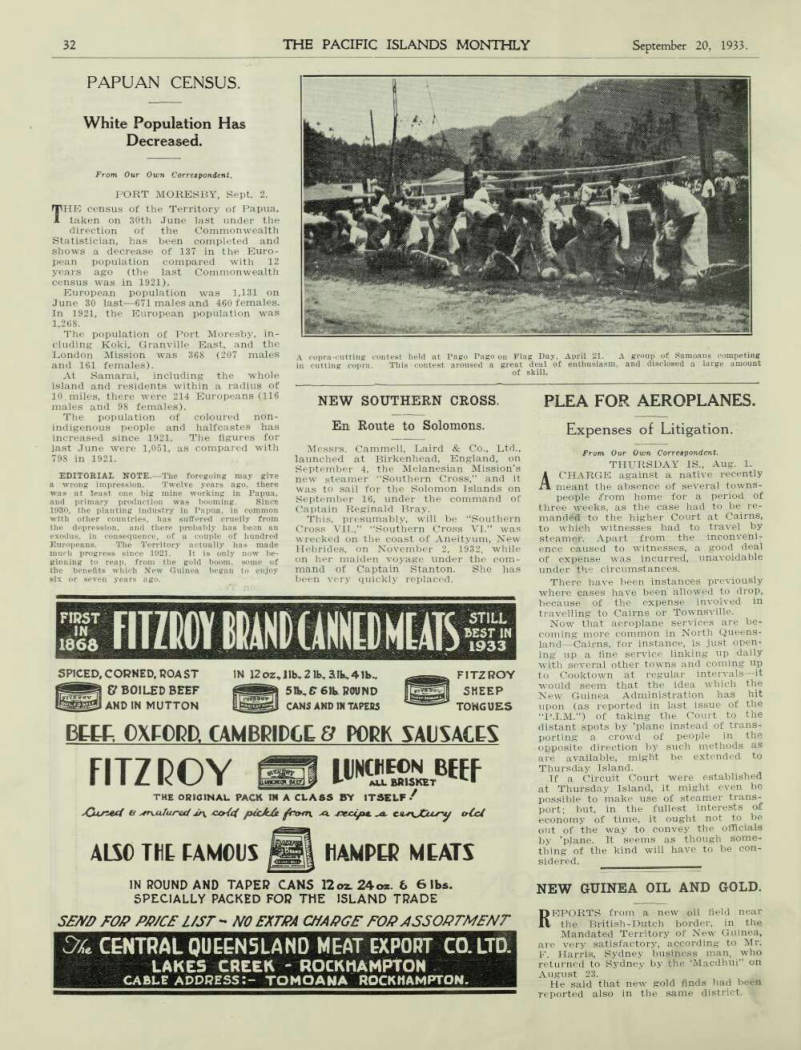
White Population Has Decreased.
From Our Own Correspondent.
Port Moresby, Sept. 2.
THE census of the Territory of Papua, taken on 30th June last under the direction of the Commonwealth Statistician, has been completed and shows a decrease of 137 in the Euro pean population compared with 12 years ago (the last Commonwealth census was in 1921).
European population was 1,131 on June 30 last —671 males and 460 females.
In 1921, the European population was 1,268.
The population of Port Moresby, in cluding Koki, Granville East, and the London Mission was 368 (207 males and 161 females).
At Samarai, including the whole island and residents within a radius of 10 miles, there were 214 Europeans (116 males and 98 females).
The population of coloured non indigenous people and halfcastes has increased since 1921. The figures for last June were 1,051, as compared with 798 in 1921.
EDITORIAL NOTE.—The foregoing may give a wrong impression. Twelve years ago, there was at least one big mine working in Papua, and primary production was booming. Since 1930, the planting industry in Papua, in common with other countries, has suffered cruelly from the depression, and there probably has bean an exodus, in consequence, of a couple of hundred Europeans. The Territory actually has made much progress since 1921. It is only now be ginning to reap, from the gold boom, some of the benefits which New Guinea began to enjoy six or seven years ago.
A copra-cutting contest held at Pago Pago on Flag Day, April 21. A group of Samoans competing in cutting copra. This contest aroused a great deal of enthusiasm, and disclosed a large amount of skill.
New Southern Cross.
En Route to Solomons.
Messrs. Cammell, Laird & Co., Ltd., launched at Birkenhead, England, on September 4, the Melanesian Mission’s new steamer “Southern Cross,” and it was to sail for the Solomon Islands on September 16, under the command of Captain Reginald Bray.
This, presumably, will be “Southern Cross VII.,” “Southern Cross VI.” was wrecked on the coast of Aneityum, New Hebrides, on November 2, 1932, while on her maiden voyage under the com mand of Captain Stanton, She has been very quickly replaced.
Expenses of Litigation.
Plea For Aeroplanes.
From Our Own Correspondent.
Thursday Is., Aug. 1.
A CHARGE against a native recently meant the absence of several towns people (from home for a period of three weeks, as the case had to be re manded to the higher Court at Cairns, to which witnesses had to travel by steamer. Apart from the inconveni ence caused to witnesses, a good deal of expense was incurred, unavoidable under the circumstances.
There have been instances previously where cases have been allowed to drop, because of the expense involved in travelling to Cairns or Townsville.
Now that aeroplane services are be coming more common in North Queens land —Cairns, for instance, is just open ing up a fine service linking up daily with several other towns and coming up to Cooktown at regular intervals —it would seem that the idea which the New Guinea Administration has hit upon (as reported in last issue of the “P.I.M.”) of taking the Court to the distant spots by ’plane instead of trans porting a crowd of people in the opposite direction by such methods as are available, might be extended to Thursday Island.
If a Circuit Court were established at Thursday Island, it might even be possible to make use of steamer trans port; but, in the fullest interests of economy of time, it ought not to be out of the way to convey the officials by ’plane. It seems as though some thing of the kind will have to be con sidered.
New Guinea Oil And Gold.
REPORTS from a new oil field near the British-Dutch border, in the Mandated Territory of New Guinea, are very satisfactory, according to Mr.
F. Harris, Sydney business man, who returned to Sydney by the ‘Macdhui” on August 23.
He said that new gold finds had been reported also in the same district.
Advertisements & other items, p. 34 (1 item)
Fitzroy
SPICED, CORNED, ROAST
a BOILED BEEF
AND IN MUTTON
CANS AND IN TAPERS
FITZROY
SHEEP
TONGUES
BEEF, OXFORD, CAMBRIDGE & PORK SAUSAGES
FITZROY
LUNCHEON BEEF
THE ORIGINAL PACK IN A CLASS BY ITSELF!
Cured & matured in cold pickle from a recipe a century old
ALSO THE FAMOUS
HAMPER MEATS
IN ROUND AND TAPER CANS 12oz. 24oz. & 6 lbs.
SPECIALLY PACKED FOR THE ISLAND TRADE
SEND FOP PRICE LIST - NO EXTRA FOP ASSORTMENT The CENTRAL QUEENSLAND MEAT EXPORT CO. LTD.
LAKES CREEK - ROCKHAMPTON
CABLE ADDRESS:- TOMOANA ROCKHAMPTON.
Late Mr. E. F. Reye.
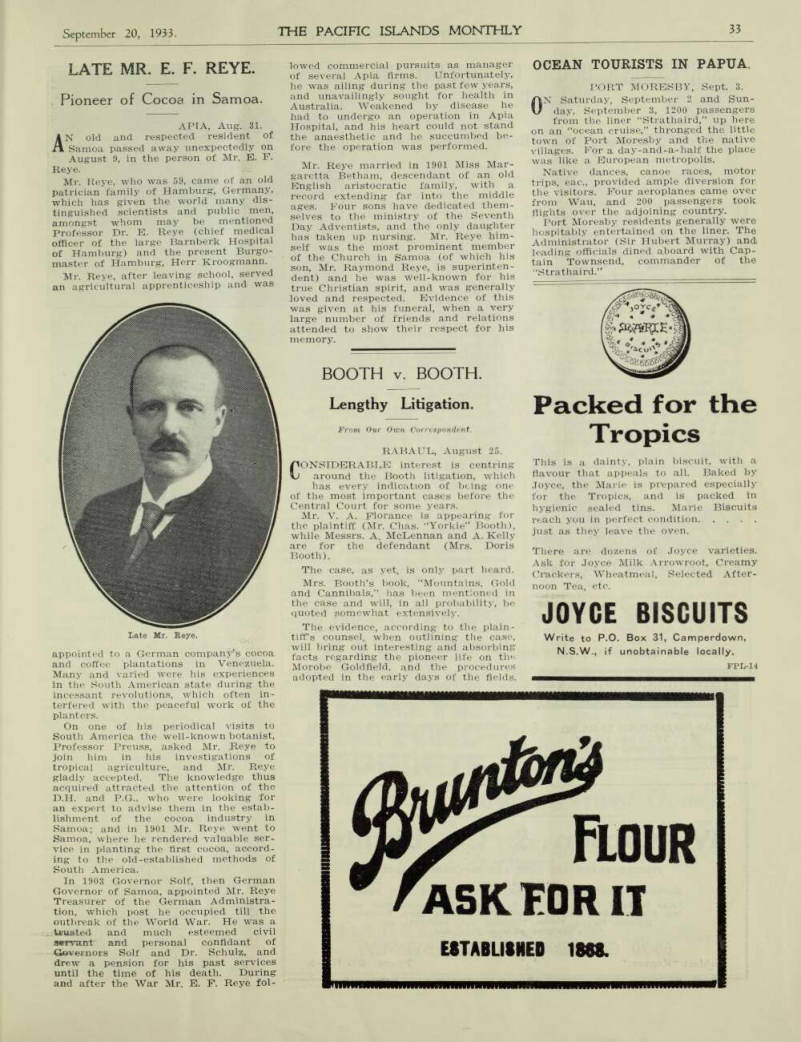
Pioneer of Cocoa in Samoa.
Apia, Aug. 31.
AN old and respected resident of Samoa passed away unexpectedly on August 9, in the person of Mr. E. F.
Reye.
Mr. Reye, who was 59, came of an old patrician family of Hamburg, Germany, which has given the world many dis tinguished scientists and public men, amongst whom may be mentioned Professor Dr. E. Reye (chief medical officer of the large Barnberk Hospital of Hamburg) and the present Burgo master of Hamburg, Herr Kroogmann.
Mr. Reye, after leaving school, served an agricultural apprenticeship and was
appointed to a German company’s cocoa and coffee plantations in Venezuela.
Many and varied were his experiences in the South American state during the incessant revolutions, which often in terfered with the peaceful work of the planters.
On one of his periodical visits to South America the well-known botanist, Professor Preuss, asked Mr. Reye to join him in his investigations of tropical agriculture, and Mr. Reye gladly accepted. The knowledge thus acquired attracted the attention of the D.H. and P.G., who were looking for an expert to advise them in the estab lishment of the cocoa industry in Samoa; and in 1901 Mr. Reye went to Samoa, where he rendered valuable ser vice in planting the first cocoa, accord ing to the old-established methods of South America.
In 1903 Governor Solf, then German Governor of Samoa, appointed Mr. Reye Treasurer of the German Administra tion, which post he occupied till the outbreak of the World War. He was a trusted and much esteemed civil servant and personal confidant of Governors Solf and Dr. Schulz, and drew a pension for his past services until the time of his death. During and after the War Mr. E. F. Reye fol
lowed commercial pursuits as manager of several Apia firms. Unfortunately, he was ailing during the past few years, and unavailingly sought for health in Australia. Weakened by disease he had to undergo an operation in Apia Hospital, and his heart could not stand the anaesthetic and he succumbed be fore the operation was performed.
Mr. Reye married in 1901 Miss Mar garetta Betham, descendant of an old English aristocratic family, with a record extending far into the middle ages. Four sons have dedicated them selves to the ministry of the Seventh Day Adventists, and the only daughter has taken up nursing. Mr. Reye him self was the most prominent member of the Church in Samoa (of which his son, Mr. Raymond Reye, is superinten dent) and he was well-known for his true Christian spirit, and was generally loved and respected. Evidence of this was given at his funeral, when a very large number of friends and relations attended to show their respect for his memory.
Late Mr. Reye.
Lengthy Litigation.
Booth V. Booth.
From Our Own Correspondent.
RABAUL, August 25.
CONSIDERABLE interest is centring around the Booth litigation, which has every indication of being one of the most important cases before the Central Court for some years.
Mr. V. A. Florance is appearing for the plaintiff (Mr. Chas. “Yorkie” Booth), while Messrs. A. McLennan and A. Kelly are for the defendant (Mrs. Doris Booth).
The case, as yet, is only part heard.
Mrs. Booth’s book, “Mountains, Gold and Cannibals,” has been mentioned in the case and will, in all probability, be quoted somewhat extensively.
The evidence, according to the plain tiff’s counsel, when outlining the case, will bring out interesting and absorbing facts regarding the pioneer life on the Morobe Goldfield, and the procedures adopted in the early days of the fields.
Ocean Tourists In Papua.
Port Moresby, Sept. 3.
ON Saturday, September 2 and Sun day, September 3, 1200 passengers from the liner “Strathaird,” up here on an “ocean cruise,” thronged the little town of Port Moresby and the native villages. For a day-and-a-half the place was like a European metropolis.
Native dances, canoe races, motor trips, eac., provided ample diversion for the visitors. Four aeroplanes came over from Wau, and 200 passengers took flights over the adjoining country.
Port Moresby residents generally were hospitably entertained on the liner. The Administrator (Sir Hubert Murray) and leading officials dined aboard with Cap tain Townsend, commander of the “Strathaird.”
Advertisements & other items, p. 35 (1 item)
Tropics
Packed for the
This is a dainty, plain biscuit, with a flavour that appeals to all. Baked by Joyce, the Marie is prepared especially for the Tropics, and is packed in hygienic sealed tins. Marie Biscuits reach you in perfect condition just as they leave the oven.
There are dozens of Joyce varieties.
Ask for Joyce Milk Arrowroot, Creamy Crackers, Wheatmeal, Selected Afternoon Tea, etc.
JOYCE BISCUITS
Write to P.O. Box 31, Camperdown, N.S.W., if unobtainable locally.
FPL-14
ask for it
ESTABLISHED 1888.
Stevenson’S House On Butaritari
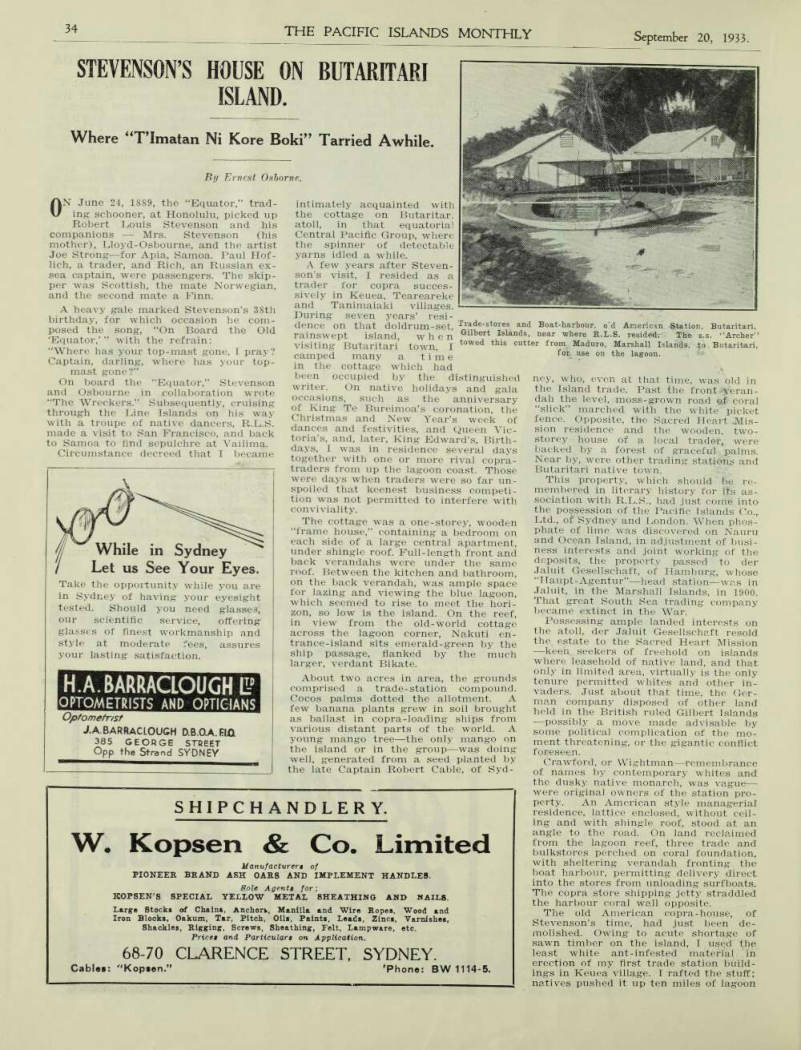
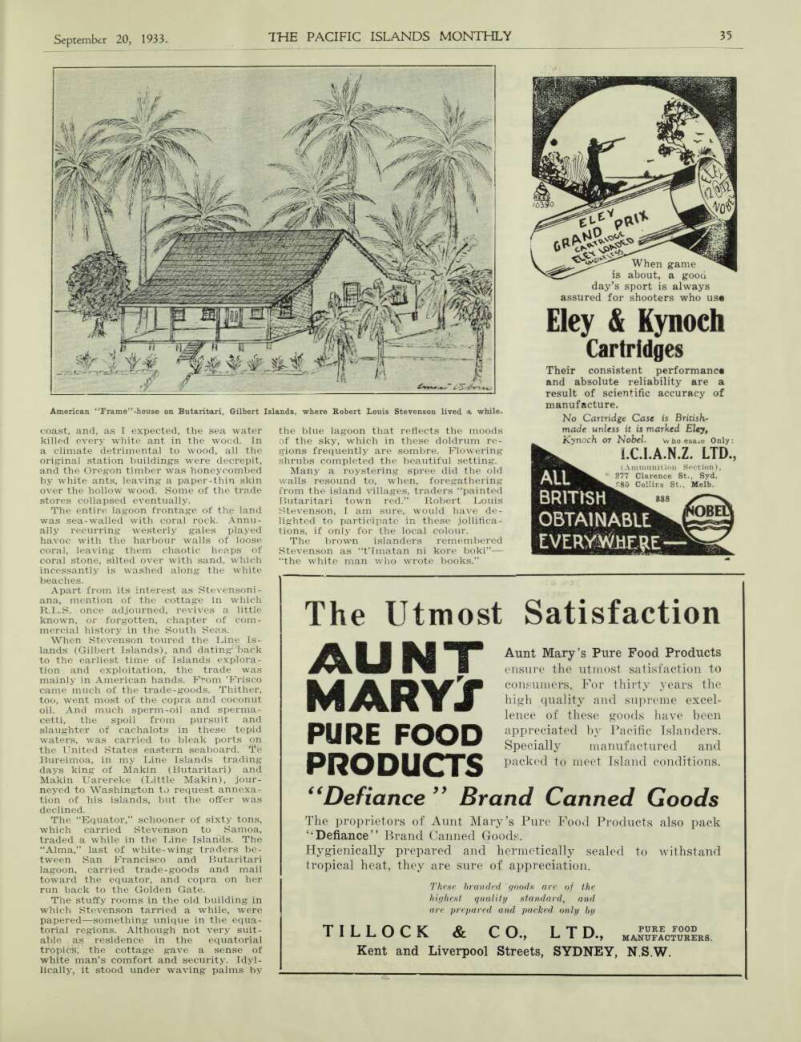
Island.
Where "T’Imatan Ni Kore Boki" Tarried Awhile.
By Ernest Osborne.
ON June 24, 1889, the “Equator,” trad ing schooner, at Honolulu, picked up Robert Louis Stevenson and his companions — Mrs. Stevenson (his mother), Lloyd-Osbourne, and the artist Joe Strong—for Apia, Samoa. Paul Hof lich, a trader, and Rich, an Russian ex sea captain, were passengers. The skip per was Scottish, the mate Norwegian, and the second mate a Finn.
A heavy gale marked Stevenson’s 38th birthday, for which occasion he com posed the song, “On Board the Old ‘Equator,’” with the refrain: “Where has your top-mast gone, I pray?
Captain, darling, where has your top mast gone?”
On board the “Equator,” Stevenson and Osbourne in collaboration wrote “The Wreckers.” Subsequently, cruising through the Line Islands on his way with a troupe of native dancers, R.L.S. made a visit to San Francisco, and back to Samoa to find sepulchre at Vailima.
Circumstance decreed that I became
intimately acquainted with the cottage on Butaritar. atoll, in that equatorial Central Pacific Group, where the spinner of detectable yarns idled a while.
A few years after Steven son’s visit, I resided as a trader for copra succes sively in Keuea, Teareareke and Tanimaiaki villages.
During seven years’ resi dence on that doldrum-set, rainswept island, when visiting Butaritari town, I camped many a time in the cottage which had
been occupied by the distinguished writer. On native holidays and gala occasions, such as the anniversary of King Te Bureimoa’s coronation, the Christmas and New Year’s week of dances and festivities, and Queen Vic toria’s, and, later, King Edward’s, Birth days, I was in residence several days together with one or more rival copra traders from up the lagoon coast. Those were days when traders were so far un spoiled that keenest business competi tion was not permitted to interfere with conviviality.
The cottage was a one-storey, wooden “frame house,” containing a bedroom on each side of a large central apartment, under shingle roof. Full-length front and back verandahs were under the same roof. Between the kitchen and bathroom, on the back verandah, was ample space for lazing and viewing the blue lagoon, which seemed to rise to meet the hori zon, so low is the island. On the reef, in view from the old-world cottage across the lagoon corner, Nakuti en trance-island sits emerald-green by the ship passage, flanked by the much larger, verdant Bikate.
About two acres in area, the grounds comprised a trade-station compound.
Cocos palms dotted the allotment. A few banana plants grew in soil brought as ballast in copra-loading ships from various distant parts of the world. A young mango tree—the only mango on the island or in the group—was doing well, generated from a seed planted by the late Captain Robert Cable, of Syd-
ney, who, even at that time, was old in the Island trade. Past the front Veran dah the level, moss-grown road of coral “slick” marched with the white picket fence. Opposite, the Sacred Heart Mission residence and the wooden, two storey house of a local trader, were backed by a forest of graceful palms.
Near by, were other trading stations and Butaritari native town.
This property, which should be re membered in literary history for its as sociation with R.L.S., had just come into the possession of the Pacific Islands Co., Ltd., or Sydney and London. When phos phate of lime was discovered on Nauru and Ocean Island, in adjustment of busi ness interests and joint working of the deposits, the property passed to der Jaluit Gesellschaft, of Hamburg, whose “Haupt-Agentur”—head station —was in Jaluit, in the Marshall Islands, in 1900.
That great South Sea trading company became extinct in the War.
Possessing ample landed interests on the atoll, der Jaluit Gesellschaft resold the estate to the Sacred Heart Mission —keen seekers of freehold on islands where leasehold of native land, and that only in limited area, virtually is the only tenure permitted whites and other in vaders. Just about that time, the Ger man company disposed of other land held in the British ruled Gilbert Islands —possibly a move made advisable by some political complication of the mo ment threatening, or the gigantic conflict foreseen.
Crawford, or Wightman—remembrance of names by contemporary whites and the dusky native monarch, was vague— were original owners of the station pro perty. An American style managerial residence, lattice enclosed, without ceil ing and with shingle roof, stood at an angle to the road. On land reclaimed from the lagoon reef, three trade and bulkstores perched on coral foundation, with sheltering verandah fronting the boat harbour, permitting delivery direct into the stores from unloading surfboats.
The copra store shipping jetty straddled the harbour coral wall opposite.
The old American copra-house, of Stevenson’s time, had just been de molished. Owing to acute shortage of sawn timber on the island, I used the least white ant-infested material in erection of my first trade station build ings in Keuea village. I rafted the stuff; natives pushed it up ten miles of lagoon
Trade-stores and Boat-harbour, old American Station, Butaritari, Gilbert Islands, near where R.L.S. resided. The s.s. “Archer” towed this cutter from Maduro, Marshall Islands, to Butaritari, for, use on the lagoon.
coast, and, as I expected, the sea water killed every white ant in the wood. In a climate detrimental to wood, all the original station buildings were decrepit, and the Oregon timber was honeycombed by white ants, leaving a paper-thin skin over the hollow wood. Some of the trade stores collapsed eventually.
The entire lagoon frontage of the land was sea-walled with coral rock. Annu ally recurring westerly gales played havoc with the harbour walls of loose coral, leaving them chaotic heaps of coral stone, silted over with sand, which incessantly is washed along the white beaches.
Apart from its interest as Stevensoni ana, mention of the cottage in which R.L.S. once adjourned, revives a little known, or forgotten, chapter of com mercial history in the South Seas.
When Stevenson toured the Line Is lands (Gilbert Islands), and dating back to the earliest time of Islands explora tion and exploitation, the trade was mainly in American hands. From ’Frisco came much of the trade-goods. Thither, too, went most of the copra and coconut oil. And much sperm-oil and sperma cetti, the spoil from pursuit and slaughter of cachalots in these tepid waters, was carried to bleak ports on the United States eastern seaboard. Te Bureimoa, in my Line Islands trading days king of Makin (Butaritari) and Makin Uarereke (Little Makin), jour neyed to Washington to request annexa tion of his islands, but the offer was declined.
The “Equator,” schooner of sixty tons, which carried Stevenson to Samoa, traded a while in the Line Islands. The “Alma,” last of white-wing traders be tween San Francisco and Butaritari lagoon, carried trade-goods and mail toward the equator, and copra on her run back to the Golden Gate.
The stuffy rooms in the old building in which Stevenson tarried a while, were papered—something unique in the equa torial regions. Although not very suit able as residence in the equatorial tropics, the cottage gave a sense of white man’s comfort and security. Idyl lically, it stood under waving palms by
the blue lagoon that reflects the moods of the sky, which in these doldrum re gions frequently are sombre. Flowering shrubs completed the beautiful setting.
Many a roystering spree did the old walls resound to, when, foregathering from the island villages, traders “painted Butaritari town red.” Robert Louis Stevenson, I am sure, would have de lighted to participate in these jollifica tions, if only for the local colour.
The brown islanders remembered Stevenson as “t’lmatan ni kore boki” — “the white man who wrote books.”
American “Frame”-house on Butaritari, Gilbert Islands, where Robert Louis Stevenson lived a while.
Advertisements & other items, pp. 36-37 (1 item)
W. Kopsen & Co. Limited
While in Sydney
Let us See Your Eyes.
Take the opportunity while you are in Sydney of having - your eyesight tested. Should you need glasses, our scientific service, offeringglasses of finest workmanship and style at moderate fees, assures your lasting satisfaction.
H.A.BARRACLOUGH 1L 5
OPTOMETRISTS AND OPTICIANS
Optometrist
J.A BARRACLOUGH D.B.OA.F.I.O.
385 GEORGE STREET
Opp the Strand SYDNEY
SHIPCHANDLERY.
W. Kopsen & Co. Limited
Manufacturers of PIONEER BRAND ASH OARS AND IMPLEMENT HANDLES.
Sole Agents for ; KOPSEN’S SPECIAL YELLOW METAL SHEATHING AND NAILS.
Largo Stocks of Chains, Anchors, Manilla and Wire Ropes, Wood and Iron Blocks, Oakum, Tar, Pitch, Oils, Paints, Leads, Zincs, Varnishes, Shackles, Rigging, Screws, Sheathing, Felt, Lampware, etc.
Prices and Particulars on Application.
68-70 CLARENCE STREET. SYDNEY.
Cables: “Kopsen." 'Phone: BW 1114-S.
game is about, a good day’s sport is always assured for shooters who use
Eley & Kynoch
Cartridges
Their consistent performance and absolute reliability are a result of scientific accuracy of manufacture.
No Cartridge Case is Britishmade unless it is marked Eley, Kynoch or Nobel. wtaaesai« Only:
I.C.I.A.N.Z. LTD.,
(Ammunition Section), 277 Clarence St., Syd.
PBO Collins St.. Melb.
NOBEL
The Utmost Satisfaction
AUNT
MARY'S
PURE FOOD
PRODUCTS
“Defiance” Brand Canned Goods
The proprietors of Aunt Mary’s Pure Food Products also pack ‘‘Defiance” Brand Canned Goods.
Hygienically prepared and hermetically sealed to withstand tropical heat, they are sure of appreciation.
These branded goods are of the highest quality standard, and are prepared and packed only by Aunt Mary’s Pure Food Products ensure the utmost satisfaction to consumers. For thirty years the high quality and supreme excellence of these goods have been appreciated by Pacific Islanders.
Specially manufactured and packed to meet Island conditions.
TILLOCK & CO., LTD.,
Kent and Liverpool Streets, SYDNEY, N.S.W.
PURE FOOD
MANUFACTURERS.
The Deadlock In Samoa.
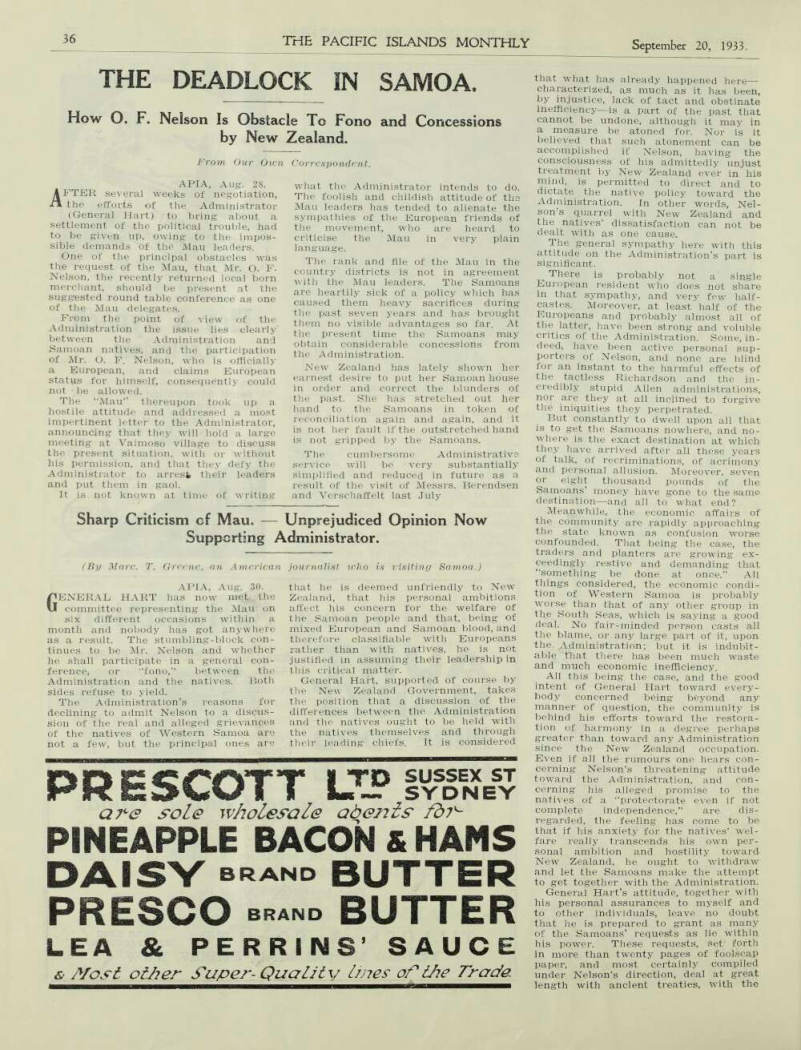
How O. F. Nelson Is Obstacle To Fono and Concessions by New Zealand.
From Our Own Correspondent.
Apia, Aug. 28.
AFTER several weeks of negotiation, the efforts of the Administrator (General Hart) to bring about a settlement of the political trouble, had to be given up, owing to the impos sible demands of the Mau leaders.
One of the principal obstacles was the request of the Mau, that Mr. O. F.
Nelson, the recently returned local born merchant, should be present at the suggested round table conference as one of the Mau delegates.
From the point of view of the Administration the issue lies clearly' between the Administration and Samoan natives, and the participation of Mr. O. F. Nelson, who is officially a European, and claims European status for himself, consequently could not be allowed.
The “Mau” thereupon took up a hostile attitude and addressed a most impertinent letter to the Administrator, announcing that they will hold a large meeting at Vaimoso village to discuss the present situation, with or without his permission, and that they defy the Administrator to arrest their leaders and put them in gaol.
It is not known at time of writing
what the Administrator intends to do.
The foolish and childish attitude of the Mau leaders has tended to alienate the sympathies of the European friends of the movement, who are heard to criticise the Mau in very plain language.
The rank and file of the Mau in the country districts is not in agreement with the Mau leaders. The Samoans are heartily sick of a policy which has caused them heavy sacrifices during the past seven years and has brought them no visible advantages so far. At the present time the Samoans may obtain considerable concessions from the Administration.
New Zealand has lately shown her earnest desire to put her Samoan house in order and correct the blunders of the past. She has stretched out her hand to the Samoans in token of reconciliation again and again, and it is not her fault if the outstretched hand is not gripped by the Samoans.
The cumbersome Administrative service will be very substantially simplified and reduced in future as a result of the visit of Messrs, Berendsen and Verschaffelt last July
Supporting Administrator.
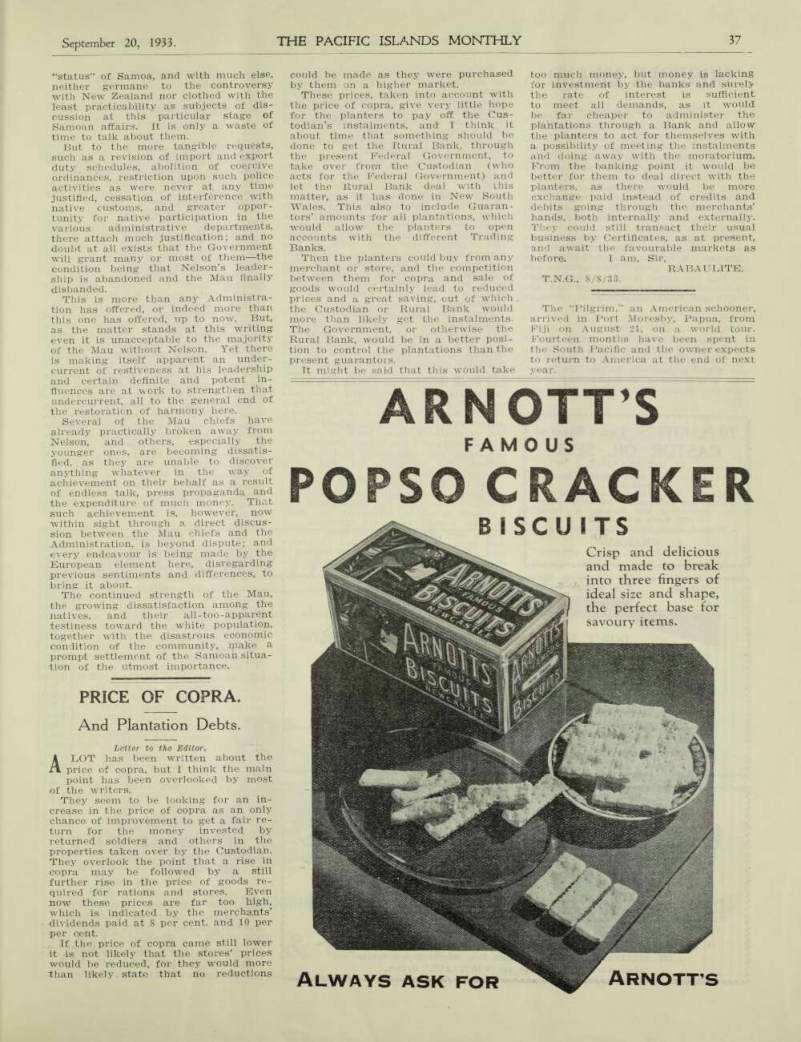
Sharp Criticism of Mau. Unprejudiced Opinion Now Supporting Administrator.
(By Marc. T. Greene, an American journalist who is visiting Samoa.)
Apia, Aug. 30.
GENERAL HART has now met the committee representing the Mau on six different occasions within a month and nobody has got anywhere as a result. The stumbling-block con tinues to be Mr. Nelson and whether he shall participate in a general con ference, or “fono,” between the Administration and the natives. Both sides refuse to yield.
The Administration’s reasons for declining to admit Nelson to a discus sion of the real and alleged grievances of the natives of Western Samoa are not a few, but the principal ones are
that he is deemed unfriendly to New Zealand, that his personal ambitions affect his concern for the welfare of the Samoan people and that, being of mixed European and Samoan blood, and therefore classifiable with Europeans rather than with natives, he is not justified in assuming their leadership in this critical matter.
General Hart, supported of course by the New Zealand Government, takes the position that a discussion of the differences between the Administration and the natives ought to be held with the natives themselves and through their leading chiefs. It is considered
that what has already happened here — characterized, as much as it has been, by injustice, lack of tact and obstinate inefficiency—is a part of the past that cannot be undone, although it may in a measure be atoned for. Nor is it believed that such atonement can be accomplished if Nelson, having the consciousness of his admittedly unjust treatment by New Zealand ever in his mind, is permitted to direct and to dictate the native policy toward the Administration. In other words, Nel son's quarrel with New Zealand and the natives’ dissatisfaction can not be dealt with as one cause.
The general sympathy here with this attitude on the Administration’s part is significant.
There is probably not a single European resident who does not share in that sympathy, and very few half castes. Moreover, at least half of the Europeans and probably almost all of the latter, have been strong and voluble critics of the Administration. Some, in deed, have been active personal sup porters of Nelson, and none are blind for an instant to the harmful effects of the tactless Richardson and the in credibly stupid Allen administrations, nor are they at all inclined to forgive the iniquities they perpetrated.
But constantly to dwell upon all that is to get the Samoans nowhere, and no where is the exact destination at which they have arrived after all these years of talk, of recriminations, of acrimony and personal allusion. Moreover, seven or eight thousand pounds of the Samoans’ money have gone to the same destination— and all to what end?
Meanwhile, the economic affairs of the community are rapidly approaching the state known as confusion worse confounded. That being the case, the traders and planters are growing ex ceedingly restive and demanding that “something be done at once.” All things considered, the economic condi tion of Western Samoa is probably worse than that of any other group in the South Seas, which is saying a good deal. No fair-minded person casts all the blame, or any large part of it, upon the but it is indubit able that there has been much waste and much economic inefficiency.
All this being the case, and the good intent of General Hart toward every body concerned being beyond any manner of question, the community is behind his efforts toward the restora tion of harmony in a degree perhaps greater than toward any Administration since the New Zealand occupation.
Even if all the rumours one hears con cerning Nelson’s threatening attitude toward the Administration, and con cerning his alleged promise to the natives of a “protectorate even if not complete independence,” are dis regarded, the feeling has come to be that if his anxiety for the natives’ wel fare really transcends his own per sonal ambition and hostility toward New Zealand, he ought to withdraw and let the Samoans make the attempt to get together with the Administration.
General Hart’s attitude, together with his personal assurances to myself and to other individuals, leave no doubt that he is prepared to grant as many of the Samoans’ requests as lie within his power. These requests, set forth in more than twenty pages of foolscap paper, and most certainly compiled under Nelson’s direction, deal at great length with ancient treaties, with the
“status” of Samoa, and with much else, neither germane to the controversy with New Zealand nor clothed with the least practicability as subjects of dis cussion at this particular stage of Samoan affairs. It is only a waste of time to talk about them.
But to the more tangible requests, such as a revision of import and export duty schedules, abolition of coercive ordinances, restriction upon such police activities as were never at any time justified, cessation of interference with native customs, and greater oppor tunity for native participation in the various administrative departments, there attach much justification; and no doubt at all exists that the Government will grant many or most of them —the condition being that Nelson’s leader ship is abandoned and the Mau finally disbanded.
This is more than any Administra tion has offered, or indeed more than this one has offered, up to now. But, as the matter stands at this writing even it is unacceptable to the majority of the Mau without Nelson. Yet there is making itself apparent an under current of restiveness at his leadership and certain definite and potent in fluences are at work to strengthen that undercurrent, all to the general end of the restoration of harmony here.
Several of the Mau chiefs have already practically broken away from Nelson, and others, especially the younger ones, are becoming dissatis fied, as they are unable to discover anything whatever in the way of achievement on their behalf as a result of endless talk, press propaganda and the expenditure of much money. That such achievement is, however, now within sight through a direct discus sion between the Mau chiefs and the Administration, is beyond dispute; and every endeavour is being made by the European element here, disregarding previous sentiments and differences, to bring it about.
The continued strength of the Mau, the growing dissatisfaction among the natives, and their all-too-apparent testiness toward the white population, together with the disastrous economic condition of the community, rpake a prompt settlement of the Samoan situa tion of the utmost importance.
Advertisements & other items, p. 38 (1 item)
Prescott Ltd Sussex St Sydney
are sole wholesale agents for
PINEAPPLE BACON & HANS
DAISY BRAND BUTTER
PRESCO BRAND BUTTER
LEA & PERRINS’ SAUCE
& Most other Super-Quality lines of the Trade.
Price Of Copra.
And Plantation Debts.
Letter to the Editor, A LOT has been written about the price of copra, but I think the main point has been overlooked by most of the writers.
They seem to be looking for an increase in the price of copra as an only chance of improvement to get a fair re turn for the money invested by returned soldiers and others in the properties taken over by the Custodian.
They overlook the point that a rise in copra may be followed by a still further rise in the price of goods re quired for rations and stores. Even now these prices are far too high, which is indicated by the merchants’ dividends paid at 8 per cent, and 10 per per cent.
If the price of copra came still lower it is not likely that the stores’ prices would be reduced, for they would more than likely. state that no reductions
could be made as they were purchased by them on a higher market.
These prices, taken into account with the price of copra, give very little hope for the planters to pay off the Cus todian’s instalments, and I think it about time that something should be done to get the Rural Bank, through the present Federal Government, to take over from the Custodian (who acts for the Federal Government) and let the Rural Bank deal with this matter, as it has done in New South Wales. This also to include Guaran tors’ amounts for all plantations, which would allow the planters to open accounts with the different Trading Banks.
Then the planters could buy from any merchant or store, and the competition between them for copra and sale of goods would certainly lead to reduced prices and a great saving, out of which . the Custodian or Rural Bank would more than likely get the instalments.
The Government, or otherwise the Rural Bank, would be in a better posi tion to control the plantations than the present guarantors.
It might be said that this would take
too much money, but money is lacking for investment by the banks and surely the rate of interest is sufficient to meet all demands, as it would be far cheaper to administer the plantations through a Bank and allow the planters to act for themselves with a possibility of meeting the instalments and doing away with the moratorium.
From the banking point it would be better for them to deal direct with the planters, as there would be more exchange paid instead of credits and debits going through the merchants’ hands, both internally and externally.
They could still transact their usual business by Certificates, as at present, and await the favourable markets as before. I am, Sir,
Rabaulite.
T.N.G., 8/8/33.
The “Pilgrim,’’ an American schooner, arrived in Port Moresby, Papua, from Fiji on August 21, on a world tour.
Fourteen months have been spent in the South Pacific and the owner expects to return to America at the end of next year.
Advertisements & other items, p. 39 (1 item)
Ar Notts
FAMOUS
POPSO CRACKER
BISCUITS
Crisp and delicious and made to break into three fingers of ideal size and shape, the perfect base for savoury items.
Always ask for
ARNOTT’S
Norfolk Island.
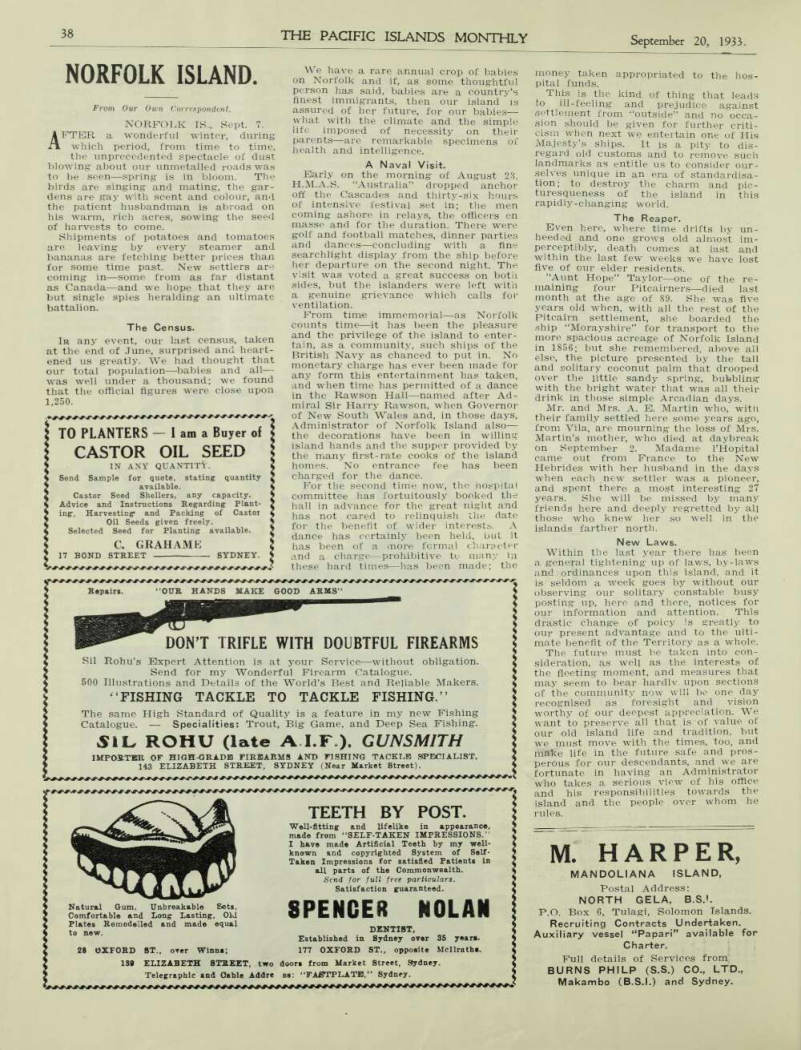
From Our Own Correspondent.
Norfolk Is., Sept. 7.
AFTER a wonderful winter, during which period, from time to time, the unprecedented spectacle of dust blowing about our unmetalled roads was to be seen—spring is in bloom. The birds are singing and mating, the gar dens are gay with scent and colour, and the patient husbandman is abroad on his warm, rich acres, sowing the seed of harvests to come.
Shipments of potatoes and tomatoes are leaving by every steamer and bananas are fetching better prices than for some time past. New settlers are coming in—some from as far distant as Canada —and we hope that they are but single spies heralding an ultimate battalion.
The Census.
In any event, our last census, taken at the end of June, surprised and heart ened us greatly. We had thought that our total population—babies and all — was well under a thousand; we found that the official figures were close upon 1,250.
We have a rare annual crop of babies on Norfolk and if, as some thoughtful person has said, babies are a country’s finest immigrants, then our island is assured of her future, for our babies— What with the climate and the simple life imposed of necessity on their parents—are remarkable specimens of health and intelligence.
A Naval Visit.
Early on the morning of August 23, H.M.A.S. “Australia” dropped anchor off the Cascades and thirty-six hours of intensive festival set in; the men coming ashore in relays, the officers en masse and for the duration. There were golf and football matches, dinner parties and dances —concluding with a fine searchlight display from the ship before her departure on the second night. The visit was voted a great success on both sides, but the islanders were left with a genuine grievance which calls for ventilation.
From time immemorial —as Norfolk counts time—it has been the pleasure and the privilege of the island to enter tain, as a community, such ships of the British Navy as chanced to put in. No monetary charge has ever been made for any form this entertainment has taken, and when time has permitted of a dance in the Rawson Hall—named after Admiral Sir Harry Rawson, when Governor of New South Wales and, in those days, Administrator of Norfolk Island also — the decorations have been in willing island hands and the supper provided by the many first-rate cooks of the island homes. No entrance fee has been charged for the dance.
For the second time now, the hospital committee has fortuitously booked the hall in advance for the great night and has not cared to relinquish the date for the benefit of wider interests. A dance has certainly been held, but it has been of a more formal character and a charge—prohibitive to many in these hard times —has been made; the
money taken appropriated to the hospital funds.
This is the kind of thing that leads to ill-feeling and prejudice against settlement from “outside” and no occasion should be given for further criticism when next we entertain one of His Majesty’s ships. It is a pity to disregard old customs and to remove such landmarks as entitle us to consider ourselves unique in an era of standardisation; to destroy the charm and picturesqueness of the island in this
rapidly-changing world.
The Reaper.
Even here, where time drifts by unheeded and one grows old almost imperceptibly, death comes at last and within the last few weeks we have lost five of our elder residents.
“Aunt Hope” Taylor—one of the remaining four Pitcairners—died last month at the age of 89. She was five years old when, with all the rest of the Pitcairn settlement, she boarded the ship “Morayshire” for transport to the more spacious acreage of Norfolk Island in 1856; but she remembered, above all else, the picture presented by the tall and solitary coconut palm that drooped over the little sandy spring, bubbling with the bright water that was all their drink in those simple Arcadian days.
Mr. and Mrs. A. E. Martin who, with their family settled here some years ago, from Vila, are mourning the loss of Mrs.
Martin’s mother, who died at daybreak on September 2. Madame l’Hopital came out from France to the New Hebrides with her husband in the days when each new settler was a pioneer, and spent there a most interesting 27 years. She will be missed by many friends here and deeply regretted by all those who knew her so well in the islands farther north.
New Laws.
Within the last year there has been a general tightening up of laws, by-laws and ordinances upon this island, and it is seldom a week goes by without our observing our solitary constable busy posting up, here and there, notices for our information and attention. This drastic change of policy is greatly to our present advantage and to the ultimate benefit of the Territory as a whole.
The future must be taken into consideration, as well as the interests of the fleeting moment, and measures that may seem to bear hardlv upon sections of the community now will be one day recognised as foresight and vision worthy of our deepest appreciation. We want to preserve all that is of value of our old island life and tradition, but we must move with the times, too, and make life in the future safe and prosperous for our descendants, and we are fortunate in having an Administrator who takes a serious view of his office and his responsibilities towards the island and the people over whom he rules.
Advertisements & other items, p. 40 (1 item)
M. Harper,
TO PLANTERS I am a Buyer of
CASTOR OIL SEED
IN ANY QUANTITY.
Send Sample for quote, stating quantity available.
Castor Seed Shelters, any capacity.
Advice and Instructions Regarding Planting, Harvesting and Packing of Castor Oil Seeds given freely.
Selected Seed for Planting available.
C. GRAHAME
17 BOND STREET SYDNEY.
Repairs.
‘OUR HANDS MAKE GOOD ARMS'
DON’T TRIFLE WITH DOUBTFUL FIREARMS
Sil Rohu’s Expert Attention is at your Service —without obligation.
Send for my Wonderful Firearm Catalogue. 500 Illustrations and Details of the World’s Best and Reliable Makers.
“FISHING TACKLE TO TACKLE FISHING.”
The same High Standard of Quality is a feature in my new Fishing Catalogue. Specialities: Trout, Big Game, and Deep Sea Fishing.
SiL ROHU (late A.I.F.), GUNSMITH
IMPOSTER OF HIGH-GRADE FIREARMS AND FISHING TACKLE SPECIALIST, 143 ELIZABETH STREET, SYDNEY (Near Market Street).
TEETH BY POST.
Natural Gum, Unbreakable Sets, Comfortable and Long Lasting, Old Plates Remodelled and made equal to now. 28 OXFORD ST., over Winns;
189 ELIZABETH STREET, two
Telegraphic and Cable Addre Well-fitting and lifelike in appearance,
made from “SELF-TAKEN IMPRESSIONS."
I have made Artificial Teeth by my wellknown and copyrighted System of Self- Taken Impressions for satisfied Patients In all parts of the Commonwealth.
Send for full free particulars.
Satisfaction guaranteed.
SPENCER NOLAN
DENTIST,
Established in Sydney over 35 years. 177 OXFORD ST., opposite Mcllraths. doors from Market Street, Sydney, ss: “FASTPLATE.” Sydney.
M. HARPER,
MANDOLIANA ISLAND,
Postal Address;
NORTH GELA, B.S.I.
P.O. Box 6, Tulagi, Solomon Islands.
Recruiting Contracts Undertaken.
Auxiliary vessel “Papari” available for Charter.
Full details of Services from
BURNS PHILP (S.S.) CO., LTD.,
Makambo (B.S.I.) and Sydney.
On The Job!
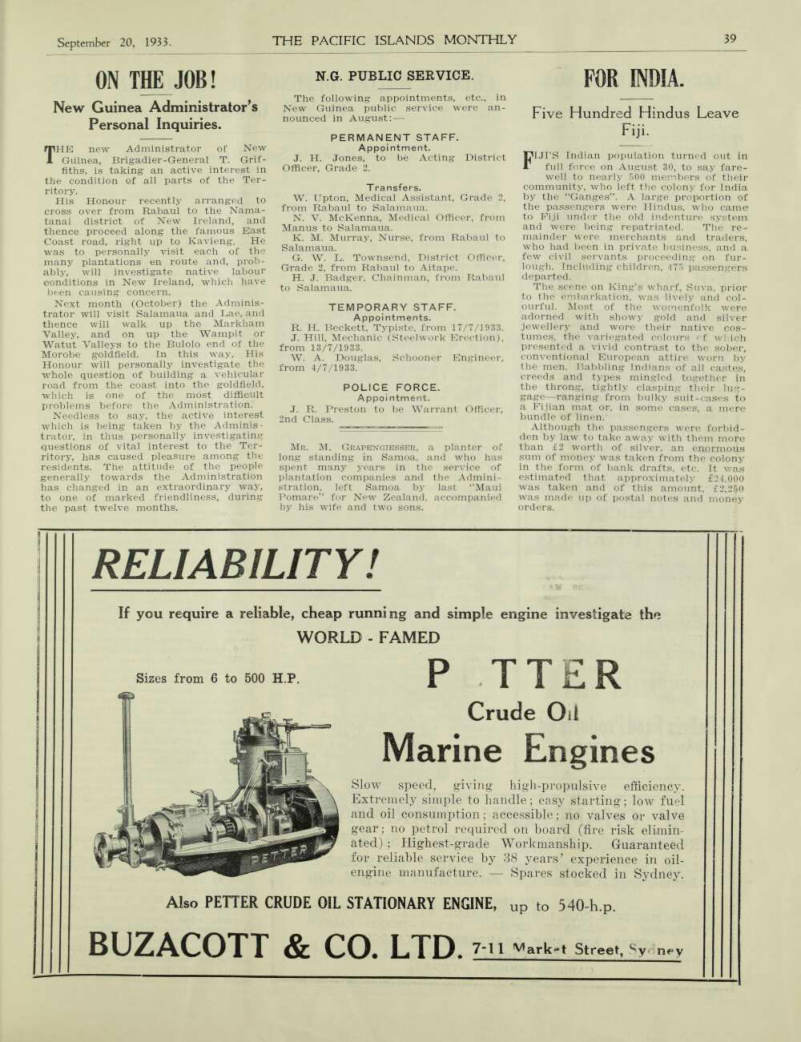
New Guinea Administrator’s Personal Inquiries.
THE new Administrator of New Guinea, Brigadier-General T. Grif fiths, is taking an active interest in the condition of all parts of the Ter ritory.
His Honour recently arranged to cross over from Rabaul to the Nama tanai district of New Ireland, and thence proceed along the famous East Coast road, right up to Kavieng. He was to personally visit each of the many plantations en route and, prob ably, will investigate native labour conditions in New Ireland, which have been causing concern.
Next month (October) the Adminis trator will visit Salamaua and Lae, and thence will walk up the Markham Valley, and on up the Wampit or Watut Valleys to the Bulolo end of the Morobe goldfield. In this way, His Honour will personally investigate the whole question of building a vehicular road from the coast into the goldfield, which is one of the most difficult problems before the Administration.
Needless to say, the active interest which is being taken by the Adminis trator, in thus personally investigating questions of vital interest to the Ter ritory, has caused pleasure among the residents. The attitude of the people generally towards the Administration has changed in an extraordinary way, to one of marked friendliness, during the past twelve months.
N.G. Public Service.
The following appointments, etc., in New Guinea public service were an nounced in August:
Permanent Staff.
Appointment.
J. H. Jones, to be Acting District Officer, Grade 2.
Transfers.
W. Upton, Medical Assistant, Grade 2, from Rabaul to Salamaua.
N. V. McKenna, Medical Officer, from Manus to Salamaua.
K. M. Murray, Nurse, from Rabaul to Salamaua.
G. W. L. Townsend, District Officer, Grade 2, from Rabaul to Aitape.
H. J. Badger, Chainman, from Rabaul to Salamaua.
Temporary Staff.
Appointments.
R. H. Beckett, Typiste, from 17/7/1933.
J. Hill, Mechanic (Steelwork Erection), from 13/7/1933.
W. A. Douglas, Schooner Engineer, from 4/7/1933.
Police Force.
Appointment.
J. R. Preston to be Warrant Officer, 2nd Class, Mr. M. Grapengiesser, a planter of long standing in Samoa, and who has spent many years in the service of plantation companies and the Admini stration, left Samoa by last “Maui Pomare” for New Zealand, accompanied by his wife and two sons.
For India.
Five Hundred Hindus Leave Fiji.
FIJI’S Indian population turned out in full force on August 30, to say fare well to nearly 800 members of their community, who left the colony for India by the “Ganges”. A large proportion of the passengers were Hindus, who came to Fiji under the old indenture systemr and were being repatriated. The re mainder were merchants and traders, who had been in private business, and a few civil servants proceeding on fur lough. Including children, 475 passengers departed.
The scene on King’s wharf, Suva, prior to the embarkation, was lively and col ourful. Most of the womenfolk were adorned with showy gold and silver jewellery and wore their native cos tumes, the variegated colours of which presented a vivid contrast to the sober, conventional European attire worn by the men. Babbling Indians of all castes, creeds and types mingled together in the throng, tightly clasping their lug gage—ranging from bulky suit-cases to a Fijian mat or, in some cases, a mere bundle of linen.
Although the passengers were forbid den by law to take away with them more than £2 worth of silver, an enormous sum of money was taken from the colony in the form of bank drafts, etc. It was estimated that approximately £24,000 was taken and of this amount, £2,250 was made up of postal notes and money orders.
Advertisements & other items, p. 41 (1 item)
Marine Engines
RELIABILITY!
If you require a reliable, cheap running and simple engine investigate the
WORLD - FAMED
Sizes from 6 to 500 H.P.
PETTER
Crude Oil
Marine Engines
Slow speed, giving high-propulsive efficiency.
Extremely simple to handle; easy starting; low fuel and oil consumption; accessible; no valves or valve gear; no petrol required on board (fire risk eliminated) ; Highest-grade Workmanship. Guaranteed for reliable service by 38 years’ experience in oilengine manufacture. — Spares stocked in Sydney.
Also PETTER CRUDE OIL STATIONARY ENGINE, up to 340-h.p.
BUZACOTT & CO. LTD. 7-11 Market Street, Sydney.
Lonely Tokelaus.
From Our Own Correspondent.
Apia, Aug. 28.
THE lonely Tokelau (or Union) Group, which lie northwards of Samoa, and which became part of the Samoa Administration in 1926, were visited re cently by three ships—H.M.S. “Ver onica,” the Mission steamer “John Wil liams,” and the B.P. steamer “Makoa” —within a fortnight. As a rule, the 1,100 people in this group do not see two large ships per annum.
Chinese Writer Defends His Nationals’ Place
In New Guinea.
Spirited Reply to Some Recent Criticism.
Letter to the Editor.
PLEASE permit me space to reply to the article by “Liviara,” appearing in your issue of July, 1933.
Your contributor seems to possess a strong dislike for my Nationals, though why it should be so no man can make out, in view of the fact that on more than one occasion, and for long inter vals, they were very good friends to him when he could not find friends elsewhere. He is now on the Gold fields and, perhaps, making money which is only another illustration of that old saying about putting a beggar on horseback, and there is no saying where he will ride.
In response to “Liviara’s” alarming cry as to what is to be done with the Chinese, I say leave the Chinese alone.
Whatever is done, will be done by men of good, sound common sense, and not by amateurs such as Mr. Liviara.
It is true that the Australians did not introduce the Chinese into New Guinea. Originally, the German Govern ment indentured approximately 90 Chinese for the discharging and loading of the N.D.L. steamers. In addition to these, there arrived at various times Chinese who were not indentured, but came here with the idea of seeking employment and trading. In this they were successful, and Europeans employ ing them found their services very satis factory. Hundreds of these people arrived in this Territory during the Australian Military occupation, with the full concurrence of the Australian Government.
With regard to “Liviara’s” remarks that the Chinese could not sell against the European storekeepers, it is to be wondered at, when the Chinese were paying to the European stores practi cally retail prices and very little, if any, margin was left them for profit. As to the condition of Chinatown, Rabaul, during the military occupation, it must be remembered that portion of the township was at that period only re cently established, and was only in the constructive stage.
Concerning the trading side of the question, it must be borne in mind that were it not for the Chinese trader working as hard as he did and pur chasing all possible copra, the Customs export duty, business-tax, and other sources of Government revenue in this
Territory would have suffered con siderably.
It was the prices that were charged the Chinese by European stores that forced the Chinese to go in for direct importing, and the result of this was to compel the Europeans to make their prices more reasonable. Another thing it did was to reduce the cost of living, because Europeans as well as Chinese obtained their goods much cheaper.
The planters also benefited by this reduction. The two European firms here, owing to their being so well established, are just as great competi tors of the small European traders and more so than the Chinese.
With regard to the question of dummying, it is not wise for people who have “dummied” to write letters or articles to newspapers.
The assertion of the low cost of living of the Chinese is another fallacy of Mr.
Liviara’s. He has dined with the Chinese people here and enjoyed it. In fact, they were his very best friends for a long time, and that was at a time when he wanted a friend. The Chinese standard of living as compared with that of Europeans leaves a very small margin in between. The standard of living is entirely a matter in the hands of the Chinese themselves. Whether their choice lies in extravagance or economy is purely their business. What about the extravagance of 1926 to 1928, on the part of the planters, and the ap plications they have made from time to time for moratoriums? The Chinese have never sought moratoriums.
Coming now to the assertion by “Liviara” that the Chinese are not path-finders, and his suggestion that the commercial activities of our nationals should be curtailed, might I ask why this curtailment? They carried out such a curtailment scheme in Papua against the Chinese, and the scheme was of no value whatever to the community of Papua in general. The present com mercial condition of Papua proves this.
Where would this Territory stand to day in commerce and the production of copra were it not for the Chinese trader? I will go further and ask, who was it planted some of the finest plan tations in this Territory? Again, I say, it was the Chinese. How many plan tations have been planted up by the Europeans since the Territory was taken over by the present Administra tion? It would not take the whole of one hand to count them.
Your contributor’s admiration for the N.D.L. stevedoring coolie is appreciated by me, and for same I thank him. It speaks volumes for the energy, thrift and doggedness of my nationals in helping to pioneer this Territory long before the present Administration ever thought of it. If it was the good luck of the Chinese to blossom into mer chants, what about the good luck of the present plantation-owners to walk
into ready-made plantations?
Your contributor says that my nationals do not make any improve ments in this Territory. I would like to point out that we are not allowed to
do so. No inducements are offered us to take up land in this Territory. As an instance I might point to Namatanai, which was the district allotted by the German Government to the Chinese people and continued as such under the present Administration. That portion of the Territory is less in debt than any other part to which “Liviara” may refer.
If the Administration was to engage only European artisans they would never be able to pay same, owing to the great increase there would be in the pay sheets.
The three methods of ridding the South Seas of the Chinese sound not only tragic but ridiculous. Take the hub of the British Empire—England.
Do we ever hear of the sound states men of Westminster making absurd suggestions of this nature? There the Chinese are welcome, and allowed to enter into business.
Now, as to whether the Chinese are assets to a country, “Liviara” could not have studied this subject very deeply. Take, for instance, America the Philippines, the Straits Settle ments, South America, in all of which places you will find the Chinese people law-abiding, respected and regarded as good citizens and among the leading business men.
This is nonsense about sending all their money to China. The time comes when they like to retire from their labours, and end their days in their owti land, the same as ' any other nationals do. Does “Liviara” expect the Chinese to leave all their money in the country where they made it, ‘and go home penniless? A man’s money is his own property, and is his to spend where and when he chooses. As a rule the Chinese work very hard for what they get. Of course, it is a well-known tact that Europeans going to China cannot compete with the Chinese. There are very many fine European firms operating in China and amassing for tunes. One of the greatest banks in the British Empire operates in all ports of the Orient — The Hongkong and Shanghai Banking Corporation. That bank is a monument to the spirit of co-operation between the British and Chinese who brought it into being and have helped to maintain it ever since.
Insofar as class is concerned, more than half the Asiatic population of New Guinea are locally born and educated young Chinese. I regret to note “Livi ara’s” remark that most of these people are coolies. Approximated 90 coolies were indentured, and about 20 of these remain in the Territory to-day. Mr.
Liviara s assertion is a gross insult to the Chinese population of this Territory.
"Liviara” seems to contradict himself, because in one part of his contribution he is running down the Chinese for working for low wages, and in another part he claims that the reason the Euro peans employ Chinese is because they are cheap. Let me tell Mr. Liviara that the Chinese are willing to accept as high or even higher wages than Europeans receive, but the European employers will not pay them these wages, so what is one to do—not work, and starve?
Come now to “Liviara’s” bold scheme of replacing market-gardeners, carpen ters, and other Chinese artisans. What about the female European labour that replaced men during the war, and are still filling those positions? Germany has solved that problem, as we all know.
“Liviara” asserts that the Chinese are very cunning and always employ a lawyer. Well, of course they do, but that is just for their own protection.
It is a well-known fact that the litigant
who has a lawyer has the bigger stick to wield, compared with the litigant who has no lawyer. Would Mr. Liviara assert that the Europeans who employ lawyers are also cunning? The laws of China and of Great Britain differ to day, and so that a Chinese may get the proper advice, he just goes to a lawyer.
That is not cunning, but common sense.
Concerning repatriation to China of Chinese by their employers, I am as tounded at Mr. Liviara’s discovery. Now, in the event of repatriation being de cided upon, will Mr. Liviara be able to pay the expenses of the local Chinese?
Were Mr. Liviara to again become a trader would he be willing to indenture Chinese labour into this Territory, and pay their expenses to and fro between China and the Territory?
Concerning marriage between Chinese
and natives, I would point out that some Europeans marry native women. As to spending of money by Chinese in this Territory, does Mr. Liviara know me, and does he remember me when I was a bachelor and spending money in hotels in Rabaul on various people every day?
Mr. Liviara may know that in that period I was spending every day over two pounds, and Europeans can bear this statement out.
In conclusion, I would suggest to Mr.
Liviara that whenever he invokes the aid of the Press he should study his sub ject, and stick to facts all the time.
Otherwise, not only is he misleading the public, but the Press also.
I am, etc.,
T. C. Wee.
Rabaul, Aug. 20, 1933.
Advertisements & other items, pp. 42-43 (2 items)
Food Products
J. H. MacGregor Dowsett
RABAUL, NEW GUINEA,
for
RELIABLE CARS. SERVICE &. DRIVERS.
Gramophones and Latest Records.
Musical Instruments and Sundries.
Cameras and Photographic Goods.
Developing, Printing, Enlarging & Framing.
Recruiter, Mining & General Agent,
BUILDER AND CONTRACTOR.
Agent for The Australian Provincial Assurance Assoc. Ltd. Sub-Agent for The Central Assurance Co. Ltd.
Outstation Orders Promptly Executed.
Sample Rooms:
MALAGUNA ROAD, RABAUL
Phone: Rabaul 149.
Delicia
Food Products
PURE MALT VINEGAR
TOMATO SAUCE
JELLY CRYSTALS
PURE FLAVOURING
ESSENCE
CHUTNEY
BAKED BEANS with Pork, in Tomato Sauce SPAGHETTI in Tomato Sauce.
Delicia Food Products Co.
DANKS ST., WATERLOO,
N.S.W.
SHIP CHANDLERY - HARDWARE
BROOMFIELDS LIMITED, 152 Sussex St., SYDNEY.
Large and Complete Stocks of SHIP CHANDLERY.
Ironmongery of all kinds. Paints, White Lead and Oils.
Sole Agents for P. H. MUNTZ & CO.’S 3-CROWN BRAND METAL SHEATHING.
PEACOCK & BUCHANS’ ENGLISH READY - MIXED PAINTS.
WRITE FOR SHIP CHANDLERY CATALOGUE.
Special “In Bond” Prices for all Island enquiries quoted on application.
CABLES: “BOOM.” SYDNEY.
Capstan
CIGARETTES
CORK-TIPPED
OR PLAIN
CAPSTAN
NAVY CUT TOBACCO
made from the
finest
Virginian leaf
CAPSTAN
The B.P.
MAGAZINE
An Australian Publication featuring the work of Australian Writers and Artists.
Fiction
Travel
Adventure
Cover Picture Stage and Screen
Fashion
• in Colour . Children’s Pages.
Within the Commonwealth of Australia, Mandated Territory and New Guinea Within the British Empire U.S.A. and Foreign 1/- Copy.
From all Bookstalls and Newsagents, or direct from the Publishers,
BURNS, PHILP & CO., LTD.
4/- post free 5/4 post free 6/8 post free 1/- Copy.
Praise For Norfolk Is.
Administrator.
MR. H. R. RABONE, at a meeting of the Australian Genealogists’ Society held in Sydney on August 25, paid an impressive tribute to Captain C. R.
Pinney, present Administrator of Nor folk Island.
Captain Pinney had been in charge of the affairs of the island for about twelve months, said Mr. Rabone, and during that period had proved himself to be the ideal Administrator. It was mainly due to his able guidance that Norfolk Island was now emerging from the depression and that the islanders were both happy and contented.
Mr. Rabone, who has been engaged in historical research on Norfolk Island for over two years, traced the history of Norfolk Island and Pitcairn Island from the days of the “Bounty” mutiny until recent times.
Germany’S Lost Colonies.
Former Enemy Officer Makes Striking Appeal to Australians.
Letter to the Editor.
AS a constant reader of the “Pacific Islands Monthly,” I have followed up your articles concerning the German colonial question with great in terest, but also with increasing aston ishment.
I have a personal knowledge of the conditions in the Pacific, having been there shortly before the war; close study afterwards enabled me to keep in touch with the South Seas.
Your paper on various occasions still blames Germany for being guilty of the war and says that for this reason the confiscated territories cannot be given back to her. In March you write: “The main dominating fact for consideration in connection with the disposal of the territories is the war guilt of Germany.
If Germany was guilty of causing the war, then the loss of her colonies is the least punishment she should suffer.
If Germany was not the aggressor, then unquestionably she should have returned to her those territories which, in the period from Bismarck down to the Great War, she governed and developed so ad mirably.” Then you give as a proof of Germany’s guilt that she need only press the button and her army stood ready for war, whereas the other nations were absolutely unprepared.
I can only say that the German army, according to the general opinion, was the best army in the world and there fore would have been ready in any case, whether earlier or later. Germany and
her people, however, were economically unprepared, otherwise they would never have been reduced to such a state of starvation. In our colonies, every one thought war out of the question. On the other hand, the political isolation of Germany began years and years before the war, perhaps to not such an extent at the outbreak of the war as many nations would have wished. How would it otherwise have been possible for 26 nations, so utterly different in every respect, to suddenly enter into an alli ance against Germany?
Of course, a scapegoat had to be found. Appearances were against us and the circumstances under which the war broke out gave our enemies the oppor tunity to put the blame on us. There was no question as to who was the aggressor and Mr. Asquith, the British Prime Minister, at the early date of September, 1914, put an end to any dis cussions that might arise by declaring: “One Power alone is responsible and that is Germany.” The war guilt thus thrust upon us, became a mighty political weapon in the hands of the Allies. Afterwards, they induced the United States of America to join the war and this fact decided the struggle in favour of the Allies.
Germany was like a besieged fortress and could not defend herself against the enormous propaganda. The false state ments, spread all over the world about Germany’s guilt, gained solid ground and led to the moral foundation of the Peace Treaty. Germany’s endeavours to get rid of this unjust accusation, in order to save at least her honour, failed on account of the blind hate of her enemies. Nobody believed Germany, because no one wanted to believe her.
It was not until years afterwards, that we were able to clear ourselves of this awful charge, supported—and you will lay more stress on it —by lead ing personalities of the Allied and Asso ciated Powers.
The lies about the atrocities caused by our army, which were to strengthen Germany’s guilt, were mere fabrica tion. From the first day to the last, I fought in the front lines as a German officer, in innumerable battles in France, and I can assure you with a clear con science that not a single one of those “atrocities” were committed. If any thing of the kind ever occurred, it can only have been caused by natives — and they did not fight on our side.
We Germans did our duty just the same as you did and yet with this small difference that our life has been a con tinual sacrifice during the last nineteen years for our country.
I appeal to the British Nation, hence also to you Australians, to cease be lieving those lies about Germany.
Firstly, because we are so closely re lated and, secondly, because you know how to think in a fair way.
I personally heard Lord Kitchener say in Australia, 1910: “It would be a great thing if the two white races, England and Germany, could learn to understand each other.” Another reason is the sen tence in your paper dated May 18, 1933: “The whole world holds out a welcom ing hand to the new, proud, re-vitalised
Germany, and gladly will assist the Germans back to their rightful place among the nations.”
You further say: “No one in his senses can defend the Versailles Settle ment; one can only say it was a fitting end to humanity’s four years of mad ness." May I remind you of what really happened: Germany laid down her arms in full confidence that Wilson’s 14 points would form the basis of the forthcoming Peace Treaty. After hav ing done so, Germany was forced to sign the tragical Versailles—please to look upon it from our point of view— Dictation.
You are aware, that all our colonies and valuable provinces have been taken away from us. Even Danzig—German to the core—was pronounced a free state; and a senseless “corridor” was cut through Germany. The rest of the body was condemned to work for the whole world for decades. There was no possibility for superfluous popula tion to settle down, who in despair flooded in from the confiscated ter ritories to what was left of a great Fatherland. No possibility of getting our own raw materials and increasing difficulties for an outlet for our goods.
Result: an economic crisis all over the world.
On another occasion you write your self: “Frankly we cannot see, that the possession of the former German colonies is much of an advantage to the countries concerned, and, it may be, that as sources of raw materials, the possession of these Pacific territories would be more advantageous to Ger many than to us. We recognise that a nation such as Germany must have new lands—particularly tropical ter ritories—to develop.” And I ask: What are the words of Wilson’s fifth point?
I believe—indeed, I am sure—that with a revision of the Versailles Settlement peace and commonsense will return to the world. The absolute lack of elbow-room for one nation with her thirst for new territories and the vast, enormous colonial possessions of other nations are against the laws of nature, especially in our century, with its highly developed and continually advancing traffic and modern in ventions.
Australia could do much to help Germany and, with her, the world, if she were to raise her voice and bring truth and justice to light.
I am, etc.,
Paul Schnoeckel,
Former Major in the German Army.
Berlin, 10th June, 1933.
Advertisements & other items, p. 44 (1 item)
Paton, Burns & Co.,
J. H. SMYTH LTD
Postage Stamp Dealers,
121a CASTLEREAGH STREET,
SYDNEY.
The Leading House for
ISLANDS STAMPS.
Write for List of over 500 Sets of Australian, New Zealand, and Pacific Islands Stamps.
Stamps sent on approval on receipt of reference.
ISLAND STAMPS PURCHASED.
Highest Prices Paid.
THE
“CALEDONIA DOVER.”
A COOKING STOVE guaranteed to give complete satisfaction and now recognised as THE BEST on the market. Suitable for coal, coke or wood fuel.
Illustrated Catalogue on request.
LANE & GIRVAN, LTD.,
BONNY BRIDGE, SCOTLAND.
BIG CROPS
can be depended upon from land that has been liberally fertilised with
P. B. MANURES,
The best for all purposes. Send for our Free Booklet, “RATIONAL MANURING,” it contains interesting information.
PATON, BURNS & CO.,
52 KING STREET SYDNEY.
Big Fire At Levuka.
Early on the morning of September 2, a fire broke out in the Ovalau Picture Theatre, Levuka, Fiji, and totally de stroyed the premises and an adjoining building. The theatre was owned by Mr.
Joseph Sahai and was rented by Messrs.
Bhura and B. R. Singh, of Suva, who used the hall for exhibiting talking pictures.
For several nights before the fire, the theatre had not been used owing to delay in obtaining suitable films and the cause of the outbreak is unknown. Damage was estimated at over £1,200 but, fortunately, the apparatus and theatre were covered by insurance.
Residents of Levuka will feel the loss of this theatre as it was the only public place of amusement in the district.
Gold Shares Jump.
Big Demand for N.G.G. Ltd.
TOWARDS the end of August, as a result of a sharp rise of 3/2 to £6/9/4 in the London price of gold, shares in the main New Guinea gold concerns were in strong demand on the Sydney Stock Exchange.
For some time, the London market had been devoting considerable atten tion to N.G. mining companies’ shares and under stimulus from the advance in price in gold all N.G. mining shares rose. On August 28, Bulolo Gold Dredging, Placer Development and N.G. Goldfields, Ltd. showed marked
gains and record high prices were reached. On that date, the turnover of New Guinea Goldfield, Ltd., shares reached 12,000 shares.
Prices luling on August 28 were; Bulolo Gold Dredging, buying £4/15/-, selling £4/15/6; Placer Development, buying £14/5/-, selling £14/10/-; N.G.
Goldfields, buying- 9/2, selling 9/3.
Mr. J. Adkins, teller of the Apia branch of the Bank of New Zealand, left by last “Maui Pomare” after the com pletion of his term of engagement. Mr.
Adkins was a very popular member of the younger circle of Apia, and was well liked for his ever-courteous and cheerful ways.
Advertisements & other items, p. 45 (1 item)
World’S Greatest Prize Value
THE GOLDEN CHRISTMAS BOX is the
World’s Greatest Lottery Value. Prizes valued at £5000 may be won with one ticket costing 1/-.
The Tickets are beautifully designed Christmas Cards. Ideal Greetings. — Worth-while Presents. GET YOURS NOW!
REMEMBER! He who wins is he who tries.
Without a ticket you can’t win a prize.
Sanctioned by the Honourable the Attorney- General of New South Wales, it will be drawn in the Sydney Town Hall, under Police supervision, and in the presence of the Press and the Public. Island residents have been amazingly lucky in the N.S.W.
Lotteries. Recently a £5000 went to Noumea, and in a big lottery, drawn in Sydney last month, Pacific Islanders won 180 prizes.
The Golden Christmas Box, Desk P.I.M, 21 Macquarie Place, Box 3555RR, G.P.O.,
SYDNEY, NEW SOUTH WALES.
I want to win prizes valued at £5000 for 1/- in the GOLDEN CHRISTMAS BOX. Here is a Postal Note for Please send me Christmas Cards (Tickets), any one of which can win me the big prizes.
NAME STREET
TOWN STATE
New Guinea Shares Jump.
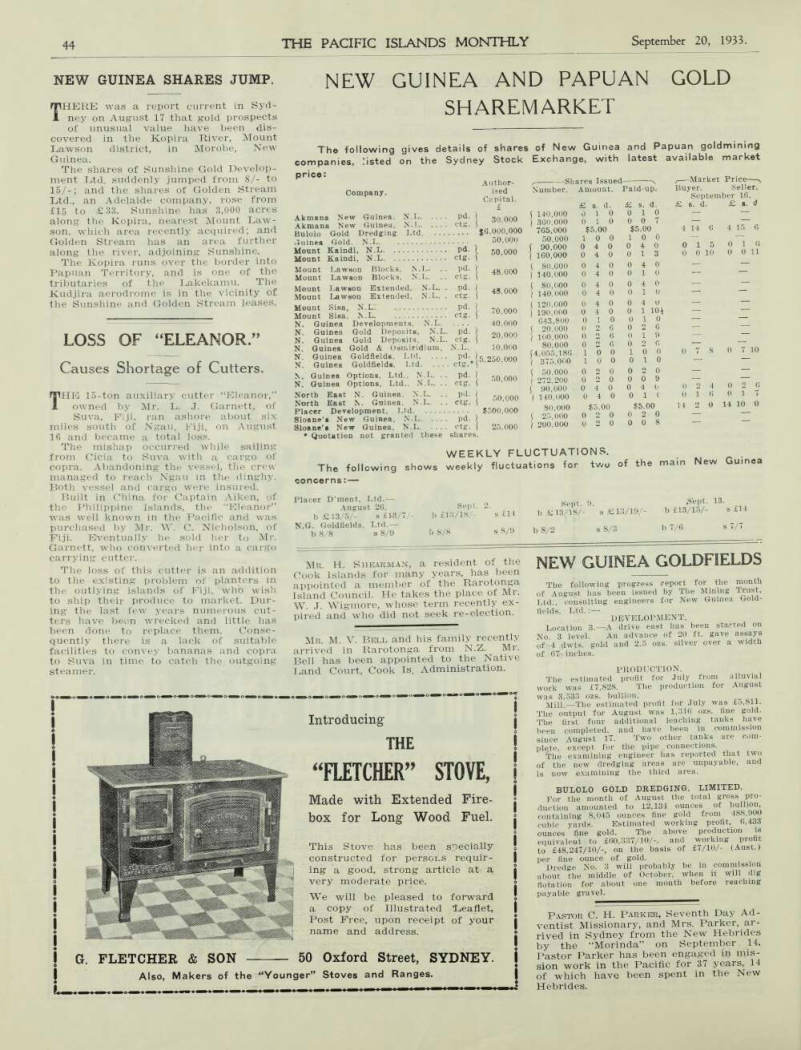
THERE was a report current in Syd ney on August 17 that gold prospects of unusual value have been dis covered in the Kopira River, Mount Lawson district, in Morobe, New Guinea.
The shares of Sunshine Gold Develop ment Ltd. suddenly jumped from 8/- to 15/-; and the shares of Golden Stream Ltd., an Adelaide company, rose from £15 to £33. Sunshine has 3,000 acres along the Kopira, nearest Mount Law son, which area recently acquired; and Golden Stream has an area further along the river, adjoining Sunshine.
The Kopira runs over the border into Papuan Territory, and is one of the tributaries of the Lakekamu. The Kudjira aerodrome is in the vicinity of the Sunshine and Golden Stream leases.
Causes Shortage of Cutters.
Loss Of “Eleanor.”
THE 15-ton auxiliary cutter “Eleanor,” owned by Mr. L. J. Garnett, of Suva, Fiji, ran ashore about six miles south of Ngau, Fiji, on August 16 and became a total loss.
The mishap occurred while sailing from Cicia to Suva with a cargo of copra. Abandoning the vessel, the crew managed to reach Ngau in the dinghy.
Both vessel and cargo were insured.
Built in China for Captain Aiken, of the Philippine Islands, the “Eleanor” was well known in the Pacific and was purchased by Mr. W. C. Nicholson, of Fiji. Eventually he sold her to Mr.
Garnett, who converted her into a cargo carrying cutter.
The loss of this cutter is an addition to the existing problem of planters in the outlying islands of Fiji, who wish to ship their produce to market. Dur ing the last few years numerous cut ters have been wrecked and little has been done to replace them. Conse quently there is a lack of suitable facilities to convey bananas and copra to Suva in time to catch the, outgoing steamer.
Mr. H. Shearman, a resident of the Cook Islands for many years, has been appointed a member of the Rarotonga Island Council. He takes the place of Mr.
W. J. Wigmore, whose term recently ex pired and who did not seek re-election.
Mr. M. V. Bell and his family recently arrived in Rarotonga from N.Z. Mr.
Bell has been appointed to the Native Land Court, Cook Is. Administration.
Sharemarket
New Guinea And Papuan Gold
The following gives details of shares of New Guinea and Papuan goldmining companies, listed on the Sydney Stock Exchange, with latest available market price:
Weekly Fluctuations.
The following shows weekly fluctuations for two of the mam New Guinea concerns
price: Authorised Capital. £ Shares Issued Market Price Company.
Number.
Amount. £ s. d.
Paid-up. £ s. d.
Buyer. Seller.
September 16. £ s. d. £ s. d.
Akmana New Guinea. N.L.
Akmana New Guinea, N.L.
Bulolo Gold Dredging Ltd. ...
Pd. ctg. 30,000 56,000,000 50,000 140,000 360,000 765,000 50,000 0 1 0 0 1 0 $5.00 1 0 0 0 1 0 0 0 7 $5.00 1 0 0 4 14 6 4 0 0 1 5 6 1 6 Mount Kaindi, N.L Mount Kaindi, N.L Pd. ctg. 50,000 90,000 160,000 0 0 4 4 0 0 0 0 4 1 u 3 0 0 1 0 5 10 1 6 0 1 1 Mount Lawson Blocks, N.L.
Mount Lawson Blocks, N.L. pd. ctg. 48,000 80,000 140,000 0 0 4 4 0 0 0 0 4 1 0 0 — — Mount Lawson Extended. N.L. . pd. 48,000 80,000 0 4 0 0 0 4 1 0 0 — Mount Lawson Extended. N.L. . ctg. 140,000 0 4 0 Mount Sisa N.L pd. ctg. 70,000 120,000 0 4 0 0 4 u 10½ — Mount Sisa N.L. 190,000 0 4 0 0 1 N. Guinea Developments. N.L. 40,000 643,800 0 0 0 0 0 0 0 1 1 2 0 0 — N. Guinea Gold Deposits, N.L.
N. Guinea Gold Deposits. N.L. pd. ctg. 20,000 20,000 100,000 80,000 14,055,180 375,000 0 0 0 0 0 6 6 1 2 9 0 — N. Guinea Gold & Osmiridium, N.L. 10,000 0 1 1 A 0 1 0 0 7 8 0 7 10 N. Guinea Goldfields. Ltd N. Guinea Goldfields. Ltd. pd. ctg. 5,250,000 0 0 0 1 0 0 — N. Guinea Options, Ltd., N.L. ..
Pd. 50,000 50,000 272,200 90,000 140,000 0 0 0 0 2 0 0 0 0 2 0 0 9 N. Guinea Options, Ltd., N.L. .. ctg. 4 0 0 4 0 0 2 4 0 2 6 North East N. Guinea. N.L. pd. 50,000 0 4 0 0 1 1 0 1 6 0 1 7 North East N. Guinea. N.L. . . ctg. 80,000 25,000 $5.00 $%.00 14 2 0 14 10 0 Placer Development, Ltd pd. $500,000 0 2 0 0 2 0 — Sloane’s New Guinea, N.L 0 0 0 8 Sloane’s New Guinea, N.L ctg. 25,000 200,000 0 0 0 • Quotation not granted these shares.
Placer D’ment, Ltd.— Sept, b £13/18/- Sept. 9. b £13/18/- s £13/19/- Sept. 13.
August 26. b £13/5/- s £W/7/- 2 s £11 b £13/15/- s £14 N.G. Goldfields. Ltd.— b 8/8 s 8/9 b 8/8 s 8/9 b 8/2 s 8/3 b 7/6 s 7/7
New Guinea Goldfields
The following progress report for the month of August has been issued by The Mining Trust, Ltd., consulting engineers for New Guinea Gold fields, Ltd.: —
Development.
Location 3. —A drive east has been started on No. 3 level. An advance of 20 ft. gave assays of 4 dwts. gold and 2.5 ozs. silver over a width of 67 inches.
Production.
The estimated profit for July from alluvial work was £7,828. The production for August was 3,533 ozs. bullion.
Mill. —The estimated profit for July was £5,811.
The output for August was 1,316 ozs. fine gold.
The first four additional leaching tanks have been completed, and have been in commission since August 17. Two other tanks are com plete, except for the pipe connections.
The examining engineer has reported that two of the new dredging areas are unpayable, and is now examining the third area.
Bulolo Gold Dredging. Limited.
For the month of August the total gross pro duction amounted to 12,134 ounces of bullion, containing 8,045 ounces fine gold from 488,900 cubic yards. Estimated working profit, 6,433 ounces fine gold. The above production is equivalent to £60,337/10/-, and working profit to £48,247/10/-, on the basis of £7/10/- (Aust.) per fine ounce of gold. . .
Dredge No. 3 will probably be in commission about the middle of October, when it will dig flotation for about one month before reaching payable gravel.
Pastor C. H. Parker, Seventh Day Ad ventist Missionary, and Mrs. Parker, ar rived in Sydney from the New Hebrides by the “Morinda” on September 14.
Pastor Parker has been engaged in mis sion work in the Pacific for 37 years, 14 of which have been spent in the New Hebrides.
Advertisements & other items, p. 46 (1 item)
“Fletcher” Stove,
Introducing
THE
Made with Extended Fire-
box for Long Wood Fuel.
This Stove has been specially constructed for persons requiring a good, strong article at a very moderate price.
We will be pleased to forward a copy of Illustrated Leaflet, Post Free, upon receipt of your name and address.
G. FLETCHER & SON 50 Oxford Street, SYDNEY.
Also, Makers of the “Younger” Stoves and Ranges.
Market Quotations
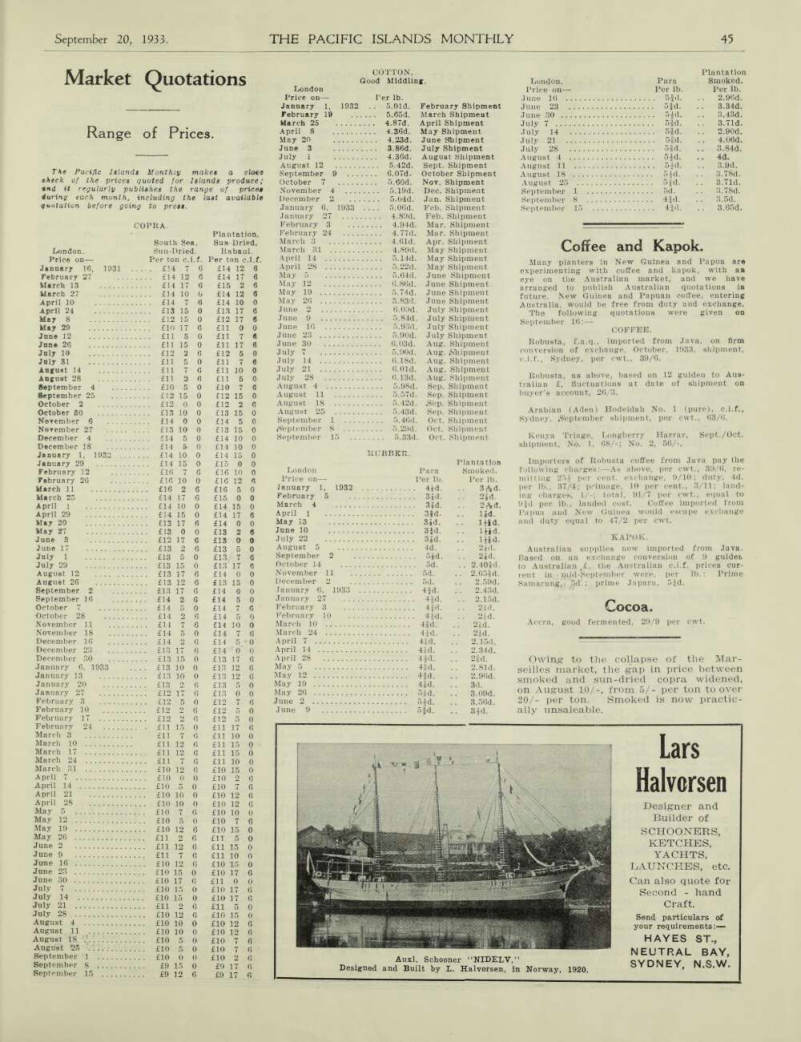
Range of Prices.
The Pacific Islands Monthly makes a close check of the prices quoted for Islands produce; end it regularly publishes the range of prices during each month, including the last available quotation before going to press.
Copra
South Sea, Plantation.
Sun Dried, London.
Sun-Dried.
Itabaul.
Price on— Per ton c. i. f.
Per ton c.i.f.
January 16, 1031 £14 7 6 £14 12 6 February 127 £14 12 6 £14 17 6 March 13 £14 17 6 £15 2 6 March 27 £14 10 6 £14 12 6 April 10 £14 7 6 £14 10 0 April 24 £13 15 0 £13 17 0 May 8 £12 15 0 £12 17 6 May 29 £10 17 6 £11 0 0 June 12 £11 5 0 £11 7 6 June 26 £11 15 0 £11 17 6 July 10 £12 2 6 £12 5 0 July 81 £11 5 0 £11 7 6 August 14 £11 7 6 £11 10 0 August 28 £11 2 6 £11 B 0 September 4 . . . . 0 £10 7 6 September 25 .. . . £12 15 0 £12 15 0 October 2 £12 0 0 £12 2 6 October 80 £13 10 0 £13 15 0 November 6 £14 0 0 £14 5 0 November 27 £13 10 0 £13 15 0 December 4 £14 5 0 £14 10 0 December 18 £14 5 0 £14 10 0 January 1, 1932 . . £14 10 0 £14 15 0 January 29 £14 15 0 £15 0 0 February 12 . . . . £16 7 6 £16 10 0 February 26 . . . . £16 10 0 £16 12 6 March 11 6 £16 5 0 March 25 £14 17 6 £15 0 0 April l 0 £14 15 0 April 29 £14 15 0 £14 17 6 May 20 £13 17 6 £14 0 0 May 27 £13 0 0 £13 2 6 June 3 6 £13 0 0 June 17 £13 2 6 £13 5 0 July 1 £13 5 0 £13 7 6 July 29 £13 15 0 £13 17 6 August 12 6 £14 0 0 August 26 £13 12 6 £13 15 0 September 2 . . . , £13 17 6 £14 0 0 September 16 . . ., £14 2 6 £14 5 0 October 7 £14 5 0 £14 7 6 October 28 £14 2 6 £14 5 0 November 11 ... £14 7 6 £14 10 0 November 18 ... £14 5 0 £14 7 6 December 16 . . .. £14 2 0 £14 5 0 December 23 £13 17 6 £14 0 0 December 30 ... ... £13 15 0 £13 17 6 January 6, 1933 £13 10 0 £13 12 6 January 13 £13 10 0 £13 12 6 January 20 £13 2 6 £13 5 0 January 27 £12 17 6 £13 0 0 February 3 £12 5 0 £12 7 6 February 10 £12 2 6 £12 5 0 February 17 £12 2 6 £12 5 0 February 24 ... £11 15 0 £11 17 6 March 3 £11 7 6 £11 10 0 March 10 £11 12 6 £11 15 0 March 17 6 £11 15 0 March 24 6 £11 10 0 March 31 6 £10 15 0 April 7 0 £10 2 6 April 14 £10 5 0 £10 7 6 April 21 0 £10 12 6 April 28 0 £10 12 6 May 5 6 £10 10 0 May 12 0 £10 7 6 May 19 6 £10 15 0 May 26 6 £11 5 0 June 2 6 £11 15 0 June 9 6 £11 10 0 June 16 6 £10 15 0 June 23 0 £10 17 6 June 30 6 £11 0 0 July 7 0 £10 17 6 July 14 0 £10 17 6 July 21 6 £11 5 0 July 28 6 £10 15 0 August 4 ... £10 10 0 £10 12 6 August 11 ... £10 10 0 £10 12 6 August 18 ... £10 5 0 £10 7 6 August 25 ... £10 5 0 £10 7 6 September 1 0 £10 2 6 September 8 0 £9 17 6 September 15 6 £9 17 6
London.
Para Plantation Smoked.
Price on — Per lb.
Per lb.
June 16 5¾d. .. 2.96d.
June 23 5¾d. .. 3.34d.
June 30 5½d. .. 3.43d.
July 7 5|d. 3.71d.
July 14 5|d. . . 2.90d.
July 21 5gd. .. 4.06d.
July 28 5fd. .. 3.84d.
August 4 5Jd. .. 4d.
August 11 54d. .. 3.9d.
August 18 5Jd. .. 3.78d.
August 25 5Jd. .. 3.71d.
September 1 5d. . . 3.78d.
September 8 4id. .. 3.5d.
September 15 4}d. .. 3.65d.
London Price on —
Cotton,
Good Middling.
Per lb.
January 1, 1932 5.Old. February Shipment February 19 March 25 . . . . 4.87d. April Shipment April 8 May 20 June 3 July 1 August 12 September 9 . . .
October 7 ... 5.60d. Nov. Shipment November 4 5.19d. Dec. Shipment December 2 5.04d. Jan. Shipment January 6, 1933 ... 5.06d. Feb. Shipment January 27 .. ..
February 3 4.94d. Mar. Shipment February 24 ... 4.77d. Mar. Shipment March 3 March 31 4.89d. May Shipment April 14 April 28 May 5 May 12 May 19 May 26 June 2 June 9 June 16 5.93d. July Shipment June 23 June 30 6.03d. Aug. Shipment July 7 5.90d. Aug. .Shipment July 14 July 21 July 28 August 4 5.98d. Sep. Shipment August 11 5.57d. Sep. Shipment August 18 5.42d. ,S'ep. Shipment August 25 5.43d. Sep. Shipment September 1 5.46d. Oct. Shipment .September 8 5.29d. Oct. Shipment September 15 5.33d. Oct. Shipment London
Rubber.
Plantation Para Smoked.
Price on— Per lb. Per lb.
January 1, 1932 4id. 3 Ad.
February 5 3id. .. 2id.
March 4 3id. .. 2Ad.
April 1 3Jd. .. lid.
May 13 3id. IHd.
June 10 July 22 3id. .. Ugd.
August 5 September 2 5id. 2id.
October 14 ...
November 11 5d. .. 2.65gd.
December 2 5d. .. 2.59d.
January 6, 1933 4|d. .. 2.43d.
January 27 ... 4$d. .. 2.15d.
February 3 ...
February 10 41d. .. 21d.
March 10 4|d. .. 24d.
March 24 4*d. .. 21d.
April 7 41d. .. 2.lad.
April 14 44d. .. 2.34d.
April 28 4Jd. .. 2|d.
May 5 May 12 May 19 4|d. . . 3d.
May 26 5id, .. 3.09d.
June 2 June 9 5id. . . 3id.
Coffee and Kapok.
Many planters in New Guinea and Papua are experimenting with coffee and kapok, with an eye on the Australian market, and we have arranged to publish Australian quotations in future. New Guinea and Papuan coffee, entering Australia, would be free from duty and exchange.
The following quotations were given on September 16: —
Coffee,
Robusta, f.a.q., imported from Java, on firm conversion of exchange, October, 1933, shipment, c.i.f., Sydney, per cwt., 39/6.
Robusta, as above, based on 12 gulden to Aus tralian £, fluctuations at date of shipment on buyer’s account, 26/3.
Arabian (Aden) Hodeidah No. 1 (pure), c.i.f., Sydney, September shipment, per cwt., 63/6.
Kenya Triage, Longberry Harrar, Sept./Oct. shipment, No. 1, 68/-; No. 2, 56/-.
Importers of Robusta coffee from Java pay the following charges:—-As above, per cwt., 39/6, re mitting 25½ per cent, exchange, 9/10; duty, 4d. per lb., 37/4; primage, 10 per cent., 3/11; land ing charges, 1/-; total, 91/7 per cwt., equal to 9¾d per lb., landed cost. Coffee imported from Papua and New Guinea would escape exchange and duty equal to 47/2 per cwt.
Kapok.
Australian supplies now imported from Java.
Based on an exchange conversion of 9 guldea to Australian £, the Australian c.i.f. prices current in mid-September were, per lb.: Prime Samarang, pd. ; prime Japara. 5½d.
Cocoa.
Accra, good fermented, 29/9 per cwt.
Owing to the collapse of the Mar seilles market, the gap in price between smoked and sun-dried copra widened, on August 10/-, from 5/- per ton to over 20/- per ton. Smoked is now practic ally unsaleable.
Advertisements & other items, p. 47 (1 item)
Halvorsen
if 4 w 1 Auxl. Schooner “NIDELV, ”
Designed and Built by L. Halvorsen, in Norway, 1920.
Lars
Halvorsen
Designer and Builder of
SCHOONERS,
KETCHES,
YACHTS,
LAUNCHES, etc.
Can also quote for Second - hand Craft.
Send particulars of your requirements:—
HAYES ST.,
NEUTRAL BAY,
SYDNEY, N.S.W.
Exchange Quotations
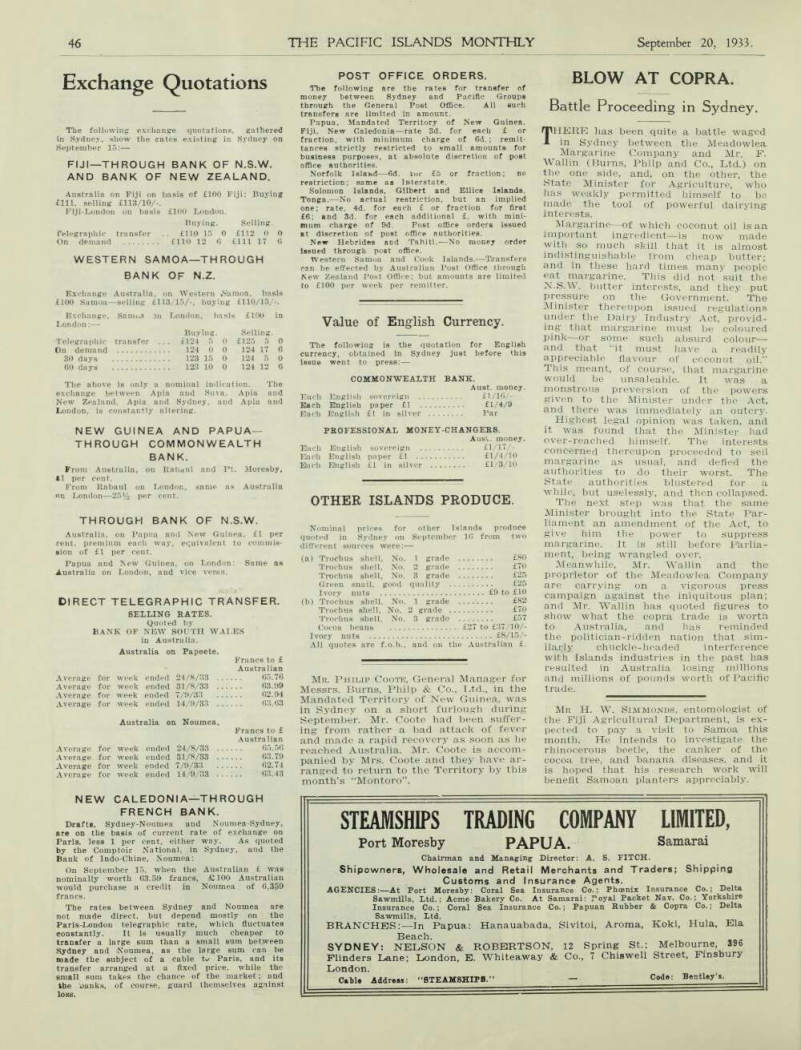
The following exchange quotations, gathered In Sydney, show the rates existing in Sydney on September 15:—
Fiji—Through Bank Of N.S.W.
And Bank Of New Zealand.
Australia on Fiji on basis of £100 Fiji: Buying £111. selling £113/10/-.
Fiji-London on basis £100 London.
Western Samoa—Through
Bank Of N.Z.
Exchange Australia, on Western Samoa, basis £100 Samoa—selling £113/15/-, buying £110/15/-.
Exchange, Samoa on London, basis £100 in London: —
The above is only a nominal indication. The exchange between Apia and Suva. Apia and New Zealand, Apia and Sydney, and Apia and London, is constantly altering.
New Guinea And Papua
Through Commonwealth
Bank.
Prom Australia, on Babaul and Pt. Moresby, *1 per cent.
From Rabaul on London, same as Australia on London—25½ per cent.
Through Bank Of N.S.W.
Australia, on Papua and New Guinea, £1 per cent, premium each way, equivalent to commis sion of £1 per cent.
Papua and New Guinea, on London: Same as Australia on London, and vice versa.
Direct Telegraphic Transfer.
Selling Rates.
Quoted by
Bank Of New South Wales
in Australia.
New Caledonia—Through
French Bank.
Drafts, Sydney-Noumea and Noumea-Sydney, are on the basis of current rate of exchange on Paris, less 1 per cent, either way. As quoted by the Comptoir National, in Sydney, and the Bank of Indo-Chine, Noumea: On September 15, when the Australian £ was nominally worth 63.59 francs, £100 Australian would purchase a credit in Noumea of 6,359 francs.
The rates between Sydney and Noumea are not made direct, but depend mostly on the Paris-London telegraphic rate, which fluctuates constantly. It is usually much cheaper to transfer a large sum than a small sum between Sydney and Noumea, as the large sum can be made the subject of a cable tv Paris, and its transfer arranged at a fixed price, while the small sum takes the chance of the market; and the banks, of course, guard themselves against loss.
Post Office Orders.
The following are the rates for transfer of money between Sydney and Pacific Groups through the General Post Office. All such transfers are limited in amount.
Papua, Mandated Territory of New Guinea.
Fiji, New Caledonia—rate 3d. for each £ or fraction, with minimum charge of 6d.; remit tances strictly restricted to small amounts for business purposes, at absolute discretion of post office authorities.
Norfolk Island—6d. tor £5 or fraction; no restriction; same as Interstate.
Solomon Islands, Gilbert and Ellice Islands.
Tonga.—No actual restriction, but an implied one; rate, 4d. for each £ or fraction for first £6; and 3d. for each additional £, with mini mum charge of 9d. Post office orders issued at discretion of post office authorities.
New Hebrides and Tahiti.—No money order Issued through post office.
Western Samoa and Cook Islands.—Transfers can be effected by Australian Post Office through New Zealand Post Office; but amounts are limited to £lOO per week per remitter.
Telegraphic transfer On demand Buying. Selling, .. £110 15 0 £112 0 0 £110 12 6 £111 17 6
Buying. Selling.
Telegraphic transfer .. . £124 5 0 £125 5 0 On demand 124 0 0 124 17 6 30 days 123 15 0 124 5 0 60 days 123 10 0 124 12 6
Average for Australia on Papeete. week ended 24/8/33 ..
Francs to £ Australian 65.76 Average for week ended 31/8/33 .. 63.99 Average for week ended 7/9/33 .. 62.94 Average for week ended 14/9/33 . . 63.63 Average for Australia on Noumea. week ended 24/8/33 ..
Francs to £ Australian 65.56 Average for week ended 31/8/33 .. 63.79 Average for week ended 7/9/33 . . 62.74 Average for week ended 14/9/33 . . 63.43
Value of English Currency.
The following is the quotation for English currency, obtained in Sydney just before this Issue went to press:—
Commonwealth Bank.
Aust. money.
Each English sovereign £1/16/- Each English paper £1 £1/4/9 Each English £1 in silver . . .
Professional Money-Changers.
Aust. money.
Each English sovereign £1/17/- Each English paper £1 £1/4/10 Each English £1 in silver ... £1/3/10
Other Islands Produce.
Nominal prices for other Islands produce quoted in Sydney on September 16 from two different sources were:— (a) Trochus shell, No. 1 grade £80 Trochus shell, No. 2 grade £70 Trochus shell, No. 3 grade £25 Green snail, good quality £25 Ivory nuts £9 to £10 (b) Trochus shell, No. 1 grade ... £82 Trochus shell, No. 2 grade £70 Trochus shell, No. 3 grade £57 Cocoa beans £27 to £37/10/- Ivory nuts £8/15/- All quotes are f.o.b., and on the Australian f.
Mr. Philip Coote, General Manager for Messrs. Burns, Philp & Co., Ltd., in the Mandated Territory of New Guinea, was in Sydney on a short furlough during September. Mr. Coote had been suffer ing from rather a bad attack of fever and made a rapid recovery as soon as he reached Australia. Mr. Coote is accom panied by Mrs. Coote and they have ar ranged to return to the Territory by this month’s “Montoro”.
Battle Proceeding in Sydney.
Blow At Copra.
THERE has been, quite a battle waged in Sydney between the Meadowlea Margarine Company and Mr. F.
Wallin (Burns, Philp and Co., Ltd.) on the one side, and, on the other, the State Minister for Agriculture, who has weakly permitted himself to be made the tool of powerful dairying interests.
Margarine—of which coconut oil is an important ingredient—is now made with so much skill that it is almost indistinguishable from cheap butter; and in these hard times many people eat margarine. This did not suit the N.S.W. butter interests, and they put pressure on the Government. The Minister thereupon issued regulations under the Dairy Industry Act, provid ing that margarine must be coloured pink—or some such absurd colour — and that “it must have a readily appreciable flavour of coconut oil.’’
This meant, of course, that margarine would be unsaleable. It was a monstrous preversion of the powers given to the Minister under the Act, and there was immediately an outcry.
Highest legal opinion was taken, and it was found that the Minister had over-reached himself. The interests concerned thereupon proceeded to sell margarine as usual, and defied the authorities to do their worst. The State authorities blustered for a while, but uselessly, and then collapsed.
The next step was that the same Minister brought into the State Par liament an amendment of the Act, to give him the power to suppress margarine. It is still before Parlia ment, being wrangled over.
Meanwhile, Mr. Wallin and the proprietor of the Meadowlea Company are carrying on a vigorous press campaign against the iniquitous plan; and Mr. Wallin has quoted figures to show what the copra trade is worth to Australia, and has reminded the politician-ridden nation that sim ilarly chuckle-headed interference with Islands industries in the past has resulted in Australia losing millions and millions of pounds worth of Pacific trade.
Mr H. W. Simmonds, entomologist of the Fiji Agricultural Department, is ex pected to pay a visit to Samoa this month. He intends to investigate the rhinocerous beetle, the canker of the cocoa tree, and banana diseases, and it is hoped that his research work will benefit Samoan planters appreciably.
Advertisements & other items, p. 48 (1 item)
Steamships Trading Company Limited,
Port Moresby PAPUA. Samarai
Chairman and Managing- Director: A. S. FITCH.
Shipowners, Wholesale and Retail Merchants and Traders; Shipping Customs and Insurance Agents.
AGENCIES:—At Port Moresby: Coral Sea Insurance Co.; Phcenix Insurance Co.; Delta Sawmills, Ltd.; Acme Bakery Co. At Samarai; royal Packet Nav. Co.; Yorkshire Insurance Co.; Coral Sea Insurance Co.; Papuan Rubber & Copra Co.; Delta Sawmills, Ltd.
BRANCHES: —ln Papua: Hanauabada, Sivitoi, Aroma, Koki, Hula, Ela Beach.
SYDNEY: NELSON & ROBERTSON, 12 Spring St.; Melbourne, 396 Flinders Lane; London, E. Whiteaway & Co., 7 Chiswell Street, Finsbury London.
Cable Address: “STEAMSHIPS.” Code: Bentley’s.
Sydney—Rabaul—Hongkong.
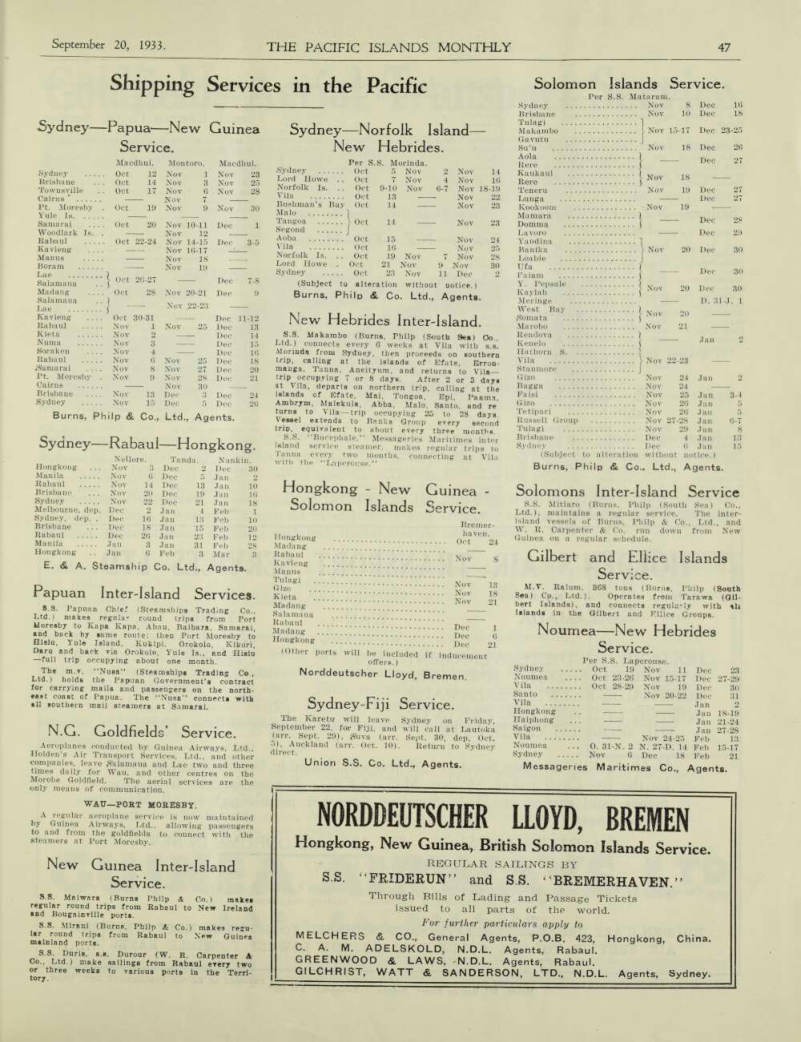
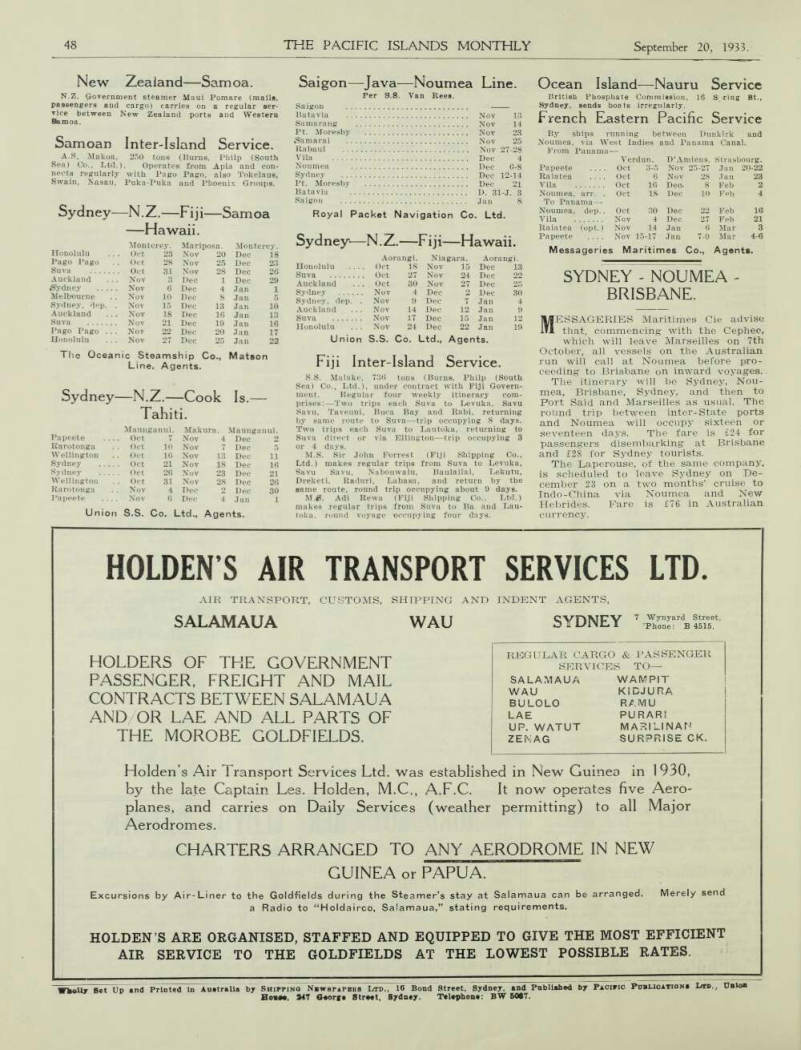
Shipping Services in the Pacific
Sydney—Papua—New Guinea Service.
Papuan Inter-Island Services.
S.S. Papuan Chief (Steamships Trading Co., Ltd.) regular round trips from Port Moresby to Kapa Kapa, Abau, Baibara, Samarai, and back by tame route: then Port Moresby to Hlnlu, Yule Island, Kukipi, Orokolo, Kikori, Oaru and back via Orokolo, Yule Is., and Hislu —full trip occupying about one month.
The m.v. “Nusa” (Steamships Trading Co, Ltd.) holds the Papuan Government’s contract for carrying mails and passengers on the north east const of Papua. The “Nusa” connects with all southern mail steamers at Samarai,
N.G. Goldfields’ Service.
Aeroplanes conducted by Guinea Airways, Ltd., Holden’s Air Transport Services, Ltd., and other companies, leave Salamaua and Lae two and three times daily for Wau, and other centres on the Morobe Goldfield. The aerial services are the only means of communication.
Wait—Poet Moresby.
A regular aeroplane service is now maintained by Guinea Airways, Ltd., allowing passengers to and from the goldfields to connect with the steamers at Port Moresby.
New Guinea Inter-Island
Service.
S.5. Maiwara (Burns Philp & Co.) makes regular round trips from Rabaul to New Ireland and Bougainville ports.
S.S. Mirani (Burns, Philp & Co.) makes regular round trips from Rabaul to New Guinea mainland ports.
S.S. Duris, s.s. Durour (W. R. Carpenter & Co., Ltd.) make sailings from Rabaul every two or three weeks to various ports in the Terri tory.
Sydney—Norfolk Island—- New Hebrides.
New Hebrides Inter-Island.
S.S. Makambo (Burns, Phillp (South Sea) Co Ltd.) connects every 6 weeks at Vila with s.s.
Morinda from Sydney, then proceeds on southern trip, calling at the islands of Efate, Erronmanga, Tanna, Aneityum, and returns to Vila— trip occupying 7 or 8 days. After 2 or 3 days at Vila, departs on northern trip, calling at the islands of Efate, Mai, Tongoa, Epi, Paama Ambrym, Malekula, Abba. Malo, Santo, and returns to Vila—trip occupying 25 to 28 days Vessel extends to Banks Group every second equivalent to about every three months S.S. “Bucephale,” Messageries Maritimes inter island service steamer, makes regular trips to Tanna every two months, connecting at Vila with the “Laperouse.”
Hongkong - New Guinea -
Solomon Islands Service.
Sydney-Fiji Service.
The Karetu will leave Sydney on Friday, September 22. for Fiji, and will call at Lautoka (arr. Sept. 29), Suva (arr. Sept. 30, dep, Oct. 5), Auckland (arr. Oct. 10). Return to Sydney direct.
Union S.S. Co. Ltd., Agents.
Solomon Islands Service.
Solomons Inter-Island Service
S.S. Mitiaro (Burns, Philp (South Sea) Co., Ltd.), maintains a regular service. The inter island vessels of Burns, Pliilp & Co., Ltd., and W. R. Carpenter & Co. run down from New Guinea on a regular schedule.
Gilbert and Ellice Islands
Service.
M.V. Ralum, 868 tons (Burn, Philp (South Sea) Co., Ltd.). Operates from Tarawa (Gil bert Islands), and connects regularly with all Islands in the Gilbert and Ellice Groups.
Noumea—New Hebrides
Service.
Macdhui.
Montoro.
Macdhui.
Sydney ... Oct 12 Nov 1 Nov 3 Nov 0 Nov 7 Nov 9 Nov 23 Nov 25 Nov 28 Brisbane Townsville ... Oct 14 .. Oct 17 Pt. Moresby Yule Is . Oct 19 Nov 30 Samarai ... Oct 20 Woodlark Is. .
Rabaul . . 92.9.4.
Nov 10-11 Nov 12 Nov 14-15 Nov 16-17 Nov 18 Nov 19 Dec 1 Dec 3-5 Kavieng — Boram Lae Salamaua Oct 2G-27 Dec 7-8 Madang Salamaua Lae . . . Oct 28 . . Oct 30-31 . .. Nov 1 Nov 20-21 Nov .22-23 Dec 9 Kavieng Rabaul Nov 25 Dec 11-12 Dec 13 Kieta Nov 2 Numa Nov 3 Dec 15 Soraken Rabaul ,.. Nov 4 Nov 6 Nov 25 Dec 16 Dec 18 Dec 20 Dec 21 Samarai Pt. Moresby Cairns ..., .. Nov 8 . Nov 9 Nov 27 Nov 28 Nov 30 Dec 3 Dec 5 Brisbane Sydney . . Nov 13 Dec 24 Dec 26 ents.
Burns, Philp & Co., Agents.
Nellore.
Tanda.
Nankin.
Hongkong ... Nov 3 Dec 2 Dec 30 Manila .. Nov 6 Dec 5 Jan Rabaul .. Nov 14 Dec 13 Jan 10 Brisbane .. Nov 20 Dec 19 Jan 1G Sydney .. Nov 22 Dec 21 Jan 18 Melbourne, dep. Dec 2 Jan 4 Feb 1 Sydney, dep. . Dec 16 Jan 13 Feb 10 Brisbane .. Dec 18 Jan 15 Feb 20 Rabaul 26 Jan 23 Feb 12 Manila 3 Jan 31 Feb 28 Hongkong Jan G Feb 3 Mar 3 E. & A. Steamship Co. Ltd., Agents.
Per S.S. Morinda.
Sidney ... ... Oct 5 Nov 2 Nov 14 Lord Howe . . Oct 7 Nov 4 Nov 16 Norfolk Is. .. Oct 9-10 Nov 6-7 Nov 18-19 Vila . .. Oct 13 Nov 22 Bushman’s Bay Oct 14 Nov 23 Malo •• 1 Tangoa ... 14 jNov OO Segond . ...
.. j Oct
Aoba 15 Nov 24 Vila 16 Nov 05 Norfolk Is. .. Oct 19 Nov 7 Nov 28 Lord Howe . Oct 21 Nov 9 Nov 30 Sydney 23 Nov 11 Dec 0 (Subject to alteration without notice.) Burns, Philp & Co. Ltd., Agents.
Hongkong Madang Bremerhaven.
Rabaul Nov 8 Kavieng Nov 8 Manus Tulagi Nov 13 Gizo . Nov 13 Kieta Nov. 21 Madang ...
Salamaua Rabaul Dec 1 Madang Dec 6 Hongkong Dec 21 (Other ports will be included if inducement offers.)
Norddeutscher Lloyd, Bremen.
Per S.S. Mataram. 8 Dec 16 Nov 10 Dec 18 Tulagi Makambo ... .
Nov 15 -17 Dec 23-25 Gavutu Su’u Nov 18 Dec 26 \ — Dec 27 Kaukaul 18 19 Rere Nov Nov Dec 27 Dec 27 19 Mamara Domma Dec 28 Dec 29 Yandina Banika 20 Dec 30 Ufa Dec Dec Faiam Y. Pepsale Kaylah Nov 20 30 30 Meringe D. 31-J . 1 West Bay ... 20 Somata > Nov — Marobo Nov 21 Rendova Kenelo Hathorn S.
Jan 2 Vila Stanmore Nov 22 J 23 — Gizo 24 Jan o Bagga 24 Faisi Jan Jan 3-4 Gizo 26 Tetipari 2(5 Jan Russell Group Tulagi Nov 27- Nov ■28 29 Jan ( Jan [J-V 8 Brisbane .. . . 4 Jan 13 Svdnev (! .Tun 15 (Subject to alteration without notice.) Burns, Philp & Co., Ltd., Agents.
Per S.S. Laperouse.
Sydney Nov 11 Dec 23 Noumea Oct 23-26 Nov 15-17 Dec 27-29 Vila Nov 19 Dec 30 Santo Nov 20-22 Dec 31 Vila .
T Hongkong j an Jan 18-19 Haiphong Jan 21-24 Saigon 07 oq Vila ...
Nov 24-25 Feb i *60 13 Noumea ... 0. 31-N. 2 N. 27-D. 14 Feb 15-17 Sydney Nov 6 Dec 18 Feb 21
Messageries Maritimes Co., Agents.
Agents.
New Zealand—Samoa.
N.Z. Government steamer Maui Pomare (mails, passengers and cargo) carries on a regular ser vice between New Zealand ports and Western Samoa.
Samoan Inter-Island Service.
A.S, Makoa, 250 tons (Burns, Philp (South Sea) Co., Ltd.). Operates from Apia and con nects regularly with Pago Pago, also Tokelaus, Swain, Nasau, Puka-Puka and Phoenix Groups.
Sydney—N. Z. —Fiji—Samoa
—Hawaii.
Sydney—N.Z.—Cook Is.— Tahiti.
Saigon—Java—Noumea Line.
Per S.S. Van Rees.
Sydney—N.Z.—Fiji—Hawaii.
Fiji Inter-Island Service.
S.S. Malake, 736 tons (Burns, Philp (South Sea) Co., Ltd.), under contract with Fiji Govern ment. Regular four weekly itinerary com prises:—Two trips each Suva to Levuka, Savu Savu, Taveuni, Buca Bay and Rabi, returning by same route to Suva—trip occupying 8 days.
Two trips each Suva to Lautoka, returning to Suva direct or via Ellington—trip occupying 3 or 4 days.
M.S. Sir John Forrest (Fiji Shipping Co., Ltd.) makes regular trips from Suva to Levuka, Savu Savu, Nabouwalu, Baulailai, Lekutu, Dreketi, Raduri, Labasa, and return by the same route, round trip occupying about 9 days.
M.<S. Adi Rewa (Fiji Shipping Co., Ltd.) makes regular trips from Suva to Ba and Lau toka, round voyage occupying four days.
Ocean Island—Nauru Service British Phosphate Commission, 16 Spring St., Sydney, sends boats irregularly.
French Eastern Pacific Service
Monterey.
Mariposa.
Monterey.
Honolulu . Oct 23 Nov 20 Dec 18 Pago Pago . Oct 28 Nov 25 Dec 23 Suva 31 Nov 28 Dec 26 Auckland . Nov 3 Dec 1 Dec 29 Sydney . . .. . Nov 6 Dec 4 Jan 1 Melbourne Nov 10 Dec 8 Jan 5 Sydney, dep.
Nov 15 Dec 13 Jan 10 Auckland . Nov 18 Dec 16 Jan 13 Suva . Nov 21 Dec 19 Jan 16 Pago Pago .. . Nov 22 Dec 20 Jan 17 Honolulu Nov 27 Dec 25 Jan 22 The Oceanic Steamship Co., Matson
Line Agents.
Maunganui.
Makura.
Maunganui.
Papeete Oct 7 Nov 4 Dec 2 Rarotonga . . Oct 10 Nov 7 Dec 5 Wellington .. Oct 16 Nov 13 Dec 11 Sydney Oct 21 Nov 18 Dec 16 Sydney Oct 26 Nov 23 Dec 21 Wellington . . Oct 31 Nov 28 Dec 26 Rarotonga . . Nov 4 Dec 2 Dec 30 Papeete . . . . Nov 6 Dec 4 Jan 1 Union S.S. Co. Ltd., Agents.
Saigon Batavia Nov 13 Samarang . .. Nov 14 Pt. Moresby . . . Nov 23 Samarai Rabaul . . . Nov 27-28 Vila Noumea . Dec 6-8 Sydney Dec 12-14 Pt. Moresby Batavia D 31-J 3 Saigon Royal Packet Navigation Co. Ltd.
Aorangi.
Niagara.
Aorangi.
Honolulu . .. .
Oct 18 Nov 15 Dec 13 Suva Oct 27 Nov 24 Dec 22 Auckland Oct 30 Nov 27 Dec 25 Sydney Nov 4 Dec 2 Dec 30 Sydney, dep. .
Nov 9 Dec 7 Jan 4 Auckland Nov 14 Dec 12 Jan 9 Suva Nov 17 Dec 15 Jan 12 Honolulu Nov 24 Dec 22 Jan 19 Union S. S. Co. Ltd., Agents.
By ships running between Dunkirk and Noumea, via West Indies and Panama Canal.
From Panama — Verdun.
D’Amiens.
Strasbourg.
Papeete Got 3-5 Nov 25-27 Jan 20-22 Raiatea ...
Oct 6 Nov 28 Jan 23 Vila Oct 16 Dec- 8 Feb 2 Noumea, arr . .
Oct 18 Dec 10 Feb 4 To Panama— Noumea, dep..
Oct 30 Dec 22 Feb 16 Vila Nov 4 Dec 27 Feb 21 Raiatea (opt.) Nov 14 Jan 6 Mar 3 Papeete ...
Nov 15-17 Jan 7-9 Mar 4-6 Messageries Maritimes Co., Agents.
Advertisements & other items, p. 49 (1 item)
Norddeutscher Lloyd, Bremen
Hongkong, New Guinea, British Solomon Islands Service.
REGULAR SAILINGS BY
S.S. “FRIDERUN” and S.S. "BREMERHAVEN."
Through Bills of Lading and Passage Tickets issued to all parts of the world.
For further particulars apply to MELCHERS & CO., General Agents, P.O.B. 423, Hongkong, China.
C. A. M. ADELSKOLD, N.D.L. Agents, Rabaul.
GREENWOOD & LAWS, N.D.L. Agents, Rabaul.
GILCHRIST, WATT & SANDERSON, LTD., N.D.L. Agents, Sydney.
Sydney - Noumea -
Brisbane.
MESSAGERIES Maritimes Cie advise that, commencing- with the Cephee, which will leave Marseilles on 7th October, all vessels on the Australian run will call at Noumea before pro ceeding to Brisbane on inward voyages.
The itinerary will be Sydney, Nou mea, Brisbane, Sydney, and then to Port Said and Marseilles as usual. The round trip between inter-State ports and Noumea will occupy sixteen or seventeen days. The fare is £24 for passengers disembarking at Brisbane and £28 for Sydney tourists.
The Laperouse, of the same company, is scheduled to leave Sydney on De cember 23 on a two months’ cruise to Indo-China via Noumea and New Hebrides. Fare is £76 in Australian currency.
Advertisements & other items, pp. 50-52 (2 items)
48
September 20, 1933.
THE PACIFIC ISLANDS MONTHLY
Wholly Set Up and Printed in Australia by Shipping Newspapers Ltd., 16 Bond Street, Sydney, and Published by Pacific Publications Ltd., Union House, 347 George Street, Sydney. Telephone: BW 5087.
Holden's Air Transport Services Ltd.
AIR TRANSPORT, CUSTOMS, SHIPPING AND INDENT AGENTS,
SALAMAUA WAU SYDNEY
HOLDERS OF THE GOVERNMENT
PASSENGER, FREIGHT AND MAIL
CONTRACTS BETWEEN SALAMAUA
AND/OR LAE AND ALL PARTS OF
THE MOROBE GOLDFIELDS.
Holden’s Air Transport Services Ltd. was established in New Guinea in 1930, by the late Captain Les. Holden, M.C., A.F.C. It now operates five Aeroplanes, and carries on Daily Services (weather permitting) to all Major Aerodromes.
CHARTERS ARRANGED TO ANY AERODROME IN NEW
GUINEA or PAPUA.
Excursions by Air-Liner to the Goldfields during the Steamer’s stay at Salamaua can be arranged. Merely send a Radio to “Holdairco, Salamaua,” stating requirements.
HOLDEN’S ARE ORGANISED, STAFFED AND EQUIPPED TO GIVE THE MOST EFFICIENT AIR SERVICE TO THE GOLDFIELDS AT THE LOWEST POSSIBLE RATES.
Goldfields Aerial Transport Service
Three of the Large Tri - motored Aeroplanes, operated by Guinea Airways Ltd., on Bulolo Aerodrome, in the heart of the New Guinea Mountains.
SIX years ago, the Morobe Goldfield, in the Interior of New Guinea, was almost inaccessible.
The country is so mountainous and broken that roads cannot be built, except at enormous cost. Transport was by native carriers, travelling 3 or 6 miles per day.
Then came Aeroplanes. The trip from the coast to the goldfield took under 30 minutes, instead of 8 to 10 days. Aeroplanes carried in engineers and artisans, native labourers and foodstuffs, dredges, motor trucks, building material, hydro-electric machinery.
To-day, the Morobe goldfield is the seat of a great, growing and flourishing industry, winning much new wealth for the Territory, and giving
employment to hundreds of Europeans.
Guinea Airways Ltd., launching this unique aerial service, originally with one machine and a handful of men, now operate a fleet of aeroplanes— including three very large tri-motored monoplanes—and employ 80 Europeans and a numerous native staff. Their aeroplanes run on fixed timetables from Lae, Salamaua, Bulolo, Wau and Port Moresby, carrying passengers and freight, and maintaining regular communication between 26
aerodromes.
New parties of Prospectors are constantly opening up new country, pushing steadily into the almost unknown interior. They make camp, and clear an aerodrome; and, within a few days, Guinea Airways’ planes are arriving with supplies. This pioneering work goes on ceaselessly. Guinea Airways, with their unique experience, skilled personnel and modern equipment, are ready and waiting to operate wherever they are needed.
GUINEA AIRWAYS Ltd
LAE - SALAMAUA
26 AERODROMES.
BABUAF
BULOLO
BULWA
GABANZIZ
GARINA
JUNI
KAJABIT
KIDJURA
KOKODA*
KABUNA*
LAE
MT, HAGEN
MARILINAN
NADZAB
* In Papua.
PORT
MORESBY*
PURARI
RAMU
SALAMAUA
SANGAN
SUNSHINE
SURPRISE CK.
UP. WATUT
WAHGI
WAMPIT
WAU
ZENAG
CLEAR .. . BRIGHT ..COLD
IT MAKES A THIRST WORTH-
WHILE. WHAT PROMISE OF
REFRESHMENT LIES IN THE
SIGHT OF A BOTTLE
TOOTH'S