Pacific
Islands
Monthly
August 22Nd,
1933
[Registered at G.P.O., Sydney, for transmission by post as a newspaper.]
6 d
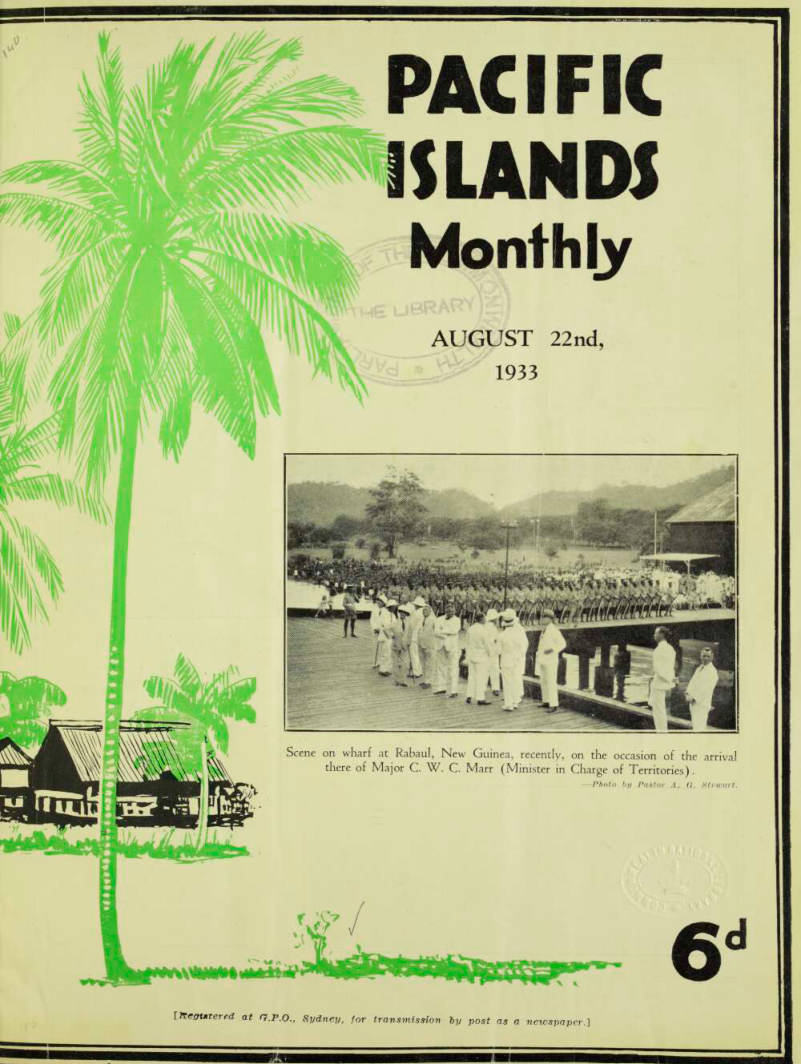
Scene on wharf at Rabaul, New Guinea, recently, on the occasion of the arrival there of Major C. W. C. Marr (Minister in Charge of Territories). —Photo by Pastor A. G. Stewart.
Advertisements & other items, p. 2 (1 item)
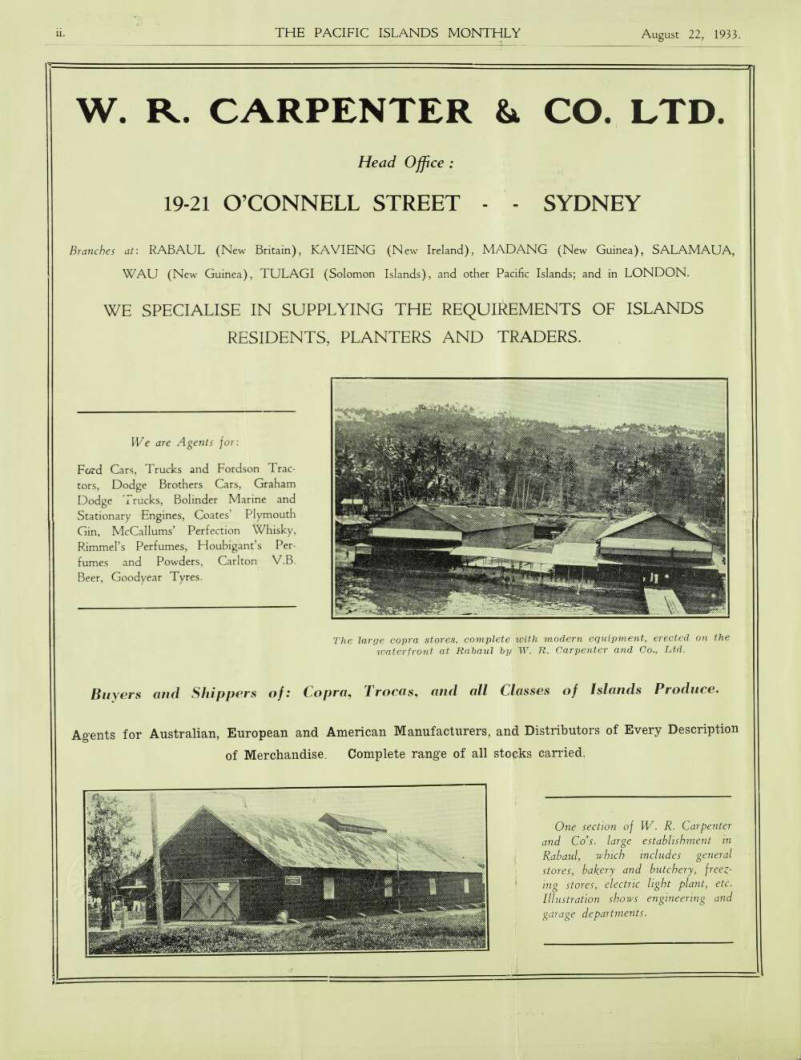
W. R. Carpenter & Co. Ltd.
Head Office :
19-21 O’CONNELL STREET - - SYDNEY
Branches at: RABAUL (New Britain), KAVIENG (New Ireland), MADANG (New Guinea), SALAMAUA, WAU (New Guinea), TULAGI (Solomon Islands), and other Pacific Islands; and in LONDON.
WE SPECIALISE IN SUPPLYING THE REQUIREMENTS OF ISLANDS
RESIDENTS, PLANTERS AND TRADERS.
We are Agents for: Ford Cars, Trucks and Fordson Trac tors, Dodge Brothers Cars, Graham Dodge Trucks, Bolinder Marine and Stationary Engines, Coates’ Plymouth Gin, McCallums’ Perfection Whisky, Rimmel’s Perfumes, Houbigant’s Per fumes and Powders, Carlton V.B.
Beer, Goodyear Tyres.
Buyers and Shippers of: Copra, Trocas, and all Classes of Islands Produce.
The large copra stores, complete with modern equipment, erected on the waterfront at Rabaul by W. R. Carpenter and Co., Ltd.
Agents for Australian, European and American Manufacturers, and Distributors of Every Description of Merchandise. Complete range of all stocks carried.
One section of W. R. Carpenter and Co’s, large establishment in Rabaul, which includes general stores, bakery and butchery, freez ing stores, electric light plant, etc.
Illustration shows engineering and garage departments.
Pacific Islands Travellers
Passengers Per “Morinda,” Sailed On
AUGUST 12, FOR LORD HOWE AND NORFOLK ISLANDS: Mr. and Mrs. C. H. Ranken, Mr. and Mrs. W. Thomas, Mr. and Mrs. R. K. Vyder, Mesdames E. Abigail, Crogan, A. C. Hobbs, Mr.
Harper, A. M. Lawler, R. Symonds, R. Walton, Misses G. Baldwin, Collins, G. Fury, V. Martyn, E. Thew, M. Uther, A. Weil, Messrs. W. Arnott (jnr.), T. C. Douglass, H. S. Edgar, S. Good man, Greenland, G. Lewis, F. Thompson.
Passengers Per “Aorangi,” Which
SAILED FROM SYDNEY FOR SUVA, FIJI, ON JULY 20: Miss C. Salmond, Mr. N. R. Casey, Mrs. N. R. Casey, Mr. J. B. Hyde, Mr. B. D.
Lakshman, Mr. W. A. Cox, Mr. W. H. Fowler, Mrs. W. H. Fowler and two infants, Miss Y.
White, Mrs. M. G. Perks, Master Perks, Mrs.
I. Martin, Miss A. Monk, Mr. L. V. M. Osborn, Mrs. N. E. Mackellar and child, Mr. M. Kashnan, Miss D. L. McIlwain, Mr. T. McLean, Mr. S.
McKay, Mrs. S. McKay, Miss E. G. Elmslie, Mrs. C. Hill, Miss D. Hill, Miss B. Cleary, Dr. G. Burston, Mrs. G. Burston and child, Mrs.
J. G. Cornell, Miss O. Cornell, Mr. George Clubb, Miss D. Shumack, Mr. Spence Sinclair, Mrs.
Spence Sinclair, Mr. E. L. Armstrong, Mrs. A.
Griffiths, Mr. J. J. Griffiths.
Passengers Per “Monterey,” Which
ARRIVED IN SYDNEY FROM SUVA, FIJI, ON JULY 17: Mrs. Ruby Adams, Mr. S. H. Atkins, Miss Evelyn Baldwin, Miss Olive Burrell, Mrs.
John Carleton, Mrs. M. O. Charles, Mr. C. F.
Colclough, Mr. O. S. Cole, Mrs. O. S. Cole, Miss Marjorie Cowley, Miss A. D. Dare, Mr. Frederick Davey, Mr. R. L. Drew, Mr. Arthur Fiedler, Mr. G. H. Fiedler, Mrs. J. E. French, Mr. J. C.
French, Dr. J. E. Gabriel, Mrs. J. E. Gabriel, Miss Sheila H. Gale, Mr. T. H. Galbraith, Mr.
W. E. Goldsworthy, Mrs. W. E. Goldsworthy, Mrs. G. Gray, Mr. R. G. Harvey, Mrs. F. B.
Heaslop, Mr. Charles G. Hill, Mrs. A. H. Hill, Miss E. L. Hobday, Miss Ella M. Hollingsworth, Mrs. Irene M. Hooke, Miss Dorothy Hopkins, Mr.
T. A. Howard, Mr. A. R. Jones, Miss Marjorie Johnson, Miss Jessie Kennedy, Miss Doris M.
Kings, Mrs. V. M. Lamacraft, Miss A. L. Lamb, Mr. Edward Livingston, Mrs. Edward Livingston, Miss Rosalie Locke, Miss Lillian Louis, Mr.
R. G. W. Mackay, Mr. H. F. Markell, Mrs.
H. F. Markell, Miss Rosemary Markell, Miss Judith Markell, Miss Sarah McDonald, Mrs.
W. P. McIlrath, Miss L. A. Moriarty, Miss J. E.
Murison, Miss Jessie O’Brien, Miss Mary J.
Pepper, Miss K. E. Perry, Mr. Norman A. Pyne, Mrs. N. A. Pyne, Miss Phyllis Pyne, Miss Peggy Pyne, Miss Patricia Pyne, Master Bruce Pyne, Miss Phyllis Reynolds, Mrs. Alfred Ricker, Miss Minnie Stubbs, Mr. C. Summers, Mrs. C. Summers, Mr. R. B. Turner, Mrs. R. B. Turner, Miss Rita Thompson, Mr. K. Waterhouse, Miss Nina Whyte, Miss Nancie Wicks, Mrs. T. Griffiths, Miss Clara E. Hansen, Mr. Gock Hong, Mr. Wong Kee, Miss Eleanor Reed, Mr. Alfred Sarzin, Mr.
John H. Snow, Sister Marie Yvonne.
Passengers Per “Monterey,” Which
SAILED FROM SYDNEY FOR SUVA, FIJI, ON JULY 26 : Mr. F. A. Barton, Mrs. E. C. Brooks, Miss M. N. Brooks, Mr. Edward Cohen, Mrs. I.
Delaine, Miss J. Fahey, Mr. T. F. Fleetwood, Mrs. T. F. Fleetwood, Mrs. H. W. Hennessey, Mrs. H. W. Hill, Mr. W. Hume, Mr. J. H. T.
Laidlaw, Mrs. J. H. T. Laidlaw, Mr. A. A.
Lange, Mrs. A. A. Lange, Mrs. G. Lauritz. Miss W. Maher, Mr. Y. A. L. Mau, Mr. W. E.
Middleton, Mrs. Motley, Mr. Sidney Myer, Mrs.
Sidney Myer, Rev. Father Francis O’Hanlon, Miss M. H. Parkman, Mr. E. M. Quodling, Mr. H. H.
Shackell, Mrs. H. H. Shackell, Miss E. R.
Wallen, Mr. S. H. Warburton, Mrs. G. Wetzell, Miss K. Whedlock, Miss M. E. Wright, Mr.
C. V. Caldwell, Mrs. C. V. Caldwell, Master C. N. Caldwell, Master B. H. Caldwell, Mrs.
F. McGrant, Mrs. N. D. Gaffney, Mrs. A. D.
Leleau, Miss A. Leleau, Master D. Leleau, Mr.
H. Miedecke, Mrs. M. A. Scheumann, Mr. H. T.
Stearns, Mrs. H. T. Stearns.
Passengers Per “Tanda,” Which Left
Sydney For Rabaul, New Guinea, On
JULY 15: Mr. Shermann, Miss Jones, Miss Kroger, Mr. J. C. Mullaly, Capt. Proctor, Mr.
Marshall, Mr. Solomons, Mr. Robinson, Miss Murray, Mrs. Brown and infant.
Passengers Per “Nankin,” Which
Arrived In Sydney From Rabaul, New
GUINEA, ON JULY 21 : Dr. T. C. Backhouse, Mrs. T. C. Backhouse, Mr. N. S. Duncan, Mr.
Saxton, Mr. Jennings, Mrs. Stehr, Mr. Reilly, Mr. Draper.
Passengers Per “Nankin,” Which
Sailed From Sydney For Rabaul, New
GUINEA, ON AUGUST 12: Mr. R. S. Bailey, Mr. N. Duncan, Mrs. Cutler and two children, Mrs. E. O. D. Costin and child, Mr. W. J. Know, Mrs. W. Marshall and child, Mr. R. F. Arm strong, Mrs. M. M. Canden and child, Mr. G. W.
Sims, Mrs. Jones and child, Mrs. M. W. Crook shank.
Passengers Per “Mataram,” Sailed
ON JULY 19 FOR SOLOMON ISLANDS: Mr. and Mrs. E. Camerson, Mesdames Clausen, Keil, W. H. Tully, Misses M. Cain, N. Campbell, S.
Charlesworth, Downward, Elliott, A. Gibson, B.
Helyer, S. Higginbottom, M. H. D. Maltby, M.
Swales, M. Tully, J. Wimpole, Dr. G. F. Read, Rev. J. Edwards, Messrs. B. Blakiston, W. R.
Bennett, H. W. Frost, F. Green, H. E. Gault, J. Gibson, C. H. Pearson.
Passengers By “Morinda,” Arrived
IN SYDNEY ON AUGUST 2. 1933, FROM NEW
Hebrides. Via Lord Howe And Norfolk
ISLANDS: Mr. T. G. Brunton, Miss E. Dagnall, Mr. and Mrs. T. V. Devereux and two children.
Mr. H. Flett, Mr. M. R. Herbert, Miss K.
Herbert, Mr. and Mrs. D. Askew and infant, Mr. and Mrs. F. J. C. Paton, Mr. J. F. Bell, Mr. H. L. McLean, Mr. F. P. Skinner, Miss P.
Brown, Mr. A. A. Cameron, Mrs. G. J. Fleck, Miss N. J. Mulholland, Miss M. D. Mulholland, Mrs. J. Ritson, Miss R. B. Roper, Miss T.
Lawrie, Mr. J. F. Dignam, Mr. W. R Davies, Mr. A. Fenton, Mr. Hope, Mr. Leitch, Misses A. and F. Lewis, Mr. G. A Lloyd, Mr. W. H.
Lucas, Mr. Raper.
Passengers By “Montoro,” Arrived
SYDNEY AUGUST 3, FROM PAPUA AND NEW GUINEA. Mr. C. A. Altria, Mr. W. T. Adamson, Mr. G. A. Anderson, Mr. T. D. Anderson, Mr.
E. H. Ashton, Mr. H. J. Ault, Mr. E. A.
Avery, Miss C. Black, Mr. and Mrs. R. H. D.
Blackwood, Mr. H. T. Bolton, Sister Clare R.
Mueller, Mr. A. F. Clark, Miss G. U. Coghill, Mr. T. Coles, Mr. F. Cook, Mr. J. Curries, Mr.
A. K. Dein, Mr. F. P. Dixon, Sister Dolorosia.
Mrs. A. E. Dover, Mr. C. T. Drane, Miss H. I.
Drysdale, Mr. L. Farmer, Mr. R. I. Franklin, Mr. C. H. Gardiner, Mr. A. D. Gluyas, Mrs.
A. Grabowsky, Mr. and Mrs. E. C. Green, Mr. and Mrs. G. W. Guttridge, Mr. H. R. Holliday.
Mr. J. P. Hammond, Mr. B. Heath, Mrs. E.
Hides, Mr. and Mrs. C. E. Hopkins, Mr. J. L.
Hunter, Miss J. Jackson, Mr. A. R. Lamont, Mr. D. J. Lewis, Mr. W. J. McDonald, Mr. C.
Moen, Mr. and Mrs. A. F. Parer, Sister Petroca, Miss I. E. J. Rexon, Mr. J. H. Robertson, Mr.
D. Robertson, Master P. J. Robinson, Mr. and Mrs. R. Sargeant, Mr. T. H. Schofield, Mrs. E.
Scott, Mr. R. D. Smith, Miss E. Standish, Mr. and Mrs. D. K. Stewart, Mr. C. J. Thew, Mr.
C. W. C. Thomas, Mr. H. Thompson, Mrs. E. W.
Thompson, Mr. and Mrs. J. B. Walker, Mrs.
E, A. Waters, Miss M. E. Waugh, Miss G.
Werner, Mr. N. C. Weston, Mrs. H. H. Williams.
Passengers Per “Montoro,” Sailed
FROM SYDNEY ON AUGUST 9, FOR PAPUA AND NEW GUINEA : Mr. and Mrs. R. K. Moore, Mr. and Mrs. E. J. Ifould, Rev. and Mrs.
Lassam, Mr. and Mrs. Copland, Mr. and Mrs.
S. J. Anderson, Rev. and Mrs. Thomson, Rev. and Mrs. Bartlett, Mr. and Mrs. M. A. Nagel, Mesdames I. Champion, M. E. Ross Earl, Hoile, Misses C. E. Grimaldi, B. Mill. Quoyle (3), J.
McLaren, M. J. Stephen, J. Boot, E. Batty, Matron Puddiphatt, Messrs. G. Fulton, J. L.
Heyworth, Senator B. Sampson, Senator Dunn, V. G. Smith, W. Cole, W. de Russett, Bradshaw.
H. C. Hill, C. Gamble, Studwick, Allsop, W. D.
Mason, R. B. Auld, R. Anderson, B. A. O’Connor, J. Hartley, A. H. Cutlack, Potts, A. J. Suther land, K. M. Chambers, J. H. Dixon, W. W.
Fryer.
Passengers Per "Mariposa,” Which
ARRIVED IN SYDNEY FROM SUVA, FIJI, ON AUGUST 14: Mr. F. A. Barton, Mr. D. R. Barry, Mr. Norman E. Brookes, Mrs. Norman E.
Brookes, Miss Elaine Brookes, Miss Hersey Brookes, Miss Isobel Delaine, Miss Jean Fahey, Mr. T. F Fleetwood, Mrs. T. F Fleetwood, Mrs. H. W. Hennessy, Mrs. A. W. Hill, Mr.
W. H. Hume, Mr. J. T. H. Laidlaw, Mrs.
J. T. H. Laidlaw, Mr. A. A. Lange, Mrs. A. A.
Lange, Mrs. G. Lauritz, Miss W. Maher, Mr.
B. Henry Marks, Mrs. B. Henry Marks, Mr.
F. A. L. Maw, Mr. W. E. Middleton, Mrs. C.
Motley, Miss Miriam Murray, Rev. Father F.
O’Hanlon, Mr. E. H. Price, Mr. E. M. Quodling, Mr. H. H. Shaobell, Mrs. H. H. Shackell, Mr.
Richard C. Thurnwald, Mrs. Richard C. Thurn wald, Mr. S. H. Warburton, Miss Kathleen Whedlock, Mrs. N. M. Bentley, Mr. F. E. Carr, Rev. C. M. Churchward, Canon R. B. S. Ham mond, Mr. E. W. Simm, Mrs. E. W. Simm, Mr. C. S. Stubbs, Mr. L. Watson.
Passengers Per “Monowai" Which
SAILED FROM SYDNEY FOR SUVA. FIJI, ON AUGUST 17: Mr. C. Stretton-Morgan, Mrs. R. G.
Greenwood and infant, Miss M. M. Morrison, Mr. W. G. Higgs, Mr. C. D. Mathews, Mr. H.
Crowley-Cooper, Miss M. Garland-Mathews, Mr.
J. G. Beeby, Mr. N. Bovill.
Arrived On August 19 Per “Mataram,”
From Solomon Islands: Mr. B. Blakiston,
Miss M. Borzell, Mr. W. R. Bennett, Mr. T. T.
Curtis, Mr. T. A. Chadwick, Miss M. Cane, Mrs.
B. Clausen, Mr. and Mrs. E. Cameron, Miss S.
Charlesworth, Miss G. Downward, Miss T.
Elliott, Mrs. D. Waring-Flood and infant, Mr. R.
Firth, Mr. and Mrs. H. Freshwater, Miss K.
Fitzgerald, Miss A. Gibson, Mrs. M. Hicks and infant, Miss G. Higginbotham, Miss B. Helyer, Miss B. M. Holmes, Mrs. E. Hackett, Mr. R.
Lever, Father A. Lebel, Mr. J. A. Mathews, Mr.
H. Mann, Mr. W. Oldridge, Mr. C. H. Pearson, Dr. Read, Miss O. Robertson, Miss M. B. Swales, Miss T. Tully, Mrs. A. Tully, Mrs. M. J. Wil liams, Mrs. C. Warmsley.
Advertisements & other items, p. 3 (1 item)
Freight and Passenger Service
REGULAR
BI-MONTHLY
by the fast and modern K.P.M. Steamer VAN REES as under;
SAIGON
BATAVIA
SAMAKANG
PORT MORESBY
SAMARAI
RABAUL
PORT VILA
Cargo for Africa accepted for transhipment at Batavia.
Saloon and Intermediate class passengers carried in comfortable and airy cabins.
NOUMEA
SYDNEY
PORT MORESBY
NAVIGATION CO., Batavia
ROYAL PACKET
255 GEORGE STREET, SYDNEY
SAIGON
The B.N.G. Trading Coy., Ltd., Port Moresby; Steamship Trading Co., Samarai; W. R.
Carpenter & Co., Ltd., Rabaul; Gubbay Freres, Port Vila; Carlo Leoni, Noumea; Diethelm & Co., Saigon.
Advertisers.
Page.
Adams, Wm,, Ltd. . 21 Amal. Wireless ... 41 Amm’n Nobel 13 Arnott’s Biscuits ... 35 Bank of N.S.W. ... 20 Barnes, James, Ltd.. 27 Barraclough, H. A. 34 Bourjois et Cie ... 23 Brandts, Ltd 36 Broomfields, Ltd. ... 22 Brunton’s Flour ... 31 Burns, Philp & Co. 2 Burns, Philp (S.S.) Co 19 B.P. Magazine 32 Buzacott, Ltd 15 Oallachor & Son ... 37 Carpenter, W. R.
Cover ii.
Central Q’land Meat Co 12 Chartres, Stott, & Hoare 24 Com. P’land Cement. 28 Dangar, Gedye, Ltd.. 42 Delicia Food Co. ... 18 Docker’s Paints 25 Dowsett, J. H. M. . 40 Excelsior Supply Co. 18 Fletcher & Sons ... 44 Garrett & Davidson . 32 Gillespie’s Flour ... 24 Goshen Pt. Hospital. 40 Grahame, C 33 Gregory, A 16 Guinea Airways cov. iii.
Halvorsen, L 45
Page.
Hardie, Jas., & 00. . 11 Harper, M 40 Holbrooks, Ltd 30 Holden’s Air Transport 48 Holmes, Wm 22
I.C.S 31
I.C.I.A.N.Z., Ltd. .. 13
Joyce Biscuits 19 Kopsen & Cos 28 Lane & Girvan 27 McIlrath’s, Ltd 26
N.D.L 47
Nelson & Robertson 26, 29 Nolan, Spencer 30 Noyes Bros 16 Ocean Newspapers, Ltd 38 Pac. Is. Assn 22 Paton, Burns 15 Petty’s Hotel 8 Prescott, Ltd 10 Rabaul Carr’g Cos. . 19 Rohu, Sil 33 Royal Packet N. Cos. 1 Russell, S 36 Smyth, J. H 25 Springwood College . 9 Steamships T. Cos., Ltd 46 Swallow and Ariell, Ltd 17 Tillock & Cos., Ltd. . 43 Tooth & Cos. Cover iv.
Wills, W. D. & H. O. 14 Wunderlich, Ltd. 13, 34
Contents.
Page.
Pacific Islands Travellers 1 How New World Policy Affects Pacific Islands 3,4, 5 Our Birthday 5 Samoan Situation 6, 10 Economy in Samoa 7 Coconut Crabs 8 Aiagairi—A Papuan Tale 9 Tropicalities 10 Another Pitcairner Dead 11 About Islands People 12 Papuan Legislative Council . . . . 13 Tung Oil Cultivation 16 Death of W. A. Wilson (Cook Is.) . . 17 Unconquered Papua 18 Helping Islands’ Planters 19 W. R. Carpenter & Co.’s Annual Report 20 Are N.G. Natives Restless? .. .. 21 Fifty Years in Papua .. .. .. . . 22 Papuan Patrols 24
Page.
Cook Is. Cricket Interlude 26 Life of “Judge” Gurr 27 Swedish Writer Looks at Samoa . . 28 Echo of 1880 29 Mosquito Control 30 N.G. Solicitor Convicted 32 New Guinea News 33 Norfolk Is. News 34 Torres Straits’ Teachers 35 Samoan Notes 36 Tahiti En Fete 37 Copra Market 39 Indians in Fiji 40, 41 Cook Is. Notes 41 Sydney—As Seen by an Islander .. 42 N.G. Aerial Services 43 Pacific Fruit Trade 44 N.G- & Papuan Gold Share Market . 44 Market Quotations 45 Exchange Quotations 46 Shipping Services 47, 48
Advertisements & other items, p. 4 (1 item)
Buyers of all Classes
NOW ON SALE
HANDBOOK OF NEW GUINEA, PAPUA, SOLOMON ISLANDS AND NORFOLK ISLAND, Containing Complete Details and Latest Statistical Information about those Territories, and also Lists of Business Firms and European Residents.
PRICE, 2/9.
PACIFIC PUBLICATIONS LTD.
UNION HOUSE, 247 George St.,
SYDNEY AUSTRALIA.
BURNS, PHILP & CO. LTD.
General Merchants,
Shipowners,
Tourist Agents, Etc.
Buyers of all Classes
of Island Produce
Head Office - 7 Bridge Street, Sydney - Australia Code Address : “BURPHIL"
Regular Steamer Services From Australia to New Guinea, Papua, Solomons, Lord Howe, Norfolk Islands, New Hebrides, Java and Singapore
The Pacific Islands Monthly
THE NEWSPAPER - MAGAZINE OF THE SOUTH SEAS [Registered at G.P.O., Sydney, for transmission by post as a newspaper.]
Published Once Each Month and Circulated in Australia and New Zealand and in the following Pacific Territories and Island Groups:
Crown Colony of Fiji.
Australian Territory of Papua.
Mandated Territory (Australia) of New Guinea, Bismarck Archipelago, and Northern Solomon Islands.
Mandated Territory (Japan) of Marshall, Caroline and Mariana Islands.
American Territory of Guam.
Mandated Territory of Nauru.
British Crown Colony of Gilbert and Ellice Islands.
French Territory of New Caledonia.
British and French Condominium of New Hebrides.
American Territory of Eastern Samoa.
Mandated Territory (New Zealand) of Samoa.
British Solomon Islands Protectorate.
British Protectorate of Tongan Islands.
New Zealand Territory of Cook Islands.
Australian Territory of Norfolk Island.
French Colony of Oceania (Tahiti, etc.) American Territory of Hawaiian Islands.
Owned and Produced by Pacific Publications Ltd., Union House, 247 George Street, Sydney
Telephone Bw 5037
P.O. Box 3408R
Contributions
Articles, Stories and Photographs dealing with Pacific Islands Subjects are invited, and will be paid for on publication at usual rates.
Subscription Rates
Per Annum, within Postal Convention Territories, Prepaid, Post Free 6/- Per Annum elsewhere, Prepaid, Post Free 8/- Single Copies 6d.
Editor and Publisher:
R. W. Robson.
Advertisements
Advertising rates furnished on application.
Colours, etc. — by Arrangement Process Blocks made at Advertiser’s expense when required. Screen, 100.
Changes of Advertising Copy should reach this Office by Bth of each month, otherwise previous advertisement may be repeated.
Registered Address for Radiograms and Cables: “PACPUB” Sydney
Agents
The following are authorised to receive sub scriptions for The Pacific Islands Monthly — Islands Branches of Burns, Philp & Co., Ltd., and Burns, Philp (South Seas) Co., Ltd.
Islands Branches of W. R. Carpenter & Co., Ltd.
All Branches of Morris, Hedstrom & Co., Ltd.
J. H. MacGregor Dowsett, Rabaul.
Whitten Bros., Ltd., Port Moresby & Samarai.
All Branches and Representatives of W. H.
Grove & Sons, Ltd., Auckland. 9. Russell, Papeete, Tahiti.
Cook Islands Trading Co., Rarotonga.
Mrs. M. Campbell. Cascades, Norfolk Island.
Vol. IV. No. 1.
Sydney, August 22, 1933.
Price [ 6d. Per Copy. prepaid; 6/- p.a.
New World Policy Affects The Pacific
Territories
THE World Economic Conference has failed. Internationalism (which is the plan of dealing co operatively with conditions common to all nations) has been put aside as impracticable. Nationalism (which means every nation for itself, and devil take the hindmost) has become the dominating policy of the world Events of terrific, far-reaching significance are taking place, almost daily. More than half the Great Powers already are under dic tatorships—Germany, Italy, United States, Russia, in particular. Alone among the Great Powers, Britain and France retain the spirit, as well as the form, of government by the people.
In the past three months, there have been swift developments. The devil’s cauldron is boiling up in Central Europe, where the Versailles legacy of territorial in
equalities, racial jealousies and national bitterness is creating a situation which almost certainly will mean war. In the United States, a
dictatorship of desperately-driven
politicians has thrown 120 millions of people into a critical economic and social experiment, which may succeed—but which is more likely to throw the world’s economic structure into chaos. Great Britain, recognising at last the frightful dangers with which she is encom passed, is entering energetically upon the task of re-establishing her naval strength.
All the nations are revising their national policies in relation to foreign affairs. A new orientation is taking shape rapidly. There is much danger of war; but, if there is. no war, it is clear that whatever measure of economic rehabilita tion takes place—if any—will be
achieved on national, and not on international lines. In other words, each nation will deal independently with whatever amount of economic sickness (unemployment, lack of in dustrial balance, political unrest) it finds within its own borders; and each will piously leave on the knees of the high gods the adjustment of the international economic condi tions which now are so disastrously out of gear. The one outstanding international factor which requires attention and which, without attention, renders general economic recovery on nationalist lines prac tically impossible —is war-debts and reparations. For weeks past, the “statesmen’ ’ of the Powers have uttered not one word on this all important subject. It is a mad and hopeless world.
So much for the general position.
Now look at it so far as it affects the
Pacific Territories, and the nations bordering the Pacific. It is not a cheery prospect.
Economically, the immediate out look is clear enough, and the truth may be stated brutally. There is little promise, anywhere, of an early improvement in commodity prices— except, perhaps, gold. Copra, rub ber, sugar, coffee—there can be no increase in values until the world gets over its economic and political troubles, and restores communal purchasing power. There is no in dication of when that will be, under present conditions. Now that inter nationalism has failed, it seems that the only development which might quickly end the impasse and revivify world markets would be what a London writer cynically calls “a thumping good war.”
Politically, the peoples of the Pacific Territories are faced with a prospect of vast uncertainty. In the immediate foreground, there is Germany’s demand for the re turn of her ‘‘colonies.” Looming ominously in the background is the shadow of Japan.
Many months ago, in these columns, it was forecast that the League of Nations would disin tegrate, that the system of Man dates would disappear, and that a crescendo of sword-rattling would accompany Germany’s argument that the restoration of her colonies is necessary to her future economic life. The events of the past ten weeks have brought that situation nearer very much more quickly than we anticipated. The Hitler dic tatorship has reproduced the old, aggressive Prussian spirit of Ger many ; the League of Nations, although it retains its sorry edifice in Geneva, already is moribund and, as an international force, is dead; and scarcely a day passes, now, when we do not hear the sullen growl of Germany’s demand for her colonies.
Already, in conferences and re views, British publicists are discuss ing the “justice” of Germany’s argument that colonies are neces sary for her economic life. Some thing is going to be done, eventually.
Probably, it will take the form of the restoration to Germany of a large area in Africa, where she may produce necessary tropical food stuffs and raw materials. It appears
very unlikely that New Guinea, Samoa or the Marshall and Caroline Islands will be taken from their respective Mandatories.
In the years before 1914, we of the South Seas were rendered un comfortable by three German traits —the Germans’ national aggressive ness, their power of efficient coloni sation, and the readiness with which they flooded every market with cheaply manufactured goods. The Germans are gone; but in the Pacific there is now another nation with precisely the same disturbing characteristics —Japan. The Jap anese come, not as the Germans came, seeking among new lands for colonial equality with other Euro pean nations; they come, instead, claiming a prior right, on ethno logical and geographical grounds, to the undeveloped territories of the Pacific. They are not so aggressive as the Germans, but they are more confident in their advance. There is a sort of deadly sureness in the way in which they are spreading across the Pacific.
Seventy years ago, there were Japanese only in Japan. To-day, the Japanese flag waves over For mosa, Korea, Marshall and Caroline Islands, and Manchuria (for Man chukuo is Japanese, in everything but name). Great Japanese colonies have been established in Philippines, Hawaii and California, under the American flag, and in Mexico and South America; and it is only in the nature of things that they presently will demand a closer re lationship with their mother country.
Also, it is inevitable that the Japanese, in emigrant ships and trading vessels, will turn south wards. The result is likely to be tragedy.
Consider the situation of this desperately crowded nation. To day, as for many years past, the population is increasing by a million annually. The people now cannot feed themselves: they must import foodstuffs. To buy foreign food stuffs, they must export manufac tured goods. Therefore, by force of circumstances, Japan has become a great manufacturing country.
Japan, in consequence, must have foreign markets. A world of mad headed nationalism is hurriedly erecting tariff barriers against Jap
anese goods. Japan is seeking new lands for her surplus population— and finds every territory, even to the coral islands in that Pacific from which she sprang, closed against her nationals. Japan is arming—in deed, is already armed to the teeth.
Is it any wonder! Slowly, inevit ably, driven by conditions and cir cumstances which they cannot con trol, the Japanese are moving south wards. To-day, they are all across the North Pacific. To-morrow, they will be in the South Pacific —if they are not already there. There has been some strange knocking, lately, at the back-doors of the South Pacific territories.
Early in 1933, strange Japanese ships were reported in Torres Straits. Since then, reports of numerous vessels, identified as Jap anese, and of great speed, and en gaged apparently on mysterious business, have been received from Bougainville (New Guinea), various Solomon Islands, Ellice Islands, New Hebrides and Northern Fiji.
These queer, shy, elusive vessels are shell-fishers, more or less, engaged in poaching; but, collating the various reports, we have not the least doubt that the little ships are engaged also in a form of recon naissance and are gathering material for an accurate and detailed map of all these Pacific waters.
This opinion is not over-coloured.
The facts are tod plain. Great natural laws operate to-day, as they did in the beginning. Over crowded nations must have more room. If they are opposed by other nations, they will fight.
Already, Japan is seeking an open door into New Guinea. It may as well be disclosed that, not long ago, a Japanese shipping company sought, in New Guinea, the same privileges as are accorded the Ger man company, which now runs the Friederun and Bremerhaven be tween N.G. Territory ports and Hongkong. The Australian Admin istration thereby was placed in a position of peculiar difficulty.
Hitherto, it has resisted demands for the curtailment of German ship ping activities on the ground that a Mandated Territory should not be a close preserve for the Mandatory Power. But the Japanese applica tion has opened up very awkward
(Concluded on page 5.)
possibilities; particularly as Japan, herself, has made her Mandated Territory (Marshall and Caroline Islands) a preserve. New Guinea is a valuable and growing market for Australian products. But, in recent years, German goods have invaded New Guinea; and now there is a likelihood of Japanese products also coming in, just as they have recently captured markets in New Hebrides and New Caledonia.
Australia, in a world of aggres sive nationalism, must do as all the other nations are doing, and close the doors in New Guinea. But it only brings nearer the day of con flict with Japan.
Freight and Passengers.
Fiji Airways.
FIJI AIRWAYS LTD., which have been maintaining a useful inter-island seaplane service in the Fiji Group since March last, temporarily discon tinued their services on July 14. This step was necessary owing to an irritat ing delay in the renewal of the certifi cates of air-worthiness of the Com pany's machines by the Australian Civil Aviation Department.
However, the certificates were duly received and the services were resumed on July 28.
Judging by the amount of freight and the number of passengers carried by the Company since its inauguration, the services are receiving the support they well deserve.
Advertisements & other items, p. 7 (1 item)
An Aerial Pioneer.
The grave of late Pilot Drayton, killed last year in New Guinea.
Dredging Scheme.
English Capital for N. Guinea.
NEW GUINEA, with its vast areas of rich, undeveloped land and great natural resources, continues to en gage the attention of English investors.
Mr. Herbert Cyril, Sydney represen tative of a big London financial group, stated during July, that 2,000 acres, in cluding 14 miles of river, in New Guinea, had been tested by his syndicate for a gold dredging proposition. The pre liminary testings have so far proved highly successful.
When the plans for the necessary finances are completed, the project will be submitted to mining experts before any definite steps are taken to proceed with dredging operations.
Gold-Mining Progress In New Guinea.
The finest bridge in New Guinea—just built over the Bulolo River, near its junction with the Watut, by Bulolo G.D.
Co., Ltd. The bridge is now used regu larly by motor trucks, which thus main tain communication between Bulolo
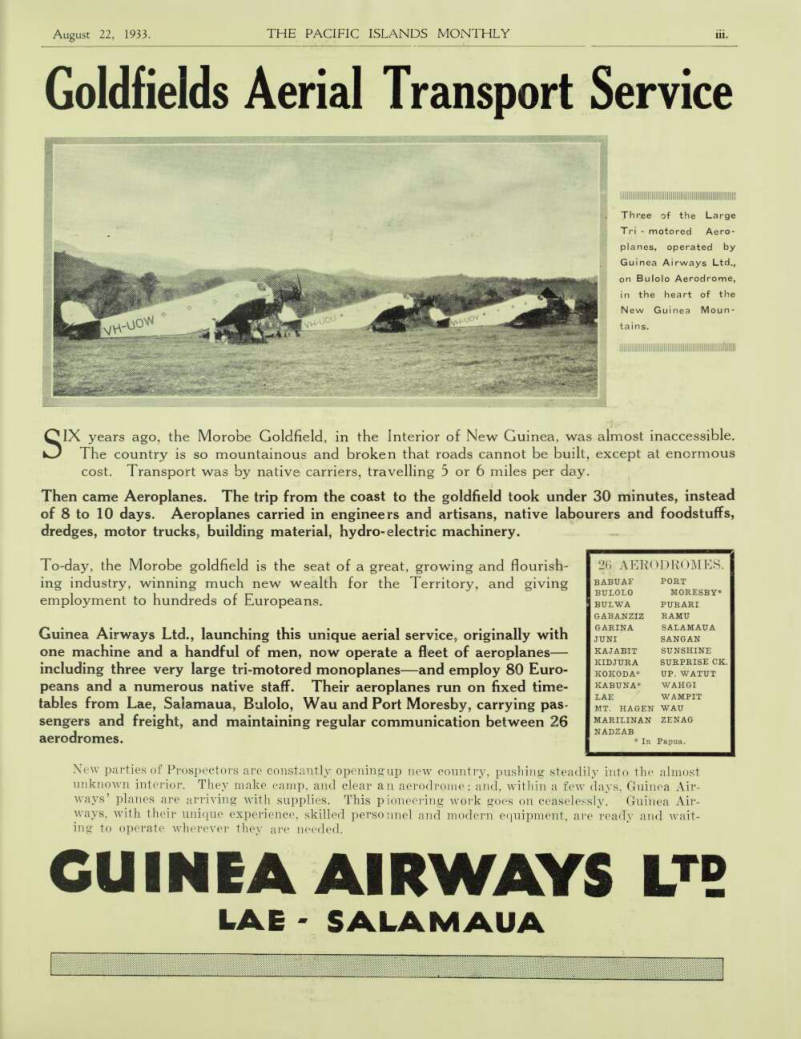
headquarters and Bulwa, where a staff of about 120 people is now installing two more dredges. The dredges are being taken in, in pieces, from the coast, in giant aeroplanes, by Guinea Airways, Ltd.
— Photo, by L. V. Waterhouse.
Monthly” Thanks
“The Pacific Islands Monthly” Thanks Its Readers
WITH this issue (No. 1, Volume IV) “The Pacific Islands Monthly” enters upon its fourth year of life. The journal was launched in the middle of 1930, just when The Depression—the greatest economic cataclysm in the history of mankind—was settling down upon the world; and that it has been able to live and grow, in such circumstances, is surely testimony to the fact that it is serving a good purpose.
The Depression may have little merit; but at least it has wiped out the journalistic weeds and weaklings.
For our continued useful life, we thank primarily our good friends in the Islands Territories, who have become regular readers and have loyally for warded their subscriptions. Our grati tude is given, also, to scores of friends, all through the Pacific, who have written encouragingly and supplied most helpful advice.
But no popular journal can be pro duced on revenue from subscriptions alone. We particularly ask our readers to note that it would not have been pos sible to supply them with this monthly newspaper had we not had the steady support (in the purchase of advertising space) of many Australian manufac turers and exporters. We have had evi dence frequently that our readers care fully study the advertisements in the “Monthly”; and we would specially urge them, when they are writing to advertisers, to state that they saw the advertisement in the “P.I.M.” The more frequently that readers communicate with our advertisers, the better will be the class of newspaper which we are able to produce.
We are anxious to do everything pos sible to assist in the development of the Pacific Islands, and the growth and bet terment of the European population there. To that end, we are gathering and tabulating a great deal of useful information about the different Terri tories. While prices of primary pro ducts remain as they are, and the present state of stagnation exists, there is not much that can be done to assist development. But, sooner or later, the economic pendulum will swing back, prices will recover, and the way will be open for greater progress and improve ment in the Islands. Then, we hope, by giving publicity to Islands opportuni ties, and guarding existing interests against abuses, to give greater and more valuable service to our readers.
French Warship “Alde
Baran.”
Papeete, July 20.
The French warship “Aldebaran,” commanded by Commander Le Pelletier, arrived in Papeete some days ago from Noumea, and will remain on this station, it is stated, for about four months, after which she is to be replaced by a newer vessel from France.
The “Aldebaran,” which is one of several similar craft taken over by France from England at the termination of the war, was stationed here some years ago; she now has an entirely new personnel.
Is It Stalemate In Samoa?
Administration Conciliatory but Insists on Elimination of Nelson. — Mau Sullen and Reluctant.
Commercial Interests’ Anxiety. (Written specially for “The Pacific Islands Monthly,~by Marc T. Greene, a well-known American journalist.)
APIA, July 23.
The outcome of Mr. Nelson’s return to Samoa after five years of exile and his present stay here of three months has been the sub mission to the Administration of a revised set of “demands” drawn up with his direction and advice.
To that move of the Mau the Administration has replied in a fashion that puts the immediate issue squarely up to the Samoans.
“Eliminate Nelson and we will talk to you,” General Hart told the Mau Committee yesterday, “but on no other condition.”
The situation thus remains, for the moment at least, just where it was before—and that is nowhere at all. The “demands” are a virtual reiteration of those submitted to the Administration several times before, within the past two years, but the guiding hand of Nelson in the business this time is not acceptable to New Zealand.
That being the case, the Mau and everybody else concerned are afforded food for serious thought and it takes this general line. Is Nelson, obviously determined to make his personal quarrel with New Zealand the Samoans’, doing them any real good in his leadership ? It is authoritatively stated that he has up to now spent more than £10,000 of the natives’ money in that leader ship, and if any real progress has been made towards winning their fight with the Mandatory it is not evident to the average observer.
The position of the Administra tion now is that the general con ference with the native chiefs, so long urged by them, will be granted if Nelson is eliminated from the scene, either in a directive or an influential capacity. That, in itself, is something of a conciliatory move by the government and would ap pear to declare its sincerity in the attempt to restore the so-much needed harmony here. Moreover, the intimation is clear that serious heed will be given the Mau’s re quests, although no promise, of
course, is made that all or any of them will be granted.
But the pressure upon the Administration of the traders, whose affairs are becoming confu sion worse confounded, is growing very strong indeed. None of them are concerned with Nelson’s per sonal grievances and some are not even concerned with the Mau’s, though practically all agree that colossal blunders have been made by the New Zealand Government here and that those must in some measure be atoned for.
What the traders want is har mony; and they are determined to have it. Twenty of the leaders among them last week held a serious conference with the visiting New Zealand officials, Messrs. Verschef felt and Berendsen, who have been here two months “investigating.”
It was held very privately a con siderable distance from Apia and what transpired is not for present publicity. But it is known that a unanimity of opinion was reached in respect of certain things and some of those were the forced re turn to New Zealand of sundry officials who are considered to be doing more harm than good. That is to say, the united influence of the traders aforesaid is considered sufficient to achieve their desires in such directions.
Needless to say, Mr. Nelson was not included in this conference.
But not one of the there has taken an active part in the controversy either on his behalf or against him. Each is, in effect, im partial. But all consider that some thing must be done and soon, unless economic disaster is to fall upon all, and possibly something even worse, happen.
For it is useless to represent the situation here as improved. It is, on the contrary, definitely and dis tinctly worse than ever, and that applies to the political and economic situation equally. The Mau is as strong as ever, numerically and morally, and even more sullen and resentful. The general morale of
the native populace has dropped so much since I was here two years ago as in itself to constitute a sufficient indictment of the admin istrative methods in use here during the past ten years.
The more I get to know of the Samoans the more I realize that they are exceedingly difficult people to deal with and far more so than would be the Tahitians or perhaps any others of the South Sea races.
But if New Zealand was fit to assume the Mandate in the first place she could properly be assumed to understand all that and to act accordingly. Instead, every blunder that anyone could think of has been made, commencing with the degrad ing of the high chief Tamasese and his deportation to a New Zealand jail and continuing with the depor tation of Nelson which was the best possible method of entrenching him securely as their leader in the native hearts.
But, difficult or not, these Samoan people came under New Zealand overlordship in the form of an obligation, a trust to be, adminis tered with consideration first to their welfare. No doubt at all exists that New Zealand has failed in that trust, not to say flagrantly betrayed it.
And yet there is no use in going over all that again. The errors of the past have been made and, as with us all individually and collectively, cannot be undone but only, in measure great or small, atoned for. That, as it seems to me, the present Administration here is genuinely disposed to do. But in so doing they regard this man, Mr.
Nelson, as a stumbling-block, and refuse all concessions until he is eliminated that they may treat directly with the natives.
But how the Administration, or anybody else but the natives them selves, the 90 per cent, of them who still constitute the Mau, can bring this about does not appear. And certainly the loyalty of the Samoans to Mr. Nelson seems at the moment as strong as ever.
The Constabulary Of Fiji.
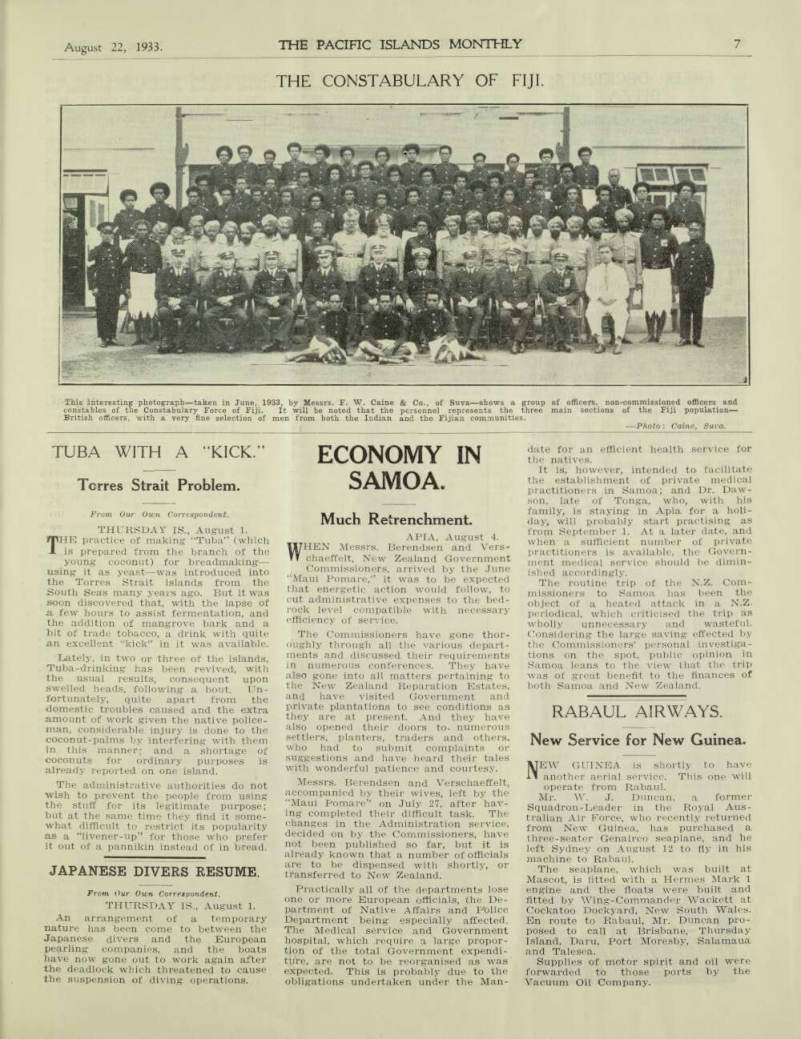
This interesting photograph—taken in June, 1933, by Messrs. F. W. Caine & Co., of Suva—shows a group of officers, non-commissioned officers and constables of the Constabulary Force of Fiji. It will be noted that the personnel represents the three main sections of the Fiji population— British officers, with a very fine selection of men from both the Indian and the Fijian communities. —Photo : Caine, Suva.
Tuba With A “Kick.”
Torres Strait Problem.
From Our Own Correspondent.
THURSDAY IS., August 1.
THE practice of making “Tuba” (which is prepared from the branch of the young coconut) for breadmaking— using it as yeast—was introduced into the Torres Strait islands from the South Seas many years ago. But it was soon discovered that, with the lapse of a few hours to assist fermentation, and the addition of mangrove bark and a bit of trade tobacco, a drink with quite an excellent “kick” in it was available.
Lately, in two or three of the islands, Tuba-drinking has been revived, with the usual results, consequent upon swelled heads, following a bout. Un fortunately, quite apart from the domestic troubles caused and the extra amount of work given the native police man, considerable injury is done to the coconut-palms by interfering with them in this manner; and a shortage of coconuts for ordinary purposes is already reported on one island.
The administrative authorities do not wish to prevent the people from using the stuff for its legitimate purpose; but at the same time they find it some what difficult to restrict its popularity as a “livener-up” for those who prefer it out of a pannikin instead of in bread.
Japanese Divers Resume.
From Our Own Correspondent.
THURSDAY IS., August 1.
An arrangement of a temporary nature has been come to between the Japanese divers and the European pearling companies, and the boats have now gone out to work again after the deadlock which threatened to cause the suspension of diving operations.
Economy In
Samoa.
Much Retrenchment.
APIA, August 4.
WHEN Messrs. Berendsen and Vers chaeffelt, New Zealand Government Commissioners, arrived by the June “Maui Pomare,” it was to be expected that energetic action would follow, to cut administrative expenses to the bed rock level compatible with necessary efficiency of service.
The Commissioners have gone thor oughly through all the various depart ments and discussed their requirements in numerous conferences. They have also gone into all matters pertaining to the New Zealand Reparation Estates, and have visited Government and private plantations to see conditions as they are at present. And they have also opened their doors to numerous settlers, planters, traders and others, who had to submit complaints or suggestions and have heard their tales with wonderful patience and courtesy.
Messrs. Berendsen and Verschaeffelt, accompanied by their wives, left by the “Maui Pomare” on July 27, after hav ing completed their difficult task. The changes in the Administration service, decided on by the Commissioners, have not been published so far, but it is already known that a number of officials are to be dispensed with shortly, or transferred to New Zealand.
Practically all of the departments lose one or more European officials, the De partment of Native Affairs and Police Department being especially affected.
The Medical service and Government hospital, which require a large propor tion of the total Government expendi ture, are not to be reorganised as was expected. This is probably due to the obligations undertaken under the Man
date for an efficient health service for the natives.
It is, however, intended to facilitate the establishment of private medical practitioners in Samoa; and Dr. Daw son, late of Tonga, who, with his family, is staying in Apia for a holi day, will probably start practising as from September 1. At a later date, and when a sufficient number of private practitioners is available, the Govern ment medical service should be dimin ished accordingly.
The routine trip of the N.Z. Com missioners to Samoa has been the object of a heated attack in a N.Z. periodical, which criticised the trip as wholly unnecessary and wasteful.
Considering the large saving effected by the Commissioners’ personal investiga tions on the spot, public opinion in Samoa leans to the view that the trip was of great benefit to the finances of both Samoa and New Zealand.
Rabaul Airways.
New Service for New Guinea.
NEW GUINEA is shortly to have another aerial service. This one will operate from Rabaul.
Mr. W. J. Duncan, a former Squadron-Leader in the Royal Aus tralian Air Force, who recently returned from New Guinea, has purchased a three-seater Genairco seaplane, and he left Sydney on August 12 to fly in his machine to Rabaul.
The seaplane, which was built at Mascot, is fitted with a Hermes Mark 1 engine and the floats were built and fitted by Wing-Commander Wackett at Cockatoo Dockyard, New South Wales.
En route to Rabaul, Mr. Duncan pro posed to call at Brisbane, Thursday Island, Daru, Port Moresby, Salamaua and Talesea.
Supplies of motor spirit and oil were forwarded to those ports by the Vacuum Oil Company.
Fred. Deckert’S
“Bitza.”
(By Sheila Lane in Sydney “Sun”.)
FORTY miles into the interior of New Guinea, a “bitza” motor lorry daily climbs 4,000 feet along a 14 mile bush track.
It is the first motor car to carry cargo and passengers from Wau, the depot of the New Guinea goldfields, to Edie Creek, now world famed.
Praise for this feat has been justly earned by a plucky young Australian, Fred. J. Deckert, 24 years old, whose fine physique and quick brain have gained him a reputation for the pioneering courage which has put Edie Creek on the map.
Mr. Deckert is a skilled motor driver and mechanic. Before he tried his luck in New Guinea he drove a motor lorry loaded with wool from South Australia to Victoria, then afterwards he would travel up as far as Broken Hill.
With engine, carburettor, radiator, gear-box, and steering wheel all from different makes, is it any wonder that this car has been called Deckert’s “Bitza”? This conglomeration of parts was assembled under Mr. Deckert’s own supervision at Bradley Bros., Sydney, shipped fully assembled to Salamaua, where it was taken by one of New Guinea Airways’ Junkers ’planes to Wau.
As it was unloaded from the ’plane, still fully assembled, Mr. Deckert’s “boy” filled up the tanks, and the car was then driven off the aerodrome.
First trip from Wau to Edie Creek was made on April 16, 1933. On this oc casion, Mr. Dawson and Mr. Les Simp son were the passengers who dared the perilous ride. On one side there is the sheer mountain wall, on the other side of the track—a drop of hundreds of feet.
Some of the bends are so sharp that it takes a considerable amount of backing and pulling of the wheels before the lorry can get around. As the track is mostly red mud, one slip of the chained wheels would prove fatal. To cope with the narrowness of the track a special wheelbase of three feet has been con structed, then the wheels just fit from mountain wall to track edge.
Since April 16 of this year, 84 trips have been made and 70 passengers (35 in first month) have been carried up, down, or up and down the rugged moun tain track.
A steam-boiler weighing 18cwt., the property of a well-known prospector, Mr. A. F. Dixon, has been the heaviest load of cargo up to date. Cargo included all types of mining machinery, building material, European and native foodstuffs.
Two complete trips, that is, two return trips, is the maximum for a hard day’s work, and the nerve-racking strain is very severe.
Three women have ridden up to the Creek in this motor lorry. Two of them —Mrs. Hadley and Mrs. Cresswell—are wives of prospectors on the field.
Previous to the arrival of the lorry, mules and horses conveyed the cargo, but in comparison their carrying capa
city and speed are inferior. Owing to the climb being so strenuous, the animals quickly become lean and tired, so that they have to be turned out to rest very often for a long “spell”.
Of course, there are pessimists the world over and Wau can boast a few.
“Deckert’s Folly,” they called the lorry.
They said it was impossible to get a motor lorry through to the Creek. But, as in most things, will-power, pluck, and the right man did the job.
And so another page had been added to the great history of the New Guinea goldfields.
Coconut Crabs.
“Latro Birgas” Is an Interesting Gentleman.
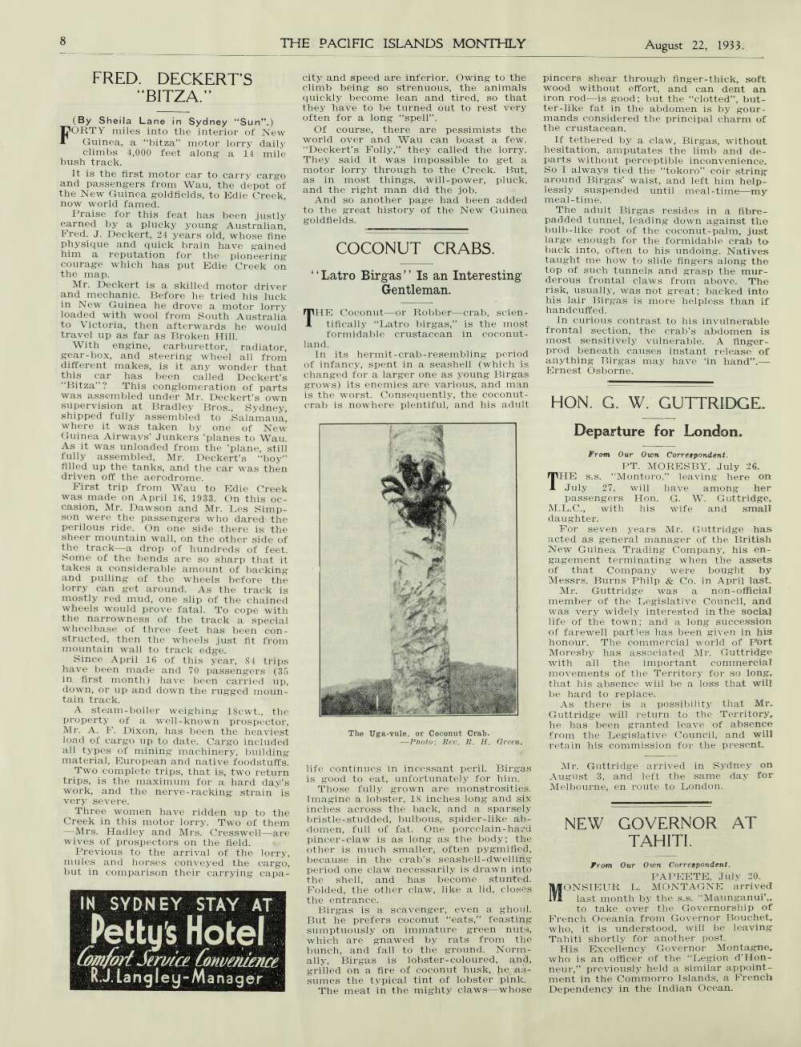
THE Coconut —or Robber —crab, scien tifically “Latro birgas,” is the most formidable crustacean in coconut land.
In its hermit-crab-resembling period of infancy, spent in a seashell (which is changed for a larger one as young Birgas grows) its enemies are various, and man is the worst. Consequently, the coconut crab is nowhere plentiful, and his adult
life continues in incessant peril. Birgas is good to eat, unfortunately for him.
Those fully grown are monstrosities.
Imagine a lobster, 18 inches long and six inches across the back, and a sparsely bristle-studded, bulbous, spider-like ab domen, full of fat. One porcelain-hard pincer-claw is as long as the body; the other is much smaller, often pygmified, because in the crab’s seashell-dwelling period one claw necessarily is drawn into the shell, and has become stunted.
Folded, the other claw, like a lid, closes the entrance.
Birgas is a scavenger, even a ghoul.
But he prefers coconut “eats,” feasting sumptuously on immature green nuts, which are gnawed by rats from the bunch, and fall to the ground. Norm ally, Birgas is lobster-coloured, and, grilled on a fire of coconut husk, he as sumes the typical tint of lobster pink.
The meat in the mighty claws —whose
pincers shear through finger-thick, soft wood without effort, and can dent an iron rod—is good; but the “clotted”, but ter-like fat in the abdomen is by gour mands considered the principal charm of the crustacean.
If tethered by a claw, Birgas, without hesitation, amputates the limb and de parts without perceptible inconvenience.
So I always tied the “tokoro” coir string around Birgas’ waist, and left him help lessly suspended until meal-time —my meal-time.
The adult Birgas resides in a fibre padded tunnel, leading down against the bulb-like root of the coconut-palm, just large enough for the formidable crab to back into, often to his undoing. Natives taught me how to slide fingers along the top of such tunnels and grasp the mur derous frontal claws from above. The risk, usually, was not great; backed into his lair Birgas is more helpless than if handcuffed.
In curious contrast to his invulnerable frontal section, the crab’s abdomen is most sensitively vulnerable. A finger prod beneath causes instant release of anything Birgas may have ‘in hand”. — Ernest Osborne.
The Uga-vule, or Coconut Crab. — Photo: Rev. R. H. Green.
Hon. G. W. Guttridge.
Departure for London.
From Our Own Correspondent.
Pt. Moresby, July 26.
THE s.s. “Montoro,” leaving here on July 27, will have among her passengers Hon. G. W. Guttridge, M.L.C., with his wife and small daughter.
For seven years Mr. Guttridge has acted as general manager of the British New Guinea Trading Company, his en gagement terminating when the assets of that Company were bought by Messrs. Burns Philp & Co. in April last.
Mr. Guttridge was a non-official member of the Legislative Council, and was very widely interested in the social life of the town; and a long succession of farewell parties has been given in his honour. The commercial world of Port Moresby has associated Mr. Guttridge with all the important commercial movements of the Territory for so long, that his absence will be a loss that will be hard to replace.
As there is a possibility that Mr.
Guttridge will return to the Territory, he has been granted leave of absence from the Legislative Council, and will retain his commission for the present.
Mr. Guttridge arrived in Sydney on August 3, and left the same day for Melbourne, en route to London.
New Governor At
Tahiti.
From Our Own Correspondent.
Papeete, July 20.
Monsieur L. Montagne arrived last month by the s.s. “Maunganui’,, to take over the Governorship of French Oceania from Governor Bouchet, who, it is understood, will be leaving Tahiti shortly for another post.
His Excellency Governor Montagne, who is an officer of the “Legion d’Hon neur,” previously held a similar appoint ment in the Commorro Islands, a French Dependency in the Indian Ocean.
Advertisements & other items, p. 10 (1 item)
Petty's Hotel
IN SYDNEY STAY AT
Comfort Service Convenience.
R.J. Langley-Manager
Aiagairi.
By Rev. Harold Short, F.R.G.S.
AIAGAIRI was a brown man, bound in the middle with a strip of bark. We met in a Papuan establishment. I was passing through, but he was mak ing quite a stay. Four months, the R.M. said.
Aiagairi had speared his aunt in one leg, as a punishment for procrastination.
She omitted to tell him immediately, on his return from a long hunt, that his mother had died the week before.
Aiagairi seemed not to enjoy the meals offered by the gaol cook. He spoke to no one, nor smiled. He desired only to sit gazing vacantly into space. Often, during some task, he would pause, dreamily, to watch the changing lights on the ranges—until the warder brought him back to earth, and a shovel. * * * Through weeks of durance, Aiagairi continued to eat little, and be si lent. True, he knew only a far mountain dialect; but most of his fellow sojourners were sophisticated gentry of the coast, who could pick up any Papuan lingo in a week or so.
Aiagairi, however, showed no wish to swop vocabularies, or to recognise his companions in any way.
It was assumed that he was somewhat silly. The other prisoners began to ignore him, in what time they had to gether. The warder was not unkind, and the R.M. was a sport. Aiagairi was given charge of the station goats. The appointment seemed satisfying to both parties.
Every day Aiagairi got more wistful.
The goat job gave him leisure for con templation; but oft-times his charges took the opportunity that this gave them to wander in forbidden places. Aiagairi was wonderfully submissive whenever the irate warder drew his attention to their pleasurance in the gardens. He was stoical, whatever happened—and a lot of strange things may occur in gaols.
The average Papuan endures prison existence as contentedly as he does the desolate periods of village life. The one big, mortifying difference is the closed cell at night. Though many share a
room and, doubtless, Papuan Nights Tales are as interesting as some from Arabia, these people do object to being locked in. However, it is not likely that their objection will raise a question in the House. * * * I digress. But, after all, this has to do with Aiagairi’s story. Another prisoner told me that Aiagairi refused to speak or laugh in the dark room. He was silent, even when the teller of a funny tale kicked him for not laughing.
For over three months, no word or sign of concern with local things was re corded. If there was an interest in his life, it lay afar. The hills, only, could hold it, for they alone gained his atten tion.
The R.M. suggested that the boy was considering in what part of his aunt’s anatomy he would stick a spear when he returned to those hills, and prophe sied that he would be brought back to the ever-waiting gaol. The R.M. is not even the son of a prophet! * * * During the fourth month of the prisoner’s term the magistrate went on one of those hard patrols that such men love. The journey lay through Aiagairi’s hills, so his worship took the captive as a carrier, for release at his village. It so happened that I, in perfect freedom, went, too.
We walked over grass lands and through forests, forded, swam and rafted rivers: trod rugged, mossy heights and skidded down slopes. All the way, Aia gairi bore his burden silently, ate such food as was placed before him without even saying grace, and sat apart during the resting times. But the look in his eyes seemed different. Intelligence in creased in them with each day’s march.
As we travelled through one gloriously watered valley, I noticed an eager spirit breaking through every feature of his primitive face. Then we waded round a rocky bend, that was wide enough for only the waters, until a glade between high forest hills opened before us.
In the centre, a party of Papuans was sitting, awaiting our heralded procession.
The ubiquitous New Guinea fire was there, with yams and bananas roasting, offerings for the visitors.
We greeted the grass-clad group. An “ex-signed” boy rose, revealing the one cotton garment among the crowd, and replied for all: “Taubadadia, Ba Mauri!”
We sat near them; and they hid in Papuan stolidity their wonder at our im posing company. * * * While the carriers were depositing their loads, we learned that these people had come from a village hidden in the forest slopes behind us. Its name was Guneia.
“Oh!” said the R.M., ‘‘this is Aiagairi’s village. Corporal, bring him to me!”
Aiagairi was led up, but his animated face was turned toward the villagers. A few words, passed on by the interpreter, let him know that he was free.
A comely brown girl, with a small but new grass skirt, and a very new baby, had risen and was moving toward Aiagairi.
He was gazing at the infant, and the woman at him. The face of the child was hidden under a breast; but the faces of the woman and the man were suf ficient to see. The R.M. looked at them and, although both of us are hard-bitten creatures, I think that he, too, became tenderer then.
As the woman put the baby into the vibrant arms of the father, we could see that the tiny, naked body was not two moons old. “Yes,” they told the inter preter, “it was their first.”
Aiagairi held it tightly, and gazed at it the while, then turned glistening eyes to us and smiled. We smiled back with eyes that glistened, too. * * * An old woman, with crinkled skin smeared with ashes, limped forward timorously.
Aiagairi looked at her, and smiled again.
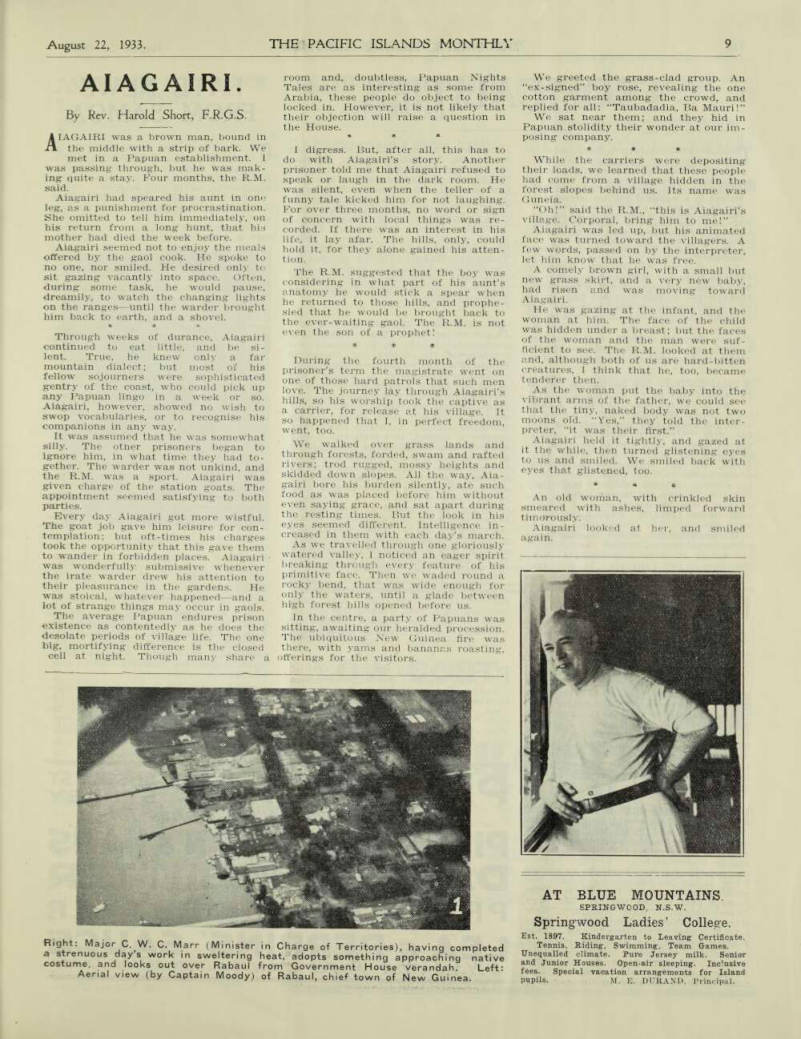
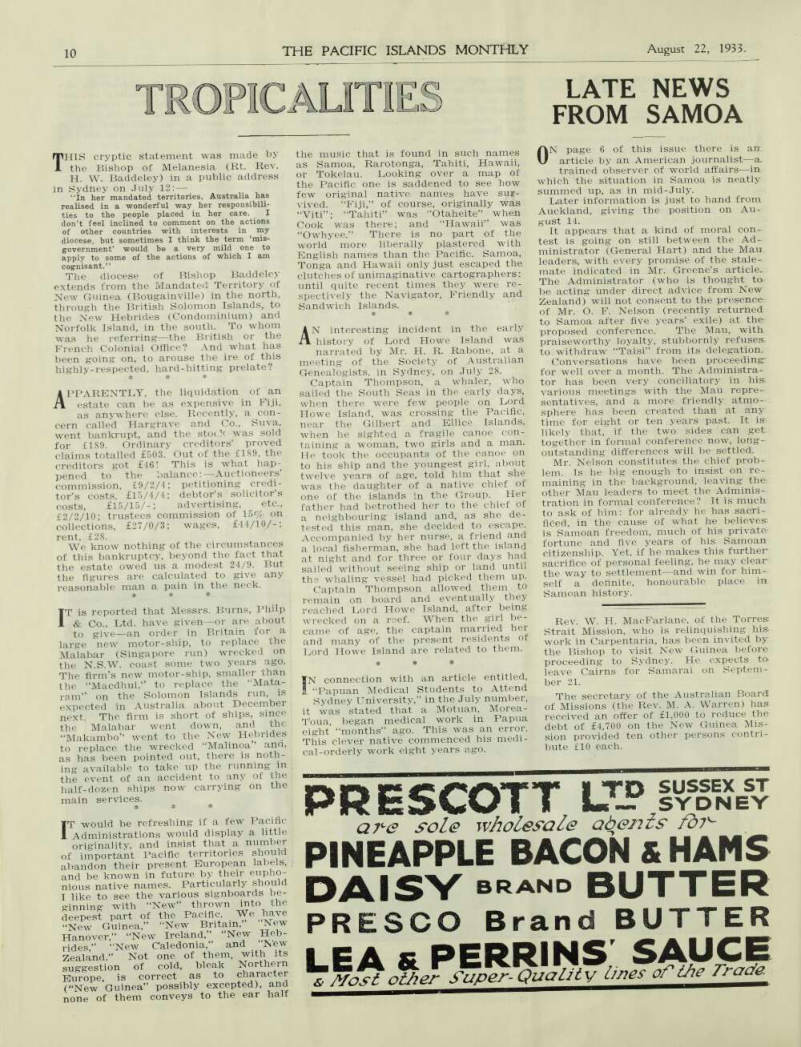
Right: Major C W. C. Marr (Minister in Charge of Territories), having completed a strenuous day s work in sweltering heat, adopts something approaching native costume, and looks out over Rabaul from Government House verandah. Left: Aerial view (by Captain Moody) of Rabaul, chief town of New Guinea.
Advertisements & other items, p. 11 (1 item)
Springwood Ladies’ College.
AT BLUE MOUNTAINS.
SPRINGWOOD, N.S.W.
Est. 1897. Kindergarten to Leaving Certificate.
Tennis, Riding, Swimming, Team Games.
Unequalled climate. Pure Jersey milk. Senior and Junior Houses. Open-air sleeping. Inclusive fees. Special vacation arrangements for Island Pupils. M. E. DURAND, Principal.
Tropicalities
THIS cryptic statement was made by the Bishop of Melanesia (Rt. Rev.
H. W. Baddeley) in a public address in Sydney on July 12: “In her mandated territories, Australia has realised in a wonderful way her responsibili ties to the people placed in her care. I don’t feel inclined to comment on the actions of other countries with interests in my diocese, but sometimes I think the term ‘mis government’ would be a very mild one to apply to some of the actions of which I am cognisant.”
The diocese of Bishop Baddeley extends from the Mandated Territory of New Guinea (Bougainville) in the north, through the British Solomon Islands, to the New Hebrides (Condominium) and Norfolk Island, in the south. To whom was he referring: —the British or the French Colonial Office? And what has been going on, to arouse the ire of this highly-respected, hard-hitting prelate?
APPARENTLY, the liquidation of an estate can be as expensive in Fiji, as anywhere else. Recently, a con cern called Hargrave and Co., Suva, went bankrupt, and the stock was sold for £189. Ordinary creditors’ proved claims totalled £503. Out of the £189, the creditors got £46! This is what hap pened to the balance: —Auctioneers’ commission, £9/2/4; petitioning credi tor’s costs, £15/4/4; debtor’s solicitor’s costs, £15/15/-; advertising, etc., £2/2/10; trustees commission of 15% on collections, £27/0/3; wages, £44/10/-; rent, £28.
We know nothing of the circumstances of this bankruptcy, beyond the fact that the estate owed us a modest 24/9. But the figures are calculated to give any reasonable man a pain in the neck. * * * IT is reported that Messrs. Burns, Philp & Co., Ltd. have given—or are about to give—an order in Britain for a large new motor-ship, to replace the Malabar (Singapore run) wrecked on the N.S.W. coast some two years ago.
The firm’s new motor-ship, smaller than the “Macdhui,” to replace the “Mata ram” on the Solomon Islands run, is expected in Australia about December next. The firm is short of ships, since the Malabar went down, and the “Makambo’’ went to the New Hebrides to replace the wrecked “Malinoa" and, as has been pointed out, there is noth ing available to take up the running in the event of an accident to any of the half-dozen ships now carrying on the main services. * * * IT would be refreshing if a few Pacific Administrations would display a little originality, and insist that a number of important Pacific territories should abandon their present European labels, and be known in future by their eupho nious native names. Particularly should I like to see the various signboards be ginning with “New” thrown into the deepest part of the Pacific. We have “New Guinea,” “New Britain,” New Hanover,” “New Ireland,” ‘‘New Heb rides,” “New Caledonia,” and “New Zealand.” Not one of them, with its suggestion of cold, bleak Northern Europe, is correct as to character (“New Guinea” possibly excepted), and none of them conveys to the ear half
the music that is found in such names as Samoa, Rarotonga, Tahiti, Hawaii, or Tokelau. Looking over a map of the Pacific one is saddened to see how few original native names have sur vived. “Fiji,” of course, originally was “Viti”; “Tahiti” was “Otaheite” when Cook was there; and “Hawaii” was “Owhyee.” There is no part of the world more liberally plastered with English names than the Pacific. Samoa, Tonga and Hawaii only just escaped the clutches of unimaginative cartographers: until quite recent times they were re spectively the Navigator, Friendly and Sandwich Islands.
AN interesting incident in the early history of Lord Howe Island was narrated by Mr. H. R. Rabone, at a meeting of the Society of Australian Genealogists, in Sydney, on July 28.
Captain Thompson, a whaler, who sailed the South Seas in the early days, when there were few people on Lord Howe Island, was crossing the Pacific, near the Gilbert and Ellice Islands, when he sighted a fragile canoe con taining a woman, two girls and a man.
He took the occupants of the canoe on to his ship and the youngest girl, about twelve years of age, told him that she was the daughter of a native chief of one of the islands in the Group. Her father had betrothed her to the chief of a neighbouring island and, as she de tested this man, she decided to escape.
Accompanied by her nurse, a friend and a local fisherman, she had left the island at night and for three or four days had sailed without seeing ship or land until the whaling vessel had picked them up.
Captain Thompson allowed them to remain on board and eventually they reached Lord Howe Island, after being wrecked on a reef. When the girl be came of age, the captain married her and many of the present residents of Lord Howe Island are related to them. * * * IN connection with an article entitled, “Papuan Medical Students to Attend Sydney University,” in the July number, it was stated that a Motuan, Morea- T'oua, began medical work in Papua eight “months” ago. This was an error.
This clever native commenced his medi cal-orderly work eight years ago.
Late News
From Samoa
ON page 6 of this issue there is air article by an American journalist—a trained observer of world affairs —in which the situation in Samoa is neatly summed up, as in mid-July.
Later information is just to hand from Auckland, giving the position on Au gust 14.
It appears that a kind of moral con test is going on still between the Ad ministrator (General Hart) and the Mau leaders, with every promise of the stale mate indicated in Mr. Greene’s article.
The Administrator (who is thought to be acting under direct advice from New Zealand) will not consent to the presence: of Mr. O. F. Nelson (recently returned to Samoa after five years’ exile) at the proposed conference. The Mau, with praiseworthy loyalty, stubbornly to withdraw “Taisi” from its delegation.
Conversations have been proceeding for well over a month. The Administra tor has been very conciliatory in his various meetings with the Mau repre sentatives, and a more friendly atmo sphere has been created than at any time for eight or ten years past. It is likely that, if the two sides can get together in formal conference now, long outstanding differences will be settled.
Mr. Nelson constitutes the chief prob lem. Is he big enough to insist on re maining in the background, leaving the other Mau leaders to meet the Adminis tration in formal conference? It is much. to ask of him; for already he has sacri ficed, in the cause of what he believes: is Samoan freedom, much of his private: fortune and five years of his Samoan citizenship. Yet, if he makes this further sacrifice of personal feeling, he may clear the way to settlement —and win for him self a definite, honourable place in Samoan history.
Rev. W. H. MacFarlane, of the Torres: Strait Mission, who is relinquishing his work in Carpentaria, has been invited by the Bishop to visit New Guinea before proceeding to Sydney. He expects to leave Cairns for Samarai on Septem ber 21.
The secretary of the Australian Board of Missions (the Rev. M. A. Warren) has received an offer of £1,000 to reduce the debt of £4,700 on the New Guinea Mis sion provided ten other persons contri bute £10 each.
Advertisements & other items, p. 12 (1 item)
PRESCOTT Ltd Sussex St Sydney
are sole wholesale agents for
PINEAPPLE BACON & HANS
DAISY BRAND BUTTER
PRESCO Brand BUTTER
LEA & PERRINS' SAUCE
& Most other Super-Quality lines of the Trade
Another Pitcairner
Passes.
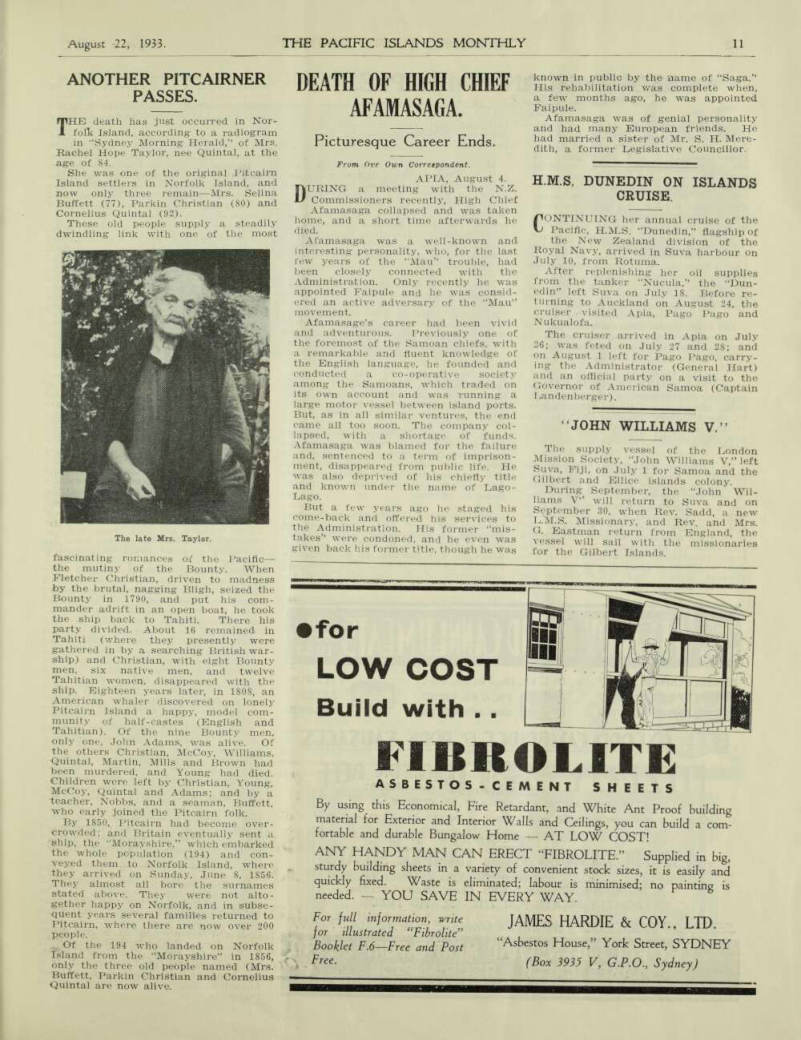
THE death has just occurred in Nor folk Island, according to a radiogram in “Sydney Morning Herald,” of Mrs.
Rachel Hope Taylor, nee Quintal, at the age of 84.
She was one of the original Pitcairn Island settlers in Norfolk Island, and now only three remain—Mrs. Selina Buffett (77), Parkin Christian (80) and Cornelius Quintal (92).
These old people supply a steadily dwindling link with one of the most
fascinating romances of the Pacific — the mutiny of the Bounty. When Fletcher Christian, driven to madness by the brutal, nagging Bligh, seized the Bounty in 1790, and put his com mander adrift in an open boat, he took the ship back to Tahiti. There his party divided. About 16 remained in Tahiti (where they presently were gathered in by a searching British war ship) and Christian, with eight Bounty men, six native men, and twelve Tahitian women, disappeared with the ship. Eighteen years later, in 1808, an American whaler discovered on lonely Pitcairn Island a happy, model com munity of half-castes (English and Tahitian). Of the nine Bounty men. only one, John Adams, was alive. Of the others Christian, McCoy, Williams, Quintal, Martin, Mills and Brown had been murdered, and Young had died.
Children were left by Christian, Young, McCoy, Quintal and Adams; and by a teacher, Nobbs, and a seaman, Buffett, who early joined the Pitcairn folk.
By 1850, Pitcairn had become over crowded; and Britain eventually sent a ship, the “Morayshire,” which embarked the whole population (194) and con veyed them to Norfolk Island, where they arrived on Sunday, June 8, 1856.
They almost all bore the surnames stated above. They were not alto gether happy on Norfolk, and in subse quent years several families returned to Pitcairn, where there are now over 200 people.
Of the 194 who landed on Norfolk Island from the “Morayshire” in 1856, only the three old people named (Mrs.
Buffett, Parkin Christian and Cornelius Quintal are now alive.
The late Mrs. Taylor,
Afamasaga.
Death Of High Chief
Picturesque Career Ends.
From Our Own Correspondent.
APIA, August 4.
DURING a meeting with the N.Z.
Commissioners recently, High Chief Afamasaga collapsed and was taken home, and a short time afterwards he died.
Afamasaga was a well-known and interesting personality, who, for the last few years of the “Mau” trouble, had been closely connected with the Administration. Only recently he was appointed Faipule and he was consid ered an active adversary of the “Mau” movement, Afamasage’s career had been vivid and adventurous. Previously one of the foremost of the Samoan chiefs, with a remarkable and fluent knowledge of the English language, he founded and conducted a co-operative society among the Samoans, which traded on its own account and was running a large motor vessel between island ports.
But, as in all similar ventures, the end came all too soon. The company col lapsed, with a shortage of funds.
Afamasaga was blamed for the failure and, sentenced to a term of imprison ment, disappeared from public life. He was also deprived of his chiefly title and known under the name of Lago- Lago.
But a few years ago he staged his come-back and offered his services to the Administration. His former “mis takes’’ were condoned, and he even was given back his former title, though he was
known in public by the name of “Saga.”
His rehabilitation was complete when, a few months ago, he was appointed Faipule.
Afamasaga was of genial personality and had many European friends. He had married a sister of Mr. S. H. Mere dith, a former Legislative Councillor.
H.M.S. Dunedin On Islands
Cruise
CONTINUING her annual cruise of the Pacific, H.M.S. “Dunedin,” flagship of the New Zealand division of the Royal Navy, arrived in Suva harbour on July 10, from Rotuma.
After replenishing her oil supplies from the tanker “Nucula,” the “Dun edin” left Suva on July 18. Before re turning to Auckland on August 24, the cruiser visited Apia, Pago Pago and Nukualofa.
The cruiser arrived in Apia on July 36; was feted on July 27 and 28; and on August 1 left for Pago Pago, carry ing the Administrator (General Hart) and an official party on a visit to the Governor of American Samoa (Captain
Landenberger).
“John Williams V.”
The supply vessel of the London Mission Society, “John Williams V,” left Suva, Fiji, on July 1 for Samoa and the Gilbert and Ellice islands colony.
During September, the “John Wil liams V’’ will return to Suva and on September 30, when Rev. Sadd, a new L.M.S. Missionary, and Rev. and Mrs.
G. Eastman return from England, the vessel will sail with the missionaries for the Gilbert Islands,
Advertisements & other items, p. 13 (1 item)
Fibrolite
• for
LOW COST
Build with . .
FIBROLITE
ASBESTOS-CEMENT SHEETS
By using this Economical, Fire Retardant, and White Ant Proof building material for Exterior and Interior Walls and Ceilings, you can build a comfortable and durable Bungalow Home AT LOW COST!
ANY HANDY MAN CAN ERECT “FIBROLITE.” Supplied in big, sturdy building sheets in a variety of convenient stock sizes, it is easily and quickly fixed. Waste is eliminated; labour is minimised; no painting is
needed. YOU SAVE IN EVERY WAY.
JAMES HARDIE & COY., LTD.
“Asbestos House,” York Street, SYDNEY (Box 3935 V, G.P.O., Sydney) For full information, write for illustrated "Fibrolite”
Booklet F.6—Free and Post Free.
About Islands People.
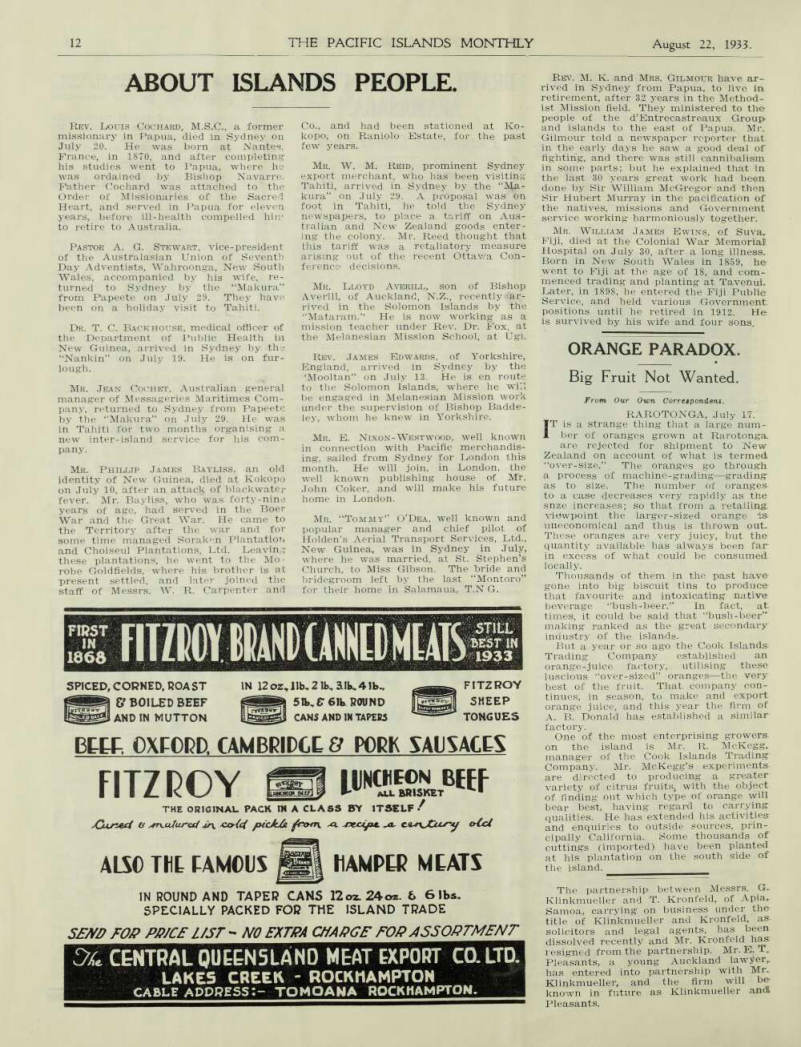
Rev. Louis Cochard, M.S.C., a former missionary in Papua, died in Sydney on July 20. He was born at Nantes, France, in 1870, and after completing his studies went to Papua, where he was ordained by Bishop Navarre.
Father Cochard was attached to the Order of Missionaries of the Sacred Heart, and served in Papua for eleven years, before ill-health compelled him to retire to Australia.
Pastor A. G. Stewart, vice-president of the Australasian Union of Seventh Day Adventists, Wahroonga, New South Wales, accompanied by his wife, re turned to Sydney by the “Makura” from Papeete on July 29. They have been on a holiday visit to Tahiti.
Dr. T. C. Backhouse, medical officer of the Department of Public Health in New Guinea, arrived in Sydney by the “Nankin” on July 19. He is on fur lough.
Mr. Jean Cochet, Australian general manager of Messageries Maritimes Com pany, returned to Sydney from Papeete by the “Makura” on July 29. He was in Tahiti for two months organising a new inter-island service for his com pany.
Mr. Phillip James Bayliss, an old identity of New Guinea, died at Kokopo on July 10, after an attack of blackwater fever. Mr. Bayliss, who was forty-nine years of age, had served in the Boer War and the Great War. He came to the Territory after the war and for some time managed Soraken Plantation and Choiseul Plantations, Ltd. Leaving these plantations, he went to the Mo robe Goldfields, where his brother is at present settled, and later joined the staff of Messrs. W. R. Carpenter and
Co., and had been stationed at Ko kopo, on Raniolo Estate, for the past few years.
Mr. W. M. Reid, prominent Sydney export merchant, who has been visiting Tahiti, arrived in Sydney by the “Ma kura” on July 29. A proposal was on foot in Tahiti, he told the Sydney newspapers, to place a tariff on Aus tralian and New Zealand goods enter ing the colony. Mr. Reed thought that this tariff was a retaliatory measure arising out of the recent Ottawa Con ference decisions.
Mr. Lloyd Averill, son of Bishop Averill, of Auckland, N.Z., recently ar rived in the Solomon Islands by the “Mataram.” He is now working as a mission teacher under Rev. Dr. Fox, at the Melanesian Mission School, at Ugi.
Rev. James Edwards, of Yorkshire, England, arrived in Sydney by the ‘Mooltan” on July 13. He is en route, to the Solomon Islands, where he will be engaged in Melanesian Mission work under the supervision of Bishop Badde ley, whom he knew in Yorkshire.
Mr. E. Nixon-Westwood, well known in connection with Pacific merchandis ing, sailed from Sydney for London this month. He will join, in London, the well known publishing house of Mr.
John Coker, and will make his future home in London.
Mr. “Tommy” O’Dea, well known and popular manager and chief pilot of Holden’s Aerial Transport Services, Ltd., New Guinea, was in Sydney in July, where he was married, at St. Stephen’s Church, to Miss Gibson. The bride and bridegroom left by the last “Montoro” for their home in Salamaua, T.N G.
Rev. M. K. and Mrs. Gilmour have ar rived in Sydney from Papua, to live in retirement, after 32 years in the Method ist Mission field. They ministered to the people of the d’Entrecastreaux Group and islands to the east of Papua. Mr.
Gilmour told a newspaper reporter that in the early days he saw a good deal of fighting, and there was still cannibalism in some parts; but he explained that in the last 30 years great work had been done by Sir William McGregor and then Sir Hubert Murray in the pacification of the natives, missions and Government service working harmoniously together.
Mr. William James Ewins, of Suva, Fiji, died at the Colonial War Memorial Hospital on July 30, after a long illness.
Born in New South Wales in 1859, he went to Fiji at the age of 18, and com menced trading and planting at Tavenui.
Later, in 1898, he entered the Fiji Public Service, and held various Government, positions until he retired in 1912. He is survived by his wife and four sons.
Orange Paradox.
Big Fruit Not Wanted.
From Our Own Correspondent.
Rarotonga, July 17.
IT is a strange thing that a large num ber of oranges grown at Rarotonga are rejected for shipment to New Zealand on account of what is termed “over-size.” The oranges go through a process of machine-grading—grading as to size. The number of oranges to a case decreases very rapidly as the size increases; so that from a retailing viewpoint the larger-sized orange is uneconomical and thus is thrown out.
These oranges are very juicy, but the quantity available has always been far in excess of what could be consumed locally.
Thousands of them in the past have gone into big bisicuit tins to produce that favourite and intoxicating native beverage “bush-beer.” In fact, at times, it could be said that “bush-beer" making ranked as the great secondary industry of the islands.
But a year or so ago the Cook Islands Trading Company established an orange-juice factory, utilising these luscious “over-sized” oranges—the very best of the fruit. That company con tinues, in season, to make and export orange juice, and this year the firm of A. B. Donald has established a similar factory.
One of the most enterprising growers on the island is Mr. R. McKegg, manager of the Cook Islands Trading Company. Mr. McKegg’s experiments are directed to producing a greater variety of citrus fruits, with the object of finding out which type of orange will bear best, having regard to carrying qualities. He has extended his activities and enquiries to outside sources, prin cipally California. Some thousands of cuttings (imported) have been planted at his plantation on the south side of the island.
The partnership between Messrs. G.
Klinkmueller and T. Kronfeld, of Apia, Samoa, carrying on business under the title of Klinkmueller and Kronfeld, as solicitors and legal agents, has been dissolved recently and Mr. Kronfeld has resigned from the partnership. Mr. E. T.
Pleasants, a young Auckland lawyer,, has entered into partnership with Mr.
Klinkmueller, and the firm will be known in future as Klinkmueller and Pleasants.
Advertisements & other items, p. 14 (1 item)
Fitzroy
SPICED, CORNED, ROAST
BOILED BEEF
AND IN MUTTON
IN 12 oz., 1lb, 2 lb, 3lb., 4lb.. 5lb., & 6lb. ROUND
CANS AND 1N TAPEBS
FITZROY
SHEEP
TONGUES
BEEF, OXFORD, CAMBRIDGE & PORK SAUSACES
FITZROY
THE ORIGINAL PACK IN A CLASS BY ITSELF Cured & matured in cold pickle from a recipe a century old
ALSO THE EAMOUS
HAMPER MEATS
IN ROUND AND TAPER CANS 12oz. 24oz. & 6lbs.
SPECIALLY PACKED FOR THE ISLAND TRADE
SEND FOP PRICE LIST - NO EXTRA CHARGE FOR ASSORTMENT The CENTRAL QUEENSLAND MEAT EXPORT CO. LTD.
LAKES CREEK - ROCKHAMPTON
CABLE ADDRESS:- TOMOAMA ROCKHAMPTON.
Minister’S Tour In New Guinea.
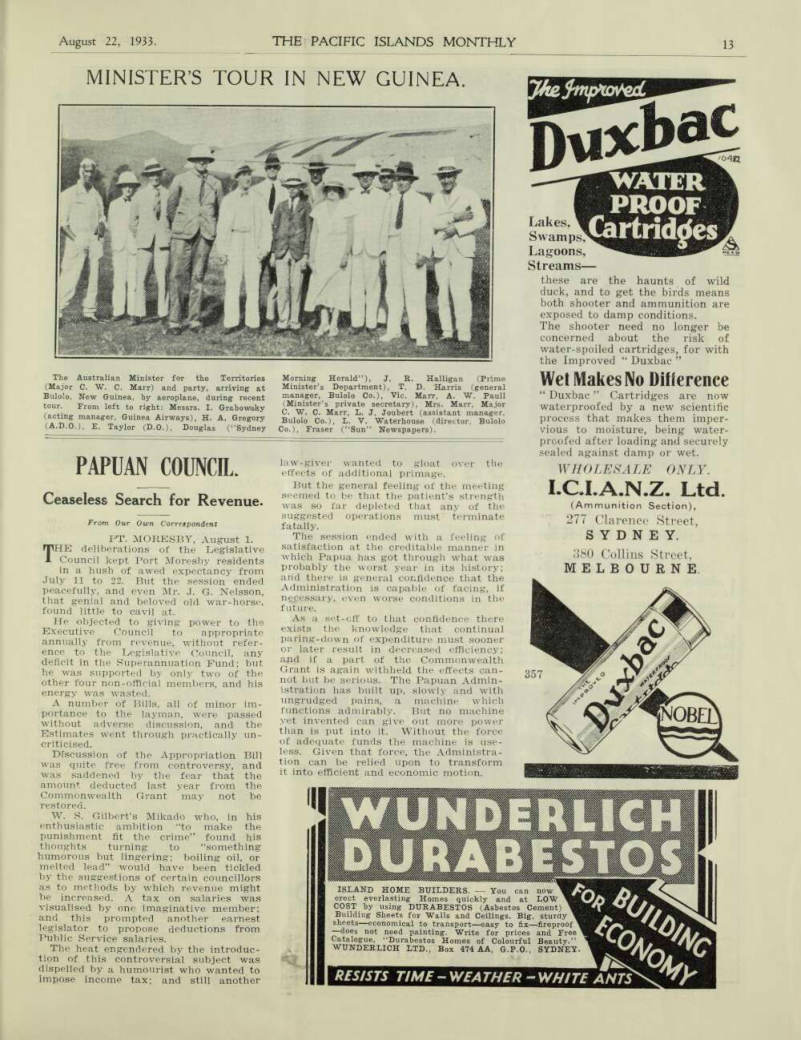
The Australian Minister for the Territories (Major C. W. C. Marr) and party, arriving at Bulolo, New Guinea, by aeroplane, during recent tour. From left to right: Messrs. I. Grabowishy (acting manager, Guinea Airways), H. A. Gregory (A.D.O.), E. Taylor (D. O.), Douglas (“Sydney
Morning Herald”), J. R. Halligan (Prime Minister’s Department), T. D. Harris (general manager, Sulolo Co.), Vic. Marr, A. W. Pauli (Minister’s private secretary), Mrs. Marr, Major C. W. C. Marr, L. J. Joubert (assistant manager, Bulolo Co.), L. V. Waterhouse (director, Bulolo Co.), Fraser (“Sun” Newspapers).
Papuan Council.
Ceaseless Search for Revenue.
From Our Own Correspondent PT. MORESBY, August 1.
THE deliberations of the Legislative Council kept Port Moresby residents in a hush of awed expectancy from July 11 to 22. But the session ended peacefully, and even Mr. J. G. Nelsson, that genial and beloved old war-horse, found little to cavil at.
He objected to giving power to the Executive Council to appropriate annually from revenue, without refer ence to the Legislative Council, any deficit in the Superannuation Fund; but he was supported by only two of the other four non-official members, and his energy was wasted.
A number of Bills, all of minor im portance to the layman, were passed without adverse discussion, and the Estimates went through practically un criticised.
Discussion of the Appropriation Bill was quite free from controversy, and was saddened by the fear that the amount deducted last year from the Commonwealth Grant may not be restored.
W. S. Gilbert’s Mikado who, in his enthusiastic ambition “to make the punishment fit the crime” found his thoughts turning to “something humorous but lingering; boiling oil, or melted lead” would have been tickled by the suggestions of certain councillors as to methods by which revenue might be increased. A tax on salaries was visualised by one imaginative member; and this prompted another earnest legislator to propose deductions from Public Service salaries.
The heat engendered by the introduc tion of this controversial subject was dispelled by a humourist who wanted to impose income tax; and still another
law-giver wanted to gloat over the effects of additional primage.
But the general feeling of the meeting seemed to be that the patient’s strength was so far depleted that any of the suggested operations must terminate fatally.
The session ended with a feeling of satisfaction at the creditable manner in which Papua has got through what was probably the worst year in its history; and there is general confidence that the Administration is capable of facing, if even worse conditions in the future.
As a set-off to that confidence there exists the knowledge that continual paring-down of expenditure must sooner or later result in decreased efficiency: and if a part of the Commonwealth Grant is again withheld the effects can not but be serious. The Papuan Admin istration has built up, slowly and with ungrudged pains, a machine which functions admirably. But no machine yet invented can give out more power than is put into it. Without the force of adequate funds the machine is use less. Given that force, the Administra tion can be relied upon to transform it into efficient and economic motion.
Advertisements & other items, p. 15 (1 item)
Duxbac
Lakes, Lagoons, Streams—
WATER
PROOF
Cartridges
these are the haunts of wild duck, and to get the birds means both shooter and ammunition are exposed to damp conditions.
The shooter need no longer be concerned about the risk of water-spoiled cartridges, for with the Improved “Duxbac ”
Wet Makes No Difterence
“Duxbac” Cartridges are now waterproofed by a new scientific process that makes them imper vious to moisture, being waterproofed after loading and securely sealed against damp or wet.
WHOLESALE ONLY.
I.C.I.A.N.Z. Ltd.
(Ammunition Section), 277 Clarence Street,
SYDNEY.
380 Collins Street,
MELBOURNE
WUNDERLICH
DURABESTOS
ISLAND HOME BUILDERS. - You can now erect everlasting Homes quickly and at LOW COST by using DURABESTOS (Asbestos Cement) Building Sheets for Walls and Ceilings. Big, sturdy sheets—economical to transport—easy to fix—fireproof —does not need painting. Write for prices and Free Catalogue, “Durabestos Homes of Colourful Beauty.”
WUNDERLICH LTD., Box 474 AA, G.P.O., SYDNEY RESISTS TIME - WEATHER - WHITE ANTS
Erratic Lights.
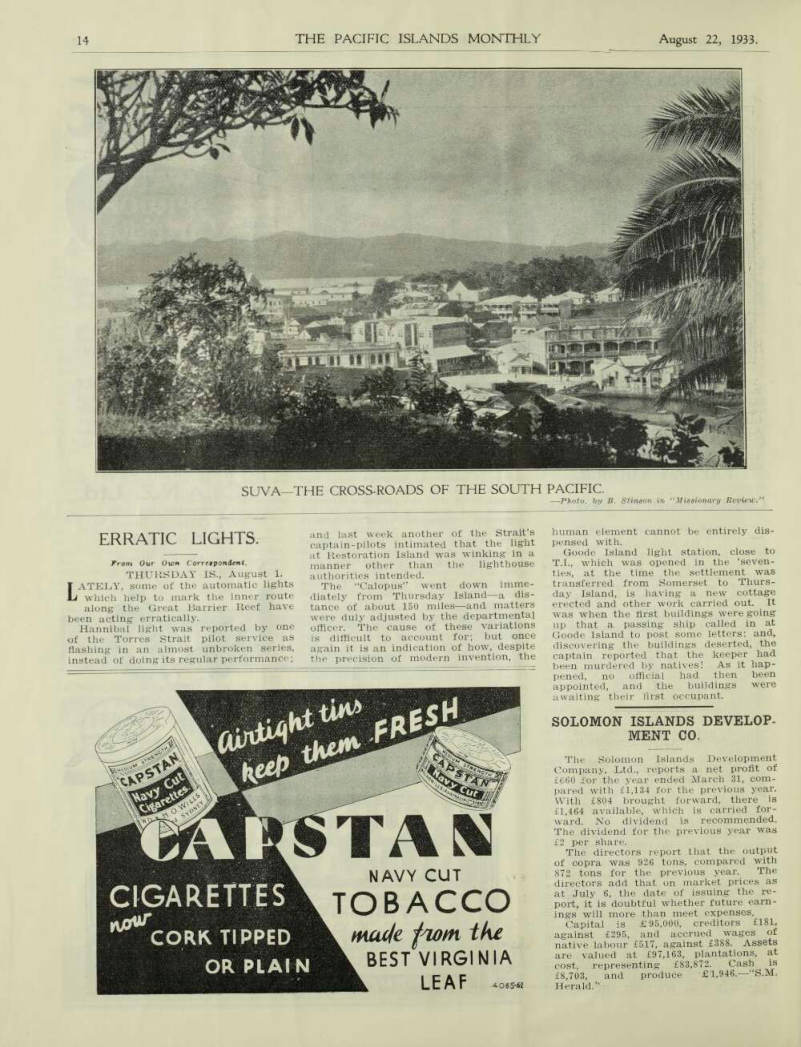
From Our Own Correspondent.
THURSDAY IS., August 1.
LATELY, some of the automatic lights which help to mark the inner route along the Great Barrier Reef have been acting erratically.
Hannibal light was reported by one of the Torres Strait pilot service as flashing in an almost unbroken series, instead of doing its regular performance;
and last week another of the Strait’s captain-pilots intimated that the light at Restoration Island was winking in a manner other than the lighthouse authorities intended.
The “Calopus” went down imme diately from Thursday Island —a dis tance of about 150 miles —and matters were duly adjusted by the departmental officer. The cause of these variations is difficult to account for; but once again it is an indication of how, despite the precision of modern invention, the
human element cannot be entirely dis pensed with.
Goode Island light station, close to T. I., which was opened in the ’seven ties, at the time the settlement was transferred from Somerset to Thurs day Island, is having a new cottage erected and other work carried out. It was when the first buildings were going up that a passing ship called in at Goode Island to post some letters: and, discovering the buildings deserted, the captain reported that the keeper had been murdered by natives! As it hap pened, no official had then been appointed, and the buildings were awaiting their first occupant.
Suva—The Cross-Roads Of The South Pacific.
— Photo, by B. Stinson in “Missionary Review
Solomon Islands Develop
Ment Co.
The Solomon Islands Development Company, Ltd., reports a net profit of £660 for the year ended March 31, com pared with £1,134 for the previous year.
With £804 brought forward, there is £1,464 available, which is carried for ward. No dividend is recommended.
The dividend for the previous year was £2 per share.
The directors report that the output of copra was 926 tons, compared with 872 tons for the previous year. The directors add that on market prices as at July 6, the date of issuing the re port, it is doubtful whether future earn ings will more than meet expenses.
Capital is £95,000, creditors £181, against £295, and accrued wages of native labour £517, against £388. Assets are valued at £97,163, plantations, at cost, representing £83,872. Cash is
£8,703, and produce £1,946.
“S.M. Herald.”
Herald.”
Advertisements & other items, p. 16 (1 item)
Tobacco
CAPSTAN
CIGARETTES
CORK TIPPED
OR PLAIN
TAN
NAVY CUT
TOBACCO
made from the
BEST VIRGINIA
LEAF 4085
A Popular Matron.
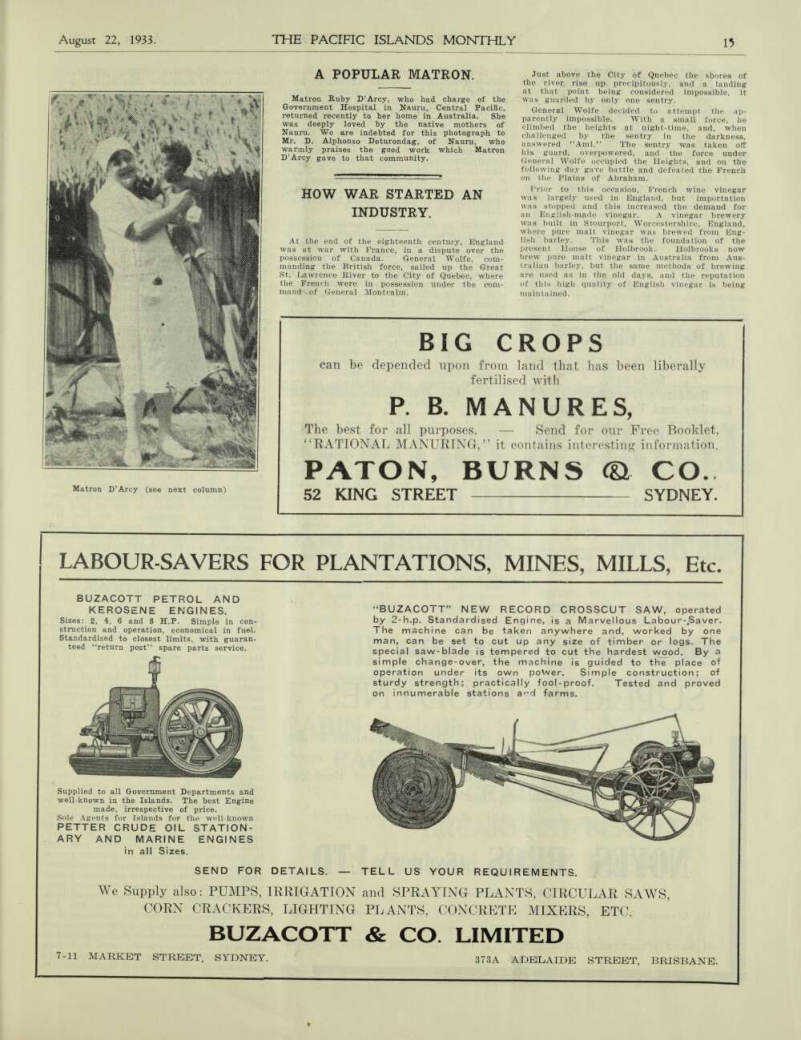
Matron Ruby D’Arcy, who had charge of the Government Hospital in Nauru, Central Pacific, returned recently to her home in Australia. She was deeply loved by the native mothers of Nauru. We are indebted for this photograph to Mr. D. Alphonso Deturondag, of Nauru, who warmly praises the good work which Matron D’Arcy gave to that community.
Matron D’Arcy (see next column)
Industry.
How War Started An
At the end of the eighteenth century, England was at war with France, in a dispute over the possession of Canada. General Wolfe, com manding the British force, sailed up the Great St. Lawrence River to the City of Quebec, where the French were in possession under the com mand of General Montcalm.
Just above the City of Quebec the shores of the river rise up precipitously, and a landing at that point being considered impossible, it was guarded by only one sentry.
General Wolfe decided to attempt the ap parently impossible. With a small force, he climbed the heights at night-time, and, when challenged by the sentry in the darkness, answered “Ami.” The sentry was taken off his guard, overpowered, and the force under General Wolfe occupied the Heights, and on the following day gave battle and defeated the French on the Plains of Abraham.
Prior to this occasion, French wine vinegar was largely used in England, but importation was stopped and this increased the demand for an English-made vinegar. A vinegar brewery was built in Stourport, Worcestershire, England, where pure malt vinegar was brewed from Eng lish barley. This was the foundation of the present House of Holbrook. Holbrooks now brew pure malt vinegar in Australia from Aus tralian barley, but the same methods of brewing are used as in the old days, and the reputation of this high quality of English vinegar is being maintained.
Advertisements & other items, p. 17 (1 item)
Paton, Burns Co..
BIG CROPS
can be depended upon from land that has been liberally fertilised with
P. B. MANURES,
The best for all purposes. Send for our Free Booklet, “RATIONAL MANURING,” it contains interesting information.
PATON, BURNS CO..
52 KING STREET SYDNEY.
LABOUR-SAVERS FOR PLANTATIONS, MINES, MILLS, Etc.
BUZACOTT PETROL AND
KEROSENE ENGINES.
Sizes: 2,4, 6 and 8 H.P. Simple in con struction and operation, economical in fuel.
Standardised to closest limits, with guaran teed “return post” spare parts service.
Supplied to all Government Departments and well-known in the Islands. The best Engine made, irrespective of price.
Sole Agents for Islands for the well-known
BETTER CRUDE OIL STATION
ARY AND MARINE ENGINES
in all Sizes.
“BUZACOTT” NEW RECORD CROSSCUT SAW, operated
by 2-h.p. Standardised Engine, is a Marvellous Labour-Saver.
The machine can be taken anywhere and, worked by one man, can be set to cut up any size of timber or logs. The special saw-blade is tempered to cut the hardest wood. By a simple change-over, the machine is guided to the place of operation under its own power. Simple construction; of sturdy strength; practically fool-proof. Tested and proved on innumerable stations and farms.
SEND FOR DETAILS. TELL US YOUR REQUIREMENTS.
We Supply also: PUMPS, IRRIGATION and SPRAYING PLANTS, CIRCULAR SAWS, CORN CRACKERS, LIGHTING PLANTS, CONCRETE MIXERS, ETC.
BUZACOTT & CO. LIMITED
7-11 MARKET STREET, SYDNEY. 373 A ADELAIDE STREET, BRISBANE.
Tung Oil Tree.
Result of Tests in New South Wales.
WITH the idea of investigating the local possibilities of the tung oil tree, the N.S.W. Department of Agriculture has conducted tests with the tree over a period of some years in various parts of the State. Mr. E S. Clayton, senior experimentalist, who has supervised these experiments, was asked to comment upon the present position, and future prospects of the crop in Australia, and its best method of cultivation.
Intending growers should be wary of over-enthusiastic estimates of prices and returns, and should inquire fully as
to production possibilities and prices before embarking in the industry, Mr.
Clayton said. There was evidence that the tree would grow in the better rain fall districts on the coast and table lands. At Grafton the departmental trees had averaged about 451 b. of dried nuts per tree. Of this weight about 60 per cent, would be actual seed and the remainder hull. These nuts would contain from 30 to 50 per cent, of oil.
A fair yield was generally considered to be from 50 to 701 b. of nuts per tree, at full bearing, and when 58 trees were planted to the acre.
So far as prices were concerned, the position was not very satisfactory. A few years ago the price in London was about £110 a ton. Early in 1932, how ever, the price was only £45 to £50 a ton, and at present the price was still lower. In Sydney the merchants’ whole sale selling price for oil imported from China was about £35/10/ a ton. At this figure prospects were not very bright. While the crop might have pos sibilities in Australia, this depended on a substantial rise in the market price of tung oil. Prospective growers were advised that while the tree was worth testing in the better rainfall districts along the coast and tablelands, the in dustry was still in the experimental stages. The planting out at this stage of large commercial areas was not recommended, where there was any doubt as to the suitability of the climate or soil.
Discussing the general climatic and cultural requirements of the tree, Mr Clayton said that an annual rainfall of not less than 28 or 30 inches seemed to be required, heavier rainfall, of course, being preferable. A hot sum mer and a fairly cold winter appeared to suit the tree. In China, where it thrived, although snow was often present in winter, where the tree yielded best there was generally a minimum of only about four degrees of frost. The trees did not appear to do well where more than 12 or 13 degrees of frost occurred. On the other hand, if the winter was not sufficiently cold to give
the tree a definite resting period and cause it to drop its leaves, the yield was not likely to be satisfactory. The tree was very adaptable so far as soils were concerned. It preferred, however, a slightly acid soil, and did not thrive where the surface soil contained much lime. A deep soil of a sandy or light nature, well supplied with organic mat ter, was very suitable, but the tree grew well on any well-drained fertile soil.
The preparation of the land for planting should be similar to that for planting any farm crop. The soil should be ploughed six or seven inches deep early in the spring, and followed with the harrow to make a good seed bed.
A summer legume, such as cowpeas, should be sown as a cover crop in October, and ploughed in during late autumn. Trees should be planted 116 to the acre, in rows 30 feet apart, with 12½ feet between the rows. When the trees were large enough to begin crowd ing each other, generally about the seventh year, every alternate row should be removed so as to leave the trees in grove formation 25 to 30 feet apart.
Planting the seed in a nursery was the most practical method of propaga tion. The seed should be planted about two inches deep in rows three and a half to four feet apart and 10 to 12 inches apart in the row. November and December were the best months for sowing. Vigorous one-year-old trees were best for winter transplanting.
The harvesting of the tung oil fruit offered no difficulty, added Mr. Clay ton. When the fruits were mature, they fell to the ground, and might be al lowed to lie where they fell until it was convenient to gather them. Alter har vesting, they should be stored in a dry place. The average life of the tree was about 25 to 30 years, but it was probably longer if given attention, especially as it did not appear to be susceptible to insect pests or disease.
Fiji Conditions.
Brown & Joske, Ltd., a south Sea merchant company with head quarters at Suva, Fiji, reports a profit of £306 for the year ended March 31, compared with £302 the previous year. With £3291 brought forward there is £3598 available. Dividend of 7 per cent, on the preference shares —these are listed on the Sydney Stock Exchange accounts for £1400, leaving £2198, which is carried forward. Gross profit was £11,881, an increase of £2886.
External liabilities at £15,051 are higher by £5418, and debtors at £30,395 have been reduced by £2458. An increase of £2621 has taken place in stocks, which are £19,100, and cash and investments at £23,509 are £171 higher. Assets total £97,214, an increase on the year of £4,324.
The directors report that trading con ditions have been difficult and competi tion keen. A record crop of sugar was produced, and the extension of prefer ence in Great Britain on sugar produced in British colonies for a further period of five years enabled sugar prices to be stabilised for the Indian growers. Copra prices have fallen. Good crops of ban anas have been grown by the Fijians.
The export of bananas from Fiji has been re-organised by the quota system and by the opening of the Australian market, even though it is for a limited quantity. Total exports from Fiji rose from 92,000 cases to 173,000 cases over the calendar year. —“S.M. Herald.”
Advertisements & other items, p. 18 (1 item)
Noyes Bros. (Sydney) Ltd.
ALBERT GREGORY,
107 York Street, Sydney.
Saddlery,
Saddler’s Iromongery,
Leather and Paint Merchant.
LEATHERS-Art Work, Sole, Har ness, Roans, Suedes, Bag, Kangaroo, Bridles, Belts, Spurs, Stirrups, Breastplates. SADDLES Race, Exercising. Park and Stock.
Leather Belting and Pump Cups.
Paint Merchant.
For House and Roofs, ready mixed . . . . 13/6 gallon Special Value House Paint 10/5 gallon Brushes, Kalsomine, White Lead and Oil.
CORRESPONDENCE SOLICITED.
* Stromberg-Carlson
SUPERHETERODYNES
Inquiries relating to these famous Superheterodynes should be sent to Noyes Bros. (Sydney), Ltd., who will be pleased to supply illustrated folders and full details of their range of Broadcast Receivers, including the Battery Operated 8028.
Full stocks of every class of radio component parts carried.
NOYES BROS. (Sydney) LTD.
Wholesale Distributors 115 Clarence Street, SYDNEY. Showrooms: 78 Clarence Street, SYDNEY. ’Phone: B 7581 (10 lines). 11 WATT STREET, NEWCASTLE. ELIZABETH STREET, BRISBANE.
Tragic Death.
W. A. Wilson Shot at Penrhyn Island.
from Our Own Correspondent.
Papeete, July 20.
NEWS has just reached Tahiti from Penrhyn Island of the accidental death of Mr. Walter Alexander Wil son, who was Government Resident Agent there since 1914.
It appears that the fatality occurred in the early morning of June 26, while the “Tiare Taporo” was there from Rarotonga.
Mr. Wilson, with his customary hospi tality, had planned a little feast for his visitors, and left home before dawn to hunt for wild pig or chicken. As the day wore on, and he did not return, native search parties went out and eventually discovered the unfortunate man, stone dead, on the beach.
When found, one of Mr. Wilson’s hands was still clutching the upper end of his rifle barrel, where a white hand kerchief had been tied, presumably to aid him in the sighting of his weapon during the dark, and it is, therefore, sur mised that he was in the act of remov ing the handkerchief when, through careless handling, the rifle was accident ally discharged. The bullet entered be neath the eye and passed completely through the skull, making a ghastly wound; death must have been instan taneous.
An inquest was held by Judge Ayson (Administrator of the Cook Islands) who was on the island at the time, and a verdict of accidental death was brought in.
Mr. Wilson, who was a real old-timer in the Cook Islands, was born in Edin burgh, Scotland, in 1870 or 1871, and was, therefore, about 62 years of age at the time of his death. He took to the sea when quite a lad, and also worked for a spell ashore in one of the lumber yards near Portland, Oregon, until in 1889 he signed on as able seaman aboard the barque "Derby Parks,” bound for Australia with a cargo of railroad sleepers.
One dark, stormy night during this voyage, the vessel ran ashore on the north-east side of Penrhyn Island, close to the village of Tautua. In getting ashore, the Captain lost his wife, but the rest of the crew landed safely, and remained there for several weeks, until the Tahiti schooner “Tuamotu” came along and took them away—all except Wilson, who elected to remain there in the employment of Mr. Philip Woonton, then a trader on the island.
For the next quarter of a century, Wilson lived very much of a native life, spells ashore as a trader alternating with pearl-diving trips to Scilly Island, Manihiki, and other northern lagoons.
Once, at least, he took a voyage as mate, aboard the “Tamarii Tahiti” with Cap tain Pau, but he always returned to the atoll he had grown to love.
Wilson was one of those rough, simple souls whose emotions, like those of many another man whose life has been passed amid very primitive surroundings, were very near the surface. The writer recalls with pleasure one memorable visit that Mr. Wilson paid to Tahiti, in 1918, or thereabouts, and the wonderful thrill he got from his first sight of an electric light and a motor car, and the way his feelings burst forth at some sensational scene in the local cinema show. He was
just the sort of man to appeal to the rough Penrhyn islanders (of whom there are now less than 400) and, indeed, he was a real father to them.
Wilson married a Tahiti girl some years ago. She pre-deceased him, but he leaves behind two young children, to whom he was devotedly attached. He also leaves a record of many years of faithful service in the Cook Island Gov ernment —a record of which any man might be proud.
Rough And Ready Justice.
That very picturesque but exceedingly unreliable compilation, “White Man, Brown Woman,” published in 1932, con tains the following sketch of the late “Watty” Wilson —referred to as “Tom.”
Tom, New Zealand Government representative on the island of Penrhyn, seated himself in the court-house, wiped his trade spectacles, which he used only on court days, and glowered at the offenders brought before him, “’Go’s first?” be boomed, rattling the judicial bench with a stone. Two natives stepped forward. They were contesting the ownership of a pig.
“ ’Oo gave it yer?” questioned Tom.
The native replied that he got it from his mother. The other said that, as he was the adopted child of the same family, he also had a claim to the pig, and that it should be killed and divided equally.
“Quite right,” murmured Tom, looking judicial and nodding his head to and fro.
“Look ’ere,” he said to the native who was claiming the pig. “D’yer know the white man’s law. Yer don’t? Yer don’t know anything, yer stewpid-looking thing, yer. I’ll tell yer and there’s gonna be no argyfyin’ after it. The white man’s law is fifteen-fifty, an’ h'I’m ’ere to henforce it to the hutmost.” And he glared at the assembly and ham mered on the desk with the stone.
The first native began to argue.
“Look ’ere! You shuttup,” roared Tom.
“Yer fair make me sick. I’m sick o’ the sight o’ yer dirty black mugs, the ’ole lot o’ yer. Now I told yer there’s no argyfyin’ with my judgments, an’ h’l ain’t ’avin’ any argyfyin’. D’yer ’ear? H'I’ve got the power of eternity hup ’ere, an’ wot I says goes. Now
git orf ’ome, all of yer, an’ I’ll take the other cases nex’ week.”
He came out of the corrugated-iron court-house, mopping his brow with a large bandana handkerchief, murmuring something about a lot of blood-stained heathens.
Aboard the ‘‘Tiare Taporo” he related that a sloop from the New Zealand squadron had arrived in Penrhyn lagoon without a pilot, and he had told the commander that he was the only man who could “manure” ships in the lagoon. Tom’s English was mixed, but it was marvellous he spoke it as well as he did. He had been wrecked on the Flying Venus reef when a boy, and had lived on Penrhyn ever since.
Advertisements & other items, pp. 19-20 (2 items)
Swallow & Ariell
Limited Port Melbourne — Australia Manufacturers since 1854 of HIGH QUALITY
SHIP and CABIN BISCUITS
CABIN (including Small Cabin)
PACIFIC CABIN
CABIN CRACKERS
BREAKFAST BISCUITS
NAVY and PILOT BREAD
(PACKED EXPRESSLY FOR EXPORT IN TINS UP TO 50lbs.).
Sutton's
Canned Vegetables
GREEN PEAS,
in ½lb., 1lb. and 2lb. tins.
FRENCH BEANS
(sliced), in ½lb. and 1lb. tins.
Delicia Food Products Co.
DANK STREET, WATERLOO,
N.S.W.
EXCELSIOR SUPPLY CO. LTD,
The most extensive Manufacturers in the British Empire of
RUBBER STAMPS,
INKS, STENCILS.
Marking Devices.
ACME STAMP PADS
We have a big range of Special
FRUIT CASE MARKING SETS
We also Manufacture or Supply a complete line of
Spraying Machines
for all purposes.
Let us know your requirements and we will quote you by return. Ask for our Big Catalogue.
Sole Australasian Distributors of the World Famous SHEAFFER FOUNTAIN
PENS and PENCILS.
EXCELSIOR SUPPLY CO. LTD.
Head Office:—160 GEORGE STREET WEST,
SYDNEY. N.S.W.
Norfolk Island Trade.
IMPORTS.
From From Month. Aust. N.Z.
June. 1932 £2,648 Nil June. 1933 £1,784 Nil
EXPORTS.
Month. To Anst. To N.Z.
June, 1932 Nil £220 June, 1933 £834 Nil
Unconquered Papua.
Oh land of untrodden blue mountains, Ol vast, lonely, stretches of sea Of rivers that roar through great forests— What return have you given to me?
What return, for the years I have squandered?
What return for my hopes and my dreams?
Your answer comes down through the stillness In the voice of your crystal clear streams.
I am Papua! The last of the Stone Age.
My neck is still free from that chain Which you and your kindred have shackled Round the isles of the great southern main.
Do you think, you poor white-skinned intruder As you crawl round my coral-reefed
strands,
That my heart you can soften or alter?
Look around, at the work of your hands!
You have delved in my heart to find copper; In my streams you have hunted for gold.
Are those ruins, that rusting machinery The results of all you have sold?
In the whole of my land can you show me One road, or one railway, or train?
Your chief town hasn’t even fresh water— Without, by some chance, it should rain!
Of my streams which are numbered in thousands Is there one you have harnessed and used?
My forests! Have you tried to preserve them?
They are cut, and destroyed, or abused.
My populace, dwindling, should teach you The worth of your laws and your rule — Their dead village sites they confront you, From Buna, far north, round to Yule.
On my shores you have made your plantations.
I laugh! For your efforts are vain.
Where, now, are your cotton and rice fields, Tobacco or sweet sugar cane.
Your rubber! You fawn on your neigh bour To allow your few trees to remain.
Your hemp! You had thousands of acres.
You allowed the long grass to reclaim.
Your copra! My land had her palm trees Or ever you white men came near.
Is there one thing in which you’ve succeeded?
Give answer! I’m willing to hear.
As a child marks with chalk upon granite Are your efforts, and those in the past.
As I was in the days of D’Entrecastreau So I am —and shall be —to the last!
Samarai, 1/7/33. —KANIATTY.
Helping Out The Islands’ Planter,
Letter to the Editor.
We have read your interesting leading article in the July issue of your journal under the heading, “Copra—All Eggs in the One Basket,”
We cannot refrain from challenging the statement therein which reads, “There seems to be no person, authority or institution, ready or competent to establish and find a firm and reliable market for island produce.”
After over 21 years’ experience in the island trade, both in buying and selling, we have yet to learn that a market can not be found in Australia for the pro ducts of the Pacific Islands. We have al ways found the Australian manufacturer most sympathetic and anxious to develop reciprocal trade by purchasing the raw products of the island planter, who, in return, generally spends the proceeds of same by buying Australian manufac tured goods for shipment to the islands.
Naturally, there are certain qualifica tions to our statement —i.e., the planter must be prepared to offer goods of mer chantable quality, and at a price com petitive with similar goods offering on the market, besides being prepared to guarantee continuity of delivery. With a compliance of these conditions, there should be no bar to the successful mar keting of any saleable product in Aus tralia.
We feel confident that there are quite a number of island agents here who would be delighted to help in the further development of the island trade, and we would also mention the members of the Mercantile Brokers’ Association of N.S.W., who earn their living by buying and selling and who are constantly en gaged in the finding of fresh avenues to dispose of the lines placed in their hands for sale.
Our only reason for writing you is that we feel that sufficient enquiry was not made by your officers before the article referred to was written, and your com ments might be treated in some quarters as a reflection on capable organisations that are ready and willing to lend a
helping- hand in the important work of the promotion and expansion of island trade with Australia.
I am, etc.,
F. C. Tracy,
Managing Director, F. C. Tracy
& Co., Ltd.
Sydney, Aug. 2, 1933.
EDITORIAL NOTE. —Of course, we had no in tention of easting an unflattering criticism upon the various Australian agents of Pacific interests, many of whom have done splendid work in pioneering new avenues of trade. Mr. Tracy writes from the viewpoint of one firm, in its individual relationship with a certain number of Islands producers. We were writing as one who tried to visualise the problem as it affects the whole of the tropical Pacific. Our point was that, as the bottom has fallen out of the copra industry—and seems likely to stay out for quite an indefinite period—every planter in the Islands is looking for something which he can grow quickly, and throw in the path of the ever-menacing bailiff.
For instance, he wants to know about the prospects of such things as tung oil, and kapok, and coffee, and castor oil seed, and various other crops; he does not so much want a quotation for a shipment to be sent to Sydney next month —which most of the Islands’ agents will go to much trouble to procure—as reliable data about the probable future condition of the world market for such things.
What are they wanted for? Whence comes the demand? Whence come present supplies? How are world tariffs arranged in relation to these commodities? What are the prospects of future demand and supply? Obviously, until he gets some such information, a business-like planter is not going to alter his production organisation to handle some new commodity. Just as ob viously, there is no one firm in Sydney capable of supplying the information. It looks like a job for a combination of Administrations, planters’ unions, and associations of merchants.
If it were a matter, as Mr. Tracy says, “of the promotion and expansion of Island trade with Australia,’’ most of us would be well content to leave it to private enterprise and the Aus tralian merchants. But it is a much bigger and more vital thing. It is a question of helping out the planter, until such time as the copra market can escape from the grip of the world depression and the world combine. If it ever does !
New Guinea Trade Agency.
Federal Government Department.
We have had an inquiry about the character and purpose of the New Guinea Trade Agency.
The “New Guinea Trade Agency” is the name usually given to the New Guinea branch of the Commonwealth Treasury. This branch is a Federal Government Department. It is located in the offices of the Commonwealth Sub-Treasury, Commonwealth Bank, Sydney, and the secretary and manager is Mr. C. EL Leake. Its function is to make purchases on behalf of the Ad ministrations of New Guinea and Norfolk Island (mostly by inviting ten ders) ; to make payments on behalf of those Islands Administrations; and generally to act as the latter’s commer cial representative in Australia. Tenders are dealt with by a Tender Board of three members—Messrs. R. W. Hamil ton (Sub-Treasury accountant), P. A.
Weeks (Commonwealth Stores Staff), and C. E. Leake (secretary of the branch). Tenders are usually adver tised or invited by circular.
Advertisements & other items, p. 21 (1 item)
Burns, Philp
RABAUL CARRYING CO.,
GENERAL FORWARDING
AGENTS, CUSTOMS AGENTS,
INSURANCE STORAGE.
Transport Work and Forwarding W ork of Every Description Undertaken.
Modern Transport Equipment.
Telephones; Radio Address: Rabaul 176 and 135. “Rabcarco.”
E. M. GRANTEE, Manager.
WITH DRINKS
Serve these dainty Creamy Crackers made by Joyce. They’re lightly baked . . . prepared especially for the Tropics.
You get them in hygienic sealed tins which preserve all their crisp freshness.
Joyce Creamy Crackers are ideal for afternoon tea and for serving with all drinks. They’re delicious, too, with salads.
JOYCE
CREAMY CRACKERS
Write to P.O. Box 31, Camperdown, N.S.W., if unobtainable locally.
BURNS, PHILP
(South Sea) Co. Ltd.
Island Traders & Shipowners Registered Office: Suva, Fiji.
Also Branches at Fiji: Levuka, Lautoka, Labasa, Ba, Sigatoka, Rotumah.
Tonga: Nukualofa, Haapai, Vavau.
Samoa: Apia, Pago Pago (American Samoa).
Solomons: Makambo, Gizo, Faisi.
New Hebrides: Vila.
Gilberts : Tarawa.
Norfolk Island. Nauru. Niue.
Code Address: "Bumsouth."
W. R. Carpenter & Co.
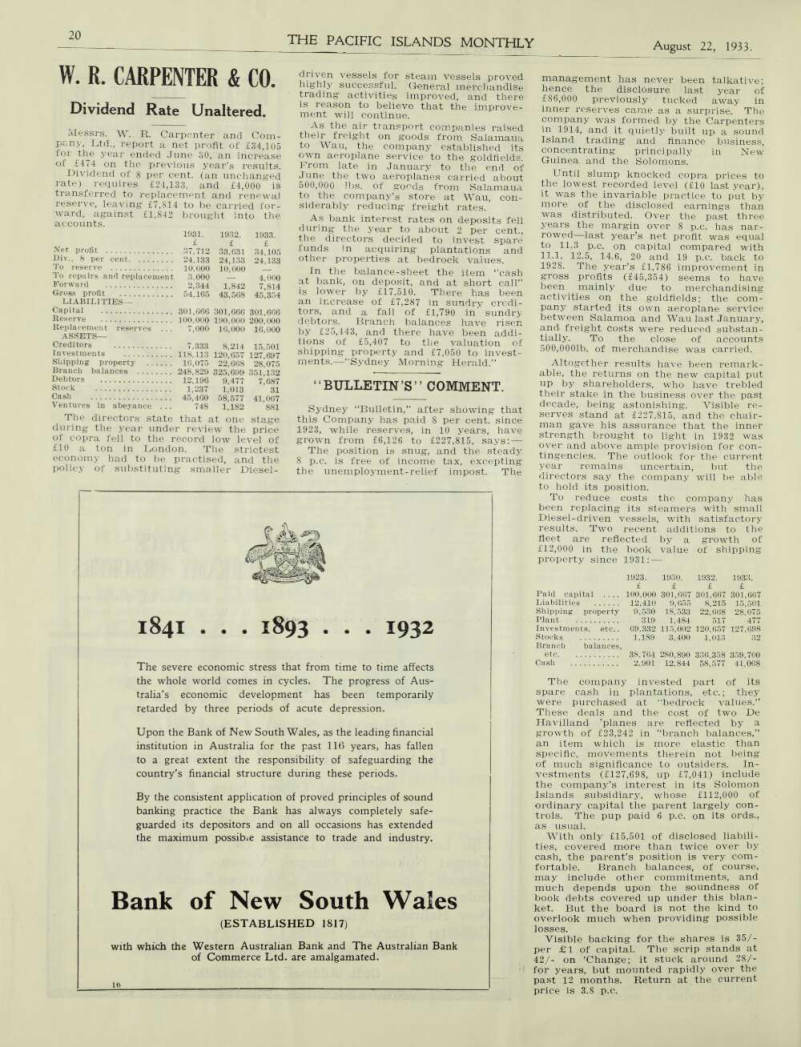
Dividend Rate Unaltered.
Messrs. W. R. Carpenter and Com pany, Ltd., report a net profit of £34,105 for the year ended June 30, an increase of £474 on the previous year’s results.
Dividend of 8 per cent, (an unchanged rate) requires £24,133, and £4,000 is transferred to replacement and renewal reserve, leaving £7,814 to be carried for ward, against £1,842 brought into the accounts.
The directors state that at one stage during the year under review the price of copra fell to the record low level of £10 a ton in London, The strictest economy had to be practised, and the policy of substituting smaller Diesel
driven vessels for steam vessels proved highly successful. General merchandise trading activities improved, and there is reason to believe that the improve ment will continue.
As the air transport companies raised their freight on goods from Salamaua to Wau, the company established its own aeroplane service to the goldfields.
From late in January to the end of June the two aeroplanes carried about 500,000 lbs. of goods from Salamaua to the company’s store at Wau, con siderably reducing freight rates.
As bank interest rates on deposits fell during the year to about 2 per cent., the directors decided to invest spare funds in acquiring plantations and other properties at bedrock values.
In the balance-sheet the item "cash at bank, on deposit, and at short call” is lower by £17,510. There has been an increase of £7,287 in sundry credi tors, and a fall of £1,790 in sundry debtors. Branch balances have risen by £25,443, and there have been addi tions of £5,407 to the valuation of shipping property and £7,050 to invest ments. —“Sydney Morning Herald.”
1931. £ 1932. £ 1933. £ Net profit 37,712 33,031 34,105 Div., 8 per cent 24,133 24,133 24,133 To reserve 10,000 10,000 To repairs and replacement 3,000 — 4,000 Forward 2,344 1,842 7,814 Gross profit 54,165 43,568 45,354
Liabilities—
Capital 301,666 301,666 301,666 Reserve 100,000 190,000 200,000 Replacement reserves .. . 7,000 10,000 16,000
Assets—
Creditors 7,333 8,214 15,501 Investments 118,113 120,657 127,697 Shipping property 10,075 22,668 28,075 Branch balances 248,829 325,699 351,132 Debtors 12,196 9,477 7,687 Stock 1,237 1,013 31 Cash 45,460 58,577 41,067 Ventures in abeyance ... 748 1,182 881
“Bulletin’S” Comment.
Sydney "Bulletin,” after showing that this Company has paid 8 per cent, since 1923, while reserves, in 10 years, have grown from £6,126 to £227,815, says: The position is snug, and the steady 8 p.c. is free of income tax, excepting the unemployment-relief impost. The
management has never been talkative; hence the disclosure last year of £86,000 previously tucked away in inner reserves came as a surprise. The company was formed by the Carpenters in 1914, and it quietly built up a sound Island trading and finance business, concentrating principally in New Guinea and the Solomons.
Until slump knocked copra prices to the lowest recorded level (£10 last year), it was the invariable practice to put by more of the disclosed earnings than was distributed. Over the past three years the margin over 8 p.c. has nar rowed—last year’s net profit was equal to 11.3 p.c. on capital compared with 11.1, 12.5, 14.6, 20 and 19 p.c. back to 1928. The year’s £1,786 improvement in gross profits (£45,354) seems to have been mainly due to merchandising activities on the goldfields; the com pany started its own aeroplane service between Salamoa and Wau last January, and freight costs were reduced substan tially. To the close of accounts 500,000lb, of merchandise was carried.
Altogether results have been remark able, the returns on the new capital put up by shareholders, who have trebled their stake in the business over the past decade, being astonishing. Visible re serves stand at £227,815, and the chair man gave his assurance that the inner strength brought to light in 1932 was over and above ample provision for con tingencies. The outlook for the current year remains uncertain, but the directors say the company will be able to hold its position.
To reduce costs the company has been replacing its steamers with small Diesel-driven vessels, with satisfactory results. Two recent additions to the fleet are reflected by a growth of £12,000 in the book value of shipping property since 1931:
The company invested part of its spare cash in plantations, etc.; they were purchased at “bedrock values.”
These deals and the cost of two De Havilland ’planes are reflected by a growth of £23,242 in “branch balances,” an item which is more elastic than specific, movements therein not being of much significance to outsiders. In vestments (£127,698, up £7,041) include the company’s interest in its Solomon Islands subsidiary, whose £112,000 of ordinary capital the parent largely con trols. The pup paid 6 p.c. on its ords., as usual.
With only £15,501 of disclosed liabili ties, covered more than twice over by cash, the parent’s position is very com fortable. Branch balances, of course, may include other commitments, and much depends upon the soundness of book debts covered up under this blan ket, But the board is not the kind to overlook much when providing possible losses.
Visible backing for the shares is 35/per £1 of capital. The scrip stands at 42/- on ’Change; it stuck around 28/for years, but mounted rapidly over the past 12 months. Return at the current price is 3.8 p.c.
1923. £ 1930. £ 1932. £ 1933. £ Paid capital 100,000 301,667 301,667 301,667 Liabilities 12,410 9,655 8,215 15,501 Shipping property 9,530 18,533 22,668 28,075 Plant 319 1,484 517 477 Investments, etc.. 69,332 115,002 120,657 127,698 Stocks 1,189 3,400 1,013 32 Branch balances, etc 38,764 280,890 336,358 359,700 Cash 2,901 12,844 58,577 41,068
Advertisements & other items, p. 22 (1 item)
Bank of New South Wales
1841 . . . 1893 . . . 1932 The severe economic stress that from time to time affects the whole world comes in cycles. The progress of Aus tralia's economic development has been temporarily retarded by three periods of acute depression.
Upon the Bank of New South Wales, as the leading financial institution in Australia for the past 116 years, has fallen to a great extent the responsibility of safeguarding the country's financial structure during these periods.
By the consistent application of proved principles of sound banking practice the Bank has always completely safe guarded its depositors and on all occasions has extended the maximum possible assistance to trade and industry.
Bank of New South Wales
(ESTABLISHED 1817)
with which the Western Australian Bank and The Australian Bank of Commerce Ltd. are amalgamated.
Charge That New Guinea Natives
Are Restless And Dangerous.
Details Placed Before Adminstrator.
A definite charge that natives in the Markham Valley area of New Guinea (through which passes some of the non-aerial traffic to the Morobe and Ramu goldfields) are getting out of control, has been made by Mr. C.
Hendry, a trader and recruiter, whose station is at Sangan, in the Markham Valley When the Administrator, General T.
Griffiths, was in this district in July, Mr. Hendry placed the following state ment before him: Early in February, Mr. E, J. Ubank and his boys were attacked by the Ragiampon villagers led by an ex policeboy, and in the melee Mr. Ubank was hit on the head with a club.
Two months later, a party of trading natives from Lehona were trading in the village of Marawassa, when one of the villagers tried to pull a bilum with out payment, and in the ensuing struggle, the Lehona native had his head cut open with a stone.
When Patrol-officer Kyle was collect ing taxes in that area last May, the villagers of Ragitsuma showed their re gard for the administration by com mitting gross indecencies. For this offence, 20 were given a whole fort night’s gaol and had to carry cargo about five miles a day and then cut the grass on an aerodrome.
Later, one of Mr. Kyle's policeboys was sent by him to ask for food for his carriers, and was punched on the nose by one of the villagers.
Also, a deserter of mine who was apprehended by Mr. Kyle and given two hours’ sand drill as punishment, picked up a stone and threw it at his police boys as soon as he was liberated, and then ran away into the bush.
Last month, my boys and I were attacked by the Ragisaria villagers; one of my boys is still seriously ill with concussion, and three of my recruits are still missing. I reported the matter to the D.O. at Salamaua and was told that they could not spare an officer to arrest the assailants, as they were so short handed.
Now comes word that two villages have had a big fight with sticks and stones, and that two policeboys and two mission-helpers were badly knocked about whilst trying to separate the combatants.
Previously, we had a very strong officer in Patrol-officer A. H. Ross, and there was no trouble then in the Mark ham Valley. For the last nine months we have been without any officer and, to quote Mr. Ubank, “A man will soon want a permit to enter the controlled area instead of the uncontrolled.’’
The plums of the district will be ably placed before you by your officers; I am trying to place before you, in my humble way, the aloes.
This area has been paying head tax for six years—10/- per capita (ablebodied men).
Watut-Langemark Area.
From another source, we are informed that conditions are very unsatisfactory
in the districts westward of the Morobe field; and we have been asked to pub lish a somewhat disturbing statement which contains very sharp criticism of certain district officers, who are named.
It would not be fair to attack, in this way, officials who have no opportunity of defending themselves. The gravamen of the charges may be thus indicated.
On Sunday morning, January 8, 1933, a Wein boy who had escaped from the Naylor and Clarius massacre, arrived at Isenbert’s camp and reported that the natives had attacked his masters and killed all the boys and that when he ran away his masters were still firing their rifles.
Bryan and Isenbert took him down to the Otibanda police post. Bryan offered to organise a well equipped party of miners and their boys and be ready to leave within two hours, in the hope of being able to save his comrades. His offer was refused by the officials. One of the latter flew to Salamaua that afternoon and, on the Tuesday, flew over the alleged scene of the tragedy and reported that he saw the natives dancing round what appeared to be a man tied to a stake in the village.
Two officers left on Friday in broad daylight. A miner with extensive New Guinea bush experience in that area, advised leaving by moonlight, so that the natives would not be able to “tele graph” their movements ahead, but was met with the curt rejoinder, “Are you trying to teach me my business?”
According to the official report, they had a brush with the natives and killed three. The policeboys, who were ques tioned by the miners, denied firing a shot and stated they never saw the natives.
Over six weeks later, two patrol officers went to the top of the ridge overlooking the Langemark Valley and saw the big villages on the opposite side. One had a very bad septic sore, and they were compelled to return for medical treatment.
Another patrol officer went in later and took ten prisoners from the Watut slope, from villages that had lifted up Naylor and Clarius’ cargo and had ad vised them strongly not to proceed further into the Langemark. (Naylor’s boy, who escaped, can substantiate this.) Five of these prisoners were killed when the patrol was ambushed.
“The only result to date (says the statement) is;—(1) Hitherto-friendly villages are now unfriendly and miners get little or no native foods. (2) The whole valley is in a state of turmoil. (3) Five innocent natives have been killed. (4) Five innocent natives are prisoners in Salamaua.”
There is a good deal more, the publi cation of which will not serve any use ful purpose. The police and patrol services of New Guinea have a fine record and reputation; and it is desir able that the suggestion that there was feebleness and delay in handling the Naylor-Clarius murder, should be brought into the open and investigated.
That may be left safely in the capable hands of the Administrator.
Dr. C. M. Dawson, formerly of the Government medical service, Tonga, has gone to reside in Apia, Western Samoa; and Dr. Brian G. Thompson has taken up the duties of medical officer in Nu kualofa.
Advertisements & other items, p. 23 (1 item)
Let Ferrodor Paint
£500,000,000
Wasted Annually
Through Rust!
The Association of Non-corrosive and Anti-corrosive Products has declared war on RUST! Mr. Robert Hadfleld, the leading spirit of the movement, declares that the world’s rust and corrosion represents an annual wastage of more than £500,000,000 practically one-third of the annual output of iron and steel products.
Let FERRODOR PAINT
(Anti-corrosive and Elastic)
DEFEND YOUR STEEL STRUCTURES
Against the ravages of rust and corrosion caused by the action of moisture-laden atmosphere, chemical fumes, etc.
Obtainable from all Leading Paint Houses and the Sole Agents:
WILLIAM ADAMS & COMPANY
LIMITED
175 CLARENCE STREET SYDNEY.
Fifty Years In Papua.
Mr. A. C.English
THE name of A. C. English has been closely associated with Papua since the earliest days when anything was known of the Territory.
Born in England in 1863, Mr. English left home at the age of eighteen, and arrived in Sydney in 1881. For two years he was engaged in collecting Natural History specimens for the Aus tralian Museums, and in 1883 was per suaded to try his luck in the then un known island of New Guinea. He landed at Karepuna on June 23, 1883, and since that date has closely identi fied himself with Papua, and with the Karepuna district in particular.
At the time of his arrival there was no settlement in New Guinea, and the natives were left to their own blood thirsty devices —except for such in effectual control as was attempted by the two white missionaries who had ar
rived ten years earlier. One or two traders navigated their vessels up and down the coast, and there were occa sional visits from black-birding schooners; but, apart from these, the country was completely unknown.
Mr. English was welcomed by the natives, and made valuable collections of Natural History specimens and of native curios. He was present when Commodore Erskine hoisted the British flag at Port Moresby in 1884, and again when Dr. William McGregor formally annexed the Territory in 1889.
He was personally known to the old traders, whose names are woven into the early history of Papua—Ansell, Fryer, Minister and others, and also to each of the Administrators who have controlled the Territory since the Pro tectorate was declared.
Dr. (afterwards Sir William) Mc Gregor was not the man to let slip the opportunity of using Mr. English’s knowledge of the natives and the country. He arrived on September 4, 1888, and in November of the same year we read in the Annual Report
that Mr. English accompanied him to Chad’s Bay and rendered valuable as sistance in investigating the murder of Captain Ansell and in arresting the murderers.
In February of the following year, Mr. English was made acting Govern ment Agent at Rigo during the in capacity of Mr. George Hunter, who was suffering from a gunshot wound; and from that time he was continuously in the Government service. His name is mentioned with the deepest appre ciat.on by Sir William McGregor as well as by Judge Winter, Sir George He Hunte, and Captain Barton. But in those early days the conditions in Papua, the hardship of travel and the demands made upon civil servants were such as are difficult to realise in these comparatively settled times, and in May, 1907, Mr. English decided that he had had enough, and resigned from the service.
He settled at Rigo, in the district where he was already so well known and so deeply respected; and he is still planting, trading and collecting within a few miles of the spot where he first landed in the Territory 50 years ago.
With Mr. English at Rigo are his wife, a son and two daughters, whose warm hospitality, added to his genial personality, his fund of anecdote, shrewd humour and accumulated wisdom, proves an irresistible magnet to all who pass that way.
Younger in all essentials than most men of forty, his many friends con fidently hope to see him enjoy many more years of health and happiness in the Territory which he has served so long and so well.
Chinaman Stabs Half
Caste Wife.
From Our Own Correspondent.
Rabaul, July 21.
CHAN YUEN, an elderly Chinaman, appeared before His Honour, Chief Judge Wanliss, in the Central Court on July 12, having being committed for trial from the District Court on a charge of attempted unlawful killing.
The evidence showed that Chan Yuen attacked his wife, a half-caste girl, much younger than himself, and of whom he was reasonably jealous, and inflicted several wounds about her body and face; one of which, it was alleged, could have been fatal. From the evidence it was apparent that the woman had no regard for the marriage tie and had admitted improper relations with other men.
His Honour sentenced the accused to two years’ imprisonment with hard labour, adding that the accused was more to be pitied and the woman was to blame.
Praise For N.G. Service.
In an address at a Sydney club during July, Major C. W. C. Marr (Minister in charge of Islands Territories), emphasised that New Guinea had be come a most valuable part of the nation. The New Guinea Public Ser vice, he said, from the Administrator to the most humble junior, was one of the finest in the world, and the equal of any other colonial service.
He added that probably only world war could take away New Guinea from Australia.
Advertisements & other items, p. 24 (1 item)
W. Holmes
SHIP CHANDLERY - HARDWARE
BROOMFIELDS LIMITED, 152 Sussex St., SYDNEY.
Large and Complete Stocks of SHIP CHANDLERY.
Ironmongery of all kinds. Paints, White Lead and Oils.
Sole Agents for P. H. MUNTZ & CO.’S 3-CROWN BRAND METAL SHEATHING.
PEACOCK & BUCHANS’ ENGLISH READY - MIXED PAINTS.
WRITE FOR SHIP CHANDLERY CATALOGUE.
Special “In Bond” Prices for all Island enquiries quoted on application.
CABLES: “BOOM,” SYDNEY.
W. HOLMES
SHIP, LAUNCH, & BOATBUILDER & ENGINEER,
All classes of Islands Vessels a Speciality.
McMAHON’S POINT - - - - SYDNEY.
Cable Address: “HOLMAC,” SYDNEY.
PACIFIC ISLANDS ASSOCIATION.
Headquarters and Clubrooms:
MILLIONS HOUSE, ROWE STREET, SYDNEY.
Telephone: 84971.
Founded in 1931 to Advance the Interests of Residents of the Pacific; Assist Island Trade; Provide Information for Tourists; and Promote the Welfare of the Native Races.
Secretary’s Office: NATIONAL MUTUAL BUILDING, 350 GEORGE STREET, near G.P.O., SYDNEY, AUSTRALIA. :: :: :: Telephone: B 5067.
Cable Address: “CERTAC,” Sydney.
Ancient Stone.
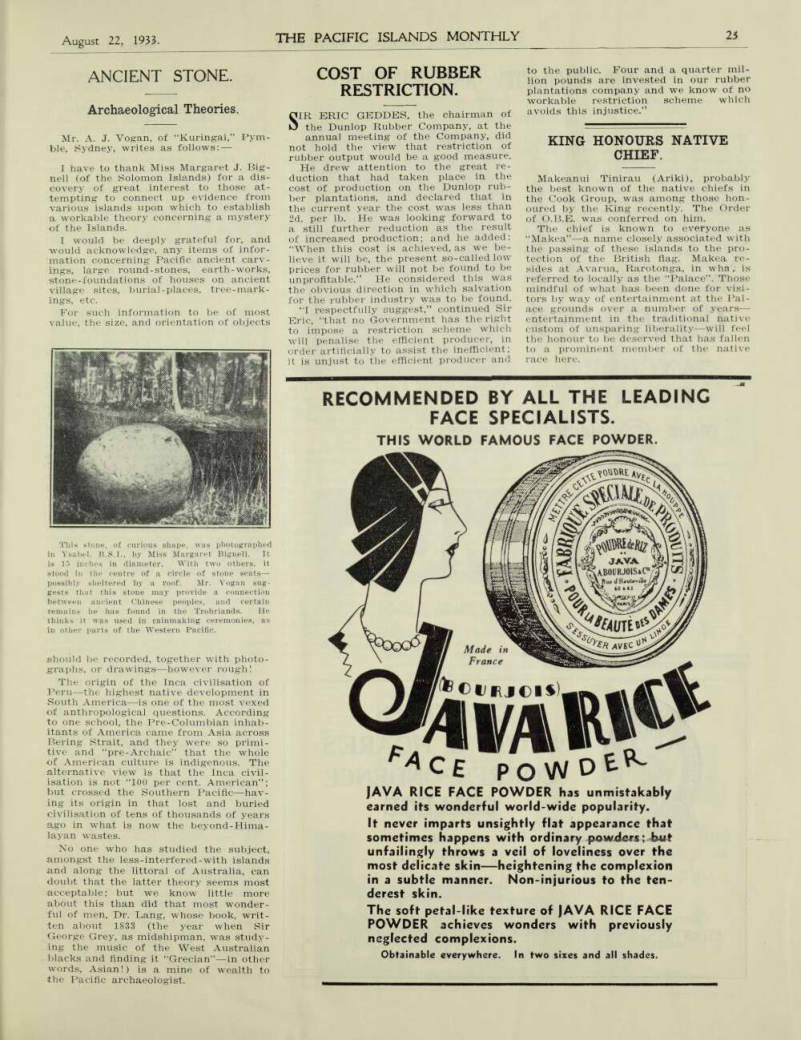
Archaeological Theories.
Mr. A. J. Vogan, of “Kuringai,” Pym ble, Sydney, writes as follows: I have to thank Miss Margaret J. Big nell (of the Solomon Islands) for a dis covery of great interest to those at tempting to connect up evidence from various islands upon which to establish a workable theory concerning a mystery of the Islands.
I would be deeply grateful for, and would acknowledge, any items of infor mation concerning Pacific ancient carv ings, large round-stones, earth-works, stone-foundations of houses on ancient village sites, burial-places, tree-mark ings, etc.
For such information to be of most value, the size, and orientation of objects
should be recorded, together with photo graphs, or drawings—however rough!
The origin of the Inca civilisation of Peru —the highest native development in South America —is one of the most vexed of anthropological questions. According to one school, the Pre-Columbian inhab itants of America came from Asia across Bering Strait, and they were so primi tive and “pre-Archaic” that the whole of American culture is indigenous. The alternative view is that the Inca civil isation is not “100 per cent. American”; but crossed the Southern Pacific —hav ing its origin in that lost and buried civilisation of tens of thousands of years ago in what is now the beyond-Hima layan wastes.
No one who has studied the subject, amongst the less-interfered-with islands and along the littoral of Australia, can doubt that the latter theory seems most acceptable; but we know little more about this than did that most wonder ful of men, Dr. Lang, whose book, writ ten about 1833 (the year when Sir George Grey, as midshipman, was study ing the music of the West Australian blacks and finding it “Grecian” —in other words, Asian!) is a mine of wealth to the Pacific archaeologist.
This stone, of curious shape, was photographed in Ysabel, B.S.I., by Miss Margaret Bignell. It is 15 inches in diameter. With two others, it stood in the centre of a circle of stone seats — possibly sheltered by a roof. Mr. Vogan sug gests that this stone may provide a connection between ancient Chinese peoples, and certain remains he has found in the Trobriands. He thinks it was used in rainmaking ceremonies, as in other parts of the Western Pacific.
Restriction.
Cost Of Rubber
SIR ERIC GEDDES, the chairman of the Dunlop Rubber Company, at the annual meeting of the Company, did not hold the view that restriction of rubber output would be a good measure.
He drew attention to the great re duction that had taken place in the cost of production on the Dunlop rub ber plantations, and declared that in the current year the cost was less than 2d. per lb. He was looking forward to a still further reduction as the result of increased production; and he added: “When this cost is achieved, as we be lieve it will be, the present so-called low prices for rubber will not be found to be unprofitable.” He considered this was the obvious direction in which salvation for the rubber industry was to be found.
“I respectfully suggest,” continued Sir Eric, “that no Government has the right to impose a restriction scheme which will penalise the efficient producer, in order artificially to assist the inefficient; it is unjust to the efficient producer and
to the public. Four and a quarter mil non pounds are invested in our rubber plantations company and we know of no workable restriction scheme which avoids this injustice.”
Chief.
King Honours Native
Makeanui Tinirau (Ariki), probably the best known of the native chiefs in the Cook Group, was among those hon cured by the King recently. The Order of O.B.E. was conferred on him.
The chief is known to everyone as “Makea”—a name closely associated with the passing of these islands to the pro tection of the British flag. Makea re sides at Avarua, Rarotonga, in what is referred to locally as the “Palace”. Those mindful of what has been done for visi tors by way of entertainment at the Pal ace grounds over a number of years — entertainment in the traditional native custom of unsparing liberality—will feel the honour to be deserved that has fallen to a prominent member of the native race here.
Advertisements & other items, p. 25 (1 item)
Java Rice
RECOMMENDED BY ALL THE LEADING
FACE SPECIALISTS.
THIS WORLD FAMOUS FACE POWDER.
Made in France
Java Rice
Face Powder JAVA RICE FACE POWDER has unmistakably earned its wonderful world-wide popularity.
It never imparts unsightly flat appearance that sometimes happens with ordinary powders; but unfailingly throws a veil of loveliness over the most delicate skin—heightening the complexion in a subtle manner. Non-injurious to the ten derest skin.
The soft petal-like texture of JAVA RICE FACE POWDER achieves wonders with previously neglected complexions.
Obtainable everywhere. In two sizes and all shades.
Papua, Publicity And Patrols
(By Gordon Thomas.)
THERE was rather a pitiful —almost a disconsolate —note that came to the surface, here and there, in your Papuan correspondent’s article, “Papuan Patrols” (“P.I.M.,” June 24th.).
The wistful “it is not fair to belittle the work of the patrol officers in Papua” seems rather incongruous, and gives one the idea that the correspon dent does not know what he is writing about. The exploits of the Papuan Service have gone down to history years ago, and in the archives of re
search you will find their doings recorded.
If such patrols have not occupied feature columns in the Australian press, it is possible that they (the patrols) may not have missed very much.
Together with this wistful note there appears to be an undercurrent of, shall we say, tribal jealousy or Territorial rivalry, and really I fail to understand the reason why an attempt should be made to foster that feeling which, un fortunately, amongst some of the more narrow-minded residents of both Man dated New Guinea and Papua, is too often apparent.
Actually there should be no rivalry between the two territories; because in reality it is almost impossible to place them side by side and attempt to make comparisons—at least insofar as economic conditions are concerned.
And as for the world’s knowledge of Papuan patrols I feel confident that, in the more distant parts of the world, the exploits of the Papuan officials are equally as well known (if not better) than those carried out by officers in the mandated area.
Murray’s Papua—or sometimes it may be Papua’s Murray—is a household word where exploration in uncivilised countries is discussed. For many years Murray’s administration in Papua has been held as an example of perfection, both in scientific and economic circles.
There is, possibly, the tendency at times for the individual to overshadow the Service as a whole. Be that as it may; it has resulted in the fact that Papua is most certainly “on the map” where patrols, penetrating into new country, are concerned. In fact the writer of the article himself in one instance refers to “The world-famous patrol of Messrs. Karius and Cham pion.” And the patrols of Staniforth Smith, up the Kikori, and Karius to the Fly watershed, both earned for these men the gold medal of the Royal Geographical Society.
If insufficient publicity in the Penny Press has become Papua’s grievance, surely that is easily overcome, either by the Administration appointing a publicity officer, or some private indi vidual electing himself a contributor to the Southern Press.
The world knows but only too well that Papua possesses writers of great popularity. No one could desire a more far-reaching circulation than Beatrice Grimshaw; and the stories of Turnbull, Armitt and "Alys Brown” all tend to bring Papua before the public eye; so much so in fact that I am prepared to wager that Papua is, at the present time, better known farther afield than the Territory of New Guinea.
But, nevertheless, inter-territorial jealousies are not going to assist in attaining the object which your cor respondent seems desirous of obtain ing.
Neither is unreliable information — passed on to a too-often indiscrimin ating public—a good foundation upon which to build up a publicity campaign in favour of Papua’s well-deserving patrol officers.
It would be both unfair and ludicrous to belittle the work of government officials who have pioneered the un known parts of Papua, or to make statements regarding their patrols which were untrue. From my knowledge of New Guinea history the statement re garding the Humphries’ expedition in 1917 “among tribes who had never been visited” seems hardly to coincide with historical data, which shows this country to have been visited by Monckton in 1909; by the Lutheran mis sionaries in 1913, and in 1914 by the German, Captain Detzner. Nor do I think that Humphries himself would lay claim to having been the first to make contact with tribes who already had been visited by other whites.
The reference to Hides’ patrol up the Tiveri River, in the Lakekamu gold fields area in 1930, loses much of its authenticity when it is remembered that the Lakekamu watershed has been the scene of activities by prospectors and officials since 1910, and since that date almost a score of attacks have been made upon Europeans, according to the Papuan Annual Reports; while Hides’ expedition, according to my, in formants, who are hard-bitten old timers, who miss very little that goes on in Papua, was anything but “blood less,” for he was attacked no less than nine times during that patrol.
I point these inaccuracies out purely for the purpose of historical correct ness, and also in the interests of the men who have been credited with per forming acts which actually differed from the writer’s version. Not for one moment do I desire to withhold credit where credit is due to the officials of the Papuan Service. That would at once savour of petty jealousy, which I trust I do not possess. Rather would I wel come a better understanding between all residents —official and unofficial, prospectors, planters and priests—of the two Territories.
Papua and Mandated New Guinea have much in common; and those aims could be realised far easier by working together than by being possessed of petty jealousies and rivalries that wilt tend more to retrogression than the progress which is so essential for both of these young Territories at this: present juncture.
Advertisements & other items, p. 26 (1 item)
Gillespie’S
"ANCHOR”
FLOUR
TRADE MARK
The Standard of Quality.
CHARTRES,
STOTT & HOARE’S
CORRESPONDENCE
COLLEGE
Founded 1885.
Pioneers and Specialists in Postal Instruction.
All Educational and Commercial subjects taught thoroughly and efficiently by correspondence.
Experienced Certificated Instructors. Write for particulars.
CHARTRES, STOTT & HOARE’S CORRESPONDENCE COLLEGE,
Liverpool Street, Sydney, Australia.
Tahitian Robbers.
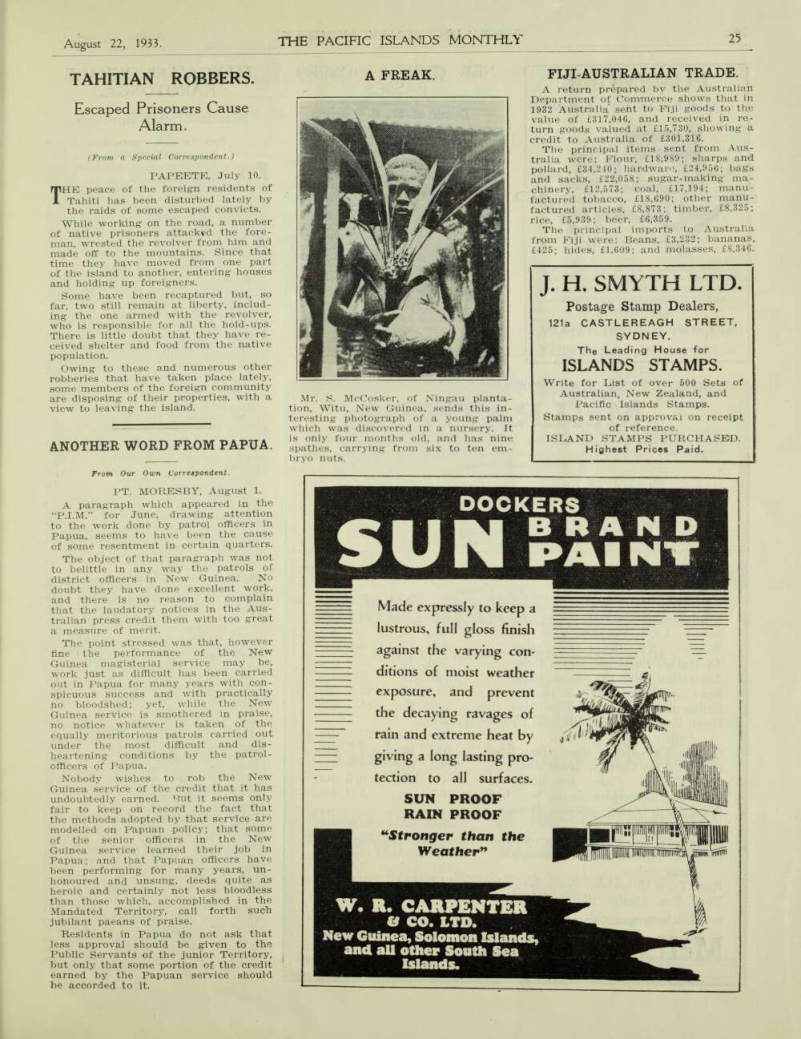
Escaped Prisoners Cause Alarm.
(From a Special Correspondent.)
Papeete, July 10.
THE peace of the foreign residents of Tahiti has been disturbed lately by the raids of some escaped convicts.
While working on the road, a number of native prisoners attacked the fore man, wrested the revolver from him and made off to the mountains. Since that time they have moved from one part of the island to another, entering houses and holding up foreigners.
Some have been recaptured but, so far, two still remain at liberty, includ ing the one armed with the revolver, who is responsible for all the hold-ups.
There is little doubt that they have re ceived shelter and food from the native population.
Owing to these and numerous other robberies that have taken place lately, some members of the foreign community are disposing of their properties, with a view to leaving the island.
Another Word From Papua.
From Our Own Correspondent.
PT. MORESBY, August 1.
A paragraph which appeared in the “P.I.M.” for June, drawing attention to the work done by patrol officers in Papua, seems to have been the cause of some resentment in certain quarters.
The object of that paragraph was not to belittle in any way the patrols of district officers in New Guinea. No doubt they have done excellent work, and there is no reason to complain that the laudatory notices in the Aus tralian press credit them with too great a measure of merit.
The point stressed was that, however fine the performance of the New Guinea magisterial service may be, work just as difficult has been carried out in Papua for many years with con spicuous success and with practically no bloodshed; yet, while the New Guinea service is smothered in praise, no notice whatever is taken of the equally meritorious patrols carried out under the most difficult and dis heartening conditions by the patrol officers of Papua.
Nobody wishes to rob the New Guinea service of the credit that it has undoubtedly earned. But it seems only fair to keep on record the fact that the methods adopted by that service are modelled on Papuan policy; that some of the senior officers in the New Guinea service learned their job in Papua; and that Papuan officers have been performing for many years, un honoured and unsung, deeds quite as heroic and certainly not less bloodless than those which, accomplished in the Mandated Territory, call forth such jubilant paeans of praise.
Residents in Papua do not ask that less approval should be given to the Public Servants of the junior Territory, but only that some portion of the credit earned by the Papuan service should be accorded to it.
A Freak.
Mr. S. McCosker, of Ningau planta tion, Witu, New Guinea, sends this in teresting photograph of a young palm which was discovered in a nursery. It is only four months old, and has nine spathes, carrying from six to ten em bryo nuts.
Fiji-Australian Trade.
A return prepared by the Australian Department of Commerce shows that in 1932 Australia sent to Fiji goods to the value of £317,046, and received in re turn goods valued at £15,730, showing a credit to Australia of £301,316.
The principal items sent from Aus tralia were: Flour, £18,989; sharps and pollard, £34,240; hardware, £24,956; bags and sacks, £22,058; sugar-making ma chinery, £12,573; coal, £17,194; manu factured tobacco, £18,690; other manu factured articles, £8,873; timber, £8,325; rice, £5,939; beer, £6,359.
The principal imports to Australia from Fiji were; Beans, £3,232; bananas, £425; hides, £1,609; and molasses, £8,346.
Advertisements & other items, pp. 27-28 (1 item)
Brand
J. H, SMYTH LTD.
Postage Stamp Dealers,
121 a CASTLEREAGH STREET,
SYDNEY.
The Leading House for
ISLANDS STAMPS.
Write for List of over 500 Sets of Australian, New Zealand, and Pacific Islands Stamps.
Stamps sent on approval on receipt of reference.
ISLAND STAMPS PURCHASED.
Highest Prices Paid.
DOCKERS
BRAND
Made expressly to keep a lustrous, full gloss finish
against the varying con
ditions of moist weather exposure, and prevent the decaying ravages of rain and extreme heat by
giving a long lasting pro
tection to all surfaces.
SUN PROOF
RAIN PROOF
“Stronger than the Weather ”
W. R. CARPENTER
& CO. LTD.
New Guinea, Solomon Islands, and all other South Sea Islands.
PUMPMOBIL
Light & Portable MOTOR PUMPS.
Weight about 140 lbs. Automatic Priming. Reliable and Efficient.
Especially suitable for Prospecting and all Sluicing requirements.
Particulars from
NELSON & ROBERTSON,
12 Spring Street SYDNEY.
McILRATH’S
don't advertise catch lines. The goods quoted below are advertised because you need them, not because they are relatively cheaper than the other goods we sell.
Madam Pilchards in Sauce, 1lb. tins (4 doz.) 5/9 doz., 21/- case Finest Roller Flour, 50lb 5/9 bag, 8/9 tin Australian LA. Sugar, cases (2x35lb. tins) 20/- case Castle Assorted Fancy Meats, 16oz, tins (4 doz.) 10/3 doz., 37/- case Globe Sheeps Tongues, 12oz. tins (4 doz.) 11/6 doz., 39/- case Nestles Condensed Milk, Full Cream (4 doz.) 7/9 doz., 29/- case Ideal Unsweetened Milk, 6oz. tins (8 doz.) 4/- doz., 25/- case Rosa or I.X.L. Peaches, 30oz. tins . . . . 9d. tin, 8/9 doz.
Rosa or I.X.L. Pears, 30oz. tins .. . . 10d. tin, 9/9 doz.
Australian Sultanas, 3-crn. loose . . .. 6d. lb., 5/9 doz.
Australian Currants, 3-crn. loose . . . . 6d. lb., 5/9 doz.
Rosa Baking Powder, 1lb. tins 1/6 tin, 17/6 doz.
Californian Asparagus Tips, 9½oz. tins .. 1/2½ tin, 13/- doz.
Dried Brown Onions, 1lb. tins (equiv. 10lbs. fresh) 2/4 tin, 27/- doz.
Garden Vale Green Peas, 16oz. tins . . tin, 8/- doz.
Garden Vale Carrots, 16oz. tins . . .. 8d. tin, 7/6 doz.
I.X.L. Tomato Sauce, 4oz. bots 5½d, bot., 5/3 doz.
Rosa Worcestershire Sauce, 9oz. bots. .. 6d, bot., 5/9 doz.
Rosa High Grade White Onions, large jars 1/1 jar, 12/6 doz.
Selmore Toilet Paper, 5oz. rolls .. .. 1/10 doz., 20/- gross Emorna Carbolic Toilet Soap, large cakes 3½d. cake, 3/3 doz.
Rosa Pure Household Soap, large bars., 7½d. bar, 7/- doz.
Yoga Tea, Choice Blend, 1lb 1/9 pkt., 2/1 tin Prices f.o.b., Sydney. Complete Export Price List available on application.
McILRATH’S Ltd.
Export Department:
202 PITT STREET,
SYDNEY (Aust.)
New Guinea Pioneer
Passes.
Death of W. R. Louri.
From Our Own Correspondent
Rabaul, July 22.
Walter Reginald Louri, Of Gil
Gil Plantation in New Ireland, passed away peacefully on Sunday morning, July 16th, in the Namanula Hospital.
In the afternoon the funeral took place at Vunapope Cathedral, near Ko kopo. The service was conducted by Rev. Father Bender, while His Lord ship Bishop Vesters was in attendance.
Deceased originally came from New Zealand to this Territory in 1899 and, with his passing, we lose our oldest British resident pioneer.
The late W. R. Louri was the first to instal an ice factory in Rabaul, and for some time he ran the first hotel here. For many years he managed the Hilalon estates, in the Namatanai dis trict.
Mangaians Invade
Rarotonga.
Islands Cricket Interlude.
From Our Own Correspondent.
Rarotonga, July 5.
EARLY in the month a sensation was caused at Rarotonga by the news that a band of redoubtable Manga ians were about to cross the frontiers of the Rarotonga Sports Association; and that body immediately took steps to deal with the invasion. The Mangaians had, for some time, been carrying out very extensive tests with bowlers and bats men on a concrete pitch which they had laid down on their own island.
Mangaia is 110 miles from Rarotonga and is considered one of the most weird islands in the Pacific, geologically. Its contour has been likened to a huge pie, the crust of which has fallen in, leaving a high outer rim and a central elevation.
It has extensive cave systems, the great chambers of which contain the bones of its previous native inhabitants. Man gaia has great traditions and, on account of its more southerly position, its people are probably the most vigorous and in dustrious of the Cook Group.
Much fun is poked at the Mangaian by his friends at the other islands on account of his hardy, gruff ways; but he takes it with good humour, planting his sure foot on other islands of the Group, digging himself firmly into a job and hanging on to it like a leech. He is “Jock” of the Cook Islands.
The Mangaians, 25 in all, came in from their Marmio patches along the valleys, from their orange plantations and small jobs and, with many choice presents for the Rarotongan womenfolk, marched down from their battlemented island, took passage by the schooner “Tagua” and disembarked at Rarotonga on May 26.
Then a series of struggles took place, each celebrated afterwards with an “Umukai.” Test matches followed. The Mangaians, trained as they had been on the modern lines of a concrete pitch, be came hopelessly demoralised on the rugged strips of paddock on which the big fights took place. With the idea of evening things up, the Rarotongans bor rowed a coconut cricketing mat, and laid it down as a covering for the coral pro jections and crab holes; but the Man gaians regarded the matting sideways and its use was discontinued.
The teams fought out their five test matches on scraggy, knotty-surfaced pitches. Captain Toko, of the Mangaians, together with his men, did their best to lift the ball off the island; but suc ceeded only in compiling outstanding bowling averages for their opponents.
Captain Toko was defeated four times, out of the five battles.
The final action took place on June 26, and the Mangaians were finally and decisively routed. They escaped aboard the “Waihemo,” which called at Raro tonga on June 28, and succeeded in tak ing away with them the trunks of two large “Puka” trees, which the vessel towed in its wake. These tree-trunks, signalising as they did, defeat, will be hewn out, spliced end to end, and trimmed into a fine canoe. With that canoe they will shoot their produce across the dangerous reef to be picked up by the steamer; and thus, when the sinews of war are available again for another trip to Rarotonga, come back and lay the proud Rarotongans in the dust.
Romantic History Of E. W. Gurr.
Man Who Fought for Samoan Freedom.
THE well-known resident of Samoa, Edwin William Gurr, who died in Pago Pago naval hospital on July 1, although born in Tasmania, had grown to manhood in New Zealand, and had there qualified as a schoolteacher.
Because he held the title of “Judge”
Gurr, from an American source, he has been referred to as an American; but he was really a New Zealander, and in his early days in Samoa he fought hard to secure New Zealand influence in support of the cause of Samoan freedom. It, therefore, was a curious turn of fate that in his later years he was regarded as an enemy of New Zealand.
Mr. Gurr went from New Zealand to Samoa in his early twenties, to enter the banking business. We take the following particulars of his interesting career from a striking biography written by Mr.
Percy Andrew, of Auckland. Mr. Andrew, needless to say, has strong Mau sym pathies.
Mr. Gurr arrived over 40 years ago to find Samoa the object of intrigue and plotting between the consuls and nat ionals of the three great Powers (Britain, Germany and United States), all eager to despoil these happy isles, and he was soon found on the side of the Samoans.
There were three white men whom the Samoans have to thank for foiling the repeated attempts to rob them of their country—E. W. Gurr, R. L. Stevenson, and Wm. Cooper. R.L.S. lies in his grave at the top of Mount Vaea; Judge Gurr rests at Tutuila; and William Cooper still lives in Auckland, where, sightless and very aged, he still follows with deep sympathy and interest the prolonged struggle of the Samoans for freedom.
R.L.S. was invaluable with his fiery let ters to the London “Times,” while Messrs. Gurr and Cooper (a brother of the late Sir Theo. Cooper) provided Tusitala with the ammuntion for his ruthless exposures of the plotting against the Samoans.
When the three Powers abandoned all plans to subdivide Samoa, and signed the Treaty of Berlin guaranteeing the Samoans their independence, neutrality and autonomy, a Land Commission was set up to dispose of all claims to land in Samoa. It was then found that the foreigners were claiming ownership of far more land than ever existed in the whole Samoan archipelago. Henry Clay Ide, afterwards a famous American am bassador, was the first President of the Land Commission, Eggert was the Ger man representative, and Michael Hag gard (brother of Sir Rider Haggard) the English representative. E. W. Gurr was appointed to represent the Samoans on the Commission, and, thanks to his un ceasing resistance to the land-grabbers, only a small portion of the lands claimed was alienated from the natives. Had Misi Kea (Mr. Gurr) been self-seeking and unscrupulous he could have fattened his friends and feathered his own nest, but he was the soul of honour and in tegrity, and died as he had lived, poor in this world’s goods but rich in the un shaken love and faith of the Samoans.
When the three Powers mutually agreed to dissolve the Tripartite protec tion, and Britain withdrew, Mr. Gurr did not choose to live under the German regime in Western Samoa, and went across to Tutuila with his Samoan wife
to settle there. The American authorities at once enlisted his services to assist in the new job of assuming a protectorship over Eastern Samoa. He was made Chief Judge of the Supreme Court, and also Secretary for Native Affairs; offices he held with distinction for eight years, during which time he codified the native laws of the territory.
From the time oi his retirement from the Supreme Court bench in 1908 until 1924, Judge Gurr lived on his plantation at Maloata until 1924, when he returned to Western Samoa. Here he found an army of officials, planning to revolution ise the social and economic system of the Samoans, which had stood the tests of so many centuries, and was the only natural one for them to follow. The na five lands were to be individualised;
marriages in Samoan fashion were not to be recognised! “model” villages with town-planning, and all modern conveni ences of European “culture” were to be instituted.
No white man has ever known the mind of the Samoans as intimately and sympathetically as Judge Gurr, and he was to them what Judge Maning was to the Maoris of North Auckland —their guide, philosopher and friend. From this insight into Samoan psychology, the dangers of meddling with the communal land system, marriage customs, and con trol of the villages were obvious to his trained mind. When the Hon. O. F.
Nelson arrived back in Apia in 1926 and announced that the New Zealand Gov ernment was going to straighten up the mess that had been made in Samoa, Judge Gurr joined heart and soul in the work of the Citizens’ Committee. He was the foundation editor of the “Samoa Guardian.” For these activities he was deported by General Richardson for five years in 1928.
For many years Judge Gurr had suf
fered ill-health, having contracted the dreaded filaria (mumu or elephantiasis) in his early days in Samoa. When he settled in Tutuila a medical commission of international experts in tropical dis eases visited Samoa to investigate the disease, and it is typical of Judge Gurr that he willingly offered himself as an experimental medium for testing the effects of possible cures. The disease had been tracked to the germ-carrying mos quito: the problem was to find a cure for the filaria, with its painful recurring attacks. The doctors warned the Judge that some of the poisonous remedies tried might kill instead of cure him, but his only reply was a laugh and an in junction to “Go ahead and fire away.”
He would always jokingly describe some of the tortures he voluntarily submitted to, and how the experts could find no cure, but discovered an enormous num ber of things which would not cure ele phantiasis, and proved it on him!
When deported in 1928, Judge Gurr wished to return to his plantation and home in Tutuila, but he was advised that as America wished to avoid friction with New Zealand, his return to American Samoa could not be approved, and he
was forced to go to New Zealand, where the climate proved very aggravating to the complaint which afflicted him. He bore his exile with courage and fortitude.
Towards the end of last year, just as his term of exile was expiring, the Judge’s health began to fail rapidly, and a period in the Auckland hospital with expert examination held very little hope of permanent recovery. When he joined Mr. Nelson on the return from exile, he had to be taken on board from a sick bed. He survived to reach his loved Samoa once more, and find his final rest in the soil he fought so nobly to keep forever Samoan.
Advertisements & other items, p. 29 (1 item)
James Barnes Limited
THE
“CALEDONIA DOVER.”
A COOKING STOVE guaranteed to give complete satisfaction and now recognised as THE BEST on the market. Suitable for coal, ccke or wood fuel.
Illustrated Catalogue on request.
LANE & GIRVAN, LTD.,
BONNY BRIDGE, SCOTLAND.
JAMES BARNES LIMITED
2 Botany Street, Waterloo, Sydney
(tSTABLISHED 1881)
MANUFACTURERS OF
“Globe” & “Victory” Brands
OF
SHEEP’S TONGUES OX TONGUES SAUSAGES
PRESERVED MEATS BEEF EXTRACT DRIPPING
Also “Castle” Brand, which is specially packed for use by the White Population.
Globe Beef Extract is invaluable to Young and Old.
Tested Recipes on the packet 4oz. and 8oz. sizes.
Samoan Trade Figures
for 1932.
TRADE and shipping returns received from Western Samoa show that the value of imports to that Territory for the calendar year 1932 were estimated at £150,902, of which New Zealand sup plied £54,403, United Kingdom £32,213, Australia £31,707, and U.S.A. £12,105.
The principal items sent from Aus
tralia were flour £4,381, rice £4,289, bags and sacks £4,772, drugs £2,198, tinned meat £1,658, timber £2,038, tobacco £2,039, general provisions £2,988.
Samoa’s exports for 1932 were valued at £183,028, and the principal countries to which they were shipped were: European countries £96,546, United Kingdom £46,654, New Zealand £22,578, U.S.A. £12,181. Exports to Australia amounted only to £389.
The produce exported from Samoa in 1932 consisted of: Copra £108,698, cocoa £49,712, bananas £20,016.
Swedish Writer’S
Visit To Samoa.
Praise for the Germans.
WIDE publicity has been given to articles by a famous Swedish writer, Ludwig Nordstrom, who re cently spent some months in the South Seas. He gave particular attention to Western Samoa, and he appears not to have liked the conditions he found there.
It should perhaps be noted that Mr.
Nordstrom is half English, by birth, and that, during the war, he fought on the side of the Allies, against Germany. He refers to “massacres” among the native Samoans; and declares that further sac rifices of life were prevented only by the “timely, opportune pacification of the Samoans by alert and intelligent high chiefs.”
The first fact that impressed Mr.
Nordstrom was, that “everything that is good, useful, and practical in Samoa owes its origin to the Germans.” The next was that all progress had come to a standstill since the Germans’ forced departure from the islands.
Mr. Nordstrom’s notes contain the fol lowing observations: A Scandinavian, who already before the war was shipping copra for a firm in Hamburg and who is still actively en gaged in the South Seas, said to him: "The Germans were very good. They have left a good name in the Pacific.
They established order and the natives acquired money. When the Germans re turn they will be received with open arms.”
An Englishman living in Samoa said: “There is a vast difference between the present and the German time. At the time of the Germans, everything here was in perfect condition and order; busi ness flourished, the natives earned money and made rapid progress. The planting of the coconut-trees was done systematically. All the roads that exist now were then built; proper steel bridges were built across rivers; the roads were asphalted. Apia was put into splendid condition. In a word, it may be said, that everything good in Samoa comes from the Germans.”
Mr. Nordstrom put the question: “Has it been the Germans who have helped the natives in the formulation of their regulations regarding their homes? I mean the border of stones round the houses, the laying out of gardens, the arrangements of flowers, etc.?” “Yes,” was the reply.
He wondered whether the discontent of the Samoan people is to be based on the diffence between the German and the New Zealand rule. Instead of a direct answer, the Englishman pointed to coconut plantation: “You see weeds around all these palms. All the German
time, there was a lawn here; as far as one could see, nothing but trunks and trunks. Not a single coconut that fell from a tree was left unnoticed. There was system then and order. See, how everything has since then deteriorated.”
When the German were obliged to leave there was £122,000 in the coffers of the people. In 1929 there was a £312,000 debt to the N.Z. Government. The Ger mans had the tact to leave the customs and the self-government of the natives untouched. The new Government abro gated the dignity of the high chiefs and put in its place a native representation, the members of which are nominated by the Governor of Apia.
Grievances have been addressed to the English Government, to the King of England, to the Prince of Wales, to the League of Nations, without success.
Advertisements & other items, p. 30 (1 item)
Portland Cement
SHIPCHANDLERY.
W. Kopsen & Co. Limited
Manufacturer a of PIONEER BRAND ASH OARS AND IMPLEMENT HANDLES.
Sole Agenta for: KOPSEN’S SPECIAL YELLOW METAL SHEATHING AND NAILS.
Large Stocks of Chains, Anchors, Manilla and Wire Ropes, Wood and Iron Blocks, Oakum, Tar, Pitch, Oils, Paints, Leads, Zincs, Varnishes, Shackles, Rigging, Screws, Sheathing, Felt, Lampware, etc.
Pricea and Particulara on Application.
68-70 CLARENCE STREET, SYDNEY.
Cables: '‘Kopsen." ‘Phone; BW 1114-5.
“UNION ”
PORTLAND CEMENT
GUARANTEED HIGHEST QUALITY.
Concrete is the Ideal Constructional Material, and eminently suited to Island conditions, being Weatherproof, Rat-proof, Vermin-proof, Everlasting.
For Store Buildings, Dwellings, Silos, Tanks, Floors, Paths, Pipes, etc., Unexcelled.
Send for Free Pamphlets on all Concrete Problems.
COMPETITIVE PRICES. :: ENQUIRIES INVITED.
THE COMMONWEALTH PORTLAND CEMENT COMPANY LTD.,
SYDNEY and PORTLAND, NS W.
Postal Address: Telegraphic Address:
Box 1571 E, G.P.O. “LIMERIEZ"
SYDNEY. SYDNEY.
French Warship’S Visit.
From Our Own Correspondent.
Pt. Moresby, July 31.
THE French warship Savorgnan de Brazza arrived in Port Moresby on July 6, on her cruise through the Pacific and left again on July 27 for Yule Island, where she put in for three days before continuing her way east wards.
The usual official calls were ex changed on her arrival, between the Commander and His Excellency Sir Hubert Murray, and the Lieut Governor’s salute of 15 guns was fired.
In the evening Sir Hubert and Lady Murray entertained Commander Rosati and officers of the warship at dinner at Government House; and later they attended a ball given by the Church of England Ladies’ Guild in Port Moresby.
Echo Of 1880.
Survivor of De Rays’ Expedition Dead.
ONE of the few remaining links with the ill-fated colonising expedition of the Frenchman, Marquis De Rays, in 1880, was severed when Madame Niau died in Sydney on July 31, at the age of 83.
Madame Niau and her husband, en ticed by the attractive colonisation scheme, joined the expedition shortly before the three-masted “Chandernagor” left Holland for New Ireland, in 1879.
Arriving in Australia, Madame Niau de cided to remain in Sydney, while her husband went on to Port Breton, New Ireland, where it was proposed to estab lish the first settlement of this ambitious scheme.
However, New Ireland presented a totally different scene to that which the settlers had been led to expect. Fever, discontent and home-sickness caused the emigrants to abandon the enterprise and some of them, including M. Niau, returned to Australia disillusioned.
M. and Madame Niau then tried to settle in North Queensland, as sugar planters, on the Daintree River. But again circumstances compelled them to return to Sydney, where M. Niau died in 1888.
Madame Niau decided to devote her self to educational work and her book, in French, on pioneering in the Aus tralian tropics was published and adopted by the Education Department as a text book. She is survived by a daughter—Mlle. Josephine Niau.
Investigation In Vanua Lava,
Sulphur Deposits.
Investigation In Vanua Lava, New Hebrides.
AN interesting period of eight months was recently spent by Mr. D. S.
Askew, on Vanua Lava, in the Banks group, New Hebrides, in an investiga tion of sulphur deposits there. Mr.
Askew arrived in Sydney by the Morinda on August 2.
Mr. Askew said that the sulphur de posits which had taken him to Vanua Lava were extensive, and analysis had proved them to be 97 per cent. pure.
About 15,000 tons was lying on the sur face and until a proper survey had been made it was impossible to estimate what lay underground. Several syndicates, including Australian, British and French, were interested, and he had heard just before his departure that a French company was preparing to spend £40,000 in working the deposits. Diffi cult transport problems had to be over come before any of the sulphur could be shipped, as the deposits lay about three miles from the beach, and nearly 3000 feet above sea level. Between the beach and the summit of the semi active volcano on which the deposits lay was some of the roughest country he had ever seen.
The eight months Mr. Askew spent on the island were far from being a holi day. The deposits were still hot, and the atmosphere rusted tinned meats, rotted clothes, and discoloured silver money.
Advertisements & other items, pp. 31-32 (1 item)
Nelson And Robertson
ISLAND MERCHANTS. [Established, 1895.]
Copra, Cocoa, Trocas Shell and other Island produce sold on commission. All classes of Merchandise purchased and original invoices supplied.
Agents for SKANDIA CRUDE OIL ENGINES, Marine and Stationary, powers from 5-h.p. up.
PENT A ENGINES, Inboard and Outboard, as used by the Royal Australian Navy.
PUMPMOBIL, the only portable pumping plant manufactured, light in weight and reliable. Suitable for mining work.
UPSON WALL BOARD, in both Plain and Tile pattern, strong and light.
Non-conductor of heat and cold. British manufacture.
Also New Guinea, Papuan and Samoan representatives for the famous
CHALLENGER KEROSENE BATH HEATER.
Communicate with
NELSON & ROBERTSON
12 SPRING STREET SYDNEY, AUSTRALIA
Telegraphic Address: “IVAN SYDNEY.”
HOLBROOKS’
TABLE DELICACIES.
WORCESTERSHIRE SAUCE
—enjoys a world-wide repu tation.
VAT 2 SAUCE a delicious, thick, fruity sauce.
VINEGAR strong, well matured, and guaranteed Pure Malt.
ESSENCE OF ANCHOVIES—
A fish sauce made from the finest Gorgona Anchovies.
TOMATO SAUCE— made from fresh, ripe tomatoes.
FRENCH CAPERS Capu
cines and Capottes.
SPANISH OLIVES—
Varieties: Spanish Queens, Small Queens, Manzanillas, and Stuffed or Sliced ready for Sandwiches.
PURE OLIVE OlL— French or Italian. From the first press ings of selected Olives.
PICKLES—
Varieties: Sweet Gherkins, Tiny White Onions, Walnuts, Piccalilli, Mixed and Green Tomato.
FISH and MEAT PASTES, in
lloz. and 3oz. glass jars.
Varieties: Anchovy, Salmon, Ham and Tongue, Veal and Tongue, Chicken and Ham, Turkey and Tongue, Salmon and Shrimp, Bloater.
SOUPS, in 8oz., 16oz., ½gal. and 1 gal. tins.
Varieties: Vegetable, Ox Tail, Mulligatawny, Mock Turtle, Tomato, JELLY CRYSTALS— Specially prepared for warm climates.
They set well, and are delici ously flavoured.
HEALTH SALINE— a refresh ing health-giving beverage, suitable for hot climates, in ½lb. and 1lb. tins.
Holbrooks (A/sia.) Ltd.
WATERLOO, N.S.W.
Mosquito Control.
“Megarhinus” Is Proved To Be Useless.
AT different times, in past months, we have criticised the Health Department in New Guinea for its seeming indifference towards the pos sibility of introducing a new factor in malaria-control operations there.
The facts are: Malaria fever is general throughout New Guinea, and its economic cost is enormous; many methods of attacking the anopheles mosquito (carrier of malaria) have been studied; Mr. C. B. Pemberton, an American entomologist, was in Rabaul some years ago, and discovered a kind of mosquito, Megarhinus Inornatus, whose larvae attacked the larvae of the Anopheles; it was found, however, that Megarhinus lives in water in trees, while the Anopheles breeds in ground water; it was suggested that efforts be made to adapt Megarhinus to ground-water conditions, so that he might regularly feed on Anopheles larvae.
When, last year, inquiries were made about the matter, one got the impres sion that the health Department treated the subject with lofty scorn —which is too frequently characteristic of the attitude of the scientist towards the in terfering layman. Whereupon, we were outspoken.
However, the wheels of officialdom have been moving, after all, and we are very glad indeed to receive and pub lish the following correspondence.
The Federal Director-General of Public Health (Dr. J. H. L. Cumpston) writes from Canberra under date 25th July; “With reference to your article headed “Mosquito Control.” in the issue of the ‘Pacific Islands Monthly,’ 24th June, 1933, I attach a copy of a letter from Mr. C. B. Pemberton renting to the subject matter of the article in question “It is suggested that in justice to this Department and the officers concerned, the purport of Mr. Pemberton's com munication might be published. Mr Pemberton is the American entomologist referred to in your article.”
Mr. C. E. Pemberton, executive entomologist, writes from the Experi ment Station of the Hawaiian Sugar Planters’ Association, Honolulu, Ha waii, on October 29, 1932, to Dr. Harvey Sutton (Director, School of Public Health and Tropical Medicine, Univer sity of Sydney), as follows: “I have your letter of 29th Septem 1932, with enclosures, covering the
subject of Megarhinus inornatus in its relation to Anopheline mosquitoes in New Britain, “The statement by Dr. T. Clive Back house, which you enclose, is a correct summary of the whole question, in my opinion.
“The lay Press reports of my work were very much distorted. I do not be lieve mosquitoes of the genus Megar hinus can ever be of any use against other species whose larvae occur in ground pools, nor do I believe it possible by artificial means to produce a strain of any species of Megarhinus that could be induced to alter its habits sufficiently to place its eggs in such situations.
“I introduced Megarhinus inoratus to Hawaii in an effort to establish some check on two species of mosquitoes here which breed in our forests in tree holes and rock pools adjacent to the towns.
The species went through several gene rations after liberation in one forest locality here, and then completely died cut. I have published nothing on the subject.
“From my observations about Rabaul it appeared practicable to control Ano pheline mosquitoes by careful and in tensive drainage and oiling of all ground water, no matter how small, at all points within a few hundred yards of habita tions.’’
That seems to be the final word on the interesting subject of Megarhinus.
The creature appears to be a com plete “wash-out.”
It is a matter for regret that Mr.
Pemberton’s letter was not made avail able for publication at the end of last year, seeing that it deals with a subject of much public interest.
Thieving Problem Solved.
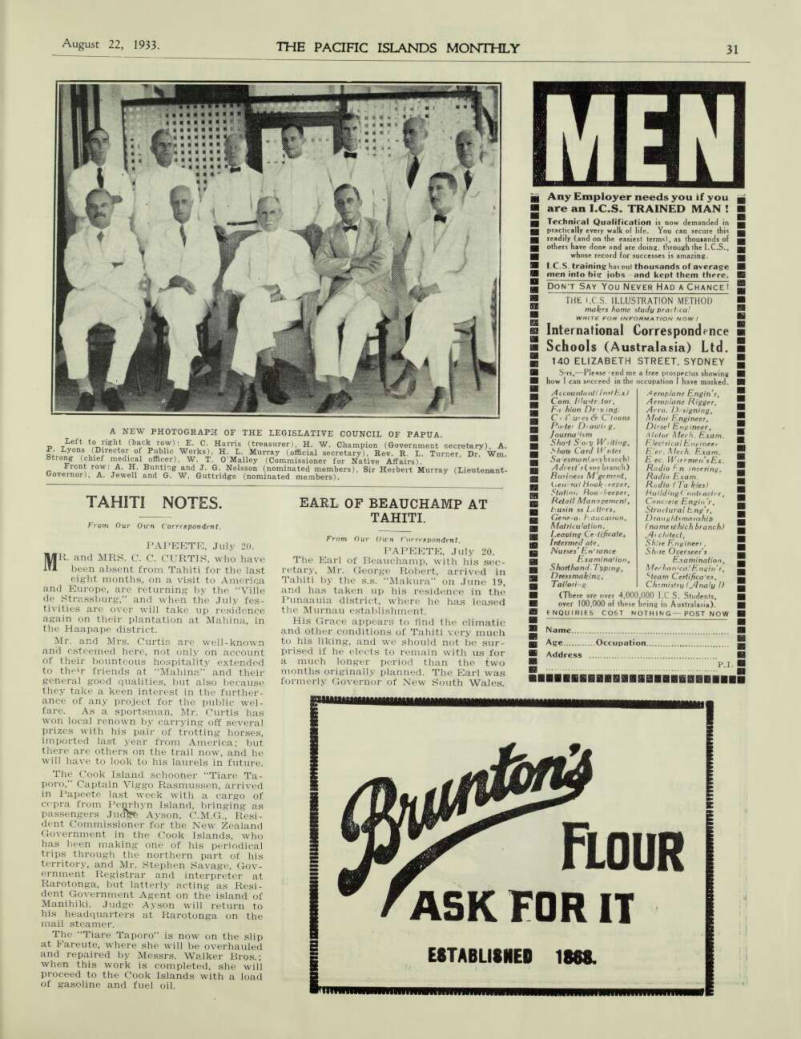
Rabaul, July 24.
FOR several months car-owners had complained of losing articles which they had left in cars whilst visiting restaurants, hotels or picture theatre.
Many were of the opinion that natives were the culprits; but on Wednesday last there appeared before Assistant District Inspector Ball, in the Rabaul District Court, two youths, one a Malay and the other a half-caste. Both of them admitted various acts of pilfering and, in the majority of the charges laid against them, they were committed to the Central Court for trial.
The apprehension of these youths, it is anticipated, will put a stop to further depredations of this kind which are so annoying to motorists and represent a grave menace to a community where it is not customary to maintain the strict vigilance necessary in more “civilised" countries.
A NEW PHOTOGRAPH OF THE LEGISLATIVE COUNCIL OF PAPUA.
Left to right ( back row): E. C Harris (treasurer), H. W. Champion (Government secretary). A.
P. Lyons (Director of Public Works), H. L. Murray (official secretary), Rev. R. L. Turner, Dr. Wm.
Strong (chief medical officer), W. T. O’Malley (Commissioner for Native Affairs), Front row: A. H. Bunting and J. G. Nelsson (nominated members). Sir Herbeit Murray (Lieutenant- Governor), A. Jewell and G. W. Guttridge (nominated members).
Advertisements & other items, p. 32 (1 item)
Spencer Nolan
Natural Gum, Unbreakable Sets, Comfortable and Long Lasting, Old Plates Remodelled and made equal to new. 28 OXFORD ST., over Winns;
139 ELIZABETH STREET, two
Telegraphic and Cable Address: “FAJSTPLATB,” Sydney.
TEETH BY POST.
Well-fitting and lifelike in appearance,
made from “SELF-TAKEN IMPRESSIONS."
I have made Artificial Teeth by my wellknown and copyrighted System of Self- Taken Impressions for satisfied Patients in all parts of the Commonwealth.
Send for full free particulars.
Satisfaction guaranteed.
SPENCER NOLAN
Dentist, Established in Sydney over 35 years. 177 OXFORD ST., opposite Mcllraths. doors from Market Street, Sydney,
Tahiti Notes.
From Our Own Correspondent.
Papeete, July 20.
MR. and MRS. C. C. CURTIS, who have been absent from Tahiti for the last eight months, on a visit to America and Europe, are returning by the “Ville de Strassburg,” and when the July fes tivities are over will take up residence again on their plantation at Mahina, in the Haapape district.
Mr. and Mrs. Curtis are well-known and esteemed here, not only on account of their bounteous hospitality extended to them friends at “Mahina” and their general good qualities, but also because they take a keen interest in the further ance of any project for the public wel fare. As a sportsman, Mr. Curtis has won local renown by carrying off several prizes with his pair of trotting horses, imported last year from America; but there are others on the trail now, and he will have to look to his laurels in future.
The Cook Island schooner “Tiare Ta poro,” Captain Viggo Rasmussen, arrived in Papeete last week with a cargo of copra from Penrhyn Island, bringing as passengers Ayson, C.M.G., Resi dent Commissioner for the New Zealand Government in the Cook Islands, who has been making one of his periodical trips through the northern part of his territory, and Mr. Stephen Savage, Gov ernment Registrar and interpreter at Rarotonga, but latterly acting as Resi dent Government Agent on the island of Manihiki. Judge Ayson will return to his headquarters at Rarotonga on the mail steamer.
The “Tiare Taporo” is now on the slip at Fareute, where she will be overhauled and repaired by Messrs. Walker Bros.; when this work is completed, she will proceed to the Cook Islands with a load of gasoline and fuel oil.
Earl Of Beauchamp At
Tahiti.
From Our Own Correspondent.
Papeete, July 20.
The Earl of Beauchamp, with his sec retary, Mr. George Robert, arrived in Tahiti by the s.s. “Makura” on June 19, and has taken up his residence in the Punaauia district, where he has leased the Murnau establishment.
His Grace appears to find the climatic and other conditions of Tahiti very much to his liking, and we should not be sur prised if he elects to remain with us for a much longer period than the two months originally planned. The Earl was formerly Governor of New South Wales.
Advertisements & other items, p. 33 (1 item)
International Correspondence
MEN
Any Employer needs you If you
are an I.C.S. TRAINED MAN !
Technical Qualification is now demanded in practically every walk of life. You can secure this readily (and on the easiest terms), as thousands of others have done and are doing, through the I.C.S., whose record for successes is amazing.
I.C.S. training has put thousands of average men into big jobs and kept them there.
Don't Say You Never Had a Chance !
THE I.C.S. ILLUSTRATION METHOD
makes home study practical
WRITE FOR INFORMATION NOW !
International Correspondence
Schools (Australasia) Ltd.
140 ELIZABETH STREET. SYDNEY
Sirs, —Please send me a free prospectus showing how I can succeed in the occupation I have marked.
Accountant (Inst Ex) Com. Itlu'tr lor, Fn hion Drying.
C i i’wes& C’toons Porte' D'OWi'g, Journa'ism Sho-t S'oi v WiHi n g, I s hon Card IVntei •So'esmonfany branch) Adi'ert’r (any branch) Business M’gemtnl, (jeii-ral Book • eeper.
Stalin’. Bookkeeper, Retail Management, Busin ss Litters, Cenfo: I". aucaiion.
Matriculation, Leaving Certificate, Inletmed ate, Nurses’ En’rance Examination, Shorthand Typing, Dressmaking, Tailoring Aeroplane Engin’r, Aeroplane Rigger, Aero. D.-signing, Motor Engineer, Diesel Erig ineer, Motor Mech. Exam.
Electrical Enyineei E'ec. Mech. Exam.
E ec. Wnemen’sEx.
Radio Sn ineering.
Radio Exam.
Radio (Ta kies) Build ! ng ( nnlracler.
Concrete Engin ’r.
Structural Eng’r, Draughtsmanship (name which branch) ,/h chitect.
Shire Engineei .
Shire Overseer’s Examination, Mer han ! cn I Engin’r, Steam Certifica’es, Chemistry (j4naly I) (There are over 4,000,000 I.C.S. Students, over 100,000 of these being in Australasia).
ENQUIRIES COST NOTHING POST NOW
Name Age Occupation.
Address
Rabaul Solicitor
Convicted.
Caught After “Going Bush” for Week.
(From a Special Correspondent.)
Rabaul, July 23.
THE Rabaul solicitor, F. L. Flannery, who appeared before the District Court on June 26 charged with stealing £800, the property of the Guinea Airways, Ltd., was committed to stand his trial at the Central Court, Rabaul, on July 10. Bail was allowed in two sureties: himself in £100 and Charles Booth also in £100.
When the case was called on the date set down at the Central Court, the accused did not appear, and the police immediately commenced a systematic search.
It was known that Flannery had left his home, some six miles from Rabaul along the Kokopo Road, in a car on the morning for which the trial was set down, for the Central Court; also that he had returned along the road and pro ceeded towards Kokopo. It was, how ever, not until Friday that the police discovered his car on a native road be yond the Toma country, and some thirty miles from Rabaul. The fuel had become exhausted and the car aban doned. From information received the police located Flannery the next morning, as he was about to leave a native house, and there arrested him.
On July 17, he appeared before His Honour the Chief Judge, seemingly little the worse for his week’s sojourn amongst the natives. He was, however, not equal to conducting his own case, as he had done in the lower court, and Mr. Florance appeared on his behalf, while Mr. Gerald Hogan, Crown law officer, prosecuted for the Crown.
The charge in the Central Court was one of receiving the sum of £929/15/8 on behalf of tne Guinea Airways, Ltd. on April 15, 1932, for which company at that time he was solicitor, and that he converted this money to his own use.
Evidence was given by the prosecu tion regarding the receipt of the money by the accused, and also that after a considerable time had elapsed requests were made by the company’s agent in Rabaul and his solicitor, for the pay ment of this money which had been collected by the accused. Evidence was also brought forward to prove that the accused had written out, signed and tendered a cheque for £929 which was afterwards returned from the bank marked “No Account.” The date of this last action was on March 22, 1933, and was the day previous to his being adjudicated an insolvent.
The defence brought out no evidence to mitigate the crime and His Honour, in summing up, mentioned how regret table it was to see a man of good educa tion lapsing into crime. Mention had been made by counsel for the defence of the accused’s good war record and the possibility of post-war conditions affecting highly-strung individuals. His Honour admitted that possibly the war had had a bad effect upon the accused’s
character. His conduct had been, con tinued His Honour, such as to alienate all feelings of sympathy for him, and he had, apparently, let himself go with out any regard to decency.
The accused was sentenced to four years’ imprisonment, with hard labour.
At the conclusion of the case an application was made for an order to rescind the estreating of the bail on the grounds that Mr. Charles Booth, who had entered into recognizance for the accused, had given the police every assistance in their search for the accused man at the time of his dis appearance.
After hearing evidence His Honour pointed out that only in the most exceptional cases should any regard be paid to a request for a surety to be let off the consequences of his act. In this case, Booth and the accused had been soldiers together in France, and had known each other over a period of many years.
The amount of the bail estreated was reduced from £100 to £50.
Your Keel.
The Water Under
Useful Device for Mariners.
THE desirability of discovering an ap paratus which will show the depth of water under a ship’s keel has been felt by mariners from time immemorial.
Sounding devices in the past have all depended mainly upon rough-and-ready measurements.
Amalgamated Wireless (Australasia) Limited has now placed on the market an instrument known as the echometer sounding device, which measures the depth of the water by the use of super sonic waves. Any depth of water be tween two fathoms and 360 fathoms can be measured instantly, regardless of the speed of the vessel or of weather con ditions, and no matter how quickly the ocean bed may vary.
The echometer is fitted to the bottom of the ship, and when brought into ac tion it transmits to the bed of the sea a signal which is reflected back and re ceived. The time occupied in the de spatch and return of the signal is regis tered, and this registration in turn in dicates the distance travelled, by which means the instrument indicates the exact depth of the water. The first ships in Australasian waters to be equipped with the apparatus are the motor ships “Wan ganella” and “Rangatira”.
It should be a device of much value to navigators in the treacherous waters of the tropical Pacific.
“Tin Canoe’’ At Cook
Islands.
from Our Own Correspondent.
Rarotonga, July 15.
The term “Tin Canoe” may at first be thought to refer to some weird craft being paddled about the South Seas by adventurers. The explanation is that a native was overheard to use the term facetiously in reference to no less a vessel than His Majesty’s sloop, the “Veronica,” which was then due in Cook Islands waters.
Advertisements & other items, p. 34 (1 item)
The B.P. Magazine
AUSTRALASIA’S CLEARING HOUSE FOR THE PRECIOUS METALS.
BUYERS OF—
GOLD OSMIRIDIUM, PLATINUM, SILVER, Etc.
GARRETT & DAVIDSON Ltd.
Assayers, Bullion Merchants. Metallurgists, BANK OF N.S.W. BUILDINGS, REGENT STREET. SYDNEY.
SAIL WITH
The B.P. MAGAZINE
TO MAGIC LANDS.
Travel Fiction Adventure 1/- copy.
Stage
Screen Fashion 1/- copy.
GET YOUR COPY NOW.
ANNUAL SUBSCRIPTION:
Within the Commonwealth of Australia, Mandated Territory and New Guinea Within the British Empire U.S.A. and Foreign From all Bookstalls or direct from the Publishers: Burns, Philp & Co. Ltd.
New Guinea Notes.
From Our Own Correspondent
Rabaul, July 22.
BULLION exported for the month of May from the Morobe goldfields amounted to 16,909 oz. and was valued at £81,063.
Wholesale oil prices have been re duced 2d. per gallon in Rabaul, but retail prices remain unaltered at the bowsers, and these range from 2/3 to 2/6 per gallon. Import duty in this Territory amounts to 3d. per gallon as compared with in Australia.
Motorists and others are asking why petrol should be dearer here than in Australia.
Owing to the reported outbreak of a disease amongst coconuts in the British Solomon Islands, Director George Murray, of the Department of Agriculture, proceeded to Tulagi by the “Bremerhaven” to make investigations.
District Officer Melrose, of Kavieng, accompanied by Mrs. Melrose, has left for a holiday in Australia. A District Officer, J. H. Jones, is relieving Mr.
Melrose at Kavieng.
One of the men who is responsible for all the brightly-coloured fish in the aquarium at Taronga Park Zoo is M.
B. Nepean Whitehead, of Soraken, Bougainville, who is at present on holi day in Australia.
Mr. and Mrs. R. K. Moore, who for a number of years resided at Mioko, Duke of York Group, are spending a few months in New South Wales.
Master George Evans, the youngest son of Mr. H. Bielby Evans, of Buka Passage, recently qualified for a scholar ship at the Brisbane Grammar School.
He left by the last “Macdhui” to take up his studies in the Queensland city.
Rev. V. H. Sherwin, of the Melanesia Mission, and who is stationed at Sag Sag, New Britain, is spending a few weeks in Rabaul, during the absence of Rev. T. J. Gibson, who is visiting out stations at the present time. Padre Sherwin is a very popular man and was stationed, before his arrival in this
Territory, in the Kimberley district in Western Australia.
Mrs. Grace Lansley, of the Pacific Hotel, has been granted a decree nisi, returnable in three months, in her petition for a divorce against George Lansley, on the grounds of adultery and cruelty. The petitioner was given custody of the children.
District Officer Townsend and Mrs.
Townsend returned by the last “Mon toro” from an extended tour of Europe.
He has been stationed at Aitape.
Dr. and Mrs. Backhouse left by the “Tanda” for south.
Mr. A. T. Simmons, who for several years has been attached to the Rapindik Hospital, in the X-ray department, has severed his connection with the Ad ministration and is proceeding to the goldfields, where he will take up duties with one of the big mining companies.
Many sporting events are in the offing; A swimming carnival at Ra vuvu Baths on August 5: the Gazelle Peninsula Gymkhana at the Lakunai racecourse on August 12; and here let it be mentioned that the course has been greatly improved from a horti cultural point of view, as Secretary Les. Clark has put in some good work laying out garden plots and hedges.
Keen tennis competitions are being held at frequent intervals, as well as the baseball season just opening up with great promise that fans will have some thing out of the box to watch and barrack for.
Passengers on the s.s. “Bremerhaven” who made the round trip from Rabaul to the British Solomons and return, included Mr. G. W. Spensley, a repres entative of the copra-buying firm, Messrs. Colyer, Watson and Co., and also Mr. R. J. Worssam, of the Vacuum Oil Co. Both these gentlemen have their fingers on the pulse of things as they are in this Territory, and are quite awake to the possibilities for their respective firms.
Medal Foe Gallantry.
A bronze medal for gallantry in saving life has been awarded by His Majesty the King to Mr. James Wil liam Scott, first mate of the Melanesian mission vessel “Southern Cross.”
Mr. Scott was the officer, who, when the ship was wrecked in the New Hebrides in October last, plunged into the boiling surf and carried the life line ashore. Without heed to the risk of sharks and the dangers of the reef, he swam ashore and enabled the re mainder of the crew to be rescued in comparative safety.
Telepathy—Or What?
Letter to the Editor, All “old hands,” who have lived among our brown friends of the Australian plains, or “summer-isles of Eden” of the Pacific, have seen many strange things, which they don’t talk about to pseudo civilised folk of noisy Sydney, or busy Brisbane.
The healing of serious, surgical wounds by what doctors call “first in tention,” in a few minutes, as I have seen done by Tohungas of Aotearoa fifty years ago; or the transference of thoughts or messages over vast distances by certain gifted members of tribes whom we call (or once called) “savages,” are matters simply not believed in! If you tell folk of such things, they look compassionately at you, or their lips turn upwards in a grin.
But these dark-skinned folk came southwards, or rather, their ancestors did, when the Mongols were shoving into China’s ribs and making the highly civilised, ancient Asian races move down south a few hundred years ago. They were pushed out of civilised parts, as we ourselves have been; and, like us, they brought the frayed ends of sciences and knowledge that still stick in places—like their religious symbolisms which they use without knowing anything about!
I have just had a letter from a rather famous writer and historian in U.S.A., which looks as if I had unconsciously transferred a thought to him; and in Lord Howe Island, Mr. C. W. Whiting will endorse what I say when I affirm that in the days before Governor de Chair initiated wireless there, the quad roon islanders of the northern part were able to tell you, almost to the hour, when the steamer would arrive, without any ordinary means of knowing. Years ago, when reporting to a big London house upon the Communist trend here, I em ployed a clever girl lip-reader, who at tended secret meetings of the American subsidised agents of dissolution, with me, in weird disguises; and under the pro tection of two American cut-throats I had subsidised for the occasion. She told me that she could sometimes read what they were saying without being able to see their lips, or even faces. Un consciously, their words came to her either by her hearing being suddenly magnified many times, or by some other means unknown to herself. Butterflies will find their mates in some such ex traordinary way. The great J. Jenner Weir, then H.M. Comptroller-General of Customs: and a friend of Darwin, and mentioned in his books, told my father, in my hearing, one one occasion, how female butterflies, in a cardboard box in his office in London, somehow at tracted males for over sixty miles around.
We have something still to learn; so we need not give all our time to “pat ball” games, and listening to the me chanical “music” of the wireless!
I am, etc.,
Arthur J. Vogan.
Cinema On “Macdhui.”
An up-to-date cinema apparatus for the entertainment of the passengers was installed on the Burns-Philp motor vessel, “Macdhui,” in July. At a successful private screening on board the “Macdhui” on July 19, the chair man of directors, Mr. James Burns, and other officials of the Company enter tained about 100 guests.
Advertisements & other items, p. 35 (2 items)
Castor Oil Seed
TO PLANTERS I am a Buyer of
IN ANY QUANTITY.
Send Sample for quote, stating quantity available.
Castor Seed Shellers, any capacity.
Advice and Instructions Regarding Planting, Harvesting* and Packing of Castor Oil Seeds given freely.
Selected Seed for Planting available.
C. GRAHAME
17 BOND STREET SYDNEY.
Sil Rohu (Late A.I.F.). Gunsmith
FIREARMS
Sil Rohu’s Expert Attention is at your Service —without obligation.
Send for my Wonderful Firearm Catalogue. 500 Illustrations and Details of the World’s Best and Reliable Makers.
“FISHING TACKLE TO TACKLE FISHING.”
The same High Standard of Quality is a feature in my new Fishing Catalogue. Specialities: Trout, Big Game, and Deep Sea Fishing.
SIL ROHU (late A.I.F.). GUNSMITH
IMPOSTER OF HIGH-GRADE FIREARMS AND FISHING TACKLE SPECIALIST, 143 ELIZABETH STREET, SYDNEY (Near Market Street).
Repairs.
"OUR HANDS MAKE GOOD ARMS”
DON’T TRIFLE WITH DOUBTFUL FIREARMS
Norfolk Island Eager For Tourists.
From Our Own Correspondent.
Norfolk Is., Aug. 18.
IF we may believe each other in the course of daily gossip, the whole mercantile register has reconstructed its itinerary for the remainder of the year, to allow of excursions to Norfolk.
Everyone you meet has heard for certain of a magnificent liner —hitherto unmentioned —which, packed to the gunwales with excited tourists, is shortly to be sighted upon our lonely horizon and to drop anchor off our romantic shore. Boiled down to hard fact, is seems certain that we may count upon three; one in November, one in December, the third sometime early in the New Year.
And, in addition —en passant, you might say—two warships which, while bringing no business to the island, in troduce a note of gaiety and colour into our sober existence.
In view of our increasing popularity an official tourist bureau has been formed, with Mr. Colman Burke as sec retary. In a very businesslike manner he is tabulating our resources and pre paring a definite programme for the entertainment of visitors and everybody with anything to offer or suggest should get into touch with him.
Economic Conditions Improve.
Economic conditions on the island are also improving - and our bananas are fetching a very fair price in the Sydney markets, while other produce, such as early potatoes, tomatoes and so on are being asked for by merchants overseas.
There are all sorts of interesting little businesses being established here and there about the island, in anticipation of better times coming.
The Book Club, with seven hundred up-to-date volumes, added to by every mail, is housed in new and self-con tained quarters adhering like a swal low’s nest to the long outer wall of A. H. Martin’s comprehensive store, in the commercial and geographic centre of Burnt Pine.
Across the road, picturesquely situ ated beneath the shadow of a grove of trees, is The Little Shop, specialising in imported lingerie and household linens, together with all sorts of charm ing and uncommon articles for gifts and prizes, and the prettiest china ever seen on Norfolk. Under the same roof, but in other hands, is a hairdressing and beauty parlour, into which you may enter, feeling sore dissatisfied with your appearance, and emerge a new being.
Mr. Ray Nobbs, too —of the well known C. C. R. Nobbs family, of Long ridge—has just returned from Sydney with a talkie plant which will develop our very first talkie on the evening of Saturday, July 29. People who never patronise the movies, as rather pain fully presented at the Rawson Hall in weekly flickers, are announcing on every hand, their determination to at tend on this occasion, and entertain ment is certain, whether the venture is a complete success in such an old fashioned building or not.
Praise For Hospital.
A new nurse, qualified in every respect to take responsibility in the pos sible absence of our most competent matron, has been added to the hospital staff and arrived by last steamer. The institution has been crowded and over crowded of late and Matron Hawkes, whose devotion to her patients is the subject of admiring comment whenever her name comes up, had reached the stage when she was starting up from sleep at night in answer to the sum mons of imaginary bells. The doctor and Hospital Board decided that the financial condition of affairs warranted the engagement of a second fully qualified nurse from overseas in addi
tion to local probationers. The popu larity of the hospital and the readi ness of all classes of patient to enter is a striking tribute to the doctor, the nursing staff and the Board.
This seems a suitable moment in which to mention that there are short sighted persons on the island who would have your correspondent pour out, month by month, an unvarying paean of praise of every aspect of life here; to represent existence as sheerly per fect and without a flaw.
But this would be very poor policy from any point of view. If Norfolk Island or any other Pacific island were continuously presented in the “P.I.M.” as a veritable Garden of Eden, before the Serpent entered and the apples ripened, it would not be long before disappointed visitors or misinformed investors were voicing criticism and disillusionment in some other publica tion. Norfolk Island is set within the boundaries of this imperfect world, not upon some dream planet, and it it not only honest but politic to acknowledge its inconspicuous imperfections as well as to boast of its manifold attractions.
N.G. Public Service.
The New Guinea Administration’s Bul letin No. 16 shows the following move ments in the public service:
Permanent Staff.
Appointments.
K, W. Bilston, H. E. Hamilton, K. J.
Hickey, J. R. Black, T. G. Aitchison, M.
S. Edwards, D. McCarthy, H. G. Verey, G. Greathead, L. G. Vial, to be Cadets in District Services.
M. E. Margrie, to be Nurse for two years.
T ransfers.
W. H. Bird, Patrol Officer, from Ra baul to Salamaua.
R. Melrose, District Officer, from Ka vieng to Rabaul.
M. E. Margrie, Nurse, from Rabaul to Kavieng.
R. MacKinnon, Nurse, from Kavieng to Rabaul.
Leave of Absence.
A. Jamieson, Clerk, 3 months long leave plus 116½ days recreation leave.
N. Penglase, Assistant District Officer, 6½ months long leave plus 145½ days re creation leave.
E. M. Hawnt, Mechanic and Lineman, 6 months’ furlough plus 117½ days re creation leave.
H. C. McPherson, Draftsman, 92 days recreation leave.
W. R. Smith, Clerk, 92 days recreation leave.
N. E. H. Caldwell, Assistant Entomolo gist, 42 days recreation leave.
Temporary Employees.
D. M. Marr, to be Mechanic (Steel work-Erection), Buka Passage.
R. B. Earl, to be Postal Assistant.
Police Force.
Transfers.
P. D. Moncur, Warrant Officer, 2nd Class, from Rabaul to Salamaua (en route Wau); A. Barnes, Warrant Officer, 2nd Class, from Rabaul to Kieta.
Mr. Harold Schlencker, of the Parkin Training College, South Australia, has been accepted by the London Missionary Society as a mission worker. He will leave for Papua early next year.
Advertisements & other items, p. 36 (1 item)
Ceilings
IF YOU SHOULD
NEED GLASSES.
While you are in Sydney you should certainly make a point of having your eyesight tested. If you should need glasses you will find our service worthy of your confidence. Finest workmanship and style are combined with moderate fees.
H.A.BARRACLOUGH Ltd
OPTOMETRISTS AND OPTICIANS
Optometrist
J.A.BARRACLOUGH D.B.O.A. F.I.O.
385 GEORGE STREET
Opp the Strand SYDNEY
ART METAL
CEILINGS
Wunderlich Art Metal is the ideal eiling and walling for Island Homes.
Suitable for every purpose; transports cheaply; easy to erect and decorate; ire-resisting; vermin-proof, and lasts a lifetime. Write for illustrated litera ture and prices. WUNDERLICH LTD.,
Box 474 AA, G.P.O., SYDNEY.
Twelve Officials In
One.
Busy Teachers of Torres Straits,
[Letter to the Editor ]
I AM sure the advice by “Old Timer” on “How to Treat Natives” will prove of great interest to many readers of the but I feel that some of his “Hints” may convey an erroneous impression.
I have lived in Torres Strait for a number of years and have come in con tact with most of the so-called “Government Teachers” and hundreds of their native charges. The very name “Teacher” is a misnomer and “Govern ment Storekeeper” would be just as applicable. The most suitable designa tion would be “Jack of all trades,” or Island Administrator.
These officers certainly teach in the Islands schools but they also preside at native courts, keep meteorological and many other records. They act as lay medical officer, supervisor of native owned boats, registrar of births, deaths, and marriages, collector of taxes, health officer, paymaster for pensions, wages, etc. On several islands they also manage the local branch of aboriginal industries store, as mentioned in your article headed “State Stores” (May issue).
The “Teacher” also supervises the erection of all buildings, construction of roads, drains, wells and other works of improvement. On the larger islands hospitals have been erected and, as there are no trained nurses, the “Teacher” fills the position.
In some cases these officers admin ister several islands, to which periodic patrols have to be made. Each officer is responsible for the general welfare of about four hundred natives.
An Irish foreman once said, “While ye are spellin’ ye can shift those bricks.” I am of the opinion that there must be a large streak of Irish in the “Teachers.” They work with Native Scouts and Girl Guides during “spell” time. They have also been known to conduct Sunday schools, prayer meet ings, and Bible classes on “The Day of Rest.”
The “Teacher” is expected to carry out duties for the Aboriginal, Educa tional, Registrar-General’s, Justice, and Meteorological Departments. I am therefore surprised to note that they have time to carry blackboards around the native villages when councillors are to be elected, as suggested by “Old Timer.”
On making enquiries I have ascer tained that only one councillor is elected annually, not three as stated, and that they retire in rotation in accordance with an Island Regulation that deals with the election of coun cillors.
“Old Timer” appears to infer that the “Teachers” resort to underhand practices at such elections. Natives would certainly love “to run the show and assume authority” even over the European officer, but if such were countenanced by the Aboriginal De partment would it not quickly breed tribes of aggressive natives?
Did “Old Timer” mean to insinuate
that the “Teachers” have been, are, or are likely to become fathers of half caste children? I have yet to hear that a Government “Teacher” has been prosecuted under Section 19 of the Aboriginal Act. Perhaps he is advising them to practice discretion in their amours with — “Such luscious, dark beauties as dazzle their sight!” (Apologies to M.M., of “Tropicitis” fame.) I am, etc.,
Waiben.
At the last meeting of the Anthropo logical Society of New South Wales, held at the Sydney Museum on July 18, Mr. Gregory Bateson delivered an inter esting lecture on the tribal customs of New Guinea natives. Mr. Bateson has recently returned from New Guinea, where he was engaged in research work.
He spoke in detail of the burial customs of the Sepik River natives and the extent to which these natives’ lives and actions are influenced by their belief in spirits.
Samoa.
Personal Notes From
APIA, August 4, The Right Rev. the Lord Bishop of Polynesia arrived on the cruiser “Dun edin.” He preached a sermon on July 30 and was entertained and met his parishioners at several social functions.
The Anglican chaplaincy is progressing very satisfactorily and has gained a large and ever growing membership amongst European residents.
Rev. Bro. Benigius, Provincial Head of the Marist Brothers of N.Z., Fiji and Samoa, is here on a visit of inspection.
Bro. Benigius had an attack of appen dicitis and had to undergo hospital treatment, but is progressing favourably at present.
Mr, McBride, Secretary of Native Affairs, is to leave for N.Z. shortly, on account of ill-health. His duties will be taken over by Mr. Mac Kay in addi tion to his secretarial work at the Central Office.
Mr. R. Tattersall and family have re turned from their furlough to New Zealand by the “Maui Pomare,” Mr.
Tattersall has resumed his duties as Registrar of Court.
Advertisements & other items, p. 37 (1 item)
Arnott’S
FAMOUS
POPSO CRACKER
BISCUITS
Crisp and delicious and made to break into three fingers of ideal size and shape, the perfect base for savoury items.
Always ask for
ARNOTTS
Samoa Notes.
From Our Own Correspondent APIA, July 10.
THE Administrator (General Hart) and an official party, including the Chief Medical Officer (Dr. Hunt) have made their annual official journey round the Island of Savaii. During the journey His Excellency opened the Tuasivi Hospital officially. As usual during the last few years, the Man natives kept aloof from all meetings and celebrations.
A Shocking Accident.
By law it is forbidden to the natives to have their numerous pigs roving wild over the country and in the villages.
They are supposed to have them within pig fences. But, in fact, nobody nowa days cares for and obeys these regula tions and you find pigs straying every where, destroying and damaging crops and even blocking motor traffic on the main roads.
A shocking accident reported lately from Savaii serves to illustrate ithe situation. In Fusi, Savaii, a Samoan baby, 14 months old, was left in a Samoan house for a short while un attended. When the parents returned to the house, they found that in their absence the child had been attacked, killed and partly devoured by a roving pig belonging to the family.
A welcome addition to the Apia Cus toms wharf is a permanent iron roofing for same, erected recently in record time by the Public Works Department.
This will be a great convenience to banana shippers as well as copra and cocoa exporters and the owners of coasting vessels, which are now enabled to discharge their cargoes in any weather.
German Club “Concordia.”
There are at present no social clubs with permanent club rooms in Apia, with the exception of the German Club “Concordia.” In order to place their club rooms and conveniences at the dis posal of fellow citizens of all nationali ties, the “Concordia” has accepted a number of residents as “associate mem bers.”
The innovation has been much ap plauded by the general public, and is
expected to promote and enhance social intercourse and good fellowship among the Europeans.
Shivering Samoans.
Of late we have had extremely low temperatures in Samoa, down to 61 degrees, and Europeans and natives are shivering. As usual, June and July were marked by the absence of heavier rainfalls and some of the higher situ ated cocoa plantations were suffering from the extended dry spell.
The Depression.
Owing to the low copra prices, the natives in many districts, especially in Savaii Island, have stopped cutting copra and business on trading stations is very slack in consequence. It is not unusual for a country store to have cash sales of 1/- or 1/6 on some days, and monthly sales of £12, £15 and £20 are the rule rather than the exception.
Smaller Ships.
Owing to the decreased freights offer ing, the Union Company has withdrawn the “Waipahi” from the New Zealand- Fiji-Samoa-Tonga route. The “Karetu,” a much smaller boat, is taking up the run, but is to omit Tonga altogether from her schedule. There is a possi bility that a small passenger and freight boat will connect Apia and the Tongan ports.
The “Maui Pomare” left on June 23 with a full cargo of 6,850 cases of bananas from Samoa. The steamer had brought 120 tons of cargo from New Zealand, also a fair passenger list.
Under the circumstances, the Govern ment steamer should pay her way and in the future should even show a good profit.
No Talkies.
Apia is badly off for entertainment at present, as far as motion pictures go. While much smaller places have introduced talkies, Apia offers only motion pictures of the silent type, and even these are at an average four years old and fail to attract audiences.
Personal Notes.
Mr. A. G. Smyth, with Mrs. Smyth, have left Samoa to spend a three months’ holiday in Australia. The popular, hard-working manager of Morris Hedstrom’s, Ltd., has decidedly
deserved his furlough. He is replaced for the time of his absence by Mr.
Chisholm, from Levuka branch, Fiji.
Mr. Pleasants, a New Zealand solici tor, has arrived to enter the law firm of Messrs. Klinkmueller and Kronfeld.
Mr. G. Klinkmueller intends to leave with his family for an extended holi day trip in September next.
Dr. Dawson, Mrs. Dawson and Miss Dawson have arrived in Apia from Tonga, and have taken up their per manent residence here. The doctor is a former C.M.O. of Samoa and Tonga and very popular in both places. There is a possibility that Dr. Dawson will start practising here as a private prac titioner later on. Miss Dawson spent several years in Samoa as a school teacher.
Mr. C. J. Peddie, the newly-appointed bacteriologist for Apia Hospital (vide the late Leslie Partridge), arrived by the last “Maui Pomare” from New Zea land, and has taken up his duties.
Dr. McClymont has resigned his posi tion on the Apia Hospital staff and has left for Brisbane (Q.).
Mrs. F. L. G. Goetz and her two daughters have arrived by the “Maui Pomare” from New Zealand to join Mr.
F. D. G. Goetz, general manager of the Reparation Estates.
Miss L. Partridge left for New Zea land by the “Maui Pomare.” She may return to Samoa and take up her per manent residence here.
Mr. Murphy, of the Native Officers' Department, has been transferred to Tuasivi, Savaii.
Produce.
Prices of produce in Apia on July 5: Copra, £5 per ton; ½ cent per lb. to natives outside Apia. Cocoa, £35 to £45 per ton; 4 cents per lb. to natives.
Bananas, 3/- per case.
Federal Government in Pursuit
of Canadian Lie.
STEPS have been taken by the Federal Government to reply to articles lately published in the Toronto “Star,” writ ten by Gordon Sinclair, to the effect that “a system of slavery reminiscent of Dark Africa has been sanctioned by the Com monwealth’s representatives in the Man dated Territory of New Guinea?”
The Government has instructed the Australian representative in Canada, Mr.
McGregor, to fully reply to this grossly inaccurate reflection on Australian ad ministration in the Mandated Territory.
The information was given in the Aus tralian Senate on July 11, in reply to a question by Senator E. B. Johnston. The identity of “Gordon Sinclair” is not dis closed.
It is a piquant thought, that an un known and insignificant liar, by getting the ear of an equally irresponsible editor, should be able to cause embarrassment to the Government of the Common wealth of Australia.
Advertisements & other items, p. 38 (2 items)
Acetylene Lamps?
One of the Best Artificial Lights and the Nearest Approach to Daylight.
We have a variety of these Torches, unsur passed for Open-air Functions, and made in various styles.
For indoor use we can supply them fitted with Old English Pottery container, heavy, and not easily knocked over.
BRANDTS LTD.
371 PITT STREET
(above Liverpool Street),
SYDNEY, N.S.W.
Samuel Russell,
ESTATE AND GENERAL AGENT.
P.O. Box 64, Papeete, Tahiti.
Real Estate. Investments. Estate management and administration. Valuations and Reports Houses and Lands for Lease or Sale.
Sole Proprietor: TAHITI PERFUMES.
Cables: Russell. Tahiti (Bentley’s Code).
Tahiti En Fete.
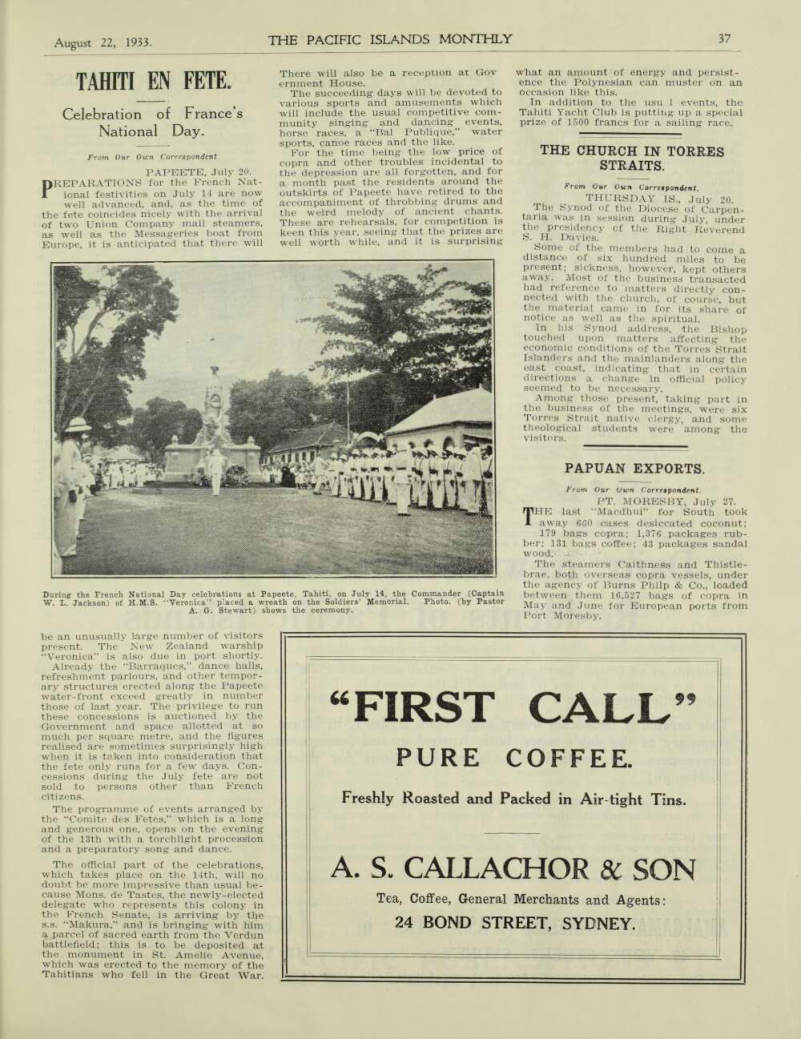
Celebration of France’s National Day.
From Our Own Correspondent
Papeete, July 20.
PREPARATIONS for the French Nat ional festivities on July 14 are now well advanced, and, as the time of the fete coincides nicely with the arrival of two Union Company mail steamers, as well as the Messageries boat from Europe, it is anticipated that there will
be an unusually large number of visitors present. The New Zealand warship “Veronica” is also due in port shortly.
Already the “Barraques,” dance halls, refreshment parlours, and other tempor ary structures erected along the Papeete water-front exceed greatly in number those of last year. The privilege to run these concessions is auctioned by the Government and space allotted at so much per square metre, and the figures realised are sometimes surprisingly high when it is taken into consideration that the fete only runs for a few days. Con cessions during the July fete are not sold to persons other than French citizens.
The programme of events arranged by the “Comite des Fetes,” which is a long and generous one, opens on the evening of the 13th with a torchlight procession and a preparatory song and dance.
The official part of the celebrations, which takes place on the 14th, will no doubt be more impressive than usual be cause Mons. de Tastes, the newly-elected delegate who represents this colony in the French Senate, is arriving by the s.s. “Makura,” and is bringing with him parcel of sacred earth from the Verdun battlefield: this is to be deposited at the monument in St. Amelie Avenue, which was erected to the memory of the Tahitians who fell in the Great War.
There will also be a reception at Gov ernment House.
The succeeding days will be devoted to various sports and amusements which will include the usual competitive com munity singing and dancing events, horse races, a “Bal Publique,” water sports, canoe races and the like.
For the time being the low price of copra and other troubles incidental to the depression are all forgotten, and for a month past the residents around the outskirts of Papeete have retired to the accompaniment of throbbing drums and the weird melody of ancient chants.
These are rehearsals, for competition is keen this year, seeing that the prizes are well worth while, and it is surprising
what an amount of energy and persist ence the Polynesian can muster on an occasion like this.
In addition to the usual events, the Tahiti Yacht Club is putting up a special prize of 1500 francs for a sailing race.
During the French National Day celebrations at Papeete, Tahiti, on July 14, the Commander (Captain W. L. Jackson) of H.M.S. “Veronica” placed a wreath on the Soldiers’ Memorial. Photo, (by Pastor A. G. Stewart) shows the ceremony.
The Church In Torres
Straits.
From Our Own Correspondent.
Thursday Is., July 20.
The Synod of the Diocese of Carpen taria was in session during July, under the presidency cf the Right Reverend S. H. Davies.
Some of the members had to come a distance of six hundred miles to be present; sickness, however, kept others away. Most of the business transacted had reference to matters directly con nected with the church, of course, but the material came in for its share of notice as well as the spiritual.
In his Synod address, the Bishop touched upon matters affecting the economic conditions of the Torres Strait Islanders and the mainlanders along the east coast, indicating that in certain directions a change in official policy seemed to be necessary.
Among those present, taking part in the business of the meetings, were six Torres Strait native clergy, and some theological students were among the visitors.
Papuan Exports.
From Our Own Correspondent.
Pt. Moresby, July 27.
THE last "Macdhui” for South took away 660 cases desiccated coconut; 179 bags copra; 1,376 packages rub ber; 131 bags coffee; 43 packages sandal wood.
The steamers Caithness and Thistle brae, both overseas copra vessels, under the agency of Burns Philp & Co., loaded between them 16,527 bags of copra In May and June for European ports from Port Moresby.
Advertisements & other items, p. 39 (1 item)
“First Call”
PURE COFFEE.
Freshly Roasted and Packed in Air-tight Tins.
A. S. CALLACHOR & SON
Tea, Coffee, General Merchants and Agents:
24 BOND STREET, SYDNEY.
Dentistry In Samoa.
Letter to the Editor, IN your paper dated April, 1933, your Samoa correspondent states that people in need of dental treatment have to go from Apia to Pago-Pago for dental treatment. That is not correct, as we have a splendid hospital in Apia, with three good doctors and nine firstclass white nurses, besides about 18 to 20 native nurses, and patients can have any anaesthetic required. There is a fully qualified dental surgeon, and the latest fittings for all classes of work have been installed. Therefore, the people are well cared for.
Such statements as made by your correspondent are misleading. There is no room for a shoe-maker here. He would starve, as we have a shoe maker, and the natives all go without boots.
Should such reports continue in your paper, I shall take action against your correspondent, as it is not fair to the public to be so misled. In fact, the natives are tbo well catered for: they have everything they want, and pay no tax.
The only thing that we have not got is a lunatic asylum. It is a pity we have not, as it would be a splendid place for some newspaper writers to recover in. We also have a dental clinic, where the children get every attention for five shillings per head per year. I do not think Sydney can say as much.
Apia, at present, is going through a trying time, owing to copra only bring ing £5 per ton on the beach, and bananas
3/- per case, with the result that there is no money in the place. Every one is hard up, but is hoping- for business to improve later on.
I am, etc.,
M. J. Sheldon,
Apia, Surgeon Dentist.
Samoa, 27/7/33.
Senator Sir Walter Kingsmill, of the Commonwealth Parliament, will visit Papua at the beginning of next month.
He intends leaving Sydney by the “Macdhui” on August 30, and will visit Wanigela in connection with his com pany’s proposal to grow sugar cane on their property in Collingwood Bay, South-eastern Papua.
Sir A. G, Murchison Fletcher, K.C.M.G., Governor of the Colony of Fiji, left England on July 9, en route to Fiji, and arrived in Suva by the “Niagara” on August 3. His Excellency has been on a holiday visit to London for the past few months, Mr. C. B. Buxton, who has occupied the position of C.P.S. and acting P.M. at Thursday Island for the past 3 years, has been transferred to Brisbane. Dur ing July there was a round of farewell gatherings, arranged by various organi sations and townspeople, in honour of the departing magistrate and Mrs. Bux ton, both of whom have made many friends during their sojourn on the Island.
A dividend of 1/- per share payable on August 30, has been declared by the directors of Guinea Airways Ltd.
Dividend on the same basis was paid in May last.
Goldfields Progress.
The following reports are to hand: —
Bulolo.
Bulolo Gold Dredging, Ltd., on August 10, reported:— For month of July, total gross production: 8,230 ounces fine gold, from 538,100 cubic yards. Esti mated working profit: 6,517 ounces of fine gold.
The above production is equivalent to £61,725, and working profit to £48,877/10/-, on the basis of £7/10/- (Aust.), per fine ounce of gold.
N.G. Goldfields.
New Guinea Goldfields, Ltd., on August 14, reported for the month of July:—
Development.
Location 3.—The west drive on No. 3 level was advanced 35ft. in ore, averaging 8 dwts. gold and 4 ozs. silver, over a width of 50 inches. Work was delayed by repairs to pumps.
Location 8. —No. 3 level. The drift was ad vanced 65 ft. in ore, averaging 7.2 dwts. gold and 17 ozs. silver, over a width of 30 inches.
Production.
The estimated profit for June from alluvial work was £5,743. The production for July was 2,703 ozs. bullion.
Mill: The estimated profit for June was £6,235.
The output for July was 1,045 ozs. fine gold.
Mr. F. Baton, Presbyterian, missionary
in the New Hebrides, accompanied by
Mrs. Paton, arrived in Sydney from Vila by the “Morinda” on August 2. He is the Principal of the Presbyterian Mission Training College at Tangoa.
Rev. and Mrs. G. P. Lassam, Methodist missionaries in Papua, returned to their station at East Cape by the “Montoro” on August 9. They attended a farewell function given by their Sydney friends on July 24.
Mr. and Mrs. Andrew, Methodist mis sionaries, left Sydney for Papua on July 20 by the “Macdhui”. Mr. Andrew is the newly appointed chairman of the District in place of Mr. Gilmour, who retired recently.
Advertisements & other items, p. 40 (1 item)
Daily News Service by Radio for
Residents of Pacific Islands
Residents of all British Territories in the Central and South Pacific (except Fiji) are hereby informed that it is now possible for them to arrange for the receipt by them, through their local radio station, of the undermentioned company’s daily news service.
This service is broadcast every night from Sydney, in Morse. It comprises about 600 words, summary of the day's news, both Australian and foreign, supplied by the leading Australian newspapers. It contains the latest quotations for produce (copra, etc.) and currencies
(exchange).
The service is not expensive, the rate depending upon the number of persons in a particular district who are prepared to initiate the service by ordering same through their local radio station.
The “OCEAN NEWS” Service is sent out as a private message, and is fully copyrighted and protected. No station, whether on sea or land, is permitted to receive and publish this message, except by special arrangement. After this date, action will be taken against any station infringing our rights in this respect.
Persons or institutions interested may have full details of this service by writing to The Traffic Manager: The Manager; AMALGAMATED WIRELESS (A’ASIA) LTD. or OCEAN NEWSPAPERS LTD. 47 YORK STREET, SYDNEY. YORK STREET, SYDNEY.
Or by applying direct to the officer in charge of their Radio Station, who will take up the matter on their behalf.
Copra.
A Very Dead Market.
THE copra market continues depressed, without a sign of life in it. Prices remain between £10 and £11 per ton, sterling, with an occasional feeble move of 2/6, up and down.
The market has been in this condi tion since the beginning of April—for five months —and, if it were not for the exchange premium received by the Australian section of the Western Pacific, copra-cutting would almost have ceased. Never, in the long his tory of the copra industry, have prices been at so low a level, and the market remained so dead, for so long a period.
In Sydney, all Islands interests now are watching almost feverishly for some sign or portent which will indi cate a recovery of the market; but, at the moment of this writing (August 17) the gloomy prospect is quite unrelieved.
In the very nature of things, it seems that a break must soon come in the long procession of low prices. It is clearly overdue; but it is clear also that all overseas commercial interests are nervously awaiting the outcome of far reaching political developments in Central Europe and in the United States, and there will be no strength or confidence in the world markets un til the world sees a little more clearly what is to be the outcome of the epoch making experiments of Hitler and Roosevelt.
Reduced Margarine Demand.
There are two factors operating in Europe which, probably, are affecting the copra market adversely. Hitler, in June, issued instructions that the im portation of copra be severely reduced —evidently with a view to reducing the quantity of margarine manufactured in Germany, and thus assisting the Ger man dairy industry.
In Britain, for several months, there has been an extraordinary glut of but ter. There has been a good dairy season in Britain itself; while excep tional quantities of oversea butter have poured in from Denmark, Russia, Aus tralia and New Zealand. In conse quence, butter prices have fallen and fallen, so that good quality has been sold at less than 1/- per pound. Second grades have been at ridiculous prices, and within a penny or two per pound of margarine. In consequence, tens of thousands of people who usually eat margarine have become butter consumers, and the demand for margarine has fallen accordingly. This has had a markedly depressing effect on the demand for copra, and similar components of margarine.
Whale Oil.
About the only silver lining to this cloud, from the coconut grower’s view point, is seen in the whale oil market.
It was reported, early in July, that the Whaling Association had reduced the production of Antarctic whale oil for the 1933-4 season to 1,850,000 barrels, representing a total reduction of 250,000 barrels compared with 1932-3.
An American firm bought a large quan tity at £12 per ton, but otherwise the market appears lifeless. A couple of years ago, it was said that the cost of whale oil production was £15 per ton.
It is probable that this season’s produc tion will not reach 1,850,000 barrels.
Island.
Improving Thursday
From Our Own Correspondent THURSDAY IS., August 1.
THE Town Council has a number of men at work cleaning up the fore shore and brightening up things generally, so that tourists and visitors will now be able to take away better impressions than they have hitherto.
An enterprising townsman, too, struck by the need for seating along the esplanade —a matter which has been spoken of for a long time but has not so far received aldermanic backing —has started the ball rolling by putting up some seating at his own expense.
A few seats in the main streets, under the fine shade trees which are so con spicuous a feature, would be appreciated by visitors as well as by residents. An idea for something of the kind, as well as provision for a public park as a playground for children, has been brought forward by the members of the C.W.A., and possibly the Town Council will act on the suggestions in due course.
The committee which is working for the erection of a town Museum, to be known as the Reginald Hockings Memorial, report that some nice dona tions have come in. About £80 is in hand.
The special committee which is
organising the appeal for the comple tion of the Quetta Memorial Cathedral, including the erection of the Bishop Gil bert White memorial tower and spire, report that the fund has been in augurated and that donations are com ing in. The completion of the church will add much to the attractiveness of this part of the town; the spire will be visible to boats entering the harbour, and perhaps some day there may be a carillon of bells to send their notes over the water! For the present, though, if the committee can complete the build ing as planned, they will be satisfied.
New Islands Churches.
A good deal of solid church building is going on in the Torres Strait islands, in connection with the Anglican mission.
At Saibai, the roof is just being put on a fine concrete church; the founda tions for a large concrete church are being put down at Badu; another build iner of large dimensions is in course of erection at St. Paul’s, Moa; and at Coconut Island a fourth concrete church has the walls well up. The cost of erection is for the most part being borne by the islands people.
The Government, too, are putting up more substantial buildings on the larger islands, as stores; and of late years have greatly improved all the school buildings, as well as making better residential accommodation for their teachers and officials.
Advertisements & other items, p. 41 (1 item)
Pacific Maps
WE have completed arrangements with the well-known firm of Map Publishers, Messrs. H. E. C. Robinson, Ltd., of Sydney, under which we are able to supply modem maps of the Pacific region, or of any of the chief Groups and Territories, at a price which includes cost of postage and despatch.
Some of the Pacific Maps now available are listed below. Others are in course of preparation. If a map of any Island or District is specially required, please give us details, and a quotation for same will be sent at once.
FOR SALE:
OCEANIA. —A clear map of the Pacific from Australia to America, east and west, Japan on the north and New Zealand on the south. Showing all trade routes, with mileage thereon, and clearly defining all the Mandated Territories by tints of colour. SIZE: 30in. x 40in. PRICE; £1/5/-. including Postage.
MAP OF MOROBE DISTRICT. NEW GUINEA. MANDATED TERRITORY (Mer cator’s Projection). —SCALE at equator, 6 Statute Miles to an inch. These maps have been compiled from all the official data Messrs. Robinson have been able to collect, much of which has been supplied by Mr. Ralph W. Gossett, an authorised Surveyor of the Mandated Territory of New Guinea. SIZE: 30in, x
40in. PRICE, 20/-.
AUSTRALASIA. —A good clear Map of Australia and Surroundings, extending on the North to Borneo and Caroline Islands; South to Tasmania and New Zealand; East to Fiji Islands; West to Singapore—showing all the Islands, with the Principal Trade Routes and Mileage. A clear index to places is printed beneath the Map. SIZE: 28in. x 30in. PRICE: Paper, 2/6; Cloth and Rollers, 7/6.
PAPUA AND NEW GUlNEA. —Compiled from the Published Maps of Evan R.
Stanley, F.G.S., Geologist. A good Map, showing detail and boundaries. SIZE: 30in. x 40in. PRICE, Black only, 15/-; Coloured, showing Geological formation, £l.
MOROBE GOLDFIELDS. —A clear detail Map of Bulolo area of Morobe Goldfields, showing Road-Tracks and Air Routes from Salamaua and Lae to the Goldfields.
SCALE: 2 miles to an inch—Statute Miles. By Chas. Lexius Burlington. SIZE: 30in. x 32in. PRICE, 12/6.
ALL COMMUNICATIONS TO—
PACIFIC PUBLICATIONS LTD.,
UNION HOUSE, 247 GEORGE STREET, SYDNEY. P.O. Box 3408 R.
Pearlshell And Trochus
Shell.
The Australian Department of Com merce reports that exports of pearlshell and trochus shell from Australia showed a steady improvement for the eleven months ended May 31, 1933, as com pared with shipments for the previous eleven months.
Details of exports of these products for the periods abovementioned are as follow: —
1932-3. 1931-32. tons £ tons £ Pearlshell .. 1,380 196,074 1,250 177,347 Trochus shell 557 41,419 455 28,480
Indian Problem In Fiji.
Logic of the Continued Demand for Common Roll.
(The demand for a common roll —that is, equal status with Europeans in connection with the government of the colony—is maintained constantly by the Indians of Fiji, who are now about equal in numbers to the native Fijians. The problem is hereunder discussed by our contributor, “J.B." a resident of Fiji.)
THE Indian settlement in Fiji is of a different nature from that of the Chinese and Japanese immigrants.
The former are fellow-members of our Empire, introduced for industrial and agricultural work, and who have served the colony in a peculiarly beneficial man ner; whereas the latter can advance no sound reason for the facilities afforded them to exploit the trade of the colony.
In the early eighties of last century, the Colonial Sugar Refining Company came to Fiji to open up the sugar in dustry, and found that the native Fijian race, at that time much attenuated by the disastrous epidemic of measles which a few years previously had swept the country, could not provide a fraction of the labour necessary to develop the in dustry. India offered a populous and cheap recruiting ground, and arrange ments were concluded by the Company, through and with the support of the local Imperial, and Indian Governments, by which a plentiful supply of labour was assured, on favourable terms.
In these arrangements, endorsed and approved by the Government of India of the day, regulations governing the em ployment of those immigrants, the hours and conditions of labour, their habita tions, discipline, and proportion of fe males, etc., were set out in a frame and sentiment even ahead of the times. Yet those very terms were the subject of bitter attack in recent years by the emancipists of India.
The subsequent agitations resulted in the Imperial Government ordering the cancellation of all existing indentures, and the cessation of the system. This was undoubtedly due to pressure from India, in 1916, brought to bear during the anxious years of the Great War, when Indian sympathy and co-operation were desirable.
In these agitations, Fiji became the target of much unmerited abuse, despite the rigih adherence by employers to the letter and spirit of the contract and the strict supervision of the estates by the Immigration Department of the Colony.
It has been shown that the Indian im migrant played a useful and important part in the development of the colony, and their introduction was justified. But their numbers are rapidly increasing, and now are not far short of the 100,000 mark, outnumbering already the com bined total of Fijian and European in habitants.
The alarming part of it, perhaps, is the ambition developed among them by education and freedom from caste tyr ranny. Every move in India is closely followed, and it is onlv natural that the spirit of unrest felt in India should be reflected here. An early manifestation of this was the serious rioting which broke out in various parts of the colony in the early ’twenties, and which called for stern and armed measures of sup pression by the Government.
Since then, there has arisen an agita tion for equal status. So strong was the demand that a compromise became ne cessary, and the constitution of the Leg islative Council of the Colony was amended, whereby the European repre sentation was reduced by one; Fijian in
terests were vested in three members (nominated); and Indians were repre sented by three elected members. At the first session of the newly-constituted Legislative Council, the Indian members pressed the claims of their constituents to full equality, which, naturally, had to be tactfully refused. Thereupon, the members concerned left the session, and the Council, in a huff. There have been similar developments at almost each subsequent election. The last word has not been spoken on this thorny ques tion, and it is equally probable that local political leaders receive inspiration from India.
Every nation has its teething troubles and growing pains, and however one can understand and even sympathise with Indian ambitions, while confined strictly to the Homeland, one cannot view with satisfaction the prospect of Fiji’s future, nor the position of the native and Euro pean population, should Imperial policy find it necessary to force equality of Indians upon a reluctant community.
Eventually such a procedure would mean the disappearance from the Council of European representation, since the rolls would provide disproportionate numbers, and who can foretell the boundary of Indian ambition?
One does not care to reflect on char acter, in an article of this nature; but one may fairly point to the number of Indian cases in the Supreme Court.
Apart from that, most people who know the Indians agree that they are not fit ted, either by character or education, to exercise judgment in public affairs and they would probably be dominated by agitators and professional politicians.
If ever it came to the point where it would embarrass the Governments con cerned to withhold European status from the Indians, then I, for one, would much prefer to have the Imperial Government
disfranchise Fiji altogether, and revert to the old, severe, Crown colony type of Government, wherein a perfect equality would be shared by all—i.e., tax pay ment without representation!
It is easy, I suppose, to criticise, in the light of experience, the initial ar rangements for the introduction of these immigrants; and, doubtless, the origina tors, and those responsible for framing the regulations, had no idea of the man ner, or the extent, to which the privi lege of residence after the completion of indentures would be utilised. The situa tion is a difficult one and, while we must justly admit the value to the Colony of the immigrant’s labour in development of the land, still it must not be forgotten that he came, not as a free and inde pendent colonist, but as an indentured labourer, and it is doubtful if the inten tion to encourage him to become a per manent resident was ever held.
It would perhaps have been better, if such had been the intention, that the Government reserved a large area of land for the settlement of such immi grants who desired to remain after com pletion of their indentured service.
Fortunately, perhaps, the native Fijian has, more or less, kept the Indian at arm’s length, having really a contempt for him, tinged with a little heartburn when he contrasts his own taxation and submission to all kinds of regulations, with the nominal tax imposed on all non-native peoples, and absolute freedom of movement.
Finally, it would seem, considering the political situation in India, which to a
great extent influences the situation here, that sooner or later, the colony will be faced with one of two alterna tives —equal status for all, or reversion to Crown colony autocracy.
Humiliating as the latter expedient would be, it would be preferable to the former, by which Fiji would become to all intents and purposes, a colony, or province of India.
Advertisements & other items, p. 42 (2 items)
M. Harper,
FOR SALE: Ernimann - Imperator Motion-picture Projector, complete with all accessories, including spare projector lamps, 12 by 14 screen and rollers, all ready to show movies. Has Universal Motor to run off any current, A.C. or D.C. Condition equal to new', but super seded by Talkies here, so will sacrifice. £45, freight paid to nearest seaport.
Write FRANK BASSETT, Singleton,
N.S.W.
WM. DAWSON & SONS, LTD.,
will be glad to send their current Catalogue of Books relating to AUSTRALIA. NEW ZEALAND.
POLYNESIA and SOUTH SEA ISLANDS, Post
Free on application. — Write for a Catalogue.
WM. DAWSON & SONS, LTD.,
(RARE BOOK DEPT.), Cannon House, Pilgrim
Street, LUDGATE CIRCUS. LONDON. E.C.4.
GOSHEN PRIVATE HOSPITAL
(Sister E. W. TEAM AN),
37 Gloucester Rd., HURSTVILLE,
SYDNEY.
General and Private Wards. — Spacious Grounds. — High and Cool Situation.
Moderate Fees.
M. HARPER,
MANDOLIANA ISLAND,
Postal Address:
NORTH GELA, B.S.I.
P.O. Box 6, Tulagi, Solomon Islands.
Recruiting Contracts Undertaken.
Auxiliary vessel “Papari” available for Charter.
Full details of Services from
BURNS PHILP (S.S.) CO., LTD.,
Makambo (B.S.I.) and Sydney.
J. H. MacGregor Dowsett
RABAUL, NEW GUINEA,
for
RELIABLE CARS, SERVICE & DRIVERS.
Gramophones and Latest Records.
Musical Instruments and Sundries.
Cameras and Photographic Goods.
Developing, Printing, Enlarging & Framing.
Recruiter. Mining & General Agent,
BUILDER AND CONTRACTOR.
Agent for The Australian Provincial Assur ance Assoc. Ltd. — Sub-Agent for The Central Assurance Co. Ltd.
Outstation Orders Promptly Executed.
Sample Rooms:
MALAGUNA ROAD, RABAUL.
’Phone: Rabaul 149.
For Sale.
ISLAND PROPERTY.
OFF THE QUEENSLAND COAST.
The most fertile Island in Australian waters. Area: 480 acres. Permanent Water; Windmill; Tobacco Kiln, etc.
About 2000 Cocoanut Palms, many bear ing. Ideal Cotton and Tobacco land — most suitable for a man to get away from business worries. If interested write to W.A.T., Post Office, Thursday Island.
POSITION WANTED.
POSITION Wanted by Engineer, with long Tropical experience, especially In ternal Combustion Engines, and all classes Launch and Boat work; divingplant, turtle soup; pumping; refrigera tion; electricity; motor cars, etc. Rea sonable salary and conditions required.
Reply to “OUWENGA,” c/o. “Pacific Is.
Monthly,” P.O. Box 3408 R, G.P.O., Sydney.
Cook Islands.
From Our Own Correspondent.
Rarotonga, July 17.
TWO of our Administrative staff are at present on furlough: Mr. J. H.
Wright, of the Treasury Office, and Miss D. Kingsbury, European assistant in the post office. Mr. Wright went over to Sydney four months ago and from there proceeded to the Philippines, thence to Hong Kong, Canton, and back to Sydney.
On Saturday, June 3, Judge Ayson sailed by the schooner “Tiare Taporo” for our three northern islands, Penrhyn, Rakahanga and Manihiki. Manihiki is 650 miles north of Rarotonga, and Raka hanga and Penrhyn 674 and 737 miles re spectively. Those islands are, as yet, com pletely cut off from the outside world, as they have no means of communicat ing with Rarotonga by wireless.
We had H.M.S. “Veronica” with us from July 5 to 7 inclusive, under the
command of Captain Jackson. The pleasure of the ship’s stay at Rarotonga was spoilt by the weather which, on one occasion, compelled the vessel to lift anchor and stand further out to sea for a few hours. Both the officers and the men were entertained ashore at dances and with motor drives about the island. The vessel proceeded to Mangaia and there, too, she had a worrying time with the weather. From Mangaia the “Veronica” proceeded to Atiu and Mauke.
At Atiu she merely dropped mails, but at Mauke it is understood a short stay was made to allow a visit ashore. The sloop’s itinerary includes Papeete, Raia tea, Penrhyn (possibly Manihiki), Niue an the island of Pukapuka.
Orange growers at Rarotonga have been favoured this year with a second crop closely following the first crop, and pickings of the second crop constitute part of the shipment for the “Makura”, which goes forward to Wellington on July 17. Space for 8,000 cases has been reserved, together with about 1,000 cases of tomatoes and a small quantity of mandarins. Oranges from Atiu, Mauke, Aitutaki and Mangaia are being lifted by the three trans-Pacific cargo vessels “Waikawa,” “Waihemo” and “Hauraki,” which call at the Cook Group between mail-boats, and land the fruit at Auck land.
Saving Cook Is.
Babies.
From Our Oxen Correspondent.
Rarotonga, July 15.
IMPORTANT work proceeding in the medical field at the Cook Islands is that in conection with Child Welfare, or better known as the “Plunkett”
Scheme.
Judge Ayson, the Resident Commis sioner, in his annual report for the last financial year, mentions the progress and happy results already obtained at Rarotonga.
The scheme was launched some twelve months ago by the formation of suitable committees of native women at the different villages and to make the work attractive a white uniform with a mono gram was designed. Preliminary lec tures to the native women folk were delivered by Dr. E. P. Ellison, the chief medical officer for the Group, who in fused life into the movement.
The welfare of native babies and in fants has now become the interest of numerous well-trained welfare workers instead of, as formerly, only the mother’s responsibility. Previously the doctor’s help would be called in at the confinement and the subsequent fate of the child left to itself almost. Up to date, practically all native infants on the island up to about four years of age have been examined and the con dition of each recorded. Henceforth, members of Welfare will lend the ex pectant mother assistance and will fol low up the work of the doctor, keeping in touch with the mother on the one hand and with the doctor on the other.
The percentage of deaths of babies during the past eighteen months has fallen in a remarkable degree and the work of the Child Welfare League, to gether with the Rockefeller Scheme of Sanitation, entitles the local Adminis trator’s office and those primarily assist ing in the work, Dr. Ellison and the Rockefeller Foundation, to very great praise indeed.
Advertisements & other items, p. 43 (1 item)
Modern Direct Wireless Services
Use—
for Your Communications with Australia and Overseas.
DIRECT WIRELESS SERVICES are available for inter-communication between the Islands of the Pacific and for traffic between the Islands and Australia and overseas countries.
Services are now in operation between Papua and Sydney, New Guinea and Sydney, New Caledonia and Sydney, and Fiji and Sydney. Speedy, economical and efficient service to Australia and overseas. Route your traffic “Via the Wireless Service.”
For overseas traffic to Great Britain, North and South America, and all countries, route your message via the Direct Australian
BEAM WIRELESS SERVICE.
LODGE YOUR MESSAGES AT ANY
WIRELESS STATION OR ISLAND POST
OFFICE ROUTED “VIA WIRELESS.”
AMALGAMATED WIRELESS (A’SIA) LIMITED.
Sydney—as Seen by an Incoming Islander.
GREY seas, grey clouds, grey head lands, grey gulls, the grey fin of a shark.
The Heads!
A rift in the heavy clouds —the sun. the vitalising Australian sun! Spark ling blue water under a golden shaft, a glint on the roof of the Cardinal’s Palace. Wooded slopes, little islands, garden points—an angle of The Bridge.
Ocean-going liners, ferry-boats, in solent little sailing craft running daringly under the forefoot of arrogant ships, jetties, a fat woman in a pink dress eating an apple on an empty wharf.
The landing; dingy Customs sheds, blue-roofed taxi dodging hesitant foot passengers. Circular Quay fruit-stalls burgeoning with colour—apples from woody Tasmania, yellow bananas from dark Fiji, paw paws from the stinking North, grapes from fragrant Mildura, peaches from cool Victoria, pears from Leeton orchards.
Noise! Trams, trains, motor ’buses; buildings shaken as with a convulsion by the tumultuous machinery within.
People! Working folk, well-to-do’s!
A pale, aristocratic woman leaning from a blue car awaiting the “go” signal from a traffic policeman whose arms move like those of an Island dancer.
Dirty trams hooked together; patches of colour from gorgeously dressed shop-windows.
Smells! The fragrance of women — the fruity odour of cellared beer — hunger-making perfumes of food —hot bitumen —grapey odours from wine bars.
Flower stalls outside the G.P.O.
Roses, carnations, waratah! “That’s right, lady Look at ’em, love ’em and leave ’em!”
Skyscrapers shoving rudely against Victorian Sydney; banks like the palaces of the ancient Doges; factories erupting centipedes of laughing girls.
People! Hard city people, vacant-eyed country people seeing the sights. Faces like flowers, like red moons, passionate angry faces, calm meditative ones.
Motors! A 1916 Ford holding up a Vauxhall in Art Moderne. Beggars! A blind man holding out his hat. “Don’t pass a poor blind man, don’t pass him by! Blind through no fault of his own! Don't pass him by. (Sotto voice) Oh, you ’ave; you allus do, blast it!”
Colour! Violet splashes from news stalls; gleam of gold in jewellers’ win dows; red mail-vans, black police-vans; State Lottery ticket-sellers’ stalls.
The taste of new foods. Filet Mig non at the Cafe Latin, where a Norman Lindsay adorns the walls and Toti Dal Monte smiles at the Chinese merchant in the silken robe, and the young re porter going Bohemian. An omelette fines herbes at the Claremont —bamboo shoots at the Shanghai—coffee and liqueurs at Tatersalls —a glimpse at the famous undressed ladies of the Marble Bar.
Night! Dazzling Neon signs under shop verandahs; the jewelled string of the Bridge, the flood-lit towers and palaces of modern Sydney, the misty illumination of the Archibald Memorial
Fountain —a handful of Communists laying down some law to a reluctant convert —two young people as closely clasped in each other’s arms as if they were in some specially designed heaven of their own —a pale young man fur tively dining off some greasy scraps of fish wrapped in a torn newspaper— a group of out-of-works playing euchre on the grass.
The Botanical Gardens —lapped by the starlit water of Sydney’s pride. A slow footed policeman, clearing the grounds, pauses suspiciously to watch the move ments of an old woman. She is creeping about the grass, near some shubbery calling softly, “puss, puss.” Presently a motherly grey cat emerges from her hide-away, followed by gangling-legged kittens. The woman produces some food from a little basket and the cat and her family dine daintily while the policeman mutters, “’Struth.”
Into the streets again, nearly falling over a man who isi writing with a piece of chalk on the smooth bitumen —“God is Love.” A tall woman walking im patiently up and down, up and down, her hard eyes searching, searching.
Glare of light from talkie houses, taxi after taxi discharging glossy men and smoothly-groomed women at the doors of hotels and restaurants; jewels, furs, satins, and gleam of tended skin.
Impatient men in doorways joined by late-coming ladies; lovers arm in arm; graver folk doing their nightly saunter to gaze into the wonder of the l shops.
Sydney, sparkling, luring the populace to her dusty feet. Sydney—half a little London and half a little New York.
Sydney —a Metropolis!
A.C.T.
Advertisements & other items, p. 44 (1 item)
"The Nevertire"
Gives you ALL the advantages of
AUTOMATIC ELECTRIC LIGHTING
plus automatic Electric REFRIGERA TION for your home.
"The NEVERTIRE"
FULLY AUTOMATIC
ELECTRIC LIGHTING
PLANT
Simplicity itself! Five or six lights are supplied by the battery alone. As soon as an extra load is applied, either by switching on more lights, an iron or fan, or the refrigerator, the engine starts up automatically and provides ample current. It stops automatically as soon as load is off. Automatic safety devices make failure impossible.
Write to-day for New Illustrated Folder and Price List.
Plants from £103 f.o.b. Sydney.
DANGAR, GEDYE & CO. LTD.,
10-14 Young Street Sydney.
Services.
New Guinea Aerial
The Government Contract.
COMPETITION is keeping aerial freight rates on the New Guinea goldfields services at a low level, and none of the companies is making large profits.
It is reported that the Holden Com pany has secured the Administration’s contract for transport for the current year. The contract, last year, was held by Mr. Ray Parer’s Company (P.A.T.C.).
When the late “Les” Holden, famous airman and popular “digger”, flew up casually to New Guinea in his trusty “Canberra”, to look over the air-freight ing business, he laid the foundation of an important industry. Competition was keen, but he got his share of available business, and he and Pilot O’Dea, most loyal henchman, soon put “Holden’s Air Transport Service” on the goldfields map. The accidental death of the prin cipal, while on furlough in Australia, shocked the whole community, and it was thought, naturally, that this cal amity would cause the withdrawal of the Holden company from New Guinea.
But several of the late airman’s friends rallied around; Mr. H. W. Holden (Mr.
Les Holden’s father) took charge in Sydney and Pilot O’Dea in New Guinea; and to-day the Holden Company is suc cessfully running a small fleet of aero planes in New Guinea and handling a fair share of the available business.
The two big tri-motored monoplanes, “Peter” and “Paul,” operated by Guinea Airways, Ltd., as part of their big fleet, on behalf of the Bulolo Company, al though they have been in service for over two years under most severe tropi cal conditions, are in remarkably good order. Last month, while “Paul” was undergoing an overhaul, “Peter” carried 223 tons of freight between the coast and the goldfield—without fuss or accident.
“Paul,” although submitted to a gruel ling examination, was found to be in a wonderful condition—a few adjustments to the usual wearing parts was all the attention required to put the big machine back into commission in A1 order.
The two areoplanes put into commis sion by Messrs. W. R. Carpenter and Co., Ltd., to carry merchandise between Sala maua and Wau, are providing a satis factory and reliable service.
There is no doubt that these New Guinea aerial services are doing their full share in proving to the world that this form of transport is safe, reliable and practicable.
Mandated Territory Gold.
Million A Year!
During the year ended June 30, 1933, gold valued at £928,427 was won in the Mandated Territory of New Guinea, according to the report of the gold fields warden. During June, £120,257 worth was recovered.
Before the end of the current year (June 30, 1934) there will be two more dredges working in the Morobe district, giving a corresponding increase in out put.
“Castes.”
The White Man’S
Pertinent Comment from Polynesia.
Letter to the Editor, The article by a person signing him self “Na Vodre,” in your June issue, interests me because it deals with a subject about which I am exceedingly touchy, and one which is at all times more or less pertinent in most of the Polynesian Islands. I propose, then, with your permission, to discuss it a little in a very candid fashion.
The honesty, as well as the ethno logical accuracy, of the statement that “the Polynesian races are of the same root stock as ourselves,” and that “there exists no gulf between us that cannot be bridged by sympathy, tolerance and love,” appeals to me greatly; for these are points I have repeatedly emphasised in articles on the South Seas. Anyone whose ignorance or stupid racial preju dice questions that position is merely another of the white usurpers in these Islands who have contaminated, de based and exploited the Polynesian race for a hundred years.
In a recent article in the “Auckland Star,” I called attention to the fact that when the white man took over, usually without any consideration of the natives’ desires, the control of the several Pacific Islands groups he entered upon a trust.
That is to say, he became responsible for the welfare of these Islands peoples to whom he was very much in advance materially—but possibly not so much so in the broadest spiritual sense. He assumed a trust, and his first considera tion ought to have been the good of these people, rather than his own com
mercial aggrandisement But that was not his first consideration —and the fact that it was not constitutes one of the worst of all blots on the record of the white man’s contact with “inferior” peoples.
However, it is too late now to remedy that. The mischief is done, and every decent white man is ashamed of it, in his heart. But to keep up this absurd pretence of racial superiority over the Polynesians, as declared in asinine talk about Europeans “going native” when they marry women of Polynesian blood, passes the bounds of patience.
Similarly irritating are the “distinc tions” made in some of the Islands — to which Hawaii, whatever else it may lately have developed into, is happily and creditably an exception—distinc tions based in nine cases out of ten on jealously and nothing more. Everyone understands that the white woman is not at her best in hot countries. And since, even at her best, she is hard put to it to match those of Polynesian blood either in charm, gentle characteristics or —woman’s greatest appeal sheer femininity, she sets up a social barrier in the preposterous thing called “caste.”
The male has no choice but to be guided by it—in public, that is to say; though behind the nearest tree, in a manner of speaking, he defies it.
And thus he turns convention into hypocrisy—nor does that take much turning.
Who endowed the European with his divine right to relegate every other race to “inferiority” and to humiliate them by setting up his castes? I once asked that question in an article in Shang hai, inspired by the sight of a European kicking a well-dressed Chinese student off the footpath in Nanking Road. It is equally applicable in the South Seas.
I am., etc.,
Marc T. Greene.
Suva, July 5, 1933.
Advertisements & other items, p. 45 (1 item)
Mary's
QUALITY PRODUCTS
Packed to meet Island Conditions.
AUNT
MARY'S
PURE FOOD
PRODUCTS
For thirty years the proprietors of Aunt Mary's Pure Food Products have manu factured the highest quality goods and packed them to meet the special condi tions of the Pacific Islands.
Aunt Mary’s Pure Food Products and ‘’‘Defiance” Brand Canned Goods are prepared and packed only by “Defiance”
Brand
Canned
Goods
These high-grade Canned Goods are specially prepared and hermetically sealed to withstand tropical heat, thus ensuring to con sumers the fullest satisfaction.
TILLOCK & CO. LTD.
PURE FOOD
MANUFACTURERS.
Kent and Liverpool Streets, SYDNEY, N.S.W.
Rotten Oranges!
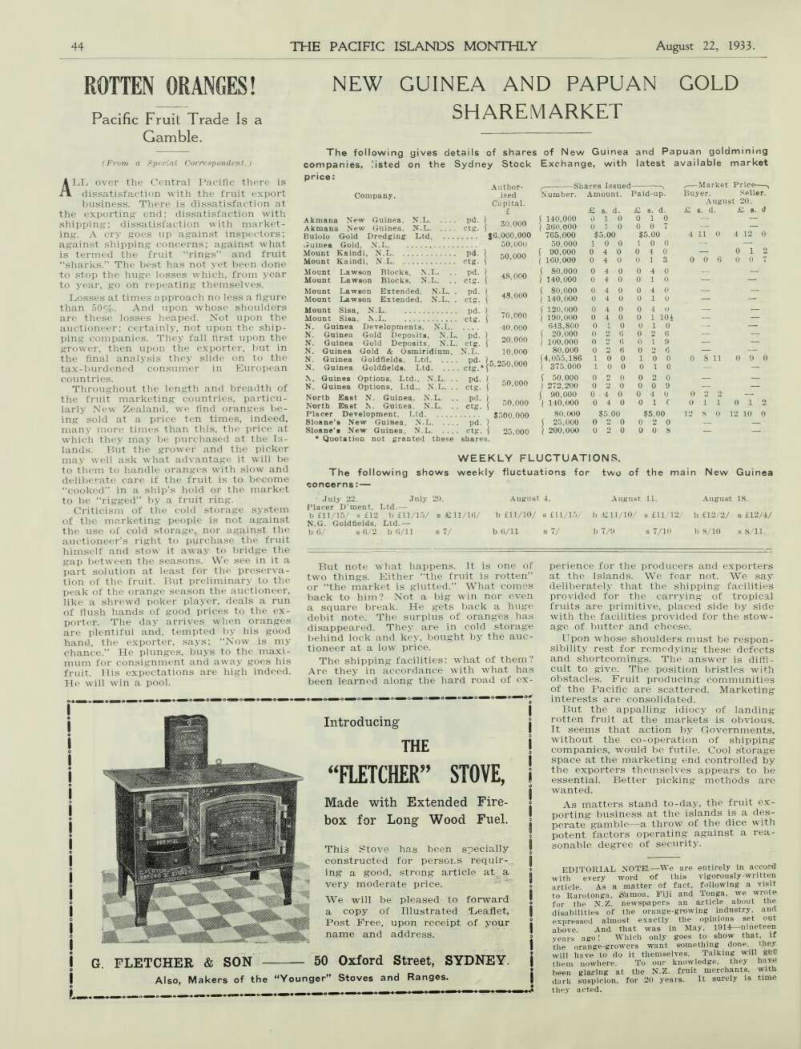
Pacific Fruit Trade Is a Gamble.
(From a Special Correspondent.) ALL over the Central Pacific there is dissatisfaction with the fruit export business. There is dissatisfaction at the exporting end; dissatisfaction with shipping; dissatisfaction with market ing. A cry goes up against inspectors; against shipping concerns; against what is termed the fruit “rings” and fruit “sharks.” The best has not yet been done to stop the huge losses which, from year to year, go on repeating themselves.
Losses at times approach no less a figure than 50%. And upon whose shoulders are these losses heaped. Not upon the auctioneer; certainly, not upon the ship ping companies. They fall first upon the grower, then upon the exporter, but in the final analysis they slide on to the tax-burdened consumer in European countries.
Throughout the length and breadth of the fruit marketing countries, particu larly New Zealand, we find oranges be ing sold at a price ten times, indeed, many more times than this, the price at which they may be purchased at the Is lands. But the grower and the picker may well ask what advantage it will be to them to handle oranges with slow and deliberate care if the fruit is to become “cooked” in a ship’s hold or the market to be “rigged” by a fruit ring.
Criticism of the cold storage system of the marketing people is not against the use of cold storage, nor against the auctioneer’s right to purchase the fruit himself and stow it away to bridge the gap between the seasons. We see in it a part solution at least for the preserva tion of the fruit. But preliminary to the peak of the orange season the auctioneer, like a shrewd poker player, deals a run of flush hands of good prices to the ex porter. The day arrives when oranges are plentiful and, tempted by his good hand, the exporter, says; “Now is my chance.” He plunges, buys to the maxi mum for consignment and away goes his fruit. His expectations are high indeed.
He will win a pool.
New Guinea And Papuan Gold
Sharemarket
The following gives details of shares of New Guinea and Papuan goldmining companies, listed on the Sydney Stock Exchange, with latest available market price:
Weekly Fluctuations.
The following shows weekly fluctuations for two of the main New Guinea concerns:
But note what happens. It is one of two things. Either “the fruit is rotten” or “the market is glutted.” What comes back to him? Not a big win nor even a square break. He gets back a huge debit note. The surplus of oranges has disappeared. They are in cold storage behind lock and key, bought by the auc tioneer at a low price.
The shipping facilities: what of them?
Are they in accordance with what has been learned along the hard road of ex
perience for the producers and exporters at the Islands. We fear not. We say deliberately that the shipping facilities provided for the carrying of tropical fruits are primitive, placed side by side with the facilities provided for the stow age of butter and cheese.
Upon whose shoulders must be respon sibility rest for remedying these defects and shortcomings. The answer is diffi cult to give. The position bristles with obstacles. Fruit producing communities of the Pacific are scattered. Marketing interests are consolidated.
But the appalling idiocy of landing rotten fruit at the markets is obvious.
It seems that action by Governments, without the co-operation of shipping companies, would be futile. Cool storage space at the marketing end controlled by the exporters themselves appears to be essential. Better picking methods are wanted.
As matters stand to-day, the fruit ex porting business at the islands is a des perate gamble —a throw of the dice with potent factors operating against a rea sonable degree of security.
EDITORIAL NO TEL —We are entirely in accord with every word of this vigorously-written article. As a matter of fact, following a visit to Rarotonga, Shmoa, Fiji and Tonga, we wrote for the N.Z. newspapers an article about the disabilities of the orange-growing industry, and expressed almost exactly the opinions set out above. And that was in May, 1914 —nineteen years ago! Which only goes to show that, if the orange-growers want something done, they will have to do it themselves. Talking will get them nowhere. To our knowledge, they have been glaring at the N.Z. fruit merchants, with dark suspicion, for 20 years. It surely is time they acted.
Company.
Authorised Capital. £ Shares Issued Number.
Amount.
Paid-up.
Market Price Buyer.
Seller.
August 20. £ s. d. £ s. d. £ s. d. £ s. d.
Akmana New Guinea, N.L pd. 30,000 140,000 0 1 0 0 1 0 — — Akmana New Guinea. N.L ctg. 360,000 0 1 0 0 0 7 — 0 — Bulolo Gold Dredging Ltd $6,000, 000 765,000 $5.00 $5.00 4 11 0 4 12 0 Gold, N.I 50,000 50,000 1 0 0 1 0 0 — — Mount Kaindi, N.L pd. 50,000 90,000 0 4 0 0 4 0 — 0 1 2 Mount Kaindi, N.L ctg. 160,000 0 4 0 0 1 3 0 0 6 0 0 7 Mount Lawson Blocks. N.L. pd. 48,000 80,000 0 4 0 0 4 0 — — Mount Lawson Blocks, N.L. ctg. 140,000 0 4 0 0 1 0 — — Mount Lawson Extended, N.L. pd. 48,000 80,000 0 4 0 0 4 0 — — Mount Lawson Extended, N.L. ctg. 140,000 0 4 0 0 1 0 — — Mount Sisa, N.L. pd.
Mount Sisa N.L. ctg. 70,000 120,000 0 4 0 0 4 0 — 190,000 0 4 0 0 1 10½ — — N. Guinea Developments, N.L. 40,000 643,800 0 1 0 0 1 0 — — N. Guinea Gold Deposits, N.L. pd. 20,000 20,000 0 2 6 0 2 6 — — N. Guinea Gold Deposits, N.L. ctg. 100,000 0 2 6 0 1 9 — — N. Guinea Gold & Osmiridium, N.L. 10,000 80,000 0 2 6 0 2 6 — — N. Guinea Goldfields. Ltd pd. 5,250,000 4,055,186 1 0 0 1 0 0 0 8 11 0 9 0 N. Guinea Goldfields, Ltd ctg. 375,000 1 0 0 0 1 0 — — N. Guinea Options. Ltd., N.L. pd. 50,000 50,000 0 2 0 0 2 0 — — N. Guinea Options, Ltd.. N.L. ctg. 0 2 0 0 0 9 — — North East N. Guinea, N.L. pd.
North East N. Guinea, N.L. ctg. 50,000 90,000 140,000 0 4 0 0 4 0 0 4 0 0 1 0 0 2 2 0 1 1 0 1 2 Placer Development. Ltd $500,000 80,000 $5.00 $5.00 12 8 0 12 10 0 Sloane’s New Guinea, N.L pd. 25,000 0 2 0 0 2 0 Sloane's New Guinea, N.L. ctg. 25,000 200,000 0 2 0 0 0 8 — — * Quotation not granted these shares.
July 22.
July 29.
August 4.
August 11.
August 18.
Placer D’ment, Ltd.— b £11/15/ s £12 b £11/15/ s £11/16/ b £11/10/ s £11/15/ b £11/10/ s £11/12/ b £12/2/ s £12/4/ N.G. Goldfields, Ltd.— b 6/ s 6/2 b 6/11 s 7/ b 6/11 s 7/ b 7/9 s 7/10 b 8/10 s 8/11
Advertisements & other items, p. 46 (1 item)
“Fletcher” Stove,
G. FLETCHER & SON
Introducing
THE
“FLETCHER” STOVE,
Made with Extended Fire box for Long Wood Fuel.
This Stove has been specially constructed for persons requir ing a good, strong article at a very moderate price.
We will be pleased to forward a copy of Illustrated Leaflet, Post Free, upon receipt of your name and address.
50 Oxford Street, SYDNEY.
Also, Makers of the “Younger” Stoves and Ranges.
Market Quotations
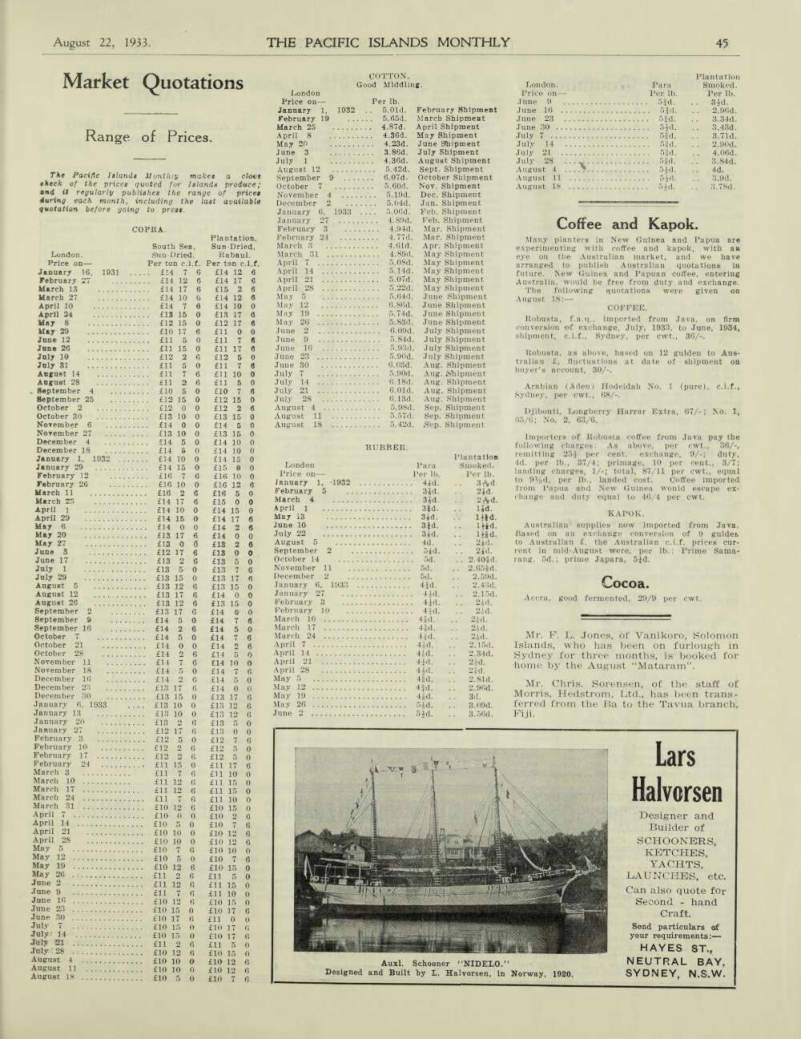
Range of Prices.
The Pacific Islands Monthly makes a does check of the prices quoted for Islands produce; and it regularly publishes the range of prices during each month, including the last available quotation before going to press.
Copra.
South Sea, Sun-Dried. Per ton c.i.f.
Plantation, Sun Dried, Rabaul. Per ton c.i.f.
Sun Dried, London. Price on— January 16, 1931 £14 7 6 £14 12 6 February 27 6 £14 17 6 March 13 £14 17 6 £15 2 6 March 27 O £14 12 6 April 10 6 £14 10 0 April 24 £13 15 0 £13 17 6 May 8 £12 15 0 £12 17 « May 29 £10 17 6 £11 0 0 Jnne 12 £11 5 0 £11 7 6 Jane 26 £11 15 0 £11 17 6 July 10 6 £12 5 0 July 31 £11 5 0 £11 7 6 August 14 6 £11 10 0 August 28 £11 2 6 £11 5 0 September 4 . . . . £10 5 0 £10 7 0 September 25 .. . . £12 15 0 £12 15 0 October 2 0 £12 2 6 October 30 0 £13 15 0 November 6 £14 0 0 £14 5 0 November 27 £13 10 0 £13 15 0 December 4 £14 5 0 £14 10 0 December 18 £14 5 0 £14 10 0 January 1, 1932 . . £14 10 0 £14 15 0 January 29 £14 15 0 £15 0 0 February 12 . . .. £16 7 6 £16 10 0 February 26 . . . . £16 10 0 £16 12 6
March li
£16 2 6 £16 5 0 March 25 £14 17 6 £15 0 0 April l £14 10 0 £14 15 0 April 29 0 £14 17 6 May 6 £14 0 0 £14 2 6 May 20 £13 17 6 £14 0 0 May 27 £13 0 6 £13 2 6 June 3 £12 17 6 £13 0 0 June 17 £13 2 6 £13 5 0 July 1 £13 5 0 £13 7 6 July 29 0 £13 17 « August 5 £13 12 6 £13 15 0 August 12 £13 17 6 £14 0 0 August 26 6 £13 15 0 September 2 £13 17 6 £14 0 0 September 9 0 £14 7 6 September 16 . .., 6 £14 5 0 October 7 £14 5 0 £14 7 6 October 21 0 £14 2 6 October 28 6 £14 5 0 November 11 ... £14 7 6 £14 10 0 November 18 ... £14 5 0 £14 7 6 December 16 ... £14 2 6 £14 5 0 December 23 £13 17 6 £14 0 0 December 30 ... £13 15 0 £13 17 6 January 6, 1933 £13 10 0 £13 12 6
January 13
£13 10 0 £13 12 6 January 20 6 £13 5 0 January 27 £12 17 6 £13 0 0 February 3 0 £12 7 6 February 10 6 £12 5 0 February 17 6 £12 5 0 February 24 0 £11 17 6 March 3 £11 7 6 £11 10 0 March 10 £11 12 6 £11 15 0 March 17 6 £11 15 0 March 24 6 £11 10 0 March 31 6 £10 15 0 April 7 0 £10 2 6 April 14 0 £10 7 6 April 21 0 £10 12 6 April 28 ... £10 10 0 £10 12 6 May 5 6 £10 10 0 May 12 0 £10 7 6 May 19 6 £10 15 0 May 26 6 £11 5 0 June 2 6 £11 15 0 June 9 6 £11 10 0 June 16 6 £10 15 0 June 23 0 £10 17 6 June 30 6 £11 0 0 July 7 £10 15 0 £10 17 6 July 14 0 £10 17 6
July 21
6 £11 5 0 July 28 6 £10 15 0 August 4 0 £10 12 6 August 11 0 £10 12 6 August 18 0 £10 7 6
Plantation Smoked. Per lb.
London. Price on— Para Per lb.
June 9 5}d. . . 3Jd.
June 16 . . 2.9Gd.
June 23 5 jd. . . 3.34d.
June 30 5Jd. . . 3.43d.
July 7 ogd. 3.71d.
July 14 5gd. .. 2.90d.
July 21 5gd. .. 4.06d.
July 28 ... -v 5|d. 3.84d.
August 4 .. . . 7 5gd. 4d.
August 11 5Jd. .. 3.9d.
August 18 5*tl. . . 3.78d.
Cotton.
Good Middling.
London Price on— Per lb.
January 1, 1932 5.Old. February Shipment February 19 . .. . 5.65d. March Shipment March 25 4.87d. April Shipment April 8 May 20 June 3 July 1 August 12 September 9 . . .
October 7 . . .. 5.60d. Nov. Shipment November 4 December 2 ... 5.04d. Jan. Shipment January 6, 1933 ... 5.06d. Feb. Shipment January 27 . . .. 4.89d. Feb.
Shipment February 3 4.94d. Mar. Shipment February 24 ... 4.77d. Mar.
Shipment March 3 4.61d. Apr. Shipment March 31 4.89d. May Shipment April 7 April 14 April 21 April 2S May 5 May 12 May 19 5.74d. June Shipment May 26 June 2 June 9 June 16 5.93d. July Shipment June 23 June 30 July 7 5.90d. Aug.
July 14 6.18d. Aug. Shipment July 21 July 28 August 4 5.98d. Sep.
Shipment August 11 5.57d. Sep. Shipment August 18
Rubber.
Plantation Smoked. Per lb.
London Price on— Para Per lb.
January 1, 1932 4 id. 3*d February 5 3Jd. .. 2Jd.
March 4 3Jd. 2tVd.
April 1 3Jd. lid.
May 13 Sid.
UN.
June 10 IHd.
July 22 3id. .. l«d.
August 5 4d. .. 24d.
September 2 5*d. 2id.
October 14 ... . . 2.40jd.
November 11 5d. .. 2.65gd.
December 2 5(1. . . 2.59d.
January 6, 1933 4Jd. . . 2.43d.
January 27 -**d. .. 2.15d.
February 3 4id. .. 24d.
February 10 41d. .. 2Ad.
March 10 43d. .. 24d.
March 17 4§d. .. 2Ad.
March 24 .. 2Ad.
April 7 4Jd. .. 2.15d.
April 14 4Ad. . . 2.34d.
April 21 4**1. 24d.
April 28 . . 2Jd.
May 5 4gd. 2.Sid.
May 12 4}d. .. 2.96d.
May 19 .. 3d.
May 26 aid. .. 3.09d.
June 2 .. 3.56d.
Coffee and Kapok.
Many planters in New Guinea and Papua are experimenting with coffee and kapok, with an eye on the Australian market, and we have arranged to publish Australian quotations in future. New Guinea and Papuan coffee, entering Australia, would be free from duty and exchange.
The following quotations were given on August 18:
Coffee.
Robusta, f.a.q., imported from Java, on firm conversion of exchange, July, 1933, to June, 1934, shipment, c.i.f., Sydney, per cwt., 36/-.
Robusta, as above, based on 12 gulden to Aus tralian £, fluctuations at date of shipment on buyer’s account, 30/-.
Arabian (Aden) Hodeidah No. 1 (pure), c.i.f., Sydney, per cwt., 68/-.
Djibouti, Longberry Harrar Extra, 67/-; No. 1, 65/6; No, 2, 63/6.
Importers of Robusta coffee from Java pay the following charges; As above, per cwt., 36/-, remitting 25J per cent. exchange, 9/-; duty, 4d. per lb., 37/4; primage, 10 per cent., 3/7; landing charges, 1/-; total, 87/11 per cwt., equal to 9%d. per lb., landed cost. Coffee imported from Papua and New Guinea would escape ex change and duty equal to 46/4 per cwt.
Kapok.
Australian supplies now imported from Java.
Based on an exchange conversion of 9 gulden to Australian £, the Australian c.i.f. prices cur rent in mid-August were, per lb.: Prime Sama rang, 5d.; prime Japara, 5Jd.
Cocoa.
Accra, good fermented, 29/9 per cwt.
Mr. F. L. Jones, of Vanikoro, Solomon Islands, who has been on furlough in Sydney for three months, is booked for home by the August “Mataram”.
Mr. Chris. Sorensen, of the staff of Morris, Hedstrom, Ltd., has been trans ferred from the Ba to the Tavua branch, Fiji.
Advertisements & other items, p. 47 (1 item)
Halvorsen
Auxl. Schooner “NIDELO.”
Designed and Built by L. Halvorsen, in Norway, 1920.
Lars
Halvorsen
Designer and Builder of
SCHOONERS,
KETCHES,
YACHTS,
LAUNCHES, etc.
Can also quote for Second - hand Craft.
Send particulars of your requirements:—
HAYES ST.,
NEUTRAL BAY,
SYDNEY. N.S.W.
Exchange Quotations
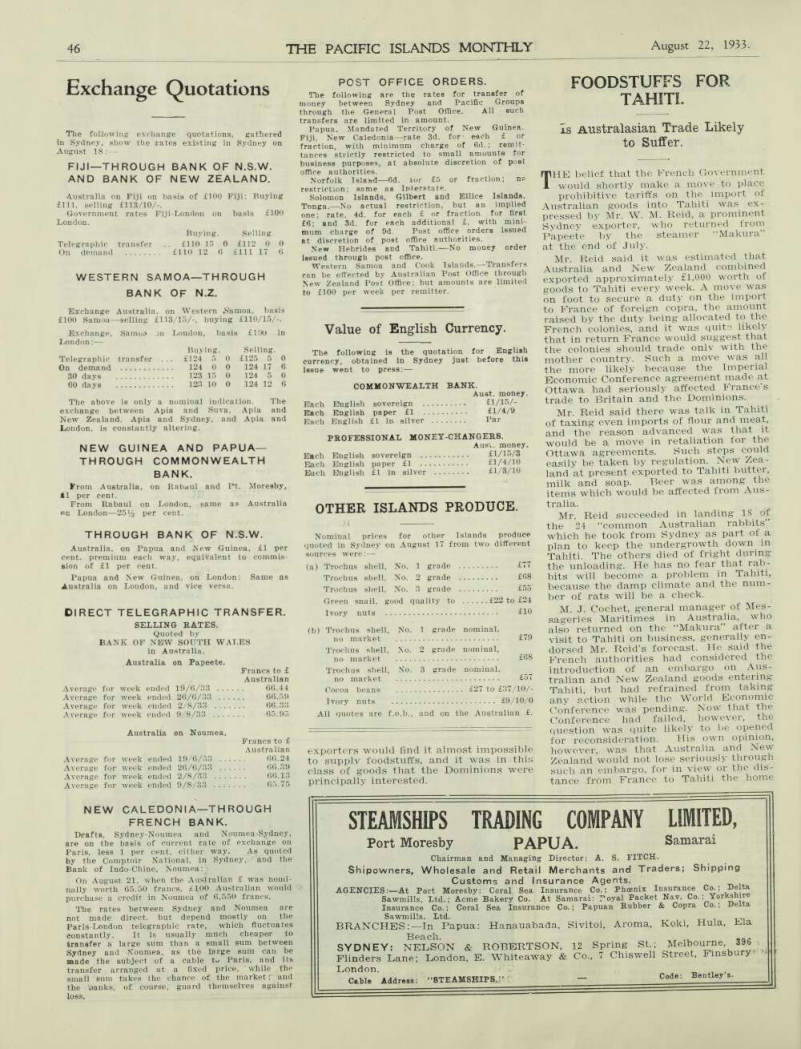
The following exchange quotations, gathered In Sydney, show the rates existing in Sydney on August 18 ;
Fiji—Through Bank Of N.S.W.
And Bank Of New Zealand.
Australia on Fiji on basis of £100 Fiji; Buying fill, selling £113/10/-.
Government rates Fiji-London on basis £100 London,
Western Samoa—Through
Bank Of N.Z.
Exchange Australia, on Western Samoa, basis £100 Samoa —selling £113/15/-, buying £11O/15/-.
Exchange, Samoa on London, basis £100 in London;—
The above is only a nominal indication. The exchange between Apia and Suva, Apia and New Zealand, Apia and Sydney, and Apia and London, is constantly altering.
New Guinea And Papua
Through Commonwealth
Bank.
From Australia, on Rabaul and Pt. Moresby, *1 per cent.
From Rabaul on London, same as Australia on London — 25½ per cent.
Through Bank Of N.S.W.
Australia, on Papua and New Guinea, £1 per cent, premium each way, equivalent to commis sion of £1 per cent.
Papua and New Guinea, on London: Same as Australia on London, and vice versa.
Direct Telegraphic Transfer.
Selling Rates.
Quoted by
Bank Of New South Wales
in Australia.
New Caledonia—Through
French Bank.
Drafts, Sydney-Noumea and Noumea-Sydney, are on the basis of current rate of exchange on Paris, less 1 per cent, either way. As quoted by the Comptoir National, in Sydney, and the Bank of Indo-Chine, Noumea: On August 21, when the Australian £ was nomi nally worth 65.50 francs, £100 Australian would purchase a credit in Noumea of 6,550 francs.
The rates between Sydney and Noumea are not made direct, but depend mostly on the Paris-London telegraphic rate, which fluctuates constantly. It is usually much cheaper to transfer a large sum than a small sum between Sydney and Noumea, as the large sum can be made the subject of a cable to Paris, and its transfer arranged at a fixed price, while the small sum takes the chance of the market; and the oanks, of course, guard themselves against loss.
Post Office Orders.
The following are the rates for transfer of money between Sydney and Pacific Groups through the General Post Office. All such transfers are limited in amount.
Papua, Mandated Territory of New Guinea.
Fiji, New Caledonia—rate 3d. for each £ or fraction, with minimum charge of 6d.; remit tances strictly restricted to small amounts for business purposes, at absolute discretion of post office authorities.
Norfolk Island—6d. for £5 or fraction; no restriction; same as Interstate.
Solomon Islands, Gilbert and Ellice Islands, Tonga.—No actual restriction, but an implied one; rate, 4d. for each £ or fraction for first £6; and 3d. for each additional £, with mini mum charge of 9d. Post office orders issued at discretion of post office authorities.
New Hebrides and Tahiti. —No money order issued through post office.
Western Samoa and Cook Islands. —Transfers can be effected by Australian Post Office through New Zealand Post Office; but amounts are limited to £100 per week per remitter.
Telegraphic transfer On demand Buying. Selling, .. £110 15 0 £112 0 0 £110 12 6 fill 17 6
Buying. Selling.
Telegraphic transfer . .. £124 5 0 £125 5 0 On demand 124 0 0 124 17 6 30 davs 123 15 0 124 5 0 60 days 123 10 0 124 12 6
Australia on Papeete.
Average for week ended 19/6/33 66.44 Francs to £ Australian Average for week ended 26/6/33 ... 66.59 Average for week ended 2/8/33 66.33 Average for week ended 9/8/33 65.95 Average for Australia week ended 19/6/33 ... 66.24 on Noumea. 19/6/33 ...
Francs to £ Australian Average for week ended 26/6/33 ... 66.39 Average for week ended 2/8/33 66.13 Average for week ended 9/8/33 65.75
Value of English Currency.
The following is the quotation for English currency, obtained in Sydney just before this issue went to press:—
Commonwealth Bank.
Aust. money.
Each English sovereign Each English paper £1 Each English £1 in silver .. .
Professional Money-Changers.
Aust. money.
Each English sovereign £1/15/3 Each English paper £1 £1/4/10 Each English £1 in silver ... £1/3/10
Other Islands Produce.
Nominal prices for other Islands produce quoted in Sydney on August 17 from two different sources were: — (a) Trochus shell, No. 1 grade £77 Trochus shell, No. 2 grade £6B Trochus shell, No. 3 grade £55 Green snail, good quality to .. .£22 to £24 Ivory nuts £10 (b) Trochus shell. No. 1 grade nominal, no market £79 Trochus shell, No. 2 grade nominal, no market £6B Trochus shell, No. 3 grade nominal. no market • • £51 Cocoa beans £27 to £37/10/- Ivory nuts £9/10/0 All quotes are f.o.b., and on the Australian £.
Foodstuffs For
Tahiti.
Is Australasian Trade Likely to Suffer.
THE belief that the French Government would shortly make a move to place prohibitive tariffs on the import of Australian goods into Tahiti was ex pressed by Mr. W. M. Reid, a prominent Sydney exporter, who returned from Papeete by the steamer “Makura” at the end of July.
Mr. Reid said it was estimated that Australia and New Zealand combined exported approximately £ 1,000 worth of goods to Tahiti every week. A move was on foot to secure a duty on the import to France of foreign copra, the amount raised by the duty being allocated to the French colonies, and it was quite likely that in return France would suggest that the colonies should trade onlv with the mother country. Such a move was all the more likely because the Imperial Economic Conference agreement made at Ottawa had seriously affected France’s trade to Britain and the Dominions.
Mr. Reid said there was talk in Tahiti of taxing even imports of flour and meat, and the reason advanced was that it would be a move in retaliation for the Ottawa agreements. Such steps could easily be taken by regulation. New Zea land at present exported to Tahiti butter, milk and soap. Beer was among the items which would be affected from Aus tralia.
Mr. Reid succeeded in landing 18 of the 24 “common Australian rabbits” which he took from Sydney as part of a plan to keep the undergrowth down in Tahiti. The others died of fright during the unloading. He has no fear that rab bits will become a problem in Tahiti, because the damp climate and the num ber of rats will be a check.
M. J. Cochet, general manager of Mes sageries Maritimes in Australia, who also returned on the “Makura” after a visit to Tahiti on business, generally en dorsed Mr. Reid’s forecast. He said the French authorities had considered the introduction of an embargo on Aus tralian and New Zealand goods entering Tahiti, but had refrained from taking any action while the World Economic Conference was pending. Now that the Conference had failed, however, the question was quite likely to be opened for reconsideration. His own opinion, however, was that Australia and New Zealand would not lose seriously through such an embargo, for in view or the dis tance from France to Tahiti the home
exporters would find it almost impossible to supply foodstuffs, and it was in this class of goods that the Dominions were principally interested.
Advertisements & other items, p. 48 (1 item)
Steamships Trading Company Limited,
Port Moresby PAPUA. Samarai
Chairman and Managing Director: A, S. FITCH.
Shipowners, Wholesale and Retail Merchants and Traders; Shipping Customs and Insurance Agents.
AGENCIES:—At Port Moresby: Coral Sea Insurance Co.; Phoenix Insurance Co.; Delta Sawmills, Ltd.; Acme Bakery Co. At Samarai: Royal Packet Nav. Co.; Yorkshire Insurance Co.; Coral Sea Insurance Co.; Papuan Rubber & Copra Co.; Delta Sawmills, Ltd.
BRANCHES;—In Papua: Hanauabada, Sivitoi, Aroma, Koki, Hula, Ela Beach.
SYDNEY: NELSON & ROBERTSON, 12 Spring St.; Melbourne, 39b Flinders Lane; London, E. Whiteaway & Co., 7 Chiswell Street, Finsbury London.
Cable Address: “STEAMSHIPS.” Code: Bentleys.
Sydney-Fiji-Tonga Service.
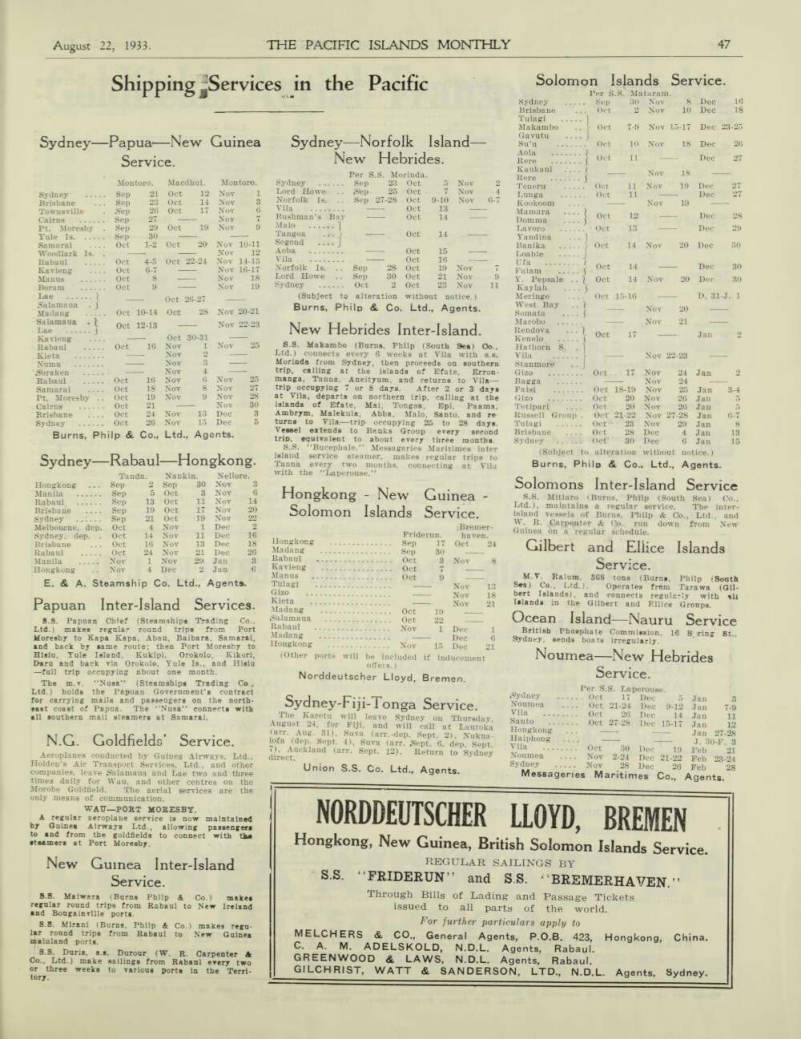
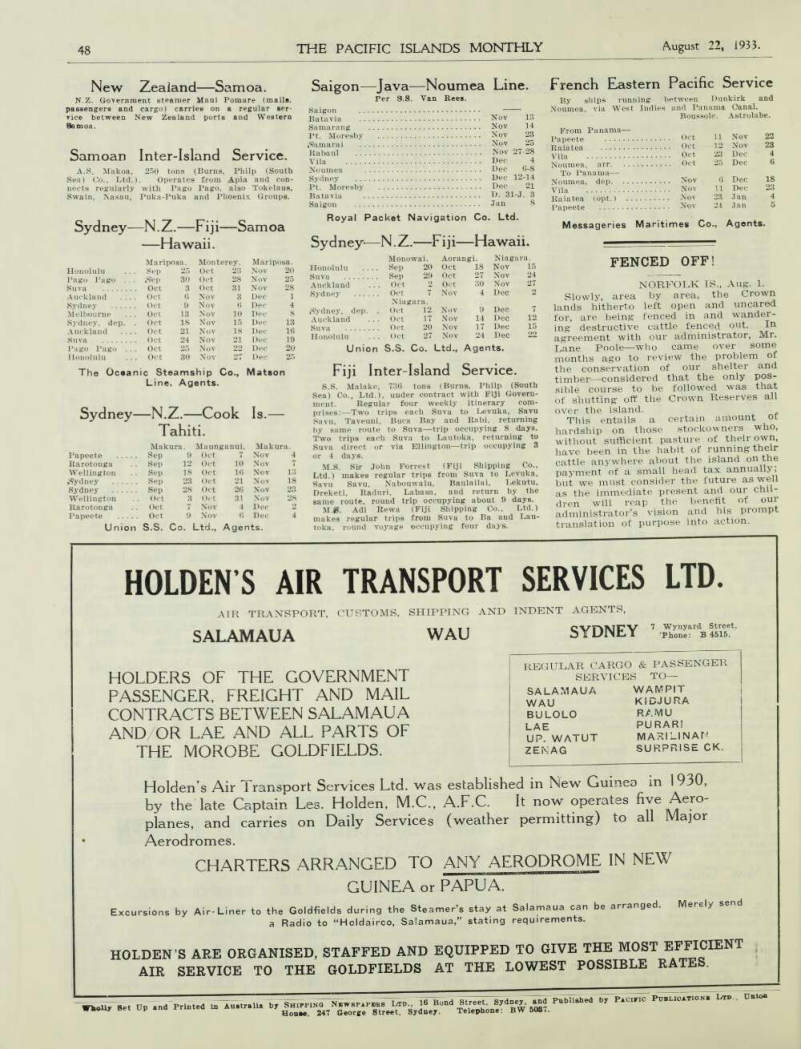
Shipping in the Pacific
Sydney—Papua-—New Guinea Service.
Sydney—Rabaul—Hongkong.
Papuan Inter-Island Services.
S.S. Papuan Chief (Steamships Trading Co., Ltd.) makes regular round trips from Port Moresby to Eapa Kapa, Abau, Baibara, Samarai, and back by same route; then Port Moresby to Hisiu, Yule Island, Kuklpi, Orokolo, Kikori, Darn and back via Orokolo, Yule Is., and Hisiu —full trip occupying about one month.
The m.v. “Nusa” (Steamships Trading Co, Ltd.) holds the Papuan Government’s contract for carrying mails and passengers on the north east coast of Papua. The “Nusa” connects with all southern mail steamers at Samarai,
N.G. Goldfields’ Service.
Aeroplanes conducted by Guinea Airways, Ltd., Holden’s Air Transport Services, Ltd., and other companies, leave Salamaua and Lae two and three times daily for Wau, and other centres on the Morobe Goldfield. The aerial services are the only means of communication.
Wau—Port Moresby.
A regular aeroplane service is now maintained by Guinea Airways Ltd., allowing passengers to and from the goldfields to connect with steamers at Port Moresby.
New Guinea Inter-Island
Service.
S.S. Maiwara (Burns Philp A Co.) makes regular round trips from Rabaul to New Ireland and Bougainville ports.
S.S. Mirani (Burns, Philp & Co.) makes regu lar round trips from Rabaul to New Guinea mainland ports.
S.S. Duris, s.s. Durour (W. R. Carpenter & Co., Ltd.) make sailings from Rabaul every two or three weeks to various ports in the Terri tory.
Sydney—Norfolk Island— New Hebrides.
New Hebrides Inter-Island.
S.S. Makambo (Burns, Philp (South Sea) Co., Ltd.) connects every 6 weeks at Vila with s.s.
Morinda from Sydney, then proceeds on southern trip, calling at the islands of Efate, Erron manga, Tanna, Aneityum, and returns to Vila— trip occupying 7 or 8 days. After 2 or 3 days at Vila, departs on northern trip, calling at the islands of Efate, Mai, Tongoa, Epi, Paama.
Ambrym, Malekula. Abba, Male, Santo, and re turns to Vila—trip occupying 25 to 28 days.
Vessel extends to Banks Group every second trip, equivalent to about every three months S.S. “Bucephale,” Messageries Maritimes inter island service steamer, makes regular trips to Tanna every two months, connecting at Vila with the “Laperouse.”
Hongkong - New Guinea -
Solomon Islands Service.
Sydney-Fiji-Tonga Service.
The Karetu will leave Sydney on Thursday, August 24, for Fiji, and will call at Lautoka (arr. Aug. Si), Suva (arr.-dep. Sept. 2). Nukua lofa (dep Sept. 4), Suva (arr. .Sept. 6, dep. Sept.
O, Auckland (arr. Sept. 12). Return to Sydney direct.
Union S.S. Co. Ltd., Agents.
Solomon Islands Service.
Solomons Inter-Island Service
S.S. Mitiaro (Burns, Philp (South Sea) Co., Ltd.), maintains a regular service. The inter island vessels of Burns, Philp & Co., Ltd., and W. R. Carpenter & Co. run down from New Guinea on a regular schedule.
Gilbert and Ellice Islands
Service.
M.V. Ralum, SCB tons (Burns, Philp (South Sea) Co., Ltd.). Operates from Tarawa (Gil bert Islands), and connects regularly with all Islands in the Gilbert and Kllice Groups.
Ocean Island—Nauru Service
British Phosphate Commission, 16 Spring St., Sydney, sends boats irregularly.
Noumea—New Hebrides
Service.
Montoro.
Macdhui.
Montoro.
Sep Sep S'ep 21 Oct 12 Nov 1 Brisbane Townsville 23 26 27 Oct Oct 14 17 Nov Nov Nov 3 6 Pt. Moresby Sep 29 30 Oct 19 Nov 9 Samarai ...
Oct 1-2 Oct 20 Nov Nov Nov 10-11 12 14-15 Rabaul Oct 4-5 Oct 22-24 Kavieng Oct Oct 6-7 s Nov Nov 16-17 18 9 Nov 19 Lae Salamaua Madang Oct 10-14 Oct Oct 26-27 28 Nov 20-21 Salamaua Lae 3 Kavieng Rabaul Oct Oct 12-13 16 Oct Nov 30-31 1 Nov Nov 22-23 25 Nov 2 Numa Nov 3 Nov 4 Rabaul Oct 16 Nov 6 Nov 25 Samarai ...
Pt. Moresby ..
Oct Oct Oct 18 19 21 Nov Nov 8 9 Nov Nov Nov 27 28 30 Brisbane ...
Sydney Oct Oct 24 26 Nov Nov 13 15 Dec Dec 3 5
Burns, Philp & Co., Ltd., Agents.
Tanda.
Nankin.
Nellore.
Hongkong ,,. Sep 2 Sep 30 Nov 3 Manila 5 Oct 3 Nov 6 Rabaul 13 Oct 11 Nov 14 Brisbane Sep 19 Oct 17 Nov 20 Sydney ... Sep 21 Oct 19 Nov 22 Melbourne, dep. Oct 4 Nov 1 Dec 2 Sydney, dep. . Oct 14 Nov 11 Dec 16 Brisbane ... Oct 16 Nov 13 Dec 18 Kabaul 24 Nov 21 Dec 26 Manila 1 Nov 29 Jan 3 Hongkong .. Nov 4 Dec 2 Jan 6 E. & A. Steamship Co. Ltd., Agents.
Per S.S. Morinda. .Sydney . ..
Sep 23 Oct 5 Nov 2 Lord Howe Sep 25 Oct 7 Nov 4 Norfolk Is.
Sep 27-28 Oct 9-10 Nov 6-7 Vila Oct 13 Bushman’s Bay Oct 14 Malo 1 Tangoa — Oct 14 — Segond Aoba Oct 15 Vila Oct 16 Norfolk Is.
Sep 28 Oct 19 Nov 7 Lord Howe Sep 30 Oct 21 Nov 9 Sydney ..., Oct 2 Oct 23 Nov 11 (Subject to alteration without notice.) Burns, Philp & Co. Ltd. Agents.
Hongkong Friderun.
Bremerhaven.
Oct 24 Madang Rabaul Nov 8 Kavieng Manus Tulagi Gizo Nov 13 Nov 18 Kieta Nov 21 Madang Salamaua Rabaul n Madang T* C i Hongkong V -m —■
U6C O
oi (Other ports will be included if inducement offers.) Norddeutscher Lloyd, Bremen.
Sydney Per S.S. Mataram.
Sen 30 Nov 8 Dec 16 Brisbane Tulagi . . .. .' 1 Oct 2 Nov 10 Dec 18 Makambo • Oct 7-9 Nov 15-17 Dec 23-25 Gavutu Su’u •J Oct 10 Nov 18 Dec 26 Aola . l Bere Kaukaul Here ■ ! . i • f Oct Oct 11 11 Nov Nov 18 19 Dec Dec 27 27 Lunga Kookoom Mamara ...
Domma . . ..
Oct Oct Oct 11 12 13 Nov 19 Dec Dec Dec 27 28 29 Yandina Banika ...
Oct 14 Nov 20 Dec 30 Loabie Ufa Oct 14 Dec 30 Faiam Y. Pepsale ..
Kaylah Meringe West Bay Somata .. ..
Marobo Oct Oct 14 .15-16 Nov Nov Nov 20 20 21 Dec 30 D. 31-J. 1 Rendova Kenelo Oct 17 Jan 2 Hathorn S. .
Vila Vnv 99.03 Stanmore Gizo Oct 17 Nov 24 Jan 2 Bagga Nov Nov 24 25 Faisi Oct 18-19 Jan 3-4 Gizo Oct 20 Nov 26 Jan Jan Jan Jan Jan Jan ;ice.) 3 Tetipari Russell Group Tulagi Oct Oct Oct 20 21-22 23 Nov Nov 27 Nov 26 -28 29 4 6 5 6-7 g Brisbane Svdnev Oct Oct 28 30 Dec Dec 13 15 (Subject to alteration without notice.) Burns, Philp & Co., Ltd., Agents.
.Sydney Noumea Vila Per S.S. Laperouse. - Oct 17 Dec 5 . Oct 21-24 Dec 9-12 Jan 3 Jan 7-9 Jan 11 Jan 12 Jan 27-28 J. 30-F. 3 Feb 21 Feb 23-24 Feb 28
Agents.
Santo fW*t Dec 15-17 i n Hongkong Haiphong Vila Dot sn Noumea Sydney ...
Messageries Maritimes Co., Agents. . Nov 2-24 Dec 21-22 Nov 28 Dec 26
New Zealand—Samoa.
N.Z. Government steamer Maui Pomare (mails, passengers and cargo) carries on a regular ser Tice between New Zealand ports and Western Samoa.
Samoan Inter-Island Service.
A.S. Makoa, 250 tons (Burns, Philp (South Sea) Co., Ltd.). Operates from Apia and con nects regularly with Pago Pago, also Tokelaus, Swain, ISasau, Puka-Puka and Phoenix Groups.
Sydney—N. Z.—Fiji—Samoa
—Hawaii.
Sydney—N.Z.—Cook Is.— Tahiti.
Saigon—Java—Noumea Line.
Per S.S. Van Rees.
Saigon Batavia Nov 13 Samarang Nov 14 Pt. Moresby Nov 23 Samarai Nov 25 Rabaul Nov 27-28 Vila Dec 4 Noumea Dec 6-8 Sydney Dec 12-14 Pt. Moresby Dec 21 Batavia D. 31-J. 3 Saigon Jan 8 Royal Packet Navigation Co. Ltd.
Sydney—N. Z.—Fiji—Hawaii.
Fiji Inter-Island Service.
S.S. Malake, 736 tons (Burns. Philp (South Sea) Co., Ltd.), under contract with Fiji Govern ment. Regular four weekly itinerary com prises:—Two trips each Suva to Levuka, Savu Savu, Taveuni, Buca Bay and Rabi, returning by same route to Suva—trip occupying 8 days.
Two trips each Suva to Lautoka, returning to Suva direct or via Ellington—trip occupying 3 or 4 days.
M.S. Sir John Forrest (Fiji Shipping Co., Ltd.) makes regular trips from Suva to Levuka, Savu Savu, Nabouwalu, Baulailai, Lekutu, Dreketi, Raduri, Labasa, and return by the same route, round trip occupying about 9 days.
M.(S. Adi Rewa (Fiji Shipping Co., Ltd.) makes regular trips from Suva to Ba and Lau toka, round voyage occupying four days.
French Eastern Pacific Service
By ships running between Dunkirk and Noumea, via West Indies and Panama Canal.
Mariposa.
Monterey.
Mariposa.
Honolulu Sep 25 Oct 23 Nov 20 Pago Pago . . . 3'ep 30 Oct 28 Nov 25 Suva Oct 3 Oct 31 Nov 28 Auckland ...
Oct G Nov 3 Dec 1 Sydney Oct 9 Nov 6 Dec 4 Melbourne Oct 13 Nov 10 Dee 8 Sydney, dep. .
Oct 18 Nov 15 Dec 13 Auckland ...
Oct 21 Nov 18 Dec 16 Suva Oct 24 Nov 21 Dec 19 Pago Pago ...
Oct 25 Nov 22 Dec 20 Honolulu Oct 30 Nov 27 Dec 25 The Oceanic Steamship Co., Matson Line. Agents.
Makura.
Maunganui.
Makura.
Papeete Sep 9 Oct 7 Nov 4 Rarotonga Sep 12 Oct 10 Nov 7 Wellington Sep 18 Oct 16 Nov 13 Sydney Sep 23 Oct 21 Nov 18 Sydney Sep 28 Oct 26 Nov 23 Wellington Oct 3 Oct 31 Nov 28 Rarotonga Oct 7 Nov 4 Dec 2 Papeete Oct 9 Nov 6 Dec 4 Union S.S. Co. Ltd., Agents.
Monowai.
Aorangi.
Niagara.
Honolulu ...
Sep 20 Oct 18 Nov 15 Suva Sep 20 Oct 27 Nov 24 Auckland Oct 2 Oct 30 Nov 27 Sydney Oct 7 Nov 4 Dec 2 Niagara.
Sydney, dep. .
Oct 12 Nov 9 Dec 7 Auckland Oct 17 Nov 14 Dec 12 Suva Oct 20 Nov 17 Dec 15 Honolulu Oct 27 Nov 24 Dec 22 Union S.S. Co. Ltd., Agents.
Boussole. Astrolabe.
From Panama —• Papeete Oct 11 Nov 22 Eaiatea 12 Nov 23 Vila 23 Dec 4 Noumea, arr. ..
Oct 25 Dec 6 To Panama — Noumea, dep. .. 6 Dec 18 Vila Nov 11 Dec 23 Raiatea (opt.) ..
Nov 23 Jan 4 Papeete 24 Jan 5 Messageries Maritimes Co Agents
Advertisements & other items, p. 49 (1 item)
Norddeutscher Lloyd. Bremen
Hongkong, New Guinea. British Solomon Islands Service.
REGULAR SAILINGS BY
S.S. “FRIDERUN” and S.S. ‘‘BREMERHAVEN. ”
Through Bills of Lading and Passage Tickets issued to all parts of the. world.
For further particulars apply to MELCHERS & CO., General Agents, P. 0.B. 423, Hongkong, China.
C. A. M. ADELSKOLD, N.D.L. Agents, Rabaul.
GREENWOOD & LAWS, N.D.L. Agents, Rabaul.
GILCHRIST, WATT & SANDERSON, LTD., N.D.L. Agents, Sydney.
Fenced Off!
Norfolk Is., Aug. 1.
Slowly, area by area, the Crown lands hitherto left open and uncared for, are being fenced in and wander ing destructive cattle fenced out. In agreement with our administrator, Mr.
Lane Poole —who came over some months ago to review the problem of the conservation of our shelter and timber —considered that the only pos sible course to be followed was that of shutting off the Crown Reserves all over the island.
This entails a certain amount ot hardship on those stockowners who, without sufficient pasture of their own, have been in the habit of running their cattle anywhere about the island on the payment of a small head tax annually, but we must consider the future as well as the immediate present and our chil dren will reap the benefit of our administrator’s vision and his prompt translation of purpose into action.
Advertisements & other items, pp. 50-52 (1 item)
Holden’S Air Transport Services Ltd.
AIR TRANSPORT, CUSTOMS, SHIPPING AND INDENT AGENTS,
SALAMAUA WAU SYDNEY
HOLDERS OF THE GOVERNMENT
PASSENGER, FREIGHT AND MAIL
CONTRACTS BETWEEN SALAMAUA
AND/OR LAE AND ALL PARTS OF
THE MOROBE GOLDFIELDS.
Holden’s Air Transport Services Ltd. was established in New Guinea in 1930, by the late Captain Les. Holden, M.C., A.F.C. It now operates five Aero planes, and carries on Daily Services (weather permitting) to all Major Aerodromes.
CHARTERS ARRANGED TO ANY AERODROME IN NEW
GUINEA or PAPUA.
Excursions by Air-Liner to the Goldfields during the Steamer’s stay at Salamaua can be arranged. Merely send a Radio to “Holdairco, Salamaua,” stating requirements.
HOLDEN’S ARE ORGANISED, STAFFED AND EQUIPPED TO GIVE THE MOST EFFICIENT AIR SERVICE TO THE GOLDFIELDS AT THE LOWEST POSSIBLE RATES.
Goldfields Aerial Transport Service
Three of the Large Tri - motored Aero planes, operated by Guinea Airways Ltd., on Bulolo Aerodrome, in the heart of the New Guinea Moun tains.
SIX years ago, the Morobe Goldfield, in the Interior of New Guinea, was almost inaccessible.
The country is so mountainous and broken that roads cannot be built, except at enormous cost. Transport was by native carriers, travelling 3 or 6 miles per day.
Then came Aeroplanes. The trip from the coast to the goldfield took under 30 minutes, instead of Bto 10 days. Aeroplanes carried in engineers and artisans, native labourers and foodstuffs, dredges, motor trucks, building material, hydro-electric machinery.
To-day, the Morobe goldfield is the seat of a great, growing and flourish ing industry, winning much new wealth for the Territory, and giving employment to hundreds of Europeans.
Guinea Airways Ltd., launching this unique aerial service, originally with one machine and a handful of men, now operate a fleet of aeroplanes— including three very large tri-motored monoplanes—and employ 80 Euro peans and a numerous native staff. Their aeroplanes run on fixed timetables from Lae, Salamaua, Bulolo, Wau and Port Moresby, carrying pas sengers and freight, and maintaining regular communication between 26 aerodromes.
New parties of Prospectors are constantly opening up new country, pushing steadily into the almost unknown interior. They make camp, and clear an aerodrome; and, within a few days, Guinea Airways’ planes are arriving with supplies. This pioneering work goes on ceaselessly. Guinea Airways, with their unique experience, skilled personnel and modern equipment, are ready and waiting to operate wherever they are needed.
GUINEA AIRWAYS Ltd
LAE • SALAMAUA
WELCOME CARGO
"Lower away”— and what a welcome cargo it is!
Resch’s Pilsener— in the famous long bottle—the drink which eases the white man’s burden!
Call for a bottle to-night and relish its malt and
hop flavour.
RESCH'S
LONG BOTTLE
PILSENER