Advertisements & other items, pp. 1-2 (2 items)
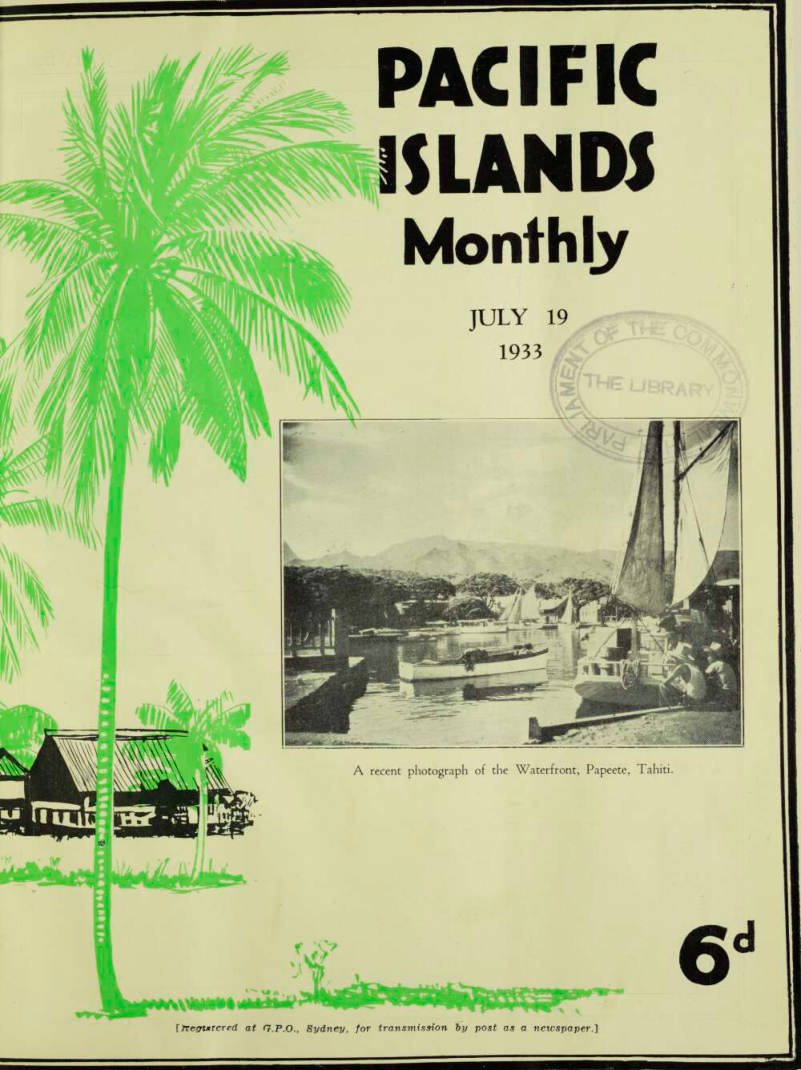
Pacific
ISLANDS
Monthly
JULY 19
1933
6 d
[Registered at G.P.O., Sydney, for transmission by post as a newspaper.]
A recent photograph of the Waterfront, Papeete, Tahiti.
W. R. Carpenter & Co. Ltd.
Head Office :
19-21 O’CONNELL STREET - - SYDNEY
Branches at: RABAUL (New Britain), KAVIENG (New Ireland), MADANG (New Guinea), SALAMAUA, WAU (New Guinea), TULAGI (Solomon Islands), and other Pacific Islands; and in LONDON.
WE SPECIALISE IN SUPPLYING THE REQUIREMENTS OF ISLANDS
RESIDENTS, PLANTERS AND TRADERS.
We are Agents for : Ford Cars, Trucks and Fordson Trac tors, Dodge Brothers Cars, Graham Dodge Trucks, Bolinder Marine and Stationary Engines, Coates’ Plymouth Gin, McCallums’ Perfection Whisky, Rimmel’s Perfumes, Houbigant’s Per fumes and Powders, Carlton V.B.
Beer, Goodyear Tyres.
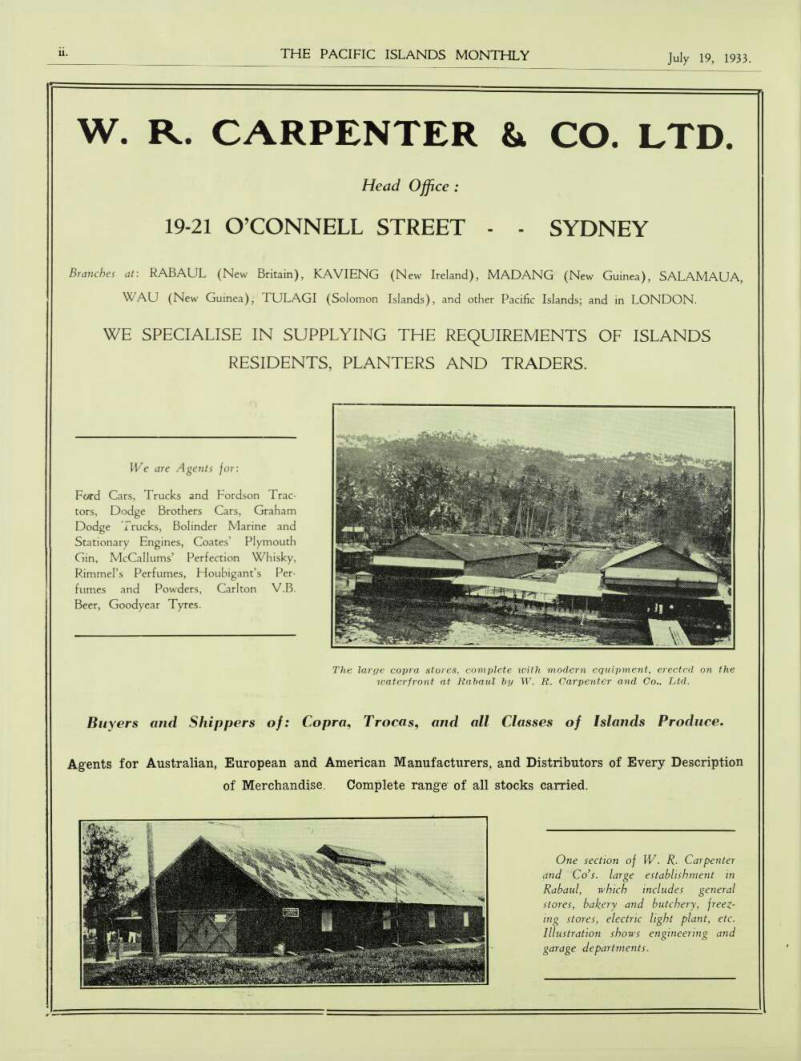
The large copra stores, complete with modern equipment, erected on the waterfront at Rabaul by W. R. Carpenter and Go., Ltd.
Buyers and Shippers of: Copra , Trocas , and all Classes of Islands Produce.
Agents for Australian, European and American Manufacturers, and Distributors of Every Description of Merchandise. Complete range of all stocks carried.
One section of W. R. Carpenter and Co’s, large establishment in Rabaul, which includes general stores, bakery and butchery, freez ing stores, electric light plant, etc.
Illustration shows engineering and garage departments.
Pacific Islands Travellers
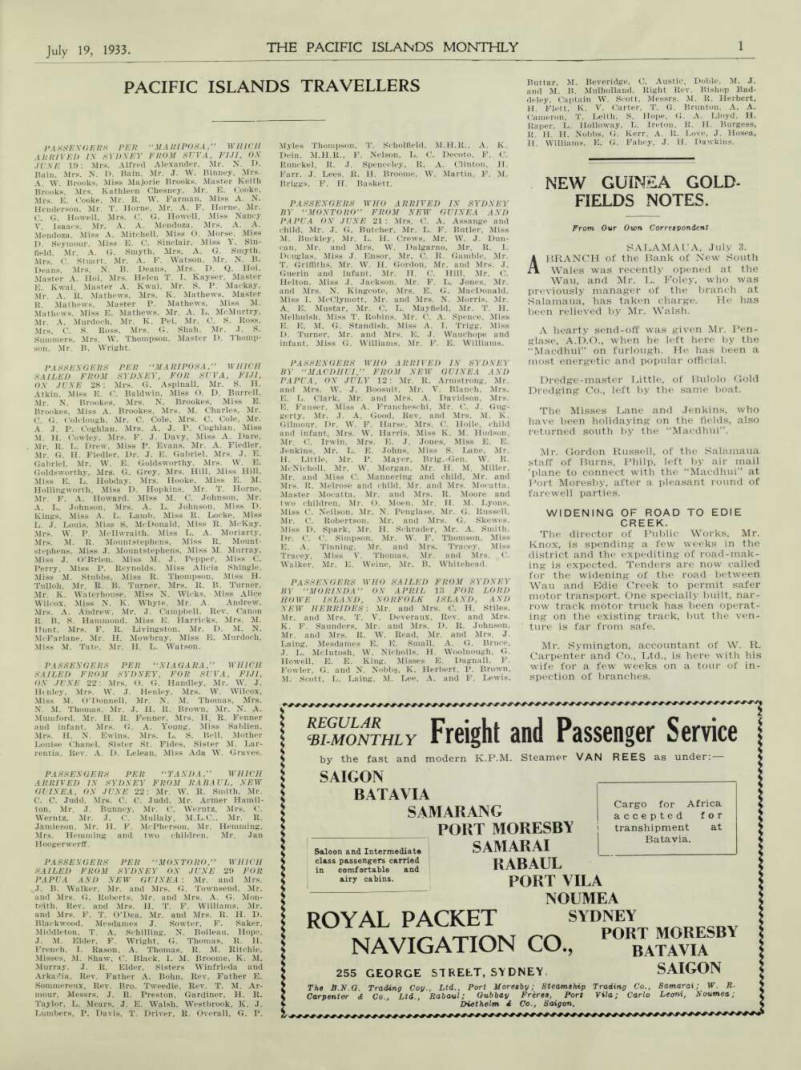
Passengers Per "Mariposa,” Which
ARRIVED IN SYDNEY FROM SUVA, FIJI, ON JUNE 19: Mrs. Alfred Alexander, Mr. N. D.
Bain, Mrs. N. D. Bain, Mr. J. W. Binney, Mrs.
A. W. Brooks, Miss Majorie Brooks, Master Keith Brooks, Mrs. Kathleen Chesney, Mr. E. Cooke, Mrs. E. Cooke, Mr. R. W. Farman, Miss A. N.
Henderson, Mr. T. Horne, Mr. A. F. Horne, Mr.
C. G. Howell, Mrs. C. G. Howell, Miss Nancy V. Isaacs, Mr. A. A. Mendoza, Mrs. A. A.
Mendoza, Miss A. Mitchell, Miss O. Morse, Miss D. Seymour, Miss E. C. Sinclair, Miss Y. Sin field, Mr. A. G. Smyth, Mrs. A. G. Smyth, Mrs. C. Stuart, Mr. A. F. Watson, Mr. N. B.
Deans, Mrs. N. B. Deans, Mrs. D. Q. Hoi, Master A. Hoi, Mrs. Helen T. I. Kayser, Master E. Kwai, Master A. Kwai, Mr. S. P. Mackay, Mr. A. R. Mathews, Mrs. K. Mathews, Master R. Mathews, Master P. Mathews, Miss M.
Mathews, Miss E. Mathews, Mr. A. L. McMurtry, Mr. A. Murdoch, Mr. K. Pei, Mr. C. S. Ross, Mrs. C. S. Ross, Mrs. G. Shah, Mr. J. S.
Summers, Mrs. W. Thompson, Master D. Thomp son, Mr. B. Wright.
Passengers Per “Mariposa,” Which
Sailed From Sydney, For Suva, Fiji,
ON JUNE 28: Mrs. G. Aspinall, Mr. S. H.
Atkin, Miss E. C. Baldwin, Miss O. D. Burrell, Mr. N. Brookes, Mrs. N. Brookes, Miss E.
Brookes, Miss A. Brookes, Mrs. M. Charles, Mr.
C. G. Colclough, Mr. C. Cole, Mrs. C. Cole, Mr.
A. J. P. Coghlan, Mrs. A. J. P. Coghlan, Miss M. H. Cowley, Mrs. F. J. Davy, Miss A. Dare, Mr. R. L. Drew, Miss P. Evans, Mr. A. Fiedler, Mr. G. H. Fiedler, Dr. J. E. Gabriel, Mrs. J. E.
Gabriel, Mr. W. E. Goldsworthy, Mrs. W. E.
Goldsworthy, Mrs. G. Grey, Mrs. Hill, Miss Hill, Miss E. L. Hobday, Mrs. Hooke, Miss E. M.
Hollingworth, Miss D. Hopkins, Mr. T. Horne, Mr. F. A. Howard, Miss M. C. Johnson, Mr.
A. L. Johnson, Mrs. A. L. Johnson, Miss D.
Kings, Miss A. L. Lamb, Miss R. Locke, Miss L. J. Louis, Miss S. McDonald, Miss R. McKay.
Mrs. W. P. McIlwraith, Miss L. A. Moriarty, Mrs. M. R. Mountstephens, Miss R. Mount stephens, Miss J. Mountstephens, Miss M. Murray, Miss J. O’Brien, Miss M. J. Pepper, Miss C.
Perry, Miss P. Reynolds, Miss Alicia Shingle, Miss M. Stubbs, Miss R. Thompson, Miss H.
Tulloh, Mr. R. B. Turner, Mrs. R. B. Turner, Mr. K. Waterhouse, Miss N. Wicks, Miss Alice Wilcox, Miss N. K. Whyte, Mr. A. Andrew, Mrs. A. Andrew, Mr. J. Campbell, Rev. Canon R. B. S. Hammond, Miss E. Harrieks, Mrs. M.
Hunt, Mrs. F. R. Livingston, Mr. D. M. N.
McFarlane, Mr. H. Mowbray, Miss E. Murdoch, Miss M. Tate, Mr. H. L. Watson.
Passengers Per “Niagara,” Which
Sailed From Sydney, For Suva, Fiji,
ON JUNE 22: Mrs. O. G. Handley, Mr. W. J.
Henley, Mrs. W. J. Henley, Mrs. W. Wilcox, Miss M. O’Donnell, Mr. N. M. Thomas, Mrs.
N. M. Thomas, Mr. J. H. R. Brown, Mr. N. A.
Mumford, Mr. H. R. Fenner, Mrs. H. R. Fenner and infant, Mrs. G. A. Young, Miss Sablien, Mrs. H. N. Ewins, Mrs. L. S. Bell, Mother Louise Chanel, Sister St. Fides, Sister M. Lar rentia, Rev. A. D. Lelean, Miss Ada W. Graves.
Passengers Per “Tanda,” Which
Arrived In Sydney From Rabaul, New
GUINEA, ON JUNE 22: Mr. W. R. Smith, Mr.
C. C. Judd, Mrs. C. C. Judd, Mr. Armer Hamil ton, Mr. J. Bunney, Mr. C. Werntz, Mrs. C.
Werntz, Mr. J. C. Mullaly, M.L.C., Mr. R.
Jamieson, Mr. H. F. McPherson, Mr. Hemming, Mrs. Hemming and two children, Mr. Jan Hoogerwerff.
Passengers Per “Montoro,” Which
SAILED FROM SYDNEY ON JUNE 29 FOR PAPUA AND NEW GUINEA : Mr. and Mrs.
J. B. Walker, Mr. and Mrs. G. Townsend, Mr. and Mrs. G. Roberts, Mr. and Mrs. A. G. Mon teith, Rev. and Mrs. H. T. F. Williams, Mr. and Mrs. F. T. O’Dea, Mr. and Mrs. R. H. D.
Blackwood, Mesdames J. Sowter, F. Saker, Middleton, T. A. Schilling, N. Boileau, Hope, J. M. Elder, F. Wright, G. Thomas, R. H.
French, I. Rason, A. Thomas, R. M. Ritchie, Misses, M. Shaw, C. Black, I. M. Broome, K. M.
Murray, J. R. Elder, Sisters Winfrieda and Rev. Father A. Bohn, Rev. Father E.
Sommereux, Rev. Bro. Tweedie, Rev. T. M. Ar mour, Messrs. J. R. Preston, Gardiner, H. R.
Taylor, L. Mears, J. E. Walsh, Westbrook, K. J.
Lumbers, P. Davis, T. Driver, R. Overall, G. P.
Myles Thompson, T. Scholfleld, M.H.R., A. K.
Dein, M.H.R., F. Nelson, L. C. Decoto, F. C.
Runckel, R. J. Spenceley, R. A. Clinton, H.
Farr, J. Lees, R. H. Broome, W. Martin, F. M.
Briggs, F. H. Baskett.
Passengers Who Arrived In Sydney
By “Montoro” From New Guinea And
PAPUA ON JUNE 21 : Mrs. C. A. Assange and child, Mr. J. G. Butcher, Mr. L. F. Butler, Miss M. Buckley, Mr. L. H. Crews, Mr. W. J. Dun can, Mr. and Mrs. W. Dalgarno, Mr. R. I.
Douglas, Miss J. Ensor, Mr. C. R. Gamble, Mr.
T. Griffiths, Mr. W. H. Gordon, Mr. and Mrs. J.
Guerin and infant, Mr. H. C. Hill, Mr. C.
Helton, Miss J. Jackson, Mr. F. L. Jones, Mr. and Mrs. N. Kingcote, Mrs. E. G. MacDonald, Miss I. McClymott, Mr. and Mrs. N. Morris, Mr.
A. E. Mustar, Mr. C. L. Mayfield, Mr. T. H.
Melhuish, Miss T. Robins, Mr. C. A. Spence, Miss E. E. M. G. Standish, Miss A. I. Trigg, Miss D. Turner, Mr. and Mrs. E. J. Wauchope and infant, Miss G. Williams, Mr. F. E. Williams.
Passengers Who Arrived In Sydney
By "Macdhui,” From New Guinea And
PAPUA, ON JULY 12: Mr. R. Armstrong, Mr. and Mrs. W. J. Boosuit, Mr. V. Blanch, Mrs.
E. L. Clark, Mr. and Mrs. A. Davidson, Mrs.
E. Fauser, Miss A. Francheschi, Mr. C. J. Gug gerty, Mr. J. A. Good, Rev. and Mrs. M. K.
Gilmour, Dr. W. F. Harse, Mrs. C. Hoile, child and infant, Mrs. W. Harris, Miss K. M. Hudson, Mr. C. Irwin, Mrs. E. J. Jones, Miss E. E.
Jenkins, Mr. L. E. Johns, Miss S. Lane, Mr.
H. Little, Mr. P. Mayer, Brig.-Gen. W. R.
McNicholl, Mr. W. Morgan, Mr. H. M. Miller, Mr. and Miss C. Mannering and child, Mr. and Mrs. R. Melrose and child, Mr. and Mrs. Mocatta, Master Mocatta, Mr. and Mrs. R. Moore and two children, Mr. O. Moen, Mr. H. M. Lyons, Miss C. Neilson, Mr. N. Penglase, Mr. G. Russell, Mr. C. Robertson, Mr. and Mrs. G. Skewes, Miss D. Spark, Mr. H. Schrader, Mr. A. Smith, Dr. C. C. Simpson, Mr. W. F. Thomson, Miss E. A. Tinning, Mr. and Mrs. Tracey, Miss Tracey, Miss V. Thomas, Mr. and Mrs. C.
Walker, Mr. E. Weine, Mr. B. Whitehead.
Passengers Who Sailed From Sydney
BY “MORINDA” ON APRIL 13 FOR LORD
Howe Island, Norfolk Island, And
NEW HEBRIDES: Mr. and Mrs. C. H. Stiles, Mr. and Mrs. T. Y. Deveraux, Rev. and Mrs.
K. F. Saunders, Mr. and Mrs. D. R. Johnson, Mr. and Mrs. R. W. Read, Mr. and Mrs. J.
Laing, Mesdames E. E. Small, A. G. Bruce, J. L. McIntosh, W. Nicholls, H. Woolnough, G.
Howell, E. E. King, Misses E. Dagnall, F.
Fowler, G. and N. Nobbs, K. Herbert, P. Brown, M. Scott, L. Laing, M. Lee, A. and F. Lewis,
Buttar, M. Beveridge, C. Austic, Doble, M. J. and M. B. Mulholland, Right Rev. Bishop Bad deley, Captain W. Scott, Messrs. M. R. Herbert, H. Flett, K. Y. Carter, T. G. Brunton, A. A.
Cameron, T. Leith, S. Hope, G. A. Lloyd, H.
Raper, L. Holloway, L. Ireton, R. H. Burgess, R. H. H. Nobbs, G. Kerr, A. R. Love, J. Hosea, H. Williams, E. G. Fahey, J. H. Dawkins.
Fields Notes.
New Guinea Gold
From Our Own Correspondent
Salamaua, July 3.
A BRANCH of the Bank of New South Wales was recently opened at the Wau, and Mr. L. Foley, who was previously manager of the branch at Salamaua, has taken charge. He has been relieved by Mr. Walsh.
A hearty send-off was given Mr. Pen glase, A.D.O., when he left here by the “Macdhui” on furlough. He has been a most energetic and popular official.
Dredge-master Little, of Bulolo Gold Dredging Co., left by the same boat.
The Misses Lane and Jenkins, who have been holidaying on the fields, also returned south by the “Macdhui”.
Mr. Gordon Russell, of the Salamaua staff of Burns, Philp, left by air mail ’plane to connect with the “Macdhui” at Port Moresby, after a pleasant round of farewell parties.
Widening Of Road To Edie
Creek.
The director of Public Works, Mr.
Knox, is spending a few weeks in the district and the expediting of road-mak ing is expected. Tenders are now called for the widening of the road between Wau and Edie Creek to permit safer motor transport. One specially built, nar row track motor truck has been operat ing on the existing track, but the ven ture is far from safe.
Mr. Symington, accountant of W. R.
Carpenter and Co., Ltd., is here with his wife for a few weeks on a tour of in spection of branches.
Advertisements & other items, p. 3 (1 item)
Freight and Passenger Service
REGULAR
BI-MONTHLY
by the fast and modern K.P.M. Steamer VAN REES as under:
SAIGON
BATAVIA
SAMARANG
PORT MORESBY
SAMARAI
RABAUL
Cargo for Africa accepted for transhipment at Batavia.
Saloon and Intermediate class passengers carried in comfortable and airy cabins.
PORT VILA
NOUMEA
SYDNEY
PORT MORESBY
NAVIGATION CO., Batavia
ROYAL PACKET
255 GEORGE STREET, SYDNEY
SAIGON
The B.N.G. Trading Coy., Ltd., Port Moresby; Steamship Trading Co., Samarai; W. R.
Carpenter & Co., Ltd., Rabaul; Gubbay Freres, Port Vila; Carlo Leoni, Noumea; Diethelm & Co., Saigon.
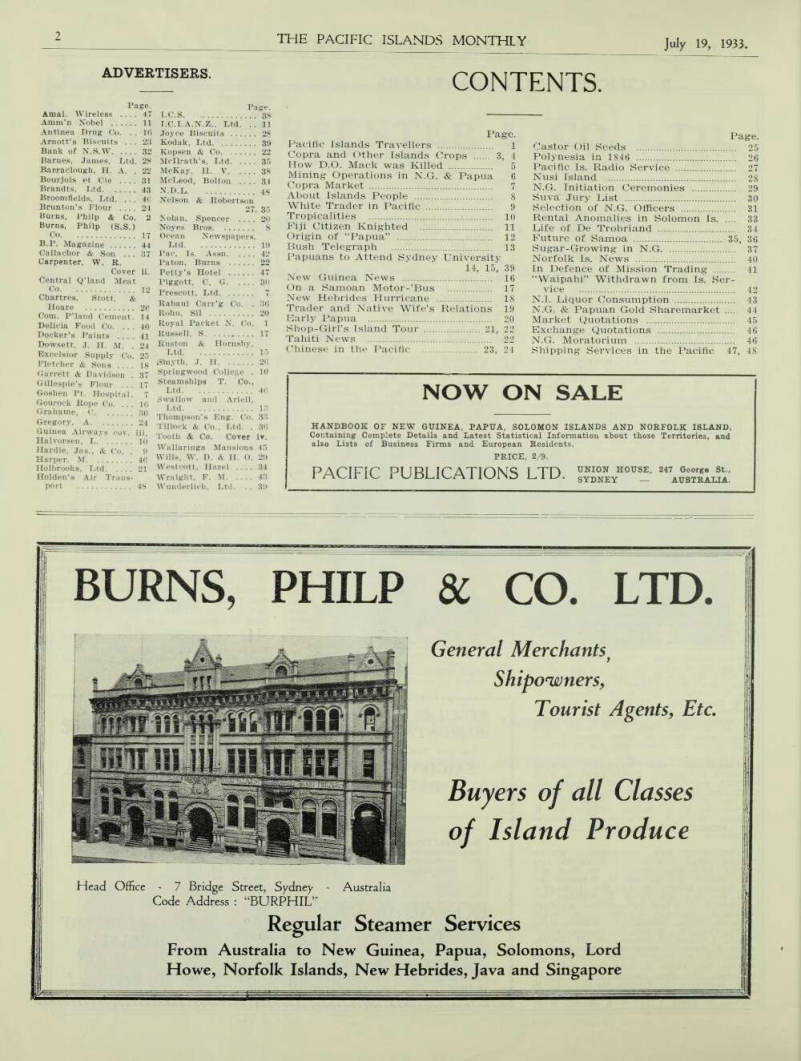
Advertisers.
Page.
Amal. Wireless ... 47 Amm’n Nobel 11 Antinea Drug Co. . . 16 Arnott’s Biscuits ... 23 Bank of N.S.W 32 Barnes, James, Ltd. 28 Banraclough, H. A. . 22 Bourjois et Cie 31 Brandts, Ltd 43 Broomflelds, Ltd. .. . 40 Brunton’s Flour ... 24 Burns, Philp & Co. 2 Burns, Philp (S.S.) Co. 17 B.P. Magazine 44 Callachor & Son ... 37 Carpenter, W. R.
Cover ii.
Central Q’land Meat Co. 12 Chartres, Stott, & Hoare 26 Com. P’land Cement. 14 Delicia Food Co. ... 40 Docker’s Paints ... 41 Dowsett, J. H. M. . 24 Excelsior Supply Co. 25 Fletcher & Sons 18 Garrett & Davidson . 37 Gillespie’s Flour ... 17 Goshen Pt. Hospital. 7 Gourock Rope Co. ... 16 Grahame, C 30 Gregory, A 24 Guinea Airways cov. iii.
Halvorsen, L 10 Hardie, Jas., & Co. . 9 Harper, M 46 Holbrooks, Ltd 21 Holden’s Air Transport 48
Page.
I.C.S. 38
I.C.I. A.N.Z.. Ltd. 11
Joyce Biscuits 28 Kodak, Ltd 39 Kopsen & Co 22 McIlrath’s, Ltd 35 McKay, H. V 38 McLeod, Bolton ... 31
N.D.L 48
Nelson & Robertson 27, 35 Kolan, Spencer ... 20 Noyes Bros 8 Ocean Newspapers, Ltd 19 Pac. Is. Assn 42 Paton, Burns 22 Petty’s Hotel 47 Piggott, C. G 30 Prescott, Ltd 7 Rabaul Carr’g Co. . 36 Rohu, Sil 20 Royal Packet N. Co. 1 Russell, S. ... 17 Ruston & Hornsby, Ltd 15 Smyth, J. H 26 Springwood College . 10 Steamships T. Co., Ltd 46 Swallow and Ariell, Ltd 13 Thompson’s Eng. Co. 33 Tillock & CO., Ltd. . 36 Tooth & Co. Cover iv.
Wallaringa Mansions 45 Wills, W. D. & H. O. 29 Westcott, Hazel ... 34 Wraight. F. M 43 Wunderlich, Ltd. .. 39
Contents.
Page.
Pacific Islands Travellers 1 Copra and Other Islands Crops 3, 4 How D.O. Mack was Killed 5 Mining Operations in N.G. & Papua 6 Copra Market 7 About Islands People 8 White Trader in Pacific 9 Tropicalities 10 Fiji Citizen Knighted 11 Origin of “Papua” 12 Bush Telegraph 13 Papuans to Attend Sydney University 14, 15, 39 New Guinea News 16 On a Samoan Motor-’Bus 17 New Hebrides Hurricane 18 Trader and Native Wife’s Relations 19 Early Papua 20 Shop-Girl’s Island Tour 21, 22 Tahiti News 22 Chinese in the Pacific 23, 24
Page.
Castor Oil Seeds 25 Polynesia in 1846 26 Pacific Is. Radio Service 27 Nusi Island 28 N.G. Initiation Ceremonies 29 Suva Jury List 30 Selection of N.G. Officers 31 Rental Anomalies in Solomon Is 33 Life of De Trobriand 34 Future of Samoa 35, 36 Sugar-Growing in N.G 37 Norfolk Is. News 40 In Defence of Mission Trading 41 “Waipahi” Withdrawn from Is. Service 42 N.I. Liquor Consumption 43 N.G. & Papuan Gold Sharemarket ... 44 Market Quotations 45 Exchange Quotations 46 N.G. Moratorium 46 Shipping Services in the Pacific 47, 48
Advertisements & other items, p. 4 (1 item)
Burns, Philp & Co. Ltd.
NOW ON SALE
HANDBOOK OF NEW GUINEA, PAPUA, SOLOMON ISLANDS AND NORFOLK ISLAND, Containing Complete Details and Latest Statistical Information about those Territories, and also Lists of Business Firms and European Residents.
PRICE, 2/9.
PACIFIC PUBLICATIONS LTD.
UNION HOUSE. 247 George St.,
SYDNEY AUSTRALIA.
BURNS, PHILP & CO. LTD.
General Merchants,
Shipowners,
Tourist Agents, Etc.
Buyers of all Classes
of Island Produce
Head Office - 7 Bridge Street, Sydney - Australia Code Address : “BURPHIL”
Regular Steamer Services From Australia to New Guinea, Papua, Solomons, Lord Howe, Norfolk Islands, New Hebrides, Java and Singapore
The Pacific Islands Monthly
THE NEWSPAPER - MAGAZINE OF THE SOUTH SEAS [Registered at G.P.O., Sydney, lor transmission by post as a newspaper.]
Published Once Each Month and Circulated in Australia and New Zealand and in the following Pacific Territories and Island Groups:
Crown Colony of Fiji.
Australian Territory of Papua.
Mandated Territory (Australia) of New Guinea, Bismarck Archipelago, and Northern Solomon Islands.
Mandated Territory (Japan) of Marshall, Caroline and Mariana Islands.
American Territory of Guam.
Mandated Territory of Nauru.
British Crown Colony of Gilbert and Ellice Islands.
French Territory of New Caledonia.
British and French Condominium of New Hebrides.
American Territory of Eastern Samoa.
Mandated Territory (New Zealand) of Samoa British Solomon Islands Protectorate.
British Protectorate of Tongan Islands New Zealand Territory of Cook Islands.
Australian Territory of Norfolk Island.
French Colony of Oceania (Tahiti, etc.) American Territory of Hawaiian Islands.
Owned and Produced by Pacific ‘Publications Ltd., Union House, 247 George Street, Sydney
Telephone Bw 5037
P.O. Box 3408 R
Contributions
Articles, Stories and Photographs dealing with Pacific Islands Subjects are invited, and will be paid for on publication at usual rates.
Subscription Rates
Per Annum, within Postal Convention Territories, Prepaid, Post Free 6/- Per Annum elsewhere, Prepaid, Post Free 87- Single Copies 6d.
Editor and Publisher:
R. W. Robson.
Advertisements
Advertising rates furnished on application.
Colours, etc. by Arrangement Process Blocks made at Advertiser’s expense when required. Screen, 100.
Changes of Advertising Copy should reach this Office by 8th of each month, otherwise previous advertisement may be repeated.
Registered Address for Radiograms and Cables: “PACPUB” Sydney
Agents
The following are authorised to receive sub scriptions for The Pacific Islands Monthly Islands Branches of Burns, Philp & Co.. Ltd., and Burns, Philp (South Seas) Co., Ltd.
Islands Branches of W. R. Carpenter & Co., Ltd.
All Branches of Morris, Hedstrom & Co,, Ltd.
J. H. MacGregor Dowsett, Rabaul.
Whitten Bros., Ltd., Port Moresby & Samarai.
All Branches and Representatives of W. H.
Grove & Sons, Ltd., Auckland. 9. Russell, Papeete, Tahiti.
Cook Islands Trading Co.. Rarotonga.
Mrs. M. Campbell. Cascades, Norfolk Island.
Vol. III. No. 12.
Sydney, July 19, 1933.
Price 6d. Per Copy, Prepaid: 6/- p.a.
Copra: All the Eggs in One Basket
MOST people carry all their eggs in one basket, in spite of the ancient adage, which suggests that wise owners of eggs will provide two containers, so that when one suffers a fall the eggs in the other one may be intact.
Coconut planters, like most people, have had all their eggs in one basket. The copra market has crashed in a manner without precedent in recorded history, and the planter, in consequence, is rather desperately “up against it”. Mr. Wise-after-the event, of course, is scolding, and assuring the harassed planter that he should have used his plan tation to grow som'ething as an alternative to copra.
It is just as well we cannot hear the retort of the average planter.
For two years the planters, being intelligent men, have been looking about for quick-growing crops that will give them some sort of dependable revenue, pending the uncertain recovery of the copra market.
All sorts of things are being tried, and it is interest ing to make a survey of these efforts.
A recent arrival from the Solomons informs us of several experiments. Mr. S. Marks, at Gizo, and Messrs. McLeod, Bolton & Co., of Malaita, have planted considerable areas in kapok, and some other
planters are seeking all available information about this commodity. We are informed that the produc tion of kapok is being undertaken, also, on a fairly large scale, in Papua, A year or two ago there was much interest being shown in tung oil production—this commodity being much and increasingly in demand for aeroplane building and in connection with fine furniture work.
We have not heard much of it lately, although an excellent market is still there. The consensus of evidence is that the tung oil variety known as “Fordii”, which ordinarily bears well, while it grows prolifically in the South Sea Islands in its young stages, dies away when it reaches the stage at which production should commence; and that the less prolific variety, “Montana,” is more likely to do well in the Islands. We have not recently heard the result of the various experiments that were being made, and our readers probably would be glad of further information. It is reported that the Malaita Company has planted out a few acres with tung oil trees in Malaita, B.S.I.
Many planters, in recent months, have shown a sharp interest in the cultivation of castor oil seed, for which it is said there is a constant and profitable
market. Several New Guinea men have decided to try out this quick-growing crop. Some interesting information about castor oil seed is given elsewhere in this issue by Mr. Bruce, formerly a planter in the Solomon Islands.
Some of the Roman Catholic fathers, at Solomon Islands mission stations, are growing cocoa, and the crop promises well. Cocoa is being grown, also, on a few New Guinea plantations. The main problem is that of finding a regular market. The average planter knows not where to turn for a buyer.
Coffee cannot very well be called a suitable alter native or secondary to coconuts—its cultivation is more of a full-time job. It is receiving a certain amount of attention, however. The Administrator of New Guinea reports that three or four concerns have commenced growing coffee in that Territory, with excellent results so far as the horticulture side is concerned.
The fact of the matter is that planters, under present conditions, are quite prepared to do and try anything, if they can get any reasonable assurance of a market for their produce. That is the crux of the present problem. One hears that kapok, or tung oil, or kapok, or something, is a “profitable’ ’ crop, giving a quick return, and some oversea price is
quoted in evidence; but when the interested planter, with his land and his labour all ready for some enterprise of the sort, wants further details, and particularly wants to know who will buy the product, and where, and when, he cannot get anything re liable.
The fact of the matter is, there is a link missing in the chain. Agricultural experts—such as Mr.
George Murray, in New Guinea—have a great quan tity of valuable data, which they are only too glad to place at the service of the planters; the various Administrations are eager to help with any kind of new production; the co-operation of the shipping and merchandising firms may be taken as already promised; but there seems to be no person, authority or institution ready or competent to establish a con nection between these efficient factors, and a firm and reliable market. That has been the great merit of copra-growing—the market, and the buying and collecting organisations, were there, and fixed and ready, and a planter could make his calculations far ahead, with reasonable confidence.
If some Government, administration or company will create the necessary firm connection between all these eager South Seas producers and the consumers who are believed to exist, somewhere, it will be doing a great service for the South Seas.
After 45 Years.
Lloyd Osbourne Revisits Tahiti
From Our Own Correspondent.
THE famous stepson and collaborator of the late Robert Louis Stevenson, Mr. Lloyd Osbourne, arrived in Tahiti by the s.s. “Recherche” a few days ago on an extended visit, and is at present staying at the Hotel Tahiti.
It is some 45 years ago since the illus trious “R.L.S.” came to this island on his yacht “Casco,” with the intention of remaining here for the rest of his days —to change his mind, later, in favour of Samoa; and, while the “march of pro gress” is slow in these parts, yet Mr.
Osbourne cannot but be conscious of many changes which have taken place since his first visit, and not all of them for the better.
In those days, there were, of course, no motor cars, and there was no road worthy of the name. A muddy, over grown track meandered from village to village through the jungle and along the beach, and finally brought the traveller to Tautira, the settlement Stevenson elected to live in, which is distant about 50 miles from Papeete. The trip was always something of an adventure, either by the overland route, or by sail ing boat, which was the usual method of transportation.
Nowadays, an up-to-date ’bus makes the journey in a couple of hours every day of the week, and the fare is a mere trifle of 10 francs.
Mr. Osbourne is also bound to notice the great increase in the number of Chi nese, as compared with the year 1888; the diminution of the purely native population, brought about by the great epidemic of 1918 and other causes; the preponderance of half-castes of all sorts in and around Papeete; and the dis placement of native customs by modern innovations.
So far as we are aware, the only other member of the “Casco’s” company now alive is “Jimmy” Larsen, then an A. B., but now Captain Larsen, and well known to everybody in Tahiti as a suc cessful island skipper.
Mr. Lloyd Osbourne has been living in England, California, and France; and he intends returning to the latter country at the conclusion of his visit here.
Dentists!
Beware Of Unknown
SOME cases of very serious illness in the Pacific Islands have been traced to the methods employed by unskilled and careless dentists, who make occa sional tours.
The majority of Europeans require a certain amount of regular dental atten tion. When they live in isolated or sparsely-settled Islands, the problems of procuring dental service becomes a seri ous one. Consequently, an itinerant den tist, making a round trip on an Islands steamer, has no lack of patients—if they know that he is coming.
Unfortunately, this practice has at tracted some undesirable members of the profession. We have heard some shocking stories of delicate dental opera tions being attempted by grossly un skilled men; of cruel sufferings imposed on unlucky “patients”; of monstrous fees charged by the greedy itinerants; and, in one case, of a filthy disease being conveyed to a European by a dentist who had not taken proper precautions after carrying out a job on a native.
Under present conditions, there seems to be no way of officially checking up on the qualifications of visiting dentists.
Residents, therefore, would be wise to deal only with men who are known to be qualified and reliable, and to have nothing whatever to do with unknown professional visitors, unless they can produce convincing evidence of skill and experience.
Cruise.
Around The World
Pleasure Yacht at Rabaul.
From Our Own Correspondent.
Rabaul, July 1.
CROSSING the Atlantic from Halifax to Gibraltar in thirty days, experi encing some rough weather, Captain L. M. Wilson, a Canadian journalist and a son of Senator Wilson, of Montreal, steered his yacht, the “Quebec Ptarma gen” through the Mediterranean to Port Said.
Reaching Aden, the vessel made the record trip to Batavia direct in 36 days and, after that voyage, the owner captain, with his crew of amateur yachtsmen, wandered leisurely amongst the Spice Islands, travelling as far north as Zamboanga in the Phillipines, then cruising south to Dutch New Guinea, and eventually reaching Rabaul after a tedious journey of being becalmed at one time and then experiencing a nasty south-easter.
Captain Wilson is remaining in Rabaul for a week or so in order to overhaul the vessel and to engage fresh members for his crew to replace those who de parted for the East on the “Nellore” last week. The captain-owner is a most in teresting character, having spent an eventful period in China as the repre sentative of an American Press Associa tion during the 1927 disturbances in the East.
The vessel is comfortably fitted out as a typical pleasure craft; it is forty-five tons and has a standard Diesel engine installed. It was previously owned by a chased by Captain Wilson during the depression period at a bargain price.
From here the yacht will proceed to Honolulu, via the Gilberts and eventu ally San Francisco will be her destina tion.
How Gallant Ian Mack Was Killed.
Epic of the New Guinea Service.
From Our Own Correspondent.
Rabaul, July 1.
STARTING out on a Saturday (June 10) for the purpose of apprehending natives who had killed members of another tribe near the Government post on the Upper Ramu, Assistant District Officer Ian Mack arrived at a village some four miles distant from his station, and two hours’ walking distance.
In this village, the circular leaf-houses are so constructed that there is a double wall. Entering at one side of the house, it is necessary to proceed half around the circle, along a narrow passageway between the two walls, before reaching an entrance to the interior of the house.
Despatching one of his police-boys into the house to ascertain the where abouts of certain natives, Mack was astonished when the boy returned with an arrow-wound in the face and ex plained that he had lost his rifle. The A.D.O. instructed him to return for his weapon at once; but the police-boy, filled with fear after his first experience, refused to do so.
In order to restore confidence and courage in his small party, Ian Mack himself entered the outside door, pro ceeded along the narrow passage-way and, arriving at the inner entrance to the house, flashed his electric torch into the room. Immediately a shower of arrows were fired at him, entering his body about the chest and arms. Bravely, he retained his consciousness and fired at his attackers and, with the assistance of his native police, killed twelve of the thirteen inmates of the darkened room.
One attacker was taken prisoner.
With several barbed arrows embedded in his body, he was removed from the house with difficulty and carried by his own police, and with the assistance of natives from a neighbouring friendly tribe, to the Upper Ramu aerodrome.
Here, he was fortunate in being cared for by Mrs. Peadon, until the aeroplane arrived on June 13, and transported the wounded man to Salamaua, where he immediately received the best medical attention available.
It was thought advisable, however, to have him transported to Rabaul, where X-ray appliances would assist in locat ing the barbed arrows still remaining in his body, and arrangements were made for chartering one of the Junker ’planes.
Floats were necessary, to be attached for the journey from Salamaua to Rabaul, and this task was found to be impos sible.
On learning this, Dr. Sinclair, who had the case in hand, radioed to the N.D.L. steamer “Friderun”, which at that time was picking up copra along the Madang coast in the vicinity of Karkar island.
Captain Engels immediately made all speed for Salamaua, but did not arrive in time; as, during a third transfusion of blood which was given by Mr. B.
Challis, Ian Mack passed away as a result of arterial haemorrhage.
The funeral was held on Sunday after noon; the pall-bearers consisted of rep resentative members of the Administra tion and commercial sections, and the service was conducted by the Superin tendent of the Lutheran Mission, Rev.
Lehner, who gave a simple, stirring ad dress at the graveside, just as the west terning sun was slipping behind the mountain tops.
Ian Mack’s bravery and devotion to duty until the last will ever be remem bered. He was an officer highly re spected, and his friends were legion. Too much praise cannot be accorded this splendid officer for the prompt action which he took in wiping out, almost to a man, his attackers, thereby meting out justice in a manner which can never be misunderstood by the primitive natives in the Upper Ramu country.
Nutfall In B.S.I.
Entomologist to Investigate.
FOR some time nutfall has been caus ing considerable concern to copra planters in the Solomon Islands. Its cause is a mystery and its cure so far has baffled planters in the Group. The disease causes the nuts to fall from the trees before they are fully developed and there is a consequent heavy loss of copra on many plantations affected by the disease.
In order to investigate this problem, Mr. H. T. Pagden, assistant entomolo gist in the Department of Agriculture of the Straits Settlements and Federated Malay States is on his way to the Solo mon Islands at the invitation of the Ad ministration. He arrived in Sydney by the “Nieuw Holland” on June 7.
Expenses.
Hon C. W. C. Marr's
Canberra, June 23.
There was no friendliness in the fol lowing question, asked by Senator Hardy to-day— “What is the total gross expense of the recent trip of the Honorable C. W. C.
Marr to New Guinea and the Mandated Territory?” .
And there was manifest glee in the Government’s answer: “The total cost to the Government of that visit was £188, included in which were the expenses of the official staff.”
The shocked Senator was left to digest the fact that this very unusual Minister apparently paid his own expenses.
Meteorite From New
Ireland.
On January 31 of this year, at 4.30 p.m., the natives working on Mr. H. L.
Cameron’s plantation on Djaul Island, near New Ireland, New Guinea, were startled by a series of explosions and a burst of flame in the sky.
A meteor had entered the atmosphere and became shattered into pieces. One of the natives picked up a fragment, weighing six ounces, and handed it to Mr, Cameron, who, realising its import ance, presented it to the Sydney Mu seum, and to him must be given the credit of obtaining the first meteorite found in the Territory of New Guinea.
The meteorite is now being investi gated and a full description will be pre pared for the records, but reference may be made here to some of the features presented by this interesting fall. In several respects, it resembles the “Mor ristown” meteorite, found in Hamblin Co., Tennessee, U.S.A., and one of its most striking characteristics is that it may be divided into two portions in respect of composition and grain size.
Australian Museum Magazine.
Runaway Sailor’S Descendants.
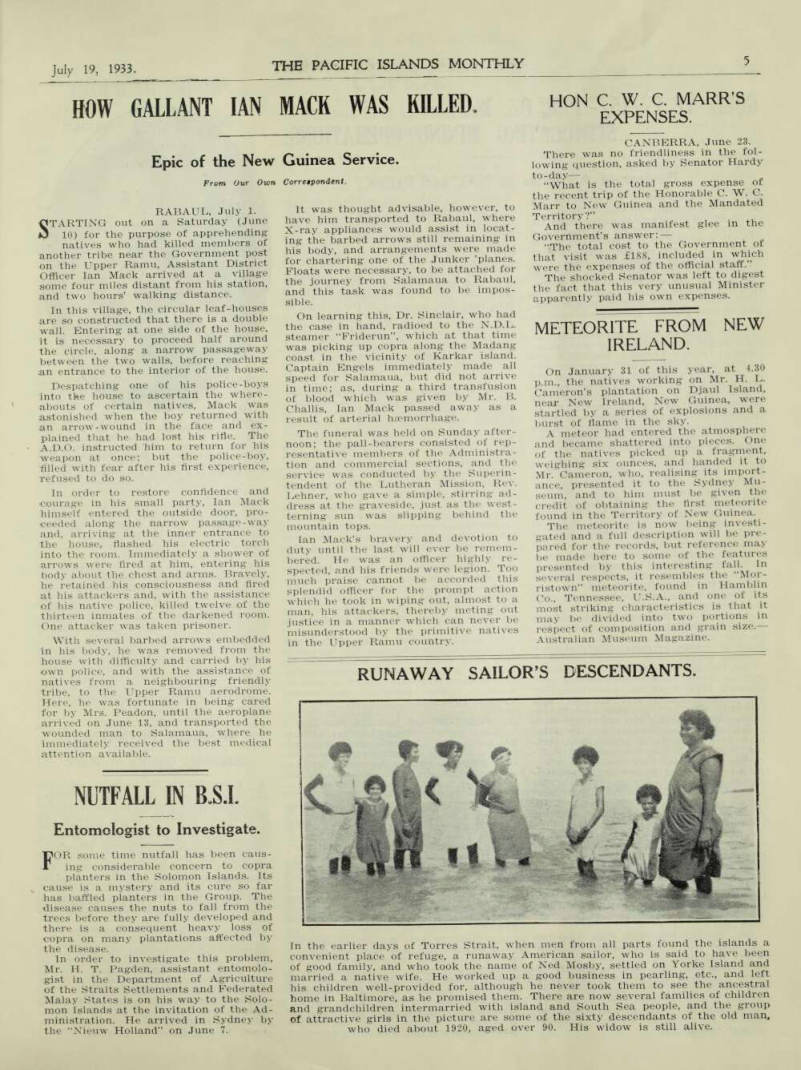
In the earlier days of Torres Strait, when men from all parts found the islands a convenient place of refuge, a runaway American sailor, who is said to have been of good family, and who took the name of Ned Mosby, settled on Yorke Island and married a native wife. He worked up a good business in pearling, etc., and left his children well-provided for, although he never took them to see the ancestral home in Baltimore, as he promised them. There are now several families of children and grandchildren intermarried with island and South Sea people, and the group of attractive girls in the picture are some of the sixty descendants of the old man, who died about 1920, aged over 90. His widow is still alive.
Stimulating Mining Operations.
Gold At £7/15/- Per Oz. Is
Review of Activities In N.G. and Papua,
THE continued rise in the price of gold —at the moment of this writing it is at £6/4/9 sterling per ounce, equal to £7/15/10 in Australian currency—is greatly stimulating the gold-mining in dustry. Not only is every concern that has reached the production stage now concentrating its efforts on production, but prospectors are out in every direc tion, in Central New Guinea, in the Ramu River and Bismarck Ranges area, and in the Papuan mountains, seeking for new fields.
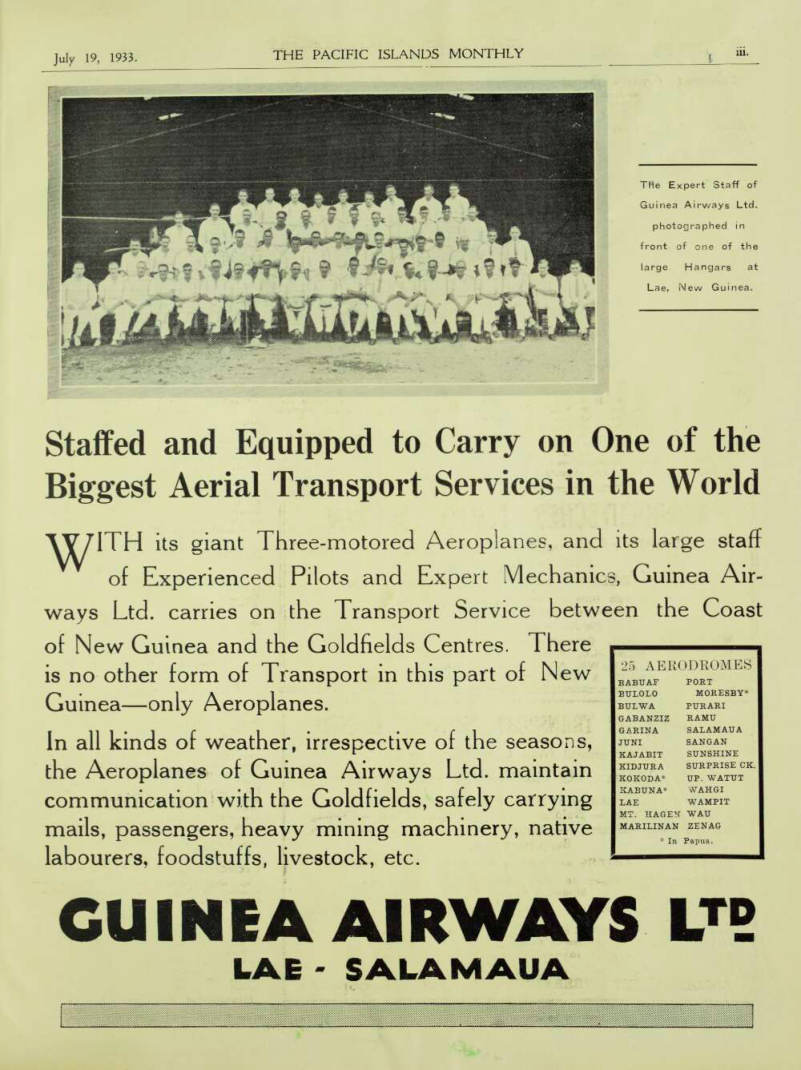
In this connection, gold-seeking has been aided tremendously by the enter prise of Guinea Airways, Ltd. This en terprising company, which provides most of the aerial transport required for the established field, has now some twenty minor aerodromes in very wild and hitherto inaccessible country; and the regular arrival of aeroplanes with sup plies at these points has solved the main problem which faces prospectors who sought to penetrate the hinterland.
The luckiest of all the gold-producers is the Bulolo group. They have two dredges now working continuously at Bulolo; and two more in course of erec tion on their Bulowat area. One of these will commence operations in November —the other early next year. Gold is coming from the Bulolo dredges in a steadily increasing stream; and, prob ably in justified anticipation of a hand some dividend (which seems certain), the Bulolo shares are now away over 80/- on the Australian market.
Because of the increased value of gold, the dredges are able to take, in their stride, gold-bearing land that would not be worth working a year ago but which, to-day, more than pays for operating.
This, of course, correspondingly reduces working costs.
The Bulolo Company has been wise, as well as lucky. Its directors having once decided that big-scale operations, by aeroplane-transport and dredges, was the only way to work this field, threw themselves into the big enterprise with great energy, and completed their initial plan in a remarkably short time, con sidering the tremendous natural diffi culties with which they were confronted.
As a reward, they have reached produc tion in time to reap a marvellous harvest —which their enterprise fully deserves.
The position on the other half of the goldfield, controlled by New Guinea Goldfields, Ltd., is not so pleasing. This company is still engaged primarily in testing and developing, rather than in production—although it is reported that, from one source and another, it is send ing out an increasing quantity of gold.
It is evident that, before it can reach the stage of really big-scale production, it must face the question of writing down its enormous overhead load of dead capital.
New Guinea Goldfields, Ltd. has just concluded the transportation of plant which will allow its cyaniding tanks to be triplicated. This installation should be in operation by the end of the year, and should largely increase the amount of gold which the company will produce —and, possibly, should provide additional capital for urgently-needed develop mental operations.
There has been much criticism of New guinea Goldfields, Ltd. on account of the slowness of its operations—shareholders making bitter comparison with the happy condition of Bulolo shareholders — and there is a disposition to blame some of the company’s executives. This is un fair and unjustified. The real handicap that has been upon N.G.G. lies not in personnel, but in the enormous overhead load that was assumed in the system of forming and financing the Company. No one, up to date, can see how this com pany can make progress comparable with the Bulolo group until it is recon structed. It has the gold-bearing coun try, but its financial structure seems all wrong.
Mr. J. P. Blaike Webster, managing director of Mining Trust, Ltd., London, virtual owners of N.G.G., Ltd., arrived in Sydney on July 13, and is now on his way to Mount Isa (Queensland) and New Guinea. It is anticipated that he will investigate the whole position and important decisions may be taken. They should be taken quickly. It is by no means certain that gold will remain on its present high price.
Meanwhile, New Guinea Goldfields, Ltd. is showing considerable enterprise in assisting parties of prospectors to ex amine the areas in the Central districts, in the region behind Madang and the Sepik. There are numerous parties at work hereabouts. The Leahy Brothers are on a promising show near Mount Hagen, in the Bismarck Ranges; Ned Rowlands is said to be developing some thing of promise on the Upper Raimi; and others are engaged in a prospect on the Purari.
In Papua, on the Yodda. Mr. Ward Williams is now planning the introduc tion of a small dredge, which may be brought in to the Kokoda aerodrome in the Moths; and other parties are at work in various parts of the eastern Papuan mountains.
Position Of Misima Mine.
A correspondent in Papua has written us, asking for information concerning operations of a company on Misima Is land (Eastern Papua), known as Misima Options, Ltd. There have been various references to this company in past is sues of “The Pacific Islands Monthly”.
Misima Options, Ltd. was formed to take over what was left of the wreck of the Mount Sisa Company, which form erly held many leases on Misima Island Among the directors were General Lloyd and Major C. W. C. Marr. Mr. Marr re signed when he became a member of the Federal Government.
Misima Options, Ltd. began operations nearly two years ago, testing and, to a small extent, developing the lease.
Prospects were reported excellent, but financial conditions seemed to be an embarrassment. During the past six or nine months the new company met a series of troubles. It found itself with a law case concerning wages on its hands, which was bequeathed to it by the old Mt. Sisa Company. Then it appears to have had some dispute with Mr. Gordon, who was connected with the formation of the new company. There was friction and delay while this was being adjusted,
and Mr. Gordon is now residing in Syd ney. Then it was discovered the tunnel had fallen in, due to excessive rain and the shifty nature of the ground. In re cent weeks a new managerial organisa tion has been created. One of the Syd ney directors has gone to Misima to watch operations on behalf of the share holders, and to assist the manager and supervise clean-ups. Additional capital has been found recently; and a quantity of gold from the mine reached Sydney by the last “Macdhui”. Half a dozen Europeans and a considerable native staff are now on the job, and prospects are officially declared to be encouraging.
We understand that the mine is being operated by Misima Options, Ltd. but that the old Mt. Sisa Company retains a substantial interest in any profits that the mine may make.
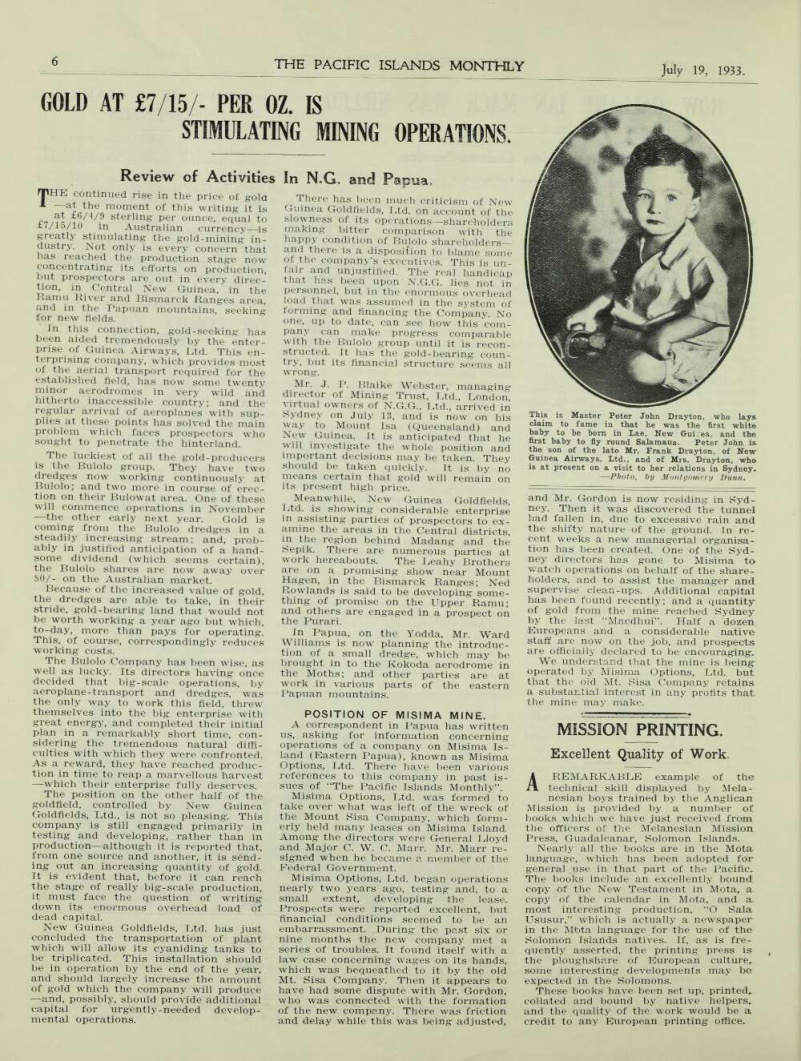
This is Master Peter John Drayton, who lays claim to fame in that he was the first white baby to be born in Lae, New Guinea, and the first baby to fly round Salamaua. Peter John is the son of the late Mr. Frank Drayton, of New Guinea Airways, Ltd., and of Mrs. Drayton, who is at present on a visit to her relations in Sydney. — Photo, by Montgomery Dunn.
Mission Printing.
Excellent Quality of Work.
A REMARKABLE example of the technical skill displayed by Mela nesian boys trained by the Anglican Mission is provided by a number of books which we have just received from the officers of the Melanesian Mission Press, Guadalcanar, Solomon Islands.
Nearly all the books are in the Mota language, which has been adopted for general use in that part of the Pacific.
The books include an excellently bound copy of the New Testament in Mota, a copy of the calendar in Mota, and a most interesting production, “O Sala Ususur,” which is actually a newspaper in the Mota language for the use of the Solomon Islands natives. If, as is fre quently asserted, the printing press is the ploughshare of European culture, some interesting developments may be expected in the Solomons.
These books have been set up, printed, collated and bound by native helpers, and the quality of the work would be a credit to any European printing office.
Tropical Sheep.
Success With English- Macassar Cross.
A MOST interesting and successful ex periment in breeding sheep suitable for acclimatisation in New Guinea has been carried out by Mr. E. J. Wau chope, of Awar Plantation, Madang.
Some four years ago, Mr. Wauchope bought 25 Macassar ewes from the Roman Catholic Mission. Seven died while he was transporting them to his plantation. There he crossed them with a big ram, of Shropshire and Southdown strain, which he had specially imported from Australia. The experts thereabouts ridiculed the proceeding. The English wool sheep, they declared, could not mate with the East Indian hair sheep.
But Mr. Wauchope persisted, and the cross was quite successful, producing a large-bodied sheep which flourished under New Guinea climatic conditions.
Where formerly Mr. Wauchope used to dress a sheep at about 18lbs. dead weight, he now gets 34 to 36lbs. dead weight.
Soon after the ewes had lambed, Kan aka dogs got into the flock and killed 15 of them. Since then, Mr. Wauchope has sold many rams of his new strain to planters up and down the coast, and has killed sheep regularly for meat; and his flock now numbers 180. This shows that the strain is fecund, and Mr. Wauchope says it flourishes in his locality. He em phasises, however, that the animals must be run on hard, dry ground. As soon as they are put into wet and swampy coun try, they die off quickly. This type of sheep provides excellent meat, and it is better than cattle for keeping down the plantation grass; it crops closely, and it does not puddle and pack down the soil.
Mr. Wauchope’s main trouble is the Kanaka dogs. These sneaking animals will kill the sheep on the slightest op portunity. Mr. Wauchope keeps native shepherds constantly on the job, and the sheep are penned at night.
We have published information from time to time about the New Guinea planters’ experiments in crossing English and Zebu cattle, in order to get a good beef animal that will stand up to the climate. Planters generally will be in terested to know that even greater suc cess has attended experiments with sheep.
Mr. R. L. Solomons, who was for many years in New Guinea with the Expro priation Board, and in private business, returned to the Territory by the last “Tanda,” to take up residence there again. Mr. Solomons will be associated in future with Mr. C. A. M. Adelskold, public accountant and auditor, Rabaul.
Copra.
Market Still Lifeless and Depressed.
NOT for fifty years has the copra mar ket been in so depressed a condition.
An examination of the figures, pub lished week by week, on page 45, is enough to drive the usually optimistic planter and trader to despair.
Many people have been commenting on the copra market, and offering vari ous explanations for its lifelessness — which is the more remarkable, in view of the fact that most other commodities are rising steadily—but none of these is very convincing. The real fact seems to be that copra is suffering under a num ber of things: It is still feeling the competition of such rivals as soya bean oil, peanut oil, whale oil, and various other oils which have had their harsh and unpleasant qualities removed by new processes of purification and deodorisation and which consequently may now be used in place of coconut oil.
There has been an enormous over production of whale oil; and, although this is now being reduced by a deter mined international move to prevent the extinction of Antarctic whales, there is still a huge surplus of whale oil to be got rid of.
Copra is now at the mercy of Unilever Ltd., a huge international combine, which is so powerful that it can almost write its own ticket in the European copra market.
So the outlook is not cheerful. Most of the planters who are getting the bene fit of the Australian and New Zealand exchange are just able to carry on and make a living; but planters elsewhere — particularly those adhering to the gold standard —are in a hopeless condition.
There is a general feeling that the copra market will improve in September or October and some planters and copra buyers are ordering their affairs accord ingly. We have not been able to discover any fact to justify this belief —but it is there, all the same, and should not be ignored.
The world’s present economic outlook is obscure. Commodity prices are rising, but no man seems able to say whether this is artificial, following upon America’s tremendous experiment in in flating her dollar currency, or whether it definitely marks the end of the depres sion. America, in the ultimate analysis, caused the world depression by an eco nomic sin—that is, by compelling the world to make excessive payments to
her in gold; and it would be a very queer thing if she dispelled the world depression by committing another economic sin—that is, by enormously depreciating her exchange white sbe is still able to provide a complete gold backing for her currency.
In the circumstances, it is not sur prising that the world, while awaiting the result of this epoch-marking experi ment by Dictator Roosevelt, is jumpy and nervous, and desperately afraid of what is around the corner Another three months should tell the tale. There will be either a great im provement in commerce, in which copra should benefit: or the world will split into three sections (the gold block, the sterling block, and U.S.A.) and try to resume international trade on that basis; or there will be economic chaos of the most serious kind.
Planter’S Life.
The Seamy Side Of A
“Lucky dog!” said I, to the New Guinea planter. “No income tax no rates, no unemployment tax, no sales ta The N.G. planter snorted. “Fat lot you city fellows know about it!” he said.
And he proceeded to give some details of the financial side of a copra-pro ducer's life.
"I pay an education tax of one shilling per boy per month. I have 100 boys.
Bang goes £5 per month! I don t know where it goes, or how my district natives benefit. But I pay it.
“I do a little trading in general mer chandise. Fee for this is £2 per annum.
“I buy and sell copra. Fee, paid to the dear old Administration, £2 per annum.
“I dynamite fish, wherewith to feed my labour. Fee for dynamite permit, £5 per annum.
“I cut a certain amount of timber, as required. Fee for timber-cutting permit, £5 per annum.
"I keep a certain number of guns.
License per gun. 2/6 per annum “I use a boy to shoot game for food.
Fee per shooting-boy, 2/6 per annum.
"In connection with my trading work, I have to have what is called a pedlar's license. Fee, £10 per annum per district “There are other charges, but that will do for the present. Every time I sign a native laborer on or off. I have to pay a fee of 1/-; and I have to pay heavy fees for recruiting labour.
“Which would I rather do—pay all these fees, or pay income tax on an in come which has dwindled away to the
size of a mere living wage?”
I apologised and withdrew.—R.W.R.
Advertisements & other items, p. 9 (2 items)
PRESCOTT Ltd Sussex St Sydney
are sole wholesale agents for
PINEAPPLE BACON & HAMS
DAISY BRAND BUTTER
PRESCO Brand BUTTER
LEA & PERRINS' SAUCE
& Most other Super-Quality Lines of the Trade.
Goshen Private Hospital
(Sister E. W. YEAMAN),
37 Gloucester Rd., HURSTVILLE,
SYDNEY.
General and Private Wards. Spacious Grounds. High and Cool Situation.
Moderate Fees.
About Islands People.
Mr. A. E. Mustar, general manager of Guinea Airways, Ltd., New Guinea, ar rived in Sydney by the Montoro on June 21 and went on to Adelaide.
Mr. H. Weil, a missionary in the New Hebrides, arrived in Sydney, on fur lough, by the “Morinda” on June 20. He is stationed at the Seventh Day Adven tist Mission on Tanna Island.
Rev. and Mrs. G. H. Eastman, of the London Missionary Society, will arrive in Suva, Fiji, on September 29 on their way from England. They will sail shortly afterwards by the “John Williams V.” for Benu, Gilbert and Ellice Islands Col ony, where they were formerly stationed.
Mr. L. A. Decoto and Mr. P. C. Runc kel, mining engineers, arrived in Sydney from America by the “Mariposa” on June 19. They left Sydney by the June Montoro” for New Guinea, where they intend to develop a new mining property for New Guinea Goldfields, Ltd.
Mr. Hercules Bodbant Foldi, who was a well-known and respected Islands rep resentative, died in Sydney on May 23 at the age of 66 years. Mr. Foldi repre sented Messrs. W. Gardiner and Co. (now Sargood, Gardiner and Co.) and had travelled throughout the Pacific Is lands—mostly in the Fiji Group—for over 30 years. Upon retiring from the position of Islands’ traveller owing to failing eyesight, he was succeeded by Mr. A. S. Farebrother, of Suva.
Rev. A. A. Butchart, of the Melanesian Mission at Gaua Is., Banks Group, in the New Hebrides, arrived in Sydney, on furlough, by the "Morinda” on June 19.
He is the only white resident among the 450 natives, who live on Gaua Island.
Mr. J. Craig, Colonial Treasurer of Fiji, left Suva for Sydney, enroute to
England, by the “Mariposa” on June 13.
He is on leave and will be absent until early next year. Mr. K. J. Chamber lain, who was recently appointed deputy treasurer, will be Acting Treasurer until Mr. Craig returns.
The Right Rev. W. H. Baddeley, Bishop of Melanesia, arrived in Sydney from the Solomon Islands on July 8, en route to the southern portion of his diocese (New Hebrides). On arrival in Sydney, he was welcomed by the Secretary of the Aus tralian Board of Missions (Rev. M. A.
Warren), Rev. J. H. Dickinson, assistant Bishop of Melanesia, and the Hon. C.
W. C. Marr, Minister in Charge of Is land Territories. He left Sydney for the New Hebrides by the “Morinda” on July 13 and will return to Sydney on Sep tember 11. After visiting the other Aus tralian States, the Bishop will leave for his headquarters at Siota, Solomon Is lands on September 30. Bishop Baddeley had a distinguished military career in the World War, attaining the rank of Major and, later, was in command of the East Surrey Regiment. He was awarded the M.C. and D.S.O. After the war, he continued his studies at Oxford Univer sity and took his M.A. degree with honours. Before being appointed Bishop of Melanesia, he was vicar at South Bank, England.
Captain William Bower, of Vagadaci, Levuka, Fiji, died at his home on June 15, after a long illness. Captain Bower was born in the Savu Savu district in 1859 and had followed a seafaring life from an early age. He had been master of several inter-Fiji Islands’ vessels. The “Julia Agnes” was the last vessel of which he had command.
Rev. A. D. Lelean, Methodist missionary at Ba, Fiji, returned to Fiji by the "Niagara” on June 22, after furlough and deputation work in New South
Wales. Mr. Lelean has completed 15 years of service for the Methodist Mis sion Society in Fiji. He commenced work at Taveuni and after five years was transferred to Ba. For the last ten years, he has been training the natives there in technical and agricultural work.
Mr. A. G. Smyth, the popular manager of the Apia (Samoa) branch of Morris, Hedstrom, Ltd., left on June 8, with Mrs.
Smyth, for a three months’ holiday. He is being relieved by the firm’s Levuka manager, Mr. Chisholm, who is also Mayor of Levuka, and a son-in-law of Mr. Smyth. Mr. Chisholm is well re membered in Apia commercial circles, having spent several years there in the service of the firm. Mr. and Mrs. Smyth were the guests of honour at many farewell functions.
Mr. Charles Peterson, formerly of Fu tuna Island, who sold his business in terests to Messrs. Burns, Philip (S.S.) Co., Ltd., has settled down with his family in Samoa and has bought the goodwill of a cocoa plantation in the neighbourhood of Apia.
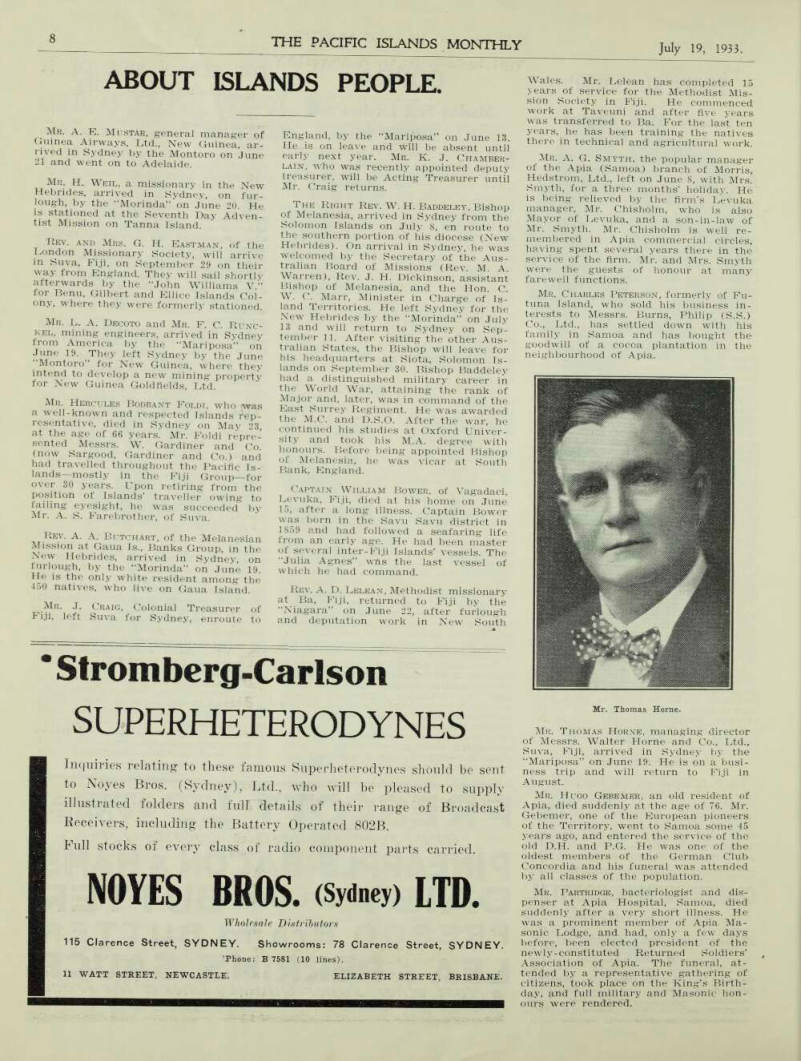
Mr. Thomas Horne, managing director of Messrs. Walter Horne and Co., Ltd., Suva, Fiji, arrived in Sydney by the “Mariposa” on June 19. He is on a busi ness trip and will return to Fiji in August.
Mr. Hugo Gbbemer, an old resident of Apia, died suddenly at the age of 76. Mr.
Gebemer, one of the European pioneers of the Territory, went to Samoa some 45 years ago, and entered the service of the old D.H. and P.G. He was one of the oldest members of the German Club Concordia and his funeral was attended by all classes of the population.
Mr. Partridge, bacteriologist and dis penser at Apia Hospital, Samoa, died suddenly after a very short illness. He was a prominent member of Apia Ma sonic Lodge, and had, only a few days before, been elected president of the newly-constituted Returned Soldiers’
Association of Apia. The funeral, at tended by a representative gathering of citizens, took place on the King’s Birth day, and full military and Masonic hon ours were rendered.
Mr. Thomas Horne.
Advertisements & other items, p. 10 (1 item)
Stromberg-Carlson
SUPERHETERODYNES
Inquiries relating to these famous Superheterodynes should be sent to Noyes Bros. (Sydney), Ltd., who will be pleased to supply illustrated folders and full details of their range of Broadcast Receivers, including the Battery Operated 802B.
Full stocks of every class of radio component parts carried.
NOYES BROS. (Sydney) LTD.
Wholesale Distributors 115 Clarence Street, SYDNEY. Showrooms: 78 Clarence Street, SYDNEY. ’Phone: B 7581 (10 lines). 11 WATT STREET, NEWCASTLE. ELIZABETH STREET, BRISBANE.
The White Trader In
The Pacific.
By “Kaniatty.”
His house is like a bird cage stuck on stilts; His store, a tin-roofed shanty by the sea.
His trade is with the nigger Who is usually a bigger And a better thief than he can hope to be!
His food is sweet potatoes, yams and rice.
His meat and fish come packed in gaudy tins, But although their labels boast They are boiled or corned or roast, But you can bet the taste of solder always wins.
His letters, when they come, are mostly bills — Or, if not, then they’re notices to say That “the market price of copra, Henceforth and hereafter, Will be half the price, we formerly did pay.”
The missionaries say that he is bad, That he chases girls and swizzles gin all day.
If he is, he doesn’t preach, Nor does he try to teach The niggers how to loaf their lives away.
The magistrates! They say that he is vile — A blot! An ulcer! and a leper in the land.
For that always is their way When people will not pay The homage which these Lords of Earth demand.
It would seem he hasn’t got a single friend, Save the writer of this muddle-headed song; But, to him, he seems a man, So he’ll praise him while he can Though he fears the end will come about ere long.
For he’s passing with the elephant and whale, To the realms where only fiction-writers reign.
While his going I deplore, Yet, aloft, on Heaven’s shore I hope to find his trading site again.
Samarai, 1933.
“Old-Timer” Passes.
From Our Own Correspondent.
Thursday Is., June 30.
AN old-timer passed away this month in the person of Douglas Pitt, a West Indian native, who has been round the Straits and T.I. since the ’six ties. He was 91 years old.
In the days when pearling boats were running to the Strait from all parts, and when conditions were much more lively and romantic than now, Douglas Pitt made his way to the north and, in course of time, came to own his own boats.
Like many another, he became poor again when the wine ran red and boats became the stake.
But many an interesting yarn can be spun round the old man, and he him self had many a story of the early days which he used to relate in carefully expressed English. A good many de scendants are left behind, both in the Islands and in other places in North Queensland, to perpetuate the name.
Ingenious Islands
Tools.
How Necessity Mothered Invention.
By “C. Coral.”
IN the days when files and knives and other European tools were inacces sible to the natives, they made shift with home-made implements which did the work successfully and, in some cases, even, with a high degree of perfection.
In the islands of Torres Strait, native tools consisted of stone tomahawks, cut ting tools made of boar tusks, rasps and files formed of stingray skin, and so on.
The stone axe, commonly termed “Panigob,” varied in shape, from the form akin to the ordinary axe-head, to an implement made with triangular ends (called “Daumer-upi,” owing to its resemblance to the tail of a pigeon), which was set into a handle and lashed with cane or coconut-fibre rope. In use, it served for garden work, cutting the bush, etc., and also for shaping up wood.
One variety of axe was made from the large clam shell; another was formed of granite or suitable stone obtained from the mainland. Some very fine specimens of these exist. For trimming up the long dugong-spears (made of a special kind of wood), the sharpened end of a wild boar’s tusk made an excellent “spoke shave,” and was useful in a good deal of other woodwork.
The skin of a stingray, carefully dried, and attached to a piece of half-round wood, served as a rasp in shaping canoes, etc.; the rough, spikey surface of the skin has a wonderfully file-like effect, and the finer variety of skin pro duced a smooth surface, which in due course, was finished off with the leaf of a tree which served instead of sand paper. Even now, many of these sting ray-skin “rasps” may be found in use.
When it came to boring wood for suit able-sized holes, through which to pass rope, and so on, the horny toe of the cassowary made a good substitute for brace-and-bit. These were obtained from New Guinea; but, failing cassowary bone “bits,” the old method of producing holes by means of fire was resorted to.
The advent of the white-man ship, with its store of iron and steel tools, and copper nails, naturally brought about a great change in Islands carpentry equip ment: and natives were always ready to barter stuff for “Tulik,” as they termed anything in the way of iron. So that even old pieces of hoop-iron, cut into lengths, found ready exchange for marine produce in the early days, just as empty bottles were found also to be a valuable commodity, both for decora tive purposes and also because of the many uses to which a piece of broken glass might be put. It is recorded that one early trading vessel had empty bottles as the major portion of her cargo.
The native now, however, reviewing the past,, exclaims: —“We all same proper fool them time —all that stuff we pay for one old bottle!”
Fiji Launch-Owner’S Loss.
A MOTOR launch, 27 feet long by eight feet beam, owned by Mr. E. J. Mes sage, of Fiji, was destroyed by fire at Lami on Tuesday, June 13.
The launch was anchored off Mr. Mes sage’s home at Lami and had been there for over a fortnight. Mr. Message had not been on board since the previous Sunday and it is thought that the fire was the work of an incendiary.
The owner was not informed of the loss until two days after the fire and, upon investigation, he found the charred remains of the launch, which had sunk at her moorings. The vessel was valued at £350, and was not covered by in surance.
Advertisements & other items, p. 11 (1 item)
Fibrolite
BUILD WITH HARDIE'S
ASBESTOS CEMENT BUILDING SHEETS,
The Ideal Building Material for Island Homes.
Economical, Fire Retardant, White Ant Proof, Permanent.
Build for Comfort and Fire Safety AT LOW COST by using this economical building material for the exterior and interior walls and ceilings of your new home. Available in big, sturdy building’ sheets in a variety of stock sizes, '‘FIBROLITE” is easily and quickly erected. Waste is eliminated; labour is minimised; no painting is needed.
Write for illustrated Catalogue “F6” FREE.
JAMES HARDIE & COY. LTD.
“ASBESTOS HOUSE" YORK STREET, SYDNEY.
Postal Address ; Box 3935T 7 , G.P.O., Sydney
Tropicalities
WORK at Lord Howe Island goes hand-in-glove with ease, says a correspondent. Saturday is the Ad ventists’ Sabbath, and Sunday is ob served by the Church of England, so two days of the week are lost. On Monday, everyone has the “tired feeling,” even at Lord Howe Island. On Tuesday morn ing little work is done, but much talk of the game of bowls to be played on Wednesday. Wednesday morning is oc cupied by preparations for the afternoon game of bowls. Thursday is full of dis cussions on Wednesday’s game, so these modern lotus-eaters do but little work during that day. Friday morning is spent in arranging for the cricket match that is always played in the afternoon. Sat urday again finds the Adventists at Divine worship. * * * Margaret Bignell, who lives in the Solomons, and who has occa sionally written interesting things for the P.I.M., describes an unusual ex perience:— “I saw a very interesting sight the other day down at our river mouth. It was a crocodile stalking cattle. At first sight, I could only see its two eyes for ward, sticking out of the water. Then he appeared a little nearer to the bank and started to creep slowly in until he was about two yards away from where the cows and calves were standing. He then showed all of his body and tail; and, just as he was about to make the last dash, the cows kicked up their heels and galloped away, and the crocodile sank. I saw no more of him. I suppose he was about 12 feet long. I was stand ing perfectly still, behind the coconut palms, while all this was going on, and you have no idea how excited I was.”
Wonder how many Sydney young girls would remain “perfectly still” and merely “excited,” while one of these cruel reptiles was slowly creeping out of the water! * * * APOLOGIES to Miss Gwen Evans, of Buka Passage, New Guinea. Miss Evans wrote for this journal an in teresting description of Buka Island; and, referring to a certain plantation, she used the word “long”. A combina tion of Evans caligraphy, editorial stu pidity and typographical ingenuity turned the word into “kong”, which is Pidgin for “Chinaman”. Now Miss Evans is being menaced by an irate plantation manager, who wants the world to know that he is no Chinaman. The explana tion is hastily made. * * * THE following interesting little table, showing the exports and imports of Norfolk Island in May, 1933 and 1932, disclose the commercial effect of the alteration in the Morinda’s time-table.
Last year the Morinda maintained regu lar communication between Auckland and N.I. This year, there is no New Zealand connection: Imports.
Month. From Aust. From N.Z.
May, 1932 £2260 . . £1024 May, 1933 £2483 ..
Exports.
Month. To Aust. To N.Z.
May, 1932 £1218 .. £86 May, 1933 £2443 . .
THIS sad story is told racily by our Norfolk Island correspondent:—The rain poured down; the night was black; but nothing daunted our local society, and every muddy road led to the Golf Club cabaret in Rawson Hall.
One car, broken down at the foot of Longridge Hill, was taken in tow by another, the driver of which, glancing round from time to time as he laboured up the hill, saw that all was well and that the headlights of the derelict still gleamed behind.
At the top of the long, weary hill he stopped to cast off and, with a derisive roar, an entirely alien car, under its own power, leapt past and disappeared into the night. The towrope had parted as soon as the first strain was put on it, and the cripple was still stationary at the foot of the hill, pleading with mournful honk and toot for assistance from the upward-rushing cars. * * * THERE has been much recently in the Australian newspapers about New Guinea and Papua, culled from the annual reports of the New Guinea and Papuan administrators. This material is of little value in disclosing the present condition of the two Territories, as the reports referred to, which have just been tabled in the Federal Parliament, deal with the period ended June 30, 1932.
Very much has occurred in the ensu ing twelve months in relation to eco nomic affairs, and the average man would prefer to know the conditions in the Territories on June 30, 1933. It is a great pity that the Government machinery works with such exasperating slowness. There seems to be no reason why important information should not be given to the public within three months of the end of the financial year.
Instead, the public has to wait twelve months while information is being gathered, submitted and printed in a most leisurely fashion. It is not the fault of the Administrators concerned —their reports are generally in Canberra fairly soon after the end of the financial year.
It is after that that they accumulate dust and cobwebs.
Samoa.
Important Conversations Reported.
INFORMATION was received privately in Sydney in July that there is at last a real probability of a settlement being effected in Western Samoa be tween the New Zealand authorities and the Mau.
Hon. O. F. Nelson returned to Samoa recently after a long period of banish ment, and is reported to have made con ciliatory speeches and gestures; the Ad ministration, having begun to arrest and prosecute various tribal chiefs of the Mau for holding unauthorised meetings,, suddenly discontinued that policy and the Administrator (General Hart) had cordial communication with some of the Mau people; and Mr. Paul Verschaffelt (Public Service Commissioner) and Mr.
C. A. Berendsen (Secretary for External Affairs) left Wellington suddenly and quietly in June on an unexpected visit to Samoa.
It is believed that all these circum stances are connected, and that conver sations are proceeding with a view to settlement of long outstanding differ ences.
The following reached us just as we were goingr to press :
Settlement Prospects Remote.
From Our Own Correspondent APIA, July 6.
The Mau is more active again. There; has been a large meeting in and money has been collected for an undisclosed purpose.
Prospects for a settlement seem as re mote as ever. In fact, some of the de mands of the Mau are absolutely im possible of fulfilment.
Advertisements & other items, p. 12 (1 item)
Springwood Ladies’ College.
AT BLUE MOUNTAINS.
SPRINGWOOD.
Est. 1897. Kindergarten to Leaving Certificate.
Tennis, Riding, Swimming, Team Games.
Unequalled climate. Pure Jersey milk. Senior and Junior Houses. Open-air sleeping. fees. Special vacation arrangements for Island pupils. M. E. DURAND, Principal.
Auxl. Schooner “NIDELO.”
Designed and Built by L. Halvorsen, in Norway, 1920.
Designer and Builder of
SCHOONERS,
KETCHES,
YACHTS,
LAUNCHES, etc.
Can also quote for Second-hand Craft.
Send particulars of your requirements:—
HAYES ST.,
NEUTRAL BAY,
SYDNEY, N.S.W.
Sir Henry Marks
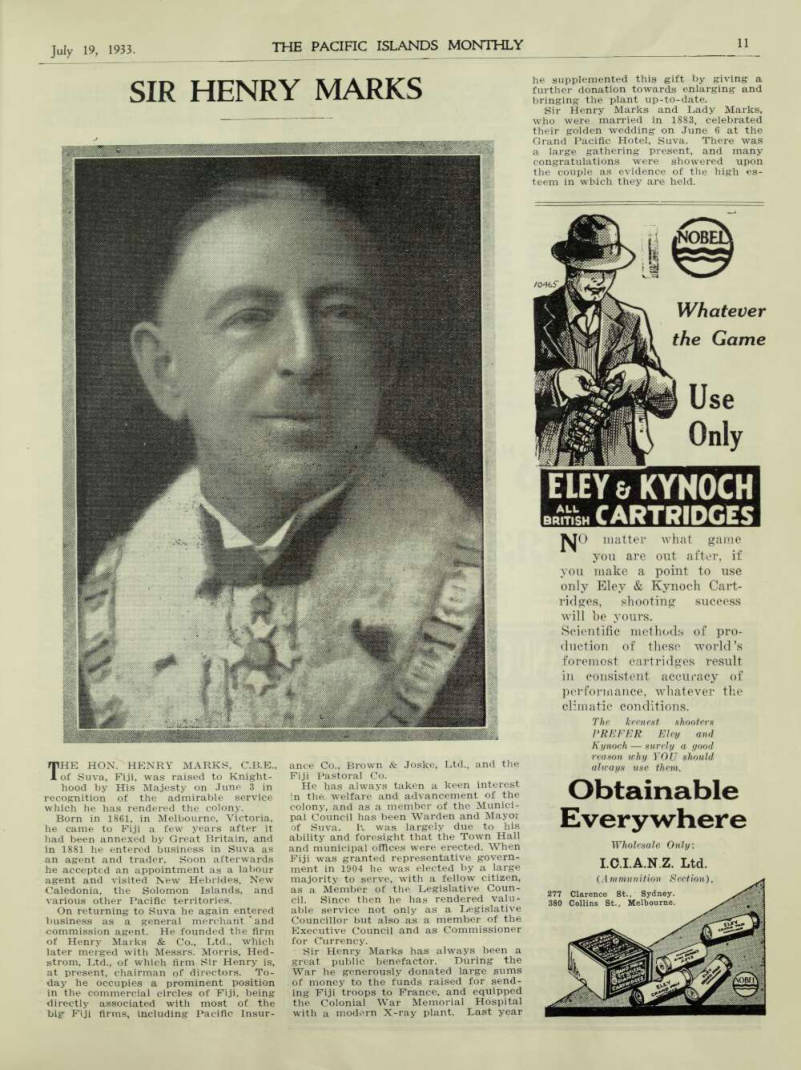
The Hon. Henry Harks, C.B.E., of Suva, Fiji, was raised to Knight hood by His Majesty on June 3 in recognition of the admirable service which he has rendered the colony.
Born in 1861, in Melbourne, Victoria, he came to Fiji a few years after it had been annexed by Great Britain, and in 1881 he entered business in Suva as an agent and trader. Soon afterwards he accepted an appointment as a labour agent and visited New Hebrides, New Caledonia, the Solomon Islands, and various other Pacific territories.
On returning to Suva he again entered business as a general merchant and commission agent. He founded the firm of Henry Marks & Co., Ltd., which later merged with Messrs. Morris, Hed strom, Ltd., of which firm Sir Henry is, at present, chairman of directors. To day he occupies a prominent position in the commercial circles of Fiji, being directly associated with most of the big Fiji firms, including Pacific Insur
ance Co., Brown & Joske, Ltd., and the Fiji Pastoral Co.
He has always taken a keen interest in the welfare and advancement of the colony, and as a member of the Munici pal Council has been Warden and Mayor of Suva. It was largely due to his ability and foresight that the Town Hall and municipal offices were erected. When Fiji was granted representative govern ment in 1904 he was elected by a large majority to serve, with a fellow citizen, as a Member of the Legislative Coun cil. Since then he has rendered valu able service not only as a Legislative Councillor but also as a member of the Executive Council and as Commissioner for Currency.
Sir Henry Marks has always been a great public benefactor. During the War he generously donated large sums of money to the funds raised for send ing Fiji troops to France, and equipped the Colonial War Memorial Hospital with a modern X-ray plant. Last year
he supplemented this gift by giving a further donation towards enlarging and bringing the plant up-to-date.
Sir Henry Marks and Lady Marks, who were married in 1883, celebrated their golden wedding on June 6 at the Grand Pacific Hotel, Suva. There was a large gathering present, and many congratulations were showered upon the couple as evidence of the high es teem in which they are held.
Advertisements & other items, p. 13 (1 item)
Only
NOBEL
Whatever
the Game
Use
Only
ELEY & KYNOCH
BRITISH CARTRIDGES
No matter what game you are out after, if you make a point to use only Eley & Kynoch Cart ridges, shooting success will be yours.
Scientific methods of pro duction of these world’s foremost cartridges result in consistent accuracy of performance, whatever the climatic conditions.
The keenest shooters PREFER Eley and Kynoch surely a good reason why YOU should always use them.
Obtainable
Everywhere
Wholesale Only.
I.C.I.A.N.Z. Ltd.
(Ammunition Section) 277 Clarence St., Sydney. 380 Collins St., Melbourne.
“Papua.”
What Is Origin of the Name?
WE have received from Mr. Paul A.
Dorn, c/o Gordon L. Eby and Com pany, Suite 1200, First National Bank, San Diego, U.S.A., a series of questions about the early history of Papua which we are not able to answer. Here they are, copied from Mr. Dorn’s letter: “Is there any evidence to indicate that the name ‘Papua’ was used by the original native inhabitants as a geographical name for their entire island, or did they ever call themselves ‘Papuans’ in an ethnological sense, be fore the arrival of the first European discoverers?
“Did these words, or their roots, occur in the native languages origin ally, or were they first applied by European explorers, and if so, by whom and about what time?
“Somewhere I have seen the state ment that one of the early Portuguese explorers named the island ‘Os Papuas,’ but I have been unable to verify the statement or check the reference. I understand that the words are of Malay derivation, meaning ‘frizzly’ or ‘woolly,’ and it is not un likely that the natives were so called by the first Europeans because of their characteristic hair, but I doubt if they used the name ‘Papua’ in a geographical sense to designate the entire island.
“Is there any cartographical evidence of this name on early maps, instead of New Guinea?
“The earliest map on which I have been able to find any reference to the island is Mercator’s, dated about 1569, on which it appears as ‘Nova Guinea,’
and the same designation appears on Abraham Ortelius’s ‘Theatrum Orbis Terrarum,’ published shortly after Mercator’s death in 1594. Of late years there has been a distinct tendency to saddle the island with a double name, ‘New Guinea or Papua.’
“There is a great deal of ambiguity and inconsistency on this point in the atlases and books of reference in this country. One of our leading atlases even going so far as to abandon the time-honoured name of ‘New Guinea’ entirely, in favor of ‘Papua.’
“Such a condition is abhorrent to me and I have set myself a nice little problem in research to determine grounds for giving preference to one name, to the ultimate exclusion of the other. What is the Australasian usage and official practice? I would greatly value your opinion, or that of any etymological authority there in Aus tralia to whom you might refer the question.”
If any of our readers has any infor mation on these matters, and will com municate directly with Mr. Dorn, at the address given above, he will assist Mr. Dorn very much in his task of compiling his book.
were Named.
How Papua and New Guinea were Named.
We are indebted to Mr. P. R. Firth, of Jervis Island, Torres Strait, for the following interesting information about the naming of Papua and New Guinea :— IN 1526, Jorge de Menezes, a Portu guese navigator, on his way to the Spice (Molucca) Islands from Mal acca, was carried by tides and currents
to the north coast of New Guinea. It was after this that charts bore the name “os Papuas”; and it also appeared in writings showing the discoveries of de Menezes.
In 1529, Alvarode Saovedra, a Span iard, practically ran the whole length of the north coast (according to Antonia Galvano, the founder of historical geo graphy) and, to quote Galvano’s writ ings:—“The coast was clean and of good anchorage, but the people black and of curled hair; from the girdle downward they did wear a skirt of feathers . . . . the people of Maluco call them Papuas, because they be black and frizzled in their hair, so also do the Portugals call them.”
In 1545, Ortiz de Retez (or de Roda) in the ‘San Juan,” left the Moluccas, and made extensive discoveries on the north coast of Papua. Possession was taken of the land in the name of the King of Spain and, because the people there were black and had frizzy hair, they named it “Nueva Guinea”.
Patrols Active.
Officials Busy In N.G.
Goldfields Area.
From Our Own Correspondent.
Salamaua, July 3.
FOLLOWING the fatal wounding of A.D.O. Ian Mack, last month, in the uncontrolled Ramu area, there has been considerable activity in Adminis tration circles.
District Officer E. Taylor visited the area immediately after the wounding of Mr. Mack and reported that all was quiet in the affected district. Additional officers have been posted to the Morobe district, however, and an additional force of picked native constabulary trans ferred here.
Mr. Chinnery, Director of Native Af fairs and District Services, arrived on the "Macdhui” and, after a visit to the Ramu post, is now travelling round other out stations.
Most of the recently appointed cadets have been posted to this district and are at present undergoing training prior to being attached to the several posts.
The Administrator, General Griffiths, is due to arrive by air from Port Mores by on July 7 and will spend a fortnight touring the district. The gesture is most acceptable, as the miners will have an unprecedented opportunity of placing their several causes before His Honour.
There is great satisfaction, too, in the move by the Administration in affording protection to prospecting parties.
Two prospecting parties have already left the Ramu and Purari Rivers, each with a patrol officer and native police.
Preparations are in hand to despatch prospectors nominated by the Edie Creek Progress Association from Sur prise Creek, accompanied by a police patrol, to prospect the auriferous belt, round the Vailala, Langamar and Tauri Rivers.
Patrol Officer McCarthy, who was re cently wounded near Surprise Creek, is to leave first to establish a base and aerodrome near the Tauri River.
Mr, E. J. Wauchope, of “Awar,” Ma dang, New Guinea, a well-known planter, and Mrs. Wauchope, are at pre sent on a visit to Sydney. They will re turn to the Territory in August.
Advertisements & other items, p. 14 (1 item)
Fitzroy
FIRST
IN 1868
SPICED, CORNED. ROAST
Gf BOILED BEEF
AND IN MUTTON
IN 12 llb, 2 U>, 51k, 4 lb.,
51b, S’ 61k ROUND
CANS AND IN TAPERS
FITZROY
SHEEP
TONGUES
BEEF, OXFORD, CAMBRIDCF & PORK SAUSAGES
Luncheon Beef All Brisket
FITZROY
THE ORIGINAL PACK IN A CLASS BY ITSELF!
XXuzecf o ytrvafured xr\ -c cr(c( picJUe fr&tn. ntcifn. c<L*\jCus~y crCU
ALSO the famous
HAMPER MEATS
IN ROUND AND TAPER CANS 12 02. 240*. 6 6 lbs.
SPECIALLY PACKED FOR THE ISLAND TRADE
SEND FOP PP/CF usr - NO extra charge fop assortment The CENTRAL QUEENSLAND MEAT EXPORT CO. LTD.
LAKES CREEK - ROCKHAMPTON
CABLE ADDRESS:- TOMOANA ROCKHAMPTON.
Telepathy—or What?
Bush Telegraph, Telepathy—or What?
Mysterious Incidents Among Papuan Natives.
By Henry Dexter, Milne Bay, Papua.
A PARTY of “old-timers” were recently sitting on the verandah of a trading store in Milne Bay, Papua, and, arising out of experiences related by three of them, the question was asked: “Is it not possible that certain races have retained powers call them mediumistic if you like —that have been lost by the white races”?
“How can you otherwise explain this?” said one of them.
“I was R.M. at the time, in Samarai.
McAlpine was A.R.M. The latter had gone across to Bubuleta to enquire into the death by drowning of a man named Frank Cameletto. This man had fallen overboard from his cutter and was drowned.
“While McAlpine was holding the en quiry the natives came to him and asked if it were true that Dekawaia had been killed by a falling tree? Dekawaia was a native of Bubuleta, and had at one time been village constable there. He had recently been sent to work on Woodlark Island.
“McAlpine, of course, said he had heard nothing of Dekawaia being killed; but a native persisted that such was the case.
“When McAlpine entered the office, next day, he asked me if in the mail from Woodlark Island that I was then sorting, there was any news of the na tive, Dekawaia. I replied, ‘No, not so far.’ But at the bottom of the bag there was a hurried pencilled note from Fitz gerald, the Customs Officer on Wood lark Island, reporting the death of the man in question. He had been killed by a falling tree!
“When Armit died at Tamata, on the N.E. coast, he was 400 miles away from Samarai. He died at 9 a.m. Yet his death was known to the natives in Samarai at 3 p.m. the same day.”
Another old-timer referred to the death of Mrs. Baldwin (a lady univer sally esteemed by both natives and whites) in Port Moresby. Residents in the west, hundreds of miles away, told of the wailing of the natives because “the big Sinabada had died.”
“Have you ever seen a native step aside as if he had seen a snake on the track?” said another man. “You ask him why he did so. He will tell you he ‘saw the shadow of a spirit’.”
The storekeeper related an experience of his own. “I was doing a short patrol in 1915, inland from Abau. We were camped for the night on a razorback, to get some rest away from the mosquitoes.
My corporal came to me and said there had been a fight near the Fly River, and his brother was among the killed. In answer to a query of mine he said no whites were concerned in the fight. His story proved, later, to be correct.”
Now, all the above experiences dated back 18 to 25 years, but among those present was a Government official, still in the service, and this was his story.
“I was camped on a small island about 14 miles from headquarters, in the Tro briands. The island is small, and the in habitants have very little in the way of gardens; they appear to live mostly on
presents—possibly a kind of tribute— given them by natives living in neigh bouring islands. There is no rest house there. I was camped in the small village itself.
“At 8 p.m. I heard a voice ask, ‘Did you see Marion go?’ Two other voices entered into a conversation about the passing of Marion.
“Now, I knew the girl Marion was in hospital at headquarters, 14 miles away.
On my return there, I sent a chit over to the doctor, asking for news of Marion.
His reply was that she had died the previous evening at 8 p.m.”
Among the thousands of readers of the P.I. Monthly there must be many who have had similar experiences to the above. This is written in the hope that they will relate them.
The sloop of the New Zealand Division of the Royal Navy, H.M.S. “Veronica,” commanded by Captain W. L. Jackson, will arrive at Levuka, Fiji, on an Islands cruise on September 23. After remain ing there until September 25, she will proceed to Suva.
Natives Terrified.
Meteors In Fiji.
Natives at Taveuni, Fiji, were terri fied when a meteor fell there on May 29.
Mr. Taylor, headmaster of Vucalevu School, nearby, described it as being about the size of a cricket ball and fiery red, with a yellow corona and a long blue tail. He said that it passed directly over the radio station, and fell into the bush near Wairiki, at an angle of about 60 degrees.
The radio operator, Mr. W. J. Ragg, stated that, although he had not actu ally seen the meteor, he had heard a loud detonation, which severely shook his quarters.
Later, the radio officer in charge of the Labasa station reported that two other fireballs were seen in the Labasa district, one at Vunimoli and the other at Vuo.
Advertisements & other items, p. 15 (1 item)
Swallow & Ariell's
CANTERBURY
CAKES
UNSURPASSED
Fruit, Plain, Seed, Plum.
Almond.
Preserved Ginger, Sultana, Cherry Ripe, Genoa.
Each Cake is enclosed, by special process, in air-tight tin, and is warranted to keep its condition for a considerable period.
Attend Sydney University.
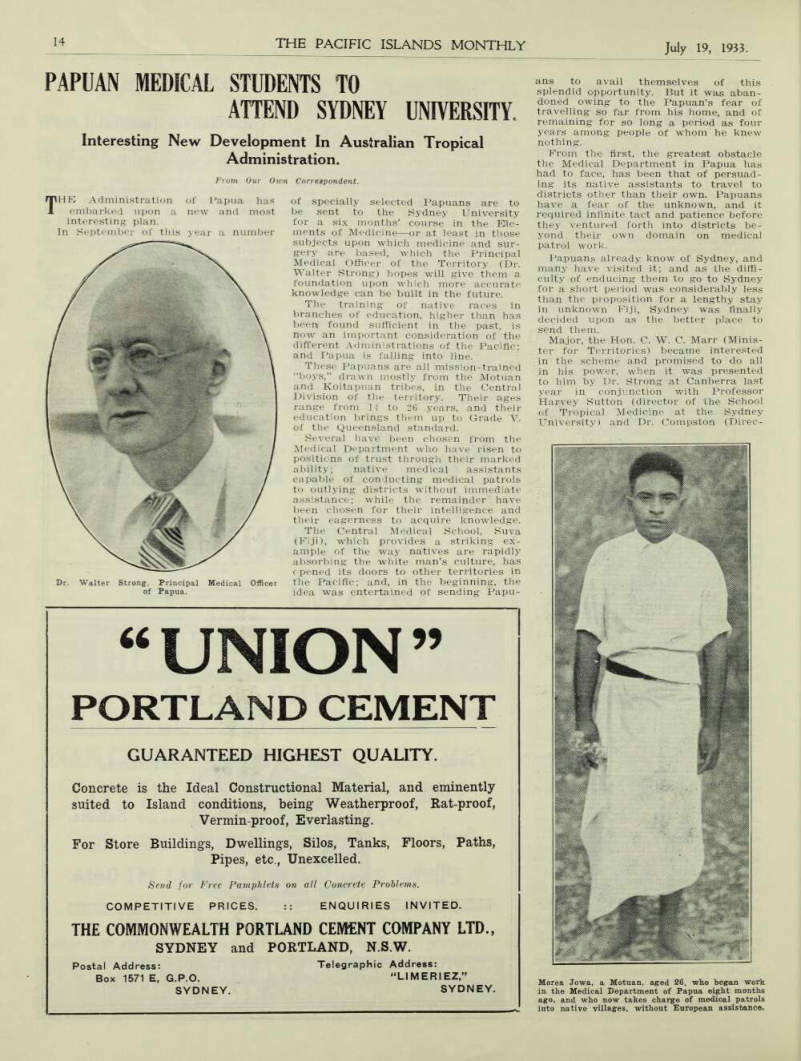
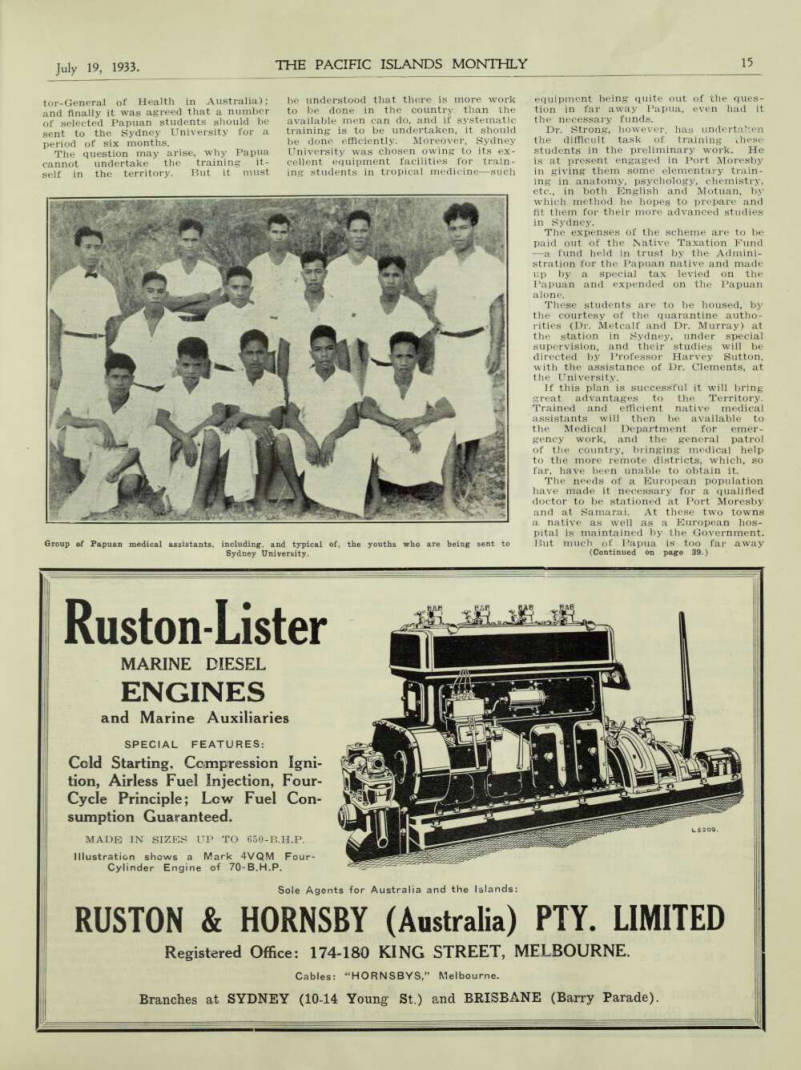
Papuan Medical Students To
Interesting New Development In Australian Tropical Administration.
THE Administration of Papua has embarked upon a new and most interesting plan.
In September of this year a number
From Our Own Correspondent.
of specially selected Papuans are to be sent to the Sydney University for a six months’ course in the Ele ments of Medicine—or at least in those subjects upon which medicine and sur gery are based, which the Principal Medical Officer of the Territory (Dr.
Walter Strong) hopes will give them a foundation upon which more accurate knowledge can be built in the future.
The training of native races in branches of education, higher than has been found sufficient in the past, is now an important consideration of the different Administrations of the Pacific; and Papua is falling into line.
These Papuans are all mission-trained “boys,” drawn mostly from the Motuan and Koitapuan tribes, in the Central Division of the territory. Their ages range from 14 to 26 years, and their education brings them up to Grade V. of the Queensland standard.
Several have been chosen from the Medical Department who have risen to positions of trust through their marked ability; native medical assistants capable of conducting medical patrols to outlying districts without immediate assistance; while the remainder have been chosen for their intelligence and their eagerness to acquire knowledge.
The Central Medical School, Suva (Fiji), which provides a striking ex ample of the way natives are rapidly absorbing the white man’s culture, has opened its doors to other territories in the Pacific: and, in the beginning, the idea was entertained of sending Papu
ans to avail themselves of this splendid opportunity. But it was aban doned owing to the Papuan’s fear of travelling so far from his home, and of remaining for so long a period as four years among people of whom he knew nothing.
From the first, the greatest obstacle the Medical Department in Papua has had to face, has been that of persuad ing its native assistants to travel to districts other than their own. Papuans have a fear of the unknown, and it required infinite tact and patience before they ventured forth into districts be yond their own domain on medical patrol work.
Papuans already know of Sydney, and many have visited it; and as the diffi culty of enducing them to go to Sydney for a short period was considerably less than the proposition for a lengthy stay in unknown Fiji, Sydney was finally decided upon as the better place to send them.
Major, the Hon. C. W. C. Marr (Minis ter for Territories) became interested in the scheme and promised to do all in his power, when it was presented to him by Dr. Strong at Canberra last year in conjunction with Professor Harvey Sutton (director of the School of Tropical Medicine at the Sydney University) and Dr. Compston (Direc
Dr. Walter Strong, Principal Medical Officer of Papua.
Morea Jowa, a Motuan, aged 26, who began work in the Medical Department of Papua eight months ago, and who now takes charge of medical patrols into native villages, without European assistance.
tor-General of Health in Australia); and finally it was agreed that a number of selected Papuan students should be sent to the Sydney University for a period of six months.
The question may arise, why Papua cannot undertake the training it self in the territory. But it must
be understood that there is more work to be done in the country than the available men can do, and if systematic training is to be undertaken, it should be done efficiently. Moreover, Sydney University was chosen owing to its ex cellent equipment facilities for train ing students in tropical medicine —such
equipment being quite out of the ques tion in far away Papua, even had it the necessary funds.
Dr. Strong, however, has undertaken the difficult task of training these students in the preliminary work. He is at present engaged in Port Moresby in giving them some elementary train ing in anatomy, psychology, chemistry, etc., in both English and Motuan, by which method he hopes to prepare and fit them for their more advanced studies in Sydney.
The expenses of the scheme are to be paid out of the Native Taxation Fund —a fund held in trust by the Admini stration for the Papuan native and made up by a special tax levied on the Papuan and expended on the Papuan alone.
These students are to be housed, by the courtesy of the quarantine autho rities (Dr. Metcalf and Dr. Murray) at the station in Sydney, under special supervision, and their studies will be directed by Professor Harvey Sutton, with the assistance of Dr. Clements, at the University.
If this plan is successful it will bring great advantages to the Territory.
Trained and efficient native medical assistants will then be available to the Medical Department for emer gency work, and the general patrol of the country, bringing medical help to the more remote districts, which, so far, have been unable to obtain it.
The needs of a European population have made it necessary for a qualified doctor to be stationed at Port Moresby and at Samarai. At these two towns a native as well as a European hos pital is maintained by the Government.
But much of Papua is too far away
(Continued on page 39.)
Group of Papuan medical assistants, including, and typical of, the youths who are being sent to Sydney University.
Miss J. Tinney, of Ballarat, who was one of the pioneer Sisters to the Metho dist Mission, Papua, with Dr. Bromi low, in the beginning of the work, sailed for the scene of her early labours by the last “Macdhui”.
from these two centres for the average village native to make much use of them, and much of the difficulty has been in reaching the natives who are unable to attend. Much village work has been done by missionaries, Govern ment officers and other Europeans, even though the Government maintains a travelling medical officer and four travelling European medical assistants, whose work is mainly that of treating outside villages. A special tribute was paid to the missions by Dr. Strong in his address on “The Medical Service of Papua” before the Royal Empire Society in Melbourne last year.
Advertisements & other items, pp. 16-18 (1 item)
Portland Cement
“UNION”
GUARANTEED HIGHEST QUALITY.
Concrete is the Ideal Constructional Material, and eminently suited to Island conditions, being Weatherproof, Rat-proof, Vermin-proof, Everlasting.
For Store Buildings, Dwellings, Silos, Tanks, Floors, Paths, Pipes, etc., Unexcelled.
Send for Free Pamphlets on all Concrete Problems.
COMPETITIVE PRICES. ENQUIRIES INVITED.
THE COMMONWEALTH PORTLAND CEMENT COMPANY LTD.,
SYDNEY and PORTLAND, N.S.W.
Postal Address: Telegraphic Address:
Box 1571 E, G.P.O. “LIMERIEZ”
SYDNEY. SYDNEY.
Ruston-Lister
MARINE DIESEL
ENGINES
and Marine Auxiliaries
SPECIAL FEATURES:
Cold Starting, Compression Igni tion, Airless Fuel Injection, Four- Cycle Principle; Low Fuel Con sumption Guaranteed.
MADE IN SIZES UP TO 650-B.H.P.
Illustration shows a Mark 4VQM Four- Cylinder Engine of 70-B.H.P.
Sole Agents for Australia and the Islands:
RUSTON & HORNSBY (Australia) PTY. LIMITED
Registered Office: 174-180 KING STREET, MELBOURNE.
Cables: “HORNSBYS,” Melbourne.
Branches at SYDNEY (10-14 Young St.) and BRISBANE (Barry Parade).
BIRKMYRE’S
WATERPROOF CANVAS.
The Original and Best for all purposes' -where a thoroughly waterproof covering is required.
SAILCLOTHS, DUCKS, ETC.,
of FLAX, HEMP AND COTTON.
FISHING NETS,
LINES & TWINES.
Extensive Stocks carried, Ensuring prompt despatch.
THE
GOUROCK Ropework Export CO. LTD.
397 KENT ST., SYDNEY, N.S.W.
ANTINEA
Cures Tropical Skin Diseases
Read these remarkable reports:
Mrs. G. STEVENS, Parkes, writes: “I have been to the biggest specialists in Sydney and Parkes, which cost me £150, without get ting cured of ‘Siberrea.’ Seeing your advertisement ip the paper, I decided to try “Antinea,” and I have got permanent results; being now cured.”
E. HAWKER, Gladstone, Queensland: “The ‘Antinea’ I received some months back proved very success ful; one bottle and a half com pletely cured my feet, which I had been trying to cure for months with doctors’ prescriptions.”
N. R. GREBER, Amamoor: “I wish to advise that I used ‘Antinea’ only for ‘Toe-Rot,’ between “Antinea” is Medical bandages required.
“Tinea”
“Dry Eczema”
“Dhobie Itch”
the two small toes, and can definitely say I have no sign of rot now.”
W. NIELSON, Bloomsbury: ‘‘l think ‘Antinea’ is a splendid lotion. I suffered from what I called a soft corn, between the toes, which was very painful. I tried all kinds of corn cures without results, so I decided to try ‘Antinea,’ and am pleased to say it cured me com pletely.”
J. ROGERS, Norfolk Island: ‘‘No doubt ‘Antinea’ is a wonder ful lotion, and if it acts on others as quickly as it does on me, it will be a great blessing to dwellers in the Tropics.” irritating skin diseases. No “Antinea” Lotion Cures —
“Toe-Rot”
“Ringworm”
“Psoriasis”
Science’s latest treatment for Harmless to tenderest skin.
And all Irritating Rashes; also heals Cuts and Wounds.
ANTINEA SOAP PREVENTS INFECTION.
Obtainable at— A. J. Swann & Co., Michelmores. Brown & Joske, Suva.
All Burns Philp Island Stores and Chemists.
In New Guinea.
From Our Own Correspondent.
Rabaul, July 2.
BASEBALL is creeping slowly up over the skyline for the purpose of oust ing cricket as a seasonal sport. A meeting has been called to arrange for matches and general organisation during the forthcoming season, and it is an ticipated that the usual enthusiasm will be shown by the young sporting mem bers of the community.
Tennis, ever a popular sport amongst Rabaulites, has caused enthusiasm to rise to almost unprecedented heights.
The three first-class teams, i.e., Rabaul, Roberts and Matupi, all have twelve games to their credit, while the next teams on the ladder are Bank of N.S.W. and Treasury with eight games apiece.
Sporting events form a great part of Rabaul life during these days.
Petrol Supplies.
Mr. R. J. Worssam, a travelling repre sentative of the Vacuum Oil Company, arrived in the Territory by the s.s. “Nel lore” on Sunday last and is devoting his
time to making- a general survey of the oil situation here. He will not commit himself to any explanation or give in formation as to the future policy of the oil companies in the islands.
There are distant rumours of a pro jected merger of the companies in the Territory. Large consumers like the Guinea Airways are paying 2/1½ per gal lon and using from 16,000 to 20,000 gal lons a month; in Sydney, where sales tax, primage and a higher import duty has to be added to the c.i.f. price, first grades are being sold at 1/8 per gallon.
So there is some murmuring about petrol prices.
One Of The “Big Six”.
A dinner party was recently given at the Palms Restaurant by Mr. R. M.
Glasson to Mr. W, Money, prior to the latter’s departure for Europe, via Hong Kong, by the “Friderun”. Both host and guest-of-honour are well-known identi ties in this Territory as being members of the “Big Six” syndicate who were in strumental in putting Edie Creek on the goldfields map of New Guinea. Only old residents of the Territory were included in the party, amongst whom were: Mr.
R. L. Clark, M.L.C., and Mrs. Clark; Mr.
E. P. Holmes, M.L.C., and Mrs. Holmes; and Mr. and Mrs. S. R. Young.
Personal Notes.
His Honour the Administrator is re turning by the “Montoro” from his short visit south. On arrival at Port Moresby it is his intention of disembarking and flying overland to the Wau and the goldfields, returning to Rabaul, via Sala maua.
Mr. “Pat” Savage has been an inmate of the Namanula Hospital until recently, suffering from cardiac trouble. Fortun ately, his condition had improved suf ficiently before the “Macdhui” departed for the Kieta trip, to enable him to join the boat for a recuperative voyage.
His Honour Judge Phillips was an outward-bound passenger by the “Nel lore,” which departed last week for the East. Judge Phillips has proceeded on long leave and will make a world tour before returning to his duties here.
Mr. C. I. H. Campbell, a well-known Rabaul identity, returned from South by the “Nellore” and it is understood is making preparations to retire from his commercial interests in Rabaul and take up his residence on the Bougain ville coast at Raua, where he has a coconut estate.
Mr. G. W. Spensley, representing Messrs. Colyer, Watson and Co., a copra buying firm which is operating inde pendently here, arrived last week and will remain some months in the interests of his company.
Mr. F. P. Archer, of Jame estates, in Buka, arrived in town by the “John Bolton” recently on a business trip.
A decree nisi has been granted to Mrs.
Grace Lansley, manageress of the Pacific Hotel, in her petition for divorce against George Lansley, on the grounds of adultery and cruelty. The decree is returnable in three months’ time from June 30. The custody of the children has been granted to the petitioner.
Mr. J. Comb arrived recently from Australia and has proceeded to the Kieta district to make an inspection of his mining interests at Kupei.
On A Samoan Motor-Bus.
Quaint Glimpses of Exotic Life.
AT the foot of the magnificent town clock tower, erected as a worthy memorial to the sons of Samoa who served overseas in the Great War, right in the heart of Apia, is situated the parking place for all Samoan motor ’buses plying for passengers down the West Coast of Upolu to Mulifanua.
Close to the main business quarter of the town, to Post Office, Bank, Customs House, this place is most convenient to people of the outside districts, who come to Apia for business purposes.
The observer is struck by the marvel lous colour scheme of the ’buses by
which, it seems, the owners seek to at tract the public’s attention and custom.
All colours of the rainbow are repre sented —red, blue, yellow, white, grey and brown. Here, for hours, ’buses are waiting till a sufficient number of pas sengers is assembled to warrant a start of the journey down-coast.
Often the ’bus drives first round the town to pick up intending passengers at various places, fale aiga’s (native res taurants), or at the Chinese stores.
There is no fixed time-table for Samoan ’buses —time is of little importance in Samoa, anyway!
Leisurely the ’bus is driven by its Samoan driver along Apia’s beach and the Savalalo Road, past the Marist Sis ters’ convent and school, and on along the well-kept concrete road to the west.
The driver hands you a ticket, a novel institution for Samoa, and you pay your shilling for a distance of about 15 miles or 2/- for the whole distance to Muli fanua, about 25 miles. The fare is cer tainly cheap enough, compared with fares in other countries and taking into consideration the high prices of oil, tyres, repairs, licenses, etc., with which ’bus and car owners are burdened in Samoa.
Through the village of Vaimoso, with the neat little office of the Mau now deserted, where High Chief Tamasese, killed in 1929, used to live. The ’bus drives on through Samoan villages, past the stately building of the Mormon Mis sion at Pesega, past trading stations, bathing pools—in which scores of happy children splash merrily about —past Vai tele plantation with, from time to time, a view out to the reef and the open sea.
The beautiful scenery and the glimpses of native life in their kaleidoscopic
change, are most attractive to the casual visitor to Samoa. The ’bus pas sengers are of no less interest to the student of Samoan life. Beside a few European traders, planters and mission aries sit Chinese coolies from the cocoa plantations, black Solomon Islanders with Samoan wives, and dark-skinned offspring, Samoan families, with baskets of bananas, taro, fowls, pigs, mats and household utensils. Then, again, there are some pretty, dark-eyed Samoan damsels, ever ready for a flirtation, some young, half-caste boys returning to work on Mulifanua Plantation, a dig nified Samoan teacher in spotless white coat and lava-lava, and a Catholic priest in black cassock. Or there may be some students of the Samoan Mission College at Malua and school children going back from Apia schools to their homes on the coast.
In the Samoan way, all the native passengers seem to be personal friends of the ’bus driver, and he does not mind waiting for them for a considerable time or stopping occasionally to let them transact some business with friends or relations in another village on the road.
The scenery on the coastal drive is ever changing; a film taken of the jour ney would present a very interesting picture of Samoan life and landscape.
There are various other points of in terest on the coast worthy of mention, such as the splendid new Catholic
Cathedral of Leauvaa, the London Mis sion Society’s College and Boys’ High School at Malua, the old Samoan capi tal and Government seat of Leulumoega,
Samoan 'Bus-Drivers.
A Typical ’Bus.
with a police station and European and Samoan schools, and the large coconut plantation of the N.Z. Reparation Es tates at Mulifanua, once the largest coconut plantation of the South Seas.
Every visitor to Samoa is well ad vised to take the drive to Mulifanua and enjoy an interesting picture at very moderate expense.
The Samoan ’bus owners are passing through hard times. Competition is very keen—not less than 14 motor ’buses are plying for passengers on the 25 miles of the West Coast. To protect their in terests the ’bus owners have united and formed a ’Bus Owners’ Association, with a special inspector to control the traffic, who is provided with official authority by the Police Department. The Inspec tor, Mr. E. Szubinski, by the way, can lay claim to the honour of being the pioneer of motor ’bus traffic in Samoa, having run the first motor ’bus between Mulifanua and Apia some 10 years ago.
Advertisements & other items, p. 19 (1 item)
Gillespie’S
SAMUEL RUSSELL,
ESTATE AND GENERAL AGENT,
P.O. Box 64, Papeete, Tahiti.
Real Estate. Investments. Estate management and administration. Valuations and Reports Houses and Lands for Lease or Sale.
Sole Proprietor: TAHITI PERFUMES.
Cables: Russell, Tahiti (Bentley’s Code).
GILLESPIE’S
"ANCHOR”
FLOUR
TRADE
MARK
The Standard of Quality.
BURNS, PHILP
(South Sea) Co. Ltd.
Island Traders & Shipowners Registered Office: Suva, Fiji.
Also Branches at Fiji: Levuka, Lautoka, Labasa, Ba, Sigatoka, Rotumah.
Tonga: Nukualofa, Haapai, Vavau.
Samoa: Apia, Pago Pago (American Samoa).
Solomons: Makambo, Gizo, Faisi.
New Hebrides: Vila.
Gilberts : Tarawa.
Norfolk Island. Nauru. Niue.
Code Address: "Bumsouth."
A Thinner Dollar.
American Exodus From Tahiti.
From Our Own Correspondent.
Papeete, June 15.
QUITE a number of Americans, tourists and residents, departed on the last mail steamer for San Francisco, owing to the drop in the U.S. dollar ex change, and the consequent increase in living expenses.
The decision of the U.S. Government to cut pensions by 50 per cent, in the case of pensioners residing abroad was also a determining factor in many cases.
Despite the cheaper dollar, some local merchants are cutting down their orders for American goods rather than import ant merchandise the ultimate cost of which, in francs, cannot be accurately forecast.
Thus, the uncertainties of the present exchange situation are already doing considerable damage to business be tween this colony and U.S.A., and every body is hoping that the work of the Economic Conference now going on in England will at least bring back some sort of stability, and remove the gamb ling element which seems inseparable from all business operations at the pre sent time.
Ambrym.
The Hurricane In
Philosophic Planter's Observations.
LAST year we published a letter from Mr. W. H. Grube, a North German planter, who has settled down in the British section of the New Hebrides.
Mr. Grube had suffered heavy losses in a hurricane, but he had endured them with great cheerfulness and philosophy—and we published his letter to show the fine spirit which animates the men who have to contend with nature in the Pacific Islands.
Mr. Grube has now been through another hurricane and. again we take the opportunity of publishing his comments.
Late on the evening of April 7 (says Mr. Grube) the island of Ambrym, in the New Hebrides, was again swept by a terrific hurricane, which lasted from 6 p.m. until 12.30 a.m. It was not as strong as the hurricane of February 23, 1932, and it did not cause the same destruction among the coconuts — probably because the palms had been shrivelling up for months under an attack of the coconut fly, and there fore did not present the same resistance to the wind. For all that, we lost another ten per cent, of our coconut palms.
Owing to the destruction caused last year, I had planted a large garden containing all the native vegetables as well as such European vegetables as will grow here —tomatoes, cabbages, beans, radishes —but the hurricane swept away every vestige of it.
The wind also swept away the stout sapling fences which we had erected with much labour to keep out the native pigs. The latter will creep through anything—barbed wire is no use whatever. Large numbers of build ings roofed with native thatch were partially destroyed. As thatching material is net available now, and the price of copra is too low to allow us
to buy corrugated iron, the buildings must just stay unroofed.
I also lost a launch. I could have saved her if I could have had assist ance, but the rain was pouring down and the natives absolutely refuse to work in very wet weather. On top of it all, I went down with an attack of malaria and nervous collapse.
After the hurricane, the natives fol lowing their usual practice, looked for the man who is supposed to have caused the blow. They found him in a village on the South Coast of Ambrym, and promptly shot him and buried him beside the track. They sought a scape-goat in similar fashion after the 1932 hurricane, but the gentleman whom they selected hap pened to be a man of influence and some wealth, and the transfer of a few dollars saved his life.
The natives in the devastated areas last year were fed with rice by the Condominium Government. The same thing will have to be done again.
Conditions are very bad; the natives will have to be fed at least until they can plant and reap a crop of sweet potatoes.
We Europeans who are under the British flag are even worse off. The British planters got no assistance after the 1932 hurricane and, presumably, they will be no better off now. We shall just have to live from hand to mouth until conditions improve and hurricanes leave us alone.
I expected this hurricane. I have noticed that we get them usually in three successive years. That was the case in 1918-1922. Then there were no hurricanes until 1932. We have now had one in 1932, and in 1933, and we can expect another next year.
Just before this last blow, I rode on horseback to my father’s station, eight miles away. I noticed along the track countless huge spider-webs—l had to brush them away continually, as the webs stuck to one’s face and clothing like glue. I told my father that we were in for another hurricane, because the spiders were placing their webs so near the ground. In normal times one rarely sees them, especially on the main roads. Sure enough, it came.
The hurricane struck Paama and Epi, and also the South coast of Malekula. It was curiously localised, however. A few miles away from its main track there was little or no damage and one may see half of Ambrym devastated and the other half practically untouched.
The Presbyterian Mission Station at Paama was unroofed. The natives, however, quickly replaced what roofing they could find and prevented a com plete loss. The Rev. M. Prater was away on furlough, and the natives acted on their own initiative.
Were it not for hurricanes and volcanoes, this place would be a Paradise to live in. But mankind is always being harassed with one thing or another; so I suppose one must just regard these troubles as making life worth living.
Mr. George Jeffreys, accompanied by his wife, arrived in Sydney, en route to Adelaide, by the “Mariposa” on June 19.
Mr. Jeffreys is the representative in South Australia of the Bulolo Gold Dredging Co. He is also a director of Guinea Airways, Ltd., and Fiji Airways, Ltd.
Advertisements & other items, p. 20 (1 item)
“Fletcher” Stove,
Introducing
THE
Made with Extended Fire
box for Long Wood Fuel.
This Stove has been specially constructed for persons requir ing a good, strong article at a very moderate price.
We will be pleased to forward a copy of Illustrated Leaflet, Post Free, upon receipt of your name and address.
FLETCHER & SON 50 Oxford Street, SYDNEY.
Also, Makers of the “Younger” Stoves and Ranges.
Native Wife’S
The Trader And His
Relations.
By “Sevorg".
WHEN she went over with “Fergi” to the new island, Tina told him that she had no relations there. Now, he couldn’t throw a stone among a crowd of those Lotuans without hitting one of her alleged relations.
It was a little wearing. His best silk shirt had disappeared. That handy little knife he left in the kitchen —a few days later he noticed it on one of her Auntie Tahine’s floor-mats. They nag at him to take and plant land. But he knows that, if he did, they would exercise the privi lege of relations and carry off the ban anas and coconuts.
But they were not all an irritation.
Some of Tina’s new sisters, who came in to mind the baby for her, were really very merry and attractive.
The life of a trader on one of these remote Polynesian islands is happy enough, if montonous. The relations of the trader’s native wife are often a curse; and he has to keep a wary eye on the village bloods. They try to get copra weighed that is not fully dried, or with pieces of coconut shell, or even a few pebbles in with it, in order to get extra weight.
But these little things are soon for gotten. The islanders have their feasts and dances, at which the trader is an honoured guest. A pleasant change in the life is the arrival of a vessel. It may be a world tourer, or the regular steamer calling to bring new store goods and
take away copra. Such occasions bring mail, and friendly social chats on world events and things in general with some of the visitors.
Ferguson, or “Fergi,” as the native tongue found it easier to call him, had spent the best years of his manhood in the South Seas. A casual call at one of the islands by a vessel on which he was a sailor put the glamour of the islands over him —and this was added to by reading Louis Becke’s stories of island life and other writers on “the summer isles of Eden.”
So Ferguson settled on one of the is lands as a trader, married a native belle with a knowledge of English gained at the mission school and as a nurse to the missionary’s children overseas. She was an attractive girl and, mentally, very bright; but, due to her education being mostly on the lines of religion, her mind, as with most of the natives, was warped with a narrow religious bias. So, out side of things pertaining to their simple island life, there was little companion ship of ideas.
She said to Ferguson one day: “What do you want with all your books and papers? Burn them! There is only one book to keep and read, and that is the Bible.”
A trader’s life in the islands is gen erally deliberately chosen; and though he may be socially ostracised by official dom, who view his alliance with a native girl with disfavour, such views hurt him little. He has his own life to live, and that the officials are but birds of pas sage, here to-day and gone to-morrow.
At times he may plan to make a visit overseas —to civilisation —but he knows he would not be satisfied to stay away
for long. There would be the call of the Islands. The life has its drawbacks, but to him its compensations outweigh them and, on the whole, he is content.
Marriage, anyway, is a lottery, whether it be between whites, or white with brown. What suits one does not suit another. Whether the union of white and brown is looked on with favour or not, it is nevertheless a process that is steadily going on, and the half-castes, boys and girls, given a fair chance, can, and do, make good in competition with whites.
Popular Commandant
Transferred.
From Our Own Correspondent.
Papeete, June 15.
A LARGE number of people gathered on the Papeete wharf when the s.s. “Astrolabe” sailed for France this week, to say farewell to Captain Maillot, who has been in command of the local detachment of Colonial Infan try for some years past. The band from the Brothers’ school was also in attend ance.
His genial personality, and the active interest he took in the promotion of sports and pastimes, made Captain Mail lot an exceedingly popular man through out the Colony, and one whose departure will be sincerely regretted by all nation alities. He is succeeded in his official command here by Captain Vaschier, late of the Foreign Legion, with which famous corps he spent several years in the French North African Possessions.
Advertisements & other items, p. 21 (1 item)
Daily News Service by Radio for
Residents of Pacific Islands
Residents of all British Territories in the Central and South Pacific (except Fiji) are hereby informed that it is now possible for them to arrange for the receipt by them, through their local radio station, of the undermentioned company’s daily news service.
This service is broadcast every night from Sydney, in Morse. It comprises about 600 words, summary of the day’s news, both Australian and foreign, supplied by the leading Australian newspapers. it contains the latest quotations for produce (copra, etc.) and currencies
(exchange).
The service is not expensive, the rate depending upon the number of persons in a particular district who are prepared to initiate the service by ordering same through their local radio station.
The “OCEAN NEWS” Service is sent out as a private message, and is fully copyrighted and protected. No station, whether on sea or land, is permitted to receive and publish this message, except by special arrangement. After this date, action will be taken against any station infringing our rights in this respect.
Persons or institutions interested may have full details of this service by writing to The Traffic Manager: The Manager: AMALGAMATED WIRELESS (A’ASIA) LTD. or OCEAN NEWSPAPERS LTD. 47 YORK STREET, SYDNEY. 47 YORK STREET, SYDNEY.
Or by applying direct to the officer in charge of their Radio Station, who will take up the matter on their behalf.
Beginning.
Papua In The
Robert Hunter’s Memories of 50 Years Ago.
By Mollie Lett.
ACROSS the harbour from Port Mores by, sheltered from the strong winds and currents, lies a tiny oasis—an intermixture of evergreens and coconut palms, faced by dazzling sands and vivid waters. Against the forbidding rugged ness of the surrounding hills, it stands out in relief and beauty.
There is seclusion, almost forgotten, and out of sight of the community he helped to bring into existence, lives Papua’s best-known man, Robert Hunter.
It was as early as 1883, in the days of the Rev. W. G. Laws, of the L.M.S., and Andrew Goldie, storekeeper, that Robert and George Hunter crossed over from Queensland, young Englishmen fired to adventure by the swash-buckling tales of the traders and pearl fishers who sailed their schooners along the dangerous shores of this romantic island.
Violence, pillage and slaughter were their daily risks. News of the unpro voked attack and massacre of seventeen white men, wrecked and stranded off the Fly River in 1882, had reached Queens land and had stirred the imagination.
Robert and George Hunter crossed in the “Ellengowan,” the L.M.S. schooner, via Somerset Island, early in 1883.
On their arrival they won the approval of the Mission in their dealings and the two brothers soon got in touch with the natives; and, as they had had al ready considerable experience of bush life in Australia, it was not long
before they visited districts outside the Mission influence and, picking up the Motuan dialect, they became friends and gained the confidence of other tribes in the neighbourhood.
Sir Peter Scratchely, the first Special Commissioner to the Protectorate, ar rived in New Guinea in 1885. He was advised by the Rev. Mr. Lawes and, on account of their familiarity with the language, their travels and experience, he took the Hunter brothers into the Government service. Their duties were, for the one, forester and inspector of the timber trade, and the other, inspec tor of the beche-de-mer industry, There was a considerable industry in those days as regards beche-de-mer among traders, both Australian and Chinese. Ten schooners were occupied in the work. It was given to Robert Hunter to inspect the vessels and to re port on their operations. As regards timber, the glowing reports in the news papers of the prospect of timber trade in New Guinea had “raised the expecta tions of a sanguine nature”, and had at tracted companies to start felling opera tions. Supervision was needed.
After Sir Peter Scratchely’s death, Robert and George Hunter worked under Deputy Commissioner Romilly, Asst. De puty Commissioner Musgrave, and Spe cial Commissioner Douglas, in 1886. It was while assisting D.C. Musgrave in his absence, that Mr. John Douglas, the Special Commissioner, made mention of Messrs. R. and G. Hunter, for one reads in his report: “A.D. Commissioner Mus grave has been faithfully and intelli gently aided in his policy by Messrs. G. and R. Hunter, who were appointed as native protectors by the late Special Commissioner. They are both familiar with the native language, and have con stantly been employed in moving along the coast and inland.”
Later, on account of the judicious combination of firmness and moderation
they showed in dealing with native cases, and their energy, the influence of the Hunter brothers widened rapidly in out lying districts. Robert Hunter was made Superintendent of Natives, to settle the native difficulties and disputes, and George Hunter was sent to establish a Government station at Rigo, where the natives were in continual warfare with their neighbours. From then onwards, in the continual warfare between the tribes of Hula, Kaile, Kerepuna, Jupselei and others, George Hunter acted as an intermediary in the disputes and settled in conjunction with Asst. Deputy Mus grave the murder compensations, by gifts to the dead one’s relatives.
In 1886, in the absence of both the Special Commissioner Douglas and the Asst. Deputy Musgrave in Australia, the Hunter brothers administered the affairs of the country from February 22 to June 1 with the help of the Rev. Mr. Lawes and Andrew Goldie, storekeeper, then the only residents in the Protectorate.
George Hunter, continuing his work at Rigo, later visited the head waters of the Kemp Welsh and the tribes in the district; and accompanied Mr. Hart mann; and later ascended a peak of Mt.
Olree, over 10,000 feet, with Mr. Cuth bertson under the management of the Geographical Society of Victoria.
Studying the native dialects on a sys tematic method and making a road from Port Moresby to Aroma, were the last efforts of George Hunter, for in 1890 he was foully murdered by the natives of the Rigo district, with whom he had worked for five years and whose country he had made peaceful.
Robert Hunter, in the west in the Motu Motu district, at the same time, also did excellent work. He settled dis putes, marked out limits of tribal trans gressions and brought the principal cul prits to justice in Port Moresby.
With Sir William MacGregor, the first Administrator, in 1889, came changes, and conditions altered. Further districts were brought under control along the coast and inland; vast tracts of land were thrown open by Government ex peditions and enterprise; and Sir Wil liam MacGregor, with his organised staff and chief judicial officer, found little continuous employment for Robert Hun ter, though his services were retained and his advice sought at intervals on native matters.
Therefore, except for occasional plant ings on Government reserves and beaches, and prospecting for timbers and metals, Robert Hunter, after his brother’s death, retired to private life, to trade and to enjoy the peaceful con ditions of the country he had done his bit to secure.
Now, nearly 80 years of age, pensioned by the Government, an old man, he is still to be seen once every week plying his small craft across the harbour, on a visit to the town, which he and those earliest pioneers, helped to bring to ex istence. Of them all, he is the only one left.
Husband and wife were seated in the garden in the dusk of a summer even ing. He was doing most of the talking.
“Very interesting,” she said, when he finally concluded.
“I’m glad to find you’re so interested and impressed, dear, by these explana tions about banking and economics,” he told her presently.
“Yes, darling,” she replied. “It seems wonderful that anybody could know as much as you do about money without having any of it.”
Advertisements & other items, p. 22 (1 item)
Spencer Nolan
Repairs
‘OUR HANDS MAKE GOOD ARMS'
DON’T TRIFLE WITH DOUBTFUL FIREARMS
Sil Rohu’s Expert Attention is at your Service —without obligation.
Send for my Wonderful Firearm Catalogue. 500 Illustrations and Details of the World’s Best and Reliable Makers.
“FISHING TACKLE TO TACKLE FISHING.”
The same High Standard of Quality is a feature in my new Fishing Catalogue. Specialities: Trout, Big Game, and Deep Sea Fishing.
SIL ROHU (late A.I.F.), GUNSMITH
IMPORTER OF HIGH-GRADE FIREARMS AND FISHING TACKLE SPECIALIST, 143 ELIZABETH STREET, SYDNEY (Near Market Street).
TEETH BY POST.
Well-fitting and lifelike in appearance,
made from “SELF-TAKEN IMPRESSIONS.’’
I have made Artificial Teeth by my wellknown and copyrighted System of Self- Taken Impressions for satisfied Patients in all parts of the Commonwealth.
Send for full free particulars.
Satisfaction guaranteed.
SPENCER NOLAN
DENTIST,
Established in Sydney over 36 years. 28 OXFORD ST., over Winns; 177 OXFORD ST., opposite McIlraths. 139 ELIZABETH STREET, two doors from Market Street, Sydney.
Telegraphic and Cable Address: “FASTPLATB,” Sydney, Natural Gum, Unbreakable Sets, Comfortable and Long Lasting, Old Plates Remodelled and made equal to new.
A Melbourne Shop-Girl’S Holiday.
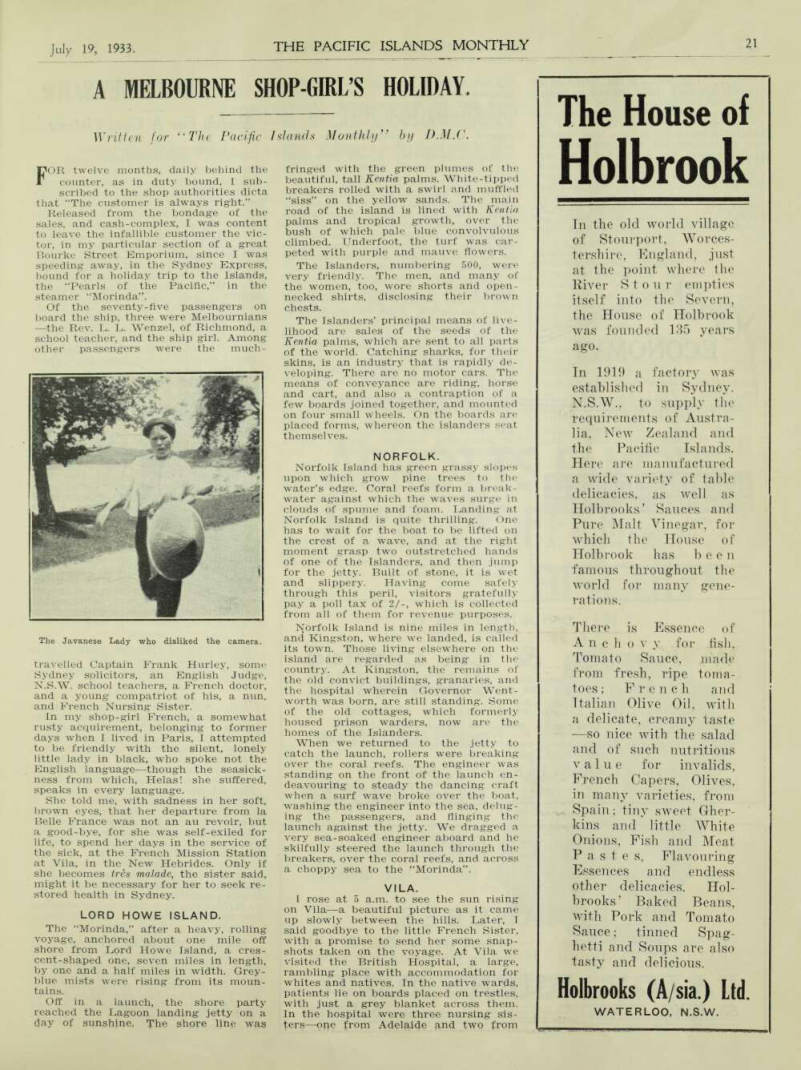
Written for “The Pacific Islands Monthly” by D.M.C.
FOR twelve months, daily behind the counter, as in duty bound, I sub scribed to the shop authorities dicta that “The customer is always right.”
Released from the bondage of the sales, and cash-complex, I was content to leave the infallible customer the vic tor, in my particular section of a great Bourke Street Emporium, since I was speeding away, in the Sydney Express, bound for a holiday trip to the Islands, the “Pearls of the Pacific,” in the steamer “Morinda”.
Of the seventy-five passengers on board the ship, three were Melbournians —the Rev. L. L. Wenzel, of Richmond, a school teacher, and the ship girl. Among other passengers were the much-
travelled Captain Frank Hurley, some Sydney solicitors, an English Judge, N.S.W. school teachers, a French doctor, and a young compatriot of his, a nun, and French Nursing Sister.
In my shop-girl French, a somewhat rusty acquirement, belonging to former days when I lived in Paris, I attempted to be friendly with the silent, lonely little lady in black, who spoke not the English language—though the seasick ness from which, Helas! she suffered, speaks in every language.
She told me, with sadness in her soft, brown eyes, that her departure from la Belle France was not an au revoir, but a good-bye, for she was self-exiled for life, to spend her days in the service of the sick, at the French Mission Station at Vila, in the New Hebrides. Only if she becomes tres malade, the sister said, might it be necessary for her to seek re stored health in Sydney.
Lord Howe Island.
The “Morinda,” after a heavy, rolling voyage, anchored about one mile off shore from Lord Howe Island, a cres cent-shaped one, seven miles in length, by one and a half miles in width. Grey blue mists were rising from its moun tains.
Off in a launch, the shore party reached the Lagoon landing jetty on a day of sunshjne. The shore line was
fringed with the green plumes of the beautiful, tall Kentia palms. White-tipped breakers rolled with a swirl and muffled “siss” on the yellow sands. The main road of the island is lined with Kentia palms and tropical growth, over the bush of which pale blue convolvulous climbed. Underfoot, the turf was car peted with purple and mauve flowers.
The Islanders, numbering 500, were very friendly. The men, and many of the women, too, wore shorts and open necked shirts, disclosing their brown chests.
The Islanders’ principal means of live lihood are sales of the seeds of the Kentia palms, which are sent to all parts of the world. Catching sharks, for their skins, is an industry that is rapidly de veloping. There are no motor cars. The means of conveyance are riding, horse and cart, and also a contraption of a few boards joined together, and mounted on four small wheels. On the boards are placed forms, whereon the islanders seat themselves.
Norfolk.
Norfolk Island has green grassy slopes upon which grow pine trees to the water’s edge. Coral reefs form a break water against which the waves surge in clouds of spume and foam. Landing at Norfolk Island is quite thrilling. One has to wait for the boat to be lifted on the crest of a wave, and at the right moment grasp two outstretched hands of one of the Islanders, and then jump for the jetty. Built of stone, it is wet and slippery. Having come safely through this peril, visitors gratefully pay a poll tax of 2/-, which is collected from all of them for revenue purposes. hlorfolk Island is nine miles in length, and Kingston, where we landed, is called its town. Those living elsewhere on the island are regarded as being in the country. At Kingston, the remains of the old convict buildings, granaries, and the hospital wherein Governor Went worth was born, are still standing. Some of the old cottages, which formerly housed prison warders, now are the homes of the Islanders.
When we returned to the jetty to catch the launch, rollers were breaking over the coral reefs. The engineer was standing on the front of the launch en deavouring to steady the dancing craft when a surf wave broke over the boat, washing the engineer into the sea, delug ing the passengers, and flinging the launch against the jetty. We dragged a very sea-soaked engineer aboard and he skilfully steered the launch through the breakers, over the coral reefs, and across a choppy sea to the “Morinda”.
Vila.
I rose at 5 a.m. to see the sun rising on Vila—a beautiful picture as it came up slowly between the hills. Later, I said goodbye to the little French Sister, with a promise to send her some snap shots taken on the voyage. At Vila we visited the British Hospital, a large, rambling place with accommodation for whites and natives. In the native wards, patients lie on boards placed on trestles, with just a grey blanket across them.
In the hospital were three nursing sis ters —ope from Adelaide and two from
The Javanese Lady who disliked the camera.
Sydney. After leaving the hospital we visited different little islands scattered about the harbour.
In the afternoon we hired a car and drove through Shanty Town, the in habitants being Tonkinese. One Tonkin ese woman on the road refused to be photographed. She placed her large cane hat before her face, and made some very loud remarks of unknown purport, but her meaning was not hard to guess.
Even a proffered tip of a shilling did not tempt her to pose. Coming back we passed the irate lady once more, and before she knew it she was camera shot.
After passing through the Tonkinese quarter we drove into the country. The road first led through dense tropical growth among which were cocoa and coffee trees. As we went further out we passed coconut plantations on either side of the road. The plantations were neglected as there is a very poor mar ket for copra at present, and the planters are not cultivating it.
We left Vila for Tangoa, and on ar riving there went to the Presbyterian Mission Station, a large house with a wide verandah, on three sides of it on which were very fine specimens of tropi cal ferns. We did not see many natives as they had nearly all gone to their homes for the Christmas vacation.
Sailing again we reached Malo, and went across in the launch to a planta tion. It was a doleful place, with a neg lected plantation. After leaving Malo we called at several small islands.
Next day we entered the Segond Channel, and landed at an island called Aoba, a contrast to Malo. Aoba, with a mission station, was the best of the New Hebrides group of islands we had seen.
Landing was an adventure. From the ship’s launch we were transferred into a native boat. Within twenty yards of the shore natives carried us in. Aoba has wide roads lined with plantations of pineapples, coconut, custard apples, mangoes, melons, and other tropical fruit.
After leaving Aoba we touched at Hog Harbour, Norsup, a very pretty little French Settlement, Bushman’s Bay, Ton goa, and then returned to Vila, having been four days going through the islands of the New Hebrides.
Back in Bourke Street, I found the customer was still right, as I, too, was right, and ready, for another year’s work among the ribbons and laces.
Advertisements & other items, pp. 23-24 (1 item)
Holbrook
The House of
In the old world village of Stourport, Worces tershire, England, just at the point where the River Stour empties itself into the Severn, the House of Holbrook was founded 135 years ago.
In 1919 a factory was established in Sydney.
N.S.W., to supply the requirements of Austra lia, New Zealand and the Pacific Islands.
Here are manufactured a wide variety of table delicacies, as well as Holbrooks’ Sauces and Pure Malt Vinegar, for which the House of Holbrook has been famous throughout the world for many gene rations.
There is Essence of Anchovy for fish, Tomato Sauce, made from fresh, ripe toma toes ; French and Italian Olive Oil, with a delicate, creamy taste —so nice with the salad and of such nutritious value for invalids, French Capers, Olives, in many varieties, from Spain; tiny sweet Gher kins and little White Onions, Fish and Meat
Pastes, Flavouring
Essences and endless other delicacies. Hol brooks’ Baked Beans, with Pork and Tomato Sauce; tinned Spag hetti and Soups are also tasty and delicious.
Holbrooks (A/sia.) Ltd.
WATERLOO, N.S.W.
ECONOMY!
Depleted pockets need not mean neglected eyesight. While in Sydney you should avail yourself of our Optical Service. A scientific service, finest workmanship and style, at fees well within the means of all.
H.A. Barraclough Ltd
Optometrist
J.A BARRACLOUGH D.B.O.A. F.I.O.
385 GEORGE STREET
Opp the Strand SYDNEY
SHIPCHANDLERY.
W. Kopsen & Co. Limited
Manufacturers of PIONEER BRAND ASH OARS AND IMPLEMENT HANDLES.
Bole Agents for : HOPSEN’S SPECIAL YELLOW METAL SHEATHING AND NAILS.
Larg-e Stocks of Chains, Anchors, Manilla and Wire Ropes, Wood and Iron Blocks, Oakum, Tar, Pitch, Oils, Paints, Leads, Zincs, Varnishes, Shackles, Rigging-, Screws, Sheathing, Felt, Lampware, etc.
Prices and Particulars on Application.
68-70 CLARENCE STREET, SYDNEY.
Cablet: "Kopeen.” 'Phone: BWIII4-B.
BIG CROPS
can be depended upon from land that has been liberally fertilised with
P. B. MANURES,
The best for all purposes. Send for our Free Booklet, “RATIONAL MANURING,” it contains interesting information.
PATON, BURNS & CO.
52 KING STREET SYDNEY.
Tahiti News.
Search For A Cool Plateau.
From Our Own Correspondent
Papeete, June 15.
THE Syndicat d’Initiative (Tourist Bureau), in co-operation with the local Administration, is displaying a lot of energy just now in trying to locate a suitable site for an inland settlement; and several expeditions have been taken into the mountains with this object in view, but so far without success.
What is needed is a plateau of suf ficient area and with an available water supply, and sufficiently elevated to guar antee the occasional change of climate desired by jaded coast dwellers and con valescents from pulmonary complaints which are somewhat prevalent in Tahiti.
To be of most benefit the location should also be situated on what we call the “dry” side of the island, where the annual rainfall is not more than about 60 inches per annum.
Tahiti is not a very large island, but the interior of it is singularly inacces sible, hence it may take a long- time to find a spot fulfilling all the requirements, if indeed such a one exists—which many people doubt. When discovered, it is proposed that the Government take over the land, provide reading facilities, and sell building lots to those desirous of having- same. There is also talk of a hotel and sanitarium; but these ambi tious items in the scheme will no doubt have to wait till the finances of the Colony are in a more prosperous condi tion than at present.
The idea is one worthy of encourage ment and we congratulate the “Syndicat d'Initiative” upon the energetic manner in which it is pushing- the scheme along.
An establishment of the kind proposed would undoubtedly prove a boon to everybody in Tahiti, but unfortunately the difficulties in the way of its realisa tion are very great.
Major Pye, of Camden, Sydney, is at present in Tahiti on a short vacation, and is staying at the Punaruu Pass Hotel, A fire, which might have turned into a serious conflagration, broke out in the Stewart Hotel building on June 3.
Luckily it occurred in the early morn ing, when the market was in full swing and there was plenty of voluntary as sistance available. The Stewart building is a four storey one, the lower three being of concrete and the top one eq tirely of wooden construction; it was in the latter that the fire originated but from what cause has not yet been ascer tained. The Papeete fire brigade was on the scene very quickly and, in spite of the fact that there was quite a breeze blowing at the time, the flames were got under control in a most efficient man ner. No damage was done to the neigh bouring buildings which are occupied by S. R. Maxwell and Co., on one side, and the American Consulate on the other.
The yacht “White Shadow”, owned by Mr. T. Wessels, who now appears to have taken up permanent residence in Moorea, has been chartered for a long term by a party of young Americans, who are more or less resident in Tahiti; and, after the installation of a new engine, they will leave for a round-the world cruise.
Chinese In The South Seas?
What Shall We Do With
An Insoluble Problem Which Keeps on Growing.
THERE is no more difficult problem confronting British Administrators in the Pacific than that of the Chinese.
Chinese communities now are estab lished in New Guinea, the Solomons, and Fiji; and, to a lesser but growing ex tent, in Western Samoa. They are steadily increasing in numbers. What is to be done with them? The question— as has been pointed out repeatedly in these columns —must have attention.
The problem lies not so much in the Chinaman’s qualities of citizenship, as in the difficulties he creates for Euro pean colonisation and settlement. Take the position in New Guinea as a case in point.
The Australians did not introduce the Chinese to New Guinea —they are an accident of the war period. The Ger mans brought them in as indentured labourers, and it was understood that they would be repatriated. When the Australians took possession, in 1914, there were some 1300 Chinese there — men and women. For seven years, the status quo was maintained: and when Australia was given the Mandate in 1921, the Chinese were an established part of the Territory. They are settled down, not as labourers, but as artisans and small traders.
At first, Chinatown, in Rabaul, was a filthy, unattractive place, and the Chinese shopkeepers were regarded as of little account. Most of their stocks were brought through the local European merchants, and as the latter charged a necessary commission, Chinatown could not seriously undersell the European stores.
The first problem that presented it self was that of the Chinese trader. He began to penetrate the Territory, mak ing contact with native producers, and white traders had no chance against him. So a law was enforced, that no Chinese could hold a trader’s license.
But, within a few years, the Chinese definitely were undermining the Euro pean economic structure. The Chinese storekeepers in Rabaul (who are not under the embargo relating to trading licenses) began to purchase their re quirements direct from Australian ware houses, and also to import largely directly from China and Germany. Many scores—probably hundreds —of small Chinese traders outside of Rabaul began trading by the simple process of “dum mying”. Europeans were found who had no scruples in securing a trading license and, for a consideration, allowing the Chinese to operate it for them. It is a flagrant evasion of the law, but there seems to be no check on it.
In consequence, a large and growing proportion of the trade of the Territory is now carried on by Chinese; and a corresponding number of Europeans are squeezed out. The European trader can not compete with the Chinese. The dif ference between them is racial. It lies not in their respective industriousness or trading ability, but in their respective standards of living. A Chinese will live in a hut in some remote place and trade with the natives under conditions and on a margin of profit that are quite im possible so far as Europeans are con cerned.
If the Chinese were pathfinders and pioneers, this would not be so bad. But they are nothing of the sort. They are merely petty traders-camp-followers of the Europeans who tame the wilderness, extend agriculture establish industries and make contact with the aboriginal inhabitants. The white man opens the road, and makes the district safe, and then the yellow man, humble. Patient and industrious, comes in and estab lishes his trading station. The system is fair to the white man.
There is something to be said in favour of the Chinese community in Ra baul. A well-paved, clean, little town has replaced the former collection of malodorous hovels; the Chinese children are merry, intelligent and well-nour ished; and the Chinese people them
selves display a communal pride and spirit that are quite admirable. They not only keep shops of every descrip tion: they also supply European Rabaul with most of the usual artisan services - they are bakers, carpenters, tailors, cobblers, plumbers, barbers, etc. They are law-abiding-, and are honest and de pendable in business.
But the fundamental fact remains that their living standards are far below those of the European residents of New Guinea. Europeans cannot compete with them in commerce or as artisans. There fore, every Chinaman who grows to ma turity in New Guinea is going to deprive a European trader or artisan of a job.
Yet Europeans pioneered this country— European enterprise and capital are de veloping it. In the case of New Guinea, it is not too much to claim that the Australians are entitled to all the jobs and privileges which they have created in that Territory.
If the problem is examined in the light of experience elsewhere, it becomes even more baffling. In Malaya, the East Indies, Tahiti and Hawaii, Chinese have come in and robbed British, Dutch, French
and Americans respectively of many of the fruits of their enterprise: and they seem to have found the problem in soluble.
There seem to be only three ways to get rid of the Chinese in the South Seas: segregate them, deport them or murder them. And none of these methods
appeals to the average European ad ministrator. So humble Ah Fat goes patiently on, acquiring an ever-growing share of the Pacific Islands trade.
Blessed are the weak, for they shall in herit the earth!
Advertisements & other items, pp. 25-26 (1 item)
Arnotts famous
MILK COFFEE
BISCUITS
DELICIOUS
with Coffee
IDEAL FOR
SUPPER
When buying mixed biscuits, always ask for ARNOTTS, and make sure you get them!
J. H. MacGregor Dowsett
RABAUL, NEW GUINEA,
for
RELIABLE CARS, SERVICE & DRIVERS.
Gramophones and Latest Records.
Musical Instruments and Sundries.
Cameras and Photographic Goods.
Developing, Printing, Enlarging & Framing.
Recruiter, Mining &, General Agent,
BUILDER AND CONTRACTOR.
Agent for The Australian Provincial Assur ance Assoc. Ltd. Sub-Agent for The Central Assurance Co. Ltd.
Outstation Orders Promptly Executed.
Sample Rooms:
MALAGUNA ROAD, RABAUL
'Phone: Rabaul 149.
ALBERT GREGORY,
107 York Street, Sydney.
Saddlery,
Saddler’s Iromongery,
Leather and Paint Merchant.
LEATHERS —Art Work, Sole, Har ness, Roans, Suedes, Bag, Kangaroo, Bridles, Belts, Spurs, Stirrups, Breastplates. SADDLES Race, Exercising. Park and Stock.
Leather Belting and Pump Cups.
Paint Merchant.
For House and Roofs, ready mixed . . . . 13/6 gallon Special Value House Paint 10/6 gallon Brushes, Kalsomine, White Lead and Oil.
CORRESPONDENCE SOLICITED.
9
ASK FOR IT
ESTABLISHED 1888.
How New Guinea Trader
would Deal with the Problem.
Letter to the Editor, Apropos your article under this head ing on December 20: Speaking from what I know of the Mandated Ter ritory, this should not be much of a problem.
In the first place Chinese are no asset to any country, less so to a new country like New Guinea; for, instead of being a pioneer race or help ing to develop the country they bleed it for all it is worth and send what they make to China. The balance stops there, for in case of trouble there is such a thing as expropriation, so if sent home his money is there. They make the excuse that the white man goes to his country, so he has the right to go to the white man’s country, but the whites do not go there to compete with the working class of China. In stead they have developed the country and found work for many thousands of workers. The Chinese in the Pacific are mostly coolies who came with the intention of competing with the white working class. All over the world it is the same; they want the money the working man should get, therefore they are undesirables. Australia is heavily taxed to enable it to pay the unem ployed a dole so that they may live.
There would be a lot less unemployed if there were less Chinese market gar dens, cabinet makers, tea vendors, fish hawkers, Chinese laundries, etc.
In this Territory the Chinese are mostly indentured coolies who have been allowed to stay 18 years over their term. During that time they have made enough money to be big men in their own country; so they have had a good innings and have no cause to
complain if sent back now. It would be doing China a good turn, as, at the present moment she has need of them.
Generally speaking, they are not decent, kindly, law-abiding citizens.
Even the agreements with their dummys are drawn up by a lawyer to enable them to evade the law. In Ger man times there were no lawyers in the Territory, now there are as many as there are police in Rabaul and the Chinese seem to be their best clients.
Everything they do must have the assistance of the lawyer; they are too cunning to get caught, and when they are caught they can always find enough money to get out of trouble.
Because they do not commit burglary or hold up the banks, as in Samoa (same issue “P.I.M.”) does not prove that they are law abiding; they are only law abiding because they are frightened to take risks that are likely to do them bodily harm. Every ordin ance that is issued is thoroughly read and discussed by them to find out if there are any flaws in it. Why they have not imported their own Chinese lawyer I do not know, but it is a good thing for our own and the Administra tion that they have not. Everything they do is lawful, but only just within the law. In B.S.I. they pirate the trade of the white trader, which means that the latter will get into trouble later on over missing Chinese schooners.
The Administration will not issue a trading licence to Chinese for many reasons. It wishes to assist the white traders. A planter may have many trading stations in the villages near his plantation; he places a Chinaman in each station and pays him so much a ton for all the copra he buys; the goods or cargo belong to the China man; he can buy it where he likes and sell it where or how he likes, also the copra, as long as he sells it to the planter at the set price. There is'no getting away from the fact that this Chinaman is trading pure and simple, yet the planter’s name is over the door; and on paper he is an em ployee of the planter. This Chinaman is as guilty of breaking the law as the planter; other men who have their name over a Chinese store are in the same boat. If a planter or trader has more stations than he can look after himself, what is to prevent him from putting a white man in charge of one and a halfcaste in the others under the white man? There is noth ing wrong with the half caste; his father was a white man, and the white man owes him something. If treated justly he is miles better than a China man. The Vunapope Mission turns out very good boys and first class artisans.
Again these Chinamen in native vil lages often have native women who are bringing halfcaste Chinese into the world who will be a far more serious problem in the near future.
If a petition was sent by the traders to the Administration asking that where a trading licence was granted with a Chinese employed, that such trading must be done under the super vision of the trader himself, who must be present himself also, there would only be about six signatures to it out of hundreds of traders who have stations. This gives an idea of the hold that the Chinese have on the trad ing industry in the Territory.
I have been trading for many years and have read with interest the many versions of the Traders v Missions dis
cussion. I have had as many as 20 stations at a time and my best were alongside the Catholic and Methodist Missions, and I never knew them to do a shillings worth of trading in the Ter ritory. What they do in other parts I cannot say; but I had to close down the stations near the Lutheran Mission.
Getting back to the problem. Return all the indentured Chinese back to China as agreed between them and their employers; no licences to be issued to Chinese or other Asiatics; where a Chinese is employed by the holder of a licence, he must at all times be under the supervision of his em ployer. If it is a trading licence the employer or a white man must be present while so trading. This will not prevent them from doing any work that does not require a licence. Marriages with native women (native fashion) should be illegal.
During my eighteen years I do not know of any Chinese merchant who has spent money for the good of the Territory. A few have plantations in New Ireland under a 30 years’ lease granted by the Germans, and these leases will soon expire; but outside of these plantations the good of the Ter ritory did not trouble them one iota.
It is not charity to find work for our own workers first, but our duty. At present they need it badly.
I am, etc.,
“Biviara.”
New Guinea, 25/2/’33.
To Make A Talkie In
Papua.
AN Australian company, “New Guinea Expedition,” formed for the purpose of making a feature travel picture, will leave Sydney on July 20 by the “Macdhui” for Port Moresby. There they will join a coastal vessel and proceed to the Delta division of Papua, with Kikori as headquarters, to film the Stone-Age part of Papuan life, with natural sound.
The expedition will travel up various rivers to territory scarcely visited by white men other than Government of ficials. It will also visit Yule Island, and make an inland trip to Mafulu for pictures of the early days of gold-mining and pigmies from the interior.
Among the other spots to be visited are Wau, centre of gold-mining activi ties in the mandated territory, Rabaul and Samarai.
The personnel of “New Guinea Ex pedition” is:—Leader and producer, Major H. Gratton Guinness; guide, Cap tain A. Liston Blyth; cameramen, Messrs. Eric Bierre and Leslie Rowson. —S. Sun, 11/7/33.
A Fine Sight!
The sergeant-instructor was taking a class of backward recruits in musketry drill.
“Private Smithers,” he said, with some wrath, “I just told you to take a fine sight and you at once did the opposite.”
“Did I, sergeant?” murmured Smithers nervously.
“Yes, you did,” snapped the sergeant.
“You ought to know by now what a fine sight is. What is a fine sight, anyway?”
The recruit looked thoughtful.
“A very large ship full of sergeant instructors sinking in the middle of Cleveland Bay,” He returned.
Castor Oil Seed.
Some Useful Hints.
[Letter to the Editor] On the subject of producing Castor Oil seeds —planters and others would do well to consider the class of seed they intend to plant up.
In a recent conversation, which the writer had with Mr. Lycett, of Mel bourne (he is the largest importer of Castor Oil seed used for manufacturing purposes in Australia). Mr. Lycett sug gested that the cause of so many com plaints about the inferiority of the seed forwarded to them, lies not in the seed; but in the local conditions under which the young seeds tried to germinate.
With the exception of a very small amount grown in N.S.W., all the Castor seed is imported from India, small parcels being sent to Sydney for distri bution to Papua, N.G. and other islands.
The Castor plant thrives abundantly in India, but when it is planted outside India, and in such places as the Islands
mentioned, it is new to the climate, and soil, and the local pests and insects im mediately imagine that it has been sent for their special benefit, and attack the seeds vigorously.
Mr. Lycett receives letters from planters by every mail, asking him for advice about the Castor seeds. He suggests that to make it profitable the planter should sow with the local seeds, which are able to withstand pests, etc.
On many islands, the Castor Oil plants may be seen growing wild. The seeds of these would do, if properly cultivated.
On the other hand, “The Pacific Islands Monthly,” in an earlier issue, wrote on profitable side-lines, and mentioned that readers could obtain reliable seeds from the Penrith district, in N.S.W. That, again, is very good advice, and should be followed, says Mr. Lycett.
Mr. George H. Murray, F.E.S., Director of Agriculture, Rabaul, would be pleased to help planters with practical advice on the Ricinus communis (Castor Oil) and good seeds at 1/6 per lb. (10 lbs. to the acre).
I am, etc.,
R. Bruce.
6 Grant Av., Balwyn, Melbourne.
Advertisements & other items, p. 27 (1 item)
Excelsior Supply Co. Ltd.
The most extensive Manufacturers in the British Empire of
RUBBER STAMPS,
INKS, STENCILS,
Marking Devices.
ACME STAMP PADS
We have a big range of Special
FRUIT CASE MARKING SETS
We alto Manufacture or Supply a complete line of
Spraying Machines
for all purposes.
Let ue know your requirements end we will quote you by return. Aek for our Big Catalogue.
Sole Australasian Distributors of the World Famous SHEAFFER FOUNTAIN
PENS and PENCILS.
EXCELSIOR SUPPLY CO. LTD.
Head Office:—160 GEORGE STREET WEST.
SYDNEY. N.S.W.
Polynesia In 1846.
By G.H.V.
REALLY ancient records of South Sea it adventures, which are authentic, do not often come to light nowadays.
When some old papers, dealing with a trading ship to the Society Islands and other parts of the Pacific, dating so far back as the year 1846, were discovered in a Thursday Island pearler’s office, they were eagerly pounced upon by this correspondent as being of general and historical interest to Island readers. The author, Mr. A. J. Hockings, writes in an entertaining way of places and people as they were nearly a hundred years ago.
When Mr. Hockings arrived in Auck land harbour after a perilous trip across the Tasman sea from Sydney, he found the little settlement agitated by two widely differing events. The famous “Kauri Gum” bubble had just burst, with disastrous results to many mer chants and shippers in the new Austral asian colonies. A year or more previ ously some genius started the idea that the gum would be of great value in cer tain manufactures and, while samples were on their way to London, the price began to rise from a paltry 30/- a ton to over £70. Enormous sums were staked on the possibility of further rises, and hopes ran high, until intelligence was received that the gum did not fulfil re quirements. There were no buyers and many speculators were hard hit.
The other menace to the little set tlement came from the Maoris, and the fears of the Aucklanders were not with out foundation.
Quoting from the author, we learn that “The tribes round Auckland were said to number 10,000 fighting men, all picked warriors, known for their cour age, prowess and endurance —splendidlymade men, agile and clean limbed, scarcely any of them standing less than six feet high, well armed and good shots.”
The cause of the outbreak was, ac cording to the author, the “weak, vacil lating, temporizing policy of those in power”—a failing which has been re sponsible for many further troubles since those far-off days.
Newcomers Get Fleeced In
Papeete.
The French had just established the protectorate of the Society Islands when Mr. Hockings arrived there, and the newcomers found anything but a warm welcome.
Queen Pomare was in exile at Raiatea, where Mr. Hockings afterwards jour neyed to pay his respects; but a num ber of natives who opposed the French occupation in Tahiti were still maintain ing their independence in the hills.
The whole country was unsettled, which may account for the stringent regulations imposed by the authorities on all and sundry in Papeete. Strangers were not allowed ashore at night, while residents were compelled to stay in doors after gunfire, or if abroad to carry a lantern and give the password to the numerous sentries posted on the roads.
Any breach led to a speedy acquaintance with the interior of the calaboose, which was stuffy, not over clean, left in total darkness, and infested with rats, which bit the prisoners. It was by no means a pleasant place to put in a night.
In spite of the danger of being caught, some of the seamen from Hockings’ schooner chanced it, and went ashore.
They were caught, of course, and the owner paid a fine of 32/- per man next morning, to which was added an addi tional £3/4/- for the boat. This entirely unoffending- object was also seized and placed in the calaboose, where she was probably more comfortable than her late occupants.
Tallow.
Copra Versus
Australian Meat Companies Apply for Import Duty.
ON behalf of Queensland meat com panies, application was made to the Australian Tariff Board for the im position of a duty on the importation of copra.
Evidence was submitted by Queens land and New South Wales meat com panies and soap manufacturers in con nection with the application, meat com panies claiming that the free entry of copra is affecting their sale of tallow for use in the making of soap.
No definite rate of duty was sug gested to the board. Evidence was given that the importation of copra in 1931-32 was 240,956 cwt, valued at £136,657. In 1927-28 the importations totalled 611,367 cwt, valued at £701,156. The bulk of the importations was from the Solomon Is lands. In 1931-32 from this source came 175,636 cwt., valued at £103,118. From New Guinea 45,300 cwt. was imported, valued at £22,507, and from Papua 20,020 cwt., valued at £11,032. In previous years copra was also drawn from Ceylon, Fiji, Gilbert and Ellice Islands, Samoa, Neth erlands East Indies and New Hebrides.
The only sources of importation at pre sent are Papua, Solomon Islands and New Guinea. It is duty free.
The board in Melbourne on June 21, heard evidence in opposition to the ap plication.
Mr. J. C. Bell, a director of Colgate Palmolive Peet Co., submitted that, due to the very low price at which toilet soaps were being sold, any increase in the duty on copra would either restrict the quantity of coconut oil or result in a pro rata increase in the cost to the consumer. The very low price at which toilet bath soaps were sold here made it impossible for the manufacturer to carry any additional costs and maintain the present prices.
Mr. Lawrence Heyworth, chairman of directors of Lever Bros., Balmain, Syd ney, giving his reasons for opposing the proposed duty, said his firm viewed with much concern imposition of any duty on tlm importation of copra in view of the serious effect such a decision might have upon the long established Australian industry of coconut oil manufacture, of which copra was the raw material. If the local cost of the production of coco nut oil became so high, owing to the imposition of an import duty on the raw material, that it became uneconomical to continue, men would become unem ployed, the capital invested would be lost and the Australian island and inter state shipping companies would lose a large proportion of their freights. Dur ing 1932 10,690 tons of copra were crushed, producing 6533 tons of oil and approximately 4,000 tons of cake and meal. The value of the freights during the year was approximately £8,000.
There could be no sound reason for the imposition of a duty on copra imports.
Frederick Wallin, island manager for Burns, Philp and Co., Ltd., asked the board to recommend that no discrimina tion be made against the importation of copra. Every encouragement should be given the industry. A new vessel was now being built for the Solomon Island fit & cost of £250,000. She would
be engaged in the importation of copra and if that importation were restricted the utilisation of such a vessel would be economically disastrous.
The inquiry was resumed in Mel bourne on June 26. There was no re sponse when the chairman asked if there was any evidence in support of or against the application. The only person present was a representative of a soap making firm, who was merely “watch ing” the inquiry, the firm having previ ously tendered evidence.
The inquiry was closed, and a few minutes later a representative of Vic torian meat interests arrived—too late to give evidence.
Advertisements & other items, p. 28 (1 item)
Chartres,
J. H. SMYTH LTD.
Postage Stamp Dealers,
121 a CASTLEREAGH STREET,
SYDNEY.
The Leading House for
ISLANDS STAMPS.
Write for List of over 500 Sets of Australian, New Zealand, and Pacific Islands Stamps.
Stamps sent on approval on receipt of reference,
ISLAND STAMPS PURCHASED.
Highest Prices Paid.
CHARTRES,
STOTT & HOARE’S
CORRESPONDENCE
COLLEGE
Founded 1885.
Pioneers and Specialists in Postal Instruction.
All Educational and Commercial subjects taught thoroughly and efficiently by correspondence.
Experienced Certificated Instructors. Write for particulars
CHARTRES, STOTT & HOARE’S CORRESPONDENCE COLLEGE,
Liverpool Street, Sydney, Australia.
Network.
Pacific Radio
How Territories Maintain Touch With the World.
THE British Islands in the Pacific, scattered over vast spaces of ocean, represent the extreme limit of worldly isolation: yet they are bound together by invisible links which permit com munication with the same expedition as between the crowded cities of the world.
Between the Solomon Islands, the Gil bert and Ellice Groups, the Fijis and the mainland of Australia stretch an inter lacing grid or network of wireless chan nels, connecting that great area with the
outside world and each part with the other.
In the early days of radio a few small wireless stations were established by the British Government in Fiji and the sur rounding islands. These were controlled and operated by the British Admiralty from its headquarters in London.
Realising the development and im portance of the various British island possessions in the Pacific and the enter prise manifested by other nations in establishing wireless stations on their island possessions in the Pacific, Mr.
Fisk, managing director of A.W.A., sug gested to the Right Hon. L. S. Amery, then First Lord of the British Admiralty, that Amalgamated Wireless, Ltd. take over from the Imperial Government all the wireless stations in the Fijian group, with the object of modernising and oper ating them as units of the Pacific net work already operated by A.W.A. An agreement was completed between the Imperial Government and the company in 1922 and to-day these stations are equipped in the most modern way.
The speedy and accurate communica tion facilities thereby provided are greatly assisting the Fijian business in terests.
The most important of the Fijian wire less stations is at Suva, which collects and distributes wireless traffic to and from all islands in the North and South Pacific which have wireless communica tion. It handles overseas traffic with Great Britain and the Continent, and North and South America via Sydney Radio and the Beam Wireless Service.
Sydney Radio is also in communication with such important island centres as
Samoa, Tonga, Gilbert and Ellice Is lands, New Caledonia, New Hebrides and Honolulu. Communication is also main tained with the four other Fijian sta tions —Labasa, Savu Savu, Taveuni and Lautoka.
An important radio centre of the Pa cific network is in New Guinea, where the Company’s chief station is located at Bita Paka, near Rabaul. This modern station maintains direct radio communi cation with Sydney and with the follow ing stations; Aitape and Madang, New Guinea; Manus, Admiralty Islands; Ka vieng. New Ireland; Kieta, Bougainville Island; and Wau and Salamaua, on the New Guinea goldfields. It also com municates with the Gilbert and Ellice, Solomon, and Santa Cruz Islands.
At Port Moresby, in Papua, is another unit of the Pacific network. From here communication is effected with Samarai, in Papua, with Thursday Island, and with Cooktown and Townsville, in Aus tralia.
The principal Australian wireless sta tions handling traffic between Australia and the Pacific are located at Sydney, Brisbane and Townsville. These, in turn, are intermediary stations between the Pacific and the Beam Wireless Service connecting Australia with Great Britain, the Continent, and North and South America. Thus the Islands’ resident is able to communicate by wireless with any part of the world.
It will thus be seen that Mr. Fisk’s ideal of a British network in the Pacific is in course of realisation and that Aus tralia is fast becoming the important wireless clearing centre of Pacific com munications.
Mrs. Alan Innes, the well-known and very popular proprietress of the Sala maua Hotel, Salamaua, New Guinea, left Sydney by the “Monterey” on May 31 for San Francisco, en route to Eu rope, where she will spend a well earned holiday. She will be abroad for several months.
Advertisements & other items, pp. 29-30 (1 item)
Nelson And Robertson
ISLAND MERCHANTS. [Established, 1895.]
Copra, Cocoa, Trocas Shell and other Island produce sold on commis sion. All classes of Merchandise purchased and original invoices supplied.
Agents for SKANDIA CRUDE OIL ENGINES. Marine and Stationary, powers from 5-h.p. up.
PENT A ENGINES, Inboard and Outboard, as used by the Royal Australian Navy.
PUMPMOBIL, the only portable pumping plant manufactured, light in weight and reliable. Suitable for mining work.
UPSON WALL BOARD, in both Plain and Tile pattern, strong and light.
Non-conductor of heat and cold. British manufacture.
Also New Guinea, Papuan and Samoan representatives for the famous
CHALLENGER KEROSENE BATH HEATER
Communicate with
NELSON & ROBERTSON
12 SPRING STREET SYDNEY, AUSTRALIA
Telegraphic Address; "IVAN SYDNEY."
Recommended by the Holhercraft
Association of Queensland
Made from the whole wheat, Joyce Wheatmeal Biscuits are deliciously crisp and tender, with a richer flavour than all ordinary varieties.
They’re ideal for light meals.
JOYCE WHEATMEAL
BISCUITS
Write to P.O. Box 31, Camperdown, N.S.W., if unobtainable locally
JAMES BARNES LIMITED
2 Botany Street, Waterloo, Sydney
(ESTABLISHED 1881)
MANUFACTURERS OF
“Globe” & “Victory” Brands
OF
SHEEPS TONGUES OX TONGUES SAUSAGES
PRESERVED MEATS BEEF EXTRACT DRIPPING
Also Castle Brand, which is specially packed for use by the White Population.
Globe Beef Extract is invaluable to Young and Old.
Tested Recipes on the packet 4oz. and 8oz. sizes.
Savage Nusi.
Where the King’s Writ Does Not Run.
AN island in the Pacific where Pidgin is unknown, where no trading has ever been done, and which is in habited by a race who have never been in contact with whites and whose physique compares favourably with al most any of the native races.
Such is the coral islet of Nusi, of about two square miles, and lying sixty miles due north of Kavieng, in the Bis marck Archipelago, New Guinea. On some maps it is shown as Tench Island.
Before the war the Germans visited the island and, upon landing, the party were invited by signs up to the native village, but were warned by one of their own police boys that it was a trap. As soon as the islanders realised what had happened they speared the police boy, and after that it was declared a closed area.
Since that occurrence there have only been two other visits paid to the island.
One was by the mission schooner “Vei lomani,” on board which was Captain M’Laren, who described his visit in the Brisbane “Courier” (27/6/31).
Upon the approach of the schooner to the island native canoes were observed putting out, each canoe carrying two men who, contrary to usual island cus tom, were absolutely naked. Each man carried an enormous spear.
The canoes circled around the schooner, the natives jabbering and ges ticulating without ceasing. The canoe gradually closed in an ever-decreasing circle, and struck terror into the hearts of the Fijians, Solomon Islanders, and New Guinea boys, who comprised the crew of the schooner. In spite of friendly
greetings, none of the ship’s boys had been able to establish any friendly rela tions.
A party went ashore in one of the schooner’s boats and landed on a white sandy beach. As the white men ad vanced, the natives retreated, still men acing them with their spears. Captain M’Laren ordered his boys to sit down and commence singing. The effect was im mediate. Spears were moved from the menacing position until they became something on which to rest.
One of the savages approached a Fijian boy, and started to lick him, somewhat after the fashion of a dog that has decided to become friendly.
Soon there was an orgy of licking, until there were about fifty savages on the beach.
An invitation was extended by signs to visit the village and, setting off along a narrow path, the white men would have fallen into an ambush, had it not been for the vigilance of the bo’sun, who suddenly cried “Halt.” Just ahead, be side the path, was a huge green tree, the branches of which were literally alive with natives. However, the friendly savages called out something unintelli gible to their brethren in the tree, whereupon they vacated their positions, and joined up with the main party.
The domed grass huts in the village were found to be roomy and well con structed. All utensils and implements were of wood and stone. These people were totally unacquainted with tobacco, as shown by their white teeth.
The only other recorded visit to the islet was made at a later date, about 1931, by a party comprising Mr. C. F. R.
Gilbert (New Ireland), Dr. Buhler (a Swiss anthropologist), Mr. Adolf Schultze (Kavieng), and Mr. C. F. Har ris (Djaul Island), in whose schooner the party made the trip. Upon this oc casion, the natives approached the schooner, gesticulating and shouting, as appears their habit, but instead of wav ing their spears, they were holding sevi nuts in their hands, which was taken as a friendly sign.
Although close inshore, the schooner was unable to get bottom with the lead, and, therefore, it was imperative that one of the party be left with the vessel.
Lots were drawn; and the remaining three set out for the shore. Bearing in mind what had happened to the Ger mans before the war, each man had an automatic with him, ready for any em ergency.
When the beach was reached, there were about twenty savages assembled there, and some distance away the women were observed standing on a bank. Although the men were com pletely naked, the women were all dressed in lap-laps, made of a cloth-like fibre, reaching from waist to knee. Over tures were made by signs for a visit to the village, but the whites declined, as there were only three in the party.
Eventually, by signs, it was made clear to the islanders that the visitors would like to trade, and in exchange for look ing glasses, coloured prints, matches, etc., they received bananas, sevi, coco nuts, sago, and some odd curios.
The yelling and gesticulating were get ting worse, so the party returned to the schooner.
Out of the track of any vessels, too small for anyone to bother about, with a dangerous anchorage, and nothing in the way of shell or beche-de-mer to at tract traders, it seems possible that this uncivilised community of about 150 may remain mjdisturbed for a long time.
N.G. Initiation Ceremonies.
District Officer’s Vivid Report.
THE Assistant District Officer in the Middle Sepik District, New Guinea, recently witnessed the initiation ceremonies at Angerman village. These had never before been seen by a white man and his interesting account forms the body of a report which was submitted to the Administrator, Brigadier-General Griffiths, who forwarded it to the Minister in Charge of Territories, Major the Hon. C. W. C. Marr.
MR. ROBINSON said that recently the elders of Angerman village, Middle Sepik, invited him to an initiation ceremony. This was a great compli ment, and also an undoubted sign of good faith. Accompanied by Mr.
Walsh, medical assistant, Mr. Robin son went to Angerman, and the natives told him the dance would commence in the evening. They were escorted by a number of elders to the club house, which was surrounded by a high fence made of coconut fronds. Passing this, they were led to the other side to a small platform, which had been built especially for them to sit upon, and they were instructed to remain and await events.
“Shortly after our arrival the music began inside the fence,” said Mr. Rob inson. “No musicians could be seen, but one could tell by the sounds that instruments were being employed.
Then the door in the fence, which had been shaped to resemble the jaws of a crocodile, slowly opened. Through this came the dancers in files of two —eight men with hand drums in the lead, then two men carrying a carved stick, which they beat with a smaller stick, making a kind of gong—then more men with hand drums, and so on, to the end of the line, which numbered from 80 to 100 men. When all were outside they were joined by the women, and the door was slowly closed.
Elaborate Dressing.
“The men were painted in various colours from head to foot, all wearing beautiful headdresses made from the feathers of various birds, not the least being the Bird of Paradise, the white heron (osprey), and the Goura pigeon.
The women were covered with shells and various kinds of native currency.
Then commenced a slow forward dance from one end of the village to the other. This would continue for about 20 minutes, then the women would fall out one by one, and the men would march towaids the door in the fence, which would slowly open, re maining so until the whole line of men had been absorbed. Then it would slowly close. The dance was very im pressive, and must have been particu larly so to the intended victims of the ceremony, who were watching, but were hot allowed beyond the fence.
“About 5.20 a.m., we were taken in side the fence and put into a safe position, and told that the real part was about begin. We saw the parents and relations leading by the hand their charges, who were to be initiated. Four of these were young ‘monkeys’ from about 10 to 12 years of age, whilst the other was a man of about 22, who had been away to work before he had been through the cere mony.
“Then we noticed that all the men inside the fence had armed themselves with light sticks. Soon the door opened, and all the relatives with their charges rushed inside, and were imme diately soundly thrashed in the struggle which ensued. During the fight, not one of the initiates was molested, but the relatives were un doubtedly soundly thrashed, as large weals were noticed on their skins after it was over. The fight lasted for about 20 minutes, after which everybody quietened down and rested, all being in very good humour, with no signs of enmity shown on either side.
Marking Of The Skin.
“Then the real preparation for the marking of the skin of the initiates began. Five small canoes were brought inside, turned upside down, and placed at intervals of about six yards apart. Alongside each of these a wooden basin of water was placed, in which was a green snail shell, being an advance payment by the father or guardian of the initiate to the man who was to do the marking. Then the initiates were brought along and each placed on a canoe on his back, and the marking began. The marking was done in some cases with safety razor blades, and in others with sharpened bamboo.
Three circles were made on the chest.
Then the upper arms were done. Then the back of the body was marked from the shoulder down to the back of the
knee, the cuts being each a quarter to a half inch long, and just slitting the skin. The marking was a painful process, as in every case the initiate cried incessantly, some initiates struggling so violently that the operators tied them to the canoe.
“The process of marking occupied from two to three hours, and at the end of the ceremony, both operator and initiates were covered with the blood from the incisions. The victims were now allowed to rest for a few moments.
Then their relatives took them down to the river and washed them. The initiates were next brought back in side the clubhouse and laid down on a mat whilst their wounds were gently treated with ‘tuat’ (guak) oil, which was applied with a feather.
“These lads will now remain in the clubhouse for three months, only being allowed the society of initiated men.
Food will be brought to them by these men for this period. Then they will hold a less important dance, and after this is over, they will go to their homes and proudly show their mark ings to the womenfolk.
“The crocodile is the background of the whole ceremony. The markings on the bodies are supposed to be scars made by the teeth of the crocodile.
The door leading inside the fence around the clubhouse represents the jaws of the crocodile. The cause of the fight is as follows: —The crocodile is calling for his victim. This is repre sented by the two water-drums. The relations are supposedly trying to save their protegees from the crocodile and so the fight represents the last struggle, which eventually the crocodile wins, and so the victim finishes up fully scarred after his experience. Every male must go through this ceremony before he may enter the clubhouse.’
The small yacht “Viking”, from Los Angeles, with a party of young Ameri cans aboard, arrived in Papeete on the 18th of May.
Advertisements & other items, p. 31 (1 item)
Tobacco
CIGARETTES
CORK TIPPED
OR PLAIN
TAN
NAVY CUT
TOBACCO
made from the
BEST VIRGINIA
LEAF
Solomons.
Libelling The
Newspaper Inaccuracies.
AUSTRALIAN newspapers seem deter mined to give their readers the im pression that the Solomon Islands in general, and Malaita in particular, is a huge hotbed of disease, from various forms of which none of the natives are immune. In giving an account of the appointment of Dr. F. A. McPherson to the position of resident medical officer to the Melanesian Mission at Malaita, the Melbourne “Argus” On April 24 com mented thus on the work he will have to undertake; With the combating of diseases introduced to the Solomon Islanders by white men as a large part of his work, Dr. F. A. McPher son is passing through Melbourne on his way to take up the position of resident medical officer to the Melanesian Mission in the Solomon Islands. Dr. McPherson, who is accompanied by his wife, arrived in Mel bourne yesterday from California (U.S.A.).
Dir. McPherson, whose appointment is for seven years, with the option of a continu ance of it at the end of that period, will work in a well-equipped hospital which was built recently at North Mala, an island in the Solomon group. The hospital, which has 60 beds, serves the natives of all the islands.
A Solomon Islands correspondent who is up in arms at what he calls this “community libel,” points out that this report is damaging as it lays the blame for nearly all the diseases from which Solomon Islands natives suffer, on Euro peans. His letter follows: Letter to the Editor.
In the Melbourne “Argus”, of April 25, there appears the following: “With the combating of diseases introduced to the Solomon Islands by white men as a large part of his work, Dr. F. A. Mc Pherson is passing through Melbourne on his way to take up the position of
resident medical officer to the Mela nesian Mission in the Solomon Islands.”
It would be interesting to know if this is a little touch of the reporter or Dr.
McPherson’s own statement.
Of late there has been a filthy stream of yellow journalism besmirching the residents of the Pacific, and it is high time some one was brought to account for such utterances.
If Dr. McPherson was led to believe such was the case when he accepted the appointment, he will know by now that he is the victim of some of the usual “sob stuff”.
If the statement is his own, then it would be interesting to know how the white man is responsible for sorelegs, tropical ulcers, hookworm, yaws, leprosy; the main diseases which fill any tropical hospital.
Yours, etc..
“Mala.”
“Yellow Press And
Malaita.”
Note from Dr. Maybury.
[Letter to the Editor] I have just received a copy of “The Pacific Islands Monthly” of February.
On page 30 is an article entitled, “Yellow Press and Malaita.”
You are quite right in assuming that I did not suspect that my remarks would be so distorted. As medical officer to the Hospital of the Epiphany, Fauabu, North Mala, I do know a little about the health of the Mala folk, and would like to repeat that my remarks about the work that our hospital and leper colony were trying to do have been grossly exaggerated—even my figures of population have been increased!
The fact that place names have been muddled up with names of islands will show you that the said reporters only wanted some bloodcurdling copy for their papers. I much regret that I gave an interview to any of the gentlemen in question.
Needless to say, I am in entire agree ment with your article, though I am bound to admit that until May 10 I knew that there would be no European doctor on Mala; but the native medical practi tioner at Auki, under the D. O., is doing excellent work; this I know from my own relations with him (Malachi Ravai).
As editor of the P.I.M., you will realise that I, a resident of the Solomons for the last five years, would be the last to want to damage the islands that I love, and to which I hope to return to later, if my wife’s health permits.
I hope the reporters of the “Yellow Press” noted the fact that a new medi cal officer has been appointed to the hospital, and that he is now at Fauabu —Dr. F. A. Macpherson. This should help to clean up the disease-ridden is land of Malaita!
Your periodical was a great boon while I was at Fauabu, keeping one in touch with general island activities of all kinds.
I am, etc..
L. Montague Maybury,
late Medical Officer, Hospital of the Epiphany, Fauabu.
Southsea, England. 23/5/1933.
Kavieng Assault Case.
Conspirators Convicted.
From Our Own Correspondent.
Rabaul, June 11.
THE conspiracy-assault case, in which five natives were charged with un lawfully conspiring to assault and unlawfully assaulting Mr. H. J. Murray, after a trial lasting twenty days (which is a record for a criminal trial in this Territory) was concluded on June 9; with the result that four of the natives, Misirilla, Batputok, Kali and Wagas, have each been sentenced to eighteen months’ imprisonment with hard labour on the first count, and with twelve months on the second count.
The native Kataka died of acute enteritis during the trial.
Suva Jury List.
Judge Explains Why Indians’
Names Not Included.
THE agitation for “common roll” rights is being continued by the Indian re sidents of Fiji.
The application, by Mr. N. B. Singh and Pundit Gurudayan, for the insertion of their names in the list of Suva jurors for the current year was refused by the Chief Justice, Mr. M. H. Anderson, at a sitting of the Fiji Supreme Court on June 14. The applicants pointed out that no members of the Indian community were included in the list of jurors.
The Chief Justice stated his reasons for the refusal of the application. He explained that, in Fiji, trial by a jury, either in civil or criminal cases, was very rare and in criminal cases only persons of European descent were en titled to that privilege. Therefore, only the names of persons of European de scent were required for the jury list.
That was the sole reason: and no ques tion of political status or colour came into the question.
If, in the future, he said, it became law for persons other than those of European descent to be entitled to trial by a jury, then the names of Indians and members of other races would be added to the jury list. Also, he stated, under the law (section 6 of Ordinance 16, 1932) he could make a declaration as to their eligibility to serve as jurors if called upon, but this would serve no useful purpose, as under the present laws they would not be required for service.
Both the applicants stated that they were satisfied with the explanation.
Advertisements & other items, p. 32 (1 item)
C. G. Piggott
TO PLANTERS I am a Buyer of
CASTOR OIL SEED
IN ANY QUANTITY.
Send Sample for quote, stating quantity available.
Castor Seed Shellers, any capacity.
Advice and Instructions Regarding Plant ing. Harvesting and Packing of Castor Oil Seeds given freely.
Selected Seed for Planting available.
C. GRAHAME
17 BOND STREET SYDNEY.
Vitality and Health are the
Main Factors in Every day Life.
Put yourself in the hands of Specialists who have made an intelligent study of your requirements; it is vital to your health. We are known everywhere as the Suppliers of the Right Goods and which put the VITAL into VITALITY. Thirty-five years is our record of supplying Fresh Fruit, Vegetables and Produce to the leading Houses throughout the world.
GET FULLY ACQUAINTED WITH US.
Tel.: MA 4799; FX 4350 Private. Cable Address: Pigs, Sydney. Code: Bentley’s.
C. G. PIGGOTT
WHOLESALE FRUIT AND PRODUCE MERCHANTS
DIRECT IMPORTERS AND EXPORTERS SYDNEY.
Office. Bulk Stores and Packing House: Fruit Exchange, Sydney.
Sales Dept.: Fruit Exchange and City Markets, Sydney. Bank of N.S.W. Bankers.
Selection Of New Guinea Officers.
Letter to the Editor.
UNDER the above heading, in your April number, “Malolo” takes the Government to task for not calling for applications for cadets for the New Guinea Service “right here.”
If I remember rightly, persons in the Territory were not prohibited from making applications, and, in fact, the closing date of applications was ex tended to allow for any local candi dates.
“Malolo” then goes on to state that “Cadets from South, after having huge sums spent on them, are often found unsuitable, etc. It would be interest ing to know the number of cadets, and officers appointed from cadets, dis charged or resigned (terms often synonymous) and the amounts spent, and wasted, on them.”
Well, to enlighten “Malolo!” I be lieve in all, eighteen cadets (other than the latest ten), have been appointed to the service, five each from New South Wales and Victoria, three Tasmania, two South Australia, and one each West Australia, Papua and New Guinea, Of this number, one has resigned (in this case the term is not synonymous with “discharged”), and five (including the appointees from Papua and New Guinea) have been discharged or have had their appointments annulled. Pre sumably the cadets are appointed on probation, so as to allow of their ser vices being dispensed with if they prove unsuitable —a very wise precau tion.
Of the remaining twelve, six have acted or are acting in a position (A.D.O.) higher than their classified position of patrol officer. Apparently, they have not wasted the substance spent upon them.
Now, regarding the huge sums “spent and wasted” on the cadets. Each cadet was appointed on probation for two years at a salary of £300 p.a. Yet during those two years he carried out the duties of patrol officer (nominally for experience, but actually owing to shortage of staff). A patrol officer’s salary is, or was, £350 p.a., rising to £375 p.a. for the second year. None of those servants received higher duties allowance whilst carrying out the patrol officer’s job. This saved the Government about £2,000. The Univer sity fees “spent and wasted,” as “Ma lolo” puts it, on the fourteen who com pleted the University course, does not nearly come up to that amount.
Then again, with the new classifica tion, after three years’ service as cadet (two of which he acts as an additional patrol officer), he is promoted to patrol officer on only £318 p.a. Another saving. The six who have acted, or are acting, as A.D.O.’s, receive higher duties’ allowance whilst acting in that capacity, but on going on leave they revert to a patrol officer’s salary. Still a further saving.
Perhaps “there are dozens of men here with good, records who understand the native and the country and who are trained ‘finis’ in the finest school of all, experience,” but even they had to crawl before they could walk. They were all new to the Territory at some time or other. As to their educational fitness, perhaps the Government has questioned that quality in their A.D.O.’s and D.O.’s, hence the appointments from South. Five of the present dis trict officers were appointed from the
Territory, allow me to remind “Malolo.”
In the past, experienced officers from Papua have temporarily been in our Service. Have they proved any better than our own officers?
Handling big labour lines efficiently does not qualify everybody for a D.O. s job, for a D.O. has many more jobs than that. Perhaps many would be sur prised to know what does constitute a D.O.’s job. He has to have a good knowledge of a multitude of jobs: Organisation, law procedure, District Court, Native Court, coroner, police, prisons, treasury, savings bank, post office, store, plantation, clerical, typing, patrol, nautical, elementary survey, native agriculture, native customs—to mention some besides “handling labour” and, incidentally, effervescent whites.
Certainly, a D.O. should know the native both from the “right end” and
the “wrong end.” But “Malolo’s” in terpretation of the “right end” and the “wrong end” might not be synonymous with another person’s interpretation.
I think he will find most Government officials in favour of the judicial ap plication of the cane “to that portion of the anatomy, provided for the purpose,” but I venture to remark that some “handlers of big labour lines” would not know what a sufficient judicious appli cation means (as has been shown-reference Larkin and Burke): The native is not in New Guinea solely for the white man’s profit. But perhaps that is looking at the relation between white employer and the native labourer from the “wrong end.” All I have to say is, “Be Fair” to the Government officer who has to be fair to both the white and the black, em ployer and employee, free native and indentured.
I am, etc.,
Fair Comment.
New Guinea, 15/5/33.
Advertisements & other items, p. 33 (1 item)
Ashes Of Roses
BOURJOIS
PARIS
THE WORLD’S WONDER
TOILET PREPARATIONS
The fragrance of millions of roses exquisitely blended by a master hand for the world’s beautiful women.
FACE POWDER
All tints.
FACE POWDER
ROUGE
Brun.. Blond. Mand.
VANISHING CREAM
TALC POWDER
Also in Violets and Car nation A. of R. PERFUME A. of R. PERFUME A. of R. PERFUME To walk through a garden when the roses are in full bloom, with the morning dew sparkling upon them, is to understand the charm of Ashes of Roses.
Tugeri.
Memories Of The
How They Besieged a Magistrate.
[Letter to the Editor ] CONGRATULATIONS to Mrs. Mollie Lett for her article on the Tugeri, contained in the April number of the “P.I.M."
The value of such contributions lies partly in the loosening of other people’s tongues; and from one of the old hands in Daru, who lived there at the time when the Tugeri were something more than a legend, further information of those well-nigh forgotten times was ob tained, which will probably interest your contributor.
Mr. Cameron, first official R.M. of the western division, was himself besieged in the Government station at Mabu dauan, where he was surprised by a wandering party of Tugeri. He and his handful of men had to retreat to an improvised fortress, which they held for five days before the savages gave in to the white man’s superior defence and removed their unwelcome presence.
Probably, this is the only instance in Papuan history where a Government official has been invested in his own stronghold. Had it not been for the
stubborn defence, which undoubtedly prevented a massacre, what a story would have been bequeathed to us— the type of story from which this country, in spite of its savagery, has been fortunately free.
Another raid, one that ended tragi cally, comes from the same source as a reminder of the good old days. The village of Mawatta was the scene of this outrage; the time, shortly after the station had been removed to Daru from Mabudauan.
A man named Martin had a trading store in the village, and, at a time when most of the Mawatta men were away, the Tugeri came down.
Martin and the remnant of the village folk took refuge in the store. But, after the white man’s rifle first misfired and then jammed the trader ran from the house and attempted to get away over a treacherous mud-flat, where he was easily captured. His head was com pletely severed, in full view of the de fenders.
The end of this raid was almost ludicrously stage-managed. One of the Mawatta natives named Kairi (he died there only last year, aged about 60), re membered that an old Arab beche-de mer fisherman, who was then away in Daru, had a gun in his house. Obtain ing the weapon, Kairi ran out towards the raiders, just as Martin was mur dered, and fired. A Tugeri man fell stone dead beside the body of his victim.
This was the signal for these gallant warriors, the terror of the West, to de cide that they had had enough, and one
and all vanished within a few moments, leaving the Mawatta the victors of the day.
This contrasts with Mrs. Lett’s description of the bravery of these bloodthirsty savages—the only point in her tale from which my informant differed from her.
Scores of natives came from the sur rounding villages the next day to view the body of the hated Tugeri. One and all performed the last act of dishonour by shooting an arrow into the corpse as it lay on the beach. This shows in what estimation these raiders were held by their neighbours.
The “P.I.M.” is performing a public benefit by recording these old tales, which might otherwise be lost to his tory. Perhaps someone else cherishes a few unrecorded deeds of the Tugeri and will make them public, now that Mrs. Lett has led the way.
I am., etc.
G.H.V.
Daru, Papua, 1/6/1933.
Samoan News.
Big Collection for Church Fund.
From Our Own Correspondent.
Apia, May 12.
AT a recent gathering at Fasitoo village on the west coast of Upolu, about £500 was collected towards a fund for building a new church — ample proof that in spite of low pro duce prices and hard times, Samoan natives are always ready to give money for religious movements.
The authorities on the island of Savai, in consequence of a shortage of nuts and the low price of copra, have prohibited the cutting of copra pro tern.
Gambling and opium smoking are still in vogue among Samoan Chinese and the police seem to be unable to stop it.
New Public School At
Rabaul.
From Our Own Correspondent.
RABAUL, April 21.
THE new European Public School building- in Court Street was offici ally opened on April 6 by his Honor the Acting Administrator. The affair was of an informal nature and was attended by the majority of the parents of the scholars.
The building has been exceedingly well planned for the accommodation of children in the tropics, and is one of the finest buildings erected in the Territory.
There are two large class-rooms, an office and two suitable, airy shelter sheds. The architect was Mr. W. L.
MabGowan and the builders, Messrs.
Bay Loo Company.
The new school term commenced on April 19 with an enrolment of fifty-five pupils. The old European school-build ing on Casuarina Avenue will be utilised for meetings of the newly-appointed Legislative Council.
Advertisements & other items, p. 34 (1 item)
Exchange
Expert advice on
The Foreign Exchange Department of the Bank of New South Wales is completely equipped to deal with the numerous problems which, from time to time, confront importers and exporters.
Specially trained officers of the Bank are available to advise on all matters pertaining to exchange.
Direct exchange quotations on all countries are issued daily and forward exchange contracts are entered into to suit the requirements of special transactions.
Bank of New South Wales
(ESTABLISHED 1817)
with which the Western Australian Bank and The Australian Bank of Commerce Ltd. are amalgamated.
Paid-up Capital, Reserve Fund and Reserve Liability, £23,710,000.
Extraordinary Rental Anomaly In
Solomon Islands.
Some Landholders Get Relief, While Others are Denied.
Letter to the Editor,
TO the informed reader of the published report of the proceedings of the Ad visory Council of the British Solomon Islands, held on the 3rd of November last the opening question of the senior Non-official Member, upon the subject of Native Lease Rentals, brings uppermost in the mind the long-felt discontent of land-holders with the scale of rentals now in operation.
By every fair-minded person it is ad mitted that these rentals are out of all proportion to the actual value of the land; more particularly is this so in the light of present economic conditions, al though no world “depression” was neces sary to convince the unfortunate lessee of the fact.
There is no doubt that when these rentals were introduced a feeling of quite unjustifiable optimism existed, in official circles at least, as to the possi bilities of this group in an economic sense. Information as to the available labour resources was inaccurate and based upon optimistic estimates.
As long ago as eleven years, and re peatedly since then, within the writer’s knowledge, representations have been made to the Administration to have a reduction made. But no satisfaction was given, nor relief granted until recent conditions made the position of the les see so desperate that it could no longer be ignored.
Leasehold land in this Protectorate is held under two forms of title —if one
neglects the occupation licenses and ex tended tenures granted to certain privi leged companies viz., the Crown Lease instituted under King’s Re gulation No. 3, of 1914, and the Native Lease under amendments to the Regulation referred to. Broadly speaking, the difference between these two forms of lease is that in the case of the “Crown Lease” the Administration acquired the fee simple from the native by purchase, thereafter leasing to the European lessee; while in the case of the “Native Lease” the native owner re tained the freehold, receiving annually, rental upon the same scale as that paid on a Crown Lease, less 10 per cent, re tained by the Government by way of commission.
Whatever may have been the object in instituting these two forms of tenure, there can be no doubt but that a most vexatious position has arisen therefrom, inflicting grievous hardship upon holders of the latter title.
When it is understood that no option was available to prospective lease holders as to the kind of lease they should have, it can, per haps, be appreciated that some discon tent would naturally result when the Government lately gave relief, and very substantial relief, amounting to a fore going of two-thirds of the rental in the case of Crown Leases, while leaving the Native Leases at the original figure.
As a result of this, there is the spec
tacle of two owners of leasehold land within this Protectorate, the one paying annually but a third of the amount the other is obliged to pay.
By reducing the rentals of Crown Land the Administration has recognised the necessity for reduction and, acting as it has done for the native in all mat ters pertaining to the granting of Native Leases, it seems but reasonable that it should make at least an honest en deavour to bring these to a basis of equality with the others. Government has fixed the rentals for both leases.
There has not been since, nor could there have been at the time, any con sultation nor agreement with the native owners of land as to the amount which was to be fixed as rental. This being so, it would seem no hardship upon the natives concerned if the rentals on their land were to be reduced in conformity with that of the Crown. Receiving one third of the scale of rentals now in force, the native leaseholder would still be in an infinitely better position than his fellow who had disposed of his land outright to the Government, to be sub sequently leased at an exorbitant rental.
In conclusion, let us again peruse the Advisory Council Report, and here we find in Mr. Mackinnon’s opening ques tion and the reply by the President of Council, a full and complete justification for the discontent of the unfortunate holder of the native lease. Question and answer are set down as asked and re plied to; Mr. Mackinnon; Is information available as to the outcome of repre sentations to the Administration, sub mitted during several sessions of the Advisory Council, in respect of the need to reduce rentals of land held on lease from natives to conform with the
rentals charged on land leased from the Crown?
President: This matter is at present in the hands of the Secretary of State.
Official correspondence which has passed on the subject is confidential.
If any further cause for exasperation and annoyance was needed it would be found in the knowledge that in cases, within the writer’s experience, the native leaseholders themselves are willing to accept a reduction on the same lines as provided for the Crown lands.
This statement could be corroborated by a certain respected District Officer whose desire for an amicable adjustment and efforts towards this end form a pleasing contrast to the attitude of the “powers at Whitehall” and subordinates thereto.
Adsum.
Gizo, June 24, 1933.
Advertisements & other items, pp. 35-36 (1 item)
Mining Machinery
of all classes, including— Dredging and Sluicing Plants Gravel and Water Pumps Elevators Nozzles Piping and Valves.
Mining Plants have been supplied to a number of Companies in New Guinea, and we are, therefore, fully conversant with local conditions.
SEND YOUR ENQUIRIES TO—
THOMPSONS ENGINEERING & PIPE GO. LTD.
CASTLEMAINE, VICTORIA.
Cable Address: “THOMPSONS, CASTLEMAINE.”
SYDNEY OFFICE KEMBLA BUILDING 58 MARGARET STREET.
Improved Type Gravel Pump.
Cigarettes from
BOND STREET, LONDON.
Prices in sealed tins of 50, Australian Currency Minimum Order, 2,000.
Abdulla A.V.L 28/6 Abdulla Imperial 237- Army Club 23/- Cavender’s Magnums . . 23/- De Reszke 287- Gold Flake 157- Gold Fish 157- Prices per Thousand F.O.B. Sydney.
SOMETHING DIFFERENT FOR
DISCRIMINATING SMOKERS.
B.D.V.—Fine Cut ... 6/3 lb.
Greys—(Silk Cut Virginian) .6/3 lb.
Private Seal—Flake Cut . . 7/3 lb.
In airtight sealed 2-oz. tins; minimum order, slbs. weight.
LARGE DEMAND ENSURES FRESH
STOCKS.
McLeod Bolton & Co., Ltd.,
249 GEORGE STREET SYDNEY.
Sole Agents for Pacific Islands.
The Beaumont operates without atten tion for 24 hours, costs a few pence weekly to run, and relies on a kerosene lamp to create Intense cold!
Quality built of porcelain enamelled steel; 4in. thickness of insulation, white duco exterior, stainless metal fittings.
Write for Catalogue and Particulars of Terms Proposition.
WESTCOTT, HAZELL
& CO. LTD.
225 Castlereagh St., SYDNEY.
Cables: “Westhazell.”
Interesting Historical Notes.
Career And Death Of
De Trobriand.
WHEN that well-known student of Pacific history and archaeology, Mr.
A. J. Vogan, was in the northern islands last year he visited, in the Lu sancay group, the grave of a white man —unknown, but apparently of some im portance.
Thinking that it might be that of Trobriand, or one of the discoverers of the D’Entrecasteaux group, Mr. Vogan wrote through the Consul-General of France to the French naval authorities; and received the following interesting (but much condensed) reply, which he has courteously placed at our disposal.
Translated by Mr. Vogan from notes supplied by Capitaine de Vaisseau, Chef du Service Historique Paul Chak, by the courtesy of the French Consul-General for Australia: The captain of the frigate “Jean”, Francois Silvestre Denis de Tro briand was the son of Jean Fran cois Silvestre Denis de Trobriand, who married Demoiselle Emmanuelle Elizabeth Drouet, being born at Plou (Finistere), June 7, 1765. He married Demoiselle A. G. F. Duparc.
He joined the frigate L’Esperance as second in command (Captain Huon de Kermadec) which left with the frigate Recherche, under Commandant de d'En trecasteaux, to look for La Perouse, leaving the roadstead of Brest, Sept. 29, 1791, and not returning to France for a long period after all kinds of adventures.
The expedition of d’Entrecasteaux is too well-known by his discoveries and heroic activities to need repeating here.
It suffices to recall the adventures, more or less famous, of de Trobriand after the death of his chiefs: Huon de Kermadec (the group of islands named after him were the half-way house for the ancient Maori voyagers between Samoa, Rara tonga, etc., and Aotearoa, now New Zea land), who died in New Caledonia, May, 1793; and d’Entrecasteaux, who died July of the same year, near the Isles Anachoretes, on the way home.
On October 19, 1793, the two ships of the expedition cast anchor before Sou
rabaya, on the coast of Java. Trobriand left his ship at ten o’clock in the morn ing, in the ship’s cutter, to obtain per mission from the Governor to enter the port. On board, all waited, not without astonishment, for many days, without receiving any news of him.
It was not until the 25th that the chief of the expedition, Commandant d’Aribeau, received a despatch from de Trobriand, informing him of the out break of the Revolution, and the conse quent inability of the Dutch authorities to allow ships to enter port. The Chief of the expedition called a meeting of the officers of the two ships and it was de cided, notwithstanding the exhausted state in which they found themselves, to attempt to return directly to France.
A little afterwards, Trobriand returned on board, announcing the happier view of the matter taken by the Conseil- Superieur of Batavia; and the ships dropped anchor in Sourabaya, Oct. 27, being received with the greatest kind ness.
The two ships, Recherche and L’Es perance, having been, after various vicissitudes, seized by the Dutch Com pany, Trobriand quitted Java in Janu ary, 1795, on board the Dutch ship Hougly.
The convoy of thirty sail, which formed the fleet, was delayed by fierce gales near Sumatra; and Trobriand, thinking he would like to examine the shore, entered a small boat, which cap sized, leaving him to float for seven hours, supported by two oars —finally being rescued by Malays in a canoe.
The survivors of d’Entrecasteaux’s ex pedition lost many of their companions.
Trobriand finished by arriving at the island of St. Helene, in company with a young officer of the Esperance, Jurien de la Graviere (the future Admiral) whose son, having reached the same grade, became one of the brilliant writers upon naval matters and who, in his “Souvenir d’un Amiral,” gives an ac count of the close of Trobriand’s voyage.
The Hougly went to St. Helene be cause she was captured by a ship of a division of the English fleet, the Hol land, as the French Republic had mean while gone to war with that country.
Trobriand was placed in captivity. He protested energetically, but in vain; and all the documents and collections in his charge connected with the expedition were seized, not being returned to France until 1802.
Trobriand became Commandant of the frigate La Vestale in 1797. Leaving Spain in 1798, he arrived (in a month) at Dominica. Going on shore to hand to the agent of the Directoire Roume de spatches from the French (government, he was misdirected by his guide and robbed of his papers. This had so bad an effect upon his mind that it provoked a “nervous fever,” which carried him off in a few days. He died at Cap, Saint Dominica, on March 16, 1799.
Novel Fishing.
A NOVEL way of capturing saga was discovered in Suva recently, when a cargo of bananas was being loaded into a steamer from a punt.
The saga, a big specimen, was cruis ing about in the vicinity and snapping at the bananas which fell overboard; and, as the fish came near the punt to seize the fruit, a native, armed with a stick, struck it on the head and stunned it. He was then able to pass the stick through the fish’s gills and hoist it on board.
The Future Of Samoa.
Should New Zealand Surrender the Mandate?
Letter to the Editor.
I read with great interest your stimu lating article in your March issue, “Brawl About Mandates.”
You certainly put forward a very strong case for the retention of the Man dated countries by the Mandatory Powers—allowing, of course, that Ger many was guilty of causing the Great War. Once the question of Germany’s guilt is settled, there can be little dis pute as to the justice of the punishment —though in justice to the inhabitants of the various territories concerned, it should be added: “Providing the Man datory Power concerned was capable of governing as well as the Germans.”
Immediately after the war, one of the main reasons given for the annexation of the former German colonies was that the Germans were unfit to govern back ward races. As Britain went to war to defend weaker races, it naturally fol lowed that the seized German colonies would be handed over to others more capable than the Germans, and to fur ther protect the interests of the various populations concerned, they were given as Mandated Territories, the Mandatory Power being required to report progress yearly to a committee of the League of Nations. The main principle was that those receiving the Mandates over these territories (which we now admit were admirably governed) should be more capable than the Germans.
It is acknowledged that the Germans are one of the most cultured and cap able races. So we can assume that in giving out the Mandates, the Powers were desirous of giving the Mandates to people whose sense of justice was more highly developed, or at least who were thought to have a more developed sense of justice, than the Germans. How, otherwise, can we account for the hand ing over of Samoa to a parcel of inex perienced politicians in New Zealand, who only desired to control the terri tory, as one means of, as it were, enter ing international politics.
Small though the territory is, the Ger mans never made the mistake of sending down second-rate officials. Whom has N.Z. sent here who could compare with that scholarly German gentleman, Doctor Solf, or the various medical specialists who were sent to Samoa at no expense to the Territory? Or even the agricul tural scientists Germany sent to Samoa to investigate Samoan soils and products and to assist both native and European cultivators? The Park-Berendsen-Ver chaffeld report justified the frequent complaints from Samoa that N.Z. re garded the territory as a dumping ground for second-rate officials and pro fessional men, with the narrow, unsym pathetic views of their class —all of them full of self-importance and country-town limitation of outlook. The sooner this type of person is removed, the sooner will N.Z. regain some measure of respect from the population of Samoa, and, in cidentally, the sooner will the Territory be again self-supporting, and the ter rible drain on the N.Z. taxpayer cease.
Prominent New Zealanders have fre quently expressed the view that N.Z. had not the right type of men to send to Samoa to administer the Territory. This is not correct; for what is really wanted are capable and, above all, gentlemanly business men. If the right types do not
exist in N.Z., why does not the N.Z.
Government act on the suggestions of its own citizens and ask Great Britain to relieve it of the Mandate. This frank admission of failure would go a long way towards restoring New Zealand’s honour in the eyes of the world.
In your March issue, you say that the end of the League of Nations is in sight, and this inevitably will lead to argument among the Powers concerning the dis posal of the territories affected by the Mandatory system. Would it not be a very desirable solution to the Samoan problem to accede to the Samoans’ pre vious request, asking Britain to take over the countrv as a Crown Colony?
If this solution is not acceptable to New Zealand’s rustic statesmen, what other solution have they?
Even as I write I see irrefutable evi dence that the Samoans have in no way
changed their views. Vast crowds, both men and women, in the Mau uniform, are congregating in certain centres, ready to meet their representative, Mr.
Nelson, who is expected to arrive here on Sunday, May 14. When one considers the general poverty of the Samoans to day, one must realise that the expenses incidental to this gathering of people, pro bably means that they are going without the simple necessities of life, such as soap, kerosene, etc., in order to be able to buy uniforms for this occasion. Surely these people are sincere. Yet for years past we have heard New Zealand’s rep resentative at the League of Nations re iterating the statement that the Mau is dying and that all was quiet in the Ter ritory.
New Zealand cannot be blind to the fact that the Samoans realise that they can carry on indefinitely a policy of pas sive resistance, without the tragic oc currences of the past being repeated.
New Zealand will have to face the issue sooner or later, and it is certainly not desirable to leave matters until the dis solution of the League of Nations, when there will be arguments concerning the disposal of the various territories con cerned. New Zealand, in such circum stances, might be forced to undertake the impossible task of justifying her claim to Samoa, on the grounds of good government and the desire of the in
habitants to remain under N.Z. control!
I am sure your opinion on the probable course of events after the final dissolu tion of the League would be much ap preciated by your numerous readers, especially in Samoa.
I am, etc..
Dirigo.
Apia, Samoa. May 11.
EDITORIAL NOTE. —This writer sets us a pretty conundrum! If the League of Nations collapses, and the former German Colonies were to be disposed of without Germany coming into the picture, what would be the fate of Samoa?
It is certain that Samoa would remain under the Union Jack; but, although the logic of ten years’ events, and plain commonsense, suggest that Samoa would be happier as a direct charge of the British Colonial Office, it is most un likely that the Territory would be removed from New Zealand jurisdiction. It must be remem bered that Whitehall regards New Zealand as the “whiteheaded boy’’ among all the Dominions, and it is most unlikely that Britain would take any step likely to wound N.Z. sus ceptibilities, or weaken Imperial sentiment in N.Z. The official representations of the N.Z.
Government will always carry more weight in London than any outcry or agitation in Samoa.
It is a fact that the N.Z. Parliament discloses the same bankruptcy in statesmanship as do the seven Parliaments of Australia; yet Aus tralia has been able to create, for her tropical Territories, a most capable and successful admin istrative corps. New Guinea and Papua and Norfolk Island actually are far better governed than any Australian State.
The only way in which Samoa can get away froin N.Z. is for N.Z. to voluntarily surrender the charge. And we may trust Officialdom to see that that never will happen!
The main trouble in Samoa is psychological.
Samoa is possessed of an aggressive national pride and spirit and, if it is not to be indepen dent, it would like to feel that it is of sufficient importance to be governed from one of the great wmrld capitals. Consciously or consciously, it resents the suzerainty of New Zealand, which is by far the smallest and most isolated of the British Dominions. N.Z. aggravated this feel ing at the beginning by sending to Samoa a wrong type of administrative official —and, in these later years, when it has realised that Samoa is a heavy responsibility, rather than a happy hunting-ground for Incompetent and
boDibastio job-seekers, it has found it difficult to remove the harm of the unfortunate 1923-31 era. The position has been rendered worse by the economic miseries of the Depression period, for which the uninformed masses invariably blame their governments.
The obvious and correct thing is to place Samoa directly under the British Colonial Office.
Since that is unlikely—officialdom will usually prevent the politicians from doing the obvious and correct thing—Samoa should seek a com promise : and that should take the form of a substantial measure of self-government. Strong, well-sustained agitation would secure something of the kind; and it is the only change in Samoan administration that the present genera tion is likely to see. New Zealand is per manently in the picture.
Later.
(Since the foregoing was written, we have information that the Administrator (General Hart)—whose inactivity since his appointment has caused much disappointment—has made a definite move at last towards reconciliation. Every friend of New Zealand and Samoa will hope for suc cess. The development is dealt with elsewhere.)
Advertisements & other items, pp. 37-38 (1 item)
Mcilrath’S Ltd.
PUMPMOBIL
Light & Portable MOTOR PUMPS.
Weight about 140 lbs, Automatic Priming. Reliable and Efficient.
Especially suitable for Prospecting and all Sluicing requirements.
Particulars from
NELSON & ROBERTSON,
12 Spring Street SYDNEY.
McILRATH’S LTD.
SELLERS OF FINE GROCERIES,
are at ycur Service. Send an Order To-day.
Union Kerosene (2x4 gal. tins) ... 12/- case Australian I.A. Sugar, 70lb. bags . . .. 14/9 bag Globe Assorted Beef, 12oz. tins (4 doz.) .. 20/- case Best Pine Salt, 1 cwt. bags 7/6 bag Mixed Crown Soap, large bars (56’s) .. 24/- case I.X.L. Best Assorted Jam, 240 z. tins (4 doz.) 9/9 doz., 34/- case Selmore Sockeye Salmon, 1lb. tins . . .. 1/5 tin, 16/- doz.
Brunswick Smoked Sardines, 4oz. tins . . 4½d. tin, 4/- doz.
Rosa or I.X.L. Peaches in Syrup, 30oz. tins 10d. tin, 9/9 doz.
I.X.L. Quinces in Syrup, 30oz. tins .. . .10d. tin, 9/9 doz.
Rosa Pure Garden Honey, 240 z. bots. . . 1/- bot., 11/6 doz.
Uncle Toby’s Oats, 2lb. tins 1/3 tin, 14/- doz.
Garden Vale Beetroot, 16oz. tins .. . . 8d. tin, 7/6 doz.
Garden Vale French Beans, 16oz. tins . . 8d. tin, 7/6 doz.
Tasmanian Riced Potatoes, 6lb. tins (equiv. 60lbs. fresh) 1/3 lb.
Tartalax Effervescent Saline, Parke Davis’s 3/- bot.
Parson’s Fruit Saline, 1lb. tins 1/4 tin, 15/6 doz.
Hardy’s Tawny Port, 260 z. bots 3/- bot., 35/- doz.
Hardy’s Royal Reserve Sherry, 26oz. bots. 3/3 bot., 38/- doz.
Rosa Pure Coffee, 1lb. tins 2/6 tin, 28/6 doz.
Mcßobertson’s Granulated Chocolate, ½lb. tins 1/- tin, 11/6 doz.
Rosa “A” Golden Tips Tea, 1lb 2/- pkt.. 2/4 tin Yoga Tea, Standard Blend, 1lb 1/7 pkt., 1/11 tin All prices f.o.b. Sydney.
EXPORT PRICES AVAILABLE ON APPLICATION.
McILRATH’S Ltd.
SYDNEY (Aust.)
RABAUL CARRYING CO,
GENERAL FORWARDING
AGENTS, CUSTOMS AGENTS,
INSURANCE STORAGE.
Transport Work and Forwarding Work of Every Description Undertaken.
Modern Transport Equipment.
Telephones: Radio Address: Rabaul 176 and 135. “Rabcarco,”
E. M. GRANTER, Manager.
AUNT
MARY'S
PURE FOOD
PRODUCTS
These high-grade products are still supreme after thirty years’ trading with the Islands. Specially manufactured from the finest ingredients and packed to meet Island conditions.
Only goods of the very highest standard are packed by the Proprietors, ensuring satisfaction and confidence to all who purchase.
Aunt Mary’s Pure Food Products and “Defiance” Brand Canned Goods are prepared and packed only by “Defiance”
Brand
Canned
Goods
Packed by the Proprie tors of Aunt Mary’s Pure Food Products, these quality Canned Goods are hermetically sealed and specially prepared to withstand tropical heat, thus giving satisfaction to the consumer.
TILLOCK & CO. LTD.
PURE FOOD
MANUFACTURERS,
Kent and Liverpool Streets, SYDNEY, N.S.W.
“Prestige”
Samoa Asked To Choose Between Scylla and Charybdis.
[Letter to the Editor] Be just, but above all things he humane ; rule your passions, and you will easily rule the hearts of your subjects. Tour good ex ample will do far more than rigorous enact ments would to make men fulfil their duties.
Be sparing with punishments, generous with rewards, never put off till to-morrow a boon you would confer at once, but postpone the in fliction of punishments till you are absolutely certain they are deserved. (T’ai Tsung’s death-bed counsel to his son. China’s Golden Age, middle of 6th century.) Your correspondent “Dorigo”, in urg ing the transfer of the Samoan Mandate to Britain, presents rather a flattering picture of British administrative ability in contrast to the lack of this particular quality displayed by New Zealand. I agree with “Dorigo” that British prestige ranks high, but submit that prestige denotes just what the word really means —a reputation arising from past con duct. It exists, to-day, only as a pleas ing fiction and delusion in the minds of the official class. Much of the superiority of British administration is balanced many times over by an unflinching in dictment of British mis-rule and defi ciency, and these deficiencies are more worth pondering than any paeans which minister to our pride.
Like their near kinsmen, the Maoris, who earned our respect by indomitable courage, the Samoans are a proud and independent people, totally unlike the races governed through Suva. It is ad mittedly a harder task to govern a free and independent people than one re duced to subservience to a dictator, through the medium of police courts, fines, and imprisonments. Hence the difficulty of New Zealand’s task. It was a misfortune that the administration commenced as a military occupation; it was a criminal blunder to continue to treat Samoa —as evidenced by the choice of successive Administrators—as a con quered province.
Samoa’s choice lies between Scylla and Charybdis. It is not want of sympathy, or lack of righteous indignation at the injustice which has characterised New Zealand’s ineptitude, which prompts the suggestion that in escaping from the Charybdian whirlpool of New Zealand incompetence, Samoa will find the Scylla. of Western Pacific Administration, as unsympathetic and implacable as the Rock of classic fame.
“Whoever mounts the Throne, King, Priest or Prophet, Man alike shall groan.”
It is only on the grounds that it will placate Mr. Nelson (I write with deep respect and admiration for that gentle man’s prolonged fight for justice) and the Samoans who comprise the Mau, that a change can be urged. Under Western Pacific Administration, greater Administrative finesse will doubtless be displayed, but the bonds of thralldom will be just as surely riveted; while the widespread sympathy for Samoa’s wrongs, created largely by the friendly attitude of the New Zealand press, will be lost to her. The very prestige extolled by “Dorigo”, covers a multitude of Western Pacific omissions and commis sions.
“Oh, insolence of strength!
Oh, boast of wisdom!
Oh, poverty in all things truly wise!”
To-day, prestige is merely a tradi tional verbalism, camouflaging a regret table disregard of those sterling and en nobling ideals under which it was nur tured. Although many are wearing the robes, to few has fallen the mantle of those Administrators under whose dis interested efforts to govern wisely and beneficially, this priceless heritage was won. I am, etc.
A. Cowley.
Tonga, May 18, 1933.
Sugar-Growing
Plan to Utilise Land Near Madang, T.N.G.
WE have to acknowledge the courtesy of Mr. Leo. C. Horton, of 289 Queen Street, Brisbane, who has sent along a copy of his revived prospectus of “Mandated New Guinea Sugar Plan tations, Ltd.”
So far as we can gather from the somewhat voluminous letterpress, this company was formed about three years ago, with an authorised capital of 20,000 £1 shares —of which 10,000 were for the promoters and option-holders and 10,000 for public subscription. It was proposed to acquire a considerable area for sugar growing in the Madang district of New Guinea, where soil, climate, labour and transport conditions appear to be very suitable for the purpose. The late Mr.
W. M. Forsyth, of Rabaul, T.N.G., was interested in the promotion of this com pany.
This was to be a development com pany, to investigate, experiment and prove: and, having done these things, it was to be merged in a working com pany with a capital of £750,000.
However, the economic blizzard drove this plan underground, along with thou sands of others; and it is only now, when there is some lightening of the financial horizon, that it is coming to sight again. Messrs. S. J. Jones and E.
F. Youngman, both successful sugar planters, of Babinda, North Queensland, have joined Mr. Horton on the board, and we understand that capital is now being sought. This board lays emphasis on the fact that it is being assisted by an impressive committee of technical and expert advisers.
There is no reason, so far as we know, why sugar cannot be grown in New Guinea as successfully and profitably as in Papua. In fact, the promoters of this company quote experts who declare that the Mandated Territory is more suitable than Papua for sugar production. Per sonally, we cannot see why there should
be much difference between the lands around Madang, T.N.G., and those about Collingwood Bay, Papua, where the San gara, Tropicane, Kingsmill group, etc., are more or less active.
Anyway, New Guinea or Papua, it matters not, so long as these rich tropi cal territories can be assisted to remove some of their eggs from the demon strably treacherous and unsafe copra market. Australia asks only that the sugar-growing possibilities in these is lands be exploited by genuine pioneers, and not made the plaything of the num erous gentlemen who try to “get rich quick” by wild-cat promotions.
The future activities of Mr. Horton’s company will be awaited with interest.
It is not a bond-selling proposition.
Mysterious Wrecked
Launch.
From Our Own Correspondent.
Thursday Is., June 30.
SOME time back, a party of visitors to Prince of Wales Island discovered on the beach, near Port Lihou, on the side facing the Endeavour Strait, a por tion of a recently-wrecked launch.
It was about 30 feet long, carvel built, and there were the remains of an engine in it, but nothing by which the boat could be identified. Apparently it had been used in trocas fishing, as there were several shells lying in the bottom.
There was no trace of any members of the crew, however, and enquiry failed to elicit any information concerning the origin of the boat, which would seem not to have come from an Australian port.
There may, of course, be some connec tion between the wreck and the mysteri ous foreign boats which have from time to time appeared in Torres Strait.
Unsold Shell.
Economic Troubles in Torres Islands.
From Our Own Correspondent
Thursday Is., June 30.
FURTHER shipments of M.O.P. and trocas shell have gone forward dur ing the month, but there is still about one-third of last year’s quota of M.O.P. waiting to be disposed of. This means that the shelters are under a dis ability, since the producers have already received their payments.
No definite agreement has been come to with the American buyers, whose rep resentative (due to arrive in April) has not yet turned up. The uncertainty of conditions has affected both the Japan ese divers, who rent the boats, and the European owners. The former are ask ing for an increased figure; the shellers do not feel justified in making conces sions.
After a series of meetings extending over the past three or four weeks, the position is that the industry will be largely at a standstill. The Japanese (who work under indenture) will prob ably return to their own country, and things are very much “up in the air” at the time of writing.
There is the possibility that a recent invention in diving gear may result in the disappearance of the present type of dress, and the employment of more local men, who will be able to manage the new method of shell collecting.
Trocas has been moving at figures from £60 to £83 during the past month.
Advertisements & other items, pp. 39-40 (1 item)
“First Call”
AUSTRALASIA'S CLEARING HOUSE FOR THE PRECIOUS METALS.
BUYERS OF—
GOLD OSMIRIDIUM, PLATINUM, SILVER, Etc.
GARRETT & DAVIDSON Ltd.
Assayers, Bullion Merchants, Metallurgists, BANK OF N.S.W. BUILDINGS, REGENT STREET, SYDNEY.
“FIRST CALL”
COFFEE
Roasted and Packed by
A. S. CALLACHOR & SON
TEA, COFFEE, GENERAL MERCHANTS
AND AGENTS,
24 BOND STREET, SYDNEY
MEN
Any Employer needs you if you
are an I.C.S. TRAINED MAN !
Technical Qualification is now demanded in practically every walk of life. You can secure this readily (and on the easiest terms), as thousands of others have done and are doing, through the I.C.S., whose record for successes is amazing.
I.C.S. training has put thousands of average men into big jobs and kept them there.
Don’t Say You Never Had a Chance !
THE I.C.S. ILLUSTRATION METHOD
wak s home study practical
WRITE FOR INFORMATION NOW !
International Correspondence
Schools (Australasia) Ltd.
140 ELIZABETH STREET, SYDNEY
Sirs, —Please rend me a free prospectus showing how I can succeed in the occupation I have marked.
Accountant (Inst Ex) Com. Illustrator, Fashion Draining.
Catt lures & C’loons Poster Drawing.
Journalism Short Story Writing, Show Card Writer Salesman (any branch) Advert’r (any branch) Business M’gement, General Bookkeeper, Station Bookkeeper, Retail Management, Business Letters, General Education, Matriculation, Leaving Certificate, Intermediate, Nurses’ Entrance Examination, Short hand-Typing, Dressmaking, Tailoring.
Aeroplane Engin’r,
Aeroplane trigger.
Aero. Designing, Motor Engineer, Diesel Engineer, Motor Mech. Exam.
Electrical Engineer Elec. Mech. Exam.
Elec. Wiremen’s Ex.
Radio Engineering, Radio Exam.
Radio (Talkies) Building Contractor, Concrete Engin’r, Structural Eng’r, Draughtsmanship (name which branch) Architect, Shire Engineer.
Shire Overseer’s Examination, Mechanical Engin’ r.
Steam Certificates, Chemistry (Analy'l) (There are over 4,000,000 I.C.S. Students, over 100,000 of these being in Australasia).
ENQUIRIES COST NOTHING — POST NOW
Name ...
Age Occupation...
Address P.I.
MASSEY HARRIS
PLANTATION IMPLEMENTS.
833 The Massey Harris No. 3 Disc Plough, Hand or team steered.
High Lift, Light Draught.
Unexcelled for work under Island conditions.
Tractor Hand Lift can be fitted at small cost.
Write for general Catalogue of Massey Harris High-grade Farm Machinery. Free and post free.
MASSEY HARRIS
664 Bourke Street, Melbourne.
Also Sydney and Brisbane.
H. V. McKAY, MASSEY HARRIS PTY., LTD.
Transport by Narrow-Track Lorry.
Wau To Edie Creek.
THE country around Edie Creek, in the New Guinea goldfields, is so wild and broken that, so far, it has not been possible to construct an aero drome; therefore, Edie Creek cannot get its supplies through the wonderful ser vice of New Guinea Airways, Ltd.
In consequence, to maintain communi cation, the various interests concerned have constructed, from Wau to Edie Creek, a distance of twenty-four miles, a formed road or track, six feet wide.
For a time transport was carried on along this track by native carriers and by a number of mules which were im ported; but in more recent times an enterprising man has commenced trans port by lorry. He has put a powerful motor-engine into a specially con structed chassis with a narrow track and is regularly transporting goods— sometimes weighing up to half a ton — through the wild, mountainous country from Wau to Edie Creek.
The interests chiefly concerned, with the assistance of the Administration, have now arranged to widen the road, so as to give greater facilities for motor transport. The development will be very welcome.
Travellers recently in this region de clared that their hair rose when they saw the track of the narrow gauge motor-lorry within two inches of the edge of the road, and -hanging over sheer precipices of terrifying depth.
Not Customary!
Fred met Dick on the way to the station.
“Good gracious, old man, said Fred, “how did you manage to hurt your eye.
“It was done by a man whose wedding I attended as best man,” Dick explained.
“Just because I kissed the bride.
“But, my dear old man,” exclaimed his friend, “it’s the custom for the best man to kiss the bride.” . . , Dick put his hand to the injured eye “Yes, I know it is,” he replied. But this was five years after the ceremony.
World’S Record.
Claimed by New Guinea Pilot.
From Our Own Correspondent
Salamaua, July 3.
THE achievement of Pilot Jack Jukes, flying the Guinea Airways W34 Jun kers No. 5, from Salamaua to Wan, should be noted.
He completed eleven trips in one day, carrying a total of 19,500 lbs. of cargo one way, in addition to back loading.
This is believed to constitute a world’s record, and certainly is a record for New Guinea.
The quickest return trip was com pleted in 35 minutes, including time oc cupied in unloading at Wau.
Pests.
Parasites To Fight
Interesting Fiji Experiments.
After being engaged for over a year in research work in Java to obtain parasites to fight the pests that affect the Fiji coconut trees, Mr. T. H. C.
Taylor and Mr. R. W. Paine, Govern ment entomologists of Fiji, returned to Suva at the end of May.
They brought back three parasites— two flies and an ichneumon wasp—to combat Tirathaba, the pest that causes premature nuts to fall, and three para sites of external and internal varieties to fight the Promecotheca pest, which mines the coconut leaves.
Both entomologists are hopeful that these parasites will do much to eradi cate the coconut pests of Fiji.
Experiments will be carried out in the Lau Group.
Islanders
Saving Pacific
What Medical Science Is Accomplishing.
TO increase the longevity of the Pacific native, and stop the excessive mortal ity among the people of the islands, is a most important factor in consider ing the future of the Pacific (says the Suva correspondent of “The Sydney Morning Herald”).
This movement has been largely made possible by the liberality of the Rocke feller Foundation, and it speaks well for the wise governing of the natives by Britain that the local officials have fully co-operated with the representative of the foundation.
So far, three important stages have already been reached —the medical sur veys, carried out by Dr. Lambert, the foundation representative, in co-opera tion with local doctors: the inauguration of the child Welfare scheme, whereby the infant mortality among Fijians fell from about 14 per 1,000 to a little more than 3 per 1,000; and the establishment of a Central Medical School in Suva, where advanced scholars from the na tive high schools, throughout the West ern Pacific are gathered under a skilled
tutor, and go through a four years’ me dical course.
The men after gaining their diplomas go out to their respective island groups as medical practitioners. Already many have proved distinct successes in their profession, and very skilful at operations.
In furtherance of the scheme, Dr.
Lambert has set off in the yacht Zaca, owned and sailed by Mr. Crocker, of San Francisco, to the New Hebrides and the Solomons, but especially the islands of Rennell (so little known) and Bellona.
Dr. Lambert proposes to carry out a survey in general health and for tuber culosis. Mr. Crocker also has in his party an anthropologist, an entomologist, a botanist, and an expert photographer.
He hopes to obtain valuable data from the less known islands he will visit.
In further pursuance of a similar ob ject, Dr. Arthur Torrance is now in Fiji.
He is engaged upon research into dis eases prevalent among the natives.
As a result of the activities of Dr.
Lambert, an intensive campaign has been proceeding for some years in vac cinating natives and Indians, and in oculating them against typhoid fever, and also giving them treatment for hookworm and other complaints. This work is now being continued by trained officers, and is showing fine results.
Judge Gurr Dead.
On Eve of Return to Samoa.
From Our Own Correspondent.
APIA, July 6.
THE death has occurred in hospital in Pago Pago, of Mr. Gurr (usually known as Judge Gurr —he was form erly an American Judge in Samoa).
Mr. Gurr was one of the three men (Messrs. Nelson, Smythe and Gurr) who were deported from Western Samoa by the N.Z. authorities in 1927. Mr. Smythe returned after three years; but Messrs.
Nelson and Gurr were banished for five years.
They left Auckland together, on their return, in May last. Mr. Gurr had been ill for a long time, and he had to break his journey and enter hospital in Pago Pago.
Mr. Gurr was a man of great ability, with an extraordinary knowledge of Samoan history and customs, gained during a lifetime of experience in the group.
ELSEWHERE in this issue will be found references to an application for a duty on imports of copra, made to the Australian Tariff Board by Aus tralian companies which use tallow in manufacturing soap, etc. One man who gave strong and forceful evidence against the imposition of such a duty was Mr. J. C. Mullaly, president of the Planters’ Association of New Guinea, Mr. Mullaly made the point that if such a duty were imposed, the biggest suf ferer would be the Commonwealth Gov ernment, which still owns a very large proportion of the expropriated planta tions in New Guinea.
Sir Hubert Murray (Lieutenant Gov ernor of Papua), also radioed the Tariff Board, pointing out that most of the 2,000 tons of copra sent annually by Papua to Australia was sent for re shipment to Europe, and that copra was at so low a price that any fresh burden placed upon the producers would be dis astrous to the industry.
Charge Against Rabaul
Solicitor.
From Our Own Corretpondent.
Rabaul, July 1.
A CASE which has caused interest here came up for hearing- at the District Court before Mr. W. B. Ball, A.D.I., on June 26 and 28, when Francis Leonard Flannery was charged with stealing in April, 1932, £800, the pro perty of the Guinea Airways, Ltd., for which he was acting as solicitor.
Evidence for the prosecution was called, Flannery appearing on his own behalf and reserving his evidence.
The defendant was committed for trial to the Central Court, Rabaul, on July 10.
Bail was allowed in two sureties, of himself and another, of £100 each.
Advertisements & other items, p. 41 (2 items)
39
Papuan Medical Students. (Continued from page 15.)
THE PACIFIC ISLANDS MONTHLY
July 19, 1933.
Pupille
Fewest miniature camera
What the eye sees, Pupille cap tures with perfect fidelity and exactness.
It leads the vogue !
Sixteen needle sharp pictures at one loading, each capable of remendous enlargement.
Call or write for special Folder, Of all Kodak Dealers and KODAK (Aust.) Pty. Ltd. 379 George St., Sydney. And in all States.
Precision !
BUILD NOW WITH DURABESTOS
Island Homebuilders can now erect an everlast ing Home easily and economically by using "DURABESTOS” (Asbestos Cement) Building Sheets to line the exterior walls and interior walls and ceilings.
Economical to transport, easy to fix, and fireproof.
Send for Prices and Free Catalogue “DURABESTOS HOMES OF COLOURFUL BEAUT Y,” containing plans, designs and suggestions for Homebuilders.
WUNDERLICH LIMITED
BOX 474 AA, G.P.O., SYDNEY.
DURABESTOS
BUILDING SHEETS
Isolation.
Norfolk Island’S
Seven Weeks Without a Mail.
From Our Own Correspondent.
Norfolk Is., July 2.
THIS is early July and our sub-tropic winter is upon us. Chill grey days pour suddenly with rain and the strong sea-winds roar ceaselessly through the pine trees. The roads that in summer are ankle-deep in dust are now a welter of splashing mud; cars wear chains as a permanent equipment and poorly-fed horses strain in the shafts of mud-clogged gigs.
To add to the general dullness of life, we are seven weeks without a mail or the sight of a stranger’s face; the "Morinda” having been diverted, on her last return to Sydney, to take up a sailing for one of the other Island steamers that lost or cracked her pro peller. The “Mataram,” bound south from the Solomons, calls in here to morrow for our mail and cargo and her passengers will spend an unexpected few hours on Norfolk; but she brings us nothing in the way of stores and we shall be pretty short of necessities before we sight the “Morinda” again on the morning of July 17.
No Shore Leave.
His Majesty’s ship, “Dunedin,” from the New Zealand Squadron, put in for
a few hours on the morning of June 17, but the men were not allowed ashore on account of a mild outbreak of scarlet fever on the island. So mild are the cases that they are scarcely more serious than chicken-pox, and no single patient has reached anything like a dangerous condition; but in view of the fact that the ship was continuing up to the Islands, and that natives are notoriously susceptible to white men’s ailments, it was considered wiser not to allow any shore leave.
It was disappointing, because a good many of the ship’s complement have re cently joined from Home and this was their first glimpse of what they would imagine to be a tropical island; also, a programme of entertainment had been arranged for them, but there was nothing to be done about it and it is possible that the ship may call again when returning to her home base.
O’Er Muddy Roads.
All roads, muddy though they were, led to the Rawson Hall on the evening of June 19, when an entertainment known to us as a “Cabaret” was held for the funds of one of the golf clubs The weather was appalling and at its very worst between 7 and 9 p.m., but nothing daunts our local society when bent on a good time and, sliding and slipping and skidding, they made their way to the scene of revelry.
Mr. Lucas Pays A Visit.
A recent visitor to Norfolk —leaving, indeed, only by the “Mataram,’’ to morrow—is Mr. Lucas, who was for so many years with Burns, Philp. He started with them as super-cargo in early youth and rose from strength to strength until he sat in remote splen dour, making or wrecking careers with a nod or a shake of his head —accom panied, so it is said, now and again, by a few expressive words. He is mild and tame, now, and excellent company as he sits and tells stories of the good old days in the islands; and we are all sorry to say good-bye to him.
Cyril Leonard Killed.
It was with regret that we heard some weeks ago of the death, after a motor accident, of Mr. Cyril Leonard who, for four years, was private secretary to the Administrator here. He came with Judge Herbert from Papua—where he had spent years in the Public Service — and remained during the entire term of office of Colonel Bennett. Mr.
Leonard was joining his mother, who lives in the Channel Islands and was, presumably, passing through London on his way, when he was knocked down by a car and died in hospital ten days later.
Forced Towards
France.
Tahiti Produce Under New Export Tax.
From Our Own Correspondent.
Papeete, June 15.
BY a decree published in the “Journal Officiel,” of June 1, the following ex port duties are now applicable to local produce: To Other To France. Countries.
Copra 10 f. per ton 50 f. per ton Pearl shell ... 90 f. per ton 150 f. per ton Vanilla 30 f. per 100 k. 50 f. per 100 k.
All other products are exempt from export duty, except phosphate rock, which comes under a special provision.
In order to secure the benefit of the preference, exporters of produce to France or the French colonies will be required to produce a certificate from the port of destination, affirming that the said produce has been entered there at for local consumption.
Champion Runner.
Beaten by Fijian Constable.
Mr. Austin Robertson, the champion professional runner of Australia, who was travelling to America by the “Mon terey” during June, met with unexpected opposition when he agreed to race some local Fiji runners in an exhibition sprint of 100 yards.
He gave his opponents—two Suva footballers and two Fijians, Constable Jese and Constable Ovini —a few yards start. Robertson was slow off his mark, but at 70 yards had passed all but Jese, who raced grimly on and maintained his lead. Although Robert son exerted all his speed and energy, he could not overtake Jese, who won by half a yard.
The constable was given a great ova tion by a large crowd of Suva residents and passengers from the “Monterey.”
Cadets For N.G.
Big Firm’s Interest in Applicants.
To fill the vacancy caused by the death of District Officer Mack, who was wounded recently, another cadet will be selected for the New Guinea Public Service. The Hon. C. W. C. Marr (Minister in Charge of Islands Terri tories) will appoint a cadet from the 2,000 young men who applied recently for cadetship to the Service.
Mr. Marr said that Messrs. Burns, Philp & Co., Ltd., had asked him to supply them with the names of candi dates who were next on the list to those nominated in the last batch.
With such excellent qualifications as these men possessed, Messrs. Burns, Philp would endeavour to draft them into their island service. Mr. Marr stated that he is not inclined to accede to this request, as he thinks further cadets may be appointed, in the future, from the ten runners-up.
However, he intends to give to the big firm the names of other applicants who seem to be eminently suited for service in the tropics.
Advertisements & other items, p. 42 (1 item)
Delicia
Food Products
PURE MALT VINEGAR
TOMATO SAUCE
JELLY CRYSTALS
PURE FLAVOURING
ESSENCE
CHUTNEY
BAKED BEANS with Pork, in Tomato Sauce SPAGHETTI in Tomato Sauce.
Delicia Food Products Co.
DANKS ST., WATERLOO,
N.S.W.
SHIP CHANDLERY - HARDWARE
BROOMFIELDS LIMITED, 152 Simex St., SYDNEY.
Large and Complete Stocks of SHIP CHANDLERY.
Ironmongery of all kinds. Paints, White Lead and Oils.
Sole Agents for P. H. MUNTZ & CO.'S 3-CROWN BRAND METAL SHEATHING.
PEACOCK & BUCHANS’ ENGLISH READY - MIXED PAINTS.
WRITE FOR SHIP CHANDLERY CATALOGUE.
Special “In Bond” Prices for all Island enquiries quoted on application.
CABLES: “BOOM,” SYDNEY.
Defence Of Lutheran Mission
Trading In New Guinea.
Letter to the Editor,
For various reasons we were not taken by surprise when Mr. Clement Hendry, of Sangan, wrote about Mission trading in the P.I.M., February, 1933.
Permit me to answer in short. It is always our sincere intention not to im press any hardships upon anyone if that can readily be avoided; but we like to help to establish a friendly feeling be tween planters, traders and mission. I am sure, after consideration of all cir cumstances, that not the competition of the mission is the reason why Mr.
Hendry has been compelled to close his Antiragin store. For 13,000 people, as the Azerans are, among whom Mr.
Hendry has two stores, should give a man his sustenance, and more, in spite of the occasional trading on the mission station at Kajabit. We would like to point out that Mr. Hendry does not re ceive his sustenance from trading only, but acts in the capacity of recruiting agent. The mission station Gabsonki has nothing to do with Mr. Hendry’s store at Azera, for it is 35 miles south from Sangan.
Mr. Hendry contradicted himself when he said that “their prices are dearer than his.” If that is the case, all and everyone would never buy at the mission station but only at Mr. Henry’s store.
Besides, we follow the principle: “The native is at liberty to buy and to sell where he desires.” If Mr. Hendry really knows the natives, he would never have written “that in spite of higher prices” the natives would buy at the mission.
Perhaps a few words in regard to the difficulties that confront us when fixing prices for our goods would not come amiss. Mr. Hendry has testified that we sell at high prices that are profiteering.
Others charge the mission that it sells goods at prices which brings in only a nominal profit and that therefore the single planter or trader cannot compete with us. If we sell at low price, we are charged with competing unfairly. If we sell at regular prices, we are charged with commercialism and profiteering. It is obvious that we cannot please every body, hence we fix the prices in accord with the dictates of our own consciences.
The last part of the sentence, “the mission does hesitate to use its influence to foster trade” is an unjust reproach and gives the impression that we hypo critically use religious teaching as a cloak to enrich ourselves at the expense of natives and others.
Another statement of Mr. Hendry is that “Missions receive a great quantity of their goods in donations from Ger many and America, etc.” Once in a year, at Christmas time, some mission friends in the old country send donations, for which we have to pay duties and freight as on other goods. These donations are mostly subsidies to our nearly 700 helpers, teachers and their families scat tered over the whole Morobe district, in the rugged mountains, the valleys and along the coast. Our natives are scarcely able to raise funds enough to pay their own helpers, which they send out and do excellent work in befriending the dif ferent hostile tribes and in fostering re spect for law, a work which even non mission people value highly. Very often, these gifts are not sufficient, when dis tributed, that every helper may benefit to any great extent. It is seldom that these donations realise a little gain.
It may not be fully realised why we, as missions, do engage in trade. One reason is that it is often our duty to do so, in that only through our mission stores are the natives enabled to secure useful supplies. There are no stores within 30 or more miles of some of our stations. Another and not unimportant reason in newly-opened areas is that it enables us to widen the scope of our activity and bring spiritual and material benefits to still greater number of na tives. And, finally, every store which we can legitimately operate helps us to re duce the cost of our numerous stations, and enables us to extend our work with the funds thus gained.
The mission, as a whole, being an im portant factor for uplifting the na tives, needs the money. Much of the work, especially the medical work in the new hospital, and in the many dispen saries, and also the schoolwork with the different training schools and over 200 elementary schools, would be impossible were it not for the help of our planta tions and stores. Our home churches are contributing more than £8,000 annually towards the support of the field.
Neither do we depend upon our native converts for financial aid. In all our
trading activity, not one penny of profit goes to the individual mission members.
The missionary has no private gain by operating a store —in fact, it merely causes him more work than he already has. The regulation of our mission so ciety forbids a mission worker to engage in any profit-making private enterprise, including even writing articles for pub lication, etc.
The last statement of Mr. Hendry: “The mission should be compelled by law to confine themselves to the spiritual welfare of the natives, etc.” We, as a mission, have no reason to argue, for we fully trust our Government, which knows this is a powerful factor in uplifting the natives, and giving assistance to the Administration in ministering to the spiritual and mental requirements of the natives.
I am, etc.,
ST. LEHNER, Superintendent.
Finschhafen,
T.N.G., 27/6/’33.
Bishop Visits Levuka.
The Right Rev. Leonard S. Kemp thorne, Rishop of Polynesia, accom panied by Mrs. Kempthorne, arrived at Levuka on a tour of inspection of his diocese on June 14. He left for the Ma kogai Leper Colony, the following morn ing and returned to Levuka on Saturday, June 24.
Advertisements & other items, p. 43 (1 item)
Made expressly to keep a lustrous, full gloss finish
lustrous, full gloss finish
against the varying con
ditions of moist weather exposure, and prevent the decaying ravages of rain and extreme heat by
giving a long lasting pro-
tection to all surfaces.
SUN PROOF
RAIN PROOF
“Stronger than the Weather”
W. R. CARPENTER
& CO. LTD.
New Guinea, Solomon Islands, and all other South Sea Islands.
Navigation Danger In Torres
Uncharted Rocks.
Navigation Danger In Torres Strait.
From Our Own Correspondent.
Thursday Is., June 30.
THE B.P. steamer “Marella,” which was in port in the middle of the month on her way south, reports having struck an uncharted rock while on her trip up to Singapore.
There must still be many of these lurking dangers remaining undetected.
It was an uncharted rock which caused the loss of the “Quetta” near Thursday Island over 40 years ago—although some six years previously another ship had touched the rock but her master’s story was disbelieved.
Some three or your years back, divers working in the pearling fleet, operating over a patch of shell west of Thursday Island, near Booby Island, reported that they had found a big, uncharted rock upon the top of which a man could stand and touch the keel of the lugger above him. But, although search was made later, with a view to recording its position, it could not then be, located.
Remarkable Shrinkage Of
Trade And Shipping
Withdrawal of “Waipahi” Marks End of Auckland’s Once Great Islands Traffic.
THE steamer communication between Australian and New Zealand ports and the Central Pacific, becomes worse and worse.
Before the war, the Union Company and other enterprising concerns supplied excellent and regular liners, which criss-crossed the Central Pacific in all directions, and kept the leading ports of Fiji, Samoa, Tonga, Cook Islands, and Tahiti in direct and frequent communi cation with the chief ports of Australia and New Zealand. The services seemed all to pay satisfactorily.
After the war, they were considerably restricted; yet, up to the commencement of the depression, one could get about among the groups and territories re ferred to.
Since 1930, however, one service after
another has been discontinued. The “Moeraki,” running out of Sydney to Noumea, Fiji and Tonga, was with drawn; the “Tofua,” keeping up a ser vice between Auckland, Fiji, Samoa and Tonga, was replaced by the “Waipahi,” a comfortless car go-carrier; and now the “Waipahi” has been laid up.
The only regular communication now remaining between Auckland (once the centre of an enormous shipping and merchandising traffic with the Islands) and the Central Pacific, is that supplied by the trans-Paciflc mail steamers, which call only at Suva and Pago Pago.
The N.Z. Government put on a vessel, “Maui Pomare,” to maintain communi cation between Samoa, Nuie, and the Dominion; and this service, which rep resents a heavy annual loss, is all that remains of the once great Islands fleet.
The “Maui Pomare,” some time since, cut Auckland out of her itinerary, and runs direct to Wellington.
The shipping companies are not blameworthy. Idle ships are of no use to them. They will run their steamers so long as there are cargo and passen gers to pay half the fuel bill. The fact is that more than half of the Islands trade has simply curled up and disap peared.
There is no doubt that the conomic pendulum will swing again— some time and trade will recover, and the Islands shipping services will be resumed. But, in the meantime, the position is very stlange. The European population to day is far larger, and the native popula tion much more Europeanised, than was the case 20 years ago; yet, in 1912, the Central Pacific trade and traffic were enormously greater than at present.
Fiji Indian Election.
Reform Candidate Elected; But Moslems Refuse to Vote.
AN election for an Indian member to represent the Southern Division in the Fiji Legislative Council was held in Fiji on June 14, Mr. Kun Bahadur Singh, the candi date nominated by the Indian Reform Party, was re-elected by an overwhelm ing majority of 357 votes. The other candidate, Mr. Nar B. Singh, failed to poll 10 per cent, of the total votes, and therefore forfeited his deposit of £25.
The results were: Mr. K. B. Singh 382 Mr. N. B. Singh 25 Informal 31 The total number of votes cast was 438, which was very light, considering that nearly 1,000 voters are on the In dian roll.
Practically the whole of the Moslem community refused to take part in the voting. This action was taken, they said, not on account of the demand for a common roll, but because they want a separate representation for their own community, as they realise that the Hindus outnumber them and, conse quently, they will always be outvoted.
Advertisements & other items, p. 44 (1 item)
Pacific Islands Association.
Headquarters and Clubrooms:
MILLIONS HOUSE, ROWE STREET, SYDNEY
Telephone; 84971.
Founded in 1931 to Advance the Interests of Residents of the Pacific; Assist Island Trade; Provide Information for Tourists; and Promote the Welfare of the Native Races.
Secretary’s Office: NATIONAL MUTUAL BUILDING, 350 GEORGE STREET, near G.P.0., SYDNEY, AUSTRALIA. :: :: :: Telephone: B 5067.
Cable Address: “CERTAC,” Sydney.
"His Master's Choice"
Shoaling.
“Dalcroy's” Mishap Discloses Interesting Theory.
From Our Own Correspondent.
Pt. Moresby, May 29.
THE steamer “Dalcroy,” bound from Java to Tasmania with sugar, passed Goode Island signal station on May 20 on her way through the Great Nor’-Eastern Channel in Torres Strait, and at 7.30 the same evening ran aground on one of the reefs near Dove Island, about 60 miles from Thursday Island.
She was refloated next morning, with a hole in the bottom, but with the aid of the pumps the inflow of water was kept down sufficiently to allow her to get back to Goode Island. A diver made examination of the damage, and the hole was temporarily repaired with cement, after which the ship proceeded on her way south, but this time going down inside the Barrier in charge of a pilot.
It is significant that the Torres Strait natives, who know their own waters thoroughly by reason of con stantly sailing them in their cutters and luggers in working marine pro ducts, have declared for years that in many parts of the Strait the water is shoaling; and that whereas luggers were able to pass through certain passages 20 or 30 years ago, these passages are now closed to them at low tide.
Between Dove Island and Coconut Island (part of the great N.E. Channel) it is stated the water is shallower than it was; and the same thing also applies to a spot near Stephens Island.
It is many years since the Channel was surveyed, and it is quite conceiv able that the steady growth of coral during that period would account for the shoaling, although again it is pos sible that there is an upward move ment of the ocean bottom going on here as is said to be the case in the mid-Pacific. At Stephens Island, where a number of ships have come to grief, some of the old wrecks which at one time were only discernible be neath the waves, are now beginning to show above the surface at low water.
Not long ago it was stated by Professor Naulty, geo-physicist, who has been studying the oceanography of the seven seas over a period of years, that the expected upthrust of land (due to the steadily rising ocean bottom) would give to America, within this generation, a territory of consid erable importance among the various shoals and islands of Hawaii, and par ticularly in the region lying between Mauai and Midway, and round about the famous Penguin Shoal off Molokai.
Mr. M. Harper, of North Gela, Solomon Islands, who has been an inmate of Goshen Private Hospital, Hurstville, Sydney, for some weeks, has made good progress, and is now living with Dr.
Hornbrook, at 2 Butlers Road, Hurst ville. Mr. Harper has asked us to ex press his gratitude to Mr. Black (Burns, Philp S.S. Co., Ltd.), Dr. Hornbrook and Matron Teaman and Sister Brown (Go shen Private Hospital) for much kind ness received during his illness.
Why Its Consumption Has
Liquor On Norfolk
Island.
Why Its Consumption Has Increased.
THE following questions were asked in the Federal Parliament by Senator Payne recently: Is it not a fact that the sale of liquor on Norfolk Island is controlled by the Administrator and restricted by special ordinance, known as the liquor prohibi tion law?
What is the explanation of the in crease in the sale of liquor on the island, as disclosed in the annual report, from £843 in the year 1927, to £3,571 in the year 1931, in view of the population be ing shown in the reports as 853 in 1927, and 992 in 1931 an increase of only 139 people?
The Government’s answer was as fol lows : The Administration revenue from the sale of liquor since the year 1926-27 has been as follows: £ 1926-27 843 1927-28 2,414 1928-29 2,628 1929-30 4,517 1930-31 3,572
£ 1931-32 3,608 1932-33 (approximately) .. 2,600 The considerable additional revenue during the year 1927-28 has been as cribed: — (i) to increase in the tourist traffic; (ii) to influx of new settlers, result ing from the making available of a considerable area of land which had been purchased from the Melanesian Mission; and (iii) to the greater volume of trade, and the advance in the ruling rate of wages which took place about that time.
Large numbers of tourists visited the territory up to the year 1931. In 1929, the Customs Ordinance was amended to increase the import duty on spirits from 14/- to 30/- per gallon, on beer from 6d. to 2/6 per gallon, and from 5/- to 10/and 10/- to 25/- for other than Aus tralian wines, and from 10/- to 15/- per gallon for Australian sparkling wines.
This amendment resulted in a consider able increase in the revenue obtained by the Administration from the sale of liquor. In 1931, the system of liquor permits was altered to the issue of weekly permits to “approved citizens”.
The amount of wine and beer under the permits was, at the same time, increased twofold, with the object of encouraging the consumption of light Australian wine and beer in lieu of spirits. No liquor can be imported into Norfolk Island ex cept by the Administration.
Advertisements & other items, p. 45 (1 item)
Acetylene Lamps?
“LORD OF THE HILLS”
GENUINE THREE-YEAR OLD SCOTCH
WHISKY
Supplied in minimum quantities of ten (10) cases for £1-2-0 per case of twelve (12) standard bottles c.i.f., main Pacific Island Ports. :: :: Age Certificate Free.
Banker’s Draft with order to— Mr. F. M. WRAIGHT, 11 Ludgate Hill, London, E.C.4.
Acetylene Lamps?
One of the Best Artificial Lights and the Nearest Approach to Daylight.
We have a variety of these Torches, unsur passed for Open-air Functions, and made in various styles.
For indoor use we can supply them fitted with Old English Pottery container, heavy, and not easily knocked over.
BRANDTS LTD.
371 PITT STREET
(above Liverpool Street),
SYDNEY, N.S.W.
New Mission School
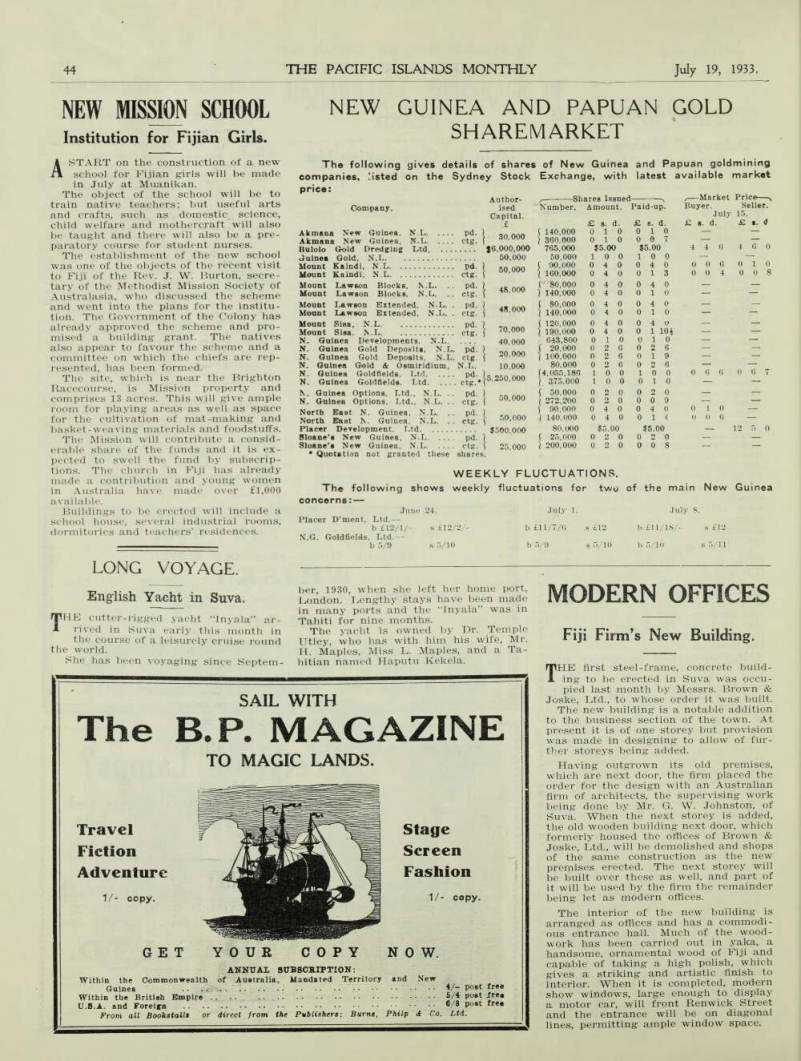
Institution for Fijian Girls.
A START on the construction of a new school for Fijian girls will be made in July at Muanikan.
The object of the school will be to train native teachers; but useful arts and crafts, such as domestic science, child welfare and mothercraft will also be taught and there will also be a pre paratory course for student nurses.
The establishment of the new school was one of the objects of the recent visit to Fiji of the Rev. J. W. Burton, secre tary of the Methodist Mission Society of Australasia, who discussed the scheme and went into the plans for the institu tion. The Government of the Colony has already approved the scheme and pro mised a building grant. The natives also appear to favour the scheme and a committee on which the chiefs are rep resented, has been formed.
The site, which is near the Brighton Racecourse, is Mission property and comprises 13 acres. This will give ample room for playing areas as well as space for the cultivation of mat-making and basket-weaving materials and foodstuffs.
The Mission will contribute a consid erable share of the funds and it is ex pected to swell the fund by subscrip tions. The church in Fiji has already made a contribution and young women in Australia have made over £1,000 available.
Buildings to be erected will include a school house, several industrial rooms, dormitories and teachers’ residences.
Long Voyage.
English Yacht in Suva.
THE cutter-rigged yacht “Inyala” ar rived in Suva early this month in the course of a leisurely cruise round the world.
She has been voyaging since Septem
ber, 1930, when she left her home port, London. Lengthy stays have been made in many ports and the “Inyala” was in Tahiti for nine months.
The yacht is owned by Dr. Temple Utley, who has with him his wife, Mr.
H. Maples, Miss L. Maples, and a Ta hitian named Haputu Kekela.
Sharemarket
New Guinea And Papuan Gold
The following gives details of shares of New Guinea and Papuan goldmining companies, listed on the Sydney Stock Exchange, with latest available market price:
Weekly Fluctuations.
The following shows weekly fluctuations for two of the main New Guinea concerns:
Authorised Capital. £ Shares Issued Market Price Company.
Number.
Amount.
Paid-up.
Buyer.
Seller.
July 15. £ s. d. £ s. d. £ s. d. £ s. d Akmana New Guinea, N.L pd. 140,000 0 1 0 0 1 0 — — Akmana New Guinea. N.L ctg. 360,000 0 1 0 0 0 7 — — Bulolo Gold Dredging Ltd. . .. $6,000,000 765,000 $5.00 $5.00 4 4 6 4 6 0 Guinea Gold, N.L 50,000 50,000 1 0 0 1 0 0 — — Mount Kaindi, N.L Pd. 90,000 0 4 0 0 4 0 0 0 6 0 1 0 Mount Kaindi, N.L ctg. 160,000 0 4 0 0 1 3 0 0 4 0 0 8 Mount Lawson Blocks, N.L. pd. 80,000 0 4 0 0 4 0 — — Mount Lawson Blocks. N.L. .. ctg. 140,000 0 4 0 0 1 0 — — Mount Lawson Extended, N.L. . pd. 48,000 80,000 0 4 0 0 4 0 — — Mount Lawson Extended, N.L. . ctg. 140,000 0 4 0 0 1 0 — — Mount Sisa, N.L pd. 120,000 0 4 0 0 4 0 — — Mount Sisa, N.L ctg. 70,000 190,000 0 4 0 0 1 10½ — — N. Guinea Developments, N.L. 40,000 643,800 0 1 0 0 1 0 — — N. Guinea Gold Deposits, N.L. pd. 20,000 0 2 6 0 2 6 — — N. Guinea Gold Deposits. N.L. ctg. 20,000 100,000 0 2 6 0 1 9 — — N. Guinea Gold & Osmiridium, N.L. 10,000 80,000 0 2 6 0 2 6 — — N. Guinea Goldfields, Ltd pd. 4,055,186 1 0 0 1 0 0 0 6 6 0 6 7 N. Guinea Goldfields, Ltd ctg.* 375,000 1 0 0 0 1 0 — — N. Guinea Options, Ltd., N.L. .. pd. 50,000 50,000 0 2 0 0 2 0 — — — N. Guinea Options, Ltd., N.L. .. ctg. 272,200 0 2 0 0 0 9 — — North East N. Guinea. N.L. .. pd. 90,000 0 4 0 0 4 0 0 1 0 — North East N. Guinea, N.L. . . ctg. 50,000 140,000 0 4 0 0 1 0 0 0 6 — Placer Development, Ltd $500,000 80,000 $5.00 $5.00 — 12 5 0 Sloane’s New Guinea. N.L pd. 25,000 0 2 0 0 2 0 — — Sloane’a New Guinea, N.L ctg. 25,000 200,000 0 2 0 0 0 8 — — * Quotation not granted these shares.
June 24. July 1. July 8.
Placer D’ment, Ltd. — b £42/I/- s £12/2/- b £14/7/6 s £12 b £11/18/- s £12 N.G. Goldfields, Ltd.— b 5/9 s 5/10 b 5/9 s 5/10 b 5/10 s 5/11
Modern Offices
Fiji Firm’s New Building.
THE first steel-frame, concrete build ing to be erected in Suva was occu pied last month by Messrs. Brown & Joske, Ltd., to whose order it was built.
The new building is a notable addition to the business section of the town. At present it is of one storey but provision was made in designing to allow of fur ther storeys being added.
Having outgrown its old premises, which are next door, the firm placed the order for the design with an Australian firm of architects, the supervising work being done by Mr. G. W. Johnston, of Suva. When the next storey is added, the old wooden building next door, which formerly housed the offices of Brown & Joske, Ltd., will be demolished and shops of the same construction as the new premises erected. The next storey will be built over these as well, and part of it will be used by the firm the remainder being let as modern offices.
The interior of the new building is arranged as offices and has a commodi ous entrance hall. Much of the wood work has been carried out in yaka, a handsome, ornamental wood of Fiji and capable of taking a high polish, which gives a striking and artistic finish to interior. When it is completed, modern show windows, large enough to display a motor car, will front Renwick Street and the entrance will be on diagonal lines, permitting ample window space.
Advertisements & other items, p. 46 (1 item)
The B.P. Magazine
SAIL WITH
TO MAGIC LANDS.
Adventure Fashion
GET YOUR COPY NOW.
ANNUAL SUBSCRIPTION:
Within the Commonwealth of Australia, Mandated Territory and New Guinea 4/- post free Within the British Empire 5/4 post free U.S.A. and Foreign 6 / 8 Post free From all Bookstalls or direct from the Publishers: Burns, Philp & Co. Ltd.
Market Quotations
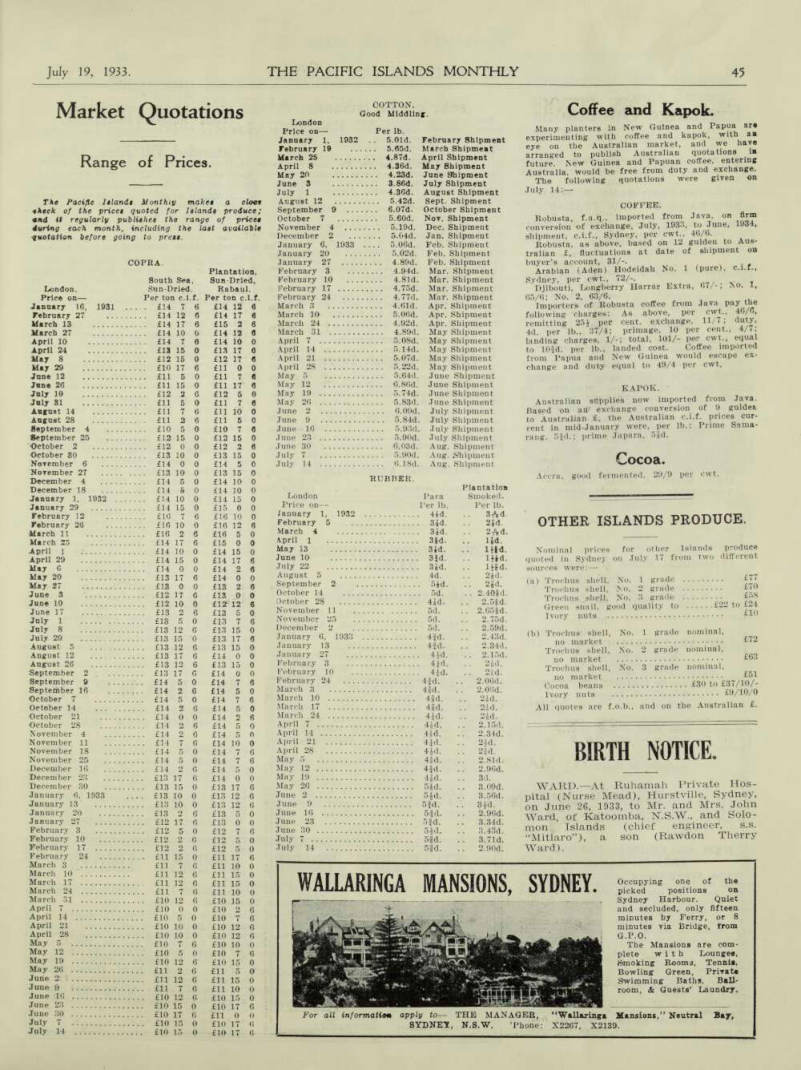
Range of Prices.
The Pacific Islands Monthly makes a close check of the prices quoted for Islands produce; end it regularly publishes the range of prices during each month, including the last available quotation before going to press.
Coffee and Kapok.
Many planters in New Guinea and Papua ars experimenting with coffee and kapok, with an eye on the Australian market, and we have arranged to publish Australian quotations im future. New Guinea and Papuan coffee, entering Australia, would be free from duty and exchange.
The following quotations were given on July 14:—
Coffee.
Robusta, f.a.q., imported from Java, on firm conversion of exchange, July, 1933, to June, 1934, shipment, c.i.f., Sydney, per cwt., 40/6.
Robusta, as above, based on 12 gulden to Aus tralian £, fluctuations at date of shipment on buyer’s account, 31/-.
Arabian (Aden) Hodeidah No. 1 (pure), c.i.f., Sydney, per cwt., 72/-.
Djibouti, Longberry Harrar Extra, 67/-; No. 1, 65/6; No. 2, 63/6.
Importers of Robusta coffee from Java Pay the following charges; As above, per cwt., 46/6, remitting 25½ per cent, exchange, 11/7; duty, 4d. per lb., 37/4; primage, 10 per cent., 4/7; landing charges, 1/-; total, 101/- per cwt., equal to 10Jd. per lb., landed cost. Coffee imported from Papua and New Guinea would escape ex change and duty equal to 49/4 per cwt.
Kapok.
Australian supplies now imported from Java.
Based on an exchange conversion of 9 gulden to Australian £, the Australian c.i.f. prices cur rent in mid-January were, per lb.; Prime Sama rang, 5|d.; prime Japara, 5Jd.
Cocoa.
Accra, good fermented, 29/9 per cwt.
Copra
South Sea, Plantation, Sun Dried, London.
Sun-Dried.
Rabaul.
Price on— Per ton c.i.f.
Per ton c.i.f.
Janaary 16, 1931 £14 7 6 £14 12 6 February 27 £14 12 6 £14 17 0 March 13 £14 17 6 £15 2 6 March 27 £14 10 0 £14 12 0 April 10 £14 7 6 £14 10 0 April 24 £13 15 0 £13 17 0 May 8 £12 15 0 £12 17 « May 29 £10 17 6 £11 0 0 Jane 12 £11 5 0 £11 7 6 June 26 £11 15 0 £11 17 6 July 10 6 £12 5 0 July 81 £11 5 0 £11 7 6 August 14 £11 7 6 £11 10 0 August 28 £11 2 6 £11 6 0 September 4 £10 5 0 £10 7 0 September 25 £12 15 0 £12 15 0 October 2 £12 0 0 £12 2 0 October 80 £13 10 0 £13 15 0 November 6 ... £14 0 0 £14 5 0 November 27 £13 10 0 £13 15 0 December 4 £14 5 0 £14 10 0 December 18 . . . . £14 5 0 £14 10 0 January 1, 1932 . 0 £14 15 0 January 29 0 £15 0 0 February 12 £16 7 6 £16 10 0 February 26 ... 0 £16 12 6 March 11 £16 2 6 £16 5 0 March 25 £14 17 6 £15 0 0 April l £14 10 0 £14 15 0 April 29 0 £14 17 6 May 6 0 £14 2 0 May 20 £13 17 6 £14 0 0 May 27 £13 0 0 £13 2 6 June 3 £12 17 6 £13 0 0 June 10 £12 10 0 £12 12 0 June 17 £13 2 6 £13 5 0 July 1 . £13 5 0 £13 7 6 July 8 £13 12 6 £13 15 0 July 29 £13 15 0 £13 17 6 August 5 £13 12 6 £13 15 0 August 12 £13 17 6 £14 0 0 August 26 6 £13 15 0 September 2 6 £14 0 0 September 9 £14 5 0 £14 7 6 September 16 £14 2 6 £14 5 0 October 7 £14 5 0 £14 7 6 October 14 6 £14 5 0 October 21 0 £14 2 6 October 28 £14 2 6 £14 5 0 November 4 . . .. £14 2 6 £14 5 n November 11 ... £14 7 6 £14 10 0 November 18 . ... £14 5 0 £14 7 6 November 25 .. .. £14 5 0 £14 7 6 December 16 . ... £14 2 6 £14 5 0 December 23 .. .. £13 17 6 £14 0 0 December 30 ... £13 15 0 £13 17 6 January 6, 1933 £13 10 0 £13 12 6 January 13 £13 10 0 £13 12 6 January 20 £13 2 6 £13 5 0 January 27 £12 17 6 £13 0 0 February 3 0 £12 7 6 February 10 £12 2 6 £12 5 0 February 17 £12 2 6 £12 5 0 February 24 0 £11 17 6 March 3 £11 7 6 £11 10 0 March 10 6 £11 15 0 March 17 £11 12 6 £11 15 0 March 24 6 £11 10 0 March 31 6 £10 15 0 April 7 0 £10 2 6 April 14 0 £10 7 6 April 21 0 £10 12 6 April 28 0 £10 12 6 May 5 6 £10 10 0 May 12 0 £10 7 6 May 19 6 £10 15 0 May 26 6 £11 5 0 June 2 6 £11 15 0 June 9 6 £11 10 0 June 16 6 £10 15 0 June 23 £10 15 0 £10 17 6 June 30 6 £11 0 0 July 7 0 £10 17 6 July 14 0 £10 17 6
Cotton.
Good Middling.
London Price on— Per lb.
January 1, 1032 5.Old. February Shipment February 19 March 25 . ... 4.87d. April Shipment April 8 May 20 June 3 ... 3.86d. July Shipment July 1 August 12 5.42d. Sept. Shipment September 9 . . .
October 7 November 4 ... 5.19d. Dec. Shipment December 2 5.04d. Jan. Shipment January 6, 1933 ... 5.06d. Feb. Shipment January 20 . .. 5.02d. Feb. Shipment January 27 .. .. 4.89d. Feb. Shipment February 3 4.94d. Mar. Shipment February 10 ... 4.81d. Mar. Shipment February 17 February 24 ...
March 3 March 10 March 24 March 31 April 7 April 14 April 21 April 28 May 5 May 12 May 19 May 20 June 2 June 9 June 10 5.93d. July Shipment June 23 June 30 July 7 5.90d. Aug.
July 14 6.18d. Aug. Shipment
Rubber.
Plantation London Para Smoked.
Price on — Per lb.
Per lb.
January 1, 1932 4id. 3Ad.
February 5 3id. .. 2id.
March 4 3Jd. 2Ad.
April 1 3!d. lid.
May 13 3id.
U»d.
June 10 IHd.
July 22 3|d. .. iHd.
August 5 ... 4d. .. 24d.
September 2 .. 2Jd.
October 14 ... . . 2.40&d.
October 28 ... . 4id. . . 2.5|d.
November 11 .. 2.05|d.
November 25 .. 2.75d.
December 2 5d. . . 2.59d.
January 6, 1933 4 id. .. 2.43d.
January 13 4Jd. .. 2.34d.
January 27 .. 2.15d.
February 3 4Jd. .. 24d.
February 10 4Jd. .. 24d.
February 24 . . ., 4Jd. .. 2.00d.
March 3 4gd. .. 2.00d.
March 10 4gd. .. 24d.
March 17 4|d. .. 2Jd.
March 24 4id. .. 24d.
April 7 4gd. .. 2.13d.
April 14 4Jd. 2.34d.
April 21 4Jd. . . 21d.
April 28 . . 2gd.
May 5 4|d. 2.81d.
May 12 .. 2.9Gd.
May 19 4|d. . . 3d.
May 20 .. 3.09d.
June 2 .. 3.56d.
June 9 5Jd. .. 3id.
June 16 2.96d.
June 23 5M. .. 3.34d.
June 30 5*d. .. 3.43d.
July 7 .. 3.71d.
July 14 5id. .. 2.90d.
Other Islands Produce.
Nominal prices for other Islands produce quoted in Sydney on July 17 from two different sources were:—
(a) Trochus shell, No. 1 grade Trochus shell, No. 2 grade Trochus shell, No. 3 grade Green snail, good quality to £7T £70 £58 £22 to £24 £10 (b) Trochus shell, uo market Trochus shell, no market Trochus shell, no market No. 1 grade nominal, £72 No. 2 grade nominal, £63 No. 3 grade nominal, £51 Cocoa beans Tnn to . £30 to £37/10/- £9/10/0 All quotes are f.o.b., and on the Australian £.
Birth Notice.
WARD. —At Ruhamah Private Hos pital (Nurse Mead), Hurstville, Sydney, on June 26, 1933, to Mr. and Mrs. John Ward, of Katoomba, N.S.W., and Solo mon Islands (chief engineer, s.s.
“Mitiaro”), a son (Rawdon Therry Ward).
Advertisements & other items, p. 47 (1 item)
Wailaringa Mansions, Sydney.
Occupying one of the picked positions on Sydney Harbour. Quiet and secluded, only fifteen minutes by Ferry, or 8 minutes via Bridge, from
G.P.O.
The Mansions are com plete with Lounges, Smoking Rooms, Tennis, Bowling Green, Private Siwimming Baths, Ball room, & Guests’ Laundry.
For all information apply to — THE MANAGER, “Wallaringa Mansions,” Neutral Bay, SYDNEY, N.S.W. ’Phone: X 2267, X 2139.
Exchange Quotations
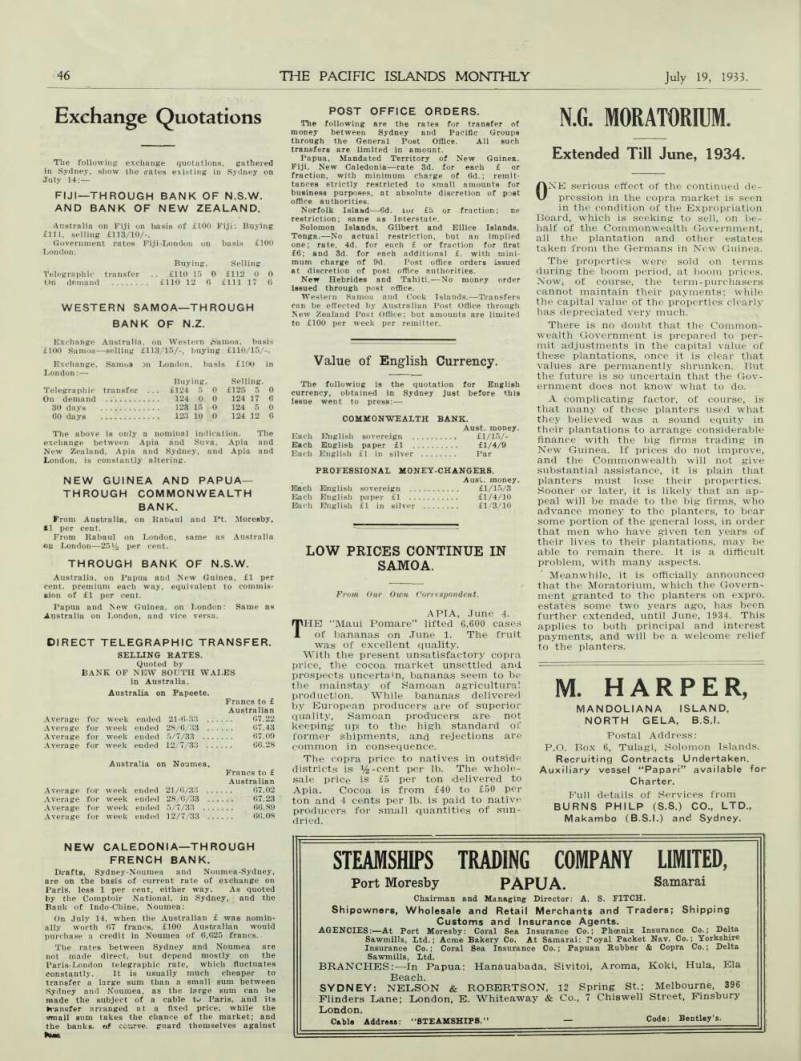
The following exchange quotations, gathered in Sydney, show the rates existing in Sydney on July 14;—
Fiji—Through Bank Of N.S.W.
And Bank Of New Zealand.
Australia on Fiji on basis of £100 Fiji: Buying fill, selling £113/10/-.
Government rates Fiji-London on basis £100 London.
Western Samoa—Through
Bank Of N.Z.
Exchange Australia, on Western samoa, basis £100 Samoa—selling £113/15/-, buying £110/15/-.
Exchange, Samoa on London, basis £100 in London: —
The above is only a nominal indication. The exchange between Apia and Suva, Apia and New Zealand, Apia and Sydney, and Apia and London, is constantly altering.
New Guinea And Papua
Through Commonwealth
Bank.
From Australia, on Rabaul and Pt. Moresby, *1 per cent.
From Rabaul on London, same as Australia on London —25% per cent.
Through Bank Of N.S.W.
Australia, on Papua and New Guinea, £1 per cent, premium each way, equivalent to commis sion of £1 per cent.
Papua and New Guinea, on London; Same as Australia on London, and vice versa.
Direct Telegraphic Transfer.
Selling Rates.
Quoted by
Bank Of New South Wales
in Australia.
Australia on Papeete.
New Caledonia—Through
French Bank.
Drafts, Sydney-Noumea and Noumea-Sydney, are on the basis of current rate of exchange on Paris, less 1 per cent, either way. As quoted by the Comptoir National, in Sydney, and the Bank of Indo-Chine, Noumea: On July 14, when the Australian £ was nomin ally worth 67 francs, £100 Australian would purchase a credit in Noumea of 6,625 francs.
The rates between Sydney and Noumea are not made direct, but depend mostly on the Paris-London telegraphic rate, which fluctuates constantly. It is usually much cheaper to transfer a large sum than a small sum between Sydney and Noumea, as the large sum can be made the subject of a cable to Paris, and its transfer arranged at a fixed price, while the small sum takes the chance of the market; and the banks, of course, guard themselves against tons
Post Office Orders.
The following are the rates for transfer of money between Sydney and Pacific Groups through the General Post Office. All such transfers are limited in amount.
Papua, Mandated Territory of New Guinea, Fiji, New Caledonia —rate 3d. for each £ or fraction, with minimum charge of 6d.; remit tances strictly restricted to small amounts for business purposes, at absolute discretion of post office authorities.
Norfolk Island—6d. for £5 or fraction; no restriction; same as Interstate.
Solomon Islands, Gilbert and Ellice Islands, Tonga.—No actual restriction, but an implied one; rate, 4d. for each £ or fraction for first £6; and 3d. for each additional £, with mini mum charge of 9d. Post office orders issued at discretion of post office authorities.
New Hebrides and Tahiti. —No money order issued through post office.
Western Samoa and Cook Islands. —Transfers can be effected by Australian Post Office through New Zealand Post Office; but amounts are limited to £100 per week per remitter.
Telegraphic transfer On demand Buying. Selling .. £11015 0 £112 0 0 £110 12 6 £111 17 6
Buying. Selling.
Telegraphic transfer .. . £124 5 0 £125 5 0 On demand 124 0 0 124 17 6 30 davs 123 15 0 124 5 0 60 days 123 10 0 124 12 6
Average for week ended 21-6-33 .. 67.22 Francs to £ Australian Average for week ended 28/6/33 . . 67.43 Average for week ended 5/7/33 ... 67.09 Average for week ended 12/7/33 ... 66.28 Average for week ended 21/6/33 .. 67.02 Australia on Noumea, Francs to £ Australian Average for week ended 28/6/33 .. 67.23 Average for week ended 5/7/33 ... 66.89 Average for week ended 12/7/33 .. 66.08
Value of English Currency.
The following is the quotation for English currency, obtained in Sydney just before this issue went to press:—
Commonwealth Bank.
Aust. money.
Each English sovereign £1/15/- Each English paper £1 £1/4/9 Each English £1 in silver ... Par
Professional Money-Changers.
Aust.. money, Each English sovereign £1/15/3 Each English paper £1 £1/4/10 Each English £1 in silver . . . £1/3/10
Samoa.
Low Prices Continue In
From Our Own Correspondent.
APIA, June 4.
THE “Maui Pomare” lifted 6,600 cases of bananas on June 1. The fruit was of excellent quality.
With the present unsatisfactory copra price, the cocoa market unsettled and prospects uncertain, bananas seem to be the mainstay of Samoan agricultural production. While bananas delivered by European producers are of superior quality, Samoan producers are not keeping upi to the high standard of former shipments, and rejections are common in consequence.
The copra price to natives in outside districts is ½-cent per lb. The whole sale price is £5 per ton delivered to Apia. Cocoa is from £40 to £50 per ton and 4 cents per lb. is paid to native producers for small quantities of sun dried.
N.G. Moratorium.
Extended Till June, 1934.
ONE serious effect of the continued de pression in the copra market is seen in the condition of the Expropriation Board, which is seeking to sell, on be half of the Commonwealth Government, all the plantation and other estates taken from the Germans in New Guinea.
The properties were sold on terms during the boom period, at boom prices.
Now, of course, the term-purchasers cannot maintain their payments; while the capital value of the properties clearly has depreciated very much.
There is no doubt that the Common wealth Government is prepared to per mit adjustments in the capital value of these plantations, once it is clear that values are permanently shrunken. But the future is so uncertain that the Gov ernment does not know what to do.
A complicating factor, of course, is that many of these planters used what they believed was a sound equity in their plantations to arrange considerable finance with the big firms trading in New Guinea. If prices do not improve, and the Commonwealth will not give substantial assistance, it is plain that planters must lose their properties.
Sooner or later, it is likely that an ap peal will be made to the big firms, who advance money to the planters, to bear some portion of the general loss, in order that men who have given ten years of their lives to their plantations, may be able to remain there. It is a difficult problem, with many aspects.
Meanwhile, it is officially announced that the Moratorium, which the Govern ment granted to the planters on exproestates some two years ago, has been further extended, until June, 1934. This applies to both principal and interest payments, and will be a welcome relief to the planters.
Advertisements & other items, p. 48 (1 item)
M. Harper,
MANDOLIANA ISLAND.
NORTH GELA, B.S.I.
Postal Address: P.O. Box 6, Tulagi, Solomon Islands, Recruiting Contracts Undertaken.
Auxiliary vessel “Papari” available for Charter.
Full details of Services from
BURNS PHILP (S.S.) CO., LTD.,
Makambo (B.S.I.) and Sydney.
STEAMSHIPS TRADING COMPANY LIMITED,
Port Moresby PAPUA. Samarai
Chairman and Managing Director: A, S. FITCH.
Shipowners, Wholesale and Retail Merchants and Traders; Shipping Customs and Insurance Agents.
AGENCIES:—At Port Moresby: Coral Sea Insurance Co.; Phoenix Insurance Co.; Delta Sawmills, Ltd.; Acme Bakery Co. At Samarai: royal Packet Nav. Co.; Yorkshire Insurance Co.; Coral Sea Insurance Co.; Papuan Rubber & Copra Co.; Delta Sawmills, Ltd.
BRANCHES In Papua: Hanauabada, Sivitoi, Aroma, Koki, Hula, Ela Beach.
SYDNEY: NELSON & ROBERTSON, 12 Spring St; Melbourne, 396 Flinders Lane; London, E. Whiteaway & Co., 7 Chiswell Street, Finsbury London.
Cable Address: “STEAMSHIPS.” Code: Bentley's.
Shipping Services in the Pacific
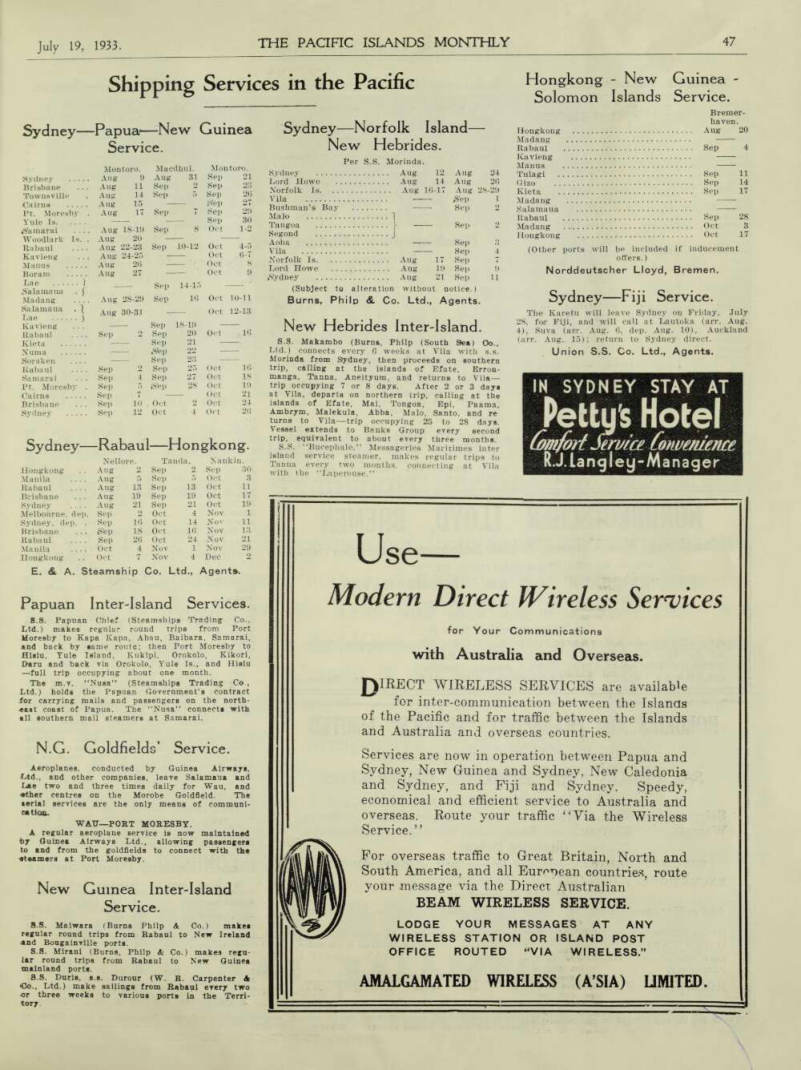
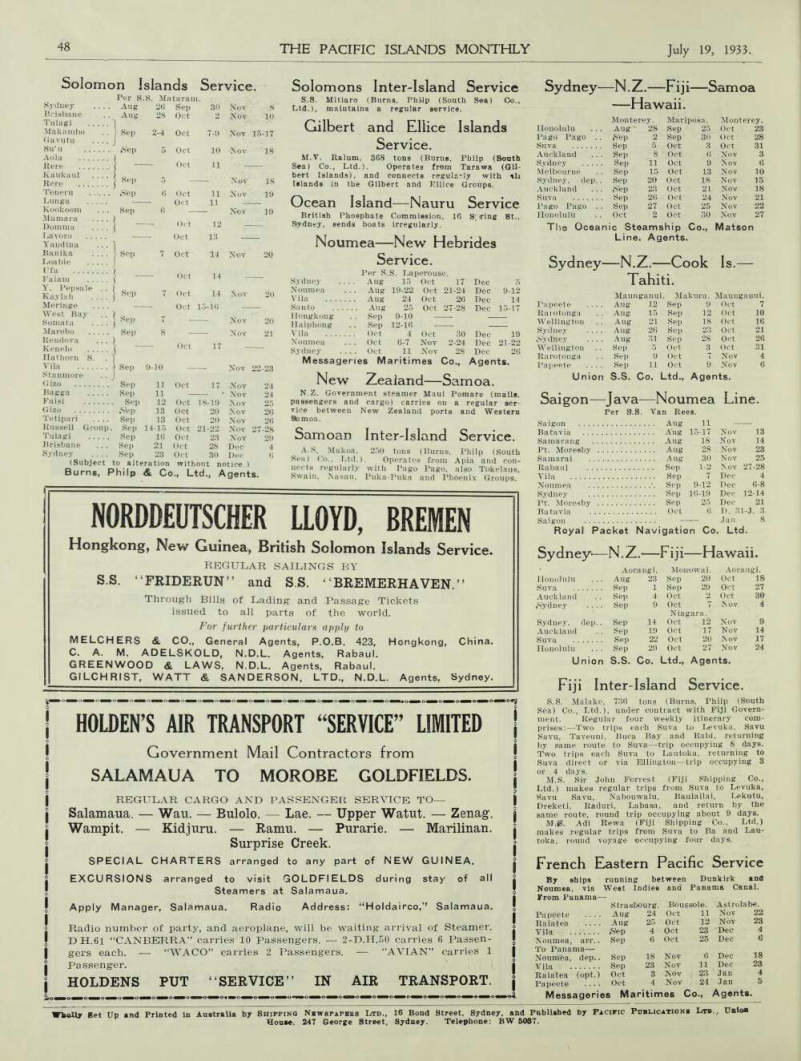
Sydney—Papua —New Guinea Service.
Papuan Inter-Island Services.
S.S. Papuan Chief (Steamships Trading Co., Ltd.) makes regular round trips from Port Moresby to Kapa Kapa, Abau, Baibara, Samarai, and back by same route; then Port Moresby to Hisiu, Yule Island, Kukipi, Orokolo, Kikori, Daru and back via Orokolo, Yule Is., and Hisiu —full trip occupying about one month.
The m.v. “Nusa” (Steamships Trading Co, Ltd.) holds the Papuan Government’s contract for carrying mails and passengers on the north east coast of Papua. The “Nusa” connects with all southern mail steamers at Samarai.
N.G. Goldfields’ Service.
Aeroplanes, conducted by Guinea Airways, Ltd., and other companies, leave Salamaua and Lae two and three times daily for Wau, and other centres on the Morobe Goldfield. The aerial services are the only means of communi cation.
Wau—Port Moresby.
A regular aeroplane service is now maintained by Guinea Airways Ltd., allowing passengers to and from the goldfields to connect with the oteamers at Port Moresby.
New Guinea Inter-Island
Service.
S.S. Maiwara (Burns Philp & Co.) makes regular round trips from Rabaul to New Ireland and Bougainville ports.
S.S. Mirani (Burns, Philp A Co.) makes regu lar round trips from Rabaul to New Guinea mainland ports.
S.S. Duris, s.s. Durour (W. R. Carpenter & Co., Ltd.) make sailings from Rabaul every two or three weeks to various ports in the Terri tory.
Sydney—Norfolk Island— New Hebrides.
New Hebrides Inter-Island.
S.S. Makambo (Burns, Philp (South Sea) Co., Ltd.) connects every 6 weeks at Vila with s.s.
Morinda from Sydney, then proceeds on southern trip, calling at the islands of Efate, Erron manga, Tannn, Aneityum, and returns to Vila— trip occupying 7or 8 days. After 2 or 3 days at Vila, departs on northern trip, calling at the islands of Efate, Mai, Tongoa, Epi, Paama, Ambrym, Malekula, Abba, Malo, Santo, and re turns to Vila—trip occupying 25 to 28 days.
Vessel extends to Banks Group every second trip, equivalent to about every three months.
S.S. “Bucephale,” Messageries Maritimes inter island service steamer, makes regular trips to Tanna every two months, connecting at Vila with the “Laperouse.”
Hongkong - New Guinea - Solomon Islands Service.
Sydney—Fiji Service.
The Karetu will leave Sydney on Friday, July 28, for Fiji, and will call at Lautoka (arr. Aug. 4), Suva (arr. Aug. 6, dep. Aug. 10), Auckland (arr. Aug. 15); return to Sydney direct.
Union S.S. Co. Ltd., Agents.
Per S.S. Morinda.
Sydney Aug 12 Aug 14 Aug 16-17 Aug 24 Aug 26 Aug 28-29 Sep 1 Vila Malo Sep 2 Sep 2 Segond Aoba Sep 3 Vila Sep 4 Norfolk Is Aug 17 Sep Aug 19 Sep Aug 21 Sep Lord Howe Sep 9 Sydney Sep 11 (Subject to alteration without notice.) Burns, Philp & Co. Ltd., Agents.
Bremerhaven.
Aug 20 Sep 4 Sep 11 Sep 14 Kieta Sep 17 Madang Salamaua Rabaul Sep 28 Madang Oct 3 Hongkong Oct 17 (Other ports will be included if inducement offers.) Norddeutscher Lloyd, Bremen.
Montoro.
Macdhui.
Montoro.
Sydney Aug 9 Aug 31 Sep 21 Brisbane Aug 11 Sep 2 Sep 23 Townsville Aug 14 Sep 5 Sep 26 Cairns Aug 15 Sep 27 Pt. Moresby7 .
Aug 17 Sep 7 Sep 29 Yule Is — Sep 30 Samarai . ...
Aug 18-19 Sep 8 Oct 1-2 Woodlark Is. .
Aug 20 — Rabaul ...
Aug 22-23 Sep 10-12 Oct 4-5 Kavieng Aug 24-25 Oct 6-7 Manus Aug 26 Oct 8 Boram Aug 27 Oct 9 Lae Sep 14-15 Salamaua Madang . ...
Aug 28-29 Sep 16 Oct 10-11 Salamaua Lae Aug 30-31 Oct 12-13 Kavieng — Sep 18-19 — Rabaul ...
Sep 2 Sep 20 Oct 16 Sep 21 Sep 22 Sep 23 Numa Soraken — — Rabaul ...
Sep 2 Sep 25 Oct 16 Samarai Sep 4 Sep 27 Oct 18 Pt. Moresby .
Sep 5 Sep 28 Oct 19 Cairns Sep 7 Oct 21 Brisbane Sep 10 Oct 2 Oct 24 Sydney Sep 12 Oct 4 Oct 26 Sydney— Rabaul —Hongkong.
Nellore.
Tanda.
Nankin.
Hongkong Aug 2 Sep 2 Sep 30 Manila ...
Aug 5 Sep 5 Oct 3 Rabaul ...
Aug 13 Sep 13 Oct 11 Brisbane Aug 19 Sep 19 Oct 17 Sydney ...
Aug 21 Sep 21 Oct 19 Melbourne, dep.
Sep 2 Oct 4 Nov 1 Sydney, dep. .
Sep 16 Oct 14 Nov 11 Brisbane Sep 18 Oct 16 Nov 13 Rabaul ...
Sep 26 Oct 24 Nov 21 Manila ...
Oct 4 Nov 1 Nov 29 Hongkong Oct 7 Nov 4 Dec 2 E, & A. Steamship Co. Ltd., Agents.
Solomon Islands Service.
Solomons Inter-Island Service
S.S. Mitiaro (Burns, Philp (South Sea) Co., Ltd.), maintains a regular service.
Gilbert and Ellice Islands
Service.
M. Ralum, 368 tons (Burns, Philp (South Sea) Co., Ltd.). Operates from Tarawa (Gil bert Islands), and connects regularly with all Islands in the Gilbert and Ellice Groups.
Ocean Island—Nauru Service
British Phosphate Commission, 16 Spring St., Sydney, sends boats irregularly.
Noumea—New Hebrides
Service.
Per S.S. Laperouse.
Sydney ... Aug 15 Oct 17 Dec 5 Noumea ... Aug 19-22 Oct 21-24 Dec 9-12 Vila Aug 24 Oct 26 Dec 14 Santo Aug 25 Oct 27-28 Dec 15-17 Hongkong .. Sep 9-10 Haiphong .. Sep 12-16 Vila Oct 4 Oct 30 Dec 19 Noumea ... Oct 6-7 Nov 2-24 Dec 21-22 Sydney Oct 11 Nov 28 Dec 26
Messagenes Maritimes Co., Agents.
New Zealand—Samoa.
N. Government steamer Maui Pomare (mails, passengers and cargo) carries on a regular ser vice between New Zealand ports and Western Samoa.
Samoan Inter-Island Service.
A.S. Makoa, 250 tons (Burns, Philp (South Sea) Co.. Ltd.). Operates from Apia and con nects regularly with Pago Pago, also Tokelaus, Swain, Nasau, Puka-Puka and Phoenix Groups.
Sydney—N.Z.—Fiji—Samoa —Hawaii.
Sydney—-N.Z.—Cook Is.— Tahiti.
Saigon—Java—Noumea Line.
Sydney*—N. Z.—F iji—Hawaii.
Fiji Inter-Island Service.
S.S. Malake, 786 tons (Burns, Philp (South Sea) Co., Ltd.), under contract with Fiji Govern ment. Regular four weekly itinerary com prises:—Two trips each Suva to Levuka, Savu Savu, Taveuni, Buca Bay and Rabi, returning by same route to Suva—trip occupying 8 days.
Two trips each Suva to Lautoka, returning to Suva direct or via Ellington—trip occupying 3 or 4 days.
M.S. Sir John Forrest (Fiji Shipping Co., Ltd.) makes regular trips from Suva to Levuka, Savu Savu, Nabouwalu, Baulailai, Lekutu, Dreketi, Raduri, Labasa, and return by the same route, round trip occupying about 9 days.
M.$. Adi Rewa (Fiji Shipping Co., Ltd.) makes regular trips from Suva to Ba and Lau toka, round voyage occupying four days.
French Eastern Pacific Service
By ships running between Dunkirk and Noumea, via West Indies and Panama Canal.
From Panama —
Per S.S. Mataram.
Sydney . . Aug 26 Sep 30 Nov 8 Brisbane Aug 28 Oct 2 Nov 10 Tulagi Makambo Sep 2-4 Oct 7-9 Nov 15-17 Gavutu Su’u Sep 5 Oct 10 Nov 18 Aola Rere ...
Oct 11 — Kaukaul Rere ...
Sep 5
Nov 18 Teneru Sep 6 Oct 11 Nov 19 Lunga Oct 11 Kookoom Sep 6 Oct 11 Nov 19 Mamara Domma Oct 12 Oct 13 Yandina Banika Sep 7 Oct 14 Nov 20 Loabie Ufa Faiam — Oct 14 — Y. Pepsale Kaylah Sep 7 Oct 14 Nov 20 Meringe Oct 15-16 West Bay Somata Sep 7 Nov 20 Marobo Sep 8 Nov 21 Rendova Nov 21 Kenelo Oct 17 — Hathorn S.
Vila Sep 9-10 Nov 22-23 Stanmore Gizo Sep 11 Oct 17 Nov 24 Bagga Sep 11 Nov 24 Faisi Sep 12 Oct 18-19 Nov 25 Gizo Sep 13 Oct 20 Nov 26 Tetipari ... Sep 13 Oct 20 Nov 26 Russell Group.
Sep 14-15 Oct 21-22 Nov 27-28 Tulagi Sep 16 Oct 23 Nov 29 Brisbane .. Sep 21 Oct 28 Dec 4 Sydney .. Sep 23 Oct 30 Dec 6 (Subject to alteration without notice.) Burns, Philp & Co., Ltd., Agents.
Monterey.
Mariposa.
Monterey.
Honolulu Aug 28 Sep 25 Oct 23 Pago Pago ..
Sep 2 Sep 30 Oct 28 Suva Sep 5 Oct 3 Oct 31 Auckland Sep 8 Oct 6 Nov 3 Sydney Sep 11 Oct 9 Nov 6 Melbourne Sep 15 Oct 13 Nov 10 Sydney, dep..
Sep 20 Oct 18 Nov 15 Auckland Sep 23 Oct 21 Nov 18 Suva Sep 26 Oct 24 Nov 21 Pago Pago ..
Sep 27 Oct 25 Nov 22 Honolulu Oct 2 Oct 30 Nov 27 The Oceanic Steamship Co., Matson Line. Agents.
Maunganui.
Makura.
Maunganui.
Papeete ...
Aug 12 Sep 9 Oct 7 Rarotonga Aug 15 Sep 12 Oct 10 Wellington Aug 21 Sep 18 Oct 16 Sydney ...
Aug 26 Sep 23 Oct 21
Sydney ...
Aug 31 Sep 28 Oct 26 Wellington Sep 5 Oct 3 Oct 31 Rarotonga Sep 9 Oct 7 Nov 4 Papeete ...
Sep 11 Oct 9 Nov 6 Union S.S. Co. Ltd., Agents.
Per S.S. Van Rees.
Saigon Aug 11 Batavia Aug 15-17 Nov 13 Samarang Aug 18 Nov 14 Pt. Moresby Aug 28 Nov 23 Samarai Aug 30 Nov 25 Rabaul Sep 1-2 Nov 27-28 Vila Sep 7 Dec 4 Noumea ... Sep 9-12 Dec 6-8 Sydney Sep 16-19 Dec 12-14 Pt. Moresby Sep 25 Dec 21 Batavia Oct 6 De. 31-J. 3 Saigon Jan 8 Royal Packet Navigation Co. Ltd.
Aorangi.
Monowai.
Aorangi.
Honolulu Aug 23 Sep 20 Oct 18 Suva Sep 1 Sep 29 Oct 27 Auckland Sep 4 Oct 2 Oct 30 Sydney Sep 9 Oct 7 Niagara.
Nov 4 Sydney, dep..
Sep 14 Oct 12 Nov 9 Auckland Sep 19 Oct 17 Nov 14 Suva Sep 22 Oct 20 Nov 17 Honolulu Sep 29 Oct 27 Nov 24 Union S.S. Co. Ltd., Agents.
Strasbourg.
Boussole.
Astrolabe.
Papeete ...
Aug 24 Oct 11 Nov 22 Raiatea ...
Aug 25 Oct 12 Nov 23 Vila Sep 4 Oct 23 Dec 4 Noumea, dep..
Sep 6 Oct 25 Dec 6 To Panama — Noumea, dep..
Sep 18 Nov 6 Dec 18 Vila Sep 23 Nov 11 Dec 23 Raiatea (opt.) Oct 3 Nov 23 Jan 4 Papeete Oct 4 Nov 24 Jan 5 Messageries Maritimes Co., Agents.
Advertisements & other items, pp. 49-52 (2 items)
Petty's Hotel
IN SYDNEY STAY AT
Comfort Service Convenience R.J. Langley-Manager
Use—
Modern Direct Wireless Services
for Your Communications with Australia and Overseas.
DIRECT WIRELESS SERVICES are available for inter-communication between the Islands of the Pacific and for traffic between the Islands and Australia and overseas countries.
Services are now in operation between Papua and Sydney, New Guinea and Sydney, New Caledonia and Sydney, and Fiji and Sydney. Speedy, economical and efficient service to Australia and overseas. Route your traffic “Via the Wireless Service. ”
For overseas traffic to Great Britain, North and South America, and all countries, route your message via the Direct Australian
BEAM WIRELESS SERVICE.
LODGE YOUR MESSAGES AT ANY
WIRELESS STATION OR ISLAND POST
OFFICE ROUTED “VIA WIRELESS.”
AMALGAMATED WIRELESS (ASIA) LIMITED.
NORDDEUTSCHER LLOYD, BREMEN
Hongkong, New Guinea, British Solomon Islands Service.
REGULAR SAILINGS BY
SS. “FRIDERUN” and S.S. “BREMERHAVEN. ”
Through Bills of Lading and Passage Tickets issued to all parts of the world.
For further particulars apply to MELCHERS & CO., General Agents, P.O.B. 423, Hongkong, China.
C. A. M. ADELSKOLD, N.D.L. Agents, Rabaul.
GREENWOOD & LAWS, N.D.L. Agents, Rabaul.
GILCHRIST, WATT & SANDERSON, LTD., N.D.L. Agents, Sydney.
HOLDEN’S AIR TRANSPORT “SERVICE" LIMITED
Government Mail Contractors from
SALAMAUA TO MOROBE GOLDFIELDS.
REGULAR CARGO AND PASSENGER SERVICE TO
Salamaua. Wau. Bulolo. Lae. Upper Watut. Zenag.
Wampit. Kidjuru. Ramu. Purarie. Marilinan.
Surprise Creek.
SPECIAL CHARTERS arranged to any part of NEW GUINEA.
EXCURSIONS arranged to visit GOLDFIELDS during stay of all Steamers at Salamaua.
Apply Manager, Salamaua. Radio Address: “Holdairco,” Salamaua.
Radio number of party, and aeroplane, will be waiting- arrival of Steamer.
D H. 61 “CANBERRA” carries 10 Passengers. 2-D.H.50 carries 6 Passen gers each. “WACO” carries 2 Passengers. “AVIAN” carries 1 Passenger.
HOLDENS PUT “SERVICE” IN AIR TRANSPORT.
The Expert Staff of Guinea Airways Ltd. photographed in front of one of the large Hangars at Lae, New Guinea.
Staffed and Equipped to Carry on One of the Biggest Aerial Transport Services in the World WITH its giant Three-motored Aeroplanes, and its large staff of Experienced Pilots and Expert Mechanics, Guinea Air ways Ltd. carries on the Transport Service between the Coast of New Guinea and the Goldhelds Centres. There is no other form of Transport in this part of New Guinea—only Aeroplanes.
In all kinds of weather, irrespective of the seasons, the Aeroplanes of Guinea Airways Ltd. maintain communication with the Goldfields, safely carrying mails, passengers, heavy mining machinery, native labourers, foodstuffs, livestock, etc.
GUINEA AIRWAYS Ltd
LAE - SALAMAUA
48
July 19, 1933.
THE PACIFIC ISLANDS MONTHLY
Wholly Set Up and Printed in Australia by Shipping Newspapers Ltd., 16 Bond Street, Sydney, and Published by Pacific Publications L/tp.,, Union House, 247 George Street. Sydney. Telephone; BW 6037.