Pacific
Islands
Monthly
June 24
1933
6d
[Registered at G.P.O., Sydney, for transmission by post as a newspaper.]
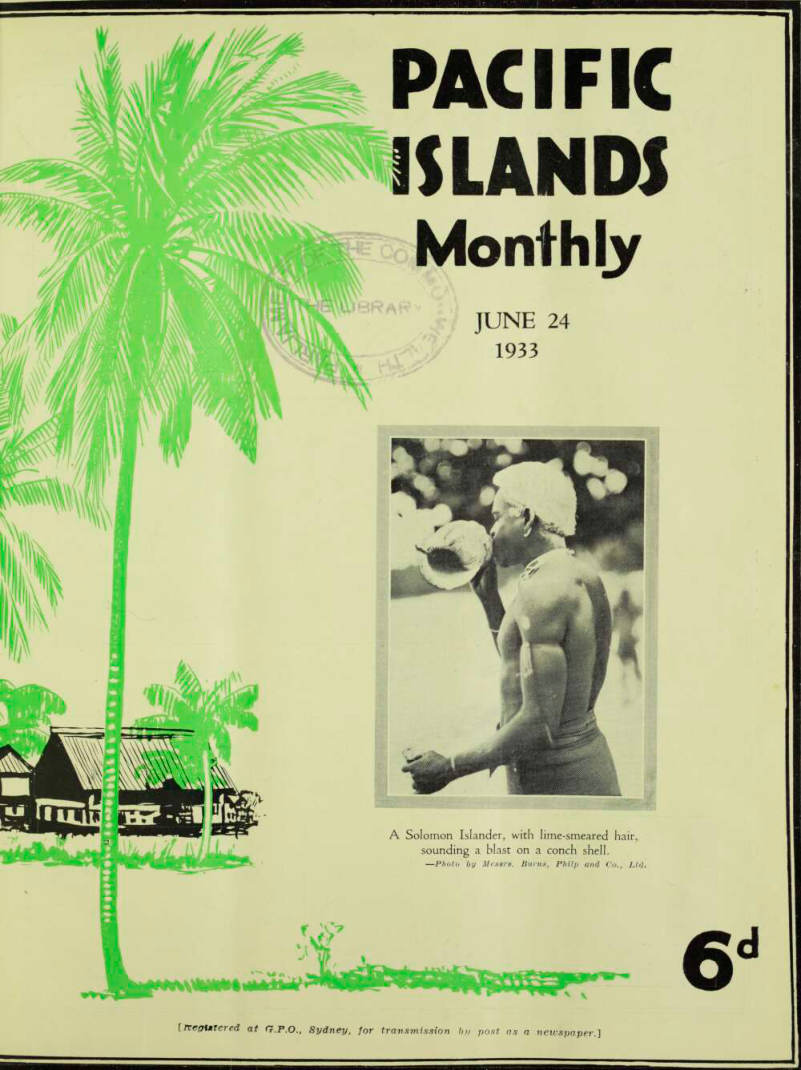
A Solomon Islander, with lime-smeared hair, sounding a blast on a conch shell. —Photo by Messrs. Burns, Philp and Co., Ltd.
Advertisements & other items, p. 2 (1 item)
W. R. Carpenter & Co. Ltd.
Head Office :
19-21 O’CONNELL STREET - - SYDNEY
Branches at: RABAUL (New Britain), KAVIENG (New Ireland), MADANG (New Guinea), SALAMAUA, WAU (New Guinea), TULAGI (Solomon Islands), and other Pacific Islands; and in LONDON.
WE SPECIALISE IN SUPPLYING THE REQUIREMENTS OF ISLANDS
RESIDENTS, PLANTERS AND TRADERS.
We are Agents for: Ford Cars, Trucks and Fordson Trac tors, Dodge Brothers Cars, Graham Dodge Trucks, Bolinder Marine and Stationary Engines, Coates’ Plymouth Gin, McCallums’ Perfection Whisky, Rimmel’s Perfumes, Houbigant’s Per fumes and Powders, Carlton V.B.
Beer, Goodyear Tyres.
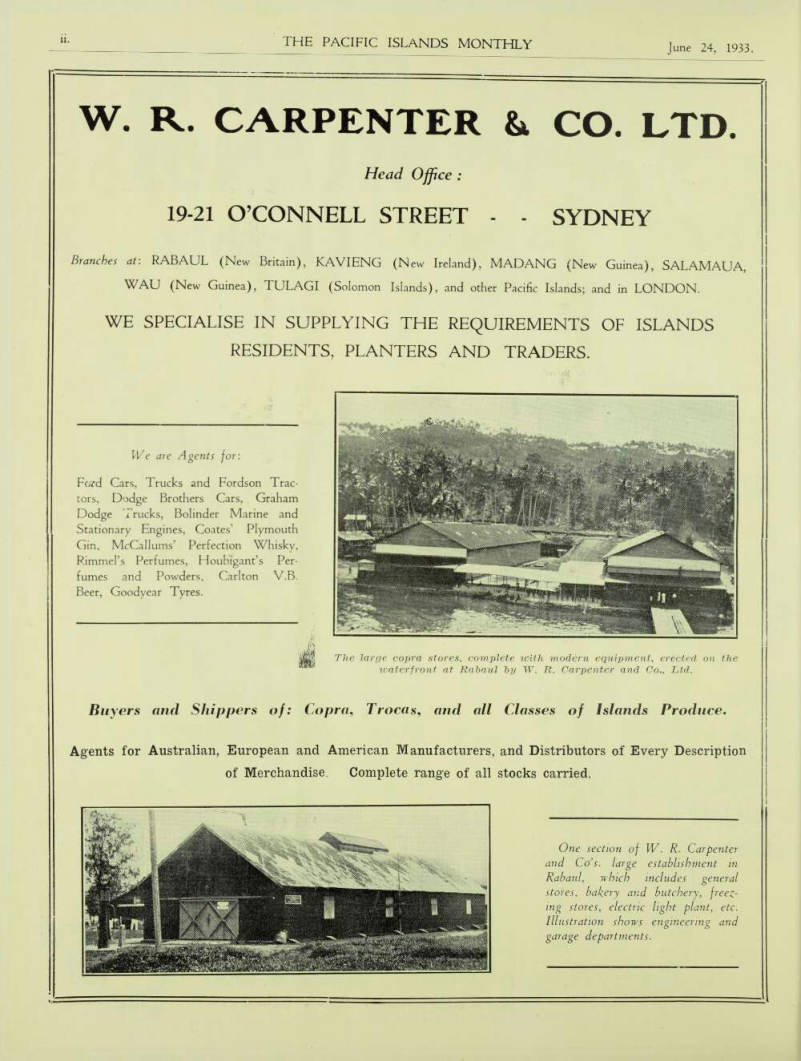
The large copra stores, complete with modern equipment, erected on the waterfront at Rabaul by W. R. Carpenter and Co., Ltd.
Buyers and Shippers of: Copra, Trocas, and all Classes of Islands Produce.
Agents for Australian, European and American Manufacturers, and Distributors of Every Description of Merchandise. Complete range of all stocks carried.
One section of W. R. Carpenter and Co’s, large establishment in Rabaul, which includes general stores, bakery and butchery, freez ing stores, electric light plant, etc.
Illustration shows engineering and garage departments.
Pacific Islands Travellers
Passengers Per “Montoro,” Which
Sailed From Sydney For Papua And
NEW GUINEA ON MAY 17: Mr. and Mrs.
Greenwood, Mr. and Mrs. C. Page, Misses (2) Page, Rev. Father J. Rossier, Rev. Bro. E.
Janin, Miss C. M. Nottle, Miss A. Trigg, Mrs.
E. Macdonald, Miss M. Goad, Mr. and Mrs.
W. Dalgarno, Miss H. C. Donoghue, Mr. Black, Mr. D. A. Madden, Mr. R. Watson, Mr. and Mrs. W. Groves, Mrs. L. V. Brossy, Mr. and Mrs. E. R. Oldham, Mrs. M. McLaren, Miss M.
McLaren, Miss D. Hall Best, Miss L. Martin, Mrs. E. Scott, Mrs. F. A. Bellamy, Mr. G. A.
Innes, Miss M. Sefton, Miss M. Thomas, Mr. and Mrs. H. Taylour, Mr. and Mrs. Ives, Mr.
S. K. Savage, Capt. E. W. Leggatt, Mrs. Parker, Mr. A. R. N. Grimshaw, Mr. J. Wright, Mr. and Mrs. F. C. Tracy, Miss Tracy, Mr. and Mrs. C. Werntz, Mrs. Bowman, Mr. W. Watson, Mr. F. M. Mateer, Mr. B. Earl, Mr. T. V.
Garrett, Mr. A. E. Reavley, Mr. T. H. Moon, Mr. L. Deards, Mr. P. M. Swanson, Mr. J.
Tinnion, Mr. and Mrs. I. J. Walshe, Mr. H.
Hitchcock, Mr. A. Walker, Mr. W. Barden, Mr.
W. Hugo, Mr. Lovegreen, Mr. G. Hedgecock, Mr. G. A. Harrison, Mr. F. K. Nottle, Mr. J. G.
Royle, Mr. C. H. Blackham, Mr. O. L. Barrell, Mr. G. Kuster, Mr. G. H. Smith, Mr. H. S.
Milne, Mr. Francis, Mr. E. C. Conden.
Passengers Per “Morinda,” Which
Sailed From Sydney For Lord Howe
IS. AND NORFOLK I. ON MAY 20: Dr. T. E.
McCormack, Miss E. M. Davis, Miss E. Hat tersley, Miss D. I. Knox, Mr. A. G. Elliott, Miss M. E. F. Stewart, Miss N. Orr, Miss A. S.
Shoosmith, Miss M. E. Stuart, Mr. Daly, Mr.
F. J. Morgan, Mrs. Barrow, Miss Barrow, Dr.
W. Craig, Mr. D. Craig, Mr. H. Arnott, Mr.
W. Gilbert, Mr. D. T. Lloyd, Mrs. C. Morris, Miss C. Davies, Miss M. K. Horsfall, Mrs. A.
Parker, Miss V. Parker, Mr. C. H. Boxall, Mr. G. E. Ardill, M.P., Mr. L. J. Dunbar, Mr.
N. C. Burcher, Miss H. G. Palmer, Miss A. E.
Ryan, Miss A. Tayton, Miss M. Mackay, Mrs.
A. Riches, Mrs. I. Harvey, Mrs. A. Millar, Misses (2) Millar, Mr. F. H. Redman, Professor Lucas, Mr. and Mrs. H. Christian, Mrs. Innes, Miss Innes, Mrs. Perrin, Mr. A. R. Potter, Mr. and Mrs. W. T. Retmock, Mr. Bowles.
Passengers Per “Monowai,” Which
SAILED FROM SYDNEY FOR SUVA, FIJI, ON MAY 25 ; Miss Shirley Faye, Mr. E. G. Theodore, Mr. T. Victor. Mr. R. F. Browne, Mrs. R. F.
Browne, Mr. E. R. Smith, Mr. O. L. Davidson, Mr. K. Moulton, Mr. R. E. S. Twentyman, Mrs.
R. E. S. Twentyman and two children, Master J. E. Twentyman, Mrs. A. J. Swann, Mr. J. E.
Davis, Mrs. J. E. Davis, Mr. G. L. Windred, Mr. C. O. Handley, Mr. W. McLeod, Mrs. W.
McLeod, Mr. D. L. Barry, Mr. S. H. Abrahams, Mrs. O. M. Pike, Miss K. Pike, Mrs. A. F.
Gerald Stafford, Mr. R. R. Howell, Mr. G. A.
Gound, Miss A. B. Benstead, Matron I. Libell, Miss Tomuye Nishimura, Mr. C. S. Sharp. Miss M. Stephens, Miss E. Stephens, Mr. E. R. E.
Rapley, Mr. W. Mackellar.
Passengers Per “Monterey,” Which
ARRIVED IN SYDNEY FROM SUVA, FIJI, ON MAY 25: Miss M. B. Bennett, Dr. G. A. Buchanan, Mrs. G. A. Buchanan, Mr. E. Cohen, Mr. E. J.
Davies, Miss Pauline Dumas, Mrs. I. H. Hooper, Miss M. J. Macervale, Mrs. Florence Mair, Mr.
C. L. MacDonald, Mr. G. Allen Moir, Mrs.
G. Allen Moir, Mr. V. C. Mosley, Mrs. V. C.
Mosley, Rev. J. T. Norris, Mr. J. G. Robson, Sister Lalla Stephen, Mr. O. J. Bonamy, Rev.
J. W. Burton, Mr. William, C. Dexter, Mr. I. R.
Frodey, Miss L. I. Lawrence, Mr. J. McKenna, Mr. James Menzies, Miss Margaret Rial, Mrs.
M. W. Robinson, Mr. C. Sunderland.
Passengers Per “Morinda,” Which
ARRIVED AT SYDNEY ON MAY 30 FROM LORD HOWE IS. AND NORFOLK IS. : Dr. C. B.
Craig, Mr. D. G. Craig, Miss E. M. Davies, Mr. and Mrs. C. A. Edwards, Miss E. E. Hattersley, Miss D. I. Knox, Dr. P. E. McCormack, Mr.
A. J. Petford, Mr. E. Quintal, Mr. A. G. Steel, Miss A. Tayton, Miss C. Austic, Mr. G. Daly, Mrs. Guthrie, Mr. and Mrs. C. Harford, Mr.
T. D. Lloyd, Miss M. Mackay, Mrs. Riches, Mrs. A. Miller, Miss T. Miller, Miss P. Miller, Mrs. A. Parker, Miss V. Parker, Miss B. Ramsay, Mr. F. H. Redman, Rev. and Mrs. K. Saunders, Mrs. Thew, Mrs, Morris.
Passengers Per ‘Macdhui,” Which
ARRIVED IN SYDNEY ON MAY 31 FROM NEW GUINEA AND PAPUA : Miss C. Alexander, Mr E. T. Anderson, Mr. G. Arnold, Mr. G.
Bateson, Mr. E. M. Bastard, Father T. Broana han, Mr. and Mrs. A. Christie, Mr. K. C. Curtin, Mr. J. Davidson, Mr. W. G. Digby, Mr. G.
Ellis, Mr. and Mrs. L. Malcolm, Miss A. Eng land, Miss P. Foldi, Dr. and Mrs. R. F. Fortune, Miss A. Franceschi, Mr. A. D. Fraser, Miss M.
Gibson, Miss J. Glynn, Mr. E. D. Gray, Mr.
T. C. Groom, Mr. E. K. Hadley, Mr. J. R.
Halligan, Mr. F. Hambridge, Mr. S. Marr, Hon. and Mrs. C. W. C. Marr, Master V. Marr, Miss M. Mount, Miss V. M. McCabe, Mr. and Mrs.
R McNickle, Miss Y. Nelson, Mr. H. W. Nobbs, Mr. D. L. Pullen, Mr. A. W. Paul, Mr. M. J.
Pitt, Mr. F. J. Pearce, Mrs. L. M. Ryan, Mr.
A. Ringel, Miss L. E. Ross, Mr. and Mrs. A.
Symons, Miss C. Syme, Mr. T. J. Shepherd, Miss E. M. Symons, Sister Symons, Mrs. C. E. and Miss L. Teece, Mr. W. C. Thomas, Mr. S. C.
Thompson, Mr. F. C. Urban, Mr. and Mrs.
D. H. V. Vertigan, Mr. C. White, Mr. F. L.
Watts, Miss W. Wilkins, Mr. G. Wilson, Mr.
L. V. Waterhouse, Miss E. M. Young, Miss L. R. Rouse.
Passengers Per “Monterey,” Which
SAILED FROM SYDNEY FOR SUVA, FIJI, ON MAY 31 : Miss C. M. Alexander, Mr. Robert Close, Mr. E. Cooke, Mrs. E. Cooke, Mr. R. W.
Farman, Miss A. N. Henderson, Mr. B. A. Holden, Miss N. Isaacs, Mr. Jack Julian, Mr. D. Junor, Mrs. D. Junor, Lord Kimbolton, Mr. R. H. N. Le Leu, Mrs. E. Mackenzie, Miss V. Mackenzie, Rt.
Hon. Viscount Mandeville, Viscountess Mandeville, Mr. A. A. Mendoza, Mrs. A. A. Mendoza, Miss A.
Mitchell, Lady Louis Montagu, Miss O. Morse, Mr. A. Nathan, Mrs. A. Nathan, Miss H. Pank hurst, Mr. G. O. Ramsay, Mr. F. A. Roberg, Mrs. F. A. Roberg, Miss D. Seymour, Miss Y.
Sinfield, Mr. D. V. Stead, Rev. A. G. Adamson, Mrs. A. G. Adamson, Mrs. G. M. Cobham, Mr.
H. C. Dixon, Mr. R. C. Evans, Mrs. R. C.
Evans, Miss R. Evans, Mr. J. Frazer, Miss E. W.
Freeman, Mr. L. K. Gahagan, Mr. R. Jenkins, Mr. G .H. Lane, Mrs. L. H. McLean, Master K. McLean, Sister Mary Monica, Mr. Robert Scott, Mrs. Hedley Smith, Mr. James L. Stark, Mr. J. P. Tarby, Mrs. J. P. Tarby, Miss M. J.
Thomas, Mrs. L. Tilley, Miss Esther Williamson.
Passengers Per “Morinda,” Which
SAILED FROM SYDNEY ON JUNE 1 FOR THE
New Hebrides, Via Lord Howe And
NORFOLK ISLANDS: Mr. and Mrs. J. Fletcher, Miss M. Fletcher, Mr. L. Job, Miss R. B.
Roper, Miss M. Stewart, Miss M. Budge, Miss M. Walsh, Miss A. C. Ryan, Mrs. M. Ranclaud, Mr. S. Boyd, Mr. A. D. Crichton, Rev. and Mrs.
W. F. Paton, Mrs. F. E. Wallace, Mrs. G. A.
Joy, Mrs R. Fenn, Miss D. Fleming, Mrs. M.
Bowie, Miss I. Everett, Mrs. H. Dechery, Miss D. M. Cussins, Mr. W. H. Lucas, Rev. B. L.
Webb, Mr. F. Du Boise, Mr. R. L. Ranken, Mr. A. Du Boise, Mr. G. Ebsworth, Mr. F. J.
Fleming, Mr. S. O. Martin, Mr. and Mrs. H.
Forbes, Miss J. Nicholas, Miss A. Armstrong, Miss M. Nicholls, Mrs. Power, Miss M. Cavers, Miss M. Geddes, Rev. and Mrs. Thomson Mac millan, Mr. and Mrs. Baxendale, Mr. W. H.
Tustin, Mr. Power, Mr. Buckland, Mr. E. C.
Robinson, Mr. and Mrs. G. S. Watt, Miss Watt, Dr. H. Young, Mr. H. Rossiter, Mr. P. Mar shall, Mr. and Mrs. F. Christian, Mr. M.
Nicholls.
Passengers Per “Mataram,” Which
ARRIVED IN SYDNEY ON JUNE 3 FROM SOLOMON ISLANDS. Mrs. G. C Allen, Mr. W.
Campbell, Mr. J. Duffy, Miss H. Milson, Miss M.
Holmes, Miss F. Holloway, Miss P. Allison, Miss M. Henthorn, Mr. F. C. Jewell, Mr. L.
Lauer, Mr. J. McLeod, Mrs. McLeod, Miss McLeod, Miss M. Pinkerton, Mr. F. C Stewart, Mr E. H. White, Mr. T. Young, Mr. J. Thomp son, Mr H. Waters, Mr. C. Graham, Mr. C.
Harper, Major G. H. Sandars, Mr. McRae, Mr.
M. E. Babbage, Mr. J. M. Clift, Mrs Clift, Mr. C. E. Bell, Mr. F. H. Thesher, Miss M.
Jenkins, Mr. A. E. Bamgarten.
Passengers Per “Macdhui,” Which
Sailed From Sydney For Papua And
NEW GUINEA ON JUNE 8: Mr. G. J. Guggerty, Mr A. W. John, Mrs. Irvine, Mr. F. D. Hockey, Mr S. D. Parker, Mr. and Mrs. C. R. Walker, Mrs. N Harris, Miss E. Neilson, Mr. F. W.
Griffin, Brig.-Gen. W. R. McNicoll, Mr J. Gunter, Mr. and Mrs. Townsend, Mr. and Mrs. W. J.
Boosiut, Rev. and Mrs. Rich, Mrs. Miller, Misses (3) Miller, Mrs. Young, Mrs. Comb, Mrs. E.
Fauser, Mrs. Washington, Mrs. H. A. Bodger, Mr. P. Mayer, Mr. F. L. Mitchell, Mr. V. Bath, Mrs. Costello, Father J. Bertin, Mrs. E. J.
Jones, Miss Backett, Mr. C. C. Abel, Mr. F. W.
Thomson, Mr. A. E. Saxton, Mrs. C. Ludlow, Miss M. Margrie, Dr. Simpson, Mr. A. D. Pedley, Mr. Everall, Miss Hudson, Miss Tinning, Miss Brodie, Miss J. Tinney, Mrs. S. A. Kennedy, Mrs. V. Weatherall, Mrs. Smith, Mr. and Mrs.
McAdam, Miss D. Lofts, Mrs. F. J. Williams, Mr. and Mrs. Skewes, Mr. R. Stevenson, Mr. J.
Lang, Mrs. Budden, Miss Barnett, Mr. Angelo, Mr. C. Robertson, Mr. H. G. Verey, Mr. M. S.
Edwards, Mr. D. McCarthy, Mr. T. G. Aitchison, Mr. L. G. Veal, Mr. J. R. Black, Mr. K. W.
Bilston, Mr. H. E. Hamilton, Mr. K. J. Hickey, Mr. J. Hill, Mr. C. E. Farnham, Mr. D. W.
MacMillan, Mr. Rich, Mr. B. Arnold, Mr. Vider, Mr. Carruth, Mr. Haines, Mr. G. B. Jack, Mr.
J. Fitzgerald, Mr. J. A. McNamara, Mr. Budden, Mr. Tillock, Mr. F. Brenton, Mr. A. Barnes, Mr. Ault, Mr. Harkness, Mr. Pollock, Mr. H. R.
Elliott, Mr. J. E. Stringer, Mr. J. Cotton, Miss Foster.
(Continued on page 44.)
Passengers Per “Mataram,” Which
Sailed From Sydney For The Solomon
ISLANDS ON JUNE 10: Miss O. Noble, Miss L. C. McRae, Miss Wells, Miss M. Dobbin, Mr. and Mrs. R. G. Lobb, Miss Christian, Miss Slobom, Mrs. A. Smith, Miss M. Smith, Miss A. Cohn, Miss Graham, Mr. and Mrs. F. H.
Whitlock, Miss E. M. Safstrom, Mrs. H. S.
Roberts, Miss R. Lynch, Miss J. G. Lobb, Mr. and Mrs. L. W. S. Wright, Captain J. L. W.
Rawson, Mr. J. A. D. Love, Mr. U. C. Deane, Rev. R. P. Fallows, Mr. Cook, Mr. W. J. Hart, Mr. and Mrs. J. Dixon, Mrs. Pryce Williams, Commander R. F. C. Struben, Mr. R. Lynch, Mr. E. A. Lynch, Misses T. and M. Whitting ham, Mr. and Mrs. W. Heritage, Mr. C. T. Try, Mr. H. S. B. Young, Mr. and Mrs. J. Wilson, Mrs. M. T. Harrison, Miss P. McKenzie, Miss Thompson, Mr. Curtis, Mr. Jamieson, Mr. S. J.
Baton, Mr. Fowler, Mr. H. T. Pagden, Mrs.
Thompson Brown, Mrs. E. Waldegrave, Mr. and Mrs. F. G. Wells, Miss E. Quelch, Mrs. E. R.
Mackenzie, Miss Eville, Miss R. Mann, Mr. E. C.
Johnston.
Passengers Per “Morinda,” Which
Arrived In Sydney From New Hebrides,
NORFOLK IS, AND LORD HOWE IS. ON JUNE 20; Mr. W. Inskip, Rev. A. A. Butchart, Dr. A. G. H. Colquhoun, Mr. E. N. Gollan, Mrs. and Miss G. I. Craig, Mr. and Mrs. A. H. Weil, Mr. and Mrs. A. V. Beehag, Mr. G. W. Barnard, Miss I. L. Everett, Miss N. F. Everett, Mr.
H. S. Edgar, Mr. and Mrs. T. Ireland, Mrs.
M. L. Jackson, Mr. J. F. Laing, Mr. R. H. H.
Nobbs, Miss M. Nobbs, Miss H. G. Palmer, Mr.
H. E. Young, Miss A. Armstrong, Mr. G. E.
Ardill, Mr. C. H. Baxall, Mr. N. C. Burcher, Miss M. Budge, Mr. L. J. Dunoar, Mr. A. D.
Crighton, Mr. F. Duboise, Mr. A. Duboise, Mr.
J. Ebsworth, Mr. L. Job. Miss J. Nicholls, Mrs.
W. Nicholls and infant, Miss Orr, Mr. and Mrs.
F. Power, Miss A. C. Ryan, Mr. R. L. Rankin, Miss Stuart, Miss M. Walsh.
Advertisements & other items, p. 3 (1 item)
Regular bi-monthly Freight and Passenger Service
by the fast and modern K.P.M. Steamer VAN REES as under:
SAIGON
BATAVIA
SAMAKANG
PORT MORESBY
SAMARAI
RABAUL
PORT VILA
NOUMEA
ROYAL PACKET Sydney
PORT MORESBY
NAVIGATION CO., Batavia
Saloon and Intermediate class passengers carried in comfortable and airy cabins.
Cargo for Africa accepted for transhipment at Batavia.
255 GEORGE STREET, SYDNEY
SAIGON
The B.N.G. Trading Coy., Ltd., Port Moresby; Steamship Trading Co., Samarai; W. R.
Carpenter & Co., Ltd., Rabaul; Gubbay Freres, Port Vila; Carlo Leoni, Noumea; Diethelm & Co., Saigon.
Advertisers.
Page.
Adams, Wm. & Co. 24 Amal. Wireless ... 47 Antinea Drug Co. . . 25 Armstrong, R. H., & Co 22 Arnott’s Biscuits ... 17 Bank of N.S.W 32 Barnes, James, Ltd. 23 Barraclough, H. A. . 20 Bourjois et Cie ... 21 Brandts, Ltd 40 Broomfields, Ltd. ... 38 Brunton’s Flour ... 30 Burns, Philp & Co. 2 Burns, Philp (S.S.) Co 43 B.P. Magazine 44 Callachor & Son ... 3e Carpenter. W. R.
Cover ii.
Central Q’land Meat Co 27 Chartres. Stott. & H.oare 16 Com. P’land, Cement 22 Delicia Food Co. ... 27 Docker’s Paints ... 26 Dowsett. J. h. M 30 Elliott, T., & Co. . . 18 Excelsior Supply Co. 18 Fletcher A Sons ... 37 Garrett A Davidson 39 Gillespie’s Flour ... 19 Grahame, C 28 Gregory. A. . 30 Guinea Airways cov. in Hale, Alex.. Ltd. .. 25 Halvorsen, L. 8 Hardie. Jus.. & Co. 9 Holbrooks, Ltd 29 Holden’s Air Transport 48
Page.
Holmes, W 38
I.C.I.A.N.Z.. Ltd. 13
I.C.S 31
Joyce Biscuits 23 Kodak, Ltd 31 Kopsen & Co 20 McHugh. J. 12 McIlrath’s, Ltd 35 McKay, H. V 37 McLeod, Bolton ... 31
N.D.L 4S
Nelson & Robertson . 7 and 33 Nolan, Spencer 28 Noyes Bros 19 Pac. Is. Assn 38 Paton, Burns 2C Petty’s Hotel 47 Piggott, C. G 28 Prescott, Ltd 7 Probate Notice 40 Rabaul Carr’g Co. . 1C Rohu, Sil 28 Royal Packet N. Co. 1 Russell, S 19 Service Mail Orders . 35 Smyth, J. H 1C Springwood College . 10 Steamships T. Co., Ltd 46 Swallow and Ariell Ltd 11 Tillock & Co., Ltd. . 39 Tooth & Co. Cover iv.
Walker, F. J.. Ltd. . 11 Wallaringa Mansions 45 Wills, W. D. & H. O. 10 Westcott, Hazel ... 42 Wraight, F. M 34 Wunderlich, Ltd. ... 41
Contents.
Page.
Pacific Islands Travellers .. . . 1 Economic Conference and Pacific Islands 34 Royal Funeral in Tonga . . . . 6 7 Lightship’s Wanderlust 7 Mosquito Control 8 Fiji Airways First Mishap . . . . 9 About Islands People 10 “Koln” in Rabaul 11 Recent Fiji Flood . . 12 Polynesians and Europeans . . . . 13 Fertilizers for Coconut Plantations 13 Tropicalities 14 Late N.G. News 15 Levuka News 15 Anthropologists 16 Norfolk Island Notes 17 Morobe Murders 19 The Coconut Grasshopper . . 20, 21, 22
Page.
Papuan Patrols 23 Unruly Malaitamen 24 Governor Bouchet 26 Flag Day in E. Samoa 27 Papuan Industries 31 Trochus Poachers 32 Patrol in Sepik District 34 Copra Substitutes 35 Ministerial Tour of N.G. & Papua 36 Tanna Notes 37 Champion Diver’s Death 39 Mr. Nelson’s Return to Apia .. 40 Mystery Ships 41 Death of Mr. Ian Mack 42 N.G. & Papuan Gold Sharemarket 44 Market Quotations 45 Exchange Quotations 46 Shipping Services in the Pacific 47, 48
Advertisements & other items, p. 4 (1 item)
Burns, Philp Co. Ltd.
NOW ON SALE
HANDBOOK OF NEW GUINEA, PAPUA, SOLOMON ISLANDS AND NORFOLK ISLAND, Containing Complete Details and Latest Statistical Information about those Territories, and also Lists of Business Firms and European Residents.
PRICE, 2/6.
PACIFIC PUBLICATIONS LTD.
UNION HOUSE, 247 George St.,
SYDNEY AUSTRALIA.
BURNS, PHILP CO. LTD.
Head Office - 7 Bridge Street, Sydney - Australia Code Address : “BURPHIL”
General Merchants
Shipowners,
Tourist Agents, Etc.
Buyers of all Classes
of Island Produce
Regular Steamer Services From Australia to New Guinea, Papua, Solomons, Lord Howe, Norfolk Islands, New Hebrides, Java and Singapore
The Pacific Islands Monthly
The Newspaper - Magazine of the South Seas [Registered at G.P.O., Sydney, for transmission by post as a newspaper.]
Published Once Each Month and Circulated in Australia and New Zealand and in the following Pacific Territories and Island Groups:
Crown Colony of Fiji.
Australian Territory of Papua.
Mandated Territory (Australia) of New Guinea, Bismarck Archipelago, and Northern Solomon Islands.
Mandated Territory (Japan) of Marshall, Caroline and Mariana Islands.
American Territory of Guam.
Mandated Territory of Nauru.
British Crown Colony of Gilbert and Ellice Islands.
French Territory of New Caledonia.
British and French Condominium of New Hebrides.
American Territory of Eastern Samoa.
Mandated Territory (New Zealand) of Samoa.
British Solomon Islands Protectorate.
British Protectorate of Tongan Islands New Zealand Territory of Cook Islands.
Australian Territory of Norfolk Island.
French Colony of Oceania (Tahiti, etc.) American Territory of Hawaiian Islands.
Owned and Produced by Pacific Publications Ltd., Union House, 247 George Street, Sydney
Telephone Bw 5037
P.O. Box 3408 R
Contributions
Articles, Stories and Photographs dealing with Pacific Islands Subjects are invited, and will be paid for on publication at usual rates.
Subscription Rates
Per Annum, within Postal Convention Territories, Prepaid, Post Free 6/- Per Annum elsewhere, Prepaid, Post Free 87- Single Copies 6d.
Editor and Publisher:
R. W. Robson.
Advertisements
Advertising rates furnished on application.
Colours, etc. by Arrangement Process Blocks made at Advertiser’s expense when required. Screen, 100.
Changes of Advertising Copy should reach this Office by Bth of each month, otherwise previous advertisement may be repeated.
Registered Address for Radiograms and Cables: “PACPUB” Sydnex
Agents
The following are authorised to receive sub scriptions for The Pacific Islands Monthly — Islands Branches of Burns, Philp & Co., Ltd., and Burns, Philp (South Seas) Co., Ltd.
Islands Branches of W. R. Carpenter & Co., Ltd.
All Branches of Morris, Hedstrom & Co.. Ltd.
J. H. MacGregor Dowsett, Rabaul.
Whitten Bros., Ltd., Port Moresby & Samarai.
All Branches and Representatives of W. H.
Grove & Sons, Ltd.. Auckland.
S. Russell, Papeete. Tahiti.
Cook Islands Trading Co.. Rarotonga.
Mrs. M. Campbell, Cascades, Norfolk Island.
Vol. Iii. No. Ii.
Sydney, June 24, 1933.
Price [ 6d. Per Copy. Prepaid: 0/- p.a-
How Economic Conference Affects Pacific
Territories.
RESIDENTS of the Pacific Islands are interested in a general and in a particular way in the Economic Conference, now sitting in London.
The course of future prices of all primary products (particularly copra, coffee, cotton, sugar, minerals) will be guided by the decisions of the Conference —a consideration that affects all Pacific territories; while the political future of the Mandated Territories of New Guinea, Western Samoa and Marshall and Carolines may quite easily become involved, before the Conference is over.
Many people of sound commonsense insist that the Conference will achieve nothing of practical value.
They point out that the more or less professional politicians are in charge of proceedings; and that the whole Conference is governed by purely nationalistic considerations —that each country will act entirely in its own selfish interests, without any thought for the general welfare of mankind. This is sound, if cynical, reasoning; and, if it were not for one thing, it would be the only point of view worthy of acceptance. No one has any faith in professional politicians.
The one thing that gives us hope is that this Con ference simply dare not break up until it has actually found a solution of the world’s economic problem. If no solution is found, the structure of our civilisation, as we know it to-day, will surely collapse, and chaos will supervene. Tens of millions of people through out the world —all harassed and anxious, many of them unemployed and actually starving—are waiting now, with marvellous patience, for the Economic Con ference to achieve something. If it fails, there will be a terrible revolt in almost every country in the world.
Established institutions have been given their final chance to patch up and restore the old-time economic organisation. If they do not, the present system will be swept away in a mighty tide of revolution.
The politicians dare not fail. We must assume that the Conference will succeed. The alternative is too awful for contemplation.
The creation of new and stable exchange machinery, which will permit the resumption of international trade, is the main task before the Conference. Before that can ,be done there must be final settlements
regarding war debts and tariff barriers—the two main causes of the depression—and of a dozen subsidiary problems. When it is done, commodity prices will soon move back to a level which will permit the world to settle down again to normal employment. It would not surprise this writer in the least if there were then a great boom in the Pacific Islands. There should come, at last, with the aid of aviation, radio and greatly improved shipping services, fuller oppor tunities for the development of their enormously rich and almost untapped resources.
So much for the general outlook. It is not dis couraging. Hard-pressed planters and traders, who have endured so much, must just hang on grimly for a little longer, and keep their assets intact and their eye on the Economic Conference. They will be wise to ignore all the flapdoodle that is written and talked about overproduction. The trouble is not over production: it is the present inability to consume.
The capacity of the world to consume is almost unlimited—provided that there is exchange machinery to take care of distribution. It is the breakdown of exchange machinery that has brought the world into its present muddle. If the Conference will overcome that difficulty, the law of supply and demand, operating in a normal world, will effectively regulate production.
The political question is not so prominent just now, but it will become acute, before the Conference is over. Dr. Hugenberg, leader of the German delegation in London, has gone back to Germany, with angry gestures, because his fellow-delegates would not support his demand for the return of the German Colonies. That means nothing. It may be taken as certain that, when the Conference reaches the bargaining stage, Germany’s demand for the return
of the more valuable of her former African and Pacific territories, will be pressed with great vigour.
It is as well to recognise that there is in Germany a very active, well-organised body known as “Korag” (formed of the initial letters of a long name) which is supported by all sections of the nation and which carries on a ceaseless agitation, the purpose of which is to compel the League of Nations to remove the Mandatories from control of the former Colonies, and return them to Germany. This movement lost some of its ginger in the political turmoil of recent years; but, with the establishment of orderly government under Herr Hitler, there are many indications that “Korag's" demands will become one of the liveliest subjects in international politics. Germany will insist that these former Colonies are necessary for her future development, both as sources of raw material and as an outlet for Germany’s growing population.
The German claim that the League of Nations has the power to return the former Colonies to Germany will be contested by the other nations concerned.
Their argument is that, under the Peace Treaty made at Versailles, the German Colonies were taken from Germany finally and irrevocably, as part of the war penalty imposed upon her, and that the Allied nations handed them over to the League of Nations to be distributed equitably, and in accordance with the rights of the subject peoples concerned, among the Allied nations. The League has power to insist that the former German Colonies are fairly and properly administered by the countries exercising the respective Mandates, but it has no power to over-ride the Versailles Treaty.
But much of what was decided, at Versailles and Geneva, in the years following the war, is now in the melting-pot at the London Conference; and Germany is not going to neglect the opportunity thus presented.
Opium-Smoking In
Apia.
Police Raid — Chinese Fined £50.
From Our Own Correspondent.
APIA, June 4.
A WALK through Apia’s Chinatown on Saturday nights and Sundays shows that gambling and opium-smoking are practised there quite openly and without interference by the police.
The recent raid on the premises of the Chinese merchant Ah Soon, which resulted in the seizing of some 60 tins of opium, was the first action taken for years by the police to suppress the illegal traffic.
The owners of the premises pleaded ignorance of the existence of the narcotics and one Chinese coolie em ployed by Ah Soon was fined £50 —a mild sentence and one not at all likely to act as a deterrent.
Yams Flourish In N.S.W.
THOSE who are interested in the cul ture of yams may be glad to know that the Trobriand Islands speci mens which were placed in the Northern Rivers district of New South Wales by Mr. A. J. Vogan—after a spectacular battle with the watchdogs of the Department of Agriculture—are doing very well indeed.
The Papuan yams referred to were handed over by Mr. Vogan to Mr. A.
C. Joubert, of the Tweed River, Northern New South Wales, and they are growing and flourishing mightily.
As a result of publicity given to the experiment some time ago through the “Pacific Islands Monthly,” Mr. Jou bert and Mr. Lumley (of the Trobriand Islands) have received many enquiries for seed yams, which indicates that the culture of this remarkably rich food plant is likely to develop considerably in the warmer areas of Australia.
The remarkable thing is that the culture of the yam—which is of such economic value in the Pacific Islands — has received so little attention in Aus tralia.
First Reunion.
Inaugural Dinner of N.G.
Expedition.
THE Australian naval and military force which occupied New Guinea at the beginning of the war held its inaugural dinner in Sydney on June 17.
The guest of honour, Mr. C. W. C.
Marr, spoke of the past and future of New Guinea. Revolutionary changes had been made in the Territory, he said, and he felt sure that New Guinea would prove to be a great and rich country. The Public Service staff was as fine as one would find anywhere, and the air service, which was doing such great pioneering work, was nothing short of marvellous. “Every man there is writing his name on the sands of time, doing a job of work that will bring credit to this country,” said Mr.
Marr.
Lucky Fiji.
Trade Figures Still Growing.
WE have said, repeatedly, in this jour nal, that if there is one country in the world which is suffering less than the others from the economic de pression, that country is Fiji.
If there are any doubters, let them ex amine the following official figures, showing the trade of the colony for the three months ended March 31, 1933. The figures for 1932 are given, for com parison:—
1932. 1933.
Imports, total ... £151,480 .. £240,029 Exports, total ... 282,066 .. 368,551 sugar 185,974 .. 245,592 copra ... 34,130 .. 65,940 bananas .. 22,646 .. 19,793 trocas ... 3,128 .. 5,302
Death of Mr. C. Theodore
Nibel.
From Our Own Correspondent.
Pt. Moresby, May 24.
THE death occurred at Pt. Moresby Hospital on May 5 of Mr. C. Theo dore Nibel, a resident of the island of Malu Kawa off the south-west coast of Papua.
The late Mr. Nibel, who had suffered a long illness, was a well-known and interesting identity of Western Papua.
Previous to his settlement in the ter ritory he had been stationed at Saibai, a Torres Strait island, where he was at tached to the Aboriginal Education De partment of Northern Queensland for eleven years.
A man of many parts, Mr. Nibel tried his hand at tea planting in his youth, and later read law and finally was a school teacher. Born at Darjeeling, India, of missionary parents, he came to Australia in 1882 at the age of twenty seven. He lived in Victoria and New South Wales, and, on the report of gold at Kalgoorlie, crossed to the West. After a brief visit to Calcutta he again tried his luck in various States in Australia and eventually settled in Papua.
Mr. Nibel had hoped to end his days in India on the magnificent heights of
his birthplace—Darjeeling.
Rev. K. Sanders, of Lord Howe Is land, is at present in Sydney on vaca tion.
Papeete Harbour.
To be Made Accessible to Large Vessels.
From Our Own Correspondent
Papeete, May 18.
HAVING undertaken the work of re moving obstructions in the en trance to Papeete harbour, the Ad ministration is negotiating for the pur chase of the diving plant left here by Mr. Victor Berge, the author of “Pearl Diver.”
The depth limit at present is 35 feet, and after the work is completed the passage will be deepened and straightened to allow of the entrance of vessels of the size of the “Carin thia.”
Mr. Berge’s last enterprise in these waters was commented upon at the time in “The Pacific Islands Monthly,” and, although the results were kept more or less secret, it was apparently unsuc cessful, for his supporters, Messrs. Car tier and Sons, the well-known jewellers of New York and Paris, abandoned the adventure and recalled Mr. Berge to America.
Steamer “Dalcroy.”
T.S. Divers’ Good Repair Work.
The British steamer “Dalcroy,” which was damaged when she went ashore on Dove Islet in the Torres Straits on May 20, arrived safely in Auckland with the temporary patches and caulking intact.
These had been put in by divers at Thursday Island, where the “Dalcroy” called after she was refloated.
Temporary repairs will be carried out in Auckland and the “Dalcroy” will leave for Sydney to load wheat for Great Britain.
Reappears.
“General Gordon”
Freak of Fiji Flood.
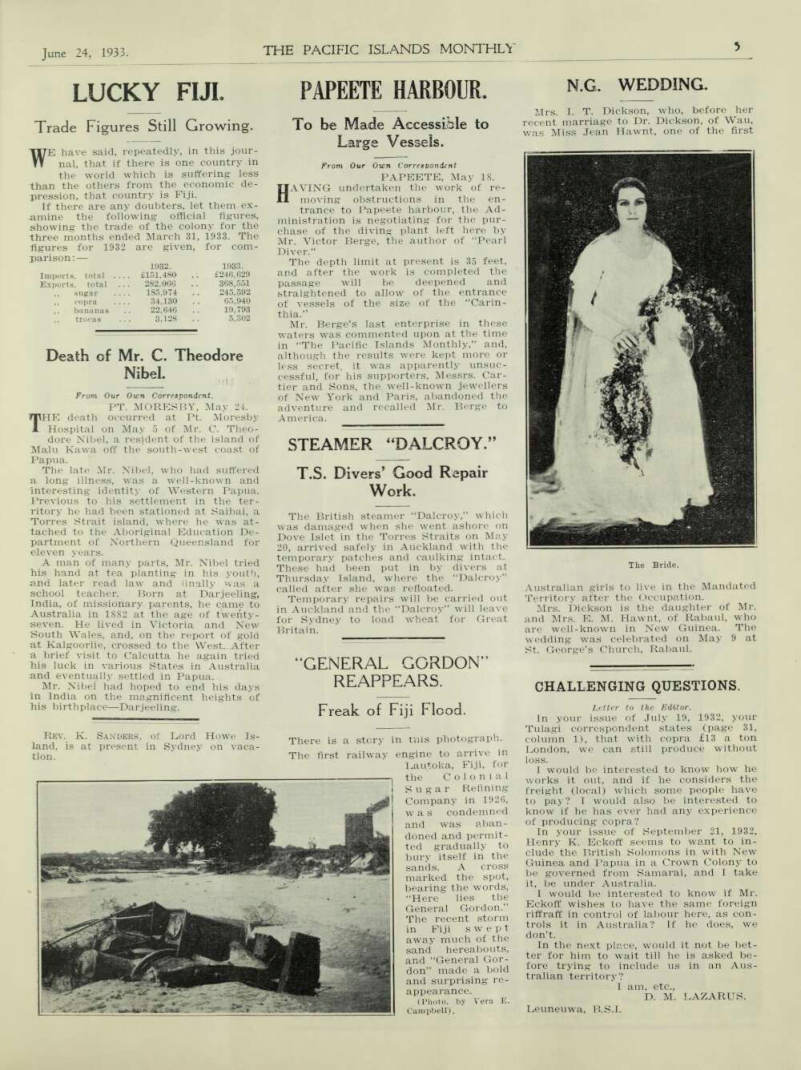
There is a story in this photograph.
The first railway engine to arrive in Lautoka, Fiji, for
the Colonial Sugar Refining Company in 1926, was condemned and was aban doned and permit ted gradually to bury itself in the sands. A cross marked the spot, bearing the words, ‘‘Here lies the General Gordon.”
The recent storm in Fiji swept away much of the sand hereabouts, and “General Gor don” made a bold and surprising re appearance. (Photo, by Vera E.
Campbell).
N.G. Wedding.
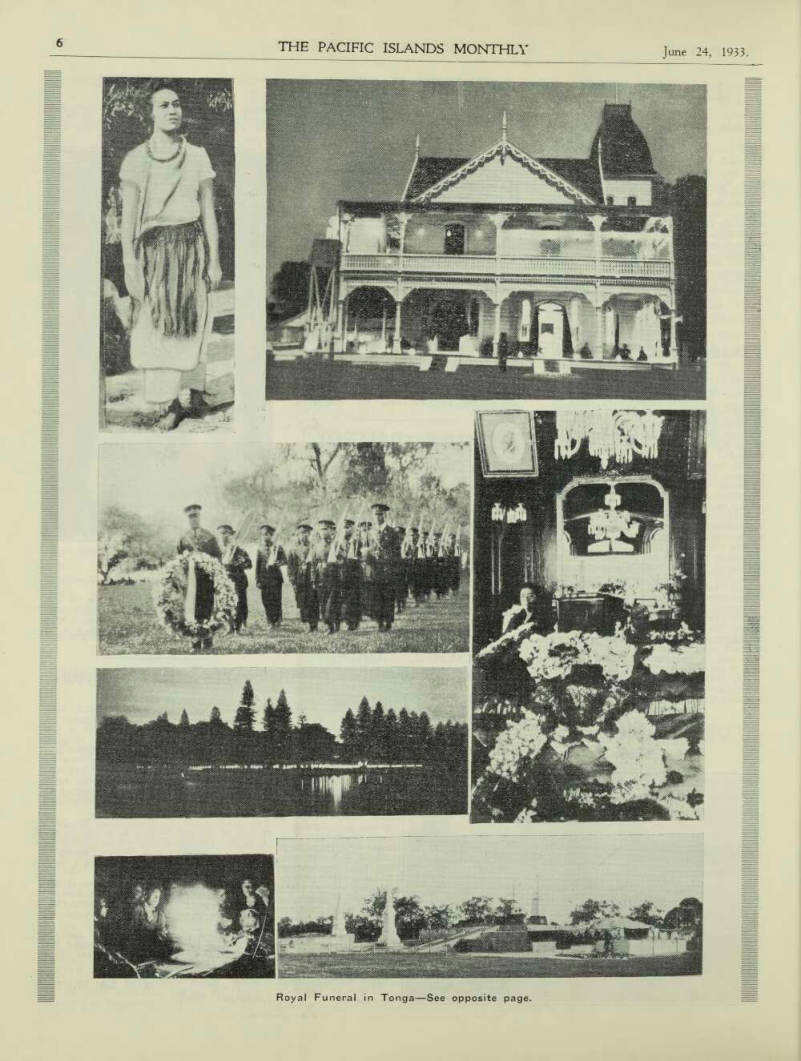
Mrs. I. T. Dickson, who, before her recent marriage to Dr. Dickson, of Wau, was Miss Jean Hawnt, one of the first
Australian girls to live in the Mandated Territory after the Occupation.
Mrs. Dickson is the daughter of Mr. and Mrs. E. M. Hawnt, of Rabaul, who are well-known in New Guinea. The wedding was celebrated on May 9 at St. George’s Church, Rabaul.
The Bride.
Challenging Questions.
Letter to the Editor.
In your issue of July 19, 1932, your Tulagi correspondent states (page 31, column 1), that with copra £13 a ton London, we can still produce without loss.
I would be interested to know how he works it out, and if he considers the freight (local) which some people have to pay? I would also be interested to know if he has ever had any experience of producing copra?
In your issue of September 21, 1932, Henry K. Eckoff seems to want to in clude the British Solomons in with New Guinea and Papua in a Crown Colony to be governed from Samarai, and I take it, be under Australia.
I would be interested to know if Mr.
Eckoff wishes to have the same foreign riffraff in control of labour here, as con trols it in Australia? If he does, we don’t.
In the next place, would it not be bet ter for him to wait till he is asked be fore trying to include us in an Aus tralian territory?
I am, etc.,
D. M. Lazarus.
Leuneuwa, B.S.I.
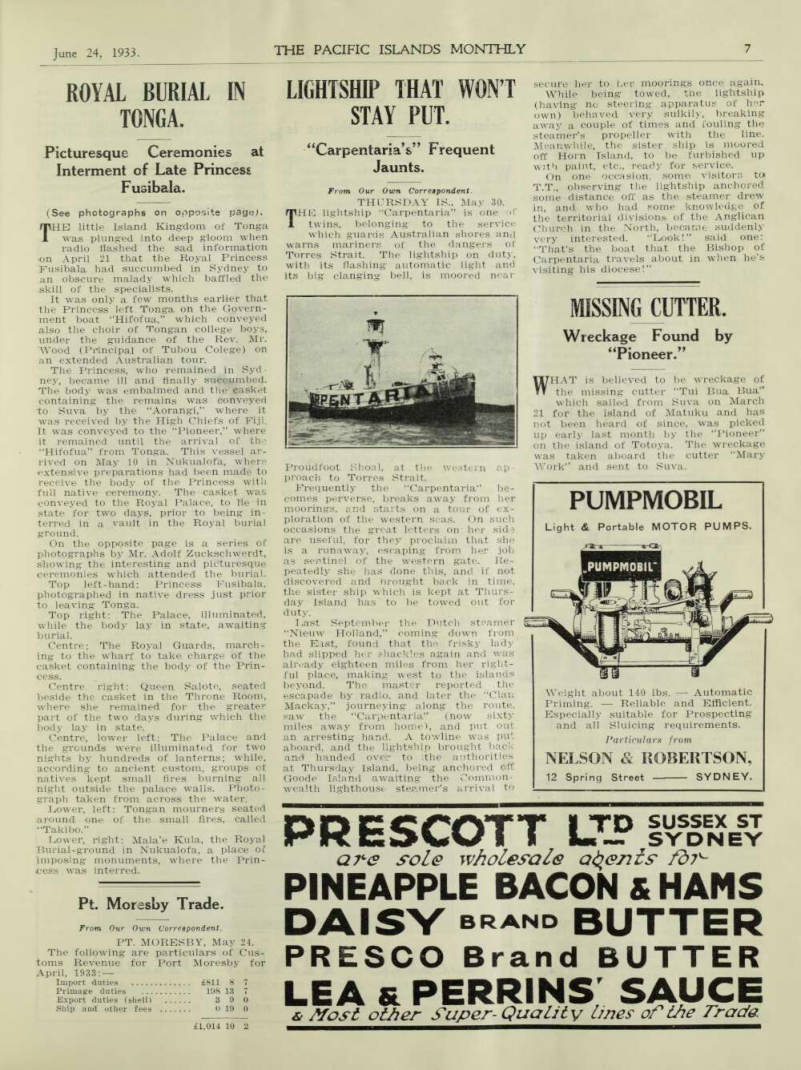
Royal Funeral in Tonga—See opposite page.
Royal Burial In
Tonga.
Picturesque Ceremonies at Interment of Late Princess Fusibala.
(See photographs on opposite page).
THE little Island Kingdom of Tonga was plunged into deep gloom when radio flashed the sad information on April 21 that the Royal Princess Fusibala had succumbed in Sydney to an obscure malady which baffled the skill of the specialists.
It was only a few months earlier that the Princess left Tonga on the Govern ment boat “Hifofua,” which conveyed also the choir of Tongan college boys, under the guidance of the Rev. Mr.
Wood (Principal of Tubou Colege) on an extended Australian tour.
The Princess, who remained in Syd ney, became ill and finally succumbed.
The body was embalmed and the casket containing the remains was conveyed to Suva by the “Aorangi,” where it was received by the High Chiefs of Fiji.
It was conveyed to the “Pioneer,” where it remained until the arrival of the “Hifofua” from Tonga. This vessel ar rived on May 10 in Nukualofa, where extensive preparations had been made to receive the body of the Princess with full native ceremony. The casket was conveyed to the Royal Palace, to lie in state for two days, prior to being in terred in a vault in the Royal burial ground.
On the opposite page is a series of photographs by Mr. Adolf Zuckschwerdt, showing the interesting and picturesque ceremonies which attended the burial.
Top left-hand: Princess Fusibala, photographed in native dress just prior to leaving Tonga.
Top right: The Palace, illuminated, while the body lay in state, awaiting burial.
Centre; The Royal Guards, march ing to the wharf to take charge of the casket containing the body of the Prin cess.
Centre, right; Queen Salote, seated beside the casket in the Throne Room, where she remained for the greater part of the two days during which the body lay in state.
Centre, lower left: The Palace and the grounds were illuminated for two nights by hundreds of lanterns; while, according- to ancient custom, groups of natives kept small fires burning all night outside the palace walls. Photo graph taken from across the water.
Lower, left: Tongan mourners seated around one of the small fires, called Lower, right: Mala’e Kula, the Royal Burial-ground in Nukualofa, a place of imposing monuments, where the Prin cess was interred.
Pt. Moresby Trade.
From Our Own Correspondent.
Pt. Moresby, May 24.
The following are particulars of Cus toms Revenue for Port Moresby for April, 1933: — Import duties £811 8 7 Primage duties 198 13 7 Export duties (shell) 3 9 0 Ship and other fees 0 19 0 £1,014 10 2
Lightship That Won’T
Stay Put.
“Carpentaria's” Frequent Jaunts.
From Our Own Correspondent
Thursday Is.. May 30.
THE lightship “Carpentaria” is one of twins, belonging to the service which guards Australian shores and warns mariners of the dangers of Torres Strait. The lightship on duty, with its flashing automatic light and its big clanging bell, is moored near
Proudfoot Shoal, at the western ap proach to Torres Strait.
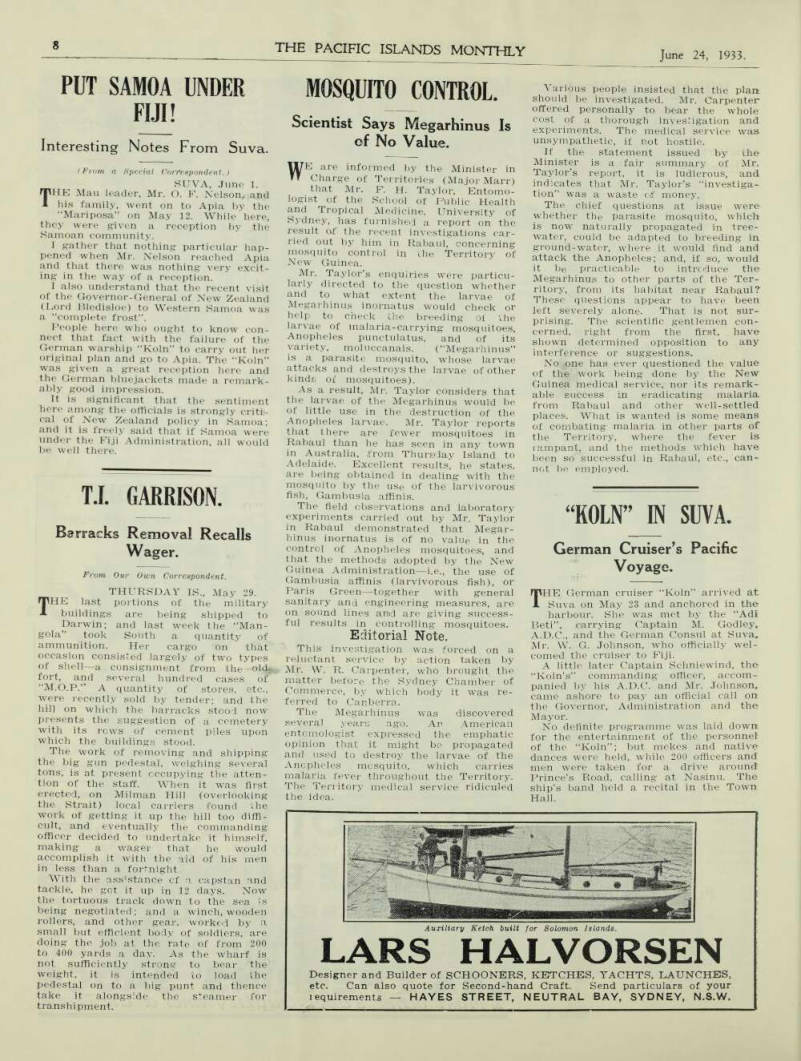
Frequently the “Carpentaria” be comes perverse, breaks away from her moorings, and starts on a tour of ex ploration of the western seas. On such occasions the great letters on her side are useful, for they proclaim that she is a runaway, escaping from her job as sentinel of the western gate. Re peatedly she has done this, and if not discovered and brought back in time, the sister ship which is kept at Thurs day Island has to be towed out for duty.
Past, September the Dutch steamer “Nieuw Holland,” coming down from the East, found that the frisky lady had slipped her shackles again and was already eighteen miles from her right ful place, making west to the islands beyond. The master reported the escapade by radio, and later the “Clan Mackay,” journeying along the route, saw the “Carpentaria” (now sixty miles away from home), and put out an arresting hand. A towline was put aboard, and the lightship brought back and handed ovelr to the authorities at Thursday Island, being anchored off Goode Island awaiting the Common wealth lighthouse steamer’s arrival to
secure her to her moorings once again.
While being towed, the lightship (having no steering apparatus of her own) behaved very sulkily, breaking away a couple of times and fouling the steamer’s propeller with the line.
Meanwhile, the sister ship is moored off Horn Island, to be furbished up with paint, etc., ready for service.
On one occasion, some visitors to T.T., observing the lightship anchored some distance off as the steamer drew in, and who had some knowledge of the territorial divisions of the Anglican Church in the North, became suddenly very interested. “Look!” said one: “That’s the boat that the Bishop of Carpentaria travels about in when he’s visiting his diocese!”
Missing Cutter.
Wreckage Found by “Pioneer.”
WHAT is believed to be wreckage of the missing cutter “Tui Bua Bua” which sailed from Suva on March 21 for the island of Matuku and has not been heard of since, was picked up early last month by the “Pioneer” on the island of Totoya. The wreckage was taken aboard the cutter “Mary Work” and sent to Suva.
Advertisements & other items, p. 9 (1 item)
Prescott Ltd
PUMPMOBIL
Light & Portable MOTOR PUMPS.
Weight about 140 lbs. — Automatic Priming. — Reliable and Efficient.
Especially suitable for Prospecting and all Sluicing requirements.
Particulars from
NELSON & ROBERTSON.
12 Spring Street SYDNEY.
PRESCOTT Ltd
are sole wholesale agents for
PINEAPPLE BACON & HAMS
DAISY BRAND BUTTER
FRESCO Brand BUTTER
LEA & PERRINS' Sauce
& Most other Super- Quality lines of the Trade
Put Samoa Under
Fiji!
Interesting Notes From Suva.
(From a Special Correspondent.) SUVA, June 1.
THE Mau leader, Mr. O. F. Nelson, and his family, went on to Apia by the “Mariposa” on May 12. While here, they were given a reception by the Samoan community.
I gather that nothing particular hap pened when Mr. Nelson reached Apia and that there was nothing very excit ing in the way of a reception.
I also understand that the recent visit of the Governor-General of New Zealand (Lord Bledisloe) to Western Samoa was a “complete frost”.
People here who ought to know con nect that fact with the failure of the German warship “Koln” to carry out her original plan and go to Apia. The “Koln” was given a great reception here and the German bluejackets made a remark ably good impression.
It is significant that the sentiment here among the officials is strongly criti cal of New Zealand policy in Samoa; and it is freely said that if Samoa were under the Fiji Administration, all would be well there.
T.I. Garrison.
Barracks Removal Recalls Wager.
From Our Own Correspondent.
Thursday Is., May 29.
THE last portions of the military buildings are being shipped to Darwin; and last week the “Man gola” took South a quantity of ammunition. Her cargo on that occasion consisted largely of two types of shell —a consignment from the old fort, and several hundred cases of “M.O.P.” A quantity of stores, etc., were recently sold by tender; and the hill on which the barracks stood now presents the suggestion of a cemetery with its rows of cement piles upon which the buildings stood.
The work of removing and shipping the big gun pedestal, weighing several tons, is at present occupying the atten tion of the staff. When it was first erected, on Milman Hill (overlooking the Strait) local carriers found the work of getting it up the hill too diffi cult, and eventually the commanding officer decided to undertake it himself, making a wager that he would accomplish it with the aid of his men in less than a fortnight.
With the assistance of a capstan and tackle, he got it up in 12 days. Now the tortuous track down to the sea is being negotiated; and a winch, wooden rollers, and other gear, worked by a small but efficient body of soldiers, are doing the job at the rate of from 200 to 400 yards a day. As the wharf is not sufficiently strong to bear the weight, it is intended to load the pedestal on to a big punt and thence take it alongside the steamer for transhipment.
Mosquito Control.
Scientist Says Megarhinus Is of No Value.
WE are informed by the Minister in Charge of Territories (Major Marr) that Mr. F. H. Taylor, Entomo logist of the School of Public Health and Tropical Medicine, University of Sydney, has furnished a report on the result of the recent investigations car ried out by him in Rabaul, concerning mosquito control in the Territory of New Guinea.
Mr. Taylor’s enquiries were particu larly directed to the question whether and to what extent the larvae of Megarhinus inornatus would check or help to check the breeding of the larvae of malaria-carrying mosquitoes, Anopheles punctulatus, and of its variety, moluccanais. (“Megarhinus” is a parasite mosquito, whose larvae attacks and destroys the larvae of other kinds of mosquitoes).
As a result, Mr. Taylor considers that the larvae of the Megarhinus would be of little use in the destruction of the Anopheles larvae. Mr. Taylor reports that there are fewer mosquitoes in Rabaul than he has seen in any town in Australia, from Thursday Island to Adelaide. Excellent results, he states, are being obtained in dealing with the mosquito by the use of the larvivorous fish, Gambusia affinis.
The field observations and laboratory experiments carried out by Mr. Taylor in Rabaul demonstrated that Megar hinus inornatus is of no value in the control of Anopheles mosquitoes, and that the methods adopted by the New Guinea Administration —i.e., the use of Gambusia affinis (larvivorous fish), or Paris Green—together with general sanitary and engineering measures, are on sound lines and are giving success ful results in controlling mosquitoes.
Editorial Note.
This investigation was forced on a reluctant service by action taken by Mr. W. R. Carpenter, who brought the matter before the Sydney Chamber of Commerce, by which body it was re ferred to Canberra.
The Megarhinus was discovered several years ago. An American entomologist expressed the emphatic opinion that it might be propagated and used to destroy the larvae of the Anopheles mosquito, which carries malaria fever throughout the Territory.
The Territory medical service ridiculed the idea.
Various people insisted that the plan should be investigated. Mr. Carpenter offered personally to bear the whole cost of a thorough investigation and experiments. The medical service was unsympathetic, if not hostile.
If the statement issued by the Minister is a fair summary of Mr.
Taylor’s report, it is ludicrous, and indicates that Mr. Taylor’s “investiga tion” was a waste of money.
The chief questions at issue were whether the parasite mosquito, which. is now naturally propagated in tree water, could be adapted to breeding in ground-water, where it would find and attack the Anopheles; and, if so, would it be practicable to introduce the Megarhinus to other parts of the Ter ritory, from its habitat near Rabaul?
These questions appear to have been left severely alone. That is not sur prising. The scientific gentlemen con cerned, right from the first, have shown determined opposition to any interference or suggestions.
No one has ever questioned the value of the work being done by the New Guinea medical service, nor its remark able success in eradicating malaria from Rabaul and other well-settled places. What is wanted is some means of combating malaria in other parts of the Territory, where the fever is rampant, and the methods which have been so successful in Rabaul, etc., can not be employed.
“Koln” In Suva.
German Cruisers Pacific Voyage.
THE German cruiser “Koln” arrived at Suva on May 23 and anchored in the harbour. She was met by the “Adi Beti”, carrying Captain M. Godley, A.D.C., and the German Consul at Suva, Mr. W. G. Johnson, who officially wel comed the cruiser to Fiji.
A little later Captain Schniewind, the “Koln’s” commanding- officer, accom panied by his A.D.C. and Mr. Johnson, came ashore to pay an official call on the Governor, Administration and the Mayor.
No definite programme was laid down for the entertainment of the personnel of the “Koln”; but mekes and native dances were held, while 200 officers and men were taken for a drive around Prince’s Road, calling- at Nasinu. The ship’s band held a recital in the Town Hall.
Advertisements & other items, p. 10 (1 item)
Lars Halvorsen
Auxiliary Ketch built for Solomon Islands.
Designer and Builder of SCHOONERS, KETCHES, YACHTS, LAUNCHES, etc. Can also quote for Second-hand Craft. Send particulars of your requirements HAYES STREET, NEUTRAL BAY, SYDNEY, N.S.W.
Plane Capsizes.
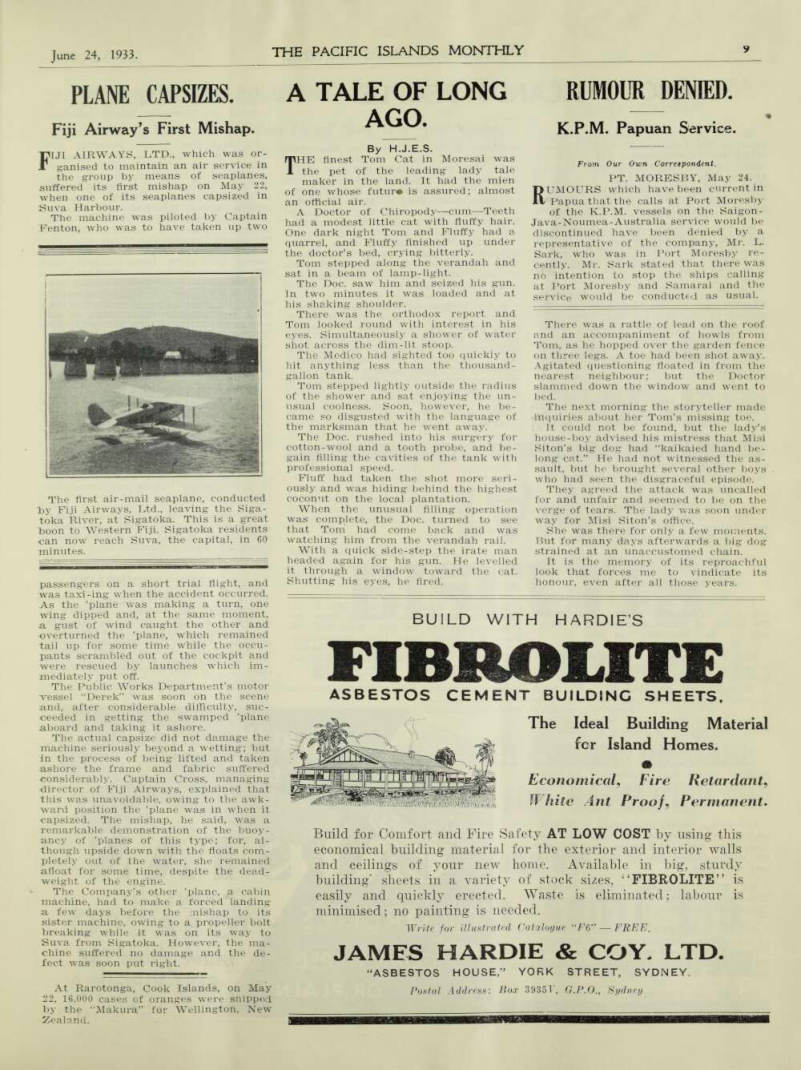
Fiji Airway’s First Mishap.
FIJI AIRWAYS, LTD., which was or ganised to maintain an air service in the group by means of seaplanes, suffered its first mishap on May 22, when one of its seaplanes capsized in Suva Harbour.
The machine was piloted by Captain Fenton, who was to have taken up two
passengers on a short trial flight, and was taxi-ing when the accident occurred.
As the ’plane was making a turn, one wing dipped and, at the same moment, a gust of wind caught the other and overturned the ’plane, which remained tail up for some time while the occu pants scrambled out of the cockpit and were rescued by launches which im mediately put off.
The Public Works Department’s motor vessel “Derek” was soon on the scene and, after considerable difficulty, suc ceeded in getting the swamped ’plane aboard and taking it ashore.
The actual capsize did not damage the machine seriously beyond a wetting; but in the process of being lifted and taken ashore the frame and fabric suffered considerably. Captain Cross, managing director of Fiji Airways, explained that this was unavoidable, owing to the awk ward position the ’plane was in when it capsized. The mishap, he said, was a remarkable demonstration of the buoy ancy of ’planes of this type; for, al though upside down with the floats com pletely out of the water, she remained afloat for some time, despite the dead weight of the engine.
The Company’s other ’plane, a cabin machine, had to make a forced landing a few days before the ;nishap to its sister machine, owing to a propeller bolt breaking while it was on its way to Suva from Sigatoka. However, the ma chine suffered no damage and the de fect was soon put right.
At Rarotonga, Cook Islands, on May 22, 16,000 cases of oranges were shipped by the “Makura” for Wellington, New Zealand.
The first air-mail seaplane, conducted by Fiji Airways, Ltd., leaving the Siga toka River, at Sigatoka. This is a great boon to Western Fiji. Sigatoka residents can now reach Suva, the capital, in 60 minutes.
A Tale Of Long
Ago.
By H.J.E.S.
THE finest Tom Cat in Moresai was the pet of the leading lady tale maker in the land. It had the mien of one whose future is assured; almost an official air.
A Doctor of Chiropody—cum—Teeth had a modest little cat with fluffy hair.
One dark night Tom and Fluffy had a quarrel, and Fluffy finished up under the doctor’s bed, crying bitterly.
Tom stepped along the verandah and sat in a beam of lamp-light.
The Doc. saw him and seized his gun.
In two minutes it was loaded and at his shaking shoulder.
There was the orthodox report and Tom looked round with interest in his eyes. Simultaneously a shower of water shot across the dim-lit stoop.
The Medico had sighted too quickly to hit anything less than the thousand gallon tank.
Tom stepped lightly outside the radius of the shower and sat enjoying the un usual coolness. Soon, however, he be came so disgusted with the language of the marksman that he went away.
The Doc. rushed into his surgery for cotton-wool and a tooth probe, and be gain filling the cavities of the tank with professional speed.
Fluff had taken the shot more seri ously and was hiding behind the highest coconut on the local plantation.
When the unusual filling operation was complete, the Doc. turned to see that Tom had come back and was watching him from the verandah rail.
With a quick side-step the irate man headed again for his gun. He levelled it through a window toward the cat.
Shutting his eyes, he fired.
There was a rattle of lead on the roof and an accompaniment of howls from Tom, as he hopped over the garden fence on three legs. A toe had been shot away.
Agitated questioning floated in from the nearest neighbour; but the Doctor slammed down the window and went to bed.
The next morning the storyteller made inquiries about her Tom’s missing toe.
It could not be found, but the lady’s house-boy advised his mistress that Misi Siton’s big dog had “kaikaied hand be long cat.” He had not witnessed the as sault, but he brought several other boys who had seen the disgraceful episode.
They agreed the attack was uncalled for and unfair and seemed to be on the verge of tears. The lady was soon under way for Misi Siton’s office.
She was there for only a few moments.
But for many days afterwards a big dog strained at an unaccustomed chain.
It is the memory of its reproachful look that forces me to vindicate its honour, even after all those years.
Rumour Denied.
K.P.M.Papuan Service.
From Our Own Correspondent.
Pt. Moresby, May 24.
RUMOURS which have been current in Papua that the calls at Port Moresby of the K.P.M. vessels on the Saigon- Java-Noumea-Australia service would be discontinued have been denied by a representative of the company, Mr. L.
Sark, who was in Port Moresby re cently. Mr. Sark stated that there was no intention to stop the ships calling at Port Moresby and Samarai and the service would be conducted as usual.
Advertisements & other items, p. 11 (1 item)
Fibrolite
BUILD WITH H ARDIE’S
ASBESTOS CEMENT BUILDSNG SHEETS,
The Ideal Building Material for Island Homes.
Economical, Fire Retardant 9 White Ant Proof , Permanent.
Build for Comfort and Fire Safety AT LOW COST by using this economical building material for the exterior and interior walls and ceilings of your new home. Available in big, sturdy building' sheets in a variety of stock sizes, “FIBROLITE” is easily and quickly erected. Waste is eliminated; labour is minimised; no painting is needed.
Write for illustrated Catalogue “F6” FREE.
JAMES HARDIE & COY. LTD.
“ASBESTOS HOUSE,” YORK STREET, SYDNEY.
Postal Address: Box 39351 , G.P.O., Sydney
About Islands People.
Mr. T. H. Pagden, assistant entomo logist in the Department of Agriculture of the Straits Settlements and Federated Malay States, reached Sydney by the “Nieuw Holland” on June 7. He is going to the Solomon Islands to study the causes of nutfall, which is present in many plantations in the Protectorate.
The Rev. Arthur Adamson and Mrs.
Adamson, who are leaving to take up mission work in Fiji, were farewelled by friends of the Methodist Mission in Sydney recently.
Mr. Major Harper, a copra planter of Mandoliana, British Solomon Islands, arrived in Sydney by last “Mataram” and entered a private hospital, where he is receiving treatment which, it is hoped, will improve his health suffi ciently for him to return home in about two months.
Nurse Hazel Donoghue, of South Australia, has been appointed by the Board of Missions to the Salamo Hos pital in Papua, and left Sydney recently to take up duty.
Earl Beauchamp was a passenger by the “Makura” w’hich sailed from Syd ney on June 8. He is on a holiday trip to Tahiti.
Mr. H. R. Reid, a director of the Mel bourne Steamship Co., and Mrs, left Sydney by the “Makura” on June 8 on a holiday visit to Tahiti.
Brigadier-General W. R. McNICOLL M.P., left Sydney by last “Macdhui” on a visit to New Guinea.
The Rev. J. W. Burton, M.A., who recently visited Fiji on the business of the Board of Missions, returned to Syd ney by the “Monterey” on May 25.
Mr. J. R. Land, superintendent of telegraphs and telephones at Tonga, arrived in Sydney by the “Marama” on a holiday visit on May 22. He was accompanied by Mrs. Land.
Mr. James Menzies, a copra planter from Lau, Fiji, is in Sydney on holidays.
Mr. J. G. Gunter, a representative of Bulolo Gold Dredging Ltd., arrived at Sydney from San Francisco by the “Makura” on June 3 en route to New Guinea. He left by the “Macdhui” on June 8.
Mr. P. La Porte, magistrate at Tahiti, arrived in Sydney by the “Makura” on June 3 en route to London on holidays.
He was accompanied by Mrs. La Porte and two sons.
Mr. E. G. Theodore, former Federal Treasurer. sailed for Fiji by the “Monowai” on May 25.
Captain John Flynn, formerly master of the Union Company’s cargo steamer “Waikawa,” retired from the Company’s service last month. He sailed for New Zealand by the “Marama” on May 27.
Mr. Myles Thompson, a planter of Rabaul, arrived in Sydney by the “Van Rees” on May 17.
The Right Rev. J. H. Dickinson, assistant B.shop of Melanesia, who was recently in St. Luke’s Hospital, Sydney, suffering from malaria, has now fully recovered. He will leave for Brisbane this month and return to Sydney early in July with Bishop Baddbley, who will then be on his way from the Solomon Islands to the New Hebrides.
The Rev. C. F. and Mrs. Rich, of the London Missionary Society, returned to their mission station at Isuleilei, Papua, by last “Montoro” after a short fur lough in Australia.
Pastor and Mrs. W. D. Smith, of the Seventh Day Adventists Mission, sailed from Sydney on May 27 for Wellington by the "Marama.” At Auckland they will join the “Remuera” for Pitcairn Island, where they will reside as mis sionaries for twelve months. Pastor and Mrs. Smith were recently stationed in the New Hebrides.
Miss Edith Williams, who has been a nurse in the New Guinea Mission at Gona, Papua, for 15 years, arrived in Sydney by the “Montoro” on May 12.
Rev. A. J. Thompson and Mrs.
Thompson, missionaries of the Aus tralian Board of Missions at Wanigela, Papua, were in Melbourne during May on furlough. They are supported by the St. Andrew’s Church, Brighton, Victoria.
Rev, R. L. Newman, who was assistant curate of St. Andrew’s Church, South Brisbane, left Brisbane for Papua by the “Montoro” on May 19.
Mr. A. E. Bamgarten and Mr. F. H.
Thresher returned to Sydney from the Solomon Islands by the “Mataram” on June 3. They have been prospecting for gold on behalf of Messrs. Guadal canal Ltd., on Guadalcanal, the largest island in the Group.
The Rev. W. H. MacFarlane, of the Torres Strait Mission, has been in hospital at Thursday Island following an operation.
Dr. and Mrs. R. F. Fortune, who have been carrying out anthropological research work in New Guinea, arrived in Sydney by the “Macdhui” on May 31. Mrs. Fortune (Dr. Margaret Mead) is assistant curator in the ethnology department of the American Museum of Natural History, New York. Mr.
Gregory Bates, n, a research fellow of St. John's College, Cambridge, who has completed a second period of field work among the Sepik River natives, was. also a passenger by the “Macdhui.”
Mons. N. Hagen, chairman of directors of Messrs. Hagen, Freres, of Noumea, ar rived in Sydney from Noumea on his way to Paris. He left for Europe by the “Corfu” on June 17.
Mr. W. A. Luxford arrived at Apia from New Zealand on May 3 on his way to visit his son, Chief. Judge Luxford.
Mrs. McMahon-Box and children passed through Apia on the last “Maui Pomare” on their return to Niue, after a holiday in New Zealand. Mr. Mc Mahon-Box is collector of customs and deputy resident commissioner at Niue.
Mr. E. Featherstone Phipps, Collector of Customs at Rabaul, was a passenger by the “Nellore”, which left Sydney on June 14.
Mrs. Walstab, wife of Colonel J. Wal stab, superintendent of police at Rabaul,. returned to Rabaul by the “Nellore”,. which left Sydney on June 14.
Advertisements & other items, p. 12 (1 item)
Capstan
AT BLUE MOUNTAINS.
SPRINGWOOD.
Springwood Ladies’ College.
Est. 1897. Kindergarten to Leaving Certificate.
Tennis, Riding, Swimming, Team Games.
Unequalled climate. Pure Jersey milk. Senior and Junior Houses. Open-air sleeping. Inclusive fees. Special vacation arrangements for Island pupils. M. E. DURAND, Principal.
CIGARETTES
now
Cork TIPPED
OR PLAIN
CAPSTAN
NAVY CUT
TOBACCO
made from the
BEST VIRGINIA
LEAF
International Courtesies In Rabaul.
Good Feeling Between German Naval Men and Australians.
From Our Own Correspondent.
Rabaul, June 12.
THE German cruiser Koln, which arrived in Rabaul harbour on June 7, is still here and the celebrations arranged in honour of its visit are still in progress.
The greatest friendliness has been shown by all residents to the youthful cadets and ratings, who have come ashore eager to learn something about New Guinea. Dances, picture theatre entertainments, motoring, racing and sporting events have all been arranged with a view to giving our visitors a good time.
One of the outstanding features of the visit is the great discipline and orderliness displaced by all ranks.
There has not been one single case of drunkenness or misbehaviour on the part of any of the sailors during their visits ashore. There is no ship’s piquet patrolling the town, all the patrol work being done by the local police force.
On Thursday, the day after the arrival of the cruiser, the Commandant, Captain Schniewind, together with a number of his officers and sailors, pro ceeded to the cemetery in the Botanic Gardens and placed a wreath on the grave of Captain Pockley, the first Australian killed in the War at the landing at Kabakaul. Afterwards, a wreath was placed on the grave of a German naval lieutenant who died at Matupi Island in 1910 and was buried there.
A short while before the arrival of the Koln, His Honour the Adminis trator, happened to discover the grave in a secluded part of the island and, realising its inappropriate resting place, gave instructions for the body to be exhumed and buried in the Botanical Gardens Cemetery.
Captain Schniewind expressed his warm gratitude for this act on the part of General Griffiths. Represen tatives of the Returned Soldiers League were present at the graveside during the impressive ceremony and when it was over the Commandant
(Capt. Schniewind) expressed his appreciation, in a few well-chosen words, to the president of the League, Mr. R. L. Clark, M.L.C., “as one soldier to another.”
The town has been en fete ever since the arrival of the cruiser; private indi viduals have placed cars at the dis posal of the transport committee and their homes have been open for the entertainment of the visitors; the ladies on the committee have been doing pioneer work; cakes have been made by the hundreds, sandwiches by the thousands.
The officers and men of the cruiser have expressed their keen appreciation of the hospitality which has been shown to them.
The Koln is due to leave on June It for Guam, where she will refuel.
Thence she will proceed to Japan and make her way through Eastern waters, back through Suez to Germany, where she is due on December 12.
Miss Edith Williams, who has just completed ten years’ nursing service with the Australian Board of Missions in Papua, returned to Sydney by the “Montoro” on May 13.
Patrol Officer Mark Birr, who took out a patrol from Surprise Creek, New Guinea, to arrest the attackers of Patrol Officer McCarthy’s patrol, was a pas senger to Sydney by last “Macdhui”.
Mr. Pitt is now in Melbourne on long leave.
Mr. G. S. Chisholm, manager at Le vuka for Messrs. Morris, Hedstrom, Ltd., left for Apia by the “Roxen” last month.
Mr. Chisholm is relieving Mr. A. G.
Smyth, who is on extended leave. Mr.
L. St. George Ryder is relieving manager at Levuka.
Miss E. French, headmistress of the Suva Girls’ Grammar School, sailed for a short holiday in New Zealand by the “Mariposa” on May 16.
Mr. Gordon Thomas
And Samoa.
From Our Own Correspondent.
APIA, June 10.
FOR his eminently sane and sensible study on Samoan political affairs, Mr. Gordon Thomas must be con gratulated and sincerely complimented.
His article “An Impartial Man looks at Samoa,” “P.I.M.” 24/4/33, has met with the undivided applause of Samoan readers, who, themselves living in an atmosphere heated by the pros and cons of the controversy, appreciate the point of view of a disinterested observer. If a settlement of the vexed and seemingly endless controversy should be entrusted to Mr. Thomas and perhaps a few more experienced and practical judges like him, the general feeling is that there would be hope of a permanent and satisfactory solution being found.
So far, the stubbornness of both sides has blocked any attempt to get at such a solution, and it must be stated that recent activities of the Administration have made matters decidedly worse.
Advertisements & other items, p. 13 (1 item)
Biscuits
IVA
RICH! LIGHT! FLAKY!
Delicious with Butter or Jam
EXCELLENT FOR SAVOURIES
Made by Swallow & Ariell Ltd.
Port Melbourne — Australia
Recent Fiji Flood.
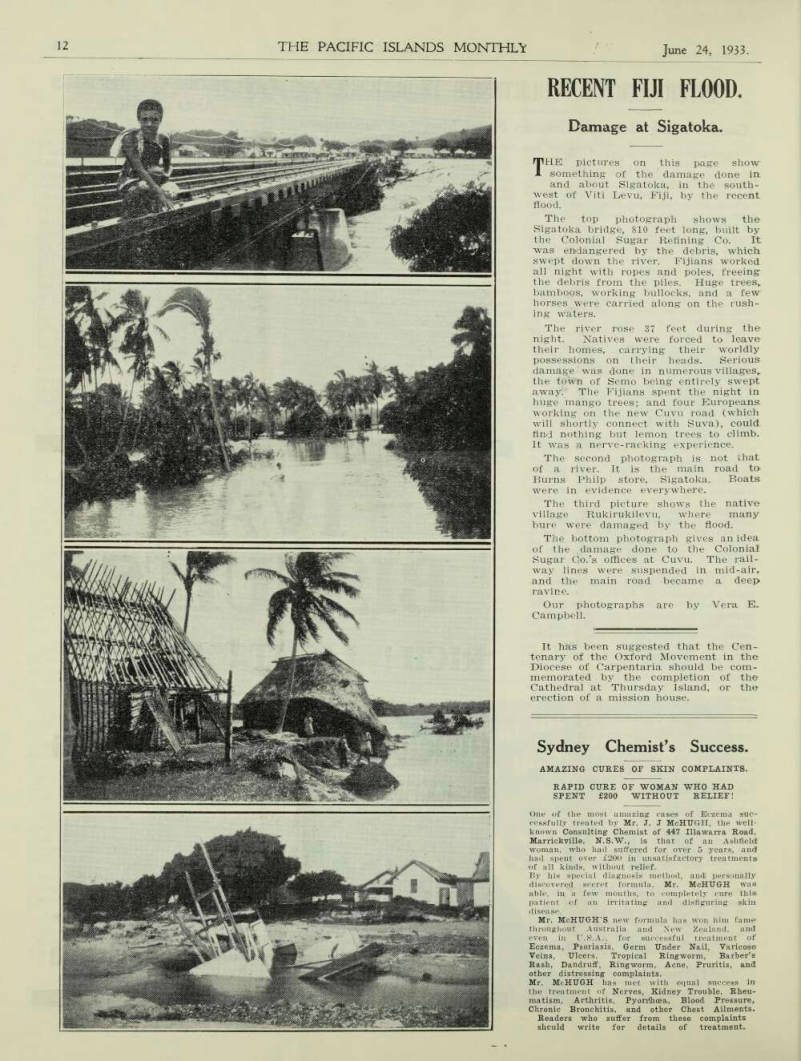
Damage at Sigatoka.
THE pictures on this page show something of the damage done in and about Sigatoka, in the south west of Yiti Levu, Fiji, by the recent flood.
The top photograph shows the Sigatoka bridge, 810 feet long, built by the Colonial Sugar Refining Co. It was endangered by the debris, which swept down the river. Fijians worked all night with ropes and poles, freeing the debris from the piles. Huge trees, bamboos, working bullocks, and a few horses were carried along on the rush ing waters.
The river rose 37 feet during the night. Natives were forced to leave their homes, carrying their worldly possessions on their heads. Serious damage was done in numerous villages, the tofan of Semo being entirely swept away! The Fijians spent the night in huge mango trees; and four Europeans working on the new Cuvu road (which will shortly connect with Suva), could find nothing but lemon trees to climb.
It was a nerve-racking experience.
The second photograph is not that of a river. It is the main road to Burns Philp store, Sigatoka. Boats were in evidence everywhere.
The third picture shows the native village Rukirukilevu, where many bure were damaged by the flood.
The bottom photograph gives an idea of the damage done to the Colonial Sugar Co.’s offices at Cuvu. The rail way lines were suspended in mid-air, and the main road became a deep ravine.
Our photographs are by Vera E.
Campbell.
It has been suggested that the Cen tenary of the Oxford Movement in the Diocese of Carpentaria should be com memorated by the completion of the Cathedral at Thursday Island, or the erection of a mission house.
Sydney Chemist’s Success.
Amazing Cures Of Skin Complaints.
Rapid Cure Of Woman Who Had
Spent £200 Without Relief!
One of the most amazing cases of Eczema suc cessfully treated by Mr. J. J McHUGH, the well known Consulting Chemist of 447 Illawarra Road, Marrickville, N.S.W., is that of an Ashfield woman, who had suffered for over 5 years, and had spent over £200 in unsatisfactory treatments of all kinds, without relief.
By his special diagnosis method, and personally discovered secret formula, Mr. McHUGH was able, in a few months, to completely cure this patient of an irritating and disfiguring skin disease.
Mr. McHUGH’S new formula has won him fame throughout Australia and New Zealand, and even in U.S'.A., for successful treatment of Eczema, Psoriasis, Germ Under Nail, Varicose Veins, Ulcers, Tropical Ringworm, Barber’s Rash, Dandruff, Ringworm, Acne, Pruritis, and other distressing complaints.
Mr. McHUGH has met with equal success in the treatment of Nerves, Kidney Trouble, Rheu matism, Arthritis, Pyorfihoea., Blood Pressure, Chronic Bronchitis, and other Chest Ailments.
Readers who suffer from these complaints should write for details of treatment.
Polynesians And
Europeans.
Many Unions are Quite Happy.
(By “Na Vodre”).
READING over my back numbers of the “Pacific Islands Monthly” I was much interested in two articles, written from opposite points of view.
The first was entitled “Polynesia,’ and it appeared in the issue of April, 1932. The second article which at tracted my attention was featured in your issue of July, 1932, under the title of “Why White Men Go Native.”
The first article, written with deep feeling, showed a true picture of the process by which white men gradually come under the spell of the Islands.
The process is seemingly glorious in its gradual awakening from the servi tude of civilisation to the unfettered freedom of lagoon, beach, and sky.
Now, however, let us turn to the second of these two articles. “Here,” says the sceptic, “we have the other side, minus the glamour.” But have we?
Allow me to point out that it is an impossibility for the writer of the second paragraph to compare, in any way, the position with the writer of the previous article. I entirely agree with all that he says, knowing the far western side of the Pacific fairly well, in the Solomons or New Hebrides the horrible picture of slow degradation is doubtlessly true to life. Yet if applied to the Eastern or Central Groups of Islands in the Pacific Ocean it becomes a slur on a noble people.
The Polynesian races are definitely from the same root stock as ourselves.
There exists no gulf between us so wide that it can not be bridged by sympathy, tolerance, and love. Some of the most happy marriages I have ever known have been between people of Polynesian, or part Polynesian blood, and Euro peans. Many educated and refined men of my acquaintance are married to these gentle people, and have never regretted it.
No thinking man would attempt to draw analogies between the barbarians of Northern Africa and the highly civi lised people of England. Why, then, attempt to lay down a hard and fast rule for white men in the Pacific on the grounds of geographical proximity, dis regarding racial differences, as between Polynesian and Negroid?
EDITORIAL NOTE. —The above writer appar ently did not see an article in our issue of September, 1932 (page 7), in which the views he expressed in regard to European-Polynesian marriages were very strongly set forth by an other contributor. Experience has shown that, while white will not mix with black (Melanesian), there can be very happy marriages between Europeans and Polynesians.
New U.S. Consul for Tahiti.
From Our Own Corre»pondent PAPEETE, April 21.
MR. Edward B. Rand, previously stationed at Maidan, Sumatra, has been appointed to the position of United States Consul in Tahiti, in place of Major Garrety who retired re cently on account of failing health.
Major Garrety is now living in Southern California.
Fertilisers For Coconut Plantations.
WE have received a valuable sugges tion from a well-known planter in Kavieng, New Ireland, T.N.G. The following are extracts from his letter: “Might I make a suggestion which I think would greatly enhance the value of your now valuable paper, and be greatly appreciated by your planter readers. I consider that an article or, better, a series of articles, dealing with the manuring of the coconut palms would be greatly valued by all.
“Cattle manure has proved its worth in this direction: but is in most cases impracticable, as the constant trampling of the ground by cattle, especially in heavy country, packs the soil and eventually does more harm than good.
A cheap artificial manure of this chemi cal content would doubtless be of great value.
“I have before me an article written by B. Bunting, and taken from the Malayan Agricultural Journal (undated), in which the writer goes very thoroughly into the cultivation of the coconut and gives a fair amount of information about experiments carried out on several
estates in Ceylon. But, to my way of thinking, he stops short at the most vital matter (especially in these times of low prices)—namely, cost. He gives formulae of eight different manures but does not in any case refer to cost.
“I do not suggest that you should try to ascertain the cost of labour on the plantation, but perhaps the cost of the manure required, freight, etc., would as sist us in deciding the total cost in our own case.
“Personally, I intend to go into the matter, as I firmly believe that the future of the planter will be greatly measured by his ability to get the most out of his plantation; and this, of course, will affect the owners of old plantations more than young ones. We in the Ter ritory would be glad of the advice and assistance of the manufacturers of fer tilisers.”
We shall be glad to publish any infor mation about this matter which planters may be able to supply from their own experience. In the meantime, our friend’s letter is being brought under the notice of certain manufacturers of fertiliser.
Advertisements & other items, p. 15 (1 item)
"Duxbac"
Already up to the knees in water, with the risk of a false step immersing both bag and cartridges, but what does it matter to the user of “Duxbac” wet makes no difference.
Waterproofed (after loading) by a new scientific and thoroughly tested process.
The IMPROVED
"Duxbac"
WATERPROOF
Cartridges
are the latest production of the world-famous Nobel factories —and have been subjected to gruelling tests in respect to both their waterproof and shooting qualities.
Particular care has been given to their ballistics, and they can be relied upon to give results unexcelled by any other cartridge.
Wholesale Only: I.C.I.A.N.Z. Ltd. (Ammunition Section), 277 Clarence Street SYDNEY. 380 Collins Street MELBOURNE.
Tropicalities
WHEN the Lieutenant-Governor of Pa pua, Sir Hubert Murray, paid a re cent visit to the Government sta tion at Misima, he found a new order of precedence at the native calaboose. At meal time all the prisoners sat at a long table on forms down each side. At the head, on a roughly-made chair, sat the chairman, the senior prisoner—the boy who was serving the longest sentence.
The others took their places at the table in the order of the time served, newcomers always sitting at the end farthest from the chairman, who, at meal times serves out the kai kai in the approved style. * * * THAT genial personality, Mons. N.
Hagen, chairman of directors of Messrs. Hagen, Freres, of New Cale donia, paid a flying visit to the office of “The Pacific Islands Monthly” on his way through Sydney this month. He is en route to Paris on the “Corfu”, which sailed from Sydney on June 17, “to see how things are going in Europe”.
“That blow we had lately nearly blew New Caledonia inside out,” he said. “For days business was at a standstill and Noumea was a wreck.” Mr. Hagen said that New Hebrides planters were hop ing for big things from the World Eco nomic Conference and he hinted that was the object of his visit to Europe.
Conditions in New Caledonia, though dull, were not so bad. “There are al ways the nickel mines,” he said.
Mr. Hagen expects to be in Europe about three months. * * * RED TAPE is not always as abhorrent to the Melanesian mind as many writers infer. Some years ago when the private letter-box system was in troduced in one of the Pacific terri tories a native thought it would befit his dignity to become the holder of one; so he marched into the post-office, signed on the dotted line and became the proud possessor of the keys. For a couple of years he paid the annual fee till he was billed with the third year’s dues. With the document in his hand he indignantly approached the postmaster and said, “This bokis he gammon I think. Me pay’em money along him three year and me no catch’em letter.” The postmaster had to agree that keeping a letter-box solely for the purpose of getting a bill for its rent was false economy.
THE result of the Administration’s in quiry into the causes of the unrest in the Kavieng District of New Guinea is being awaited with interest. It centred around two main points—the cause of the grave unrest in the labour lines, and the real reasons for the prosecution of Mr. Murray, a well-known and respected planter.
Inter alia, here is an extract from a private letter written by a resident of the Kavieng district —a man who ac knowledges that he personally does not like Mr. Murray very much: “Murray is a fair man and a just one—but he is a hard man, and requires from his labour that which they contract to give, and he sees that he gets it. He is a clever, en terprising and extremely efficient man and his plantation, and organisation
generally, are a, model —and admitted to be so by the Administration officials. . . .
An appeal was upheld on Murray’s be half about two years ago against D.O.
Melrose for a fine of £15 for some ridicu lous contravention of a ridiculous law.” * * * WE have just learned from a private letter, that there recently occurred a very extraordinary meeting in the large island of New Hanover, north of New Ireland. All the luluais and tul tuls (native chiefs) met there in solemn conclave and subscribed no less than 5,000 shillings, which they offered to the Administration if the officials would go out of their district and stay out for all time.
We have not heard the Administra tion’s reply, but we can imagine it. After all, the simple savage is not so simple.
There are a few people in far more ad vanced communities than New Hanover who would pay one hundred times 5,000 shillings if Government institutions could be abolished for all time. * * * A FRIEND, writing from New Britain, is very much to the point: “I have lived on many of the Pacific Islands, particularly on Cook Island and Tahiti. This book, ‘White Man, Brown Woman,’ is tripe, and does not depict the life in the places described.
I do not think the writer ever was in Manihiki—what he has written about the place is exaggerated out of all reason. This sort of book does a lot of harm to the Islands generally.” * * * THERE was a report current in Syd ney recently that the Dutch East Indies Shipping Company (the
K.P.M.) would probably introduce a new regular service to the Solomon Islands at an early date. The shipping com panies interested said, however, that there was no likelihood of the develop ment; and the Royal Packet Naviga tion Co.’s manager stated definitely that that company had no intention of starting a Solomon Islands service. * * * WHEN the Minister in Charge of Territories (Major Marr) passed through Port Moresby last month, on his way to New Guinea, he made a slight tactical error. Addressing a gathering in Port Moresby, he warmly praised the men of the Mandated Territory! In consequence, Port Moresby seethed! Within a few hours, there was an unofficial meeting of the men of Papua, and it was seriously proposed that the Public Service Association should have a special session to pass a formal resolution about the matter.
Wiser counsels prevailed; but it was agreed that strong representations should be made to the Minister on his return. Poor Major Marr! How was he to know that the sentiments of a bull, when confronted with a red flag, will not compare with the feelings of a Papuan public servant when told that a New Guinea public servant possesses some of the real salt of the earth? But no harm was done. The incident merely disclosed in Papua an aggres sive esprit de corps, without which no service is really worth while. * * * AT St. Margaret’s Church, Vaucluse, Sydney, on April 20, the marriage was celebrated of Miss Olwen Hughes and Mr. Claude Handley.
The bridegroom, who is on the staff of the C.S.R. at Nausori, Fiji, arrived in Sydney recently on leave. The bride is the daughter of Mr. C. C. Hughes, of Rose Bay, Sydney. She was recently a member of the literary staff of Associ ated Newspapers, Ltd.
Advertisements & other items, p. 16 (1 item)
Preserved Meats
1870 1933 Quality Stands the Test of Time
BEEF
S.M.P. “War Medal” BRAND
Preserved Meats
Tins Fitted with Patent Key Opener.
F. J. WALKER LTD., 33 Macquarie Place, Sydney.
Sole Selling Agents for: THE SYDNEY MEAT PRESERVING CO. LTD.
Controversy.
“Following The Flag.”
Hockey Team Causes Mild Controversy.
BECAUSE they will travel to Suva on a foreign ship, the women’s hockey team which will visit Fiji this month, have been hauled over the coals for not patronising a British shipping line.
After a special meeting of the N.S.W.
Women’s Hockey Association in Sydney last month, the secretary announced that the players chosen to visit Fiji were:—Goalkeeper, Moriarty; full backs, Johnson (vice captain), Cowley and Hollingsworth; half-backs, G. O’Brien, Whyte, Lamb, and N. Wicks (captain); forwards, Burrell, Louis, Locke and Pep per.
The team will leave Sydney at the end of this month and return on July 17.
Mrs. Davey, secretary of the All Aus tralia Women’s Hockey Association, will accompany the team as manageress The announcement of the team’s ar rangements was made in Sydney the day before Empire Day. The following day a correspondent in a letter to the editor of “The Sydney Morning Herald”, protested against the decision to send the team on a foreign ship to Fiji at the end of June, although a British ship is sailing a few days earlier, and asks: “Is this following the flag or is it where our pockets are touched that there is little loyalty?”
Meeting.
Samoan Planters’ Annual Meeting.
From Our Own Correspondent APIA, June 4.
THE Planters’ Association of Samoa held its annual general meeting on May 6, when the president, Mr.
Goetz, rendered the report on the year’s activities to the meeting, and the financial statement given divulged a very satisfactory state of affairs. The efforts of the Planters’ Committee in collaboration with the two elated mem bers of the Legislative Council, the Honourables Carruthers and Cobcroft, had brought about the passing of the new Labour Ordinance, incorporating a most important change — the reduc tion of Chinese wages from 3/- to 2/per day.
The meeting, after adopting the annual report and financial statement, resolved to reduce the annual sub scription from 21/- to 10/6 per year.
The present officials and committee were unanimously re-elected en bloc and the thanks of the Association were expressed for their endeavours in the past.
The meeting of the Planters’
Association was followed on May 20 by the planters’ annual dinner at the “Casino” and a reception at the president’s flats adjoining. The dinner, attended by a large number of mem bers, was a pleasant and sociable function and has undoubtedly further strengthened the ties, binding the members of the planting community.
It proved the spirit of friendship and goodwill prevalent in the Association and doubly necessary in these difficult times.
Late News From
New Guinea.
From Our Own Correspondent.
Rabaul, June 12.
THE Empire Day celebrations which were held at the various schools throughout the Rabaul and Kokopo districts on May 24th, were visited by His Honour, the Chief Judge, and His Honour Judge Phillips. The native school at Nordup, which is being con ducted by Mr. J. H. L. Waterhouse, F.R.G.S., made a very good display and the programme even included a fan fare of bugles played by the small indigenes.
Mr. Armer Hamilton, who for five years has been manager of the Bank of New South Wales here, is leaving by the s.s. “Tanda” for Australia. His place has been taken by Mr. R. Nottle, who was previously in the Renmark district in South Australia. Mr.
Hamilton has been the guest of honour at many a farewell dinner during the past week. He was a very popular man, both in the business and the social world here.
Mr. C. C. Judd, who for some time has been managing the Kalili estates on New Ireland for B.P., leaves by the Tanda on June 14th. He has been succeeded by Mr. F. N. Smith, who was at one time planting in the Duke of York group.
Mr. W. T. Watson, who was amongst some of the first Expropriation Board officials in the Territory, passed through Rabaul recently en route for the goldfields.
“John Bolton” Arrives.
The motor vessel “John Bolton” arrived in port from Sydney on June Ist after a good trip up from Sydney, via Samarai. She will be a welcome addition to the W.R.C. fleet of small vessels, which seem to be proving successful in these waters.
Bainings Goldfield.
A new goldfield has been declared in the Territory. It is in the Baining dis trict and adjoins the plantation Ran gerere, which is owned by Mr. Jock Maclean. Some very good samples of gold have been brought out of the reef, but from reliable sources we are informed that there is no reason at the present time to expect that there is sufficient inducement to cause a rush.
General Griffiths.
His Honour the Administrator (Gen eral Griffiths) left by the s.s. “Montoro” for a short trip South. It is his in tention to return by the same vessel, which arrives back in Rabaul on July 12th. His Honour’s term as Acting Administrator came to an end on June 12th, as that is the date upon which General Wisdom’s leave concluded.
His Honour, Chief Judge Wanliss, is Acting Administrator during General Griffiths’ absence from the Territory.
Southward-Bound.
Mr. J. C. Mullaly, M.L.C., is an in tending passenger by the s.s. Tanda for Australia, where he expects to spend a few months for medical and busi ness reasons.
Mr. J. Hoogerwerff, manager of the Rabaul Printing Works, leaves for
South on a well-earned holiday by the “Tanda.” Mr. Gordon Thomas is re lieving him as manager of the works and as editor of “The Rabaul Times.”
Miss Refshauge, who gained honours in German at the Melbourne University, arrived by the last “Montoro” and is attached to the Custodian of Expropri ated Property’s office as official trans lator.
L.M.S. In Samoa
Decreased Income.
From Our Own Correspondent.
Apia, May 12.
THE annual meeting of the L.M.S. held this month attracted less people than usual and monetary contributions therefore decreased.
One large district in Savai refused to participate and there is talk of its secession from the L.M.S. in order to form and separate an independent church.
Owing to the drop in copra and produce prices generally, the L.M.S. collections resulted in a much reduced taking.
Levuka News.
Air Service Appreciated.
From Our Own Correspondent
Levuka, May 31.
FIJI Airways with their speedy sea planes are giving a much appre ciated service in the Group.
On Easter Tuesday three trips were made between Suva and Levuka. The journey across occupies only from 25 to 35 minutes, the fare being 36/- per head. The same journey per steamer or motor launch cakes from 7 to 12 hours according to weather conditions.
It is hoped that the service will be patronised sufficiently to warrant its continuation.
Captain G. Nasmyth, Harbour Master at Levuka, is expected to be well enough to resume his duties during the month, following an illness that necessitated hospital treatment in New Zealand.
Captain Macdonald has been relieving Harbour Master during Captain Na smyth’s indisposition.
There are hopeful indications of the Pineapple Canning Factory resuming cperaPons in the near future, at Wai dau, Ovalau.
The “Talkies” established here dur ing May were the first seen and heard by the major portion of the local resi dents. For n portable machine, the productions were quite good, and the “Shows” have been well attended.
The introduction of a few improve ments, and the showing of British films, will no doubt turn an experiment into a permanent institution.
Mr. W. R. Brown was elected (un opposed) to the Levuka Municipal Council on May 20. Mr. Brown fills the vacancy caused by the resignation of Mr. A. P. Proctor, who now resides in Suva.
The Royal Hotel is now under the management of Mrs. M. E. Webster, late of Suva, Fiji.
Many Anthropologists.
Work Extending In New Guinea, and Solomons.
from all over the world are displaying an increasing interest in the Pacific Islands within the Aus tralian sphere of influence—particularly New Guinea and the Solomons.
DR. RIO FORTUNE and his wife, Dr.
Margaret Mead —the former the author of “Sorcerers of Dobu,” the latter of “Growing Up in New Guinea” and “Coming of Age in Samoa”—who have spent ever two years on the New Guinea mainland in the region of Wewak and the lower Sepik River, re turned to Australia by the last “Macdhui.”
After visiting New Zealand, the home of Dr. Fortune, they intend to settle in U.S.A., the home of Mrs. For tune, where, as that lady puts it, “One must now write more books, I guess.”
With the Fortunes on the “Macdhui” was Mr. Gregory Bateson, who has been working along the Sepik River for over two years, doing research work for an English university. Mr. Bate son will return to New Guinea after a short holiday in Australia. With his outboard motor attachment on a native cance, Mr. Bateson has been able to cover a good deal of the waters of that immense stream.
At Port Moresby, Mr. F. E. Williams, author of numerous anthropological "Reports” and the volume “The Ora kaiva,” ex-Rhodes Scholar, member (captain) of the adventurous Dunster force during the latter stages of the Great War, and now official anthropo logist to the Government of Papua, joined the Fortune pair and Bateson at lunch aboard the “Macdhui.”
On board the “Montoro,” which was berthed beside the “Macdhui” at Port Moresby was Dr. Hugo Bernatzig, of Vienna University, who, with two volumes on African ethnology to his credit, has recently completed eight months in the Solomon Islands, where he made a special study of the dis tribution of language types on the island, of Choiseul. While in the Solomons, Dr. Bernatzig frequently crossed the tracks of, but did not encounter in person, Dr. Ian Hogbin, who had been seeking a satisfactory field for the study of culture-contact in the large island of Guadalcanar.
Dr. Bernatzig proceeded by aeroplane from Port Moresby to Wau, whence he hopes to get to the Upper Ramu.
There he will decide upon the location and nature cf his proposed work, and, after spending a year or two “writing up” in Vienna, will return to the field.
He hopes to complete a study of the culture of the people concerned, as he puts it, “before the gold-seekers get so far.”
He will, one thinks, therefore require to curtail his stay in Vienna, for it is certain that the region selected by him will soon be honeycombed with the diggings of the band of hardy pros pectors who are ever pushing farther afield.
On the same “Montoro” was Mr.
W. C. Groves, Research Fellow of the
Australian National Research Council, who was making, first, for Kavieng and the Tabar Islands, and will probably later work in the vicinity of Finsch hafen on the New Guinea mainland. In the current issue of “Oceania” is pub lished a comprehensive report of the nature and a summary of the results of Mr. Groves’s year’s work at Fisoa in New Ireland. There is also a very interesting account of an involved ceremony connected with mortuary rites in New Ireland.
Miss Camilla Wedgwood is still working on the island of Manam, near Madang; Mr. F. Bell has commenced his researches at Tanga, an island off the Nomatanai section of New Ireland; and Mr. J. H. Todd is settled at Arawe, on the South Coast of New Britain.
These three, like Mr. Groves, are working under the auspices of the Australian National Research Council, and under the direction of the Depart ment of Anthropology of Sydney University. The Council administers the Rockefeller endowment to Australia for anthropological research.
Mr. W. E. H. Stanner, who returned early this year from seven months of arduous field work with the aborigines of the Daly River district of North Australia, is acting as Assistant Lecturer for 1933 in the Anthropology School at Sydney University; while Dr. Sharp, from Chicago and with re cent research experience in Africa, is working in the Mitchell River district —the so-called ‘Gulf” country. Mr.
Donald Thomson, Research Fellow of Melbourne University, is still along the shores of the Gulf. It is reported that he recently had the misfortune to lose his motor launch.
Arrangements have practically been completed for the visit to New Guinea of Professor Thurnwald, of Berlin, who spent some time in the old German New Guinea Protectorate 20 years ago.
As one planter half-jestingly put it at a recent smokeroom gathering on one of the Islands vessels, “Soon a man won’t be able to live amongst the Kanakas for these scientist blokes.”
But, though extensive work is now being done, the field is a vast one, and there is still room for many more workers, more especially those who are prepared to apply the data their researches reveal to assist in the solution of the many pressing problems of native affairs that have arisen as a result of the impact of European influences upon the primitive cultures, and to suggest methods of assisting the native peoples to adjust their lives to the new conditions. By such means will anthropology justify itself in the eyes of those who, not being of the ultra-scientific school, are seeking to face the present realities of human social evolution rather than to write the story of the past.
Advertisements & other items, p. 18 (1 item)
Chartres,
J. H. SMYTH LTD.
Postage Stamp Dealers,
121a CASTLEREAGH STREET,
SYDNEY.
The Leading House for
ISLANDS STAMPS.
Write for List of over 500 Sets of Australian, New Zealand, and Pacific Islands Stamps.
Stamps sent on approval on receipt of reference.
ISLAND STAMPS PURCHASED.
Highest Prices Paid.
CHARTRES,
STOTT & HOARE’S
CORRESPONDENCE
COLLEGE
Founded 1885.
Pioneers and Specialists in Postal Instruction.
All Educational and Commercial subjects taught thoroughly and efficiently by correspondence.
Experienced Certificated Instructors. Write for particulars.
CHARTRES, STOTT & HOARE’S CORRESPONDENCE COLLEGE,
Liverpool Street, Sydney, Australia.
RABAUL CARRYING CO.,
GENERAL FORWARDING
AGENTS, CUSTOMS AGENTS,
INSURANCE STORAGE.
Transport Work and Forwarding Work of Every Description Undertaken.
Modern Transport Equipment.
Telephones: Radio Address: Rabaul 176 and 135. “Rabcarco.”
B. M. GRANTER, Manager.
Norfolk Is. Notes.
“Karoola’s” Tourists Welcomed.
From Our Own Correspondent.
Norfolk Is., May 26.
ALTHOUGH the Boxing Day visit of the super liner “Strathaird” was such an outstanding success that half the passenger list announced their intention of some day returning to settle here, we were subsequently informed that we could hope for very little more in the way of tourist traffic; owing, partly, to our lack of safe anchorage— which certainly is a serious handicap in the development of the island —and partly to the fact that the New Hebrides and New Caledonia, with their foreign flavour and more tropical atmosphere, were considered to offer greater attrac tions to the traveller. None of the Easter holidays sailings from Sydney even considered a visit to Norfolk.
On May 5, however, the interstate steamer “Karoola,” homeward bound from those islands, dropped anchor here —more because we lay on her direct course to Sydney than for any more flattering reason—and landed a couple of hundred passengers for a few hours ashore. It was a wonderful day—as blue and beautiful as that which had greeted the “Strathaird” —and the resi dents had made preparations for the entertainment and pleasure of their guests. On this occasion they were landed at Cascades, on the eastern side of the island, where a long, steep hill leads down to the rocky shore beneath frowning cliffs and a narrow stone jetty thrusts its way into deep water between enormous boulders.
From the head of the jetty cars and lorries were drawn up in a rank and beyond them, extending to the first upward curve of the hilly road, were stalls and refreshment booths reminis cent of an innocent little English country fair. Behind the stalls and within the booths were assembled our own rank and fashion, intent, in equal measure, upon their own amusement and the garnering of whatever profit might be made from the sale of our simple offerings. And it may be taken as a fact that whatever entertainment the visitors found in contact with us was equalled by that offered by them; for we number here in surprising quantity, people who have travelled ex tensively and lived all over the world.
When the passengers were assembled once more at Cascades, preparatory to going aboard after encircling the island and visiting our more notable beauty spots and the little mission chapel, which is one of the gems of the South Seas, they were most enthusiastic about everything they had seen and done, and wished, with one accord, that Norfolk had been their main objective on the cruise. They admired our scenery, our manners, our charges and all arrange ments made for them, and thought our climate gorgeous beyond compare. Like the passengers from the “Strathaird.” half of them intend to spend their de clining years with us. Sweet are the uses of advertisement and we fully an ticipate that as a consequence of these two successful visitations, Norfolk Island will become more and more widely known and recommended as a holiday resort or a place of permanent settle ment.
As an outcome of the extraordinary wealth of dramatic ability discovered and developed on the island by two rival producers of professional experience, a movement is on foot to organise it under one banner and play for the benefit of any deserving cause. At a meeting called and held at the Rawson Hall a week ago, a big membership was en rolled and a rough charter drawn up.
There is a musical affiliation under the direction of Mr. Fred. Hyde, whom we are so fortunate as to have here for an indefinite period, and there is no limit to our ambitions. The enterprise will form an additional attraction for visitors and we hope to swell consider ably the funds available for charitable aid.
Bulolo Gold Yields.
Bulolo Gold Dredging, Ltd., report that the total yield for the period ended May 31 from dredges Nos. 1 and 2 amounted to 12,154 ozs. of bullion from 490,500 yards of an approximate value of 167,117 gold dollars.
Anthropologist.
American
To Study Torres Straits Natives.
From Our Own Correspondent.
Thursday Is., May 29.
MR. R. L. SHARP, an anthropologist who lately arrived from America, has come up North to do some work for the Australian National Research Council. He has gone to Cowal Creek, about 20 miles from Thursday Island, for two weeks’ observation of the natives there, and, at the end of May, proceeds to the Edward River, 300 miles down the Gulf, where he will be en gaged for the rest of the year.
At Edward River Mr. Sharp will find a community which has had very little contact with outer civilisation, and should thus have some good material to work on. The Anglican Mission authorities are assisting him with transport, etc.
Advertisements & other items, pp. 19-20 (1 item)
Arnotts famous
MILK COFFEE
BISCUITS
DELICIOUS
with COFFEE
IDEAL FOR
SUPPER
THERE IS NO SUBSTITUTE FOR QUALITY
T. ELLIOTT & CO.
(Established 15 years) Real Estate Agents, Valuers,
Flat Specialists.
Controlling Agents for Principal Flat Buildings in Sydney, Darling hurst, Potts Point, Elizabeth Bay, Darling Pt., Edgecliff, Pt. Piper, etc.
When contemplating a visit to Sydney write regarding your re quirements and see us immediately on landing, and our services will be at your disposal.
72 DARLINGHURST ROAD,
(Opposite King’s Cross Theatre),
King’s Cross, Darlinghurst,
SYDNEY.
Telephone: FL 1968.
EXCELSIOR SUPPLY CO. LTD.
The most extensive Manufacturers In the British Empire of
RUBBER STAMPS,
INKS, STENCILS.
Marking Devices.
ACME STAMP PADS
We have a big range of Special
FRUIT CASE MARKING SETS
We also Manufacture or Supply a complete line of
Spraying Machines
for all purposes.
Let us know your requirements and we will quote you by return. Ask for our Big Catalogue.
Sole Australasian Distributors of the World Famous SHEAFFER FOUNTAIN
PENS and PENCILS.
EXCELSIOR SUPPLY CO. LTD.
Head Office 160 GEORGE STREET WEST,
SYDNEY. N.S.W.
Popular Figure.
Lord Bledisloe in Samoa.
From Our Own Corresvondent.
Apia, May 12.
THE festivities of the Vice-Regal visit to Samoa are over and we have re turned to our working-day routine and the exigencies of our daily struggle as expressed in copra prices, high cost of living, and similar unattractive pro saic terms.
The visitors were received with en thusiasm by the European community; but, unfortunately, the same cannot be said of the attitude of the native popu lation. Though the Administration had tried every means to induce the natives to unite in a representative demonstra tion of welcome and loyalty, their efforts were unavailing and the Mau kept aloof and took no part whatever in the entertainments.
When H.M.S. “Diomede” dropped anchor in Apia Harbour on April 19, a period of rainy days had interfered with the preparations for
the Vice-Regal visit, and also had, unfortunately, put the roads in an impassable condition. Wednesday morn ing was not bright and pessimistic wea ther prophecies proved right. Just as the Vice-Regal party stepped ashore on the Customs Wharf, heavy showers of rain came down and marred the impres sive scene of Samoa’s welcome to His Majesty’s representative. Apia had decorated its main beach promenade ap propriately with flags and garlands.
About 1,500 school children, European and native, were lined up between the Customs House and Clock Tower, where Lord Bledisloe and his party passed. The Governor-General was welcomed on the Customs Wharf by the Administrator, General Hart, and Mrs. Hart, Chief Judge Luxford and Mrs. Luxford, and the elected members of the Legislative Council, European and native.
A guard of honour of about 50 ex service men was inspected by Lord Bledisloe, who addressed every member of the guard.
After reviewing the school children, who greeted their Excellencies with cheers, the official party proceeded in motor cars to the Native Department’s office at Mulinu’u. Here natives from various districts of Upolu and Savaii were assembled for a “Taalolo”, the ceremonial dance of honour and respect, and also the “King Kava’’ —the ceremony which is only held with all the old Samoan rites in honour of the King or his representative.
An address was made by the official orator to Lord Bledisloe, in which re spect and loyalty to the King were ex pressed in the flowery and symbolic language of the Samoan chiefs and to which address the Governor-General re plied in lengthy terms.
Dances and open-air proceedings were again disturbed by heavy rain. At the termination of the proceedings at Muli nu’u, the Vice-Regal party drove to Vailima, the Administrator’s residence, to rest after a strenuous day.
In the evening the official dinner took place, when only the heads of depart ments participated.
The round of events on Thursday opened with the official public reception at Apia Courthouse, where a large num ber of European citizens and represen tatives of public bodies and clubs as sembled. A loyal address was presented to the Governor-General by Hon. T. H.
Carruthers, M.L.C., first elected member, in which the gratification of European settlers at the visit of Lord Bledisloe was expressed. The address was signed by representatives of the Missions, the Legislative Councillors, the Chamber of Commerce, Planters’ Association, and German Club Concordia.
In his reply, His Excellency expressed his thanks for the cordial welcome and the loyal sentiments expressed. He stated that the visit to Western Samoa had caused himself and Lady Bledisloe unqualified satisfaction and pleasure. He congratulated the Administrator on the loyal and staunch support he received in the administration of the country, stressing especially the valuable work of the missions amongst the natives. He further pointed to the fact that, in spite of the difficult times, Samoa, as a purely agricultural country, was largely self supporting and that the coming World Economic Conference might probably do something to improve world conditions.
Dealing with various economic world problems, Lord Bledisloe then came to the specific products of Samoan agricul ture —copra and cocoa. Though the out look for copra was not bright, cocoa, as a high quality product, was bound to
recover its good value, as soon as the purchasing power of the world re covered.
His Excellency further addressed spe cial comments to the representatives of the missions, the medical officers, the Chinese Consuls, the German represen tatives, the merchants and teachers, ac knowledging their share in the develop ment of Samoa.
Thursday afternoon followed visits to Ifi Ifi and Malifa schools, also to the London Mission College at Malua and the Methodist Mission School at Faleula.
At Ifi Ifi European school, Mr. Wood head, the headmaster, suitably addressed his Excellency, who replied, compliment ing the teachers for their work. A din ner at the Masonic Lodge followed.
On Friday morning the Planters’ As sociation of Samoa were hosts to the Vice-Regal party at the Reparation Estates’ Plantation at Tuanamato at morning tea. Here the planters at a rep resentative gathering, freely discussed their troubles and struggle with Lord Bledisloe and the members of his party, who were also shown over the cocoa fer menting and drying machinery and showed great interest in all they saw.
Lord and Lady Bledisloe evinced great sympathy with the planters’ problems and the Governor-General, an agricul tural expert of the first class, felt ap parently very much at home amongst the primary producers of Samoa, as the speeches by the Planters’ presidents (Mr.
Golk) and the reply of Lord Bledisloe clearly proved. The gathering was a huge success and the charming person alities of Lord and Lady Bledisloe cap tured the planters’ admiration.
Lord Bledisloe and party left Apia on April 22, after a most enjoyable visit to these islands.
Complete “P.I.M.”
Files.
IN April we published a paragraph advising readers who had kept a complete file since the first issue of the “Pacific Islands Monthly,” how they could dispose of them at a small profit. The following letter from a Sydney subscriber whose file is almost complete explains itself: Dear Sir, — I notice in your April issue that new readers of the P.I.M. are anxious to obtain early copies. I have duplicates of the undermentioned issues and will be prepared to part with them. Those with an x have either one page (only) or a cutting missing, otherwise are clean and complete in every respect.
Vol. One, Nos. 1,7, 8,9, 11; Vol. Two, Nos. 1 (2 copies) 3 (2 copies, one x) 4x, sx, 6x, 7x, 9x, lOx, 11 (2 copies, one x) 12. Vol. Three, Nos. 1 (2 copies, one x) 2x, 3x, 4x, sx.
Yours faithfully,
F. Shennen.
Box 162788, G.P.O., Sydney.
N.G. Companies’ Ordinance.
Important alterations regarding com panies have been made in the laws of the Mandated Territory as a result of the adoption of the Companies’ Ordin ance 1912-1916 of Papua in lieu of the Companies’ Ordinance 1912 of Papua.
Copies of the amending Papuan Com panies’ Ordinance of 1923 and 1926 are available for perusal at the office of the Registrar of Companies Rabaul.
Morobe Murders.
McCarthy’s Attackers Hide in Bush.
THE resistance shown to the patrol led in April by Patrol Officer McCarthy into the country beyond Surprise Creek, in the Morobe District of the Mandated Territory, was not in evidence when a second patrol examined the area with the same object.
McCarthy’s patrol had arrested the murderers of Emil Clarius and William Naylor, who were killed there early in the year, and was marching back with them when it walked into an ambush.
In the attack, McCarthy was struck by two arrows. Six police boys were also hit and two of the prisoners were killed.
When this news reached Surprise Creek, Patrol Officer Mark Pitt immediately or ganised a patrol and went in search of the attackers, making the two days’ journey in little more than a day.
Mr. Pitt’s theory was that the natives who attacked Mr. McCarthy would at tack him. This was what he desired, since it would give him the opportunity to make arrests. Each side-track off the main track had “banus” (bamboo sticks placed on bushes). To knock off banus is taken as a declaration of war. Though no banus were found on the main track on the outward journey, on the road back Mr. Pitt encountered several, signi fving that the natives resented their presence. All he knocked down, but no trouble ensued.
At the scene of the attack, Mr. Pitt found the remains of Mr. McCarthy’s equipment, which the party was forced to abandon in order to carry the wounded. This had been looted. Mr.
Pitt suspected the inhabitants of a vil lage called Wanda, but he found the village deserted. It was enclosed by three stockade fences, 12 to 15 feet high, composed of posts nine inches thick.
Realising that it would be probably several months before the villagers re turned, Mr. Pitt went back to Surprise Creek.
Knowing that the villagers would re
main hidden in the bush for at least three months, it is the District Officer’s intention to send out a strong patrol at the proper time to surround the village and make arrests.
Advertisements & other items, p. 21 (1 item)
Noyes Bros. (Sydney) Ltd.
SAMUEL RUSSELL,
ESTATE AND GENERAL AGENT,
P.O. Box 64, Papeete, Tahiti.
Real Estate. Investments. Estate management and administration. Valuations and Reports Houses and Lands for Lease or Sale.
Sole Proprietor: TAHITI PERFUMES.
Cables: Russell. Tahiti (Bentley’s Code).
GILLESPIE’S
"ANCHOR”
FLOUR
TRADE MARK
The Standard of Quality.
Stromberg-Carlson
SUPERHETERODYNES
Inquiries relating to these famous Superheterodynes should be sent to Noyes Bros. (Sydney), Ltd., who will be pleased to supply illustrated folders and full details of their range of Broadcast Receivers, including the Battery Operated 8028.
Pull stocks of every class of radio component parts carried.
NOYES BROS. (Sydney) LTD.
Wholesale Distributors 115 Clarence Street, SYDNEY. Showrooms: 78 Clarence Street, SYDNEY. ’Phone: B 7581 (10 lines). 11 WATT STREET, NEWCASTLE. ELIZABETH STREET, BRISBANE.
The Coconut Grasshopper.
Advice on Its Control.
We are indebted to Mr. George H. Murray, F.E.S., Director of Agriculture in the Mandated Territory of New Guinea, for this article on a pest which has worried copra planters in New Guinea. We publish it in full in the hope that it will be of benefit to planters in other territories.
THE most serious pest of coconuts in the Mandated Territory of New Guinea is the large tree locust com monly known as “grasshopper”
(Sexava sp) belonging to the family Tettigoniidae. It would seem as if the pest is becoming even more widespread, as nearly every mail brings letters to the Department from planters report ing new districts seriously attacked, and it is thought therefore that the following notes with excerpts from Mr.
Caldwell’s Progress Report would be of value to the planting community.
In some instances the outbreaks have been so severe that coconut palms have been stripped of all leaves except the central “spear,” which apparently is never, or rarely, attacked. So far, all attempts to control the pest by poison baits have been ineffective, and to spray or dust the palms would be an economically unsound proposition. The Department of Agriculture has also made many experiments with tangle foot mixtures, proprietary and other wise, to trap the nymphs (the wingless stage of the insect) as they ascended the palms. Large numbers have been trapped by this method, but it has proved far too costly for extensive use and had to be abandoned.
For the past fifteen months an entomologist, Mr. N. E. H. Caldwell, B.Sc., has been specially employed in studying its life history and carrying out experiments for its control. His
field of operations has been on several plantations in Manus (Admiralty Group) which have been severely attacked for years by this pest, and much useful information has been ob tained, full details of which will ulti mately be made known when the history of the campaign against Sexava has been written. It has been estimated that the losses caused by this pest amount to 10,000 tons of copra per annum, a loss of fully £100,000 per annum to the Territory.
The eggs closely resemble grains of oats in shape, size, and colour, and the natural site for oviposition in Manus, would seem to be the ground, the epiphytes on the palm trunks being also favourite places for egg-laying.
The site of egg-laying would seem to vary in different districts, as in some places numbers of eggs are sometimes laid in the crowns of palms, and the writer has even found them in shallow holes in the trunks of palms.
Mr. Caldwell states: “The epiphytic growth on palms will always be found to contain a number of eggs in an infested area. A mat, perhaps half an inch in thickness, would appear to be the most favoured when the eggs will be found on the inner surface against the ‘trunk.’ A thinner mass probably does not afford sufficient protection. Thick masses are sometimes utilised, the eggs being found embedded in the centre of the material. Usually, however, the egg’s are placed so far into the mass that they are either partially or wholly exposed on the trunk side of the growth. In the ground the eggs may be found almost anywhere in an in fested area. They have not been found anywhere here (Manus) but in the ground itself, i.e., not in decaying timber, bomboms, husks, or any other material. The insects do not appear to show any marked preference for any particular type of soil for oviposition, and thus probably deposit their eggs wherever they happen to alight at the end of their downward flight. Avery thorough examination of wet black ground with a heavy covering of bracken fern, pepper vine, etc., has re vealed the eggs to be about as numerous as in sandy parts, taking into consideration, of course, the com parative density of infestation.
“The nymphs immediately they have hatched appear to make their way to the nearest palm and climb it. In areas of dense infestation where nymphs are hatching in large numbers every night—as shown by adhesive bandages on the palm trunks —one very seldom finds a first stage nymph on the ground, on the grass, or low down on the palm trunks. Occasionally one will be brushed off on one’s clothes, and by sweeping the grass with a net a few specimens may be obtained on occasions. From these considerations one is led to the belief that the nymphs ascend the palms within forty-eight hours at most of their emergence from the egg. Further, the ascent takes place at night.”
Mr. Caldwell also states: “In this connection I put forward the tentative suggestion based largely on specula tion, that the ‘increase of the pest is dependent on the fate of the first stage nymphs.’ It appears that there is a normal high rate of mortality amongst these nymphs. It has been observed that the great majority of newly
hatched nymphs liberated on isolated small palms have disappeared. It is not likely that they would be able to travel th e 30 feet to the nearest palm tree, or rather, would not undertake to do so; a certain number of nymphs do reach maturity on palms of say three years of age, thus proving that the conditions are not unfavourable.
Also the number of nymphs caught ascending the palm trunks by ‘Ostico’ bands—up to 300 in slightly less than five months —is much greater than the population of an infested palm.”
It is quite evident from the above, therefore, that there is a greater chance of keeping the pest under con trol if immediate action is taken as soon as the insects are seen on the plantation. On well managed planta tions there are ‘“Beetle-Gangs” regu larly employed in collecting “rhinoce ros” and other beetles, but it is even more important that they should col lect Sexava or “grasshoppers” also.
During the day the adults remain more or less inactive, and are usually found on the underside of the leaflets or on the upper side if it happens to be more sheltered than usual. Owing to the greater amount of protection afforded by the broader part of the leaflet they will be found towards the base, rather than near the tip. They are much easier disturbed than any of the nymphal stages and will take to flight easily.
Feeding is largely a night activity, though they may regularly be seen feeding on the late afternoon, especially on dull days. ... It is probable that feeding is entirely dependent on the weather, and on very dull days the in sect probably feeds at intervals through the day.
Natural Enemies.
No egg parasites of Sexava have been found in the Manus district, but a few have been bred by Mr. Frog gatt, Entomologist of the Department, from the eggs obtained in New Han over, though not in sufficient numbers to have any appreciable effect in re ducing the pest.
Mr. Caldwell states that two species of hawks, two herons, and a king fisher have been observed feeding on the “grasshoppers.” These naturally confine their attention more to the larger nymphs and adults.
The species of birds have not been identified, but planters would be well advised not to molest any insectivorous or even predaceous birds noticed on their plantations.
Plague Outbreaks.
With reference to sudden outbreaks of the pest Mr. Caldwell reports: “The idea of plague outbreaks comparable with those of locusts would appear to be erroneous. There has been no evi dence to support this idea forthcom ing in this district (Manus) for the last eleven months. All increases in the pest have been fairly gradual nothing at all like the conditions per taining to the locust plagues, i.e., a sudden appearance of large numbers of the pest, the complete eating out of an area, and the equally sudden dis appearance of the pest.”
Control Measures.
Many experiments have been made to discover some effective method of controlling the pest, but hand collect
ing appears so far to be the most satisfactory. Mr. Caldwell states: “For young palms up to 10 feet in height the ‘grasshoppers’ may be either picked off by hand or dislodged with a short stick. For palms greater than ten feet up to twenty-five feet the use of a long light stick, to the end of which a tuft of coconut leaves has been tied, is probably the best. ‘Teasing’ the grasshopper will result in its either fluttering down from the palm, or transferring itself to the leaves on the end of the stick, whence it may be picked with the hand. For palms greater than twenty-five feet in height fires must be used to dislodge the ‘grasshoppers.’ ”
“Very tall palms are beyond the reach of fires. The action of the fires is definitely dependent on heat and not smoke. The efficiency of fires will de pend largely on the leather condi tions as well as on the actual height of the palm. Wind is the chief factor in rendering fires inefficient. If the force of the wind is such, that in order for the blast of hot air to reach a palm
the fire has to be made in the next line of palms (about 30 feet away) it will have little effect. A slight breeze is better than a perfect calm, as then the blast of air will travel across the palm head instead of straight through it vertically, and thus effect a greater area. It is difficult to get a fire to affect the whole palm head. The average diameter is at least 30 feet.
To obtain a pillar of hot air of this width would require a considerable blaze. . . . The contention that burn ing the fallen bomboms destroys valu able plant food does not apply to the majority of plantations, which have a luxuriant growth of grass and weeds, ample for the provision of humus, etc.
Burning of course will not destroy the mineral constituents of the fuel.”
A variation of the ordinary collect ing practice is collecting at night.
This has been done at Mokerang Plan tation. The number of “grasshoppers” caught per unit of labour is not greater than each unit on Pak Plantation, where collecting is done during the day. But two facts must be considered; (1) 95
per cent, of the catch were females and (2) this plantation contains noth ing but very tall palms, and the other methods of collecting are impracticable.
Fires were found to be effective only on the calmest days and then obviously only partially so.
Traps.
The traps have consisted mainly of bands of “Ostico,” a trade tanglefoot preparation, applied in bands round each palm. Many experiments have been made with this preparation, but the cost would be prohibitive on a plantation scale. “Ostico” costs 3/per 51bs. tin in Australia, and the cost of application for one treatment is 6d per palm.
From Mr. Caldwell’s and my own observations, it would seem that digging the around for the purpose of destroying “grasshopper” eggs has not proved practicable, for the reason that the cost is not warranted by the small number of eggs destroyed.
A species of Sexava closely akin, if not identical with our coconut pest, is found in Amboina, Netherland East Indies, but is there largely kept under control by a minute wasp parasitic on the Sexava eggs.
Efforts made to introduce this wasp from time to time during the past four years did not materialise, but on Feb ruary 2, Mr. J. L. Froggatt, B.Sc., Entomologist to the Department of Agriculture, was despatched by the Administration to Amboina, on the motor schooner “Hermes,” for the pur pose of bringing a shipment of parasites to the Territory, the Dutch authorities very kindly agreeing to co operate in the work. It is proposed to introduce the parasites to Mokerang Plantation where they will be in charge of Mr. Caldwell. When suffi cient have been bred they will be re leased in an infested area, and after they are thoroughly established will be distributed in other parts of the Ter ritory infested with Sexava.
In the meantime, however, planters should not relax their efforts to keep the pest under control as far as pos
sible by the method recommended by the Department of Agriculture.
On many plantations “grasshopper” drives have been carried out under the supervision of Agricultural Inspectors, or, in accordance with the Depart ment’s recommendations, and in many instances with very satisfactory re sults. It is advisable to make thorough arrangements for carrying out the drive beforehand. Plentiful supplies of dry coconut leaves (bomboms) should be provided along the lines intended for the flares or fires, and the assistance of native children should be sought for collecting the insects as they are brought to the ground.
A day with a gentle or moderate breeze should be selected for the drive and the “bomboms” should be stacked upright as far as possible and the whole line lighted simultaneously.
Many letters from plantation man agers have been received by the De partment of Agriculture stating that these methods have been successful in reducing the pest but it is absolutely necessary that no time be lost in taking active measures before the pest has had time to become serious.
Advertisements & other items, pp. 22-24 (1 item)
H.A.Barraclough Ltd
Have Your Eyes Seen to
When You Visit Sydney.
While you’re in Sydney you should avail yourself of the opportunity to have your eyesight carefully tested.
Our Optical treatment is a service perfected by attention to detail, enabling us to offer glasses of accurate workmanship and dis tinctive appearance, at most reasonable fees.
H.A.BARRACLOUGH Ltd
OPTOMETRISTS AND OPTICIANS
Optometrist
J.A.BARRACLOUGH D.B.QA. FIO
385 GEORGE STREET
Opp the Strand SYDNEY
BIG CROPS
can be depended upon from land that has been liberally fertilised with
P. B. MANURES,
The best for all purposes. Send for our Free Booklet, ‘‘RATIONAL MANURING,” it contains interesting information.
PATON, BURNS & CO..
52 KING STREET SYDNEY.
SHIPCHANDLERY.
W. Kopsen & Co. Limited
Manufacturert of PIONEER BRAND ASH OARS AND IMPLEMENT HANDLES.
Sole Agents for: KOPSEN’S SPECIAL YELLOW METAL SHEATHING AND NAILS.
Large Stocks of Chains, Anchors, Manilla and Wire Ropes, Wood and Iron Blocks, Oakum, Tar, Pitch, Oils, Paints, Leads, Zincs, Varnishes, Shackles, Rigging, Screws, Sheathing, Felt, Lampware, etc.
Prices and Particulars on Application.
68-70 CLARENCE STREET. SYDNEY.
Cables: “Kopsen.” 'Phone: BW 1114-5.
RECOMMENDED BY ALL THE LEADING
FACE SPECIALISTS.
THIS WORLD FAMOUS FACE POWDER.
Made in France JAVA RICE FACE POWDER has unmistakably earned its wonderful world-wide popularity.
It never imparts unsightly flat appearance that sometimes happens with ordinary powders; but unfailingly throws a veil of loveliness over the most delicate skin —heightening the complexion in a subtle manner. Non-injurious to the ten derest skin.
The soft petal-like texture of JAVA RICE FACE POWDER achieves wonders with previously neglected complexions.
Obtainable everywhere. In two sizes and all shades.
FOR
burnt
pans
Use Steelo and save a lot of rubbing. It scours them clean and bright . . . gets burnt stuff off in no time.
Steelo is specially good for aluminium . . and for cleaning rust stains off enamel or porcelain baths, basins and sinks.
Steelo is a fine steel wool, made up in handy pads and supplied with special soap.
If unobtainable locally write to the manu facturers. R. H. ARMSTRONG & CO., 44 King Street, St. Peters, N.S.W., for free sample, stating usual grocer’s name.
STEELO
17.
“UNION ”
PORTLAND CEMENT
GUARANTEED HIGHEST QUALITY.
Concrete is the Ideal Constructional Material, and eminently suited to Island conditions, being Weatherproof, Rat-proof, Vermin-proof, Everlasting.
For Store Buildings, Dwellings, Silos, Tanks, Floors, Paths, Pipes, etc., Unexcelled.
Send for Free Pamphlets on all Concrete Problems.
COMPETITIVE PRICES. :: ENQUIRIES INVITED.
THE COMMONWEALTH PORTLAND CEMENT COMPANY LTD.,
SYDNEY and PORTLAND, N.S.W.
Postal Address: Telegraphic Address:
Box 1571E, G.P.O. “LIMERIEZ"
SYDNEY. SYDNEY.
For Paris Museum.
Mons. Dobo’s Collection of Papuan Curios.
From Our Own Correspondent .
Pt. Moresby, May 24.
MONSIEUR DOBO, attached to the Rockefeller Institute at Saigon for anthropological work in French Indo China, left Papua by the “Van Rees” to-day for Saigon.
Monsieur Dobo has been visiting Papua on behalf of the French Govern ment, which has commissioned him to buy for the Musee du Trocadero, Paris, curios of Papua and articles of every day use of the natives in the Territory.
He has been in the Territory three weeks and has been the guest of the Bishop and Fathers of the Sacred Heart Mission at Yule Island and Port Moresby.
While in the Mekeo district, behind Yule Island on the mainland, he visited the village of the Roro tribe, near the mission stations, and was successful in purchasing more than a hundred curios and household effects of the natives of the district for the museum.
Commissioner’S Visit.
From Our Own Correspondent.
Raratonga, May 18.
JUDGE AYSON, Resident Commis sioner for the Cook Group, left Raro tonga on May 17 on the schooner “Tiare Taporo” to visit the island of Mauke, after which he will proceed to the most northerly islands of the Group —Penrhyn, Manihiki and Rakahanga.
In filmland the Governor of a tropical territory is more often than not pictured lying stretched out on a lounge-chair with his feet up and a native boy fan ning him. In reality he is frequently to be found roughing it for weeks on a copra schooner on his way to or return ing from an official inspection of some remote part of his territory hundreds of miles away from his headquarters.
Papuan Patrols.
Splendid Work of Loyal Men Gets Scant Praise.
From Our Own Correspondent.
Pt. Moresby, May 24.
THE position of settlers in Papua to-day is analogous to that of the colony itself.
The long established settlers have done good work against all manner of obstacles; they are still fighting, and no success has rewarded their con sistent, hard and honest effort.
Similarly, the Government has had to work against all sorts of limitations, shortage of men and money, and little appreciation —or at least no under standing—of the way it has triumphed over the innumerable difficulties of the country. Certainly the Government has had little reward for what it has done and little credit outside the Territory.
Few people read the Annual Reports, and even those who do do not realise the great number of enormously diffi cult patrols that have been carried out with supreme success and with a minimum of theatrical display within the last fifteen years.
The officers who have led these patrols have been entirely trained from the beginning by the Administration.
They had no grounding whatever, or experience to fall back upon except those of former patrols. Admitted that there have been British army officers in the service at some time or other who have done as splendid work as the trained men of the Administration; but they do not stand out above the others.
The Administration training has been proved to be as efficient as that of the army, for the purpose of patrolling in Papua.
It may be claimed that Papua is an easier country to control to-day, and that the initial work is completed, but this is not a view that will be held by anyone with a knowledge of Papuan conditions, and it is not fair to belittle the work of the patrol officers in Papua as compared with that done by officers in the Mandated Territory; as is the general tendency in Australia.
Evidence that the patrol officers of Papua are at least as efficient as their confreres across the border is pro vided by the very successful expedition of Mr. Humphries in 1917 from Nepa, on the Lakekamu goldfield, across the main range to the N.E. Coast on the other side of New Guinea. The moun tainous nature of the country drove him north into what is now the Man dated Territory, among tribes who had never been visited before. With these he had no difficulty at all. The world famous patrol of Messrs. Karius and Champion in 1928, when they dis covered the source of the Fly and Sepik Rivers, crossed over the main Range into the Mandated Territory, and down to the Coast: and the patrol in 1930 up the Jiveri River in Papua, over the Range to Wau in New Guinea by Patrol Officer Hides, without bloodshed or loss of life, are also triumphs of exploration.
These patrols travelled through un explored and extremely difficult dis
tricts of the Mandated Territory after arduous trips through Papua itself, which had exhausted their carriers and dangerously depleted their stores.
The comparison becomes the more striking when it is remembered that Patrol Officer Hides recently passed without bloodshed and without any serious show of opposition, through the very districts of the Mandated Ter ritory in which patrol after patrol is attacked, with loss of life on both sides.
Great attention and praise has been given lately in Australia to the work of the men in the Mandated Territory, and there has been some dissatisfac tion in Papua, that the splendid work that has been done is still being done by the officers of the service in the remote districts of Papua should be overshadowed by the more advertised exploits of their neighbours.
EDITORIAL NOTE. —The publicity received in recent years by patrols in the Mandated Terri tory is largely the result of the murders of prospectors and the subsequent activities of patrols in arresting the culprits. As Papua has not been the scene of attacks on Europeans recently, Papuan patrols have no reports such as are worked up into blood-curdling “cannibal” stories by scarehead Australian newspapers. It is evidently a case of “no news is good news” as far as Papuan patrols are concerned. New Guinea at present is on the crest of the wave of publicity which was expected following the return of the journalists who accompanied Major the Hon. C. W. O. Marr, whose recent tour of the Mandated Territory and Papua also tilled, and is tilling, many columns of the Australian press. It is all good publicity, however, and if it has done nothing else, it has at least shown many Australians that the Commonwealth has colonies in the tropics.
T.I. Produce Prices.
From Our Own Correspondent.
Thursday Is., May 29.
TROCHUS shell prices are rather firmer, the last parcels sold bringing £76 a ton. Prospects are not overbright for the marine industries this year, how ever, especially for M.O.P.; and it is predicted that the island will be in for a hard year.
Advertisements & other items, p. 25 (1 item)
James Barnes Limited
Specially prepared
for the tropics.
Lightly baked, and packed in air-tight sealed tins, JOYCE BISCUITS reach you crisp and fresh. Here’s a dainty assort ment—Selected Afternoon Tea.
It includes cream-filled and other biscuits in the most popular flavours. Ask also for JOYCE Milk Arrowroot. Wheatmeal, Cream Crackers, Marie and Gem.
JOYCE BISCUITS
Write to P.O. Box 31, Camperdown, N.S.W., if unobtainable locally.
FPL 11.
JAMES BARNES LIMITED
2 Botany Street, Waterloo, Sydney
(ESTABLISHED 1881)
MANUFACTURERS OF
“Globe” & “Victory” Brands
OF
SHEEP’S TONGUES OX TONGUES SAUSAGES
PRESERVED MEATS BEEF EXTRACT DRIPPING
Also “Castle” Brand, which is specially packed for use by the White Population.
Globe Beef Extract is invaluable to Young and Old.
Tested Recipes on the packet 4oz. and 8oz. sizes.
Unruly Malaitamen.
Sorry Results of “Turning the Other Cheek” in B.S.I.
LAST April we published an article on the unruliness of native labourers in the Mandated Territory and the un fortunate position of their employers who are practically powerless to stop what is threatening to become a serious problem. According to the following let ter, which was received from a corre spondent in the Solomon Islands, the problem is just as acute there. There is no doubt that petty strikes and disturb ances among ship labour are helped by the attitude of the crews of visiting ships. The employer’s powerlessness to do anything more than merely repri mand the culprits is making the posi tion worse. Our contention that the judicious use of the cane applied vigor ously and at the right time is the only certain deterrent is supported by our correspondent.
Letter to the Editor.
One reads with interest the account in your March issue of the pitched battle between native labourers at Port Moresby, and the apparently lenient treatment of the offenders, but at least something was done in that case, which is more than we can expect under simi lar conditions in the Solomons.
Passengers on the “Mataram” were given a demonstration of the cocky Ma laitaman and his disregard for law and order when the ship was loading copra at Yandina plantation on March 14. The plantation boys resented the ship send ing extra boys ashore to speed up the loading and started a riot, in which there was much shouting and waving of sticks, iron bars, and miscellaneous weapons of offence and defence.
Those of us who know the trend of
local matters could see, only too plainly, the reflection of present Government at titude in the demonstration. Had Dis trict Officer Pilose still been in charge of this district such a disgraceful scene would not have taken place.
A little judicial application of the cane is the only method the Solomon native appreciates: in fact, that is a principle which applies throughout the world to all semi-civilised people, and even to unruly white children.
Pilose understood the natives and handled them justly but without fear or favour. He realised that petty fines and imprisonment under conditions which prevail here are not a deterrent and his methods were reflected in the smooth running of the plantation labour in his district.
When one compares the dignified at titude of Mr. Pilose in upholding the white prestige with that of a recent ar rival in the Service who spends his time teaching the already aggressive Malai taman to box, and other officials who hold “Eastern evenings” in their homes in Tulagi, at which the native cookboys, policeboys, and oddments gather with their ukuleles and make the night hide ous with shouting and dancing around the verandah till the early hours of the morn; the contrast is all too apparent.
Nothing so far has been done, to pun ish the participants in the Yandina af fair, and it is probable that nothing will be done until the Resident Commis sioner returns from furlough, when we expect he will take hold of affairs in his characteristic, firm manner.
I am, etc.,
Halaita.
Minister’S Advice.
To New Guinea Cadets.
IT was largely in the spirit of a father offering good advice to a son that the Minister for Territories (Mr.
Marr) addressed the young men who left Sydney by the last “Macdhui” to enter the Public Service in New Guinea as cadets.
There are ten of them. They were selected after careful tests, from 2,136 applicants for the vacant cadetships from all parts of Australia. Those who met Mr. Marr were Messrs. H. G.
Verey, of Sydney; D. McCarthy, Kemp sey; M. S. Edwards, Broken Hill; L.
G. Vial, Melbourne; K. W. Bliston, Perth; H. B. Hamilton, Perth; K. J.
Hickey, Perth; and J. R. Black, South Australia. The two other cadets, Messrs T. G. Aitchison, of Melbourne, and G. Greathead, of Bundaberg, joined the remainder of the party on the “Macdhui.”
It was when Mr. Marr departed from the formalities of his prepared speech that he appeared to be most at home among the youthful party.
“The territory to which you are going,” he said, “is not nearly the wild man’s country that it is generally be lieved to be. If I were a young man I would have no greater ambition than to serve Australia there, and carve out a career in that country. I congratu late you all on the opportunity that has been opened up for you, and feel sure that you will bring credit to your selves, to the Administration, and to the Commonwealth.
“You are linking up with a service which takes second place to none in the British Empire, and that is saying a good deal when one remembers the splendid traditions of the British Colonial services.”
The cadets will be met at Port Moresby by the Director of District Ser vices and Native Affairs (Mr. Chinnery).
Mr. Marr pointed out that, as the New Guinea service is somewhat short handed, several of the cadets will pro ceed immediately to the Morobe district. —“Sydney Morning Herald.”
Windjammers In The
Strait.
T.I. Shellback’s Hope.
From Our Own Correspondent.
Thursday Is., May 29.
THE biggest sailing ship that has passed through Torres Strait at any time is said to have been the “Olive bank,” which came this way in 1926, after unsuccessfully attempting to make a passage by way of the Leeuwin, Now that sailing vessels are once more coming into their own on the Aus tralian run, we hope that some of the “white wings” may find their way through the Strait again and give us a glimpse of the beauty of sail. There is hardly likely to be the fatal attachment to reefs which in the old days cost many a fine ship its life, with improved facili ties to navigation. The “old hands” here (and some of the new ones, too) would be thoroughly cheered to see one of the ships of sail passing this way again.
Advertisements & other items, p. 26 (1 item)
Ferrodor
PAINT
ANTI-CORROSIVE AND ELASTIC, SUITABLE for IRON and WOOD.
THE TREMENDOUS INCREASE IN DEMAND FOR FERRODOR PAINT, for use as a Protective Coating for Iron and Steel Structures in proximity to the sea, has inspired us to pack this Wonderful Rust Resisting Paint in Pint, Quart, ½-gallon, 1-gallon and 5-gallon tins, as well as in 7, 14, 28, 56 and 112 lb. containers.
FERRODOR Natural Steel Grey is used by N.S.W. Railways on all their Bridges, and is also used very extensively by the Colonial Sugar Refin ing Co., Fiji, etc.
Is Now Available in Ready-for-Use Form as well as in Paste Form.
Write for Colour Card and Full Particulars ;
WILLIAM ADAMS COMPANY
LIMITED
175 Clarence Street,
SYDNEY
B.P. Expands.
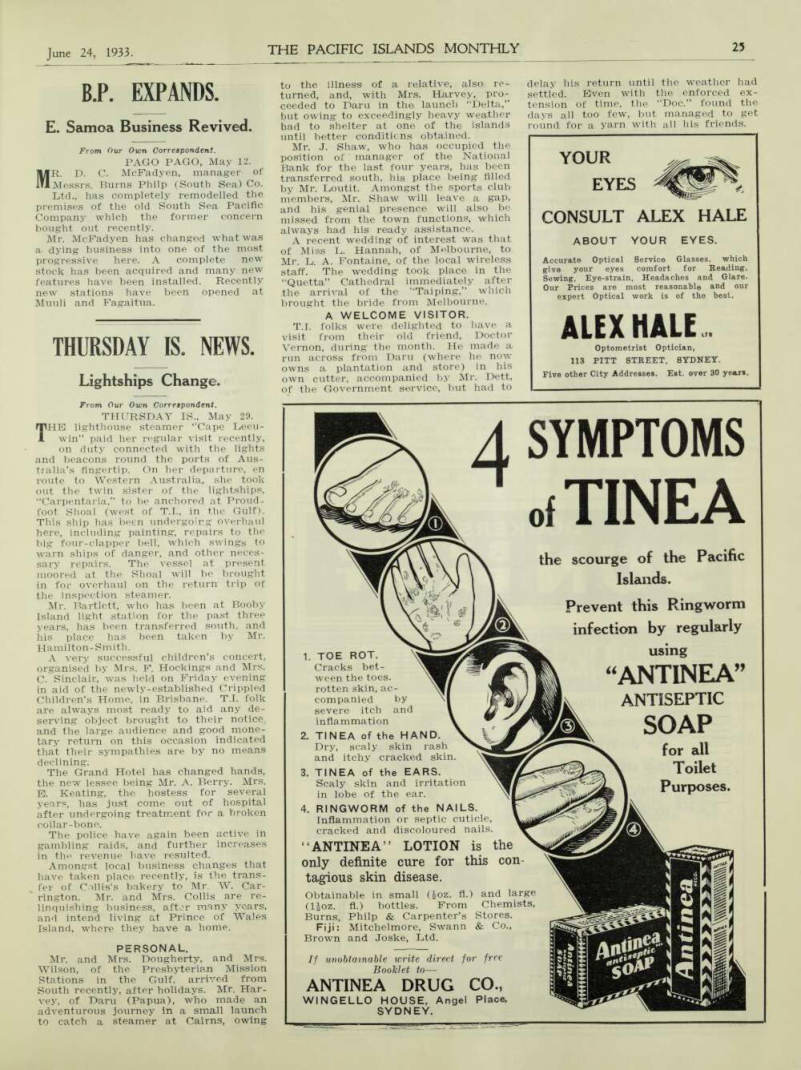
E. Samoa Business Revived.
From Our Own Correspondent.
Pago Pago, May 12.
MR. D. C. McFadyen, manager of Messrs. Burns Philp (South Sea) Co.
Ltd., has completely remodelled the premises of the old South Sea Pacific Company which the former concern bought out recently.
Mr. McFadyen has changed what was a dying business into one of the most progressive here. A complete new stock has been acquired and many new features have been installed. Recently new stations have been opened at Muuli and Fagaitua.
Thursday Is. News.
Lightships Change.
From Our Own Correspondent.
Thursday Is., May 29.
THE lighthouse steamer “Cape Leeu win” paid her regular visit recently, on duty connected with the lights and beacons round the ports of Aus tralia’s fingertip. On her departure, en route to Western Australia, she took out the twin sister of the lightships, “Carpentaria,” to be anchored at Proud foot Shoal (west of T. 1., in the Gulf).
This ship has been undergoing overhaul here, including painting, repairs to the big four-clapper bell, which swings to warn ships of danger, and other neces sary repairs. The vessel at present moored at the Shoal will be brought in for overhaul on the return trip of the inspection steamer.
Mr. Bartlett, who has been at Booby Island light station for the past three years, has been transferred south, and his place has been taken by Mr.
Hamilton-Smith.
A very successful children’s concert, organised by Mrs. F. Hockings and Mrs.
C. Sinclair, was held on Friday evening in aid of the newly-established Crippled Children’s Home, in Brisbane. T.I. folk are always most ready to aid any de serving object brought to their notice, and the large audience and good mone tary return on this occasion indicated that their sympathies are by no means declining.
The Grand Hotel has changed hands, the new lessee being Mr. A. Berry. Mrs.
E. Keating, the hostess for several years, has just come out of hospital after undergoing treatment for a broken collar-bone.
The police have again been active in gambling raids, and further increases in the revenue have resulted.
Amongst local business changes that have taken place recently, is the trans fer of Collis’s bakery to Mr. W. Car rington. Mr. and Mrs. Collis are re linquishing business, after many years, and intend living at Prince of Wales Island, where they have a home.
Personal.
Mr. and Mrs. Dougherty, and Mrs.
Wilson, of the Presbyterian Mission Stations in the Gulf, arrived from South recently, after holidays. Mr. Har vey, of Daru (Papua), who made an adventurous journey in a small launch to catch a steamer at Cairns, owing
to the illness of a relative, also re turned, and, with Mrs. Harvey, pro ceeded to Daru in the launch “Delta,” but owing to exceedingly heavy weather had to shelter at one of the islands until better conditions obtained.
Mr. J. Shaw, who has occupied the position of manager of the National Bank for the last four years, has been transferred south, his place being filled by Mr. Loutit. Amongst the sports club members, Mr. Shaw will leave a gap, and his genial presence will also be missed from the town functions, which always had his ready assistance.
A recent wedding of interest was that of Miss L. Hannah, of Melbourne, to Mr. D. A. Fontaine, of the local wireless staff. The wedding took place in the “Quetta” Cathedral immediately after the arrival of the “Taiping,” which brought the bride from Melbourne.
A Welcome Visitor.
T.I. folks were delighted to have a visit from their old friend, Doctor Vernon, during the month. He made a run across from Daru (where he now owns a plantation and store) in his own cutter, accompanied by Mr. Dett, of the Government service, but had to
delay his return until the weather had settled. Even with the enforced ex tension of time, the “Doc.” found the days all too few, but managed to get round for a yarn with all his friends.
Advertisements & other items, p. 27 (1 item)
4 Symptoms
YOUR
EYES
CONSULT ALEX HALE
ABOUT YOUR EYES.
Accurate Optical Service Glasses, which give your eyes comfort for Reading, Sewing, Eye-strain, Headaches and Glare.
Our Prices are most reasonable and our expert Optical work is of the best.
ALEX HALE
Optometrist Optician,
113 PITT STREET, SYDNEY.
Five other City Addresses. Est. over 30 years.
1. TOE ROT.
Cracks bet ween the toes, rotten skin, ac companied by severe itch and inflammation 2. TINEA of the HAND.
Dry, scaly skin rash and itchy cracked skin. 3. TINEA of the EARS.
Scaly skin and irritation in lobe of the ear.
4. RINGWORM of the NAILS.
Inflammation or septic cuticle, cracked and discoloured nails.
“ANTINEA” LOTION is the
only definite cure for this con-
tagious skin disease.
Obtainable in small (½oz. fl.) and large (1½oz. fl.) bottles. From Chemists, Burns, Philp & Carpenter’s Stores.
Fiji: Mitchelmore, Swann & Co., Brown and Joske, Ltd.
4 SYMPTOMS
of TINEA
the scourge of the Pacific
Islands.
Prevent this Ringworm
infection by regularly
using
“ANTINEA”
ANTISEPTIC
SOAP
for all
Toilet
Purposes.
If unobtainable write direct for free Booklet to —
ANTINEA DRUG CO.,
WINGELLO HOUSE, Angel Place,
SYDNEY.
Governor Bouchet’S Many Reforms.
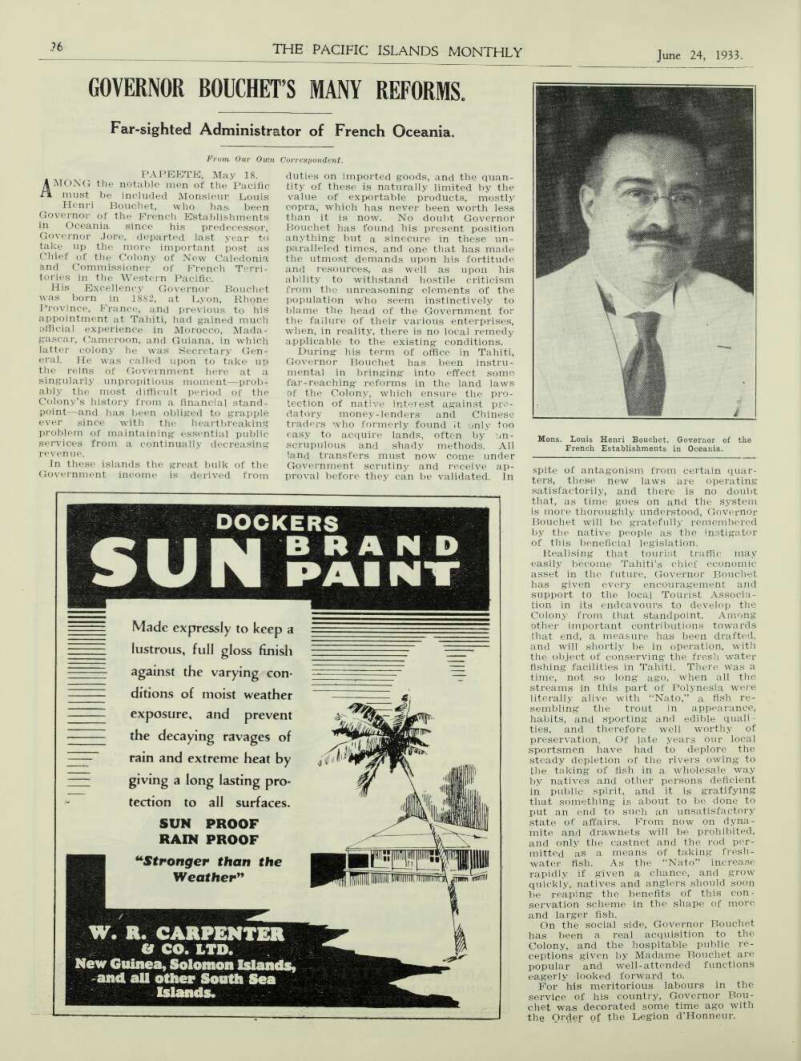
Far-sighted Administrator of French Oceania.
From Our Own Correspondent.
Papeete, May 18.
AMONG the notable men of the Pacific must be included Monsieur Louis Henri Bouchet, who has been Governor of the French Establishments in Oceania since his predecessor, Governor Jore, departed last year to take up the more important post as Chief of the Colony of New Caledonia and Commissioner of French Terri tories in the Western Pacific.
His Excellency Governor Bouchet was born in 1882, at Lyon, Rhone Province, France, and previous to his appointment at Tahiti, had gained much official experience in Morocco, Mada gascar, Cameroon, and Guiana, in which latter colony he was Secretary Gen eral. He was called upon to take up the reins of Government here at a singularly unpropitious moment—prob ably the most difficult period of the Colony’s history from a financial stand point—and has been obliged to grapple ever since with the heartbreaking problem of maintaining essential public services from a continually decreasing revenue.
In these islands the great bulk of the Government income is derived from
duties on imported goods, and the quan tity of these is naturally limited by the value of exportable products, mostly copra, which has never been worth less than it is now. No doubt Governor Bouchet has found his present position anything but a sinecure in these un paralleled times, and one that has made the utmost demands upon his fortitude and resources, as well as upon his ability to withstand hostile criticism from the unreasoning elements of the population who seem instinctively to blame the head of the Government for the failure of their various enterprises, when, in reality, there is no local remedy applicable to the existing conditions, During his term of office in Tahiti, Governor Bouchet has been instru mental in bringing into effect some far-reaching reforms in the land laws of the Colony, which ensure the pro tection of native interest against pre datory money-lenders' and Chinese traders who formerly found it only too easy to acquire lands, often by un scrupulous and shady methods. All land transfers must now come under Government scrutiny and receive ap proval before they can be validated. In
spite of antagonism from certain quar ters, these new laws are operating satisfactorily, and there is no doubt that, as time goes on and the system is more thoroughly understood, Governor Bouchet will be gratefully remembered by the native people as the instigator of this beneficial legislation.
Realising that tourist traffic may easily become Tahiti’s chief economic asset in the future, Governor Bouchet has given every encouragement and support to the local Tourist Associa tion in its endeavours to develop the Colony from that standpoint. Among other important contributions towards that end, a measure has been drafted, and will shortly be in operation, with the object of conserving the fresh water fishing facilities in Tahiti. There was a time, not so long ago, when all the streams in this part of Polynesia were literally alive with “Nato,” a fish re sembling the trout in appearance, habits, and sporting and edible quali ties, and therefore well worthy of preservation. Of late years our local sportsmen have had to deplore the steady depletion of the rivers owing to the taking of fish in a wholesale way by natives and other persons deficient in public spirit, and it is gratifying that something is about to be done to put an end to such an unsatisfactory state of affairs. From now on dyna mite and drawnets will be prohibited, and only the castnet and the rod per mitted as a means of taking fresh water fish. As the “Nato” increase rapidly if given a chance, and grow quickly, natives and anglers should soon be reaping the benefits of this con servation scheme in the shape of more and larger fish.
On the social side, Governor Bouchet has been a real acquisition to the Colony, and the hospitable public re ceptions given by Madame Bouchet are popular and well-attended functions eagerly looked forward to.
For his meritorious labours in the service of his country, Governor Bou chet was decorated some time ago with the Order of tbe Legion d’Honneur.
Mons. Louis Henri Bouchet, Governor of the French Establishments in Oceania.
Advertisements & other items, p. 28 (1 item)
Paint
DOCKERS
SUN BRAND
Made expressly to keep a lustrous, full gloss finish
against the varying con
ditions of moist weather exposure, and prevent the decaying ravages of rain and extreme heat by
giving a long lasting pro
tection to all surfaces.
SUN PROOF
RAIN PROOF
"Stronger than the Weather”
W. R. CARPENTER
& CO. LTD.
New Guinea, Solomon Islands, and all other South Sea Islands.
Flag Day.
Celebrations in Eastern Samoa.
From Our Own Correspondent.
Pago Pago, May 12.
THE thirty-third anniversary of the raising of the American flag in Tu tuila was celebrated on April 21 in clear, bright weather. The day was the first fine one for about a week and heavy rain fell all the previous night.
Samoan chiefs from all parts of the Group came in as usual to the Station to meet the officers of the Administra tion, see the ceremony, and contest vari ous games.
At 9.15 a.m. the Fita Fita Guard par aded, their band being joined by the Poyer School Band. Afterwards came the in vocation by the native preacher, Lakopo.
District Governor Mauga then made an impressive speech, emphasising the aid the Governor and Administration are giving to the Samoans, and pointing out that the policy of the Government is “Samoa for the Samoans”, and that foreigners cannot buy land and are not allowed to exploit the natives. He stated it was very necessary—if the present welfare of the Samoan people was to continue —that the present land law never be changed. He further stressed that, as the population of the islands had doubled in the last 30 years and was continuing to increase, it was ne cessary that the Samoan plant more bananas, taro, and foodstuffs. He called attention to the Governor’s encourage ment of all kinds of industry, especially agriculture.
The proposed Organic Act for Samoa passed the Senate but was not passed by the House. Mauga stated that the Governor and Administration were not opposed to the act and were putting into operation all the beneficial features of the Act; but that many are of the opinion that the Samoans would suffer under the Act if it were passed and went into effect as at present is drawn up. He called attention to the fact that the taxes are not too high, roads fairly good, the schools good, the Department for Health is excellent, there is a sur plus of money in the bank. He ended by exhorting his people to join in a Christian spirit, become good and useful citizens, work together with the Gov ernor, co-operate with him and with each other —for “The Advancement of Samoa.”
In the afternoon races, games, and dances were held. Tug of war, tree climbing, poapoa races, Fautasi races, copra cutting, basket making, and siva ing teams contested various events.
In the evening a smoker was held, consisting of some eight or nine three round bouts of boxing.
Mr. Nelson’S Return.
Pago Pago Natives Prepare.
From Our Own Correspondent
Pago Pago, May 12.
THE Hon. O. F. Nelson will arrive by the “Mariposa” to-morrow on his way to Apia. The natives here are preparing to welcome him on his return from exile, but are not strongly politic ally minded. It would seem that the natives here honour Nelson more as an outstanding Samoan and worthy of their regard, than as the leader of a political faction.
N.G. Public Service.
THE following appointments, trans
fers, etc., in the public service of the Mandated Territory are taken from the latest available Bulletin (No. 14) issued by the Administration;
Permanent Staff.
Appointments.
Customs Department.—H. H. Page, to be Acting Chief Collector of Customs, during absence on leave of E. F. Phibbs.
Department of District Services and Native Affairs. —B. D. Robinson, to be Acting District Officer, Grade 2; K. H. Thomas, to be Acting Assistant District Officer; G. M. Keogh, to be Acting Assistant District Officer.
Termination of Acting Appointments, Department of District Services and Native Affairs. —E. W. Oakley, as Acting District Officer.
Grade 2; A. J. Samson, as Acting Assistant District Officer.
Transfers.
Department of District Services and Native Affairs.—J. H. Jones, Assistant District Officer, from Rabaul to Kavieng; A. J. Samson, Patrol Officer, from Aitape to Rabaul.
Department of Public Health. —K. F. Arm strong, Medical Assistant, Grade 2. from Talasea to Rabaul; C. W. Lambert, Medical Assistant, Grade 1. from Rabaul to Kokope; R. R. L.
Foulkes, Medical Assistant, Grade 1. from Rabaul to Kieta; A. Coomber, Medical Assistant, Grade 1, from Rabaul to Aitape.
Temporary Employees.
Appointments.
Department of District Services and Native Affairs. —S. T. W. Makins, to be Clerk; J. Gallin, to be Roadmaster.
Department of Public Works. —M. Hawut, to be Typiste.
Department of Public Health. —E. M. Nagle, to be Nurse.
Transfers.
Department of District Services and Native Affairs. —J. Gallin, Roadmaster, from Rabaul to Kavieng.
Terminations.
Department of District Services and Native Affairs. —W. L. G. Gibson, Clerk; W. F. S.
Garnett, Roadmaster.
Grim Reminders.
Wreckage In Torres
Strait.
From Our Own Correspondent.
Thursday Is., May 29.
WRECKAGE from the Japanese steamer “Kinsen Maru,” which foundered off the Queensland coast two months ago, is beginning to drift round the central Torres Strait islands.
The Superintendent of St. Paul’s, Moa Island, reports finding a lifebuoy, portion of a hatch cover, and several other things.
Advertisements & other items, p. 29 (1 item)
Canned Vegetables
Sutton’s
GREEN PEAS,
in ½lb., 1lb. and 2lb. tins.
FRENCH BEANS
(sliced), in ½lb. and 1lb. tins.
Delicia Food Products Co.
DANK STREET, WATERLOO,
N.S.W.
FIRST
IN 1868 Fitzroy Brand Canned Meats
STILL
BEST IN
1933
SPICED, CORNED, ROAST
of BOILED BEEF
AND IN MUTTON
IN 12 oz y lib, 2 lb, Slk, 4 lb„
5H»,£ 61b ROUND
CANS AND IH TAPERS
FITZROY
SHEEP
TONGUES
BEEF, OXFORD, CAMBRIDGE & PORK SAUSAGES
FITZROY
THE ORIGINAL PACK IN A CLASS BY ITSELF!
ALSO THE EAMOUS
HAMPER MEATS
IN ROUND AND TAPER CANS 120z.240*. 6 6 lbs.
SPECIALLY PACKED FOR THE ISLAND TRADE
send FOP PRICE LIST - NO extra for assortment The CENTRAL QUEENSLAND MEAT EXPORT CO. LTD.
LAKES CREEK - ROCKHAMPTON
CABLE address:- TOMOANA ROCKHAMPTON.
Pearl Jettons.
Manufacture in Australia.
TWO and a half years ago a party of four experts in the manufacture of buttons from trochus and other vari eties of shell, came to Australia from Vienna to establish the industry in Syd ney. The result of their activities is a factory which has employed as many as 250 Australians, though, at present the staff numbers only forty.
The shell used comes from North Australian waters. Only the best grades are used and for this the factory pays £lBO per ton. The first stage in the manufacture is cutting the blanks, which is done by a tubular saw. They are then shaped on a turning machine, the holes are drilled and the finished buttons are given their lustre by revolving polishing drums. Grading is done by hand, first and second grades being selected.
Many other fancy, small articles are made from the shell as well as buttons, and include buckles, sleeve links, cigar ette holders, spoons, butter knives, and inlaid caskets. Colours are introduced by a special dyeing process.
The consumption of buttons in Aus tralia is very limited in comparison with the output of shell, which is estimated at 80 per cent, of the world’s supply and yields upwards of £250,000 per year.
Recently a demonstration of the vari ous stages in the evolution of a button was given at the Technological Museum in Sydney, when, by means of specimens and well selected photographs, every stage of the industry from the gather ing of the shell to the packing of the finished articles was shown.
Yams Again.
More Tales of Shipwreck.
IN the January issue of the “Pacific Islands Monthly,” a correspondent, “Bullwhanger,” in reply to a previous article from the pen of A. J. Vogan in praise of the humble yam, expressed his opinion of the vegetable in some what forceful words. Now another correspondent from the Solomon Islands chips into the discussion; Sir, — Re “Bullwhanger’s” article on yams at Utupua (“P.I.M.”, Jan. 25, 1933), I would like to ask “Bullwhanger” a few questions.
Well! “Bullwhanger” aren’t you put ting the rough stuff across? Do you honestly believe what you say about yams? Also, at Utupua, did we not save the stove and even to the bread the cook had set the night we struck?
Also did we not do pretty well for food and if it had not been for sand flies, mosquitoes and land crabs would we not have done all right?
Own up Bill.
Yours, etc.,
“Oil Her Up Bill.”
We showed this letter to “Bullwhanger,” who replies: — Despite my Solomon Islands friend’s letter I still hold a poor opinion of yam as an article of diet and, since he has brought up the question of kai kai on Utupua, will go as far as to say that the only thing in that line (fit for white stomachs) that was ever on the de lightful island of Utupua was taken there by the ill-fated schooner which took us both there.
I know that it is beside the point to mention that that ship always carried a, hoodoo and though her name was “Mascot” (why make a secret of it any longer?) she would have been better named “Nemesis.” Certainly we got the stove ashore and the bread as well, as “Oil Her Up” says; but it wasn’t her fault that we got even our carcases off her because “Oil Her Up” knows what sort of a mess she was in half an hour after we struck. One good point she had —her boats were in good nick- —and it was this that allowed us to get some of her stores ashore. But if “Oil Her Up” fancied those stores as kai kai after they had been on Utupua a month, he would enjoy a snack with Caesare Borgia.
No! I am still of the opinion that the line of edibles on Utupua would tax even the ability of an expert Chow cook to make into tempting dishes, and that goes for the “bush” pig and the hard-backed crabs too. As for mos quitoes and sandflies —they were the only inhabitants of Utupua who got any good out of that wreck.
Yours, etc.,
“Bullwhanger.”
Samoan Produce.
From Our Own Correspondent.
Apia, May 12.
THE price of copra on the beach, Apia, is £6/10/- per ton to Europeans, ¾ cents per lb. to natives in outside districts and one cent in Apia district.
Cocoa is £40 per ton and bananas 3/per case.
Advertisements & other items, p. 30 (1 item)
C. G. Piggott
TO PLANTERS I am a Buyer of
CASTOR OIL SEED
IN ANY QUANTITY.
Send Sample for quote, stating quantity available.
Castor Seed Shellers, any capacity.
Advice and Instructions Regarding Plant ing, Harvesting' and Packing of Castor Oil Seeds given freely.
Selected Seed for Planting available.
C. GHAHAME
17 BOND STREET SYDNEY.
Vitality and Health are the
Main Factors in Every-day Life.
Put yourself in the hands of Specialists who have made an intelligent study of your requirements; it is vital to your health. We are known everywhere as the Suppliers of the Right Goods and which put the VITAL into VITALITY. Thirty-five years is our record of supplying Fresh Fruit, Vegetables and Produce to the leading Houses throughout the world.
GET FULLY ACQUAINTED WITH US.
Tel.: MA 4799; FX 4350 Private.. Cable Address: Pigs, Sydney. Code: Bentley’s.
C. G. PIGGOTT
WHOLESALE FRUIT AND PRODUCE MERCHANTS
DIRECT IMPORTERS AND EXPORTERS SYDNEY.
Office: Bulk Stores and Packing House: Fruit Exchange, Sydney.
Sales Dept.: Fruit Exchange and City Markets, Sydney. Bank of N.S.W. Bankers.
Repairs.
“OUR HANDS MAKE GOOD ARMS’
DON’T TRIFLE WITH DOUBTFUL FIREARMS
Sil Rohu’s Expert Attention is at your Service —without obligation.
Send for my Wonderful Firearm Catalogue. 500 Illustrations and Details of the World’s Best and Reliable Makers,
“FISHING TACKLE TO TACKLE FISHING.”
The same High Standard of Quality is a feature in my new Fishing Catalogue. Specialities: Trout, Big Game, and Deep Sea Fishing.
SIL ROHU (late A.I.F.), GUNSMITH
IMPOSTER OF HIGH GRADE FIREARMS AND FISHING TACKLE SPECIALIST, 143 ELIZABETH STREET, SYDNEY (Near Market Street).
Natural Gum, Unbreakable Sets, Comfortable and Long Lasting, Old Plates Remodelled and made equal to new. 28 OXFORD ST., over Winns;
139 ELIZABETH STREET,
TEETH BY POST.
Well-fitting and lifelike in appearance,
made from “SELF-TAKEN IMPRESSIONS."
I have made Artificial Teeth by my wellknown and copyrighted System of Self- Taken Impressions for satisfied Patients in all parts of the Commonwealth.
Send for full free particulars.
Satisfaction guaranteed.
SPENCER NOLAN
DENTIST,
Established in Sydney over 35 years. 177 OXFORD ST., opposite McIlraths. two doors from Market Street, Sydney.
Telegraphic and Cable Address: “FASTPLATE,” Sydney.
New Guinea Notes.
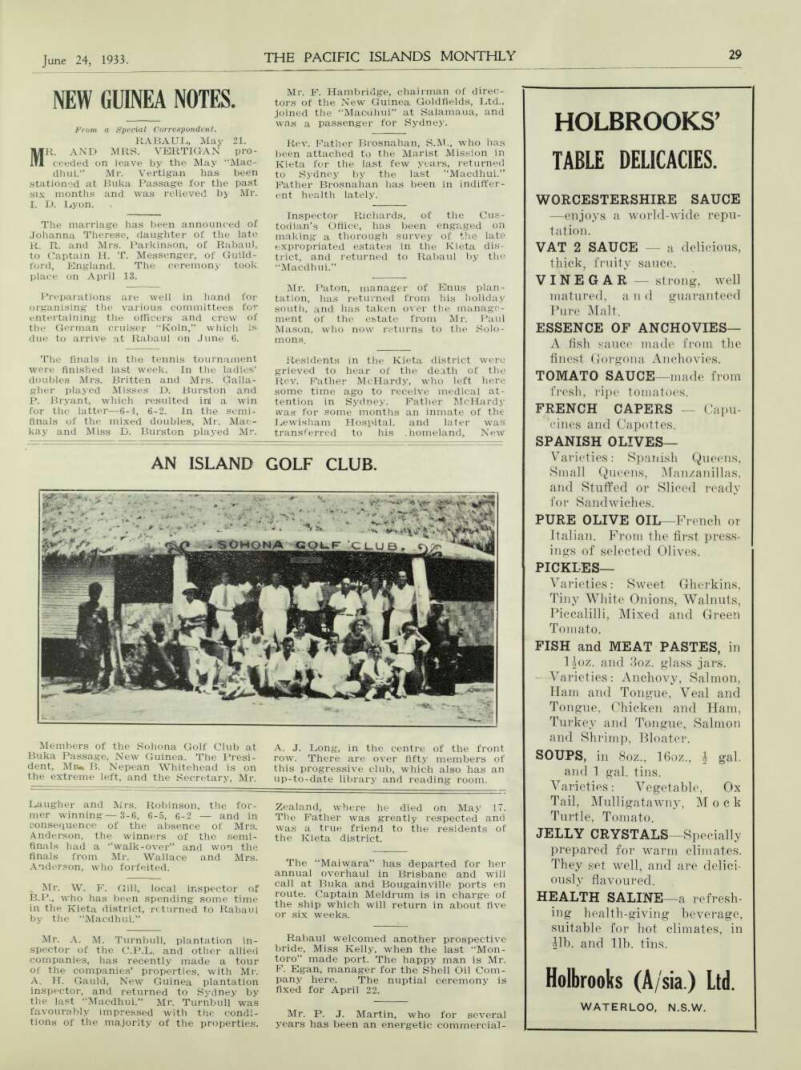
From a Special Correspondent.
Rabaul, May 21.
Mr. And Mrs. Vertigan Pro
ceeded on leave by the May “Mac dhui.” Mr. Vertigan has been stationed at Buka Passage for the past six months and was relieved by Mr.
I. D. Lyon.
The marriage has been announced of Johanna Therese, daughter of the late R. R. and Mrs. Parkinson, of Rabaul, to Captain H. T. Messenger, of Guild ford, England. The ceremony took place on April 13.
Preparations are well in hand for organising the various committees for entertaining the officers and crew of the German cruiser “Koln,” which is due to arrive at Rabaul on June 6.
The finals in the tennis tournament were finished last week. In the ladies’ doubles Mrs. Britten and Mrs. Galla gher played Misses D. Burston and P. Bryant, which resulted in a win for the latter —6-4, 6-2. In the semi finals of the mixed doubles, Mr. Mac kay and Miss D. Burston played Mr.
Laugher and Mrs. Robinson, the for mer winning—3-6, 6-5, 6-2 and in consequence of the absence of Mrs.
Anderson, the winners of the semifinals had a “walk-over” and won the finals from Mr. Wallace and Mrs.
Anderson, who forfeited.
Mr. W. F. Gill, local inspector of B.P., who has been spending some time in the Kieta district, returned to Rabaui by the “Macdhui.”
Mr. A. M. Turnbull, plantation in spector of the C.P.L. and other allied companies, has recently made a tour of the companies’ properties, with Mr.
A. H. Gauld, New Guinea plantation inspector, and returned to Sydney by the last “Macdhui.” Mr. Turnbull was favourably impressed with the condi tions of the majority of the properties.
Mr. F. Hambridge, chairman of direc tors of the New Guinea Goldfields, Ltd., joined the “Macdhui” at Salamaua, and was a passenger for Sydney.
Rev. Father Brosnahan, S.M., who has been attached to the Marist Mission in Kieta for the last few years, returned to Sydney by the last “Macdhui.”
Father Brosnahan has been in indiffer ent health lately.
Inspector Richards, of the Cus todian’s Office, has been engaged on making a thorough survey of the late expropriated estates in the Kieta dis trict, and returned to Rabaul by the “Macdhui.”
Mr. Paton, manager of Enus plan tation, has returned from his holiday south, and has taken over the manage ment of the estate from Mr. Paul Mason, who now returns to the Solo mons.
Residents in the Kieta district were grieved to hear of the death of the Rev. Father McHardy, who left here some time ago to receive medical at tention in Sydney. Father McHardy was for some months an inmate of the Lewisham Hospital, and later was transferred to his .homeland, New
Zealand, where he died on May 17.
The Father was greatly respected and was a true friend to the residents of the Kieta district.
The “Maiwara” has departed for her annual overhaul in Brisbane and will call at Buka and Bougainville ports en route. Captain Meldrum is in charge of the ship which will return in about five or six weeks.
Rabaul welcomed another prospective bride, Miss Kelly, when the last “Mon toro” made port. The happy man is Mr.
F. Egan, manager for the Shell Oil Com pany here. The nuptial ceremony is fixed for April 22.
Mr. P. J. Martin, who for several years has been an energetic commercial -
ist in the Kavieng district, has now transferred his interests to the Duke of York group of islands, having purchased the Mioko-Makada properties, with their subsidiary trading stations, from Mr. R.
Moore.
Mr. and Mrs. L. P. S. Hore, of Kavi eng, arrived in Rabaul recently and will
proceed to the East (which is really our north) for a holiday by the E. and A. liner “Tanda” this week.
Our popular A.D.O., Mr. J. H. Jones, departed for Kavieng by the last “Mon toro,” where he will be stationed for some time in order to assist in making investigations into various charges re garding the native labour situation in that district. Reports from this area re cently have been very disquieting, and the European population are eager for the Administration to adopt a firmer at titude towards natives who commit breaches of the peace. If the complaints made by the Europeans are substanti ated (and there seems little likelihood of this not being possible) then it is high time some definite action was taken to enforce a stricter discipline amongst the native labourers and en sure a greater feeling of safety amongst the white community.
It is with deep regret that we record the death of Mrs. Ward Oakley, which occurred on April 3 at Aitape, where her husband is District Officer. Mrs. Oakley was at all times a most popular hostess and leaves a host of sorrowing friends to mourn her passing. Our sympathy is extended to the bereaved husband in his severe loss.
Mr. and Mrs. Charles Munster, of Manus, are visitors to Rabaul awaiting the arrival of the “east”-bound “Tanda”, by which vessel they intend taking a holiday tour for the purpose of allowing Mrs. Munster to recuperate after her re cent illness. The well-known “Charlie” (who is one of the Territory’s pioneers) has every appearance of being in the pink of health.
Mr. J. Virtue, of Messrs. Burns, Philp’s head office, arrived by the “Montoro” and is giving the Territory the “once over”. He will remain in the Territory until the departure of the “Macdhui” in May.
Mr. Arthur Smith, of the Bank of N.S.W. staff, left for south by the last “Macdhui” and was accorded several valedictory parties by his numerous friends. Mr. Smith has always taken a keen interest in public affairs and was for some twelve months secretary of our local golf club.
A new regulation has been promul gated by the Administration that per mits will not be granted for the impor tation of either .303 rifles or cartridges, except for the specific use of the Ad ministration.
Special appreciative mention has been made by Major Marr, of the exception ally good patrol work rendered by A.A.D.O. Mack and Patrol Officers Niall and Farlow on the south coast of New Britain.
Mr. Gordon Thomas was a passenger by the last “Montoro” from south, after spending four months in Australia and New Zealand. After visiting Buka, where he has certain interests, Mr.
Thomas will return to Rabaul and take over the management of “The Rabaul Times’’ from Mr. Hoogerwerff, who is proceeding to Australia on well-earned holidays.
Great satisfaction was expressed in all quarters when it was learned that our Acting Administrator, General Griffiths, had been appointed Administrator for a period of two years. During the past few months so many rumours had been current as to possible appointees that local residents were becoming somewhat apprehensive as to the qualifications of our future Chief Executive Officer, But now all is well and Canberra has made itself popular by selecting the most suit able man for the position at such an important stage of the Territory’s life.
An Island Golf Club.
Members of the Sohona Golf Club at Buka Passage, New Guinea. The Presi dent, Mr. B. Nepean Whitehead is on the extreme left, and the Secretary, Mr.
A. J. Long, in the centre of the front row. There are over fifty members of this progressive club, which also has an up-to-date library and reading room.
Advertisements & other items, pp. 31-32 (1 item)
Holbrooks (A/sia.) Ltd.
HOLBROOKS’
TABLE DELICACIES.
WORCESTERSHIRE SAUCE
—enjoys a world-wide repu tation.
VAT 2 SAUCE — a delicious, thick, fruity sauce.
VINEGAR —- strong, well matured, and guaranteed Pure Malt.
ESSENCE OF ANCHOVIES—
A fish sauce made from the finest Gorgona Anchovies.
TOMATO SAUCE— made from fresh, ripe tomatoes.
FRENCH CAPERS — Capu
cines and Capottes.
SPANISH OLIVES—
Varieties: Spanish Queens, Small Queens, Manzanillas, and Stuffed or Sliced ready for Sandwiches.
PURE OLIVE OIL— French or Italian. From the first press ings of selected Olives.
PICKLES—
Varieties: Sweet Gherkins, Tiny White Onions, Walnuts, Piccalilli, Mixed and Green Tomato.
FISH and MEAT PASTES, in
1½oz. and 3oz. glass jars.
Varieties: Anchovy, Salmon, Ham and Tongue, Veal and Tongue, Chicken and Ham, Turkey and Tongue, Salmon and Shrimp, Bloater.
SOUPS, in 8oz., 16oz., ½ gal. and 1 gal. tins.
Varieties: Vegetable, Ox Tail, Mulligatawny, Mock Turtle, Tomato.
JELLY CRYSTALS— Specially prepared for warm climates.
They set well, and are delici ously flavoured.
HEALTH SALINE— a refresh ing health-giving beverage, suitable for hot climates, in ½lb. and 1lb. tins.
Holbrooks (A/sia.) Ltd.
WATERLOO, N.S.W.
J. H. MacGregor Dowsett
RABAUL, NEW GUINEA,
for
RELIABLE CARS, SERVICE & DRIVERS.
Gramophones and Latest Records.
Musical Instruments and Sundries.
Cameras and Photographic Goods.
Developing, Printing, Enlarging & Framing.
Recruiter, Mining & General Agent,
BUILDER AND CONTRACTOR.
Agent for The Australian Provincial Assur ance Assoc. Ltd. Sub-Agent for The Central Assurance Co. Ltd.
Outstation Orders Promptly Executed.
Sample Rooms:
MALAGUNA ROAD, RABAUL
’Phone: Rabaul 149.
ALBERT GREGORY,
107 York St., SYDNEY.
Saddlery,
Saddlers,' Ironmongery,
Leather Merchant,
Belting and Paint Merchant.
PAINTS —Plymel Ready-mixed Paints, for House or Roofs 13/6 gallon Special Value House Paint 10/6 gallon Brushes, Kalsomines, White Lead and Oils
AT LOWEST PRICES.
Bridles, Belts, Spurs, Stirrups, Breastplates, Saddles (from Race to Stock), All Prices.
Leather Belting and Pump Cups.
CORRESPONDENCE SOLICITED.
ask for it
ESTABLISHED 1868.
Bulolo Gold Dredging
Shares Listed in London.
BULOLO Gold Dredging Limited per mission to deal had been granted by the Committee of the London Stock Exchange in respect of all the 765,000 issued shares, and the Company is in course of being listed also on the Montreal Stock Exchange. Shares, registers and transfer offices have been established in London and Montreal, and the shares will be transferable be tween the Vancouver, London, Mon treal and Sydney registers. The shares are being introduced on the London, Montreal and Toronto markets.
In an announcement made by the Company in the London financial press it is stated that, from the information at present available, the directors believe that the total number of shares to be allotted to Placer Development Limited in satisfaction of the purchase from that Company of the Bulowat-Burnside areas, will not exceed 235,000 and that it is anticipated that from dredging the at present proved yardage of one hun dred million cubic yards there will be available for distribution to share holders by way of dividend and return of capital 23,250,000 gold dollars; and that these profits will probably be won during the next eleven years. It is further stated that it is likely that additional dredging ground will be de veloped on the Company’s present holdings; thus extending the life of the operation, and it is also stated that it is probable that towards the end of the present year payment of regular dividends will be commenced. Similar announcement is being published in the Qanadian press.
Papuan Industries.
Rubber Improves; Copra in Difficult Position.
From Our Own Correspondent.
Pt. Moresby, March 24.
OWING to the repeated communica tions between the Papuan and Australian Governments in relation to the immediate clearance from bond of Papuan rubber by the manufac turers in Australia, and the extreme urgency of the demand, advice was re ceived from Canberra by His Excel lency the Lieut.-Governor on May 9 that 275,940 lbs. of Papuan rubber had been cleared from bond and that the amount of £4,599 had already been paid in duty to the Commonwealth by the manufacturers.
On Wednesday, May 10, the money was received by the Papuan Govern ment and was immediately paid over to the rubber planters. This sum represents approximately 63 per cent, of the total exportation of rubber since March 9. The total amount of Papuan rubber received into Australia and bonded from March 9 to April 30 was 440,209 lbs.
Since the payment of this money, there has been a slight rise in the market value in rubber and a further advance on the market is anticipated; so the planters of rubber have every reason to congratulate themselves.
It would appear that everything possible has now been done to help the rubber industry by both the Papuan Administration and the Com monwealth Government, and it is not inopportune at this stage to consider the position of the coconut planters, who are in very real need of help.
Copra has never been a pampered industry, and planters have struggled along the last three years without complaint against an ever-falling market, prohibitive coastal freights and inordinate marketing charges, un til now, there is no life left in them.
Copra worth £10/5/- sterling in London brings in some cases only £4/10/- per ton in Port Moresby, in spite of the favourable exchange. Out of the £4/10/-, the producer has to pay from £1 to £3 per ton in coastal freight, and bags cost about another £1 per ton so that the producer has from 5/to 45/- per ton to meet production and living costs.
Coconuts, the planters agree, are of far greater economic importance in Papua than rubber, yet the copra in dustry has never received assistance in any form, neither has it cried loudly for help. The time has come when, without assistance, it will be quite im possible to carry on unless the market price improves.
“Montoro’S” Cargo.
From Our Own Correspondent.
Pt. Moresby, May 24.
THE “Montoro”, which sailed from Port Moresby for Sydney on May 4, took the following cargo; 73 packages of sandalwood, 1,043 packages of rubber, 397 packages of desiccated coconut, 100 bags of coffee and 178 bags of copra.
“Ville de Papeete’s” New
French Inter-Island
Shipping.
“Ville de Papeete’s” New Service.
From Our Own Correspondent
Papeete, May 18.
A FEW months ago it was announced that the Messageries Maritimes pro posed bringing a 2,000 ton steamer from France to inaugurate a regular inter-island freight and passenger ser vice throughout French Oceania as an auxiliary to the line which runs about every six weeks between New Caledonia and France, calling at Tahiti both ways en route. This project has apparently been abandoned, at any rate for the time being, and it is now stated that the Messageries Company has chartered the “Ville de Papeete” in order to test out the possibilities of the scheme before embarking upon it in a larger way.
The “Ville de Papeete,” a coal burner of 600 tons, was built on the Clyde and arrived here in 1929 to the order of the Compagnie des Phosphates de l’Oceanie by which concern she has been used be tween the phosphate island, Makatea, and Tahiti. The vessel has accommoda tion for eight cabin passengers, and, al though her itinerary has not yet been published, it is presumed that she will be taken over by the Messageries Co. as from June 1.
“Maiwara’S” Rough
Passage.
THE Burns, Philp inter-island steamer “Maiwara” arrived in Brisbane on May 16, a fortnight overdue on a voy age from the Mandated Territory to Brisbane for overhaul. Two days after leaving Kieta, the “Maiwara” encount ered a cyclonic storm and made little progress.
On one occasion she travelled only 100 miles in four days and was at one time slewed right round by the wind, so that for five miles she was forced to steam due north, although her course was in a southerly direction.
Advertisements & other items, p. 33 (1 item)
Kodak
Any Employer needs you if you
are an I.C.S. TRAINED MAN !
Technical Qualification is now demanded in practically every walk of life. You can secure this readily (and on the easiest terms), as thousands of others have done and are doing, through the I.C.S., whose record for successes is amazing.
I.C.S. training has put thousands of average men into big jobs and kept them there.
Don't Say You Never Had a Chance !
THE I.C.S. ILLUSTRATION METHOD
makes home study practical
WRITE FOR INFORMATION NOW !
International Correspondence
Schools (Australasia) Ltd.
140 ELIZABETH STREET, SYDNEY
Sirs, —Please send me a free prospectus showing how I can succeed in the occupation I have marked.
Accountant (InstEx) Aeroplane Engin’r, Com. Illustrator, Aeroplane Rigger, Fashion Draining. Aero. Designing, Cari’tures & C'toons Motor Engineer, Poster Drawing, Diesel Engineer, Journalism, Motor Mech. Exam.
Short Story Wilting, Electrical Engineer Shorn Card Writer Elec. Mech. Exam.
Salesman(any branch) Elec. Wiremen’s Ex.
Advert’r (any branch) Radio Engineering, Business M’gement, Radio Exam.
General Bookkeeper, Radio (Talkies) Station Bookkeeper, Building Contractor, Retail Management, Concrete Engin’r, Business Letters, Structural Eng’r, General Eaucalion, Draughtsmanship Matriculation, (name which branch) Leaving Certificate, Architect.
Intermediate, Shire Engineer, Nurses’ Entrance Shire Overseer’s Examination, Examination, Shorthand-Typing, Mechanical Eng in’t, Dressmaking, Steam Certificates, Tailoring, Chemistry (Analy'l) (There are over 4,000,000 I.C.S. Students, over 100,000 of these being in Australasia).
ENQUIRIES COST NOTHING — POST NOW
Name Age Occupation.
Address
Vollenda
The Newest
KODAK
You can afford
this “Little Film” Camera
Vollenda is just perfect—exquisitely made — striking value. Makes 16 pictures at each loading, which enlarge magnificently. Opens and closes at a touch. Prices : f/4.5 lens, £5/15/-. f/3.5-lens Compur Shutter, £9.
Of all Kodak Dealers, and KODAK (Australasia) PTY LTD. 379 George Street, Sydney. And all States.
Seaplane Patrol Needed.
Trochus Poachers Grow More Daring.
DESPITE the publicity recently given to the movements of Japanese craft in Australian waters and near British territory in the Pacific, disturb ing stories continue to come from those parts. Japanese vessels, all of a peculiar type, have been reported from Thurs day Island, various parts of New Guinea, the Solomon Islands and the Barrier Reef.
They have made many raids on trochus grounds among the islands north of the Mandated Territory and the latest report is that from Mr. S. C.
Thompson, who has been managing a plantation on the island of Awinn and who reached Sydney by last “Macdhui.”
Mr. Thompson declares he first saw the raiders in December, 1930, when a fast motor vessel encircled Awinn and the neighbouring island of Laboh, sending a boat ashore with Chinese and Japanese rowers. Avoiding all his attempts to speak to them, they left two hours later. On February 9 last at 9 p.m. he was on Laboh when a boy called his attention to a vessel approaching under power, whereupon he flashed a torch at the ship, thinking it was the district officer from Manus. The ship’s lights were doused and it turned sea
ward. He is of the opinion that the raiders come from the Carolines.
During the visit of the Minister for Territories (Major the Hon. C. W. C.
Marr) to the Mandated Territory last month, persistent stories of trochus poaching by mysterious vessels were heard by his party at all ports in the Territory. The party were in the Ter ritory just after the particularly daring daylight raid on a reef at Tiop Island near Bougainville, when all the best shell from a “reserved” reef was poached despite the protests of the village headmen.
The reports that a Japanese sub marine is in Australia’s northern waters or else in those of some adjacent territory is also strengthened by the statements of a party of holiday makers who recently returned from Hayman Island on the Barrier Reef.
Mr. F, A. McNeill and Mr. A. A. Liv ingstone, of the Australian Museum, who were members of the party, said that stories of mysterious Japanese vessels in those waters were rife among boatmen of the Whitsunday Passage and that these men even reported the presence of a submarine. Mr. McNeill, who is a frequent visitor to the Barrier Reef and knows parts of it well, con
siders it unwise to accept all the stories on their face value; but they are so persistent that they cannot be altogether disregarded. He said the smart bearing of the masters and mates of the Japanese pearling luggers was frequently commented on, and it was suggested that in reality they were naval officers.
A correspondent in Tulagi, B.S.I., in a letter to the editor, gives the sequel to the wreck of the Japanese vessel on the Roncador reef. Quoting from his letter: There seems to have been two, if not three of them. Two were seen on the same day and at the same time, one at St. Christo val and the other on the north side of Malaita. One of them visited Meringi, on this island (Ysabel), and had six boats out working the reefs for beche-de-mer and trochus. She put to sea on the approach of a boat, as is their habit. This was in all probability the same one that planted herself on the Roncador Reef, half way from Ysabel to Lord Howe. The crew of 31 made their way to Ysabel in their six boats, came down to the Government Station, and the D.O. packed them off to Tulagi on his boat, just in time for them to be put aboard the “Mataram,” except one who was said to be somewhat mental and who was missing, but turned up afterwards.
District Officer Miller told me they spun him a yarn that they were on their way to Noumea when an oil tank burst, and, as they had not sufficient fuel to get there, they put back towards somewhere or other; but a local man is said to have collected three 400gallon tanks and about forty 44-gallon drums of oil (presumably from the wreck). My own cutter picked up a 44-gallon drum float ing on the Ysabel coast. The man who picked up the oil told me he also got some trochus shell and other stuff, but there was not much generally known about it in Tulagi.
At present administrations, customs officers and district officers are power less to stop these raids, as there is not in these waters any vessel with anything like the speed the raiders are credited with. No Australian warship is available and it is hoped to obtain a sloop from the China squadron to patrol these waters. The most effi cient method of putting a sudden stop to the raids would be to station sea planes in, say, Rabaul, Thursday Island and Samarai, and it is hoped to secure seaplanes to inaugurate a seaplane service in New Guinea. This will enable the Administration to keep a close watch on poachers, as a ’plane can search more territory in a day than a ship can cover in a month. Tenders are being called for a service to be maintained by one large and one small seaplane.
The main purpose of the service will be to provide rapid transport for officials, particularly for magistrates who will be enabled to hold courts at distant centres, thus meeting com plaints of the expense of taking cases, especially native labour cases, to Rabaul. At the same time the ’planes can keep a watch on poachers. Another proposal to speed up communication in the Mandated Territory is that patrol officers should be equipped with port able wireless telephones similar to those used by the Australian Inland Mission.
Until some strong measures are taken to protect the marine produce industry from these raids the raiders will grow bolder. So far, only one of them has been caught. This was the “Dai Koku Manx,” the skipper of which was fined at Thursday Island for breaking some comparatively trifling regulation.
Advertisements & other items, p. 34 (1 item)
to Pay by Cheque
It is Safer
Money in the pocket or the home is frittered away; sometimes it is stolen; sometimes it is lost.
Money lodged in your bank account is protected against such mischances, and your cheque book is a permanent record of your expenditure. Moreover there is a cer tain prestige in paying by cheque.
It is not necessary to keep a large credit balance, for when ever you have a surplus of five pounds you can place it on fixed deposit and have the interest paid in regularly to your cheque account.
An officer at any one of the 705 branches of the Bank of New South Wales, the oldest and largest bank in Australia, will explain the opening of a cheque account and how you can invest your savings on fixed deposit.
Bank of New South Wales
(ESTABLISHED 1817)
with which the Western Australian Bank and The Australian Bank of Commerce Ltd, are amalgamated.
Deposits exceed £83,000,000,
In Papua.
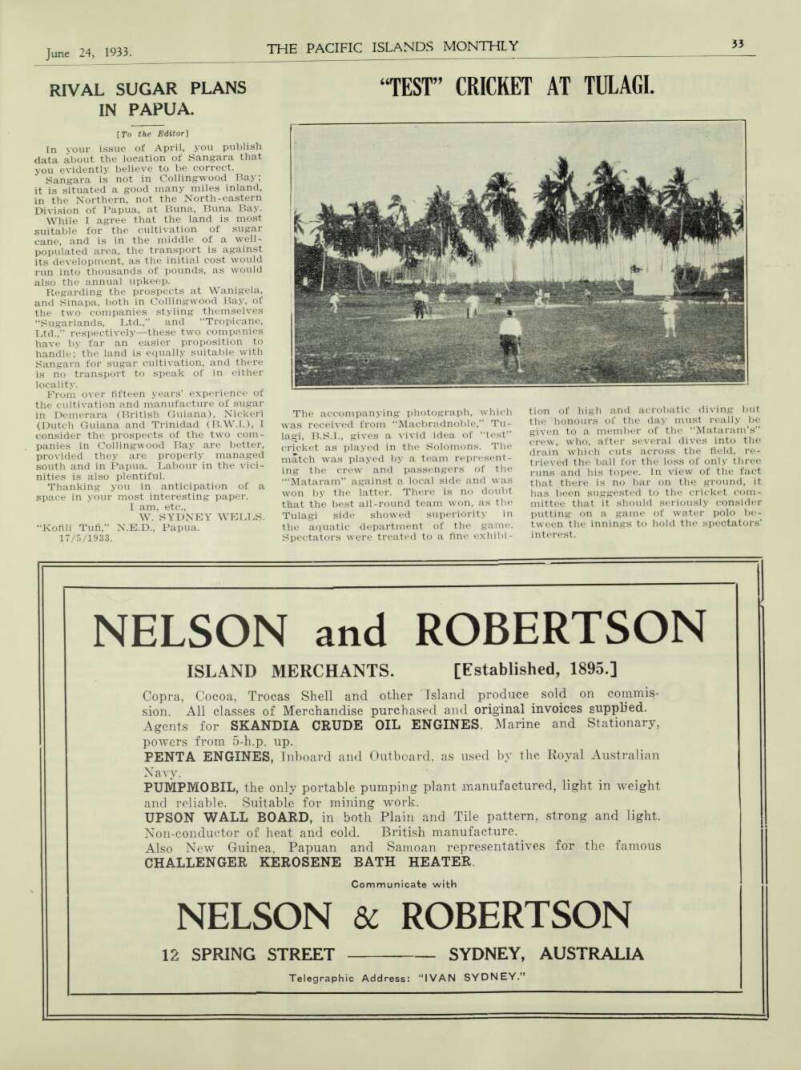
Rival Sugar Plans
[To the Editor ] In your issue of April, you publish data about the location of Sangara that you evidently believe to be correct.
Sangara is not in Collingwood Bay; it is situated a good many miles inland, in the Northern, not the North-eastern Division of Papua, at Buna, Buna Bay.
While I agree that the land is most suitable for the cultivation of sugar cane, and is in the middle of a well populated area, the transport is against its development, as the initial cost would run into thousands of pounds, as would also the annual upkeep.
Regarding the prospects at Wanigela, and Sinapa, both in Collingwood Bay, of the two companies styling themselves “Sugarlands, Ltd.,” and “Tropicane, Ltd.,” respectively—these two companies have by far an easier proposition to handle; the land is equally suitable with Sangara for sugar cultivation, and there is no transport to speak of in either locality.
From over fifteen years’ experience of the cultivation and manufacture of sugar in Demerara (British Guiana), Nickeri (Dutch Guiana and Trinidad (B.W.I.), I consider the prospects of the two com panies in Collingwood Bay are better, provided they are properly managed south and in Papua. Labour in the vici nities is also plentiful.
Thanking you in anticipation of a space in your most interesting paper.
I am, etc.,
W. Sydney Wells.
“Kofili Tufi,” N.E.D., Papua. 17/5/1933.
“Test" Cricket At Tulagi.
The accompanying photograph, which was received from “Macbradnoble,” Tu lagi, B.S.I., gives a vivid idea of “test” cricket as played in the Solomons. The match was played by a team represent ing the crew and passengers of the ‘“Mataram” against a local side and was won by the latter. There is no doubt that the best all-round team won, as the Tulagi side showed superiority in the aquatic department of the game.
Spectators were treated to a fine exhibi
tion of high and acrobatic diving but the honours of the day must really be given to a member of the “Mataram’s” crew, who, after several dives into the drain which cuts across the field, re trieved the ball for the loss of only three runs and his topee. In view of the fact that there is no bar on the ground, it has been suggested to the cricket com mittee that it should seriously consider putting on a game of water polo be tween the innings to hold the spectators’ interest.
Advertisements & other items, p. 35 (1 item)
Nelson And Robertson
ISLAND MERCHANTS. [Established, 1895.]
Copra, Cocoa, Trocas Shell and other Island produce sold on commission. All classes of Merchandise purchased and original invoices supplied.
Agents for SKANDIA CRUDE OIL ENGINES. Marine and Stationary, powers from 5-h.p. up.
PENT A ENGINES, Inboard and Outboard, as used by the Royal Australian Navy.
PUMPMOBIL, the only portable pumping plant manufactured, light in weight and reliable. Suitable for mining work.
UPSON WALL BOARD, in both Plain and Tile pattern, strong and light.
Non-conductor of heat and cold. British manufacture.
Also New Guinea, Papuan and Samoan representatives for the famous
CHALLENGER KEROSENE BATH HEATER.
Communicate with
NELSON & ROBERTSON
12 SPRING STREET SYDNEY, AUSTRALIA
Telegraphic Address: “IVAN SYDNEY.”
Hostility Overcome.
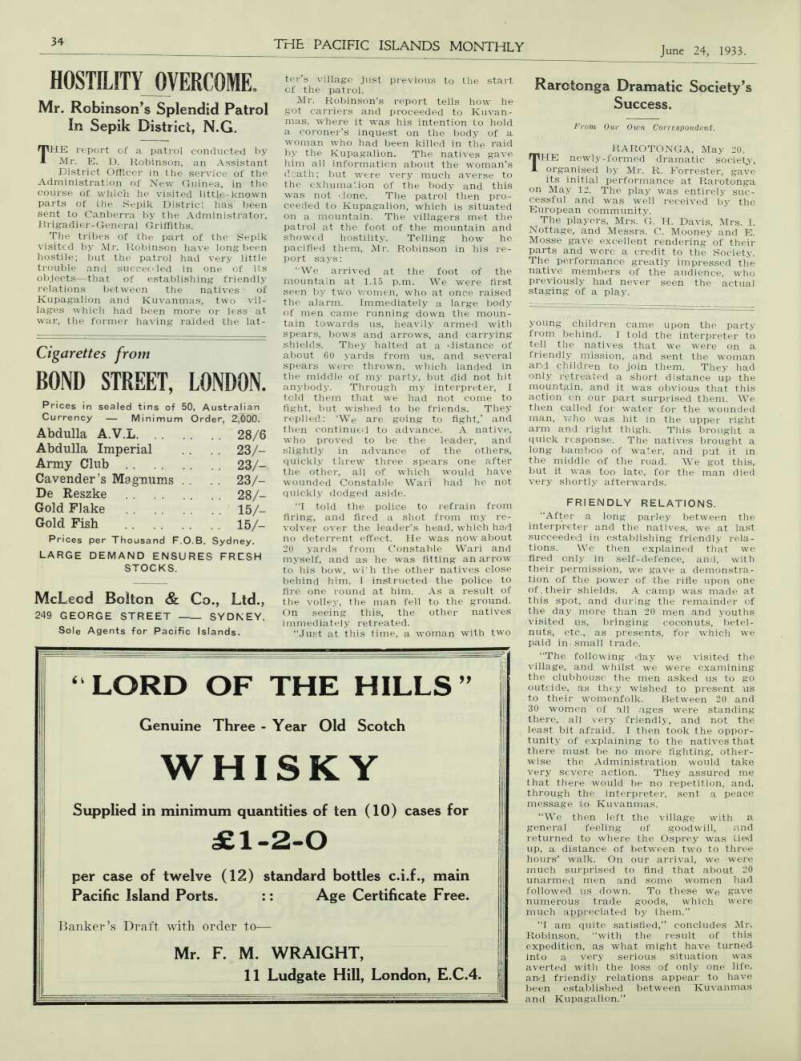
Mr. Robinson’s Splendid Patrol In Sepik District, N.G.
THE report of a patrol conducted by Mr. E. D. Robinson, an Assistant District Officer in the service of the Administration of New Guinea, in the course of which he visited little-known parts of the Sepik District has been sent to Canberra by the Administrator, Brigadier-General Griffiths.
The tribes of the part of the Sepik visited by Mr. Robinson have long been hostile; but the patrol had very little trouble and succeeded in one of its objects—that of establishing friendly relations between the natives of Kupagalion and Kuvanmas, two vil lages which had been more or less at war, the former having raided the lat
ter’s village just previous to the start of the patrol.
Mr. Robinson’s report tells how he got carriers and proceeded to Kuvan mas, where it was his intention to hold a coroner’s inquest on the body of a woman who had been killed in the raid by the Kupagalion. The natives gave him all information about the woman’s death; but were very much averse to the exhumation of the body and this was not done. The patrol then pro ceeded to Kupagalion, which is situated on a mountain. The villagers met the patrol at the foot of the mountain and showed hostility. Telling how he pacified them, Mr. Robinson in his re port says: “We arrived at the foot of the mountain at 1.15 p.m. We were first seen by two women, who at once raised the alarm. Immediately a large body of men came running down the moun tain towards us, heavily armed with spears, bows and arrows, and carrying shields. They halted at a distance of about 60 yards from us, and several spears were thrown, which landed in the middle of my party, but did not hit anybody. Through my interpreter, I told them that we had not come to fight, but wished to be friends. They replied: ‘We are going to fight,’ and then continued to advance. A native, who proved to be the leader, and slightly in advance of the others, quickly threw three spears one after the other, all of which would have wounded Constable Wari had he not quickly dodged aside.
“I told the police to refrain from firing, and fired a shot from my re volver over the leader’s head, which had no deterrent effect. He was now about 20 yards from Constable Wari and myself, and as he was fitting an arrow to his bow, with the other natives close behind him, I instructed the police to fire one round at him. As a result of the volley, the man fell to the ground.
On seeing this, the other natives immediately retreated.
“Just at this time, a woman with two
young children came upon the party from behind. I told the interpreter to tell the natives that we were on a friendly mission, and sent the woman and children to join them. They had only retreated a short distance up the mountain, and it was obvious that this action on our part surprised them. We then called for water for the wounded man, who was hit in the upper right arm and right thigh. This brought a quick response. The natives brought a long bamboo of water, and put it in the middle of the road. We got this, but it was too late, for the man died very shortly afterwards,
Friendly Relations.
“After a long parley between the interpreter and the natives, we at last succeeded in establishing friendly rela tions. We then explained that we fired only in self-defence, and, with their permission, we gave a demonstra tion of the power of the rifle upon one of their shields. A camp was made at this spot, and during the remainder of the day more than 20 men and youths visited us, bringing coconuts, betel nuts, etc., as presents, for which we paid in small trade.
“The following day we visited the village, and whilst we were examining the clubhouse the men asked us to go outside, as they wished to present us to their womenfolk. Between 20 and 30 women of all ages were standing there, all very friendly, and not the least bit afraid. I then took the oppor tunity of explaining to the natives that there must be no more fighting, other wise the Administration would take very severe action. They assured me that there would be no repetition, and, through the interpreter, sent a peace message to Kuvanmas.
“We then left the village with a general feeling of goodwill, and returned to where the Osprey was tied up, a distance of between two to three hours’ walk. On our arrival, we were much surprised to find that about 20 unarmed men and some women had followed us down. To these we gave numerous trade goods, which were much appreciated by them.”
“I am quite satisfied,” concludes Mr.
Robinson, “with the result of this expedition, as what might have turned into a very serious situation was averted with the loss of only one life, and friendly relations appear to have been established between Kuvanmas and Kupagalion.”
Rarotonga Dramatic Society’s
Success.
From Our Own Correspondent.
Rarotonga, May 20.
THE newly-formed dramatic society, organised by Mr. R. Forrester, gave its initial performance at Rarotonga on May 12. The play was entirely suc cessful and was well received by the European community.
The players, Mrs. G. H. Davis, Mrs. I.
Nottage, and Messrs. C. Mooney and E.
Mosse gave excellent rendering of their parts and were a credit to the Society.
The performance greatly impressed the native members of the audience, who previously had never seen the actual staging of a play.
Advertisements & other items, p. 36 (1 item)
Whisky
Cigarettes from
BOND STREET, LONDON.
Prices in sealed tins of 50, Australian Currency Minimum Order, 2,000.
Abdulla A.V.L 28/6 Abdulla Imperial 237- Army Club 23/- Cavender’s Magnums . . 23/- De Reszke 287- Gold Flake 157- Gold Fish 157- Prices per Thousand F.O.B. Sydney.
LARGE DEMAND ENSURES FRESH
STOCKS.
McLeod Bolton & Co., Ltd.,
249 GEORGE STREET SYDNEY.
Sole Agents for Pacific Islands.
“LORD OF THE HILLS”
Genuine Three - Year Old Scotch
WHISKY
Supplied in minimum quantities of ten (10) cases for £1-2-0 per case of twelve (12) standard bottles c.i.f., main Pacific Island Ports. :: Age Certificate Free.
Banker’s Draft with order to —
Mr. F. M. WRAIGHT,
11 Ludgate Hill, London, E.C.4.
Copra Substitutes.
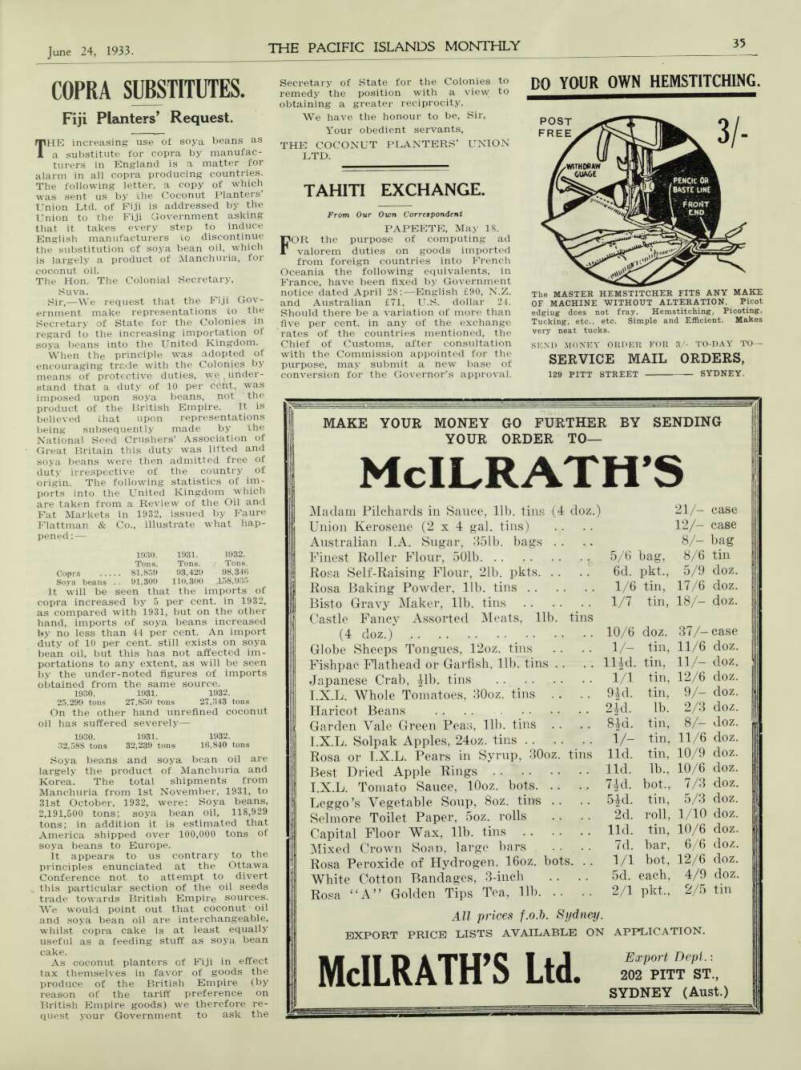
Fiji Planters’ Request.
THE increasing use of soya beans as a substitute for copra by manufac turers in England is a matter for alarm in all copra producing countries.
The following letter, a copy of which was sent us by the Coconut Planters Union Ltd. of Fiji is addressed by the Union to the Fiji Government asking that it takes every step to induce English manufacturers to discontinue the substitution of soya bean oil, which is largely a product of Manchuria, for coconut oil.
The Hon. The Colonial Secretary, Suva.
Sir, —We request that the Fiji Gov ernment make representations to the Secretary of State for the Colonies in regard to the increasing importation of soya beans into the United Kingdom.
When the principle was adopted of encouraging trade with the Colonies by means of protective duties, we under stand that a duty of 10 per cent, was imposed upon soya beans, not the product of the British Empire. It is believed that upon representations being subsequently made by the National Seed Crushers’ Association of Great Britain this duty was lifted and soya beans were then admitted free of duty irrespective of the country of origin. The following statistics of im ports into the United Kingdom which are taken from a Review of the Oil and Fat Markets in 1932, issued by Faure Flattman & Co., illustrate what hap pened:— 1930. 1931. 1932.
Tons. Tons. Tons.
Copra 81,859 93,429 98,340 Soya beans .. 91,309 110,300 .158,935 It will be seen that the imports of copra increased by 5 per cent, in 1932, as compared with 1931, but on the other hand, imports of soya beans increased by no less than 44 per cent. An import duty of 10 per cent, still exists on soya bean oil, but this has not affected im portations to any extent, as will be seen by the under-noted figures of imports obtained from the same source. 1930. 1931. 1932. 25,299 tons 27,850 tons 27,343 tons On the other hand unrefined coconut oil has suffered severely — 1930. 1931. 1932. 32,588 tons 32,239 tons 16,840 tons Soya beans and soya bean oil are largely the product of Manchuria and Korea. The total shipments from Manchuria from Ist November, 1931, to 31st October, 1932, were: Soya beans, 2,191,500 tons; soya bean oil, 118,929 tons; in addition it is estimated that America shipped over 100,000 tons of soya beans to Europe.
It appears to us contrary to the principles enunciated at the Ottawa Conference not to attempt to divert this particular section of the oil seeds trade towards British Empire sources.
We would point out that coconut oil and soya bean oil are interchangeable, whilst copra cake is at least equally useful as a feeding stuff as soya bean cake.
As coconut planters of Fiji in effect tax themselves in favor of goods the produce of the British Empire (by reason of the tariff preference on British Empire goods) we therefore re quest your Government to ask the
Secretary of State for the Colonies to remedy the position with a view to obtaining a greater reciprocity.
We have the honour to be, Sir, Your obedient servants,
The Coconut Planters’ Union
Ltd.
Tahiti Exchange.
From Our Own Correspondent
Papeete, May 18.
FOR the purpose of computing ad valorem duties on goods imported from foreign countries into French Oceania the following equivalents, in France, have been fixed by Government notice dated April 28: —English £90, N.Z. and Australian £71, U.S. dollar 24.
Should there be a variation of more than five per cent, in any of the exchange rates of the countries mentioned, the Chief of Customs, after consultation with the Commission appointed for the purpose, may submit a new base of conversion for the Governor’s approval.
Advertisements & other items, p. 37 (1 item)
Mcilrath’S
DO YOUR OWN HEMSTITCHING.
The MASTER HEMSTITCHER FITS ANY MAKE
OF MACHINE WITHOUT ALTERATION. Picot
edging does not fray. Hemstitching, Picoting, Tucking, etc., etc. Simple and Efficient. Makes very neat tucks.
SEND MONEY ORDER FOR 3/- TO-DAY TO—
SERVICE MAIL ORDERS,
129 PITT STREET
SYDNEY.
MAKE YOUR MONEY GO FURTHER BY SENDING
YOUR ORDER TO
McILRATH’S
tins Madam Pilchards in Sauce, 1lb. tins (4 doz.
Union Kerosene (2x4 gal. tins) Australian I.A. Sugar, 35lb. bags .
Finest Roller Flour, 50lb Rosa Self-Raising Flour, 2lb. pkts. .
Rosa Baking Powder, 1lb. tins . .
Bisto Gravy Maker, 1lb. tins Castle Fancy Assorted Meats, 1lb. (4 doz.) Globe Sheeps Tongues, 12oz. tins Fishpac Flathead or Garfish, 1lb. tins .
Japanese Crab, tins I.X.L. Whole Tomatoes, 30oz. tins Haricot Beans . . . .
Garden Vale Green Peas, 1lb. tins .
I.X.L. Solpak Apples, 24oz. tins . .
Rosa or I.X.L. Pears in Syrup, 30oz Best Dried Apple Rings I.X.L. Tomato Sauce, 10oz. bots. .
Leggo’s Vegetable Soup, 8oz. tins .
Selmore Toilet Paper, 5oz. rolls Capital Floor Wax, 1lb. tins Mixed Crown Soan, large bars Rosa Peroxide of Hydrogen. 16oz. bots.
White Cotton Bandages, 3-inch Rosa “A” Golden Tips Tea, 1lb. ..
All prices f.o.b. Sydney.
EXPORT PRICE LISTS AVAILABLE ON APPLICATION.
McILRATH’S Ltd.
Export Dept. :
202 PITT ST.,
SYDNEY fAust.)
Impressive Tour.
Minister Returns from N.G. and Papua.
THE Minister for Territories, Major the Hon. C. W. C. Marr, struck an optimistic note when interviewed on his return by the “Macdhui” from his tour of the Mandated Territory and Papua.
The administration in Papua, he said, had always been noted for its loyalty and efficiency, and though the country was passing through hard times he looked forward with assur ance to its splendid development, side by side with the advancement of the territories of New Guinea. The Gov ernment’s policy was having a happy effect.
Mr. Marr said he was greatly im pressed with the calibre of the men appointed to the new Legislative Council of New Guinea. They had applied them selves assiduously to the task of self government. He expressed high praise for Guinea Airways, which he regarded as being the finest organisation of its kind in the world. The pilots carried out flights with almost monotonous regularity over country where a slip would spell disaster.
Mr. Marr said the Upper Ramu and Purari districts, the outer fringes of which had only been touched, harboured an estimated population of 200,000, very few of whom had ever been brought into contact with white people. They would require the most careful handling, for should they, owing to any unfortunate act, turn hostile, they would immediately con stitute a most serious menace to the ultimate development of the territory.
At present, they wer e a potential force for either good or evil.
Though his stay in the territories was comparatively short, Mr. Marr covered an enormous amount of
ground and saw all phases of life.
Especially was he interested in the goldfields.
Goldfields Visit.
When last month’s issue of the “Pacific Islands Monthly” went to press, Major Marr was at the gold fields, most of the centres of which were visited by his party. Two ’planes were chartered and took off from Bulowat for a flight to Ramu, where some time was spent. At Bena Bena later in the day, the party was met by Warrant Officer Irvine. Mr. Marr talked with Mr. Nason Jones, a geologist formerly employed in oil searches in the Territory but now pros pecting for gold, who spoke of the 25 prospectors now in the area.
Returning via Ramu, Mr. Marr was greeted by many hundreds who had assembled —armed and dressed for the occasion—at the aerodrome and was welcomed through an interpreter as the “Big Kiap.” The Assistant District Officer, Mr. March, Mr. Morley, Mining Warden, and Mr. and Mrs. Peden were the only Europeans at the post. The party afterwards flew to Lae via Bulo wat and joined the “Macdhui.”
Welcome From Missions.
Enthusiastic welcomes were given the party at Finschafen on May 15, when a landing was made at night. All the Lutheran Mission natives, bearing torches, were assembled near the jetty and a native band played. Mr. and Mrs. Marr were carried shoulder high to the Mission. An equally warm wel come was waiting at Alexishafen the next day. The party was shown over the Mission by Bishop Wolf and saw natives spearing fish and shooting with bows and arrows.
The “Macdhui” berthed at Madang in the evening and Mr. Marr was received by a guard of honour under the famous sergeant Bewa, the companion of the late C. J. Levien on his many patrols in search of “Sharkeye” Park.
Beautiful weather accompanied the party on this part of the tour and the beauty of the journey was greatly admired. Especially did the Minister express delight at the approach to Kavieng which the “Macdhui” reached at midday on May 16. Mr. Marr met informally representatives of re turned soldiers and planters and showed much interest in the native school. After a drive along the east coast road, the party were entertained by the Kavieng Club and later left for Pondo en route to Rabaul.
At Bougainville.
Although he desired to remain in Rabaul to attend to administration busi ness, the requests of Bougainville resi dents were so insistent that Mr. Marr paid a hurried visit to that part of the Territory. He was accompanied by the Administrator, Brigadier-General Grif fiths so that business could be attended to en route. Travelling on the Gov ernment schooner “Poseidon” he called at Sohano Island, where hundreds of Buka Passage natives were waiting.
Mr. Marr presented the luluais with tobacco and the natives manned 15 canoes for a race. A visit was also made to Soraken.
Farewell “Sing Sing."
Meanwhile arrangements for the final festivities of the tour were made at Rabaul and on Mr. Marr’s return 2000 natives assembled at Mount Tomah for a farewell dance. On arrival at the scene of the “sing sing” Mr. Marr saw hundreds of natives while from the bush came weird singing. Suddenly a drum was beaten and hundreds of gaily decorated Tambuans emerged from the bush. With them came a band, singers appeared and the Tambuans danced in perfect time. They were followed by Duk Duks wearing tall head-dress.
Still more drums came, more singers and more dancers, till the large area was full of dancing groups, men and women. An old man, bearded and decorated with a collar of dog’s teeth, directed the proceedings which followed an ordered design, while an “orchestra” of two dozen men beat drums and sang. More and more dancers joined the throng and the Bainings came per forming a snake dance. Though the party were intensely interested, Mr.
Marr had to leave on business before the “sing sing” was concluded.
No Complaints.
A feature of Mr. Marr’s visit to New Guinea was the singular lack of com plaints from residents. On a previous visit to the Territory Mr. Marr received more than 170 deputations. Now the Territory seems to have settled down, though the continued low price of copra has hit many planters.
Pacific Seabirds.
At the Science Congress which is being held at Vancouver, Mr. T. S.
Palmer, of the United States biological survey department, urged greater co operation and extended legislative pro tection for the birds of the Pacific Ocean.
He pointed out that bird knowledge had advanced greatly, but that observers on the Pacific coasts of Canada, United States, Japan and Australia were too few and too widely separated.
Advertisements & other items, p. 38 (1 item)
“First Call”
COFFEE
Roasted and Packed by
A. S. CALLACHOR & SON
TEA, COFFEE, GENERAL MERCHANTS
AND AGENTS,
24 BOND STREET, SYDNEY
Tanna Notes.
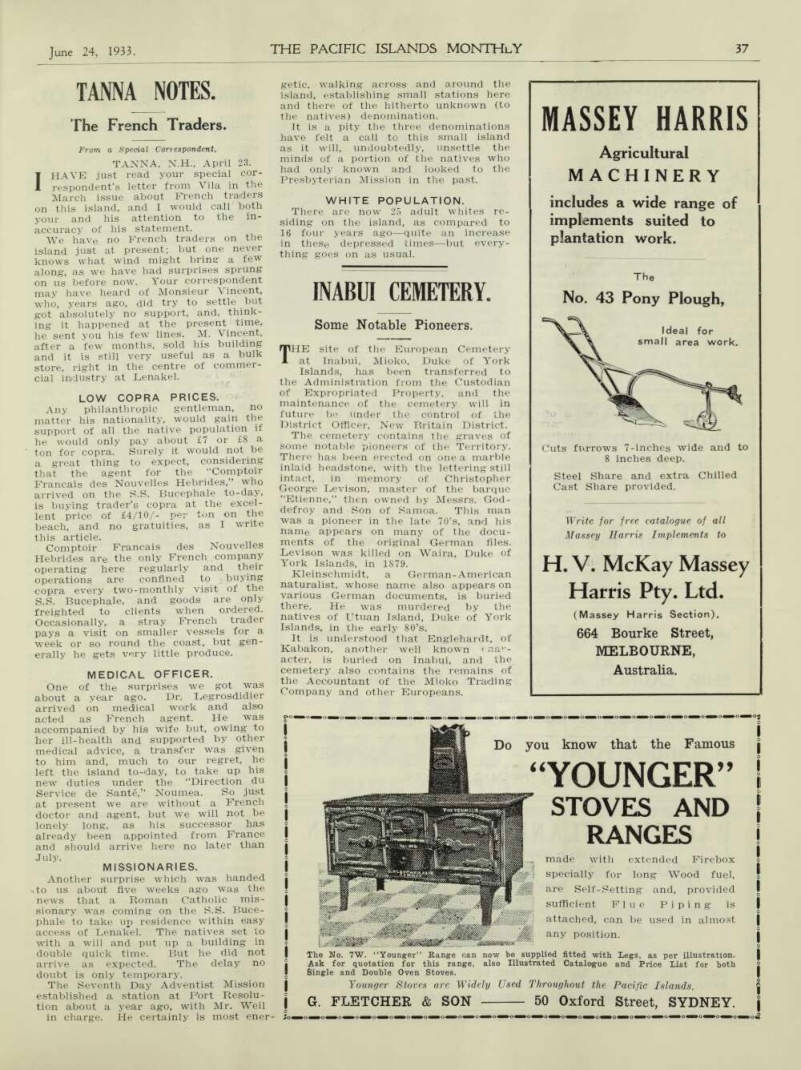
The French Traders.
From a Special Correspondent.
TANNA, N.H., April 23.
I HAVE just read your special cor respondent’s letter from Vila in the March issue about French traders on this island, and I would call both your and his attention to the in accuracy of his statement.
We have no French traders on the island just at present; but one never knows what wind might bring a few along, as we have had surprises sprung on us before now. Your correspondent may have heard of Monsieur Vincent, who, years ago, did try to settle but got absolutely no support, and, think ing it happened at the present time, he sent you his few lines. M. Vincent, after a few months, sold his building and it is still very useful as a bulk store, right in the centre of commer cial industry at Lenakel.
Low Copra Prices.
Any philanthropic gentleman, no matter his nationality, would gain the support of all the native population if he would only pay about £7 or £8 a ton for copra. Surely it would not be a great thing to expect, considering that the agent for the “Comptoir Francais des Nouvelles Hebrides,” who arrived on the S.S. Bucephale to-day, is buying trader’s copra at the excel lent price of £4/10/- per ton on the beach, and no gratuities, as I write this article.
Comptoir Francais des Nouvelles Hebrides ar e the only French company operating here regularly and their operations are confined to buying copra every two-monthly visit of the S.S. Bucephale, and goods are only freighted to clients when ordered.
Occasionally, a stray French trader pays a visit on smaller vessels for a week or so round the coast, but gen erally he gets very little produce.
Medical Officer.
One of the surprises we got was about a year ago. Dr. Legrosdidier arrived on medical work and also acted as French agent. He was accompanied by his wife but, owing to her ill-health and supported by other medical advice, a transfer was given to him and, much to our regret, he left the island to-day, to take up his new duties under the ‘‘Direction du Service de Sante,’’ Noumea. So just at present we are without a French doctor and agent, but we will not be lonely long, as his successor has already been appointed from France and should arrive here no later than July.
Missionaries.
Another surprise which was handed to us about five weeks ago was the news that a Roman Catholic mis sionary was coming on the S.S. Buce phale to take up residence within easy access of Lenakel. The natives set to with a will and put up a building in double quick time. But he did not arrive as expected. The delay no doubt is only temporary.
The Seventh Day Adventist Mission established a station at Port Resolu tion about a year ago, with Mr. Weil in charge. He certainly is most ener
getic, walking across and around the island, establishing small stations here and there of the hitherto unknown (to the natives) denomination.
It is a pity the three denominations have felt a call to this small island as it will, undoubtedly, unsettle the minds of a portion of the natives who had only known and looked to the Presbyterian Mission in the past.
White Population.
There are now 25 adult whites re siding on the island, as compared to 16 four years ago—quite an increase in these depressed times—but every thing goes on as usual.
Inabui Cemetery.
Some Notable Pioneers.
THE site of the European Cemetery at Inabui, Mioko, Duke of York Islands, has been transferred to the Administration from the Custodian of Expropriated Property, and the maintenance of the cemetery will in future be under the control of the District Officer, New Britain District.
The cemetery contains the graves of some notable pioneers of the Territory.
There has been erected on one a marble inlaid headstone, with the lettering still intact, in memory of Christopher George Levison, master of the barque “Etienne,” then owned by Messrs. God defroy and Son of Samoa. This man was a pioneer in the late 70's, and his name appears on many of the docu ments of the original German files.
Levison was killed on Waira, Duke of York Islands, in 1879.
Kleinschmidt, a German-American naturalist, whose name also appears on various German documents, is buried there. He was murdered by the natives of Utuan Island, Duke of York Islands, in the early 80’s.
It is understood that Englehardt, of Kabakon, another well known char acter, is buried on Inabui, and the cemetery also contains the remains of the Accountant of the Mioko Trading Company and other Europeans.
Advertisements & other items, p. 39 (1 item)
“Younger”
MASSEY HARRIS
Agricultural
MACHINERY
includes a wide range of implements suited to
plantation work.
The
No. 43 Pony Plough,
Ideal for small area work.
Cuts furrows 7-inches wide and to 8 inches deep.
Steel Share and extra Chilled Cast Share provided.
Write for free catalogue of all Massey Harris Implements to
H. V. McKay Massey
Harris Pty. Ltd.
(Massey Harris Section). 664 Bourke Street,
MELBOURNE,
Australia.
Do you know that the Famous
“YOUNGER”
STOVES AND
RANGES
made with extended Firebox specially for long Wood fuel, are Self-Setting and, provided sufficient Flue Piping is attached, can be used in almost any position.
The No. 7W. “Younger” Range can now be supplied fitted with Legs, as per illustration.
Ask for quotation for this range, also Illustrated Catalogue and Price List for both Single and Double Oven Stoves.
Younger Stoves are Widely Used Throughout the Pacific Islands.
G. FLETCHER & SON 50 Oxford Street, SYDNEY.
Tanna Volcano.
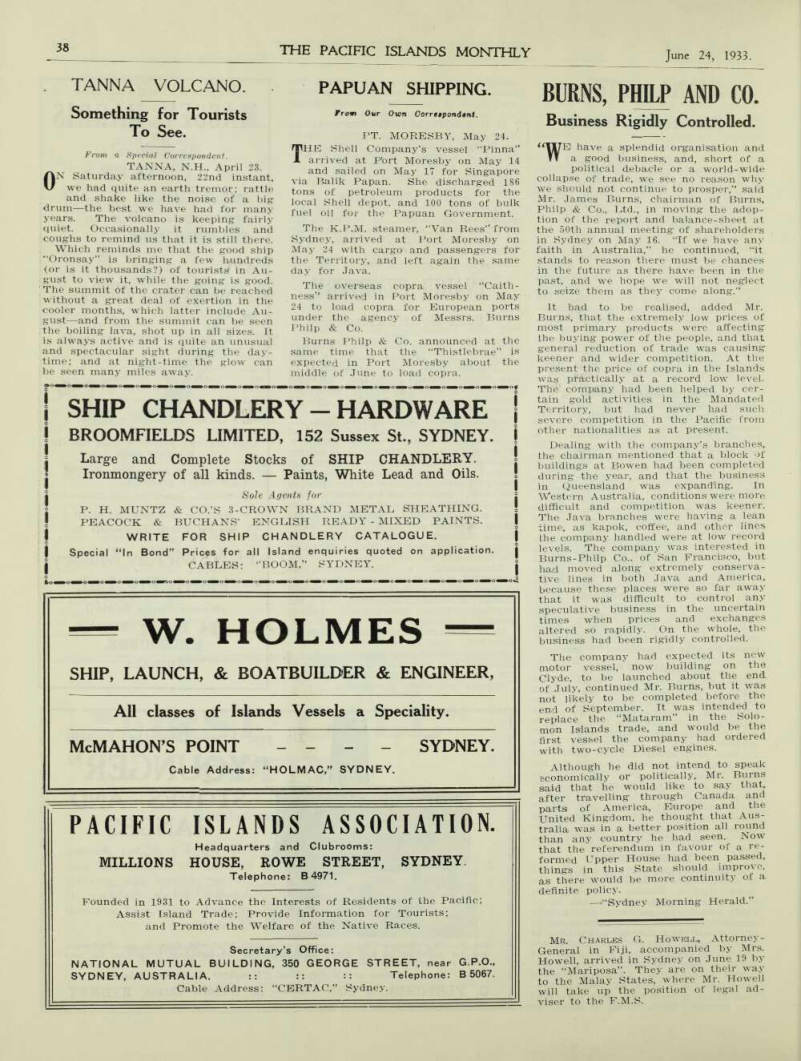
Something for Tourists To See.
From a Special Correspondent.
TANNA, N.H., April 23.
ON Saturday afternoon, 22nd instant, we had quite an earth tremor; rattle and shake like the noise of a big drum —the best we have had for many years. The volcano is keeping fairly quiet. Occasionally it rumbles and coughs to remind us that it is still there.
Which reminds me that the good ship “Oronsay” is bringing a few hundreds (or is it thousands?) of tourists in Au gust to view it, while the going is good.
The summit of the crater can be reached without a great deal of exertion in the cooler months, which latter include Au gust—and from the summit can be seen the boiling lava, shot up in all sizes. It is always active and is quite an unusual and spectacular sight during the day time; and at night-time the glow can be seen many miles away.
Papuan Shipping.
From Our Own Correspondent.
Pt. Moresby, May 24.
THE Shell Company’s vessel “Pinna” arrived at Port Moresby on May 14 and sailed on May 17 for Singapore via Balik Papan. She discharged 186 tons of petroleum products for the local Shell depot, and 100 tons of bulk fuel oil for the Papuan Government.
The K.P.M. steamer, “Van Rees” from Sydney, arrived at Port Moresby on May 24 with cargo and passengers for the Territory, and left again the same day for Java.
The overseas copra vessel “Caith ness” arrived in Port Moresby on May 24 to load copra for European ports under the agency of Messrs, Burns Philp & Co.
Burns Philp & Co. announced at the same time that the “Thistlebrae” is expected in Port Moresby about the middle of June to load copra.
Burns, Philp And Co.
Business Rigidly Controlled.
“WE' have a splendid organisation and a good business, and, short of a political debacle or a world-wide collapse of trade, we see no reason why we should not continue to prosper,” said Mr. James Burns, chairman of Burns, Philp & Co., Ltd., in moving the adop tion of the report and balance-sheet at the 50th annual meeting of shareholders in Sydney on May 16. “If we have any faith in Australia,” he continued, “it stands to reason there must be chances in the future as there have been in the past, and we hope we will not neglect to seize them as they come along.”
It had to be realised, added Mr.
Burns, that the extremely low prices of most primary products were affecting the buying power of the people, and that general reduction of trade was causing keener and wider competition. At the present the price of copra in the Islands was poetically at a record low level.
The company had been helped by cer tain gold activities in the Mandated Territory, but had never had such severe competition in the Pacific from other nationalities as at present.
Dealing with the company’s branches, the chairman mentioned that a block of buildings at Bowen had been completed during the year, and that the business in Queensland was expanding. In Western Australia, conditions were more difficult and competition was keener.
The Java branches were having a lean time, as kapok, coffee, and other lines the company handled were at low record levels. The company was interested in Burns-Philp Co., of San Francisco, but had moved along extremely conserva tive lines in both Java and America, because these places were so far away that it was difficult to control any speculative business in the uncertain times when prices and exchanges altered so rapidly. On the whole, the business had been rigidly controlled.
The company had expected its new motor vessel, now building on the Clyde, to be launched about the end of July, continued Mr. Burns, but it was not likely to be completed before the end of September. It was intended to replace the “Mataram” in the Solo mon Islands trade, and would be the first vessel the company had ordered with two-cycle Diesel engines.
Although he did not intend to speak economically or politically, Mr. Burns said that he would like to say that, after travelling through Canada and parts of America, Europe and the United Kingdom, he thought that Aus tralia was in a better position all round than any country he had seen. Now that the referendum in favour of a re formed Upper House had been passed, things in this State should improve, as there would be more continuity of a definite policy. —'“Sydney Morning Herald.”
Mr. Charles G. Howell, Attorney- General in Fiji, accompanied by Mrs.
Howell, arrived in Sydney on June 19 by the “Mariposa”. They are on their way to the Malay States, where Mr. Howell will take up the position of legal ad viser to the F.M.S.
Advertisements & other items, p. 40 (1 item)
W. Holmes
SHIP CHANDLERY - HARDWARE
BROOMFIELDS LIMITED, 152 Sussex St., SYDNEY.
Large and Complete Stocks of SHIP CHANDLERY.
Ironmongery of all kinds. Paints, White Lead and Oils.
Sole Agents for P. H. MUNTZ & CO.’S 3-CROWN BRAND METAL SHEATHING.
PEACOCK & BUCHANS’ ENGLISH READY - MIXED PAINTS.
WRITE FOR SHIP CHANDLERY CATALOGUE.
Special “In Bond” Prices for ail Island enquiries quoted on application.
CABLES: “BOOM,” SYDNEY.
W. HOLMES
SHIP, LAUNCH, & BOATBUILDER & ENGINEER,
All classes of Islands Vessels a Speciality.
McMAHON’S POINT - - - - SYDNEY.
Cable Address; “HOLMAC,” SYDNEY.
PACIFIC ISLANDS ASSOCIATION.
Headquarters and Clubrooms:
MILLIONS HOUSE, ROWE STREET, SYDNEY
Telephone: 84971.
Founded in 1931 to Advance the Interests of Residents of the Pacific; Assist Island Trade; Provide Information for Tourists; and Promote the Welfare of the Native Races.
Secretary’s Office: NATIONAL MUTUAL BUILDING, 350 GEORGE STREET, near G.P.O., SYDNEY, AUSTRALIA. :: :: :: Telephone: B 5067.
Cable Address: “CERTAC,” Sydney.
Champion Diver’S End.
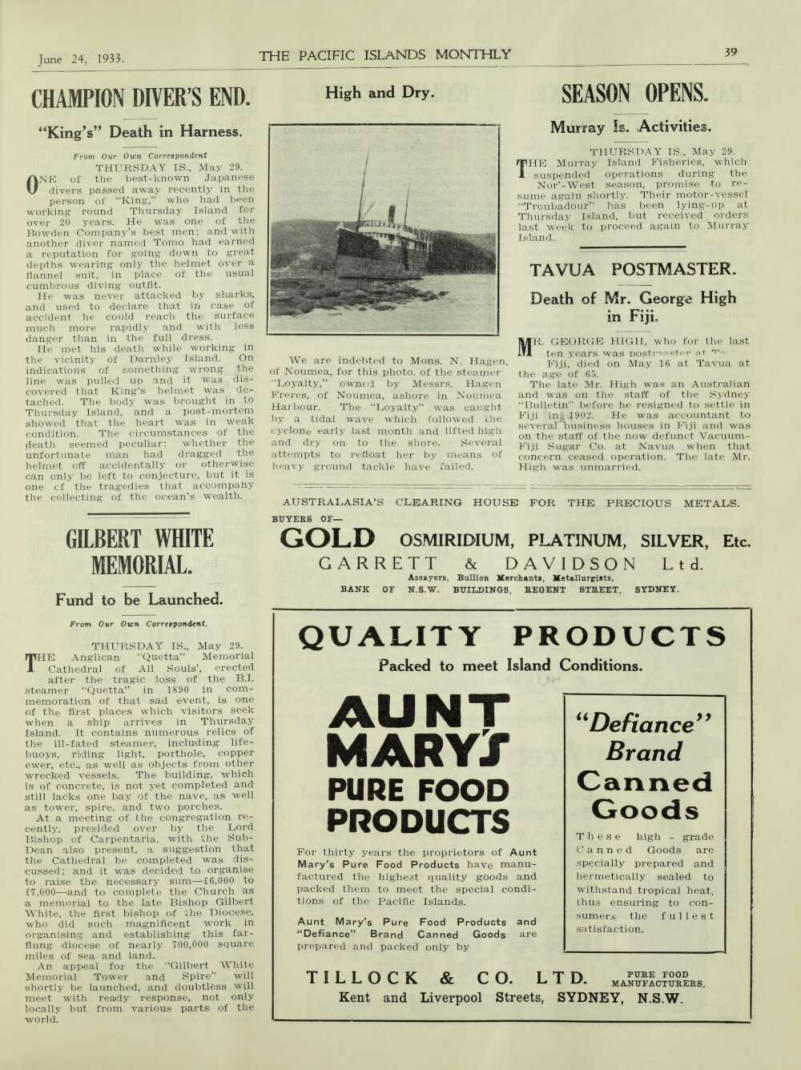
“King’s” Death in Harness.
From Our Own Correspondent
Thursday Is., May 29.
ONE of the best-known Japanese divers passed away recently in the person of “King,” who had been working round Thursday Island for over 20 years. He was one of the Bowden Company’s best men; and with another diver named Tomo had earned a reputation for going down to great depths wearing only the helmet over a flannel suit, in place of the usual cumbrous diving outfit.
He was never attacked by sharks, and used to declare that in case of accident he could reach the surface much more rapidly and with less danger than in the full dress.
He met his death while working in the vicinity of Darnley Island. On indications of something wrong the line was pulled up and it was dis covered that King’s helmet was de tached. The body was brought in to Thursday Island, and a post-mortem showed that the heart was in weak condition. The circumstances of the death seemed peculiar: whether the unfortunate man had dragged the helmet off accidentally or otherwise can only be left to conjecture, but it is one of the tragedies that accompany the collecting of the ocean’s wealth.
We are indebted to Mons. N. Hagen, of Noumea, for this photo, of the steamer “Loyalty,” owned by Messrs. Hagen Freres, of Noumea, ashore in Noumea Harbour. The “Loyalty” was caught by a tidal wave which followed the cyclone early last month and lifted high and dry on to the shore. Several attempts to refloat her by means of heavy ground tackle have failed.
High and Dry.
Gilbert White
Memorial.
Fund to be Launched.
From Our Oxen Correspondent.
Thursday Is., May 29.
THE Anglican “Quetta” Memorial Cathedral of All Souls’, erected after the tragic loss of the B.I. steamer “Quetta” in 1890 in com memoration of that sad event, is one of the first places which visitors seek when a ship arrives in Thursday Island. It contains numerous relics of the ill-fated steamer, including life buoys, riding light, porthole, copper ewer, etc., as well as objects from other wrecked vessels. The building, which is of concrete, is not yet completed and still lacks one bay of the nave, as well as tower, spire, and two porches.
At a meeting of the congregation re cently, presided over by the Lord Bishop of Carpentaria, with the Sub- Dean also present, a suggestion that the Cathedral be completed was dis cussed; and it was decided to organise to raise the necessary sum —£6,000 to £7,000 —and to complete the Church as a memorial to the late Bishop Gilbert White, the first bishop of the Diocese, who did such magnificent work in organising and establishing this far flung diocese of nearly 700,000 square miles of sea and land.
An appeal for the “Gilbert White Memorial Tower and Spire” will shortly be launched, and doubtless will meet with ready response, not only locally but from various parts of the world.
Season Opens.
Murray Is. Activities.
Thursday Is., May 29.
THE Murray Island Fisheries, which suspended operations during the Nor’-West season, promise to re sume again shortly. Their motor-vessel “Troubadour” has been lying-up at Thursday Island, but received orders last week to proceed again to Murray Island.
in Fiji.
Tavua Postmaster.
Death of Mr. George High in Fiji.
MR. GEORGE HIGH, who for the last ten years was pf Fiji, died on May 16 at Tavua at the age of 65.
The late Mr. High was an Australian and was on the staff of the Sydney “Bulletin” before he resigned to settle in Fiji in 1902. He was accountant to several business houses in Fiji and was on the staff of the now defunct Vacuum- Fiji Sugar Co. at Navua when that concern ceased operation. The late Mr.
High was unmarried.
Advertisements & other items, p. 41 (1 item)
Aunt
AUSTRALASIA’S CLEARING HOUSE FOR THE PRECIOUS METALS.
BUYERS OF—
GOLD OSMIRIDIUM, PLATINUM, SILVER, Etc.
GARRETT & DAVIDSON Ltd.
Assayers, Bullion Merchants, Metallurgists, BANK OF N.S.W. BUILDINGS, REGENT STREET, SYDNEY.
QUALITY PRODUCTS
Packed to meet Island Conditions.
AUNT
MARY'S
PURE FOOD
PRODUCTS
For thirty years the proprietors of Aunt Mary’s Pure Food Products have manu factured the highest quality goods and packed them to meet the special condi tions of the Pacific Islands.
Aunt Mary’s Pure Food Products and “Defiance” Brand Canned Goods are prepared and packed only by
“Defiance”
Brand
Canned
Goods
These high-grade Canned Goods are specially prepared and hermetically sealed to withstand tropical heat, thus ensuring to consumers the fullest satisfaction.
TILLOCK & CO.
LTD.
PURE FOOD
MANUFACTURERS,
Kent and Liverpool Streets, SYDNEY, N.S.W.
Papuan’S Endurance.
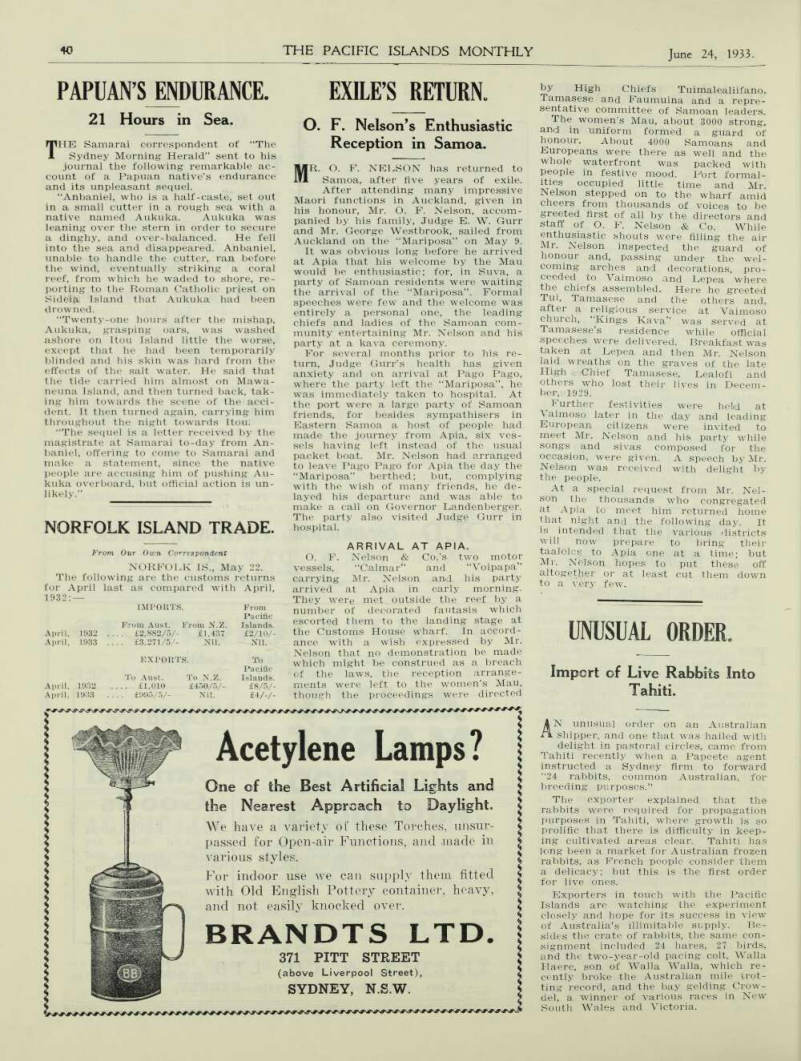
21 Hours in Sea.
THE Samarai correspondent of “The Sydney Morning Herald” sent to his journal the following remarkable ac count of a Papuan native’s endurance and its unpleasant sequel.
“Anbaniel, who is a half-caste, set out in a small cutter in a rough sea with a native named Aukuka. Aukuka was leaning over the stern in order to secure a dinghy, and over-balanced. He fell into the sea and disappeared. Anbaniel, unable to handle the cutter, ran before the wind, eventually striking a coral reef, from which he waded to shore, re porting to the Roman Catholic priest on Sideia Island that Aukuka had been drowned.
“Twenty-one hours after the mishap, Aukuka, grasping oars, was washed ashore on Itou Island little the worse, except that he had been temporarily blinded and his skin was hard from the effects of the salt water. He said that the tide carried him almost on Mawa neuna Island, and then turned back, tak ing him towards the scene of the acci dent. It then turned again, carrying him throughout the night towards Itou.
“The sequel is a letter received by the magistrate at Samarai to-day from An baniel, offering to come to Samarai and make a statement, since the native people are accusing him of pushing Au kuka overboard, but official action is un likely.”
Norfolk Island Trade.
From Our Own Correspondent
Norfolk Is., May 22.
The following are the customs returns for April last as compared with April, 1932:
Imports.
From Pacific Islands.
From Aust. From N.Z.
April, 1932 . ... £2,882/5/- £1,437 £2/10/- April, 1933 . .. . £3,271/5/- Nil.
Nil.
Exports.
To Pacific Islands.
To Aust. To N.Z.
April. 1932 £1,010 £450/5/- £8/5/- April, 1933 . . .. £995/5/- Nil. £4/-/-
Exile’S Return.
O. F. Nelson’s Enthusiastic Reception in Samoa.
MR. O. F. NELSON has returned to Samoa, after five years of exile.
After attending many impressive Maori functions in Auckland, given in his honour, Mr. O. F. Nelson, accom panied by his family, Judge E. W. Gurr and Mr. George Westbrook, sailed from Auckland on the “Mariposa” on May 9.
It was obvious long before he arrived at Apia that his welcome by the Mau would be enthusiastic; for, in Suva, a party of Samoan residents were waiting the arrival of the “Mariposa”. Formal speeches were few and the welcome was entirely a personal one, the leading chiefs and ladies of the Samoan com munity entertaining Mr. Nelson and his party at a kava ceremony.
For several months prior to his re turn, Judge Gurr’s health has given anxiety and on arrival at Pago Pago, where the party left the “Mariposa”, he was immediately taken to hospital. At the port were a large party of Samoan friends, for besides sympathisers in Eastern Samoa a host of people had made the journey from Apia, six ves sels having left instead of the usual packet boat. Mr. Nelson had arranged to leave Pago Pago for Apia the day the “Mariposa” berthed; but, complying with the wish of many friends, he de layed his departure and was able to make a call on Governor Landenberger.
The party also visited Judge Gurr in hospital,
Arrival At Apia.
O. F. Nelson & Co.’s two motor vessels, “Calmar” and “Voipapa” carrying Mr. Nelson and his party arrived at Apia in early morning.
They were met outside the reef by a number of decorated fautasis which escorted them to the landing stage at the Customs House wharf. In accord ance with a wish expressed by Mr.
Nelson that no demonstration be made which might be construed as a breach of the laws, the reception arrange ments were left to the women’s Mau, though the proceedings were directed
by High Chiefs Tuimalealiifano, Tamasese and Faumuina and a repre sentative committee of Samoan leaders.
The women's Mau, about 3000 strong, and in uniform formed a guard of honour. About 4000 Samoans and Europeans were there as well and the whole waterfront was packed with people in festive mood. Port formal ities occupied little time and Mr.
Nelson stepped on to the wharf amid cheers from thousands of voices to be greeted first of all by the directors and staff of O. F. Nelson & Co. While enthusiastic shouts were filling the air Mr. Nelson inspected the guard of honour and, passing under the wel coming arches and decorations, pro ceeded to Vaimoso and Lepea where the chiefs assembled. Here he greeted Tui, Tamasese and the others and, after a religious service at Vaimoso church, “Kings Kava” was served at Tamasese’s residence while official speeches were delivered. Breakfast was taken at Lepea and then Mr. Nelson laid wreaths on the graves of the late High Chief Tamasese, Lealofi and others who lost their lives in Decem ber, 1929.
Further festivities were held at Vaimoso later in the day and leading European citizens were invited to meet Mr. Nelson and his party while songs and sivas composed for the occasion, were given. A speech by Mr.
Nelson was received with delight by the people.
At a special request from Mr. Nel son the thousands who congregated at Apia to meet him returned home that night and the following day. It is intended that the various districts will now prepare to bring their taalolcs to Apia one at a time; but Mr. Nelson hopes to put these off altogether or at least cut them down to a very few.
Unusual Order.
Import of Live Rabbits Into Tahiti.
AN unusual order on an Australian shipper, and one that was hailed with delight in pastoral circles, came from Tahiti recently when a Papeete agent instructed a Sydney firm to forward “24 rabbits, common Australian, for breeding purposes.”
The exporter explained that the rabbits were required for propagation purposes in Tahiti, where growth is so prolific that there is difficulty in keep ing cultivated areas clear. Tahiti has long been a market for Australian frozen rabbits, as French people consider them a delicacy; but this is the first order for live ones.
Exporters in touch with the Pacific Islands are watching the experiment closely and hope for its success in view of Australia’s illimitable supply. Be sides the crate of rabbits, the same con signment included 24 hares, 27 birds, and the two-year-old pacing-colt, Walla Haere, son of Walla Walla, which re cently broke the Australian mile trot ting record, and the bay gelding Crow del, a winner of various races in New South Wales and Victoria.
Advertisements & other items, p. 42 (1 item)
Acetylene Lamps?
One of the Best Artificial Lights and the Nearest Approach to Daylight, We have a variety of these Torches, unsur passed for Open-air Functions, and made in various styles.
For indoor use we can supply them fitted with Old English Pottery container, heavy, and not easily knocked over.
BRANDTS LTD.
371 PITT STREET
(above Liverpool Street),
SYDNEY, N.S.W.
Mystery Ships.
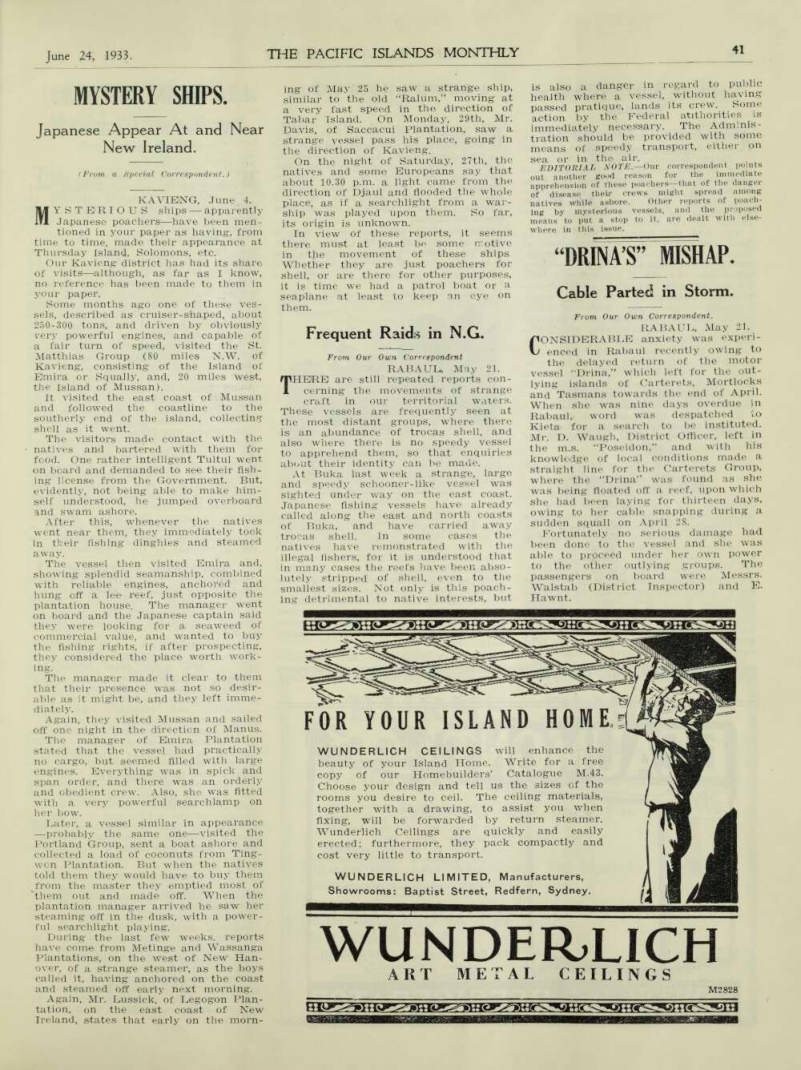
Japanese Appear At and Near New Ireland.
(From a Special Correspondent.)
Kavieng, June 4.
Mysterious ships apparently Japanese poachers—have been men tioned in your paper as having, from time to time, made their appearance at Thursday Island, Solomons, etc.
Our Kavieng district has had its share of visits—although, as far as I know, no reference has been made to them in your paper.
Some months ago one of these ves sels, described as cruiser-shaped, about 250-300 tons, and driven by obviously very powerful engines, and capable of a fair turn of speed, visited the St.
Matthias Group (80 miles N.W. of Kavieng, consisting of the Island of Emira or Squally, and, 20 miles west, the Island of Mussan).
It visited the east coast of Mussan and followed the coastline to the southerly end of the island, collecting shell as it went.
The visitors made contact with the natives and bartered with them for food. One rather intelligent Tultul went on board and demanded to see their fish ing license from the Government. But, evidently, not being able to make him self understood, he jumped overboard and swam ashore.
After this, whenever the natives went near them, they immediately took in their fishing dinghies and steamed away.
The vessel then visited Emira and, showing splendid seamanship, combined with reliable engines, anchored and hung off a lee reef, just opposite the plantation house. The manager went on board and the Japanese captain said they were looking for a seaweed of commercial value, and wanted to buy the fishing rights, if after prospecting, they considered the place worth work ing.
The manager made it clear to them that their presence was not so desir able as it might be, and they left imme diately.
Again, they visited Mussan and sailed off one night in the direction of Manus.
The manager of Emira Plantation stated that the vessel had practically no cargo, but seemed filled with large engines. Everything was in spick and span order, and there was an orderly and obedient crew. Also, she was fitted with a very powerful searchlamp on her bow.
Later, a vessel similar in appearance —probably the same one—visited the Portland Group, sent a boat ashore and collected a load of coconuts from Ting won Plantation. But when the natives told them they would have to buy them from the master they emptied most of them out and made off. When the plantation manager arrived he saw her steaming off in the dusk, with a power ful searchlight playing.
During the last few weeks, reports have come from Metinge and Wassanga Plantations, on the west of New Han over, of a strange steamer, as the boys called it, having anchored on the coast and steamed off early next morning.
Again, Mr. Lussick, of Legogon Plan tation, on the east coast of New Ireland, states that early on the morn
ing of May 25 he saw a strange ship, similar to the old "Ralum,” moving at a very fast speed in the direction of Tabar Island. On Monday, 29th, Mr.
Davis, of Saccacui Plantation, saw a strange vessel pass his place, going in the direction of Kavieng.
On the night of Saturday, 27th, the natives and some Europeans say that about 10.30 p.m. a light came from the direction of Djaul and flooded the whole place, as if a searchlight from a war ship was played upon them. So far, its origin is unknown.
In view of these reports, it seems there must at least be some motive in the movement of these ships Whether they are just poachers for shell, or are there for other purposes, it is time we had a patrol boat or a seaplane at least to keep an eye on them.
Frequent Raids in N.G.
From Our Own Correspondent
Rabaul, May 21.
THERE are still repeated reports con cerning the movements of strange craft in our territorial waters.
These vessels are frequently seen at the most distant groups, where there is an abundance of trocas shell, and also where there is no speedy vessel to apprehend them, so that enquiries about their identity can be made.
At Buka last week a strange, large and speedy schooner-like vessel was sighted under way on the east coast.
Japanese Ashing vessels have already called along the east and north coasts of Buka, and have carried away trocas shell. In some cases the natives have remonstrated with the illegal fishers, for it is understood that in many cases the reefs have been abso lutely stripped of shell, even to the smallest sizes. Not only is this poach ing detrimental to native interests, but
is also a danger in regard to public health where a vessel, without having passed pratique, lands its crew. Some action by the Federal authorities is immediately necessary. The Adminis tration should be provided with some means of speedy transport, either on sea or in the air.
EDITORIAL NOTE. —Our correspondent points out another good reason for the immediate apprehension of these poachers —that of the danger of disease their crews might spread among natives while ashore. Other reports of poach ing by mysterious vessels, and the proposed means to put a stop to it, are dealt with else where in this issue.
“Drina’S” Mishap.
Cable Parted in Storm.
From Our Own Correspondent.
Rabaul, May 21.
CONSIDERABLE anxiety was experi enced in Rabaul recently owing to the delayed return of the motor vessel “Drina,” which left for the out lying islands of Carterets, Mortlocks and Tasmans towards the end of April.
When she was nine days overdue in Rabaul, word was despatched to Kieta for a search to be instituted.
Mr. D. Waugh, District Officer, left in the m.s. "Poseidon,” and with his knowledge of local conditions made a straight line for the Carterets Group, where the "Drina” was found as she was being floated off a reef, upon which she had been laying for thirteen days, owing to her cable snapping during a sudden squall on April 28.
Fortunately no serious damage had been done to the vessel and she was able to proceed under her own power to the other outlying groups. The passengers on board were Messrs.
Walstab (District Inspector) and E.
Hawnt.
Advertisements & other items, p. 43 (1 item)
Wundefulich
FOR YOUR ISLAND HOME.
WUNDERLICH CEILINGS will enhance the beauty of your Island Home. Write for a free copy of our Homebuilders’ Catalogue M. 43.
Choose your design and tell us the sizes of the rooms you desire to ceil. The ceiling materials, together with a drawing, to assist you when fixing, will be forwarded by return steamer.
Wunderlich Ceilings are quickly and easily erected; furthermore, they pack compactly and cost very little to transport.
WUNDERLICH LIMITED, Manufacturers, Showrooms: Baptist Street, Redfern, Sydney.
WUNDEFULICH
ART METAL CEILINGS
M 2828
Noumea.
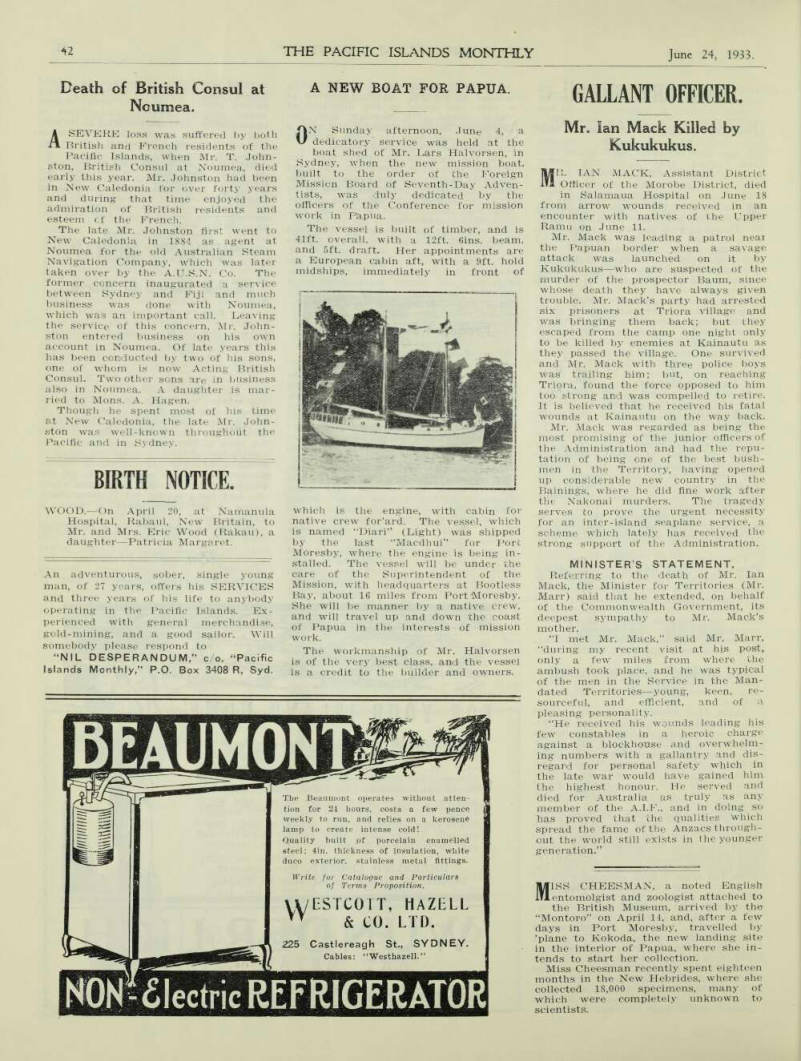
Death of British Consul at Noumea.
A SEVERE loss was suffered by both British and French residents of the Pacific Islands, when Mr. T. John ston, British Consul at Noumea, died early this year. Mr, Johnston had been in New Caledonia for over forty years and during that time enjoyed the admiration of British residents and esteem cf the French.
The late Mr. Johnston first went to New Caledonia in 1884 as agent at Noumea for the old Australian Steam Navigation Company, which was later taken over by the A.U.S.N. Co. The former concern inaugurated a service between Sydney and Fiji and much business was done with Noumea, which was an important call. Leaving the service of this concern, Mr. John ston entered business on his own account in Noumea. Of late years this has been conducted by two of his sons, one of whom is now Acting British Consul. Two other sons are in business also in Noumea. A daughter is mar ried to Mons. A. Hagen.
Though he spent most of his time at New Caledonia, the late Mr. John ston was well-known throughout the Pacific and in Sydney.
Advertisements & other items, p. 44 (1 item)
Birth Notice.
WOOD. — : On April 20, at Namanula Hospital, Rabaul, New Britain, to Mr. and Mrs. Eric Wood (Rakau), a daughter—Patricia Margaret.
A New Boat For Papua.
ON Sunday afternoon, June 4, a dedicatory service was held at the boat shed of Mr. Lars Halvorsen, in Sydney, when the new mission boat, built to the order of the Foreign Mission Board of Seventh-Day Adven tists, was duly dedicated by the officers of the Conference for mission work in Papua.
The vessel is built of timber, and is 41ft. overall, with a 12ft. 6ins. beam, and 5ft. draft. Her appointments are a European cabin aft, with a 9ft. hold midships, immediately in front of
which is the engine, with cabin for native crew for’ard. The vessel, which is named “Diari” (Light) was shipped by the last “Macdhui” for Port Moresby, where the engine is being in stalled. The vessel will be under the care of the Superintendent of the Mission, with headquarters at Bootless Bay, about 16 miles from Port Moresby.
She will be manner by a native crew, and will travel up and down the coast of Papua in the interests of mission work.
The workmanship of Mr. Halvorsen is of the very best class, and the vessel is a credit to the builder and owners.
Gallant Officer.
Mr. Ian Mack Killed by Kukukukus.
MR. IAN MACK, Assistant District Officer of the Morobe District, died in Salamaua Hospital on June 18 from arrow wounds received in an encounter with natives of the Upper Ramu on June 11.
Mr. Mack was leading a patrol near the Papuan border when a savage attack was launched on it by Kukukukus —who are suspected of the murder of the prospector Baum, since whose death they have always given trouble. Mr. Mack’s party had arrested six prisoners at Triora village and was bringing them back; but they escaped from the camp one night only to be killed by enemies at Kainautu as they passed the village. One survived and Mr. Mack with three police boys was trailing him; but, on reaching Triora, found the force opposed to him too strong and was compelled to retire.
It is believed that he received his fatal wounds at Kainautu on the way back.
Mr. Mack was regarded as being the most promising of the junior officers of the Administration and had the repu tation of being one of the best bush men in the Territory, having opened up considerable new country in the Bainings, where he did fine work after the Nakonai murders. The tragedy serves to prove the urgent necessity for an inter-island seaplane service, a scheme which lately has received the strong support of the Administration.
Ministers Statement.
Referring to the death of Mr. Ian Mack, the Minister for Territories (Mr.
Marr) said that he extended, on behalf of the Commonwealth Government, its deepest sympathy to Mr. Mack’s mother.
“I met Mr. Mack,” said Mr. Marr, “during my recent visit at his post, only a few miles from where the ambush took place, and he was typical of the men in the Service in the Man dated Territories —young, keen, re sourceful, and efficient, and of a pleasing personality.
“He received his wounds leading his few constables in a heroic charge against a blockhouse and overwhelm ing numbers with a gallantry and dis regard for personal safety which in the late war would have gained him the highest honour. He served and died for Australia as truly as any member of the A.I.F., and in doing so has proved that the qualities which spread the fame of the Anzacs through out the world still exists in the younger
generation.”
MISS CHEESMAN, a noted English entomolgist and zoologist attached to the British Museum, arrived by the “Montoro” on April 14, and, after a few days in Port Moresby, travelled by ’plane to Kokoda, the new landing site in the interior of Papua, where she in tends to start her collection.
Miss Cheesman recently spent eighteen months in the New Hebrides, where she collected 18,000 specimens, many of which were completely unknown to scientists.
Advertisements & other items, p. 44 (1 item)
Electric REFRIGERATOR
An adventurous, sober, single young man, of 27 years, offers his SERVICES and three years of his life to anybody operating in the Pacific Islands. Ex perienced with general merchandise, gold-mining, and a good sailor. Will somebody please respond to “NIL DESPERANDUM,” c o. “Pacific Islands Monthly,” P.O. Box 3408 R, Syd.
The Beaumont operates without atten tion for 24 hours, costs a few pence weekly to run, and relies on a kerosene lamp to create intense cold!
Quality built pf porcelain enamelled steel; 4in. thickness of insulation, white duco exterior, stainless metal fittings.
Write for Catalogue and Particulars of Terms Proposition.
WESTCOTT, HAZELL
& CO. LTD.
225 Castlereagh St., SYDNEY.
Cables: “Westhazell.”
Electric REFRIGERATOR
Gold In New Guinea.
Morobe Warden's Report.
From Our Own Correspondent.
RABAUL, April 21.
THE Warden’s Report for the Morobe goldfields for February shows that during that period there was a record established in both the quantity and the value of gold exported for any one month. In all 30,148 oz., with a value of £147,703 (Australian), was exported for the month.
In this report reference is made to the extension of prospecting activities in the new area in the Upper Purari district which includes that portion of the Madang district south of the sixth parallel. In this area lies the Goritufa Creek, where the Leahy Brothers have been awarded a prospecting claim. New Guinea Goldfields has applied for 8,000 acres in the Sofa Valley for dredging claims on the Bena Bena and Gafuku rivers. This district lies some forty miles west of the Upper Ramu. The ground is reported as not being suit able for the small miner. Aeroplane freights are heavy and the natives re ported to be hostile.
The Bulolo Gold Dredging Coy’s two Junkers made 143 trips during Feb ruary and created fresh records by transporting 781,026 lbs. of material consisting mainly o.f dredge steel work for the Bulowat. The construction of No. 3 dredge at Bulowat is progressing well.
Sluicing Gear for Wau.
AT the end of last month the first con signment of sluicing equipment for the Bulolo Gold Deposits Co. left Adelaide for Sydney, whence it will be taken to Salamaua for transport to Wau. By September it is expected that 20 tons of plant will be operating at the junction of Koranga Creek and Bulolo River.
The gear is capable of sluicing 100,000 cubic yards of material a month, the water discharge capacity of the nozzle being 14,000 gallons a minute. Half a mile of piping, mostly 18 inch and 22 inch, will be used.
The first consignment left for Sala maua by the “Macdhui” on June 8.
Gebauer.
Late Mr. Hugo
Thirty-six Years in Samoa.
MR. HUGO GEBAUER, who died in Apia last month, had been a resi dent of Samoa since 1882.
Born in Prussia, he came to Apia when only 20 years of age and joined the staff of the D.H. and P.G. with which he was associated till 1897. In 1885 he married Miss Aymann. After leaving the old German concern in which he held for the latter years of his connection with it the position of assistant mana ger, Mr. Gebauer began in business on his own account: but after some years sold out his interest and latterly has been bookkeeper for several Samoan firms. During his long residence in Samoa he was absent only on one occa sion when he went to Tonga on busi ness. He is survived by his widow and three daughters.
Pioneer.
The Real Aviation
NONE of the pilots listed by Captain P. H. Moody, in your April issue, has the distinction of having flown the first aeroplane in New Guinea. And Captain Moody must relinquish his claim to having flown the first monoplane.
Both honours belong unchallengeable to the late Captain Andrew Lang— “Napier Lion” of gallant and adventur ous memory—who, as far back as 1922, staggered the natives and raised the white man’s “mana” in Papua by pilot ing Sam Hordern’s seaplane “Seagull” from Port Moresby to Daru, and back, and in between.
If confirmation is needed, apply to Frank Hurley, who was leader of the party and Lang’s passenger on all fights. —“Tauwarra.”
R.C. Returns.
New Government House in Tulagi.
From a Special Correspondent.
Tulagi, May 20.
THE Resident Commissioner, Mr.
F. N. Ashley, returned on the last “Mataram.” As the residence was condemned lately and has been demolished, he will reside on Quaran tine Island outside Tulagi till the new house is completed.
A consignment of timber for the new residence arrived by the last “Mataram,” and it is expected to have the house finished shortly.
The French man-o’-war “Savorgnan de Brazzar” called at Apia recently for a short visit.
Official calls were returned and the sailors took the opportunity of getting acquainted with the neighbourhood of Apia, though their dealings with local people were made rather difficult by the uncertain rate of exchange.
Cutter’S Escape.
Waterspout’s Power Vividly Demonstrated.
THE small, auxilliary cutter “Vonu” had a narrow escape from destruc tion when she was caught by a waterspout at Vatia Point, Fiji, early last month.
The vessel, which was on a voyage from Yacamas to Levuka with a full cargo of copra and trochus shell, lay at anchor when the whirlwind approached. Although she was deeply laden the “Vonu” was nearly lifted out of the water and hove down to a dangerous angle. The headsails were stripped and everything on deck not secured was lost overboard, though little structural damage was done.
Mission Reunion.
Friends of the A.B.M. Meet in Sydney.
A REUNION of friends of the Mela nesian Mission was held in Sydney on June 8 to meet the Assistant Bishop of Melanesia, the Right Rev. J.
H. Dickinson, and the Rev. R. P. Fal lowes, of Ysabel, British Solomon Is lands.
Several Pacific Islands workers were present, including Nurse Mackenzie, who is en route to the Solomon Islands, and Miss E. M. Safstrom, of Bunana, B.S.I.
Bishop Dickinson spoke of the difficulties under the Condominium in the New Hebrides and the Rev. Fallowes also spoke. The Rev. M. A. Warren, gen eral secretary of the A.B.M., introduced the speakers.
Advertisements & other items, p. 45 (1 item)
Burns, Philp
(South Sea) Co. Ltd.
Island Traders & Shipowners Registered Office: Suva, Fiji.
Also Branches at Fiji: Levuka, Lautoka, Labasa, Ba, Sigatoka, Rotumah.
Tonga: Nukualofa, Haapai, Vavau.
Samoa: Apia, Pago Pago (American Samoa).
Solomons: Makambo, Gizo, Faisi.
New Hebrides: Vila.
Gilberts : Tarawa.
Norfolk Island. Nauru. Niue.
Code Address: “Burnsouth.”
T.I. Museum.
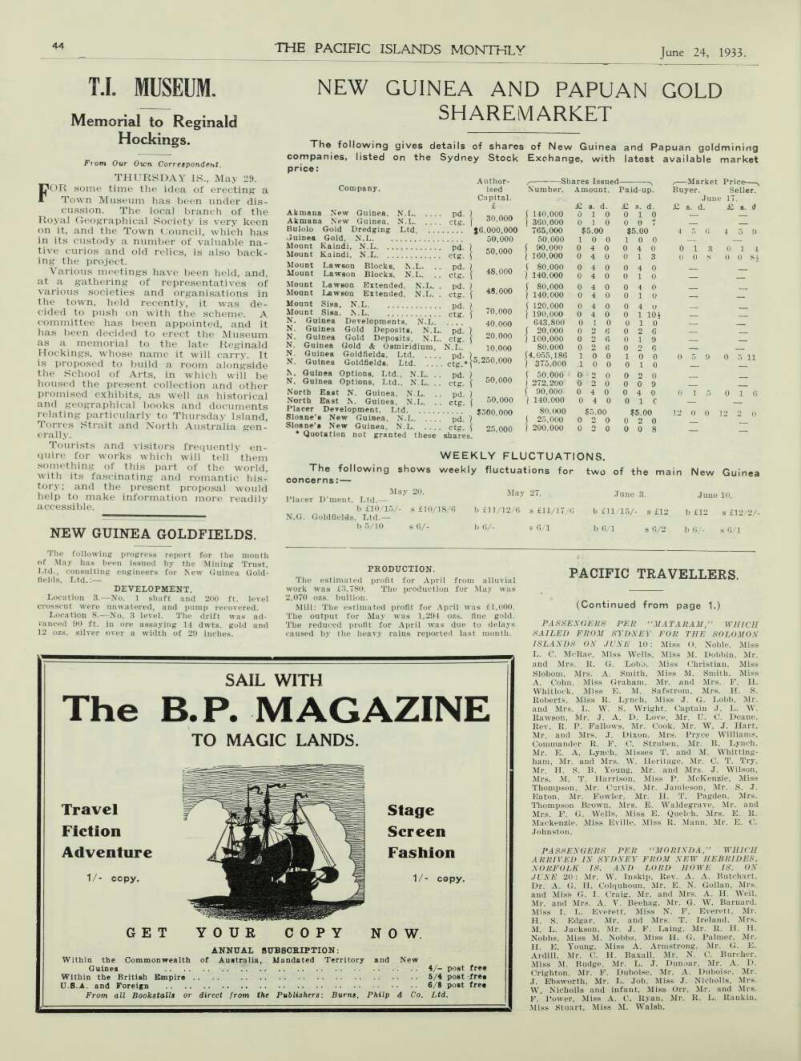
Memorial to Reginald Hockings.
From Our Own Correspondent.
Thursday Is., May 29.
FOR some time the idea of erecting a Town Museum has been under dis cussion. The local branch of the Royal Geographical Society is very keen on it, and the Town Council, which has in its custody a number of valuable na tive curios and old relics, is also back ing the project.
Various meetings have been held, and, at a gathering of representatives of various societies and organisations in the town, held recently, it was de cided to push on with the scheme. A committee has been appointed, and it has been decided to erect the Museum as a memorial to the late Reginald Hockings, whose name it will carry. It is proposed to build a room alongside the School of Arts, in which will be housed the present collection and other promised exhibits, as well as historical and geographical books and documents relating particularly to Thursday Island, Torres Strait and North Australia gen erally.
Tourists and visitors frequently en quire for works which will tell them something of this part of the world, with its fascinating and romantic his tory; and the present proposal would help to make information more readily accessible.
New Guinea Goldfields.
The following progress report for the month of May has been issued by the Mining Trust, Ltd., consulting engineers for New Guinea Gold fields, Ltd.:—
Development.
Location 3. —No. 1 shaft and 200 ft. level crosscut were unwatered, and pump recovered.
Location B.—No. 3 level. The drift was ad vanced 90 ft. in ore assaying 14 dwts. gold and 12 ozs. silver over a width of 29 inches.
Production.
The estimated profit for April from alluvial work was £3,780. The production for May was 2,070 ozs. bullion.
Mill: The estimated profit for April was £1,000.
The output for May was 1,294 ozs. fine gold.
The reduced profit for April was due to delays caused by the heavy rains reported last month.
Sharemarket
New Guinea And Papuan Gold
The following gives details of shares of New Guinea and Papuan goldmining companies, listed on the Sydney Stock Exchange, with latest available market price:
Weekly Fluctuations.
The following shows weekly fluctuations for two of the main New Guinea concerns:—
Company.
Authorised Capital £ Shares Issued Market Price Number.
Amount.
Paid-up.
Buyer.
Seller.
June 17.
Akmana New Guinea, N.L. pd. £ £ s. d. £ s. d. £ s. d. £ s. d. 30,000 140,000 0 1 0 0 1 0 Akmana New Guinea. N.L. . ctg. 360,000 0 1 0 0 0 7 Bulolo Gold Dredging Ltd. $6,000,000 765,000 $5.00 $5.00 4 5 6 4 5 9 Guinea Gold, N.L 50,000 50,000 50,000 90,000 1 0 0 0 4 0 1 0 0 0 4 0 Mount Kaindi, N.L Pd. 0 1 3 0 1 4 0 0 8½ Mount Kaindi, N.L ctg. 160,000 80,000 0 4 0 0 1 3 0 4 0 Mount Lawson Blocks, N.L. . pd. 48,000 0 4 4 o 0 8 Mount Lawson Blocks, N.L. .. ctg. 7 140,000 0 4 0 0 1 0 Mount Lawson Extended, N.L. . Pd. 48,000 80,000 0 4 0 0 4 0 Mount Lawson Extended, N.L. . ctg. 140,000 0 4 0 0 1 0 Mount Sisa, N.L. Pd. 120,000 190,000 643,800 o 4 0 o o 4 Mount Sisa, N.L. ctg. 70,000 o 4 o 1 1 101 N. Guinea Developments. N.L. 40,000 0 i 0 0 0 N. Guinea Gold Deposits, N.L. Pd. 20,000 0 2 6 0 2 6 N. Guinea Gold Deposits. N.L. ctg. 20,000 100,000 0 o 6 0 1 9 N. Guinea Gold & Osmiridium, N.L. 10,000 80,000 0 2 6 0 2 6 N. Guinea Goldfields, Ltd pd. 4,055,186 1 0 0 1 o o 0 5 9 0 5 11 N. Guinea Goldfields, Ltd ctg.* 5,250,000 375,000 1 0 0 0 I 0 N. Guinea Options, Ltd., N.L. . . Pd. 50,000 50,000 0 2 0 0 2 o N. Guinea Options, Ltd., N.L. . . ctg. 272,200 0 2 0 0 0 9 North East N. Guinea, N.L. pd. 90,000 0 4 0 0 4 0 0 1 5 0 16 North East N. Guinea, N.L. .. ctg. 50,000 140,000 0 4 0 0 1 C Placer Development, Ltd. $500,000 80,000 25,000 $5.00 $5.00 19 n 0 1 12 2 0 Sloane’s New Guinea, N.L Pd. 0 2 0 o 0. 1 2 JU o u Sloane's New Guinea, N.L ctg. 25,000 200,000 0 o 0 0 0 8 * Quotation not granted these shares.
May 20.
Placer D’ment, Ltd.— May 27.
June 3.
June 10. b £10/15/- s f10/18/6 N.G. Goldfields. Ltd.— b£11/12/G s f 11/17/G b £11/15/- s £12 b £12 g £12/2/b 5/10 s 6/b 6/- s 6/1 b 6/1 s 6/2 b 6/- s 6/1
Advertisements & other items, p. 46 (2 items)
44
June 24, 1933.
THE PACIFIC ISLANDS MONTHLY
PACIFIC TRAVELLERS.
(Continued from page 1.)
The B.P. Magazine
SAIL WITH
TO MAGIC LANDS.
Travel Fiction Adventure 1/- copy.
GET YOUR COPY NOW.
Stage Screen Fashion 1/- copy.
ANNUAL SUBSCRIPTION:
Within the Commonwealth of Australia, Mandated Territory and New Guinea 4/- post free Within the British Empire . . . . 5/4 post free U.S.A. and Foreign 6/8 post free From all Bookstalls or direct from the Publishers: Burns, Philp & Co. Ltd.
Market Quotations
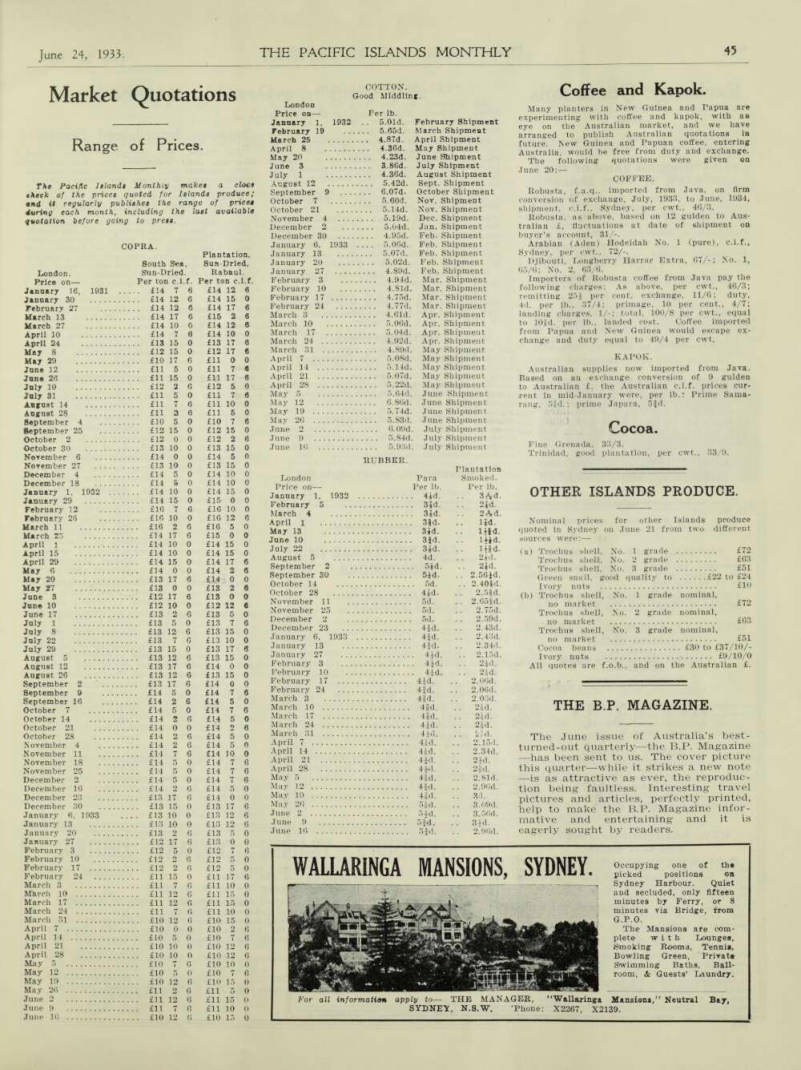
Range of Prices.
The Pacific Islands Monthly makes a close check of the prices quoted for Islands produce; and it regularly publishes the range of prices during each month, including the last available quotation before going to press.
London Price on — January 1, 1032 February 19 March 25
Cotton.
Good Middling.
Per lb. 5.01d. February Shipment . ... 5.05d. March Shipment 4.87d. Anril Shioment 4.36d.
May Shipment June Shipment July Shipment August Shipment Sept. Shipment October Shipment Nov. Shipment Nov. Shipment Dec. Shipment . ... 4.23d. 3.86d.
July 1 4.36d. 5.42d. 6.07d.
October 7 October 21 November 4 ... ... 5.60d. 5.14d. 5.19d.
December 2 December 30 ... 5.04d. 4.95d.
Jan. Shipment Feb. Shipment Feb. Shipment Feb. Shipment Feb. Shipment Feb. Shipment Mar. Shipment Mar. Shipment Mar. Shipment Mar. Shipment Apr. Shipment Apr. Shipment Apr. Shipment Apr. Shipment May Shipment May Shipment May Shipment May Shipment May Shipment June Shipment June Shipment June Shipment June Shipment July Shipment July Shipment July Shipment January 6, 1933 January 13 5.06d. 5.07d. 5.02d.
January 27 ... 4.89d.
February 3 February 10 February 17 February 24 March 3 March 10 4.94d. 4.81d. 4.75d. 4.77d. 4.61d. 5.06d.
March 24 March 31 4.92d. 4.89d.
April 7 April 14 5.08d. 5.14d.
April 21 5.07d.
April 28 5.22d.
May 12 6.86d.
May 19 Mav 26 5.74d. 5.83d.
June 2 6.09d.
June 16 5.93d, London Price on— January 1. 1932 February 5
Rubber.
Plantation Para Smoked.
Per lb. Per lb. 4id. 3*d. 3Jd. 2Jd. 3id. 2 Ad. 3Jd- .. lid. 3id. l}|d. 3}d. IHd. 3id. .. IHd. 4d. . . 21d.
March 4 April 1 May 13 June 10 July 22 August 5 ...
September 2 September 30 . 5*d. 2id. 5id. .. 2.56Jd. 5d. .. 2.40Sd.
October 14 . .. , October 28 ... 4id. .. 2.58d. 5d. .. 2.65|d. 5d. .. 2.75d.
November 11 November 25 December 2 5d. . . 2.59d.
December 23 January 6, 1933 January 13 4 Jd. .. 2,43d. 4 Jd. .. 2.43d. 4Jd. .. 2.34d. . 4 id. .. 2.15d. . 4Jd. .. 2Jd. . 4Jd. .. 21d. 4Jd. .. 2.06d. 4Jd. .. 2.06d. 4Jd. .. 2.03d. 4gd. .. 2Ad. 48d. .. 2id. 4Jd. .. 2Jd. 4 Jd, .. 2.' d. 4id. .. 2.15d. 4|d. .. 2.34d. 4Jd. .. 2Jd. 4W. .. 2§d. 43d. .. 2.81d. 4 Jd. .. 2.96d. 4|d. .. 3d. oid. .. 3.09d. 5Jd. . . 3.56d. 5|d j . . 34d. 5}d. . . 2.96d.
January 27 . . .
February 3 ...
February 10 February 17 ...
February 24 ...
March 3 March 10 March 17 March 24 March 31 April 7 April 14 April 21 April 28 May 5 Mav 12 May 19 May 26 June 2 June 9 June 16
Copra.
South Sea, Sun-Dried. Per ton c.i.f.
Plantation, Sun Dried, Rabaul. Per ton c.i.f.
London. Price on— January 16, 1931 £14 7 6 £14 12 0 January 30 £14 12 6 £14 15 0 February 27 £14 12 6 £14 17 6 March 13 £14 17 6 £16 2 6 March 27 £14 10 0 £14 12 6 April 10 £14 7 0 £14 10 0 April 24 £13 15 0 £13 17 0 May 8 £12 15 0 £12 17 6 May 20 £10 17 6 £11 0 0 June 32 £11 5 0 £11 7 « June 26 £11 15 0 £11 17 6 July 10 £12 2 6 £12 6 0 July 31 £11 5 0 £11 7 a August 14 £11 7 6 £11 10 0 August 28 £11 2 6 £11 6 0 September 4 £10 5 0 £10 7 6 September 25 .. . £12 15 0 £12 15 0 October 2 £12 0 0 £12 2 6 October 30 £13 10 0 £13 15 0 November 6 ... £14 0 0 £14 5 0 Norember 27 £13 10 0 £13 15 0 December 4 5 0 £14 10 0 December 18 £14 5 0 £14 10 0 January 1, 1032 . £14 10 0 £14 15 0 January 29 £14 15 0 £15 0 0 February 12 £16 7 6 £16 10 0 February 26 £10 10 0 £16 12 6 March 11 £16 2 6 £16 5 0 March 25 £14 17 6 £15 0 0 April 1 £14 10 0 £14 15 0 April 15 £14 10 0 £14 15 0 April 29 £14 15 0 £14 17 6 May 6 £14 0 0 £14 2 6 May 20 £13 17 6 £14 0 0 May 27 £13 0 0 £13 2 6 June 3 £12 17 6 £13 0 0 June 10 £12 10 0 £12 12 e June 17 £13 2 6 £13 5 0 July 1 £13 5 0 £13 7 6 Jnly 8 £13 12 6 £13 15 0 July 22 £13 7 6 £13 10 0 July 29 £13 15 0 £13 17 6 August 5 £13 12 6 £13 15 0 August 12 £13 17 6 £14 0 0 August 26 £13 12 6 £13 15 0 September 2 £13 17 0 £14 0 0 September 9 £14 5 0 £14 7 a September 16 £14 2 6 £14 5 0 October 7 £14 5 0 £14 7 6 October 14 £14 2 6 £14 5 0 October 21 £14 0 0 £14 2 6 October 28 £14 2 6 £14 5 0 November 4 .. .. £14 2 6 £14 5 0 November 11 ... £14 7 6 £14 10 0 November 18 . .. . £14 5 0 £14 7 6 November 25 . . .. £14 5 0 £14 7 6 December 2 .. . . £14 5 0 £14 7 6 December 16 ... £14 2 6 £14 5 0 December 23 .. .. £13 17 6 £14 0 0 December 30 . . .. £13 15 0 £13 17 6 January 6, 1933 £13 10 0 £13 12 6 January 13 £13 10 0 £13 12 6 January 20 £13 2 0 £13 5 0 January 27 £12 17 6 £13 0 0 February 3 £12 5 0 £12 7 6 February 10 £12 2 0 £12 K 0 February 17 2 6 £12 5 0 February 24 £11 15 0 £11 17 6 March 3 £11 7 0 £11 10 0 March 10 £11 12 6 £11 15 0 March 17 £11 12 6 £11 15 0 March 24 7 6 £11 10 0 March 31 12 0 £10 15 0 April 7 £10 0 0 £10 o 6 April 14 £10 5 0 £10 7 6 April 21 £10 10 0 £10 12 6 April 28 £10 10 0 £10 12 6 May 5 7 0 £10 10 0 May 12 5 0 £10 7 6 Mav 19 12 0 £10 15 0 Mav 20 2 0 £11 5 0 June 2 £11 12 6 £11 15 0 June 9 £11 7 6 £11 10 0 June 10 12 0 £10 15 0
Coffee and Kapok.
Many planters in New Guinea and Papua are experimenting with coffee and kapok, with an eye on the Australian market, and we have arranged to publish Australian quotations in future. New Guinea and Papuan coffee, entering Australia, would be free from duty and exchange.
The following quotations were given on June 20;—
Coffee.
Robusta, f.a.q., imported from Java, on firm conversion of exchange, July, 1933, to June, 1934, shipment, c.i.f., Sydney, per cwt., 46/3.
Robusta, as above, based on 12 gulden to Aus tralian £, fluctuations at date of shipment on buyer’s account, 31/-.
Arabian (Aden) Hodeidah No. 1 (pure), c.i.f., Sydney, per cwt., 72/-.
Djibouti, Longberry Harrar Extra, 67/-; No. 1, 65/6; No. 2, 63/6.
Importers of Robusta coffee from Java pay the following charges: As above, per cwt., 46/3; remitting 25$ per cent, exchange, 11/6; duty, 4d. per lb., 37/4; primage, 10 per cent., 4/7; landing charges, 1/-; total, 100/8 per cwt., equal to 10id. per lb., landed cost. Coffee imported from Papua and New Guinea would escape ex change and duty equal to 49/4 per cwt.
Kapok.
Australian supplies now imported from Java.
Based on an exchange conversion of 9 gulden to Australian £, the Australian c.i.f. prices cur rent in mid-January were, per lb.: Prime Sama rang, sfd.; prime Japara, 5Jd.
Cocoa.
Fine Grenada. 33/3.
Trinidad, good plantation, per cwt., 33/9.
Other Islands Produce.
Nominal prices for other Islands produce quoted in Sydney on June 21 from two different sources were: — (a) Trochus shell, No. 1 grade £72 Trochus shell. No. 2 grade £63 Trochus shell, No. 3 grade £5l Green snail, good quality to £22 to £24 Ivory nuts £10 (b) Trochus shell, No. 1 grade nominal, no market £72 Trochus shell, No. 2 grade nominal, no mai'ket £63 Trochus shell, No. 3 grade nominal, no market £51 Cocoa beans £30 to £37/10/- Ivory nuts £9/10/0 All quotes are f.o.b., and on the Australian £.
The B.P. Magazine.
The June issue of Australia’s best turned-out quarterly—the B.P. Magazine —has been sent to us. The cover picture this quarter—while it strikes a new note —is as attractive as ever, the reproduc tion being faultless. Interesting travel pictures and articles, perfectly printed, help to make the B.P. Magazine infor mative and entertaining and it is eagerly sought by readers.
Advertisements & other items, p. 47 (1 item)
Wallaringa Mansions, Sydney,
Occupying one of the picked positions on Sydney Harbour. Quiet and secluded, only fifteen minutes by Ferry, or 8 minutes via Bridge, from
G.P.O.
The Mansions are com plete with Lounges, Smoking Rooms, Tennis, Bowling Green, Private Swimming Baths, Ball room, & Guests’ Laundry.
For all information apply to — THE MANAGER, “Wallaringa Mansions,” Neutral Bay, SYDNEY, N.S.W. ’Phone: X 2267, X 2139.
Exchange Quotations
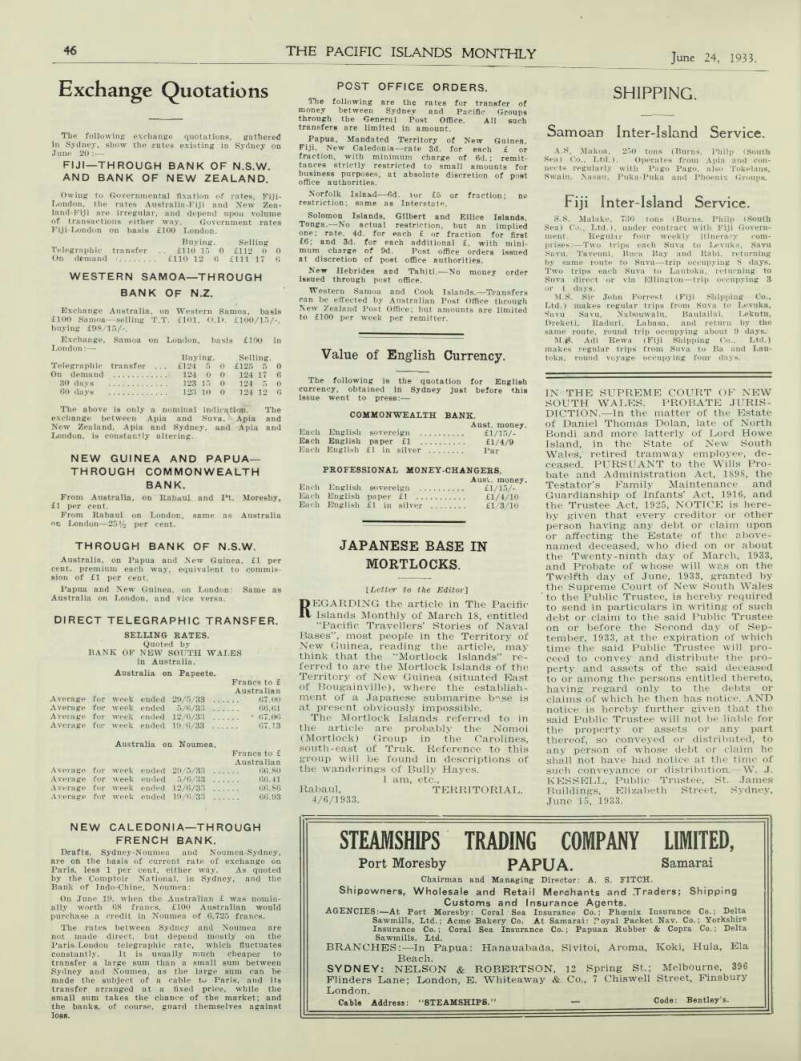
The following exchange quotations, gathered in Sydney, show the rates existing in Sydney on June 20 :
Fiji—Through Bank Of N.S.W.
And Bank Of New Zealand.
Owing to Governmental fixation of rates, Fiji- London, the rates Australia-Fiji and New Zea land-Fiji are irregular, and depend upon volume of transactions either way. Government rates Fiji-London on basis £100 London.
Buying. Selling Telegraphic transfer .. £110 15 0 £112 0 0 On demand £110 12 6 £111 17 6
Western Samoa—Through
Bank Of N.Z.
Exchange Australia, on Western Samoa, basis £100 Samoa —selling T.T. £101, O.D. £100/15/-, buying £98/15/-.
Exchange, Samoa on London, basis £100 in London:—
The above is only a nominal indication. The exchange between Apia and Suva. Apia and New Zealand, Apia and Sydney, and Apia and London, is constantly altering.
New Guinea And Papua
Through Commonwealth
Bank.
From Australia, on Rabaul and Pt. Moresby, £1 per cent.
From Rabaul on London, same as Australia on London —25% per cent.
Through Bank Of N.S.W.
Australia, on Papua and New Guinea, £1 per cent, premium each way, equivalent to commis sion of £1 per cent.
Papua and New Guinea, on London: Same as Australia on London, and vice versa.
New Caledonia—Through
French Bank.
Drafts, Sydney-Noumea and Noumea-Sydney, are on the basis of current rate of exchange on Paris, less 1 per cent, either way. As quoted by the Comptoir National, in Sydney, and the Bank of Indo-Chine, Noumea: On June 19, when the Australian £ was nomin ally worth 68 francs, £100 Australian would purchase a credit in Noumea of 6,725 francs.
The rates between Sydney and Noumea are not made direct, but depend mostly on the Paris-London telegraphic rate, which fluctuates constantly. It is usually much cheaper to transfer a large sum than a small sum between Sydney and Noumea, as the large sum can be made the subject of a cable Paris, and its transfer arranged at a fixed price, while the small sum takes the chance of the market; and the banks, of course, guard themselves against loss.
Post Office Orders.
The following are the rates for transfer of money between Sydney and Pacific Groups through the General Post Office. All such transfers are limited in amount.
Papua, Mandated Territory of New Guinea, Fiji, New Caledonia—rate 3d. for each £ or fraction, with minimum charge of 6d.; remit tances strictly restricted to small amounts for business purposes, at absolute discretion of post office authorities.
Norfolk Island—6d. for £5 or fraction; no restriction; same as Interstate.
Solomon Islands, Gilbert and Ellice Islands, Tonga.—No actual restriction, but an implied one; rate. 4d. for each £ or fraction for first £6; and 3d. for each additional £, with mini mum charge of 9d. Post office orders issued at discretion of post office authorities.
New Hebrides and Tahiti.—No money order issued through post office.
Western Samoa and Cook Islands.—Transfers can be effected by Australian Post Office through New Zealand Post Office; but amounts are limited to £100 per week per remitter.
Buying. Selling.
Telegraphic transfer . . . £124 5 0 £125 5 0 On demand 124 0 0 124 17 6 30 days 123 15 0 124 5 0 60 days 123 10 0 124 12 6
Direct
Telegraphic Transfer.
Selling Rates.
Quoted by
Bank Of New South Wales
Average for week ended 29/5/33 .. .. in Australia.
Australia on Papeete.
Francs to £ Australian Average for week ended 5/6/33 . . .. 66.61 Average for week ended 12/6/33 .. ' 67.06 Average for week ended 19/6/33 . .. . 67.13 Average for week ended 29/5/33 66.80 Australia on Noumea.
Francs to £ Australian Average for week ended 5/6/33 66.41 Average for week ended 12/6/33 ... 66.86 Average for week ended 19/6/33 . .., 66.93
Value of English Currency.
The following is the quotation for English currency, obtained in Sydney just before this issue went to press:—
Commonwealth
Bank.
Aust. money.
Each English sovereign £1/15/- Each English paper £1 £1/4/9 Each English £1 in silver . . .
English £1 in silver . . .
Professional Money-Changers.
Aust. money.
Each English sovereign £1/15/- Each English paper £1 £1/4/10 Each English£1 in silver . . . £1/3/10
Mortlocks.
Japanese Base In
[Letter to the Editor ] REGARDING the article in The Pacific Islands Monthly of March 18, entitled “Pacific Travellers’ Stories of Naval Bases”, most people in the Territory of New Guinea, reading the article, may think that the “Mortlock Islands” re ferred to are the Mortlock Islands of the Territory of New Guinea (situated East of Bougainville), where the establish ment of a Japanese submarine base is at present obviously impossible.
The Mortlock Islands referred to in the article are probably the Nomoi (Mortlock) Group in the Carolines, south-east of Truk. Reference to this group will be found in descriptions of the wanderings of Bully Hayes.
I am, etc.,
Rabaul,
Territorial.
4/6/1933.
Shipping.
Samoan Inter-Island Service.
A.S. Makoa, 250 tons (Burns, Philp (South Sea) Go., Ltd.). Operates from Apia and con nects regularly with Pago Pago, also Tokelaus, Swain, Nasau, Puka-Puka and Phoenix Groups.
Fiji Inter-Island Service.
S.S. Malake, 736 tons (Burns, Philp (South Sea) Co., Ltd.), under contract with Fiji Govern ment. Regular four weekly itinerary com prises:—Two trips each Suva to Levuka, Savu Savu, Taveuni, Buca Bay and Rabi, returning by same route to Suva—trip occupying 8 days.
Two trips each Suva to Lautoka, returning to Suva direct or via Ellington—trip occupying 3 or 4 days.
M.S. Sir John Forrest (Fiji Shipping Co., Ltd.) makes regular trips from Suva to Levuka, Savu Savu, Nabouwalu, Baulailai, Lekutu, Dreketi, Raduri, Labasa, and return by the same route, round trip occupying about 9 days.
M.S. Adi Rewa (Fiji Shipping Co., Ltd.) makes regular trips from Suva to Ba and Lau toka, round voyage occupying four days.
Advertisements & other items, p. 48 (1 item)
Steamships Trading Company Limited,
IN THE SUPREME COURT OF NEW
SOUTH WALES. PROBATE JURIS
DICTION. —In the matter of the Estate of Daniel Thomas Dolan, late of North Bondi and more latterly of Lord Howe Island, in the State of New South Wales, retired tramway employee, de ceased. PURSUANT to the Wills Pro bate and Administration Act, 1898, the Testator’s Family Maintenance and Guardianship of Infants’ Act, 1916, and the Trustee Act, 1925, NOTICE is here by given that every creditor or other person having any debt or claim upon or affecting the Estate of the abovenamed deceased, who died on or about the Twenty-ninth day of March, 1933, and Probate of whose will was on the Twelfth day of June, 1938, granted by the Supreme Court of New South Wales to the Public Trustee, is hereby required to send in particulars in writing of such debt or claim to the said Public Trustee on or before the Second day of Sep tember, 1933, at the expiration of which time the said Public Trustee will pro ceed to convey and distribute the pro perty and assets of the said deceased to or among the persons entitled thereto, having regard only to the debts or claims of which he then has notice. AND notice is hereby further given that the said Public Trustee will not be liable for the property or assets or any part thereof, so conveyed or distributed, to any person of whose debt or claim he shall not have had notice at the time of such conveyance or distribution. —W. J.
KESSELL, Public Trustee, St. James Buildings, Elizabeth Street, Sydney, June 15, 1933.
STEAMSHIPS TRADING COMPANY LIMITED,
Port Moresby PAPUA. Samarai
Chairman and Managing Director: A. S. FITCH.
Shipowners, Wholesale and Retail Merchants and Traders; Shipping Customs and Insurance Agents.
AGENCIES:—At Port Moresby: Coral Sea Insurance Co.; Phoenix Insurance Co.; Delta Sawmills, Ltd.; Acme Bakery Co, At Samarai: Royal Packet Nav. Co.; Yorkshire Insurance Co.; Coral Sea Insurance Co.; Papuan Rubber & Copra Co.; Delta Sawmills, Ltd.
BRANCHES: —In Papua; Hanauabada, Sivitoi, Aroma, Koki, Hula, Ela Beach.
SYDNEY: NELSON & ROBERTSON, 12 Spring St.; Melbourne, 396 Flinders Lane; London, E. Whlteaway & Co., 7 Chiswell Street, Finsbury London.
Cable Address: "STEAMSHIPS,” Code: Bentley's.
Shipping Services in the Pacific
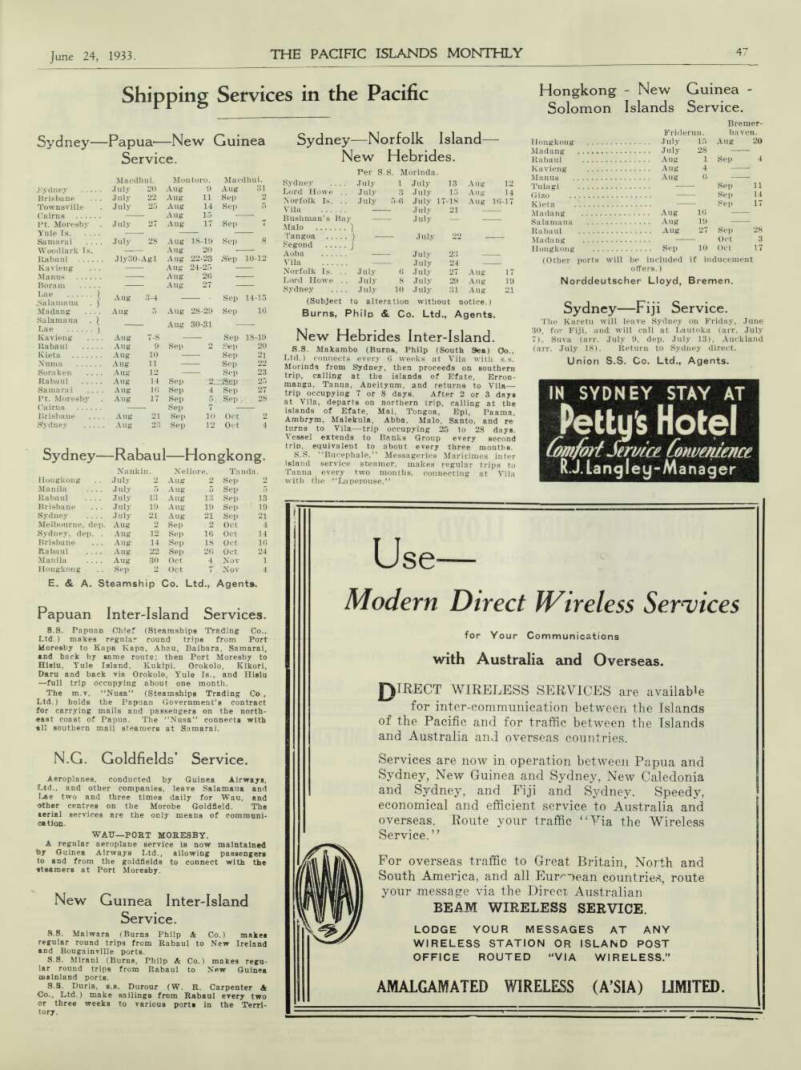
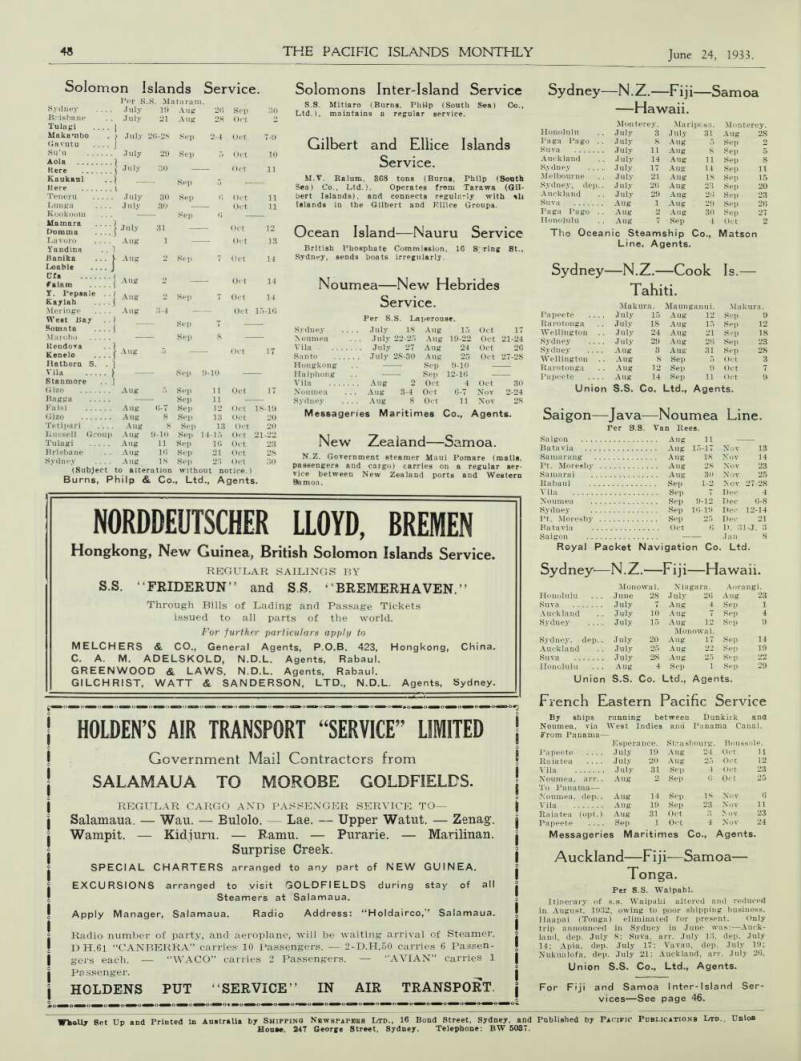
Sydney—Papua—New Guinea Service.
Sydney—Rabaul—Hongkong.
Papuan Inter-Island Services.
S.S. Papuan Chief (Steamships Trading Co., Ltd.) makes regular round trips from Port Moresby to Kapa Kapa, Abau, Baibara, Samarai, and back by same route; then Port Moresby to Hlsiu, Yule Island, Kukipi, Orokolo, Kikori, Daru and back via Orokolo, Yule Is., and Hislu —full trip occupying about one month.
The m.v. “Nusa” (Steamships Trading Co , Ltd.) holds the Papuan Government’s contract for carrying mails and passengers on the north east coast of Papua. The “Nusa” connects with all southern mail steamers at Samarai.
N.G. Goldfields’ Service.
Aeroplanes, conducted by Guinea Airways, Ltd., and other companies, leave Salamaua and Lae two and three times daily for Wau, and other centres on the Morobe Goldfield. The aerial services are the only means of communi cation.
Wau—Port Moresby,
A regular aeroplane service is now maintained by Guinea Airways Ltd., allowing passengers to and from the goldfields to connect with the steamers at Port Moresby.
New Guinea Inter-Island
Service.
S.S. Maiwara (Burns Philp & Co.) makes regular round trips from Rabaul to New Ireland and Bougainville ports.
S.S. Mirant (Burns, Philp A Co.) makes regu lar round trips from Rabaul to New Guinea mainland ports.
S.S. Duris, s.s. Durour (W. R. Carpenter A Co., Ltd.) make sailings from Rabaul every two or three weeks to various ports in the Terri
Sydney—Norfolk Island— New Hebrides.
New Hebrides Inter-Island.
S.S. Makambo (Burns, Philp (South Sea) Co.
Ltd.) connects every 6 weeks at Vila with s.s.
Morinda from Sydney, then proceeds on southern trip, calling at the islands of Efate. Erron manga, Tanna, Aneityum, and returns to Vila— trip occupying 7or 8 days. After 2 or 3 days at Vila, departs on northern trip, calling at the islands of Efate, Mai, Tongoa, Epi, Paama.
Ambrym, Malekula, Abba, Malo, Santo, and re turns to Vila—trip occupying 25 to 28 days.
Vessel extends to Banks Group every second trip, equivalent to about every three months.
S.S. “Bucephale,” Messageries Maritimes inter island service steamer, makes regular trips to Tanna every two months, connecting at Vila with the “Laperouse.”
Hongkong - New Guinea - Solomon Islands Service.
Sydney—Fiji Service.
The Karetu will leave Sydney on Friday, June 30. for Fiji, and will call at Lautoka (arr. July 7), Suva (arr. July 9, dep. July 13), Auckland (arr. July 18). Return to Sydney direct.
Union S.S. Co. Ltd., Agents.
Per S.S. Morinda.
Sydney . July 1 July 13 Aug 12 Lord Howe . . July 3 July 15 Aug 14 Norfolk Is. . . July 5-6 July 17 -18 Aug 16-17 July 21 Bushman’s Ray July Malo • 1 July Segond . ... • J Jljly 23 Vila July 24 Norfolk Is. . . July 6 July 27 Aug 17 Lard Howe . . July 8 July 20 Aug 19 Sydney . July 10 July 31 Aug 21 (Subject to alteration without notice.) Burns, Philo & Co. Ltd., Agents.
Bremerhaven.
Friderun.
Hongkong July 15 28 Aug 20 Aug 1 Sep 4 Aug 4 Aug 0 t Sep 11 Sep 14 Sep 17 Kieta MfldflHR Aug 10 Su 1b man a Aug 19 Rabaul Aug 27 Sep 28 Oct 3 Mudu ng Hongkong Sen 10 Oct 17 (Other ports will be included if inducement offers.) Norddeutscher Lloyd, Bremen.
Maedhui.
Montoro.
Maedhui. .Sydney July 20 Aug 9 Aug 31 Brisbane July 22 Aug 11 Sep 2 Townsville July 25 Aug 14 Sep 5 15 I*t. Moresby .
July 27 Aug 17 Sep 7 Yule Is — Samara! ...
July 28 Aug 18-19 Sep 8 Woodlark Is, — Aug 20 Rabaul Jlv30-Ael Aug Aug 22-23 S'ep 10-12 Kavieng ' 24-25 Manus — Aug 26 Aug 27 Lae 7 ,8'alamaua . ) Aug o-4 Sep 14-15 Madang ...
Aug 5 Aug 28-29 Sep 16
Salamaua .
. 30-31 Lae ) AUg Kavieng ...
Aug 7-8 Sep 18-19 Rabaul Aug 9 Sep 2 Sep Sep 20 2i Kieta 10 Numa Aug 11 Sep 22 Soraken ...
Aug 12 Sep 23 Rabaul Aug Aug 14 Sep Sep 2_ Sep Sep 25 Samara! ... 1G 4 27 Pt. Moresby Aug 17 Sep 5 Sep 28 Sen 7 Brisbane ...
Aug 21 Sep 10 Oct 2 Sydney Aug 23 Sep 12 Oct 4
Nankin.
Nellore.
Tanda.
Hongkong July 2 Aug 2 Sep 2 Manila ...
July 5 Aug 5 Sep 5 Rabaul ...
July 13 Aug 13 Sep 13 Brisbane July 19 Aug 19 Sep 19 Sydney ...
July 21 Aug 21 Sep 21 Melbourne, dep.
Aug 2 Sep 2 Oct 4 Sydney, dep. .
Aug 12 Sep 1C Oct 14 Brisbane Aug 14 Sep 18 Oct 16 Rabaul ...
Aug 22 Sep 26 Oct 24 Manila Aug 30 Oct 4 Nov 1 Hongkong Sep 2 Oct 7 Nov 4 E. & A. Steamship Co. Ltd., Agents.
Solomon Islands Service.
Solomons Inter-Island Service
S.S. Mitiaro (Burns, Philp (South Sea) Cos., Ltd.), maintains a regular service.
Gilbert and Ellice Islands
Service.
M. Ralum, 868 tons (Burns, Philp (South Sea) Cos., Ltd.). Operates from Tarawa (Gil bert Islands), and connects regulaly with all Islands in the Gilbert and Ellice Groups.
Ocean Island—Nauru Service
British Phosphate Commission, 16 Spring St., Sydney, sends boats irregularly.
Noumea —New Hebrides
Service.
Per S.S. Laperouse.
Sydney ... July 18 Aug 15 Oct 17 Noumea ... July 22-25 Aug 19-22 Oct 21-24 Vila July 27 Aug 24 Oct 26 Santo July 28-30 Aug 25 Oct 27-28 Hongkong . . Sep 9-10 Haiphong . . Sep 12-16 1 Vila Aug 2 Oct 4 Oct 30 Noumea ... Aug 3-4 Oct 6-7 Nov 2-24 Sydney Aug 8 Oct 11 Nov 28
Messagenes Maritimes Cos., Agents.
New Zealand—Samoa.
N. Government steamer Maui Poraare (mails, passengers and cargo) carries on a regular ser vice between New Zealand ports and Western Samoa.
Sydney—N.Z.—Fiji—Samoa —Hawaii.
Sydney—N.Z.—Cook Is.— Tahiti.
Saigon—Java—Noumea Line.
Sydney—N.Z.—Fiji—Hawaii.
French Eastern Pacific Service
By ships running between Dunkirk and Noumea, via West Indies and Panama Canal.
From Panama —
Auckland—Fiji—Samoa—
Tonga.
Per S.S. Waipahi.
Itinerary of s.s. Waipahi altered and reduced in August, 1932, owing to poor shipping business.
Haapai (Tonga) eliminated for present. Only trip announced in Sydney in June was: —Auck land, dep. July 8; Suva, arr. July 13, dep. July 14; Apia, dep. July 17; Vavau, dep. July 19; Nukualofa, dep. July 21; Auckland, arr. July 26.
Union S.S. Co., Ltd., Agents.
For Fiji and Samoa Inter-Island Ser vices—See page 46.
Sydney Brisbane Tulagi Maka'nbo Gavatu Per S.S. Mataram.
July 19 July 21 July 26-2S Aug 20 Aug 28 Sep 2-4 Sep 30 Oct 2 Oct 7-9 Su’u July 29 Sep 5 Oct 10 Aola
July 30
Rere — Oct 11 Kaukaul Rere Sep 5 Teneru July 30 July 30 Sep 6 Sep 6 Oct 11 Oct 11 Lunga Kookoom Mamara Domma
July 31
— Oct 12 Lavoro Yandina Aug 1 Oct 13 Banika Lonbie Ufa Aug 2 Sep 7 Oct 14 falnm Aug 2 — Oct 14 Y. Pepsale Kaylah Meringe West Bay Somata
Aug 2
Aug 3-4 Sep 7 Sep 7 Oct 14 Oct 15-16 Marobo Sep 8 Rendova Kenelo
Aug 5
Oct 17 Hathorn S.
Vila Stanmore Gizo Aug 5 Sep 11 Sep 11 Oct 17 Bagga Faisi Aug 6-7 Aug 8 Aug 8 Aug 9-10 Aug 11 Aug 16 Aug 18 (Subject to alteration without notice.) Burns, Philp & Co., Ltd., Agents.
Sep 12 Sep 13 Sep 13 Sep 14-15 Sep 16 Sep 21 Sep 23 Oct 18-19 Oct 20 Oct 20 Oct 21-22 Oct 23 Oct 28 Oct 30 Gizo Tetipari Russell Group Tulagi Brisbane Sydney
Monterey Mariposa Monterey Honolulu July 3 July 31 Aug 28 Paga Pago July 8 Aug 5 Sep 2 Suva July 11 Aug 8 Sep 5 Auckland July 14 Aug 11 Sep 8 Sydney July 17 Aug 14 Sep 11 Melbourne July 21 Aug 18 Sep 15 Sydney, dep July 26 Aug 23 Sep 20 Auckland July 29 Aug 26 Sep 23 Suva Aug 1 Aug 29 Sep 26 Paga Pago Aug 2 Aug 30 Sep 27 Honolulu Aug 7 Sep 4 Oct 2 The Oceanic Steamship Co., Matson Line, Agents.
Makura.
Maunganui.
Makura.
Papeete July 15 Aug 12 Sep 9 Rarotonga July 18 Aug 15 Sep 12 Wellington July 24 Aug 21 Sep 18 Sydney July 29 Aug 26 Sep 23 Sydney Aug 3 Aug 31 Sep 28 Wellington Aug 8 Sep 5 Oct 3 Rarotonga Aug 12 Sep 9 Oct 7 Papeete Aug 14 Sep 11 Oct 9 Union S.S. Co. Ltd., Agents.
Per S.S. Van Rees.
Saigon Aug 11 Batavia . . Aug 15-17 Nov 13 Samarang Aug 18 Nov 14 Pt. Moresby Aug 28 Nov 23 Samarai Aug 30 Nov 25 Rabaul Sep 1-2 Nov 27-28 Vila Sep 7 Dec 4 Noumea Sep 9-12 Dec 6-8 Sydney Sep 16-19 Dec 12-14 Pt. Moresby Sep 25 Dec 21 Batavia Oct 6 D. 31-J. 3 Saigon Jan 8 Royal Packet Navigation Co. Ltd.
Monowai. Niagara. Aorangi.
Honolulu ... June 28 July 26 Aug 23 Suva July 7 Aug 4 Sep 1 Auckland .. July 10 Aug 7 Sep 4 Sydney ... July 13 Aug 12 Sep 9 Monowai.
Sydney, dep.. July 20 Aug 17 Sep 14 Auckland .. July 25 Aug 22 Sep 19 Suva July 28 Aug 25 Sep 22 Honolulu .. . Aug 4 Sep 1 Sep 29 Union S.S. Co. Ltd., Agents.
Esperance.
Strasbourg.
Boussole.
Papeete July 19 Aug 24 Oct 11 Raiatea July 20 Aug 25 Oct 12 Vila July 31 Sep 4 Oct 23 Noumea, arr.
To Panama— Aug 2 Sep 6 Oct 25 Noumea, dep.
Aug 14 Sep 18 Nov 6 Vila Aug 19 Sep 23 Nov 11 Raiatea (opt.) Aug 31 Oct 3 Nov 23 Papeete Sep 1 Oct 4 Nov 24 Messageries Maritimes Co., Agents.
Advertisements & other items, pp. 49-52 (2 items)
Petty's Hotel
IN SYDNEY STAY AT
Comfort Service Convenience R.J. Langley-Manager
Use—
Modern Direct Wireless Services
for Your Communications with Australia and Overseas.
DIRECT WIRELESS SERVICES are available for inter-communication between the Islands of the Pacific and for traffic between the Islands and Australia and overseas countries.
Services are now in operation between Papua and Sydney, New Guinea and Sydney, New Caledonia and Sydney, and Fiji and Sydney. Speedy, economical and efficient service to Australia and overseas. Route your traffic “Via the Wireless Service."
For overseas traffic to Great Britain, North and South America, and all countries, route your message via the Direct Australian
BEAM WIRELESS SERVICE.
LODGE YOUR MESSAGES AT ANY
WIRELESS STATION OR ISLAND POST
OFFICE ROUTED "VIA WIRELESS.”
AMALGAMATED WIRELESS (ASIA) LIMITED.
NORDDEUTSCHER LLOYD, BREMEN
Hongkong, New Guinea, British Solomon Islands Service.
REGULAR SAILINGS BY
S.S. "FRIDERUN” and S.S. ‘‘BREMERHAVEN.”
Through Bills of Lading and Passage Tickets issued to all parts of the world.
For further particulars apply to MELCHERS & CO., General Agents, P.O.B. 423, Hongkong, China.
C. A. M. ADELSKOLD, N.D.L. Agents, Rabaul.
GREENWOOD & LAWS, N.D.L. Agents, Rabaul.
GILCHRIST, WATT & SANDERSON, LTD., N.D.L. Agents, Sydney.
HOLDEN’S AIR TRANSPORT “SERVICE” LIMITED
Government Mail Contractors from
SALAMAUA TO MOROBE GOLDFIELDS.
REGULAR CARGO AND PASSENGER SERVICE TO
Salamaua. Wau. Bulolo. Lae. Upper Watut. Zenag.
Wampit. Kidjuru. Ramu. Purarie. Marilinan.
Surprise Creek.
SPECIAL CHARTERS arranged to any part of NEW GUINEA.
EXCURSIONS arranged to visit GOLDFIELDS during stay of all Steamers at Salamaua.
Apply Manager, Salamaua. Radio Address: “Holdairco,’’ Salamaua.
Radio number of party, and aeroplane, will be waiting arrival of Steamer.
D H. 61 “CANBERRA” carries 10 Passengers. 2-D.H.50 carries 6 Passen gers each. “WACO” carries 2 Passengers. “AVIAN” carries 1 Passenger.
HOLDENS PUT “SERVICE” IN AIR TRANSPORT.
A Unique Aerial Transport Service
The country over which Guinea Airways’ Air craft daily fly is some of the worst in the world. It is so rough that overland transport is impossible, and many attempts at road building have been abandoned.
The Goldfields depend entirely on aircraft for maintenance, and it is the success of their service which makes Guinea Airways confident of their ability to organise and maintain dependable transport WHEREVER it is needed.
New Guinea Aerodromes
LAE
SALAMAUA
WATUT
WAU
WAMPIT
SANGAN
BULOWAT
BULOLO
ZENAG
AT LEFT: Parts of Dredge Machinery being loaded into aeroplane for transport by Guinea Airways, Ltd., to Bulolo Gold field.
BELOW: Here’s a giant wheel with a diameter of over 6½ feet for one of the Bulolo Gold Dredging Company’s dredges.
It is bolted securely inside the cabin of a G31 tri-motored Junker for transport to the goldfields. The balance of the load was made up with hundred pound bags of rice.
GUINEA AIRWAYS Ltd
LAE - SALAMAUA
A KB
before dinner
makes him feel
a new man!
HERE is nothing to equal this pure,
stimulating, refreshing
drink as an appetiser before dinner and it has a tonic value that keeps yon up to the mark both in Winter and Sum mer. Order a supply to day, for your own benefit and for home entertain ment.
TOOTH'S
IN BOTTLES AND
HALF BOTTLES
LAGER
48
June 24, 1933.
THE PACIFIC ISLANDS MONTHLY
Wholly Set Up and Printed In Australia by Shipping Newspapers Ltd,, 16 Bond Street, Sydney, and Published by Pacific Publications Ltd., Union House, 247 George Street, Sydney. Telephone; BW 5037.