Advertisements & other items, pp. 1-2 (2 items)
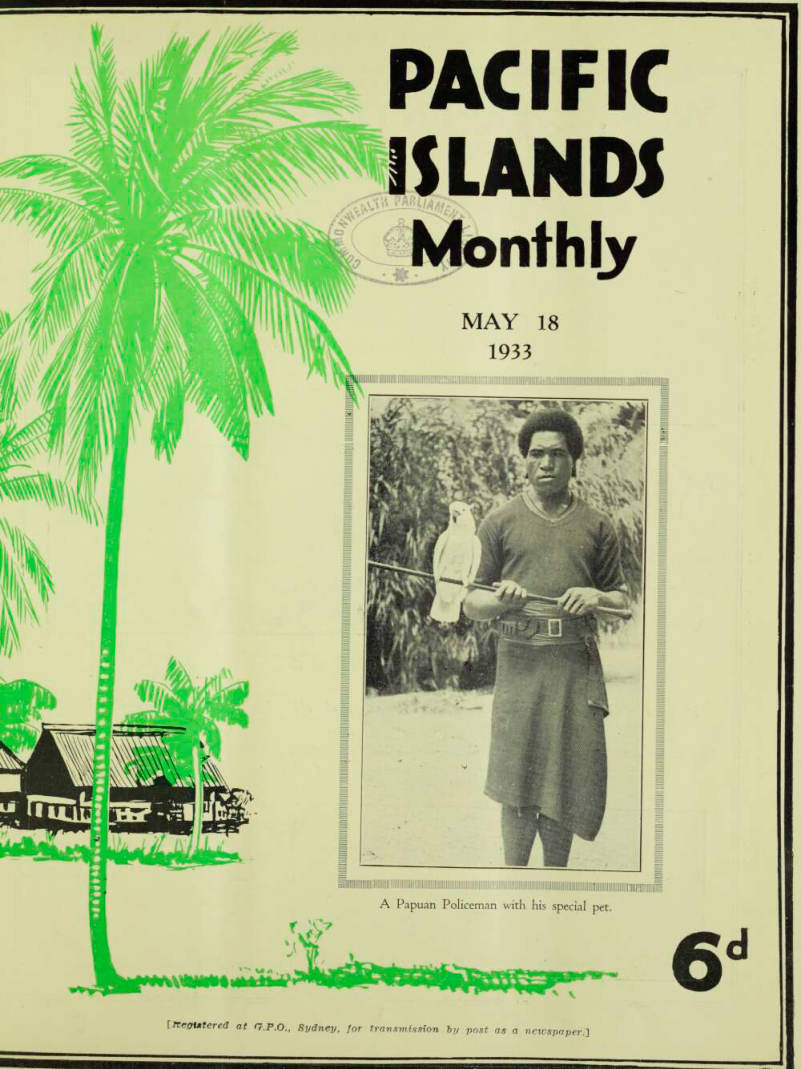
Pacific
ISLANDS
Monthly
MAY 18
1933
6 d
[Registered at G.P.O., Sydney, for transmission by post as a newspaper .]
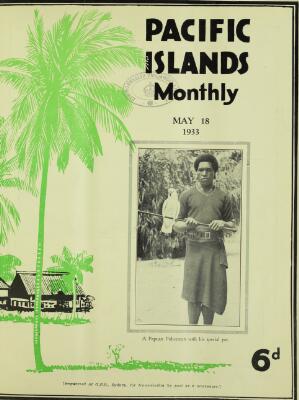
A Papuan Policeman with his special pet.
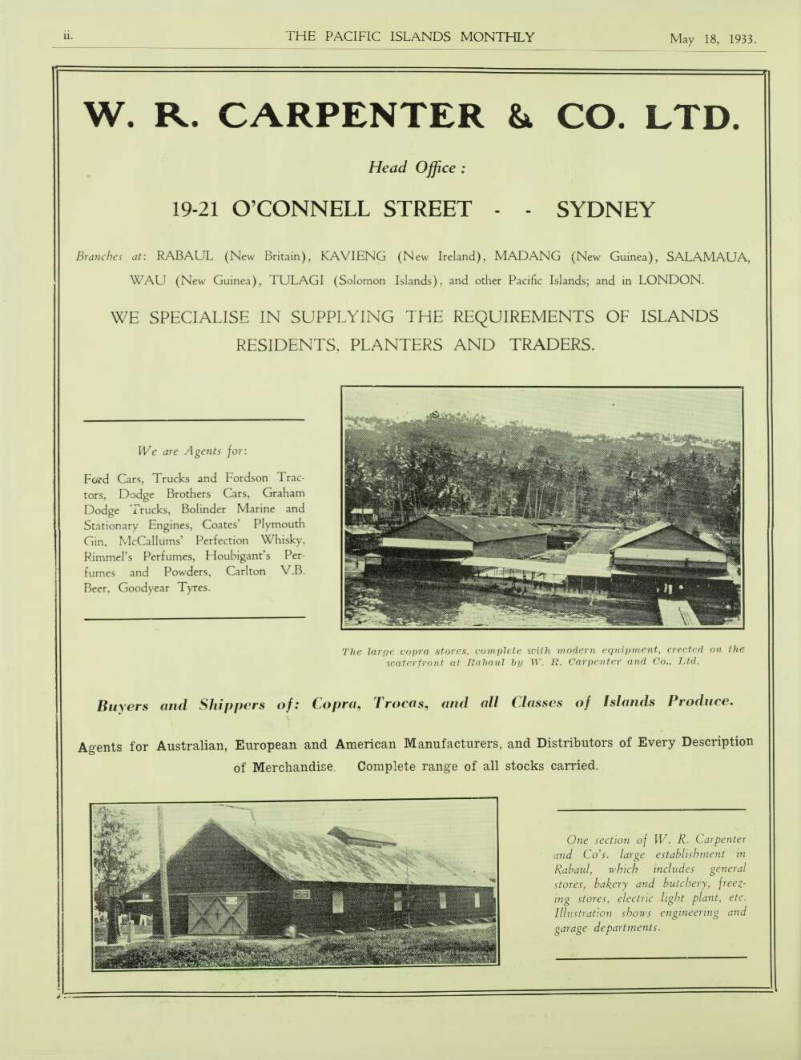
W. R. Carpenter & Co, Ltd.
Head Office :
19-21 O’CONNELL STREET - - SYDNEY
Branches at: RABAUL (New Britain), KAVIENG (New Ireland), MADANG (New Guinea), SALAMAUA, WAU (New Guinea), TULAGI (Solomon Islands), and other Pacific Islands; and in LONDON.
WE SPECIALISE IN SUPPLYING THE REQUIREMENTS OF ISLANDS
RESIDENTS, PLANTERS AND TRADERS.
We are Agents for: Ford Cars, Trucks and Fordson Trac tors, Dodge Brothers Cars, Graham Dodge Trucks, Bolinder Marine and Stationary Engines, Coates’ Plymouth Gin, McCallums’ Perfection Whisky, Rimmel’s Perfumes, Houbigant’s Per fumes and Powders, Carlton V.B.
Beer, Goodyear Tyres.
The large copra stores , complete with modern equipment, erected on the waterfront at Rahaul hy W. R. Carpenter and Go., Ltd.
Buyers and Shippers of: Copra , Trocas, and all Classes of Islands Produce .
Agents for Australian, European and American Manufacturers, and Distributors of Every Description of Merchandise. Complete range of all stocks carried.
One section of W. R. Carpenter and Co’s, large establishment in Rabaul, which includes general stores, bakery and butchery, freez ing stores, electric light plant, etc.
Illustration shows engineering and garage departments.
Pacific Islands Travellers
Passengers Per “Mataram,” Which
SAILED FROM SYDNEY ON MAY 3 FOR SOLOMON ISLANDS: Mr. F. C. Jewell, Mr. F.
C. Steward, Mr. A. A. Hagger, Mr. E. H.
White, Mr. T. Young, Dr. and Mrs. F. A. Mac phersou, Major and Mrs. Blake, Miss Totten hofer, Mr. H. C. M. Stewart, Miss Blake, Mr. and Mrs. McLeod, Father Brugmans, Mr. W.
Campbell, Captain and Mrs. E. Nelson Turner, Mrs. Hicks, Mrs. Knobel, Miss Pinkerton, Miss McLeod, Mr. L. Stibbard, Mr. T. A. Chadwick, Mr. J. H. James, Mr. Oldridge, Mr. D. W.
Clarke, Mr. and Mrs. V. D. Bent, Mrs. S. M. D.
Hay, Miss H. Henthorn, Dr. and Mrs. C. G.
Allen, Rev. J. Goldie, Mr. F. Ashley, Miss S.
Holloway, Mr. L. R. Lauer, Mr. J. Duffy, Miss Allison, Miss O. Holloway, Mr. H. R. Sim.
Passengers Per “Mataram,” Which
ARRIVED IN SYDNEY ON APRIL 22. FROM SOLOMON ISLANDS: Mrs. J. Barnier, Miss M.
Barnier, Mrs. B. Campbell, Miss B. M. Holmes, Mr. W. G. Lackersteen, Miss H. Milson, Mr. and Mrs. P. Nunan, Mr. and Mrs. F. H. Stokes, Mrs. B. D. Headrick, Mr. P. J. Ward, Mr. J.
Davis, Mr. and Mrs. B. Clark, Mrs. E. Reed, Miss F. Binskin, Mrs. H. Waters, Mr. J. A.
D. Love, Mr. D. F. Michelmore, Dr. H. Bernat zik, Mr. J. B. Du Faur, Mrs. J. N. Harrison, Mr. F. Isaacs, Mrs. J. Klotz, Mr. and Mrs. R.
J. S. McBride and child, Mr. W. Oliver, Capt.
J. Rawson, Mr. A. J. Smith, Miss L. E. Waite.
Passengers Per “Montoro,” Which
ARRIVED AT SYDNEY ON MAY 13 FROM NEW GUINEA AND PAPUA : Mr. and Mrs. R. F.
Armstrong, Miss I. Bax, Mr. and Mrs. F. Bernier, Mr. R. M. Bunting, Mr. W. A. Cunningham, Father G. de Bruyn, Father C. Dontenwill, Mr C. Durham, Mr. A. S. Evenson, Mr. H. J. Farr, Mrs. J. Fell, Mrs. D. Flower, Mrs. H. French, Mr. W. H. Gors, Mrs. D. Honeysett, Mr. E.
Horsley, Mr. and Mrs. and Miss E. Ifould, Mr.
F. W. O. Lehn, Mrs. C. Maclean, Miss L.
Maguire, Mr. F. T. O’Dea, Mr. R. Overall, Mr.
T. Partridge, Miss I. Peper, Miss H. Purnell, Mr. T. Render, Mr. A. J. Samson, Mrs. F. B.
Smith, Mr. V. G. Smith, Miss M. Snelson, Miss B. Standish, Mr. R. J. Turnbull, Mr. T. W.
Upson, Mr. W. E. Veale, Mr. D. B. Wallace, Mrs. B. Weston and child, Mr. C. E. Whitelaw, Miss L. E. Williams.
Passengers Per “Niagara,” Which
SAILED FROM SYDNEY FOR SUVA, FIJI, ON APRIL 27: Hon. W. Tugi, Mr. F. G. Ellingham, Mr. L. C. B. Seymour, Mrs. L. C. E. Seymour, Mrs. E. J. Bradley, Mr. J. Morrison, Mrs. J.
Mprrison, Mr. B. St. J. Fisher, Mrs. B. St. J.
Fisher, Miss P. St. J. Fisher, Mrs. P. Boardman and child, Mr. G. R. Robertson, Mrs. G. R.
Robertson, Mr. F. T. C. Lord, Mr. A. P. Van Gelderin, Mrs. A. P. Van Gelderin and two children, Mr. H. F. Clarke, Mr. W. F. N. Green wood, Mr. D. MacKay, Mrs. D. MacKay, Mrs.
A. K. Rae, Mr. N. M. Broughm, Mrs. N. M.
Broughm, Mrs. Trevor Wignall and two children, Mrs. A. Finlayson, Miss N. Finlayson, Mr. G. A. L. Zillman, Mrs. G. A. L. Zillman, Mr. A. E. Crawford, Mrs. A. E. Crawford, Mr.
C. W. Southey, Mrs. C. W. Southey, Miss E.
Southey. Miss M. Southey, Mr. G. Pal, Mrs. C. G.
Pal and four children, Mr. T. Hawkins, Mrs.
T. Hawkins, Mr. G. V. Hartaker, Mrs. G. V.
Hartaker and child, Mr. W. H. B. Snowsill, Mr.
W. J. Weir, Mr. G. R. Ammis, Mrs. G. R.
Ammis and two children, Mrs. V. Lamacraft, Rev. J. W. Burton, Mr. W. A. Davidson, Rev.
L. E. Saville, Mrs. L. E. Saville, Rev. A. H.
Blackitt, Mrs. A. H. Blackitt and child, Mrs.
O. Harris and child. Rev. W. Whitbread, Mrs.
W. Whitbread. Rev. A. H. Wood, Mrs. A. H.
Wood and five children, Miss E. Lindsay, Mrs.
R. Millikin and child, Miss N. Inchboard. Mr. F.
Nugent, Mr. J. H. L. Gowan, Mr. C. Vickery, John Kaivai Heimula, David Tali, John Valala, Feleti Jaili, Joseph Nai, David Mone Tu-ikubulan, Ma-afa Lelenoa, Paul Kogaika, William Moeaki, Daniel Mafua, David Havea, Jiokatome Havili, Ana Havea, Henry Taliai, John Nava, John Aki meta, David Hala.
Passengers Per “Nankin,” Which
Sailed From Sydney For Rabaul, New
GUINEA, ON MAY 13: Mr. J. Duncan, Mr.
W. J. Duncan, Mrs. W. J. Duncan, Mr. E. J.
Rondahl, Mr. John Chow Sing Fat, Mr. August Chan Ying Keang, Mr. R. S. Heape, Mr. G. G.
T. Wells, Mr. J. O. Rigby, Mr. L. C. Coleman, Mrs. A. Gregory, Mr. J. T. Merrylees, Mrs.
Slater, Mr. V. B. Pennefather and child.
Passengers Per “Nankin,” Which
Arrived In Sydney From Rabaul, New
GUINEA, ON APRIL 20; Mr. R. M. Farlow, Mr. R. Hufton, Mrs. R. Hufton, Mr. A. E.
Reavelly, Mr. L. Porteau, Mr. B. W. Sherman, Mr. B. Phibbs, Mr. D. Lyall, Mrs. D. Lyall.
Passengers Per “Mariposa" Which
ARRIVED IN SYDNEY FROM SUVA, FIJI, ON APRIL 27 : Mr. T. C. Bragge, Mr. J. Crone, Mrs.
J. Crone, Mr. J. Davies, Dr. N. E. Davis, Mrs.
N. B. Davis, Mr. R. W. Fowler, Mrs. R. W.
Fowler, Mr. R. Shenton-Gordon, Mrs. R. Shenton- Gordon, Miss J. C. Hagarty, Viscountess C. A.
Hill, Dr. Loftus Hills, Mr. B. A. Holden, Mr.
L. P. Jacobs, Miss Nan Jacobs, Mr. A. R. Litch field, Mrs. A. R. Litchfield, Mr. L. Boyd Mercer, Mrs. L. Boyd Mercer, Mr. H. Peacock, Mr. C.
B. Riley, Mr. C. A. Strang, Mrs. G. A. Strang, Miss A. M. Stephenson, Mr. S. P. Stubley, Mrs.
S. P. Stubley, Master Leslie Stubley, Mr. G. H.
Tait, Miss M. B. Taylor, Captain P. G. Taylor, Mr. R. J. Worssam, Mrs. A. Young, Sister Leonie, Father Marquet, Mr. J. P. Mayne, Mr. S. Sanders, Mrs. S. Sanders, Mr. P. M. L. Shastri, Mr. J. L.
Stark, Mr. H. M. Stutchbury, Mr. Gordon Leung Young.
Passengers Per “Mariposa,” Which
SAILED FROM SYDNEY FOR SUVA, FIJI, ON MAY 6: Mr. A. E. Baker, Mrs. A. E. Baker, Miss June Baker, Miss M. E. Bennett, Mr. F. W.
Brooks, Mrs. F. W. Brooks, Miss B. Brooks, Mis. W. P. Brownell, Miss Belle Burns, Dr.
G. A. Buchanan, Mrs. G. A. Buchanan, Mr. D.
Costello, Miss A. G. Cripps, Miss P. Dumas, Mr.
E. J. Davies, Mrs. E. A. B. Ellis, Master J. C.
Ellis, Miss J. M. S. Ellis, Sir William Firth, Mrs. I. H. Hooper, Mrs. S. G. Howell, Mr. N.
K. Hunter, Miss N. L. Hunter, Miss P. J. Hunter, Miss J. Kennedy, Miss M.
McErvale, Mr. C. McDonald, Mrs. C.
McDonald, Mr. G. A. Moir, Mrs. G. A. Moir, Mrs. Brownell Montgomery, Mr. Mosely, Mrs.
Moseley, Mrs. E. E. Nicholls, Rev. Father J. T.
Norris, Mr. A. E. Pearce, Mrs. A. E. Pearce, Mr. G. H. C. Reid, Mrs. G. H. C. Reid, Sister L. Stephen, Mrs. E. C. Stuart, Mr. C. T. Thomas, Mrs. C. T. Thomas, Mrs. W. L. Trewenack, Master B. Trewenack, Mrs. Olive F. Begar, Master G. Begar, Mr. M. M. Beg, Mrs. M. M.
Beg, Miss N. Beg, Miss Z. Beg, Mr. Ben Chaffey, Mrs. Ben Chaffey, Rev. G. T. Crouch, Mrs. G.
T. Crouch, Mrs. V. Johnson, Miss B. Johnson, Miss V. S. T. Khan, Miss J. Valetine, Mr. S.
C. Stubbs, Mr. A. J. Rutledge, Mrs. J. D.
Valetine, Master G. Michael, Mr. R. L. Mc Namara, Mrs. R. Lowell, Master Rex Lowell, Master R. Lowell, Mr. H. Law, Mr. R. C. Law, Mr. E. King, Mrs. B. King, Rev. N. G. Pardey, Mrs. N. G. Pardey, Miss M. Pardey, Master B.
Pardey, Master N. Pardey, Mr. H. G. Parry, Mrs. H. G. Parry.
Pacific Is. Association.
THE first annual general meeting of the Pacific Islands’ Association will be held at Millions House, Sydney, on June 14.
The total financial membership of the Association is now 109 members resid ing in Australia, Papua, New Guinea, British Solomon Islands, New Hebrides, Fiji, Norfolk Island, Santa Cruz, Gilbert Islands, Cook Islands and Ocean Island.
On the occasion of the departure of Mr. H. A. Ross to England in March, the Association gave him a dinner in Sydney. The opportunity was taken for island friends to get together and many reminiscences were unfolded by the vari ous speakers.
During the year, Mr. W. B. Rainsford was chairman of the Executive Commit tee, Mr. R. W. Robson, vice-chairman; and Messrs. J. W. Baldie and J. P. Fitz gerald, hon. secretaries.
The problems affecting the territories of the Pacific are numerous and the As sociation has a large field to cover in dealing with many of such matters which it proposes to do from time to time.
A leaflet setting out generally the aims and objects of the Association was widely circulated during the year. A re vised and enlarged edition is now under consideration by the Committee, and should make its appearance during 1933.
Lady Murray’s Return.
From Our Own Correspondent.
Pt. Moresby, May 4.
Lady Murray, wife of the Lieut.- Governor of Papua, returned by the “Macdhui”, arriving in Port Moresby on May 4 from her visit to England. On her arrival at the wharf, Lady Murray was met by many of the lady residents and presented with numerous bouquets of beautiful tropical flowers.
Lady Murray has been absent from the Territory during the heat of the N.W. season, which this year has been exceptionally severe. The S.E. season, which has already commenced, promises to be a pleasant relief from the dead and heavy atmosphere of the last six months.
Advertisements & other items, p. 3 (1 item)
NAVIGATION CO., Batavia
Regular BI-MONTHLY Freight and Passenger Service by the fast and modern K.P.M. Steamer VAN REES as under:
SAIGON
BATAVIA
SAMARANG
PORT MORESBY
SAMARAI
RABAUL
Cargo for Africa accepted for transhipment at Batavia.
Saloon and Intermediate class passengers carried in comfortable and airy cabins.
PORT VILA
NOUMEA
ROYAL PACKET SYDNEY
PORT MORESBY
NAVIGATION CO., Batavia
255 GEORGE STREET, SYDNEY.
SAIGON
The B.N.G. Trading Coy., Ltd., Port Moresby; Steamship Trading Co., Samarai; TF. R- Carpenter & Co., Ltd., Rabaul; Gubbay Freres, Port Vila; Carlo Leoni, Noumea; Diethelm & Co., Saigon.
Advertisers.
Page.
Amal. Wireless ... 47 Amm. (Nobel) ... 14 Antinea Drug Co. . . 33 Armstrong, R. H., & Co 27 Arnott’s Biscuits ... 25 Bank of N.S.W. ... 11 Barnes, James, Ltd. 32 Barraclough, H. A. . 20 Bourjois et Cie ... 21 Brandts, Ltd 44 Broomfields, Ltd. . . 20 Brunton s Flour ... 36 Burns, Philp & Co. 2 Burns, Philp (S.S.) Co 40 B.P. Magazine ... 27 Carpenter, W. R.
Cover ii.
Central Q’land Meat Co 30 Com. P’land Cement 41 Delicia Food Co. ... 26 Docker’s Paints ... 26 Dowsett. J. H. M. . 36 Elliott, T., & Co. . . 16 Excelsior Supply Co. 16 Fletcher & Sons ... 43 Garrett & Davidson 38 Gillespie’s Flour ... 17 Grahame, C 32 Gregory, A 24 Guinea Airways cov. iii.
Hale, Alex., Ltd. .. 25 Halvorsen, L 10 Holbrooks, Ltd 23 Holden’s Air Transport 48 Hordern, A., & Sons 29 Joyce Biscuits ... 37 Kopsen & Co 24 McHugh. J. J. ... 43 McIlrath’s. Ltd. ... 42
Page.
McKay, H. V. ... 34
N.D.L 48
Nelson & Robertson 39 N.S.W. Community Hospital 22 N.I. Book Club ... 41 N.I. Photo Service . 18 Nolan, Spencer ... 18 Noyes Bros 17 Observer Pub. Co. . 13 Pac. Is. Assn 4g Paton, Burns 24 Peadon, J. L., Ltd. 36 Petty’s Hotel 47 Prescott, Ltd 9 Piggott, C. G 28 Rabaul Carr’g. Co. . 36 Rohu, Sil 20 Royal Gold & Currency 46 Royal Packet N. Co. 1 Russell, S 17 Ruston & Hornsby . 35 Schupak. Max M. . . 18 Smyth, J. H 42 Steamships T. Co., Ltd 46 Sullivan, Ltd 28 Thompson’s Eng. Co. 31 Tillock & Co., Ltd. . 37 Tooth & Co. Cover iv.
Vacuum Oil Co. ... 19 Walker, F. J., Ltd. 12 Wallaringa Mansions 45 Wills. W. D. &H. O. 34 Wimbledon Tennis Co 41 Westcott, Hazel ... 15 Wraight. F. M. .. . 7 Wunderlich, Ltd. ... 38
Contents.
Page.
Pacific Islands Travellers 1 Pacific Islands’ Association 1 New Phase in New Guinea 3, 4 Guinea Airways’ Report 4 Anzac Day in Torres Strait 5 “Better and Brighter Gaols” 6 Resuscitation After Shock 7 About Islands People 8 Sunshine Gold Development Co 10 Death of Princess Fusibala ll Buka and Its Beauty n Food Culture in Torres Straits 12 White Savages 13, 14 Fiji Floods ’ 15 Samoa’s Trials ig Lilac Theatre Case 17 Courageous Cleric 18
Page.
N.G. Goldfields, Ltd. Annual Meet ing 20, 21, 22, 23, 24, 25 Fight Against Leprosy 26 Adventurous Voyage 27 Mystery Ships 28 Central Medical School, Suva 30 How to Treat Natives 31 Norfolk Is. Notes 32 Samoan Legis. Council Meeting ... 33, 34 Cook Is. News 35 Torres Straits News 36 Guinea Airways’ Pilot’s Skill 39 Ministerial Tour of N.G. and Papua 40, 41, 42, 43 Larkin Case 44 N.G. and Papua Gold Sharemarket 44 Market Quotations 45 Exchange Quotations 45 Shipping Services in the Pacific 47, 48
Advertisements & other items, p. 4 (1 item)
Burns, Philp & Co. Ltd.
TO BE PUBLISHED SHORTLY!
HANDBOOK OF NEW GUINEA, PAPUA, SOLOMON ISLANDS AND NORFOLK ISLAND, Containing Complete Details and Latest Statistical Information about those Territories, and also Lists of Business Firms and European Residents.
PRICE, 2/6.
PACIFIC PUBLICATIONS LTD.
UNION HOUSE, 247 George St„
SYDNEY AUSTRALIA.
BURNS, PHILP & CO. LTD.
General Merchants,
Shipowners,
Tourist Agents, Etc.
Buyers of all Classes
of Island Produce
Head Office - 7 Bridge Street, Sydney Australia Code Address : “BURPHIL"
Regular Steamer Services From Australia to New Guinea, Papua, Solomons, Lord Howe, Norfolk Islands, New Hebrides, Java and Singapore
The Pacific Islands Monthly
THE NEWSPAPER - MAGAZINE OF THE SOUTH SEAS [Registered at G.P.O., Sydney, for transmission ty post as a newspaper.] Published Once Each Month and Circulated in Australia and New Zealand and in the following Pacific Territories and Island Groups:
Crown Colony of Fiji.
Australian Territory of Papua.
Mandated Territory (Australia) of New Guinea, Bismarck Archipelago, and Northern Solomon Islands.
Mandated Territory (Japan) of Marshall, Caroline and Mariana Islands.
American Territory of Guam.
Mandated Territory of Nauru.
British Crown Colony of Gilbert and Ellice Islands.
French Territory of New Caledonia.
British and French Condominium of New Hebrides.
American Territory of Eastern Samoa.
Mandated Territory (New Zealand) of Samoa.
British Solomon Islands Protectorate.
British Protectorate of Tongan Islands New Zealand Territory of Cook Islands.
Australian Territory of Norfolk Island.
French Colony of Oceania (Tahiti, etc.) American Territory of Hawaiian Islands
Owned and Produced by Pacific Publications Ltd., Union House, 247 George Street, Sydney
Telephone Bw 5037
P.O. Box 3408 R
Editor and Publisher:
R. W. Robson.
Registered Address for Radiograms and Cables: “PACPUB” Sydney
Contributions
Articles, Stories and Photographs dealing with Pacific Islands Subjects are invited, and will be paid for on publication at usual rates.
Subscription Rates
Per Annum, within Postal Convention Territories, Prepaid, Post Free 6/- Per Annum elsewhere, Prepaid, Post Free 8/- Single Copies 6d.
Advertisements
Advertising rates furnished on application.
Colours, etc. by Arrangement Process Blocks made at Advertiser’s expense when required. Screen, 100.
Changes of Advertising Copy should reach this Office by 8th of each month, otherwise previous advertisement may be repeated.
Agents
The following are authorised to receive sub scriptions for The Pacific Islands Monthly — Islands Branches of Burns. Philp & Co., Ltd., and Burns, Philp (South Seas) Co., Ltd.
Islands Branches of W. R. Carpenter & Co.. Ltd.
All Branches of Morris. Hedstrom & Co., Ltd.
J. H. MacGregor Dowsett, Rabaul.
Whitten Bros., Ltd., Port Moresby & Samarai.
All Branches and Representatives of W. H.
Grove & Sons, Ltd.. Auckland.
S. Russell, Papeete, Tahiti.
Cook Islands Trading Co., Rarotonga.
Mrs. M. Campbell. Cascades, Norfolk Island.
Vol. III. No. 10.
Sydney, May 18, 1933.
Price 6d. Per Copy, Prepaid: 6/- p.a.
A New Phase in New Guinea.
An Executive and a Legislative Council officially began to function in the Mandated Territory of New Guinea on May 1. The new Legislative Council was formally opened on May 9, in Rabaul, by Major Marr, representing the Prime Minister of Australia.
The difference between the new system and the old is precisely the difference between Tweedledum and Tweedledee. Formerly, the Administrator, subject to the direction of the Commonwealth Government, exer cised complete authority and power; and was assisted, if necessary, by an advisory council of his chief officers. To-day, the Administrator must consult with both the Legislative Council and the Executive Coun cil regarding the Territory’s affairs; but, subject to the Federal Cabinet, he still has full authority to do as he thinks best, quite irrespective of anything the two councils may think, say or do.
Many people have received the impression that representative government has been established in New Guinea. That is not so. Seven representative men of New Guinea have been selected by the Administrator to join eight leading officials, to form the Legislative Council; but the non-official representatives are out numbered by the official members of the Council—and, in any event, the Administrator is not bound to accept the Council’s decisions. On the Executive Council, which is much closer to the Administrator, there are
only one or two direct representatives of the people: the remainder are officials. In 99 cases out of 100, the Administrator will follow the advice of these councils.
But he is under no obligation to do so. He is just as much of an autocrat now as he ever was.
It is not suggested that this is a bad system. On the contrary, we think it an excellent system —much better than the “democratic” Parliaments, elected on an adult franchise, which have brought contempt and derision upon the majority of Australian Govern ments. The whole world is beginning to realise that the only way to secure orderly and honest government, with justice and freedom for all classes, is to place dictatorial power in the hands of one great man. The dictator is not always easy to find —the search is even now proceeding in most countries —but he is not more rare than is an honest and capable Government, secured by the operation of machine politics on an adult franchise.
In New Guinea (as elsewhere) everything depends upon the calibre of the man selected to exercise the authority of an autocrat over three-quarters of a million natives and many thousands of Europeans and Chinese. So far, Australia has been fortunate in securing men of outstanding ability to rule over Papua and New Guinea. Brigadier-General Griffiths, now Administrator of New Guinea, is almost the ideal
man for the job, combining great strength and firm ness with much wisdom and tolerance. It is far better that such a man, while selecting his own non-official, representative Councillors, should retain the right to speak the last word, than that the Territory should be torn by periodical general elections, and by intrigues and fights within the popular chamber.
It is a safe prediction that the new system will work well in New Guinea, and that the establishment of the two new councils will mark the beginning of a new era of progress. Although the Legislative Council has no mandatory power, it is nevertheless substantially representative of New Guinea interests and institu tions; and, under General Griffiths, it is certain that its discussions and decisions will be taken very seriously. It is an excellent thing that private enter prise should be encouraged to exploit and develop this enormously rich Territory: and that, we think, will be the main difference between the new regime and the old.
The rapid growth of the Morobe gold industry is definitely putting New Guinea “on the map”; and it is a safe prediction that the success of the mining enterprise will be followed by quick development of the Territory's other resources. There is plenty of capital available; New Guinea’s possibilities already have been well advertised; and it is certain that, as the economic trouble passes and markets become assured and stabilised, eager men and new money will pour into the Territory. That is going to create new and difficult problems for the Administration: and it is here that the Administrator will find most valuable the knowledge and advice of the experienced men of the Legislative Council.
There is another very ugly problem coming before
the Administration—if it is not already there. That is the problem of German penetration of the Ter ritory, and German hopes for the “return of German colonies. There must be no weakening in this regard.
The whole world holds out a welcoming hand to the new, proud, re-vitalised Germany, and gladly will assist the Germans back to their rightful place among the nations. But that does not mean that Germany can seek the return of her colonies, and thus escape the last of the punishment the world imposed on her for causing the catastrophe of 1914-18. Economic laws, as we have seen, have allowed her to dodge the monetary penalty: it would be a crime against humanity if she escaped also the territorial penalty.
New Guinea must remain a British possession.
If that is agreed—and none can deny the funda mental justice of it—then the New Guinea Legislative Council can quite fairly apply itself to a consideration of the manner in which German influences are trying to fasten a new grip on New Guinea. The spearhead of the German thrust undoubtedly is the N.D.L. shipping service—the vessels which now run down from China on a regular schedule and, by courteous and eager service and a determination to undersell British shipping lines at every point, are steadily boring into the trade and transport structure of the Territory. This matter has been discussed many times: there is no need to cover the ground again.
Suffice it to say that the problem is urgent. If New Guinea is to be regarded as British Territory, the Commonwealth Government and the new Legislative Council must promptly face this question of foreign shipping, and see to it that German ships operate in New Guinea under the same general laws and regula tions as apply to foreign shipping in other parts of the British Empire.
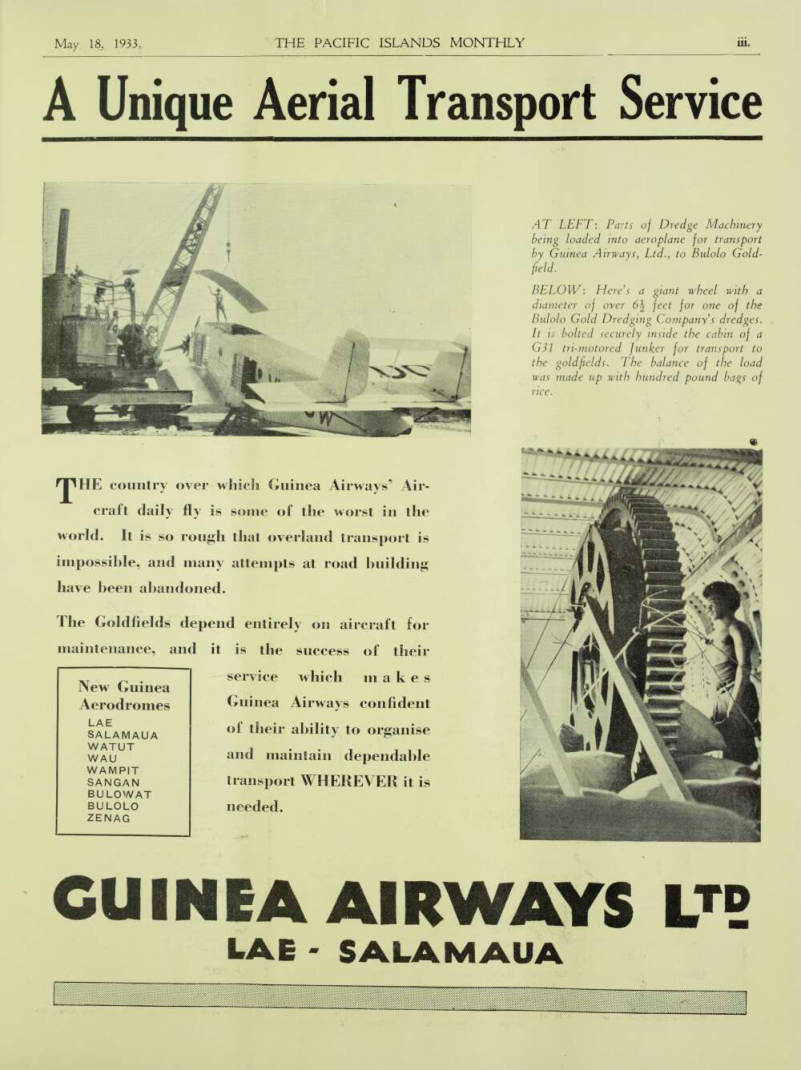
Guinea Airways, Ltd.
(which pioneered and has since conducted the aerial transport service on the New Guinea goldfields) has had not such a good year as previously. Gross revenue fell to £77,694, from £95,618 in 1931. Net profit is £13,053 against £28,725 the pre vious year.
The amount allowed for depreciation the past year is not shown. In 1931 it was £15,009. A transfer of £2,000 from general reserve is made, increasing the amount available with £145 brought for ward to £15,198. Quarterly dividends, each of 1/- a share, absorbed £15,000 and £198 is carried forward, A reduction in freight rates was made during the year, and in these circum stances the result is considered satis factory by the directors.
Fourteen new aerodromes have recently been established, embracing Papua as well as New Guinea, and are being used by the company’s aeroplanes.
Within the past five years rates charged for passengers and cargo have been reduced by 60 per cent. The actual quantity transported in 1932, inclusive of dredge material for the Bulolo Gold Dredging, Ltd., amounted to 8,357,511 lb. or 4,178 short tons, which is 232 tons more than for 1931. Passenger traffic was also greater, 3,919 persons having been carried, as against 2,455 the previous year.
The report adds: “The company’s sound financial position has been maintained, and the directors therefore recommend that a dividend of 1/- a share be paid on the 30th instant.”
Capital is £75,000, and with the transfer of £2,000 to profit and loss, general
reserve is £18,000. Sundry creditors at £12,726 are £1,679 less. Fixed assets and stores at £59,807 show a reduction of £5,108. Debtors owe £5,894 less at £18,570 and the cash holdings have been increased by £6,176 to £26,347. —“Sydney Morning Herald.”
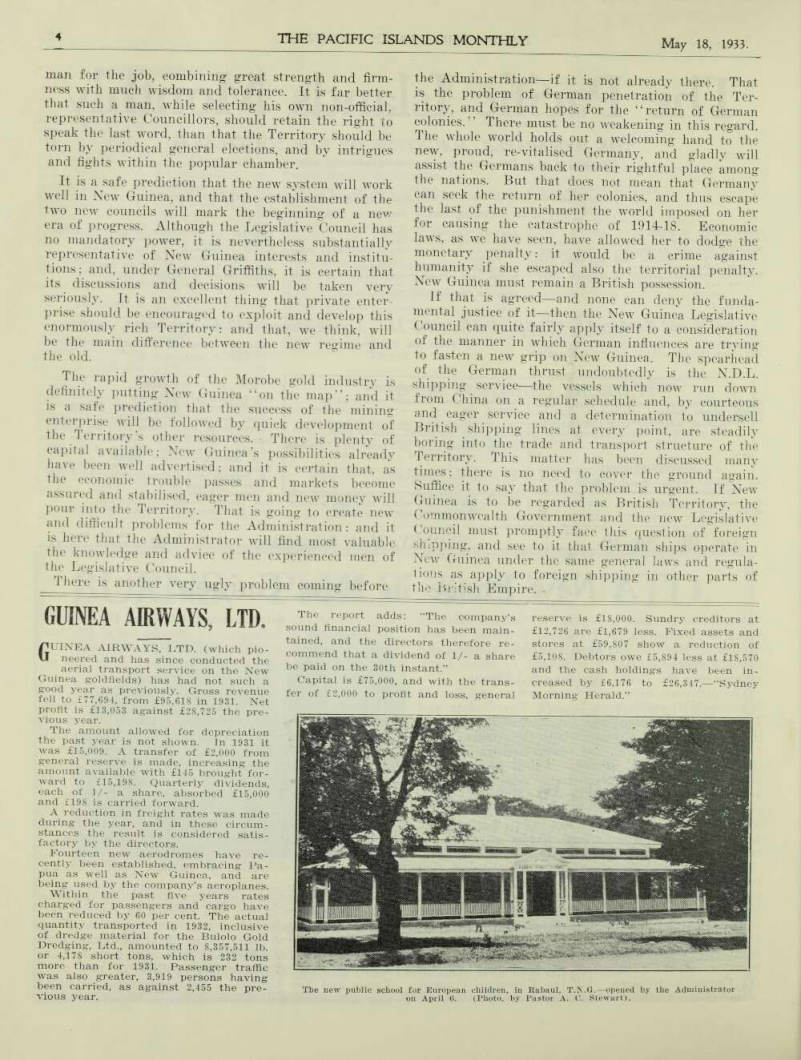
The new public school for European children, in Rabaul, T.N.G. —opened by the Administrator on April 6. (Photo, by Pastor A. C. Stewart).
Anzac Day On A Torres Strait Island.
(From a Special Correspondent.)
THE Native Priest announced that the Anzac Day Service would be held immediately after breakfast.
Hurriedly, we cooked; our morning meal and broke our fast, washed up the gear, tidied our bachelor quarters, and changed into our Scout uniform.
As my friend stated, “It would never do to keep the natives waiting. As Europeans, we should always set them a good example, even in punctuality.”
It was 9.30 a.m. before we were ready and hastily set out for the church. Not a soul was in sight—we were too late, the church was empty. We found a
boy, and enquired how long the proces sion had gone and wondered if we could catch up with it.
Great was our relief when the boy calmly stated, “People he no bin come yet; he breakfast now.”
We decided to return to our humpy and yarn and smoke for a while. At 10.30 a.m. we made another journey to the church. Not a sign of life about the place. Had the service and pro gramme for the day been abandoned?
“What is that red thing under the tree?” I enquired.
“Why, it is the Head Councillor!” exclaimed my friend.
And, sure enough, it was. Curled up like a ’possum was the Head Coun cillor, calmly snoring the morning hours away, his nose well hidden in the folds of his red jersey.
A prod with the toe soon animated the comatose heap.
“Where are the people, Noah?”
“People he breakfast now,” was the calm reply as he settled himself for another snooze.
We decided to go for a walk and returned at 11.45 a.m.
The people had arrived. Vivid coloured calicos and dresses flashed in the sun. The place was a blaze of colour. The natives were just marching into church, pre sumably singing that famous hymn— “Bring your Harps and Odours with You.”
Noting the large crowd and being fresh-air enthusiasts, we thought that the “Odours” of the crowd of natives
might be too strong for our constitu tions. We therefore decided to smoke and rest in the shade until the conclu sion of the somewhat lengthy service.
The programme for the day read: “Anzac Day Service; procession to the cemetery; dance to follow.”
Immediately after the service the pro cession formed up outside the church.
Union Jacks to the fore, borne by sturdy native police, dressed in orthodox khaki, with cocked hats. They were closely followed by the councillors in red jer seys, white pants and wide-brimmed sun hats. Then came the Darnley Island
Drum and Fife Band, 60 Scouts and 30 Girl Guides. Native priests and church officials, crucifixes, crosses and fleur-de lys. The whole civilian population, and a tribe of piccaninnies and dogs brought up the rear.
It was an imposing sight. Black faces shining in the sun, hair glistening with liberal applications of coconut oil, rain
bow colours blending into a joyous whole.
A blast on a whistle, a roll of drums and we were off, stepping out smartly to the tune of “Michael Finnegan.”
While the band regained their wind, the people marched singing “Onward Christian Soldiers,” followed by the band with “Who Killed Cock Robin?’’
“Should Auld Acquaintance be Forgot?” and “Keep the Home Fires Burning.”
Whenever the band ceased playing, more “Christian Soldiers” came from the enthusiastic followers. Thus joy ously we marched to our destination.
On arrival at the cemetery, the band was instructed by the native priest to take up a position in the centre and keep playing. As the band struck up with renewed energy the cortege divided off in files of two deep, each file march ing round the boundaries of the ceme tery, meeting on the opposite side in the middle and marching to the centre m fours.
It was great! Drums rolled and crashed. Fifes wailed and shrieked.
The dead turned over in their graves and spooks grew frisky when they heard the noble strains of "Who Killed Cock Robin?” and “Keep the Home Fires Burning."
I wonder what some of the old dead and buried savages would have said it they could have been gifted with speech? It was the first time a band had been on Murray Island. They were doing their best, but had only learned a few tunes, and none that were ap propriate for playing in a cemetery.
A hymn was sung and the priest granted me the honour of making the Anzac Day Speech. What should I say?
What should I do? These natives knew nothing of war—of Anzac. They would not know the difference between a bomb and a pontoon. None of their race had enlisted, and many of them could not understand English. They might think that Dardanelles was the name of a General and that a Turk was a species of fowl!
I was flabbergasted at the possibili ties that flashed through my mind and completely forgot the points of the speech I had intended to make. I did my best to make amends, like the old Scots Minister, “I gaed on and gaed on,”
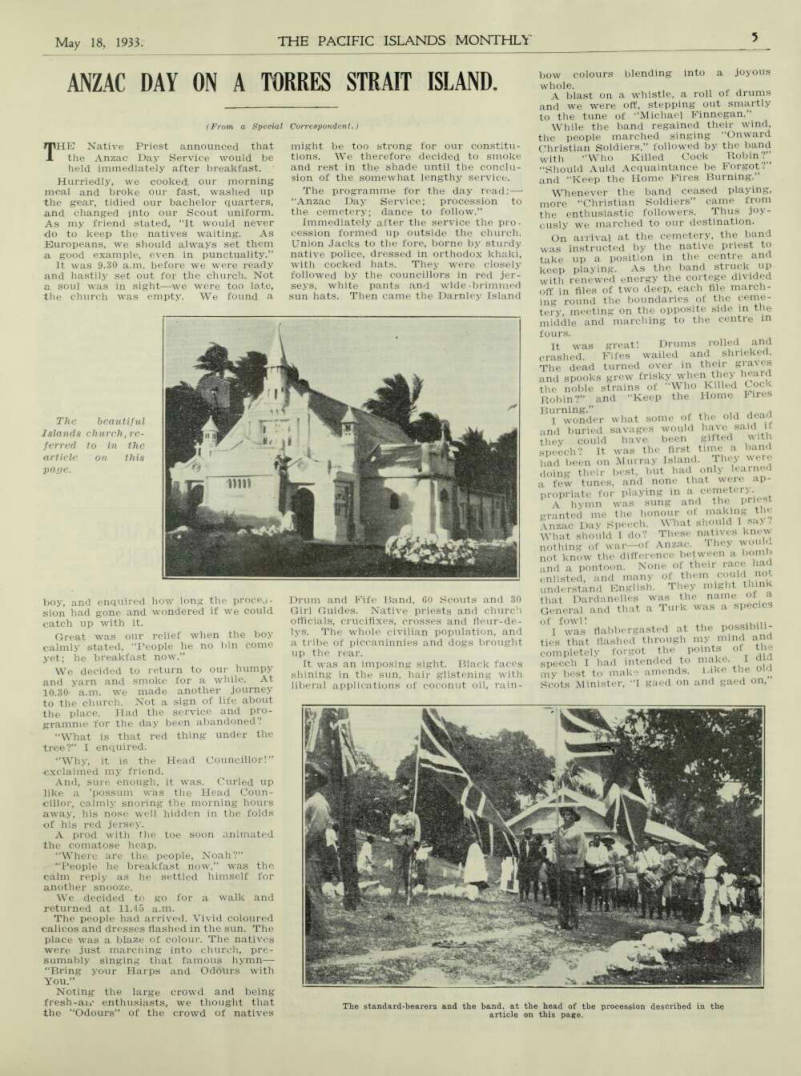
The beautiful Islands church, re ferred to in the article on this page.
The standard-bearers and the band, at the head of the procession described in the article on this page.
and, when finished, “I gaed on agen.”
The applause was loud and long.
The address had evidently pleased the people, even if they had not understood it. I stuck out my chest and felt that duty had been nobly done.
We fell in again, four deep, and marched back to the church to the same stirring tunes. (The band knew no others.) “Halt!”
A silence, and a dark-skinned priest stepped forward, in his robes of office, raised his hand to Heaven, and pro nounced the Benediction.
The people dispersed for a belated dinner, and to get ready for the dance that was to follow.
You may ask; “Why did we march to the cemetery and play "Who Killed Cock Robin" to the dead therein?”
You may also wonder why “A dance was to follow.” Why did the natives keep up Anzac Day—which means nothing to them—while whites here to whom it might mean a great deal almost ignore it?
I do not know. I cannot tell. The ways of natives are wondrous strange.
Uncertain Times.
Tahiti’s Business Trials.
From Our Own Correspondent PAPEETE, April 21.
THE business outlook in Tahiti shows no sign of improvement, in fact, dur ing the past month copra has touched a new low record figure of 35 centimes per kilo on the beach, with buyers not over-anxious to take it even at that.
Small native owners working their own properties will continue to make copra so long as it is saleable, but the larger plantation holders, with overhead ex penses and paid labour to support, now have to choose between carrying on at a loss or abandonment, which latter al ternative would mean that in a very short while their lands would become jungles of lantana and sprouted coco nuts.
The present situation is really serious.
Some benefit may ultimately accrue to the coconut planter in French territories as the result of the bonus it is proposed to pay on copra exported to France.
This was discussed some months ago and apparently shelved for a time; but the proposal is again under considera tion, and with better prospects of real isation than before. As yet, however, it is by no means an accomplished fact.
In the meanwhile, efforts are being made by the Administration to establish a castor oil industry in Tahiti and other adjacent islands, which we hope will meet with the success they deserve.
There is plenty of implanted land in the group suitable for this crop, and a large market for the product exists in France, principally as a lubricant for aeroplanes, but without some protection it would seem unlikely that the conditions here would permit of competition with other tropical countries, where labour costs are so much less, and which are more favourably situated as regards trans portation.
As the result of several recent bank ruptcies, and consequent heavy losses, import merchants are now doing busi ness on a strictly C.O.D. basis, particu larly with the small Chinese retailers who formerly enjoyed a credit of from 28 to 56 days and were often able to turn over their goods at a profit before
meeting their drafts. It will be no longer possible for a Chinaman to commence business without capital, and build up a stock in trade from advances made by commission agents in San Francisco or wholesale merchants in Papeete; but perhaps this will be all to the good in the long run.
The uncertainty of the exchange situ ation, as between the franc and the U.S. dollar, has also been responsible for con siderable dislocation of business during the past few weeks, to say nothing of the inconvenience caused to visitors holding American letters of credit or travellers’ cheques, some of whom were unable to await the outcome of events in America and were obliged to sacri fice their dollars at a rate of exchange much below par.
“Better And Brighter Gaols.”
A Papuan Reformer’s Hard Lot.
From Our Own Correspondent.
Pt. Moresby, May 4.
MUSIC hath charms, though it de pends a great deal on its quality— also there is a time and place for good or bad.
The peaceful slumbers of the hard working prisoners at Badili, the native goal of Port Moresby, were rudely dis turbed last week. The night was made hideous by the raucous paean of a Vailala youth who, out of sheer joy of good living, lifted up his voice in the dead of night and gave praise to himself, his food, and his native land.
This in itself was enough to try any native saint. The arrogance and the uproar taken separately were bad enough in themselves combined, they were a bitter pill that his bed mates were quite incapable of swallowing.
To their loud cries of remonstrance, however, he gave no heed; pausing only to remark on their repulsiveness in general, he burst forth into yet louder measures and more and more joyous song.
Hard words followed, abuse and vituperation, until in wild desperation, one Abau youth rose in his wrath and smote him on the jaw.
Fourteen days of shot drill was his reward for ridding the night of this
hideous clamour, which seemed to him hardly a square deal, and he rankled under the injustice. Therefore, later in the day, with the help of eight sturdy Abau prisoners, he pro ceeded to show the songster the error of his ways. But they were thought lessly interrupted by the head gaoler and warders, Seven days shot drill for all! And still the croaking troubadour gloated in triumph.
This was more than flesh and blood could stand. The honor of their tribe was at stake, and Abau versus Vailala was the cry. The prison gang split into tribes and the proceedings were just beginning to get interesting when alas, the warders again took a hand.
Handcuffs and detention are apt to damp the most warlike decisions, Unyielding and unconquered, the Troubadour still holds his ground, his heroic paean still floats over the prison compound. But it lacks the convic tion, the force and vigour of his earlier efforts. He is watchful and apprehen sive; but it seems he is fully prepared to suffer as a martyr in the twin causes of “Brighter Gaols and Music for All.”
Silent Talkies.
Cook Is. Showman’s Difficulties.
From Our Own Correspondent.
Rarotonga, April 24.
A NUMBER of talkie pictures have been exhibited at Rarotonga lately; but, owing to the absence of the necessary equipment, have appeared as ordinary silent films. Several such pic tures have been difficult to follow, as they are devoid of captions. Occasion ally, very old topical gazettes have ap peared featuring such items as the launching of ships which have long since been scrapped, thus pointing to diffi culty for the proprietor of a “silent” picture-house in procuring suitable films.
Mr. W. Browne, the owner of the local cinema, has decided to install a talkie plant and the appearance of the first sound picture is being awaited with the greatest interest by the native people.
Voyagers.
Remarkable
Father and Daughter on World Cruise.
From Our Own Correspondent.
PAPEETE, April 21.
TIED up opposite the shipbuilding yards at Fareute Point, where every Pa peete schooner finds itself sooner or later, and many of them end their days, there may be seen just now a queer-look ing, black-painted craft, on the stern of which the words, “Evalu”, Barcelona, are barely discernible.
Only about forty feet long, blunt nosed and beamy, her appearance indi cates stability rather than speed, and that she is an eminently seaworthy little vessel is attested to by the fact that her present owner (Professor Blanco) has already travelled several thousands of miles in her without mishap.
The professor, who graduated from Wisconsin University and now holds the Chair of Spanish at the University of Iowa, bought the vessel in Boston, sailed her across to Spain, fitted her up to his taste, renamed her after his nine years-old daughter, and finally left to go voyaging round the world, with no one to keep him company or give him a hand but little Evalu. He had small knowledge of navigation and no experi ence whatever of practical seamanship before he started on the trip, and it speaks volumes for the professors cour age and resourcefulness that he survived many hardships and adventures and eventually came safely into port. Pro fessor Blanco finds Tahiti so much to his liking that he may remain here for some time.
Resuscitation After Shock.
(By Arthur J. Vogan, F.R.G.S., recipient R.H. Society’s reward; oldest St. J. of J.
Ambulancer in Australasia.)
AS I have had my advice sought re garding the new process of resusci tation from drowning, by friends in Fiji, perhaps the following notes may be found useful to those living outside the orbit of salvation of the ordinary medi cal man.
I trust that such wonderful and de voted men as Dr. Williams, of Samarai; and Dr. A. C. Neff, of the leper station at Makogai; and other professionals who had rendered me hospitality and assist ance, will forgive me, as a very humble member of the healing art and pardon my presumption.
Suicide by gas-poisoning is greatly on the increase in the large centres of population in America and England; but, fortunately, is beyond the reach of the owners of copra plantations and pearl-traders. Similar effects arise at times from excessive stimulation under that now “forbidden” condition of the mind about which Mr. Dexter disagrees with me.
Drowning, the excessive effects of using the poisonous betel-nut (“areca mentality”?)—which arrested the pro gress of Island self-culture; shock, from shark bites, or fish-spines; bush-fire, fume-effects, etc., can all be now more effectively treated, than when I learned ambulance work many years ago.
We hear about the administration of oxygen; but it has too often been given in a perfunctory way (frequently too late) and timid kind of inadequate way, owing mainly, in hospital, to the ex pense! There is no danger whatever in breathing pure oxygen for hours con tinuously—working hard all the time, as In the case of mining rescue-parties.
At a meeting of the British Associa tion in 1931, the subject was dealt with by the President, Dr. Dale, and four main, available lines of resuscitation were described: namely, artificial respi ration, carbon-dioxide and oxygen, inha lation, cardiac puncture, and cardiac massage. The two latter do not concern us amateurs!
Sir Edward S. Schafer, the inventor of the latest resuscitation process, which has taken the place of the Sylvester method, which I learned in the ’seven ties and ’eighties, showed that the result of a Royal Commission proved that the prone position now called “Schafer’s method” was far preferable.
In this, pressure of about sixty pounds weight is brought to bear on the small of the back —thus compressing the ab dominal viscera;- and pushing the dia phragm upwards like the plunger of a pump. The old way, which I have found successful, was by the well-known hold ing of the forearms, whilst kneeling astride of body, lying on its back, with tongue tied down to jaw, and, after stretching arms above head, bringing the elbows down on to floating ribs so as to compress them. Alternating pump ing action every five seconds, or so.
But careless action might rupture or gans; and the new way is better —but like most BEST things, requires more attention and greater skill! In England and America it is taught to Army and Navy, the police, and boy scouts, girl guides, etc.
But having “caught your hare”, to use the old cookery expression, and seeing with delight the first tentative volun tary attempts of your unconscious pa
tient to breathe again, your thoughts turn naturally to what will now follow: “Post hoc propter hoc!” There is the dreaded pneumonia, and after nervous effects, that may wipe out what your amateur resuscitation has recovered.
One turns, then, to the new carbon dioxide treatment called practically the administration of “Dicarbox” gas, which obviates most of the dreaded after effects. Twenty-five years ago Profs.
Haldane, Priestly, and Douglas, of Eng land, working in conjunction with Pro fessor Yandell Henderson, of Yale Uni versity, realised that the inhalation of cardon dioxide gas prevented the func tional depressions arising after shock, surgical operations, and acute poisoning and disease. Their discovery reminds those of us who are of the old school of the famous saying of the great Swiss physiologist Miescher, about the year I found the first gold discovered in New Guinea, in historic times (1885): —“Over the oxygen supply of the body carbon dioxide spreads its protecting wings.”
At first the practical problem of ad ministering C.D. was not simple. As I heard Sir Michael Foster say: “It is rarely possible to carry a physiological discovery bleeding from the laboratory to the bedside.” Haldane first showed that the compound which carbon mon oxide forms with the haemoglobin (col ouring matter of blood) is dissociable, and that haemoglobin is restored to nor mal condition under the mass action of oxygen. Professor Henderson then found that if carbon dioxide was administered (5 to 8 per cent.) respiration was greatly stimulated. When a mixture of oxygen and C.D. was administered, after a short but intense asphyxia, the effects were truly extraordinary.
It is now administered under the prone position of Professor Schafer, and the apparatus has each year been sim plified and lightened so that it can be
carried into the intricate passages of mines, or earthquaked ruins of towns.
The chances of resuscitating folk “found drowned”, or “dead drunk”, or poisoned with fumes, is to-day fifty per cent, greater than when I was young and beautiful.
We owe this to these wonderful men of whom our democracies know nothing.
Our mobs make heroes of cricketers, and little gods of other professional players, of games for money; but our hospitals are rendered inefficient because the people cannot spare for them funds they waste upon “pat-ball” games.
Any further information regarding the above subject required by my Island friends will be forwarded. This article has been written to supply one of my numerous correspondents with what, no doubt, many are in need of.
Papuan Customs.
From Our Own Correspondent.
Pt. Moresby, April 28.
THE Papuan Customs revenue for March, 1933, was as follows:
Port Moresby.
Imports duties . . £1,461 17 1 Primage duties . . 373 3 10 Ship and other fees . . 4 4 6 Total £1,839 5 5
Samarai.
Import duties £1,301 8 7 Primage duties 292 1 9 Export duties (shell) 17 18 7 Ship and other fees 2 1 5 Total . . £1,613 10 4
Kulumadau (Woodlark Island)
Import duties £147 14 0 Primage duties 21 17 6 Ship and other fees 1 0 0 Total £170 11 6
Daru (Western Papua).
Import duties £43 10 9 Primage duties 14 9 10 Total £39 19 7 Total for Territory (March): £3,683/5/10.
Advertisements & other items, p. 9 (1 item)
Whisky
"LORD OF THE HILLS”
Genuine Three - Year Old Scotch
Supplied in minimum quantities of ten (10) cases for £1-2-0 per case of twelve (12) standard bottles c.i.f., main Pacific Island Ports. :: Age Certificate Free.
Banker’s Draft with order to —
Mr. F. M. WRAIGHT,
11 Ludgate Hill, London, E.C.4.
About Islands People.
M. Leonce Jore, until recently Gov ernor of New Caledonia and Commis sioner-General in the Pacific for France, and Madame Jore sailed from Sydney for Europe by the “Oronsay” on April 26.
Prince Uiliame Tugi, Premier of Tonga and Prince Consort of Queen Salote, returned to Tonga on the “Niagara” on April 27.
Captain S. F. Sanders, M.C., of the Fiji Constabulary, arrived in Sydney by the “Mariposa” on April 27 on vacation leave from Suva.
M. Siadoux, who has been appointed Governor of New Caledonia, accom panied by Madame Siadoux and Mlle.
Siadoux, arrived in Sydney by the motor ship “Eridan” on April 27. He con tinued on with the “Eridan” to Noumea, as the vessel is on a tourist cruise. M.
Siadoux, who has been 30 years in the French diplomatic service, was Governor of French Guiana for four years.
Dr. George Dobo, Ph.D., an official an thropologist employed by the French Government, arrived in Sydney by the “Mariposa” on April 27. He is en route to Port Moresby, where he proposes to make a study of native languages and, if possible, solve the mystery of their origin. From Port Moresby, Dr. Dobo will proceed to French Indo-China.
Viscountess Hill, of Wales, who has been touring in the Pacific Islands, arrived in Sydney by the “Mariposa” on April 27 on her way to England.
Dr. F. A. Macpherson, of San Fran cisco, arrived in Sydney from London by the “Baradine” on April 28 on his way to the Anglican Melanesian Mission in the Solomon Islands, where he will take up duty as medical officer at Fauaba Hospital. He is accompanied by Mrs. Macpherson. Mr. Leslie Stibbard, associated with the same mission, was also a passenger by the “Baradine,” He will join the teaching staff at Marovovo School. The party left Sydney by the last “Mataram.”
Mr. R. A. Hopkins, superintendent of the Keravat Experimental Plantation, New Guinea, accompanied by Mrs. Hop kins, returned to Rabaul by the April “Macdhui.” Mr. and Mrs. Hopkins have been spending three months’ vacation at the Blue Mountains, N.S.W.
The Rev. J. W. Burton, general sec retary of the Mission Board, left Syd ney for Suva by the “Niagara” on April 27. He hopes to return to Sydney late this month.
The Rev. T. N. Deller and Mrs.
Deller, of Bau, Fiji, were recently in jured in a motor accident. Mrs. Deller sustained a dislocated arm,, but is mak ing good progress to recovery in Suva Hospital.
The Bishop of Melanesia (the Right Rev. H. W. Baddeley) will be in Sydney in July on his way to the New Heb rides. He will return to Melanesia in September.
The Rev. R. Godfrey and Mrs. God frey, of the Melanesian Mission, arrived in Sydney from Auckland on April 8 and left for their station in the New Heb rides by the “Morinda” on April 20.
The Rev. A. J. Thompson and Mrs.
Thompson arrived in Sydney by the “Macdhui” on April 19 on furlough from the New Guinea Mission.
The Rev. A. H, Scriven, who for eleven years was at the Methodist Mis sion at Kiriwina, Papua, has been ap pointed F.M. Secretary for New Zealand.
The Rev. N. G. Pardey, L.Th., will fill the vacancy in the Methodist Mis sion, Samoa, caused by the retirement of the Rev. G. S. Shinkfield. Mr. Pardey was recently tutor at Leigh College, Sydney.
The Rev. L. E. Saville, who was on the staff of the Federal Inland Mission, has been appointed to the island of Rotumah, which has been without a missionary for some time.
Mr. H. T. Edgar, Deputy Administrator of Norfolk Island, has been on a visit to his brother, Mr. W. H. Edgar, M.L.C., of Melbourne.
Captain J. E, Warwick has taksn command of the Union Co.’s steamer “Karetu,” which sailed for Fiji on May 6. The former master, Captain A. Reed, is awaiting orders in Sydney.
The Rev. Nelson Britton, home sec retary of the London Missionary Society, sailed for Samoa by the “Mariposa” on May 6. He will be joined at Apia by the Rev. J. A. Kaye, a former chairman of the Society, and, after touring Samoa and New Zealand, they will return for deputation service in New South Wales.
Mr. J. L. Scott, chief engineer of the Nausori Mill, Fiji, and Mrs. Scott re turned to Fiji on April 7 after three months’ vacation in Australia.
The Rev. J. H. Dickinson, Assistant Bishop of Melanesia, arrived in Sydney by the “Morinda” on May 8 on his way from the New Hebrides to the Solomon Islands.
Captain A. Toten, of the Union Co.’s steamer “Maunganui”, came ashore on leave when the vessel reached Sydney on May 10. He is being relieved by Cap tain W. Martin.
Mr. H. L. Clark, secretary of the Bay Loo Co. of Rabaul, and also secretary of the Rabaul Amateur Turf Club, who has been on an extended holiday in New South Wales, returned to Rabaul by last “Macdhui”.
Mrs. H. F. Ayson, wife of Mr. Justice Ayson, Resident Commissioner of the Cook Islands, arrived at Rarotonga by the “Maunganui” on April 22. She was accompanied by her daughter, Miss Myra Ayson.
Mr. V. B. Pennefather, a New Guinea planter, returned to Rabaul by the “Nankin” on May 13.
Frequent.
Steamer Service Too
A Solomons Complaint.
Letter to the Editor, There is a growing feeling of protest against the frequency of the Sydney- Solomons steamship service. Latterly it has been increased from eight trips a year to 10, and those unfortunate planters and traders who have to meet the steamers find their business severely penalised by the resultant loss of time.
The feeling is freely expressed that an eight-weekly service would fully meet the requirements of the Group—certainly anything in excess of eight trips a year is a gross extravagance, to say nothing of the loss entailed on those who have their businesses dislocated by the in cessant dancing in attendance upon steamers.
The business of the Group does not warrant the existing service. It does, seem absurd that the Solomons should have a more frequent service in this depression period than in more prosper ous times. The “Mataram” comes from Sydney nowadays with but a fraction of her former cargo (a trip or two ago she brought a mere handful —400 tons), yet they are sending her now more fre quently. Who pays for all this? One would think the Commonwealth Gov ernment had little money to waste in these times on subsidies for unneces sary and unwanted steamer services, and no doubt Burns, Philp would be pleased to reduce the number of trips, for it can be no pleasure to them to operate vessels at a loss. So a reduc tion would be beneficial all round.
In these matters, far too much im portance is laid upon the mail aspect when arranging services. There is ever the tendency for the salaried classes— officials, commercial executives in main ports, etc. —to stress this matter. And as they are the most vocal, they usually get the best hearing. But, after all, while it may be very nice to receive a mail as frequently as at present, does; the nature of our business require the accelerated service? A better radio ser vice, yes; but the present mail service, emphatically no. What does it benefit the coconut industry to receive 10 mails; per annum instead of eight or six?
Absolutely nothing.
Times are too bad for the Solomons and the Australian communities to be wasting money on superfluous steamer services to enable us to receive a few more letters from home.
I am, etc.,
Leslie F. Gill.
Gizo, B.S.I., 31/3/1933.
EDITORIAL NOTE. —We have published scores of letters complaining about poor and unfrequent communications in the Islands. This is the first time we have had a protest against a too frequent service. We have a mental picture of the sober directors of Messrs. Burns, Philp & Co. passionately asking themselves if this means the end of the world! Yet there is much sound commonsense in Mr. Gill’s argument.
If there is actually no need for a five-weekly service for the Solomons, and the Solomons folk are content with a six-weekly service, why squeeze in the two additional trips per annum?
In these days, everyone is trying to cut out unjustifiable economic waste.
Huge Stingray Landed by Angler.
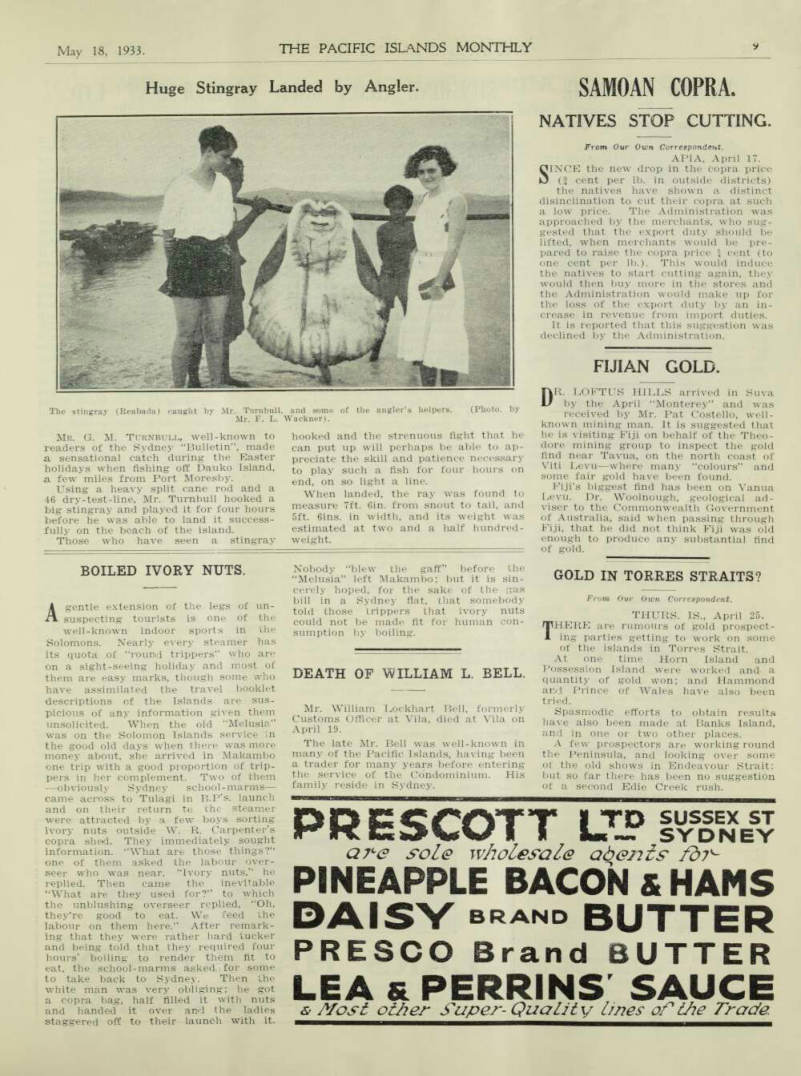
Mr. G. M. Turnbull, well-known to readers of the Sydney “Bulletin”, made a sensational catch during the Easter holidays when fishing off Dauko Island, a few miles from Port Moresby.
Using a heavy split cane rod and a 46 dry-test-line, Mr. Turnbull hooked a big stingray and played it for four hours before he was able to land it success fully on the beach of the island.
Those who have seen a stingray
hooked and the strenuous fight that he can put up will perhaps be able to ap preciate the skill and patience necessary to play such a fish for four hours on end, on so light a line.
When landed, the ray was found to measure 7ft. 6in. from snout to tail, and 5ft. 6ins. in width, and its weight was estimated at two and a half hundred weight.
The stingray (Reabada) caught by Mr. Turnbull, and some of the angler’s helpers. (Photo, by Mr. F. L. Wackner).
Boiled Ivory Nuts.
A gentle extension of the legs of un suspecting tourists is one of the well-known indoor sports in the Solomons. Nearly every steamer has its quota of “round trippers” who are on a sight-seeing holiday and most of them are easy marks, though some who have assimilated the travel booklet descriptions of the Islands are sus picious of any information given them unsolicited. When the old “Melusia” was on the Solomon Islands service in the good old days when there was more money about, she arrived in Makambo one trip with a good proportion of trip pers in her complement. Two of them —obviously Sydney school-marms — came across to Tulagi in B.P’s. launch and on their return to the steamer were attracted by a few boys sorting ivory nuts outside W. R. Carpenter’s copra shed. They immediately sought information. “What are those things?” one of them asked the labour over seer who was near. “Ivory nuts,” he replied. Then came the inevitable “What are they used for?” to which the unblushing overseer replied, “Oh, they’re good to eat. We feed the labour on them here.” After remark ing that they were rather hard tucker and being told that they required four hours’ boiling to render them fit to eat, the school-marms asked for some to take back to Sydney. Then the white man was very obliging; he got a copra bag, half filled it with nuts and handed it over and the ladies staggered off to their launch with it.
Nobody “blew the gaff” before the “Melusia” left Makambo; but it is sin cerely hoped, for the sake of the gas bill in a Sydney flat, that somebody told those trippers that ivory nuts could not be made fit for human con sumption by boiling.
Death Of William L. Bell.
Mr. William Lockhart Bell, formerly Customs Officer at Vila, died at Vila on April 19.
The late Mr. Bell was well-known in many of the Pacific Islands, having been a trader for many years before entering the service of the Condominium. His family reside in Sydney.
Samoan Copra.
Natives Stop Cutting.
From Our Own Correspondent.
APIA, April 17.
SINCE the new drop in the copra price (¾ cent per lb. in outside districts) the natives have shown a distinct disinclination to cut their copra at such a low price. The Administration was approached by the merchants, who sug gested that the export duty should be lifted, when merchants would be pre pared to raise the copra price ¼ cent (to one cent per lb.). This would induce the natives to start cutting again, they would then buy more in the stores and the Administration would make up for the loss of the export duty by an in crease in revenue from import duties.
It is reported that this suggestion was declined by the Administration.
Fijian Gold.
DR. LOFTUS HILLS arrived in Suva by the April “Monterey” and was received by Mr. Pat Costello, well known mining man. It is suggested that he is visiting Fiji on behalf of the Theo dore mining group to inspect the gold find near Tavua, on the north coast of Viti Levu—where many “colours” and some fair gold have been found.
Fiji’s biggest find has been on Vanua Levu. Dr. Woolnough, geological ad viser to the Commonwealth Government of Australia, said when passing through Fiji, that he did not think Fiji was old enough to produce any substantial find of gold.
Gold In Torres Straits?
From Our Own Correspondent.
THURS. IS., April 25.
THERE are rumours of gold prospect ing parties getting to work on some of the islands in Torres Strait.
At one time Horn Island and Possession Island were worked and a quantity of gold won; and Hammond and Prince of Wales have also been tried.
Spasmodic efforts to obtain results have also been made at Banks Island, and in one or two other places.
A few prospectors are working round the Peninsula, and looking over some of the old shows in Endeavour Strait; but so far there has been no suggestion of a second Edie Creek rush.
Advertisements & other items, p. 11 (1 item)
PRESCOTT Ltd Sussex St Sydney
are sole wholesale agents for
PINEAPPLE BACON & HANS
DAISY BRAND BUTTER
PRESCO Brand BUTTER
LEA & PERRINS' SAUCE
& Most other Super-Quality lines of the Trade.
Island Wedding.
Polynesian Families Unite.
From Our Own Correspondent.
APIA, April 17.
A TIE between two closely related branches of the Polynesian race was formed on March 18, when the wed ding of the Hon. John Havea Tuihaateiho, Governor of Vavau (Tonga), with Leafa tulagi Seumanatafa, daughter of a high chief of Apia (Samoa), took place at Apia Methodist Church. Marriage festi vities according to old Samoan fashion followed.
The wedding was attended by Euro pean and Samoan guests, among whom were the Administrator and Mrs. Hart and numerous officials and citizens. The Administrator addressed the meeting and, after the kava ceremony, an elab orate native feast was offered to the guests who numbered about 2,000. Danc ing and merrymaking and a singing competition lasted far into the night.
N.G. Public Service.
THE latest Official Bulletin (number 13) issued by the Administration of New Guinea contains the following
appointments, promotions, etc., of the
public service:—
Permanent Staff.
Appointments.
Department of District Services and Native Affairs. —J. E. Daymond, to be Acting Assistant District Officer.
Department of Public Health. —N. Y. McKenna, to be Medical Officer; A. Coomber, to be Medical Assistant, Grade 1; H. J. Laugher, to be Acting Dispenser and Medical Stores Officer; J. M.
Atherton, to be Acting Assistant Dispenser.
Department of Lands, Surveys, Forests, Mines and Titles. —A. F. Schmahl, to be Translator.
Transfers.
Department of District Services and Native Affairs. —B. W. Sherman, Assistant District Officer, from Gasmata to Kokopo; A. C. Koskey, Clerk, from Rabaul to Salamaua; A. Nurton, Patrol Officer, from Rabaul to Salamaua.
Department of Public Health. —D. Day, Nurse, from Rabaul to Salamaua; W. N. S. Couzens, Medical Assistant, Grade 1, from Rabaul to Madang; R. G. Pickwell, Medical Assistant, Grade 1, from Rabaul to Namatanai; N. V. McKenna, Medical Officer, from Rabaul to Manus.
Termination of Services.
Department of Public Health. —M. B. Margrie, Nurse.
Temporary Employees.
Appointments, Department of District Services and Native Affairs.—N. M. Savage, to be Typiste; K. M.
Hyde, to be Typiste.
Department of Public Works.—H. J. Streeter, to be Carpenter.
Transfers.
Department of Public Works. —H. J. Streeter, Carpenter, from Rabaul to Salamaua; J. Lyall, Carpenter, from Rabaul to Salamaua (en route Wau).
Terminations.
Department of Treasury. —D. MacAdam, Typiste.
Department of Agriculture.—C. M. Smith, Inspector and Instructor.
Mr. W. C. Groves, accompanied by his wife and two daughters, returns to New Guinea by the “Montoro” on May 17.
Mr. Groves recently spent a year in New Ireland doing anthropological re search work. During the next 12 months he will study the sociological aspects of depopulation in Tabar Islands.
Sunshine (N.G.) Gold Development, Ltd.
THE Sunshine (N.G.) Gold Develop ment, Ltd,, whose prospectus has been forwarded to us, is now being formed to develop leases on the Watut River, known as Sunshine Nos. 1, 2 and 3, at present held by Messrs. C. F.
Duchatel and M. Wilson. In addition, it will take over, if considered advis able, the right to an option held also by Messrs. Wilson and Duchatel over the “Gorge” claim and a further option to take over the “Goldfoil” claim.
This is a dredging proposition. The properties are held as dredging claims and, commencing at the junction with the Bulolo Gold Dredging Ltd.’s ground, extend down-stream along the Watut River for 3% miles.
The company is to be registered at Canberra, and will have a capital of £15,000, divided into 30,000 shares of 10/- each; 9,000 fully-paid-up shares being allotted to the vendors and 21,000 being offered for public subscription: payable at 2/6 on application, 2/6 on allotment, and the balance in calls. The directors are: Frederick W. Torrington, Alfred E. Brown, Frank George, John M. Ryan and Sydney H. Carroll.
The resident manager and consulting engineer to the company anticipates for the areas a highly profitable life ex tending over ten to fifteen years, as the probable yardage is over 5 million cubic yards, which in places in the Sunshine group of claims has a value of as high as 8/7 on the present price of gold, though, of course, it is not expected that such a high value will be maintained over such a large area. Sunshine No. 2 connects with the “Gorge” claim. It contains only small remnants of rich gravels; at its lower end it surrounds the “Buller” claim, to take in a flat of about 3 acres, through which a pay channel possibly runs. It is mainly in gorge country. Sunshine No. 3 is also in gorge country, but contains areas of several acres carrying surface values of 5/2, equal to 8/7 on the present price of gold, and worked in conjunction with the more important Sunshine No. 1, warrants prospecting by drill to deter mine yardage and values.
Of the several claims under considera tion, Sunshine No. 1 is the most im portant. It comprises 300 acres, of which 170 acres are continuous low flats, which are held up at the lower end by a narrow gorge. They are the first flats below the Bulolo Gold Dredg ing areas, capable of holding and con centrating gold carried through the
narrow area of Sunshine No. 2, and in view of the high values won both above and below them, may be regarded as specially valuable. Half-a-mile above, on the “Buller” claim, 2,500 cubic wards recently gave a return of 912 ounces, of which the value was £5,080, while below the flats on dredging claim No. 124 (held by other interests) 50 ounces have been won by boxing in 23 days, representing a value of 16/6 per cubic yard on the present price of gold. It is claimed that these rich concentrations indicate that a high value must have gone down into the flats. At the lower end of the flat a small gravel exposure gives a value of 23/- per cubic yard at present gold prices, while the beach at Lay Creek has values equal to 5/11.
Prospecting the lower flats by shafts is difficult as the ground water is close to the surface, so the pay channel can only be determined by drilling.
The “Goldfoil” claim was pegged to include the continuation of the pay channel emerging from the lower Bulwa areas of Bulolo Gold Dredging Ltd.
The “Gorge” claim has shown high values on either bank. From selected areas where boxing is being done by the owner (Mr. Dumb), values as high as 37/- per yard on present price of gold have been won.
The main interest in the “Gorge" claim is that the pay channel should be in the Watut River within the limits of the claim, and a water right is held to divert the river through a sharp bend and expose approximately 700 yards in length of its bed adjacent to "Goldfoil.” This diversion presents no difficulties.
The Sunshine aerodrome adjoins the Sunshine No. 1 lease and is suitable for the landing of “Junkers” ’planes carrying a ton. Water power for gen erating electricity is available and a water right allows Mr. Duchatel to divert 100 sluice heads of water from Snake River, which can be brought through good ditching country to a height of 100 feet to generate, if neces sary, 1,000 horse-power.
Drilling of the leases was commenced on March 6, the company having ap pointed Mr. O. Moen as drilling en gineer. Mr. Moen has had several years’ experience in mining in New Guinea with Placer Development. It is anticipated that valuations of the claims will be available at the end of this month. Mr. Duchatel has returned to New Guinea as resident manager.
Advertisements & other items, p. 12 (1 item)
Lars Halvorsen
Auxiliary Ketch built for Solomon Islands.
Designer and Builder of SCHOONERS, KETCHES, YACHTS, LAUNCHES, etc. Can also quote for Second-hand Craft. Send particulars of your requirements HAYES STREET, NEUTRAL BAY, SYDNEY, N.S.W.
Buka And Its Beauty.
Written for “The Pacific Islands Monthly'’ by A.G.E. —a girl resident of Buka, T.N.G.
BUKA, which is the most northerly of the Solomon Islands, lies to the north of Bougainville, from which it is separated by a narrow strait known as Buka Passage. It is considered one of the prettiest of districts in the Solo mon Group.
Buka has many ranges, the highest of which is about 1,300 feet. The island it self is approximately 60 miles in length —i.e., from Buka at one end, to Kessa Plantation at the other extreme end.
At the northern end of Buka there are a number of coral islands lying off the west and south coasts. On these islands, and on the west coast of Buka, there are numerous plantations. The princi pal harbour is Queen Caroola.
Leaving Kessa, and coming round the west coast by boat, the trip is a very interesting one, passing the many low lying coral islands and a few plantations on the way; and then round Cape Horn (this is only a name given by one of the planters of Buka and is not shown on the chart under this name).
Turning to the left, you enter Buka Passage, which is between six and seven miles in length. To pass through Buka Passage means winding in and out among many picturesque coral reefs — not the usual brown-coloured ones, but all the most beautiful shades in reds and pinks, and many shades of orange and mauve. Little fishes of magnificent hues dart in and out among the coral and seaweed. Scattered here and there are numerous islands, lying like gorgeous emeralds on the unruffled sea.
After continuing along for about four and a half miles, one comes to the is land of Sohana, the Government Station, and on which are the Sohana Golf Links, covered with the ever-green clover. The lovely golden-shaded Calliposis grows down the edges of jagged cliffs. The homes of the Government folk nestle amongst crotons of every hue —a very beautiful scene.
Passing on, one comes opposite Bonis Plantation, on Bougainville, with the usual Kong and graceful coconut palms, behind which is the towering peak of Mt. Balbee. On the opposite side are scattered here and there a few native villages.
Then comes the point of Hahaiea, where one looks out over the prismatic brilliance of the sea, to the edge of the far horizon, and the white surf break ing on the reefs of the Passage. The towering peaks of Bougainville look down on the island of Buka —just a mass of dark serrated hills, below which a white line of dying waves disappears in long ripples of smoky foam.
Now, back again to Cape Horn, and round to the right into the calm and placid waters of Matchin Bay—scarcely less magnificent than the Passage, with the many small and large islands dotted here and there. To the west of these, nestling in calm seclusion, on the shore of the beautiful bay—an oasis of palms in the desert of blue haze —lies Soraken and to this place comes the latest and most up-to-date of Burns, Philp’s steamers the "Macdhui”, always crowded with tourists, to view the bleached coral beaches and magnificent reefs of these parts.
It is strange that so picturesque a place as Buka Passage is so little known by the outside world.
Death Of Princess Fusibala
Tragedy Ends Gifted Tongan's Tour.
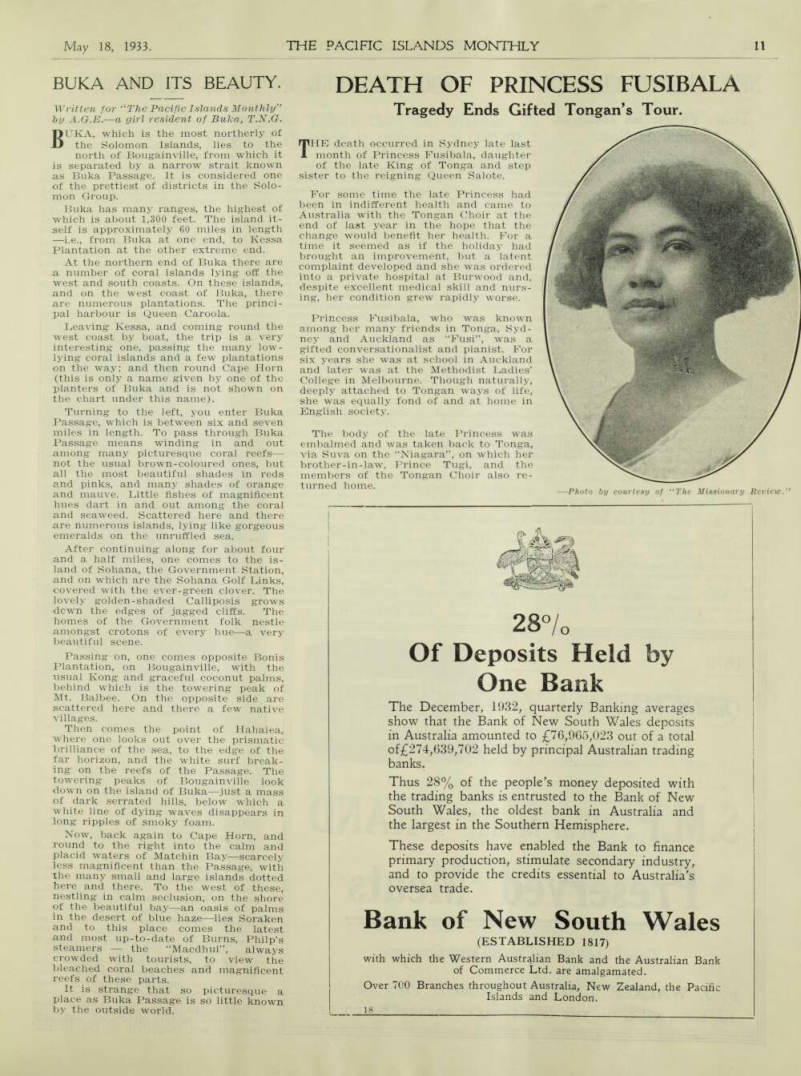
THE death occurred in Sydney late last month of Princess Fusibala, daughter of the late King of Tonga and step sister to the reigning Queen Salote.
For some time the late Princess had been in indifferent health and came to Australia with the Tongan Choir at the end of last year in the hope that the change would benefit her health. For a time it seemed as if the holiday had brought an improvement, but a latent complaint developed and she was ordered into a private hospital at Burwood and, despite excellent medical skill and nurs ing, her condition grew rapidly worse.
Princess Fusibala, who was known among her many friends in Tonga, Syd ney and Auckland as “Fusi”, was a gifted conversationalist and pianist. For six years she was at school in Auckland and later was at the Methodist Ladies’
College in Melbourne. Though naturally, deeply attached to Tongan ways of life, she was equally fond of and at home in English society.
The body of the late Princess was embalmed and was taken back to Tonga, via Suva on the "Niagara”, on which her brother-in-law, Prince Tugi, and the members of the Tongan Choir also re turned home.
—Photo by courtesy of “The Missionary Review ”
Advertisements & other items, p. 13 (1 item)
Of Deposits Held by
28%
One Bank
The December, 1932, quarterly Banking averages show that the Bank of New South Wales deposits in Australia amounted to £76,965,023 out of a total of £274,639,702 held by principal Australian trading banks.
Thus 28% of the people's money deposited with the trading banks is entrusted to the Bank of New South Wales, the oldest bank in Australia and the largest in the Southern Hemisphere.
These deposits have enabled the Bank to finance primary production, stimulate secondary industry, and to provide the credits essential to Australia's oversea trade.
Bank of New South Wales
(ESTABLISHED 1817)
with which the Western Australian Bank and the Australian Bank of Commerce Ltd. are amalgamated.
Over 700 Branches throughout Australia, New Zealand, the Pacific Islands and London.
New French Cruiser.
Tours Pacific en route to China Station.
From Our Own Correspondent PAPEETE, April 21.
THE new French warship “Savorgnan de Brazza” arrived here yesterday morning by way of the Marquesas and Fakarava, and in celebration of this event Papeete is now en fete. The new vessel is officially classed as an “aviso,” or scout cruiser, is of about 2,500 tons, and carries a complement of 140 officers and men; Commandante Rosetti is in command. The “Savorg nan de Brazza” was constructed in the French naval yards at Brest.
A generous programme of amuse ments has been arranged for the visitors by the local “Comite des fetes,” and these were opened last evening with a “Bal Publique” held in the gardens in front of the Gov ernor’s residence. The function was well attended in spite of the showery weather prevailing at the time. There is to be a more select affair at the Cercle Coloniale after the departure of the mail steamer on Saturday, and the Association known as the “Jeunesse Tahitienne” is staging a popular ball in the Citroen Garage. Also included in the programme is a fire walking exhibition which will no doubt be un usually interesting.
From Papeete the “Savorgnan de Brazza” will proceed to the Leeward Group and thence to American Samoa, where, with the consent of the United States Government, a permanent memorial will be erected over the graves of the Vicompte de Bangle and ten others belonging to the Laperouse expedition who were killed there in 1787. The vessel will then proceed to her destination at Shanghai to join the French Asiatic Squadron.
Food Culture In Torres Strait.
Written for “The Pacific Islands Monthly” by “C. Coral.”
THERE are a number of islands in the Torres Strait group, of which about twenty are inhabited: but they vary considerably in fertility.
Some are mere sandbanks, others covered with granite boulders, and, others again, in the Eastern group, are hilly and of volcanic origin. It is the latter which are the most fertile, al though the islands immediately adja cent to New Guinea also stand well in food production.
It is interesting to notice, however, the distribution of native foods and their origin. The mythical culture hero of the Strait is Soida, who in legend is described as having come from New Guinea; but there are also others, such as Abob and Kos, who came from somewhere to the eastward bringing with them new culture, arts, and language. To some of the islands Soida brought the first coconuts.
Most of the islands had their tobacco gardens. Where the weed came from is a mystery, as the first European visitors found it being cultivated in carefully-protected gardens, and it figures in legend and song as an in digenous product.
Bananas grow well in the Eastern and Western islands, but only poorly in the central group, which is of the sandbank type. Soida brought certain species of these, but in more modern days the finer flavored Cavendish banana (called also the China banana), which grows on a hardy plant, found its way to Torres Strait per medium of the L.M.S. missionaries from Samoa, who in turn received it (only one plant being preserved) from Eng land. It was also the same mission aries who brought plants of the best varieties of kumalla, or sweet potato; and on one island at least the reward
for Sunday Church attendance on the part of the inhabitants was a meal of the newly-introduced vegetable!
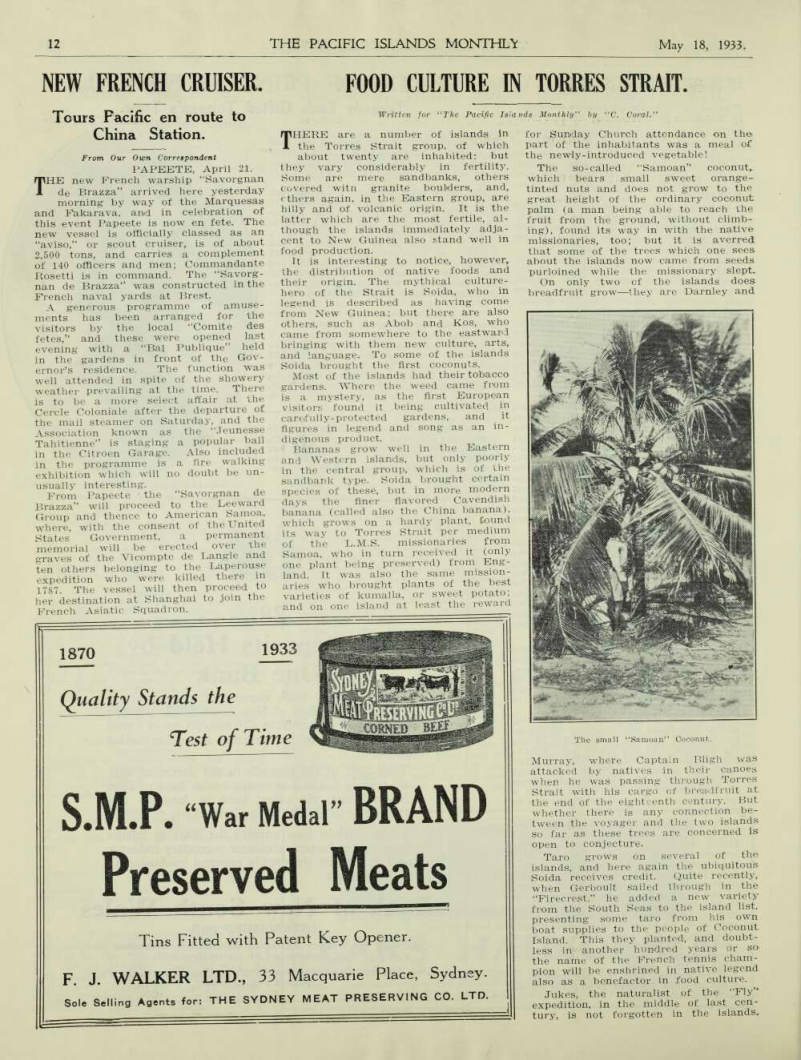
The so-called “Samoan” coconut, which bears small sweet orange tinted nuts and does not grow to the great height of the ordinary coconut palm (a man being able to reach the fruit from the ground, without climb ing), found its way in with the native missionaries, too; but it is averred that some of the trees which one sees about the islands now came from seeds purloined while the missionary slept.
On only two of the islands does breadfruit grow—they are Darnley and
Murray, where Captain Bligh was attacked by natives in their canoes when he was passing through Torres Strait with his cargo of breadfruit at the end of the eighteenth century. But whether there is any connection be tween the voyager and the two islands so far as these trees are concerned is open to conjecture.
Taro grows on several of the islands, and here again the ubiquitous Soida receives credit. Quite recently, when Gerboult sailed through in the “Firecrest,” he added a new variety from the South Seas to the island list, presenting some taro from his own boat supplies to the people of Coconut Island. This they planted, and doubt less in another hundred years or so the name of the French tennis cham pion will be enshrined in native legend also as a benefactor in food culture.
Jukes, the naturalist of the “Fly" expedition, in the middle of last cen tury, is not forgotten in the islands.
The small “Samoan” Coconut.
Advertisements & other items, p. 14 (1 item)
Preserved Meats
1870 1933
Quality Stands the
Test of Time
CORNED
S.M.P. “War Medal” BRAND
Preserved Meats
Tins Fitted with Patent Key Opener.
F. J. WALKER LTD., 33 Macquarie Place, Sydney.
Sole Selling Agents for: THE SYDNEY MEAT PRESERVING CO. LTD.
White Savages In The South Seas.
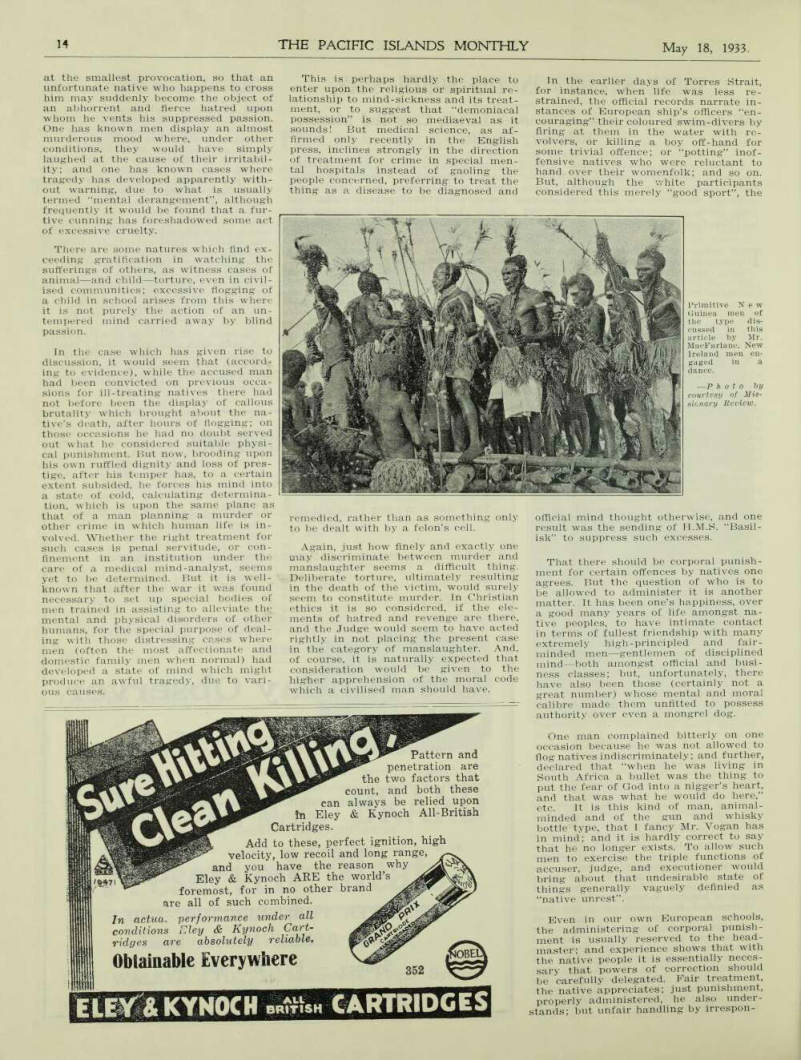
Well-known Clergyman Discusses Larkin Case and Matters Relating Thereto.
The following article by Rev. Wm. H. MacFarlane, of Torres Strait Mission, Thursday Island, is a valuable contribution to this discussion of a thorny subject— the Larkin case, of New Guinea. James Larkin is undergoing ten years' penal servitude for murder because a recalcitrant native, whom he flogged brutally, died from his injuries. We have argued that Larkin should have been punished for manslaughter, not murder. Mr. MacFarlane, in reasoned, moderate language, presents another point of view.
THE writer of the letter “Civilisation Versus Savagery,” in your November issue, may have missed the point of your own previous article, as you say; but those of us whose lot has been cast among native people for many years and who know something of the working of the native mind can, I think, get Mr.
Vogan’s viewpoint, which itself is ad mittedly the result of trained observa tion and experience. He points out that it is the clash of the brown and the white “savage” that causes so much trouble; and this is true.
One has seen Europeans who in a white community behave with some de gree of restraint, but let themselves go when they get into a black man’s coun try, acting on the principle that they can do absolutely as they please with both the native’s family and his posses sions.
This is usually the “put-the-boot-into him” type of man who refers disdain fully to any coloured person whatsoever as a “nigger” (generally with adjectival emphasis!), irrespective of whether he may be a cultured Chinese gentleman or a well-bred member of some other col oured race; and who imagines that loud talk and an expression of contemptuous superiority is the only way to uphold the “prestige of the white man”. Lack ing the disciplined mind of the gentle man, as Mr. Vogan says, lightly-shackled savagery springs forth at the slightest provocation.
And the native—even the so-called “nigger” of New Guinea or the Islands — is quick to detect the difference be tween what he calls “proper white man” and “no-good white man”. He may lis ten with some show of outward respect to the latter, because the native himself is usually endowed with politeness, but the thoughts of his mind would be a re velation often could they be expressed to the “superior” one; and I have often smiled when I have (later) heard native opinion on some arrogant white who thought that he had “put it over” them by adopting an attitude of mingled bul lying, blustering, and patronising con tempt. And when there is added to this the lack of self-control which results in the man of superior race displaying himself (or herself, too, for that mat ter!), before the native or coloured people with his sense befuddled, and in other ways acting more degradingly than the savage himself, it makes one ashamed for his own kind, even although he has to make excuse for the good name of his fellow-countryman.
I recollect the ridicule and contempt shown on one occasion by a group of Japanese to whom a person of responsible position had given displays of unfitting behaviour. I take it that Mr. Vogan has known many cases of this kind also, and that he is indicating that in some way or other there comes a reaction on the part of the native, especially when there is physical violence. Human tol eration has its limits.
Of the Larkin case, I know nothing other than what I have read in “Han sard”, and in the “P.I.M.”, together with some observations made the other day by a New Guinea plantation owner of considerable experience, with a reputa tion for handling native labour well, who, discussing the case with me, thor oughly agreed with the sentence of the Court. Personally, however, I think that this is another instance where treatment by a mental specialist is indicated.
It takes very little to throw the mind temporarily off its balance; and a man
(especially if he happens to be of highly strung temperament) who comes to the tropics and encounters all those little, petty irritations that occur when deal ing with a primitive people whose ways are not ours, unless he possesses the “disciplined mind’’ and exercises the vir tue of self-restraint, finds himself in a condition when impulse is very easily stirred in the wrong direction. If he has infrequent contact with other Euro peans, lacks white companionship, and neglects to maintain a broad outlook upon the outer world by wide and judi cious reading, self-centredness develops into a spirit of blatant despotism, which may manifest itself even in relationship with fellow-whites; and the natives with whom he comes into daily contact and who are under his authority (whether he be an official, or a business man trying to wrest a living out of the coun try, or anyone else) become to him something less than human beings.
Obsessed with all sorts of weird ideas, and influenced also possibly by mental depression which malarial attacks do not help to dissipate, his mind concen trates upon minor grievances and imag inary slights, and he is ready to fly off
at the smallest provocation, so that an unfortunate native who happens to cross him may suddenly become the object of an abhorrent and fierce hatred upon whom he vents his suppressed passion.
One has known men display an almost murderous mood where, under other conditions, they would have simply laughed at the cause of their irritabil ity; and one has known cases where tragedy has developed apparently with out warning, due to what is usually termed “mental derangement”, although frequently it would be found that a fur tive cunning has foreshadowed some act of excessive cruelty.
There are some natures which find ex ceeding gratification in watching the sufferings of others, as witness cases of animal —and child —torture, even in civil ised communities; excessive flogging of a child in school arises from this where it is not purely the action of an un tempered mind carried away by blind passion.
In the case which has given rise to discussion, it would seem that (accord ing to evidence), while the accused man had been convicted on previous occa sions for ill-treating natives there had not before been the display of callous brutality which brought about the na tive’s death, after hours of flogging; on those occasions he had no doubt served out what he considered suitable physi cal punishment. But now, brooding upon his own ruffled dignity and loss of pres tige, after his temper has, to a certain extent subsided, he forces his mind into a state of cold, calculating determina tion, which is upon the same plane as that of a man planning a murder or other crime in which human life is in volved. Whether the right treatment for such cases is penal servitude, or con finement in an institution under the care of a medical mind-analyst, seems yet to be determined. But it is well known that after the war it was found necessary to set up special bodies of men trained in assisting to alleviate the mental and physical disorders of other humans, for the special purpose of deal ing with those distressing cases where men (often the most affectionate and domestic family men when normal) had developed a state of mind which might produce an awful tragedy, due to vari ous causes.
This is perhaps hardly the place to enter upon the religious or spiritual re lationship to mind-sickness and its treat ment, or to suggest that “demoniacal possession” is not so mediaeval as it sounds! But medical science, as af firmed only recently in the English press, inclines strongly in the direction of treatment for crime in special men tal hospitals instead of gaoling the people concerned, preferring to treat the thing as a disease to be diagnosed and
remedied, rather than as something only to be dealt with by a felon’s cell.
Again, just how finely and exactly one may discriminate between murder and manslaughter seems a difficult thing.
Deliberate torture, ultimately resulting in the death of the victim, would surely seem to constitute murder. In Christian ethics it is so considered, if the ele ments of hatred and revenge are there, and the Judge would seem to have acted rightly in not placing the present case in the category of manslaughter. And, of course, it is naturally expected that consideration would be given to the higher apprehension of the moral code which a civilised man should have.
In the earlier days of Torres Strait for instance, when life was less re strained, the official records narrate in stances of European ship’s officers “en couraging” their coloured swim-divers by firing at them in the water with re volvers, or killing a boy off-hand for some trivial offence; or “potting” inof fensive natives who were reluctant to hand over their womenfolk; and so on.
But, although the white participants considered this merely “good sport”, the
official mind thought otherwise, and one result was the sending of H.M.S. “Basil isk” to suppress such excesses.
That there should be corporal punish ment for certain offences by natives one agrees. But the question of who is to be allowed to administer it is another matter. It has been one’s happiness, over a good many years of life amongst na tive peoples, to have intimate contact in terms of fullest friendship with many extremely high-principled and fair minded men —gentlemen of disciplined mind —both amongst official and busi ness classes; but, unfortunately, there have also been those (certainly not a great number) whose mental and moral calibre made them unfitted to possess authority over even a mongrel dog.
One man complained bitterly on one occasion because he was not allowed to flog natives indiscriminately; and further, declared that “when he was living in South Africa a bullet was the thing to put the fear of God into a nigger’s heart, and that was what he would do here,” etc. It is this kind of man, animal minded and of the gun and whisky bottle type, that I fancy Mr. Vogan has in mind; and it is hardly correct to say that he no longer exists. To allow such men to exercise the triple functions of accuser, judge, and executioner would bring about that undesirable state of things generally vaguely defined as “native unrest”.
Even in our own European schools, the administering of corporal punish ment is usually reserved to the head master; and experience shows that with the native people it is essentially neces sary that powers of correction should be carefully delegated. Fair treatment, the native appreciates; just punishment, properly administered, he also under stands; but unfair handling by irrespon
Primitive New Guinea men of the type dis cussed in this article by Mr.
MacFarlane. New Ireland men en gaged in a dance. —Photo by courtesy of Mis sionary Review.
sible men and the notion that he is an other man’s chattel, to be treated with less consideration than a dog, arouses in him fires of bitter resentment.
This is one of the reasons why not only officials but everyone else who goes to a black man’s country to live should make a point of informing him self of the other man’s outlook on life and his customs (and lest I be accused of bias, may I say that this applies to missionaries as well as others!). It helps to correct that attitude of arrogant superiority, conscious or otherwise, that is often responsible for so much trouble, and which does anything but raise the white man’s prestige.
And, of course, it is hardly necessary to add that the old saw about not leav ing one’s own best manners at home also applies, not only to permanent and temporary residents but also to visiting tourists as well!
Advertisements & other items, pp. 15-16 (1 item)
The Sunday Observer
ISLANDS RESIDENTS!
The Australian Newspaper which gives you— THE BEST WEEKLY SUMMARY OF AUSTRALIAN AND OVERSEA
NEWS;
THE BEST COMMENT ON INTERNATIONAL DEVELOPMENTS;
THE BEST EXPLANATION OF WORLD - WIDE ECONOMIC
PROBLEMS;
THE BEST COLLECTION OF ENTERTAINING AND INTERESTING
ARTICLES AND STORIES, IS—
The Sunday Observer
3d. 24 Large Pages. 3d, Published in Sydney every Sunday Morning, commencing on May 28.
“The Sunday Observer” contains much matter of Direct Interest to Islands’
Residents, provided by Journalists with a practical knowledge of the Pacific Territories and their Special Problems.
SUBSCRIPTION (including postage): To British Territories: 3 months, 3/3; 6 months, 6/-; 12 months, 12/- To Non-British Territories: 3 months, 4/3; 6 months, 8/-; 12 months, 15/-
OBSERVER PUBLISHING CO. LTD.,
Malcolm Building, Malcolm Lane,
Sydney. P.O. Box 4053 W.
Managing Director and Editor: R. W. ROBSON.
352 Pattern and penetration are the two factors that count, and both these can always be relied upon in Eley & Kynoch All-British Cartridges.
Add to these, perfect ignition, high velocity, low recoil and long range, and you have the reason why Eley & Kynoch ARE the world’s foremost, for in no other brand are all of such combined.
In actua. performance under all conditions Eley & Kynoch Cart ridges are absolutely reliable.
Obtainable Everywhere
ELEY & KYNOCH British CARTRIDGES
Fiji Floods.
Village Washed Away.
DURING the last week of March and the early part of April, the Colony of Fiji experienced exceptionally heavy rain. While damage was done more or less over the entire group, the West Coast suffered most, though the only loss of life reported was that of two Indians and two Fijians at Sigatoka.
The deluge culminated in a cloudburst, which was particularly severe at the vil lage of Semo, between the Thuvu River and a creek, the inhabitants being caught between two streams in the sub sequent flood which entirely washed the
village away.
Writing of his experiences in the flood, Mr. R. Cross, of Suva, who was work ing in Semo, said: Last Sunday (March 26) it came on squally and wet, just like hurricane weather. It rained all day, and about 9 p.m. Pat Cleary, Jim and I were going to turn in when we found that the water was just about up to the floor of our house, so we thought it best to shift to a house further up on the hill. We picked up our stretchers and went to the highest house in the town, thinking we would be O.K.; but I don’t think we were there more than half an hour before the water came right up to the floor, and as soon as our stretchers started bobbing about, we thought it was time to shift.
We decided to get to the caterpillar tractor and lie on the roof for the night. It was only about 20 yards from the house we had just left, but, when we tried to get to it, we found that the water had risen too high, so there was noth ing for it but to take to the trees. By this time the water was knee deep and running so fast that one could hardly stand. There were some trees close by, so we climbed into an orange tree. There was a mango tree handy, but by this time three parts of the town were up with us in this.
Pat Cleary and I put in the night in the orange tree, and, about half an hour after we had left, the house which we had been in col lapsed and got tangled up with our tree. It was an interesting hour or so until it broke loose, as the tree was not very large and liable to carry away with the extra strain of the house against it. It finally broke loose, and we put in the balance of the night in peace!
Just imagine being in peace with it blowing half a hurricane and raining cats and dogs.
I have experienced the Dreketi flood, but never anything like this. When it was over there wasn’t a thing left in the town. All we had was what we stood up in. There are two houses, or, rather, half-houses, left in the town, but everything else has been swept as clean as a new broomed floor, that is, with the ex ception of about 12 inches of silt and mud.
None of us would have been here to tell the tale if we had reached the tractor, for the force of the water turned it over three times, I cannot describe it, for I never saw water with such terrific force before. It shifted a grader weigh ing six and a half tons about 10 yards.
Cook Is. Fruit.
Auckland Market Supplies.
From Our Own Correspondent.
Rarotonga, April 24.
THE Union Company’s steamer “Wai kawa” called at Rarotonga on April 20 and lifted about 4,000 crates of oranges for the Auckland market. The “Hauraki” is expected about the middle of May and will probably call at other islands of the Group besides Rarotonga.
The “Waihemo” is expected in June, and will introduce the arrangement that was in force last season, whereby the cargo vessels called at the Group on their way back to Auckland from the
American coast. This arrangement pro vides a one-way traffic from these is lands to Auckland, which, in many re spects, is not so convenient to the outer islands as the former service of a fruit boat coming down from Auckland mid way between mailboat calls.
Fatal Accident On Sepik, T.N.G.
The pinnace, “Fayre Dawn,” owned by Mr. R. McGregor, of Madang, New Guinea, was burnt and scuttled at the mouth of the Sepik River on March 3.
An explosion of benzine in the engine room caused the boat to catch fire and she was scuttled in order to save her.
Six natives who jumped overboard were drowned.
Advertisements & other items, pp. 17-18 (1 item)
Beaumont
The Beaumont operates without atten tion for 24 hours, costs a few pence weekly to run, and relies on a kerosene lamp to create intense cold!
Quality built of porcelain enamelled steel; 4in. thickness of insulation, white duco exterior, stainless metal fittings.
Write for Catalogue and Particulars of Terms Proposition.
WESTCOTT, HAZELL
& CO. LTD.
225 Castlereagh St., SYDNEY.
Cables: “Westhazell.”
NON-Electric REFRIGERATOR
The house of WESTCOTT, HAZELL & CO., LTD., established 1914, Capital £200,000, also supplies all Automotive Accessories and Repair Equipment, and holds some of the most important Agencies in Australia.
Here are a few of our lines:
WILLARD BATTERIES; KELSEY, HAYES, FIRESTONE, JAXON
WHEELS and RIMS; FERODO BRAKE LININGS; Motor Car and Truck Parts, including Ford, General Motors, Holden; Ball and Roller Bearings, TIMKEN, HYATT, R.1.V.. NEW DEPARTURE, ETC.; Valves, Bushings, Pistons, Axles, Springs, Gaskets; Re-boring Machines, Hydraulic Hoists, Chain Blocks, Electrical Test Benches, Valve Refacing Machines; Tools of all kinds; Lifting Jacks, Motor and Electric Lawn Mowers.
We are also Agents for BOHLER IRON & STEEL CO. of Austria, Importing Special Steels for every purpose and the famous
“FISCHER” FILES.
WESTCOTT, HAZELL & CO. LTD.,
225 Castlereagh Street,
Cables: “Westhazell.” SYDNEY. Cables: “Westhazell.”
T. ELLIOTT & CO.
(Established 15 years) Real Estate Agents, Valuers,
Flat Specialists.
Controlling Agents for Principal Flat Buildings in Sydney, Darling hurst, Potts Point, Elizabeth Bay, Darling Pt., Edgecliff, Pt. Piper, etc.
When contemplating a visit to Sydney write regarding your re quirements and see us immediately on landing, and our services will be at your disposal.
72 DARLINGHURST ROAD,
(Opposite King’s Cross Theatre),
King’s Cross, Darlinghurst,
SYDNEY.
Telephone: FL 1968.
EXCELSIOR SUPPLY CO. LTD.
The most extensive Manufacturers in the British Empire of
RUBBER STAMPS,
INKS. STENCILS,
Marking Devices.
ACME STAMP PADS
We have a big range of Special
FRUIT CASE MARKING SETS
We also Manufacture or Supply a complete line of
Spraying Machines
for all purposes.
Let us know your requirements and we will quote you by return. Ask for our Big Catalogue.
Sole Australasian Distributors of the World Famous SHEAFFER FOUNTAIN
PENS and PENCILS.
EXCELSIOR SUPPLY CO. LTD.
Head Office:—160 GEORGE STREET WEST,
SYDNEY. N.S.W,
Samoa’S Trials.
From Our Own Correspondent.
APIA, April 17.
PEOPLE in Samoa are in festive mood, in anticipation of the ceremonial visit of the Governor-General of New Zealand, Lord Bledisloe, and party, who are expected in a few days. Most elab orate and painstaking preparations have been made to assure a successful pro gramme. It is hard for Samoan settlers, Europeans and Samoans alike to present a cheerful fare to our distinguished visi tors and to pretend a studied careless ness and “joie de vivre” which is unreal and absent in their daily lives.
Samoa has been hard hit lately. First of all, copra prices dropped to a new low level of about £10 per ton on the Lon don market, have struck rock bottom, and even the natives, unhampered by labour costs, refuse to cut their copra at the local price of % cent, so that stores face another ruinous drop in sales.
On top of this, wireless news reached Samoa a few days ago, that cocoa, of which about 700 tons —representing an
outlay of approximately £65,000, are stored unsold in American and English markets, is absolutely unsaleable with no prospects of improvement in the near future. A conference of cocoa buyers of Apia decided to continue buying their customers produce, though at lower prices, merely on speculation; but, under the circumstances, Samoan planters nat urally face the future with grave mis givings.
To make things worse for the unfor tunate cocoa planter, a new period of heavy rains has set in and for weeks past we have had few sunny days. The continuous rain has done considerable damage to the cocoa crop prospects for the present year, after the early cocoa crop had already suffered largely by the heavy January rains.
The Administration is, in conse quence of the above circumstances, faced by another prospective decrease in revenue. Though all classes of the Euro pean population have joined whole heartedly in the preparations to give a worthy reception to the visiting repre sentative of His Majesty, the Mau re mains aloof and only the loyal natives of Apia and outside districts will take part in large numbers in the festivities, especially in the large Ta’alolo, the cere monial “King’s Kava” and the firelight night dance.
The European programme embraces, amongst other features, visits to schools and institutions, presentation of a loyal address by European representatives, a planters’ reception with demonstrations of cocoa curing and production at Tu anaimato plantation, arranged by the Planters’ Association’s President (Mr.
Gock); horse races on April 22, and the large Citizens’ Ball on the evening of the same day. All the programme, though interesting and varied, has been planned with due consideration of the straightened circumstances of most re sidents at the present time and the Ad ministration has managed to do every thing necessary at surprisingly small cost to the budget. It is hoped that, as a reward for the strenuous endeavours of all concerned, the rainy clouds will break and let “Old Sol” get a chance to show Samoa at its very best.
Opium Seized.
Raid on Chinese Store in Apia.
From Our Own Correspondent.
APIA, April 17.
ON April 10, Inspector Bransby, of Apia Police, with a squad of men raided the store of Ah Soon, at Tau fusi, Apia, and, after a search, seized 63 tins of opium valued at £200, con cealed on the premises. Several arrests were made.
Ah Soon, a well-known Apia Chinese merchant, died a few months ago and the store is run by his sons, Chinese- Samoans, educated in Hongkong.
The increased vigilance of the police is probably due to an incident in a New Zealand court recently, when a sailor accused of having opium found in his possession, stated that he had bought the stuff cheap in Samoa.
It is reported that lately, owing to ex tensive smuggling of opium, besides Chinese a number of young Samoan half-castes and Samoan natives have taken to opium smoking. As most of the inveterate addicts of the vice have left Samoa by the last Chinese transport, it should be easy to eradicate the evil.
Lilac Theatre Case.
Dispute About Tickets in Suva.
THE lawsuit which was known in Fiji as the “Lilac Theatre Case” was brought to a close on April 5 in the Commissioner’s Court, Suva. The case was one in which three Indians, J. L.
Narayan, C. K. Kapadia and S. P. Ma haraj, brought action against E. A. Grif fiths and J. F. Grant, proprietors of the Lilac Theatre, for £15 damages and £2/19/- costs arising out of an incident at the defendant’s theatre on March 2.
The three plaintiffs visited the theatre on that night and were shown to seats in the dress circle. Shortly before the performance began, they were requested by Mr. Griffiths to leave their seats on the ground that the tickets concerned had been issued to another person. Evi dence at considerable length was ad vanced by both sides and was of a very conflicting nature and, at times, heated exchange between counsel occurred.
Evidence as to the manner in which plaintiffs were required to leave their seats and as to how the tickets for the seats were obtained conflicted; but the plaintiffs alleged that two of them, namely, J. L. Narayan and C. K. Ka padia applied for seats in the morning at the box office of the theatre and, on being referred to Mr. Grant, the second defendant, were told that this was quite in order. They said they gave him 5/to pay for the seats and were told that tickets would be sent to them. It was further alleged that, during the day, an additional sum of 2/6 for a similar seat for the third plaintiff, Mr. S. P. Maharaj, was sent with a note to Mr. Grant. In the afternoon a ticket for the three seats was received by Kapadia.
The defendants, on the other hand, said that when the two plaintiffs applied for tickets, they were informed by Grant that he would consult the booking office and send the tickets on later. The money which had been tendered was returned to plaintiffs and the seats were issued to a Mr. Storck. The defendants then al leged that these tickets, which were subsequently transferred without the authority of the management to the plaintiffs, were sent to them by Mr.
Storck later in the day.
The Commissioner said he was un able to accept the defendants’ version of the transaction and found that the tickets and not the money were received by the plaintiff Kapadia. The plaintiffs, having paid for their tickets and pro ceeded to their seats in the theatre, were entitled to view the performance; and a breach of contract was caused when they were requested to leave. Evi dence was brought by the defence to show that Mr. Kapadia was connected with a rival picture house; but it was not proved to the satisfaction of the Commissioner that he visited the Lilac Theatre with any other motive than that of an ordinary patron wishing to see the performance.
The defence said at this point that the policy of the theatre was to restrict the sale of dress circle tickets to cer tain classes: but Grant considered the three plaintiffs respectable persons who would, in ordinary circumstances, be admitted to the theatre.
The Commissioner (Mr. Hallam Roberts) gave judgment in favour of the plaintiffs and assessed the damages suffered by them in the sum of £5/7/6 and costs £2/19/-. The late Mr. H.
Crompton was defendants’ counsel and Mr. S. H. Ellis counsel for plaintiffs.
State Stores.
Experiment in Torres Islands.
From Our Own Correspondent.
Thursday Is., April 25.
THE northern press has lately been voicing some of the dissatisfaction felt locally at the establishing of Government stores on several of the Torres Strait Islands.
There are now four stores, each car rying a fairly big stock of all classes of goods, in addition to the headquarters store of the Aboriginal Industries at Badu. They are managed by the Gov ernment teachers in the Islands, who thus have their hands pretty full. The necessary supplies are taken out by the Government ketch ‘Melbider” and a lug ger put on for the purpose.
The lines along which local criticism runs concerns the policy of the Govern ment in setting up stores in opposition to business people in Thursday Island and creating what seems to be a mon opoly; and also in requiring the Island teachers (who already have many other things to attend to, in addition to their school duties) to run the stores.
A good deal of business which, for merly came to Thursday Island is now cut out. The island produce is sold in Thursday Island, but only a small per centage is paid over here, the boys hav ing to collect their money at Badu, so that they have not the wherewithal to purchase stuff in T.I. (even from the people who buy their produce) but are expected to get what they want at the island stores.
At Christmas, when the teachers go on holiday, the position will be somewhat awkward, as it is at that time that the boys like to procure supplies of kai-kai, clothing, and other items which are now classified as necessaries.
Doubtless things will shake into the right perspective in time; but the island stores’ experiment is being watched with more than ordinary interest, both in relation to the native community and concerning its reaction upon Thursday Island trade, as well as in connection with political and unions’ policy.
The average islander, of course, like
the rest of mankind, likes to go round from store to store with his hard-earned “cash money” and see where he can get the best bargains—in fact, it is some what of a surprise at times to discover how he is able to make comparisons in price and quality between different busi ness places!
Advertisements & other items, p. 19 (1 item)
Gillespie’S
SAMUEL RUSSELL,
ESTATE AND GENERAL AGENT,
P.O. Box 64, Papeete, Tahiti.
Real Estate. Investments. Estate management and administration. Valuations and Reports Houses and Lands for Lease or Sale.
Sole Proprietor: TAHITI PERFUMES.
Cables: Russell. Tahiti (Bentley’s Code).
GILLESPIE’S
"ANCHOR”
FLOUR
TRADE
MARK
The Standard of Quality.
NOYES BROS. (Sydney) LTD.
Mining Machinery, Oil Engines, Excavators, etc.
Cables, Lamps, and Electrical Appliances, Crompton- Parkinson Motors and Transformers.
Building Materials Ventilators Roofing.
Brass, Copper, Aluminium Sheets, Rods and Tubes.
Cyanide, Quicksilver, Zinc Shavings, Hardware, Rifles, Guns, Ammunition.
ENGINEERS AND MERCHANTS,
115 CLARENCE STREET - SYDNEY.
197 ELIZABETH STREET - BRISBANE.
Air Mail Envelopes.
THE demand for the special commemo rative envelopes issued for the first flight of a Fiji Airways ’plane with mails was so great that one issued by Captain Fenton sold at 8/-. These first air mail envelopes are highly prized by philatelists.
Courageous Cleric.
Missionary’s Part in Austra lasian History.
THE Pitt Street Congregational Church, Sydney, celebrated its centenary early in May.
There would not appear to be much connection with this fact and the Pacific Islands; but the event the Church cele brated was directly concerned with cer tain happenings off the island of La Christiana in the Marquesas Group in May, 1798.
A writer in the Sydney “Daily Tele graph”, of May 3, tells the story.
"While beating to windward off the island of La Christiana in the Marquesas Group on May 22, 1798, Edmund Fan ning, master of the New York schooner ‘Betsy’ (bound from Mas-a-Fuero to Canton with sealskins) saw a small canoe battling through the wind and rain. In it were two men.
“Earlier in the day a number of Mar quesan canoes, their prows hung with human skulls, had been round the ‘Betsy’, but heavy squalls had driven them to take shelter. Wondering what this lone canoe wanted, Fanning hove the schooner to and waited.
“Each of the men in the canoe wore only the maro, a piece of bark cloth wound round his loins. But, while one had the exaggerated tattooing of the Marquesans, the other was a white man.
“As they came alongside, he called out: ‘Sir, 1 am an Englishman, and now call on you, as 1 have come to you, to preserve my life.’
“When he had been helped on board, the white man said: ‘I am a missionary,’ and bowed his head in prayer.
“He was William Pascoe Crook, later one of the pioneers of the Congrega tional faith in Australia. It was he who, in 1810, formed with four other resi dents of Sydney the first Congregational Church in the Southern Hemisphere.
“Crook had been sent to the South Seas in 1796 in the missionary ship ‘Duff’, fitted out by the London Mis sionary Society. He had been for some months on La Christiana, and had at first taught with some acceptance.
“Then an Italian seaman deserted from a passing vessel. This renegade brought ashore a musket, some powder, and balls, and became a sort of Minister of War and Prime Minister to the lead ing chief of the island.
“Playing on a smaller stage the part taken by other white men in the Ha waiian islands and in Fiji, the Italian inspired the chief with the idea of mak
ing himself the ruler of the group. He stirred him up to make war on the other tribes of La Christiana and also on the neighbouring island of La Dominica.
“Crook felt it his duty, as he told Fan ning, to protest against the ‘wicked plans and abominable practices’ of this Italian.
So the Italian instigated his patron to murder Crook. He was, in fact, ‘ex tremely solicitous that they should mas sacre Mr. Crook’.
“The Italian also planned to entice the ‘Betsy’ into the harbour, seize her, massacre all on board, and plunder the vessel. So Crook and a friendly chief had put off, under cover of the storm, to warn the ‘Betsy’s’ crew.
“Crook left the ‘Betsy’ again at Nil kahiva, in the Marquesas, where Fan ning won the friendship of the chief by giving him a jacket of red flannel.
“It was here that Fanning noticed in a canoe something wrapped in palm leaves. He found it to be a piece of baked human flesh. The Marquesan wrapped it up again, remarking that as soon as he was hungry he would eat it.
He added that it was very good eating.
“Crook found his way back to Eng land, came with Collins to Port Phillip in 1803, went on to Sydney, and later acted as chaplain for the rebels after the deposition of Governor Bligh.
“In 1815 he went to Tahiti, where he was a missionary for 15 years. He died in Melbourne in 1846.”
Tragic Accident.
Mr. Hollins Crompton’s Death.
A TRAGIC motor accident which oc curred on April 9, resulting in the death of Mr. Hollins Crompton, has shocked Fiji.
The late Mr. Crompton, who was the son of Mr. Robert Crompton, was one of the most popular and brilliant young men in the Colony. He had left Rewa early in the morning to return to Suva in a two-seater car and, about 3 a.m., a scoutmaster at Samabula, Mr. Bisses sar Singh, hearing the noise of a car falling down a bank, found the car wrecked at the foot of a steep declivity with Mr. Crompton’s body inside. It is surmised that he dozed at the wheel and the car failed to take a curve and crashed over the edge of the road.
The late Mr. Hollins Crompton was born in England 33 years ago and came to Fiji with his father, Mr. Robert Crompton, C.B.E., and family in his early boyhood. He returned to England and was educated at Rochester Gram mar School, Kent, going from there to Auckland, where he graduated B.A., LL.B., at the Auckland University. He was admitted as a barrister and solici tor of New Zealand in 1924 and was ad mitted to the Bar of Fiji the same year, and later entered into partnership with his father under the name of “Cromp tons”.
In 1925 he married Margaret, daugh ter of Hon. Sir Henry and Lady Scott and the most popular lady in Suva at the time, whose untimely death in 1926 shocked the community. There was one son, Hollins.
Mr. Crompton was in Auckland at the time of, the accident, but returned by the “Monterey” on April 11. A brother, Mr. R. Crompton, jnr., is at Eabasa, one sister is married to Mr. D. Hedstrom at Tavua, and the other is the wife of Cap tain Donovan of Suva.
Advertisements & other items, pp. 20-21 (2 items)
Photo. Service,
P.O. Box 38, Norfolk Island.
Cable Address.
“Niphoser,’' Norfolk Island.
NORFOLK ISLAND
PHOTO. SERVICE,
Photographers, Photographic Printers and Publishers,
Taylor’s Road, Norfolk Island.
Mounted and Unmounted Photographs of Norfolk Island Views, Industries and Flora.
Local and Overseas Trade and Newspapers & Publishers supplied.
Samples on application.
INSPECTION INVITED.
Natural Gum, Unbreakable Sets, Comfortable and Long Lasting, Old Plates Remodelled and made equal to new. 28 OXFORD ST., over Winns;
TEETH BY POST.
Well-fitting and lifelike in appearance,
made from “SELF-TAKEN IMPRESSIONS.
I have made Artificial Teeth by my wellknown and copyrighted System of Self- Taken Impressions for satisfied Patients in all parts of the Commonwealth.
Setid for full free particulars.
Satisfaction guaranteed.
SPENCER NOLAN
DENTIST,
Established in Sydney over 35 years. 177 OXFORD ST., opposite Mcllraths. 139 ELIZABETH STREET, two doors from Market Street, Sydney.
Telegraphic and Cable Address: “FASTPLATE,” Sydney.
"The day is done and the darkness
falls from the wings of niqht..."
WHEN darkness has settled like a sable mantle over the landscape, then Laurel time has arrived. In count less homes lamps filled with Laurel cast a soft white eyecomforting radiance in many a room. Laurel is justly famous for its purity and quality. Try Laurel in your lamp and prove its better quality yourself.
VACUUM OIL COMPANY PTY. LTD.
Kerosene
Tongan Choir.
Successful Tour Finished.
AFTER a successful tour of five States of the Commonwealth, the Tongan Choir gave its farewell concert in Sydney Town Hall on April 26.
The fifteen choristers have delighted many Australian audiences and their superb physique has attracted notice wherever they went. The conductor of the choir was the Rev. A. H. Wood, principal of the Tubou College.
The Choir returned to Tonga by the "Niagara” on April 27. Prince Tugi was also a passenger.
For Information.
N.G. Goldfields Shareholders Ask
Chairman Answers Many Questions at Annual Meeting.
There was some animated discussion at the third annual general meeting of New Guinea Goldfields, Ltd., held at 67 York Street, Sydney, on March 27. Mr. F. Hambridge (Chairman of Directors) presided.
The following is a slightly condensed report of a discussion which took place on the motion of the adoption of the annual report.
Mr. Thompson: It is difficult to dis cuss the balance-sheet because a balance-sheet of companies such as this does not give sufficient information.
That is the system that prevails, but the result is that the shareholders in these companies know nothing; they are not supposed to know anything.
I am concerned about the rumours in the city, and I think this is an opportune time to mention them. I am not here to cause turmoil, but the posi tion is that people are making all sorts of charges against this Company, and so affecting the market. I have been asked by quite a number of people why it is that the London market gets information before us. For instance, I think it was in February last that the shares in the London market advanced 1/-. Afterwards the shares on our market made an advance, showing clearly that the information in regard to the Company got to London before it got to New South Wales. In view of the fact that the information has to come from this office it would indicate —although I do not say there is any thing wrong—that the information is supplied to London before it is sup plied to us, which, from our point of view, is a very wrong thing. You are
here to study our interests and not those of the London shareholders. We have a great respect for the London shareholders but we are here to look after our own interests.
There is another rumour going around which is somewhat personal.
I do not want to raise trouble, but it is preventing me from buying shares and it is also preventing me from selling shares, because the market won’t go up. It is reported that one of your leading officials is physically unfit to visit the leases. That is an unsatis factory state of affairs. If he is unfit to visit our leases, how is it possible for him to report to this Board that we should purchase leases which he has not seen? There is a tribute granted to Mr. Smith, at Bulolo, and there is another tribute granted to a Mr. Wild, at Callai, or some name like that. But that officer may not have ever seen those people. These areas I speak of are in the vicinity of 7,000 feet above where he happens to be.
Another thing that is rumoured is the purchase of the Bulolo hydraulic plant from certain people for £4,000. That is a lot of money to me at all events.
I understand that that hydraulic plant has been a failure, and that we are running that plant at a big loss.
There is another matter to which I want to refer, which is a personal one.
I am not trying to cause trouble; I am only doing what I consider to be the right thing in the interests of share holders. Mr. Livingstone, whom I do not know at all, was given a tribute, and from that tribute he derived some thing like £40,000. If Mr. Livingstone can secure £40,000 from a tribute, I want to know what our Company was doing to let such a valuable asset get away. I also understand that Mr. Liv ingstone is a sick man and I understand that it is the custom of this Company to examine medically all their em ployees before they appoint them. I understand that Mr. Livingstone was given an appointment in the Company, and that he only remained eight weeks.
I heard the chairman refer to this mill at Golden Ridges. I am told that it was necessary, in order to test that mill, to send ore to London. Well, there are two kinds of ore from the mine. You can clean the ore or you can send the original ore. Our people, instead of sending the ordinary ore which the mill in London would have to treat, sent clean ore. The result was that when the mill arrived it was considered satisfactory to deal with clean ore, but when it arrived at Gol den Ridges it was found to be quite unsuitable. The result is that your mill is net working full time, and Heaven knows when it will be working full time.
I could go on enumerating other
things but I think I have said enough for the shareholders to realise that they want to sit up and take nourishment.
These rumours about the city cannot be allowed to go on if we are going to make a success of this mine. I am of opinion that if the rumours which I have mentioned are correct, or even half correct, we should take drastic action.
I have not the slightest idea what fees your directors are paid. I am one of those people who always believe that when the public put their hard earned money into a concern, and there are lots of people who have had great difficulty in paying for their shares in this Company, if the mine is unable to pay a dividend I consider that the directors should work in an honorary capacity. They may be doing it, for all I know. If the directors will not work in an honorary capacity, then I ven ture to say that from this meeting to-day we should be able to elect a board of directors who would be will ing to do so.
I am not going to move a vote of censure on the Board. I do not know enough about them to do it. I know that we have Mr. Hemsley on the Board, and he is a man of such good repute that when you see that he is on the Board you know that the Board is all right. I assure you that you want to do something in your own interests. I shall be only too pleased if our chairman and our directors can deny my statements and explain them away to you.
Mr. Daly: Mr. Thompson made some remark about the fees that were paid to your directors. May I ask what they amount to?
Chairman: I think they are men tioned in the Articles of Association.
Mr. Lyons: Why does not the chair man give the information?
Mr. Daly: Why don’t you answer the question? What are the fees that are paid to you, Mr. Chairman?
Chairman: £250 per annum.
Mr. Daly: Is that all you are paid?
Chairman; The London directors are not paid anything.
Mr. Daly: I am not asking about the London directors. Are you paid more than that?
Chairman: I myself am because I de vote the whole of my time to the Company.
Mr. Daly: What are you paid?
Chairman: £500 per annum.
Mr. Daly: Is that in addition to the £250?
Chairman: Yes.
Mr. Daly: What salary does the general manager at New Guinea get?
Chairman: If you care to ask me anything about my position— Mr. Daly: I am asking about the gentleman in New Guinea.
Chairman: Concerning the salaries of any of our staff, we do not propose to discuss that at this meeting.
Mr. Daly: Why not? Here are the owners of this property, and if you want any evidence of the amount of interest that is taken in this Company, of which there are thousands of share holders in the City of Sydney, the attendance here to-day unquestionably speaks the that the conduct and management of this Company is rot ten, absolutely rotten. I take second place to no man in my opinion of Mr.
Hemsley. Mr. Hemsley stands in this city preeminently above most men, for integrity and ability. I am satisfied in
my own mind that Mr. Hemsley’s association with this Company has led to thousands taking shares in it. I might make the same remark with re gard to the other directors. But the chairman who refuses to tell you people what salary you pay to your employees, is not the right man in the right place. When you see a Com pany like this, that has expended in your interests in New Guinea upwards of half the amount that has been spent on that gigantic bridge, and you have not got a red copper out of it, there must be some good solid reason for it. The tributes of your Company have been let to several men, one of whom made £40,000 out of it, and there are several others who have done very comfortably. The whole concern is kept away from you people. Why, look at the reports which are published every day in the “Herald.” Who in the world understands them? Nobody.
I have been mining for the greater part of my lifetime. I put money into this concern on the reports of men who have been there, and what have we
got? Nothing. Unless you people wake up and make some move the day will come when you will be told that there is nothing there, and that your four millions of money have gone to the wind.
Mr. Palmer: I want to say that the shareholders at this meeting to-day are not the owners of this Company. They are only a very small proportion of them. I represent clients who prob ably own more shares than the whole of the rest of the people here. I say it is a shame that these remarks should be made. For a man to come here and make remarks like that with out giving you a chance —well, I say that he does not know what he is talking about. The management of this Company is not rotten. It is very good.
Mr. Wright: Is not the majority of the shares in this Company owned by English shareholders? It seems to me that it is not only controlled by the Mining Trust but by the English share holders. While the English sharehold ers own the majority of the shares in
this Company it will never do any good.
Chairman: In answering the discus sion that has taken place, I do not think there is any doubt that the gentlemen who have spoken have the best interests of the New Guinea Gold fields at heart. . . . Certain share holders have come along and made charges which have been more or less received as having been made in per fect good faith and perhaps with some foundation. But when charges are made such as have been made to-day, in the spirit in which they have been made, then I say that no self-respecting Board could do anything less than accept the challenge.
Mr. Thompson referred to certain rumours. His trouble apparently is that London gets information in ad vance of Australia. He referred to one case in February last. Undoubtedly on one occasion the London Press did get information in advance of what we in Australia did. That was entirely due to the staff in the London office of our Company. The man who controls and deals with the handing out of in formation for publication was absent on that occasion, and a communica tion from our general manager to London was handed out before it had been sent back to Australia for simultaneous release, which is the method we regularly follow. I do not know what the net result of that mat ter of London being in advance of Australia was, but if there has been harm done to anybody we take the blame for it willingly. We are sorry.
Our London office made a mistake.
Now concerning the rumours Mr.
Thompson referred to with regard to our officials. Everyone knows I am a good Australian. I would not be occu pying this position unless I had the interests of the Australian mining in dustry at heart. I was not a share holder of the Company. The London people put up a million pounds which made it possible for this Company to be incorporated.
Mr. Daly: And it did not carry out its contract!
Chairman: That I do not know. If there is any breach you can report that to the directors and it will be investigated. We do not like these allegations. We want absolute facts. I myself think that Mr. Thompson has unwittingly done the best servant that this Company could have had a very grave injustice. A lot of these stories you have heard to-day are absolute falsehoods. To say that that officer has not been up on Edie Creek often enough is incorrect. I myself have been there twice.
Mr. Daly: You have been there once with him and once with the engineer.
Chairman: You are wrong. Our official, in common with this Com pany, inherited quite a lot of ill-feeling because he went in there to represent a big concern. Originally Edie Creek and the fields surrounding it were in the hands of the small miners. Ulti mately it was decided that a portion of that could not be worked satisfac torily by the small miner, and a large company was formed for the purpose of working it. From that date this Company has been subjected to more or less blackmail throughout the whole of its existence, and its leading officials, being the men in charge of the interests of this Company, have had a most harassing time, not only
in getting satisfactory titles but in their treatment. Ultimately, through being treated in such a manner, the Company was forced, against its judg ment, to enter into tributes, which it had no wish to do.
When I first went there a notice was on the board, “No tributes.” That created a good deal of ill-feeling towards our manager personally. A number of men whom he has refused to encourage up there, and in addition a number of persons up there whom he has had to discharge, have been making reports against him which are absolutely false. I know many mining engineers, and I say advisedly that if there is a man in Australia who could have tackled the job in New Guinea better than Major Harrison, I do not know who he is.
That brings us to this question of the Livingstone Tribute, and that brings up a matter which this Com pany did not want to enter into but which it was forced to enter into for the protection of its interests. The statement of £40,000 having been re ceived by Mr. Livingstone is wrong, but he did make a good deal of money.
When that tribute was entered into with Mr. Livingstone, England had not gone off the gold standard, and the exchange between Australia and Eng land was not what it is to-day, nor had the aerial freight been reduced from sixpence per pound to fourpence per pound, which it is to-day. The tribute which was entered into with Mr. Livingstone on the conditions that existed then was a highly satisfactory tribute agreement as between the owner and the tributer. Mr. Living stone did well for himself. Good luck to him. So did we. If things had gone the other way, I tell you candidly that if you like to go to the field and get first hand information and ascer tain the conditions that were existent on the day that tribute was signed and compare them with what actually took place, Mr. Livingstone probably made £10,000 or £12,000 more out of it than was ever anticipated. As a man who has been associated with tributes be fore (not in gold-mining, but in other forms of mining) I say that it will be a bad day for any Company when it tries to go back on its tributers or when it shows that tributer ill-will. I say, with all the knowledge of the cir cumstances surrounding that tribute, that it was a workmanlike and busi ness like tribute, and that it was abso lutely forced on the Company at the time.
Mr. Daly: Was not he appointed to a position here when he came back from England ?
Chairman: Yes.
Mr. Daly: Who appointed him?
Chairman: The appointment of all our technical officers is made by the Technical Committee.
Mr. Daly: But who appointed Mr.
Livingstone to that position when he came back here?
Chairman: The Mining Trust, our consulting engineers.
Mr. Daly: What Mining Trust ?
Chairman: Evidently you do not even know the Mining Trust.
Mr. Daly: I know a good deal more than you think.
Chairman: I think there is quite a good deal of malice which should not be in existence. A lot of statements have been made here to-day which are entirely untrue and false. Mr, Living
stone was appointed by the Mining Trust, our consulting engineers. The Mining Trust was the Company which are really responsible for the million pounds which was put up for the work ing of this Company and the exploita tion of the New Guinea Goldfields. In other words, the Mining Trust control this Company. The Mining Trust, when they took control, asked me to become the chairman of the Board. 1 became the chairman at their request and not of my own volition. I was anxious to do something for this Com pany because of my association with certain members of the Mining Trust, and I was anxious also to do some thing for Mount Isa. It meant that I would have to devote the whole of my time to the affairs of this Com pany and the Mount Isa Company. I am not afraid of anything I have done.
If there is anybody who will come along and take on the job, I will give it to him gladly.
Mr. Daly demanded information about the rate of salary being paid to a high official.
Chairman: If you ask for that infor mation, I will ask you to see me at the office and — Mr. Daly: We are entitled to know what he is paid.
Chairman: I will not give you any information concerning the salaries paid to our staffs.
Mr. Daly; Why? This is the regis tered office of the Company, and we want to know.
Chairman: Subject to discussion with my directors, I am not going to give that information here. I think that is the class of information that should not be asked for ...
Chairman: It does not matter to me who it is in control, as long as New Guinea becomes what I hope it will become. 1 might say that apparently you are ill-acquainted with the tech nical mind. In 1929 when you became shareholders you became shareholders in a Company which had certain allu vial ground up there and which had a nominal capital of some four mil lion odd pounds. Mr. Daly, in referring to our expenditure up there, says that we have spent half the amount of money that it cost to build the Bridge.
Mr. Daly: It was near enough to that.
Chairman: Well, if that is so, I hope that the dividends which the Company will make this year will only approximate the extent of Mr. Daly’s error. As a matter of fact, if you re view our balance-sheet you will see that up to the present we have not spent more than £650,000.
Mr. Daly: What is the cost of sink ing per foot in any shaft you have sunk?
Chairman; It might be anything from £3 to £20, according to the nature of the shaft.
Mr. Daly: Is it anything from £1 to £3?
Chairman: No; anything from £3 to £20.
Mr. Daly: That is a pretty solid amount.
Chairman: Well, I can take you to places in Broken Hill where it has cost as much as— At this stage it was moved and seconded that Mr. Daly be no further heard. The voting on the voices not being clear, the chairman proposed a show of hands, but this was not taken.
Chairman; Mr. Daly has been very
malicious in his statements. Mr.
Thompson also has made statements which are quite untrue, but I do not blame him altogether for that. I think he has heard those stories, but I can assure you that those stories are abso lutely wrong. I think they have been formed with a view to market opera tions, something I do not indulge in. I will promise Mr. Daly this: I am not a crook and I have not stolen any money, nor do I think that any of the directors have. We do not want to steal any money. We merely want to make some. If our methods are not exactly as you would have them, it is within the province of the share holders to dismiss this Board and to put on it men with Mr. Daly’s experi ence. His statements are entirely
wrong, and I do not propose to tackle them seriously or answer them seriously. I do not mind, when a man seeks information and acquires it, if he comes along and tells you the facts, but he has made no such attempt to my knowledge. I do not know what the Stock Exchange operations are. I am not interested in them. It has taken me all my time to attend to the affairs of this Company. With regard to our general manager, I say advisedly that you cannot find a man in Australia who could do better than he has done in New Guinea. . . . Now that we have improved the position under Major Harrison’s guidance, we have put civilised camps out there.
The men instead of living on tinned food are able to have chilled beef sent from Australia. They can and do buy the food that we are able to have in Sydney. That has all been brought about by Major Harrison and his work men, aided, of course, by the money the Company has put at his disposal.
Major Harrison has had a hard and difficult time, and I say, with a full knowledge of all the conditions, that he has done excellent work.
Mr. Davis: Do you think it will ever be possible for this Company, with a capital of £5,000,000, to pay a dividend?
Chairman: It depends on what divi dend you expect.
Mr. Davis: Say a dividend of 10 per cent.
Chairman: The position is that a million pound Company has been asked to earn dividends on four and a half millions pounds of shares. I say this, that with the work that has been done our chances are that you will re ceive some dividends, although not in the immediate future. The position was that you took on New Guinea Gold fields at the start, a Company which had to find the lodes and develop. You took on a prospecting Company. You did not take on a Company with any
reefs which had been opened up. You want to face that position.
Mr. Davis: But do you think it is possible for a Company with a capital of £5,000,000 to pay dividends?
Chairman: I say this, that it may be easily possible to pay dividends on that £5,000,000.
Mr. Palmer: With regard to the state ments that have been made concerning the rumours going about the city, I might say that I investigated most of those rumours myself, and it is a pity that Mr. Daly and others did not do the same. I investigated the business of the £40,000 two or three years ago, and it was quite all right. I hope that you will not allow the salaries of your officers to be interfered with. It will be a very bad day for the Company when you do. Major Harrison had to deal with inaccessible roads. He had to go up the most mountainous district that ever was. And he had to civilise the district and train the natives, an almost impossible task. If all the de partments are completely successful, this Company will be one of the great corporations of the world. To ask whether it will pay a 10 per cent. divi dend simply shows that the man ask ing the question has not gone into the matter. Yet it will be as easy as winking.
Mr. Bannan: Will the chairman tell us how much money has been spent on construction of roads?
Chairman: We have spent on the construction of roads, as will be seen from the balance-sheet (which roads I might say the whole of the population are using to-day, although we built them for our own purposes) approxi mately £13,000. That is only on the road which leads from our head quarters up to the Golden Ridges Mill, and from the Golden Ridges Mill to Edie Creek. Our headquarters are stated at £3,500. Golden Ridges has been connected by road to Edie Creek, and the transmission line from our power-house to Golden Ridges had to be built. We have done nothing fur ther in connection with the construc tion of a road from the Coast. We are still persevering with the use of aero planes, which costs us approximately at the present time a shade under £40 a ton for transportation to the Coast.
Before we begin carrying our stuff from our headquarters to our mines up the mountains we have to spend £40 a ton. Any man who knows anything about mining will realise that a cost of £40 a ton for transportation will naturally make all your costs rather high.
Mr. White: Mr. Livingstone was an officer of the Company when he re ceived a tribute from it, was he not?
Chairman: No.
Mr. White: But he was an officer afterwards ?
Chairman: Yes. As a matter of fact, Mr. Livingstone was examined here in Sydney before he went to take that job. He waited for two months until his doctors assured him he was fit for the work. He went there and he worked very hard. He is a competent man, and above all he is a loyal man.
Mr. White: I want to mention this, that no officer of the Company is en titled to receive a tribute, is he?
Chairman: No.
Mr. White: And that has not been done?
Chairman: On one occasion. We
have not given tributes to our officers, but we had a very loyal officer named Hylton who had been our Lease Registrar. One of the most important things in those days on that field was the due protection of our titles. We were able in process of time, by hand work at Canberra and with the Admin istration, to get the security of title for which we aimed, and at that point Hylton’s job vanished. When Hylton was to leave the Company he was given the chance of this tribute be cause he was expected to leave the service in four or five weeks. He did not leave the Company; something went wrong with the negotiations, and he remained on for four or five weeks.
Meanwhile his brother went on the tribute. The tribute was given by Major Harrison, not so much as a re ward but as a job for an officer of the Company.
Advertisements & other items, pp. 22-26 (2 items)
H.A.Barraclough Ltd
While in Sydney
Let us See Your Eyes.
Take the opportunity while you are in Sydney of having your eyesight tested. Should you need glasses, our scientific service, offering glasses of finest workmanship and style at moderate fees, assures your lasting satisfaction.
H.A.BARRACLOUGH Ltd
OPTOMETRISTS AND OPTICIANS
Optometrist
J.A.BARRACLOUGH D.B.OA. F.I.O.
385 GEORGE STREET
Opp the Strand SYDNEY
Repairs. "OUR HANDS MAKE GOOD ARMS"
DON’T TRIFLE WITH DOUBTFUL FIREARMS
Sil Rohu’s Expert Attention is at your Service —without obligation.
Send for my Wonderful Firearm Catalogue. 500 Illustrations and Details of the World’s Best and Reliable Makers.
“FISHING TACKLE TO TACKLE FISHING.”
The same High Standard of Quality is a feature in my new Fishing Catalogue. - Specialities: Trout, Big Game, and Deep Sea Fishing.
SIL ROHU (late A.I.F.), GUNSMITH
IMPORTER OF HIGH GRADE FIREARMS AND FISHING TACKLE SPECIALIST, 143 ELIZABETH STREET, SYDNEY (Near Market Street).
SHIP CHANDLERY - HARDWARE
BROOMFIELDS LIMITED, 152 Sus.ex Si., SYDNEY.
Large and Complete Stocks of SHIP CHANDLERY.
Ironmongery of all kinds, Paints, White Lead and Oils.
Sole Agents for P. H. MUNTZ & CO.’S 3-CROWN BRAND METAL SHEATHING.
PEACOCK & BUCHANS’ ENGLISH READY - MIXED PAINTS.
WRITE FOR SHIP CHANDLERY CATALOGUE.
Special “In Bond” Prices for all Island enquiries quoted on application.
CABLES: “BOOM,” SYDNEY.
Ashes Of Roses
BOURJOIS
PARIS
THE WORLD’S WONDER
TOILET PREPARATIONS
The fragrance of millions of roses exquisitely blended by a master hand for the world's beautiful women.
FACE POWDER
All tints,
FACE POWDER
ROUGE
Brun., Blond. Mand.
VANISHING CREAM
TALC POWDER
Also in Violets and Car nation A. of R. PERFUME A. of R. PERFUME A. of R. PERFUME To walk through a garden when the roses are in full bloom, with the morning dew sparkling upon them, is to understand the charm of Ashes of Roses.
Here is the Biggest Lottery offer ever made —
THE GOLDEN CHEST DOUBLE
offering
£1000 IN CASH AND £4 A WEEK FOR LIFE.
Here is your opportunity to get A 1/5th share in a ticket in the
NEW SOUTH WALES STATE
LOTTERY, which can bring you
£1000 immediately
and One ticket in the New South Wales
Golden Chest. This can win prizes
with a guaranteed cash value of £4000 —invested, this will give you £4 a,
week for life.
£1000 FOR 2/-.
The Golden Chest is Australia’s Greatest Lottery Value, sanctioned by the Honorable the Attorney-General for New South Walesj, for the benefit of the New South Wales Community Hospital and Combined Charities.
Pest this Coupon To-day with your 2/-. It may bring you £1000 CASH AND £4 A WEEK FOR LIFE.
Air Commodore Sir CHARLES KINGSFORD SMITH, Kt., Joint Honorary Secretary, The Golden Chest, Desk P.L, Govt. Savings Bank Building, Castlereagh Street, Sydney. u Yes—l want to help you help the Hospital, and also win £1000 cash and £4 a week for life. Here is 2/- and a stamped addressed envelope.
Please send me a one-fifth share in a State Lottery Ticket and a Ticket in the Golden Chest.
NAME
STREET
TOWN
The House of
Holbrook
In the old world village of Stourport, Worces tershire, England, just at the point where the River Stour empties itself into the Severn, the House of Holbrook was founded 135 years ago.
In 1919 a factory was established in Sydney.
N.S.W., to supply the requirements of Austra lia, New Zealand and the Pacific Islands.
Here are manufactured a wide variety of table delicacies, as well as Holbrooks’ Sauces and Pure Malt Vinegar, for which the House of Holbrook has been famous throughout the world for many gene rations.
There is Essence of Anchovy for fish.
Tomato Sauce, made from fresh, ripe toma toes ; French and Italian Olive Oil, with a delicate, creamy taste —so nice with the salad and of such nutritious value for invalids, French Capers, Olives, in many varieties, from Spain; tiny sweet Gher kins and little White Onions, Fish and Meat
Pastes, Flavouring
Essences and endless other delicacies. Hol brooks’ Baked Beans, with Pork and Tomato
Sauce; tinned Spag
hetti and Soups are also tasty and delicious,
Holbrooks (A/sia.) Ltd.
WATERLOO, N.S.W.
ALBERT GREGORY,
107 York St., SYDNEY.
Saddlery,
Saddlers,’ Ironmongery,
Leather Merchant,
Belting and Paint Merchant.
PAINTS—Plymel Ready - mixed Paints, for House or Roofs 13/6 gallon Special Value House Paint 10/6 gallon Brushes, Kalsomines, White Lead and Oils
AT LOWEST PRICES.
Bridles, Belts, Spurs, Stirrups, Breastplates, Saddles (from Race to Stock), All Prices.
Leather Belting and Pump Cups.
CORRESPONDENCE SOLICITED.
BIG CROPS
can be depended upon from land that has been liberally fertilised with
P. B. MANURES,
The best for all purposes. Send for our Free Booklet, “RATIONAL MANURING,” it contains interesting information.
PATON, BURNS €1 CO.
52 KING STREET SYDNEY.
SHIPCHANDLERY.
W. Kopsen & Co. Limited
Manufacturers of PIONEER BRAND ASH OARS AND IMPLEMENT HANDLES.
Bole Agents for : KOPSEN’S SPECIAL YELLOW METAL SHEATHING AND NAILS.
Large Stocks of Chains, Anchors. Manilla and Wire Ropes, Wood and Iron Blocks, Oakum, Tar, Pitch, Oils, Paints, Leads, Zincs, Varnishes, Shackles, Rigging, Screws, Sheathing, Felt, Lampware, etc.
Prices and Particulars on Application.
68-70 CLARENCE STREET. SYDNEY.
Cables: "Kopsen."
'Phone: BW 1114-5.
Polynesian Cricketer
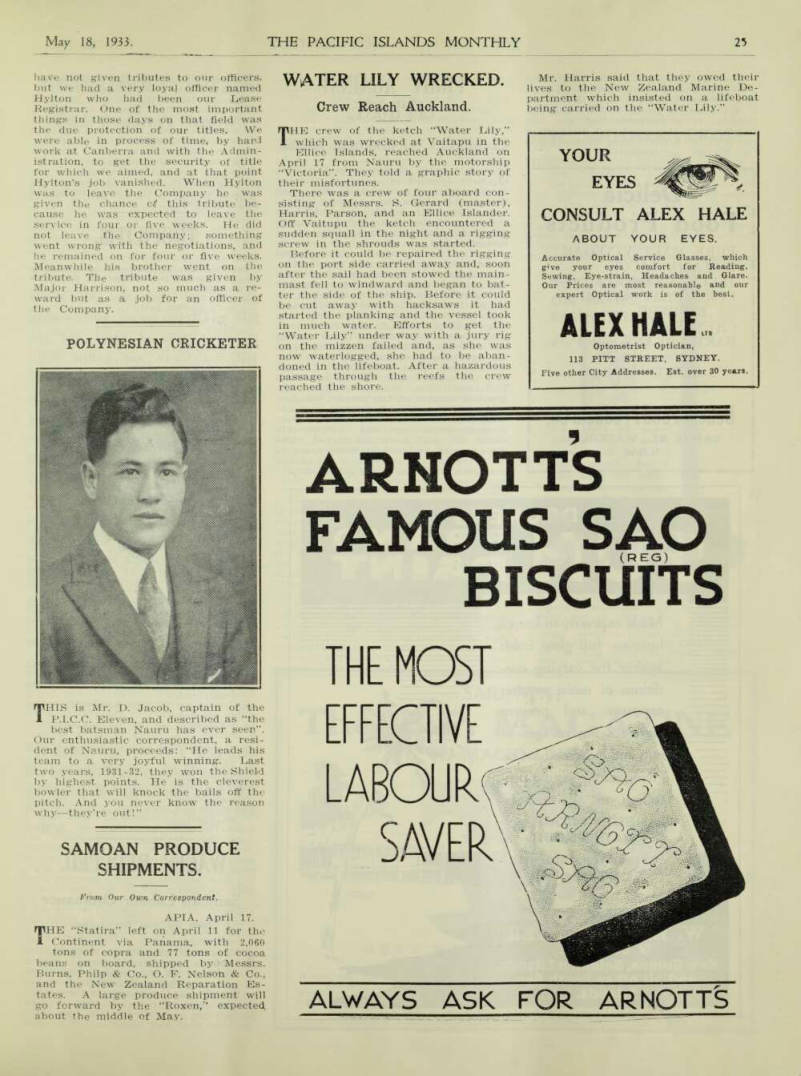
THIS is Mr. D. Jacob, captain of the P.I.C.C. Eleven, and described as “the best batsman Nauru has ever seen”.
Our enthusiastic correspondent, a resi dent of Nauru, proceeds: “He leads his team to a very joyful winning. Last two years, 1931-32, they won the Shield by highest points. He is the cleverest bowler that will knock the bails off the pitch. And you never know the reason why—they’re out!”
Samoan Produce
Shipments.
From Our Own Correspondent.
APIA, April 17.
THE “Statira” left on April 11 for the Continent via Panama, with 2,060 tons of copra and 77 tons of cocoa beans on board, shipped by Messrs.
Burns, Philp & Co., O. F. Nelson & Co., and the New Zealand Reparation Es tates. A large produce shipment will go forward by the “Roxen," expected about the middle of May.
Water Lily Wrecked.
Crew Reach Auckland.
THE crew of the ketch “Water Lily,” which was wrecked at Vaitapu in the Ellice Islands, reached Auckland on April 17 from Nauru by the motorship “Victoria”. They told a graphic story of their misfortunes.
There was a crew of four aboard con sisting of Messrs. S. Gerard (master), Harris, Parson, and an Ellice Islander.
Off Vaitupu the ketch encountered a sudden squall in the night and a rigging screw in the shrouds was started.
Before it could be repaired the rigging on the port side carried away and, soon after the sail had been stowed the main mast fell to windward and began to bat ter the side of the ship. Before it could be cut away with hacksaws it had started the planking and the vessel took in much water. Efforts to get the “Water Lily” under way with a jury rig on the mizzen failed and, as she was now waterlogged, she had to be aban doned in the lifeboat. After a hazardous passage through the reefs the crew reached the shore.
Mr. Harris said that they owed their lives to the New Zealand Marine De partment which insisted on a lifeboat being- carried on the “Water Lily.”
The Government ketch “Melbider,” with the Acting- Protector of Aborig nals on board, left in April for patrol of the Eastern group of Torres Strait Islands. It is expected that she will shortly visit the aboriginal stations in the Gulf, with the Acting-Protector and Dr. Nimmo, on inspection.
Advertisements & other items, pp. 27-28 (1 item)
Famous Sao
YOUR
EYES
CONSULT ALEX HALE
Accurate Optical Service Glasses, which give your eyes comfort for Reading, Sewing, Eye-strain, Headaches and Glare.
Our Prices are most reasonable and our expert Optical work is of the best.
Optometrist Optician,
113 PITT STREET, SYDNEY.
Five other City Addresses. Est. over 30 years.
ABOUT YOUR EYES.
ALEX HALE
ARNOTTS
FAMOUS SAO
BISCUITS
THE HOST
EFFECTIVE
LABOUR,
SAVER
ALWAYS ASK FOR ARNOTT'S
Delicia
Food Products
PURE MALT VINEGAR
TOMATO SAUCE
JELLY CRYSTALS
PURE FLAVOURING
ESSENCE
CHUTNEY
BAKED BEANS with Pork, in Tomato Sauce SPAGHETTI in Tomato Sauce.
Delicia Food Products Co.
DANKS ST., WATERLOO,
N.S.W.
DOCKERS
SUN BRAND PAINT
Made expressly to keep a lustrous, full gloss finish
against the varying con
ditions of moist weather exposure, and prevent the decaying ravages of rain and extreme heat by
giving a long lasting pro
tection to all surfaces.
SUN PROOF
RAIN PROOF
“Stronger than the Weather ”
W. R. CARPENTER
& CO. LTD.
New Guinea, Solomon Islands, and all other South Sea Islands.
Fight Against
Leprosy.
Conditions on Makogai Island.
SO many cases of leprosy in Fiji have been detected only when the disease has reached an advanced stage that the officials of the leper hospital at Ma kogai Island are endeavouring to take a survey of the whole Fijian group in order to prevent the disease from spreading.
Dr. C. J. Austin, who has been at Ma kogai for three years, said when inter viewed by the “Sydney Morning Her ald” on his arrival in Sydney by the “Niagara” recently, that many lepers in fected their relatives and acquaintances with the dread disease before they were discovered to be suffering themselves.
There were 110 native Fijians among the 465 lepers at the hospital, an alarm ing figure for a population of 75,000. The other cases came from New Zealand and its island dependencies, and from India and China. Indians comprised the greatest number of the present inmates.
More than 1,600 patients had been ad mitted to the hospital since 1911, when it commenced operations. Since 1918 about 250 had been discharged. The disease was declared in those cases to be “arrested”, but there could not be any guarantee of cure. The discharged per
sons were obliged to report to a medi cal officer every three months.
Makogai Island has an area of about three square miles. Most of the land is planted by the lepers, who grow most of the vegetables used. The men enjoy all kinds of sports, and are keen on cricket.
They are obliged to work four hours a week cleaning up the hospital property.
There are five outlying villages in the leper settlement, but all the women are housed in a separate compound at the main hospital.
Tropicitis.
The Polynesian Islands are being invaded by e'derly gentlemen lured thither by South Sea fiction writers.
An old gent, there was, who should have known better, Who read Tropic stories —believed every letter.
He closed “Isles of Eden,” and two rheumy eyes, And straightway was wafted ’neath warm, sunny skies, Where he walked on a beach most sur prisingly yellow, Wearing very few clothes and an air bright and mellow.
He out-natived the natives and chuckled to see, There was not one who dared wear as little as he!
Just a single hibiscus, alluring and chaste, And a few milky beads round his corpu lent waist.
A slim, svelte young maid in the short est grass dress Enchanted his days with each langorous caress.
And when he was hungry he cast out his line To draw in fat fishes, a score at a time.
Or, if he liked bacon, he simply went out And hit the first tusker he saw on the snout.
The sharks did not bite when he swam the lagoon, And mossies flew round him with soft, lulling croon.
The Great Chief adored him, and sent him each night Such luscious, dark beauties as dazzled his sight: Their skins were like velvet, their lips ruddy red, And the scent of their hair fairly went to his head.
Etcetera ; ad lib.; ad nauseum. * * * Oh, keep to your reading, we pray you, dear sir, Nor think to take ship in your haste to find Her; Live softly and dream of Romance’s sweet wiles — And leave us poor blighters these d—d Tropic Isles! —M.M.
Wages Reduced.
Samoan Labour Ordinance
From Our Own Correspondent.
APIA, April 17.
AT a council meeting on April 11, the Labour Ordinance was passed through all stages and ordered to be printed. The most important clause of the amended ordinance is the reduc tion of coolie daily wages from 3/- to 2/- per day.
Adventurous Voyage
B.S.I. Resident’s Narrow Escape.
From a Special Correspondent, GIZO, April 10.
LEAVING Faisi, the terminal port in the British Solomons, on the evening of March 9, “Mataram” experienced unpleasant weather, squall succeeded squall throughout the night, and the driving rain greatly restricted the range of visibility.
About 5 a.m. the dim outline of land appeared in the distance, and Captain Williams was about to enter the chart room to take a precautionary survey of the ship’s position when his attention was attracted to a small, dark object directly ahead. A mariner’s life develops an instinct for quick action in emergen cies; a peremptory order was given and instantly the wheel spun round to star board. The “Mataram” responded to her helm not a minute too soon, for her deck lights revealed the launch that so narrowly escaped being run down that further helm action in the opposite di rection was immediately necessary to prevent the steamer’s stern from crash ing into the small vessel.
Captain Williams related the incident on his arrival at Gizo a few hours later, and added that the launch, which was under sail, resembled that belonging to Mr. Musgrave. Inquiry ashore disclosed that Mr. A. W. Musgrave had left port on the previous day for his home on the island of Rononga, and in normal cir cumstances he should have reached his destination the same afternoon. A few days later it was reported that he had not arrived, and a search of the islands and waters in the vicinity of the spot where the encounter with the “Mataram” had taken place was conducted without any trace of the missing launch being discovered. Fear was expressed that the small craft either had foundered or, with engine disabled, had been carried out to sea.
The latter contingency seemed the more likely, and anxiety was felt as to whether sufficient food and water was carried on board to enable Mr. Mus grace and the native who accompanied him, to survive a long drift. These fears were happily set at rest a week later, when the lone voyagers turned up at Gizo in a native canoe, and related a tale of adventure and privation.
It appears that the launch, after leav ing Gizo, encountered the full force of the wind and heavy seas, but continued to make fair progress, until suddenly the engine stopped. Investigation dis closed that the fuel tank had developed a leak and was empty. A spare tin of benzine was carried on deck, but while the vessel, deprived of steerage way, wallowed helplessly in the heavy seas, it was carried overboard and lost. Sails were hoisted but fierce gusts of wind soon reduced them to ribbons, and the launch was left at the mercy of wind and sea.
In the early hours of the morning the lights of a steamer were sighted and soon the “Mataram” bore down upon the launch. Mr. Musgrave endeavoured to indicate his distress by Morse signals but in the smother of rain and sea the puny flashes from his torch were not observed on the “Mataram”.
Fortunately, the weather moderated but currents carried the launch away from land, and for six days she drifted first in one direction and then another,
rolling heavily in the swell, and utterly helpless.
There was little food on board and no water other than the small quantity of rain which intermittent showers de posited. Mr. Musgrave at length de cided to abandon the ship, and with the native boy set off in the dinghy for the island of Simbo, nearly thirty miles dis tant. During the long, hard pull that followed, against conflicting currents for twenty-eight hours, the occupants of the dinghy were exhausted to the point of collapse, and, but for the timely as sistance of local natives, who put off in canoes on observing their plight, it is probable they would not have reached the shore.
Mr. Pybus, the only white resident on the island, apprised of the arrival of castaways, proceeded at once to render aid and, under his care and hospitality, they quickly recovered and obtained the food and rest so desperately needed.
Next day they were taken to Gizo in a native canoe, and a vessel was chart ered and Mr. Musgrave started off in what seemed a hopeless quest for his launch, drifting about —if not already foundered —in the wide Pacific.
By astonishing fortune he found her, half full of water, but apparently not seriously damaged. Pumped dry, the launch was towed to Gizo, and later proceeded on her interrupted journey home, having taken nine days on a trip which normally occupies four or five hours.
Rested and refreshed, Mr. Musgrave made light of his trying experiences and recounted an incident that now assumes a humorous aspect. When endeavouring to Morse a signal to the "Mataram”, he made several attempts to spell a word that would indicate his most pressing need at the moment, but the rolling of the launch and preoccupation regarding his position in relation to the oncoming steamer resulted in a number of false starts culminating in failure for some time to progress beyond the initial let ter “B”. The string of “B’s” which fol lowed one another in rapid succession might, in other circumstances, be con strued as a prelude to derogatory and uncomplimentary remarks somewhat familiar to islanders, but were really an
attempt to spell the word “benzine”, a supply of which just then would have saved him the many trying days and anxious nights that followed.
New “Southern Cross.”
Preparations for the building of a new “Southern Cross” to replace the vessel which was wrecked in the New Hebrides late last year, are under way. The new vessel will be ten feet longer and have two feet more beam than the wrecked ship. An anonymous friend has sent £1,000 to the Melanesian Mission towards her cost.
Advertisements & other items, p. 29 (1 item)
Steelo
RUST STAINS
ON BATHS,
BASINS,SINKS
They clean off easily with Sfeelo. It makes enamel and porcelain glossy - smooth. And a bath done with Steelo keeps clean longer be cause of that,
Steelo
It is ideal, too, for the kitchenware especially aluminium. Try Steelo on a burnt pan or baking dish. Note how quickly and easily it acts. If unobtainable locally, write for a free sample to the Manufacturers, R. H. ARMSTRONG & CO., 44 King Street, St. Peters. N.S.W., stating usual grocer's name
The B.P. MAGAZINE
SAIL WITH
B.P. MAGAZINE
TO MAGIC LANDS.
Fiction Screen Adventure Fashion
GET YOUR COPY NOW.
ANNUAL SUBSCRIPTION:
Within the Commonwealth of Australia, Mandated Territory and New Gainea 4/- post free Within the British Empire .. 5/4 post free U.S.A. and Foreign 6/8 post free From all Bookstalls or direct from the Publishers : Burns, Philp & Co. Ltd.
A Welcome Visitor.
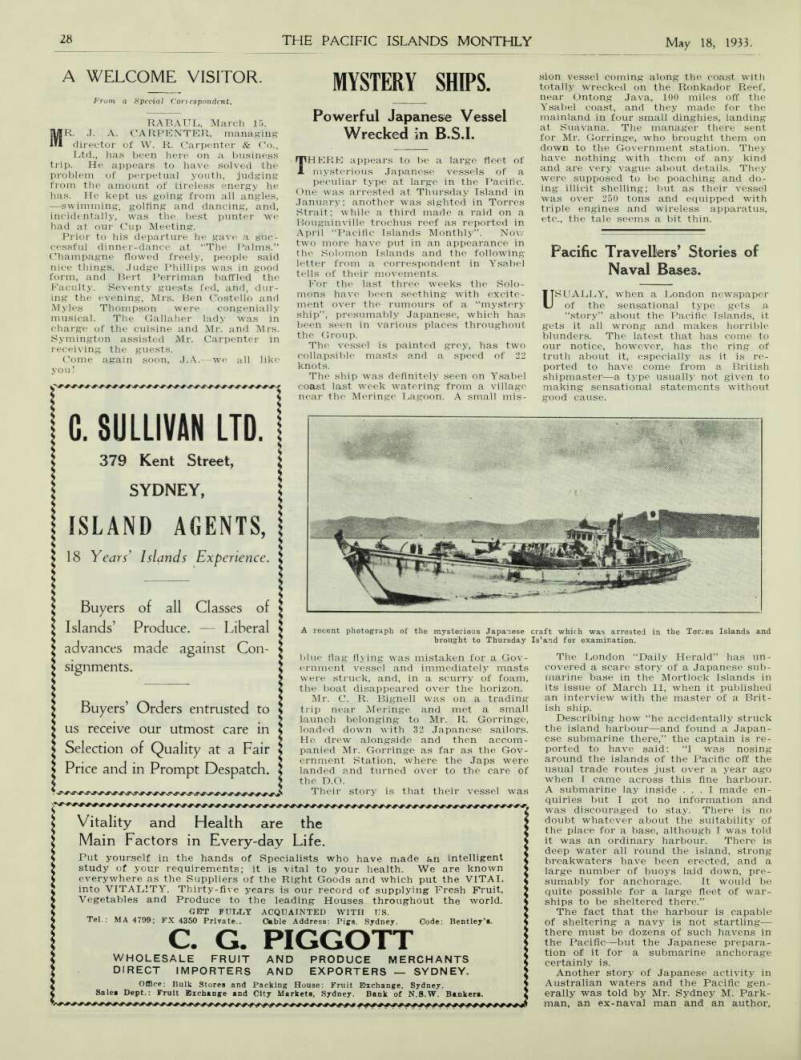
From a Special Correspondent.
RABAUL, March 15.
MR. J. A. CARPENTER, managing director of W. R. Carpenter & Co., Ltd., has been here on a business trip. He appears to have solved the problem of perpetual youth, judging from the amount of tireless energy he has. He kept us going from all angles, —swimming, golfing and dancing, and, incidentally, was the best punter we had at our Cup Meeting.
Prior to his departure he gave a suc cessful dinner-dance at “The Palms.”
Champagne flowed freely, people said nice things. Judge Phillips was in good form, and Bert Perriman baffled the Faculty. Seventy guests fed, and, dur ing the evening, Mrs. Ben Costello and Myles Thompson were congenially musical. The Gallaher lady was in charge of the cuisine and Mr. and Mrs.
Symington assisted Mr. Carpenter in receiving the guests.
Come again soon, J.A. —we all like you!
Mystery Ships.
Powerful Japanese Vessel Wrecked in B.S.I
THERE appears to be a large fleet of mysterious Japanese vessels of a peculiar type at large in the Pacific.
One was arrested at Thursday Island in January; another was sighted in Torres Strait; while a third made a raid on a Bougainville trochus reef as reported in April “Pacific Islands Monthly”. Now two more have put in an appearance in the Solomon Islands and the following letter from a correspondent in Ysabel tells of their movements.
For the last three weeks the Solo mons have been seething with excite ment over the rumours of a “mystery ship”, presumably Japanese, which has been seen in various places throughout the Group.
The vessel is painted grey, has two collapsible masts and a speed of 22 knots.
The ship was definitely seen on Ysabel coast last week watering from a village near the Meringe Lagoon. A small mis
blue flag flying was mistaken for a Gov ernment vessel and immediately masts were struck, and, in a scurry of foam, the boat disappeared over the horizon.
Mr. C. R. Bignell was on a trading trip near Meringe and met a small launch belonging to Mr. R. Gorringe, loaded down with 32 Japanese sailors.
He drew alongside and then accom panied Mr. Gorringe as far as the Gov ernment Station, where the Japs were landed and turned over to the care of the D.O.
Their story is that their vessel was
sion vessel coming along the coast with totally wrecked on the Ronkador Reef, near Ontong Java, 100 miles off the Ysabel coast, and they made for the mainland in four small dinghies, landing at Suavana. The manager there sent for Mr. Gorringe, who brought them on down to the Government station. They have nothing with them of any kind and are very vague about details. They were supposed to be poaching and do ing illicit shelling; but as their vessel was over 250 tons and equipped with triple engines and wireless apparatus, etc., the tale seems a bit thin.
A recent photograph of the mysterious Japanese craft which was arrested in the Torres Islands and brought to Thursday Island for examination.
Naval Bases.
Pacific Travellers’ Stories of Naval Bases.
USUALLY, when a London newspaper of the sensational type gets a “story” about the Pacific Islands, it gets it all wrong and makes horrible blunders. The latest that has come to our notice, however, has the ring of truth about it, especially as it is re ported to have come from a British shipmaster—a type usually not given to making sensational statements without good cause.
The London “Daily Herald” has un covered a scare story of a Japanese sub marine base in the Mortlock Islands in its issue of March 11, when it published an interview with the master of a Brit ish ship.
Describing- how “he accidentally struck the island harbour —and found a Japan ese submarine there,” the captain is re ported to have said: “I was nosing around the islands of the Pacific off the usual trade routes just over a year ago when I came across this fine harbour.
A submarine lay inside ... I made en quiries but I got no information and was discouraged to stay. There is no doubt whatever about the suitability of the place for a base, although I was told it was an ordinary harbour. There is deep water all round the island, strong breakwaters have been erected, and a large number of buoys laid down, pre sumably for anchorage. It would be quite possible for a large fleet of war ships to be sheltered there.”
The fact that the harbour is capable of sheltering a navy is not startling— there must be dozens of such havens in the Pacific —but the Japanese prepara tion of it for a submarine anchorage certainly is.
Another story of Japanese activity in Australian waters and the Pacific gen erally was told by Mr. Sydney M. Park man, an ex-naval man and an author,
who arrived in Sydney by the tourist steamer “Ulysses”.
Interviewed by “The Sydney Morning Herald”, Mr. Parkman said it was “com mon knowledge in Cairns that Japanese beche-de-mer fishers have been taking soundings within the Great Barrier Reef and that, consequently, the Japanese are in possession of charts much better than those issued by the British Admiralty”.
"The Japanese are not doing that for fun,” declared Mr. Parkman, who em phasised the potentialities of Cairns as a forward cruiser and submarine base.
There are big openings with deep water in the Barrier Reef, sufficient for the requirements of the Navy,” he said, “and no enemy could possibly approach a fleet anchored at Cairns. The anchorage is perfectly safe. As far as the protection of the Pacific was concerned, Singapore was of no use. Hongkong was a death trap because a fleet could be hemmed in by mining its two approaches, Cairns, therefore, with its natural Barrier Reef defences, appealed to him as a defen sive base.
Mr. Parkman, who was enthusiastic about the tourist possibilities of the Barrier Reef, said that it was the pub licity it had received after the last tour ist cruise that had induced him to make the voyage. Unfortunately, the time was all too short in this truly remarkable place. The more it is known, the greater number of visitors will come to see it, he said, in urging Australians to give it wide publicity.
Advertisements & other items, p. 30 (1 item)
G. Sullivan Ltd.
379 Kent Street,
SYDNEY,
ISLAND AGENTS,
18 Years' Islands Experience.
Buyers of all Classes of Islands’ Produce. Liberal advances made against Con signments.
Buyers’ Orders entrusted to us receive our utmost care in Selection of Quality at a Fair Price and in Prompt Despatch.
Vitality and Health are the
Main Factors in Every-day Life.
Put yourself in the hands of Specialists who have made an intelligent study of your requirements; it is vital to your health. We are known everywhere as the Suppliers of the Right Goods and which put the VITAL into VITALITY. Thirty-five years is our record of supplying Fresh Fruit, Vegetables and Produce to the leading Houses throughout the world.
GET FULLY ACQUAINTED WITH US.
Tel.: MA 4799; FX 4350 Private.. Cable Address: Pigs, Sydney. Code: Bentley’s.
C. G. PIGGOTT
WHOLESALE FRUIT AND PRODUCE MERCHANTS
DIRECT IMPORTERS AND EXPORTERS SYDNEY.
Office: Bulk Stores and Packing House: Fruit Exchange, Sydney.
Sales Dept.: Fruit Exchange and City Markets, Sydney. Bank of N.S.W. Bankers.
Trochus Poaching.
Need for Fast Patrol Boat in N.G.
Mr. Featherstone Phibbs, Who
has been Collector of Customs at Rabaul for the past 18 years, ar rived in Sydney on leave by the “Nan kin” on April 20.
Mr. Phibbs said that complaints of trochus shell poaching had come from many parts of New Guinea and the Ad ministration was powerless to stop it because it had no vessel fast enough to overhaul the poachers. The illicit shellers used fast, Diesel-engined vessels of about 100 tons and the procedure was to make a sudden raid on a trochus reef, by sending out many small boats, each with a few men who gathered quickly all the shell, and then depart hurriedly.
Only the best shell was taken and the poachers were always far away before there was any chance of pursuit.
The only chance of stopping this stealing, declared Mr. Phibbs, is to keep a fast patrol boat constantly in the area. After a few poachers had been seized and their cargo confiscated, the practice would cease.
Schedule.
“Maui Pomare’S”
From Our Own Correspondent.
APIA, April 17.
STARTING with the May trip, the "Maui Pomare” will arrive in Apia on Tuesdays instead of Wednesdays, leaving on Thursdays as heretofore, thus giving the boat an extra day in port.
On her last trip she took about 5,000 cases of bananas away.
Advertisements & other items, p. 31 (1 item)
Free! .
‘THE SENIOR STORE" "Truth in Advertising" —nothing but the Truth !
a great compendium
for home and farm
Write Now!
Every two months Anthony Horderns’ pub lish a comprehensive Grocery Catalogue. You should write for your FREE copy NOW, for wonderful values.
A catalogue of all your
needs, profusely illustrated
Once again Anthony Horderns’ have published a Mail Order Catalogue filled to its very covers with everything needful for the home and farm. Every item on every one of the 134 pages plainly denotes our honest belief that the qualityvalues advertised in this catalogue are unsurpassed in Australia. It is proof, too, that Anthony Horderns’ oftrepeated phrase “Compare Quality for Quality, and Price for Price” is no platitude, but the basis of buying. Write for your copy now.
Anthony Hordern & Sons, Ltd.
’Phone : M 2401, SYDNEY Postal Address : Day and Night. Box 2712 c, G.P.O.
How Pacific Islands Natives
Become Medical Practitioners.
Remarkable Success of Suva Central Medical School.
ONCE upon a time, to have pro pounded to an “old hand” of the Islands the idea of training natives as qualified medical practitioners, would have been equivalent to asking to be locked up as a lunatic. But, to-day, in Fiji, this is not only being done but is bringing excellent results.
The Central Medical School, Suva, provides a striking example of the way in which , natives of the Pacific Islands are rapidly absorbing the culture of the white races. Its aim is to train carefully a number of selected students as native medical practitioners in order that they may carry out medical and health work in their own group of islands, and thus not only bring medical help within the reach of their own countrymen, who are out of reach of other medical assistance; but also, by preventive measures, to raise the general standard of health throughout the Pacific.
A secondary, though important, aim of the school is to inculcate the spirit of friendly relationship and assistance between the various island races.
Residents of the Pacific Islands, or at least those under the administra tion of the Western Pacific Commis sion, have long owed a debt of grati tude to the instigators of the scheme.
In opening the school in December, 1928, Sir Eyre Hutson, then Governor of the Colony of Fiji, said: “The pro posal that the advantages of the Fiji Native Medical School which had for many years proved to be a successful
institution and of great benefit to the Colony, should be extended to the neighbouring territories in the Pacific and the doors of the school opened to students from those territories, had its origin some years ago with Dr.
Lambert, a member of the Medical Staff of the Rockefeller International Health Foundation. The idea and the scheme of a Central Native Medical School was whole-heartedly supported by Dr. Montague, Fiji’s highly esteemed and valued Chief Medical Officer. The Colony of Fiji, my pre decessor in office and the various administrations in the Pacific who have co-operated in the scheme, owe a deep debt of gratitude to Dr. Lam bert for his strong faith in the scheme and his able and persistent advocacy of the proposal with the governing body of the Rockefeller Foundation which happily resulted in a decision on their part to offer substantial and generous financial support."
The school stands in the grounds of the Colonial War Memorial Hospital, overlooking Suva. It is of concrete and provides a theatre for the teaching of anatomy; a laboratory for practical chemistry, physics and practical physiology; a lecture theatre, a museum and a library. The students quarters adjoin and consist of a two storey wooden building accommodating 28 students. Each student receives clothing and pocket money.
The library and museum are well equipped, many medical men having
presented medical works and the school has the hospital autopsy theatre to draw on for museum specimens.
The Central Medical School is under the direction of the Tutor, Mr. D. W.
Hoodless, and all instruction is given in English Last year there were 40 students at the school —the maximum number that could be accommodated. They are treated much as medical students the world over and not as school boys, every effort being made to inculcate a sense of responsibility and a proper feeling of self-reliance.
The students came from all parts of the Pacific—Fijians, Samoans, Ton gans, Cook Islanders, Gilbert Islanders, Ellice Islanders, Solomon Islanders, New Hebrideans and Indians from Fiji being counted among the number.
A perusal of the reports of the school since its beginning show that most of the students appear to regard medicine and surgery as a life-work, as most of them are successful in the examina tions which are held quarterly and annually. Very few natives have re signed or been dismissed as being un suitable for the study and practice of medicine.
Good reports of the work of the native medical practitioners—the stu dents who have graduated and are now practising—have come from many parts of the Pacific. The Governor of American Samoa has asked for co operation and that a student from the school be sent there and the Chief Medical Officer of the New Hebrides has high praise for a native prac titioner —a Fijian who volunteered for work in the Condominium.
The school has its own journal, “The Native Medical Practitioner,” and many of its articles on professional and tech nical subjects are contributed by graduates and students. Provision is made at the school for post-graduate courses; at the end of 1932, six graduates had taken courses at the War Memorial Hospital, Suva.
Owing to the generosity of Sir Murchison Fletcher, the students now have a sports fund which is contri buted to by the Administrations of the territories from which the students come.
Thirteen new students enrolled at the school for the four years’ course. They came from the Solomons, Tonga, Gil berts, Eastern Samoa, Western Samoa, Cook Islands and Fiji. Five students qualified as medical practitioners in December, 1932. Of these two went to Fiji, one to the New Hebrides, one to the Gilbert Islands and one to Samoa.
Identity Of Murdered Men
From Our Own Correspondent THURS. IS., April 25.
LATEST information regarding the two white men alleged to have been killed last year near the border of Dutch New Guinea seems to indicate that the victims were the men who last year cleared out with a launch from Cairns, and got away to Dutch ter ritory. But they were advised to leave again, after the Australian authorities were unable to bring them back be cause of the expense.
The two young men in the “Kuiam,” who were at first thought to have been killed, subsequently turned up as castaways in Dutch territory, and have been assisted back to England.
Advertisements & other items, p. 32 (1 item)
Fitzroy
SPICED, CORNED, ROAST IN 12oz, 1lb., 2lb., 3lb., 4lg., & BOILED BEEF 5lg., & 6lb. ROUND SHEEP AND IN MUTTON CANS AND IN TAPEBS TONGUES
OXFORD. CAMBRIDGE & PORK SAUSAGES
THE ORIGINAL PACK IN A CLASS BY ITSELF
ALSO THE FAMOUS
HAMPER MEATS
IN ROUND AND TAPER CANS 12oz. 24oz. & 6lbs.
SPECIALLY PACKED FOR THE ISLAND TRADE
SEND FOP PRICE LIST - NO EXTRA CHARGE FOR ASSORTMENT The CENTRAL QUEENSLAND MEAT EXPORT CO. LTD.
LAKES CREEK - ROCKHAMPTON
CABLE ADDRESS:- TOMOANA ROCKHAMPTON.
How To Treat Natives
Some Useful Hints by an “Old-Timer."
THE islands of Torres Strait, between Thursday Island and New Guinea, come within Australian boundaries and are administered by the Aboriginal Department of Queensland. On each of the larger islands a European official is located, who performs the duty of schoolmaster, supervisor of general af fairs, storekeeper, and various other jobs, for various departments, and is known as the “Government Teacher”.
The position is one which requires tact, commonsense, and practical ex perience of native conditions, and one official, since retired, who spent some years in the islands, compiled a very useful compendium of information for unofficial circulation amongst those new to the work. The following extracts, taken from the list, are so applicable to similar conditions wherever there are native communities that their publica tion may serve a useful purpose.
On election of native councillors: For convenience and felicity get a black board and write names of those whom you recommend to be elected; do not forget the native custom of tribal in terest. Each tribe may want a repre sentative. This cannot be if only three are allowed to be appointed and there are five tribes. . . After your man has been appointed (by a show of hands), move the board to another part of the village to where you want the other councillor to have authority, and again write down the names of those you re
commend; then move the board as be fore. and you will have names appointed in rank according to your knowledge of their fitness. Their duties are to support you in the administration of island affairs, to carry out orders of the Protector of Aboriginals, etc. Let them believe they run the show, they love authority; but be sure you guide, hold and prompt. Do not encourage individual “rising” to as sume authority.
On native court affairs. —You will be looked to guide native councillors in this duty, in fact, almost to run the show, but do not rise to the position of a magistrate, you are not one. If you find out anything wrong, question your native police and order a meeting of the court. You will find that when court meets they remain dumb, and squat looking at you. Find out what is wrong, ask questions of both sides; but take no side in the case, then refer the matter to the councillors. They will say who is at fault. Then pass a slate round, asking them to write what punishment they think fit, unseen by each other, and you can fix the punishment, the slates guiding you. Remember, not to be too hasty in coming to conclusions, weigh evidence, think well and long before meeting out punishment, both here and in school with the children. Never for get that you too stand at the bar of justice and mercy, and let mercy govern all your doings.
You are in charge of the police and sometimes the councillors will try to boss the police, threaten to disrate them.
Do not allow this and the police are to carry out your orders, make arrests, take charge of prisoners, report sickness, and bring to you all visitors that land on the island. Do not encourage them to confine people without your advice, as this may land you in trouble.
Be friendly with all natives but fami liar with none. Never forget this. Never enter a house alone. Be careful how you act towards women and girls, give no cause for talk, for be sure where there is smoke there is fire. Discourage beg ging. Accept no presents (make return for what you receive in fair payment).
Discourage hand-shaking, make them salute, you saluting in return.
Attitude towards pearlers, visitors, recruiters, etc. —Be courteous and oblig ing as far as it is in your power to be.
In your attitude towards the natives, also to all others, avoid making reports; settle as far as you can your own af fairs. The office will not thank you if you give them your dirty work to settle.
Be very careful how you act concerning Section 16 of the Aboriginal Act (which deals with “persons prohibited from fre quenting camps,” etc.). For your own sake, be warned by Section 19 of the Act (which deals with the support of a half-caste child by the father). Boats recruiting must first hand in their re cruiting permit. No visitors are allowed on shore after sundown, but use your common sense when dealing with re quests. Do not allow your police author ity to confine visitors, nor put in irons any Oriental, without your direct order.
If Japs., etc., are confined in irons, you cannot foresee what international ques tion your thoughtless action or officious police may open up. Remember, they are Eastern and subtle. A case once happened where a policeman put a Ma lay in gaol, kept him in irons, all night, and fined him £1 the following morn ing! Support your police by ordering a man off to his boat, then write to his employer about his conduct, sending a copy to your superior official. Do not be hasty; write your report and think it over next morning. If you see error
and defiance through eyes unclouded by anger, write out your report and send it in; it is then your duty to do so. Do not speak to an Oriental in such a man ner as to rouse his anger. Be gentle and he will return respect. Do not forget he is human, and many mistakes made are unintentional, and often acts and Western feeling and pride are violated by the Eastern’s ignorance of our feel ings. Be firm and quiet, determined; re member, we, too, more often offend and shock the moral feelings of coloured people. Treat them as you would like them to treat you in their country.”
Advertisements & other items, p. 33 (1 item)
Mining Machinery
of all classes, including— Dredging and Sluicing Plants Gravel and Water Pumps Elevators Nozzles Piping and Valves.
Mining Plants have been supplied to a number of Companies in New Guinea, and we are, therefore, fully conversant with local conditions.
SEND YOUR ENQUIRIES TO
Improved Type Gravel Pump.
THOMPSONS ENGINEERING & PIPE GO. LTD.
CASTLEMAINE, VICTORIA.
Cable Address: “THOMPSONS, CASTLEMAINE.”
SYDNEY OFFICE KEMBLA BUILDING 58 MARGARET STREET.
“Macdhui.”
Excitement On
JUST before the departure from Townsville of the “Macdhui”, on which the Minister in Charge of Is lands’ Territories (Major C. W. C. Marr) is travelling to New Guinea, an exciting incident occurred.
A horse which was being hoisted aboard fell into the harbour and the second mate, Mr. George Hildebrand, dived in after it and steered it to a launch which brought it back to the “Macdhui”. Hildebrand cut his hand severely on a rope in diving overboard.
He was praised for his pluck by Mr.
Marr.
Norfolk Island Notes,
From Our Own Correspondent.
Norfolk Is., May 2.
NOW is the summer of our discon tent made glorious autumn by the suns of April and of May!
The prettiest weather week after week! Bright blue skies drifting with little fleecy clouds; calm blue sleeping seas, dreaming beneath a temperate sun. The roads are hard and bare with all dust gone, the winter mud not yet upon us.
Under these conditions Easter was a holiday season that no one should for get. Bathing, picnics and golf over the week-end and, on Easter Monday, one of the funny little race meetings it is rich entertainment to attend. No bookies operated, but the tote regis tered the passing through of some thing over £100. Not really one hun dred pounds, of course; actually about £20, that was handed in thoughtfully and after due consideration on one side of the structure before each race and snatched deliriously and with joy over the paying out counter after it. But as much fun and excitement expended with it as though thousands were at stake.
A Bean Tragedy.
While our best Canadian Wonder bean seed —of remarkable quality and evenness —only fetched £2/10/- per bushel this last season, we are paying anything up to £6 per bushel for im ported seed that in no way compares with our own, and we wonder why we foolishly continue to cultivate the land for a living; why, knowing as we do, the helpless necessities of the grower, we do not emigrate en masse to the cities and sit like bloated spiders in webs, acting as middlemen between unhappy producer and exploited con sumer.
One of our outstanding settlers here —a man whose name is synonymous with quality and integrity—sold to a buyer a few months ago, his bean crop at what the buyer declared to be a fancy price and, in return, bought from that buyer, who is a seed merchant in Sydney, a bushel of Tweed Wonder seed to use this coming season. When he opened up the parcel he could scarcely believe his eyes. Small, mis shapen, discoloured; they looked like third rate reject Canadian Wonders and, as he said himself, he would have considered that a handful of them scattered throughout an outward bound consignment would have dis qualified the lot and discredited the consignor for life.
And he paid £6 for the bushel! Their sole merit was, apparently, that they were guaranteed free from weevil and blight; and that, even, must be taken on trust until growth and harvest proves it. What a dirty business Business is!
Bureaucracy!
For a long time past we have been agitating for a second post office some where in the centre of the island and equally accessible from all quarters.
At present our only office is down in Kingston, on the southern shore, where all the Government offices are congregated, and it is a day’s journey —sometimes two successive days’ journey—to redeem a mail and transact small postal business. In winter, too, with mud up to the axles of our cars, and the hubs of our gig wheels, mail day seldom passes without an accident.
Our administrator was requested to approach the Postal Department in Canberra and ask them to establish a sub office, however small, in some more convenient situation; but after corres pondence in which he did his very ut most for us he has been forced to announce that there is not the slightest prospect of relief. The Department claims that our postal service already costs far more than the maintenance of a similar service anywhere on the mainland, and, short of a personal visit of inspection and investigation, it is impossible to convince them that our difficulties of communication and so on are unique; we are rated an*d dealt with in the precise manner that is found to be most efficacious elsewhere.
Therefore we may, for an indefinite time to come, resign ourselves to exist ing conditions. Captain Pinney has done his best —with a sympathetic realisation of our difficulties and the justice of our prayer—and he can do no more. Anyway, we got the verandah round the post office and that is some thing that all the year round we shall be grateful for!
Survey Ship For
North.
H.M.A.S. Moresby, the Admiralty sur vey ship which has lain in Sydney for a long period of idleness, has been com missioned. After bunkering at New castle, she returned to Sydney to pre pare for a six months’ survey of North Australian waters.
Advertisements & other items, p. 34 (1 item)
James Barnes Limited
TO PLANTERS I am a Buyer of
CASTOR OIL SEED
IN ANY QUANTITY.
Send Sample for quote, stating quantity available.
Castor Seed Shelters, any capacity.
Advice and Instructions Regarding Plant ing, Harvesting and Packing of Castor Oil Seeds given freely.
Selected Seed for Planting available.
C. GRAHAME
17 BOND STREET SYDNEY.
JAMES BARNES LIMITED
2 Botany Street, Waterloo, Sydney
(ESTABLISHED 1881)
MANUFACTURERS OF
“Globe” & “Victory” Brands
OF
SHEEP’S TONGUES OX TONGUES SAUSAGES
PRESERVED MEATS BEEF EXTRACT DRIPPING
Also “Castle” Brand, which is specially packed for use by the White Population.
Globe Beef Extract is invaluable to Young and Old.
Tested Recipes on the packet 4oz. and 8oz. sizes.
Maiden Speeches.
Samoan Legislative Council Meets.
From Our Own Correspondent.
APIA, April 17.
THE first Legislative Council meeting of the new period took place on March 23 and was marked by the first appearance of the newly-elected members, the Hons. I. H. Carruthers and A. R. Cobcroft. The Administrator welcomed the new members and expressed the hope that their experi ence and knowledge of local conditions would be of great value to the Coun cil and their advice would be greatly appreciated by the Administration.
Dealing with the economic position in Samoa the Administrator pointed out that trade and finances of the ter ritory were steadier in the past finan cial year than could have been expected. While there had been a drop of 35 per cent, in the trade turnover for 1931, the drop was only 7 per cent, in 1932. The financial year ending 31st March, 1933, would show an excess in revenue above the estimated amount, while expenditure will be less than estimated; so that a surplus would be shown as the result of the year’s work.
Consequently the Administration would be able to avoid further increases in taxation.
Three bills were on the order paper of the day, viz.: The Samoa Standard Time Ordinance, the Labour Ordinance and the General Laws Ordinance. The former ordinance is intended to intro duce zone time into Samoa, the Labour Ordinance to reduce the cost of Chinese coolie labour to a reasonable level, and the General Laws Ordinance to bring antiquated laws up to date by neces sary amendments.
The Hon. I. H. Carruthers then rose for his first address in the Council.
He assured the Council that he would co-operate and assist together with the Hon. Cobcroft in all efforts directed towards the welfare and de velopment of the country and that, whenever they would find it necessary to criticise, their criticism would tend to be constructive and helpful.
Mr. Carruthers then dealt with the Native Trade Debts Ordinance 1925, by which natives are not allowed to ob tain credit of merchants and traders, making it illegal to prosecute native Samoans for trade debts. He objected to this ordinance, which, in a way, characterised all natives as untrust worthy and pointed to various occa sions, when, according to Samoan fashion, it would be essential for natives to obtain a limited amount of credit in stores, especially at unfore seen events, like births, deaths, visits, etc. He suggested that debts up to an amount of £2, incurred by natives, should be recoverable by law.
The Crown Solicitor, in reply, stated that the request, which was supported by the Apia Chamber of Commerce, would receive favourable consideration.
A further important matter brought forward by the Hon. Carruthers was the heavy expenditure voted for police, £20,000 in the estimates for 1932-33.
He mentioned that the Chamber of Commerce had previously suggested a reduction of this expenditure and asked
again, in view of the continued depres sion and absence of serious trouble, to consider the abolishment of the district police posts and further reduc tions in police expenditure. The answer by the Crown Solicitor was: The European police strength has been steadily reduced as conditions be came more settled. The Administra tion believes the system of police posts is a useful one and warranted by results.
The Hon. A. R. Cobcroft, second elected member, then rose and after some introductory remarks, took up the question of the employment of local born Europeans by the Administration.
The first pointed to the difficulty exist ing in Samoa if absorbing the rising generation of young local born people of European extraction, who have com pleted their education and seek em ployment. Twenty-nine such Euro peans are employed in various Gov eminent departments at present, 16 are casual employees in Public Works De partment, and 19 are employed by the Reparation Estates. Mr. Cobcroft suggested that more local people might
be usefully and economically employed, especially in the Police Department and Reparation Estates. It was signi flcant that for the last four years an average of 146 boys and girls visited the Government Tfi Tfi School and that in addition 197 local born boys were educated at the Marist Brothers’
School. Thirty to forty of the pupils of these schools left the institutions every year and were mostly unable to find employment. While Government and Reparation Estates employ alto gether 48 local people, the three largest commercial firms of Samoa employ be tween them 98 of them, an indication that local people are trustworthy and efficient even in responsible positions, The answer of the Crown Solicitor to the Hon. A. R. Cobcroft’s request to give preference to local born people whenever vacancies occur on the Ad ministration staff, was that during the last two years the number of local born employees had slightly increased, while European officers from overseas had been reduced in numbers from 102 to 68.
A very important matter was brought
forward by the Hon. A. R. Cobcroft, when on behalf of cocoa planters he asked the Administration to withdraw the inspection of cocoa beans and the resulting fees, as, for a considerable time, the standard of quality had been well maintained and besides cocoa buyers of Samoa were, in their own interests, submitting their purchases to a rigid inspection.
The Crown Solicitor in reply stated that the Administration would prefer the inspection and fee for same to re main, as a means whereby the present satisfactory standard of quality for cocoa beans may be maintained.
A further suggestion by the Hon.
A. R. Cobcroft, to provide for the visit of a qualified agricultural expert (mycologist) from Fiji or elsewhere to Samoa, to assist Samoan cocoa planters in their fight against the black pod disease of the cocoa tree, met with a similar unsympathetic atti tude of the Administration.
The Hons. Carruthers and Cobcroft are to be complimented on their first battle for the welfare of the com
munity and for the intrepid and courageous way in which they have taken up the cudgels on behalf of their electorate. It is regrettable and difficult to understand why the Admin istration cannot see its way to accede to the moderate and reasonable re quests advanced by the elected mem bers, especially the one for a radical cut in the police cost. Contrary to the view of the Administration, the public belief that the police post in outside districts are absolutely useless and serve no worthwhile purpose at all.
The refusal of the Administration to drop cocoa inspection and fees to pro vide the service of a mycologist for the planters, European and native, is astonishing, when one considers that Samoa is a purely agricultural coun try, that all revenue of the Adminis tration is drawn from agriculture, that for years, after the abolishment of the Agricultural Department, the Adminis tration has spent nothing at all on behalf of the plantation industry, while small countries like Tonga and Raro tonga maintain an Agricultural De
partment. The cost of a mycologist’s visit to Samoa would probably not exceed £200. On the other hand the Administration, apart from the police staff, keeps an expensive and unwar ranted Medical Department, a heavily staffed superfluous Native Department and an unnecessary Harbour Master and Pilots Department, while many other highly paid official jobs could easily be done away with or amalgamated, and part of the savings used for the real benefit and development of the country.
Advertisements & other items, pp. 35-36 (1 item)
4 Symptoms
1. TOE ROT.
Cracks bet ween the toes, rotten skin, ac companied by severe itch and inflammation 2. TINEA of the HAND.
Dry, scaly skin rash and itchy cracked skin. 3. TINEA of the EARS.
Scaly skin and irritation in lobe of the ear.
4. RINGWORM of the NAILS.
Inflammation or septic cuticle, cracked and discoloured nails.
“ANTINEA’’ LOTION is the
only definite cure for this con tagious skin disease.
Obtainable in small (½oz. fl.) and large (l½oz. fl.) bottles. From Chemists, Burns, Philp & Carpenter’s Stores.
Fiji: Mitchelmore, Swann & Co., Brown and Joske, Ltd.
4 SYMPTOMS
of TINEA
the scourge of the Pacific
Islands.
Prevent this Ringworm
infection by regularly
using
“ANTINEA”
ANTISEPTIC
SOAP
for all
Toilet
Purposes.
If unobtainable write direct for free Booklet to —
ANTINEA DRUG CO.,
WINGELLO HOUSE. Angel Place.
SYDNEY.
SUNSHINE PLANTATION IMPLEMENTS
Write for a free copy of the 93-Page Catalogue of Sunshine Agricultural Machinery.
It describes and illustrates the fine range of Implements designed and built to suit the requirements of planters in Queensland and the Islands.
HERE ILLUSTRATED IS THE
"Sunglint” Plantation Plough,
A strong steel implement. Length, 8ft. 10in. overall. Clearance at throat, 20in Polished Board, 25½in. long. Turns furrows to 10in. deep and 12in. wide The “SUNGLINT'’ is in popular use amongst the sugarcane and maize planters of Queensland.
H. V. M C KAY MASSEY HARRIS PTY. LTD.
(Sunshine Section),
Sunshine Harvester Works,
SUNSHINE, Near MELBOURNE, AUSTRALIA.
(Also Sydney and Brisbane.)
CIGARETTES
CORK TIPPED
OR PLAIN
TAN
NAVY CUT
TOBACCO
made fwm
BEST VIRGINIA
LEAF 4085-62
Papeete’S Welcome.
Catholic Bishop’s Return to Tahiti.
From Our Own Corretpondent.
PAPEETE, April 21.
A large and enthusiastic crowd assembled on the Papeete wharf when the “Bussole” arrived re cently from France, to welcome the newly appointed Catholic Bishop of Oceania, Monsignor Amedie Nouailles.
The reverend gentleman commenced his island experience some thirty years ago as a young missionary in the Tuamoto Archipelago, and lived there almost continuously up to a few months ago. Possessing a sympathetic, modest, and very sociable disposition, and being entirely devoted to the wel fare of his district, he quickly gained the confidence and affection of the native population, and is to-day uni versally loved and respected through out those scattered atolls.
In spite of the high honour con ferred upon him during his recent visit to Rome, and the comparative luxury of his Papeete home, Monsignor Nouailles does not forget the Tuamotus, his heart is still in that wild archi pelago where so much of his life has been spent, and it is there that he would have gladly remained to labour.
With such a record behind him, we have no doubt that Monsignor Nouailles will prove a worthy suc cessor to the late Bishop Hermel, whose untimely demise occurred last year.
New Guinea Goldfields
Limited.
The following progress report for the month of March has been issued by the Mining Trust, Ltd., consulting engineers for the Company:—
Development.
Location 3. —A crosscut from No. 1 shaft reached the vein as expected at 135 feet, but the men were driven out by water before the ore could be sampled. It is expected to un water the workings by the end of April.
Location 8. —No. 4 shaft was sunk 16 feet to 413 feet. No. 3 level. Drift was advanced 95 feet in ore, averaging 7.5 dwts. gold and 12 ozs. silver over a width of 20 inches.
Production.
The estimated profit for February from alluvial work was £6,680. The production for March was 2,040 ozs. bullion.
New Areas. —The first preliminary drill hole was stopped at 37 feet without reaching bedrock, and the second hole has been started, but results to date are negative.
Mill. —The estimated profit for February was £4,690. The output for March was 1,399 ozs. fine gold. It is expected that four new tanks will be put into commission during August.
Cook Island News.
Vice-Regal Visit.
From Our Own Correspondent.
Rarotonga, April 24.
RAROTONGA is keenly looking for ward to the arrival of the war ship “Diomede” with Their Excel lencies, Lord and Lady Bledisloe.
H.M.S. ‘“Diomede” is expected to arrive on the morning of April 27.
Arrangements are in train for the hold ing of a gigantic native function at the main village Avarua. The war ship sails direct from Rarotonga to Auckland without calling at any other Cook Islands ports.
“Tagua’S” Return.
Like a bird of good omen signalising the return of cool and calm weather conditions the schooner “Tagua” arrived from Papeete on April 11 to commence her sailings amongst the islands of the Cook Group. A burning desire seems to possess writers and journalists, when they see the little schooner, to take passage on her and experience the thrills of travelling by a sailing ship to Pacific Islands which have so much attraction for the romancer and dreamer of the outer world. The “Tagua” departed on April 14 on her first round of the season of the Lower Islands with a cargo of foodstuffs and many bags of mail. On this occasion the time-honoured cus tom of schooners not sailing on a Friday was broken —the “Tagua” sailed on Good Friday.
Papuan News.
Talkies for “Port.”
Pt. Moresby, May 4.
THE Port Moresby Freezing Company, Ltd., announces that it is importing by the “Macdhui” arriving to-day a plant for talkies. Up to the present, silent films have been in use, and the residents of the town are looking for ward to the change.
French Cruiser’S Visit.
News has been received that the French cruiser “Savorgnan de Brazza,” attached temporarily to the French naval forces of the Far East, probably will call at Port Moresby and Yule Is land in July on her cruise through the Pacific. From Sydney she will first pro ceed to Noumea and the New Hebrides before visiting Papua.
Surprise Attack.
N.G. Patrol Ambushed.
SAVAGE resistance was met by a pa trol led by Patrol Officer McCarthy, which was tracking down the mur derers of William Naylor and Emil Clarius in the Morobe District, late last month.
Mr. McCarthy, who is now in hospital at Salamaua, was visited by Major Marr when the official party arrived by the “Macdhui” on May 11. He told the Min ister that the patrol was near the Pa puan border, at a point two days’ march
from Otibanda police post, on Surprise Creek, when it arrested 12 prisoners from the tribe responsible for the recent murder of the prospectors, Naylor and Clarius. He was marching off with the prisoners when the party walked into an ambush, from which a shower of ar rows were fired at a range of five yards.
Six police boys were hit and also two prisoners, who died. One police boy is also in hospital still at Salamaua, and is likely to die. Mr. McCarthy, although wounded, was able ro rally the boys, who fired back, killing several of the attackers.
“The first thing I knew,” said Mr. Mc- Carthy, “was that I got an arrow in the stomach. Then another arrow struck me in the thigh. There was a regular volley of arrows, and six police boys fell. As the attackers rushed us we fired, driv ing them off. Of the 12 prisoners, the attackers accidentally killed two, and we were forced to shoot three when they were attempting to escape. The actual arrest took place in quite uncon trolled country.”
The prisoners will be taken back to act as interpreters during the control ling of the country.
Samoan Affrays.
Native Sentenced.
From Our Own Correspondent.
AS a result of an affray between young Samoans of Fasitoo-uta village, in which a native was struck with a knife and seriously wounded, necessitat ing the amputation of an arm, a man, Kilipati, was sentenced at Apia High Court to five years’ hard labour.
Advertisements & other items, pp. 37-38 (1 item)
Ruston & Hornsby (Aust.) Pty. Ltd.
Ruston-Lister Marine Diesel Engines and Marine
Auxiliaries
IN SIZES UP TO 650-B.H.P.
Illustration shows a Mark 6VQ M, Six- Cylinder Engine of
104-B.H.P.
SPECIAL FEATURES:—Cold Starting, Compression Ignition, Airless Fuel Injection, Four Cycle Principle. : : Low Fuel Consumption Guaranteed.
Write for Catalogue P.7044.
Sole Agents for Australia and the Islands:
RUSTON & HORNSBY (AUST.) PTY. LTD.
Cables: HORNSBYS. Melbourne.
Branches at SYDNEY (10-14 Young Street) and BRISBANE (Barry Parade).
RABAUL CARRYING CO.,
GENERAL FORWARDING
AGENTS, CUSTOMS AGENTS,
INSURANCE STORAGE.
Transport Work and Forwarding Work of Every Description Undertaken, Modern Transport Equipment.
Telephones: Radio Address: Rabaul 176 and 135. “Rabcarco.”
E. M. GRANTER, Manager.
J. H. MacGregor Dowsett
RABAUL, NEW GUINEA,
for
RELIABLE CARS, SERVICE & DRIVERS.
Gramophones and Latest Records.
Musical Instruments and Sundries.
Cameras and Photographic Goods.
Developing, Printing, Enlarging & Framing.
Recruiter, Mining & General Agent,
BUILDER AND CONTRACTOR.
Agent for The Australian Provincial Assur ance Assoc. Ltd. Sub-Agent for The Central Assurance Co. Ltd.
Outstation Orders Promptly Executed.
Sample Rooms:
MALAGUNA ROAD, RABAUL.
'Phone; Rahaul 149.
JOHN L. PEADON LTD.,
RABAUL, NEW GUINEA,
Engineers and Garage
Proprietors,
All Classes of General Engineering Undertaken.
CARS FOR HIRE.
Territory Agents for — Goodrich Products. Clyde Batteries.
Berg-er’s Lacquers. B.E.S. Plugs.
Chas. Hope, Ltd., Brisbane.
Lamson Paragon Ltd., Printers. ’Phone: Rabaul 20.
Flour
ASK FOR IT
ESTABLISHED 1868.
Torres Straits News
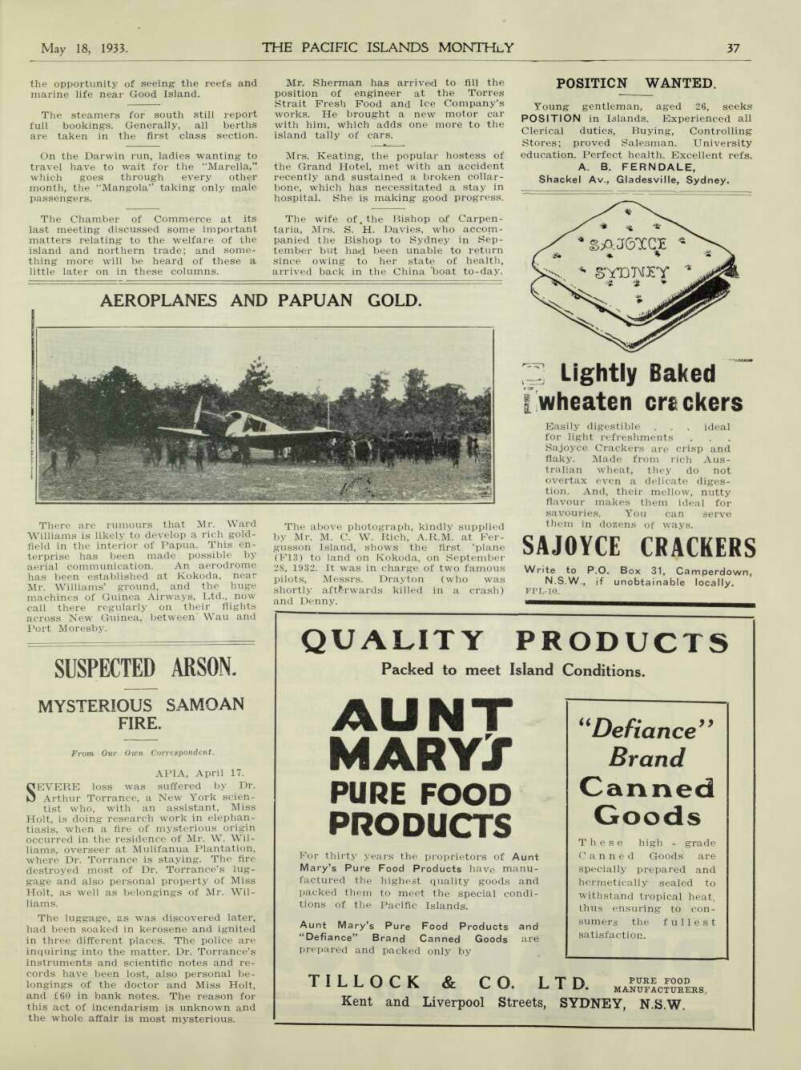
From Our Own Correspondent .
Thursday Is., April 25.
GOOD rains have fallen during the month, and so far the rainfall has exceeded last year’s figures, though still under the average. We are hav ing a late Nor’-West, too.
It was thought, with the return of a steady S.E. wind at the beginning of the month, that the N.W. was letting us down lightly this season, but last week there was a succession of blows and squalls, and a reversion to Nor’- West conditions. Shipping has had an anxious time, and the mission boats making their first trip for the year from down the Gulf, have had some heavy weather to battle against. The end of March and the beginning of April is a period generally regarded with some degree of anxiety, as it is then that cyclones take it into their head to dodge round the North.
The Imperial Hotel has changed hands, and is now under the manage ment of Mrs. A. D. Herring. Mr. C.
Sawyer and family, who formerly occu pied it (Mrs. Sawyer being the licensee) have left for England.
The Hall was brightly adorned on April 7 for the Regimental Ball, and some pretty costumes were in evidence.
The whole function was a thorough success. The soldiers will be with us for a little longer yet, as the work of removal to Darwin is not yet com pleted. We shall miss them when they leave, however, socially and. in other ways.
The telegraph office on Australia’s fingertip, at Cape York, about 30 miles across Endeavour Strait from here, is now in charge of a lineman only, Mr.
A. Sorensen, former postmaster, having been transferred. The Commonwealth Government is effecting economies by reducing the staff to one.
The Town Band is now giving music recitals on Sunday evenings, after church service, on the Jetty, under Bandmaster Saranealis. The little com
munity here is fortunate on having a musical combination which has stuck together well for a lengthy period, and which has always been ready to give its services whenever anything was on at which it could assist. The coming of the talkies has meant an alteration in the musical programme at the bi weekly picture sessions at which the Band formerly used to play; but it is hoped that the Band will be all the more appreciated in the regular con certs that it is now holding, and the townspeople will give it all support.
Another identity formerly well known on the Island who passed away re cently in Sydney was Mr. Charles Bang man, whose relatives (Mr. and Mrs.
Hennessey) reside here, and for whom all sympathy is felt.
Trochus shell has taken an upward lift again, much to the satisfaction of all those in the industry here.
Mr. and Mrs. W. J. Daniells, who went to the Edward River (in the Gulf of Carpentaria) to open up a new mis sion amongst the aboriginals in con nection with the Anglican Church, have been compelled to relinquish the work owing to the effect of the trying climate upon Mrs. Daniells’ health, and have come up to Thursday Island to go south.
At the monthly meeting of the local branch of the C.W.A. last week, some projects were brought forward for adding to the appearance of the town and also providing recreation grounds for the children, so that no doubt we shall be seeing a move made in this direction later on.
Mr. A. Adams, manager for B.P. & Co. here, has left on holidays, and is being relieved by Mr. W. Cadzon.
Mrs. Ernestine Hill, a Sydney journalist who has been seeing life in North Australia, arrived here by a recent ship, and is now busy gathering impressions and sipping the cup of historic romance. T.I. and the North has much to offer in this way, and to writers of sympathetic outlook and understanding eye people here are always ready to afford what informa tion they can concerning the olden days. Mrs. Hill hopes to incorporate some of her work later in a book on that part of Australia which is still so little known to southerners.
The annual Anzac Day celebrations were carried out to-day as usual. Ser vices were held by the Churches at nine o’clock, and in the evening a pub lic meeting took place at the Town Hall, when resolutions were moved and seconded by the Rev. Fr. Doyle and the Rev. W. Burvill, in appro priate speeches. Mr. D. G. Hall spoke on behalf Ctf the R.S.S.L.A., and musical items were contributed by the Town Band and Mesdames Hockings, Sin clair, and Sullivan. After the one minute silence, the Last Post was sounded, by Mr. D. H. Saranealis. The meeting, which was well attended, was presided over by the Mayor, Ald. A.
Corrah.
The “Ulysses” spent a day at T.I. on her way through with tourists re cently, and her passengers were given
the opportunity of seeing the reefs and marine life near Good Island.
The steamers for south still report full bookings. Generally, all berths are taken in the first class section.
On the Darwin run, ladies wanting to travel have to wait for the “Marella,” which goes through every other month, the “Mangola” taking only male passengers.
The Chamber of Commerce at its last meeting discussed some important matters relating to the welfare of the island and northern trade; and some thing more will be heard of these a little later on in these columns.
Mr, Sherman has arrived to fill the position of engineer at the Torres Strait Fresh Food and Ice Company’s works. He brought a new motor car with him, which adds one more to the island tally of cars.
Mrs. Keating, the popular hostess of the Grand Hotel, met with an accident recently and sustained a broken collar bone, which has necessitated a stay in hospital. She is making good progress.
The wife of, the Bishop of Carpen taria, Mrs. S. H. Davies, who accom panied the Bishop to Sydney in Sep tember but had been unable to return since owing to her state of health, arrived back in the China 'boat to-day.
Aeroplanes And Papuan Gold.
There are rumours that Mr. Ward Williams is likely to develop a rich gold field in the interior of Papua. This en terprise has been made possible by aerial communication. An aerodrome has been established at Kokoda, near Mr. Williams’ ground, and the huge machines of Guinea Airways, Ltd., now call there regularly on their flights across New Guinea, between Wau and Port Moresby.
The above photograph, kindly supplied by Mr. M. C. W. Rich, A.R.M. at Fer gusson Island, shows the first ’plane (F13) to land on Kokoda, on September 28, 1932. It was in charge of two famous pilots, Messrs. Drayton (who was shortly aftferwards killed in a crash) and Denny.
Suspected Arson.
Mysterious Samoan
Fire.
From Our Own Correspondent.
APIA, April 17.
SEVERE loss was suffered by Dr.
Arthur Torrance, a New York scien tist who, with an assistant, Miss Holt, is doing research work in elephan tiasis, when a fire of mysterious origin occurred in the residence of Mr. W. Wil liams, overseer at Mulifanua Plantation, where Dr. Torrance is staying. The fire destroyed most of Dr. Torrance’s lug gage and also personal property of Miss Holt, as well as belongings of Mr. Wil liams.
The luggage, as was discovered later, had been soaked in kerosene and ignited in three different places. The police are inquiring into the matter. Dr. Torrance’s instruments and scientific notes and re cords have been lost, also personal be longings of the doctor and Miss Holt, and £60 in bank notes. The reason for this act of incendarism is unknown and the whole affair is most mysterious.
Position Wanted.
Young gentleman, aged 26, seeks POSITION in Islands. Experienced all Clerical duties. Buying, Controlling Stores; proved Salesman. University education. Perfect health. Excellent refs.
A. B. Ferndale,
Shackel Av., Gladesville, Sydney.
Advertisements & other items, p. 39 (1 item)
Aunt
Lightly Baked
wheaten crackers
Easily digestible , . . ideal for light refreshments Sajoyce Crackers are crisp and flaky. Made from rich Aus tralian wheat, they do not overtax even a delicate diges tion. And, their mellow, nutty flavour makes them ideal for savouries. You can serve them in dozens of ways.
SAJOYCE CRACKERS
Write to P.O. Box 31, Camperdown, N.S.W., if unobtainable locally.
FPL-10.
QUALITY PRODUCTS
Packed to meet Island Conditions.
AUNT
MARY'S
PURE FOOD
PRODUCTS
For thirty years the proprietors of Aunt Mary’s Pure Food Products have manu factured the highest quality goods and packed them to meet the special condi tions of the Pacific Islands.
Aunt Mary’s Pure Food Products and “Defiance” Brand Canned Goods are prepared and packed only by
“Defiance
Brand
Canned
Goods
These high - grade Canned Goods are specially prepared and hermetically sealed to withstand tropical heat, thus ensuring to con sumers the fullest satisfaction.
TILLOCK & CO.
LTD.
PURE FOOD
MANUFACTURERS,
Kent and Liverpool Streets, SYDNEY, N.S.W.
Papuan Gold.
Port Moresby’s Hopes.
From Our Own Correspondent.
Pt. Moresby, April 28.
INTEREST in the old Yodda field and the Upper Mambare still holds the attention of prospectors in the Terri tory.
Mr. Ward Williams is still busily em ployed on the Yodda, and lately there have been rumours that the Pratten group are seriously considering some proposition on the Upper Mambare.
The Tiveri Gold Dredging Co., Ltd., intends to commence operations within the next month on the upper reaches of the Tiveri. Residents of the Territory are looking forward eagerly to its suc cess.
The March report of the New Misima Gold Mines show that 1,060 tons of ore put through the mill, yielded 776 tons qf sand and 284 of slime for gold bullion valued at approximately £1,106/5/6. A return of £628/2/7 was also received from a parcel of slag ashes and sweepings sold in Sydney. The No. 2 concrete sand treatment vat was com pleted during the month, and is now capable of holding 50 tons of sand.
Dividend No. 17 of 1/6 per share has been declared and is payable forthwith.
The report that the recent discovery of gold on the upper reaches of the Pu rari River lies in the Territory of Papua
and not on the Mandated Territory is causing- some discussion between the two Administrations.
The exact position of the new dis covery, however, will not be known until a fully equipped expedition of surveyors is able to visit the district.
It would be very fortunate for Papua, if it was found to lie on this side of the border.
Military Funeral.
From Our Own Correspondent
Rarotonga, April 24.
MR. Arthur Edward Beaumont died at Rarotonga on April 11 after a painful illness. Deceased was at one time engaged in sea diving work for the Union Steamship Company and first came to Rarotonga to examine the plates of the ill-fated “Maitai” which had grounded on the reef at Rarotonga and which ultimately became a total loss.
As a young man Mr. Beaumont served on the China Station in the old “Iron Duke.” His funeral was largely attended and military honours were paid the deceased at the grave side.
THE K.P.M. steamer “Van Rees” ar rived in Port Moresby from Java on April 28 and discharged 130 tons of general cargo before proceeding on her journey to Samarai, Rabaul and New Hebrides.
Asiatic Coal?
A New Guinea Transaction.
ASTONISHMENT has been expressed in official and commercial circles in Sydney at a notice which appeared in the New Guinea Government Gazette of April 20, indicating that the Govern ment has purchased coal from the Ger man steamer “Bremerhaven” at 55/- per ton. This apparently is Chinese or Jap anese coal, and it is regarded as an as tounding thing that such a transaction should occur in view of the fact that New Guinea is an Australian Territory and that so many Australian coal mines are idle.
An enquiry is now being made in Can berra in regard to the matter.
The April Blow.
Damage at Mallicolo.
THE hurricane that visited the West ern Pacific last month seems to have been particularly severe in the New Hebrides. Reports of the damage it did in New Caledonia were published in last
month’s Pacific Islands Monthly. By last
mail from the New Hebrides comes the following- account —taken from the jour nal of a planter at Mallicolo: April 5. —Barometer 757, wind S.E. fairly strong in the morning, and a few squalls in the afternoon, with rain.
April 6.—Barometer down to 754, wind turning E., with strong squalls from N.E., and rain.
We pulled up the launch, and tied down the store, copra house and all outbuildings. Barometer at 4 p.m. 753. All night continuous gales from E. and S.E., with torrential rain.
April 7.—Barometer down to 751½, wind turn ing to S. and at hurricane force the whole day and night, with torrential unceasing rain. Coco nut trees, limbs, leaves and nuts falling all the time. Impossible to venture out or do anything.
In the afternoon the wind turned to the S.S.W., still doing a lot of damage, blowing and raining all night, but the wind gradually getting round to the W.
April B.—Barometer still at 751½ wind from the W. not doing so much damage to the coco nuts, but giving the cocoa and castor oil plants pure hell. Rain without ceasing all the time; the river is overflowing its banks, and half the plantation is under water. The river has broken its banks in the cocoa and through the planta tions, and a lot of coconuts and cocoa have been washed away. In the cocoa there has been a big landslide, and hundreds of cocoa trees have been swept away, and tremendous damage done by the shade trees being blown down and smash ing the cocoa plants, also a lot of it under water.
Raining and blowing continuously all night.
April 9. —The wind has dropped, and the barometer has started to go up, so the worst is over. Barometer rising steadily all day. The blow is finished, but oh! what a mess! The place is now two-thirds under water, and littered with coconut palms, leaves, trees and all sorts of rubbish. Of our 50 hectares of castor oil plants, I don’t think there is one left, and after ex pecting 100 tons of seed at least, we won’t pick one lb. !
It’s hard, and the price of copra, too, is £4/5/-, paid by the shipping Company, and it is impossible to make copra on a plantation and bag it under £5.
Hundreds of coconut trees down, and the cocoa practically ruined. Thank goodness, we are all well and safe, but it has given us another big knock back again, so on goes the fight.
The Rev. W. H. MacFarlane will leave the Torres Strait Mission next July.
Advertisements & other items, p. 40 (1 item)
Durabestos
AUSTRALASIA’S CLEARING HOUSE FOR THE PRECIOUS METALS.
BUYERS OF—
GOLD OSMIRIDIUM, PLATINUM, SILVER, Etc.
GARRETT & DAVIDSON Ltd.
Assayers, Bullion Merchants, Metallurgists, BANK OF N.S.W. BUILDINGS. REGENT STREET, SYDNEY.
BUILD NOW WITH DURABESTOS
Island Homebuilders can now erect an everlast ing Home easily and economically by using “DURABESTOS” (Asbestos Cement) Building Sheets to line the exterior walls and interior walls and ceilings.
Economical to transport, easy to fix, and fireproof.
Send for Prices and Free Catalogue “DURABESTOS HOMES OF COLOURFUL BEAUTY,” containing plans, designs and suggestions for Homebuilders.
WUNDERLICH
BOX 474 AA, G.P.O.,
limited
SYDNEY.
DURABESTOS
BUILDING
Oil Prices.
Increase in Samoa.
From Our Own Correspondent.
APIA, April 17.
A STRONG protest against the action of the representatives of oil com panies in raising the prices of ben zine by 3d. per gallon and of kerosene by 2/- per case was sent to the Cham ber of Commerce of Apia by a number of traders and storekeepers.
In their letter the writers declare the rise to be totally unwarranted and prob ably intended to meet decreased profits of oil companies in Australia and New Zealand. According to press news, prices of oil have been further reduced in New Zealand.
The matter has been referred to the Administration for inquiry.
Flew Blind.
Guinea Airways’ Pilot’s Skill.
THE skill of the pilots of Guinea Airways, Ltd. is proverbial in the Mandated Territory and was demonstrate strated once again by Pilot H. V. Mc- Gilvery on May 10.
McGilvery left Lae in the morning of that day in a triple-engined Junkers 'plane with three tons of cargo for Bulowat. Following the usual route —via the Wampit Valley—he encountered a ter-
rific storm with particularly dense cloud formations, which made further progress impossible. The journey usually takes only about 40 minutes; but Mc- Gilvery was flying for two and a half hours trying to find a landing ground.
Only his ’plane’s remarkable climbing powers saved him when he was forced to fly blind in the mountains and several times he skimmed over hill tops with only feet to spare. He was unable to return to Lae, as the storm was more violent there and a flight to Watut was out of the question for the same reason.
After a further attempt to reach Lae, McGilvery, remembering a pilot’s chance remark that a landing for Junkers ’planes was possible at Kaiapit, descended there and landed perfectly in long grass after being in the air two and a half hours. Next day a search ’plane arrived with petrol supplies, so his interrupted journey to Bulowat was completed. After the cargo was discharged, the Junkers was flown by McGilvery back to Lae and later returned to Wau carrying Major Marr and his party.
Curiously, it was one of McGilvery’s last trips in a Junkers ’plane, as he is leaving Guinea Airways at the end of May.
Advertisements & other items, p. 41 (1 item)
Norfolk Island Trade.
IMPORTS.
From Aust.
From N.Z.
March, 1932 — £1,201 March, 1933 £3,052 —
EXPORTS.
To Aust.
To N.Z.
March, 1932 £1,430 £333 March, 1933 £2,476 —
Easter Cricket Match
Pt. Moresby v. Samarai.
From Our Own Correspondent
Pt. Moresby, April 20.
DURING the Easter holidays, a cricket match of great interest to Papua was played on the cricket oval of Port Moresby, Samarai v. Port Moresby, for the Murray Shield, presented many years ago by Sir Hubert Murray, K.C.M.G., the Lieut.-Governor of Papua.
Samarai won the first innings on April 14 by four wickets and 12 runs, Mr. Bob Bunting carrying his bat for 137. The Shield —already in the posses sion of the Samarai team —was, there fore, retained by them. Port Moresby’s first innings being 10 wickets for 264.
A dance and dinner were given by the members of the P.M. Cricket Club to the visiting team during their stay. The Hon. E. C. Harris, president and captain of the Port Moresby team, in his speech at the dinner, congratulated Samarai and their captain, Mr. Campbell, on their victory and excellent play. “The shield,” he said, “had continued to float between the two towns for a good many years, and there was now a great deal of sentiment in the matter, and it was a great privilege to hold the shield in either township. The shield was a per petual trophy to be fought for by the two settlements in order to foster friendly rivalry between the two places and interchange of visits.”
The Samarai team, which arrived by the “Macdhui” on April 13, sailed for Samarai on April 15 on the “Montoro”, from Australia.
Advertisements & other items, p. 41 (1 item)
Nelson And Robertson
ISLAND MERCHANTS. [Established, 1895.]
Copra, Cocoa, Trocas Shell and other Island produce sold on commis sion. All classes of Merchandise purchased and original invoices supplied.
Agents for SKANDIA CRUDE OIL ENGINES, Marine and Stationary, powers from 5-h.p. up.
PENTA ENGINES, Inboard and Outboard, as used by the Royal Australian Navy.
PUMPMOBIL, the only portable pumping plant manufactured, light in weight and reliable. Suitable for mining work, UPSON WALL BOARD, in both Plain and Tile pattern, strong and light Non-conductor of heat and cold. British manufacture.
Also New Guinea, Papuan and Samoan representatives for the famous
CHALLENGER KEROSENE BATH HEATER.
Communicate with
NELSON & ROBERTSON
12 SPRING STREET SYDNEY, AUSTRALIA
Telegraphic Address: “IVAN SYDNEY.”
Ministerial Tour Of New
Guinea And Papua.
Legislative Council Is Formally Opened.
The Minister in Charge of Australian Pacific Territories, Major C. W. C.
Marr, accompanied by Mrs. Marr, Mr. Thomas (Custodian of Expro priated Properties), and Mr. J. R. Halligan, of the Prime Minister’s Department (who has charge of a section of the affairs of the adminis tration of the Territories) visited Papua and New Guinea this month.
THE party left Sydney by the “Macdhui” on April 27 and arrived in Port Moresby on May 4.
A public meeting was held in the Port Moresby Institute on the morning of May 4 to welcome Major the Hon. C.
W. C. Marr.
His Excellency, Sir Hubert Murray, opened the meeting and introduced Major Marr. Major Marr, he said, was well known as an able politician and soldier, had always shown a deep inter est in Papua and Papuan residents, and had consistently done his best to im prove conditions in the Territory. At the close of a short speech, His Excellency invited any persons who had grievances to air or complaints to make to lay them
before Major Marr at the close of the meeting.
The Hon. Arthur Jewell, M.L.C., also welcomed the visitor as the representa tive of the Commonwealth Government which had always been very generous in its attitude towards Papua.
Mr. R. D. Bertie supported the pre vious speakers in their welcome to Major Marr. He regretted that Major Marr was not able to make a longer stay, so as to see the conditions for himself, and to talk personally to the pioneers who had developed the industries of the Ter ritory.
Major Marr returned thanks for the welcome extended to him. He assured the meeting that he took the keenest possible interest in Papua. All the dif ficulties of the colony, he said, were known to the Commonwealth Govern ment, which was very ready and willing to help in every way possible. It was all a matter of money, he said. The Commonwealth Government, was already spending, in round figures, £150,000 a year on Papua, and he did not see how the people of Australia could be asked to do more.
Later in the morning, Major Marr was interviewed by the representatives of the rubber industry and entertained by them to lunch at the Papua Hotel.
The “Macdhui” called at Samarai the following day.
Arrival At Rabaul.
A most picturesque reception was given Mr. Marr on the “Macdhui’s” arrival in Rabaul on May 6. The whole native population, in colourful dress, assembled for the occasion; the wharf and the shore to the water’s edge were a mass of people, and the air was filled with excited shouts as the “Macdhui” berthed.
The official party and a guard of honour composed of 50 members of the native constabulary, were on the wharf. The official party in white, then the constabulary in khaki shorts and tunics, barefooted, and carrying rifles with fixed bayonets, and, behind them, members of the public, clad mostly in white, gave a sufficiently tropical atmosphere, but they were almost eclipsed by hundreds of natives who had come voluntarily to welcome the Minister.
Mr. Marr inspected the guard, and, later, a group of Lululais, Tul Tuls, and native, medical assistants from the vil lages.
After the inspections, Mr. Marr’s party and the official party motored to the Botanic Gardens, where a tea party was held. Hundreds of natives ran alongside the official cars to the gardens.
Loyalty Of Natives,
An incident considered the most im portant in connection with Mr. Marr’s reception at Rabaul was the unexpected arrival at the wharf of all the Lululais and Tul Tuls from Rabaul sub district. The Administrator knew nothing of the chiefs’ proposed parti cipation in the welcome until Anton, the paramount chief, stated that since Australian officials and the native con stabulary were taking part in the wel come to Mr. Marr, he saw no reason why the native chiefs should net take the opportunity of expressing loyalty to the Government.
The incident aroused intense pleasure in Administration circles as being expressive of the natives’ satisfaction with the present rule.
A strenuous day, during which he saw many phases of native and missionary life, as well as the Admin istration’s experiments with tropical
Major the Hon. C. W. C. Marr.
agriculture, was spent by Mr. Marr fol lowing his arrival in Rabaul.
On the morning of May 8 he motored to Keravat Experimental Plantation, passing on the 35 miles’ drive numerous plantations and native villages. At Keravat, the Director of Agriculture (Mr. Murray), and other officials showed Mr. Marr nearly every plant of agricultural value capable of being grown in the territory—delicately beau tiful kapok trees from Java, coffee plants, king coconuts, taro, tapioca, sugar, oil palm, rice, and many others.
The whole effect of the plantation was a representation in miniature of the economic resources and potentialities of the territory.
Visit To Missions.
Returning to Rabaul, Mr. Marr visited Vunairima Methodist Mission, one of the largest Methodist Missions in the territory, towards which Mr.
Stewart (the Minister for Commerce) has given large sums, and has estab lished and equipped a hospital. The Rev. L. A. McArthur showed the visitors native boys and girls learning to read and write their own language in copybooks, which displayed hand writing the equal of any in Australian schools.
In the afternoon Mr. Marr visited the Sacred Heart Mission at Kokopo, con ducted by the Catholic Church since 1882.
In a speech of welcome at Vunapope, Bishop Vesters spoke of the wish of the missionaries to co-operate in harmony with the Australian Administration.
Half-caste and native children who are educated at the Mission paraded with Australian flags and Union Jacks and wore red, white and blue sashes.
Mr. Marr read a special message to the children from the Apostolic Dele gate (Archbishop Cattaneo), Mr. Marr then visited the village of Kokopo, where he was the guest of the European residents at a tea-party.
Later the party witnessed a sing-sing.
Wearing long skirts of coconut fibre and elaborate headdresses of casso wary, cockatoo, and bird of paradise feathers, with their bodies painted and their hair artificially colored white, red and yellow, the natives leapt high in the air and danced continuously to the warlike beat of kundu drums and the chanting of wild choruses by the women.
When the party left at 6 o’clock the sing-sing was still in full swing.
Opening Of Legislative
Council.
In the afternoon of May 9, Mr. Marr officially opened the newly formed Legislative Council of New Guinea, which was the reason for the visit of the party.
Mr. Marr was received by Brigadier- General Griffiths and given a general salute by a guard of native police boys, carrying rifles and fixed bayonets, after which Mr. Marr inspected the guard, who wore khaki tunics, shorts, and peaked caps, and were bare footed.
Some distance away stood a group of natives wearing laplaps of many colours, but the crowd of whites and natives was much smaller than that which met Mr. Marr on the wharf on Sunday.
The Council Chamber is a fairly small room, raised high from the ground on piles. It accommodated only a few spectators, and several sat
on the wide verandah, which runs the length of the building. A feature of the speeches was appreciation of the granting of a measure of self government and determination to watch the well-being of natives as well as whites, emphasis being laid upon the obligations conferred by the League of Nations mandate.
The building, which is all of wood, is light and airy and, being built off the ground on piles is most suitable for assemblies in the humid climate of Rabaul. There was an entire absence of rhetoric in the speeches, which were formal in the extreme, members and residents appearing to view the cere mony with the greatest respect.
Mr. Marr’S Speech.
In declaring the first meeting of the Legislative Council open, Mr. Marr re ferred to the Council’s obligation to all the inhabitants. He quoted the peace treaty and said: ‘‘We would emphasise that it is the aim and the obligation of the mandatory power to carry out the trusts reposed in it not
only to the letter but in accordance with the spirit and intention under lying the mandate. The Common wealth Government is now calling upon the residents of this Territory to come forward with their specialised know ledge of local affairs to assist in the achievement of this trust.”
Mr. Marr at the outset, read a
message from the Governor-General (Sir Isaac Isaacs), conveying to the whole population of the Territory a cordial message of goodwill and sin cere wishes for a happy future. The message said that under the enlight ened care and leadership of Australia, the Territory had already made marked and lasting progress, both material and
spiritual, and he hoped that the re cent Commonwealth legislation would be a means of fulfilling to the utmost the primary and commanding trust of guarding and advancing the well being and development of the inhab itants, and, consistently with that, of promoting the general prosperity of the Territory.
The Prime Minister (Mr. Lyons) also sent a message of greeting and good wishes. He said the progress made by the Territory, under ordinances, fully warranted the action of the Common wealth Government in granting a new measure of local Government. They felt confident that the Council would be always guided by the consideration of the welfare of the whole of the in habitants of the Territory, and re minded them that the mandate con ferred much more an obligation than a benefit upon the power taking it up, since the principle had to be applied that the well-being and the development of peoples not yet able to stand by themselves formed a sacred trust of civilisation, an obligation that the Commonwealth Government had at all
times endeavoured, in relation to New Guinea and other territories, to fulfil.
Mr. Marr quoted the prophetic words of Sir William MacGregor, in formally declaring Papua a British possession in 1888 —“So much still remains to be made known in regard to the capabili ties of this great country that at pre sent no human eye can see far into its future. But we know well, from the rich experience gained elsewhere, that the material and economic develop ment of British New Guinea can safely be left to the energy, industry, and perseverance of our own race when their inherent qualities can fairly be brought to bear on the task. And the Queen’s sovereignty here will be a guarantee that every effort will be made to educate the native race and impart to them the great sublime truths of the Christian religion; and to teach them to value and respect law and order, and to appreciate justice. May God grant that our Sovereign’s rule of British New Guinea may secure pros perity, happiness, and contentment to the Queen’s subjects here, both old and new, and that the people of this land, now declared a British possession, may for all time look up with true loyalty and devotion to that flag which we are now to salute.”
Mr. Marr said that Sir William Mac Gregor’s few sentences enunciated a great British ideal —industry, honesty, and justice —which applied to the Ter ritory in the future as in the past, must eventually place New Guinea in the forefront of the producing countries of the world. The country’s growth and importance would confer greater responsibilities on its citizens with a right and a duty to make decisions of great moment. To-day’s ceremony in augurated the machinery to enable them to do so.
Mr. Marr paid a tribute to the un tiring efforts and deep interest of the first Administrator, General Wisdom, to whom largely was due the Leagues expressed approval of Australia’s administration.
Administrator's Reply.
Brigadier-General Griffiths, in reply, thanked Mr. Marr for performing the opening ceremony, and thanked the Governor-General (Sir Isaac Isaacs) and the Prime Minister (Mr. Lyons) for their messages. He emphasised that each non-official member had been appointed not as a representative of a particular section of the community, but of the whole, which fact, he felt confident, everyone would keep in mind when dealing with the affairs of the Territory.
Brigadier-General Griffiths said that the council would always endeavour to take a sane, reasonable view of affairs, and that the native population, equally with Europeans, would receive every consideration. “We all realise that the prosperity of the European residents and the development of the native population go hand in hand,” he said.
“One is dependent solely on the other.
The prosperity of the Europeans largely depends on native labour, and the development and advancement of the native race depends upon the means which the prosperity of the European residents provides. We have great faith in our Territory which is endowed by nature with an that makes for success, and we are determined to make it a success and to make Australia proud of its Ter
ritory and its administration. As an administration we must admit that in the past we have made mistakes at times, and no doubt shall in the future, but such mistakes will always be honest ones, made with the best in tentions.”
He expressed appreciation of the assistance at all times rendered to the Administration by mission bodies, and regretted that it was not considered reasonably practical to include repre sentatives of the predominant denomi nations on the council, though under the Act it would always be possible for them to place their views before the council.
Visit To Hospitals.
Before the ceremony, Mr. Marr paid a morning visit to the Rapindik native hospital. A feature of the hospital is the x-ray plant. Later, accompanied by Mrs. Marr, he called at the Euro pean hospital at Namanula.
After the ceremony of opening the Legislative Council, the party boarded the "Macdhui” for Lindenhafen en route to Salamaua and the goldfields.
At Lindenhafen.
Lindenhafen lived up to its reputa tion of being the wettest place on earth when the official party visited it. The ‘‘Macdhui’’ had to feel its way through heavy rain and rain fell in torrents most of the time Mr. Marr was ashore, where he visited the desic cated coconut factory. While his in spection was proceeding, Mrs. Francis, wife of the manager, entertained Mrs.
Marr at morning tea.
Goldfields’ Welcome.
The population of Salamaua turned out en masse to greet the official party when the “Macdhui’’ reached the port on the morning of May 11, and after a civic reception, Mr. Marr and party boarded ’planes for a flight to Wau via Lae.
The journey was made in perfect flying conditions and, on arrival at Wau, the visitors were received by Mr.
Hambridge, chairman of directors, and Mr. Harrison, general manager of New Guinea Goldfields.
Later, at Bulolo, they were received and entertained by the officials and staff of the Bulolo Gold Dredging Co.
All members of the party expressed astonishment at the almost incredible amount of work that has been carried out on the New Guinea fields and the fact that every pound of material had been carried in by ’plane especially impressed them on a tour of the works and settlement.
Adventurers In Hospital.
At Salamaua Hospital in the morning, Mr. Marr met two adventurers from the gold country—Mr. J. K. McCarthy, patrol officer of the Morobe district, who is recuperating from two arrow wounds received in a skirmish with wild natives a fortnight ago; and Mrs.
Doris Booth, who owns and manages the mine, Cliffside, on the Bulolo River, employing 91 native boys.
Mr. McCarthy told, how, during a patrol near the Papuan border at a point two days’ march from Otibanda police station on Surprise Creek, he and the police boys arrested 12 prisoners and were bringing them in to custody when they fell into an ambush.
In the next ward was Mrs. Booth, of "Mountains, Gold, and Can nibals,” who is recovering from an
attack of malaria. Mrs. Booth is a young slip of a woman, cultured, vivacious, and seemingly more suited to a city life than a life among savages.
She has been in the Territory for 12 years, first coming to the goldfields without experience of mining in 1924, and she has been living here ever since, with occasional vacations.
Engagement.
A marriage has been arranged, and will take place in October, in England, between Robert John Aylwin Wallace Lever, Entomologist to the British Solomon Islands Protectorate, elder son of the late Robert Lovell Lever, and of Mrs. Lever, of 12 Oppidans Road, Hampstead, and Margaret Evelyn, younger daughter of Col. Evelyn Pierce Sewell, C.M.G., D.S.O., late R.A.M.C., and Mrs. Sewell, of Green Gables, Hartley Wintney, Hants.
Advertisements & other items, pp. 42-44 (1 item)
Burns, Philp
(South Sea) Co. Ltd.
Island Traders & Shipowners Registered Office: Suva, Fiji.
Also Branches at Fiji: Levuka, Lautoka, Labasa, Ba, Sigatoka, Rotumah.
Tonga: Nukualofa, Haapai, Vavau.
Samoa: Apia, Pago Pago (American Samoa).
Solomons: Makambo, Gizo, Faisi.
New Hebrides: Vila.
Gilberts: Tarawa.
Norfolk Island. Nauru. Niue.
Code Address: “Burnsouth.’'
THE BOOK CLUB,
BURNT PINE,
NORFOLK ISLAND.
FIRST-RATE MODERN LIBRARY.
Five Hundred Books —added to by every mail, Very reasonable terms.
Visitors welcomed.
Conducted by
Mrs. CAMPBELL, Rep. P.I.M.
TENNIS PLAYERS!
Learn to String your Own Racket.
Full illustrations, instructions and all tools . . . . No. 1 £2 2 0 TRUE - GRIP CLAMP, or Stringing Machine, illustrations instructions and all tools No. 2 £5 5 0
Wimbledon Tennis Gut Co.
Q. V. Buildings, George Street, SYDNEY.
RACKETS, NETS and ALL EQUIPMENT.
“UNION ”
PORTLAND CEMENT
GUARANTEED HIGHEST QUALITY.
Concrete is the Ideal Constructional Material, and eminently suited to Island conditions, being Weatherproof, Rat-proof, Vermin-proof, Everlasting.
For Store Buildings, Dwellings, Silos, Tanks, Floors, Paths, Pipes, etc., Unexcelled.
Send for Free Pamphlets on all Concrete Problems.
COMPETITIVE PRICES. :: ENQUIRIES INVITED.
THE COMMONWEALTH PORTLAND CEMENT COMPANY LTD.,
SYDNEY and PORTLAND, NS W.
Postal Address:
Box 1571 E, G.P.O.
SYDNEY.
Telegraphic Address:
“LIMERIEZ,”
SYDNEY.
J. H, SMYTH LTD.
Postage Stamp Dealers,
121a CASTLEREAGH STREET,
SYDNEY.
The Leading House for
ISLANDS STAMPS.
Write for List of over 500 Sets of Australian, New Zealand, and Pacific Islands Stamps.
Stamps sent on approval on receipt of reference.
ISLAND STAMPS PURCHASED.
Highest Prices Paid.
McILRATH’S
THE SOUTHERN FIRM, WHICH SPELLS
SATISFACTION.
Australian I.A. Sugar, 70lb. bags .. 14/9 bag Unification Pink Salmon, 1lb. tins (4 doz.) Trefavenne Sardines, ¼lb. tins . . . . 9½d. tin, 9/- doz.
Brunswick Sardines, ¼lb. tins .. 4½d. tin, 4/- doz.
Lusco Dripak Prunes, 1lb. tins .. . . 11½d. tin, 11/- doz.
Lusco Dripak Prunes, 7lb. tins 5/9 tin Rosa or I.X.L. Apricots in Syrup, 30oz. tins 10d. tin, 9/9 doz.
Rosa or I.X.L. Peaches in Syrup, 30oz. tins 10d. tin, 9/9 doz.
I.X.L. Assorted Jams, 24oz. tins (4 doz.) 9/9 doz., 34/- case Garden Vale Cauliflower, 30oz. tins 1/1½tin, 13/- doz.
I.X.L. Baked Beans, 10oz. tins 6½d. tin, 6/- doz.
I.X L. Spaghetti in Sauce or Curry, 8oz. tins 6½d. tin, 6/- doz.
Rosa Worcestershire Sauce, 9oz. bots. .. 6d. bot., 5/9 doz.
Leggo’s Tomato Soup, 8oz. tins .. 5½d. din, 5/3 doz.
Capital Mango Chutney, 11oz. jars 11d. jar, 10/9 doz.
Rosa High-grade Piccalilli, large jars . . 1/- jar, 11/9 doz.
Arnott’s Plum Puddings, 1lb. tins 1/7 tin, 18/6 doz.
Rosa Jelly Crystals, pint pkts 4½d. pkt., 4/- doz.
Dandy Maize Starch, 5lb. pkts. 7d. lb.
Emorna Carbolic Toilet Soap, giant cakes 3½d. cake, 3/3 doz.
McIlrath’s Bath Soap, large cakes 2½d. cake, 2/4 doz.
All prices f.o.b. Sydney.
EXPORT PRICE LISTS AVAILABLE ON APPLICATION.
McILRATH’S Ltd.
Export Dept.:
202 PITT ST.,
SYDNEY (Aust.)
Papuan Rubber.
Serious Position.
FEARING that the Papuan rubber in dustry will cease very soon, if some thing is not done immediately to assist planters, a deputation approached the Minister in Charge of Islands’ Terri tories (Major C. W. C. Marr), when he was passing through Port Moresby by the "Macdhui” on March 4.
The deputation stressed the point that unless the Commonwealth Government immediately paid planters a refund of the Customs duty of 4d. per lb., the in dustry would be bankrupt and would have to close down.
Previously Papuan rubber was admit ted to the Commonwealth duty free; but, under the customs schedule of March, it was agreed that the Commonwealth would pay back to planters the duty im posed by the schedule on Papuan rubber which costs up to 8d. per lb. to produce.
The deputation complained that the rub ber shipped by Papuan growers to Aus
tralia was kept in bond by the manu facturers, so that the Commonwealth had not collected any duty, and, there fore, the planters were unpaid.
After promising favourable considera tion of the request, Major Marr com municated by wireless with Canberra.
The amount of duty outstanding on Papuan rubber held in Australia is about £20,000.
Skin Diseases.
Amazing Success Of New
Formula And Diagnosis
Methods.
A Milton (N.S.W.) woman who suffered agony from Eczema for eight years, a Sydney girl whose condition baffled four skin specialists, and a Queensland man suffering from Tinea, who had tried scores of “cures," are among the recent cases successfully treated by Mr. J. J.
McHUGH, the brilliant Consulting Chemist and Skin Specialist. of 447P Illawarra Road, Marrickville, N.S.W.
A remarkable new and secret formula, combined with individual diagnosis methods, has enabled Mr. McHUGH to successfully treat (by post and personally) distressing cases of Eczema, Psori asis, Germ under Nail, Varicose Veins, Ulcers, Tropical Ringworm, Barber’s Rash, Ringworm, Acne, Pruritis, etc.
The new methods have produced phenomenal results in so-called “hopeless” cases throughout Australia, N.Z., and Pacific Islands.
That many who suffered for years, spent pounds and almost lost hope, have been released from torture is proved by scores of letters from patients. Mr. McHUGH will be pleased to send copies of these and answer, without obligation, inquiries from any reader.
Advertisements & other items, p. 45 (1 item)
“Younger”
PACIFIC ISLANDS ASSOCIATION.
Headquarters and Clubrooms:
MILLIONS HOUSE, ROWE STREET, SYDNEY
Telephone: 84971.
Founded in 1931 to Advance the Interests of Residents of the Pacific; Assist Island Trade; Provide Information for Tourists; and Promote the Welfare of the Native Races.
Secretary’s Office: NATIONAL MUTUAL BUILDING, 350 GEORGE STREET, near G.P.0., SYDNEY, AUSTRALIA. :: :: :: Telephone: B 5067.
Cable Address: “CERTAC,” Sydney.
Do you know that the Famous
“YOUNGER”
STOVES AND
RANGES
made with extended Firebox specially for long- Wood fuel, are Self-Setting- and, provided sufficient Flue Piping is attached, can be used in almost any position.
The No. 7W. “Younger” Range can now be supplied fitted with Lees as per illustration Oven "“ d Younger Stoves are Widely Used Throughout the Pacific Islands. 50 Oxford Street, SYDNEY.
G. FLETCHER & SON
The Larkin Case.
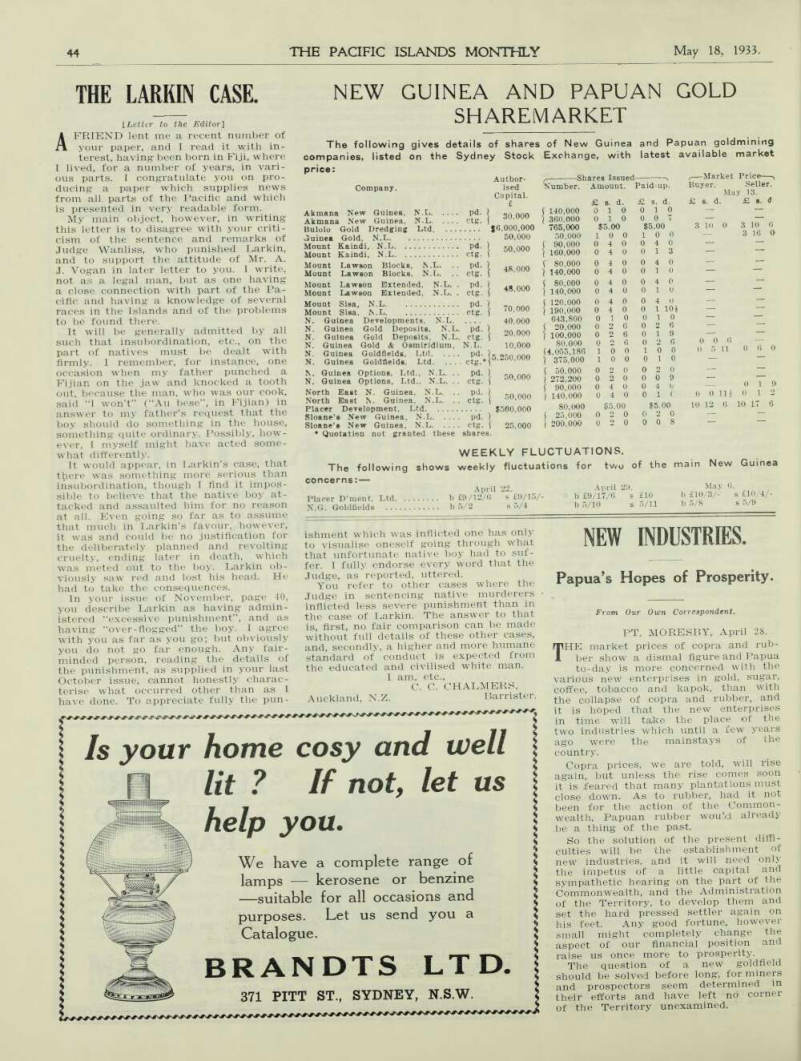
[Letter to the Editor ] A FRIEND lent me a recent number of your paper, and I read it with in terest, having been born in Fiji, where I lived, for a number of years, in vari ous parts. I congratulate you on pro ducing a paper which supplies news from all parts of the Pacific and which is presented in very readable form.
My main object, however, in writing this letter is to disagree with your criti cism of the sentence and remarks of Judge Wanliss, who punished Larkin, and to support the attitude of Mr. A.
J. Vogan in later letter to you. I write, not as a legal man, but as one having a close connection with part of the Pa cific and having a knowledge of several races in the Islands and of the problems to be found there.
It will be generally admitted by all such that insubordination, etc., on the part of natives must be dealt with firmly. I remember, for instance, one occasion when my father punched a Fijian on the jaw and knocked a tooth out, because the man, who was our cook, said “I won’t” (“Au bese”, in Fijian) in answer to my father’s request that the boy should do something in the house, something quite ordinary. Possibly, how ever, I myself might have acted some what differently.
It would appear, in Larkin’s case, that was something more serious than insubordination, though I find it impos sible to believe that the native boy at tacked and assaulted him for no reason at all. Even going so far as to assume that much in Larkin’s favour, however, it was and could be no justification for the deliberately planned and revolting cruelty, ending later in death, which was meted out to the boy. Larkin ob viously saw red and lost his head. He had to take the consequences.
In your issue of November, page 40, you describe Larkin as having admin istered “excessive punishment”, and as having “over-flogged” the boy. I agree with you as far as you go; but obviously you do not go far enough. Any fair minded person, reading the details of the punishment, as supplied in your last October issue, cannot honestly charac terise what occurred other than as I have done. To appreciate fully the pun
ishment which was inflicted one has only to visualise oneself going through what that unfortunate native boy had to suf fer. I fully endorse every word that the Judge, as reported, uttered.
You refer to other cases where the Judge in sentencing native murderers inflicted less severe punishment than in the case of Larkin. The answer to that is, first, no fair comparison can be made without full details of these other cases, and, secondly, a higher and more humane standard of conduct is expected from the educated and civilised white man.
I am, etc..
C. C. Chalmers,
Auckland, N.Z.
Barrister.
New Guinea And Papuan Gold
Sharemarket
The following gives details of shares of New Guinea and Papuan goldmining companies, listed on the Sydney Stock Exchange, with latest available market price:
Weekly Fluctuations.
The following shows weekly fluctuations for two of the main New Guinea concerns:—
Shares Issued Market Price Company.
Authorised Capital £ Number. Amount. Paid-up. £ s. d. £ s. d.
Buyer. £ s. d Seller.
May 13. £ s. d Akmana New Guinea, N.L pd.
Akmana New Guinea, N.L ctg.
Bulolo Gold Dredging Ltd. . ... 30,000 $6,000,000 50,000 140,000 360,000 765,000 50,000 0 1 0 0 1 0 $5.00 1 0 0 0 1 0 0 0 7 $5.00 1 0 0 3 10 0 3 10 6 3 16 0 Mount Kaindi, N.L pd.
Mount Kaindi, N.L ctg. 50,000 90,000 160,000 0 4 0 0 4 0 0 4 0 0 1 3 — — Mount Lawson Blocks, N.L. .. pd.
Mount Lawson Blocks, N.L. .. ctg. 48,000 80,000 140,000 0 4 0 0 4 0 0 4 0 0 1 0 — — Mount Lawson Extended. N.L. . pd.
Mount Lawson Extended, N.L. . ctg. 48,000 80,000 140,000 0 4 0 0 4 0 0 4 0 0 1 0 — — Mount Sisa, N.L. pd. 120,000 0 4 0 0 4 0 — — Mount Sisa, N.L. ctg. 190,000 0 4 0 0 1 10½ — — N. Guinea Developments, N.L.
N. Guinea Gold Deposits, N.L. pd.
N. Guinea Gold Deposits, N.L. ctg.
N. Guinea Gold & Osmiridium, N.L.
N. Guinea Goldfields, Ltd pd.
N. Guinea Goldfields, Ltd ctg. 40,000 20,000 10,000 5,250,000 643,800 20,000 100,000 80,000 4,055,186 375,000 0 1 0 0 2 6 0 2 6 0 2 6 1 0 0 1 0 0 0 1 0 0 2 6 0 1 9 0 2 6 1 0 0 0 1 0 0 0 6 0 5 11 0 6 0 N. Guinea Options, Ltd., N.L. .. pd.
N. Guinea Options, Ltd., N.L. .. ctg.
North East N. Guinea, N.L. .. pd.
North East N. Guinea, N.L. .. ctg.
Placer Development, Ltd. $500,000 50,000 272,200 90,000 140,000 80,000 0 2 0 0 2 0 0 4 0 0 4 0 $5.00 0 2 0 0 0 9 0 4 0 0 1 0 $5.00 0 0 11½ 10 12 6 0 1 9 0 1 2 10 17 6 Sloane's New Guinea, N.L pd.
Sloane’s New Guinea, N.L ctg. * Quotation not granted these shares. 25,000 25,000 200,000 0 2 0 0 2 0 0 2 0 0 0 8 — —
Placer D’ment Ltd April 22. b £9/12/6 s £9/15/- April 29. b £9/17/6 s £10 May 6. b £10/3/s £10/4/- N.G. Goldfields b 5/10 s 5/11 b 5/8 s 5/9
New Industries.
Papua’s Hopes of Prosperity.
From Our Own Correspondent.
Pt. Moresby, April 28.
THE market prices of copra and rub ber show a dismal figure and Papua to-day is more concerned with the various new enterprises in gold, sugar, coffee, tobacco and kapok, than with the collapse of copra and rubber, and it is hoped that the new enterprises in time will take the place of the two industries which until a few years ago were the mainstays of the country.
Copra prices, we are told, will rise again, but unless the rise comes soon it is feared that many plantations must close down. As to rubber, had it not been for the action of the Common wealth, Papuan rubber would already be a thing of the past.
So the solution of the present diffi culties will be the establishment of new industries, and it will need only the impetus of a little capital and sympathetic hearing on the part of the Commonwealth, and the Administration of the Territory, to develop them and set the hard pressed settler again on his feet. Any good fortune, however small might completely change the aspect of our financial position and raise us once more to prosperity.
The question of a new goldfield should be solved before long, for miners and prospectors seem determined m their efforts and have left no corner of the Territory unexamined.
Advertisements & other items, p. 46 (1 item)
help you.
Is your home cosy and well
lit ? If let us
We have a complete range of lamps — kerosene or benzine —suitable for all occasions and purposes. Let us send you a Catalogue.
BRANDTS LTD.
371 PITT ST.. SYDNEY, N.S.W.
Market Quotations
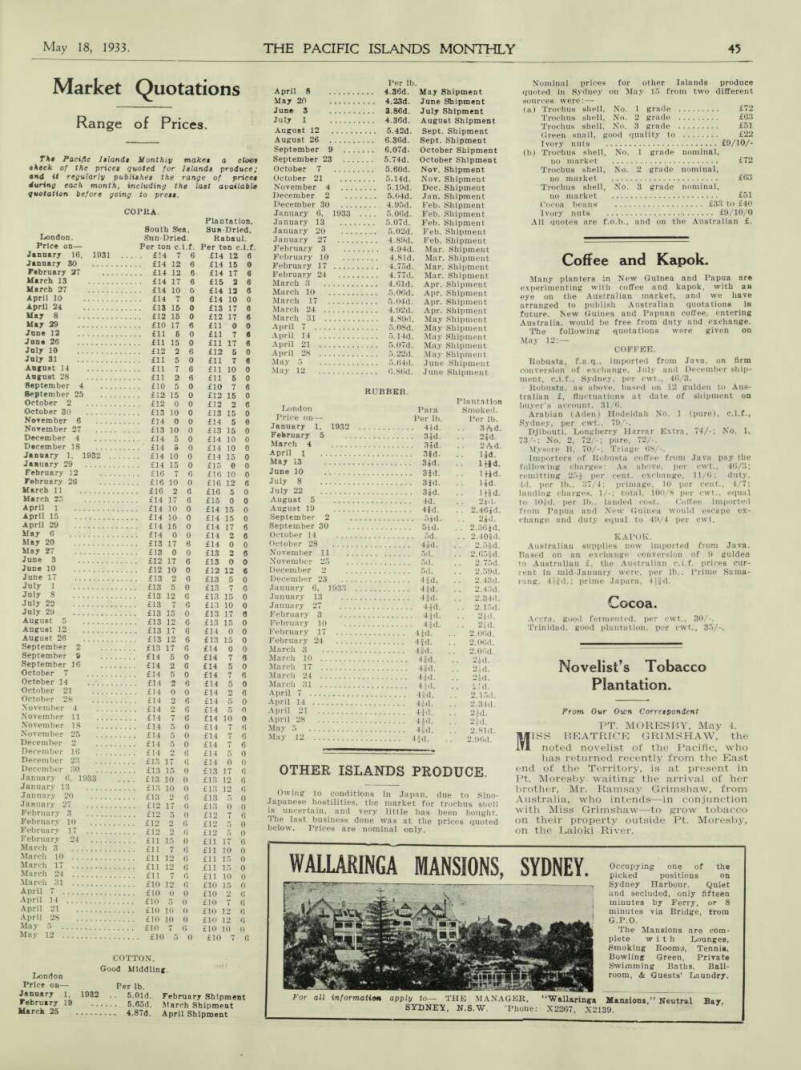
Range of Prices.
The Pacific Islands Monthly makes a close check of the prices quoted for Islands produce; and it regularly publishes the range of prices during each month, including the last available quotation before going to press.
Per lb.
April 8 May 20 June 3 July 1 August 12 August 26 September 9 ...
September 23 ... 5.74d. October Shipment October 7 October 21 . . ..
November 4 . . . . ... 5.19d. Dec. Shipment December 2 December 30 . .. . 4.95d. Feb. Shipment January 6, 1933 ... 5.06d. Feb. Shipment January 13 .. .. 5.07d. Feb. Shipment January 20 . ...
January 27 ...
February 3 February 10 February 17 February 24 ... 4.77d. Mar. . Shipment March 3 March 10 ... 5.06d. Apr. Shipment March 17 Shipment March 24 ... 4.92d. Apr. Shipment March 31 April 7 April 14 April 21 April 28 May 5 ; Shipment May 12
Rubber.
Plantation Smoked. Per lb.
London Price on— Para Per lb.
January 1, 1932 4id. 3Ad.
February 5 3Jd. 2{d.
March 4 3id. 2Ad.
April 1 3«d. lid.
May 13 3id. 1 fid- June 10 IHd.
July 8 lid.
July 22 l*Sd.
August 5 4d. .. 24d.
August 19 .. 2.46id.
September 2 .. 2id.
September 30 5Ad. .. 2.56Jd.
October 14 .. 2.40*d.
October 28 4id. . . 2.5|d.
November 11 .. , .. 2.05gd.
November 25 .. 2.75d.
December 2 . .. 5(1. . . 2.59d.
December 23 ... 4id. .. 2.43d.
January 6, 1933 . 4Jd. .. 2.43d.
January 13 . ... 4}d. .. 2.34d.
January 27 ... -lid. .. 2.15d.
February 3 ... 4*d. .. 2Jd.
February 10 41d. .. 2id.
February 17 .. 2.06d.
February 24 .. 2.06d.
March 3 2. Odd.
March 10 .. 24d.
March 17 .. 2id.
March 24 .. 24d.
March 31 .. Wd.
April 7 .. 2.15d.
April 14 .. 2.34d.
April 21 .. 2Jd.
April 28 .. 2fd.
May 5 .. 2.81d.
May 12 4}d. 2.96d.
London. Price on— January 16, 1931 January 30 ...
Copra.
South Sun-Dried. Per ton c.i.f. £14 7 6 £14 12 6 Plantation, Sun-Dried, Rabaul. Per ton c.i.f. £14 12 6 £14 15 0 £14 17 6 £15 2 6 £14 12 6 £14 10 0 £13 17 6 £12 17 6 £11 0 0 £11 7 e £11 17 6 £12 5 0 £11 7 fl £11 10 0 £11 6 0 £10 7 6 £12 15 0 £12 2 6 £13 15 0 £14 5 0 February 27 £14 12 6 March 13 £14 17 6 March 27 £14 10 0 April 10 £14 7 0 April 24 £13 16 0 May 8 £12 15 0 May 29 £10 17 6 Jnne 12 £11 B 0 Jana 26 £11 15 0 July 10 £12 2 6 July 81 £11 5 0 August 14 £11 7 6 August 28 £11 2 6 September 4 £10 5 0 September 25 £12 15 0 October 2 £12 0 0 October 30 £13 10 0 November 6 . . . . £14 0 0 November 27 . .. . £13 10 0 £13 16 0 £14 10 0 £14 10 0 £14 15 0 £15 0 0 £16 10 0 £16 12 6 £16 5 0 £15 0 0 £14 15 0 £14 15 0 £14 17 6 £14 2 6 £14 0 0 £13 2 6 £13 0 0 £12 12 6 £13 5 0 £13 7 6 £13 15 0 £13 10 0 £13 17 6 £13 15 0 £14 0 0 £13 15 0 £14 0 0 £14 7 8 £14 5 0 £14 7 6 £14 5 0 £14 2 6 £14 5 0 £14 5 0 £14 10 0 £14 7 6 £14 7 6 £14 7 6 £14 5 0 £14 0 0 £13 17 6 £13 12 6 £13 12 6 £13 5 0 £13 0 0 £12 7 6 £12 5 0 £12 5 0 £11 17 6 -Pi i ift ft December 4 . . . . £14 5 0 December 18 . . . . £14 g 0 January 1. 1932 .
January 29 £14 15 o February 12 £16 7 6 February 26 March 11 March 25 £14 17 6 April l £14 10 0 April 15 April 29 May 6 May 20 May 27 June 3 June 10 June 17 July 1 July S July 22 July 29 £13 15 0 August 5 £13 12 6 August 12 £13 17 6 August 26 £13 12 6 September 2 £13 17 6 September 9 £14 5 0
September 16
£14 2 6 October 7 £14 5 0 October 14 ... £14 2 6 October 21 ...
October 28 N ovember 4 . . ., £14 2 6 November 11 ... £14 7 6 November 18 . .. . ... £14 5 0 November 25 £14 5 o December 2 . £14 5 0 December 16 . . .. £14 2 6 December 23 .. .. £13 17 6 December 30 . . .
January 6, 1933 January 13 £13 10 0 . £13 10 0 January 20 January 27 £12 17 6 February 3 £12 5 0 February 10 £12 2 6 February 17 February 24 March 3 March 10 March 17
Xxx Xv U
£11 15 0 ■PI 1 1 ft March 24 ■P1 1 1ft ft March 31 April 7
Xxx U
£10 15 0 o o April 14 April 21
T Xu — D
£10 7 6 £10 12 6 £10 12 6 April 28 May 5 May 12 £10 10 0 £ 1 A *7 n •-* V 1 U
Cotton.
Good Middling.
London Price on— Per lb.
January 1. 1932 . 5.01d. February Shipment February 19 K n-wi .
March 25 . 4.87d. April Sh U V.
Ipment
Other Islands Produce.
Owing to conditions in Japan, due to Sino- Japanese hostilities, the market for trochus shell is uncertain, and very little has been bought.
The last business done was at the prices quoted below. Prices are nominal only.
Nominal prices for other Islands produce quoted in Sydney on May 15 from two different sources were: —
(a) Trochus shell. No. 1 grade £72 Trochus shell, No. 2 grade £63 Trochus shell. No. 3 grade £51 Green snail, good quality to £22 Ivory nuts £9/10/- (b) Trochus shell, No. 1 grade nominal, no market £72 Trochus shell, No. 2 grade nominal. no market £63 Trochus shell, No. 3 grade nominal. no market £51 Cocoa beans £33 to £40 Ivory nuts £9/10/0 All quotes are f.o.b., and on the Australian £.
Coffee and Kapok.
Many planters in New Guinea and Papua are experimenting with coffee and kapok, with an eye on the Australian market, and we have arranged to publish Australian quotations in future. New Guinea and Papuan coffee, entering Australia, would be free from duty and exchange.
The following quotations were given on May 12:—
Coffee.
Robusta, f.a.q., imported from Java, on firm conversion of exchange, July and December ship ment, c.i.f., Sydney, per cwt., 46/3.
Robusta, as above, based on 12 gulden to Aus tralian £, fluctuations at date of shipment on buyer's account, 31/6.
Arabian (Aden) Hodeidah No. 1 (pure), c.i.f., Sydney, per cwt., 79/-.
Djibouti, Longberry Harrar Extra, 74/-; No. 1, 73/-: No. 2, 72/-; pure, 72/-.
Mysore B, 70/-: Triage 68/-.
Importers of Robusta coffee from Java pay the following charges; As above, per cwt., 46/3; remitting 254 per cent, exchange, 11/6; duty, 4d. per lb., 37/4; primage, 10 per cent., 4/7; landing charges, 1/-; total, 100/8 per cwt., equal to lOjjd. per lb., landed cost. Coffee imported from Papua and New Guinea would escape ex change and duty equal to 49/4 per cwt.
Kapok.
Australian supplies now imported from Java.
Based on an exchange conversion of 9 gulden to Australian f, the Australian c.i.f. prices cur rent in mid-January were, per lb.; Prime Sama rang, 4h}d.; prime Japara. 4}|d.
Cocoa.
Accra, good fermented, per cwt., 30/-.
Trinidad, good plantation, per cwt., 35/-.
Novelist’s Tobacco
Plantation.
From Our Own Correspondent
Pt. Moresby, May 4.
Miss Beatrice Grimshaw, The
noted novelist of the Pacific, who has returned recently from the East end of the Territory, is at present in Pt. Moresby waiting the arrival of her brother, Mr. Ramsay Grimshaw, from Australia, who intends —in conjunction with Miss Grimshaw —to grow tobacco on their property outside Pt. Moresby, on the Laloki River.
Advertisements & other items, p. 47 (1 item)
Wallar1Nga Mansions, Sydney.
Occupying one of the picked positions on Sydney Harbour. Quiet and secluded, only fifteen minutes by Ferry, or 8 minutes via Bridge, from
G.P.O.
The Mansions are com plete with Lounges, Smoking Rooms, Tennis, Bowling Green, Private Swimming Baths, Ball room, & Guests’ Laundry.
For all information apply to— THE MANAGER, “Wallaringa Mansions ” Neutral Bar
SYDNEY, N.S.W, ’Phone: X2267, X2139.
Exchange Quotations
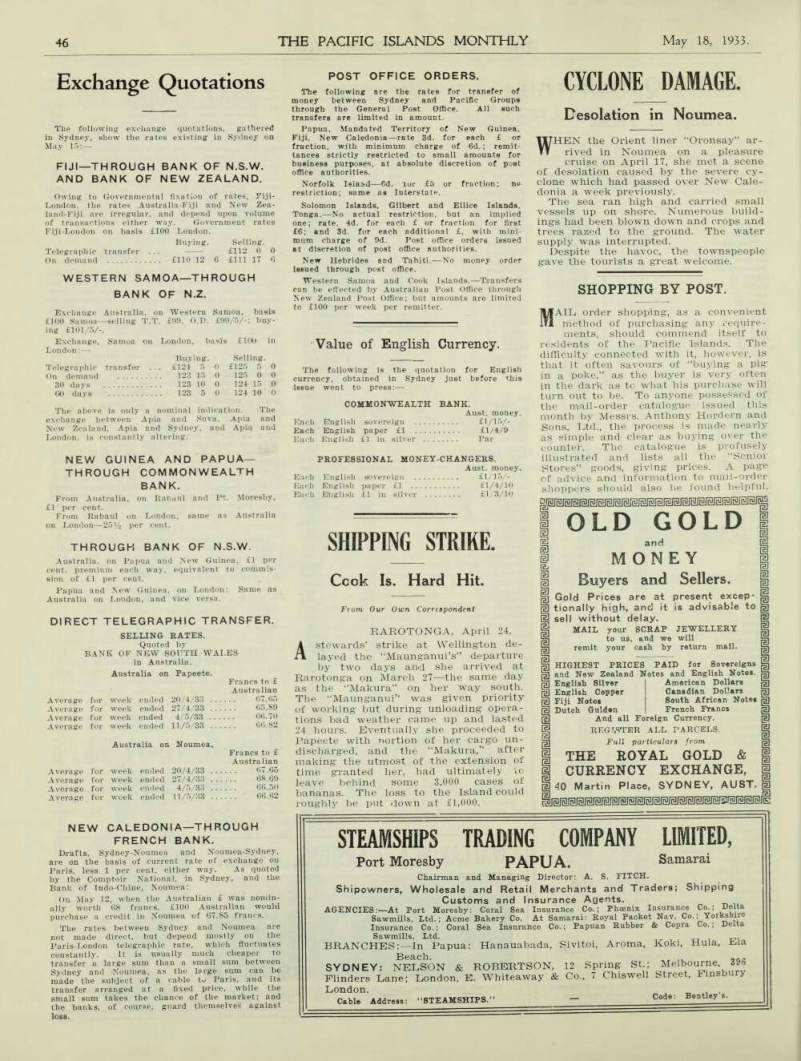
The following exchange quotations, gathered in Sydney, show the rates existing in Sydney on May 15:—
Fiji—Through Bank Of N.S.W.
And Bank Of New Zealand.
Owing to Governmental fixation of rates, Fiji- London, the rates Australia-Fiji and New Zea land-Fiji are irregular, and depend upon volume of transactions either way. Government rates Fiji-London on basis £100 London.
Western Samoa—Through
Bank Of N.Z.
Exchange Australia, on Western Samoa, basis £100 Samoa—selling T.T. £99, O.D. £99/5/-; buy ing £101/5/-.
Exchange, Samoa on London, basis £100 in London; —
The above is only a nominal indication. The exchange between Apia and Suva, Apia and New Zealand, Apia and Sydney, and Apia and London, is constantly altering.
New Guinea And Papua
Through Commonwealth
Bank.
From Australia, on Rabaul and Pt. Moresby, £1 per cent.
From Rabaul on London, same as Australia on London —25% per cent.
Through Bank Of N.S.W.
Australia, on Papua and New Guinea, £1 per cent. premium each way, equivalent to commis sion of £1 per cent.
Papua and New Guinea, on London: Same as Australia on London, and vice versa.
Direct Telegraphic Transfer.
Selling Rates.
Quoted by
Bank Of New South Wales
in Australia.
Australia on Papeete.
New Caledonia—Through
French Bank.
Drafts, Sydney-Noumea and Noumea-Sydney, are on the basis of current rate of exchange on Paris, less 1 per cent, either way. As quoted by the Comptoir National, in Sydney, and the Bank of Indo-Chine, Noumea: On May 12, when the Australian f was nomin ally worth 68 francs. £100 Australian would purchase a credit in Noumea of 67.85 francs.
The rates between Sydney and Noumea are not made direct, but depend mostly on the Paris-London telegraphic rate, which fluctuates constantly. It is usually much cheaper to transfer a large sum than a small sum between Sydney and Noumea, as the large sum can be made the subject of a cable to Paris, and its transfer arranged at a fixed price, while the small sum takes the chance of the market; and the banks, of course, guard themselves against loss.
Post Office Orders.
The following are the rates for transfer of money between Sydney and Pacific Groups through the General Post Office. All such transfers are limited in amount.
Papua, Mandated Territory of New Guinea, Fiji, New Caledonia —rate 3d. for each for fraction, with minimum charge of 6d.; remit tances strictly restricted to small amounts for business purposes, at absolute discretion of post office authorities.
Norfolk Island—6d. for £5 or fraction; no restriction; same as Interstate.
Solomon Islands, Gilbert and Ellice Islands, Tonga.—No actual restriction, but an implied one; rate, 4d. for each £ or fraction for first £6; and 3d. for each additional £, with mini mum charge of 9d. Post office orders issued at discretion of post office authorities.
New Hebrides and Tahiti.—No money order issued through post office.
Western Samoa and Cook Islands.—Transfers can be effected by Australian Post Office through New Zealand Post Office; but amounts are limited to £100 per week per remitter.
Buying.
Selling.
Telegraphic transfer .. £112 0 0 On demand £110 12 6 £111 17 6
Buying.
Selling.
Telegraphic transfer . £124 5 0 £125 5 0 On demand 123 13 0 125 0 0 30 days 123 10 0 124 15 0 60 days 123 5 0 124 10 0
Average for week ended 20/4/33 .. . . .. 67.65 Francs to £ Australian Average for week ended 27/4/33 .. 65.89 Average for week ended 4/5/33 ... 66.70 Average for week ended 11/5/33 .. 66.82 Average for week ended 20/4/33 .. ... . 67.65 Australia on Noumea.
Francs to £ Australian Average for week ended 27/4/33 . . 68.69 Average for week ended 4/5/33 .. 66.50 Average for week ended 11/5/33 .. 60.62
Value of English Currency.
The following is the quotation for English currency, obtained in Sydney just before this issue went to press:—
Commonwealth Bank.
Aust. money.
Each English sovereign £1/15/- Each English paper £1 Each English £1 in silver . . .
Professional Money-Changers.
Aust. money.
Each English sovereign £1/15/- Each English paper £1 £1/4/10 Each English £1 in silver . . . £1/3/10
Shipping Strike.
Cook Is. Hard Hit.
From Our Own Correspondent
Rarotonga, April 24.
A stewards’ strike at Wellington de layed the “Maunganui’s” departure by two days and she arrived at Rarotonga on March 27 —the same day as the “Makura” on her way south.
The “Maunganui’’ was given priority of working but during unloading opera tions bad weather came up and lasted 24 hours. Eventually she proceeded to Papeete with portion of her cargo un discharged, and the “Makura,” after making the utmost of the extension of time granted her, had ultimately to leave behind some 3,000 cases of bananas. The loss to the Island could roughly be put down at £1,000.
Cyclone Damage.
Desolation in Noumea.
WHEN the Orient liner “Oronsay” ar rived in Noumea on a pleasure cruise on April 17, she met a scene of desolation caused by the severe cy clone which had passed over New Cale donia a week previously.
The sea ran high and carried small vessels up on shore. Numerous build ings had been blown down and crops and trees razed to the ground. The water supply was interrupted.
Despite the havoc, the townspeople gave the tourists a great welcome.
Shopping By Post.
MAIL order shopping, as a convenient method of purchasing any require ments, should commend itself to residents of the Pacific Islands. The difficulty connected with it, however, is that it often savours of “buying a pig in a poke,” as the buyer is very often in the dark as to what his purchase will turn out to be. To anyone possessed of the mail-order catalogue issued this month by Messrs. Anthony Hordern and Sons, Ltd., the process is made nearly as simple and clear as buying over the counter. The catalogue is profusely illustrated and lists all the “Senior Stores” goods, giving prices. A page of advice and information to mail-order shoppers should also be found helpful.
Advertisements & other items, p. 48 (1 item)
Old Gold
and
MONEY
Buyers and Sellers.
Gold Prices are at present excep tionally high, and it is advisable to sell without delay.
MAIL your SCRAP JEWELLERY
to us, and we will remit your cash by return mall.
HIGHEST PRICES PAID for Sovereigns and New Zealand Notes and English Notes.
English Silver American Dollars English Copper Canadian Dollars Fiji Notes South African Notes Dutch Gulden French Francs And all Foreign Currency.
REGISTER ALL PARCELS.
Full particulars from
THE ROYAL GOLD &
CURRENCY EXCHANGE,
40 Martin Place, SYDNEY, AUST.
STEAMSHIPS TRADING COMPANY LIMITED,
Port Moresby PAPUA. Samarai
Chairman and Managing Director: A. S. FITCH.
Shipowners, Wholesale and Retail Merchants and Traders; Shipping Customs and Insurance Agents.
AGENCIES:—At Port Moresby: Coral Sea Insurance Co.; Phoenix Insurance Co.; Delta Sawmills, Ltd.; Acme Bakery Co. At Samarai: Royal Packet Nav. Co.;; Yorkshire Insurance Co.; Coral Sea Insurance Co.; Papuan Rubber & Copra Co.; Delta Sawmills, Ltd.
BRANCHES: —In Papua: Hanauabada, Sivitoi, Aroma, Koki, Hula, Ela Beach.
SYDNEY: NELSON & ROBERTSON, 12 Spring St.; Melbourne, 39b Flinders Lane; London, E. Whiteaway & Co., 7 Chiswell Street, Finsbury London.
Cable Address: “STEAMSHIPS.” Code: Bentleys.
Sydney—Rabaul—Hongkong.
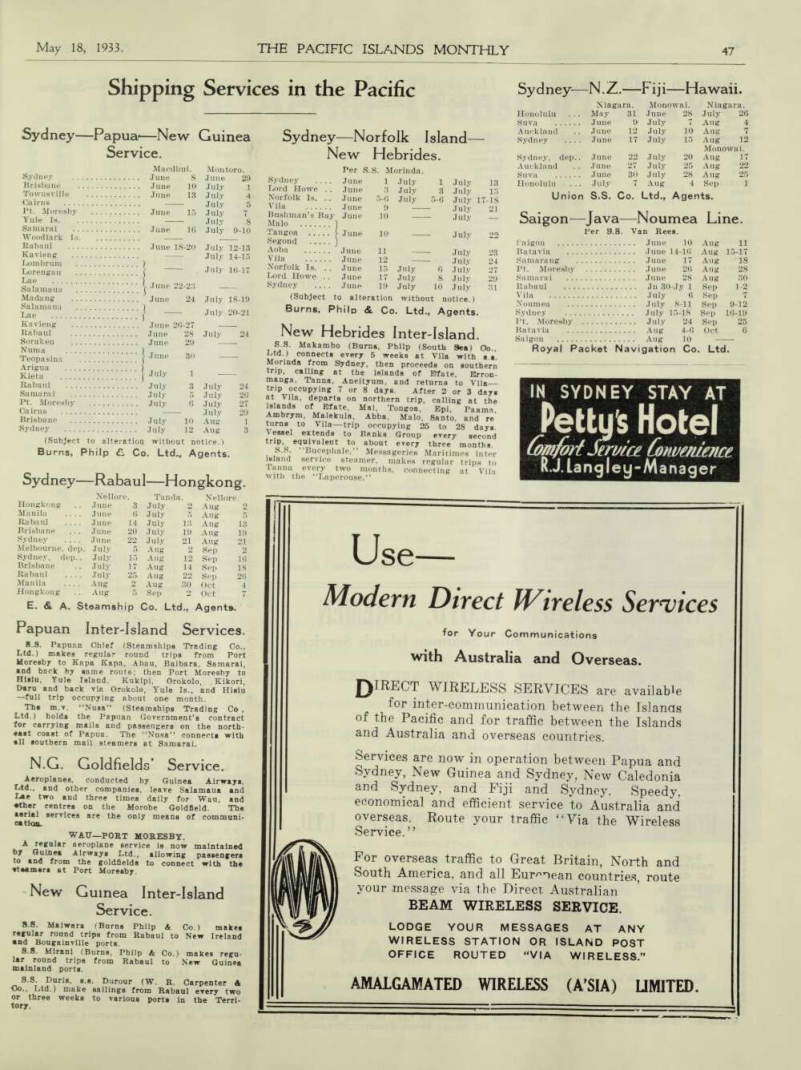
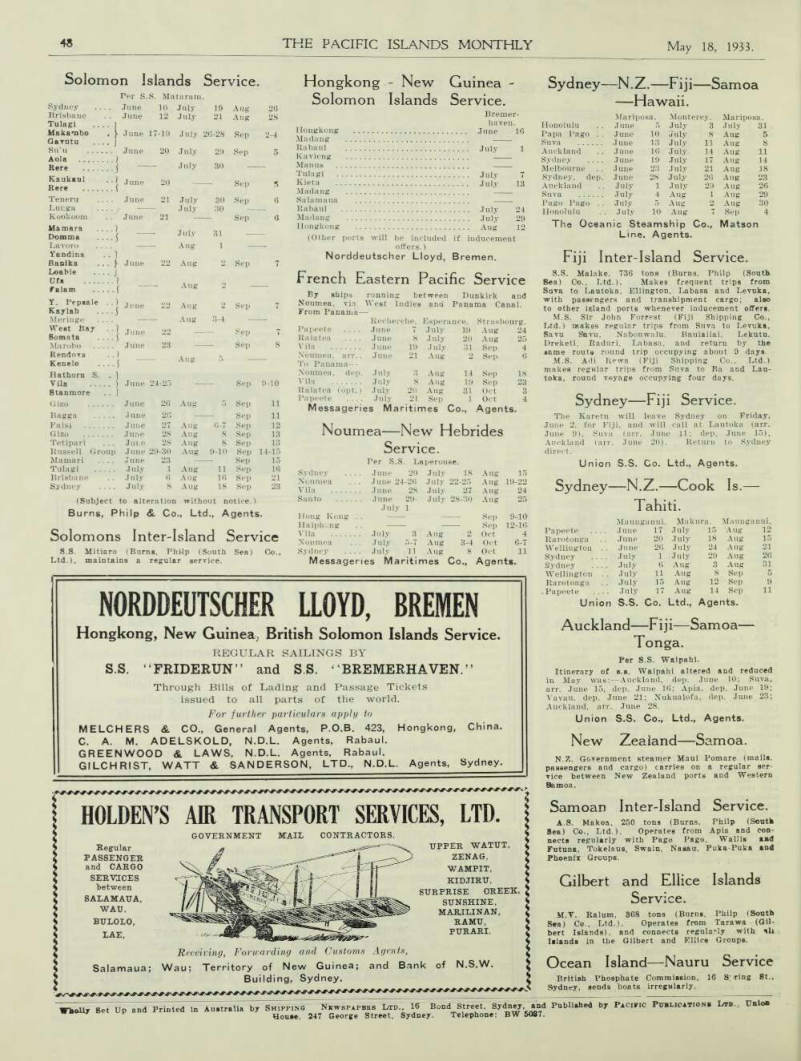
Shipping Services in the Pacific
Sydney—Papua—New Guinea Service.
Papuan Inter-Island Services.
S.S. Papuan Chief (Steamships Trading Co., Ltd.) makes regular round trips from Port Moresby to Kapa Kapa, Abau, Baibara, Samarai, and back by same route; then Port Moresby to Hlslu, Yule Island, Kukipi, Orokolo, Kikori, Daru and back via Orokolo, Yule Is., and Hisiu —full trip occupying about one month.
The m.v. “Nusa” (Steamships Trading Co, Ltd.) holds the Papuan Government’s contract for carrying mails and passengers on the north east coast of Papua. The “Nusa” connects with all southern mail steamers at Samarai.
N.G. Goldfields’ Service.
Aeroplanes, conducted by Guinea Airways, Ltd., and other companies, leave Salamaua and Lae two and three times daily for Wau, and other centres on the Morobe Goldfield. The aerial services are the only means of communi cation.
Wau—Port Moresby.
A regular aeroplane service is now maintained by Guinea Airways Ltd., allowing passengers to and from the goldfields to connect with the steamers at Port Moresby.
New Guinea Inter-Island
Service.
S.S. Maiwara (Burns Philp & Co.) makes regular round trips from Rabaul to New Ireland and Bougainville ports.
S.S. Mirani (Burns, Philp & Co.) makes regu lar round trips from Rabaul to New Guinea mainland ports.
S.S. Duris, s.s. Durour (W. R. Carpenter A Co., Ltd.) make sailings from Rabaul every two or three weeks to various ports in the Terri
Sydney—Norfolk Island— New Hebrides.
New Hebrides Inter-Island.
S.S. Makambo (Burns, Philp (South Sea) Co., Ltd.) connects every 5 weeks at Vila with s.s.
Morinda from Sydney, then proceeds on southern trip, calling at the islands of Efate, Erron manga, Tanna, Aneityum, and returns to Vila— trip occupying 7 or 8 days. After 2 or 3 days at Vila, departs on northern trip, calling at the islands of Efate, Mai, Tongoa, Epi, Paama Ambrym, Malekula, Abba, Malo, Santo, and re turns to Vila—trip occupying 25 to 28 days.
Vessel extends to Banks Group every second trip equivalent to about every three months.
S.S. “Bucephale,” Messageries Maritimos inter island service steamer, makes regular trips to Tanna every two months, connecting at Vila with the “Laperouse.”
Sydney—N.Z.—Fiji—Hawaii.
Saigon—Java—Noumea Line.
Per S.S. Morinda.
Sydney June 1 July 1 July 13 Lord Howe . . June 3 July 3 July 15 Norfolk Is. .
June 5-6 July 5-6 July 17-18 Vila June 9 July 21 Bushman's Bay June 10 Malo — July — Tangoa Segond June 10 — July 22 Aoba June 11 July 23 Vila June 12 July 24 Norfolk Is. .
June 15 July 6 July 27 Lord Howe .
June 17 July 8 July 29 Sydney June 19 July 10 July 31 (Subject to alteration without notice.) Burns, Philp & Co. Ltd., Agents.
Niagara.
Monowai.
Niagara.
Honolulu May 31 June 28 July 26 Suva June 9 July 7 Aug 4 Auckland June 12 July 10 Aug 7 Sydney ...
June 17 July 15 Aug 12 Monowai.
Sydney, dep..
June 22 July 20 Aug 17 Auckland June 27 July 25 Aug 22 Suva June 30 July 28 Aug 25 Honolulu July 7 Aug 4 Sep 1 Union S.S. Co. Ltd., Agents.
Per S.S. Van Rees.
Saigon Aug 11 Batavia Aug 15-17 Samarang Aug 18 Pt. Moresby June 26 Aug 28 Samarai June 28 Aug 30 Rabaul Sep 1-2 Vila Sep 7 Noumea July 8-11 Sep 9-12 Sydney Sep 10-19 Pt. Moresby July 24 Sep 25 Batavia Oct 6 Saigon Aug 10 Royal Packet Navigation Co. Ltd.
Sydney Macdhui.
June 8 June 10 June 13 Montoro.
June 29 July 1 July 4 July 5 Brisbane Townsville Cairns Pt. Moresby June 15 July 7 July 8 Yule Is Samarai June 10 July 8 July 9-10 Woodlark Is Rabaul June 18-20 July 12-13 July 14-15 Kavieng Lombrum Lorengau — July 16-17 Lae Salamaua June 22-23 Madang June 24 July 18-19 Salamaua Lae Kavieng June 26-27 June 28 June 29 June 30 July 1 July 3 July 20-21 Rabaul Soraken July 24 Numa Teopasina Arigua Kieta Rabaul July 24 July 26 July 27 July 29 Aug 1 Aug 3 Samarai Pt. Moresby July 5 July 6 Cairns Brisbane Sydney July 10 July 12 (Subject to alteration without notice.)
Burns, Philp & Co. Ltd., Agents.
Nellore.
Tanda Nellore.
Hongkong June 3 July 2 Aug 2 Manila June 6 July 5 Aug 5 Rahaul June 14 July 13 Aug 13 Brisbane June 20 July 19 Aug 19 Sydney June 22 July 21 Aug 21 Melbourne, dep.
July 5 Aug 2 Sep 2 Sydney, dep..
July 15 Aug 12 Sep 16 Brisbane .. July 17 Aug 14 Sep 18 Rabaul . . July 25 Aug 22 Sep 26 Manila Aug 2 Aug 30 Oct 4 Hongkong Aug 5 Sep 2 Oct 7 E. & A. Steamship Co. Ltd., Agents.
Solomon Islands Service.
(Subject to alteration without notice.)
Burns, Philp & Co., Ltd., Agents.
Solomons Inter-Island Service
S.S. Mitiaro (Burns, Philp (South Sea) Co., Ltd.), maintains a regular service.
Hongkong - New Guinea - Solomon Islands Service.
French Eastern Pacific Service
Messageries Maritimes Co., Agents.
Noumea—New Hebrides Service.
Sydney—N.Z.—Fiji—Samoa —Hawaii.
Fiji Inter-Island Service.
S.S. Malake, 736 tons (Burns, Philp (South Sea) Co., Ltd.). Makes frequent trips from Suva to Lautoka, Ellington, Labasa and Levuka, with passengers and transhipment cargo; also to other island ports whenever inducement offers.
M.S. Sir John Forrest (Fiji Shipping Co., Ltd.) makes regular trips from Suva to Levuka, Savu Savu, Nabonwalu, Baulailai, Lekutu.
Dreketi, Raduri, Labasa, and return by the same route round trip occupying about 9 days M.S. Adi Rewa (Fiji Shipping Co., Ltd.) makes regular trips from Suva to Ba and Lau toka, round voyage occupying four days.
Sydney—Fiji Service.
The Karetu will leave Sydney on Friday, June 2, for Fiji, and will call at Lautoka (arr.
June 9). Suva (arr. June 11; dep. June 15), Auckland (arr. June 20). Return to Sydney direct.
Union S.S. Co. Ltd., Agents.
Sydney—N.Z.—Cook Is. —
Tahiti.
Auckland —Fiji—Samoa—
Tonga.
Per S.S. Walpahi.
Itinerary of s.s. Waipahi altered and reduced in May was: —Auckland, dep. June 10; Suva, arr. June 15, dep. June 16; Apia, dep. June 19; Yavau, dep. June 21; Nukualofa, dep. June 28; Auckland, arr. June 28.
Union S.S. Co., Ltd., Agents.
New Zealand —Samoa.
N.Z. Government steamer Maui Pomare (mails, passengers and cargo) carries on a regular ser vice between New Zealand ports and Western Samoa.
Samoan Inter-Island Service.
A.S. Makoa, 250 tons (Burns, Philp (South Sea) Co., Ltd.). Operates from Apia and con nects regularly with Pago Pago, Wallis and Futuna, Tokelaus, Swain, Nasau, Puka-Puka and Phoenii Groups.
Gilbert and Ellice Islands
Service.
M.V. Ralum. 868 tons (Burns, Philp (South Sea) Co., Ltd.). Operates from Tarawa (Gil bert Islands), and connects regularly with all Islands in the Gilbert and Ellice Groups.
Ocean Island—Nauru Service
British Phosphate Commission. 16 Spring St., Sydney, sends boats irregularly.
Per S.S. Mataram Sydney ...
June 10 July 19 Aug 26 Brisbane June 12 July 21 Aug 28 Tulagi ...
Makambo June 17-19 July 20-28 Sep 2-4 Garutu ...
Su’u June 20 July 29 Sep > Aola Bere — July 30 Kaukaul Bere . June 20 Sep 5 Teneru ...
June 21 July 30 Sep 6 Lucga ... — July 30 Kookoom June 21 Sep 6 Matnara ...
July 31 Comma ... 1 Lavoro ... — Aug 1 Fandina . . 1 Banika June 22 Aug 2 Sep 7
Loabie . . . . j
Ufa Aug 2 faiam f
June
Y. Pepaale Kaylah ... 90 Aug 2 Sep 7 Meringe ... — Aug 3-4 West Bay Bomnta ...
June
22 — .
Sep 7 Marobo June 1 23 Sep 8 Bendora Aug Kenelo ... ! 5 Hatborn S. . 1 Vila June 1 24-25 9-10 Stanmore Gizo June 26 Aug 3 Sep 11 June 2G 11 12 Faisi June 27 Aug Aug Aug 6-7 Sep Sep Sep Gizo June 28 8 13 Tetipari June 28 s 13 Russell Group June 29-30 Aug 9-10 Sep 14-15 Mamari ...
June 23 Sep 15 Tulagi July 1 Aug 11 Sep Sep 16 Brisbane July G Aug 16 21 Sydney . ...
July 8 Aug 18 Sep 23
Mariposa.
Monterey.
Mariposa.
Honolulu .7 une 5 July 3 July 31 Papa Pago . .
June 10 July 8 Aug 5 Suva June 13 July 11 Aug 8 Auckland June 16 July 14 Aug 11 Sydney ...
June 19 July 17 Aug 14 Melbourne June 23 July 21 Aug 18 Sydney, dep.
June 28 July 26 Aug 23 Auckland July 1 July 29 Aug 26 Suva July 4 Aug 1 Aug 29 Pago Pago . .
July 5 Aug 2 Aug 30 Honolulu July 10 Aug 7 Sep 4 The Oceanic Steamship Co., Matson Line. Agents.
Bremer- Houekone haven.
Madane Rabaul Kavieng Manus Tulagi Kieta Madang Sal am ana Rabaul ,..
Madang July 24 July 29 Hongkong (Other ports will be included if inducement offers.) Norddeutscher Lloyd, Bremen.
By ships running between Dunkirk and Noumea, via West Indies and Panama Canal.
From Panama- Recherche.
Esperance.
Strasbourg.
Papeete ...
June 7 July 19 Aug 24 Kaiatea ...
June 8 July 20 Aug 25 Vila J une 19 July 31 Sep 4 Noumea, air..
June 21 Aug 2 Sep 6 To Panama— Noumea, dep.
July 3 Aug 14 Sep 18 Vila July g Aug 19 Sep 23 Kaiatea (opt.) July 20 Aug 31 Oct 3 Papeete . . ..
July 21 Sep 1 Oct 4
Per S.S. Laperouse.
Sydney ... June 20 July 18 Aug 15 Noumea . . . June 24-26 July 22-25 Aug 19-22 Vila June 28 July 27 Aug 24 Santo June 29- July 28-30 Aug 25 July 1 Hong Kong . . Sep 9-10 Haiphong . . Sep 12-16 Vila July 3 Aug 2 Oct 4 Noumea . . . July 5-T Aug 3-4 Oct 6-7 Sydney ... July 11 Aug 8 Oct 11
Messagenes Maritimes Co., Agents.
Maunganui.
Makura.
Maunganui.
Papeete ...
J uue 17 July 15 Aug 12 Rarotonga June 20 July 18 Aug 15 Wellington . .
June 26 July 24 Aug 21 Sydney ...
July 1 July 29 Aug 26 Sydney ...
July 6 Aug 3 Aug 31 Wellington July 11 Aug 8 Sep 5 Rarotonga July 15 Aug 12 Sep 9 Papeete ...
July 17 Aug 14 Sep 11 Union s.s.
O p
Ltd.,
Agents.
Advertisements & other items, pp. 49-52 (2 items)
Petty's Hotel
IN SYDNEY STAY AT
Comfort Service Convenience R.J. Langley- Manager
Use—
Modern Direct Wireless Services
for Your Communications with Australia and Overseas.
DIRECT WIRELESS SERVICES are available for inter-communication between the Islands of the Pacific and for traffic between the Islands and Australia and overseas countries.
Services are now in operation between Papua and Sydney, New Guinea and Sydney, New Caledonia and Sydney, and Fiji and Sydney. Speedy, economical and efficient service to Australia and overseas. Route your traffic “Via the Wireless Service.”
For overseas traffic to Great Britain, North and South America, and all countries, route your message via the Direct Australian
BEAM WIRELESS SERVICE.
LODGE YOUR MESSAGES AT ANY
WIRELESS STATION OR ISLAND POST
OFFICE ROUTED “VIA WIRELESS.”
AMALGAMATED WIRELESS (A’SIA) LIMITED.
NORDDEUTSCHER LLOYD, BREMEN
Hongkong, New Guinea. British Solomon Islands Service.
REGULAR SAILINGS BY
S.S. “FRIDERUN” and SS. “BREMERHAVEN.”
Through Bills of Lading and Passage Tickets issued to all parts of the world.
For further particulars apply to MELCHERS & CO., General Agents, P.O.B. 423, Hongkong, China.
C. A. M. ADELSKOLD. N.D.L. Agents, Rabaul.
GREENWOOD & LAWS, N.D.L. Agents, Rabaul.
GILCHRIST, WATT & SANDERSON, LTD., N.D.L. Agents, Sydney.
HOLDEN’S AIR TRANSPORT SERVICES, LTD.
Regular
PASSENGER
and CARGO
SERVICES
between
SALAMAUA,
WAU.
BULOLO,
LAE,
Salamaua;
GOVERNMENT MAIL CONTRACTORS.
UPPER WATUT,
ZENAG,
WAMPIT,
KIDJIRU.
SURPRISE CREEK
SUNSHINE,
MARJLINAN,
RAMU,
PURARI.
Receiving, Forwarding and Customs Agents, Wau; Territory of New Guinea; and Bank of N.S.W.
Building, Sydney.
A Unique Aerial Transport Service
THE country over which Guinea Airways’ Air craft daily fly is some of the worst in the world. It is so rough that overland transport is impossible, and many attempts at road building have been abandoned.
The Goldfields depend entirely on aircraft for maintenance, and it is the success of their service which makes Guinea Airways confident of their ability to organise and maintain dependable transport WHEREVER it is needed.
New Guinea Aerodromes
LAE
SALAMAUA
WATUT
WAU
WAMPIT
SANGAN
BULOWAT
BULOLO
ZENAG
AT LEFT : Parts of Dredge Machinery being loaded into aeroplane for transport by Guinea Airways, Ltd., to Bulolo Gold field.
BELOW: Here’s a giant wheel with a diameter of over 6½ feet for one of the Bulolo Gold Dredging Company’s dredges.
It is bolted securely inside the cabin of a G31 tri-motored Junker for transport to the goldfields. The balance of the load was made up with hundred pound bags of rice.
GUINEA AIRWAYS Ltd
LAE - SALAMAUA
WELCOME CARGO
"Lower away”— and what a welcome cargo it is!
Resch’s Pilsener—in the famous long bottle—the drink which eases the white man’s burden!
Call for a bottle to-night and relish its malt and
hop flavour.
RESCH'S
LONG BOTTLE
PILSENER
48
May 18, 1933.
THE PACIFIC ISLANDS MONTHLY
Wholly Set Up and Printed In Australia by Shipping Newspapers Ltd., 16 Bond Street. Sydney and Published by Pacific Publications Ltd, Union House. 247 George Street, Sydney. Telephone: BW 5037.