Pacific
Islands
Monthly
April 24
1933
6d
[Registered at G.P.O., Sydney, for transmission by post as a newspaper.]
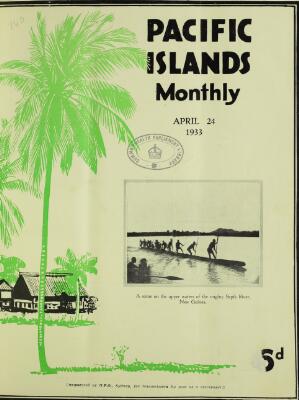
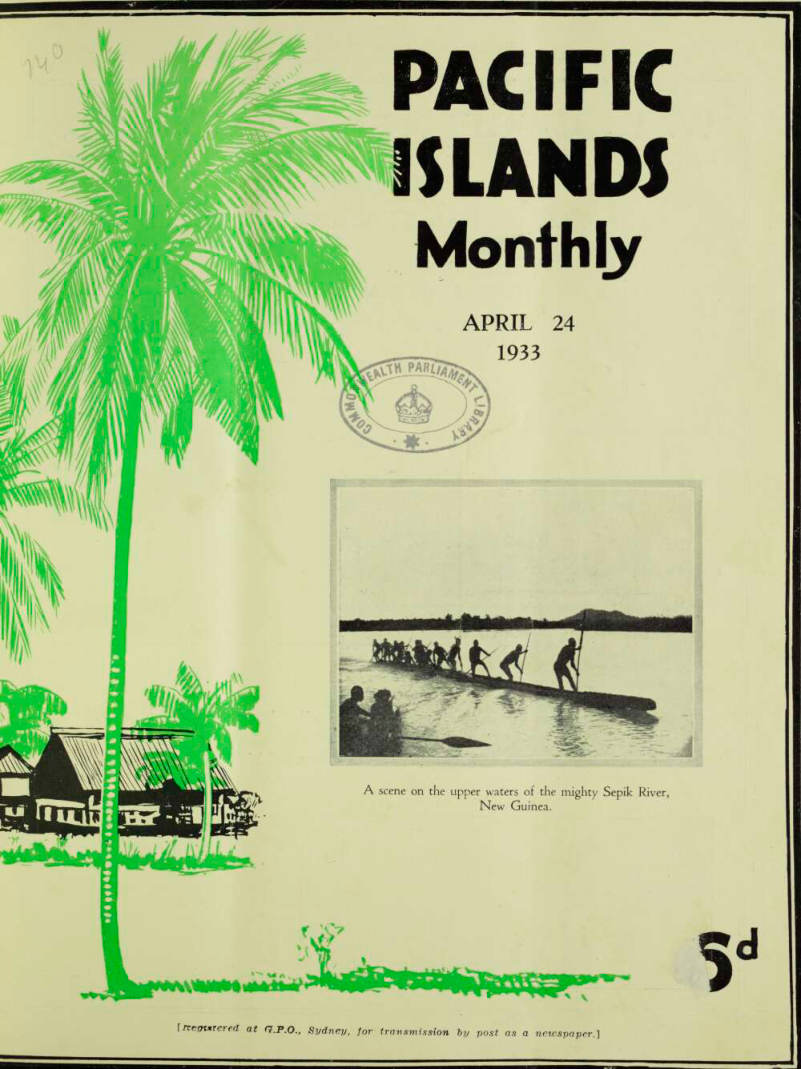
A scene on the upper waters of the mighty Sepik River, New Guinea.
Advertisements & other items, p. 2 (1 item)
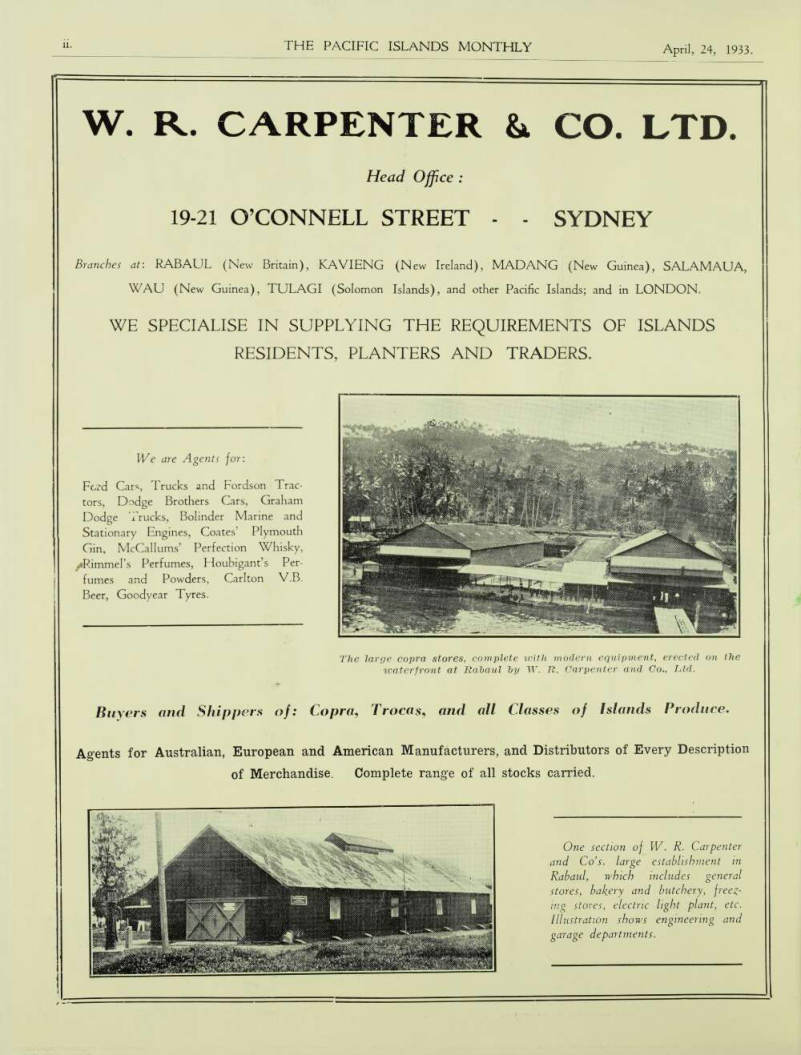
W. R. Carpenter & Co. Ltd.
Head Office :
19-21 O’CONNELL STREET - - SYDNEY
Branches at: RABAUL (New Britain), KAVIENG (New Ireland), MADANG (New Guinea), SALAMAUA, WAU (New Guinea), TULAGI (Solomon Islands), and other Pacific Islands; and in LONDON.
WE SPECIALISE IN SUPPLYING THE REQUIREMENTS OF ISLANDS
RESIDENTS, PLANTERS AND TRADERS.
We are Agents for: Ford Cars, Trucks and Fordson Trac tors, Dodge Brothers Cars, Graham Dodge Trucks, Bolinder Marine and Stationary Engines, Coates’ Plymouth Gin, McCallums’ Perfection Whisky, Rimmel’s Perfumes, Houbigant’s Per fumes and Powders, Carlton V.B.
Beer, Goodyear Tyres.
Buyers and Shippers of: Copra , Trocas , and all Classes of Islands Produce.
Agents for Australian, European and American Manufacturers, and Distributors of Every Description of Merchandise. Complete range of all stocks carried.
The large copra stores , complete with modern equipment, erected on the waterfront at Rahaul hy W. R. Carpenter and Go., Ltd.
One section of W. R. Carpenter and Co’s, large establishment in Rabaul, which includes general stores, bakery and butchery, freez ing stores, electric light plant, etc.
Illustration shows engineering and garage departments.
Pacific Islands Travellers
Passengers Per “Montoro,” Which
SAILED FROM SYDNEY ON APRIL 6 FOR PAPUA AND NEW GUINEA : Mr. and Mrs.
Sturkey, Mr. and Mrs. Mocatta, Mr. S. V. Strat ford, Mr. J. Gallin, Mr. W. Cunningham, Mr. and Mrs. Underwood, Mrs. Gordon Smith, Mr.
J. B. Chapman, Mr. W. P. White, Mr. W. J.
Smith, Mrs. G. Normoyle, Miss March, Miss L. F.
Lashmar, Miss J. Rixon, Mr. and Mrs. W.
Luff, Mr. and Mrs. A. C. Rentoul, Dr. and Mrs. Heaslip, Mr. Dickson, Mr. J. B. Gordon, Mr. F. Shaw. Miss M. Kelly, Miss D. L. Rep shange, Mrs. H. Glanville, Mr. H. Waldron, Mr.
T. R. Thomson, Mr. K. Jonas, Mr. and Mrs.
O. G. Parry, Mrs. Jackson, Miss Slater, Mr. and Mrs. Lambert, Mr. G. Parer, M. Penny cook, Mr. G. Cox, Miss L. E. Cheesman, Mr.
W. G. Blundell, Mr. Gordon Thomas, Mrs. A. de Groen, Mr. and Mrs. L. H. Hilder, Mr. J.
Dole, Mr. T. B. Wardley, Mr. W. G. Digby, Mr. H. J. Scott, Rev. J. Dixon, Mr. L. C.
Roebuck, Mr. W. Pope, Mr. A. Leydin. Mr.
Dawson, Mr. T. R. Duncan, Mr. L. H. Wilkin son.
Passengers Per “Morinda,” Which
Left Sydney For Lord Howe Island
AND NORFOLK ISLANDS ON APRIL 8; Mrs.
Pinney, Mr. and Mrs. P. A. Cameron, Pastor R.
Hare, Mrs. A. E. Robertson, Miss I. G. Murphy, Miss L. Bruce, Mr. Brogden, Mr. M. F. Russell, Mrs. J. E. Killen, Mrs. C. Sullivan, Miss E. G.
Roach, Mr. and Mrs. C. H. Gibbs, Miss Lyons.
Miss A. Gullifer, Miss A. Setchell, Miss M.
Costigan, Miss L. Walster, Mr. A. Fenton, Mr.
G. V. Shillinglaw, Mrs. Fenton, Mrs. Thew, Mr. and Mrs. C. Harford, Mr. J. C. Carddigan, Mr.
J. W. Rennie, Miss L. A. Phillpots, Mrs. Timothy, Mr. N. P. Craig, Mr. J. M. Webb, Mr. W.
Culler, Mr. G. Howell, Mr. R. Hines, Mr. H.
West, Mr. and Mrs. A. J. McIntyre, Miss Y.
Henderson, Mrs. Healy, Miss P. Nicholas, Miss L. Refshaw, Mr. and Mrs. W. S. Nichols, Mr. and Mrs. D. Campbell.
Passengers Per “Aorangi,” Which
SAILED FROM SYDNEY FOR SUVA, FIJI, ON MARCH 30: Mr. G. F. Grahame, Mrs. G. F.
Grahame, Mrs. H. D. Upton and two children, Mrs. A. C. MacPherson, Mr. S. T. Black, Miss M. McSwann, Miss M. Laurie, Mr. E. H. Griffiths, Mr. E. J. Harding, Mr. C. R. Farquahar, Mrs.
C. R. Farquahar and two children, Mrs. E. E.
Morgen, Mrs. F. M. Toy, Mrs. W. Turner. Mrs.
M. Jones, Mrs. A. V. Bonamy, Mr. J. S. McNair, Mrs. J. S. McNair, Miss S. McNair, Mr. W.
Finlayson, Mrs. L. M. Service and child, Mrs.
D. W. Stevenson and two children, Mrs. J. L.
Scott, Miss P. Scott, Mrs. E. M. Trivett, Miss S. M. Trivett, Mr. F. H. Ellerton, Mrs. F. H.
Ellerton and infant, Mr. J. L. Scott, Mr. J.
McIntosh, Mr. A. Verge, Mr. E. M. Fenner, Mr. W. Harwood, Mr. D. D. Black, Mr. R. C.
Barclay, Mr. W. D. Goodsir, Mr. K. Leask, Rev. E. R. Elder, Mr. M. B. McCullagh, Mrs.
M. B. McCullagh, Rev. Sister M. Arkadia, Rev.
Sister Winfrieda, Sister Irene, Mr. R. E. Fuller, Mr. G. L. Perks, Miss S. M. Cameron, Mr. F. A.
Hathaway, Mrs. M. E. Hathaway, Miss B. Hath away, Mr. T. Nagle, Mrs. T. Nagle, Miss M.
Nagle.
Passengers Per “Monterey,” Which
ARRIVED IN SYDNEY FROM SUVA, FIJI, ON MARCH 30: Mr. Tillie Askey, Mr. E. A. Brown, Mr. Reginald W. Clark, Mrs. Reginald W. Clark, Mr. D. B. Costello, Mrs. Francis Davies, Miss Molly Davies. Mr. F. V. Dunstan, Mrs. F.
Dimond, Mrs. H. Elvin, Mrs. M. Ferguson, Mr.
Fong Sue Kee, Mrs. M. Hunter, Mr. Brian O.
Hunter, Mr. J. Hunter, Mr. A. E. Joyner, Mr.
C. A. McCartney, Mr. Derek C. Perry, Mrs.
Derek C. Perry, Miss Vera Rigney, Mrs. C. D.
Service, Mr. L. P. Smith, Mr. Arthur J. Turn bull, Mr. Ernest Weber, Dr. Frederick Wheatley, Mr. J. C. Davis, Miss Maisie Martin, Mr. F.
Midson.
Passengers Per “Tanda,” Which
Arrived In Sydney From Rabaul, New
GUINEA, ON MARCH 22: Mrs. E. M. Pye and child, Mrs. T. Garnett, Mr. G. G. T. Wells, Mr. R. M. Youlden, Mrs. R. M. Youlden and two children, Mr. W. J. Knox, Mr. J. T. Kenny, Mr. J. Woodard, Mr. E. C. Abraham, Miss B.
McKenzie, Mr. G. E. A. Taylor.
Passengers Per “Mataram,” Which
Sailed From Sydney For Solomon
ISLANDS ON MARCH 25: Mrs. J. E. Barnier, Miss M. Barnier, Miss V. F. Milne, Mrs. Hedrick, Mrs. E. Campbell, Miss E. J. Campbell, Mr. and Mrs. Newall, Mrs. A. Hubbard, Mr. C. R. Buffett, Dr. C. E. Fox, Miss M. Grant, Mrs. Fyfe, Miss B. Guylee, Mr. and Mrs. R. A. Christie, Miss M. M. Piers, Mrs. Knibbs, Major and Mrs.
Hewitt, Mr. and Mrs. F. H. Stokes, Mr. and Mrs. Fuller, Mrs. Wilson, Mrs. A. E. Taylor, Mr. Connor, Mr. Yogelman, Mr. C. Worthington, Mr. D. MacMillan, Mr. and Mrs. P. Colley, Mr.
Lackerstein, Mr. and Mrs. Nunan.
Passengers Per “Montoro,” Which
Arrived In Sydney From New Guinea
AND PAPUA ON MARCH 29; Mr. W. J. Ager, Mr. G. E. Aumuller, Mr. A. Barnes, Mrs. L. V.
Brossey, Mr. and Mrs. J. F. Caldwell, Mr. A.
Clarke, Mr. C. Farnham, Mr. T. G. Griffin, Mr.
H. R. Goodwyn, Rev. Father Grundl, Mr. G.
Graham, Mr. P. Htwkes, Mr. F. Hockey, Mr.
L. Hockey, Mr. W. Hockey, Mr. G. F. Hammond, Rev. H. Hessling, Mr. J. Hinks, Mr. A. S.
Ives, Mr. G. Innes, Mrs. W. J. Jeffries, Mr. A.
Lessey, Mr. W. J. Lewis, Rev. Father Lakaff, Miss W. Lofts, Miss L. Maguire, Mr. F. L.
Mitchell, Mr. D. Mannix, Mr. S. P. Mannix, Mr. and Mrs. E. MacAdam, Mr. D. W. McMillan, Mr. P. J. O’Meara. Mr. and Mrs. C. Page, Miss D. Page, Miss A. Raymond, Mr. and Mrs. W. J.
Simpson, Mr. F. H. Simcocks, Miss E. Standish, Mr. R. T. Squires, Rev. Mother Sarin, Mrs. V.
Tait and child, Mr. H. R. Taylor, Rev. Brother Weckheuer, Mr. H. E. Woodman.
Passengers Per “Macdhui,” Which
ARRIVED AT SYDNEY ON APRIL 19 FROM NEW GUINEA AND PAPUA : Mr. E. H. Adams, Mr. S. J. Anderson, Mr. V. C. Bath, Mr. T.
Brown, Mr. H. I. Burrows, Miss M. I. Burrows, Mr. and Mrs. J. A. Carpenter, Miss N. C.
Carpenter, Mr. J. C. Carpenter, Mr. E. P. Fahey, Mrs. C. Hoile, Mr. F. Hopkins, Mrs. D. Irvine, Miss L. E. Job, Mr. G. E. Lundberg, Mr. and Mrs. R. H. Macleod, Miss L, F. Malcolm, Mr.
A. G. Monteith, Mr. H. L. Munro, Mr. F. Nelson, Mr. S. D. Parker, Mr. and Mrs. N. B. Perkins, Mrs. M. H. Ross, Dr. T. A. Sherwin, Mr. A.
T. Smith, Mr. A. D. Stewart, Mr. W. Stone, Mr.
W. G. Turney, Mrs. G. M. Vine, Mr. J. E.
Walsh, Miss R. Waldon, Mr. G. Wilkinson, Mr.
J. H. Williams, Mr. C. E. Hopkins.
Passengers Per “Tanda,” Which
Sailed From Sydney For Rabaul, New
GUINEA, ON APRIL 12 : Mrs. T. C. Backhouse, Miss J. E. Bailey, Miss H. I. Drysdale, Mr. D.
M. Scobie, Mrs. G. L. Scobie, Mr. W. King, Mrs.
E. M. King, Miss W. King, Mr. J. Bayliss, Mr.
E. Slee, Miss L. Hutchison, Mr. Romsley, Mrs. C.
A. Romsley.
Passengers Per “Monterey,” Which
SAILED FROM SYDNEY FOR SUVA, FIJI, ON APRIL 8: Mrs. I. C. Allard, Master K. Allard, Mr. A. R. Aspinall, Mr. T. C. Bragge, Mrs. T.
C. Bragge, Mr. S. Clarke, Mr. James Crone, Mrs.
James Crone, Dr. N. E. Davis. Mrs. N. E.
Davis, Mr. F. U. Dunstan, Mr. James S. Dun nan, Mr. R. W. Fowler, Mrs. R. W. Fowler, Miss B. Hill, Miss N. Hill, Dr. Loftus Hill, Mrs.
L. P. Jacobs, Miss N. Jacobs, Mr. D. M. Mac kenzie, Mr. W. C. Nicholson, Mrs. W. C. Nichol
son, Mr. H. B. Pippin, Mr. C. B Riley, Mr. R.
Shenton-Gordon, Mrs. R. Shenton-Gordon, Mr. D.
M Sherwood, Mrs. L. M. Sherwood, Miss B.
Sherwood, Miss J. Sherwood, Miss Alice M.
Stephenson, Mr. G. A. Strang, Mrs. G. A. Strang, Mrs. S. Stubley, Master L. Stubley, Captain P.
G Taylor, Master A. T. Wane, Mrs. L. C.
Wane, Miss B. Wane, Mrs. A. Young, Mr. O.
Bonamy, Mr. W. J. Brown, Mrs. C. A. Browne, Mrs. I. S. Dick, Miss L. R. Dick, Mr. I. Frodey, Mrs. I. A. Green, Rev. R. J. Maddox, Mrs. R.
J. Maddox, Master Maddox, Mrs. A. G. Mes senger, Mrs C. P. Nelligan, Mr. J. G. Robson, Mrs. M. A. Taylor, Mr. E. Vautier, Mrs. E.
Vautier, Miss C. Vautier, Miss M. Wangman.
Passengers Per “Morinda,” Which
Sailed From Sydney For Lord Howe
Island, Norfolk Island, And New
HEBRIDES ON) APRIL 20: Mr. P. Cruyl, Rev. and Mrs. Milne, Mr. J. S. Hampton, Mr. H. S.
Edgar, Mr. and Mrs. L. Kennedy, Rev. and Mrs.
Godfrey, Judge A. de J. Carey, Mr. and Mrs.
J MacArthur Onslow, Mrs. C. R. Pinney, Mr. and Mrs. J. M. Nicol, Miss F. K. Nicol, Miss M. Marlowe, Mrs. Fairlie, Mr. and Mrs. Scott- Robertson, Mr. and Mrs. W. A. Farey, Mrs.
F A. Roberts, Mrs. I. E. Dent, Miss Robertson, Miss Booth, Mr. and Mrs. Jefferson, Miss L.
Smairl, Miss Betts, Miss A. Doherty, Mrs.
Pluschke, Miss E. Warner, Mr. J. Timmins, Mr.
J Doyle, Mr. M. W. Linklater, Mr. H. Street, Mr. K. Sinclair, Mr. J. Hill, Mr. M. G. Ussher, Mr. R. Hopping, Mrs. A. Fleck, Mrs. Andrews, Miss Chambers, Mr A. J. Cant, Mr. C. I. Buffett, Mr. E. H. Donnelly, Mr. T. Yager, Mr. H.
Haworth, Mr. J. Widdon, Mr. B. Clark, Mr. P.
Murray, Mr. J. Holmes.
Passengers Per “Morinda,” Which
ARRIVED IN SYDNEY ON APRIL 18 FROM
Norfolk And Lord Howe Islands: Mr.
R. H. Burgess, Mrs. and Miss Brown, Mr. E.
D. Dorman, Mr. R. K. Hosking, Miss L. M.
Litchfield, Mrs. I. M. Part, Miss L. G. Repshaw, Mr. J. R. Thomas, Mr. J. Blott, Mr. J. C.
Cuddigan, Mrs. Creighton, Mr. and Mrs. C. N.
Gibbs, Miss A. Gullifer, Mr. and Mrs. W.
Kennedy, Misses J. & K. Kennedy, Mr. H.
Rabone, Mr. M. F. Russell, Mr. and Mrs. W.
Retmock, Miss A. Setchell, Mr. E. Small, Mr. and Mrs. A. Stubbs, Mrs. E. Wallis, Mrs. H.
Walker, Miss L. Walster, Mr. H. Murphy.
Copra Fire.
A MESSAGE from London on April 19 stated that in response to a wireless appeal for help from the steamer Benholm, the cruiser Leander sent on board a party equipped with smoke helmets.
The “Benholm” was homeward bound from Pacific Islands ports when fire broke out in the after hold and shelter deck. The "Leander's" party escorted her into Punta de Gala Burras (Spain), where the fire was extinguished.
Advertisements & other items, p. 3 (1 item)
Freight and Passenger Service
Saloon and Intermediate class passengers carried in comfortable and airy cabins.
REGULAR
BI-MONTHLY
by the fast and modern K.P.M. Steamer VAN REES as under:
SAIGON
BATAVIA
SAMARANG
PORT MORESBY
SAMARAI
RABAUL
PORT VILA
ROYAL PACKET
NOUMEA
SYDNEY
PORT MORESBY
ROYAL PACKET NAVIGATION CO., Batavia
255 GEORGE STREET, SYDNEY. SAIGON
The B.N.G. Trading Coy., Ltd., Port Moresby; Steamship Trading Co., Samarai ; W. R.
Carpenter & Co., Ltd., Rabaul; Gubbay Freres, Port Vita; Carlo Leoni, Noumea; Diethelm & Co., Saigon.
Advertisers.
page.
Allingham, C 20 Amal. Wireless 47 Amm. (Nobel) ... 39 Antinea Drug Co. 37 Armstong, R. H., & Co. 33 Arnott’s Biscuits ... 25 Bank of N.S.W. ... 11 Barnes, James, Ltd.. 26 Barra dough, H. A. . 16 Bourjois et Cie 29 Brandts, Ltd 36 Broomfields, Ltd. .. 41 Brunton’s Flour 14 Burns, Philp & Co 2 Burns, Philp (S.S.) B.P. Magazine ...! 44 Carpenter, W. R.
Cover ii.
Central Q’land Meat Co 17 Com. P’land Cement. 33 Couch, J. H 20 Delicia Food Co. .. 17 Docker’s Paints ... 21 Dowsett, J. H. M. . 29 Elliott, T., & Co. .. 18 Excelsior Supply Co. 18 Exide Batteries ... 27 Fletcher & Sons ... 34 Garrett & Davidson. 42 Gillespie’s Flour ...19 Gourock Ropework Grahame, C 19 Gregory. A. 36 Guinea Airways cov. iii.
Hale, Alex., Ltd. .. 25 Halvorsen, L 41 Holbrooks. Ltd 23 Holden’s Air Transport 48 Holmes. W 28 Joyce Biscuits 15
Page.
Kopsen & Co 24 McHugh, J. J. 41 McIlrath’s, Ltd 16 McKay, H. V 38 McLeod, Bolton ... 30
N .D.L 48
Nelson & Robertson. 31 N.S.W. Community Hospital 43 N.I. Book Club ... 39 N.I. Photo Service . 24 Nolan, Spencer ... 40 Noyes Bros 35 Paton, Burns 24 Peadon, J. L. Ltd .. 26 Petty’s Hotel 47 Piggott, C. G 22 Plantation for Sale . 21 Prescott, Ltd 28 Rabaul Carr’g. Co. . 40 Rohu, Sil 22 Royal Gold & Currency 46 Royal Packet N. Co. 1 Russell, S 35 Ruston & Hornsby .. 42 Schupak, Max M. ..26 Slingsby , H. C. 42 Smyth, J. H. 36 Steamships T. Co., Ltd., 46 Sullivan, Ltd. 35 Tillock & Co., Ltd 15 Tooth & Co - Cover iv.
Walker, F. J., Ltd.. 13 Wallaringa Mansions 45 Williams, W., Ltd. . 39 Wills. W. D. & H. O. 12 Wimbledon Tennis Co 40 Westcott. Hazel ... 38 Wunderlich, Ltd. ... 32
Contents.
Page.
Pacific Islands Travellers 1 Impartial Man Looks at Samoa ... 3,4, 5 Raid in New Guinea 6 General Griffiths’ Appointment 7 Tropicalities 8 Whaling Regulated 9 Tahiti’s Libellers 9 About Islands People 10 “Bolton” Damaged 11 “Whisky-Ruled Mentality” 12 Depression’s Effect in Papua 13 Romance of Bulolo 14 Truculent Native Labourers 15 Fiji Airways 16 N.G.-Papuan Amalgamation 17-19 Native Education 21 Western Samoa Trade 22 N.G. Legislative Councillors 23, 24
Page.
Selection of N.G. Officers 25 Pearling Restrictions and Japanese 26 Norfolk Island News 27 Papuan Sugar Companies 28 Copra Production in 8.5.1 29 Blood-thirsty Papuans 30, 31 Larkin Case 32 Tahiti and “Moon-eyed Scribblers”.. 33 Samoan News 34 Fijian Exchange 36 Tahiti’s Trade 37 Thursday Island News 40 Tiveri Gold Dredging 41 Tahitian Wedding 44 N.G. and Papuan Gold Sharemarket 44 Market Quotations 45 Exchange Quotations 46 Shipping Services in the Pacific. . 47, 48
Advertisements & other items, p. 4 (1 item)
Burns, Philp & Co. Ltd.
TO BE PUBLISHED SHORTLY!
HANDBOOK OF NEW GUINEA, PAPUA, SOLOMON ISLANDS AND NORFOLK ISLAND, Containing Complete Details and Latest Statistical Information about those Territories, and also Lists of Business Firms and European Residents,
PRICE, 2/6.
PACIFIC PUBLICATIONS LTD.
UNION HOUSE, 247 George St.,
SYDNEY AUSTRALIA.
BURNS, PHILP & CO. LTD.
General Merchants
Shipowners,
Tourist Agents, Etc.
Buyers of all Classes
of Island Produce
Head Office - 7 Bridge Street, Sydney - Australia Code Address : “BURPHIL’* Regular Steamer Services From Australia to New Guinea, Papua, Solomons, Lord Howe, Norfolk Islands, New Hebrides, Java and Singapore
The Pacific Islands Monthly
THE NEWSPAPER - MAGAZINE OF THE SOUTH SEAS [Registered at G.P.O.. Sydney. for transmission by post as a newspaper.]
Published Once Each Month and Circulated in Australia and New Zealand and in the following Pacific Territories and Island Groups:
Crown Colony of Fiji.
Australian Territory of Papua.
Mandated Territory (Australia) of New Guinea, Bismarck Archipelago, and Northern Solomon Islands.
Mandated Territory (Japan) of Marshall, Caroline and Mariana Islands.
American Territory of Guam.
Mandated Territory of Nauru.
British Crown Colony of Gilbert and Ellice Islands.
French Territory of New Caledonia.
British and French Condominium of New Hebrides.
American Territory of Eastern Samoa.
Mandated Territory (New Zealand) of Samoa.
British Solomon Islands Protectorate.
British Protectorate of Tongan Islands New Zealand Territory of Cook Islands.
Australian Territory of Norfalk Island.
French Colony of Oceania (Tahiti, etc.) American Territory of Hawaiian Islands.
Owned and Produced by Pacific Publications Ltd., Union House, 247 George Street, Sydney
Telephone Bw 5037
P.O. Box 3408 R
Contributions
Articles, Stories and Photographs dealing with Pacific Islands Subjects are invited, and will be paid for on publication at usual rates.
Subscription Rates
Per Annum, within Postal Convention Territories, Prepaid, Post Free 6/- Per Annum elsewhere, Prepaid, Post Free 8/- Single Copies 6d.
Editor and Publisher ;
R. W. Robson.
Advertisements
Advertising rates furnished on application.
Colours, etc. — — — — by Arrangement Process Blocks made at Advertiser’s expense when required. Screen, 100.
Changes of Advertising Copy should reach this Ofllce by 8th of each month, otherwise previous advertisement may be repeated.
Registered Address for Radiograms and Cables: “PACPUB” Sydney
Agents
The following are authorised to receive sub scriptions for The Pacific Islands Monthly- Islands Branches of Burns, Philp & Co., Ltd., and Burns, Philp (South Seas) Co., Ltd.
Islands Branches of W. R. Carpenter & Co., Ltd.
All Branches of Morris, Hedstrom & Co., Ltd.
J. H. MacGregor Dowsett, Rabaul.
Whitten Bros., Ltd.. Port Moresby & Samarai.
All Branches and Representatives of W. H.
Grove & Sons, Ltd., Auckland.
S. Russell, Papeete, Tahiti.
Cook Islands Trading Co., Rarotonga.
Mrs. M. Campbell, Cascades, Norfolk Island.
Vol. III. No. 9.
Sydney, April 24, 1933.
Price 6d. Per Copy. prepaid: 6/- p.a.
An Impartial Man Looks at Samoa
By Gordon Thomas, F.R.A.S., Etc.
IT is really a very difficult matter for that rather mysterious being —the man in the street—to form an adequate and logical opinion on such problems so widely discussed as India, Ireland and Samoa.
There has been so much propa ganda for and against. The pub licity agents of both sides have kept many linotypes working overtime, and if the man in the street —who is nobody else but you and I—con fines his reading to but one side of the question, he naturally becomes possessed of but one viewpoint.
I have always contended, and I hope I shall always continue to do so, that there are two sides to every question; and with this idea upper most in my mind during my recent travels in New Zealand I collected on every opportunity, facts, figures and expressions of opinion in con
Recently, when Mr. Gordon Thomas—a well-known resident of New Guinea, and a writer on many political and scientific subjects connected with the South Seas —was leaving for Auckland, we asked him to "take a look at the Samoan problem and let us know what he thought of it."
Mr Thomas not only looked: he appears to have made a thorough in spection; and his conclusions will he found hereunder. Like old Mr Roger de Goverley, he discovered that much may he said on both sides.
nection with Samoa and its prob lems.
In Auckland I was courteously received by the Hon. O. F. Nelson, as well as the editor of “The New Zealand Samoan Guardian”, Mr.
Andrew. I also made contact with many professional and business men whose interests demanded that they should be au fait with Samoan conditions. In Wellington I was as equally courteously received by the representative of the Government, who furnished me with all the in formation I asked for.
As a consequence I had informa tion from the principals of both sides, supplemented by the mews of the professions and commerce. With this valuable collection in hand, I sat me down to consider the problem with an open mind; but in which I must admit was a slight sentimental leaning towards the exiled Nelson and the well-beloved Samoans.
Sentiment and logic, however, do not and may not go hand in hand.
One is the antithesis of the other, so with this idea in view, I waged a
mental battle to eliminate my sen
timental leanings.
If one is studying the Irish or the
Indian problems, one must first be
come acquainted with the funda
mental characteristics of those
races: The development of physical
and mental traits; their psychologi
cal outlook; their natural tenden
cies and idiosyncracies. So, with the
Samoan problem, I sought me out
authoritative data which would
give me idea of the Samoan
character divested of its present
day influence from our own West
ern intriguing civilisation.
In Arnold Toynbee’s “Survey of
International Affairs” I found the
following information;—
The following are circumstances which throw light on events in Western Samoa during the period under review.
The date of this note is 23rd June, 1930: (1) Since its first impact with "civilisation" Samoa has played a part in international affairs quite dispropor tionate to its size, its population or its real importance. The Samoans have seen themselves and their little country the object of serious and lengthy dis cussion between Great Powers, and the result has been a not unnatural assump tion on their part that the Samoan people and the Samoan islands are and must be considerable factors in world affairs. (2) The history of Samoa, so far as we know it, has been a series of inter necine quarrels, agitation and disturb ances of varying severity. It is un necessary to call attention to the diffi culties experienced in pre-German days; the Germans had trouble from time to time and on occasion took drastic measures to deal with a serious situa tion; while New Zealand itself had a foretaste of the present difficulties in 1920. (3) The Samoans have a constitu tional leaning towards political intrigue, largely fostered no doubt by their form of family life and family dignities and the keen rivalry between numerous chiefs. It has been said that political discussion is the national pastime of the Samoans, who love nothing better than to gather in interminable fonos and to discuss in the minutest detail and at inordinate length any subject that is temporarily uppermost in their minds. (4) The Samoan has no need to work for his living—his modest wants are supplied by Nature with the smallest assistance from the hand of man. As a consequence his time is almost en tirely at his disposal for lengthy meet ings and debates; and, what is more important, there is no economic sanc tion to prevent his carrying on such a movement as the Mau indefinitely. In deed, he undoubtedly enjoys the intrigue and the accompanying sense of im portance. (5) The Samoan is at an early stage in the conflict between his traditional mode of life and western civilisation; and in consequence his intellect, not perhaps over-strong in respect of his own customary affairs, is not capable of appreciating in their proper pros pective the objects or the methods of modern administration. (6) Samoa contains an extraordinary
number of chiefs or persons of importance in comparison with its total population.
Roughly speaking, one out of every three adult males in the Territory is a chief, and each chief pays a jealous regard to his personal dignity and that of his family in relation to the growing or fading authority of other and rival chiefs and families. As one result, any chief who is distinguished either by Government appointment or indeed by Samoan selec tion is in a short period the object of the jealousy of his former peers, with a resultant tendency to a rapid and general loss of confidence. (7) Samoa contains a remarkably high proportion of half-castes to pure whites, and these half-castes are very largely concentrated at the same point as the pure Europeans, namely Apia. In the circumstances some sense of antagonism to the pure European on the part of the half-caste (with his traditional in feriority complex) has been inevitable. (8) At the outset of its administra tion the New Zealand Government took the step of placing the half-caste on all fours in every respect with the pure European. This may have been wise or unwise, but one result has been that where any antagonism, justifiable or otherwise, develops between the half caste and the pure European, the half caste is in a position to outnumber and outvote the pure white. (9) The half-caste with his Samoan connection and his intimate knowledge of the Samoan language and customs is in a more favourable position than the pure European to influence the sensi tive native opinion, at all times easily confused by a question of any com plexity. (10) The climate and the isolation of the Territory have an undoubted effect upon the mentality of Europeans resid ing in Samoa for a lengthy period, while the paucity of inhabitants brings into
full play all the “small town” charac teristics of gossip, jealousy and petty intrigue. (11) From another point of view a real difficulty has been to find suitable officers for native administration. New Zealand has, of course, no trained reser voir of native administrators such as is at the disposal of Great Britain, and it is felt that the Samoan Service as a whole has been at times to some extent defective from , the point of view of both the machinery of administration and of contact with the Samoans themselves.
Attempts are being made to remedy this, but difficulty will still be experi enced—at any rate in the immediate future—in finding suitable men for the Native Department with the necessary knowledge of the language and the cus toms and traditions of the people.
There are few experts on the Samoan, and among the few some belong to the “beach-comber” class (who could not possibly be made use of by the Adminis tration), while the remainder for the most part belong to the various mis sionary services. It is from the latter class that the principal officials in the Native Department have been selected in the past. (12) Finally, among the imponderables —and one which, it is believed, has played a very large part in the situa tion —has been the personal antipathy of Mr. Nelson and his family for Sir George Richardson.
I have no reason to suspect that
Toynbee’s description of the quali
ties of the Samoans is anything but
impartial and truthful.
We have, therefore, on the one
hand, the proud, independent
Samoan race, accustomed to parley
ing on equal terms with great Euro pean Powers; whilst on the other hand, we have the somewhat mili tantly inclined New Zealand Ad ministration tackling with a certain degree of apprehension and nerv ousness the care of its first “Colony”.
The Administration is beset with many difficulties, chief amongst which is its lack of knowledge of Samoan psychology and a greater ignorance of the complex nature of the “local born Europeans” or half caste population which, according to recent figures, number over 3000.
Of one thing I am sure: Had the Samoans — from the first — been gov erned by a tactful Administration with a knowledge of local condi tions and of the Samoan mind, much — if not all — the trouble could have been avoided. Whereas now there exists what may be truly described as a stalemate; though I am in clined to think that the Man has a lesser number of pieces on the board than the Administration and could the orators be furnished with a new and all-absorbing topic on which to concentrate their natural powers of rhetoric, the Mau and its present grievances would evaporate as the morning mists before the brilliant rays of the rising sun.
Space here will not enable me to detail the myriad complex phases that assail both sides. Even the fun damental cause of the trouble is de bated. One says one thing; the other another.
The New Zealand Government declared that the Administration copra-selling policy was responsible for much of the trouble. Mr. Nelson contradicts that, adding that the Administration’s copra-selling was not introduced until March, 1927, and the “trouble” commenced much earlier. Then a third party, in the form of “The Samoan Times’” comments on the contro versy and states the merchants’ op position to the Administration’s scheme dated from 1925.
And so it goes on, ad infinitum: Statements, contradictions, corrob orations, until the useless circle of controversy is completed and Truth seems hidden in a mass of verbiage.
In dozens of instances have I com pared statements and contradic tions and found invariably that most pernicious of all compositions:
A grossly exaggerated statement with but the vestige of truth which makes an absolute denial impos sible.
There are countless facets to this Samoan gem, which should natur ally be set amidst the tranquility of the Pacific, instead of riding bois teriously in such troubled waters.
There is the “Samoan Petition, 1921,” addressed to the British, United States and German Govern ments by the Man representatives, which claims to consist of 95 per cent, of the native inhabitants and describes the old Treaties made be tween the Powers and the Govern ment of Samoa back in 1878 and later.
There is to be considered “The Original Organic Law and Bill of Rights, 1873, and Constitution of Samoa, 1875,” both of which point to Samoa’s responsibility as a self governing power and is an argu ment in favour of the Samoan Man date being raised from a “C” to a “B” class Mandate.
There is also Mr. O. F. Nelson’s petition to the League of Nations, which consisted of 16 printed pages with 28 pages of annexures.
And then, not to be forgotten, is the very instructive pamphlet writ ten by a one-time Registrar of the Auckland University, Mr. A. B.
Chappell, M.A., entitled “The Stir in Samoa,” which purports to be an independent review of the whole situation and deals in no little measure with the political propa ganda used by the Leader of the Opposition during a New Zealand election in 1928 and is a document that warrants careful study.
There is also the finding of the
Samoan Commission in 1927. A commission which was, according to Mr. Nelson, “unfair and partisan.”
And, further, the report of the Permanent Mandates Commission to the League of Nations which “considered none of the charges of any importance against the Admin istration which have been made in the various petitions has been sub stantiated.”
So many facets! So many moves upon the “Checker boards of nights and days.” And all for, what?
The preservation of the bureau cratic pride of a young Dominion experimenting with its first “colony”?
The proud obstinacy born of a slight to the hypersensitive ego of a successful local-born European in Samoa?
There have been mistakes on both sides. There has been unmitigated bitterness fostered by introspection and narrowed vision; colossal ego ism and, above all else, a persist ently encouraged misunderstanding of the other fellow’s viewpoint.
A little less self-assertiveness and a little more self-effacement will do much to bring both sides to a bet ter understanding. There must be giving and taking on both sides be fore a reconciliation is possible.
Neither should have all. Neither should give all. * * * “Your term of deportation ex pired last December.” I remarked to the Hon. O. F. Nelson, at the be ginning of February. “When do you contemplate returning?"
“That,” replied Taisi, “is on the lap of the gods.”
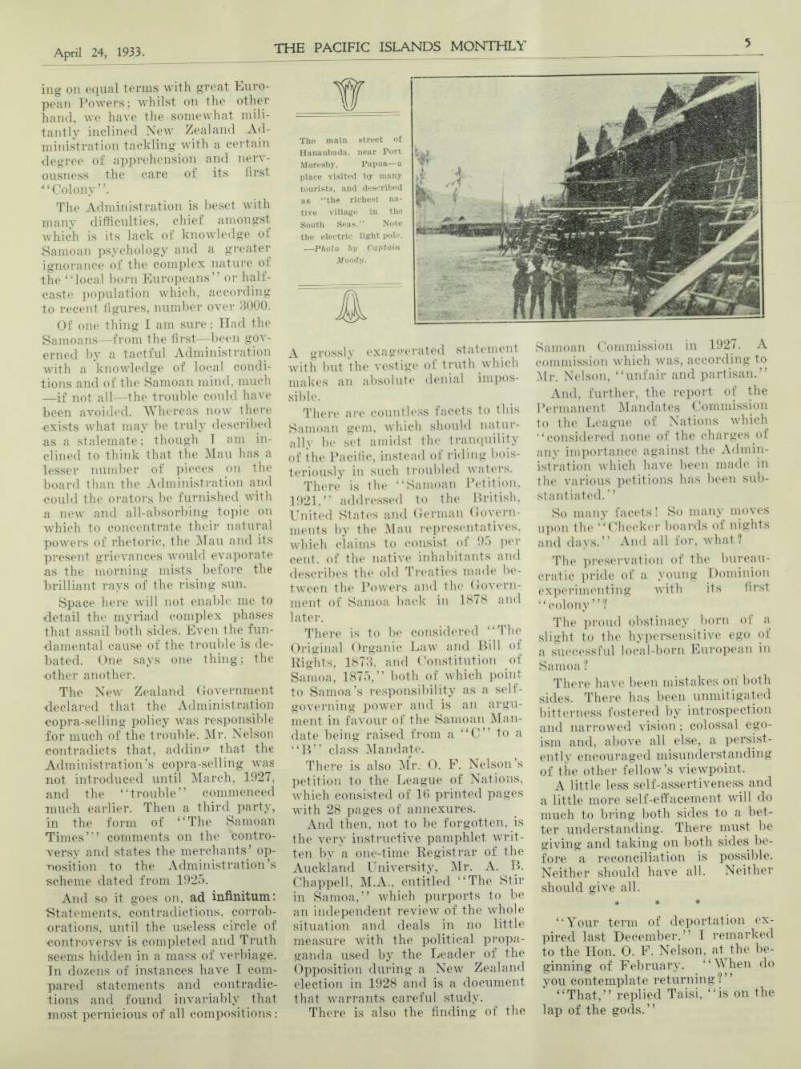
The main street of Hanaubada, near Port Moresby, Papua—a place visited by many tourists, and described as “the richest na tive village in the South Seas." Note the electric light pole.
Photo by Captain Moody.
His answer made me wonder; and then I realised that this much talked-of man who had championed a cause so persistently was a local born European with the blood of Northern Vikings and Southern Samoans in his veins, and he pos sessed a quality unknown to those against whom he was waging war.
He had an intimate knowledge of Samoan psychology. He knew only too well that a European’s word once given to a native was a bond —a sacred promise to be fulfilled.
He had undertaken to bring to a satisfactory conclusion the desires so volubly expressed by the Samoan chiefs and orators. Up to the pre sent he had failed, despite the fight he had put up which had echoed round the world and occupied the attention of judges, commissions and international tribunals. Is it not possible that his return is being delayed on account of that very knowledge he possesses of the na tive mind and the possible attitude which may be adopted towards him if he returns with an unfulfilled promise ? (It is announced elsewhere that Mr. Nelson and his family leave N.Z. for Samoa early next month. —Ed. P.I.M.) Both the Samoan Administration and Taisi should drop their narrow policies of personal animosities and concentrate their energies on bigger issues; allow their horizons to broaden; compromise. There must be give-and-take for both parties before a thorough reconciliation can be brought about. Create a new vital interest for the orators; ad vance the Samoan Mandate to “B” class; and let the Administration cease its copra-purchase scheme. * * * An official was endeavouring to impress upon a Samoan the insigni ficant size of his islands as com pared with the countries of the great Powers of the world. A map of the world was unfolded.
“See,” said the official, pointing to the small dots in the Pacific rep resenting Samoa, “those are your islands.”
“I see,” the native replied, still increduously, “but who made the map?"
That is the position in Samoa to day.
At midnight on June 29, a census of the non-indigenous population of the Mandated Territory of New Guinea will be taken. The District Officers of the various districts will be responsible for the distribution and collection of the census papers.
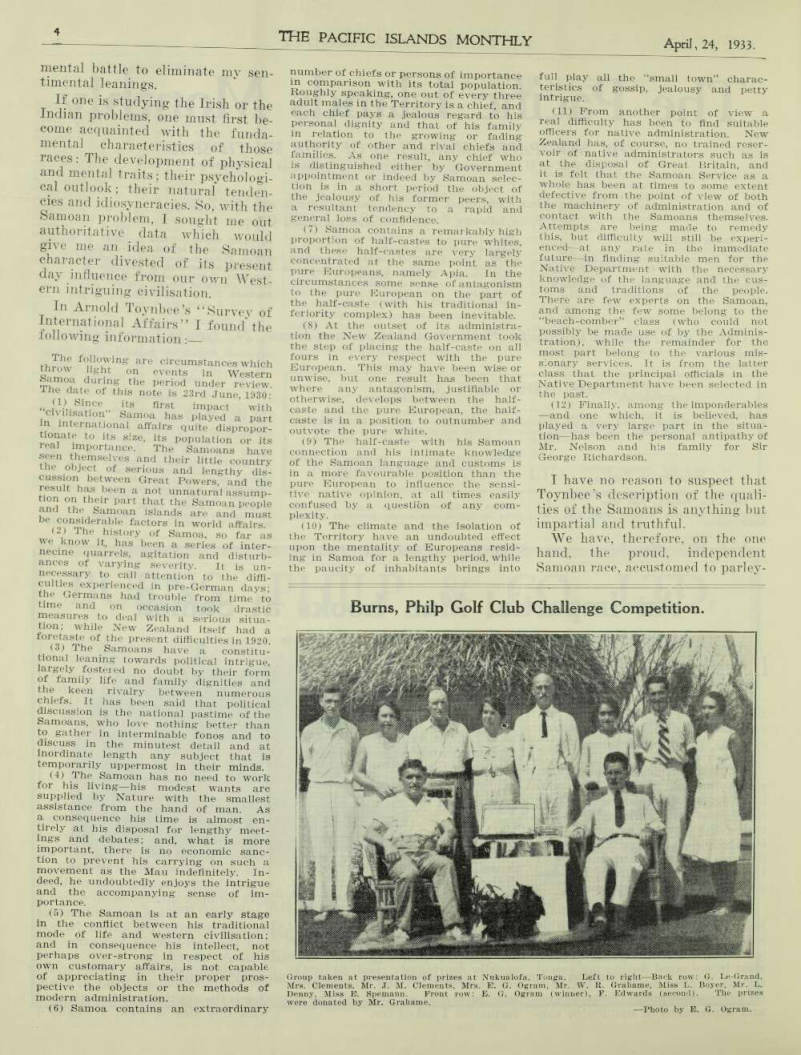
Burns, Philp Golf Club Challenge Competition.
Group taken at presentation of prizes at Nukualofa, Tonga. Left to right—Back row: G. Le-Grand, Mrs. Clements, Mr. J. M. Clements, Mrs. B. G. Ogram, Mr. W. R. Grahame, Miss L. Boyer, Mr. L, Denny, Miss E. Spemann. Front row: E. G. Ogram (winner), F. Edwards (second). The prizes were donated by Mr. Grahame. —Photo by E. G. Ogram.
Racing In Rabaul.
Amateur Turf Club’s Success.
THE Australian love of the sport of kings soon shows up in any com munity of Australians; and Rabaul is no exception.
Ever since the Occupation there have been enthusiastic horsemen in the Ter ritory and in 1930 these men were joined by other keen spirits in forming the Ra baul Amateur Turf Club.
Land was secured at Lakunai, near Matupi, and the Club’s funds had a be ginning in a “tarpaulin muster” among its promoters. A six furlongs’ course was laid down. It was crude at first; but at least it was a racecourse; and from the first meeting it was a success.
From these small beginnings the Club has grown into a popular and prosper ous concern. The rules of the Victorian Racing Club were adopted and, with the enthusiasm of the president (Mr. R. L.
Clarke) and an energetic committee, big strides have been made. To-day, the course at Lakunai is properly laid down, two furlongs of it are fenced with con crete, there are adequate stables, a grandstand and two totes.
The trophies raced for are worth win ning.
Among them are the “Perfection Cup,” presented by Messrs. D. and J. McCal lum; the “Waverley Cup,” presented by Toohey’s, Ltd.; and the “Dewar Cup,” all of which carry cash prizes as well, and there are also club handicaps, car rying substantial prizes.
The racing for the “Waverley Cup” has been remarkable. It was presented with the condition that it was to be held by the owner whose horse won it three times. The first year it was raced for, it was won by Mr. Fuller’s Greta Boy and that horse has carried it off each year since, so that Mr. Fuller is now the holder after only three races. Each year it was won in faster time.
The Rabaul Amateur Turf Club holds five meetings in the season. There have been three this season; the Cup Meeting in September and the New Year Meet ing and Anniversary Day Meeting in January. The Easter Meeting is fixed for April 22, and there will be another in June.
The secretary (Mr. Howard L. Clark), manager of the Bay Loo Company, is at present in Sydney; he is a brother of the president. The treasurer of the Ter ritory (Mr. H. O. Townsend) is judge;
Mr. C. A. M. Adelskold is timekeeper; and the committee has the following members: J. B. Cruise, J. C. Mullaley, M.L.C., R. A. Laws, D. S. Davis, C. A.
M. Adelskold, and W. R. Smith, Dr. E.
T. Brennan, Chief Medical Officer of the Territory, is honorary surgeon to the Club and is assisted by Dr. H. C. Hos king.
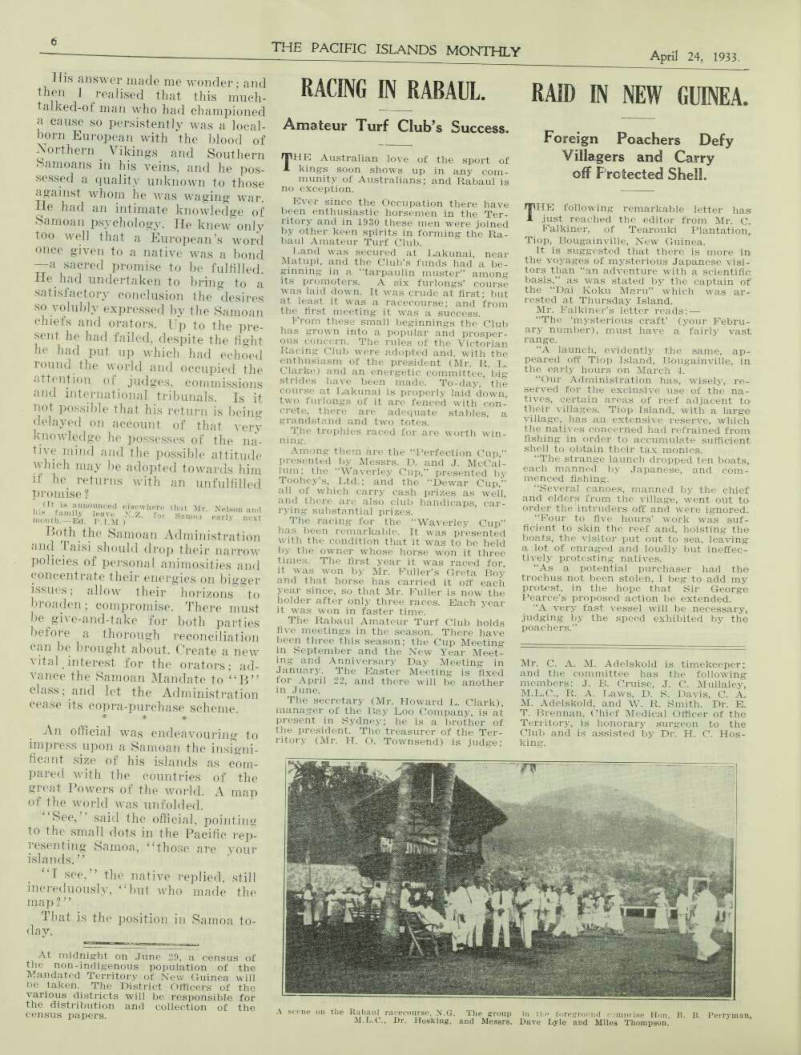
A scene on the Rabaul racecourse. N.G. The group in the foreground comprise Hon. B. B Perryman, Dr. Hosking. and Messrs. Dave Lyle and Miles Thompson.
Raid In New Guinea.
Foreign Poachers Defy Villagers and Carry off Protected Shell,
The following remarkable letter has just reached the editor from Mr. C.
Falkiner, of Tearouki Plantation, Tiop, Bougainville, New Guinea.
It is suggested that there is more in the voyages of mysterious Japanese visi tors than “an adventure with a scientific basis,” as was stated by the captain of the “Dai Koku Maru” which was ar rested at Thursday Island.
Mr. Falkiner’s letter reads: “The ‘mysterious craft’ (your Febru ary number), must have a fairly vast range.
“A launch, evidently the same, ap peared off Tiop Island, Bougainville, in the early hours on March 4.
“Our Administration has, wisely, re served for the exclusive use of the na tives, certain areas of reef adjacent to their villages. Tiop Island, with a large village, has an extensive reserve, which the natives concerned had refrained from fishing in order to accumulate sufficient shell to obtain their tax monies.
“The strange launch dropped ten boats, each manned by Japanese, and com menced fishing.
“Several canoes, manned by the chief and elders from the village, went out to order the intruders off and were ignored, “Four to five hours’ work was suf ficient to skin the reef and, hoisting the boats, the visitor put out to sea, leaving a lot of enraged and loudly but ineffec tively protesting natives.
“As a potential purchaser had the trochus not been stolen, I beg to add my protest, in the hope that Sir George Pearce’s proposed action be extended.
“A very fast vessel will be necessary, judging by the speed exhibited by the poachers.”
Papuan Sugar.
Big Area Taken Up.
On page 28 of this issue there is an article about sugar-growing in Papua.
Certain references are made therein to Sugarlands, Ltd., and the "Kingsmill Group."
After that article ivas put into type we were supplied with the following paragraph :— The area at Wanigela, Collingwood Bay, Papua, which was selected for the purpose of sugar-growing, has been sur veyed and found to contain 18,553 acres.
The necessary leases have been issued to Sugarlands, Limited, a company reg istered in Papua, but controlled in New Zealand. This company has now entered into an arrangement for the sale of the leases to interests associated with Sena tor Sir Walter Kingsmill, and it is an ticipated that the initial work will com mence at an early date. Sir John But ters, Brig.-General H. W. Lloyd (Man aging Director of Australian Soaps, Lim ited), Hon. J. G. Nelsson (Papua), Mr.
Thomas Boylan (a director of the Ba binda Sugar Mill), and Mr. P. R. Hig gins (a Sydney barrister and chairman of directors of Standard Portland Cement Company, Limited), together with Sir Walter Kingsmill, will form the directorate of the proposed company, The Papuan Sugar Corporation, Limited.
A Wedding
In Tonga.
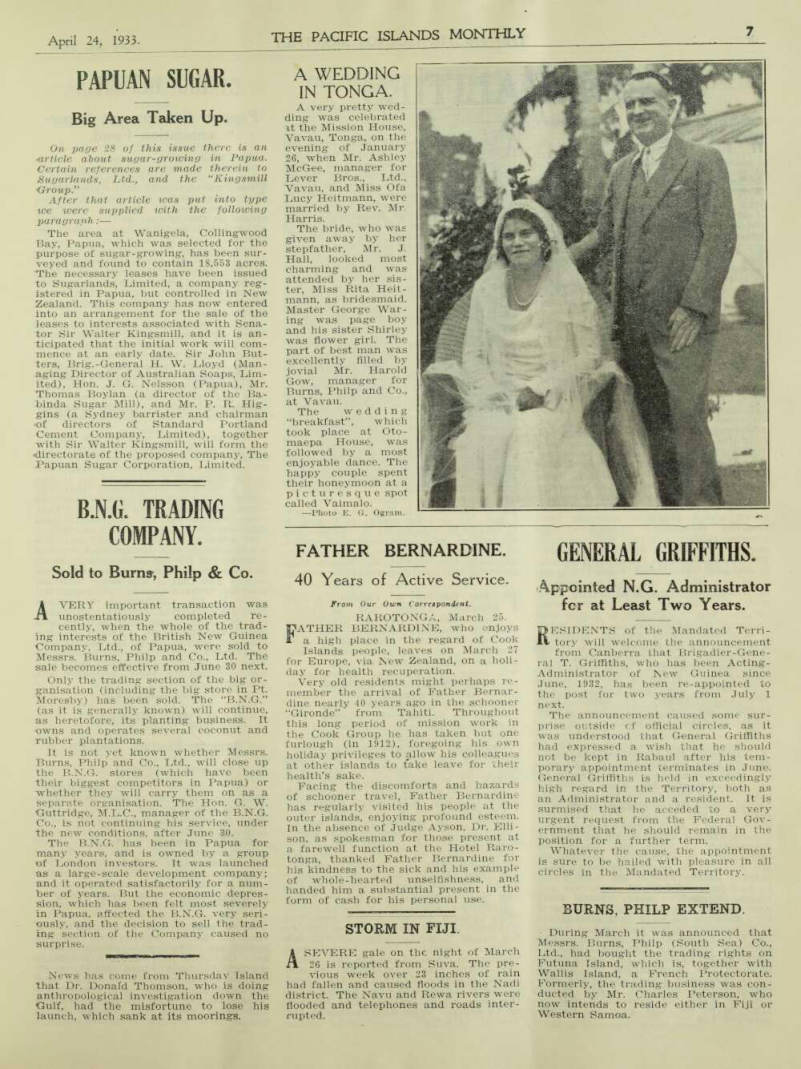
A very pretty wed ding was celebrated it the Mission House, Vavau, Tonga, on the evening of January 26, when Mr. Ashley McGee, manager for Lever Bros., Ltd., Vavau, and Miss Ofa Lucy Heitmann, were married by Rev. Mr.
Harris.
The bride, who was given away by her stepfather, Mr. J.
Hall, looked most charming and was attended by her sis ter, Miss Rita Heit mann, as bridesmaid.
Master George War ing was page boy and his sister Shirley was flower girl. The part of best man was excellently filled by jovial Mr. Harold Gow, manager for Burns, Philp and Co., at Vavau.
The wedding “breakfast”, which took place at Oto maepa House, was followed by a most enjoyable dance. The happy couple spent their honeymoon at a picturesque spot called Vaimalo. photo E. G. Ogram.
B.N.G. Trading
Company.
Sold to Burns, Philp & Co.
A VERY important transaction was unostentatiously completed re cently, when the whole of the trad ing interests of the British New Guinea Company, Ltd., of Papua, were sold to Messrs. Burns, Philp and Co., Ltd. The sale becomes effective from June 30 next.
Only the trading section of the big or ganisation (including the big store in Pt.
Moresby) has been sold. The “B.N.G.” (as it is generally known) will continue, as heretofore, its planting business. It owns and operates several coconut and rubber plantations.
It is not yet known whether Messrs.
Burns, Philp and Co., Ltd., will close up the B.N.G. stores (which have been their biggest competitors in Papua) or whether they will carry them on as a separate organisation. The Hon. G. W.
Guttridge, M.L.C., manager of the B.N.G.
Co., is not continuing his service, under the new conditions, after June 30.
The B.N.G. has been in Papua for many years, and is owned by a group of London investors. It was launched as a large-scale development company; and it operated satisfactorily for a num ber of years. But the economic depres sion, which has been felt most severely in Papua, affected the B.N.G. very seri ously, and the decision to sell the trad ing section of the Company caused no surprise.
News has come from Thursday Island that Dr. Donald Thomson, who is doing anthropological investigation down the Gulf, had the misfortune to lose his launch, which sank at its moorings.
Father Bernardine.
40 Years of Active Service.
From Our Own Correspondent.
Rarotonga, March 25.
FATHER BERNARDINE, who enjoys a high place in the regard of Cook Islands people, leaves on March 27 for Europe, via New Zealand, on a holi day for health recuperation.
Very old residents might perhaps re member the arrival of Father Bernar dine nearly 40 years ago in the schooner “Gironde” from Tahiti. Throughout this long period of mission work in the Cook Group he has taken but one furlough (in 1912), foregoing his own holiday privileges to allow his colleagues at other islands to take leave for their health's sake.
Facing the discomforts and hazards of schooner travel. Father Bernardine has regularly visited his people at the outer islands, enjoying profound esteem.
In the absence of Judge Ayson, Dr. Elli son, as spokesman for those present at a farewell function at the Hotel Raro tonga, thanked Father Bernardine for his kindness to the sick and his example of whole-hearted unselfishness, and handed him a substantial present in the form of cash for his personal use.
Storm In Fiji.
A SEVERE gale on the night of March 26 is reported from Suva. The pre vious week over 23 inches of rain had fallen and caused floods in the Nadi district. The Navu and Rewa rivers were flooded and telephones and roads inter rupted.
General Griffiths.
Appointed N.G. Administrator for at Least Two Years.
RESIDENTS of the Mandated Terri tory will welcome the announcement from Canberra that Brigadier-Gene ral T . Griffiths, who has been Acting- Administrator of New Guinea since June, 1932, has been re-appointed to the post for two years from July 1 next.
The announcement caused some sur prise outside cf official circles, as it was understood that General Griffiths had expressed a wish that he should not be kept in Rabaul after his tem porary appointment terminates in June, General Griffiths is held in exceedingly high regard in the Territory, both as an Administrator and a resident. It is surmised that he acceded to a very urgent request from the Federal Gov eminent that he should remain in the position for a further term, Whatever the cause, the appointment is sure to be hailed with pleasure in all circles in the Mandated Territory,
Burns, Philp Extend.
During March it was announced that Messrs. Burns, Philp (South Sea) Co., Ltd., had bought the trading rights on Futuna Island, which is, together with Wallis Island, a French Protectorate, Formerly, the trading business was con ducted by Mr. Charles Peterson, who now intends to reside either in Fiji or Western Samoa.
Tropicalties
WE have an urgent message from Cap tain P. H. Moody. In the March issue we published a number of photographs from Captain Moody, in cluding one showing “the first aeroplane to fly in New Guinea.” Captain Moody begs us to save him from the wrath of Messrs. Parer, Mustar, Cross, Shaw and other notable pilots who have pioneered the Islands airways. “They will all be up on their hind legs, making loud, angry noises,” says Captain Moody.
“I did not say ‘the first aeroplane’; I said ‘the first monoplane’—which is a vastly different thing. Look on the back of the photograph; I am sure the error is yours.” We have looked. The error is ours. We apologise to Captain Moody and all the pilots concerned. * * * THERE is quite a circumstantial “story” in “The Daily Herald” (London) of March 8 last, about an offer by Japan to enter into a “non aggression pact” with Holland, in return for concessions in Dutch New Guinea.
The proposal, it is said, was declined.
It is stated that the Japanese are seek ing an airway from Japan to Australia; that they have a large aeroplane base in Formosa; that Dutch ’planes, flying over the interior of Borneo, recently have seen carefully-constructed aero dromes on large, isolated plantations there, where Japanese interests have received substantial concessions for growing rubber; and that only one more step is wanted to complete the air track from Japan to Northern Australia.
It probably is all “tosh”—one can place little reliance on the “feature stories” of popular newspapers, especially when they are dealing with international affairs. But it certainly is a fact that Japanese manufacturers need very many of the products of tropical countries, and there are no tropical lands, except the Caroline and Marshall Islands, in the Japanese Empire. It is quite con ceivable that Japan is looking covet ously at the huge and absolutely un developed territory of Dutch New Guinea, without having any design whatever upon Australia. * * * ALTHOUGH the fine speedboat speci ally built for Fiji Airways, Ltd. was destroyed at the end of February by an explosion and fire which occurred when it was undergoing trials on Syd ney Harbour, the energetic people who organised Fiji Airways, Ltd. were not discouraged. They immediately pur chased another fine launch which was despatched to Suva and which, we understand, is already in commission.
Mr. Allan Cross must have been disap pointed at the loss of the boat which he had designed with so much care and which included so many special feat ures: but he was obviously not disheart ened because we learn that already his new company is functioning and hand ling both tourist and regular traffic. The two new seaplanes, purchased in Aus tralia by Fiji Airways, Ltd. are already in Suva and in operation. We predict for the Company a very useful and pro fitable career—although it can hardly hope to score the sensational success achieved by its older relation, Guinea Airways, Ltd.
A READER in Norfolk Island sends the following, with a solemn assurance of its truth:—In reference to danger from falling coconuts, can any reader beat this for a record? After the hurri cane in Fiji, in January, 1912, I was rid ing in the plantation when a heavy nut fell from a height of probably 35 or 40 feet, plumb centre, knocking me out of the saddle. My skull was not broken.
While I was gazing south one Sunday afternoon, hoping to sight the schooner Annie, a nut from a tall old tree bounced off my left upper arm into the Wainunu river. My arm was not broken. On an other occasion, while I was walking, a nut from a very tall tree struck me above the knee. No damage was done. * * * IF any of our readers happen to have kept early copies of The Pacific Is lands Monthly and are prepared to part with same, they may now make a small profit on the transaction. We have had inquiries from several parts of the world for complete files of The Monthly and our own supplies long ago were ex hausted. There are libraries in Britain, Germany and the United States which offer considerable sums for a complete file of the P.I.M., dating back to August, 1930. We have just received a letter from Mr. William F. Wilson, P.O. Box 3235, Honolulu, wherein Mr. Wilson of fers any of our readers 3/- each for copies of Nos. 1,2, 3 and 5 of Volume 1 and 2/- each for copies of Nos. 1,7, 11 and 12 of Volume No. 2. If there are subscribers who have unwanted copies of these particular issues, and will com municate directly with Mr. Wilson, they probably will receive payment by return. * * * IN the passing of Captain Arthur Algernon Austen, late of Ngari Ngari, Marovo Lagoon, the British Solomon Islands Protectorate loses one of its old and respected pioneer planters. His kindly disposition and genuine charity endeared him to all who knew him and the sincerest sym pathy is offered to his bereaved rela tives. He was admitted to the Metho dist Mission Hospital at Bilua, Vella Lavella, on January 19, suffering from a stroke of paralysis and died without gaining consciousness on February 5.
Captain Austen, who held a master mariner’s certificate dated 1899, and also an extra master’s certificate, served as a young man in the New York pilot service and later as an officer on many of the Union Steamship Co.’s vessels, as well as on several barques. He arrived in Fiji as an officer of the Fiji Government’s vessel, H.M.C.S. “Ranadi,” when that vessel was brought from England in 1900. He served as mate of the vessel in Fiji, and from 1903 to 1909 he was in com mand. He was also a member of the Fiji Marine Board from 1907 to 1909.
Resigning from the Fiji service in 1909, Captain Austen came to the Pro tectorate in 1910, having sailed the 14ton cutter “Lily” from Sydney with his brother, Captain Lou. Austen —now resident in Samarai —as the only mem ber of the crew. On arrival he ac quired the freehold title of the island of Ngari Ngari, where he resided until the close of his useful life at the age of 58 years. Many friends mourn the loss of “A.A.”
Big Deficit.
Papuan Government Super annuation Fund.
From Our Own Correspondent.
Pt. Moresby, March 22.
THE Papuan Government Superannua tion account for the 12 months ended on December 31 shows a rapid in crease in the annual deficit —a deficit which has to be borne by the public re venue.
Contributions received from officers during the year amounted to £3035; in terest to £1287; the total was £4322.
Pensions paid out amounted to £7493; expenses, £50; total, £7544. The deficit of £3221 will have to be found by the Government.
In 1931 the deficit was £1841 and it is estimated it will amount to somewhere near £4500 for the twelve months end ing December, 1933.
The Board’s investments now total £29,675, all in Commonwealth National Conversion Loan, 4 per cent. One hun dred and sixteen officers of the Public Service contributed to the fund last year and twenty-five drew superannuation al lowance.
In July of last year at the annual meeting of the Legislative Council, the question of the payment of £3250 from the revenue to the Superannuation Fund in the estimates was brought up. It was then considered unwarranted that the public should be called upon to bear this expenditure, and it was pointed out that every member of the community had made sacrifices except public servants.
In answer, it was stated that the whole scheme was inaugurated by the Government for the primary purpose of securing efficient, and continuous service and that it was never intended that the scheme would be supported solely by the contributions of officers from their salaries. Officers contributed five per cent, from their salaries and the Government took a share of the financial responsibility by having the fund guaranteed by the public revenue.
This responsibility the Government was legally bound to meet whenever the necessity arose.
Low Prices.
Samoan Produce Tied Up.
From Our Own Correspondent.
APIA, March 19.
THE local price for copra has dropped to a new low level —£6 10s. per ton to Europeans, and ¾ cents per lb. to Samoans. This is a serious blow to the producers, especially to the small Euro pean planters, who, even at a higher rate, hardly made ends meet. Whether a settlement of the American financial crisis will improve the market price in the near future remains to be seen.
The cocoa planter is not much better off. Though at present with beneficial weather conditions a good quantity of cocoa is picked, prices are low ,and buyers are unwilling to risk the mar ket. One Apia firm of copra buyers is reputed to have about 250 tons of Samoan cocoa on hand in British and American warehouses, representing an investment of approximately £12,000 and which stocks they are unable to dispose of at reasonable figures.
Samoa Prepares.
Visit.
From Our Own Correspondent.
APIA, March 19.
AN elaborate programme has been pre pared for the visit of the Governor- General, Lord Bledisloe, to Samoa by H.M.S. “Diomede” from April 19 to 1 23 At a recent meeting, presided over by the Administrator (General Hart) to discuss preparations for the visit, and attended by officials and representatives of all important clubs and societies of Samoa, several committees were formed to arrange the various functions decided upon. These are the citizen’s ball, the Samoan native dances and receptions, the entertainment of the “Diomede's" crew, etc. Visits to schools and planta tions, sports meetings, reception of Euro peans, etc., are part of the programme.
Old Hands’ Scorn.
Tahiti’s Libellers Get Another Kick.
From Our Own Correspondent.
PAPEETE, March 24.
WE wish to go on record here with very sincere cheers for the muchneeded article by Mr. Robert Dean Prisbie and similar remarks by the Editor in the February issue of the P.I.M. in regard to the increasing epi demic of “depression-evaders, beach combers, alcoholics, lechers and roman ticists” which has infested the Islands for some time.
All the old-timers here agree with us heartily on this point.
Now that the matter has been made a definite public issue, we feel it in cumbent on us to broadcast a warning to budding nincompoops infected with “cacoethes scribendi” to confine their incredible prevaricating ability to their own filthy little home towns. Give the yokels a treat, by all means, but don’t send them mooning down to the quiet South Seas with the last few pennies from little Johnnie’s bank. We speak feelingly in this matter, and hope it goes a lot further.
We also take this opportunity to re mark, most emphatically, that at no time are the chances of obtaining em ployment in Tahiti, for a European, anything but the very slimmest, and in these days they are nil. Tourists and visitors of the right sort will meet with a hearty welcome, can enjoy a good time amid the most pleasant surround ings, and at very reasonable cost, but we draw the line at the eccentric speci mens of humanity alluded to in the articles quoted.
Cyclone At Noumea.
A violent cyclone which blew all the night of April 9 and well on into the following day did considerable damage at Noumea.
The Japanese ship “Juyo Maru,” bound from Vancouver to Sydney with timber, when about to put into Noumea during the height of the cyclone was blown ashore, but was not seriously damaged.
The Old And The New.
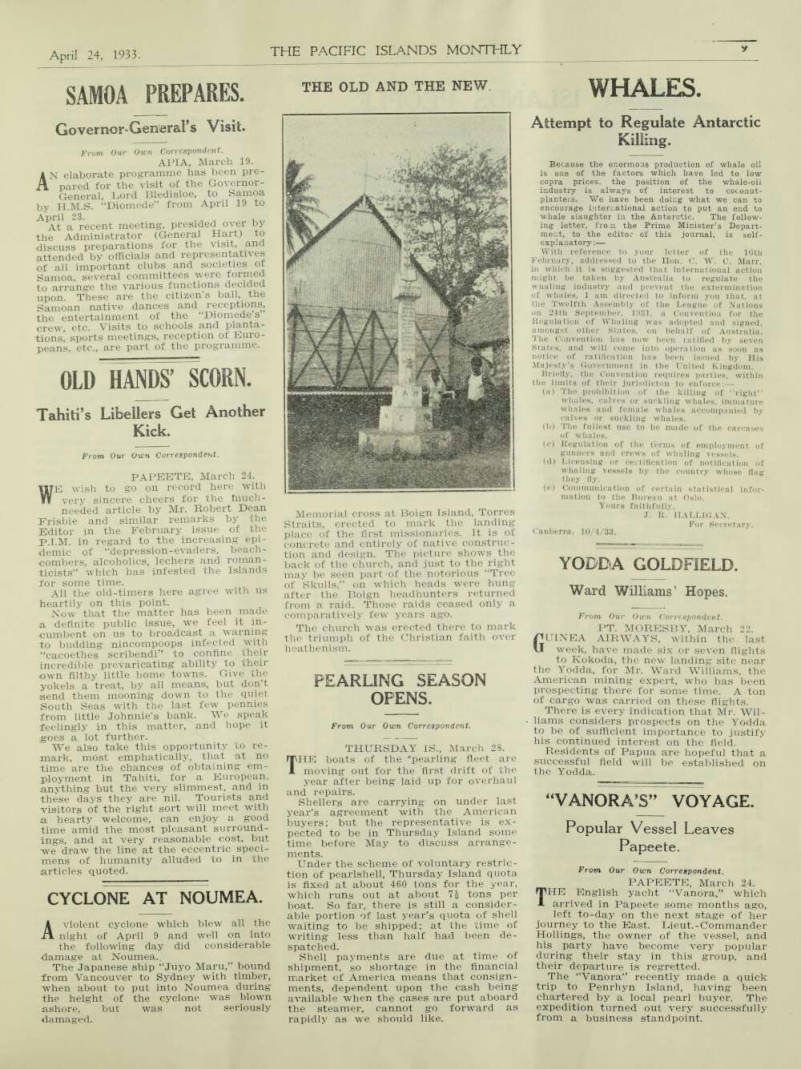
Memorial cross at Boign Island, Torres Straits, erected to mark the landing place of the first missionaries. It is of concrete and entirely of native construc tion and design. The picture shows the back of the church, and just to the right may be seen part of the notorious “Tree of Skulls,” on which heads were hung after the Boign headhunters returned from a raid. Those raids ceased only a comparatively few years ago.
The church was erected there to mark the triumph of the Christian faith over heathenism.
Pearling Season
Opens.
From Our Own Correspondent .
Thursday Is., March 28.
TiHE boats of the pearling fleet are moving out for the first drift of the year after being laid up for overhaul and repairs.
Shellers are carrying on under last year’s agreement with the American buyers; but the representative is ex pected to be in Thursday Island some time before May to discuss arrange ments.
Under the scheme of voluntary restric tion of pearlshell, Thursday Island quota is fixed at about 460 tons for the year, which runs out at about 7½ tons per boat. So far, there is still a consider able portion of last year’s quota of shell waiting to be shipped; at the time of writing less than half had been de spatched.
Shell payments are due at time of shipment, so shortage in the financial market of America means that consign ments, dependent upon the cash being available when the cases are put aboard the steamer, cannot go forward as rapidly as we should like.
Whales.
Attempt to Regulate Antarctic Killing.
Because the enormous production of whale oil is one of the factors which have led to low copra prices, the position of the whale-oil industry is always of interest to coconut plantens. We have been doing what we can to encourage international action to put an end to whale slaughter in the Antarctic. The follow ing letter, from the Prime Minister’s Depart ment, to the editor of this journal, is self explanatory : With reference to your letter of the 16th February, addressed to the Hon. C. W. C. Marr, in which it is suggested that international action might be taken by Australia to regulate the whaling industry and prevent the extermination of whales, I am directed to inform you that, at the Twelfth Assembly of the League of Nations on 24th September, 1931, a Convention for the Regulation of Whaling was adopted and signed, amongst other States, on behalf of Australia.
The Convention has now been ratified by seven States, and will come into operation as soon as notice of ratification has been issued by His Majesty’s Government in the United Kingdom.
Briefly, the Convention requires parties, within the limits of their jurisdicton to enforce:— (a) The prohibition of the killing of “right” whales, calves or suckling whales, immature whales and female whales accompanied by calves or suckling whales. (b) The fullest use to be made of the carcases of whales. (c) Regulation of the terms of employment of gunners and crews of whaling vessels. (d) Licensing or certification of notification of whaling vessels by the country whose flag they fly. (e) Communication of certain statistical infor mation to the Bureau at Oslo.
Yours faithfully,
J. R. Halligan.
For Secretary.
Canberra, 10/4/33.
Yodda Goldfield.
Ward Williams’ Hopes.
From Our Own Correspondent.
Pt. Moresby, March 22.
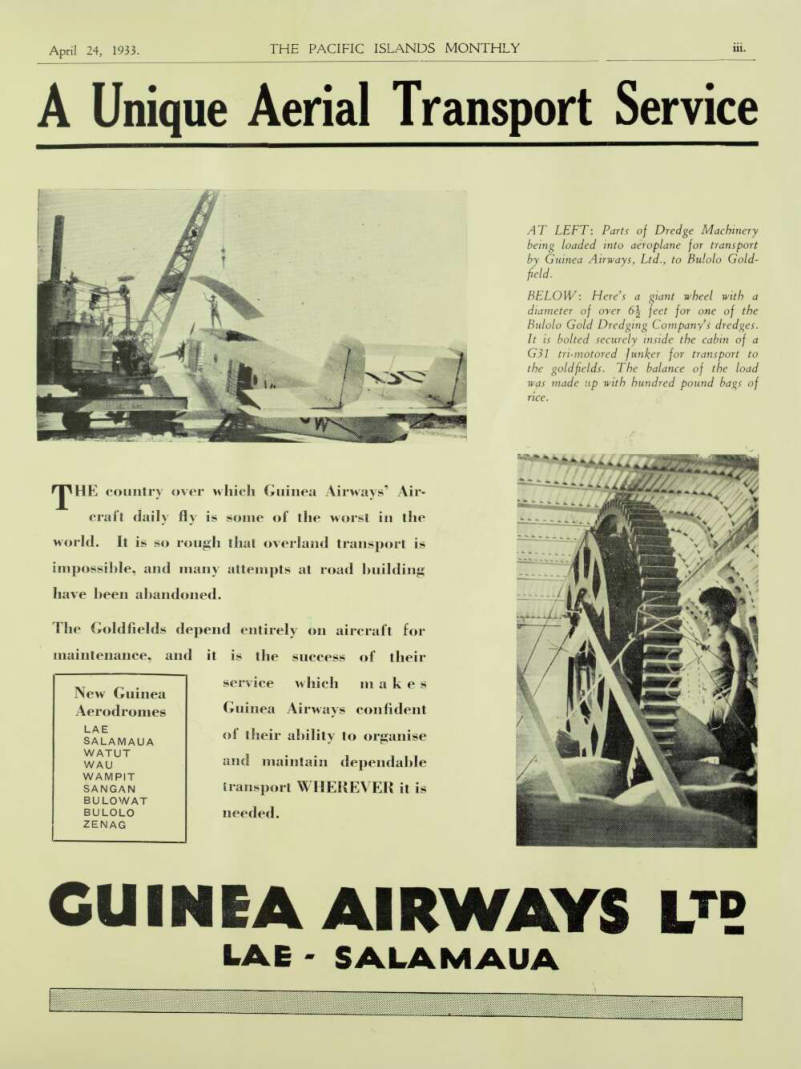
GUINEA AIRWAYS, within the last week, have made six or seven flights to Kokoda, the new landing site near the Yodda, for Mr. Ward Williams, the American mining expert, who has been prospecting there for some time. A ton of cargo was carried on these flights.
There is every indication that Mr. Wil liams considers prospects on the Yodda to be of sufficient importance to justify his continued interest on the field.
Residents of Papua are hopeful that a successful field will be established on the Yodda.
Papeete.
“Vanora’S” Voyage.
Popular Vessel Leaves Papeete.
From Our Own Correspondent.
PAPEETE, March 24.
THE English yacht “Vanora,” which arrived in Papeete some months ago, left to-day on the next stage of her journey to the East. Lieut.-Commander Rollings, the owner of the vessel, and his party have become very popular during their stay in this group, and their departure is regretted.
The “Vanora” recently made a quick trip to Penrhyn Island, having been chartered by a local pearl buyer. The expedition turned out very successfully from a business standpoint.
About Islands People.
Mr. L. St. George Ryder, of Vavau, Tonga, has been transferred to Levuka, Fiji. He is relieving Mr. G. S. Chis holm in the managership of the stores of Messrs. Morris Hedstrom Ltd. Mr.
Chisholm is away in Apia, Samoa, re lieving Mr. Smyth, the M.H. manager there.
Mr. V. D. Bent, manager of Messrs.
Lever Bros, plantations on Guadalcanar, Solomon Isands, has been spending a vacation in Tahiti during the past few weeks (says our Papeete correspondent).
He will return to Sydney by the next mail steamer. He looks forward to locat ing there permanently as soon as his affairs will permit.
Mr. Harold Nobbs, a director of Hol brooks (Australasia) Ltd., will be a pas senger for Papua and New Guinea by the April “Macdhui.” He hopes, during his round trip, to meet many of the Islands retailers, with whom his firm has been doing business for years.
Mr. E. W. Mathews, Postmaster at Lautoka, Fiji, died at his home on March 3. He was a son of the Rev. Mathews, who formerly resided at Suva. He was also a member of the Fiji Contingent.
Mr. Fernard Colardeau, a barrister at Noumea, New Caledonia, arrived in Syd ney by the “Mooltan” on March 23, after a holiday in France. He is the Presi dent of the Returned Soldiers’ League in New Caledonia and New Hebrides.
Mrs. Walter Horne, mother of Mr.
Thomas Horne, a well-known merchant of Suva, Fiji, died at her residence in Sydney on March 4. Mrs. Horne was born in Scotland and went to Fiji with her husband and family in 1883. After residing in Fiji for 17 years, Mr. and Mrs. Horne left the Colony and settled in Sydney.
Mr. George Hathaway, of Suva, Fiji, died on March 13 after an operation at the Wahroonga Sanitarium, New South Wales. He had lived in Suva for many years and was a prominent figure in the timber industry, having been in charge of the Rewa Sawmilling Co.
The Rt. Rev. Dr. Gilbert White, formerly Bishop of Carpentaria, died at Epping, N.S.W., on April 1, at the age of 74. Dr. White was consecrated first Bishop of Carpentaria in 1900 and took up his headquarters at Thursday Island.
His Cathedral there was the Quetta Memorial Church, erected in memory of those who lost their lives in the wreck of the “Quetta.” During the 15 years in which he was Bishop, he made many visits to the Torres Straits islands, and after he resigned the Bishopric he wrote a book entitled “Round About the Torres Strait,” dealing with his life’s work.
Mr. J. L. MacLeod, formerly District Inspector of Constabulary at Ba, Fiji, left by the “Malake” on March 5, for Rotuma, where he will act as Resident Commissioner for three months. Mr. W.
Burrows, who had occupied that posi tion, returned to Suva owing to ill health.
Mr. H. King Irvine, Manager of the Colonial Sugar Refining Company in Fiji, accompanied by his wife, arrived in Sydney by the “Mariposa” on March 2. They returned to Fiji on March 11.
Rev. V. H. Sherwin, Anglican Mis sionary at Sag Sag, on New Britain, arrived in Sydney during April, after five years of unbroken service in the Territory. Rev. I. H. Stockdale is re lieving him at Sag Sag.
Mr. S. Maeji, of Suva, Fiji, left by the “Niagara” on March 10 for a twelve months’ holiday in Japan. He was farewelled by members of the Oriental Tennis Club, who made him a presentation of a box of toilet brushes.
Nurse Edna Williams, of the Metho dist Foreign Mission, left Melbourne, Victoria, on March 28, for Queensland.
After a short holiday at Townsville, she left for the Stewart Hospital in New Britain, where she is stationed.
Sir Maynard Hbdstrom. accompanied by Lady Hedstrom, left Suva, Fiji, for America by the “Mariposa” on March 17, on a world tour. They will proceed to London in May and will return to Fiji early next year.
Mr. W. G. Wiedemann, of the New Guinea Mission, arrived at Rabaul dur ing March. He left shortly afterwards for the South Coast of New Britain, where he is helping Mr. A. C. Eldridge to supervise the Mission Stations at Kauptimeti and Arawe.
Mr. R. Hall, who has been engaged in mining operations in New Caledonia for the last three years, arrived in Syd ney on April 10 by the “Laperouse.”
Accompanied by Miss Hall, he is on his way to England.
Mrs. C. R. Pinney, wife of the Ad ministrator of Norfolk Island, has been staying in Sydney during Easter. She returned to Norfolk Island by the “Morinda” on April 20.
Monsieur L. Jore, Governor of New Caledonia, and his wife arrived in Syd ney by the “Laperouse” on April 10, on their way to France. He was trans ferred from Tahiti to New Caledonia as Governor last year.
Lady Murray, wife of the Lieutenant- Governor of Papua, arrived in Sydney from London by the “Oronsay” on April 11. Mrs. Burns, wife of Mr. James Burns, chairman of directors of Messrs.
Burns Philp & Co. Ltd., was also a pas senger on the “Oronsay.”
Rev." Fathers Lakaff, Grundl and Wigishoff, and Rev. Brothers Hessling and Weckener left Sydney for France by the steamer “Cephee” on April 12, after long periods of service with the missions of the Fathers of the Sacred Heart. Father Wigishoff has been in the Gilbert Islands over 30 years and the remainder of the party in the Vicar iate of Rabaul for from 20 to 30 years.
They will return to their posts after a holiday of 12 months in their home land.
Mr. W. Watson, Deputy Adminis trator of Savaii, and formerly Director of Public Works at Apia, left Samoa after 11 years of service. He was well known and popular amongst wide circles and his resignation is much regretted.
Mr. A. Kennedy, of the Wireless staff at Thursday Island, has been transferred to Sydney, and will be leaving T.I. shortly. He intends to make the round tour of Australia by sea before taking up duty at his new post.
Mr. A. C. Barnes, Director of Agri culture in Fiji, and Mrs. Barnes arrived in Sydney on March 25 by the “Aorangi" from Suva.
Messrs. C. L. Dawn, manager, W.
Simpson, bush manager, and G. Stokes,. chief engineer, of the Vanikoro Kauri Timber Co. Ltd., arrived in Sydney by the “Aloe” on March 30 from Vanikoro, Santa Cruz.
Mr. R. J. Sandells, of the Church of Christ Mission, New Hebrides, arrived, in Sydney on furlough by the “Morinda” on March 27.
Mrs. G. B. Drayton, of 884 Old South; Head Road, Rose Bay, Sydney, widow of the late Pilot Drayton, of New Guinea, has asked us to say that she “wishes sincerely to thank her Islands friends for their many kindnesses and sympathy expressed to her in her re cent loss.”
Mr. J. G. McLaren, Official Secretary to the Commonwealth in London, is to represent Australia at the next meeting of the Mandates Commission at Geneva, in June. The Commission is the organi sation which reviews reports received from countries holding mandates from; the League of Nations.
Mr. John MacDonald, a resident in Papua for 40 years, returned to the Territory by the March “Macdhui,” after spending several months in Brisbane, being patched up by the doctors. Mr..
MacDonald, usually an aggressively healthy man, somewhat resented his re cent sickness. “We don’t regard malaria as illness,” he told the editor of this journal. “That is only being off colour. I used to travel a lot with Sir William MacGregor, exploring and sur veying, often in swampy country, in fested with scrub itch, mosquitoes, sand flies, etc., and among hostile natives, and we never got any severe sickness.”"
Mr. Gordon Thomas, of Buka Passage, New Guinea, who had spent some months’ furlough in Australia and New Zealand, returned to New Guinea by the “Montoro,” on April 7. Mrs. Thomas, who came south with him, is staying with friends in New Zealand.
Right Hon. Earl Beauchamp (a for mer Governor of N.S.W.), who has been residing in Sydney for several months, intends to leave for Tahiti in June. He hopes to visit various parts of French Oceania before returning to Sydney in August. He will be accompanied by his son, Lord Elmley.
Judge Gore, of the Papuan Adminis tration, is at present residing in Syd ney, enjoying a short period of furlough.
“Bolton” Damaged.
New Guinea Motorship in Collision on Sydney Harbour.
A SERIOUS mishap occurred to the new motor vessel “Bolton” while she was undergoing a speed trial in Sydney Harbour on April 12, im mediately before leaving for New Guinea to enter the Island service of Messrs.
W. R. Carpenter and Co., Ltd.
The hull of the “Bolton” was com pleted recently at Jervis Bay and had been towed to Sydney, where the in stallation of the engines and machinery and other work was rapidly carried out.
Everything had been made ready for the trial. The engineers were tuning the engines and the vessel was just being put “over the mile” when a collision occurred with the trawler “Bar-ea-Mul,” which came out of Woolloomooloo Bay.
The impact was severe and the star board bow of the “Bolton” was stove in from the deck to below the water line.
Water poured in through the hole and the pilot in charge of the vessel im mediately made for the nearby shoal off Darling Point and beached her. Several members of the crew of New Guinea natives (who came south recently to join the vessel) and the shipwright’s staff who were working on the vessel received minor injuries. One was thrown overboard, but was rescued.
The “Bolton” was later towed off the shoal and taken to the engineers’ yards at Lavender Bay, accompanied by an other tug which kept the flow of water in check by pumping.
A preliminary survey showed that the hull was badly damaged forward. The “Bar-ea-Mul” showed little signs of the collision.
It has been estimated that the “Bolton’s” repairs will take three or four weeks. The damage is covered by insurance.
Savage Sharks.
T.I. Divers Attacked.
From Our Own Correspondent,
Thursday Is., March 28.
BECHE-DE-MER and trochus swim mers have found sharks troublesome lately. A Saibai boy was brought into hospital a few weeks ago with sharkbite injuries, and recently a lad in one of the Island cutters just missed having his arm torn off, the shark in its eagerness dashing between the boy’s arm and face, inflicting small wounds and a nasty knock in the eye. The boy immediately dropped to the bottom, rested a little, flat on the ocean bed, so as to minimise risk of further attack, and then got to the surface, where his mates, who had seen the incident and had scared the shark away, were wait ing.
One of the onlookers, however, became unnerved, and decided that he would take a job in a shelling boat, where he would not have to do skin diving, for a period. When he came into T. I., the doctor ordered him into hospital for an overhaul before going to sea again; as he had previously complained of chest trouble. The patient next to whom he found himself in the ward was the vic time of the first shark attack!
Discomforts of Long Voyage.
“Frangipani’S” Record.
From Our Own Correspondent.
Rarotonga, March 25.
THE “Frangipani,” a specially designed big-game fishing launch for Mr. Zane Grey, arrived at Rarotonga on March 12 after an uncomfortable voyage from Auckland.
The motor-launch set out on March 2 laden with 7 tons of petrol to face the first stage of the journey—1,636 miles of open sea. The cabin and most of the accommodation were given up to provide space for the fuel, as such craft usually are not designed to carry cargo. To the discomfort of the re stricted accommodation was added the danger from fire, and the five members of the crew resolved not to strike a match throughout the whole of the jour ney, thereby foregoing cooked meals, hot drinks, and smokes.
Consequently when the launch reached Rarotonga Captain Pyper and his men were in a weary condition from the effects of oil fumes and loss of sleep, and parched for a cup of tea. Perfect weather conditions were experienced as far as Rarotonga. It was considered daring to bring a launch into these waters during the hurricane season.
The “Frangipani” sailed for Papeete on March 13, arriving on March 20. Be tween Auckland and Rarotonga the launch averaged a speed of 6.8 knots.
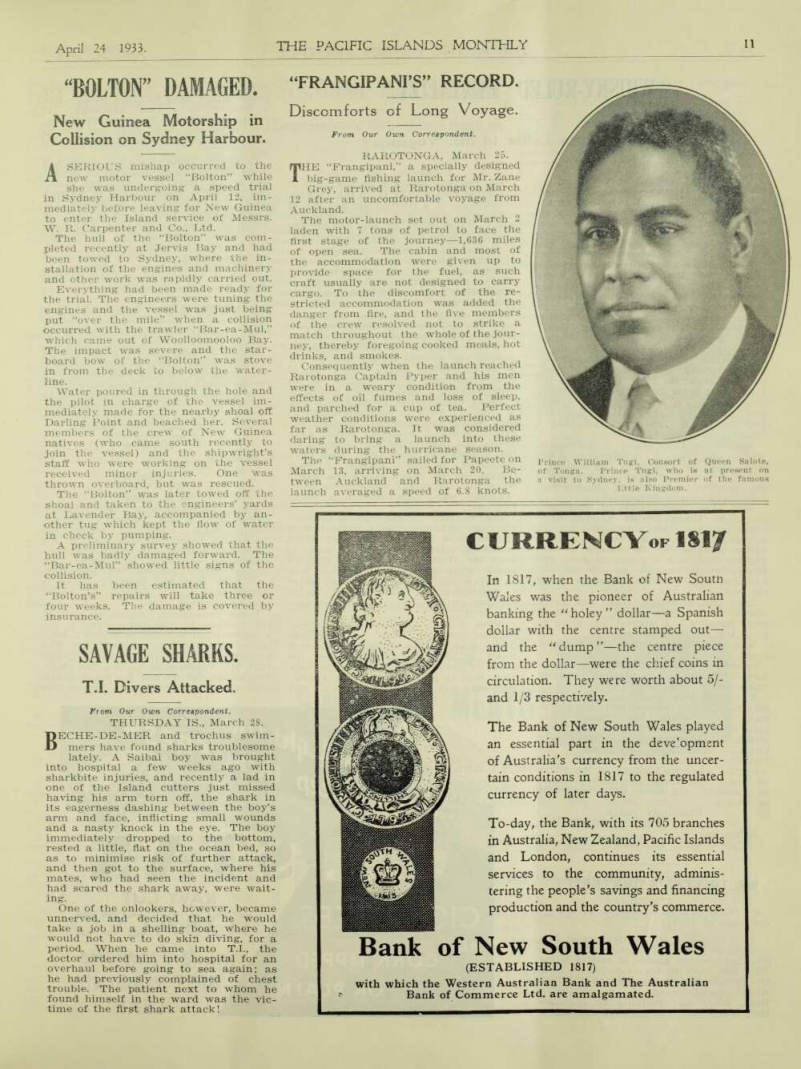
Prince William Tugi, Consort of Queen Salote, of Tonga. Prince Tugi, who is at present on a visit to Sydney, is also Premier of the famous little Kingdom.
Advertisements & other items, p. 13 (1 item)
Bank of New South Wales
CURRENCY of 1817
In 1817, when the Bank of New Soutn Wales was the pioneer of Australian banking the “holey” dollar —a Spanish dollar with the centre stamped out — and the “dump” —the centre piece from the dollar —were the chief coins in circulation. They were worth about 5/and 1/3 respectively.
The Bank of New South Wales played an essential part in the development of Australia’s currency from the uncer tain conditions in 1817 to the regulated currency of later days.
To-day, the Bank, with its 705 branches in Australia, New Zealand, Pacific Islands and London, continues its essential services to the community, adminis tering the people’s savings and financing production and the country’s commerce.
Bank of New South Wales
(ESTABLISHED 1817)
with which the Western Australian Bank and The Australian Bank of Commerce Ltd. are amalgamated.
“Whisky-Ruled Mentality.”
Another Open Letter to Mr. Vogan.
Dear Mr. Vogan.—The old ruse of dragging a herring across the trail often succeeds, and it is said that the best defence is a strong attack. I think both must have been in your mind when you penned the letter which appeared over your name in the P.I.M. of 22/2/33.
I can quite understand your getting “hot under the collar” at a mere trader questioning the truth of your statements, but you most certainly made a very bad choice of the dis tricts open to you when you wrote: “Bishop Newton can go with safety where nine out of ten of the modern reach-me-down business men would be knocked on the head in 24 hours.”
You neither uphold your statement, nor withdraw it. The readers of the P.I.M. will draw their own conclusions.
However, I am pleased to note that you appreciate my giving you the opportunity of “gassing” and that I “have your forgiveness.”
Anyone in these days of depression who can raise a wholesome laugh is a public benefactor. You qualify — however unintentionally—when you say my “witty criticisms are really a defence of whisky-drinking.”
Now, I’ve been called a “wowser” scores of times during the past 50 years, so you can quite imagine the change it is to be accused of the re verse. Judging by the shoals of leg pulling chits that are coming down the Bay, Samarai has not missed the joke, and I’m sure you won’t grudge it to the writers.
Like the Scotsman who was given claret, we are, I’m afraid, not getting any “forrader.” I suggest you stick to your text — Was your statement re this Division true ?
Is such a thing as a sober, straight forward trader, or plantation manager, unknown?
The first you made as a definite statement. The second, you imply over and over again. Wandering away into references about “dear old, wise, selfish Lord Chesterfield,” “flash bare knees,” “Eve, and her apple,” “the Dexters of the new generation” (who —by the way—isn’t guilty of the crime of youth, but about the same vintage as yourself) will never prove you right or wrong.
Faithfully yours,
Henry Dexter.
Milne Bay, Papua, E.D., 11/3/33.
Mr. Dexter’S Dexterity.
Mr, Vogan teas shown a copy of the above letter, and replies as follows: As I have not Mr. Dexter’s good for tune to be able to live peacefully in the pleasant coconut glades of restful Milne Bay, but have to travel about all over the Pacific, my correspondence is some what overwhelming. I am writing a book, also; and replying to inquiries that reach me from all over the world.
Mr. Dexter’s attack upon my view of the curse that whisky is, in the Tropics, reminds me of a funny little god-son of mine, who was “quite cross” with me when I last went to see certain old friends of mine who have produced him, “Dexter (we will call him) is very naughty this morning!” stated his pretty young mother. “Something he ate last night at the children’s party at Mrs. Milne’s, has unsettled his little tummy, I fancy!”
Sure enough, that same afternoon, my little god-son was almost his own bright, affectionate self again.
I have written for over 600 news papers, and several books; and no one is more painfully aware than I am, of how prone one is to error. But, in demonstrating against the damnable effect of whisky upon young men trying to live and work in such a climate as that which has produced Mr. Dexter’s explosive attack upon my ability as a writer and observer, I am seconded by the example of most men who have succeeded in the climate of New Guinea—as we called all of the island before the stupid and meaningless word “Papua” was invented by a witty foreigner.
True dexterity is not evinced by find ing fault with opinions merely; but in bringing new and valuable suggestions before a waiting public. I hope to meet Mr. Dexter some day on friendly terms. I am sorry to have touched him on a raw spot! But one cannot write a description of, say, “whisky-nog,” without introducing the spiritual por tion of it.
When I first went as artist-corres pondent to the wilds of Northern Queensland for the “Illustrated London News” in 1887, dear old Plummer, the doyen of newspaper men in this country then, said to me: “You seem a young ster who will take advice from an old
hand! Now, you will, where you’re going, either have to drink whisky like a fish—or be a total abstainer! If you’re an abstainer they’ll laugh at you.
But in twenty years’ time you will be able to laugh at them —if they’re still alive! ”
Of course, some of the old hands will bring forward cases like that of Boyd— son of Dr. Boyd of sugar-cane fame; and brother of dear old R.M.B., partner with the Whites of Newcastle, at Lucinda Point. Boyd drank at least one bottle of whisky a day, and often two.
Yet, when I first saw him at Twofold Bay, where he retired from Viti Levu, he was digging his garden at 84 years of age; and he read me a paragraph in the local “butter-wrap” without his spectacles. But altho’ this seems an argument in favour of alcoholic poison ing, he might (you never can tell!) have lived until now, to second my argu ment with Mr. Dexter, had he abstained to, say, half a bottle a day!
With a friendly and sympathetic wave of my dexter hand to your amusing correspondent, I must really get on with my European letter. Thanking you for your much appreciated permission to publish this screed in your admirable “P.I.M.,” which I hear of from all parts of the Pacific and South America.
I am., etc.,
Arthur J. Vogan,.
Sydney, April 15, 1933.
To the Editor.
Your correspondent, Mr. Vogan, seems to be a bad “guesser.’’ He re cently wrote something about the diocese of Bishop Newton. When his; error was pointed out by another cor respondent of yours, Mr. Dexter, Mr.
Vogan calmly ignores the correction and says that Mr. Dexter’s letter is “when analysed, a defence of heavy whisky-drinking.”
I can read plain English as well as the average person, but neither I, nor a dozen other persons to whom I have shown the letter in question, can find, a single word conveying the meaning that Mr. Vogan says he can find in it.
I’ve known Mr. Dexter for many years and relatives of mine have known him
for nearly a quarter of a century. Mr.
Vogan could not have made a worse “guess” had he searched the whole of the Pacific.
How Mr. Vogan—who pays flying visits to this Territory—can claim to have more knowledge of the conditions here than a man who spends 365 days a year among the natives, is another puzzle.
Mr. Vogan writes: —“The only value of old fogies, like myself, to later arrived humans is that our experi ences may serve as guidance.”
Surely it were better that guidance should be founded on truth.
I am, etc.,
Oldtimer.
Samarai, 18/3/33.
Advertisements & other items, p. 14 (1 item)
Tobacco
Capstan
CIGARETTES
CORK TIPPED
OR PLAIN
TAN
NAVY CUT
TOBACCO
made from the
BEST VIRGINIA
leaf
N.G. Public Service.
THE following appointments, promo
tions, transfers, etc., in the public
service of the Territory of New Guinea are culled from the Official Bul letin (number 12) issued by the Admin istration and dated February 28. We have arranged to publish information from succeeding Bulletins.
Permanent Staff.
Appointments.
G. Ellis, to be Acting Assistant District Officer.
Grade 2.
H. L. R. Niall, to be Acting Assistant District Officer.
Promotions.
E. A. Feldt. to be District Officer, Grade 2.
G. W. L. Townsend, to be District Officer, Grade 2.
E. W. Oakley, to be District Officer, Grade 1.
Transfers.
F. W. Mantle, Assistant District Officer, from Manus to Madang.
R. C. Chugg, Medical Assistant, Grade 1, from Rabaul to Madang.
V. A. Jenkin, Nurse, from Rabaul to Salamaua.
V. F. Garvey, Assistant Teacher, from Rabaul to Salamaua.
A. Hyde, Mining Registrar, from Rabaul to Salamaua.
Temporary Employees.
Appointments.
J. H. L. Waterhouse, to be Assistant Teacher.
C. Reason, to be Clerk.
W. L. Gibson, to be Clerk, Salamaua.
A. M. Eglinton, to be Storeman.
J. White, to be Wharfinger-Clerk.
M. Clements, to be Nurse, European Hospital, Manus.
L. R. Hyland, to be Storeman.
Transfers.
S. A. P. Clarke, Medical Assistant, from Madang to Kieta.
Police.
Appointments.
J. M. Main, to be Warrant Officer, 2nd Class.
G. H. F. Haag, to be Warrant Officer, 2nd Class.
Transfers.
R. W. Feetum. Warrant Officer, 2nd Class, from Rabaul to Madang.
P. D. Moncur, Warrant Officer, 2nd Class, from Rabaul to Wau.
R. H. Hicks. Warrant Officer, 2nd Class, from Rabaul to Edie Creek.
H. G. McFarlane. Warrant Officer, 2nd Class, from Namatanai to Rabaul.
Promotions and Appointments.
Advice has been received of the approval of the follovfing promotion and appointment to be Patrol Officers as from December 14, 1932: — John Amery Costelloe, Clerk. Department of the Treasury.
Charles Dowson Bates, Warrant Officer, Euro pean Constabulary.
William Henry Bird, Warrant Officer, European Constabulary.
The London Missionary Society’s
auxiliary schooner, John Williams V, which was overhauled at Suva. Fiji, dur ing February, sailed for the Gilbert and Ellice Islands on March 4.
Standing The Strain.
Depression's Sobering Effect in Papua.
From Our Own Correspondent.
Pt. Moresby, March 22.
PAPUAN residents are very conscious of the world-wide slump and the steady fall in copra and rubber —the mainstays of the Territory. Plantations have been obliged to reduce their expen diture to the limit, local stores have re duced wages, and traders are hanging on by the merest thread; but there have been very little real hardship and no crashes to date; though how long this condition can last it is not possible to say.
A successful gold find would be the true solution of all the present difficulties (with gold selling at nearly £7 an ounce). This question should be solved before long, for prospectors seem deter mined to leave no corner of the Terri tory unexamined, and one hears daily of new enterprises into the heart of the country and up to the watersheds of the main rivers of Papua.
The public revenue shows considerable contraction due, in part, to the reduction of the subsidy from the Commonwealth but, in greater measure, to the falling off in customs revenue. However, civil ser vice salaries have not been reduced and a primage tax of four per cent, repre sents the sole additional burden on the public.
These conditions compare very favour ably with those obtaining in other parts of the world; and the sense of restric tion which is common to all residents in Papua is likely, for a time, to do far more good than harm. The misconceived idea of the abounding wealth and vast profits to be wrung from wild ventures
in tropical agriculture is gradually evaporating.
The realisation that merely to hold on in these uncertain times is an enter prise in itself is gradually taking its place.
Tropical produce, through over pro duction, offers little inducement to in vestors, greedy for speedy returns and fat dividends.
The character of the Papuan natives has changed very considerably in the more settled districts, due to these changed conditions. Up to three years ago they were inclined to look upon their employers as possessed of unlimited wealth, and with inexhaustible supplies of sugar, tobacco, money and other de sirable commodities at their command.
It was a common occurrence for a na tive paid off with £60 to £100 for his year’s work, to spend the whole within a day or two on a big feast for his re lapses and friends.
Economy on the part of the employers and a wise restraint exercised by the Administration have taught them that re sources are not limitless and that pay ment is not a matter of goodwill but a definite consideration for value received in labour or in kind.
Many natives, unable to procure em ployment, and wishing to escape from their village life, which they find mon otonous after continuous employment over many years, are now willing to work for wages, which previously they would have scorned to accept, provided they are fed and housed in the districts they desire.
Native wages mount up on the returns of large plantations merely paying their way, and, if by the reduction of the general wage of the Papuan they can continue to hold the strain as well as make up a little the depreciations of the last two lean years, wage reductions will act as a small measure of relief to the much harassed planters and be the means of employing those natives seek ing work and unable to find it.
Advertisements & other items, p. 15 (1 item)
Specially packed
1870. 1932
QUALITY STANDS
THE TEST OF TIME.
S.M.P. "War Medal Brand" MEATS
Specially packed
for Island Trade
CORNED, BOILED, ROAST, BEEF OR MUTTON.
Packed in 12oz., 1lb., 1½lb., 2lb., 3lb., 4lb., 5lb., 6lb. tins.
Tins fitted with Patent Key Opener.
S.M.P. MILESTONE BRAND.
CHICKEN
FRANKFURTS
RABBIT
ASSORTED
SAUSAGES
SHEEP TONGUES
OX TONGUES, etc.
FANCY MEATS, ETC.
F. J. WALKER LTD., 33 Macquarie Place, Sydney.
Sole Selling Agents for: THE SYDNEY MEAT PRESERVING CO. LTD.
The Romance Of The Bulolo.
Ion Idriess Tells Fascinating Story In “Gold-Dust and Ashes.”
TEN years ago, the interior of British New Guinea was literally a howling and inaccessible wilderness. It was (and is) the most broken and inhos pitable bit of the earth’s surface; and it was peopled by ferocious and treacherous cannibals.
To-day, up on the Bulolo tableland, there is a large white population, enjoying daily the amenities of Euro pean civilisation. There, is regular com munication with white communities elsewhere, there are thousands of tract able native servants, and the cannibals are gone further back into the still un tamed interior.
This miracle—for it is nothing else — has been accomplished by Australian grit and daring and enterprise, acting under the stimulus of the thing that has so often led mankind into hazardous adventure and epoch-marking achievement —gold. Nothing else could have solved the apparently insoluble problems of establishing a settlement, transpor ting heavy machinery and maintaining communications in this nightmare country of New Guinea.
Nearly three years ago, writing in this journal, I said that an account of what had been done on the New Guinea goldfield would make an extraordinarily fine and creditable bit of Australian his tory. Last year, I was delighted to learn that the job had been undertaken by the one man in Australia best quali fied to carry it out —Ion Idriess.
To-day, his new book, “Gold Dust and Ashes,” lies beside me: and I want to say at once that in 30 years of reading I never met a more fascinating story of adventure and achievement. I have read it slowly, from cover to cover, studying every detail in the light of my personal knowledge of New Guinea and of the men who developed the goldfield: and is not only a live and moving human document —it is also historically accurate, in its facts, in its chronolo gical arrangement, and in the ingenuity and knowledge with which important happenings and developments have been placed in relationship to each other.
I have always regarded this Ion Idriess as a somewhat marvellous per son. Any industrious man can write a lot of books; but how any man can, like Idriess, produce so many good books, at the rate of about four a year, each attractively written and each dis closing an amazing knowledge of “Aus traliana,” is a source of constant won der to me.
And now he has out-Idriessed himself.
“Gold Dust and Ashes,” with its charm ing narrative style, its rapid movement, its sharp local colour and its irresistible humour, is a book typical of this truly great Australian author; but how, in the name of wonder, did he find time, among all his other literary occupa tions, to gather this huge mass of his torical data, and lick it into shape, as one of the most delightful books that has yet come off the Angus and Robert son press? It was a colossal task, but it has been carried out by this literary craftsman in a way that I cannot fault.
The book has been written around the story of a man who, in his modest way, deserves to rank among the Empire builders —the story of C. J. Levien, who was there in New Guinea when payable
gold was discovered; who envisaged its possibilities, both in the enrichment of men and the development of a savage country; who devised a way (aero planes) of overcoming the apparently insurmountable problem of transport; who worked like a navvy and existed like a native in giving shape and body to his plans; and who lived just long enough to reap a great reward, and see the new goldfield become a mighty, pal pitating, nation-building thing. The last scene in the book shows Levien’s close friend, C. V. T. Wells, travelling in an aeroplane over the Markham Val ley, scattering in the sunlit air the ashes of the man who had seen and so gloriously followed “the vision splen did.” Gold-dust —and ashes!
To me, three figures stand out sharply in these pages, from among a host of really live men and well-etched char acters. They are “Sharkeye” Park, the grim, fierce, rather terrible old pros pector who lived alone among the natives in those black mountains and found the goldfield; Levien, man of sweeping imagination and dynamic energy, who envisaged this huge indus try and wonderful, new country; and Wells, the young, quiet-spoken business man, whose belief in Levien never fal tered, and whose steady faith and out standing organising ability gave shape to Levien’s plans, and brought mining companies, dredging industries and that remarkable creation, Guinea Airways Ltd., into being and into successful operation.
This book will become a standard reference on all matters dealing with the early development of New Guinea. But it deserves a permanent place in litera ture because of the fascinating story it tells, because of the fidelity of its char acter sketches, and because of the tes timony it bears to Australian enterprise and achievement. New Guinea will love the book. All the old hands are there, presented with astonishing accuracy— Park and Matt Crowe, Frank Pryke, Captain Detzner, Levien, Joe Sloane and
Ernie Dover, Nettleton; then Bill Royal, Herb. Wilson, Chisholm. James, Arnold, Burke, Glasson, Smart, Collins, Money; Mrs. Doris Booth; Bishton, pioneer A.W.A. man, Captain “Taffy” Williams; Grose, early mining warden, and a host of others.
It is a fitting record of a romantic and mighty achievement. Heartiest congratulations to Idriess on a splendid job of work.
—R. W. Robson.
“Gold-Dust and Ashes,” the romantic story of the New Guinea Goldfields, by lon Idriess. Our copy from Angus and Robertson, Ltd., Sydney. Price, 6/-.
Samoan Lands.
Property Values Unrealizable.
From Our Own Correspondent.
APIA, March 19.
IN spite of the undoubted existence of a land and plantation “famine” amongst European settlers in Samoa, land and plantation values are unrealisable at pre sent at even the lowest price, as was proved by a recent court sale of six dif ferent pieces of European freehold land —improved and unimproved—situated in Apia and outside districts. There were no offers at the auction sale, and the mortgagee had to buy the properties back for the amount of the mortgage.
It is hoped, that the land and planta tion problem will be solved soon, as a representative of the N.Z. Government will probably accompany the Governor- General of N.Z. on his visit to Samoa in April and will discuss matters with those interested.
New School At Wau.
A school for European children was opened at Wau, New Guinea, during March. As no suitable building was available at the time, the club rooms of the Bulolo Recreation Club are being used until a new building is erected. Mr.
V. F. Garvey, who was transferred from the native school at Nordup, has taken charge of the classes. Mr. J. H. L.
Waterhouse has been appointed to re place Mr. Garvey at Nordup.
Advertisements & other items, p. 16 (1 item)
Established 1888.
Truculent Native Labourers.
Need for Official Inquiry in New Ireland.
In conversations and in private let ters, we continue to receive complaints about native labour conditions in New Ireland ( T.N.G. ), and particularly in the Kavieng district. The circumstances indicate that an unsatisfactory state of things has persisted there for years.
The native labourers there appear to be more difficult to handle than in any other part of the Territory. They are cheeky, truculent and very ready to assault the white men. It does not seem to be due to the class of natives employed, as they are drawn from the same sources as labourers in other dis tricts.
As an official investigation of the position seems urgently necessary to ascertain the cause of the trouble — whether it is the special truculence of the natives, or a wrong attitude by the employers, or weakness on the part of the Government officials —we publish hereunder extracts from a private letter just received in Sydney. The writer is a planter, and as his letter was not written for publication, several para graphs have been omitted.
I wish to draw your attention to the state of affairs generally existing in the district of New Ireland at present (March, 1933).
There is no doubt, whatever, that there is an organised go-slow policy among the indentured labourers on prac tically the whole of the plantations in this district.
Since my arrival here, I have talked the matter over with various planters and other members of the community, and without exception, they say it has all been caused by Government officials spoon-feeding the natives.
Feeling is very bitter against one official here on account of the attitude he has taken up, ever since he has been in the district. . . . Numerous in stances could be quoted where labourers have left their work for the most trivial reasons. The gaol here is only a play ground for prisoners, who only look on a spell in gaol as a holiday, since — left the district.
A public meeting has been called for April 13, and the planters and members of the general public seem determined to have a show-down. . . . Personally, I think it would surprise the Adminis trator himself, if he knew of the nature of some of the evidence which will be put forward at that meeting.
Up to the present, planters have been diffident in making complaints against Government officials, for the simple reason the laws of the Territory are so framed that it is a very easy matter for any official to get his own back, seeing that the average planter is only one step ahead of the calaboose at any time.
Where convictions have been obtained against natives for assaults on planters, the sentences imposed on them have only been a farce. The state of affairs generally warrant the re-introduction of “the box.” I see no reason whatever why a District Officer should not be allowed to flog natives for certain offences.
From my own observations, it is obvious that the natives are getting out of hand, not only in this district, but
in other parts of the Territory as well.
Assaults by native labourers against planters are becoming more frequent.
On Karu at least three overseers have been attacked by their own boys. . .
Draper, on Namani, had a shovel thrown at him the other day. Gilbert, who is on Shultz’s place, was knocked down and received a pummelling from ten to twelve plantation boys the other day.
Murray’s boys are nearly all in gaol; he was attacked with an axe—attempted murder, without a doubt, and the boy gets charged with common assault! I believe that some of his boys have been remanded to Rabaul in another case, and I hear from a reliable source that certain evidence will be presented in the case in such a way as to show Murray in the worst possible light. Esson on Hillalong had trouble with his labour some time ago also.
The general public have nothing against the District Officers personally.
It Is the word “flogging” that sticks in the neck of the average person.
Immediately it is mentioned, the mind flies to “Uncle Tom’s Cabin,” or the Belgian Atrocities; but if “the box” was judiciously used, the Territory would be a much better place to reside in.
As a British subject I hate to mention it, but there is no doubt the natives had far more respect for the Germans than they have for us, for the simple reason that they were more firmly dealt with in the German time. The difficulty seems to be that the Government want to treat the natives as whites, and as long as they continue to do so there will be eternal trouble. . . .
The sooner the Administrator holds an official inquiry into the state of affairs at present existing in this district, the better it will be for everybody con cerned. It is very evident that condi tions will not improve until some drastic action is taken.
Advertisements & other items, pp. 17-18 (1 item)
Aunt
RICH, CREAMY MILK
Fresh from the dairy . . . nothing but the best is used in Joyce Milk Arrowroot Biscuits.
They are thoroughly baked.
They dissolve in the mouth.
So, Joyce Milk Arrowroot are ideal for the kiddies especially for baby when he’s learning to chew. Used exclu sively at the Royal Alexandra Hospital for Children.
JOYCE
MILK ARROWROOT
Write to P.O. Box 31, CAMPERDOWN, N.S.W. if unobtainable locally.
FPL-9.
AUNT
MARY'S
PURE FOOD
PRODUCTS
“Defiance”
Brand
Canned
Goods
These high-grade products are still supreme after thirty years’ trading with the Islands. Specially manufactured from the finest ingredients and packed to meet Island conditions.
Only goods of the very highest standard are packed by the Proprietors, ensuring satisfaction and confidence, to all who purchase.
Aunt Mary’s Pure Food Products and “Defiance” Brand Canned Goods are prepared and packed only by Packed by the Proprie tors of Aunt Mary’s Pure Food Products, these quality Canned Goods are hermetically sealed and specially prepared to withstand tropical heat, thus giving satisfaction to the consumer.
TILLOCK & CO. LTD.
PURE FOOD
manufacturers,
Kent and Liverpool Streets, SYDNEY, N.S.W.
IF YOU SHOULD
NEED GLASSES.
While you are in Sydney you should certainly make a point of having your eyesight tested. If you should need glasses you will find our service worthy of your confidence. Finest workmanship and style are combined with moderate fees.
Optometrist
J. A. BARRACLOUGH D.B.O.A. F.I.O.
385 GEORGE STREET
Opp the Strand SYDNEY
HA. BARRACLOUGH Ltd
OPTOMETRISTSAND OPTICIANS
FOR SERVICE AND SAVINGS - BUY FROM
McILRATH’S
Rangoon Ration Rice, double 100 s. .. £11/10/- ton Tasmanian Riced Potatoes, 6lb. tins (equiv. 36lbs. fresh) 1/3 lb.
Dried Brown Onions, 1lb. tins (equiv. 10lbs. fresh) 2/6 tin Rosa Self-raising Flour, 2lb. pkts 6d. pkt., 5/9 doz.
Finest Roller Flour, 50lb. bags . . . . 5/3 bag Rosa Baking Powder, 1lb. tins . . . . 1/6 tin, 17/6 doz.
Capital Wheat Biscuits, 3lb. boxes . . 1/9 box, 20/6 doz.
Australian Edam Cheese, 4lb. balls . . 1/4 lb.
Rosa Pure Coffee, 1lb. tins 2/6 tin, 29/- doz.
Rosa Golden Tips Tea, Choice Ceylon, 1lb 2/1 pkt,, 2/5 tin Yoga Tea, Standard Blend, 1lb 1/7 pkt., 1/11 tin Globe Trade Beef, 12oz. tins, 3 case lots 19/- case Globe Trade Beef, 12oz. tins (4 doz.) . . 5/6 doz., 20/- case I.X.L. Solpak Apples, 24oz. tins (No. Juice) 1/- tin, 11/9 doz.
I.X.L. Plums in Syrup, 30oz. tins . . . . 10½d. tin, 10/- doz.
I.X.L. Fig Jam, 24oz. tins 1/- tin, 11/6 doz.
I.X.L. Shredded Marmalade, 1lb. jars . . 1/- jar, 11/6 doz.
Garden Yale Brussels Sprouts, 1lb. tins 9d. tin, 8/6 doz.
I.X.L. Tomato Sauce, 10oz. bots bot., 7/3 doz.
Capital Floor Wax, 1lb. tins lid. tin, 10/6 doz.
Rosa Pure Laundry Soap, large bars . . bar, 7/- doz.
Rosa Sand Soap, large cake 3½d. cake, 3/- doz.
All prices f.o.b. Sydney.
EXPORT PRICE LISTS AVAILABLE ON APPLICATION.
McILRATH’S Ltd.
SYDNEY (Aust.)
New Building at Rabaul
A new European school at Rabaul has been completed and will be officially opened by the Minister in Charge of Island Territories, Major C. W. C.
Marr, on his forthcoming visit to the Mandated Territory.
The former school building has been remodelled to house the Legislative Assembly. The new school is situated near the Central Court. It is built of concrete to designs prepared by the Public Works Department and has a tower which was imported from Eng land. Another large undertaking is nearing completion in the native labour compound at Matupi. This will house all native labour employed in Rabaul.
Fabricated steelwork for the buildings has been brought from Sydney and large concrete tanks have been in installed.
When the Compound is finished, all native labourers (except houseboys and those on special duties) must be in at night by 9 p.m. The Bay Loo Company is carrying out the construction of the compound. It also built the school.
Fiji Airways.
New Service in Operation.
SUCH good progress has been made in the organisation of Fiji Airways, Ltd., that the Company’s plant is already in operation and an aerial service estab lished.
The first flight of one of the two sea planes taken to Fiji recently was made on March 1, when Captain Cross took up one of the machines for a test. Despite unfavourable weather conditions the flight was satisfactory in every way.
The new service began with the flight on March 18. A special air mail was carried to Lautoka in souvenir envelopes and many people took advantage of the opportunity of using the first air mail.
The ’plane was piloted by Captain Fen ton and left the Company’s hangar at Walu Bay at 6.30 a.m. for Lautoka. Over Viti Levu Bay the ’plane encountered the heaviest rainstorm in Captain Fen ton’s experience as a pilot and caused a detour to avoid the worst of the storm.
Returning from Lautoka, Captain Fen ton followed the coast via Sigatoka; but, finding easterly winds very strong, he rose to 8,000 feet, where the conditions were better. The return flight of 112 miles was made in 95 minutes.
On the 23rd of March, the Com pany’s two aeroplanes, piloted by Captains Fenton and Cross carried pas sengers to Levuka and on to Lambasa.
Both flights were uneventful and were made to schedule.
The Company’s programme provides for flights to all principal points of the Group at regular intervals and the ’planes will return to Suva by a different route from the outward journey. The passenger rates show the fares on schedule flights to be remarkably cheap, the fare from Suva to Levuka being only £1/16/- and passengers are al lowed to take 20lbs. of luggage without additional charge. Special charter flights are charged at the rate of 1/6 per mile.
The Government of Fiji has agreed to subsidise Fiji Airways for a period of three years to the extent of £1500 per year. It has also permitted the Company to import its plant and supplies free of duty. In return for this the Company is to maintain and operate in an airworthy and seaworthy condition a seaplane pas senger and goods service involving the use of two single-engined seaplanes, car rying a load of at least 360 lb., in addi tion to the pilot, fuel and equipment, one high speed passenger cruiser; and one small motor boat. The Company must also use the routes that are approved by the Government and fly not less than 40,000 miles per annum. It has also the right to ply for private hire and shall not be compelled to undertake any scheduled flight unless accorded reason able public support, which is defined as half the minimum load. Two pilots and one ground engineer must be kept in constant employment by the Company under the agreement. The minimum fare for passengers has been fixed by the agreement between the Company and the Government at not more than 9d. per mile and the ’planes are required to carry the mails free of charge up to a limit of 50 lbs. The freight rate is 1/per lb.
Mr. Armer Hamilton, who has been manager of the Rabaul branch of the Bank of New South Wales, will return to Sydney in May. He will be succeeded by Mr. Nottle, manager of the Horsham (Victoria) branch.
Can New Guinea Be Amalgamated With Papua?
Valuable Contribution to an Interesting Controversy.
Although little has been heard lately of the idea of placing the Aus tralian Territory of Papua and the Mandated Territory of New Guinea under the one general administration, there is no reason to think that it has been abandoned. World affairs, both international and economic, are in confusion, and probably this is no time to deal with a matter that is affected by both considerations. But the subject will certainly come in for much discussion in the future.
Meanwhile, we present the following letter from Mr. R. F. H. Green.
M.P., as a most valuable contribution to the argument. Mr. Green knows the Territories intimately; and the data that he has assembled about the Mandates includes much that we have not previously seen published.
YOUR March issue contains on page 14 a letter over the nom-de-plume of “Waipata” dealing with, chiefly, the very interesting question of the sug gested amalgamation of Papua and the Mandated Territory of New Guinea.
His letter rambles considerably, but I gather that he is not in favour of such amalgamation. He implies that it is not possible under the terms of the Mandate —chiefly on account of the Annual Report to the League of Nations —to amalgamate, and advises us “to be very certain that the Mandates Sec tion are not willing to return to Ger many some of her lost possessions, amongst them being New Guinea.”
Perhaps I will be forgiven if I deal with the second question first, as I am sure many of your readers have at some time or other wondered how long Australia will hold the Mandate, and some have even asked whether it is wise for us to develop the Territory, seeing that at some time or other we may lose it.
This question is obviously of great importance in itself, and more so when one considers the ever-present demand of Germany for the return of her lost colonies; a demand which has come more to the forefront now that Japan —one of the Mandatory Powers —has given the stipulated two years’ notice of her intention to withdraw from the League. The same demand from Ger many may be intensified were Australia to give similar notice, and in that event we may possibly be obliged to give the same reply as Japan has just given re garding the mandate held by her.
But that contingency need not, I be lieve, be considered while the League remains in existence. The League of Nations is still functioning—and I am one who hopes it will continue to do so—consequently I think we may only regard the matter from the viewpoint of such continuance.
The only two ways Australia can at present lose the Mandate is by relinquishment or by revocation. Power (if any) of revocation is vested in the Council of the League which, according to Article 5 of the Covenant, can only act by unanimity. Great Britain, as for herself and the British Empire, is a member of the Council, and it is obvious therefore that no revocation can take place without her consent. It is un thinkable that the United Kingdom would agree to the revocation of a mandate held by one of the Dominions.
Australia, in effect, can only lose the Mandate if she is willing to let it go, but not otherwise.
To quote the words of a well-informed writer (E. van Maanen-Helmer, “The Mandates System”):—“Provided the Mandatory Power does not infringe any of the other provisions of the Mandates or of Article 22, it may establish any kind of administration it chooses. It may rule the natives directly . . . , or indirectly ... It may encourage Euro pean or native production. ... So long as its administration can be shown to be really securing the well-being and de velopment” of the peoples entrusted to its care, the Mandatory Power cannot be interfered with. This point of view has been upheld by the Permanent Man dates Commission on every possible oc casion.”
Having dealt with what I might call the terminability of the Mandate, one may turn to the other matter raised by your correspondent. This could be dealt with just as briefly, but possibly a fuller explanation will place the whole question of amalgamation in a
clearer light so far as the Mandate itself is concerned.
Under the Treaty of Peace signed at Versailles on 28th June, 1919, Ger many renounced in favour of the Prin cipal Allied and Associated Powers all her rights and titles over certain Ter ritories and Islands that had been cap tured from her. Amongst those Terri tories was German New Guinea, which was conquered by and surrendered to the Commonwealth on 17th September, 1914. The representatives of the Allied and Associated Powers, after long and at times acrimonious discussion, re solved to apply a mandatory system, such resolution being embodied in Article 22 of the Covenant. The Man
dates were classified (called A, B, and C Mandates) and certain conditions were attached to each class. Australia was assigned a C Mandate for New Guinea and she accepted her responsi bility in an Act assented to on 30th September, 1920.
Under a C Mandate these Territories were to be “administered under the laws of the Mandatory as an integral part of its territory” (Part of Section 6 of Article 22 of the Covenant).
According to a distinguished and authoritative writer (Sir Anton Ber tram) the conditions attached to this class of Mandate “seemed indistinguish able from annexation.” So far noth ing has appeared which would prevent Australia uniting for administrative purposes former German New Guinea with one of her own territories. As a matter of fact, our Mandate appears to consider union as a distinct possibility.
Article 2 of the Mandate given to Australia reads: “The Mandatory shall have full power of administration and legislation over the territory, subject to the present Mandate, as an integral portion of the Commonwealth of Aus tralia, and may apply the laws of the
Commonwealth of Australia to the ter ritory, subject to such local modifica tions as circumstances may require.”
Papua, although not strictly an in tegral part of the Commonwealth, is one of our territories, and is contigu ous to the Territory of New Guinea.
It is well to note that contiguity was specially considered when the Mandates were classified. Section 6 of Article 22 of the Covenant specifically mentions ‘‘their geographical contiguity to the territory of the Mandatory,” and, as mentioned above, we hold our Mandate under this very section.
One condition of each Mandate stipu lates the sending of an Annual Report to the Council of the League, which refers it to a sort of sub-committee known as the Permanent Mandates Commission. I use the word “sub-com mittee” in no derogatory sense. When one considers the present personnel of the Commission, as well as those who have been members previously, it is manifest that for experience in Colonial Administration, as well as for general competence, the Commission so far has been excellently composed. It is inter esting to note they receive no salaries, and during the period they are members of the Commission they are not allowed to hold any office which puts them in direct dependence on their own Govern ments. There are no representatives of special interests and, although the Com mission may summon technical experts on special questions, these experts attend in an advisory capacity only.
This Commission considers the re ports in detail, and in 1927 con siderable trouble arose regarding a questionnaire it had submitted to all Mandatories; but that matter need not be gone into here.
This matter of Annual Reports ap pears to worry “Waipata,” as he states that (in the event of amalgamation) “it would not be possible to send the annual report to Geneva on one divi sion only.” Togoland and the Came roons are ex-German Territories in West Africa, and were conquered by British and French troops during the war. Mandates in respect of each of these were assigned to France and Great Britain, each nation taking a portion of both Territories.
Unlike Australia’s C Mandate, which provides that her territory shall be “administered in accordance with the laws of the Mandatory as an integral part of its territory,” Great Britain accepted a B Mandate, which contains some concession regarding administra tion but not so wide as in a C Man date. As a matter of fact, however, Great Britain administers her portions of these territories held under mandate as parts of older colonies. So we find Togoland administered as part of the Gold Coast, while the Cameroons have become an administrative part of Ni geria. Annual reports in respect of both the Cameroons and Togoland are sub mitted to the Permanent Mandates Com mission and have been accepted by that body.
Seeing that the League has already acquiesced in the sending in of a re port concerning one “division” of what is virtually an amalgamation, I cannot conceive any complaint being made by the Commission were the Mandated Territory of New Guinea administered as a part of Papua, or vice versa. In fact, the C Mandate given to Australia would make it very much easier to do so than the B Mandate given to Great Britain.
Consider Ruanda-Urundi, in Central Africa. This territory, comprising an area of 21,429 square miles, with a population of 4,500,000 is held under mandate by Belgium. In August, 1925, there was created an administrative union between Ruanda-Urundi and the Belgian Congo. Article 1 of the Belgian Law commences: “The territory of Ruanda-Urundi shall be amalgamated for purposes of administration with the Colony of the Belgian Congo, of which it shall form a Vice-Governor-General’s province.” Although objection has been raised regarding the wording of this Law, the Belgian accredited representa tive defended the intention rather than the wording, and drew particular atten tion to Article 6 which states: —“Any provisions of the laws of the Congo which may be contrary to the stipula tions of the mandate . . . shall not apply to Ruanda-Urundi.” There the matter rests.
So much for the two contentions raised in your correspondent’s letter. I pass over his further remark that, be cause of these contentions, discussion is futile. Had “Waipata” really known anything about the Mandatory System, as well as the terms of the Mandates, I do not think he would have made such a statement. The question is not only such a very live one, but also of the utmost importance, that I am grateful to him, in spite of his gibes, for hav ing initiated such a discussion.
I have dealt, in this letter, only with what may possibly be called the academic side of the question of amal gamation, but unless a proper basis is laid so far as the legality or otherwise of any such move is concerned, later discussion may not be helpful. I have tried to show that in so far as the Mandate itself is concerned there is no bar to amalgamation.
Two principles, however, would need to be safeguarded. One is that the Ter ritory must continue to be administered on behalf of the League, and the other is that the administration must be dis interested. I can see no difficulty in ad herence to both those essential prin ciples.
It is a different question altogether, of course, when consideration of its advisability is concerned. Here enter practical questions of finance, law and legal procedure, administrative prac tice and control, taxation, etc., etc. — in fact, a multitude of subsidiary mat ters, each one of which has to be con sidered.
That there is a great deal to be ad vanced in favour of amalgamation I am convinced, but it also cannot be denied that before anything of such a nature can be achieved many hurdles have to be overcome. To quote an example: the recent law inaugurating a Legislative Council in the Territory obviously makes amalgamation much more difficult.
I am, etc.,
Roland F. H. Green.
Canberra, 4/4/1933.
The failures of life sit around and complain; The gods haven’t treated them right; They’ve lost their umbrellas whenever it rains, And they haven’t their lanterns at night.
Men tire of the failures who fill with their sighs The air of their own neighbourhoods: There’s a man who is treated with love-lighted eyes He’s the man who DELIVERS THE GOODS.
Walt. Mason.
Advertisements & other items, pp. 19-20 (1 item)
Canned Vegetables
Sutton’s
GREEN PEAS,
in 1lb. and 2lb. tins.
FRENCH BEANS
(sliced), in ½lb. and 1lb. tins.
Delicia Food Products Co.
DANK STREET, WATERLOO,
N.S.W.
STILL
BEST IN
1933
SPICED, CORNED, ROAST
BOILED BEEF
AND IN MUTTON
IN 12 or, 1lb, 2lb, 3lb, 4lb.,
ROUND
CANS AND IN TAPERS
FITZROY
SHEEP
TONGUES
BEEF, OXFORD, CAMBRIDGE & PORK SAUSAGES
FITZROY
LUNCHEON BEEF
THE ORIGINAL PACK IN A CLASS BY ITSELF!
Cured & matured in cold pickle from a recipe a century old
ALSO THE FAMOUS
HAMPER MEATS
IN ROUND AND TAPER CANS 12oz. 24oz. & 6lbs.
SPECIALLY PACKED FOR THE ISLAND TRADE
SEND FOP PRICE LIST - NO EXTRA FOR ASSORTMENT The CENTRAL QUEENSLAND MEAT EXPORT CO. LTD.
LAKES CREEK - ROCKHAMPTON
CABLE ADDRESS:- TOMOANA ROCKHAMPTON.
T. ELLIOTT & CO.
(Established 15 years)
Real Estate Agents, Valuers,
Flat Specialists.
Controlling Agents for Principal Flat Buildings in Sydney, Darling hurst, Potts Point, Elizabeth Bay, Darling Pt., Edgecliff, Pt. Piper, etc.
When contemplating a visit to Sydney write regarding your re quirements and see us immediately on landing, and our services will be at your disposal.
72 DARLINGHURST ROAD,
(Opposite King’s Cross Theatre),
King’s Cross, Darlinghurst,
SYDNEY.
Telephone: FL 1968.
EXCELSIOR SUPPLY CO. LTD.
The most extensive Manufacturers in the British Empire of
RUBBER STAMPS,
INKS, STENCILS.
Marking Devices.
ACME STAMP PADS
We have a big range of Special
FRUIT CASE MARKING SETS
We also Manufacture or Supply a complete line of
Spraying Machines
for all purposes.
Let us know your requirements and we will quote you by return. Ask for our Big Catalogue.
Sole Australasian Distributors of the World Famous SHEAFFER FOUNTAIN
PENS and PENCILS.
EXCELSIOR SUPPLY CO. LTD.
Head Office :--160 GEORGE STREET WEST,
SYDNEY. N.S.W.
“The Melanesian.”
Letter to the Editor.
I had not intended replying to ‘Zeitgeist’s” virulent attack upon my “dear brown brothers,” and upon my humble self. But I have been “ordered” to; and no doubt her superior woman’s mind has reason behind it!
But how can one answer ghostly and cowardly nonentity? So I walk out, along our umbrageous suburban foot path to consider my “pointage.”
Firstly, the Melanesian, happily for himself and all of us, has Sir Hubert Murray to guard the slow, sure path towards civilisation from hot-headed “Zeitgeists.”
Just as I get to my friend Thingum bob’s gate, a terrific out-cry rings out!
My neighbour’s pretty daughter owns one of those tiny Poms —about six inches long; and all soft, orange fur and noise! This microscopic render ing of what a dog should be flings itself screaming, rather than barking, against the gate—as if a long brooding over revenge and hatred had at last reached fruition: and my life was to be for feit there and then!
I regard little “Zeitie” over the pic kets; and smile at the comic fury of this small “Spirit-of-the-Times.” Pup pie knows full well that behind the shelter of the gate he is quite safe from anything his irresponsibilities may have evoked! Then I open the gate and boldly enter: whereupon “Zeitie” wriggles up to be petted, his fairy plume of a tail going a thousand to the minute.
I am called a student of the archaeology of the Western Pacific. I have never posed as an anthropologist (which my attacker may not be aware is not the same branch of science) but it is possible that like the com mon person of dear old Jean Molière (Paquelin) I may have “spoken prose all my life without being aware of it.”
I am, etc.,
Arthur J. Vogan.
Sydney, 16/3/33.
Advertisements & other items, p. 21 (1 item)
Gillespie’S
TO PLANTERS I am a Buyer of
CASTOR OIL SEED
IN ANY QUANTITY.
Send Sample for quote, stating quantity available.
Castor Seed Shellers, any capacity.
Advice and Instructions Regarding Plant ing, Harvesting and Packing of Castoi Oil Seeds given freely.
Selected Seed for Planting available.
C. GRAHAME
17 BOND STREET SYDNEY.
GILLESPIE’S
"ANCHOR"
FLOUR
TRADE
MARK
The Standard of Quality.
BURNS, PHILP
(South Sea) Co. Ltd.
Island Traders & Shipowners Registered Office: Suva, Fiji.
Also Branches at Fiji: Levuka, Lautoka, Labasa, Ba, Sigatoka, Rotumah.
Tonga: Nukualofa, Haapai, Vavau.
Samoa: Apia, Pago Pago (American Samoa).
Solomons: Makambo, Gizo, Faisi.
New Hebrides: Vila.
Gilberts: Tarawa.
Norfolk Island. Nauru. Niue.
Code Address: “Bumsouth.”
Australia’S Chance In
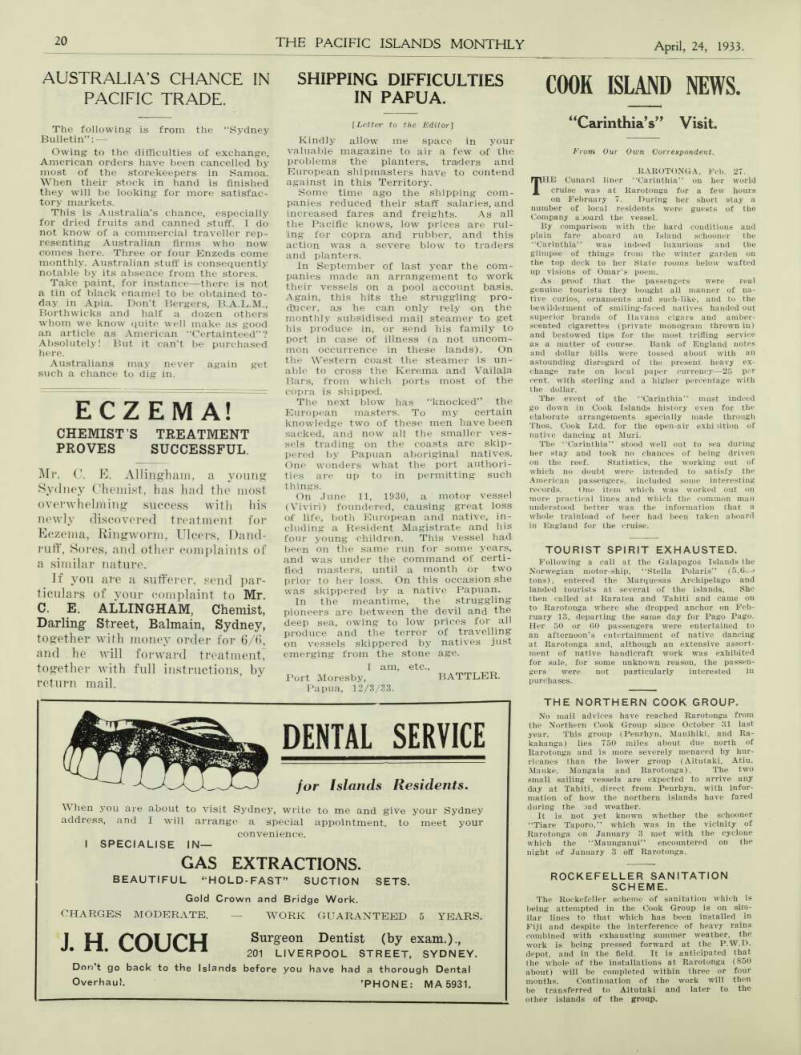
Pacific Trade.
The following is from the “Sydney Bulletin”; Owing to the difficulties of exchange, American orders have been cancelled by most of the storekeepers in Samoa.
When their stock in hand is finished they will be looking for more satisfac tory markets.
This is Australia’s chance, especially for dried fruits and canned stuff. I do not know of a commercial traveller rep resenting Australian firms who now comes here. Three or four Enzeds come monthly. Australian stuff is consequently notable by its absence from the stores.
Take paint, for instance—there is not a tin of black enamel to be obtained to day in Apia. Don’t Bergers, B.A.L.M., Borthwicks and half a dozen others whom we know quite well make as good an article as American “Certainteed” ?
Absolutely! But it can’t be purchased here.
Australians may never again get such a chance to dig in.
Shipping Difficulties
In Papua.
[Letter to the Editor] Kindly allow me space in your valuable magazine to air a few of the problems the planters, traders and European shipmasters have to contend against in this Territory.
Some time ago the shipping com panies reduced their staff salaries, and increased fares and freights. As all the Pacific knows, low prices are rul ing for copra and rubber, and this action was a severe blow to traders and planters.
In September of last year the com panies made an arrangement to work their vessels on a pool account basis.
Again, this hits the struggling pro ducer, as he can only rely on the monthly subsidised mail steamer to get his produce in, or send his family to port in case of illness (a not uncom mon occurrence in these lands). On the Western coast the steamer is un able to cross the Kerema and Vailala Bars, from which ports most of the copra is shipped.
The next blow has “knocked” the European masters. To my certain knowledge two of these men have been sacked, and now all the smaller ves sels trading on the coasts are skip pered by Papuan aboriginal natives.
One wonders what the port authori ties are up to in permitting such things.
On June 11, 1930, a motor vessel (Viviri) foundered, causing great loss of life, both European and native, in cluding a Resident Magistrate and his four young children. This vessel had been on the same run for some years, and was under the command of certi fied masters, until a month or two prior to her loss. On this occasion she was skippered by a native Papuan.
In the meantime, the struggling pioneers are between the devil and the deep sea, owing to low prices for all produce and the terror of travelling on vessels skippered by natives just emerging from the stone age.
I am, etc., Port Moresby, Papua, 12/3/33.
Battler.
Cook Island News.
“Carinthia's” Visit.
From Our Own Correspondent.
Rarotonga, Feb. 27.
THE Cunard liner “Carinthia” on her world cruise was at Rarotonga for a few hours on February 7. During her short stay a number of local residents were guests of the Company aboard the vessel.
By comparison with the hard conditions and plain fare aboard an Island schooner the “Carinthia” was indeed luxurious and the glimpse of things from the winter garden on the top deck to her State rooms below wafted up visions of Omar’s poem.
As proof that the passengers were real genuine tourists they bought all manner of na tive curios, ornaments and such-like, and to the bewilderment of smiling-faced natives handed out superior brands of Havana cigars and amber scented cigarettes (private monogram thrown in) and bestowed tips for the most trifling service as a matter of course. Bank of England notes and dollar bills were tossed about with an astounding disregard of the present heavy ex change rate on local paper currency—25 per cent, with sterling and a higher percentage with the dollar.
The event of the “Carinthia” must indeed go down in Cook Islands history even for the elaborate arrangements specially made through Thos. Cook Ltd. for the open-air exhibition of native dancing at Murl.
The “Carinthia” stood well out to sea during her stay and took no chances of being driven on the reef. Statistics, the working out of which no doubt were intended to satisfy the American passengers, included some interesting records. One item which was worked out on more practical lines and which the common man understood better was the information that a whole trainload of beer had been taken aboard in England for the cruise.
Tourist Spirit Exhausted.
Following a call at the Galapagos Islands the Norwegian motor-ship, “Stella Polaris” (5,600 tons), entered the Marquesas Archipelago and landed tourists at several of the islands. She then called at Raratea and Tahiti and came on to Rarotonga where she dropped anchor on Feb ruary 13, departing the same day for Pago Pago.
Her 50 or 60 passengers were entertained to an afternoon’s entertainment of native dancing at Rarotonga and, although an extensive assort ment of native handicraft work was exhibited for sale, for some unknown reason, the passen gers were not particularly interested in purchases.
The Northern Cook Group.
No mail advices have reached Rarotonga from the Northern Cook Group since October 31 last year. This group (Penrhyn, Manihiki, and Ra kahanga) lies 750 miles about due north of Rarotonga and is more severely menaced by hur ricanes than the lower group (Aitutaki, Atiu, Mauke, Mangaia and Rarotonga). The two small sailing vessels are expected to arrive any day at Tahiti, direct from Penrhyn, with infor mation of how the northern islands have fared during the aad weather.
It is not yet known whether the schooner “Tiare Taporo,” which was in the vicinity of Rarotonga on January 3 met with the cyclone which the “Maunganui” encountered on the night of January 3 off Rarotonga.
Rockefeller Sanitation
Scheme.
The Rockefeller scheme of sanitation which is being attempted in the Cook Group is on sim ilar lines to that which has been installed in Fiji and despite the interference of heavy rains combined with exhausting summer weather, the work is being pressed forward at the P.W.D. depot, and in the field. It is anticipated that the whole of the installations at Rarotonga (850 about) will be completed within three or four months. Continuation of the work will then be transferred to Aitutaki and later to the other islands of the group.
Advertisements & other items, p. 22 (2 items)
Eczema!
CHEMIST'S TREATMENT
PROVES SUCCESSFUL.
Mr. C. E. Allingham, a young Sydney Chemist, has had the most overwhelming success with his newly discovered treatment for Eczema, Ringworm, Ulcers, Dand ruff, Sores, and other complaints of a similar nature.
If you are a sufferer, send par ticulars of your complaint to Mr.
C. E. ALLINGHAM, Chemist, Darling Street, Balmain, Sydney, together with money order for 6/6, and he will forward treatment, together with full instructions, by return mail.
Dental Service
for Islands Residents.
When you are about to visit Sydney, write to me and give your Sydney address, and I will arrange a special appointment, to meet your convenience.
I SPECIALISE IN—
GAS EXTRACTIONS.
BEAUTIFUL “HOLD-FAST” SUCTION SETS.
Gold Crown and Bridge Work.
CHARGES MODERATE. WORK GUARANTEED 5 YEARS.
J. H. COUCH
Surgeon Dentist (by exam.).,
201 LIVERPOOL STREET, SYDNEY.
Don’t go back to the Islands before you have had a thorough Dental Overhaul. ’PHONE: MA 5931.
Problem Of Educating The Natives.
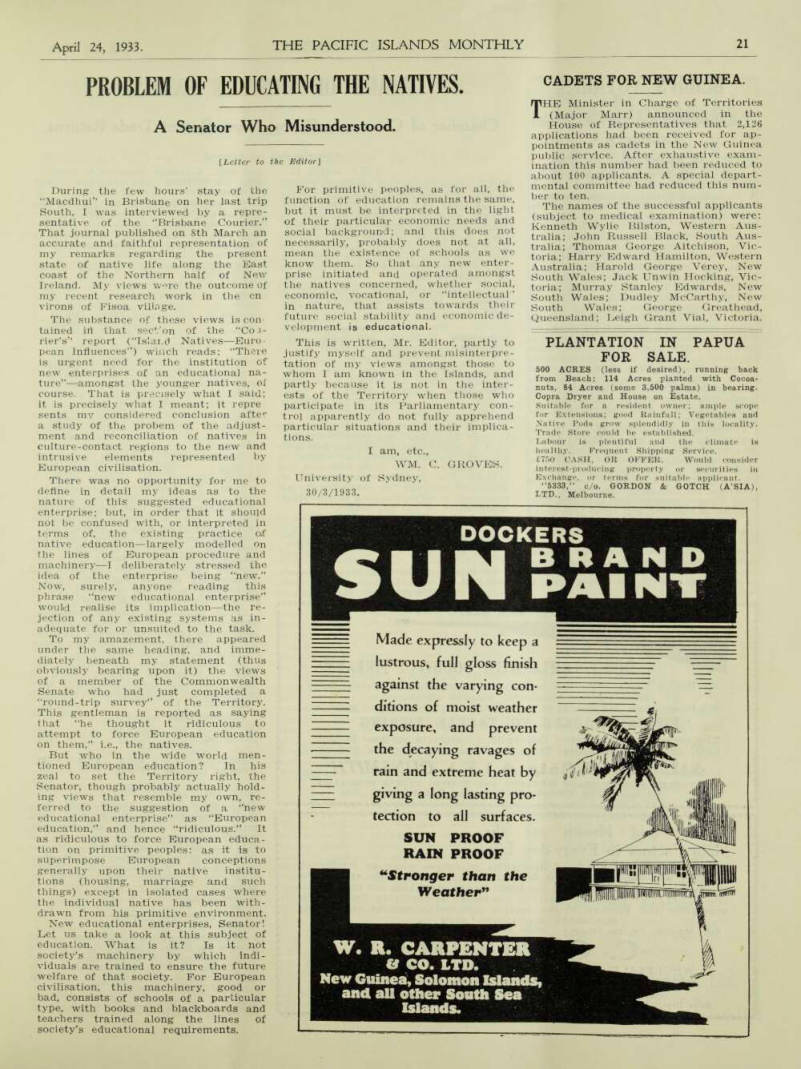
A Senator Who Misunderstood.
[Letter to the Editor ]
During the few hours’ stay of the “Macdhui” in Brisbane on her last trip South, I was interviewed by a repre sentative of the “Brisbane Courier.”
That journal published on 8th March an accurate and faithful representation of my remarks regarding the present state of native life along the East coast of the Northern half of New Ireland. My views were the outcome of my recent research work in the en virons of Fisoa village.
The substance of these views is con tained in that section of the “Cou rier’s’’ report (“Island Natives —Euro pean Influences”) which reads: “There is urgent need for the institution of new enterprises of an educational na ture” —amongst the younger natives, of course. That is precisely what I said; it is precisely what I meant; it repre sents my considered conclusion after a study of the problem of the adjust ment and reconciliation of natives in culture-contact regions to the new and intrusive elements represented by European civilisation.
There was no opportunity for me to define in detail my ideas as to the nature of this suggested educational enterprise; but, in order that it should not be confused with, or interpreted in terms of, the existing practice of native education —largely modelled on the lines of European procedure and machinery—I deliberately stressed the idea of the enterprise being “new.”
Now, surely, anyone reading this phrase “new educational enterprise” would realise its implication—the re jection of any existing systems as in adequate for or unsuited to the task.
To my amazement, there appeared under the same heading, and imme diately beneath my statement (thus obviously bearing upon it) the views of a member of the Commonwealth Senate who had just completed a “round-trip survey” of the Territory.
This gentleman is reported as saying that “he thought it ridiculous to attempt to force European education on them,” i.e., the natives.
But who in the wide world men tioned European education? In his zeal to set the Territory right, the Senator, though probably actually hold ing views that resemble my own, re ferred to the suggestion of a ‘‘new educational enterprise” as “European education,” and hence “ridiculous.” It as ridiculous to force European educa tion on primitive peoples: as it is to superimpose Etiropean conceptions generally upon their native institu tions (housing, marriage and such things) except in isolated cases where the individual native has been with drawn from his primitive environment.
New educational enterprises, Senator!
Let us take a look at this subject of education. What is it? Is it not society’s machinery by which indi viduals are trained to ensure the future welfare of that society. For European civilisation, this machinery, good or bad, consists of schools of a particular type, with books and blackboards and teachers trained along the lines of society’s educational requirements.
For primitive peoples, as for all, the function of education remains the same, but it must be interpreted in the light of their particular economic needs and social background; and this does not necessarily, probably does not at all, mean the existence of schools as we know them. So that any new enter prise initiated and operated amongst the natives concerned, whether social, economic, vocational, or “intellectual" in nature, that assists towards their future social stability and economic de velopment is educational.
This is written, Mr. Editor, partly to justify myself and prevent misinterpre tation of my views amongst those to whom I am known in the Islands, and partly because it is not in the inter ests of the Territory when those who participate in its Parliamentary con trol apparently do not fully apprehend particular situations and their implica tions.
I am, etc.,
Wm. C. Groves.
University of Sydney, 30/3/1933.
Cadets For New Guinea.
THE Minister in Charge of Territories (Major Marr) announced in the House of Representatives that 2,126 applications had been received for ap pointments as cadets in the New Guinea public service. After exhaustive exam ination this number had been reduced to about 100 applicants. A special depart mental committee had reduced this num ber to ten.
The names of the successful applicants (subject to medical examination) were; Kenneth Wylie Bilston, Western Aus tralia; John Russell Black, South Aus tralia; Thomas George Aitchison, Vic toria; Harry Edward Hamilton, Western Australia; Harold George Verey, New South Wales; Jack Unwin Hocking, Vic toria; Murray Stanley Edwards, New South Wales; Dudley McCarthy, New South Wales; George Greathead, Queensland; Leigh Grant Vial, Victoria.
Advertisements & other items, p. 23 (1 item)
Paint
PLANTATION IN PAPUA
FOR SALE.
500 ACRES (less if desired), running back from Beach; 114 Acres planted with Cocoanuts, 84 Acres (some 3,500 palms) in bearing.
Copra Dryer and House on Estate.
Suitable for a resident owner; ample scope for Extensions; good Rainfall; Vegetables and Native Pods grow splendidly in this locality.
Trade Store could be established.
Labour is plentiful and the climate is healthy. Frequent Shipping Service. £750 CASH, OR OFFER. Would consider interest-producing property or securities in Exchange, or terms for suitable applicant.
“5333,” c/o. GORDON & GOTCH (A’SIA),
LTD., Melbourne.
DOCKERS
SUN BRAND
PAINT
Made expressly to keep a lustrous, full gloss finish
against the varying con
ditions of moist weather exposure, and prevent the decaying ravages of rain and extreme heat by
giving a long lasting pro
tection to all surfaces.
SUN PROOF
RAIN PROOF
"Stronger than the Weather”
W. R. CARPENTER
& CO. LTD.
New Guinea, Solomon Islands, and all other South Sea Islands.
Bligh’S Voyages.
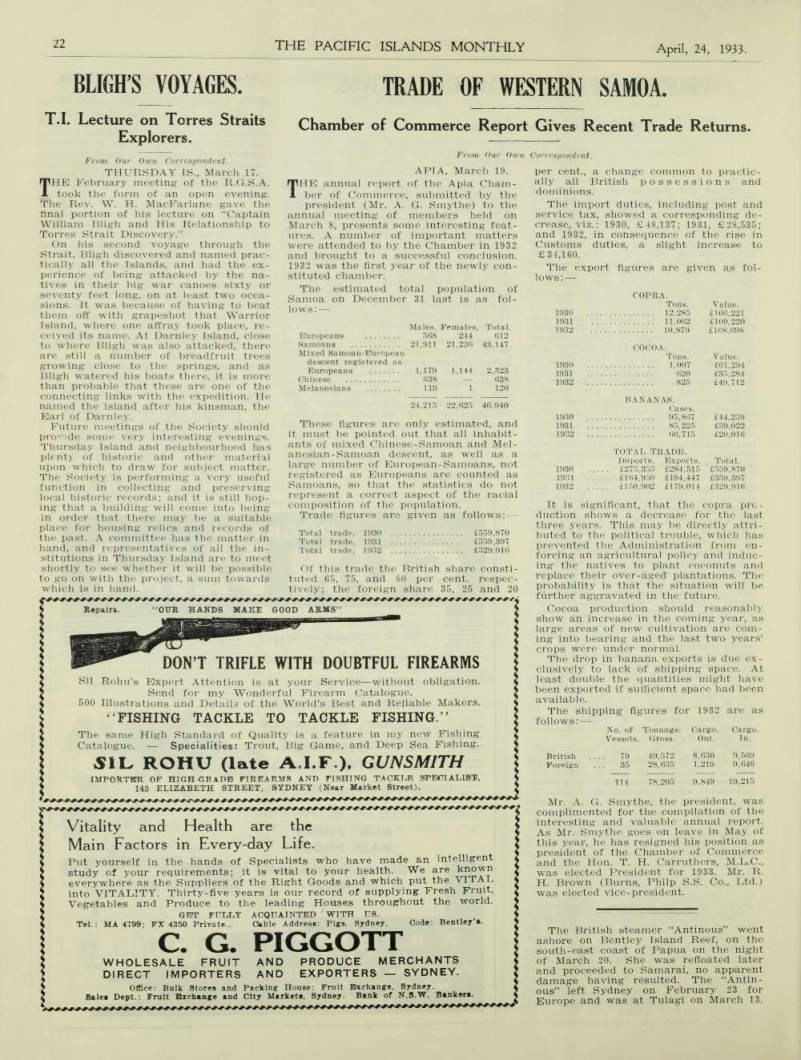
T.I. Lecture on Torres Straits Explorers.
From Our Own Correspondent.
Thursday Is., March 17.
THE February meeting of the R.G.S.A. took the form of an open evening.
The Rev. W. H. MacFarlane gave the final portion of his lecture on “Captain William Bligh and His Relationship to Torres Strait Discovery.”
On his second voyage through the Strait, Bligh discovered and named prac tically all the Islands, and had the ex perience of being attacked by the na tives in their big war canoes sixty or seventy feet long, on at least two occa sions. It was because of having to beat them off with grapeshot that Warrior Island, where one affray took place, re ceived its name. At Darnley Island, close to where Bligh was also attacked, there are still a number of breadfruit trees growing close to the springs, and as Bligh watered his boats there, it is more than probable that these are one of the connecting links with the expedition. He named the island after his kinsman, the Earl of Darnley.
Future meetings of the Society should provide some very interesting evenings.
Thursday Island and neighbourhood has plenty of historic and other material upon which to draw for subject matter.
The Society is performing a very useful function in collecting and preserving local historic records: and it is still hop ing that a building will come into being in order that there may be a suitable place for housing relics and records of the past. A committee has the matter in hand, and representatives of all the in stitutions in Thursday Island are to meet shortly to see whether it will be possible to go on with the project, a sum towards which is in hand.
Trade Of Western Samoa.
Chamber of Commerce Report Gives Recent Trade Returns.
From Our Own Correspondent.
APIA, March 19.
THE annual report of the Apia Cham ber of Commerce, submitted by the president (Mr. A. G. Smythe) to the annual meeting of members held on March 8, presents some interesting feat ures. A number of important matters were attended to by the Chamber in 1932 and brought to a successful conclusion. 1932 was the first year of the newly con stituted chamber.
The estimated total population of Samoa on December 31 last is as fol lows: —
These figures are only estimated, and it must be pointed out that all inhabit ants of mixed Chinese-Samoan and Mel anesian-Samoan descent, as well as a large number of European-Samoans, not registered as Europeans are counted as Samoans, so that the statistics do not represent a correct aspect of the racial composition of the population.
Trade figures are given as follows: Total trade, 1930 £559,870 Total trade, 1931 £359,397 Total trade, 1932 £329,916 Of this trade the British share consti tuted 65, 75, and 80 per cent, respec tively; the foreign share 35, 25 and 20
per cent., a change common to practic ally all British possessions and dominions.
The import duties, including post and service tax, showed a corresponding de crease, viz.: 1930, £48,137; 1931, £28,535; and 1932, in consequence of the rise in Customs duties, a slight increase to £34,160.
The export figures are given as fol lows: —
It is significant, that the copra pro duction shows a decrease for the last three years. This may be directly attri buted to the political trouble, which has prevented the Administration from en forcing an agricultural policy and induc ing the natives to plant coconuts and replace their over-aged plantations. The probability is that the situation will be further aggravated in the future.
Cocoa production should reasonably show an increase in the coming year, as large areas of new cultivation are com ing into bearing and the last two years’ crops were under normal.
The drop in banana exports is due ex clusively to lack of shipping space. At least double the quantities might have been exported if sufficient space had been available.
The shipping figures for 1932 are as follows;
Mr. A. G. Smythe, the president, was complimented for the compilation of the interesting and valuable annual report.
As Mr. Smythe goes on leave in May of this year, he has resigned his position as president of the Chamber of Commerce and the Hon. T. H. Carruthers, M.L.C., was elected President for 1933. Mr. R.
H. Brown (Burns, Philp S.S. Co., Ltd.) was elected vice-president.
The British steamer “Antinous” went ashore on Bentley Island Reef, on the south-east coast of Papua on the night of March 20. She was refloated later and proceeded to Samarai, no apparent damage having resulted. The “Antin ous” left Sydney on February 23 for Europe and was at Tulagi on March 13,
Males. Females. Total.
Europeans 368 244 612 Samoans 21,911 21,236 43,147 Mixed Samoan-European descent registered as Europeans 1,179 1,144 2,323 Chinese 638 — 638 Melanesians 119 1 120 24,215 22,625 46,940
Copra.
Tons. Value. 1930 . . 12,285 £166,221 1931 11,062 £109,220 1932 10,879 £108,698
Cocoa.
Tons. Value. 1930 .. 1,007 £61,294 1931 .. 620 £35,284 1932 825 £49,712 1930 . .
Bananas.
Cases. 95,867 £44,259 1931 .. £39,022 1932 .. £20,016
Total Trade.
Imports. Exports. Total. 1930 £559,870 1931 .. . .. £164,950 £194,447 £359,397 1932 .. . . . £150,902 £179,014 £329,916
No. of Vessels.
Tonnage. Gross.
Cargo. Out.
Cargo. In.
British ... 79 49,572 8,630 9,569 Foreign ... 35 28,635 1,219 9,646 114 78,205 9,849 19,215
Advertisements & other items, p. 24 (1 item)
C. G. Piggott
Repairs.
“OUR HANDS MAKE GOOD ARMS’
DON’T TRIFLE WITH DOUBTFUL FIREARMS
Sil Rohu’s Expert Attention is at your Service —without obligation.
Send for my Wonderful Firearm Catalogue. 500 Illustrations and Details of the World’s Best and Reliable Makers.
“FISHING TACKLE TO TACKLE FISHING.”
The same High Standard of Quality is a feature in my new Fishing Catalogue. • Specialities; Trout, Big Game, and Deep Sea Fishing.
SIL ROHU (late A.I.F.). GUNSMITH
IMPORTER OF HIGH-GRADE FIREARMS AND FISHING TACKLE SPECIALIST, 143 ELIZABETH STREET, SYDNEY (Near Market Street).
Vitality and Health are the
Main Factors in Every-day Life.
Put yourself in the hands of Specialists who have made an intelligent study of your requirements; it is vital to your health. We are known everywhere as the Suppliers of the Right Goods and which put the VITAL into VITALITY. Thirty-five years is our record of supplying Fresh Fruit, Vegetables and Produce to the leading Houses throughout the world.
GET FULLY ACQUAINTED WITH US.
Tel.: MA 4799; FX 4350 Private.. Cable Address: Pigs, Sydney. Code: Bentley’s.
C. G. PIGGOTT
WHOLESALE FRUIT AND PRODUCE MERCHANTS
DIRECT IMPORTERS AND EXPORTERS SYDNEY.
Office: Bulk Stores and Packing House; Fruit Exchange, Sydney.
Sales Dept.: Fruit Exchange and City Markets, Sydney. Bank of N.S.W. Banker*.
New Guinea’S Legislative Councillors.
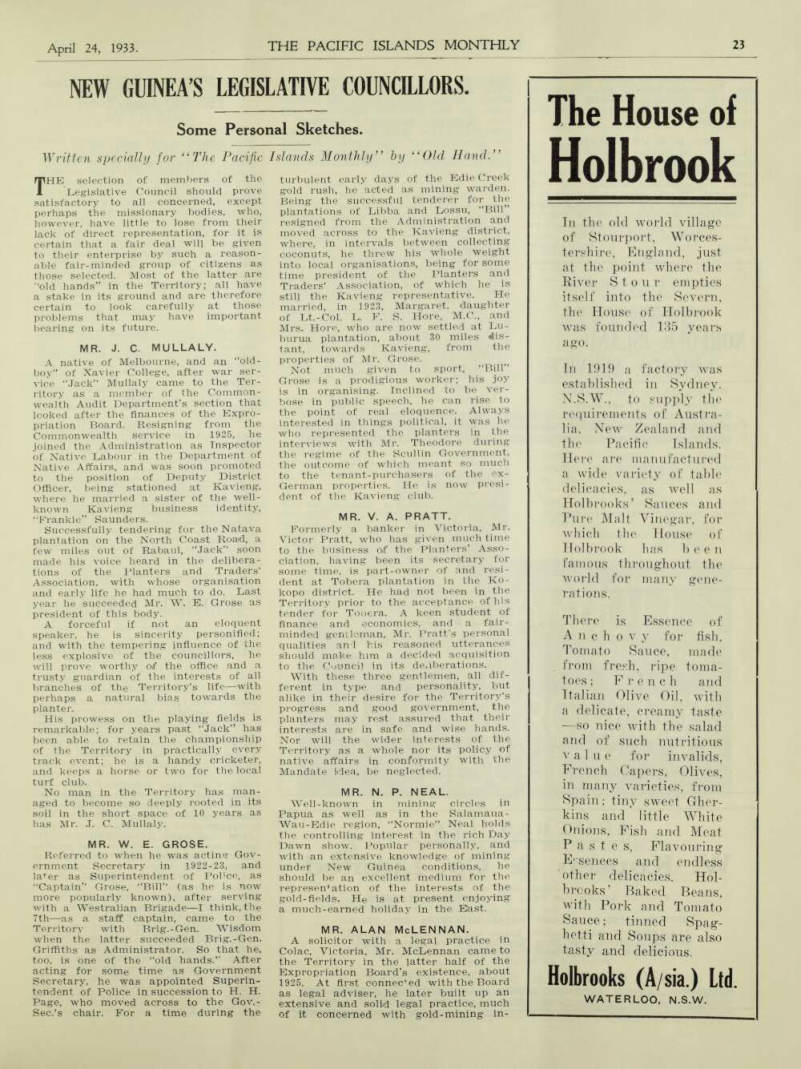
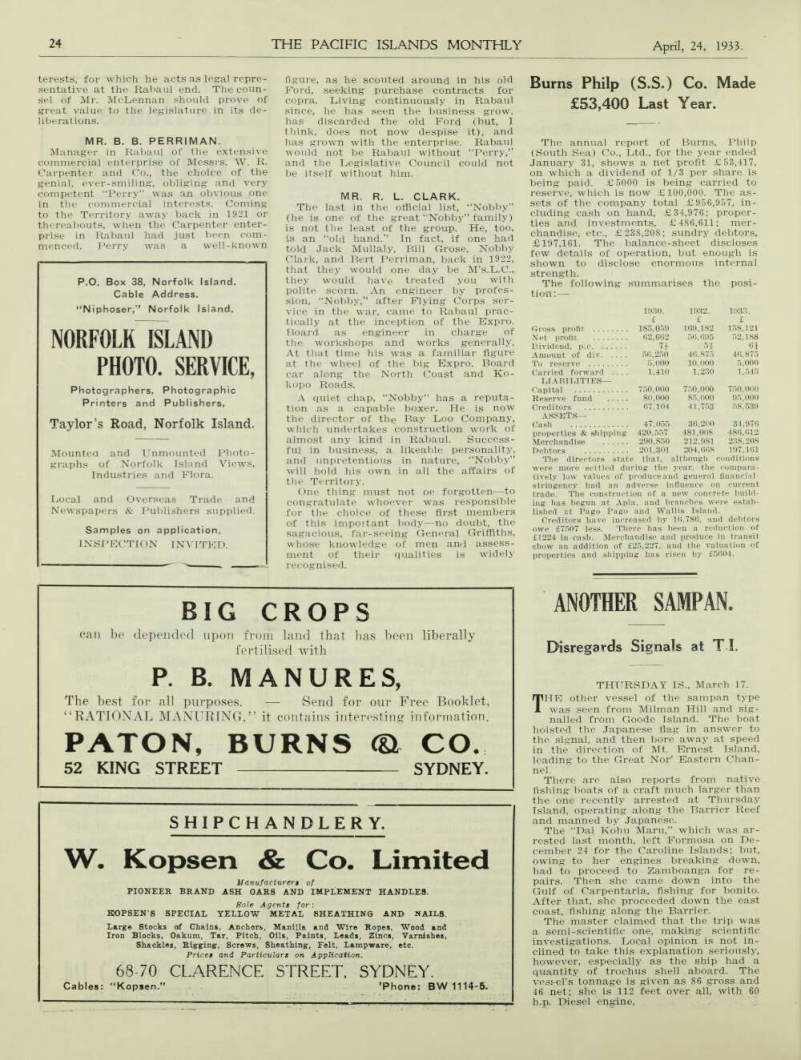
Some Personal Sketches.
Written specially for “The Pacific Islands Monthly” by “Old Hand.”
THE selection of members of the Legislative Council should prove satisfactory to all concerned, except perhaps the missionary bodies, who, however, have little to lose from their lack of direct representation, for it is certain that a fair deal will be given to their enterprise by such a reason able fair-minded group of citizens as those selected. Most of the latter are “old hands” in the Territory; all have a stake in its ground and are therefore certain to look carefully at those problems that may have important bearing on its future.
Mr. J. C. Mullaly.
A native of Melbourne, and an “old boy” of Xavier College, after war ser vice “Jack” Mullaly came to the Ter ritory as a member of the Common wealth Audit Department’s section that looked after the finances of the Expro priation Board. Resigning from the Commonwealth service in 1925, he joined the Administration as Inspector of Native Labour in the Department of Native Affairs, and was soon promoted to the position of Deputy District Officer, being stationed at Kavieng, where he married a sister of the well known Kavieng business identity, “Frankie” Saunders.
Successfully tendering for the Natava plantation on the North Coast Road, a few miles out of Rabaul, “Jack” soon made his voice heard in the delibera tions of the Planters and Traders’
Association, with whose organisation and early life he had much to do. Last year he succeeded Mr. W. E. Grose as president of this body.
A forceful if not an eloquent speaker, he is sincerity personified; and with the tempering influence of the less explosive of the councillors, he will prove worthy of the office and a trusty guardian of the interests of all branches of the Territory’s life —with perhaps a natural bias towards the planter.
His prowess on the playing fields is remarkable; for years past “Jack” has been able to retain the championship of the Territory in practically every track event; he is a handy cricketer, and keeps a horse or two for the local turf club.
No man in the Territory has man aged to become so deeply rooted in its soil in the short space of 10 years as has Mr. J. C. Mullaly.
Mr. W. E. Grose.
Referred to when he was acting Gov ernment Secretary in 1922-23, and later as Superintendent of Police, as “Captain” Grose, “Bill” (as he is now more popularly known), after serving with a Westralian Brigade—I think, the 7th —as a staff captain, came to the Territory with Brig.-Gen. Wisdom when the latter succeeded Brig.-Gen.
Griffiths as Administrator. So that he, too, is one of the “old hands.” After acting for some time as Government Secretary, he was appointed Superin tendent of Police in succession to H. H.
Page, who moved across to the Gov.- Sec.’s chair. For a time during the
turbulent early days of the Edie Creek gold rush, he acted as mining warden.
Being the successful tenderer for the plantations of Libba and Lossu, “Bill” resigned from the Administration and moved across to the Kavieng district, where, in intervals between collecting coconuts, he threw his whole weight into local organisations, being for some time president of the Planters and Traders’ Association, of which he is still the Kavieng representative. He married, in 1923, Margaret, daughter of Lt.-Col. L. F. S. Here, M.C., and Mrs. Hore, who are now settled at Lu burua plantation, about 30 miles dis tant, towards Kavieng, from the properties of Mr. Grose.
Not much given to sport, “Bill”
Grose is a prodigious worker; his joy is in organising. Inclined to be ver bose in public speech, he can rise to the point of real eloquence. Always interested in things political, it was he who represented the planters in the interviews with Mr. Theodore during the regime of the Scullin Government, the outcome of which meant so much to the tenant-purchasers of the ex- German properties. He is now presi dent of the Kavieng club.
Mr. V. A. Pratt.
Formerly a banker in Victoria, Mr.
Victor Pratt, who has given much time to the business of the Planters’ Asso ciation. having been its secretary for some time, is part-owner of and resi dent at Tobera plantation in the Ko kopo district. He had not been in the Territory prior to the acceptance of his tender for Tobera. A keen student of finance and economics, and a fair minded gentleman, Mr. Pratt’s personal qualities and his reasoned utterances should make him a decided acquisition to the Council in its deliberations.
With these three gentlemen, all dif ferent in type and personality, but alike in their desire for the Territory’s progress and good government, the planters may rest assured that their interests are in safe and wise hands.
Nor will the wider interests of the Territory as a whole nor its policy of native affairs in conformity with the Mandate idea, be neglected.
Mr. N. P. Neal.
Well-known in mining circles in Papua as well as in the Salamaua- Wau-Edie region, “Normie” Neal holds the controlling interest in the rich Day Dawn show. Popular personally, and with an extensive knowledge of mining under New Guinea conditions, he should be an excellent medium for the represen+ation of the interests of the gold-fields. He is at present enjoying a much-earned holiday in the East.
Mr. Alan Mclennan.
A solicitor with a legal practice in Colac, Victoria, Mr. McLennan came to the Territory in the latter half of the Expropriation Board’s existence, about 1925. At first connected with the Board as legal adviser, he later built up an extensive and solid legal practice, much of it concerned with gold-mining in
terests, for which he acts as legal repre sentative at the Rabaul end. The coun sel of Mr. McLennan should prove of great value to the legislature in its de liberations.
Mr. B. B. Perriman.
Manager in Rabaul of the extensive commercial enterprise of Messrs. W. R.
Carpenter and Co., the choice of the genial, ever-smiling, obliging and very competent “Perry” was an obvious one in the commercial interests. Coming to the Territory away back in 1921 or thereabouts, when the Carpenter enter prise in Rabaul had just been com menced, Perry was a well-known
figure, as he scouted around in his old Ford, seeking purchase contracts for copra. Living continuously in Rabaul since, he has seen the business grow, has discarded the old Ford (but, I think, does not now despise it), and has grown with the enterprise. Rabaul would not be Rabaul without “Perry,” and the Legislative Council could not be itself without him.
Mr. R. L. Clark.
The last in the official list, “Nobby” (he is one of the great “Nobby” family) is not the least of the group. He, too, is an “old hand.” In fact, if one had told Jack Mullaly, Bill Grose, Nobby Clark, and Bert Perriman, back in 1922, that they would one day be M’s.L.C., they would have treated you with polite scorn. An engineer by profes sion, “Nobby,” after Flying Corps ser vice in the war, came to Rabaul prac tically at the inception of the Expro.
Board as engineer in charge of the workshops and works generally.
At that time his was a familiar figure at the wheel of the big Expro. Board car along the North Coast and Ko kopo Roads.
A quiet chap, “Nobby” has a reputa tion as a capable boxer. He is now the director of the Bay Loo Company, which undertakes construction work of almost any kind in Rabaul. Success ful in business, a likeable personality, and unpretentious in nature, “Nobby” will hold his own in all the affairs of the Territory.
One thing must not be forgotten—to congratulate whoever was responsible for the choice of these first members of this impoitant body—no doubt, the sagacious, far-seeing General Griffiths, whose knowledge of men and assess ment of their qualities is widely recognised.
Advertisements & other items, pp. 25-26 (1 item)
Holbrook
The House of
In the old world village of Stourport, Worces tershire, England, just at the point where the River Stour empties itself into the Severn, the House of Holbrook was founded 135 years ago.
In 1919 a factory was established in Sydney.
N.S.W., to supply the requirements of Austra lia, New Zealand and the Pacific Islands.
Here are manufactured a wide variety of table delicacies, as well as Holbrooks ’ Sauces and Pure Malt Vinegar, for which the House of Holbrook has been famous throughout the world for many gene rations.
There is Essence of Anchovy for fish.
Tomato Sauce, made from fresh, ripe toma toes ; French and Italian Olive Oil, with a delicate, creamy taste —so nice with the salad and of such nutritious value for invalids, French Capers, Olives, in many varieties, from Spain; tiny sweet Gher kins and little White Onions, Fish and Meat
Pastes, Flavouring
Essences and endless other delicacies. Hol brooks’ Baked Beans, with Pork and Tomato
Sauce; tinned Spag
hetti and Soups are also tasty and delicious.
Holbrooks (A/sia.) Ltd.
WATERLOO, N.S.W.
P.O. Box 38, Norfolk Island.
Cable Address.
“Niphoser,” Norfolk Island.
NORFOLK ISLAND
PHOTO. SERVICE,
Photographers, Photographic Printers and Publishers,
Taylor’s Road, Norfolk Island.
Mounted and Unmounted Photo graphs of Norfolk Island Views, Industries and Flora.
Local and Overseas Trade and Newspapers & Publishers supplied.
Samples on application.
INSPECTION INVITED.
BIG CROPS
can be depended upon from land that has been liberally fertilised with
P. B. MANURES,
The best for all purposes. Send for our Free Booklet, '‘RATIONAL MANURING,” it contains interesting information.
PATON, BURNS & CO.
52 KING STREET SYDNEY.
SHIPCHANDLERY.
W. Kopsen & Co. Limited
Manufacturers of PIONEER BRAND ASH OARS AND IMPLEMENT HANDLES.
Sole Agents for: KOPSEN’S SPECIAL YELLOW METAL SHEATHING AND NAILS.
Large Stocks of Chains, Anchors, Manilla and Wire Ropes, Wood and Iron Blocks, Oakum, Tar, Pitch, Oils, Paints, Leads, Zincs, Varnishes, Shackles, Rigging, Screws, Sheathing, Felt, Lampware, etc.
Prices and Particulars on Application,
68-70 CLARENCE STREET, SYDNEY.
Cables: "Kopsen." 'Phone; BW 1114-5.
Burns Philp (S.S.) Co. Made
£53,400 Last Year.
The annual report of Burns, Philp (South Sea) Co., Ltd., for the year ended January 31, shows a net profit £53,417, on which a dividend of 1/3 per share is being paid. £5000 is being carried to reserve, which is now £100,000. The as sets of the company total £956,957, in cluding cash on hand, £34,976; proper ties and investments, £486,611; mer chandise, etc., £238,208; sundry debtors, £197,161. The balance-sheet discloses few details of operation, but enough is shown to disclose enormous internal strength.
The following summarises the posi tion: —
The directors state that, although conditions were more settled during the year, the compara tively low values of produce and general financial stringency had an adverse influence on current trade. The construction of a new concrete build ing has begun at Apia, and branches were estab lished at Pago Pago and Wallis Island.
Creditors have increased by 16,786, and debtors owe £7507 less. There has been a reduction of £1224 in cash. Merchandise and produce in transit show an addition of £25,227, and the valuation of properties and shipping has risen by £5604.
1930. £ 1932. £ 1933. £ Gross profit 185,059 169,182 158,121 Net profit 62,662 56,695 52,188 Dividend, p.c 7½ 5J 6i Amount of div 56,250 46,875 46,875 To reserve 5,000 10,000 5,000 Carried forward ... 1,410 1,230 1,543
Liabilities—
Capital 750,000 750,000 750,000 Reserve fund 80,000 85,000 95,000 Creditors 67,104 41,753 58,539
Assets—
Cash 47,055 36,200 34,976 properties & shipping 420,557 481,008 486,612 Merchandise 290,850 212,981 238,208 Debtors 201,301 204,668 197,161
Another Sampan.
Disregards Signals at T.I.
Thursday Is., March 17.
THE other vessel of the sampan type was seen from Milman Hill and sig nalled from Goode Island. The boat hoisted the Japanese flag in answer to the signal, and then bore away at speed in the direction of Mt. Ernest Island, leading to the Great Nor’ Eastern Chan nel.
There are also reports from native fishing boats of a craft much larger than the one recently arrested at Thursday Island, operating along the Barrier Reef and manned by Japanese.
The “Dai Kohu Maru,” which was ar rested last month, left Formosa on De cember 24 for the Caroline Islands; but, owing to her engines breaking down, had to proceed to Zamboanga for re pairs. Then she came down into the Gulf of Carpentaria, fishing for bonito.
After that, she proceeded down the east coast, fishing along the Barrier.
The master claimed that the trip was a semi-scientific one, making scientific investigations. Local opinion is not in clined to take this explanation seriously, however, especially as the ship had a quantity of trochus shell aboard. The vessel’s tonnage is given as 86 gross and 46 net; she is 112 feet over all, with 60 h.p. Diesel engine,
Officers.
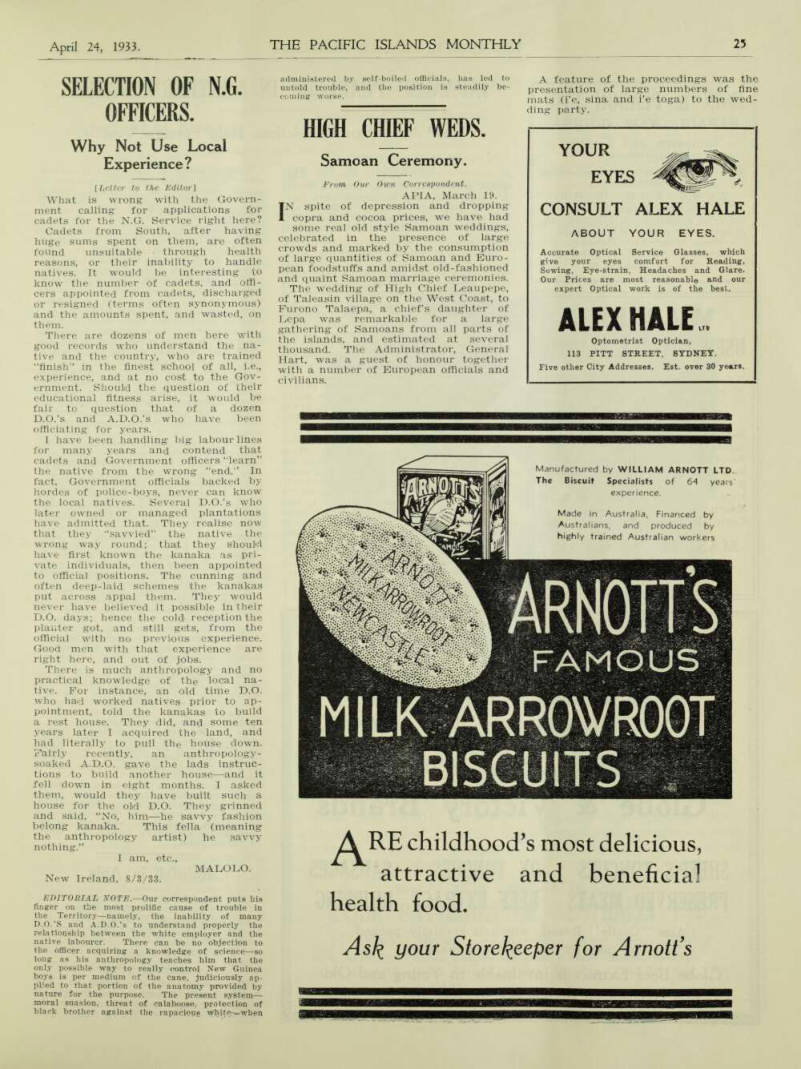
Selection Of N.G.
Why Not Use Local Experience?
[Letter to the Editor ] What is wrong with the Govern ment calling for applications for cadets for the N.G. Service right here?
Cadets from South, after having huge sums spent on them, are often found unsuitable through health reasons, or their inability to handle natives. It would be interesting to know the number of cadets, and offi cers appointed from cadets, discharged or resigned (terms often synonymous) and the amounts spent, and wasted, on them.
There are dozens of men here with good records who understand the na tive and the country, who are trained “finish” in the finest school of all, i.e., experience, and at no cost to the Gov ernment. Should the question of their educational fitness arise, it would be fair to question that of a dozen D.O.’s and A.D.O.’s who have been officiating for years.
I have been handling big labour lines for many years and contend that cadets and Government officers “learn” the native from the wrong “end.” In fact, Government officials backed by hordes of police-boys, never can know the local natives. Several D.O.’s who later owned or managed plantations have admitted that. They realise now that they “savvied” the native the wrong way round; that they should have first known the kanaka as pri vate individuals, then been appointed to official positions. The cunning and often deep-laid schemes the kanakas put across appal them. They would never have believed it possible in their D.O. days; hence the cold reception the planter got, and still gets, from the official with no previous experience.
Good men with that experience are right here, and out of jobs.
There is much anthropology and no practical knowledge of the local na tive. For instance, an old time D.O. who had worked natives prior to ap pointment, told the kanakas to build a rest house. They did, and some ten years later I acquired the land, and had literally to pull the house down.
Fairly recently, an anthropology soaked A.D.O. gave the lads instruc tions to build another house —and it fell down in eight months. I asked them, would they have built such a house for the old D.O. They grinned and said, “No, him —he savvy fashion belong kanaka. This fella (meaning the anthropology artist) he savvy nothing.”
I am, etc.,
Malolo,
New Ireland, 8/3/33.
EDITORIAL NOTE. —Our correspondent puts his finger on the most prolific cause of trouble in the Territory—namely, the inability of many D.O.’S and A.D.O.’s to understand properly the relationship between the white employer and the native labourer. There can be no objection to the officer acquiring a knowledge of science—so long as his anthropology teaches him that the only possible way to really control New Guinea boys is per medium of the cane, judiciously ap plied to that portion of the anatomy provided by nature for the purpose. The present system— moral suasion, threat of calaboose, protection of black brother against the rapacious white - when
administered by self-boiled officials, has led to untold trouble, and the position is steadily be coming worse.
High Chief Weds.
Samoan Ceremony.
From Our Own Correspondent.
APIA, March 19.
IN spite of depression and dropping copra and cocoa prices, we have had some real old style Samoan weddings, celebrated in the presence of large crowds and marked by the consumption of large quantities of Samoan and Euro pean foodstuffs and amidst old-fashioned and quaint Samoan marriage ceremonies.
The wedding of High Chief Leaupepe, of Taleasin village on the West Coast, to Furono Talaepa, a chief’s daughter of Lepa was remarkable for a large gathering of Samoans from all parts of the islands, and estimated at several thousand. The Administrator, General Hart, was a guest of honour together with a number of European officials and civilians.
A feature of the proceedings was the presentation of large numbers of fine mats (i’e, sina and i’e toga) to the wed ding party.
Advertisements & other items, pp. 27-28 (1 item)
Alex Hale .
YOUR
EYES
CONSULT ALEX HALE
Accurate Optical Service Glasses, which give your eyes comfort for Reading, Sewing, Eye-strain, Headaches and Glare.
Our Prices are most reasonable and our expert Optical work is of the best.
Optometrist Optician,
113 PITT STREET, SYDNEY.
Five other City Addresses. Est. over 30 years.
ABOUT YOUR EYES.
ALEX HALE .
Manufactured by WILLIAM ARNOTT LTD The Biscuit Specialists of 64 years experience.
Made in Australia, Financed by Australians, and produced by highly trained Australian workers
Are childhood’s most delicious,
attractive and beneficial
health food.
Ask your Storekeeper for Arnott’s
JOHN L. PEADON LTD.,
RABAUL, NEW GUINEA,
Engineers and Garage
Proprietors,
All Classes of General Engineering Undertaken,
CARS FOR HIRE.
Territory Agents for — Goodrich Products. Clyde Batteries, Berger’s Lacquers. B.E.S. Plugs.
Chas. Hope, Ltd., Brisbane.
Lamson Paragon Ltd., Printers.
'Phone: Rabaul 20.
advt
JAMES BARNES LIMITED
2 Botany Street, Waterloo, Sydney
(ESTABLISHED 1881)
MANUFACTURERS OF
“Globe” & “Victory” Brands
OF
SHEEPS TONGUES OX TONGUES SAUSAGES
PRESERVED MEATS BEEF EXTRACT DRIPPING
Also “Castle” Brand, which is specially packed for use by the White Population.
Globe Beef Extract is invaluable to Young and Old.
Tested Recipes on the packet 4oz. and 8oz. sizes.
Japanese Pearlers In Northern Waters.
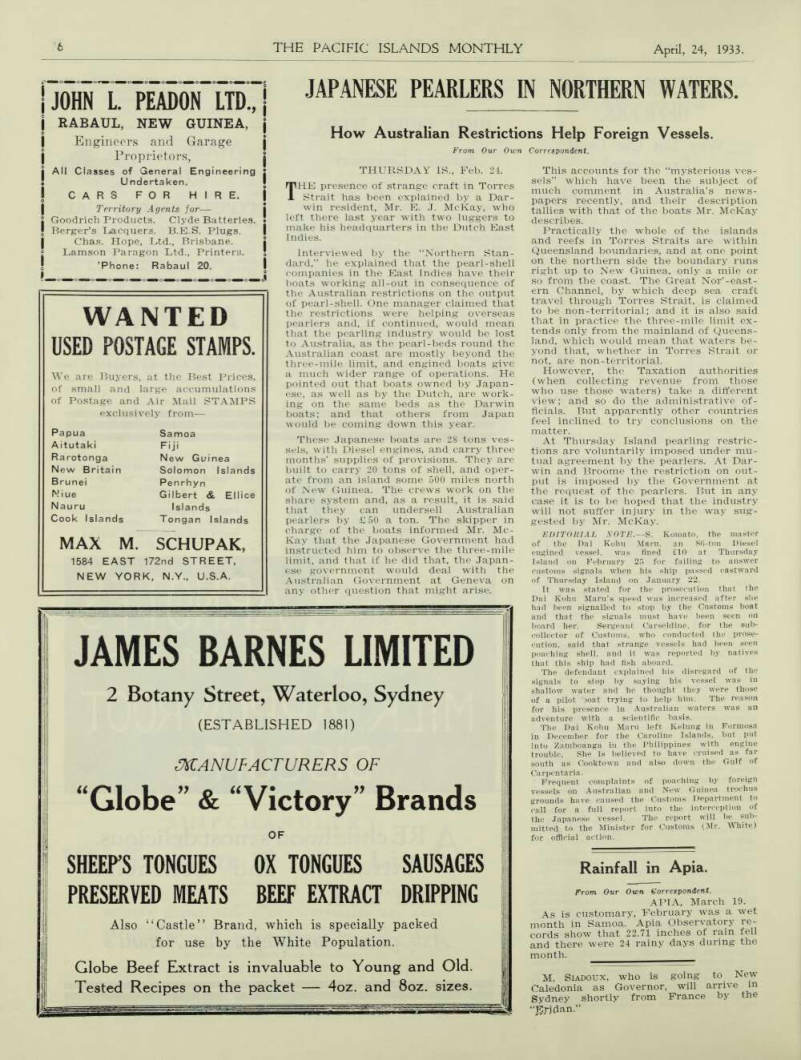
How Australian Restrictions Help Foreign Vessels.
From Our Own Correspondent.
Thursday Is., Feb. 24.
THE presence of strange craft in Torres Strait has been explained by a Dar win resident, Mr. E. J. McKay, who left there last year with two luggers to make his headquarters in the Dutch East Indies.
Interviewed by the “Northern Stan dard,” he explained that the pearl-shell companies in the East Indies have their boats working all-out in consequence of the Australian restrictions on the output of pearl-shell. One manager claimed that the restrictions were helping overseas pearlers and, if continued, would mean that the pearling industry would be lost to Australia, as the pearl-beds round the Australian coast are mostly beyond the three-mile limit, and engined boats give a much wider range of operations. He pointed out that boats owned by Japan ese, as well as by the Dutch, are work ing on the same beds as the Darwin boats; and that others from Japan would be coming down this year.
These Japanese boats are 28 tons ves sels, with Diesel engines, and carry three months’ supplies of provisions. They are built to carry 20 tons of shell, and oper ate from an island some 500 miles north of New Guinea. The crews work on the share system and, as a result, it is said that they can undersell Australian pearlers by £50 a ton. The skipper in charge of the boats informed Mr. Mc Kay that the Japanese Government had instructed him to observe the three-mile limit, and that if he did that, the Japan ese government would deal with the Australian Government at Geneva on any other question that might arise.
This accounts for the “mysterious ves sels” which have been the subject of much comment in Australia’s news papers recently, and their description tallies with that of the boats Mr. McKay describes.
Practically the whole of the islands and reefs in Torres Straits are within Queensland boundaries, and at one point on the northern side the boundary runs right up to New Guinea, only a mile or so from the coast. The Great Nor’-east ern Channel, by which deep sea craft travel through Torres Strait, is claimed to be non-territorial; and it is also said that in practice the three-mile limit ex tends only from the mainland of Queens land, which would mean that waters be yond that, whether in Torres Strait or not, are non-territorial.
However, the Taxation authorities (when collecting revenue from those who use those waters) take a different view; and so do the administrative of ficials. But apparently other countries feel inclined to try conclusions on the matter.
At Thursday Island pearling restric tions are voluntarily imposed under mu tual agreement by the pearlers. At Dar win and Broome the restriction on out put is imposed by the Government at the request of the pearlers. But in any case it is to be hoped that the industry will not suffer injury in the way sug gested by Mr. McKay.
EDITORIAL ROTE— S. Komato, the master of the Dai Kohu Maru, an 86-ton Diesel engined vessel, was fined £10 at Thursday Island on February 25 for failing to answer customs signals when his ship passed eastward of Thursday Island on January 22.
It was stated for the prosecution that the Dai Kohu Maru’s speed was increased after she had been signalled to stop by the Customs boat and that the signals must have been seen on board her. Sergeant Carseldine, for the sub collector of Customs, who conducted the prose cution, said that strange vessels had been seen poaching shell, and it was reported by natives that this ship had fish aboard.
The defendant explained his disregard of the signals to stop by saying his vessel was in shallow water and he thought they were those of a pilot boat trying to help him. The reason for his presence in Australian waters was an adventure with a scientific basis.
The Dai Kohu Maru left Kelung in Formosa in December for the Caroline Islands, but put into Zamboanga in the Philippines with engine trouble. She is believed to have cruised as far south as Cooktown and also down the Gulf of Carpentaria.
Frequent complaints of poaching by foreign vessels on Australian and New Guinea trochus grounds have caused the Customs Department to call for a full report into the interception of the Japanese vessel. The report will be sub mitted to the Minister for Customs (Mr. White) for official action.
Rainfall in Apia.
From Our Own Correspondent.
APIA, March 19.
As is customary, February was a wet month in Samoa. Apia Observatory re cords show that 22.71 inches of rain fell and there were 24 rainy days during the month.
M. Siadoux, who is going to New Caledonia as Governor, will arrive m Sydney shortly from France by the
“Eridan.”
Norfolk Island.
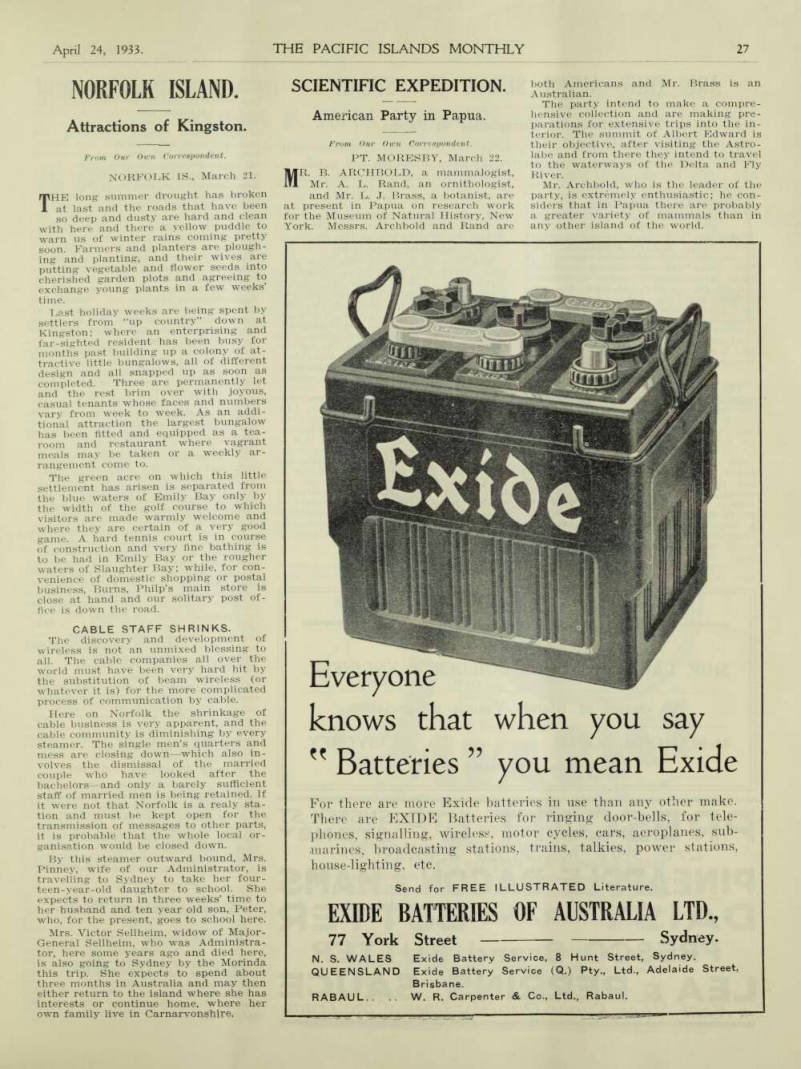
Attractions of Kingston.
From Our Own Correspondent.
Norfolk Is., March 21.
THE long summer drought has broken at last and the roads that have been so deep and dusty are hard and clean with here and there a yellow puddle to warn us of winter rains coming pretty soon. Farmers and planters are plough ing and planting, and their wives are putting vegetable and flower seeds into cherished garden plots and agreeing to exchange young plants in a few weeks’ time.
Last holiday weeks are being spent by settlers from “up country” down at Kingston: where an enterprising and far-sighted resident has been busy for months past building up a colony of at tractive little bungalows, all of different design and all snapped up as soon as completed. Three are permanently let and the rest brim over with joyous, casual tenants whose faces and numbers vary from week to week. As an addi tional attraction the largest bungalow has been fitted and equipped as a tea room and restaurant where vagrant meals may be taken or a weekly ar rangement come to.
The green acre on which this little settlement has arisen is separated from the blue waters of Emily Bay only by the width of the golf course to which visitors are made warmly welcome and where they are certain of a very good game. A hard tennis court is in course of construction and very fine bathing is to be had in Emily Bay or the rougher waters of Slaughter Bay; while, for con venience of domestic shopping or postal business, Burns, Philp’s main store is close at hand and our solitary post of fice is down the road.
Cable Staff Shrinks.
The discovery and development of wireless is not an unmixed blessing to all. The cable companies all over the world must have been very hard hit by the substitution of beam wireless (or whatever it is) for the more complicated process of communication by cable.
Here on Norfolk the shrinkage of cable business is very apparent, and the cable community is diminishing by every steamer. The single men’s quarters and mess are closing down —which also in volves the dismissal of the married couple who have looked after the bachelors —and only a barely sufficient staff of married men is being retained. If it were not that Norfolk is a realy sta tion and must be kept open for the transmission of messages to other parts, it is probable that the whole local or ganisation would be closed down.
By this steamer outward bound, Mrs.
Pinney, wife of our Administrator, is travelling to Sydney to take her four teen-year-old daughter to school. She expects to return in three weeks’ time to her husband and ten year old son, Peter, who, for the present, goes to school here.
Mrs. Victor Sellheim, widow of Major- General Sellheim, who was Administra tor, here some years ago and died here, is also going to Sydney by the Morinda this trip. She expects to spend about three months in Australia and may then either return to the island where she has interests or continue home, where her own family live in Carnarvonshire.
Scientific Expedition.
American Party in Papua.
From Our Own Correspondent.
Pt. Moresby, March 22.
MR. B. ARCHBOLD, a mammalogist, Mr. A. L. Rand, an ornithologist, and Mr. L. J. Brass, a botanist, are at present in Papua on research work for the Museum of Natural History, New York. Messrs. Archbold and Rand are
both Americans and Mr. Brass is an Australian.
The party intend to make a compre hensive collection and are making pre parations for extensive trips into the in terior. The summit of Albert Edward is their objective, after visiting the Astro labe and from there they intend to travel to the waterways of the Delta and Fly River.
Mr. Archbold, who is the leader of the party, is extremely enthusiastic; he con siders that in Papua there are probably a greater variety of mammals than in any other island of the world.
Advertisements & other items, p. 29 (1 item)
Everyone
knows that when you say
"Batteries" you mean Exide For there are more Exide batteries in use than any other make.
There are EXIDE Batteries for ringing door-bells, for tele phones, signalling, wireless, motor cycles, cars, aeroplanes, sub marines, broadcasting stations, trains, talkies, power stations, house-lighting, etc.
Send for FREE ILLUSTRATED Literature.
EXIDE BATTERIES OF AUSTRALIA LTD.,
77 York Street Sydney.
N. S. WALES Exide Battery Service, 8 Hunt Street, Sydney.
QUEENSLAND Exide Battery Service (Q.) Pty., Ltd., Adelaide Street, Brisbane.
RABAUL.. .. W. R. Carpenter & Co., Ltd., Rabaul.
Are They After Sugar Or “Sugar”?
Operations of Companies in Papua.
IT is time that something is done, by either the Australian Commonwealth or Papuan Government, to supervise the sales of shares and bonds to the public by companies allegedly interested in the industry of growing sugar in Papua.
THERE is nothing wrong or fantastic about Papuan sugar-growing.
Probably, there is no country where better sugar can be grown, or where it can be produced so cheaply. It is this fact that has stirred a certain class of company promoter to activity; but so far as some of them are con cerned, the only kind of sugar they will ever produce is that which they will take out of the pockets of their deluded share- and bond-holders.
At the present time, there appear to be four different groups interesting themselves in Papuan sugar.
Sangara.
The only group worth serious con sideration by Australian investors is the Sangara Company, at the head of which are two practical men, Mr. Tom Nevitt, plantation inspector in Papua for the B. and N.G. Company, and his brother, Mr. A. L. Nevitt, of Cairns.
Both have a thorough knowledge of sugar production. The Sangara Co. has obtained the only freehold land suitable for sugar-production in the region of Collingwood Bay, in the North-East of Papua, and it now has a large and flourishing experimental plantation there from which it can plant out thousands of acres in sugar cane, when it is ready. The Nevitt Brothers are now on their way to Lon don, and while there it is probable they
will secure British capital. They want at least £300,000. They are not pro posing to offer bonds to the public.
Sugarlands Ltd.
This is what is called “the New Zea land concern.” There was originally .formed in New Zealand a concern called Papuan Rural Products Ltd., and it applied for 20,000 acres in the Col lingwood Bay region. Later, it became involved with Mr. Mond, the picturesque swindler who came into Sydney and talked in millions, and came in conflict with the law. Then Messrs. Donaldson and Spencer came to Papua, apparently searching for land, and they appar ently selected the 20,000 acres already referred to, and acquired from the wreck of Papuan Rural Products, Ltd. whatever rights it had to the land.
The latter were disposed of to Sugar lands Ltd., but Sugarlands Ltd., if it is a genuine seeker after sugar produc tion, is not a quick mover. Little has been done with the proposition up to date, and the Company’s title to the land should be carefully investigated by any likely investor. All holders of leasehold land are under an obligation to carry out certain developmental work within a certain time, on pain of forfeiture.
Tropicane Ltd.
It is the activities of the concern known as Tropicane Ltd. which par
ticularly should have early and careful investigation. It is a year since we first drew attention to Tropicane Ltd. and to an allied concern, New Guinea and Papuan Undertakings Ltd., of 17 Martin Place, Sydney. We said then that we could not ascertain that Tropi cane Ltd. had any practical knowledge of sugar-growing, or that either com pany had any practical connection with sugar-growing in Papua, or that either of them even owned land in the Ter ritory. We said that persons asked to purchase shares or bonds should in quire very carefully into the proposi tion. We have since learned that Tropicane Ltd. has been offering for sale, in various parts of Australia, bonds in a so-called sugar-growing en terprise in Papua. We do not know what representation has been made by these bond-sellers, so we cannot say there has been misrepresentation; but we do say that persons who invest in bonds under the following conditions are super-optimists; (a) Up to the end of February last, this Company did not hold any land in Papua. It had merely lodged an application for a certain area of about 20,000 acres in the Collingwood Bay district. If the application is approved many formalities have to be observed before the native rights can be inves tigated, a survey made, and possession given. (b) Tropicane Ltd., or its allied con cern, has not done any experimental or preparatory planting whatever. (c) It is not shown that any of the directors or chief executives of this Company has any practical experience of sugar-production.
We have received letters from Queensland, dealing with the methods employed by both companies in sell ing bonds, and scrip, and referring to the issue of some Supreme Court writ; but we are not detectives, and do not propose to canvass the stan dard of commercial ethics adhered to by Tropicane Ltd., or anyone else. All that we are concerned about is that Papuan sugar-growing, which has marvellous possibilities, shall not be injured by misrepresentation or by the operations of “go-getters”. We say emphatically that a company like Tropicane Limited, in selling bonds in something that is merely an idea elaborated on paper, and which had not, up to the end of February, spent £50 in Papua itself in experi mental or preparatory work, must expect to find itself suspect.
The Kingsmill Group.
There were frequent reports, last year, about a sugar-growing enter prise fathered by Senator Kingsmill and Mr. Gus Nelson, of Papua. It was active for a time, and it inquired con cerning land in the North-East dis trict; but nothing has been heard about it for several months, and it is thought to be moribund, if not dead.
Samoan Produce Prices.
From Our Own Correspondent APIA, March 19.
The price of copra to Europeans is £6/10/- per ton on the beach at Apia.
Native copra is ¾ cents per lb.
Cocoa prices are from £40 to £48/10/per ton European and five cents per lb. native Bananas are 3/- per case.
Advertisements & other items, p. 30 (1 item)
Pineapple Bacon & Hams
W. HOLMES
SHIP, LAUNCH, & BOATBUILDER & ENGINEER,
All classes of Islands Vessels a Speciality.
McMAHON’S POINT - - - - SYDNEY.
Cable Address: “HOLMAC,” SYDNEY.
PRESCOTT Ltd Sussex St Sydney are sole wholesale agents for
PINEAPPLE BACON & HAMS
DAISY BRAND BUTTER
PRESCO Brand BUTTER
LEA & PERRINS' SAUCE
& Most other Super-Quality lines of the Trade.
How To Give Relief To
Solomon Is. Copra Producers.
[Letter to the Editor ]
Copra prices are going from bad to worse and, in the circumstances, it should be worth while to consider the position, especially as far as production in the Solomon Islands is concerned.
Last financial year, ended June 30, 1932, prices averaged about £14 per ton, and a plantation yielding, say, half a ton per acre was able to show a profit over and above expenses £3 per ton. A small amount would be written off for de preciation on houses, machinery and tools (nothing on the plantation). This may not seem too bad, but we must consider the advantage we had of 25 per cent, ex change, which just about accounted for the whole of the surplus. Thus, without the exchange, we should only have just about cleared expenses. With prices £3 per ton lower, and without the exchange, it would be interesting to consider how many plantations could carry on to-day.
Can anything be done to relieve the position until prices improve? Freights amount to about £6 per ton to contin ental ports, shipped via Sydney, and prices paid for copra in the Islands by the two Arms, Burns, Philp and Co., Ltd. and W. R. Carpenter and Co., Ltd. are evidently based on this cost.
Many plantations have already stopped recruiting, which in the near future means reduced output; and one would think it would pay for these concerns to meet the planters, even if they should have to reduce their dividends until more normal times arrive.
A couple of years ago the Deputy Commissioner was approached and a re quest was also made by the Advisory Council that recruiting should be allowed on the basis of £6 per year and the right of entering on contracts for three years instead of two. At last meeting of
the Council this question was not again raised, much to the disgust of many in terested, especially as the possibility of reversion to the £6 per year contract was held out.
In New Guinea and the Mandated Ter ritory wages are from £3 to £6 per year and all through the East lower rates for labour prevail. They are twice that in the Solomons. Some years ago, when copra realised decent prices, the rate of wages was raised voluntarily by the Solomons planters, so it seems no reason why labour here, the same as everywhere else, should not bear their share of the burden.
If these two concessions are granted it should make a difference of £4 per ton, which would put us on an even footing with other producing countries and probably carry us over our present difficulties, if carried out at once.
The much discussed problem at pre sent of introducing Asiatic labour could probably be left for a while, as it seems to raise a lot of controversy, and with present prices of produce the local labour supply is quite adequate.
I am, etc.,
Interested.
Brisbane, 4/4/1933.
How Rabbits Nearly
Destroyed an Island.
The introduction of rabbits to Phillip Island, a small island near Norfolk Is land, and their relentless destruction of the growing vegetation, has led to ero sion that has had serious consequences, according to a report presented to the Minister in charge of Territories (Major Marr) by the Commonwealth Inspector- General of Forests (Mr. C. E. Lane Poole).
Mr. Marr said that Mr. Lane Poole re cently visited Norfolk and Phillip Is lands. The report drew attention to the seriousness of the position caused by erosion on Phillip Island, which had now reached the stage that the island was practically denuded of vegetation. That which was left comprised a few Norfolk Island pines, some white oaks, and a very few hibiscus.
It would be a tragedy, said Mr. Marr, if this hibiscus was not preserved, as it was found only on Phillip Island, and its extinction would mean the loss of a most beautiful and rare flower. Arrangements were therefore being made to collect the seeds and distribute them to all the bo tanic gardens possessing a similar cli mate to Norfolk Island. Mr. Lane Poole had tendered advice to the Administra tion, and steps were being taken to com bat the erosion. The island would be replanted with Norfolk Island pines, in which there was a valuable trade.
Advertisements & other items, p. 31 (1 item)
Face Specialists.
J. H. MacGregor Dowsett
RABAUL, N£W GUINEA,
for
RELIABLE CARS. SERVICE & DRIVERS.
Gramophones and Latest Records.
Musical Instruments and Sundries.
Cameras and Photographic Goods.
Developing, Printing, Enlarging & Framing.
Recruiter, Mining &. General Agent,
BUILDER AND CONTRACTOR.
Agent for The Australian Provincial Assurance Assoc. Ltd. Sub-Agent for The Central Assurance Co. Ltd.
Outstation Orders Promptly Executed.
Sample Rooms:
MALAGUNA ROAD, RABAUL
'Phone: Rabaul 149.
RECOMMENDED BY ALL THE LEADING
FACE SPECIALISTS.
THIS WORLD FAMOUS FACE POWDER.
Made in France JAVA RICE FACE POWDER has unmistakably earned its wonderful world-wide popularity.
It never imparts unsightly flat appearance that sometimes happens with ordinary powders; but unfailingly throws a veil of loveliness over the most delicate skin—heightening the complexion in a subtle manner. Non-injurious to the ten derest skin.
The soft petal-like texture of JAVA RICE FACE POWDER achieves wonders with previously neglected complexions.
Obtainable everywhere. In two sizes and all shades.
Blood-Thirsty Men Of Western Papua.
How The Terrible Tugere Were Suppressed.
(Written for “The Pacific Islands Monthly” by Mollie Lett, Pt. Moresby, Papua.)
THE surmise that two young men from Thursday Island met their death recently at the hands of the Tugere while cruising the Torres Strait Islands, by Dutch New Guinea, brings to mind the early history of the Tugere and the incessant warfare that existed at one time between the tribes of New Guinea.
The most bloodthirsty were the Tugere. Headhunters and raiders, periodically they came past the Dutch border in their fighting canoes to re turn before the south east winds to their homes with victims and booty.
They laid waste the country-side, ravaging and burning as they ad vanced. The neighbouring tribes were no match for them. From the Bens bach River to the Mai-Kussa, including the islands of Saibai, Duaun and Boigu —the inhabitants took to the swamps and remained there until the raiders re treated.
As a body of men the Tugere were as fine and spectacular a tribe as could be found in the whole of New Guinea.
They were formidable in their fighting gear, with grotesque nose ornaments, and were armed with spears and clubs.
Tall, muscular and capable looking, of a light brown colour, with strong features, they stood out in contrast to the decadent people of the surround ing tribes who had from fear existed in the hidden water ways for genera tions. Their forces were surprisingly large for any tribe of New Guinea.
Captain Strachan, on his expedition to the Mai-kussa, west of the Fly River, in 1884 and 1885, met an advancing party on their annual raid and, from
his account, he was attacked by at least a thousand. He and his men were compelled to abandon their ves sel and retire overland, but failed to intimidate the Tugere even with Win chester rifles.
Mr. John Douglas, Special Commis sioner to New Guinea in 1886, com mented on the savagery of this tribe.
He said they involved themselves in ceaseless inter-tribal warfare, feuds and bloodshed, and decimated the countryside for miles. Their sacrifices were revolting, and their cruelty sur passed that of any tribe known; and Mr. Douglas doubted whether a day passed in the whole Protectorate in his time, without some murder or mass acre taking place. From one end of New Guinea to the other, a chronic
state of inter-tribal hostility pre vailed.
Sir William McGregor, Administrator of British New Guinea, was the first white man to get in touch with this tribe on anything like friendly terms.
In 1890, determined to relieve the western tribes from the terror caused by “this chimera,’’ he set out with a party for the western border, to visit the districts beyond the Mai-Kussa, and intercept them on their annual raid. He startled a band of gaily dressed warriors as he approached a village near the Dutch border, “and,” wrote Sir William, “I heard something beating on the creek, and a thrilling strain of a Papuan paean reached the ear. I suspected that we had at last met the Tugere Pirates. With a re sounding ‘Miro Miro’ (peace) from the crew and friendy signs, the drums ceased and weapons were lowered. An understanding was established and they lost their timidity in time as their numbers increased. About a hundred warriors gathered round and indicated by gestures that they were travelling eastwards to raid.”
It was the intention of Sir William McGregor to land at this stage, but he
found that they were well within Dutch Territory. He then turned east to dis pute their passage into British New Guinea. However, the motives of the party had roused the suspicions of the Tugere, and they became cautious and withdrew.
On his return from the west, Sir William insisted that these inroads must cease at any cost. He advised that they should get in touch with the Dutch authorities on the matter and proposed a station near the western border, with a force strong enough to stop invasions.
In 1890, a government station was fixed on Mabaduan Hill, near the entrance of the Kawa-Kussa, with Mr.
Cameron in command as Resident Magistrate, and later George Wriford, Commandant of the Native Armed Constabulary, and five men were sent as an added precaution. The marauders came over the border in 1891-2, annihilated a tribe near the Mai- Kussa, and crossed as far as the Gov ernment station; but escaped into the Dutch Territory with their victims be fore the force dispatched from Port Moresby could reach them.
Negotiations with the British and Dutch authorities over these inroads, resulted in an agreement in 1893, over a new boundary. This was the Bens
Victims of the Tugere. These tribes of Western Papua live in swamps, into which they were driven by the Tugere generations ago.
bach River, which had the advantage that both British and Dutch vessels could lie in wait to keep the Tugere in check as they advanced.
In 1896 the Tugere had at last their first serious set-back. They were met in their canoes off the mainland and drifted ashore. Four white men and twenty native police took part in the attack, routed them, and captured forty of their canoes. The sufferings and misery of the Tugere as they re treated from their refuge on the Mai- Kussa, overland through hostile coun try, was more than sufficient to dis courage their efforts for two or three years, though isolated attacks fol lowed.
The British and Dutch authorities met at Daru in 1900 to collect evidence of these massacres. They proceeded further west to the Morehead River, where not only were their police attacked, but the raiders caught red handed. A massacred village and headless victims told their own story and further evidence was unnecessary.
This last measure broke the defiance of the pirates. They lost confidence in their superiority, and from then on wards their invasions into Papua de creased.
But the terror of the Tugere still lives in the memory of the western people; the wholesale slaughter of the raiders and their sacrificial orgies will not easily be forgotten by the tribes which were once powerful clans and which still exist in privation in scat tered groups in the hidden waterways and swamps where they were driven in their flight.
Headhunting and raiding was a necessary part of the Tugere social
system, as it is to-day amongst the tribes not yet under control in the interior. They were committed either to pay back or to revenge some death by “Puri-Puri,” or simply to secure the social distinction of the homicide — a mark of prowess without which a man was cif no account in his own village. If every murder had to be re venged, incessant fighting had to con tinue; for, once the paying back sys tem was in full swing, the merry game went on until either side was exter minated. Ritual and ceremony per meated the whole existence of this tribe.
The fact that headhunting was not a crime at all, in the eyes of these people, but a solemn act of revenge and a passionate need, did not mitigate the horror of those days in the eyes of the Government, or restrain them in their determination to reduce the massacres.
The steady pacification of all the tribes of New Guinea was their ultimate goal.
There are to-day, some anthropolo gists who find certain justification for headhunting, as a part of the fecundity cult of some tribes, or as a means of placating the spirits of their dead.
They sympathise with the hunter of heads aud the cannibal.
Howevey the Government of Papua, to-day as in 1890, has no admiration for the picturesque or the bizarre.
Neither has it any interest in theories of the magic properties of human flesh or severed head.
No sympathy with the gay abandon of the raiding party can excuse the welter of bloodshed, which once pre vailed throughout Papua and which still continues at times outside the limits of government influence to-day.
Advertisements & other items, p. 32 (1 item)
The Aristocrats ot Cigarettes
(English Packed) All Cigarettes in sealed tins of 50, Minimum Order 2000.
Abdulla Imperials Army Club De Reszke Cavanders Magnums Per Thousand, 23/-.
Abdulla (Special Virginia), 29/6.
Sole Agents for Pacific Islands : Gold Flake, Prince Charming, Gold Fish, 15/- Per Thousand.
Prices quoted are Australian Currency F.O.B. Sydney.
Inquiries invited for Special Agency terms from Island Firms.
McLEOD, BOLTON & COMPANY LIMITED,
“PACIFIC HOUSE’’ 249 GEORGE STREET, SYDNEY.
Scout Movement in T.I.
From Our Own Correspondent.
Thursday Is., March 17.
DR. W. M. BEVINGTON, Commissioner for the Boy Scout movement, has been active in re-organising and forming new troops in the Islands lately.
Native assistant scout masters are now taking on the work of the troops, in ad dition to the European scoutmasters.
The Commissioner hopes that he may be backed up in his efforts by the forma tion of a local council. There are a good many difficulties to be overcome, but the movement is one which should help con siderably in developing native character on good lines.
Advertisements & other items, p. 33 (1 item)
Nelson And Robertson
BIRKMYRE’S
WATERPROOF CANVAS.
The Original and Best for all purposes' where a thoroughly waterproof covering is required.
SAILCLOTHS, DUCKS, ETC.,
of FLAX, HELMP AND COTTON.
FISHING NETS,
LINES & TWINES.
Extensive Stocks carried, Ensuring prompt despatch.
GOUROCK CO. LTD
EXPORT
397 KENT ST., SYDNEY, N.S.W.
NELSON and ROBERTSON
ISLAND MERCHANTS. [Established, 1895.]
Copra, Cocoa, Trocas Shell and other Island produce sold on commis sion. All classes of Merchandise purchased and original invoices supplied.
Agents for SKANDIA CRUDE OIL ENGINES. Marine and Stationary, powers from 5-h.p. up.
PENTA ENGINES, Inboard and Outboard, as used by the Royal Australian Navy.
PUMPMOBIL, the only portable pumping plant manufactured, light in weight and reliable. Suitable for mining work.
UPSON WALL BOARD, in both Plain and Tile pattern, strong and light.
Non-conductor of heat and cold. British manufacture.
Also New Guinea, Papuan and Samoan representatives for the famous
CHALLENGER KEROSENE BATH HEATER.
Communicate with
NELSON & ROBERTSON
12 SPRING STREET SYDNEY, AUSTRALIA
Telegraphic Address: "IVAN SYDNEY.’’
Thursday Island.
E. & A. Cargo Service.
From Our Own Correspondent.
Thursday Is., March 17.
THE E. & A. steamers which used to call until a couple of years ago, when their route was diverted to New Guinea always held high place in the esteem of Thursday Islanders, both for comfort and other things. The rumour that they were going to resume the T.I. run was received with much satisfaction, especially as there has been a good deal of difficulty in the way of passenger travelling during the past few months, with the reduced services. However, it transpires that the new steamers on this route will be cargo vessels only, but local residents hope that the time will not be far distant when arrangements will in clude reversion to passenger-carrying.
Basket ball, which finds great favour in the Torres Strait islands, has become very popular among coloured girls in Thursday Island. There are two clubs, whose supporters rally well when games are on. There is opportunity for the establishing of a club for European players also, and there are rumours that we shall see one before long, as a num ber of enthusiasts have been familiar with the game elsewhere.
Despite the depression, the talkies continue to be well patronised. It was thought that, when the talkies were in stalled and prices had to be increased, there would be a falling off in attend ance; but there have been remarkably good houses.
The ladies’ cricket matches continue to increase in popularity, and are now looked forward to eagerly. Next week the ladies’ rowing club will try their strength.
Union Co. Shy.
Won’t Discuss Apia Call.
From Our Own Correspondent.
APIA, March 19.
IN the January issue of the P.I.M. an editorial comment on the question of making Apia, a port of call for the Matson liners, states that it would be preferable to have the boats of the Can adian-Australian Line (all red line) call at Apia. Unfortunately, the Canadian- Australian Line has not shown the slightest inclination even to discuss the possibility of calling at Apia.
Negotiations with the Matson Line, however, have been carried on intermit tently since 1911, under the German Ad ministration, when a committee, consist ing of the American consul, the German collector of customs and a representative of the commercial interests, went to Pago Pago, to discuss the matter with the general manager of the line (Mr.
Samuels) who was then visiting Pago Pago. The German Administration went as far as to offer a subsidy to the Am erican line for calls at Apia, and also freedom of harbour dues; but the matter had to be dropped at the time as the subsidy required by the line was exces sive.
Banana Industry.
THE revenue received from the duty collected on Fiji bananas will be used by the Commonwealth Government to assist Australian banana growers.
The Minister in Charge of Develop ment, Senator McLachlan said that a committee was appointed and had £3000 available. This sum will be spent on scientific research, publicity and other activities.
The Larkin Case.
Opinion in T.N.G.
VERY many letters have reached us from residents in the Pacific Terri tories, commending The Pacific Is lands Monthly for urging upon the authorities the need for a revision of the sentence imposed by Judge Wanliss, of New Guinea, on James Larkin.
Larkin very severely thrashed a cheeky native labourer, who had as saulted him. The native died, some time later, apparently (though it was never proved) from gangrene arising from in juries received in the flogging. Larkin was found guilty by the judge of murder, and sentenced to ten years’ hard labour, which he is now serving in New South Wales. The judge was not aided by a jury, but acted entirely on his own authority. Larkin is a good type of edu cated man, with a creditable war record as an aviation officer.
Here are two typical letters, both from prominent and highly respected residents of New Guinea: The first letter reads: “Larkin was once a neighbour of mine and is a friend. He was a great believer in maintaining white prestige, hence his trouble. He was a white man in every respect. I have been here from the Ger man days and have seen our prestige, which was high then, become non-exist ent to-day. I could write pages on this subject but will refrain; but if you can do anything about this case I am sure you will have the gratitude of the large majority of people in this Territory.”
The second letter: “You have truly, ably and fearlessly dealt with the circumstances and sen tence. I have to thank you for your will ingness to assist those working for a re consideration of the case.”
From a resident of New Ireland: “Your staunch stand on behalf of Jim Larkin is much appreciated by the troops here, especially planters and out station men who are accustomed to the handling of native labour.”
Openings In Samoa.
From Our Own Correspondent.
APIA, March 19.
IN spite of bad times and unemploy ment, some specialists could make a good living in Samoa.
People in need of dental treatment have to go from Apia to Pago Pago (American Samoa), at very considerable expense, waste of time, and inconveni ence. An efficient dentist would undoubt edly do good business in Samoa. Re cently a family going to Pago for dental treatment spent about £50 in fares and expenses on the trip, in addition to the dentist’s bill.
There is also room for a good shoe maker and cobbler, who would be well employed by the European community, especially by planters, who wear out boots quickly on the rocky soil. Another “wanted man” is a watchmaker and me chanic, as it is years since our last watchmaker left Samoan shores and, since that time, every householder has accumulated a number of timepieces in need of repair.
Surely some tradesmen in Australia should be attracted by the possibilities of business in our sunny island.
Advertisements & other items, p. 34 (1 item)
Wundefulich
FOR YOUR ISLAND HOME.
WUNDERLICH CEILINGS will enhance the beauty of your Island Home. Write for a free copy of our Homebuilders’ Catalogue M. 43.
Choose your design and tell us the sizes of the rooms you desire to ceil. The ceiling materials, together with a drawing, to assist you when fixing, will be forwarded by return steamer.
Wunderlich Ceilings are quickly and easily erected; furthermore, they pack compactly and cost very little to transport.
WUNDERLICH LIMITED, Manufacturers, Showrooms: Baptist Street, Redfern, Sydney.
WUNDEFULICH
ART METAL CEILINGS
M 2 828
Tahiti And “Moon-Eyed Scribblers.”
Another Indignant Resident Wants Protection.
Written for “The Pacific Islands Monthly ” by Edgar Leeteg, of Papeete, Tahiti.
Notwithstanding the flood of books written about Tahiti, what this Island needs is a conscientious writer who will give the reading public a veracious book on Tahiti.
Mr. Frisbee’s article in “The Pacific Islands Monthly” gave a good insight into a condition brought about by sen sational writers. Such trashy litera ture has spelled disillusionment for thousands who come here expecting to find the Tahiti they read about.
Let me stress this fact: Tahiti is not disillusioning—excepting when some moon-eyed scribbler has made it so.
I —and countless others —find in Tahiti a paradise of tropical beauty, an interesting native-life, and a world beater climate; all of which far sur passes what we had previsioned.
I am incapable of writing up Tahiti as it should be written; yet the Tommy rot now in print prompts me to dispel the more ridiculous impressions in stilled by our writers.
This poppycock about living here on 10 dollars per month and 90 cents per week is the most vicious lie cf all. Yes, it could be done, but one could not live as a white man on such rations and lodging as can be had in these Islands for 10 dollars.
To maintain a “white” standard of living costs nearly the same as in the States (at present). The slight differ ence can be attributed to lower rents (with less conveniences) and a dearth of things on which to spend money.
It should not be inferred that Tahiti lacks sports and amusements. Besides the social life of the clubs, there is an unique talking cinema, soccer games, boxing matches, horse-racing, aquatic sports, and—not to be omitted —the popular pastime of mosquito-slapping.
One cannot exist for long by stroll ing about the Island deedling on a music-box while living off native hos pitality. Loring Andrews has since learned this to be too true.
Tahiti must of necessity be disap pointing to one class of visitors the jobseekers. What few positions Pa peete affords, are adequately filled by French-speaking persons. However, Tahiti invites outside capital and offers encouragement to those who “bring their opportunity” with them.
Right here I wish to rectify the mali cious falsehood that the French in Tahiti are hostile to foreigners who start a business in Tahiti. On the contrary, this foreigner has met friendliness and helpfulness since fol lowing his profession in Papeete.
Tahiti maintains a tourist bureau for the purpose of aiding tourists and mak ing them feel welcome. French offi cials are not the pompous bugaboos de picted as waiting to lay heavy hands on the fun-loving tourist. French officialdom is wisely tolerant of the in sane antics of the average American tourist.
All tourists who remain here do not “go native’’ or degenerate. Tahiti is the permanent residence of some hun dreds of respectable British and American subjects with large or lim ited incomes, who have found here the
right atmosphere for their work or their play.
As for the moral and social pitfalls (so luridly pictured by our writers), these can be avoided if the white man will remember that he is a white man.
What undesirables we have are taken care of by the Immigration authori ties. (Writers, please note!) The one truthful portion of Loring Andrew’s book is its title “Isles of Eden.” We have found this to be so; that other visitors may not agree with this statement can be accounted for by the fact that everyone must see Tahiti through a different pair of eyes. What the eyes see depends on what their owner is searching for. To get an im partial, authentic view of the Island (from the individual’s viewpoint) you must come and make the discovery for yourself. Regardless of whether you remain to worship or return home, your Tahiti venture will prove a profitable investment in experience and enjoy ment.
If your purse be slender, you are no less welcome. Limited funds merely means that you must reluctantly shorten your stay.
So, old misinformed world, come and learn Tahiti for yourself. And may there be one among the throng who can and will write a truthful book about Tahiti. For such a person we will keep Diogenes’ Lantern burning on Point Venus.
Edgar Leeteg,
Papeete, Tahiti.
The Truth About Tahiti.
Letter to the Editor.
In your wonderful little publication of the issue of February, I notice an article by Mr. R. Frisbie, of the island of Moo rea (an island just across the bay from Papeete harbour) entitled, “The South
Sea Myth.” I take exception to the title he has given his article, but I fully agree with a lot he has in it.
It was evidently his intention to show up the kind and character of certain tour ists occasionally arriving have as a re sult of the various misleading books and articles that have from time to time been published and much read by the public.
This I am glad he did, but I regret that his article happens to be worded in a way that has caused some people here to believe that he deliberately intended knocking Tahiti. This I do not believe.
I am well acquainted with Mr. Frisbie, as he has lived here since about 1918; and he would never have remained here that long if he did not like our islands.
However, I do not blame friend Frisbie for being sore at some of the ridiculous individuals arriving here from time to time, because of such books as he refers to in his article —more especially one entitled, “Lies of Eden” or some such name.
Mr. Frisbie states that this class of tourists come here only to be disillu sioned. True, but not about Tahiti. It is only about the author of the book that they are really disillusioned. Those who manage to get hold of the truth about Tahiti come here and are well pleased with it. In fact, more pleased than they expected to be.
Those of us who have lived here half a lifetime, because we love the country and believe there is no other place in the world its equal, do feel a bit hot under the collar when persons publish such flagrant lies concerning the country we love, and especially when we sometimes see what appears to us to be ridiculous nincompoops arriving from time to time.
Please do not imagine that we look upon all tourists alike; because we certainly do have some mighty fine people here at times and almost invariably after one visit they come as as possible.
Many make it their business to spend their vacation here every year—especi ally New Zealanders, where the best people in the world live. In fact, Tahiti is a really good country for all who have a sufficient income on which to live, but one must never come here looking for a job.
About the only way to get a job in Tahiti would be to buy yourself a piece of land and then you have a job for life in a climate you can appreciate and where one can work in comfort every
day in the year. You will not have to contend with any of that terrible, cold winds and cold rain and snowstorms and blizzards. Neither will one have to work like blazes during the summer months to get money enough to buy wood and coal and heavy clothing on which to pull through the winter. When I was a young man I suffered to such an extent with cold and blizzards and all sorts of un comfortable things that I often wished I was in hell, or some other decent coun try; but when I arrived in Tahiti it did not take me long to realise that I had found the one best place in the world for me.
Another thing I like about Tahiti is that we never suffer from that excruci ating heat which other countries suffer from at certain times. In Boston, New York and Chicago I have seen people and horses drop dead on the street from sun stroke; but but nothing like that in Ta hiti. In 22 years I have never yet seen the thermometer above 95 or below 60.
It is the fact that we have the world’s most uniform climate that makes the better class of tourist fall in love with our island.
If perchance there are others who have taken a wrong meaning from our friend Frisbie’s article of disgust (a disgust which has been abundantly justified), I trust that my attempt at placing Tahiti in its true light may be of service.
With best wishes for all the South Sea islands, which Doctor Bunker in an art icle in the National Geographic called “the bread basket of the world.”
I am, etc.,
C. C. Campbell, Oph.D.
P.S. —If any one desires further infor mation concerning our lovely country it will be a pleasure for me to answer any questions they may wish to ask. Write to P.O. Box 90, Papeete, Tahiti.
Advertisements & other items, p. 35 (1 item)
Portland Cement
CLEANS AND POLISHES
KITCHENWARE
Quickly scouring off grease
or burnt substance, Steelo makes kitchenware clean
and bdght. It’s splendid
for baths, basins, sinks.
Steelo is a fine steel wool, made up in handy pads and supplied in cartons, with special soap. If unobtainable locally, write for a free sample to the manufac turers, R. H. ARMSTRONG & CO., 14 King Street, St. Peters. N.S.W,, stating your grocer’s name. Try Steelo, too, for preparing wood and metal surfaces for painting ... or for cleaning off rust.
"UNION"
PORTLAND CEMENT
Concrete is the Ideal Constructional Material, and eminently suited to Island conditions, being Weatherproof, Rat-proof,
Vermin-proof, Everlasting.
For Store Buildings, Dwellings, Silos, Tanks, Floors, Paths, Pipes, etc., Unexcelled.
Send for Free Pamphlets on all Concrete Problems.
COMPETITIVE PRICES. :: ENQUIRIES INVITED.
THE COMMONWEALTH PORTLAND CEMENT COMPANY LTD.,
SYDNEY and PORTLAND, N.S.W.
Postal Address: Telegraphic Address:
GUARANTEED HIGHEST QUALITY.
Box 1571 E, G.P.O.
“LIMERIEZ"
SYDNEY.
SYDNEY.
Germans’ Official Visit
To Samoa.
From Our Own Correspondent.
APIA, March 19.
THE German Consul for New Zealand and Samoa, Mr. W. Penseler, of Wel lington, N.Z., will arrive on an official visit to Samoa on the German cruiser “Koeln” on May 25. He will be the guest of the Administrator, General Hart, dur ing his stay, at Vailima.
Samoan News.
From Our Own Correspondent.
APIA, March 19.
A NUMBER of leading officials re turned from holidays by the last “Maui Pomare”. Amongst them are the auditor, Mr. C. Gair, Mr. G. James (of the wireless station), Mr. and Mrs.
E. Riddell and Mr. W. K. Andrews.
Amongst those leaving Samoa by the “Maui Pomare” are: Messrs. F. J. Grat tam, J. Heatherington and W. Watson, who had been guests of honour at a fare well function at the Casino.
Fatal Accident.
A distressing accident occurred on the Vaihele Plantation of the N.Z.R.E., when a young boy, son of a Solomon Islander, fell off a bullock waggon, loaded with coconuts, and was crushed by the wheels.
The child had died as a result of his in juries when he reached the Apia Hos pital.
Banana Shipment.
The last “Maui Pomare” took her full cargo of bananas —6,099 cases—for the N.Z. market. The quality of the fruit was excellent.
A better chance is now given to small European producers and the revenue is of great assistance to some otherwise needy and destitute people.
Cook Island Oranges.
Smaller Crop for Season.
From Our Own Correspondent.
Rarotonga, March 25.
THIS season’s orange crop is not so heavy as last; but is far in excess of the quantity needed for normal ex port. A less prolific crop means only that there will be so many hundreds of thousands of oranges less that will drop off the trees to rot for want of a market.
Those familiar with the intricacies of orange importing in New Zealand fear that, apart from the pressure brought to bear by the Australian delegation now in New Zealand, forces in the Dominion itself may exert their influ ence to have the embargo lifted on Aus tralian oranges. It is fortunate for the Cook Group that its Administrator, Justice Ayson, was in Wellington, on the spot, when the Australian delega tion arrived.
The first shipment of oranges for the season goes forward on March 27 by the “Makura.” The shipment com prises about 4,000 cases.
Sergeant Tubman’s Death.
From Our Own Correspondent.
Thursday Is., March 25.
THE death occurred recently in Bris bane of Sergeant Robert Tubman, of the Queensland Police Force, who in the early days of his career was stationed in the Gulf country.
About thirty years ago he was ap pointed to the Thursday Island station, and old hands here learn of his passing with regret.
Sergeant Tubman had retired from the force.
Advertisements & other items, p. 36 (1 item)
“Younger”
Do you know that the Famous
STOVES AND
RANGES
made with extended Firebox specially for long- Wood fuel, are Self-Setting and, provided sufficient Flue Piping is attached, can be used in almost any position.
The No. 7W. “Younger” Range can now be supplied fitted with Legs, as per illustration.
Ask for quotation for this range, also Illustrated Catalogue and Price List for both Single and Double Oven Stoves.
Younger Stoves are Widely Used Throughout the Pacific Islands.
G. FLETCHER & SON
50 Oxford Street, SYDNEY.
“Kuiam’S" Crew.
Young Tarvellers May Yet Be Alive.
From Our Own Correspondent.
Thursday Is., March 10.
FURTHER light has been thrown on the killing of two young men by na tives on the borders of Dutch New Guinea, as detailed in last issue of The Pacific Islands Monthly by reports from the Aru Islands and also from Daru.
A local resident has received a letter in which it is stated that two young men, castaways, had been picked up and brought in by a Dutch steamer, to the Aru Islands. Although the names are not given, it would seem that these are the two, Messrs. Sebree and Jones, who left T.I. in the cutter “Kuiam,” portion of which was picked up off the N.G. coast, and who were thought to have been killed by natives of Dutch New Guinea. For the sake of the anxious re latives, and because of the happy im pression which the young travellers made upon T.I. folk with whom they had come into contact, it is sincerely hoped that this information is correct.
Enquiries instituted indicated that two white men who landed from a boat were killed in the vicinity of the Dutch border, on the British side; and it is now thought that the heads taken into the Dutch authorities were those of the two men who last year stole a launch from Cairns, escaped to Dutch New Guinea, and, after it had been found that to bring them back would be a costly busi ness, were told by the Dutch officials to get away again. The natives say that the white men had been ashore, had gone to Merauke, and had later returned to somewhere near the Morehead River (Western Division), so that it looks as if the theory regarding the identity of the men killed is correct.
Further information may yet trickle through: and it will be interesting to know what caused the tragedy, whereby the unfortunate travellers lost their lives.
It is understood that Government of ficials at Daru have sent a patrol of ficer to investigate.
Fijian Murder.
TWO Fijian women, mother and daughter, were murdered at Vuni deuba village on March 9, when a young Fijian named Emosi ran amok and attacked them with a cane knife.
The tragedy was the result of a trivial argument about a cow between Emosi and his mother. When she remonstrated with him he seized the knife and almost beheaded her.
His sister then intervened and Emosi turned and attacked her in the same way.
Emosi, who is 24 years of age, was arrested quietly and charged with the double murder.
Bulolo Gold Yield.
Bulolo Gold Dredging, Ltd. Re
port that the total yield from dredges Nos. 1 and 2 for the period ended March 31, amounted to 10,829 ozs. of bullion from 537,900 cubic yards. This had an approximate value of 148,898 gold dollars.
Years In Islands.
W. F. Bonar's Death.
From Our Own Correspondent
Rarotonga, March 25.
WITH the death of Mr. W. F. Bonar on March 19, at Rarotonga, a link has been snapped with the early settle ment of the island.
Mr. Bonar first came to Rarotonga about fifty years ago, when the chief product of the Group was cotton. When a young man he ventured his future at other islands in the Pacific—Raiatea, New Caledonia, and Thursday Island; but eventually he returned to Rarotonga about 1891. He established the store keeping business which later became known as Bonar and Shearman.
About eighteen months ago Mr. Bonar retired from business and lived quietly, continuing as treasurer of the Sports Association and patron of the European Cricket Club. He was 68 years of age.
T.I. Shipyard.
Rush of Work.
From Our Own Correspondent
Thursday Is., March 25.
THE Port Kennedy boatslips are kept busy, and it is encouraging to see this recently-established enterprise receiving good support.
The engineering section is equipped with up-to-date machinery (on some of which the duty ran into a stiff figure), and both in this and the ship-building yards good work is turned out, there being a fully-competent white staff.
The first boat slips in Thursday Island were European, then later these had to give way to the Japanese slips; now a turn of the tide has brought us back to European builders again.
The Suva ketch, “Seafarer,” which sailed recently from Fiji to Auckland, New Zealand, returned to Suva on March 11. The return voyage occupied 16 days.
The new “Lilac” theatre at Suva, Fiji, was officially opened by the Acting Gov ernor of the Colony on March 2. The of ficial party included the Hon. A. W.
Seymour (Acting Governor), Mrs. Sey mour, Major C. B. Joske, A.D.C. to the Governor; Mr. B. H. Marks, the Deputy Mayor of Suva; Mr. E. H. Griffiths, managing director of the theatre, and the manager, Mr. J. Grand.
Advertisements & other items, pp. 37-38 (1 item)
Noyes Bros. (Sydney) Ltd.
SAMUEL RUSSELL,
ESTATE AND GENERAL AGENT,
P.O. Box 64, Papeete, Tahiti.
Heal Estate. Investments. Estate management find administration. Valuations and Reports Houses and Lands for Lease or Sale.
Sole Proprietor: TAHITI PERFUMES.
Cables; Russell, Tahiti (Bentley’s Code).
C. SULLIVAN LTD.
379 Kent Street,
SYDNEY,
ISLAND AGENTS,
18 Years’ Islands Experience.
Buyers of all Classes of Islands’ Produce. Liberal advances made against Con signments.
Buyers’ Orders entrusted to us receive our utmost care in Selection of Quality at a Fair Price and in Prompt Despatch.
NOYES BROS. (Sydney) LTD.
ENfifNEERS AND MERCHANTS,
115 CLARENCE STREET SYDNEY
IS7 ELIZABETH STREET BRISBANE.
Mining Machinery, Oil Engines, Excavators, etc.
Cables, Lamps, and Electrical Appliances, Crompton- Parkinson Motors and Transformers.
Building Materials Ventilators Roofing.
Brass, Copper, Aluminium Sheets, Rods and Tubes.
Cyanide, Quicksilver, Zinc Shavings, Hardware, Rifles, Guns, Ammunition.
J. H. SMYTH LTD.
Postage Stamp Dealers,
121a CASTLEREAGH STREET,
SYDNEY.
The Leading House for
ISLANDS STAMPS.
Write for List of over 500 Sets of Australian, New Zealand, and Pacific Islands Stamps.
Stamps sent on approval on receipt of reference.
ISLAND STAMPS PURCHASED.
Highest Prices Paid.
ALBERT GREGORY,
107 York St., SYDNEY.
Saddlery,
Saddlers,’ Ironmongery,
Leather Merchant,
Belting and Paint Merchant.
PAINTS —Plymel Ready - mixed Paints, for House or Roofs 13/6 gallon Special Value House Paint 10/6 gallon Brushes, Kalsomines, White Lead and Oils
AT LOWEST PRICES.
Bridles, Belts, Spurs, Stirrups, Breastplates, Saddles (from Race to Stock), All Prices.
Leather Belting and Pump Cups.
CORRESPONDENCE SOLICITED.
advt
Back to Last Year's Rate.
Fiji Exchange
THOSE acquainted with the facts were not surprised when, on April 7, it was announced that the rate of exchange on Fiji had been altered back to about what it was last year. £113/10/- Australian is now required to buy a credit of £100 in Fiji. The Fiji £ is now about 11 per cent, under sterling. The new rates are shown in detail on page 46.
As has been pointed out repeatedly in this journal, it seemed strange that Fiji, in its peculiar circumstances, should adhere to the Australian exchange rate of 25 per cent, under sterling.
Fiji, it may be remembered, originally backed its note issue with gold. When gold disappeared, the banks were permitted to purchase the Fiji notes from the Fiji Treasury with sterling drafts on London. For some reason, the British Colonial Office dis couraged this; and the Fiji Treasury was instructed to accept, instead of sterling, New Zealand bank notes New Zealand exchange being then at par with Fiji.
This worked well enough, and the Fiji Treasury found itself with a large sum of New Zealand currency. Then New Zealand suddenly moved its exchange from about 12½ per cent, under sterling to 25 per cent, under sterling, thus coming to par with Aus tralia. Fiji, of course, had to follow, or lose about 12½ per cent, on at least £100,000 of New Zealand currency which it held as backing to Fiji bank notes.
The new arrangement benefited Fiji primary producers, and penalised all users of imported goods (and Fiji manufactures nothing). This might have been well enough—the obvious benefits probably offsetting obvious disadvantages—only that, in the case of Fiji, the great bulk of the exports is represented by the sugar produced by the C.S.R. Co., Ltd. The net effect of the exchange position, therefore, was that the C.S.R. was receiving a very large part of the additional revenue
from the exchange premium, which was going to headquarters in Australia, as a matter of course, instead of being spread around in Fiji. But the addi tional cost of purchasing imported goods was still being paid by resi dents of Fiji.
We said, at the time, that the Fiji exchange rate would not last very long, and so it has proved.
We have not heard how the Fiji Government got over the difficulty with its N.Z. currency. It seems to have only two courses open—to charge the loss against current revenue, and for get the unfortunate affair; or else to keep hold of the sum in New Zea land currency, in the hope that N.Z. exchange will move a little nearer to par with sterling, sometime within this decade.
A meeting of the Suva Chamber of Commerce, on March 7, was unani mously against the 25 per cent, ex change, and in favour of a change.
The chief speakers were Mr. D. W.
Amos, Mr. T. Horne, and Sir Maynard Hedstrom (chairman).
The whole incident of the Fiji exchange is only another example of the uncertainty and confusion of inter national trading without a fixed standard of value —and is therefore only another example of the funda mental cause of the world’s present lamentable condition.
“Maunganui's” Delay Upsets
Stewards' Strike.
“Maunganui's” Delay Upsets Rarotongans.
From Our Own Correspondent.
Rarotonga, March 25.
GROANS were heard at Rarotonga when the wireless news reported that the departure of the R.M.S. “Maun ganui” from Wellington had been de layed two days over trouble concerning the stewards.
Ordinarily, the Maunganui” would have arrived on a Saturday—two days before the mail-boat from San Fran cisco is due. Both vessels will now arrive at Rarotonga on the same day and business arrangements will be greatly upset thereby.
Telling the Time in T.I.
From Our Own Correspondent
Thursday Is., March 28.
A SUGGESTION has been made that an electric time-signal be installed at the power house of the Electric Light Authority, worked in conjunction with the wireless station, so that at a stated time every day residents would be able to adjust their clocks.
Something of this kind is long over due. Formerly, we had a one o’clock gun, but for a long time the various clocks in the place have been making a handicap race of it, with some time pieces anything up to twenty minutes ahead, and all claiming to have “correct time.”
Fortunately, we have no trains to catch, but in making an appointment one has to enquire whether it will be by “post office, church bell, hospital, school, wireless, police station, or town council time,” and then work it out accordingly.
Tahiti’S Trade.
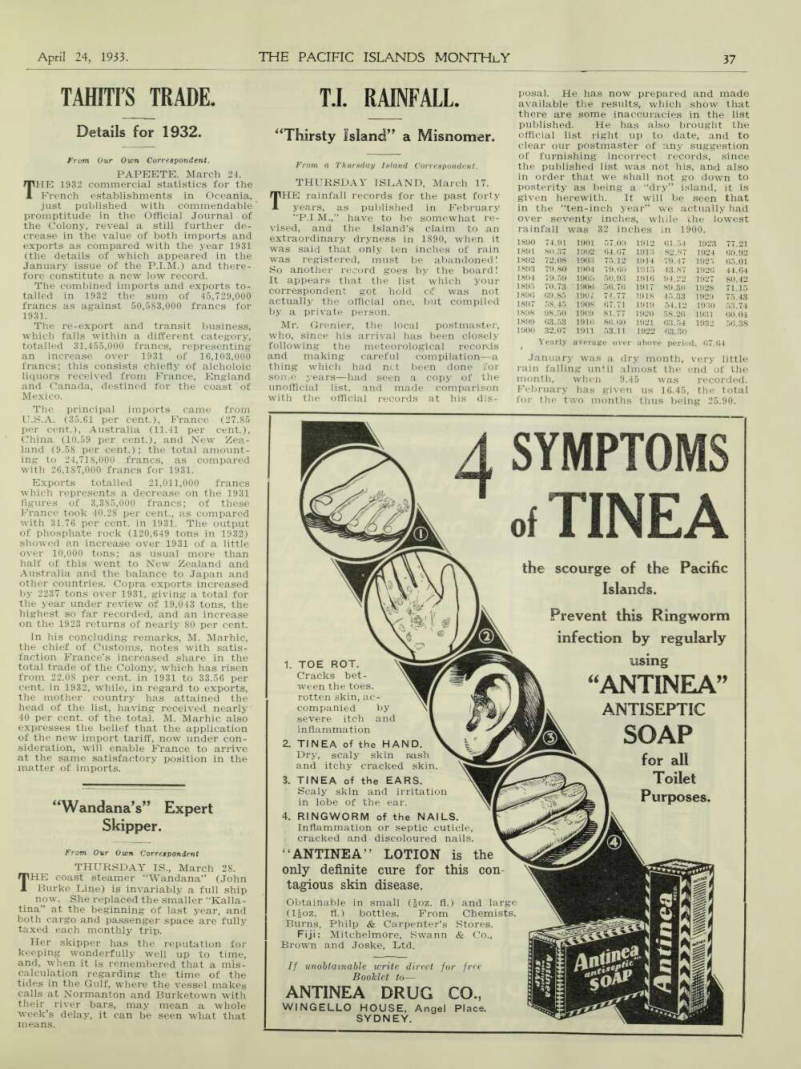
Details for 1932.
From Our Own Correspondent.
PAPEETE. March 24.
THE 1932 commercial statistics for the French establishments in Oceania, just published with commendable promptitude in the Official Journal of the Colony, reveal a still further de crease in the value of both imports and exports as compared with the year 1931 (the details of which appeared in the January issue of the P.I.M.) and there fore constitute a new low record.
The combined imports and exports to talled in 1932 the sum of 45,729,000 francs as against 50,583,000 francs for 1931.
The re-export and transit business, which falls within a different category, totalled 31,455,000 francs, representing an increase over 1931 of 16,103,000 francs: this consists chiefly of alcoholic liquors received from France, England and Canada, destined for the coast of Mexico.
The principal imports came from U.S.A. (35.61 per cent.), France (27.85 per cent.), Australia (11.41 per cent.), China (10.59 per cent.), and New Zea land (9.58 per cent.); the total amount ing to 24,718,000 francs, as compared with 26,187,000 francs for 1931.
Exports totalled 21,011,000 francs which represents a decrease on the 1931 figures of 3,385,000 francs; of these France took 40.28 per cent., as compared with 31.76 per cent, in 1931. The output of phosphate rock (120,649 tons in 1932) showed an increase over 1931 of a little over 10,000 tons; as usual more than half of this went to New Zealand and Australia and the balance to Japan and other countries. Copra exports increased by 2237 tons over 1931, giving a total for the year under review of 19,043 tons, the highest so far recorded, and an increase on the 1923 returns of nearly 80 per cent.
In his concluding remarks, M. Marhic, the chief of Customs, notes with satis faction France’s increased share in the total trade of the Colony, which has risen from 22.08 per cent, in 1931 to 33.56 per cent, in 1932, while, in regard to exports, the mother country has attained the head of the list, having received nearly 40 per cent, of the total. M. Marhic also expresses the belief that the application of the new import tariff, now under con sideration, will enable France to arrive at the same satisfactory position in the matter of imports.
“Wandana’s” Expert
Skipper.
From Our Own Correspondent
Thursday Is., March 28.
THE coast steamer “Wandana” (John Burke Line) is invariably a full ship now. She replaced the smaller “Kalla tina” at the beginning of last year, and both cargo and passenger space are fully taxed each monthly trip.
Her skipper has the reputation for keeping wonderfully well up to time, and, when it is remembered that a mis calculation regarding the time of the tides in the Gulf, where the vessel makes calls at Normanton and Burketown with their river bars, may mean a whole week’s delay, it can be seen what that means.
T.I. Rainfall.
“Thirsty Island” a Misnomer.
From a Thursday Island Correspondent.
Thursday Island, March 17.
THE rainfall records for the past forty years, as published in February “P.I.M.,” have to be somewhat re vised, and the Island’s claim to an extraordinary dryness in 1890, when it was said that only ten inches of rain was registered, must be abandoned!
So another record goes by the board!
It appears that the list which your correspondent got hold of was not actually the official one, but compiled by a private person.
Mr. Grenier, the local postmaster, who, since his arrival has been closely following the meteorological records and making careful compilation—a thing which had net been done for some years—had seen a copy of the unofficial list, and made comparison with the official records at his dis
posal. He has now prepared and made available the results, which show that there are some inaccuracies in the list published. He has also brought the official list right up to date, and to clear our postmaster of any suggestion of furnishing incorrect records, since the published list was not his, and also in order that we shall not go down to posterity as being a “dry” island, it is given herewith. It will be seen that in the “ten-inch year” we actually had over seventy inches, while the lowest rainfall was 32 inches in 1900. 1890 74.91 1901 57.09 1912 01.54 1923 77.21 1891 80.37 1902 04.07 1913 82.87 1924 00.92 1892 72.08 1903 75.12 1914 79.47 1925 05.01 1893 79.80 1904 79.00 1915 43.87 1920 44.04 1894 79.59 1905 50.93 1910 94.22 1927 80.42 1895 70.73 1900 56.70 1917 89.39 1928 71.15 1890 09.85 1907 74.77 1918 45.33 1929 75 43 1897 58.45 1908 07.71 1919 54.12 1930 53 74 1898 98.50 1909 81.77 1920 58.26 1931 60.04 1899 03.53 1910 80.00 1921 63.54 1932 50 38 1900 32.07 1911 53.11 1922 03.30 Yearly average over above period, 07.64 January was a dry month, very little rain falling until almost the end of the month, when 9.45 was recorded.
February has given us 16.45, the total for the two months thus being 25.90.
Advertisements & other items, pp. 39-40 (1 item)
4 Symptoms
1. TOE ROT.
Cracks bet ween the toes, rotten skin, ac companied by severe itch and inflammation 2. TINEA of the HAND.
Dry, scaly skin nash and itchy cracked skin. 3. TINEA of the EARS.
Scaly skin and irritation in lobe of the ear.
4. RINGWORM of the NAILS
Inflammation or septic cuticle, cracked and discoloured nails.
“ANTINEA” LOTION is the
only definite cure for this con tagious skin disease.
Obtainable in small (½oz. fl.) and large (1½oz. fl.) bottles. From Chemists, Burns, Philp & Carpenter’s Stores.
Fiji: Mitchelmore, Swann & Co., Brown and Joske, Ltd.
4 SYMPTOMS
of TINEA
the scourge of the Pacific
Islands.
Prevent this Ringworm
infection by regularly
using
“ANTINEA”
ANTISEPTIC
SOAP
for all
Toilet
Purposes.
If unobtainable write direct for free Booklet to —
ANTINEA DRUG CO.,
WINGELLO HOUSE, Angel Place.
SYDNEY.
MASSEY HARRIS
Agricultural
MACHINERY
includes a wide range of implements suited to plantation work.
The
No. 43 Pony Plough,
Ideal for small area work.
Cuts furrows 7-inches wide and to 8 inches deep.
Steel Share and extra Chilled Cast Share provided.
Price; £4/5/0
(Australian currency) delivered to Steamer.
Extras: Gauge Wheel 8 / 6 Knife Coulter . . 10/- Rolling Coulter . . 25/- Write for free catalogue of all Massey Harris Implements to
Massey Harris
664 Bourke Street,
MELBOURNE,
Australia.
Also Sydney and Brisbane.
The Beaumont operates without atten tion for 24 hours, costs a few pence weekly to run, and relies on a kerosene lamp to create intense cold!
Quality built of porcelain enamelled steel; 4in. thickness of insulation, white duco exterior, stainless metal fittings.
Write for Catalogue and Particulars of Terms Proposition.
WESTCOTT, HAZELL
& CO. LTD.
225 Castlereagh St., SYDNEY.
Cables: “Westhazell"
Extraordinary Result Of Earth Tremor.
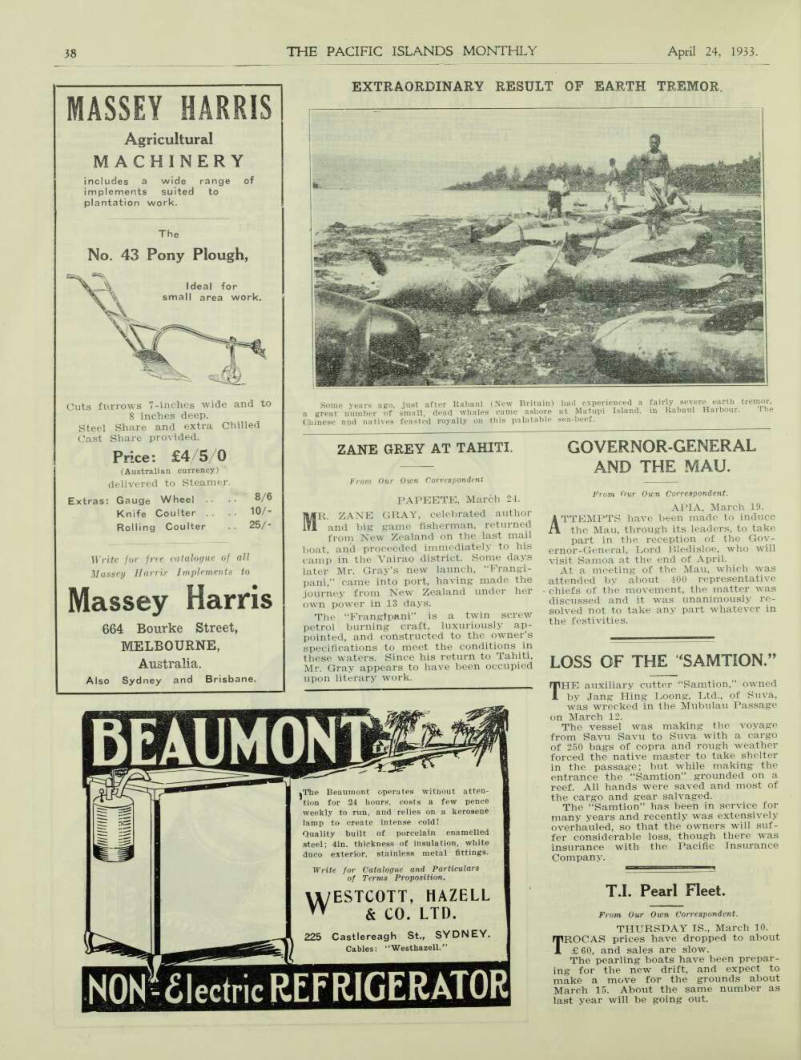
Some years ago, just after Rabaul (New Britain) had experienced a fairly severe earth tremor, a great number of small, dead whales came ashore at Matupi Island, in Rabaul Harbour. The Chinese and natives feasted royally on this palatable sea-beef.
Zane Grey At Tahiti.
From Our Own Correspondent PAPEETE, March 24.
MR. ZANE GRAY, celebrated author and big game fisherman, returned from New Zealand on the last mail boat, and proceeded immediately to his camp in the Vairao district. Some days later Mr. Gray’s new launch, “Frangi pani,” came into port, having made the journey from New Zealand under her own power in 13 days.
The “Frangipani” is a twin screw petrol burning craft, luxuriously ap pointed, and constructed to the owner’s specifications to meet the conditions in these waters. Since his return to Tahiti, Mr. Gray appears to have been occupied upon literary work.
Governor-General
And The Mau.
From Our Own Correspondent.
APIA, March 19.
ATTEMPTS have been made to induce the Mau, through its leaders, to take part in the reception of the Gov ernor-General, Lord Bledisloe, who will visit Samoa at the end of April.
At a meeting of the Mau, which was attended by about 400 representative chiefs of the movement, the matter was discussed and it was unanimously re solved not to take any part whatever in the festivities.
Loss Of The "Samtion.”
THE auxiliary cutter “Samtion,” owned by Jang King Loong, Ltd., of Suva, was wrecked in the Mubulau Passage on March 12.
The vessel was making the voyage from Savu Savu to Suva with a cargo of 250 bags of copra and rough weather forced the native master to take shelter in the passage; but while making the entrance the “Samtion” grounded on a reef. All hands were saved and most of the cargo and gear salvaged.
The “Samtion” has been in service for many years and recently was extensively overhauled, so that the owners will suf fer considerable loss, though there was insurance with the Pacific Insurance Company,
T.I. Pearl Fleet.
From Our Own Correspondent.
Thursday Is., March 10.
TROCAS prices have dropped to about £60, and sales are slow.
The pearling boats have been prepar ing for the new drift, and expect to make a move for the grounds about March 15. About the same number as last year will be going out.
Rabaul Festivities.
“Koeln’s” Visit to N.G.
IN anticipation of the visit of the Ger man cruiser “Koeln” to Rabaul on June 7, a “Koeln Committee” has been formed to organise arrangements for the entertainment of the personnel.
The cruiser has a complement of 520 officers and men, including 70 cadets and, as the visit is informal, official ac tivities will be confined to courtesy calls; but two Government officials have been appointed to act as a reception commit tee and assist the “Koeln Committee”.
The following programme has been drawn up: June 7. —Official calls, German Club ball, Regent Theatre.
June B.—Fruhschoppen at German Club at 11 a.m.
June 9.—Picture show at Regent Theatre.
June 10.—Race meeting at Lakunai.
June 11. —Motor trips in morning. Band per formance in Botanic Gardens.
June 12.—Inspection of cruiser.
June 13.—Visit to Catholic Mission at Vuna pope. “Sing Sing’’ at Kokopo.
It is intended to ask the captain of the “Koeln to let the ship’s band play at the ball which will be held on the first night of the visit, so that Rabaul residents will have the opportunity of making the acquaintance of the visitors. Rabaul Recreations, Ltd. have not only lent the Regent Theatre for the ball; but will also provide a marquee near the theatre so that refreshments can be provided.
They will also provide a free picture show for the men.
Papuan Trade.
Increase Last Year.
From Our Own Correspondent.
Pt. Moresby, April 13.
THE returns of imports and exports for the six months to December last, 1932, of the Territory show an improvement, compared with the corresponding six months of the previous year.
Total exports for December, 1932 £145,198 Total exports for December, 1931 £115,584 Total imports for December, 1932 £107,407 Duly collected: £13,979.
Total imports for December, 1931 £104,978 Duly collected: £15,778.
The trade balance of the Territory for the last half-year was, therefore, £37,791, as compared with £10,706 for the second half-year of 1931.
Knives Used.
Samoan Affrays.
From Our Own Correspondent.
QAPIA, March 19.
QUARRELS and controversy among young Samoans have led to serious fights and affrays in villages on the West Coast.
At Vailutai and Fasitoo-uta, knives were used by the opponents, several were wounded seriously and had to be attended to in hospital.
A number of natives were arrested and will appear in the High Court.
Papuan Rubber.
Payment of Bounty.
From Our Own Correspondent.
Pt. Moresby, April 13.
RUBBER growers here hope that the Federal Government will consider a proposal to overcome the difficulty of their not obtaining the bounty, until the manufacturers find it convenient to remove the rubber from bond.
The proposal is that the Common wealth make 90 per cent, of the duty on the rubber actually cleared or bonded, available to the Papuan Treasury every month.
This Government would then pay the planters an amount equal to 90 per cent, of duty collected on the quantities shipped, the balance being adjusted upon receipt of Australian Customs certificate of rubber actually cleared or bonded.
The Federal Government is consider ing the position.
Advertisements & other items, p. 41 (1 item)
Cartridges
Small Docket Books, Receipt
Books, etc.
3½ x 4 5/8, printed with name, trade, address. 3/- per dozen. Send for Samples.
WALTER WILLIAMS LTD,
LIVERPOOL ROAD, BURWOOD. UJ 4170.
THE BOOK CLUB,
BURNT PINE,
NORFOLK ISLAND.
FIRST-RATE MODERN LIBRARY.
Five Hundred Books—added to by every mail. Very reasonable terms.
Visitors welcomed.
Conducted by
Mrs. CAMPBELL, Rep. P.I.M,
Whether shooting in the rain with bando and sporting bag exposed, or padding through swamp with the chance of your ammunition coming into direct contact with water itself, if you carry only “Dux bac” Cartridges you’ll find that wet makes no difference.
The IMPROVED
"Duxbac”
WATERPROOF
Cartridges
are spoil-proof under the wettest con ditions, being treated by a new scientific process that renders them impervious to moisture, the waterproofing being done after loading, effectively sealing them against damp or wet, yet combining ballistics that can always be relied upon to give re sults unexcelled by any other cartridge.
Obtainable From All Dealers
Throughout
Australia
NOBEL
Thursday Is. News.
Brightening Up the Town,
From Our Own Correspondent.
Thursday Is., March 28.
SOME of the business places have quite transformed their appearance lately.
The difference that a little paint makes is remarkable. Possibly the day will yet come when the main business places of the Island will be of a more permanent and solid character, but until then there is no reason, why the best should not be made of what we have.
Visitors do not always get a favour able impression of the main street when they land from a steamer, and often a iittle brightening-up makes a big difference. Just now the gardens and grounds of private houses are looking well; bougainvillaea, and other bright flowering creepers are prominent, and crotons are showing up well, and the whole island is delightfully green with poincianna, frangipanni, mango and banyan trees and the fine widespread ing wild almond.
Rowing Season.
Captain Dimond, of the Torres Strait Pilot Service, who, like his brother pilots, has frequently to fill in time at the Island waiting for a ship, is coach ing the young ladies of the Aquatic Club in physical exercises. Under the guidance of Mr. C. Cleveland, Mr.
Richardson, and other devotees of the paddle, the Aquatic Club ladies have been putting in steady work in sculling practice, and tried out their powers last Saturday afternoon amid, much excite ment. Unfortunately, a couple of the fair rowers had to stand out owing to illness a few days before, but never theless it was a good go, and the next race in a fortnight’s time is looked for ward to eagerly.
Church Ball.
The School of Arts was gay with colour on St. Patrick’s night, when a “Cretonne Ball” was held in aid of the funds of the Roman Catholic Church.
There was a fine attendance, and con siderable originality was displayed in the make-up of some of the costumes.
The prize-winners were: Best lady’s costume, Mrs. C. Sinclair; best gentle man’s costume, Mr. C. White; most original costume worn by lady, Miss E.
Burgess; gentleman, Mr. M. Cellis; bestdressed couple, Miss E. Bartlett and Mr.
E. Latta. The promoters are to be con gratulated on the success of the under taking, as the church benefits by about £14.
Personal.
Miss Ailsa Adams, who is in the Dis trict Registrar’s office, and who recently underwent an operation for appendicitis, has gone south on leave, to recuperate.
Her many friends hope to see her return soon.
Mrs. Stephen Davies, wife of the Bishop of Carpentaria, who has been in Sydney for some time, is still too unwell
to return to Thursday Island. Latest reports are that she is returning to health, and hopes to be back at Bishop’s House by the middle of the year. The Bishop himself has also not been in the best of health, and is under medical treatment. The work of the big diocese, which, takes in about 650,000 square miles of land and sea, is very strenuous, entailing a considerable amount of travelling in three States of the Com monwealth, His Lordship came to the See about twelve years ago.
Mr. W. Clarke arrived recently to fill the vacancy at the Post Office, so the staff is again up to full strength. Mr.
Jones, who has been on holidays, has returned and will shortly resume duty.
Mr. H. Flannery, of the telephone de partment, will then take leave for three months, and intends visiting Melbourne.
Sergeant-Artificer Lambert, who has been at Thursday Island a good many years now, looking after the big guns at the fort, goes to Darwin with the removal of the garrison. He was given a send-off recently by friends. The sergeant’s family will remain here for some time, however.
It was with great regret that local residents heard of the death in Sydney of Mrs. Wm. Carpenter, wife of the well-known pearler and manager of the Port Kennedy Shipbuilding Co. Mr.
Carpenter had just lately gone south, and so was with his wife when the sad event happened.
Mr. C. Sawyer, of the Imperial Hotel, has sold out and is returning to Eng land.
Thursday Is. Jetty.
One result of the removal of the bar racks to Darwin is that a considerable quantity of heavy material has to pass over the Town Jetty for shipment.
Inspection recently by the Harbour- Master showed that the structure needed to be strengthened and repaired before some of the heaviest of the gun mountings, etc., could be allowed to go over it, and recommendations made to the jetty authorities are to be followed shortly by the carrying-out of the necessary work.
Thursday Is. Council.
The civic elections have taken place and a new Town Council installed.
There has been a change in some of the aldermanic seats.
Alderman A. Corran, who has occu pied the position of Mayor for very many years, has again been elected.
Four of the former aldermen have re tired, and the gentlemen nominated to the office this year are Messrs. A.
Broadbent, F. Joyce, D. B. Farquhar, E. Burke, R. Robson, H. G. Vidgen, E.
H. Vowels and A. Filewood. Only the required number were nominated, so there is no polling-day excitement to look forward to.
The Commonwealth and Dominion Line’s motor vessel “Port Dunedin” ar rived at Suva, Fiji, on March 12, from London en route to New Zealand. The vessel carried 1880 tons of general cargo for Suva and three passengers, Mrs. M.
B. Robins, Miss A. B. Robins, and Mas ter R. C. F. Robins.
Advertisements & other items, p. 42 (1 item)
Wimbledon Tennis Gut Co.
RABAUL CARRYING CO.,
GENERAL FORWARDING
AGENTS. CUSTOMS AGENTS,
INSURANCE STORAGE.
Transport Work and Forwarding Work of Every Description Undertaken.
Modern Transport Equipment.
Telephones; Radio Address; Rabaul 176 and 135. “Rabcarco.”
E. M. GRANTER, Manager.
Natural Gum, Unbreakable Sets, Comfortable and Long Lasting, Old Plates Remodelled and made equal to new. 28 OXFORD ST., over Winns;
139 ELIZABETH STREET
Telegraphic and Cab
TEETH BY POST.
Well-fitting and lifelike in appearance,
made from “SELF-TAKEN IMPRESSIONS.’
I have made Artificial Teeth by my wellknown and copyrighted System of Self- Taken Impressions for satisfied Patients in all parts of the Commonwealth.
Send for full free particulars.
Satisfaction guaranteed.
SPENCER NOLAN
DENTIST,
Established in Sydney over 35 years. 177 OXFORD ST., opposite Mcllraths. doors from Market Street, Sydney, ss: “FASTPLATE,” Sydney.
TENNIS PLAYERS!
Learn to String* your Own Racket.
Full illustrations, instructions and all tools . . . . No. 1 £2 2 0 TRUE - GRIP CLAMP, or Stringing Machine, illustrations instructions and all tools No. 2 £5 5 0
Wimbledon Tennis Gut Co.
Q. V. Buildings, George Street, SYDNEY.
RACKETS, NETS and ALL EQUIPMENT.
Tiveri Gold Dredging.
New Concern Will Work Papuan Field.
From Our Own Correspondent.
Pt. Moresby, March 22.
A new company has been floated in Papua and registered as the Tiveri Gold Dredging - Company Limited— the first dredging company in the Ter ritory. It issued its prospectus and opened its subscription list on March 9, in Port Moresby. A great deal of optimism is being shown in this new venture.
The capital is £15,000 divided into 15,000 shares of £1 each. Of these shares 11,500 are to be issued and credited as paid up; 2,500 shares are offered for public subscription at 5/on application; 5/- per share on allot ment; and 10/- per share on two monthly calls of 5/- each.
The directors are Mr. T. L. Sefton (a well-known planter who has been interested in mining for many years), Mr. J W. Hinks and Mr. A. L. Clarke, me former is a constructional engi neer and the latter an engineer from Sydney, who has been working a mechanical plant on the property to be acquired for some time with promising results.
The Tiveri River has been a centre of interest to the mining community of Papua for many years. As far back as 1910, seventy prospectors were on the fields, attracted by reports of gold from skilled miners such as Mat Crow and the Pryke Bros., and by 1911 the gold yield was estimated at over £40,000, worked with box and sluice only—not a very large sum to be divided among the 200 miners who were said to have visited the field; but in dicative of the value of the district.
An epidemic of dysentery, which swept off 225 labourers, resulted in recruit ing being forbidden and the field was killed.
Again, on the report of gold in Sep tember, 1930, a dozen or more pros pectors rushed the old field and since then they have been profitably em ployed. Mr. T. Sefton, attracted by the reports, became interested in the field. The problem of working the wash on a large scale was considered; hydraulic sluicing was found success ful. Mr Sefton, in conjunction with Mr. A. L. Clarke, worked a small plant with a petrol driven engine on the spot with good results; but they felt that something better could be done.
Mr. J. W. Hinks, of Hinks Construc tion Limited, Sydney, became inter ested and, with the expert aid of Mr.
R. Gregory, a well-known designer of dredges, a peculiar type of light weight dredge was evolved an d constructed with the new steel now available at low cost. The design shows a dredge of remarkably light weight (about 12 tons) capable of handling 60 cubic yards per hour. It is only 10ft. 6 in in width and will have a loaded draught of 20 inches.
There are over 20 million yards of wash waiting for the test of the dredge, and the directors are certain that there are values of 2/- per yard over large
areas (in the winding beds of creeks where the wash and values vary). The estimate of cost of dredging operations is 5d per yard, and, as gold now sells at nearly £7 an oz., the possible re turns of this venture is substantial.
Dredging claims over no less than nine creeks have been secured and there are 13 miles of creek bed and 14 acres of terraces to be worked.
The vendor of 10 dredging claims will receive 6,500 fully paid shares for his interest, including existing plant now in operation.
Mr. J. W. Hinks will receive 5,000 fully paid up shares in consideration of his delivering the dredge (exclud ing pontoon) c.i.f., Port Moresby; 1,000 shares are held in reserve and 2,500 are offered to the public.
The Company is taking over an existing organisation with camps and made roads. Boys have been recruited and arrangements for transport have been made. The initial troubles of a pioneer company have already been solved, therefore the usual delays in preliminary work will be avoided. It is estimated that the production stage will be reached within six months from date of registration and that the capital expenditure will not exceed £1,500. The directors have agreed to limit their remuneration to a total of £200 per annum payable only when the Company is winning profits.
Mr. B. Dunstan, the Government geologist from Queensland, who re ported on the field in 1931, stated that apart from quite a number of gold bearing reefs large and small, gold existed all over the water shed and small leaders, some of which yielded quite rich prospects shed the gold on to the creeks in the district. He noticed on the way up to the field large areas of old conglomerate which he considered would be worth inves tigating, and he considered that the lower flats of the Tiveri were likely to produce a considerable amount of gold by dredging methods.
Advertisements & other items, p. 43 (1 item)
Lars Halvorsen
ECZEMA CURED.
DISCOVERY OF BRILLIANT
YOUNG SKIN SPECIALIST.
SUCCESS OF NEW FORMULA.
Remarkable advances in medical science have been made during the past few years, and conspicuous among these is the success of a new secret formula for treatment of all skin diseases, discovered by Mr. J. J. McHUGH.
M.P.S.. Ph.C., the well-known Consulting Chemist and Skin Specialist, of 447 Illawarra Road Marrickville, N.S.W.
After years of patient research lie is now able to assure sufferers of instant relief. Reports of almost miraculous cures have come from through out Australia, New Zealand, Thursday Island, Solomon Islands, Fiji, and even U.S.A Cases successfully treated by post as well as person ally with Mr. McHugh’s special and exclusive diagnosis method include Psoriasis, Germ under Nail. Eczema. Varicose Veins, Ulcers, Tinea ( Tropical Ringworm), Barber’s Rash. Ring worm Acne, Pruritis, and many other distress ing skin complaints.
For full details of treatment and copies of letters from enthusiastic patients relieved of all types of skin complaints, “Pacific Islands Monthly" readers are invited to write Mr.
McHUGH personally.
SHIP CHANDLERY HARDWARE
BROOMFIELDS LIMITED, 152 Sussex St., SYDNEY.
Large and Complete Stocks of SHIP CHANDLERY Ironmongery of all kinds. Paints, White Lead and Oils.
Sole Agents for P. H. MUNTZ & CO.’S 3-CROWN BRAND METAL SHEATHING PEACOCK & BUCHANS’ ENGLISH READY - MIXED PAINTS.
WRITE FOR SHIP CHANDLERY CATALOGUE.
Special “In Bond” Prices for all Island enquiries quoted on application.
CABLES: “BOOM,” SYDNEY.
Auxiliary Ketch built for Solomon Islands.
LARS HALVORSEN
Designer and Builder of SCHOONERS, KETCHES, YACHTS LAUNCHES etc. Can also quote for Second-hand Craft. Send particulars of your i equirements - HAVES STREET, NEUTRAL BAY, TyDNEY, N-S.w!
New Guinea
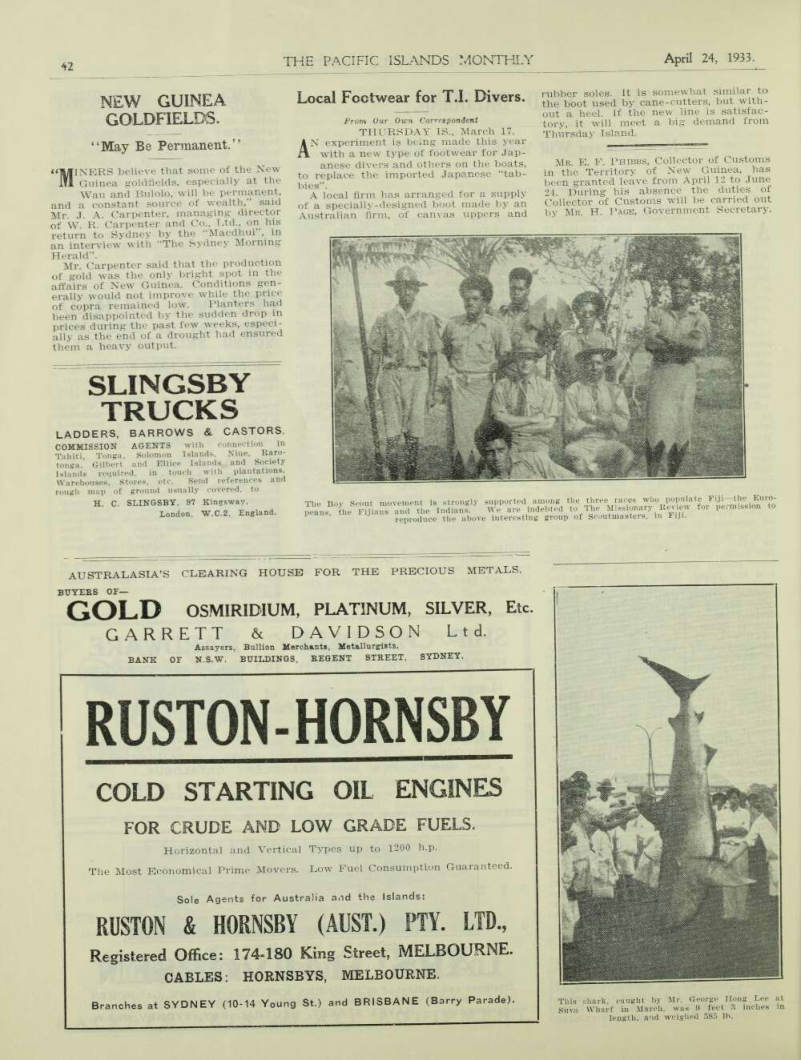
Goldfields.
“May Be Permanent.”
“MINERS believe that some of the New Guinea goldfields, especially at the Wau and Bulolo, will be permanent, and a constant source of wealth,” said Mr. J. A. Carpenter, managing director of W. R. Carpenter and Co., Ltd., on his return to Sydney by the ‘‘Macdhui , in an interview with “The Sydney Morning Herald”.
Mr. Carpenter said that the production of gold was the only bright spot in the affairs of New Guinea. Conditions gen erally would not improve while the price of copra remained low. Planters had been disappointed by the sudden drop in prices during the past few weeks, especi ally as the end of a drought had ensured them a heavy output.
Local Footwear for T.I. Divers.
From Our Own Correspondent
Thursday Is., March 17.
AN experiment is being made this year with a new type of footwear for Jap anese divers and others on the boats, to replace the imported Japanese “tab bies”.
A local firm has arranged for a supply of a specially-designed boot made by an Australian firm, of canvas uppers and
rubber soles. It is somewhat similar to the boot used by cane-cutters, but with out a heel. If the new line is satisfac tory, it will meet a big demand from Thursday Island.
Mr. E. F. Phibbs, Collector of Customs in the Territory of New Guinea, has been granted leave from April 12 to June 24. During his absence the duties of Collector of Customs will be carried out by Mr. H. Page, Government Secretary.
The Boy Scout movement is strongly supported among the three races who populate Fiji-the Euro peans, the Fijians and the Indians. We are indebted to The Missionary Review for permission to reproduce the above interesting group of Scoutmasters, in Fiji.
This shark, caught by Mr. George Hong Lee at Suva Wharf in March, was 9 feet 3 inches in length, and weighed 585 lb.
Advertisements & other items, p. 44 (1 item)
Ruston-Hornsby
SLINGSBY
TRUCKS
LADDERS, BARROWS & CASTORS.
COMMISSION AGENTS with connection in Tahiti Tonga, Solomon Islands, Niue, Raro tonga, Gilbert and Ellice Islands and Society Islands required, in touch with plantations, Warehouses, Stores, etc. Send references and rough map of ground usually covered, to H. C. SLINGSBY. 97 Kingsway.
London. W.C.2, England.
AUSTRALASIA’S CLEARING HOUSE FOR THE PRECIOUS METALS.
BUYERS OF—
GOLD OSMIRIDIUM, PLATINUM, SILVER, Etc.
GARRETT & DAVIDSON Ltd.
Assayers, Bullion Merchants, Metallurgists, BANK OF N.S.W. BUILDINGS, REGENT STREET. SYDNEY.
RUSTON-HORNSBY
COLD STARTING OIL ENGINES
FOR CRUDE AND LOW GRADE FUELS.
Horizontal and Vertical Types up to 1200 b.p.
The Most Economical Prime Movers. Low Fuel Consumption Guaranteed.
Sole Agents for Australia and the islands:
RUSTON & HORNSBY (AUST.) PTY. LTD.,
Registered Office: 174-180 King Street. MELBOURNE.
CABLES: HORNSBYS, MELBOURNE.
Branches at SYDNEY (10-14 Young St.) and BRISBANE (Barry Parade).
Native Of Nauru.
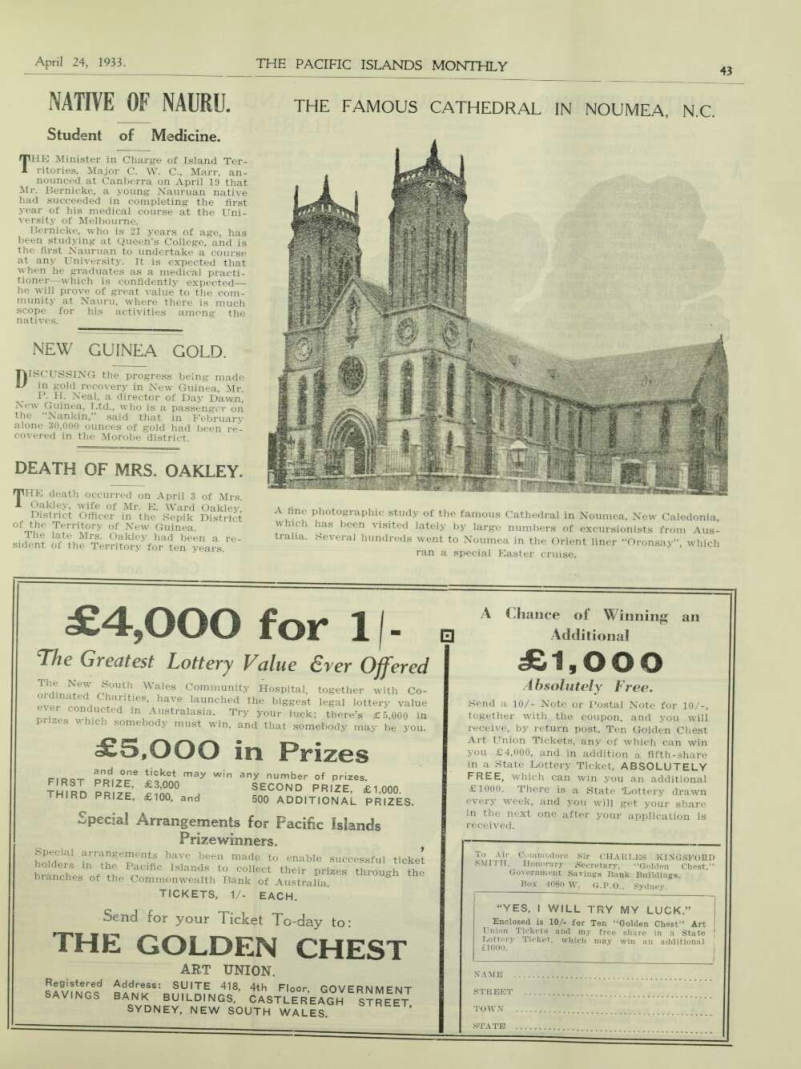
Student of Medicine.
THE Minister in Charge of Island Ter ritories, Major C. W. C., Marr, an nounced at Canberra on April 19 that Mr. Bernicke, a young Nauruan native had succeeded in completing the first year of his medical course at the Uni versity of Melbourne.
Bernicke, who is 21 years of age, has been studying at Queen’s College, and is the first Nauruan to undertake a course at any University. It is expected that when he graduates as a medical practi tioner—which is confidently expected— he will prove of great value to the com munity at Nauru, where there is much scope for his activities among the natives.
New Guinea Gold.
DISCUSSING the progress being made in gold recovery in New Guinea, Mr.
P. H. Neal, a director of Day Dawn, New Guinea, Ltd., who is a passenger on the “Nankin,” said that in February alone 30,000 ounces of gold had been re covered in the Morobe district
Death Of Mrs. Oakley.
THE death occurred on April 3 of Mrs.
Oakley, wife of Mr. E. Ward Oakley, District Officer in the Sepik District of the Territory of New Guinea.
The late Mrs. Oakley had been a re sident of the Territory for ten years.
The Famous Cathedral In Noumea. N.C.
A fine photographic study of the famous Cathedral in Noumea, New Caledonia which has been visited lately by large numbers of excursionists from Aus tralia. Several hundreds went to Noumea in the Orient liner “Oronsay”, which ran a special Easter cruise.
Advertisements & other items, p. 45 (1 item)
The Golden Chest
£4,000 for 1/-
The Greatest Lottery Value Ever Offered
The New South Wales Community Hospital, together with Co ordinated Charities, have launched the biggest legal lottery value ever conducted in Australasia. Try your luck; there’s £5,000 in prizes which somebody must win, and that somebody may be you.
£5,000 in Prizes
first prizT *3 k ooo may wi " Icon'S' 1,000 THIRD PRIZE, £100, and 500 ADDITIONAL PRIZES.
Special Arrangements for Pacific Islands
Prizewinners.
holders m r iL ge T n fl h , a T 6 bee " made t0 enable succes sfui ticket " s m r th t f Paclflc Islands to collect their prizes through the branches of the Commonwealth Bank of Australia
TICKETS, 1/- EACH.
Send for your Ticket To-day to:
THE GOLDEN CHEST
ART UNION.
e!»?*^ e o d Address: SUITE 418, 4th Floor, GOVERNMENT
SAVINGS BANK BUILDINGS, CASTLEREAGH STREET
SYDNEY, NEW SOUTH WALES. ’
A Chance of Winning an
Additional
£1,000
Absolutely Free .
Send a 10/- Note or Postal Note for 10/-, together with the coupon, and you will receive, by return post, Ten Golden Chest Art Union Tickets, any of which can win you £4,000, and in addition a fifth-share in a State Lottery Ticket, ABSOLUTELY FREE, which can win you an additional £1000. There is a State Lottery drawn every week, and you will get your share in the next one after your application is received.
To Air Commodore Sir CHARLES KINGSFORD SMITH Honorary .Secretary, “Golden Chest,”
Government Savings Bank Buildings.
Box 4080 W, G.P.O., Sydney.
“YES, I WILL TRY MY LUCK.”
Enclosed is 10/- for Ten “Golden Chest” Art Union Tickets and my free share in a State 1 Lottery Ticket, which may win an additional £1000.
NAME .
STREET
TOWN
STATE
Tahitian Wedding.
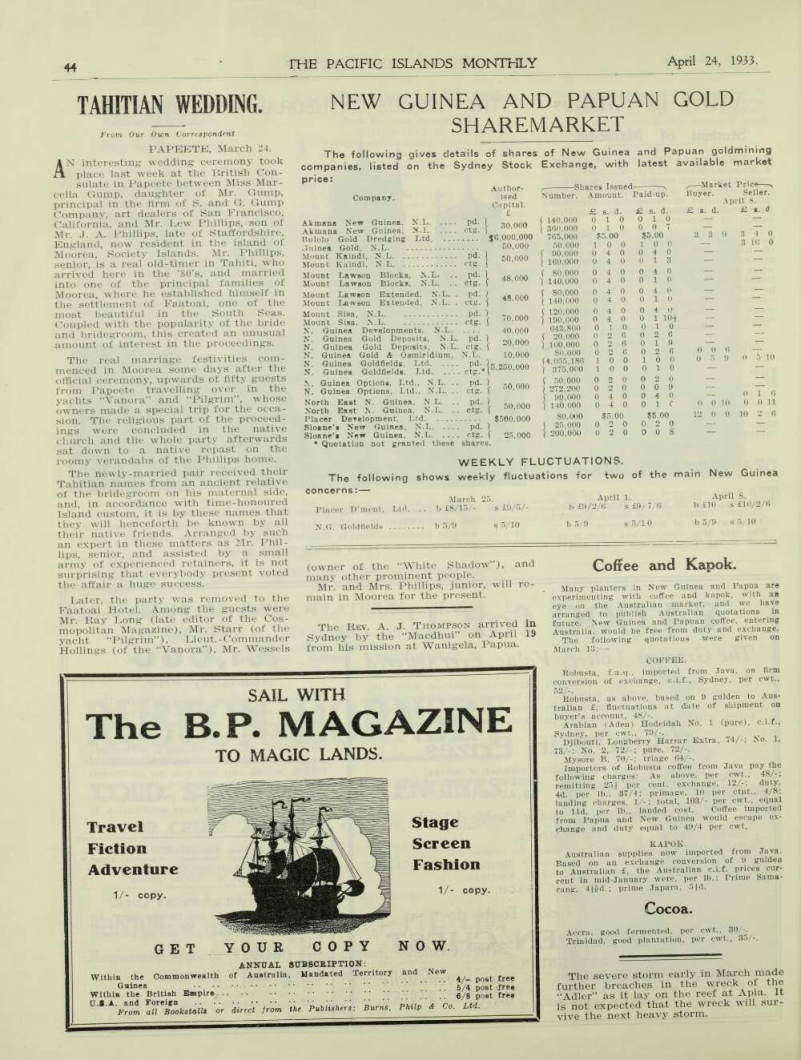
From Our Own Correspondent PAPEETE, March 24.
AN interesting wedding ceremony took place last week at the British Con sulate in Papeete between Miss Mar cella Gump, daughter of Mr. Gump, principal in the firm of S. and G. Gump Company, art dealers of San Francisco, California, and Mr. Lew Phillips, son of Mr. J. A. Phillips, late of Staffordshire, England, now resident in the island of Moorea, Society Islands. Mr. Phillips, senior, is a real old-timer in Tahiti, who arrived here in the ’80’s, and married into one of the principal families of Moorea, where he established himself in the settlement of Faatoai, one of the most beautiful in the South Seas.
Coupled with the popularity of the bride and bridegroom, this created an unusual amount of interest in the proceedings.
The real marriage festivities com menced in Moorea some days after the official ceremony, upwards of fifty guests from Papeete travelling over in the yachts “Vanora” and “Pilgrim”, whose owners made a special trip for the occa sion. The religious part of the proceed ings were concluded in the native church and the whole party afterwards sat down to a native repast on the roomy verandahs of the Phillips home.
The newly-married pair received their Tahitian names from an ancient relative of the bridegroom on his maternal side, and, in accordance with time-honoured Island custom, it is by these names that they will henceforth be known by all their native friends. Arranged by such an expert in these matters as Mr. Phil lips, senior, and assisted by a small army of experienced retainers, it is not surprising that everybody present voted the affair a huge success.
Later, the party was removed to the Faatoai Hotel. Among the guests were Mr. Ray Long (late editor of the Cos mopolitan Magazine), Mr. Starr (of the yacht “Pilgrim”). Lieut.-Commander Rollings (of the “Vanora”), Mr. Wessels
(owner of the “White Shadow”), and many other prominent people.
Mr. and Mrs. Phillips, junior, will re main in Moorea for the present.
The Rev. A. J. Thompson arrived in Sydney by the “Macdhui” on April 19 from his mission at Wanigela, Papua.
Sharemarket
New Guinea And Papuan Gold
The following gives details of shares of New Guinea and Papuan goldmining companies, listed on the Sydney Stock Exchange, with latest available market price:
Weekly Fluctuations.
The following shows weekly fluctuations for two of the main New Guinea concerns:
Authorised Capital. £ Shares Issued Market Price Company.
Number. Amount. Paid-up. £ s. d. £ s. d.
Buyer. £ s. d.
Seller.
April 8. £ s. d Akmana New Guinea. N.L pd. 30,000 Akmana New Guinea, N.L ctg.
Bulolo Gold Dredging Ltd. $6,000,000 Guinea Gold, N.L. 50,000 140,000 360,000 765,000 50,000 0 1 0 0 1 0 $5.00 1 0 0 0 1 0 0 0 7 $5.00 1 0 0 3 3 9 3 4 0 3 16 0 Mount Kaindi, N.L pd.
Mount Kaindi, N.L ctg. 50,000 90,000 160,000 0 4 0 0 4 0 0 4 0 0 1 3 — Mount Lawson Blocks, N.L. .. pd. 48,000 80,000 0 4 0 0 4 0 0 1 0 — Mount Lawson Blocks. N.L. .. ctg. 140,000 0 4 0 0 1 0 Mount Lawson Extended. N.L. . pd. 48,000 80,000 0 4 0 0 4 0 — Mount Lawson Extended, N.L. . ctg. 140,000 0 4 0 0 1 0 Mount Sisa, N.L pd.
Mount Sisa, N.L ctg. 70,000 120,000 190,000 0 4 0 0 4 0 0 4 0 0 1 10½ 0 1 0 0 2 6 — — N. Guinea Developments, N.L 40,000 643,800 0 1 0 0 1 0 0 2 6 0 1 9 N. Guinea Gold Deposits, N.L. pd.
N. Guinea Gold Deposits. N.L. ctg. 20,000 20,000 100,000 0 2 6 0 2 6 0 0 6 — N. Guinea Gold A Osmiridium, N.L. 10,000 80,000 0 2 6 0 2 6 0 5 9 0 5 10 N. Guinea Goldfields, Ltd pd.
N. Guinea Goldfields, Ltd ctg. 5,250,000 4,055,186 375,000 1 0 0 1 0 0 1 0 0 0 1 0 N. Guinea Options. Ltd., N.L. .. pd.
N. Guinea Options. Ltd., N.L. .. ctg. 50,000 50,000 272,200 90,000 0 2 0 0 2 0 0 4 0 0 2 0 0 0 9 0 4 0 - 0 1 6 North East N. Guinea, N.L. .. pd. 50,000 140,000 0 4 0 0 1 0 0 0 10 0 0 11 North East N, Guinea, N.L. .. ctg. 12 0 0 10 2 6 Placer Development, Ltd $500,000 80,000 $5.00 $5.00 Sloane’s New Guinea, N.L pd. 25,000 0 2 0 0 2 0 — — Sloane’s New Guinea, N.L ctg. 25,000 200,000 0 2 0 0 0 8 * Quotation not granted these shares.
March 25 April 1. April 8.
Placer D’ment, Ltd. .. b £8/15/- s £9/5/- b £9/2/6 s £9/7/6 b £10 s £10/2/6 N.G. Goldfields b 5/9 s 5/10 b 5/9 s5/10 b 5/9 s 5/10
Coffee and Kapok.
Many planters in New Guinea and Papua are experimenting with coffee and kapok, with an eye on the Australian market, and we have arranged to publish Australian quotations in future. New Guinea and Papuan coffee, entering Australia, would be free from duty and exchange.
The following quotations were given on March 13: —
Coffee.
Robusta, f.a.q., imported from Java, on firm conversion of exchange, c.i.f.. Sydney, per cwt., 52/-.
Robusta, as above, based on 9 gulden to Aus tralian f, fluctuations at date of shipment on buyer’s account, 48/-. - Arabian (Aden) Hodeidah No. 1 (pure), c.i.f., Sydney, per cwt., 79/-.
Djibouti, Longberry Harrar Extra, 74/-; No. 1, 73/-: No. 2, 72/-; pure, 72/-.
Mysore B, 70/-; triage 64/-.
Importers of Robusta coffee from Java pay the following charges: As above, per cwt., 48/-; remitting 25 i per cent, exchange, 12/-; duty, 4d. per lb., 37/4; primage, 10 per ctnt., 4/8; landing charges, 1/-; total, 103/- per cwt., equal to 11d. per lb., landed cost. Coffee imported from Papua and New Guinea would escape ex change and duty equal to 49/4 per cwt.
Kapok.
Australian supplies now imported from Java.
Based on an exchange conversion of 9 gulden to Australian £, the Australian c.i.f. prices cur rent in mid-January were per lb.: Prime Sama raug, 4ifd.; prime Japara, 5¼d.
Cocoa.
Accra, good fermented, per cwt., 30/-.
Trinidad, good plantation, per cwt., 35/-.
The severe storm early in March made further breaches in the wreck of the “Adler” as it lay on the reef at Apia, it is not expected that the wreck will sur vive the next heavy storm.
Advertisements & other items, p. 46 (1 item)
The B.P. Magazine
SAIL WITH
TO MAGIC LANDS.
Travel Fiction Adventure 1/- copy.
Stage Screen Fashion 1/- copy.
GET YOUR COPY NOW.
ANNUAL SUBSCRIPTION:
Within the Commonwealth of Australia. Mandated Territory and New Guinea 4/- post free Within the British Empire 5/4 post free U.S.A. and Foreign 6/8 post free From all Bookstalls or direct from the Publishers : Burns, Philp & Co. Ltd.
Market Quotations
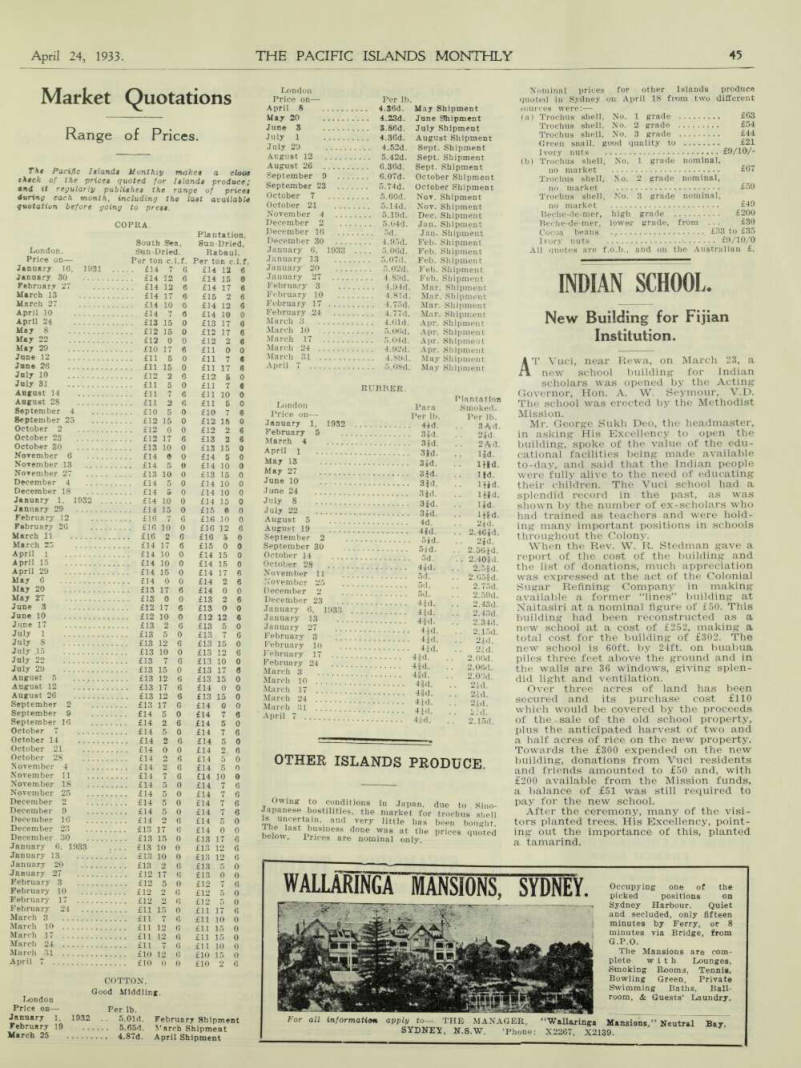
Range of Prices.
The Pacific Islands Monthly makes a close check of the prices quoted for Islands produce; and it regularly publishes the range of prices during each month, including the last available quotation before going to press.
London Price on— April 8 Per lb. . . . 4.S6d. UaT Shinment May 20 4 23d June Shipment July Shipment August Shipment Sept. Shipment Sept. Shipment Sept. Shipment October Shipment October Shipment Nov. Shipment Nov. Shipment Dec. Shipment Jan. Shipment Jan. Shipment Feb. Shipment Feb. Shipment Feb. Shipment Feb. Shipment Feb. Shipment Mar. Shipment Mar. Shipment Mar. Shipment Mar. Shipment Apr. Shipment Apr. Shipment Apr. Shipment Apr. Shipment May Shipment May Shipment June 3 . . . 3.86d.
July 1 4 36d.
July 20 . . .. 4.52d.
August 12 5.42d August 26 .. . 6.36d.
September 9 ... ... 6.07d.
September 23 . . . . .. . 5.74d.
October 7 October 21 ... ... 5.60d. ... 5.l4d November 4 December 2 December 16 December 30 5.19d. 5.04d. ... 5d. 4 95d January 6. 1933 January 13 ...
January 20 . ... 5.06d. ... 5.07d. 5 02d January 27 ... 4.89d February 3 ... 4 94d February 10 ... 4 8 l d February 17 February 24 ...
March 3 March 10 March 17 March 24 4.77d. 4.Old. 5.06d. 5.04d.
March 31 April 7 5.08d.
London Price on— January 1, 1932
Rubber.
Plantation Para Smoked.
Per lb. Per lb. 4id. 3Atd. 3|d. .. 2Jd. 3jd. .. 2Ad. 3gd. .. lid. 3id. . . lf|d. 34r1 i 1/4 February 5 March 4 April i May 13 May 27 June 10 o ?u. 1 fa.
Qlrl 1 11J June 24 OJU. . . 1 ft Q. 34(1 1 13 H July 8 ° 4 U * 1 ff U, 1 in July 22 o ju. . . i ta. 31H i ib-i August 5 °b u - • • l tc a* 4d. . . 2id. 4$d. .. 2.46Jd. aid. .. 2|d. aid. .. 2.5GJd.
August 19 September 2 September 30 October 14 October 28 4id. .. 2.5§d.
November 11 November 25 December 2 December 23 od. .. 2.75d. 5d. .. 2.59d. 44d 9 iQ/i January 0, 1933 .
January 13 4Jd. .. 2.43d. o o i,i January 27 ■lid. . . 2.13d. 41H 91.1 February 3 February 10 4 X ou February 17 ...
"u. . , —Aa. 4 Id 9 February 24 4 4 u. . . <b.UDQ. 4 3d 9 ftiM March 3 43d 9 AOri March 10 ... 43d oi/i March 17 .
March 24 . . ,. 2id. 4 4 d 01,1 March 31 April 7 • . 24d. 41d. .. 2,'d. 4id. .. 2.15d.
London. Price on— January 16, 1931 January 30 ...
Copra.
South Sea, Sun-Dried. Per ton c.i.f. £14 7 6 £14 12 6 Plantation, Sun-Dried, Rabaul, Per ton c.i.f. £14 12 6 £14 15 0 £14 17 6 £15 2 6 £14 12 6 £14 10 0 £13 17 a £12 17 6 £12 2 6 £11 0 0 £11 7 « £11 17 6 £12 5 0 £11 7 S February 27 £14 12 6 March 13 £14 17 6 March 27 £14 IQ 0 April 10 £14 7 6 April 24 £13 15 0 May 8 £12 15 0 May 22 £12 0 0 May 29 £10 17 6 June 12 £11 5 0 June 26 July 10 £12 2 6 July 31 August 14 £11 7 6 £11 10 0 £11 5 0 £10 7 8 £12 15 0 £12 2 6 £13 2 6 £13 15 0 £14 5 0 August 28 £11 2 6 September 4 £10 5 0 September 25 £12 15 0 October 2 £12 0 0 October 23 £12 17 6 October 30 £13 10 0 November 6 . . . , £14 0 0 November 13 ., . . £14 5 © £14 10 0 £13 15 0 £14 10 0 £14 10 0 £14 15 0 £15 0 0 £16 10 0 £16 12 6 £16 5 6 £15 0 0 £14 15 0 £14 15 0 £14 17 6 £14 2 6 £14 0 0 £13 2 6 £13 0 0 £12 12 6 £13 5 0 £13 7 6 £13 15 0 £13 12 6 £13 10 0 £13 17 6 £13 15 0 £14 0 0 £13 15 0 £14 0 0 £14 7 Q £14 5 0 £14 7 6 £14 5 0 £14 2 6 £14 5 0 £14 5 0 £14 10 0 £14 7 6 £14 7 6 £14 7 6 £14 7 6 £14 5 0 £14 0 0 £13 17 6 £13 12 6 £13 12 6 £13 5 0 £13 0 0 £12 7 6 £12 5 0 £12 5 0 £11 17 6 £11 10 0 £11 15 0 £11 15 0 November 27 .,. . £13 10 0 December 4 . . . . £14 5 0 December 18 . . . . £14 5 o January 1, 1032 .
January 29 £14 10 0 £14 15 0 February 12 £16 7 6 February 26 £16 10 0 March 11 . £16 2 6 March 23 £14 17 6 April l £14 10 0 April 15 £14 10 0 April 29 £14 15 0 May 6 £14 o 0 May 20 £13 17 6 May 27 £13 0 0 June 3 £12 17 6 June 10 £12 10 0 June 17 £13 2 6 July 1 ... £13 5 0 July S £13 12 6 July .15 £13 10 0 July 22 £13 7 6 July 29 £13 15 0 August 5 £13 12 6 August 12 £13 17 6 August 26 £13 12 6 September 2 £13 17 G September 9 . .. £14 5 0 September 16 £14 2 6 October 7 £14 5 0 October 14 £14 2 6 October 21 £14 0 0 October 28 £14 2 6 November 4 ... £14 2 6 November 11 ..., £14 7 6 November 18 . .. , £14 5 o November 25 .. .. £14 5 o December 2 .. .. £14 5 o December 9 ... . £14 5 0 December 16 ... £14 2 6 December 23 ... £13 17 6 December 30 .. .. £13 15 o January 6. 1933 January 13 £13 10 0 £13 io 0 January 20 £13 2 6 January 27 February 3 February 10 ... £12 2 6 February 17 £12 2 6 February 24 £11 15 o March 3 March 10 March 17 March 24 £11 10 0 March 31 £10 15 0 April 7 £10 2 6 j Shipment h ipmen t
Cotton.
Good Middling.
London Price on— Per lb.
January 1. 1932 . . 5.Old. Februar February 19 <a March 25 . 4.87d. April Sh ipment
Other Islands Produce.
Owing to conditions in Japan, due to Sino- Japanege hostilities, the market for trochus shell is uncertain, and very little has been bought.
The last business done was at the prices quoted below. Prices are nominal only.
Nominal prices for other Islands produce quoted in Sydney on April 18 from two different sources were: — (a) Trochus shell, No. 1 grade £63 Trochus shell. No. 2 grade £54 Trochus shell, No. 3 grade £44
Green snail, good quality to £21
Ivory nuts £9/10/- (b) Trochus shell, No. 1 grade nominal, no market £67 Trochus shell, No. 2 grade nominal, no market £59 Trochus shell, No. 3 grade nominal, no market £49 Beche-de-mer, high grade £200 Beche-de-mer, lower grade, from . . . £30 Cocoa beans £33 to £35
Ivory nuts £9/10/0
All quotes are f.o.b., and on the Australian £.
Indian School.
New Building for Fijian Institution.
AT Vuci, near Rewa, on March 23, a new school building for Indian scholars was opened by the Acting Governor, Hon. A. W. Seymour, V.D.
The school was erected by the Methodist Mission.
Mr. George Sukh Deo, the headmaster, in asking His Excellency to open the building, spoke of the value of the edu cational facilities being made available to-day, and said that the Indian people were fully alive to the need of educating their children. The Vuci school had a splendid record in the past, as was shown by the number of ex-scholars who had trained as teachers and were hold ing many important positions in schools throughout the Colony.
When the Rev. W. R. Stedman gave a report of the cost of the building and the list of donations, much appreciation was expressed at the act of the Colonial Sugar Refining Company in making available a former “lines” building at Naitasiri at a nominal figure of £50. This building had been reconstructed as a new school at a cost of £252, making a total cost for the building of £302. The new school is 60ft. by 24ft. on buabua piles three feet above the ground and in the walls are 36 windows, giving splen did light and ventilation.
Over three acres of land has been secured and its purchase cost £110 which would be covered by the proceeds of the sale of the old school property, plus the anticipated harvest of two and a half acres of rice on the new property.
Towards the £300 expended on the new building, donations from Vuci residents and friends amounted to £50 and, with £200 available from the Mission funds, a balance of £51 was still required to pay for the new school.
After the ceremony, many of the visi tors planted trees. His Excellency, point ing out the importance of this, planted a tamarind.
Advertisements & other items, p. 47 (1 item)
Wallaringa Mansions, Sydney.
Occupying one of the picked positions on Sydney Harbour. Quiet and secluded, only fifteen minutes by Ferry, or 8 minutes via Bridge, from
G.P.O.
The Mansions are com plete with Lounges, Smoking Rooms, Tennis, Bowling Green, Private Swimming Baths, Ball room, & Guests’ Laundry.
For all information apply to— THE MANAGER,
SYDNEY, N.S.W. ’Phone:
“Wallaringa Mansions,” Neutral Bay.
X 2267, X 2139.
Exchange Quotations
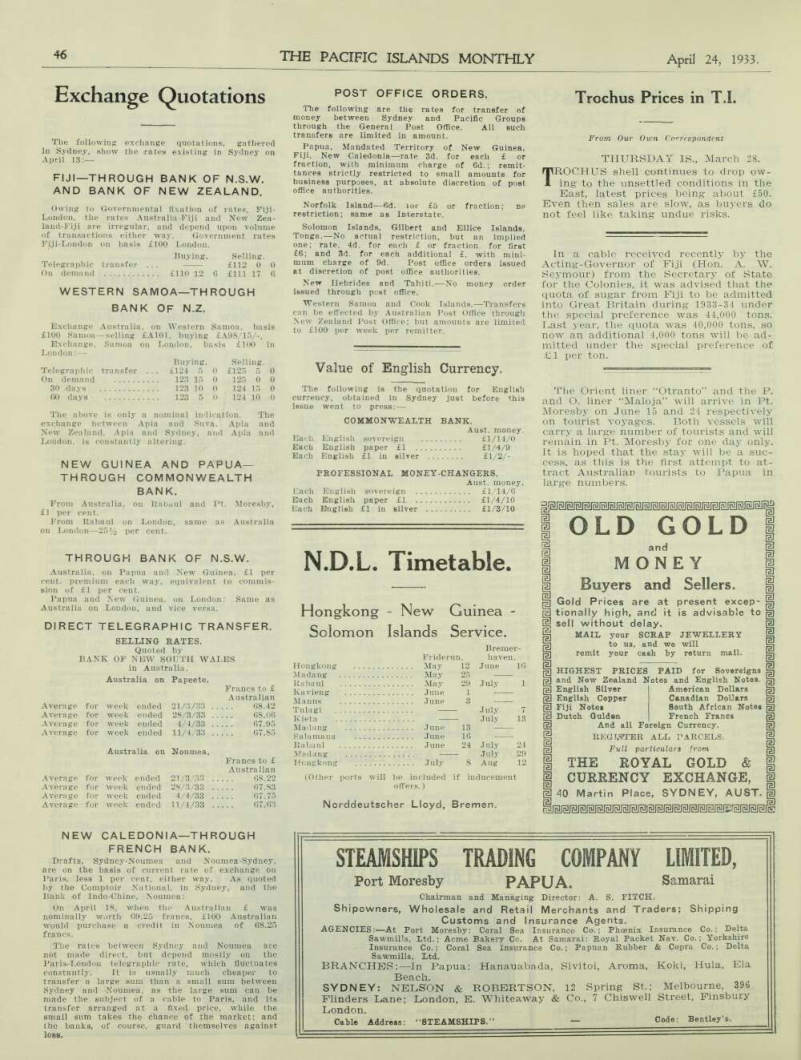
The following exchange quotations, gathered in Sydney, show the rates existing in Sydney on April 13:—
Fiji—Through Bank Of N.S.W.
And Bank Of New Zealand.
Owing to Governmental fixation of rates, Fiji- London, the rates Australia-Fiji and New Zea land-Fiji are irregular, and depend upon volume of transactions either way. Government rates Fiji-London on basis £100 London.
Western Samoa—Through
Bank Of N.Z.
Exchange Australia, on Western Samoa, basis £100 Samoa—selling £A101, buying £A98/15/-.
Exchange, Samoa on London, basis £100 in London: —
The above is only a nominal indication. The exchange between Apia and Suva, Apia and New Zealand, Apia and Sydney, and Apia and London, is constantly altering.
New Guinea And Papua
Through Commonwealth
Bank.
From Australia, on Rabaul and Pt. Moresby, £1 per cent.
From Rabaul on London, same as Australia on London —25½ per cent.
Through Bank Of N.S.W.
Australia, on Papua and New Guinea, £1 per cent, premium each way, equivalent to commis sion of £1 per cent.
Papua and New Guinea, on London: Same as Australia on London, and vice versa.
Direct Telegraphic Transfer.
Selling Rates.
Quoted by
Bank Of New South Wales
in Australia.
New Caledonia—Through
French Bank.
Drafts, Sydney-Noumea and Noumea-Sydney, are on the basis of current rate of exchange on Paris, less 1 per cent, either way. As quoted by the Comptoir Rational, in Sydney, and the Bank of Indo-Chine, Noumea: On April 18, when the Australian £ was nominally worth 69.25 francs, £100 Australian would purchase a credit in Noumea of 68.25 francs.
The rates between Sydney and Noumea are not made direct, but depend mostly on the Paris-London telegraphic rate, which fluctuates constantly. It is usually much cheaper to transfer a large sum than a small sum between Sydney and Noumea, as the large sum can be made the subject of a cable to Paris, and its transfer arranged at a fixed price, while the small sum takes the chance of the market; and the banks, of course, guard themselves against loss.
Post Office Orders.
The following are the rates for transfer of money between Sydney and Pacific Groups through the General Post Office. All such transfers are limited in amount.
Papua, Mandated Territory of New Guinea, Fiji, New Caledonia —rate 3d. for each £ or fraction, with minimum charge of 6d.; remit tances strictly restricted to small amounts for business purposes, at absolute discretion of post office authorities.
Norfolk Island—6d. for £5 or fraction; no restriction; same as Interstate.
Solomon Islands, Gilbert and Ellice Islands, Tonga.—No actual restriction, but an implied one; rate, 4d. for each £ or fraction, for first £6; and 3d. for each additional £, with mini mum charge of 9d. Post office orders issued at discretion of post office authorities.
New Hebrides and Tahiti. —No money order issued through post office.
Western Samoa and Cook Islands.—Transfers can be effected by Australian Post Office through New Zealand Post Office; but amounts are limited to £100 per week per remitter.
Buying. Selling.
Telegraphic transfer .. £112 0 0 On demand . £110 12 G fill 17 6
Buying. Selling.
Telegraphic transfer . .. £124 5 0 £125 5 0 On demand 123 15 0 125 0 0 30 days 123 10 0 124 15 0 60 days 123 5 0 124 10 0
Australia on Papeete.
Francs to £ Australian Average for week ended 21/3/33 68.42 Average for week ended 28/3/33 . 68.06 Average for week ended 4/4/33 . 67.95 Average for week ended 11/4/33 . 67.85 Australia on Noumea.
Francs to f Australian Average for week ended 21/3/33 . 68.22 Average for week ended 28/3/33 . 67.83 Average for week ended 4/4/33 . 67.75 Average for week ended 11/4/33 . 67.63
Value of English Currency.
The following is the quotation for English currency, obtained in Sydney just before this Issue went to press:—
Commonwealth Bank.
Aust. money.
Each English sovereign ... £1/14/0 Each English paper £1 £1/4/9 Each English £1 in silver . .. £1/2/-
Professional Money-Changers.
Aust. money.
Each English sovereign £1/14/6 Each English paper £1 £1/4/10 Each English £1 in silver . .. £1/3/10
N.D.L. Timetable.
Hongkong - New Guinea - Solomon Islands Service.
Bremerhaven Friderun.
Hongkong . . May 12 June 10 May 25 Rabaul . . May 29 July 1 June 1 June 3 July 7 July 13 Madang June 13 Sfil.amana . June 16 Rabaul 24 July 24 Maclang July 29 Hongkong .. July 8 Aug 12 (Other ports will be included if inducement offers.) Norddeutscher Lloyd, Bremen.
Trochus Prices in T.I.
From Our Own Correspondent
Thursday Is., March 28.
TROCHUS shell continues to drop ow ing to the unsettled conditions in the East, latest prices being about £50.
Even then sales are slow, as buyers do not feel like taking undue risks.
In a cable received recently by the Acting-Governor of Fiji (Hon. A. W.
Seymour) from the Secretary of State for the Colonies, it was advised that the quota of sugar from Fiji to be admitted into Great Britain during 1933-34 under the special preference was 44,000 tons.
Last year, the quota was 40,000 tons, so now an additional 4,000 tons will be ad mitted under the special preference of £1 per ton.
The Orient liner “Otranto” and the P. and O. liner “Maloja” will arrive in Pt.
Moresby on June 15 and 24 respectively on tourist voyages. Both vessels will carry a large number of tourists and will remain in Pt. Moresby for one day only.
It is hoped that the stay will be a suc cess, as this is the first attempt to at tract Australian tourists to Papua in large numbers.
Advertisements & other items, p. 48 (1 item)
Old Gold
and
MONEY
Buyers and Sellers.
Gold Prices are at present excep tionally high, and it is advisable to sell without delay.
MAIL your SCRAP JEWELLERY
to us, and we will remit your cash by return mall.
HIGHEST PRICES PAID for Sovereigns and New Zealand Notes and English Notes.
English Silver English Copper Fiji Notes Dutch Guidon American Dollars Canadian Dollars South African Notes French Francs And all Foreign Currency.
REGISTER ALL PARCELS.
Full particulars from
THE ROYAL GOLD &
CURRENCY EXCHANGE,
40 Martin Place, SYDNEY, AUST.
STEAMSHIPS TRADING COMPANY LIMITED,
Port Moresby PAPUA, Samara!
Chairman and Managing Director: A. S. FITCH.
Shipowners, Wholesale and Retail Merchants and Traders; Shipping Customs and Insurance Agents.
AGENCIES:- At Port Moresby: Coral Sea Insurance Co.; Phoenix Insurance Co.; Delta Sawmills, Ltd.; Acme Bakery Cc. At Samarai: Royal Packet Nav. Co.; Yorkshire Insurance Co.; Coral Sea Insurance Co.; Papuan Rubber & Copra Co.; Delta Sawmills, Ltd.
BRANCHES: —In Papua: Hanauabada, Sivitoi, Aroma, Koki, Hula, Ela Beach.
SYDNEY: NELSON & ROBERTSON, 12 Spring St.; Melbourne, 396 Flinders Lane; London, E. Whiteaway & Co., 7 Chiswell Street, Finsbury London.
Cable Address; “STEAMSHIPS.” Code: Bentley’s.
Sydney—Rabaul—Hongkong.
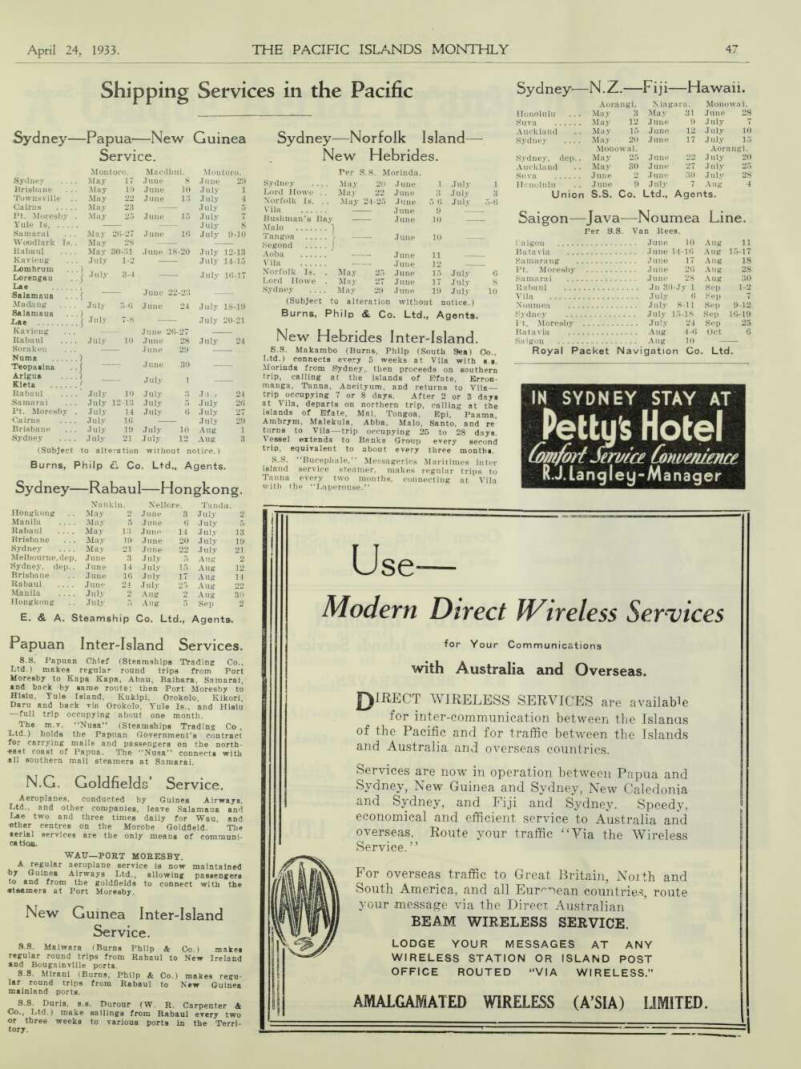
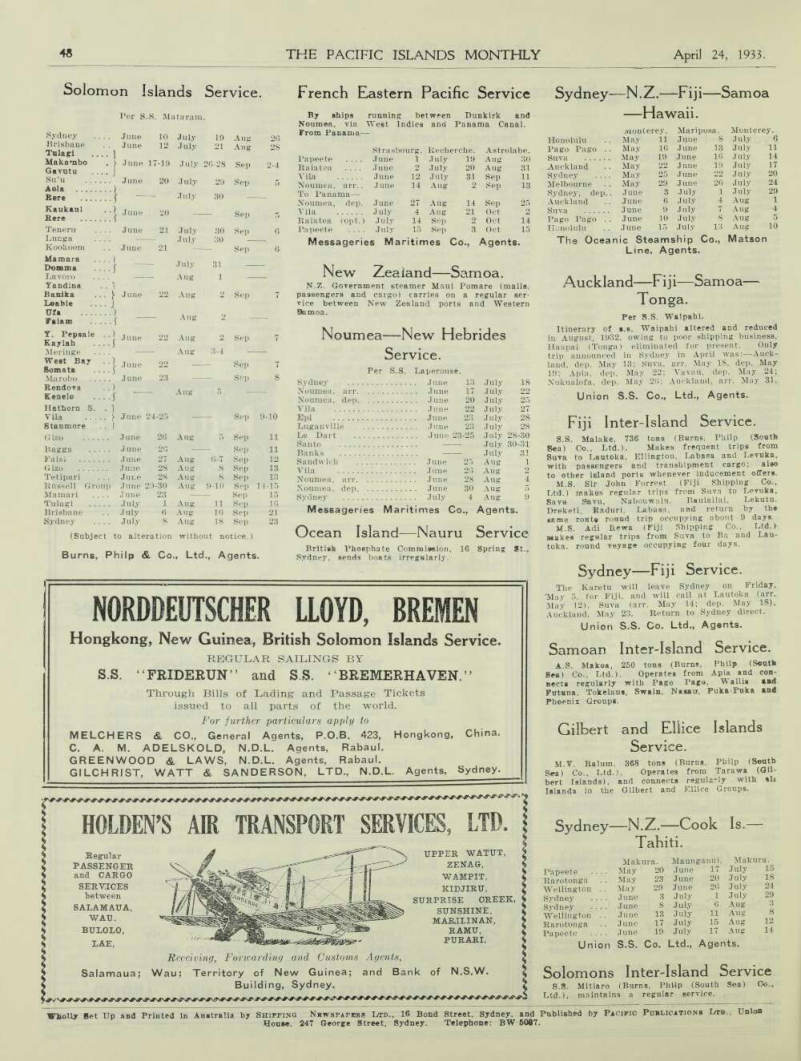
Shipping Services in the Pacific
Sydney—Papua —New Guinea Service.
Papuan Inter-Island Services.
S.S. Papuan Chief (Steamships Trading Cos., Ltd.) makes regular round trips from Port Moresby to Kapa Kapa, Abau, Baibara, Samaral, and back by same route; then Port Moresby to Hisiu, Yule Island, Kukipi, Orokolo, Kikori, Daru and back via Orokolo, Yule Is., and Hisiu —full trip occupying about one month.
The m.v. “Nusa” (Steamships Trading Co, Ltd.) holds the Papuan Government’s contract for carrying mails and passengers on the north east coast of Papua. The “Nusa” connects with all southern mail steamers at Samarai.
N.G. Goldfields’ Service.
Aeroplanes, conducted by Guinea Airways, Ltd., and other companies, leave Salamaua and Lae two and three times daily for Wau, and other centres on the Morobe Goldfield. The aerial services are the only means of communi cation.
Wau—Port Moresby.
A regular aeroplane service is now maintained toy Guinea Airways Ltd., allowing passengers to and from the goldfields to connect with the ateamere at Port Moresby.
New Guinea Inter-Island
Service.
S.S. Maiwara (Burns Philp & Cos.) makes regular round trips from Rabaul to New Ireland and Bougainville ports S.S. Mirani (Burns, Philp & Cos.) makes regu lar round trips from Rabaul to New Guinea mainland ports.
S.S. Duris, s.s. Durour (W. R. Carpenter & Cos., Ltd.) make sailings from Rabaul every two or three weeks to various ports in the Terri tory.
Sydney—Norfolk Island— New Hebrides.
New Hebrides Inter-Island.
S.S. Makambo (Burns, Philp (South Sea) Co., Ltd.) connects every 5 weeks at Vila with s.s.
Morinda from Sydney, then proceeds on southern trip, calling at the islands of Efate, Erron manga, Tanna, Aneityum, and returns to Vila— trip occupying 7or 8 days. After 2 or 3 days at Vila, departs on northern trip, calling at the islands of Efate, Mai, Tongoa, Epi, Paama, Ambrym, Malekula, Abba, Malo, Santo, and re turns to Vila—trip occupying 25 to 28 days.
Vessel extends to Banks Group every second trip, equivalent to about every three months.
S.S. “Bucephale,” Messageries Maritimes inter island service steamer, makes regular trips to Tanna every two months, connecting at Vila with the “Laperouse.”
Sydney—N.Z.—Fiji—Hawaii.
Saigon—Java—Noumea Line.
Per S.S. Morinda.
Sydney . May 20 June 1 July 1 Lord Howe . . May 22 June 3 July 3 Norfolk Is. . . May 24-25 June 5 G July r>-G Vila Bushman’s Bay June 10 Malo . ] Tangoa . . .
June 10 Segond ... :j Aoba ...
U Vila Juue 12 Norfolk Is. . May 25 June 15 July 6 Lord Howe . May 27 June 17 July 8 Sydney . May 29 June 19 July 10 (Subject to alteration without notice.) Burns, Philp & Co. Ltd., Agents.
Aorangi.
Niagara.
Monowai.
Honolulu May 3 May 31 June 28 Suva May 12 June 9 July 7 Auckland May 15 June 12 July 10 Sydney ...
May 20 June 17 July 15 Monowai.
Aorangi.
Sydney, dep..
May 25 June 22 July 20 Auckland May 30 June 27 July 25 Suva June 2 June 30 July 28 Honolulu June 9 July 7 Aug 4 Union S.S. Co. Ltd., Agents.
Per S.S. Van Rees.
Saigon Aug 11 Batavia Aug 15-17 Samara up Aug 18 Pt. Moresby Aug 28 Samarai Aug 30 Rabaul .. . Ju 80-Jy 1 Sep 1-2 Vila ... July 6 Sep 7 Noumea ... July 8-11 Sep 9-12 Sydney July 15-18 Sep 10-19 Pt. Moresby Sep 25 Batavia . . . A up 4-0 Oct 6 Sniirnn A n er 10 Royal Packet Navigation Co. Ltd.
Montoro.
Macdbui.
Montoro.
Sydney ...
May 17 June 8 June 29 Brisbane May 19 June 10 July 1 Townsville . .
May 22 June 13 July 4 Cairns May 23 July 5 Pt. Moresby .
May 25 June 15 July 7 Yule Is July 8 Samarai May 20-27 June 16 July 9-10 Woodlark Is..
May 28 Babaul ...
May 30-31 June 18-20 July 12-13 Kavieng July 1-2 July 14-15 Lombrum . .
July
3-4 Lorengau Lae July 16-17 Salamaua . . . f “ June 22-23 Madang ...
July 5-6 June 24 July 18-19 Salamaua Lae ... ( July 7-8 July 20-21 Kavieng June 26-27 Babaul July 10 June 28 July 24 Soraken June 29 Numa Teopaaina June 30 Arigua ...
Kieta —• July 1 Rabaul July 10 July 3 Ju: v 24 Samarai July 12-13 July 5 July 26 Pt. Moresby .
July 14 July 6 July 27 Cairns ...
July 16 July 29 Brisbane July 19 July 10 Aug 1 Sydney ...
July 21 July 12 Aug 3 (Subject to alteration without notice.) Burns, Philp & Co. Ltd., Agents.
Nankin.
Nellore.
Tnnda.
Hongkong May o June 3 July 2 Manila ...
May 5 June 6 July 5 Rabaul ...
May 13 June 14 July 13 Brisbane May 19 June 20 July 19 Sydney ...
May 21 June 22 July 21 Melbourne, dep.
June 3 July Aug 2 Sydney, dep..
June 14 July 15 Aug 12 Brisbane June 16 July 17 Aug 14 Rabaul ...
June 24 July 2".
Aug f>2 Manila ...
July 2 Aug 2 Aug 30 Hongkong July 5 Aug 5 Sep 2 E. & A. Steamship Co. Ltd., Agents.
Solomon Islands Service.
French Eastern Pacific Service
New Zealand—Samoa.
N.Z. Government steamer Maui Pomare (mails, passengers and cargo) carries on a regular ser vice between New Zealand ports and Western Samoa.
Noumea—New Hebrides
Service.
Ocean Island—Nauru Service British Phosphate Commission, 16 Spring St., Sydney, sends boats irregularly.
Sydney—N. Z. —Fiji—Samoa —Hawaii.
Auckland —Fiji—Samoa—
Tonga.
Per S.S. Waipahi.
Itinerary of s.s. Waipahi altered and reduced in August, 1932, owing to poor shipping business.
Haapai (Tonga) eliminated for present. Only trip announced in Sydney in April was: —Auck land, dep. May 13; Suva, arr. May 18, dep. May 19: Apia, dep. May 22; Vavau, dep. May 24; Nukualofa, dep. May 26; Auckland, arr. May 31.
Union S.S. Co., Ltd., Agents.
Fiji Inter-Island Service.
S.S. Malake, 736 tons (Burns, Philp (South Sea) Co., Ltd.). Makes frequent trips from Suva to Lautoka, Ellington, Labasa and Levuka, with passengers and transhipment cargo; also to other island ports whenever inducement offers.
M.S. Sir John Forrest (Fiji Shipping Co., Ltd.) makes regular trips from Suva to Levuka, Savu Savu, Nabouwalu. Baulailai, Lekutu.
Dreketi, Raduri, Labasa. and return by the same route round trip occupying about 9 days M.S. Adi Rewa (Fiji Shipping Co.. Ltd.) Makes regular trips from Suva to Ba and Lau toka, round voyage occupying four days.
Sydney—Fiji Service.
The Karetu will leave Sydney on Friday, May 5, for Fiji, and will call at Lautoka (arr.
May 12), Suva (arr. May 14; dep. May 18), Auckland, May 23. Return to Sydney direct.
Union S.S. Co. Ltd., Agents.
Samoan Inter-Island Service.
A.S. Makoa, 250 tons (Burns, Philp (South Sea) Co., Ltd.). Operates from Apia and con nects regularly with Pago Pago, Wallis and Futuna. Tokelaus, Swain, Nasau. Puka-Puka and Phoenix Groups.
Gilbert and Ellice Islands
Service.
M.V. Ralum, 868 tons (Burns, Philp (South Sea) Co., Ltd.). Operates from Tarawa (Gil bert Islands), and connects regularly with all Islands in the Gilbert and Ellice Groups.
Sydney—-N.Z.—Cook Is. —
Tahiti.
Solomons Inter-Island Service
S.S. Mitiaro (Burns, Philp (South Sea) Co..
Ltd.), maintains a regular service.
Per S.S. Mataram.
Sydney June 10 July 19 Aug 26 Brisbane June 12 July 21 Aug 28 Tulagi Makambo June 17-19 July 20-28 Sep 2-4 Gavutu Su’u June 20 Tulv OQ Sep Aola ... o my — J o July 30 Kaukanl Here June 20 Sep 5 Tenern June 21 July 30 Sep G Lucga — July 30 Kookoom June 21 Sep 6 Mamara July 31 Domma — Lavoro — Aug 1 — Yandina 1 Banika June 22 Aug 2 Sep 7 Loabie Ufa Aug Vaiam — 9 Y. Pepsale Kaylah June 22 Aug 2 Sep 7 Meringe Aug 3-4 West Bay Bomata June 22 — Sep 7 Marobo June 23 Sep 8 RendoTa Aug Kenelo a Hatborn S.
Vila June 24-23 Stanmore Gizo June 2G Aug 5 Sep 11 June 2G 11 12 Faisi ... .
June 27 Aug Aug 6-7 Sep Sep Gizo ...
June 28 8 13 Tetipari June 28 Aug 8 Sep 13 Russell Group June 29-30 Aug 9 |-10 Sep 14-13 Mamari June 23 — Sep 13 Tulagi July 1 July 0 Aug 11 Sep Sep 16 Brisbane Aug 10 21 Sydney July 8 Aug 18 Sep 23 (Subject to alteration without notice.) Burns, Philp & Co., Ltd., Agents.
By ships running between Dunkirk and Noumea, via West Indies and Panama Canal.
From Panama- Strasbourg.
Recherche.
Astrolabe.
Papeete June 1 July 19 Aug 80 Raiatea June 2 July 20 Aug 31 Vila June 12 July 31 Sep 11 Noumea, a it. .
J une 14 Aug 2 Sep 13 To Panama — Noumea, dep.
June 27 Aug 14 Sep 25 Vila July 4 Aug 21 Oct 2 Raiatea (opt.) July 14 Sep 9 Oct 14 Papeete July 15 Sep 3 Oct 15 Messageries Maritimes Co., Agents.
Per S.S. Laperouse.
Sydney July 18 Noumea, arr. .. .
July 22 Noumea, dep. ...
July 25 Vila July 27 Epi July 28 Luganville June 23 July 28 Le Dart ...
July 28-30 Santo July July Aug 30-31 31 1 Banks Sandwich June 25 Vila Aug 2 Noumea, arr June 28 Aug 4 Noumea, dep June 30 Aug 5 Sydney July 4 Aug 9 Messagenes Maritimes Co., Agents.
Monterey.
Mariposa.
Monterey.
Honolulu May 11 June 8 July 6 Pago Pago ..
May 16 June 13 July 11 Suva May 19 June 16 July 14 Auckland May 22 June 19 July 17 Sydney ...
May 25 June 22 July 20 Melbourne May 29 June 26 July 24 Sydney, dep..
June 3 July 1 July 29 Auckland June 6 July 4 Aug 1 Suva June 9 July 7 Aug 4 Pago Pago ..
June 10 July 8 Aug 5 Honolulu June 15 July 13 Aug 10 The Oceanic Steamship Co., Matson Line. Agents.
Makura. Maunganui. Makura.
Papeete May 20 June 17 July 15 Rarotonga . . May 23 June 20 July IS Wellington .. May 20 June 2(1 July 24 Sydney ... June 3 July 1 July 29 Sydney ... June 8 July 0 Aug 3 Wellington . . June 13 July 11 Aug 8 Rarotonga .. June 17 July 15 Aug 12 Papeete ... June 19 July 17 Aug 14 Union S.S. Co. Ltd., Agents.
Advertisements & other items, pp. 49-52 (2 items)
Petty's Hotel
IN SYDNEY STAY AT
Comfort Service Convenience R.J. Langley-Manager
Use—
Modern Direct Wireless Services
for Your Communications with Australia and Overseas.
WIRELESS SERVICES are available for inter-communication between the Islands of the Pacific and for traffic between the Islands and Australia and overseas countries.
Services are now in operation between Papua and Sydney, New Guinea and Sydney, New Caledonia and Sydney, and Fiji and Sydney. Speedy, economical and efficient service to Australia and overseas. Route your traffic “Via the Wireless Service.”
For overseas traffic to Great Britain, North and South America, and all countries, route your message via the Direct Australian
BEAM WIRELESS SERVICE.
LODGE YOUR MESSAGES AT ANY
WIRELESS STATION OR ISLAND POST
OFFICE ROUTED "VIA WIRELESS.”
AMALGAMATED WIRELESS (ASIA) LIMITED.
NORDDEUTSCHER LLOYD, BREMEN
Hongkong, New Guinea, British Solomon Islands Service.
REGULAR SAILINGS BY
S.S. “FRIDERUN” and S.S. "BREMERHAVEN."
Through Bills of Lading and Passage Tickets issued to all parts of the world.
For further particulars apply to MELCHERS & CO., General Agents, P.O.B. 423, Hongkong, China.
C. A. M. ADELSKOLD, N.D.L. Agents, Rabaul.
GREENWOOD & LAWS, N.D.L. Agents, Rabaul.
GILCHRIST, WATT & SANDERSON, LTD., N.D.L. Agents, Sydney.
HOLDEN’S AIR TRANSPORT SERVICES, LTD.
Regular
PASSENGER
and CARGO
SERVICES
between
SALAMAUA,
WAU,
BULOLO,
LAE,
Salamaua;
UPPER WATUT,
ZENAG,
WAMPIT,
KIDJIRU,
SURPRISE CREEK,
SUNSHINE,
MARILINAN,
RAMU,
PURARI.
Receiving, Forwarding and Customs Agents, Wau; Territory of New Guinea; and Bank of N.S.W,
Building, Sydney.
A Unique Aerial Transport Service
country over which Guinea Airways’ Air craft daily fly is some of the worst in the world. It is so rough that overland transport is impossible, and many attempts at road building have been abandoned.
The Goldfields depend entirely on aircraft for maintenance, and it is the success of their service which makes Guinea Airways confident of their ability to organise and maintain dependable transport WHEREVER it is needed.
New Guinea Aerodromes
LAE
SALAMAUA
WATUT
WAU
WAMPIT
SANGAN
BULOWAT
BULOLO
ZENAG
AT LEFT: Parts of Dredge Machinery being loaded into aeroplane for transport by Guinea Airways, Ltd., to Bulolo Gold field.
BELOW: Here’s a giant wheel with a diameter of over 6½ feet for one of the Bulolo Gold Dredging Company’s dredges.
It is bolted securely inside the cabin of a G31 tri-motored Junker for transport to the goldfields. The balance of the load was made up with hundred pound bags of rice.
GUINEA AIRWAYS LTD.
LAE - SALAMAUA
WELCOME CARGO
"Lower away ” —and what a welcome cargo it is!
Resch’s Pilsener—in the famous long bottle—the drink which eases the white man’s burden!
Call for a bottle to-night and relish its malt and
hop flavour.
RESCH'S
LONG BOTTL E
PILSENER
48
April 24, 1933.
THE PACIFIC ISLANDS MONTHLY
Wholly Set Up and Printed In Australia by Shipping Newspapers Ltd., 16 Bond Street, Sydney, and Published by Pacific Publications Ltd., Union House, 247 George Street, Sydney. Telephone: BW 5087.