Pacific

Islands
Monthly
March 23
1933
6 d
[Registered at G.P.O., Sydney, for transmission by post as a newspaper.]
The Smile Of Young Papua.
Native children who have been cared for by the Methodist Missionaries at Salamo, Eastern Papua. —Photo by Rev. J. W. Burton, in “The Missionary Review.”
Advertisements & other items, p. 2 (1 item)
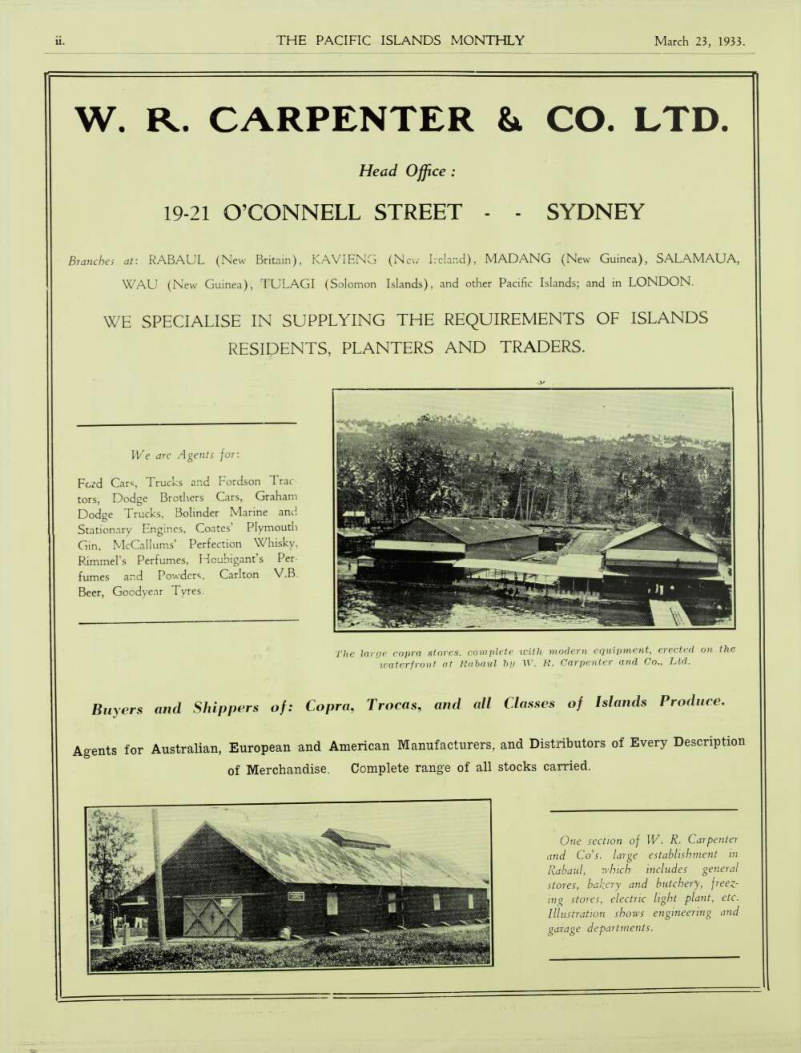
W. R. Carpenter & Co. Ltd.
Head Office :
19-21 O’CONNELL STREET - - SYDNEY
Branches at: RABAUL (New Britain), KAVIENG (New Ireland), MADANG (New Guinea), SALAMAUA, WAU (New Guinea), TULAGI (Solomon Islands), and other Pacific Islands; and in LONDON.
WE SPECIALISE IN SUPPLYING THE REQUIREMENTS OF ISLANDS
RESIDENTS, PLANTERS AND TRADERS.
We are Agents for : Ford Cars, Trucks and Fordson Trac tors, Dodge Brothers Cars, Graham Dodge Trucks, Bolinder Marine and Stationary Engines, Coates’ Plymouth Gin, McCallums’ Perfection Whisky, Rimmel’s Perfumes, Houbigant’s Per fumes and Powders, Carlton V.B.
Beer, Goodyear Tyres.
The large copra stores, complete with modern equipment, erected on the waterfront at Rabaul by W. R. Carpenter and Go., Ltd.
Buyers and Shippers of: Copra , Trocas , and all Classes of Islands Produce, Agents for Australian, European and American Manufacturers, and Distributors of Every Description of Merchandise. Complete range of all stocks carried.
One section of W. R. Carpenter and Co’s, large establishment in Rabaul, which includes general stores, bakery and butchery, freez ing stores, electric light plant, etc.
Illustration shows engineering and garage departments.
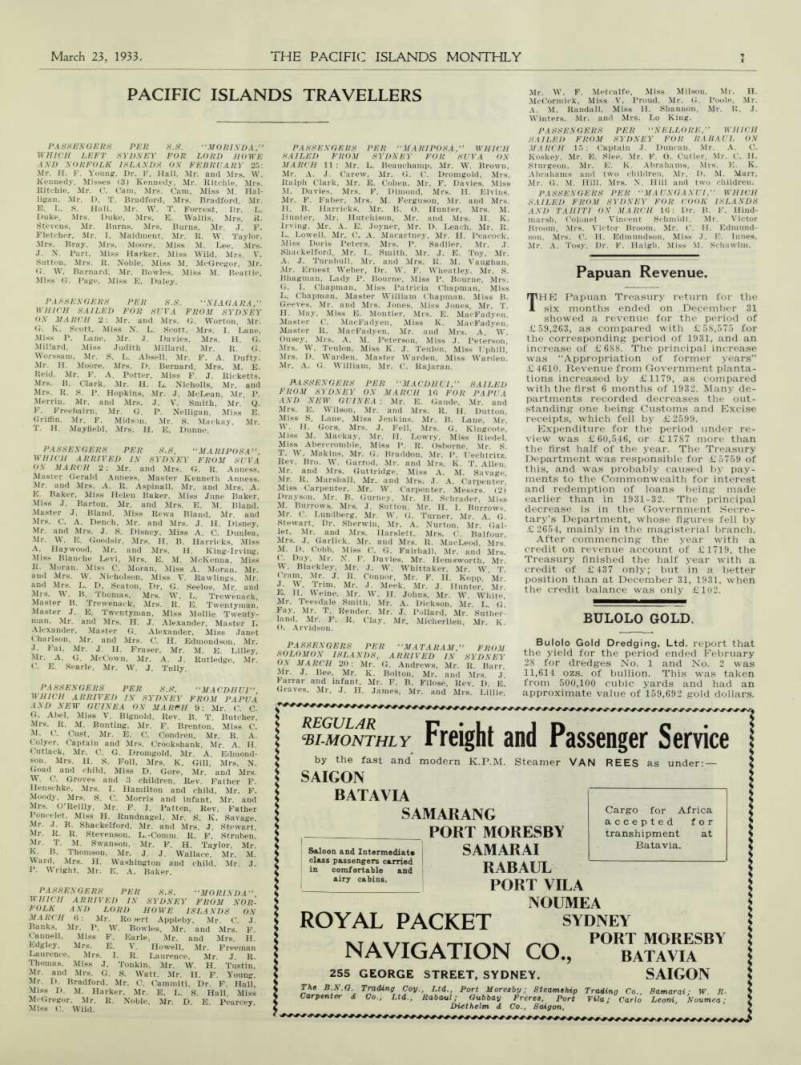
Pacific Islands Travellers
Passengers Per S.S. "Morinda,”
Which Left Sydney For Lord Howe
And Norfolk Islands On February 25:
Mr. H. F. Young, Dr. F. Hall, Mr. and Mrs. W.
Kennedy, Misses (3) Kennedy, Mr. Ritchie, Mrs.
Ritchie, Mr. C. Cam, Mrs. Cam, Miss M. Hal ligan, Mr. D. T. Bradford, Mrs. Bradford, Mr.
E. L. S. Hall, Mr. W. T. Forrest, Dr. L.
Duke, Mrs. Duke, Mrs. E. Wallis, Mrs. R.
Stevens, Mr. Burns, Mrs. Burns, Mr. J. F.
Fletcher, Mr. I. Maidment, Mr. R. W. Taylor, Mrs. Bray, Mrs. Moore, Miss M. Lee, Mrs.
J. N. Part, Miss Harker, Miss Wild, Mrs. V.
Sutton, Mrs. R. Noble, Miss M. McGregor, Mr.
G. W. Barnard, Mr. Bowles, Miss M. Beattie, Miss G. Page, Miss E. Daley.
Passengers Per S.S. “Niagara,”
Which Sailed For Suva From Sydney
ON MARCH 2: Mr. and Mrs. G. Worton, Mr.
G. K. Scott, Miss N. L. Scott, Mrs. I. Lane, Miss P. Lane, Mr. J. Davies, Mrs. H. G.
Millard, Miss Judith Millard, Mr. R. G.
Worssam, Mr. S. L. Abseil. Mr. F. A. Dufty.
Mr. H. Moore, Mrs. D. Bernard. Mrs. M. E.
Reid, Mr. F. A. Potter, Miss F. J. Ricketts, Mrs. B. Clark, Mr. H. D. Nicholls, Mr. and Mrs. R. S. P. Hopkins, Mr. J. McLean, Mr. P.
Merrin, Mr. and Mrs. J. V. Smith, Mr. Q.
F. Freebairn, Mr. G. P. Nelligan, Miss E.
Griffin, Mr. F. Midson, Mr. S. Mackay, Mr.
T. H. Mayfield, Mrs. H. E. Dunne.
Passengers Per S.S “Mariposa”
Which Arrived In Sydney From Suva
OA MARCH 2: Mr. and Mrs. G. R. Anness, Master Gerald Anness, Master Kenneth Anness, Mr. and Mrs. A. R. Aspinall, Mr. and Mrs, A.
E. Baker, Miss Helen Baker, Miss June Baker, Miss J. Barton, Mr. and Mrs. E. M. Bland, Master J. Bland, Miss Rewa Bland, Mr. and Mrs. C. A. Dench, Mr. and Mrs. J. H. Disney, Mr. and Mrs. J. S. Disney, Miss A. C. Dunlea, Mr. W. E. Goodsir, Mrs. H. B. Harricks, Miss A. Haywood, Mr. and Mrs. H. King-Irving.
Miss Blanche Levi, Mrs. E. M. McKenna, Miss R. Moran, Miss C. Moran, Miss A. Moran, Mr. and Mrs. W. Nicholson, Miss V. Rawlings, Mr. and Mrs. L. D. Seaton, Dr. G. Seelos, Mr. and Mrs. W. B. Thomas, Mrs. W. L. Trewenack, Master B. Trewenack, Mrs. R. E. Twentyman, Master J. E. Twentyman, Miss Mollie Twenty man, Mr. and Mrs. H. J. Alexander, Master I.
Alexander, Master G. Alexander, Miss Janet Charlson, Mr. and Mrs. C. H. Edmondson, Mr.
J. Fai, Mr. J. H. Fraser, Mr. M. E. Lilley, Mr. A. G. McCown, Mr. A. J. Rutledge, Mr.
C. E. Searle, Mr. W. J. Tully.
Passengers Per S.S. “Macdhui”
Which Arrived In Sydney From Papua
AND NEW GUINEA ON MARCH 9: Mr. C. C.
G. Abel, Miss V. Bignold, Rev. B. T. Butcher, Mrs. R. M. Bunting, Mr. F. Brenton, Miss C.
M. C. Gust, Mr. E. C. Condren, Mr. R. A.
Colyer, Captain and Mrs. Crookshank, Mr. A. H.
Cutlack, Mr. C. G. Dromgold, Mr. A. Edmond son. Mrs. H. S. Foil, Mrs. K. Gill, Mrs. N.
Goad and child, Miss D. Gore, Mr. and Mrs.
W. C. Groves and 3 children. Rev. Father F.
Henschke, Mrs. I. Hamilton and child, Mr. F.
Moody, Mrs. S. C. Morris and infant, Mr. and Mrs. O’Reilly, Mr. F. I. Patten, Rev. Father Poncelet, Miss H. Rundnagel, Mr. S. K. Savage, Mr. J. B. Shackelford, Mr. and Mrs. J. Stewart, Mr. R. R. Stevenson, L.-Comm. R. F. Struben, Mr. T. M. Swanson, Mr. F. H. Taylor, Mr.
K. B. Thomson, Mr. J. J. Wallace, Mr. M.
Ward, Mrs. H. Washington and child, Mr. J.
P. Wright, Mr. E. A. Baker.
Passengers Per S.S. “Morinda”
Which Arrived In Sydney From Nor
Folk And Lord Howe Islands On
MARCH 6: Mr. Robert Appleby, Mr. C. J.
Banks, Mr. P. W. Bowles, Mr. and Mrs. F.
Cannell, Miss F. Earle, Mr. and Mrs. H.
Edgley, Mrs. E. V. Howell, Mr. Freeman Laurence, Mrs. I. R. Laurence, Mr. J. R.
Thomas, Miss J. Tonkin, Mr. W. H. Tustin, Mr. and Mrs. G. S. Watt, Mr. H. F. Young, Mr. D. Bradford, Mr. C. Cammiti, Dr. F. Hall, Miss D. M. Harker, Mr. E. L. S. Hall, Miss McGregor, Mr. R. Noble, Mr. D. E Pearcey, Miss C. Wild.
Passengers Per "Mariposa,” Which
Sailed From Sydney For Suva On
MARCH 11 : Mr. L. Beauchamp, Mr. W. Brown, Mr. A. J. Carew, Mr. G. C. Dromgold, Mrs.
Ralph Clark, Mr. E. Cohen, Mr. F. Davies, Miss M. Davies, Mrs. F. Dimond, Mrs. H. Elvins, Mr. F. Faber, Mrs. M. Ferguson, Mr. and Mrs.
H. B. Harricks, Mr. B. O. Hunter, Mrs. M.
Hunter, Mr. Hutchison, Mr. and Mrs. H. K.
Irving, Mr. A. E‘. Joyner, Mr. D. Leach, Mr. R.
L. Lowell, Mr. C. A. Macartney, Mr. H. Peacock, Miss Doris Peters, Mrs. P. Sadlier, Mr. J.
Shackelford, Mr. L. Smith, Mr. J. E. Toy, Mr.
A. J. Turnbull, Mr. and Mrs. R. M. Vaughan, Mr. Ernest Weber, Dr. W. F. Wheatley, Mr. S.
Bhagman, Lady P. Bourne, Miss P. Bourne, Mrs.
G. I. Chapman, Miss Patricia Chapman, Miss L. Chapman, Master William Chapman, Miss B.
Geeves, Mr. and Mrs. Jones, Miss Jones, Mr. T.
H. May, Miss E. Montier, Mrs. E. MacFadyen, Master C. MacFadyen, Miss K. MacFadyen, Master R. MacFadyen, Mr. and Mrs. A. W.
Ousey, Mrs. A. M. Peterson, Miss J. Peterson, Mrs. W. Teulon, Miss K. J. Teulon, Miss Uphill, Mrs. D. Warden, Master Warden, Miss Warden, Mr. A. G. William, Mr. C. Rajaran.
Passengers Per “Macdhui,” Sailed
FROM SYDNEY ON MARCH 16 FOR PAPUA AND NEW GUINEA : Mr. E. Gaude, Mr. and Mrs. E. Wilson, Mr. and Mrs. R. H. Dutton, Miss S. Lane, Miss Jenkins, Mr. B. Lane, Mr.
W. H. Gors, Mrs. J. Fell, Mrs. G. Kingcote, Miss M. Mackay, Mr. H. Lowry, Miss Riedel, Miss Abercrombie, Miss P. R. Osborne, Mr. S.
T. W. Makins, Mr. G. Braddon, Mr. P. Uechtritz, Rev. Bro. W. Garrod, Mr. and Mrs. K. T. Allen, Mr. and Mrs. Guttridge, Miss A. M. Savage, Mr. R. Marshall, Mr. and Mrs. J. A. Carpenter, Miss Carpenter, Mr. W. Carpenter, Messrs. (2) Drayson, Mr. B. Gurney, Mr. H. Schrader, Miss M. Burrows, Mrs. J. Sutton, Mr. H. I. Burrows, Mr. C. Lundberg, Mr. W. G. Turner, Mr. A. G.
Stewart, Dr. Sherwin, Mr. A. Nurton, Mr. Gal let, Mr. and Mrs. Harslett, Mrs. C. Balfour, Mrs. J. Garlick, Mr. and Mrs. R. MacLeod, Mrs M. D. Cobb, Miss C. G. Fairhall, Mr. and Mrs.
C. Day, Mr. X. F. Davies, Mr. Hemsworth, Mr.
W. Blackley, Mr. J. W. Whittaker, Mr. W. T.
Cram, Mr. J. R. Connor, Mr. F. H. Kopp, Mr.
J. W. Trim, Mr. J. Meek, Mr. J. Hunter, Mr.
E. H. Weine, Mr. W. H. Johns, Mr. W. White, Mr. Teesdale Smith, Mr. A. Dickson, Mr. L. G.
Fay, Mr. T. Render, Mr. J. Pollard, Mr. Suther land, Mr. F. R. Clay, Mr. Micherlien, Mr. K O. Arvidson.
Passengers Per “Mataram,” From
Solomon Islands, Arrived In Sydney
ON MARCH 20: Mr. G. Andrews, Mr. R. Barr, Mr. J. Bee, Mr. K. Bolton, Mr. and Mrs. J Farrar and infant, Mr. F. B. Filose, Rev. D. E.
Graves, Mr. J. H. James, Mr. and Mrs. Lillie,
Mr. W. F. Metcalfe, Miss Milson, Mr. H.
McCormick, Miss V. Proud, Mr. G. Poole, Mr.
A. M. Randall, Miss H. Shannon, Mr. R. J.
Winters, Mr. and Mrs. Lo King.
Passengers Per “Nellore,” Which
Sailed From Sydney For Rabaul On
MARCH 15: Captain J. Duncan, Mr. A. C.
Koskey, Mr. E. Slee, Mr. F. O. Cutler, Mr. C. H.
Sturgeon, Mr. E. K. Abrahams, Mrs. E. K.
Abrahams and two children, Mr. D. M. Marr, Mr. G. M. Hill, Mrs. N. Hill and two children.
Passengers Per “Maunganul" Which
Sailed From Sydney For Cook Islands
AND TAHITI ON MARCH 1G: Dr. K. F. Hind marsh, Colonel Vincent Schmidt, Mr. Victor Broom, Mrs. Victor Broom, Mr. C. H. Edmund son, Mrs. C. H. Edmundson, Miss J. E. Innes, Mr. A. Tosy, Dr. F. Haigh, Miss M. Schawim.
Papuan Revenue.
THE Papuan Treasury return for the six months ended on December 31 showed a revenue for the period of £59,263, as compared with £58,575 for the corresponding period of 1931, and an increase of £688. The principal increase was “Appropriation of former years” £4610. Revenue from Government planta tions increased by £1179, as compared with the first 6 months of 1932. Many de partments recorded decreases the out standing one being Customs and Excise receipts, which fell by £2599.
Expenditure for the period under re view was £60,546, or £1787 more than the first half of the year. The Treasury Department was responsible for £5759 of this, and was probably caused by pay ments to the Commonwealth for interest and redemption of loans being made earlier than in 1931-32. The principal decrease is in the Government Secre tary’s Department whose figures fell by £2654, mainly in the magisterial branch.
After commencing the year with a credit on revenue account of £1719, the Treasury finished the half year with a credit of £437 only; but in a better position than at December 31, 1931, when the credit balance was only £102.
Bulolo Gold.
Bulolo Gold Dredging, Ltd. report that the yield for the period ended February 28 for dredges No. 1 and No. 2 was 11,614 ozs. Of bullion. This was taken from 500,100 cubic yards and had an approximate value of 159,692 gold dollars.
Advertisers.
Page.
Adams, Wm 35 Amal. Wireless ... 47 Amm. (Nobel) ... 13 Antinea Drug Co. . . 29 Armstrong, R. H., & Co 15 Arnott’s Biscuits ... 23 Bank of N.S.W 30 Barnes, James. Ltd. 38 Barraclough, H. A. . 22 Bourjois et Cie ... 25 Brandts. Ltd 26 Brownfields. Ltd. ... 12 Brunton’s Flour ... 33 Burns, Philp & Co. 2 Burns. Philp (S.S.) Co 21 B.P. Magazine ... 44 Carpenter, W. R.
Cover il.
Com. P’land Cement. 41 Correspondence Club. 42 Couch, J. II 32 Delicia Food Co, . . 20 Docker’s Paints ... 24 Dowsett. J. H. M. . 33 Elliott. T.. & Co. . . 38 Excelsior Supply Co. 20 Exide Batteries ... 39 Fletcher & Sons ... 37 Garrett & Davidson. 37 Gillespie’s Flour ... 21 Grahame. C 30 Gregory. A 15 Guinea Airways cov. iii.
Hale, Alex.. Ltd. .. 25 Halvorsen, L 35 Holbrooks, Ltd 31 Hylands, Ltd 41 Joyce Biscuits 26
Page.
Kodak. Ltd 14 Kopsen & Co 22 McIlrath’s, Ltd 17 McKay, H. V 31 McLeod, Bolton ... 28
N.D.L 48
Nelson & Robertson . 43 N.I. Book Club ... 35 N.I. Photo Service . 37 Nolan, Spencer ... 18 Paton, Burns 22 Peadon, J. L., Ltd.. 33 Petty’s Hotel 47 Piggott, C. G 27 Prescott. Ltd 26 Rabaul Carr’g. Co. . 33 Rohu, Sil 27 Royal Gold & Currency 46 Royal Packet N. Co. 1 Russell, S 17 Ruston & Hornsby . . 36 Schupak. Max M. . . 32 Smyth, J. H 34 Steamships T. Co., Ltd 46 Sullivan. Ltd 24 Tillock & Co., Ltd.. 40 Tooth & Co. Cover iv.
Vacuum Oil 19 Walker, F. J., Ltd.. 16 Wallaringa Mansions 45 Williams, W., Ltd. . 34 Wills. W. D. & H. O. 18 Wimbledon Tennis Co 34 Westcott, Hazel ... 27 Wunderlich, Ltd. . . 42
Contents.
Page.
Pacific Islands Travellers 1 The Brawl About Mandates 3, 4 Moratorium in N. Guinea 5 Copra Market 6 Fiji News 6 Tropicalities 8 Fiji Hindus Leave Council 8 Run on Banque Chin Foo 9 About Islands People 10 Major Marr’s Itinerary 11 Breeze in Tonga 12 Is Amalgamation Plan Possible? ... 14 Papuan Rubber 15 Samoan Budget 16 Cheeky Natives 17 Literary Sewage and the Pacific ... 18 Pawpaw Recipes 20 Tongan Trade Figures 21, 22
Page.
Stagnation in Solomons 23, 24 Germany’s Claim for N.G 25, 26 Dairying in Fiji 27 Samoan News 28 Norfolk Is. News 29 Papuan News 30 Demand for Lugger Crews 31, 32 Tahiti News 33 N.G. Goldfields, Ltd. Report 34, 35 An Islands Bridge Party 36, 37 Coffee Cultivation in Pacific 38, 39 British Prestige and Samoa 40 Larkin Case 41 N.G. and Papuan Gold Sharemarket 44 Market Quotations 45 Exchange Quotations 46 Shipping Services in the Pacific .. 47, 48
Advertisements & other items, p. 4 (1 item)
Burns, Philp & Co. Ltd.
TO BE PUBLISHED SHORTLY!
HANDBOOK OF NEW GUINEA, PAPUA, SOLOMON ISLANDS AND NORFOLK ISLAND.
Containing Complete Details and Latest Statistical Information about those Territories, and also Lists of Business Firms and European Residents. Ready Shortly.
PRICE, 2/6.
PACIFIC PUBLICATIONS LTD.
SYDNEY AUSTRALIA.
BURNS, PHILP & CO. LTD.
General Merchants
Shipowners,
Tourist Agents, Etc.
Buyers of all Classes
of Island Produce
Head Office - 7 Bridge Street, Sydney - Australia Code Address : “BURPHIL’
Regular Steamer Services From Australia to New Guinea, Papua, Solomons, Lord Howe, Norfolk Islands, New Hebrides, Java and Singapore
The Pacific Islands Monthly
THE NEWSPAPER - MAGAZINE OF THE SOUTH SEAS [Registered at G.P.O., Sydney, for transmission by post as a newspaper.]
Published Once Each Month and Circulated in Australia and New Zealand and in the following Pacific Territories and Island Groups:
Crown Colony of Fiji.
Australian Territory of Papua.
Mandated Territory (Australia) of New Guinea, Bismarck Archipelago, and Northern Solomon Islands.
Mandated Territory (Japan) of Marshall, Caroline and Mariana Islands.
American Territory of Guam.
Mandated Territory of Nauru.
British Crown Colony of Gilbert and Ellice Islands.
French Territory of New Caledonia.
British and French Condominium of New Hebrides.
American Territory of Eastern Samoa.
Mandated Territory (New Zealand) of Samoa.
British Solomon Islands Protectorate.
British Protectorate of Tongan Islands New Zealand Territory of Cook Islands.
Australian Territory of Norfolk Island.
French Colony of Oceania (Tahiti, etc.) American Territory of Hawaiian Islands.
Owned and Produced by ‘Pacific ‘Publications Ltd., Union House, 247 George Street, Sydney
Telephone Bw 5037
P.O. Box 3408 R
Contributions
Articles, Stories and Photographs dealing with Pacific Islands Subjects are invited, and will be paid for on publication at usual rates.
Subscription Rates
Per Annum, within Postal Convention Territories, Prepaid, Post Free 6/- Per Annum elsewhere, Prepaid, Post Free 8/- Single Copies 6d.
Editor and Publisher:
R. W. Robson.
Advertisements
Advertising rates furnished on application.
Colours, etc. by Arrangement Process Blocks made at Advertiser’s expense when required. Screen, 100.
Changes of Advertising Copy should reach this Office by Bth of each month, otherwise previous advertisement may be repeated.
Registered Address for Radiograms and Cables: “PACPUB” Sydney
Agents
The following are authorised to receive sub scriptions for The Pacific Islands Monthly — Islands Branches of Burns, Philp & Co., Ltd., and Burns. Philp (South Seas) Co., Ltd.
Islands Branches of W. R. Carpenter & Co., Ltd.
All Branches of Vorris, Iledstrom & Co., Ltd.
J. H. MacGregor Dowsett, Rabaul.
Whitten Bros., Ltd., Port Moresby & Samarai.
All Branches and Representatives of W. H Grove & Sons, Ltd., Auckland.
S. Russell, Papeete, Tahiti.
Cook Islands Trading Co., Rarotonga.
Mrs. M. Campbell, Cascades, Norfolk Island.
Vol. 111. No. 8.
Sydney, March 23, 1933.
Price 6d - Per Copy Prepaid: 6/- p.a.
The Brawl About Mandates.
ON another page of this issue there will be found the translation of an article published recently in a leading newspaper in Germany; and therein the student of international affairs may see an indication of the probable train of events in relation to mandates generally and the Mandated Territories of the Pacific in particular.
The German article was written in response to cer tain opinions expressed in this journal in September last. We said then that we believed that the end of the League of Nations was in sight, and that with the collapse of that fantastic creation and the end of the mandatory system, the Powers inevitably would be come involved in bitter argument concerning the dis posal of the territories affected by the mandatory system. So far as the Pacific is concerned this meant the Territory of New Guinea (held by Australia), Western Samoa (New Zealand), and the Carolines and Marshalls (Japan). We expressed the belief that nothing less than the final arbitrament of shot and shell would remove those territories from the possession of the nations which now hold them under mandate.
This necessarily angered our German friends, and we are told that, in expressing such a view, we are running true to the English breed of Queen Elizabeth’s
day, when our sea robbers and pirates went out and seized, in England’s name, lands and ships and treasure and, indeed, everything that greedy and covetous England might desire. Well, we shall not argue about that. The Britain that we love and honour has been called everything from “bloody cut-throats” and “perfidious Albion” to “a nation of shopkeep ers” and a “race of degenerates”; but the greatest freedom and security in the world are still found under the British flag; and when the world finds itself crawling out of the present economic morass, the people of the British race will still be responsible for leadership, just as they always have been for 300 years.
To-day, just as we foretold, the League of Nations is about to die; Germany is returning to monarchism and sabre-rattling; and the question for readers of this newspaper is the fate of New Guinea, Samoa and the Marshalls and Carolines. Are they to remain under their present administration or will they be returned to Germany? We think all the “eyewash” about international justice and the rights of subject peoples, and the world’s requirements in the matter cf raw materials can be forgotten. The main dom inating fact for consideration in connection with the disposal of the territories is the war guilt of Ger
many. If Germany was guilty of causing the world war, then the loss of her colonies is the least punish ment she should suffer. If Germany was not the aggressor, then unquestionably she should have re turned to her those territories which, in the period from Bismarck down to the Great War, she governed and developed so admirably. But no one who took an intelligent interest in world politics prior to 1914 can have the least doubt about Germany’s war guilt.
This mighty, Prussianised nation, drunk with a sense of achievement, wealth and military power, was a direct menace to the world’s peace for many years prior to 1914. It is sufficient to remember that when there dawned the fatal “Der Tag” of 1914 Germany and her allies were equipped for war to the last but ton and the last death-dealing machine, and were filled with the spirit of military aggression. On the other side, there were France, only half ready, and Britain, with no armaments whatever apart from her navy, and a people without the slightest thought of or desire for war.
The thing itself really does not bear argument —to contend that the guilt for the 1914-1918 crime against humanity does not lie with Germany is simply fan tastic. For years before 1914 those of us who took an interest in the world's politics saw the danger; and the writer was one humble journalist who repeatedly urged that the existence of this fire-eating, swash buckling Germany, fully equipped in shining armour, must inevitably drag the world into war; and also he was one who then could see little chance of ill equipped France and unready England defeating the Prussians, and he repeatedly drew word-pictures of the British peoples humbly goose-stepping under the eye of a merciless German sergeant-major. That this forecast was only partly correct was emphatically not the fault of Germany.
No one in his senses can defend the Versailles settlement —one can only say it was a fitting end to humanity’s four years of madness. No nation could possibly have paid the monetary punishment imposed on Germany, and no combination of nations could possibly have endured indefinitely the frightful strain imposed on the economic world by the post-war adjustment of international debts. It was the attempt to do these things, of course, which landed the world in the economic morass in which it is still scrambling.
Force of circumstances, as well as the mercy of the Allied nations, has released Germany from her obliga tion to pay tribute to the victors (otherwise called “reparations”) ; and Germany, instead of accusing John Bull of half the crimes in the calendar, should rather thank Great Britain for the generosity with
which the defeated nations have been treated. As a matter of fact, apart from the loss of her colonies, Germany has escaped from the war more lightly than any other combatant. There was much truth in the man who said “The Allies won the War; but Germany won the Peace.” We do not forget that Germany escaped her internal obligations by an ultra-clever manipulation of her currency which ruined hundreds of thousands of her upper classes.
Therefore it surely is in accord with fundamental justice that Germany, who escaped so much of the later evils which her lust for war brought upon the world, should suffer at least the minor punishment represented in the loss of her colonies.
Frankly, we cannot see that the possession of these former German colonies is much of an advantage to the countries concerned. Apart from its gold, New Guinea is a source of considerable financial expense to Australia; while, politically and financially, the responsibility for Western Samoa has been nothing but a bleeding sore in the side of New Zealand — whose administrative record hitherto had been excel lent. It may be that as sources of raw materials, the possession of these Pacific territories would be much more advantageous to Germany than to us. We recog nise that a nation such as Germany must have new lands —particularly tropical territories —to develop.
But that is a matter better left on the knees of the high gods. To hand back her colonies to a war guilty Germany at this stage would be farcical. It all depends upon how the Germany now emerging from the chaos of virtual revolution will develop. If she is to be a Germany who has learned her lesson in the fires of war and bitter punishment, and who recog nises that the British and Germans are not mutually antagonistic, but actually are closer together in national psychology than any other two peoples, and will develop accordingly, then there should be much for Germany to do in the future in the way of colonial development. Germany must realise that we British people do not regard our Britain as a rapacious and grdedy land-grabber. The British people recognise just as clearly as the Germans do that a nation like Germany must have room for colonial expansion; and they recognise, too, that prac tically the whole world’s habitable land is already parcelled out. Then (it is asked) what is Germany to do? The answer lies in the fact that the material strength as well as the spiritual power of the British Empire is founded on justice. The Germany that treacherously attacked Britain has lost all. The Germany that is Britain’s friend may possess much.
New Guinea Goldfields, Ltd.
THE following progress report for the month of February has been issued by The Mining Trust, Ltd., consulting engineers for New Guinea Goldfields, Ltd.
At location 3, a crosscut from No. 1 shaft was advanced 57ft. to 107 ft. At
location 8, No. 4 shaft was sunk 6ft. to 397 ft. The delay was due to compressor breakdown. The west drift at No. 3 level was advanced 80ft. in ore, averaging 13.4 dwts. gold and 10ozs. silver over a width of 33 inches.
The estimated profit for January from alluvial work was £6319. The produc tion for February was 2314ozs. bullion.
Pending the arrival of the consulting engineer, arrangements have been made tor preliminary scout drilling of the new dredging areas by the mine staff, and a drill has already been transported to the property.
The estimated profit of the mill for January was £6000. The output for February was 960ozs. fine gold.
Fly River.
Keeping An Eye On The
Headhunters.
Administrator’s Visit to Fly River.
From Our Own Correspondent.
Pt. Moresby, March 2.
His Excellency Sir Hubert
MURRAY, accompanied by the Offi cial Secretary (the Hon. H. L. Mur ray), and the Government Secretary (the Hon. H. W. Champion) left Pt. Moresby on the “Laurabada” on February 14 for Daru and the Fly River, with the inten tion of visiting the districts near Everill Junction on the Fly.
A recent movement of the Upper Fly River natives down as far as this Junc tion, with apparently peaceful motives, is unusual enough to justify a little sus picion on the part of the Government.
Sir Hubert Murray is personally making sure of their good intentions.
A leopard does not change his spots, and head hunters are head hunters. The Upper Fly River is outside Government control, though it has been visited by many patrols in the last few years. The natives know the Government, and are well aware of its disapproval of raiding.
Head hunting and raiding are not crimes to these wild tribes, but a neces sary part of their social system and a passionate need, and their disregard of Government warnings, and their sporadic raids are easily understood.
The Government, in this instance, will make sure that this immigration, does not lead to the massacre of the more peaceful natives who, if the intentions of these strangers are doubtful, may be deceived by their treacherous ways.
Sir Hubert Murray returned unexpect edly to Port Moresby on February 18, before reaching the Fly. While he was at Daru, a Mr. Nibel, living by Maba duan Hill, was brought in dangerously ill, so the “Laurabada” made a hurried return to Port Moresby with him.
After the arrival of the “Montoro” from Australia, Sir Hubert Murray will return to his inspection of the Fly River.
Infected Mosquitoes.
May Be Carried by Aeroplanes.
FEARS that yellow fever and similar diseases may be carried long dis tances by aeroplanes were expressed by experts at the Ross Institute and Hospital for Tropical Diseases, London.
They state that it is possible for in fected mosquitoes to be carried from West Africa within the period of incu bation, which is sometimes three months. Experiments have shown that 22 per cent, of mosquitoes survive a 1250 miles air journey.
With the increasing use of aeroplanes in Pacific territories and groups, the day is not far distant when inter island and inter colonial communication by air will be common and this new means of spreading disease is being thoroughly in vestigated. Sir Malcolm Watson, Direc tor of Tropical Hygiene and principal of the Department of Malaria Control at the institute, proposes the establishment of a permanent committee to include representatives of Australia and the other dominions, also of mining and shipping companies, to deal with the menace.
Aviation History.
How Pari Aerodrome Was Established.
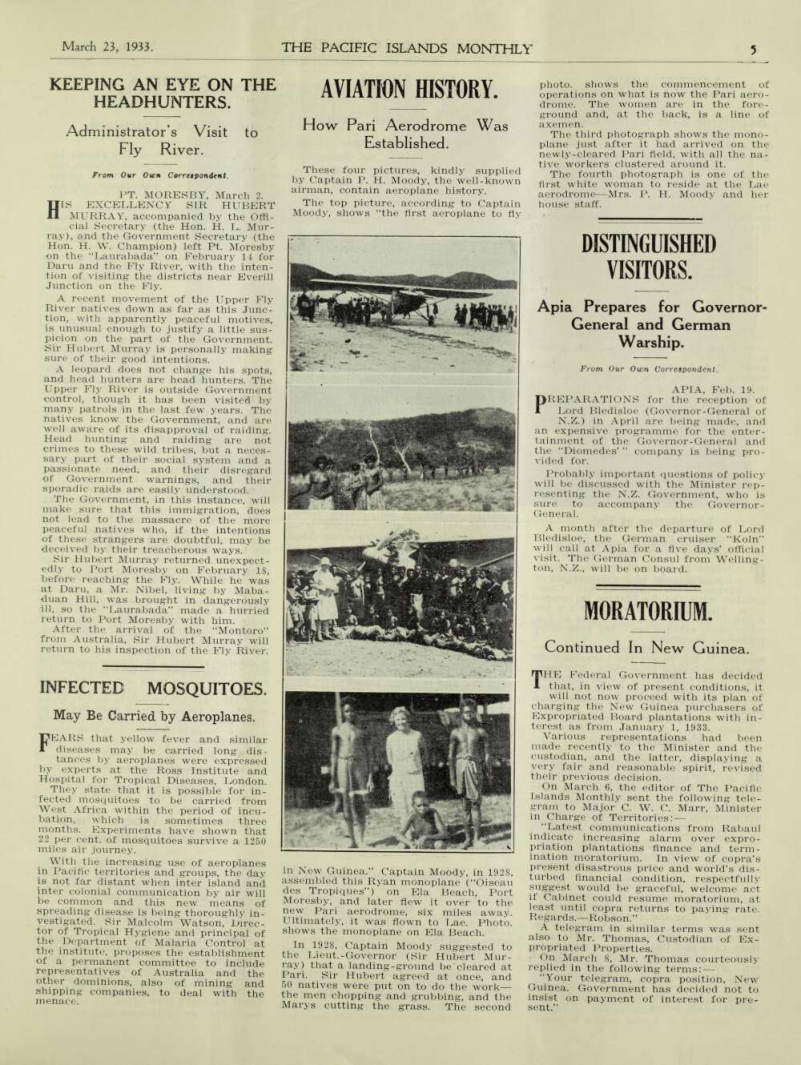
These four pictures, kindly supplied by Captain P. H. Moody, the well-known airman, contain aeroplane history.
The top picture, according to Captain Moody, shows “the first aeroplane to fly
in New Guinea.” Captain Moody, in 1928, assembled this Ryan monoplane (“Oiseau des Tropiques”) on Ela Beach, Port Moresby, and later flew it over to the new Pari aerodrome, six miles away.
Ultimately, it was flown to Lae. Photo, shows the monoplane on Ela Beach.
In 1928, Captain Moody suggested to the Lieut.-Governor (Sir Hubert Mur ray) that a landing-ground be cleared at Pari. Sir Hubert agreed at once, and 50 natives were put on to do the work — the men chopping and grubbing, and the Marys cutting the grass. The second
photo, shows the commencement of operations on what is now the Pari aero drome. The women are in the fore ground and, at the back, is a line of axemen.
The third photograph shows the mono plane just after it had arrived on the newly-cleared Pari field, with all the na tive workers clustered around it.
The fourth photograph is one of the first white woman to reside at the Lae aerodrome —Mrs. P. H. Moody and her house staff.
Distinguished
Visitors.
Apia Prepares for Governor- General and German Warship.
From Our Own Correspondent.
Apia, Feb. 19.
Preparations for the reception of Lord Bledisloe (Governor-General of N.Z.) in April are being made, and an expensive programme for the enter tainment of the Governor-General and the “Diomedes’ ” company is being pro vided for.
Probably important questions of policy will be discussed with the Minister rep resenting the N.Z. Government, who is sure to accompany the Governor- General.
A month after the departure of Lord Bledisloe, the German cruiser “Koln” will call at Apia for a five days’ official visit. The German Consul from Welling ton, N.Z., will be on board.
Moratorium.
Continued In New Guinea.
THE Federal Government has decided that, in view of present conditions, it will not now proceed with its plan of charging the New Guinea purchasers of Expropriated Board plantations with in terest as from January 1, 1933.
Various representations had been made recently to the Minister and the custodian, and the latter, displaying a very fair and reasonable spirit, revised their previous decision.
On March 6, the editor of The Pacific Islands Monthly sent the following tele gram to Major C. W. C. Marr, Minister in Charge of Territories: “Latest communications from Rabaul indicate increasing alarm over expro priation plantations finance and term ination moratorium. In view of copra’s present disastrous price and world’s dis turbed financial condition, respectfully suggest would be graceful, welcome act if Cabinet could resume moratorium, at least until copra returns to paying rate.
Regards.—Robson.”
A telegram in similar terms was sent also to Mr. Thomas, Custodian of Ex propriated Properties.
On March 8, Mr. Thomas courteously replied in the following terms: “Your telegram, copra position, New Guinea. Government has decided not to insist on payment of interest for pre sent.”
Lucky Nine.
Ballot for Edie Creek Claims.
THE ballot for nine claims, comprising the former Administration Reserve at Edie Creek, was held by the Mining Warden at Wau.
Over 13,000 applications for the leases were made, representing 1473 individuals.
The results were announced to a large assemblage of interested persons and were as follow; Lot 1 — W. A. MacGregor.
Lot 2 — S. W. Marshall.
Lot 3 — R. F. C. Struben, Lot 4 — J. A. Symes.
Lot 5— V. M. Giblin.
Lot 6 — H. M. Rex.
Lot 7 — J. C. Wauchope.
Lot 8 — N. B. Spence.
Lot 9 — A. R. Rankin.
Mr. W. A. MacGregor, who drew Lot 1 —otherwise called "the jewel box” —is now a resident of Kavieng but was formerly at Madang. Mrs. Rex, who drew Lot 6, happened to be in Madang visiting a friend, Mrs. Drayson and was induced to take out a miners’ right and enter the lottery.
The statutory exemption period ex pired on January 31; but most of the lucky applicants had made arrangements for working their leases before that.
Etablissements
Hagen.
Liquidation at Epi.
(From a Special Correspondent.) VILA, March 7.
BUSINESS is quiet in the New Heb rides as a result of the liquidation of Etablissement Hagen at Epi. Com petition with the liquidators is impos sible. Trade singlets are sold at 2/9 per dozen or 3d. each and silk shirts at 2/6, while other articles are being even more ruthlessly sacrificed.
Natives from different islands are flocking to Epi to get the bargains they can choose from a huge stock. The mar ket will be flooded for a long time and natives are getting all the money they can put their hands on to buy the cheap goods.
Papuan Sugar.
MR. E. GALLET, who left for Papua by last “Macdhui” and who is inter ested in sugar production in that territory, said in an interview with The Sydney Morning Herald, that it was not the intention of Papuan sugar interests to compete with Queensland, but with Java and Cuba.
The company concerned with the en terprise, he said, anticipated an average yield of 40 to 50 tons of sugar-cane to the acre.
Mr. Gallet, who is returning to Papua to commence clearing and planting, said he believed that Papuan sugar could be landed in England for £5/15/6 a ton, compared with £9/5/6 and £8/8/4, the prices now paid in England for sugar from Java and Cuba. Papua would also receive a preferential tariff of £3/14/8 a ton. There was any amount of good labour to be secured. Natives were em ployed in the fields at 10/- a month plus rations. The company’s property was one of 20,000 acres.
Fiji News.
Tornado’s Sudden Strike.
From Our Own Correspondent.
BA, Feb. 14.
WE had a heavy thunderstorm on Janu ary 31, and the unique experience of witnessing the makings of a tor nado. Luckily the tail did not descend as far as the ground and no damage was done. A number of people witnessed the spectacle and were thrilled to see it gradually growing larger and looking like a huge black serpent. Evenutally it broke in the middle and disappeared into the clouds. We hope that they do not be come common occurrences, as hurricanes are bad enough for us.
During the storm an Indian was struck by lightning whilst riding a horse at Tavua. Both he and his mount were killed instantly. He was well known in the Indian community, which was shocked at his sudden end. When they touched him his clothing fell to pieces— showing how powerful a stroke the poor fellow must have had.
Aviator’S Skill.
On January 28, Captain Fenton came to Lautoka in his Spartan seaplane and on the following day took up passengers for joy rides. Next day he set out for Suva with Mr. Archibald as passenger, and when they had not arrived at their destination on the following evening some anxiety was felt for their safety.
Word was received that they were forced down through engine trouble near Serua, a native village on the Navua coast, none the worse for their experience.
Fiji Airways.
We hear very little of Fiji Airways, Ltd. around this side of the Island, and are beginning to wonder if we will be included in the itinerary when it begins its service. Once the fares become suit able to the average man’s pocket, a large number of passengers will be available here to experience a “first flight.” It will be a great boon to the Colony in gen eral, as the present passenger service by the coastal boats is not reliable, and before one can proceed to any part of the Group he has to go to Suva, then catch the first outward vessel.
Marksmen Prepare.
On Sunday, January 29, a large gath ering of shooting enthusiasts attended a shoot and the annual inspection of rifles.
An inspector came from Suva and was pleased to see the way in which things had been carried on during the past year. Some very good averages were recorded, and interest is already being taken in the annual “Bisley” to be held in Suva at Easter, when it is hoped we will be able to send a representative team of riflemen to compete against other crack shots of the Group.
New Planes Commissioned.
THE two Fox Moth 'planes brought to Salamaua by Messrs. W. R. Carpen ter and Co., were christened by Mrs.
J. Sedgers, wife of the Salamaua branch manager of the Company on January 14.
One was named “Jacqueline,” the other “Jill.”
Both ’planes were put into commission the same day and are making daily trips between Salamaua and Wau with cargo for the goldfields.
Copra.
Prospects Discussed.
SINCE the last issue of The Pacific Is lands Monthly, the price of copra has further declined, but in more recent weeks has shown indications of re covery.
The causes of this disastrous fall in the main product of many South Seas communities have been widely discussed but there is little unanimity of opinion.
It is generally conceded, however, that the chief general factor affecting the situation is the continued enormous pro duction of other vegetable oils and of whale oil.
A special factor in the situation, how ever, is the great overproduction of but ter, which has had much attention in newspapers lately. It is clear that as butter becomes plentiful and cheap the demand for margarine recedes and there is a corresponding fall in the use of co conut oil which is one of the main con stituents of margarine. This is a pass ing phase because, there is little doubt that the glut of butter in Europe will soon reduce world production and bring butter prices back to normal.
The slight recovery in copra prices is a reflection, possibly, of the American financial crash. Many hope that out of this evil will come the first good begin nings of financial reconstruction and economic recovery—which must, of course, be expressed in higher com modity prices. It is a simple axiom that high gold prices mean low commodity prices. There seemed no alternative to high gold prices while America main tained the tremendous financial structure she had erected on the world’s post-war settlements. But the crash, although its immediate effect will be far-reaching and terrible, may quite possibly mean the dawn of a new financial era in which either gold will be released quickly from its frozen and immobile condition — which will permit the international credit system to function again—or something will take the place of gold.
Many shrewd observers expect to see a general recovery in commodity prices before 1933 is out. In that fact lies the copra producer’s main hope. The noise of the crash and the terrific attendant confusion are too recent to permit clear judgments to be formed yet; but it is quite possible that the general economic outlook to-day—despite a whole series of world crises—is much more encourag ing than it was a month ago.
Papuan Reef.
Discovered Where Charts Show 17 Fathoms.
According to a minute from the Offi cial Secretary to the Papuan Adminis tration, Hon. Lionel Murray, a reef or shoal has been definitely proved to exist in the vicinity of Kerema.
Mr. Luff, master of the ketch “Good will,” passed close to the reef and found the sea breaking on it. In the uncer tain light of dusk he took bearings which place the reef about 11 sea miles south of Kerema at a point where Admiralty charts show depths of between 13 and 17 fathoms. The reef is reported to be about li miles long.
Tongan Choir.
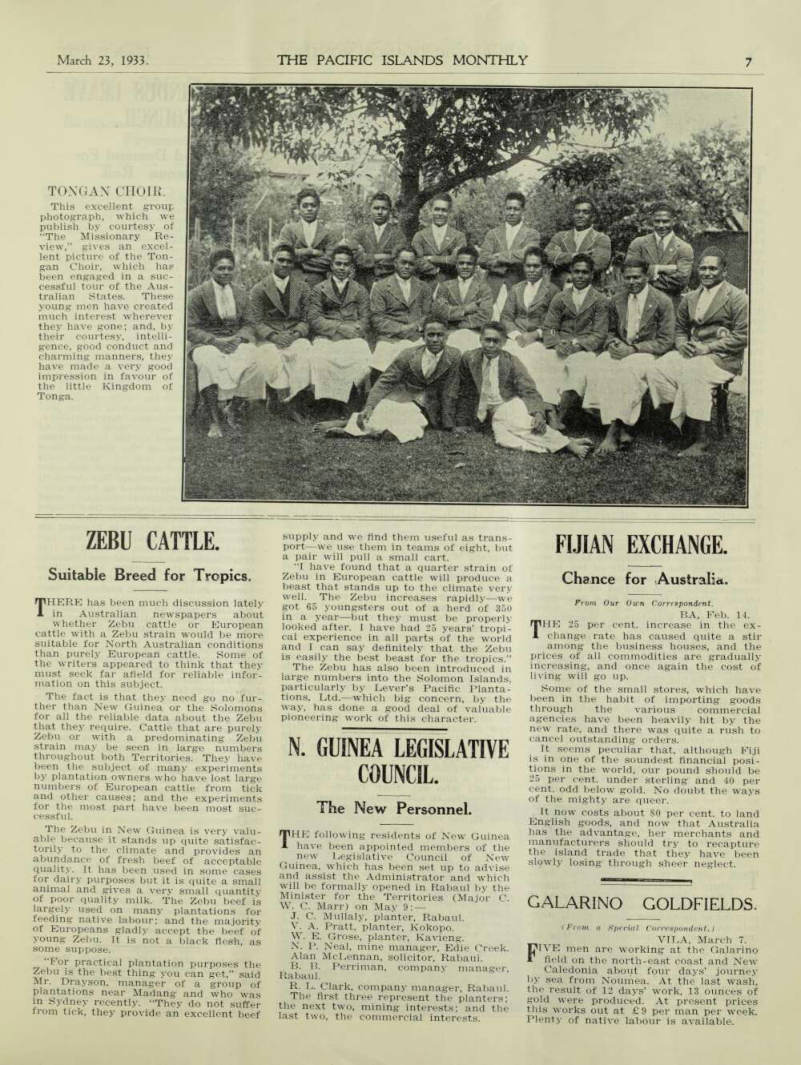
This excellent group photograph, which we publish by courtesy of “The Missionary Re view,” gives an excel lent picture of the Ton gan Choir, which has been engaged in a suc cessful tour of the Aus tralian States. These young men have created much interest wherever they have gone; and, by their courtesy, intelli gence, good conduct and charming manners, they have made a very good impression in favour of the little Kingdom of Tonga.
Zebu Cattle.
Suitable Breed for Tropics.
THERE has been much discussion lately in Australian newspapers about whether Zebu cattle or European cattle with a Zebu strain would be more suitable for North Australian conditions than purely European cattle. Some of the writers appeared to think that they must seek far afield for reliable infor mation on this subject.
The fact is that they need go no fur ther than New Guinea or the Solomons for all the reliable data about the Zebu that they require. Cattle that are purely Zebu or with a predominating Zebu strain may be seen in large numbers throughout both Territories. They have been the subject of many experiments by plantation owners who have lost large numbers of European cattle from tick and other causes; and the experiments for the most part have been most suc cessful.
The Zebu in New Guinea is very valu able bcause it stands up quite satisfac torily to the climate and provides an abundance of fresh beef of acceptable quality. It has been used in some cases for dairy purposes but it is quite a small animal and gives a very small quantity of poor quality milk. The Zebu beef is largely used on many plantations for feeding native labour; and the majority of Europeans gladly accept the beef of young Zebu. It is not a black flesh, as some suppose.
“For practical plantation purposes the Zebu is the best thing you can get," said Mr. Drayson, manager of a group of plantations near Madang and who was in Sydney recently. “They do not suffer from tick, they provide an excellent beef
supply and we find them useful as trans port—we use them in teams of eight, but a pair will pull a small cart.
“I have found that a quarter strain of Zebu in European cattle will produce a beast that stands up to the climate very well. The Zebu increases rapidly—we got 65 youngsters out of a herd of 350 in a year—but they must be properly looked after. I have had 25 years’ tropi cal experience in all parts of the world and I can say definitely that the Zebu is easily the best beast for the tropics.”
The Zebu has also been introduced in large numbers into the Solomon Islands, particularly by Lever’s Pacific Planta tions, Ltd. —which big concern, by the way, has done a good deal of valuable pioneering work of this character.
N. Guinea Legislative
Council.
The New Personnel.
THE following residents of New Guinea have been appointed members of the new Legislative Council of New Guinea, which has been set up to advise and assist the Administrator and which will be formally opened in Rabaul bv the Minister for the Territories (Major C.
W. C. Marr) on May 9: J. C. Mullaly, planter, Rabaul.
V. A. Pratt, planter, Kokopo.
W. E. Grose, planter, Kavieng.
N. P. Neal, mine manager, Edie Creek.
Alan McLennan, solicitor, Rabaul.
B. B. Perriman, company manager, Rabaul.
R. L. Clark, company manager, Rabaul.
The first three represent the planters; the next two, mining interests; and the last two, the commercial interests.
Fijian Exchange.
Chance for Australia.
From Our Own Correspondent.
BA, Feb. 14.
THE 25 per cent. increase in the ex change rate has caused quite a stir among the business houses, and the Prices of all commodities are gradually increasing, and once again the cost of living will go up.
Some of the small stores, which have been in the habit of importing goods through the various commercial agencies have been heavily hit by the new rate, and there was quite a rush to cancel outstanding orders, It seems peculiar that, although Fiji is in one of the soundest financial posi tions in the world, our pound should be 25 per cent, under sterling and 40 per cent, odd below gold. No doubt the ways of the mighty are queer.
It now costs about 80 per cent. to land English goods, and now that Australia has the advantage, her merchants and manufacturers should try to recapture the island trade that they have been slowly losing through sheer neglect.
Galarino Goldfields.
(From a Special Correspondent.) VILA, March 7.
FIVE men are working at the Galarino field on the north-east coast and New Caledonia about four days’ journey by sea from Noumea. At the last wash, the result of 12 days’ work, 13 ounces of gold were produced. At present prices this works out at £9 per man per week.
Plenty of native labour is available.
Tropicalities
THAT genial American writer and Pa cific traveller, Mr. Marc T. Greene, made another of his startling appear ances in Sydney during the month. He drops in periodically, and disappears un expectedly; and no sooner has one word of him in Tonga, or Singapore, or Nor folk Island, than he is back again. He has been up in Manchuria, looking the combatants over; about three weeks later, he was down in South Tasmania; and on February 28 he went off on the Niagara, with some thought of Samoa in his mind. But I predict Tahiti will see him again very soon. Like many sea soned travellers, he regards French Oceania as the fairest place on God’s earth. He has a merciless pen, and those Pacific peoples whom he criticises rise re gularly to frenzy and retaliation and are anything but pacific. But they all read what he writes —which may be taken as the measure of any writer’s success. * * * THE Melanesian Mission Press at Ma ravovo, Guadalcanar, is not the only press in the British Solomons. There is an important printing outfit con trolled by the Roman Catholic Mission headquarters at Visale, on Guadalcanar; and the Seventh Day Adventist Mission, at Roviana, also operates a press. We have been asked by the Melanesion Mis sion officials to make this correction of an article which we published last No vember.
IT is a remarkable thing, and striking testimony to the efficiency of the ser vices and the reliability of the pilots, that the New Guinea aerial transport organisations have carried on for years almost without the loss of a passenger.
Year in and year out, these aero planes have maintained communica tions between the Morobe field and Salamaua, Lae and Port Moresby—flying over some of the worst country in the world —and, until Mr.
Drayton crashed recently with a pas senger, I do not recollect one fatal acci dent in which anyone outside of the avi ation personnel was involved. Yet these pilots must have carried many thousands of passengers. In this connection, I have an interesting note from Captain P. H.
Moody, who had a good deal to do with early flying in New Guinea, but who is now settled down in Western Queens land: —“I have read the account in your columns of the death of Frank Drayton with a deal of sadness. He is the last to go of the team I took up there in the early days of New Guinea flying. Les Trist, Fred Ward and Frank Drayton— one by one they have passed away, leav ing nothing but the memory of loyal men and good fellows.” * * * THE value of the Department of Agri culture is recognised in the Territory of New Guinea, where the services of the expert officers, and the information secured at its various experimental plan tations, are freely availed of. But it may be that the usefulness of this or ganisation is not appreciated in other Islands Territories, where agricultural conditions are the same. The Depart ment, for instance, issues a “Price List of Planting Materials,” from which it appears that it has for sale, at low prices, the seeds, etc., of practically avery kind of plant and tree grown on
the various plantations; as well as such things as insecticides, sprays, etc. All South Seas planters should send to the Department of Agriculture, Rabaul, for this “Price List,” to be kept as a handy reference; and, if they are wise, they will try to secure, also, copies of the various pamphlets published, from time to time, by Mr. George H. Murray, Di rector of Agriculture in New Guinea. * * * WE are glad to have received from Ta hiti a copy of a very attractive newspaper of 18 pages entitled “Le Reveil” (“The Awakening”) which com menced publication recently and which will appear at regular intervals as “an organ to advance the economic and pol itical interests of the people of French Oceania.” Under the direction of the editor, Mons. H. Bodin, this new news paper deals vigorously with many sub jects of local and general interest. The pages, which are in French and Tahitian, have been most ingeniously and attrac tively printed by means of typewriter and duplicator. We wish the best of good luck to the new newspaper and hope it will have sufficient local support to en sure for it a long and useful career. * * * THOUSANDS of people in the Pacific Islands will be glad to note that the very popular commander of the B.P. liner “Macdhui,” Captain C. E. Williams, has received well deserved promotion.
“Jazz” —as he is universally known, in order to distinguish him from the other Captain Williams, who also has a thou sand friends —has been master of Island steamers for many years and has the kind of record that makes even the most hard-hearted of directors weep for joy when his name is mentioned. He has never lost a ship and never been involved in a serious accident —he has an un canny facility for finding his way about the unlighted Pacific at night, even in the thickest weather. They say he can pick his way blindfolded into little known and almost uncharted ports any where in the Solomons or New Guinea.
"Jazz” will leave the “Macdhui” when she reaches Sydney in April and proceed to Britain to bring out the Big Firm’s new motorship. The present first officer of the “Macdhui,” Mr. A. Campbell, will take over command. This also will be a popular appointment among Islanders.
Mr. Campbell, apart from social quali ties, is a splendid seaman; and there are tourists who say that Pacific Islands sightseeing is not really complete until one has seen this long, dour officer hand ling native stevedore labour. * * * THERE are thousands of bridge players in the Pacific Islands —it is a good old South Seas custom. But mostly they are auction players and, possibly are happy to remain in that condition.
But if there be among them any who have ambitions and wish to become players of contract bridge—the high brow, aristocratic relation of auction — they are recommended to get a copy of “Contract Kernels,” a new book by Myra Millingen, containing a complete de scription of the new game and just pub lished by Messrs. Angus and Robertson, Ltd., at 3/6. Those who profess to know, declare that up to date it is the best ex position published concerning this fas cinating development of bridge.
Council.
Fiji Hindus Leave
Renewed Demand For Common Roll.
DURING the past few years, there has been a constant agitation by the Indian members of the Fiji Legisla tive Council to introduce a common roll for European and Indian electors.
At the last meeting of the Legislative Council in October, 1932, the motion was again advanced but, on the advice of the Governor (Sir Murchison Fletcher) the Indian members withdrew the motion and instead of retiring from the Council, as was the practice adopted by former Indian members, they decided to remain there and co-operate with the other members for the good of the Colony as a whole.
However, when the 1933 session of the Council commenced on February 21, His Excellency, the Officer Administering the Government (Hon. A. W. Seymour) in his opening address announced that there would be no alteration in the pre sent system of Indian representation.
His Excellency said; “With regard to the views expressed by the Indian Hon ourable Members on the subject of a common electoral roll, I have been authorised by the Secretary of State for the Colonies to announce his decision, which he has telegraphed as follows: When Legislative Council next meets you may announce that I have carefully considered the views ex pressed in the debate in Council on October 13, but that the debate ap pears to indicate that it would be im practicable under present conditions to contemplate the adoption of a system of Common Roll representation in pre ference to the existing system of elec tion.’
He then said he hoped the Indian Members would continue to give their support and co-operation as Members of the Council.
When the session was resumed on the following morning, the two Indian Mem bers, Mr. K. B. Singh and Mr. M. M.
Mudialar, stated that as the reply to their request for a common roll was un satisfactory, they were compelled to resign.
Before leaving the Council, Mr. Singh thanked the Hon. A. W. Seymour for the trouble he had taken in communicating with the Colonial Secretary, and con veyed his thanks to the Secretary of State for his consideration of the matter and the reply. He said it was very un fortunate that the decision was unfav ourable and under the circumstances they had no option but to resign from the Council.
EDITORIAL NOTE. —This means that, as in previous years, the large Indian community of Fiji will be without representation in the Legis lature. It is a notable example of “cutting off one’s nose to spite one’s face.” The Indians gain nothing by this policy—there is not the least prospect of Indian peasants and coolies being placed on an equality with European resi dents, in Fiji or anywhere else. It really does not matter —no Indian community in the world is more prosperous and comfortable than that of Fiji.
Dr. and Mrs. Clements left Manus, T.N.G., for Sydney by the “Montoro” on February 10. Dr. Clements will take up work at the University of Sydney as Lecturer in Epidemiology to the School of Tropical Medicine.
Run On Bank.
Banque Chin Foo Ceases Payment.
From Our Own Correspondent.
Papeete, Feb. 25.
THE cessation of payment at the Banque Chin Foo, owing to a lack of liquid resources, created unusual ex citement in Papeete business circles, to say nothing of the really serious incon venience caused to numbers of tourists and temporary residents who placed their funds in that institution for safe keeping.
It is stated that a run on the bank was brought about owing to the collapse of the important Chinese firm of Kong Ah and Co., with which the former was involved. The Kong Ah Co. is now in a state of “liquidation judicaire” and under the control of liquidators appointed by the creditors under the auspices of the Commercial Tribunal of Papeete. It is expected that several smaller subsidiary Chinese houses will be forced into liquidation, owing to the failure of the parent concern.
The Kong Ah Co. has for some time handled a considerable portion of the copra output of the Group. It maintained branches throughout the various archi pelagoes, and several schooners to facili tate the transportation of produce to Papeete headquarters. Among the rea sons given for the failure are undue pressure by the banks for immediate re payment of advances made for purchase of produce, outside borrowing at ruin ous rates of interest in an endeavour to stave off the inevitable crash, the severe drop in copra values, and a general fall ing off of business owing to the low price of all island products.
A meeting of the depositors in the Chin Foo Bank was held yesterday on the bank premises, when a balance sheet was presented, showing an excess of as sets over liabilities of nearly two million francs, but with only the nominal sum of 220,000 francs cash on hand. The assets, which are largely made up of town pro perty in Papeete, coconut plantations scattered throughout the Society Group, live stock and material, have been con servatively valued by competent ap praisers, leaving little doubt that in or dinary times the bank would have no difficulty in quickly finding the neces sary financial aid. As a preliminary measure towards the prevention of bankruptcy proceedings or a forced liquidation of assets, in which case the depositors would probably realise only a small percentage of their credits, it was agreed that the bank would assign all its assets to the creditors, and pay the latter off within two years, in full plus a low rate of interest, and by quarterly instalments; the operations of the bank meanwhile to be under the control of three prominent business men elected by the creditors. This arrangement, how ever, is subject to the approval of the Commercial Tribunal, but with this dif ficulty overcome it appears very likely that sufficient capital will be forthcom ing from local sources to enable the bank to carry on as before, and immediately to pay off numerous small depositors who really need their money for living expenses. There appears to be a good deal of anxiety lest some importunate and chagrined small creditor—of whom a few held aloof from the meeting—may precipitate a crash before the proposed arrangement can be put into effect, and
thus ruin the prospects of all. On the other hand, there is a large amount of influence at work trying to keep the bank afloat, particularly among mer chants who believe that competition be tween rival bankers works to their bene fit in regard to exchanges and remit tances to foreign countries.
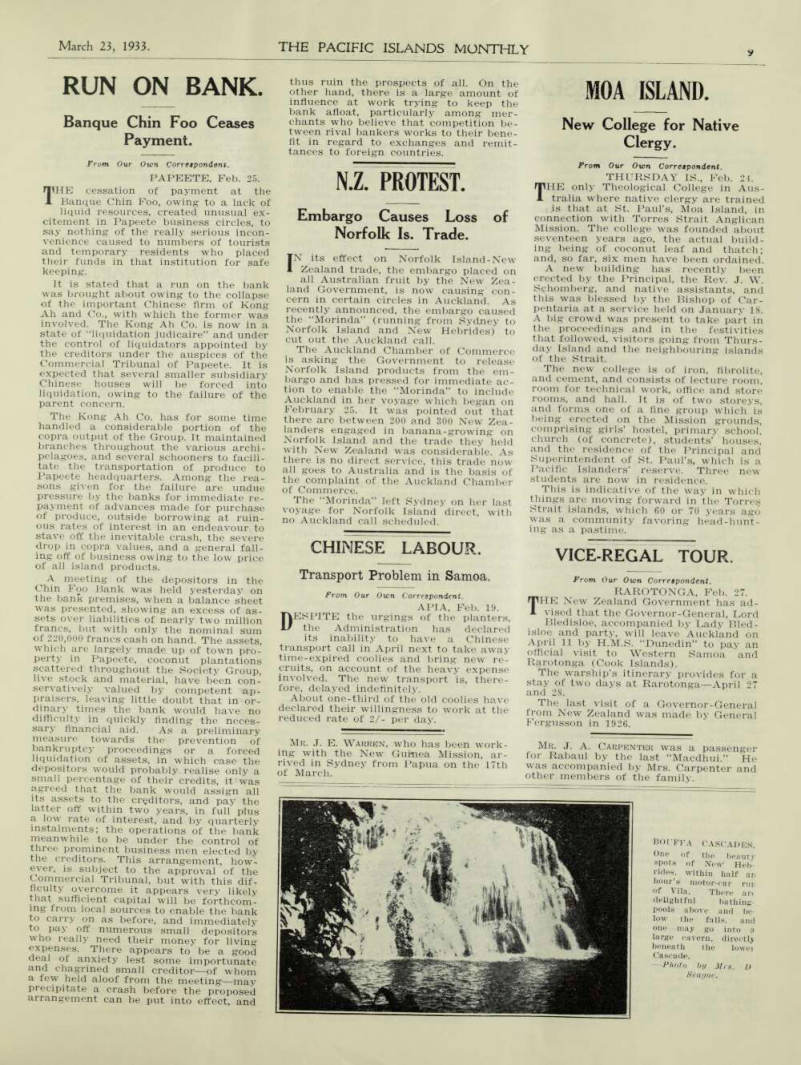
Bouffa Cascades,
One of the beauty spots of New Heb rides, within half an hour’s motor-car run of Vila. There are delightful bathing pools above and be low the falls, and one may go into a large cavern, directly beneath the lower Cascade. —Photo by Mrs. D Seagoe.
N.Z. Protest.
Embargo Causes Loss of Norfolk Is. Trade.
IN its effect on Norfolk Island-New Zealand trade, the embargo placed on all Australian fruit by the New Zea land Government, is now causing con cern in certain circles in Auckland. As recently announced, the embargo caused the “Morinda” (running from Sydney to Norfolk Island and New Hebrides) to cut out the Auckland call.
The Auckland Chamber of Commerce is asking the Government to release Norfolk Island products from the em bargo and has pressed for immediate ac tion to enable the “Morinda” to include Auckland in her voyage which began on February 25. It was pointed out that there are between 200 and 300 New Zea landers engaged in banana-growing on Norfolk Island and the trade they held with New Zealand was considerable. As there is no direct service, this trade now all goes to Australia and is the basis of the complaint of the Auckland Chamber of Commerce.
The “Morinda” left Sydney on her last voyage for Norfolk Island direct, with no Auckland call scheduled.
Chinese Labour.
Transport Problem in Samoa.
From Our Own Correspondent.
Apia, Feb. 19.
DESPITE the urgings of the planters, the Administration has declared its inability to have a Chinese transport call in April next to take away time-expired coolies and bring new re cruits, on account of the heavy expense involved. The new transport is, there fore, delayed indefinitely.
About one-third of the old coolies have declared their willingness to work at the reduced rate of 2/- per day.
Mr. J. E. Warren, who has been work ing with the New Guinea Mission, ar rived in Sydney from Papua on the 17th of March.
Moa Island.
New College for Native Clergy.
From Our Own Correspondent.
Thursday Is., Feb. 24.
THE only Theological College in Aus tralia where native clergy are trained is that at St. Paul’s, Moa Island, in connection with Torres Strait Anglican Mission. The college was founded about seventeen years ago, the actual build ing being of coconut leaf and thatch; and, so far, six men have been ordained.
A new building has recently been erected by the Principal, the Rev. J. W.
Schomberg, and native assistants, and this was blessed by the Bishop of Car pentaria at a service held on January 18.
A big crowd was present to take part in the proceedings and in the festivities that followed, visitors going from Thurs day Island and the neighbouring islands of the Strait.
The new college is of iron, fibrolite, and cement, and consists of lecture room, room for technical work, office and store rooms, and hall. It is of two storeys, and forms one of a fine group which is being erected on the Mission grounds, comprising girls’ hostel, primary school, church (of concrete), students’ houses, and the residence of the Principal and Superintendent of St. Paul’s, which is a Pacific Islanders’ reserve. Three new students are now in residence.
This is indicative of the way in which things are moving forward in the Torres Strait islands, which 60 or 70 years ago was a community favoring head-hunt ing as a pastime.
Vice-Regal Tour.
From Our Own Correspondent.
Rarotonga, Feb. 27.
THE New Zealand Government has ad vised that the Governor-General, Lord Bledisloe, accompanied by Lady Bled isloe and party, will leave Auckland on April 11 by H.M.S. “Dunedin” to pay an official visit to Western Samoa and Rarotonga (Cook Islands).
The warship’s itinerary provides for a stay of two days at Rarotonga—April 27 and 28.
The last visit of a Governor-General from New Zealand was made by General Fergusson in 1926.
Mr. J. A. Carpenter was a passenger for Rabaul by the last “Macdhui.” He was accompanied by Mrs. Carpenter and other members of the family.
About Islands People.
Mr. Cecil Abel, of the Kwato Mission, Papua, arrived in Sydney by the “Mac dhui” on March 9.
Mr. William Groves, who has spent nearly a year at the village of Fiosa, New Ireland, returned to Sydney by last “Macdhui.” He has been working under a fellowship granted by the Australian National Research Council.
Mr. Kenneth Macgregor, a Sydney solicitor, sailed for Rabaul by the “Mon toro” on February 21.
Mr. and Mrs. W. W. Petrie, of the Seventh Day Adventist Mission, left for Papua by the “Montoro” on February 21.
Mr. Justice Gore, of the Papuan Ad ministration, came to Sydney by the March “Macdhui” from Port Moresby, on leave. He will return to the Terri tory about the end of May.
Mr. R. S. Forsyth, the well known representative of the New Zealand Meat Board in London, was included in the New Year Honours —he was created C M.G., in recognition of distinguished public service. He is a younger brother of the late Mr. D. M. Forsyth, of Rabaul, T.N.G., and the published photographs show a strong family resemblance.
Miss Grace Fairhall, a qualified Eng lish nurse, arrived in Sydney by the “Maloja” from London on February 23.
Miss Fairhall is on her way to Papua, where she will succeed Miss Milne, who has been in charge of the hospital con ducted by the London Missionary Society at Port Moresby.
Rev. B. Linden Webb arrived in Sydney from Norfolk Island by the “Morinda” on February 14. Mr. Webb has been in ill-health for some time and will remain in New South Wales until he has re covered.
Miss A. Griffin, B.A., Methodist mis sionary of the Indian mission in Suva, Fiji, arrived in Sydney during February after a long furlough in India. She re turned to Fiji by the “Niagara” on March 2.
Rev. J. D. Bodger, of the New Guinea Mission staff at Dogura, Papua, left Syd ney by the “Montoro” on February 23, after a short furlough in New South Wales. Mr. Bodger took back with him a small motor cycle for use between Dogura and the out stations.
Miss Mary Jenkins, B.A., left Brisbane on February 24 by the “Montoro” for Rabaul, where she will take up the office of Mission Sister and will be engaged in educational work among the Chinese. At a dedication service, held in the Albert St. Methodist Church, Brisbane, prior to her departure, it was recalled that many of Miss Jenkins’ ancestors had been en gaged in mission work, the most notable of whom were William Fletcher and his sister Mary, who went to Fiji about 80 years ago.
Mr. G. S. Boehm, an engineer of Fiji Airways, Ltd., arrived in Suva on Feb ruary 10. He brought with him two sea planes for use in the Company’s new services and a 20-foot speedboat to use as a tender for the seaplanes.
Mrs. H. J. E. Short, of the London Missionary Society at Hula, Papua, who recently completed a grammar and vo cabulary of the Hula language, is now engaged in translating “The Pilgrim’s Progress” into the language of her dis trict. She is also revising the Gospels and Acts which were issued many years ago in the Keapara language.
Lieut.-Commander J. D. M. Hunter, R.N., arrived in Sydney with Mrs. Hun ter by the “Marama” from Tahiti on February 21. He was navigator of a yacht owned by Mr. T. Wessel, which he left at Papeete.
Mr. Rupert C. A. Ollerenshaw left Sydney for Rabaul by the “Montoro” on February 22. He was admitted to the N.S.W. Bar in 1929 and intends to prac tice in Rabaul as a barrister and solicitor.
Dr. C. S. Laurence, who has been Government Medical Officer at Norfolk Island for two years, returned to Sydney with his wife by the “Morinda” on March 6.
Mr. W. H. Tustin, a member of the Executive Council of Norfolk Island, who has practiced as an advocate there for six years, arrived in Sydney by the “Morinda” on March 6 to investigate the shipping, handling and marketing of bananas.
Rev. B. T. Butcher, of the L.M.S. station at Aird Hill, Papua, will arrive in Sydney by next "Montoro” with his wife and family. He is on his way to London on long furlough and will be one of the principal speakers at a L.M.S. demonstration at the Albert Hall in May.
Rev. F. W. Paton, who has been ap pointed the representative of the Tas manian Presbyterian Assembly in the foreign Mission field, will leave for the New Hebrides in April. He will be sta tioned on the north coast of Ambryn.
Mr. Jotham Faubula, who is studying at the Melbourne College of Divinity and is a candidate for the Tongan Methodist Church, has been successful in passing all subjects of the first examination for the Licentiate in Theology. He was a member of the Tongan Choir that toured Australia in 1928 and for the past four years, he has been a tutor at Tubou Col lege, Nukualofa.
Dr. F. A. MacPherson, of Edinburgh, Scotland, has been appointed to the Fauabu Melanesian Mission Hospital on Malaita, Solomon Islands. Dr. MacPher son is replacing Dr. L. M. Maybury, who left the Solomons during February for England.
Miss L. E. Cheeseman, the well-known English entomologist, arrived in Sydney on March 16. She will leave shortly for Papua, where she will spend some months studying insect life and collect ing specimens. Before visiting London, Miss Cheeseman spent 18 months in the New Hebrides.
Rev F R. Bishop has relinquished the post of chaplain to the Melanesian Mis sion at Rabaul, after eight years. He has been visiting the Mission at Siota, B.S.I., and arrived in Brisbane on March 17, on his way to England.
Rev. D. E. Graves, who has resigned from the Melanesian Mission in the Solomon Islands owing to ill-health, ar rived in Sydney on March 20 on his way to England.
There were cheers and junketing in Kieta, T.N.G., during the month. The wife of Mr. A. E. Ray, manager of the Burns, Philp branch there, gave birth to a daughter. “Both doing very well.”
Mr. Tex Roberts and Mr. J. M. Joyes, both of New Guinea, arrived in New Zealand by the Tainui from Europe re cently; and will go on to the Territory by the April “Montoro.”
Death Of Captain
Austen.
THERE is sincere regret throughout the British Solomons at the passing of Captain A. A. Austen, who died at the Methodist Mission Hospital, Bilua, on February 5.
The late Capt. Austen, who was about 58 years of age, was a native of New Zealand, and for a time was master of the Fiji Government yacht “Ranadi.”
Coming to the Solomons 21 years ago, he took up land in Marovo Lagoon, and engaged in planting and trading.
A capable seaman, he sailed his ves sel to some of the most inaccessible parts of the Protectorate in the course of his recruiting and trading ventures.
On one of those trips, which was unduly prolonged, a report of his death was cir culated, and Captain Austen had the unique experience of reading his own obituary notice in a Fiji newspaper.
Of late, his health being unsatisfac tory, he became something of a recluse and seldom left his Marovo plantation.
A few weeks before his death he suf fered a paralytic stroke, and friends re moved him to Bilua Hospital, where he was admitted in a semi-conscious con dition, in which he remained until the end.
Captain L. Austen, of Papua, is a brother, and a sister resides in New Zealand.
Tavua Goldfield.
From Our Own Correspondent BA, Feb. 14.
PROSPECTING at Tavua has been go ing on quietly and several new pros pectors have entered the field. Very little news comes out so nobody outside knows how the field is progressing; but from rumours that are going the rounds, things ought to liven up soon.
Island Steamer Sold.
THE French inter-island steamer “Com mandant Destremau,” which is at present in Sydney, has been pur chased by Chinese owners. Under the flag of Societe Anonyme Caledonia, she traded between Sydney and New Cale donia. A crew to take the vessel to Shanghai arrived in Sydney on March 17.
Mr. Zane Grey’s launch “Frangapani,” which left Auckland on March 3 for Ta hiti, arrived at Rarotonga on March 13.
Except for the first day, the “Franga pani” met headwinds throughout the voyage.
Minister's Itinerary.
Visit to New Guinea.
THE following is the itinerary that has been prepared for the visit of the Federal Minister (Major C. W. C.
Marr) to New Guinea next month.
The Minister will be accompanied by Mr. Thomas (Custodian of Expropriated Properties) and Mr. J. R. Halligan, of the Prime Minister’s Department, who has charge of a section of the Territory administration affairs: April 27 (Thursday).—Leave Sydney by m.v.
“Macdhui. ”
May 4 (Thursday).—Port Moresby.
May 5 (Friday).—Samarai.
May 7 (Sunday).—Arrive Rabaul 4 p.m.
Upon landing from the “Macdhui” at the main wharf, the Minister will be received by the Acting Administrator, the Chief Judge, members of the Council, and representative townsmen. A guard of honour of native constabulary supplied by the training depot will be drawn up on the wharf.
After the reception and inspection of the guard, the Minister will proceed to Government House.
May 8 (Monday).—Morning; The Minister (who will be accompanied by the Administrator) and party will leave Rabaul for Keravat Experimental Plantation at 7.45 a.m. Upon arrival at Keravat at 8.45 a.m., they will be met by the Director of Agriculture. After an inspection of the planta tion, the party will proceed to Vunairima Metho dist Mission, leaving Keravat at 10.20 a.m.. and arriving at the Mission, where the Minister will be met by the Rev. L. A. McArthur, at 10.30 a.m. The school and hospital will be visited, and the party will leave for Rabaul at 11.20 a.m., arriving at Rabaul at 12 noon.
Afternoon: Leaving Rabaul at 1.15 p.m., Vuna pope Catholic Mission, of the Most Sacred Heart, will be visited, the Minister being received there at 2 p.m. by his lordship Bishop Testers, Vicar Apostolic, and conducted over the schools and establishment.
The departure from Vunapope will be timed for 3.20 p.m., to enable the Minister to see the Kokopo residents on the Kokopo Recreation Re serve at 3.30 p.m. A guard of honour will be furnished by the Kokopo detachment of native constabulary. Leaving Kokopo at 5.15 p m Rabaul will be reached at 6 p.m.
May 9 (Tuesday).—Morning; The Minister will see deputations at Central Administration Offices, commencing at 8 a.m.
At 9.20 a.m. the Minister (who will be ac companied by the Administrator) and party will proceed to the Rapindik Native Hospital, where the Minister will be met at 9.30 a.m. by the Director of Public Health and the medical officer in charge. After an inspection of the hospital, the Administration Schools at Malaguna will be visited at 10.15 a.m., and. finally, the European Hospital at 11.15 a.m.. when the Minister will again be received by the Director of Public Health. The Minister will leave the European Hospital for Government House at 12 noon
Afternoon: The Administrator and members of the Council will be assembled at the Council Chambers at 2.45 p.m.. and will receive the Minister on his arrival at 3 p.m. A guard of honour will be furnished by the native con stabulary training depot.
The Minister will formally open the Legislative Council his address being replied to by the Ad ministrator and the senior non-official member.
An adjournment will then be made for after noon tea, and the Minister will leave for Govern ment House at 4.30 p.m.
Evening: Leave by “Macdhui” at 7 o'clock.
May 10 (Wednesday).—Arrive Lindenhafen.
May 11 / Thursday).—Arrive Salamaua at day light. Disembark at 7 a.m.
Visit hospital, reception, etc.
Leave by small ’plane for Lae at 8.15 a.m.
Arrive Lae 8.30 a.m. Transfer to G.31.
Take off 9 a.m. for Wau.
Arrive Wau 9.45 a.m.
The Minister will be met by the warden the Assistant District Officer, Wau, and representa tives of the residents of the district, and. after visiting the Administration Offices and the Euro pean Offices, will inspect the New Guinea Gold fields property,
Evening At Bulolo
After lunch the Minister will receive such deputations as may be arranged, and will leave by air for Bulolo at 3 p m May 12 (Friday).—The Minister and party will leave Bulolo at 11 a.m. by air to arrive at Lae at approximately 12 noon. Upon arrival at Lae the Minister will inspect the aerodrome and workshops, and after lunch will embark on the “Macdhui” at 1.30 p m Finschafen at 6 p m Leave at 9 p m May 13 (Saturday).—Arrive Madang 8 a.m.
Upon landing at Madang. the Minister will be received by the District Officer and representative townsmen. A guard of honour will be supplied by the Madang detachment of native constabulary and an assemblage of Luluais arranged.
Arrangements will also be made by the District Officer for the Minister and party to visit places of interest, time being allowed for the Minister to see deputations (if any) at the District Office.
Leave Madang 4 p.m.
Arrive Alexishafen 6 p.m. Visit Mission Station.
May 14 (Sunday) —Leave Alexishafen 5.30 a.m.
May 15 (Monday). —Arrive Kavieng 7 a.m.
Arrangements similar to Madang. Leave 4.30 p.m.
May 16 (Tuesday). —Arrive Pondo daylight.
Visit desiccated coconut factory. Leave 6 p.m.
May 17 (Wednesday). —Rabaul. Arrive daylight.
May 18 (Thursday). —Rabaul. Leave 4 p.m.
May 19 (Friday). —Soraken. Arrive 6.30 a.m.
Depart 5.30 p.m.
May 20 (Saturday). —Kieta. Arrive daylight.
Depart 3.30 p.m. Arigua: Arrive 5.30 p.m.
May 21 (Sunday). —Arigua: Depart 5.30 a.m.
Numa: Arrive 7 a.m.; depart 2 p.m. Teopasino: Arrive 3 p.m.; depart 9 p.m.
May 22 (Monday). —Rabaul: Arrive daylight; depart 10 p.m.
May 24 (Wednesday). —Samarai: Arrive day light; depart noon.
May 25 (Thursday).— Port Moresby.
Methodist Missionary
Movement.
Transfers Follow Conference.
AT the annual conference of the Me thodist Missionary Society, the Rev.
J. W. Burton, general secretary, moved the recommendations of the Mis sion Board regarding transfers. The conference was held in Sydney late last month.
The conference agreed to the following appointments:— Revs. G. S. Shinkfield, of Samoa, T. C. Carne, of India, and A.
W. Pedrick, New Britain, be transferred to the Victorian and Tasmanian confer ence for appointment. The Rev. R. A.
Gibbons, of Fiji, was transferred to New South Wales for appointment. The Rev W. Whitbread was designated for ap pointment to Fiji, and the conference decided that he be ordained. The Rev.
D. Oakes was designated for New Britain, and is to be ordained. The Rev.
N. G. Parley was appointed to the Samoa district.
The conference requested the Victoria and Tasmania conference to recommend that the Rev. O. McCutcheon be or dained and appointed to Fiji, and the Rev. G. S. Crouch be ordained and ap pointed to Fiji.
The South Australian conference was requested to transfer the Rev. A. H.
Blacket for appointment to Indian work in Fiji, and the Rev. J. R. Andrew for appointment to Papua.
The conference dealt with business affecting native ministers in the mission field, and with probationers’ examina tions. On the motion of the Rev. W.
Poole, the conference carried a vote of sympathy with the relatives of the late Rev. Stanley Jarvis, whose accidental death was reported recently.
Rev. A. H. Scriven, who was for six teen years on the staff of the Methodist Mission to Papua, has been appointed General Secretary in succession to Rev.
W. A. Sinclair, who has retired.
Mosquito-Eating Fish.
Available in Rabaul.
THE mosquito larvae-eating fish, Gam busia affinis, which were introduced into the Mandated Territory in 1930, have now been distributed widely among outstations and plantations with very satisfactory results.
The Public Health Department is anxious to supply with young fish any residents who wish to introduce this method of destroying the malaria-carry ing mosquito. It will supply, free any quantity in Rabaul.
The fish will carry for about ten days in the original tins without feeding or changing the water, but the containers should be kept cool and any dead fish removed immediately to prevent fouling the water. River, well or clean ground water should be used for changing and not tank water. The fish are a fresh water species, but will survive in brack ish and salt water. When stocking large areas, it is advisable to breed the fish in small pools and distribute them as num bers permit. Breeding pools should have a capacity of at least 250 cubic feet, be moderately shaded, and the edges should be overhung with grass or weeds to pro tect the young fry.
Fiji Legislator.
Hon. Harry Kennedy’s Death.
From Our Own Correspondent.
BA, Feb. 14.
IT is with deep regret that the death is reported of a well-known identity of Fiji. Mr Harry Kennedy, who died in the Ba Cottage Hospital on January 25.
The late Mr. Kennedy had been in poor health for some years, and, at the time of his death, was thoroughly run down. He was 74 years of age. He was the Honourable Member for this Divi sion for several terms, and, in his younger years, took an active interest in all sports and public affairs. A large crowd gathered at his graveside to pay their last respects to one who had al ways done his best for the Colony He was buried at the family burial ground at Sigane, the service being con ducted by the Referends Wright and
Johnstone.
Ireland.
Mr. W. C. Groves.
Studies the “Malangan” of New Ireland.
MR. W. C. GROVES, who arrived in Sydney by last “Macdhui,” has been doing anthropological research work on the east coast of New Ireland, where he spent ten months.
Mr. Groves has made a special study of the educational implications of cul ture-contact as well as of the sociologi cal significance of the “malangan” of New Ireland. He believes the “malan gan to be definitely of primitive re ligious significance and the evidence to day indicates that this survival of for mer native culture will be unknown to the adults of the next generation.
Mrs. Groves and one daughter spent a few months at Fiosa, New Ireland, with Mr Groves, who is now studying at the Sydney University before returning to New Guinea.
Red Propaganda.
Banned in Tahiti.
From Our Own Correspondent.
Papeete, Feb. 25,
AN important Presidential decree, de signed to regulate the introduction of foreign newspapers, periodicals, and propaganda (other than commercial or tourist) into the French Establish ments of Oceania, was published in the Journal Officiel of the Colony on Feb ruary 16. His Excellency the Governor now has power to interdite, by notice in the “Journal,” the introduction, distribu tion, or placing on sale of any publica tion from abroad which falls within the above categories.
The same interdiction may be pro nounced against publications emanating from France or the French Colonies, provided they are printed in any other language than French. Within the Col ony no newspaper or periodical may be published, in language other than French, without the authorisation of the Governor in Council, and after submis sion of certified translations of the pro posed publications; such authorisation may be revoked at any time.
Undoubtedly the intention of the de cree is to prevent the dissemination, among a semi-educated native popula tion where such would assuredly work infinite mischief and discontent, of Com munistic literature from abroad, as well as propaganda subversive of the French authority; it is, therefore, to be com mended as a wise and timely measure.
Erle Huntley’S
Death.
From Our Own Correspondent
Pt. Moresby, March 2.
NEWS of the death of Erie Huntley at Temora, New South Wales, came as a shock to his many friends in Pa pua, where he richly earned the liking and respect of all who came into con tact with him.
He was a member of the old Sydney family whose beautiful home gave its name to Huntley’s Point, on the Parra matta River, and came to Papua in 1921 as General Manager of New Guinea Copper Mines, Ltd. He did great work in developing that Company’s property near Port Moresby, and commanded the loyal and contented service of the hun dred white employees and twelve hun dred natives under his control; and he was very near to successful production on a large scale when a serious slump in the market price of copper forced the Company to close down in December, 1926.
Erie Huntley left Papua in January, 1927. A man of wide experience and generous sympathies, he endeared him self to the white population of Papua no less by his ready help to those in dif ficulties than by his keen and active in terest in the many commercial problems that arose during his time. That he was a member of the Papuan Legislative Council, and the first non-official mem ber of the Executive Council may soon be forgotten; but as the straightest of straight goers, genial companion, good sport and staunch friend, the memory of his charming and virile personality will never fade in the minds of those who were privileged to know him well.
Breeze In Tonga.
Committee Charged with Intolerance.
Specially Contributed.
IN proceeding toward any given point, there is always one line which is shortest —the Straight; so, in the con duct of human affairs, there is always one course which is best —the Just.
A representative gathering of foreign residents in Tonga, i.e., those of Euro pean descent —at a meeting held to pro test against the harsh conditions sought to be imposed by the Committee of the Victoria Memorial Hall in connection with an application to re-open the build ing as a school, were treated to an arbi trary display of intolerance quite sub versive of the principle of even-handed justice and fair-play, a respect for which is held by every loyal Britisher and the observance of which is indis pensable to the administration of British justice. More particularly in remote out posts which lie at the very fringe of the Empire.
The meeting was in all respects con stitutional, being called under a rule which provides that “public meetings shall be called upon a request of ten members of the public whenever they deem it necessary.” Twenty-six names were appended to the requisition, there fore the public were well represented.
The chairman of the Committee as sumed the office of chairman for the evening, and from the commencement displayed a manifest hostility toward the wishes of those assembled, refusing to submit to vote any resolution moved.
That the resolutions were reasonable the following will show, the first being “That the hall be used as a school sub ject only to the condition that the build ing and portion of ground used should be kept clean.” Properly moved and sec onded, the chairman refused to submit it to the meeting.
The second was —“This meeting re quest the Committee to reconsider the conditions and reframe them in keeping with the spirit of the meeting.” This, and the last resolution, which asked that two only of the conditions should be ex ercised, were refused consideration.
Rule 9, behind which the chairman sheltered, provides that “The Committee shall decide for what purpose the hall may be used and the amount of hire for the same.” Insisting that this rule em powers the Committee to ignore the wishes of the public (European) to whom the hall belongs, they have suc ceeded in preventing the co-owners of the hall from using their own property in the way they desire. The result is a
dead-lock without parallel in the hall’s history of thirty years.
Two features of the evening’s proceed ings stand out in special relief, one for its grim irony, the other for its childish absurdity. The first was the reiterated assurance that the Committee would at all times extend to the conditions a sym pathetic attitude. The grim irony lies in the postulate that a tribunal which at that moment was refusing constitutional justice to their compeers, might be trusted to dispense sympathy and jus tice to one who would of necessity be a supplicant at their hands.
The plaint that the criticism was “pin pricking” is—in view of the fact that the Committee for the past ten years have had a perfectly free hand with the hall without a demur from the public —un dignified and petty.
There is far too little healthy criticism in Tonga, and, as a consequence, bureau cracy deems itself sacrosanct, and re gards the slightest breath of criticism as sacrilege.
Cui bono? Mr. Chairman and Com mittee, to what end? For what purpose?
Public sentiment has been antagonised, personal and party feeling has been en gendered, and the hall stands empty. It is a trumpery victory, a cheap exhibition of force majeure.
There is a deep resentment at the lack of consideration for the wishes of a large majority, coupled with profound pity that a body of otherwise reasonable citi zens “clothed with that little brief authority” which wisely directed would promote kindly feeling and command respect, should descend to such tactics, and detract from the dignity and pres tige of all concerned.
10 New Guinea Cadets.
Over 2,000 Applications.
In the Commonwealh Parliament on March 9, Mr. R. F. H. Green. M.P., sought information about the six cadets it was proposed to appoint to the New Guinea service, and for which appointments con siderably over 2000 applications were re ceived.
The Minister (Major Marr) said that the Public Service Board, with the co operation of Public Service inspectors in the different States of the Common wealth, by personal examination, reduced the number, first to 79, and subsequently to 26. The examination was a very strict one, involving questions concerning health, mentality, capacity to lead men, and educational qualifications. When the final elimination takes place, it is the intention of the Government to ap point ten cadets, instead of six, to the service.
Advertisements & other items, p. 14 (1 item)
Ship Chandlery - Hardware
BROOMFIELDS LIMITED, 152 Sussex St., SYDNEY.
Large and Complete Stocks of SHIP CHANDLERY.
Ironmongery of all kinds. Paints, White Lead and Oils.
Sole Agents for P H MUNTZ & CO.'S 3-CROWN BRAND METAL SHEATHING.
PEACOCK & BUCHANS' ENGLISH READY - MIXED PAINTS.
WRITE FOR SHIP CHANDLERY CATALOGUE.
Special “In Bond” Prices for all Island enquiries quoted on applioation.
CABLES: “BOOM,” SYDNEY.
Misled Tenderer.
Inaccurate Maps Lead to Civil Action About N.G.
Plantation.
IN the Banco Court, Melbourne, during the hearing of a case involving the purchase of a plantation known as Sopa Sopa, Mr. Justice Wasley made sharp criticism of Expropriated Proper ties Board of New Guinea.
The plantation was seized from the German owners and tenders for its pur chase closed in 1927. The successful ten derer was Stanley Archer Webb, who is now employed by the Administration in New Guinea. He tendered for the pro perty on the information contained in catalogue and maps supplied to ten derers. These showed what was de scribed by the bench as “shocking omis sions and inaccuracies” which were dis covered before tenders closed, but which were never made known to tenderers.
Sopa Sopa, the plantation in question, was described as being an island north west of Manus. When he went there Webb found that it was not an island but was on the mainland and he had been advised not to concern himself with mainland properties. Webb refused to complete the deal and asked for the return of £1,500 paid to the custodian.
Mr. Justice Wasley said that Webb had been treated shockingly badly. It was a disgraceful thing that a public de partment should invite people to tender on a catalogue and map that were inac curate and omit to advise them before tenders closed, of gross inaccuracies in its own literature. He desired to give judgment for Webb, but would suspend his decision to give the department an opportunity to do the decent thing by Webb and return his money. The hear ing was adjourned indefinitely.
Where Honour Is Due.
[Letter to the Editor ] In a recent issue of the P.I.M. com menting on the departure of General Wisdom from the Territory, mention was made that he had to start on new and raw material.
I am sure that the General would ad mit the able assistance he received from the old hands. The five leading District Officers are old hands, as are the heads of the Customs and Public Works and, without doubt, the old hands have been of great assistance to the new, who have now qualified to take their places.
Another item that might give offence to our Public Service was in the Larkin case, where Lambert was mentioned as being little better than a first-aid man.
I was under Lambert nine years ago when it was a case of life or death, and I am still very much alive. It must be remembered that our medical assistants have had years of training in all tropi cal complaints; therefore, are more qualified to treat those complaints than a good many doctors down south. The fact that they have to go a week’s jour ney away from the nearest doctor, where they have to treat both white and black, shows that the Administration and the doctors have every confidence in them and they are worthy—as most of our public service are—of more praise than they get.
I am, etc.,
Liviara.
Wau, N.G. 26/2/33.
Anthropology.
Five Years’ Grant.
AT a recent meeting of the Sydney University Senate it was announced that the Commonwealth Government had provided a sum of £1250 per year
for five years for the Department of An thropology. The Department will, there fore, carry on its work as in the past.
Dr. Elkin, Lecturer in-Charge, said that research students, native officials and missionaries were doing invaluable work and it was essential that the de partment be maintained to train them.
There are four students in New Guinea and a fifth is on his way to join them.
Advertisements & other items, p. 15 (1 item)
Duxbac
IMPROVED
WATER-PROOF CARTRIDGES
All-British
With the advent of The Improved “Duxbac” Waterproof Cartridges —the latest production of the Nobel factories —the keen duck shooter is now safeguarded against damage to his ammunition by damp or water, for with “Duxbac” Wet Makes No Difference.
“Duxbac” Cartridges are now waterproofed under a new scientific and thoroughly tested process, which makes them* impervious to moisture.
Loaded first AND THEN WATERPROOFED results in not only the paper around the shells being rendered waterproof but the turnover also—thus they are securely sealed against damp or wet.
Ballistics have had particular care and can be relied upon to give results unexcelled by any other cartridge.
Loaded with the World-famed Smokeless Diamond Powder and Chilled Shot.
Wholesale Only :
Ammunition (Nobel)
Proprietary Ltd.
277 Clarence St.,
SYDNEY.
380 Collins St.,
Big Game Fishermen.
From Our Own Correspondent
Papeete, Feb. 25.
Mr. Axel Wichfeld And Mrs.
Wichfeld, of Philadelphia, U.S.A., who arrived on the “Carinthia,” have leased the Murnau establishment at Punaavia, and will probably remain on the island for some months. Mr. Wich feld is a keen big game fisherman and brought a full equipment of tackle with him.
Signs of renewed activity are apparent at Mr. Zane Grey’s fishing camp at Vairao, as this celebrated angler is ex pected to arrive by the “Makura” soon.
Tongan Choir.
When the Tongan Choir was in Ade laide in February, an outbreak of measles caused the postponement of its engagement. The outbreak was slight and the affected choristers have made satisfactory progress.
Amalgamation Plan.
Is it Possible to Link Papua with Mandated Territory?
[Letter to the Editor] I have just read the report in your November issue of the Parliamentary de bate on the N.G. Legislative Council, and the suggestion to amalgamate New Guinea and Papua. No wonder things in New Guinea are reported to be bad.
The most difficult part to reconcile is contained in the fourth paragraph, sec ond column, page 37, and the plea; for amalgamation by Mr. R. F. H. Green.
How is it possible, if one considers that the Mandate is to be “for all time,” and at the disposal of the “crazy” Mandates Section of the League of Nations, to suggest an amalgamation, and give Pa pua to them also?
The Commonwealth has spent huge sums on B.N.G. and, if the suggested scheme did pass the vote, what stand would the Mandates Section of the League adopt? It would not be possible
to send the annual report to Geneva on one division only, and it is not within their scope to demand a report on the Commonwealth’s governing of a non mandated area. It may perhaps be as well, if they are so anxious for this am algamation, to get the position of the Mandated Territories properly settled, and to also be very certain that the Mandates Section are not willing to re turn to Germany some of her lost pos sessions, amongst them being New Guinea.
In any case, talk of this kind can only end in futility, until the foregoing ques tion is properly settled, and if it is im perative that the countries holding the Mandates must send an annual report in connection with their actions, then it must be very patent to all concerned, that the Mandates Section still have a say in the matter of amalgamations.
It is perfectly obvious that most of the members reported as having dis cussed the New Guinea Legislative Council at the meeting referred to, know little or nothing of the “black” races of the world, and New Guinea is no excep tion, beyond having 90 per cent, of in digenes who can be classified as being amongst the “most backward natives in the world.” There are some here in Rho desia, also Congo Belge, Bechuanaland, Portuguese Africa, and what was known as German S.W. Africa, who are just as far down the plane of civilisation.
However, no matter what country is visited, we Britishers always appear to have more difficulties than other coun tries, with our native dependents. We have trouble in Samoa, which could have been settled months ago, if those respon sible had only studied the cause thoroughly; then there was the trouble in Rabaul, when all the labour walked out on the Government, and quite a number of hard things were said about everyone in Rabaul, in authority at that time. Some of the natives made mention of the fact, “that they did not know it was so easy to get away from the white man, or that he was so utterly unaware of what they intended doing.”
It is, maybe, that we give in too much, or on the other hand, our so-called civil isation methods are not in keeping with the modern machinery, etc. In Portu guese East and West Africa, the native has a very big say in the Civil Service, and the same thing obtains in Congo Belge. At the Frontier between Rho desia and Mozambique, there is a Por tuguese Post, but no British Post. More often than not, the only officer in charge is a native, who is most particular as regards who shall pass through; whilst in Congo Beige, the immigration officials on the highway are invariably coloured men. It is also a great sight in Eliza bethville, to see the native police band take full charge of the main thorough fare, and hunch any person, be they black, white or brindle, out of their path.
However, I am getting away from the subject. Before any talk of amalgama tion is brought to the first stage I do beg of the politicians to study the Man dates more closely, and also, if they can, without prejudice (and may I say loss of pride) go to New Guinea (both Brit ish and the Mandated Territory) and study the conditions as they are by stay ing there six to twelve months incognito.
When they return to Australia, I am perfectly certain that their ideas will be so different that even their own kin won’t recognise them from their speeches on the subject under review.
I am, etc.,
Waipata.
Bulawayo, Rhodesia.
Jan. 22, 1933.
Advertisements & other items, p. 16 (1 item)
Cuts the cost of Movie-making !
Cine-Kodak Eight
SIMPLE PRACTICAL ECONOMICAL.
Puts movie-making within the reach of every home !
See the Cine-Kodak Eight for yourself. Watch the fine quality of its movies. Note its amazingly low cost of £ 13.
What other family purchase at the price can give greater delight now and for the future ?
Call for demonstration or write for folder
OF ALL KODAK DEALERS AND
KODAK (AUSTRALASIA) PTY. LTD.
379 GEORGE - STREET, SYDNEY.
250/2 QUEEN - STREET, BRISBANE, and all States
Growers.
Bonus For Papuan
At Heavy Cost to Australian Rubber Consumers.
THE outcome of the recent conference in Melbourne between the Hon. E. C.
Harris and the Hon. Arthur Jewell, representing the Papuan rubber growers on one hand and representatives of Aus tralian rubber manufacturers on the other is shown by the new tariff schedule announced by the Minister for Trade and Customs (Mr. White) at Canberra on March 8.
Most of the changes in the new schedule are designed to bring it into closer conformity with the Ottawa Agreement and are reductions in duty on Empire goods. The exception is Pa puan rubber on which a duty of 4d. per lb. has now been fixed.
Foreign-grown rubber has been subject to this duty for some time as a measure of protection for the growers in Papua, and the manufacturers in Australia, working under enormous handicaps of taxation in various forms, were dismayed when this new one was added. They ap proached the Government with proposals for relief; and finally decided to cease purchasing Papuan rubber.
Following the special visit to Mel bourne and Canberra by Messrs. Harris and Jewell, of the Papuan Legislative Council, and their conferences with manufacturers, the question was exam ined by the Government and, as the im position of the 4d. a lb. duty on Papuan rubber would remove the manufacturers’ difficulties, without creating a new one for the Government, it was decided to impose it. The amount collected in duty
on Papuan rubber will be returned to the Papuan growers through the admin istration as a grant-in-aid. Theoretic ally, the Papuan growers will be better off than formerly; the rubber manufac turers’ complaints are largely met; and there will be no loss of revenue to the Government which already has been re ceiving over half a million per annum in rubber duty.
Other Products.
The tariff schedule introduced last Oc tober to implement the Ottawa Agree ment imposed duties on certain products of New Guinea and Papua. Though they are produced only in a small way, their only market is in Australia. The present Papuan and New Guinea Customs Tariff Preference Act exempted from duty cer tain tropical products which were duti able under the 1921-30 tariff. It was, therefore, proposed to add to the present list of exemptions the following goods upon which duties under the general tariff had recently been imposed:— Areca nuts, cocoa beans (raw), cocoa shells (raw), essential oils, namely, massoi oil, gin ger (dry, unground), sago and tapioca (not Oeing packed for household use), spices (unground), namely, cardamom, chillies, cinnamon, cloves, mace nutmegs, pepper pimento, vanilla beans.
This resolution places these products of Papua and New Guinea in the same position as they were in before the in troduction of the tariff schedule last Oc tober. Mr. Roland Green, M.P., took up this matter with the Government imme diately the terms of the Ottawa Agree ment were published.
EDITORIAL NOTE. —The arrangement has all the usual, earmarks of the usual political trick ery. The bottom fell out of the copra market, and Papua was thrown back on rubber. Rubber prices fell calamitously, and Papua faced bankruptcy. The Lieut.-Governor (Sir Hubert Murray) appealed to the Commonwealth. The Commonwealth imposed a duty of 4d. per lb. on all foreign-grown rubber, thus allowing the Papuan growers to sell their product in the Australian market at a price between 3d. and 4d. per lb. better than world parity. This saved Papua; but the burden thus placed on Australian rubber consumers (as disclosed by Customs returns) was not less than £500,000 per annum. Naturally, the rubber trade howled.
It was described as a “very awkward situation” ; but it was solved in the good, old-fashioned way—by giving John Taxpayer another kick in the neck. The 4d. duty was extended to Papuan rubber; which means that Australian rubber consumers will now pay the half-million or so which they formerly paid on foreign rubber, plus about £37,500, being 4d. per lb. on Papuan rubber exports to Australia, which are about 1,000 tons per annum. It would have been more practical, and very much more honest and, above all, it would have shown some con sideration for the Australian people, if the Fed eral Government had resolved, Instead, to re move the unjustifiable rubber duty altogether, and pay Papuan rubber-growers a bonus of 3d. per lb. Australia would have had to pay £30,000 p.a. as bonus, but would have been relieved of an utterly indefensible impost of half a million annually. If the foregoing repre sents the arrangement made in Australia by Messrs. Harris and Jewell, they certainly have earned the thanks of the rubber-growers of Papua: but they would be well advised to re main out of reach of the taxpayers of Australia until the memory of the “arrangement” has died away.
On March 15, the anniversary of the “Calliope Gale” at Apia in 1889, was commemorated in Sydney by a broadcast description and dramatised version of the sea epic. The sound effects and other details were remarkably realistic.
Java Cane.
Success in Fiji.
From Our Own Correspondent.
BA, Feb. 14.
WE have had good showers of rain and the various crops are coming on very well. If the rain keeps up there should be a record cane crop. The Java cane the company has been experiment ing with for several years has been very successful and larger areas are being planted with it every year.
Since the final cane pay, a number of Indian owned residences and stores are being built, and quite a large township is springing up below the Ba Hotel. It is a pity that the site was not planned like the township of Namoli in Lautoka, as the place is growing rapidly; and if nothing is done will be just a jumble of houses.
Several new cars have been recently added to our already too large fleet of taxis.
N.G. Land Titles.
Problem Awaits Minister in Rabaul.
THE Minister in charge of Islands’ ter ritories, Major, the Hon. C. W. C.
Marr, has booked to leave by the “Macdhui” on April 27 for Rabaul where, on May 9, he will formally open the new Legislative Council.
During his brief visit, the Minister will consider many matters of considerable interest to residents of the Mandated Territory. One matter, for instance, which has been referred to Major Marr by the Federal Cabinet is that of sim plifying the procedure under which land titles are granted in New Guinea. The present system is complicated and the difficulty is seen in the fact that the work of the Land Board has been pro ceeding very slowly.
It is expected that Major Marr will also visit other parts of New Guinea and Papua. He will find plenty of matters of public interest to engage his attention.
Advertisements & other items, p. 17 (2 items)
Steelo
FOR POTS
AND PANS
The quickest cleaner is STEELO.
It scours them bright and smooth with less rubbing than ever. Gets off every scrap of grease or burnt substance.. And doesn’t scratch. STEELO is a fine steel wool, made up in handy pads, and sold in cartons containing a month’s supply, with a cake of special soap. If unobtainable locally, write for free sample to the Manufac turers, R. H. ARMSTRONG & CO., 44 King Street, St. Peters, N.S.W., stating your grocer’s name.
STEELO
Albert Gregory,
107 York St, SYDNEY.
Saddlery,
Saddlers,’ Ironmongery,
Leather Merchant,
Belting and Paint Merchant.
PAINTS—Plymel Ready - mixed Paints, for House or Roofs 13/6 gallon Special Value House Paint 10/6 gallon Brushes, Kalsomines, White Lead and Oils
AT LOWEST PRICES.
Bridles, Belts, Spurs, Stirrups, Breastplates, Saddles (from Race to Stock), All Prices.
Leather Belting and Pump Cups.
CORRESPONDENCE SOLICITED.
Three New Industries.
Possibilities in Cook Is.
From Our Own Correspondent
Rarotonga, Feb. 27.
THREE new sources of income for the Cook Islands have been engaging the attention of the authorities for some time but, so far, little has come of the efforts.
Coffee grows wild on the islands and the beans, after being dried and ground, make fairly good coffee. Pure coffee in New Zealand costs about 4/- per lb., but local coffee could be sold in New Zea land at a price much lower than this.
If the industry can be got going it would rightly be regarded as a revived industry because years ago there was quite a good trade from the Cook Is lands.
Dried bananas are a choice delicacy, and it is surprising that a taste for them has not been developed in New Zealand and Australia. The fruit is split into strips, dried in the sun and tightly com pressed into oblong shaped packets made of dried banana leaf, about the size of a pound of butter.
Mauke seems to be the best island in the Group for dried bananas on account of the absence of humid conditions and the almost non-existence of fly.
Native people have developed a very fine and skilful technique for the mak ing of mats, fans, hats, hand-bags and articles of this nature. Yet there seems to be no great demand for their handi work, simply because there appears to be no means of the markets in New Zealand and elsewhere getting to know the special articles and the attractive finish to them which the native people are capable of producing.
How To Balance The Samoan Budget.
From Our Own Correspondent.
Apia, Feb. 19.
THE Administration is faced with the difficult task of balancing the budget and compiling estimates for the coming administrative year April 1, 1933, to March 1, 1934.
With the difficult exchange and the reduced spending power of Europeans and natives alike, imports by merch ants will be further curtailed and revenue from all sources will decrease again from the low level of 1932. It is apparent, however, that ways and means to economise further in Admin istration expenditure have by no means been exhausted.
The best means to that purpose offers itself in the very costly and unwar ranted hospital system. The total cost of the Government Hospital in pre-war “German” times amounted to about £2,500 per year, and the health of natives and Europeans was at least as good as nowadays. Several private medical practitioners were licensed at the time and the whole medical and sanitary system worked smoothly and without complaints from natives or Europeans. Even allowing for double the expenditure on the medical service (£5,000) approximately £15,000 might be saved —sufficient to remove all financial troubles of the Administration and avoid the imposing of further taxation on the suffering taxpayer.
There are, of course, several other highly paid Government officials, whose services at the present time could be dispensed with. There is an Inspector of Health and Sanitation, whose duties are undefined and seem to be very light. This work could easily be taken
over by the plumber employed in the Public Works Department, or by the private licensed plumber at a small remuneration.
There is, furthermore, the Harbour master and Pilot. With quite a number of qualified mariners in the place, who would welcome a small addition to their revenue, it is hard to see why a highly paid official is employed in this capacity.
The Native Department, also, which for years has not functioned normally owing to the Mau trouble, could be appreciably reduced. Officials like the Native Secretary and the Beetle In spector, who appear now to have little useful work to do, could be, at least temporarily, dispensed with. Accord ing to recent reports, public servants will be objects of a further wage cut of 20 per cent, as from April 1, 1933.
These economies would enable the Administration to save at least £15,000 to £20,000 and to balance the budget for the ensuing year.
Fijian Paradox.
Has Huge Trade Credit, Yet Cur rency 25 Per Cent. Under Sterling.
THE figures issued officially by the Customs Department, Suva, showing the exports and imports for Fiji for the years ended, respectively, December, 1931, and December, 1932, provide start ling evidence of the remarkably strong financial position that is being created in that prosperous colony, in spite of the depression.
The figures are:
It will thus be seen that, while the imports in 1932 fell substantially, ex ports increased enormously—mostly the result of extraordinary sugar production —with the result that in 1932 this for tunate country exported goods almost double the value of goods imported. As a result, Fiji has created abroad in 1932 alone a credit of nearly £850,000. To this has to be added a substantial sum received by the Colony in interest on Government funds accumulated in Lon don, of well over £ 300,000.
And yet—such are the amazing things which are happening to-day in this world of economic chaos—the exchange value of Fiji currency has just been fixed at 25 per cent, under sterling!
This state of things can scarcely ob tain very long. If it does continue for any length of time, we shall see Fiji producing a virile race of South Sea millionaires.
But perhaps that is too hasty a con clusion. How much of this extraordin ary revenue is going into the coffers of the Colonial Sugar Refining Co.? C.S.R. shareholders please note!
1931. £ 1932. £ Imports 929,514 859,346 Exports Details of Exports — 1,000,187 1,698,964 Sugar 624,310 1,289,239 Copra 177,786 170,240 Bananas 57,368 67,237 Molasses 9,019 9,448 Rubber — 2 Trochus 7,371 12,125 Other articles 124,333 150,673
Advertisements & other items, p. 18 (1 item)
Specially packed
1870. 1932
QUALITY STANDS
THE TEST OF TIME.
SMP "War Medal Brand" MEATS
Specially packed
for Island Trade
CORNED, BOILED, ROAST, BEEF OR MUTTON.
Packed in 12oz., 1lb, 1½lb, 2lb, 3lb, 4lb, 5lb, 6lb. tins.
SAUSAGES
BEEF
Tins fitted with Patent Key Opener.
S.M.P. MILESTONE BRAND.
CHICKEN SAUSAGES
FRANKFURTS SHEEP TONGUES
RABBIT OX TONGUES, etc.
ASSORTED FANCY MEATS, ETC.
F. J. WALKER LTD, 33 Macquarie Place, Sydney.
Sole Selling Agents for: THE SYDNEY MEAT PRESERVING CO. LTD.
Cheeky Natives.
When the Master Must Be Firm.
[Letter to the Editor ] For a considerable time past a lot of controversy has been going on about the treatment of natives in the islands and elsewhere.
Mr. Vogan’s article in the P.I.M. of November, 1932, shows he has had ex perience of natives, and I agree with many things he states.
Notwithstanding the good name a master has amongst his native em ployees for fair, square treatment, etc., there happens along occasionally an in solent, cheeky native, a type which the writer has met, and one who deliberately tries to cause trouble amongst the other natives employed on plantations by agi tating to slow down and neglect their legitimate duties.
I overheard such a native once, after I had warned him about his behaviour, and asked him to mend his way or he would be in trouble soon. Turning away to attend to other things, he told my other natives I was afraid to touch him.
A few days later things began to get worse, and I observed other natives in clined to be insolent to me. Sending the labour to work one morning, I noticed they were standing round their houses a considerable time after bells, so I walked down to the native quarters to inquire what was wrong. Passing the dock (or copra shed) I heard this native agitator holding forth that he was not afraid of the master, and he would try him (meaning to challenge me to a fight).
In such a position, there was nothing else to do, but to oblige, and do it quickly. Needless to say, I have had no more trouble on that plantation from natives for some years.
My experience has been with both bush natives and mission natives, or partly civilised ones. The bush natives I have found, on the whole, to be honest, truthful, and loyal to their masters, while the mission natives are the least to be depended on, their principal failings be ing laziness, cunning, suspicious and lying thieves—with exceptions, of course.
Perhaps the biggest rogues of all are ex-police natives, who generally become cocky and suffer from swollen heads (“me been policeman”). Recently, the writer heard the following conversation between a trader and a mission native who was “putting the nips into” the trader for credit: Native: Me boy belong mission. Me no got money now. Me no all the same white man. He got plenty money. All something he dear too much; price be long copra he go down, cotton he no good altogether. Which way me boy be long mission make now— Trader: Go and work for a plantation master and earn money to buy what vou want.
Native: Me boy belong mission. Me no savvy work along plantation belong white man.
Yet I read in the “Crown Colonist” magazine the following statement: “It is pathetic to see hands of ragged natives wandering about out of employment.”
Fancy this, in Equatorial Africa, where the natives would be well off naked, and can go back to their yam and banana patches. This is the kind of maudlin rubbish which is being propagated by some missionaries, by empty-headed tourists, who are saturated with down
south notions, and by impudent political go-getters, who are on the pay roll, and who associate with the clique that keep them there, irrespective of the truth about things.
Mr. Gordon Thomas’s plea, asking that the missionaries and traders come to a peaceful understanding, and allow one another to operate their own individual interests without unchristianlike antago nism, is the thought of a big-minded man. Unfortunately, I fancy he over looks the human element, and their nasty, spiteful, revengeful ways.
Thirty years ago the natives were a very different class to what they are to day. They then respected the manly white man; but since that time there has crept into the Pacific Islands a lot of vested interests, each pushing their wares, and many using unscrupulous methods (missionaries included) to do their neighbours a dirty turn, which al ways reacts in time, and comes home like the boomerang to the party who throws it.
As far as the New Hebrides are con cerned, and owing to the peculiar views operating against British planters’ in terests in obtaining foreign indentured labour, might I suggest a way out of
the antagonism between missions and planters? The few British plantations left would willingly sell their properties if offered a reasonable price by the mis sions, and this would, incidentally, put a stop to any further chicanery, and leave the field to the missions to further their own plans in their own way. Live and let live!
I am, etc.,
M. G. Wells.
Malo, N.H.
Jan. 12, 1933.
The Lord Howe Island cricket team, which has been visiting New South Wales, returned by the “Morinda” on March 9. In 11 matches the Islanders suffered only four defeats.
Advertisements & other items, p. 19 (1 item)
Mcilrath’S
SAMUEL RUSSELL,
ESTATE AND GENERAL AGENT,
P.O. Box 64, Papeete, Tahiti.
Real Estate. Investments. Estate management and administration. Valuations and Reports Homes a.nd Lands for Lease or Sale.
Sole Proprietor: TAHITI PERFUMES.
Cables: Russell, Tahiti (Bentley’s Code).
McILRATH’S
OF SYDNEY
offer High-quality Goods Low Prices — and Efficient Service.
Ensign Pink Salmon, 1lb. tins (4 doz.)..
Brunswick Sardines, tins 4½d.
Rex Assorted Soups, 8oz. tins (4 doz.) . 6/4 < Rosa Breakfast Food, 2lb. pkts sd.
Finest Khadrewi Dates, loose 44d Rosa Garden Honey, 2lb. tins 1/2 Rosa or I.X.L. Peaches in Syrup, 30oz. tins 11d.
I.X.L. Assorted Jams, 240 z. tins (4 doz.) 10/6 Capital Mango Chutney, 11oz. jars .. . . lid.
Castle Assorted Fancy Meats, 16oz. tins (4 doz.) 10/6 McCorquodale’s Roller Flour, 150lb. sacks Gartside’s Sweet Corn, 10oz. tins Chinda Flavoured Tea, 1lb Rosa Flavouring, Essences, 1oz. bots.
Sunkist Asparagus Tips, tins Parson’s Fruit Saline, 1lb. tins Dried Brown Onions, 10lb. tins (equiv. 100lbs. fresh) Dandy Starch, 14oz. boxes 7½d Lux Toilet Soap Mixed Crown Soap, unwrapped, 56’s or 72’s Selmore Toilet Paper, 6oz. rolls . . . . 1/10 All prices f.o.b. Sydney.
Write for New Revised Price List. Post Free doz., 26/- case tin, 4/3 doz. loz., 21/- case pkt., 4/9 doz. lb., 4/- doz. tin, 13/6 doz. tin, 10/6 doz. doz., 37/- case jar, 10/9 doz. 8½d. 1/10 8d.
V4i 1/4 doz., tin, pkt.. bot.. tin, tin, 37/- case 13/- sack 8/- doz. 2/2 tin 7/6 doz. 15/- doz. 15/6 doz. 1/11 lb. . box, 7/3 doz. cake, 4/6 doz. 23/- case doz., 20/- gross on Applicaton.
McILRATH’S Ltd.
Export Dept.
202 PITT ST,
SYDNEY (Aust.)
Source Of The Fly.
Whose Was Discovery?
[Letter to the Editor ] I have just seen Mr. J. E. N. West wood’s letter in your issue of the 19th October.
I was not aware I had stated that the Prykes had discovered the source of the Fly; as far as I remember, I merely mentioned they had journeyed above the 600 miles mark on the Palmer River.
With my knowledge of the north-west district of Papua, I may be allowed to speak with some authority and from what I know of the country, I am firmly con vinced that no one discovered the source of either the Fly, the Palmer or the Strickland until 1924, when Karius and Champion in their journeys discovered the sources of the three rivers. To them and to no other must be given the credit for these discoveries.
The photographs I saw did not prove that the Prykes discovered the source of the Fly. They merely proved that some of the party must have gone above Macgregor’s 600 miles mark. The turtle eggs, and the village referred to as “Maungatta,” would no doubt be seen south of the Morehead Island (460 miles mark). The word “Maungatta” undoubt edly belongs to a Middle Fly dialect, spoken by natives south of this island.
I am, etc.,
Leo Austen.
Trobriand Islands, Dec. 5, 1932.
Literary Sewage And The South Seas.
The Befouling of Fair Tahiti.
Letter to the Editor.
YOUR protests against the character of recent fiction dealing with the South Seas are exceedingly timely and pertinent, and I am especially glad you published the article by Frisbee.
The gutter-writers appear to have found in the present troubled and un certain state of the world an out standing opportunity to inflict their literary sewage upon bewildered men and women who are desperately seeking some relief from tribulations of various kinds, and who are only too ready to believe impossible tales of lotus-eating lands and to act upon their belief.
The present output of South Sea stuff is probably more contemptible than it has ever been and it reaches a climax of filth in such a thing as the book called “White Man, Brown Woman,” though the other thing, “Island Girls I Loved,” is much the same. Your characterisation of the authors of this stuff is strikingly ac curate. They are, of course, more or less degenerates.
The harm this sort of thing does is convincingly revealed in what Frisbee says about Moorea and its beach comber population. Moorea is one of
the loveliest islands in any sea, and it is simply damnable that it should be befouled in this fashion. Yet how can the thing be stopped when reputable publishers, or at least those having a definite standing, go on bringing out books without making the least effort to establish the responsibility of the writer? I wish that Frisbee’s sugges tion that both publisher and author be held liable for damages could be put into effect. But where this sort of alleged literature brings down to the islands one decent person, it brings ten wasters and degenerates, and the worst of it all is the contamination of the native people that results.
There is, too, another angle to the thing. It is tough on writing-men like Hall and Nordoff and Frisbee, of Tahiti, to mention just those three —writers of established standing as well as excellent gentlemen —that their work should have to compete with literary garbage.
The “Faerylands of the South Seas,’’ written by Hall and Nordoff in col laboration, is perhaps the best thing that has been done on the islands since Pierre Loti. Hall’s work, especially, in its tenderness, sympathetic under standing of the Polynesian peoples and sweet wholesomeness, is in the front rank of the literature of this century.
Yet I do not suppose any of it has the sale of such wretched pornography as this “White Man, Brown Woman.” I encountered the latter not long ago in a book-shop in Shanghai, where, as might be expected, it was very popular.
There appears to be a publisher in New York named Greenberg, or some thing like that, who is making a point to bring to the surface all the literary sewage that can be reached. The re sult is that the social dregs of the country get to the South Seas when ever and however they can.
If, as rumoured, the Union Company discontinues its Tahiti service, the stream of bums flowing down from ’Frisco—and also up from Australia and New Zealand—will probably be checked, and I do not seem to hear any wails of anguish from residents in Tahiti at the prospect. For the hotel proprietors and tourist purveyors it will be just too bad, but apart from that I think it will be all to the good for maligned and befouled Tahiti.
I am, etc.,
Marc T. Greene.
Sydney, Feb. 28, 1933.
Samoan Produce.
From Our Own Correspondent.
Apia, Feb. 19.
The steamers “Benholm” and “Tolken” lifted nearly 3000 tons of copra and about 150 tons of cocoa beans early this month. The last “Waipahi” took another 50 tons of cocoa beans for the New Zea land market and the “Maui Pomare shipped her full consignment of bananas (about 6,000 cases) also for New Zea land.
Advertisements & other items, pp. 20-22 (2 items)
made fiom
Natural Gum, Unbreakable Sets, Comfortable and Long Lasting, Old Plates Remodelled and made equal to new. 28 OXFORD ST., over Winns;
TEETH BY POST.
Well-fitting and lifelike in appearance,
made from “SELF-TAKEN IMPRESSIONS."
I have made Artificial Teeth by my wellknown and copyrighted System of Self- Taken Impressions for satisfied Patients in all parts of the Commonwealth.
Send for full free particulars.
Satisfaction guaranteed.
SPENCER NOLAN
DENTIST,
Established in Sydney over 35 yean. 177 OXFORD ST., opposite Mcllraths. 139 ELIZABETH STREET, two doors from Market Street, Sydney.
Telegraphic and Cable Address: “FASTPLATE,” Sydney.
CIGARETTES 1
now
CORK TIPPED
OR PLAIN
TAN
NAVY CUT
TOBACCO
made fiom
BEST VIRGINIA
LEAF 4085-62
Mobiloil
"Mobiloil for Me!" .. says the
EXPERIENCED DRIVER
"because I don't
take risks with my motor oil"
“There is no other motor oil on the market that gives the engine per formance, and the freedom from troubles that I get from Mobiloil. ♦ I have tried them all, and have experienced the sad results of using “any old oil”. ♦ The whole life and efficiency of one’s engine depend on the quality of the oil that is put into it. ♦ Therefore, it is not worth the risk to use any but the one oil that I know will give the most thorough lubrication—that is, Mobiloil. ♦ Mobiloil is the most economical oil to use, too.”
ALWAYS INSIST ON.
Mobiloil
The World's Quality Oil
VACUUM OIL COMPANY PTY. LTD.
Delicia
Food Products
PURE MALT VINEGAR
TOMATO SAUCE
JELLY CRYSTALS
PURE FLAVOURING
ESSENCE
CHUTNEY
BAKED BEANS with Pork. in Tomato Sauce SPAGHETTI in Tomato Sauce.
Delicia Food Products Co.
DANKS ST., WATERLOO,
N.S.W.
EXCELSIOR SUPPLY CO. LTD.
The most extensive Manufacturers In the British Empire of
RUBBER STAMPS,
INKS, STENCILS.
Marking Devices.
ACME STAMP PADS
We have a big range of Special
FRUIT CASE MARKING SETS
We also Manufacture or Supply a complete line of
Spraying Machines
for all purposes.
Let us know your requirements and we will quote you by return. Ask for our Big Catalogue.
Sole Australasian Distributors of the World Famous SHEAFFER FOUNTAIN
PENS and PENCILS.
EXCELSIOR SUPPLY CO. LTD.
Head Office :--160 GEORGE STREET WEST,
SYDNEY. N.S.W.
Use Of Pawpaw.
Some Useful Recipes.
ALTHOUGH the pawpaw (Papaya) grows abundantly throughout the South Seas and the northern coasts of Australia, it is not used as freely as food as might be expected, considering that it is a delicious, refreshing and healthful fruit.
The following notes on the pawpaw have been prepared by Mr. George H.
Murray, Director of Agriculture in New Guinea.
The ripe papaya is most extensively used in Hawaii as a breakfast fruit. For this purpose it is cut lengthwise into in dividual portions, and the seed is re moved. The fruit is served like the muskmelon, being flavoured to suit the taste by the addition of lime juice, salt, pepper, or sugar. It is sometimes served as a fruit cocktail at either luncheon or dinner, and as a dessert it is sliced and eaten with sugar and whipped cream.
Combined with lettuce and mayonnaise,
the papaya makes an excellent salad. It is good as a crystallised fruit and is sometimes made into pickles, marmalade, jelly, pie, and sherbet. The green fruit may be boiled or baked and served as a vegetable much as is summer squash.
Many recipes for the use of the papaya are given in Hawaiian cookbooks. A few of the more simple recipes are here given for the use of the fruit.
Papaya Cocktail. —Cut papaya in dice and serve in glasses with cocktail sauce and chipped ice. Or serve with orange, lemon, or lime juice, and little sugar in same manner.
Papaya Salad, No. 1. —On a strip of peeled papaya lay small bits of pomelo and orange. Serve with mayonnaise on separate plates, and garnish each with one or two nasturtiums and leaves.
Papaya Salad, No. 2. —Cut papaya in cubes, add eight small onions and five pieces green celery chopped fine. Serve with boiled dressing.
Papaya Whip.—To 1½ cups papaya pulp add juice of one lemon, ½ cup sugar and beat into two stiffly whipped whites of eggs.
Papaya Pickle. —Make syrup of one measure sugar and ½ measure vinegar.
Add few whole cloves and peppercorns and two measures of half-ripe papaya cut into small pieces. Boil until tender.
Orange and Papaya Marmalade. —To one measure papaya allow ½ measure oranges. Wash oranges well. Squeeze out seeds and juice. Put skins through a meat chopper and add to the juice, strained free from seeds. Add papaya pulp cut in small pieces (without rind) and boil all together; then add as much sugar as pulp. Boil again for 15 or 20 minutes.
Papaya-flavoured Gelatine Dessert.
Half box gelatine, one cup boiling water, ½ cup cold water, one cup papaya pulp, juice one lemon, ½ cup sugar. Soak gela tine in cold water five minutes. Dissolve the sugar in the boiling water; add the gelatine and strain. When cool, add the papaya and lemon juice. Place on ice to harden.
Papaya and Ginger.—Make a syrup of one measure sugar, ½ measure water, some finely sliced dried ginger, and a few slices of lemon. Add two measures half-ripe papaya sliced lengthwise, which has been previously simmered in water until clear but not broken.
Papaya Pie.—Two eggs, one cup sugar one cup papaya pulp, juice ½ lemon, 2 cup butter. Make a bottom pie crust and bake; cream butter and sugar. Add beaten eggs, lemon juice and papaya.
Pour into pie crust and bake. Make a meringue of whites of eggs and two tablespoonfuls of sugar. Place on pie and brown in oven.
Papaya Sherbet.—Mix four cups pa paya pulp with two cups sugar and juice of two lemons and freeze.
Stewed Papaya, No. 1. —Two cups diced papaya, ½ cup water, ½ cup sugar, juice of two lemons. Cut papaya in dice and stew with sugar, water and lemon juice ½ hour. Serve in sherbet glasses as a first course for luncheon or a desert.
Can use four oranges in place of lemons.
Stewed Papaya, No. 2. —Cook in the same manner as No. 1 with ¼ cup sugar and only enough water to keep from burning. Serve as vegetable.
Baked Papaya.—Cut papaya in halves lengthwise. Add a little sugar and orange, lime, or lemon juice, or a little cinnamon in place of the juice. Bake 20 minutes and serve immediately on taking from the oven. This is a veget able.
Tonga’S Trade In 1932.
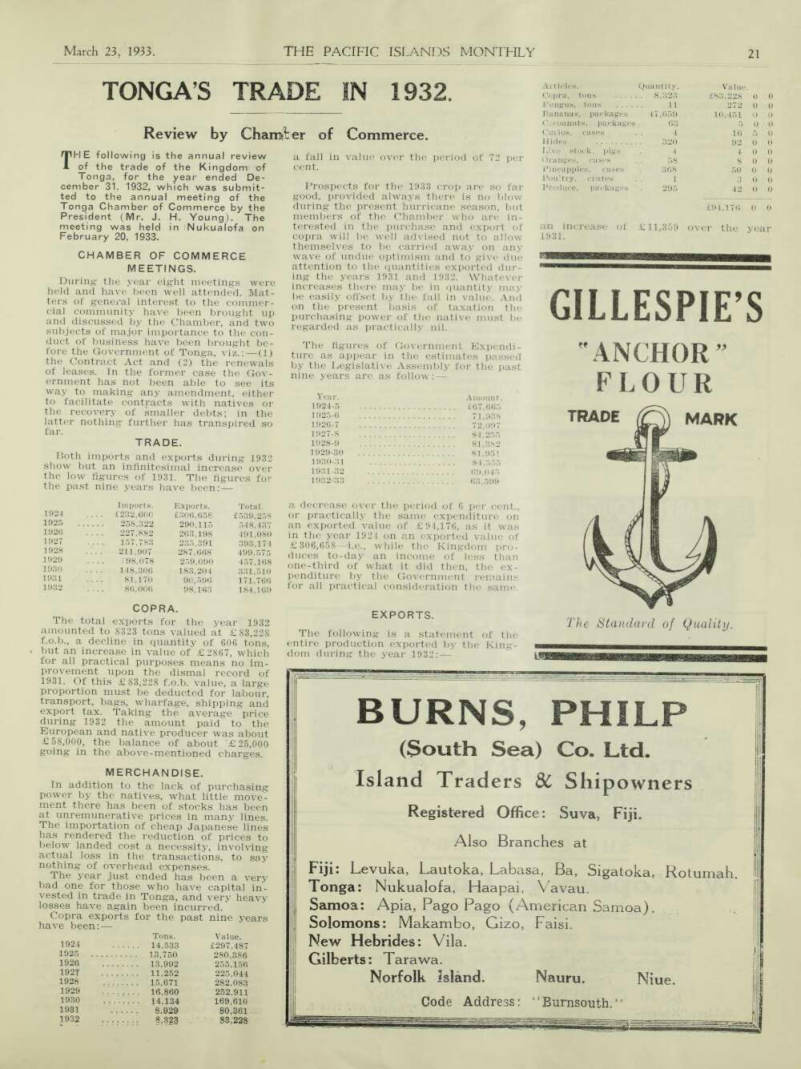
Review by Chamber of Commerce.
THE following is the annual review of the trade of the Kingdom of Tonga, for the year ended De cember 31. 1932, which was submit ted to the annual meeting of the Tonga Chamber of Commerce by the President (Mr. J. H. Young). The meeting was held in Nukualofa on February 20, 1933.
Chamber Of Commerce
Meetings.
During the year eight meetings were held and have been well attended. Mat ters of general interest to the commer cial community have been brought up and discussed by the Chamber, and two subjects of major importance to the con duct of business have been brought be fore the Government of Tonga, viz.: (1) the Contract Act and (2) the renewals of leases. In the former case the Gov ernment has not been able to see its way to making any amendment, either to facilitate contracts with natives or the recovery of smaller debts; in the latter nothing further has transpired so far.
Trade.
Both imports and exports during 1932 show but an infinitesimal increase over the low figures of 1931. The figures for the past nine years have been;
Copra.
The total exports for the year 1932 amounted to 8323 tons valued at £83,228 f.o.b., a decline in quantity of 606 tons, but an increase in value of £ 2867, which for all practical purposes means no im provement upon the dismal record of 1931. Of this £83,228 f.o.b. value, a large proportion must be deducted for labour, transport, bags, wharfage, shipping and export tax. Taking the average price during 1932 the amount paid to the European and native producer was about £58,000, the balance of about £25,000 going in the above-mentioned charges.
Merchandise.
In addition to the lack of purchasing power by the natives, what little move ment there has been of stocks has been at unremunerative prices in many lines.
The importation of cheap Japanese lines has rendered the reduction of prices to below landed cost a necessity, involving actual loss in the transactions, to say nothing of overhead expenses.
The year just ended has been a very bad one for those who have capital in vested in trade in Tonga, and very heavy losses have again been incurred.
Copra exports for the past nine years have been:—
a fall in value over the period of 72 per cent.
Prospects for the 1933 crop are so far good, provided always there is no blow during the present hurricane season, but members of the Chamber who are in terested in the purchase and export of copra will be well advised not to allow themselves to be carried away on any wave of undue optimism and to give due attention to the quantities exported dur ing the years 1931 and 1932. Whatever increases there may be in quantity may be easily offset by the fall in value. And on the present basis of taxation the purchasing power of the native must be regarded as practically nil.
The figures of Government Expendi ture as appear in the estimates passed by the Legislative Assembly for the past nine years are as follow:
a decrease over the period of 6 per cent., or practically the same expenditure on an exported value of £94,176, as it was in the year 1924 on an exported value of £306,658 —i.e., while the Kingdom pro duces to-day an income of less than one-third of what it did then, the ex penditure by the Government remains for all practical consideration the same.
Exports.
The following is a statement of the entire production exported by the King dom during the year 1932:
Imports.
Exports.
Total. 1924 £232,600 £306,658 £539.258 1925 258,322 290,115 548,437 1926 227,882 263,198 491,080 1927 235,391 393,174 1928 211,907 287.668 499,575 1929 198,078 259,090 457,168 1930 148,306 183,204 331,510 1931 81,170 90,596 171,766 1932 86,006 98,163 184,169
Year. 1924-5 Amount. 1925-6 71,938 1926-7 1927-8 84,255 1928-9 81,382 1929-30 1930-31 84,555 1931-32 ... 69,045 1932-33 63,599
Articles.
Quantity.
Value.
Copra, tons 8,323 £83,228 0 0 Fungus, tons 272 0 0 Bananas, packages 47,659 10,451 0 0 Cocoanuts, packages 63 5 0 0 Curios, cases 4 16 5 0 Hides 320 92 0 0 Live stock, pigs 4 4 0 0 Oranges, cases 58 8 0 0 Pineapples, cases 368 50 0 0 Poultry, crates 1 3 0 0 Produce, packages 295 42 £94,176 0 0 0 0 an increase of £11,359 over the year 1931.
Tons. Value. 1924 14,533 £297,487 1925 13,750 280,386 1926 13,992 255,156 1927 11,252 225,044 1928 15,671 282,083 1929 16,860 252,911 1930 14,134 169,610 1931 8,929 80,361 1932 8,323 83,228
It should be noted that this total is the f.o.b. value of the produce exported, and, consequently, does not represent the amount paid to the producer, but for purposes of comparison the gross totals of produce exported and Govern ment expenditure are taken, to the ma terial advantage of the latter. It must be borne in mind that the taxable in come of a country is very different from the f.o.b. value of its exports. The amount received by the producer out of this £94,176 would be, at a generous esti mate, not more than £63,000, and this figure must be regarded to-day as the taxable income of the Kingdom. Is it any wonder that for the last financial year ended June 30, 1932, the Govern ment revenue is £14,090/13/4 less than their estimate, and £3523 down for the
first quarter of the current financial year?
The Government of Tonga budgeted for £65,995 for the current financial year, about £10,000 of which is obtained from rents and interest, and remainder by taxation. If this amount be realised there would be left a margin between it and the f.o.b. value of the exports of £28,181. That is to say, even on that basis, £65,995 for the Government, and £28,181 for the native population, the commercial community and the rest.
Such a condition is manifestly absurd, and calls for the situation to be faced by drastic economies, both in Govern ment undertakings and personnel, rather than a reliance year after year upon a wave of artificial optimism.
Bananas.
The shipment of bananas to New Zea land has continued regularly during the year under review. The packing of the fruit is not yet satisfactory, but that can be remedied if attention is given to what the New Zealand market requires, and the packers instructed accordingly. Some of the bananas are also cut rather too full during the summer months, thereby ripening too soon, but this also can be remedied by a little more experience in gauging the condition of the fruit while still upon the plant and the number of days between cutting and retailing in New Zealand.
The financial aspect of the business, however, is not at all what we were led to expect. While the value of the 47,659 packages exported during 1932 is given at £10,451/16/4 f.o.b., the pro portion of this going to the European and native producers was £4796/8/-.
Shipping.
The following are the figures for the past nine years;
The Chamber of Commerce expresses its thanks to Messrs. Burns, Philp (South Sea) Co., Ltd. for the use of their offices for the meetings of the Chamber.
Conclusion.
From the foregoing report it will be seen that a new economic basis has been brought about in this Kingdom by the heavy fall in the value of all commodi ties dealt in. The value produced by the Kingdom, as the figures quoted above demonstrate, has markedly fallen, thus reducing importation as a natural corol lary, both factors causing a restriction of trade, and materially reducing the Government’s revenue as a consequence.
There is at present not the slightest sign of any improvement, and it would appear that the commercial community must be prepared to face further losses, and the Government of Tonga, unless its expenditure be reduced by several thou sands per annum, to continue its drift, slow but sure, towards financial con fusion.
Inward.
No. of Vessels.
Tonnage. 1924 32 87,250 1925 41 77,704 1926 34 81,424 1927 29 62,605 1928 79,158 1929 37 83,039 1930 32 83,245 1931 27 64,621 1932 34 62,454 Outward. 1924 31 83,762 1925 37 74,067 1926 32 81,271 1927 25 58,252 1928 32 79,092 1929 34 81.243 1930 29 79 778 1931 28 68,246 1932 34 62,454
Advertisements & other items, pp. 23-24 (1 item)
Gillespie’S
"ANCHOR”
FLOUR
TRADE MARK
The Standard of Quality.
BURNS, PHILP
(South Sea) Co. Ltd.
Island Traders 8C Shipowners Registered Office: Suva, Fiji.
Also Branches at Fiji: Levuka, Lautoka, Labasa, Ba, Sigatoka, Rotumah.
Tonga: Nukualofa, Haapai, Vavau.
Samoa: Apia, Pago Pago (American Samoa).
Solomons: Makambo, Gizo, Faisi.
New Hebrides: Vila.
Gilberts: Tarawa.
Norfolk Island. Nauru. Niue.
Code Address: "Burnsouth."
ECONOMY!
Depleted pockets need not mean neglected eyesight. While in Sydney you should avail yourself of our Optical Service. A scien tific service, finest workmanship and style, at fees well within the means of all.
H.A.BARRACLOUGH Ltd
OPTOMETRISTS AND OPTIGIANS
Optometrist
J.A.BARRACLOUGH D.B.O.A. F.I.O.
385 GEORGE STREET
Opp the Strand SYDNEY
BIG CROPS
can be depended upon from land that has fertilised with been liberally
P. B. MANURES,
The best for all purposes. Send for our Free Booklet, “RATIONAL MANURING,” it contains interesting information.
PATON, BURNS & CO..
52 KING STREET SYDNEY.
SHIPCHANDLERY.
W. Kopsen & Co. Limited
Manufacturers of PIONEER BRAND ASH OARS AND IMPLEMENT HANDLES.
Bole Agents for : KOPSEN’S SPECIAL YELLOW METAL SHEATHING AND NAILS.
Large Stocks of Chains, Anchors, Manilla and Wire Ropes, Wood and Iron Blocks. Oakum, Tar, Pitch, Oils, Paints, Leads, Zincs, Varnishes, Shackles, Rigging, Screws, Sheathing, Felt, Lampware, etc.
Prices and Particulars on Application.
68-70 CLARENCE STREET, SYDNEY.
Cables: "Kopsen.”
Phone: BW 1114-5.
Pitched Battles.
Tribesmen Fight at Port Moresby.
A FEUD between labourers from the Motu-Motu and Goaribari tribes who are employed in Port Moresby broke out into pitched battles in February.
A waterfront brawl between members of each tribe started the trouble. When the Motu-Motus got back to their village that night, the Goaribaris attacked them but the police arrived and restored order.
The following morning the Motu- Motus retaliated and launched a sur prise attack on their enemies in the early hours. A lively affray was the re sult and the attackers were driven off and took to the hills, leaving a number of casualties behind.
Spears, knives, iron bars, stones and pieces of timber were used as weapons, but the injuries were mostly slight, ex cept for one boy, who had a leg broken.
The police were not on the scene of battle as soon as at the fight of the night before and the Goaribaris had gained a decided victory before they in tervened.
Sixty-five natives were charged at the Court of Petty Sessions with having be haved in a manner causing a breach of the peace and with assault, and fines imposed ranged from 10/- to £3, the al ternative being from a month to three
months’ gaol,
“Stagnation In The Solomons.”
Problem of Population and Labour.
We have received the following interesting letter from Mr. J. M. Clift, of Aruligo Plantation, British Solomon Islands. Mr. Clift might have emphasised the point that the apparent decrease in native population, on which he based his argument in 1927, was officially confirmed by the census of 1931, which showed 90,000 instead of the estimated 150,000 natives.
THE attached article entitled, “Stagna tion in the Solomons,” was written in 1927, for The Sydney Morning Herald, about the time when a commission was enquiring into labour conditions in the New Hebrides.
The article is even more applicable to present-day conditions. The population of the Solomons has declined heavily since 1927.
I am just home from a sixty miles’ trip along the north-west coast of Gau dalcanal, and the difference in the num bers and general bearing of the people is pathetic. I had not been in Wanderer Bay (called after Benjamin Boyd’s schooner yacht “Wanderer” and the scene of Boyd’s murder many years ago) for some 13 years. In those days, lots of canoes would come out to a visiting ves sel, and large villages lined the fore shores. Yesterday, no canoes came out, and two old men visited the craft in our dinghy. The houses had a dilapidated appearance, and the whole place a de jected and hopeless air.
The recent discovery of gold in the Solomons will accentuate the planters’ difficulties and, unless some form of im ported labour under contract is allowed, plantations in the British Solomons are as truly doomed as those belonging to Britishers in the New Hebrides.
If the British settlers in the New Hebrides can make out a good claim to the right to bring in indentured labour and live, the residents of the Solomons can state a case hardly less strong.
The area of the group is 14,000 square miles. It is one-fourth the size of Java, and Java supports more than 30,000,000 people. At present, and for some years past, the revenue and prosperity of this group have depended on the product of under 4,000 native labourers. Over a period of 15 years, from 1911 to 1926, the average number at work on planta tions and vessels has been not more than 3780. This force, small as it is, tends to diminish. Every device has been tried to augment the supply and, although the wages were doubled in 1926, there were 300 less labourers than in the previous year.
Due to a decrease in the population, and, in a lesser degree, to the influence of the missions, the small supply of Solomon Island labour is diminishing.
This scarcity of labour has, in the Solo mons, had the same effect as in the Hebrides. In 15 years, recruiting costs have trebled and wages have doubled.
Hardly any planting companies are pay ing dividends, and the day is not far distant when plantations will begin to revert to the jungle. Development has been stagnant in the Group for years, and without development a country is already half dead. Surely a strange thing to say of a country but 30 years or so under the British flag!
Startling figures in regard to the dwindling of the population are supplied by the French Marist Mission. A ledger is kept in which the names of all con verts are entered. If one turns but a few years back in this ominous book, this
cure of souls, whole pages are dotted thick with little crosses, and each cross repre sents a mound by the forest’s edge. In twenty years, the good Fathers say, few people will be left in the Solomons. This then is the prospect open to those who have given the best years of their lives to the development of the Protectorate.
It may be said that the natives are reluctant to work on account of bad conditions on the plantations; but Messrs. Lever Bros, figures go to show that quite 20 per cent, of their native employees, after fulfilling their two years’ term of indenture, “signed on” again to work for a further period. This, in itself, is an effective answer to such a
statement. It must be remembered that all native labour is signed on before a Government official and paid off before him; and, about every three months or so, the labour on the plantations is in spected, and rigid conditions have to be fulfilled in regard to rations, hours of work, housing, etc.
No, the main reason for the dolce fa niente attitude of the native to any long continued endeavour is to be found in the old saying—“The banana is the curse of the tropics.” Where a living can be won so easily there is no compulsion to work, and where wants are so few, they can be satisfied with a minimum of effort.
There is a feeling prevalent through out the Solomon Group that Australia sets her face against Asiatics in num bers coming into the Islands bordering her shores. In view of a White Aus tralia policy, this is natural. Yet there are Asiatics in the New Guinea Man dated Territory; and in the French Is lands of the Pacific—in the French Is lands especially—New Hebrides, Loyal ties, and New Caledonia—the Asiatics are steadily increasing. The Australian Government employs Asiatic labour to
mine the phosphate rock in Nauru, and the New Zealand Government works the State plantations in Samoa with them.
Why, then, deny them to people ready and anxious to develop the Solomons?
At a public meeting held in 1925 in the Solomons, the view was expressed that safeguards quite adequate could be taken to repatriate Chinese labour as soon as their term of contract expired. This would prevent the trouble caused in Fiji by Asiatic indentured labour, which was allowed to settle on the land. The dif ficulty of preserving the morals of the native race, when brought into contact with Chinese, might be put forward as an objection to their employment, but the British Government has already al lowed over 100 Chinese traders to come into this Group, and, since their activi ties are spread throughout its extent, such prudence now is rather like shut ting the stable door after the horse is out, and, in any case, the opinion is ex pressed, by many in a position to know, that the Melanesian native has little to learn from any Chinaman, and that the Chino-Melanesian hybrid is generally a useful citizen.
With proper safeguards taken as to repatriation of Asiatic labour, the bene fit to be derived from it in this poten tially rich Group would be enormous to the Solomons and to Australia. Prac tically all the imports into the Solomons come through Sydney, and would con tinue so to come on a vastly augmented scale as the effect of a settled labour question made itself felt. About 60 per cent, of the exports of the Group go to
Sydney and most of this is converted into secondary products in that city.
Figures may be quoted to show an in crease in the exports of the Group, and people may say, “How can you say you are short of labour when your exports are increasing?” But this increase is the fruit of labour expended years ago in felling the jungle and planting coconut plantations.
The contention is that development is stationary, costs are prohibitive, and that a force of 4000 native labourers is quite inadequate, even if there was an assurance of the numbers remaining constant. As the Commissioner in the New Hebrides pointed out in regard to that Group, there is a strong feeling in the Solomons'also that it is Australia’s attitude which most counts, and that it is up to Australia to give Australians in the Solomons some relief from an intol erable situation. The Australian in the Hebrides can “go French.” In the Solo mons he can only “carry on,” and trust to a fair deal from his people, some day.
And, if some day, why not now, when he has still some fight left in him?
Advertisements & other items, pp. 25-26 (1 item)
Always Crisp, Rich and Delicious.
Serve them with Butter and Cheese,
Ham or Paste, Fruit or Savouries.
Manufactured by William Arnott Ltd., The Biscuit Specialists of 64 years’ experience.
Made in Australia, Financed by Australians, and produced by highly trained Australian workers
ALL STOREKEEPERS SUPPLY THEM
C. SULLIVAN LIMITED,
379 Kent Street, Sydney.
ISLAND MERCHANTS.
18 Years’ Islands Experience.
We handle all kinds of Island Products on commission.
Liberal Advances against Consignments.
All classes of Merchandise Purchased.
Original Invoices supplied.
BANKERS:
Bank of New South Wales, Sydney.
Telegraphic Address: “VICHY,” Sydney. All Codes used,
DICKERS Sun Brant PAINT
Made expressly to keep a lustrous, full gloss finish
against the varying con
ditions of moist weather exposure, and prevent the decaying ravages of rain and extreme heat by
giving a long lasting pro-
tection to all surfaces.
SUN PROOF
RAIN PROOF
"Stronger than the Weather”
W. R. CARPENTER
& CO. LTD.
New Guinea, Solomon Islands, and all other South Sea Islands.
Apia’S Popularity.
Samoan Hospitality Pleases “Carinthia’s” Tourists.
From Our Own Correspondent.
Apia, Feb. 19.
THE Cunard liner “Carinthia,” with nearly 300 tourists on board, called at Apia on February 10, and the “Stella Polaris” on February 17 with another 50 passengers.
The “Carinthia’s” call, for which ex tensive preparations had been made, caused a lot of attention and excitement on the beach. A fleet of motor cars stood ready to take visitors to points of interest on the island. Yailima, the old Stevenson home, now occupied by the Administrator, Stevenson’s grave close by, the native school of Avele and cocoa plantations were visited by many.
The Samoan village of Batogo pro vided an exhibition of native craft and ancient fashions of preparing foodstuffs and materials. The native dames and sivas with songs in the old native dresses and decorations, especially at tracted and pleased the visitors, who remarked that arrangements and enter tainments in Samoa were much superior to those in Rarotonga and Tahiti, and regretted the shortness of their stay here, which did not allow them to see more of the beauties of Samoa.
An interchange of telegrams took place after the departure of the “Carin thia ” between the Administrator and the captain of the boat, the latter ex pressing the appreciation of tourists for the entertainments offered them.
Quite a bit of money was spent by the visitors, car owners and native en tertainers especially benefiting-. It is hoped that regular calls at Apia will in future be included in the world cruise schedules of the Cunard line and Cook s Tourist Agency.
The call of the Norwegian tourist vacht “Stella Polaris” with only a small number of tourists passed off much more quietly. This party also expressed ap preciation of Samoan attractions, though no large preparations and arrangements had been made for their entertainment.
The only people dissatisfied with the visits were native sellers of curios, who did very little business with the visitors —probably due to the latter’s fear of
overcharging,
Of Pacific Islands Colonies
Germany’S Claim For Return
“Shall the German Eagle Return to the South Seas?” was the title of an article in the September, 1932, issue of this journal.
We said then that we believed the collapse of the League of Nations was in sight; that Germany was awakening to a new spirit of aggressiveness and militarism; and a new era of monarchism; and that, with the end of the League and the Mandates system, the final disposal of Germany’s former colonies would become a burning question. Everything that we then forecast has come about.
The world is faced with a new Germany, and the League of Nations is very near to its end.
In view of this, it is very interesting to read an article of moderate tone in a leading German newspaper, “Hamburger Nachrichten,” in December last, wherein comment is made on our September article. The following is a translation.
We have referred to these important questions elsewhere in this issue.
IN the last number of the “Pacific Islands Monthly” the editor and publisher, Mr. R. W. Robson, in a leading article, concerns himself with the question of whether the German Eagle may again fly over the Pacific (says the German newspaper).
Like a true descendant of his race, he, of course, comes to the conclusion that there can be no discussion on the question of the return of our colonies, and supports his contention with the most varied arguments.
In the first place, it must come as a shock to the German reader that even to-day—that is, fourteen years after the end of the war—the old lie of Germany’s guilt in the world-war should be cited as a cloak for the de sired theft. Mr. Robson writes, word for word, —“To hand her colonies back to Germany would be farcical.” There lies revealed that conservative spirit of England which, ever since the days of good Queen Elizabeth, has, in truth, forgotten nothing, but then has ceased learning. For centuries past, the foes of England have always been those peoples or States who possessed some thing that the envy or greed of Eng land demanded. So it was, to give only one example, that for the period of 350 years English sea-robbers were given charters by their Protestant queen, under the pretext of breaking the might of Catholicism—but really to seize Spanish galleons trading to Europe, laden with gold and silver.
And so, to-day, the alleged sole-guilt of Germany in the world-war has to serve as a pretext for robbing us of our colonial possessions. It remains worthy of note, however, that the English haven’t gone to the trouble perhaps haven’t thought it worth it—to offer sound reasons for this theft of theirs.
When reference is made to the peculiar situation of our Pacific pos sessions, the covetousness of the Aus tralian appears as inconceivable as it is remarkable. Their own continent of above seven million square kilometres, and a population of only just six million inhabitants—of which, more over, more than a third is settled in the two towns, Sydney and Melbourne is not sufficient for the full freedom of development of the people. They seem to be still absolutely in need of the 200,000 sq. km. (about) of Kaiser Wilhelm’s Land and the Bismarck Archipelago. We need not once grudge the small groups of islands known as the Carolines, and so on, although no one will dispute that neither of New Guinea nor of all the other little
islands will the question of colonisation, in its broadest sense, arise. Their economic importance for Germany, as well as for the rest of the world, is of much greater consequence than it is ever likely to be for the continent of Australia.
Just as amazing as this inexplicable land-hunger is to us, is the political stupidity of it all, when one considers the distant future. Australia has never
been in a position to protect herself, unaided, against the “Yellow Peril” (whether it be Japan, or possibly China, later on) and can only enjoy her political independence so long as the United States and England are able to guarantee it. For this reason, it must be to the self-interest of every part of the world —at least, so far as the command of the Pacific is con cerned —to bring about a partnership of the white races which would ensure them, not merely economic advantage, but a broader basis of security which each continent of the white races could uphold.
But, no! A hatred of Germany and. all things German has been artificially engendered through a ten-years-old campaign of falsehood which, together with the before-mentioned lie, seems to make the Australian blind to wise solution of the problem, from the point of view of real politics.
Still more unintelligible, from the German point of view, is England’s precedence in East Africa, which, ac cording to uncontradicted rumour, founded on fact, has come to be re garded as the future dumping-ground for over-populated India. Supposing that England realises this plan, it would mean that, by the end of this century, the whole of East Africa would be populated by 50 or more mil lion Indians, with a corresponding ad mixture of native blood. In this way, England is supporting the diffusion of
a coloured race and is working method ically to restrict still further the living room of what is admittedly the most efficient and industrious nation of the white race in order, ultimately, to cause its downfall.
Can it be that England’s political instinct, which time and again in ear lier centuries- has been tried and tested, was really lost through the war; or does the Island Kingdom imagine that Europe, at latest, within the next hundred years, will be able to resist successfully the expected onrush of the yellow, brown, and black races without a strong and healthy Germany’s as sistance?
The frontiers of the real Europe ex tend, since Versailles, from the Vistula to, practically, the Oder, to where an alarming mass menaces the West.
The least step further on that road would be synonymous with a complete abandonment of all our European cul ture. The rest of our Continent would be overrun by Slavs, Asiatics and Africans, and all that would be left of the British world-Empire would be a little island kingdom, without political or economic significance.
Advertisements & other items, pp. 27-28 (1 item)
Ashes Of Roses
YOUR
EYES
CONSULT ALEX HALE
ABOUT YOUR EYES.
Accurate Optical Service Glasses, which give your eyes comfort for Reading, Sewing. Eye-strain, Headaches and Glare.
Our Prices are most reasoiab’e and our expert Optical work is of the best.
Optometrist Optician,
113 PITT STREET, SYDNEY.
Five other City Addresses. Est. over 30 years.
ALEX HALE
BOURJOIS
PARIS
ASHES of ROSES
THE WORLD’S WONDER
TOILET PREPARATIONS
The fragrance of millions of roses exquisitely blended by a master hand for the world’s beautiful women.
FACE POWDER
All tints.
FACE POWDER
ROUGE
Brun., Blond, Mand.
VANISHING CREAM
TALC POWDER
Also in Violets and Car nation A. of R. PERFUME A. of R. PERFUME A. of R. PERFUME To walk through a garden when the roses arc in full bloom, with the morning dew sparkling upon them, is to underhand the charm of Ashes of Roses.
FLAKY AND WHEATEN
Baked-to-a-turn . . plump, crisp and mellow-flavoured . . .
Sajoyce Crackers are the ideal digestible biscuits for between meal snacks. Made from richest Australian wheat, they’re delicious, served either plain or with savouries.
SAJOYCE CRACKERS
Joyce Biscuits, Ltd., Camperdown, fpl-8 N.S.W.
PRESCOTT Ltd Sussex St Sydney are sole wholesale agents for
PINEAPPLE BACON & HANS
DAISY BRAND BUTTER
TIGER CRUYBRE
LEA & PERRINS' SAUCE
& Most other Super-Quality lines of the Trade.
extra
“SAY GOOD-BYE !
to long faces and short tempers.”
Convenient
Economical
Qjmfort
each 37/6
COMFORT
Postag
BENZINE IRONS
BRANDTS LTD., 371 Pitt Street, Sydney
Filose Fined.
B.S.I. Officialdom Frowns on Efficient D.O.’s Methods.
From a Special Correspondent.
TULAGI, January 31.
THE prosecution of District Officer Filose, of Ysabel, on 19 charges of “procuring his police boys to assault natives," or something to that effect, has created a great amount of indigna tion in the Group.
D.O. Filose apparently was techni cally guilty and apparently the only thing for him to do was to plead guilty, He was fined £5 on one charge and 10/each on the others; and, presumably, the Administration was satisfied. But the majority of European residents are far from satisfied. If an unbiassed vote were taken outside the service to de cide who is our most competent District Officer it is probable that Mr. Filose would score 100 per cent.
It is notorious that Cape Marsh, where the alleged assaults took place, is a hotbed of trouble among natives, and everyone who knows anything of conditions there was completely sym pathetic with Filose’s policy and the methods he adopted of enforcing law and order and respect for the white man. But, even apart from the pecu liarities of Cape Marsh, it is a fact that there is noted nowadays far too great a tendency to use the velvet glove with classes of natives who understand only the use of the cane, coupled with firmness, fairness and justice.
In this respect, D.O. Filose is a respected and successful district ad ministrator; and it is significant that even the natives of his district, with the exception of a few renowned rogues, are petitioning in his favour.
It may be said that all the non official residents and the missionaries, and probably the majority of officials, have given their sympathy and good will entirely to Mr. Filose, and wish him the best pf luck.
Dairying Industry In Fiji.
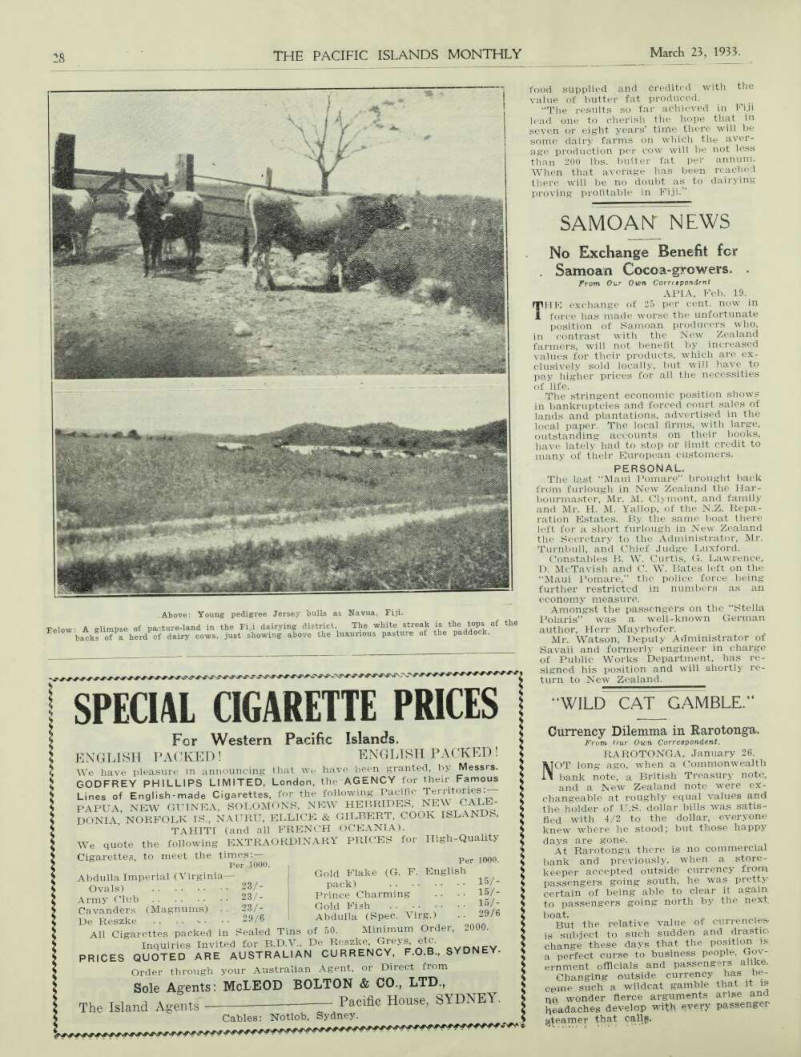
Interesting Development In Tropical Country.
THAT dairying in Fiji will become a solidly profitable industry is the belief of many residents, among whom is Sir Maynard Hedstrom. He read a paper on “The Prospects of the Industry,” at a recent Agricultural Conference at Suva.
Assisted by an import tax of 4d. per lb. on butter, three dairy factories have been producing butter from cows pas tured on 8,000 acres of excellent dairy country. At present the industry gives employment to 52 families. The Agri cultural Department estimated the amount of butter produced and con sumed locally during 1933 at 300,000 lbs., and the capital invested in live stock, factories, machinery, farm buildings and equipment is £58,000, without the capital value of farm land.
The progress of the industry has been satisfactory, even when floods in the Rewa and Navua districts are taken into consideration. In 1921, 137,688 lbs. of butter valued at £13,887 were imported; and in 1932 the three factories supplied all local demands and have an exportable surplus of 250,000 lbs., valued at £11,000. The total out put in 1932 was estimated at 550,000 lbs.
Sir Maynard explained that the im port duty is still necessary, as over head and manufacturing charges are high, due to three small and widely scattered factories handling the output.
He is of opinion that the factories will be on a good payable basis when an output of 200 tons per annum is reached, but this, of course, depends on the price of butter in the London market.
An increase in production is almost assured, as a 25 per cent, increase In the number of milking cows is reckoned on during the next two years.
This estimate is not hastily arrived at but is borne out by the accurate re turns kept by the Fiji Pastoral Co. Ltd.
An increase in average production is also looked for, as herds are steadily being improved. Herd testing is more general throughout the Colony. The Fiji Pastoral Co. about two years ago engaged a qualified tester and is now reaping the benefit of his services. An extension and improvement of pastures —another factor in increased produc tion—is being made.
Sir Maynard Hedstrom, speaking of the influence of the tropics on butter fat production said: “It is sometimes suggested that in a tropical country cows will not give a reasonable yield of butter-fat, but this theory is not substantiated by experi ence in Fiji. Records of individual cows give some curious results: “The largest producer for a single lactation period was 56-F. (Jersey), which produced 485 lbs., but the lac tation period extended for 540 days.
The cow appears to be quite normal and is in calf again.
“Five Jerseys produced over 1 lb. of butter-fat per day, extended over what might be termed a normal lactation period, and probably the best of these
was Jersey 83-F. with 372 lbs. in 300 days—very nearly 1¼ lbs. per day.
“Only one Friesian is recorded as having produced over 1 lb. butter-fat per day and that is D.T.F. with 314 lbs. in 307 days.
“Curiously enough, this result is beaten by one of the ‘local cows’—B-92- F.—with 358 lbs. in 334 days.
“Out of the Fiji Pastoral Co.’s 700 or 800 cows there are about 100 which
produce over 300 lbs. butter-fat within the normal lactation period. Accord ing to our experience the locally bred heifers (grade Jersey and grade Fries ian) are at least equal to their im ported grade Jersey or Friesian dams.
A cow producing over 300 lbs. butter fat on plain pasture with no artificial feeding would be considered a good cow anywhere.
“In 1924 I visited one of the show dairy farms of Denmark, where the poorest producing cow on the farm re turned 400 lbs. butter fat per annum, but that result was achieved by lavish and scientific feeding—each cow re ceived a balanced ration suited to her requirements and a separate ledger ac count was kept for each cow in which she-was charged with the value of the
food supplied and credited with the value of butter fat produced.
“The results so far achieved in Fiji lead one to cherish the hope that in seven or eight years’ time there will be some dairy farms on which the aver age production per cow will be not less than 200 lbs. butter fat per annum.
When that average has been reached there will be no doubt as to dairying proving profitable in Fiji.”
Above: Young pedigree Jersey bulls at Navua, Fiji.
Below: A glimpse of pasture-land in the Fiji dairying district. The white streak is the tops of the backs of a herd of dairy cows, just showing above the luxurious pasture of the paddock.
Advertisements & other items, pp. 29-30 (1 item)
C. G. Piggott
Repairs,
‘OUR HANDS MAKE GOOD ARMS’
DON’T TRIFLE WITH DOUBTFUL FIREARMS
Sil Rohu’s Expert Attention is at your Service—without obligation.
Send for my Wonderful Firearm Catalogue. 500 Illustrations and Details of the World’s Best and Reliable Makers.
“FISHING TACKLE TO TACKLE FISHING.”
The same High Standard of Quality is a feature in my new Fishing Catalogue. Specialities: Trout, Big Game, and Deep Sea Fishing.
SIL ROHU (late A.I.F.), GUNSMITH
IMPOSTER OF HIGH-GRADE FIREARMS AND FISHING TACKLE SPECIALIST, 143 ELIZABETH STREET. SYDNEY (Near Market Street).
Vitality and Health are the
Main Factors in Every-day Life.
Put yourself in the hands of Specialists who have made an intelligent study of your requirements; it is vital to your health. We are known everywhere as the Suppliers of the Right Goods and which put the VITAL into VITALITY. Thirty-five years is our record of supplying Fresh Fruit, Vegetables and Produce to the leading Houses throughout the world.
GET FULLY ACQUAINTED WITH US.
Tel.: MA 4799; FX 4350 Private.. Cable Address; Pigs, Sydney. Code: Bentley’s.
C. G. PIGGOTT
WHOLESALE FRUIT AND PRODUCE MERCHANTS
DIRECT IMPORTERS AND EXPORTERS SYDNEY.
Office: Bulk Stores and Packing House: Fruit Exchange, Sydney.
Sales Dept.: Fruit Exchange and City Markets, Sydney. Bank of N.S.W. Bankers.
The Beaumont operates without atten tion for 24 hours, costs a few pence weekly to run, and relies on a kerosene lamp to create intense cold!
Quality built of porcelain enamelled steel; 4in. thickness of insulation, white duco exterior, stainless metal fittings.
Write for Catalogue and Particulars of Terms Proposition.
W/ESTCOTT, HAZELL
& CO. LTD.
225 Castlereagh St., SYDNEY.
Cables: “Westhazell.”
SPECIAL CIGARETTE PRICES
For Western Pacific Islands.
ENGLISH PACKED! ENGLISH PACKED!
We have pleasure in announcing that we have been granted, by Messrs.
GODFREY PHILLIPS LIMITED, London, the AGENCY for their Famous Lines of English-made Cigarettes, for the following Pacific Territories; PAPUA, NEW GUINEA, SOLOMONS, NEW HEBRIDES, CALE DONIA NORFOLK IS., NAURU, ELLICE & GILBERT, COOK ISLANDS,
TAHITI (and all FRENCH OCEANIA).
We quote the following EXTRAORDINARY PRICES for High-Quality Cigarettes, to meet the times:- per 1000 Gold Flake (G. F. English pack) 15/- Prince Charming .. . 15/- Gold Fish . 15/- Abdulla (Spec. Virg.) . 29/6 Minimum Order, 2000.
Abdulla Imperial (Virginia— Ovals) 23 /- Army Club 23 /- Cavanders (Magnums) . . 23/- De Reszke .. . . 29 / 6 All Cigarettes packed in Sealed Tins of 50.
Inquiries Invited for B.D.V., De Reszke, Greys, etc.
PRICES QUOTED ARE AUSTRALIAN CURRENCY, F.O.B., SYDNEY Order through your Australian Agent, or Direct from Sole Agents: McLEOD BOLTON & Co., LTD.,
The Island Agents. Pacific House, SYDNEY
Cables: Notlob, Sydney.
Samoan News
No Exchange Benefit for Samoan Cocoa-growers.
From Our Own Correspondent
Apia, Feb. 19.
THE exchange of 25 per cent, now in force has made worse the unfortunate position of Samoan producers who, in contrast with the New Zealand farmers, will not benefit by increased values for their products, which are ex clusively sold locally, but will have to pay higher prices for all the necessities of life.
The stringent economic position shows in bankruptcies and forced court sales of lands and plantations, advertised in the local paper. The local firms, with large, outstanding accounts on their books, have lately had to stop or limit credit to many of their European customers.
Personal,
The last “Maui Pomare” brought back from furlough in New Zealand the Har bourmaster, Mr. M. Clymont, and family and Mr. H. M. Yallop, of the N.Z. Repa ration Estates. By the same boat there left for a short furlough in New Zealand the Secretary to the Administrator, Mr.
Turnbull, and Chief Judge Luxford.
Constables B. W. Curtis, G. Lawrence, D. McTavish and C. W. Bates left on the “Maui Pomare,” the police force being further restricted in numbers as an economy measure.
Amongst the passengers on the “Stella Polaris” was a well-known German author, Herr Mayrhofer.
Mr. Watson, Deputy Administrator of Savaii and formerly engineer in charge of Public Works Department, has re signed his position and will shortly re turn to New Zealand.
“Wild Cat Gamble."
Currency Dilemma in Rarotonga.
From Our Own Correspondent.
RAROTONGA, January 26.
NOT long ago, when a Commonwealth bank note, a British Treasury note, and a New Zealand note were ex changeable at roughly equal values and the holder of U.S. dollar bills was satis fied with 4/2 to the dollar, everyone knew where he stood; but those happy days are gone.
At Rarotonga there is no commercial bank and previously, when a store keeper accepted outside currency from passengers going south, he was pretty certain of being able to clear it again to passengers going north by the next boat.
But the relative value of currencies' is subject to such sudden and drastic change these days that the position is, a perfect curse to business people, Gov ernment officials and passengers alike.
Changing outside currency has be come such a wildcat gamble that it is no wonder fierce arguments arise and headaches develop with every passenger
steamer that calls.
Norfolk Is. News.
“Morinda’s” Schedule.
From Our Own Correspondent N. I., March 6.
AFTER a year’s trial of an extension to Auckland of her Norfolk Island- New Hebrides service, the Burns, Philp steamer “Morinda” will revert — practically without notice—to the old “Makambo” time-table’ that is, one short and one long trip alternately. To Norfolk, via Lord Howe and back to Sydney on one passage; to Norfolk and on to Vila and other island ports on the next.
The run to the Dominion proved a costly failure, tourists being rare and new set tlers rarer still. When the New Zealand Government recently imposed an em bargo on all agricultural produce from Australian territories, that was the last straw that broke the camel’s back and decided the Company to revise the schedule. Visitors and travellers having any claim to transportation from either end may have passages arranged via Sydney; but the sudden cessation of the service is a severe blow to the two hun dred residents who claim New Zealand as their homeland. Unless the embargo lifts before produce merchants in Auck land are interested in our early potatoes, tomatoes, beans, and so on, there is little likelihood of even an irregular service to and from the island; and in the present state of our finances there are few in deed who can afford to take a trip via Sydney.
There is, of course, something to be said for the point of view of the ship ping company. There must be members of the board of directors and heads of departments who grit their teeth at the mere mention of Norfolk Island. An in conspicuous speck of land upon the vast Pacific, it is still our firm conviction that our shipping interests are paramount and several times a year it seems that someone or other works out a magnifi cent new schedule, designed for our benefit only, and submits it through the Company’s local manager. Certainly it would not appear from results that head office loses any sleep over these various propositions; but occasionally they must long to send a delegate down to us to address a mass meeting in Rawson Hall and point out to us, once and for all, our importance in their own scheme of things.
Musical Recital.
As a community we are extraordinarily musical, with an appreciation of the best that can be given us and on the evening of February 25 the Rawson Hall was packed to hear a recital given jointly by Mr. Frederick Hyde and Madame Edith Allen-Taylor, assisted by Mr. Tom Bailey (violinist) and Miss Daisy Rossitor (accompanist).
Mr. Hyde is an Englishman who left home as a boy and grew up in Timaru, New Zealand, where he received a first rate musical education and ultimately conducted a studio for singing and the piano. He fought through the war with the New Zealanders, and three months spent in Germany as one of the army of occupation only stimulated his interest in music as a career. He is a most ac complished pianist with particular gifts as an accompanist and also sings most agreeably. It was a visit to the island last year that led him to return by last
steamer and to open here a studio for all branches of music. This presents a won derful opportunity for students and should prove an additional inducement for settlers who are keen upon their children’s musical education. Madame Allen-Taylor hails originally from the is land but has spent the last five years in Sydney, where she has studied thoroughly and is well-known as a con cert artist. She is also familiar “on the air” from all the Sydney broadcasting stations.
Dr. Duke’S Return.
The incoming steamer from Sydney brings back to us Dr. Leslie Duke who, for the past two years, has been in Eng land and the Continent, passing every possible examination in surgery and gathering every possible degree. He was half-way through his second term as Medical Officer of Health on the island when he decided to apply for special leave of absence and his place was filled by Dr. Sydney Laurence who, no doubt, will be remembered on Fanning Island, where he spent a year or so before com ing here.
Dr. Duke is so brilliant a young sur geon that it is most improbable that he
will remain with us when his term is up.
It would be a lamentable waste of his outstanding gifts and he will undoubt edly find a practice in some mainland city and build up a big name for him self. But we hope that when the time comes to replace him here, the Powers That Be will remember our isolated posi tion and the urgent necessity that any man they send us shall be completely competent, both as physician and sur geon. The post carries with a very good salary, a free house and right to private practice; in exchange for that we are entitled to the best man available. A poor man costs the Ministry for Health just as much as a good one, and costs us, in health and confidence, a good deal more. It is not fair that our lives and the lives of our families should be placed at the mercy of official incompetence.
The Matson liner “Lurline,” which is making a cruise of the South Pacific is lands on her maiden voyage, arrived in Suva on February 11. An attractive pro gramme had been arranged, including exhibitions of native dancing and a dis play of fire-walking by the natives from Bequa. The liner sailed for Auckland on the same day.
Advertisements & other items, p. 31 (1 item)
4 Symptoms
1. TOE ROT.
Cracks bet ween the toes, rotten skin, ac companied by severe itch and inflammation 2. TINEA of the HAND.
Dry, scaly skin rash and itchy cracked skin. 3. TINEA of the EARS.
Scaly skin and irritation in lobe of the ear.
4. RINGWORM of the NAILS.
Inflammation or septic cuticle, cracked and discoloured nails.
“ANTINEA” LOTION is the
only definite cure for this con
tagious skin disease.
Obtainable in small (½oz. fl.) and large 1½oz. fl.) bottles. From Chemists, Burns, Philp & Carpenter’s Stores.
Fiji: Mitchelmore, Swann & Co., Brown and Joske, Ltd.
If unobtainable write direct Booklet to —
ANTINEA DRUG CO.
WINGELLO HOUSE, Angel Place.
SYDNEY.
4 SYMPTOMS
of TINEA
the scourge of the Pacific
Islands.
Prevent this Ringworm
infection by regularly
using
“ANTINEA”
ANTISEPTIC
SOAP
for all
Toilet
Purposes.
Papuan News.
Tourist Vessels’ Visits.
From Our Own Correspondent.
Pt. Moresby, March 2.
THE Matson liner “Lurline” and the “Stella Polaris,” arrived in Pt. Mores by on February 25 and February 27 respectively. The weather was uninvit ing and heavy clouds and sudden squalls robbed Port Moresby of much of its charm, which relies, to a great extent, upon the lights and shades of the vivid waters of the harbour and the varying landscapes of the hills. Native dances were arranged for their entertainment, and excursions to the neighbouring vil lages.
It is evident that Papua’s attractions are recognised; in addition to the three world-cruise vessels visiting here, this and last month, three British liners will call on tours from Australia. The P. and O. liner “Maloja” will make an 11 days’ cruise to Samarai in June, and two Orient liners, the “Otranto” and the “Or onsay” will call on their special cruises in June and August of this year.
The “Lurline’s” huge dimensions, as she lay in the harbour, dwarfed into in significance the small craft, and trading vessels of the territory, and Port Moresby itself, seemed to shrink in its size when compared to this vast floating palace at its door. The “Stella Polaris,”
with its beautiful lines, though not so big and impressive, was more pleasing to the eye and toned in with the land scape.
Personal.
Mr. Norman Calcutt, until recently manager of the Port Moresby branch of the bank of New South Wales, left by the “Montoro” on February 9 for Aus tralia where, after four months’ leave, he will take up an appointment as a branch manager.
He was entertained by the President of the Golf Club, the Hon. G. W. Gut tridge, and members, and presented with a memento in recognition of his play in the first club championship. While com menting on the good sportsmanship of Mr. Calcutt, the president wished him success in the future and regretted that the links would see him no more. A din ner in his honour was also given in the Papua Hotel by a number of his friends.
Mr. A. L. Grant has taken over the management of the New South Wales Bank in Port Moresby.
His Honor, Mr. Justice Gore, leaves for Australia by the “Macdhui” on March 2. He expects to return to the Terri tory in three months’ time.
Mrs. Giblin, the wife of Dr, Giblin, of the Papuan Government, was a passen ger to the New Guinea Goldfields re cently, by the Guinea Airways’ plane.
She is visiting the goldfields to inspect the mining lease she drew in a New Guinea ballot, and to make arrangements for the management of the mine.
Thursday Is. Notes.
Useful Relief Work.
From Our Own Correspondent.
Thursday Is., Feb. 24.
THE town is now undergoing a thorough clean-up, the Town Council doing all it can to utilise relief money in the best way.
Visitors usually comment upon the length of grass and weeds in the streets and the absence of public playgrounds and resorts for the children, who find the streets and paths the best place for the purpose. With the work of cleaning up in full activity, there will not now be reproach so far as the overgrowth of weeds is concerned; and possibly there may be a scheme evolved by which cer tain parts of the town could have a small area set apart and provided with children’s playground facilities.
“Melbider” Kept Busy.
Since the opening of the Government stores on certain Torres Strait Islands, on which the natives get their supplies and the island boats are provisioned, the Government ketch “Melbider” has been kept so fully occupied in patrolling the islands and carrying goods that an extra boat has had to be put on by the De partment in order that the regular run may be maintained.
Gambling Suppressed.
The police have been vigilant lately in suppressing gambling places, and in curbing the activities of certain gentle men who arrived recently in the expec tation of getting rich through their own smartness and others’ guilelessness.
Some considerable additions to the re venue have resulted, in the way of fines, however.
Personal.
Miss M. Fardon, of Brisbane, arrived recently to take charge of the school at St. Paul’s, Moa, 28 miles from Thurs day Island.
Mr. J. Cheyne, of the Customs Depart ment, has been transferred to Brisbane, after being here for the usual period, and Mr. G. Freeman has taken his place.
Mr. Reddy, assistant at the State school, has also received a transfer, his place being taken by Mr. Goforth.
Rarotonga.
Rainfall At
From Our Own Correspondent.
Rarotonga, Jan. 26.
The marked increase in rainfall at Rarotonga during the hurricane season is well illustrated by the monthly rain fall figures for 1932 which follow:
Inches.
January 10.92 February 8.00 March 16.43 April 9.98 May 1.13 June .. . . 2.66 July 5.23 August 1.39 September 2.60 October 1.37 November 2.89 December 19-73 Total 82.35
Advertisements & other items, p. 32 (1 item)
Far Distant Goldfields
ST BATHANS. NZ. 1864
On
This office of the Bank of New South Wales on the Goldfields of St. Bathans, N.Z. in 1864 is a typical example of how the Bank provides its clients with banking facilities under all conditions.
At St. Bathans, as elsewhere, the Bank undertook the responsibility of protecting the gold won ; maintained the currency necessary to finance trade within the community, and provided at the sea ports the credits that were essential in order that supplies of foodstuffs and other necessities should reach the settlements.
Now, as it has done for the past 116 years, the Bank continues its vital services to the community, safeguarding the people's savings ; facilitating internal commercial transactions; financing the country's exports and providing the overseas credits required to maintain a continuous supply of necessary imports from all over the world.
Bank of New South Wales
(ESTABLISHED 1817)
with which the Western Australian Bank and The Australian Bank of Commerce Ltd. are amalgamated.
Demand For Lugger Crews.
How Labour Conditions are Regulated In Torres Straits.
From Our Own Correspondent.
Thursday Is., Feb. 24.
THE Torres Strait islands supply a considerable portion of the labour required for boats working in the marine industry round these waters.
The island-owned cutters and lug gers, bought by the Islanders out of their own earnings, and held in trust and managed by the Aboriginal De partment of Queensland, absorb about 300 men; and the “masters’ boats,’’ as they are called, belonging to the various companies operating from Thursday Island, take all the island labor they can get, and would take more if it were available.
On the Islanders’ boats, the boys gen erally work on a share system, pay ments varying according to the catch and the price of the particular com modity—M.O.P., trochus, or beche-de mer. For other labor there is a fixed rate, varied annually or otherwise. At the present time, the island boys re ceive £3/5/- per month, plus tucker, when working on the outside boats.
Out of this they contribute a per centage to their own particular Island Fund (which is used for island needs and improvements), and also pay a monthly sum to the Torres Strait Hos pital at Thursday Island, a similar amount being paid on their behalf by their employer.
They are signed on articles at the Shipping Office in the usual way, and are subject to the usual conditions applying to seamen. Only portion of their wages may be drawn each month, the remainder being paid at the time of signing off at the end of the year, when they put a proportion into a savings bank account through the Protector’s Office. Each boy has a Bank card, upon which he or his relatives may operate up to a certain amount if the Protector first sanctions it. Boys of South Sea descent, who may not happen to be under the control of the Aboriginal Department, have their own
bank accounts upon which they operate personally.
For some time, the offices of Ship ping Master and Protector of Aborig inals were combined; but this arrange ment was not satisfactory to the boys or to the various Departments con cerned, and often resulted in the anomaly of a boy who might wish to make a complaint to the Shipping Master finding that the official would be the same person who directed the working of the ship in which he was one of the crew.
It was a difficult position for the official occupying both offices. How ever, this year there is a re arrangement by which the positions are held by separate officials, so that when boys are signed on and off, the Ship ping Master attends for the necessary formalities, with an officer of the Protector’s Department who deals with matters affecting that office.
Another alteration that has come into effect this year is connected with the recruiting of boys for the various boats. The island boats have, accord ing to the ordinary scheme of working, to be first filled up, selection being made by the island councillors; and after that, the surplus labor is available for outside boats. Last year, island boat crews were not selected until late in January, so that other boats were hung up waiting to obtain men, but not able to do so until permission was given for recruiting.
This year, officials of the Depart ment have made arrangements for their boats to be filled early, and get away to work instead of taking the usual Nor’-West spell. Instead of the Thursday Island luggers then going out to the islands to recruit (with the ex ception of one island —Murray, 120 miles out —-and another, which is under mission control, where the employers continue to do their own recruiting),
an arrangement has been made where by the Government ketch brings the boys in to T. I., at a charge of from five to ten shillings a head, after the home recruiting is finished. Arriving at T. I., they can sign up for any em ployer they fancy, and a stipulation is that there must be no coercion as re gards boys working as crews on island boats or for individual employers or companies.
This latter provision is probably a reference to the labor conditions exist ing at a former period under which, according to a regulation then sent out to Island officials, the residents of each island were to “furnish as required such number of able-bodied males over the age of sixteen for employment on pearl ing and fishing boats as the Protector of Aboriginals may order,’ and if the required number did not volunteer for service, the island officials selected them by ballot, the penalty for refus ing duty being £5 or two months.
This produced an unhappy feeling on some of the islands, particularly with regard to the island boats and, though
it is a considerable time since boys were lined up under this regulation which no longer exists, the Department does not countenance what might be regarded as forced labor.
One result of the boys being brought in to T.I. to choose their employers is that there is a keen demand for the available labor as soon as it arrives, so that it becomes a case of the captain who is able to offer the best induce ment getting the best boys. This com petition may tend to give boys a false impression of their own labor value, and it is hoped that some of the un desirable elements which came into re cruiting in the old days, when rum and other things wer e made an enticement may not be re-introduced, both in the interests of the boys themselves and of others. Fortunately, Thursday Island employers will not tolerate their captains obtaining boys by doubtful methods.
There is a percentage of boys who are not suited to swimming or diving, either from physical disability or for other reasons. And there are also those who for domestic reasons do not care to go far away from home to work.
Some of these have their own dinghies, which they work round the home reefs, and of course the old men have their gardens to work.
Taken all round, there are not many unemployed males in the Torres Strait Islands, which, all told, maintain a community of about 3,500 people.
Round Thursday Island itself there are a number who might find employment in the marine industries, but whose up bringing and training in sea life have been somewhat different from that of the Islanders.
At Hammond Island, the Roman Catholic mission is making an effort to equip boys for wage-earning in the marine industries; and in other ways those interested in the welfare of the native and colored community are doing what they can to encourage proficiency so as to make it unneces sary for employers to rely upon in troduced labor. But at present there is not sufficient labor of the requisite standard offering locally.
Advertisements & other items, pp. 33-34 (1 item)
Massey Harris
HOLBROOKS’
TABLE DELICACIES.
WORCESTERSHIRE SAUCE
—enjoys a world-wide repu tation.
VAT 2 SAUCE a delicious, thick, fruity sauce.
VINEGAR strong, well matured, and guaranteed Pure Malt.
ESSENCE OF ANCHOVIES—
A fish sauce made from the finest Gorgona Anchovies.
TOMATO SAUCE— made from fresh, ripe tomatoes.
FRENCH CAPERS - Capu
cines and Capottes.
SPANISH OLIVES—
Varieties: Spanish Queens, Small Queens, Manzanillas, and Stuffed or Sliced ready for Sandwiches.
PURE OLIVE OlL— French or Italian. From the first press ings of selected Olives.
PICKLES—
Varieties: Sweet Gherkins, Tiny White Onions, Walnuts, Piccalilli, Mixed and Green Tomato.
FISH and MEAT PASTES, in
and 3oz. glass jars.
Varieties: Anchovy, Salmon, Ham and Tongue, Veal and Tongue, Chicken and Ham, Turkey and Tongue, Salmon and Shrimp, Bloater.
SOUPS, in 8oz., 16oz,, ½ gal. and 1 gal. tins.
Varieties: Vegetable, Ox Tail, Mulligatawny, Mock Turtle, Tomato.
JELLY CRYSTALS— Specially prepared for warm climates.
They set well, and are delici ously flavoured.
HEALTH SALINE— a refresh ing health-giving beverage, suitable for hot climates, in ½lb. and 1lb. tins.
Holbrooks (A/sia.) Ltd.
WATERLOO, N.S.W.
MASSEY HARRIS
PLANTATION IMPLEMENTS.
Egg
The Massey Harris No. 3 Disc Plough, Hand or team steered.
High Lift, Light Draught.
Unexcelled for work under Island conditions.
Tractor Hand Lift can be fitted at small cost.
Write for general Catalogue of Massey Harris High-grade Farm Machinery Free and post free.
MASSEY HARRIS
H. V. McKAY, MASSEY HARRIS PTY LTD. 664 Bourke Street, Melbourne.
Also Sydney and Brisbane.
DENTAL SERVICE
for Islands Residents.
When you are about to visit Sydney, write to me and give your Sydney address, and I will arrange a special appointment, to meet your convenience.
I SPECIALISE IN-
GAS EXTRACTIONS.
BEAUTIFUL “HOLD-FAST” SUCTION SETS.
Gold Crown and Bridge Work.
CHARGES MODERATE. WORK GUARANTEED 5 YEARS.
J. H. COUCH
Surgeon Dentist (by exam.).,
201 LIVERPOOL STREET, SYDNEY.
Don’t go back to the Islands before you have had a thorough Dental Overhaul. ’PHONE: MA5931.
Natives Growing Rice.
Papuan Plantations Promise Well.
From Our Own Correspondent.
Pt. Moresby, March 2.
THE native coffee plantations and rice fields at Sangara and on the main land behind Yule Island, Papua, are showing great promise.
A mule team has recently been trans ferred to the district of the coffee plan tations to provide transport between Sangara and Buna.
The natives in behind Yule have lately made such progress in the planting of rice that it is intended to transfer the rice-milling plant, at present in Port Moresby, to the district near Monda, in the hills. The harvest of rice this year has exceeded that of any of the previous years, the natives of that division seem ing to recognise at last the great advan tages they may gain in the industry.
For many years, especially in the Gulf Division, they reluctantly worked at this scheme of the Government, for their benefit, failing to see any advantage to themselves and regarding it in the light of forced labour. But this was more than ten years ago, and the Papuan has travelled a long way since then. Even the Gulf native, who is consistently lazy, has learnt the advantages of work, since employment is not so easy to ob tain, and money has a very definite value.
In a speech made in reference to the coffee plantations in the Northern Divi sion (Sangara) a chief encouraged his people to work on them more regularly.
It is amusing to read this Papuan’s review of the past history of Papua.
“Many years ago,” said the chief, ad dressing his people, “when the white men first came to New Guinea, they shot us and carried us away. Then came King Victoria. He was a very good man. He was very wild and stopped it. But after a while he died, and the shooting began again. Then King William came (Sir William MacGregor). He was very wild, too. He stopped the shooting also, but in time he also died, and the shooting was as before. Then came Judge Mur ray (Sir Hubert Murray). He, too, stopped the shooting, but he made us work; and now, suppose plenty work, no more shooting. And we must work very hard.” . . .
These plantations are a part of a scheme to teach the Papuan industries which will give them interests, in place of the customs the Government has thought necessary to abolish.
Natives working on these plantations are exempt from taxation. The proceeds from the plantations go half to the vil lage people and the other half, the Gov ernment claims for the Native Taxation Fund —a fund held in trust for the na tives of the Territory.
The tourist yacht “Stella Polaris,” which was chartered by Messrs. Ray mond, Whitcombe and Co., the well known tourist agents of New York, for a cruise of the South Seas, arrived in Suva on February 20. A series of mekes were given by Rewa natives at the Suva Military Parade Ground for the enter tainment of the visitors and in the even ing a dance was held at the Grand Pa cific Hotel. The yacht sailed for Vila, New Hebrides, on February 21.
Tahiti News.
Tourist Vessels’ Visits.
From Our Own Correspondent.
Papeete, Feb. 25.
THAT Tahiti is becoming popular as a port of call for tourist vessels is evi denced by the fact that the “Carin thia” and the “Stella Polaris” both paid the island a visit during the early part of February, which, unfortunately, is about the worst month of the year in these islands. The weather at this time is apt to be rainy and the fine intervals between showers, unpleasantly warm and sticky. As luck had it, the visitors were favoured with comparatively fine days and appeared to enjoy immensely their first experience ashore in the Pacific.
The “Carinthia” carried some 250 pas sengers, who all came ashore in the ship’s boats, for the vessel draws too much water to risk entering the Pa peete pass. Though the “Carinthia” only remained here for about 12 hours, ad vance arrangements permitted the sight seers to make a tour of the island, wit ness a native dance, and still have enough time left to hunt for souvenirs in the various curio shops; she left on the evening of February 5.
The “Stella Polaris” arrived on Feb ruary 9 and, after remaining in port for two days, proceeded to the Leeward Group, where a large native dance had been arranged at Borobora and a fire walking exhibition at Raiatea. She then continued her journey to the Cook Is lands. The entertainments were capably organised by Messrs. Bambridge and Higgins, old-timers in this line of catering.
Wreck Of The “Jan.”
The auxiliary ketch “Jan,” owned by Messrs. Brown and Joske, Ltd., of Suva, Fiji, was wrecked when leaving the is land of Naitauba, Fiji, on February 9.
The “Jan” was heavily laden with copra and had 11 passengers on board when she struck the bottom of the chan nel, which is very narrow and shallow.
The swell let the vessel down on to the reef and she was holed under the water line.
After the vessel struck, the master took her outside the channel in order to turn around and the vessel sank just as she re-entered the channel.
The passengers were removed safely and about 100 bags of copra were sal vaged. Mr. W. H. Johnson, a director of Brown and Joske, Ltd., inspected the wreck later and stated that the prospects of salvaging the ketch were not very hopeful.
Norfolk Island Trade.
The following are Norfolk Island Cus toms figures for January and February, 1933, as compared with the correspond ing months of 1932:
Imports.
From Aust. From N.Z.
Jan., 1932 .. £2,536 10 0 £1,067 15 0 Jan., 1933 . . £2,047 5 0 £379 10 0 Feb., 1932 .. £2,426 0 0 £860 10 0 Feb., 1933
Exports.
To Aust. To N.Z.
Jan., 1932 £2,257 0 0 £416 0 0 Jan., 1933 £1,479 10 0 £170 5 0 Feb., 1932 £3,508 10 0 Feb., 1933 £4,077 0 0 —
Working Hours In
The Islands.
Plea for the Natives.
A MATTER that should receive serious consideration in many of the Pacific territories is the hours of the day during which white people work.
In some of the islands, for instance, during most of the year, business places such as stores, open at 7 a.m. and close at 4 p.m. During January, February and March, the closing hour is 3 p.m. From 8 to 3 are the hottest hours of the day and it is pitiful to see native hands working in the sun, and in shops, during those hours.
The native lives closer to nature than the white man and, with less social life to occupy his evenings and nights, re tires early. He rises early and would be ready and willing to commence work at 5.30 or 6 a.m. if the white man were like wise ready. At that hour the air is fresh and invigorating.
The first shift of work should be from 5.30 to 10.30 in the summer and, say, 6 to 11 in the winter. The afternoon might be from 3 to 4 in the summer and 3 to 5 in the winter.
The native’s habit of commencing work at daybreak and ceasing in the forenoon, to lie down and rest, has given rise to the notion that he is a lazy, use less being. Unlike the white man—offi cial and shop hand—he gets no term holiday in a temperate zone and, there fore, he should keep as close as possible to his ancient custom. The white man is really the lazy one, by lying in bed in the freshness of the morning when he should be at his job.
A memorial service for the late Pilot Frank Drayton, who was killed when a ’plane crashed at Wau on December 26, was held at St. Mary’s, Waverley, Syd ney, on February 26. The Rev. F. Riley officiated.
The Orient Company has decided to send the liners “Otranto,” “Oronsay” and “Orama” on winter cruises, presum ably to the Pacific Islands. The “Oron say” will also make a cruise to Nou mea at Easter.
Advertisements & other items, p. 35 (1 item)
Rabaul Carrying Co.,
GENERAL FORWARD, ING
AGENTS, CUSTOMS AGENTS,
INSURANCE STORAGE.
Transport Work and Forwarding Work of Every Description Undertaken.
Modern Transport Equipment.
Telephones: Radio Address: Rabaul 176 and 135. “Rabcarco.”
E. M. GRANTER, Manager.
J. H. MacGregor Dowsett
RABAUL, N£W GUINEA,
for
RELIABLE CARS, SERVICE & DRIVERS.
Gramophones and Latest Records.
Musical Instruments and Sundries.
Cameras and Photographic Goods.
Developing, Printing, Enlarging & Framing.
Recruiter, Mining &, General Agent,
BUILDER AND CONTRACTOR,
Agent for The Australian Provincial Assur ance Assoc. Ltd. Sub-Agent for The Central Assurance Co. Ltd.
Outstation Orders Promptly Executed.
Sample Rooms;
MALAGUNA ROAD, RABAUL
Phone: Rabaul 149.
JOHN L PEADON LTD.,
RABAUL, NEW GUINEA,
Engineers and Garage
Proprietors,
All Classes of General Engineering Undertaken.
CARS FOR HIRE.
Territory Agents for — Goodrich Products. Clyde Batteries.
Berger's Lacquers. B.E.S. Plugs.
Chas. Hope, Ltd., Brisbane.
Lamson Paragon Ltd., Printers. ’Phone: Rabaul 20.
ASK FOR IT
ESTABLISHED 1868.
New Guinea Goldfields, Ltd.
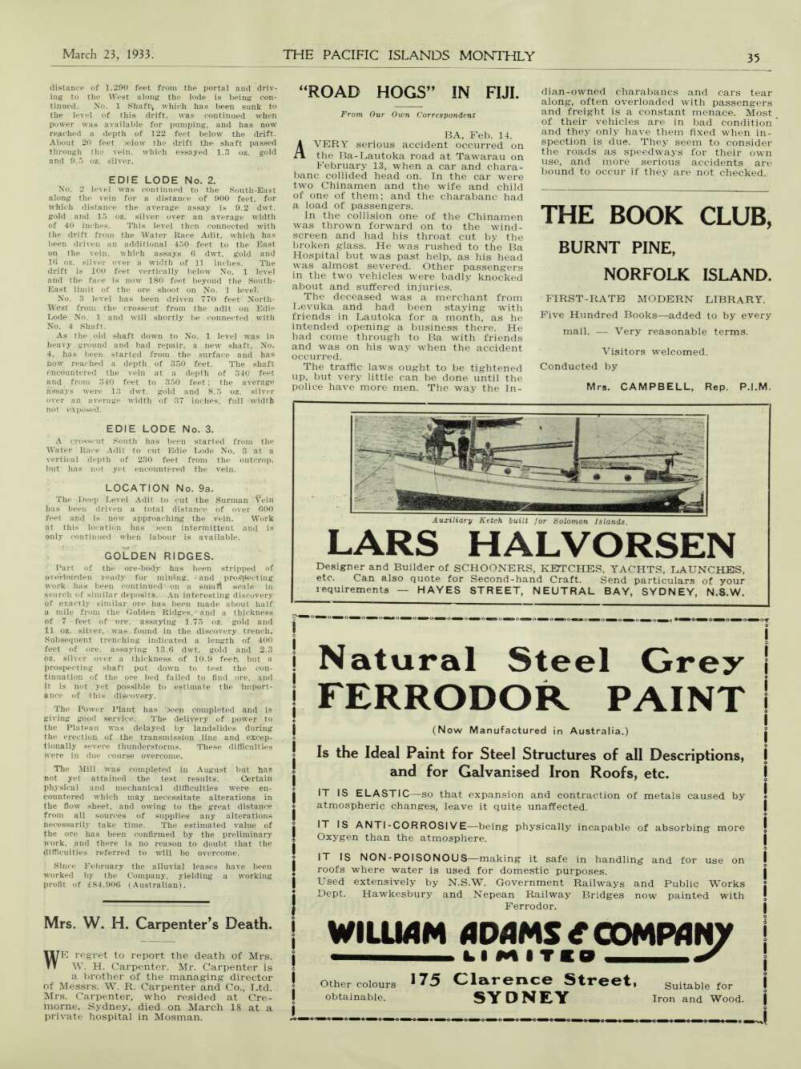
Annual Accounts Show Company at Interesting Stage of Development.
AN interesting financial position is dis closed in the annual report of New Guinea Goldfields, Ltd. for the year ended September 30, 1932.
The nominal capital of this Company is £5,250,000. Of this there has been is sued 4,080,000 ordinary shares called up to £1 each and 375,000 called up to 1/each —thus making the total issued capital £4,098,750. In addition, there are other liabilities bringing the total to £4,269,599. This is balanced on the as sets side by the following items: Mine property £3,718,970 Buildings, plant and equipment 167,968 Stores, etc., on band 28,292 Sundry debtors 12,544 Cash at oank and on hand . . 43,355 Payments in advance 7,225 Balance at 30/9/31 £185,124 Add nett expenditure for year 30/9/32 for prospecting and development, £106,177 .. . 291,241 £4,269,599 This is a huge investment on which to make dividends. If only 5 per cent is to be paid on the issued capital, the Com pany will have to make a net profit of not less than £200,000. Therefore, we
turn with interest to the accounts for the year under review and find that the value of the gold produced and sold was £112,992. Against that there has been charged the following expenses: Wages and native labor £10,432 Royalties, rentals, stores 5,931 Management and overhead ... 9,727 Depreciation on plant and equipment 490 This leaves a net profit for the year of £84,906 —which is well on the way towards the £200,000 required.
The bulk of this Company’s present expenditure, however, is shown, not as a current expense, but as a capital ex penditure under the heading of “Pros pecting and Development Account.” This shows that during the year under re view the Company made a net expendi ture on prospecting and development of £106,117, the bulk of which was: Prospecting and development . . £64,363 Roads survey and construction .. 2,457 Geological survey 8,321 Depreciation on plant 13,172 Administration expenses, Sydney and London 13,442 This £106,117 has been added to £185,124 of similar expenditure incurred in previous years making a total of £291,241 on prospecting and develop ment account, which is shown as an important item of assets.
Just before the American financial crisis caused a slump in gold shares, New Guinea Goldfields, Ltd. shares were quoted in the vicinity of 7/-. After the fateful 3/3/33 they fell to around 5/6.
There are those who believe that, as suming that the value of gold is main tained, they are good buying at that price. A careful examination of reports and accounts suggests that this Com pany may yet show an annual profit of anything from £100,600 to £200,000.
This would give an excellent return on shares bought at 5/- or 6/-. The ques tion for investors really is this: As suming that sales of gold represented, say, £200,000, how much of the expendi ture now tucked away in capital ac count under the heading of “Prospect ing and Development” would be brought into current expenditure and charged against the gross value of the gold pro duced? If, as the arrangements of the accounts suggest, the greater portion of
this £106,000 expenditure last year on prospecting and development will cease when the particular mines affected come into full production, then N.G.G. shares will yet be worth something consider able.
The Official Reports.
For the year under review, the direc tors’ report states that “very good pro gress has been made in all the prelim inary work necessary for proving the ore bodies at depth. With the installa tion of the power plant, shaft sinking has been pushed ahead on the Plateau, and it can reasonably be hoped that de velopments during the current year will multiply the ore reserves appreciably.
The working of the alluvial areas has been conducted very profitably during the period under review, as will be seen from the accounts.
“Though it may be as disappointing to shareholders as it is to the directors that the mill at the Golden Ridges is not yet working to the capacity for which it was designed, the results of full scale work have demonstrated the success of the modified flow sheet which should re sult in low treatment cost. Orders are being placed in Australia for additional cyanide tanks which will enable us to treat up to 4,500 tons of ore monthly, which is 50 per cent, in excess of the capacity as originally designed. Our en gineers are exerting themselves to obtain the greatest output whilst the price of gold is high. They advise us that from March 1 until the additional tanks are installed, the mill will treat about 1100 tons of ore monthly for an estimated profit of £7000.
“Prospecting work, which has been carried out by a well-organised staff under Mr. H. M. Kingsbury, the Com pany’s geologist, has discovered new dredging areas which are potentially very important. One area is a grass flat measuring eight miles long by 1500 feet wide, and the other measures 10 miles long by 3000 feet wide. Our applications for. leases on these areas will be dealt with at an early date. A complete cam paign of drilling will be necessary to determine the values and the character of the bed rock, but as an indication of the possible values it was ascertained that six of the best panning beaches averaged 3/6 per yard, calculated on the price of gold at the par rate of ex change. The prospectors were unable to reach rock bottom on these beaches owing to water. Arrangements are being made to send a well-known dredging en gineer to estimate the value of the areas and to advise on the method of working.
“A substantial increase in the ef ficiency of our native labour force will result from the amendment which was made during the past year in the Ordin ances. We are now permitted to indent native labour for three years in lieu of two years as heretofore. It usually takes about a year to train a boy properly and build up his constitution by good food, so that we will in future obtain two years’ effective work from a trained boy instead of one year.”
The report of the Mining Trust, Ltd., consulting engineers to New Guinea Goldfields, follows:
Edie Lode No. 1.
The drift West was turned to the South at 1,100 feet in order to crosscut Edie Lode No. 2, and at 1,130 feet from the portal passed through what appears to be a faulted block of the vein, assaying 19 dwt. gold and 6.2 oz. silver over a width of 10 feet. This ore will be prospected later from crosscuts driven beyond the zone of heavy ground in the vicinity of the fault. Edie Lode No. 2 was encountered at a
distance of 1,290 feet from the portal and driv ing to the West along the lode is being con tinued. No. 1 Shafts which has been sunk to the level of this drift, was continued when power was available for pumping, and has now reached a depth of 122 feet below the drift.
About 20 feet below the drift the shaft passed through the vein, which essayed 1.3 oz. gold and 9.5 oz. silver.
Edie Lode No. 2.
No. 2 level was continued to the South-East along the vein for a distance of 900 feet, for which distance the average assay is 9.2 dwt. gold and 15 oz. silver over an average width of 40 inches. This level then connected with the drift from the Water Race Adit, which has been driven an additional 450 feet to the East on the vein, which assays 6 dwt. gold and 10 oz. silver over a width of 11 inches. The drift is 100 feet vertically below No. 1 level and the face is now 180 feet beyond the South- East limit of the ore shoot on No. 1 level.
No. 3 level has been driven 770 feet North- West from the crosscut from the adit on Edie Lode No. 1 and will shortly be connected with No. 4 Shaft.
As the old shaft down to No. 1 level was in heavy ground and bad repair, a new shaft, No. 4, has been started from the surface and has now reached a depth of 350 feet. The shaft encountered the vein at a depth of 340 feet and from 340 feet to 350 feet: the average assays were 13 dwt. gold and 8.5 oz. silver over an average width of 37 inches, full width not exposed.
Edie Lode No. 3.
A crosscut. South has been started from the Water Race Adit to cut Edie Lode No. 3 at a vertical depth of 230 feet from the outcrop, but has not yet encountered the vein.
Location No. 9A.
The Deep Level Adit to cut the Surman Vein has been driven a total distance of over 600 feet and is now approaching the vein. Work at this location has been intermittent and is only continued when labour is available.
Golden Ridges.
Part of the ore-body has been stripped of overburden ready for mining, and prosfpecting work has been continued on a smart scale in search of similar deposits. An interesting discovery of exactly similar ore has been made about half a mile from the Golden Ridges, and a thickness of 7 feet of ore, assaying 1.75 oz. gold and 11 oz. silver, was. found in the discovery trench.
Subsequent trenching indicated a length of 400 feet of ore. assaying 13.6 dwt. gold and 2.3 bz. silver over a thickness of 10.9 feet, but a prospecting shaft put down to test the con tinuation of the ore bed failed to find ore, and it is not yet possible to estimate the import ance of this discovery.
The Power Plant has been completed and is giving good service. The delivery of power to the Plateau was delayed by landslides during the erection of the transmission line and excep tionally severe thunderstorms. These difficulties were in due course overcome.
The Mill was completed in August but has not yet attained the test results. Certain physical and mechanical difficulties were en countered which may necessitate alterations in the flow sheet, and owing to the great distance from all sources of supplies any alterations necessarily take time. The estimated value of the ore has been confirmed by the preliminary work, and there is no reason to doubt that the difficulties referred to will be overcome.
Since February the alluvial leases have been worked by the Company, yielding a working profit of £84,906 (Australian).
Advertisements & other items, p. 36 (1 item)
Wimbledon Tennis Gut Co.
J. H. SMYTH LTD.
Postage Stamp Dealers,
121a CASTLEREAGH STREET,
SYDNEY.
The Leading House for
ISLANDS STAMPS.
Write for List of over 500 Sets of Australian, New Zealand, and Pacific Islands Stamps.
Stamps sent on approval on receipt of reference.
ISLAND STAMPS PURCHASED.
Highest Prices Paid.
Small Docket Books, Receipt
Books, etc.
3½ x 4|, printed with name, trade, address. 3/- per dozen. Send for Samples.
WALTER WILLIAMS LTD.,
LIVERPOOL ROAD, BURWOOD. UJ 4170.
TENNIS PLAYERS!
Learn to String your Own Racket.
Full illustrations, instructions and all tools . . . . No. 1 £2 2 0 TRUE - GRIP CLAMP, or Stringing Machine, illustrations instructions and all tools. . .. No. 2 £5 5 0
Wimbledon Tennis Gut Co.
Q. V. Buildings, George Street, SYDNEY.
RACKETS, NETS and ALL EQUIPMENT.
Mrs. W. H. Carpenters Death.
WE regret to report the death of Mrs, W. H. Carpenter. Mr. Carpenter is a brother of the managing director of Messrs. W. R. Carpenter and Co., Ltd.
Mrs. Carpenter, who resided at Cre morne. Sydney, died on March 18 at a private hospital in Mosman.
“Road Hogs” In Fiji.
From Our Own Correspondent BA, Feb. 14.
A VERY serious accident occurred on the Ba-Lautoka road at Tawarau on February 13, when a car and chara banc collided head on. In the car were two Chinamen and the wife and child of one of them; and the charabanc had a load of passengers.
In the collision one of the Chinamen was thrown forward on to the wind screen and had his throat cut by the broken glass. He was rushed to the Ba Hospital but was past help, as his head was almost severed. Other passengers in the two vehicles were badly knocked about and suffered injuries.
The deceased was a merchant from Levuka and had been staying with friends in Lautoka for a month, as he intended opening a business there. He had come through to Ba with friends and was on his way when the accident occurred.
The traffic laws ought to be tightened up, but very little can be done until the police have more men. The way the In
dian-owned charabancs and cars tear along, often overloaded with passengers and freight is a constant menace. Most of their vehicles are in bad condition and they only have them fixed when in spection is due. They seem to consider the roads as speedways for their own use, and more serious accidents are bound to occur if they are not checked.
Advertisements & other items, p. 37 (1 item)
Ferrodor Paint
THE BOOK CLUB,
BURNT PINE,
NORFOLK ISLAND.
FIRST-RATE MODERN LIBRARY.
Five Hundred Books—added to by every mail. — Very reasonable terms.
Visitors welcomed.
Conducted by
Mrs. CAMPBELL, Rep. P.I.M,
Auxiliary Ketch built for Solomon Islands.
LARS HALVORSEN
Designer and Builder of SCHOONERS, KETCHES, YACHTS, LAUNCHES, etc. Can also quote for Second-hand Craft. Send particulars of your requirements — HAYES STREET, NEUTRAL BAY, SYDNEY, N.S.W.
Natural Steel Grey
FERRODOR PAINT
(Now Manufactured in Australia.) Is the Ideal Paint for Steel Structures of all Descriptions,
and for Galvanised Iron Roofs, etc.
IT IS ELASTIC —so that expansion and contraction of metals caused by atmospheric changes, leave it quite unaffected.
IT IS ANTI-CORROSIVE—being physically incapable of absorbing more Oxygen than the atmosphere.
IT IS NON-POISONOUS—making it safe in handling and for use on roofs where water is used for domestic purposes.
Used extensively by N.S.W. Government Railways and Public Works Dept. Hawkesbury and Nepean Railway Bridges now painted with Ferrodor.
WILLIAM ADAMS & COMPANY
LIMITED
Other colours obtainable. Suitable for Iron and Wood. 175 Clarence Street, SYDNEY
An Islands Bridge Party.
By “Koi-Koi.”
“I want you to come home early,” said my wife. “Not later than four o’clock.”
“My dear,” I said, “such striking evi dence of your affection stirs my soul to its depths. I —”
She broke in coldly: "I’ve got a bridge four this afternoon, and I want you to help.”
“Ah,” I replied, “if my experience and wide knowledge of the game can be of service—”
She smiled at me sweetly.
“You can see that tea is served pro perly,” she said, “and look after the ciga rettes and ash-trays and things. You know how unreliable native servants are.”
“Very well,” I said, with some dignity.
“If you insist on a Damascene blade to cut string with —”
She looked scornfully at me, and I left.
They arrived very punctually at four o’clock. Apparently they had omitted lunch, and I had some nervous moments as sandwiches and cakes went rapidly on their appointed way. I was about to get a fresh supply when my wife made one of those indefinable feminine move ments which tell her guests unmistak ably that that is that. “Shall we play?” she asked.
They moved to the card table, cut for partners, and sat down in tense silence.
Mrs. Dalby dealt slowly and very care fully.
“The pack’s not complete,” she said plaintively as the last card fluttered with face up, to her partner.
“Count your cards,” said Miss Finch.
They counted.
“Thirteen,” said my wife.
“Fifteen,” said Miss Finch.
“Twelve,” snapped Mrs. Corn.
Mrs. Dalby continued to count.
“Funny,” she said. “I made it thirteen the first time and the second time it was only twelve. I’ll count again.”
Mrs. Corn smiled a wintry smile at her.
“Perhaps you’d find it easier without your rings,” she suggested. “Your deal, Miss Finch.”
Miss Finch dealt with bewildering speed, snapped up her cards and, almost simultaneously bid “three hearts.”
Mrs. Corn looked hurt.
“No bid,” she said reluctantly.
“No bid,” said my wife.
“Let me see,” said Mrs. Dalby placidly.
“Three hearts you said, didn’t you, Miss Finch? How mean of you! I wanted to go hearts myself. Three spades,” she added brightly.
Miss Finch snorted and glanced rapidly over her hand again. “Double,” she snapped, and glared fiercely at Mrs.
Dalby.
Mrs. Corn and my wife passed.
“Content,” said Mrs. Dalby, and looked it.
Miss Finch led the nine of hearts and Mrs. Corn laid down a Yarborough.
“Sorry, partner,” she said.
“It’s all right, my dear,” said Mrs.
Dalby. “I’ll have the two, please.”
She took the trick with the Jack, cleared the trumps in three tricks and led a small heart. Miss Finch’s Queen came down triumphantly and she led the Ace of Diamonds. Mrs. Dalby trumped it.
“The rest are mine, I think.” she said smiling comfortably, and laid down four trumps, the two best hearts and the ace of clubs.
Miss Finch threw down her cards and grimly entered up the score. “A hundred and forty-four,” she said, and put down her pencil with an air of finality.
“I make it more than that,” said Mrs.
Corn.
“Do you?” asked Miss Finch coldly.
“A hundred and forty-four is the score.
Your deal, Mrs. Corn.”
“A hundred for little slam doubled,” said Mrs. Corn.
“No!” said Miss Finch.
"And a hundred for contract doubled.”
“No!” said Miss Finch.
“And three hundred for extra tricks doubled.”
“Don’t be ridiculous,” said Miss Finch.
“And thirty-six for honours doubled.
That’s twice-thirty-sixty-and twice-six twelve-sixty-and - twelve - are - eighty three. And six tricks in spades; six nines are fifty-four, doubled is a hun dred and eight; that’s, let me see, seven hundred and sixty. Game and rubber,” she concluded triumphantly.
Things seemed to be getting a little mixed. I hovered round, uneasily.
“But that was the first hand,” pro tested my wife. “It can’t be rubber yet?”
“Yes it is,” said Mrs. Corn, with the air of one defending her own. “A rubber is two hundred and fifty points, and we are seven hundred and sixty.”
“What made you go three hearts?” asked Mrs. Dalby, pleasantly.
“Oh, don’t you know the Culbertson convention?” replied Miss Finch. “It meant I wanted my partner to go no trumps, so that I could take her out into clubs.”
“Oh!” cried my wife excitedly. "Is that the psychic bid? I do wish you’d teach me how to do it.”
“I’ve made a mistake,” said Mrs. Corn.
“It should be six hundred and seventy, not seven hundred and sixty. No, that’s not right, either.”
“Could I have a cigarette?” pleaded Miss Finch, faintly.
I officiated, and placed an ash-tray at her elbow.
“But how could you have taken me out into clubs?” asked my wife. “You didn’t have any.”
“Oh, that doesn’t matter,” replied Miss Finch. “I’ll explain it all to you some time.”
“That's right, isn’t it?” queried Mrs.
Corn, handing me her scoring block.
“A hundred and forty-four,” said Miss Finch, wearily, “and game to you.”
“And why did you double three spades?” asked my wife. “Was that psy chic, too?”
“I make it three hundred and ninety four,” I said firmly.
“That’s four shillings, anyhow,” said Mrs. Corn.
“What are we playing for?” asked Mrs. Dalby.
“Love,” said my wife, “Threepence,” said Miss Finch, and Mrs. Corn put in a pained protest: “Six pence a hundred, surely.”
“We’ve never played for more than threepence before,” said Miss Finch.
“No,” agreed Mrs. Corn, “but we ought to. These low stakes are so bad for our game.”
“Can’t see it,” said Miss Finch. “I’ve never played for high stakes.”
“How would it be,” I suggested tact fully, “to play on and see what happens.
You could fix the stakes later.”
They agreed. Mrs. Corn dealt and passed. My wife bid a heart; Mrs. Dalby a spade; Miss Finch a no-trump. Mrs.
Corn raised her partner one and my
wife made it three hearts. Mrs. Dalby passed, and Miss Finch went to three no-trumps.
Mrs. Corn led the ace of spades and followed with a small one which her partner took with the king. Mrs. Dalby then took five more tricks in the same suit and led the ace of diamonds. Miss Finch discarded a small heart. Mrs.
Dalby led the queen of diamonds and Miss Finch, with great dignity, played the king.
“Revoke,” cried Mrs. Corn.
“Nonsense,” protested Miss Finch.
“You discarded a heart last trick,” said Mrs. Corn, reaching for the quitted tricks in front of her partner.
“Not allowed to look at any trick after it’s quitted,” said Miss Finch severely.
“You should have claimed a revoke at the time.”
“But how could we?” cried Mrs. Corn.
“We didn’t know you had a diamond until you played it.”
“That’s your affair,” said Miss Finch.
“I’ve played enough bridge to know that you have to claim a revoke at once or not at all. Besides, I didn’t revoke, did I partner?”
“I’m afraid you did, Miss Finch,” said my wife.
“Anyhow, it’s too late now,” said Miss Finch. “Your play Mrs. Corn. Culbert son says—”
But nobody showed any interest in Culbertson. Mrs. Corn and my wife played low cards and Miss Finch gathered up the trick.
“My lead, I think,” said Mrs. Dalby.
“No,” said Miss Finch. “I won the last trick.”
“But you should have played the king on my ace.”
“But I didn’t.”
“That doesn’t matter,” claimed Mrs.
Corn. “And the penalty; three tricks to us and a hundred and fifty above the line. And,” she added severely, “you can’t score below the line for the rest of the rubber.”
“Really, Mrs. Corn, this is absurd. I’ve played the strictest bridge with all the best players, and they never claim any penalty for a revoke if it’s accidental.
Your lead, partner.”
Mrs. Corn subsided sulkily, and my wife took the four remaining tricks in hearts.
Mrs. Dalby leaned back, smiling in pleasant anticipation. My wife, a little nervously, I thought, made some remark about golf, and looked at me appealingly.
Mrs. Corn’s jaws were clamped tightly, and she was breathing hard through her nose. Miss Finch smiled acidly, her head held very high. She opened her mouth to speak.
“May I give you a cocktail, Miss Finch?” 1 suggested.
"Thank you,” she answered readily.
The others agreed, and I served them eagerly. Mrs. Corn swallowed hers while the others sipped.
“Absurdly small glasses, aren’t they?” she remarked. I recharged it for her. Miss Finch rather hurriedly finished hers. I poured her another, and, very gracefully, I thought, engaged her in conversation.
My wife and Mrs. Corn were discussing somebody’s baby. Mrs. Dalby conducted a placid but ruthless attack on a dish of crystallised ginger.
“I did the fourth in three yesterday,” said Miss Finch nonchalantly.
“Did you really?” I said eagerly. “Do tell me about it.”
She did, at some length.
“The child is ill,” said Mrs. Corn.
“Anybody can see that it’s neglected.”
“Oh, surely not,” said my wife. “I thought it looked splendid.”
“The last lot of ginger I had was all mushy,” said Mrs. Dalby. “This is lovely.”
I replaced the empty dish with a full one.
“But the seventh green’s a disgrace to any club,” said Miss Finch. “I com plained about it last week, but it didn’t make any difference.”
“Little bows of pink ribbon —’’
“The sweet little thing—”
“I’d have done it in two except for rotten luck.”
“Matches, please.”
“I lost three balls last time I played,” crooned Mrs. Dalby happily.
“And I told him so, straight out.”
“Another cocktail, Mrs. Dalby?”
“Well, if they’re not engaged they ought to be.”
“He’s a charming boy, though.”
“Something so rhythmic about your swing,”’
I slipped over to the gramophone and put on a jazz record. The hum of con versation rose at once in determined competition. When I came back, Mrs.
Dalby was telling my wife a story of her first husband, while Miss Finch and Mrs. Corn smiled amicably over some social triumph. This was splendid. My wife’s bridge party was an undoubted success.
“Oh, well,” said Mrs. Corn at last, “I suppose we had better finish the rubber.”
In the sudden hush I cleared the table rapidly, and my wife dealt the cards.
“No trumps,” declared Mrs. Dalby, in obvious excitement.
"Fresh deal,” said Miss Finch severely.
“You called out of turn.”
“Oh, but I must play this hand,” said Mrs. Dalby. “It’s lovely.”
A motor horn sounded outside.
“My car,” said Mrs. Corn, laying down her cards. “I must go. Sorry, but I have some people coming to dinner. Can I give you a lift, Miss Finch? Mrs.
Dalby?”
“Thank you,” said Mrs. Dalby, while Miss Finch smiled her acceptance. “Just look at that hand.”
Apparently she had every picture card in the pack.
Miss Finch was already at the door, which I was quick enough to open for her.
“Good-bye,” she said. “It’s been a lovely party.”
“Good-bye,” said Mrs. Dalby. “Do tell me where you got that ginger.”
“Good-bye,” said Mrs. Corn. “Come and play bridge with me on Monday.
I’ve got the loveliest shoes to show you —24/11, my dear, reduced from 25/6.
Good-bye.”
My wife looked played-out. As the car rolled away, “My dear,” I said reproach fully, Why do you do it?”
“Oh,” she replied, looking at me in surprise, “I love bridge.”
Advertisements & other items, pp. 38-39 (1 item)
Ruston-Hornsby
TO PLANTERS - I am a Buyer of
CASTOR OIL SEED
IN ANY QUANTITY.
Advice and Instructions Regarding Planting, Harvesting and Packing of Castor Oil Seeds given gratis.
Your Inquiries Solicited Regarding Disposal of all kinds of Oil-Bearing and Edible Seeds and Nuts.
C. GRAHAME
17 BOND STREET , SYDNEY.
RUSTON-HORNSBY
COLD STARTING OIL ENGINES
FOR CRUDE AND LOW GRADE FUELS.
Horizontal and Vertical Types up to 1200 h.p.
The Most Economical Prime Movers. Low Fuel Consumption Guaranteed.
Sole Agents for Australia and the Islands:
RUSTON & HORNSBY (AUST.) PTY. LTD.,
Registered Office: 174-180 King Street, MELBOURNE.
CABLES: HORNSBYS, MELBOURNE.
Branches at SYDNEY (10-14 Young St.) and BRISBANE (Barry Parade).
AUSTRALASIA’S CLEARING HOUSE FOR THE PRECIOUS METALS.
BUYERS OF—
GOLD OSMIRIDIUM, PLATINUM, SILVER, Etc.
GARRETT & DAVIDSON Ltd.
Assayers, Bullion Merchants, Metallurgists, BANK OF N.S.W. BUILDINGS, REGENT STREET, SYDNEY.
Introducing
THE '
“FLETCHER” STOVE,
Made with Extended Fire box for Long Wood Fuel.
This Stove has been specially constructed for persons requir ing a good, strong article at a very moderate price.
We will be pleased to forward a copy of Illustrated Leaflet, Post Free, upon receipt of your name and address.
G. FLETCHER & SON 50 Oxford Street, SYDNEY.
Also, Makers of the “Younger” Stoves and Ranges.
P.0. Box 38, Norfolk Island.
Cable Address.
“Niphoser,” Norfolk Island.
NORFOLK ISLAND
PHOTO. SERVICE,
Photographers, Photographic Printers and Publishers,
Taylor’s Road, Norfolk Island.
Mounted and Unmounted Photo graphs of Norfolk Island Views, Industries and Flora.
Local and Overseas Trade and Newspapers & Publishers supplied.
Samples on application.
INSPECTION INVITED.
Old Gold.
Successful Appeal Swells A.B.M. Funds.
AT the last meeting of the Australian Board of Missions, it was stated that the debt to the New Guinea Mission was reduced from £7301 to £4358, mainly as a result of an appeal for old gold and jewellery. A special gift of £60 was received to provide a small launch for the Rev. E. R. Gribble, chaplain of the Palm Island aboriginal settlement.
The Board’s income for 1932 from dioceses throughout the Commonwealth was £25,494 compared with for the previous year.
Coffee Cultivation.
Practical Advice for Pacific Planters.
The following is the text of a pamphlet written a little over a year ago hy Mr. George H. Murray, F.E.S., Director of Agriculture in New Guinea. In all matters relating to tropical agriculture, Mr. Murray is one of the soundest men in the South Seas.
Coffee has never been grown on a commercial scale in New Guinea Terri tory, though plants are to be found on some of the Missions Stations and on one or two plantations where small areas were cultivated experimentally during the German regime. The varieties thus cultivated were Arabian and various types of Liberian coffee, the quality of the former on some of the more elevated Mission Stations being very satisfac tory indeed.
This article is written, therefore, with the view of encouraging planters to en ter upon the cultivation of coffee on a more extensive scale and thus add an important industry to the country, it should be noted that the Commonwealth Government has a preferential tariff ot 3d. per lb. in favour of coffee imported into Australia from the Mandated Ter ritory of New Guinea and Papua, Australia imports nearly 2000 tons per annum, the market there, though not large, is well worthy of consideration, and it should be noted that Australian consumption of coffee is on the increase.
Notwithstanding the large production of coffee in Brazil, the prices obtained for good quality coffee on the European market should pay planters in this Ter ritory. New Guinea is free from the cof fee bean borer (Stephanoderes hampei). a minute Scolytid beetle, which is a very serious pest in Brazil and Java, and planters here, therefore, would have that much in their favour.
Owing to the action of the Department of Agriculture in encouraging planters to engage in new cultures a certain amount of interest has been taken in the cultivation of coffee, one planter in New Ireland having about 15 hectares ready for harvesting.
Several varieties of coffee have been introduced by the Department during the past two and a half years, including Arabian coffee from the famous Blue Mountains of Jamaica. This was planted at the Agricultural Station, Wau, main land of New Guinea, at an altitude of about 3500 feet, and it is now setting a heavy crop of berries. Although there is ample land suitable for this product up to 4500 feet, the absence of roads from the coast at present precludes the pos sibility of growing this type on a large commercial scale. When, however, a road is put through to the Wau suitable for wheeled traffic, or even pack animals, there is no reason why a mountain coffee industry should not be established.
There are several species of coffee and many hybrids or subspecies, varying in the quality of the beans and the climatic and soil conditions necessary for their successful growth. Until recent years the only one extensively cultivated was Arabian coffee in tropical highlands. The well known coffee rust (Hemileia vasta trix) is a fungus which spread from jungle vegetation to the cultivated coffee plants and wiped out the profitable cul tivation of this crop in Ceylon about 1870, but the opinion of many experi enced planters is that the rapid spread of the disease was largely due to grow ing the plants in uncongenial climates at too low an elevation. The conditions of cultivation in Ceylon would appear to have been favourable for the spread of an epidemic and the disease had prob ably been gathering force for years be fore its ravages became noticeable.
A few Arabian coffee trees introduced during the German regime happened to be bearing berries at an elevation of a few hundred feet above sea level, and because of this some planters contem plate growing this variety on a commer cial scale in a locality comparatively few feet above sea level.
The above information is supplied to planters so as to warn them of the risks entailed in carrying out such a scheme.
It is very inadvisable, therefore, to enter upon the cultivation of Arabian on an extensive scale at a lower elevation than 3000 feet, 5000 feet for preference.
There are some districts easily acces sible from the coast, however, suitable for the cultivation of coffee robusta, and it is mainly for that reason that this article has been written.
Coffee robusta, as its specific name indicates, is a vigorous grower, but al though not entirely immune to Hemileia vastatrix it does not suffer unduly from the disease, another point m its favour being that it thrives almost from sea level to an altitude of about 1500 feet.
Discovered originally in the Congo basin
about 30 years ago, it has been intro duced to many countries and with its sub-species is now the type largely grown, except in specially favoured dis tricts where high quality Arabian is still comparatively free from disease. Coffee robusta is also a heavy yielder and comes into bearing in a little more than two years, considerably less than the period ordinarily required for coffee ara bica, which largely compensates for its lower quality.
There is great variation in robusta coffee, many sub-species or varieties re ceiving specific designation according to the districts in which they are found, and on many estates, particularly in Java, managers have special plots of these robusta varieties for observation and experiment. Uganda coffee, one of the robusta types, was introduced into Papua a few years ago and the trees are now bearing heavily, the beans in 1930 having brought £90 per ton in Sydney, though prices have dropped since then like all other primary products. This variety and others have been introduced from the Philippines and other countries, free from the coffee bean borer (Steph anoderes hampei ) and some are now bearing at Keravat.
Robusta grows well on a variety of soils except where too sandy, a deep, rich, clayey loam, preferably of volcanic origin, being most suitable. The pumice soils such as are found in the neigh bourhood of Rabaul, are deficient in pot ash and phosphoric acid and such soils should be avoided. It does not stand drought, requiring a good rainfall, evenly distributed, in fact, soil and climate con ditions are much the same as those re quired by cacao. Long periods of ex posure to hot sun is also injurious to the trees and it is advisable under such con ditions to provide shade by planting le guminous trees or shrubs at suitable distances.
When selecting land for coffee the fol lowing points should be noted: (1) That the soil is deep, clayey, well drained and rich in humus. (2) It should not be exposed to the wind, otherwise the whip-like branches will be damaged. (3) The annual rainfall should be at least 80 inches per annum. (4) The plantation should be near a running stream, as a considerable quan tity of water is required for pulping and washing the coffee.
For planting coffee the land should be thoroughly cleared and it is best to have the stumps removed as many root dis eases will spread from the dead roots to the living plants. If the cost of remov ing all the stumps is greater than the planter can afford, holes 3 feet in diameter should be dug and if a stump happens to be at the spot where the cof fee tree is to be planted, all roots should be removed therefrom. Thorough clear ing, however, is always the most satis factory in the long run.
Nurseries,
A well sheltered site not too far from a good water supply should be selected for a nursery and, after all stumps and roots have been removed, the ground should be reduced to a fine tilth and laid out into beds four feet wide with a path on either side, to ensure good drainage. The beds should be raised about four or five inches above the path. A substantial shelter frame should be erected over the beds high enough for the labourers to walk underneath. The seed should be sown flat side down in rows 10 to 12 inches apart, six inches apart in the rows if perfectly fresh.
As coffee seed soon loses its viability old seed can be sown more closely in a germinating bed and as soon as they
have germinated they can be picked out and planted as in an ordinary nursery.
The seeds should be covered with an inch of soil or slightly deeper if the soil is sandy or in very fine tilth. The seed beds should always be kept moist but not wet, and if the seed is fresh, germ ination will take about four weeks. If seed is not fresh germination will be slower and the percentage much less.
The seed bed should be kept carefully weeded and free from insect pests. It is a good plan to burn a layer of dry brush wood over the seed bed to kill insect pests in the soil and the ashes can be worked into it before the final prepara tion for sowing the seed. The plants will be ready for transplanting into larger nurseries or into their permanent posi
(Continued on page 42.)
tions when they have about four or five pairs of leaves. It is an advantage to have several nurseries distributed at convenient distances from the field where they are to be planted as there is then less risk of the soil being broken away from the roots of the young plants.
Lining Out And Planting.
After the land has been thoroughly cleared it should be lined out at the planting distance desired —10 feet by 10 feet being the usual distance for robusta coffee, the system of lining out whether square or hexagonal, being a matter of opinion, which the planter should decide for himself.
Stout stakes should be driven into the soil to mark the places for the coffee
plants, but shade should be thoroughly established before any planting is done.
Heavy shade is not required but a row of leguminous shrubs like Tephrosia Can dida or one of the Crotolarias should be sown between the lines for coffee, about four months at least before transplant ing the coffee.
The size of the holes for the coffee will depend on the nature of the soil. In deep, friable loam, holes about 18 to 24 inches square and the same in depth will be sufficient but if the soil is heavy it would be better to make the holes three feet square. It is advisable to leave the holes open for a few weeks to allow the soil to become aerated before planting.
If the shade has been planted at the right time, there should be little or no cause to use “bomboms” or other bushes for shading the transplants, but if it is found necessary to use “bomboms,” it will indicate a lack of foresight in the planter.
Planting.
Planting should be done at the begin ning of the wet season, every care being taken that the labourers do not bend the tap root, and to see that the plants are at the same depth that they were in the nursery. The holes should be filled with surface soil pressed well round the plant, and if this operation is done carefully, there should be very few misses.
Below is a sketch plan of coffee plants at 10 feet x 10 feet, permanent shade 20 feet x 20 feet, and a line of temporary shade between the lines of coffee.
Due care should be taken that when the young plants are lifted from the nursery, all broken or injured roots should be snipped off with secateurs.
Shade.
There is a difference of opinion as to the necessity of shade. It is not uncom mon to see one planter removing shade from his coffee, while his neighbour is just as convinced that it is essential.
No shade seems to cause an increased yield per acre, but the longevity of the tree is reduced. On the other hand cof fee grown without shade is more subject to attack from leaf blight or coffee rust.
There can be no doubt that light shade provided by leguminous trees and shrubs is beneficial to the plant, as it is fre quently noticed that plants growing in exposed positions have not the same vigorous leaf growth as in trees growing in similar ground, but provided with light shade. The planter must use his own discretion as to the shade require ments, taking into consideration the al titude and the exposure, the greater the altitude the less shade required and vice verso. It should also be remembered that undue exposure greatly intensifies the exhausting effects of disease. The shad ing must be regulated by lopping back when necessary to prevent the young plants from getting leggy.
The general practice in several coun tries is to plant Leucaena glauca, a small leguminous tree, as permanent shade and one of the Crotalarias or Tephrosia Candida, as temporary shade; the sketch plan above will give a good idea of the system. Other leguminous plants can be used for the purpose, but those named are generally the most satisfactory.
Fruit trees can also be used for shade to a limited extent, the distance apart varying in accordance with the size ot the trees.
Pruning.
The natural growth or robusta coffee is to form a central stem with primary and secondary branches, the latter being usually in pairs. Secondary branches within four or five inches of the mam stem should be removed to allow venti lation and light, for if all are permitted to remain, the growth of fungi will be encouraged. Of the other secondaries, one should be removed from each pair on alternate sides, i.e., one on the left of one pair of secondaries, one on the right of the next pair, and so on.
Except to rub off the young upright shoots on the side of the mam stem, pruning should not be necessary until the trees are about three years old. The trees should be topped to about five teet, cutting back to the brown bark. The top pair of primaries should also be cut oft to prevent the stem from being split by the weight of the branches when they are heavy with fruit.
Cultivation And Cover
Plants.
Coffee, like all other economic plants answers readily to cultivation, and will well repay all attention given to it in this way, due care being taken that the roots are not disturbed. Weeds should not be allowed to get hold of the ground, and every effort should be made to keep out Thurston grass (Paspalum conjuga tum) This grass makes fair grazing for cattle, but it is a positive curse in cul tivated ground, and its presence or ab sence in a coffee plantation is an index of the efficiency or otherwise of the planter. Paspalum dilatatum, the grass which did so much for the dairy indus try in certain parts of Australia, is a de clared noxious plant in orchard districts
o x o
20 feet.
o x o o x o o o o o o o o o o x o o x o o x o o o o o o o o o o x o o x o o x o o o o o
o=Coffee.
x = Leueaena glauca, permanent shade, o o o o . . . . Temporary shade. Tephrosia Candida.
in that country, and its congener, Pas palum conjugatum might well be consid ered such in a coffee plantation in New Guinea.
The cover plants recommended for use on coconut plantations, viz., Galopogonium mucunoides and Centrosema pubescens are un suitable for coffee on account of their tendency to climb. The shade plants re commended will help to keep down weeds, and if the space between the cof fee and lines of shade is planted with Indigofera endecaphylla there will be comparatively little labour required for weeding, provided, of course, that the land is thoroughly clean.
Pests And Diseases.
The coffee growing at the Demonstra tion Plantation, Keravat, has not suf fered to any extent from pests, only a few of minor importance so far having been noted.
There has been a loss of one tree, which died from a form of dieback, not yet identified. It was a solitary case, and there has been no indication of a further outbreak. Preventive measures should be adopted in the event of any trees developing an unhealthy appear ance, such as cultivation of the soil to encourage growth, manuring (green manure or otherwise) and careful regula tion of the shade.
A few instances of attack by stem boring grubs have been recorded, but no mature insects have been obtained, so that they have not yet been identified.
The coffee now being grown in Papua, where the conditions generally are simi lar to those found in this Territory, has not suffered from any serious pest, and we are therefore justified in expecting the same here.
Harvesting And Curing.
The berries should be perfectly ripe at time of picking and they should be put through the pulper the same day. Ro busta coffee is sometimes difficult to pulp and it may be necessary to put it through the pulper a second time.
Fermentation is the next process, the object of which is to remove the muci lage-like substance adhering to the bean.
Vats or boxes similar to those in use for fermenting cacao beans are required. The time necessary for fermentation will de pend on the air temperature, but it should not take longer than 36 hours.
The time when the fermentation has been completed is easily noted by taking a few beans from the middle of the vat and washing them in water. If the slimy matter has all come away from the beans the fermenting process is com plete and they are then ready for wash ing. A plentiful supply of running water is necessary for washing the beans, and when this has been completed they are spread on perforated trays on a raised frame in the sun to dry. Artificial driers are not expensive and if the size of the plantation warrants, the planter would find it to his advantage to invest in one.
Production.
Production in a young plantation is somewhat variable and naturally the yield is heavier where everything in the way of soil and climatic conditions are favourable.
As an instance of what might be ex pected here on good soil, it might be noted that the yield in Papua was 800 lbs. per acre, at the second crop when the trees were about 3½ years old. Con sidering that the labourers were all raw bush natives who had never seen a cof fee tree before, the result was quite sat isfactory. Yields in other parts of the
world have frequently been much greater, but as coffee growing is merely in its infancy in this Territory, it is too soon to state an average yield or what might be expected here.
Provided that the coffee has been planted in good soil and receives good attention the yield should be even better than the Papuan figure mentioned above.
On the rich lands of East Java the yields in the third year was about 540 kg. (1 kg. = 2.3046 lbs.) per hectare, and fourth and fifth years 1400 kgs. and 1830 kgs. respectively per hectare. Four to five kg. of fresh robusta berries make 1 kg. of coffee beans.
Advertisements & other items, pp. 40-41 (2 items)
James Barnes Limited
T. ELLIOTT & CO.
(Established 15 years) Real Estate Agents, Valuers,
Flat Specialists.
Controlling Agents for Principal Flat Buildings in Sydney, Darling hurst, Potts Point, Elizabeth Bay, Darling Pt., Edgecliff, Pt. Piper, etc.
When contemplating a visit to Sydney write regarding your re quirements and see us immediately on landing, and our services will be at your disposal.
72 DARLINGHURST ROAD,
(Opposite King’s Cross Theatre),
King’s Cross, Darlinghurst,
SYDNEY.
Telephone: FL 1968.
JAMES BARNES LIMITED
2 Botany Street, Waterloo, Sydney
(ESTABLISHED 1881)
MANUFACTURERS OF
“Globe” & “Victory” Brands
OF
SHEEP’S TONGUES OX TONGUES SAUSAGES
PRESERVED MEATS BEEF EXTRACT DRIPPING
Also “Castle” Brand, which is specially packed for use by the White Population.
Globe Beef Extract is invaluable to Young and Old.
Tested Recipes on the packet 4oz. and 8oz. sizes.
Batteries
There are
Exide
for
Cars, Radio
Motor Launches
Motor Cycles
House Lighting
Telephones, Bells
Submarines
Aeroplanes
War Ships, Trains
Buses, Trucks
Hospitals . . .
Cinemas, etc.
Leaflets, dealing with the various types, supplied free on request.
BATTERIES OF AUSTRALIA
LTD.,
Grace Building, York Street,
SYDNEY.
Queensland Distributor: N.S.W. Distributor: EXIDE BATTERY SERVICE (Q.) PTY.
EXIDE BATTERY SERVICE LTD.,
(Deering Engineering Co. Ltd.), Adelaide Street, BRISBANE. 8 Hunt Street, SYDNEY. Also Sturt Street, TOWNSVILLE, (W. R. Carpenter & Co., Ltd., Rabaul).
British Administrative Prestige And
The Western Samoan Situation.
Letter to the Editor.
Mr. G. E. L. Westbrook, of Samoa, recently brought to the notice of the Hon. Geo. Forbes a very important point, which was that New Zealand is the custodian of British honour in Samoa. It is regrettable that not only the present Prime Minister, but Mr.
Coates, when he was Prime Minister, ignored this highly important fact when dealing with Samoan matters.
People in other parts of the world have learned to respect the English man. Some express their admiration spontaneously by expressions, like the Latin races of South America, who say “pababre de ingles” (Word of an Eng lishman); other races express their re spect for the Englishman’s code of honour in other ways. Impartial en quiry amongst such people as, say, the Fijians, will prove that wherever Eng lishmen are in control of the reins of government, the people of the country place implicit confidence in their word of honour.
The is the main principle of the Englishman’s success in governing native peoples all over the world and it speaks volumes for the type of adminis trators and civil servants that England has sent to different parts of the world, that this prestige has been kept up under, in many cases, very adverse conditions.
When New Zealand received the Mandate to govern Samoa, being Eng lish-speaking people, the Samoans and other races resident in the territory naturally expected that New Zealanders would have the same ideas of honour
as the Englishman; and, further, that they would try and emulate British ideas of governing subject people.
The pitiful and tragic history of the past few years in Samoa has astonished the world in regard to New Zealand’s capabilities for governing native peoples. New Zealand has illustrated to the world that “a nation of peas antry” are unfitted to govern tropical territories, no matter how small and unimportant the territory might be.
The exhibition of incompetency and ignorance, a mixture of bullying and snivelling (carried out in the name of British justice), which has been New Zealand’s idea of governing these tiny islands, is making Englishmen all over the world, and particularly in Samoa, writhe in shame.
It is difficult for people—not born in N.Z. —to understand the psychology of those responsible for the Gilbertian (if I may use the phrase) “tragi comedy” which has represented New Zealand’s effort to govern this little territory. We have the typical evasive ness of the politicians, when their blunders have been criticised —always blaming the other fellow. First, they said the European settlers were re responsible for the trouble; then that Samoans were difficult to govern, and that their temperament was such that they could be called the “Irish of the South Seas”; and they have a hundred and one other excuses, to explain away their bovine lack of foresight.
European settlers in Samoa wonder whether New Zealand’s apparent lack
cf understanding of the danger of the present situation is due to a colossal egotism, which refuses to see the situ ation, or to an abysmal ignorance that one would hardly expect to find, even in New Zealand. People who have settled and married in the country, who understand the Samoans, have from time to time offered advice and assistance, both to the New Zealand Government and to their representatives in Samoa —but all to no purpose. The replies they received were couched in the usual vague ambiguous language which, in minds of the New Zealand politicians, is the language of diplomacy.
Bad feeling is certainly growing in Samoa, engendered possibly by the fact that, no matter what business one trie? to transact with the Powers that be in Wellington, it is impossible to get a straight-forward reply. On all occasions they indulge in vagueness and studied ambiguity.
It may be, of course, that having committed practically every stupidity possible to alienate the sympathy and respect of Europeans and Samoans in the Territory, the responsible author ities in Wellington are at their wits’ end, and do not know what move to make next. The amusing part of the whole business is that they are still “hovering” about keeping up their
prestige.”
Prominent New Zealanders have frequently expressed the view that as New Zealand had not the right type of men to send to Samoa, the only thing possible under the circumstances was to admit that this was the case, and ask Great Britain to take over the Mandate. As this has been the wish Of the Samoan people for many years, it seems to be a very desirable and just solution to the problem. The only difficulty is the peasant-like pig headedness of the New Zealand Gov ernment, who, in a vague undefined way, imagine they would lose “pres tige.” That they, as the custodians of British honour, may be deprived of the Mandate in order to save British pres tige, does not apparently enter into their calculations. That N.Z, is unfit to govern Samoa the more cultured New Zealander (outside, of course, politics) admits.
Is it, then, not logical to assume that the average New Zealander would be only too pleased to see the Mandate transferred to Britain, which would re lieve the N.Z. taxpayer of a big finan cial burden, and, incidentally, the problem which has caused the Dominion’s good name to be criticised in every civilised country. A handful of egotistical politicians in Wellington should not be permitted to block a settlement which would be satisfactory to everybody —a settlement which, in view of the state of the country’s fin ances, and the extremely dangerous re trograde movement in agriculture, is vitally necessary, if the country is to again become solvent, and a progressive policy inaugurated, which will help to ameliorate the difficulties and hard ships caused by politicians’ blun dering.
There is hardly a settler in Samoa who is not convinced that the only solution to the Samoan problem is to transfer the Mandate to Britain, be cause as long as the country is gov erned as at present there will be trouble and dissension. Our much
vaunted “British justice” (not very evident in Samoa) demands an early settlement of this question, in fairness to the Samoans and European settlers. New Zealand has worn the cap and bells for the League of Nations quite long enough.
I am, etc.,
Dirigo.
Apia,
Jan. 6, 1933.
EDITORIAL NOTE. —The language of our correspondent is somewhat extreme; but he does give voice to a belief that is general outside of New Zealand. The simplest and best solution of the Samoan problem undoubtedly would be to hand the Mandate over to Britain, for adminis tration through the Dominions Office, and the High Commissioner for the Western Pacific, out at Suva.
Advertisements & other items, p. 42 (1 item)
Aunt
QUALITY PRODUCTS
Packed to meet Island Conditions,
MARY'S
PURE FOOD
PRODUCTS
For thirty years the proprietors of Aunt Mary’s Pure Food Products have manu factured the highest quality goods and packed them to meet the special condi tions of the Pacific Islands.
Aunt Mary’s Pure, Food Products and “Defiance” Brand Canned Goods are prepared and packed only by
TILLOCK & CO. LTD.
Kent and Liverpool Streets, SYDNEY, N.S.W.
“Defiance
Brand
Canned
Goods
These high-grade Canned Goods are specially prepared and hermetically sealed to withstand tropical heat, thus ensuring to con sumers the fullest satisfaction.
Clemency!
An Appeal to New N.G.
Legislative Council.
THERE is a general expectation that the inauguration of the Legislative Council system in New Guinea in May next will be marked, as a special act of clemency, by the review or reduc tion of some of the sentences imposed on white men in New Guinea in connec tion with assaults on native labourers.
There is a growing feeling that some of those sentences were unnecessarily severe to the point of brutality. That applies particularly to the Larkin case.
The Pacific Islands Monthly believes that in this case there has been a cruel miscarriage of justice, and it hopes that officialdom will yet see its way to do the fair thing rather than wait until public agitation compels the N.G. Ad ministration or the Court to order a review of the case.
James Larkin, 43 years of age, an educated man of superior type, who served with distinction as an airman in the War, is at present at Tuncurry prison camp, N.S.W., serving a sen tence of 10 years penal servitude for murder, imposed upon him by Judge Wanliss in the Central Court in Rabaul.
Larkin was savagely attacked on his plantation and injured by a native labourer who was suffering under a sense of grievance, Larkin threw him off; and subsequently arranged that he be spreadeagled and flogged by native servants and by Larkin himself, until the native collapsed. He was taken to his quarters, and died some days later, apparently as an indirect result of the flogging.
The Judge, without the assistance of a jury, and on his own responsibility, found that this was murder and sen tenced accordingly.
The crime—and crime there was, because the flogging was brutal and unjustified—was clearly manslaughter, and the punishment imposed by Judge Wanliss was excessive to the point of being ridiculous. There cannot be murder unless there is intent. Other white men who have since been prosecuted for causing the deaths of native labourers in very similar circumstances have been imprisoned—and rightly so —but not for longer periods than two years.
It is hoped that the new Legislative Council of New Guinea will commence
a career of usefulness in the Territory by appealing to the Administration for what might be called clemency in the Larkin case—but which would actually be nothing less than justice.
“Maungani" Diverted
Attempt to Save Dying Trader.
From Our Own Correspondent
Rarotonga, Feb. 27.
THE number of white people at the island) of Atiu (116 miles from Raro tonga) is three all told.
On January 28, one of them, Mr. J. A.
Campbell, manager of a small store, was reported by wireless to be critically ill.
That morning the R.M.S. “Maunganui” had arrived at Rarotonga from New Zealand and arrangements were made for her to make a special call at Atiu, en route to Papeete, the next port of call.
The sick man was taken aboard in a low condition and, although everything possible was done for him, he died the day following the ship’s arrival at Tahiti.
Filming Papuan Life.
Administration Prohibits War-like Scenes.
Two well-known travellers, Messrs. G.
C. Dromgold and J. B. Shackleford, who have been in Papua filming scenes of native life, arrived in Sydney by the “Macdhui” in March 9. They were ac companied by Mr. Mel Ward, honorary zoologist at the Australian Museum.
The expedition had been in Papua for five months and exposed over 20,000 feet of film on many interesting and unique subjects. Using a 65ft. lugger as head quarters, they filmed many scenes along the coast as far as Samarai.
Disappointment was expressed at the attitude of the Papuan Government, which refused the expedition permission to take scenes of large numbers of Pa puans in battle order. It was feared by the officials that the natives would reach such a pitch of excitement that a real battle would be the result. These scenes will be completed in Fiji, where the na tives have less war-like tendencies.
Mr. Mel Ward brought with him a large collection of specimens which, he said, would take at least two years to classify. He will not be able to complete this work until he has examined the re ports of early French explorers.
Advertisements & other items, pp. 43-44 (2 items)
Portland Cement
HYLANDS POULTRY,
eggs, FISH
DESPATCH ORDERS PROMPTLY.
Primest Quality at Reasonable Prices.
All varieties of Poultry, Game, Fresh Fish and New-Laid Eggs.
Send your next order to:
DAVID HYLAND & SONS PTY. LTD.,
755 Harris Street, SYDNEY, N.S.W Cable Address: “Hylands,” Sydney,
“UNION”
PORTLAND CEMENT
GUARANTEED HIGHEST QUALITY.
Concrete is the Ideal Constructional Material, and eminently suited to Island conditions, being Weatherproof, Rat-proof, Vermin-proof, Everlasting.
For Store Buildings, Dwellings, Silos, Tanks, Floors, Paths, Pipes, etc., Unexcelled.
Send for Free Pamphlets on all Concrete Problems.
COMPETITIVE PRICES. :: ENQUIRIES INVITED.
THE COMMONWEALTH PORTLAND CEMENT COMPANY LTD.,
SYDNEY and PORTLAND, N.S.W.
Postal Address; Telegraphic Address:
Box 1571 E, G.P.O. “LIMERIEZ”
SYDNEY. SYDNEY.
EXCHANGE! STAMPS!
PEN-FRIENDS! FRIENDLY
CORRESPONDENCE!
JOIN GENUINE ISLANDS CLUB.
Member List (Islands and World- Wide) in interesting Club Magazine, Send 2/- in Stamps (fee) or write for particulars to “South Sea Islands Corres pondence Club,"
NATUVU, FIJI.
BUILD NOW WITH DURABESTOS
Island Homebuilders can now erect an everlast ing Home easily and economically by using “DURABESTOS” (Asbestos Cement) Building Sheets to line the exterior walls and interior walls and ceilings.
Economical to transport, easy to fix, and fireproof.
Send for Prices and Free Catalogue “DURABESTOS HOMES OF COLOURFUL BEAUTYV’ containing plans, designs and suggestions for Homebuilders.
WUNDERLICH LIMITED
BOX 474 AA, G.P.O.. SYDNEY.
DURABESTOS
BUILDING SHEETS
42
March 23, 1933.
THE PACIFIC ISLANDS MONTHLY
COFFEE CULTIVATION.
(Continued from page 39.)
French Traders.
Establish at Tanna.
From a Special Correspondent.
VILA, March 7.
NATIVES at Tanna have shown hos tility to some French trades who have recently established stores on the island. Till their arrival the trade at Tanna was in the hands of British traders and the natives apparently re sent the intrusion of the Frenchmen and no business has been done with them.
A French resident agent, who also acts as medical officer, is now at Tanna.
School For Wau.
It is reported that the New Guinea Administration proposes to establish a school for European children at Wau.
Mr. V. E. Garvie left Rabaul for Wau by last “Macdhui” to assume duty as teacher-in-charge.
Advertisements & other items, p. 45 (1 item)
Nelson And Robertson
ISLAND MERCHANTS. [Established, 1895.]
Copra, Cocoa, Trocas Shell and other Island produce sold on commis sion. All classes of Merchandise purchased and original invoices supplied.
Agents for SKANDIA CRUDE OIL ENGINES, Marine and Stationary, powers from 5-h.p. up.
PENTA MARINE ENGINES, Outboard and Inboard types.
PUMPMOBIL, the only portable pumping plant manufactured, light in weight and reliable. Suitable for mining work.
UPSON WALL BOARD, in both Plain and Tile pattern, strong and light.
Non-conductor of heat and cold. British manufacture.
Also New Guinea, Papuan and Samoan representatives for the famous
CHALLENGER KEROSENE BATH HEATER.
Communicate with
NELSON & ROBERTSON
12 SPRING STREET SYDNEY, AUSTRALIA
Telegraphic Address: “IVAN SYDNEY.’
Samoan Trade.
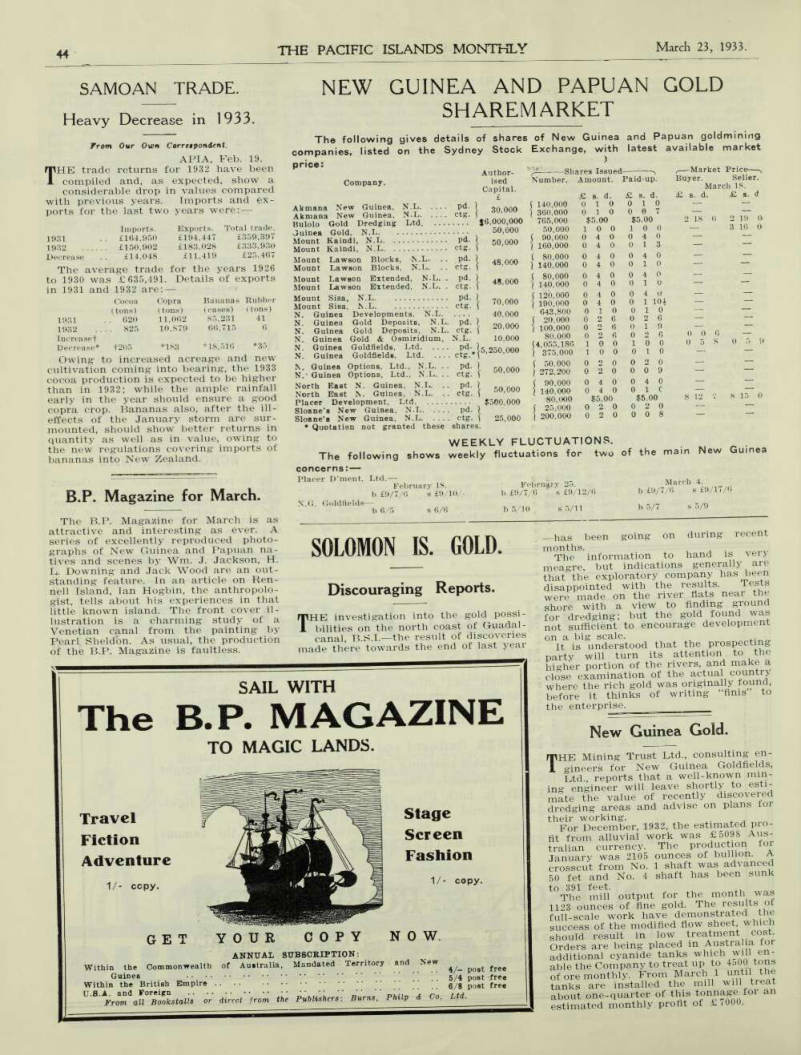
Heavy Decrease in 1933.
From Our Own Correspondent.
Apia, Feb. 19.
THE trade returns for 1932 have been compiled and, as expected, show a considerable drop in values compared with previous years. Imports and ex ports for the last two years were: Imports. Exports. Total trade. 1931 . . £164,950 £194,447 £359,397 1932 £150,902 £183,028 £333,930 Decrease . . £14,048 £11,419 £25,467 The average trade for the years 1926 to 1930 was £635,491. Details of exports in 1931 and 1932 are: Cocoa Copra Bananas Rubber (tons) (tons) (cases) (tons) 1931 . . 620 11,062 85,231 41 1932 825 10,879 66,715 6 Increase!
Decrease* f 205 *TB3 *18,516 *35.
Owing to increased acreage and new cultivation coming into bearing, the 1933 cocoa production is expected to be higher than in 1932; while the ample rainfall early in the year should ensure a good copra crop. Bananas also, after the ill effects of the January storm are sur mounted, should show better returns in quantity as well as in value, owing to the new regulations covering imports of bananas into New Zealand.
B.P. Magazine for March.
The B.P. Magazine for March is as attractive and interesting as ever. A series of excellently reproduced photo graphs of New Guinea and Papuan na tives and scenes by Wm. J. Jackson, H.
L. Downing and Jack Wood are an out standing feature. In an article on Ren nell Island, Ian Hogbin, the anthropolo gist, tells about his experiences in that little known island. The front cover il lustration is a charming study of a Venetian canal from the painting by Pearl Sheldon. As usual, the production of the B.P. Magazine is faultless.
Sharemarket
New Guinea And Papuan Gold
The following gives details of shares of New Guinea and Papuan goldmining companies, listed on the Sydney Stock Exchange, with latest available market price:
Weekly Fluctuations.
The following shows weekly fluctuations for two of the mam New Guinea concerns: —
New Guinea and Papuan Gold Sharemarket The following gives details of shares of New Guinea and Papuan goldmining companies, listed on the Sydney Stock Exchange, with the latest available market price.
Authorised Capital.
Shares Issued Market Price Company.
Number.
Amount.
Paid-up.
Buyer. Seller.
March 18. £ £ s. d. £ s. d. £ s. d. £ s. d Akmana New Guinea. N.L pd.
Akmana New Guinea. N.L ctg.
Bulolo Gold Dredging Ltd. 30,000 $6,000,000 50,000 140,000 360,000 765,000 50,000 0 1 0 0 1 0 $5.00 1 0 0 0 1 0 0 0 7 $5.00 10 0 2 18 6 2 19 0 3 16 0 Mount Kaindi, N.L pd.
Mount Kaindi, N.L ctg. 50,000 90,000 160,000 0 4 0 0 4 0 0 4 0 0 1 3 — — Mount Lawson Blocks, N.L. pd.
Mount Lawson Blocks, N.L. ctg. 48,000 80,000 140,000 0 4 0 0 4 0 0 4 0 0 1 0 — - Mount Lawson Extended, N.L. . pd. 48,000 80,000 0 4 0 0 4 0 — Mount Lawson Extended, N.L. . ctg. 140,000 0 4 0 0 1 0 Mount Sisa N.L. pd. ctg. 70,000 120,000 0 4 0 0 4 0 — Mount Sisa. N.L 190,000 0 4 0 0 1 0 0 A 1 10 i 1 0 O N. Guinea Developments, N.L. 40,000 643,800 0 u A N. Guinea Gold Deposits, N.L. pd. 20,000 20,000 100,000 0 0 2 6 o a u 0 0 tL O 1 9 O Ci N. Guinea Gold Deposits. N.L. ctg. D 0 0 G N. Guinea Gold & Osmiridium, N.L. 10,000 80,000 0 2 6 0 5 8 0 5 9 N. Guinea Goldfields, Ltd pd.
N. Guinea Goldfields, Ltd ctg. 5,250,000 4,055,186 375,000 1 1 0 0 0 0 i 0 0 0 I 0 N. Guinea Options, Ltd.. N.L. .. pd.
N. Guinea Options, Ltd., N.L, .. ctg. 50,000 50,000 272,200 0 0 2 0 2 0 0 0 2 0 0 9 — — North East N. Guinea. N.L. .. pd. 50,000 90,000 0 4 0 0 4 0 North East N. Guinea, N.L. .. ctg. 140,000 0 4 0 0 1 C ii 19 '• 8 15 0 Placer Development, Ltd $500,000 80,000 $5.00 $5.00 O * 25,000 0 O A 0 2 0 0 8 Sloane’s New Guinea, N.L pd.
Sloane’s New Guinea, N.L ctg. 25,000 200,000 0 2 0 0 * Quotation not granted these shares.
Placer D’ment, Ltd.— £ t,. March 4 February 18. February 2d. u ° . ia/17/fl b £9/7/G s £9/10/- b-£9/7/0 s £9/12/0 b £9/7/0 s £9/1(/G N.G. Goldfields — „ r/n b 0/5 s 6/0 b 5/10 s.»/ll h 0/1 s o/J
Solomon Is. Gold.
Discouraging Reports.
THE investigation into the gold possi bilities on the north coast of Guadal canal, B.S.I. —the result of discoveries made there towards the end of last year
—has been going on during recent months.
The information to hand is very meagre, but indications generally are that the exploratory company has been disappointed with the results. Tests were made on the river flats near the shore with a view to finding ground for dredging; but the gold found was not sufficient to encourage development on a big scale.
It is understood that the prospecting party will turn its attention to the higher portion of the rivers, and make a close examination of the actual country where the rich gold was originally found, before it thinks of writing “finis" to the enterprise.
New Guinea Gold.
THE Mining Trust Ltd., consulting en gineers for New Guinea Goldfields, Ltd., reports that a well-known min ing engineer will leave shortly to esti mate the value of recently discovered dredging areas and advise on plans tor their working.
For December, 1932, the estimated pio fit from alluvial work was £5098 Aus tralian currency. The production for January was 2105 ounces of bullion. A crosscut from No. 1 shaft was advanced 50 fet and No. 4 shaft has been sunk to 391 feet.
The mill output for the month was 1123 ounces of fine gold. The results of full-scale work have demonstrated the success of the modified flow sheet, which should result in low treatment cost Orders are being placed in Australia tor additional cyanide tanks which will en able the Company to treat up to 4500 tons of ore monthly. From March 1 until the tanks are installed the mill will treat about one-quarter of this tonnage for an estimated monthly profit of £7000.
Advertisements & other items, p. 46 (1 item)
The B.P. Magazine
SAIL WITH
TO MAGIC LANDS.
Travel Fiction Adventure 1/- copy.
Stage Screen Fashion 1/- copy. get your copy now.
ANNUAL SUBSCRIPTION;
Within the Commonwealth of Australia, Mandated Territory and New Guinea . 5/4 post free Within the British Empire 6/8 post free From all Bookstalls or direct from the Publishers: Burns, Philp & Co. Ltd.
Market Quotations
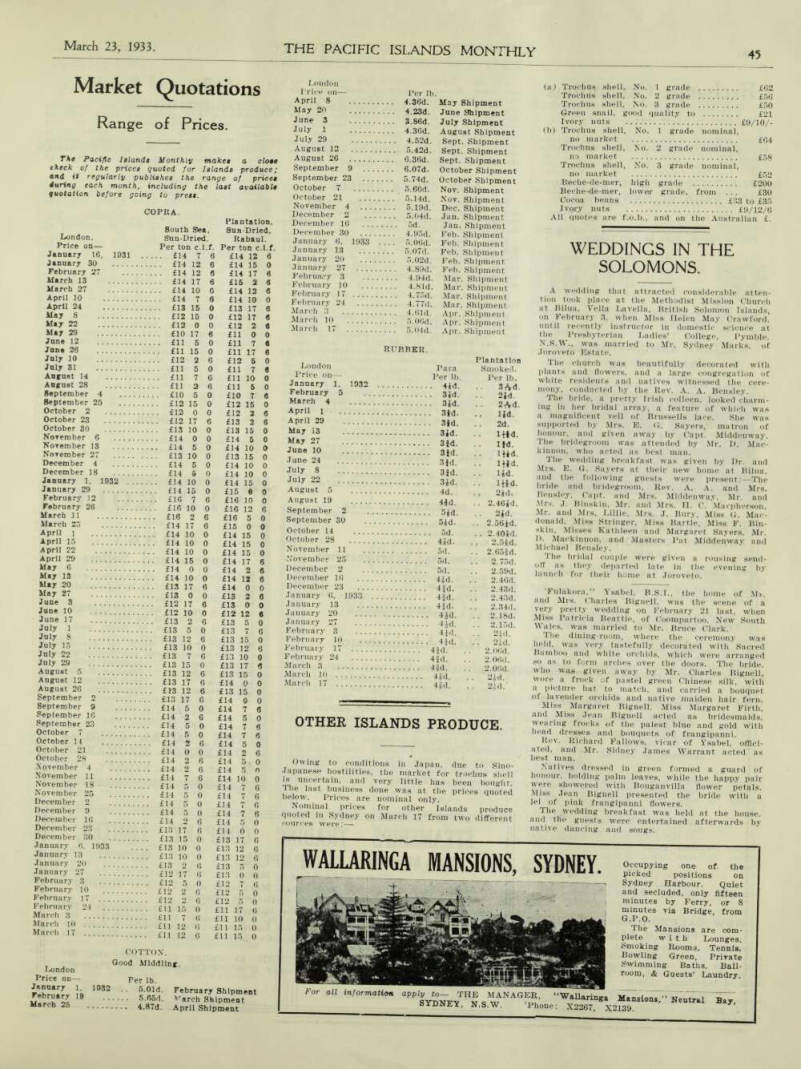
Range of Prices.
The Pacific Islands Monthly makes a close check of the prices quoted for Islands produce; and it regularly publishes the range of prices during each month, including the last available quotation before going to press.
London Price on— Per lb.
April 8 May Shipment May 20 June Shipment June 3 July Shipment July 1 August Shipment July 29 4.52d.
Sept. Shipment August 12 Sept. Shipment August 26 Sept. Shipment September 9 6.07d.
October Shipment September 23 ..
October Shipment October 7 ... 5.60d.
Nov. Shipment October 21 5.14d.
Nov. Shipment November 4 5.19d.
Dec. Shipment December 2 5.04d.
Jan. Shipment December 16 5d.
Jan. Shipment December 30 Feb. Shipment January 6, 1933 5.06d.
Feb. Shipment January 13 5.07d.
Feb. Shipment January 20 5.02d.
Feb. Shipment January 27 ...
Feb. Shipment February 3 February 10 4.81d Mar. Shipment February 17 ...
Mar Shipment February 24 4.77d, Mar Shipment March 3 4.Old.
Apr. Shipment March 10 "..Odd, Apr. Shipment March 17 5.04d.
Apr. Shipment
Rubber.
Plantation Smoked. Per lb.
London Price on— Para Per lb.
January 1. 1932 . 4Jd. 3^d.
February 5 3id. 2ld.
March 4 ... 3id. 2Ad.
April i 3Jdlid.
April 29 3|d. 2d.
May 13 3*d.
IHd.
May 27 3Jd- Ifd.
June 10 3Jd. • • IHd.
June 24 ... 3}d.
IHd.
July 8 3id. lid.
July 22 3jd.
IHd.
August 5 ... 4d. .. 2Jd.
August 19 4|d. .. 2,46id.
September 2 5Jd. 2id.
September 30 5*d. .. 2.56id.
October 14 ... 5d. . . 2.40Jd.
October 28 4 id. . . 2.5|d.
November 11 5d. .. 2.65gd.
November 25 3d. .. 2.75d.
December 2 5d. .. 2.59d.
December 16 . . . 4id. 2.46d.
December 23 ... 4 }d. . . 2.43d.
January 0, 1933 4Jd. .. 2.43d.
January 13 4Jd. .. 2.34d.
January 20 ... 4Jd. .. 2.18d.
January 27 ... 44d. .. 2.15d.
February 3 ... 4 jd. 2Jd, February 10 4 Id. .. 2id.
February 17 4 Id. .. 2.063.
February 24 2.011,1.
March 3 2.06d.
March 10 ... 4|d. . • 2id.
March 17 4 id. • • 2|d.
London. Price on— January 16, January 30
Copra.
South Sea Sun-Dried. Per ton c.i.f. 1931 £14 7 6 Plantation, Sun-Dried, Rabaul. Per ton c.i.f. £14 12 6 £14 15 0 £14 17 6 £15 3 6 £14 12 6 £14 10 0 £13 17 6 £12 17 « £12 2 6 £11 0 0 £11 7 6 £11 17 8 £12 5 0 •£11 7 d February 27 March 13 £14 12 6 March 27 April 10 £14 7 0 April 24 May 8 May 22 May 29 June 12 June 26 July 10 £12 2 6 July 31 August 14
Ia A « O
£11 10 0 £11 5 0 £10 7 6 £12 15 0 £12 2 6 £13 2 6 £13 15 0 £14 5 0 August 28 £11 2 6 September 4 September 25 October 2 October 23 October 30 November 6 November 13 £14 10 0 £13 15 0 £14 10 0 £14 10 0 £14 15 0 £15 8 0 £16 10 0 £16 12 6 £16 5 0 £15 0 0 £14 15 0 November 27 £13 10 0 December 4 December 18 January 1, 1932 £14 10 0 January 29 fu is ft February 12 £10 7 (j February 26 March 11 March 25 April i ...
April 15 ...
April 22 It « April 29 £14 15 0 £ 1 A 17 ft May 6 111 11 O o a May 13 ...
All A O May 20 119 12 O £ 1 4 A A May 27 111 u u £ i q o ft June 3 ...
X. lo dm O
X1 Q A A
June 10 Xlo U V £19 19 A June 17 Ha IdZ O Xi q c A July 1 Xlo O U xi q 7 ft July 8 Xlo 1 O xiq is n July 15 Liu lu u £1q i o ft July 22
Ho Ix O
x 1 q in July 29 Xlo 1U u £i q 77 /• August 5 Xlo 14 o £13 15 0 £ 14 A A August 12 August 20 £13 12 6 Xl*± v U £13 15 0 £14 6 0 £14 7 6 £14 5 0 £14 7 6 £14 7 6 £ 14 A September 2 £13 17 6 September 9 £14 5 o September 16 £14 2 6 September 23 £14 5 o October 7 £14 5 o October 14 October 21 £14 o o
Hi O U
£14 2 6 £14 5 0 £14 5 n £14 10 0 October 28 £14 2 6 November 4 £14 2 6 November 11 November 18 £14 7 6 £14 7 6 £14 7 6 £14 7 6 £14 5 0
F 1 A A A
November 25 £14 5 o December 2 December 9 December 16 £14 2 6 December 23 December 30
Ih U U
£13 17 6 £13 12 6 X 1 O 1 f> n January 6. 1933 January 13 £13 10 0
January 20
Xlo O xi q k s\ January 27 ...
Xlo O U
X1 Q N A
February 3 Xlo U £10 7 A February 10 4 O £19 A February 17 . . .
Xla O U
£19 A February 24
Xla O U
£11 17 6 £11 1A A March 3 ...
March 10 X 1 1 ill u £11 15 0
Xii 1? N
March 17 London Price on— January 1, 1932 February 19 March 25
Cotton.
Good Middling.
Per lb. 5.Old. February Shipment • • • • 5.65d. ''arch Shipment • ■ • • 4.87d. April Shipment
Other Islands Produce.
Owing to conditions in Japan, due to Sino- Japanese hostilities, the market for trochus shell is uncertain, and very little has been bought, the last business done was at the prices quoted below. Prices are nominal only.
Nominal prices for other Islands produce quoted in Sydney on March 17 from two different sources were:—
(a) Trochus shell, No. 1 grade £62 Trochus shell. No. 2 grade £56 Trochus shell, No. 3 grade £50 Green snail, good quality to £21 Ivory nuts (b) Trochus shell, No. 1 grade nominal, no market Trochus shell, No. 2 grade nominal, no market Trochus shell, No. 3 grade nominal, no market Beche-de-mer, high grade £200 Beche-de-mer, lower grade, from . . . £30 Cocoa beans £33 to £35 Ivory nuts £9/12/6 All quotes are f.o.b., and on the Australian £.
Solomons.
Weddings In The
A wedding that attracted considerable atten tion took place at the Methodist Mission Church at Bilua, Vella Lavella, British Solomon Islands, on February 3, when Miss Helen May Crawford, until recently instructor in domestic science at the Presbyterian Ladies’ College. Pymble, N.S.W., was married to Mr. Sydney Marks, of Joroveto Estate.
The church was beautifully decorated with plants and flowers, and a large congregation of white residents and natives witnessed the cere mony, conducted by the Rev. A. A. Bensley.
The bride, a pretty Irish colleen, looked charm ing in her bridal array, a feature of which was a magnificent veil of Brussells lace. She was supported by Mrs. E. G. Sayers, matron of honour, and given away by Capt. Middenway.
The bridegroom was attended by Mr. D. Mac kinnon, who acted as best man.
The wedding breakfast was given by Dr. and Mrs. E. G. Sayers at their new home at Bilua, and the following guests were present:—The bride and bridegroom, Rev. A. A. and Mrs.
Bensley, Capt. and Mrs. Middenway, Mr. and Mrs. J. Binskin, Mr. and Mrs. H. C. Macpherson, Mr. and Mrs. Lillie, Mrs. J. Bury, Miss G. Mac donald, Miss Stringer, Miss Bartle, Miss F. Bin skin, Misses Kathleen and Margaret Sayers, Mr.
D. Mackinnon. and Masters Pat Middenway and Michael Bensley.
The bridal couple were given a rousing send off as they departed late in the evening by launch for their home at Joroveto.
"Fulakora,” Ysabel. B.S.I., the home of Mr. and Mrs. Charles Bignell, was the scene of a very pretty wedding on February 21 last, when Miss Patricia Beattie, of Coompartoo, New South Wales, was married to Mr. Bruce Clark.
The dining-room, where the ceremony was held, was very tastefully decorated with Sacred Bamboo and white orchids, which were arranged so as to form arches over the doors. The bride, who was given away by Mr. Charles Bignell, wore a frock of pastel green Chinese silk, with a picture hat to match, and carried a bouquet of lavender orchids and native maiden hair fern.
Miss Margaret Bignell, Miss Margaret Firth, and Miss Jean Bignell acted as bridesmaids, wearing frocks of the palest blue and gold with head dresses and bouquets of frangipanni.
Rev. Richard Fallows, vicar of Ysabel, offici ated, and Mr. Sidney James Warrant acted as best man.
Natives dressed in green formed a guard of honour, holding palm leaves, while the happy pair were showered with Bouganvilla flower petals.
Miss Jean Bignell presented the bride with a lei of pink frangipanni flowers.
The wedding breakfast was held at the house, and the guests were entertained afterwards by native dancing and songs.
Advertisements & other items, p. 47 (1 item)
Wallaringa Mansions, Sydney,
Occupying one of the picked positions on Sydney Harbour. Quiet and secluded, only fifteen minutes by Ferry, or 8 minutes via Bridge, from
G.P.O.
The Mansions are com plete with Lounges, Smoking Rooms, Tennis, Bowling Green, Private Swimming Baths, Ball room, & Guests’ Laundry.
For a “ in,oraa,,m
Exchange Quotations
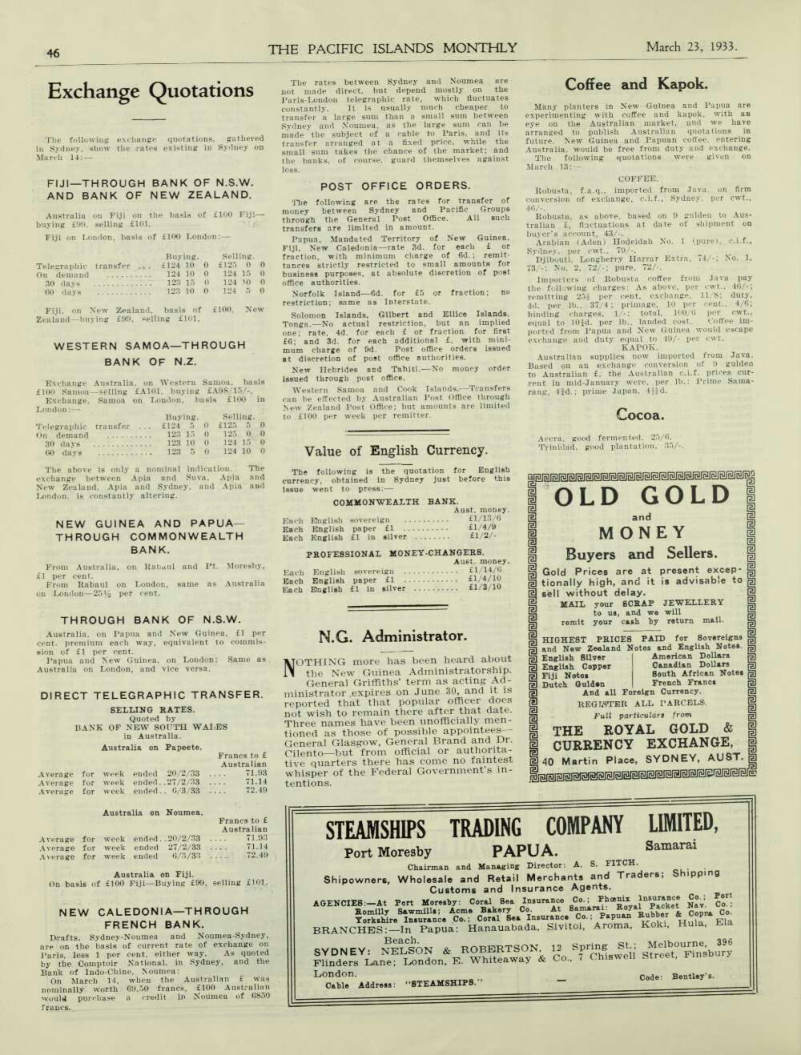
The following exchange quotations, gathered in Sydney, show the rates existing in Sydney on March 14;—
Fiji—Through Bank Of N.S.W.
And Bank Of New Zealand.
Australia on Fiji on the basis of £100 Fiji— buying £99, selling £101.
Fiji on London, basis of £100 London: —
Fiji, on New Zealand, basis of £100, New Zealand —buying £99, selling £101.
Western Samoa—Through
Bank Of N.Z.
Exchange Australia, on Western Samoa, basis £100 Samoa —selling £A101, buying £A98/15/-.
Exchange, Samoa on London, basis £100 in London: —
The above is only a nominal indication. The exchange between Apia and Suva. Apia and New Zealand, Apia and Sydney, and Apia and London, is constantly altering.
New Guinea And Papua
Through Commonwealth
Bank.
From Australia, on Rabaul and Pt. Moresby, £1 per cent.
From Rabaul on London, same as Australia on London —25½ per cent.
Through Bank Of N.S.W.
Australia, on Papua and New Guinea, £1 per cent, premium each way, equivalent to commis sion of £1 per cent.
Papua and New Guinea, on London: Same as Australia on London, and vice versa.
Direct Telegraphic Transfer.
Selling Rates.
Quoted by
Bank Of New South Wales
in Australia.
Australia on Papeete.
New Caledonia—Through
French Bank.
Drafts, Sydney-Noumea and Noumea-Sydney, are on the basis of current rate of exchange on Paris, less 1 per cent, either way. As quoted by the Comptoir National, in Sydney, and the Bank of Indo-Chine, Noumea: On March 14, when the Australian £ was nominally worth 69.50 francs, £100 Australian would purchase a credit in Noumea of 6850 francs.
The rates between Sydney and Noumea are not made direct, but depend mostly on the Paris-London telegraphic rate, which fluctuates constantly. It is usually much cheaper to transfer a large sum than a small sum between Sydney and Noumea, as the large sum can be made the subject of a cable to Paris, and its transfer arranged at a fixed price, while the small sum takes the chance of the market; and the banks, of course, guard themselves against loss.
Post Office Orders.
The following are the rates for transfer of money between Sydney and Pacific Groups through the General Post Office. All such transfers are limited in amount.
Papua. Mandated Territory of New Guinea.
Fiji, New Caledonia —rate 3d. for each £ or fraction, with minimum charge of 6d.; remit tances strictly restricted to small amounts for business purposes, at absolute discretion of post office authorities.
Norfolk Island—6d. for £5 or fraction; no restriction; same as Interstate.
Solomon Islands, Gilbert and Ellice Islands, Tonga.—No actual restriction, but an implied one; rate, 4d. for each £ or fraction, for first £6; and 3d. for each additional £. with mini mum charge of 9d. Post office orders issued at discretion of post office authorities.
New Hebrides and Tahiti. —No money order issued through post office.
Western Samoa and Cook Islands. —Transfers can be effected by Australian Post Office through New Zealand Post Office; but amounts are limited to £100 per week per remitter.
Buying.
Selling.
Telegraphic transfer £124 10 0 £125 0 0 On demand 124 10 0 124 15 0 30 days 123 13 0 124 10 0 60 days 123 10 0 124 5 0
Buying. Selling.
Telegraphic transfer . . . £124 5 0 £125 5 0 On demand 123 15 0 125 0 0 30 davs 123 10 0 124 15 0 00 days 123 5 0 124 10 0
Francs to £ Australian Average for week ended 20/2/33 71.93 Average for week ended. .27/2/33 71.14 Average for week ended. .. 6/3/33 72.49 Australia on Noumea.
Francs to £ Australian Average for week ended ..20/2/33 71.93 Average for week ended 27/2/33 71.14 Average for week ended 6/3/33 72.49 Australia on Fiji.
On basis of £100 Fiji—Buying £99, selling £101.
Value of English Currency.
The following is the quotation for English currency, obtained in Sydney just before this issue went to press:—
Commonwealth Bank.
Aust. money.
Each English sovereign £1/13/6 Each English paper £1 Each English £1 in silver . .. £1/2/-
Professional Money-Changers.
Aust. money.
Each English sovereign £1/14/6 Each English paper £1 £1/4/10 Each English £1 in silver . . £1/3/10
N.G. Administrator.
NOTHING more has been heard about the New Guinea Administratorship.
General Griffiths’ term as acting Ad ministrator expires on June 30, and it is reported that that popular officer does not wish to remain there after that date.
Three names have been unofficially men tioned as those of possible appointees — General Glasgow, General Brand and Dr.
Cilento —but from official or authorita tive quarters there has come no faintest whisper of the Federal Government's in tentions.
Coffee and Kapok.
Many planters in New Guinea and Papua are experimenting with coffee and kapok, with an eye on the Australian market, and we have arranged to publish Australian quotations in future. New Guinea and Papuan coffee, entering Australia, would be free from duty and exchange.
The following quotations were given on March 13:—
Coffee.
Robusta, f.a.q., imported from Java, on firm conversion of exchange, c.i.f., Sydney, per cwt., 46/-.
Robusta, as above, based on 9 gulden to Aus tralian £, fluctuations at date of shipment on buyer’s account, 43/-.
Arabian (Aden) Hodeidah No. 1 (pure), c.i.f., Sydney, per cwt., 79/-.
Djibouti, Longberry Harrar Extra, 74/-; No. X, 73/-: No. 2, 72/-; pure, 72/-.
Importers of Robusta coffee from Java pay the following, charges: As above, per ewt.. 46/-; remitting 25-i per cent, exchange. 11 8; duty, 4d. per lb., 37/4; primage, 10 per cent., 4/6; binding charges, 1/-; total, 100/6 per cwt., equal to 10|d. per lb., landed cost. Coffee im ported from Papua and New Guinea would escape exchange and duty equal to 49/- per cwt.
Kapok.
Australian supplies now imported from Java.
Based ou an exchange conversion of 9 gulden to Australian £, the Australian c.i.f. prices cur rent in mid-January were, per lb.: Prime Sama rang, 4fd.; prime Japan, 4Hd.
Cocoa.
Accra, good fermented. 25/6.
Trinidad, good plantation, 35/-.
Advertisements & other items, p. 48 (1 item)
«srs&s
OLD GOLD
and
MONEY
Buyers and Sellers.
Gold Prices are at present excep tionally high, and it is advisable to sell without delay.
MAIL your SCRAP JEWELLERY
to us, and we will remit your cash by return mall.
HIGHEST PRICES PAID for Sovereigns and Now Zealand Notes and English Notes.
English Silver American Dollars English Copper Canadian Dollars Fiji Notes South African Notes Dutch Gulden French Francs And all Foreign Currency.
REGISTER ALL PARCELS.
Full particulars from
THE ROYAL GOLD &
CURRENCY EXCHANGE,
40 Martin Place, SYDNEY, AUST.
STEAMSHIPS TRADING COMPANY LIMITED,
Port Moresby PAPUA. Samarai
Chairman and Managing Director: A. S. FITCH.
Shipowners, Wholesale and Retail Merchants and Traders; Shipping Customs and Insurance Agents.
AGENCIES:—At Port Moresby: S ea Romilly Sawmills; Acme Bakery Co. At Samarai. Royal Packet Nav. Co .
Yorkshire Insurance Co.; Coral Sea Insurance Co.; Papuan Ela BRANCHES:—In Papua; Hanauabada, Sivitoi, Aroma, Koki, Hula, Ela
«srs&s
London, Code: Bentley’s.
Cable Address: “STEAMSHIPS.
Shipping Services in the Pacific
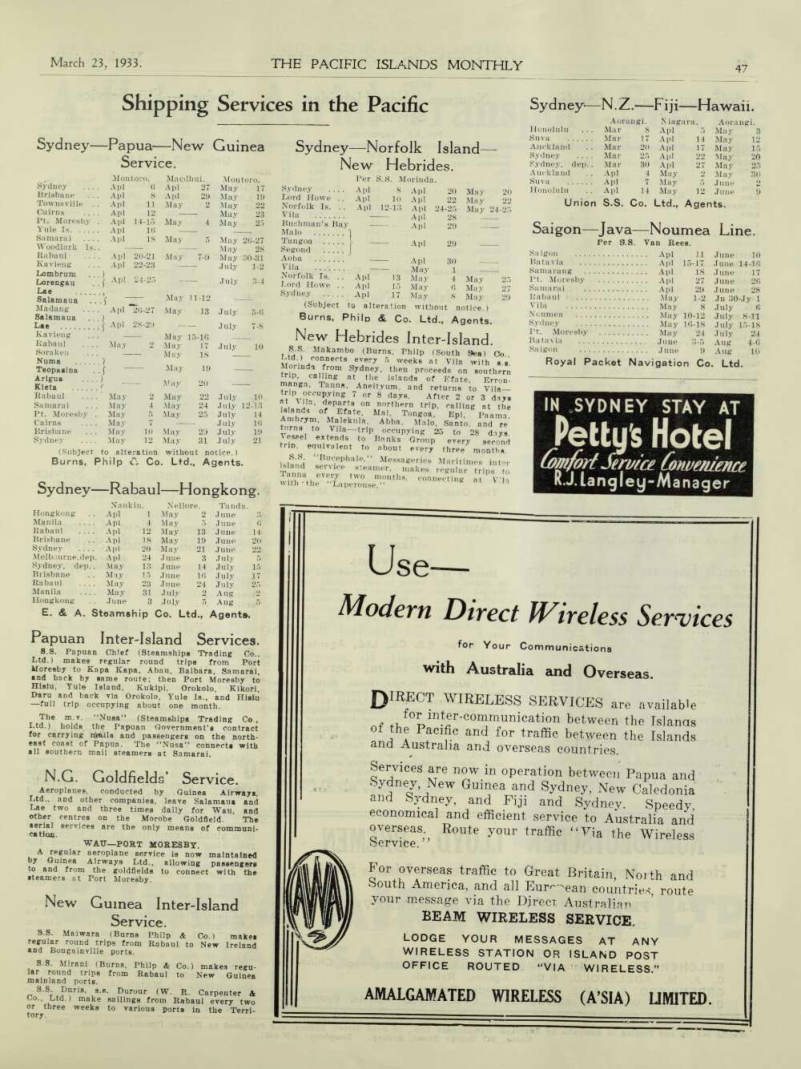
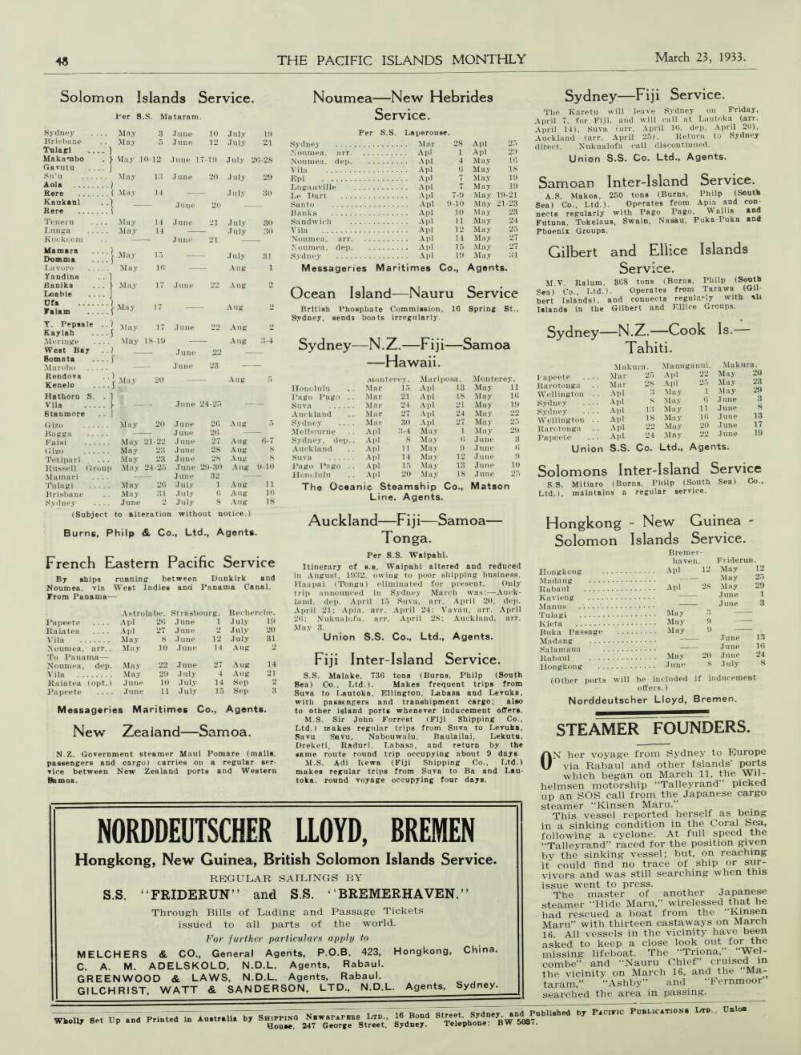
Sydney—Papua—New Guinea Service.
Sydney—Rabaul—Hongkong.
Papuan Inter-Island Services.
S.S. Papuan Chief (Steamships Trading Co., Ltd.) makes regular round trips from Port Moresby to Kapa Kapa, Abau, Baibara, Samarai, and back by same route; then Port Moresby to Hlslu. Yule Island. Kuklpi, Orokolo, Kikori, Daru and back via Orokolo, Yule Is., and Hislii —full trip occupying about one month.
The m.v. “Nusa” (Steamships Trading Co, Ltd.) holds the Papuan Government’s contract for carrying muils and passengers on the north east const of Papua. The “Nusa” connects with all southern mail steamers at Samarai.
N.G. Goldfields’ Service.
Aeroplanes, conducted by Guinea Airways, Ltd., and other companies, leave Salamaua and Lae two and three times daily for Wau. and other centres on the Morobe Goldfield. The aerial services are the only means of communi cation.
Wau—Port Moresby.
A regular aeroplane service is now maintained by Guinea Airways Ltd., allowing passengers to and from the goldfields to connect with the ateamers at Port Moresby.
New Guinea Inter-Island
Service.
S.S. Maiwara (Burns Philp A Co.) makes regular round trips from Rabaul to New Ireland and Bougainville ports.
S.S. Mirani (Burns, Philp & Co.) makes regu lar round trips from Rabaul to New Guinea mainland ports.
S.S Duris, s.s. Durour (W. R. Carpenter A Co., Ltd.) make sailings from Rabaul every two or three weeks to various ports in the Terri
Sydney—Norfolk Island— New Hebrides.
New Hebrides Inter-Island.
S.S Makambo (Burns. Philp (South Sea) Co Md. ) connects every 5 weeks at Vila with ss Morinda from Sydney, then proceeds on southern trip, calling at the islands of Efate. Erron manga. Tannn. Aneityum, and returns to Vila trip occupying 7or 8 days. After 2or 3 days at Vila, departs on northern trip, calling at the islands of Efate. Mai. Tongoa, Epi, Paama, Ambryn, Malekula, Abba, Malo, Santo, and re turns to Vila—trip occupying 25 to 28 days.
Vessel extends to Banks Group every second trio, equivalent to about every three months.
S.S. "Bucephale," Messageries Marltimes inter island service steamer, makes regular trips to Tanna every two months - connecting at Vila with the "Laperouse.”
Sydney—N.Z.—Fiji—Hawaii.
Saigon—Java—Noumea Line.
Per S.S. Van Rees.
Per S.S. Morinda.
Sydney Lord Howe .
Norfolk Is. .
Vila . A pi 8 Apl 10 Apl Apl Apl 24 Apl Apl 20 22 -25 28 29 May 20 May 22 May 24-25 Bushman’s Bay Malo — Tangoa . .. .
Segond . ...
Aoba Apl Apl Vf O 29 30 — Vila Norfolk Is. .
I.ord Howe .
Sydney (Subject to alteration without notice.) • Apl 13 . Apl 15 . Apl 17 May 4 May 25 May 6 May 27 May 8 May 20 Burns, Philp & Co. Ltd., Agents.
Aorangi.
Niagara.
Aorangi.
Honolulu Mar 8 Apl 5 May 3 Suva Mar 17 Apl 14 May 12 Auckland Mar 20 Apl 17 Mas- 15 Sydney ...
Mar 25 Apl 22 May 20 Sydney, dep..
Mar 30 Apl 27 May 2."
Auckland Apl 4 May 2 May 30 Suva Apl 7 May 5 June o Honolulu Apl 14 May 12 June 9 Union s.s. Co. Ltd., Agents.
Saigon 11 June 10 Batavia 15-17 June 14-k; Samarang 18 June 17 Pt. Moresby 27 June 20 Samarai 29 June 28 Kabaul May 1-2 Jn 30-Jy 1 Vila 8 July 6 Noumea May 10-12 July 8-11 Sydney May 16-18 July 15-18 Pt. Moresby May 24 July 24 Batavia 3-5 Aug 4-6 Saigon 9 Aug 10 Royal Packet Navigation Co. Ltd.
Sydney Brisbane Townsville Cairns Pt. Moresby Yule Is Montoro.
Apl (i Apl 8 Apl 11 Apl 12 Apl 14-15 Apl 16 Maedhui.
Apl 27 Apl 29 May 2 May 4 Montoro.
May 17 May 19 May 22 May 23 May 23 Samarai Woodlark Is.
Rabaul Kavieng Lombrum Lorengau Lae ...
Apl 18 . Apl 20-21 Apl 22-23 ;} Apl 24-23 May May 7-D May 26-27 May 28 May 30-31 July 1-2 July 3-4 Salamaua Madang Salamaua Lae
Apl "20-27
'J Apl 28-20 May 2 May 11-12 May 13 July 5-6 July 7-8 Kavieng Kabaul Soraken Numa May 1: Mav May 3-16 17 18 July 10 Teopaalna Arlgua Kleta — May May 19 20 Rabaul Samarai Pt. Moresby .
Cairns Brisbane Sydney ...
May 2 May 4 May 5 May 7 May 10 May 12 May May May May May 22 24 25 29 31 July 10 July 12-13 July 14 July 16 July 19 July 21 (Subject to alteration without notice.) Burns, Philp & Co. Ltd., Agents.
Nankin.
Nellore.
Tanda.
Hongkong Apl 1 May 2 June 3- Manila ...
A pi 4 May 5 June 0 Rabaul ...
Apl 12 May 13 June 14 Brisbane Apl 18 May 19 June 20 Sydney ...
Apl 20 May 21 June 22 Melbourne, dep.
Apl 24 Juue 3 July 5 Sydney, dep..
May 13 June 14 July 15 Brisbane May 15 June 10 July 17 Rabaul ...
May 23 June 24 July 25 Manila ...
May 31 July 2 Aug 2 Hongkong June 3 July 5 Aug 5 E. & A. Steamship Co. Ltd., Agents.
Solomon Islands Service.
Per S.S. Mataram.
French Eastern Pacific Service
By ships running between Dunkirk and Noumea, via West Indies and Panama Canal.
From Panama— Astrolabe. Strasbourg. Recherche.
Papeete ... Apl 26 June 1 July 19 Raiatea ... Apl 27 June 2 July 20 Vila May 8 June 12 July 31 Noumea, arr.. May 10 June 14 Aug 2 To Panama— Noumea, dep. May 22 June 27 Aug 14 Vila May 29 July 4 Aug 21 Raiatea (opt.) June 10 July 14 Sep 2 Papeete ... June 11 July 15 Sep 3
Messageries Maritimes Co., Agents.
New Zealand—Samoa.
N.Z. Government steamer Maui Pomare (malls, passengers and cargo) carries on a regular ser vice between New Zealand ports and Western Samoa.
Noumea—New Hebrides Service.
Sydney—N.Z.—Fiji—Samoa —Hawaii.
Auckland—Fiji—Samoa—
Tonga.
Per S.S. Walpahi.
Itinerary of s.s. Waipahi altered and reduced in August, 1932, owing to poor shipping business.
Haapai (Tonga) eliminated for present. Only trip announced in Sydney March was: —Auck land, dep. April 15 Suva, arr. April 20, dep.
April 21; Apia, arr. April 24: Yavau, arr. April 26; Nukualofa, arr. April 28; Auckland, arr.
May 3.
Union S.S. Co., Ltd., Agents.
Fiji Inter-Island Service.
S.S. Malake, 730 tons (Burns, Philp (South Sea) Co., Ltd.). Makes frequent trips from Suva to Lautoka, Ellington, Labasa and Levoka, with passengers and transhipment cargo; also to other island ports whenever inducement offers.
M.S. Sir John Forrest (Fiji Shipping Co., Ltd.) makes regular trips from Suva to Levuka, Savu Savu, Nabouwalu, Baulailai, Lekutu.
Dreketi, Raduri, Labasa, and return by the same route round trip occupying about 9 days M.S. Adi Rewa (Fiji Shipping Co., Ltd.) makes regular trips from Suva to Ba and Lau toka. round voyage occupying four days.
Sydney—Fiji Service.
The Karetu will leave Sydney on Friday, April 7, for Fiji, and will call at Lautoka (arr.
April 14), Suva (arr. April 16, dep. April 20), Auckland (arr. April 25). Return to Sydney direct. Nukualofa call discontinued.
Union S.S. Co. Ltd., Agents.
Samoan Inter-Island Service.
A.S. Makoa, 250 tons (Burns. Philp (South Sea) Co., Ltd.). Operates from Apia and con nects regularly with Pago Pago, Wallis and Futuna, Tokelaus, Swain, Nasau, Puka-Puka and Phoenix Groups.
Gilbert and Ellice Islands
Service.
M.V. Ralum, 808 tons (Burns, Philp (South Sea) Co., Ltd.). Operates from Tarawa (Gil bert Islands), and connects regularly with all Islands in the Gilbert and Ellice Groups.
Sydney—N.Z. —Cook Is.
Tahiti.
Solomons Inter-Island Service S.S. Mitiaro (Burns. Philp (South Sea) Co..
Ltd.), maintains a regular service.
Hongkong - New Guinea - Solomon Islands Service.
Sydney ... May 3 June 10 July 19 Brisbane . . May 5 June 12 July 21 Tulagi Makambo . }• May 10- 12 , June 17- 19 July 20-28
Gavutu . . . . J
Su’u May 13 June 20 July 29 Aola Here ( May 14 — July 30 Kaukaal . .7 June 20 Rere Teneru ... May 14 June 21 July 30 Lunga May 14 — July 30 Kookcom June 21 — Mamara
Domma . . .. May
15 July 31 Lavoro May 16 — Aug 1
YAndina . . 7
Banika . .. [ May
17 June 22 Aug o
Loable . . . . J
SL- 17 — Aug o
LrtSr 1 *..::}
17 June 22 Aug 2 Meringe ... May 18-18 — Aug 3-4 West Bay ..] June 22
Somata . ... j
23 Marobo June — Rendora . .7 A .
Kenelo ...J^ ay 20 — Aug 5
Hatborn S. . 1
-25 V Ua r Stanmore . . J Gizo May 20 June 20 Aug 5 Bagga June 20 Faisi May 21 -22 June 27 Aug 6-7 Gizo May 23 June 28 Aug 8 Tetipari ... May 23 June 28 Aug 8 Russell Group May 24 -25 June 29-30 Aug 9-10 32 Aiamari ... iHilagi May 20 July 1 Aug 11 Brisbane .. May 31 July 0 Aug 10 Sydney ... June 2 July 8 Aug 18 (Subject to alteration without notice.) Burns, Philp & Co Ltd., , Agents.
Per S.S. Laperouse.
Sydney 28 Apl 25 Noumea, a it. .. Apl 1 Apl 29 Noumea, dep. . . Apl 4 May 16 Vila 0 May 18 Epi . . Apl 7 May 19 Luganville . . Apl 7 May 19 Be Dart ... . r-9 May 19-21 Santo .. Apl 9-10 May 21-23 Banks 10 May 23 Sandwich 11 May 24 Vila 12 May 25 Noumea, arr. .. Apl 14 May 27 Noumea, dep. 15 May 27 Sydney . . Apl 19 May 31 Messagenes Maritimes Co Agents.
Ocean Island—Nauru Service
Service
British Phosphate Commission, 16 Spring St., Sydney, sends boats irregularly.
monterey.
Mariposa.
Monterey.
Honolulu Mar 15 Apl 13 May 11 Pago Pago . .
Mar 21 Apl 18 May 16 Suva Mar 24 Apl 21 May 19 Auckland Mar 27 Apl 24 May 22 Sydney ... .
Mar 30 Apl 27 May 25 Melbourne Apl 3-4 May 1 May 29 Sydney, dep..
Apl 8 May 6 June 3 Auckland Apl 11 May 9 June 6 Suva Apl 14 May 12 June 9 Pago Pago . .
Apl 15 May 13 June 10 Honolulu Apl 20 May 18 June 23 The Oceanic Steamship Co., Matson Line, Agents.
Makura. Maunganui. Makura.
Papeete ... Mar 25 Apl 22 May 20 Rarotonga . . Mar 28 Apl 2o May 23 Wellington . . Apl 3 May 1 May 29 Sydney ... Apl 8 May 6 June 3 Sydney ... Apl 13 May 11 June 8 Wellington . . Apl 18 May lb June 13 Rarotonga .. Apl 22 May 20 June 17 Papeete ... Apl 24 May 22 June 19 Union S.S. Co. Ltd., Agents.
Hongkong Bremerhaven.
Apt 12 Friderun.
May 12 Madang May 25 Kabaul Apt 28 May 29 Kavieng June 1 Manus May 3 June 3 Tulagi — Kieta May 9 — Buka Passage May 9 — Madang June 13 June Id Salamaua Rabaul May 20 June 24 Hongkong June 8 July 8 (Other ports will be included if inducement offers.)
Norddeutscher Lloyd, Bremen.
Advertisements & other items, pp. 49-50 (1 item)
Petty's Hotel
IN SYDNEY STAY AT
Comfort Service Convenience R.J. Langley-Manager
Use—
Modern Direct Wireless Services
for Your Communications with Australia and Overseas.
DIRECT WIRELESS SERVICES are available for inter-communication between the Islands of the Pacific and for traffic between the Islands and Australia and overseas countries.
Services are now in operation between Papua and Sydney New Guinea and Sydney, New Caledonia and Sydney, and Fiji and Sydney. Speedy, economical and efficient service to Australia and overseas. Route your traffic “Via the Wireless Service."
For overseas traffic to Great Britain, North and South America, and all countries route your message via the Direct Australian.
BEAM WIRELESS SERVICE.
LODGE YOUR MESSAGES AT ANY
WIRELESS STATION OR ISLAND POST
OFFICE ROUTED “VIA WIRELESS"
AMALGAMATED WIRELESS (A’SIA) LIMITED.
NORDDEUTSCHER LLOYD, BREMEN
Hongkong, New Guinea, British Solomon Islands Service.
REGULAR SAILINGS BY
S.S. “FRIDERUN” and S.S. “BREMERHAVEN.”
Through Bills of Lading and Passage Tickets issued to all parts of the world.
For further particulars apply to MELCHERS & CO., General Agents, P.O.B. 423, Hongkong, China.
C. A. M. ADELSKOLD, N.D.L. Agents, Rabaul.
GREENWOOD & LAWS, N.D.L. Agents, Rabaul.
GILCHRIST, WATT & SANDERSON, LTD., N.D.L. Agents, Sydney.
Steamer Founders.
ON her voyage from Sydney to Europe via Rabaul and other Islands’ ports which began on March 11, the Wil helmsen motorship “Talleyrand” picked up an SOS call from the Japanese cargo steamer “Kinsen Maru.”
This vessel reported herself as being in a sinking condition in the Coral Sea, following a cyclone. At full speed the “Talleyrand” raced for the position given by the sinking vessel; but, on reaching it could find no trace of ship or sur vivors and was still searching when this issue went to press.
The master of another Japanese steamer “Hide Maru,” wirelessed that he had rescued a boat from the “Kinsen Maru” with thirteen castaways on March 16. All vessels in the vicinity have been asked to keep a close look out for the missing lifeboat. The “Triona,” “Wel combe” and “Nauru Chief” cruised in the vicinity on March 16, and the “Ma taram,” “Ashby” and “Fernmoor searched the area in passing.
Advertisements & other items, pp. 50-52 (2 items)
48
March 23, 1933.
THE PACIFIC ISLANDS MONTHLY
Wholly Set Up and Printed by Shipping Newspapers Ltd., 16 Bond Street, Sydney, and Published by Pacific Publications Ltd., Union
Guinea Airways Ltd
A Unique Aerial Transport Service
AT LEFT: Parts of Dredge Machinery being loaded into aeroplane for transport by Guinea Airways, Ltd., to Bulolo Goldfield.
BELOW: Here’s a giant wheel with a diameter of over 6½ feet for one of the Bulolo Gold Dredging Company’s dredges.
It is bolted securely inside the cabin of a G31 tri-motored Junker for transport to the goldfields. The balance of the load was made up with hundred pound bags of rice.
THE country over which Guinea Airways’ Aircraft daily fly is some of the worst in the world. It is so rough that overland transport is impossible, and many attempts at road building have been abandoned.
The Goldfields depend entirely on aircraft for maintenance, and it is the success of their service which makes Guinea Airways confident of their ability to organise and maintain dependable transport WHEREVER it is needed.
New Guinea Aerodromes
LAE
SALAMAUA
WATUT
WAU
WAMPIT
SANGAN
BULOWAT
BULOLO
ZENAG
GUINEA AIRWAYS LTD
LAE • SALAMAUA